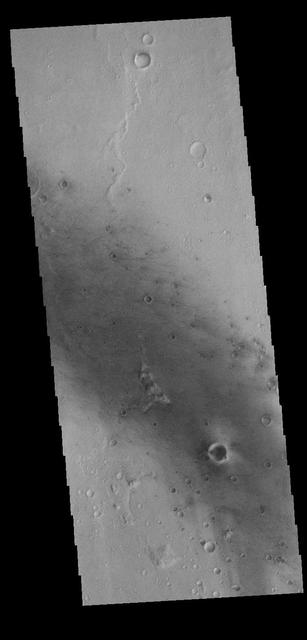
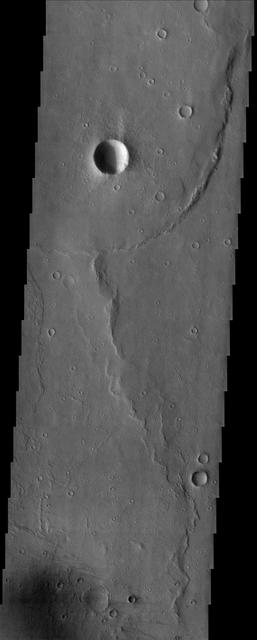
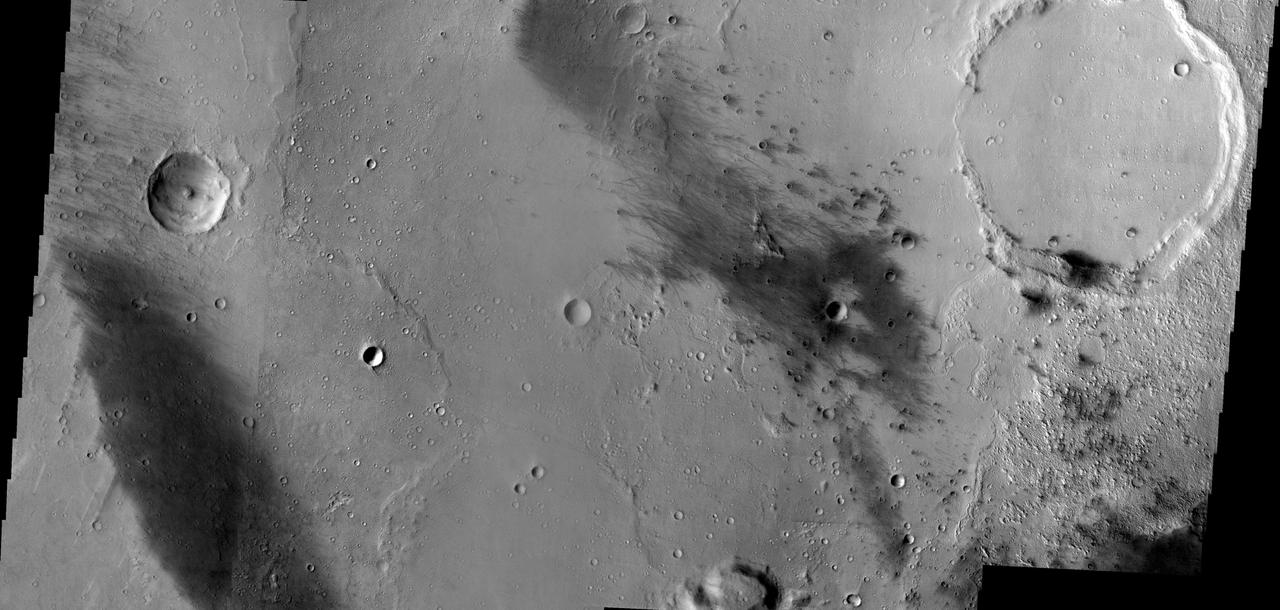
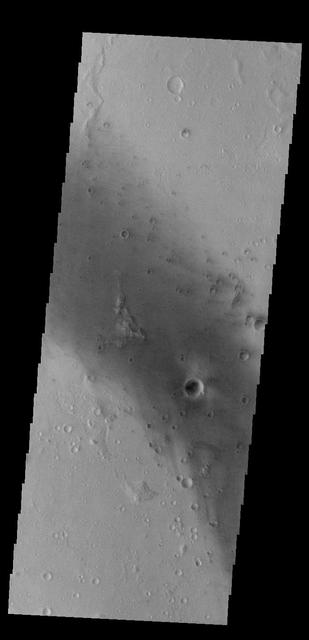
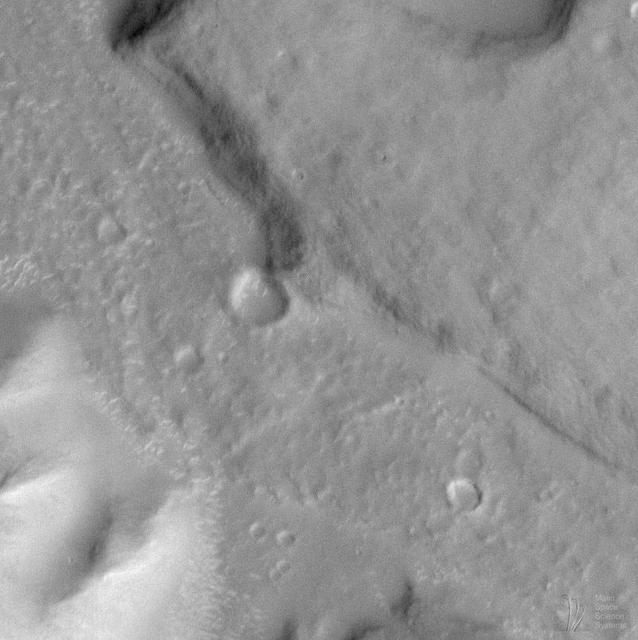
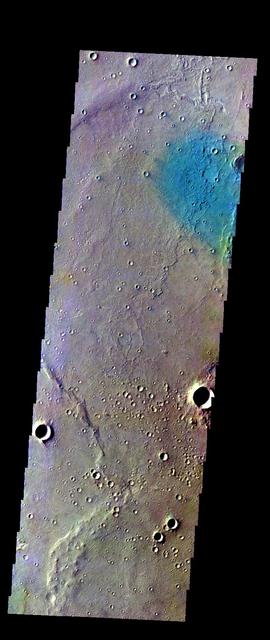
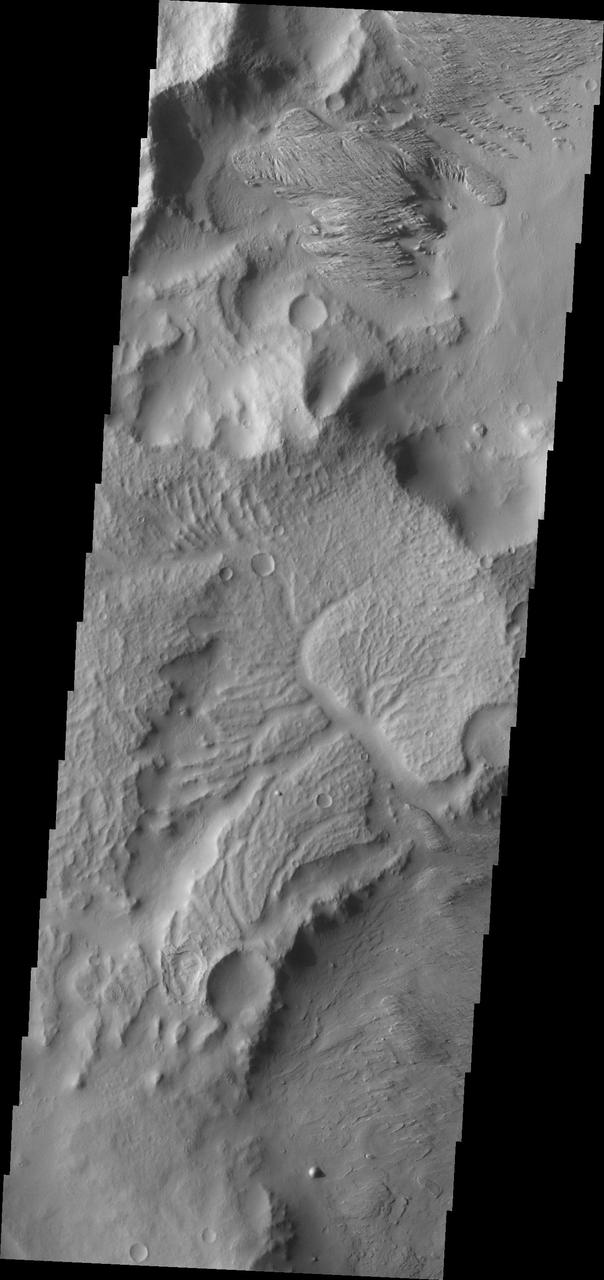
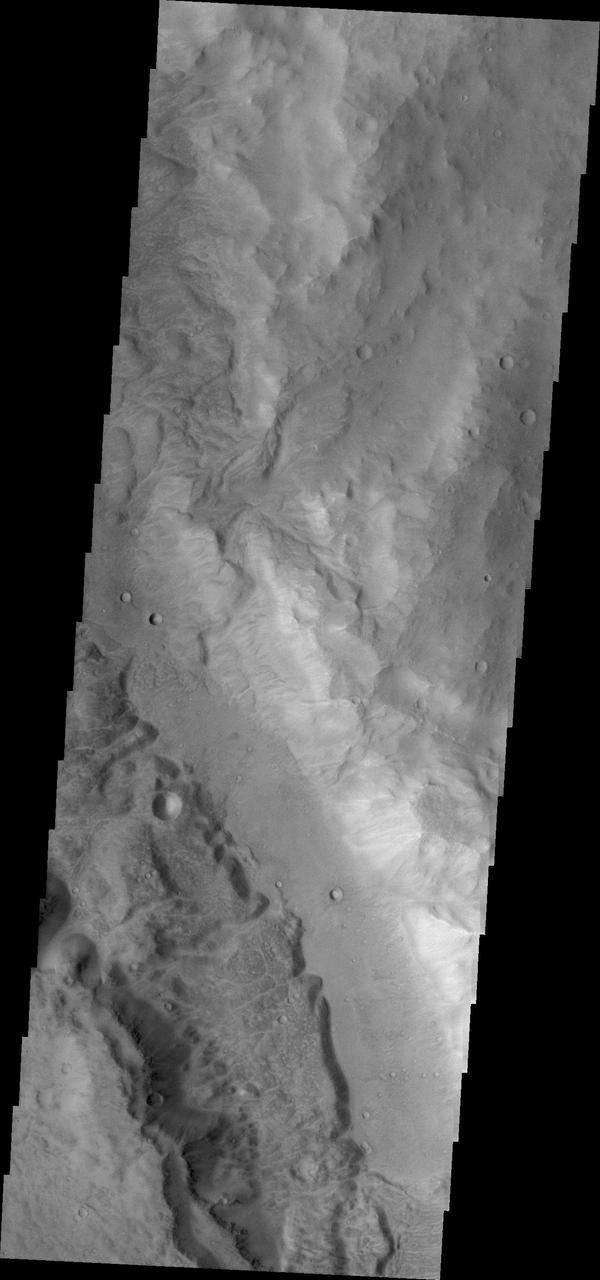
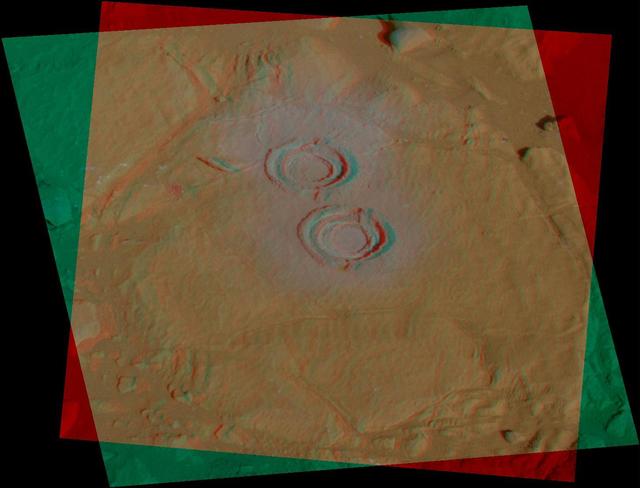
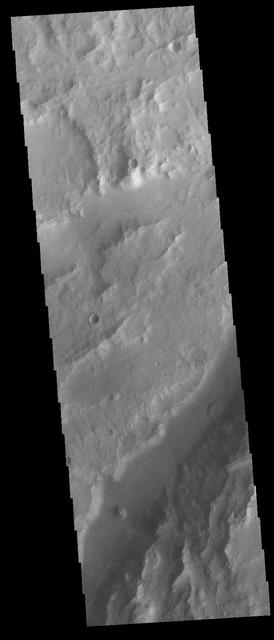
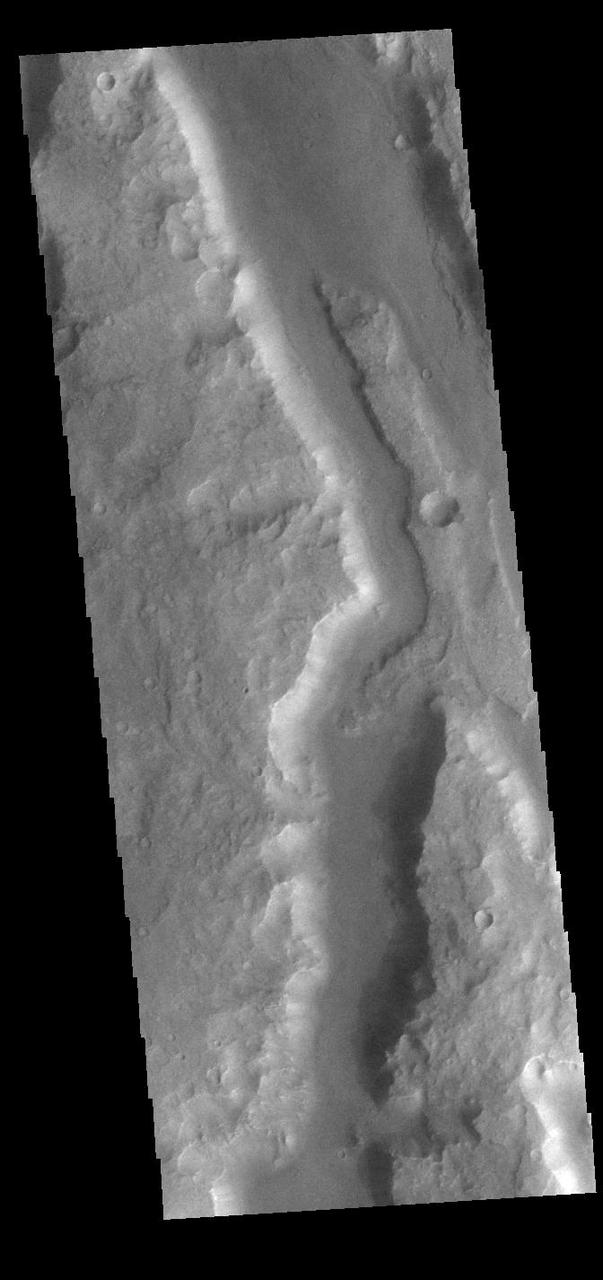
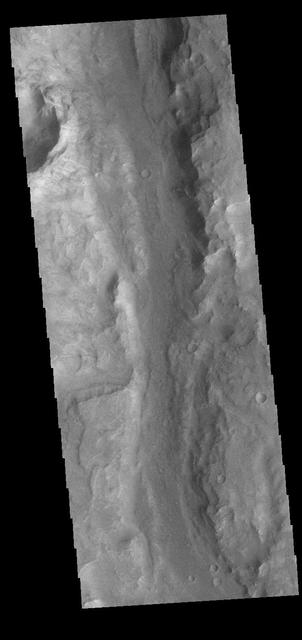
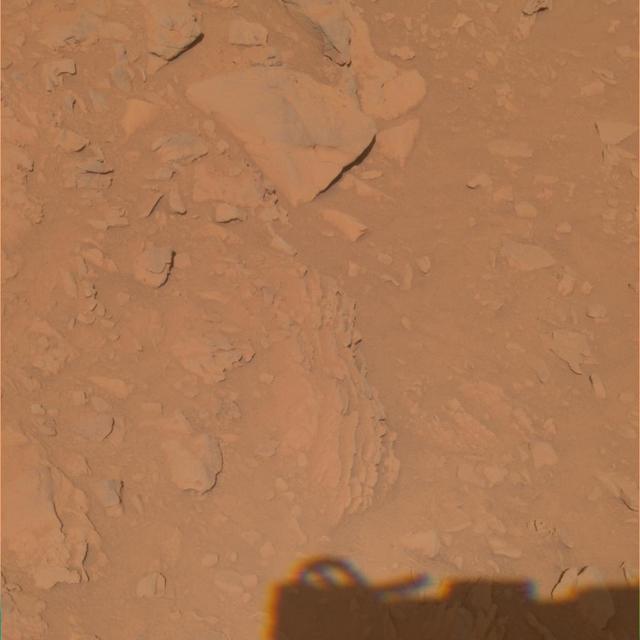
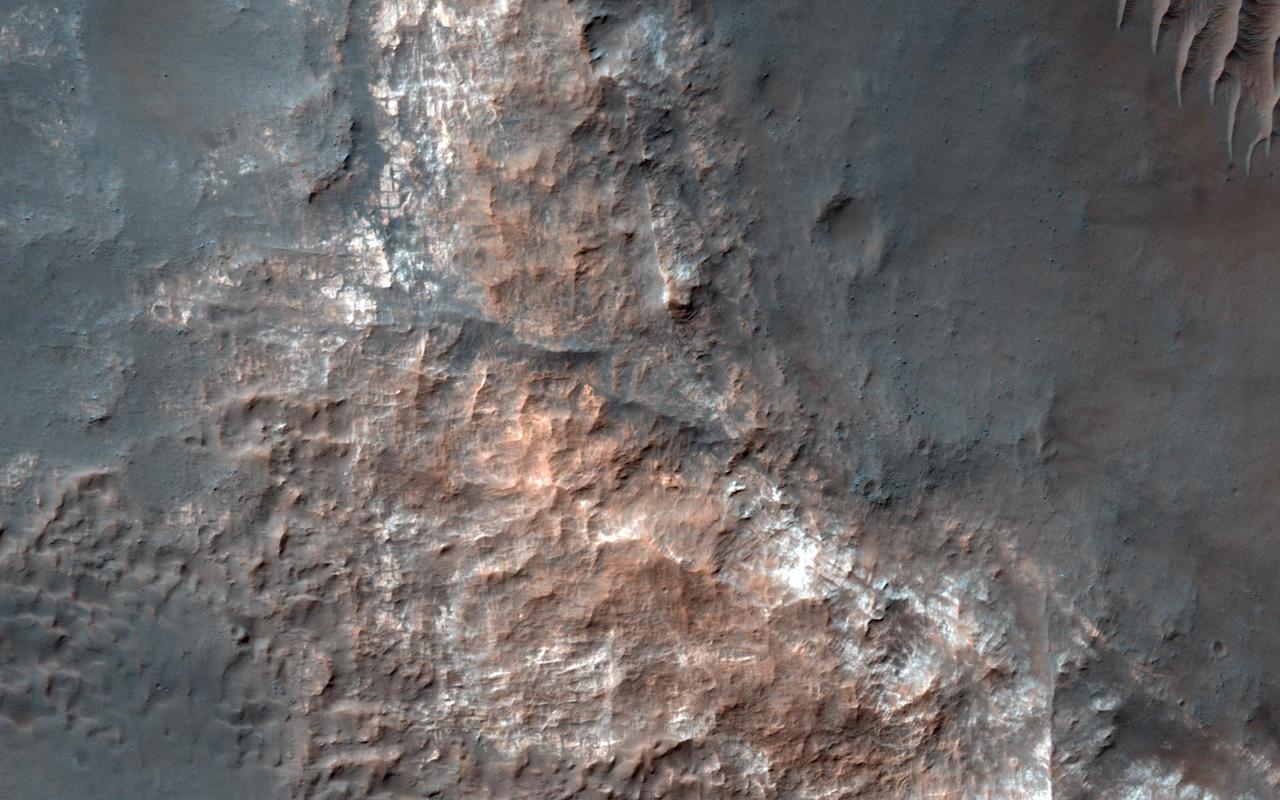
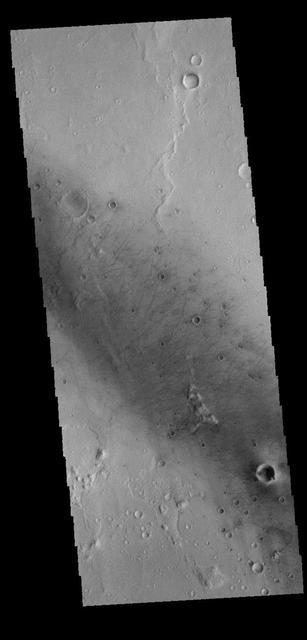
Today's VIS image shows part of the floor of Gusev Crater. Numerous dark linear markings were created by dust devil action. Gusev Crater is the "home" of the MER Spirit rover.  Orbit Number: 65212 Latitude: -14.4728 Longitude: 175.478 Instrument: VIS Captured: 2016-08-26 09:37  http://photojournal.jpl.nasa.gov/catalog/PIA21006
Gusev Crater
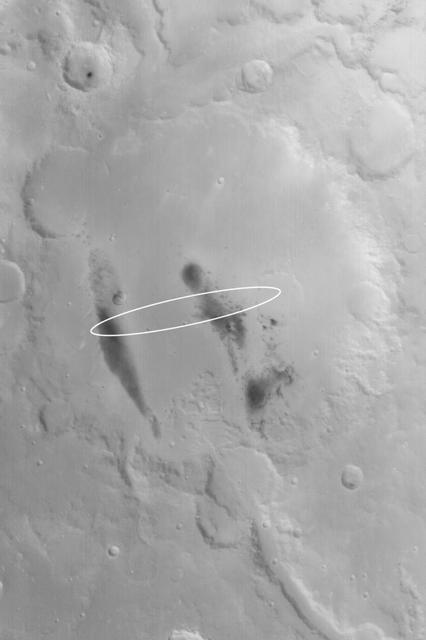
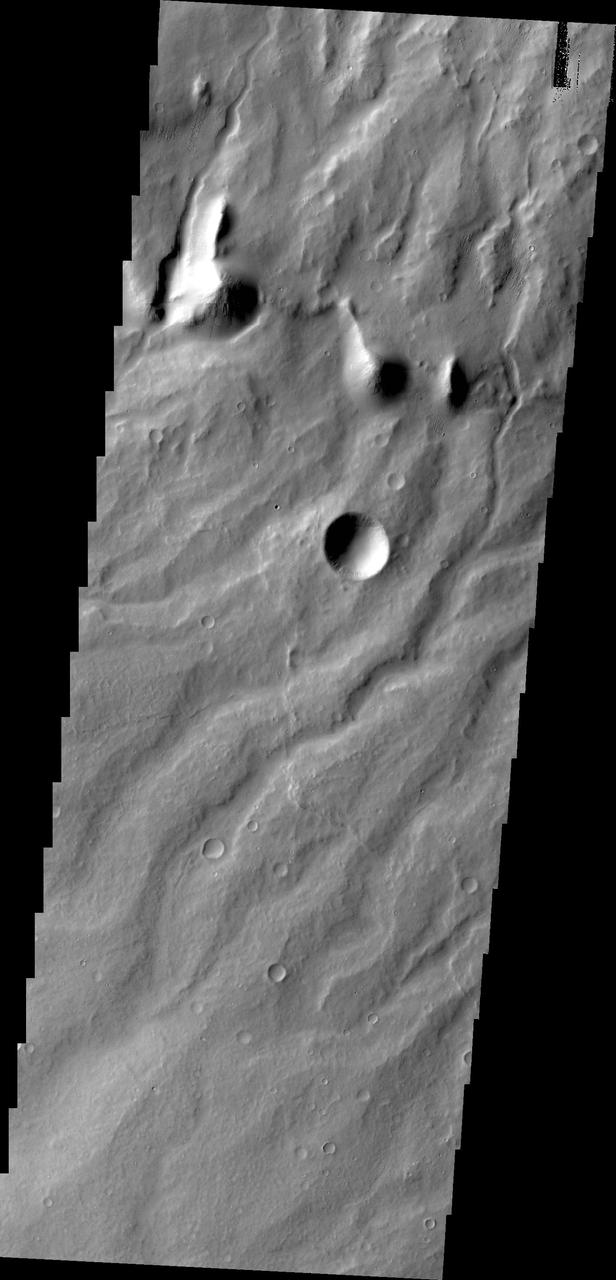
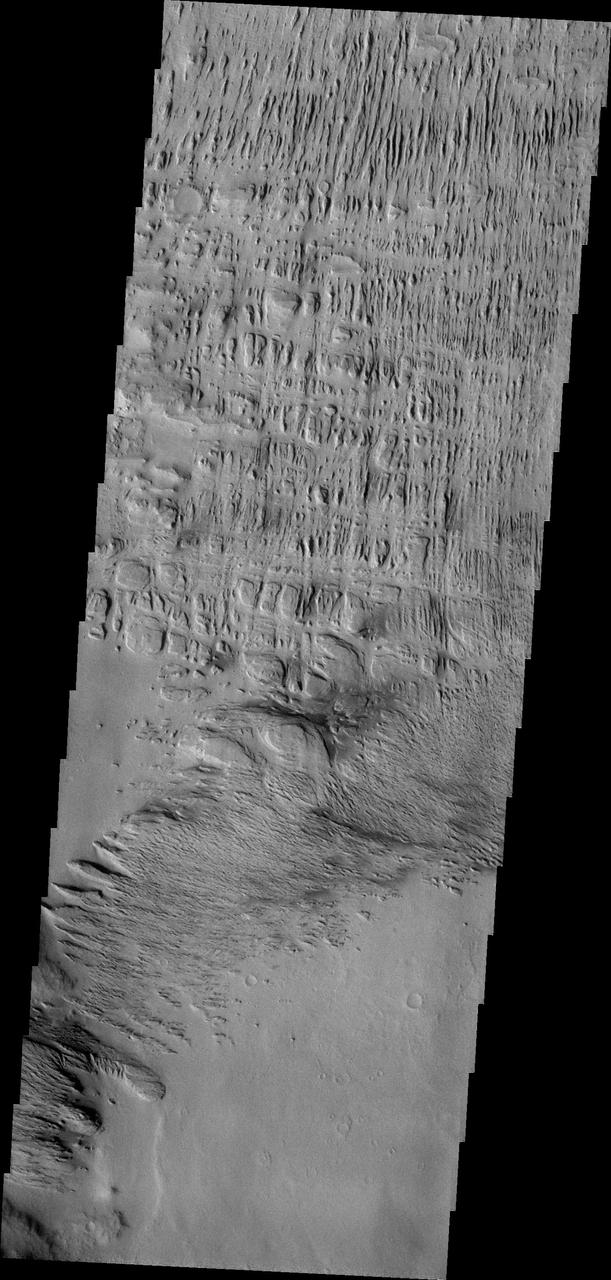
This image captured by NASA 2001 Mars Odyssey spacecraft shows some of the numerous dark linear streaks on the floor of Gusev Crater. These streaks are formed by wind action. The dark streaks are where dust devils have removed the surface dust, revealing the darker rock beneath. Gusev Crater is the home of the MER Spirit lander.  Orbit Number: 65898 Latitude: -14.5 Longitude: 175.545 Instrument: VIS Captured: 2016-10-21 21:54  http://photojournal.jpl.nasa.gov/catalog/PIA21187
Gusev Crater Windstreaks
Gusev Crater
Gusev Crater
Gusev Crater
Gusev Crater
Gusev Crater
Gusev Crater
Gusev Crater
Gusev Crater
Gusev Crater in Infrared
Perched Above Gusev Crater
Layered Outcrops in Gusev Crater
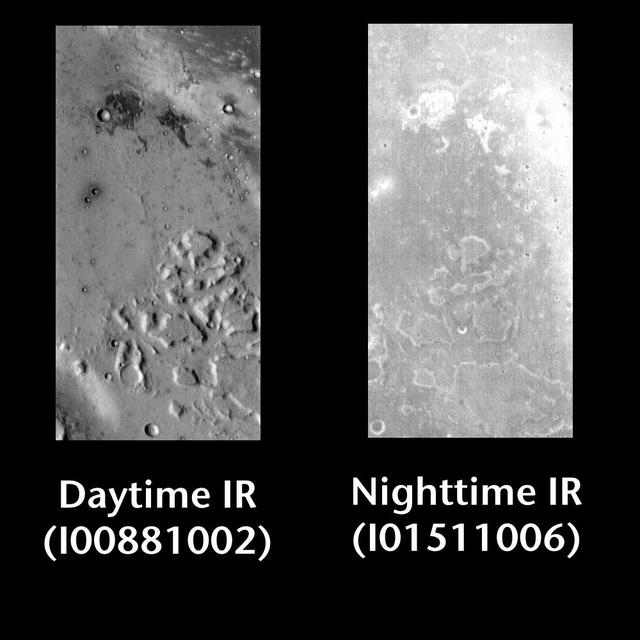
Gusev Crater by Day and Night
Gusev Crater, here we come!
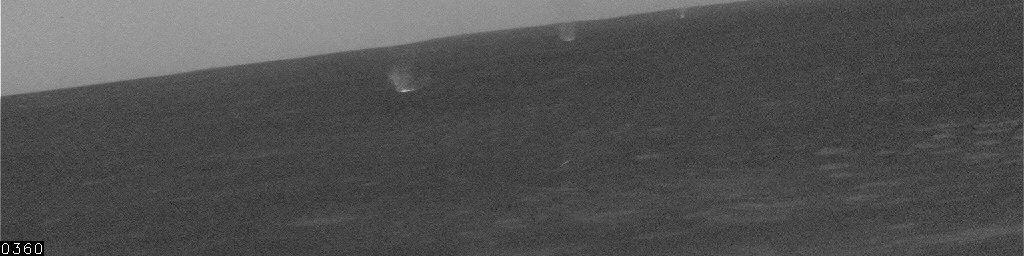
Several Dust Devils in Gusev Crater, Sol 461
Gusev Crater Geology as Seen from Above
Mars Exploration Rover Landing Site at Gusev Crater
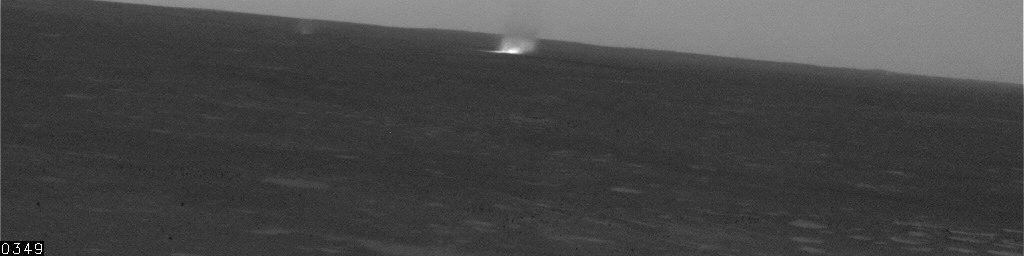
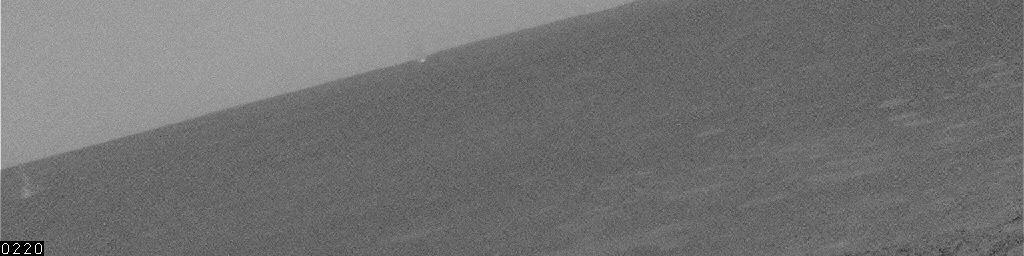
Dust Devil in Gusev Crater, Sol 445
Dust Devils in Gusev Crater, Sol 463
Layered Outcrops in Gusev Crater False Color
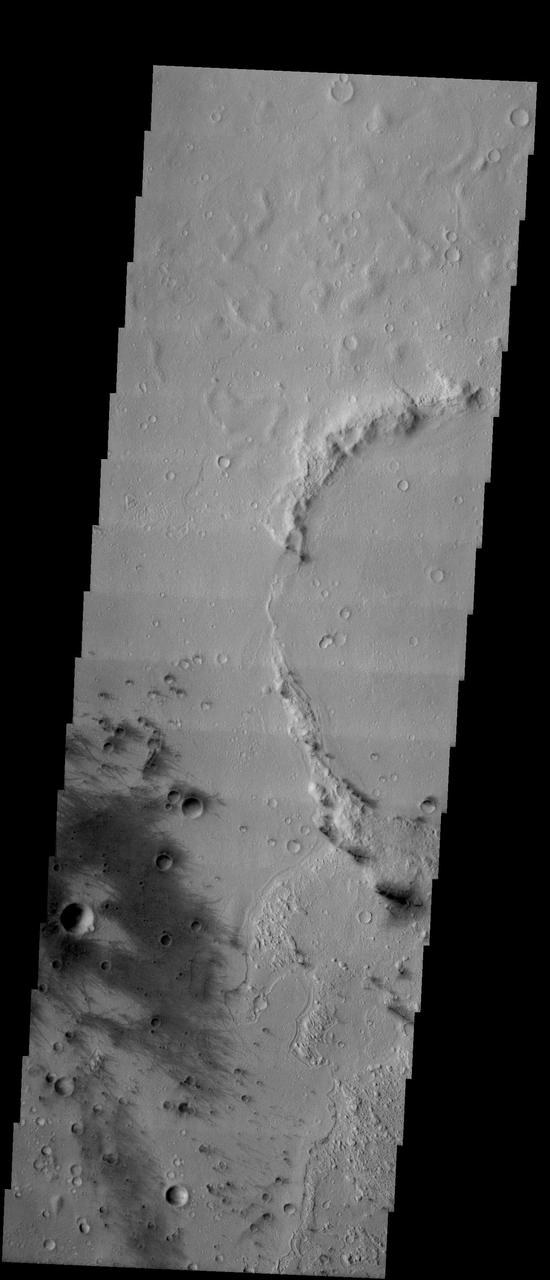
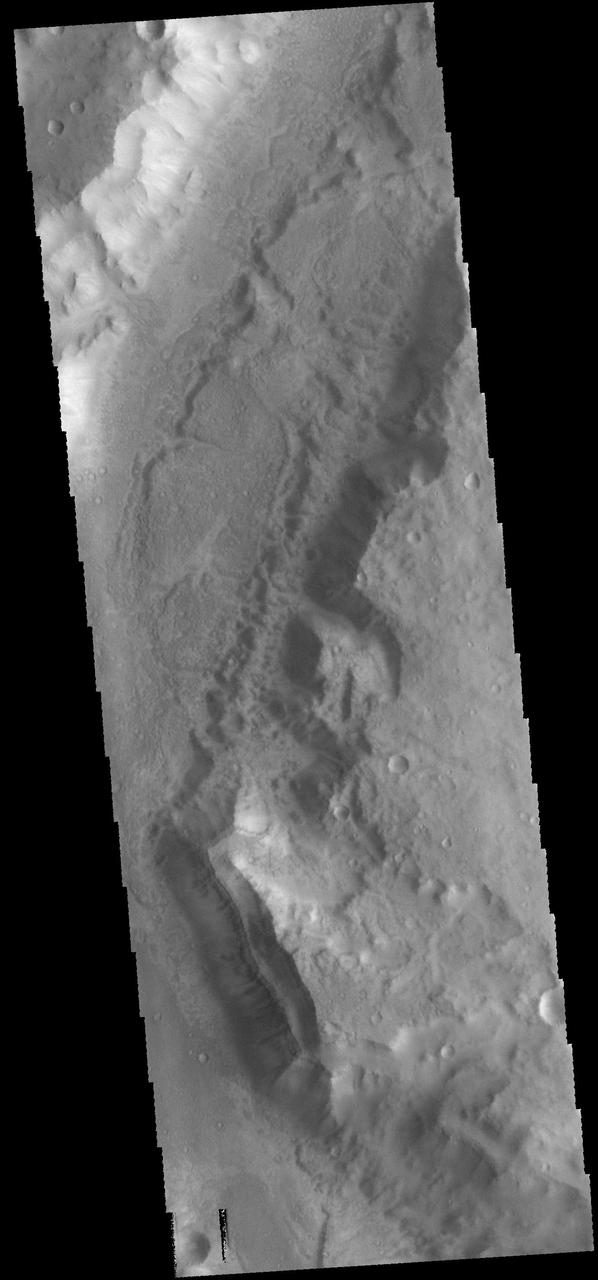
Today's VIS image shows part of the floor of Gusev Crater, home of the MER Spirit Rover.  Orbit Number: 59729 Latitude: -14.6326 Longitude: 175.584 Instrument: VIS Captured: 2015-06-01 19:05  http://photojournal.jpl.nasa.gov/catalog/PIA19759
Gusev Crater
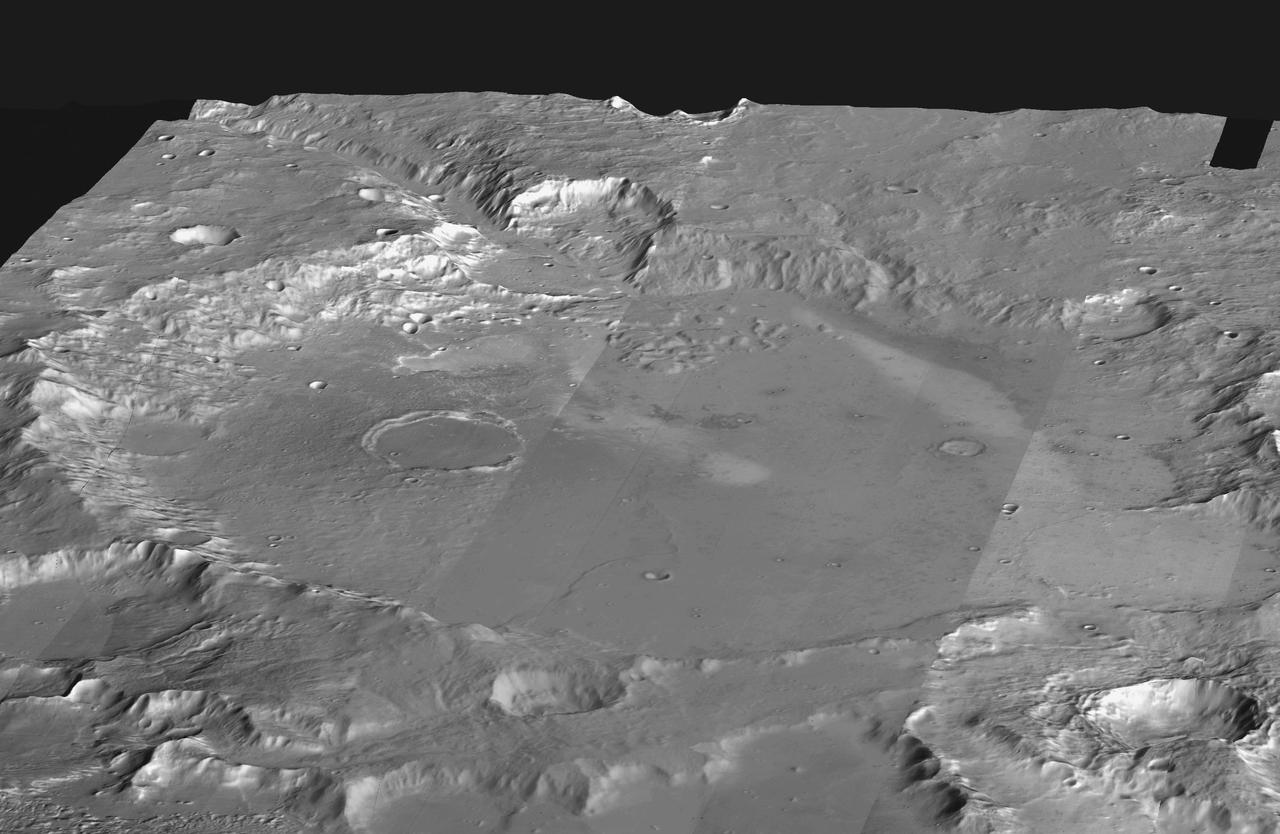
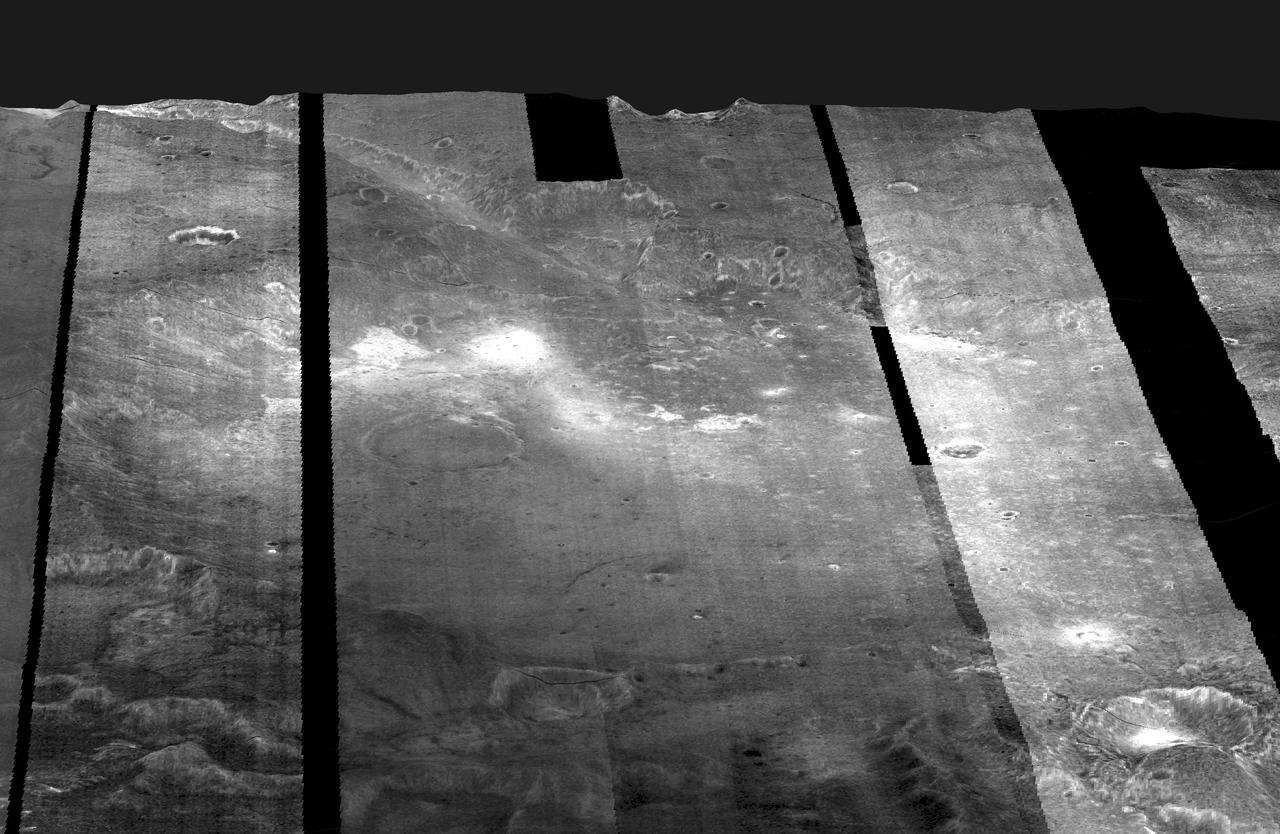
This mosaic of daytime infrared images of Gusev Crater, taken by NASA Mars Odyssey spacecraft, has been draped over topography data obtained by NASA Mars Global Surveyor. The daytime temperatures range from approximately minus 45 degrees C (black) to minus 5 degrees C (white). The temperature differences in these daytime images are due primarily to lighting effects, where sunlit slopes are warm (bright) and shadowed slopes are cool (dark). Gusev crater is a potential landing site for the Mars Exploration Rovers. The large ancient river channel of Ma'Adim that once flowed into Gusev can be seen at the top of the mosaic. This image mosaic covers an area approximately 180 kilometers (110 miles) on each side centered near 14 degrees S, 175 degrees E, looking toward the south in this simulated view.  http://photojournal.jpl.nasa.gov/catalog/PIA04260
Gusev Crater
Moon/Mars Landing Commemorative Release: Gusev Crater and Maadim Vallis
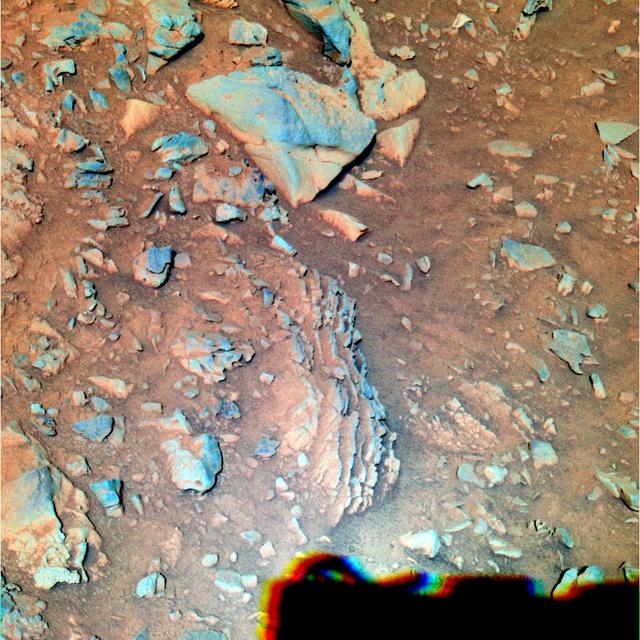
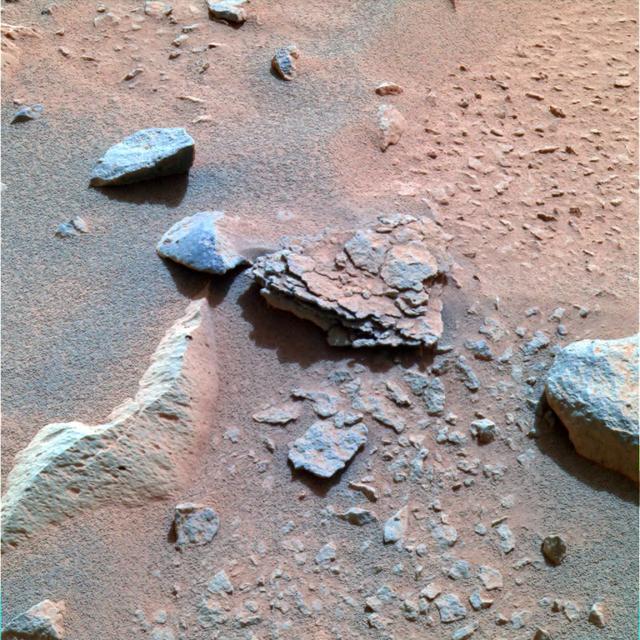
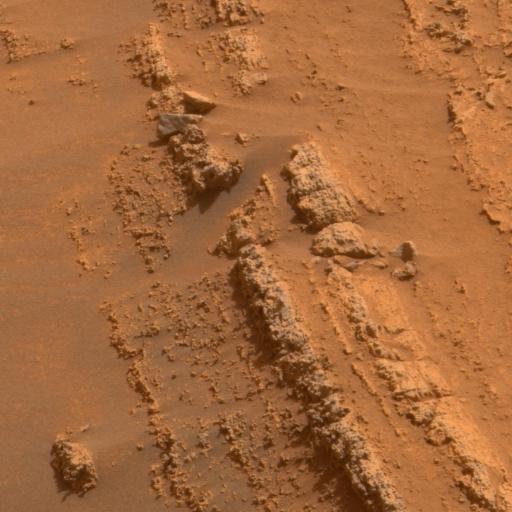
This color image taken by the Mars Exploration Rover Spirit's panoramic camera on Sol 40 is centered on an unusually flaky rock called Mimi. Mimi is only one of many features in the area known as "Stone Council," but looks very different from any rock that scientists have seen at the Gusev crater site so far. Mimi's flaky appearance leads scientists to a number of hypotheses. Mimi could have been subjected to pressure either through burial or impact, or may have once been a dune that was cemented into flaky layers, a process that sometimes involves the action of water.   http://photojournal.jpl.nasa.gov/catalog/PIA05283
Flaky "Mimi"
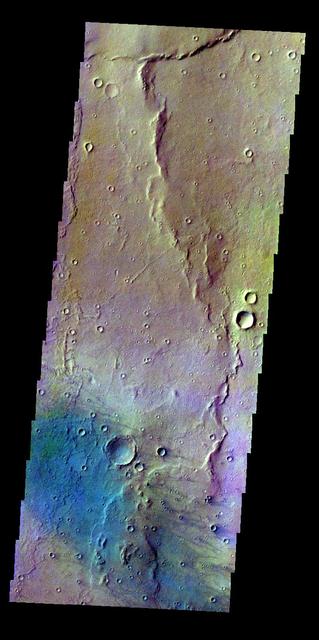
The THEMIS VIS camera contains 5 filters. The data from different filters can be combined in multiple ways to create a false color image. This false color image from NASA 2001 Mars Odyssey spacecraft shows windstreaks on the floor of Gusev Crater.
Gusev Crater - False Color
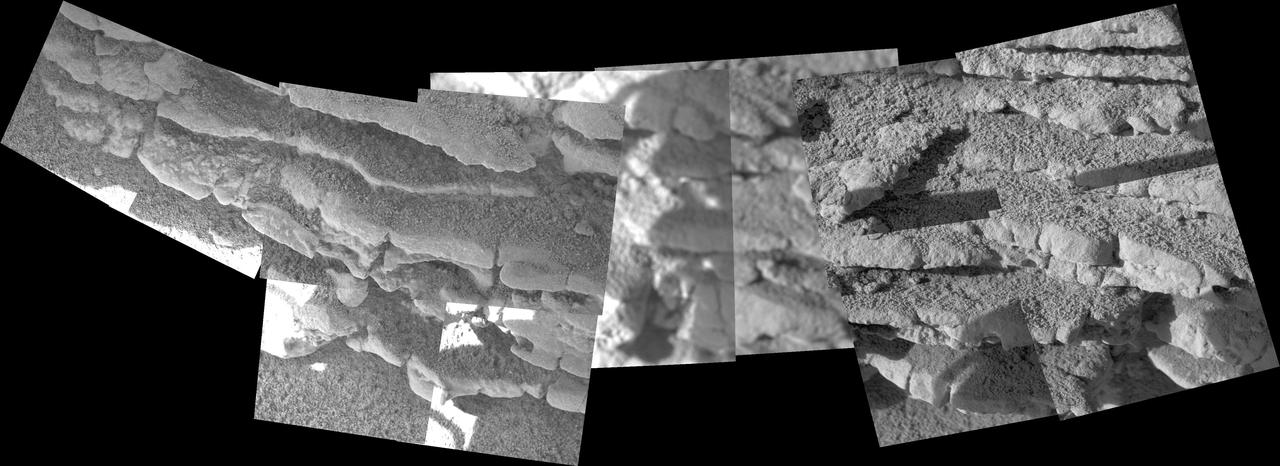
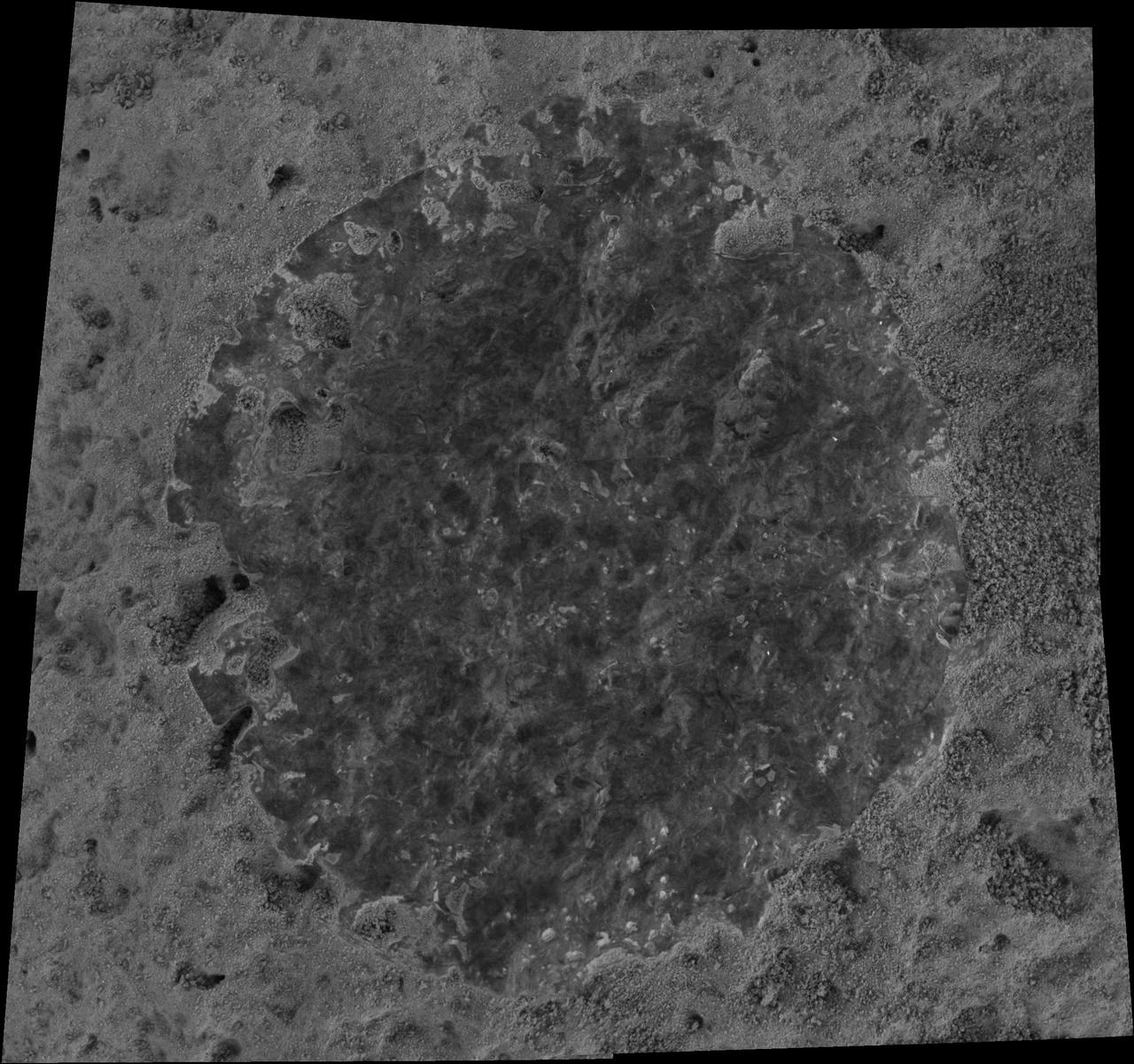
Brushed Target on Rock Champagne in Gusev Crater
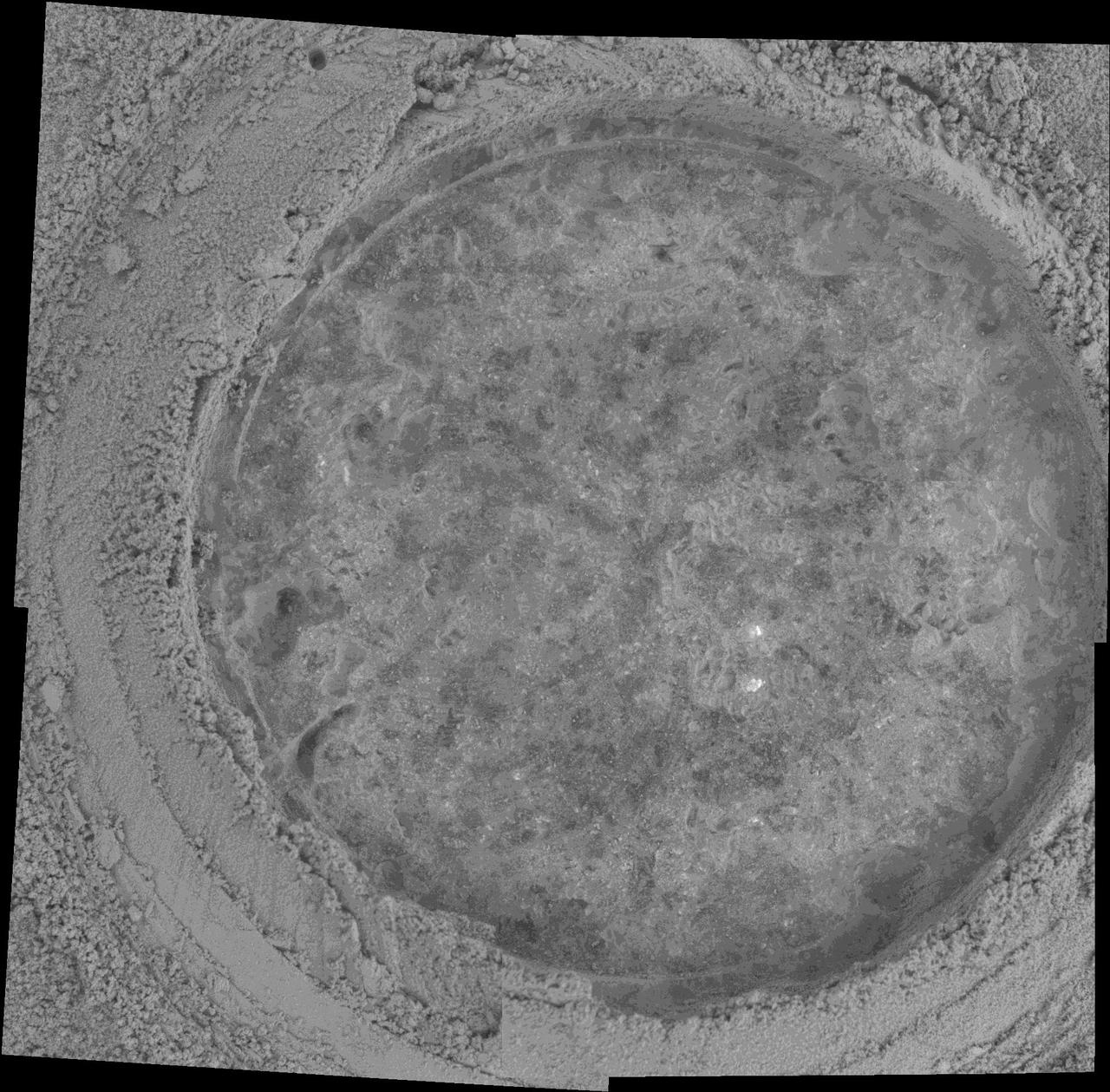
Abraded Target on Rock Champagne in Gusev Crater
Images from NASA's Mars Odyssey spacecraft were used to create this mosaic of nighttime infrared images of Gusev Crater, which has been draped over topography data obtained by NASA Mars Global Surveyor. Variations in nighttime temperatures are due to differences in the abundance of rocky materials that retain their heat at night and stay relatively warm (bright). Fine grained dust and sand (dark) cools off more rapidly at night. This image mosaic covers an area approximately 180 kilometers (110 miles) on each side centered near 14 degrees S, 175 degrees E, looking toward the south in this simulated view.  http://photojournal.jpl.nasa.gov/catalog/PIA04261
Gusev Crater
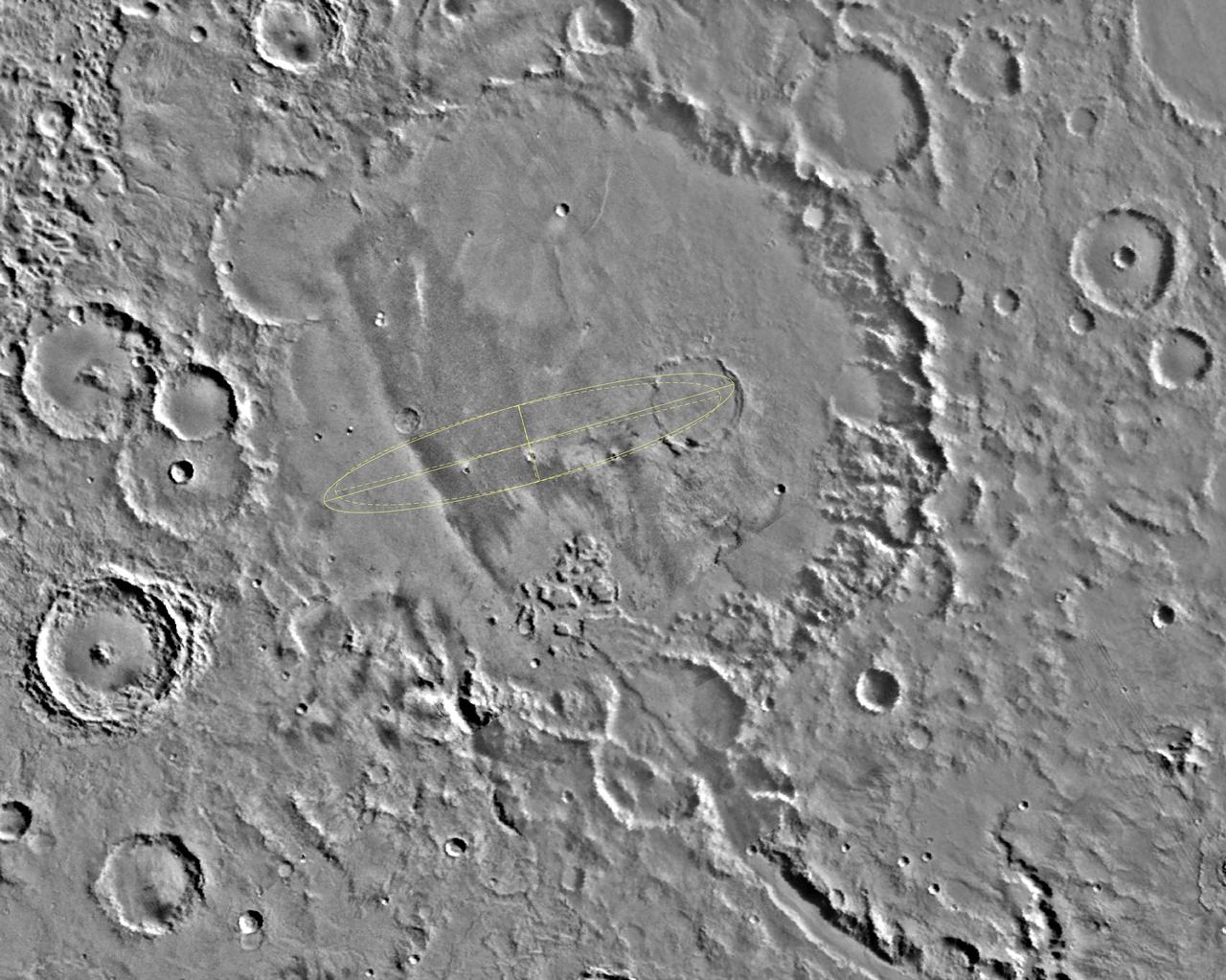
Mars Global Surveyor View of Gusev Crater During Spirit Entry, Descent, and Landing
Mars is a dynamic planet. HiRISE has witnessed many surface changes over the past ten years, including hundreds of new craters formed by ongoing impacts. Most of these impacts are likely caused by asteroids that have strayed into collision courses with Mars. The planet's much thinner atmosphere compared to Earth makes small asteroids less likely to burn up prior to hitting the Martian surface.  This new crater, which formed explosively at the point of impact, has a diameter of roughly 8 meters (about 25 feet), but its surrounding blast zone and ejecta extend over a kilometer (about one mile) beyond the crater itself. The materials exposed nearest the crater have distinctive yellowish and lighter grey appearances, while more distant ejected materials range from dark brown to bright bluish in an enhanced-color view. These varied materials may have originated from different layers penetrated by the impact.  This new impact was discovered using the lower-resolution Context Camera (CTX), also on board Mars Reconnaissance Orbiter. An older CTX image of this region from May 2012 shows a uniformly dust-covered surface, while a newer CTX image from September 2016 reveals the crater's dark blast zone. New craters on Mars are easiest to locate in such dust-coated terrains, where they provide opportunistic "road cuts" that allow scientists to see beneath the dust blanket and determine the underlying rock compositions and textures.  This particular crater formed about 300 kilometers (roughly 200 miles) east of the Spirit rover's final resting spot in Gusev Crater.  The map is projected here at a scale of 25 centimeters (9.8 inches) per pixel. [The original image scale is 26.2 centimeters (10.3 inches) per pixel (with 1 x 1 binning); objects on the order of 79 centimeters (31 inches) across are resolved.] North is up.   http://photojournal.jpl.nasa.gov/catalog/PIA21451
Unlocking an Impact Crater Clues
The THEMIS VIS camera contains 5 filters. The data from different filters can be combined in multiple ways to create a false color image. These false color images may reveal subtle variations of the surface not easily identified in a single band image. Today's false color image shows part of Gusev Crater. This image is located at the MER-A Spirit Lander ground zero.  Orbit Number: 11416 Latitude: -14.5817 Longitude: 175.192 Instrument: VIS Captured: 2004-07-11 07:40  http://photojournal.jpl.nasa.gov/catalog/PIA19790
Gusev Crater - False Color
This graph shows the ratio of concentrations of several elements in four different pairs of targets examined by Alpha Particle X-ray Spectrometer (APXS) instruments on NASA Mars rovers Curiosity and Spirit.  For each pair of targets, one shows evidence of mineral alteration and the other is an unaltered counterpart. The first three pairs (with ratios shown by green, blue and red lines) are targets in Gale Crater analyzed by Curiosity's APXS. The fourth pair (with ratio shown by the black line) is in Gusev Crater and was analyzed by Spirit's APXS.  Similar profiles are observed, suggesting the possibility of related formation processes. As with examples of silica enrichment found by Curiosity, the origin of high-silica nodular deposits found by Spirit also remains unresolved: Either acidic weathering or silica addition could be responsible. It is clear, however, that liquid water was involved in either alteration scenario. http://photojournal.jpl.nasa.gov/catalog/PIA20276
Alteration Effects at Gale and Gusev Craters
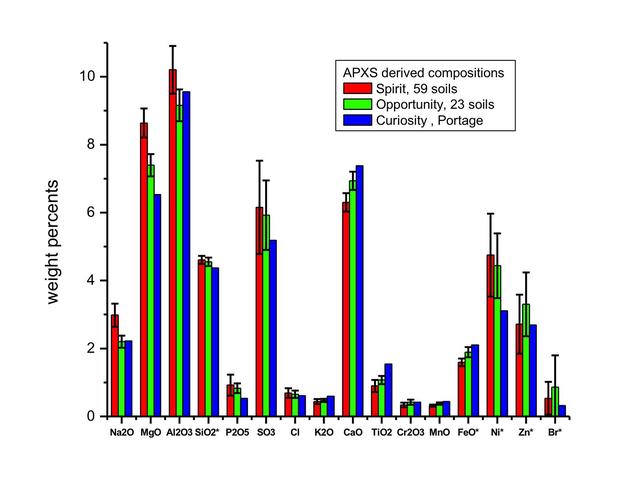
This graph compares the elemental composition of typical soils at three landing regions on Mars: Gusev Crater, from Spirit; Meridiani Planum, from Opportunity; and now Gale Crater, where NASA newest Curiosity rover is currently investigating.
Inspecting Soils Across Mars
NASA 2001 Mars Odyssey spacecraft shows the apparent effects of wind and water mark the surface of this region just northeast of Gusev Crater.
Wind and Water
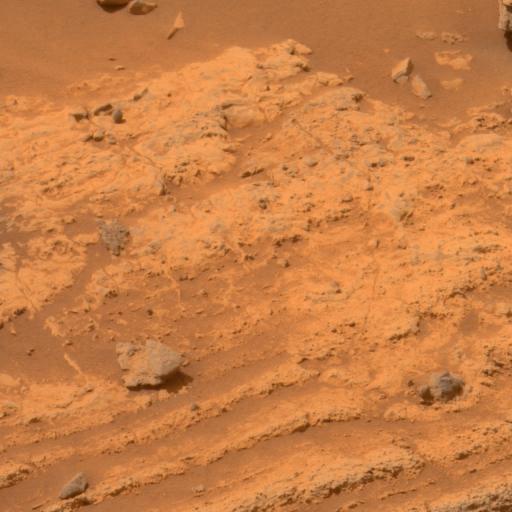
This image shows coarse-grained layers from around the edge of a low plateau called Home Plate inside Mars Gusev Crater
Coarse Layering at Home Plate
The parallel channels seen in this image NASA 2001 Mars Odyssey spacecraft captured by are dissecting the flanks of Apollinaris Mons, a large volcano north of Gusev Crater.
Apollineris Mons
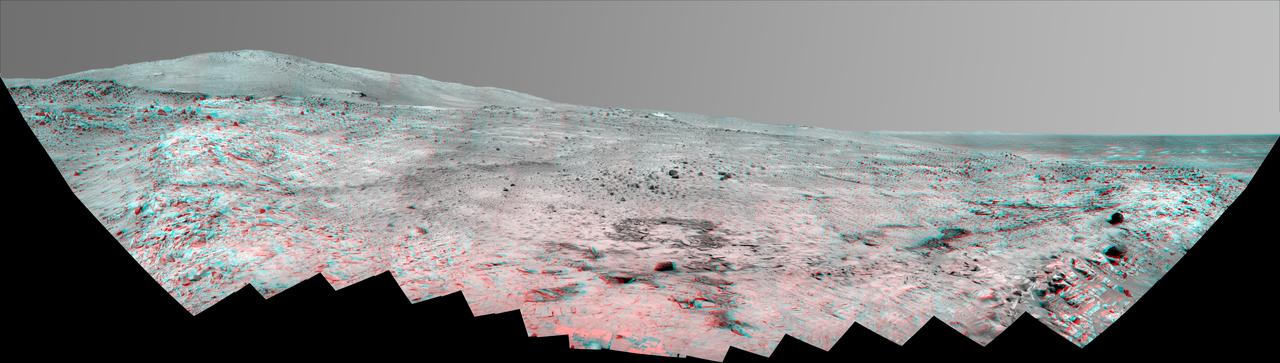
NASA Mars Exploration Rover Spirit obtained this stereo panorama of the surrounding Martian terrain in Gusev Crater . 3D glasses are necessary to view this image.
Sweeping View of the Columbia
This image from NASA 2001 Mars Odyssey spacecraft shows a small portion of Maadim Vallis. This channel intersects Gusev Crater, home of the Spirit Rover.
Maadim Vallis
This image from NASA 2001 Mars Odyssey spacecraft shows a portion of Maadim Vallis, which is a large channel that enters Gusev Crater from the south.
Maadim Vallis
Wind has played a large role in sculpting the complex features in this image captured by NASA 2001 Mars Odyssey spacecraft. This image is located north of Gusev Crater.
Wind Erosion
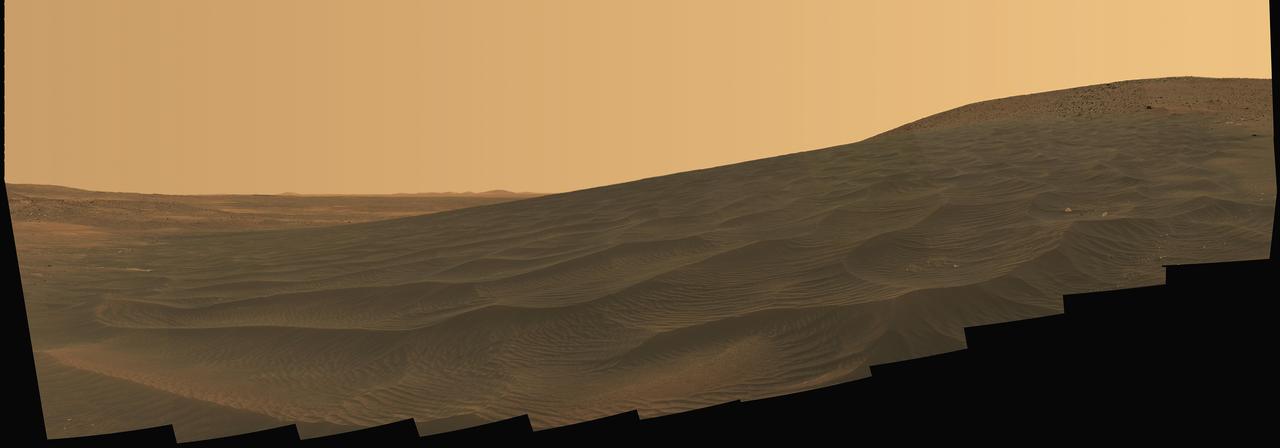
NASA Mars Exploration Rover Spirit welcomed the beginning of 2006 on Earth by taking this striking panorama of intricately rippled sand deposits in Gusev Crater on Mars.
Intricately Rippled Sand Deposits
Light-toned soil deposits might be widely distributed on the flanks and valley floors of the Columbia Hills region in Gusev Crater. The salts  may record past presence of water, as they are easily mobilized and  concentrated in liquid solution
Bright Soil Near McCool: Salty Deja Vu?
This 360-degree three dimensional anaglyph view from NASA Mars Exploration Rover Spirit highlights Gusev crater on sol 148. 3D glasses are necessary to view this image.
Spirit View on Sol 148 3-D
This image shows two holes created by NASA Spirit rock abrasion tool in a rock dubbed Wooly Patch near the base of the Columbia Hills inside Gusev Crater. 3D glasses are necessary to view this image.
Wooly Patch Rock in Color Stereo
This site, labeled Spirit site 93, is in the Columbia Hills inside Gusev Crater. NASA Mars Exporation rover Spirit tracks point westward. 3D glasses are necessary to view this image.
Track of Right-Wheel Drag 3-D
This anaglyph from NASA Mars Exploration Rover, Spiriti, was taken from the summit of Husband Hill, three dust devils are clearly visible in the plains of Gusev Crater. 3D glasses are necessary to view this image.
A Great Place to Watch the Weather 3-D
This 360-degree three dimensional anaglyph view from NASA Mars Exploration Rover Spirit highlights Gusev crater on sol 147. 3D glasses are necessary to view this image.
Spirit View on Sol 147 3-D
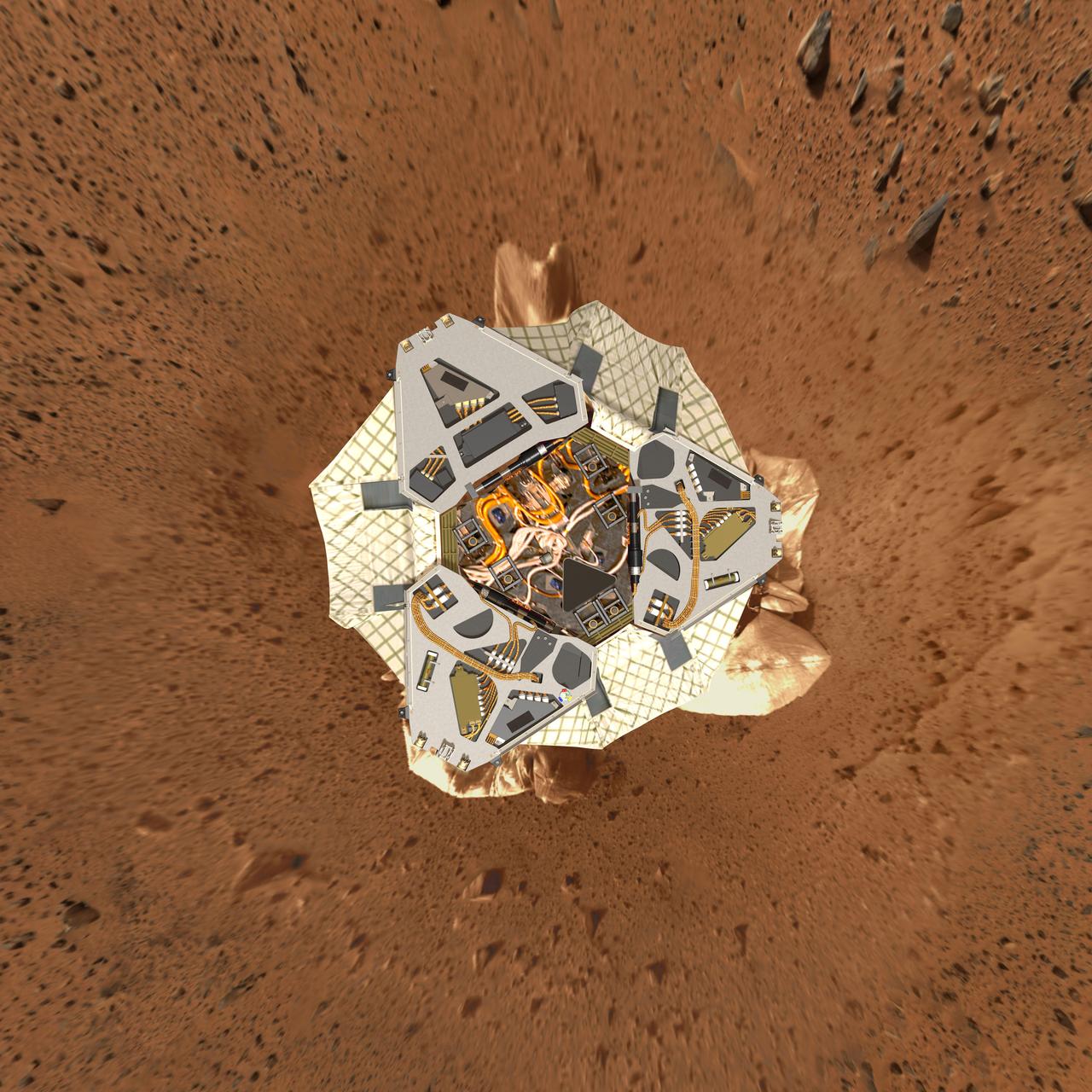
This high-resolution image shows a computer-generated model of Spirit lander at Gusev Crater as engineers and scientists would have expected to see it from a perfect overhead view.
Behold Spirit
This 360-degree three dimensional anaglyph view from NASA Mars Exploration Rover Spirit highlights Gusev crater on sol 142. 3D glasses are necessary to view this image.
Spirit View on Sol 142 3-D
This view of layers around the edge of a low plateau called Home Plate inside Mars Gusev Crater includes a feature that may be what geologists call a bomb sag and interpret as evidence of an explosive event, such as a volcanic eruption
Home Plate Evidence for an Explosive Past
This stereo, 180-degree panorama shows the southward vista from the location where Spirit is spending its third Martian winter inside Mars Gusev Crater on July 2, 2008. 3D glasses are necessary to view this image.
Southern Half of Spirit Bonestell Panorama Anaglyph
This VIS image shows a small section of Ma'adim Valles. Ma'adim Valles is located in Terra Cimmeria and empties into Gusev Crater, the home of the MER Spirit rover.  Orbit Number: 75277 Latitude: -22.7745 Longitude: 176.665 Instrument: VIS Captured: 2018-12-03 14:00  https://photojournal.jpl.nasa.gov/catalog/PIA23013
Ma'adim Vallis
On May 19th, 2005, NASA Mars Exploration Rover Spirit captured this stunning view as the Sun sank below the rim of Gusev crater on Mars. This Panoramic Camera Pancam mosaic was taken around 6:07 in the evening of the rover 489th martian day.
A Moment Frozen in Time
This 360-degree panorama shows the vista from the location where NASA Mars Exploration Rover Spirit has spent its third Martian southern-hemisphere winter inside Mars Gusev Crater. 3D glasses are necessary to view this image.
Full-Circle Bonestell Panorama from Spirit Stereo
This VIS image shows a small section of Ma'adim Valles. Ma'adim Valles is an outflow channel that arises in the southern lowlands and flows northward into Gusev Crater, the home of the MER Spirit rover. Located in Terra Cimmeria, the channel is 700km (435 miles) long, with widths up to 20 km (12 miles) and depths to 2 km (1.2 miles) in places.  Orbit Number: 91399 Latitude: -25.6089 Longitude: 176.544 Instrument: VIS Captured: 2022-07-23 02:16  https://photojournal.jpl.nasa.gov/catalog/PIA25538
Ma'adim Vallis
This VIS image shows a small section of Ma'adim Valles. Ma'adim Valles is an outflow channel that starts in the southern lowlands and flows northward into Gusev crater, the home of the MER Spirit rover. Located in Terra Cimmeria, the channel is 700km (435 miles) long, with widths up to 20 km (12 miles) and depths to 2 km (1.2 miles) in places.  Orbit Number: 82901 Latitude: -24.5592 Longitude: 176.226 Instrument: VIS Captured: 2020-08-22 09:06  https://photojournal.jpl.nasa.gov/catalog/PIA24183
Ma'adim Vallis
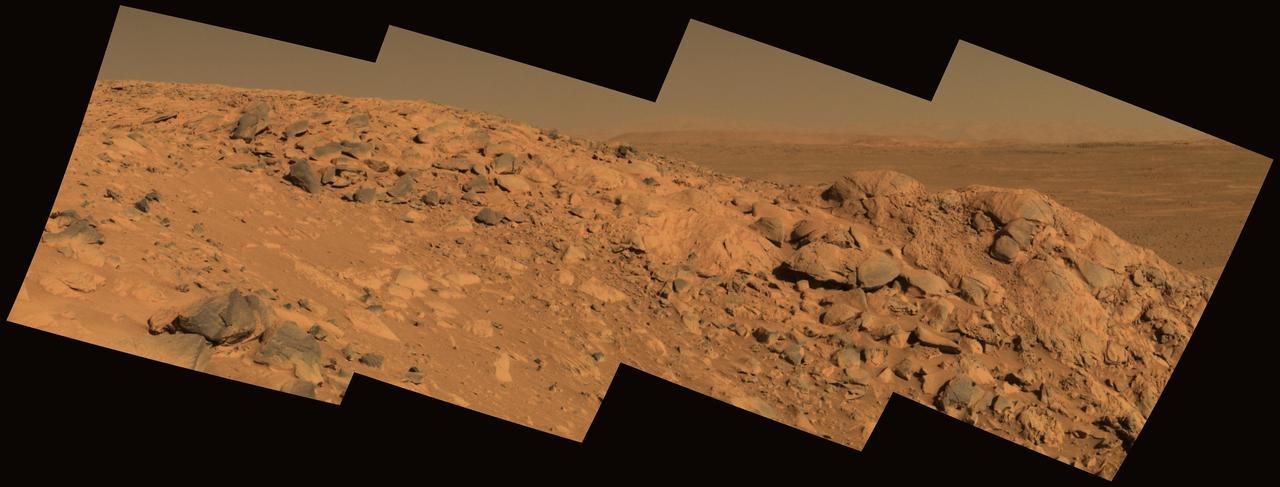
NASA's Mars Exploration Rover Spirit acquired the images that went into this color composite with its panoramic camera around 1:00 p.m. martian time on its 270th martian day, or sol (Oct. 5, 2004). The view represents the panoramic-camera team's best current attempt at generating a "true color" view of what this scene would look like if viewed by a human on Mars. It was generated from a mathematical combination of six calibrated images acquired through filters for wavelengths between 430 nanometers and 750 nanometers.  http://photojournal.jpl.nasa.gov/catalog/PIA06938
Layered Outcrops in Gusev Crater
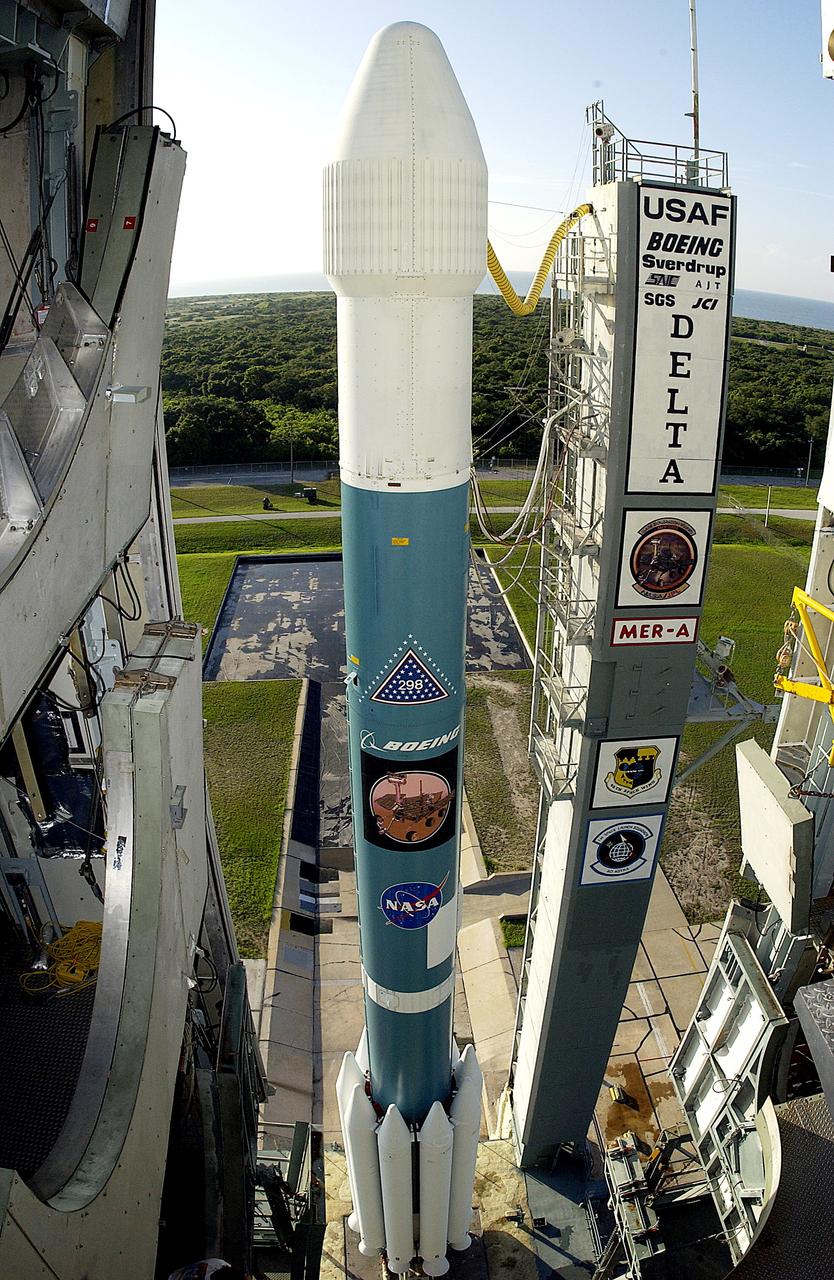
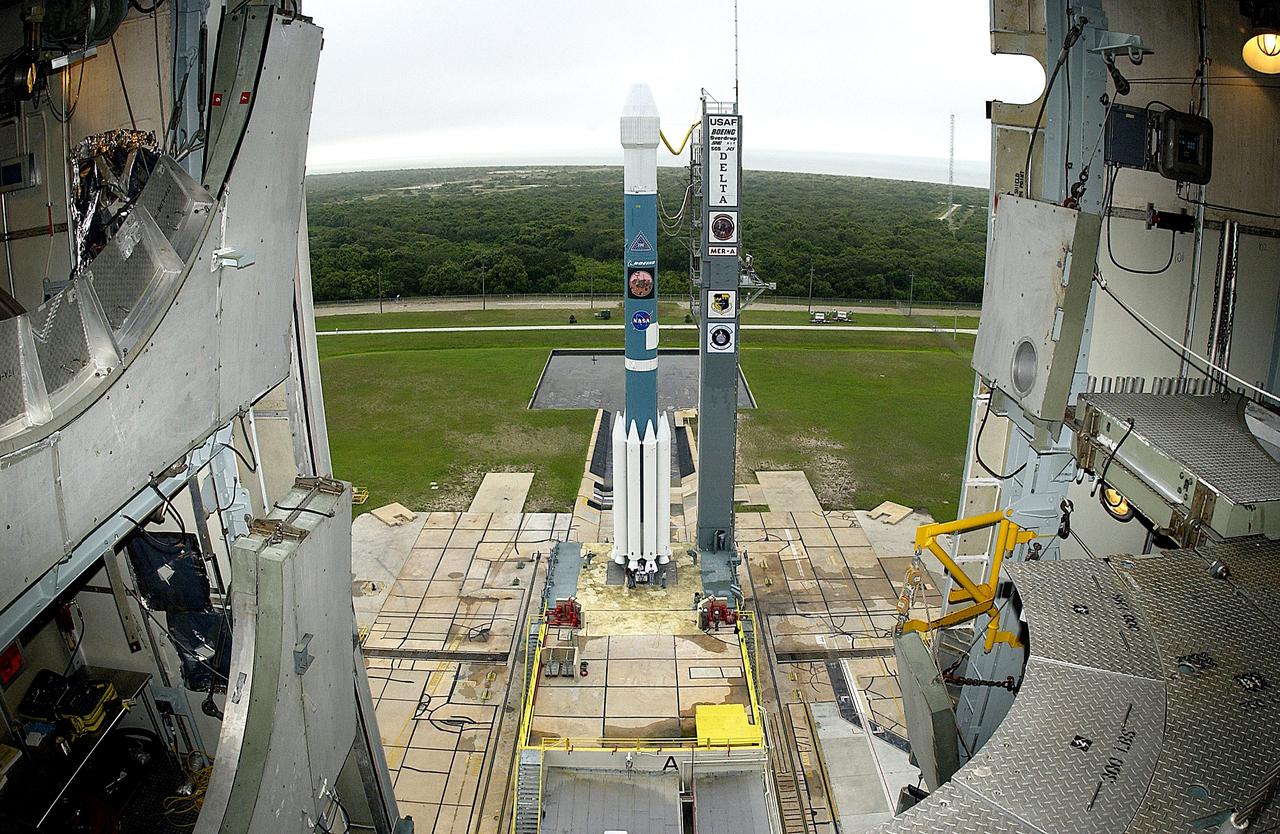
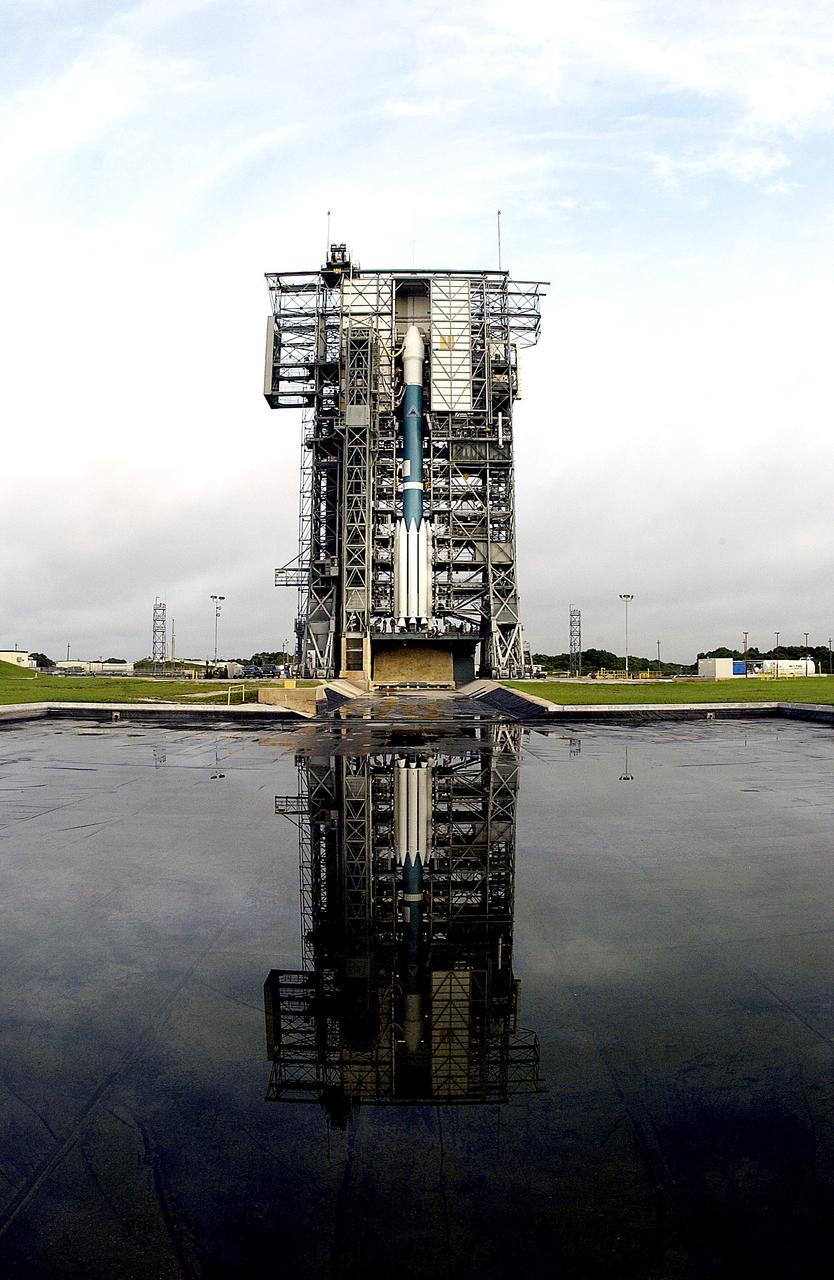
KENNEDY SPACE CENTER, FLA. -  On Launch Complex 17-A, Cape Canaveral Air Force Station, the Boeing Delta II rocket and its Mars Exploration Rover (MER-A) payload are free of the tower (right) and ready for launch.  This will be the third launch attempt in as many days after weather concerns postponed the launches June 8 and June 9.  MER-A is the first of two rovers being launched to Mars.  When the two rovers arrive at Mars in 2004, they will bounce to airbag-cushioned landings at sites offering a balance of favorable conditions for safe landings and interesting science. The rovers see sharper images, can explore farther and examine rocks better than anything that has ever landed on Mars.  The designated site for MER-A mission is Gusev Crater, which appears to have been a crater lake.  The second rover, MER-B, is scheduled to launch June 25.
KENNEDY SPACE CENTER, FLA. - On Launch Complex 17-A, Cape Canaveral Air Force Station, the Boeing Delta II rocket and its Mars Exploration Rover (MER-A) payload are free of the tower (right) and ready for launch. This will be the third launch attempt in as many days after weather concerns postponed the launches June 8 and June 9. MER-A is the first of two rovers being launched to Mars. When the two rovers arrive at Mars in 2004, they will bounce to airbag-cushioned landings at sites offering a balance of favorable conditions for safe landings and interesting science. The rovers see sharper images, can explore farther and examine rocks better than anything that has ever landed on Mars. The designated site for MER-A mission is Gusev Crater, which appears to have been a crater lake. The second rover, MER-B, is scheduled to launch June 25.
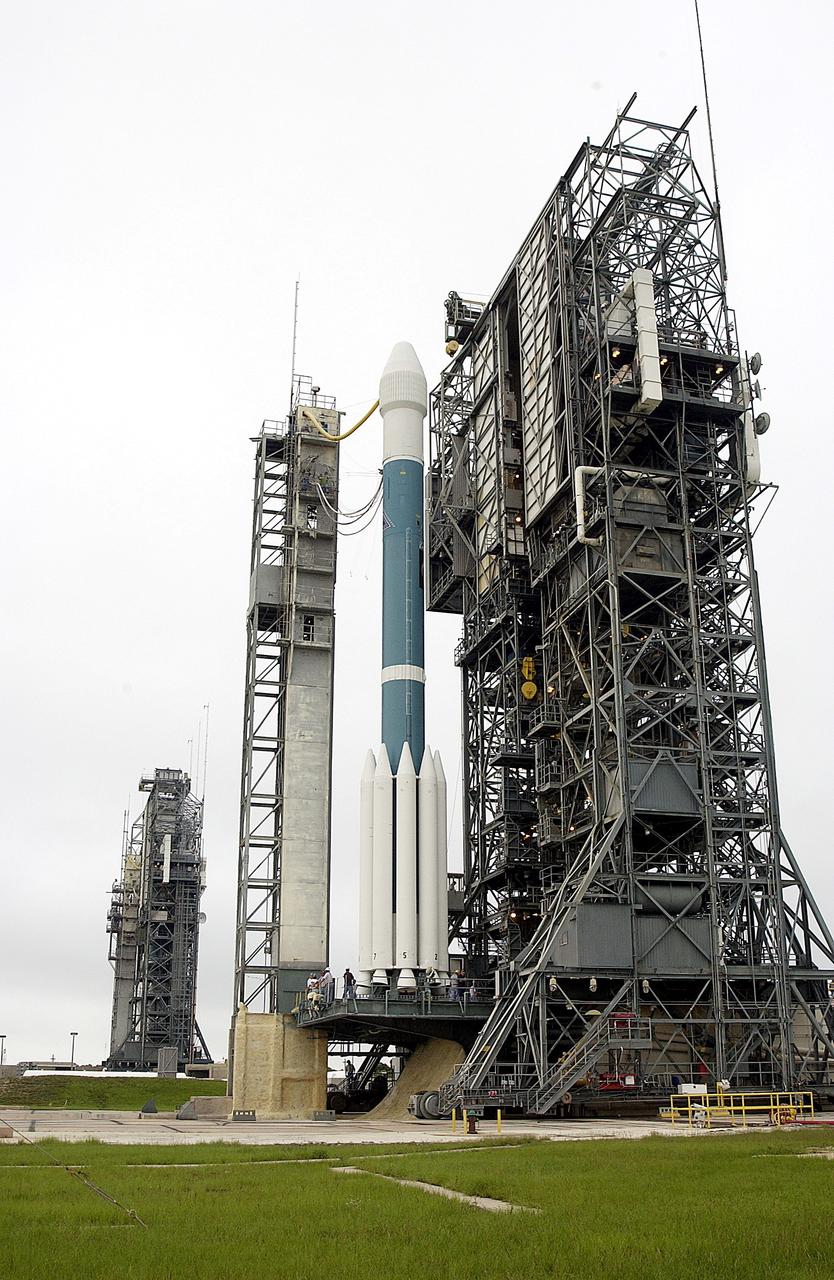
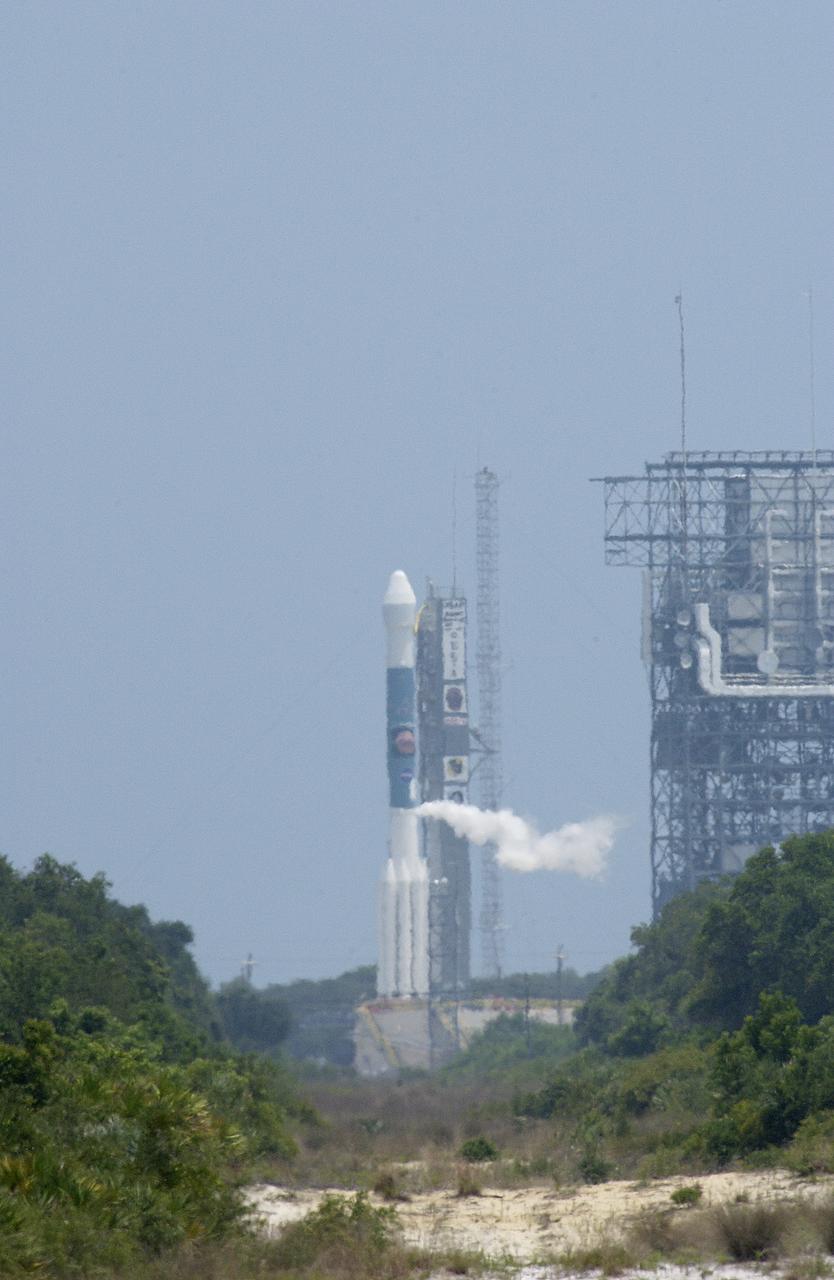
KENNEDY SPACE CENTER, FLA. -  On Launch Complex 17-A, Cape Canaveral Air Force Station, the Boeing Delta II rocket and its Mars Exploration Rover (MER-A) payload waits for rollback of the launch tower in preparation for a second attempt at launch.  The first attempt on June 8, 2003, was scrubbed due to bad weather in the vicinity.  MER-A is the first of two rovers being launched to Mars.  When the two rovers arrive at Mars in 2004, they will bounce to airbag-cushioned landings at sites offering a balance of favorable conditions for safe landings and interesting science. The rovers see sharper images, can explore farther and examine rocks better than anything that has ever landed on Mars.  The designated site for MER-A mission is Gusev Crater, which appears to have been a crater lake.  The second rover, MER-B, is scheduled to launch June 25.
KENNEDY SPACE CENTER, FLA. - On Launch Complex 17-A, Cape Canaveral Air Force Station, the Boeing Delta II rocket and its Mars Exploration Rover (MER-A) payload waits for rollback of the launch tower in preparation for a second attempt at launch. The first attempt on June 8, 2003, was scrubbed due to bad weather in the vicinity. MER-A is the first of two rovers being launched to Mars. When the two rovers arrive at Mars in 2004, they will bounce to airbag-cushioned landings at sites offering a balance of favorable conditions for safe landings and interesting science. The rovers see sharper images, can explore farther and examine rocks better than anything that has ever landed on Mars. The designated site for MER-A mission is Gusev Crater, which appears to have been a crater lake. The second rover, MER-B, is scheduled to launch June 25.
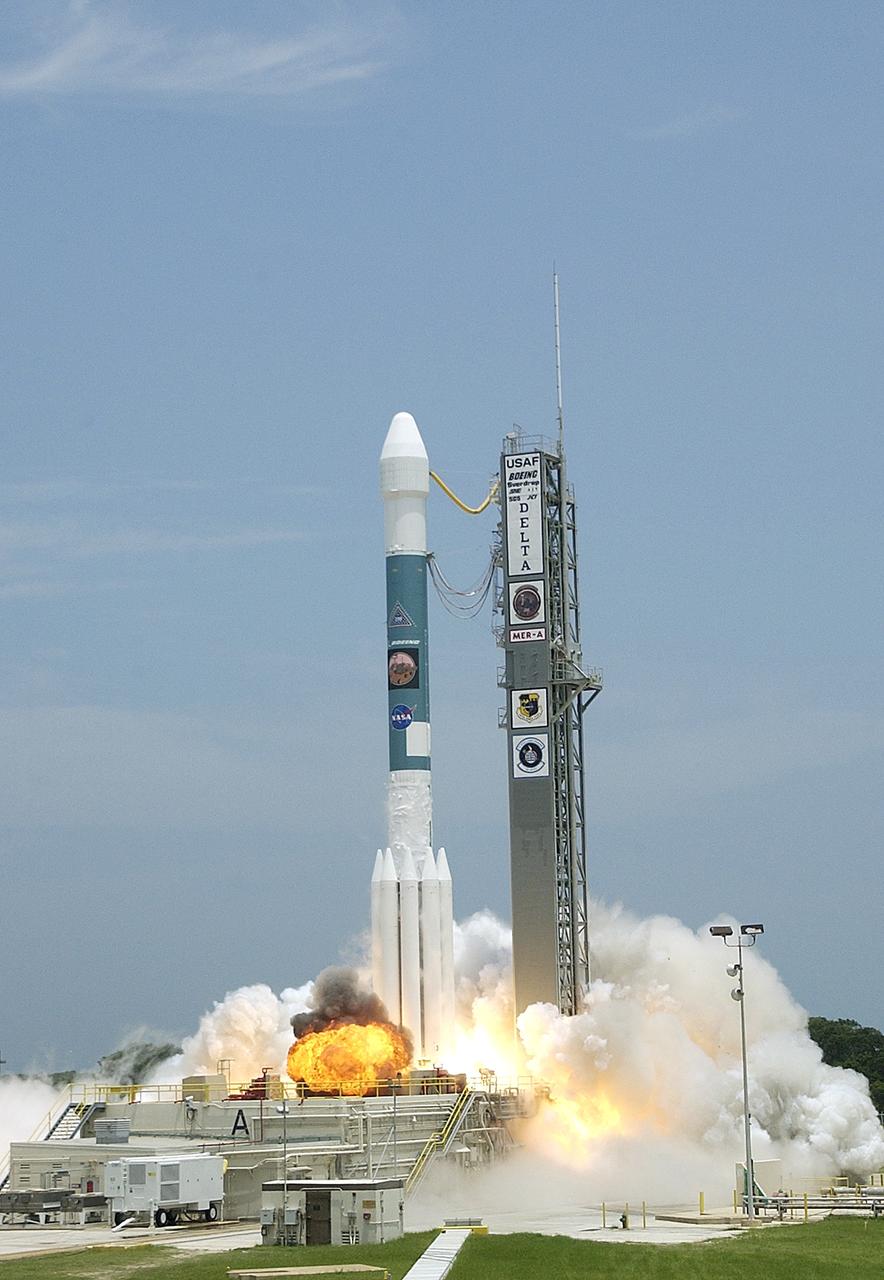
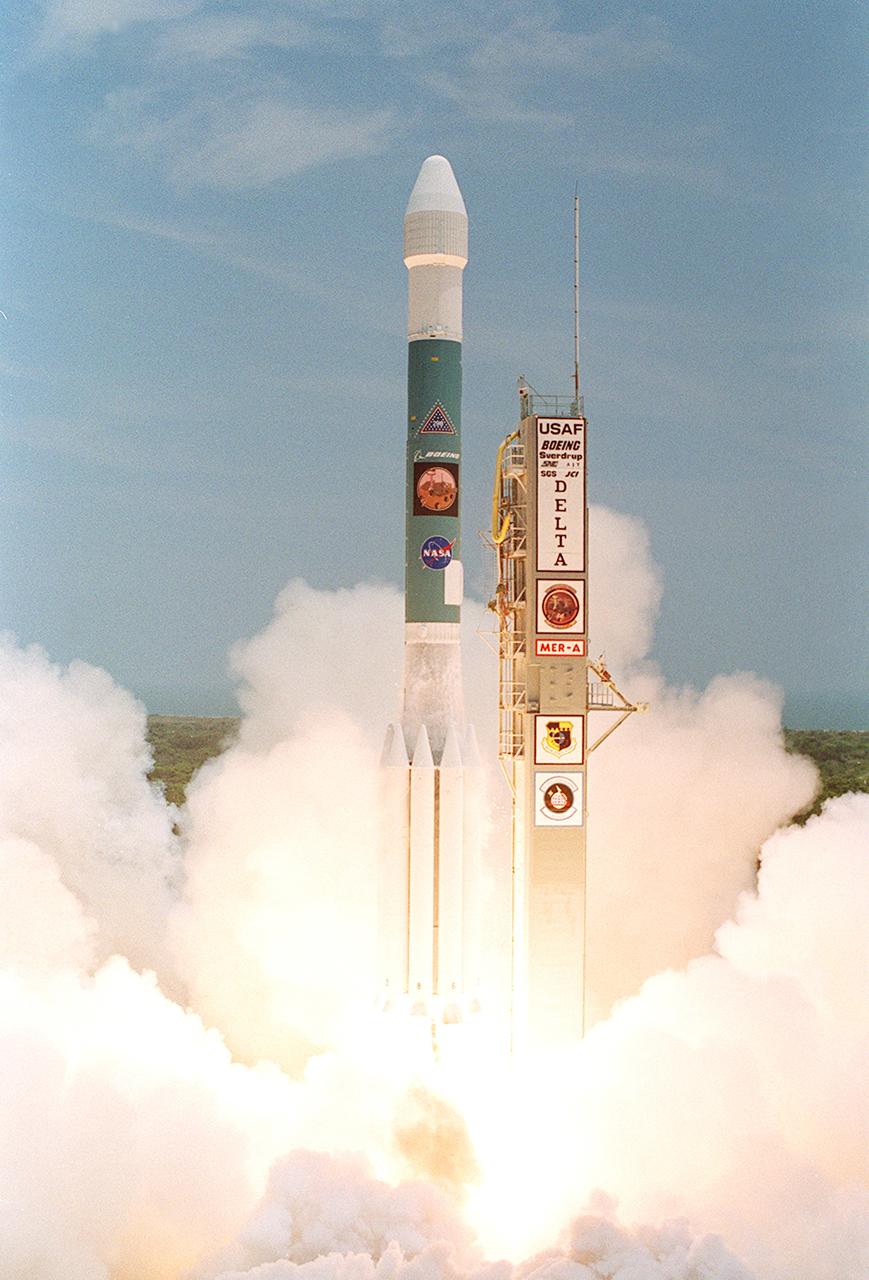
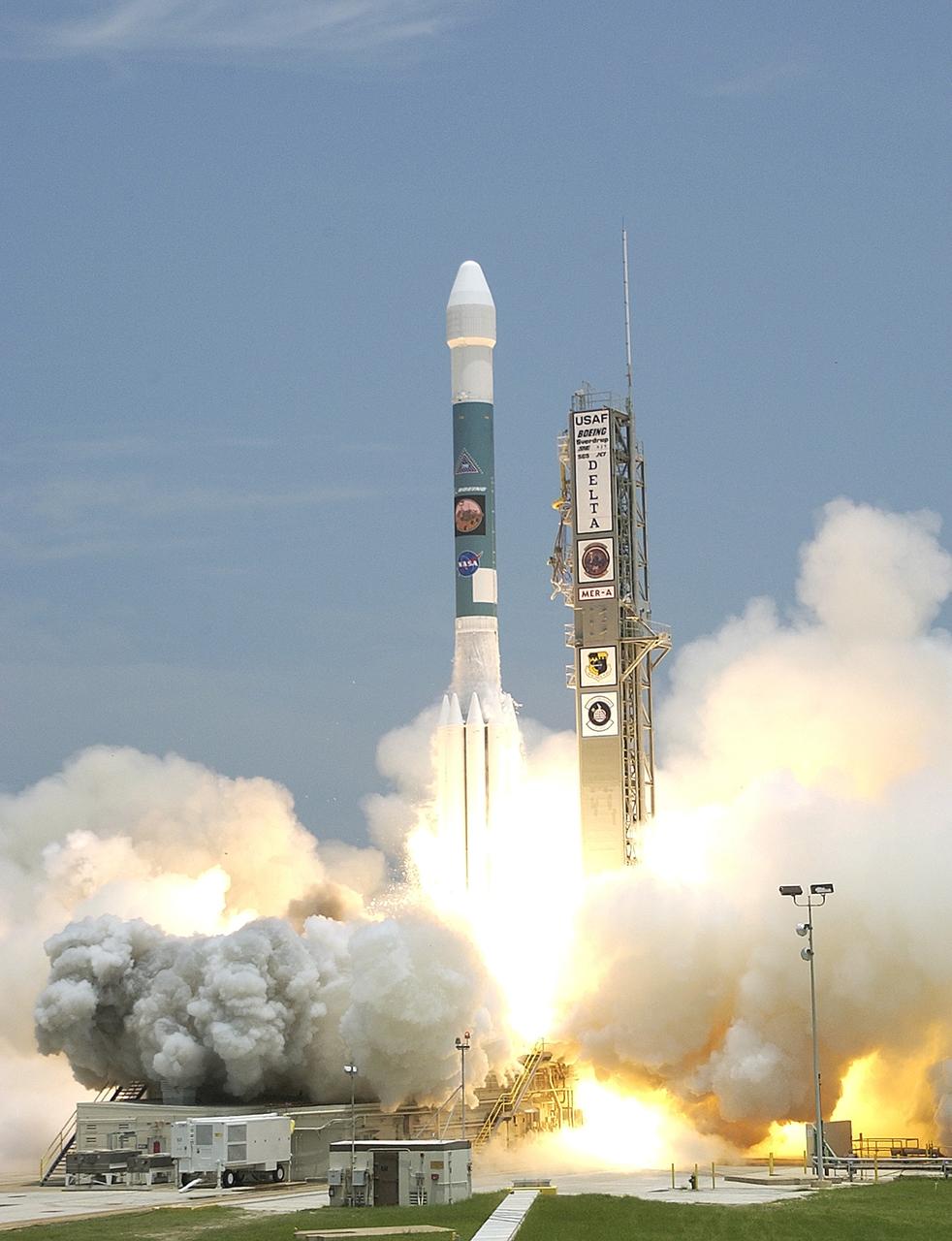
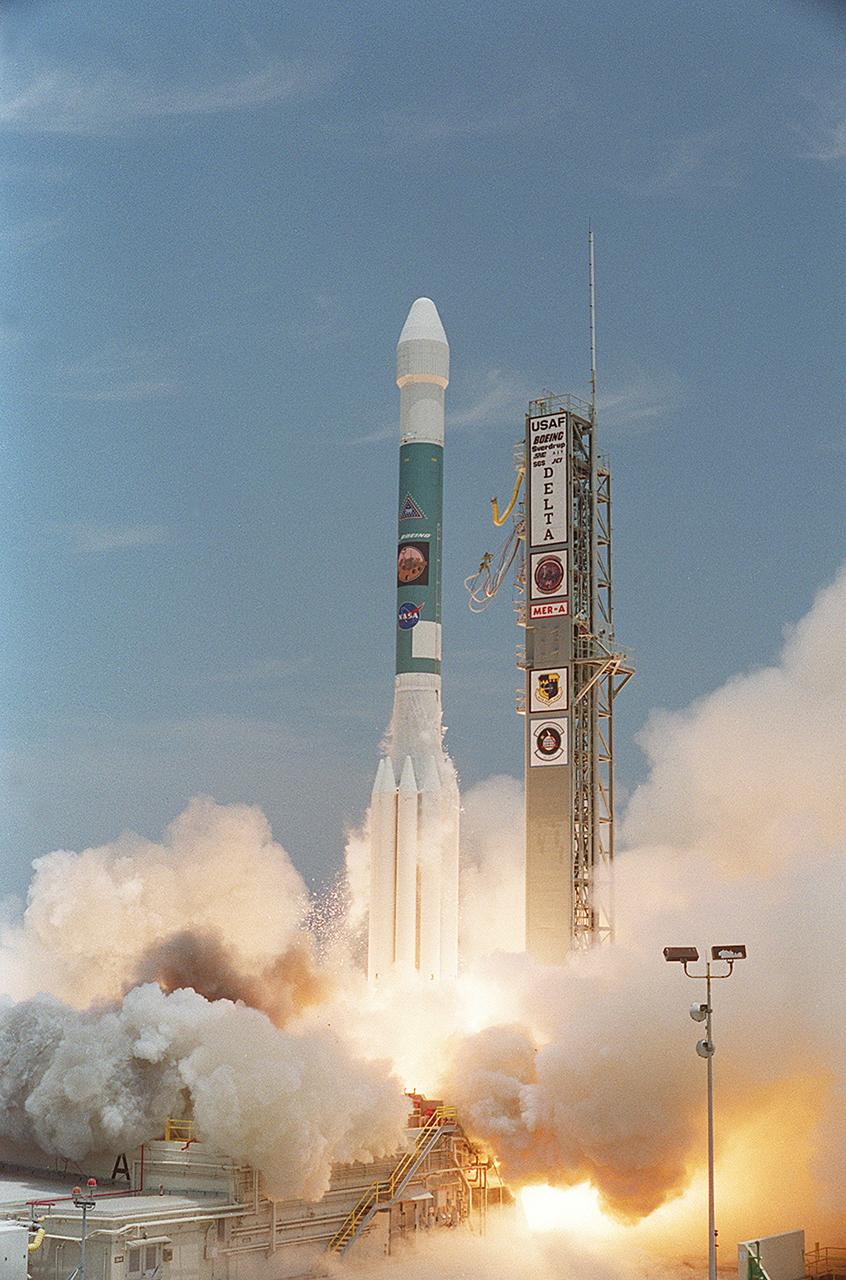
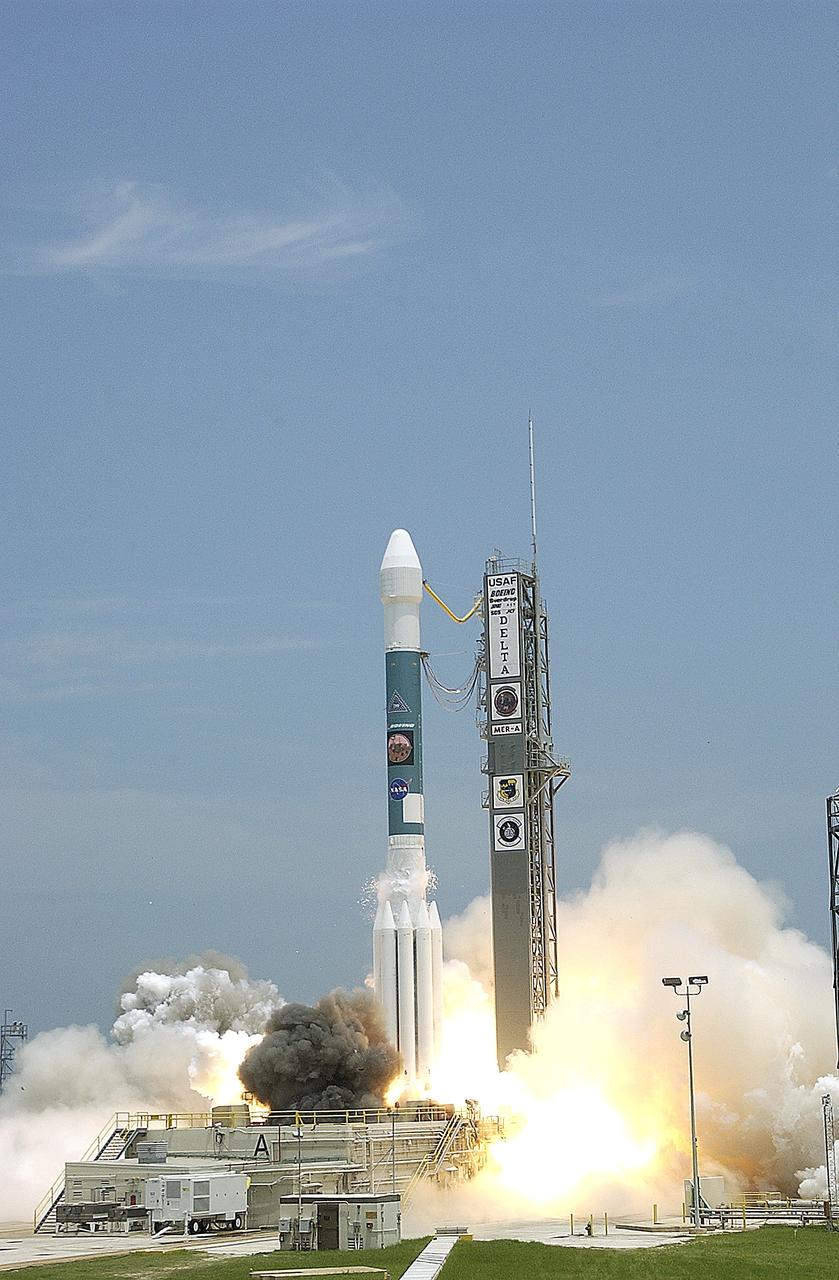
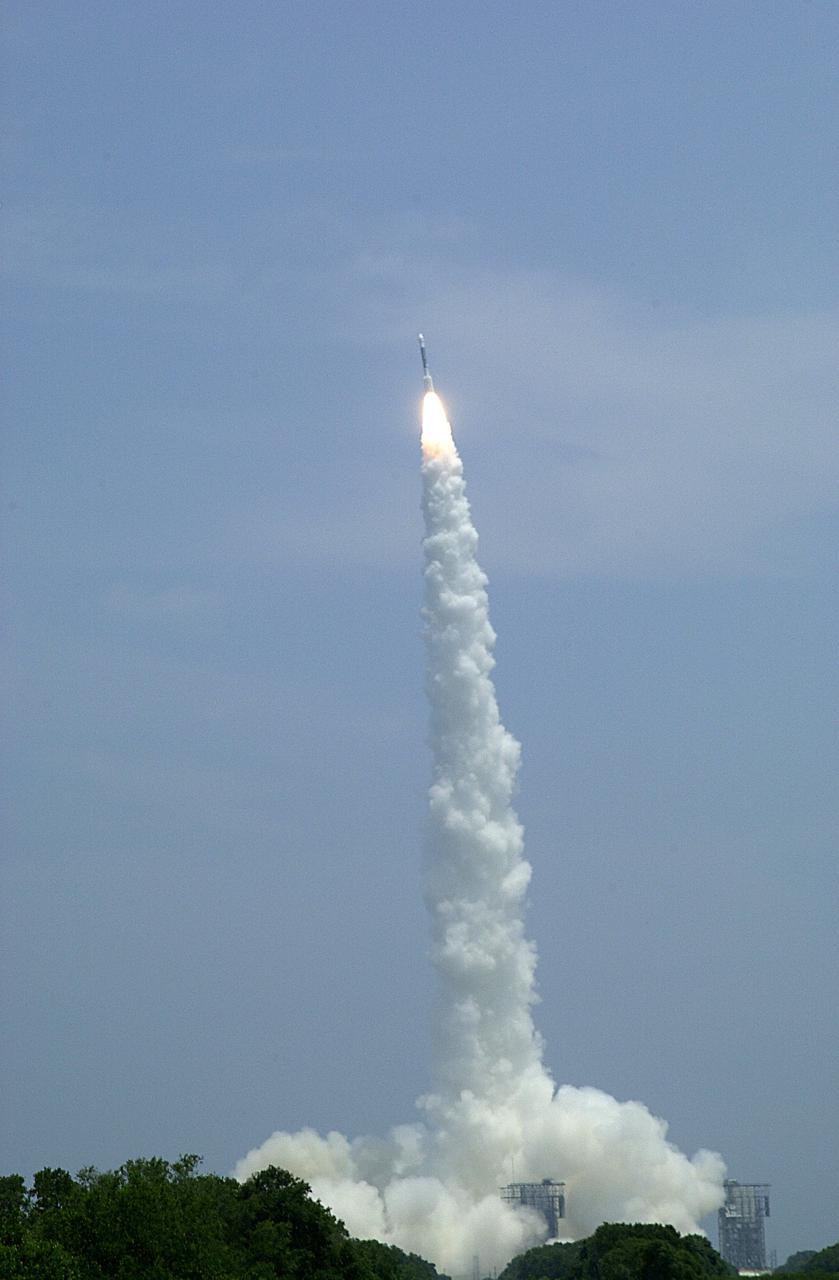
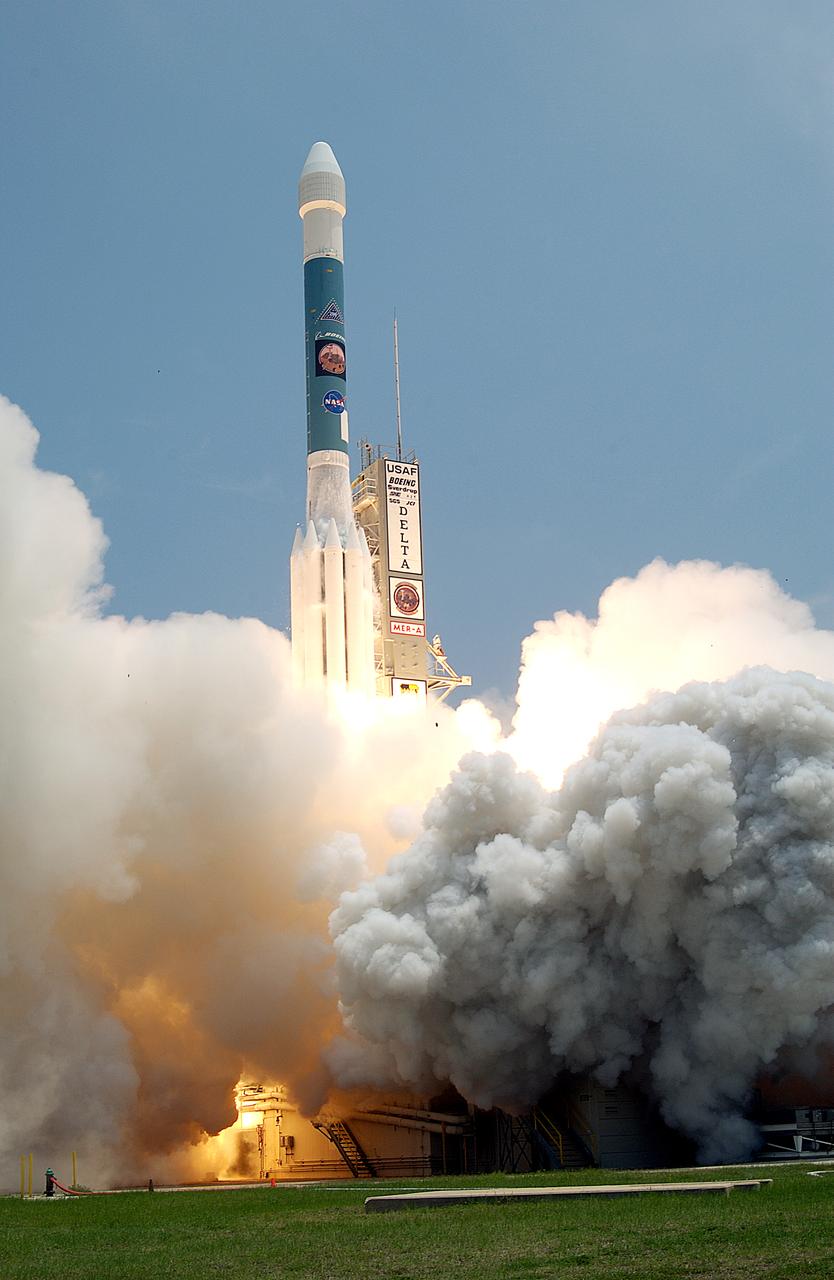
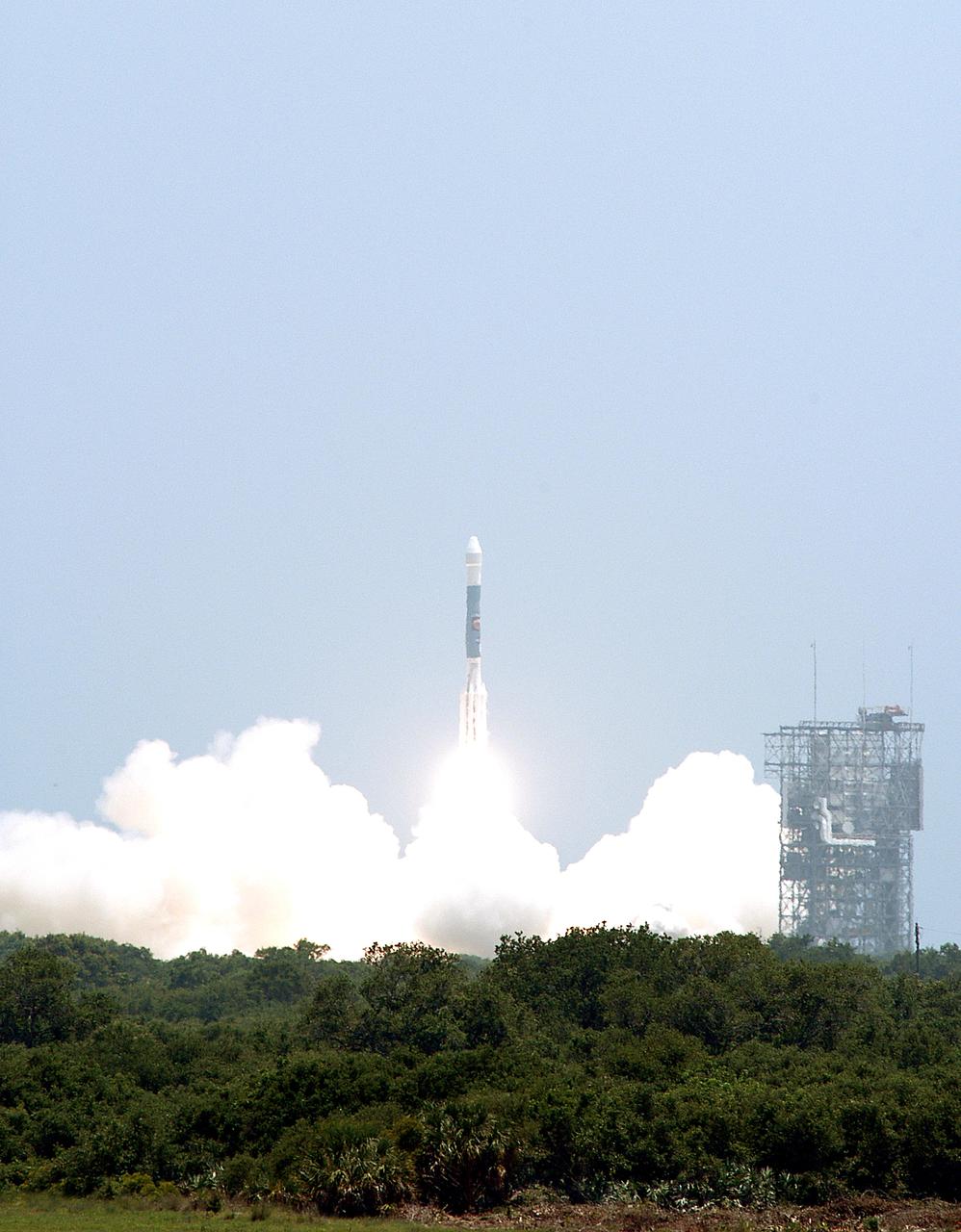
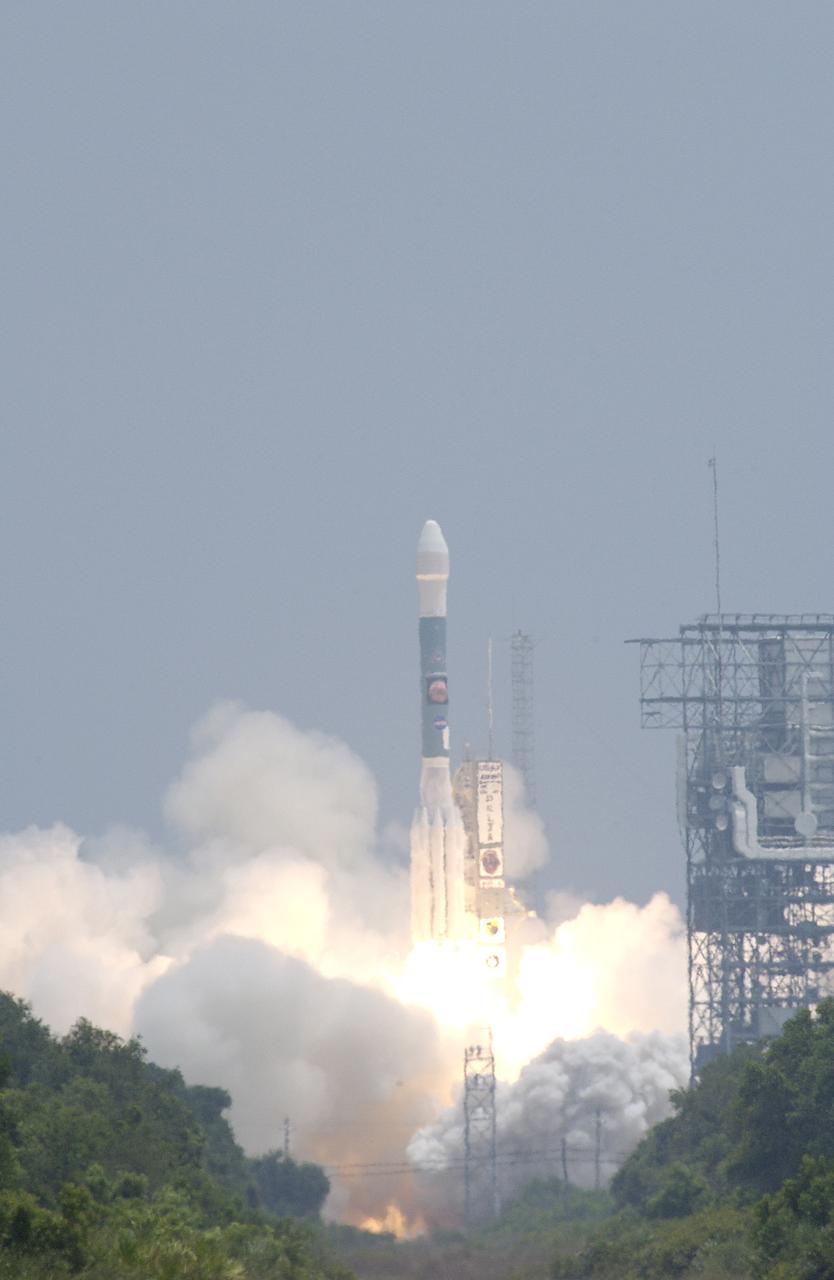
KENNEDY SPACE CENTER, FLA. -  With smoke and steam billowing beneath, the Delta II rocket with its Mars Exploration Rover (MER-A) payload leaps off the launch pad into the blue sky to begin its journey to Mars.  Liftoff occurred on time at 1:58 p.m. EDT from Launch Complex 17-A, Cape Canaveral Air Force Station.  MER-A, known as "Spirit," is the first of two rovers being launched to Mars. When the two rovers arrive at the red planet in 2004, they will bounce to airbag-cushioned landings at sites offering a balance of favorable conditions for safe landings and interesting science. The rovers see sharper images, can explore farther and examine rocks better than anything that has ever landed on Mars. The designated site for the MER-A mission is Gusev Crater, which appears to have been a crater lake. The second rover, MER-B, is scheduled to launch June 25.
KENNEDY SPACE CENTER, FLA. - With smoke and steam billowing beneath, the Delta II rocket with its Mars Exploration Rover (MER-A) payload leaps off the launch pad into the blue sky to begin its journey to Mars. Liftoff occurred on time at 1:58 p.m. EDT from Launch Complex 17-A, Cape Canaveral Air Force Station. MER-A, known as "Spirit," is the first of two rovers being launched to Mars. When the two rovers arrive at the red planet in 2004, they will bounce to airbag-cushioned landings at sites offering a balance of favorable conditions for safe landings and interesting science. The rovers see sharper images, can explore farther and examine rocks better than anything that has ever landed on Mars. The designated site for the MER-A mission is Gusev Crater, which appears to have been a crater lake. The second rover, MER-B, is scheduled to launch June 25.
KENNEDY SPACE CENTER, FLA. -  On Launch Complex 17-A, Cape Canaveral Air Force Station, the Boeing Delta II rocket and its Mars Exploration Rover (MER-A) payload are free of the tower  and ready for launch.  This will be the third launch attempt in as many days after weather concerns postponed the launches June 8 and June 9.  MER-A is the first of two rovers being launched to Mars.  When the two rovers arrive at the red planet in 2004, they will bounce to airbag-cushioned landings at sites offering a balance of favorable conditions for safe landings and interesting science. The rovers see sharper images, can explore farther and examine rocks better than anything that has ever landed on Mars.  The designated site for MER-A mission is Gusev Crater, which appears to have been a crater lake.  The second rover, MER-B, is scheduled to launch June 25.
KENNEDY SPACE CENTER, FLA. - On Launch Complex 17-A, Cape Canaveral Air Force Station, the Boeing Delta II rocket and its Mars Exploration Rover (MER-A) payload are free of the tower and ready for launch. This will be the third launch attempt in as many days after weather concerns postponed the launches June 8 and June 9. MER-A is the first of two rovers being launched to Mars. When the two rovers arrive at the red planet in 2004, they will bounce to airbag-cushioned landings at sites offering a balance of favorable conditions for safe landings and interesting science. The rovers see sharper images, can explore farther and examine rocks better than anything that has ever landed on Mars. The designated site for MER-A mission is Gusev Crater, which appears to have been a crater lake. The second rover, MER-B, is scheduled to launch June 25.
KENNEDY SPACE CENTER, FLA. -   On Launch Complex 17-A, Cape Canaveral Air Force Station, the launch tower rolls back from the Boeing Delta II rocket and its Mars Exploration Rover (MER-A) payload in preparation for another launch attempt.  The first two attempts, June 8 and June 9, were postponed due to weather concerns.  MER-A is the first of two rovers being launched to Mars.  When the two rovers arrive at Mars in 2004, they will bounce to airbag-cushioned landings at sites offering a balance of favorable conditions for safe landings and interesting science. The rovers see sharper images, can explore farther and examine rocks better than anything that has ever landed on Mars.  The designated site for MER-A mission is Gusev Crater, which appears to have been a crater lake.  The second rover, MER-B, is scheduled to launch June 25.
KENNEDY SPACE CENTER, FLA. - On Launch Complex 17-A, Cape Canaveral Air Force Station, the launch tower rolls back from the Boeing Delta II rocket and its Mars Exploration Rover (MER-A) payload in preparation for another launch attempt. The first two attempts, June 8 and June 9, were postponed due to weather concerns. MER-A is the first of two rovers being launched to Mars. When the two rovers arrive at Mars in 2004, they will bounce to airbag-cushioned landings at sites offering a balance of favorable conditions for safe landings and interesting science. The rovers see sharper images, can explore farther and examine rocks better than anything that has ever landed on Mars. The designated site for MER-A mission is Gusev Crater, which appears to have been a crater lake. The second rover, MER-B, is scheduled to launch June 25.
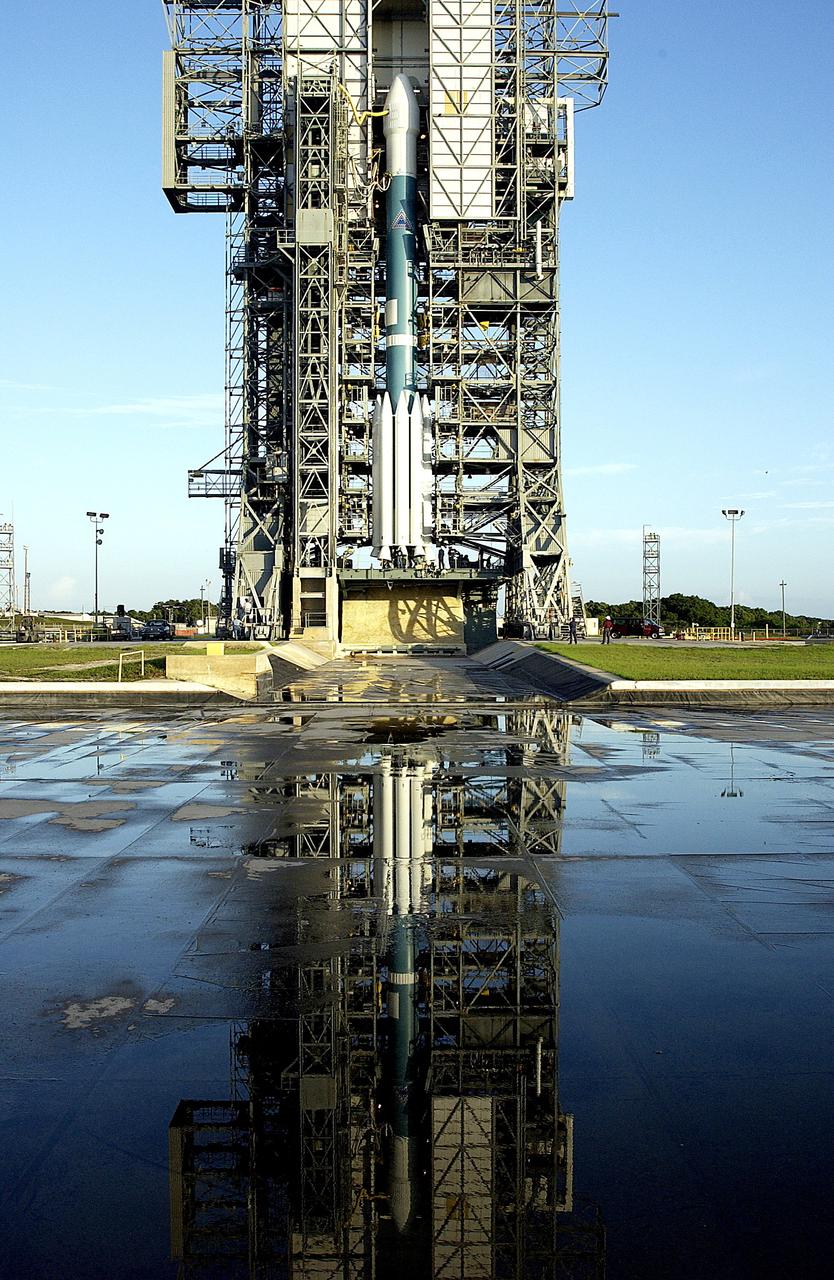
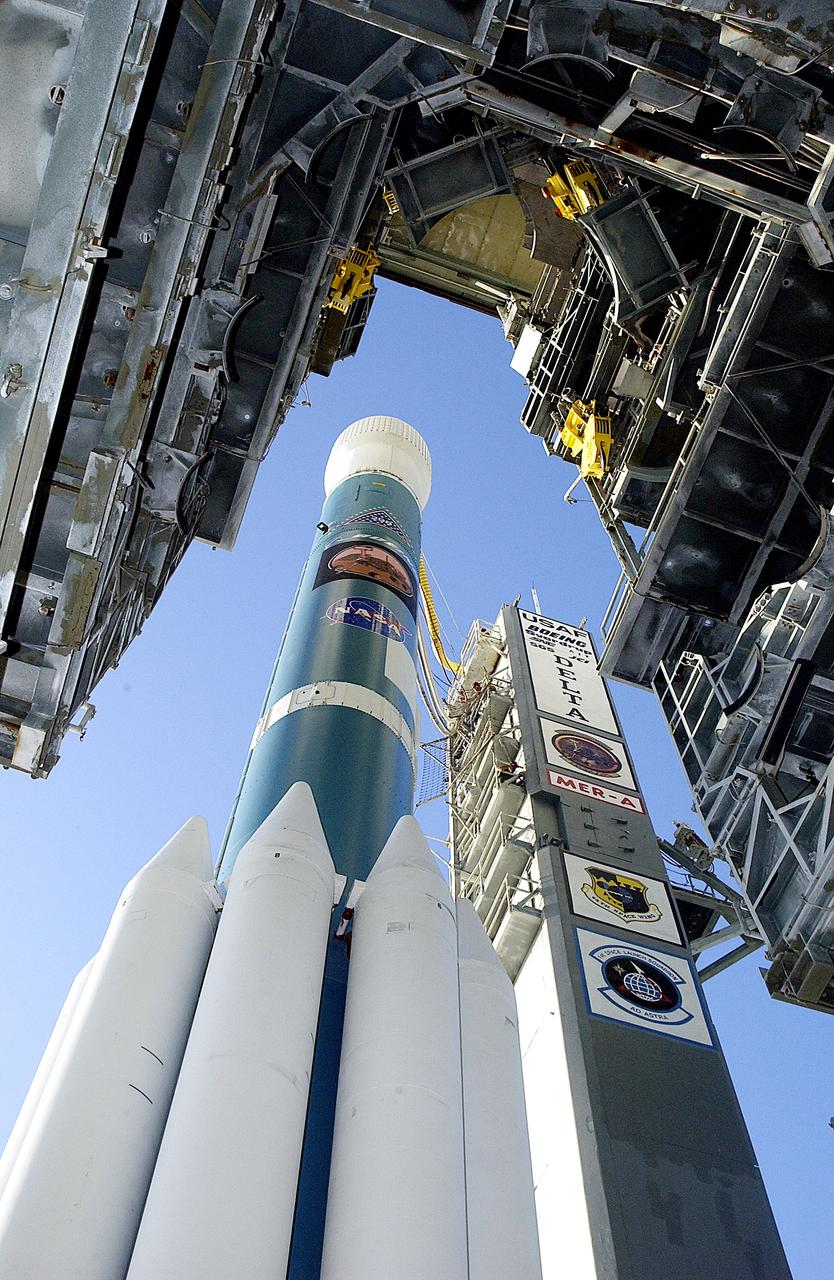
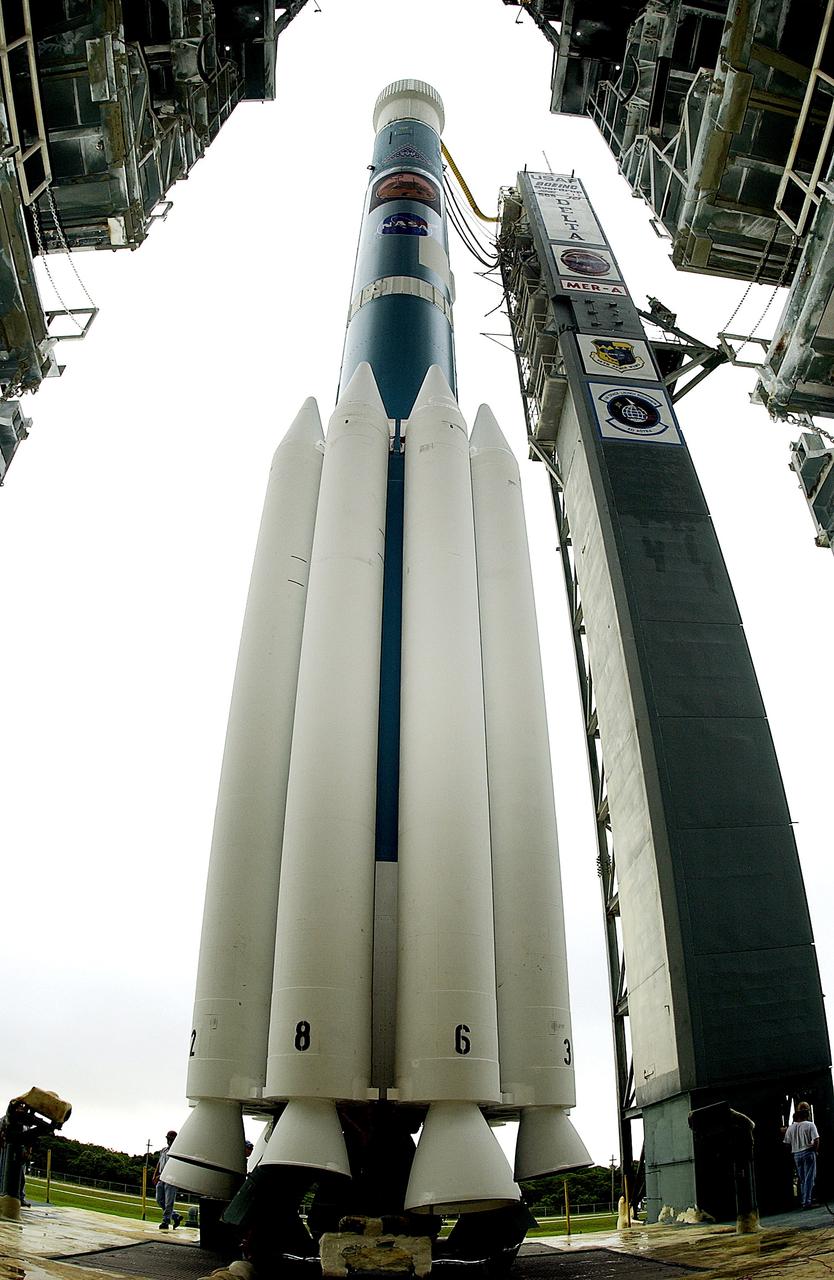
KENNEDY SPACE CENTER, FLA. -   The Boeing Delta II rocket and its Mars Exploration Rover (MER-A) payload is viewed from under the launch tower as it moves away on Launch Complex 17-A, Cape Canaveral Air Force Station.  This will be a second attempt at launch.  The first attempt on June 8, 2003, was scrubbed due to bad weather in the vicinity.  MER-A is the first of two rovers being launched to Mars.  When the two rovers arrive at Mars in 2004, they will bounce to airbag-cushioned landings at sites offering a balance of favorable conditions for safe landings and interesting science. The rovers see sharper images, can explore farther and examine rocks better than anything that has ever landed on Mars.  The designated site for MER-A mission is Gusev Crater, which appears to have been a crater lake.  The second rover, MER-B, is scheduled to launch June 25.
KENNEDY SPACE CENTER, FLA. - The Boeing Delta II rocket and its Mars Exploration Rover (MER-A) payload is viewed from under the launch tower as it moves away on Launch Complex 17-A, Cape Canaveral Air Force Station. This will be a second attempt at launch. The first attempt on June 8, 2003, was scrubbed due to bad weather in the vicinity. MER-A is the first of two rovers being launched to Mars. When the two rovers arrive at Mars in 2004, they will bounce to airbag-cushioned landings at sites offering a balance of favorable conditions for safe landings and interesting science. The rovers see sharper images, can explore farther and examine rocks better than anything that has ever landed on Mars. The designated site for MER-A mission is Gusev Crater, which appears to have been a crater lake. The second rover, MER-B, is scheduled to launch June 25.
KENNEDY SPACE CENTER, FLA. -   On Launch Complex 17-A, Cape Canaveral Air Force Station, the launch tower begins to roll back from the Boeing Delta II rocket and its Mars Exploration Rover (MER-A) payload in preparation for another launch attempt.  The first two attempts were postponed due to weather concerns.  MER-A is the first of two rovers being launched to Mars.  When the two rovers arrive at Mars in 2004, they will bounce to airbag-cushioned landings at sites offering a balance of favorable conditions for safe landings and interesting science. The rovers see sharper images, can explore farther and examine rocks better than anything that has ever landed on Mars.  The designated site for MER-A mission is Gusev Crater, which appears to have been a crater lake.  The second rover, MER-B, is scheduled to launch June 25.
KENNEDY SPACE CENTER, FLA. - On Launch Complex 17-A, Cape Canaveral Air Force Station, the launch tower begins to roll back from the Boeing Delta II rocket and its Mars Exploration Rover (MER-A) payload in preparation for another launch attempt. The first two attempts were postponed due to weather concerns. MER-A is the first of two rovers being launched to Mars. When the two rovers arrive at Mars in 2004, they will bounce to airbag-cushioned landings at sites offering a balance of favorable conditions for safe landings and interesting science. The rovers see sharper images, can explore farther and examine rocks better than anything that has ever landed on Mars. The designated site for MER-A mission is Gusev Crater, which appears to have been a crater lake. The second rover, MER-B, is scheduled to launch June 25.
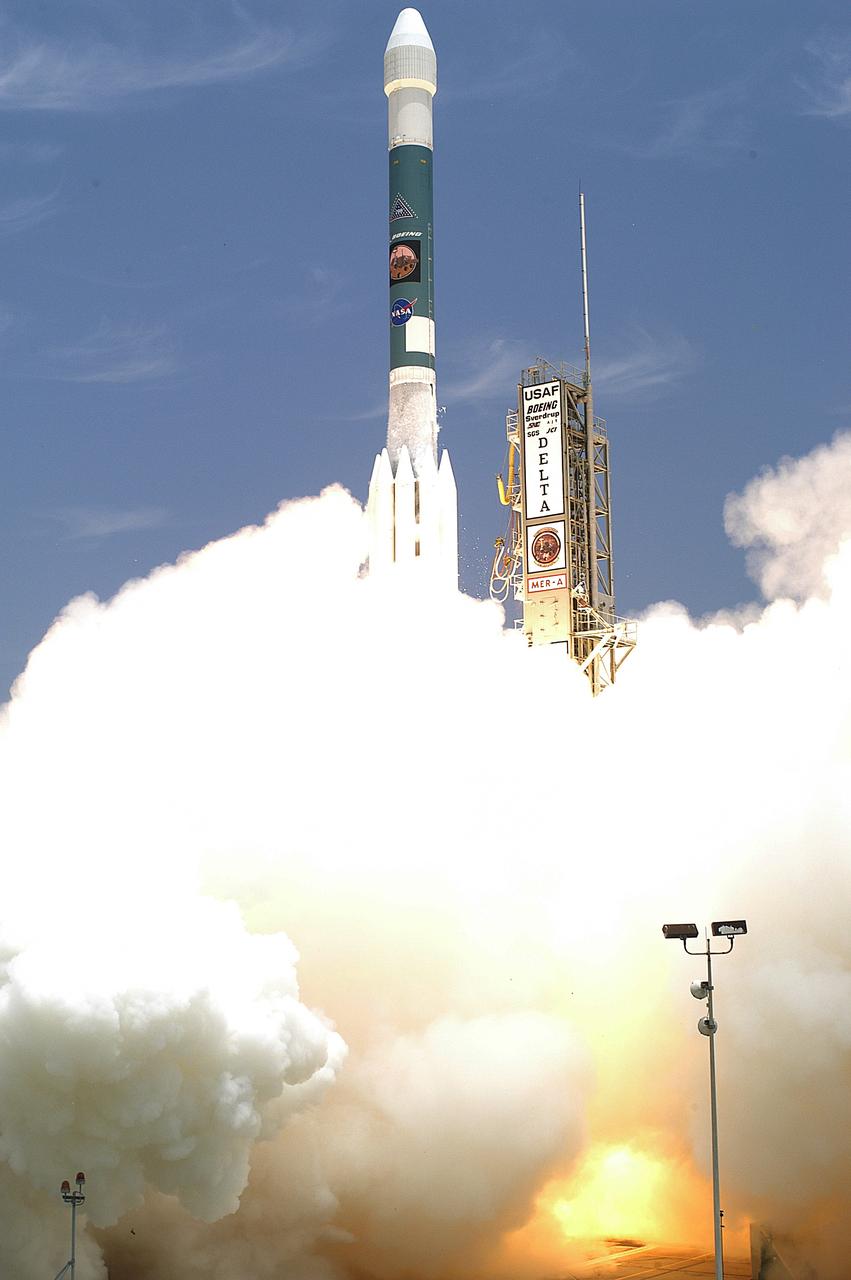
KENNEDY SPACE CENTER, FLA. -  The Delta II rocket with its Mars Exploration Rover (MER-A) payload leaps off the launch pad into the blue sky to begin its journey to Mars.  Liftoff occurred on time at 1:58 p.m. EDT from Launch Complex 17-A, Cape Canaveral Air Force Station.  MER-A, known as "Spirit," is the first of two rovers being launched to Mars. When the two rovers arrive at the red planet in 2004, they will bounce to airbag-cushioned landings at sites offering a balance of favorable conditions for safe landings and interesting science. The rovers see sharper images, can explore farther and examine rocks better than anything that has ever landed on Mars. The designated site for the MER-A mission is Gusev Crater, which appears to have been a crater lake. The second rover, MER-B, is scheduled to launch June 25.
KENNEDY SPACE CENTER, FLA. - The Delta II rocket with its Mars Exploration Rover (MER-A) payload leaps off the launch pad into the blue sky to begin its journey to Mars. Liftoff occurred on time at 1:58 p.m. EDT from Launch Complex 17-A, Cape Canaveral Air Force Station. MER-A, known as "Spirit," is the first of two rovers being launched to Mars. When the two rovers arrive at the red planet in 2004, they will bounce to airbag-cushioned landings at sites offering a balance of favorable conditions for safe landings and interesting science. The rovers see sharper images, can explore farther and examine rocks better than anything that has ever landed on Mars. The designated site for the MER-A mission is Gusev Crater, which appears to have been a crater lake. The second rover, MER-B, is scheduled to launch June 25.
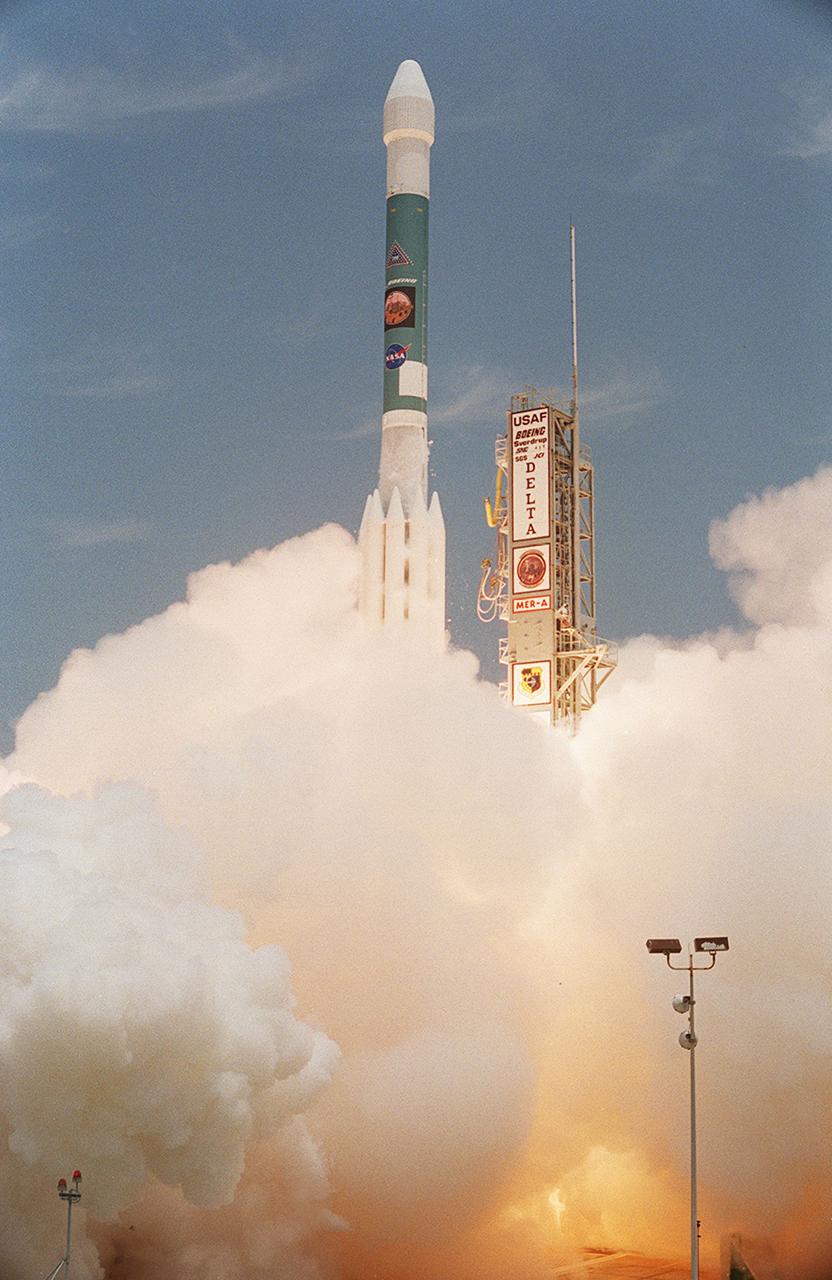
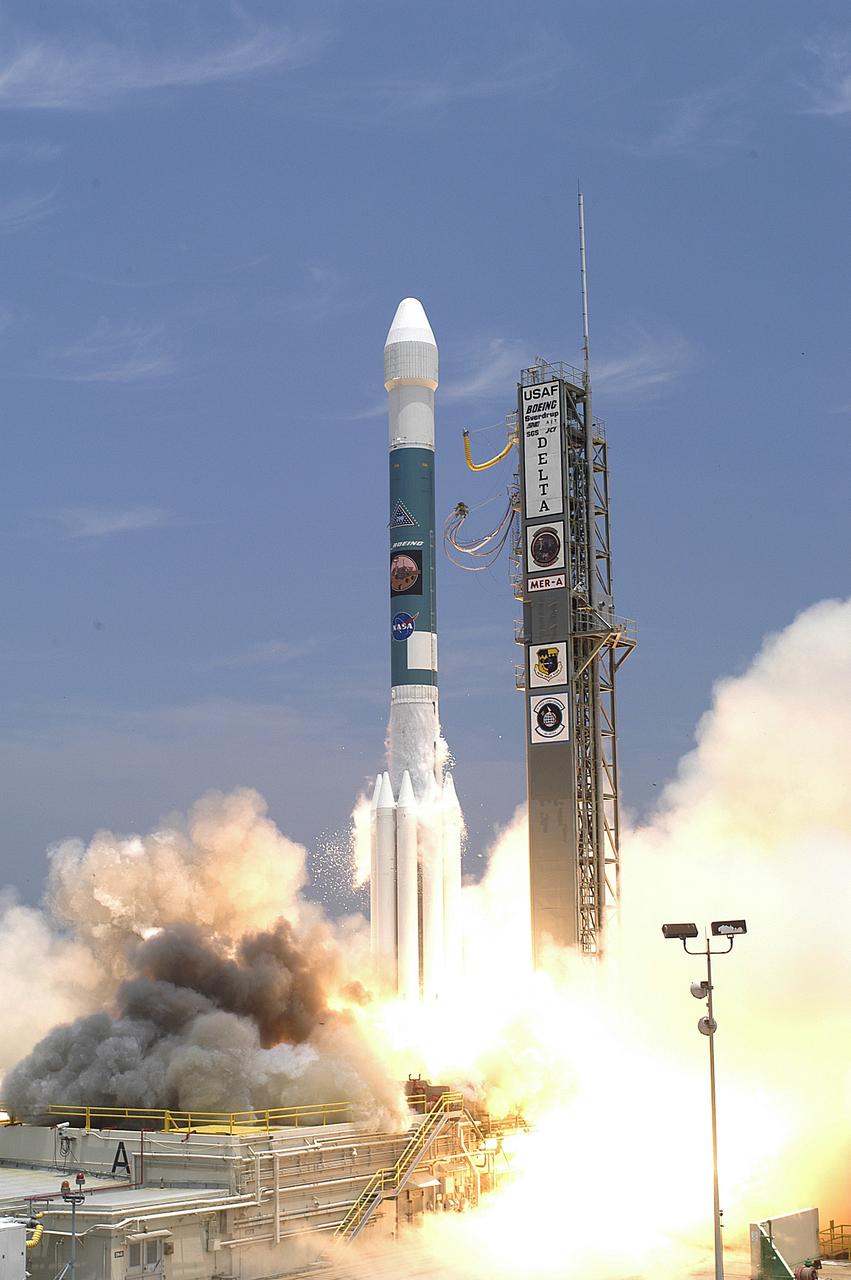
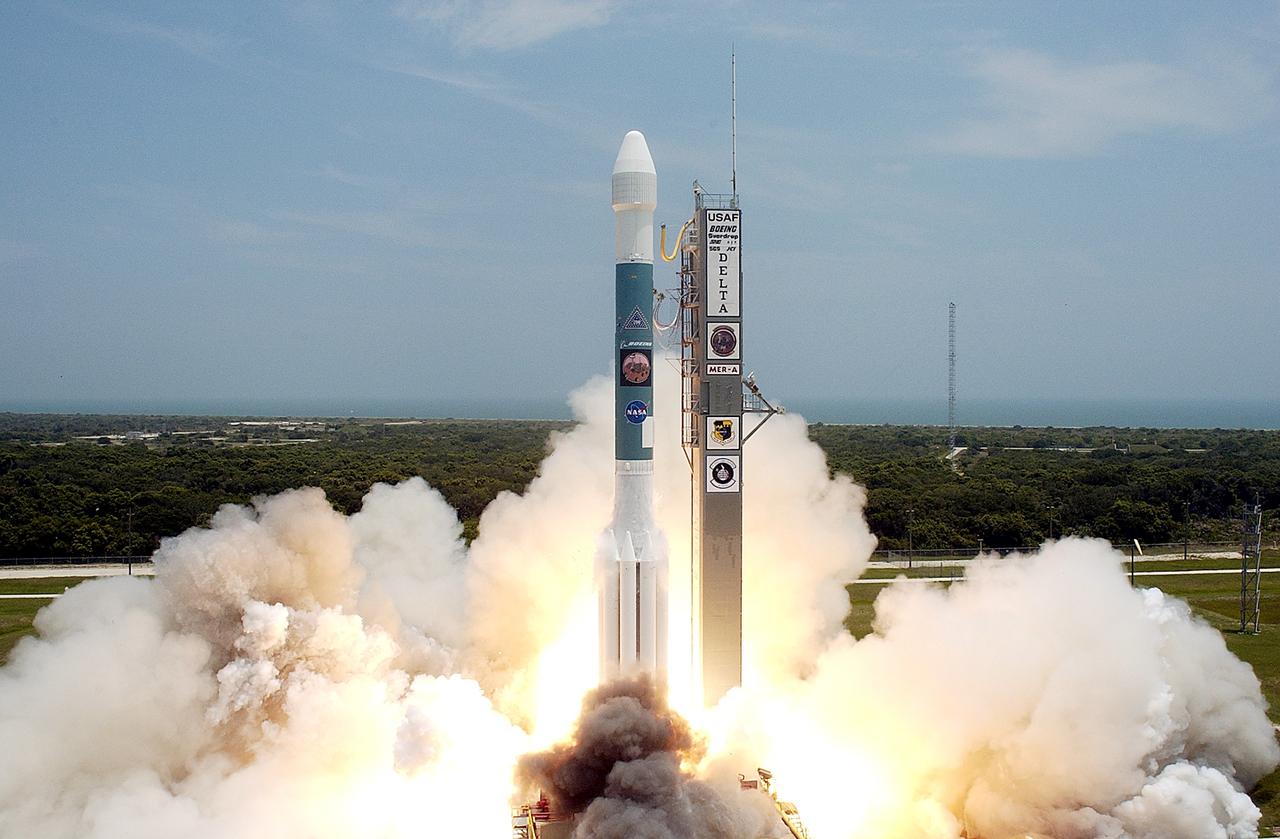
KENNEDY SPACE CENTER, FLA. -    The Delta II rocket with its Mars Exploration Rover (MER-A) payload breaks forth from the smoke and steam into the blue sky to begin its journey to Mars.  Liftoff occurred on time at 1:58 p.m. EDT from Launch Complex 17-A, Cape Canaveral Air Force Station.  MER-A, known as "Spirit," is the first of two rovers being launched to Mars. When the two rovers arrive at the red planet in 2004, they will bounce to airbag-cushioned landings at sites offering a balance of favorable conditions for safe landings and interesting science. The rovers see sharper images, can explore farther and examine rocks better than anything that has ever landed on Mars. The designated site for the MER-A mission is Gusev Crater, which appears to have been a crater lake. The second rover, MER-B, is scheduled to launch June 25
KENNEDY SPACE CENTER, FLA. - The Delta II rocket with its Mars Exploration Rover (MER-A) payload breaks forth from the smoke and steam into the blue sky to begin its journey to Mars. Liftoff occurred on time at 1:58 p.m. EDT from Launch Complex 17-A, Cape Canaveral Air Force Station. MER-A, known as "Spirit," is the first of two rovers being launched to Mars. When the two rovers arrive at the red planet in 2004, they will bounce to airbag-cushioned landings at sites offering a balance of favorable conditions for safe landings and interesting science. The rovers see sharper images, can explore farther and examine rocks better than anything that has ever landed on Mars. The designated site for the MER-A mission is Gusev Crater, which appears to have been a crater lake. The second rover, MER-B, is scheduled to launch June 25
KENNEDY SPACE CENTER, FLA. -    With smoke and steam billowing beneath, the Delta II rocket with its Mars Exploration Rover (MER-A) payload leaps off the launch pad into the blue sky to begin its journey to Mars.  Liftoff occurred on time at 1:58 p.m. EDT from Launch Complex 17-A, Cape Canaveral Air Force Station.  MER-A, known as "Spirit," is the first of two rovers being launched to Mars. When the two rovers arrive at the red planet in 2004, they will bounce to airbag-cushioned landings at sites offering a balance of favorable conditions for safe landings and interesting science. The rovers see sharper images, can explore farther and examine rocks better than anything that has ever landed on Mars. The designated site for the MER-A mission is Gusev Crater, which appears to have been a crater lake. The second rover, MER-B, is scheduled to launch June 25.
KENNEDY SPACE CENTER, FLA. - With smoke and steam billowing beneath, the Delta II rocket with its Mars Exploration Rover (MER-A) payload leaps off the launch pad into the blue sky to begin its journey to Mars. Liftoff occurred on time at 1:58 p.m. EDT from Launch Complex 17-A, Cape Canaveral Air Force Station. MER-A, known as "Spirit," is the first of two rovers being launched to Mars. When the two rovers arrive at the red planet in 2004, they will bounce to airbag-cushioned landings at sites offering a balance of favorable conditions for safe landings and interesting science. The rovers see sharper images, can explore farther and examine rocks better than anything that has ever landed on Mars. The designated site for the MER-A mission is Gusev Crater, which appears to have been a crater lake. The second rover, MER-B, is scheduled to launch June 25.
KENNEDY SPACE CENTER, FLA. - On Launch Complex 17-A, Cape Canaveral Air Force Station, the launch tower begins to roll back from the Boeing Delta II rocket and its Mars Exploration Rover (MER-A) payload in preparation for a second attempt at launch.  The first attempt on June 8, 2003, was scrubbed due to bad weather in the vicinity.  MER-A is the first of two rovers being launched to Mars.  When the two rovers arrive at Mars in 2004, they will bounce to airbag-cushioned landings at sites offering a balance of favorable conditions for safe landings and interesting science. The rovers see sharper images, can explore farther and examine rocks better than anything that has ever landed on Mars.  The designated site for MER-A mission is Gusev Crater, which appears to have been a crater lake.  The second rover, MER-B, is scheduled to launch June 25.
KENNEDY SPACE CENTER, FLA. - On Launch Complex 17-A, Cape Canaveral Air Force Station, the launch tower begins to roll back from the Boeing Delta II rocket and its Mars Exploration Rover (MER-A) payload in preparation for a second attempt at launch. The first attempt on June 8, 2003, was scrubbed due to bad weather in the vicinity. MER-A is the first of two rovers being launched to Mars. When the two rovers arrive at Mars in 2004, they will bounce to airbag-cushioned landings at sites offering a balance of favorable conditions for safe landings and interesting science. The rovers see sharper images, can explore farther and examine rocks better than anything that has ever landed on Mars. The designated site for MER-A mission is Gusev Crater, which appears to have been a crater lake. The second rover, MER-B, is scheduled to launch June 25.
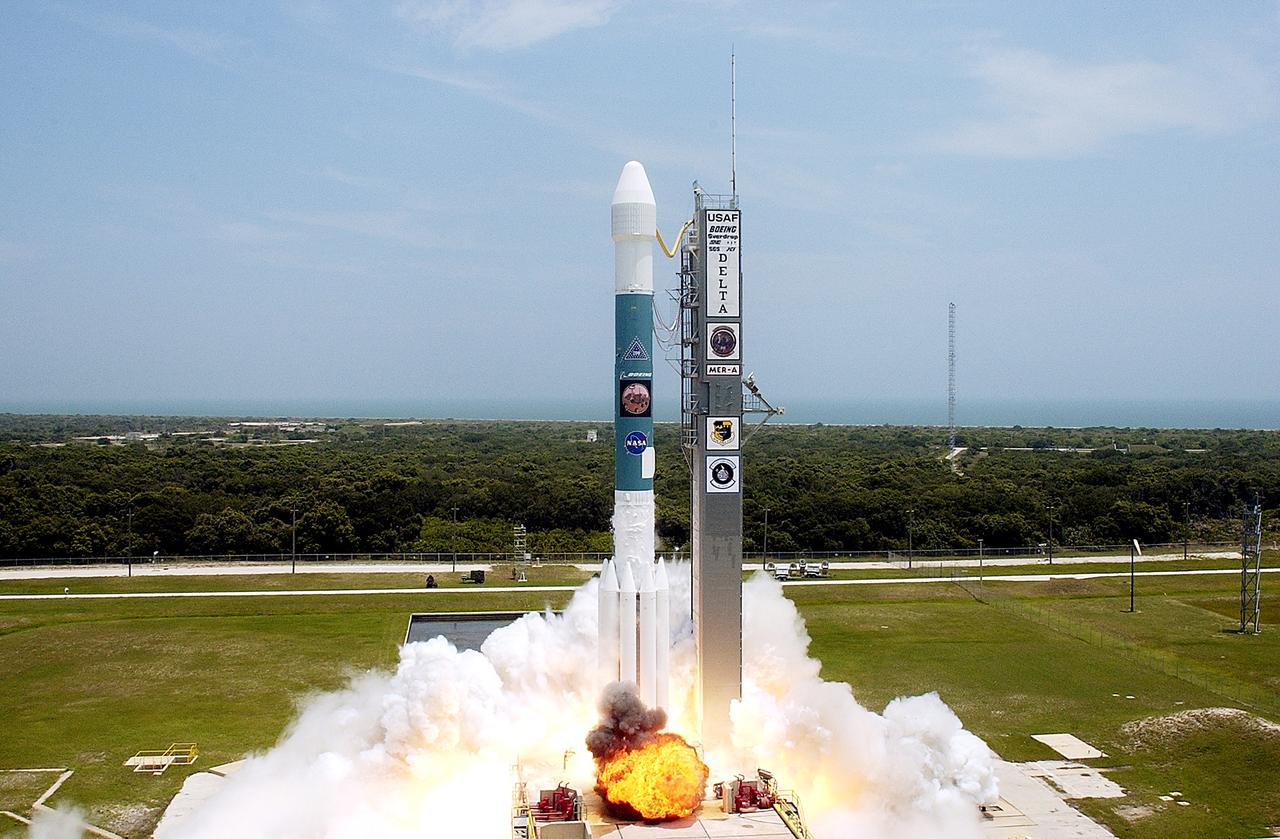
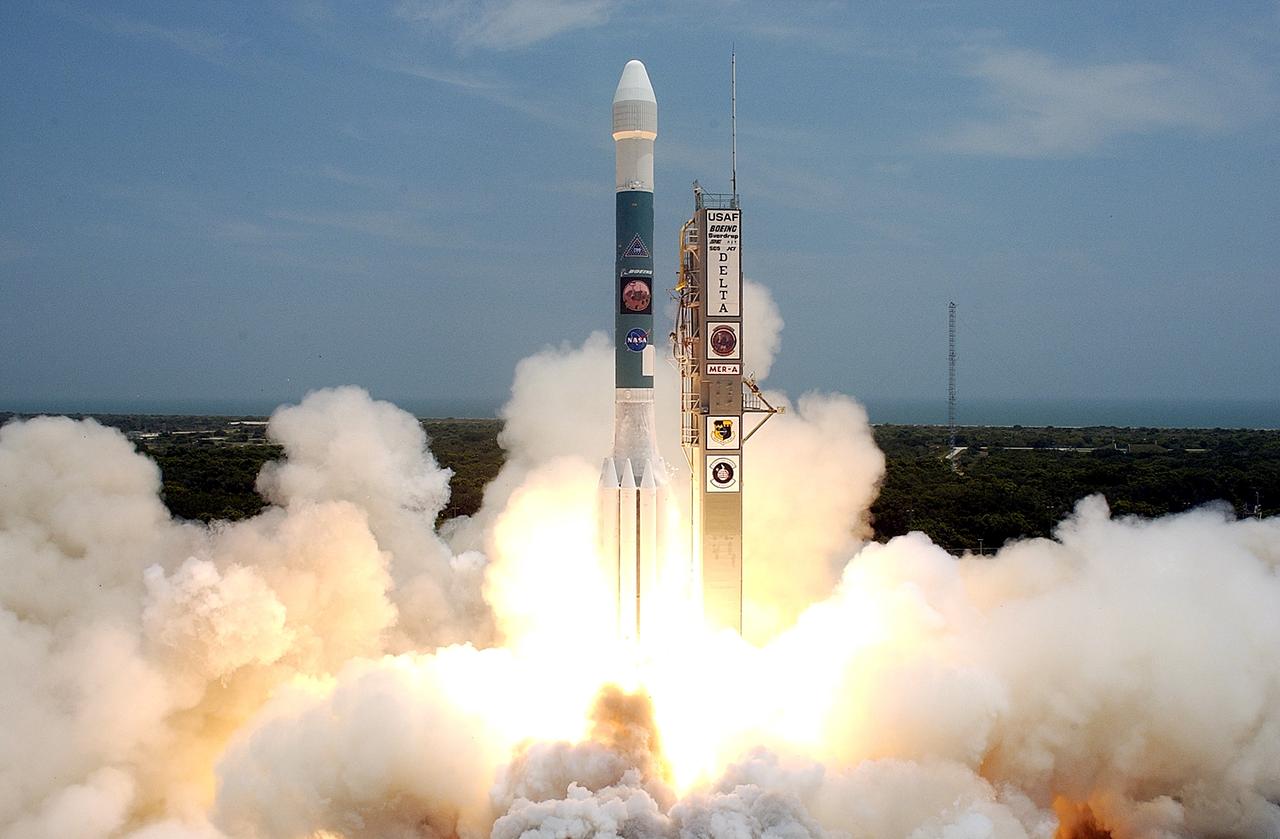
KENNEDY SPACE CENTER, FLA. -  With a glimpse of the Atlantic Ocean over the horizon, the Delta II rocket with its Mars Exploration Rover (MER-A) payload leaps off the launch pad into the blue sky to begin its journey to Mars.  Liftoff occurred on time at 1:58 p.m. EDT from Launch Complex 17-A, Cape Canaveral Air Force Station.  MER-A, known as "Spirit," is the first of two rovers being launched to Mars. When the two rovers arrive at the red planet in 2004, they will bounce to airbag-cushioned landings at sites offering a balance of favorable conditions for safe landings and interesting science. The rovers see sharper images, can explore farther and examine rocks better than anything that has ever landed on Mars. The designated site for the MER-A mission is Gusev Crater, which appears to have been a crater lake. The second rover, MER-B, is scheduled to launch June 25.
KENNEDY SPACE CENTER, FLA. - With a glimpse of the Atlantic Ocean over the horizon, the Delta II rocket with its Mars Exploration Rover (MER-A) payload leaps off the launch pad into the blue sky to begin its journey to Mars. Liftoff occurred on time at 1:58 p.m. EDT from Launch Complex 17-A, Cape Canaveral Air Force Station. MER-A, known as "Spirit," is the first of two rovers being launched to Mars. When the two rovers arrive at the red planet in 2004, they will bounce to airbag-cushioned landings at sites offering a balance of favorable conditions for safe landings and interesting science. The rovers see sharper images, can explore farther and examine rocks better than anything that has ever landed on Mars. The designated site for the MER-A mission is Gusev Crater, which appears to have been a crater lake. The second rover, MER-B, is scheduled to launch June 25.
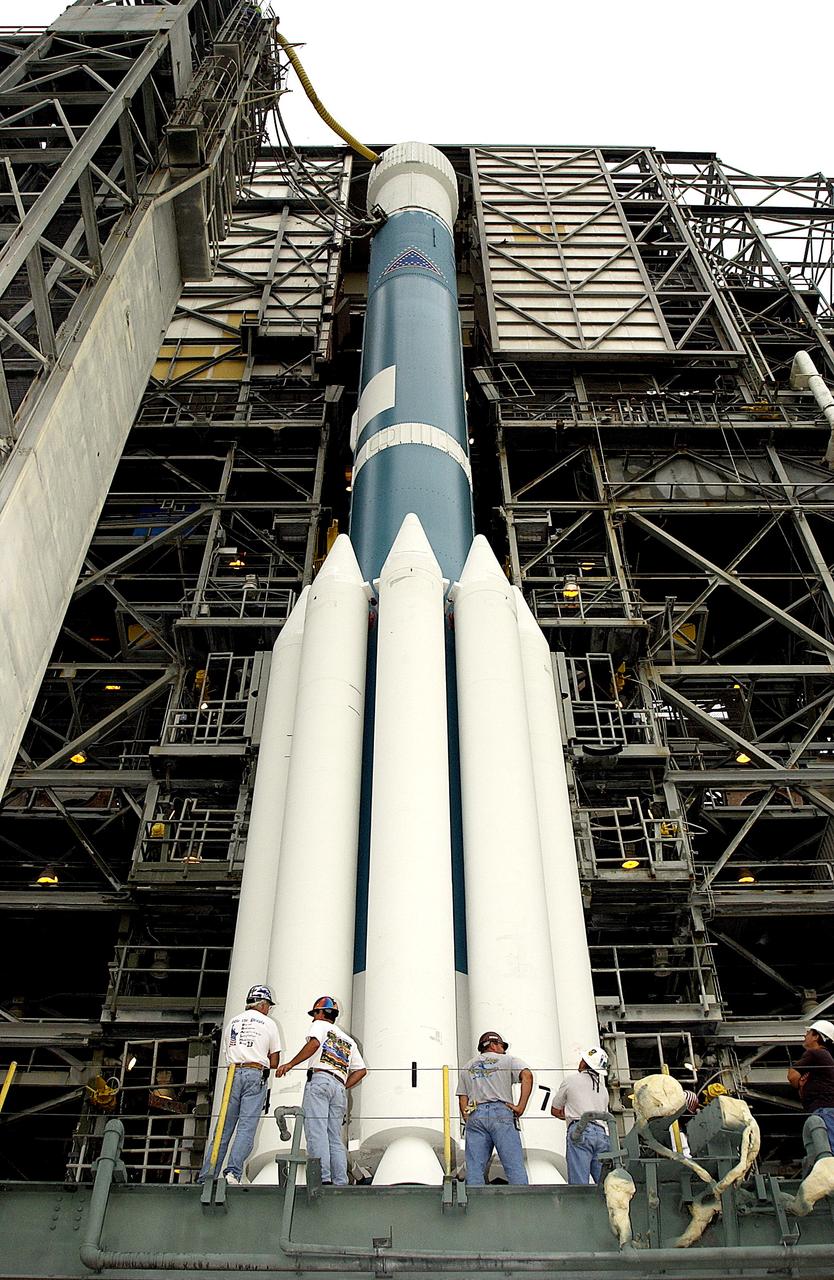
KENNEDY SPACE CENTER, FLA. -   On Launch Complex 17-A, Cape Canaveral Air Force Station, the Boeing Delta II rocket and its Mars Exploration Rover (MER-A) payload are viewed as the launch tower overhead rolls back.   This will be the third launch attempt in as many days after weather concerns postponed the launches June 8 and June 9.  MER-A is the first of two rovers being launched to Mars.  When the two rovers arrive at Mars in 2004, they will bounce to airbag-cushioned landings at sites offering a balance of favorable conditions for safe landings and interesting science. The rovers see sharper images, can explore farther and examine rocks better than anything that has ever landed on Mars.  The designated site for MER-A mission is Gusev Crater, which appears to have been a crater lake.  The second rover, MER-B, is scheduled to launch June 25.
KENNEDY SPACE CENTER, FLA. - On Launch Complex 17-A, Cape Canaveral Air Force Station, the Boeing Delta II rocket and its Mars Exploration Rover (MER-A) payload are viewed as the launch tower overhead rolls back. This will be the third launch attempt in as many days after weather concerns postponed the launches June 8 and June 9. MER-A is the first of two rovers being launched to Mars. When the two rovers arrive at Mars in 2004, they will bounce to airbag-cushioned landings at sites offering a balance of favorable conditions for safe landings and interesting science. The rovers see sharper images, can explore farther and examine rocks better than anything that has ever landed on Mars. The designated site for MER-A mission is Gusev Crater, which appears to have been a crater lake. The second rover, MER-B, is scheduled to launch June 25.
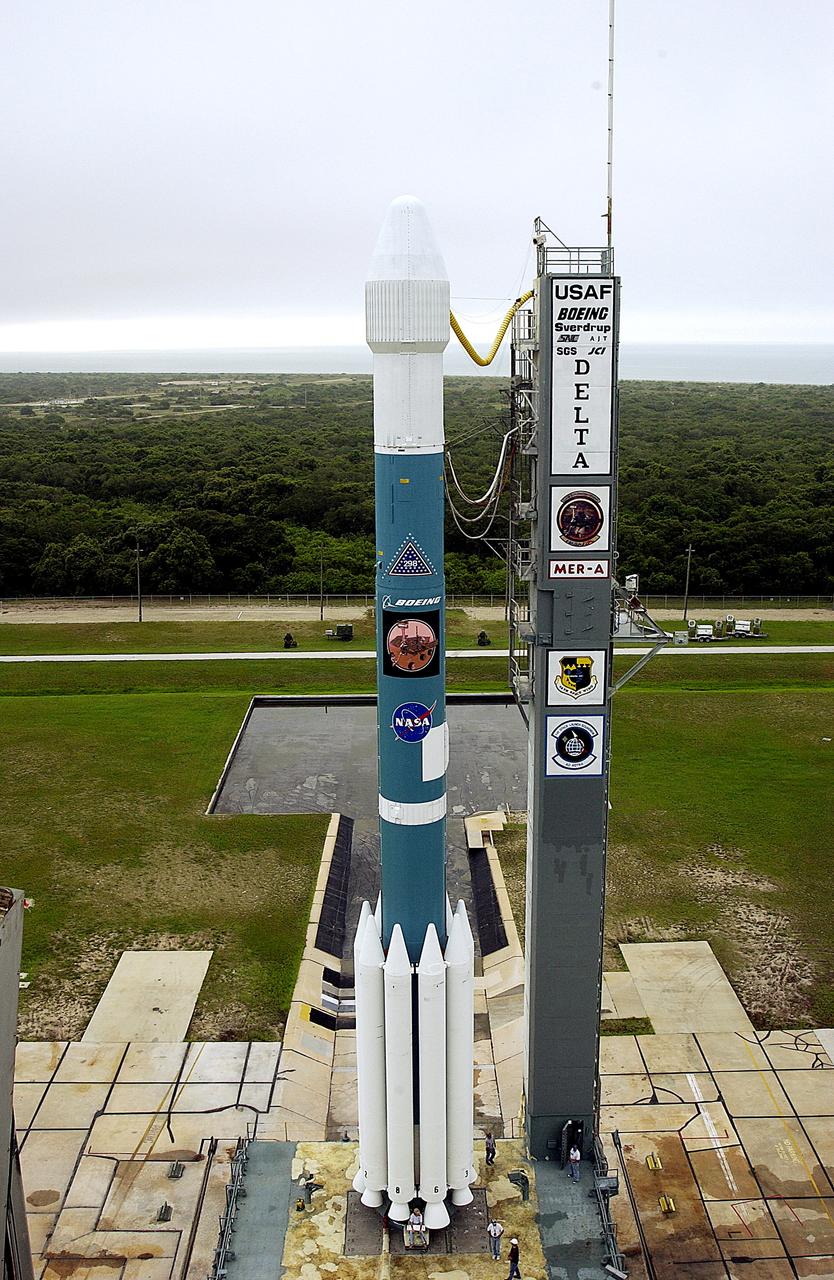
KENNEDY SPACE CENTER, FLA. -    The launch tower on Launch Complex 17-A, Cape Canaveral Air Force Station, clears the Boeing Delta II rocket and its Mars Exploration Rover (MER-A) payload in preparation for a second attempt at launch.  The first attempt on June 8, 2003, was scrubbed due to bad weather in the vicinity.  MER-A is the first of two rovers being launched to Mars.  When the two rovers arrive at Mars in 2004, they will bounce to airbag-cushioned landings at sites offering a balance of favorable conditions for safe landings and interesting science. The rovers see sharper images, can explore farther and examine rocks better than anything that has ever landed on Mars.  The designated site for MER-A mission is Gusev Crater, which appears to have been a crater lake.  The second rover, MER-B, is scheduled to launch June 25.
KENNEDY SPACE CENTER, FLA. - The launch tower on Launch Complex 17-A, Cape Canaveral Air Force Station, clears the Boeing Delta II rocket and its Mars Exploration Rover (MER-A) payload in preparation for a second attempt at launch. The first attempt on June 8, 2003, was scrubbed due to bad weather in the vicinity. MER-A is the first of two rovers being launched to Mars. When the two rovers arrive at Mars in 2004, they will bounce to airbag-cushioned landings at sites offering a balance of favorable conditions for safe landings and interesting science. The rovers see sharper images, can explore farther and examine rocks better than anything that has ever landed on Mars. The designated site for MER-A mission is Gusev Crater, which appears to have been a crater lake. The second rover, MER-B, is scheduled to launch June 25.
KENNEDY SPACE CENTER, FLA. -  On Launch Complex 17-A, Cape Canaveral Air Force Station, the Boeing Delta II rocket and its Mars Exploration Rover (MER-A) payload are free of the tower  and ready for launch.  This will be the third launch attempt in as many days after weather concerns postponed the launches June 8 and June 9.  MER-A is the first of two rovers being launched to Mars.  When the two rovers arrive at Mars in 2004, they will bounce to airbag-cushioned landings at sites offering a balance of favorable conditions for safe landings and interesting science. The rovers see sharper images, can explore farther and examine rocks better than anything that has ever landed on Mars.  The designated site for MER-A mission is Gusev Crater, which appears to have been a crater lake.  The second rover, MER-B, is scheduled to launch June 25.
KENNEDY SPACE CENTER, FLA. - On Launch Complex 17-A, Cape Canaveral Air Force Station, the Boeing Delta II rocket and its Mars Exploration Rover (MER-A) payload are free of the tower and ready for launch. This will be the third launch attempt in as many days after weather concerns postponed the launches June 8 and June 9. MER-A is the first of two rovers being launched to Mars. When the two rovers arrive at Mars in 2004, they will bounce to airbag-cushioned landings at sites offering a balance of favorable conditions for safe landings and interesting science. The rovers see sharper images, can explore farther and examine rocks better than anything that has ever landed on Mars. The designated site for MER-A mission is Gusev Crater, which appears to have been a crater lake. The second rover, MER-B, is scheduled to launch June 25.
KENNEDY SPACE CENTER, FLA. -  The Delta II rocket with its Mars Exploration Rover (MER-A) payload leaps off the launch pad into the blue sky to begin its journey to Mars.  Liftoff occurred on time at 1:58 p.m. EDT from Launch Complex 17-A, Cape Canaveral Air Force Station.  MER-A, known as "Spirit," is the first of two rovers being launched to Mars. When the two rovers arrive at the red planet in 2004, they will bounce to airbag-cushioned landings at sites offering a balance of favorable conditions for safe landings and interesting science. The rovers see sharper images, can explore farther and examine rocks better than anything that has ever landed on Mars. The designated site for the MER-A mission is Gusev Crater, which appears to have been a crater lake. The second rover, MER-B, is scheduled to launch June 25.
KENNEDY SPACE CENTER, FLA. - The Delta II rocket with its Mars Exploration Rover (MER-A) payload leaps off the launch pad into the blue sky to begin its journey to Mars. Liftoff occurred on time at 1:58 p.m. EDT from Launch Complex 17-A, Cape Canaveral Air Force Station. MER-A, known as "Spirit," is the first of two rovers being launched to Mars. When the two rovers arrive at the red planet in 2004, they will bounce to airbag-cushioned landings at sites offering a balance of favorable conditions for safe landings and interesting science. The rovers see sharper images, can explore farther and examine rocks better than anything that has ever landed on Mars. The designated site for the MER-A mission is Gusev Crater, which appears to have been a crater lake. The second rover, MER-B, is scheduled to launch June 25.
KENNEDY SPACE CENTER, FLA. - Amid billows of smoke and steam, the Delta II rocket with its Mars Exploration Rover (MER-A) payload lifts off the pad on time at 1:58 p.m. EDT from Launch Complex 17-A, Cape Canaveral Air Force Station. MER-A, known as "Spirit," is the first of two rovers being launched to Mars. When the two rovers arrive at the red planet in 2004, they will bounce to airbag-cushioned landings at sites offering a balance of favorable conditions for safe landings and interesting science. The rovers see sharper images, can explore farther and examine rocks better than anything that has ever landed on Mars. The designated site for the MER-A mission is Gusev Crater, which appears to have been a crater lake. The second rover, MER-B, is scheduled to launch June 25.
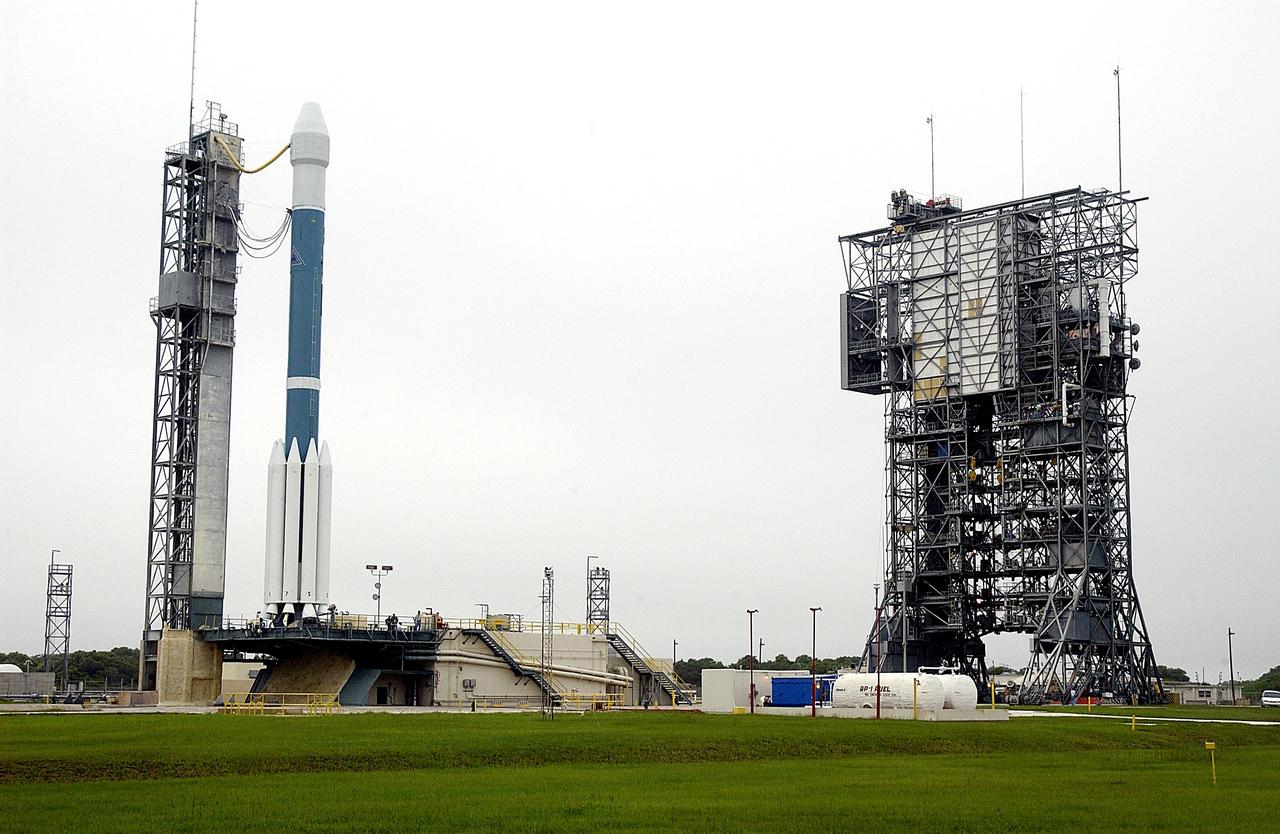
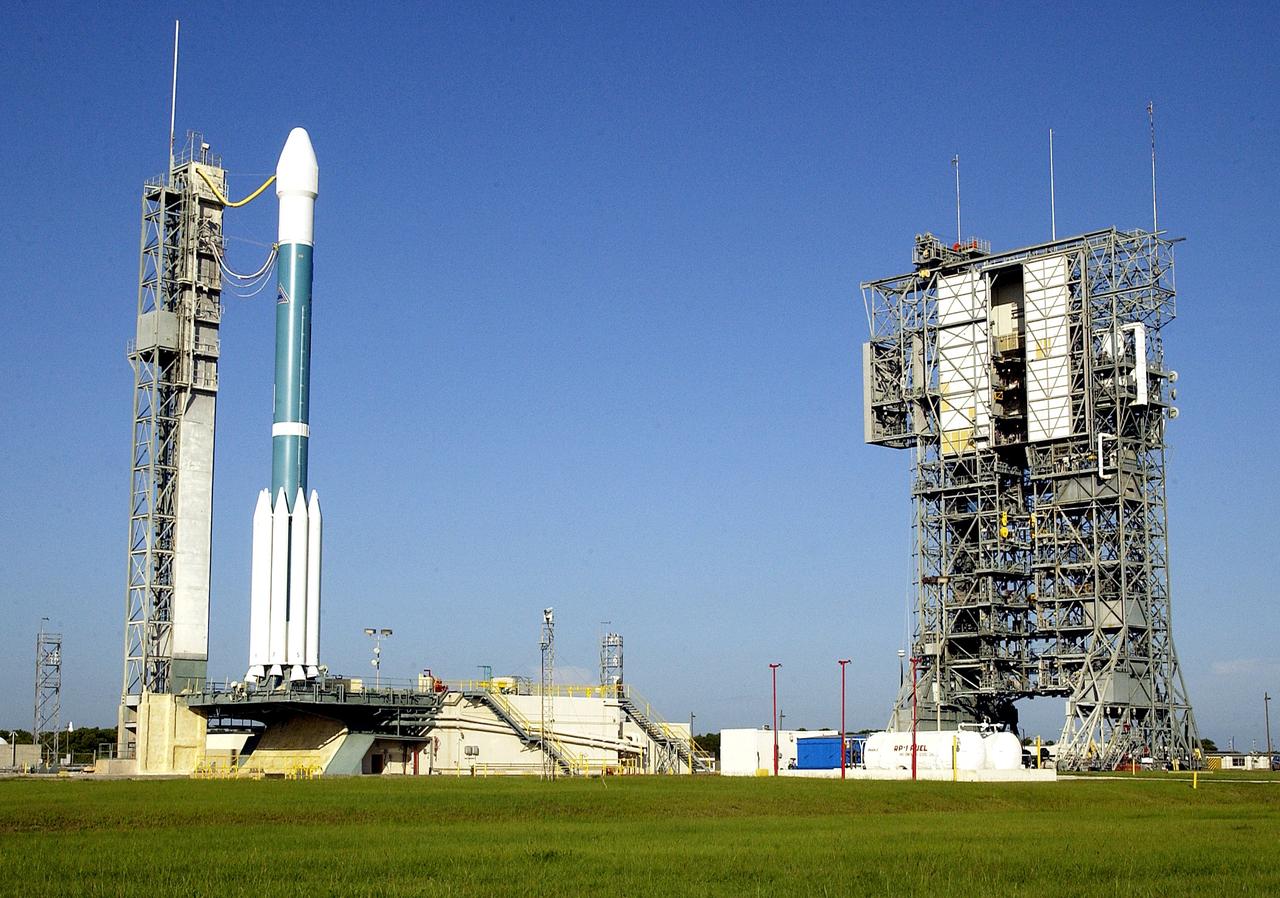
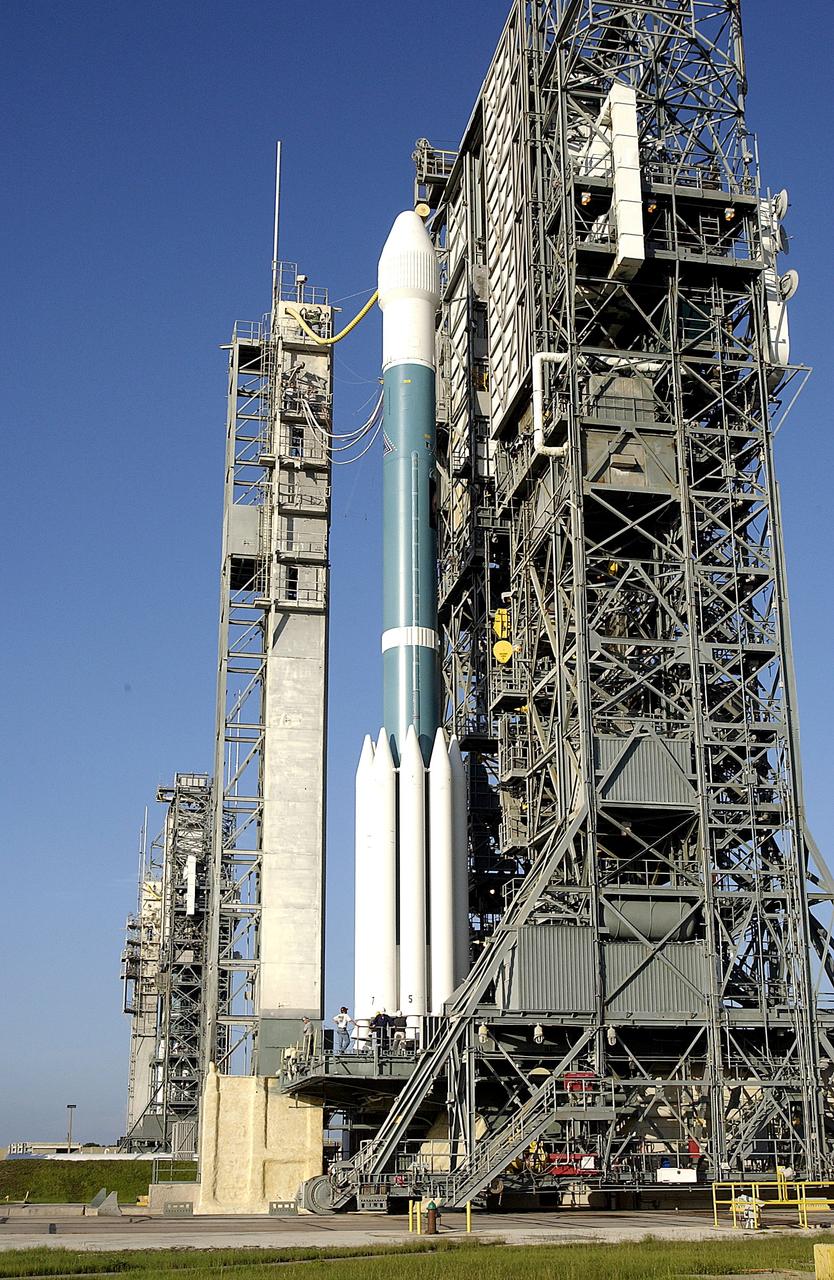
KENNEDY SPACE CENTER, FLA. -    The launch tower (right) on Launch Complex 17-A, Cape Canaveral Air Force Station, has been rolled back from the Boeing Delta II rocket and its Mars Exploration Rover (MER-A) payload (left) in preparation for a second attempt at launch.  The first attempt on June 8, 2003, was scrubbed due to bad weather in the vicinity.  MER-A is the first of two rovers being launched to Mars.  When the two rovers arrive at Mars in 2004, they will bounce to airbag-cushioned landings at sites offering a balance of favorable conditions for safe landings and interesting science. The rovers see sharper images, can explore farther and examine rocks better than anything that has ever landed on Mars.  The designated site for MER-A mission is Gusev Crater, which appears to have been a crater lake.  The second rover, MER-B, is scheduled to launch June 25.
KENNEDY SPACE CENTER, FLA. - The launch tower (right) on Launch Complex 17-A, Cape Canaveral Air Force Station, has been rolled back from the Boeing Delta II rocket and its Mars Exploration Rover (MER-A) payload (left) in preparation for a second attempt at launch. The first attempt on June 8, 2003, was scrubbed due to bad weather in the vicinity. MER-A is the first of two rovers being launched to Mars. When the two rovers arrive at Mars in 2004, they will bounce to airbag-cushioned landings at sites offering a balance of favorable conditions for safe landings and interesting science. The rovers see sharper images, can explore farther and examine rocks better than anything that has ever landed on Mars. The designated site for MER-A mission is Gusev Crater, which appears to have been a crater lake. The second rover, MER-B, is scheduled to launch June 25.
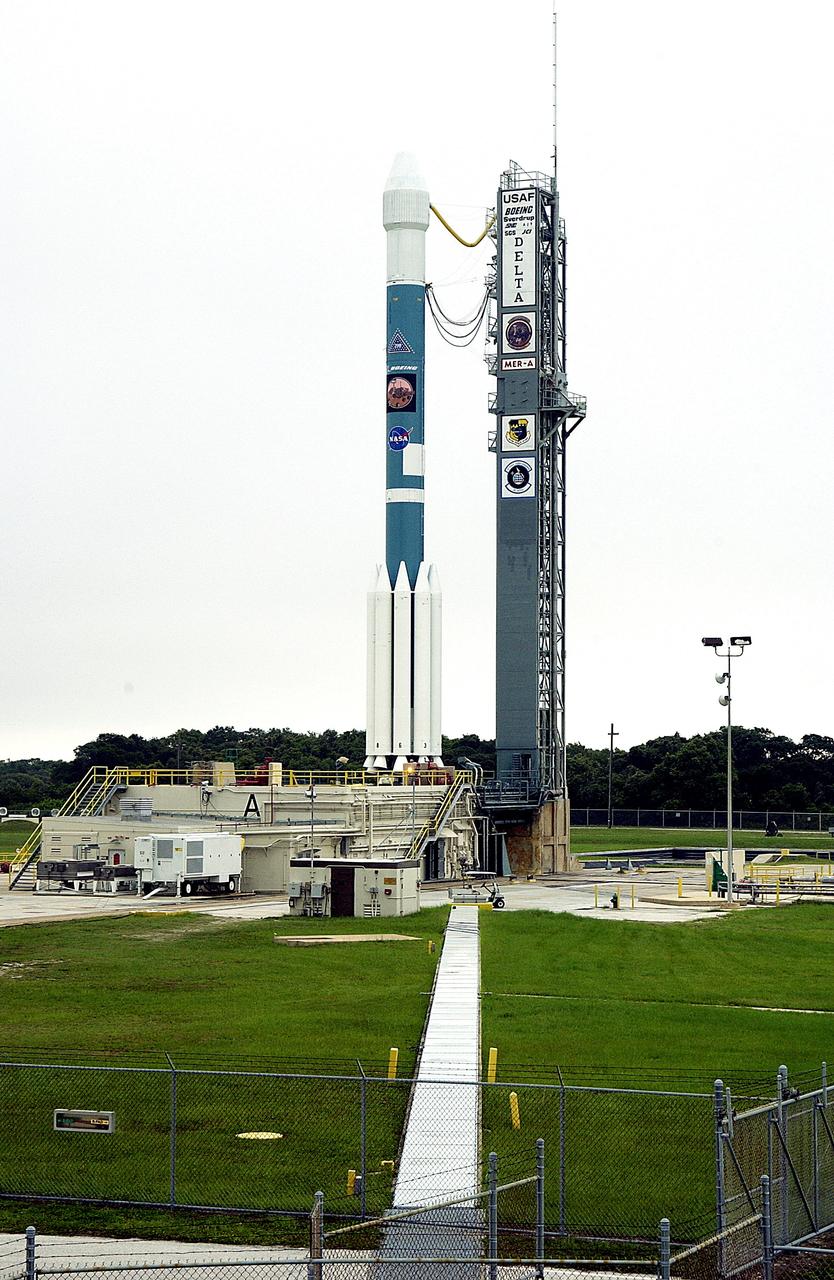
KENNEDY SPACE CENTER, FLA. -    On Launch Complex 17-A, Cape Canaveral Air Force Station, the Boeing Delta II rocket and its Mars Exploration Rover (MER-A) payload are in the clear after tower rollback in preparation for a second attempt at launch.  The first attempt on June 8, 2003, was scrubbed due to bad weather in the vicinity.  MER-A is the first of two rovers being launched to Mars.  When the two rovers arrive at Mars in 2004, they will bounce to airbag-cushioned landings at sites offering a balance of favorable conditions for safe landings and interesting science. The rovers see sharper images, can explore farther and examine rocks better than anything that has ever landed on Mars.  The designated site for MER-A mission is Gusev Crater, which appears to have been a crater lake.  The second rover, MER-B, is scheduled to launch June 25.
KENNEDY SPACE CENTER, FLA. - On Launch Complex 17-A, Cape Canaveral Air Force Station, the Boeing Delta II rocket and its Mars Exploration Rover (MER-A) payload are in the clear after tower rollback in preparation for a second attempt at launch. The first attempt on June 8, 2003, was scrubbed due to bad weather in the vicinity. MER-A is the first of two rovers being launched to Mars. When the two rovers arrive at Mars in 2004, they will bounce to airbag-cushioned landings at sites offering a balance of favorable conditions for safe landings and interesting science. The rovers see sharper images, can explore farther and examine rocks better than anything that has ever landed on Mars. The designated site for MER-A mission is Gusev Crater, which appears to have been a crater lake. The second rover, MER-B, is scheduled to launch June 25.
KENNEDY SPACE CENTER, FLA. -   With smoke and steam billowing beneath, the Delta II rocket with its Mars Exploration Rover (MER-A) payload leaps off the launch pad into the blue sky to begin its journey to Mars.  Liftoff occurred on time at 1:58 p.m. EDT from Launch Complex 17-A, Cape Canaveral Air Force Station.  MER-A, known as "Spirit," is the first of two rovers being launched to Mars. When the two rovers arrive at the red planet in 2004, they will bounce to airbag-cushioned landings at sites offering a balance of favorable conditions for safe landings and interesting science. The rovers see sharper images, can explore farther and examine rocks better than anything that has ever landed on Mars. The designated site for the MER-A mission is Gusev Crater, which appears to have been a crater lake. The second rover, MER-B, is scheduled to launch June 25.
KENNEDY SPACE CENTER, FLA. - With smoke and steam billowing beneath, the Delta II rocket with its Mars Exploration Rover (MER-A) payload leaps off the launch pad into the blue sky to begin its journey to Mars. Liftoff occurred on time at 1:58 p.m. EDT from Launch Complex 17-A, Cape Canaveral Air Force Station. MER-A, known as "Spirit," is the first of two rovers being launched to Mars. When the two rovers arrive at the red planet in 2004, they will bounce to airbag-cushioned landings at sites offering a balance of favorable conditions for safe landings and interesting science. The rovers see sharper images, can explore farther and examine rocks better than anything that has ever landed on Mars. The designated site for the MER-A mission is Gusev Crater, which appears to have been a crater lake. The second rover, MER-B, is scheduled to launch June 25.
KENNEDY SPACE CENTER, FLA. -  On Launch Complex 17-A, Cape Canaveral Air Force Station, the Boeing Delta II rocket and its Mars Exploration Rover (MER-A) payload are free of the tower  and ready for launch.  This will be the third launch attempt in as many days after weather concerns postponed the launches June 8 and June 9.  MER-A is the first of two rovers being launched to Mars.  When the two rovers arrive at Mars in 2004, they will bounce to airbag-cushioned landings at sites offering a balance of favorable conditions for safe landings and interesting science. The rovers see sharper images, can explore farther and examine rocks better than anything that has ever landed on Mars.  The designated site for MER-A mission is Gusev Crater, which appears to have been a crater lake.  The second rover, MER-B, is scheduled to launch June 25.
KENNEDY SPACE CENTER, FLA. - On Launch Complex 17-A, Cape Canaveral Air Force Station, the Boeing Delta II rocket and its Mars Exploration Rover (MER-A) payload are free of the tower and ready for launch. This will be the third launch attempt in as many days after weather concerns postponed the launches June 8 and June 9. MER-A is the first of two rovers being launched to Mars. When the two rovers arrive at Mars in 2004, they will bounce to airbag-cushioned landings at sites offering a balance of favorable conditions for safe landings and interesting science. The rovers see sharper images, can explore farther and examine rocks better than anything that has ever landed on Mars. The designated site for MER-A mission is Gusev Crater, which appears to have been a crater lake. The second rover, MER-B, is scheduled to launch June 25.
KENNEDY SPACE CENTER, FLA. - Leaving smoke and steam behind, the Delta II rocket with its Mars Exploration Rover (MER-A) payload lifts off the pad on time at 1:58 p.m. EDT from Launch Complex 17-A, Cape Canaveral Air Force Station. MER-A, known as "Spirit," is the first of two rovers being launched to Mars. When the two rovers arrive at the red planet in 2004, they will bounce to airbag-cushioned landings at sites offering a balance of favorable conditions for safe landings and interesting science. The rovers see sharper images, can explore farther and examine rocks better than anything that has ever landed on Mars. The designated site for the MER-A mission is Gusev Crater, which appears to have been a crater lake. The second rover, MER-B, is scheduled to launch June 25.
KENNEDY SPACE CENTER, FLA. - Blue sky and sun give a dramatic backdrop for the launch of  the Delta II rocket with its Mars Exploration Rover (MER-A) payload.  Liftoff occurred on time at 1:58 p.m. EDT from Launch Complex 17-A, Cape Canaveral Air Force Station. MER-A, known as "Spirit," is the first of two rovers being launched to Mars. When the two rovers arrive at the red planet in 2004, they will bounce to airbag-cushioned landings at sites offering a balance of favorable conditions for safe landings and interesting science. The rovers see sharper images, can explore farther and examine rocks better than anything that has ever landed on Mars. The designated site for the MER-A mission is Gusev Crater, which appears to have been a crater lake. The second rover, MER-B, is scheduled to launch June 25.
KENNEDY SPACE CENTER, FLA. - Blue sky and sun give a dramatic backdrop for the launch of the Delta II rocket with its Mars Exploration Rover (MER-A) payload. Liftoff occurred on time at 1:58 p.m. EDT from Launch Complex 17-A, Cape Canaveral Air Force Station. MER-A, known as "Spirit," is the first of two rovers being launched to Mars. When the two rovers arrive at the red planet in 2004, they will bounce to airbag-cushioned landings at sites offering a balance of favorable conditions for safe landings and interesting science. The rovers see sharper images, can explore farther and examine rocks better than anything that has ever landed on Mars. The designated site for the MER-A mission is Gusev Crater, which appears to have been a crater lake. The second rover, MER-B, is scheduled to launch June 25.
KENNEDY SPACE CENTER, FLA. -  On Launch Complex 17-A, Cape Canaveral Air Force Station, the launch tower begins to roll back from the Boeing Delta II rocket and its Mars Exploration Rover (MER-A) payload in preparation for a second attempt at launch.  The first attempt on June 8, 2003, was scrubbed due to bad weather in the vicinity.  MER-A is the first of two rovers being launched to Mars.  When the two rovers arrive at Mars in 2004, they will bounce to airbag-cushioned landings at sites offering a balance of favorable conditions for safe landings and interesting science. The rovers see sharper images, can explore farther and examine rocks better than anything that has ever landed on Mars.  The designated site for MER-A mission is Gusev Crater, which appears to have been a crater lake.  The second rover, MER-B, is scheduled to launch June 25.
KENNEDY SPACE CENTER, FLA. - On Launch Complex 17-A, Cape Canaveral Air Force Station, the launch tower begins to roll back from the Boeing Delta II rocket and its Mars Exploration Rover (MER-A) payload in preparation for a second attempt at launch. The first attempt on June 8, 2003, was scrubbed due to bad weather in the vicinity. MER-A is the first of two rovers being launched to Mars. When the two rovers arrive at Mars in 2004, they will bounce to airbag-cushioned landings at sites offering a balance of favorable conditions for safe landings and interesting science. The rovers see sharper images, can explore farther and examine rocks better than anything that has ever landed on Mars. The designated site for MER-A mission is Gusev Crater, which appears to have been a crater lake. The second rover, MER-B, is scheduled to launch June 25.
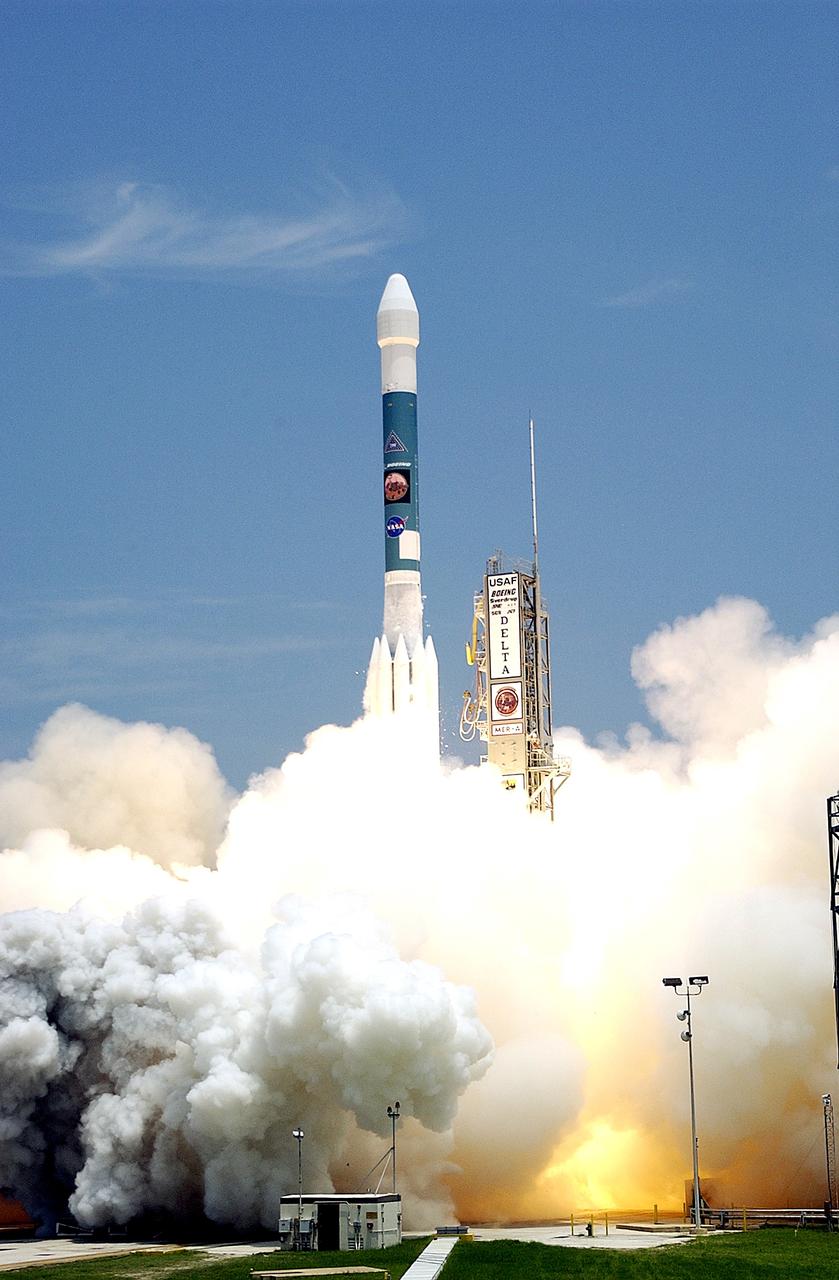
KENNEDY SPACE CENTER, FLA. -   Surrounded by smoke and steam, the Delta II rocket with its Mars Exploration Rover (MER-A) payload hurtles through it into the blue sky to begin its journey to Mars.  Liftoff occurred on time at 1:58 p.m. EDT from Launch Complex 17-A, Cape Canaveral Air Force Station.  MER-A, known as "Spirit," is the first of two rovers being launched to Mars. When the two rovers arrive at the red planet in 2004, they will bounce to airbag-cushioned landings at sites offering a balance of favorable conditions for safe landings and interesting science. The rovers see sharper images, can explore farther and examine rocks better than anything that has ever landed on Mars. The designated site for the MER-A mission is Gusev Crater, which appears to have been a crater lake. The second rover, MER-B, is scheduled to launch June 25.
KENNEDY SPACE CENTER, FLA. - Surrounded by smoke and steam, the Delta II rocket with its Mars Exploration Rover (MER-A) payload hurtles through it into the blue sky to begin its journey to Mars. Liftoff occurred on time at 1:58 p.m. EDT from Launch Complex 17-A, Cape Canaveral Air Force Station. MER-A, known as "Spirit," is the first of two rovers being launched to Mars. When the two rovers arrive at the red planet in 2004, they will bounce to airbag-cushioned landings at sites offering a balance of favorable conditions for safe landings and interesting science. The rovers see sharper images, can explore farther and examine rocks better than anything that has ever landed on Mars. The designated site for the MER-A mission is Gusev Crater, which appears to have been a crater lake. The second rover, MER-B, is scheduled to launch June 25.
KENNEDY SPACE CENTER, FLA. -   With a glimpse of the Atlantic Ocean over the horizon, the Delta II rocket with its Mars Exploration Rover (MER-A) payload leaps off the launch pad into the blue sky to begin its journey to Mars.  Liftoff occurred on time at 1:58 p.m. EDT from Launch Complex 17-A, Cape Canaveral Air Force Station.  MER-A, known as "Spirit," is the first of two rovers being launched to Mars. When the two rovers arrive at the red planet in 2004, they will bounce to airbag-cushioned landings at sites offering a balance of favorable conditions for safe landings and interesting science. The rovers see sharper images, can explore farther and examine rocks better than anything that has ever landed on Mars. The designated site for the MER-A mission is Gusev Crater, which appears to have been a crater lake. The second rover, MER-B, is scheduled to launch June 25
KENNEDY SPACE CENTER, FLA. - With a glimpse of the Atlantic Ocean over the horizon, the Delta II rocket with its Mars Exploration Rover (MER-A) payload leaps off the launch pad into the blue sky to begin its journey to Mars. Liftoff occurred on time at 1:58 p.m. EDT from Launch Complex 17-A, Cape Canaveral Air Force Station. MER-A, known as "Spirit," is the first of two rovers being launched to Mars. When the two rovers arrive at the red planet in 2004, they will bounce to airbag-cushioned landings at sites offering a balance of favorable conditions for safe landings and interesting science. The rovers see sharper images, can explore farther and examine rocks better than anything that has ever landed on Mars. The designated site for the MER-A mission is Gusev Crater, which appears to have been a crater lake. The second rover, MER-B, is scheduled to launch June 25
KENNEDY SPACE CENTER, FLA. -  On Launch Complex 17-A, Cape Canaveral Air Force Station, the Boeing Delta II rocket and Mars Exploration Rover 2 (MER-A) are ready for the third launch attempt after weather concerns postponed earlier attempts.   MER-A is the first of two rovers being launched to Mars.  When the two rovers arrive at Mars in 2004, they will bounce to airbag-cushioned landings at sites offering a balance of favorable conditions for safe landings and interesting science. The rovers see sharper images, can explore farther and examine rocks better than anything that has ever landed on Mars.  The designated site for MER-A mission is Gusev Crater, which appears to have been a crater lake.  The second rover, MER-B, is scheduled to launch June 25.
KENNEDY SPACE CENTER, FLA. - On Launch Complex 17-A, Cape Canaveral Air Force Station, the Boeing Delta II rocket and Mars Exploration Rover 2 (MER-A) are ready for the third launch attempt after weather concerns postponed earlier attempts. MER-A is the first of two rovers being launched to Mars. When the two rovers arrive at Mars in 2004, they will bounce to airbag-cushioned landings at sites offering a balance of favorable conditions for safe landings and interesting science. The rovers see sharper images, can explore farther and examine rocks better than anything that has ever landed on Mars. The designated site for MER-A mission is Gusev Crater, which appears to have been a crater lake. The second rover, MER-B, is scheduled to launch June 25.
As if perched on top of a candle, the Mars Exploration Rover known as “Spirit” is hurled into space on a Delta II rocket. Liftoff occurred on time at 1:58 p.m. EDT from Launch Complex 17-A, Cape Canaveral Air Force Station. MER-A is the first of two rovers being launched to Mars. When the two rovers arrive at the red planet in 2004, they will bounce to airbag-cushioned landings at sites offering a balance of favorable conditions for safe landings and interesting science. The rovers see sharper images, can explore farther and examine rocks better than anything that has ever landed on Mars. The designated site for the MER-A mission is Gusev Crater, which appears to have been a crater lake. The second rover, MER-B, is scheduled to launch June 25.
Delta II MER-A Spirit Launch
Amid billows of smoke and steam, the Delta II rocket with its Mars Exploration Rover (MER-A) payload lifts off the pad on time at 1:58 p.m. EDT from Launch Complex 17-A, Cape Canaveral Air Force Station. MER-A, known as "Spirit," is the first of two rovers being launched to Mars. When the two rovers arrive at the red planet in 2004, they will bounce to airbag-cushioned landings at sites offering a balance of favorable conditions for safe landings and interesting science. The rovers see sharper images, can explore farther and examine rocks better than anything that has ever landed on Mars. The designated site for the MER-A mission is Gusev Crater, which appears to have been a crater lake. The second rover, MER-B, is scheduled to launch June 25.
Delta II MER-A Spirit Launch
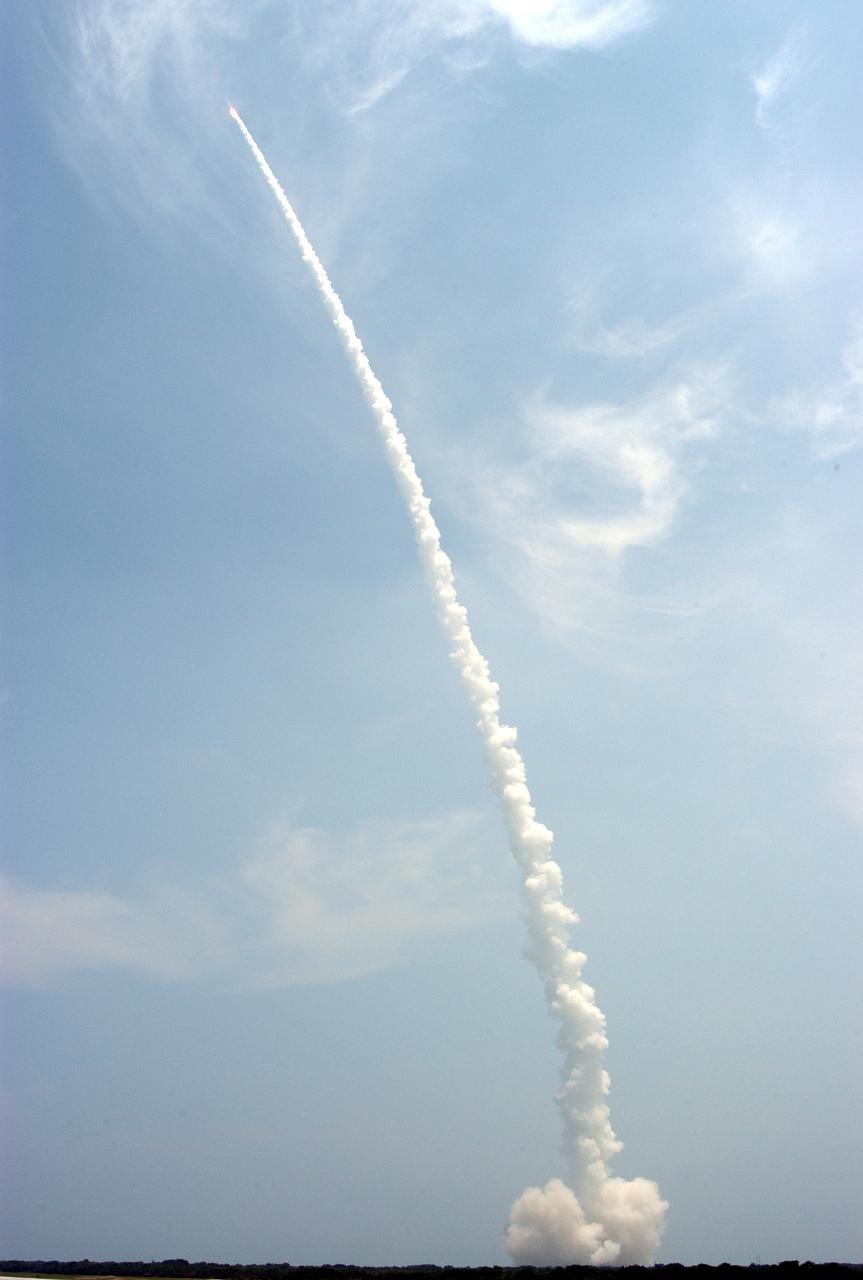
A trail of smoke is all that identifies the Delta II rocket with its Mars Exploration Rover (MER-A) payload as it hurtles into space. Liftoff occurred on time at 1:58 p.m. EDT from Launch Complex 17-A, Cape Canaveral Air Force Station. MER-A, known as "Spirit," is the first of two rovers being launched to Mars. When the two rovers arrive at the red planet in 2004, they will bounce to airbag-cushioned landings at sites offering a balance of favorable conditions for safe landings and interesting science. The rovers see sharper images, can explore farther and examine rocks better than anything that has ever landed on Mars. The designated site for the MER-A mission is Gusev Crater, which appears to have been a crater lake. The second rover, MER-B, is scheduled to launch June 25.
Delta II MER-A Spirit Launch
Blue sky and sun are the backdrop for a flawless launch of MER-A, known as “Spirit,” the first of two Mars Exploration Rovers to be sent to Mars. Liftoff occurred on time at 1:58 p.m. EDT from Launch Complex 17-A, Cape Canaveral Air Force Station. When the two rovers arrive at Mars in 2004, they will bounce to airbag-cushioned landings at sites offering a balance of favorable conditions for safe landings and interesting science. The rovers see sharper images, can explore farther and examine rocks better than anything that has ever landed on Mars. The designated site for the MER-A mission is Gusev Crater, which appears to have been a crater lake. The second rover, MER-B, is scheduled to launch June 25.
Delta II MER-A Spirit Launch
The Delta II rocket with its Mars Exploration Rover (MER-A) payload leaps from the smoke and steam below into space. Liftoff occurred on time at 1:58 p.m. EDT from Launch Complex 17-A, Cape Canaveral Air Force Station. MER-A, known as "Spirit," is the first of two rovers being launched to Mars. When the two rovers arrive at the red planet in 2004, they will bounce to airbag-cushioned landings at sites offering a balance of favorable conditions for safe landings and interesting science. The rovers see sharper images, can explore farther and examine rocks better than anything that has ever landed on Mars. The designated site for the MER-A mission is Gusev Crater, which appears to have been a crater lake. The second rover, MER-B, is scheduled to launch June 25.
Delta II MER-A Spirit Launch
Blue sky and sun are the backdrop for a flawless launch of MER-A, known as“Spirit,” the first of two Mars Exploration Rovers to be sent to Mars. Liftoff occurred on time at 1:58 p.m. EDT from Launch Complex 17-A, Cape Canaveral Air Force Station. When the two rovers arrive at Mars in 2004, they will bounce to airbag-cushioned landings at sites offering a balance of favorable conditions for safe landings and interesting science. The rovers see sharper images, can explore farther and examine rocks better than anything that has ever landed on Mars. The designated site for MER-A mission is Gusev Crater, which appears to have been a crater lake. The second rover, MER-B, is scheduled to launch June 25.
Delta II MER-A Spirit Launch
This image from NASA's Mars Reconnaissance Orbiter shows Gorgonum Basin, one of several large basins within the Terra Sirenum region of Mars. Each basin has light-toned mounds, many of which contain clays.  Scientists think that Terra Sirenum once had a large lake during an epoch called the Late Noachian/Early Hesperian, and each basin filled with sediments. The water within the lake may have altered these sediments to form the clays we now observe from orbit. Ma'adim Vallis, which drains into Gusev Crater where the Spirit rover landed, drained the water from this ancient lake.  Why the basin floors exhibit mounds similar to chaos regions on Mars is unknown, but could be the result of collapse and subsequent erosion within the basins.  https://photojournal.jpl.nasa.gov/catalog/PIA21767
Light-toned Mounds in Gorgonum Basin
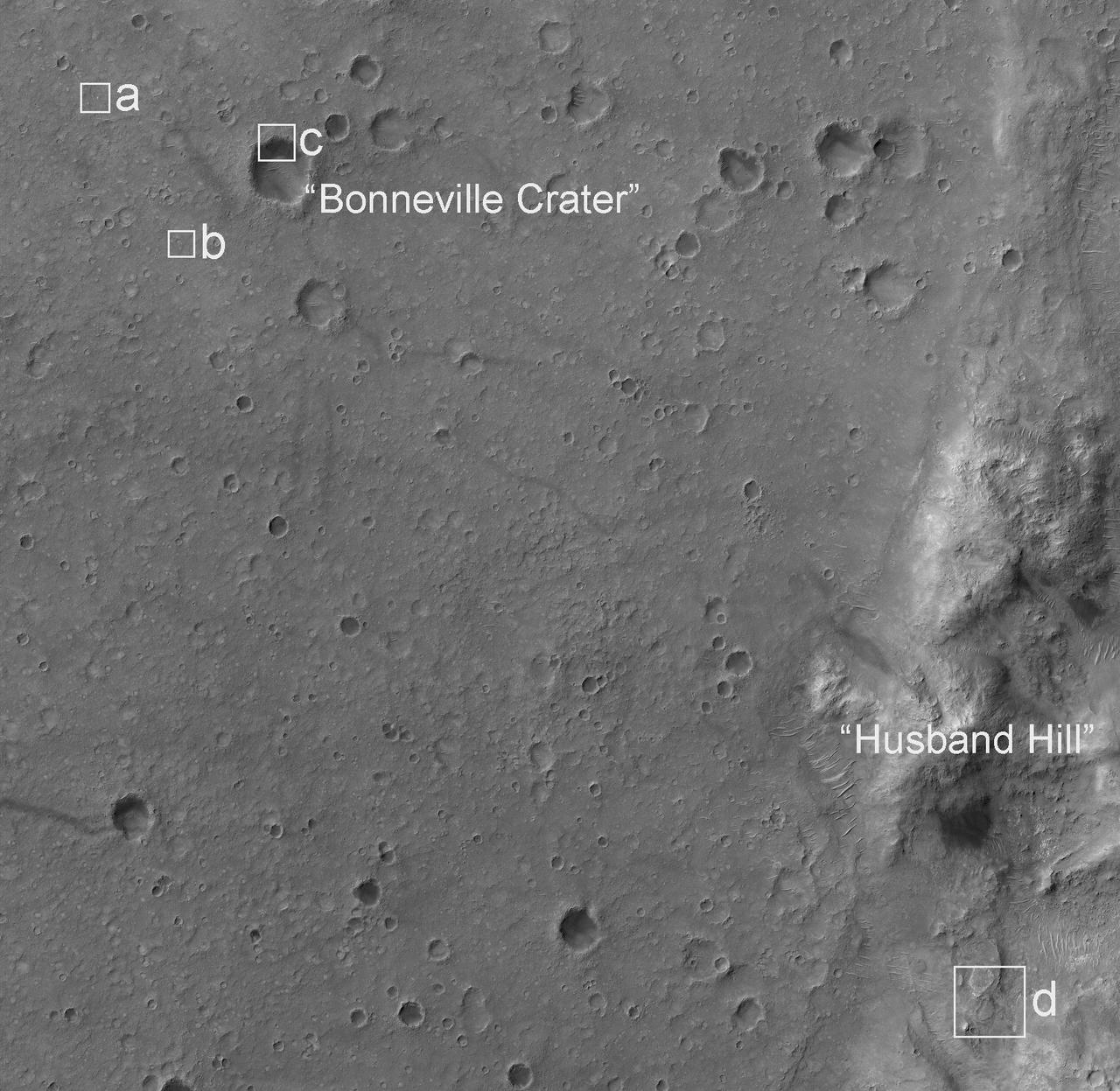
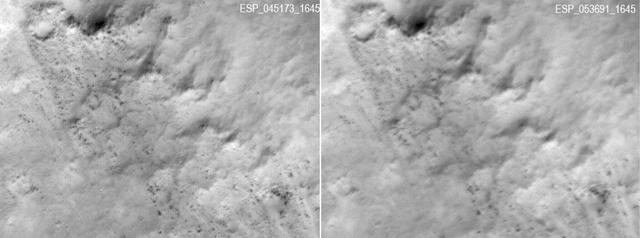
These two frames were taken of the same place on Mars by the same orbiting camera before (left) and after some images from the camera began showing unexpected blur.  The images are from the High Resolution Imaging Science Experiment (HiRISE) camera on NASA's Mars Reconnaissance Orbiter. They show a patch of ground about 500 feet or 150 meters wide in Gusev Crater. The one on the left, from HiRISE observation ESP_045173_1645, was taken March 16, 2016. The one on the right was taken Jan. 9, 2018. Gusev Crater, at 15 degrees south latitude and 176 degrees east longitude, is the landing site of NASA's Spirit Mars rover in 2004 and a candidate landing site for a rover to be launched in 2020. HiRISE images provide important information for evaluating potential landing sites. The smallest boulders with measurable diameters in the left image are about 3 feet (90 centimeters) wide. In the blurred image, the smallest measurable are about double that width.  As of early 2018, most full-resolution images from HiRISE are not blurred, and the cause of the blur is still under investigation. Even before blurred images were first seen, in 2017, observations with HiRISE commonly used a technique that covers more ground area at half the resolution. This shows features smaller than can be distinguished with any other camera orbiting Mars, and little blurring has appeared in these images.   https://photojournal.jpl.nasa.gov/catalog/PIA22215
Slight Blurring in Newer Image from Mars Orbiter
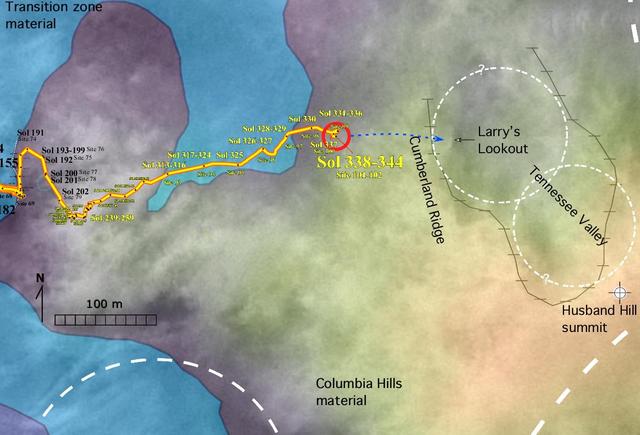
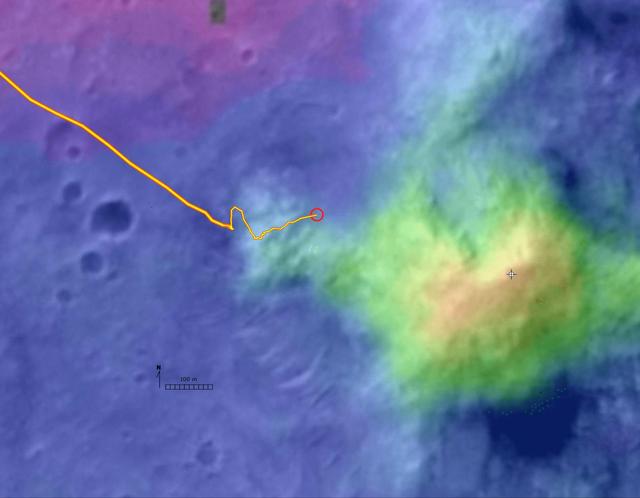
This digital elevation map, produced from satellite data overlain on an image taken by the Mars Orbital Camera on NASA's Mars Global Surveyor spacecraft, shows changes in elevation along the trek of NASA's Mars Exploration Rover Spirit as of the rover's 328th martian day, or sol (Dec. 4, 2004). To that point, Spirit had driven a total of 3.89 kilometers (2.42 miles).      The blue area represents the basaltic plains on the floor of Gusev Crater, about 20 meters (66 feet) below the rover's present location. Spirit crossed those plains for several months after landing to the west, off the left edge of this image. The greenish-blue area is the "West Spur" of the "Columbia Hills," which Spirit reached on sol 156 (June 11, 2004). Since then, Spirit has been gradually ascending the slopes of the "West Spur" in an east-northeasterly direction. Southeast of the rover's current position is a brighter green area that represents an abrupt increase in slope where the "West Spur" meets the steeper flanks of the "Columbia Hills." The yellow and red areas represent the highest slopes and peaks. A steep valley east of the rover's location appears, from orbiter images, to have layered outcrops. Scientists are directing the rover to a ridge overlooking the valley to get a better look at what lies ahead.  http://photojournal.jpl.nasa.gov/catalog/PIA07089
Digital Elevation Map of Spirit Trek