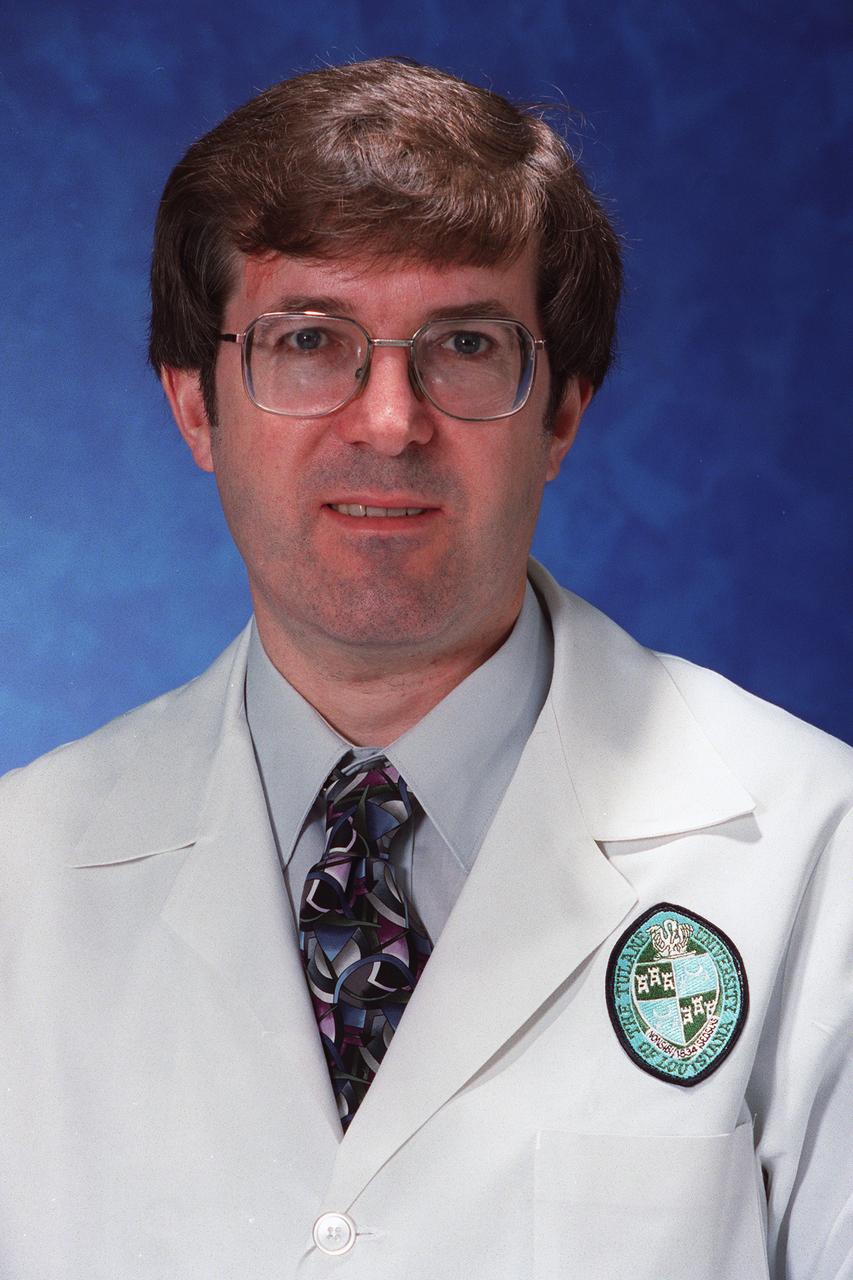
Dr. Timothy G. Hammond of the Department of Internal Medicine, Nephrology Section, Tulane University Medical Center, New Orleans, LA, is one of NASA's principal investigators conducting research with the NASA Bioreactor project directed by Johrnson Space Center. Hammond's investigations include Production of 1-25- diOH D3 by Renal Epithelial Cells in Simulated Microgravity Culture and Differentiation of Cultured Normal Human Renal Epithelial Cells in Microgravity. Photo credit: Tulane University.
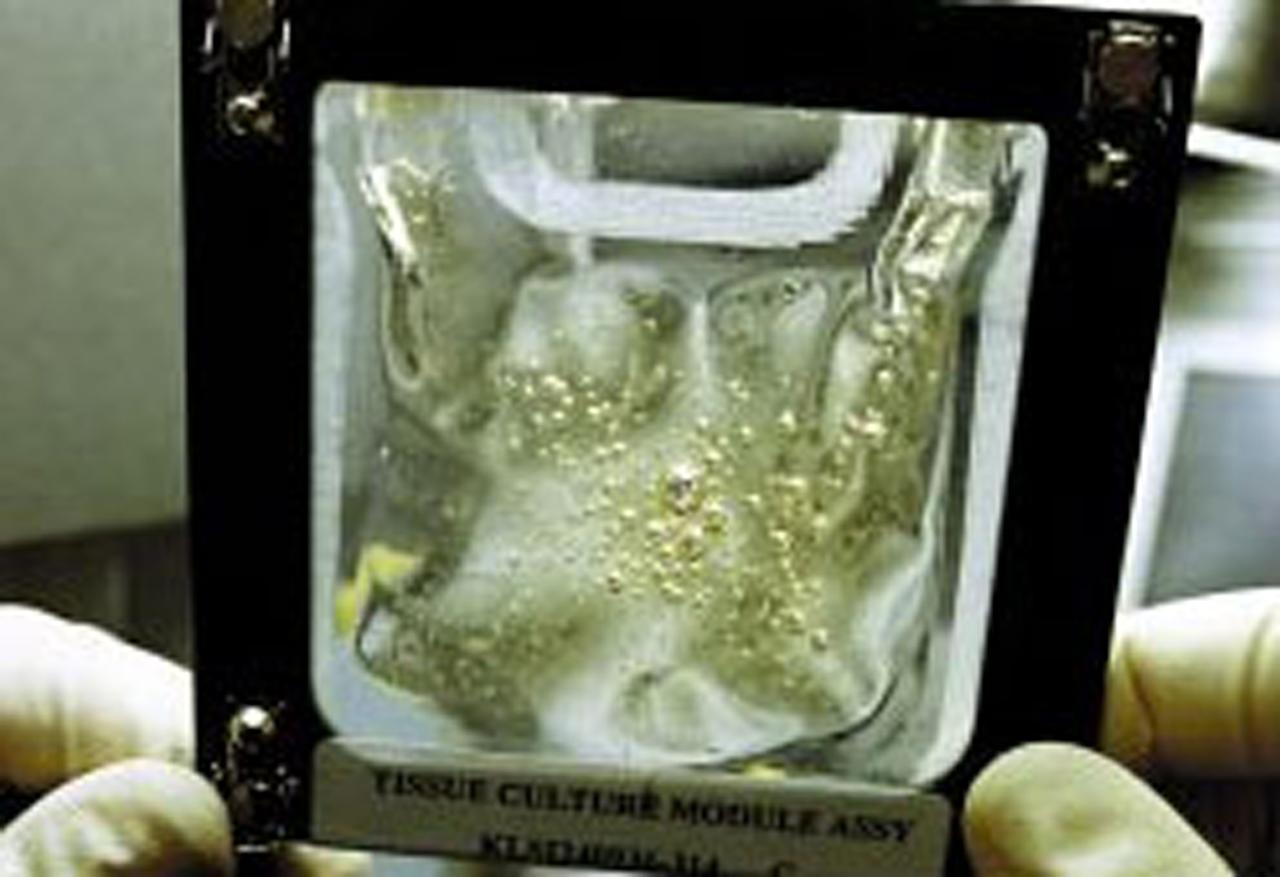
During the STS-90 shuttle flight in April 1998, cultured renal cortical cells revealed new information about genes. Timothy Hammond, an investigator in NASA's microgravity biotechnology program was interested in culturing kidney tissue to study the expression of proteins useful in the treatment of kidney diseases. Protein expression is linked to the level of differentiation of the kidney cells, and Hammond had difficulty maintaining differentiated cells in vitro. Intrigued by the improvement in cell differentiation that he observed in rat renal cells cultured in NASA's rotating wall vessel (a bioreactor that simulates some aspects of microgravity) and during an experiment performed on the Russian Space Station Mir, Hammond decided to sleuth out which genes were responsible for controlling differentiation of kidney cells. To do this, he compared the gene activity of human renal cells in a variety of gravitational environments, including the microgravity of the space shuttle and the high-gravity environment of a centrifuge. Hammond found that 1,632 genes out of 10,000 analyzed changed their activity level in microgravity, more than in any of the other environments. These results have important implications for kidney research as well as for understanding the basic mechanism for controlling cell differentiation.
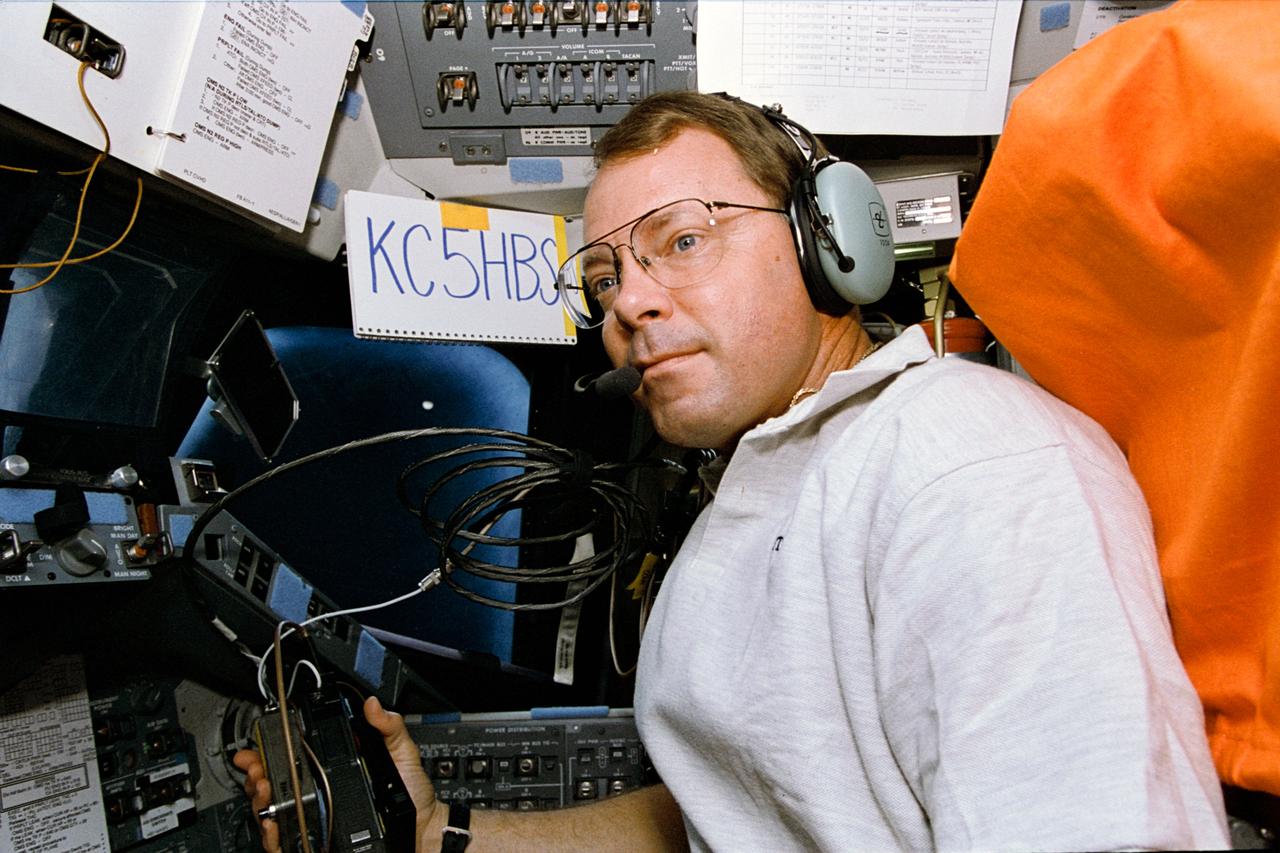
STS064-04-009 (9-20 Sept. 1994) --- Astronaut L. Blaine Hammond, STS-64 pilot, talks to students on Earth via the Shuttle Amateur Radio Experiment (SAREX) on the space shuttle Discovery's flight deck. The recently licensed "Ham" operator and several other crew members throughout the mission were connected with schools around the world with the aid of a number of amateur radio operators. Hammond joined five other NASA astronauts for almost 11 days in Earth orbit aboard Discovery. Photo credit: NASA or National Aeronautics and Space Administration
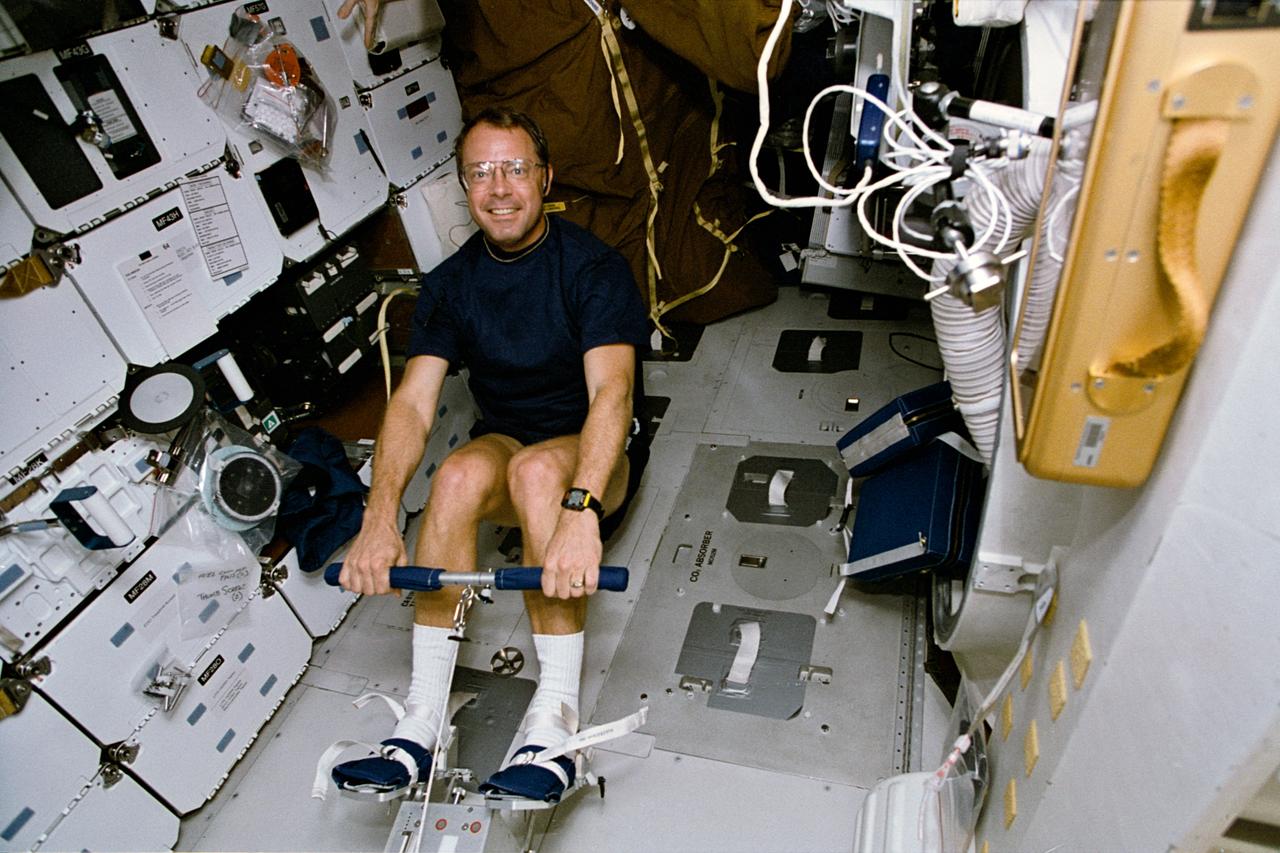
STS064-09-026 (9-20 Sept. 1994) --- Astronaut L. Blaine Hammond, STS-64 pilot, gets microgravity exercise on the rowing machine. This area of the space shuttle Discovery's middeck was also used for the treadmill exercising device. Blaine and five other NASA astronauts spent almost 11 days in Earth orbit in support of the mission. Photo credit: NASA or National Aeronautics and Space Administration
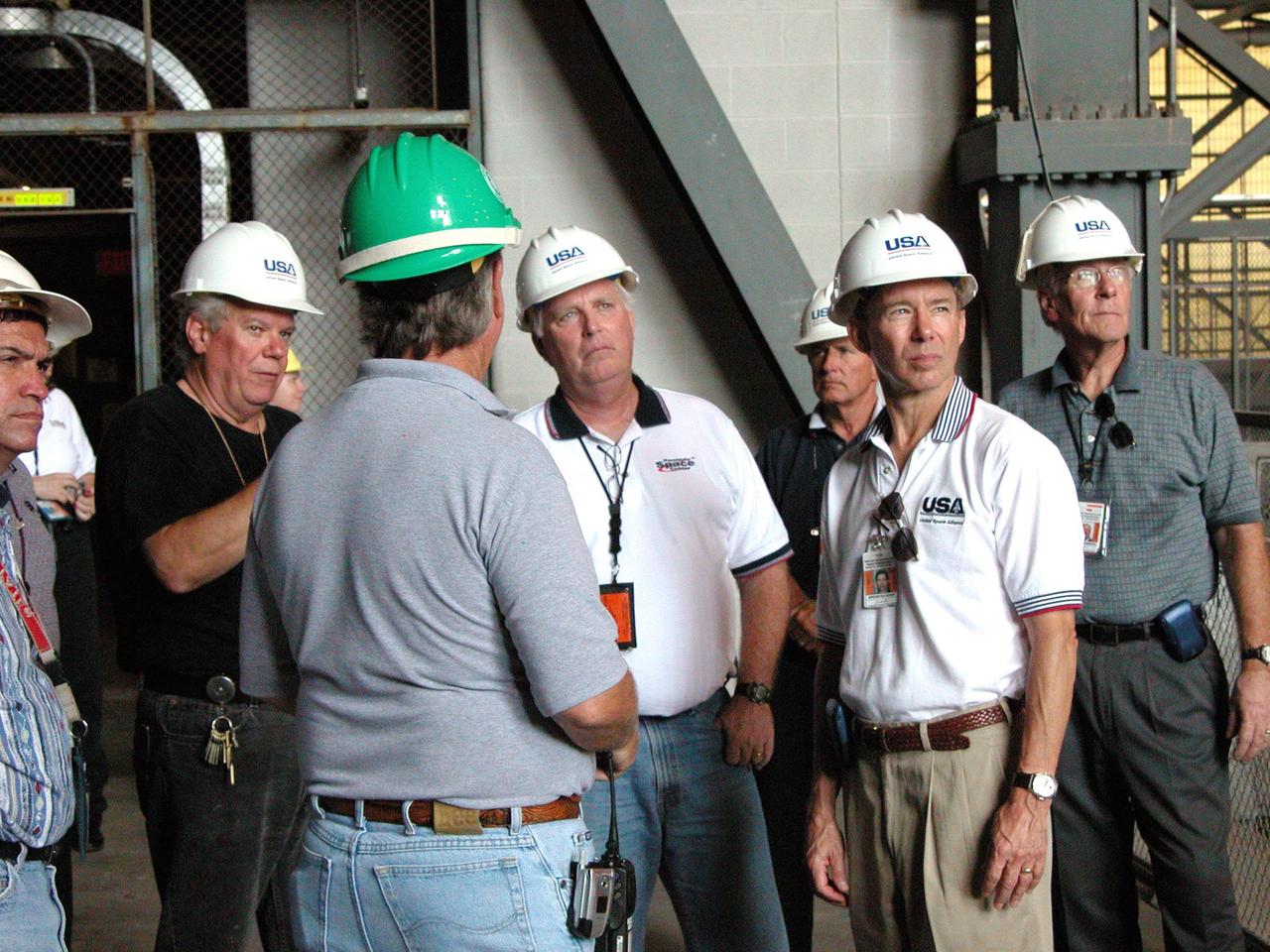
KENNEDY SPACE CENTER, FLA. - Members of the United Space Alliance (USA) safety team brief KSC Director Jim Kennedy (center), USA Chief Operating Officer Brewster Shaw (second from right), and USA Vice President Joe Hammond (right) following Hurricane Frances on damage sustained by KSC facilities. The storm's path over Florida took it through Cape Canaveral and KSC property during Labor Day weekend.
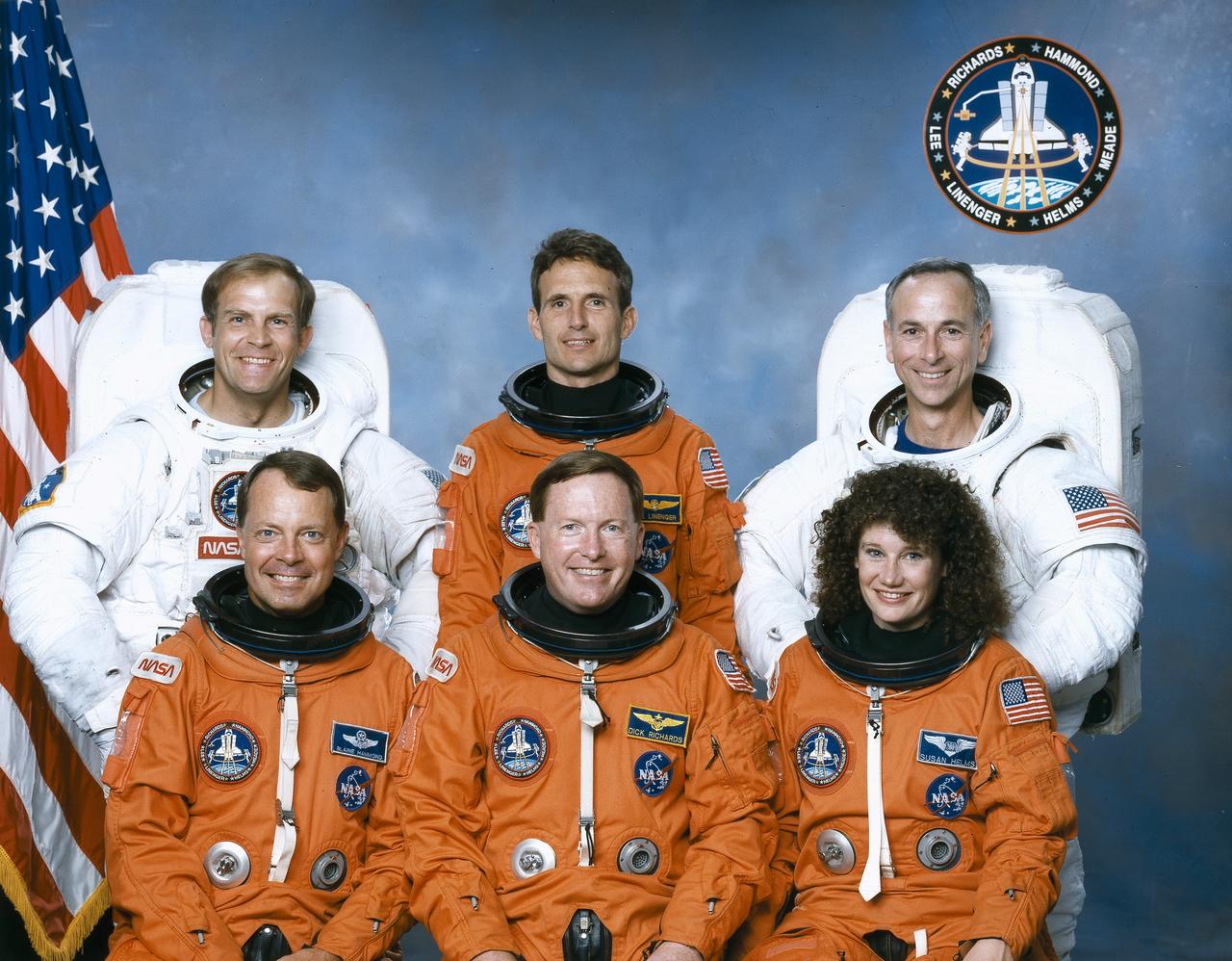
The crew assigned to the STS-64 mission included Richard N. Richards, commander (center front); L. Blaine Hammond Jr., pilot (front left); and Susan J. Helms, mission specialist (front right). On the back row, from left to right, are Mark C. Lee, Jerry M. Linenger, and Carl J. Meade, all mission specialists. Launched aboard the Space Shuttle Discovery on September 9, 1994 at 6:22:55 pm (EDT), the STS-64 mission marked the first flight of the Lidar In-Space Technology Experiment (LITE) and the first untethered Extravehicular Activity (EVA) in ten years.
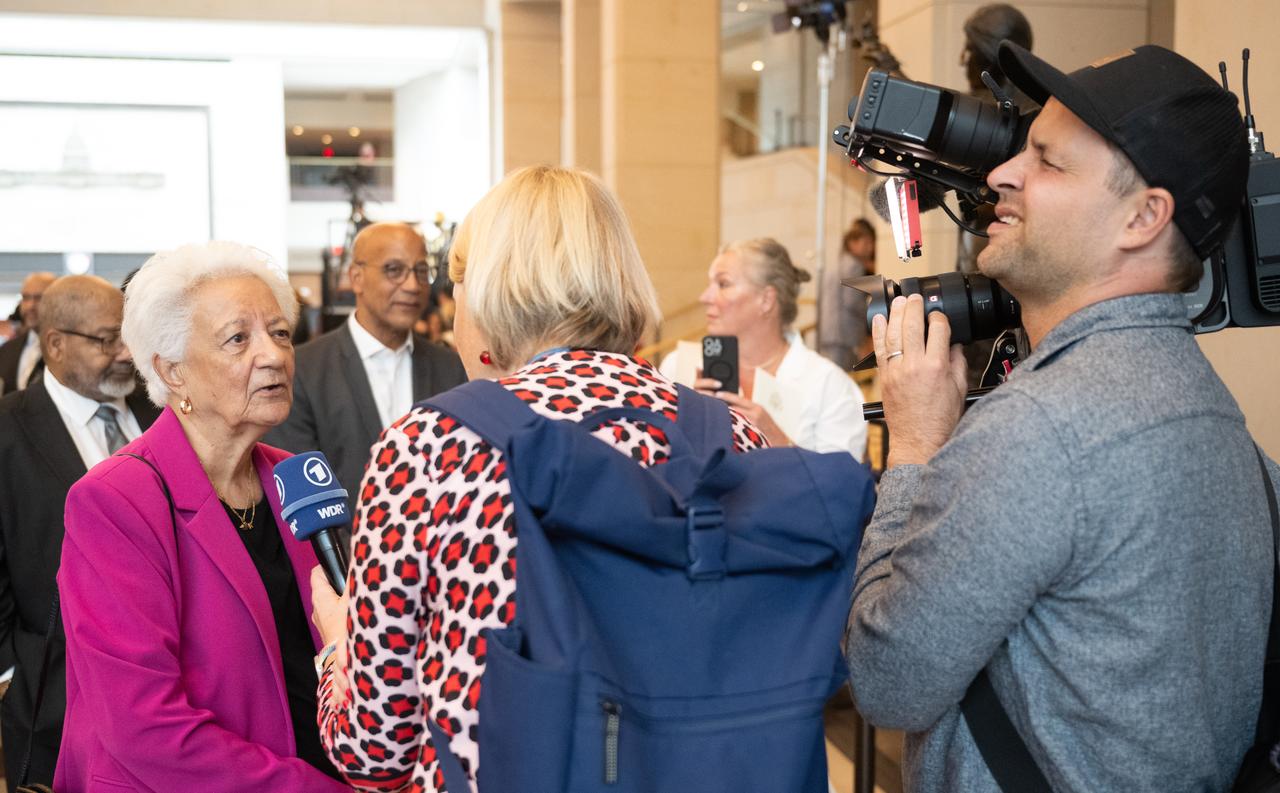
Ann Hammond, daughter of Dorothy Vaughan, speaks with a member of the media following a Congressional Gold Medal ceremony recognizing NASA’s Hidden Figures, Wednesday, Sept. 18, 2024, in Emancipation Hall at the U.S. Capitol in Washington. Congressional Gold Medals were awarded to Katherine Johnson, Dr. Christine Darden, Dorothy Vaughan, and Mary W. Jackson in recognition of their service to the United States as well as a Congressional Gold Medal in recognition of all the women who served as computers, mathematicians, and engineers at the National Advisory Committee for Aeronautics and NASA between the 1930s and 1970s. Photo Credit: (NASA/Joel Kowsky)
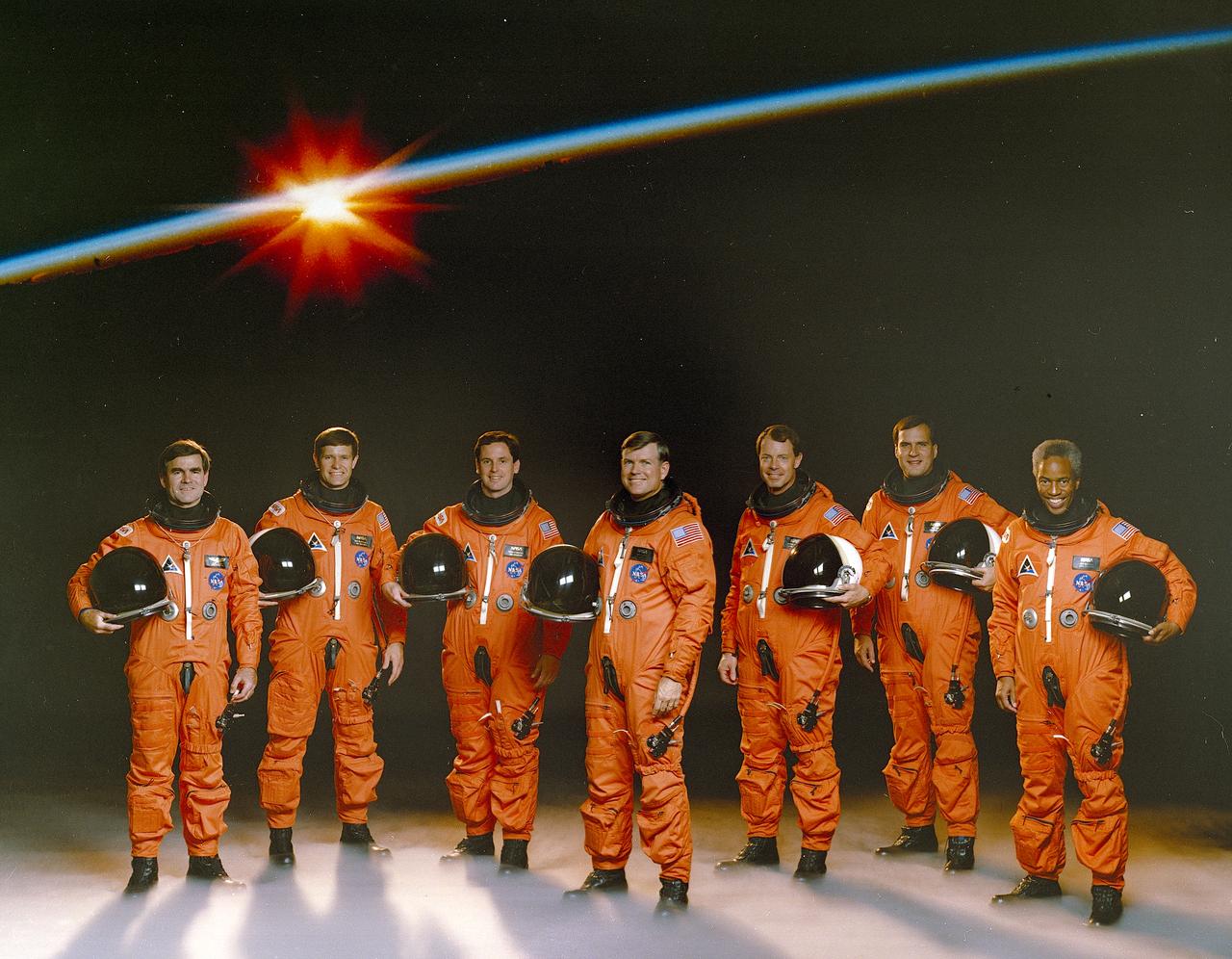
The STS-39 crew portrait includes 7 astronauts. Pictured are Charles L. Veach, mission specialist 5; Michael L. Coats, commander; Gregory J. Harbaugh, mission specialist 2; Donald R. McMonagle, mission specialist 4; L. Blaine Hammond, pilot; Richard J. Hieb, mission specialist 3; and Guion S. Buford, Jr., mission specialist 1. Launched aboard the Space Shuttle Discovery on April 28, 1991 at 7:33:14 am (EDT), STS-39 was a Department of Defense (DOD) mission. The primary unclassified payload included the Air Force Program 675 (AFP-675), the Infrared Background Signature Survey (IBSS), and the Shuttle Pallet Satellite II (SPAS II).

S90-52756 (December 1990) --- NASA's STS-39 crew members, wearing their partial pressure launch and entry suits, pose for traditional portrait. Left to right are astronauts Charles L. (Lacy) Veach, Donald R. McMonagle, Gregory J. Harbaugh, Michael L. Coats, L. Blaine Hammond Jr., Richard J. Hieb and Guion S. Bluford Jr. Coats is mission commander; Hammond, pilot, and the others are mission specialists. Photo credit: NASA

STS064-23-025 (9-20 Sept. 1994) --- With scissors in hand, astronaut Jerry M. Linenger, STS-64 mission specialist, prepares to cut off a lengthy sheet of correspondence from ground controllers. Called the Thermal Imaging Printing System (TIPS), the message center occupies a stowage locker on the space shuttle Discovery's middeck. Astronaut L. Blaine Hammond, pilot, retrieves a clothing item from a nearby locker. Photo credit: NASA or National Aeronautics and Space Administration
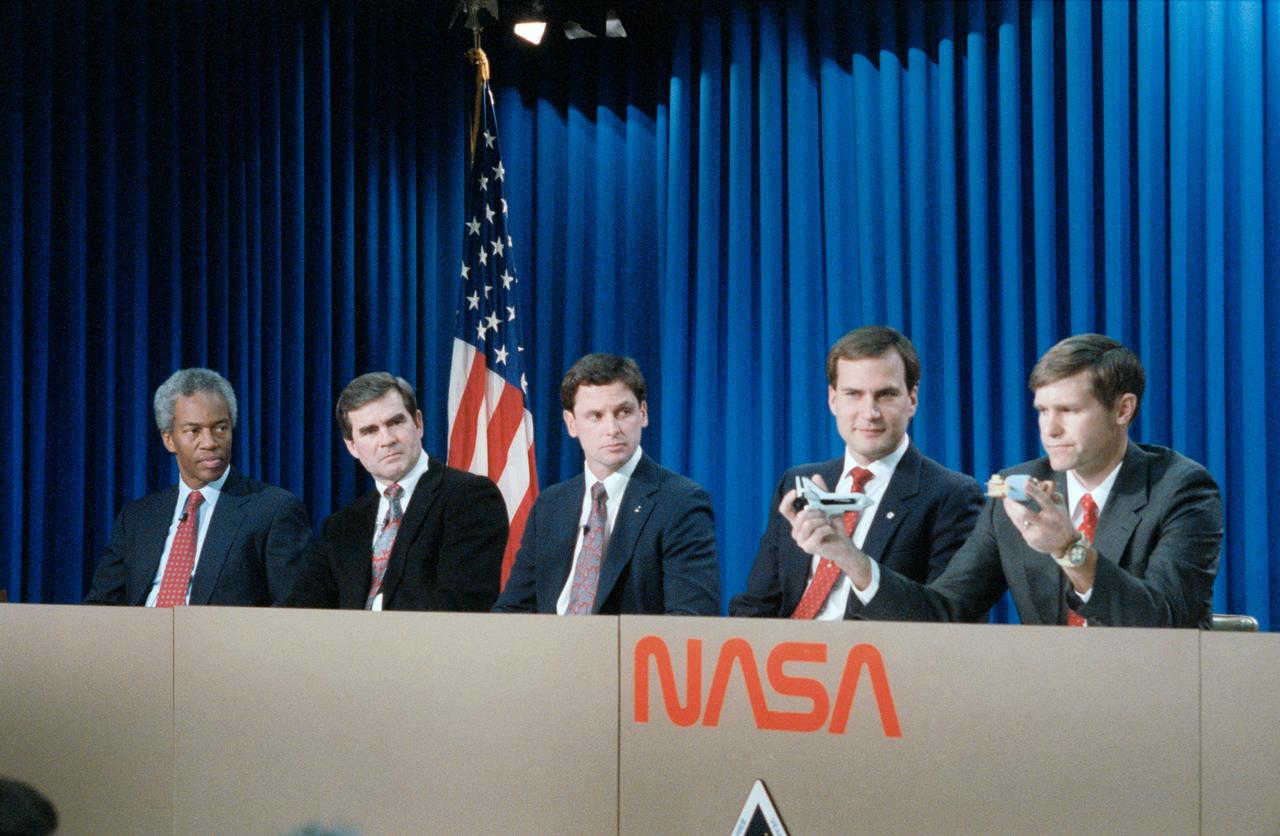
S91-26676 (23 Jan 1991) --- The five mission specialists assigned to the STS-39 Shuttle mission are pictured during a pre-flight press briefing. Pictured left to right are Astronauts Guion (Guy) S. Bluford, C. Lacy Veach, Gregory J. Harbaugh, Richard J. Hieb and Donald R. McMonagle. McMonagle uses models to demonstrate deployment of the infrared background signature survey (IBSS) satellite. Astronauts Michael L. Coats, mission commander, and L. Blaine Hammond Jr., pilot, are out of frame at right.
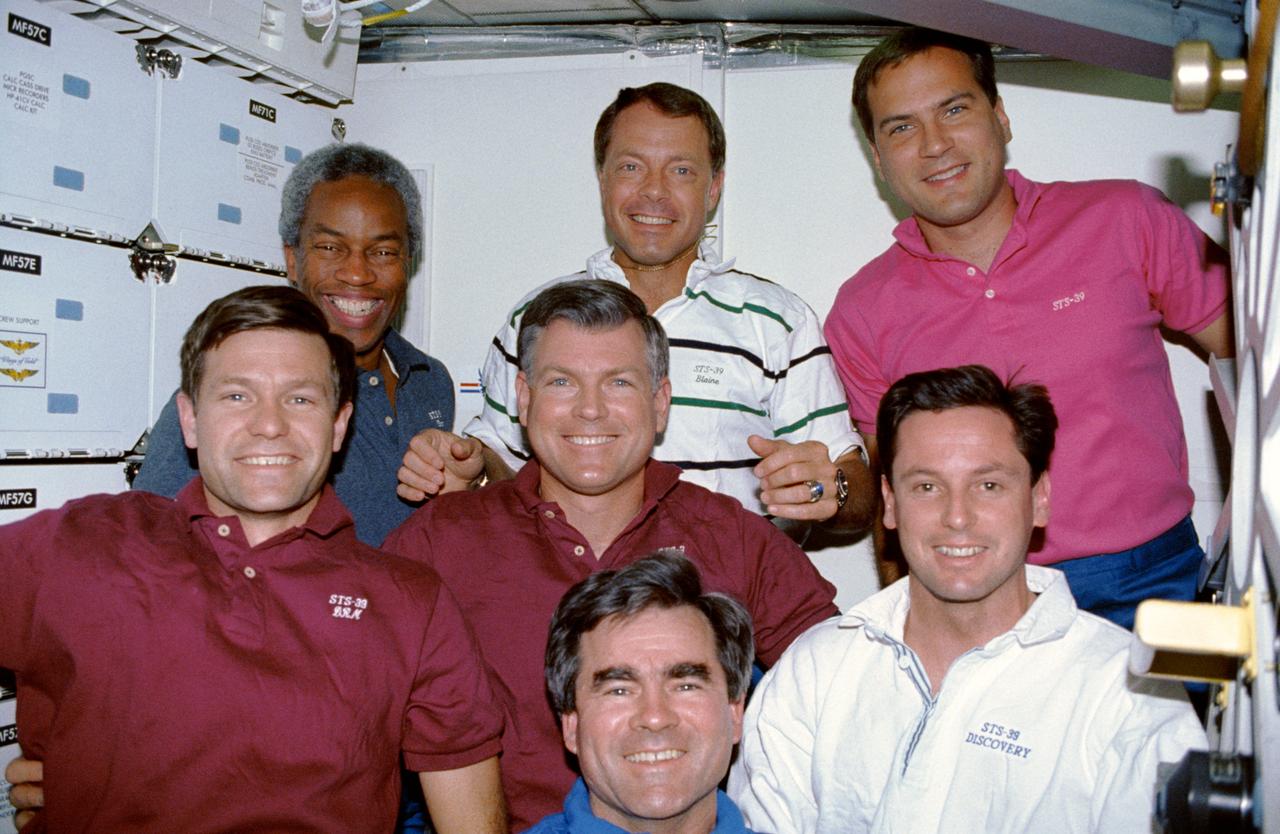
STS039-07-017 (28 April - 6 May 1991) --- The seven member astronaut crew for the STS-39 mission poses on the middeck of the Earth-orbiting space shuttle Discovery for an in-flight crew portrait. Left to right (front) are astronauts Donald R. McMonagle, Michael L. Coats, Charles L. (Lacy) Veach and Gregory J. Harbaugh; and left to right (rear) are astronauts Guion S. Bluford Jr., L. Blaine Hammond and Richard J. Hieb. Photo credit: NASA
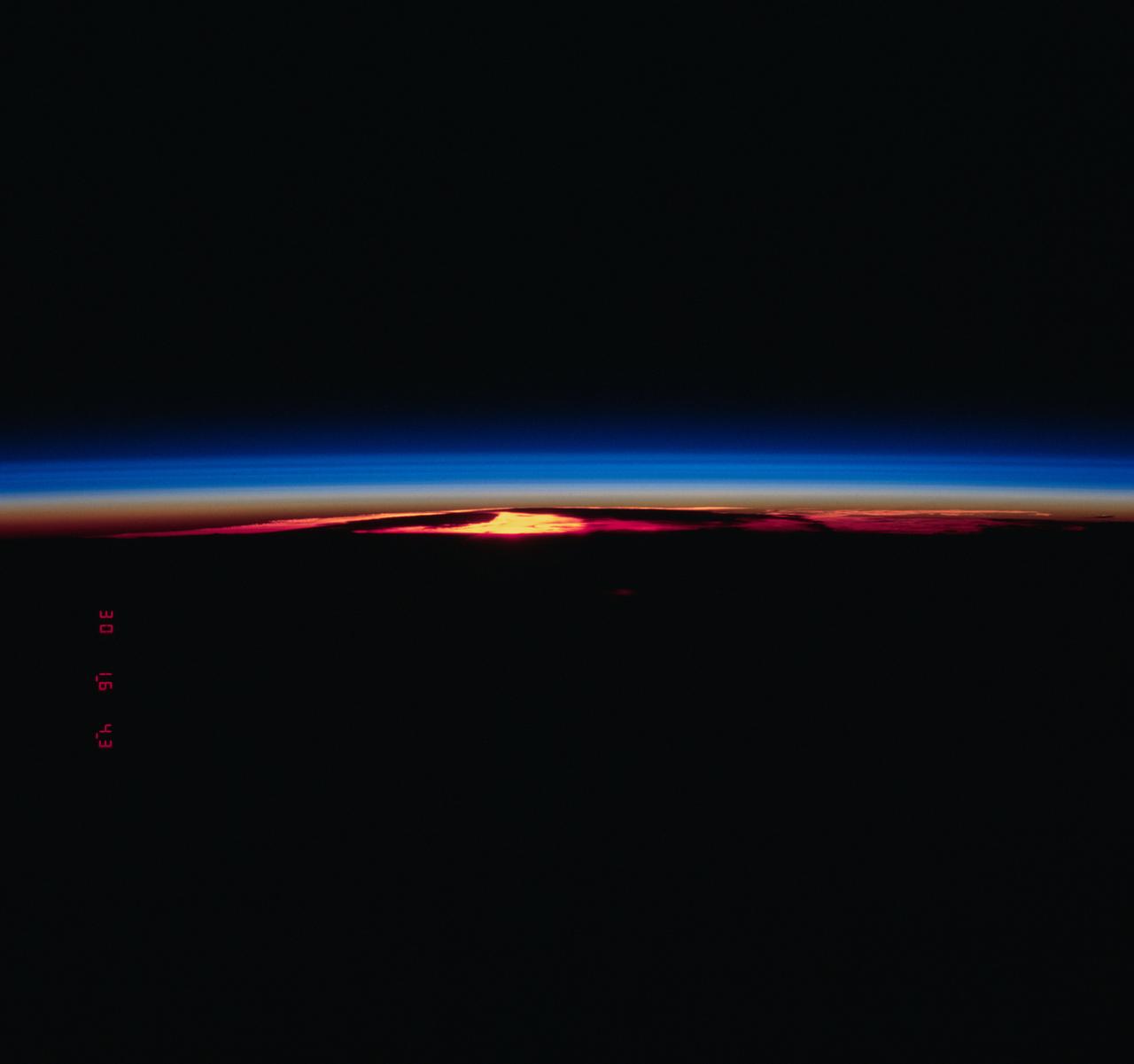
STS039-610-037 (28 April-6 May 1991) --- Numerous atmospheric scattering layers over Earth are apparent in this frame. The layers consist of fine particles suspended in very stable layers of the atmosphere. This photo was taken with a 70mm Rolliflex camera during the Space Shuttle Discovery's eight day mission. Crew members onboard were astronauts Michael L. Coats, L. Blaine Hammond, Guion S. Bluford, Richard J. Hieb, Gregory J. Harbaugh, Donald R. McMonagle and Charles L. (Lacy) Veach.
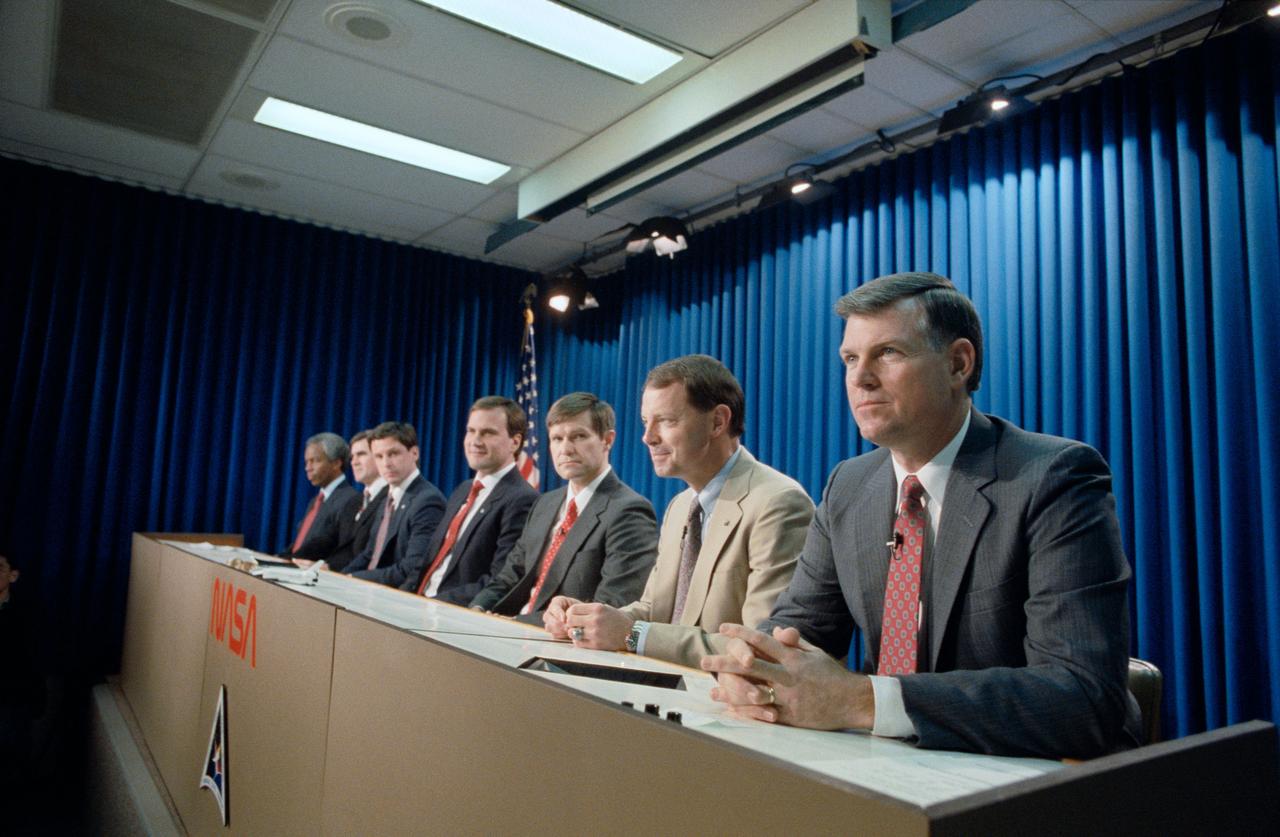
S91-26674 (23 Jan 1991) --- Astronaut Michael L. Coats, mission commander, listens attentively as a news media representative (out of frame) queries the STS-39 crewmembers during a pre-flight press briefing. The others, pictured left to right, are Astronauts Guion (Guy) S. Bluford, C. Lacy Veach, Gregory J. Harbaugh, Richard J. Hieb, Donald R. McMonagle and L. Blaine Hammond Jr.
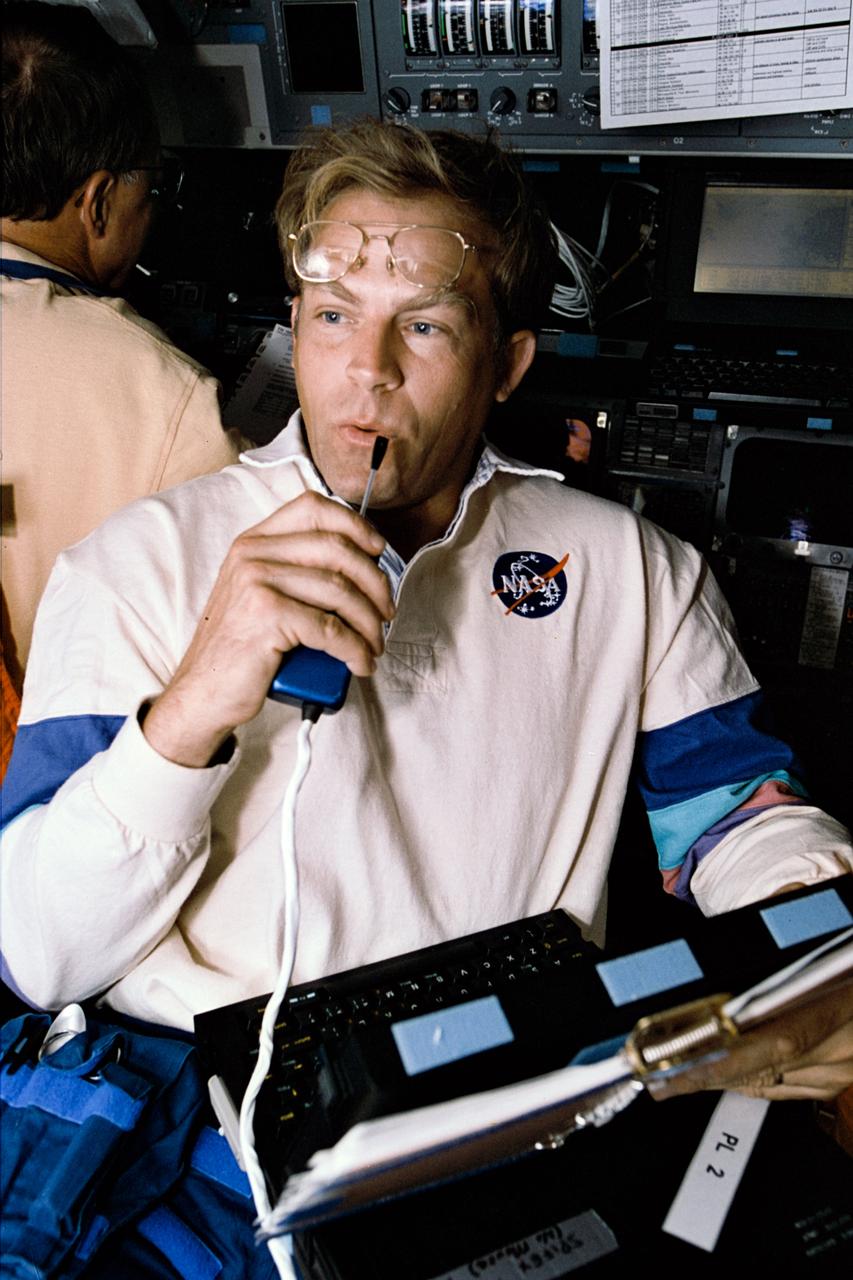
STS064-311-031 (10 Sept. 1994) --- Astronaut Mark C. Lee, STS-64 mission specialist, at a Payload General Support Computer (PGSC) on the space shuttle Discovery's flight deck, talks to ground controllers about the Shuttle Plume Impingement Flight Experiment (SPIFEX). Astronaut L. Blaine Hammond, pilot, is partially visible in the background. Photo credit: NASA or National Aeronautics and Space Administration
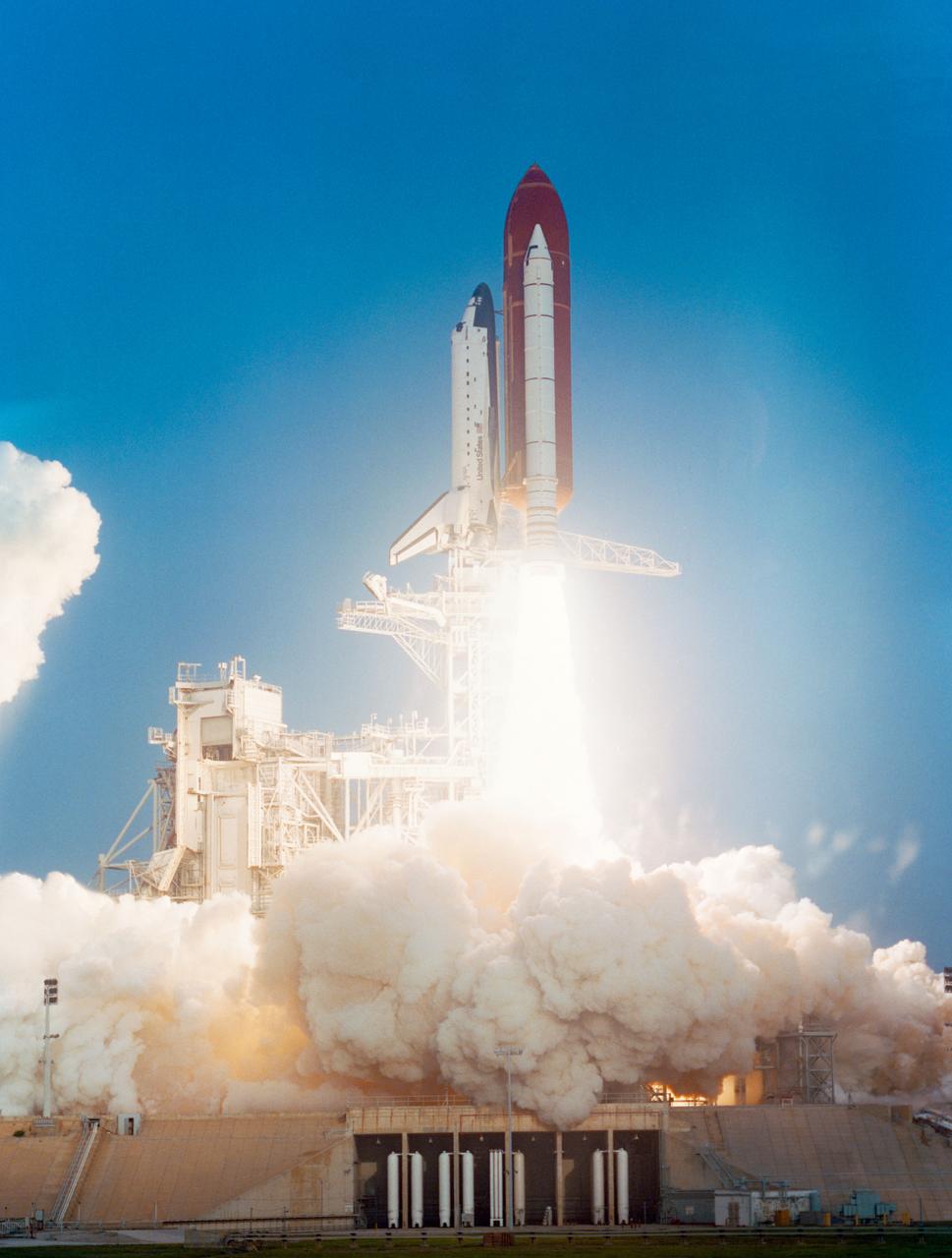
STS039-S-048 (28 April 1991)--- This side view of liftoff of the Space Shuttle Discovery was provided by a pre-set camera at KSC's Launch Pad 39A. Launch occurred at 7:33:14 a.m. (EDT), April 28, 1991. Onboard were astronauts Michael L. Coats, L. Blaine Hammond, Guion S. Bluford Jr., Charles L. (Lacy) Veach, Richard J. Hieb, Gregory J. Harbaugh and Donald R. McMonagle.
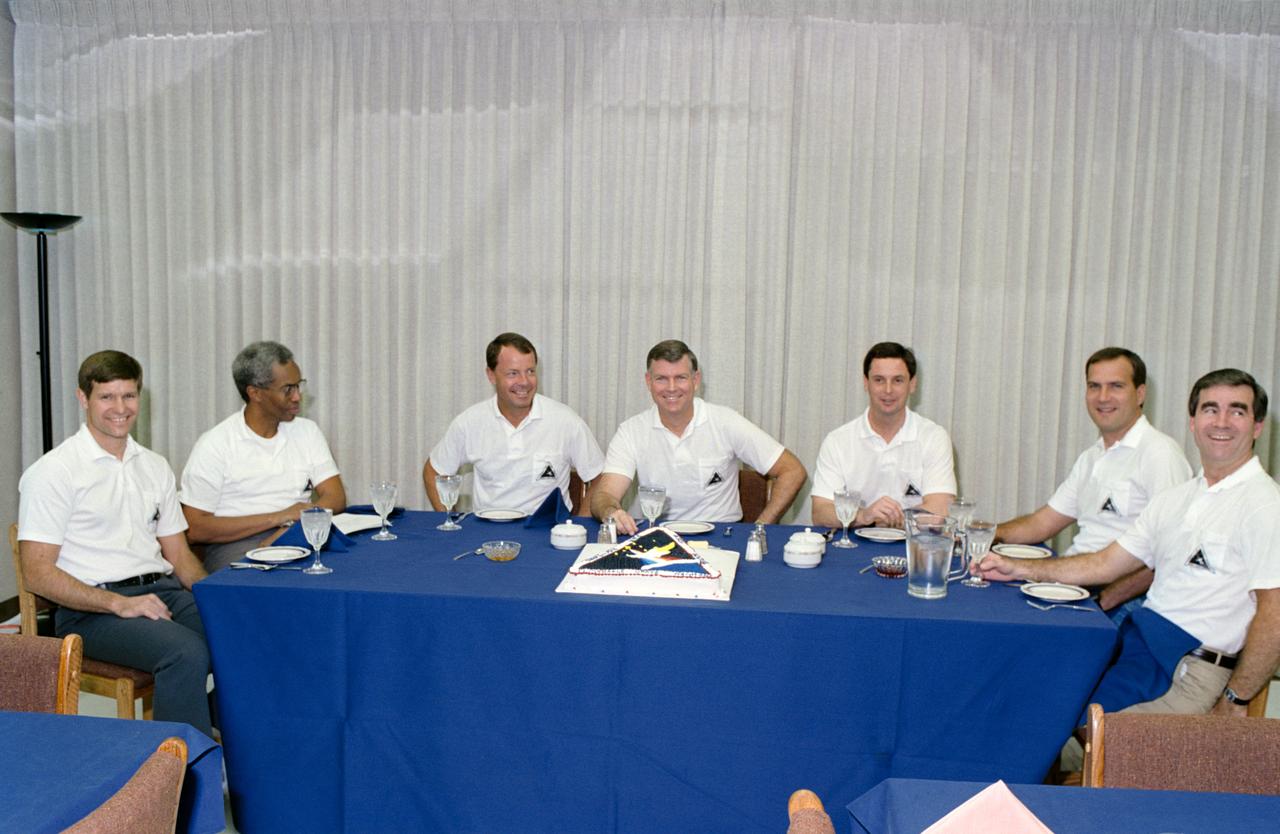
STS039-S-051 (28 April 1991) --- In KSC's Operations and Checkout Building, a very light breakfast is shared by the seven members of the STS-39 flight crew prior to their April 28, 1991 launch. Left to right are astronauts Donald R. McMonagle, Guion S. Bluford Jr., L. Blaine Hammond, Michael L. Coats, Gregory J. Harbaugh, Richard J. Hieb and Charles L. (Lacy) Veach. Launch occurred at 7:33:14 a.m. (EDT), April 28, 1991.
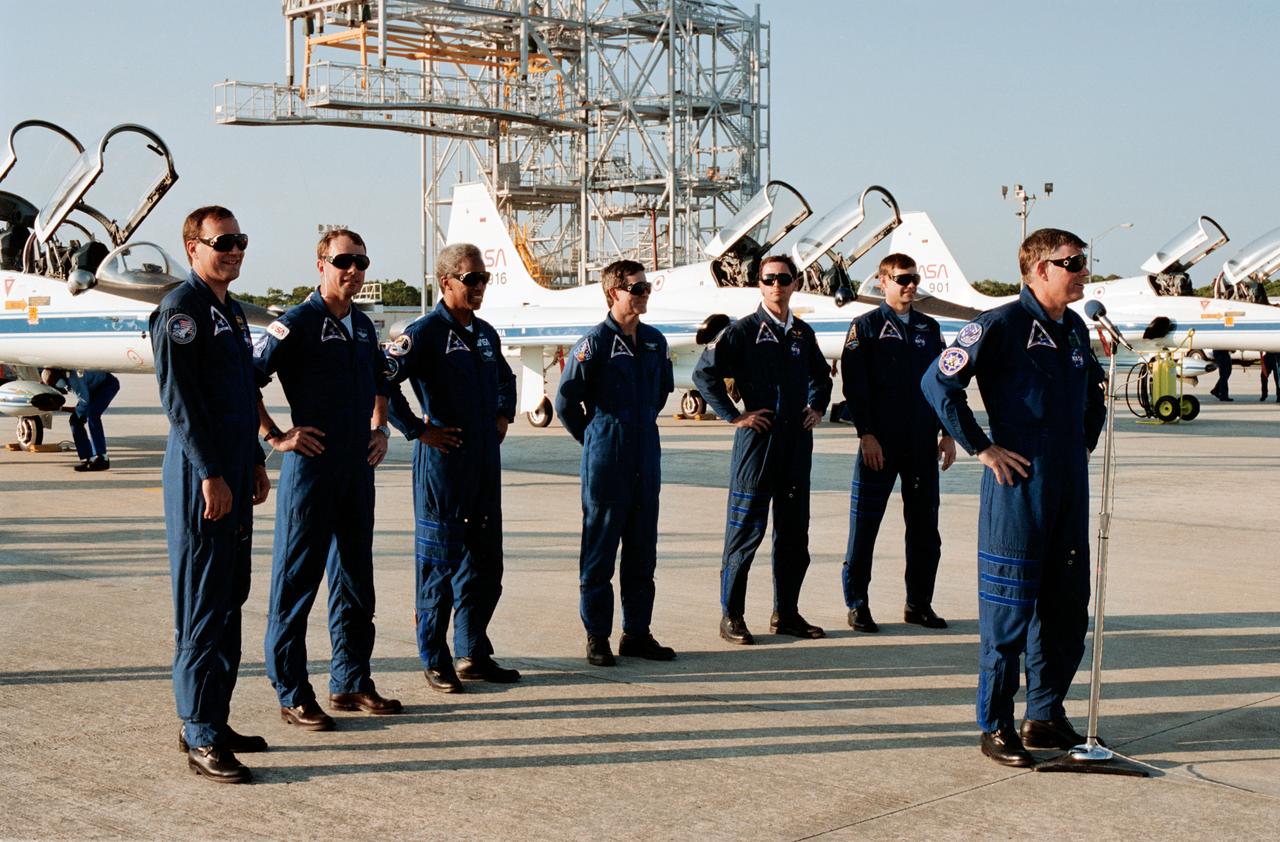
STS039-S-003 (20 April 1991) --- Astronaut Michael L. Coats (right) addresses the news media after arriving at the Shuttle Landing Facility along with his six fellow crewmembers. From left are astronauts Richard J. Hieb, L. Blaine Hammond, Guion S. Bluford, Charles L. (Lacy) Veach, Gregory J. Harbaugh and Donald R. McMonagle. The Space Shuttle mate/demate stand is seen in the background. Note: The STS-39 launch of Discovery occurred at 7:33:14 a.m. (EDT), April 28, 1991.

STS064-S-051 (9 Sept. 1994) --- With a crew of six NASA astronauts aboard, the space shuttle Discovery heads for its nineteenth Earth-orbital mission. Launch was delayed because of weather, but all systems were "go," and the spacecraft left the launch pad at 6:23 p.m. (EDT) on Sept. 9, 1994. Onboard were astronauts Richard N. Richards, L. Blaine Hammond, Carl J. Meade, Mark C. Lee, Susan J. Helms and Jerry M. Linenger. Photo credit: NASA or National Aeronautics and Space Administration

STS064-S-002 (June 1994) --- These six NASA astronauts have been assigned as crew members to fly aboard the space shuttle Discovery for the mission scheduled for September 1994. Astronaut Richard N. Richards (center front) is mission commander, while L. Blaine Hammond Jr. (front left) has been assigned as pilot. The other crew members are Susan J. Helms and (left to right, back row) Mark C. Lee, Jerry M. Linenger and Carl J. Meade, all mission specialists. Photo credit: NASA or National Aeronautics and Space Administration
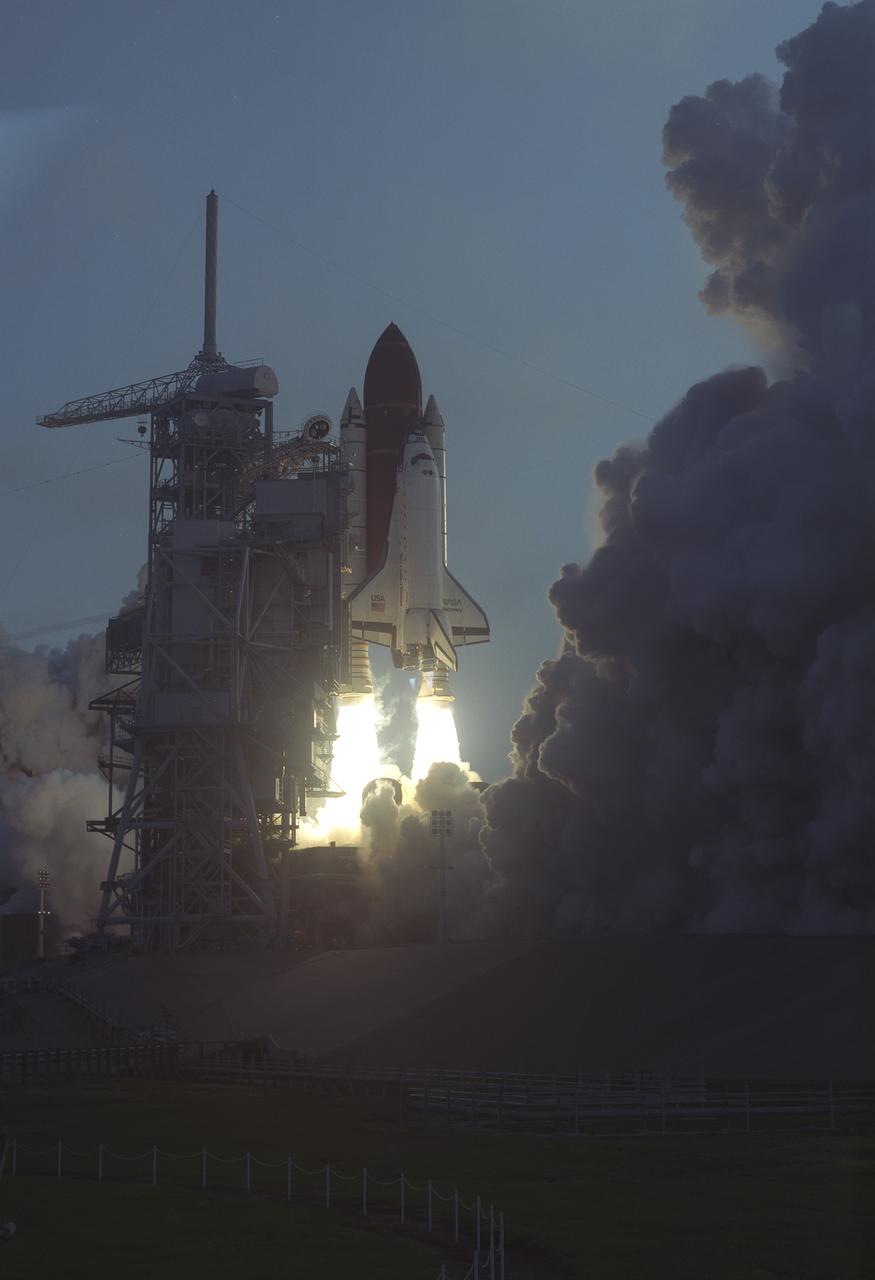
Launched aboard the Space Shuttle Discovery on April 28, 1991 at 7:33:14 am (EDT), STS-39 was a Department of Defense (DOD) mission. The crew included seven astronauts: Michael L. Coats, commander; L. Blaine Hammond, pilot; Guion S. Buford, Jr., mission specialist 1; Gregory J. Harbaugh, mission specialist 2; Richard J. Hieb, mission specialist 3; Donald R. McMonagle, mission specialist 4; and Charles L. Veach, mission specialist 5. The primary unclassified payload included the Air Force Program 675 (AFP-675), the Infrared Background Signature Survey (IBSS), and the Shuttle Pallet Satellite II (SPAS II).
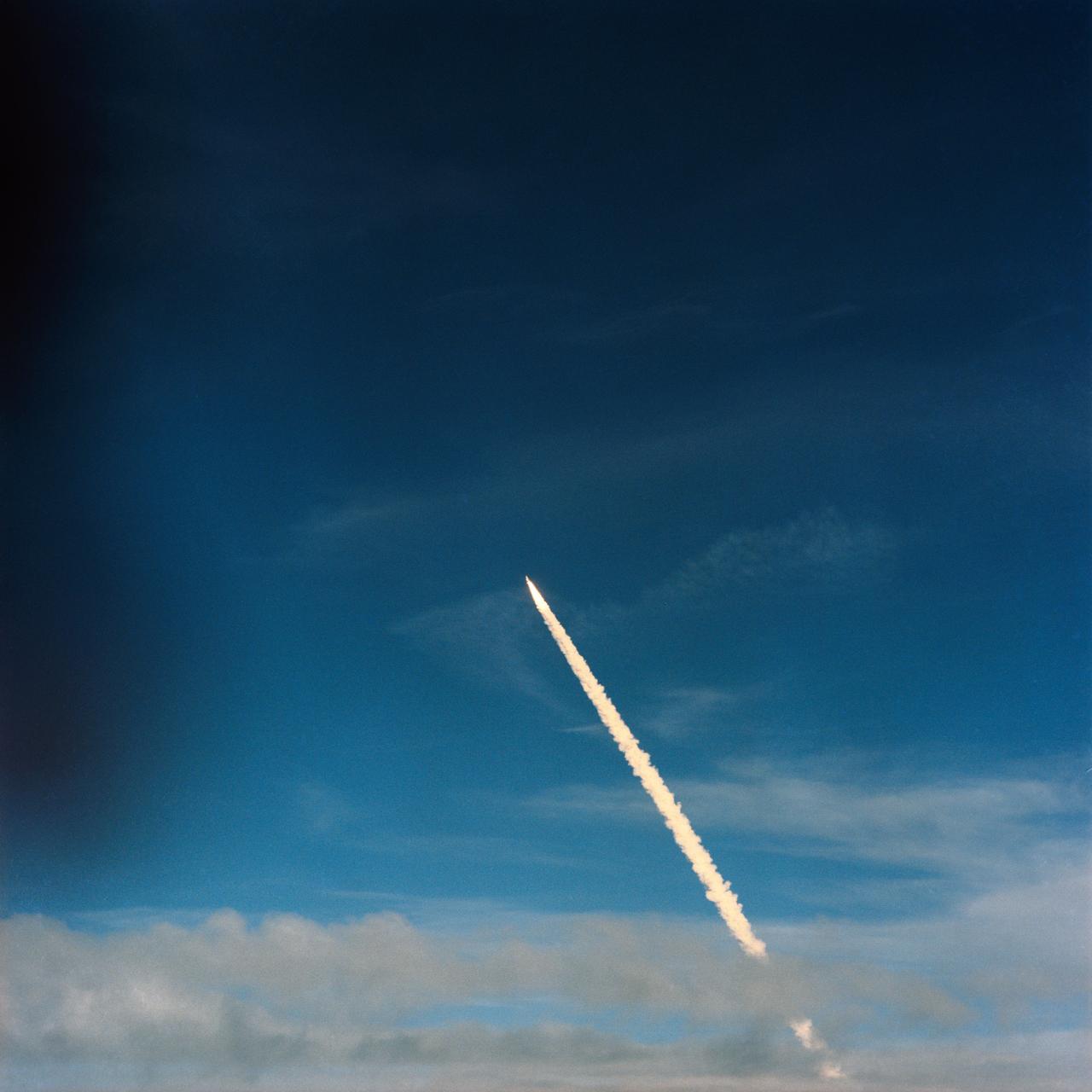
STS064-S-044 (9 Sept. 1994) --- Passing through some of the trailer clouds of an overcast sky which temporarily postponed its launch, the space shuttle Discovery heads for its 19th Earth-orbital flight. Several kilometers away, astronaut John H. Casper Jr., who took this picture, was piloting the Shuttle Training Aircraft (STA) from which the launch and landing area weather was being monitored. Onboard Discovery were astronauts Richard N. Richards, L. Blaine Hammond Jr., Mark C. Lee, Carl J. Meade, Susan J. Helms and Jerry M. Linenger. Photo credit: NASA or National Aeronautics and Space Administration
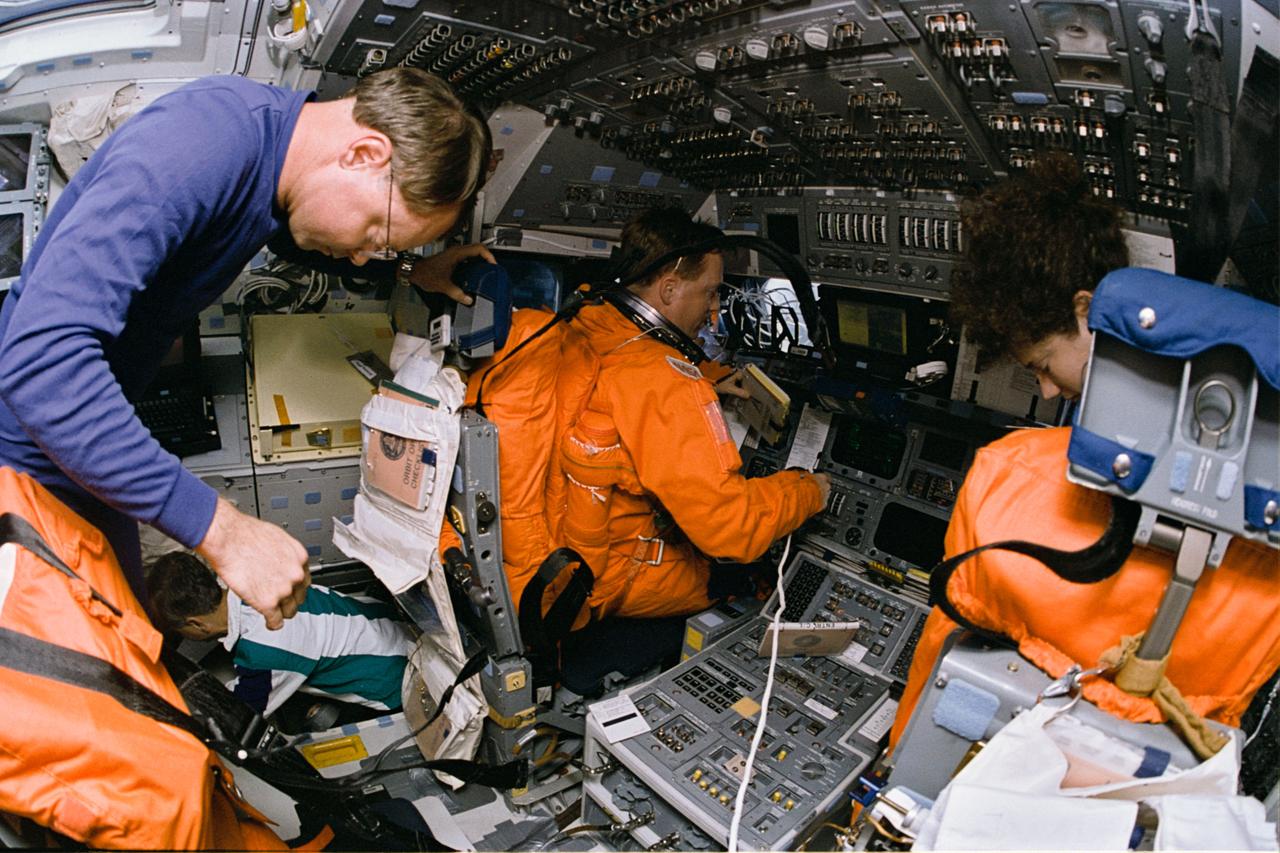
STS064-06-028 (9-20 Sept. 1994) --- On the space shuttle Discovery's flight deck, two thirds of the crew prepare for one of four hard efforts (in a two-day period) to de-orbit and complete the extended spaceflight. Manning the commander's station and wearing one of the launch and entry suits is astronaut Richard N. Richards, STS-64 mission commander. At the pilot's station is astronaut Susan J. Helms, mission specialist. Astronaut L. Blaine Hammond, pilot, is at left foreground, and astronaut Carl J. Meade, mission specialist, is at left background in the hatch leading to the middeck. Photo credit: NASA or National Aeronautics and Space Administration
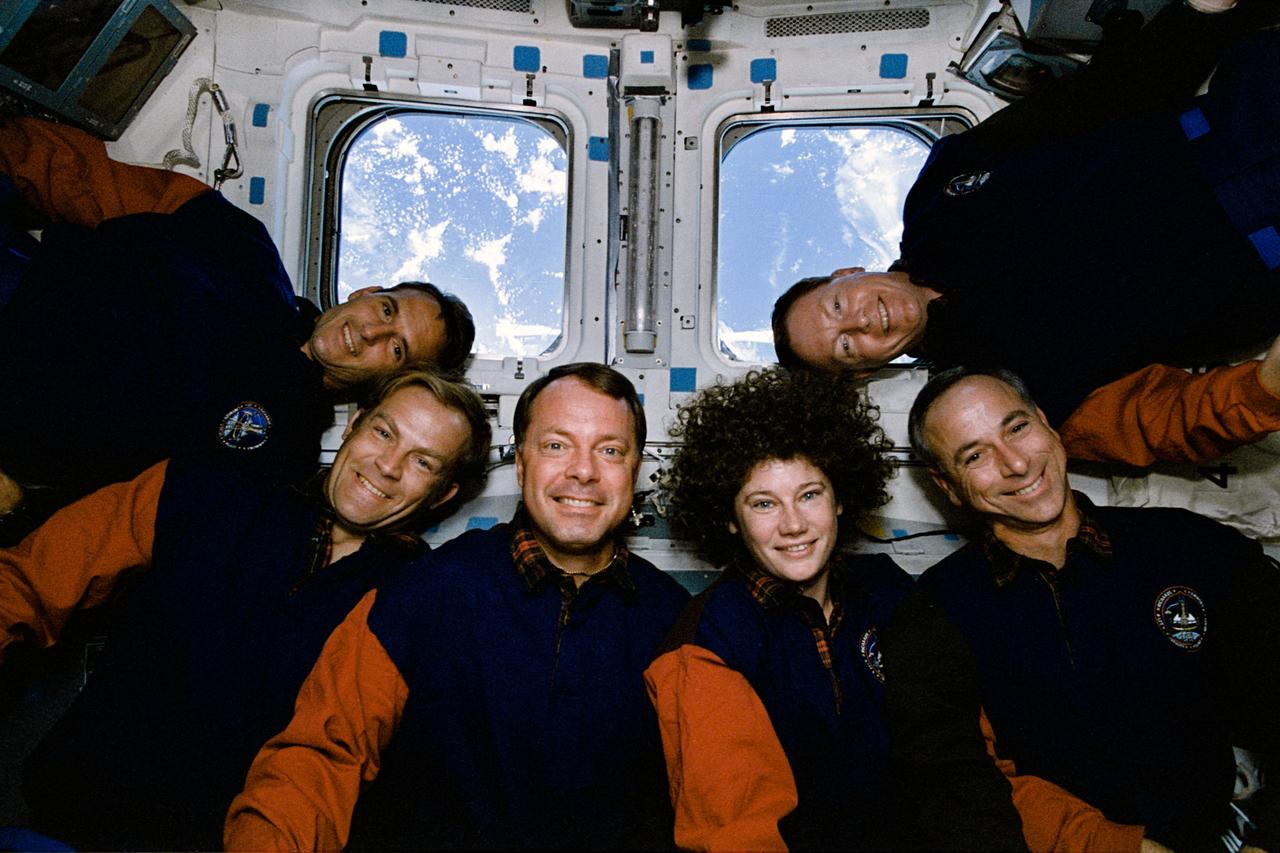
STS064-24-029 (9-20 Sept. 1994) --- In the microgravity of space, 130 nautical miles above Earth, the six STS-64 crew members found a unique setting for the traditional inflight crew portrait. Astronaut Richard N. Richards (upper right), commander, found stability with his back against the overhead in upper right corner. Others, clockwise from the commander, are astronauts Carl J. Meade and Susan J. Helms, mission specialists; L. Blaine Hammond, pilot; and Mark C. Lee and Jerry M. Linenger, both mission specialists. Photo credit: NASA or National Aeronautics and Space Administration

STS064-30-006 (9-20 Sept. 1994) --- In the microgravity of space, 130 nautical miles above Earth, the six STS-64 crew members found a unique setting for the traditional inflight crew portrait. Astronaut Richard N. Richards (upper right), commander, found stability with his back against the overhead in upper right corner. Others, clockwise from the commander, are astronauts Carl J. Meade and Susan J. Helms, mission specialists; L. Blaine Hammond, pilot; and Mark C. Lee and Jerry M. Linenger, both mission specialists. Photo credit: NASA or National Aeronautics and Space Administration
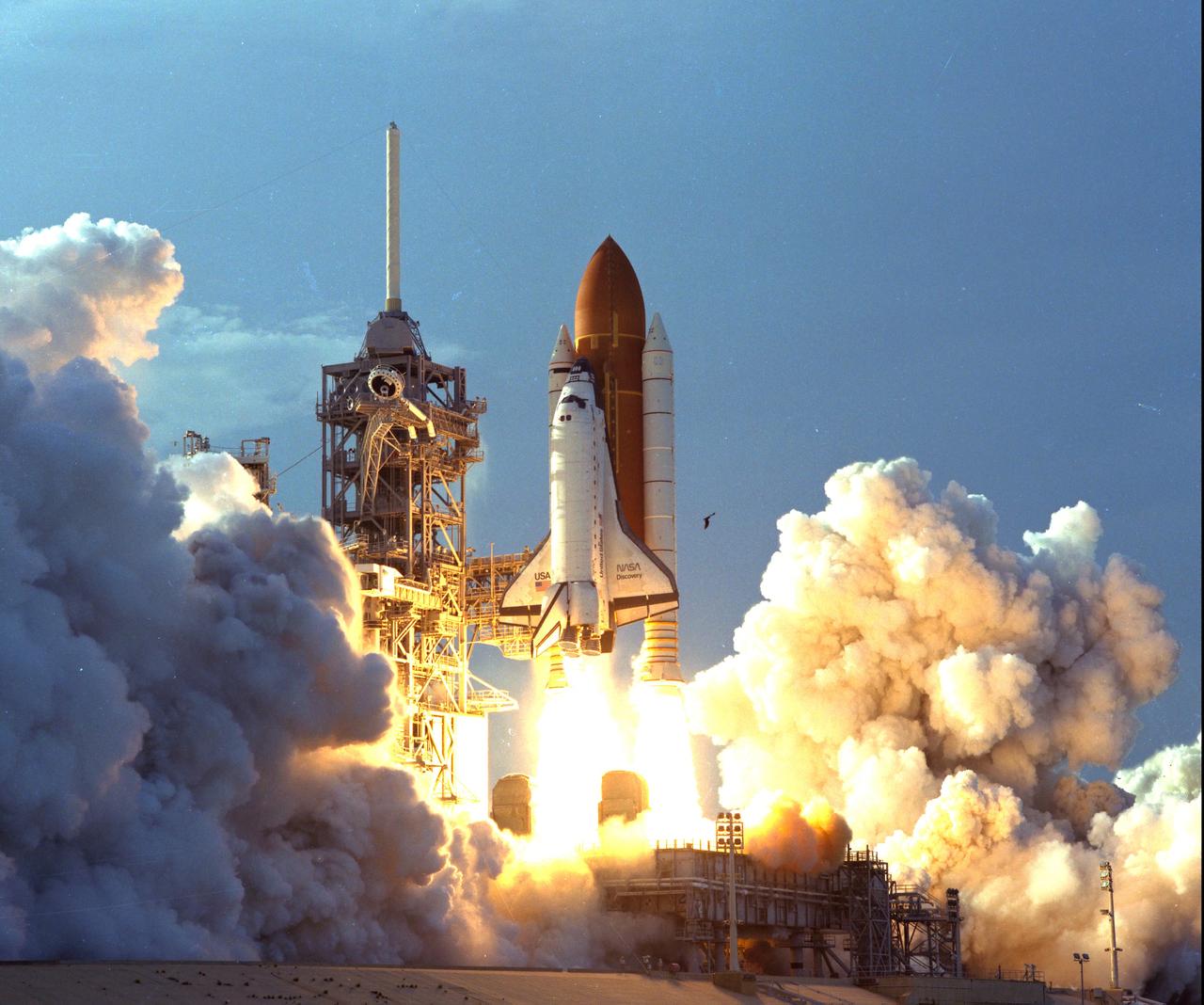
KENNEDY SPACE CENTER, FLA. - The turbulent weather common to a Florida afternoon in the summer subsides into a serene canopy of cornflower blue, and a manmade "bird" takes flight. The Space Shuttle Discovery soars skyward from Launch Pad 39B on Mission STS-64 at 6:22:35 p.m. EDT, Sept. 9. On board are a crew of six: Commander Richard N. Richards; Pilot L. Blaine Hammond Jr.; and Mission Specialists Mark C. Lee, Carl J. Meade, Susan J. Helms and Dr. J.M. Linenger. Payloads for the flight include the Lidar In-Space Technology Experiment (LITE), the Shuttle Pointed Autonomous Research Tool for Astronomy-201 (SPARTAN-201) and the Robot Operated Material Processing System (ROMPS). Mission Specialists Lee and Meade also are scheduled to perform an extravehicular activity during the 64th Shuttle mission.
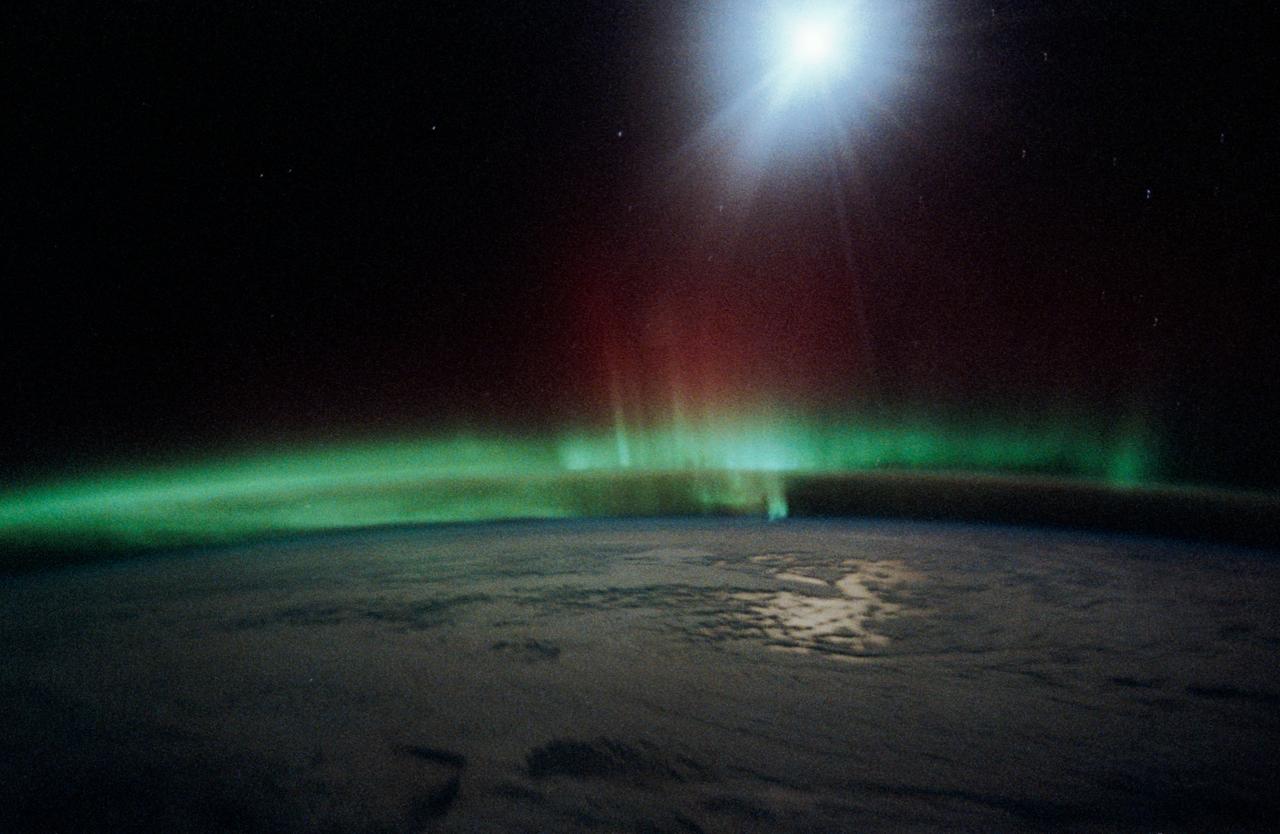
STS039-377-013 (28 April-6 May 1991) --- Moonlight saturates the high speed film used for auroral photography. Moon glint is visible in the open ocean and the cloud patterns are well illuminated. This frame was taken with a handheld 35mm camera from inside the Space Shuttle Discovery's crew cabin. This is one of 25 visuals used by the STS-39 crew at its May 17, 1991 Post Flight Press Conference (PFPC). Discovery's flight of eight days duration, launched April 28, 1991 from Kennedy Space Center (KSC) and completed on May 6, 1991 at the KSC landing facility, was dedicated to the Department of Defense (DOD). Crew members were astronauts Michael L. Coats, L. Blaine Hammond, Guion S. Bluford, Richard J. Hieb, Gregory J. Harbaugh, Donald R. McMonagle and Charles L. (Lacy) Veach.
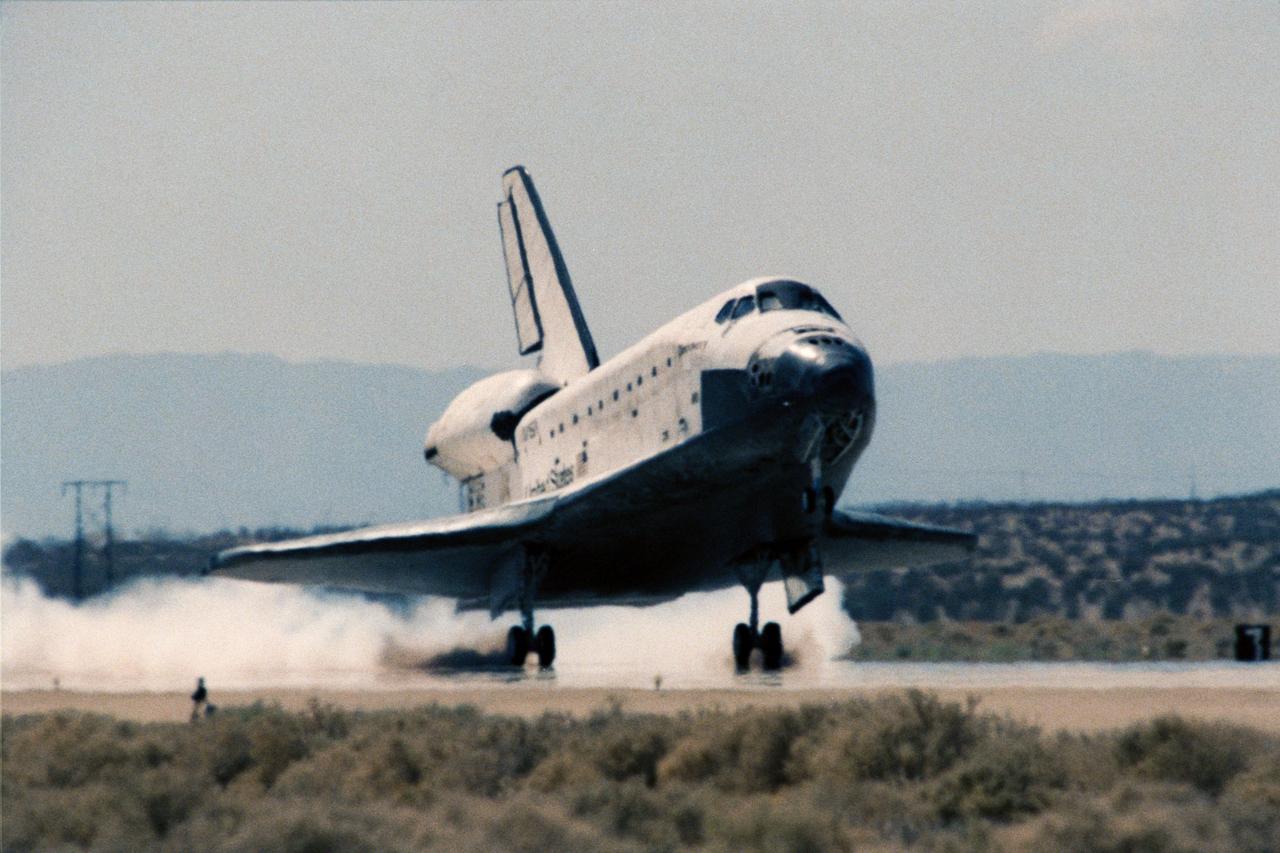
STS64-S-094 (20 Sept. 1994) --- The space shuttle Discovery, with a crew of six NASA astronauts aboard, touches down on Runway 04 at Edwards Air Force Base (EAFB), completing a 10-day, 22-hour and 50-minute mission. Following a de-orbit engine firing at 1:14 p.m. (PDT), Sept. 20, 1994. Touchdown was at 2:12:59 p.m., and the nose wheel touched down at 2:13:03 p.m., with wheel stop at 2:13:52 p.m. Bad weather in Florida called for an "eleventh hour" shift to the California landing site. Onboard for the flight, whose mission was to study Earth's atmosphere and to test tools and procedures for the International Space Station, were astronauts Richard N. Richards, L. Blaine Hammond Jr., Mark C. Lee, Carl J. Meade, Susan J. Helms and Jerry M. Linenger. Photo credit: NASA or National Aeronautics and Space Administration
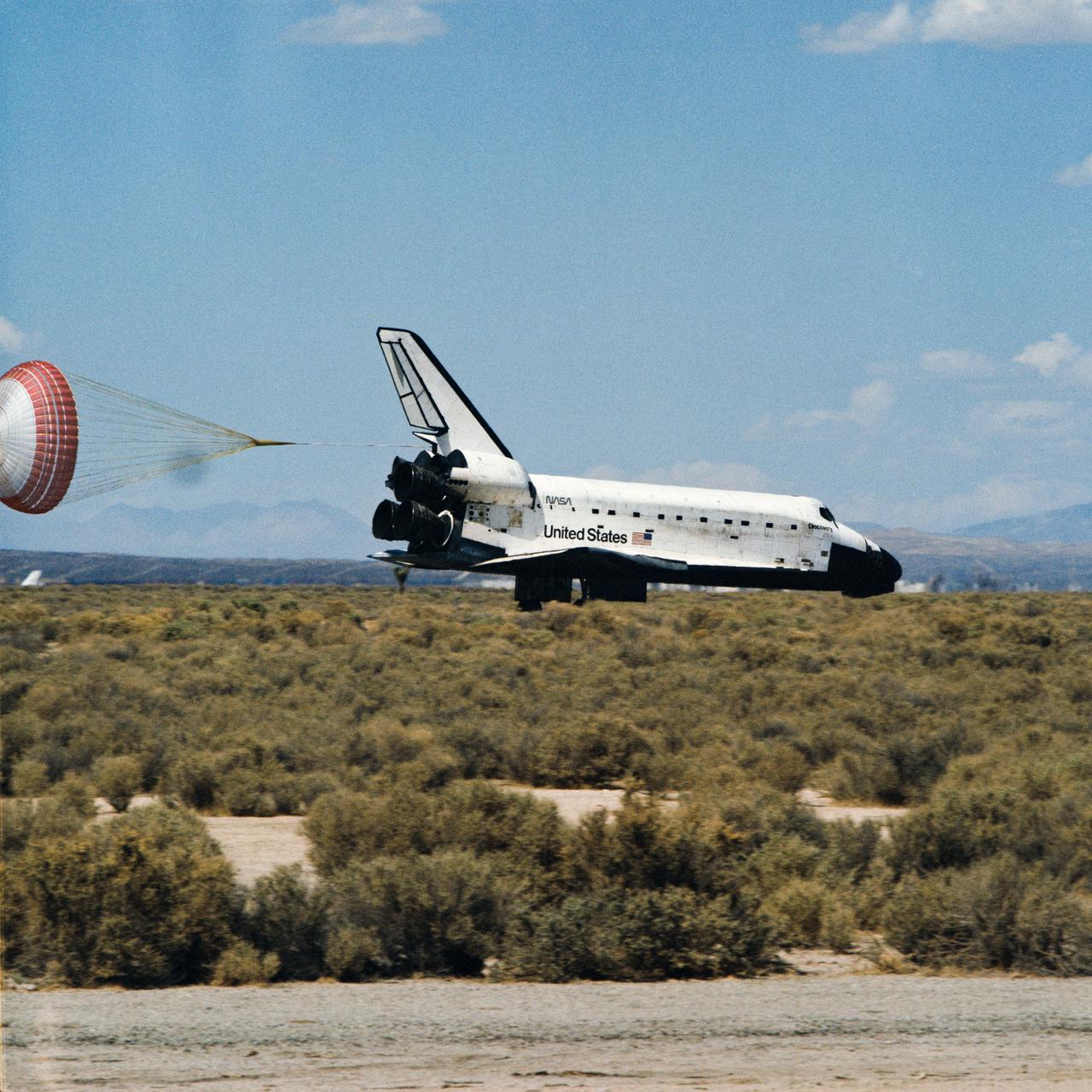
STS64-S-073 (20 Sept. 1994) --- The drag chute for the space shuttle Discovery is deployed as NASA's most-heavily flown spacecraft completes a 10-day, 22-hour and 50-minute mission. Discovery, with a crew of six NASA astronauts aboard, fired its de-orbit engine at 1:14 p.m. (PDT), Sept. 20, 1994. Touchdown was at 2:12:59 p.m. and the nose wheel touched down at 2:13:03 p.m., with wheel stop at 2:13:52 p.m. Bad weather in Florida called for an "eleventh hour" shift to the California landing site. Onboard for the flight, whose mission was to study Earth's atmosphere and to test tools and procedures for the International Space Station (ISS), were astronauts Richard N. Richards, L. Blaine Hammond, Mark C. Lee, Carl J. Meade, Susan J. Helms and Jerry M. Linenger. Photo credit: NASA or National Aeronautics and Space Administration
![KENNEDY SPACE CENTER, FLA. -- Seventeen new astronaut candidates visited the Vehicle Assembly Building as part of an orientation tour of KSC facilities. Here they are grouped around one of the external fuel tanks in the transfer aisle of the VAB. This latest group of candidates is the tenth chosen since the original seven Mercury astronauts. [From left, Michael J. McCulley, Curtis L. Brown Jr., Frank L. Culbertson Jr., Kathryn C. Thornton, Mark N. Brown, Mark C. Lee, Kenneth D. Cameron, John H. Casper, L. Blaine Hammond Jr., Charles Lacy Veach (deceased), James C. Adamson, William M. Shepherd, Sidney M. Gutierrez, Marsha S. Ivins, David G. Low, Michael J. Smith (deceased), Ellen S. Baker, Sonny Carter (deceased).]](https://images-assets.nasa.gov/image/108-KSC-84P-339/108-KSC-84P-339~medium.jpg)
KENNEDY SPACE CENTER, FLA. -- Seventeen new astronaut candidates visited the Vehicle Assembly Building as part of an orientation tour of KSC facilities. Here they are grouped around one of the external fuel tanks in the transfer aisle of the VAB. This latest group of candidates is the tenth chosen since the original seven Mercury astronauts. [From left, Michael J. McCulley, Curtis L. Brown Jr., Frank L. Culbertson Jr., Kathryn C. Thornton, Mark N. Brown, Mark C. Lee, Kenneth D. Cameron, John H. Casper, L. Blaine Hammond Jr., Charles Lacy Veach (deceased), James C. Adamson, William M. Shepherd, Sidney M. Gutierrez, Marsha S. Ivins, David G. Low, Michael J. Smith (deceased), Ellen S. Baker, Sonny Carter (deceased).]
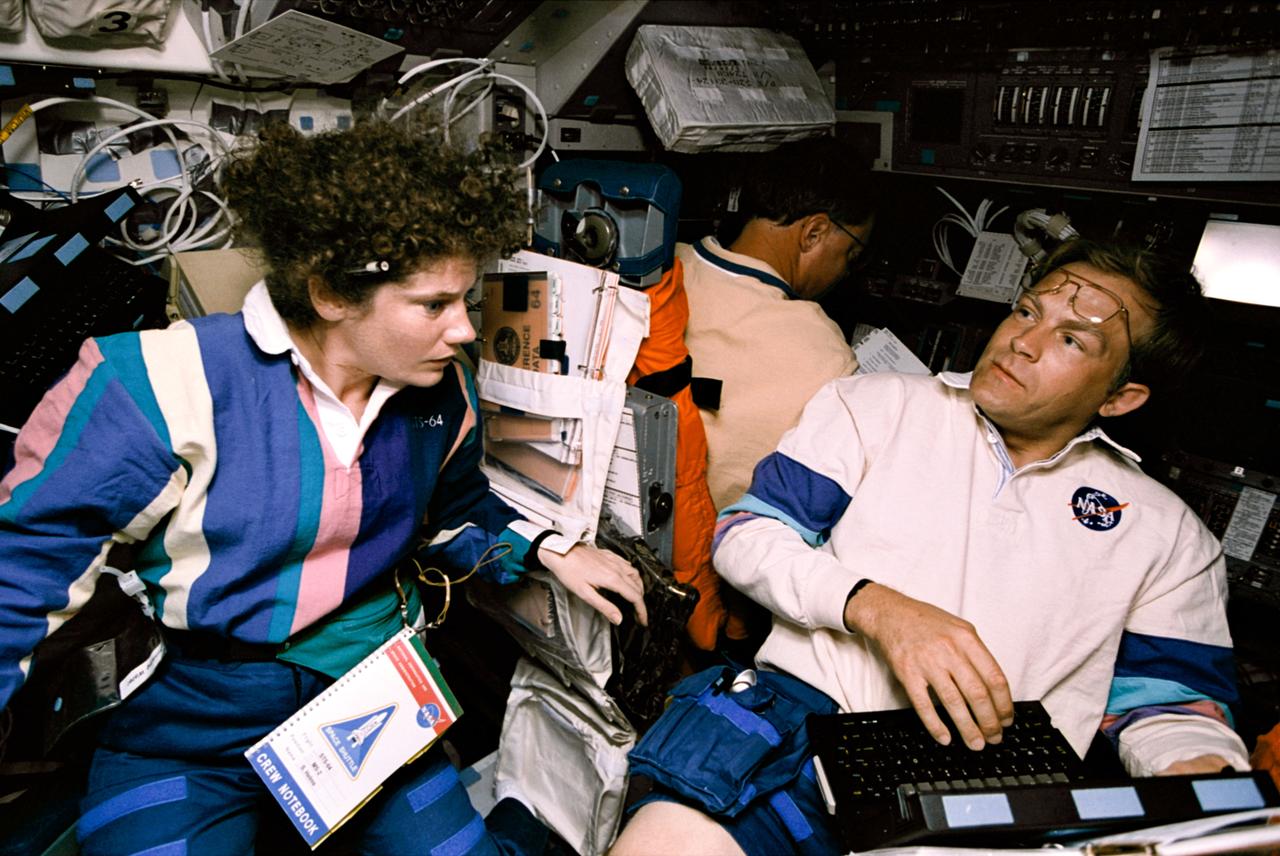
STS064-311-033 (10 Sept. 1994) --- Half of the crew members share support of the Shuttle Plume Impingement Flight Experiment (SPIFEX) in this 35mm frame. Astronauts Susan J. Helms and Mark C. Lee (foreground) share a pertinent bit of data while astronaut L. Blaine Hammond in the background controls Reaction Control System (RCS) thrusters on the space shuttle Discovery. Helms' role was to control the Remote Manipulator System (RMS) arm, to which 30-feet of SPIFEX hardware were appended in order to measure the RCS plume induced loads in the far field region. Lee records data on a lap top Payload General Support Computer (PGSC). SPIFEX was developed to help understand the thruster effects on approaching spacecraft. Photo credit: NASA or National Aeronautics and Space Administration

The Space Shuttle Discovery, mated to NASA's 747 Shuttle Carrier Aircraft (SCA), takes to the air for its ferry flight back to the Kennedy Space Center in Florida. The spacecraft, with a crew of six, was launched into a 57-degree high inclination orbit from the Kennedy Space Center, Florida, at 3:23 p.m., 9 September 1994. The mission featured the study of clouds and the atmosphere with a laser beaming system called Lidar In-Space Technology Experiment (LITE), and the first untethered space walk in ten years. A Spartan satellite was also deployed and later retrieved in the study of the sun's corona and solar wind. The mission was scheduled to end Sunday, 18 September, but was extended one day to continue science work. Bad weather at the Kennedy Space Center on 19 September, forced a one-day delay to September 20, with a weather divert that day to Edwards. Mission commander was Richard Richards, the pilot Blaine Hammond, while mission specialists were Jerry Linenger, Susan Helms, Carl Meade, and Mark Lee.
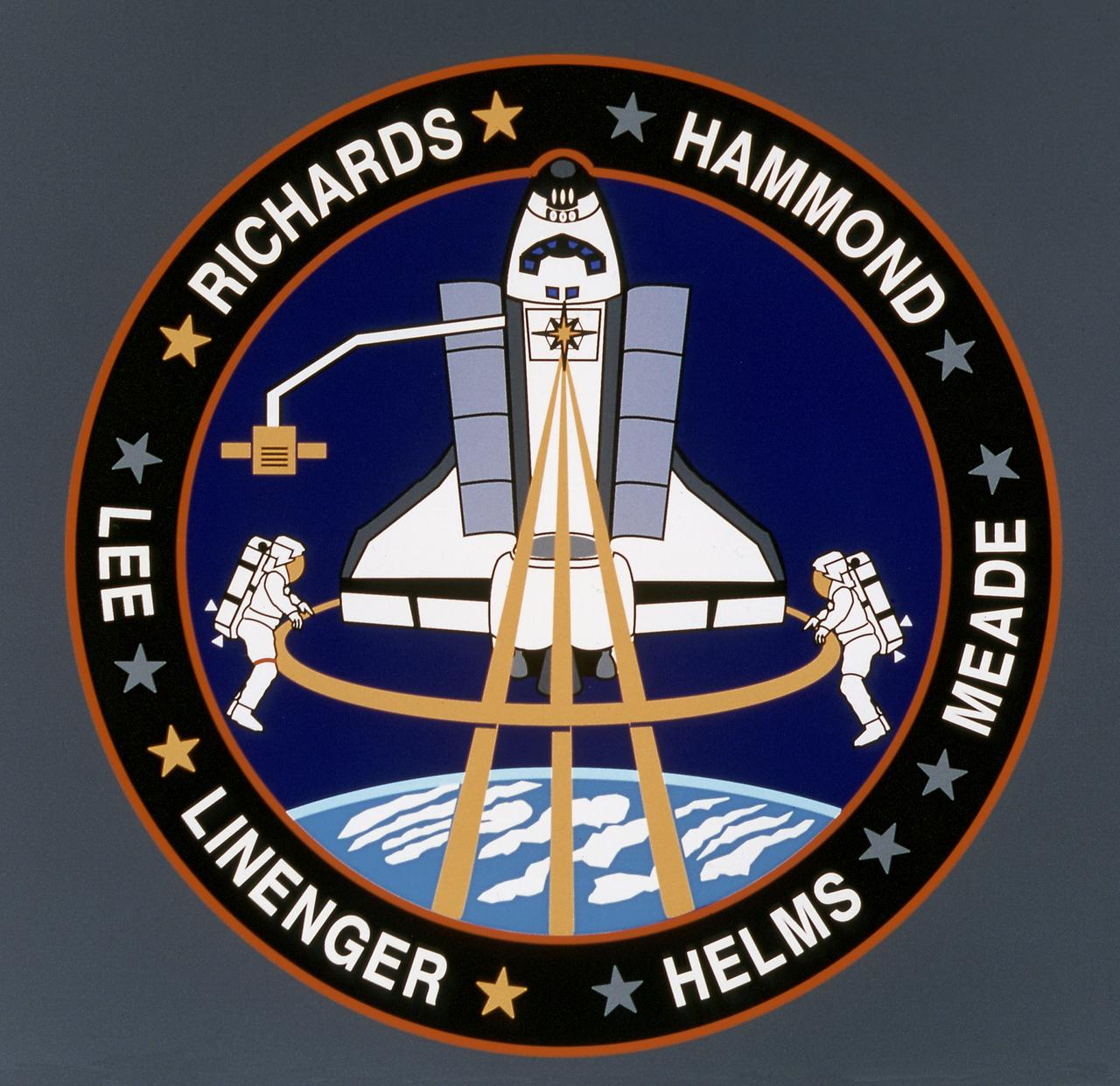
The STS-64 patch depicts the Space Shuttle Discovery in a payload-bay-to-Earth attitude with its primary payload, Lidar In-Space Technology Experiment (LITE-1) operating in support of Mission to Planet Earth. LITE-1 is a lidar system that uses a three-wavelength laser, symbolized by the three gold rays emanating from the star in the payload bay that form part of the astronaut symbol. The major objective of the LITE-1 is to gather data about the Earth's troposphere and stratosphere, represented by the clouds and dual-colored Earth limb. A secondary payload on STS-64 is the free-flier SPARTAN 201 satellite shown on the Remote Manipulator System (RMS) arm post-retrieval. The RMS also operated another payload, Shuttle Plume Impingement Flight Experiment (SPIFEX). A newly tested extravehicular activity (EVA) maneuvering device, Simplified Aid for EVA Rescue (SAFER), represented symbolically by the two small nozzles on the backpacks of the two untethered EVA crew men. The names of the crew members encircle the patch: Astronauts Richard N. Richards, L. Blaine Hammond, Jr., Jerry M. Linenger, Susan J. Helms, Carl J. Meade and Mark C. Lee. The gold or silver stars by each name represent that person's parent service.
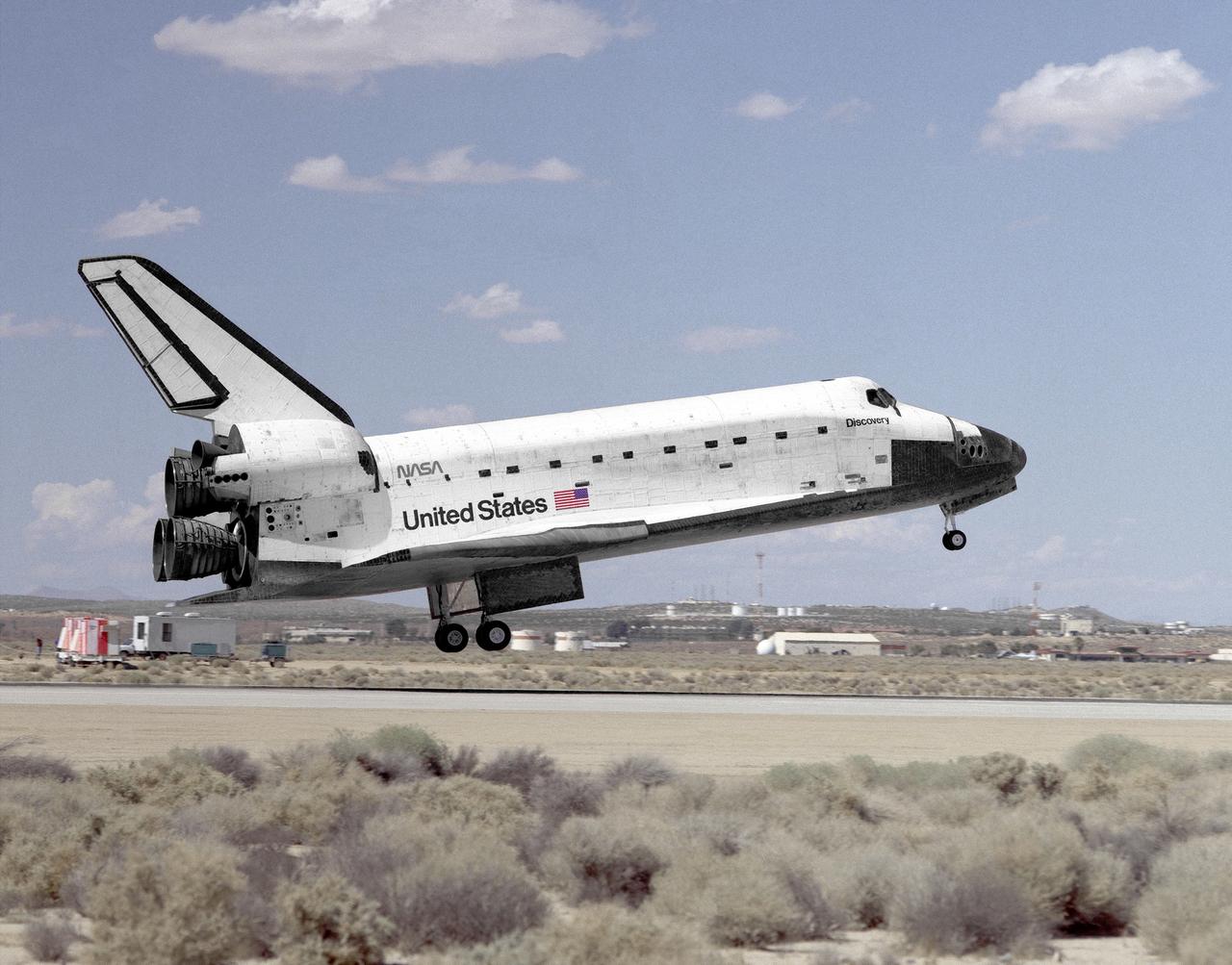
The Space Shuttle Discovery settles to the main runway at Edwards, California, at 2:13 p.m. (PDT) 20 September 1994, to conclude mission STS-64. The spacecraft, with a crew of six, was launched into a 57-degree high inclination orbit from the Kennedy Space Center, Florida, at 3:23 p.m. (PDT), 9 September 1994. The mission featured the study of clouds and the atmosphere with a laser beaming system called Lidar In-Space Technology Experiment (LITE), and the first untethered space walk in over ten years. A Spartan satellite was also deployed and later retrieved in the study of the sun's corona and the solar wind. The mission was scheduled to end Sunday, 18 September, but was extended one day to continue science work. Bad weather at the Kennedy Space Center on September 19, forced a one-day delay to September 20, with a weather divert that day to Edwards. Mission commander was Richard Richards, the pilot Blaine Hammond, while mission specialists were Jerry Linenger, Susan Helms, Carl Meade, and Mark Lee.
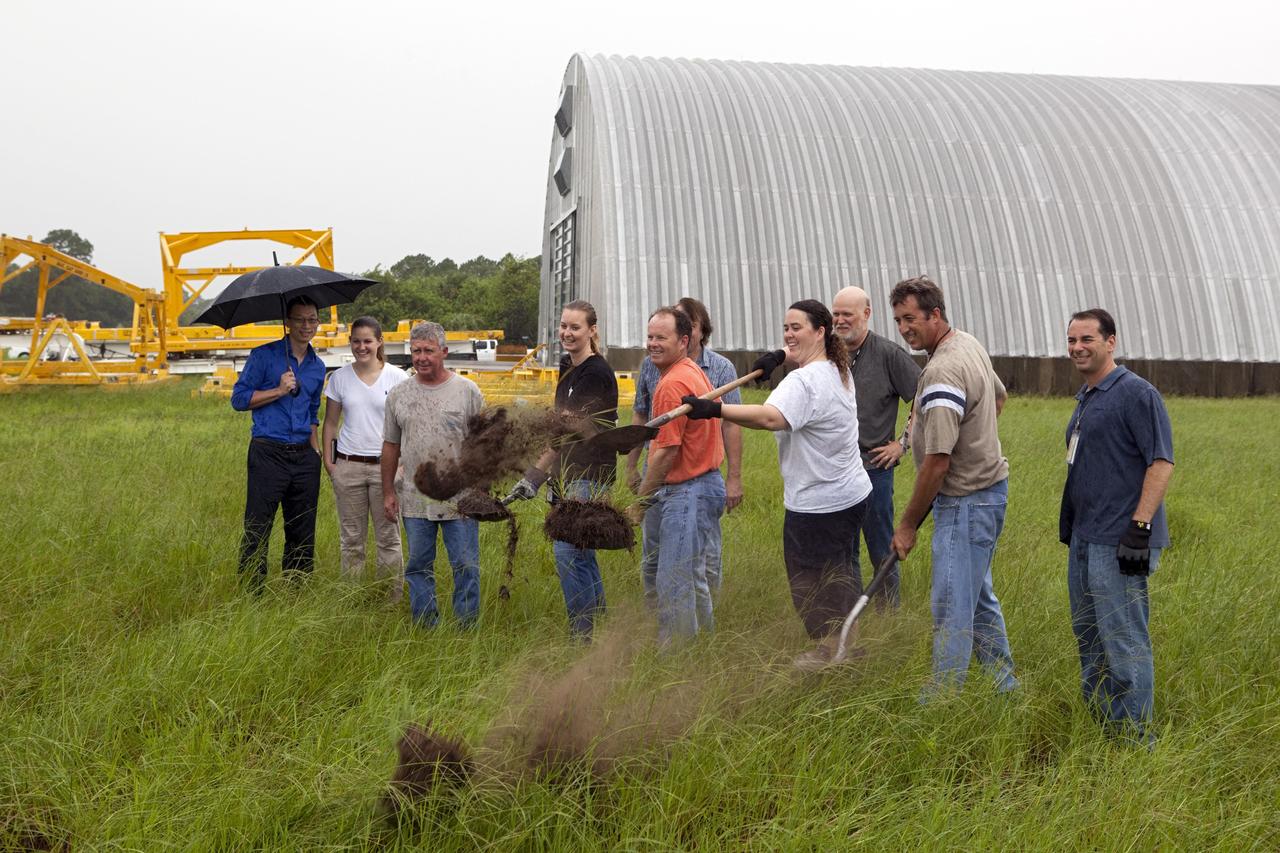
CAPE CANAVERAL, Fla. – Near the Hypergolic Maintenance Facility at NASA’s Kennedy Space Center in Florida, a groundbreaking ceremony was held to mark the location of the Ground Operations Demonstration Unit Liquid Hydrogen, or GODU LH2, test site. From left, are Johnny Nguyen, Fluids Test and Technology Development branch chief Emily Watkins, engineering intern Jeff Walls, Engineering Services Contract, or ESC, Cryogenics Test Lab engineer Kelly Currin, systems engineer Stephen Huff and Rudy Werlink partially hidden, cryogenics engineers Angela Krenn, systems engineer Doug Hammond, command and control engineer in the electrical division William Notardonato, GODU LH2 project manager and Kevin Jumper, ESC Cryogenics Test Lab manager. The GODU LH2 test site is one of the projects in NASA’s Advanced Exploration Systems Program. The site will be used to demonstrate advanced liquid hydrogen systems that are cost and energy efficient ways to store and transfer liquid hydrogen during process, loading, launch and spaceflight. The main components of the site will be a storage tank and a cryogenic refrigerator. Photo credit: NASA/Dimitri Gerondidakis
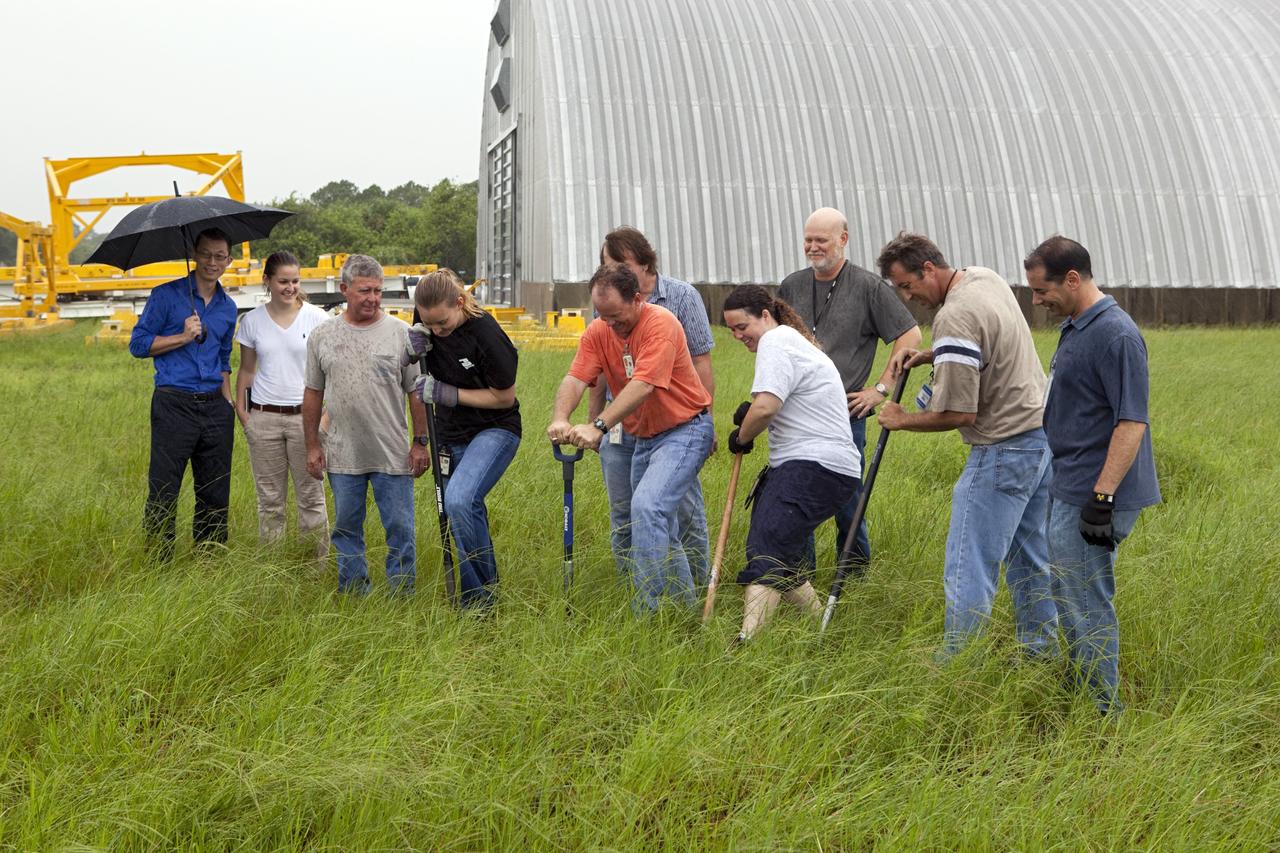
CAPE CANAVERAL, Fla. – Near the Hypergolic Maintenance Facility at NASA’s Kennedy Space Center in Florida, a groundbreaking ceremony was held to mark the location of the Ground Operations Demonstration Unit Liquid Hydrogen, or GODU LH2, test site. From left, are Johnny Nguyen, Fluids Test and Technology Development branch chief Emily Watkins, engineering intern Jeff Walls, Engineering Services Contract, or ESC, Cryogenics Test Lab engineer Kelly Currin, systems engineer Stephen Huff and Rudy Werlink partially hidden, cryogenics engineers Angela Krenn, systems engineer Doug Hammond, command and control engineer in the electrical division William Notardonato, GODU LH2 project manager and Kevin Jumper, ESC Cryogenics Test Lab manager. The GODU LH2 test site is one of the projects in NASA’s Advanced Exploration Systems Program. The site will be used to demonstrate advanced liquid hydrogen systems that are cost and energy efficient ways to store and transfer liquid hydrogen during process, loading, launch and spaceflight. The main components of the site will be a storage tank and a cryogenic refrigerator. Photo credit: NASA/Dimitri Gerondidakis
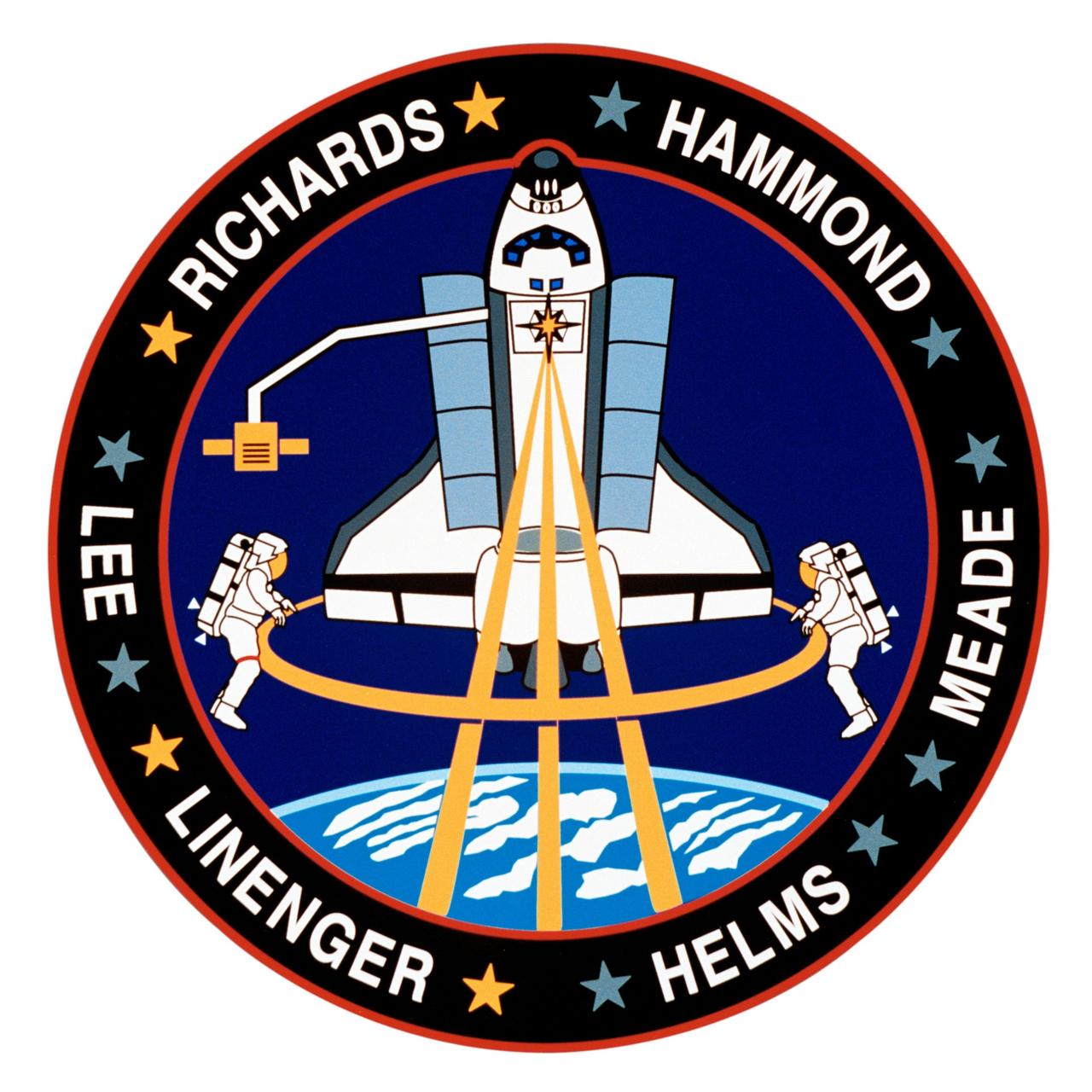
STS064-S-001 (July 1994) --- The patch depicts the space shuttle Discovery in a payload-bay-to-Earth attitude with its primary payload, Lidar In-Space Technology Experiment (LITE-1) operating in support of Mission to Planet Earth. LITE-1 is a lidar (light detection and ranging) system that uses a three-wavelength laser, symbolized by the three gold rays emanating from the star in the payload bay that form part of the astronaut symbol. The major objective of this first flight of LITE-1 is to validate its design and operating characteristics by gathering data about the Earth's troposphere and stratosphere, represented by the clouds and dual-colored Earth limb. A secondary payload on STS-64 is the free-flier SPARTAN-201 satellite shown on the Remote Manipulator System (RMS) arm post-retrieval. The objective of SPARTAN-201 is to investigate the physics of the solar wind and complement data being obtained from the ULYSSES satellite launched on STS-41. The RMS will also operate another secondary payload, Shuttle Plume Impingement Flight Experiment (SPIFEX), which will assess the plume effects from the Orbiter's Reaction Control System thrusters. Additionally, STS-64 will test a new extravehicular activity (EVA) maneuvering device, Simplified Aid for EVA Rescue (SAFER), represented symbolically by the two small nozzles on the backpacks of the two untethered EVA crew men. The names of the crew members encircle the patch: astronauts Richard N. Richards, commander; L. Blaine Hammond Jr., pilot; Jerry M. Linenger; Susan J. Helms, Carl J. Meade and Mark C. Lee, all mission specialists. The gold or silver stars by each name represent that person's parent service. The NASA insignia design for space shuttle flights is reserved for use by the astronauts and for other official use as the NASA Administrator may authorize. Public availability has been approved only in the forms of illustrations by the various news media. When and if there is any change in this policy, which is not anticipated, the change will be publicly announced. Photo credit: NASA
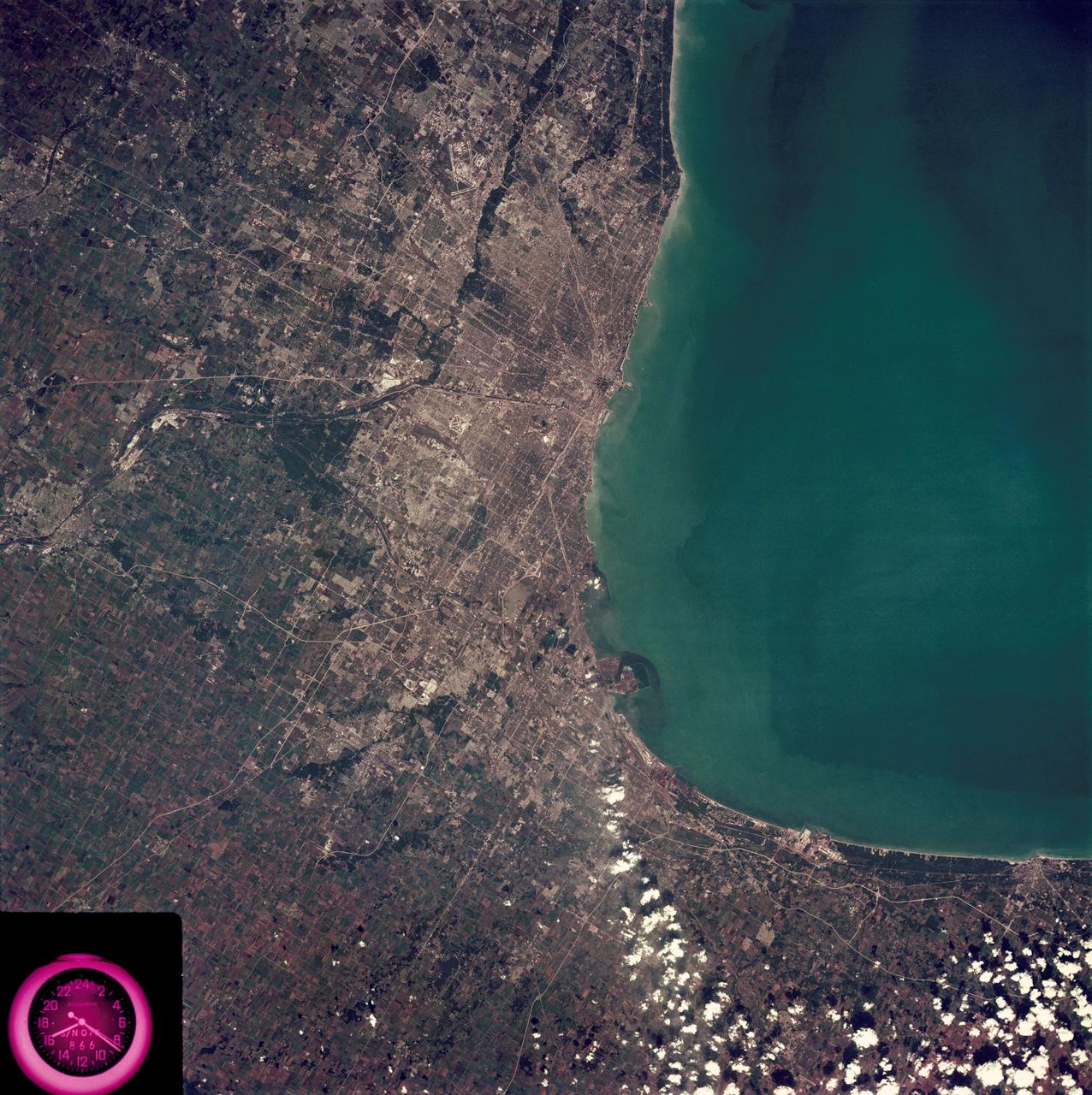
SL3-88-222 (18 Sept. 1973) --- The metropolitan area of Chicago is encompassed in this Skylab 3 Earth Resources Experiments Package (EREP) S190-B photograph taken on Sept. 18, 1973 from the Skylab space station cluster in Earth orbit. The surrounding major cities of Aurora and Joliet, Illinois; Hammond, Gary and East Chicago, Indiana, are easily delineated. The photograph reveals the following: (1) Cultural differentiation of commercial, industrial and residential areas for use in population and social studies in micro-macro community planning and in cultural pattern studies in the improvement of urban areas. (Aurora is one of 27 census cities of interest to Robert Alexander, a principal investigator. Alexander is with the U.S. Geological Survey). (2) The transportation network with major corridors and their interchanges, primary and feeder streets for use in network analysis and in the development of models for population movement and land use projection. (3) The agricultural lands for land use identification on crop inventory analysis; airports for use in delineation of service and infringement of major man-made features that affect ecosystem balance (support to environmental impact studies). (4) Air and water plumes for use in case studies, natural and man-made differentiation of pollution sources, in support of model development and in ecosystem research studies on the effects of pollution. (5) Recreational centers for use in relating recreational centers to population centers, establishing possible demands and in development of possible future recreational centers to support the demand. All EREP photography is available to the public through the Department of Interior?s Earth Resources Observations Systems Data Center, Sioux Falls, South Dakota, 57198. Photo credit: NASA
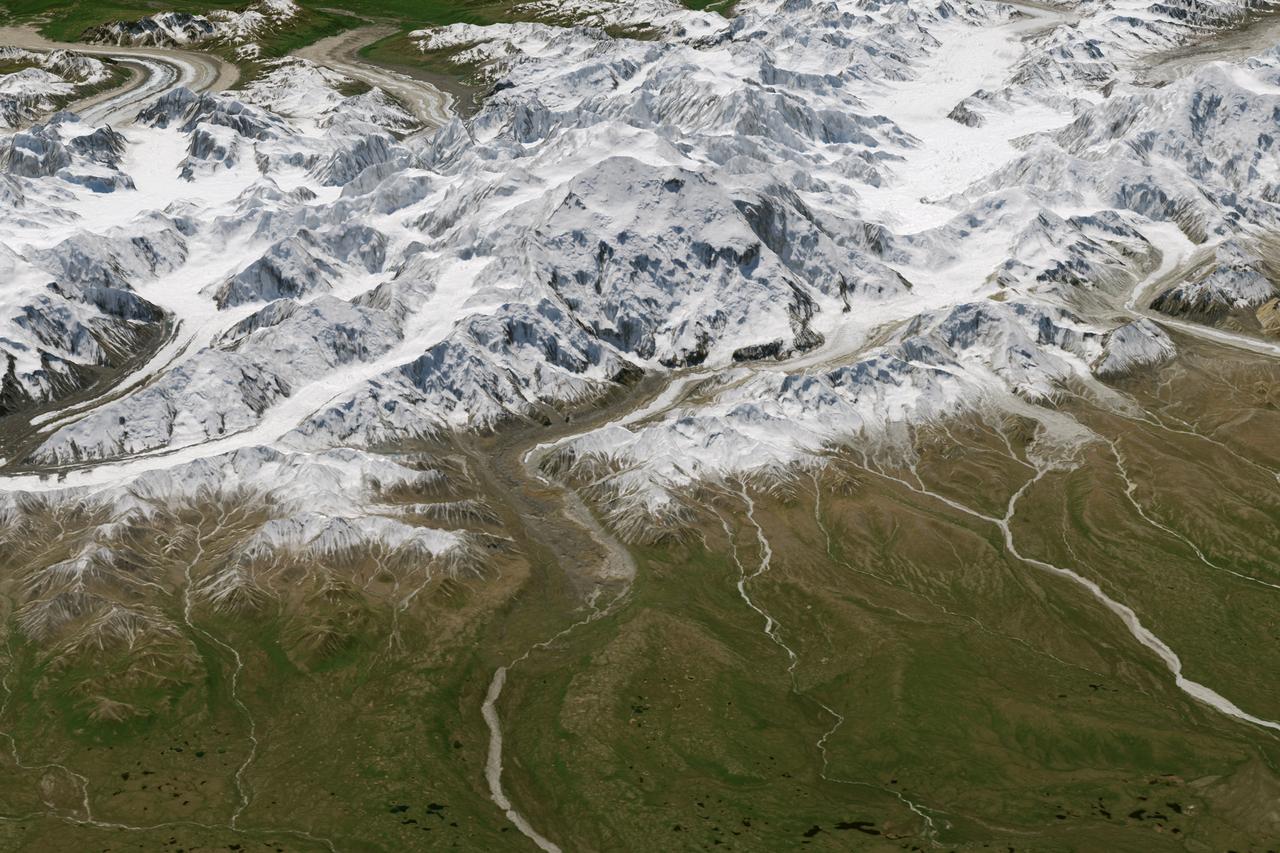
Physically, not too much has changed on Denali, North America’s highest peak. What did change in 2015 is how people describe and measure Alaska’s majestic mountain. On August 30, 2015, U.S. Secretary of the Interior Sally Jewell announced that the mountain’s official name would be Denali, not Mount McKinley. Restoration of the traditional Koyukon Athabascan name of Denali, which means “the tall one,” resolved a request by former Alaska Gov. Jay Hammond that dates back to 1975. But the mountain’s name was not the only change. On September 2, its elevation was also revised. The U.S. Geological Survey announced that Denali’s summit had a new, official elevation of 20,310 feet (6,190 meters)—10 feet shorter than surveyors had determined in the 1950s. The mountain has not shrunk. Instead, technology has improved. The images on this page offer two views of Denali as observed on June 15, 2015, by the Operational Land Imager (OLI) on Landsat 8. The natural-color Landsat 8 images were draped over an ASTER-derived Global Digital Elevation Model, which helps show the topography of the area. Read more: <a href="http://1.usa.gov/1QbmOFP" rel="nofollow">1.usa.gov/1QbmOFP</a> <b><a href="http://www.nasa.gov/audience/formedia/features/MP_Photo_Guidelines.html" rel="nofollow">NASA image use policy.</a></b> <b><a href="http://www.nasa.gov/centers/goddard/home/index.html" rel="nofollow">NASA Goddard Space Flight Center</a></b> enables NASA’s mission through four scientific endeavors: Earth Science, Heliophysics, Solar System Exploration, and Astrophysics. Goddard plays a leading role in NASA’s accomplishments by contributing compelling scientific knowledge to advance the Agency’s mission. <b>Follow us on <a href="http://twitter.com/NASAGoddardPix" rel="nofollow">Twitter</a></b> <b>Like us on <a href="http://www.facebook.com/pages/Greenbelt-MD/NASA-Goddard/395013845897?ref=tsd" rel="nofollow">Facebook</a></b> <b>Find us on <a href="http://instagrid.me/nasagoddard/?vm=grid" rel="nofollow">Instagram</a></b>
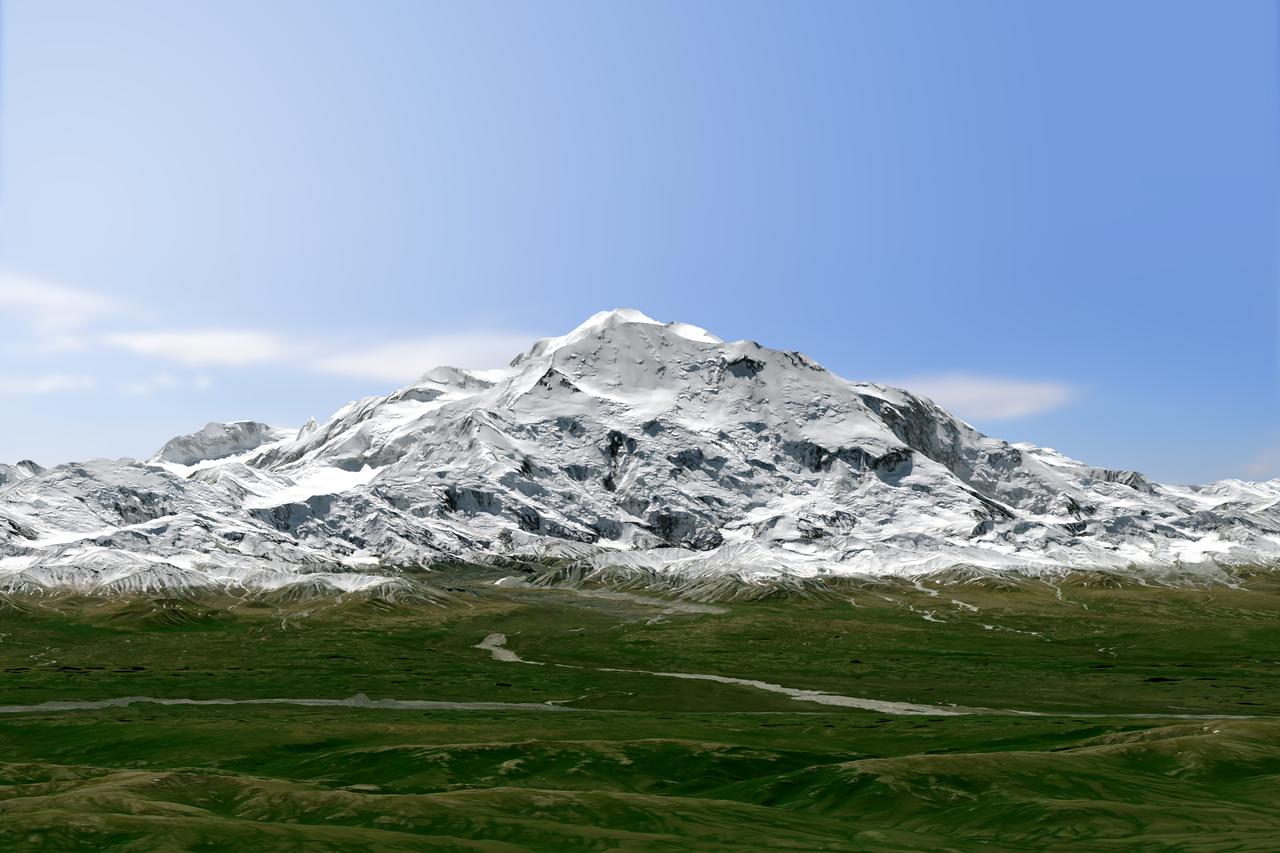
Physically, not too much has changed on Denali, North America’s highest peak. What did change in 2015 is how people describe and measure Alaska’s majestic mountain. On August 30, 2015, U.S. Secretary of the Interior Sally Jewell announced that the mountain’s official name would be Denali, not Mount McKinley. Restoration of the traditional Koyukon Athabascan name of Denali, which means “the tall one,” resolved a request by former Alaska Gov. Jay Hammond that dates back to 1975. But the mountain’s name was not the only change. On September 2, its elevation was also revised. The U.S. Geological Survey announced that Denali’s summit had a new, official elevation of 20,310 feet (6,190 meters)—10 feet shorter than surveyors had determined in the 1950s. The mountain has not shrunk. Instead, technology has improved. The images on this page offer two views of Denali as observed on June 15, 2015, by the Operational Land Imager (OLI) on Landsat 8. The natural-color Landsat 8 images were draped over an ASTER-derived Global Digital Elevation Model, which helps show the topography of the area. Read more: <a href="http://1.usa.gov/1QbmOFP" rel="nofollow">1.usa.gov/1QbmOFP</a> <b><a href="http://www.nasa.gov/audience/formedia/features/MP_Photo_Guidelines.html" rel="nofollow">NASA image use policy.</a></b> <b><a href="http://www.nasa.gov/centers/goddard/home/index.html" rel="nofollow">NASA Goddard Space Flight Center</a></b> enables NASA’s mission through four scientific endeavors: Earth Science, Heliophysics, Solar System Exploration, and Astrophysics. Goddard plays a leading role in NASA’s accomplishments by contributing compelling scientific knowledge to advance the Agency’s mission. <b>Follow us on <a href="http://twitter.com/NASAGoddardPix" rel="nofollow">Twitter</a></b> <b>Like us on <a href="http://www.facebook.com/pages/Greenbelt-MD/NASA-Goddard/395013845897?ref=tsd" rel="nofollow">Facebook</a></b> <b>Find us on <a href="http://instagrid.me/nasagoddard/?vm=grid" rel="nofollow">Instagram</a></b>