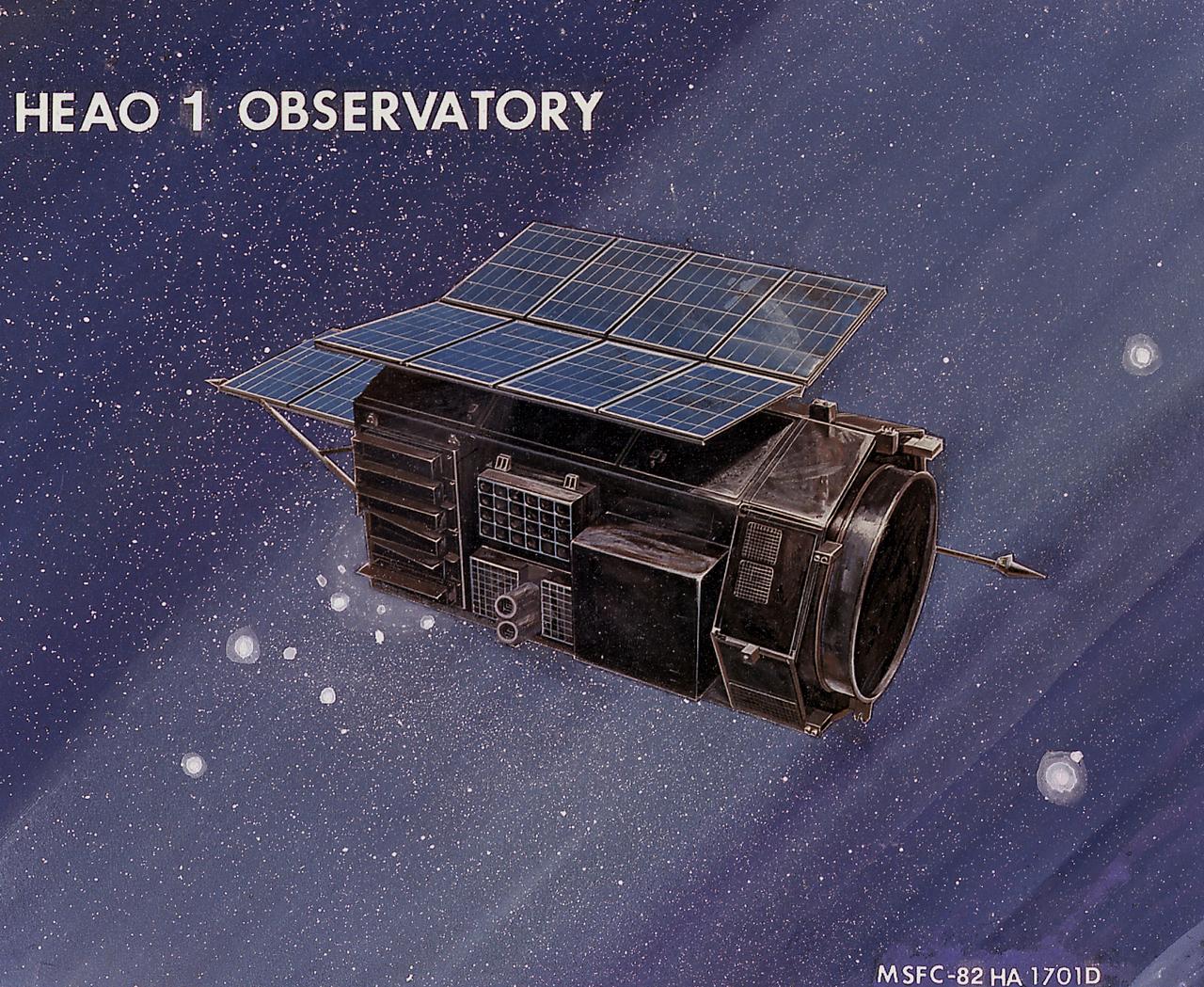
This artist's conception depicts the High Energy Astronomy Observatory (HEAO)-1 in orbit. The first observatory, designated HEAO-1, was launched on August 12, 1977 aboard an Atlas/Centaur launch vehicle and was designed to survey the sky for additional x-ray and gamma-ray sources as well as pinpointing their positions. The HEAO-1 was originally identified as HEAO-A but the designation was changed once the spacecraft achieved orbit. The HEAO project involved the launching of three unmarned scientific observatories into low Earth orbit between 1977 and 1979 to study some of the most intriguing mysteries of the universe; pulsars, black holes, neutron stars, and super nova. Hardware support for the imaging instruments was provided by American Science and Engineeing. The HEAO spacecraft were built by TRW, Inc. under project management of the Marshall Space Flight Center.

This photograph shows the High Energy Astronomy Observatory (HEAO)-1 being assembled at TRW Systems of Redondo Beach, California. The HEAO was designed and developed by TRW, Inc. under the project management of the Marshall Space Flight Center. The first observatory, designated HEAO-1, was launched on August 12, 1977 aboard an Atlas/Centaur launch vehicle and was designed to survey the sky for additional x-ray and gamma-ray sources as well as pinpointing their positions. The HEAO-1 was originally identified as HEAO-A but the designation was changed once the spacecraft achieved orbit.
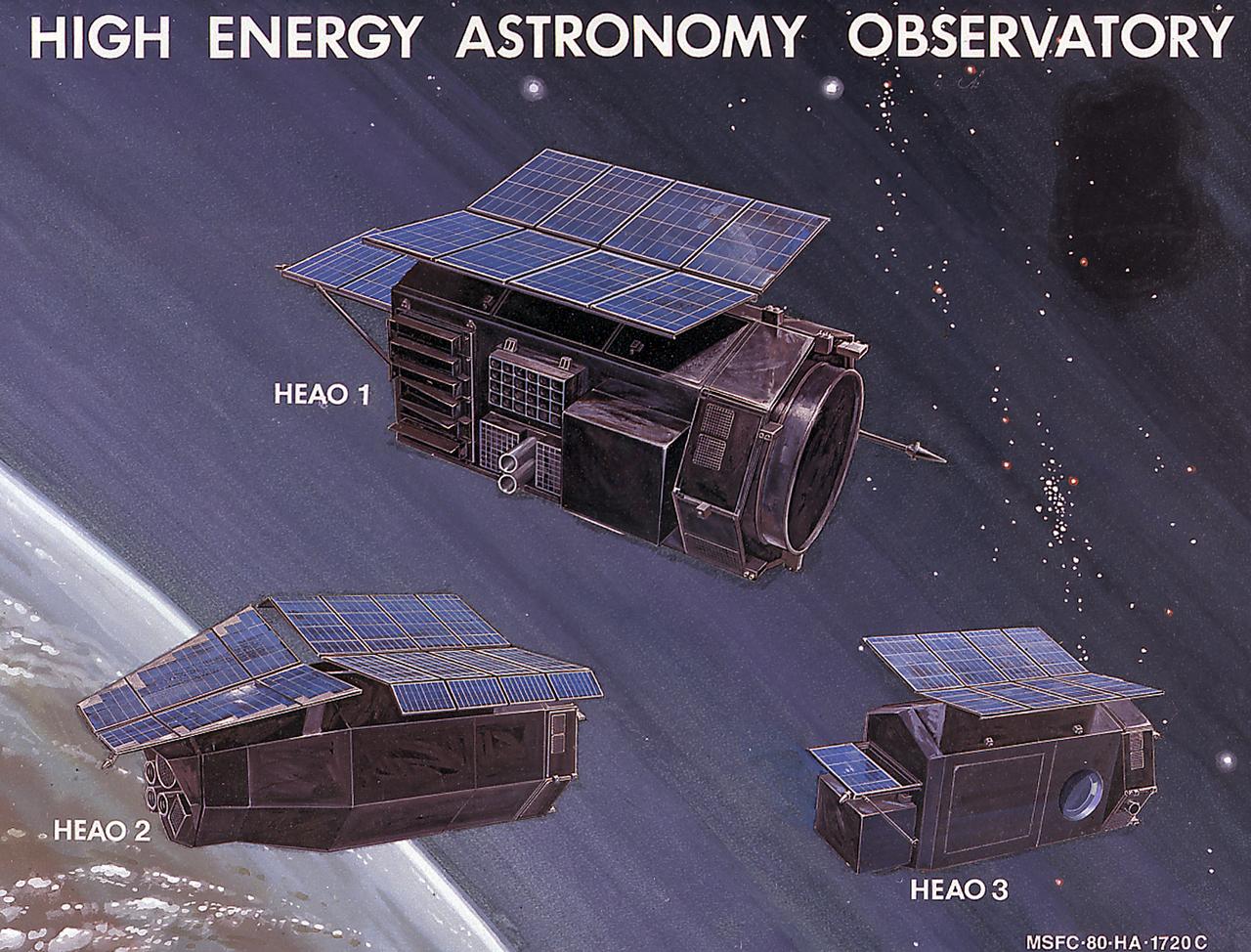
The family of High Energy Astronomy Observatory (HEAO) instruments consisted of three unmarned scientific observatories capable of detecting the x-rays emitted by the celestial bodies with high sensitivity and high resolution. The celestial gamma-ray and cosmic-ray fluxes were also collected and studied to learn more about the mysteries of the universe. High-Energy rays cannot be studied by Earth-based observatories because of the obscuring effects of the atmosphere that prevent the rays from reaching the Earth's surface. They had been observed initially by sounding rockets and balloons, and by small satellites that do not possess the needed instrumentation capabilities required for high data resolution and sensitivity. The HEAO carried the instrumentation necessary for this capability. In this photograph, an artist's concept of three HEAO spacecraft is shown: HEAO-1, launched on August 12, 1977; HEAO-2, launched on November 13, 1978; and HEAO-3, launched on September 20. 1979.

This image of the suspected Black Hole, Cygnus X-1, was the first object seen by the High Energy Astronomy Observatory (HEAO)-2/Einstein Observatory. According to the theories to date, one concept of a black hole is a star, perhaps 10 times more massive than the Sun, that has entered the last stages of stelar evolution. There is an explosion triggered by nuclear reactions after which the star's outer shell of lighter elements and gases is blown away into space and the heavier elements in the stellar core begin to collapse upon themselves. Once this collapse begins, the inexorable force of gravity continues to compact the material until it becomes so dense it is squeezed into a mere point and nothing can escape from its extreme gravitational field, not even light. The HEAO-2, the first imaging and largest x-ray telescope built to date, was capable of producing actual photographs of x-ray objects. Shortly after launch, the HEAO-2 was nicknamed the Einstein Observatory by its scientific experimenters in honor of the centernial of the birth of Albert Einstein, whose concepts of relativity and gravitation have influenced much of modern astrophysics, particularly x-ray astronomy.

This picture is of an Atlas/Centaur launch vehicle, carrying the High Energy Astronomy Observatory (HEAO)-1, on Launch Complex 36 at the Air Force Eastern Test Range prior to launch on August 12, 1977. The Kennedy Space Center managed the launch operations that included a pre-aunch checkout, launch, and flight, up through the observatory separation in orbit.