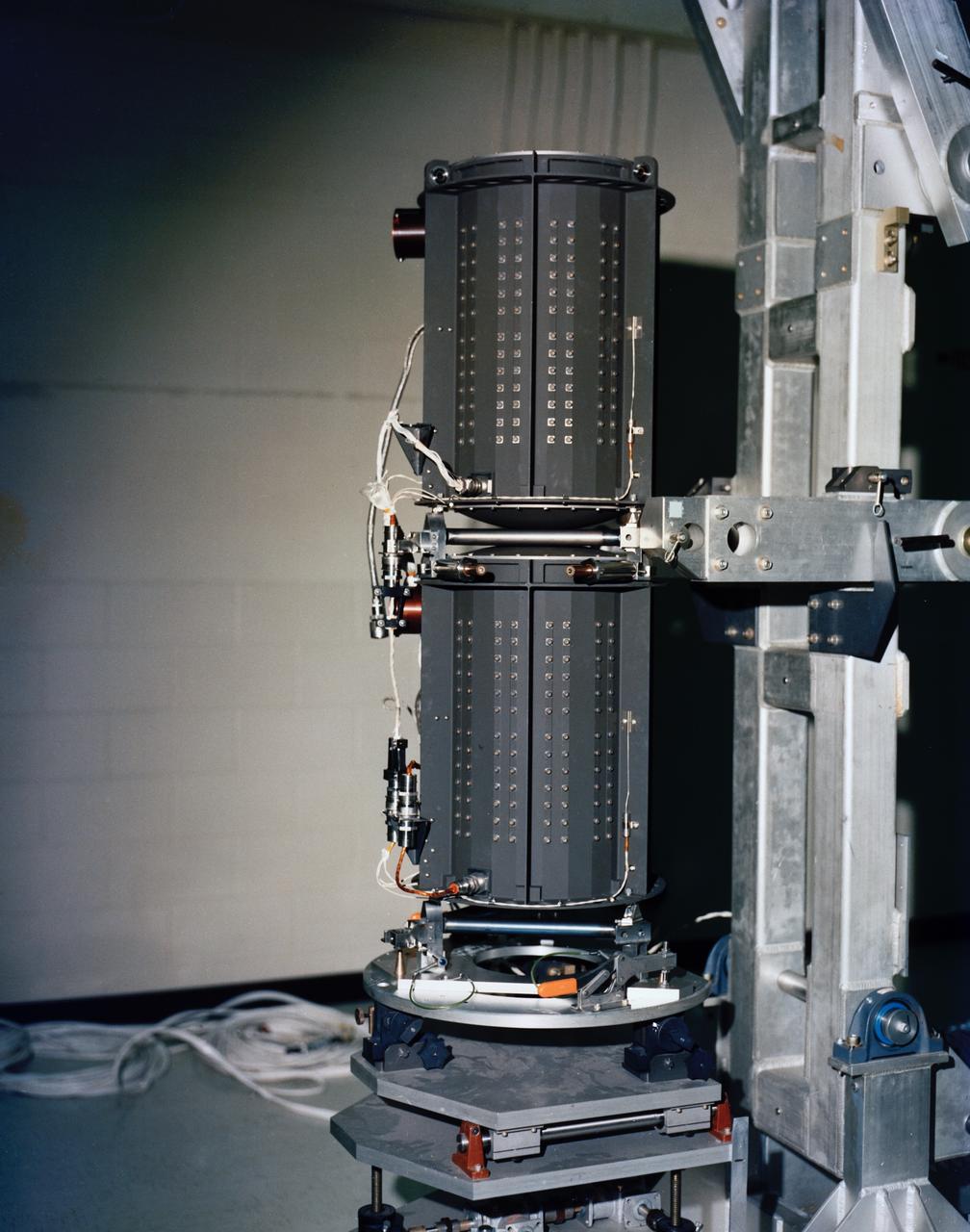
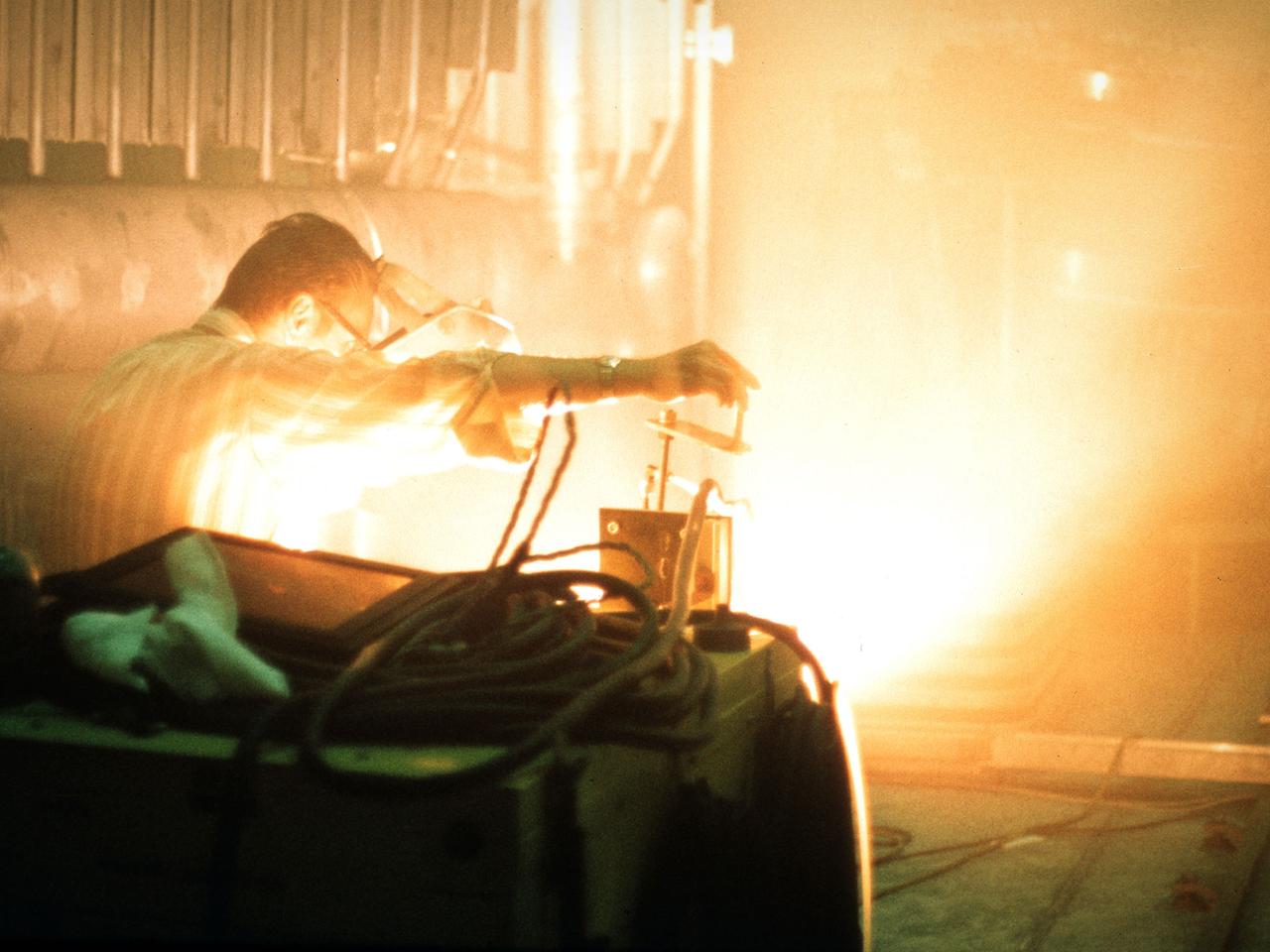
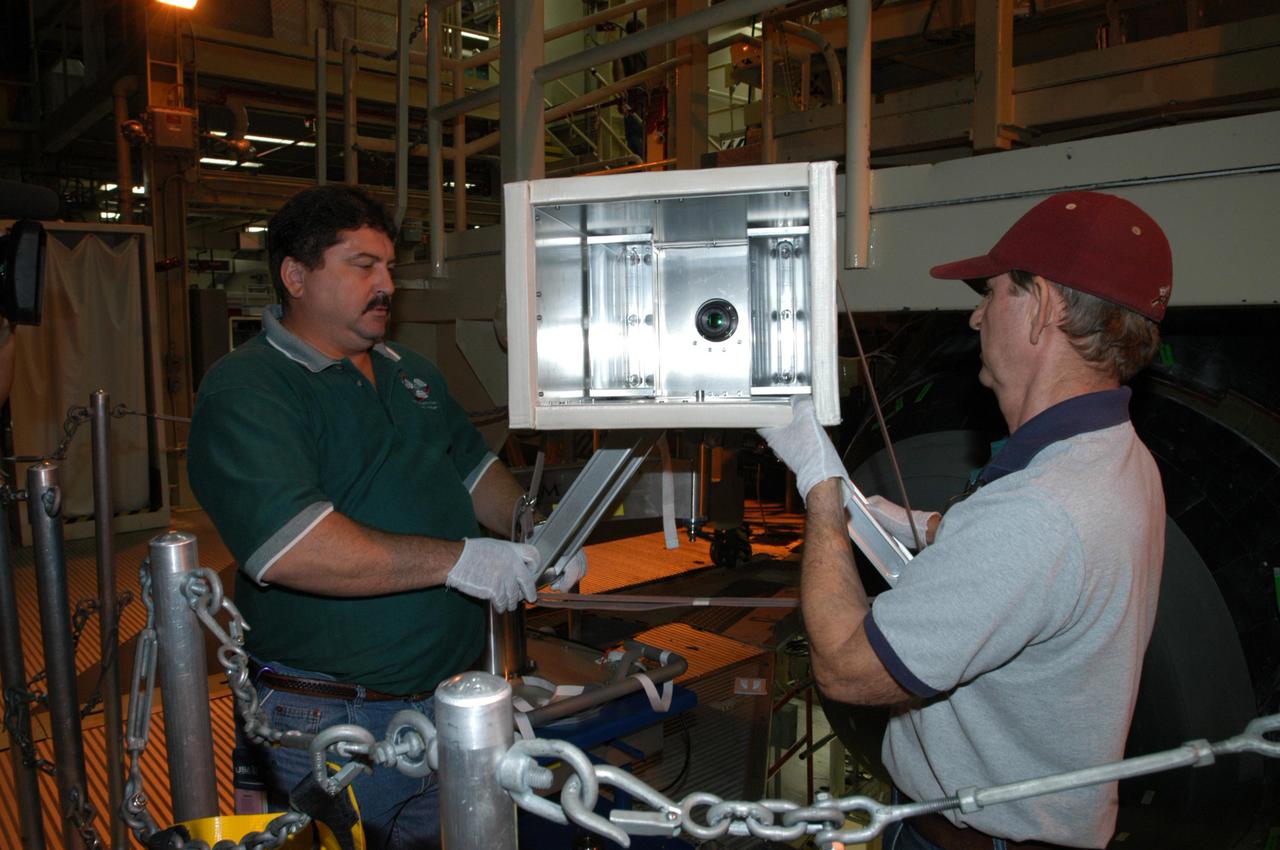
AS17-162-24063 (7-19 Dec. 1972) --- A close-up view of the equipment used for the Heat Flow and Convection Experiment, an engineering and operational test and demonstration carried out aboard the Apollo 17 command module during the final lunar landing mission in NASA's Apollo program. Three test cells were used in the demonstration for measuring and observing fluid flow behavior in the absence of gravity in space flight. Data obtained from such demonstrations will be valuable in the design of future science experiments and for manufacturing processes in space.
View of equipment used for Heat Flow and Convection Experiment
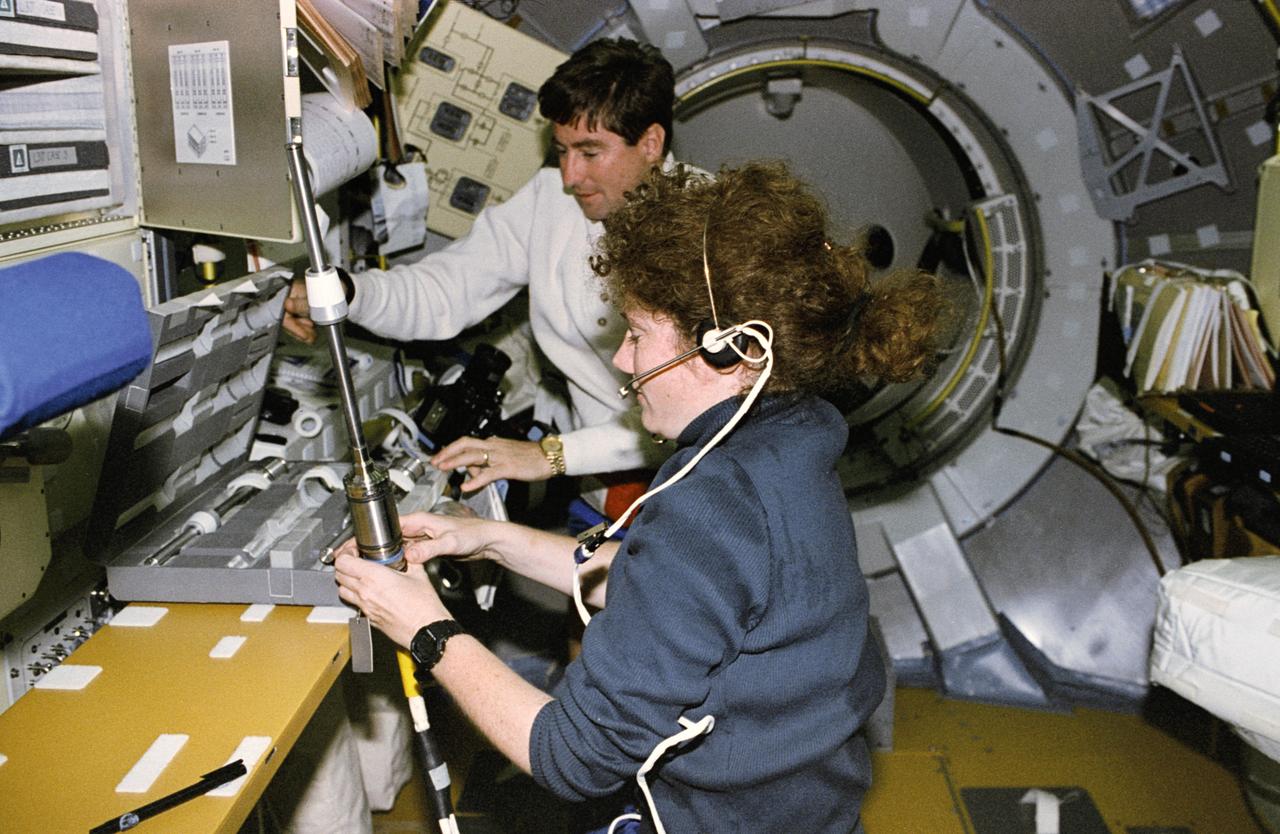
STS078-368-022 (20 June - 7 July 1996) --- Astronauts Susan J. Helms, payload commander, and Terence T. (Tom) Henricks, mission commander, prepare a sample cartridge containing semiconductor crystals for Spacelab research.  The crystals were later placed in the Advanced Gradient Heating Furnace (AGHF) in the Life and Microgravity Spacelab (LMS-1) Science Module.  The AGHF is designed for directional solidification of the crystals in the sample cartridges.  The microgravity of space allows the crystals to grow in a perfect state that can not be accomplished in Earth's gravity.
AGHF, Helms removes a sample from the LMS-1 Spacelab core facility module
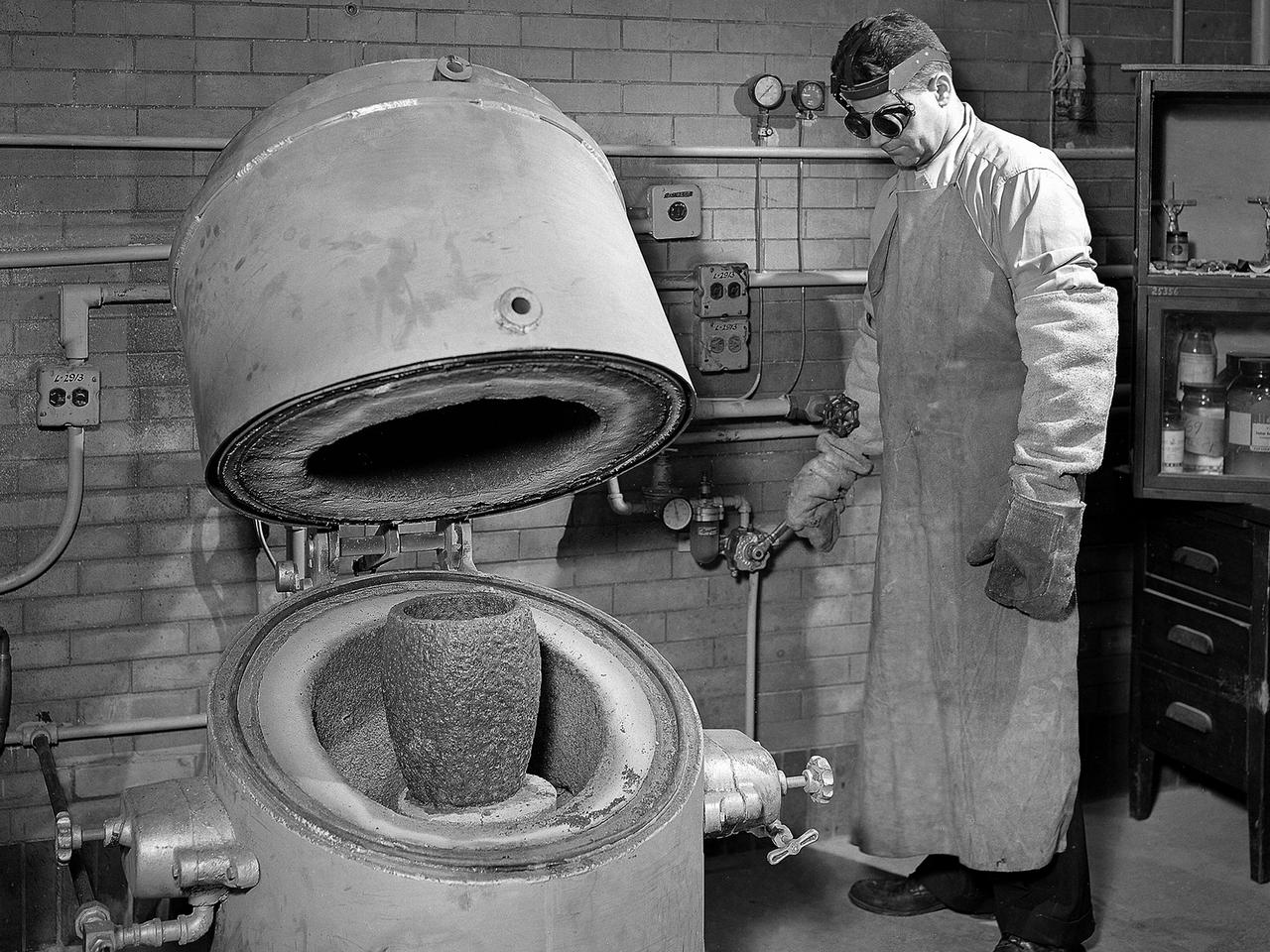
A technician prepares a metal component for a high-temperature bake in the Heat Treatment Shop at the National Advisory Committee for Aeronautics (NACA) Lewis Flight Propulsion Laboratory.  Fabrication Division under Dan White and John Dalgleish created almost all of the equipment and models used at the laboratory. The Technical Services Building, referred to as the Fab Shop, contained a number of specialized shops in the 1940s and 1950s. These included a Machine Shop, Sheet Metal Shop, Wood and Pattern Shop, Instrument Shop, Thermocouple Shop, Heat Treating Shop, Metallurgical Laboratory, and Fabrication Office.   The Metallurgical Laboratory contained a control lab for the Heat Treating Shop and a service lab for the NACA Lewis research divisions. This metallurgical group performed tensile and impact tests on metals to determine their suitability for specific research or equipment. The Heat Treating Shop heated metal parts to optimize their physical properties and contained a Precision Castings Foundry to manufacture equipment made of heat resisting alloys.
Heat Treat Shop in the Technical Services Building
Each of NASA's Voyager probes are equipped with three radioisotope thermoelectric generators (RTGs), including the one shown here at NASA's Kennedy Space Center in Florida. The RTGs provide power for the spacecraft by converting the heat generated by the decay of plutonium-238 into electricity.  Launched in 1977, the Voyager mission is managed for NASA by the agency's Jet Propulsion Laboratory, a division of Caltech in Pasadena, California.  https://photojournal.jpl.nasa.gov/catalog/PIA25782
Voyager's RTG
A mechanic and apprentice work on a wooden impeller in the Fabrication Shop at the NACA Lewis Flight Propulsion Laboratory. The 260-person Fabrication Division created almost all of the equipment and models used at the laboratory. The Technical Services Building, referred to as the “Fab Shop”, contained a number of specialized shops in the 1940s and 1950s. These included a Machine Shop, Sheet Metal Shop, Wood and Pattern Shop, Instrument Shop, Thermocouple Shop, Heat Treating Shop, Metallurgical Laboratory, and Fabrication Office.  The Machine Shop fabricated research equipment not commercially available. During World War II these technicians produced high-speed cameras for combustion research, impellers and other supercharger components, and key equipment for the lab’s first supersonic wind tunnel. The Wood and Pattern Shop created everything from control panels and cabinets to aircraft model molds for sheet metal work. The Sheet Metal Shop had the ability to work with 0.01 to 4-inches thick steel plates. The Instrument Shop specialized in miniature parts and instrumentation, while the Thermocouple Shop standardized the installation of pitot tubes and thermocouples.    The Metallurgical Laboratory contained a control lab for the Heat Treating Shop and a service lab for the NACA Lewis research divisions. The Heat Treating Shop heated metal parts to optimize their physical properties and contained a Precision Castings Foundry to manufacture equipment made of heat resisting alloys.
Impeller Creation at the Fabrication Shop
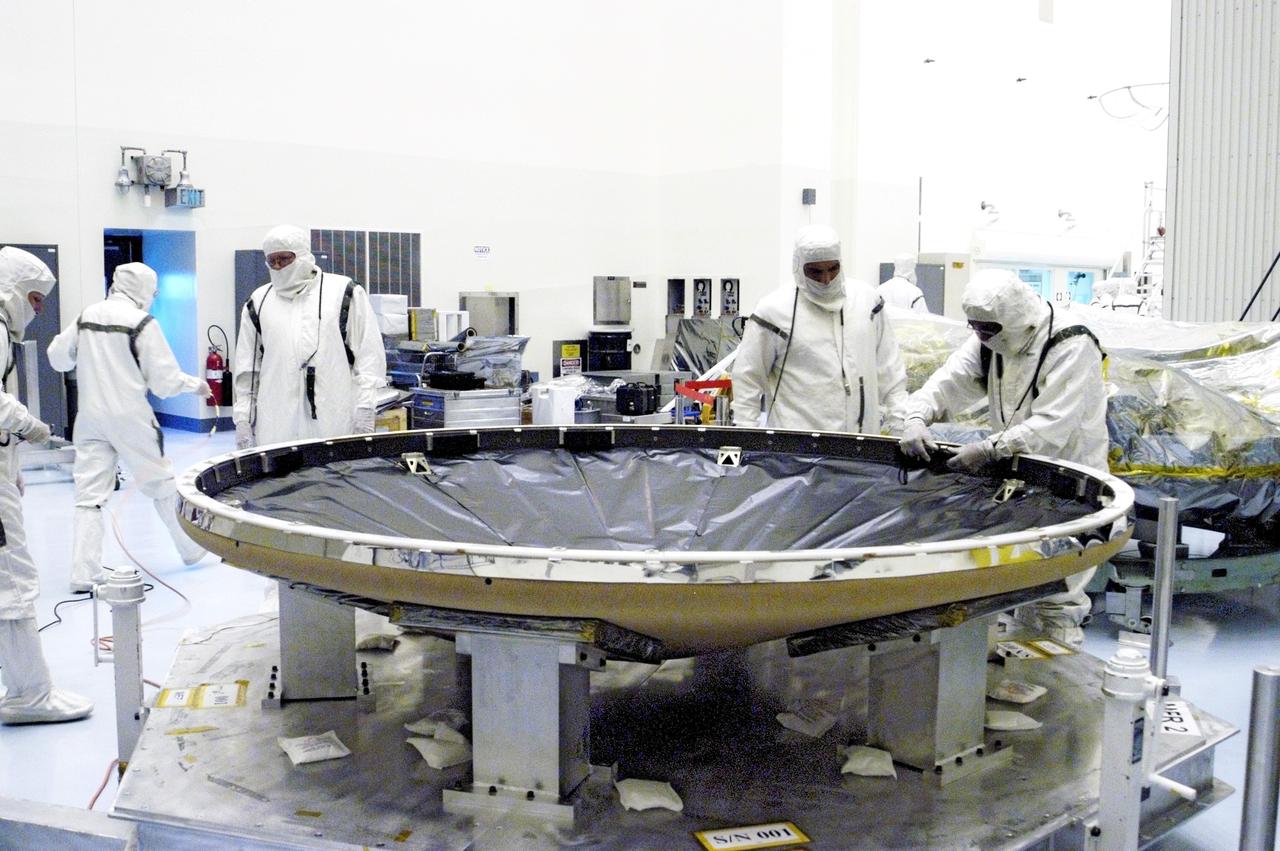
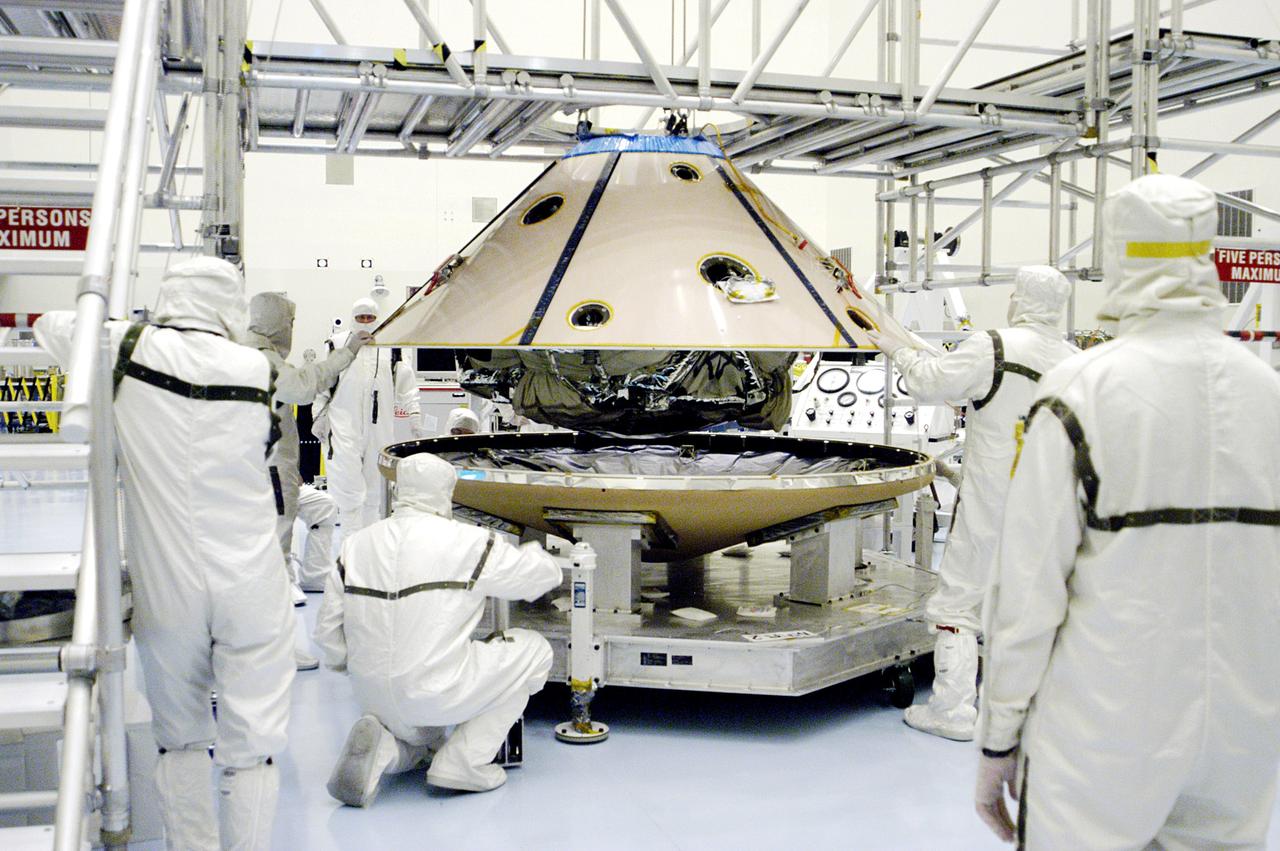
KENNEDY SPACE CENTER, FLA. - In the Payload Hazardous Servicing Facility, workers move the heat shield (foreground) toward the upper backshell/ Mars Exploration Rover 1 (MER-1), in the background.  The backshell and heat shield will be mated.  NASA's twin Mars Exploration Rovers are designed to study the history of water on Mars. These robotic geologists are equipped with a robotic arm, a drilling tool, three spectrometers, and four pairs of cameras that allow them to have a human-like, 3D view of the terrain. Each rover could travel as far as 100 meters in one day to act as Mars scientists' eyes and hands, exploring an environment where humans can't yet go.  MER-1 is scheduled to launch June 25 as MER-B aboard a Delta II rocket from Cape Canaveral Air Force Station.
KENNEDY SPACE CENTER, FLA. - In the Payload Hazardous Servicing Facility, workers move the heat shield (foreground) toward the upper backshell/ Mars Exploration Rover 1 (MER-1), in the background. The backshell and heat shield will be mated. NASA's twin Mars Exploration Rovers are designed to study the history of water on Mars. These robotic geologists are equipped with a robotic arm, a drilling tool, three spectrometers, and four pairs of cameras that allow them to have a human-like, 3D view of the terrain. Each rover could travel as far as 100 meters in one day to act as Mars scientists' eyes and hands, exploring an environment where humans can't yet go. MER-1 is scheduled to launch June 25 as MER-B aboard a Delta II rocket from Cape Canaveral Air Force Station.
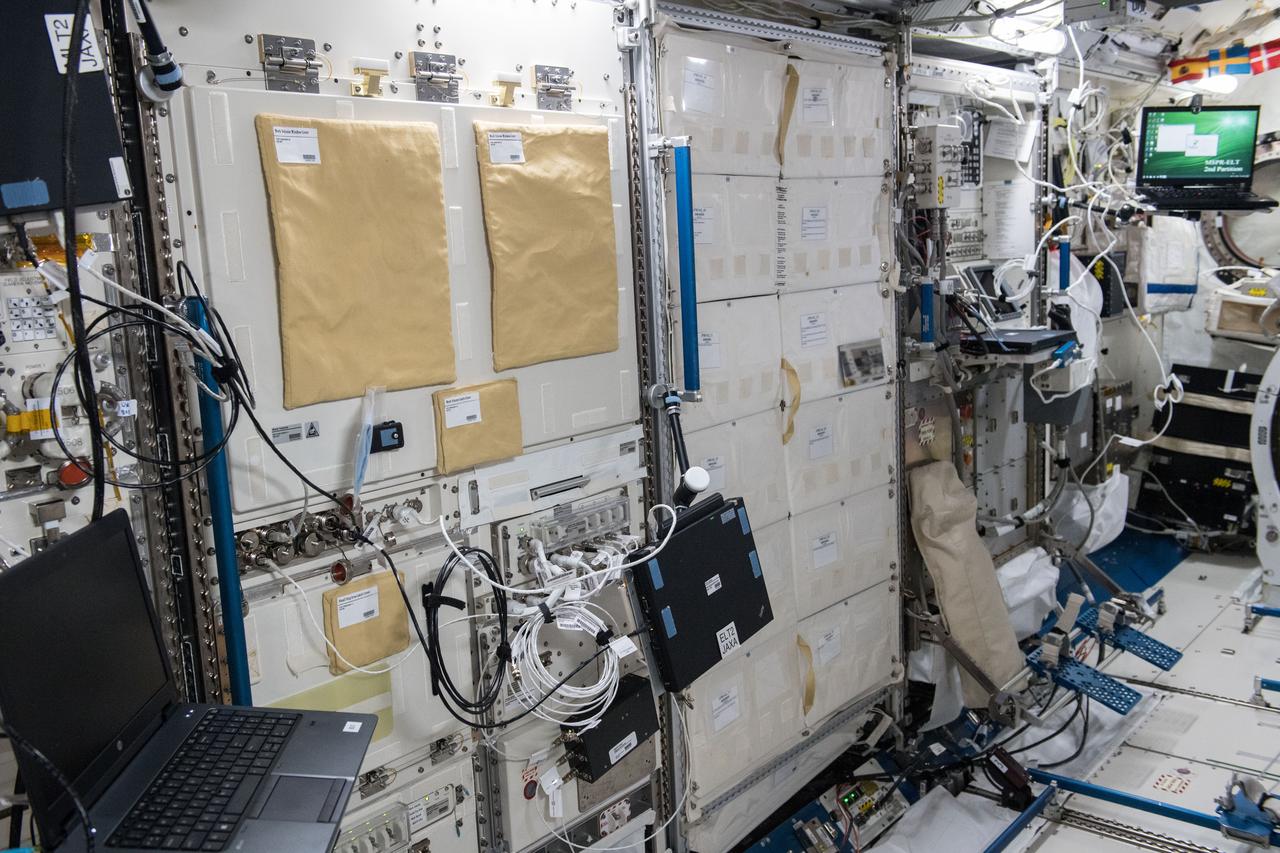
iss055e098109 (3/15/2018) --- Photo taken in the Japanese Experiment Module (JEM) aboard the International Space Station (ISS), showing the Multi-purpose Small Payload Rack (MSPR) Two-Phase Flow (TPF) Experiment Equipment. The Interfacial behaviors and Heat transfer characteristics in Boiling Two-Phase Flow (Two-Phase Flow) investigation helps to provide better fundamental understanding on the behavior of liquid-vapor flow, and the mechanism of heat transfer under microgravity.
MSPR TPF Experiment Equipment Deactivation
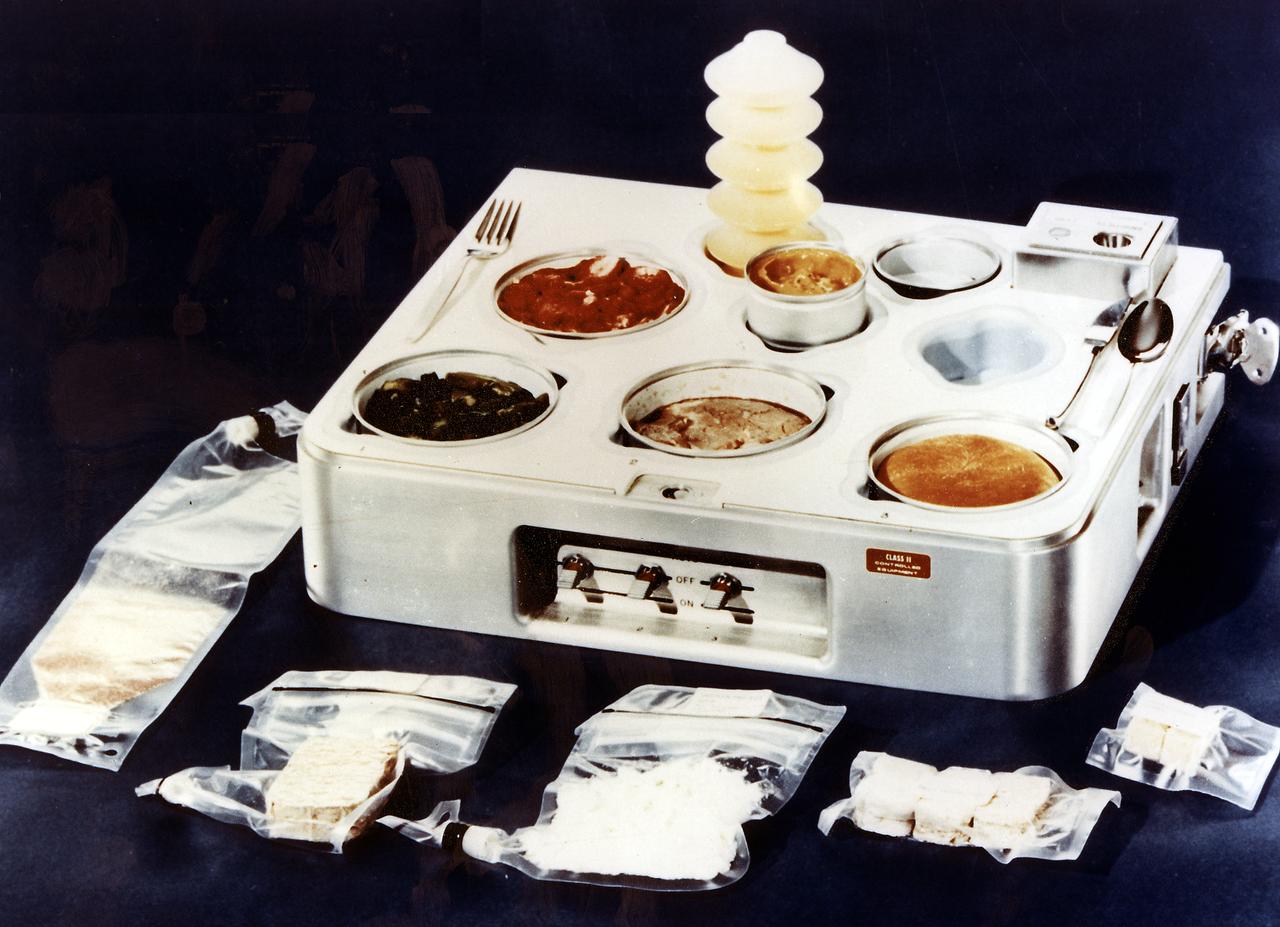
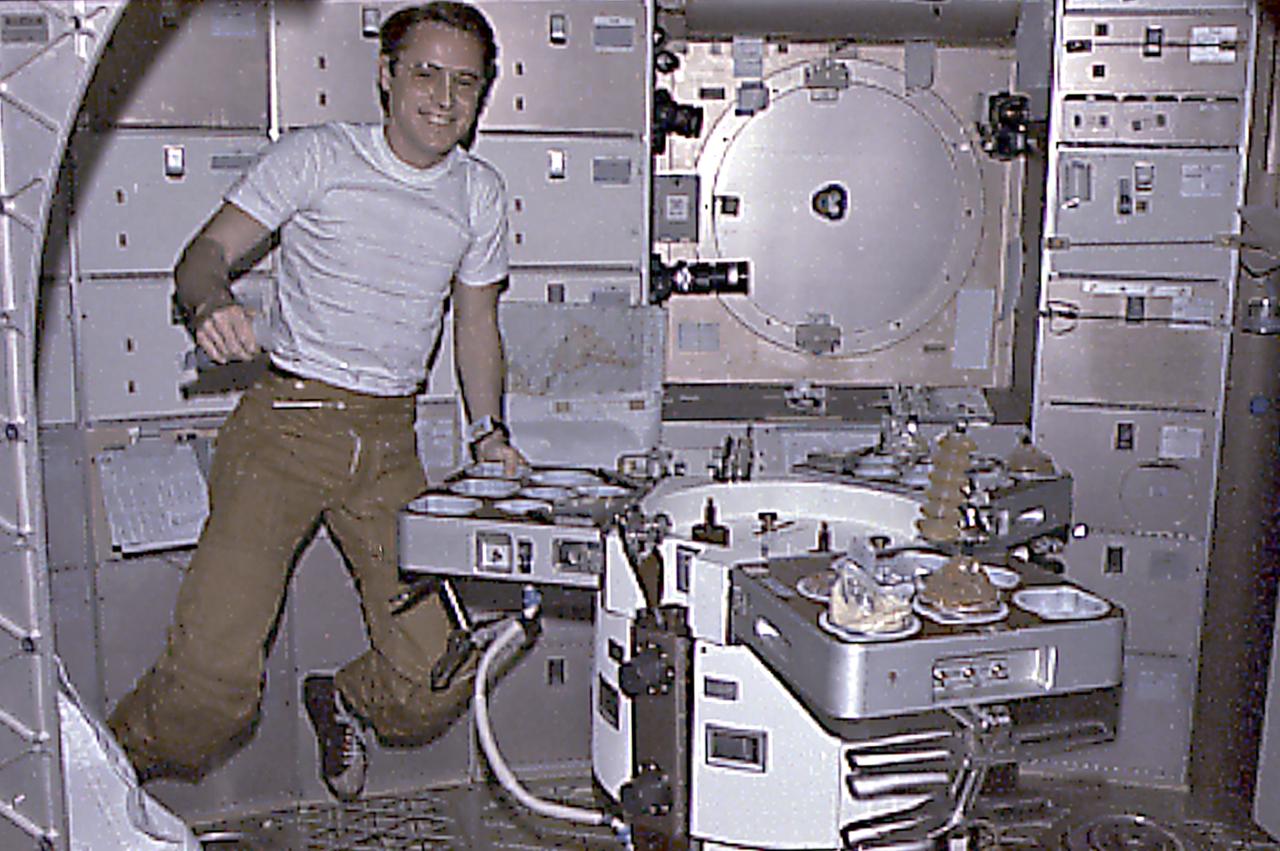
Shown here is the Skylab food heating and serving tray with food, drink, and utensils. The tray contained heating elements for preparing the individual food packets. The food on Skylab was a great improvement over that on earlier spaceflights. It was no longer necessary to squeeze liquified food from plastic tubes. Skylab's kitchen in the Orbital Workshop wardroom was so equipped that each crewman could select his own menu and prepare it to his own taste. The Marshall Space Flight Center had program management responsibility for the development of Skylab hardware and experiments.
Skylab
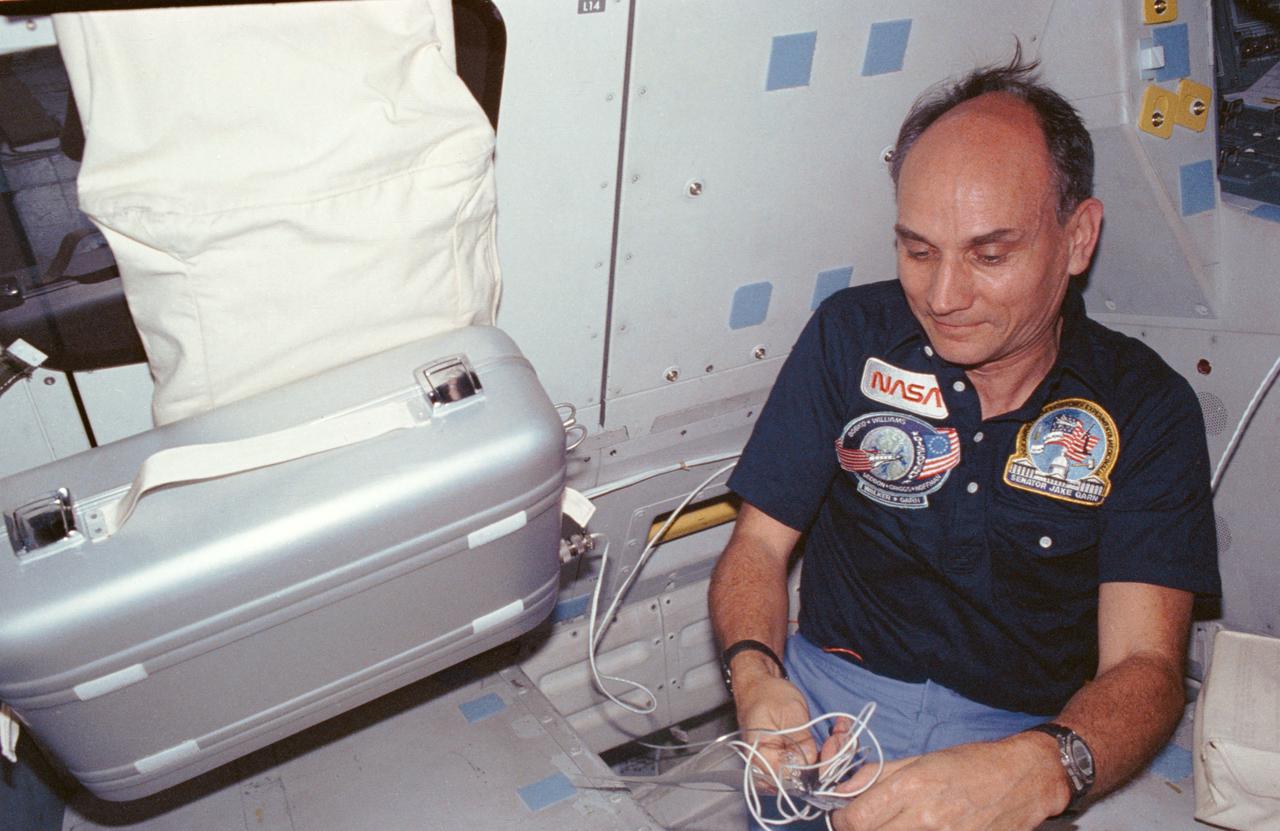
U. S. Senator E.J. (Jake) Garn, payload specialist, plugs in a food warmer in middeck area of the Shuttle Discovery.
Payload specialists Sen. Jake Garn plugs in food warmer in middeck area
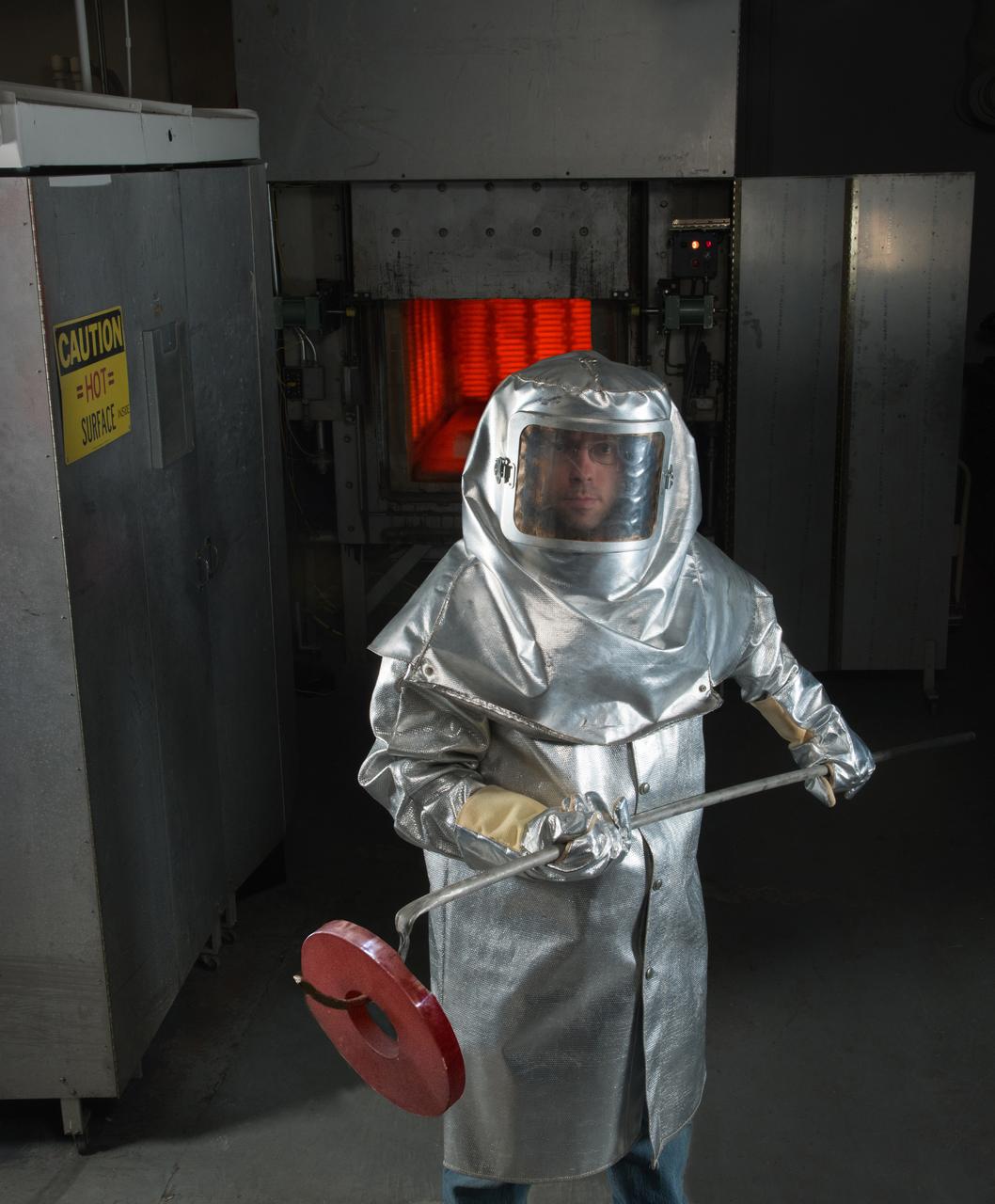
Personal Protective Equipment, PPE, Portrait Series, Welch_503059, Shape memory alloys, Shape memory alloy, Welch-Bey-503059, Glen Bigelow,
Personal Protective Equipment, PPE, Portrait Series,
One of the two primary coolers at the Propulsion Systems Laboratory at the National Advisory Committee for Aeronautics (NACA) Lewis Flight Propulsion Laboratory. Engines could be run in simulated altitude conditions inside the facility’s two 14-foot-diameter and 24-foot-long test chambers. The Propulsion Systems Laboratory was the nation’s only facility that could run large full-size engine systems in controlled altitude conditions. At the time of this photograph, construction of the facility had recently been completed.    Although not a wind tunnel, the Propulsion Systems Laboratory generated high-speed airflow through the interior of the engine. The air flow was pushed through the system by large compressors, adjusted by heating or refrigerating equipment, and de-moisturized by air dryers. The exhaust system served two roles: reducing the density of the air in the test chambers to simulate high altitudes and removing hot gases exhausted by the engines being tested.    It was necessary to reduce the temperature of the extremely hot engine exhaust before the air reached the exhauster equipment. As the air flow exited through exhaust section of the test chamber, it entered into the giant primary cooler seen in this photograph. Narrow fins or vanes inside the cooler were filled with water. As the air flow passed between the vanes, its heat was transferred to the cooling water. The cooling water was cycled out of the system, carrying with it much of the exhaust heat.
Primary Exhaust Cooler at the Propulsion Systems Laboratory
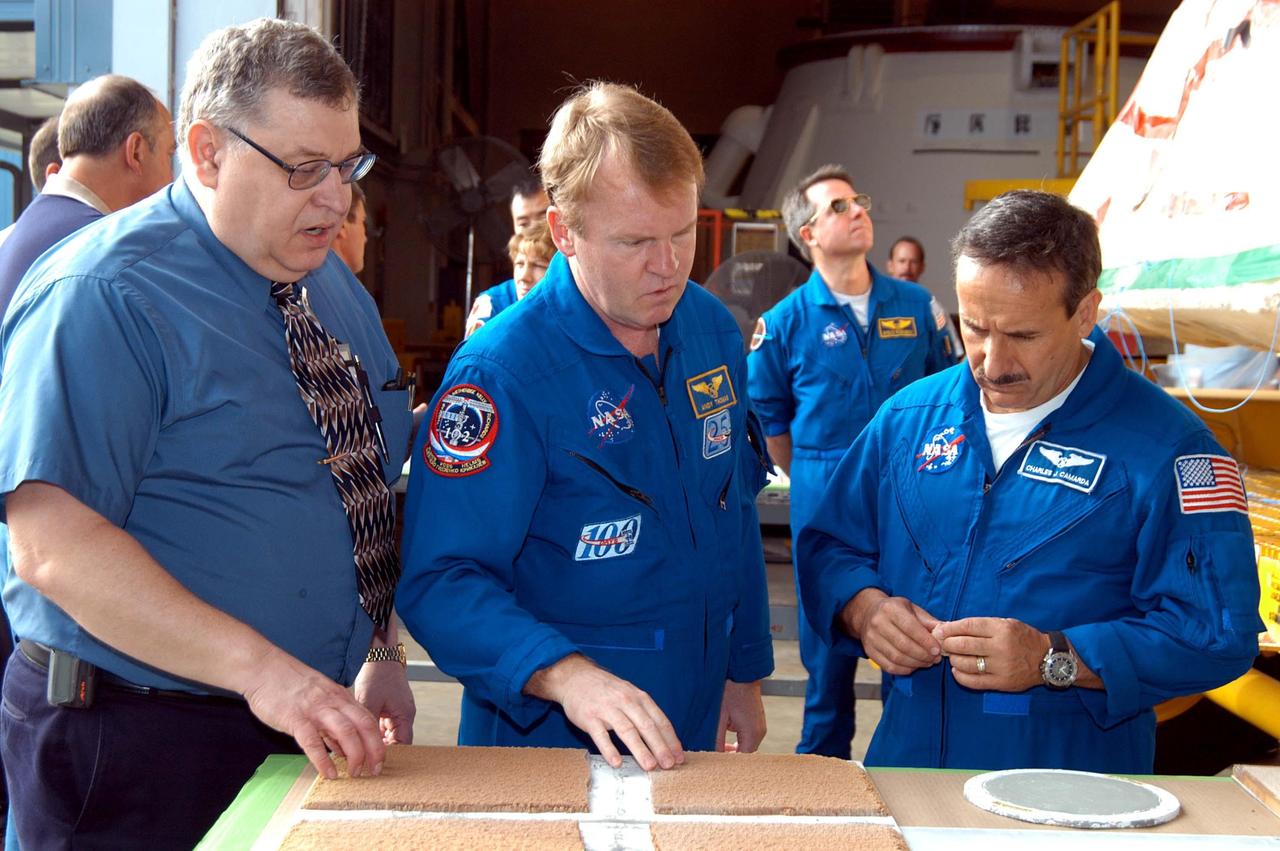
KENNEDY SPACE CENTER, FLA. -  At the SRB Assembly and Refurbishment Facility, STS-114 Mission Specialists Andrew Thomas (center) and Charles Camarda (right) look at a test panel of insulation material (left) cut in a liquid nitrogen process and a round aft heat seal (right) also treated in a liquid nitrogen process. At left is Mike Leppert, Manufacturing Operations project lead with United Space Alliance.  The crew is at KSC for familiarization with Shuttle and mission equipment. The STS-114 mission is Logistics Flight 1, which is scheduled to deliver supplies and equipment, plus the external stowage platform, to the International Space Station.
KSC-04pd0388
A researcher sets up equipment in the Space Power Chamber at National Aeronautics and Space Administration’s (NASA) Plum Brook Station to study the effects of contaminants on clouds. Drs. Rosa and Jorge Pena of Pennsylvania State University's Department of Meteorology initiated the program in an effort to develop methods of creating stable, long-lasting clouds in a test chamber in order to study their composition and formation. The researchers then wanted to use the artificially-created clouds to determine how they were affected by pollution.    The 100-foot diameter and 122-foot high Space Power Chamber is the largest vacuum chamber in the world. The researchers covered the circular walls with muslin. A recirculating water system saturated the cloth. The facility engineers then reduced the chamber’s pressure which released the water from the muslin and generated a cloud.    The researchers produced five different clouds in this first portion of this study. They discovered that they could not create stable clouds because of the heat generated by the water-pumping equipment. Nonetheless, they felt confident enough to commence planning the second phase of the program using a heat exchanger to cool the equipment.
Cloud Physics Test in the Space Power Chamber
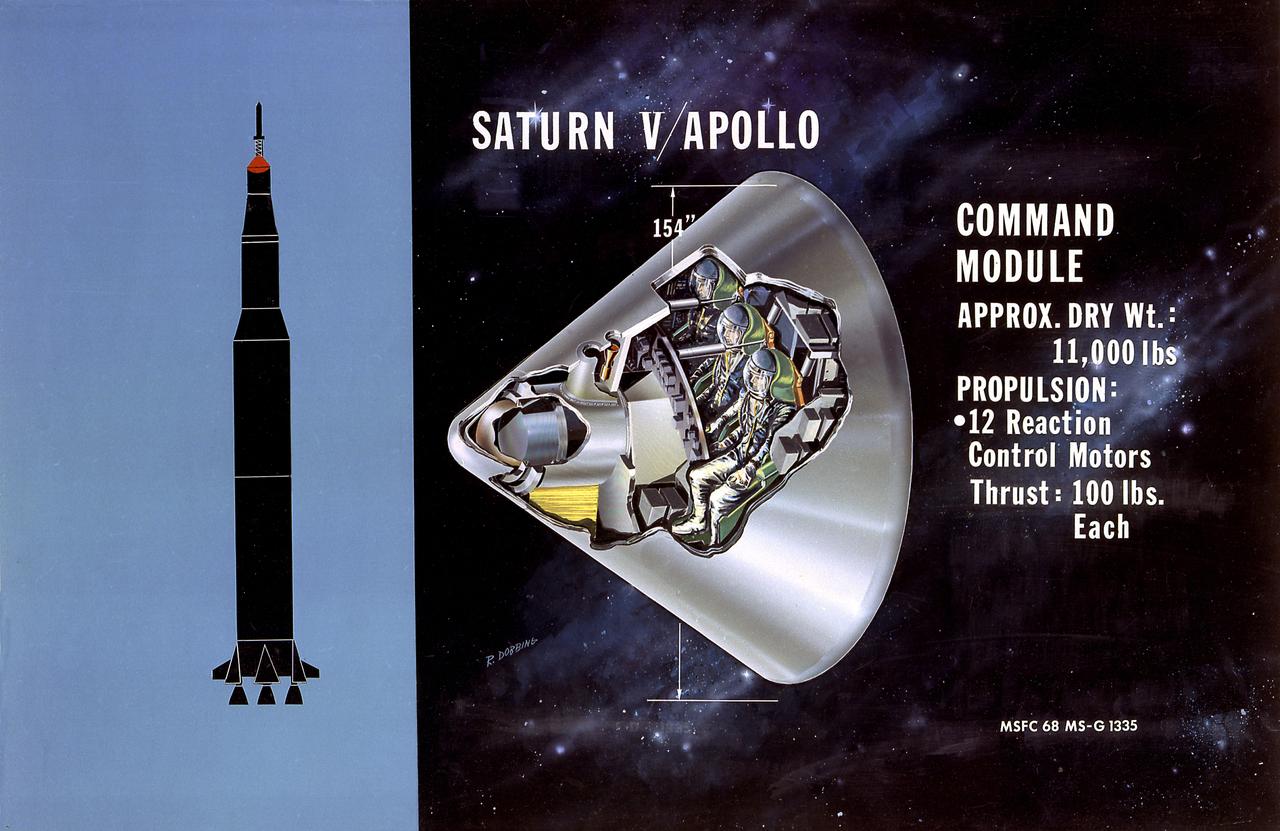
This is a cutaway illustration of the Saturn V command module (CM) configuration. The CM was crammed with some of the most complex equipment ever sent into space at the time. The three astronaut couches were surrounded by instrument panels, navigation gear, radios, life-support systems, and small engines to keep it stable during reentry. The entire cone, 11 feet long and 13 feet in diameter, was protected by a charring heat shield. The 6.5 ton CM was all that was finally left of the 3,000-ton Saturn V vehicle that lifted off on the journey to the Moon.
Saturn Apollo Program
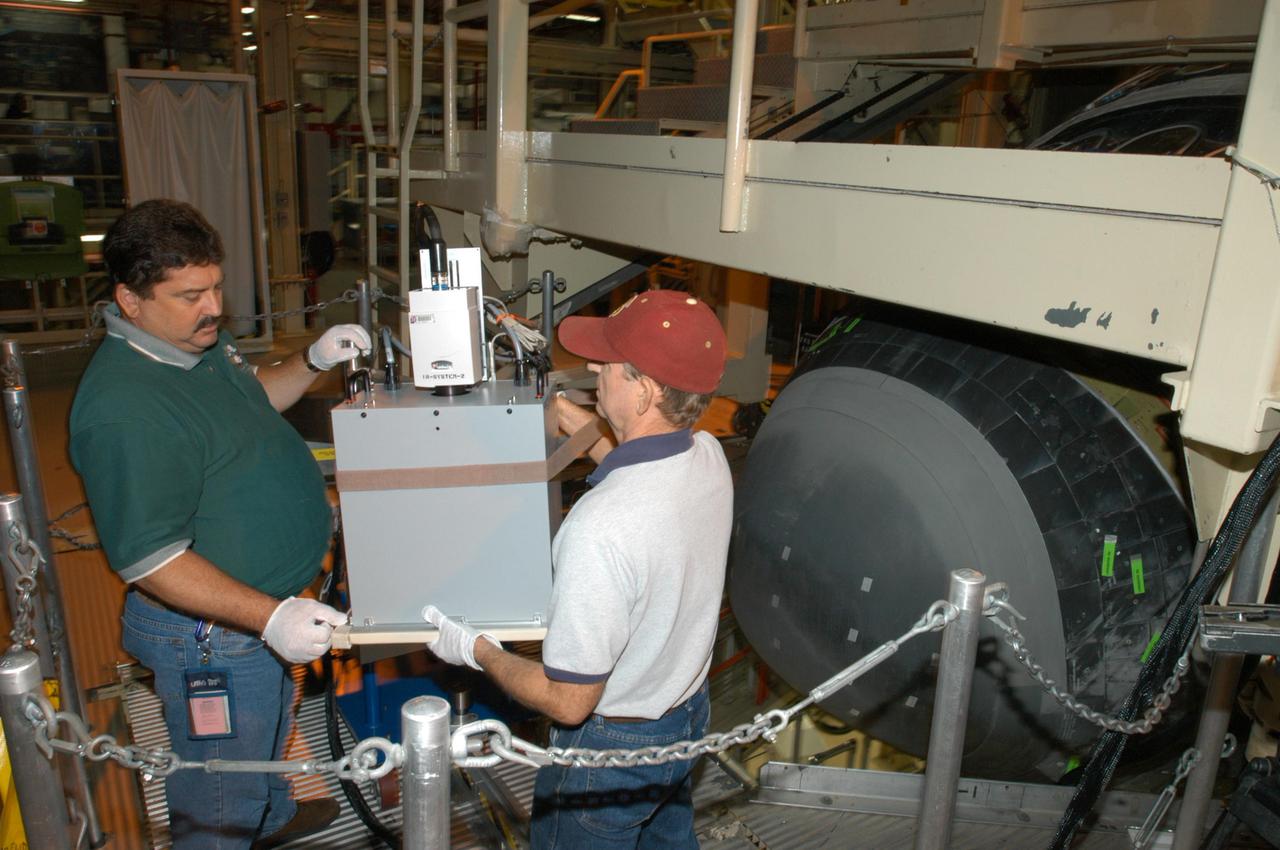
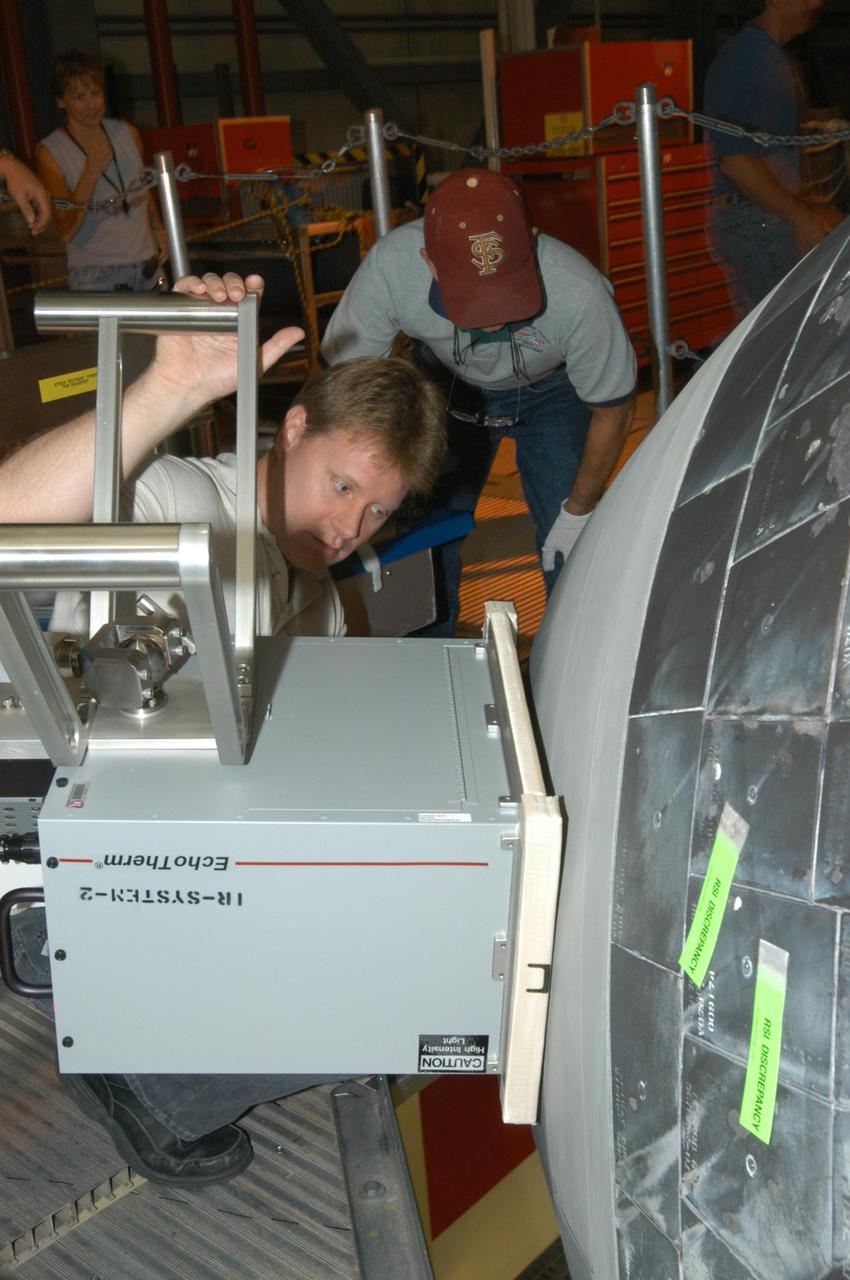
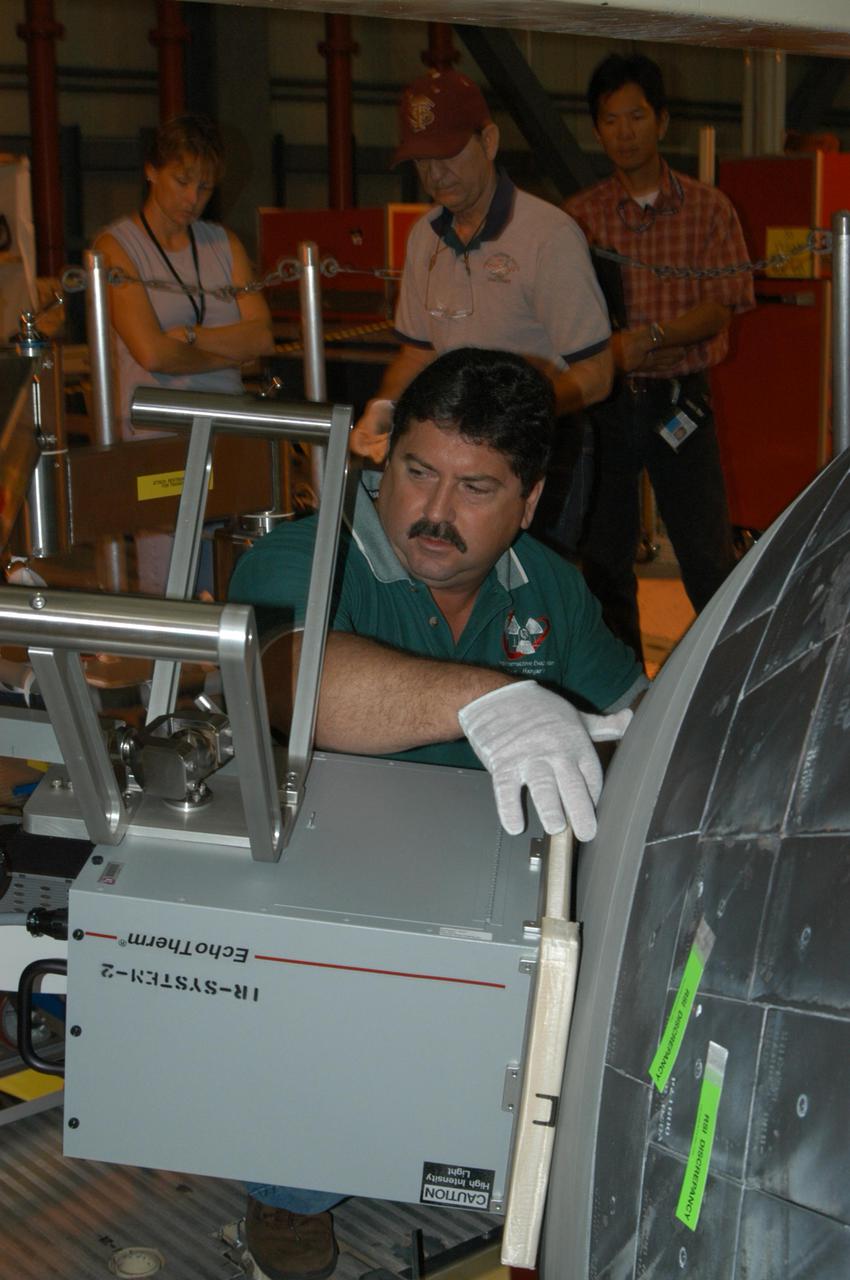
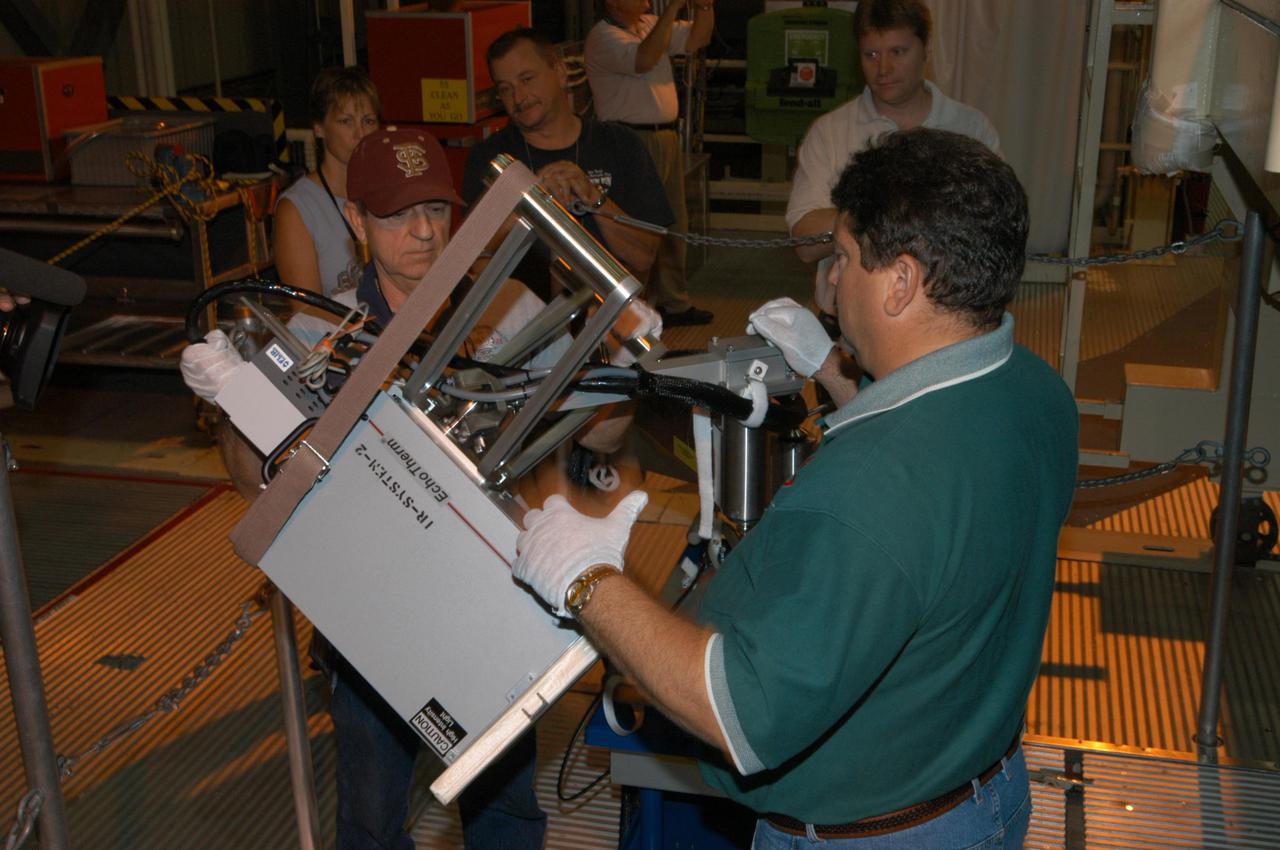
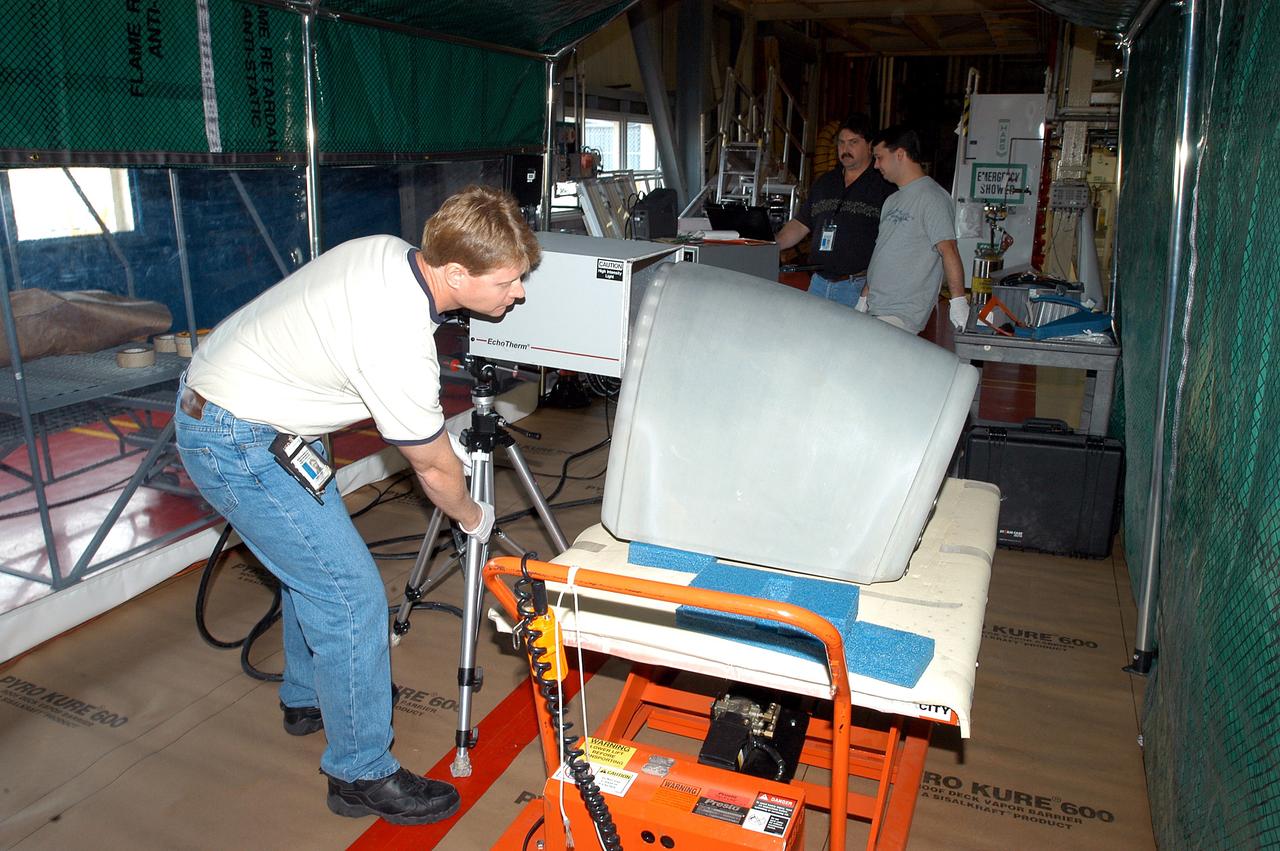
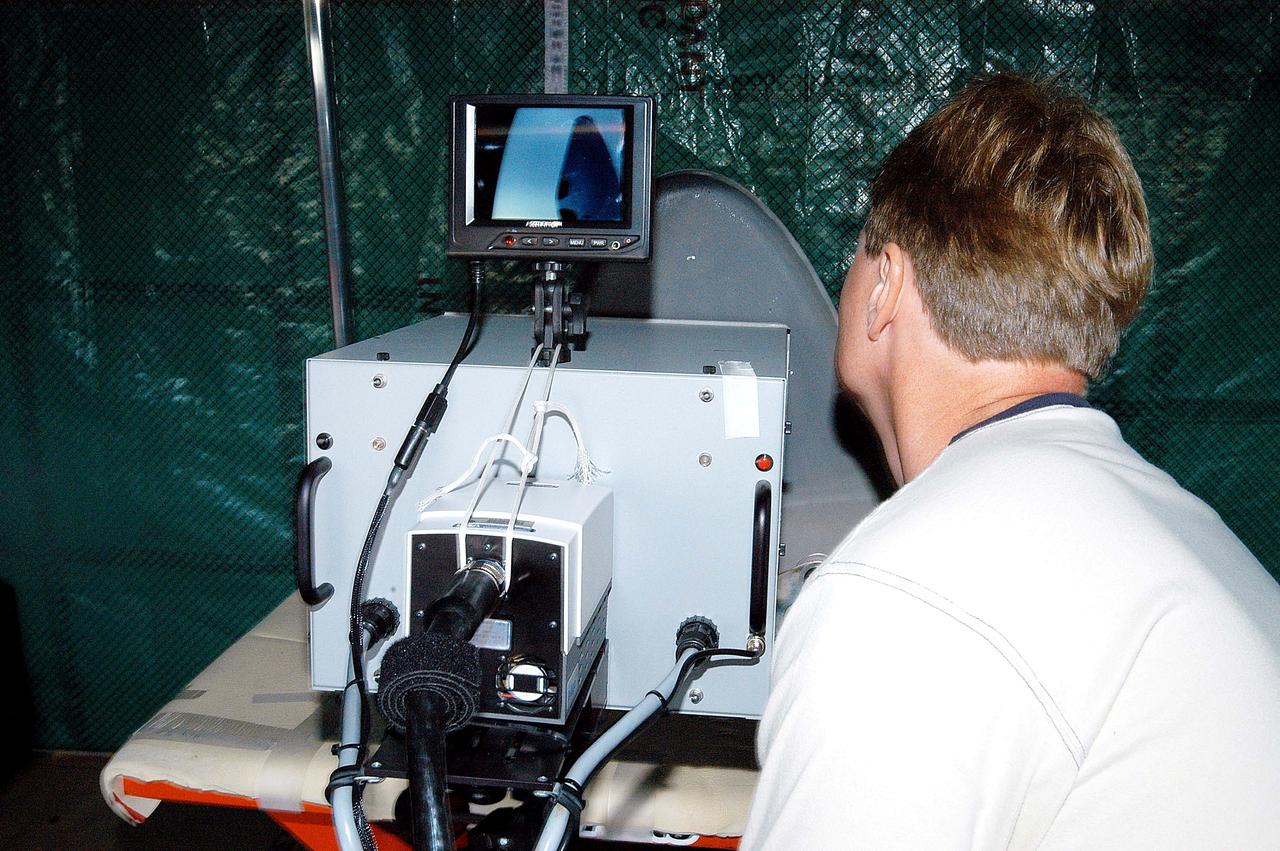
KENNEDY SPACE CENTER, FLA. -  In NASA Kennedy Space Center’s Orbiter Processing Facility, bay 3, NDE Specialist Jim Landy (left) and Dick Logsdon, with United Space Alliance, set up thermography equipment in front of Discovery’s nose cone.   Thermography uses high-intensity light to heat specific areas, which are then immediately scanned with an infrared camera.  As the area cools, internal flaws are revealed.  Discovery has been identified as the orbiter to fly on mission STS-121.
KSC-05PD-2195
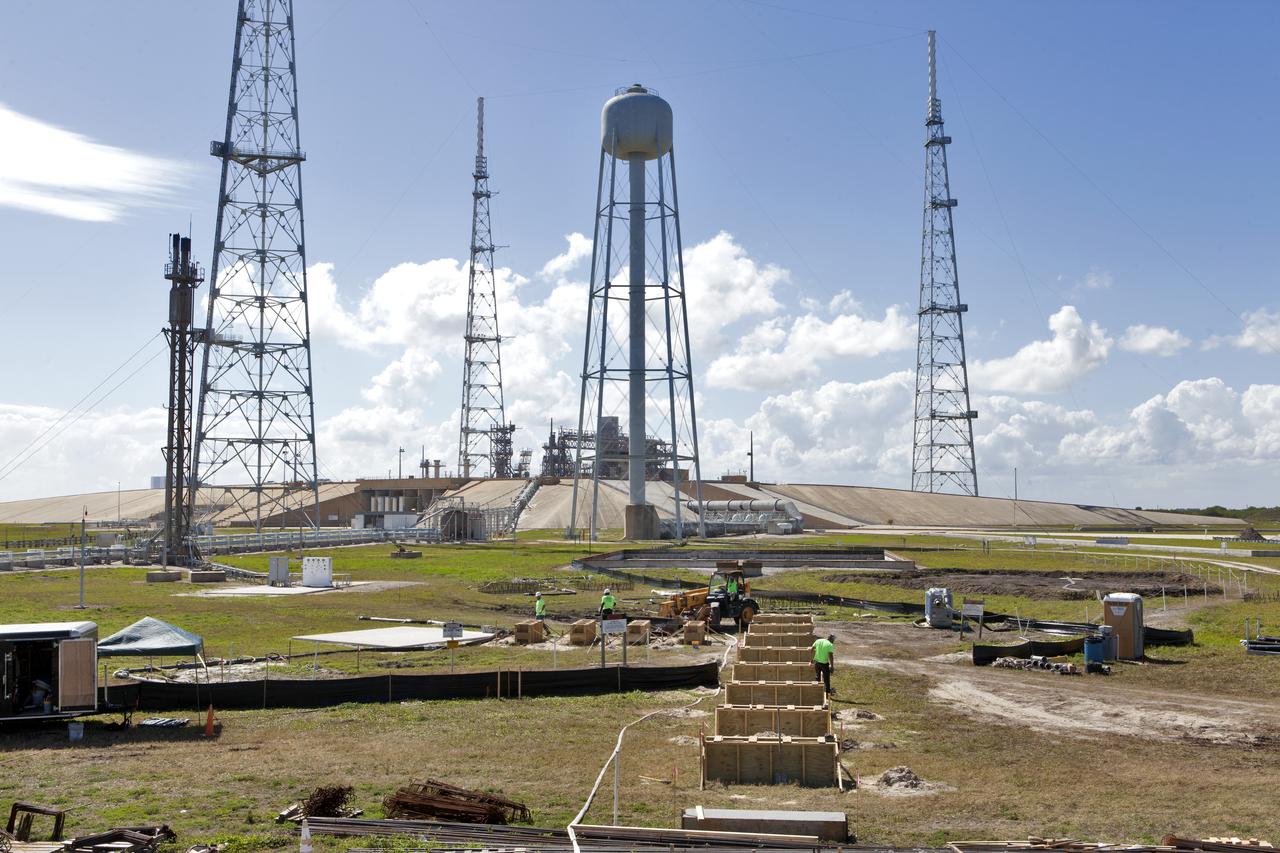
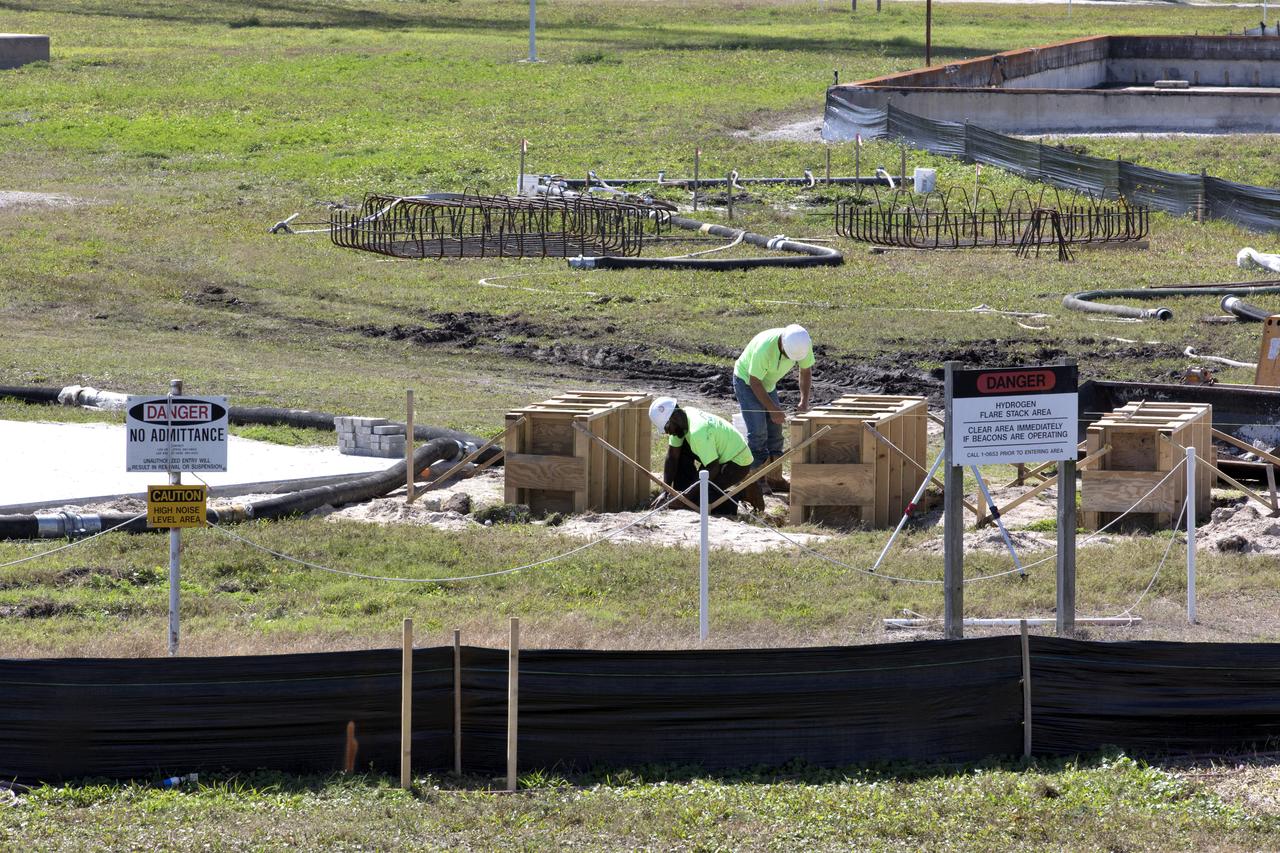
Construction workers stage parts and equipment nearby Launch Pad 39B at NASA’s Kennedy Space Center in Florida on Feb. 22, 2019. The launch pad has undergone upgrades and modifications to accommodate NASA's Space Launch System and Orion spacecraft for Exploration Mission-1 and subsequent missions. Upgrades include new heat-resistant bricks on the walls of the flame trench and installation of a new flame deflector. All of the upgrades have been managed by Exploration Ground Systems.
Pad 39B Upgrades - February 2019
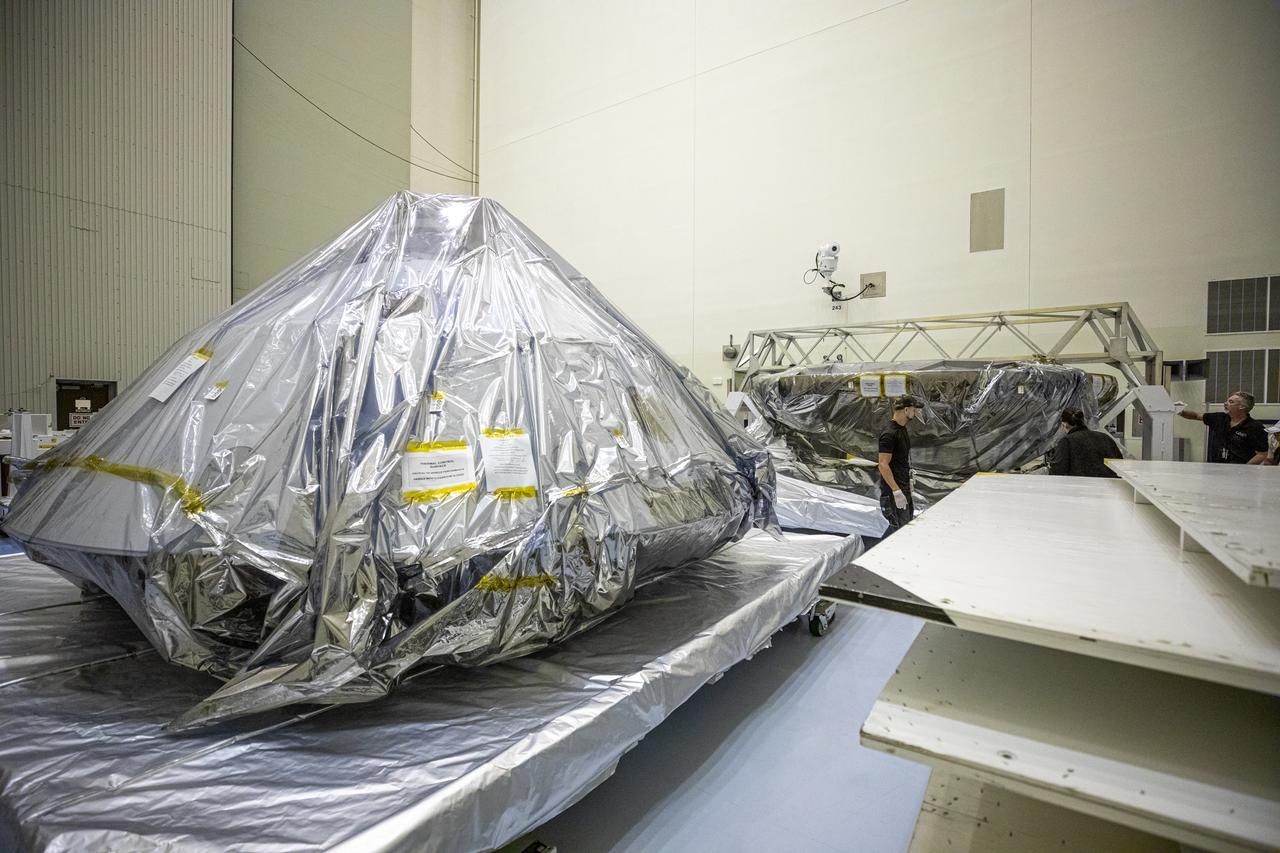
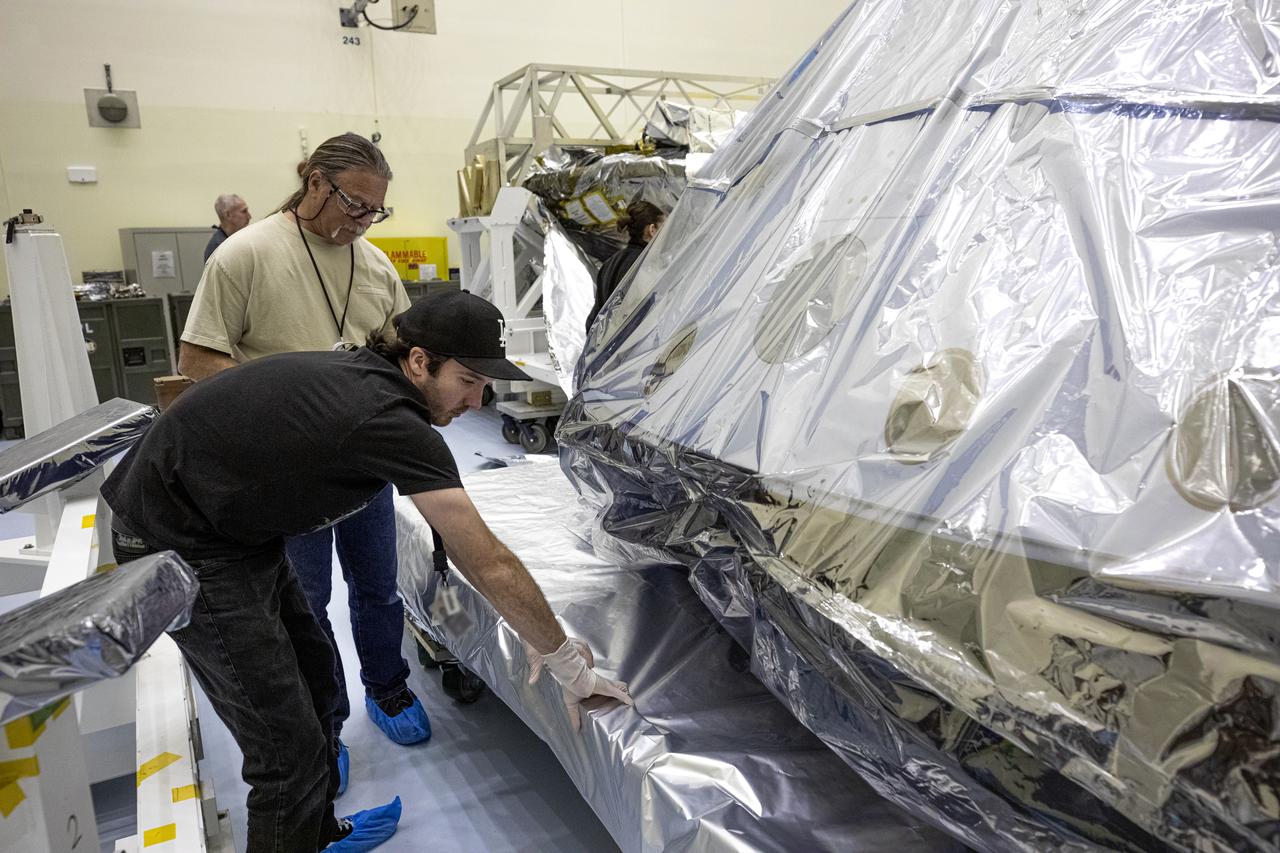
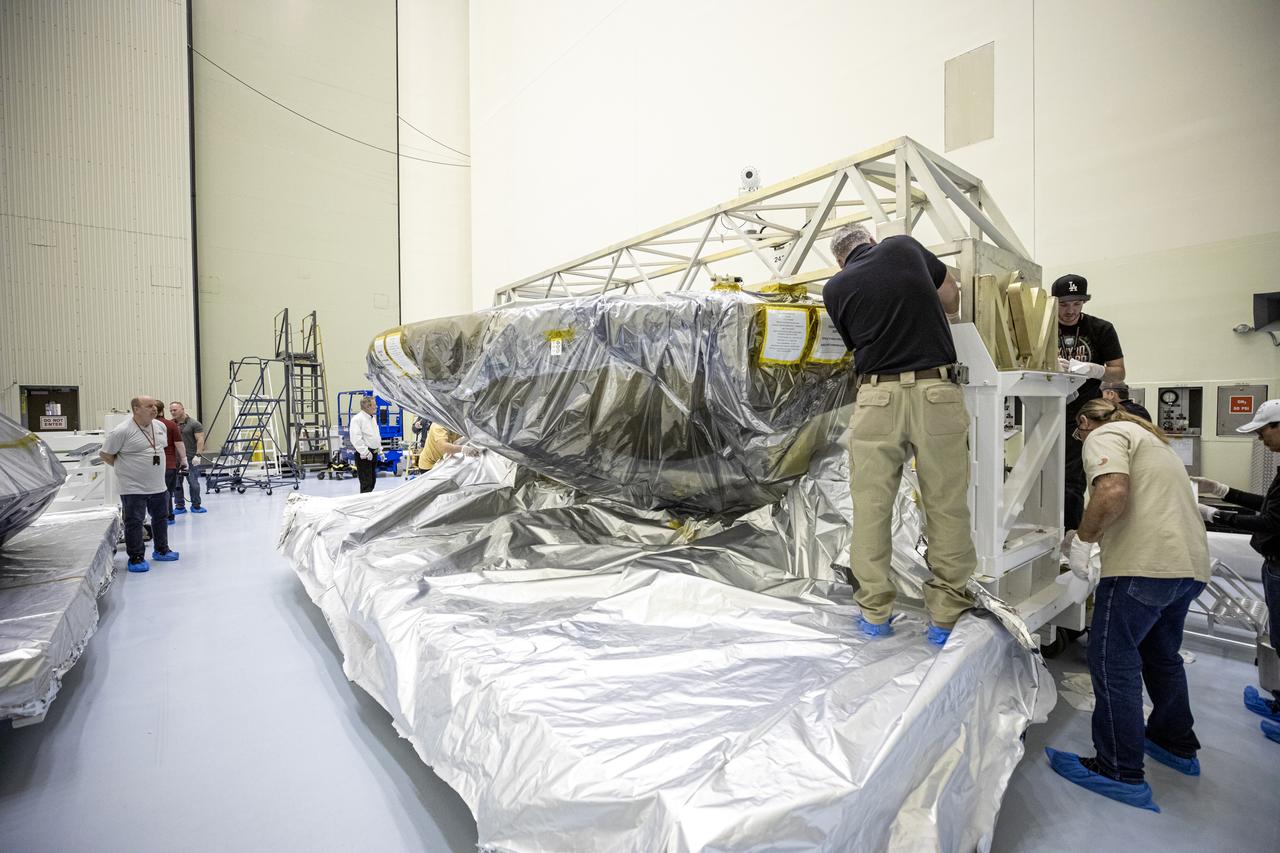
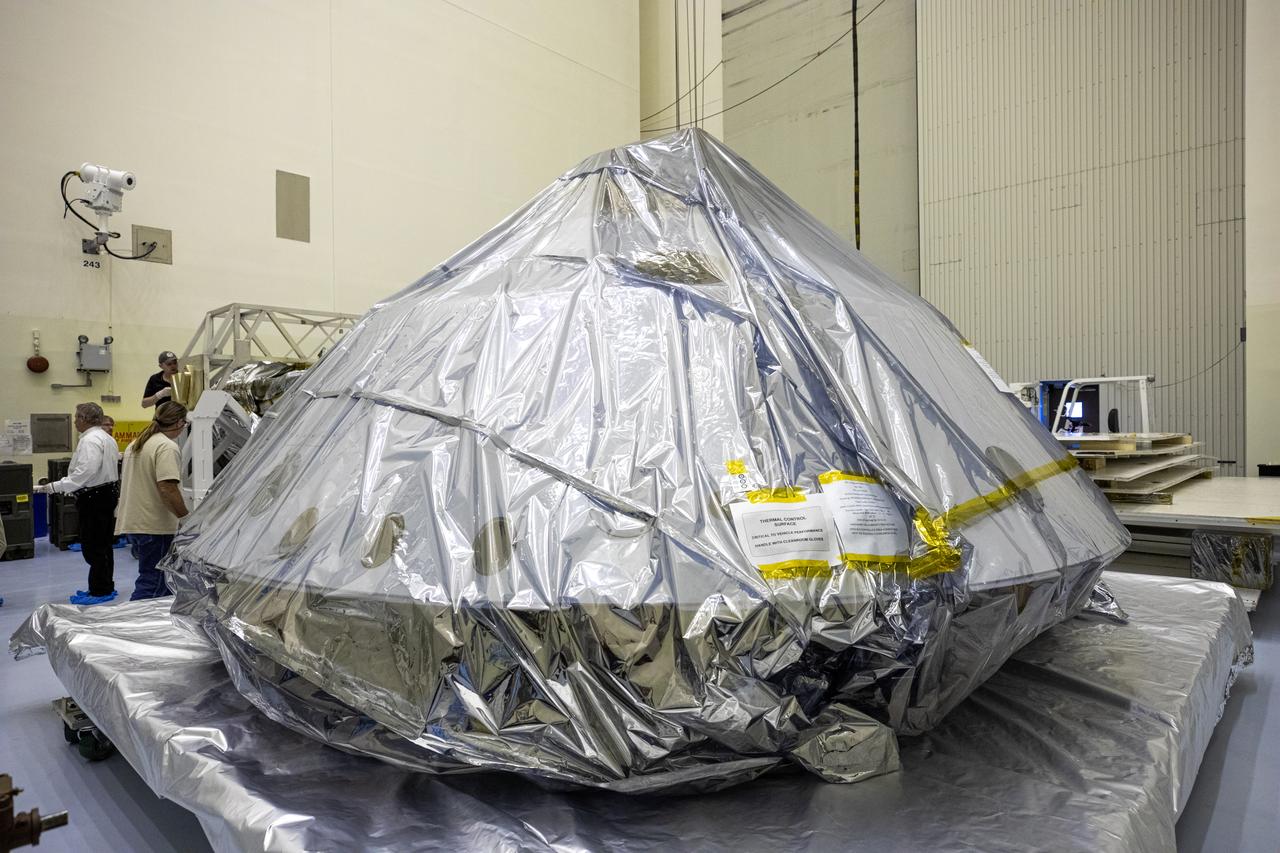
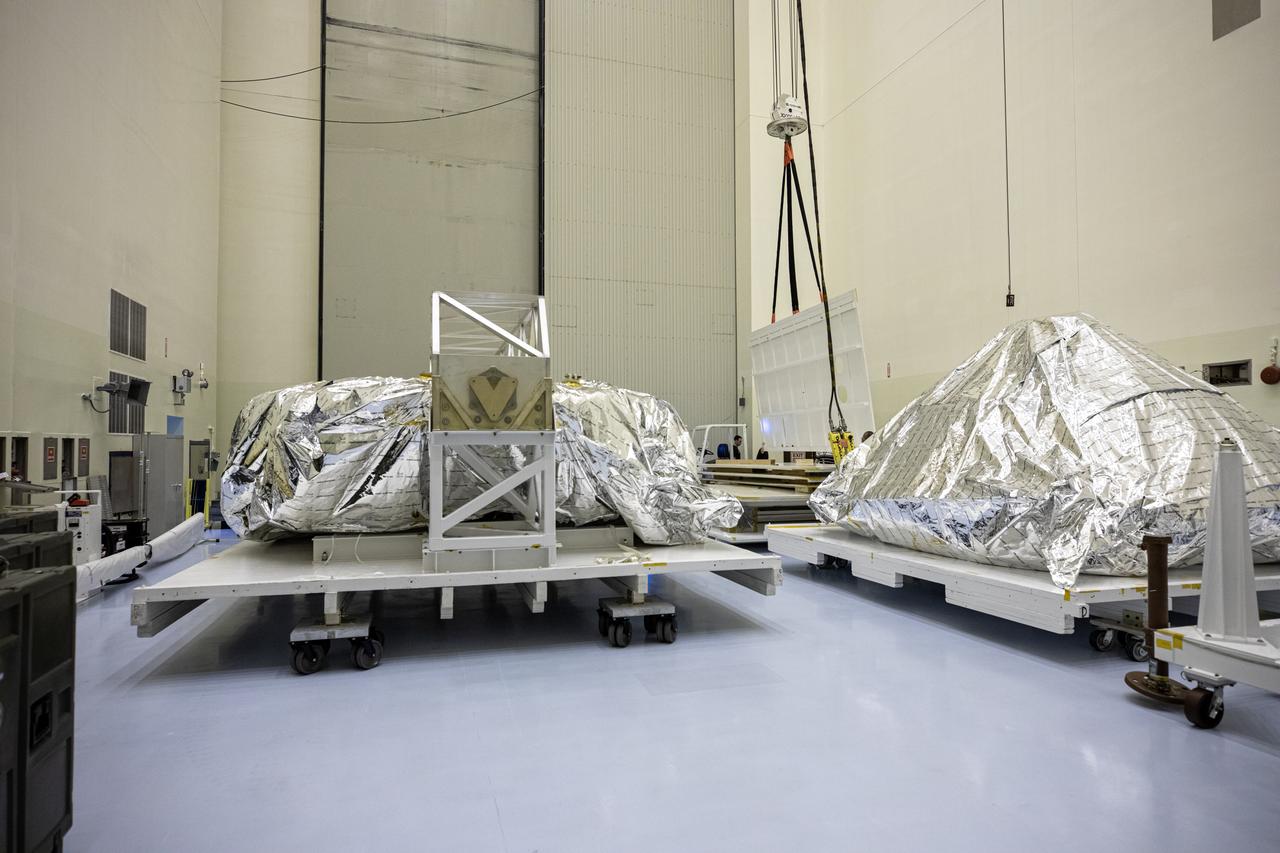
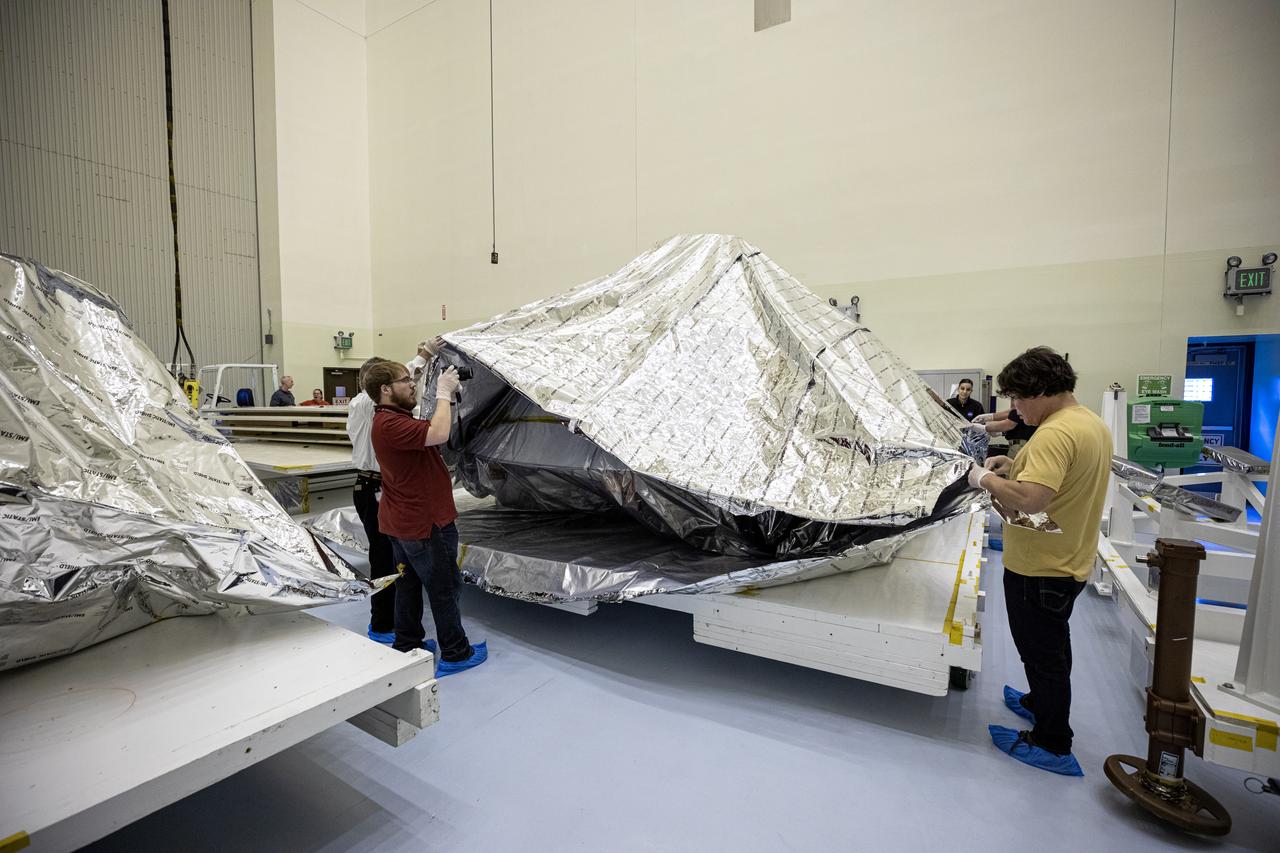
The heat shield and back shell for the Mars 2020 rover are unboxed inside the Payload Hazardous Servicing Facility at NASA’s Kennedy Space Center on Dec. 13, 2019. The two integral pieces of equipment, which were flown to the Florida spaceport from Lockheed Martin Space in Denver, Colorado, will protect the rover during its passage to Mars. The Mars 2020 rover is being manufactured at NASA’s Jet Propulsion Laboratory in California. When completed, the rover will be delivered to Kennedy in mid-February, 2020, with the mission scheduled to launch in the summer of 2020.
Mars 2020 Heat Shield & Backshell Unboxing
Construction workers stage parts and equipment nearby Launch Pad 39B at NASA’s Kennedy Space Center in Florida on Feb. 22, 2019. The launch pad has undergone upgrades and modifications to accommodate NASA's Space Launch System and Orion spacecraft for Exploration Mission-1 and subsequent missions. Upgrades include new heat-resistant bricks on the walls of the flame trench and installation of a new flame deflector. All of the upgrades have been managed by Exploration Ground Systems.
Pad 39B Upgrades - February 2019
KENNEDY SPACE CENTER, FLA. - In NASA Kennedy Space Center’s Orbiter Processing Facility, bay 3, Don Neilen (front), with United Space Alliance, adjusts thermography equipment in front of Discovery’s nose cone.  In the background are (from left) Lisa Huddleston, Dick Logsdon and Mike Hess, also with USA.  Thermography uses high-intensity light to heat specific areas, which are then immediately scanned with an infrared camera.  As the area cools, internal flaws are revealed.  Discovery has been identified as the orbiter to fly on mission STS-121.
KSC-05PD-2197
The heat shield and back shell for the Mars 2020 rover are unboxed inside the Payload Hazardous Servicing Facility at NASA’s Kennedy Space Center on Dec. 13, 2019. The two integral pieces of equipment, which were flown to the Florida spaceport from Lockheed Martin Space in Denver, Colorado, will protect the rover during its passage to Mars. The Mars 2020 rover is being manufactured at NASA’s Jet Propulsion Laboratory in California. When completed, the rover will be delivered to Kennedy in mid-February, 2020, with the mission scheduled to launch in the summer of 2020.
Mars 2020 Heat Shield & Backshell Unboxing
The heat shield and back shell for the Mars 2020 rover are unboxed inside the Payload Hazardous Servicing Facility at NASA’s Kennedy Space Center on Dec. 13, 2019. The two integral pieces of equipment, which were flown to the Florida spaceport from Lockheed Martin Space in Denver, Colorado, will protect the rover during its passage to Mars. The Mars 2020 rover is being manufactured at NASA’s Jet Propulsion Laboratory in California. When completed, the rover will be delivered to Kennedy in mid-February, 2020, with the mission scheduled to launch in the summer of 2020.
Mars 2020 Heat Shield & Backshell Unboxing
This Skylab-4 mission onboard photograph shows Astronaut Ed Gibson getting ready to prepare his meal in the crew wardroom. The tray contained heating elements for preparing the individual food packets. The food on Skylab was a great improvement over that on earlier spaceflights. It was no longer necessary to squeeze liquified food from plastic tubes. Skylab's kitchen was so equipped that each crewman could select his own menu and prepare it to his own taste.
Skylab
Construction workers stage parts and equipment nearby Launch Pad 39B at NASA’s Kennedy Space Center in Florida on Feb. 22, 2019. The launch pad has undergone upgrades and modifications to accommodate NASA's Space Launch System and Orion spacecraft for Exploration Mission-1 and subsequent missions. Upgrades include new heat-resistant bricks on the walls of the flame trench and installation of a new flame deflector. All of the upgrades have been managed by Exploration Ground Systems.
Pad 39B Upgrades - February 2019
The heat shield and back shell for the Mars 2020 rover are unboxed inside the Payload Hazardous Servicing Facility at NASA’s Kennedy Space Center on Dec. 13, 2019. The two integral pieces of equipment, which were flown to the Florida spaceport from Lockheed Martin Space in Denver, Colorado, will protect the rover during its passage to Mars. The Mars 2020 rover is being manufactured at NASA’s Jet Propulsion Laboratory in California. When completed, the rover will be delivered to Kennedy in mid-February, 2020, with the mission scheduled to launch in the summer of 2020.
Mars 2020 Heat Shield & Backshell Unboxing
KENNEDY SPACE CENTER, FLA. -  In NASA Kennedy Space Center’s Orbiter Processing Facility, bay 3, Don Nielen (left) and Dick Logsdon, both with United Space Alliance, prepare the equipment to be used for thermography of Discovery’s nose cone.  Thermography uses high-intensity light to heat specific areas, which are then immediately scanned with an infrared camera.  As the area cools, internal flaws are revealed.  Discovery has been identified as the orbiter to fly on mission STS-121.
KSC-05PD-2192
KENNEDY SPACE CENTER, FLA. -  In NASA Kennedy Space Center’s Orbiter Processing Facility, bay 3, Don Nielen (left) and Dick Logsdon, both with United Space Alliance, set up equipment to be used for thermography of Discovery’s nose cone.   Thermography uses high-intensity light to heat specific areas, which are then immediately scanned with an infrared camera.  As the area cools, internal flaws are revealed.  Discovery has been identified as the orbiter to fly on mission STS-121.
KSC-05PD-2193
The heat shield and back shell for the Mars 2020 rover are unboxed inside the Payload Hazardous Servicing Facility at NASA’s Kennedy Space Center on Dec. 13, 2019. The two integral pieces of equipment, which were flown to the Florida spaceport from Lockheed Martin Space in Denver, Colorado, will protect the rover during its passage to Mars. The Mars 2020 rover is being manufactured at NASA’s Jet Propulsion Laboratory in California. When completed, the rover will be delivered to Kennedy in mid-February, 2020, with the mission scheduled to launch in the summer of 2020.
Mars 2020 Heat Shield & Backshell Unboxing
The heat shield and back shell for the Mars 2020 rover are unboxed inside the Payload Hazardous Servicing Facility at NASA’s Kennedy Space Center on Dec. 13, 2019. The two integral pieces of equipment, which were flown to the Florida spaceport from Lockheed Martin Space in Denver, Colorado, will protect the rover during its passage to Mars. The Mars 2020 rover is being manufactured at NASA’s Jet Propulsion Laboratory in California. When completed, the rover will be delivered to Kennedy in mid-February, 2020, with the mission scheduled to launch in the summer of 2020.
Mars 2020 Heat Shield & Backshell Unboxing
KENNEDY SPACE CENTER, FLA. - In NASA Kennedy Space Center’s Orbiter Processing Facility, bay 3, United Space Alliance workers Jim Landy (front) and Dick Logsdon (back) adjust thermography equipment in front of Discovery’s nose cone.  Thermography uses high-intensity light to heat specific areas, which are then immediately scanned with an infrared camera.  As the area cools, internal flaws are revealed.  Discovery has been identified as the orbiter to fly on mission STS-121.
KSC-05PD-2196
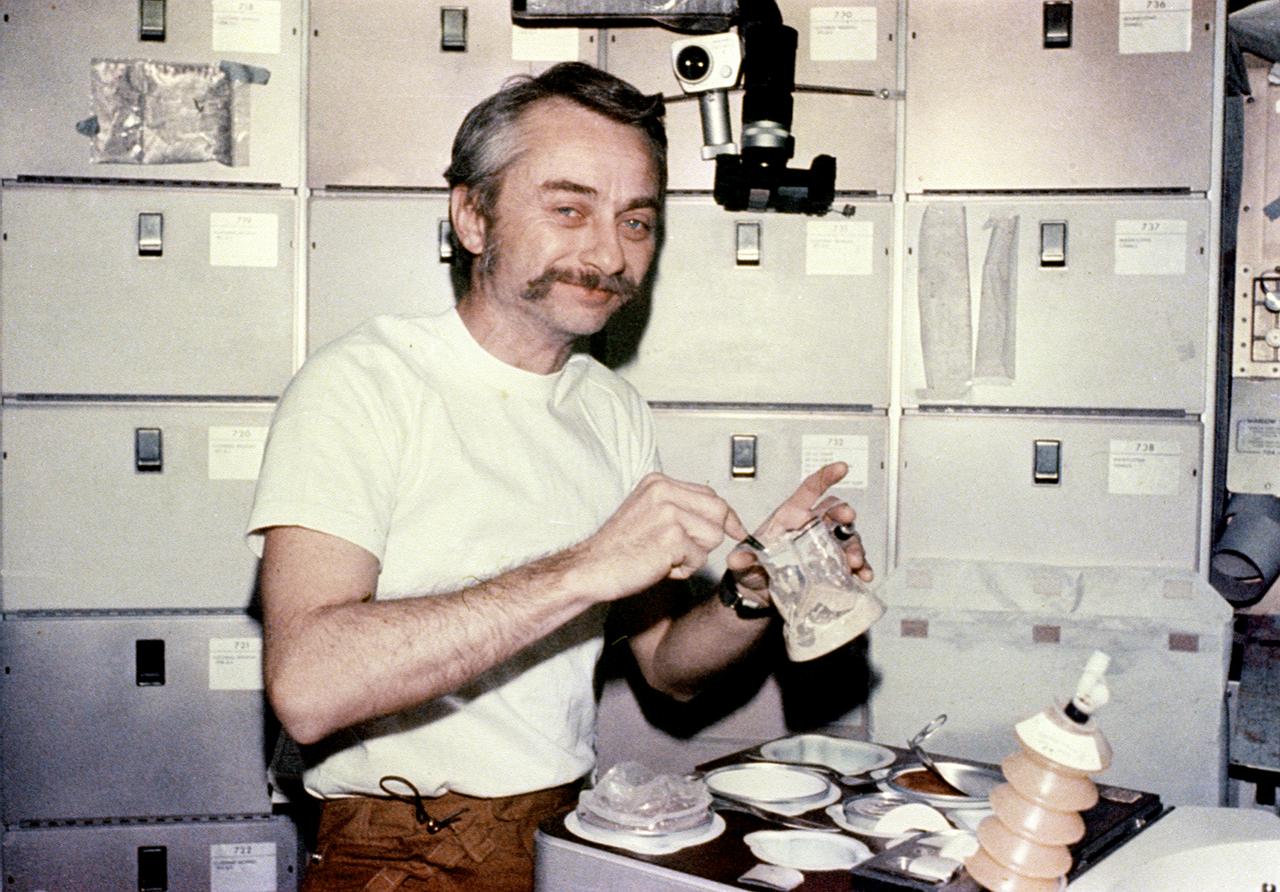
This photograph was taken during the Skylab-3 mission (2nd marned mission), showing Astronaut Owen Garriott enjoying his meal in the Orbital Workshop crew wardroom. The tray contained heating elements for preparing the individual food packets. The food on Skylab was a great improvement over that on earlier spaceflights. It was no longer necessary to squeeze liquified food from plastic tubes. Skylab's kitchen was so equipped that each crewman could select his own menu and prepare it to his own taste.
Skylab
KENNEDY SPACE CENTER, FLA. -  In NASA Kennedy Space Center’s Orbiter Processing Facility, bay 3, Don Nielen (foreground), with United Space Alliance, gets help from Dick Logsdon, also with USA, setting up equipment to be used for thermography of Discovery’s nose cone. Thermography uses high-intensity light to heat specific areas, which are then immediately scanned with an infrared camera.  As the area cools, internal flaws are revealed.  Discovery has been identified as the orbiter to fly on mission STS-121.
KSC-05PD-2194
A technician operates articulating equipment to rotate the Near-Earth Object Surveyor (NEO Surveyor) mission's aluminum optical bench – part of the spacecraft's telescope – in a clean room at NASA's Jet Propulsion Laboratory in Southern California on July 17, 2024.  NEO Surveyor's sole instrument is a "three-mirror anastigmat telescope," which will rely on a set of curved mirrors to focus light onto its infrared detectors in such a way that minimizes optical aberrations. When complete, the telescope will be housed inside an instrument enclosure – being built in a different JPL clean room – that is fabricated from dark composite material that allows heat to escape, helping to keep the telescope cool and prevent its own heat from obscuring observations.  https://photojournal.jpl.nasa.gov/catalog/PIA26387
NEO Surveyor's Telescope Optical Bench Under Construction at JPL
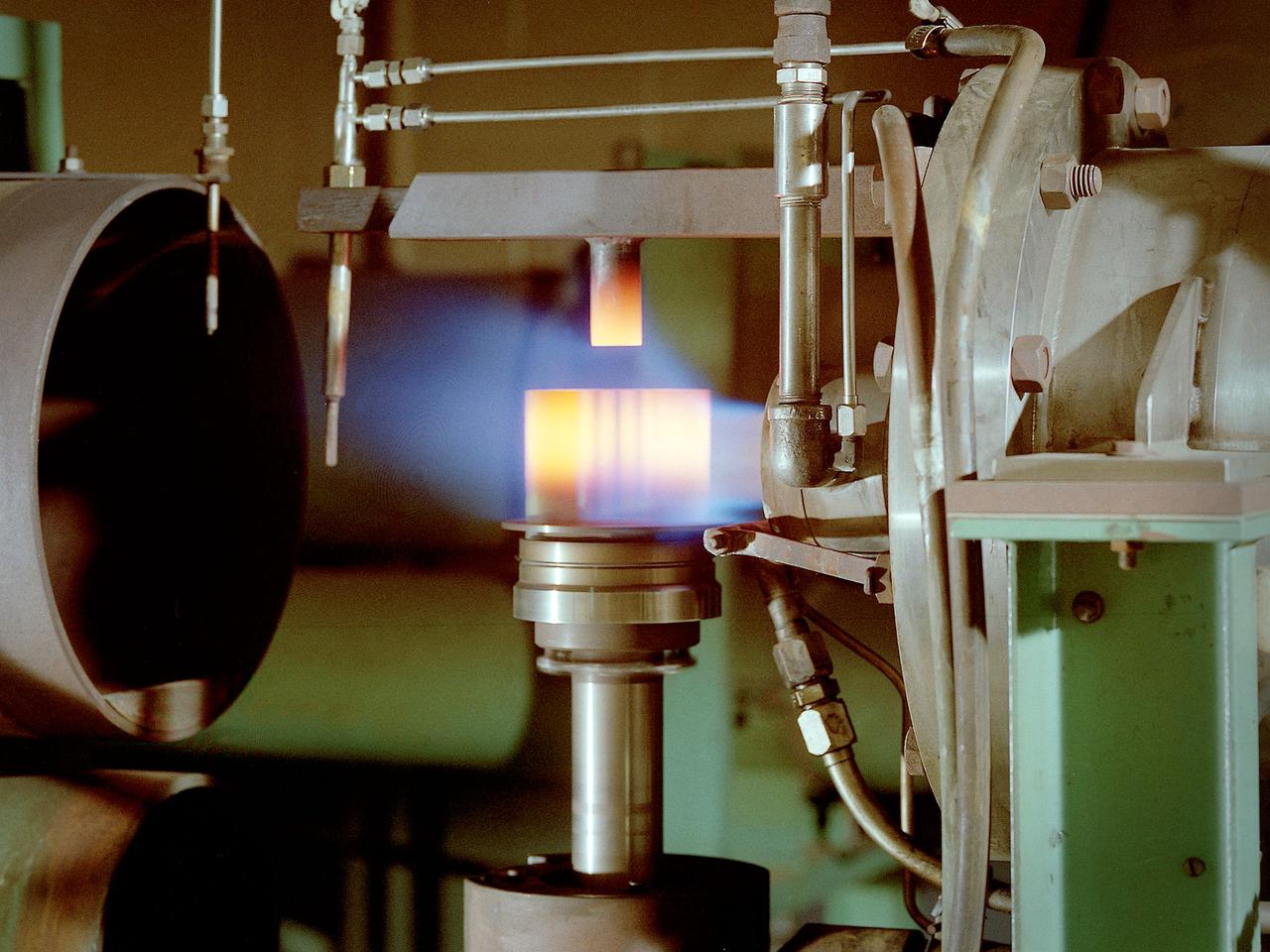
A burner rig heats up a material sample in the Materials and Stresses Building at the National Aeronautics and Space Administration (NASA) Lewis Research Center. Materials technology is an important element in the successful development of advanced airbreathing and rocket propulsion systems. Different types of engines operate in different environments so an array of dependable materials is needed. NASA Lewis began investigating the characteristics of different materials shortly after World War II. In 1949 the materials group was expanded into its own division. The Lewis researchers sought to study and test materials in environments that simulate the environment in which they would operate.     The Materials and Stresses Building, built in 1949, contained a number of laboratories to analyze the materials. They are subjected to high temperatures, high stresses, corrosion, irradiation, and hot gasses. The Physics of Solids Laboratory included a cyclotron, cloud chamber, helium cryostat, and metallurgy cave. The Metallographic Laboratory possessed six x-ray diffraction machines, two metalloscopes, and other equipment. The Furnace Room had two large induction machines, a 4500⁰ F graphite furnace, and heat treating equipment. The Powder Laboratory included 60-ton and 3000-ton presses. The Stresses Laboratory included stress rupture machines, fatigue machines, and tensile strength machines.
Burner Rig in the Material and Stresses Building
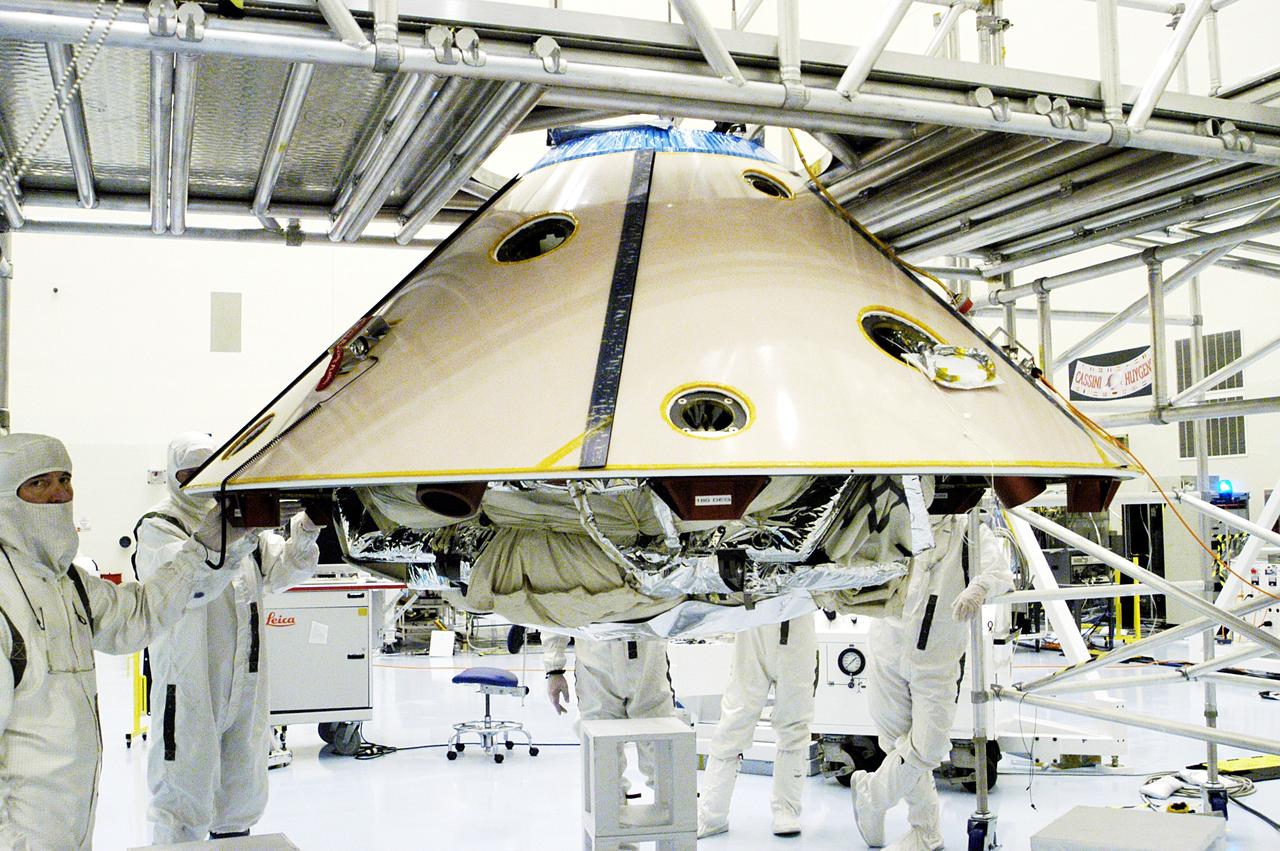
KENNEDY SPACE CENTER, FLA. - Workers walk with the suspended backshell/ Mars Exploration Rover 1 (MER-1) as it travels across the floor of the Payload Hazardous Servicing Facility.  The backshell will be attached to the lower heat shield.  NASA's twin Mars Exploration Rovers are designed to study the history of water on Mars. These robotic geologists are equipped with a robotic arm, a drilling tool, three spectrometers, and four pairs of cameras that allow them to have a human-like, 3D view of the terrain. Each rover could travel as far as 100 meters in one day to act as Mars scientists' eyes and hands, exploring an environment where humans can't yet go.  MER-1 is scheduled to launch June 25 as MER-B aboard a Delta II rocket from Cape Canaveral Air Force Station.
KENNEDY SPACE CENTER, FLA. - Workers walk with the suspended backshell/ Mars Exploration Rover 1 (MER-1) as it travels across the floor of the Payload Hazardous Servicing Facility. The backshell will be attached to the lower heat shield. NASA's twin Mars Exploration Rovers are designed to study the history of water on Mars. These robotic geologists are equipped with a robotic arm, a drilling tool, three spectrometers, and four pairs of cameras that allow them to have a human-like, 3D view of the terrain. Each rover could travel as far as 100 meters in one day to act as Mars scientists' eyes and hands, exploring an environment where humans can't yet go. MER-1 is scheduled to launch June 25 as MER-B aboard a Delta II rocket from Cape Canaveral Air Force Station.
KENNEDY SPACE CENTER, FLA. -  Workers watch as an overhead crane begins to lift the backshell with the Mars Exploration Rover 1 (MER-1) inside.  The backshell will be moved and attached to the lower heat shield.  NASA's twin Mars Exploration Rovers are designed to study the history of water on Mars. These robotic geologists are equipped with a robotic arm, a drilling tool, three spectrometers, and four pairs of cameras that allow them to have a human-like, 3D view of the terrain. Each rover could travel as far as 100 meters in one day to act as Mars scientists' eyes and hands, exploring an environment where humans can't yet go.  MER-1 is scheduled to launch June 25 as MER-B aboard a Delta II rocket from Cape Canaveral Air Force Station.
KENNEDY SPACE CENTER, FLA. - Workers watch as an overhead crane begins to lift the backshell with the Mars Exploration Rover 1 (MER-1) inside. The backshell will be moved and attached to the lower heat shield. NASA's twin Mars Exploration Rovers are designed to study the history of water on Mars. These robotic geologists are equipped with a robotic arm, a drilling tool, three spectrometers, and four pairs of cameras that allow them to have a human-like, 3D view of the terrain. Each rover could travel as far as 100 meters in one day to act as Mars scientists' eyes and hands, exploring an environment where humans can't yet go. MER-1 is scheduled to launch June 25 as MER-B aboard a Delta II rocket from Cape Canaveral Air Force Station.
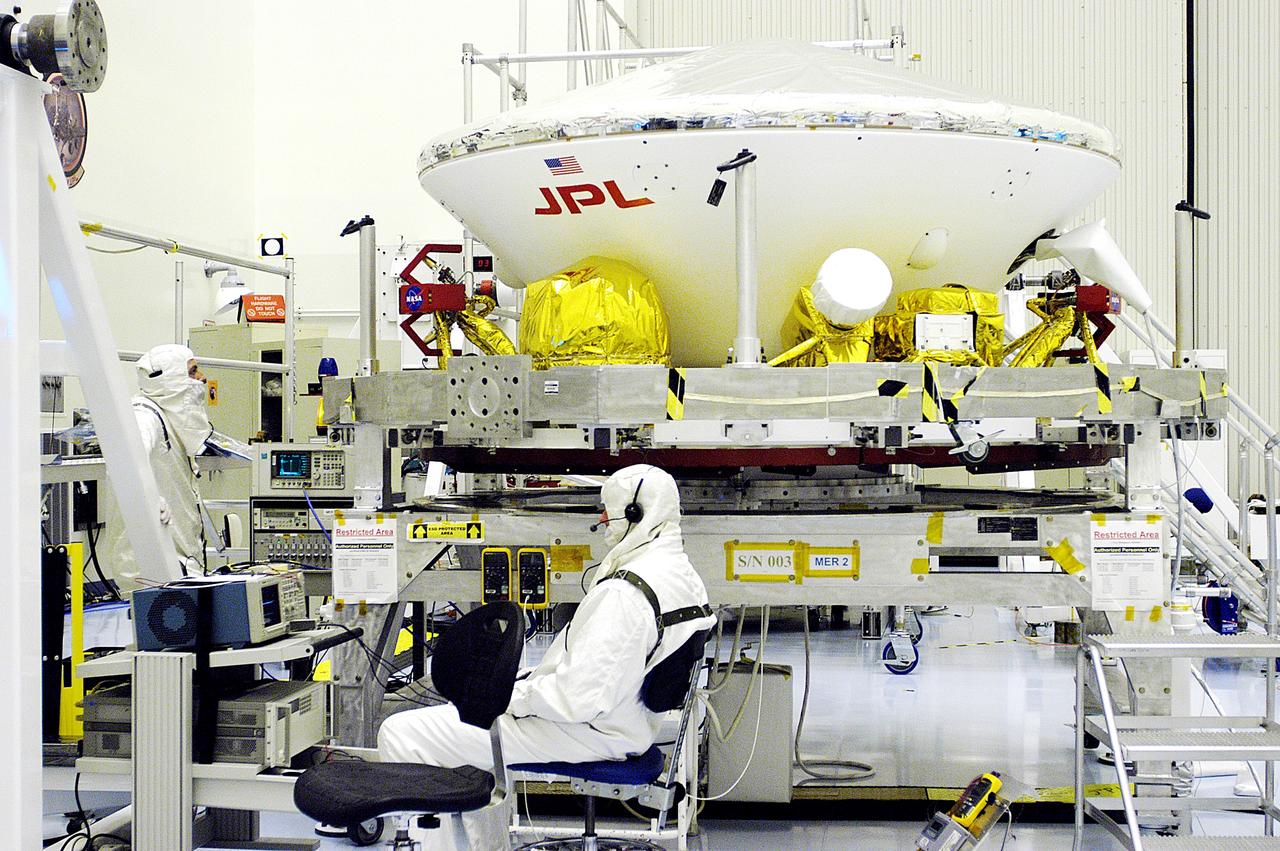
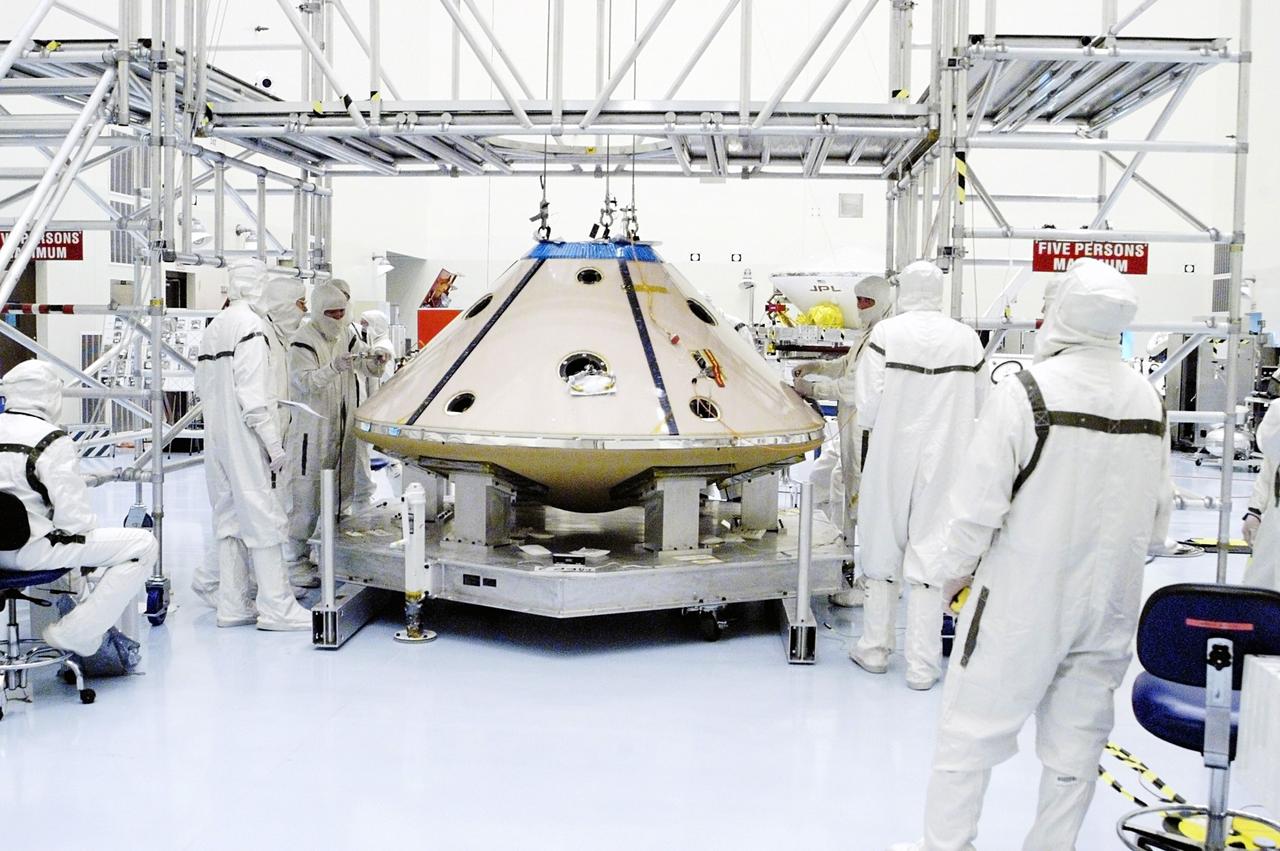
KENNEDY SPACE CENTER, FLA. -  Assembly of the backshell and heat shield surrounding the Mars Exploration Rover 1 (MER-1) is complete.  The resulting aeroshell will protect the rover on its journey to Mars.  NASA's twin Mars Exploration Rovers are designed to study the history of water on Mars. These robotic geologists are equipped with a robotic arm, a drilling tool, three spectrometers, and four pairs of cameras that allow them to have a human-like, 3D view of the terrain. Each rover could travel as far as 100 meters in one day to act as Mars scientists' eyes and hands, exploring an environment where humans can't yet go.  MER-1 is scheduled to launch June 25 as MER-B aboard a Delta II rocket from Cape Canaveral Air Force Station.
KENNEDY SPACE CENTER, FLA. - Assembly of the backshell and heat shield surrounding the Mars Exploration Rover 1 (MER-1) is complete. The resulting aeroshell will protect the rover on its journey to Mars. NASA's twin Mars Exploration Rovers are designed to study the history of water on Mars. These robotic geologists are equipped with a robotic arm, a drilling tool, three spectrometers, and four pairs of cameras that allow them to have a human-like, 3D view of the terrain. Each rover could travel as far as 100 meters in one day to act as Mars scientists' eyes and hands, exploring an environment where humans can't yet go. MER-1 is scheduled to launch June 25 as MER-B aboard a Delta II rocket from Cape Canaveral Air Force Station.
KENNEDY SPACE CENTER, FLA. - The aeroshell, the entry vehicle for Mars Exploration Rover 1 (MER-1), is ready for integration with its cruise stage, seen here below the backshell.  What appears to be the top half of the aeroshell is the heat shield.  NASA’s twin Mars Exploration Rovers are designed to study the history of water on Mars. These robotic geologists are equipped with a robotic arm, a drilling tool, three spectrometers, and four pairs of cameras that allow them to have a human-like, 3D view of the terrain. Each rover could travel as far as 100 meters in one day to act as Mars scientists' eyes and hands, exploring an environment where humans can’t yet go.  The MER-1 is scheduled to launch June 25 from Launch Pad 17-A, Cape Canaveral Air Force Station.
KENNEDY SPACE CENTER, FLA. - The aeroshell, the entry vehicle for Mars Exploration Rover 1 (MER-1), is ready for integration with its cruise stage, seen here below the backshell. What appears to be the top half of the aeroshell is the heat shield. NASA’s twin Mars Exploration Rovers are designed to study the history of water on Mars. These robotic geologists are equipped with a robotic arm, a drilling tool, three spectrometers, and four pairs of cameras that allow them to have a human-like, 3D view of the terrain. Each rover could travel as far as 100 meters in one day to act as Mars scientists' eyes and hands, exploring an environment where humans can’t yet go. The MER-1 is scheduled to launch June 25 from Launch Pad 17-A, Cape Canaveral Air Force Station.
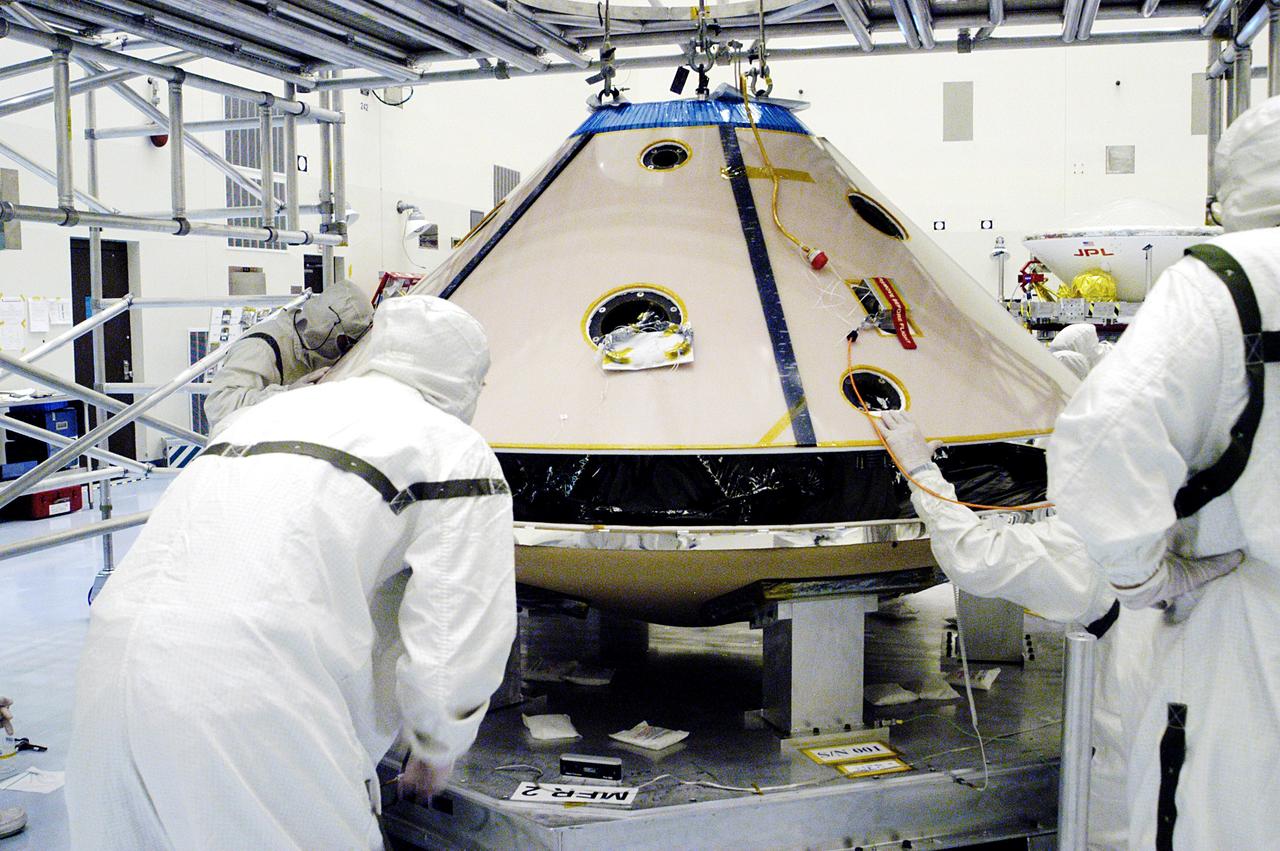
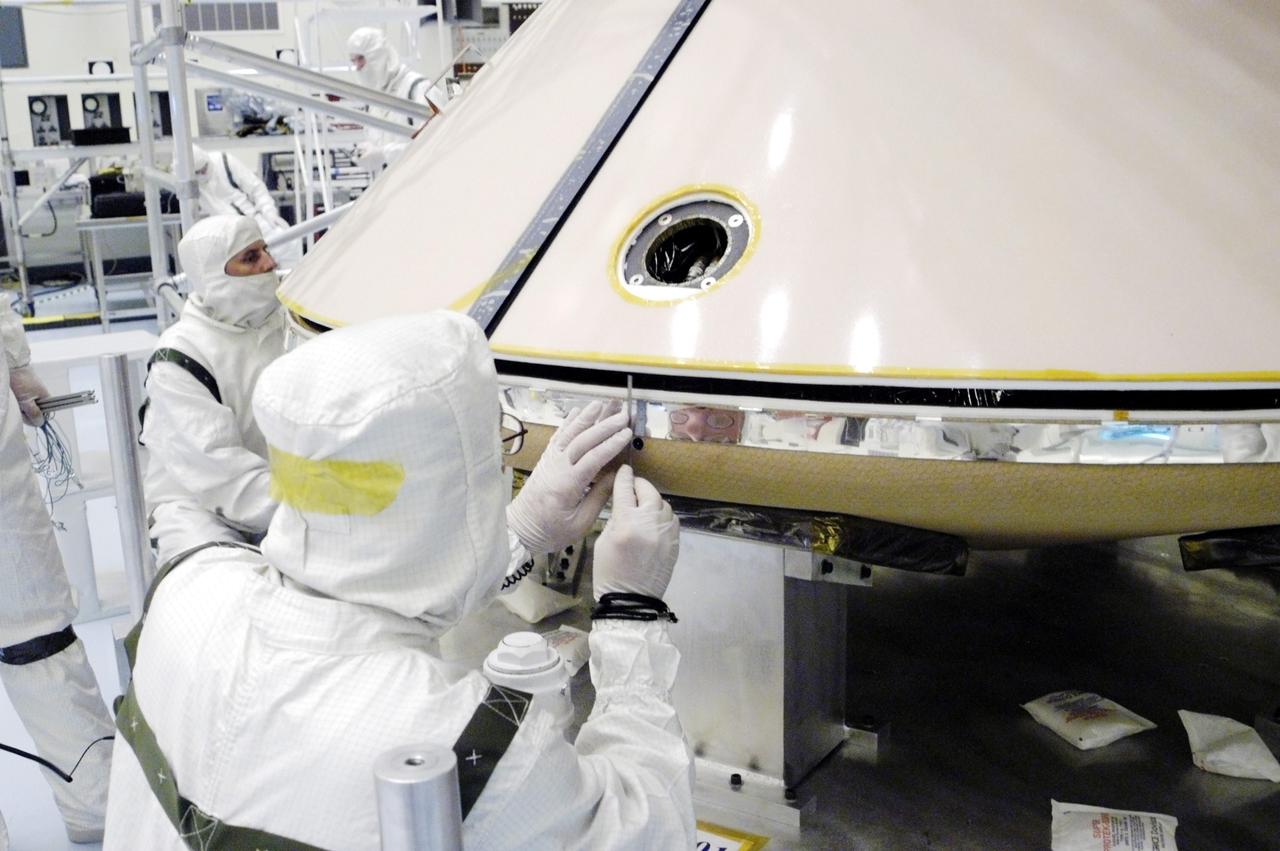
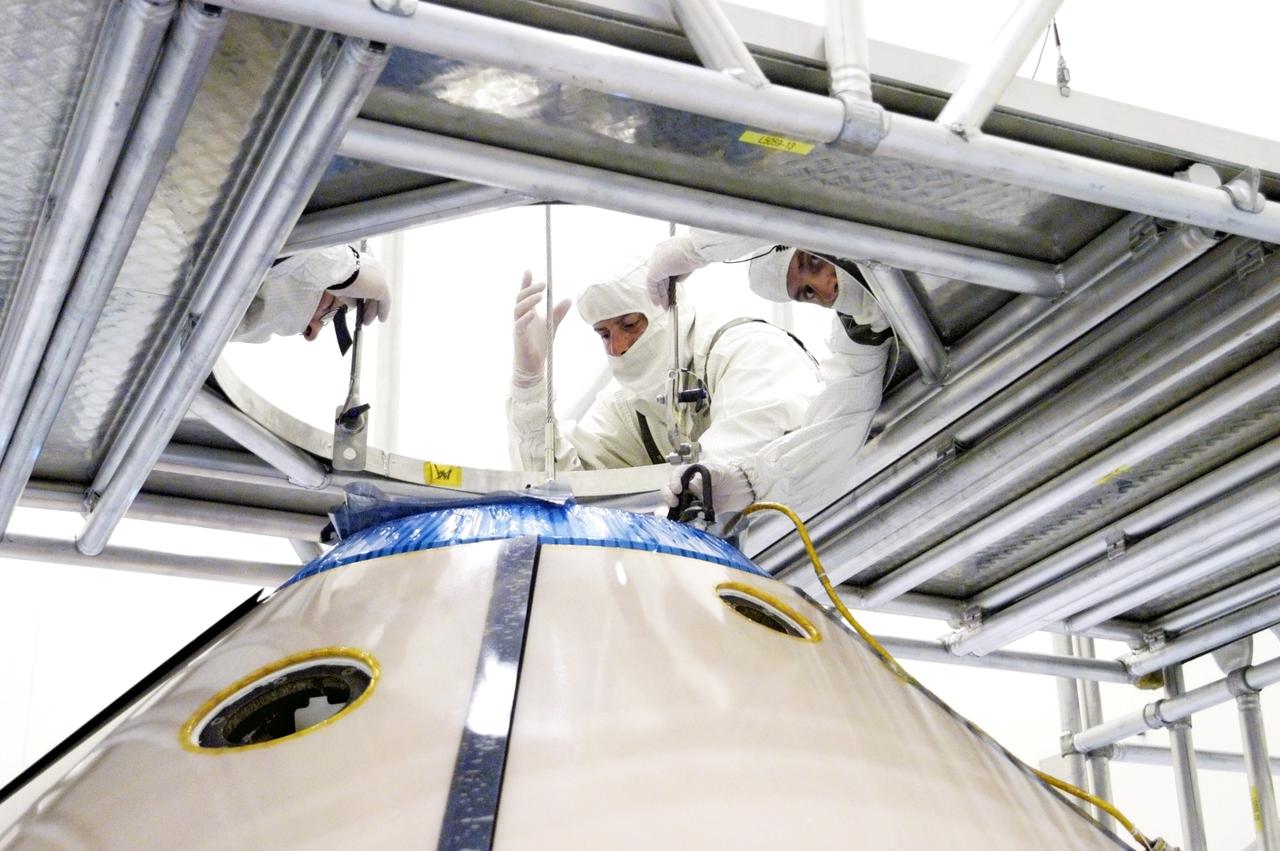
KENNEDY SPACE CENTER, FLA. - In the Payload Hazardous Servicing Facility, workers check the attachment between the backshell (above) and heat shield (below) surrounding the Mars Exploration Rover 1 (MER-1).  The aeroshell will protect the rover on its journey to Mars.  NASA's twin Mars Exploration Rovers are designed to study the history of water on Mars. These robotic geologists are equipped with a robotic arm, a drilling tool, three spectrometers, and four pairs of cameras that allow them to have a human-like, 3D view of the terrain. Each rover could travel as far as 100 meters in one day to act as Mars scientists' eyes and hands, exploring an environment where humans can't yet go.  MER-1 is scheduled to launch June 25 as MER-B aboard a Delta II rocket from Cape Canaveral Air Force Station.
KENNEDY SPACE CENTER, FLA. - In the Payload Hazardous Servicing Facility, workers check the attachment between the backshell (above) and heat shield (below) surrounding the Mars Exploration Rover 1 (MER-1). The aeroshell will protect the rover on its journey to Mars. NASA's twin Mars Exploration Rovers are designed to study the history of water on Mars. These robotic geologists are equipped with a robotic arm, a drilling tool, three spectrometers, and four pairs of cameras that allow them to have a human-like, 3D view of the terrain. Each rover could travel as far as 100 meters in one day to act as Mars scientists' eyes and hands, exploring an environment where humans can't yet go. MER-1 is scheduled to launch June 25 as MER-B aboard a Delta II rocket from Cape Canaveral Air Force Station.
KENNEDY SPACE CENTER, FLA. - Workers in the Payload Hazardous Servicing Facility check the installation of the Mars Exploration Rover 1 (MER-1) inside the upper backshell.   The two components will be attached to the lower heat shield.  NASA's twin Mars Exploration Rovers are designed to study the history of water on Mars. These robotic geologists are equipped with a robotic arm, a drilling tool, three spectrometers, and four pairs of cameras that allow them to have a human-like, 3D view of the terrain. Each rover could travel as far as 100 meters in one day to act as Mars scientists' eyes and hands, exploring an environment where humans can't yet go.  MER-1 is scheduled to launch June 25 as MER-B aboard a Delta II rocket from Cape Canaveral Air Force Station.
KENNEDY SPACE CENTER, FLA. - Workers in the Payload Hazardous Servicing Facility check the installation of the Mars Exploration Rover 1 (MER-1) inside the upper backshell. The two components will be attached to the lower heat shield. NASA's twin Mars Exploration Rovers are designed to study the history of water on Mars. These robotic geologists are equipped with a robotic arm, a drilling tool, three spectrometers, and four pairs of cameras that allow them to have a human-like, 3D view of the terrain. Each rover could travel as far as 100 meters in one day to act as Mars scientists' eyes and hands, exploring an environment where humans can't yet go. MER-1 is scheduled to launch June 25 as MER-B aboard a Delta II rocket from Cape Canaveral Air Force Station.
KENNEDY SPACE CENTER, FLA. - Workers in the Payload Hazardous Servicing Facility prepare the heat shield that will be attached to the backshell, surrounding Mars Exploration Rover 1 (MER-1).  NASA's twin Mars Exploration Rovers are designed to study the history of water on Mars. These robotic geologists are equipped with a robotic arm, a drilling tool, three spectrometers, and four pairs of cameras that allow them to have a human-like, 3D view of the terrain. Each rover could travel as far as 100 meters in one day to act as Mars scientists' eyes and hands, exploring an environment where humans can't yet go.  MER-1 is scheduled to launch June 25 as MER-B aboard a Delta II rocket from Cape Canaveral Air Force Station.
KENNEDY SPACE CENTER, FLA. - Workers in the Payload Hazardous Servicing Facility prepare the heat shield that will be attached to the backshell, surrounding Mars Exploration Rover 1 (MER-1). NASA's twin Mars Exploration Rovers are designed to study the history of water on Mars. These robotic geologists are equipped with a robotic arm, a drilling tool, three spectrometers, and four pairs of cameras that allow them to have a human-like, 3D view of the terrain. Each rover could travel as far as 100 meters in one day to act as Mars scientists' eyes and hands, exploring an environment where humans can't yet go. MER-1 is scheduled to launch June 25 as MER-B aboard a Delta II rocket from Cape Canaveral Air Force Station.
KENNEDY SPACE CENTER, FLA. -  Jim Landy, NDE specialist with United Space Alliance (USA), prepares equipment to examine a Reinforced Carbon Carbon panel using flash thermography.  A relatively new procedure at KSC, thermography uses high intensity light to heat areas of the panels. The panels are then immediately scanned with an infrared camera. As the panels cool, any internal flaws are revealed. The gray carbon composite RCC panels are attached to the leading edge of the wing of the orbiters.  They have sufficient strength to withstand the aerodynamic forces experienced during launch and reentry, which can reach as high as 800 pounds per square foot.  The operating range of RCC is from minus 250º F to about 3,000º F, the temperature produced by friction with the atmosphere during reentry. The panels will be installed on the orbiter Discovery, designated for the first Return to Flight mission, STS-114.
KENNEDY SPACE CENTER, FLA. - Jim Landy, NDE specialist with United Space Alliance (USA), prepares equipment to examine a Reinforced Carbon Carbon panel using flash thermography. A relatively new procedure at KSC, thermography uses high intensity light to heat areas of the panels. The panels are then immediately scanned with an infrared camera. As the panels cool, any internal flaws are revealed. The gray carbon composite RCC panels are attached to the leading edge of the wing of the orbiters. They have sufficient strength to withstand the aerodynamic forces experienced during launch and reentry, which can reach as high as 800 pounds per square foot. The operating range of RCC is from minus 250º F to about 3,000º F, the temperature produced by friction with the atmosphere during reentry. The panels will be installed on the orbiter Discovery, designated for the first Return to Flight mission, STS-114.
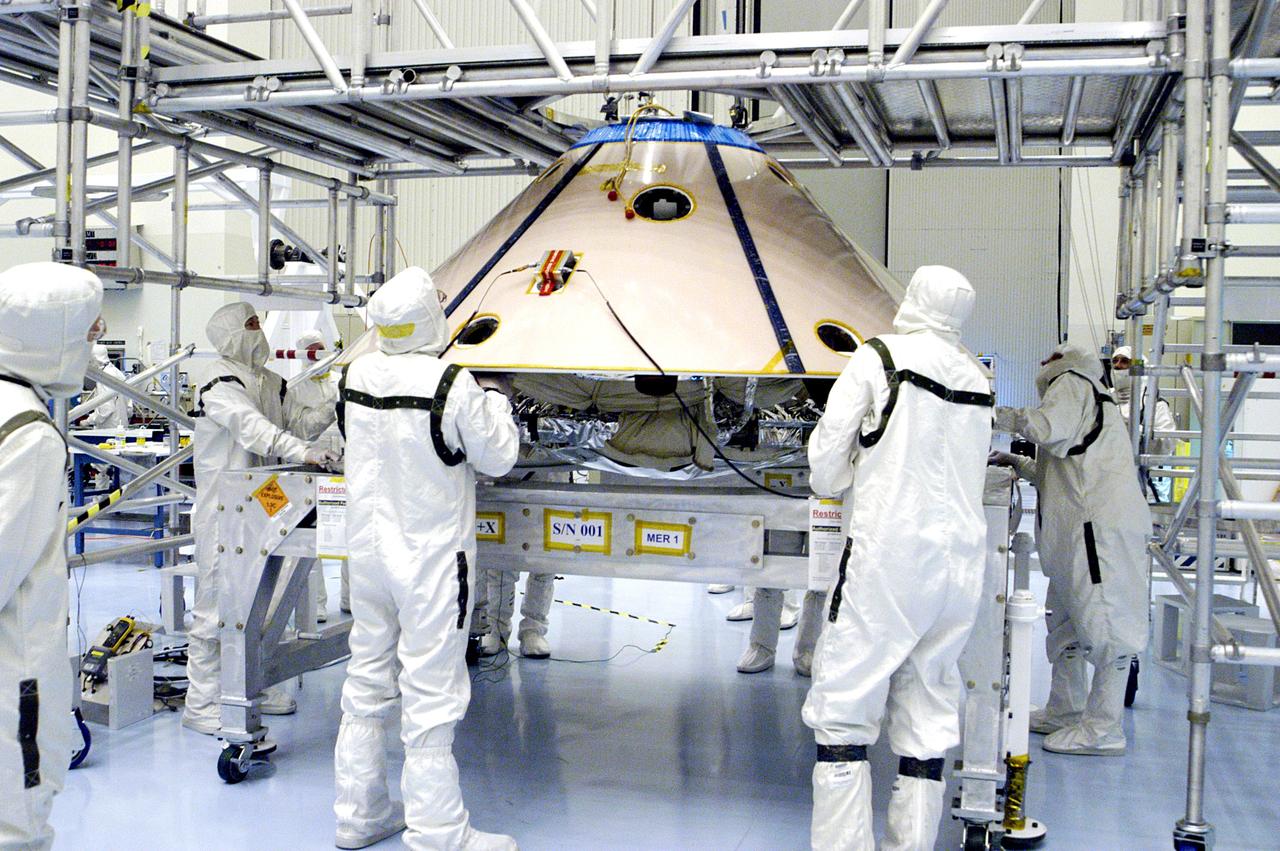
KENNEDY SPACE CENTER, FLA. - In the Payload Hazardous Servicing Facility, workers lower the backshell with the Mars Exploration Rover 1 (MER-1) onto the heat shield.  The two components form the aeroshell that will protect the rover on its journey to Mars.  NASA's twin Mars Exploration Rovers are designed to study the history of water on Mars. These robotic geologists are equipped with a robotic arm, a drilling tool, three spectrometers, and four pairs of cameras that allow them to have a human-like, 3D view of the terrain. Each rover could travel as far as 100 meters in one day to act as Mars scientists' eyes and hands, exploring an environment where humans can't yet go.  MER-1 is scheduled to launch June 25 as MER-B aboard a Delta II rocket from Cape Canaveral Air Force Station.
KENNEDY SPACE CENTER, FLA. - In the Payload Hazardous Servicing Facility, workers lower the backshell with the Mars Exploration Rover 1 (MER-1) onto the heat shield. The two components form the aeroshell that will protect the rover on its journey to Mars. NASA's twin Mars Exploration Rovers are designed to study the history of water on Mars. These robotic geologists are equipped with a robotic arm, a drilling tool, three spectrometers, and four pairs of cameras that allow them to have a human-like, 3D view of the terrain. Each rover could travel as far as 100 meters in one day to act as Mars scientists' eyes and hands, exploring an environment where humans can't yet go. MER-1 is scheduled to launch June 25 as MER-B aboard a Delta II rocket from Cape Canaveral Air Force Station.
KENNEDY SPACE CENTER, FLA. -  Jim Landy, NDE specialist with United Space Alliance, sets up equipment to examine a Reinforced Carbon Carbon panel using flash thermography.  A relatively new procedure at KSC, thermography uses high intensity light to heat areas of the panels. The panels are then immediately scanned with an infrared camera. As the panels cool, any internal flaws are revealed. The gray carbon composite RCC panels are attached to the leading edge of the wing of the orbiters.  They have sufficient strength to withstand the aerodynamic forces experienced during launch and reentry, which can reach as high as 800 pounds per square foot.  The operating range of RCC is from minus 250º F to about 3,000º F, the temperature produced by friction with the atmosphere during reentry.  The panels will be installed on the orbiter Discovery, designated  for the first Return to Flight mission, STS-114.
KENNEDY SPACE CENTER, FLA. - Jim Landy, NDE specialist with United Space Alliance, sets up equipment to examine a Reinforced Carbon Carbon panel using flash thermography. A relatively new procedure at KSC, thermography uses high intensity light to heat areas of the panels. The panels are then immediately scanned with an infrared camera. As the panels cool, any internal flaws are revealed. The gray carbon composite RCC panels are attached to the leading edge of the wing of the orbiters. They have sufficient strength to withstand the aerodynamic forces experienced during launch and reentry, which can reach as high as 800 pounds per square foot. The operating range of RCC is from minus 250º F to about 3,000º F, the temperature produced by friction with the atmosphere during reentry. The panels will be installed on the orbiter Discovery, designated for the first Return to Flight mission, STS-114.
KENNEDY SPACE CENTER, FLA. -  Workers attach an overhead crane to the Mars Exploration Rover 1 (MER-1) inside the upper backshell.   The backshell will be moved and attached to the lower heat shield.  NASA's twin Mars Exploration Rovers are designed to study the history of water on Mars. These robotic geologists are equipped with a robotic arm, a drilling tool, three spectrometers, and four pairs of cameras that allow them to have a human-like, 3D view of the terrain. Each rover could travel as far as 100 meters in one day to act as Mars scientists' eyes and hands, exploring an environment where humans can't yet go.  MER-1 is scheduled to launch June 25 as MER-B aboard a Delta II rocket from Cape Canaveral Air Force Station.
KENNEDY SPACE CENTER, FLA. - Workers attach an overhead crane to the Mars Exploration Rover 1 (MER-1) inside the upper backshell. The backshell will be moved and attached to the lower heat shield. NASA's twin Mars Exploration Rovers are designed to study the history of water on Mars. These robotic geologists are equipped with a robotic arm, a drilling tool, three spectrometers, and four pairs of cameras that allow them to have a human-like, 3D view of the terrain. Each rover could travel as far as 100 meters in one day to act as Mars scientists' eyes and hands, exploring an environment where humans can't yet go. MER-1 is scheduled to launch June 25 as MER-B aboard a Delta II rocket from Cape Canaveral Air Force Station.
KENNEDY SPACE CENTER, FLA. -  An overhead crane is attached to the Mars Exploration Rover 1 (MER-1) inside the upper backshell.   The backshell will be moved and attached to the lower heat shield.  NASA's twin Mars Exploration Rovers are designed to study the history of water on Mars. These robotic geologists are equipped with a robotic arm, a drilling tool, three spectrometers, and four pairs of cameras that allow them to have a human-like, 3D view of the terrain. Each rover could travel as far as 100 meters in one day to act as Mars scientists' eyes and hands, exploring an environment where humans can't yet go.  MER-1 is scheduled to launch June 25 as MER-B aboard a Delta II rocket from Cape Canaveral Air Force Station.
KENNEDY SPACE CENTER, FLA. - An overhead crane is attached to the Mars Exploration Rover 1 (MER-1) inside the upper backshell. The backshell will be moved and attached to the lower heat shield. NASA's twin Mars Exploration Rovers are designed to study the history of water on Mars. These robotic geologists are equipped with a robotic arm, a drilling tool, three spectrometers, and four pairs of cameras that allow them to have a human-like, 3D view of the terrain. Each rover could travel as far as 100 meters in one day to act as Mars scientists' eyes and hands, exploring an environment where humans can't yet go. MER-1 is scheduled to launch June 25 as MER-B aboard a Delta II rocket from Cape Canaveral Air Force Station.
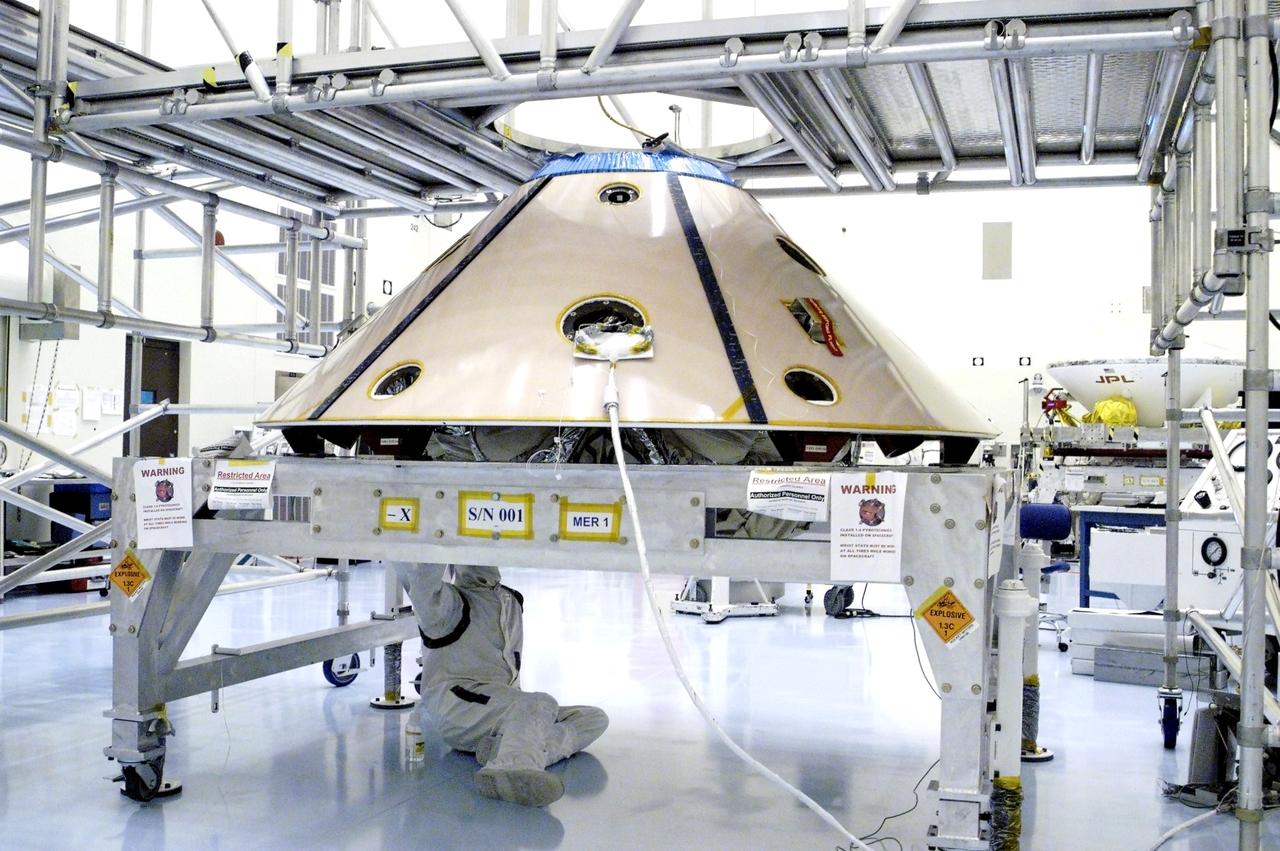
KENNEDY SPACE CENTER, FLA. - In the Payload Hazardous Servicing Facility, the heat shield (foreground) is ready to be mated with the upper backshell/ Mars Exploration Rover 1 (MER-1), in the background.  NASA's twin Mars Exploration Rovers are designed to study the history of water on Mars. These robotic geologists are equipped with a robotic arm, a drilling tool, three spectrometers, and four pairs of cameras that allow them to have a human-like, 3D view of the terrain. Each rover could travel as far as 100 meters in one day to act as Mars scientists' eyes and hands, exploring an environment where humans can't yet go.  MER-1 is scheduled to launch June 25 as MER-B aboard a Delta II rocket from Cape Canaveral Air Force Station.
KENNEDY SPACE CENTER, FLA. - In the Payload Hazardous Servicing Facility, the heat shield (foreground) is ready to be mated with the upper backshell/ Mars Exploration Rover 1 (MER-1), in the background. NASA's twin Mars Exploration Rovers are designed to study the history of water on Mars. These robotic geologists are equipped with a robotic arm, a drilling tool, three spectrometers, and four pairs of cameras that allow them to have a human-like, 3D view of the terrain. Each rover could travel as far as 100 meters in one day to act as Mars scientists' eyes and hands, exploring an environment where humans can't yet go. MER-1 is scheduled to launch June 25 as MER-B aboard a Delta II rocket from Cape Canaveral Air Force Station.
KENNEDY SPACE CENTER, FLA. - In the Payload Hazardous Servicing Facility, workers lower the backshell with the Mars Exploration Rover 1 (MER-1) onto the heat shield.  The two components form the aeroshell that will protect the rover on its journey to Mars.  NASA's twin Mars Exploration Rovers are designed to study the history of water on Mars. These robotic geologists are equipped with a robotic arm, a drilling tool, three spectrometers, and four pairs of cameras that allow them to have a human-like, 3D view of the terrain. Each rover could travel as far as 100 meters in one day to act as Mars scientists' eyes and hands, exploring an environment where humans can't yet go.  MER-1 is scheduled to launch June 25 as MER-B aboard a Delta II rocket from Cape Canaveral Air Force Station.
KENNEDY SPACE CENTER, FLA. - In the Payload Hazardous Servicing Facility, workers lower the backshell with the Mars Exploration Rover 1 (MER-1) onto the heat shield. The two components form the aeroshell that will protect the rover on its journey to Mars. NASA's twin Mars Exploration Rovers are designed to study the history of water on Mars. These robotic geologists are equipped with a robotic arm, a drilling tool, three spectrometers, and four pairs of cameras that allow them to have a human-like, 3D view of the terrain. Each rover could travel as far as 100 meters in one day to act as Mars scientists' eyes and hands, exploring an environment where humans can't yet go. MER-1 is scheduled to launch June 25 as MER-B aboard a Delta II rocket from Cape Canaveral Air Force Station.
The National Aeronautics and Space Administration (NASA) Lewis Research Center acquired this Gulfstream C-131B Samaritan from the Air Force in July 1976. The center obtained the aircraft to support its current earth resources work. The C-131B is seen here inside the Lewis hangar being refurbished and converted into a flying laboratory. The modifications were led by Lewis Chief of Flight Operations Robert Hogan.    The cockpit and cabin were modified and packed with instrumentation. The new equipment included Sideways Looking Airborne Radar (SLAR), geothermal sensors, radar antennas, and an inertial navigation system. In addition, portals were installed underneath the fuselage for cameras and remote sensing equipment.     NASA’s C-131B was used to support researchers tracking ice flows on the Great Lakes and in Prudhoe Bay, Alaska. It was also used for the center’s program to determine heating losses in the Cleveland area’s residential and commercial structures. The aircraft was later donated to the University of Georgia.
Newly Acquired Gulfstream C-131B Samaritan in the Hangar
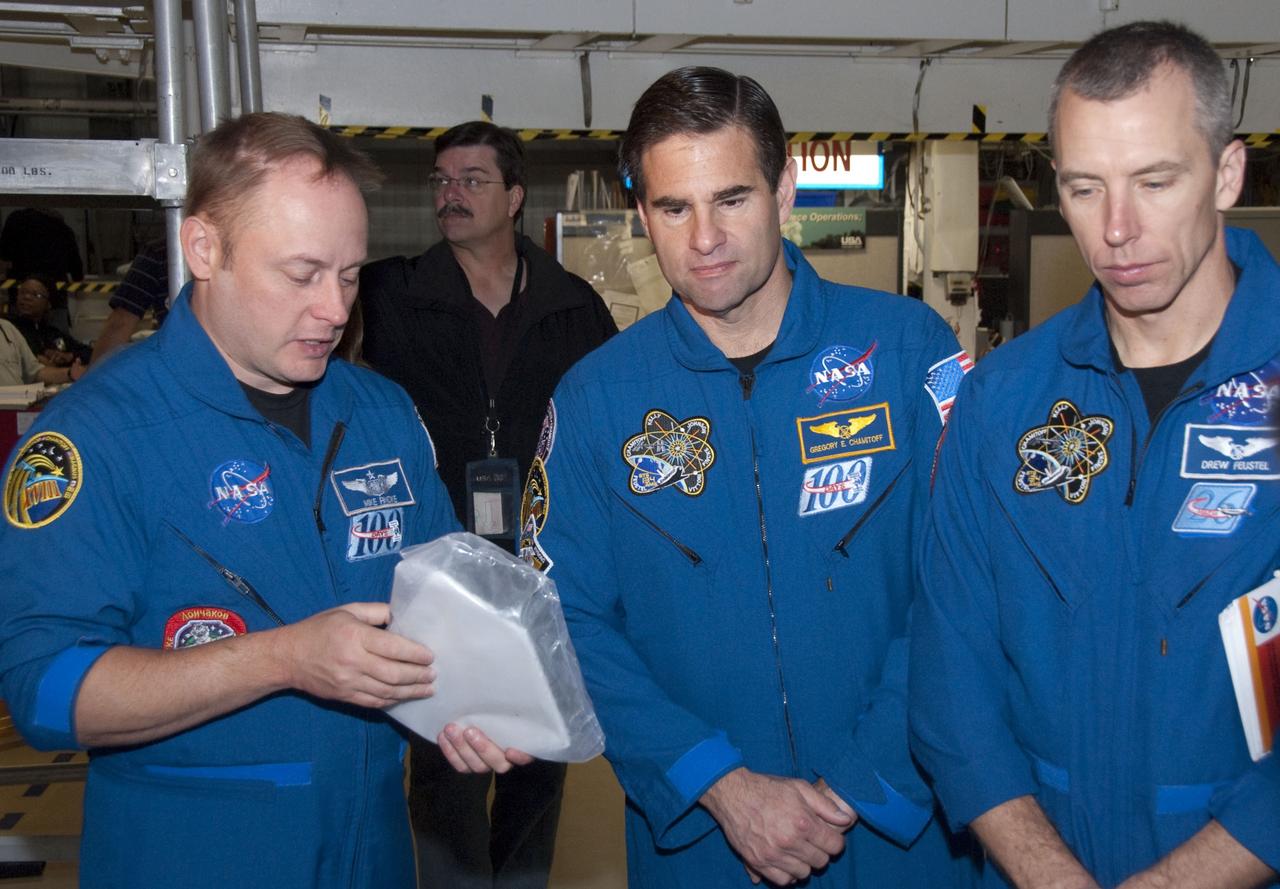
CAPE CANAVERAL, Fla. -- In the Orbiter Processing Facility-2 at NASA's Kennedy Space Center in Florida, STS-134 Mission Specialists Michael Finke, left, Gregory Chamitoff and Andrew Feustel check out the heat shield tiles that protect space shuttles during re-entry. The six STS-134 astronauts are at Kennedy participating in the Crew Equipment Interface Test (CEIT), which gives them an opportunity for hands-on training with the tools and equipment they'll use in space and familiarization of the payload they'll be delivering to the International Space Station.         Space shuttle Endeavour is targeted to launch on the STS-134 mission Feb. 27, 2011. For more information, visit www.nasa.gov/mission_pages/shuttle/shuttlemissions/sts134/index.html. Photo credit: NASA/Cory Huston
KSC-2010-5537
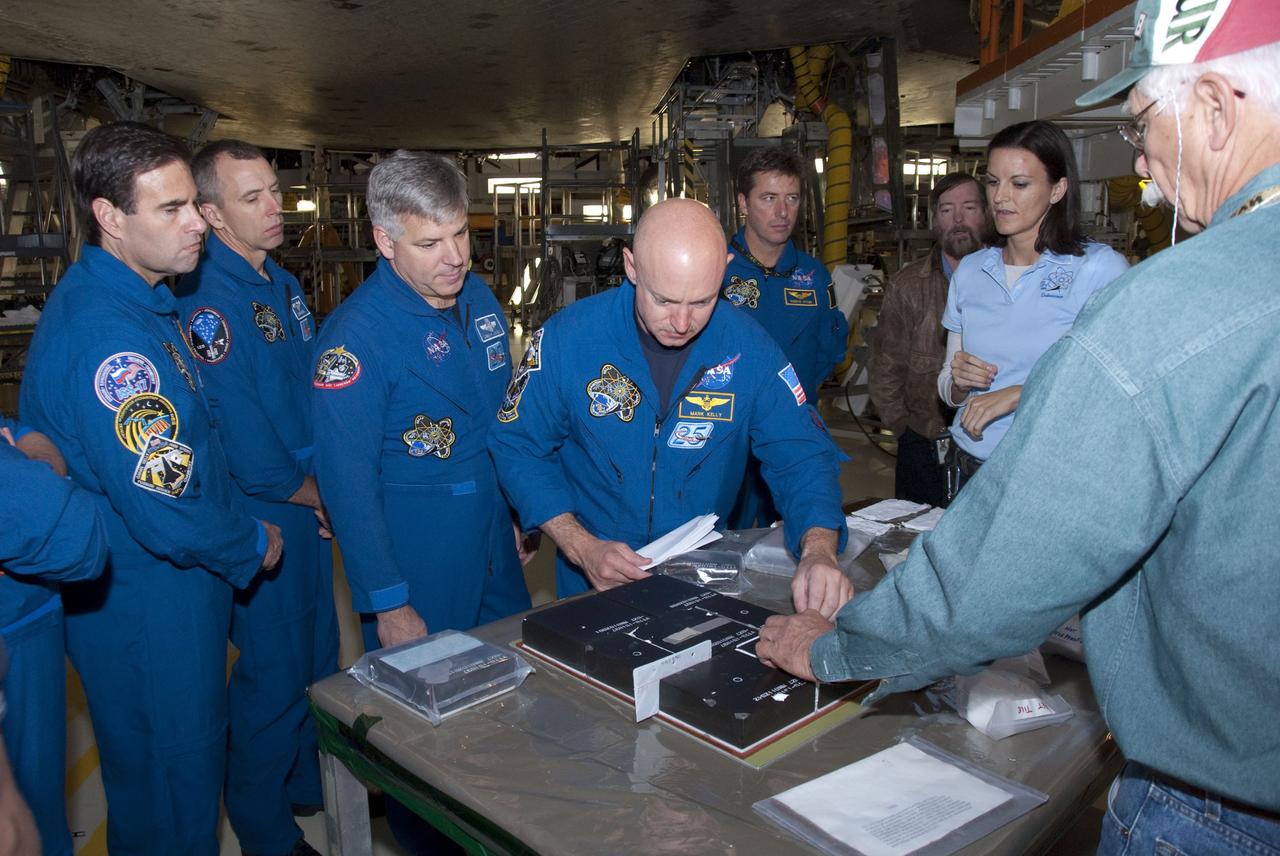
CAPE CANAVERAL, Fla. -- In the Orbiter Processing Facility-2 at NASA's Kennedy Space Center in Florida, the STS-134 crew checks out the heat shield tiles that protect space shuttles during re-entry. From left, are Mission Specialists Greg Chamitoff and Andrew Feustel, Pilot Gregory H. Johnson, Commander Mark Kelly and Mission Specialist Roberto Vittori of the European Space Agency. The six STS-134 astronauts are at Kennedy participating in the Crew Equipment Interface Test (CEIT), which gives them an opportunity for hands-on training with the tools and equipment they'll use in space and familiarization of the payload they'll be delivering to the International Space Station.    Space shuttle Endeavour is targeted to launch on the STS-134 mission Feb. 27, 2011. For more information, visit www.nasa.gov/mission_pages/shuttle/shuttlemissions/sts134/index.html. Photo credit: NASA/Cory Huston
KSC-2010-5539
CAPE CANAVERAL, Fla. -- In the Orbiter Processing Facility-2 at NASA's Kennedy Space Center in Florida, STS-134 Commander Mark Kelly, left, and Mission Specialist Roberto Vittori with the European Space Agency check out the heat shield tiles that protect space shuttles during re-entry. The six STS-134 astronauts are at Kennedy participating in the Crew Equipment Interface Test (CEIT), which gives them an opportunity for hands-on training with the tools and equipment they'll use in space and familiarization of the payload they'll be delivering to the International Space Station.      Space shuttle Endeavour is targeted to launch on the STS-134 mission Feb. 27, 2011. For more information, visit www.nasa.gov/mission_pages/shuttle/shuttlemissions/sts134/index.html. Photo credit: NASA/Cory Huston
KSC-2010-5538
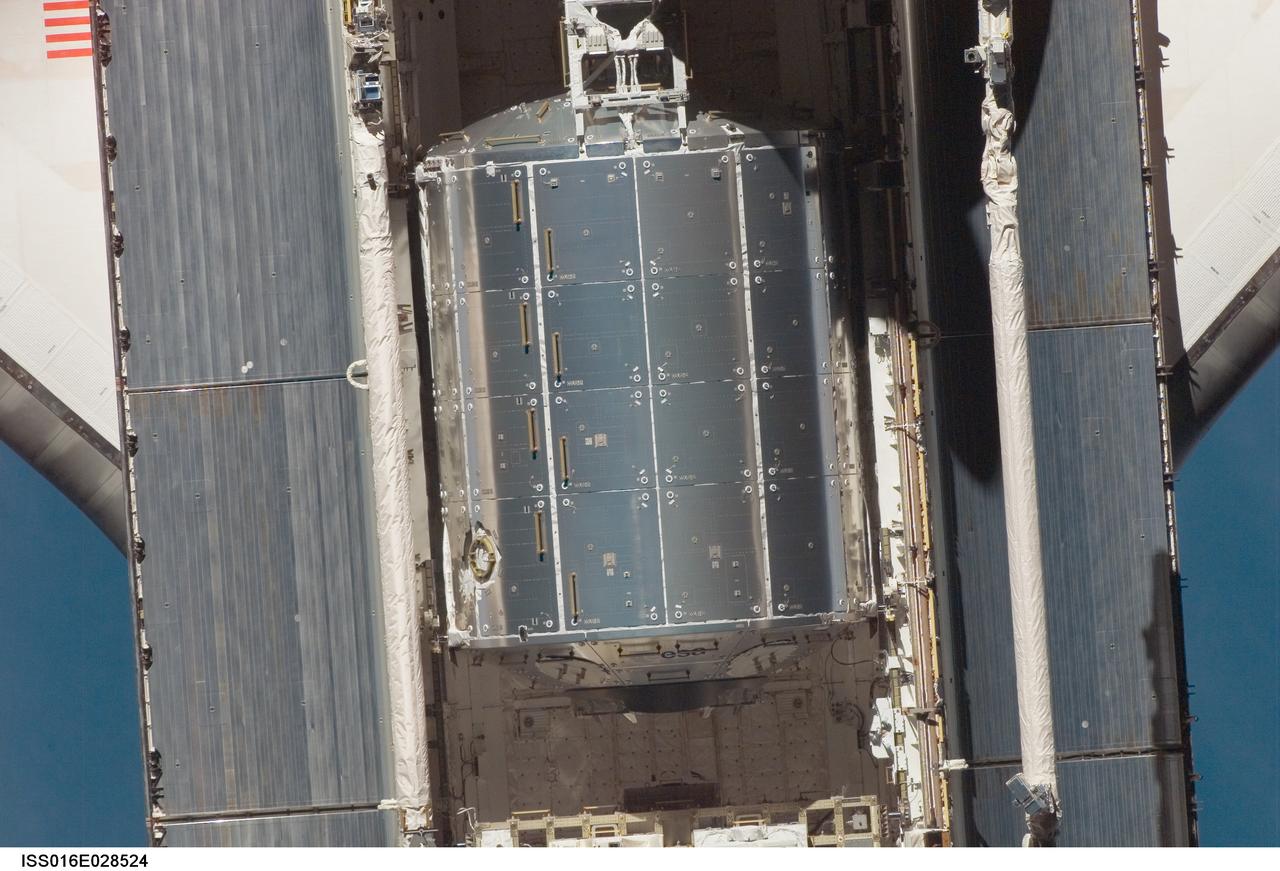
ISS016-E-028524 (9 Feb. 2008) --- An overhead view of the European Space Agency's Columbus laboratory in Space Shuttle Atlantis' cargo bay was provided by Expedition 16 crewmembers.  Before docking with the International Space Station,  astronaut Steve Frick, STS-122 commander, flew the shuttle through a roll pitch maneuver or basically a backflip to allow the space station crew a good view of Atlantis' heat shield.  Using digital still cameras equipped with both 400  and 800 millimeter lenses, the ISS crewmembers took a number of photos of the shuttle's thermal protection system and sent them down to teams on the ground for analysis. A 400 millimeter lens was used for this image.
Mapping Sequence performed during the STS-122 R-Bar Pitch Maneuver
KENNEDY SPACE CENTER, FLA. --  In NASA Kennedy Space Center's Vehicle Assembly Building, technicians  are inspecting the sanding performed on Atlantis' nose cone to repair hail damage.  The equipment on the side of the nose cone is the sander.  In late February, Atlantis' external tank received hail damage during a severe thunderstorm that passed through the Kennedy Space Center Launch Complex 39 area. The hail caused visible divots in the giant tank's foam insulation as well as minor surface damage to about 26 heat shield tiles on the shuttle's left wing.  The launch of Space Shuttle Atlantis on mission STS-117  now is targeted for June 8.  Photo credit: NASA/Jack Pfaller
KSC-07pd1079
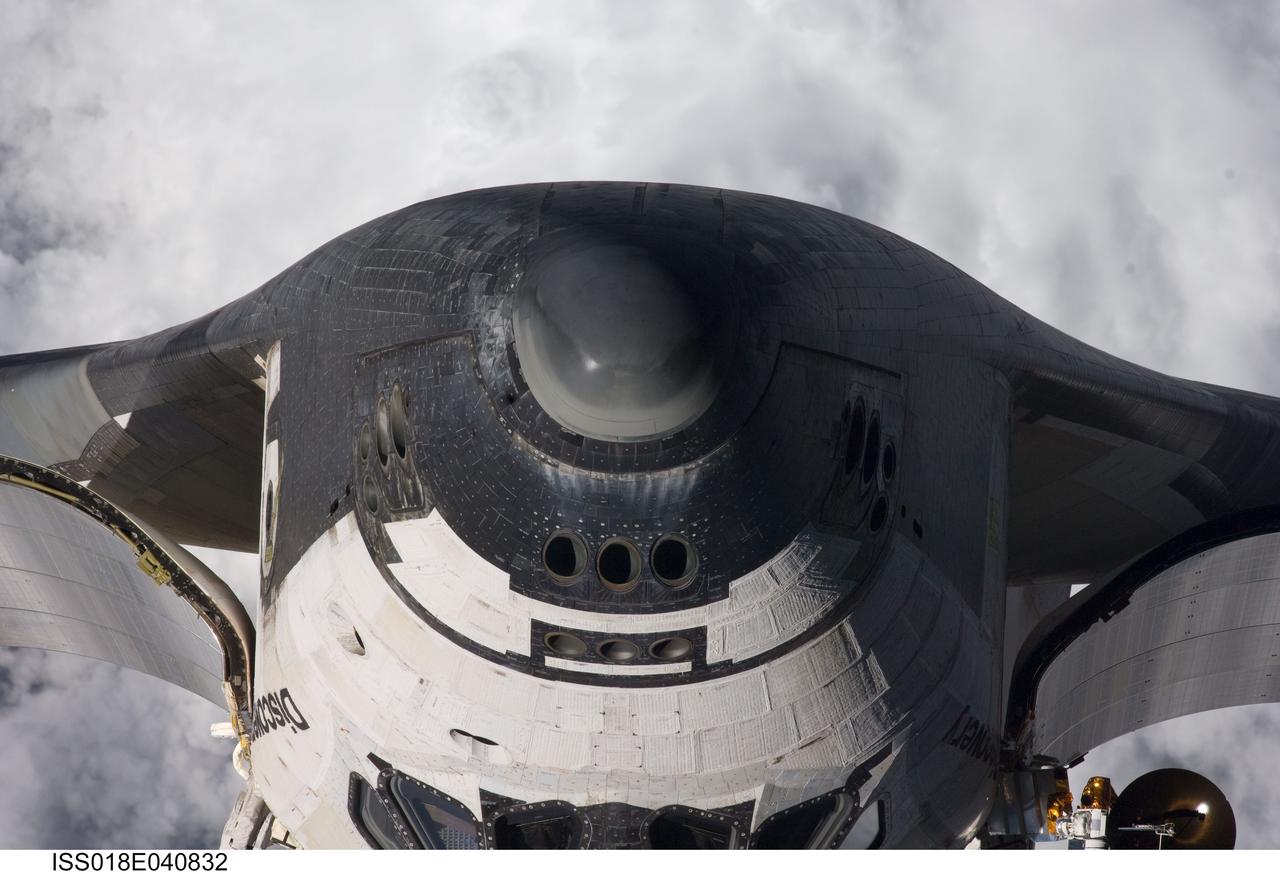
ISS018-E-040832 (17 March 2009) --- A close-up view of the exterior of Space Shuttle Discovery's nose was provided by Expedition 18 crewmembers on the International Space Station. Before docking with the station, astronaut Lee Archambault, STS-119 commander, flew the shuttle through a Rendezvous Pitch Maneuver or basically a backflip to allow the space station crew a good view of Discovery's heat shield. Using digital still cameras equipped with both 400 and 800 millimeter lenses, the ISS crewmembers took a number of photos of the shuttle's thermal protection system and sent them down to teams on the ground for analysis. A 400 millimeter lens was used for this image.
400mm Mapping Sequence performed during the STS-119 R-Bar Pitch Maneuver
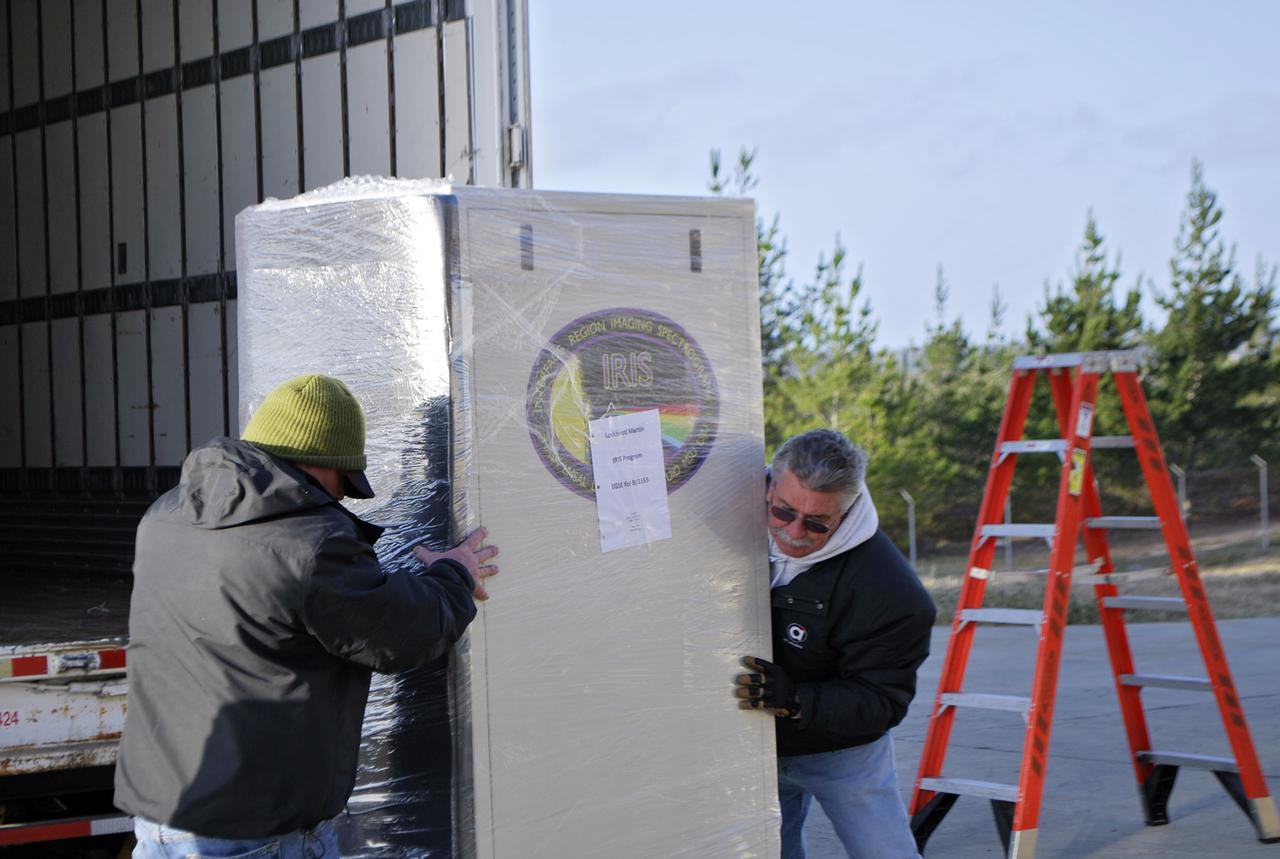
VANDENBERG AFB, Calif. – Technicians offload ground support equipment slated for NASA's IRIS mission. NASA’s Interface Region Imaging Spectrograph, or IRIS, satellite will improve our understanding of how heat and energy move through the deepest levels of the sun’s atmosphere, thereby increasing our ability to forecast space weather. On launch day, deployment of the Pegasus from Orbital’s L-1011 carrier aircraft will occur at a location over the Pacific Ocean about 100 miles northwest of Vandenberg off the central coast of California south of Big Sur. Photo credit: VAFB_Randy Beaudoin
KSC-2013-1994
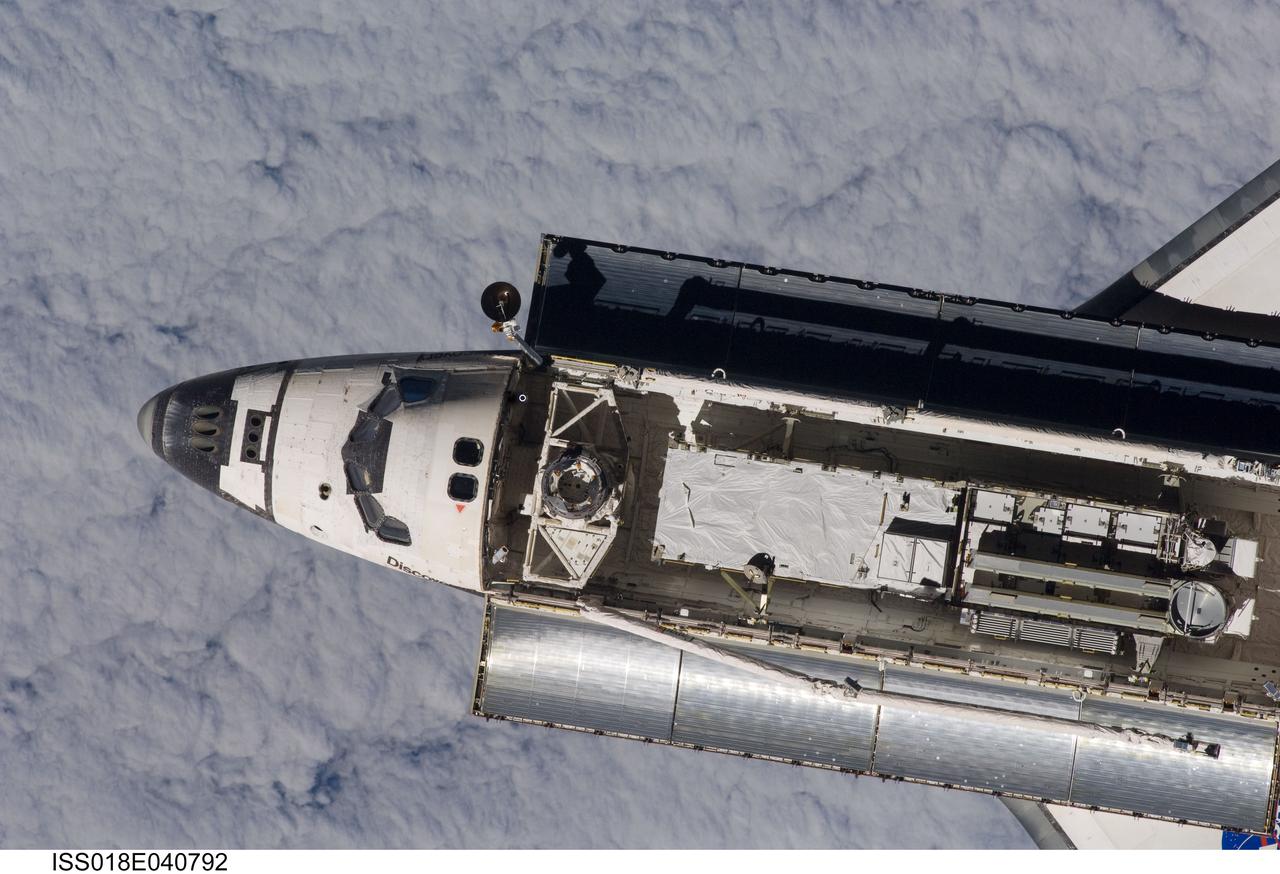
ISS018-E-040602 (17 March 2009) --- An overhead view of the exterior of Space Shuttle Discovery's crew cabin, part of its payload bay and docking system was provided by Expedition 18 crewmembers on the International Space Station. Before docking with the station, astronaut Lee Archambault, STS-119 commander, flew the shuttle through a Rendezvous Pitch Maneuver or basically a backflip to allow the space station crew a good view of Discovery's heat shield. Using digital still cameras equipped with both 400 and 800 millimeter lenses, the ISS crewmembers took a number of photos of the shuttle's thermal protection system and sent them down to teams on the ground for analysis. A 800 millimeter lens was used for this image.
800mm Mapping Sequence performed during the STS-119 R-Bar Pitch Maneuver
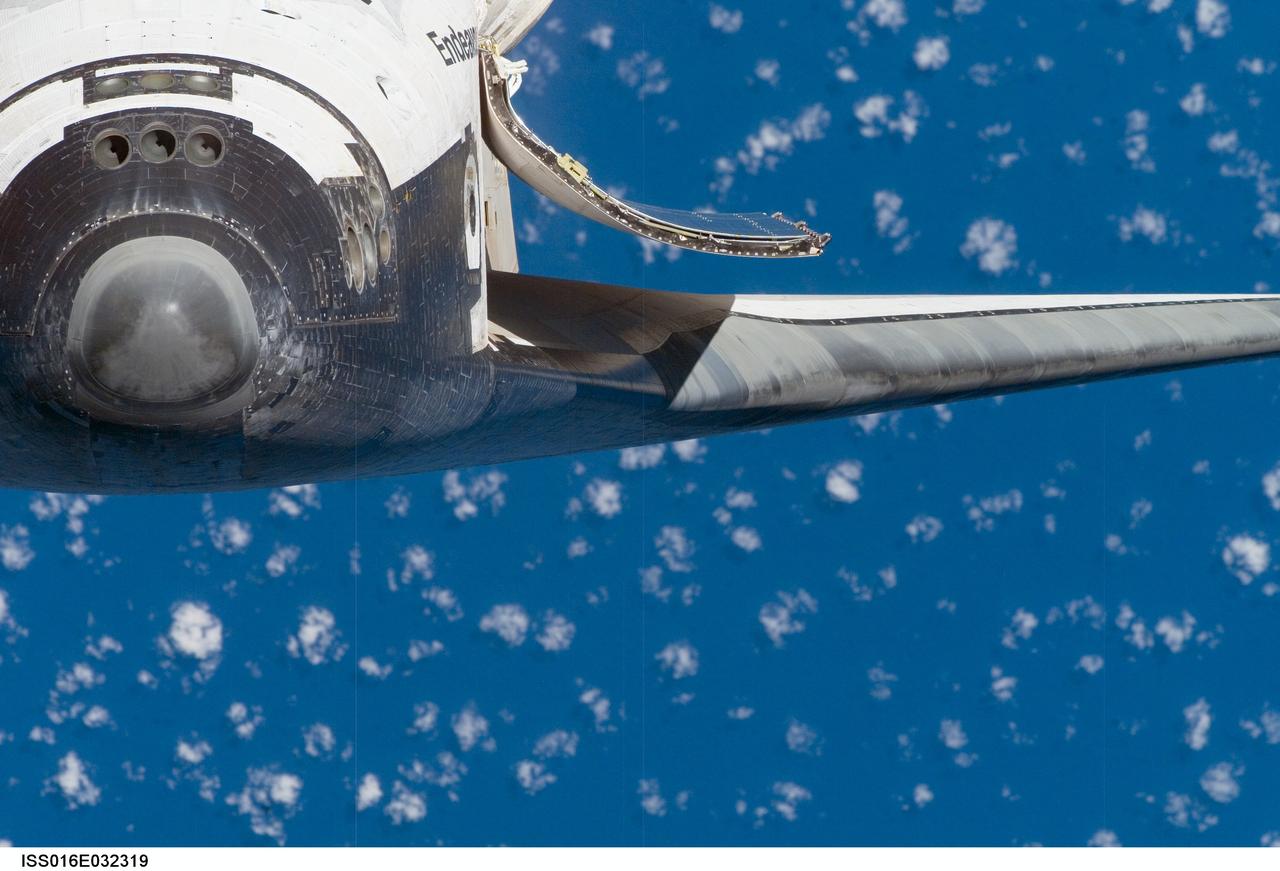
ISS016-E-032319 (12 March 2008) --- A close-up view of the exterior of Space Shuttle Endeavour's nose, port wing and payload bay door was provided by Expedition 16 crewmembers on the International Space Station (ISS). Before docking with the station, astronaut Dominic Gorie, STS-123 commander, flew the shuttle through a roll pitch maneuver or basically a backflip to allow the space station crew a good view of Endeavour's heat shield. Using digital still cameras equipped with both 400 and 800 millimeter lenses, the ISS crewmembers took a number of photos of the shuttle's thermal protection system and sent them down to teams on the ground for analysis. A 400 millimeter lens was used for this image.
Mapping Sequence performed during the STS-123 R-Bar Pitch Maneuver
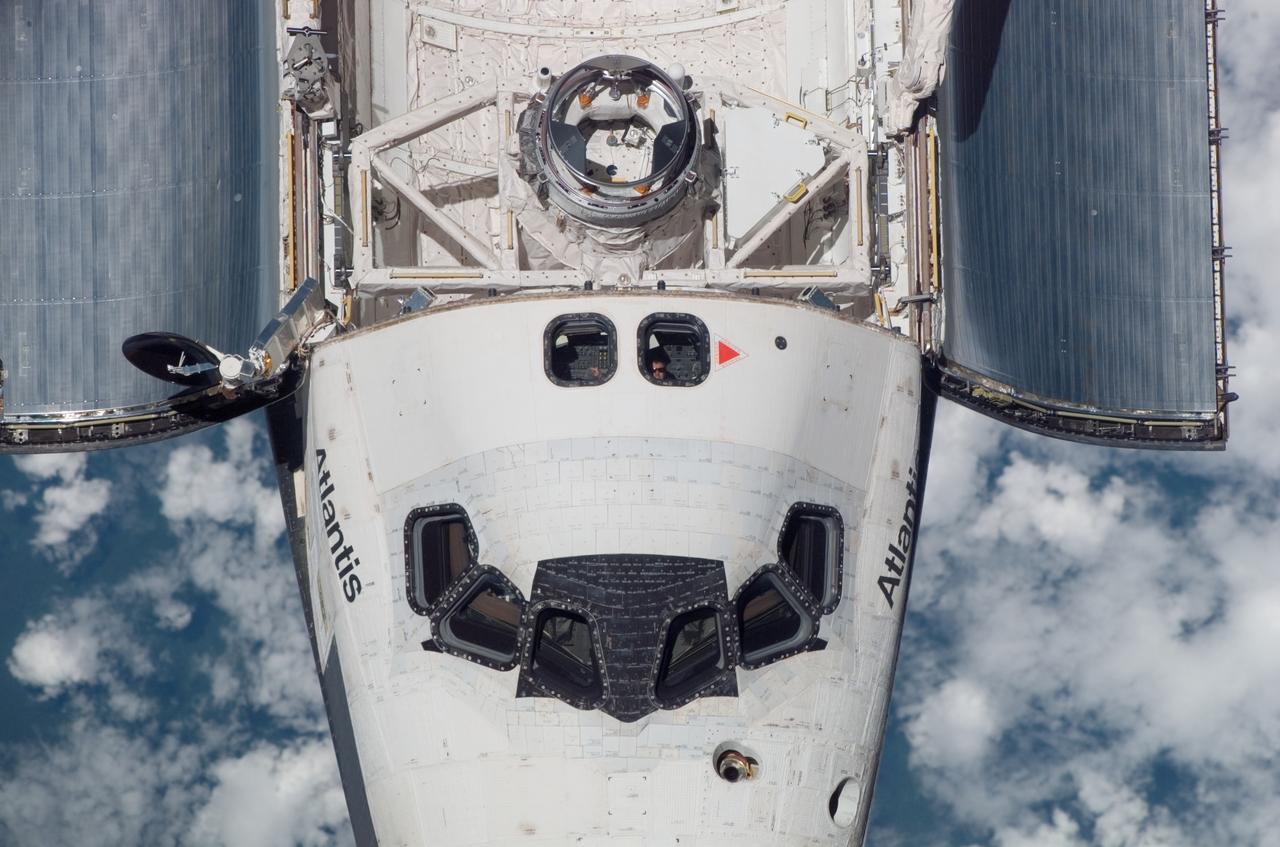
ISS016-E-028388 (9 Feb. 2008) --- An overhead view of the exterior of the Space Shuttle Atlantis' crew cabin, part of its payload bay doors and docking system was provided by Expedition 16 crewmembers. Before docking with the International Space Station, astronaut Steve Frick, STS-122 commander, flew the shuttle through a roll pitch maneuver or basically a backflip to allow the space station crew a good view of Atlantis' heat shield. Using digital still cameras equipped with both 400 and 800 millimeter lenses, the ISS crewmembers took a number of photos of the shuttle's thermal protection system and sent them down to teams on the ground for analysis. A 400 millimeter lens was used for this image.
Mapping Sequence performed during the STS-122 R-Bar Pitch Maneuver
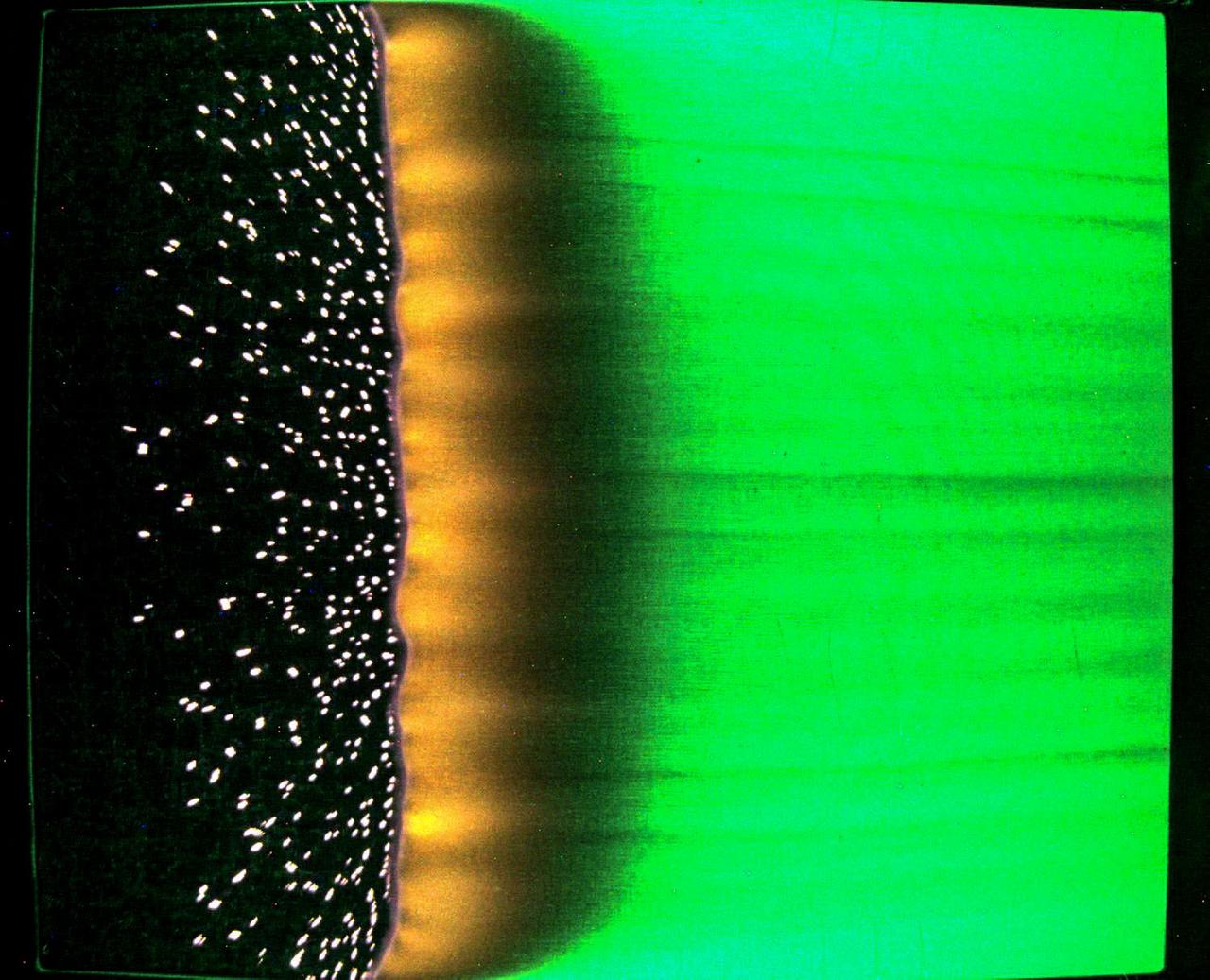
jsc2023e046375 (7/25/2023) --- A sample of fabric burns inside Spacecraft Fire Experiment-IV (Saffire-IV). The sample is a composite fabric made of cotton and fiberglass and is 40 cm wide. The image appears green because green LED lights are used to illuminate the sample during a burn. The flame appears orange in this image and the black region to the right of the flame is the cotton in the sample beginning to heat and char. The bright specks to the left of the flame are smoldering cotton that remains on the fiberglass substrate after the flame passes. In Saffire-VI, this fabric is burned at higher oxygen concentrations. Researchers aim to study realistic flame spread to aid the development of fire safety equipment and strategies for future spacecraft.
jsc2023e046375
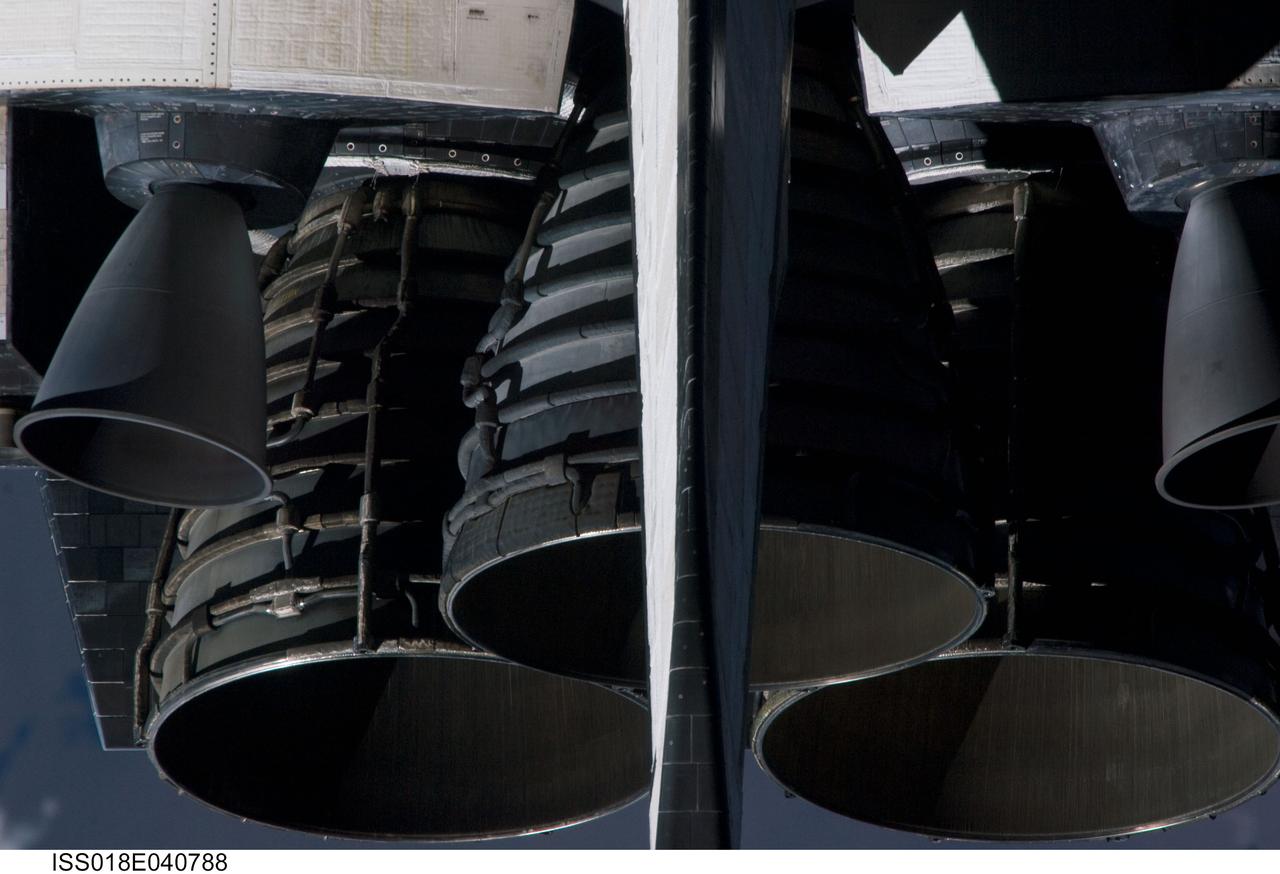
ISS018-E-040788 (17 March 2009) --- A close-up view of Space Shuttle Discovery?s main engines was provided by Expedition 18 crewmembers on the International Space Station. Before docking with the station, astronaut Lee Archambault, STS-119 commander, flew the shuttle through a Rendezvous Pitch Maneuver or basically a backflip to allow the space station crew a good view of Discovery's heat shield. Using digital still cameras equipped with both 400 and 800 millimeter lenses, the ISS crewmembers took a number of photos of the shuttle's thermal protection system and sent them down to teams on the ground for analysis. A 800 millimeter lens was used for this image.
800mm Mapping Sequence performed during the STS-119 R-Bar Pitch Maneuver
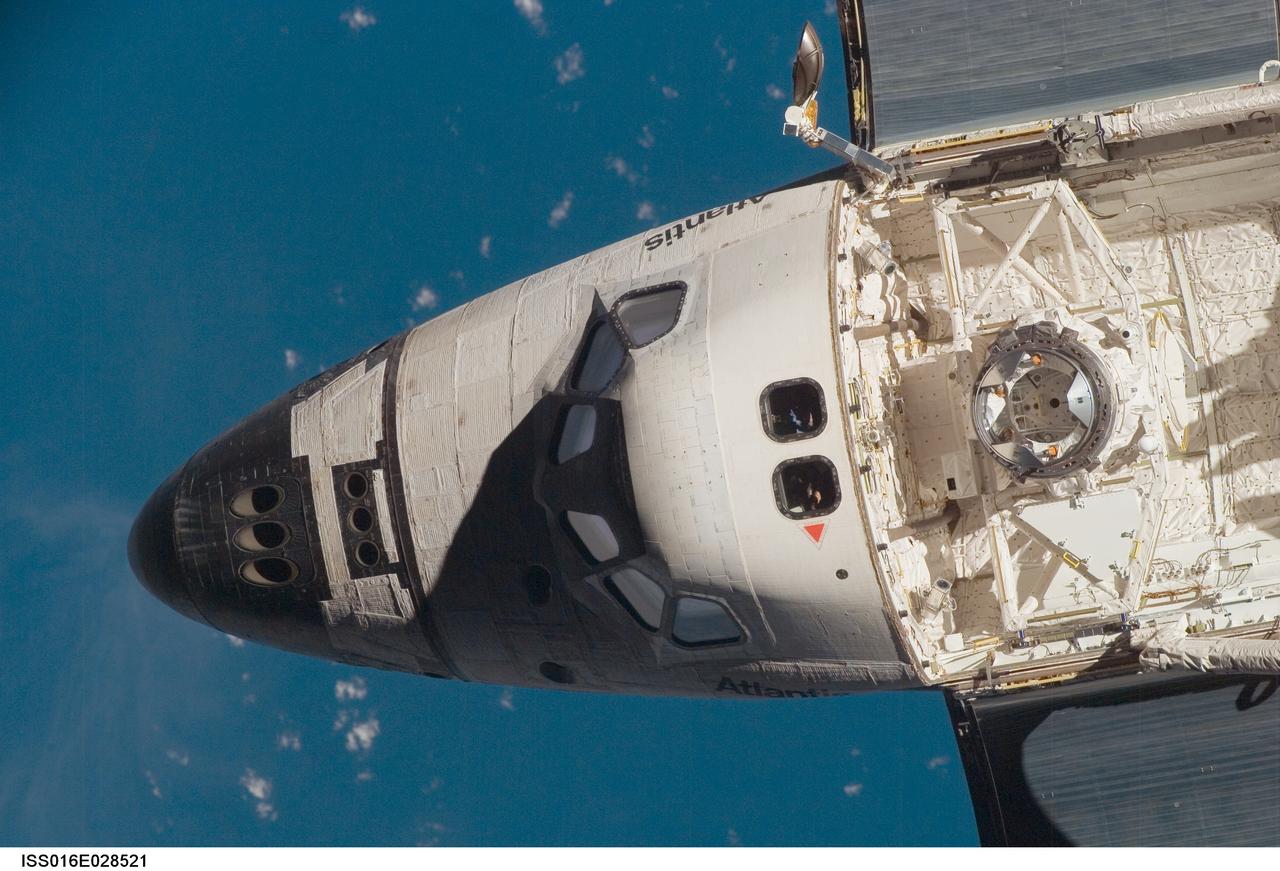
ISS016-E-028521 (9 Feb. 2008) --- An overhead view of the exterior of the Space Shuttle Atlantis' crew cabin and docking system was provided by Expedition 16 crewmembers.  Before docking with the International Space Station,  astronaut Steve Frick, STS-122 commander, flew the shuttle through a roll pitch maneuver or basically a backflip to allow the space station crew a good view of Atlantis' heat shield.  Using digital still cameras equipped with both 400  and 800 millimeter lenses, the ISS crewmembers took a number of photos of the shuttle's thermal protection system and sent them down to teams on the ground for analysis. A 400 millimeter lens was used for this image.
Mapping Sequence performed during the STS-122 R-Bar Pitch Maneuver
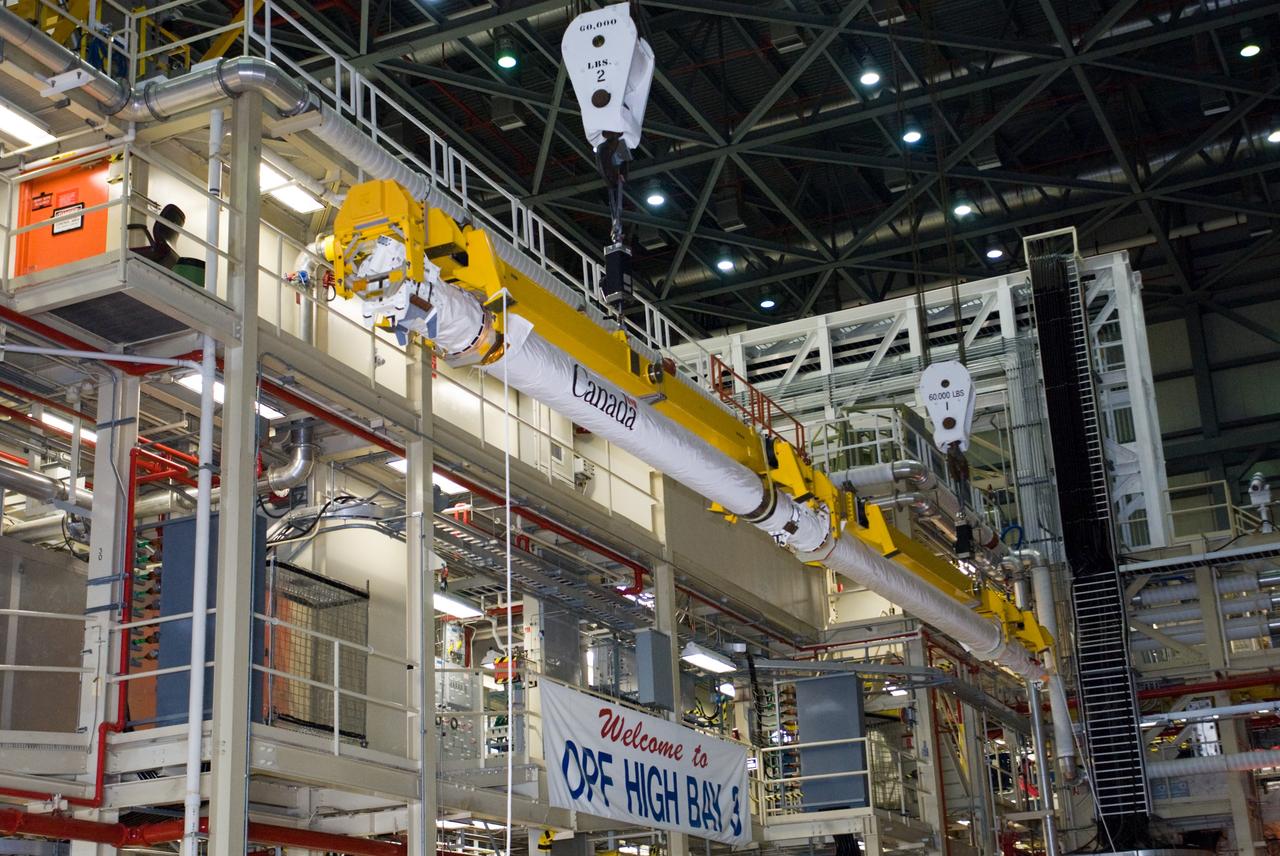
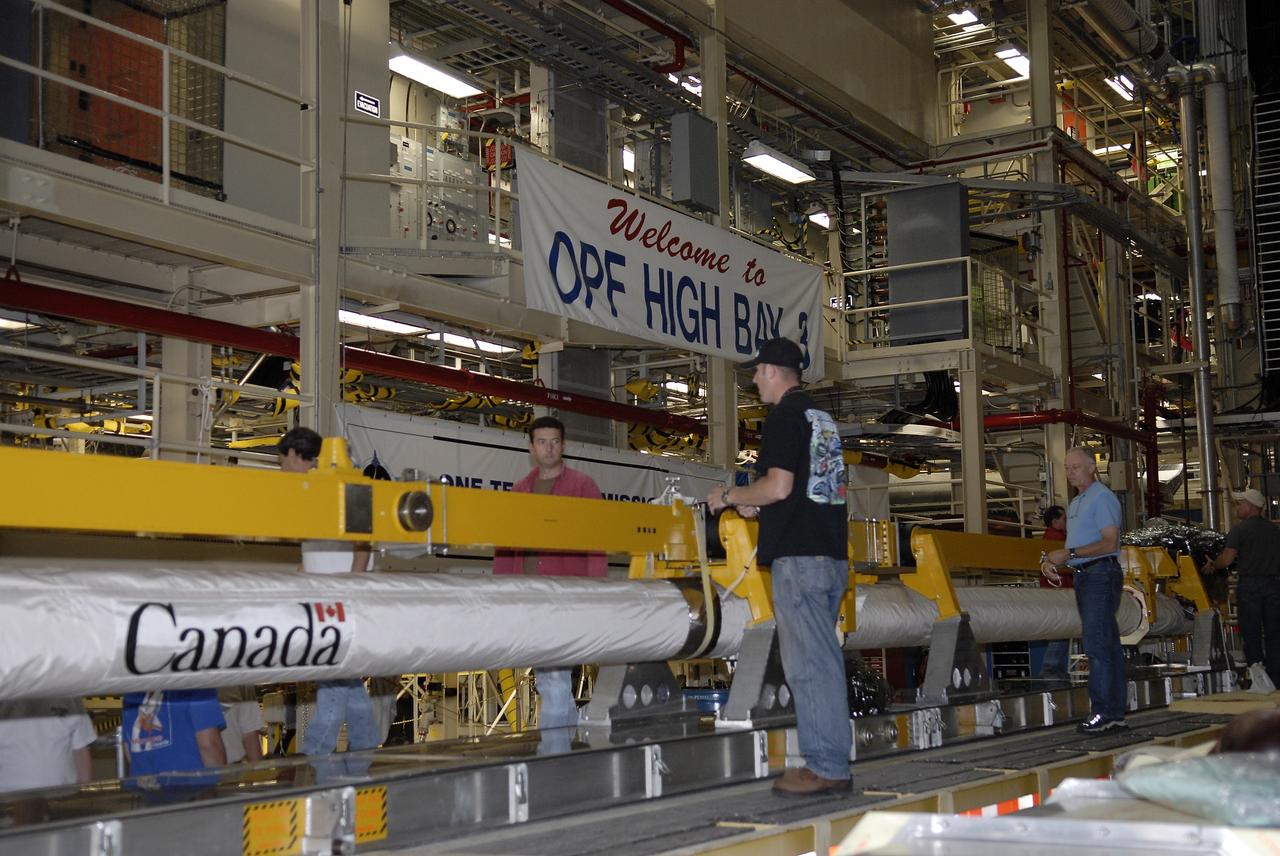
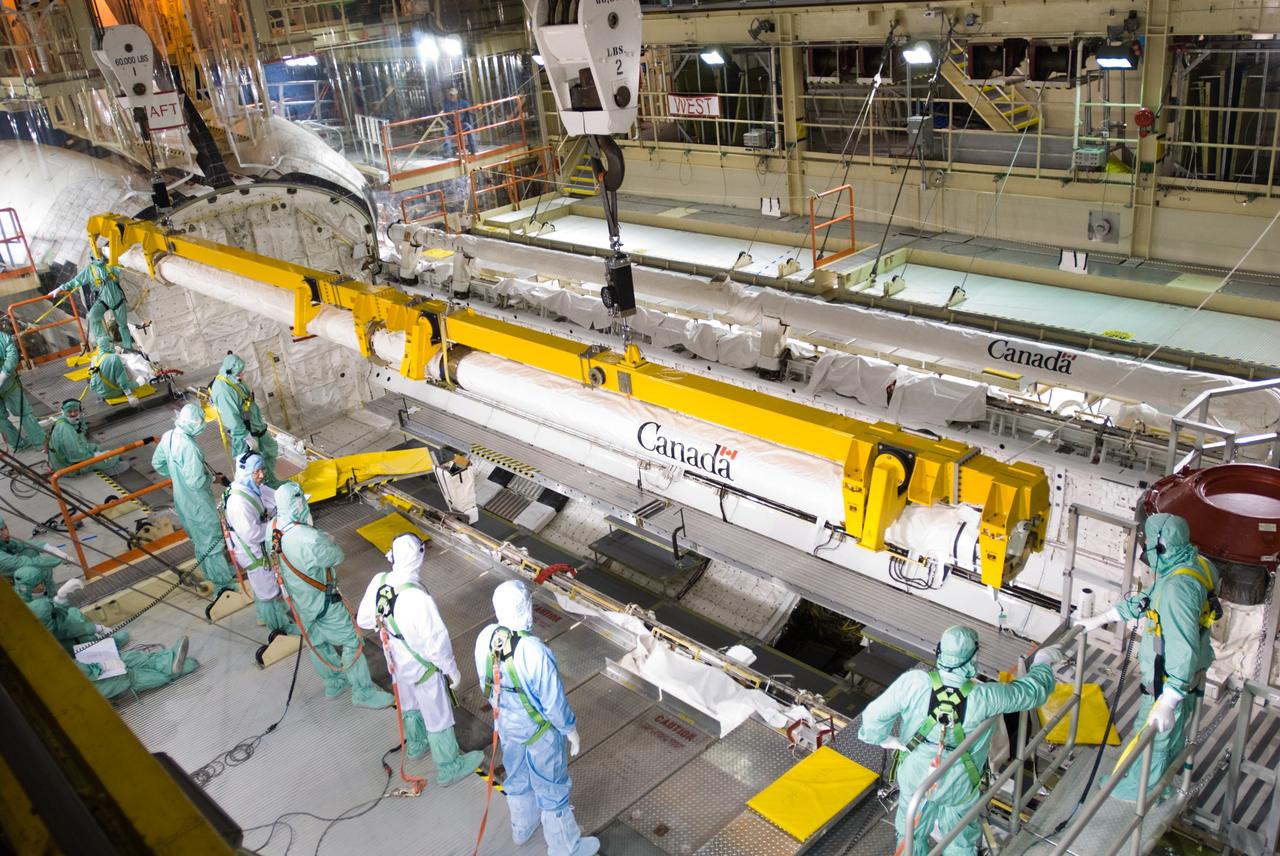
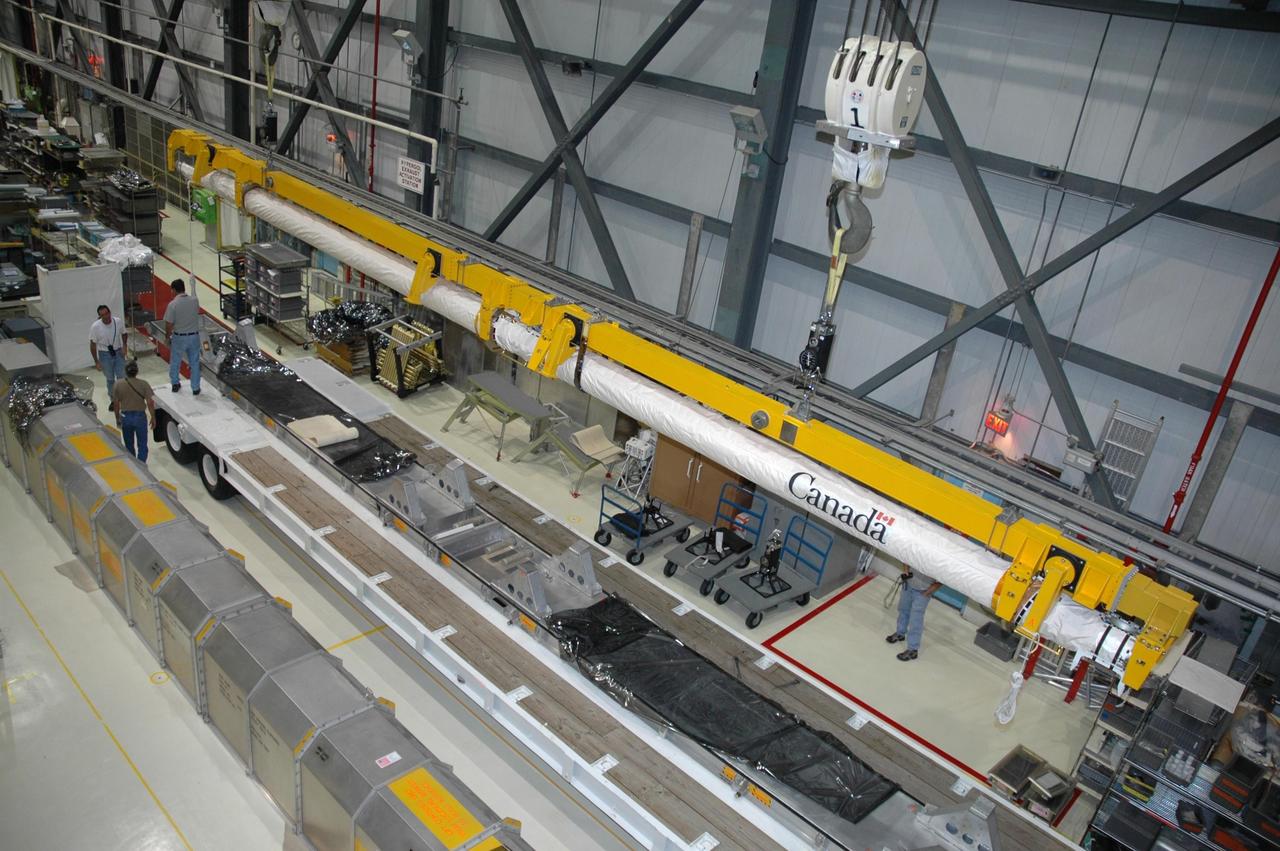
KENNEDY SPACE CENTER, FLA. -    In the Orbiter Processing Facility's bay 1, workers prepare the orbiter boom sensor system for installation on the starboard side of Atlantis's payload bay for mission STS-117.  The 50-foot-long boom attaches to the shuttle arm and provides equipment to inspect the shuttle's heat shield while in space.  It contains an intensified television camera (ITVC) and a laser dynamic range imager, which are mounted on a pan and tilt unit, and a laser camera system (LCS) mounted on a stationary bracket. Mission STS-117 will carry the S3/S4 arrays for installation on the International Space Station.  Launch of Space Shuttle Atlantis is scheduled for March.  Photo credit: NASA/Jack Pfaller
KSC-06pd2364
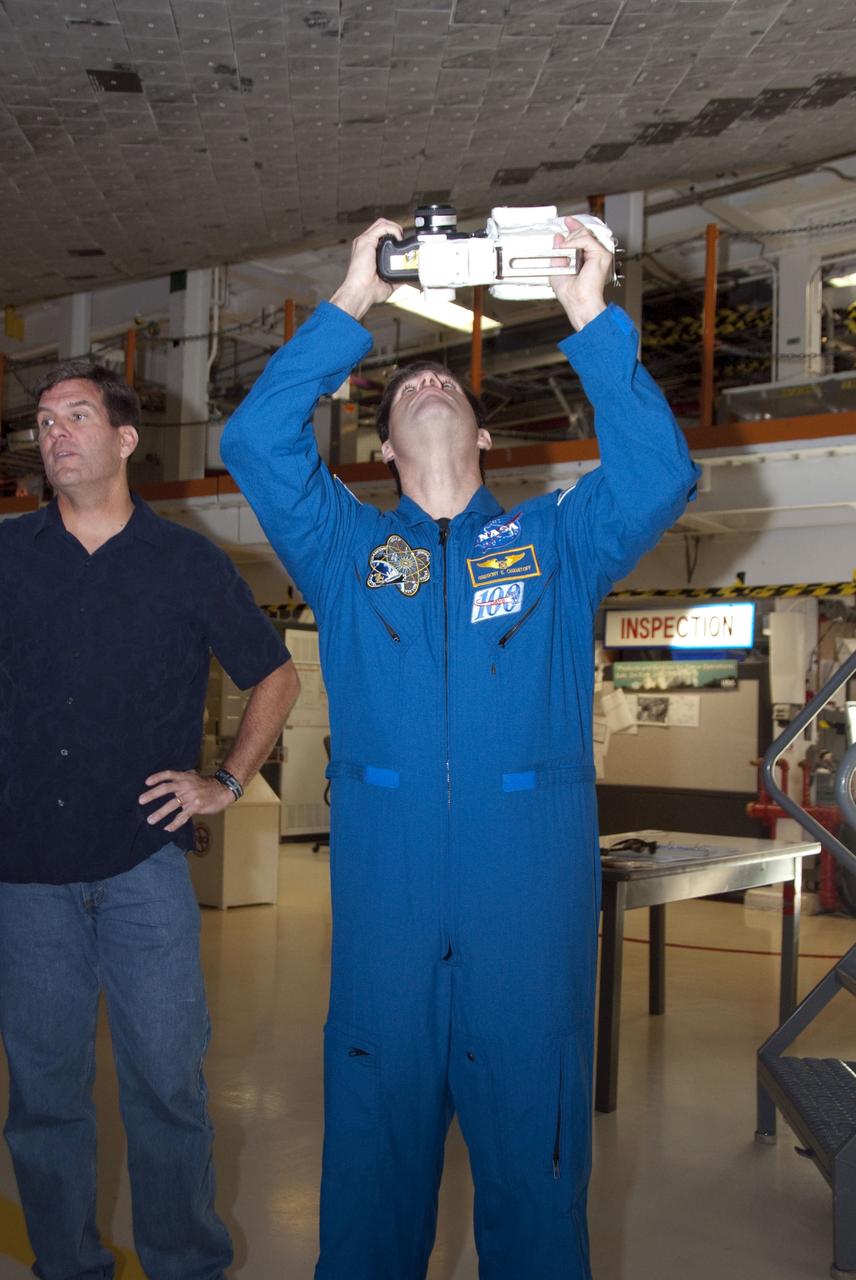
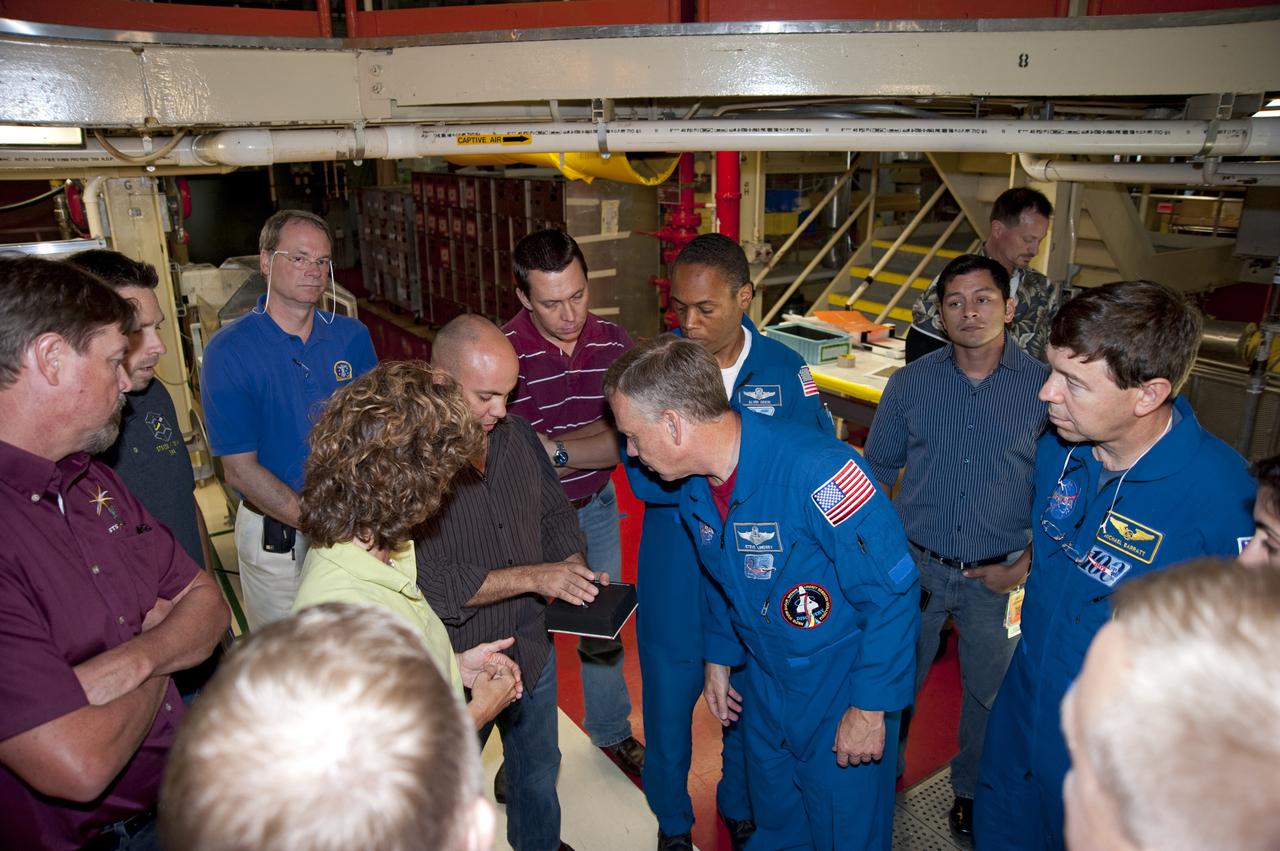
CAPE CANAVERAL, Fla. -- In Orbiter Processing Facility-3 at NASA's Kennedy Space Center in Florida, STS-133 Commander Steve Lindsey listens intently as a technician describes the features of a heat-shield tile while Mission Specialists Michael Barratt, Alvin Drew and other technicians look on.    The astronauts are at Kennedy for the Crew Equipment Interface Test, or CEIT, which provides the crew with hands-on training and observation of shuttle and flight hardware for their mission to the International Space Station. Launch of the STS-133 mission on space shuttle Discovery is targeted for Nov. 1 at 4:33 p.m. EDT. Photo credit: NASA_Kim Shiflett
KSC-2010-3991
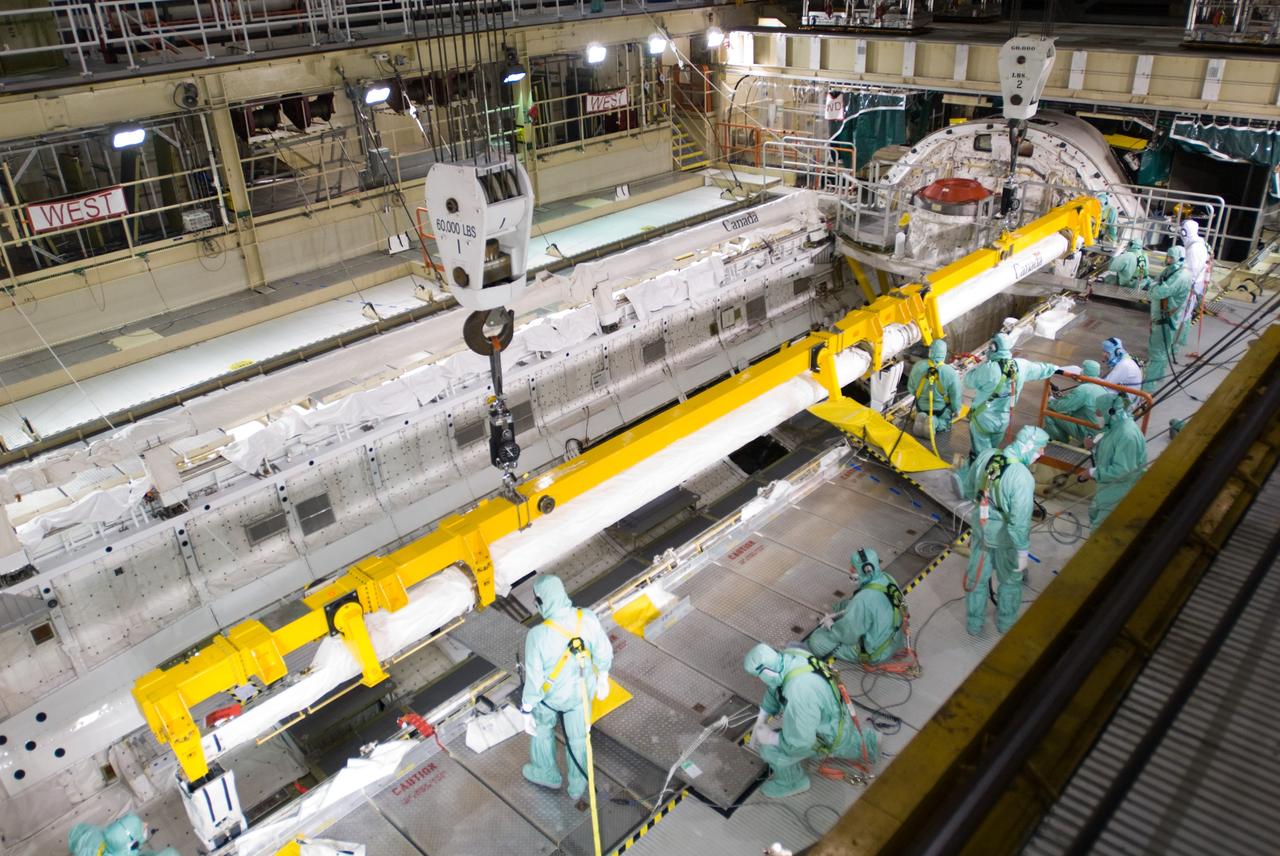
KENNEDY SPACE CENTER, FLA. -  In the Orbiter Processing Facility’s bay 1, workers are ready to secure the orbiter boom sensor system on the starboard side of Atlantis’s payload bay for mission STS-117. The 50-foot-long boom attaches to the shuttle arm and provides equipment to inspect the shuttle's heat shield while in space.  It contains an intensified television camera (ITVC) and a laser dynamic range imager, which are mounted on a pan and tilt unit, and a laser camera system (LCS) mounted on a stationary bracket. Mission STS-117 will carry the S3/S4 arrays for installation on the International Space Station.  Launch of Space Shuttle Atlantis is scheduled for March.  Photo credit: NASA/Jack Pfaller
KSC-06pd2369
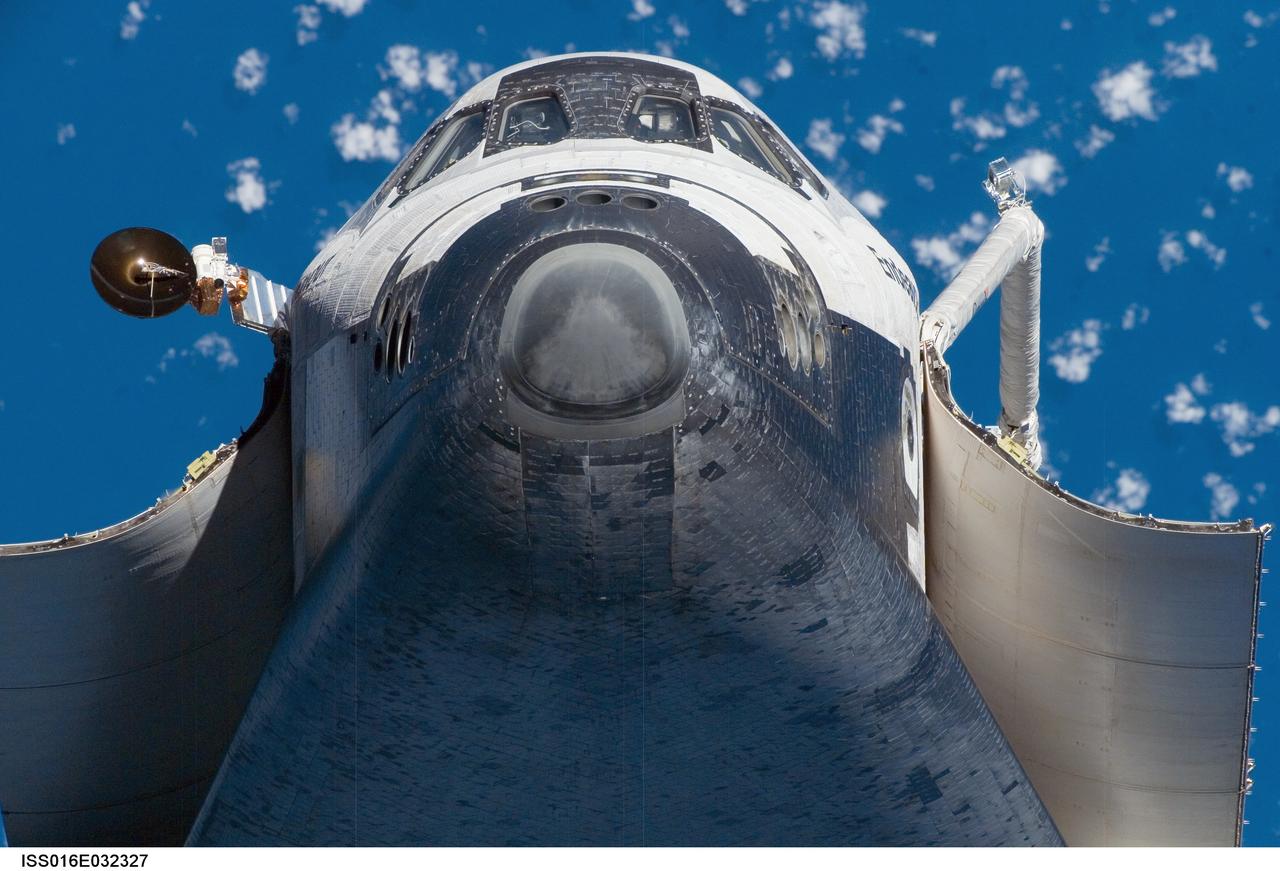
ISS016-E-032327 (12 March 2008) --- A low angle view of the nose and underside of Space Shuttle Endeavour's crew cabin was provided by Expedition 16 crewmembers on the International Space Station (ISS). Before docking with the station, astronaut Dominic Gorie, STS-123 commander, flew the shuttle through a roll pitch maneuver or basically a backflip to allow the space station crew a good view of Endeavour's heat shield. Using digital still cameras equipped with both 400 and 800 millimeter lenses, the ISS crewmembers took a number of photos of the shuttle's thermal protection system and sent them down to teams on the ground for analysis. A 400 millimeter lens was used for this image.
Mapping Sequence performed during the STS-123 R-Bar Pitch Maneuver
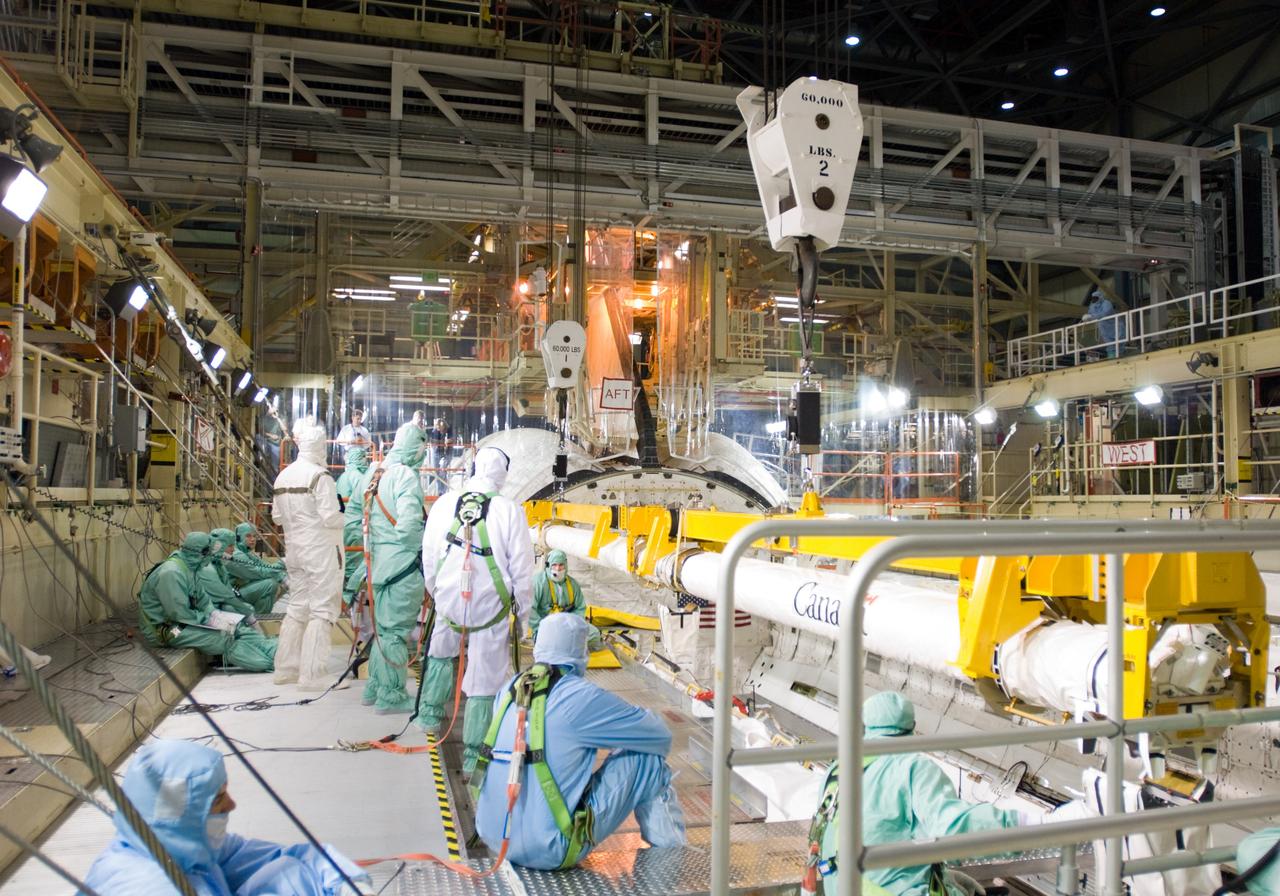
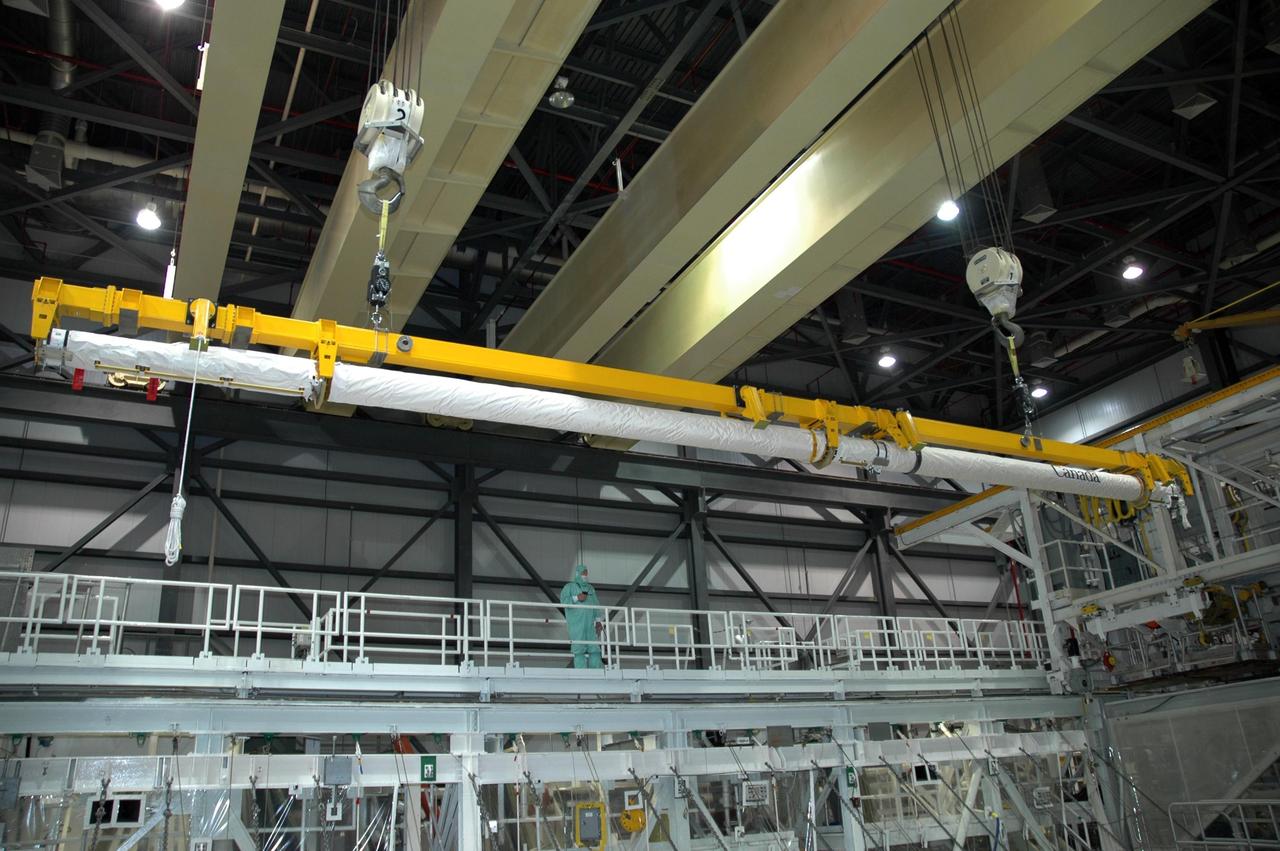
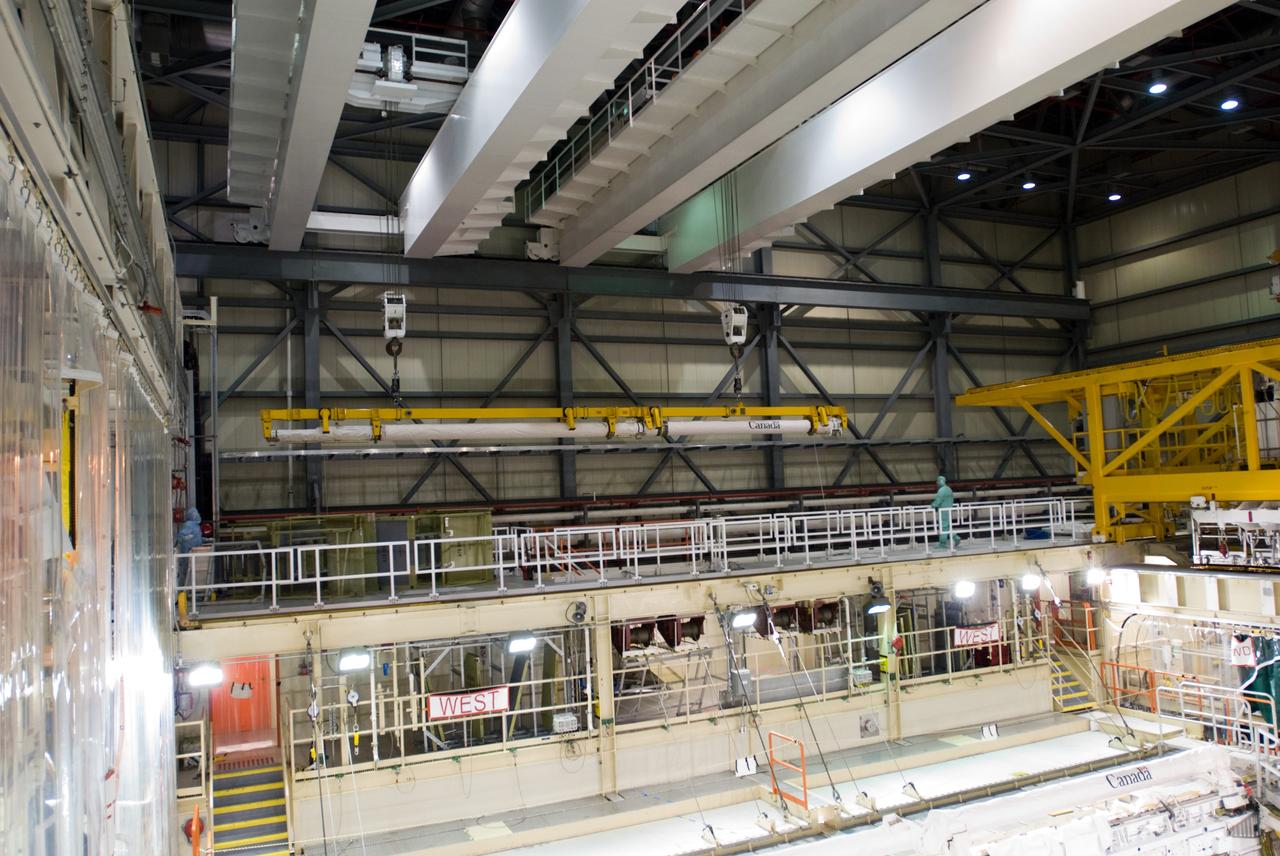
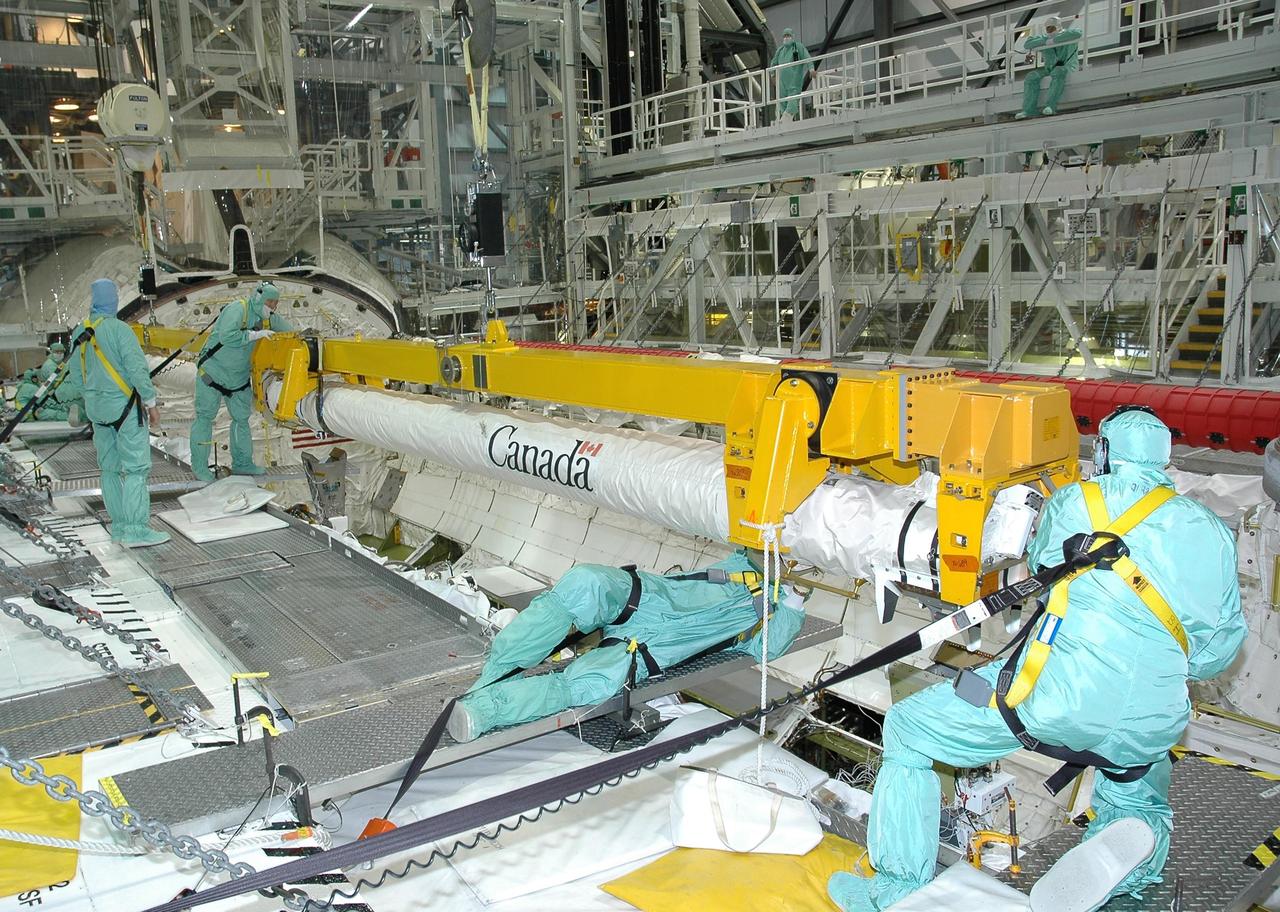
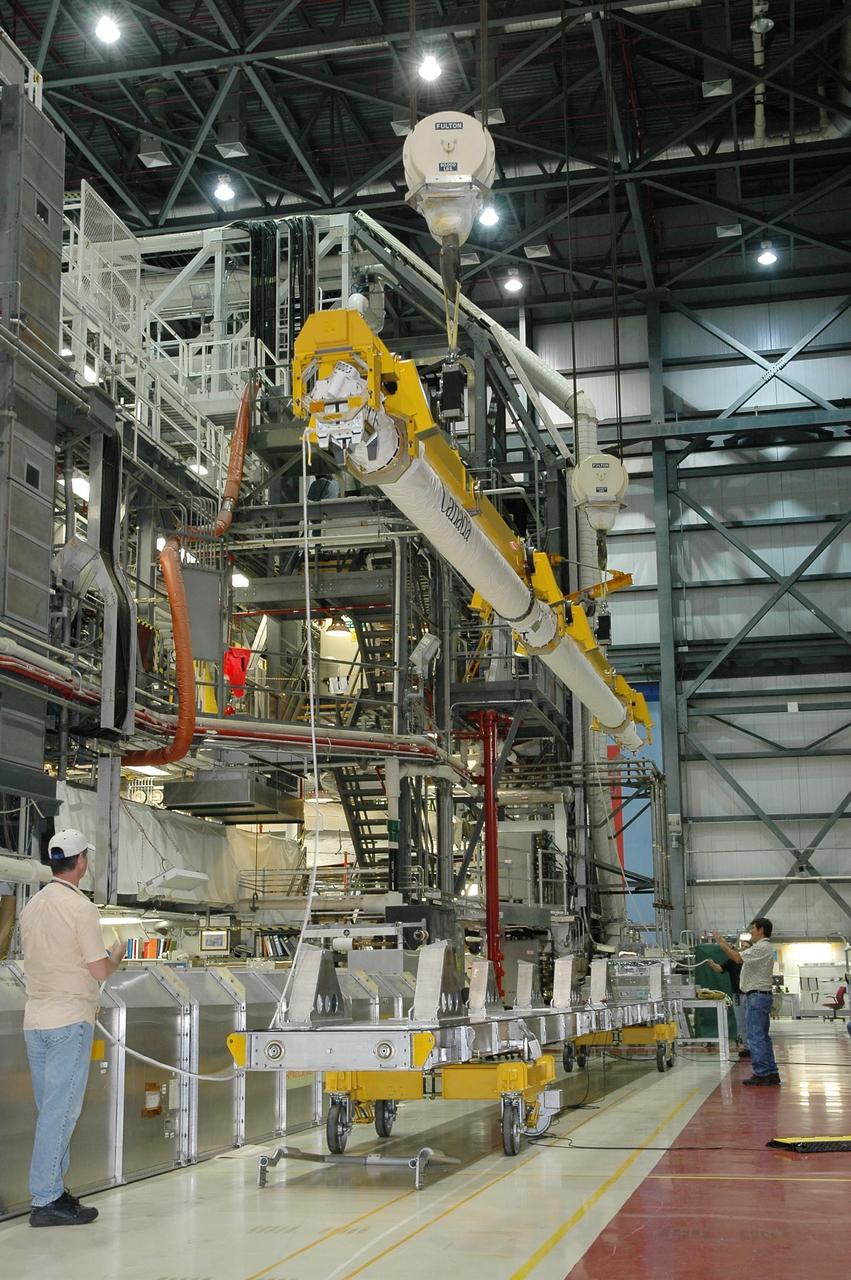
CAPE CANAVERAL, Fla. – In the Orbiter Processing Facility’s bay 3, the orbiter boom sensor system is lifted by a crane for installation in space shuttle Discovery’s payload bay for mission STS-128. The 50-foot-long boom attaches to the shuttle arm and provides equipment to inspect the shuttle's heat shield while in space. It contains an intensified television camera (ITVC) and a laser dynamic range imager, which are mounted on a pan and tilt unit, and a laser camera system (LCS) mounted on a stationary bracket.  The STS-128 flight will carry science and storage racks to the International Space Station on space shuttle Discovery. Launch of Discovery is targeted for Aug. 6. Photo credit: NASA/Jim Grossmann
KSC-2009-2590
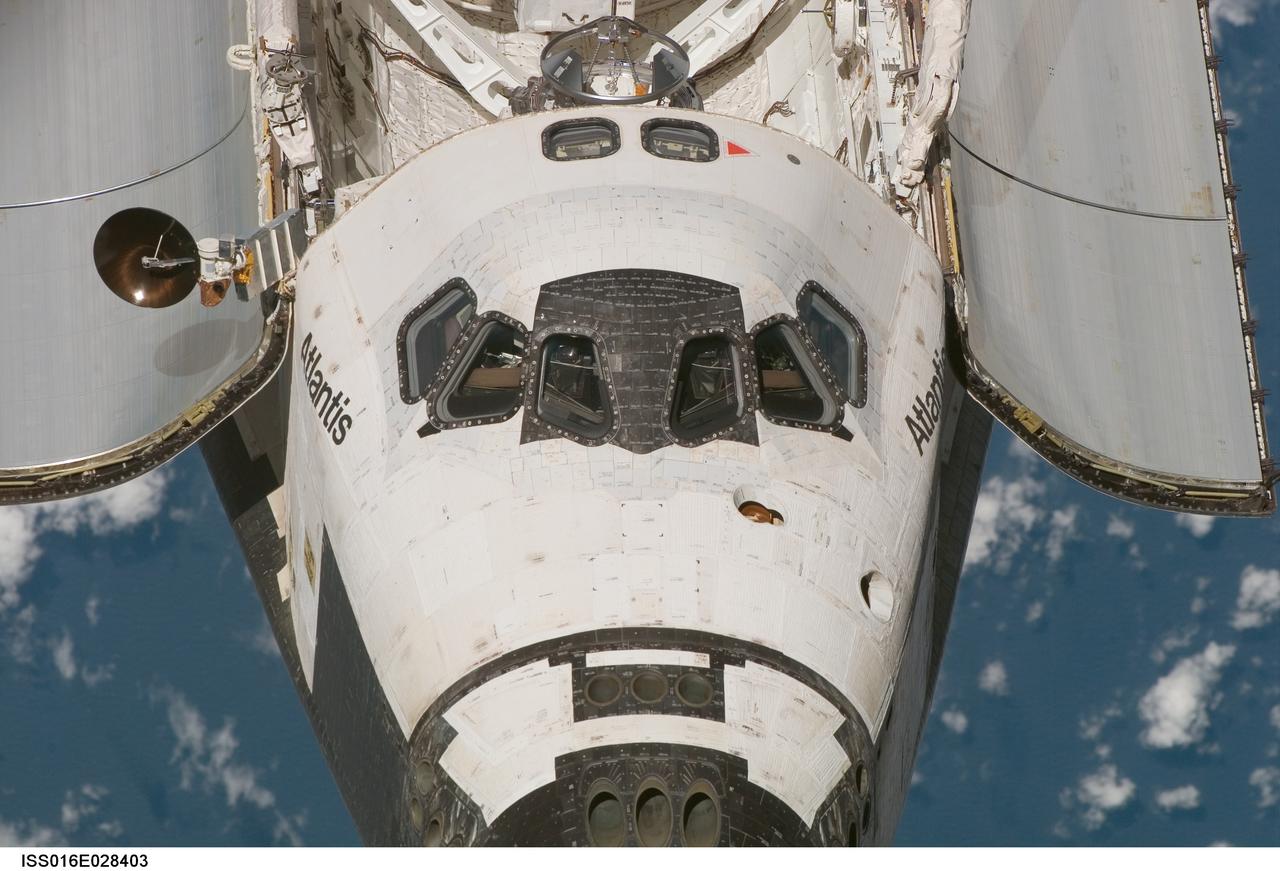
ISS016-E-028403 (9 Feb. 2008) --- An overhead view of the exterior of the Space Shuttle Atlantis' crew cabin, part of its payload bay doors and docking system was provided by Expedition 16 crewmembers.  Before docking with the International Space Station,  astronaut Steve Frick, STS-122 commander, flew the shuttle through a roll pitch maneuver or basically a backflip to allow the space station crew a good view of Atlantis' heat shield.  Using digital still cameras equipped with both 400  and 800 millimeter lenses, the ISS crewmembers took a number of photos of the shuttle's thermal protection system and sent them down to teams on the ground for analysis. A 400 millimeter lens was used for this image.
Mapping Sequence performed during the STS-122 R-Bar Pitch Maneuver
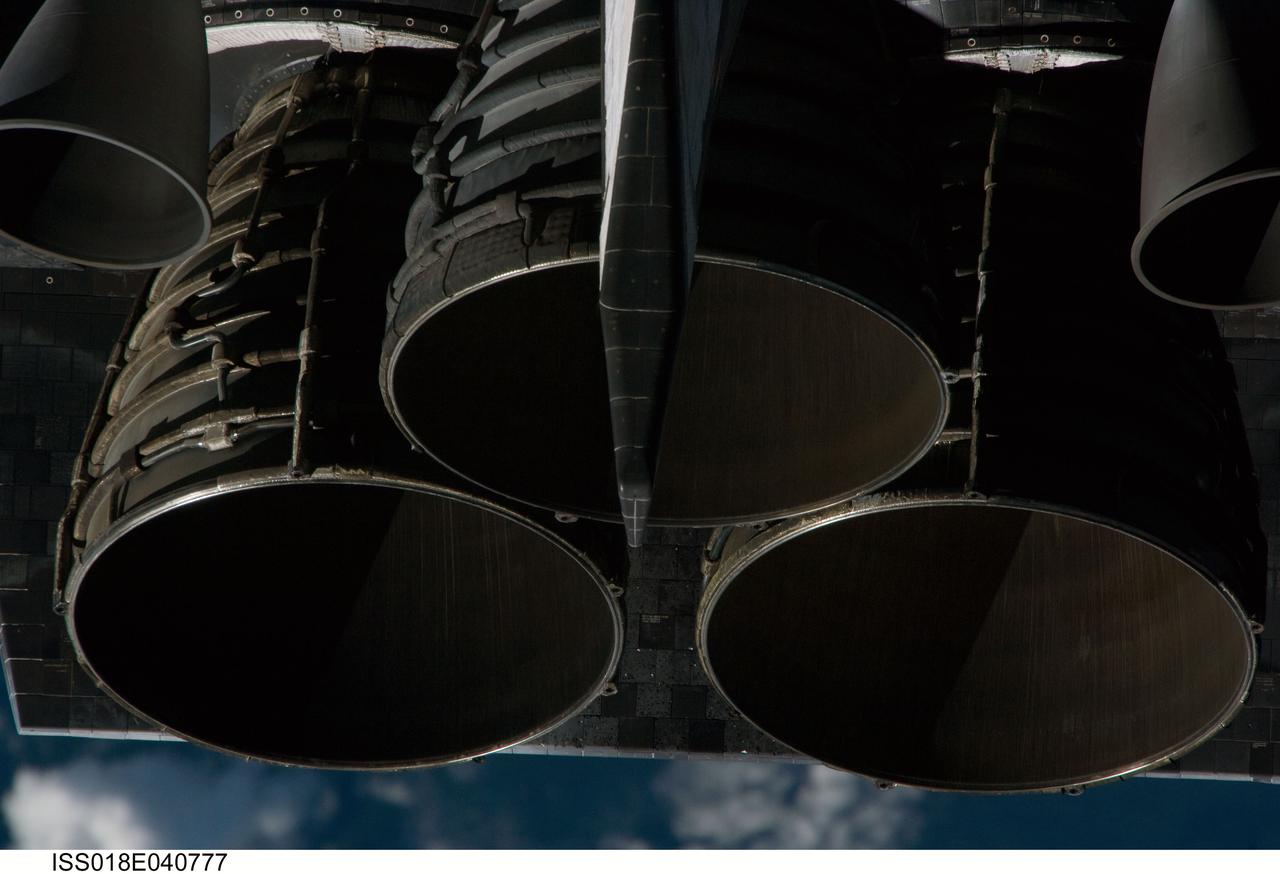
ISS018-E-040777 (17 March 2009) --- A close-up view of Space Shuttle Discovery?s main engines was provided by Expedition 18 crewmembers on the International Space Station. Before docking with the station, astronaut Lee Archambault, STS-119 commander, flew the shuttle through a Rendezvous Pitch Maneuver or basically a backflip to allow the space station crew a good view of Discovery's heat shield. Using digital still cameras equipped with both 400 and 800 millimeter lenses, the ISS crewmembers took a number of photos of the shuttle's thermal protection system and sent them down to teams on the ground for analysis. A 800 millimeter lens was used for this image.
800mm Mapping Sequence performed during the STS-119 R-Bar Pitch Maneuver
ISS016-E-032323 (12 March 2008) --- A low angle view of the nose and underside of Space Shuttle Endeavour's crew cabin was provided by Expedition 16 crewmembers on the International Space Station (ISS). Before docking with the station, astronaut Dominic Gorie, STS-123 commander, flew the shuttle through a roll pitch maneuver or basically a backflip to allow the space station crew a good view of Endeavour's heat shield. Using digital still cameras equipped with both 400 and 800 millimeter lenses, the ISS crewmembers took a number of photos of the shuttle's thermal protection system and sent them down to teams on the ground for analysis. A 400 millimeter lens was used for this image.
Mapping Sequence performed during the STS-123 R-Bar Pitch Maneuver
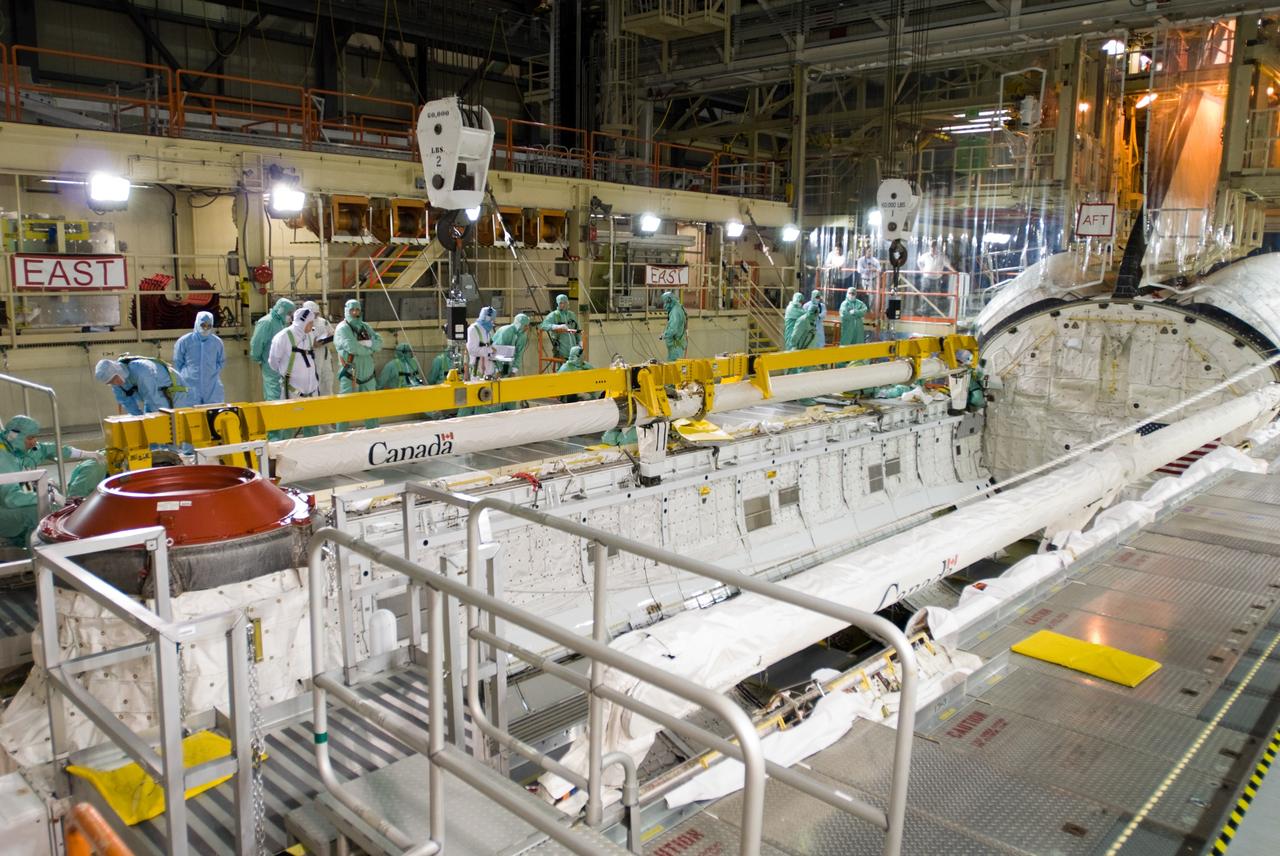
CAPE CANAVERAL, Fla. – In the Orbiter Processing Facility’s bay 3, space shuttle Discovery’s payload bay is readied for installation of the orbiter boom sensor system to support mission STS-128.  The 50-foot-long boom attaches to the shuttle arm and provides equipment to inspect the shuttle's heat shield while in space. It contains an intensified television camera (ITVC) and a laser dynamic range imager, which are mounted on a pan and tilt unit, and a laser camera system (LCS) mounted on a stationary bracket.  The STS-128 flight will carry science and storage racks to the International Space Station on space shuttle Discovery. Launch of Discovery is targeted for Aug. 6. Photo credit: NASA/Jim Grossmann
KSC-2009-2591
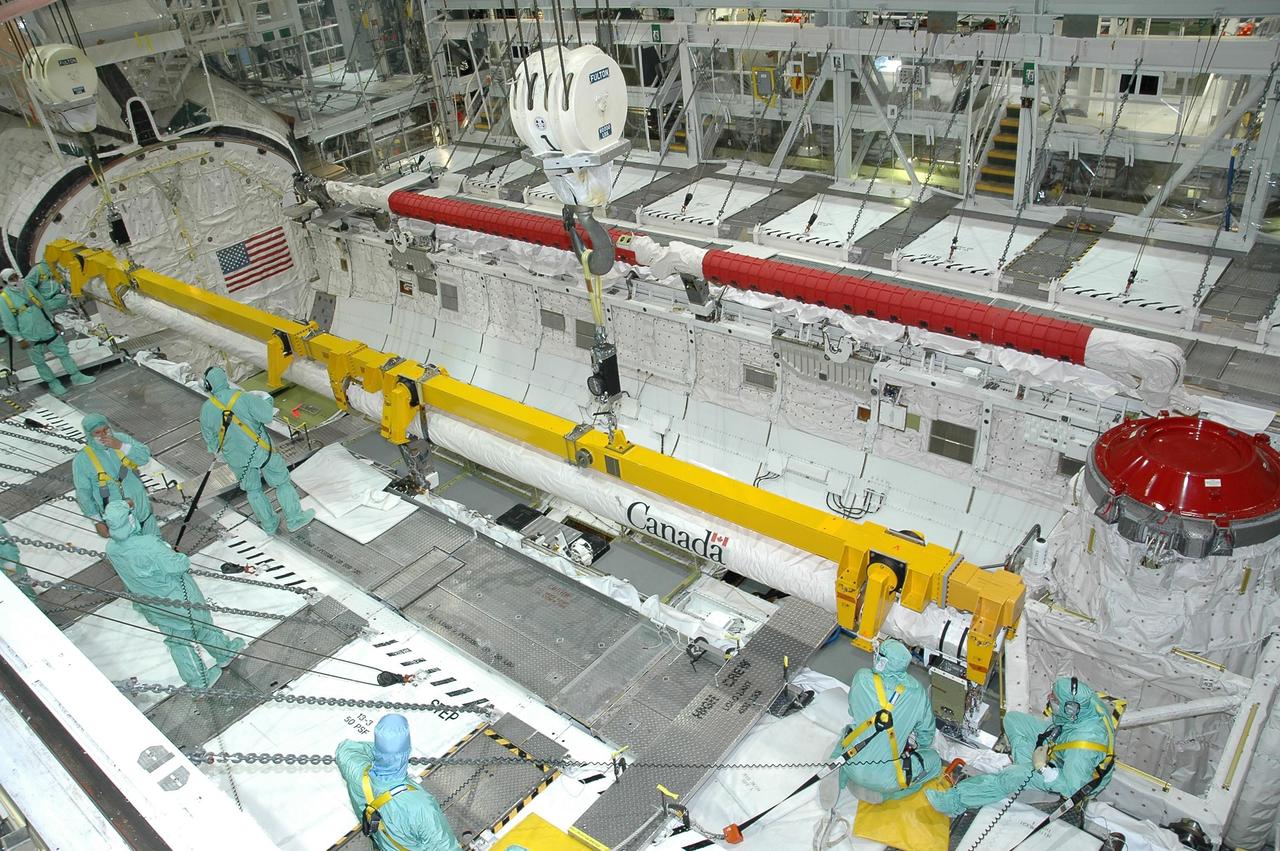
CAPE CANAVERAL, Fla. – In the Orbiter Processing Facility’s bay 3, workers install the orbiter boom sensor system in the payload bay of space shuttle Discovery to support mission STS-128. The 50-foot-long boom attaches to the shuttle arm and provides equipment to inspect the shuttle's heat shield while in space. It contains an intensified television camera (ITVC) and a laser dynamic range imager, which are mounted on a pan and tilt unit, and a laser camera system (LCS) mounted on a stationary bracket.  The STS-128 flight will carry science and storage racks to the International Space Station on space shuttle Discovery. Launch of Discovery is targeted for Aug. 6. Photo credit: NASA/Jim Grossmann
KSC-2009-2595
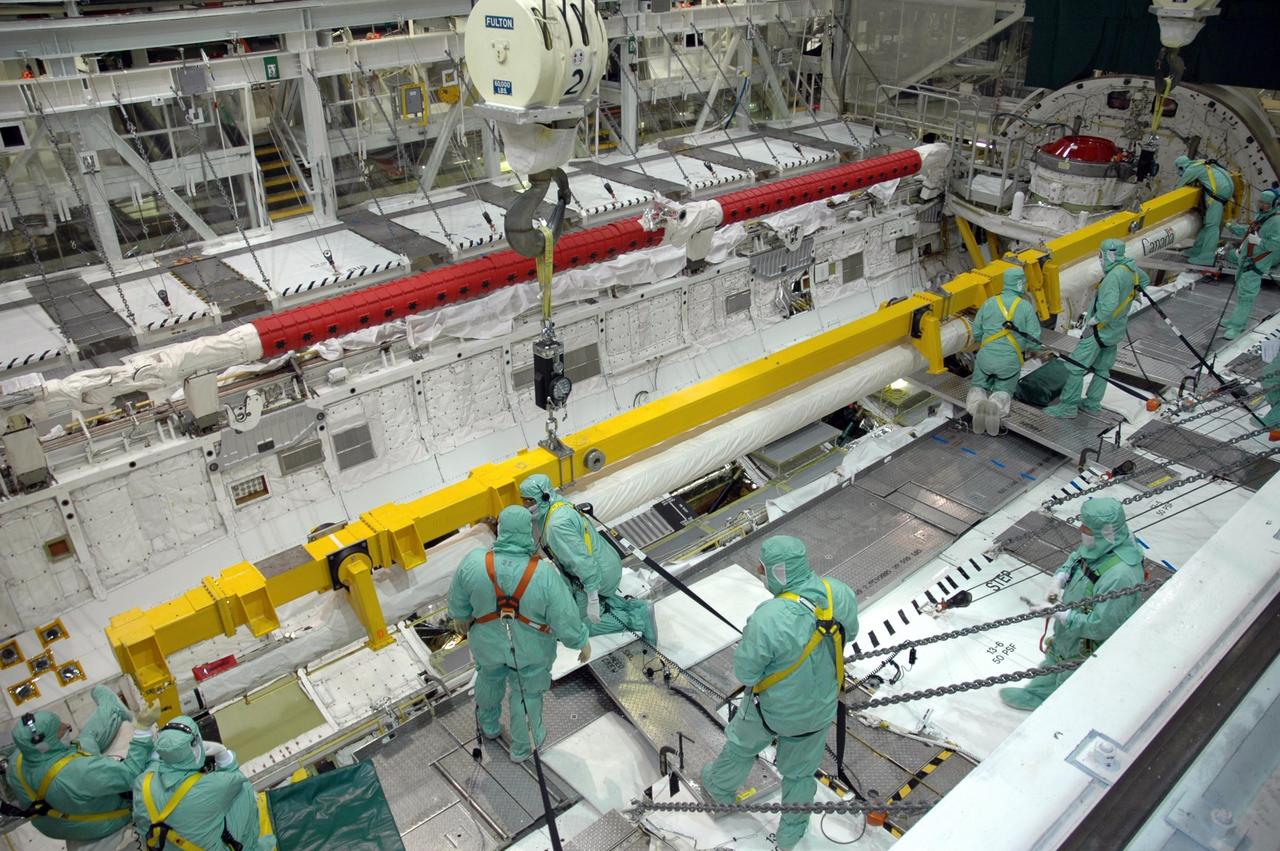
KENNEDY SPACE CENTER, FLA. -  In Orbiter Processing Facility bay 1 at NASA's Kennedy Space Center, the orbiter boom sensor system is lowered into Atlantis' payload bay for installation.  The 50-foot-long boom attaches to the shuttle arm and is one of the new safety measures added prior to Return to Flight last year. It equips the orbiter with cameras and laser systems to inspect the shuttle's heat shield while in space.  Atlantis is scheduled to launch on mission STS-115 no earlier than Aug. 28.  Photo credit: NASA/Jim Grossmann
KSC-06pd0566
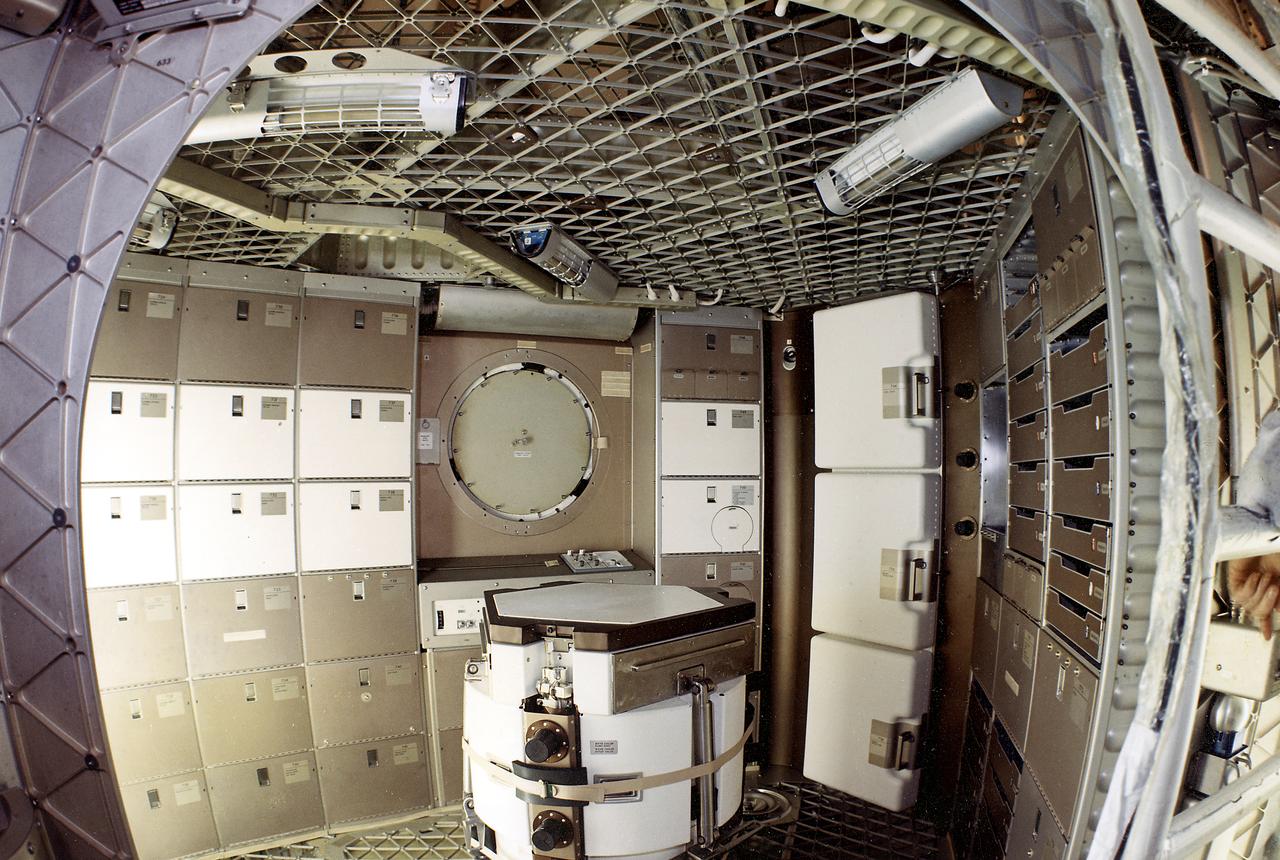
This wide-angle view depicts the Orbital Workshop (OWS) wardroom/galley located in the lower level of the OWS. The galley in the wardroom provided the daily supply of food; galley-located equipment was used for preparation and disposal of food. The Skylab astronauts used the wardroom as kitchen and dining room. The hexagonal food table, shown in the middle of this image, allowed three crewmen to simultaneously heat their food and eat their meals in an efficient and comfortable marner. Chairs were pointless in the zero-gravity environment. The table also supported components of the water system, including the water chiller and the wardroom water heater.
Skylab
CAPE CANAVERAL, Fla. – In the Orbiter Processing Facility’s bay 3, workers prepare to install the orbiter boom sensor system in the payload bay of space shuttle Discovery to support mission STS-128.  The 50-foot-long boom attaches to the shuttle arm and provides equipment to inspect the shuttle's heat shield while in space. It contains an intensified television camera (ITVC) and a laser dynamic range imager, which are mounted on a pan and tilt unit, and a laser camera system (LCS) mounted on a stationary bracket.  The STS-128 flight will carry science and storage racks to the International Space Station on space shuttle Discovery. Launch of Discovery is targeted for Aug. 6. Photo credit: NASA/Jim Grossmann
KSC-2009-2594
KENNEDY SPACE CENTER, FLA. -  In Orbiter Processing Facility bay 1 at NASA's Kennedy Space Center, the orbiter boom sensor system is lifted off a transporter.  The boom will be installed in Atlantis' payload bay. The 50-foot-long boom attaches to the shuttle arm and is one of the new safety measures added prior to Return to Flight last year. It equips the orbiter with cameras and laser systems to inspect the shuttle's heat shield while in space.  Atlantis is scheduled to launch on mission STS-115 no earlier than Aug. 28.  Photo credit: NASA/Jim Grossmann
KSC-06pd0565
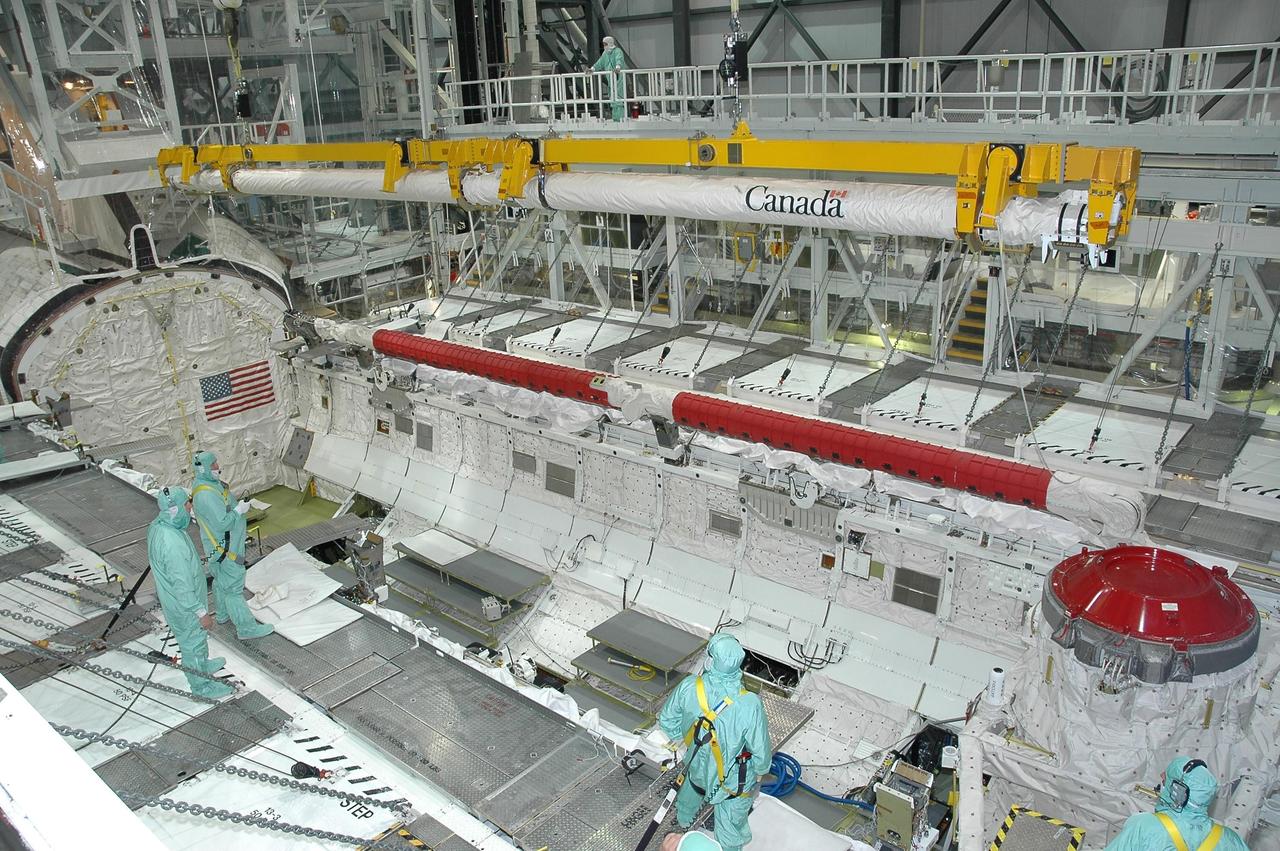
CAPE CANAVERAL, Fla. – In the Orbiter Processing Facility’s bay 3, the orbiter boom sensor system is installed in the payload bay of space shuttle Discovery to support mission STS-128. The 50-foot-long boom attaches to the shuttle arm and provides equipment to inspect the shuttle's heat shield while in space. It contains an intensified television camera (ITVC) and a laser dynamic range imager, which are mounted on a pan and tilt unit, and a laser camera system (LCS) mounted on a stationary bracket.  The STS-128 flight will carry science and storage racks to the International Space Station on space shuttle Discovery. Launch of Discovery is targeted for Aug. 6. Photo credit: NASA/Jim Grossmann
KSC-2009-2596
CAPE CANAVERAL, Fla. – In the Orbiter Processing Facility’s bay 3, the orbiter boom sensor system is lowered by a crane into the payload bay of space shuttle Discovery for installation to support mission STS-128.  The 50-foot-long boom attaches to the shuttle arm and provides equipment to inspect the shuttle's heat shield while in space. It contains an intensified television camera (ITVC) and a laser dynamic range imager, which are mounted on a pan and tilt unit, and a laser camera system (LCS) mounted on a stationary bracket.  The STS-128 flight will carry science and storage racks to the International Space Station on space shuttle Discovery. Launch of Discovery is targeted for Aug. 6. Photo credit: NASA/Jim Grossmann
KSC-2009-2593
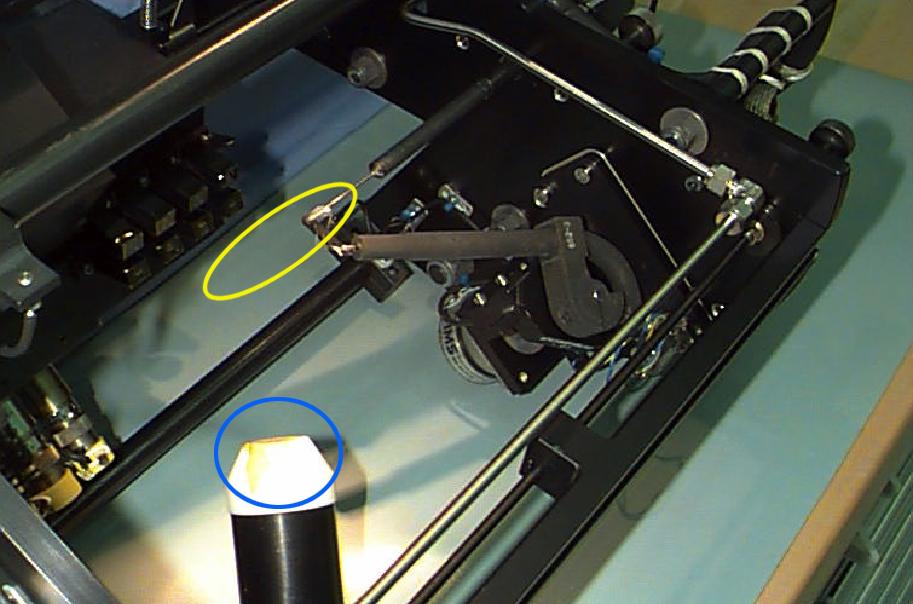
Interior of the Equipment Module for the Laminar Soot Processes (LSP-2) experiment that fly in the STS-107 Research 1 mission in 2002 (LSP-1 flew on Microgravity Sciences Lab-1 mission in 1997). The principal investigator is Dr. Gerard Faeth of the University of Michigan. LSP uses a small jet burner (yellow ellipse), similar to a classroom butane lighter, that produces flames up to 60 mm (2.3 in) long. Measurements include color TV cameras and a radiometer or heat sensor (blue circle), and laser images whose darkness indicates the quantity of soot produced in the flame. Glenn Research in Cleveland, OH, manages the project.
Microgravity
ISS018-E-040837 (17 March 2009) --- A close-up view of the exterior of Space Shuttle Discovery's nose and underside was provided by Expedition 18 crewmembers on the International Space Station. Before docking with the station, astronaut Lee Archambault, STS-119 commander, flew the shuttle through a Rendezvous Pitch Maneuver or basically a backflip to allow the space station crew a good view of Discovery's heat shield. Using digital still cameras equipped with both 400 and 800 millimeter lenses, the ISS crewmembers took a number of photos of the shuttle's thermal protection system and sent them down to teams on the ground for analysis. A 400 millimeter lens was used for this image.
400mm Mapping Sequence performed during the STS-119 R-Bar Pitch Maneuver
CAPE CANAVERAL, Fla. – In the Orbiter Processing Facility’s bay 3, the orbiter boom sensor system is lifted by a crane for installation in space shuttle Discovery’s payload bay for mission STS-128. The 50-foot-long boom attaches to the shuttle arm and provides equipment to inspect the shuttle's heat shield while in space. It contains an intensified television camera (ITVC) and a laser dynamic range imager, which are mounted on a pan and tilt unit, and a laser camera system (LCS) mounted on a stationary bracket.  The STS-128 flight will carry science and storage racks to the International Space Station on space shuttle Discovery. Launch of Discovery is targeted for Aug. 6. Photo credit: NASA/Jim Grossmann
KSC-2009-2589
KENNEDY SPACE CENTER, FLA. -    In the Orbiter Processing Facility’s bay 1, the orbiter boom sensor system is lifted by a crane for installation on the starboard side of Atlantis’s payload bay for mission STS-117.  The 50-foot-long boom attaches to the shuttle arm and provides equipment to inspect the shuttle's heat shield while in space.  It contains an intensified television camera (ITVC) and a laser dynamic range imager, which are mounted on a pan and tilt unit, and a laser camera system (LCS) mounted on a stationary bracket. Mission STS-117 will carry the S3/S4 arrays for installation on the International Space Station.  Launch of Space Shuttle Atlantis is scheduled for March.  Photo credit: NASA/Jack Pfaller
KSC-06pd2366
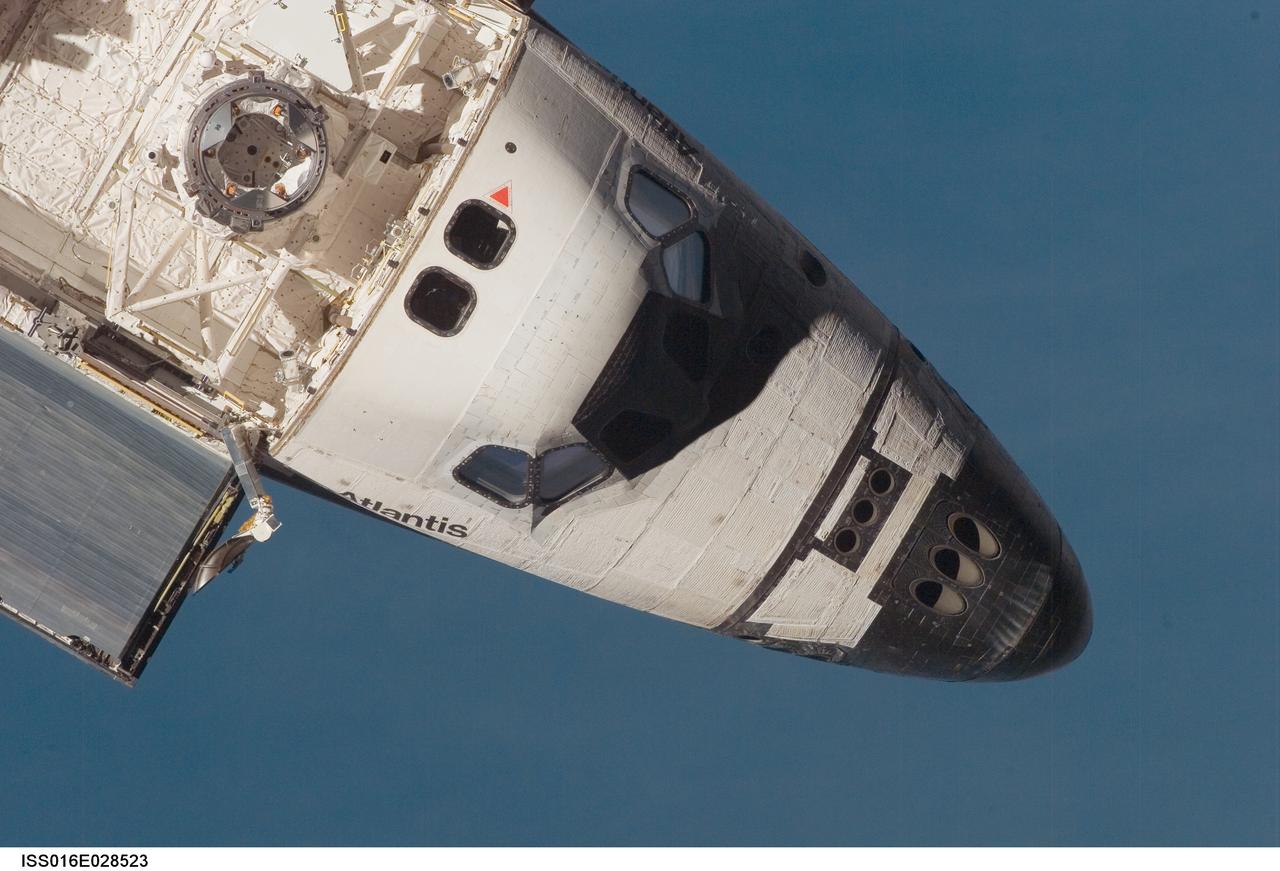
ISS016-E-028523 (9 Feb. 2008) --- An overhead view of the exterior of the Space Shuttle Atlantis' crew cabin and docking system was provided by Expedition 16 crewmembers.  Before docking with the International Space Station,  astronaut Steve Frick, STS-122 commander, flew the shuttle through a roll pitch maneuver or basically a backflip to allow the space station crew a good view of Atlantis' heat shield.  Using digital still cameras equipped with both 400  and 800 millimeter lenses, the ISS crewmembers took a number of photos of the shuttle's thermal protection system and sent them down to teams on the ground for analysis. A 400 millimeter lens was used for this image.
Mapping Sequence performed during the STS-122 R-Bar Pitch Maneuver
KENNEDY SPACE CENTER, FLA. -  In Orbiter Processing Facility bay 1 at NASA's Kennedy Space Center, workers complete installation of the orbiter boom sensor system into Atlantis' payload bay. The 50-foot-long boom attaches to the shuttle arm and is one of the new safety measures added prior to Return to Flight last year. It equips the orbiter with cameras and laser systems to inspect the shuttle's heat shield while in space.  Atlantis is scheduled to launch on mission STS-115 no earlier than Aug. 28.  Photo credit: NASA/Jim Grossmann
KSC-06pd0568
CAPE CANAVERAL, Fla. – In the Orbiter Processing Facility’s bay 3, workers prepare to install the orbiter boom sensor system in the payload bay of space shuttle Discovery to support mission STS-128. The 50-foot-long boom attaches to the shuttle arm and provides equipment to inspect the shuttle's heat shield while in space. It contains an intensified television camera (ITVC) and a laser dynamic range imager, which are mounted on a pan and tilt unit, and a laser camera system (LCS) mounted on a stationary bracket.  The STS-128 flight will carry science and storage racks to the International Space Station on space shuttle Discovery. Launch of Discovery is targeted for Aug. 6. Photo credit: NASA/Kim Shiflett
KSC-2009-2597
KENNEDY SPACE CENTER, FLA. -  In Orbiter Processing Facility bay 1 at NASA's Kennedy Space Center, workers install the orbiter boom sensor system into Atlantis' payload bay. The 50-foot-long boom attaches to the shuttle arm and is one of the new safety measures added prior to Return to Flight last year. It equips the orbiter with cameras and laser systems to inspect the shuttle's heat shield while in space.  Atlantis is scheduled to launch on mission STS-115 no earlier than Aug. 28.  Photo credit: NASA/Jim Grossmann
KSC-06pd0567
CAPE CANAVERAL, Fla. -- In the Orbiter Processing Facility-2 at NASA's Kennedy Space Center in Florida, STS-134 Mission Specialist Greg Chamitoff looks at space shuttle Endeavour's heat shield tiles, which will protect the spacecraft during re-entry. The six STS-134 astronauts are at Kennedy participating in the Crew Equipment Interface Test (CEIT), which gives them an opportunity for hands-on training and familiarization of the payload they'll be delivering to the International Space Station.      Space shuttle Endeavour is targeted to launch on the STS-134 mission Feb. 27, 2011. For more information, visit www.nasa.gov/mission_pages/shuttle/shuttlemissions/sts134/index.html. Photo credit: NASA/Cory Huston
KSC-2010-5547
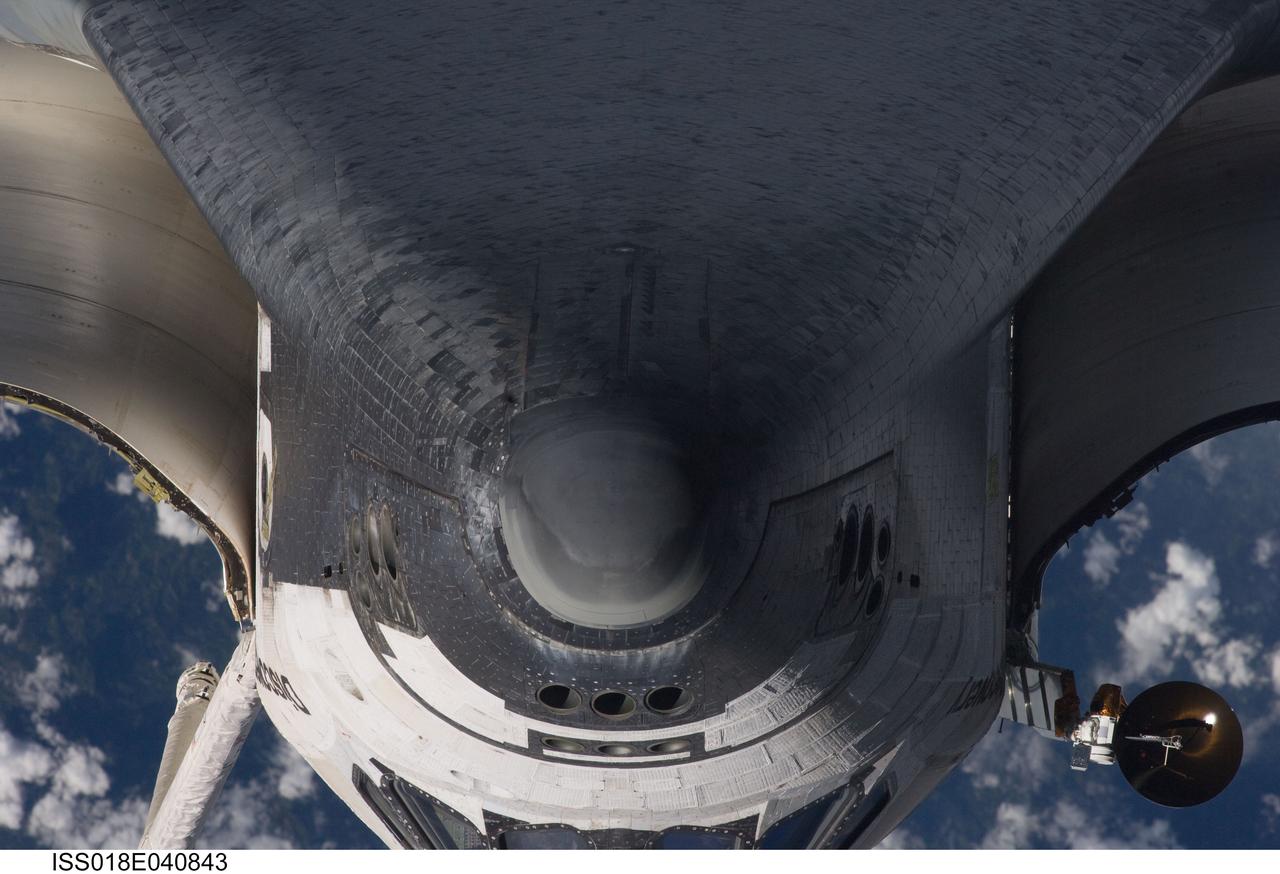
ISS018-E-040843 (17 March 2009) --- A close-up view of the exterior of Space Shuttle Discovery's nose and underside was provided by Expedition 18 crewmembers on the International Space Station. Before docking with the station, astronaut Lee Archambault, STS-119 commander, flew the shuttle through a Rendezvous Pitch Maneuver or basically a backflip to allow the space station crew a good view of Discovery's heat shield. Using digital still cameras equipped with both 400 and 800 millimeter lenses, the ISS crewmembers took a number of photos of the shuttle's thermal protection system and sent them down to teams on the ground for analysis. A 400 millimeter lens was used for this image.
400mm Mapping Sequence performed during the STS-119 R-Bar Pitch Maneuver
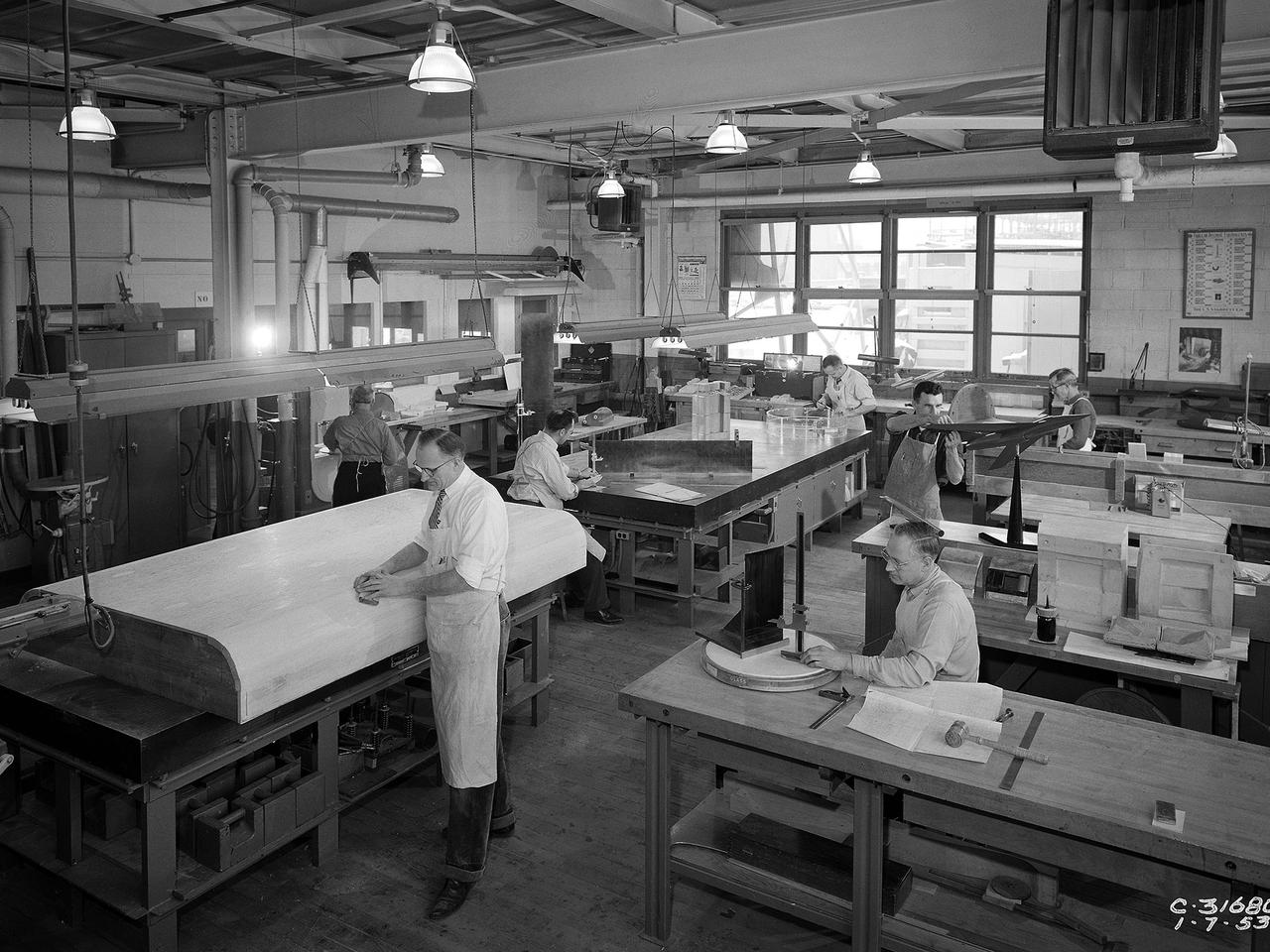
Craftsmen work in the wood model shop at the National Advisory Committee for Aeronautics (NACA) Lewis Flight Propulsion Laboratory. The Fabrication Division created almost all of the equipment and models used at the laboratory. The Fabrication Shop building contained a number of specialized shops in the 1940s and 1950s. These included a Machine Shop, Sheet Metal Shop, Wood Model and Pattern Shop, Instrument Shop, Thermocouple Shop, Heat Treating Shop, Metallurgical Laboratory, and Fabrication Office.   The Wood Model and Pattern Shop created everything from control panels and cabinets to aircraft models molds for sheet metal work.
Craftsmen in the Wood Model Shop at the Lewis Flight Propulsion Laboratory
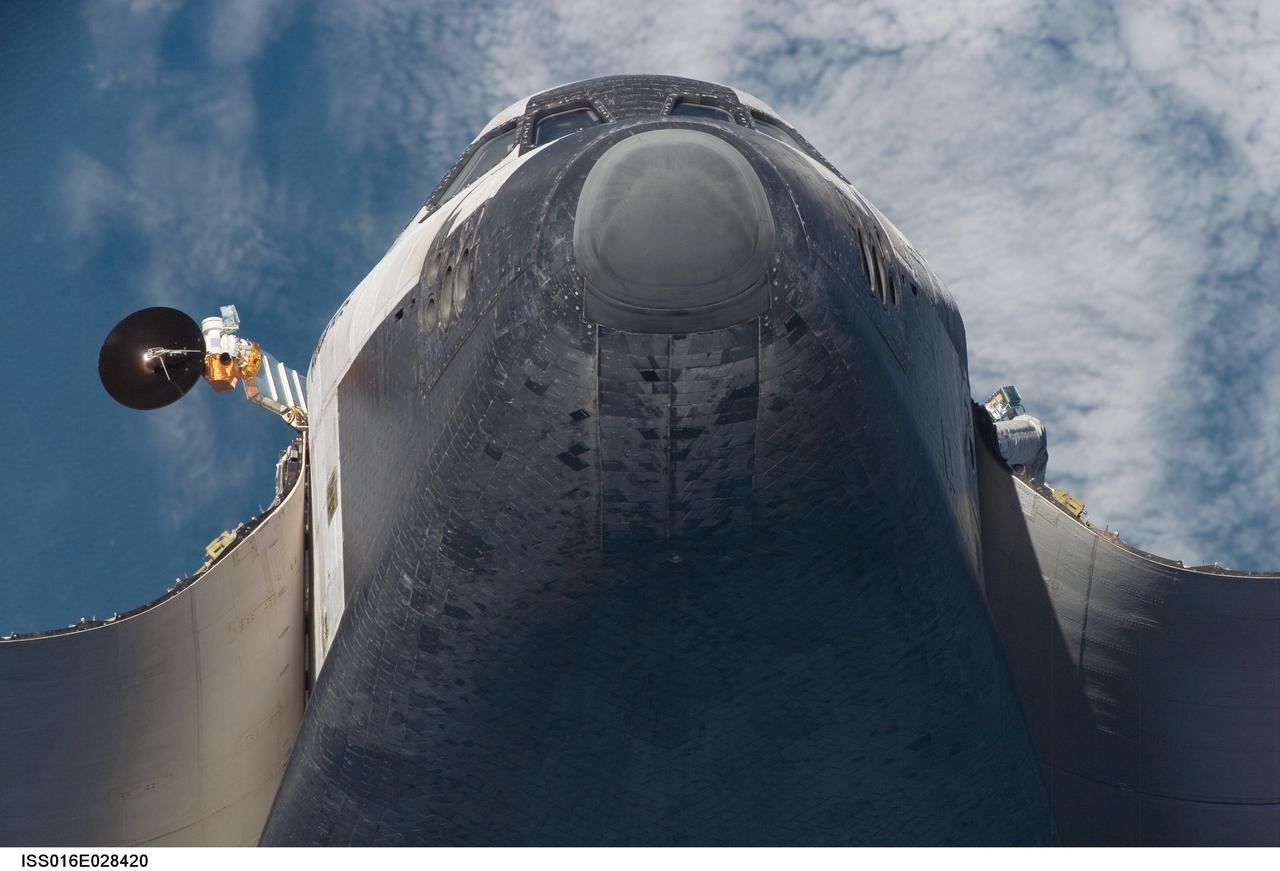
ISS016-E-028420 (9 Feb. 2008) ---   A low angle view of the nose and underside of the Space Shuttle Atlantis' crew cabin was provided by Expedition 16 crewmembers.  Before docking with the International Space Station,  astronaut Steve Frick, STS-122 commander, flew the shuttle through a roll pitch maneuver or basically a backflip to allow the space station crew a good view of Atlantis' heat shield.  Using digital still cameras equipped with both 400  and 800 millimeter lenses, the ISS crewmembers took a number of photos of the shuttle's thermal protection system and sent them down to teams on the ground for analysis. A 400 millimeter lens was used for this image.
Mapping Sequence performed during the STS-122 R-Bar Pitch Maneuver
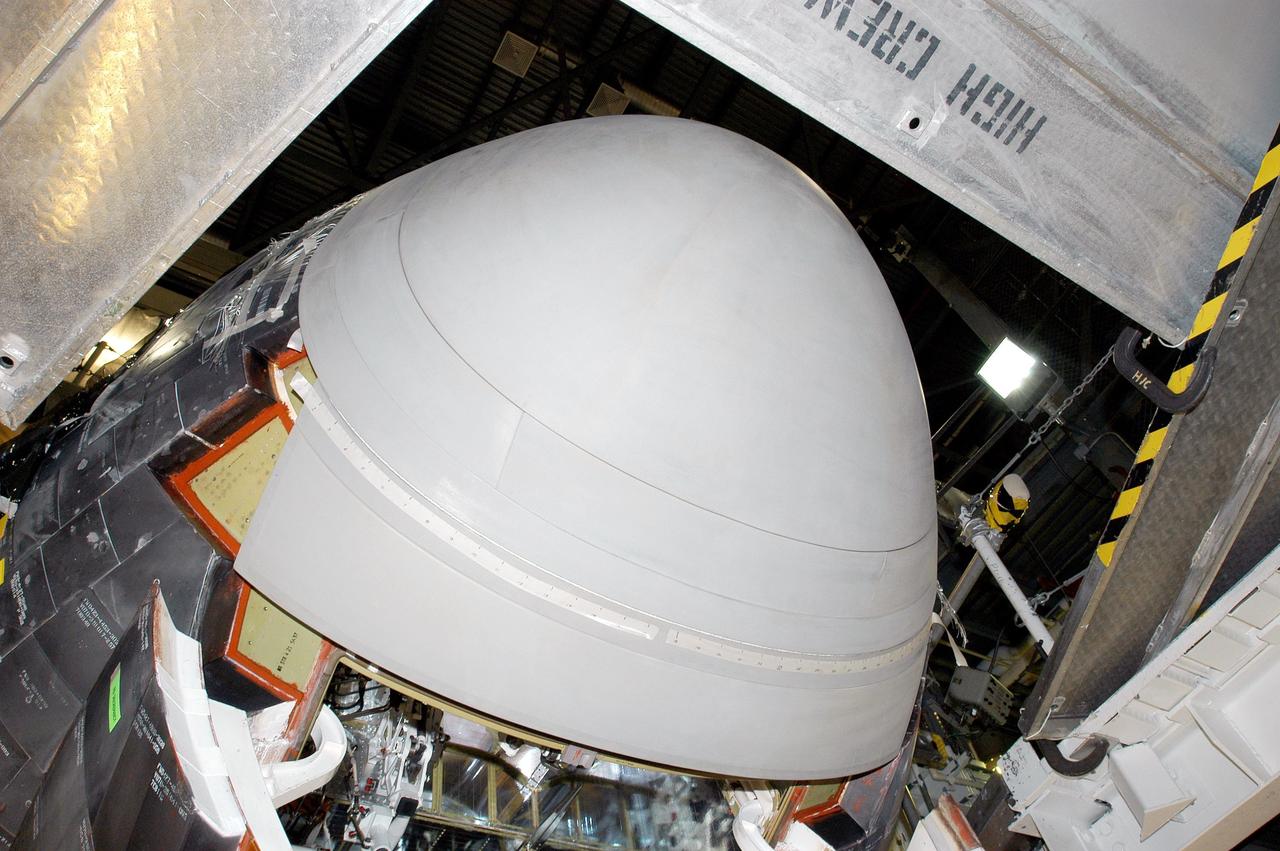
KENNEDY SPACE CENTER, FLA. - In the Orbiter Processing Facility, a newly installed nose cap on the orbiter Atlantis looks pristine amid the complexities of other equipment.  The nose cap was removed from the vehicle in May and sent back to the vendor for thorough Non-Destructive Engineering evaluation and recoating.  Thermography was also performed to check for internal flaws.  This procedure uses high intensity light to heat areas that are immediately scanned with an infrared camera.  White Thermal Protection System blankets were reinstalled on the nose cap before installation.  Processing continues on Atlantis for its future mission to the International Space Station.
KSC-04pd1683
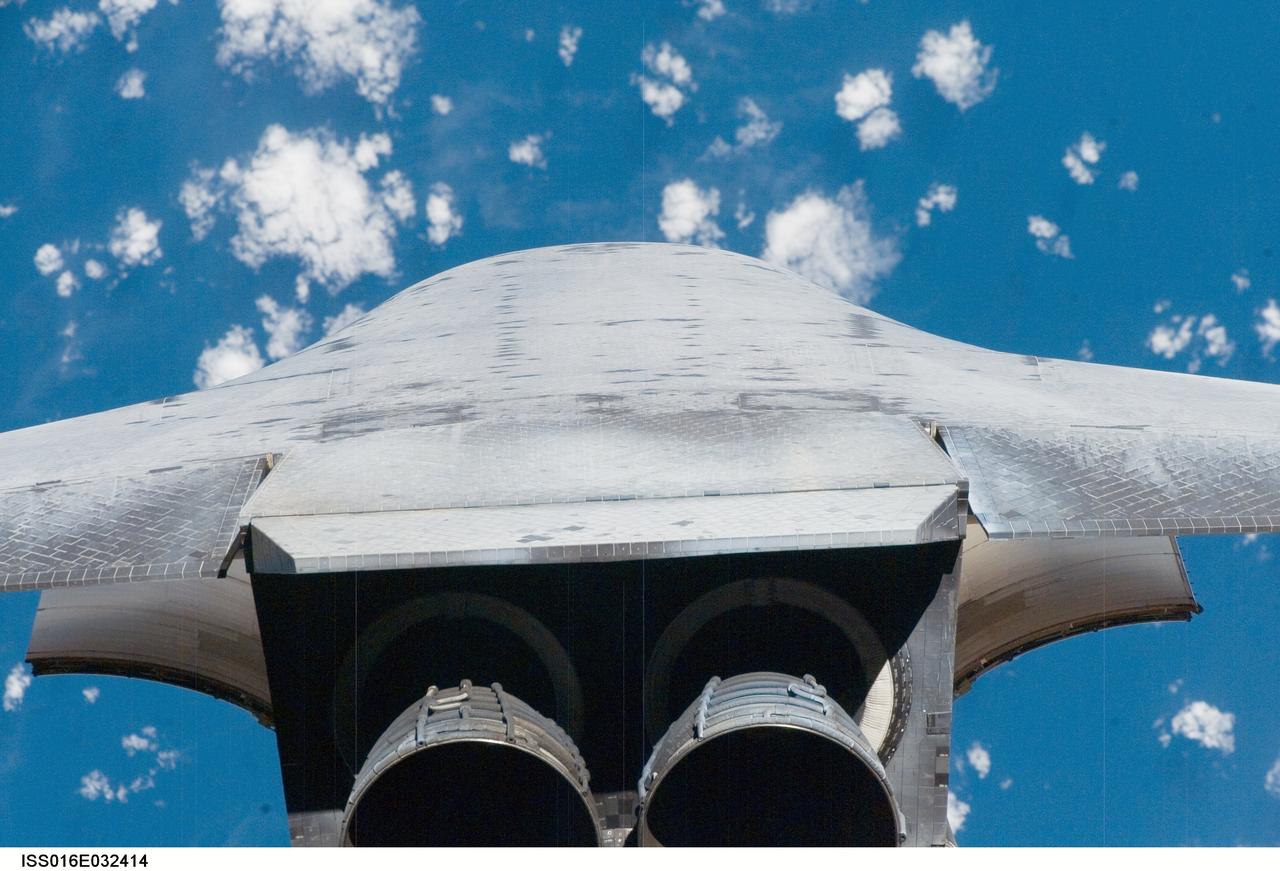
ISS016-E-032414 (12 March 2008) --- An underside view of the Space Shuttle Endeavour was provided by Expedition 16 crewmembers on the International Space Station (ISS). Before docking with the station, astronaut Dominic Gorie, STS-123 commander, flew the shuttle through a roll pitch maneuver or basically a backflip to allow the space station crew a good view of Endeavour's heat shield. Using digital still cameras equipped with both 400 and 800 millimeter lenses, the ISS crewmembers took a number of photos of the shuttle's thermal protection system and sent them down to teams on the ground for analysis. A 400 millimeter lens was used for this image.
Mapping Sequence performed during the STS-123 R-Bar Pitch Maneuver
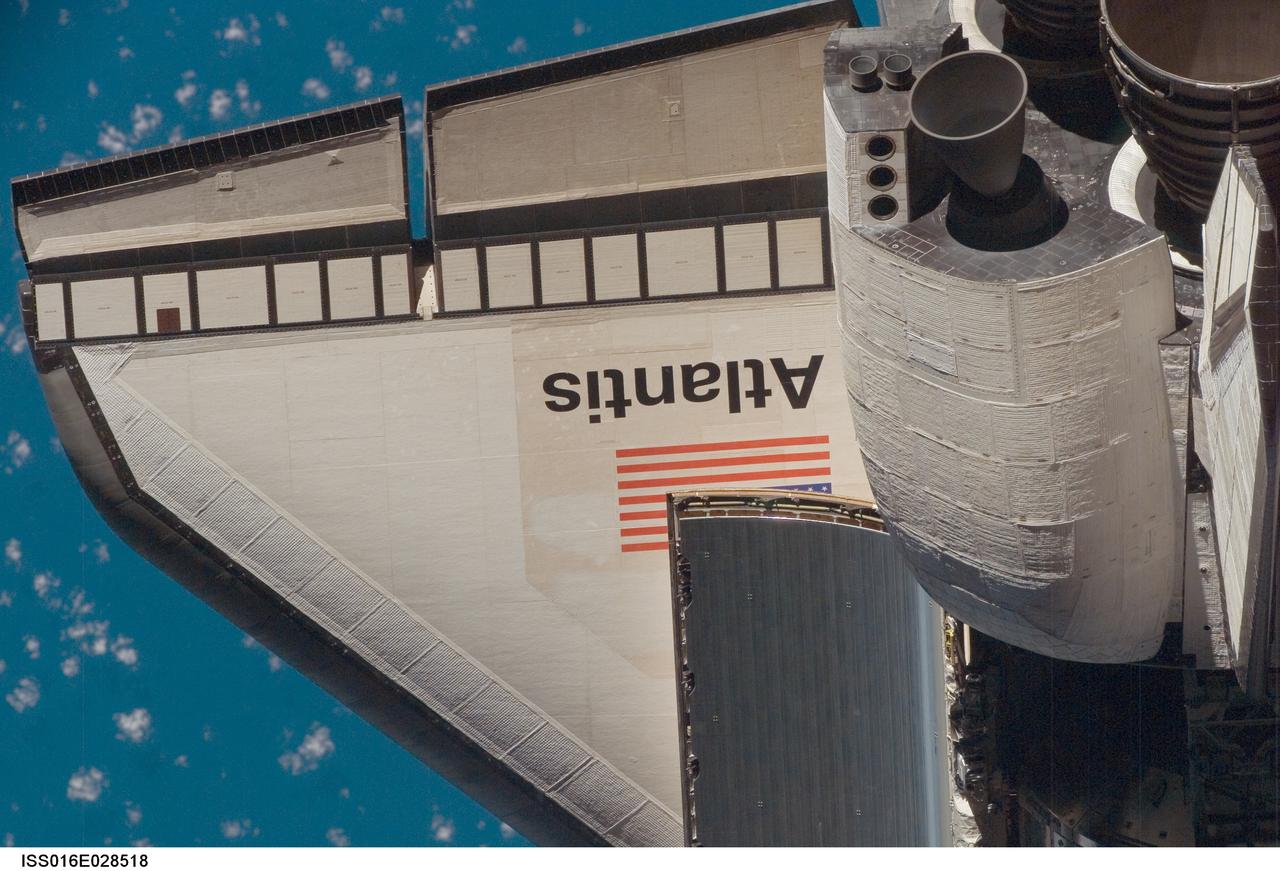
ISS016-E-028518 (9 Feb. 2008) --- An overhead view of part of the Space Shuttle Atlantis' starboard wing and part of its orbital maneuvering system pods was provided by Expedition 16 crewmembers.  Before docking with the International Space Station,  astronaut Steve Frick, STS-122 commander, flew the shuttle through a roll pitch maneuver or basically a backflip to allow the space station crew a good view of Atlantis' heat shield.  Using digital still cameras equipped with both 400  and 800 millimeter lenses, the ISS crewmembers took a number of photos of the shuttle's thermal protection system and sent them down to teams on the ground for analysis. A 400 millimeter lens was used for this image.
Mapping Sequence performed during the STS-122 R-Bar Pitch Maneuver
KENNEDY SPACE CENTER, FLA. -    In the Orbiter Processing Facility’s bay 1, the orbiter boom sensor system is lifted by a crane for installation on the starboard side of Atlantis’s payload bay for mission STS-117.  The 50-foot-long boom attaches to the shuttle arm and provides equipment to inspect the shuttle's heat shield while in space.  It contains an intensified television camera (ITVC) and a laser dynamic range imager, which are mounted on a pan and tilt unit, and a laser camera system (LCS) mounted on a stationary bracket. Mission STS-117 will carry the S3/S4 arrays for installation on the International Space Station.  Launch of Space Shuttle Atlantis is scheduled for March.  Photo credit: NASA/Jack Pfaller
KSC-06pd2365
S70-56965 (December 1970) --- Drawing of the newly developed Buddy Secondary Life Support System (BSLSS). The life-sustaining system will be provided for the first time on the Apollo 14 lunar landing mission. The two flexible hoses, to be used on the second Apollo 14 extravehicular activity (EVA), will be among the paraphernalia on the Modular Equipment Transporter (MET) or two-wheeled workshop, and readily accessible in an emergency. During EVAs the Portable Life Support System (PLSS) supplies the astronaut with breathing and suit-pressurizing oxygen and water flow for the liquid-cooling garment -- a suit of knitted long underwear with thin tubing woven in the torso and limbs. The tubes carry water from a reservoir in the PLSS, and the circulating water serves to carry the astronaut's metabolic heat to a heat exchanger in the PLSS. Before the BSLSS was devised, the emergency tank was required to furnish not only suit pressure and breathing oxygen, but also cooling through a high oxygen flow rate. The BSLSS, by sharing the water supply between the two crewmen, stretches the time of the emergency oxygen from about 40 minutes to 60 to 75 minutes.
Drawing of the Buddy Secondary Life Support System
The Earth Surface Mineral Dust Source Investigation (EMIT) mission instrument (right) sits in the "trunk" that will travel aboard SpaceX's 25th cargo resupply mission – planned for June 7, 2022 – to the International Space Station. This image was taken May 3, 2022, at SpaceX's Dragonland facility in Florida. Developed at NASA's Jet Propulsion Laboratory in Southern California and launching from Kennedy Space Center in Florida, EMIT will map the world's mineral-dust sources, gathering information about particle color and composition as it orbits over the planet's dry, sparsely vegetated regions.      After being mounted on the space station, EMIT will collect measurements of 10 important surface minerals – hematite, goethite, illite, vermiculite, calcite, dolomite, montmorillonite, kaolinite, chlorite, and gypsum – in arid regions between 50-degree south and north latitudes in Africa, Asia, North and South America, and Australia. The data EMIT collects will help scientists better understand the role of airborne dust particles in heating and cooling Earth's atmosphere on global and regional scales.      The white covering will prevent the spread of the heat the instrument generates, keeping it from affecting the space station and nearby instruments.      EMIT will be one of two pieces of equipment transported to the space station in the external cargo "trunk" on SpaceX's Falcon 9 rocket. The other (left) is a Battery Charge/Discharge Unit.  https://photojournal.jpl.nasa.gov/catalog/PIA25148
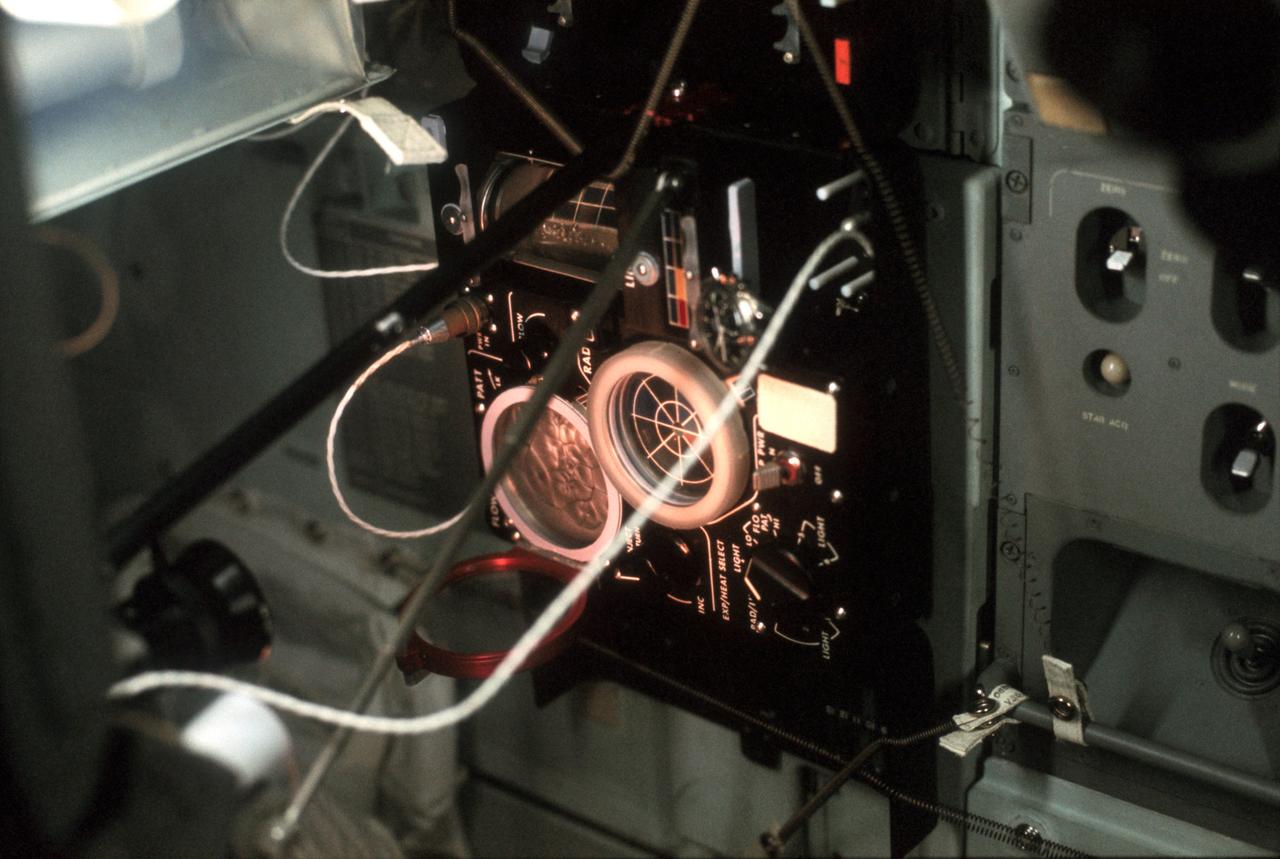
EMIT Loaded Into SpaceX Falcon 9 Trunk Before Transport
ISS018-E-040789 (17 March 2009) --- Backdropped by the blackness of space, Space Shuttle Discovery is featured in this image photographed by an Expedition 18 crewmember on the International Space Station during rendezvous and docking operations. Before docking with the station, astronaut Lee Archambault, STS-119 commander, flew the shuttle through a Rendezvous Pitch Maneuver or basically a backflip to allow the space station crew a good view of Discovery's heat shield. Using digital still cameras equipped with both 400 and 800 millimeter lenses, the ISS crewmembers took a number of photos of the shuttle's thermal protection system and sent them down to teams on the ground for analysis. A 400 millimeter lens was used for this image. Docking occurred at 4:20 p.m. (CDT) on March 17, 2009. The final pair of power-generating solar array wings and the S6 truss segment are visible in Discovery’s cargo bay.
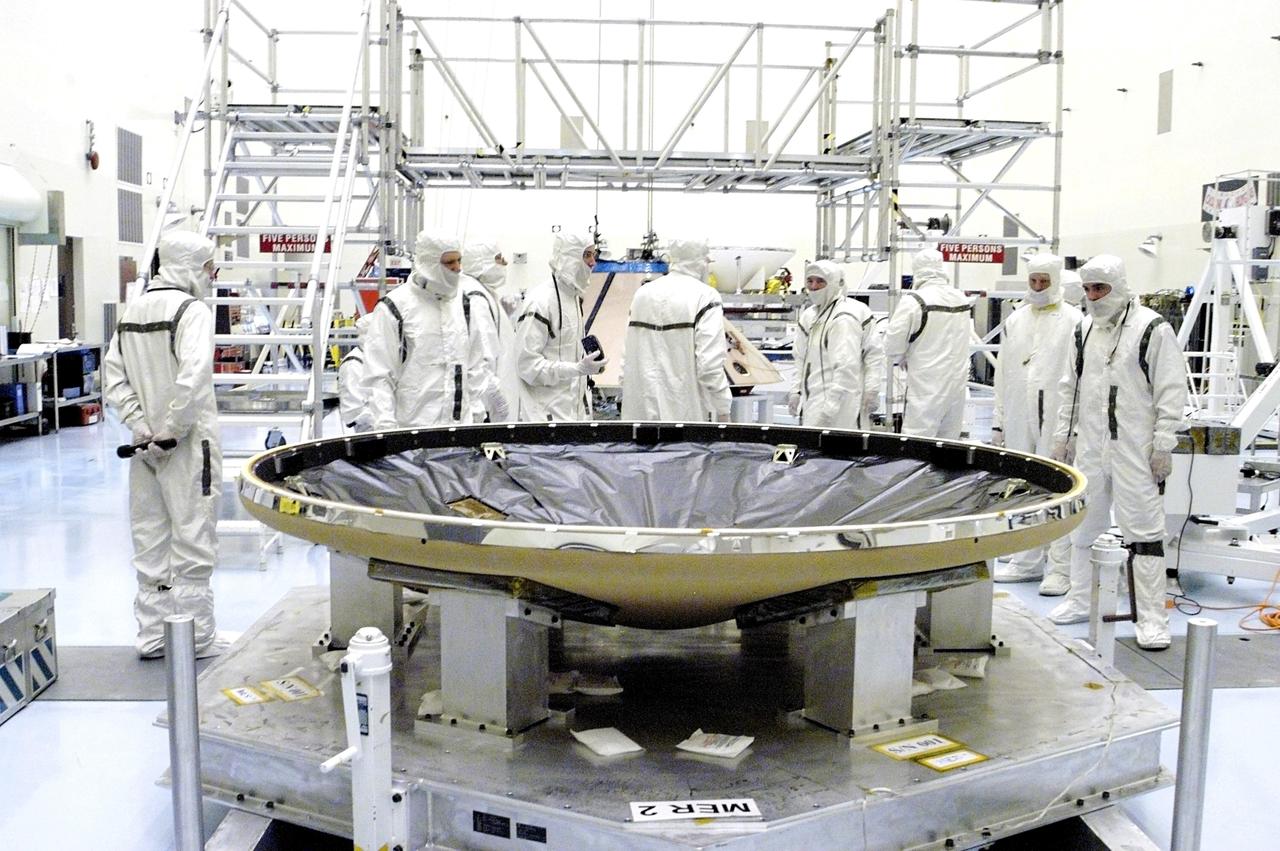
400mm Mapping Sequence performed during the STS-119 R-Bar Pitch Maneuver
ISS016-E-032293 (12 March 2008) --- An overhead view of part of Space Shuttle Endeavour's starboard wing and part of its orbital maneuvering system (OMS) pods was provided by Expedition 16 crewmembers on the International Space Station (ISS). Before docking with the station, astronaut Dominic Gorie, STS-123 commander, flew the shuttle through a roll pitch maneuver or basically a backflip to allow the space station crew a good view of Endeavour's heat shield. Using digital still cameras equipped with both 400 and 800 millimeter lenses, the ISS crewmembers took a number of photos of the shuttle's thermal protection system and sent them down to teams on the ground for analysis. A 400 millimeter lens was used for this image.
Mapping Sequence performed during the STS-123 R-Bar Pitch Maneuver
ISS017-E-008669 (2 June 2008) --- A close-up view of Space Shuttle Discovery's tail section was provided by Expedition 17 crewmembers on the International Space Station (ISS). The image provides partial views of the shuttle's main engines, orbital maneuvering system (OMS) pods, vertical stabilizer, the payload bay door panels and the second component of the Japan Aerospace Exploration Agency's Kibo laboratory, the Japanese Pressurized Module (JPM) located in the cargo bay. Before docking with the station, astronaut Mark Kelly, STS-124 commander, flew the shuttle through a roll pitch maneuver or basically a backflip to allow the space station crew a good view of Discovery's heat shield. Using digital still cameras equipped with both 400 and 800 millimeter lenses, the ISS crewmembers took a number of photos of the shuttle's thermal protection system and sent them down to teams on the ground for analysis. A 400 millimeter lens was used for this image.
Mapping Sequence performed during the STS-124 R-Bar Pitch Maneuver
KENNEDY SPACE CENTER, FLA. -  In the Orbiter Processing Facility’s bay 1, workers watch closely as the orbiter boom sensor system is lowered into place on the starboard side of Atlantis’s payload bay for mission STS-117. The 50-foot-long boom attaches to the shuttle arm and provides equipment to inspect the shuttle's heat shield while in space.  It contains an intensified television camera (ITVC) and a laser dynamic range imager, which are mounted on a pan and tilt unit, and a laser camera system (LCS) mounted on a stationary bracket. Mission STS-117 will carry the S3/S4 arrays for installation on the International Space Station.  Launch of Space Shuttle Atlantis is scheduled for March.  Photo credit: NASA/Jack Pfaller
KSC-06pd2367
ISS018-E-008640 (16 Nov. 2008) --- A close-up view of Space Shuttle Endeavour's tail section was provided by Expedition 18 crewmembers on the International Space Station. The image provides partial views of the shuttle's main engines, orbital maneuvering system (OMS) pods, vertical stabilizer, the payload bay door panels and the Leonard Multi-Purpose Logistics Module located in the cargo bay. Before docking with the station, astronaut Chris Ferguson, STS-126 commander, flew the shuttle through a roll pitch maneuver or basically a backflip to allow the space station crew a good view of Endeavour's heat shield. Using digital still cameras equipped with both 400 and 800 millimeter lenses, the ISS crewmembers took a number of photos of the shuttle's thermal protection system and sent them down to teams on the ground for analysis. A 400 millimeter lens was used for this image.
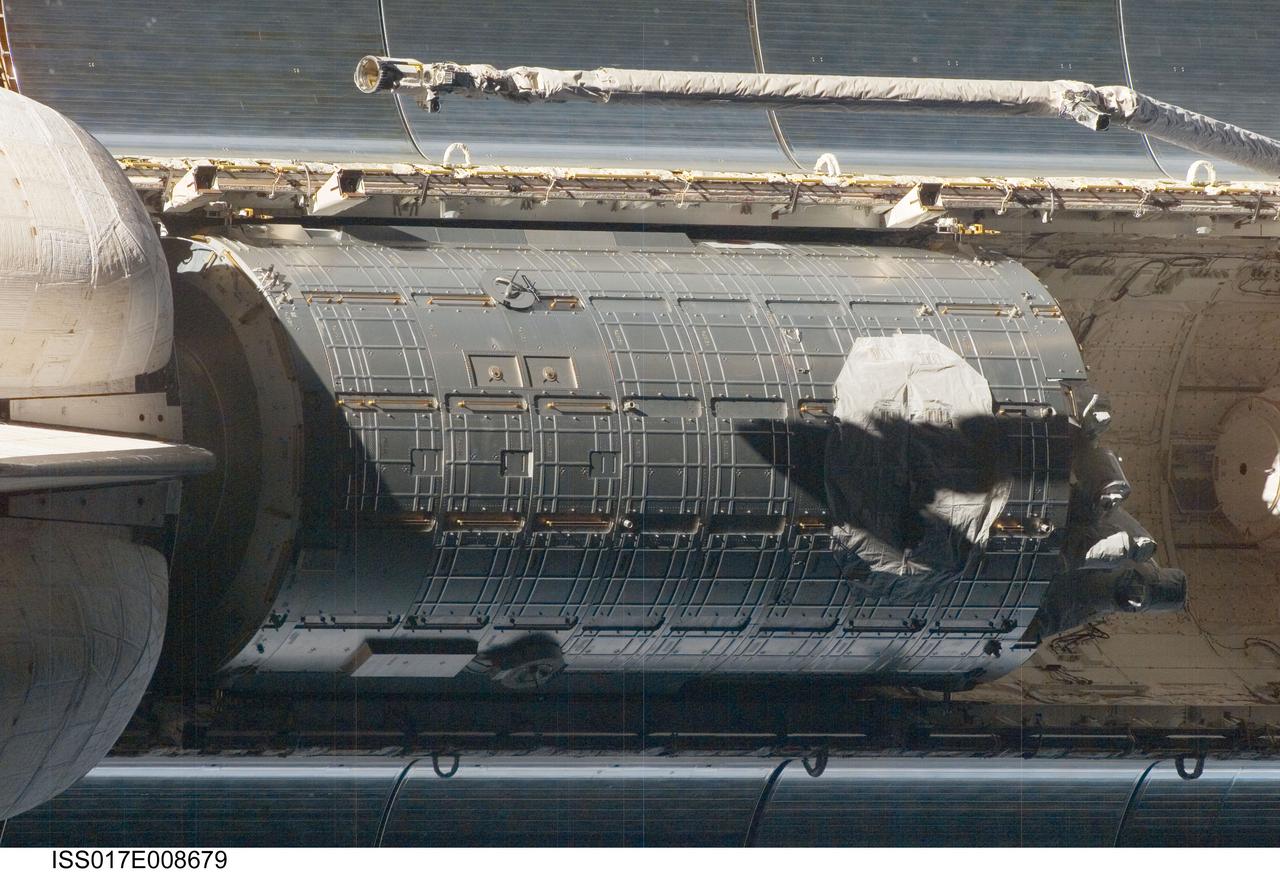
400mm Mapping Sequence performed during the STS-126 R-Bar Pitch Maneuver