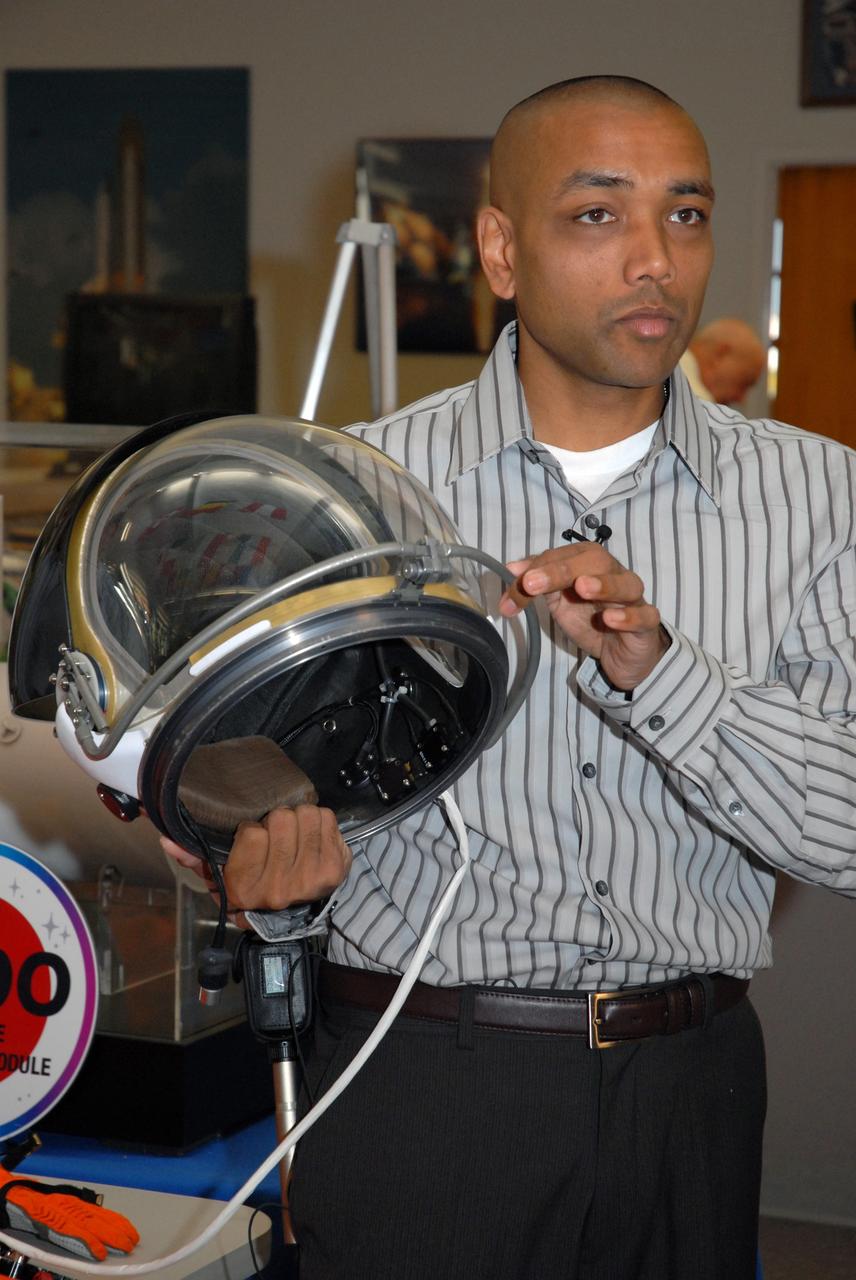
CAPE CANAVERAL, Fla. -- In the NASA News Center at NASA's Kennedy Space Center, Shuttle Crew Escape System Manager KC Chhipwadia describes for the media the elements of the helmet that is part of the launch and entry suit (seen on the table) used by shuttle crews during their missions. He is holding onto the bar that latches to secure the closed visor. The helmet provides oxygen when needed plus a communication system. Photo credit: NASA/Amanda Diller
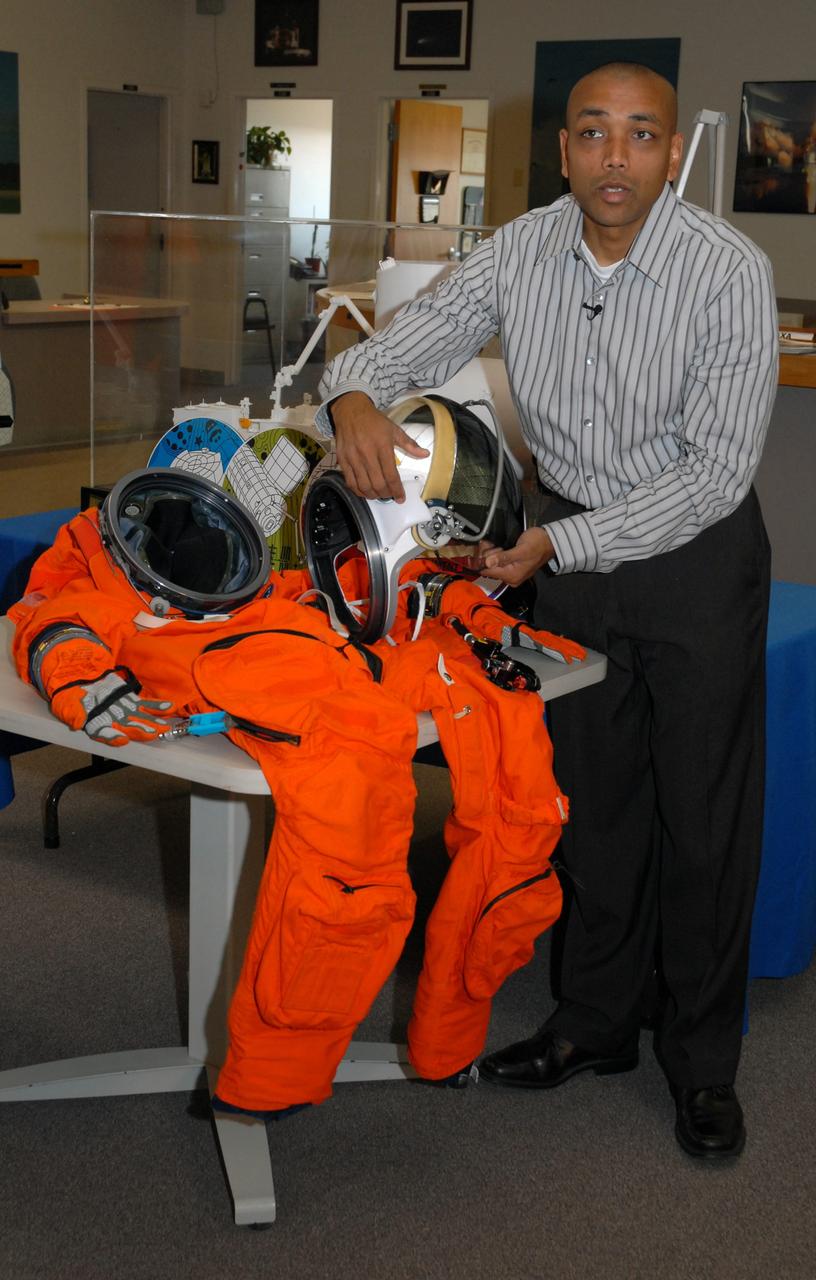
CAPE CANAVERAL, Fla. -- In the NASA News Center at NASA's Kennedy Space Center, Shuttle Crew Escape System Manager KC Chhipwadia describes for the media the elements of the helmet that is part of the launch and entry suit (seen on the table) used by shuttle crews during their missions. The helmet provides oxygen when needed plus a communication system. Photo credit: NASA/Amanda Diller
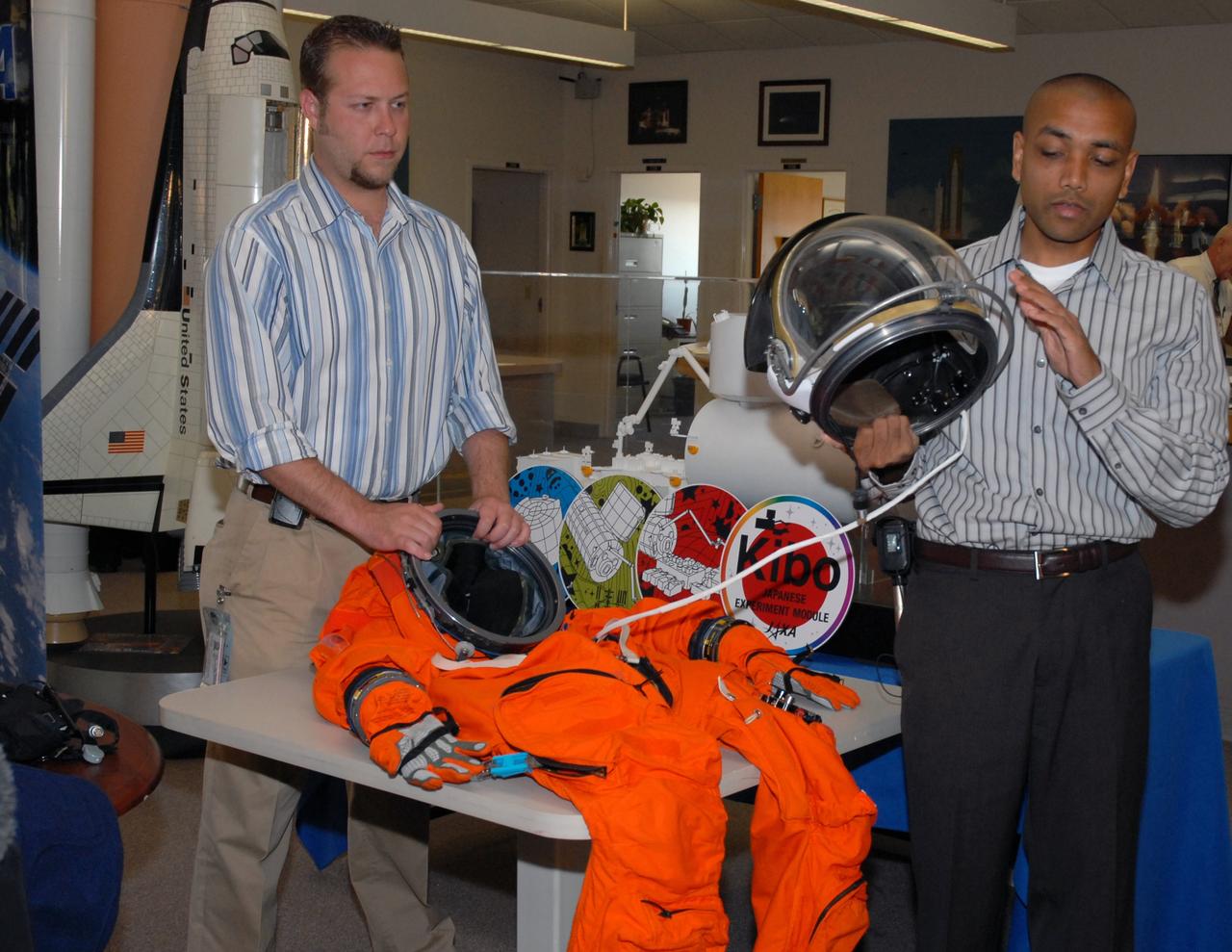
CAPE CANAVERAL, Fla. -- In the NASA News Center at NASA's Kennedy Space Center, Shuttle Crew Escape System Manager KC Chhipwadia (right) describes for the media the elements of the helmet that is part of the launch and entry suit (seen on the table) used by shuttle crews during their missions. The helmet provides oxygen when needed plus a communication system. Photo credit: NASA/Amanda Diller
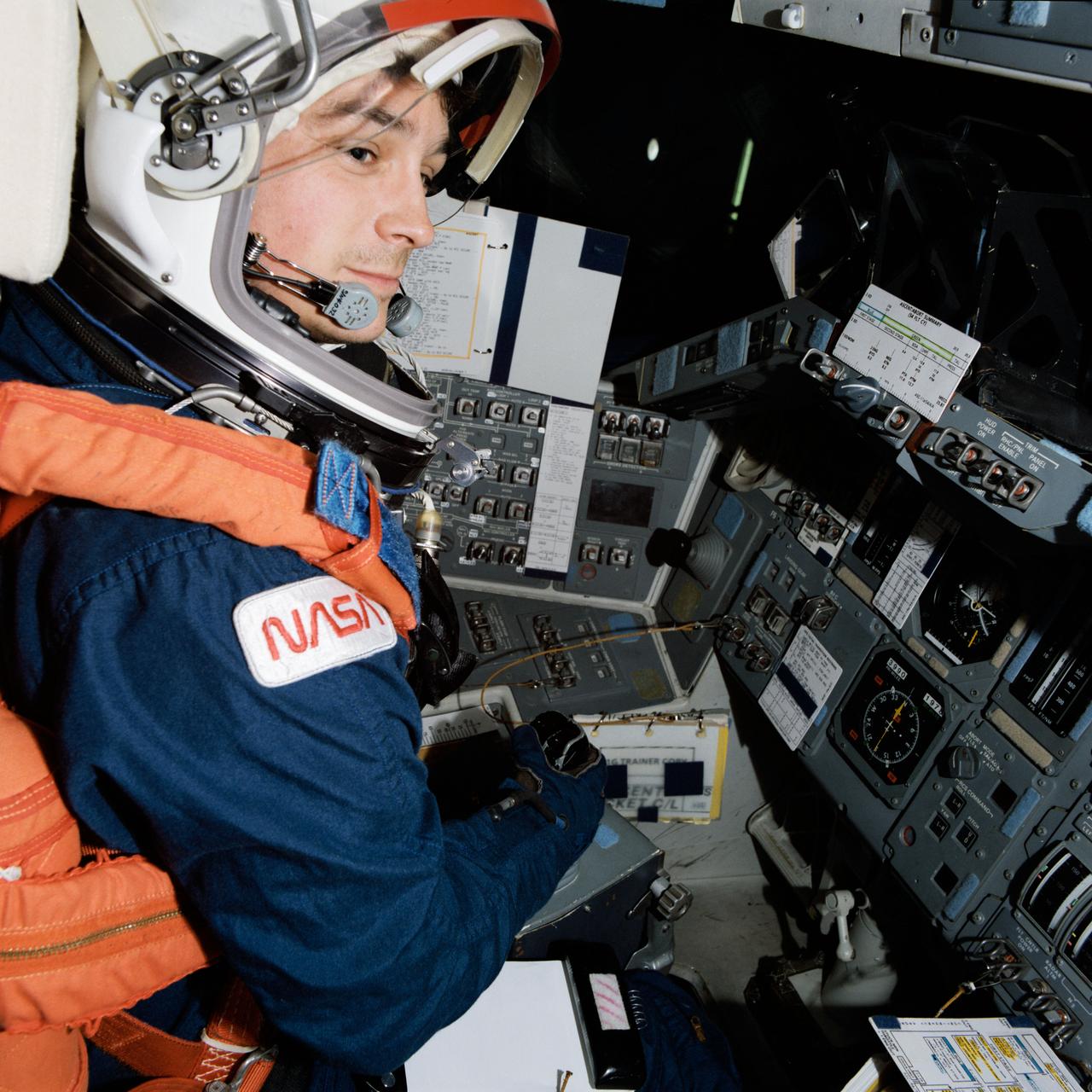
Photos of orbiter fire rescue and crew escape training for extravehicular activity (EVA) crew systems support conducted in Bldg 9A Crew Compartment Trainer (CCT) and Fuel Fuselage Trainer (FFT) include views of CCT interior of middeck starboard fuselage showing middeck forward (MF) locker and COAS assembly filter, artiflex film and camcorder bag (26834); launch/entry suit (LES) helmet assembly, neckring and helmet hold-down assembly (26835-26836); middeck aft (MA) lockers (26837); area of middeck airlock and crew escape pole (26838); connectors of crew escape pole in the middeck (268390); three test subjects in LES in the flight deck (26840); emergency side hatch slide before inflated stowage (26841); area of below adjacent to floor panel MD23R (26842); a test subject in LES in the flight deck (26843); control board and also showing sign of "orbital maneuvering system (OMS) secure and OMS TK" (26844); test subject in the flight deck also showing chart of "ascent/abort summary" (26845).
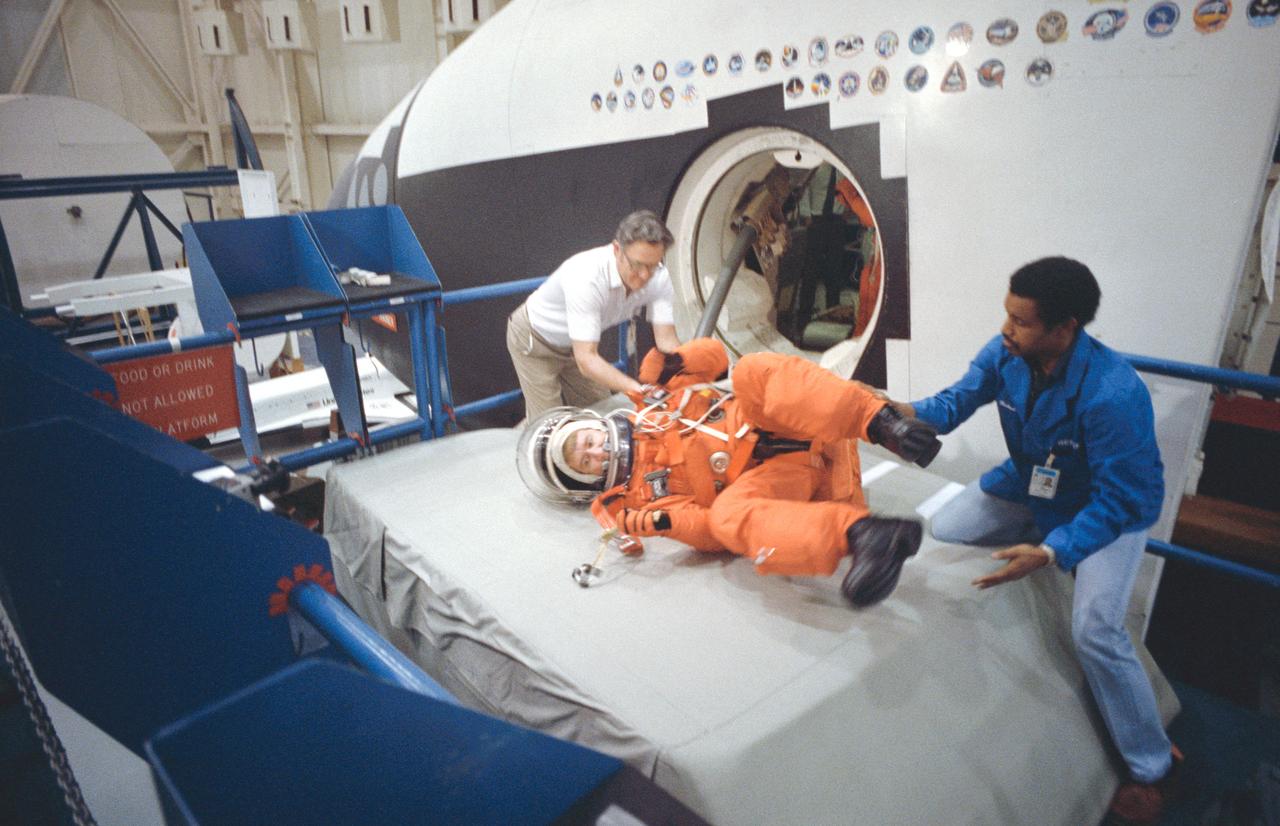
STS-38 Pilot Frank L. Culbertson, wearing launch and entry suit (LES) and launch and entry helmet (LEH), rolls through the side hatch of the crew compartment trainer (CCT) located in JSC's Mockup and Integration Laboratory (MAIL) Bldg 9A. Assisted by technicians, Culbertson practices emergency egress through the side hatch using the crew escape system (CES) pole which extends out the side hatch. The inflated safety cushion breaks Culbertson's fall as he rolls out of the side hatch.
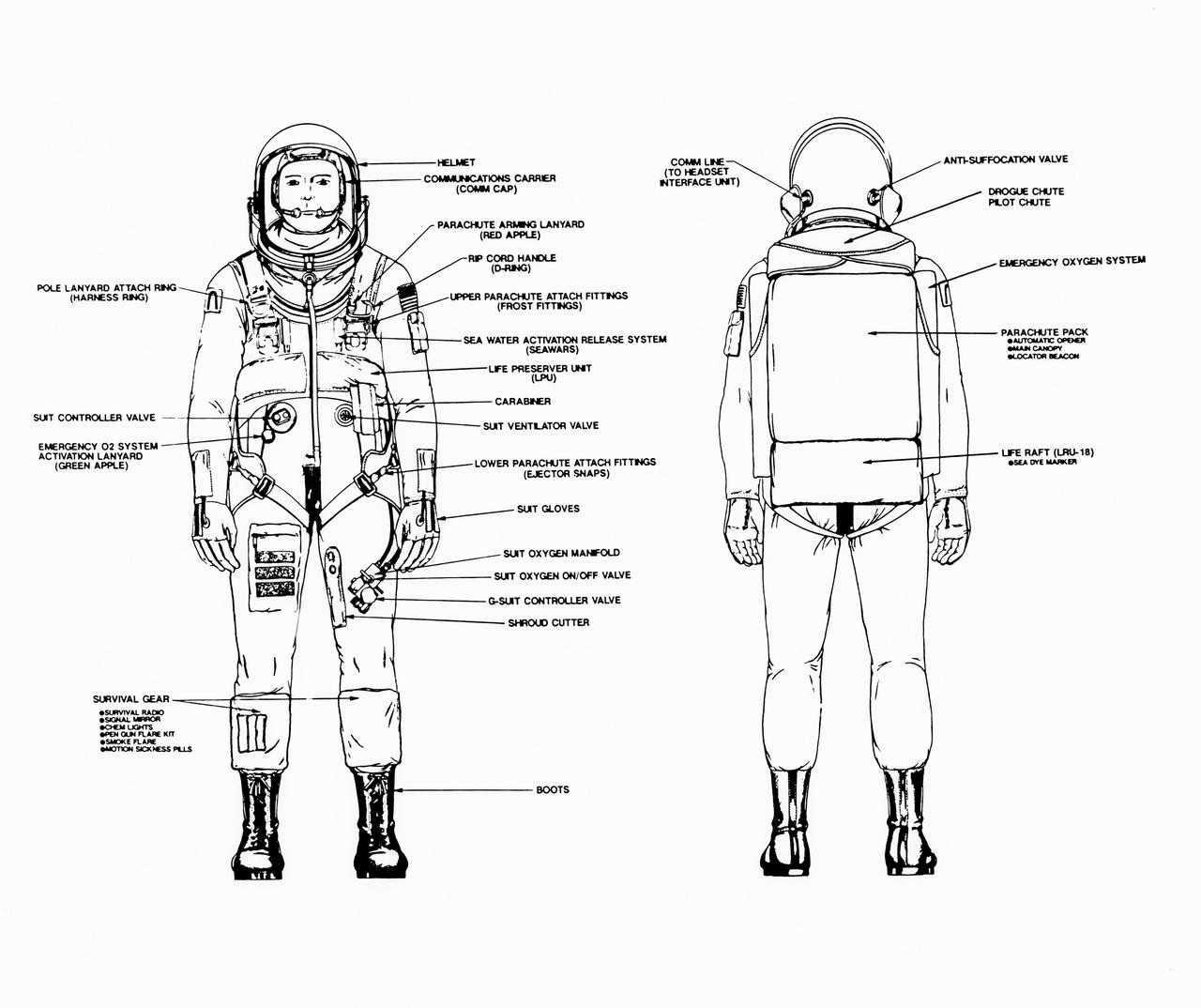
Line drawings illustrate the front and back of the space shuttle launch and entry suit (LES) and labels identify various components. LES was designed for STS-26, the return to flight mission, and subsequent missions. Included in the crew escape system (CES) package are launch and entry helmet (LEH) with communications carrier (COMM CAP), parachute pack and harness, life preserver unit (LPU), life raft unit (LRU), LES gloves, suit oxygen manifold and valves, boots, and survival gear. Details of larger components are also identified.
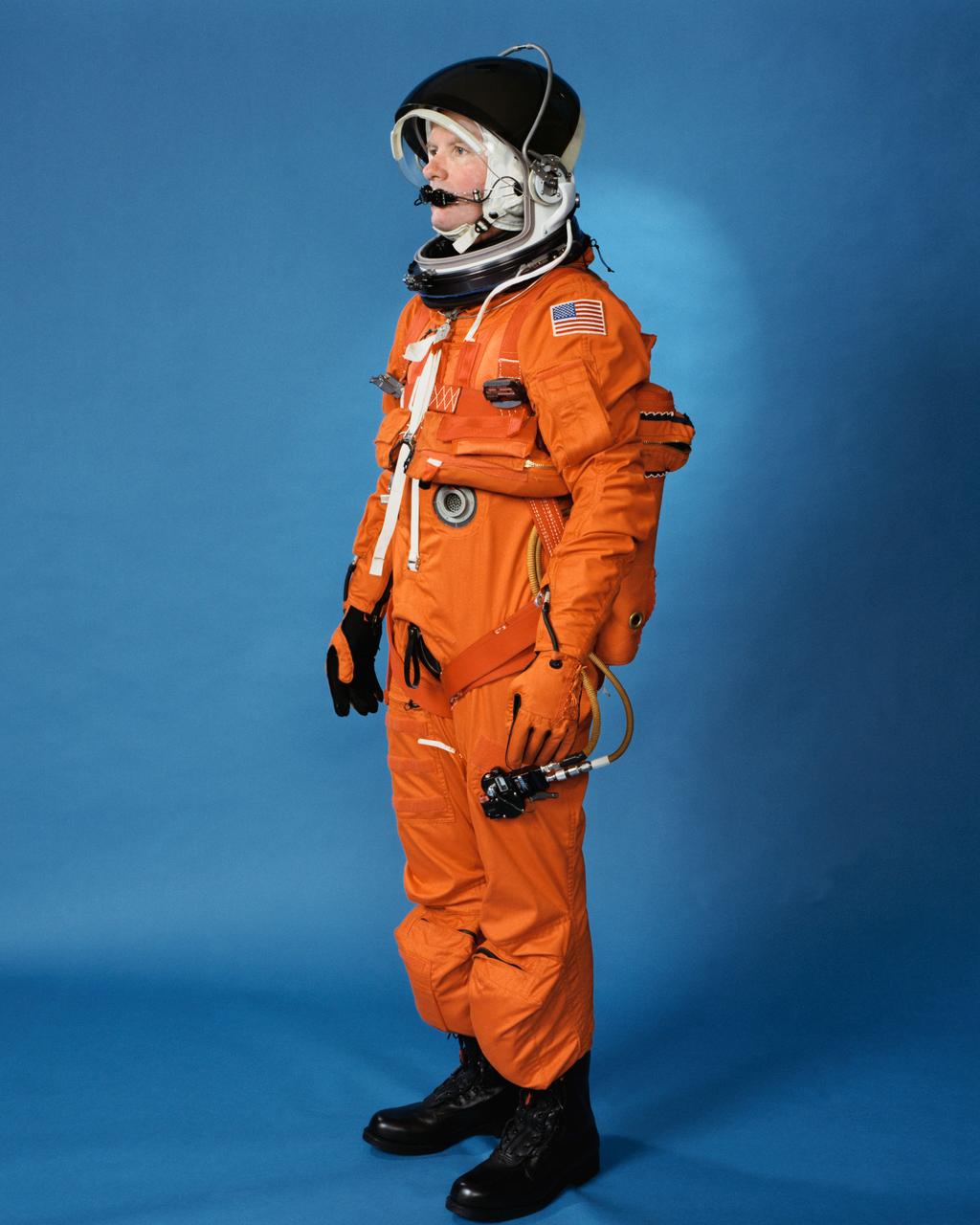
Space shuttle orange launch and entry suit (LES), a partial pressure suit, is modeled by a technician. LES was designed for STS-26, the return to flight mission, and subsequent missions. Included in the crew escape system (CES) package are launch and entry helmet (LEH) with communications carrier (COMM CAP), parachute pack and harness, life raft, life preserver unit (LPU), LES gloves, suit oxygen manifold and valves, boots, and survival gear.
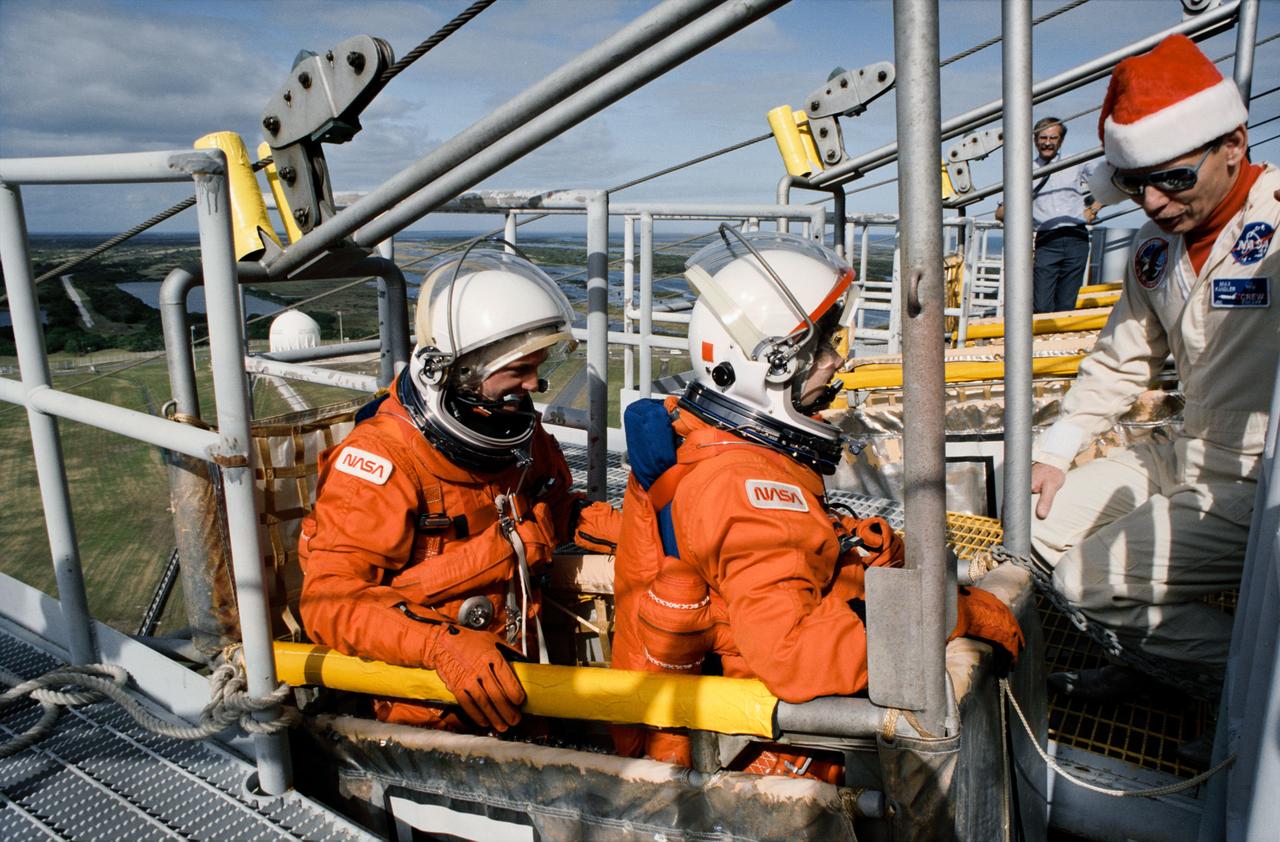
S93-25030 (15 Dec 1992) --- Two astronauts assigned to fly aboard Endeavour for the STS-54 mission are briefed on the slidewire escape system at the launch pad. Pictured in the slidewire litter are astronauts Gregory J. Harbaugh (left) and Susan J. Helms, mission specialists. They are assisted by Max Kandler of Lockheed, Houston. All five crewmembers are in Florida this week to participate in countdown demonstration tests.
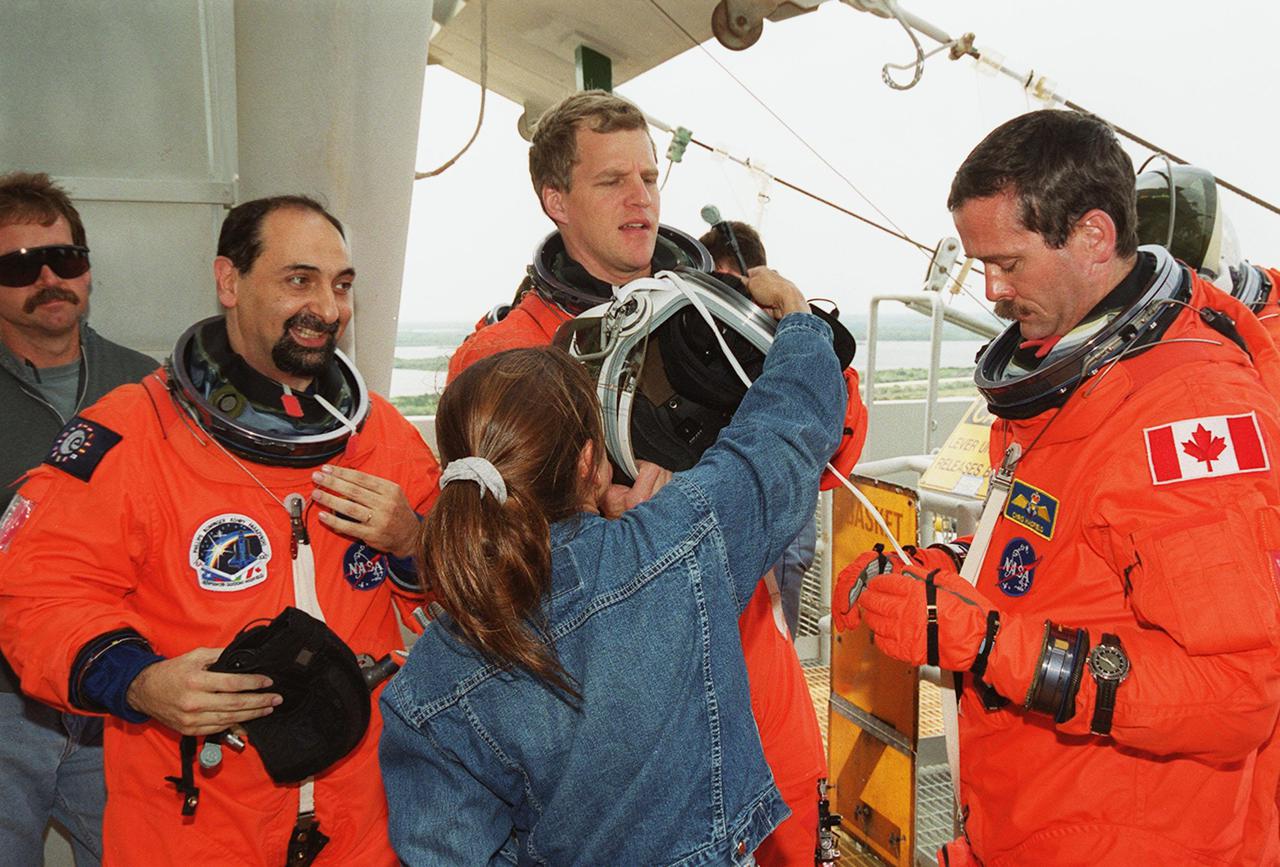
KENNEDY SPACE CENTER, FLA. -- STS-100 Mission Specialists Umberto Guidoni (left), Scott E. Parazynski (center) and Chris A. Hadfield (right) conclude emergency escape training at Launch Pad 39A. Parazynski gets help with his helmet. The crew is taking part in Terminal Countdown Demonstration Test activities that also include a simulated launch countdown. The mission is carrying the Multi-Purpose Logistics Module Raffaello and the SSRMS, to the International Space Station. Raffaello carries six system racks and two storage racks for the U.S. Lab. The SSRMS is crucial to the continued assembly of the orbiting complex. Launch of mission STS-100 is scheduled for April 19 at 2:41 p.m. EDT from Launch Pad 39A
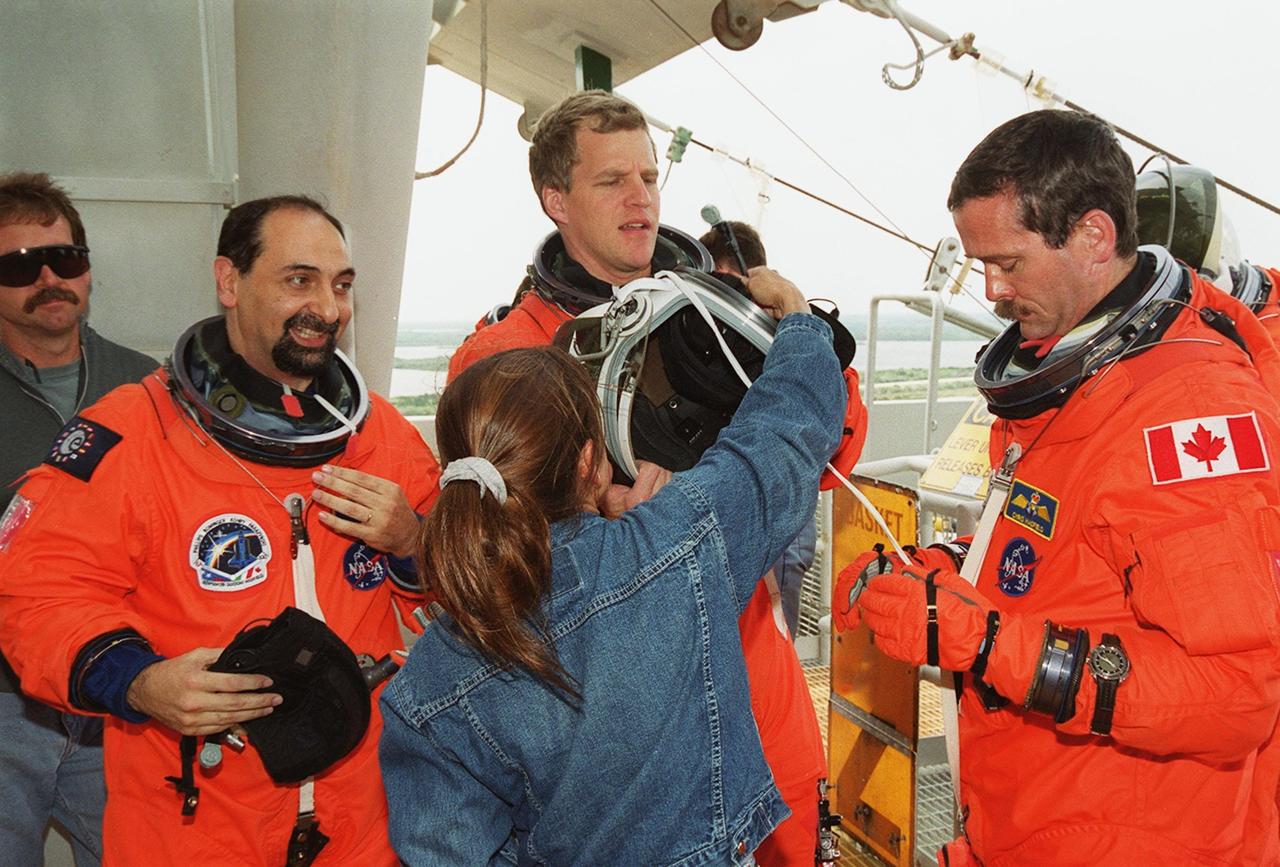
KENNEDY SPACE CENTER, FLA. -- STS-100 Mission Specialists Umberto Guidoni (left), Scott E. Parazynski (center) and Chris A. Hadfield (right) conclude emergency escape training at Launch Pad 39A. Parazynski gets help with his helmet. The crew is taking part in Terminal Countdown Demonstration Test activities that also include a simulated launch countdown. The mission is carrying the Multi-Purpose Logistics Module Raffaello and the SSRMS, to the International Space Station. Raffaello carries six system racks and two storage racks for the U.S. Lab. The SSRMS is crucial to the continued assembly of the orbiting complex. Launch of mission STS-100 is scheduled for April 19 at 2:41 p.m. EDT from Launch Pad 39A
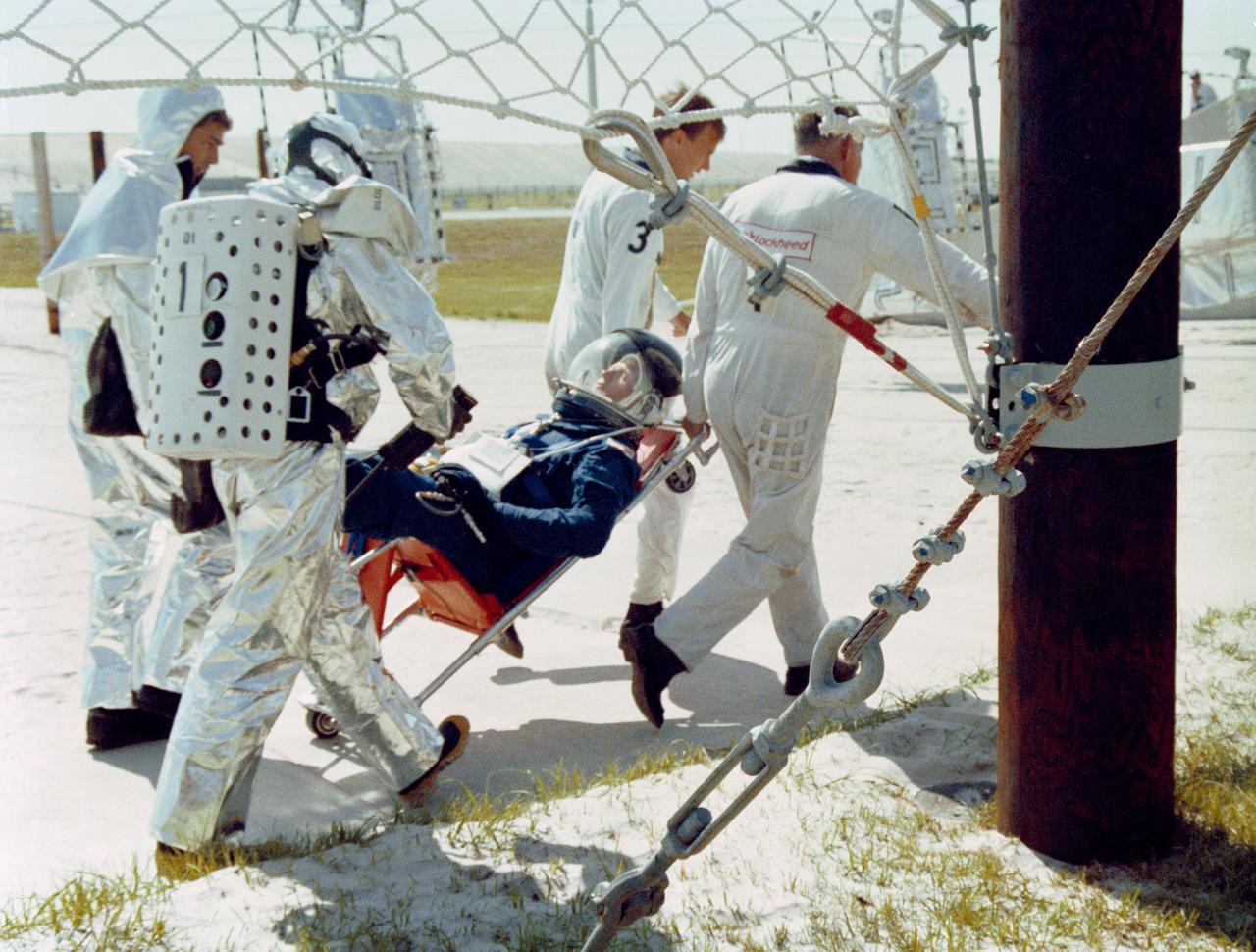
S88-40898 (4 May 1988) --- Astronauts, members of the orbiter close-out crew and fire and rescue personnel participate in a simulated emergency egress exercise near the slide wire termination point bunker at Launch Pad 39B. The simulated exercise was performed to familiarize personnel with evacuation routes as well as emergency equipment and procedures. Reasons for conducting the emergency exercises include the need to validate recent post-Challenger upgrades to the launch pad's emergency escape system and the new procedures developed in preparation for STS-26. (NOTE: The astronaut pictured and many of the others who participated in the exercises are not members of STS-26 prime crew).
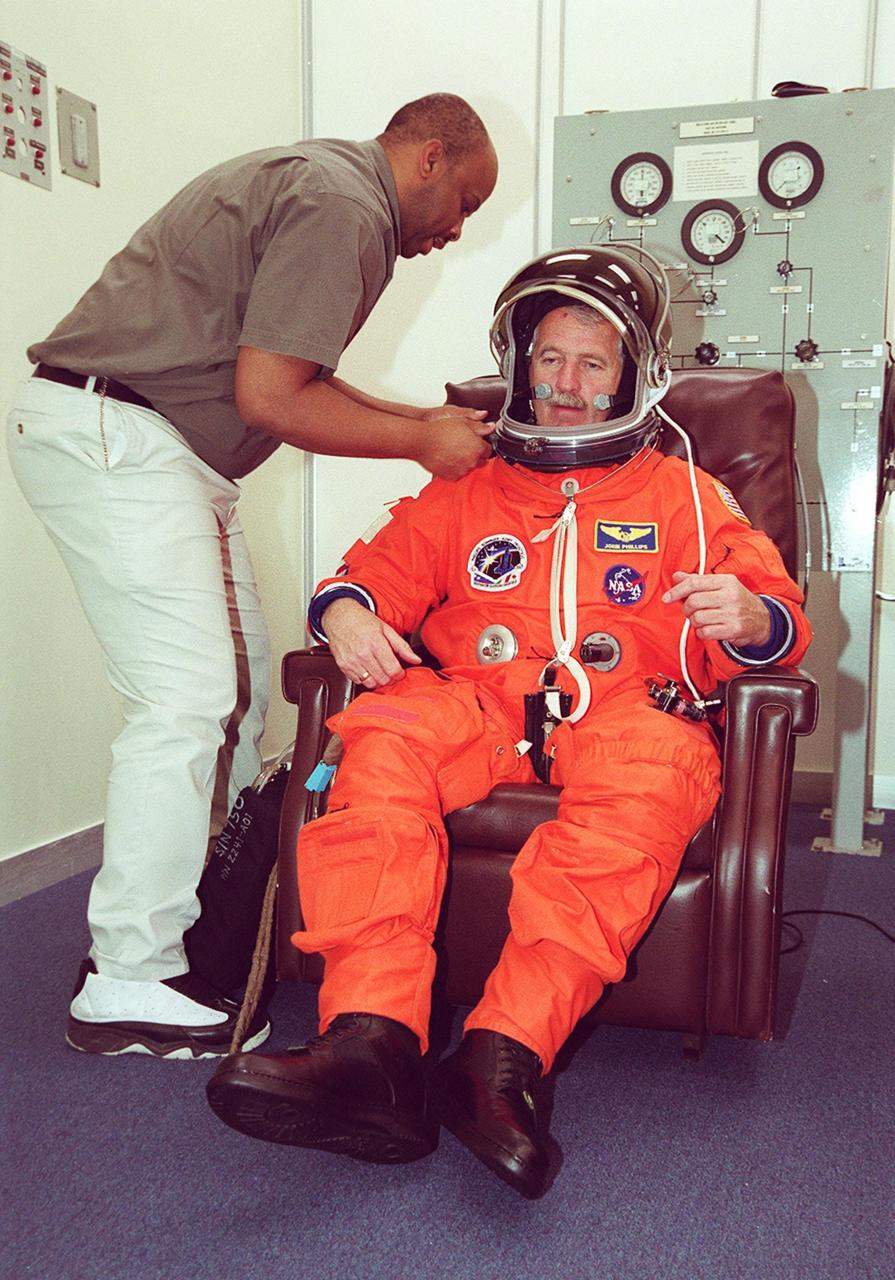
In the Operations and Checkout Building, a suit technician adjusts the helmet of STS-100 Mission Specialist John L. Phillips. He and the rest of the crew Commander Kent V. Rominger, Pilot Jeffrey S. Ashby and Mission Specialists Chris A. Hadfield, Scott E. Parazynski, Umberto Guidoni and Yuri V. Lonchakovare taking part in Terminal Countdown Demonstration Test activities, from emergency escape training at the pad to a simulated launch countdown. An international crew, Hadfield is with the Canadian Space Agency, Guidoni the European Space Agency and Lonchakov the Russian Aviation and Space Agency. The mission is carrying the Multi-Purpose Logistics Module Raffaello and the Canadian robotic arm, SSRMS, to the International Space Station. Raffaello carries six system racks and two storage racks for the U.S. Lab. The SSRMS is crucial to the continued assembly of the orbiting complex and has a unique ability to switch ends as it works, “inchworming” along the Station’s exterior. Launch of mission STS-100 is scheduled for April 19 at 2:41 p.m. EDT from Launch Pad 39A
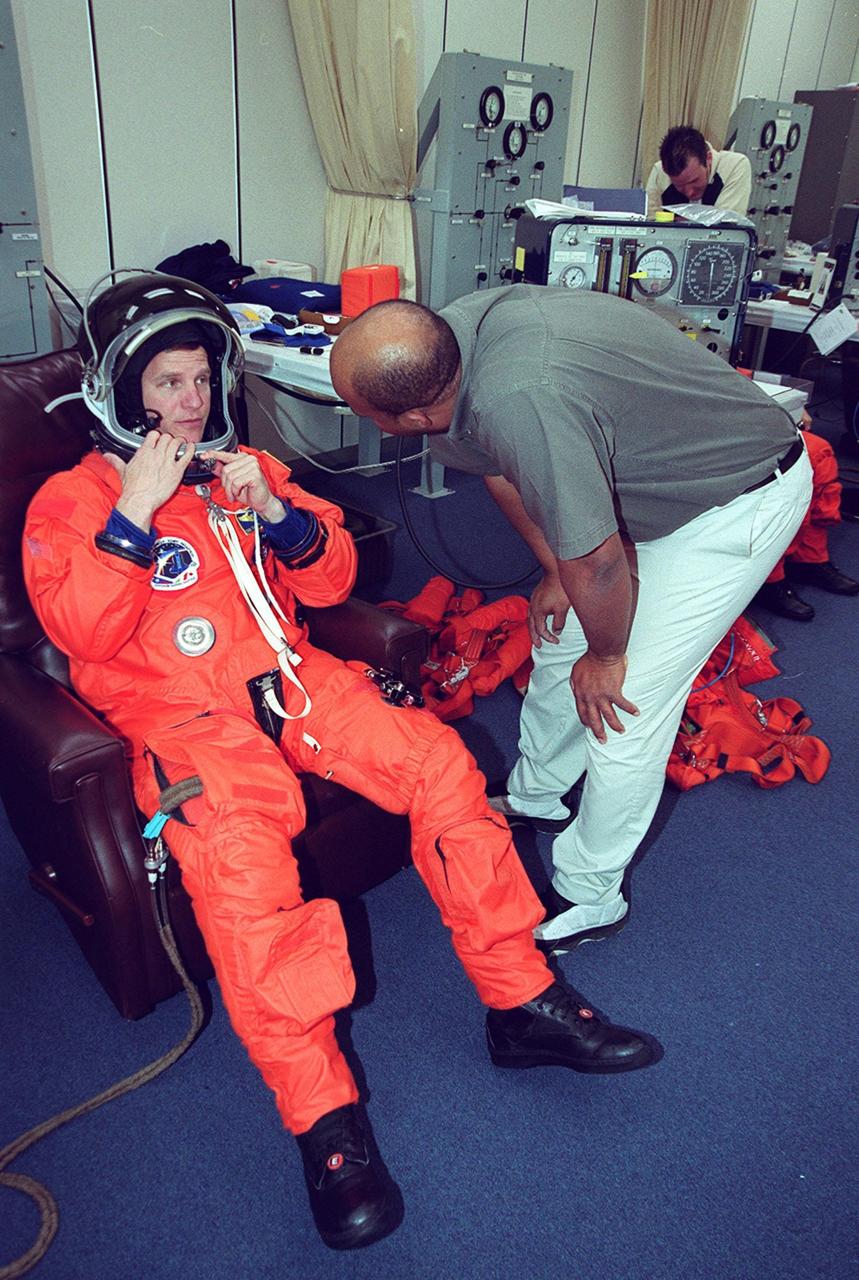
STS-100 Mission Specialist Scott E. Parazynski is questioned by a suit technician about the fit of his helmet and suit. Parazynski and the rest of the crew Commander Kent V. Rominger, Pilot Jeffrey S. Ashby and Mission Specialists Chris Hadfield, John L. Phillips, Umberto Guidoni and Yuri Lonchakov are taking part in Terminal Countdown Demonstration Test activities, from emergency escape training at the pad to a simulated launch countdown. An international crew, Hadfield is with the Canadian Space Agency, Guidoni the European Space Agency and Lonchakov the Russian Aviation and Space Agency. The mission is carrying the Multi-Purpose Logistics Module Raffaello and the Canadian robotic arm, SSRMS, to the International Space Station. Raffaello carries six system racks and two storage racks for the U.S. Lab. The SSRMS is crucial to the continued assembly of the orbiting complex and has a unique ability to switch ends as it works, “inchworming” along the Station’s exterior. Launch of mission STS-100 is scheduled for April 19 at 2:41 p.m. EDT from Launch Pad 39A