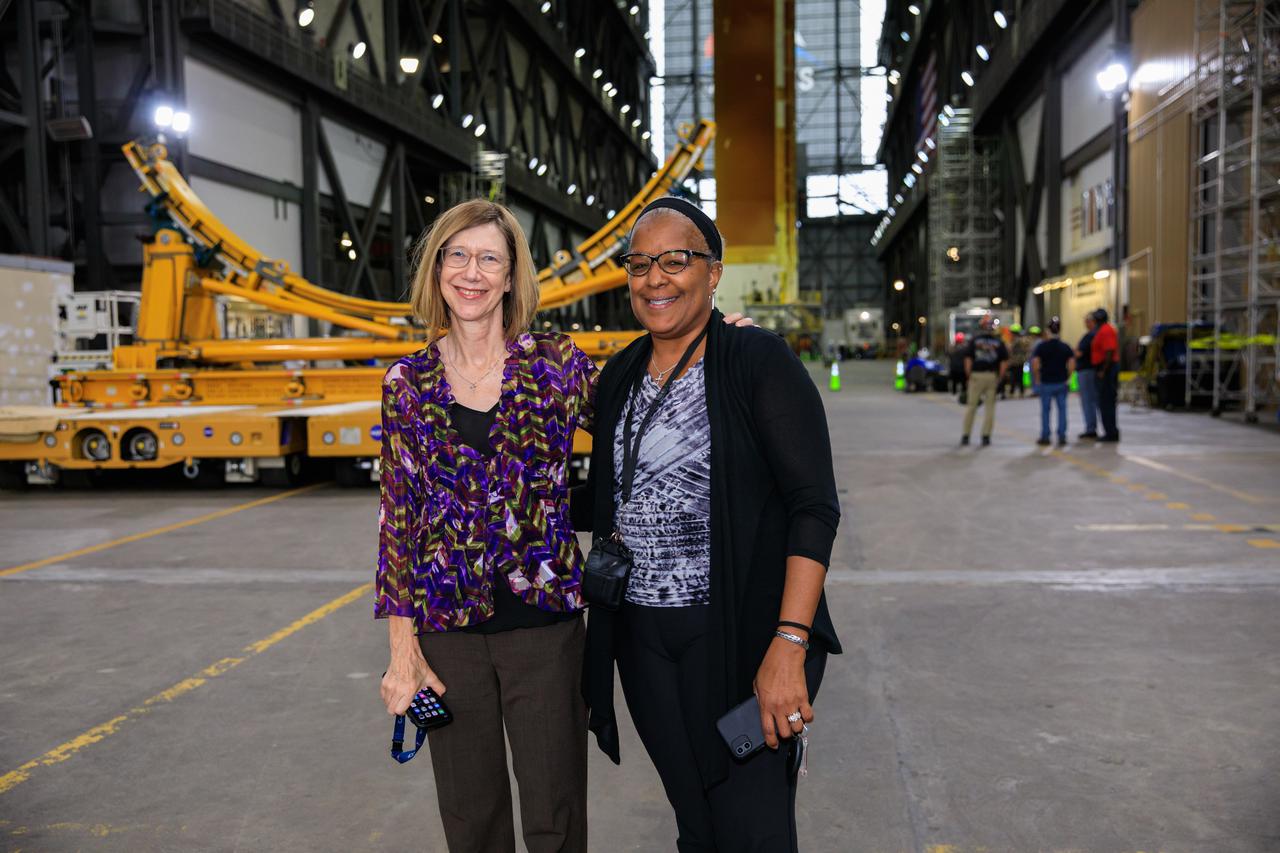
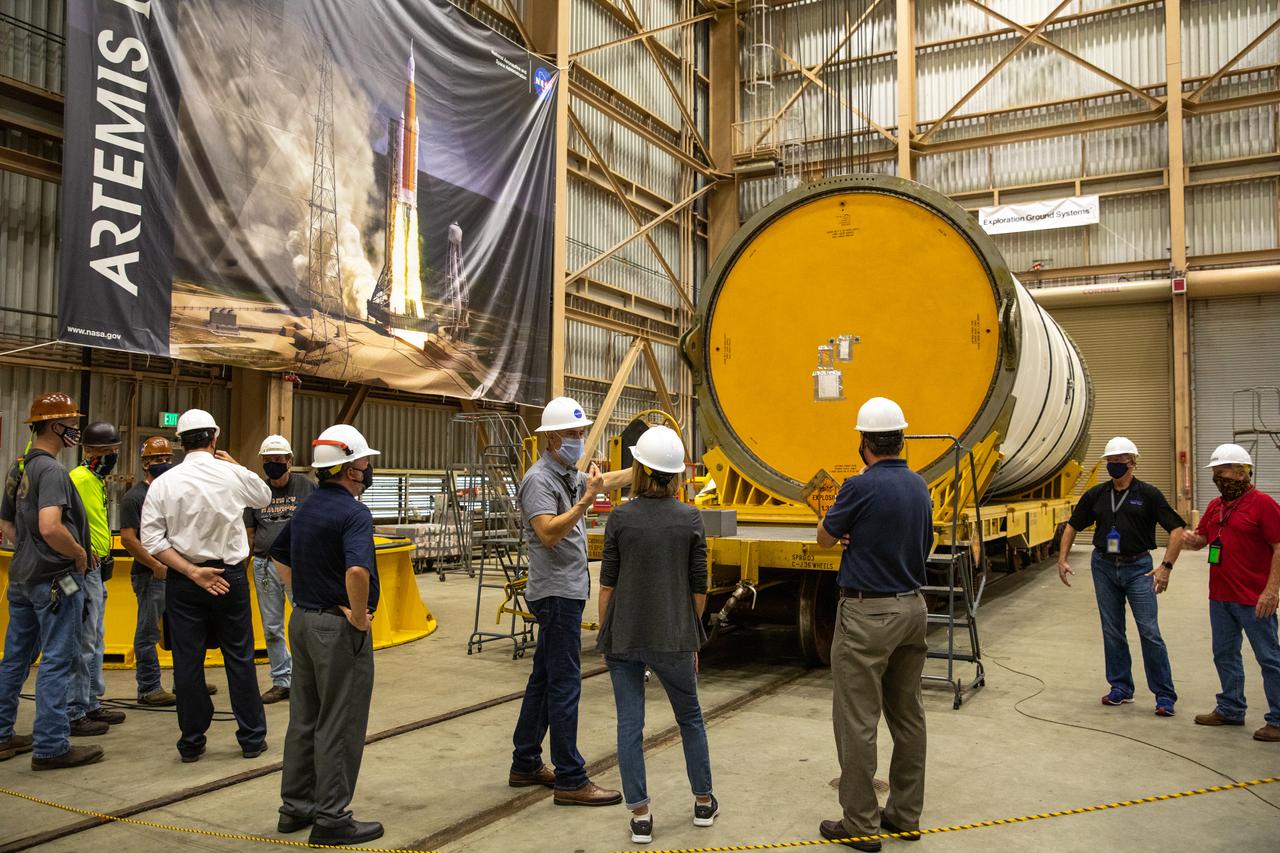
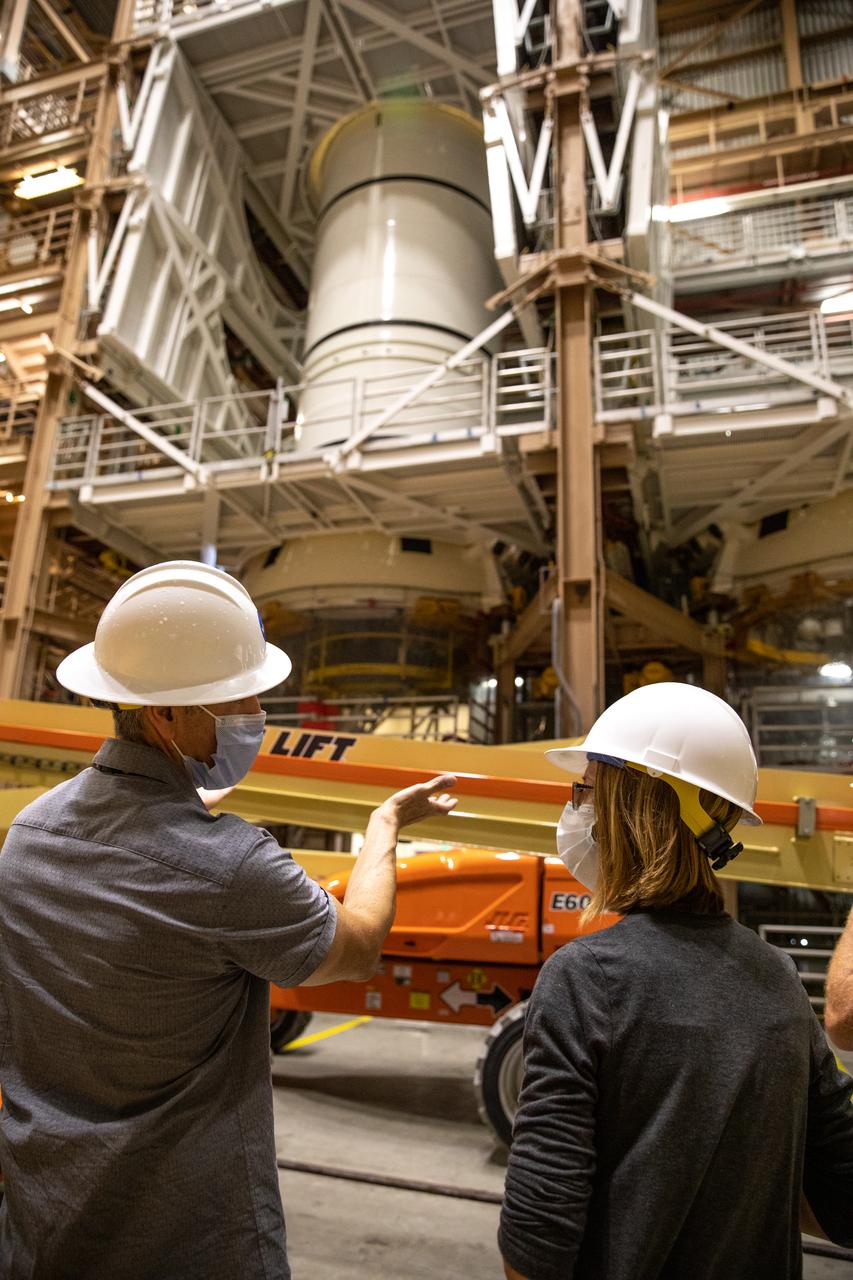
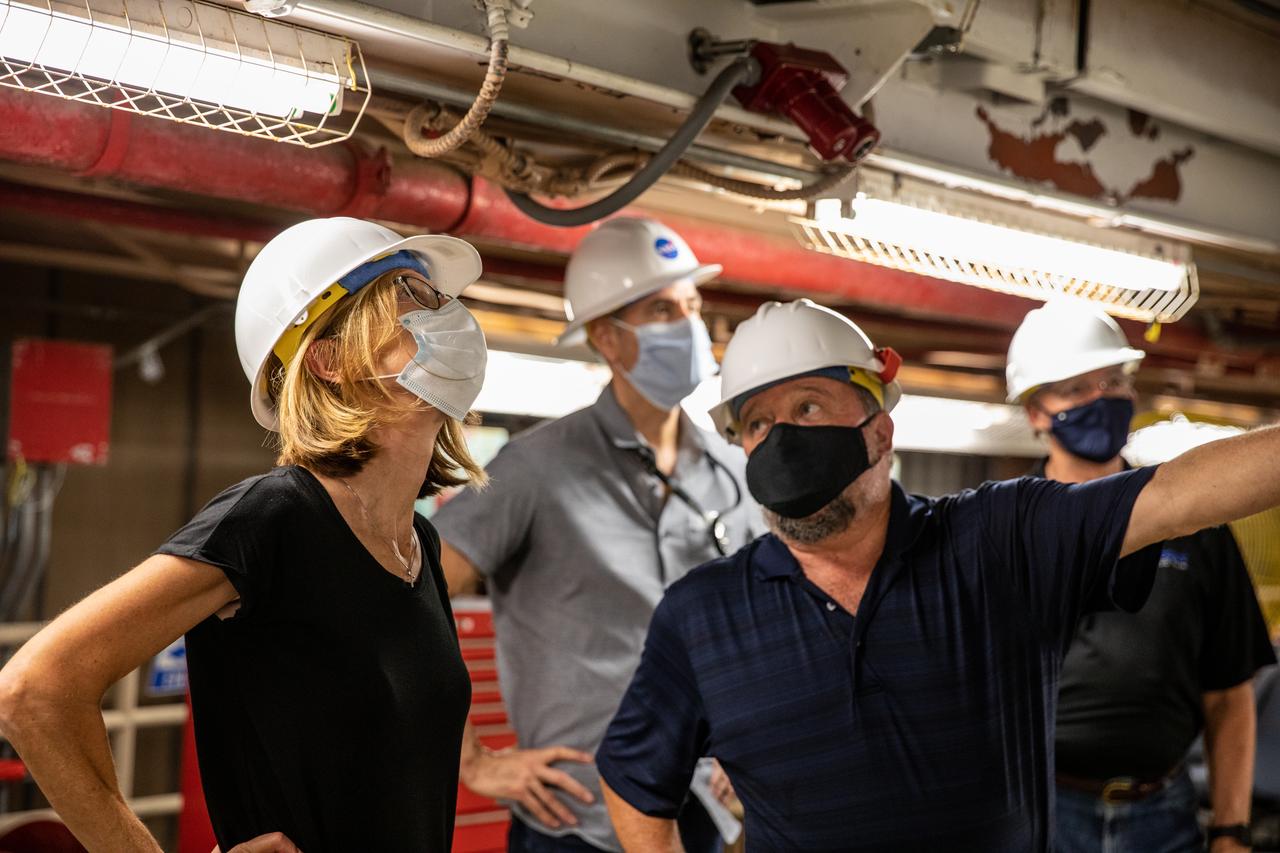
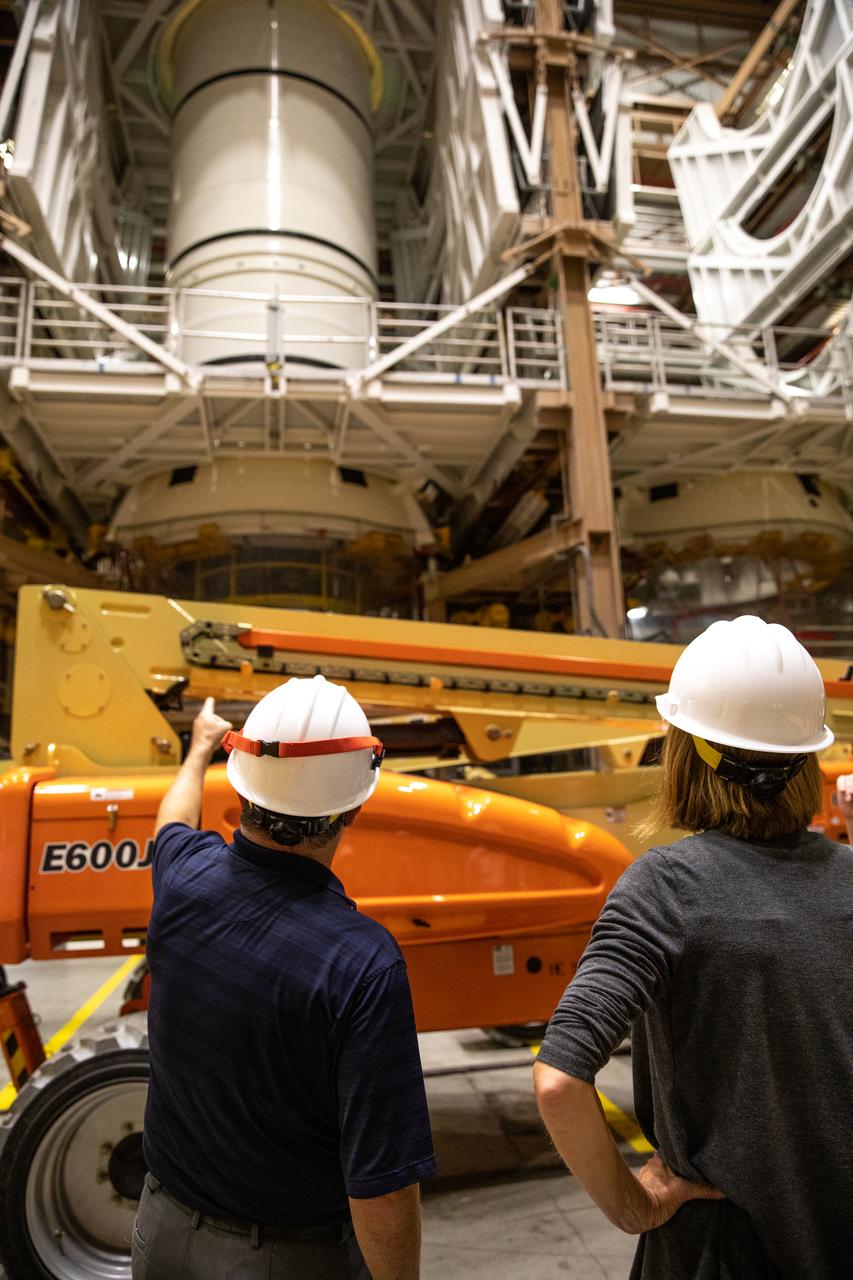
NASA Human Exploration and Operations (HEO) Deputy Associate Administrator Kathy Lueders (left) and HEO Deputy Associate Administrator for Management Altonell “Toni” Mumford (right) visit Kennedy Space Center's iconic Vehicle Assembly Building (VAB) in Florida on June 11, 2021. In the background, the core stage of NASA’s massive Space Launch System (SLS) rocket is visible in vertical position during lift and mate operations, prior to the core stage being moved and integrated with the twin solid rocket boosters atop the mobile launcher in High Bay 3 of the VAB. The 188,000-pound core stage, with its four RS-25 engines, will provide more than 2 million pounds of thrust during launch and ascent, and coupled with the boosters, will provide more than 8.8 million pounds of thrust to send the Artemis I mission to space. Under the Artemis program, NASA will land the first woman and first person of color on the Moon, as well as establish a sustainable presence on the lunar surface in preparation for human missions to Mars.
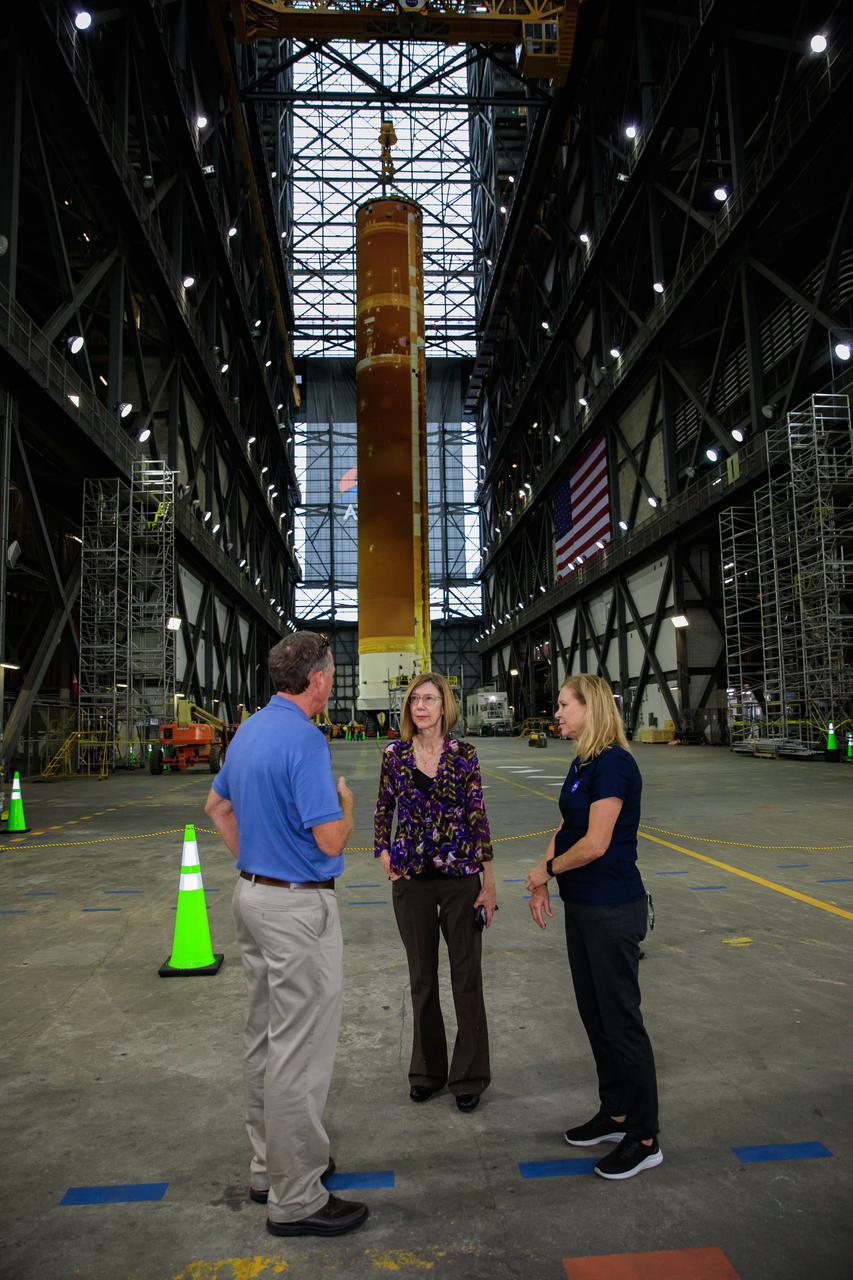
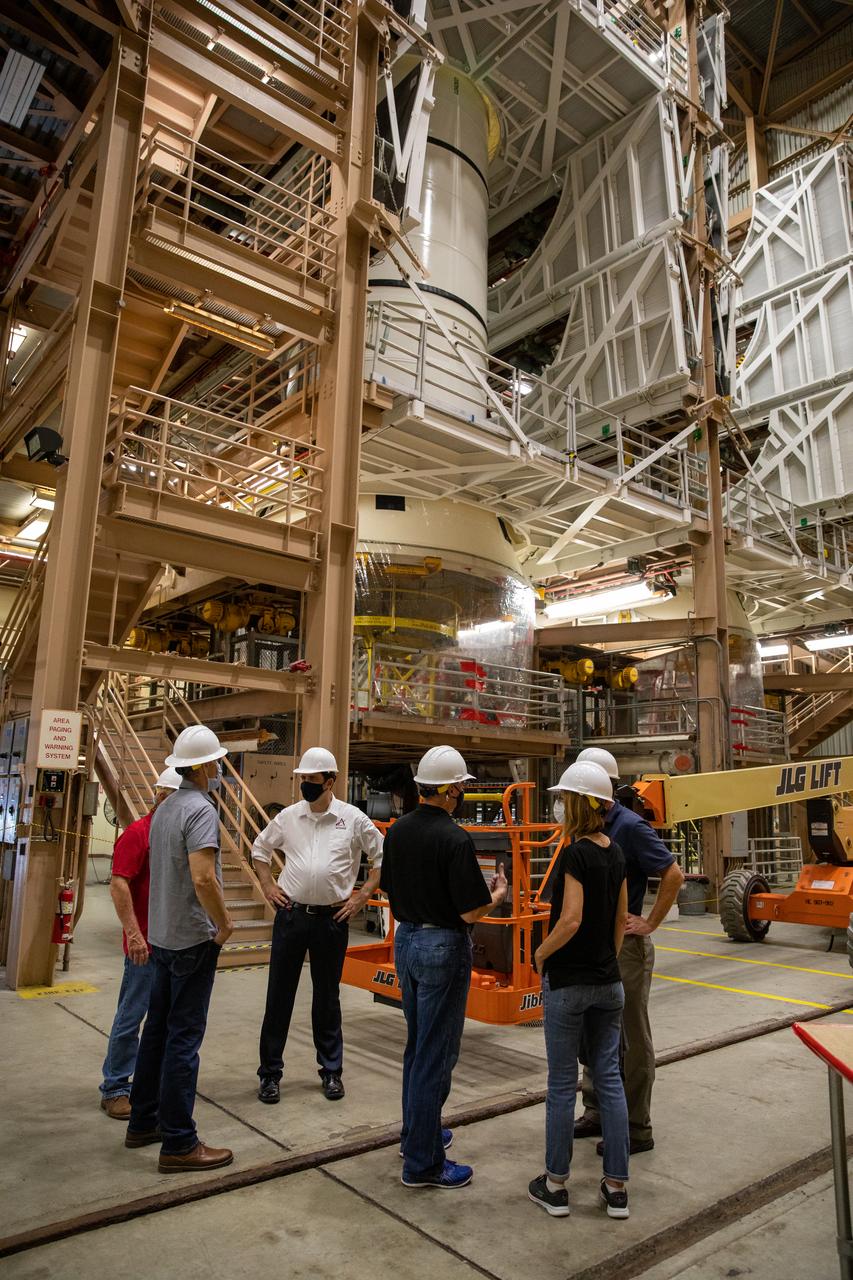
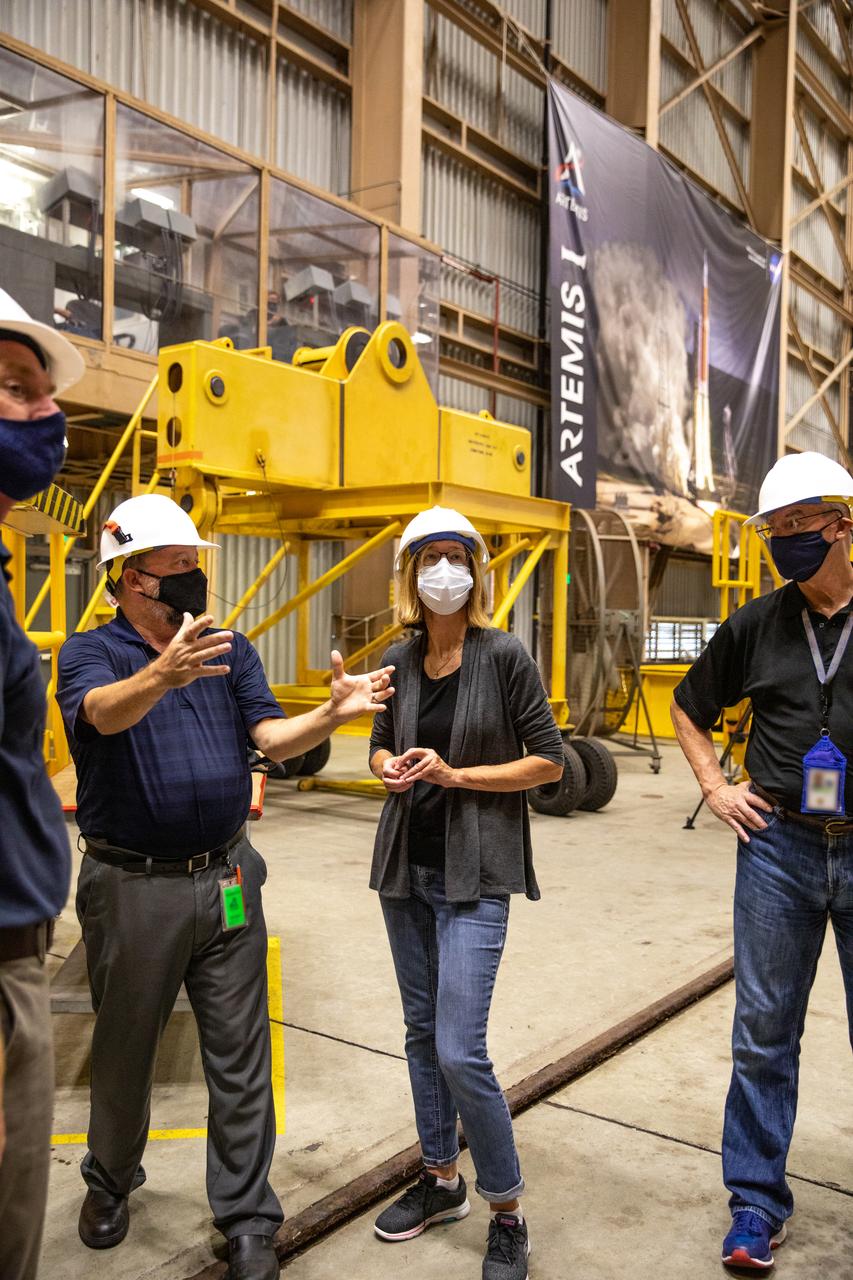
Exploration Ground Systems Manager Mike Bolger (left), NASA Human Exploration and Operations Associate Administrator Kathy Lueders (center), and Acting Director of Kennedy Space Center Janet Petro (right), visit the spaceport’s iconic Vehicle Assembly Building (VAB) in Florida on June 11, 2021. In the background, the core stage of NASA’s massive Space Launch System (SLS) rocket is visible in vertical position during lift and mate operations, prior to the core stage being moved and integrated with the twin solid rocket boosters atop the mobile launcher in High Bay 3 of the VAB. The 188,000-pound core stage, with its four RS-25 engines, will provide more than 2 million pounds of thrust during launch and ascent, and coupled with the boosters, will provide more than 8.8 million pounds of thrust to send the Artemis I mission to space. Under the Artemis program, NASA will land the first woman and first person of color on the Moon, as well as establish a sustainable presence on the lunar surface in preparation for human missions to Mars.
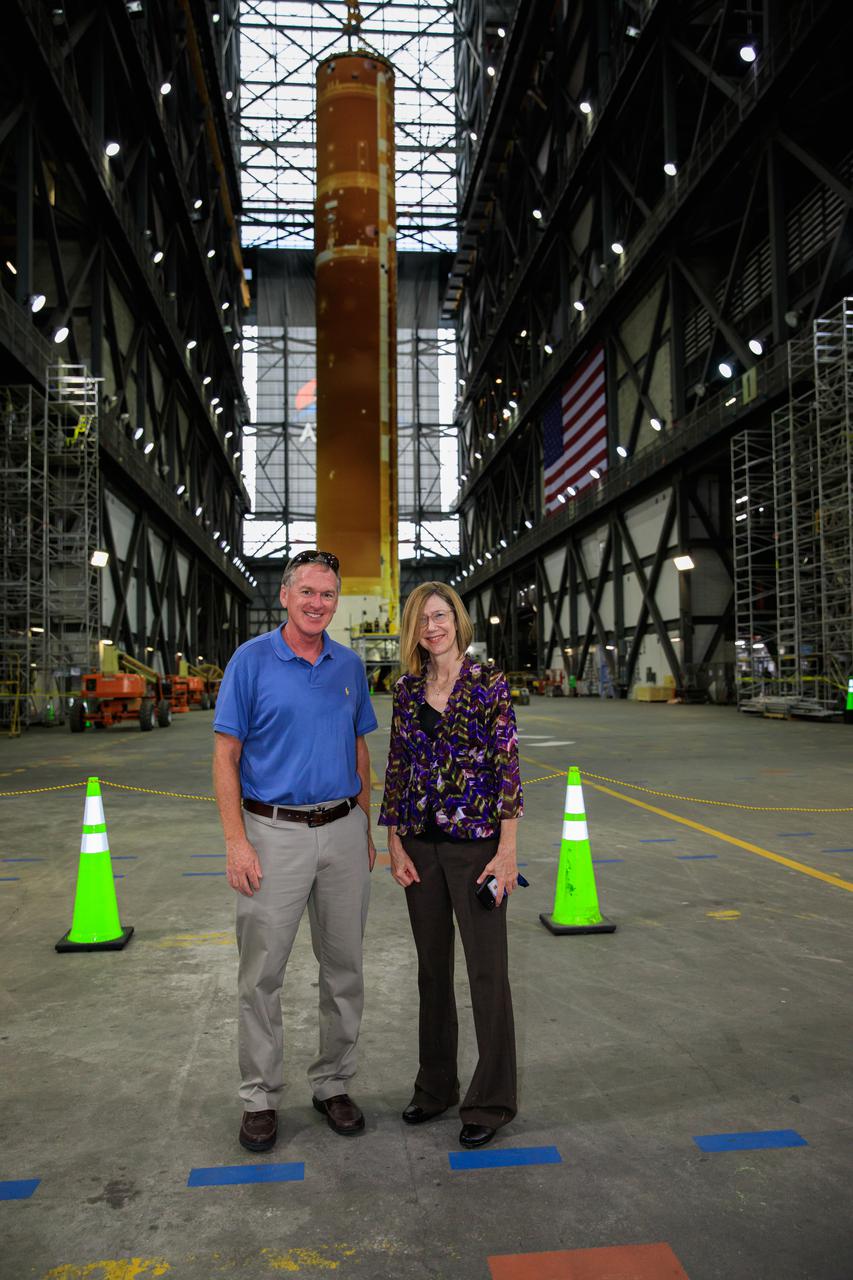
Exploration Ground Systems Manager Mike Bolger (left) and NASA Human Exploration and Operations Associate Administrator Kathy Lueders (right) visit Kennedy Space Center's Vehicle Assembly Building (VAB) in Florida on June 11, 2021. In the background, the core stage of NASA’s massive Space Launch System (SLS) rocket is visible in vertical position during stacking operations, prior to the core stage being moved and integrated with the twin solid rocket boosters atop the mobile launcher in High Bay 3 of the VAB. The 188,000-pound core stage, with its four RS-25 engines, will provide more than 2 million pounds of thrust during launch and ascent, and coupled with the boosters, will provide more than 8.8 million pounds of thrust to send the Artemis I mission to space. Under the Artemis program, NASA will land the first woman and first person of color on the Moon, as well as establish a sustainable presence on the lunar surface in preparation for human missions to Mars.
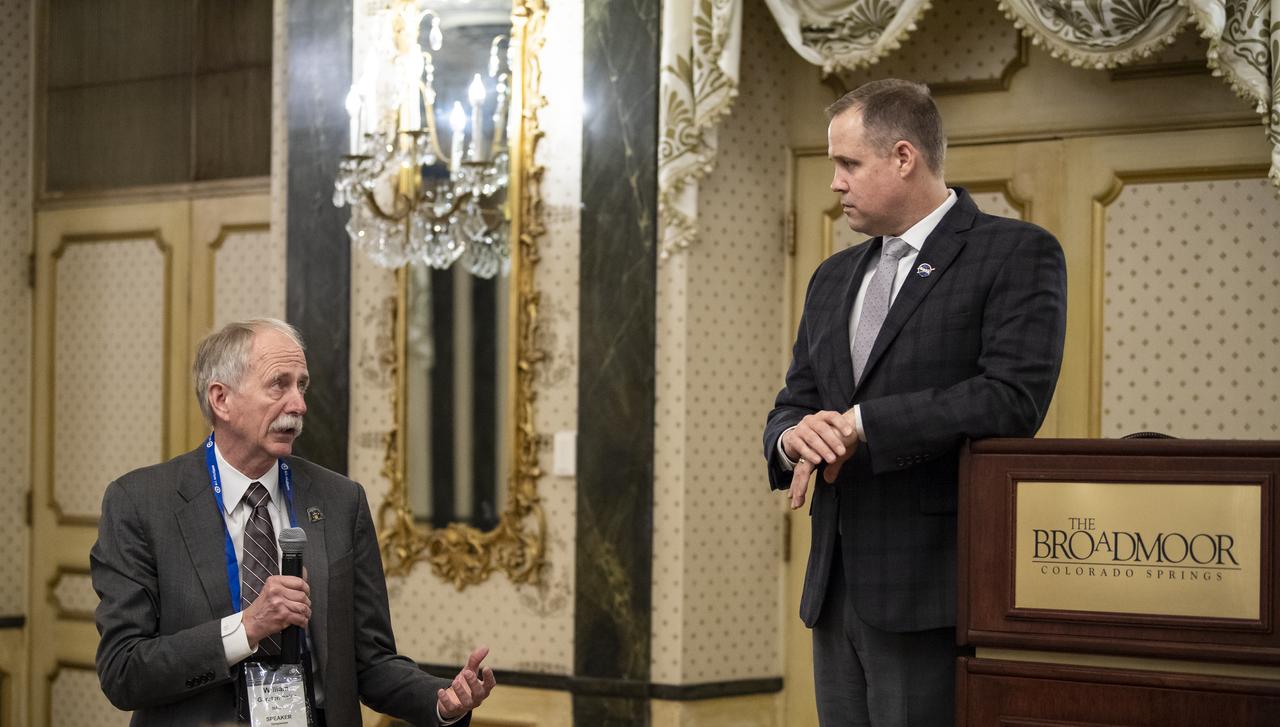
NASA Administrator Jim Bridenstine listens as Bill Gerstenmaier, associate administrator for the Human Exploration and Operations (HEO) directorate gives updates on HEO priorities at an agency meeting at the Space Symposium, Monday, April 8, 2019, at the Broadmoor Hotel in Colorado Springs, Colorado. Senior NASA officials from NASA centers around the country were in attendance. Photo credit: (NASA/Aubrey Gemignani)
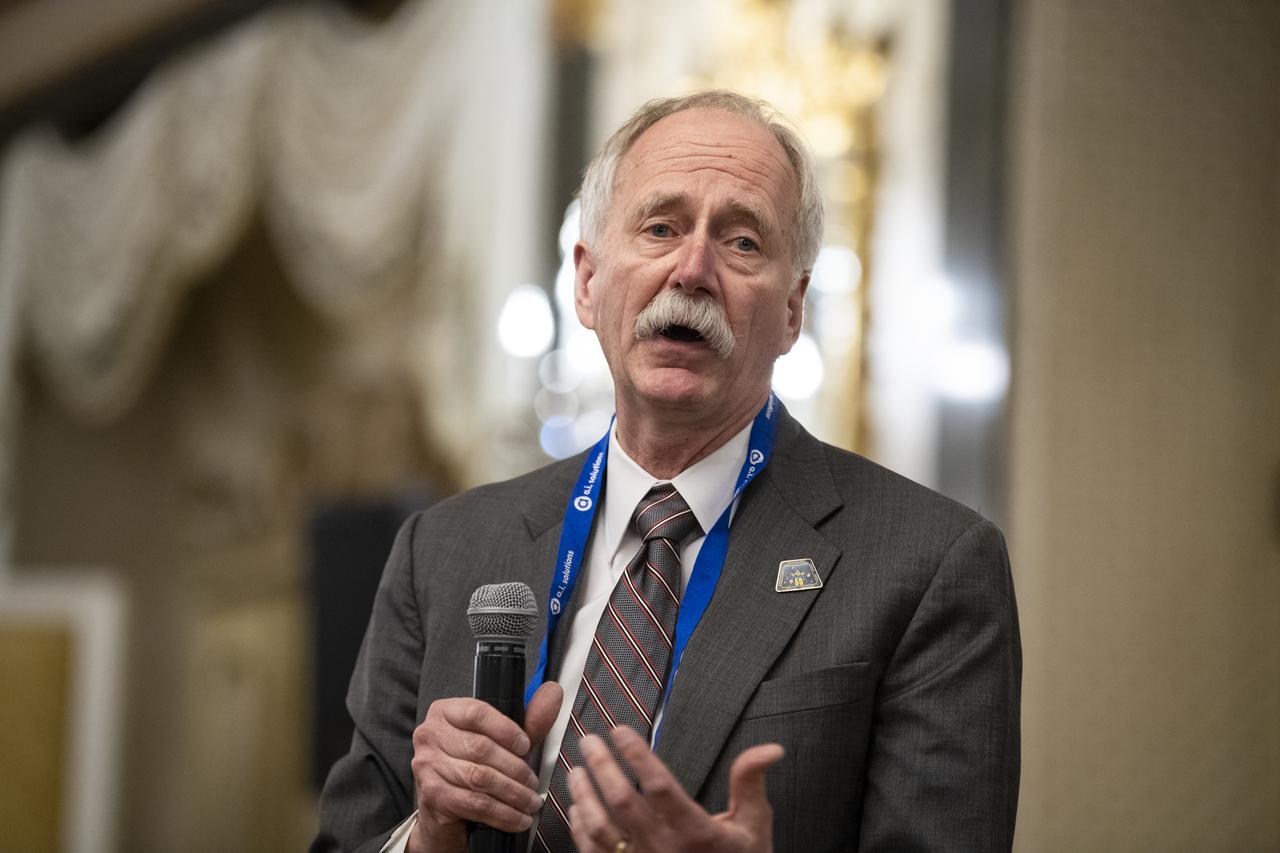
Bill Gerstenmaier, associate administrator for the Human Exploration and Operations (HEO) directorate gives updates on HEO priorities at an agency meeting at the Space Symposium, Monday, April 8, 2019, at the Broadmoor Hotel in Colorado Springs, Colorado. Senior NASA officials from NASA centers around the country were in attendance. Photo credit: (NASA/Aubrey Gemignani)
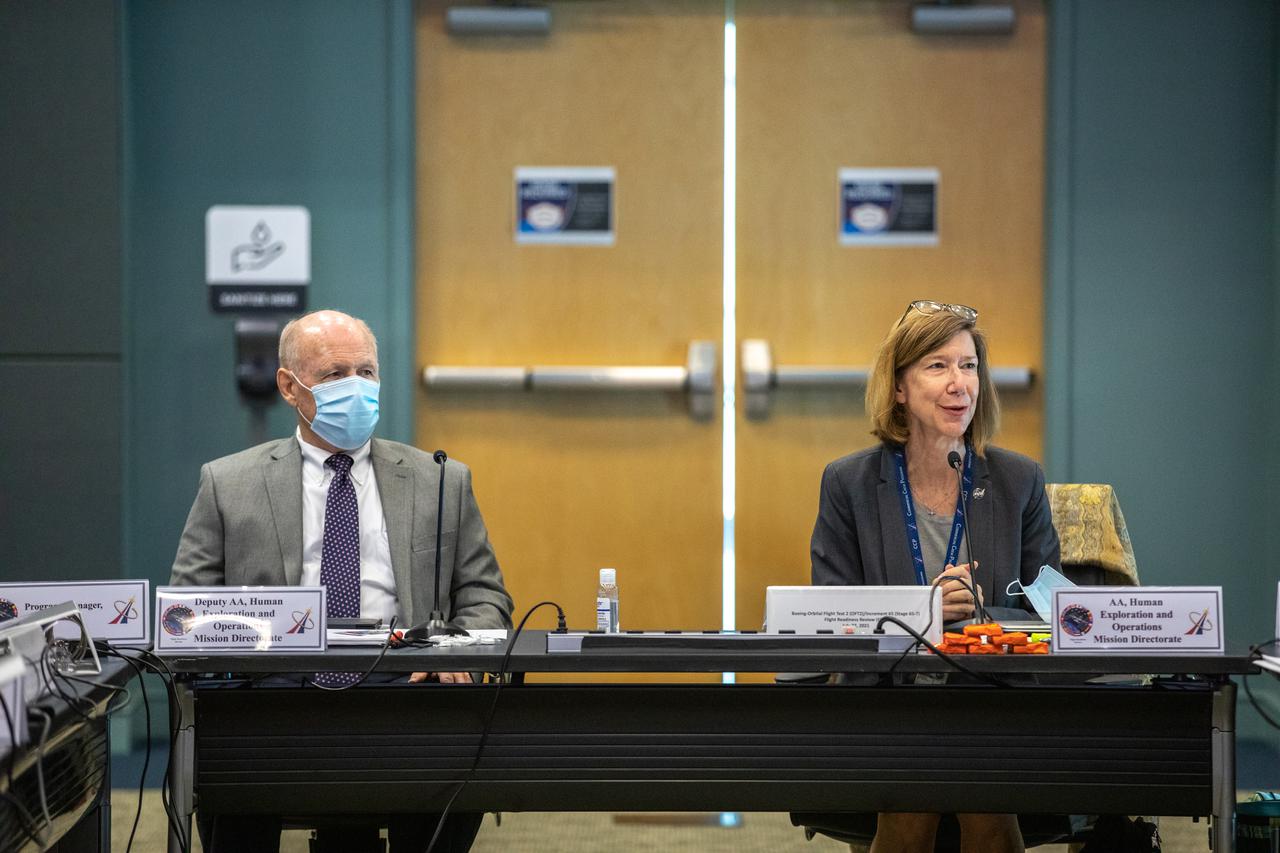
Deputy Associate Administrator of the Human Exploration and Operations (HEO) Mission Directorate Ken Bowersox (left) and Associate Administrator of the Human Exploration and Operations (HEO) Mission Directorate Kathryn Lueders take part in the Flight Readiness Review for Boeing's upcoming Orbital Flight Test-2 (OFT-2) in Operations Support Building 2 at NASA's Kennedy Space Center in Florida, July 22, 2021. Boeing's CST-100 Starliner spacecraft will launch atop a United Launch Alliance Atlas V rocket from Space Launch Complex 41 at Cape Canaveral Space Force Station at 2:53 p.m. EDT Friday, July 30. The uncrewed OFT-2 will be the Starliner's second flight to the International Space Station for NASA's Commercial Crew Program.
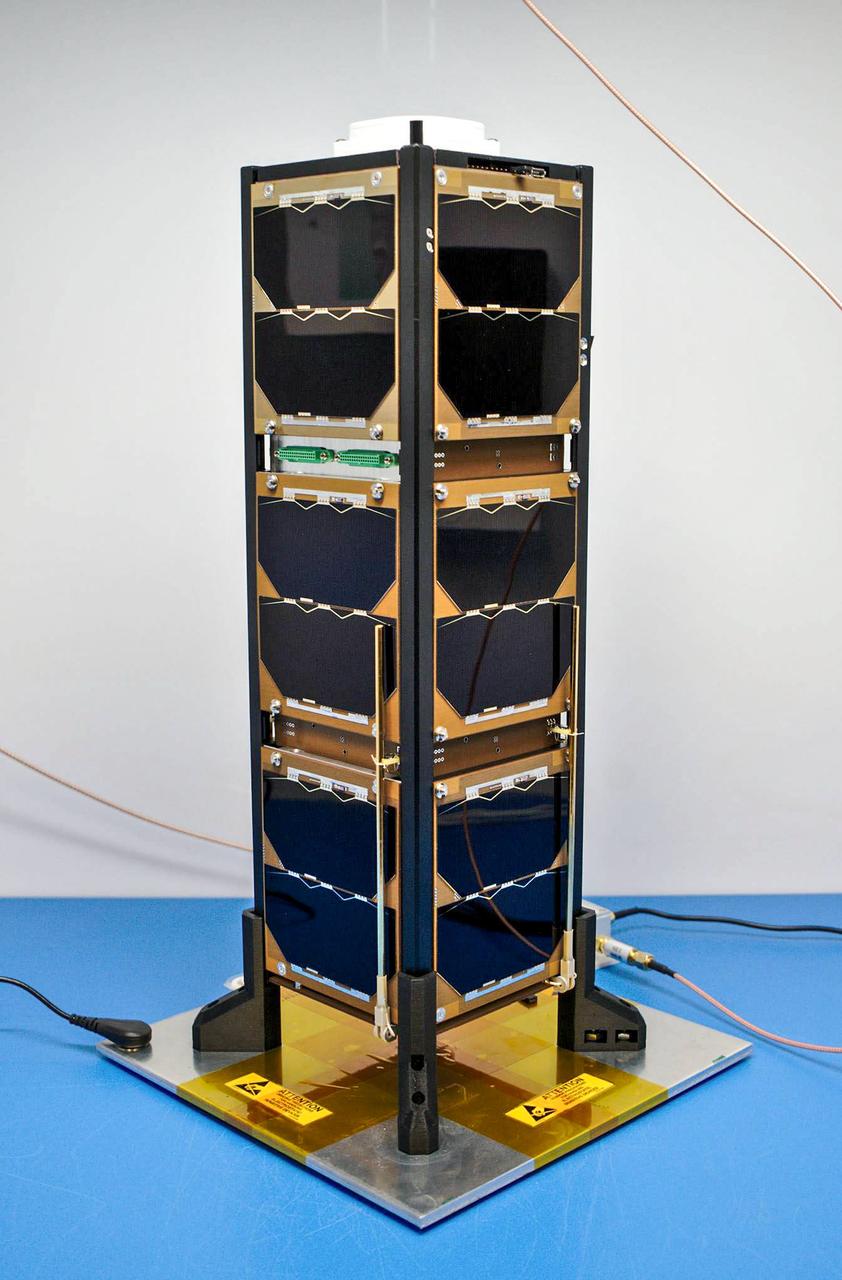
jsc2020e016862 (3/26/2020) --- Bobcat-1 with its deployable communication antenna stowed. Bobcat-1 is the Ohio University CubeSat, which has, together with the educational purpose, the objective of experimenting the GNSS inter-constellation time-offset estimate from LEO orbit. GNSS inter-constellation time-offset estimate is critical for users with a limited visibility of GNSS satellites, such as users in the high altitude Space Service Volume (as GEO or HEO).
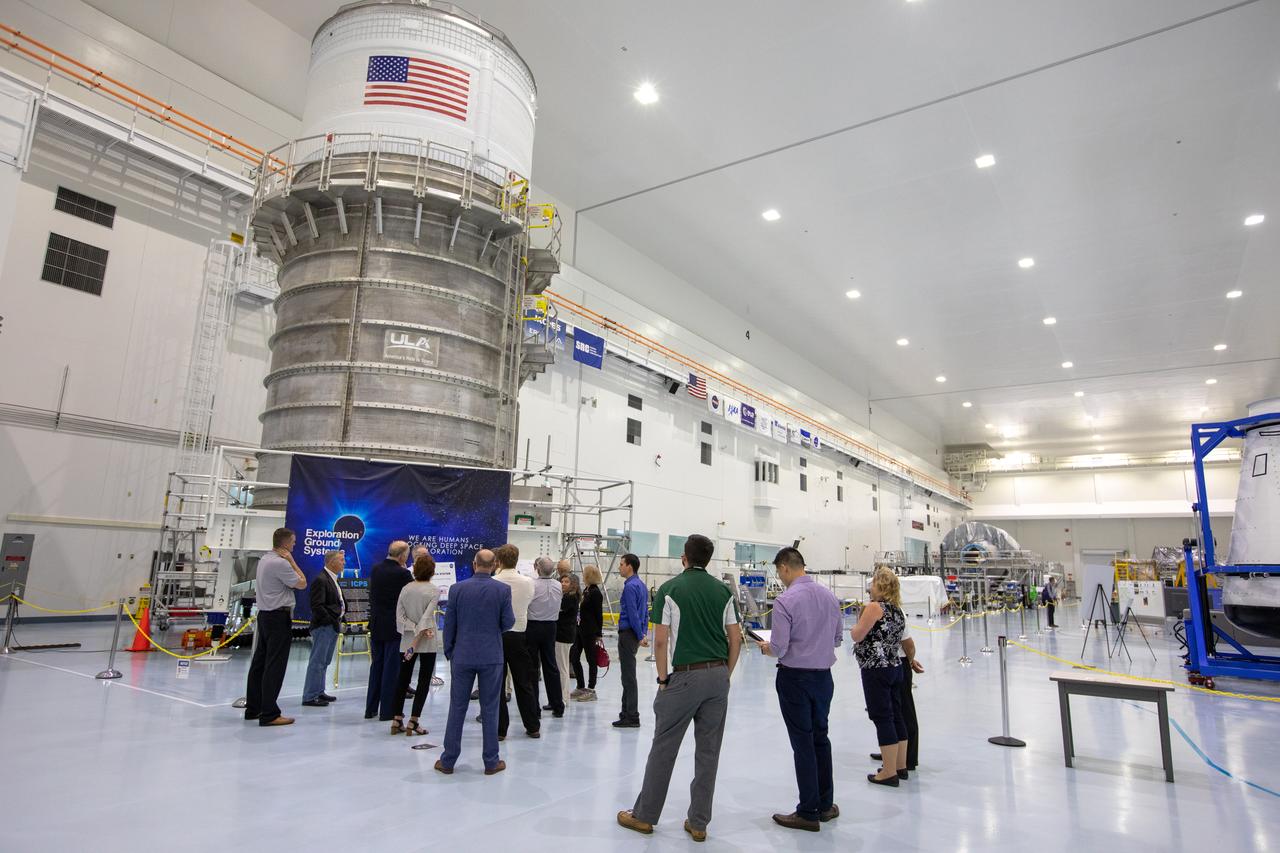
Members of the NASA Advisory Council toured the Space Station Processing Facility high bay at Kennedy Space Center in Florida on Oct. 29, 2019. In view is the interim cryogenic propulsion stage for the Space Launch System rocket. The NASA Advisory Council provides the NASA administrator with counsel and advice on programs and issues of importance to the agency. Committee members conduct fact-finding sessions throughout the year in an effort to gain a broad understanding of current NASA issues and future mission implementation plans.
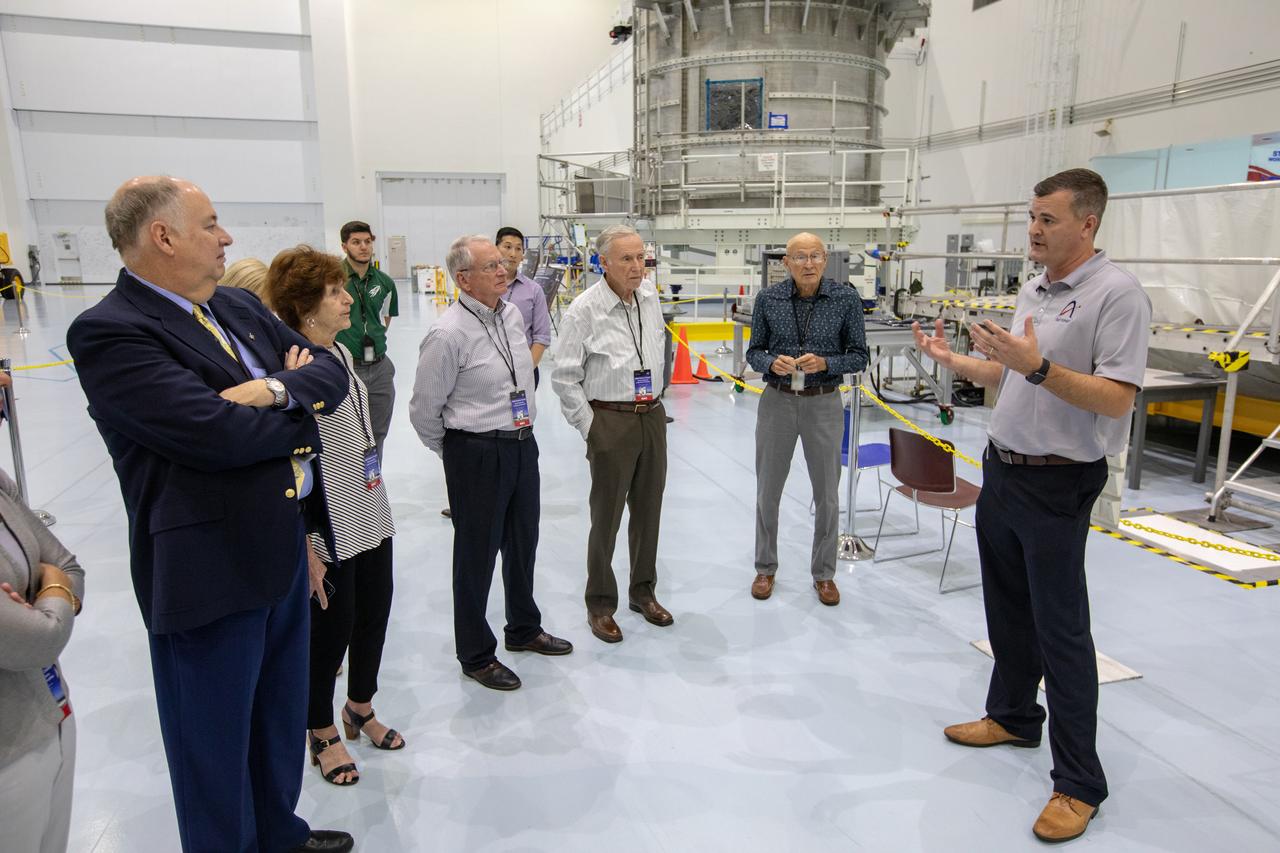
Members of the NASA Advisory Council toured the Space Station Processing Facility high bay at Kennedy Space Center in Florida on Oct. 29, 2019. The NASA Advisory Council provides the NASA administrator with counsel and advice on programs and issues of importance to the agency. Committee members conduct fact-finding sessions throughout the year in an effort to gain a broad understanding of current NASA issues and future mission implementation plans.
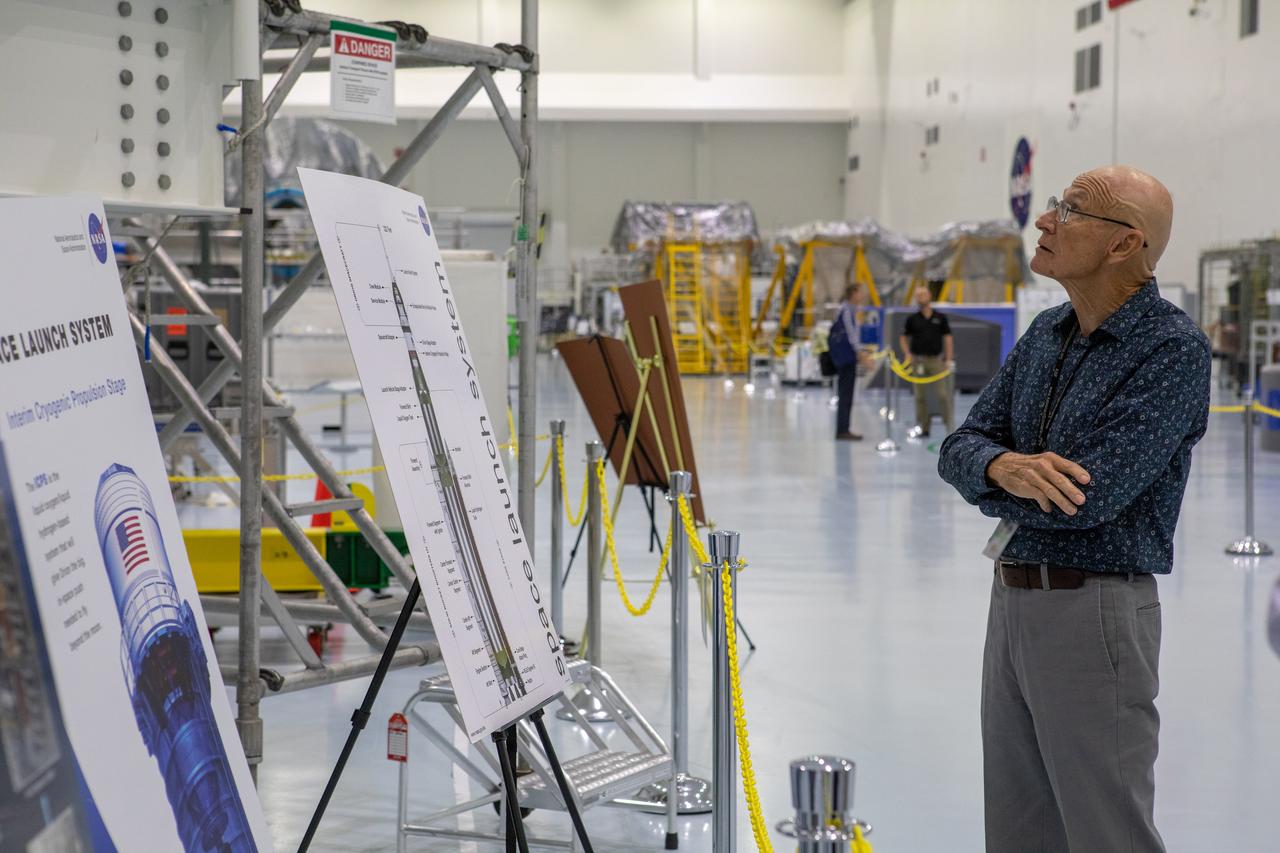
Members of the NASA Advisory Council toured the Space Station Processing Facility high bay at Kennedy Space Center in Florida on Oct. 29, 2019. In the foreground is Bob Sieck, former shuttle launch director. The NASA Advisory Council provides the NASA administrator with counsel and advice on programs and issues of importance to the agency. Committee members conduct fact-finding sessions throughout the year in an effort to gain a broad understanding of current NASA issues and future mission implementation plans.
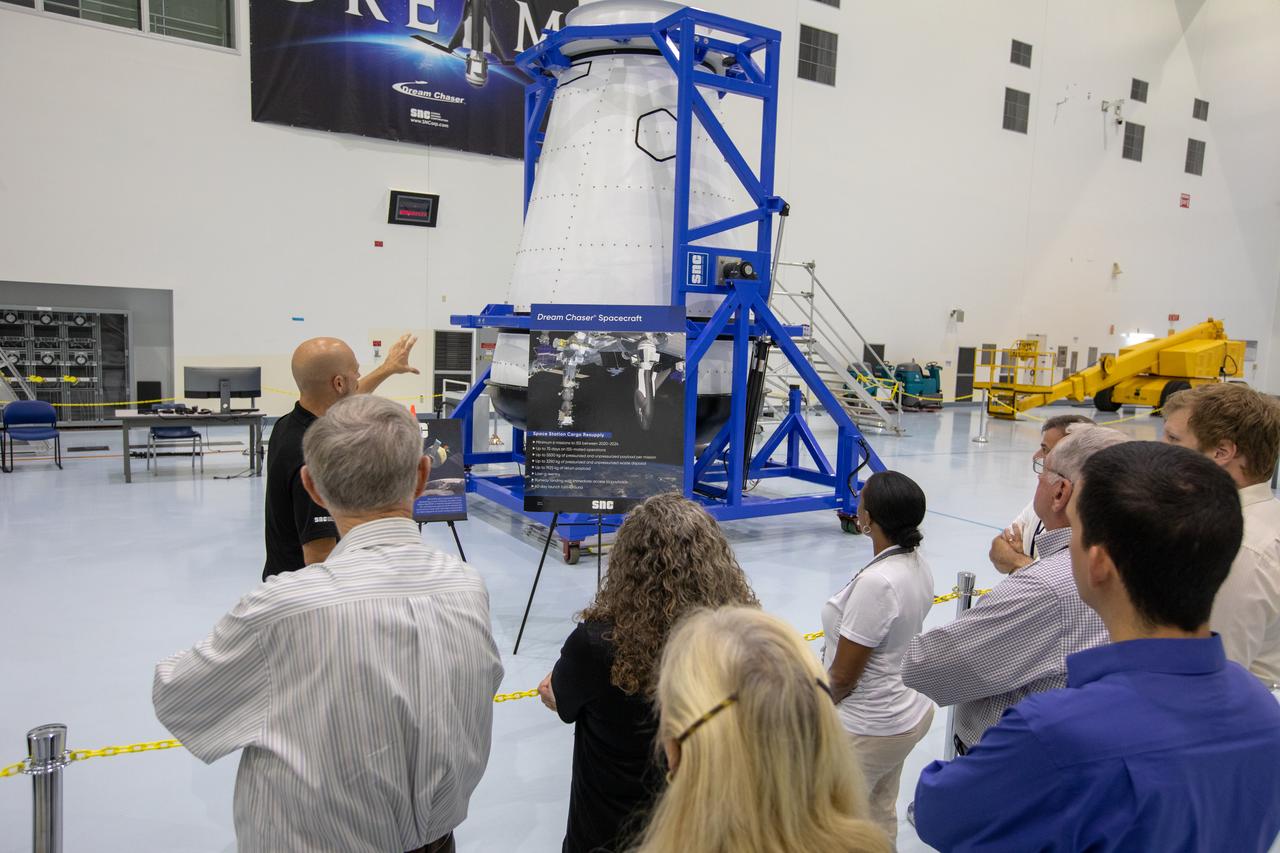
Members of the NASA Advisory Council toured the Space Station Processing Facility high bay at Kennedy Space Center in Florida on Oct. 29, 2019. In view is Sierra Nevada Corporation’s cargo logistics module. The NASA Advisory Council provides the NASA administrator with counsel and advice on programs and issues of importance to the agency. Committee members conduct fact-finding sessions throughout the year in an effort to gain a broad understanding of current NASA issues and future mission implementation plans.
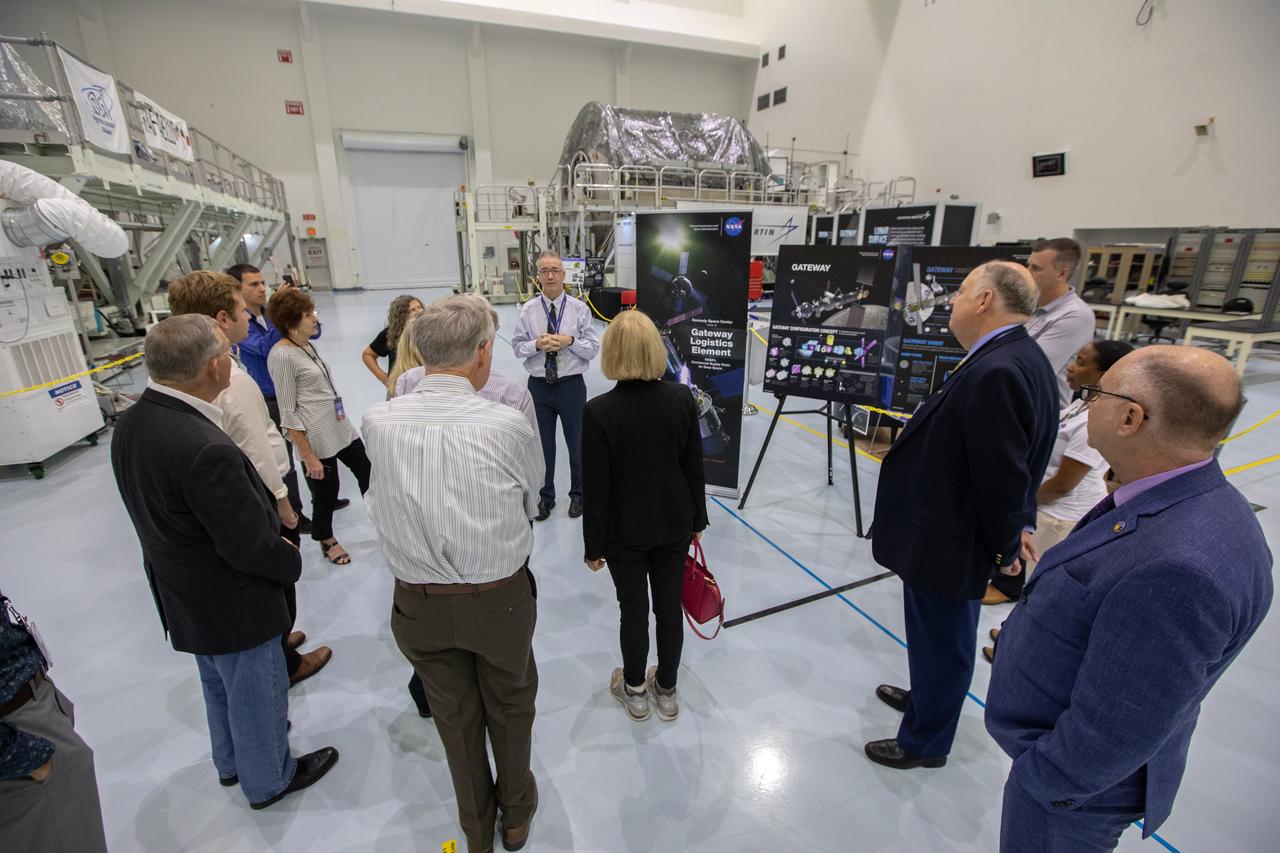
Members of the NASA Advisory Council toured the Space Station Processing Facility high bay at Kennedy Space Center in Florida on Oct. 29, 2019. In view are displays describing NASA’s Gateway Logistics Element. The NASA Advisory Council provides the NASA administrator with counsel and advice on programs and issues of importance to the agency. Committee members conduct fact-finding sessions throughout the year in an effort to gain a broad understanding of current NASA issues and future mission implementation plans.
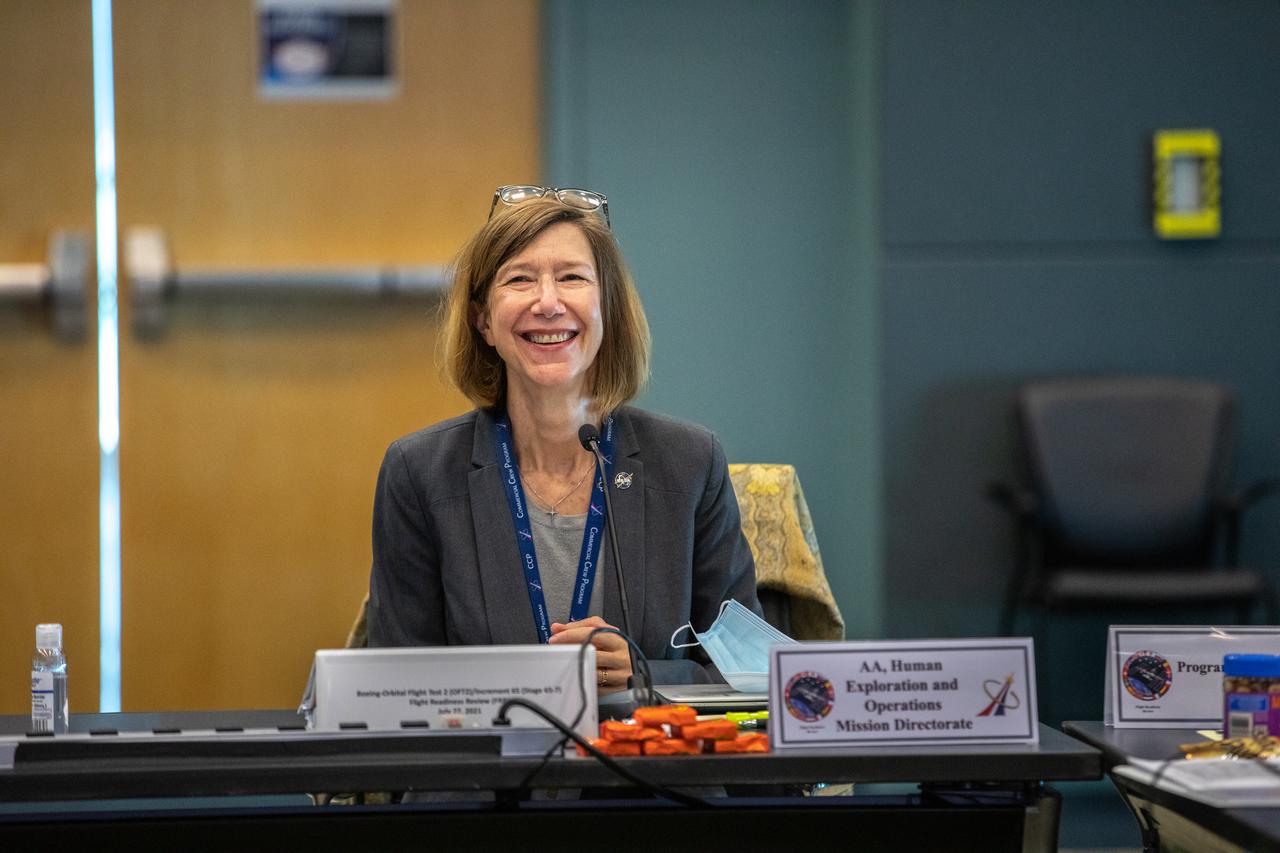
Associate Administrator of the Human Exploration and Operations (HEO) Mission Directorate Kathryn Lueders takes part in the Flight Readiness Review for Boeing's upcoming Orbital Flight Test-2 (OFT-2) in Operations Support Building 2 at NASA's Kennedy Space Center in Florida, July 22, 2021. Boeing's CST-100 Starliner spacecraft will launch atop a United Launch Alliance Atlas V rocket from Space Launch Complex 41 at Cape Canaveral Space Force Station at 2:53 p.m. EDT Friday, July 30. The uncrewed OFT-2 will be the Starliner's second flight to the International Space Station for NASA's Commercial Crew Program.
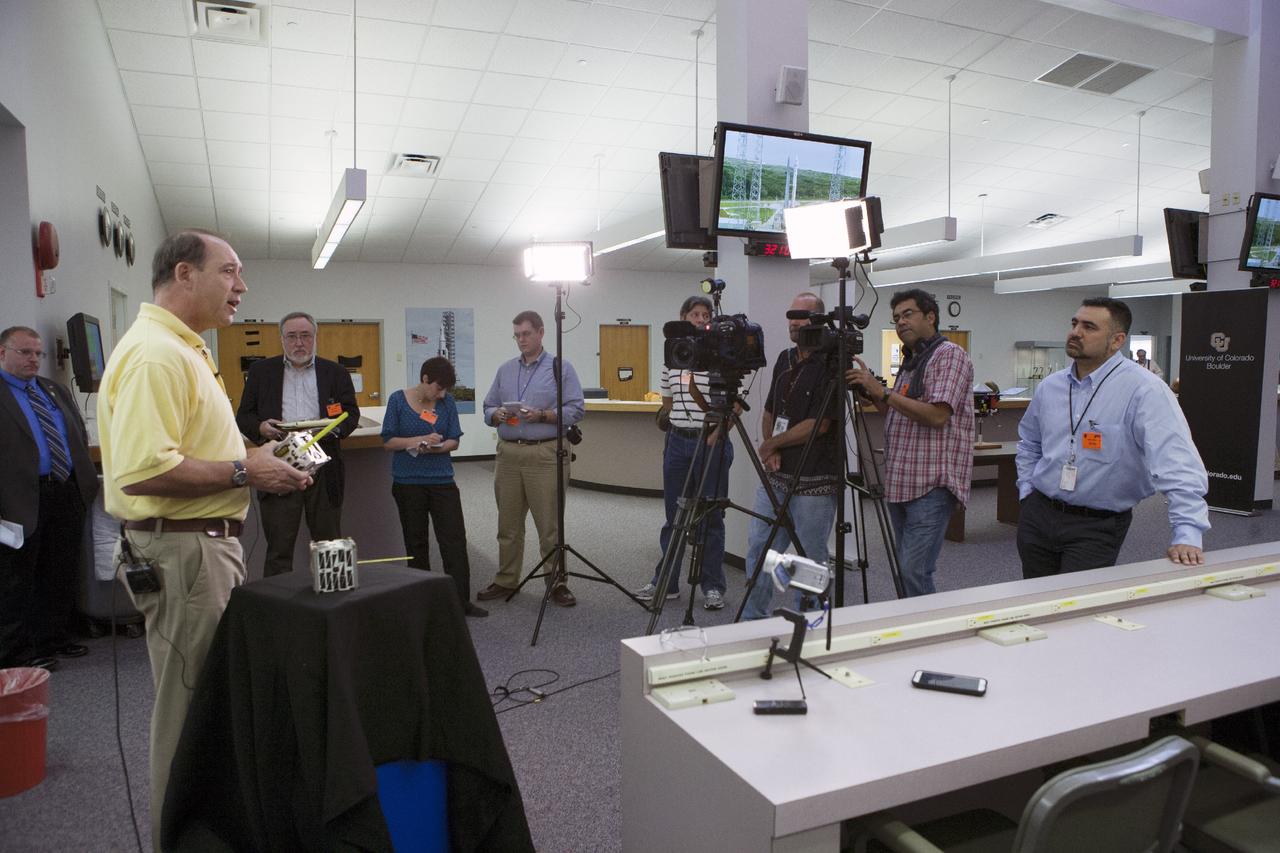
CAPE CANAVERAL, Fla. -- At the News Center at NASA's Kennedy Space Center in Florida, Andrew Petro, the agency's acting director of the Early Stage Innovation Division of the Office of the Chief Technologist, discusses the agency’s CubeSat Launch initiative. CubeSats provide opportunities for small satellite payloads to fly on rockets planned for upcoming launches. CubeSats, a class of research spacecraft called nanosatellites, are flown as auxiliary payloads on previously planned missions. The cube-shaped satellites are approximately four inches long, have a volume of about one quart and weigh about three pounds. For more information, visit: http://www.nasa.gov/directorates/heo/home/CubeSats_initiative.html Photo credit: NASA/Kim Shiflett
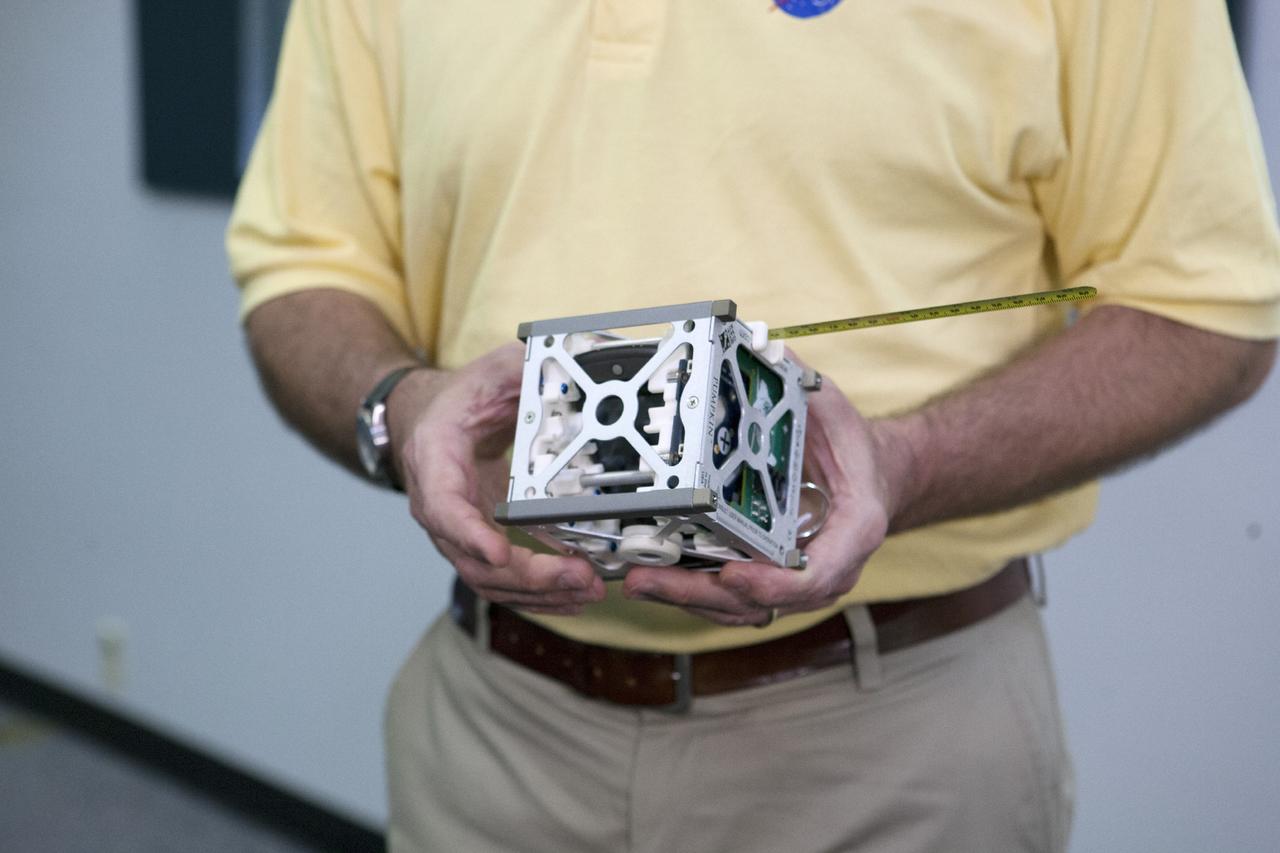
CAPE CANAVERAL, Fla. -- At the News Center at NASA's Kennedy Space Center in Florida, Andrew Petro, the agency's acting director of the Early Stage Innovation Division of the Office of the Chief Technologist, discusses the agency’s CubeSat Launch initiative. CubeSats provide opportunities for small satellite payloads to fly on rockets planned for upcoming launches. CubeSats, a class of research spacecraft called nanosatellites, are flown as auxiliary payloads on previously planned missions. The cube-shaped satellites are approximately four inches long, have a volume of about one quart and weigh about three pounds. For more information, visit: http://www.nasa.gov/directorates/heo/home/CubeSats_initiative.html Photo credit: NASA/Kim Shiflett
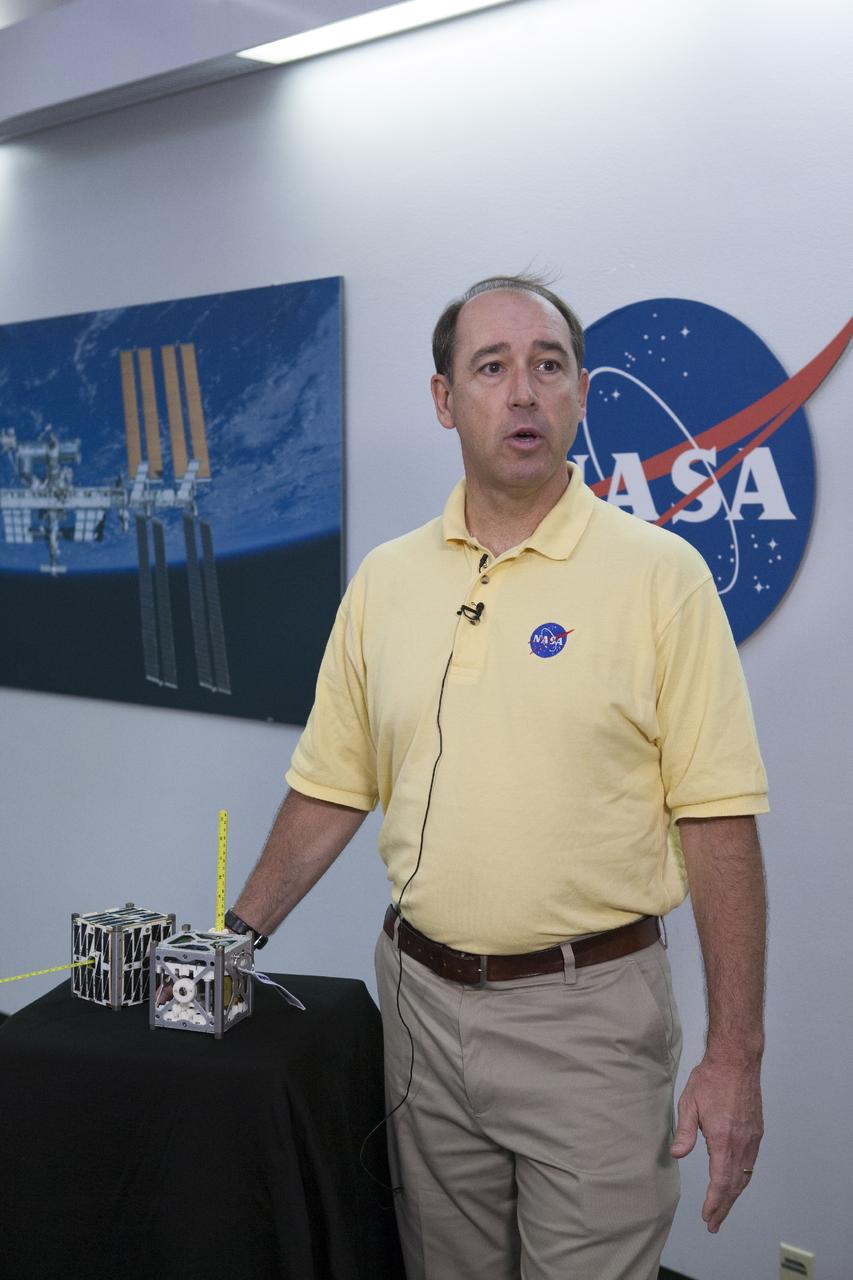
CAPE CANAVERAL, Fla. -- At the News Center at NASA's Kennedy Space Center in Florida, Andrew Petro, the agency's acting director of the Early Stage Innovation Division of the Office of the Chief Technologist, discusses the agency’s CubeSat Launch initiative. CubeSats provide opportunities for small satellite payloads to fly on rockets planned for upcoming launches. CubeSats, a class of research spacecraft called nanosatellites, are flown as auxiliary payloads on previously planned missions. The cube-shaped satellites are approximately four inches long, have a volume of about one quart and weigh about three pounds. For more information, visit: http://www.nasa.gov/directorates/heo/home/CubeSats_initiative.html Photo credit: NASA/Kim Shiflett
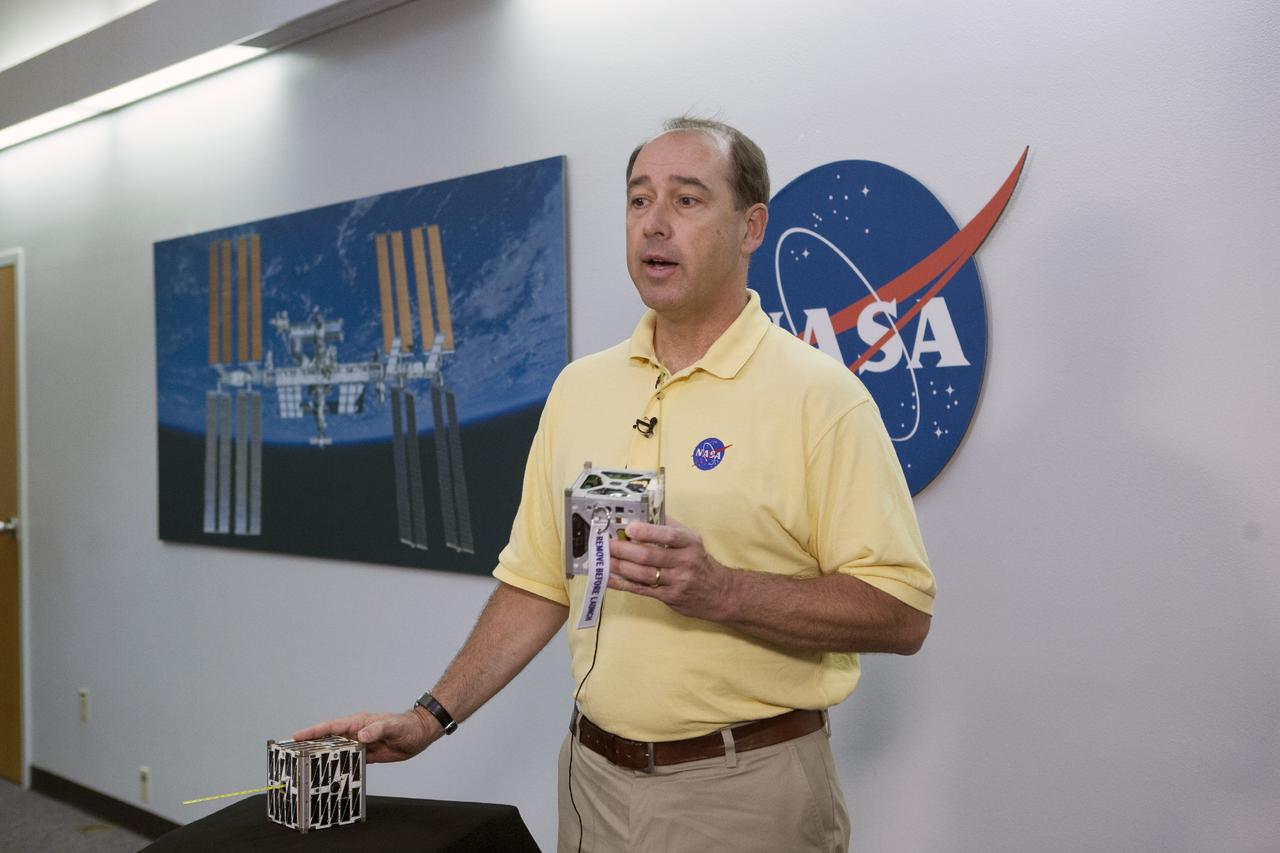
CAPE CANAVERAL, Fla. -- At the News Center at NASA's Kennedy Space Center in Florida, Andrew Petro, the agency's acting director of the Early Stage Innovation Division of the Office of the Chief Technologist, discusses the agency’s CubeSat Launch initiative. CubeSats provide opportunities for small satellite payloads to fly on rockets planned for upcoming launches. CubeSats, a class of research spacecraft called nanosatellites, are flown as auxiliary payloads on previously planned missions. The cube-shaped satellites are approximately four inches long, have a volume of about one quart and weigh about three pounds. For more information, visit: http://www.nasa.gov/directorates/heo/home/CubeSats_initiative.html Photo credit: NASA/Kim Shiflett
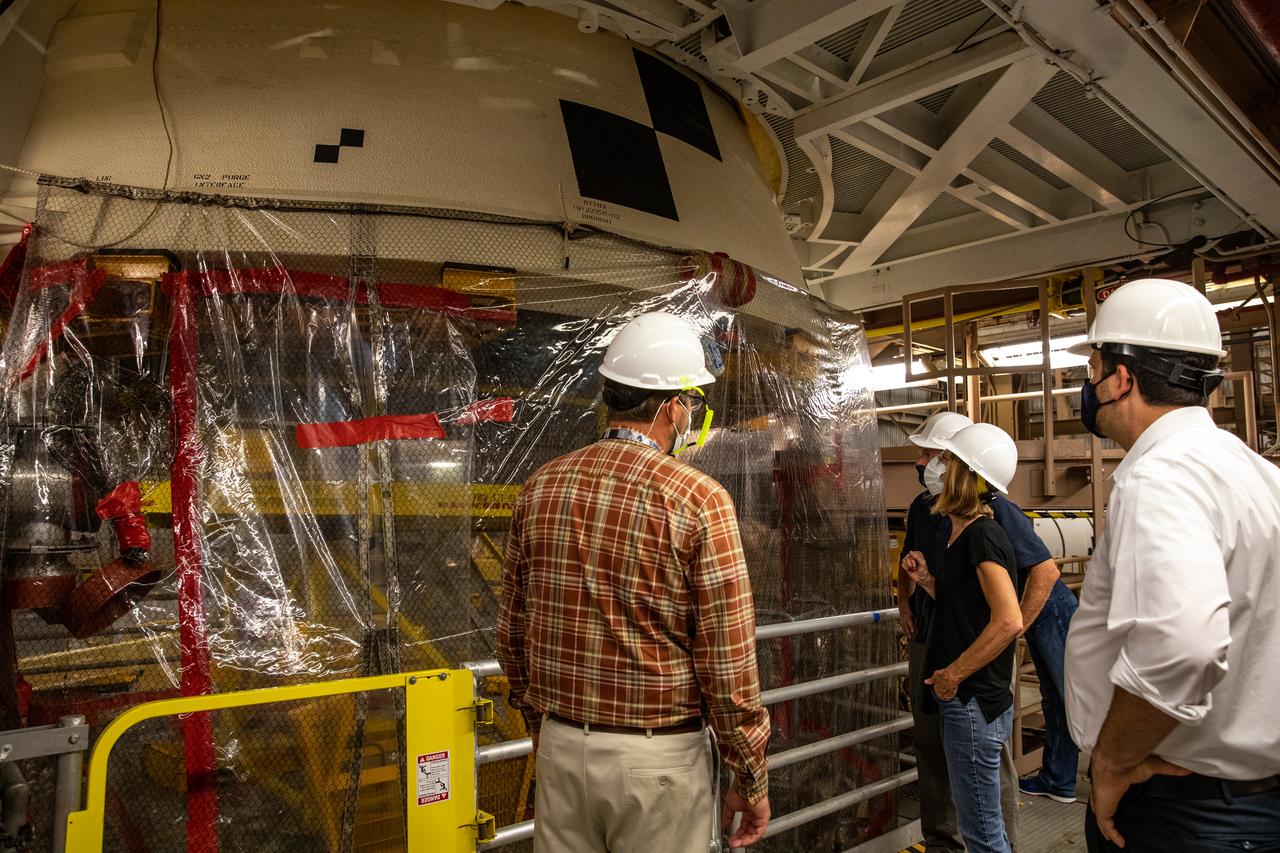
Kathy Lueders, second from right, NASA’s associate administrator for Human Exploration and Operations, along with members of the Exploration Ground Systems and Jacobs Technology leadership view Artemis hardware inside the Rotation, Processing and Surge Facility (RPSF) at the agency’s Kennedy Space Center in Florida on June 25, 2020. Manufactured by Northrop Grumman in Utah, the solid rocket booster segments for the Space Launch System rocket are in view. The first in a series of increasingly complex missions, Artemis I will test the Orion spacecraft and SLS as an integrated system ahead of crewed flights to the Moon.
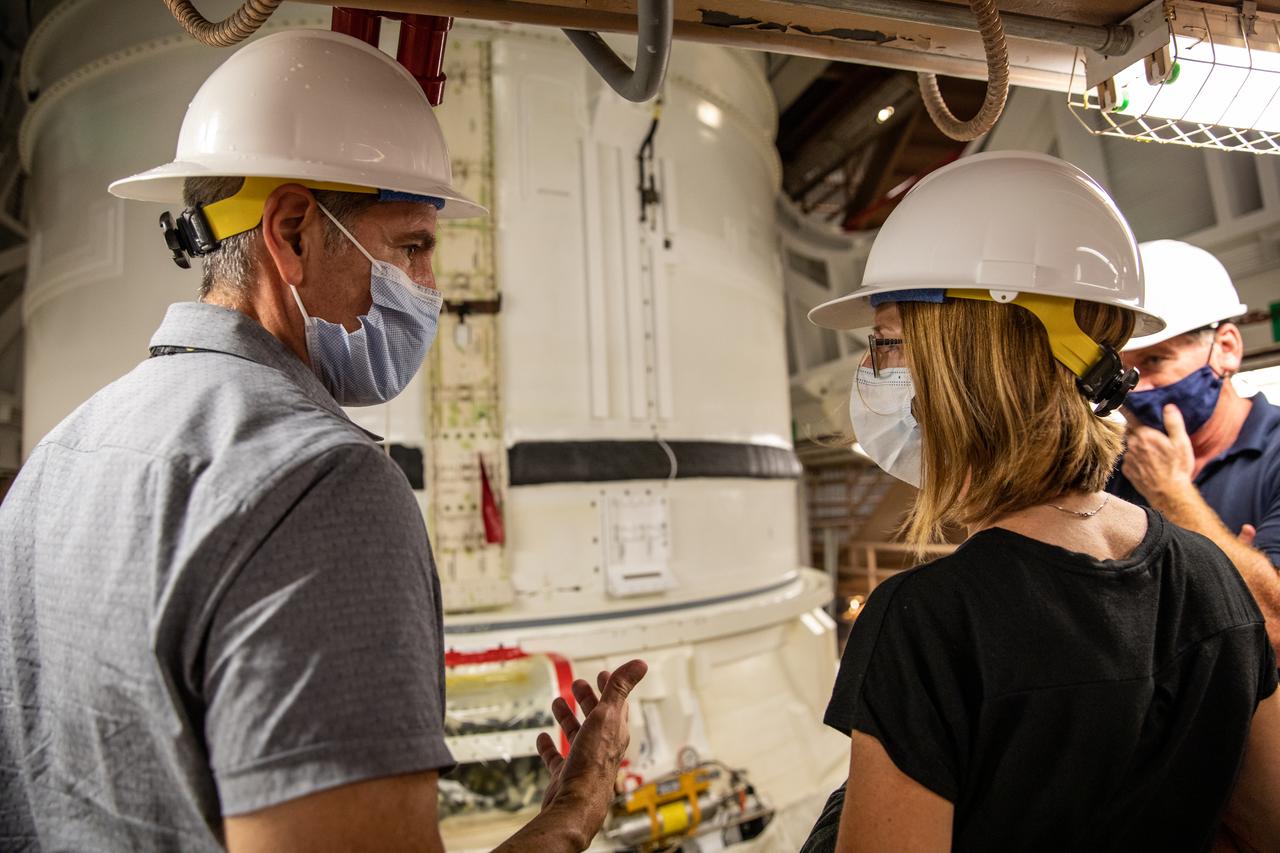
Kathy Lueders, at right, NASA’s associate administrator for Human Exploration and Operations, along with members of the Exploration Ground Systems and Jacobs Technology leadership view Artemis hardware inside the Rotation, Processing and Surge Facility (RPSF) at the agency’s Kennedy Space Center in Florida on June 25, 2020. Manufactured by Northrop Grumman in Utah, the solid rocket booster segments for the Space Launch System rocket are in view. The first in a series of increasingly complex missions, Artemis I will test the Orion spacecraft and SLS as an integrated system ahead of crewed flights to the Moon.
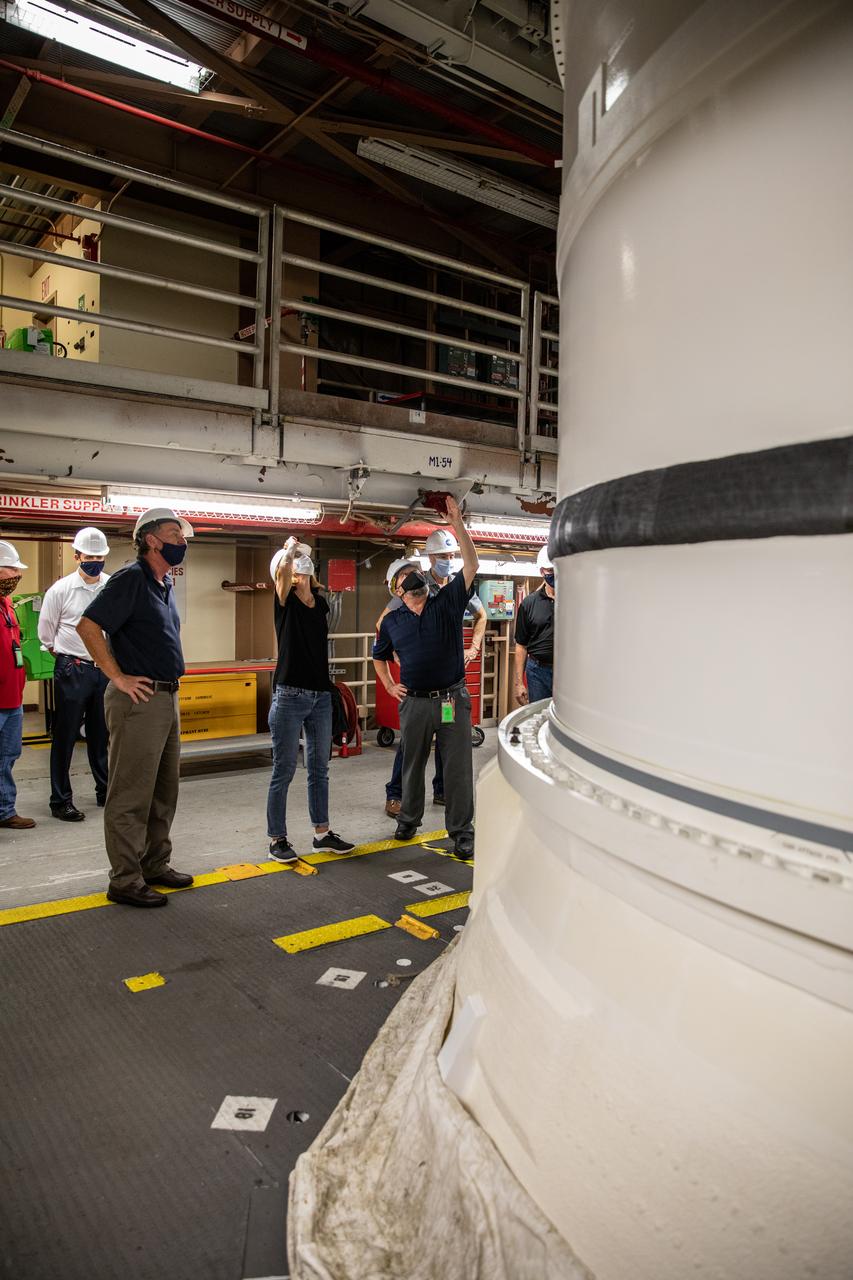
Kathy Lueders, second from right, NASA’s associate administrator for Human Exploration and Operations, along with members of the Exploration Ground Systems and Jacobs Technology leadership view Artemis hardware inside the Rotation, Processing and Surge Facility (RPSF) at the agency’s Kennedy Space Center in Florida on June 25, 2020. Manufactured by Northrop Grumman in Utah, the solid rocket booster segments for the Space Launch System rocket are in view. The first in a series of increasingly complex missions, Artemis I will test the Orion spacecraft and SLS as an integrated system ahead of crewed flights to the Moon.
Kathy Lueders, in the center at right, NASA’s associate administrator for Human Exploration and Operations, along with members of the Exploration Ground Systems and Jacobs Technology leadership view Artemis hardware inside the Rotation, Processing and Surge Facility (RPSF) at the agency’s Kennedy Space Center in Florida on June 25, 2020. Manufactured by Northrop Grumman in Utah, the solid rocket booster segments for the Space Launch System rocket are in view. The first in a series of increasingly complex missions, Artemis I will test the Orion spacecraft and SLS as an integrated system ahead of crewed flights to the Moon.
Kathy Lueders, at right, NASA’s associate administrator for Human Exploration and Operations, along with Exploration Ground Systems leadership view Artemis hardware inside the Rotation, Processing and Surge Facility (RPSF) at the agency’s Kennedy Space Center in Florida on June 25, 2020. Manufactured by Northrop Grumman in Utah, the solid rocket booster segments for the Space Launch System rocket are in view. The first in a series of increasingly complex missions, Artemis I will test the Orion spacecraft and SLS as an integrated system ahead of crewed flights to the Moon.
Kathy Lueders, at left, NASA’s associate administrator for Human Exploration and Operations, along with members of the Exploration Ground Systems and Jacobs Technology leadership view Artemis hardware inside the Rotation, Processing and Surge Facility (RPSF) at the agency’s Kennedy Space Center in Florida on June 25, 2020. Manufactured by Northrop Grumman in Utah, the solid rocket booster segments for the Space Launch System rocket are in view. The first in a series of increasingly complex missions, Artemis I will test the Orion spacecraft and SLS as an integrated system ahead of crewed flights to the Moon.
Kathy Lueders, at right, NASA’s associate administrator for Human Exploration and Operations along with members of the Exploration Ground Systems and Jacobs Technology leadership view Artemis hardware inside the Rotation, Processing and Surge Facility (RPSF) at the agency’s Kennedy Space Center in Florida on June 25, 2020. Manufactured by Northrop Grumman in Utah, the solid rocket booster segments for the Space Launch System rocket are in view. The first in a series of increasingly complex missions, Artemis I will test the Orion spacecraft and SLS as an integrated system ahead of crewed flights to the Moon.

Kathy Lueders, NASA’s associate administrator for Human Exploration and Operations, views Artemis hardware inside the Rotation, Processing and Surge Facility (RPSF) at the agency’s Kennedy Space Center in Florida on June 25, 2020. Manufactured by Northrop Grumman in Utah, the solid rocket booster segments for the Space Launch System rocket are in view. The first in a series of increasingly complex missions, Artemis I will test the Orion spacecraft and SLS as an integrated system ahead of crewed flights to the Moon.
Kathy Lueders, at right, NASA’s associate administrator for Human Exploration and Operations, along with members of the Exploration Ground Systems and Jacobs Technology leadership view Artemis hardware inside the Rotation, Processing and Surge Facility (RPSF) at the agency’s Kennedy Space Center in Florida on June 25, 2020. Manufactured by Northrop Grumman in Utah, the solid rocket booster segments for the Space Launch System rocket are in view. The first in a series of increasingly complex missions, Artemis I will test the Orion spacecraft and SLS as an integrated system ahead of crewed flights to the Moon.
Kathy Lueders, center, NASA’s associate administrator for Human Exploration and Operations, along with members of the Exploration Ground Systems and Jacobs Technology leadership view Artemis hardware inside the Rotation, Processing and Surge Facility (RPSF) at the agency’s Kennedy Space Center in Florida on June 25, 2020. Manufactured by Northrop Grumman in Utah, the solid rocket booster segments for the Space Launch System rocket are in view. The first in a series of increasingly complex missions, Artemis I will test the Orion spacecraft and SLS as an integrated system ahead of crewed flights to the Moon.
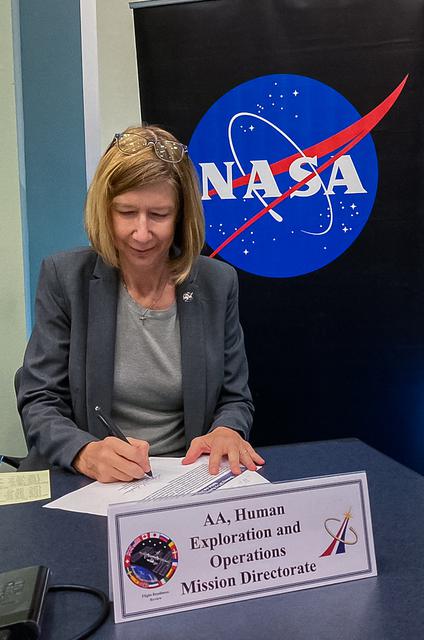
Associate Administrator of the Human Exploration and Operations (HEO) Mission Directorate Kathryn Lueders chaired the Flight Readiness Review for Boeing's upcoming Orbital Flight Test-2 (OFT-2) in Operations Support Building 2 at NASA's Kennedy Space Center in Florida, July 22, 2021. At the conclusion of the meeting, all board members sign the Certificate of Flight Readiness certifying their readiness to proceed to the next milestones and launch of Boeing's CST-100 Starliner atop a United Launch Alliance Atlas V rocket from Space Launch Complex 41 at Cape Canaveral Space Force Station. Launch time remains 2:53 p.m. EDT Friday, July 30 for the uncrewed OFT-2 mission – Starliner's second flight to the International Space Station for NASA's Commercial Crew Program.
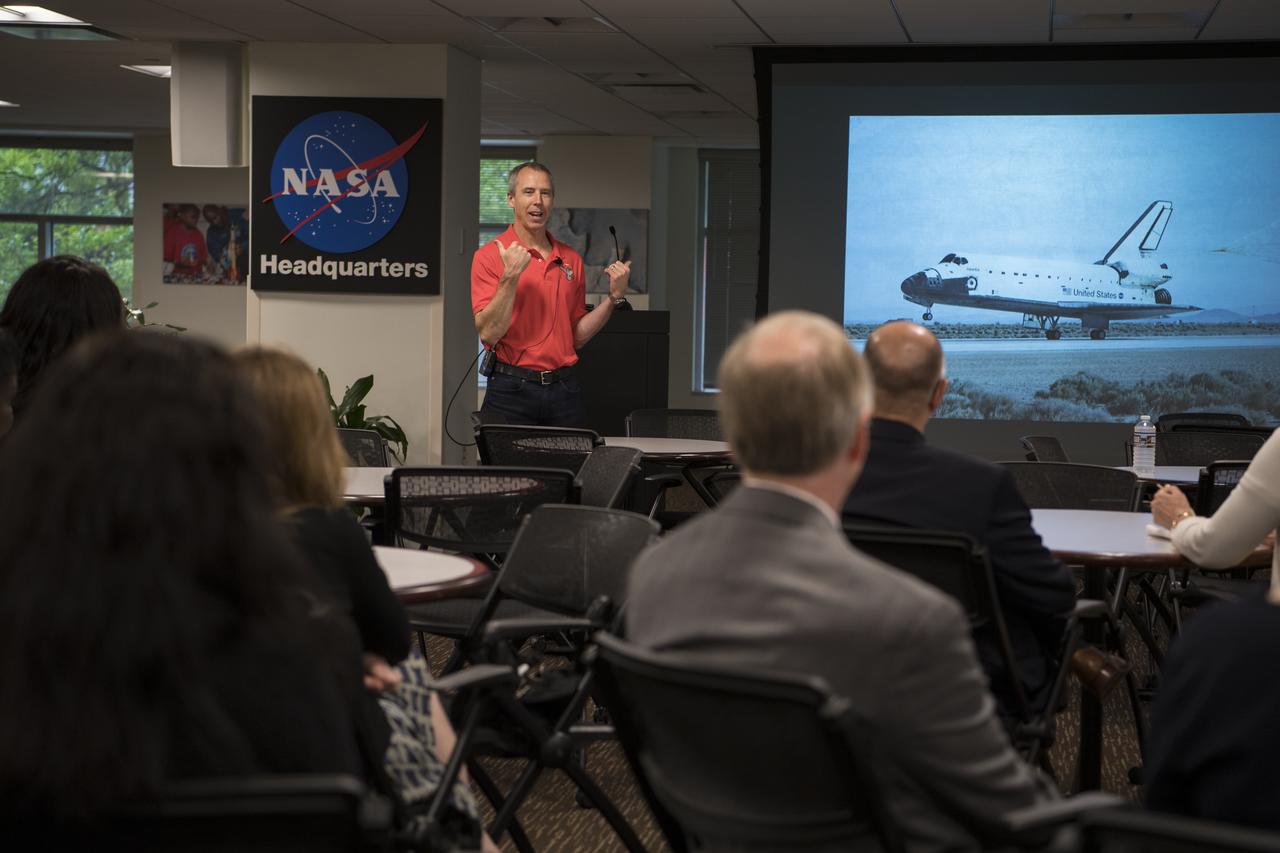
NASA astronaut Drew Feustel speaks about his experience on two space shuttle missions, STS-125 and STS-134, and a long duration mission onboard the International Space Station at NASA Headquarters, Thursday, May 9, 2019 in Washington, DC. Feustel most recently spent 197 days living and working onboard the International Space Station as part of Expedition 55 and as commander of Expedition 56. Feustel ventured outside the space station on three spacewalks, moving him up to second among U.S. spacewalkers with a cumulative time of 61 hours 48 minutes over nine spacewalks. Photo Credit: (NASA/Aubrey Gemignani)
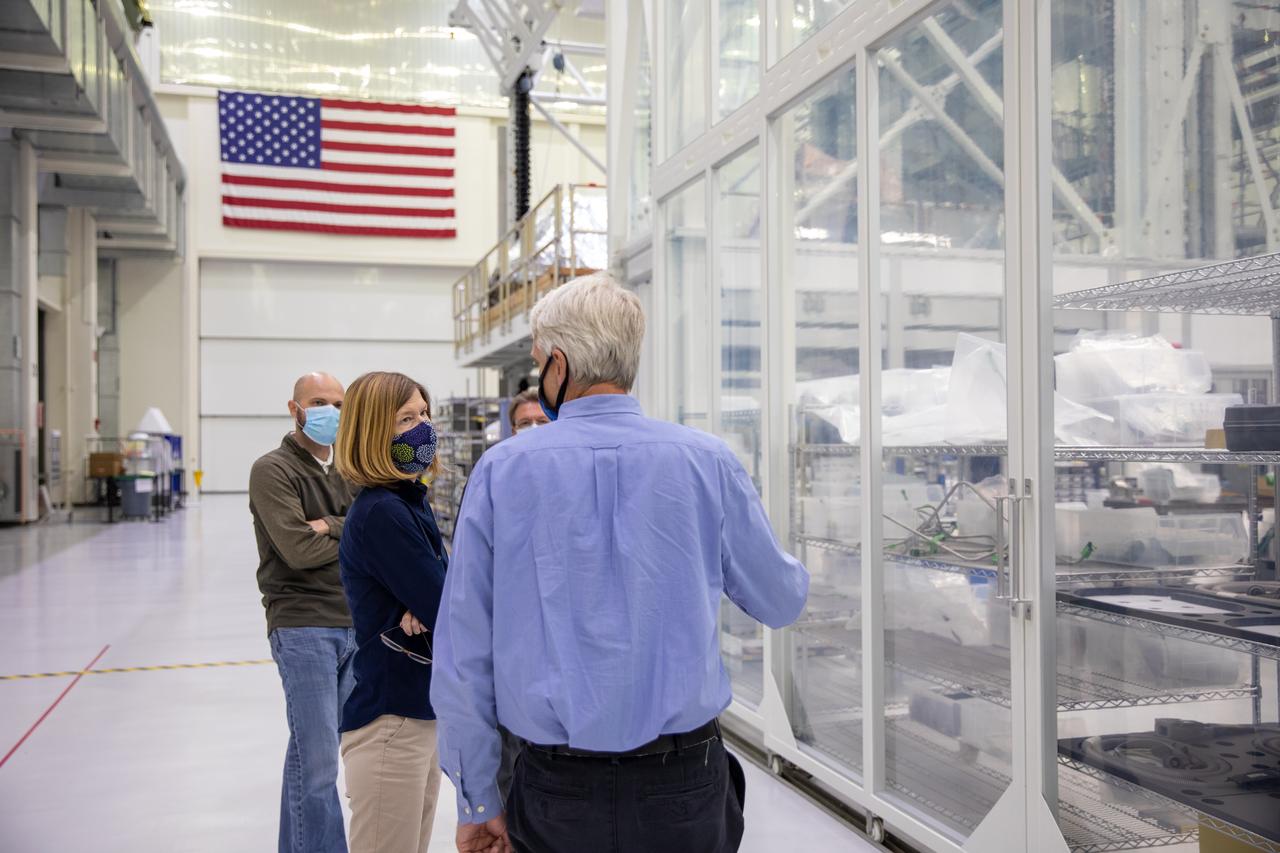
Senior managers from Orion, NASA, and Lockheed Martin view the Artemis II crew module inside a clean room during a visit to the Neil Armstrong Operations and Checkout Building high bay at NASA’s Kennedy Space Center in Florida on Nov. 5, 2020. From left are Jim Skaggs, senior manager of Kennedy Operations for Lockheed Martin; Kathy Lueders, associate administrator of NASA’s Human Exploration and Operations Mission Directorate; and Scott Wilson, manager, Orion Production Office. Artemis II will be the first crewed flight test of the Space Launch System rocket and the Orion spacecraft. Under the Artemis program, NASA is planning to land the first woman and the next man on the lunar surface by 2024.
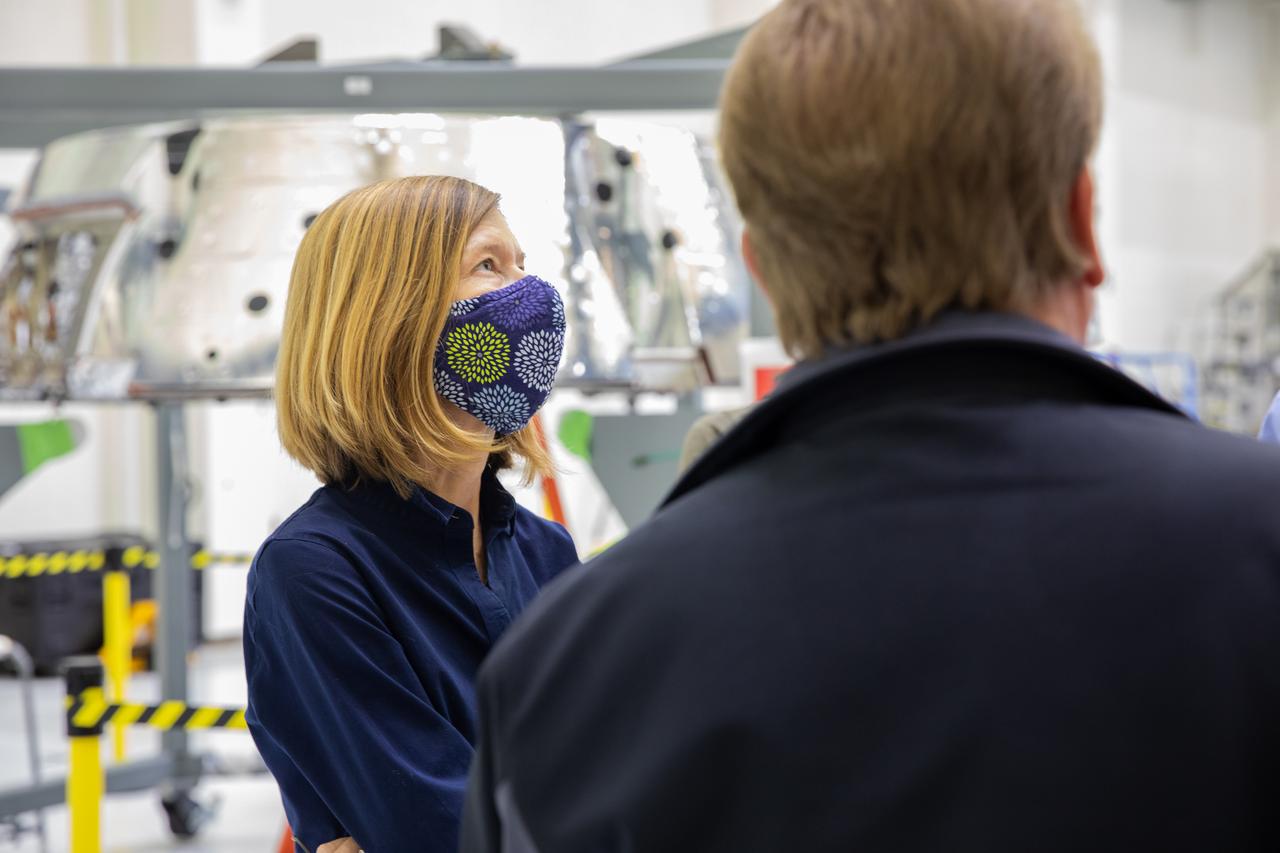
Kathy Lueders, associate administrator of NASA’s Human Exploration and Operations Mission Directorate, visits the Neil Armstrong Operations and Checkout Building high bay at the agency’s Kennedy Space Center in Florida on Nov. 5, 2020. In the background is the Orion spacecraft’s forward bay cover for Artemis I. The first in a series of increasingly complex missions, Artemis I will test the Space Launch System rocket and Orion spacecraft as an integrated system prior to crewed flights to the Moon. Under the Artemis program, NASA is planning to land the first woman and the next man on the lunar surface by 2024.
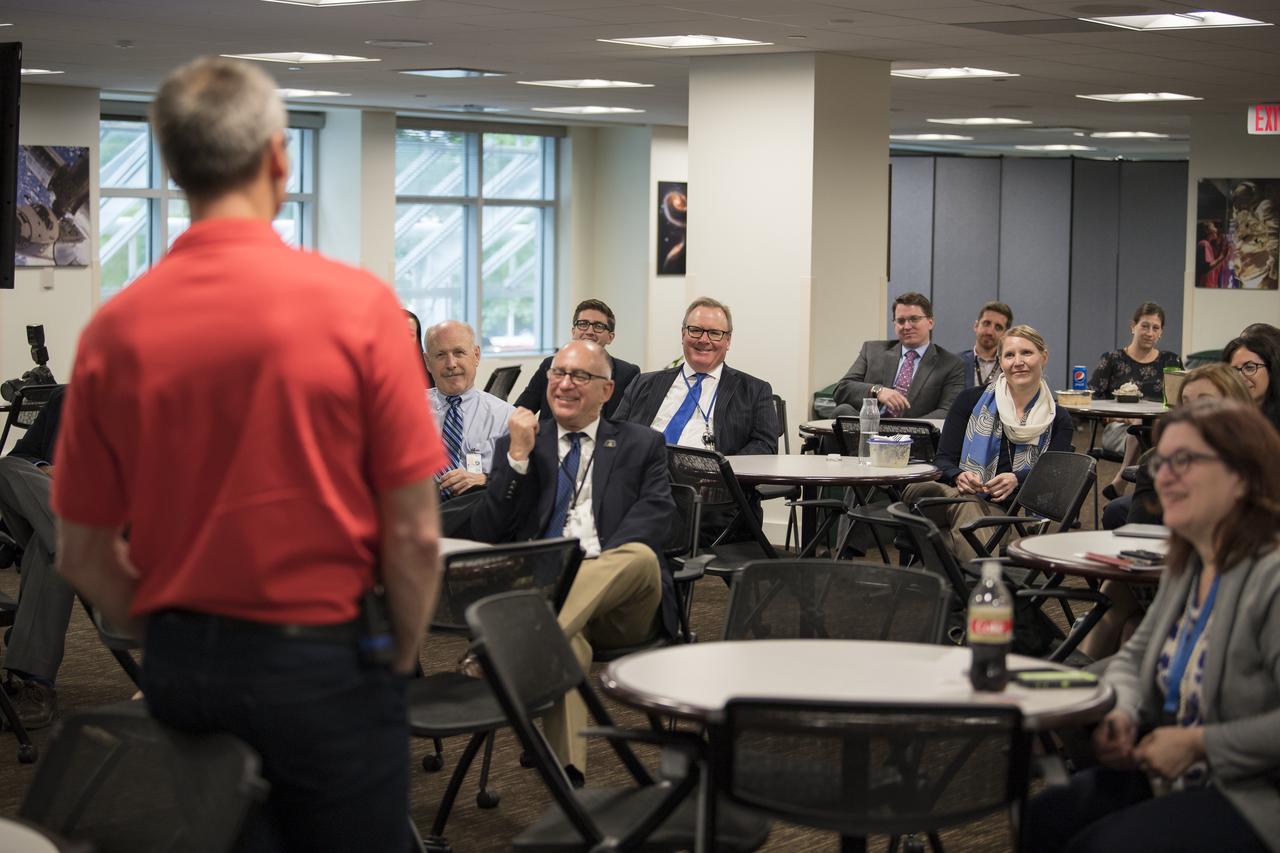
NASA astronaut Drew Feustel speaks about his experience on two space shuttle missions, STS-125 and STS-134, and a long duration mission onboard the International Space Station at NASA Headquarters, Thursday, May 9, 2019 in Washington, DC. Feustel most recently spent 197 days living and working onboard the International Space Station as part of Expedition 55 and as commander of Expedition 56. Feustel ventured outside the space station on three spacewalks, moving him up to second among U.S. spacewalkers with a cumulative time of 61 hours 48 minutes over nine spacewalks. Photo Credit: (NASA/Aubrey Gemignani)
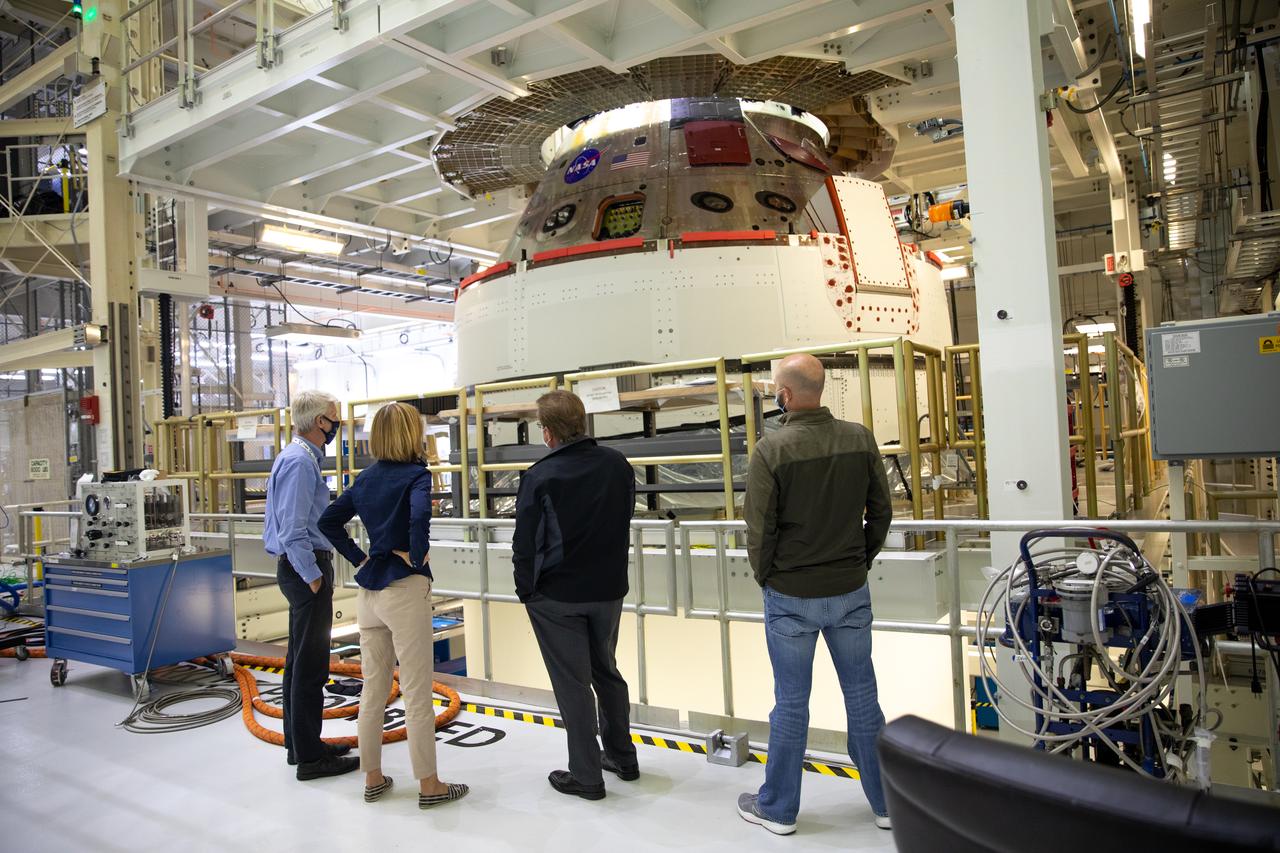
Senior managers from Orion, NASA, and Lockheed Martin view the Artemis I spacecraft during a visit to the Neil Armstrong Operations and Checkout Building high bay at NASA’s Kennedy Space Center in Florida on Nov. 5, 2020. From left are Scott Wilson, manager, Orion Production Office; Kathy Lueders, associate administrator of NASA’s Human Exploration and Operations Mission Directorate; Jules Schneider, director of Assembly, Test, and Launch Operations for Lockheed Martin; and Jim Skaggs, senior manager of Kennedy Operations for Lockheed Martin. The first in a series of increasingly complex missions, Artemis I will test the Space Launch System rocket and Orion spacecraft as an integrated system prior to crewed flights to the Moon. Under the Artemis program, NASA is planning to land the first woman and the next man on the lunar surface by 2024.
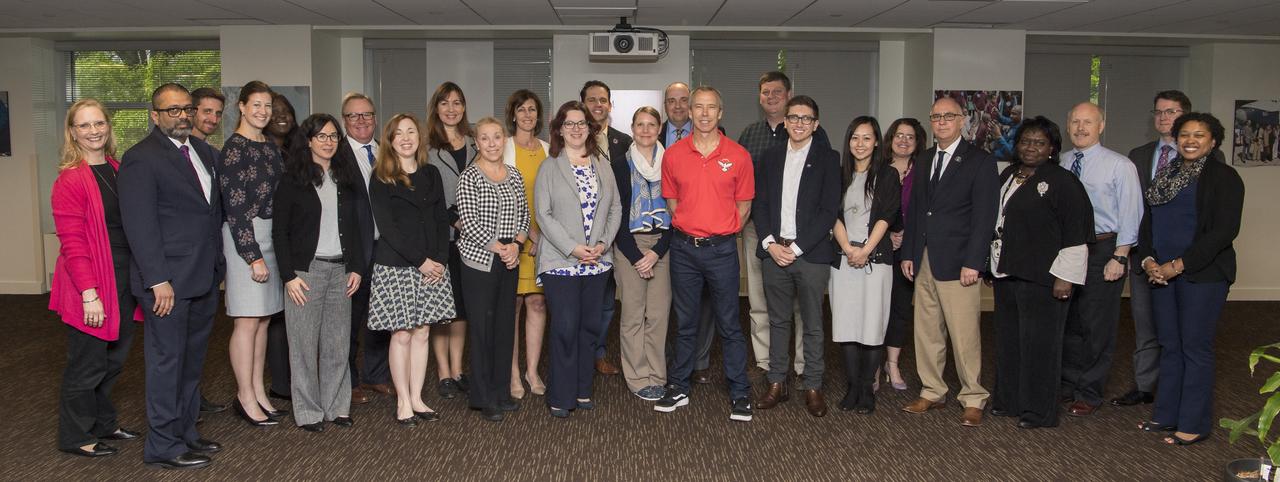
NASA astronaut Drew Feustel poses for a photo with the NASA Human Exploration and Operations team just after speaking about his experience on two space shuttle missions, STS-125 and STS-134, and a long duration mission onboard the International Space Station at NASA Headquarters, Thursday, May 9, 2019 in Washington, DC. Feustel most recently spent 197 days living and working onboard the International Space Station as part of Expedition 55 and as commander of Expedition 56. Feustel ventured outside the space station on three spacewalks, moving him up to second among U.S. spacewalkers with a cumulative time of 61 hours 48 minutes over nine spacewalks. Photo Credit: (NASA/Aubrey Gemignani)
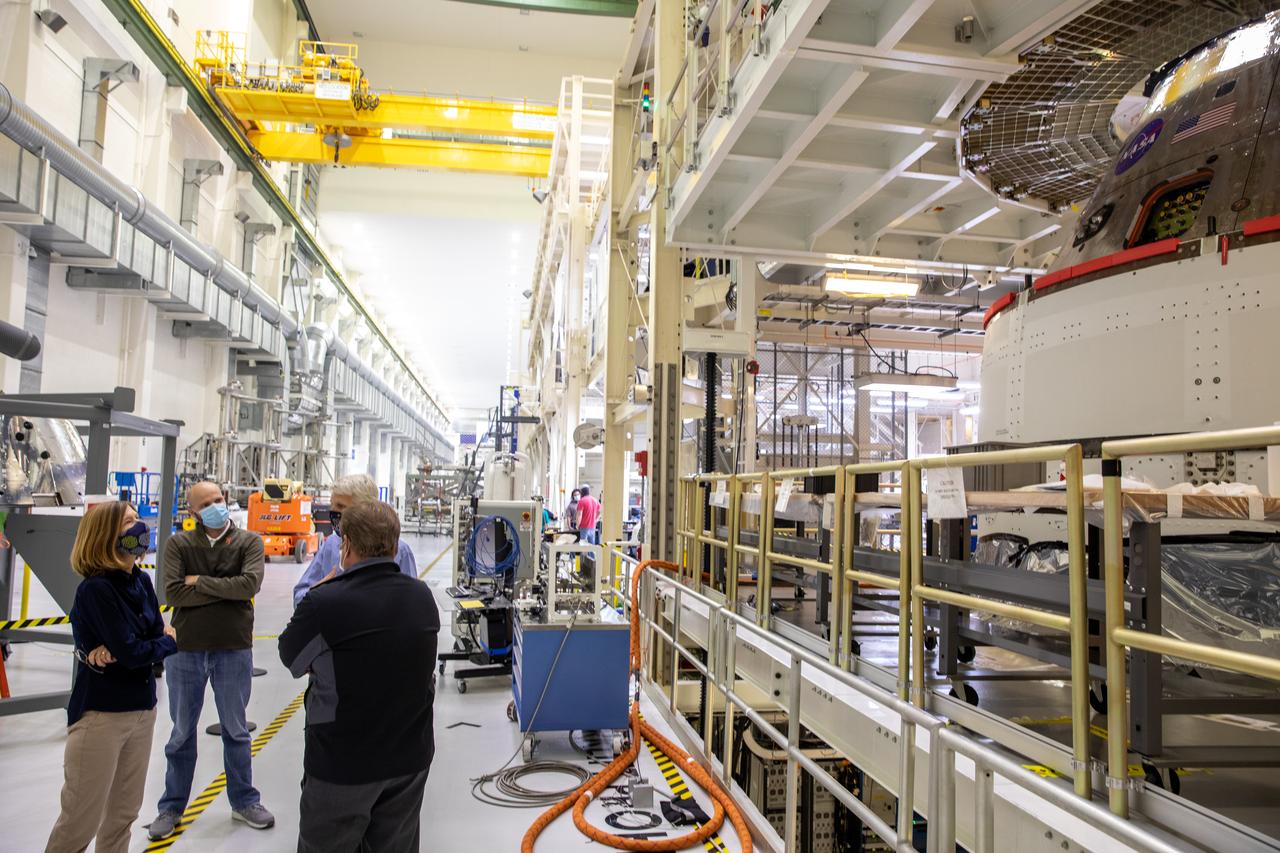
Kathy Lueders, far left, associate administrator of NASA’s Human Exploration and Operations Mission Directorate, views the Artemis I spacecraft during a visit to the Neil Armstrong Operations and Checkout Building high bay at the agency’s Kennedy Space Center in Florida on Nov. 5, 2020. To her right is Jules Schneider, director of Assembly, Test, and Launch Operations for Lockheed Martin; and to her left is Jim Skaggs, senior manager of Kennedy Operations for Lockheed Martin. In between Schneider and Skaggs is Scott Wilson, manager of the Orion Production Office at Kennedy. The first in a series of increasingly complex missions, Artemis I will test the Space Launch System rocket and Orion spacecraft as an integrated system prior to crewed flights to the Moon. Under the Artemis program, NASA is planning to land the first woman and the next man on the lunar surface by 2024.
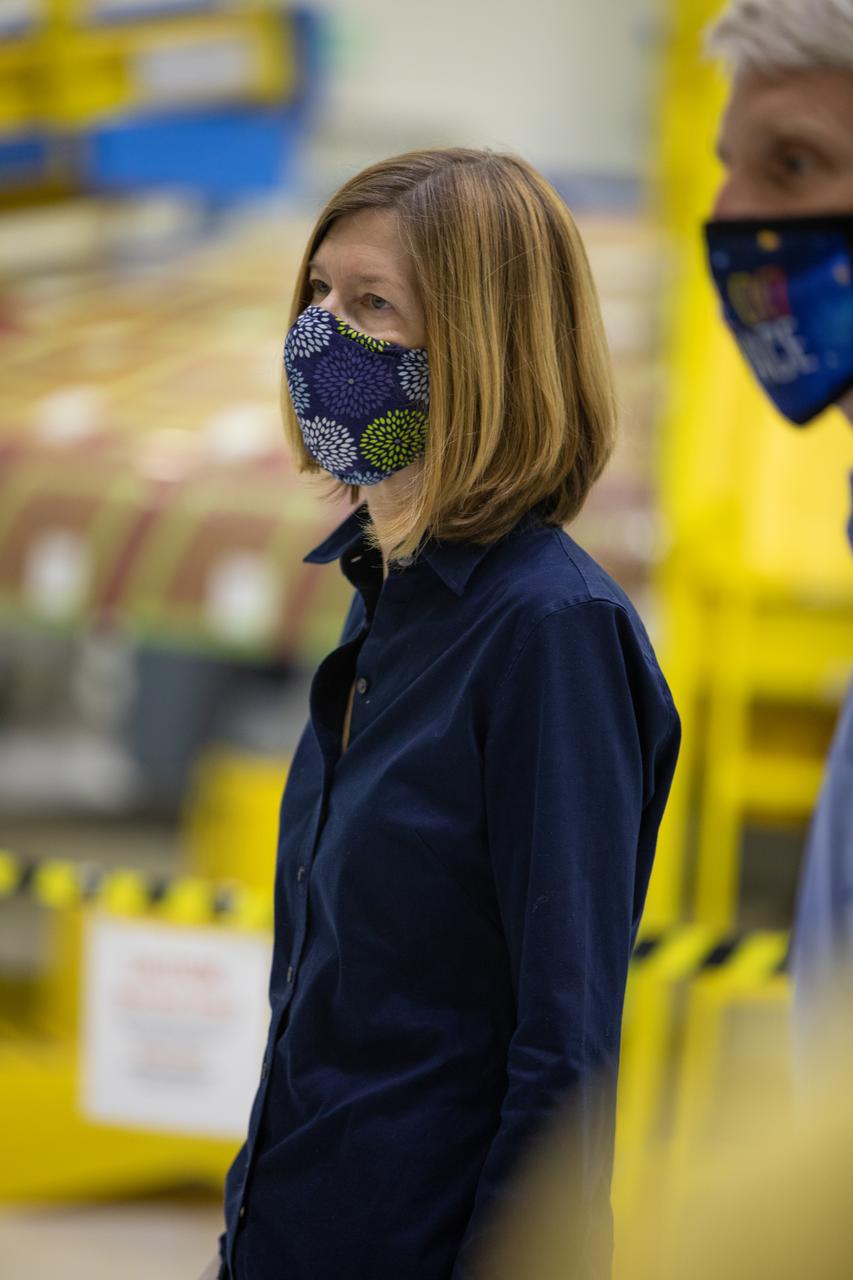
Kathy Lueders, associate administrator of NASA’s Human Exploration and Operations Mission Directorate, visits the Neil Armstrong Operations and Checkout (O&C) Building high bay at the agency’s Kennedy Space Center in Florida on Nov. 5, 2020. While at the O&C, Lueders and senior managers of Orion and Lockheed Martin had the opportunity to view the Artemis I and II spacecraft. In the background is the heat shield for Artemis II. The first in a series of increasingly complex missions, Artemis I will test the Space Launch System rocket and Orion spacecraft as an integrated system prior to crewed flights to the Moon. Under the Artemis program, NASA is planning to land the first woman and the next man on the lunar surface by 2024.
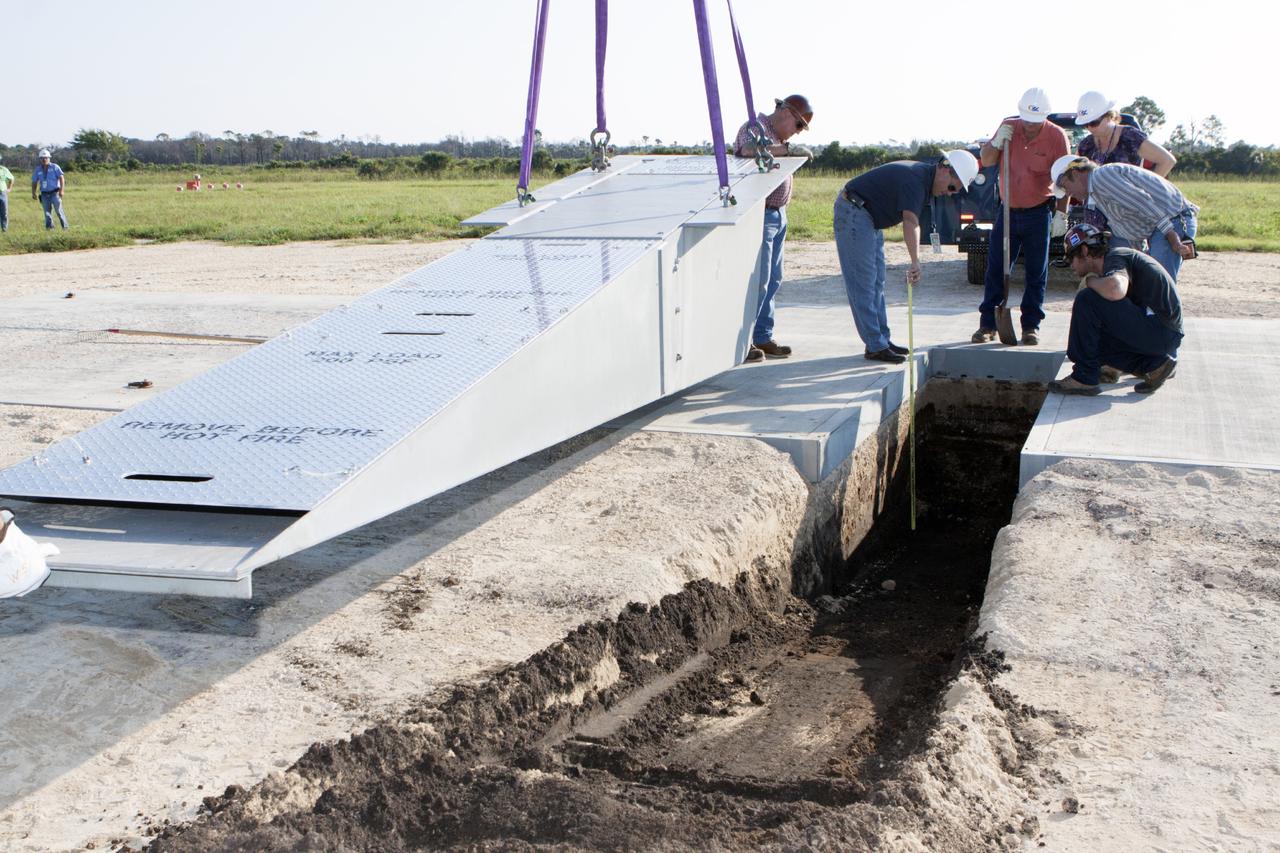
CAPE CANAVERAL, Fla. - Workers install a flame deflector at the Shuttle Landing Facility, or SLF, at NASA's Kennedy Space Center in Florida for the Project Morpheus lander. The site is adjacent to a hazard field created to support the project at the north end of the SLF. Testing of the prototype lander has been ongoing at NASA’s Johnson Space Center in Houston in preparation for a free flight at Kennedy later this year. The SLF will provide the lander with the kind of field necessary for realistic testing, complete with rocks, craters and hazards to avoid. Morpheus utilizes an autonomous landing and hazard avoidance technology, or ALHAT, payload that will allow it to navigate to clear landing sites amidst obstacles during its descent. Project Morpheus is one of 20 small projects comprising the Advanced Exploration Systems, or AES, program in NASA’s Human Exploration and Operations Mission Directorate. AES projects pioneer new approaches for rapidly developing prototype systems, demonstrating key capabilities and validating operational concepts for future human missions beyond Earth orbit. For more information on Project Morpheus, visit http://www.nasa.gov/centers/johnson/exploration/morpheus/index.html. Photo credit: NASA/Kim Shiflett
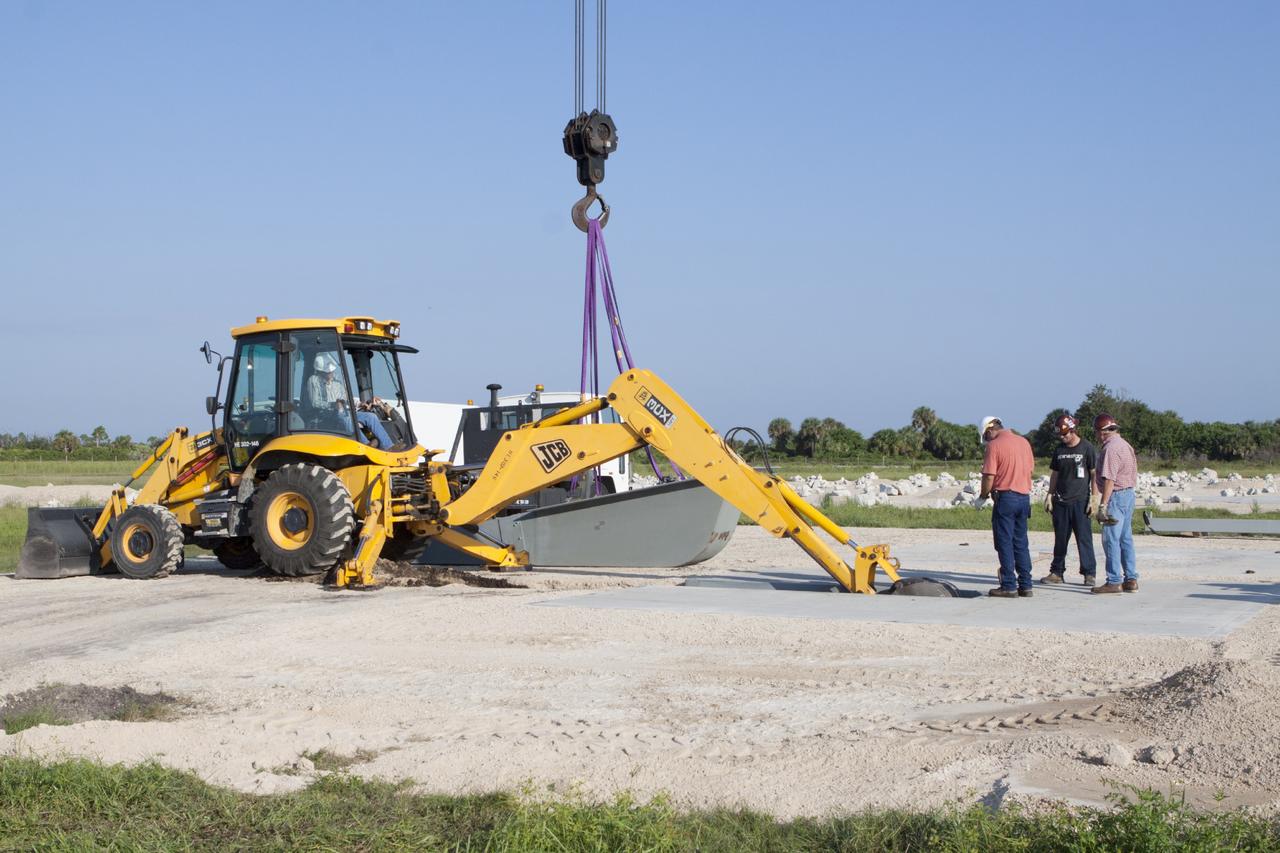
CAPE CANAVERAL, Fla. - Workers install a flame deflector at the Shuttle Landing Facility, or SLF, at NASA's Kennedy Space Center in Florida for the Project Morpheus lander. The site is adjacent to a hazard field created to support the project at the north end of the SLF. Testing of the prototype lander has been ongoing at NASA’s Johnson Space Center in Houston in preparation for a free flight at Kennedy later this year. The SLF will provide the lander with the kind of field necessary for realistic testing, complete with rocks, craters and hazards to avoid. Morpheus utilizes an autonomous landing and hazard avoidance technology, or ALHAT, payload that will allow it to navigate to clear landing sites amidst obstacles during its descent. Project Morpheus is one of 20 small projects comprising the Advanced Exploration Systems, or AES, program in NASA’s Human Exploration and Operations Mission Directorate. AES projects pioneer new approaches for rapidly developing prototype systems, demonstrating key capabilities and validating operational concepts for future human missions beyond Earth orbit. For more information on Project Morpheus, visit http://www.nasa.gov/centers/johnson/exploration/morpheus/index.html. Photo credit: NASA/Kim Shiflett
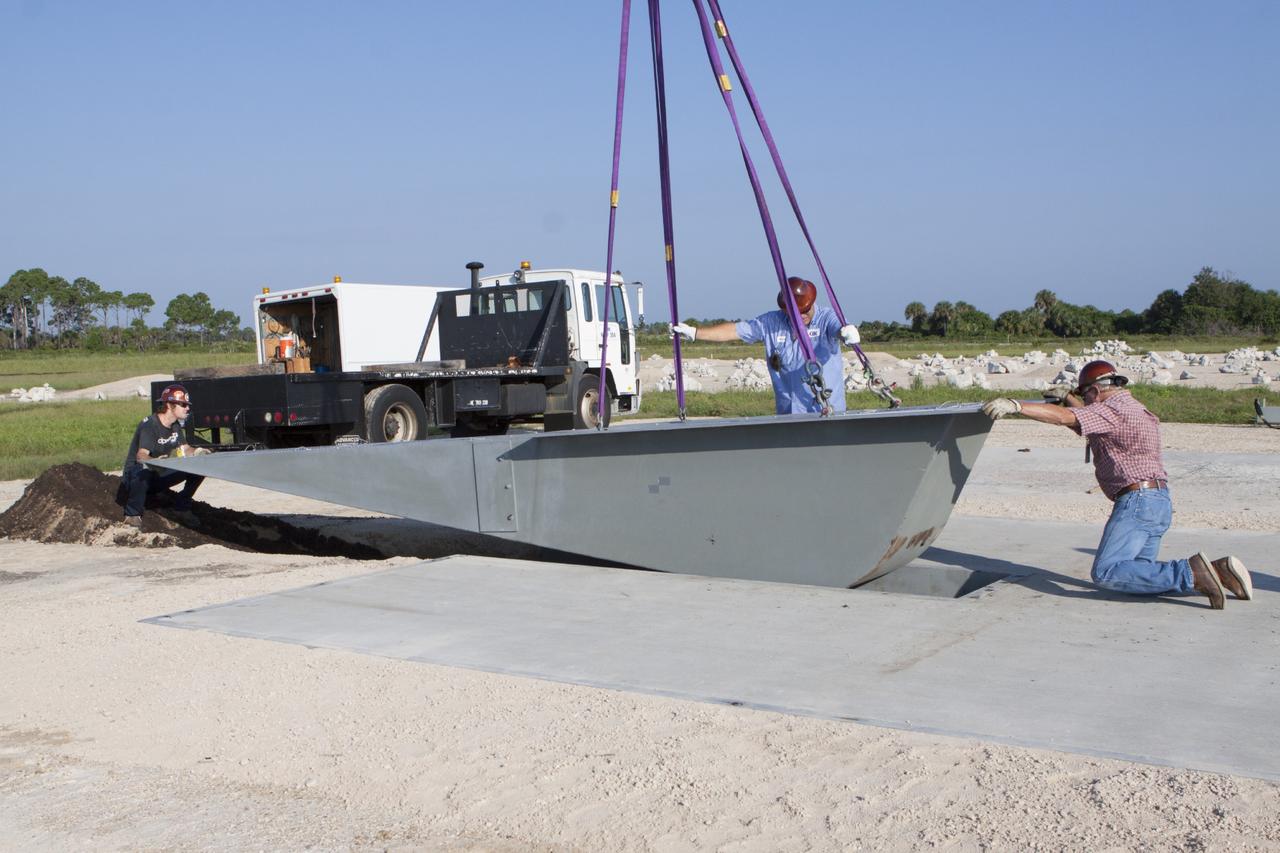
CAPE CANAVERAL, Fla. - Workers install a flame deflector at the Shuttle Landing Facility, or SLF, at NASA's Kennedy Space Center in Florida for the Project Morpheus lander. The site is adjacent to a hazard field created to support the project at the north end of the SLF. Testing of the prototype lander has been ongoing at NASA’s Johnson Space Center in Houston in preparation for a free flight at Kennedy later this year. The SLF will provide the lander with the kind of field necessary for realistic testing, complete with rocks, craters and hazards to avoid. Morpheus utilizes an autonomous landing and hazard avoidance technology, or ALHAT, payload that will allow it to navigate to clear landing sites amidst obstacles during its descent. Project Morpheus is one of 20 small projects comprising the Advanced Exploration Systems, or AES, program in NASA’s Human Exploration and Operations Mission Directorate. AES projects pioneer new approaches for rapidly developing prototype systems, demonstrating key capabilities and validating operational concepts for future human missions beyond Earth orbit. For more information on Project Morpheus, visit http://www.nasa.gov/centers/johnson/exploration/morpheus/index.html. Photo credit: NASA/Kim Shiflett
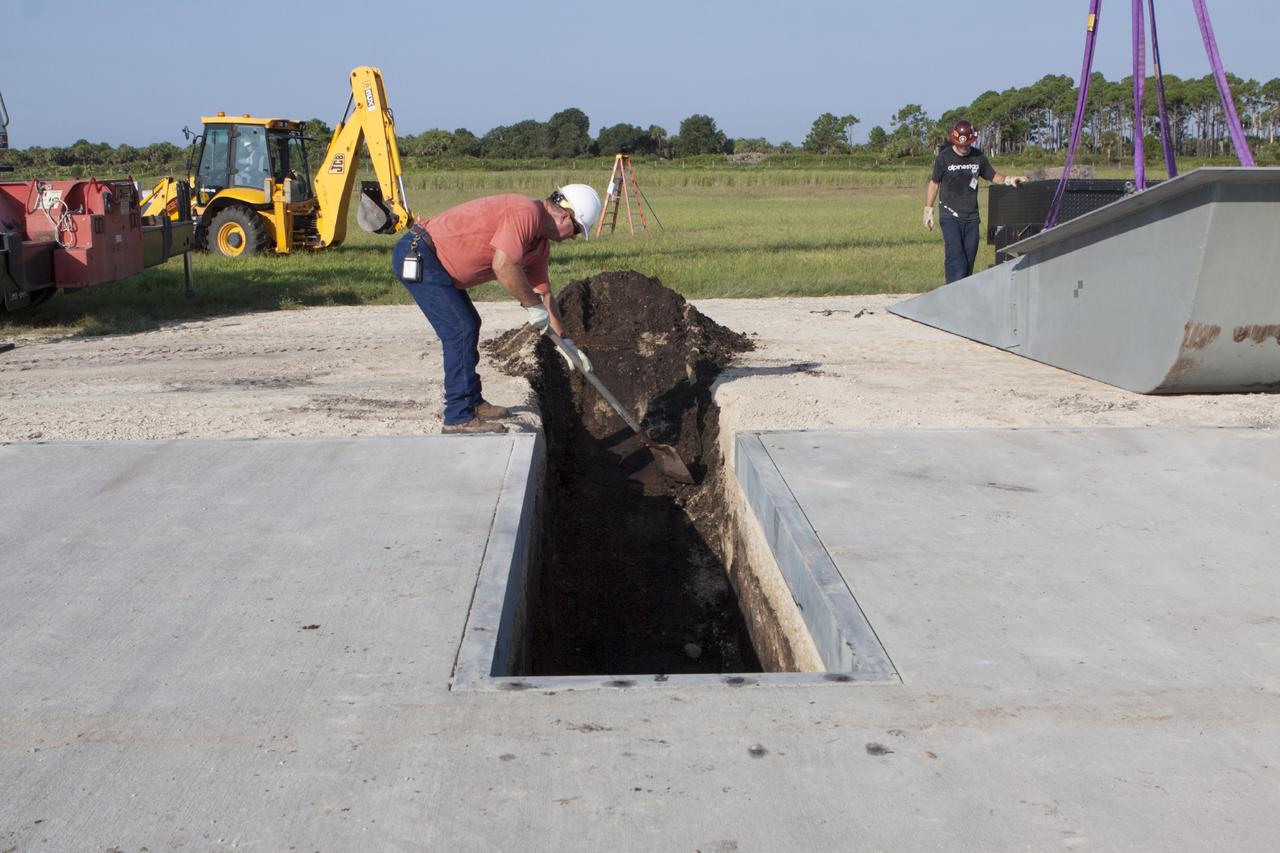
CAPE CANAVERAL, Fla. - Workers install a flame deflector at the Shuttle Landing Facility, or SLF, at NASA's Kennedy Space Center in Florida for the Project Morpheus lander. The site is adjacent to a hazard field created to support the project at the north end of the SLF. Testing of the prototype lander has been ongoing at NASA’s Johnson Space Center in Houston in preparation for a free flight at Kennedy later this year. The SLF will provide the lander with the kind of field necessary for realistic testing, complete with rocks, craters and hazards to avoid. Morpheus utilizes an autonomous landing and hazard avoidance technology, or ALHAT, payload that will allow it to navigate to clear landing sites amidst obstacles during its descent. Project Morpheus is one of 20 small projects comprising the Advanced Exploration Systems, or AES, program in NASA’s Human Exploration and Operations Mission Directorate. AES projects pioneer new approaches for rapidly developing prototype systems, demonstrating key capabilities and validating operational concepts for future human missions beyond Earth orbit. For more information on Project Morpheus, visit http://www.nasa.gov/centers/johnson/exploration/morpheus/index.html. Photo credit: NASA/Kim Shiflett
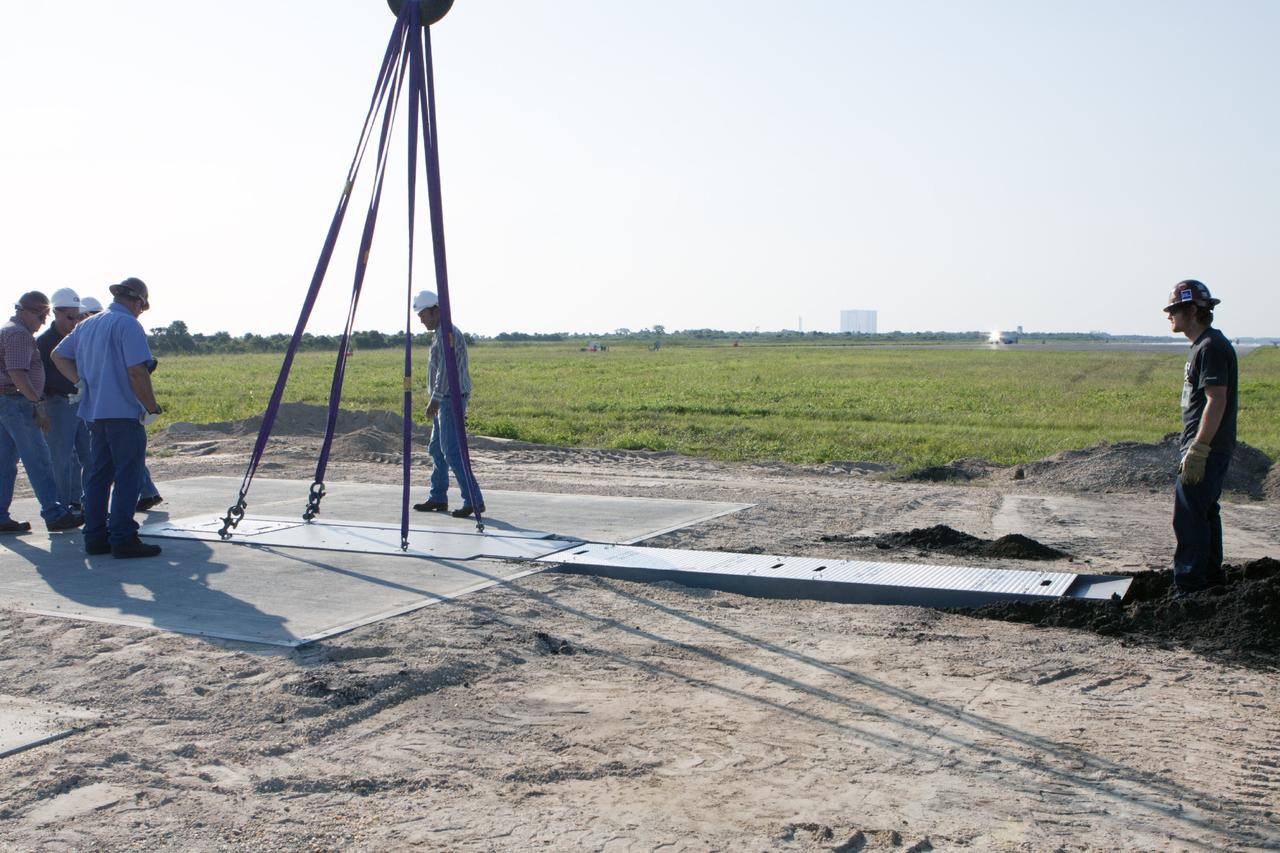
CAPE CANAVERAL, Fla. - Workers install a flame deflector at the Shuttle Landing Facility, or SLF, at NASA's Kennedy Space Center in Florida for the Project Morpheus lander. The site is adjacent to a hazard field created to support the project at the north end of the SLF. Testing of the prototype lander has been ongoing at NASA’s Johnson Space Center in Houston in preparation for a free flight at Kennedy later this year. The SLF will provide the lander with the kind of field necessary for realistic testing, complete with rocks, craters and hazards to avoid. Morpheus utilizes an autonomous landing and hazard avoidance technology, or ALHAT, payload that will allow it to navigate to clear landing sites amidst obstacles during its descent. Project Morpheus is one of 20 small projects comprising the Advanced Exploration Systems, or AES, program in NASA’s Human Exploration and Operations Mission Directorate. AES projects pioneer new approaches for rapidly developing prototype systems, demonstrating key capabilities and validating operational concepts for future human missions beyond Earth orbit. For more information on Project Morpheus, visit http://www.nasa.gov/centers/johnson/exploration/morpheus/index.html. Photo credit: NASA/Kim Shiflett
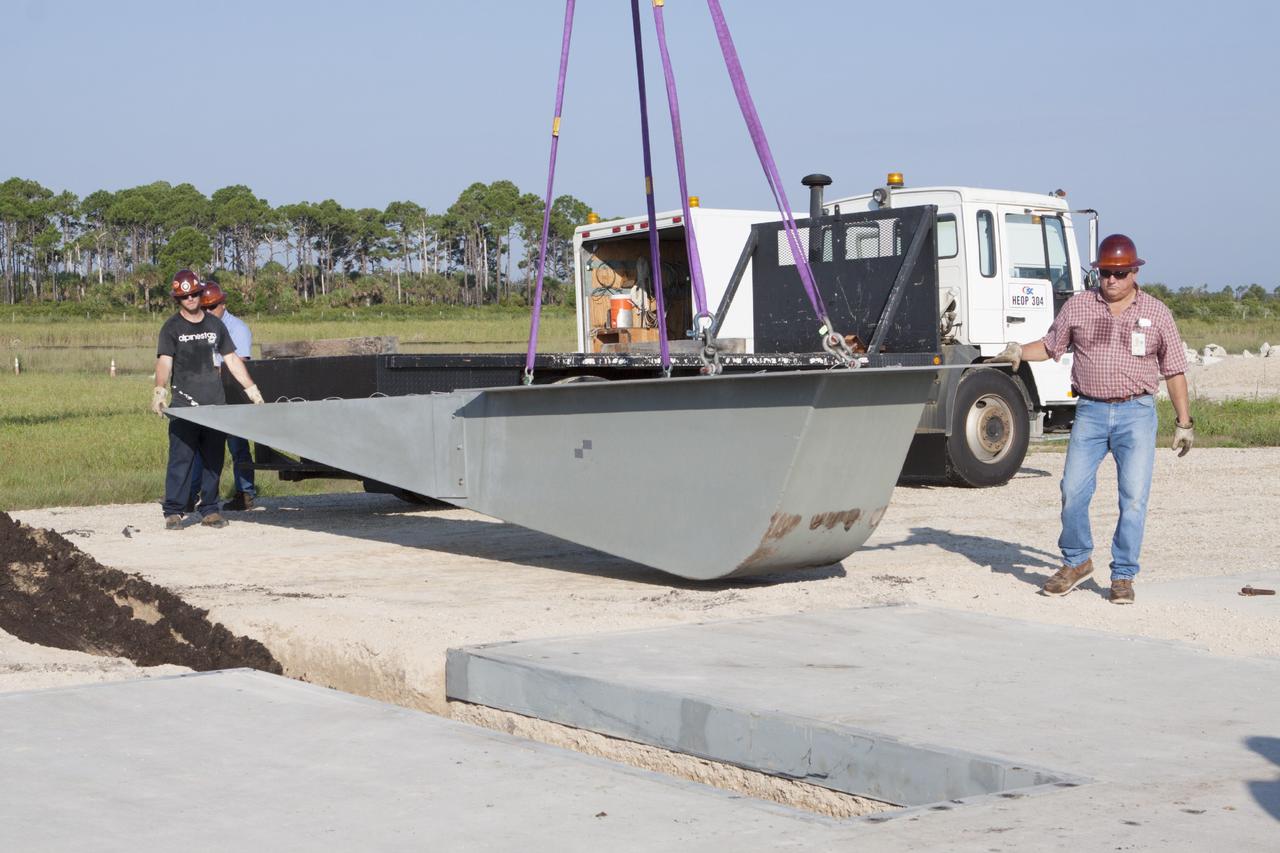
CAPE CANAVERAL, Fla. - Workers install a flame deflector at the Shuttle Landing Facility, or SLF, at NASA's Kennedy Space Center in Florida for the Project Morpheus lander. The site is adjacent to a hazard field created to support the project at the north end of the SLF. Testing of the prototype lander has been ongoing at NASA’s Johnson Space Center in Houston in preparation for a free flight at Kennedy later this year. The SLF will provide the lander with the kind of field necessary for realistic testing, complete with rocks, craters and hazards to avoid. Morpheus utilizes an autonomous landing and hazard avoidance technology, or ALHAT, payload that will allow it to navigate to clear landing sites amidst obstacles during its descent. Project Morpheus is one of 20 small projects comprising the Advanced Exploration Systems, or AES, program in NASA’s Human Exploration and Operations Mission Directorate. AES projects pioneer new approaches for rapidly developing prototype systems, demonstrating key capabilities and validating operational concepts for future human missions beyond Earth orbit. For more information on Project Morpheus, visit http://www.nasa.gov/centers/johnson/exploration/morpheus/index.html. Photo credit: NASA/Kim Shiflett
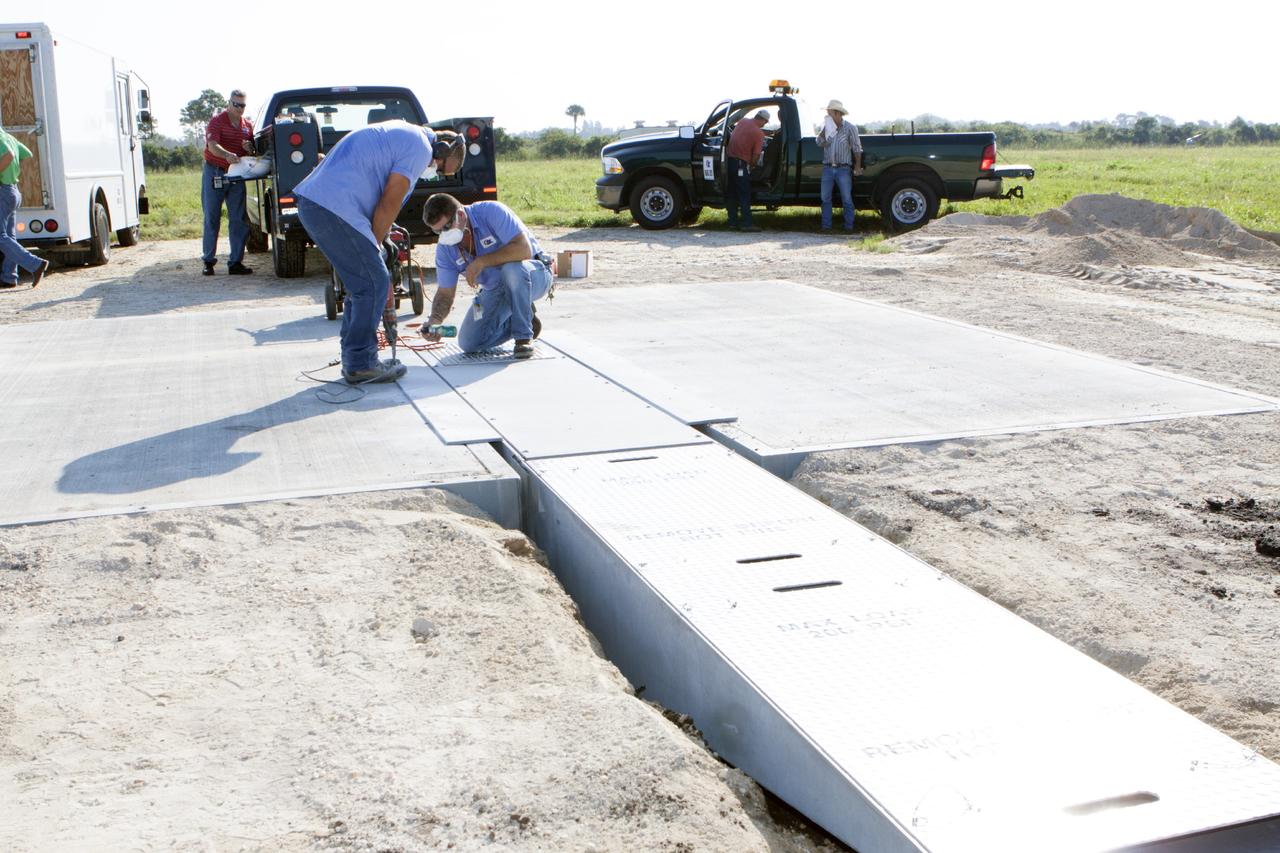
CAPE CANAVERAL, Fla. - Workers install a flame deflector at the Shuttle Landing Facility, or SLF, at NASA's Kennedy Space Center in Florida for the Project Morpheus lander. The site is adjacent to a hazard field created to support the project at the north end of the SLF. Testing of the prototype lander has been ongoing at NASA’s Johnson Space Center in Houston in preparation for a free flight at Kennedy later this year. The SLF will provide the lander with the kind of field necessary for realistic testing, complete with rocks, craters and hazards to avoid. Morpheus utilizes an autonomous landing and hazard avoidance technology, or ALHAT, payload that will allow it to navigate to clear landing sites amidst obstacles during its descent. Project Morpheus is one of 20 small projects comprising the Advanced Exploration Systems, or AES, program in NASA’s Human Exploration and Operations Mission Directorate. AES projects pioneer new approaches for rapidly developing prototype systems, demonstrating key capabilities and validating operational concepts for future human missions beyond Earth orbit. For more information on Project Morpheus, visit http://www.nasa.gov/centers/johnson/exploration/morpheus/index.html. Photo credit: NASA/Kim Shiflett

“I have to be honest, NASA had not really been on my radar until it just was. I went to grad school and in graduate school I actually studied myotonic dystrophy. At the end of my graduate school years I decided I want to go into public service. I applied for this thing called the Presidential Management Fellowship and NASA had an opening! I thought to myself ‘Oh this could be so interesting! They run so many technology and science programs. I'll apply and see what happens.’ “Lo and behold, I got an interview! I was so excited and the idea of working at an agency at NASA blew me out of the water and I said, ‘I am totally taking this.’ “I had a mentor say something to me that I think rings really true. He said, ‘when you work in public service, there’s no doubt that you’re doing the right thing.’ I think that idea drove me to public service. When you work for a company -- there’s absolutely nothing wrong with that, but you’re really helping the company to meet its bottom line. When you work for a federal agency or a state agency, you’re working to ensure the needs are met for the public. You're really doing something to benefit others. It’s not to benefit the company and many times it’s not just for yourself, so you always know you’re doing the right thing. I think what drove me was the idea of being able to do something that felt intrinsically fulfilling.” Dr. Ruth Siboni, executive officer for the Human Exploration and Operations (HEO) mission directorate poses for a photo, Monday, October 5, 2020 on the National Mall in Washington, DC. Photo Credit: (NASA/Aubrey Gemignani)