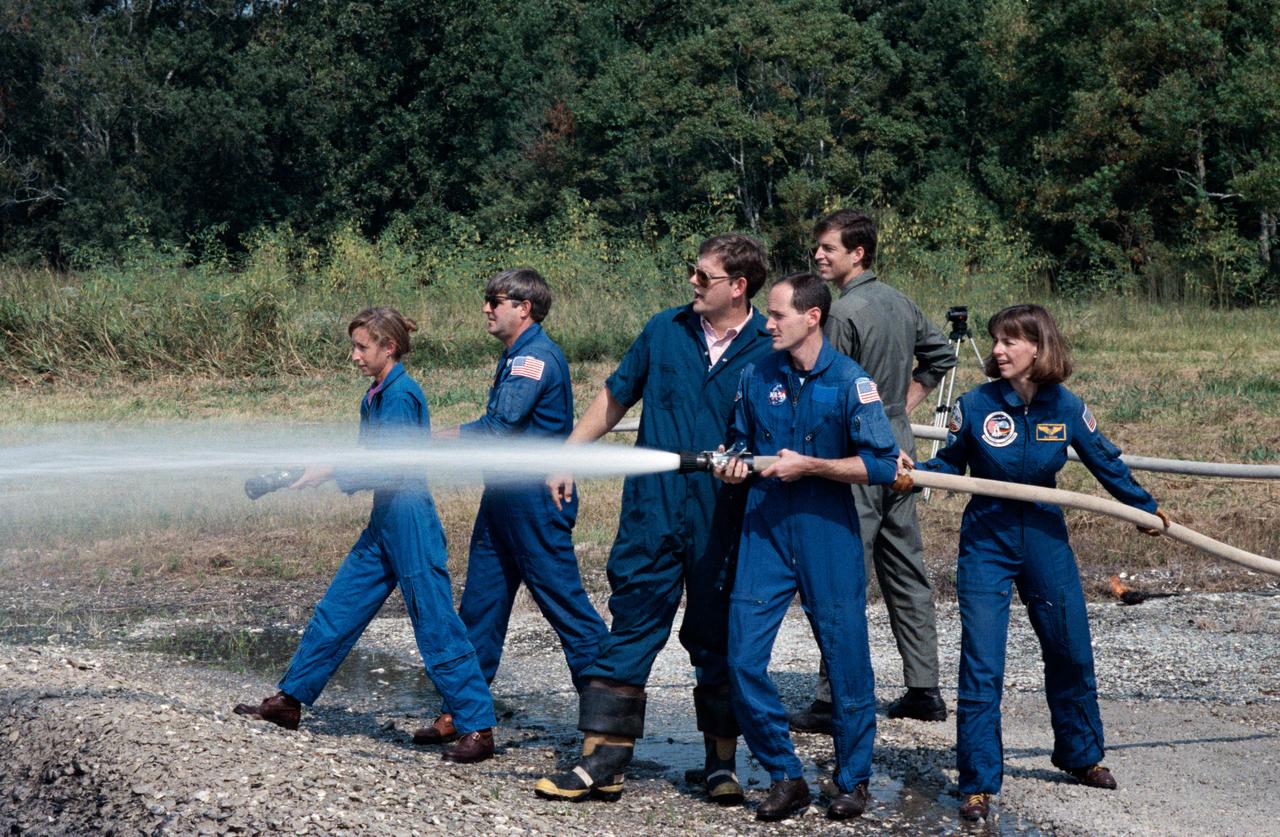
STS-32 crewmembers use water hoses during fire fighting exercises at JSC's Fire Training Pit across from the Gilruth Center Bldg 207. Mission Specialist (MS) G. David Low with nozzle open directs water into the fire as fire/ security personnel coaches and instructs him on his attempt to extinguish the blaze. MS Bonnie J. Dunbar maneuvers the hose behind Low. A second group of crewmembers alongside Low and Dunbar, MS Marsha S. Ivins, holding hose nozzle, Commander Daniel C. Brandenstein, and Pilot James D. Wetherbee position themselves before opening hose nozzle.
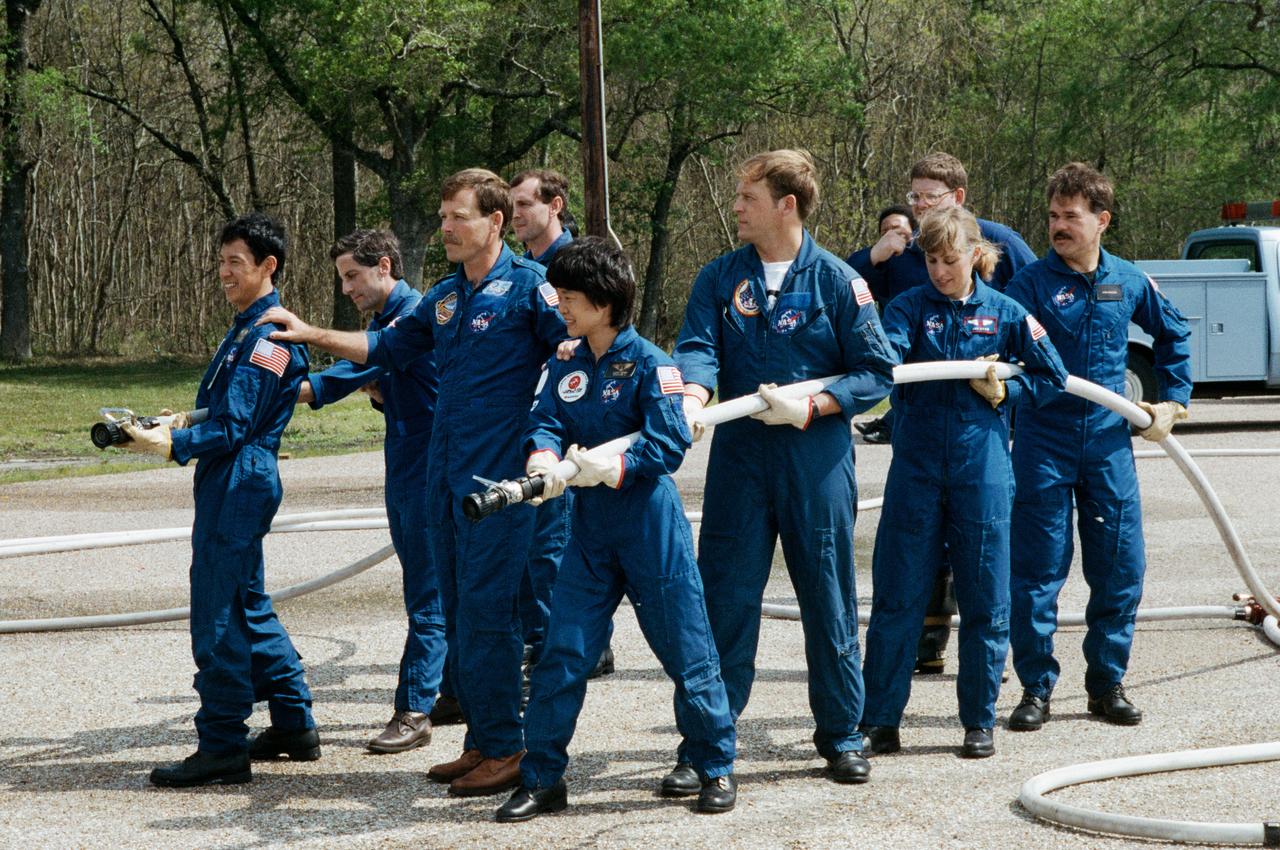
STS-47 Endeavour, Orbiter Vehicle (OV) 105, crewmembers led by Commander Robert L. Gibson (center) prepare to extinguish a blaze in JSC's Fire Training Pit. Lined up along the water hoses are: (on left) Payload Specialist Mamoru Mohri, holding the hose nozzle, followed by Mission Specialist (MS) Jerome Apt, and Pilot Curtis L. Brown, Jr; and (on right) backup Payload Specialist Chiaki Naito-Mukai, holding the hose nozzle, followed by MS and Payload Commander (PLC) Mark C. Lee, MS N. Jan Davis, and backup Payload Specialist Stan Koszelak. A veteran fire fighter and the instructor, positioned between the two hoses, looks on. Mohri and Mukai represent Japan's National Space Development Agency (NASDA). The Fire Training Pit is located across from the Gilruth Center Bldg 207.
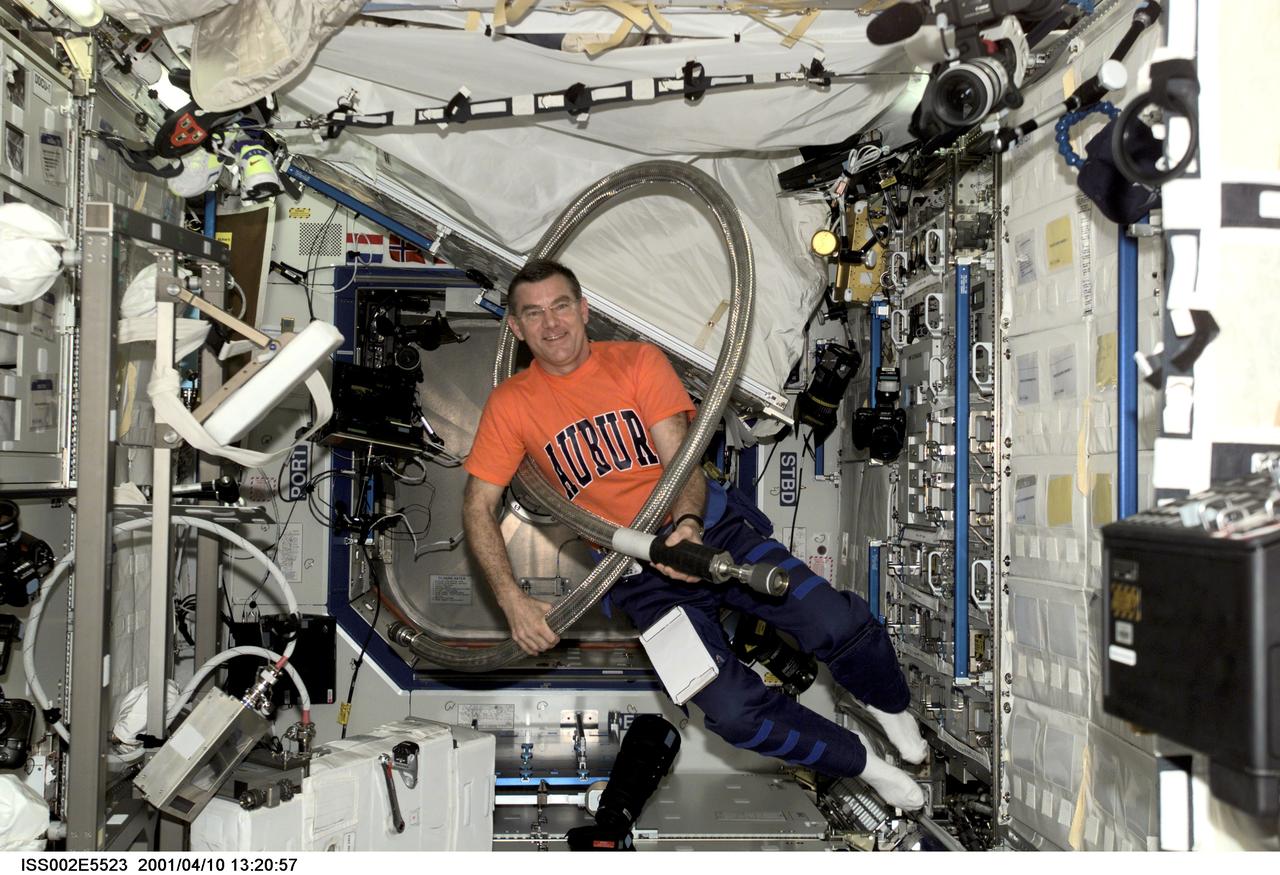
ISS002-E-5523 (10 April 2001) --- Astronaut James S. Voss, Expedition Two flight engineer, jokingly wraps a large hose around his body prior to installing it in the U.S. Laboratory / Destiny module of the International Space Station (ISS). This image was recorded with a digital still camera.
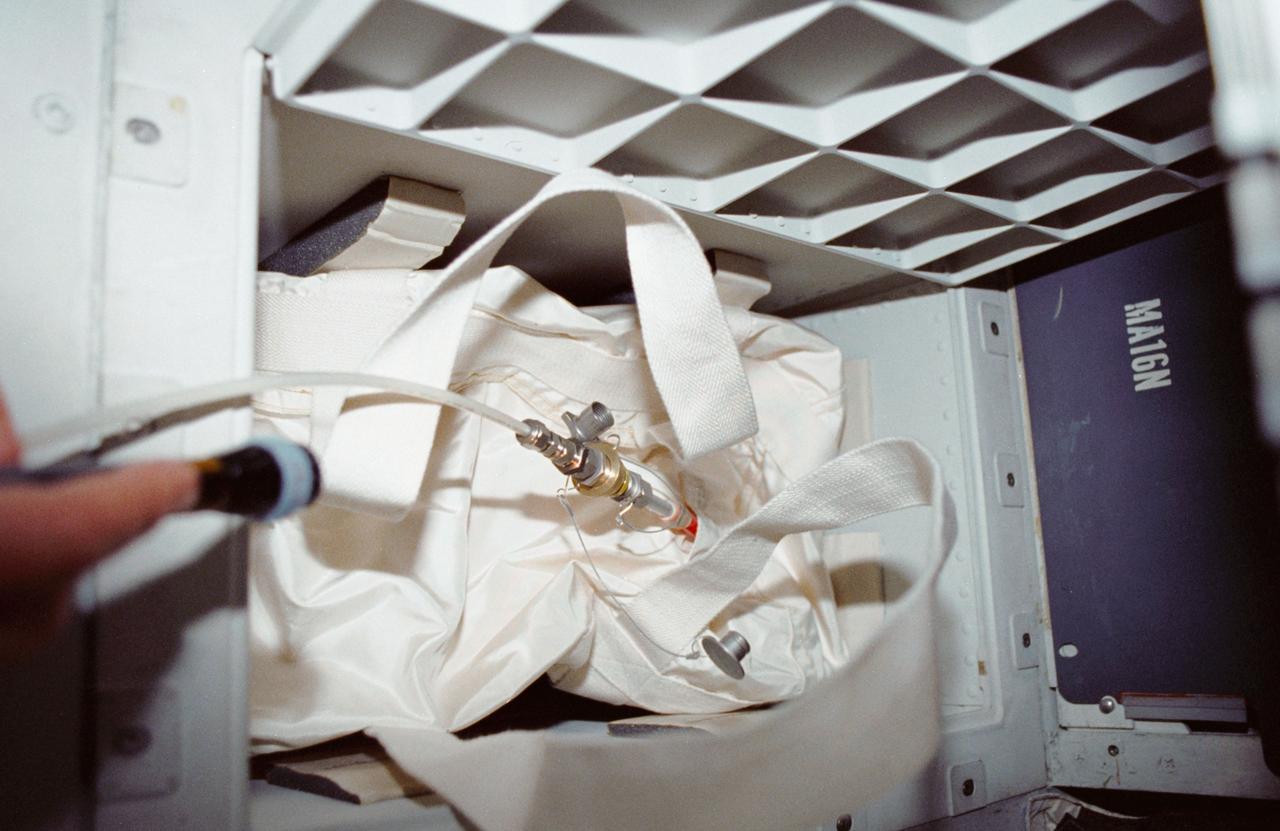
STS035-12-005 (2-10 Dec 1990) --- During STS-35, middeck stowage volume G and a contingency water container (CWC) were utilized to remedy a problem onboard Columbia, Orbiter Vehicle (OV) 102. A hose connecting OV-102's waste water system to the CWC was used in order to bypass a suspected clog in the line from the waste water tank to the exit nozzle. On flight day seven, Pilot Guy S. Gardner carried out an inflight maintenance (IFM) procedure by connecting a spare hose from the line to the container. The CWC is a rubber-lined duffle bag that holds about 95 pounds of water and is used in situations where water cannot be dumped overboard normally.

STS064-16-031 (19-20 Sept. 1994) --- On the space shuttle Discovery's middeck, astronaut Carl J. Meade checks a hose associated with the new Simplified Aid for EVA Rescue (SAFER) system prior to a Extravehicular Activity (EVA) that tested SAFER. On the Sept. 16, 1994 EVA, astronauts Meade and Mark C. Lee took turns using the SAFER hardware. The test of SAFER is the first phase of a larger SAFER program whose objectives are to establish a common set of requirements for both space shuttle and space station program needs, develop a flight demonstration of SAFER, validate system performance and, finally, develop a production version of SAFER for the shuttle and station programs. Photo credit: NASA or National Aeronautics and Space Administration
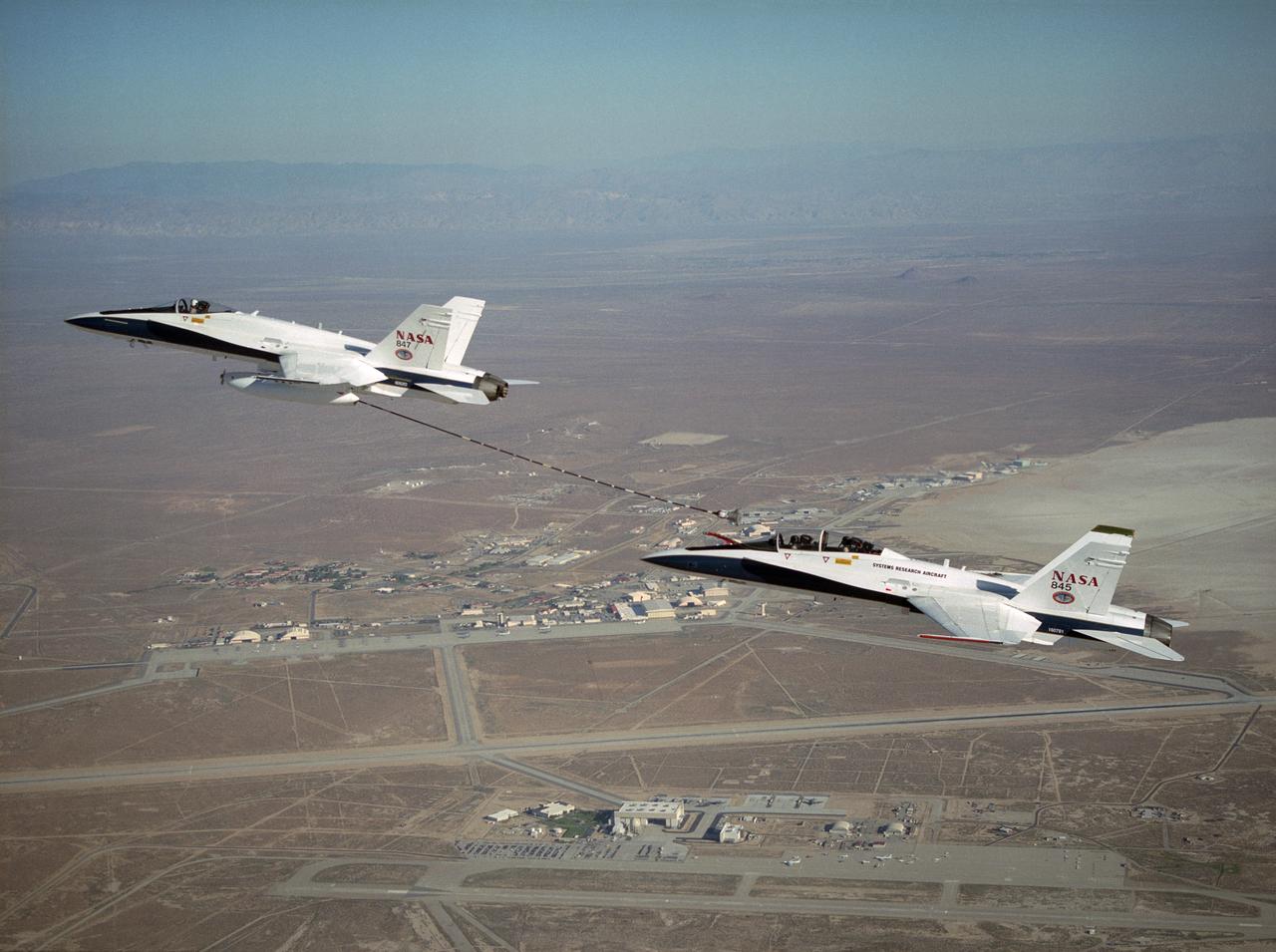
NASA Dryden's Automated Aerial Refueling (AAR) project evaluated the capability of an F/A-18A aircraft as an in-flight refueling tanker with the objective of developing analytical models for an automated aerial refueling system for unmanned air vehicles. The F/A-18 "tanker" aircraft (No. 847) underwent flight test envelope expansion with an aerodynamic pod containing air-refueling equipment carried beneath the fuselage. The second aircraft flew as the receiver aircraft during the study to assess the free-stream hose and drogue dynamics on the F/A-18A.
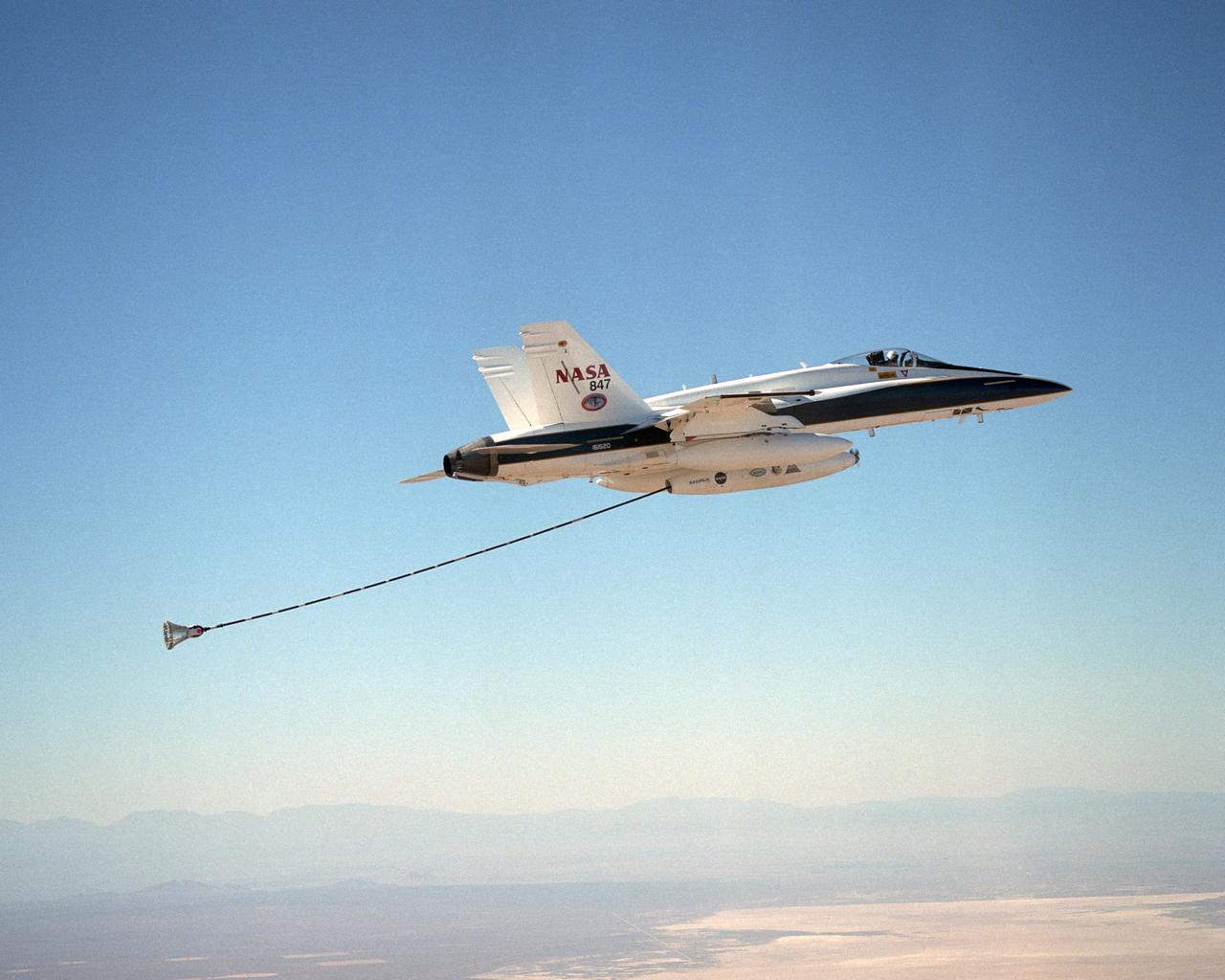
NASA Dryden's Automated Aerial Refueling (AAR) project evaluated the capability of an F/A-18A aircraft as an in-flight refueling tanker with the objective of developing analytical models for an automated aerial refueling system for unmanned air vehicles. The F/A-18 "tanker" aircraft (No. 847) underwent flight test envelope expansion with an aerodynamic pod containing air-refueling equipment carried beneath the fuselage. The second aircraft flew as the receiver aircraft during the study to assess the free-stream hose and drogue dynamics on the F/A-18A.
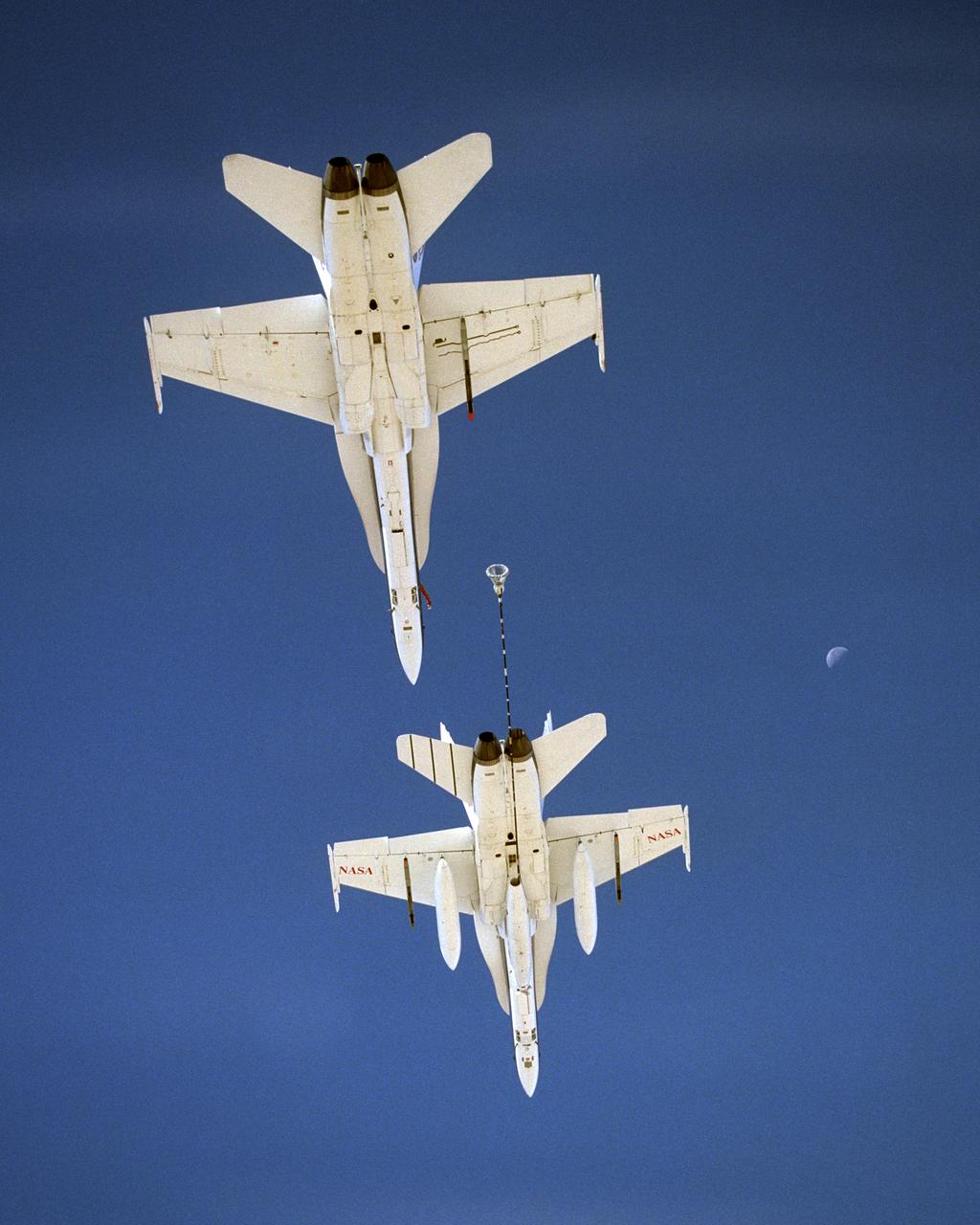
NASA Dryden's Automated Aerial Refueling (AAR) project evaluated the capability of an F/A-18A aircraft as an in-flight refueling tanker with the objective of developing analytical models for an automated aerial refueling system for unmanned air vehicles. The F/A-18 "tanker" aircraft (No. 847) underwent flight test envelope expansion with an aerodynamic pod containing air-refueling equipment carried beneath the fuselage. The second aircraft flew as the receiver aircraft during the study to assess the free-stream hose and drogue dynamics on the F/A-18A.
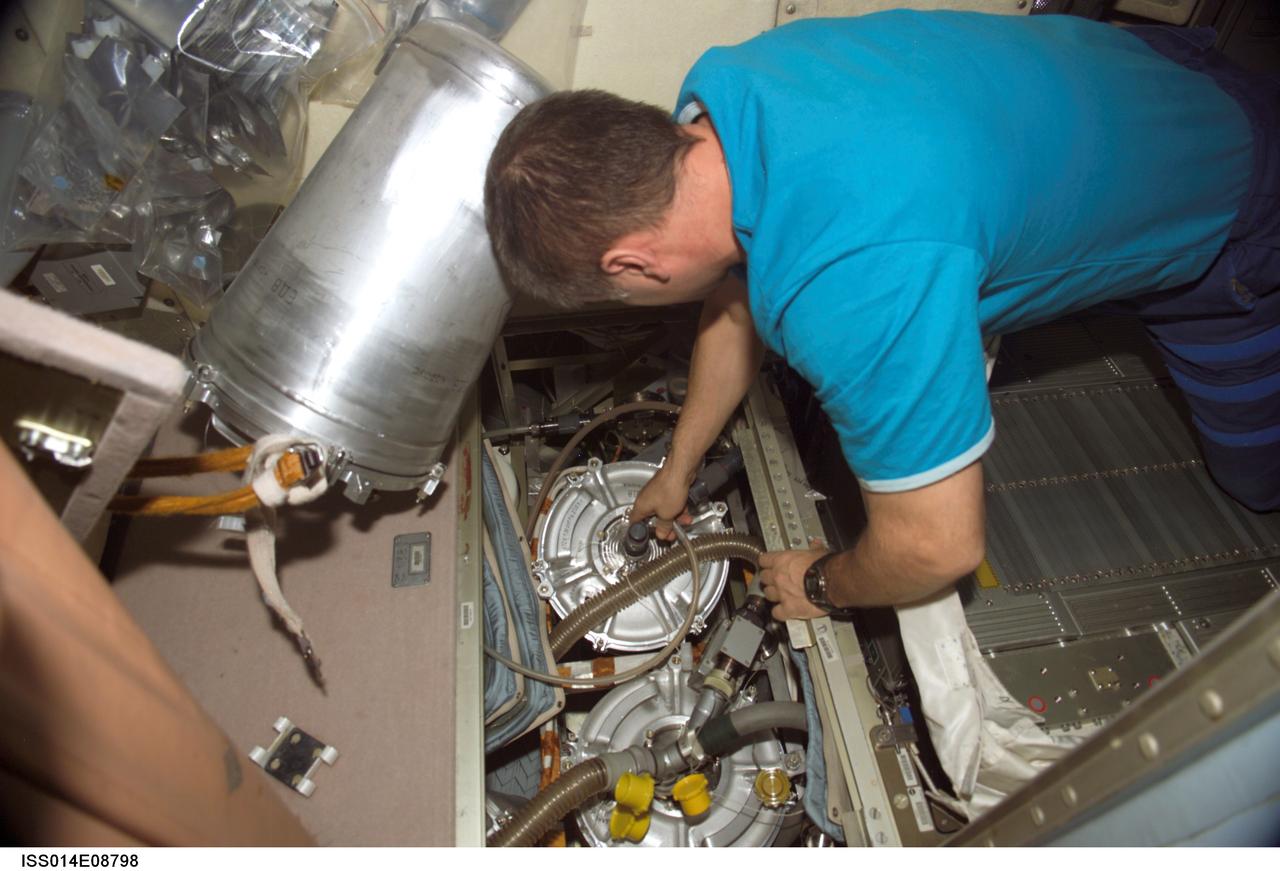
ISS014-E-08798 (29 Nov. 2006) --- Cosmonaut Mikhail Tyurin, Expedition 14 flight engineer, replaces the E-K pre-treat container and hose in the waste management system in the Zvezda Service Module of the International Space Station.
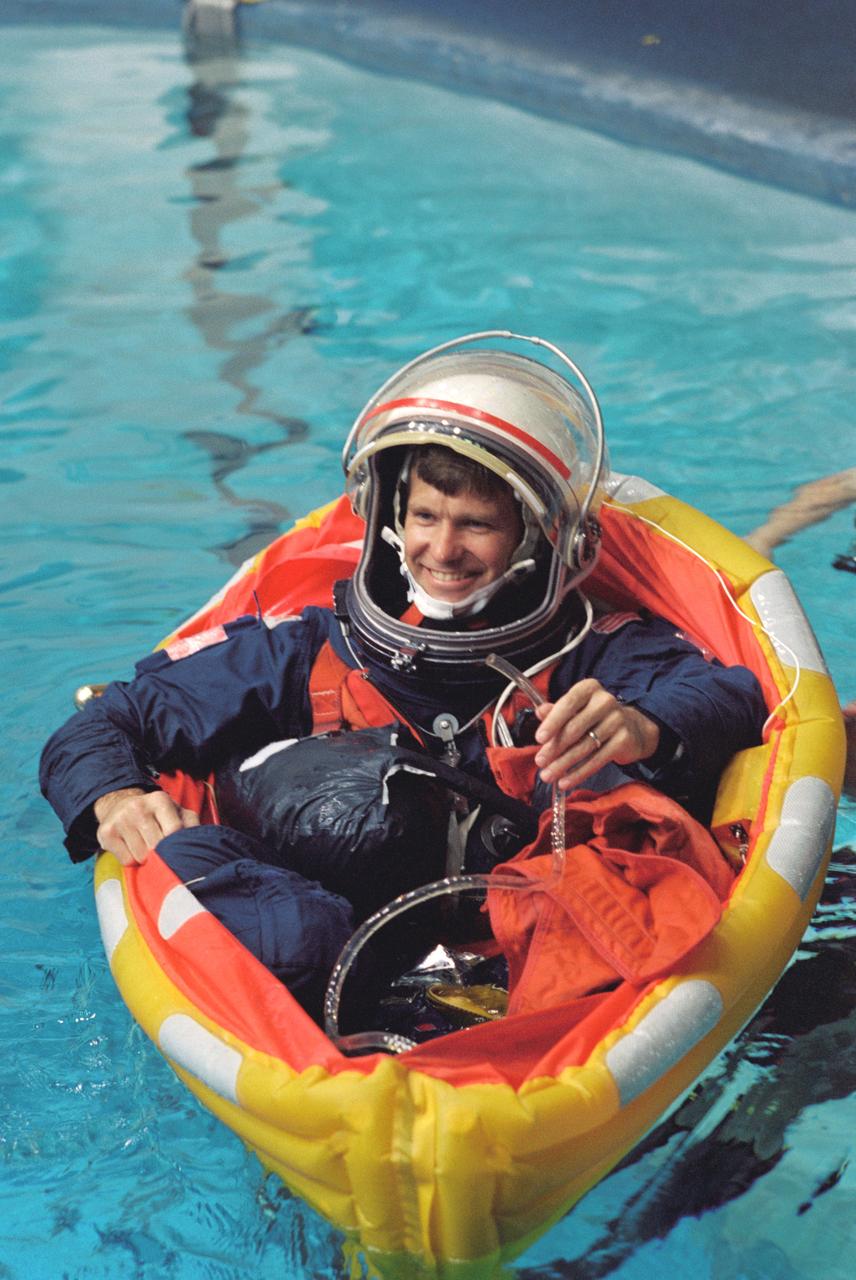
S94-37521 (28 June 1994) --- Astronaut Donald R. McMonagle, mission commander, checks the drainage hose on his rapidly fashioned life raft during an emergency bailout training exercise in the Johnson Space Center's (JSC) Weightless Environment Training Facility (WET-F). Making his third flight in space covering 343 hours, McMonagle will be joined by four other NASA astronauts and a European mission specialist for a week and a half in space aboard the Space Shuttle Atlantis. The flight will support the Atmospheric Laboratory for Applications and Science (ATLAS-3) mission.
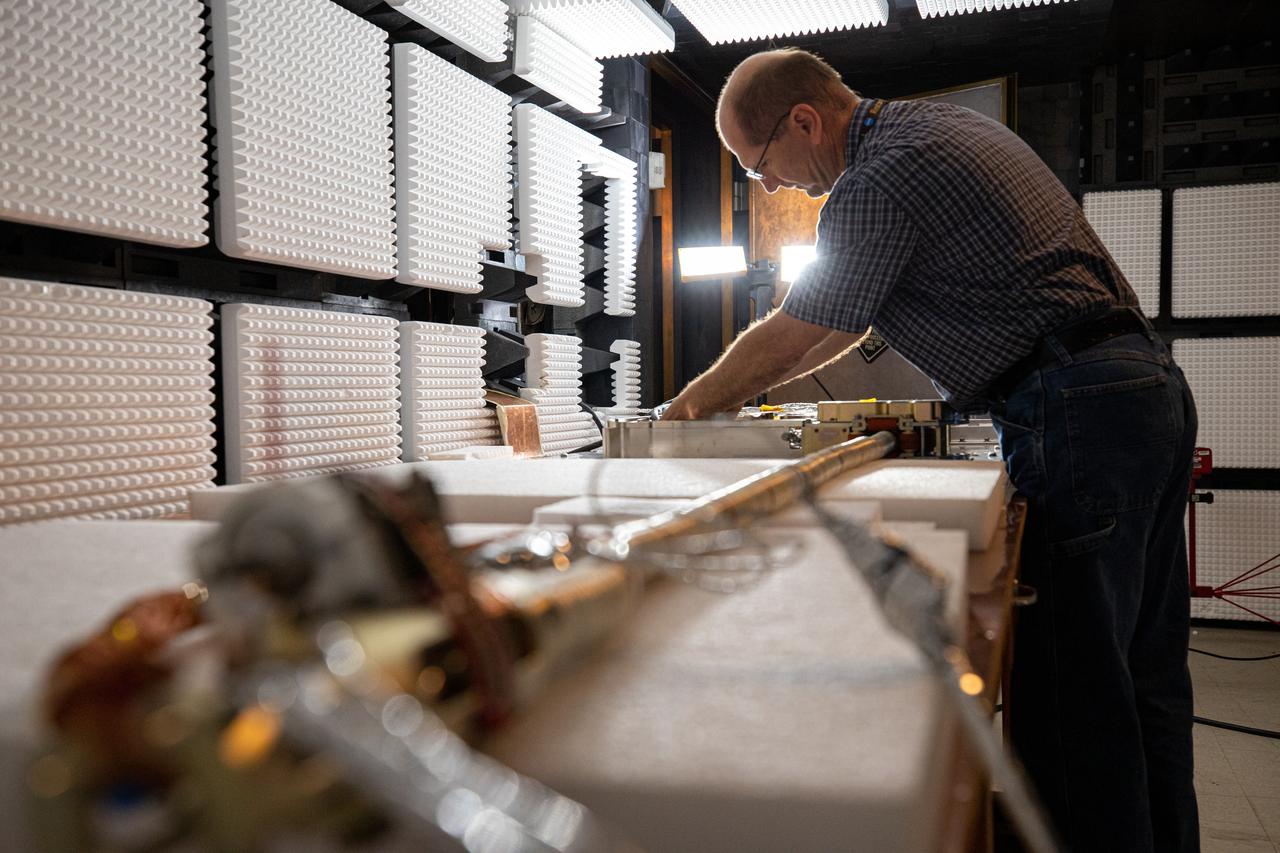
Inside the Electromagnetic Lab at NASA's Kennedy Space Center in Florida, Gabor Tamasy, Hose Management Assembly (HMA) system lead for Restore-L, prepares the HMA test unit for electromagnetic interference testing on Feb. 19, 2020. The HMA is able to extend and retract the hose, somewhat similar to the function of a tape measure. Managed by the agency's Goddard Space Flight Center in Greenbelt, Maryland, Restore-L is an inflight robotic satellite servicer spacecraft.
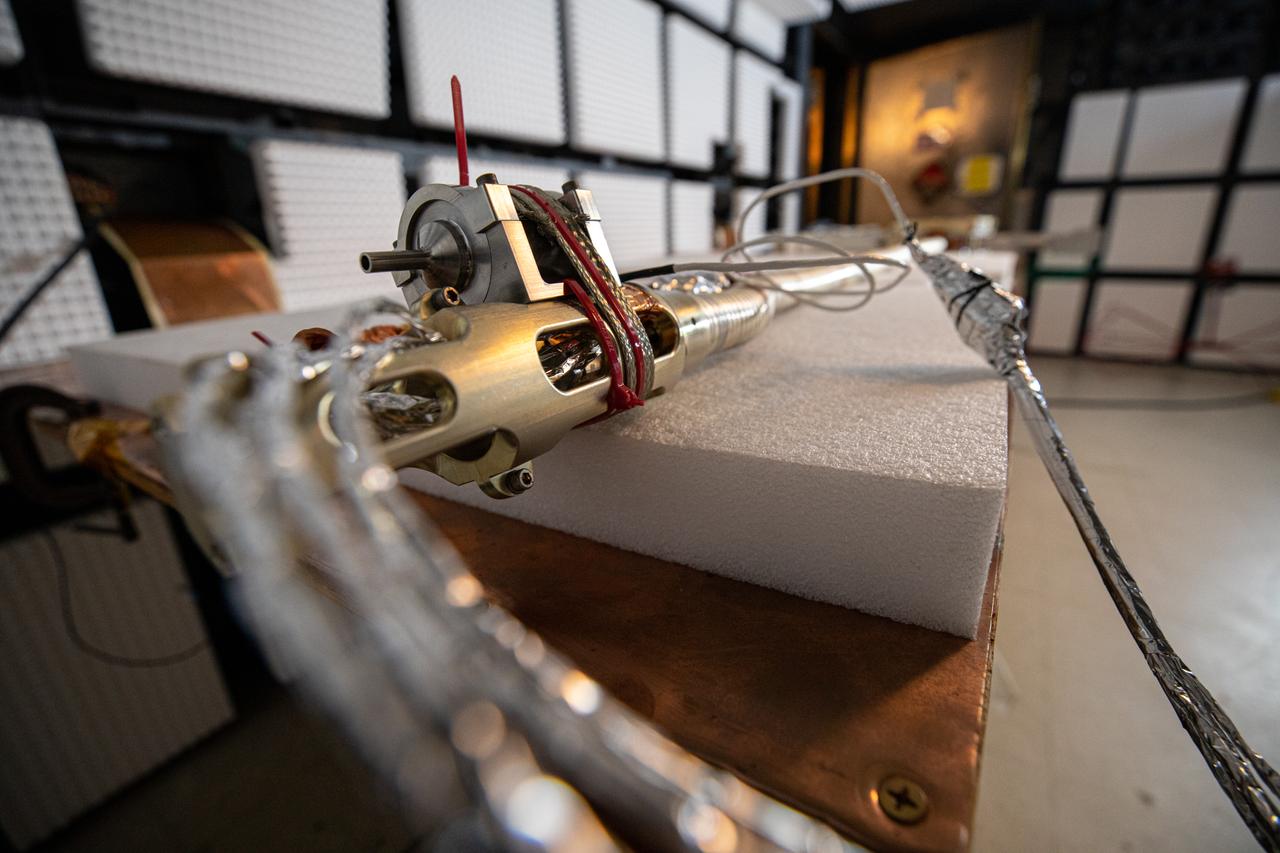
The Restore-L hose management assembly (HMA) test unit undergoes electromagnetic interference testing in the Electromagnetic Lab at NASA's Kennedy Space Center in Florida on Feb. 19, 2020. The HMA is able to extend and retract the hose, somewhat similar to the function of a tape measure. Managed by the agency's Goddard Space Flight Center in Greenbelt, Maryland, Restore-L is an inflight robotic satellite servicer spacecraft.
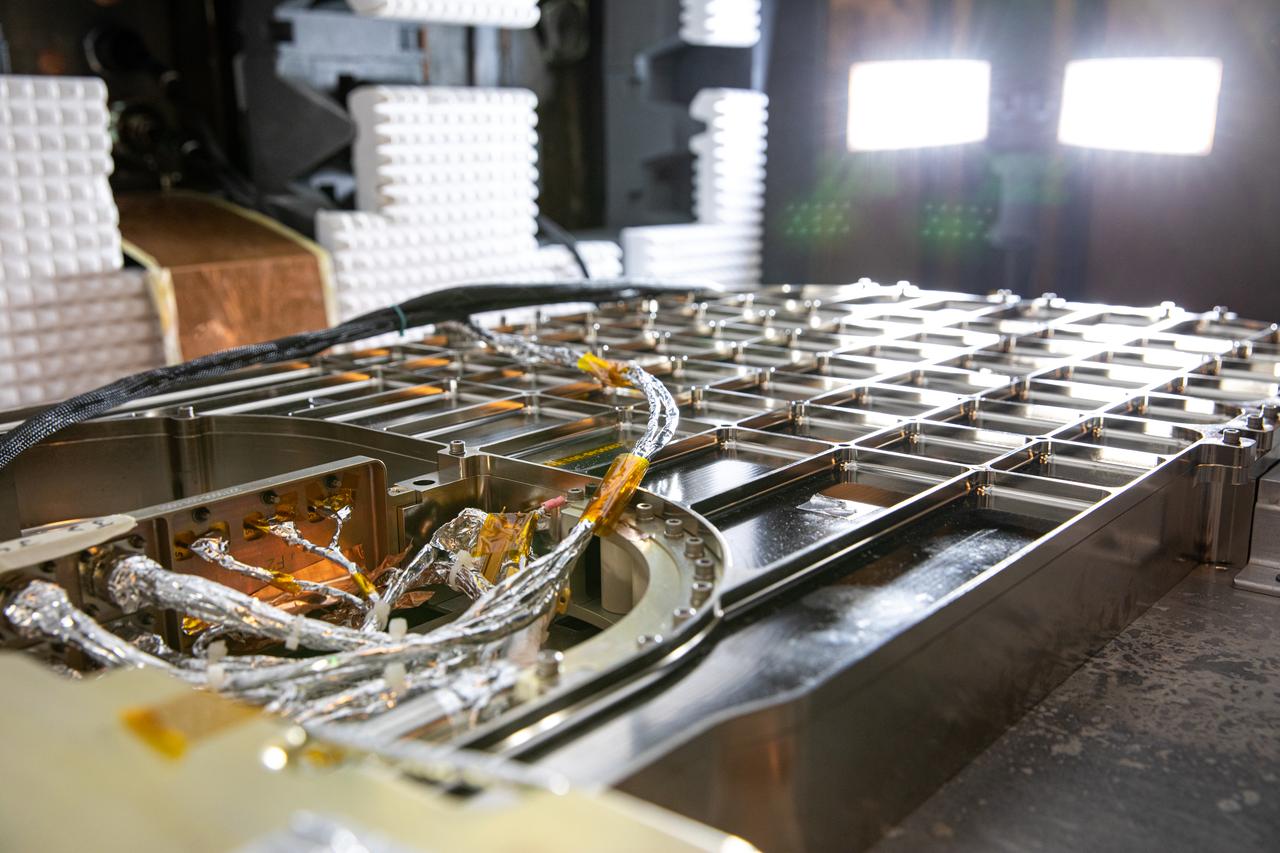
The Restore-L hose management assembly (HMA) test unit undergoes electromagnetic interference testing in the Electromagnetic Lab at NASA's Kennedy Space Center in Florida on Feb. 19, 2020. The HMA is able to extend and retract the hose, somewhat similar to the function of a tape measure. Managed by the agency's Goddard Space Flight Center in Greenbelt, Maryland, Restore-L is an inflight robotic satellite servicer spacecraft.
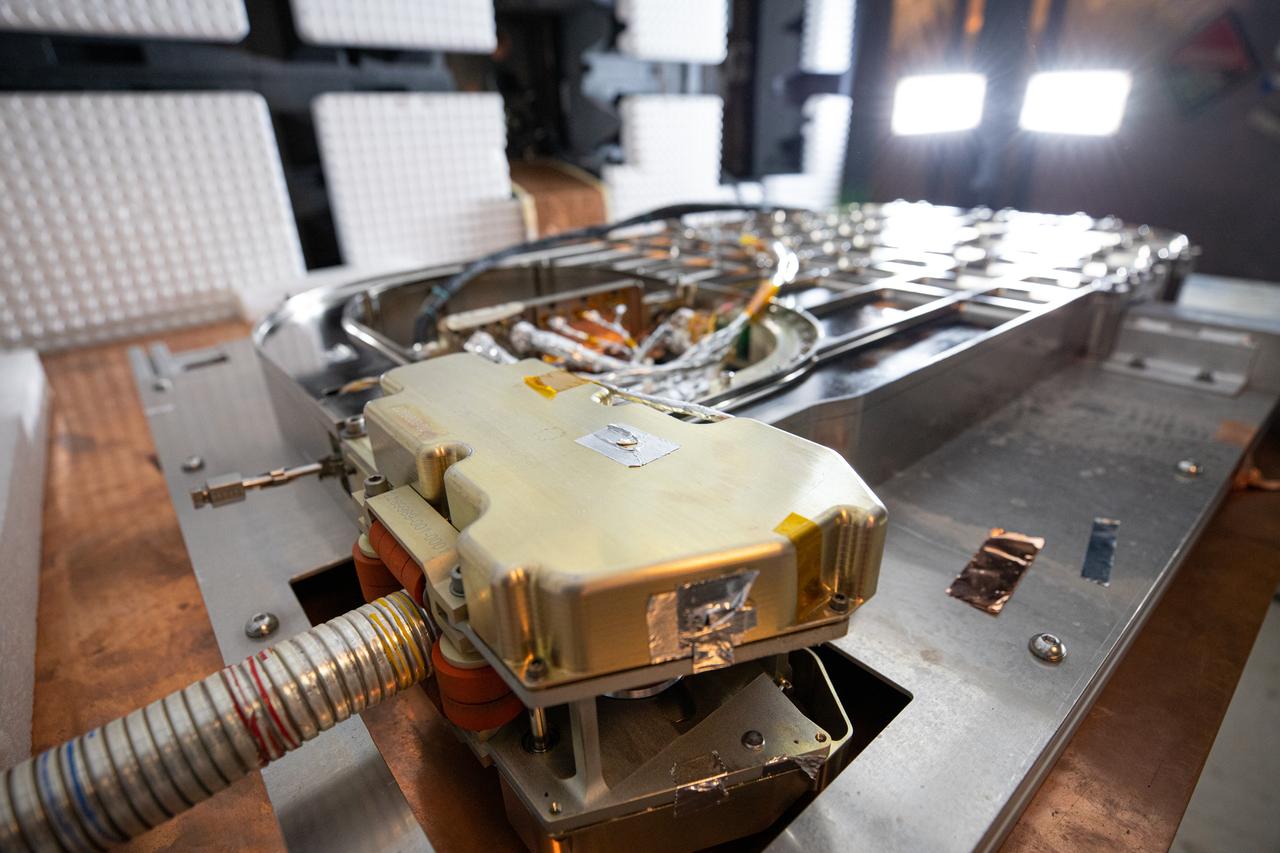
The Restore-L hose management assembly (HMA) test unit undergoes electromagnetic interference testing in the Electromagnetic Lab at NASA's Kennedy Space Center in Florida on Feb. 19, 2020. The HMA is able to extend and retract the hose, somewhat similar to the function of a tape measure. Managed by the agency's Goddard Space Flight Center in Greenbelt, Maryland, Restore-L is an inflight robotic satellite servicer spacecraft.
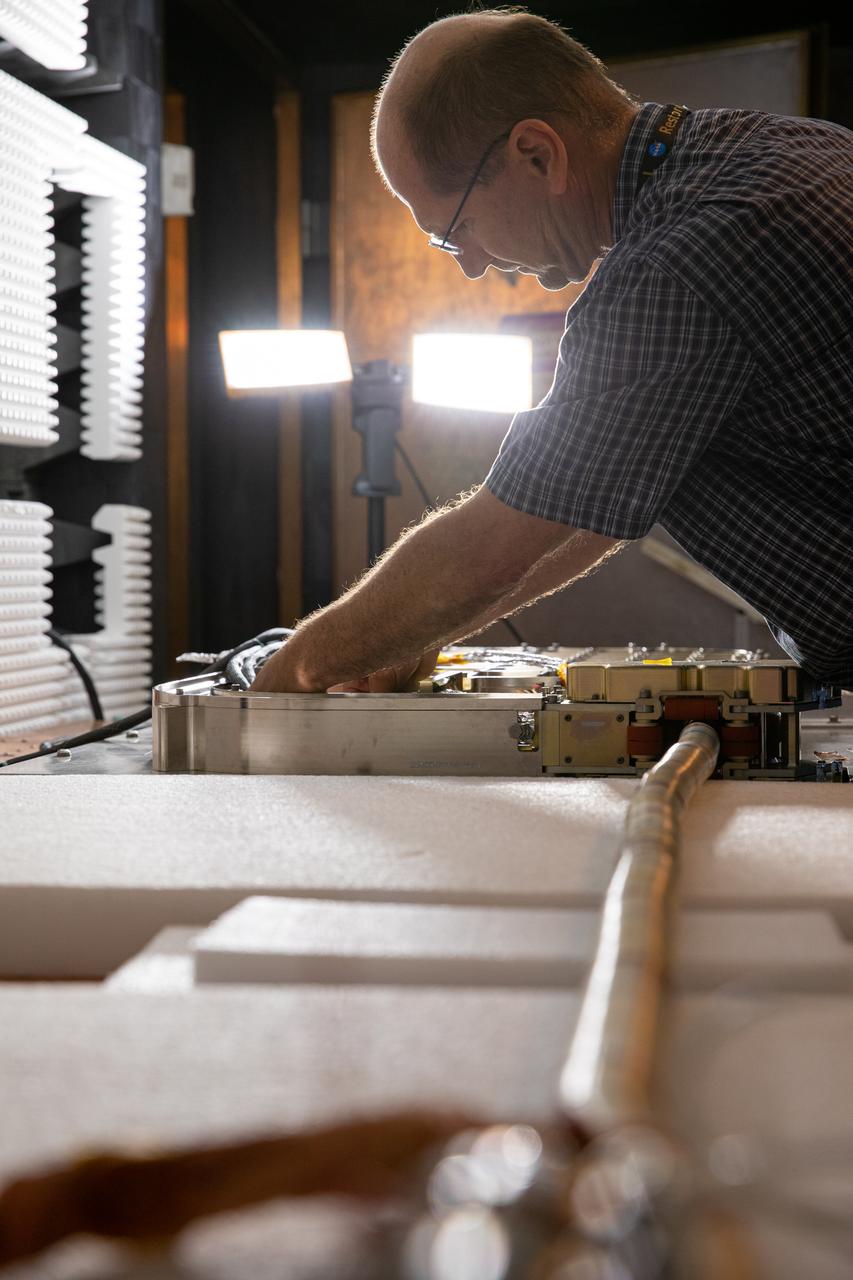
Inside the Electromagnetic Lab at NASA's Kennedy Space Center in Florida, Gabor Tamasy, Hose Management Assembly (HMA) system lead for Restore-L, prepares the HMA test unit for electromagnetic interference testing on Feb. 19, 2020. The HMA is able to extend and retract the hose, somewhat similar to the function of a tape measure. Managed by the agency's Goddard Space Flight Center in Greenbelt, Maryland, Restore-L is an inflight robotic satellite servicer spacecraft.
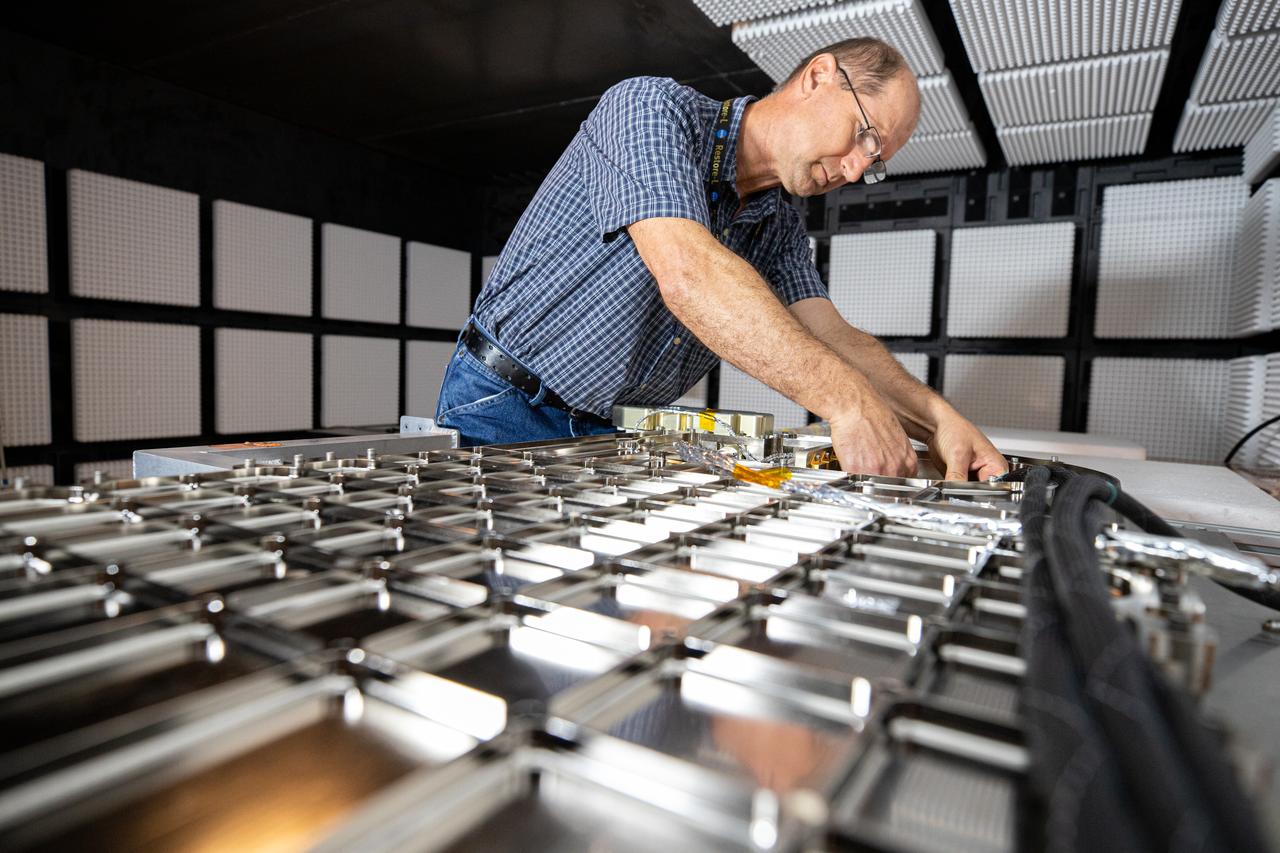
Inside the Electromagnetic Lab at NASA's Kennedy Space Center in Florida, Gabor Tamasy, Hose Management Assembly (HMA) system lead for Restore-L, prepares the HMA test unit for electromagnetic interference testing on Feb. 19, 2020. The HMA is able to extend and retract the hose, somewhat similar to the function of a tape measure. Managed by the agency's Goddard Space Flight Center in Greenbelt, Maryland, Restore-L is an inflight robotic satellite servicer spacecraft.
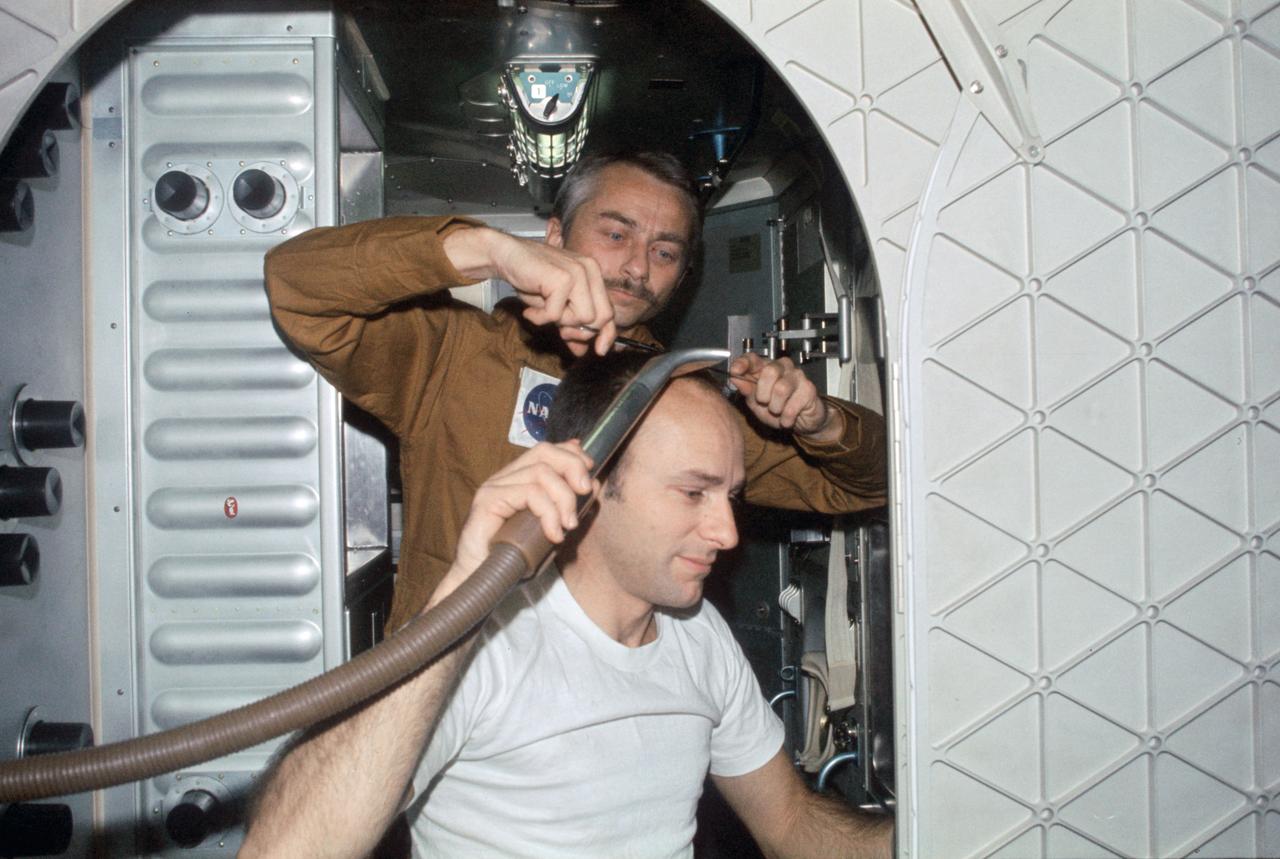
SL3-108-1292 (19 Aug. 1973) --- Scientist-astronaut Owen K. Garriott, Skylab 3 science pilot, trims the hair of astronaut Alan L. Bean, commander, in this onboard photograph from the Skylab Orbital Workshop (OWS) in Earth orbit. Astronaut Jack R. Lousma, pilot, took this picture with a 35mm Nikon camera. Bean holds a vacuum hose to gather in loose hair. The crew of the second manned Skylab flight went on to successfully complete 59 days aboard the Skylab space station cluster in Earth orbit. Photo credit: NASA
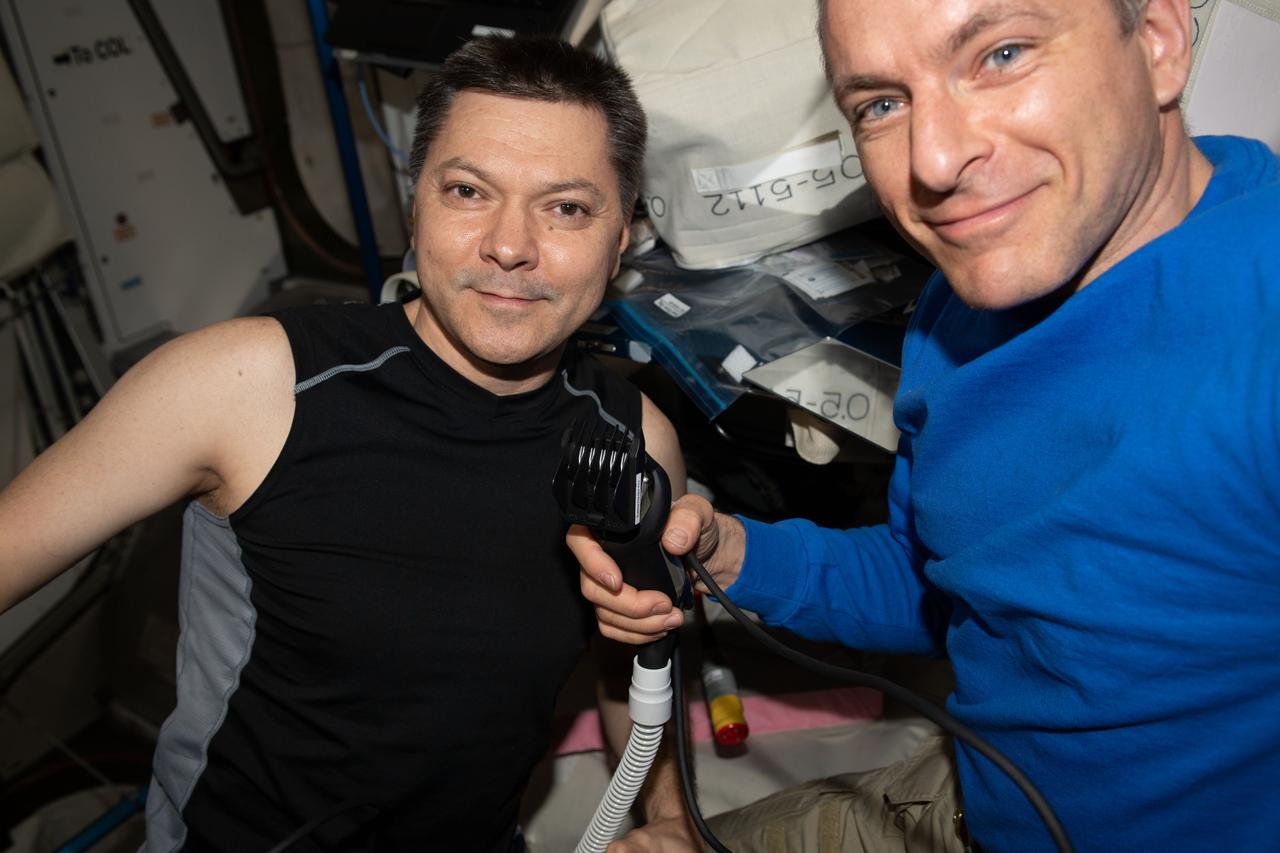
iss058e002225 (Jan. 5, 2019) --- Astronaut David Saint-Jacques of the Canadian Space Agency becomes a barber aboard the International Space Station and trims Expedition 58 Commander Oleg Kononenko's hair with clippers attached to a vacuum hose.
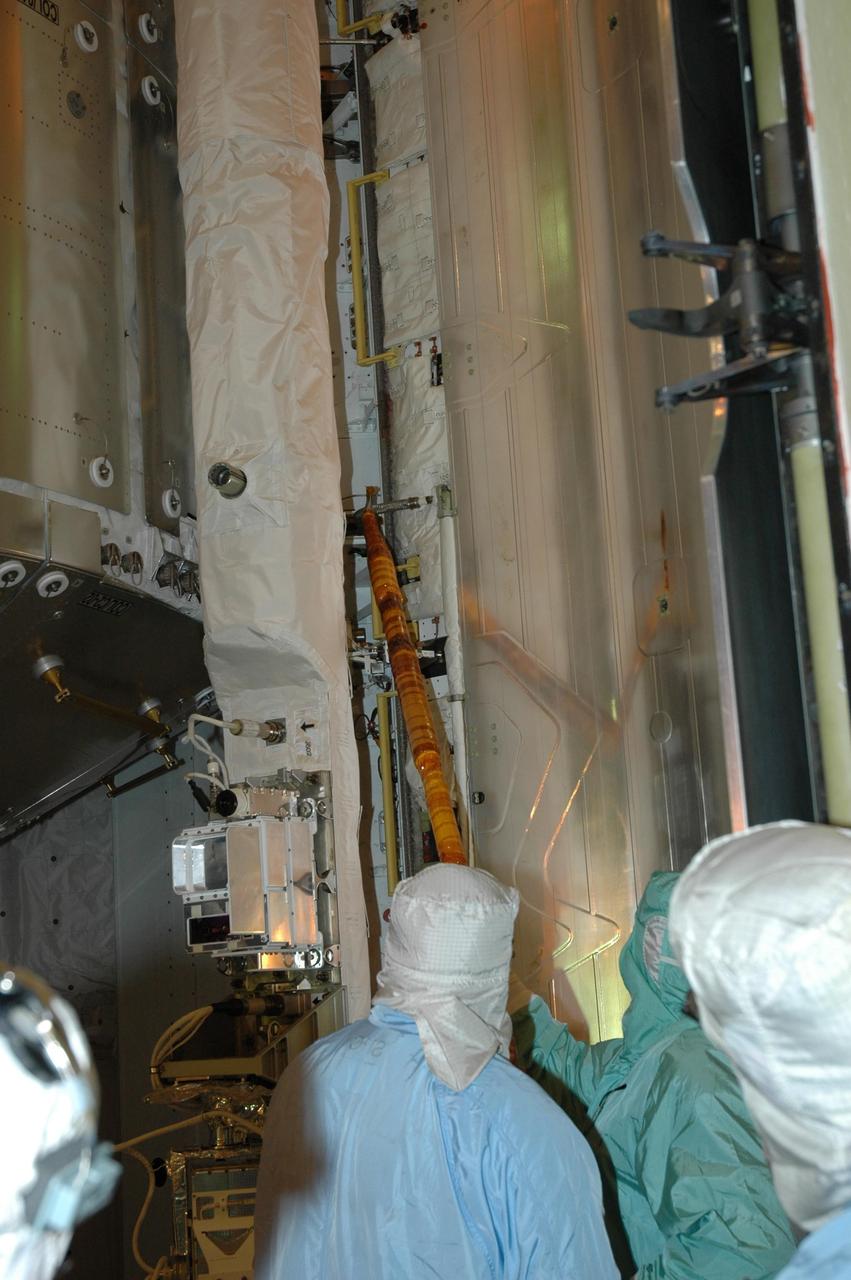
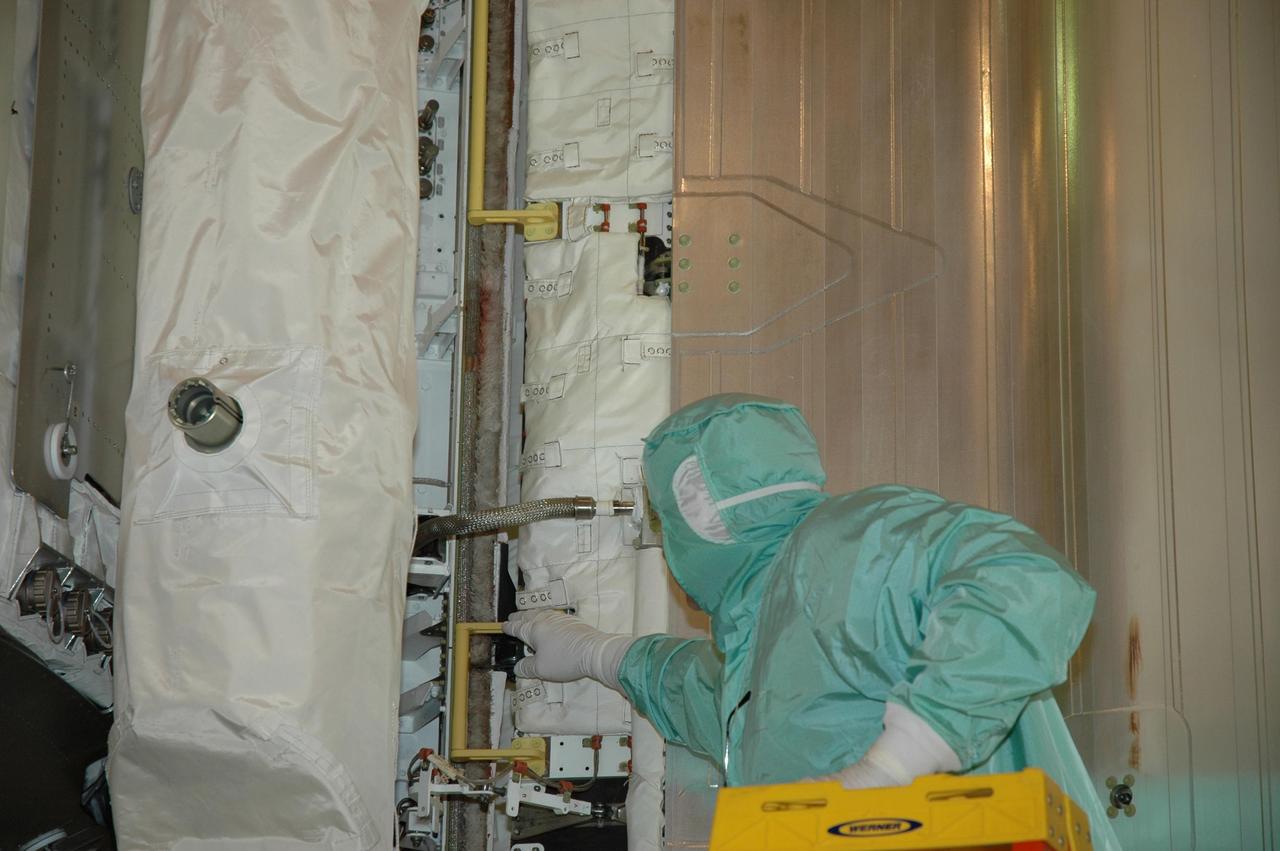
KENNEDY SPACE CENTER, FLA. -- On Launch Pad 39A at NASA's Kennedy Space Center, the payload bay doors are closing on space shuttle Atlantis. During launch preparations, technicians noticed a small section of a braided metal hose that was bent in a shape similar to the Greek letter Omega. The radiator retract hose (seen in the middle), part of the shuttle's cooling system that carries Freon, is designed to flex. Engineers are using a hose assist tool designed to help guide the hose back into the storage box. During the starboard door closure, eight incremental stops were performed. After each stop, the aft hose was adjusted and seated in place utilizing the ladder and hose assist tool. The team was satisfied with the final placement of the hose at door closure. STS-122 is the 121st space shuttle flight, the 29th flight for Atlantis and the 24th flight to the International Space Station. The Columbus laboratory module, built by the European Space Agency, is approximately 23 feet long and 15 feet wide, allowing it to hold 10 large racks of experiments. Atlantis is scheduled to launch at 2:45 p.m. Feb. 7. Photo credit: NASA/Jack Pfaller
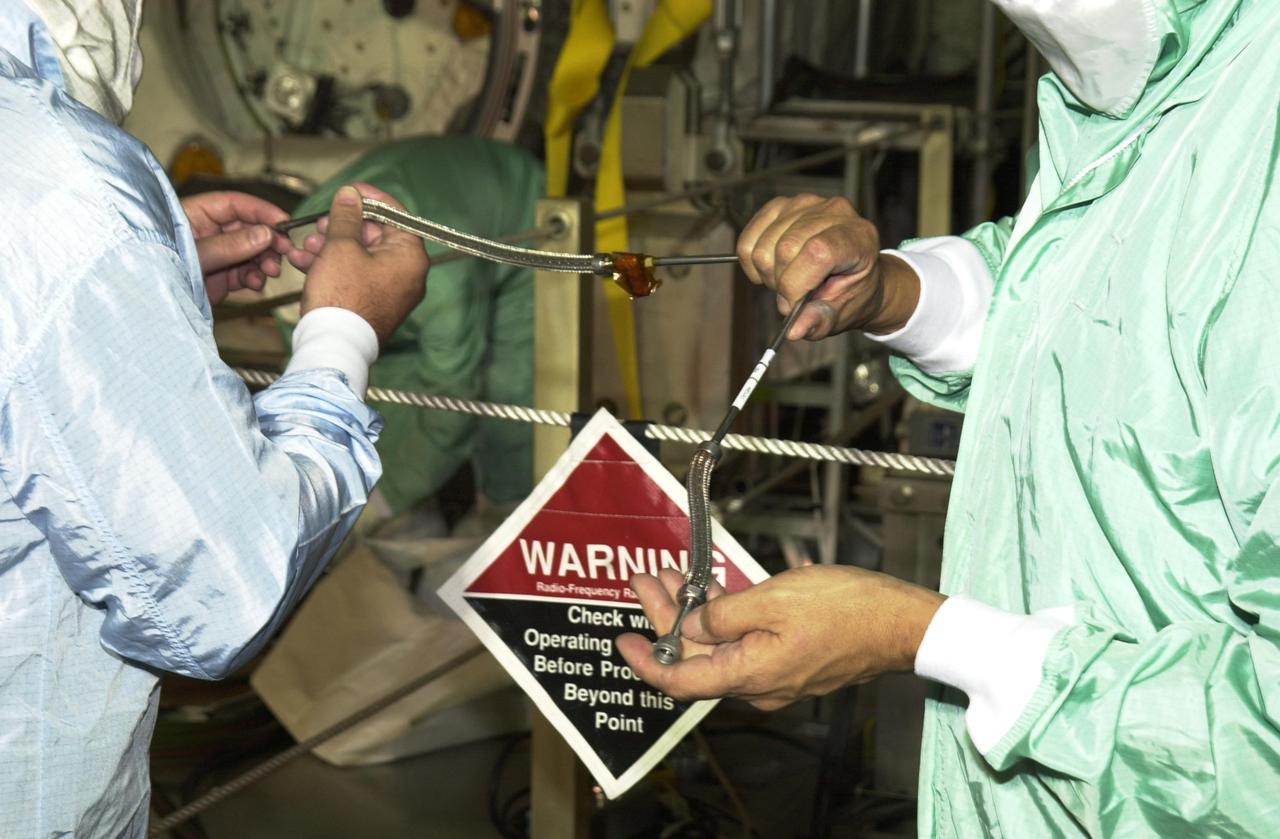
KENNEDY SPACE CENTER, FLA. -- Workers on Launch Pad 39A inspect an oxygen flex hose fitting. Through manual inspection and using helium detectors, the flex hose was identified as the source of an oxygen leak in Endeavour's mid-body. Visual inspection found a deformity in the flex line braid where it connects to rigid tubing. The entire flex hose assembly and bulkhead fitting were removed early today, and work is under way to complete the installation of a replacement.
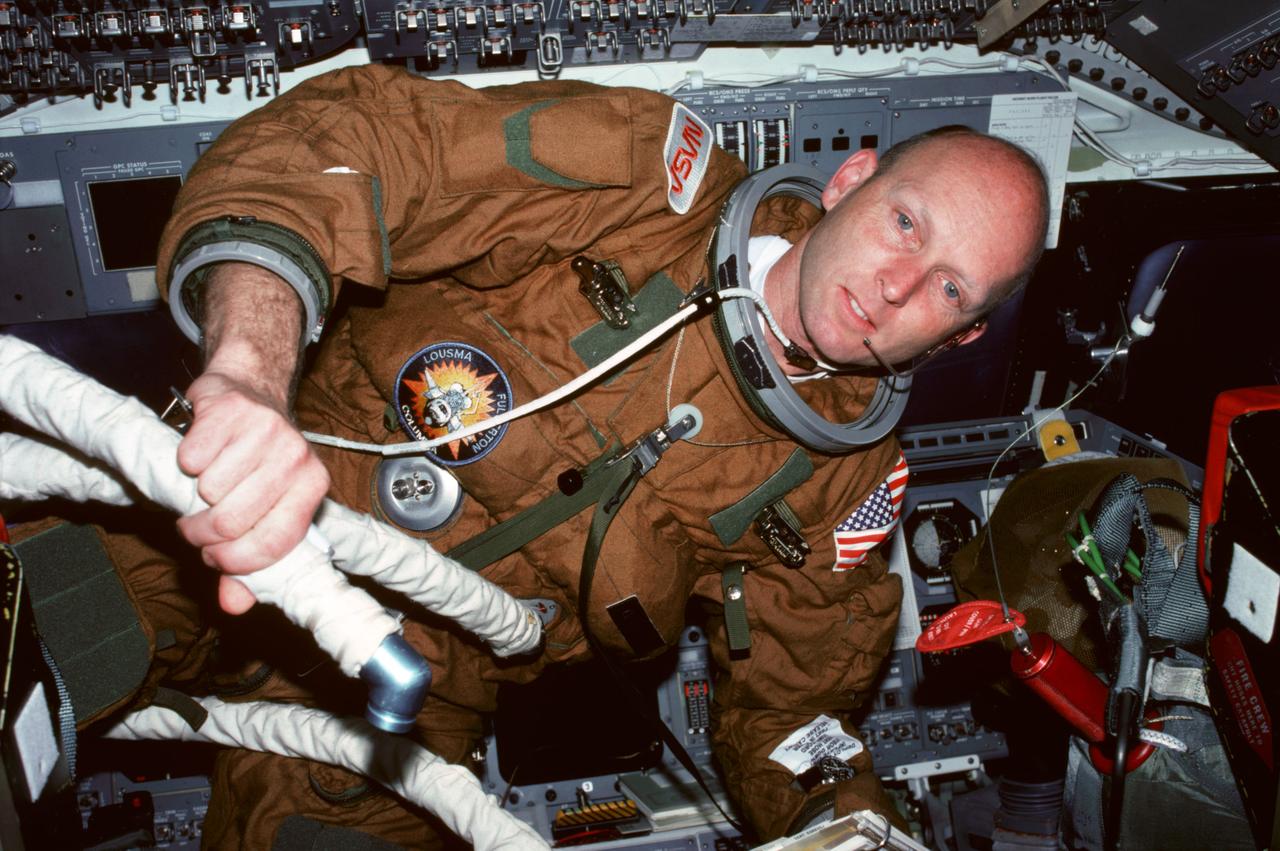
STS003-31-290 (30 March 1982) --- Astronaut Gordon Fullerton, STS-3 pilot, wearing communications kit assembly (ASSY) mini-headset (HDST) and ejection escape suit (EES), holds flexible hose attached to his EES vent hose fitting and second hose for commander's EES while behind pilots ejection seat (S2) seat back on the aft flight deck. Forward flight deck control panels are visible in the background. Photo credit: NASA
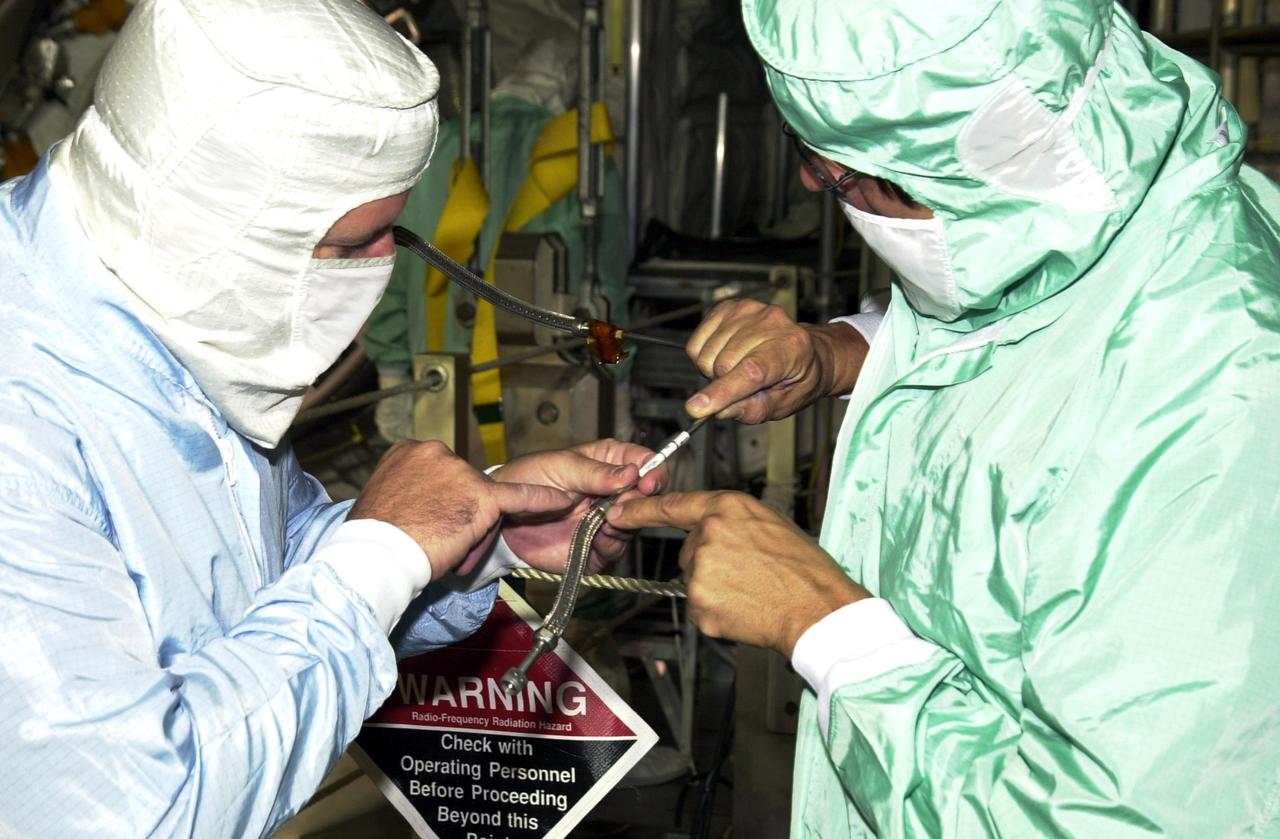
KENNEDY SPACE CENTER, FLA. -- Workers on Launch Pad 39A inspect an oxygen flex hose fitting. Through manual inspection and using helium detectors, the flex hose was identified as the source of an oxygen leak in Endeavour's mid-body. Visual inspection found a deformity in the flex line braid where it connects to rigid tubing. The entire flex hose assembly and bulkhead fitting were removed early today, and work is under way to complete the installation of a replacement.
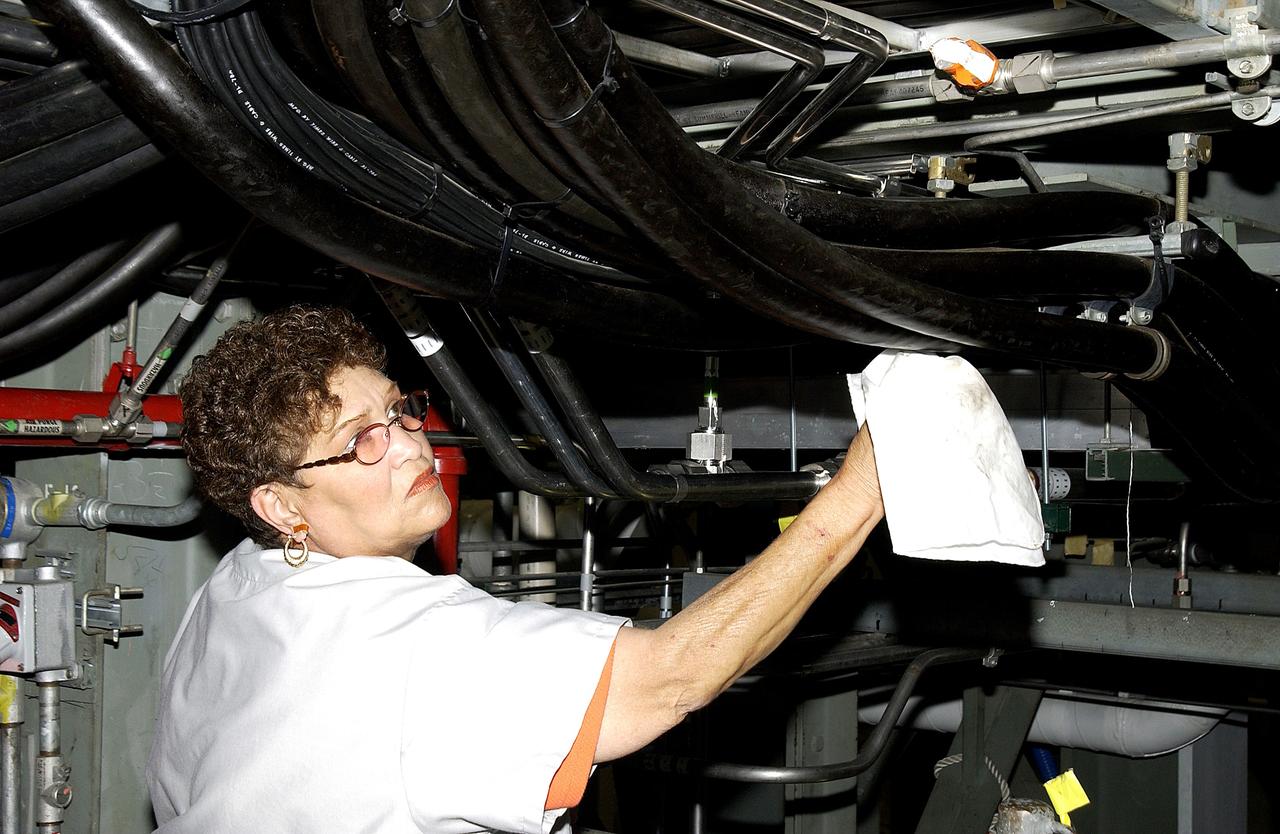
KENNEDY SPACE CENTER, FLA. - A KSC employee wipes down some of the hoses of the ground support equipment in the Orbiter Processing Facility (OPF) where Space Shuttle Atlantis is being processed for flight. Preparations are under way for the next launch of Atlantis on mission STS-114, a utilization and logistics flight to the International Space Station.
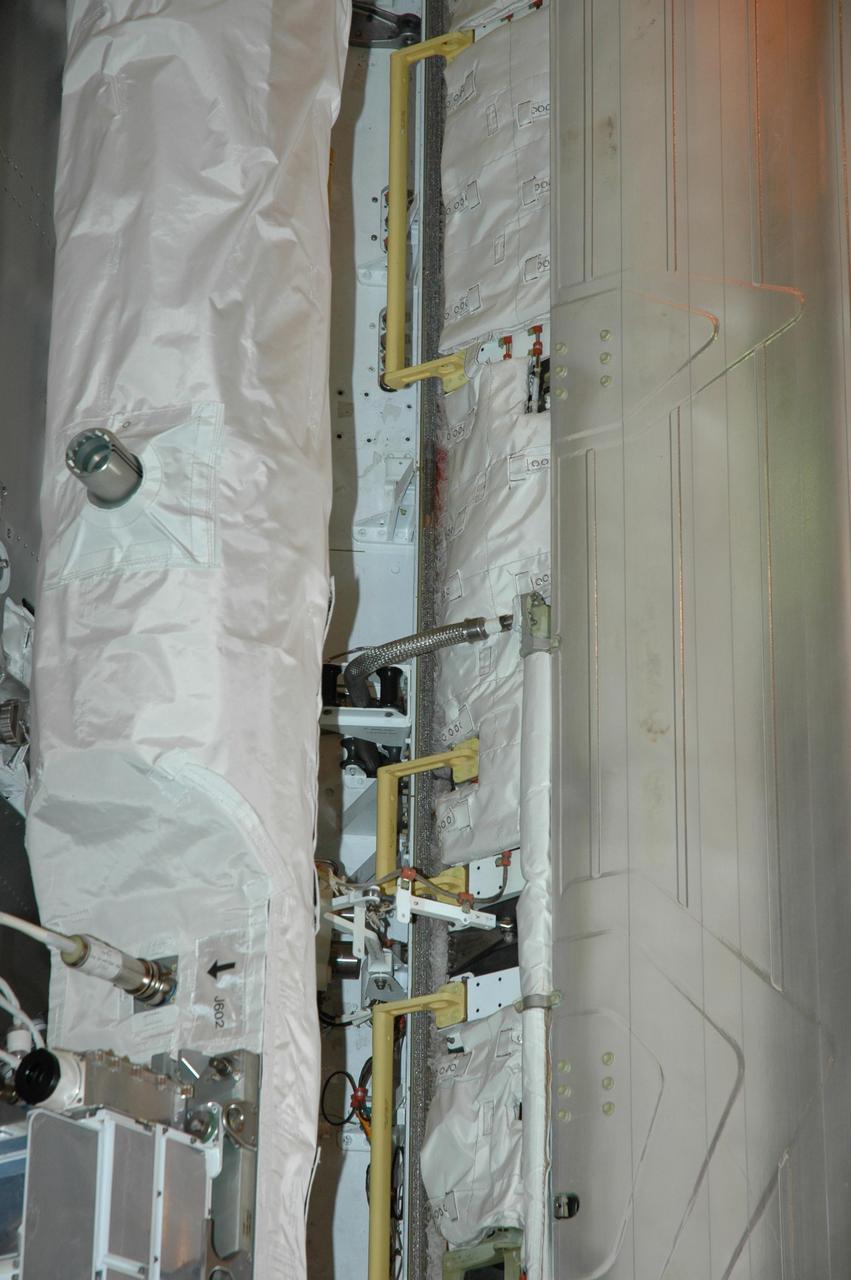
KENNEDY SPACE CENTER, FLA. -- On Launch Pad 39A at NASA's Kennedy Space Center, the payload bay doors are closing on space shuttle Atlantis. During launch preparations, technicians noticed a small section of a braided metal hose that was bent in a shape similar to the Greek letter Omega. The radiator retract hose (seen in the middle), part of the shuttle's cooling system that carries Freon, is designed to flex. Engineers designed a tool to guide the hose back into the storage box. During the starboard door closure, eight incremental stops were performed. After each stop, the aft hose was adjusted and seated in place utilizing the ladder and hose assist tool. The team was satisfied with the final placement of the hose at door closure. STS-122 is the 121st space shuttle flight, the 29th flight for Atlantis and the 24th flight to the International Space Station. The Columbus laboratory module, built by the European Space Agency, is approximately 23 feet long and 15 feet wide, allowing it to hold 10 large racks of experiments. Atlantis is scheduled to launch at 2:45 p.m. Feb. 7. Photo credit: NASA/Jack Pfaller
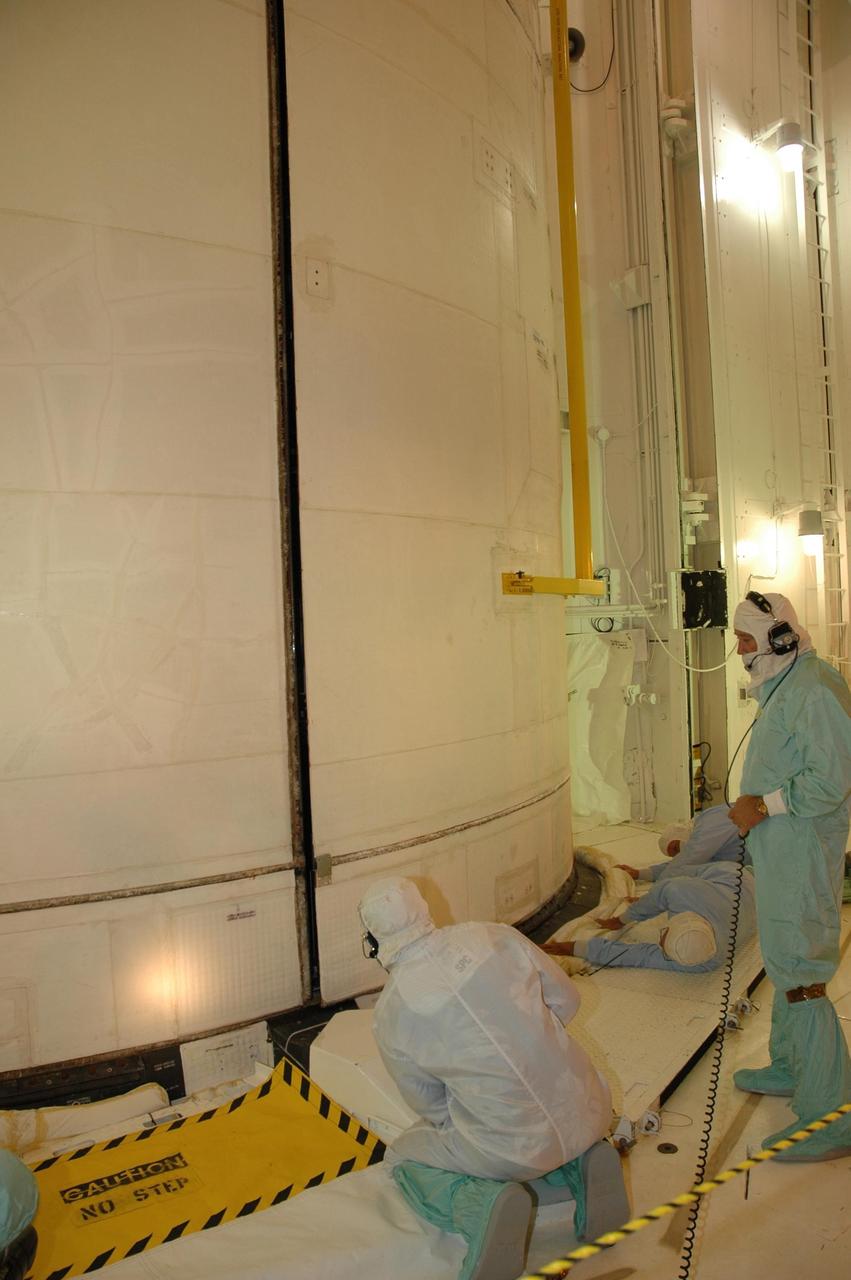
KENNEDY SPACE CENTER, FLA. -- On Launch Pad 39A at NASA's Kennedy Space Center, engineers examine the fit of the payload bay doors on space shuttle Atlantis as they are closing. During launch preparations, technicians noticed a small section of a braided metal hose that was bent in a shape similar to the Greek letter Omega. The radiator retract hose (seen in the middle), part of the shuttle's cooling system that carries Freon, is designed to flex. Engineers designed a tool to guide the hose back into the storage box. During the starboard door closure, eight incremental stops were performed. After each stop, the aft hose was adjusted and seated in place utilizing the ladder and hose assist tool. The team was satisfied with the final placement of the hose at door closure. STS-122 is the 121st space shuttle flight, the 29th flight for Atlantis and the 24th flight to the International Space Station. The Columbus laboratory module, built by the European Space Agency, is approximately 23 feet long and 15 feet wide, allowing it to hold 10 large racks of experiments. Atlantis is scheduled to launch at 2:45 p.m. Feb. 7. Photo credit: NASA/Jack Pfaller
KENNEDY SPACE CENTER, FLA. -- On Launch Pad 39A at NASA's Kennedy Space Center, an engineer checks the progress of payload bay doors closing on space shuttle Atlantis. During launch preparations, technicians noticed a small section of a braided metal hose that was bent in a shape similar to the Greek letter Omega. The radiator retract hose, part of the shuttle's cooling system that carries Freon, is designed to flex. Engineers designed a tool to guide the hose back into the storage box. During the starboard door closure, eight incremental stops were performed. After each stop, the aft hose was adjusted and seated in place utilizing the ladder and hose assist tool. The team was satisfied with the final placement of the hose at door closure. STS-122 is the 121st space shuttle flight, the 29th flight for Atlantis and the 24th flight to the International Space Station. The Columbus laboratory module, built by the European Space Agency, is approximately 23 feet long and 15 feet wide, allowing it to hold 10 large racks of experiments. Atlantis is scheduled to launch at 2:45 p.m. Feb. 7. Photo credit: NASA/Jack Pfaller
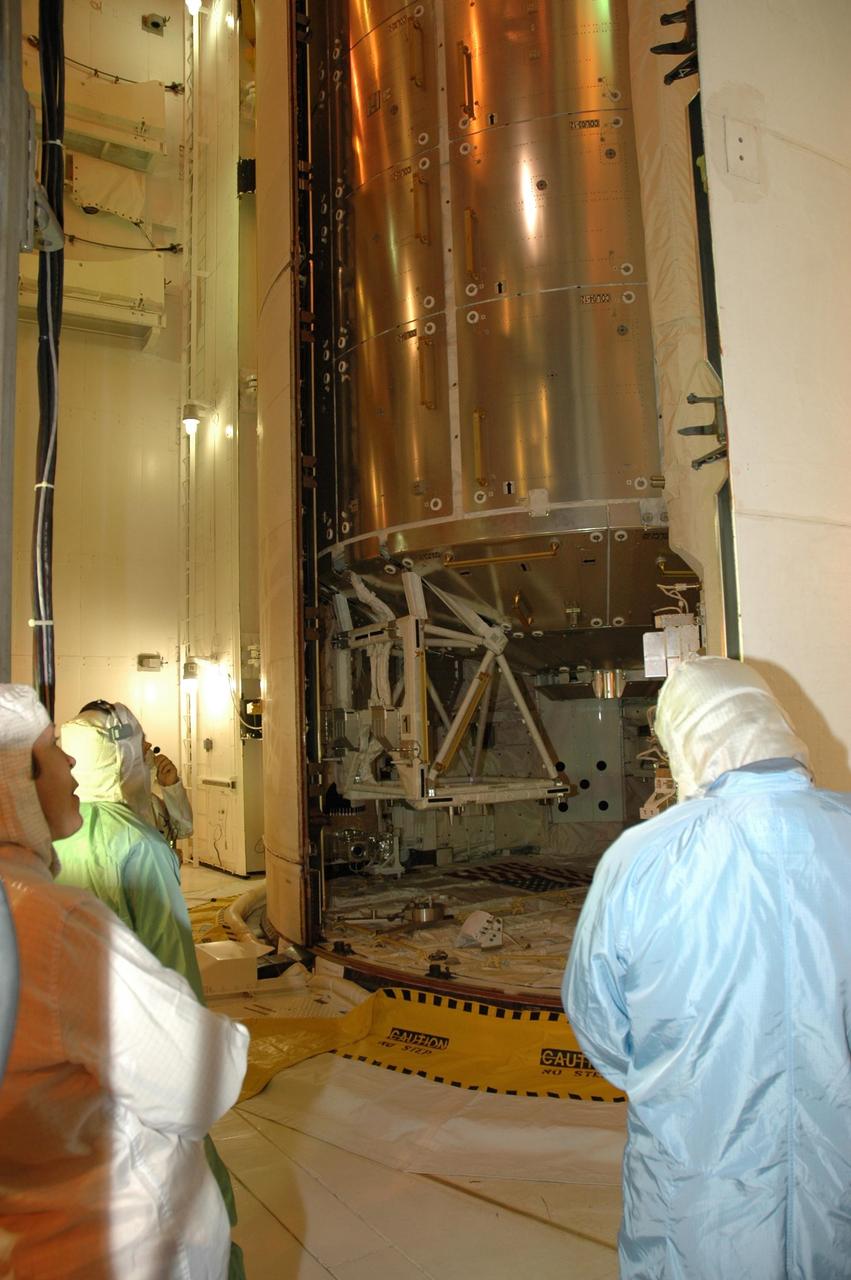
KENNEDY SPACE CENTER, FLA. -- From the payload changeout room on Launch Pad 39A at NASA's Kennedy Space Center, engineers oversee the closing of space shuttle Atlantis' payload bay doors around the cargo -- the Columbus Laboratory seen here. During launch preparations, technicians noticed a small section of a braided metal hose that was bent in a shape similar to the Greek letter Omega. The radiator retract hose, part of the shuttle's cooling system that carries Freon, is designed to flex. Engineers designed a tool to guide the hose back into the storage box. During the starboard door closure, eight incremental stops were performed. After each stop, the aft hose was adjusted and seated in place utilizing the ladder and hose assist tool. The team was satisfied with the final placement of the hose at door closure. STS-122 is the 121st space shuttle flight, the 29th flight for Atlantis and the 24th flight to the International Space Station. The Columbus laboratory module, built by the European Space Agency, is approximately 23 feet long and 15 feet wide, allowing it to hold 10 large racks of experiments. Atlantis is scheduled to launch at 2:45 p.m. Feb. 7. Photo credit: NASA/Jack Pfaller
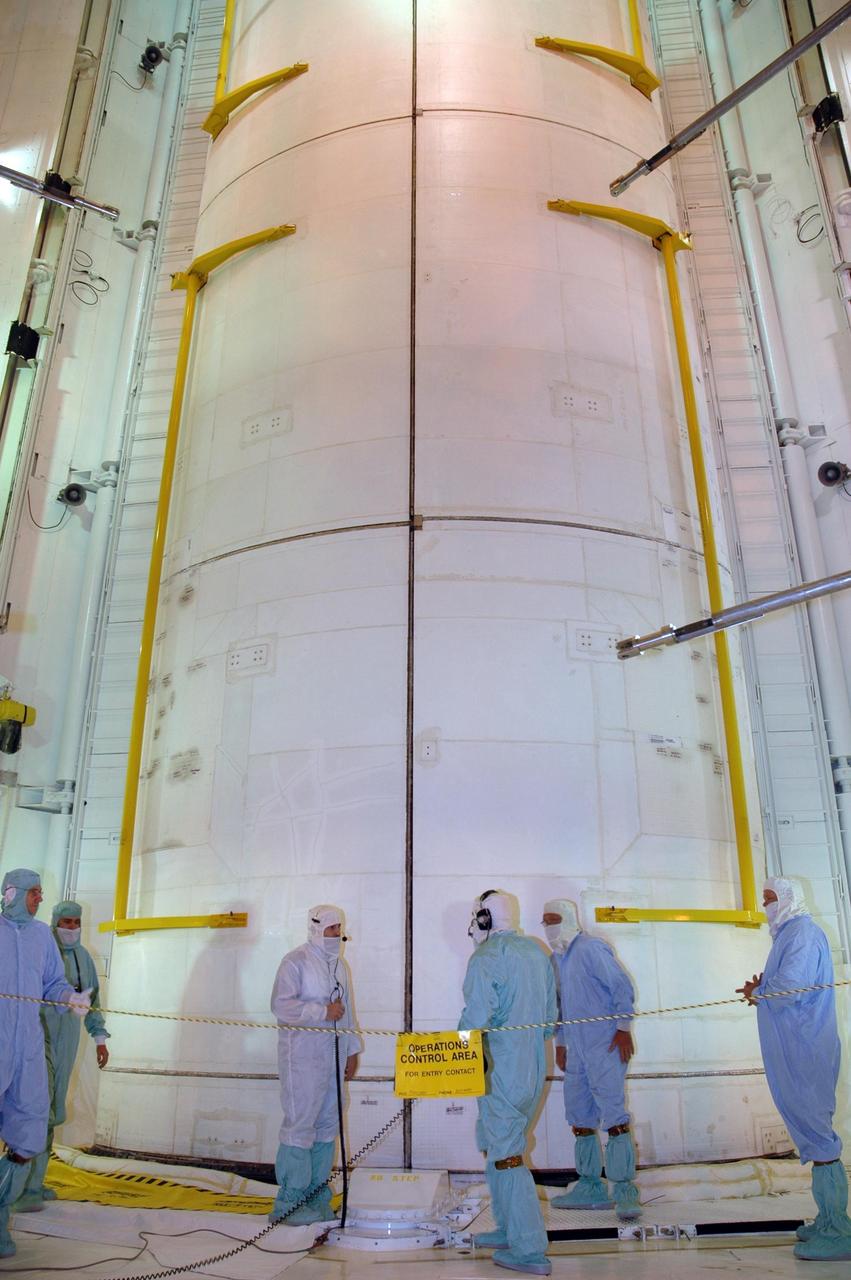
KENNEDY SPACE CENTER, FLA. -- On Launch Pad 39A at NASA's Kennedy Space Center, the payload bay doors on space shuttle Atlantis are successfully closed for launch. During launch preparations, technicians noticed a small section of a braided metal hose that was bent in a shape similar to the Greek letter Omega. The radiator retract hose (seen in the middle), part of the shuttle's cooling system that carries Freon, is designed to flex. Engineers designed a tool to guide the hose back into the storage box. During the starboard door closure, eight incremental stops were performed. After each stop, the aft hose was adjusted and seated in place utilizing the ladder and hose assist tool. The team was satisfied with the final placement of the hose at door closure. STS-122 is the 121st space shuttle flight, the 29th flight for Atlantis and the 24th flight to the International Space Station. The Columbus laboratory module, built by the European Space Agency, is approximately 23 feet long and 15 feet wide, allowing it to hold 10 large racks of experiments. Atlantis is scheduled to launch at 2:45 p.m. Feb. 7. Photo credit: NASA/Jack Pfaller
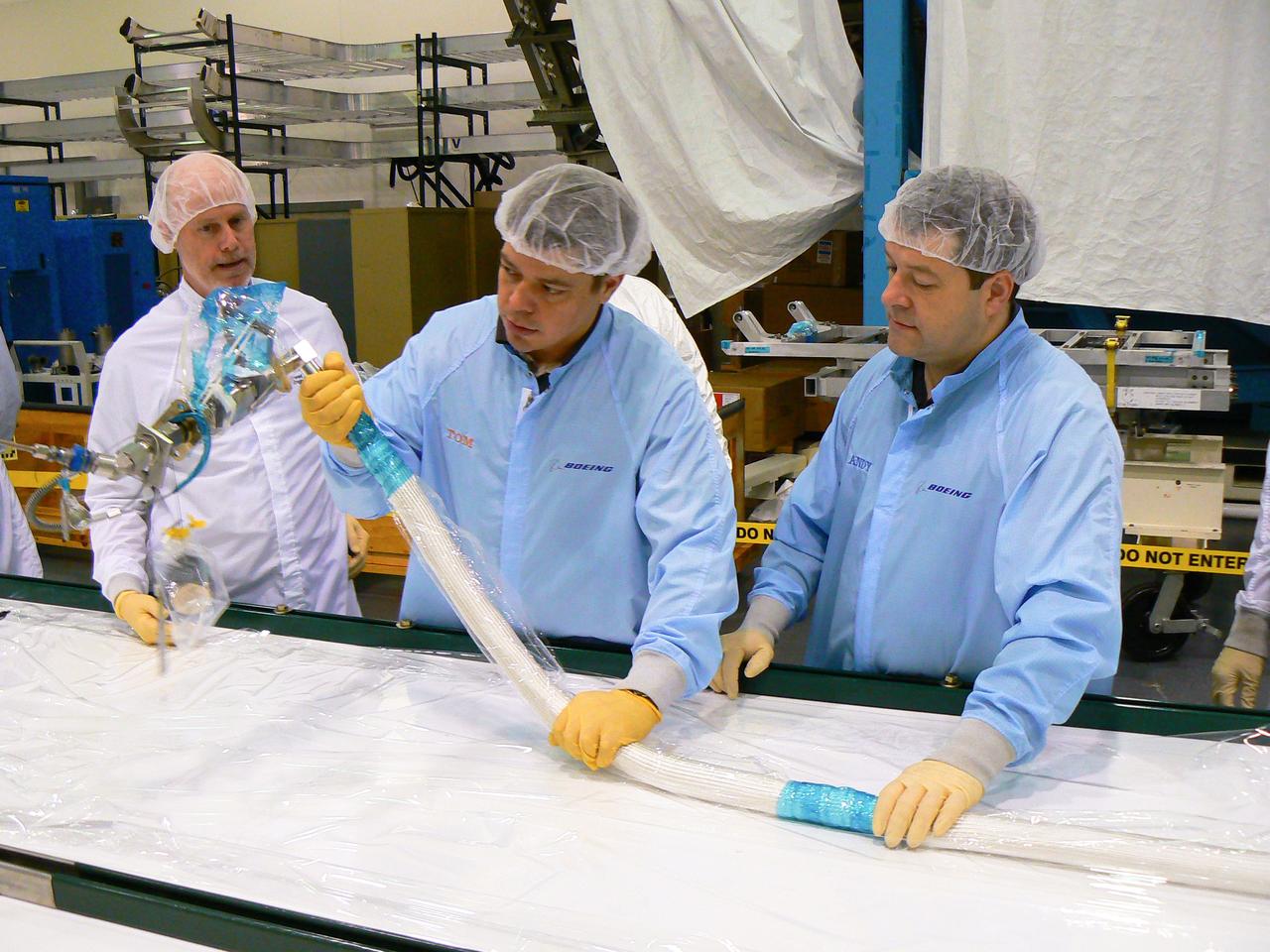
JSC2010-E-014775 (15 Jan. 2010) --- Seen at Marshall Space Center building 4708 in the high-bay clean room, astronauts Nicholas Patrick (right) and Robert Behnken, both STS-130 mission specialists, accompanied by Eric Howell, Boeing Huntsville Chief Engineer for ISS, handle ammonia hoses to be installed during mission STS-130. The hoses are at 500 pounds per square inch pressure (psi) to give them a feel for how stiff the hoses would be at 500 psi if they had to handle them under pressure on orbit.
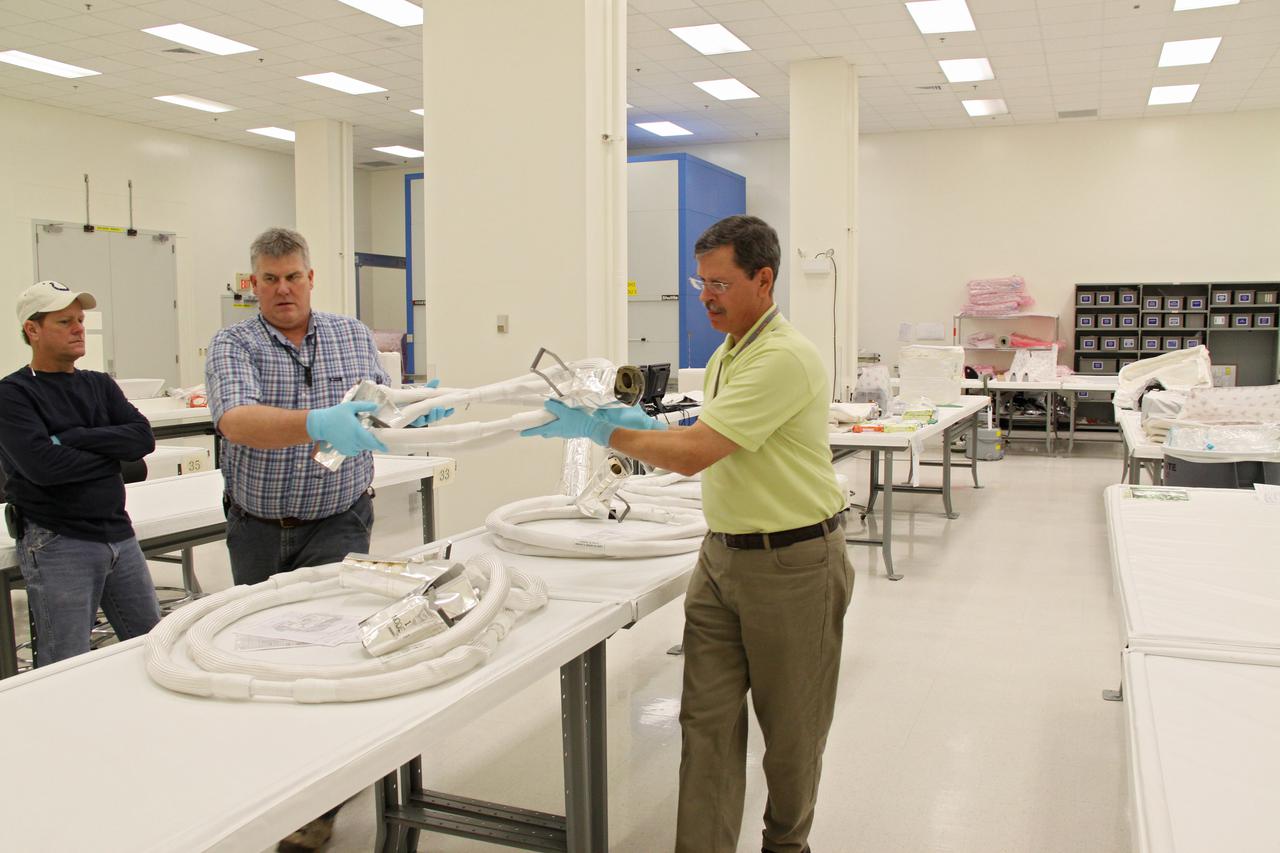
CAPE CANAVERAL, Fla. – In the Space Station Processing Facility at NASA's Kennedy Space Center in Florida, workers position along work tables the newly arrived replacement high-pressure ammonia jumper hoses to support space shuttle Endeavour's STS-130 mission. A problem arose during a prelaunch test Jan. 7 with one of four hoses that are needed to connect the ammonia loops of the International Space Station's Tranquility node to those of the Destiny laboratory. A decision was made to use an alternate hose design for use as the primary jumper. The new hoses are assembled from shorter hoses that were previously certified and tested. Connection of the modules requires two ammonia loops, with two lines apiece, each of which must be connected to both Tranquility and Destiny to route cooling to and from the Tranquility module. The primary payload for the STS-130 mission, Tranquility is a pressurized module that will provide additional room for crew members and many of the station's life support and environmental control systems. The node was built in Turin, Italy, by Thales Alenia Space for the European Space Agency. Endeavour's launch is set for Feb. 7. For information on the STS-130 mission and crew, visit http:__www.nasa.gov_mission_pages_shuttle_shuttlemissions_sts130_index.html. Photo credit: NASA_Jack Pfaller
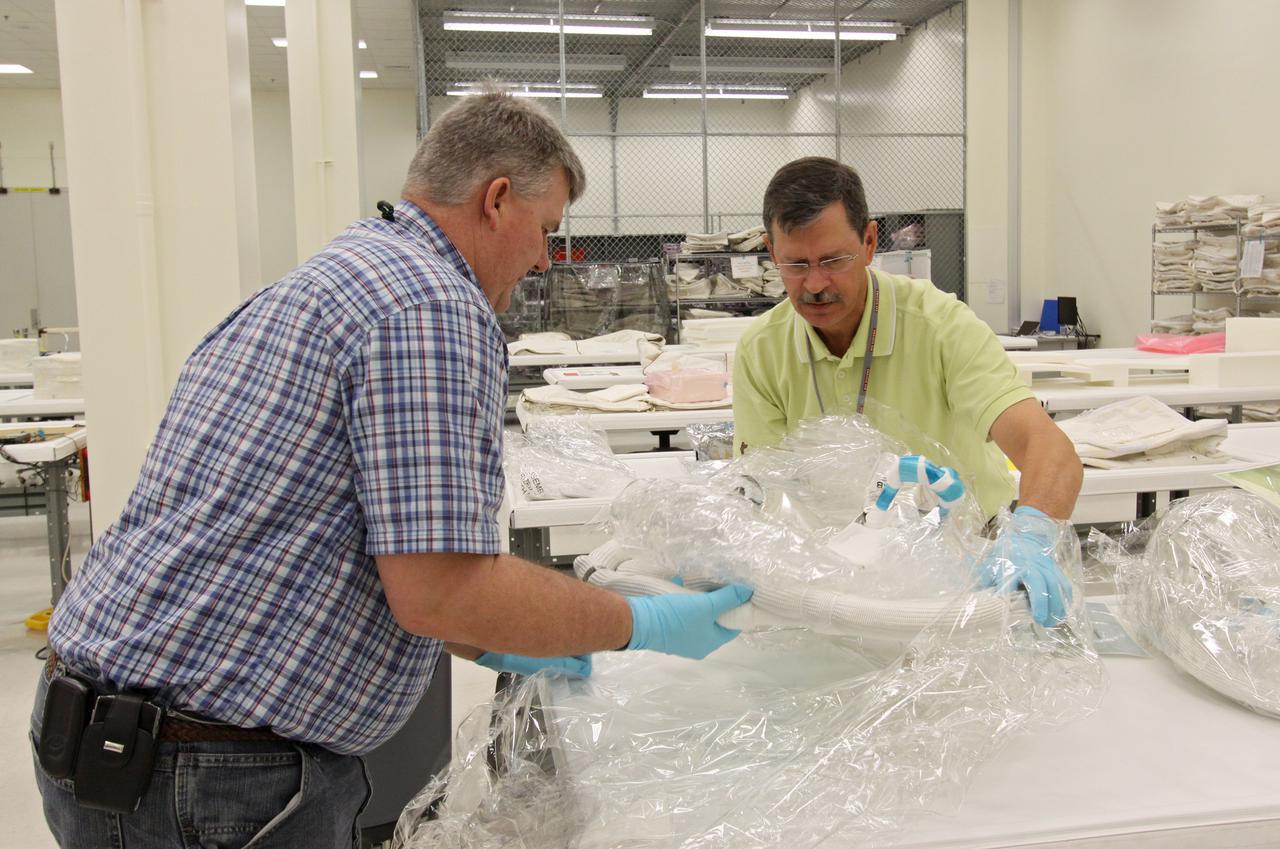
CAPE CANAVERAL, Fla. – In the Space Station Processing Facility at NASA's Kennedy Space Center in Florida, workers unwrap the newly arrived replacement high-pressure ammonia jumper hoses to support space shuttle Endeavour's STS-130 mission. A problem arose during a prelaunch test Jan. 7 with one of four hoses that are needed to connect the ammonia loops of the International Space Station's Tranquility node to those of the Destiny laboratory. A decision was made to use an alternate hose design for use as the primary jumper. The new hoses are assembled from shorter hoses that were previously certified and tested. Connection of the modules requires two ammonia loops, with two lines apiece, each of which must be connected to both Tranquility and Destiny to route cooling to and from the Tranquility module. The primary payload for the STS-130 mission, Tranquility is a pressurized module that will provide additional room for crew members and many of the station's life support and environmental control systems. The node was built in Turin, Italy, by Thales Alenia Space for the European Space Agency. Endeavour's launch is set for Feb. 7. For information on the STS-130 mission and crew, visit http:__www.nasa.gov_mission_pages_shuttle_shuttlemissions_sts130_index.html. Photo credit: NASA_Jack Pfaller
CAPE CANAVERAL, Fla. – In the Space Station Processing Facility at NASA's Kennedy Space Center in Florida, workers unwrap the newly arrived replacement high-pressure ammonia jumper hoses to support space shuttle Endeavour's STS-130 mission. A problem arose during a prelaunch test Jan. 7 with one of four hoses that are needed to connect the ammonia loops of the International Space Station's Tranquility node to those of the Destiny laboratory. A decision was made to use an alternate hose design for use as the primary jumper. The new hoses are assembled from shorter hoses that were previously certified and tested. Connection of the modules requires two ammonia loops, with two lines apiece, each of which must be connected to both Tranquility and Destiny to route cooling to and from the Tranquility module. The primary payload for the STS-130 mission, Tranquility is a pressurized module that will provide additional room for crew members and many of the station's life support and environmental control systems. The node was built in Turin, Italy, by Thales Alenia Space for the European Space Agency. Endeavour's launch is set for Feb. 7. For information on the STS-130 mission and crew, visit http:__www.nasa.gov_mission_pages_shuttle_shuttlemissions_sts130_index.html. Photo credit: NASA_Jack Pfaller
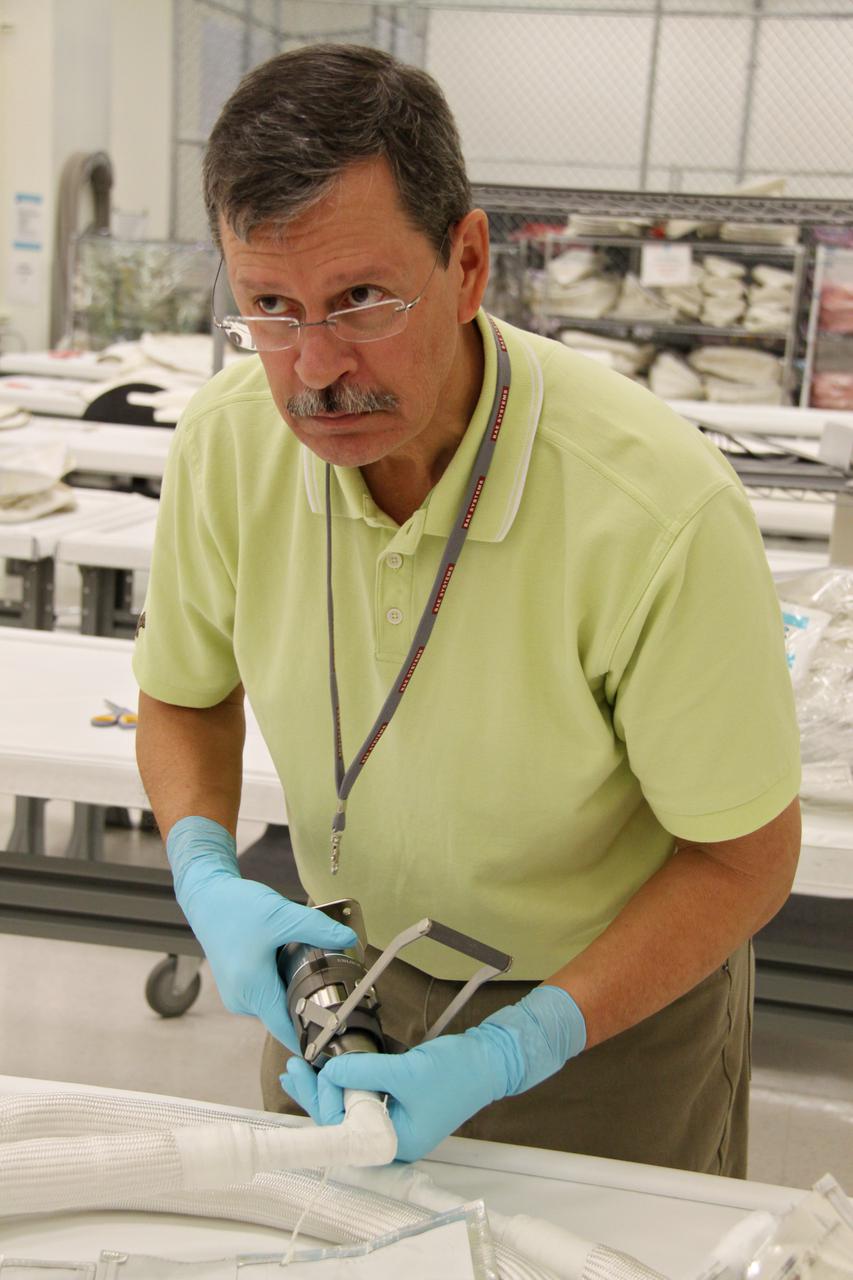
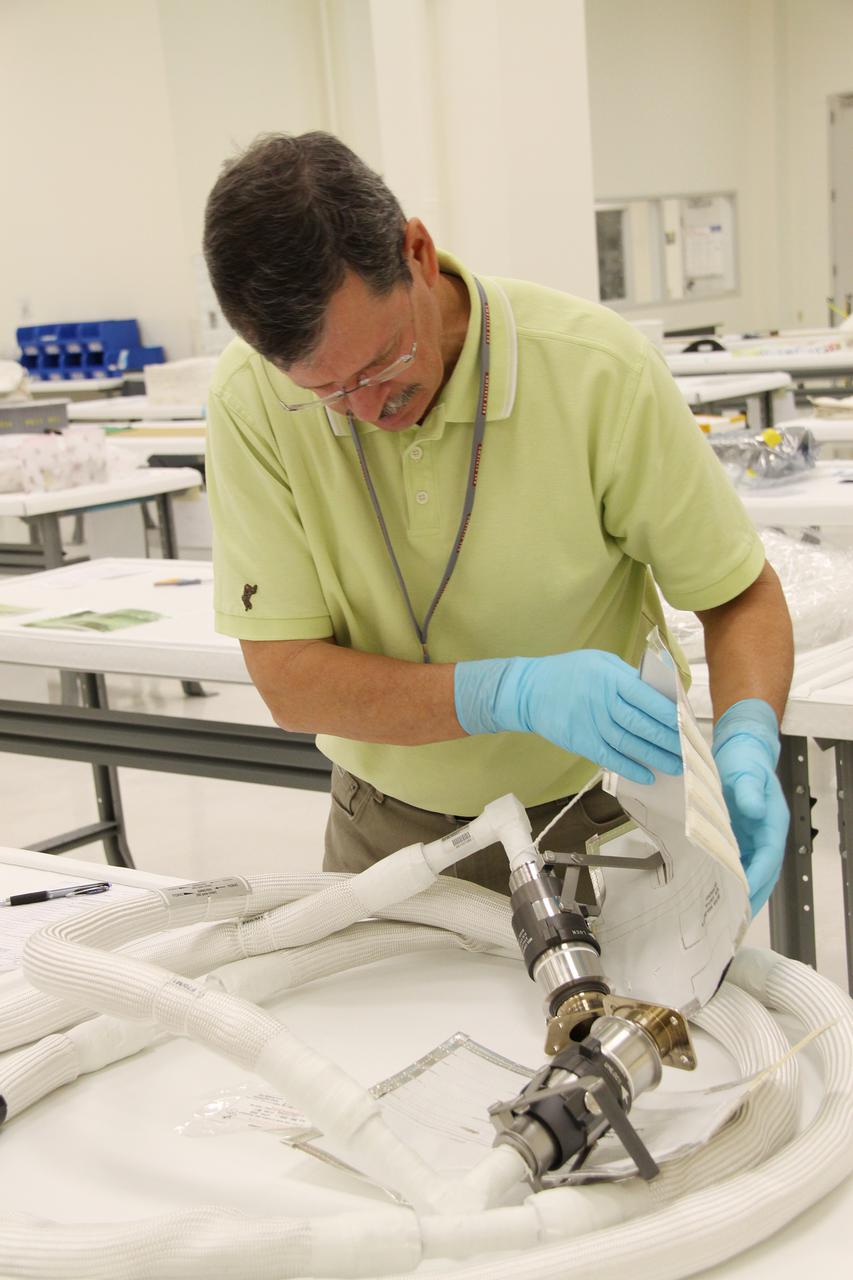
CAPE CANAVERAL, Fla. – In the Space Station Processing Facility at NASA's Kennedy Space Center in Florida, a worker inspects a newly arrived replacement high-pressure ammonia jumper hose to support space shuttle Endeavour's STS-130 mission. A problem arose during a prelaunch test Jan. 7 with one of four hoses that are needed to connect the ammonia loops of the International Space Station's Tranquility node to those of the Destiny laboratory. A decision was made to use an alternate hose design for use as the primary jumper. The new hoses are assembled from shorter hoses that were previously certified and tested. Connection of the modules requires two ammonia loops, with two lines apiece, each of which must be connected to both Tranquility and Destiny to route cooling to and from the Tranquility module. The primary payload for the STS-130 mission, Tranquility is a pressurized module that will provide additional room for crew members and many of the station's life support and environmental control systems. The node was built in Turin, Italy, by Thales Alenia Space for the European Space Agency. Endeavour's launch is set for Feb. 7. For information on the STS-130 mission and crew, visit http:__www.nasa.gov_mission_pages_shuttle_shuttlemissions_sts130_index.html. Photo credit: NASA_Jack Pfaller
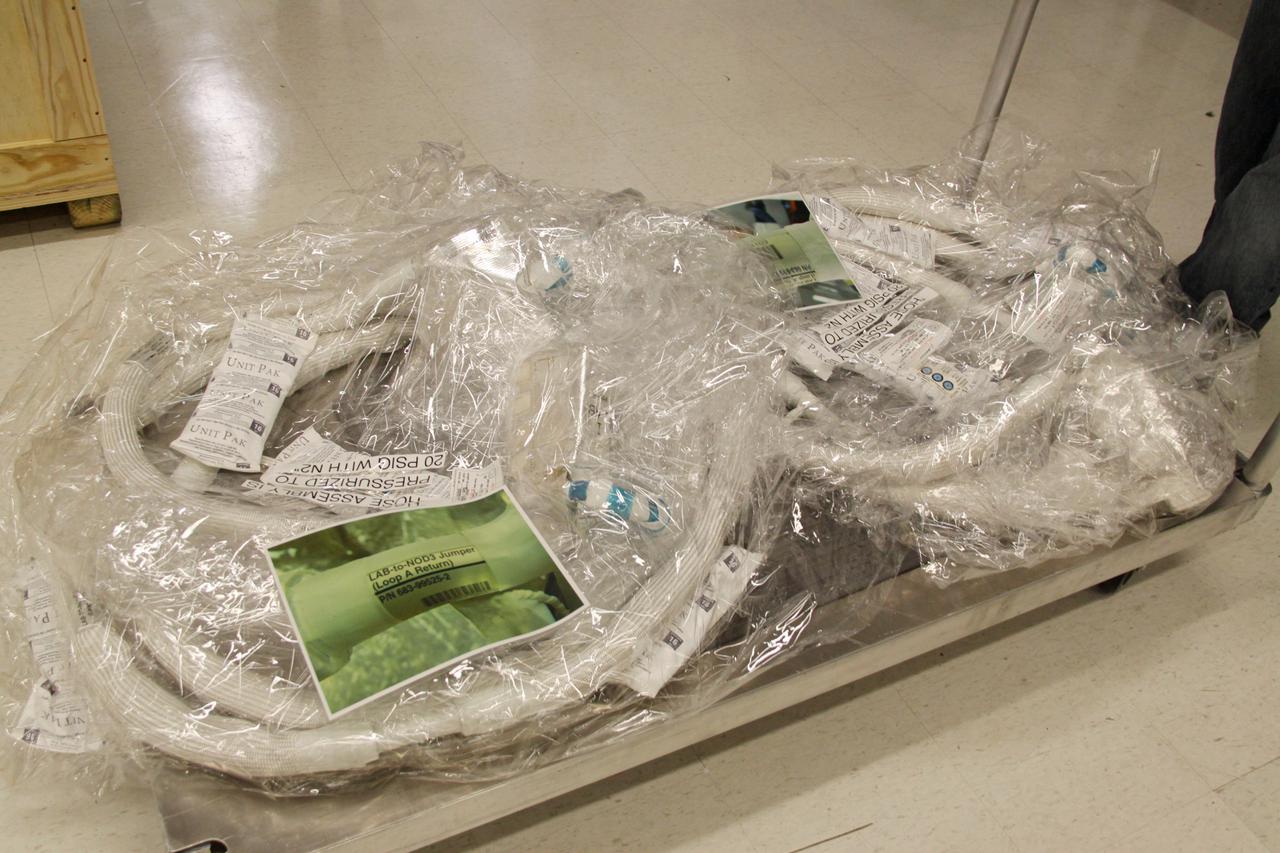
CAPE CANAVERAL, Fla. – The newly arrived replacement high-pressure ammonia jumper hoses to support space shuttle Endeavour's STS-130 mission are ready for processing in the Space Station Processing Facility at NASA's Kennedy Space Center in Florida. A problem arose during a prelaunch test Jan. 7 with one of four hoses that are needed to connect the ammonia loops of the International Space Station's Tranquility node to those of the Destiny laboratory. A decision was made to use an alternate hose design for use as the primary jumper. The new hoses are assembled from shorter hoses that were previously certified and tested. Connection of the modules requires two ammonia loops, with two lines apiece, each of which must be connected to both Tranquility and Destiny to route cooling to and from the Tranquility module. The primary payload for the STS-130 mission, Tranquility is a pressurized module that will provide additional room for crew members and many of the station's life support and environmental control systems. The node was built in Turin, Italy, by Thales Alenia Space for the European Space Agency. Endeavour's launch is set for Feb. 7. For information on the STS-130 mission and crew, visit http:__www.nasa.gov_mission_pages_shuttle_shuttlemissions_sts130_index.html. Photo credit: NASA_Jack Pfaller
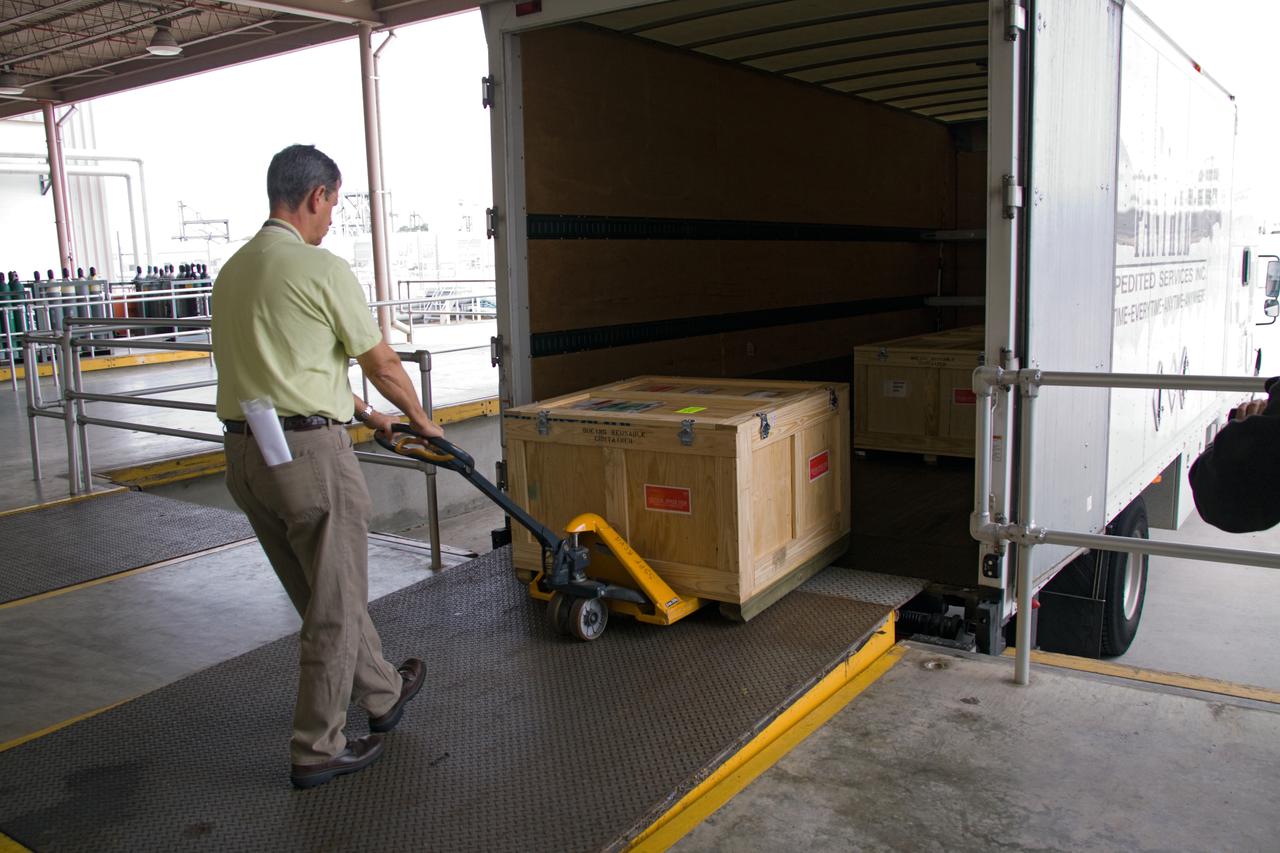
CAPE CANAVERAL, Fla. – Replacement high-pressure ammonia jumper hoses to support space shuttle Endeavour's STS-130 mission are delivered to the Space Station Processing Facility at NASA's Kennedy Space Center in Florida. A problem arose during a prelaunch test Jan. 7 with one of four hoses that are needed to connect the ammonia loops of the International Space Station's Tranquility node to those of the Destiny laboratory. A decision was made to use an alternate hose design for use as the primary jumper. The new hoses are assembled from shorter hoses that were previously certified and tested. Connection of the modules requires two ammonia loops, with two lines apiece, each of which must be connected to both Tranquility and Destiny to route cooling to and from the Tranquility module. The primary payload for the STS-130 mission, Tranquility is a pressurized module that will provide additional room for crew members and many of the station's life support and environmental control systems. The node was built in Turin, Italy, by Thales Alenia Space for the European Space Agency. Endeavour's launch is set for Feb. 7. For information on the STS-130 mission and crew, visit http:__www.nasa.gov_mission_pages_shuttle_shuttlemissions_sts130_index.html. Photo credit: NASA_Jack Pfaller
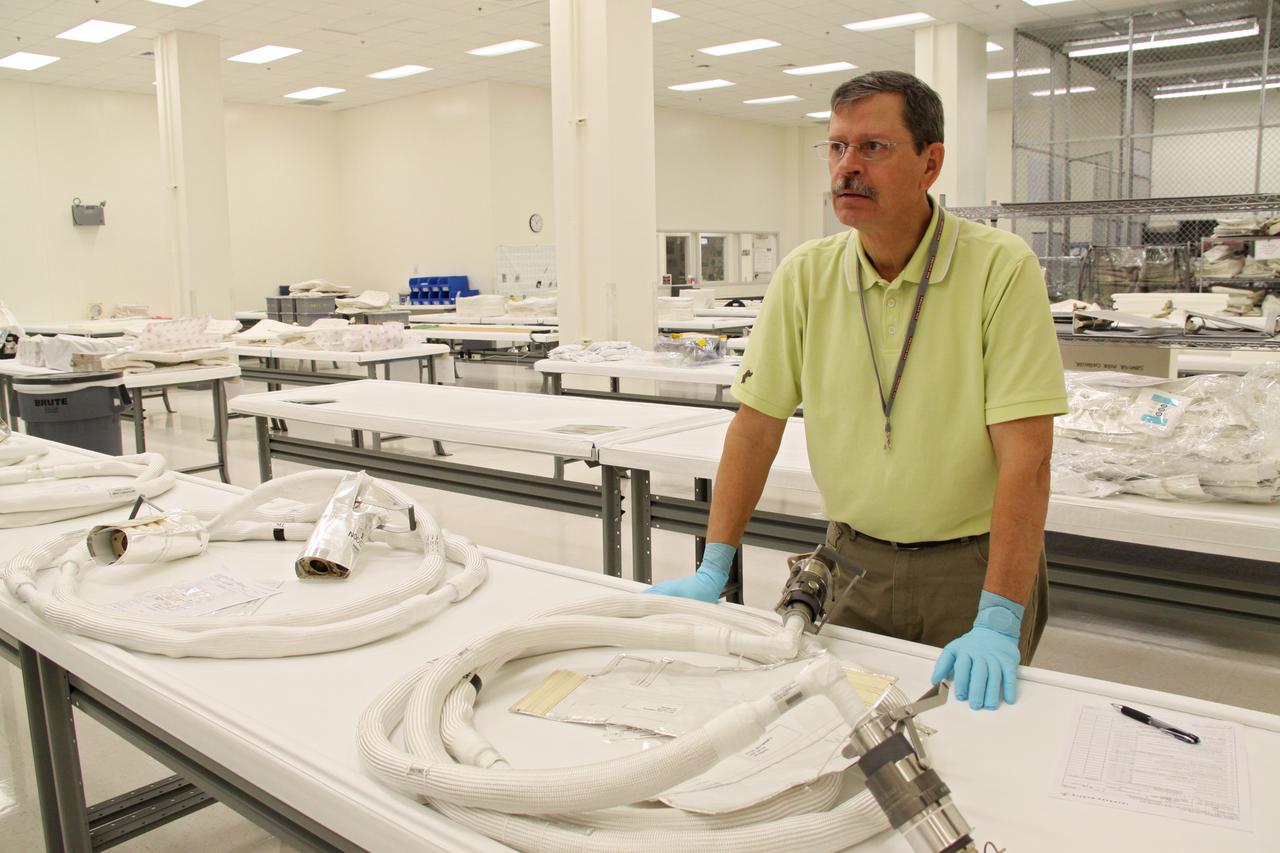
CAPE CANAVERAL, Fla. – In the Space Station Processing Facility at NASA's Kennedy Space Center in Florida, the newly arrived replacement high-pressure ammonia jumper hoses to support space shuttle Endeavour's STS-130 mission are positioned along work tables and ready for testing. A problem arose during a prelaunch test Jan. 7 with one of four hoses that are needed to connect the ammonia loops of the International Space Station's Tranquility node to those of the Destiny laboratory. A decision was made to use an alternate hose design for use as the primary jumper. The new hoses are assembled from shorter hoses that were previously certified and tested. Connection of the modules requires two ammonia loops, with two lines apiece, each of which must be connected to both Tranquility and Destiny to route cooling to and from the Tranquility module. The primary payload for the STS-130 mission, Tranquility is a pressurized module that will provide additional room for crew members and many of the station's life support and environmental control systems. The node was built in Turin, Italy, by Thales Alenia Space for the European Space Agency. Endeavour's launch is set for Feb. 7. For information on the STS-130 mission and crew, visit http:__www.nasa.gov_mission_pages_shuttle_shuttlemissions_sts130_index.html. Photo credit: NASA_Jack Pfaller
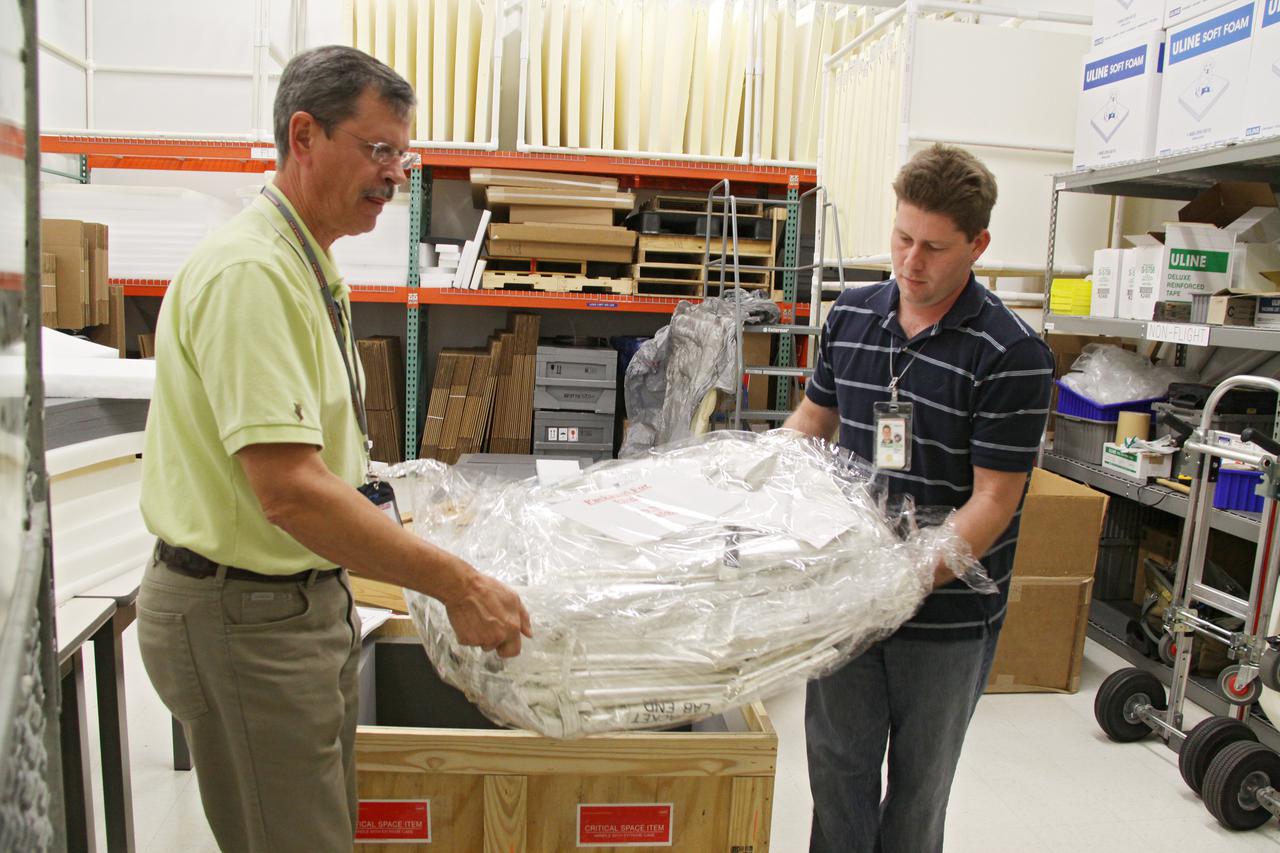
CAPE CANAVERAL, Fla. – Replacement high-pressure ammonia jumper hoses to support space shuttle Endeavour's STS-130 mission are unpacked from a transportation crate in the Space Station Processing Facility at NASA's Kennedy Space Center in Florida. A problem arose during a prelaunch test Jan. 7 with one of four hoses that are needed to connect the ammonia loops of the International Space Station's Tranquility node to those of the Destiny laboratory. A decision was made to use an alternate hose design for use as the primary jumper. The new hoses are assembled from shorter hoses that were previously certified and tested. Connection of the modules requires two ammonia loops, with two lines apiece, each of which must be connected to both Tranquility and Destiny to route cooling to and from the Tranquility module. The primary payload for the STS-130 mission, Tranquility is a pressurized module that will provide additional room for crew members and many of the station's life support and environmental control systems. The node was built in Turin, Italy, by Thales Alenia Space for the European Space Agency. Endeavour's launch is set for Feb. 7. For information on the STS-130 mission and crew, visit http:__www.nasa.gov_mission_pages_shuttle_shuttlemissions_sts130_index.html. Photo credit: NASA_Jack Pfaller
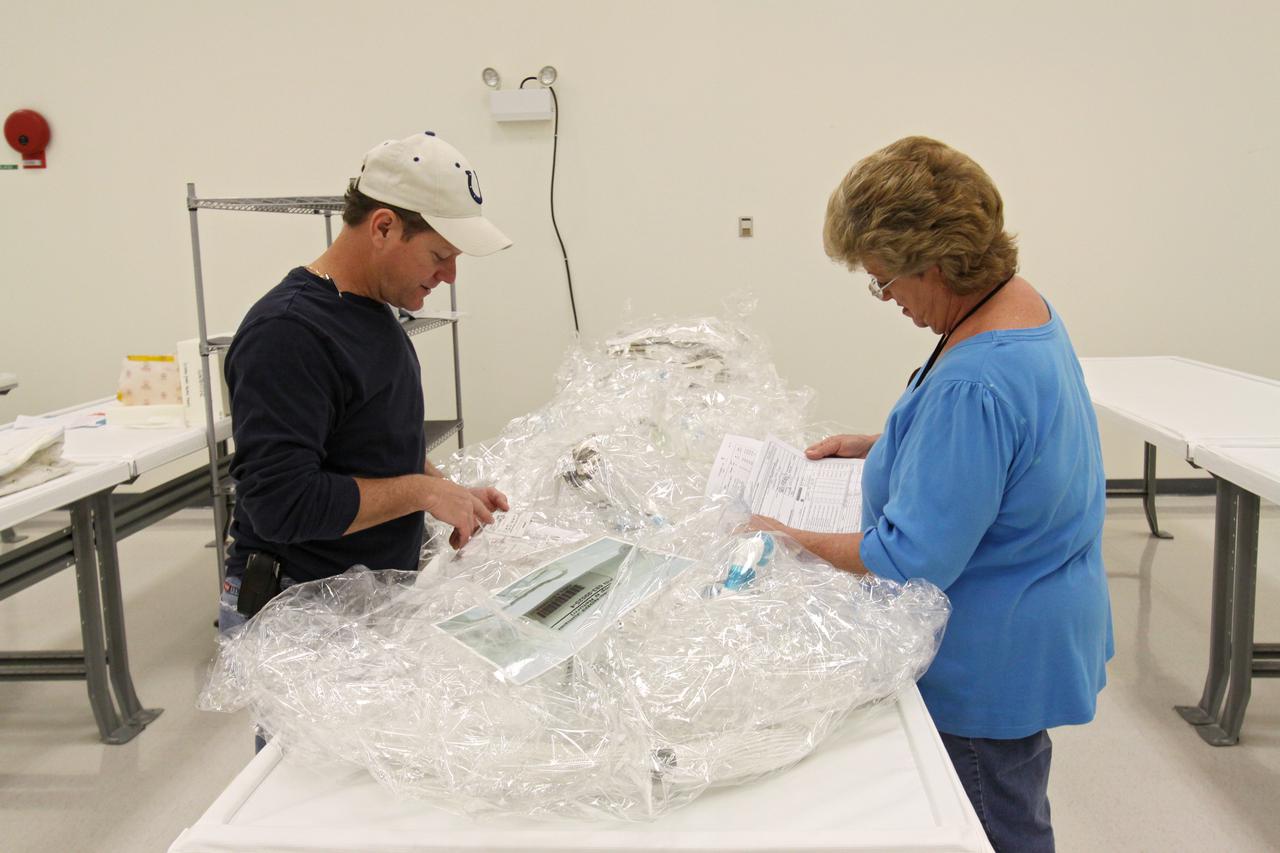
CAPE CANAVERAL, Fla. – In the Space Station Processing Facility at NASA's Kennedy Space Center in Florida, workers begin processing of the newly arrived replacement high-pressure ammonia jumper hoses to support space shuttle Endeavour's STS-130 mission. A problem arose during a prelaunch test Jan. 7 with one of four hoses that are needed to connect the ammonia loops of the International Space Station's Tranquility node to those of the Destiny laboratory. A decision was made to use an alternate hose design for use as the primary jumper. The new hoses are assembled from shorter hoses that were previously certified and tested. Connection of the modules requires two ammonia loops, with two lines apiece, each of which must be connected to both Tranquility and Destiny to route cooling to and from the Tranquility module. The primary payload for the STS-130 mission, Tranquility is a pressurized module that will provide additional room for crew members and many of the station's life support and environmental control systems. The node was built in Turin, Italy, by Thales Alenia Space for the European Space Agency. Endeavour's launch is set for Feb. 7. For information on the STS-130 mission and crew, visit http:__www.nasa.gov_mission_pages_shuttle_shuttlemissions_sts130_index.html. Photo credit: NASA_Jack Pfaller
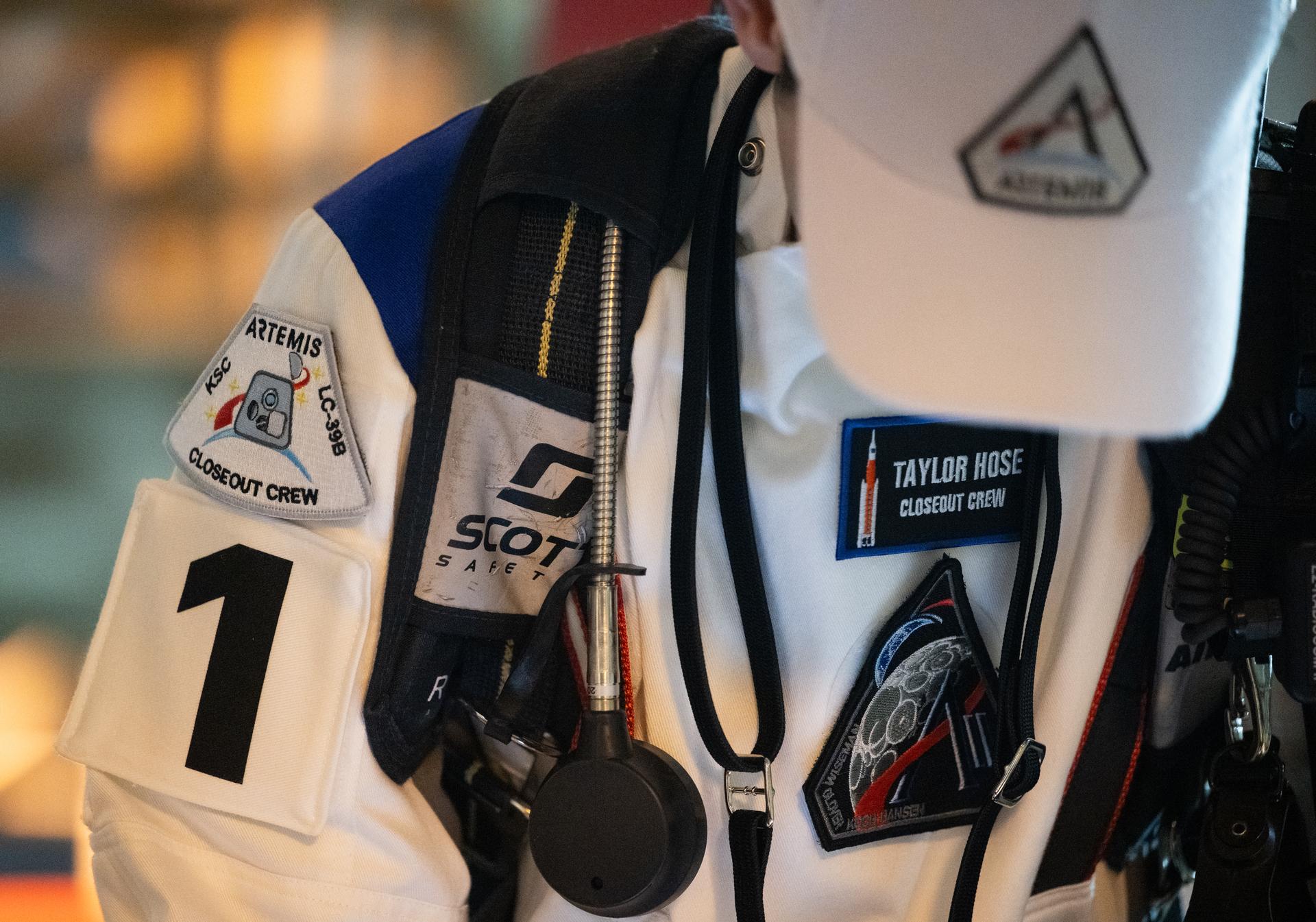
Taylor Hose, Closeout Crew lead, is seen as he prepares for the arrival of Artemis II crewmembers NASA astronauts Reid Wiseman, commander; Victor Glover, pilot; Christina Koch, mission specialist; and CSA (Canadian Space Agency) astronaut Jeremy Hansen, mission specialist; at the 275-foot level of the mobile launcher to board their Orion spacecraft atop NASA’s Space Launch System rocket during the Artemis II countdown demonstration test, Saturday, Dec. 20, 2025, inside the Vehicle Assembly Building at NASA’s Kennedy Space Center in Florida. For this operation, the Artemis II crew and launch teams are simulating the launch day timeline including suit-up, walkout, and spacecraft ingress and egress. Through the Artemis campaign, NASA will send astronauts to explore the Moon for scientific discovery, economic benefits, and to build the foundation for the first crewed missions to Mars, for the benefit of all. Photo Credit: (NASA/Joel Kowsky)
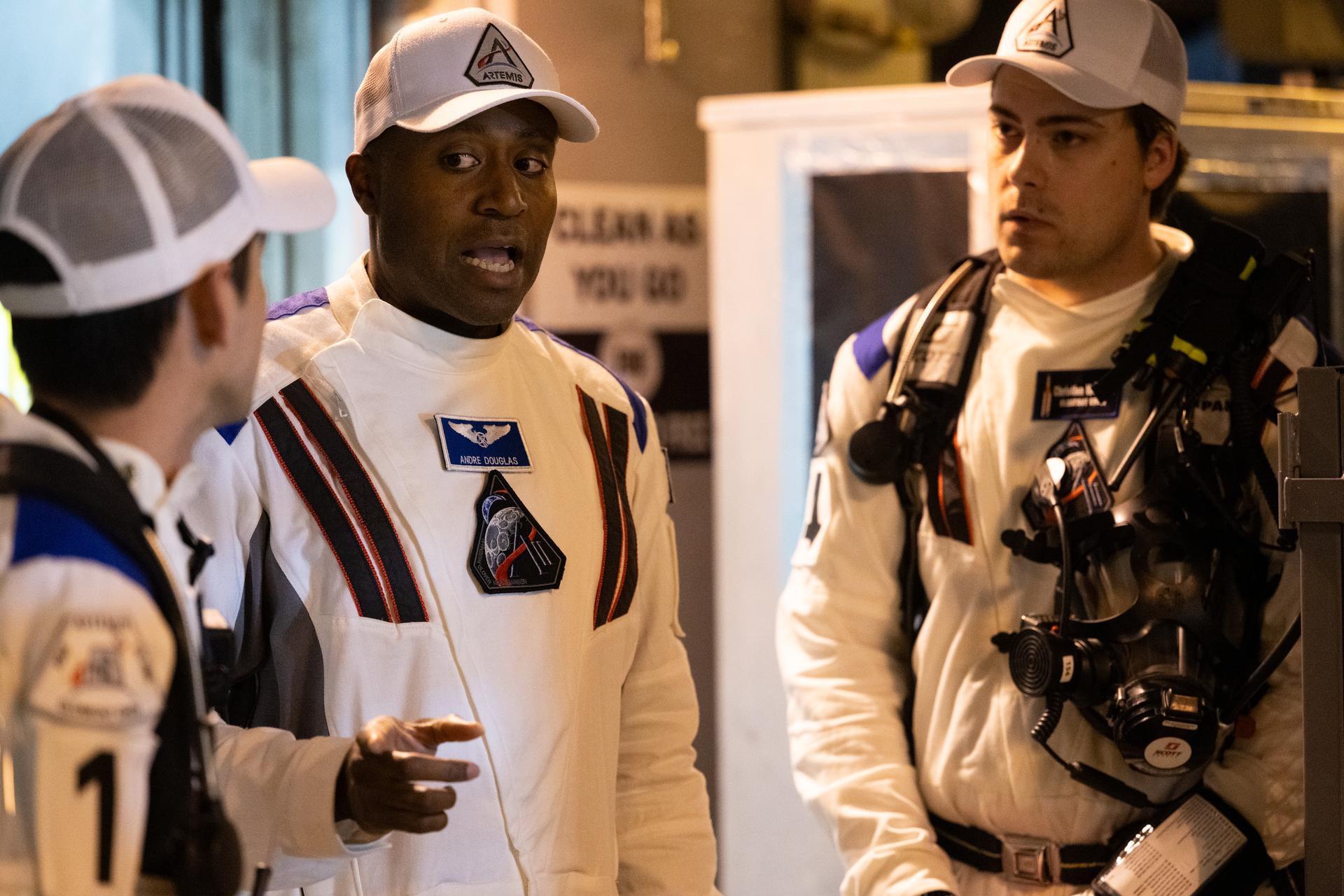
NASA astronaut Andre Douglas talks with Taylor Hose, left, Christian Warriner of the Closeout Crew as they prepare for the arrival of Artemis II crewmembers NASA astronauts Reid Wiseman, commander; Victor Glover, pilot; Christina Koch, mission specialist; and CSA (Canadian Space Agency) astronaut Jeremy Hansen, at the 275-foot level of the mobile launcher as they prepare to board their Orion spacecraft atop NASA’s Space Launch System rocket during the Artemis II countdown demonstration test, Saturday, Dec. 20, 2025, inside the Vehicle Assembly Building at NASA’s Kennedy Space Center in Florida. For this operation, the Artemis II crew and launch teams are simulating the launch day timeline including suit-up, walkout, and spacecraft ingress and egress. Through the Artemis campaign, NASA will send astronauts to explore the Moon for scientific discovery, economic benefits, and to build the foundation for the first crewed missions to Mars, for the benefit of all. Photo Credit: (NASA/Joel Kowsky)
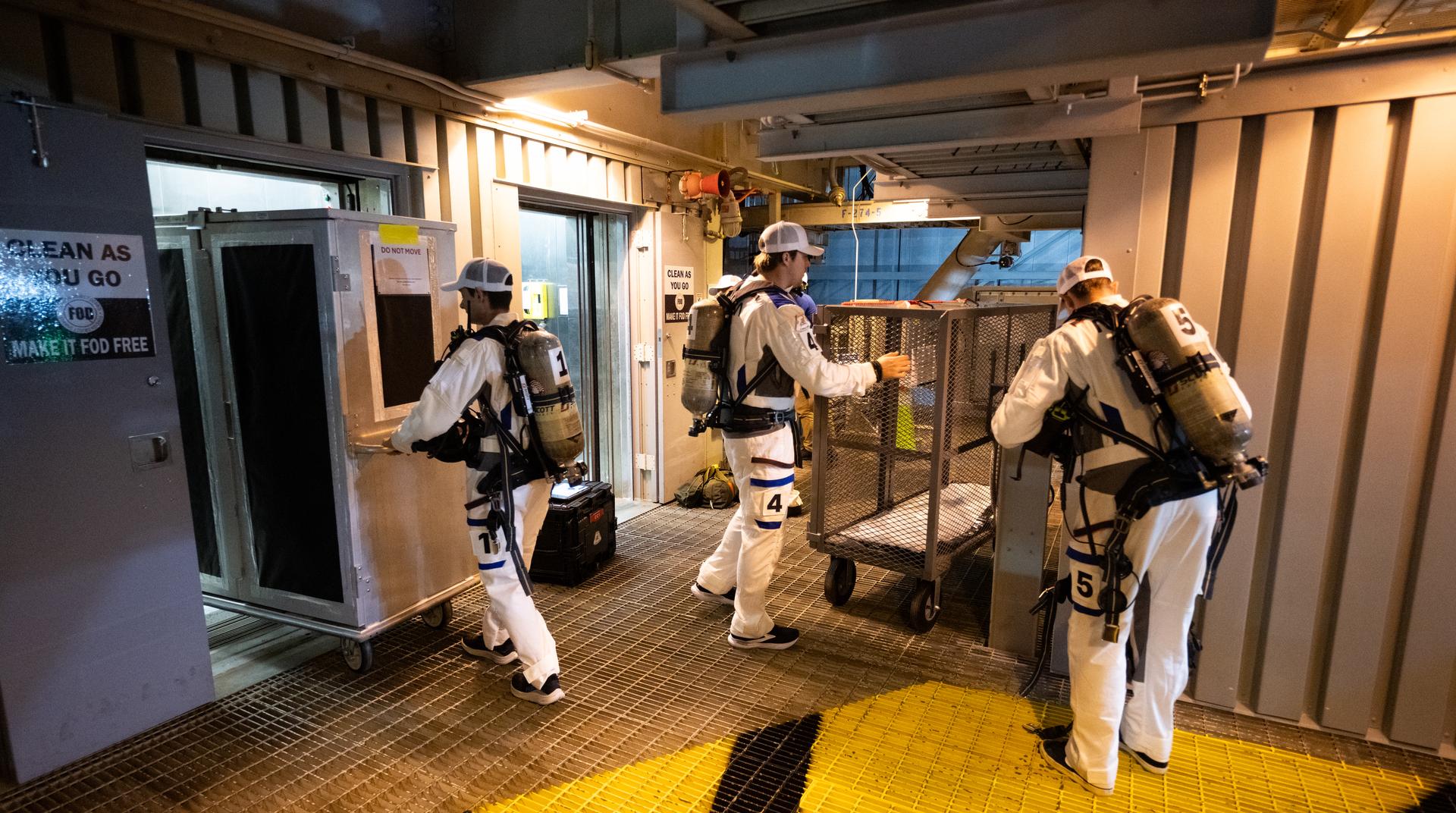
Taylor Hose, left, Christian Warriner, center, and Will Sattler of the Closeout Crew are seen as they prepare for the arrival of Artemis II crewmembers NASA astronauts Reid Wiseman, commander; Victor Glover, pilot; Christina Koch, mission specialist; and CSA (Canadian Space Agency) astronaut Jeremy Hansen, mission specialist; at the 275-foot level of the mobile launcher to board their Orion spacecraft atop NASA’s Space Launch System rocket during the Artemis II countdown demonstration test, Saturday, Dec. 20, 2025, inside the Vehicle Assembly Building at NASA’s Kennedy Space Center in Florida. For this operation, the Artemis II crew and launch teams are simulating the launch day timeline including suit-up, walkout, and spacecraft ingress and egress. Through the Artemis campaign, NASA will send astronauts to explore the Moon for scientific discovery, economic benefits, and to build the foundation for the first crewed missions to Mars, for the benefit of all. Photo Credit: (NASA/Joel Kowsky)
KENNEDY SPACE CENTER, FLA. -- Workers on Launch Pad 39A perform checks on Endeavour's oxygen flex hose fitting through manual inspection and using helium detectors. Visual inspection found a deformity in the flex line braid where it connects to rigid tubing. The entire flex hose assembly and bulkhead fitting were removed early today, and work is under way to complete the installation of a replacement.
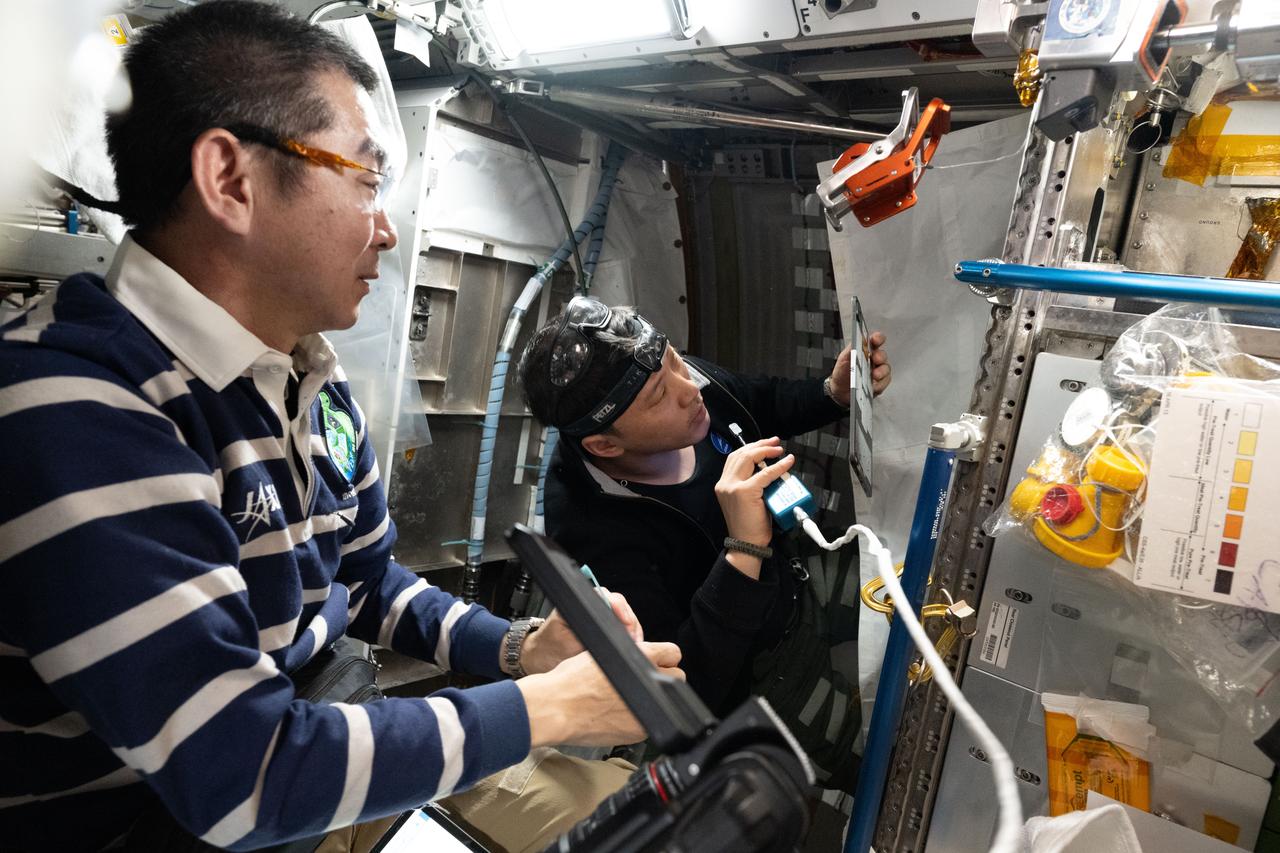
iss073e1199016 (Nov. 20, 2025) --- Expedition 73 Flight Engineers (from left) Kimiya Yui of JAXA (Japan Aerospace Exploration Agency) and Jonny Kim of NASA work together swapping thermal control system hoses on the COLBERT treadmill located inside the Tranquility module. The pair temporarily uninstalled the station’s bathroom, or waste and hygiene compartment, to access the life support hoses.
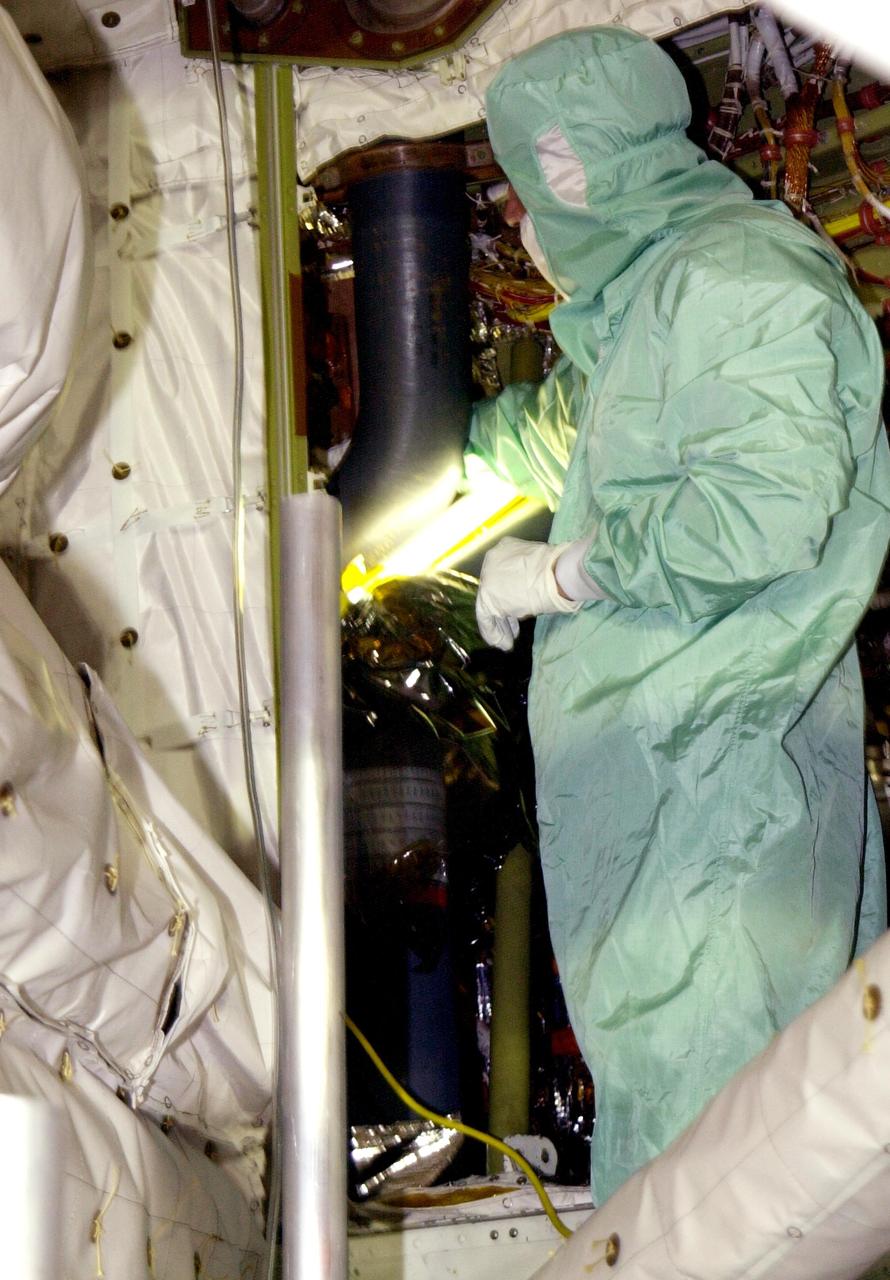
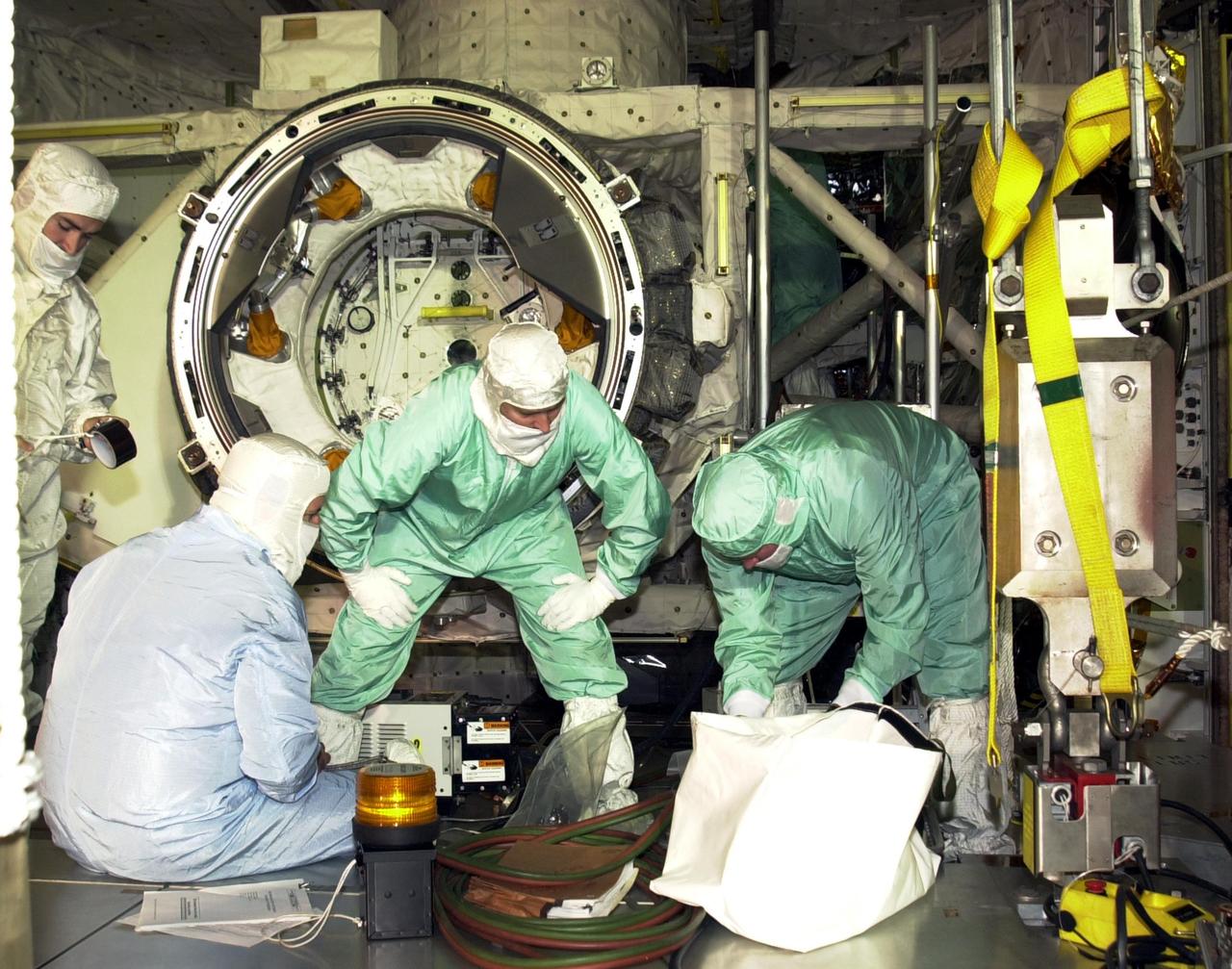
KENNEDY SPACE CENTER, FLA. -- Workers on Launch Pad 39A remove Endeavour's oxygen flex hose from the mid-body to inspect it for the source of an oxygen leak. Visual inspection found a deformity in the flex line braid where it connects to rigid tubing. Manual inspection and helium detectors identified the flex hose as the source of the oxygen leak. Work is under way to complete the installation of a replacement.
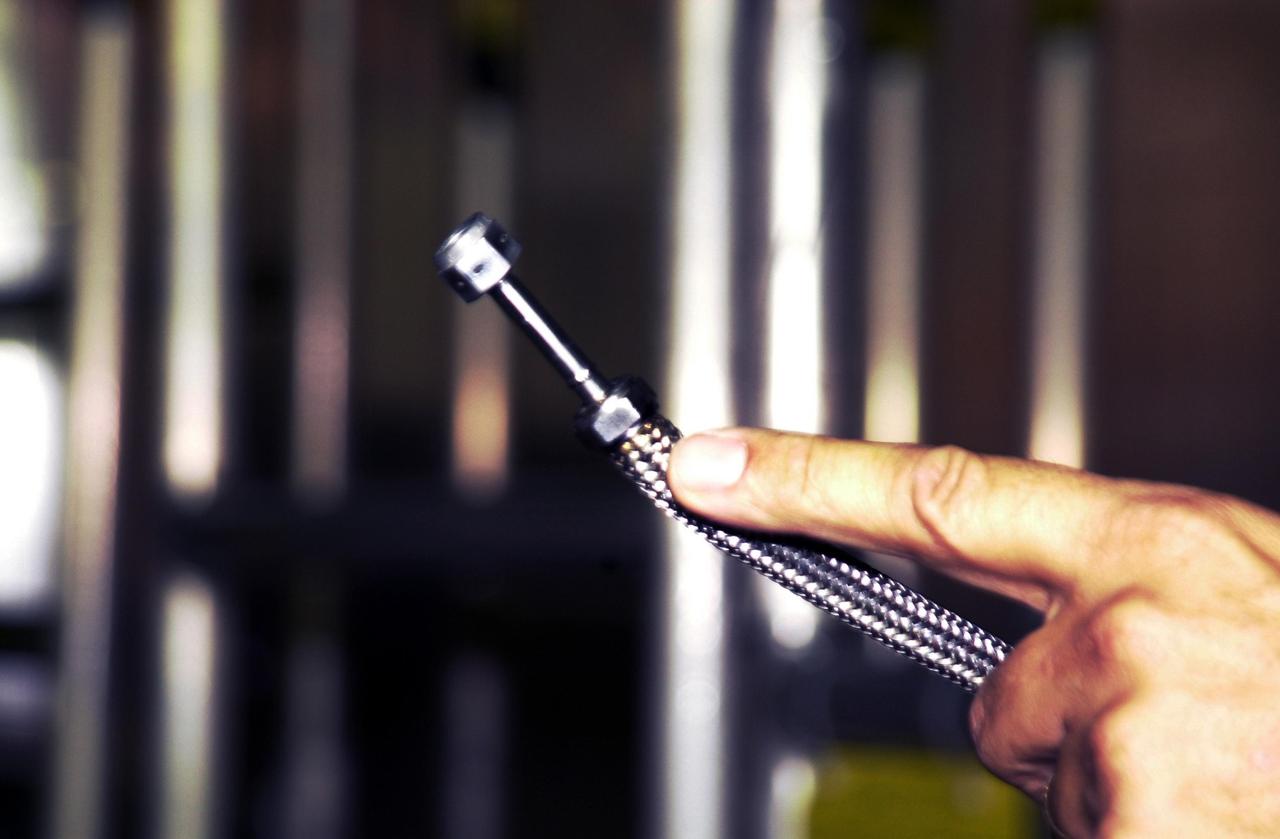
KENNEDY SPACE CENTER, FLA. -- During inspections at Launch Pad 39A, an oxygen flex hose fitting (shown here) was identified as the source of an oxygen leak in Endeavour's mid-body. The leak was identified manually and using helium detectors. Visual inspection found a deformity in the flex line braid where it connects to rigid tubing. The entire flex hose assembly and bulkhead fitting were removed early today, and work is under way to complete the installation of a replacement.
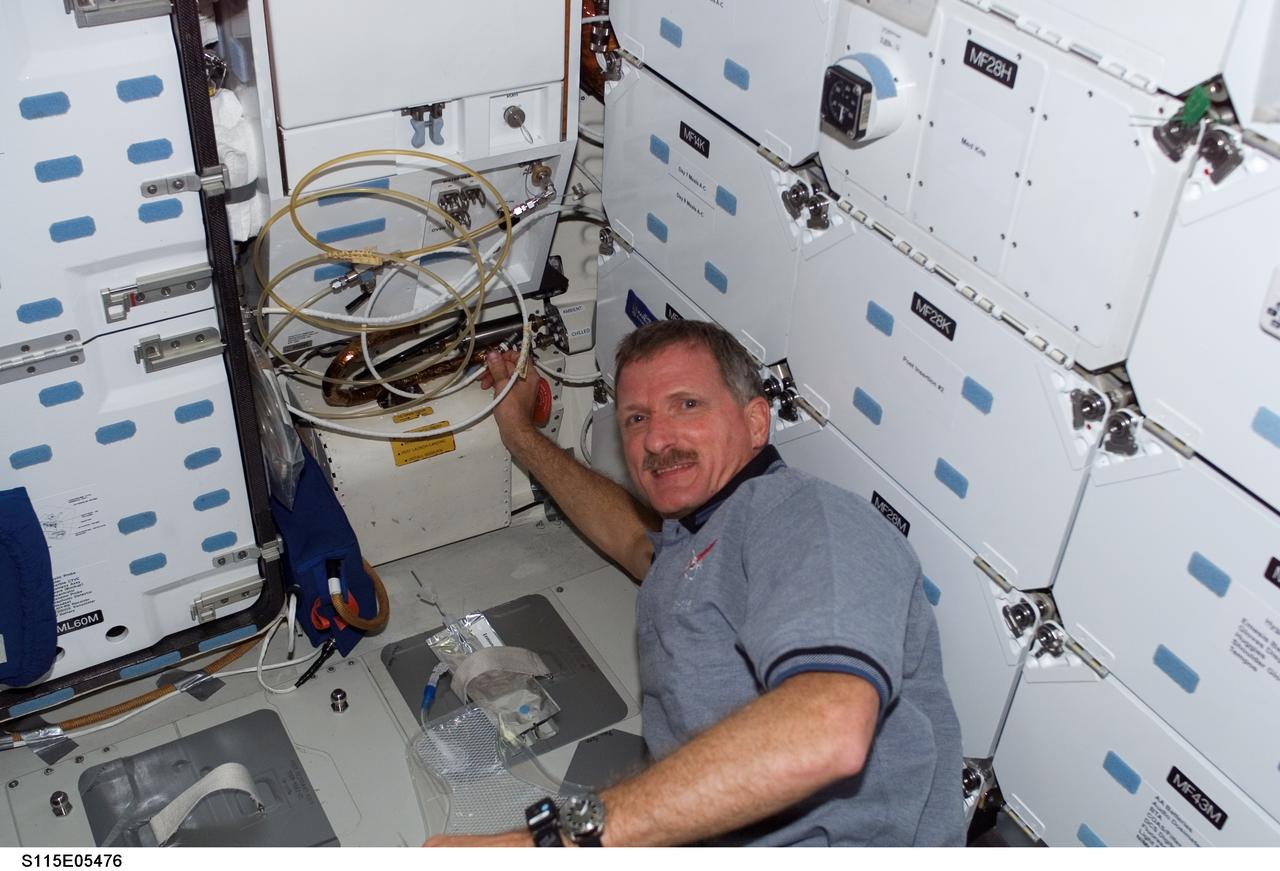
S115-E-05476 (11 Sept. 2006) --- With his hand on a maze of hoses, astronaut Joseph R. Tanner, STS-115 mission specialist, sets up the water system on the mid deck of the Space Shuttle Atlantis.
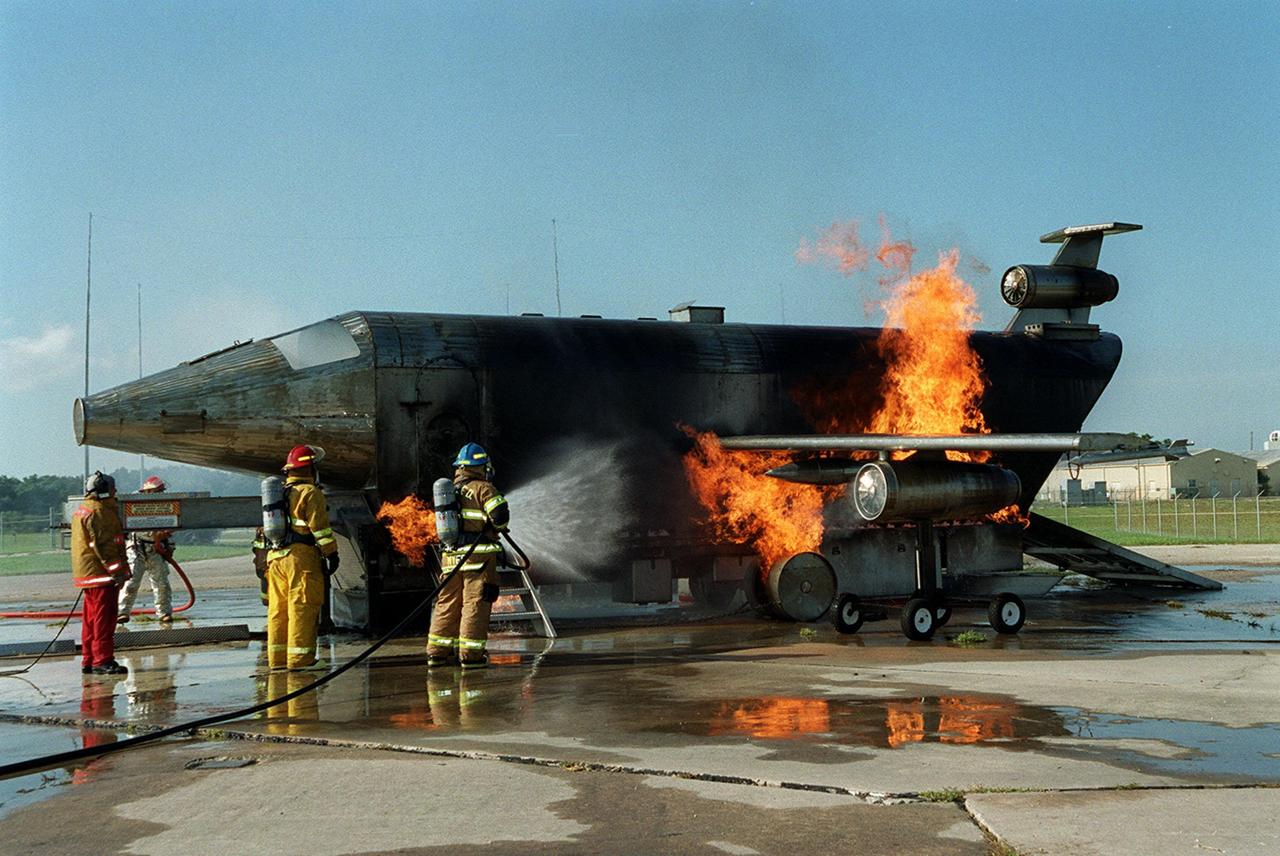
KENNEDY SPACE CENTER, FLA. -- During training exercises at Cape Canaveral Air Force Station Pad 30, firefighters with the Fire and Emergency Services at the Naval Station Mayport, Fla., turn their hoses toward the fire on the simulated aircraft.
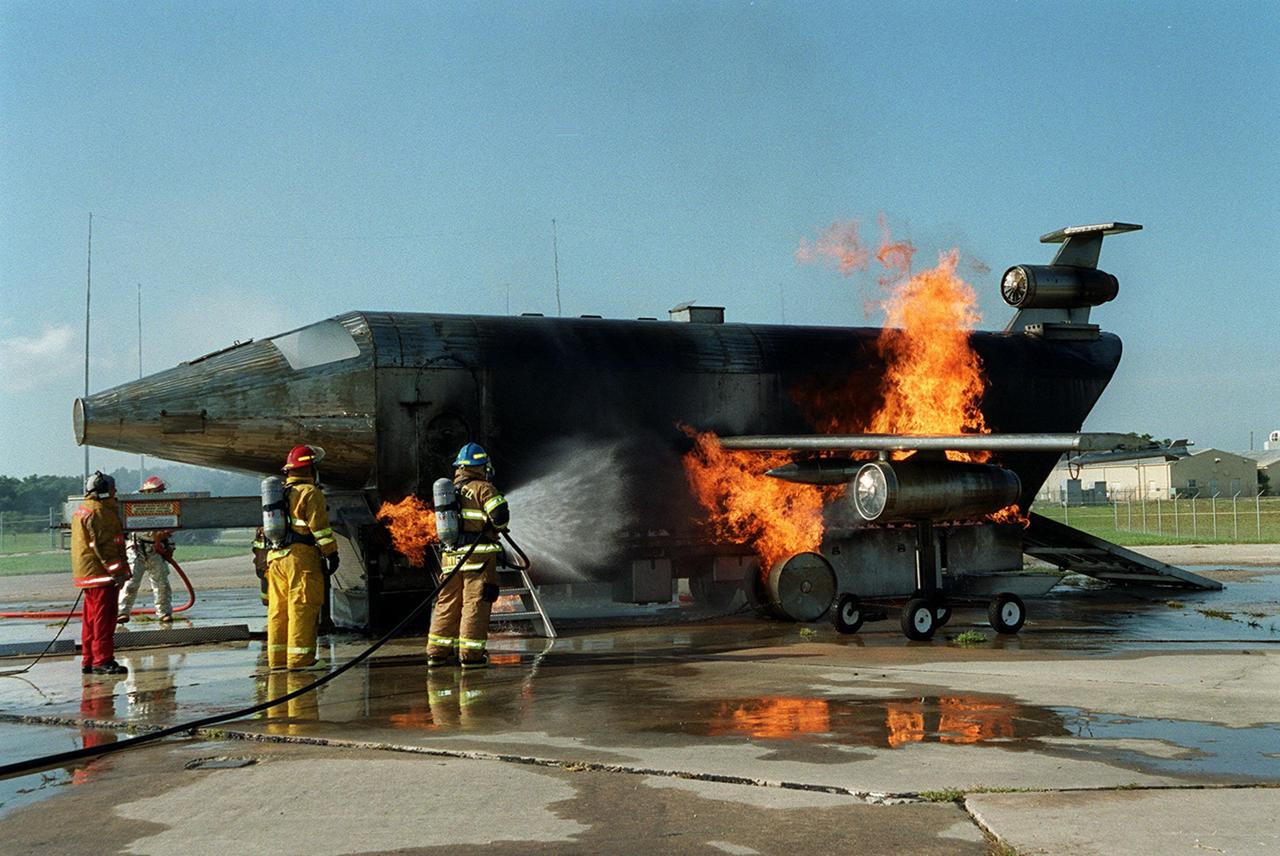
KENNEDY SPACE CENTER, FLA. -- During training exercises at Cape Canaveral Air Force Station Pad 30, firefighters with the Fire and Emergency Services at the Naval Station Mayport, Fla., turn their hoses toward the fire on the simulated aircraft.
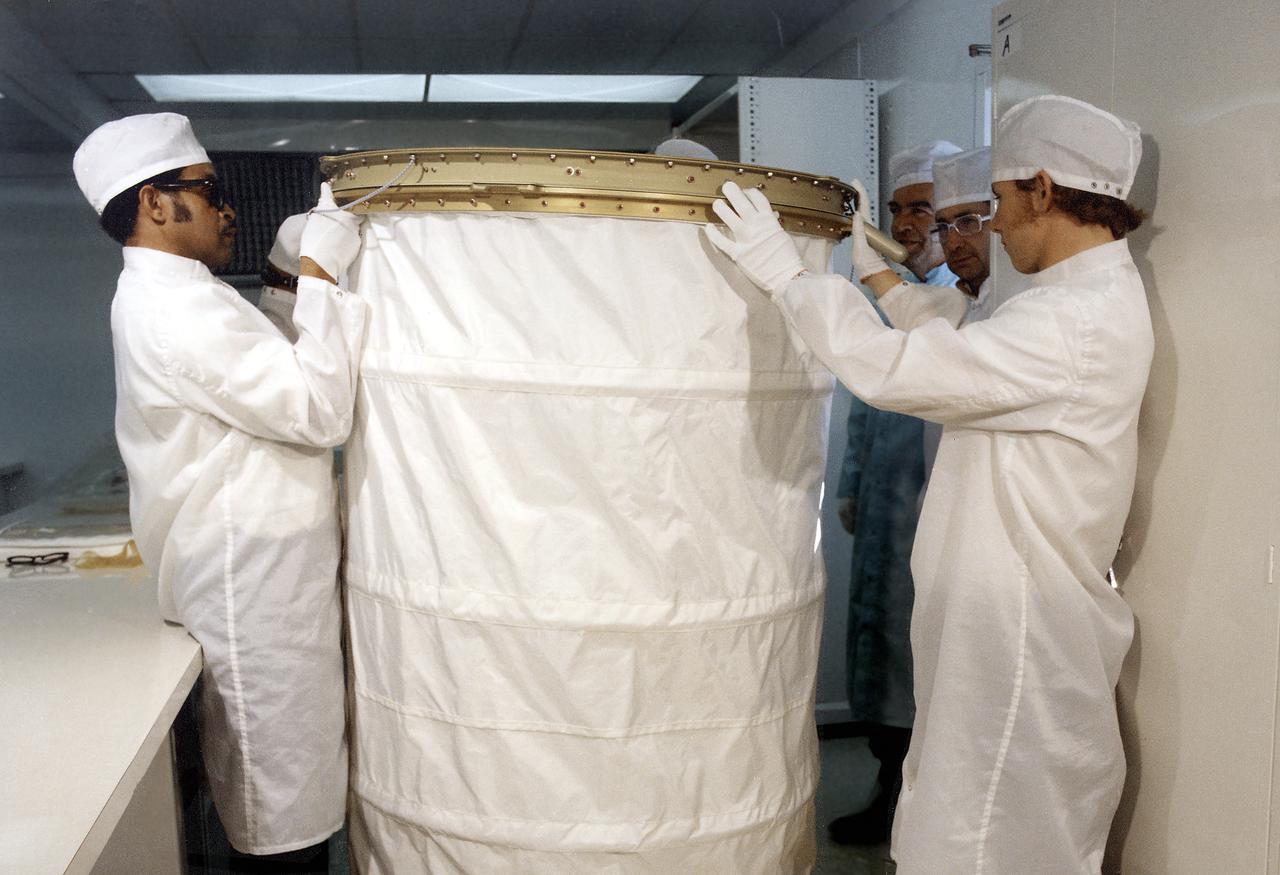
In this photograph, the Orbital Workshop shower compartment was unfolded by technicians for inspection. The shower compartment was a cylindrical cloth enclosure that was folded flat when not in use. The bottom ring of the shower was fastened to the floor and contained foot restraints. The upper ring contained the shower head and hose. To use the shower, the astronaut filled a pressurized portable bottle with heated water and attached the bottle to the ceiling. A flexible hose cornected the water bottle to a handheld shower head. The astronaut pulled the cylindrical shower wall up into position and bathed, using liquid soap. Both soap and water were carefully rationed, having been premeasured for economical use.
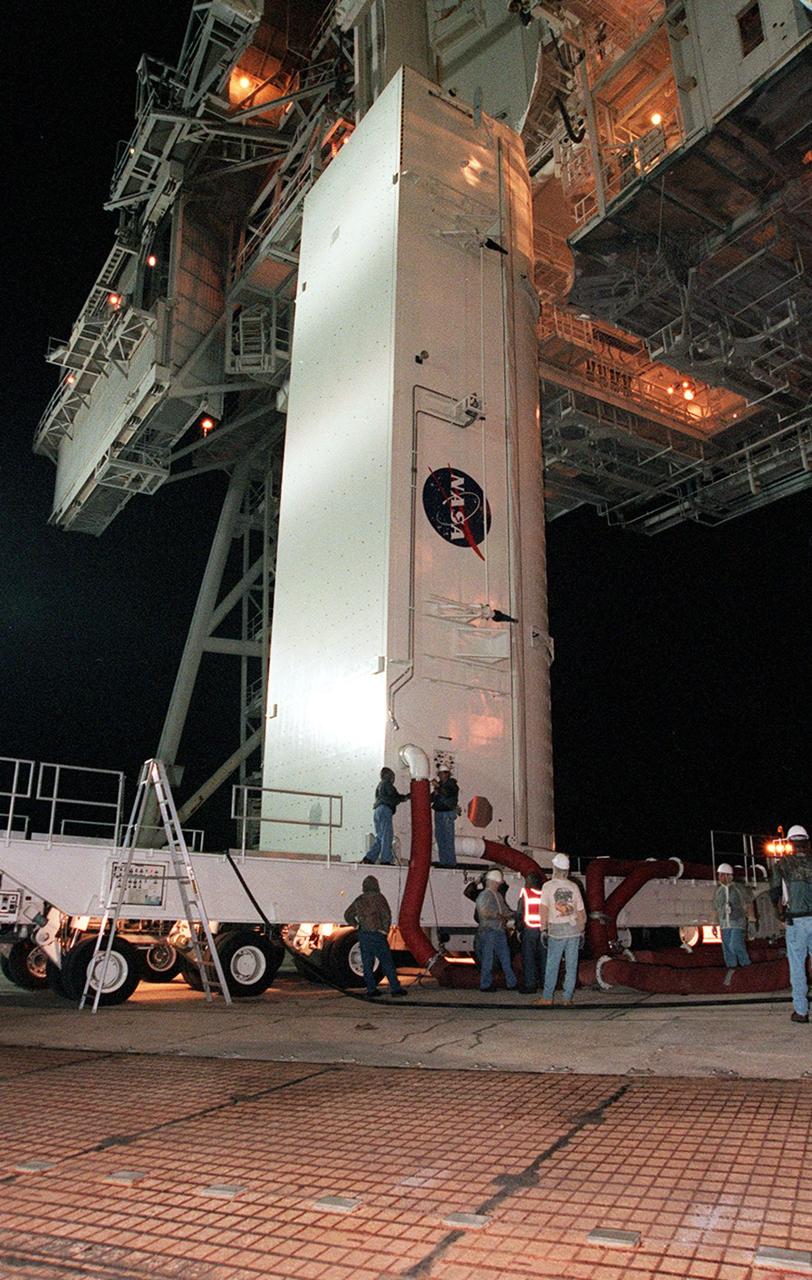
KENNEDY SPACE CENTER, Fla. -- At Launch Pad 39A, workers attach umbilical hoses onto the payload canister with the Integrated Truss Structure Z1 inside. The hoses will maintain the environmentally controlled environment while the canister is lifted up the Rotating Service Structure to the Payload Changeout Room. There the Z1 truss will be removed and later transferred to Space Shuttle Discovery’s payload bay. The Z1 truss is the first of 10 that will become the backbone of the International Space Station, eventually stretching the length of a football field. Along with its companion payload, the third Pressurized Mating Adapter, the Z1 is scheduled to be launched aboard Discovery Oct. 5 at 9:38 p.m. EDT
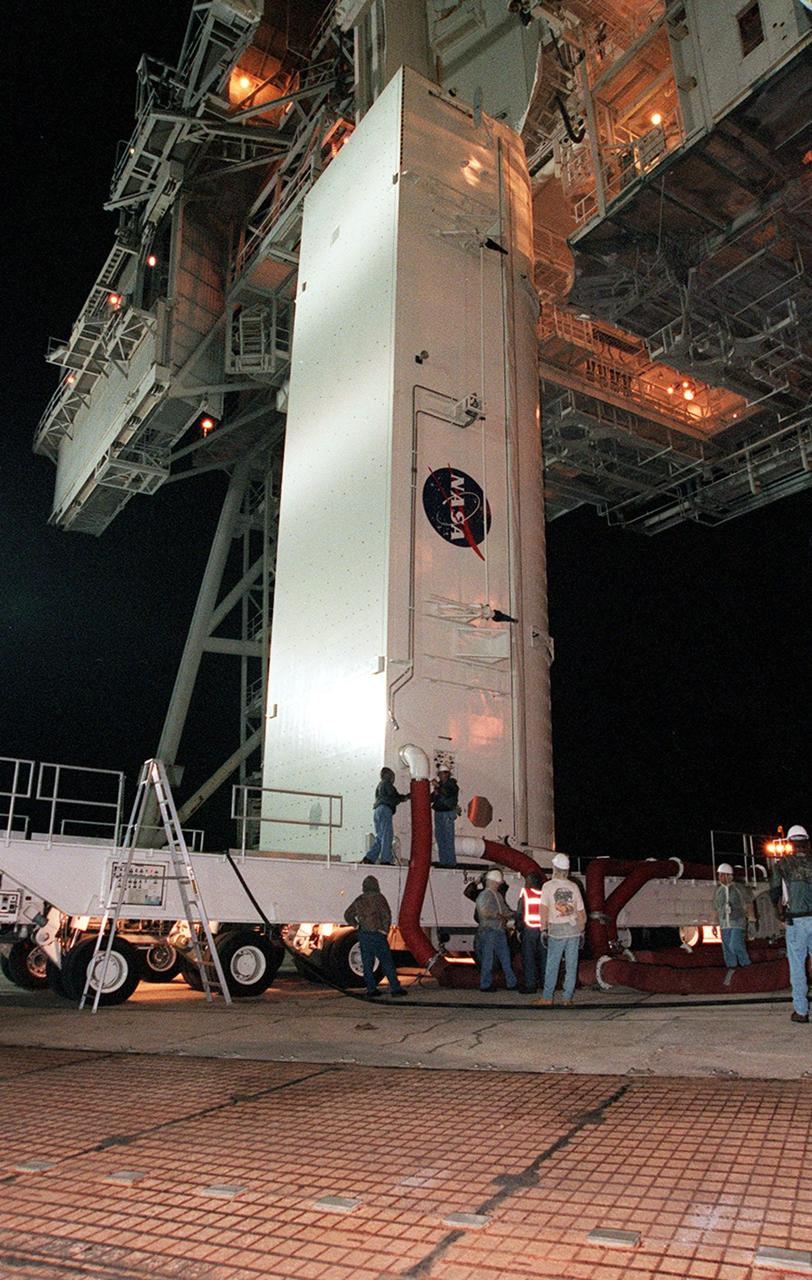
KENNEDY SPACE CENTER, Fla. -- At Launch Pad 39A, workers attach umbilical hoses onto the payload canister with the Integrated Truss Structure Z1 inside. The hoses will maintain the environmentally controlled environment while the canister is lifted up the Rotating Service Structure to the Payload Changeout Room. There the Z1 truss will be removed and later transferred to Space Shuttle Discovery’s payload bay. The Z1 truss is the first of 10 that will become the backbone of the International Space Station, eventually stretching the length of a football field. Along with its companion payload, the third Pressurized Mating Adapter, the Z1 is scheduled to be launched aboard Discovery Oct. 5 at 9:38 p.m. EDT
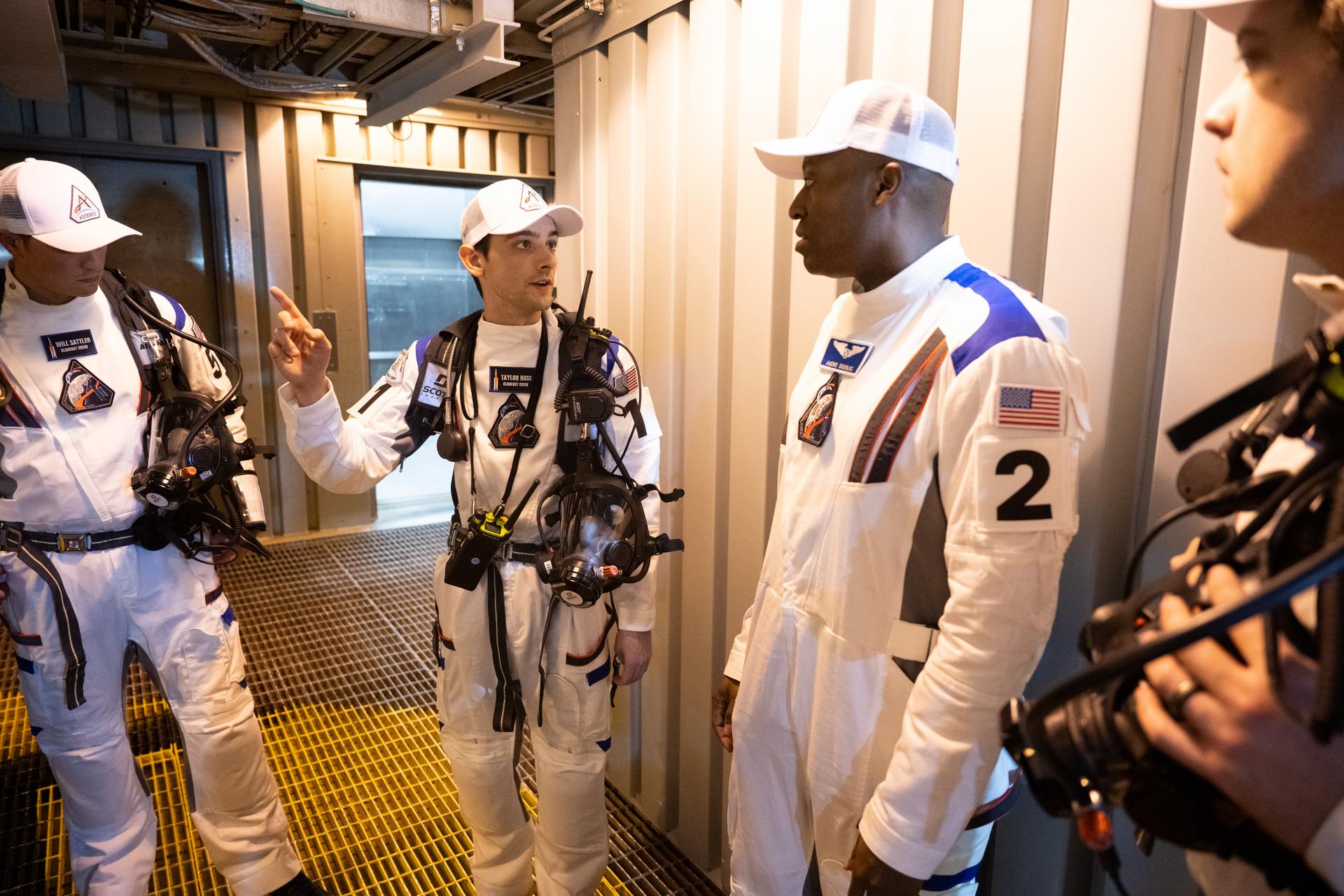
Closeout Crew lead Taylor Hose, second from left, talks with NASA astronaut Andre Douglas, second from right as he and closeout crewmembers Will Sattler, left, and Christian Warriner prepare for the arrival of Artemis II crewmembers NASA astronauts Reid Wiseman, commander; Victor Glover, pilot; Christina Koch, mission specialist; and CSA (Canadian Space Agency) astronaut Jeremy Hansen, mission specialist; at the 275-foot level of the mobile launcher as they prepare to board their Orion spacecraft atop NASA’s Space Launch System rocket during the Artemis II countdown demonstration test, Saturday, Dec. 20, 2025, inside the Vehicle Assembly Building at NASA’s Kennedy Space Center in Florida. For this operation, the Artemis II crew and launch teams are simulating the launch day timeline including suit-up, walkout, and spacecraft ingress and egress. Through the Artemis campaign, NASA will send astronauts to explore the Moon for scientific discovery, economic benefits, and to build the foundation for the first crewed missions to Mars, for the benefit of all. Photo Credit: (NASA/Joel Kowsky)
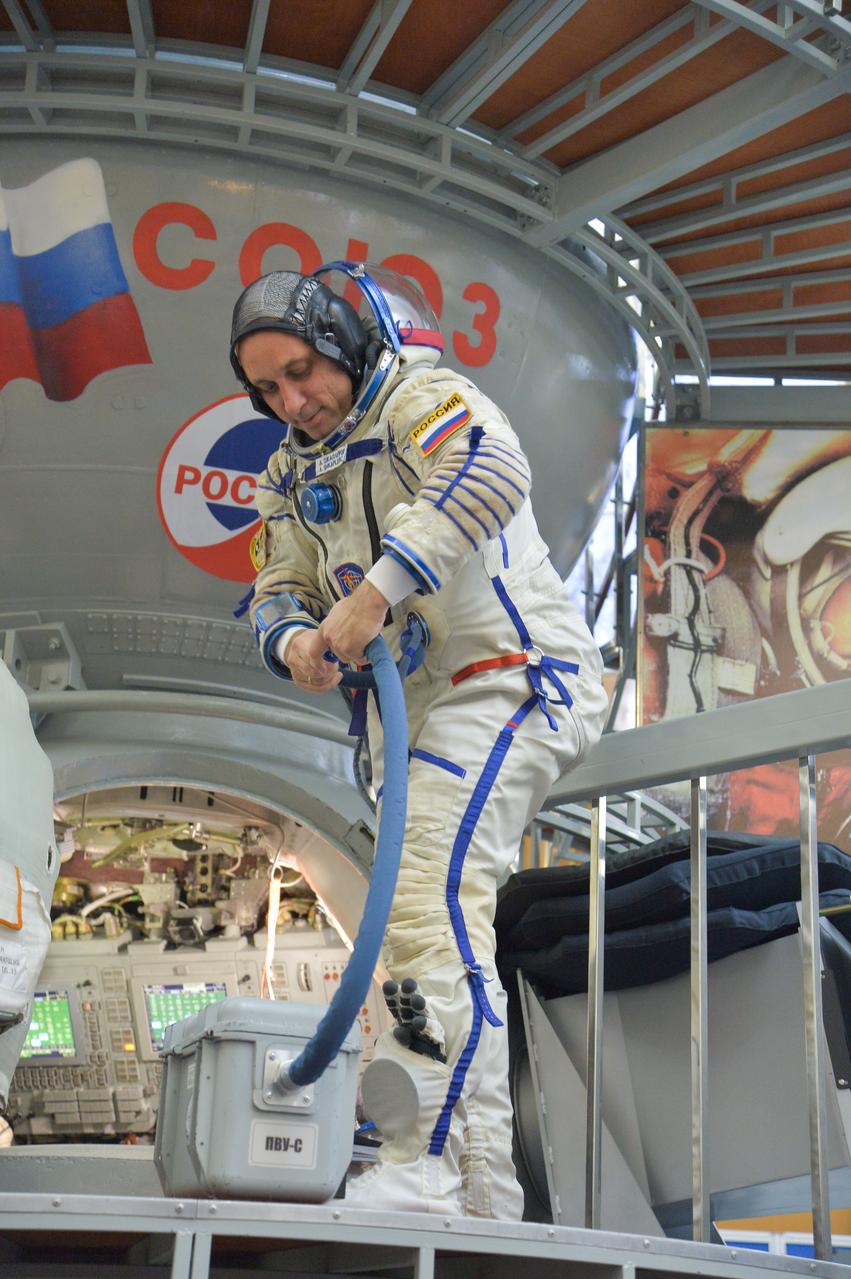
jsc2017e135211 - At the Gagarin Cosmonaut Training Center in Star City, Russia, Expedition 54-55 prime crewmember Anton Shkaplerov of the Russian Federal Space Agency (Roscosmos) disconnects a cooling system hose as he boards a Soyuz spacecraft simulator Nov. 29 as part of the crew’s final qualification exam activities. He will launch along with Scott Tingle of NASA and Norishige Kanai of the Japan Aerospace Exploration Agency (JAXA) Dec. 17 on the Soyuz MS-07 spacecraft from the Baikonur Cosmodrome in Kazakhstan for a five-month mission on the International Space Station...NASA/Elizabeth Weissinger.
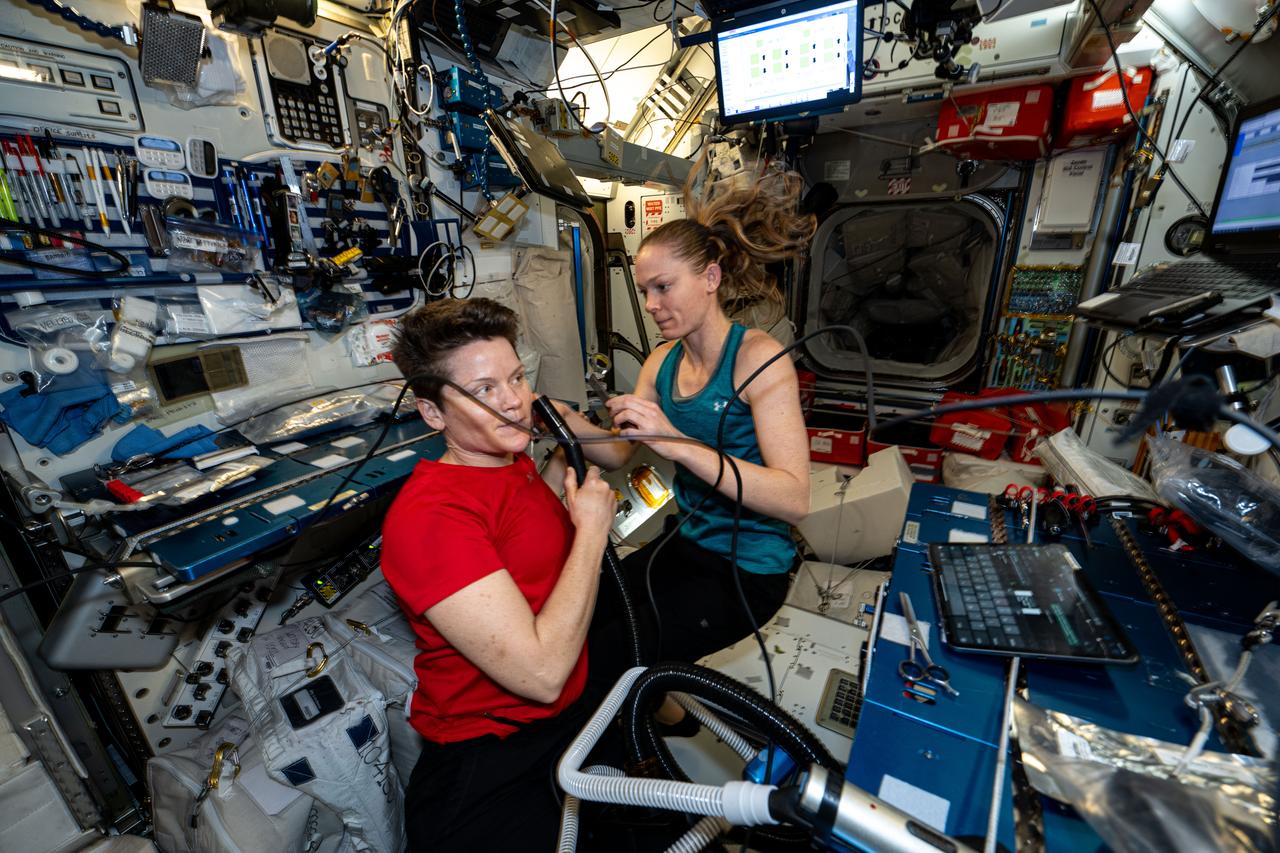
iss073e0120086 (May 31, 2025) --- NASA astronauts (left to right) Anne McClain and Nichole Ayers, both Expedition 73 Flight Engineers, are pictured inside the International Space Station's Harmony module. Ayers trims McClain's hair as a suction hose collects loose hairs to protect the station's atmosphere.
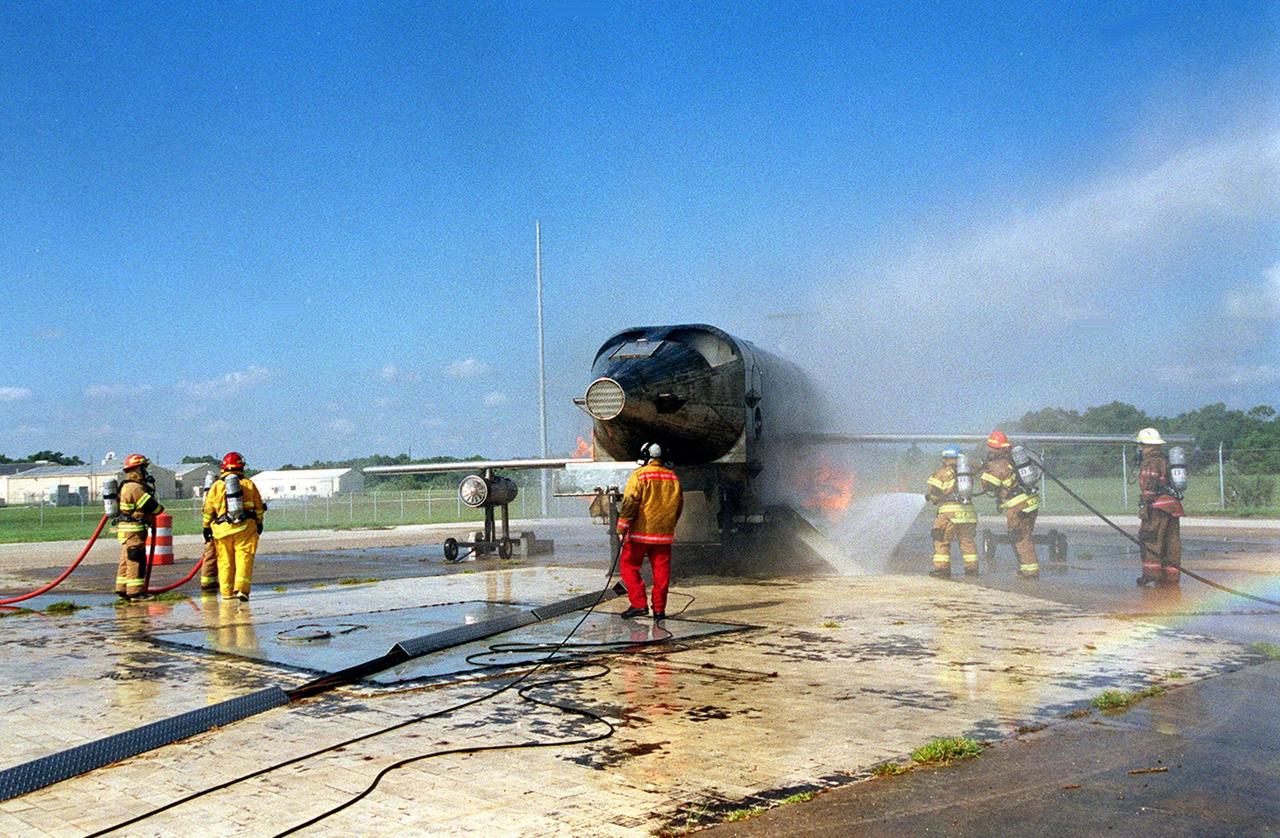
KENNEDY SPACE CENTER, FLA. -- Firefighters surround a burning simulated aircraft during training exercises Cape Canaveral Air Force Station Pad 30. Those at left wait their turn as the crew on the right turn their hoses toward the fire. The firefighters are with Fire and Emergency Services at the Naval Station Mayport, Fla
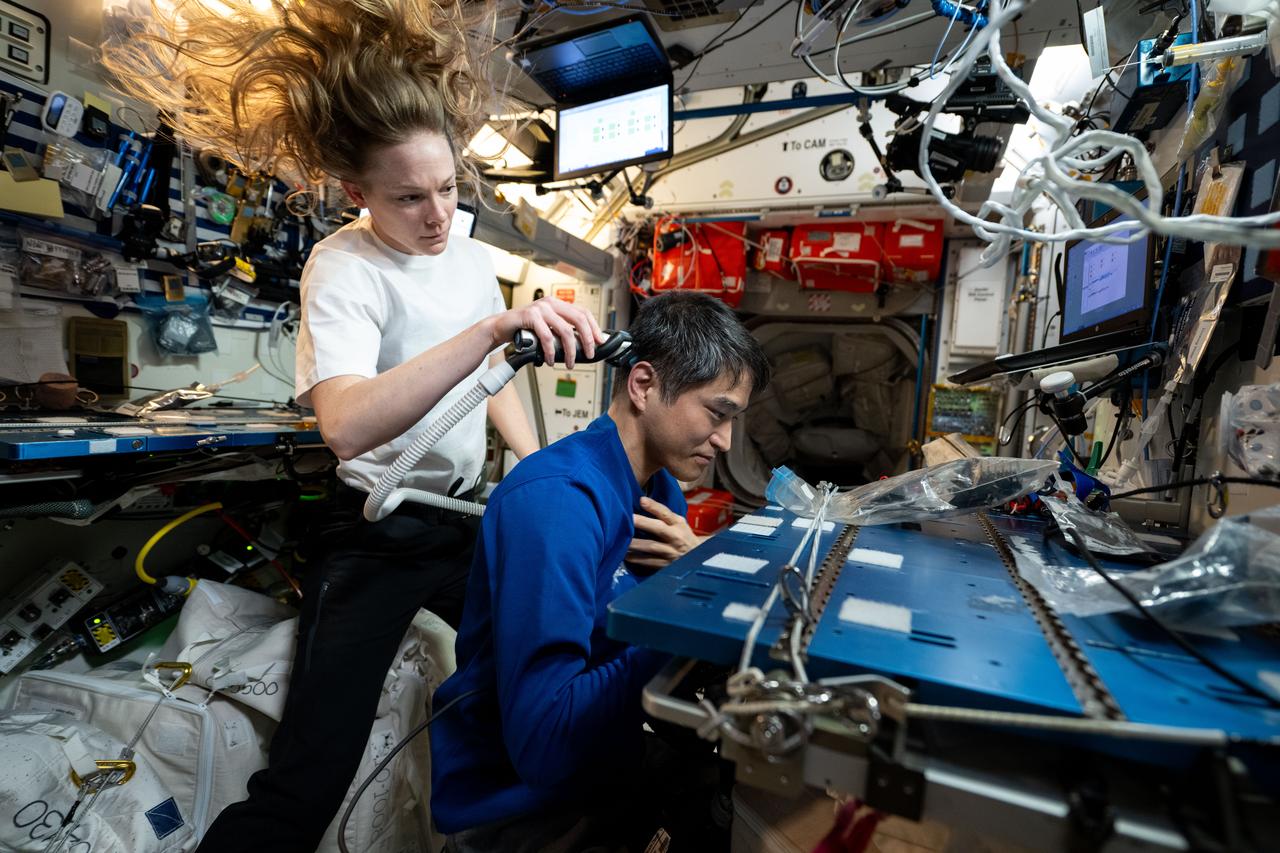
iss073e0422042 (July 27, 2025) --- Expedition 73 Flight Engineer Nichole Ayers of NASA gives International Space Station Commander Takuya Onishi of JAXA (Japan Aerospace Exploration Agency) a haircut as a suction hose collects loose hairs to protect the station's atmosphere.
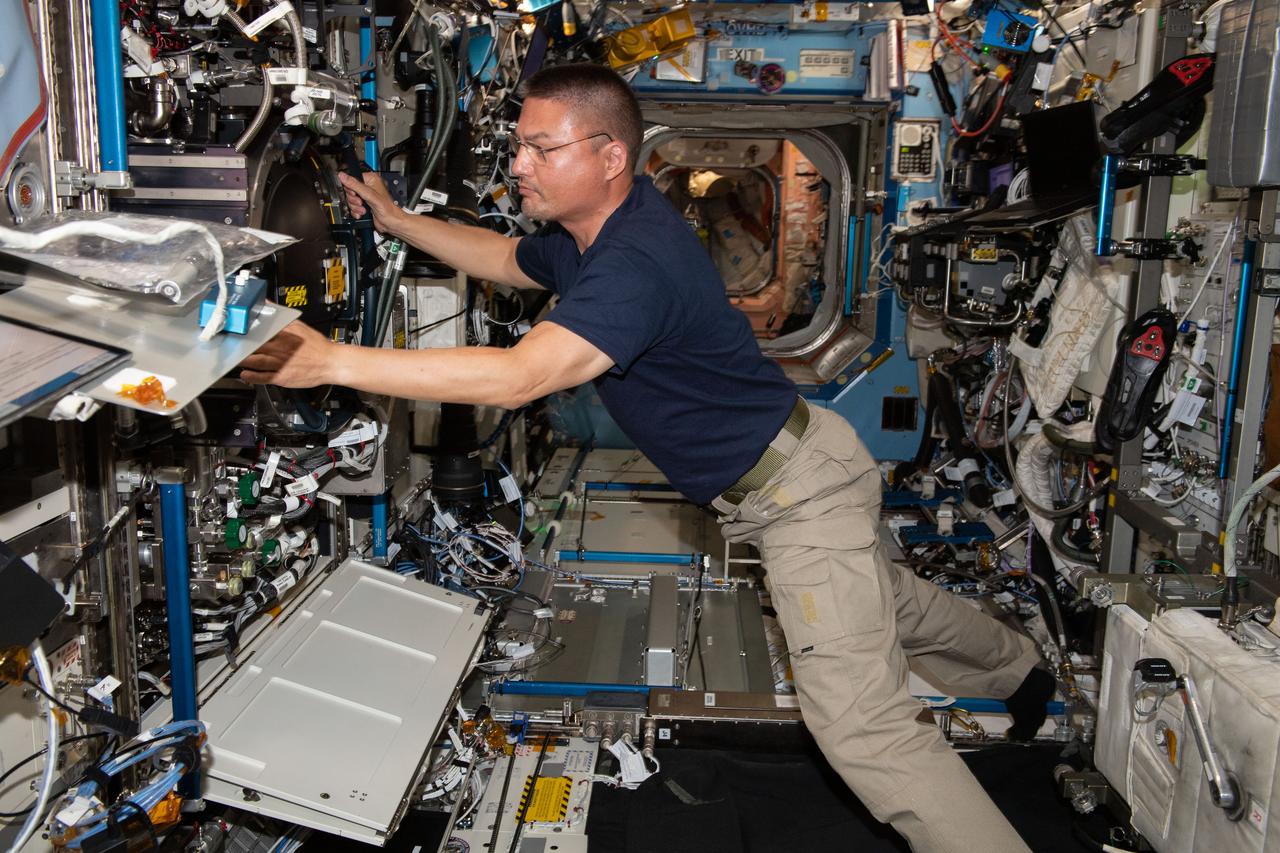
iss067e044198 (May 16, 2022) --- NASA astronaut and Expedition 67 Flight Engineer Kjell Lindgren checks filter, hose, and gas connections inside the International Space Station's Combustion Integrated Rack, a research device that enables safe investigations into how flames, fiuel, and soot behave in microgravity.
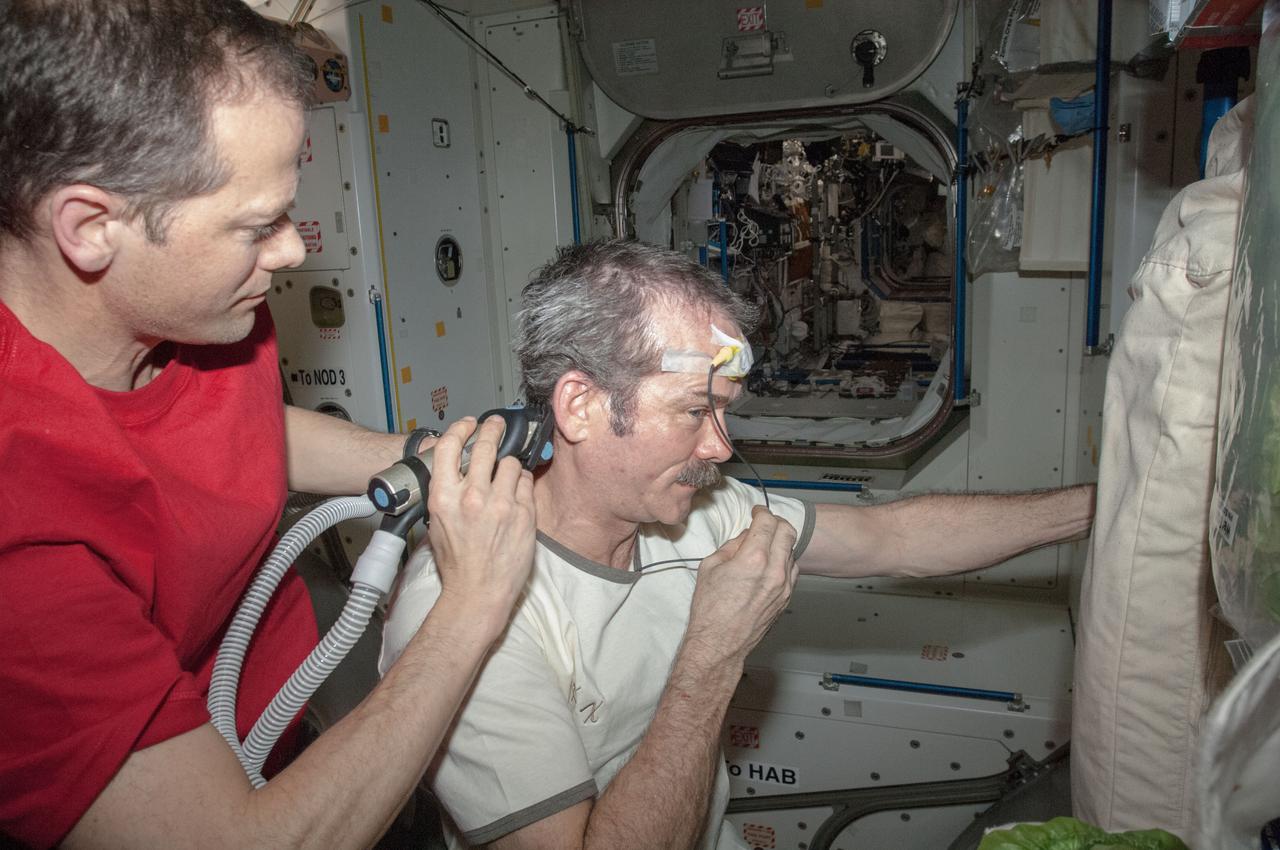
Expedition 35 flight engineer Tom Marshburn gives commander Chris Hadfield a haircut (using clippers attached to a vacuum hose) in the Unity Node 1. Hadfield (a Canadian Space Agency astronaut) has a temperature sensor taped to his forehead.
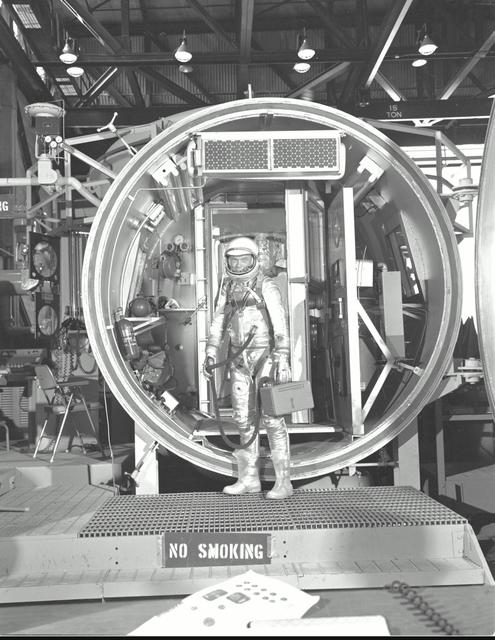
M61-00150 (1961) --- Astronaut John H. Glenn Jr., suited with hose to suit ventilation unit attached, during altitude chamber test. He is standing in the entrance to the test chamber with his helmet visor down. Photo credit: NASA
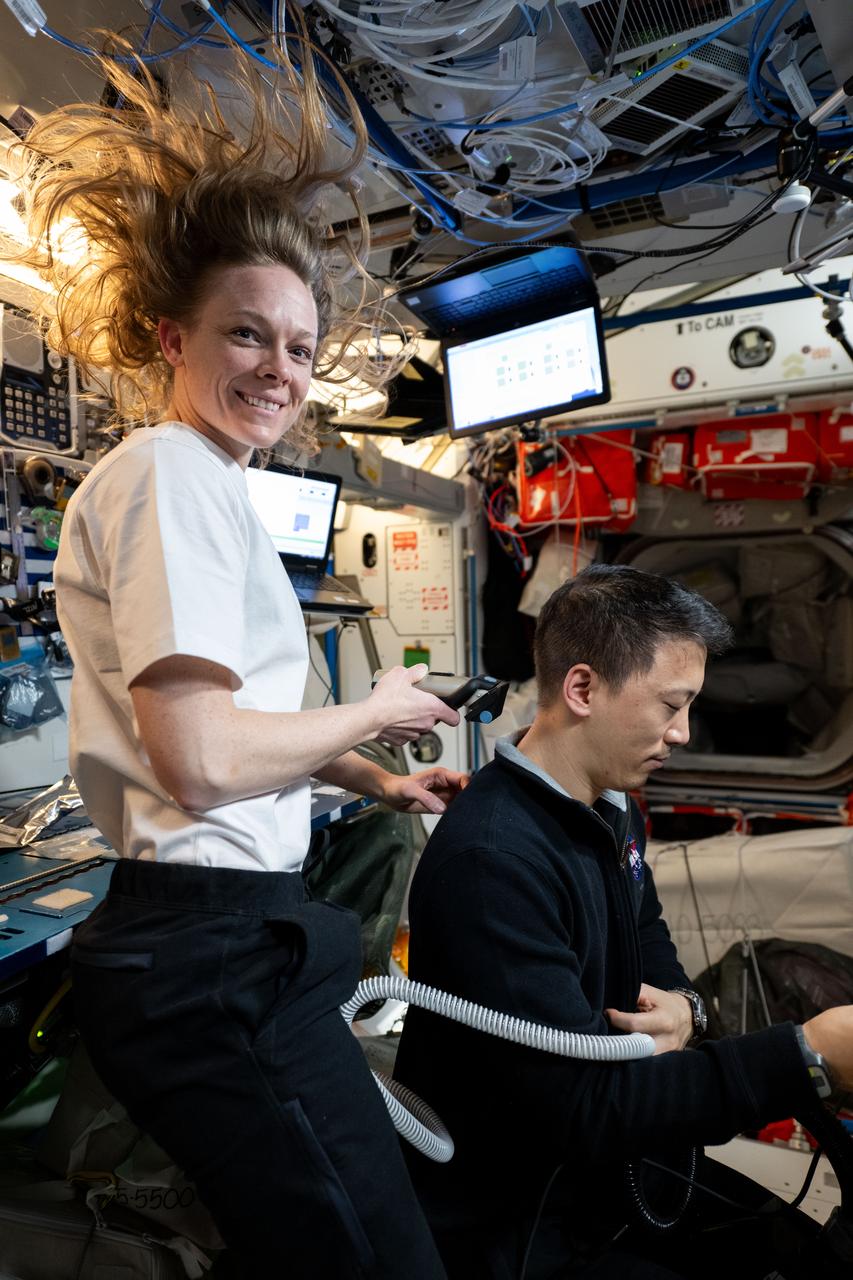
iss073e0422025 (July 27, 2025) --- NASA astronauts Nichole Ayers and Jonny Kim, both Expedition 73 Flight Engineers, are pictured inside the International Space Station's Harmony module. Ayers trims Kim's hair as a suction hose collects loose hairs to protect the station's atmosphere.
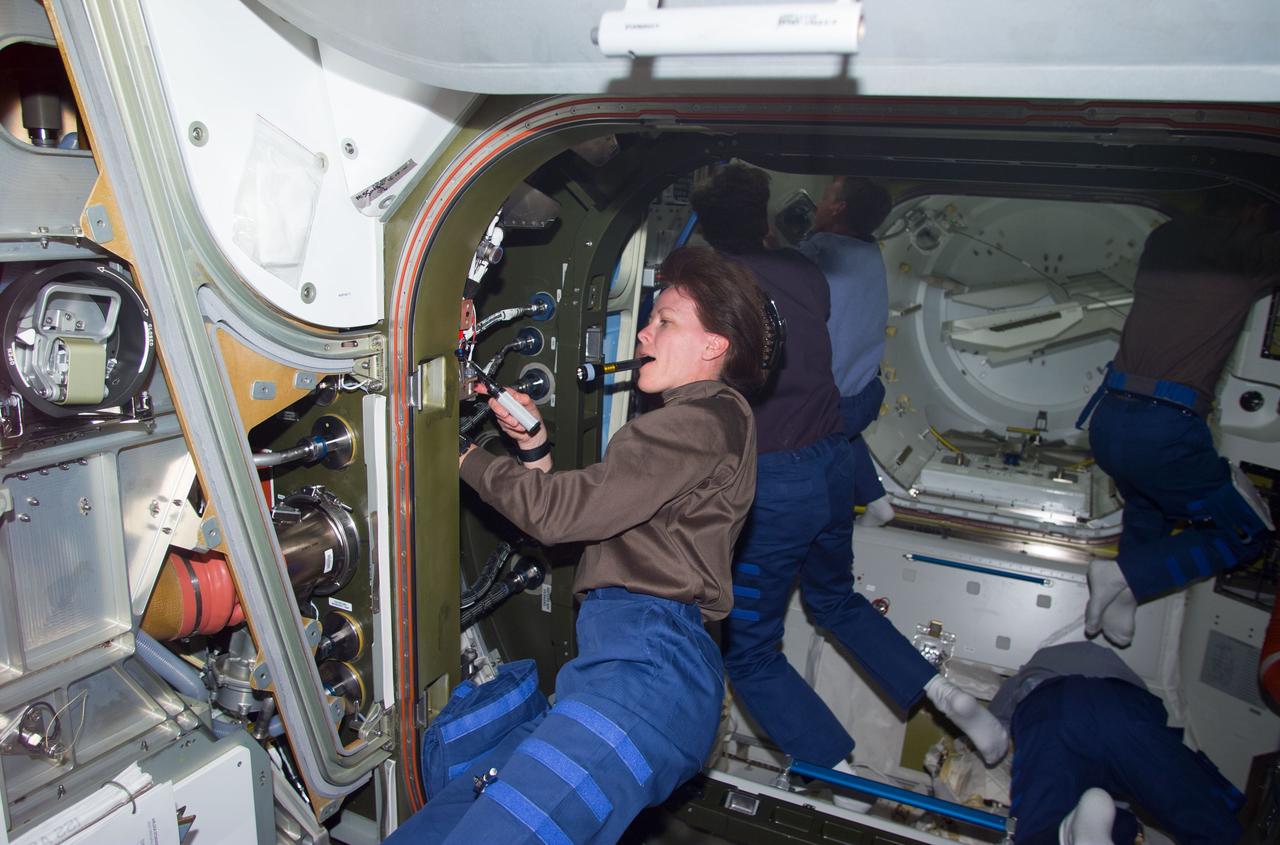
S104-E-5104 (16 July 2001) --- Janet L. Kavandi, STS-104 mission specialist, connects cables and hoses from the newly installed Quest Airlock to Unity Node 1. Other STS-104 and Expedition Two crewmembers are visible in the background working in the Airlock.
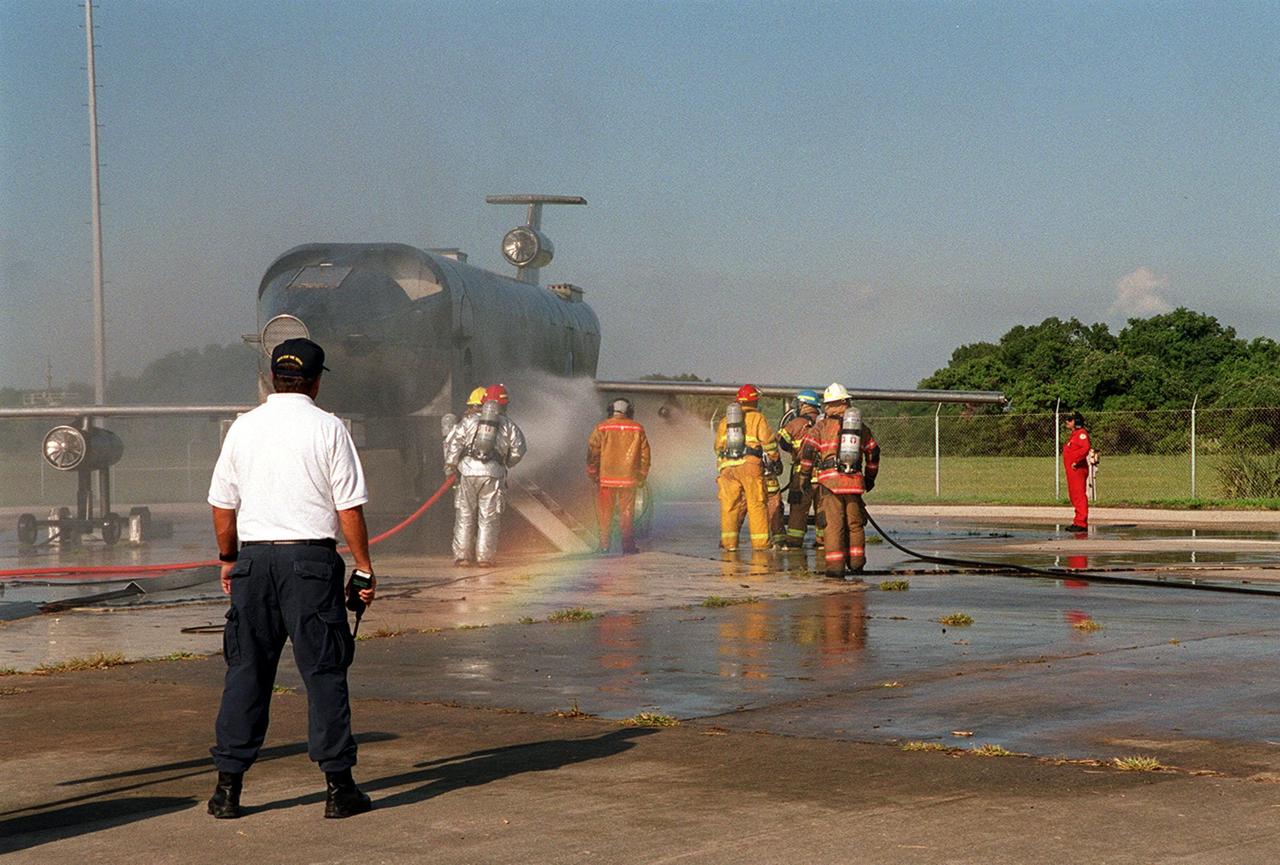
KENNEDY SPACE CENTER, FLA. -- Firefighters hold their hoses on a burning simulated aircraft, creating a rainbow. Watching at right (red uniform) and in the foreground are trainers. The training exercises for firefighters with Fire and Emergency Services at Naval Station Mayport, Fla., are being held at Cape Canaveral Air Force Station Pad 30.
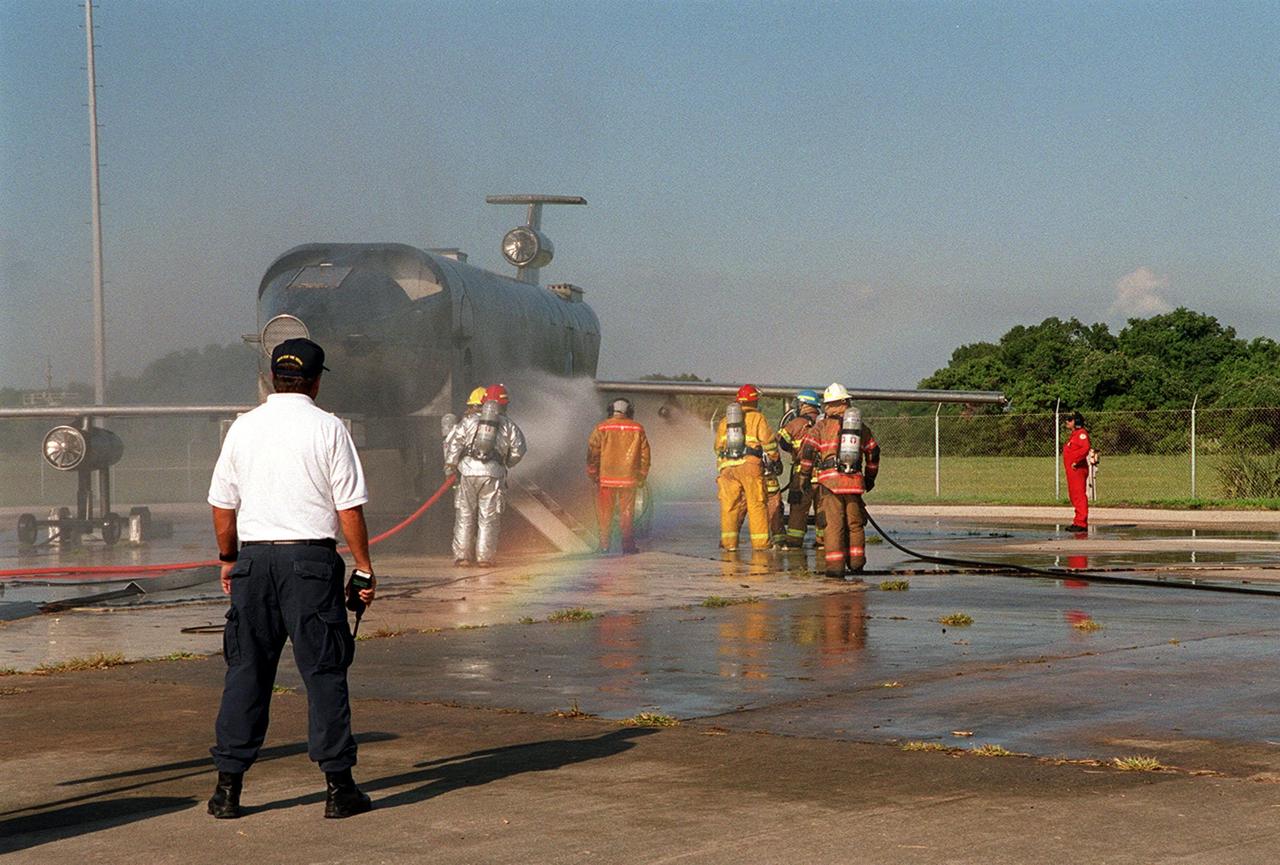
KENNEDY SPACE CENTER, FLA. -- Firefighters hold their hoses on a burning simulated aircraft, creating a rainbow. Watching at right (red uniform) and in the foreground are trainers. The training exercises for firefighters with Fire and Emergency Services at Naval Station Mayport, Fla., are being held at Cape Canaveral Air Force Station Pad 30.
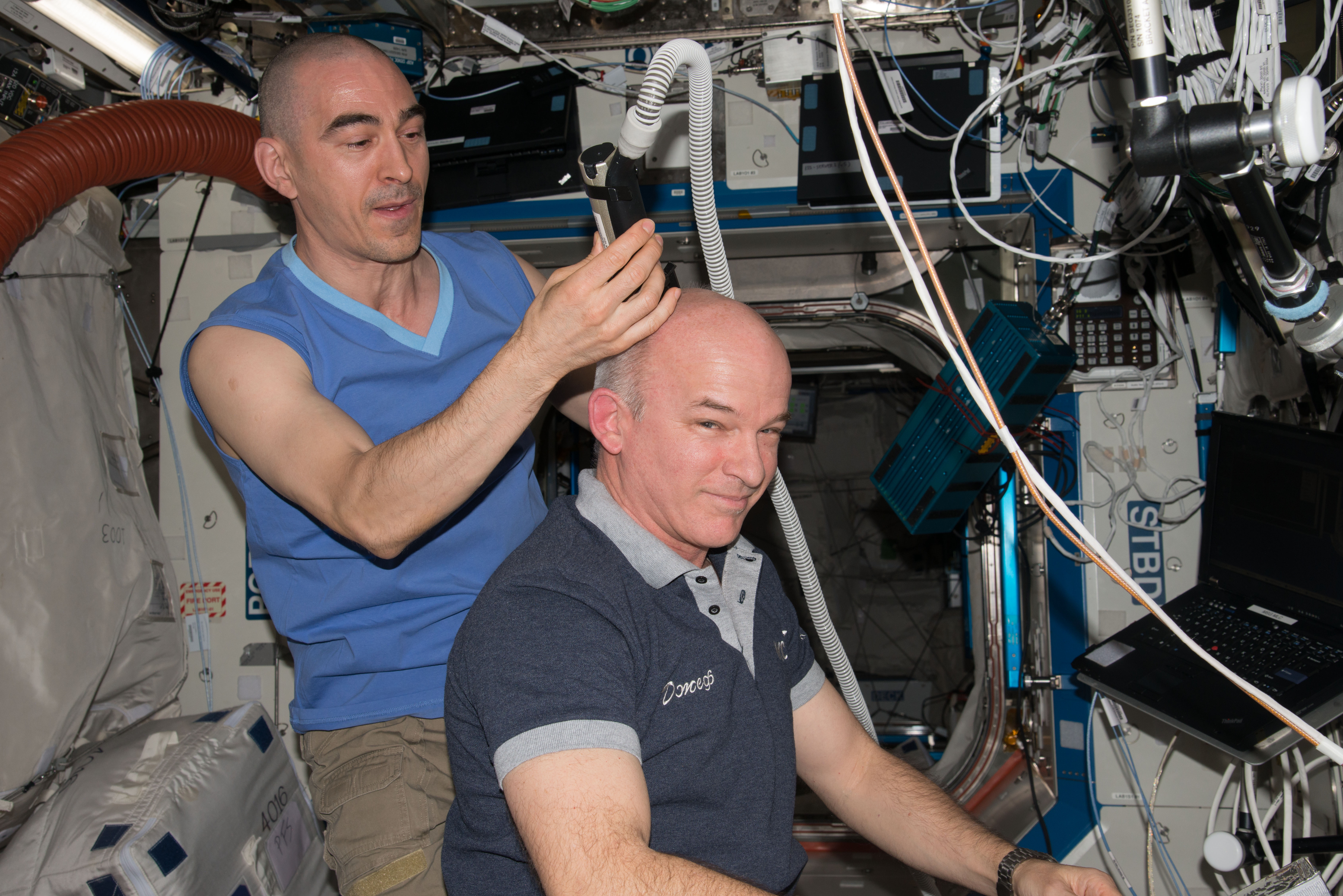
ISS048e026760 (07/16/2016) --- NASA astronaut Jeff Williams (right) gets a haircut aboard the International Space Station from Russian cosmonaut Anatoly Ivanishin (left.) The electric razor includes a vacuum hose to keep the tiny hair follicles from floating away
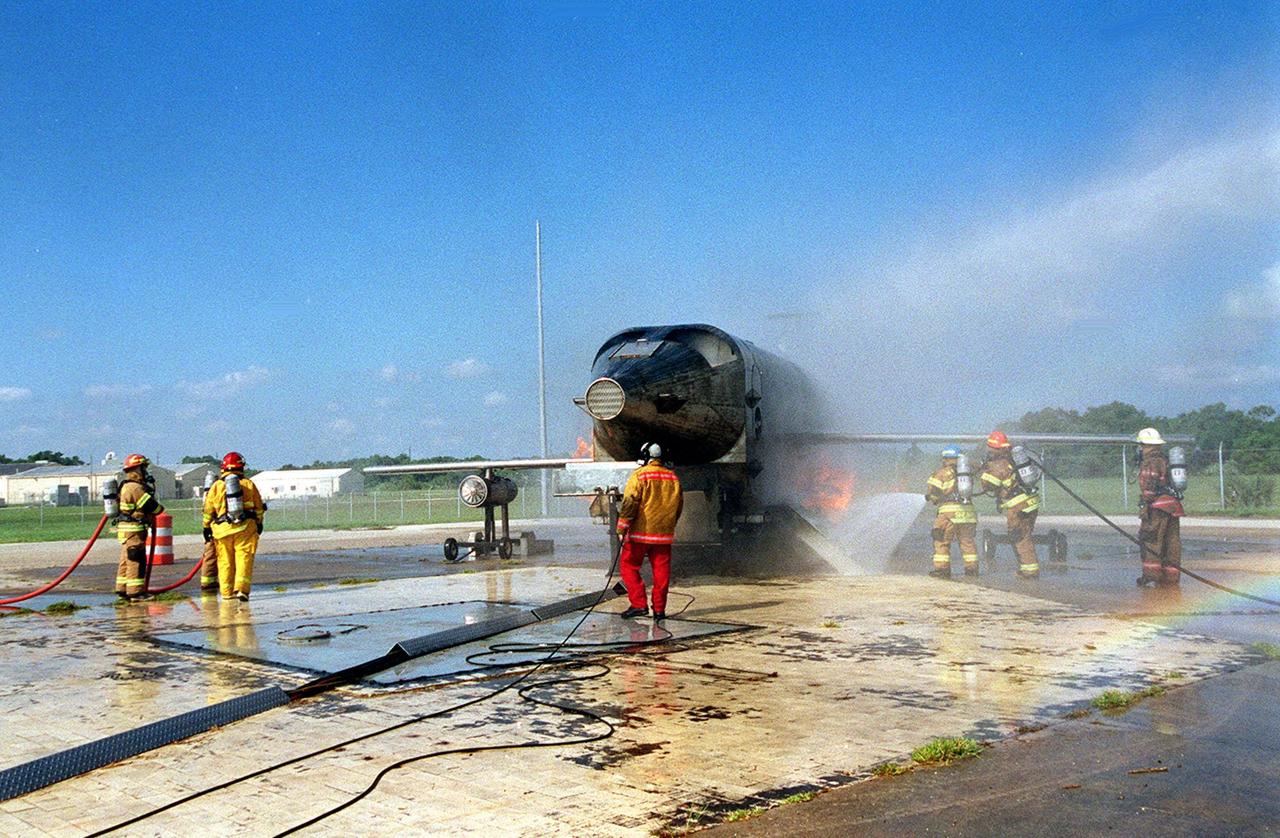
KENNEDY SPACE CENTER, FLA. -- Firefighters surround a burning simulated aircraft during training exercises Cape Canaveral Air Force Station Pad 30. Those at left wait their turn as the crew on the right turn their hoses toward the fire. The firefighters are with Fire and Emergency Services at the Naval Station Mayport, Fla
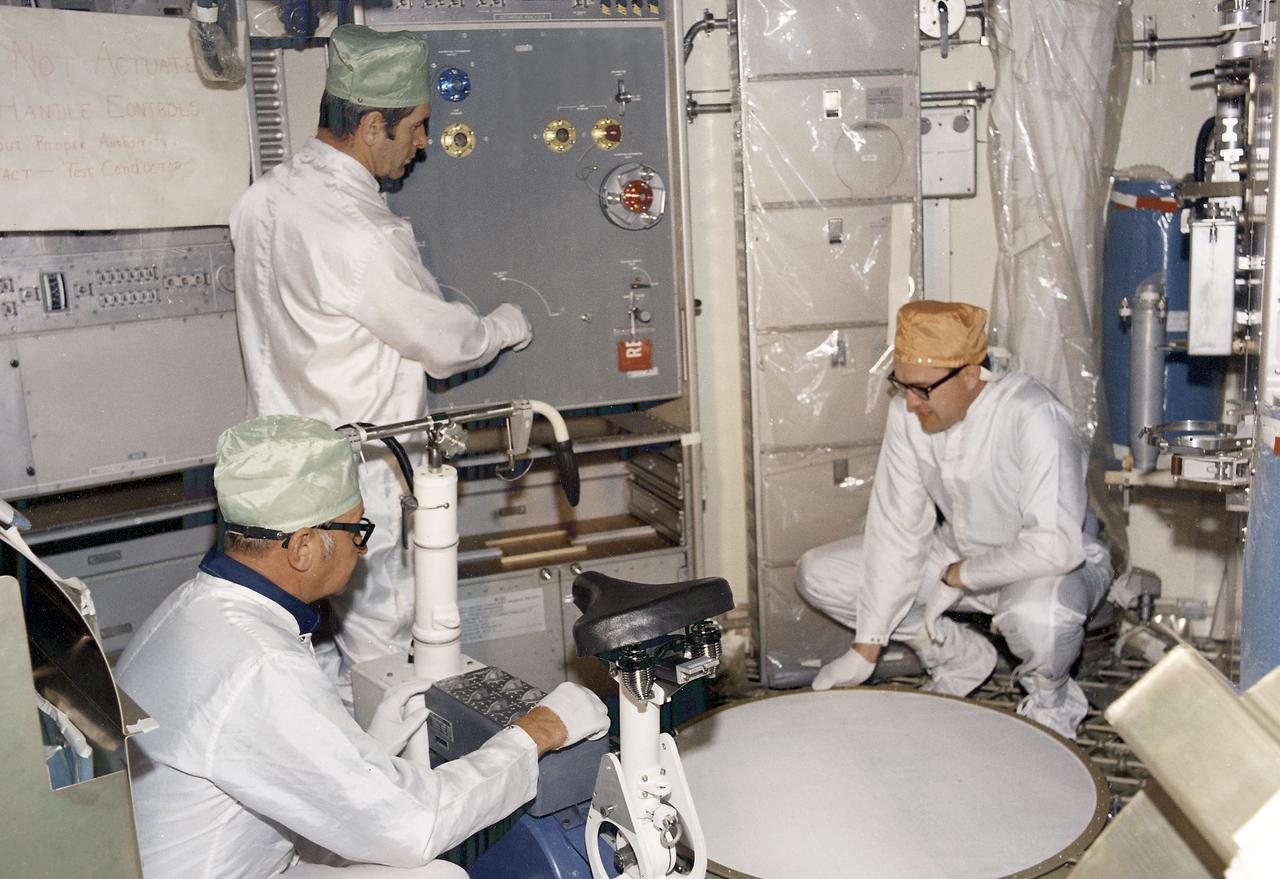
This photograph shows technicians performing a checkout of the Metabolic Analyzer (center background) and the Ergometer (foreground) in the Orbital Workshop (OWS). The shower compartment is at right. The Ergometer (Skylab Experiment M171) evaluated man's metabolic effectiveness and cost of work in space environment. Located in the experiment and work area of the OWS, the shower compartment was a cylindrical cloth enclosure that was folded flat when not in use. The bottom ring of the shower was fastened to the floor and contained foot restraints. The upper ring contained the shower head and hose. To use the shower, the astronaut filled a pressurized portable bottle with heated water and attached the bottle to the ceiling. A flexible hose cornected the water bottle to a handheld shower head. The astronaut pulled the cylindrical shower wall up into position and bathed, using liquid soap. Both soap and water were carefully rationed, having been premeasured for economical use.
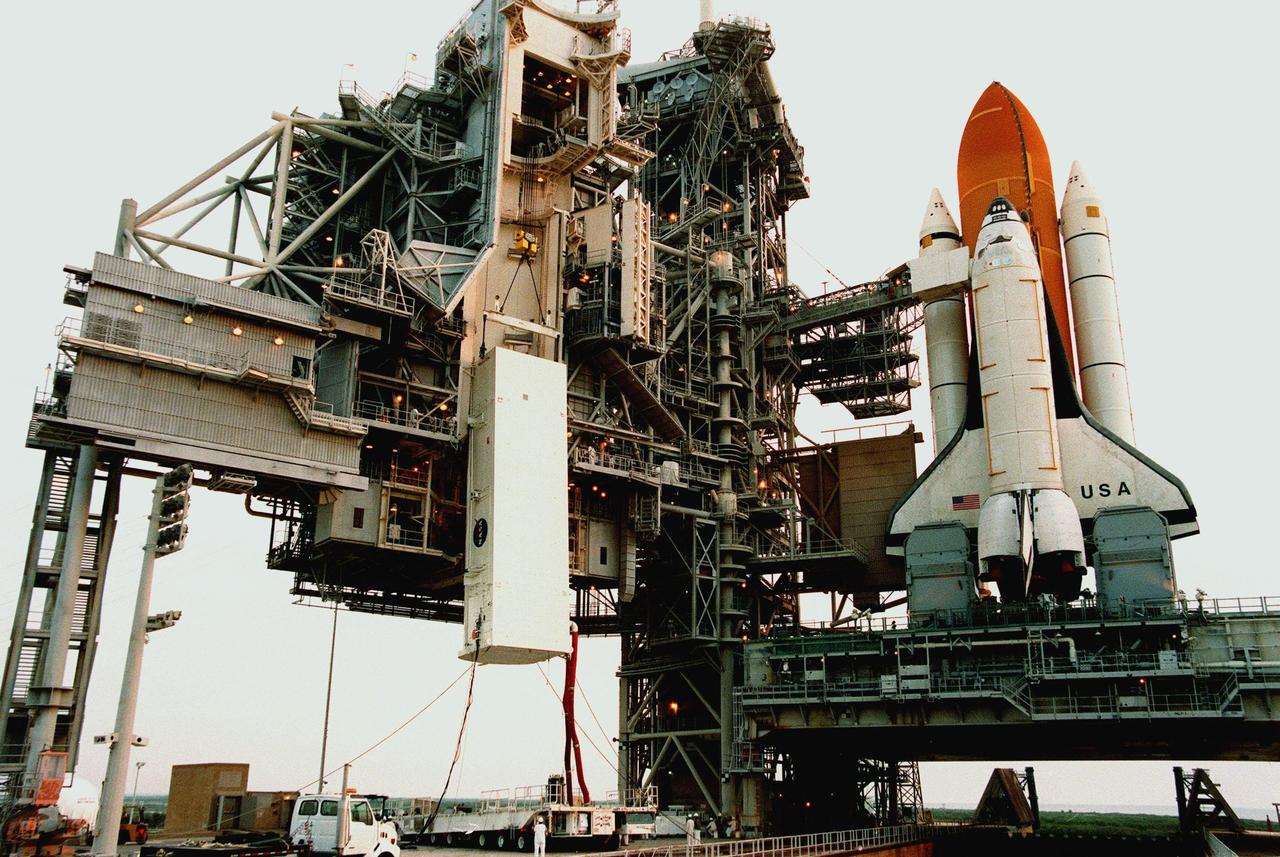
KENNEDY SPACE CENTER, FLA. -- In the early morning, the payload canister containing the Chandra X-ray Observatory, with umbilical hoses still attached, is lifted up the Rotating Service Structure (RSS). The hoses provide a controlled environment during the transfer. The canister arrived at the pad on the payload canister transporter below it. The canister will be lifted up to the Payload Changeout Room in the RSS where it will be relieved of its cargo. After the RSS rotates to a position behind Space Shuttle Columbia (at right), the observatory will then be installed vertically in the orbiter payload bay. The world's most powerful X-ray telescope, Chandra will allow scientists from around the world to see previously invisible black holes and high-temperature gas clouds, giving the observatory the potential to rewrite the books on the structure and evolution of our universe. Chandra is the primary payload on mission STS-93, scheduled to launch no earlier than July 20 aboard Space Shuttle Columbia (right)
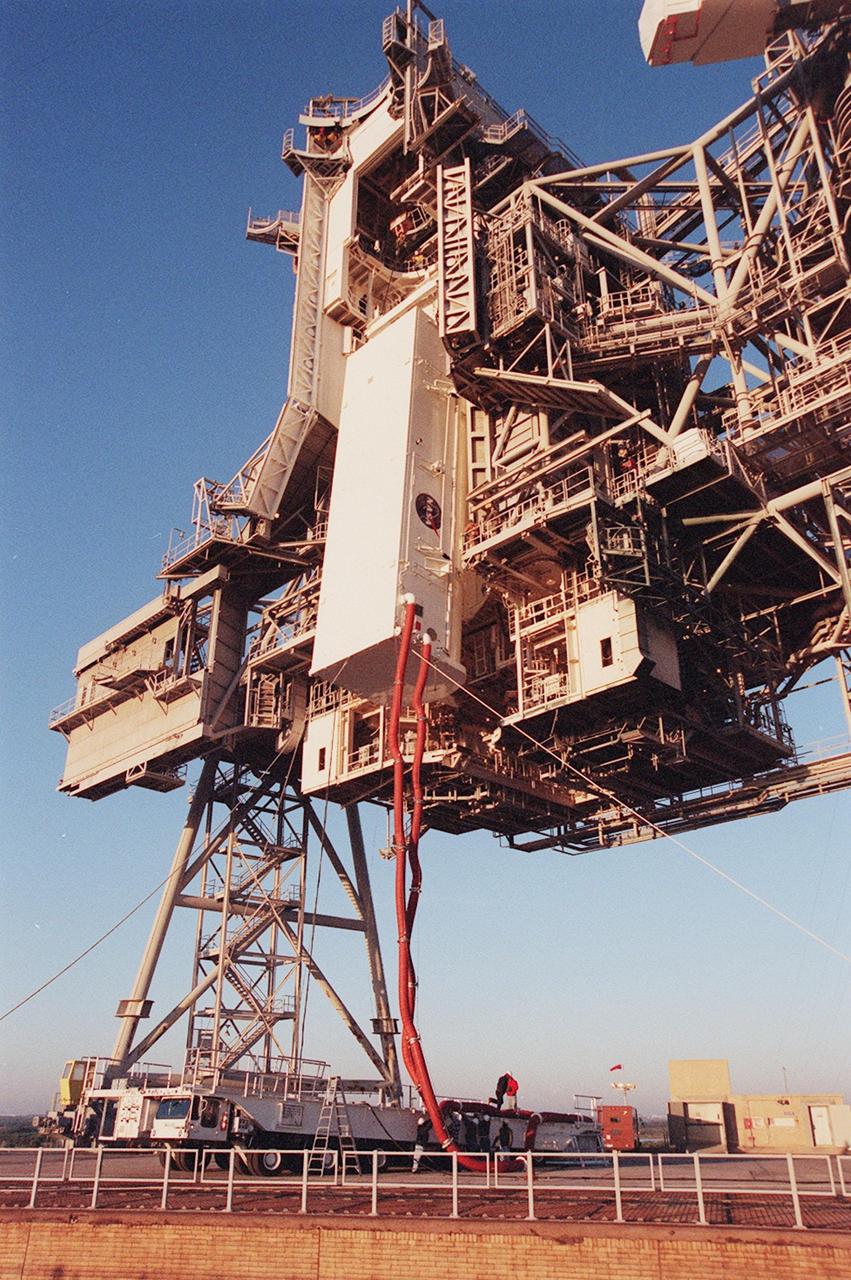
KENNEDY SPACE CENTER, FLA. -- The payload canister containing the U.S. Lab Destiny rises up the Rotating Service Structure to the payload changeout room at Launch Pad 39A. Umbilical hoses are still attached. In the PCR Destiny will be removed and transferred to the payload bay of Atlantis for mission STS-98. Destiny, a key element in the construction of the International Space Station is designed for space science experiments. STS-98 is the seventh construction flight to the ISS. Launch of STS-98 is scheduled for Jan. 19 at 2:11 a.m. EST
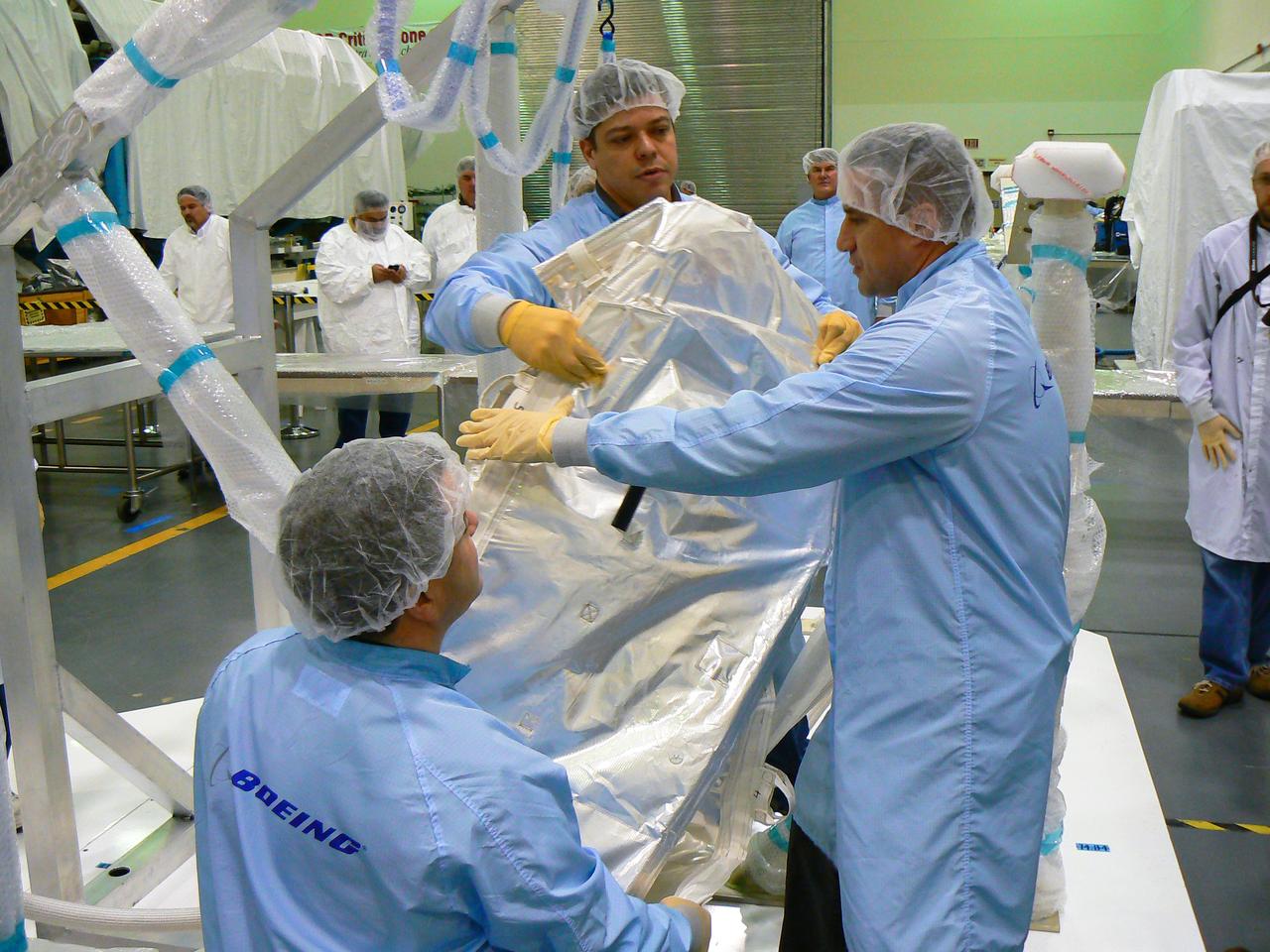
JSC2010-E-014774 (15 Jan. 2010) --- At Marshall Space Center?s building 4708 in the high-bay clean room, astronauts George Zamka (right), STS-130 commander; along with astronauts Nicholas Patrick (foreground) and Robert Behnken, both mission specialists, are seen with a 1G stand that simulates geometrically the interfaces of the ammonia hoses between node 3 and the U.S. lab on orbit. The three crew members are pulling the ammonia blanket from their EVA bag to verify how they would perform the installation procedure on orbit.
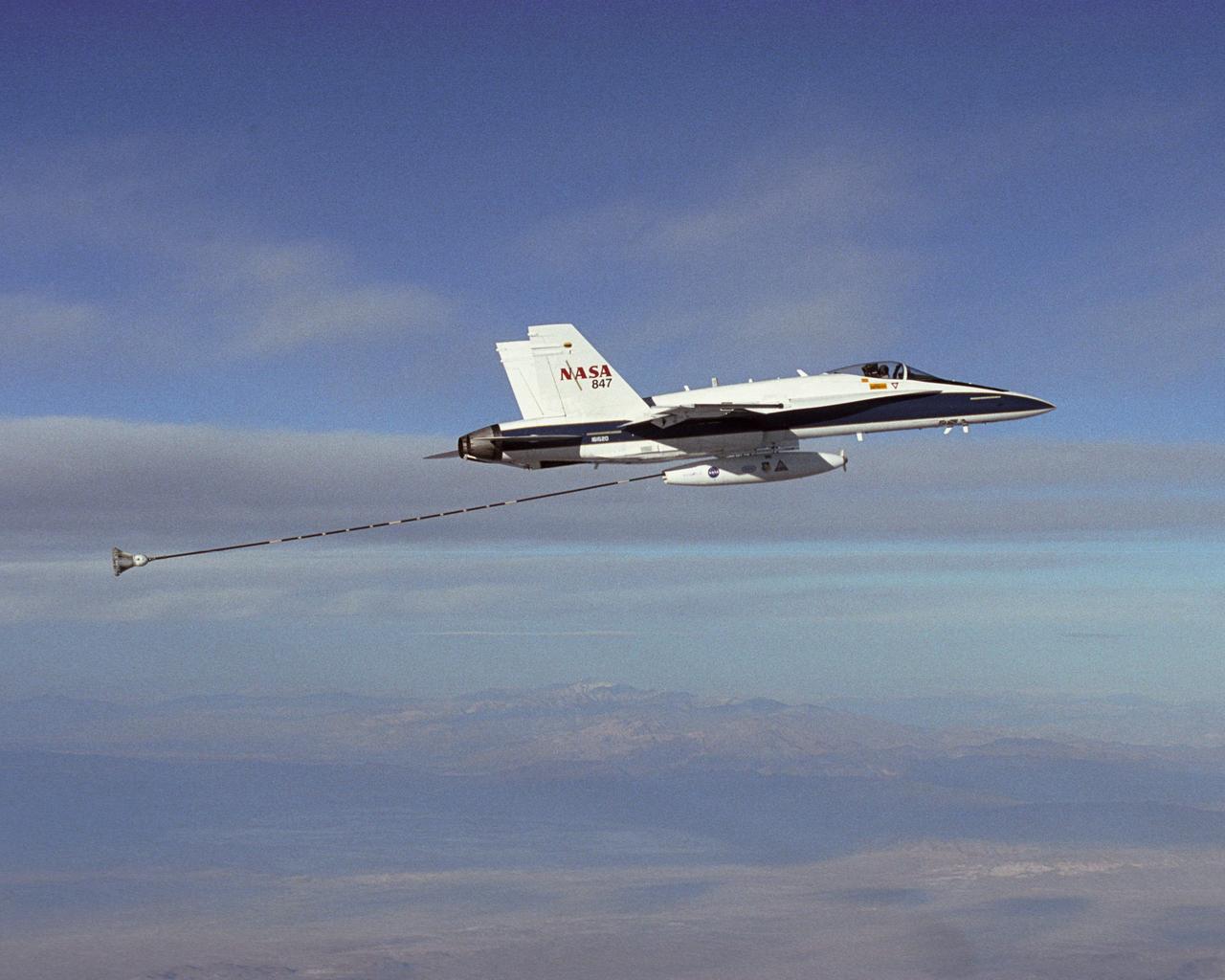
NASA Dryden's Automated Aerial Refueling (AAR) project evaluated the capability of an F/A-18A aircraft as an in-flight refueling tanker with the objective of developing analytical models for an automated aerial refueling system for unmanned air vehicles. The F/A-18 "tanker" aircraft (No. 847) underwent flight test envelope expansion with an aerodynamic pod containing air-refueling equipment carried beneath the fuselage. The second aircraft (No. 843) flew as the receiver aircraft during the study to assess the free-stream hose and drogue dynamics on the F/A-18A.
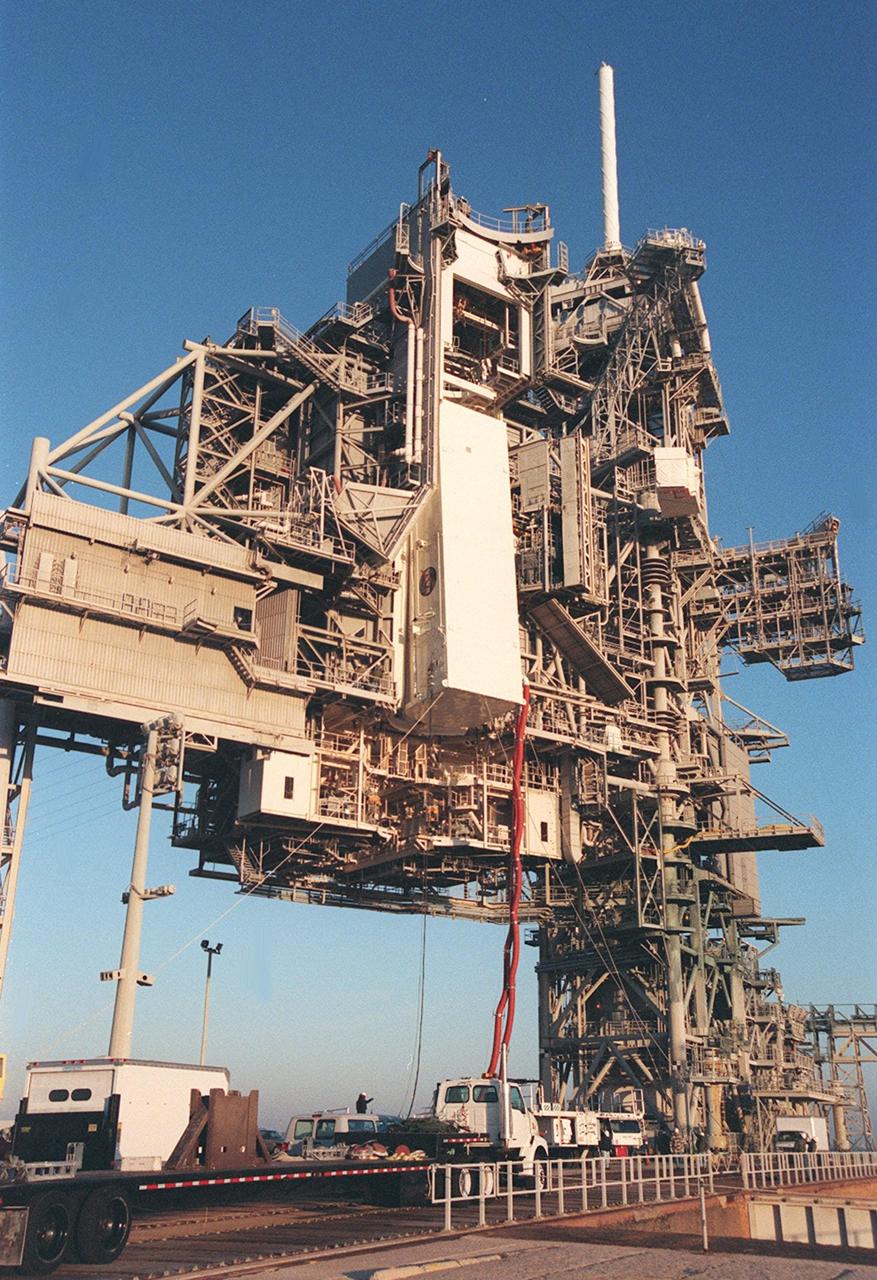
KENNEDY SPACE CENTER, FLA. -- The payload canister containing the U.S. Lab Destiny nears the payload changeout room on the Rotating Service Structure at Launch Pad 39A. Umbilical hoses are still attached. In the PCR Destiny will be removed and transferred to the payload bay of Atlantis for mission STS-98. Destiny, a key element in the construction of the International Space Station is designed for space science experiments. STS-98 is the seventh construction flight to the ISS. Launch of STS-98 is scheduled for Jan. 19 at 2:11 a.m. EST
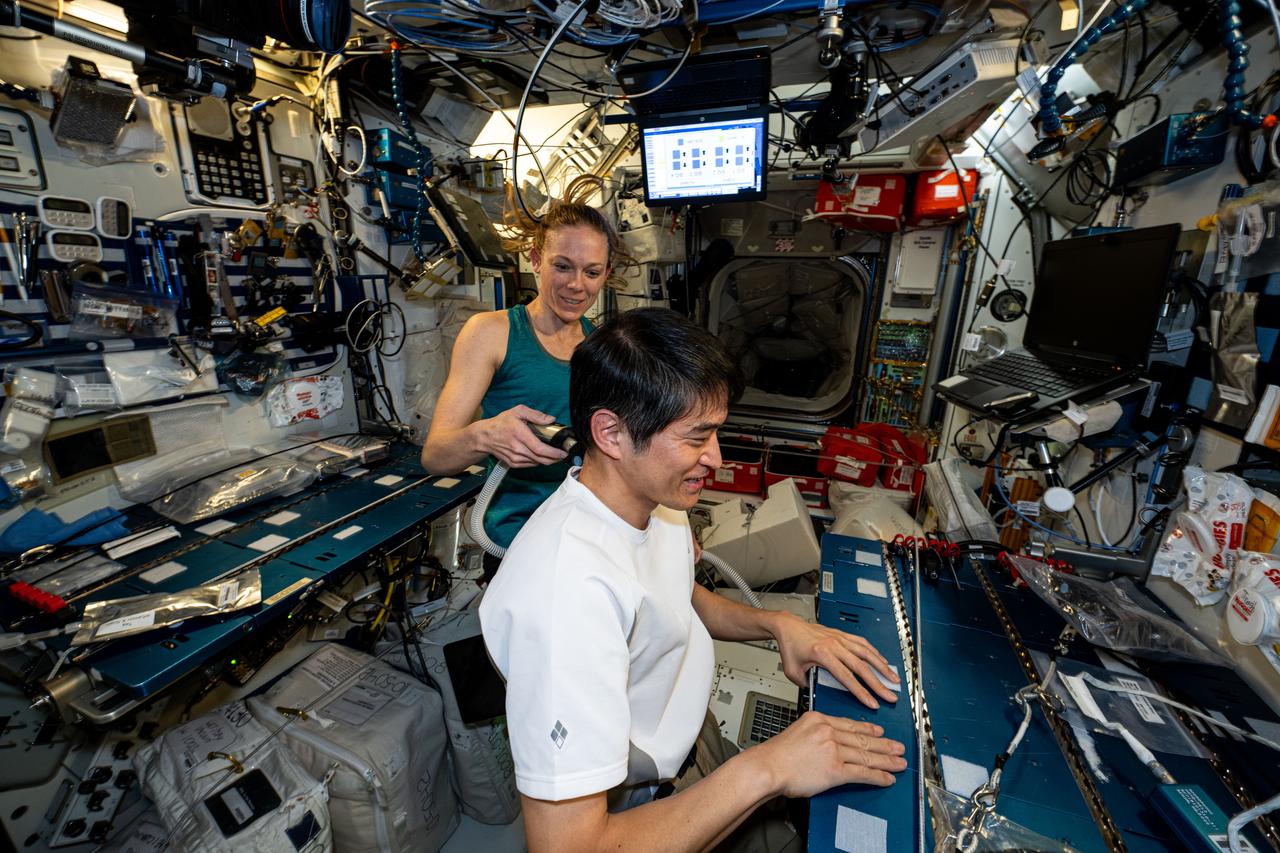
iss073e0120070 (May 31, 2025) --- Astronauts Takuya Onishi of JAXA (Japan Aerospace Exploration Agency) and Nichole Ayers of NASA, Expedition 73 Commander and Flight Engineer respectively, are pictured inside the International Space Station's Harmony module. Ayers trims Onishi's hair using an electric razor with a suction hose attached that collects loose hairs to protect the station's atmosphere.
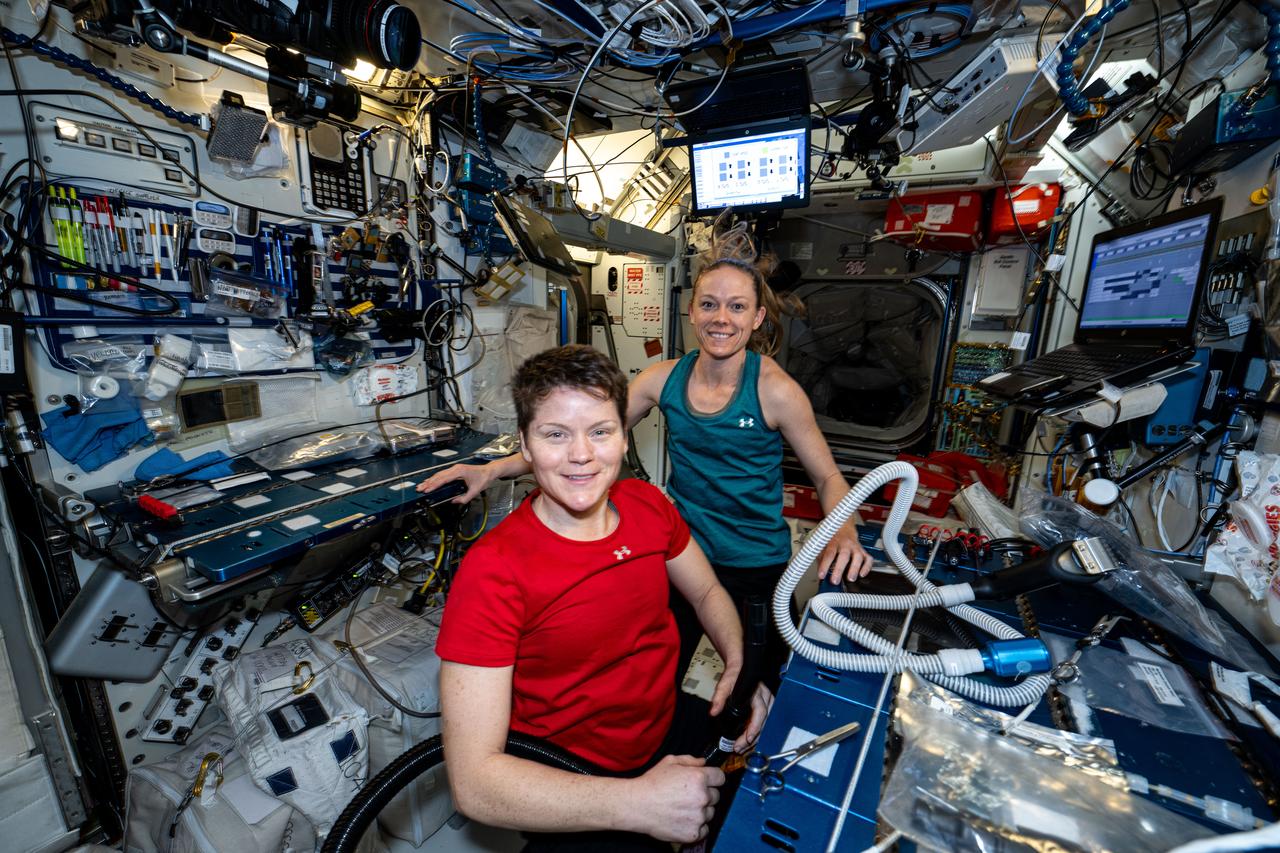
iss073e0120087 (May 31, 2025) --- NASA astronauts (left to right) Anne McClain and Nichole Ayers, both Expedition 73 Flight Engineers, pose for a portrait together aboard the International Space Station's Harmony module. Moments earlier, Ayers finished trimming McClain's hair using an electric razor with a suction hose attached that collects the loose hair to protect the station's atmosphere.
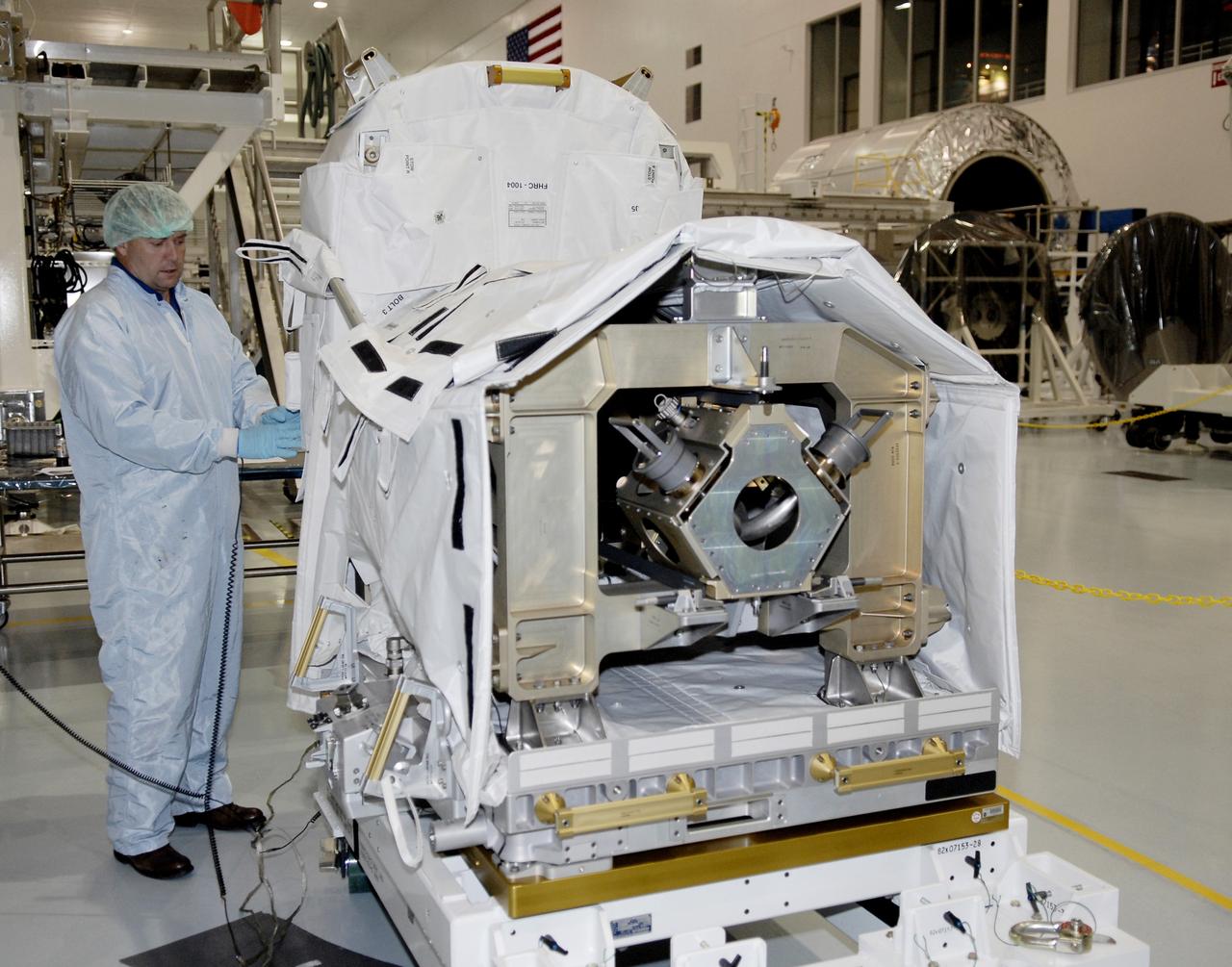
CAPE CANAVERAL, FIa. -- In the Space Station Processing Facility at NASA's Kennedy Space Center, astronaut Michael Foreman removes part of the cover on the flexible hose rotary coupler that will fly on the STS-126 mission Nov. 14. Although not associated with the mission, Foreman is an EVA branch crew member providing expertise for hardware going on the International Space Station. On the STS-126 mission, space shuttle Endeavour will deliver a Multi-Purpose Logistics Module to the International Space Station. Photo credit: NASA/Kim Shiflett
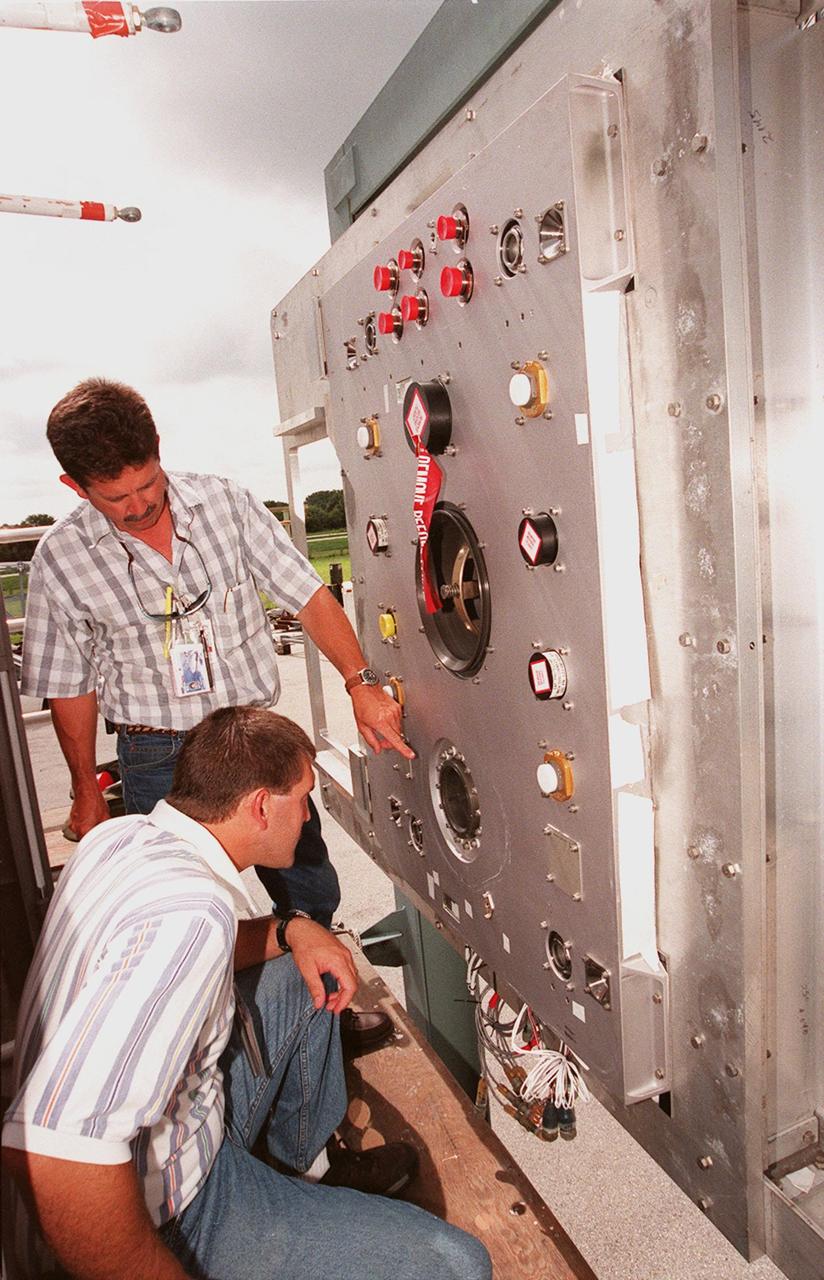
At the Launch Equipment Test Facility, , Will Reaves and Mike Solomon (kneeling), both with Lockheed Martin Technical Operations, observe parts of the X-33 umbilical system during testing. A team of Kennedy Space Center experts developed the umbilical system, comprising panels, valves and hoses that provide the means to load the X-33 with super-cold propellant. The X-33, under construction at Lockheed Martin Skunk Works in Palmdale, Calif., is a half-scale prototype of the planned operational reusable launch vehicle dubbed VentureStar
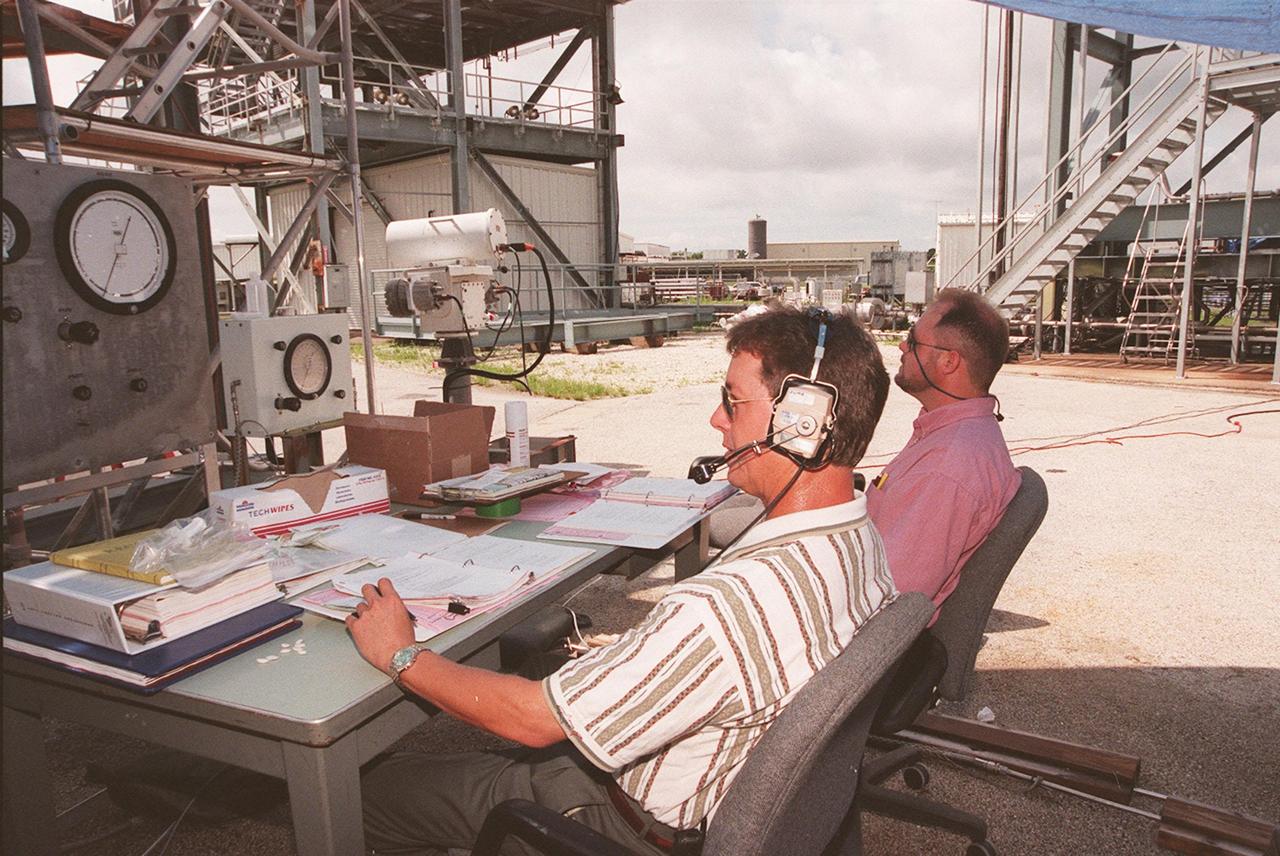
At the Launch Equipment Test Facility, Mike Ynclan, with Dynacs, and Greg Melton, a NASA engineer, look at measurements during testing of the X-33 umbilical system. A team of Kennedy Space Center experts developed the umbilical system, comprising panels, valves and hoses that provide the means to load the X-33 with super-cold propellant. The X-33, under construction at Lockheed Martin Skunk Works in Palmdale, Calif., is a half-scale prototype of the planned operational reusable launch vehicle dubbed VentureStar
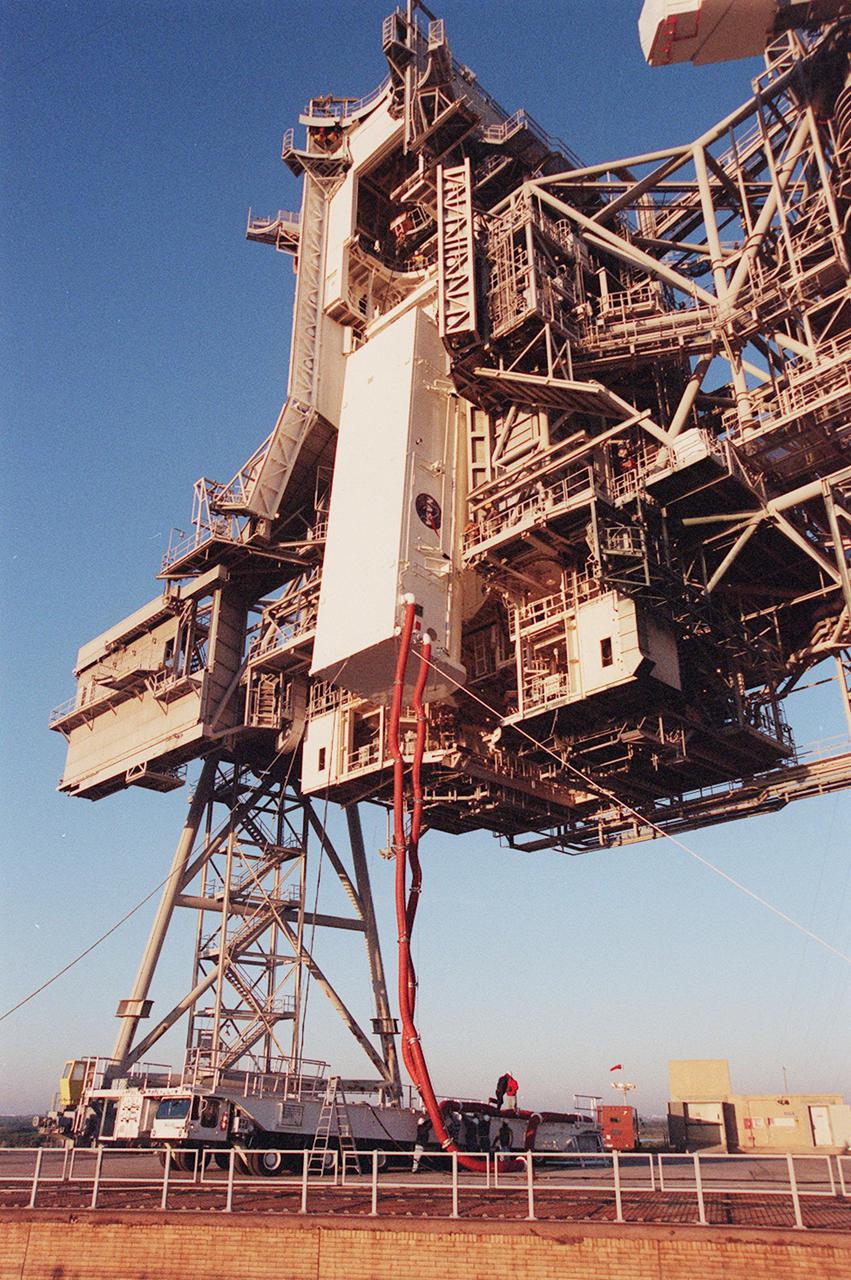
KENNEDY SPACE CENTER, FLA. -- The payload canister containing the U.S. Lab Destiny rises up the Rotating Service Structure to the payload changeout room at Launch Pad 39A. Umbilical hoses are still attached. In the PCR Destiny will be removed and transferred to the payload bay of Atlantis for mission STS-98. Destiny, a key element in the construction of the International Space Station is designed for space science experiments. STS-98 is the seventh construction flight to the ISS. Launch of STS-98 is scheduled for Jan. 19 at 2:11 a.m. EST
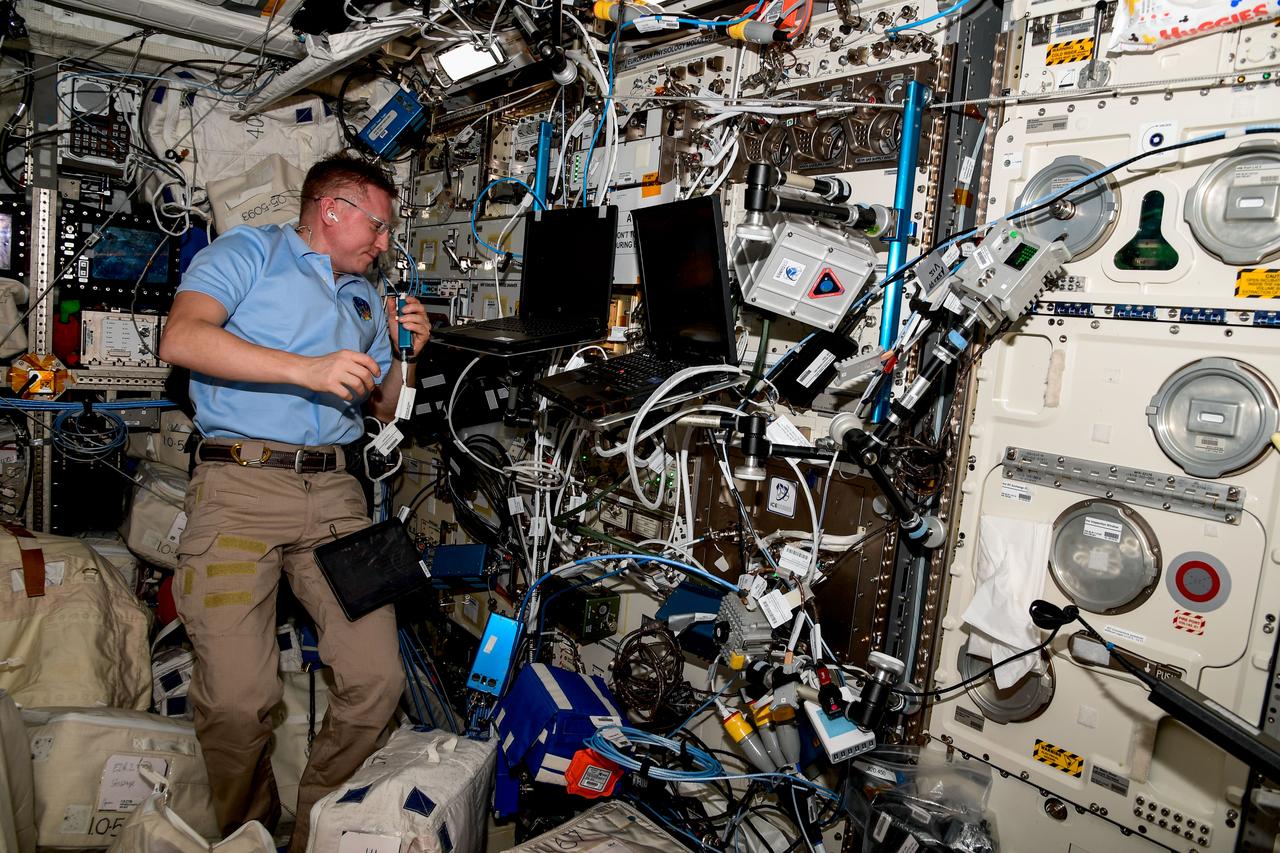
iss068e0420749 (Jan. 25, 2023) --- Roscosmos cosmonaut and Expedition 68 Commander Sergey Prokopyev connects valves and manipulates hoses to change gases from neon to argon for the Plasma Crystal experiment. The space physics study takes place inside the International Space Station's Columbus laboratory module and explores how clouds of highly charged particles, or plasma crystals, behave in microgravity.
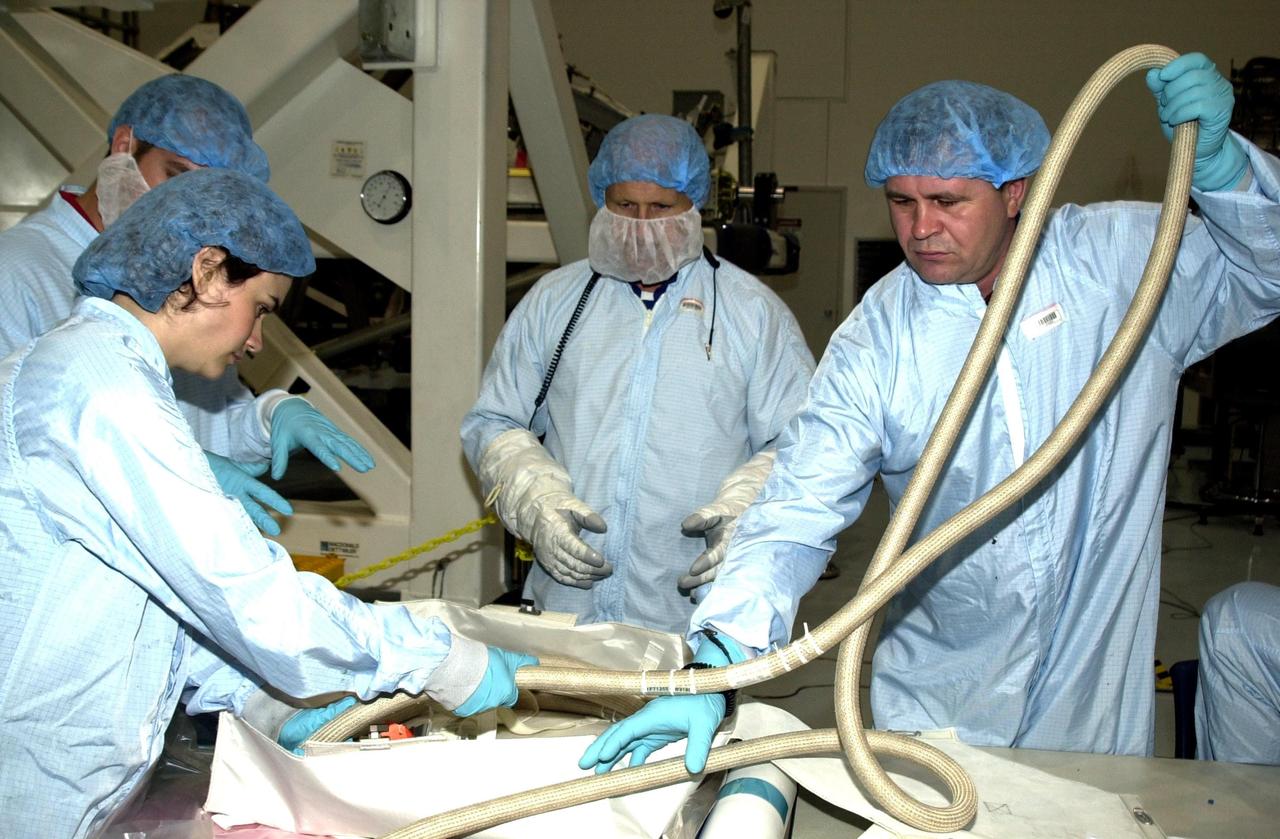
KENNEDY SPACE CENTER, FLA. -- Members of the Expedition 6 crew practice using equipment they will be handling during their residency on the International Space Station. In the center of the photo is Commander Ken Bowersox; holding the flexible hose is crew member Nikolai Budarin. Donald Thomas is the third member of the crew. Expedition 6 is attached to mission STS-113, scheduled to launch in September 2002.
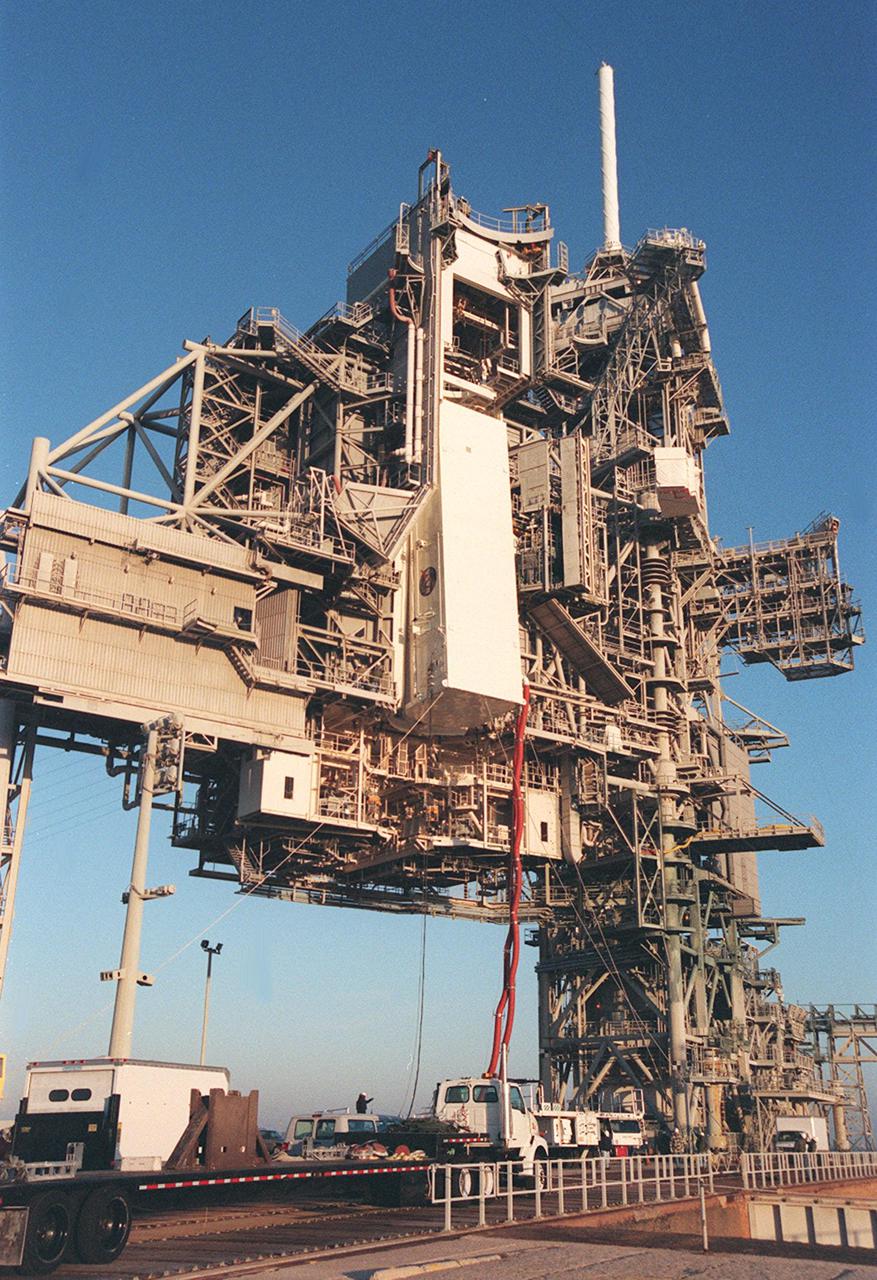
KENNEDY SPACE CENTER, FLA. -- The payload canister containing the U.S. Lab Destiny nears the payload changeout room on the Rotating Service Structure at Launch Pad 39A. Umbilical hoses are still attached. In the PCR Destiny will be removed and transferred to the payload bay of Atlantis for mission STS-98. Destiny, a key element in the construction of the International Space Station is designed for space science experiments. STS-98 is the seventh construction flight to the ISS. Launch of STS-98 is scheduled for Jan. 19 at 2:11 a.m. EST
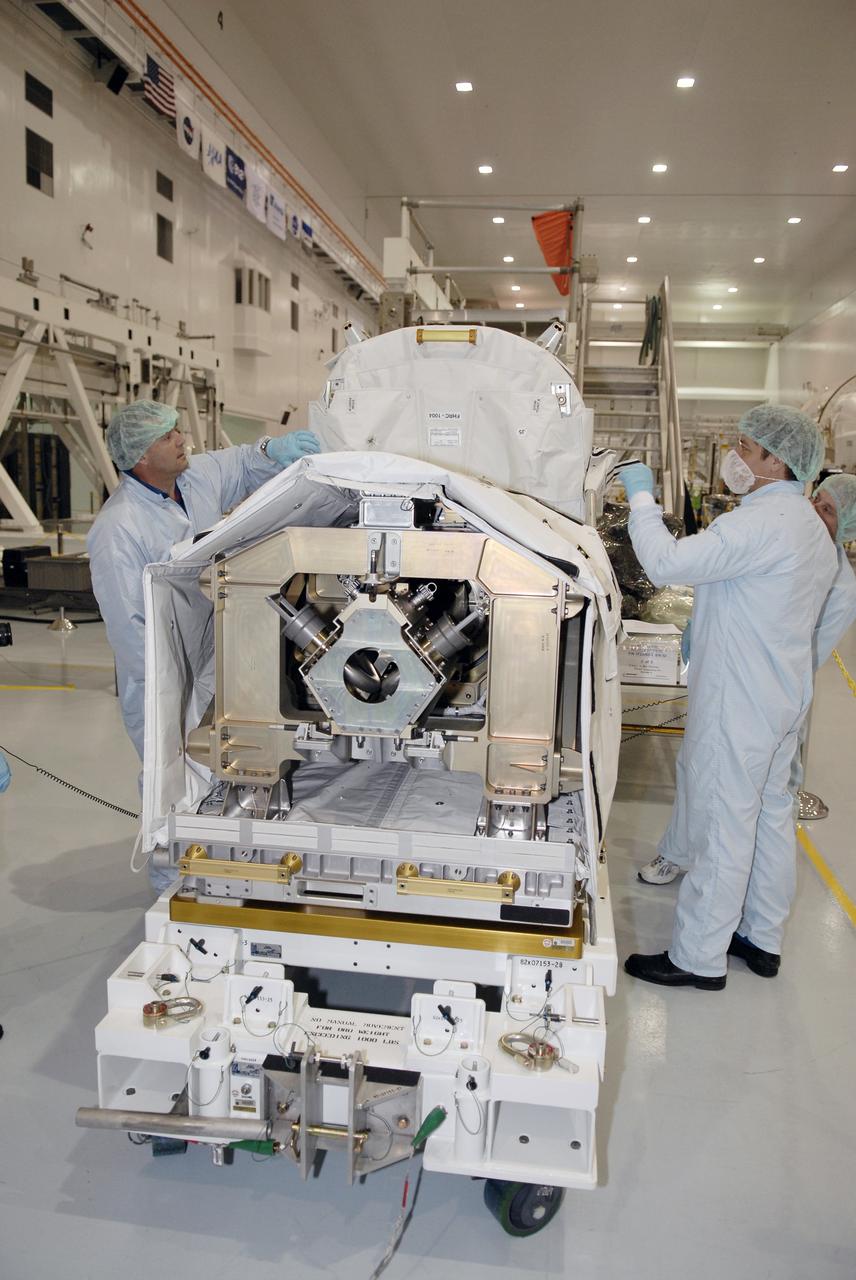
CAPE CANAVERAL, FIa. -- In the Space Station Processing Facility at NASA's Kennedy Space Center, astronaut Michael Foreman (left) checks part of the cover on the flexible hose rotary coupler that will fly on the STS-126 mission Nov. 14. Although not associated with the mission, Foreman is an EVA branch crew member providing expertise for hardware going on the International Space Station. On the STS-126 mission, space shuttle Endeavour will deliver a Multi-Purpose Logistics Module to the International Space Station. Photo credit: NASA/Kim Shiflett
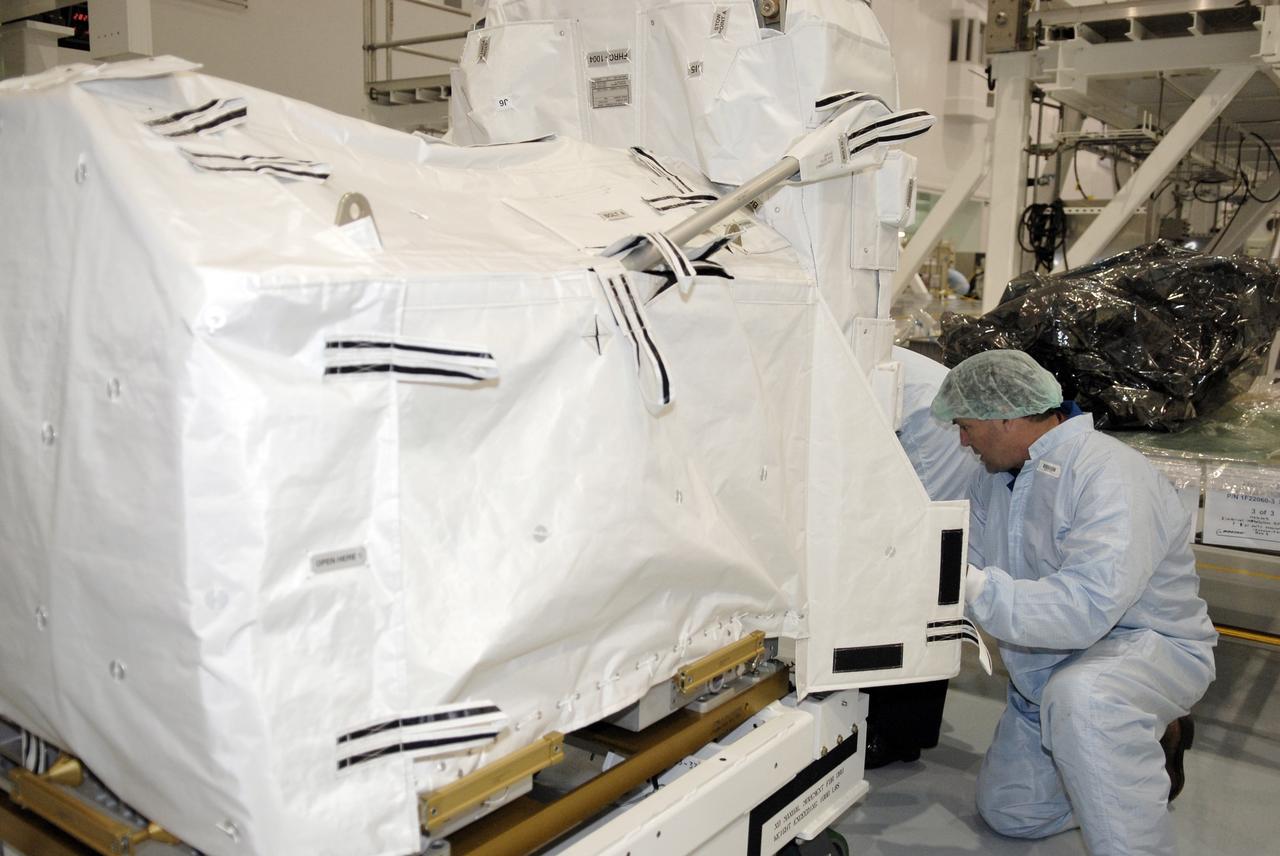
CAPE CANAVERAL, FIa. -- In the Space Station Processing Facility at NASA's Kennedy Space Center, astronaut Michael Foreman closely inspects the flexible hose rotary coupler that will fly on the STS-126 mission Nov. 14. Although not associated with the mission, Foreman is a crew member of the EVA branch who are providing their expertise for hardware going on the International Space Station. On the STS-126 mission, space shuttle Endeavour will deliver a Multi-Purpose Logistics Module to the International Space Station. Photo credit: NASA/Kim Shiflett
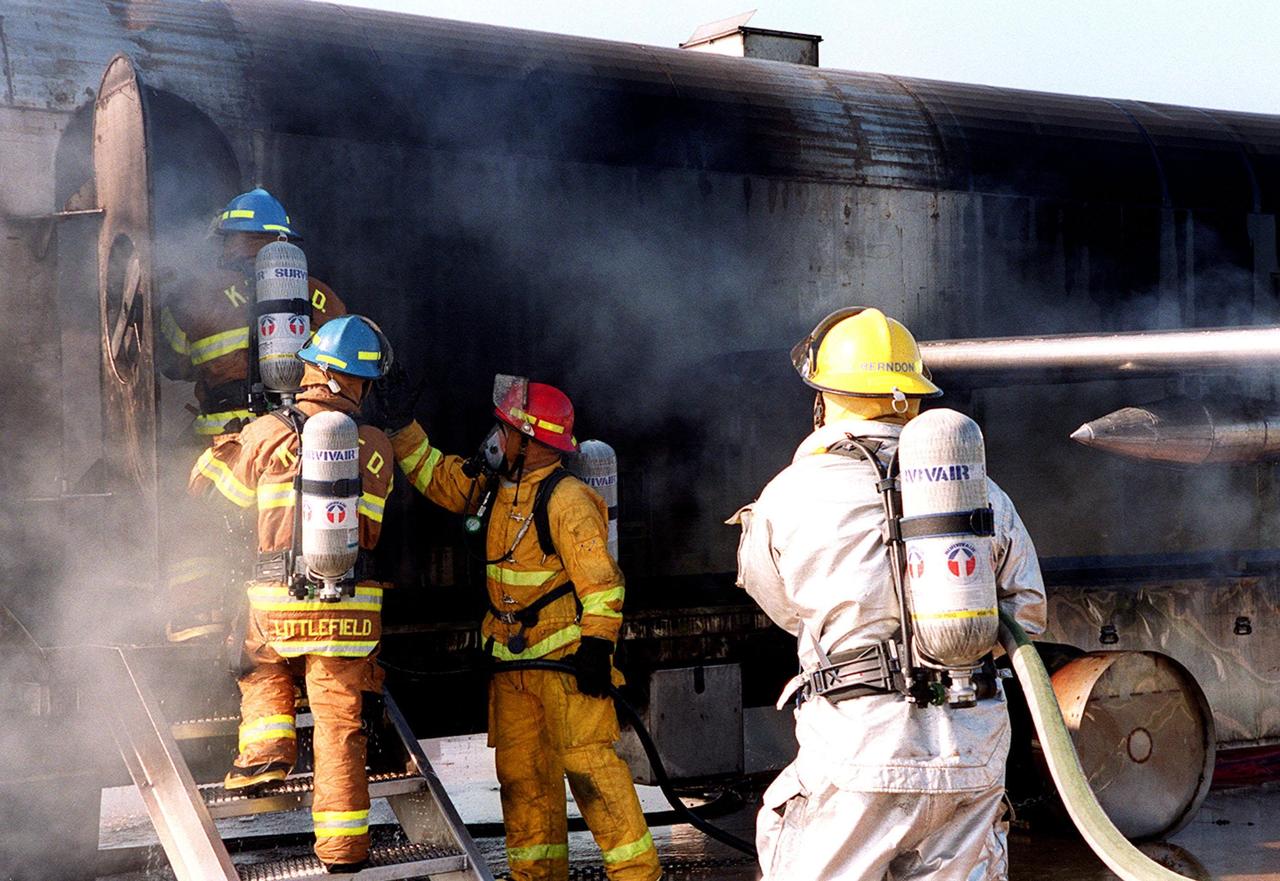
KENNEDY SPACE CENTER, FLA. -- A firefighter (right) holds a water hose in readiness as others enter a smoke-filled simulated aircraft. The activities are part of fire training exercises at Cape Canaveral Air Force Station Pad 30 for firefighters with Fire and Emergency Services at the Naval Station Mayport, Fla. The firefighters have already extinguished flames from the aircraft
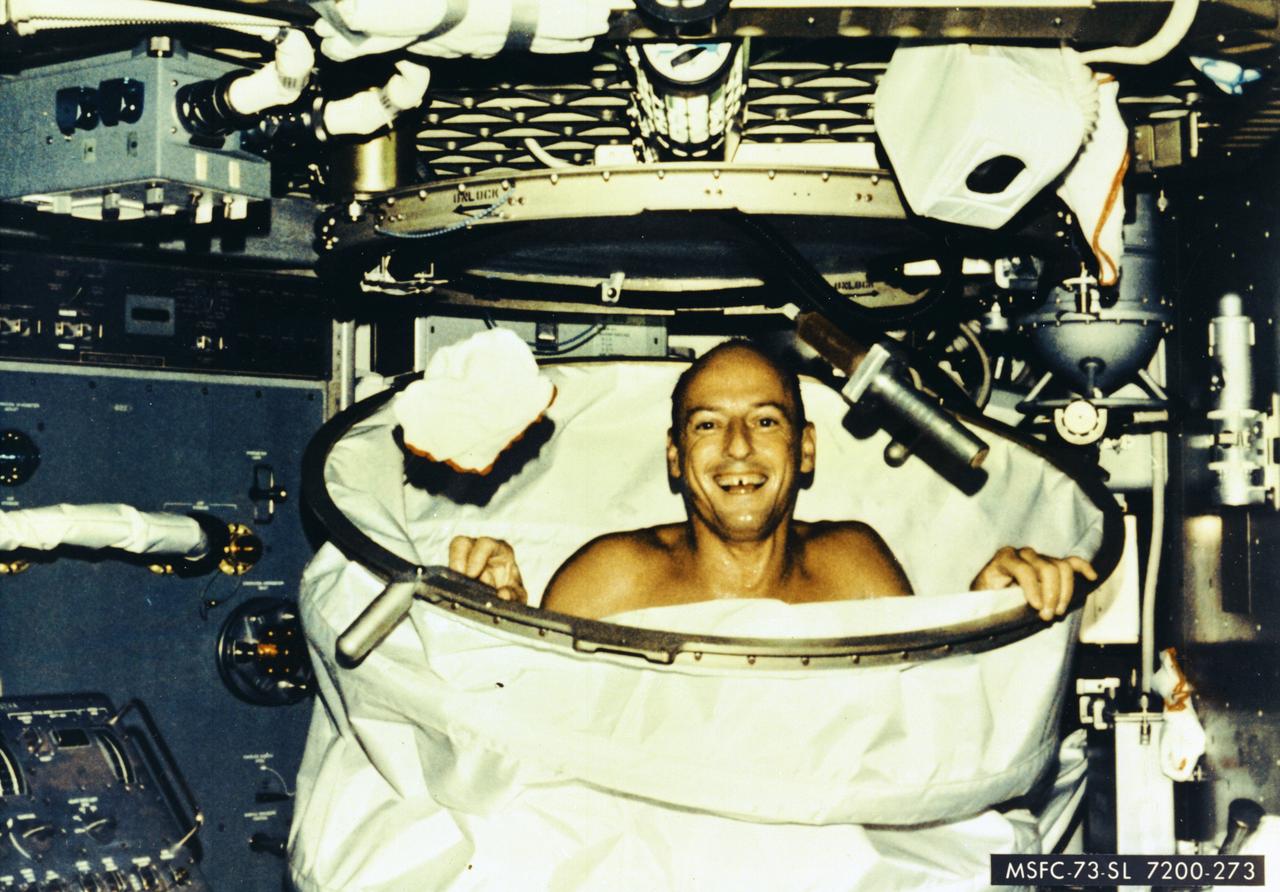
Astronaut Charles Conrad, Jr., Skylab-2 (SL-2) commander, smiles happily for the camera after a hot bath in the shower in the crew quarters of the Orbital Workshop of the Skylab space station. In deploying the shower facility, the shower curtain was pulled up from the floor and attached to the ceiling. The water came through a push button shower head attached to a flexible hose. Water was drawn off by a vacuum system.
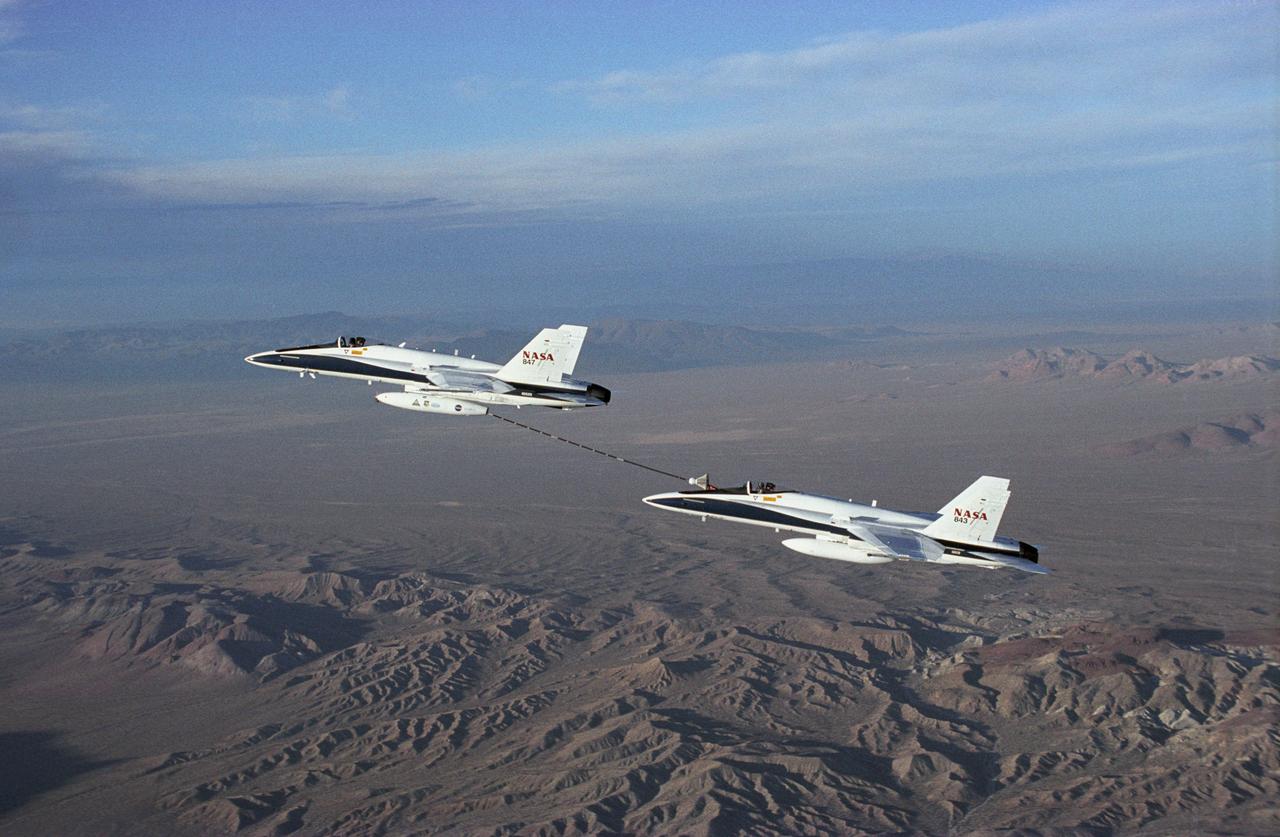
NASA Dryden's Automated Aerial Refueling (AAR) project evaluated the capability of an F/A-18A aircraft as an in-flight refueling tanker with the objective of developing analytical models for an automated aerial refueling system for unmanned air vehicles. The F/A-18 "tanker" aircraft (No. 847) underwent flight test envelope expansion with an aerodynamic pod containing air-refueling equipment carried beneath the fuselage. The second aircraft (No. 843) flew as the receiver aircraft during the study to assess the free-stream hose and drogue dynamics on the F/A-18A.
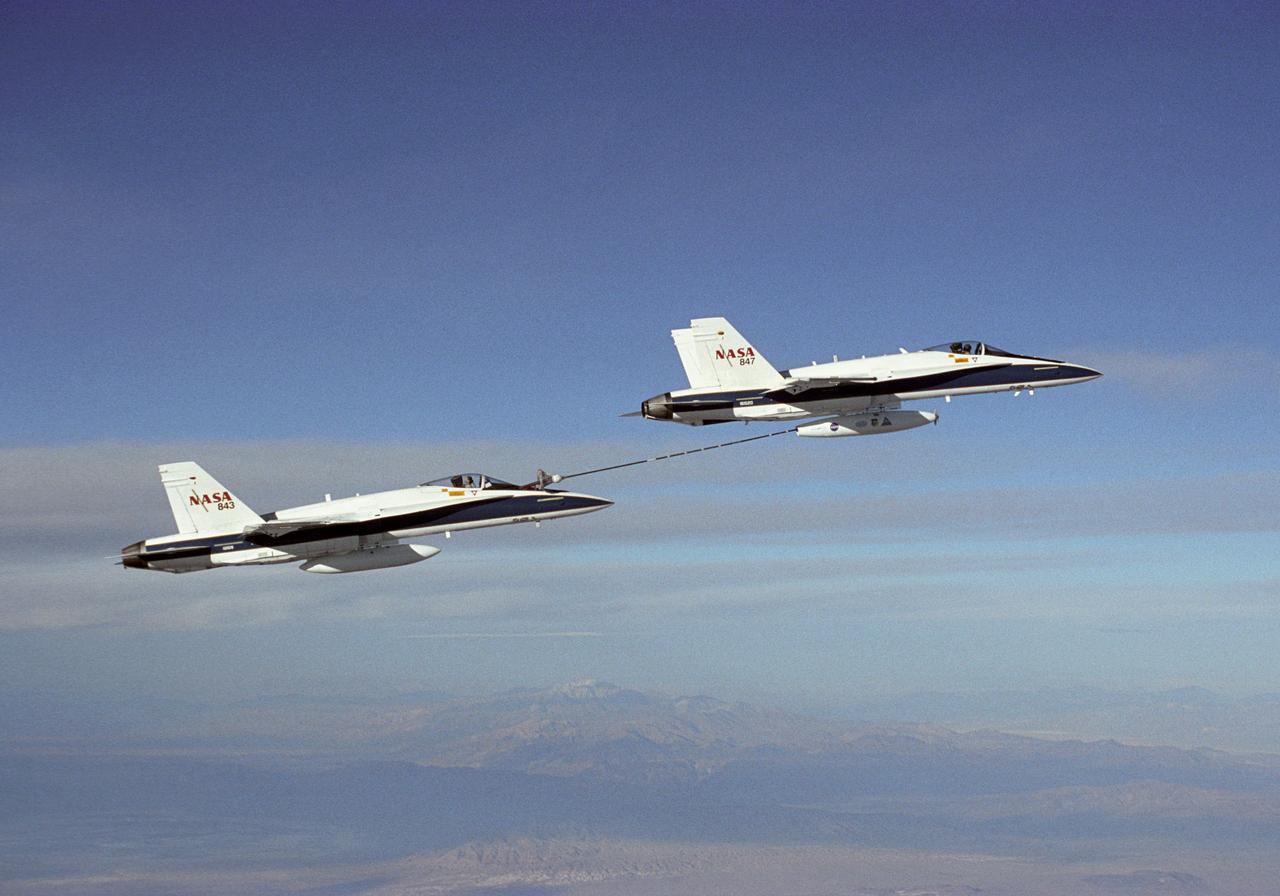
NASA Dryden's Automated Aerial Refueling (AAR) project evaluated the capability of an F/A-18A aircraft as an in-flight refueling tanker with the objective of developing analytical models for an automated aerial refueling system for unmanned air vehicles. The F/A-18 "tanker" aircraft (No. 847) underwent flight test envelope expansion with an aerodynamic pod containing air-refueling equipment carried beneath the fuselage. The second aircraft (No. 843) flew as the receiver aircraft during the study to assess the free-stream hose and drogue dynamics on the F/A-18A.
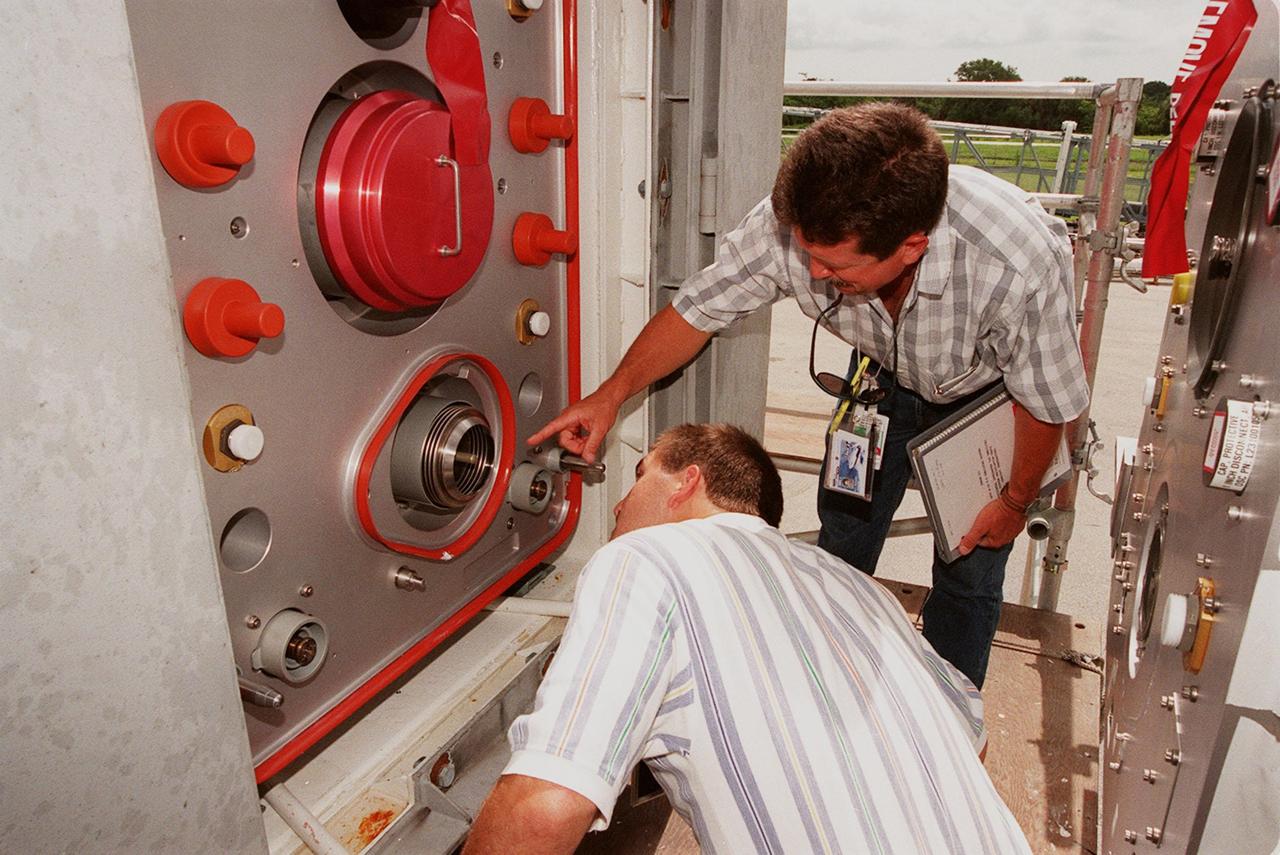
At the Launch Equipment Test Facility, Mike Solomon (left) and Will Reaves (right), both with Lockheed Martin Technical Operations, move in for a close look at part of the X-33 umbilical system. A team of Kennedy Space Center experts developed the umbilical system, comprising panels, valves and hoses that provide the means to load the X-33 with super-cold propellant. The X-33, under construction at Lockheed Martin Skunk Works in Palmdale, Calif., is a half-scale prototype of the planned operational reusable launch vehicle dubbed VentureStar
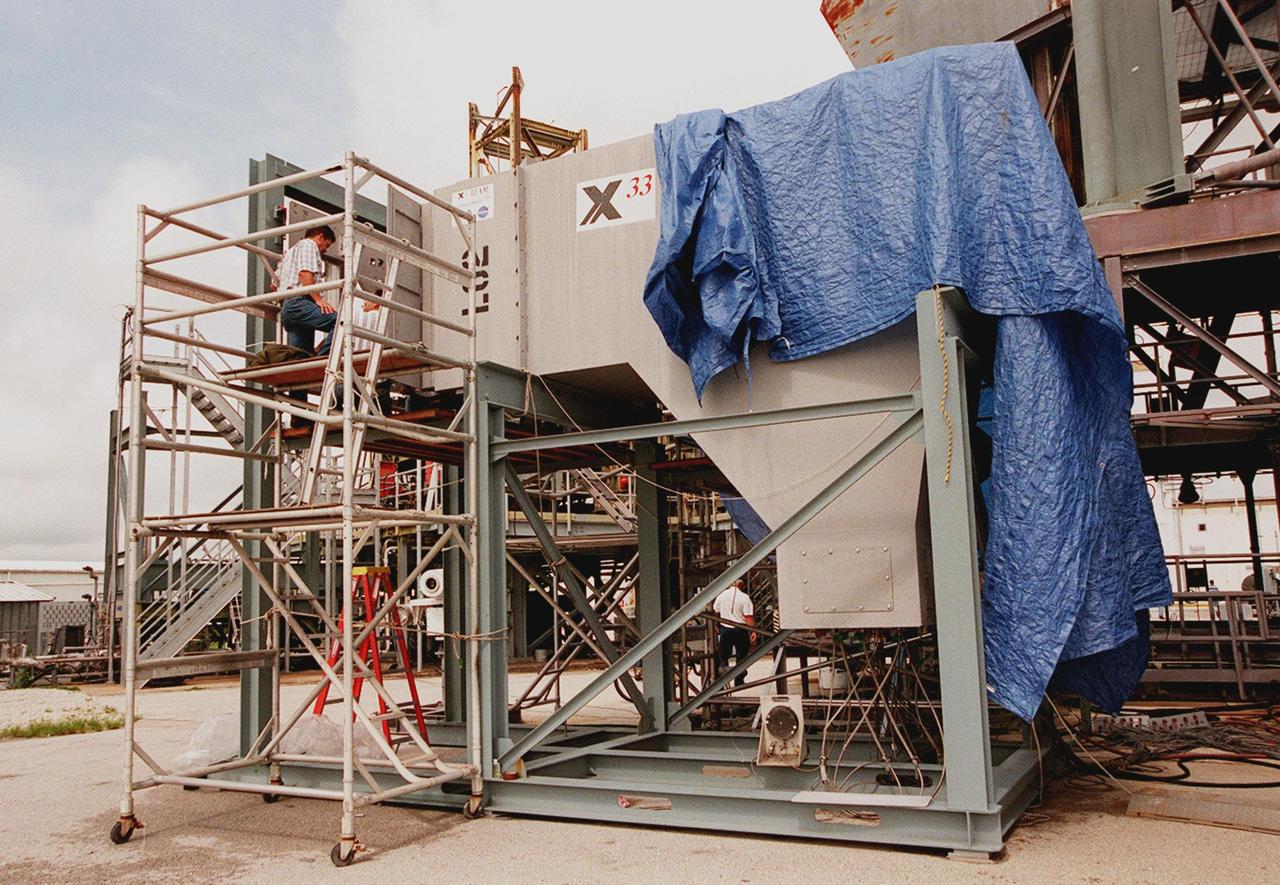
At the Launch Equipment Test Facility, Will Reaves (top of stand), with Lockheed Martin Technical Operations, looks over components of the X-33 umbilical system undergoing testing. A team of Kennedy Space Center experts developed the umbilical system, comprising panels, valves and hoses that provide the means to load the X-33 with super-cold propellant. The X-33, under construction at Lockheed Martin Skunk Works in Palmdale, Calif., is a half-scale prototype of the planned operational reusable launch vehicle dubbed VentureStar
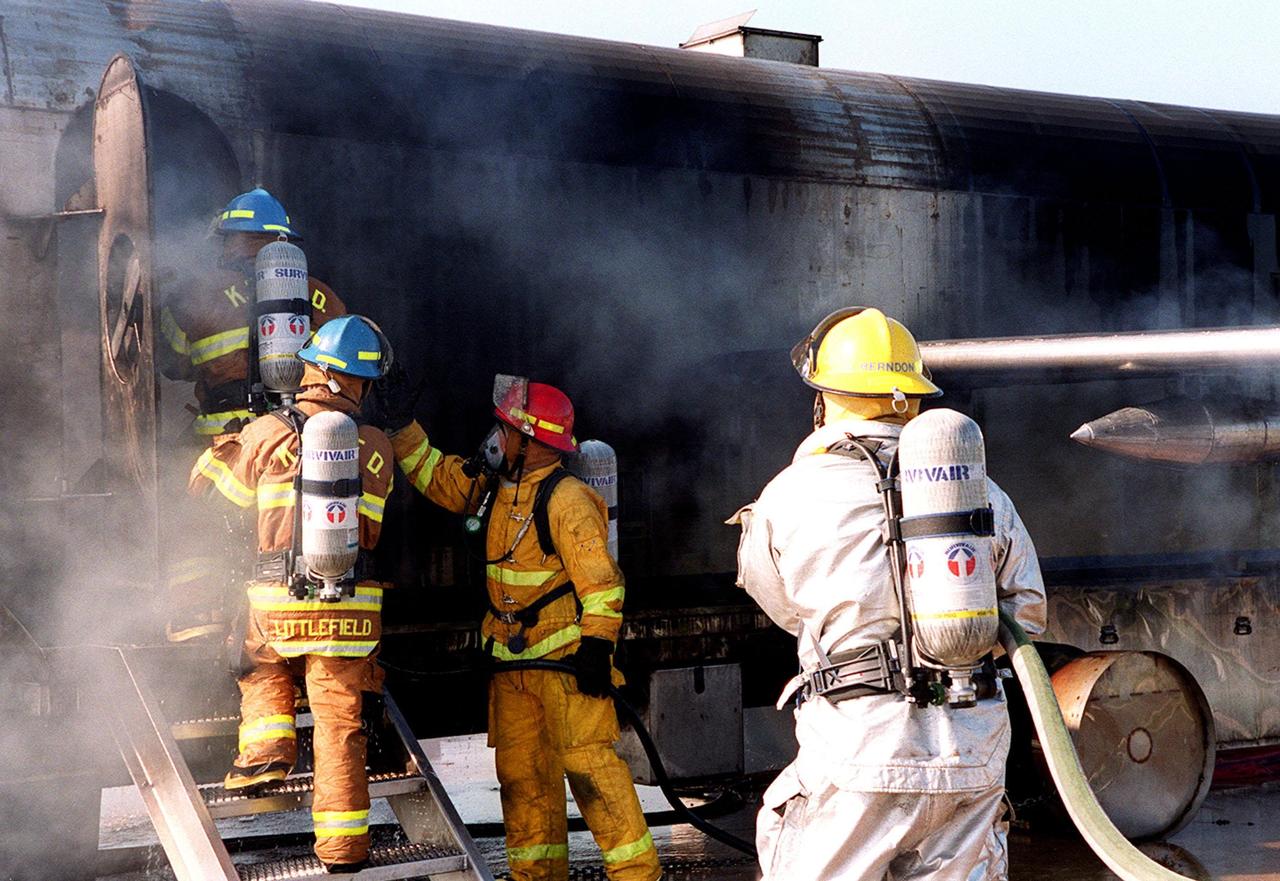
KENNEDY SPACE CENTER, FLA. -- A firefighter (right) holds a water hose in readiness as others enter a smoke-filled simulated aircraft. The activities are part of fire training exercises at Cape Canaveral Air Force Station Pad 30 for firefighters with Fire and Emergency Services at the Naval Station Mayport, Fla. The firefighters have already extinguished flames from the aircraft
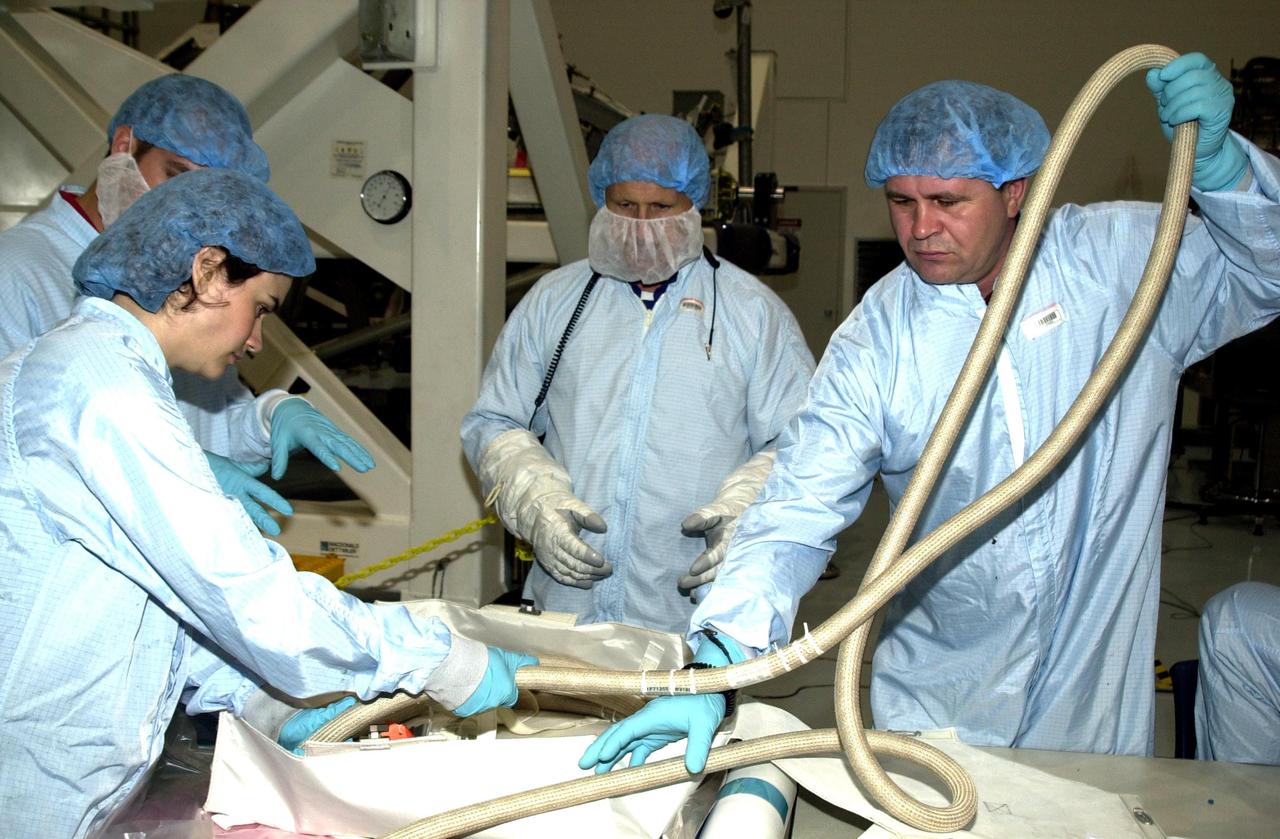
KENNEDY SPACE CENTER, FLA. -- Members of the Expedition 6 crew practice using equipment they will be handling during their residency on the International Space Station. In the center of the photo is Commander Ken Bowersox; holding the flexible hose is crew member Nikolai Budarin. Donald Thomas is the third member of the crew. Expedition 6 is attached to mission STS-113, scheduled to launch in September 2002.
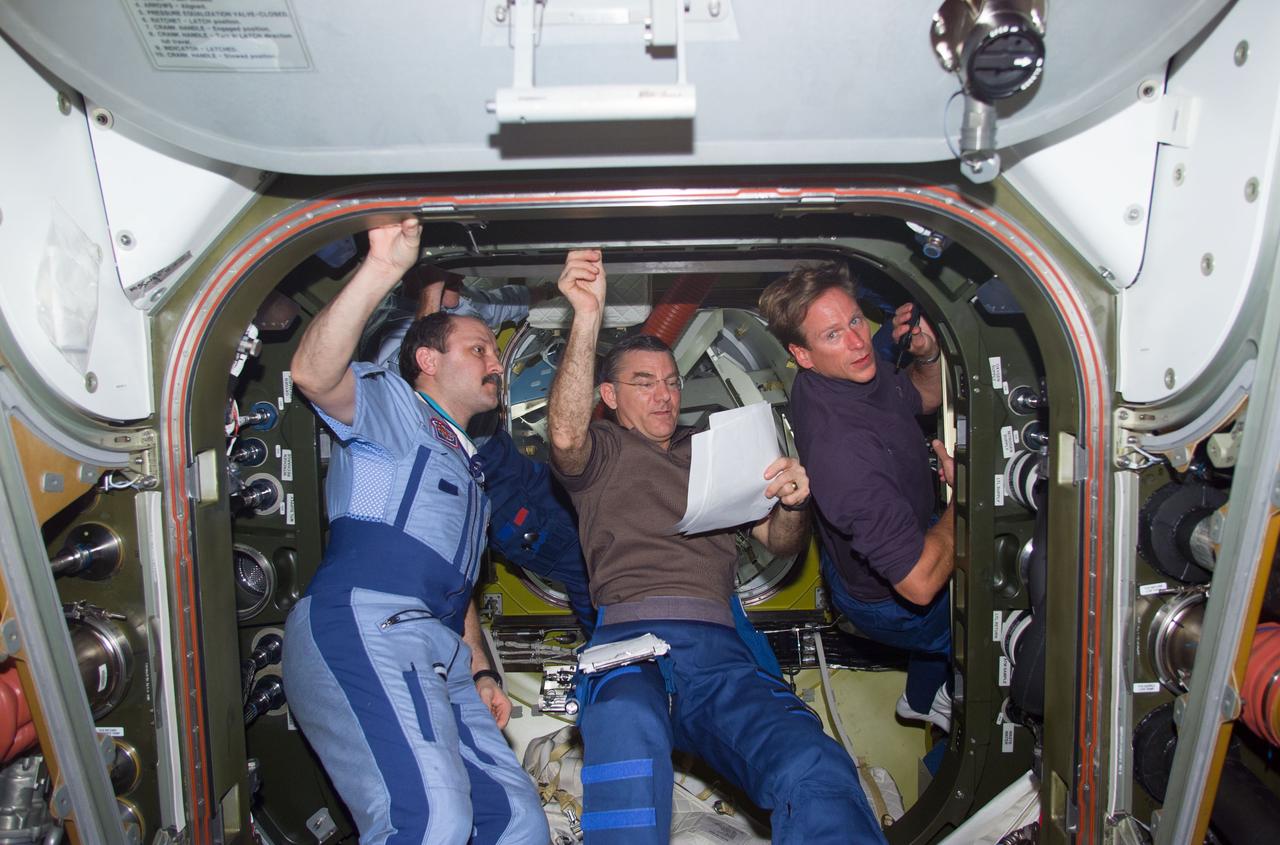
S104-E-5106 (16 July 2001) --- From left to right, cosmonaut Yury V. Usachev, Expedition Two mission commander, James S. Voss, Expedition Two flight engineer, and Michael L. Gernhardt, STS-104 mission specialist, discuss procedures for connecting cables and hoses from the newly installed Quest Airlock to Unity Node 1. Usachev represents Rosaviakosmos.
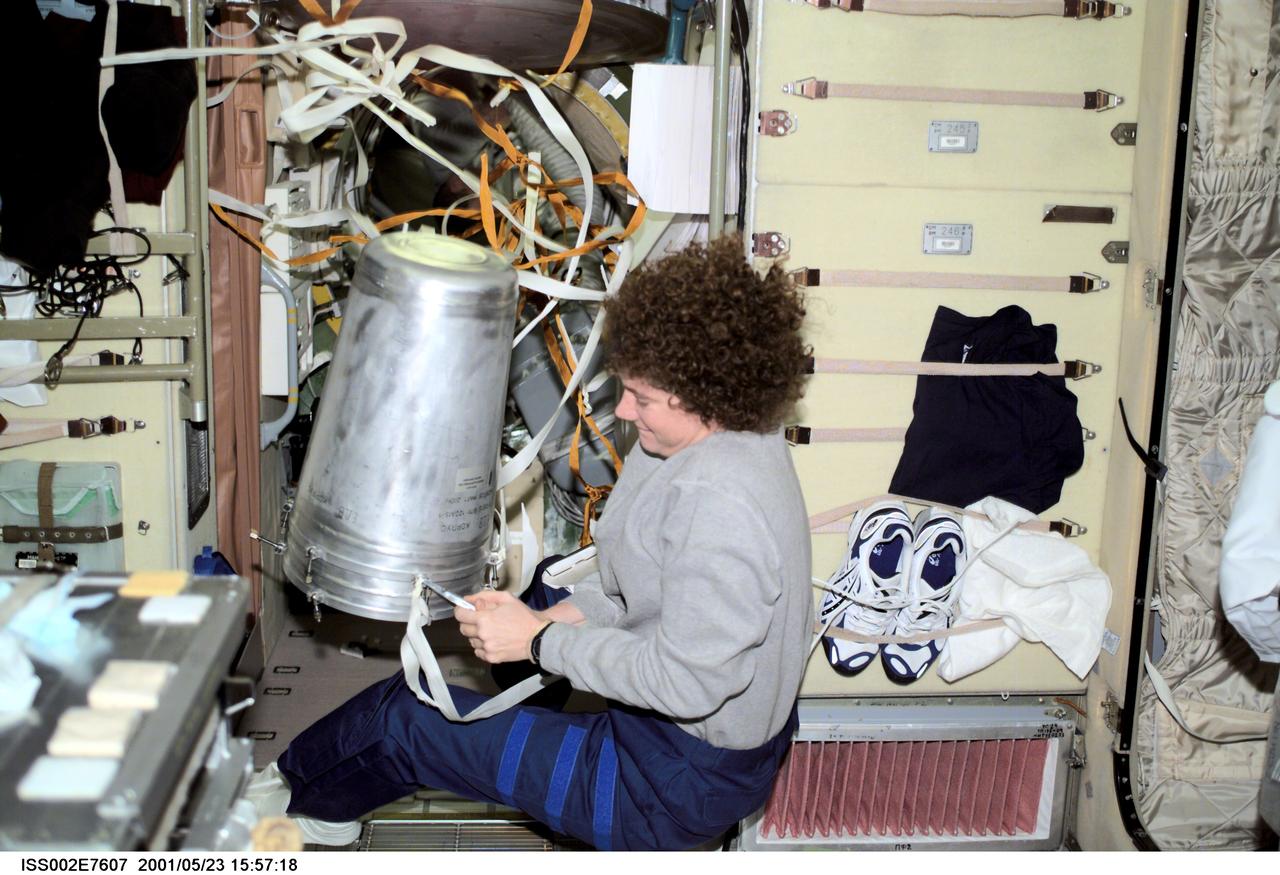
ISS002-E-7607 (23 May 2001) --- Susan J. Helms, Expedition Two flight engineer, works with a strap on a water container in the Zvezda Service Module. The image was taken with a digital still camera.
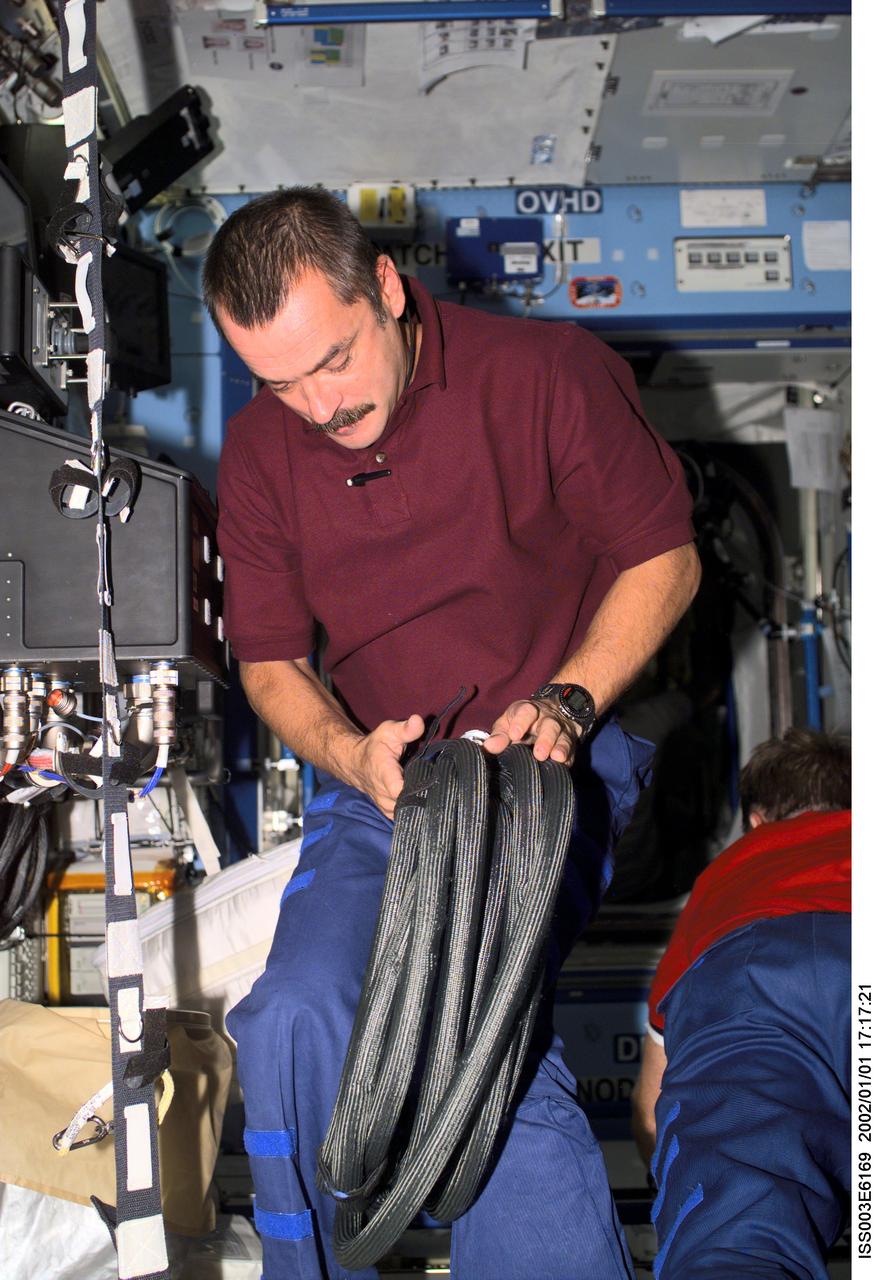
ISS003-E-6169 (August 2001) --- Cosmonaut Mikhail Tyurin, Expedition Three flight engineer representing Rosaviakosmos, works with cables in the Destiny laboratory on the International Space Station (ISS). This image was taken with a digital still camera.
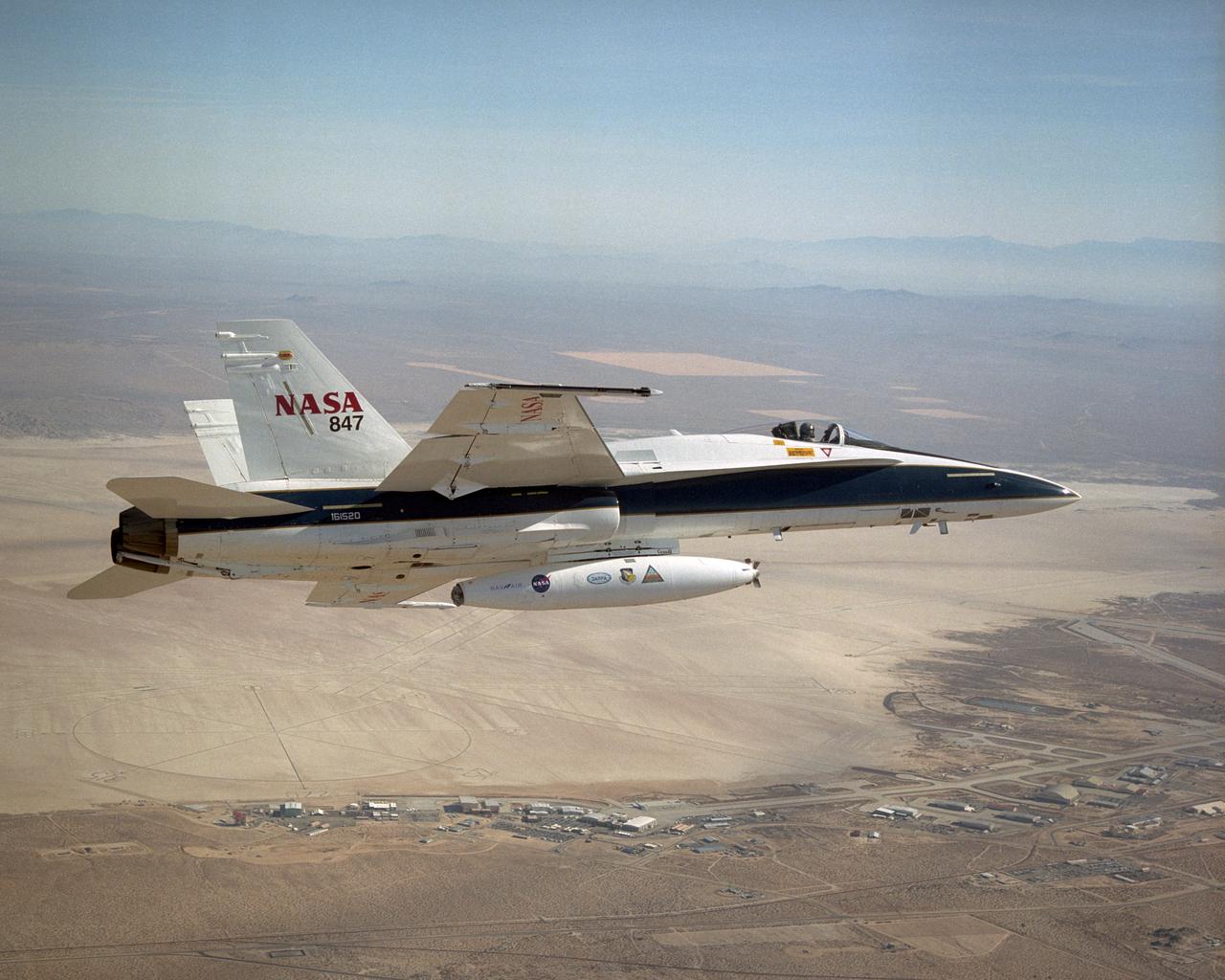
A NASA F/A-18 flies over the Dryden Flight Research Center and Rogers Dry Lake on December 11, 2002. The aircraft participated in the Automated Aerial Refueling (AAR) project. The 300-gallon aerial refueling store seen on the belly of the aircraft carries fuel and a refueling drogue. This aircraft acted as a tanker in the study to develop an aerodynamic model for future automated aerial refueling, especially of unmanned vehicles.

A NASA F/A-18 flies over the Dryden Flight Research Center and Rogers Dry Lake on December 11, 2002. The aircraft participated in the Automated Aerial Refueling (AAR) project. The 300-gallon aerial refueling store seen on the belly of the aircraft carries fuel and a refueling drogue. This aircraft acted as a tanker in the study to develop an aerodynamic model for future automated aerial refueling, especially of unmanned vehicles.
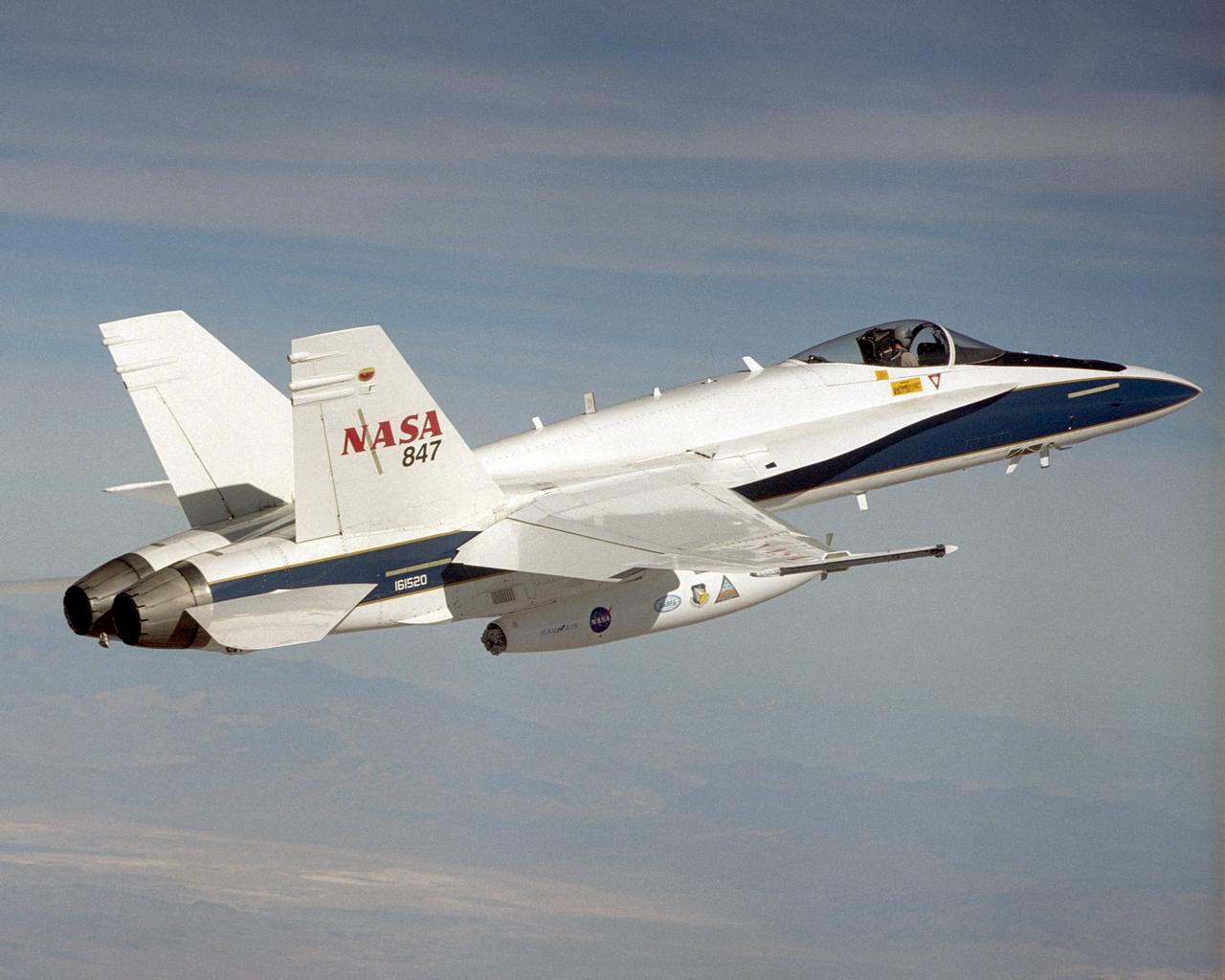
A NASA F/A-18 flies over the Dryden Flight Research Center and Rogers Dry Lake on December 11, 2002. The aircraft participated in the Automated Aerial Refueling (AAR) project. The 300-gallon aerial refueling store seen on the belly of the aircraft carries fuel and a refueling drogue. This aircraft acted as a tanker in the study to develop an aerodynamic model for future automated aerial refueling, especially of unmanned vehicles.
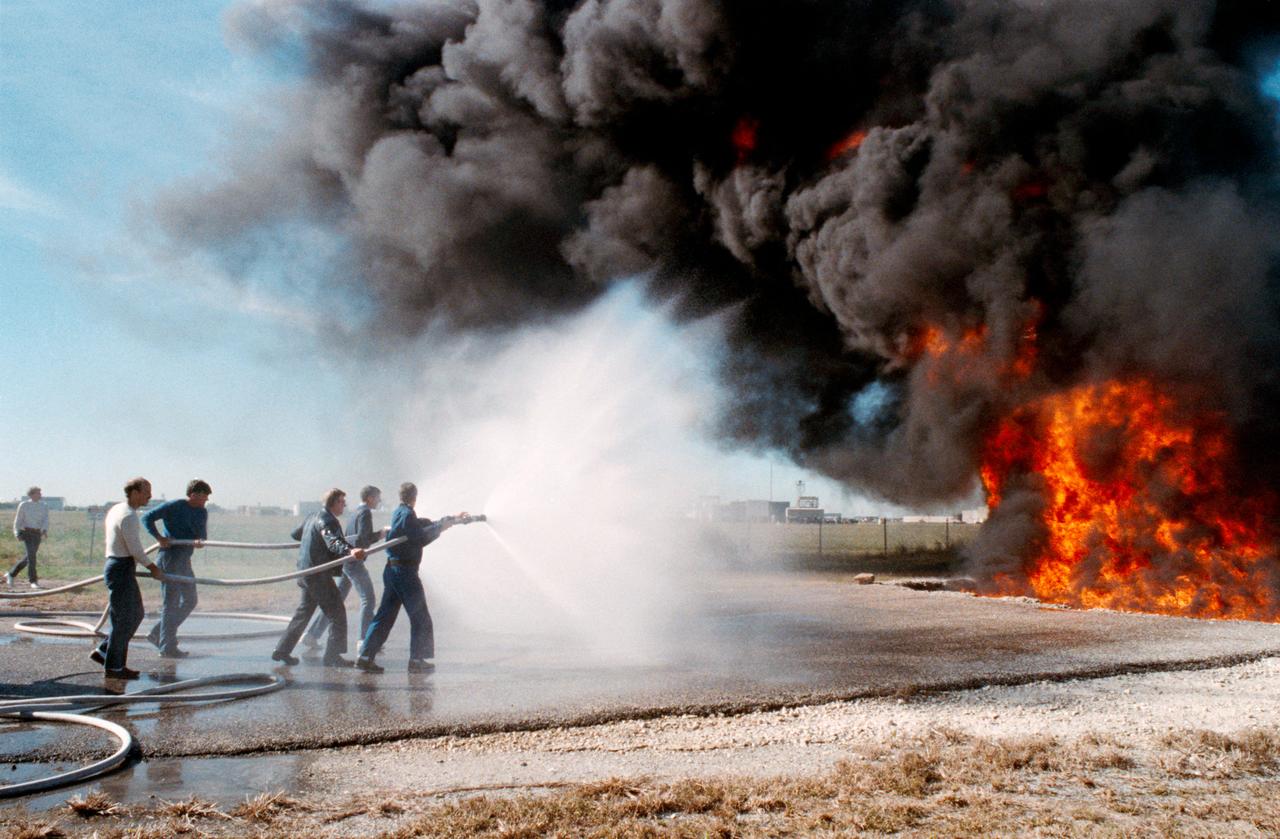
S88-54945 (6 Dec 1988) --- The STS-29 crewmembers are trained in procedures to follow in the event of a fire with their spacecraft. Here, Astronauts Michael L. Coats (far left), mission commander, and James P. Bagian, mission specialist, follow the lead of two fellow crewmembers as they extinguish a fire. The astronauts in front of the action are Robert C. Springer, mission specialist, and John E. Blaha, pilot. Not pictured is James F. Buchli, mission specialist. Their instructor, center, is Robert Fife of NASA's security staff. The training took place on the northern end of the 1625-acre JSC facility.
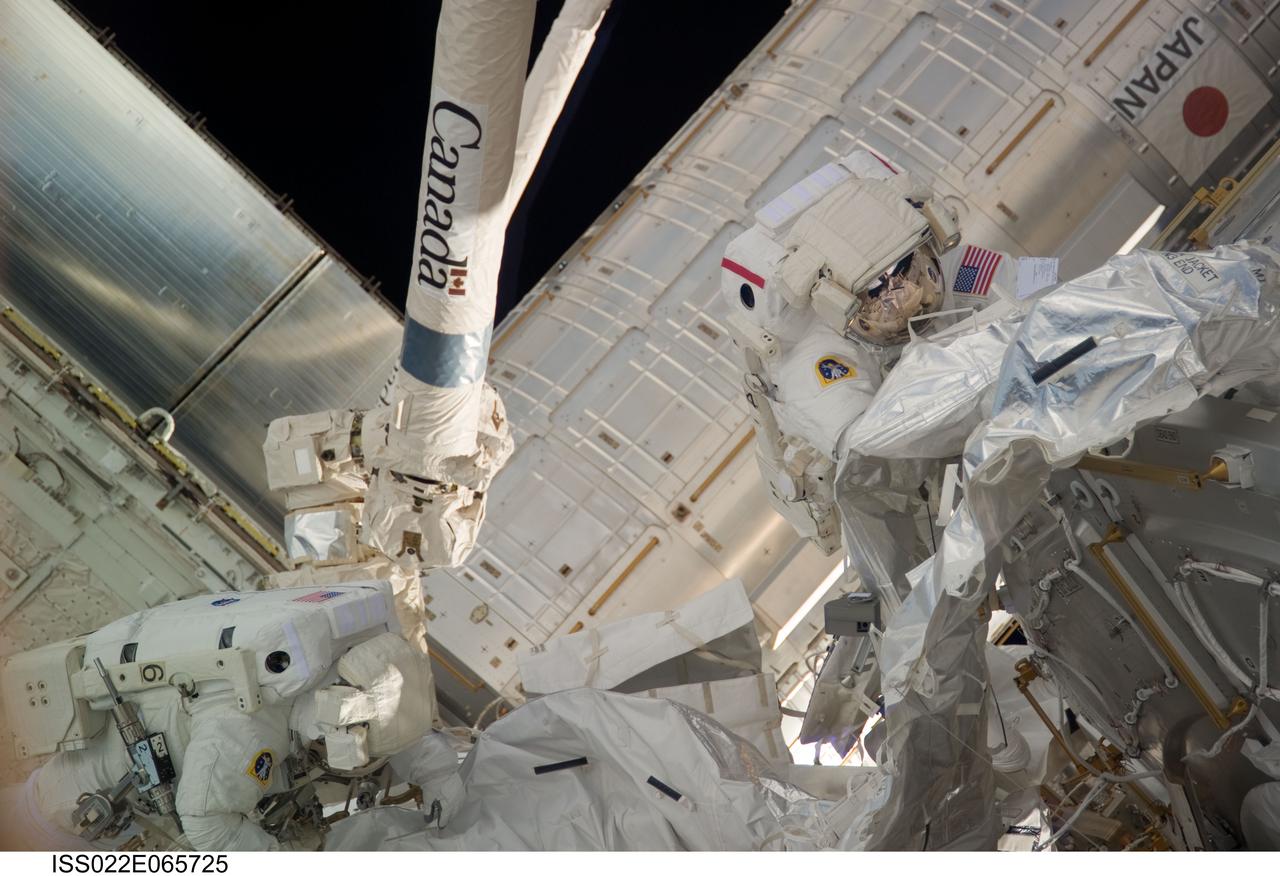
ISS022-E-065725 (14 Feb. 2010) --- NASA astronauts Robert Behnken (right) and Nicholas Patrick, both STS-130 mission specialists, participate in the mission?s second session of extravehicular activity (EVA) as construction and maintenance continue on the International Space Station. During the five-hour, 54-minute spacewalk, Behnken and Patrick connected two ammonia coolant loops, installed thermal covers around the ammonia hoses, outfitted the Earth-facing port on the Tranquility node for the relocation of its Cupola, and installed handrails and a vent valve on the new module.
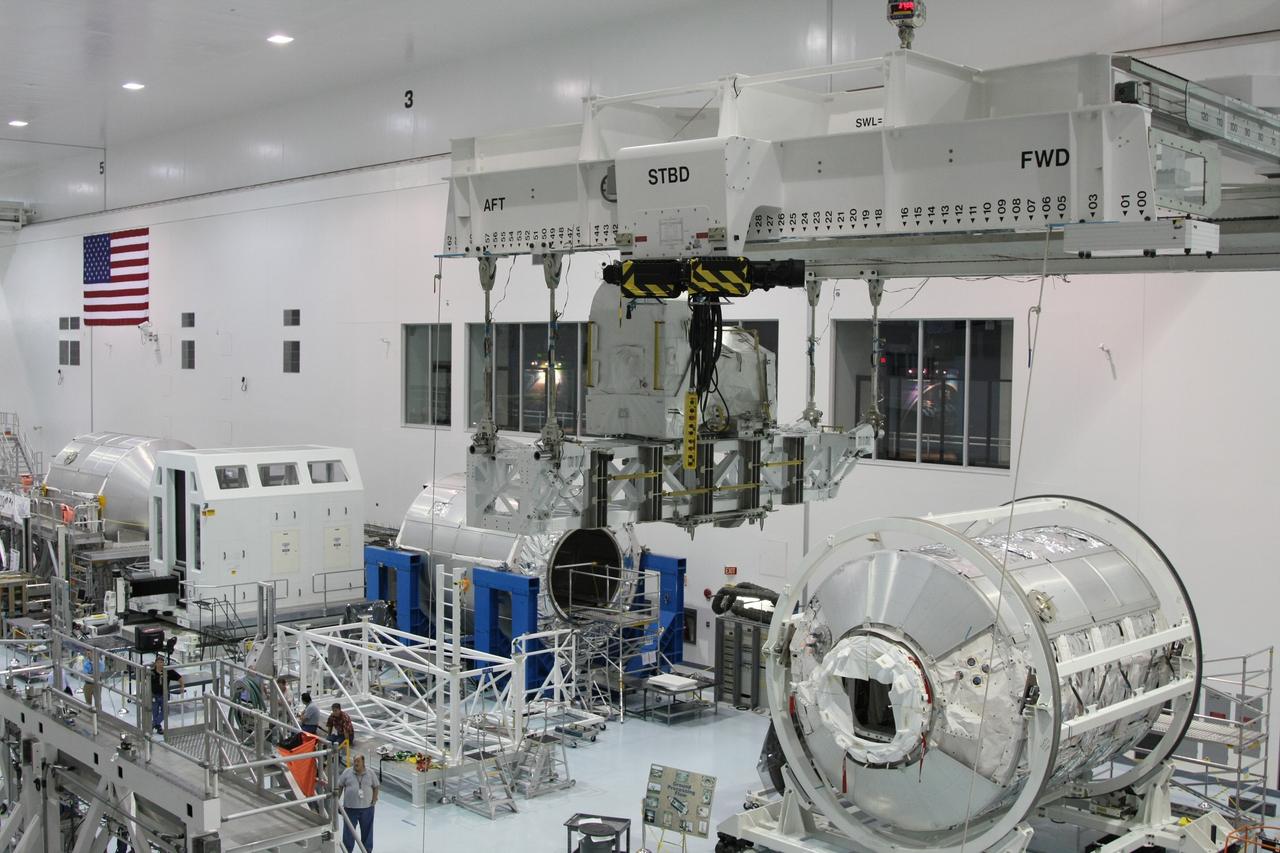
CAPE CANAVERAL, Fla. - The Lightweight Multi-Purpose Experiment Support Structure Carrier with the flexible hose rotary coupler is moved across the Space Station Processing Facility at NASA's Kennedy Space Center in Florida. It will be installed in the payload canister. The carrier is part of space shuttle Endeavour's payload on the STS-126 mission to the International Space Station. Endeavour will also carry the Multi-Purpose Logistics Module Leonardo holding supplies and equipment, including additional crew quarters, equipment for the regenerative life support system and spare hardware. Endeavour is targeted for launch on Nov. 14. Photo credit: NASA/Dimitri Gerondidakis
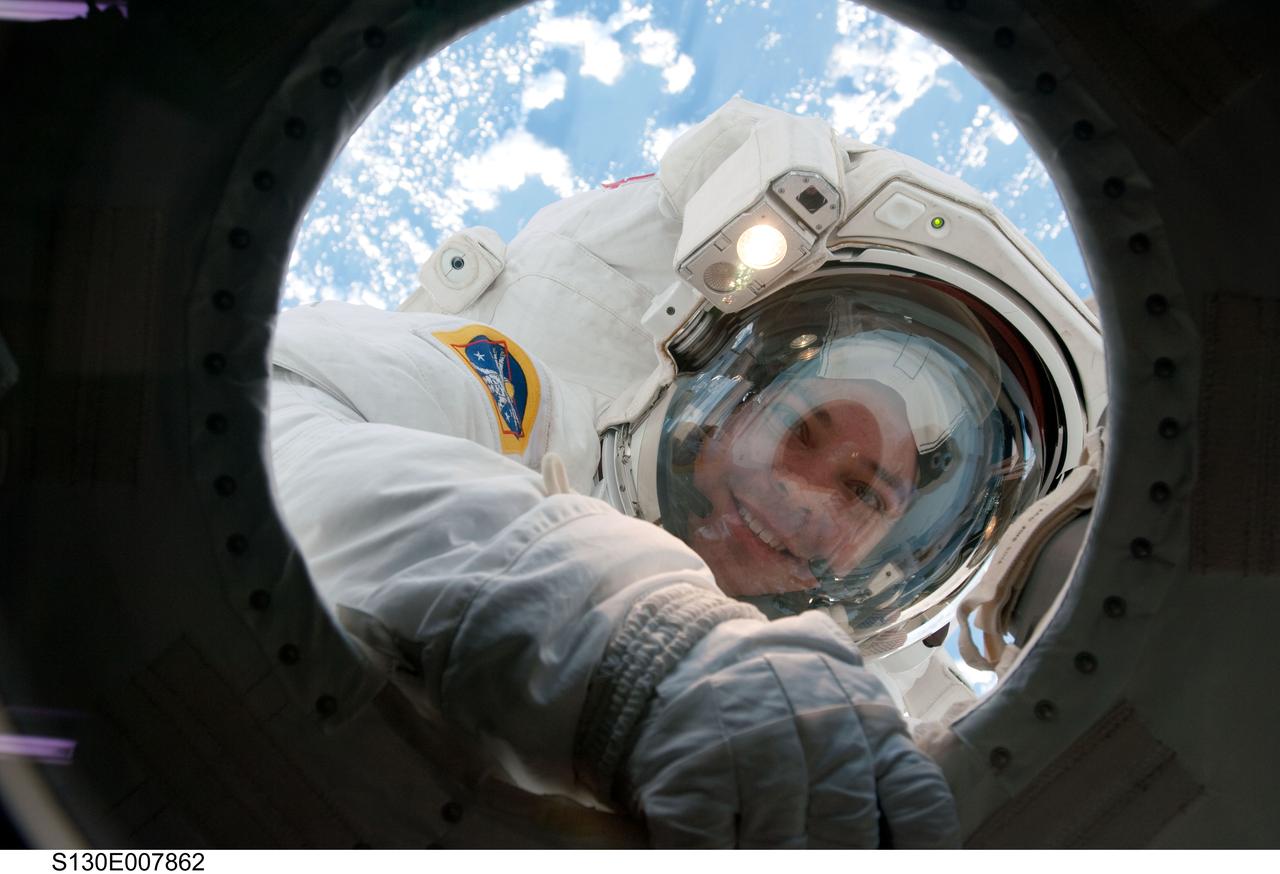
S130-E-007862 (14 Feb. 2010) --- NASA astronaut Robert Behnken, STS-130 mission specialist, participates in the mission’s second session of extravehicular activity (EVA) as construction and maintenance continue on the International Space Station. During the five-hour, 54-minute spacewalk, Behnken and astronaut Nicholas Patrick (out of frame), mission specialist, connected two ammonia coolant loops, installed thermal covers around the ammonia hoses, outfitted the Earth-facing port on the Tranquility node for the relocation of its Cupola, and installed handrails and a vent valve on the new module.