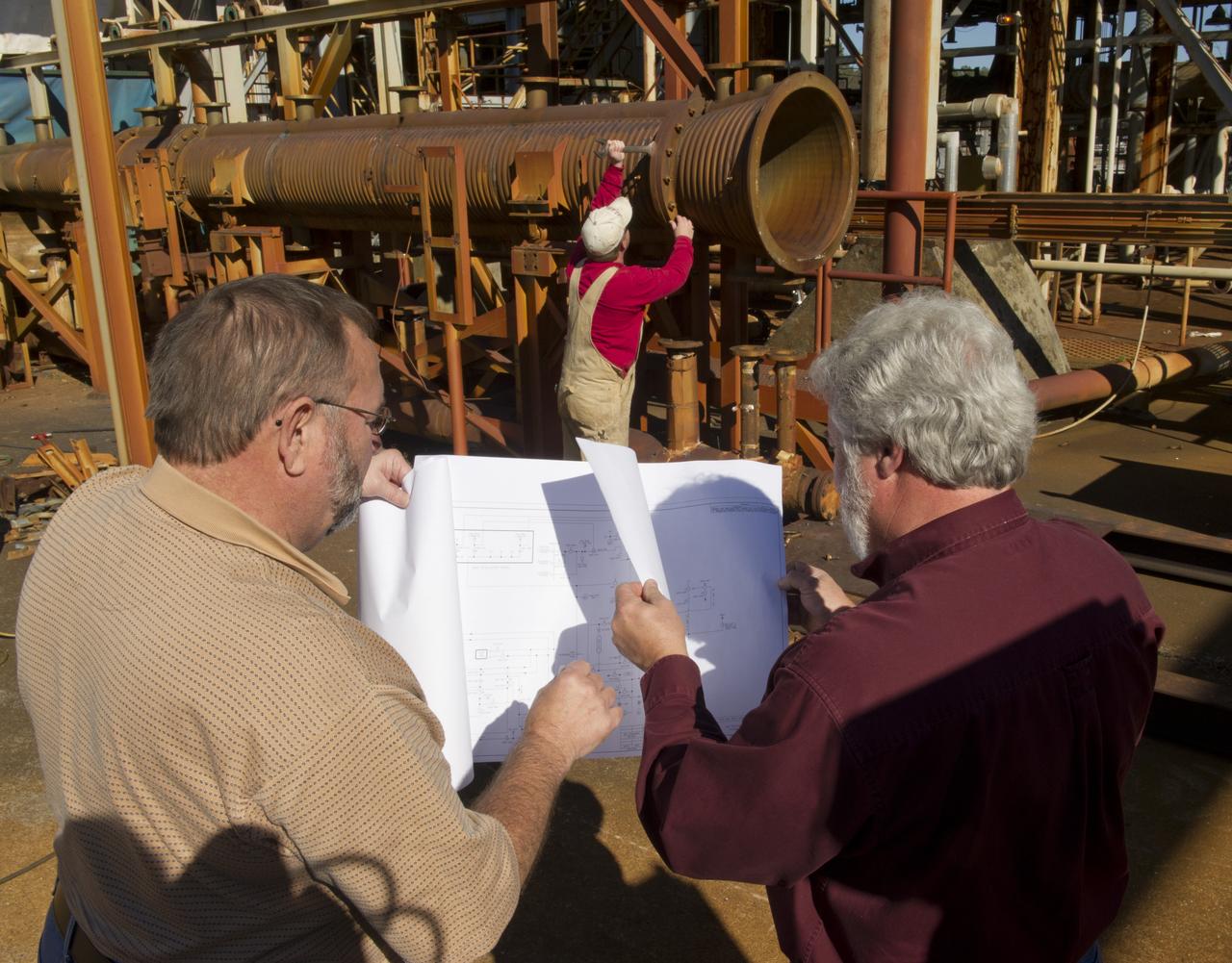
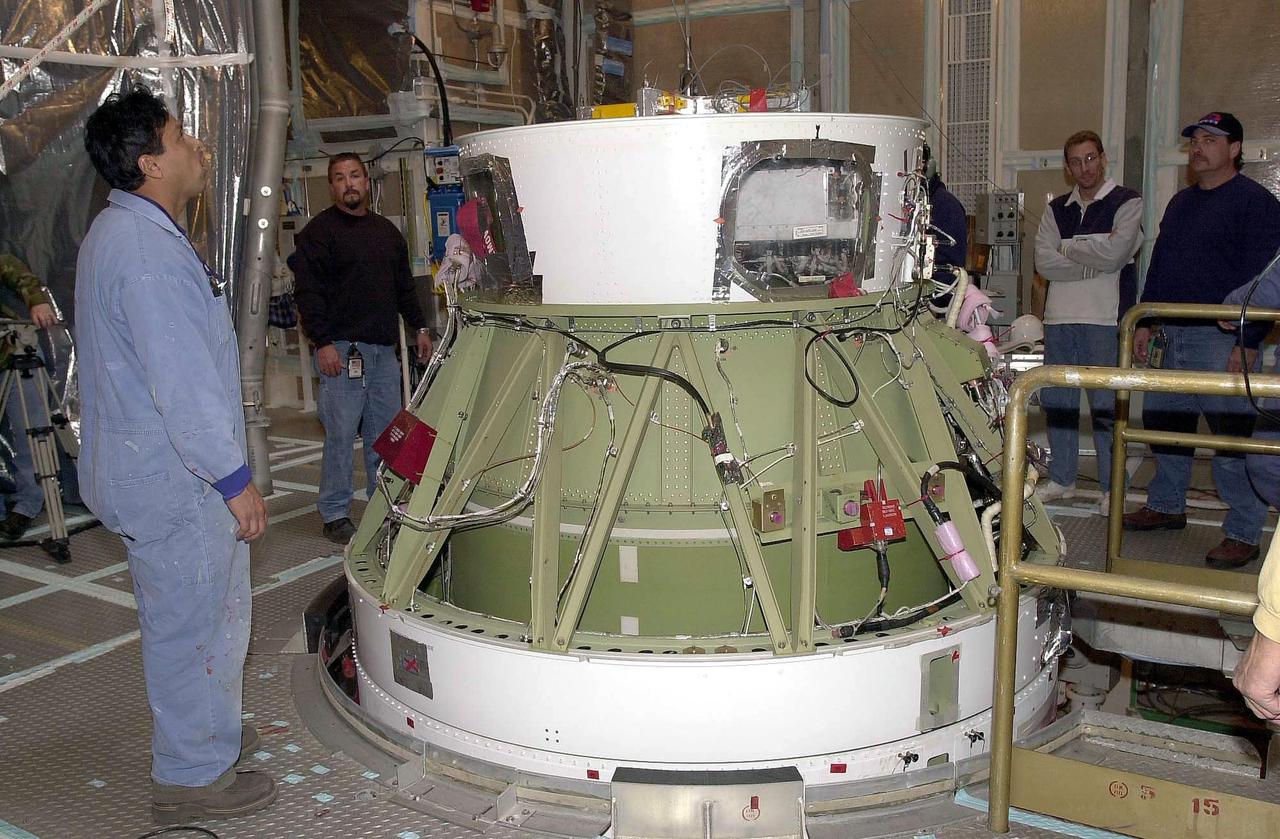
JEREMY KELLY, BACKGROUND, BEGINS DISASSEMBLING THE HOT GAS FACILITY'S WIND TUNNEL AS SCOOTER CLIFTON, FRONT LEFT, AND GREG VINYARD REVIEW THE FACILITY'S REDESIGN PLANS.
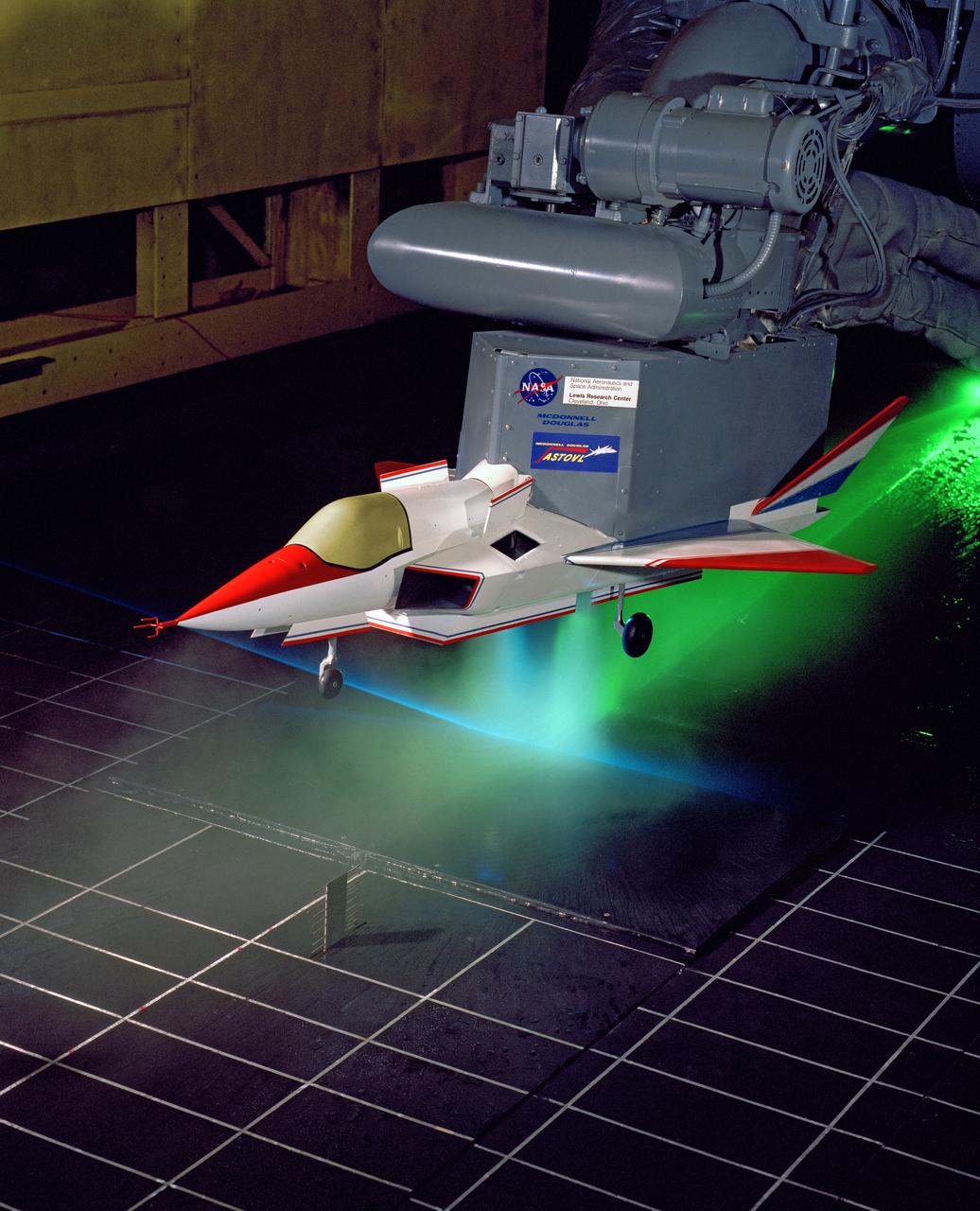
Supersonic Short Take Off Vertical Landing Hot Gas Ingestion Model Testing in the 9x15-foot Low Speed Wind Tunnel, LSWT
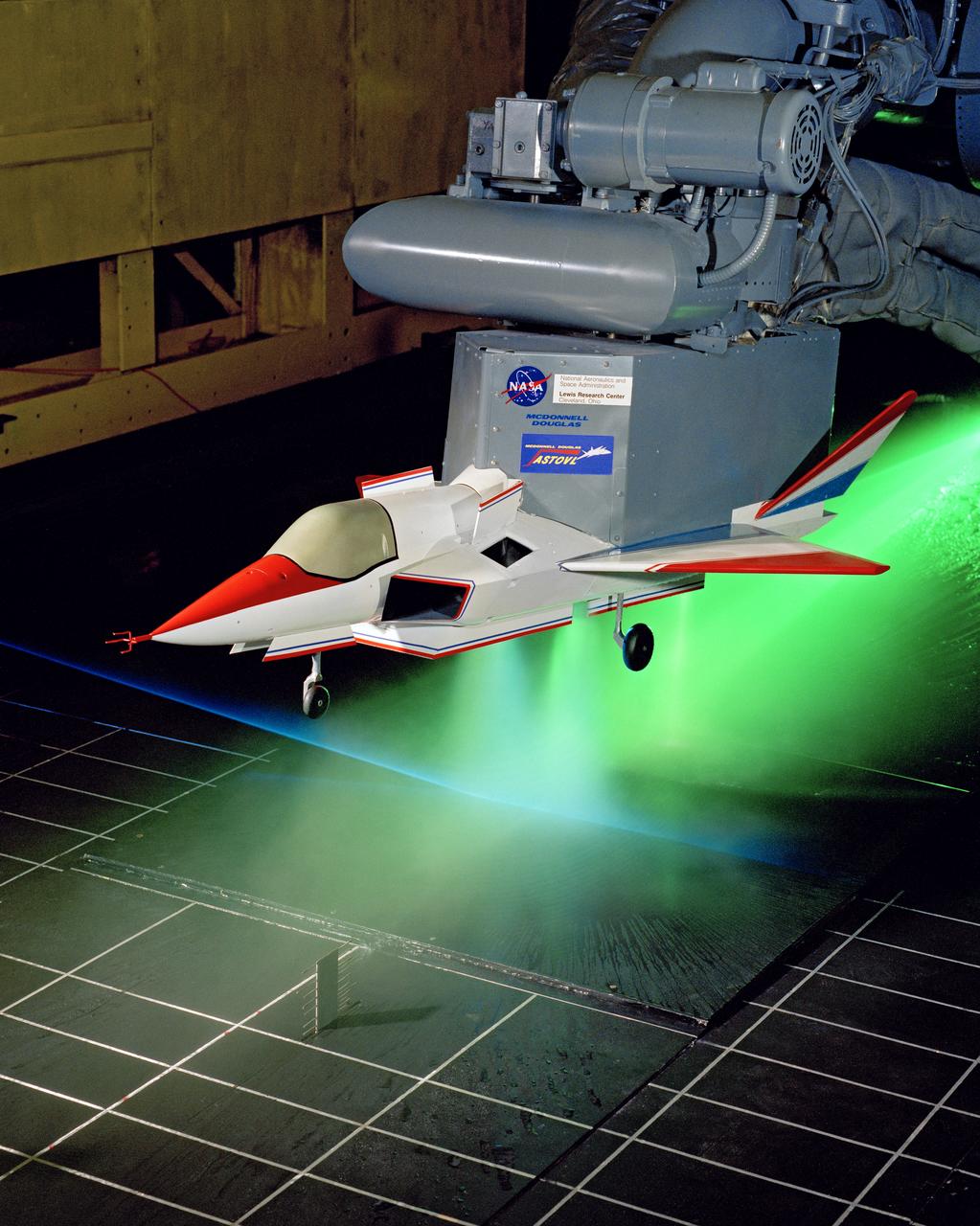
SUPERSONIC SHORT TAKE OFF Vertical LANDING HOT GAS INGESTION MODEL 9X15 WIND TUNNEL
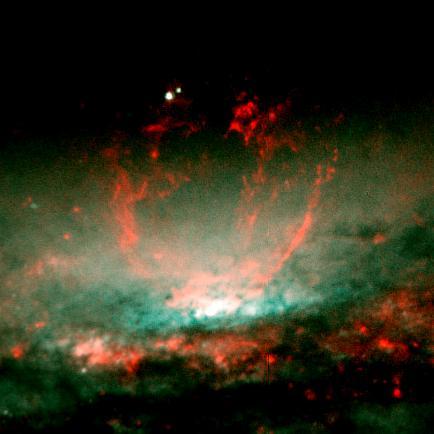
A lumpy bubble of hot gas rises from a cauldron of glowing matter in a distant galaxy, as seen by NASA Hubble Space Telescope.
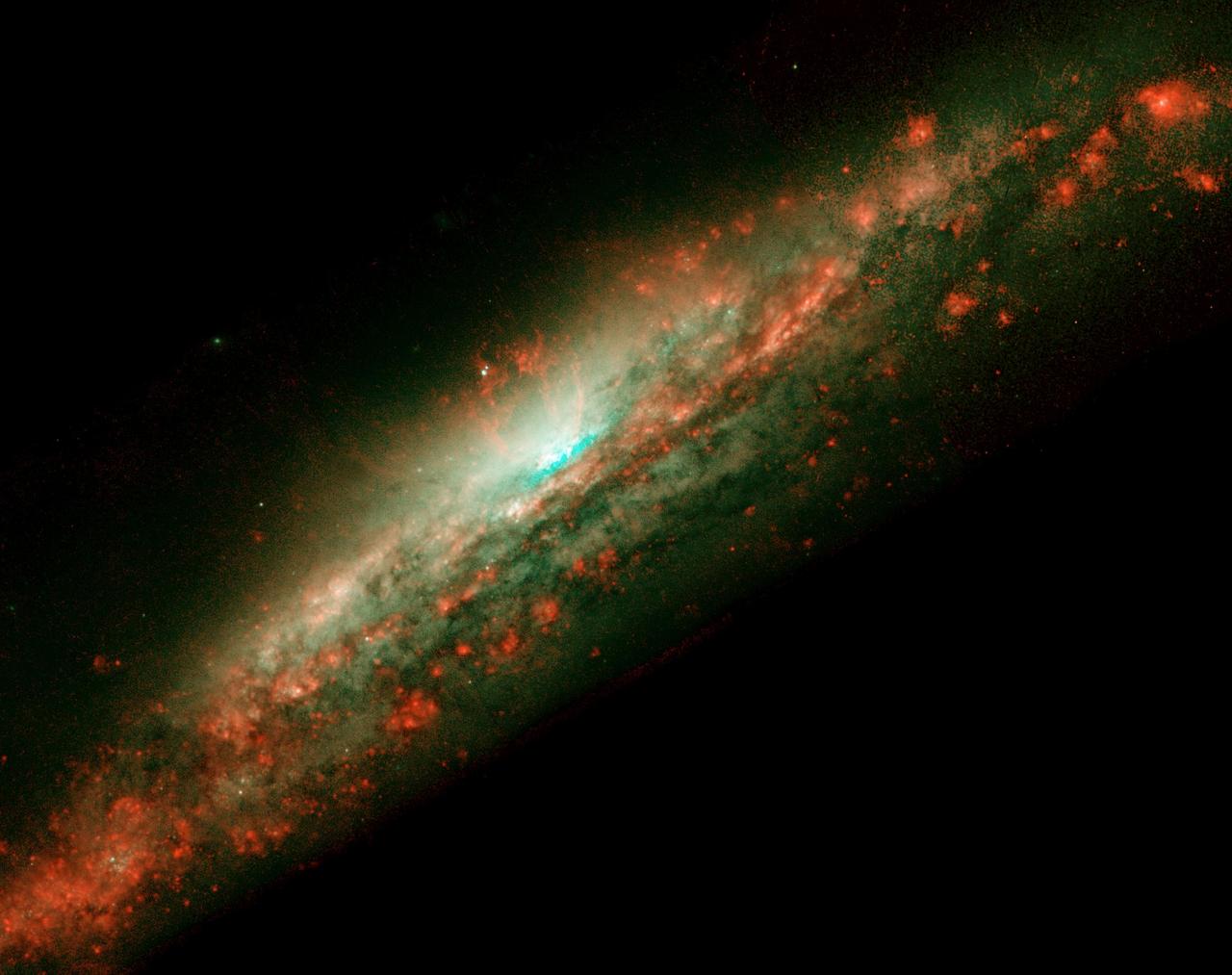
A lumpy bubble of hot gas rises from a cauldron of glowing matter in a distant galaxy, as seen by NASA Hubble Space Telescope.

A disk of hot gas swirls around a black hole in this illustration. Some of the gas came from a star that was pulled apart by the black hole, forming the long stream of hot gas on the right, feeding into the disk. These events are formally known as tidal disruption events, or TDEs. It can take just a matter or weeks or months from the destruction of the star to the formation of the disk. The gas gets hotter the closer it gets to the black hole, but the hottest material can be found above the black hole. This hottest material is cloud of plasma (gas atoms with their electrons stripped away) known as a corona. Most TDEs that result in the formation of a corona also produce jets of material that spew into space away from the black hole at its poles. A TDE called AT2021ehb is the first confirmed example of a corona forming without jets in a tidal disruption event. The observation of AT2021ehb makes it possible for scientists to study the formation of jets and coronae separately. https://photojournal.jpl.nasa.gov/catalog/PIA25440
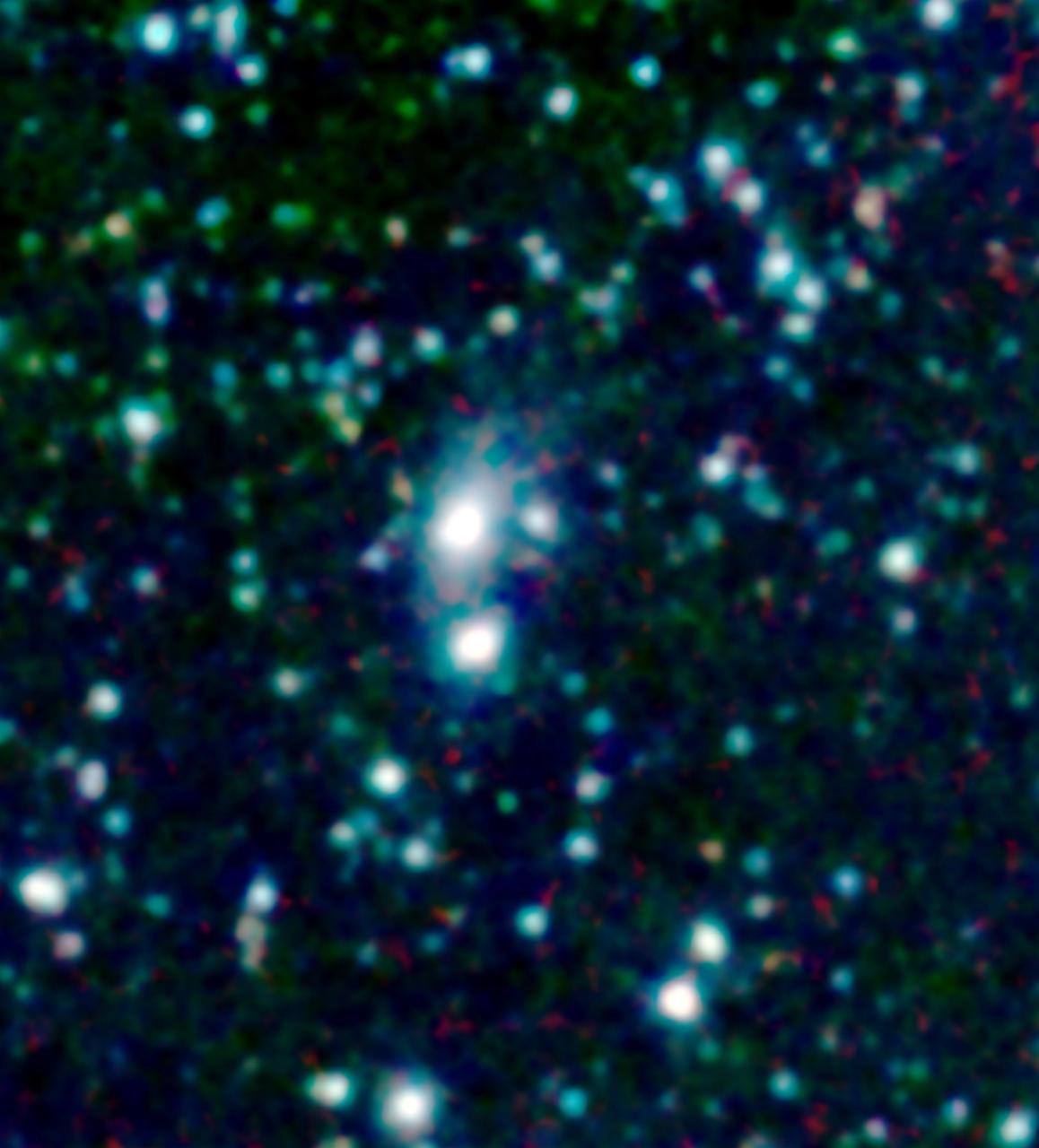
A big galaxy is stealing gas right off the back of its smaller companion in this new image from NASA Spitzer Space Telescope. The stolen gas is hot, but it might eventually cool down to make new stars and planets.
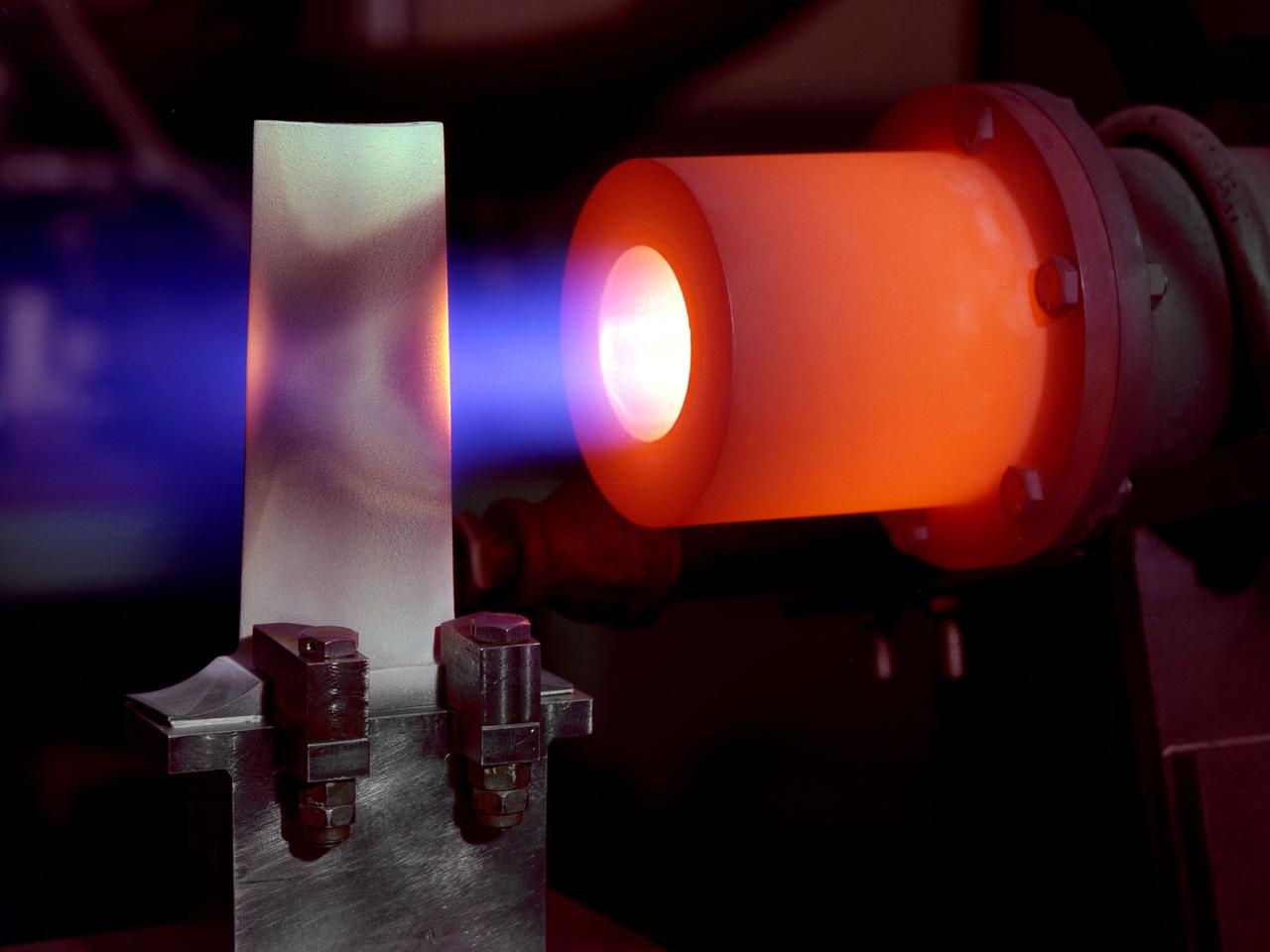
A 1-foot long stator blade with a thermal coating subjected to intense heat in order to test its strength at the National Aeronautics and Space Administration (NASA) Lewis Research Center. Lewis researchers sought to determine optimal types of ceramic coatings to increase the durability of metals. The research was primarily intended to support the design of stator blades for high-performance axial-flow compressor and turbofan engines. The coatings reduced the temperature of the metal and the amount of required cooling. As engines became more and more sophisticated, compressor blades were required to withstand higher and higher temperatures. Lewis researchers developed a dual-layer thermal-barrier coating that could be applied to turbine vanes and blades and combustion liners. This new sprayable thermal-barrier coating was evaluated for its durability, strength, fatigue, and aerodynamic penalties. This hot-gas rig fired the scorching gas at the leading edge of a test blade. The blade was cooled by an internal air flow. The blades were heated at two different velocities during the program. When using Mach 0.3 gases the entire heating and cooling cycle only lasted 30 seconds. The cycle lasted 60 minutes during tests at Mach 1.

This artist concept shows a gas-giant planet orbiting very close to its parent star, creating searingly hot conditions on the planet surface

This plot of data from NASA Spitzer Space Telescope indicates the presence of molecules in the planet WASP-12b -- a super-hot gas giant that orbits tightly around its star.

This glowing emerald nebula seen by NASA Spitzer Space Telescope is named RCW 120; this region of hot gas and glowing dust can be found in the murky clouds encircled by the tail of the constellation Scorpius.
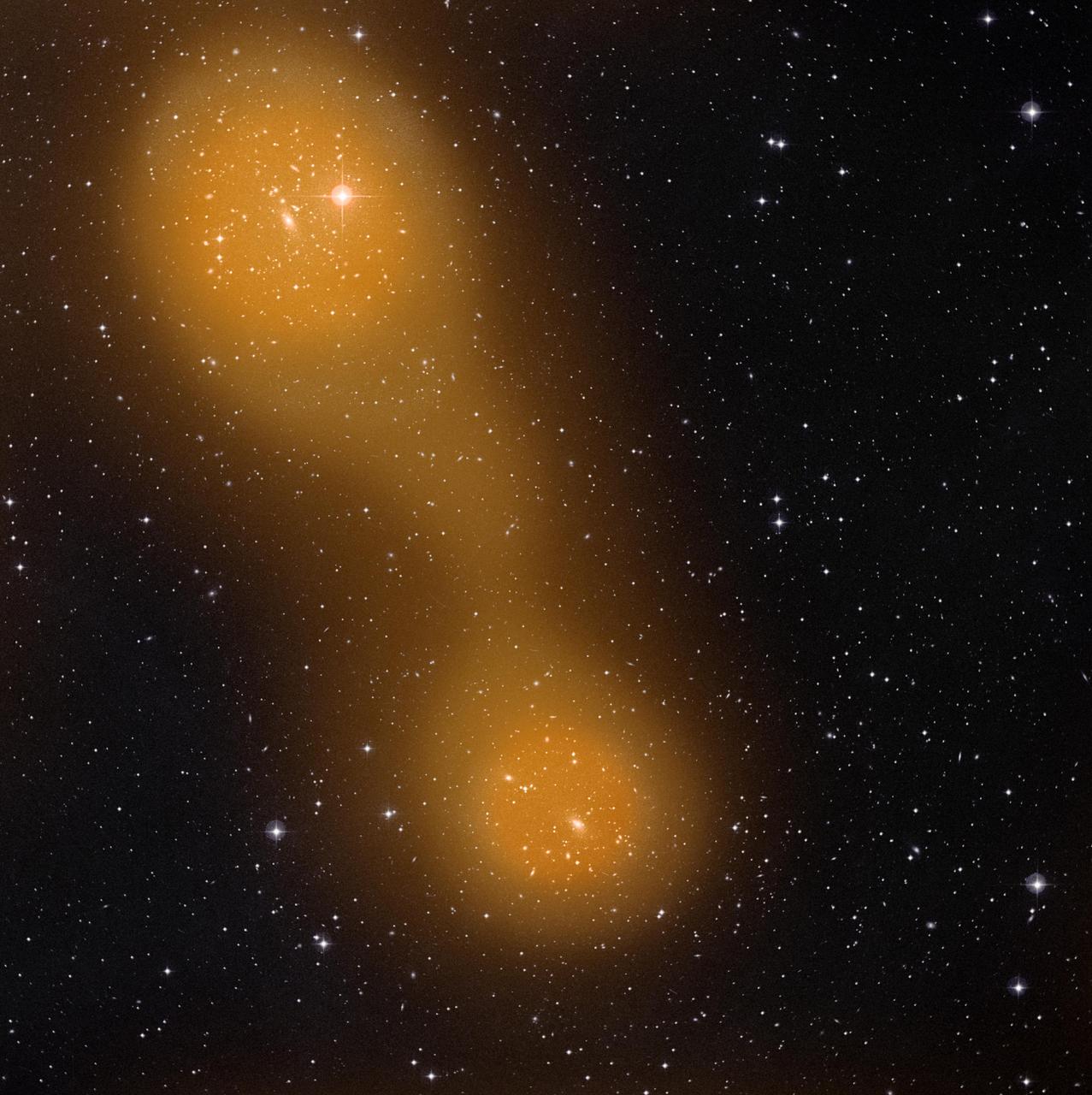
Planck has discovered a bridge of hot gas that connects galaxy clusters Abell 399 lower center and Abell 401 top left. The galaxy pair is located about a billion light-years from Earth.
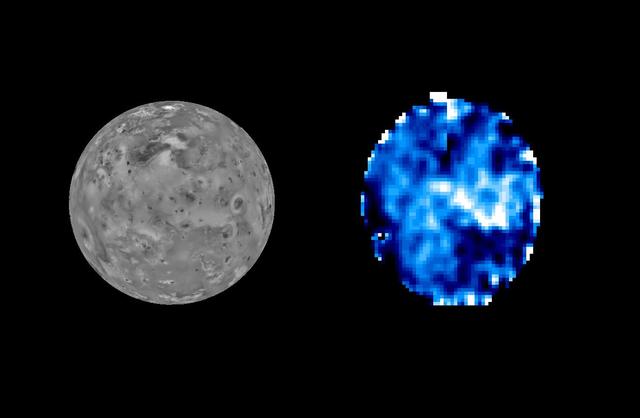
Sulfur dioxide, normally a gas at room temperatures, is known to exist on Io surface as a frost, condensing there from the hot gases emanating from the Io volcanoes. This image was taken in 1996 by NASA Galileo spacecraft.
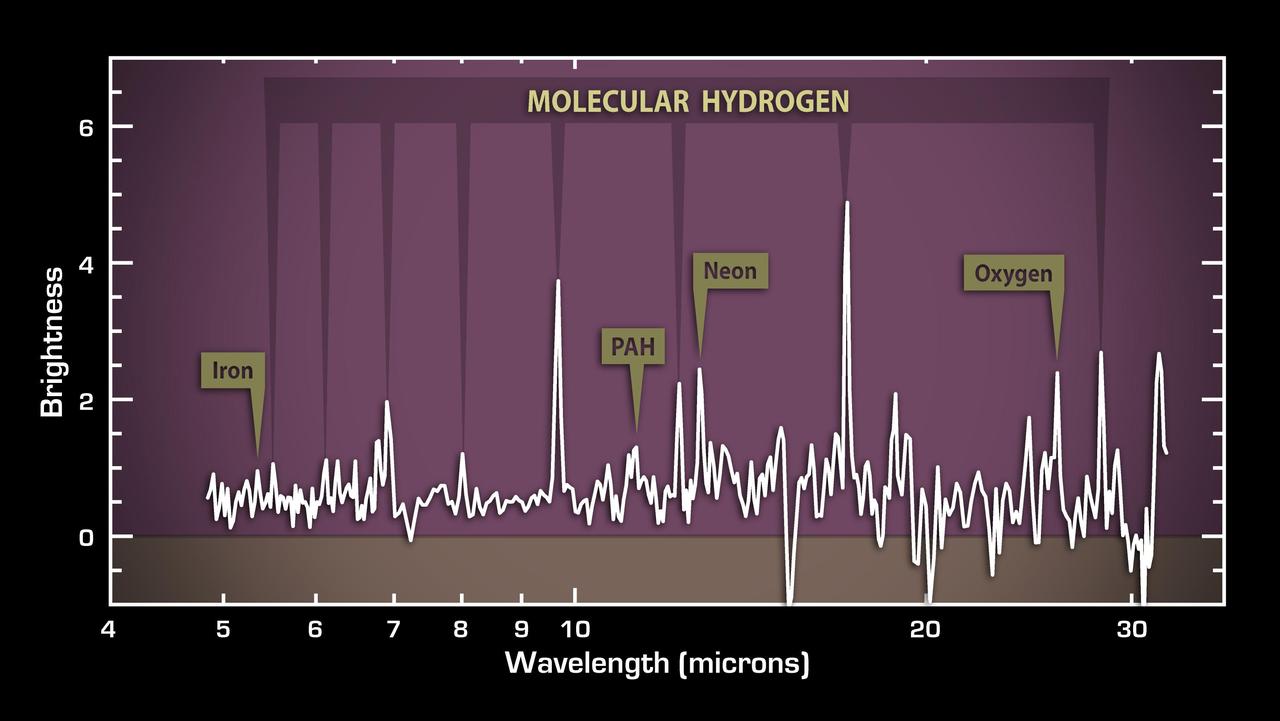
This plot of data from NASA Spitzer Space Telescope reveals vast reservoirs of hot gas in a galaxy about a billion light-years away called 3C 326 North.
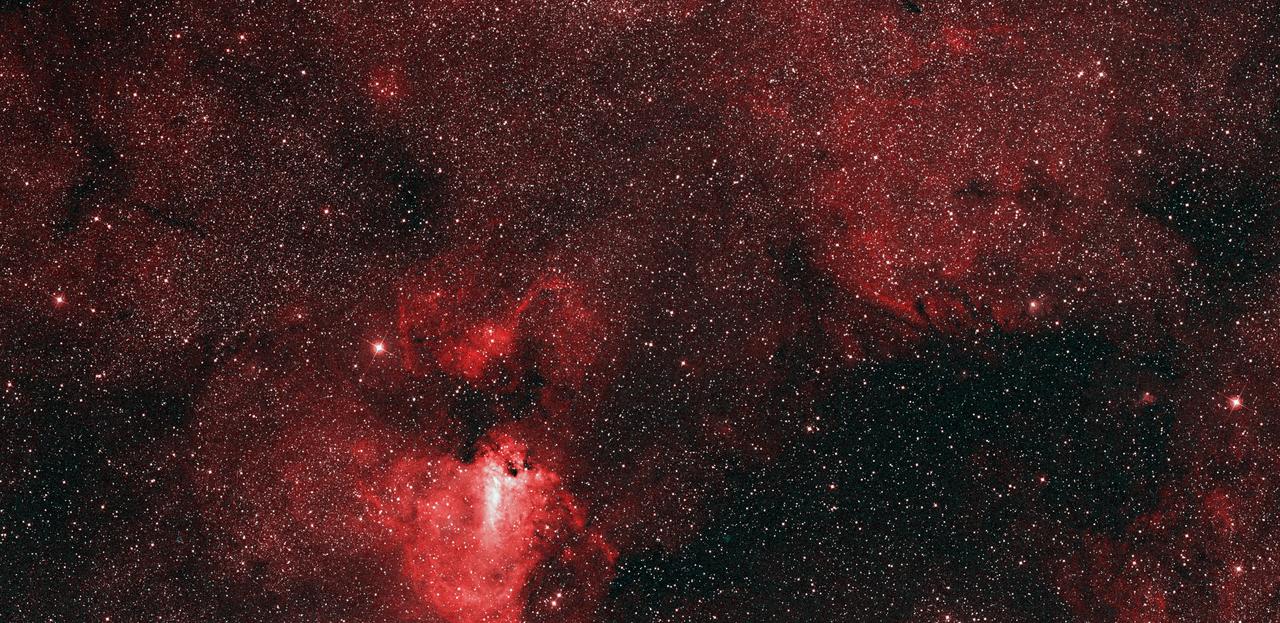
This visible-light view from from NASA Spitzer Space Telescope highlights the bright M17 nebula, as well as the glowing hot gas filling the bubble to its left.

Wispy tendrils of hot dust and gas glow brightly in this ultraviolet image of the Cygnus Loop nebula, taken by NASA Galaxy Evolution Explorer. The nebula lies about 1,500 light-years away.

This frame from an artist animation shows the clockwork-like orbits of a triple-star system called HD 188753, which was discovered to harbor a gas giant, or hot Jupiter, planet.
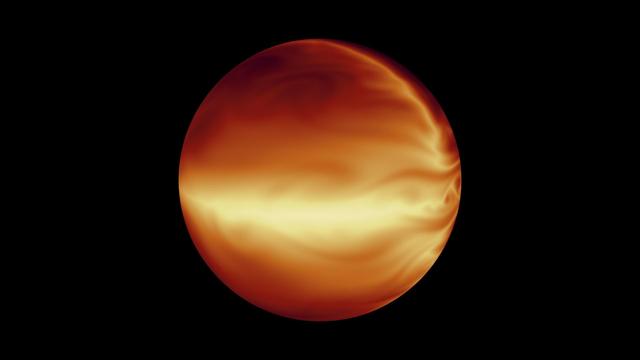
The turbulent atmosphere of a hot, gaseous planet known as HD 80606b is shown in this simulation based on data from NASA Spitzer Space Telescope.
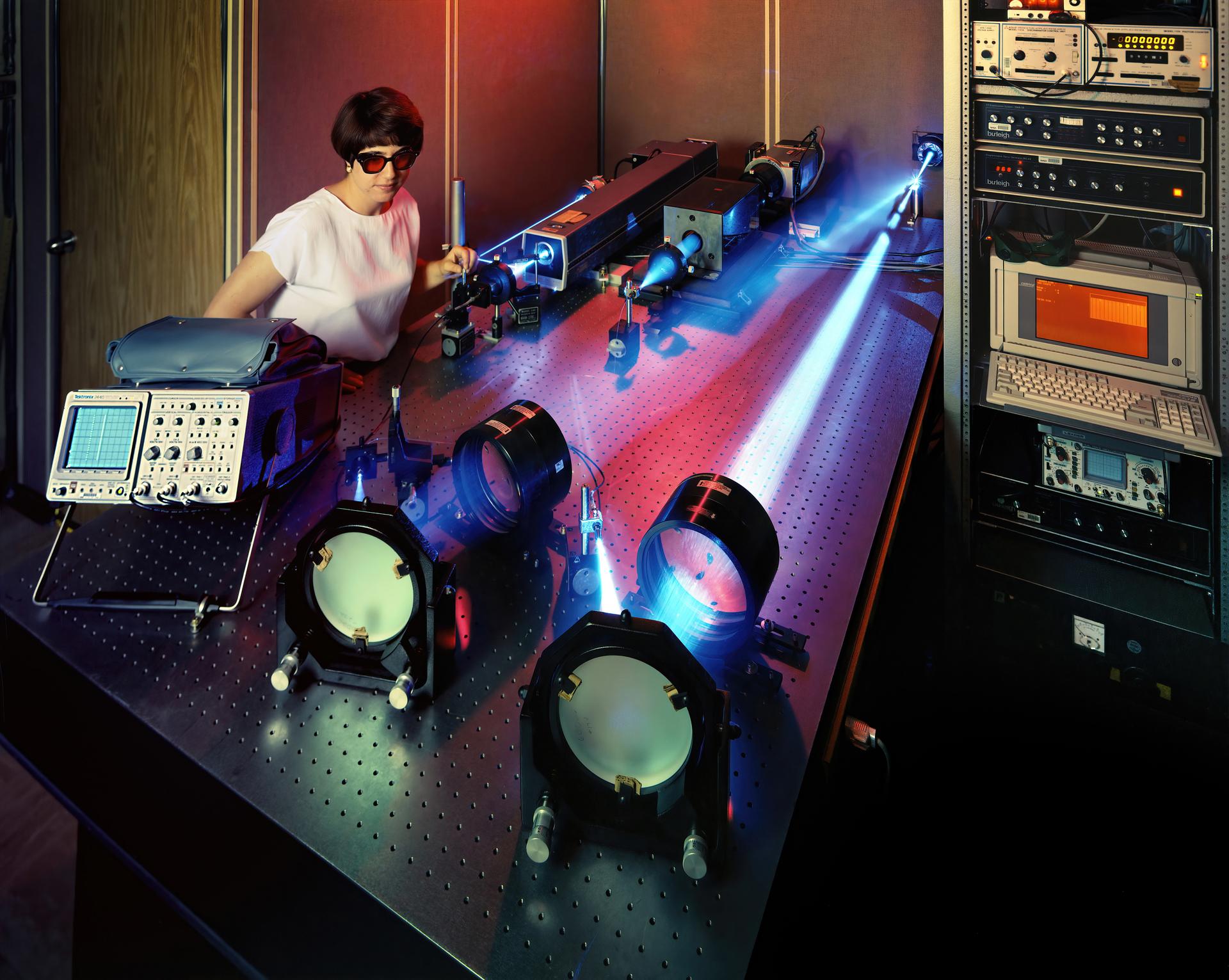
A spectrally resolved Rayleigh/Mie scattering diagnostic was developed to measure temperature and wingspan wise velocity in the vicinity of an ASTOVL aircraft model tested in the Lewis, now Glenn, 9x15 Low Speed Wind Tunnel. This was done for the Phase III hot gas ingestion study of ground-effect flow-field on such aircraft during hover or vertical landing.
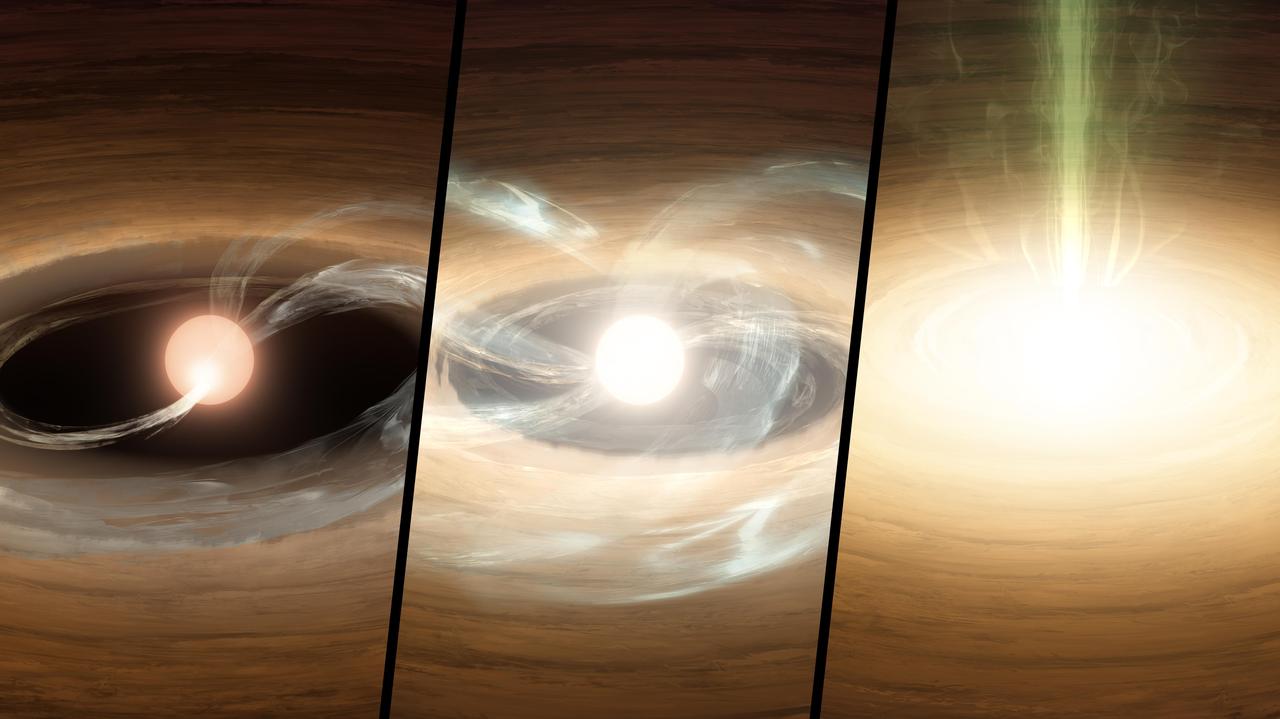
This illustration shows a young star undergoing a type of growth spurt. Left panel: Material from the dusty and gas-rich disk (orange) plus hot gas (blue) mildly flows onto the star, creating a hot spot. Middle panel: The outburst begins - the inner disk is heated, more material flows to the star, and the disk creeps inward. Right panel: The outburst is in full throttle, with the inner disk merging into the star and gas flowing outward (green). https://photojournal.jpl.nasa.gov/catalog/PIA22917

This artist's concept shows a black hole with an accretion disk -- a flat structure of material orbiting the black hole -- and a jet of hot gas, called plasma. Using NASA's NuSTAR space telescope and a fast camera called ULTRACAM on the William Herschel Observatory in La Palma, Spain, scientists have been able to measure the distance that particles in jets travel before they "turn on" and become bright sources of light. This distance is called the "acceleration zone." https://photojournal.jpl.nasa.gov/catalog/PIA22085
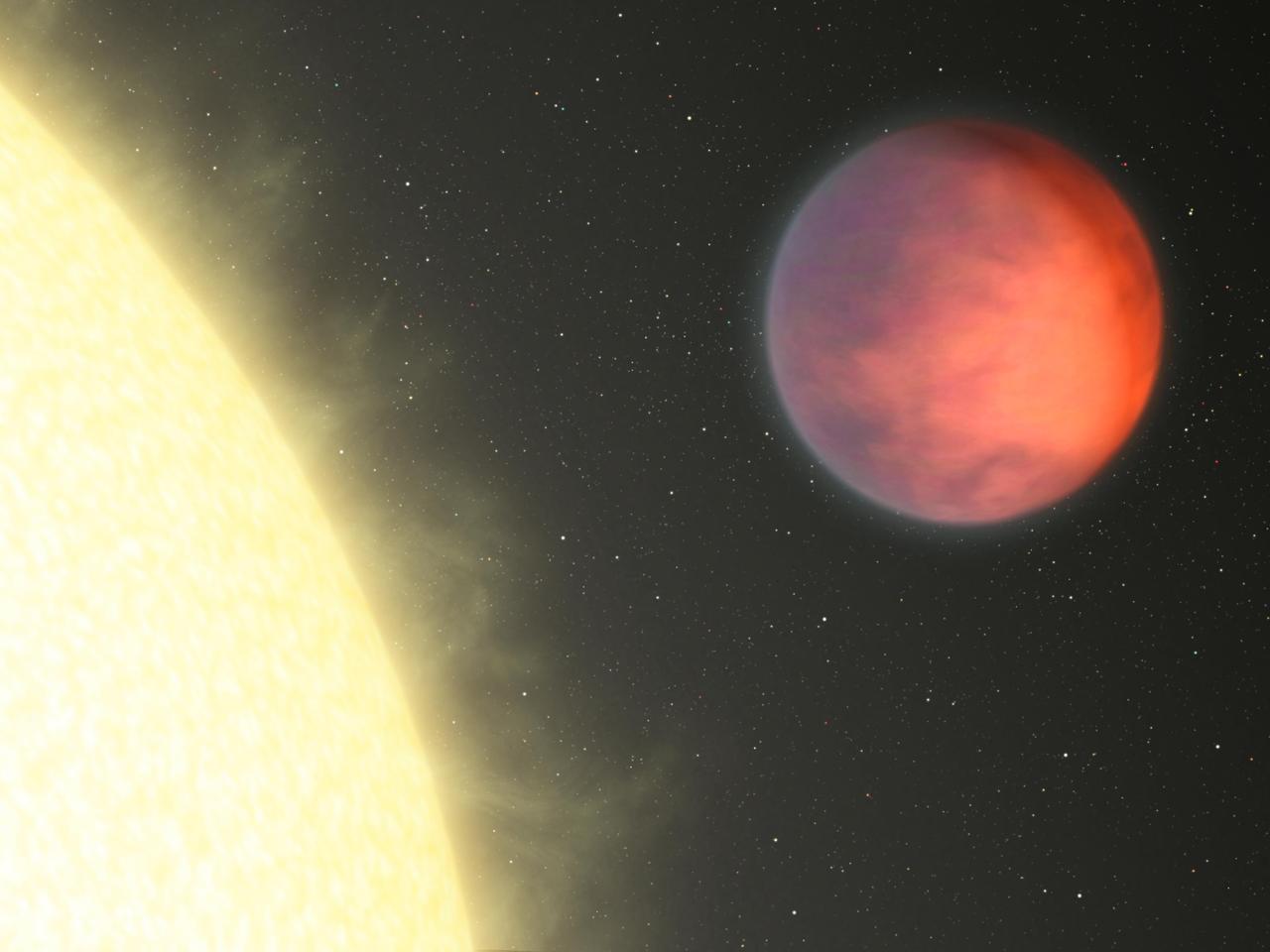
This artist concept based on data found by NASA Spitzer Space Telescope shows upsilon Andromedae b, a hot gas giant that whips around its star every 4.6 days. Because it is so close to its star, it is tidally locked.
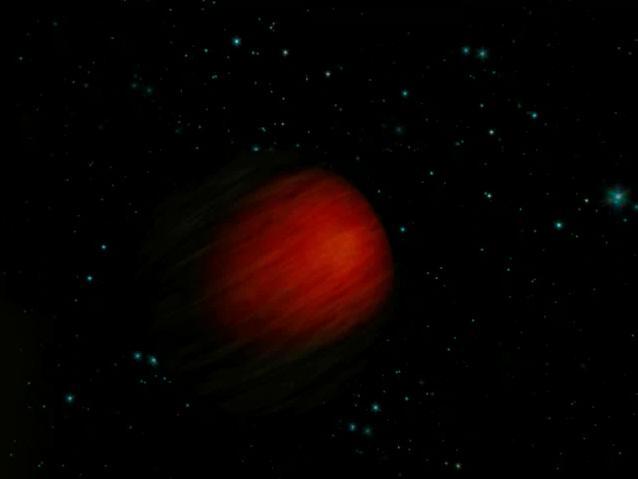
This artist concept illustrates the hottest planet yet observed in the universe. The scorching ball of gas, a hot Jupiter called HD 149026b, is about 3 times hotter than the rocky surface of Venus, the hottest planet in our solar system.
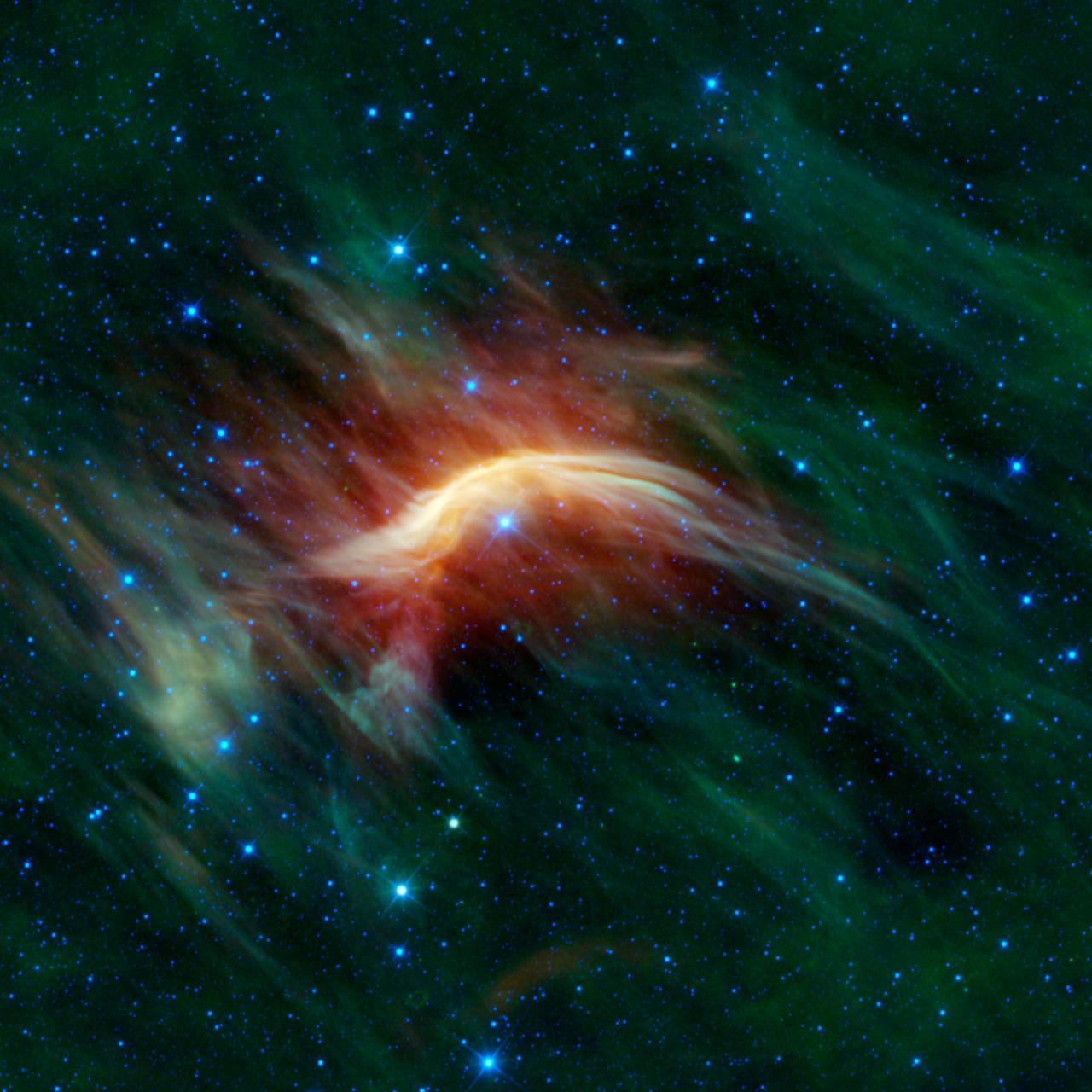
The blue star near the center of this image is Zeta Ophiuchi. Zeta Ophiuchi is actually a very massive, hot, bright blue star plowing its way through a large cloud of interstellar dust and gas in this image from NASA Wide-field Infrared Survey Explorer.

This artist concept shows the searing-hot gas planet WASP-12b orange orb and its star. NASA Spitzer Space Telescope discovered that the planet has more carbon than oxygen, making it the first carbon-rich planet ever observed.
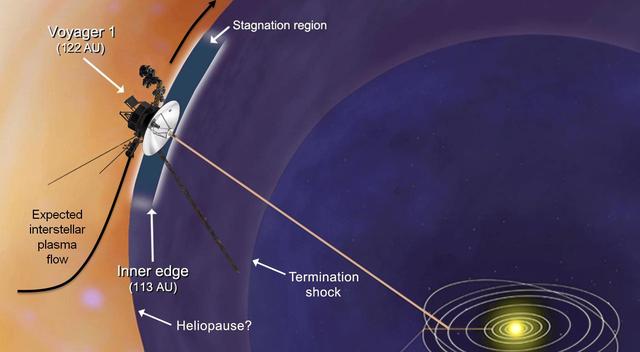
This artist concept shows plasma flows around NASA Voyager 1 spacecraft as it approaches interstellar space. Voyager 1 low-energy charged particle instrument detects the speed of the wind of plasma, or hot ionized gas, streaming off the sun.
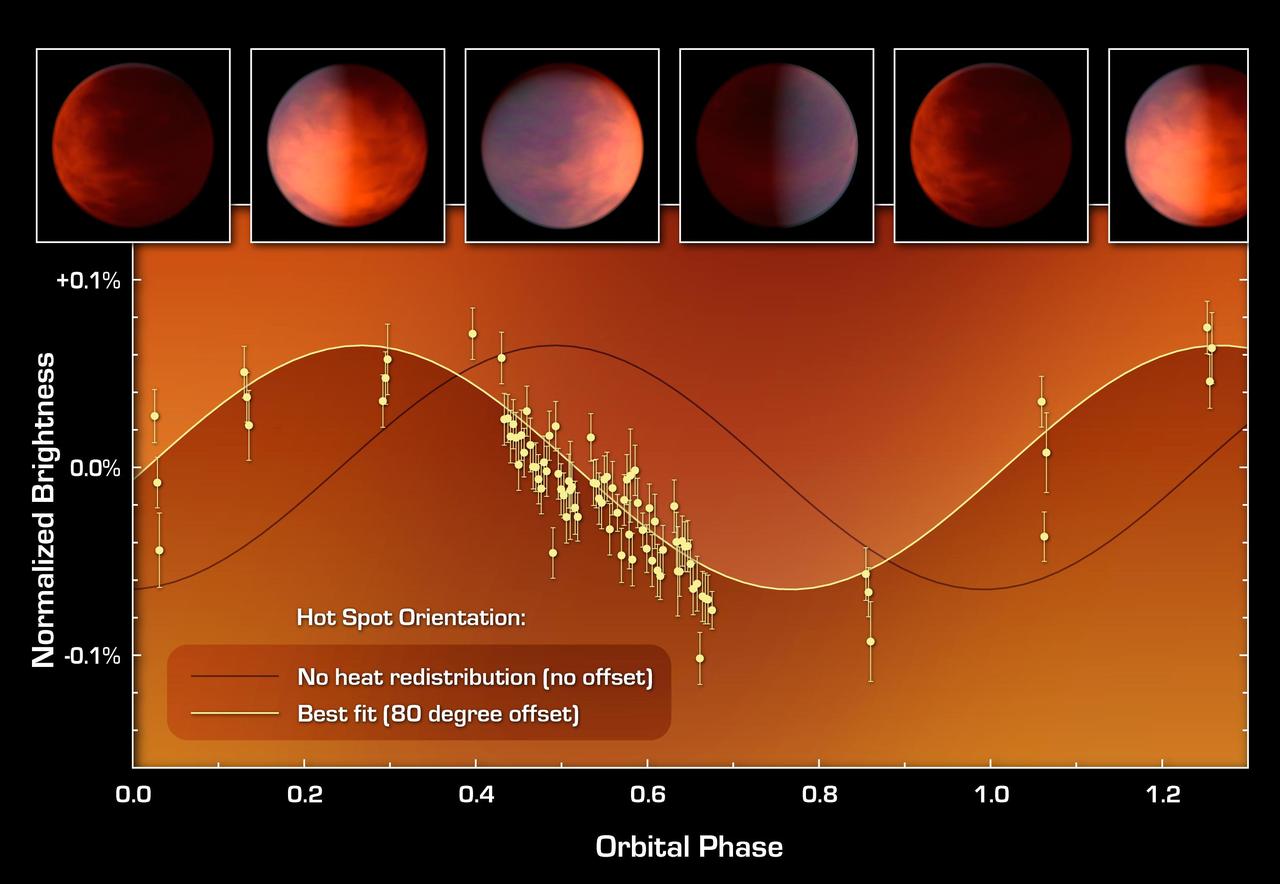
This graph of data from NASA Spitzer Space Telescope shows how astronomers located a hot spot on a distant gas planet named upsilon Andromedae b. Termed an exoplanet, it orbits a star beyond our sun, and whips around very closely to its star.

This two-panel illustration shows a black hole surrounded by a disk of gas, before and after the disk is partially dispersed. In the left panel, the ball of white light above the black hole is the black hole corona, a collection of ultra-hot gas particles that forms as gas from the disk falls into the black hole. The streak of debris falling toward the disk is what remains of a star that was torn apart by the black hole's gravity. The right panel shows the black hole after the debris from the star has dispersed some of the gas in the disk, causing the corona to disappear. https://photojournal.jpl.nasa.gov/catalog/PIA23864
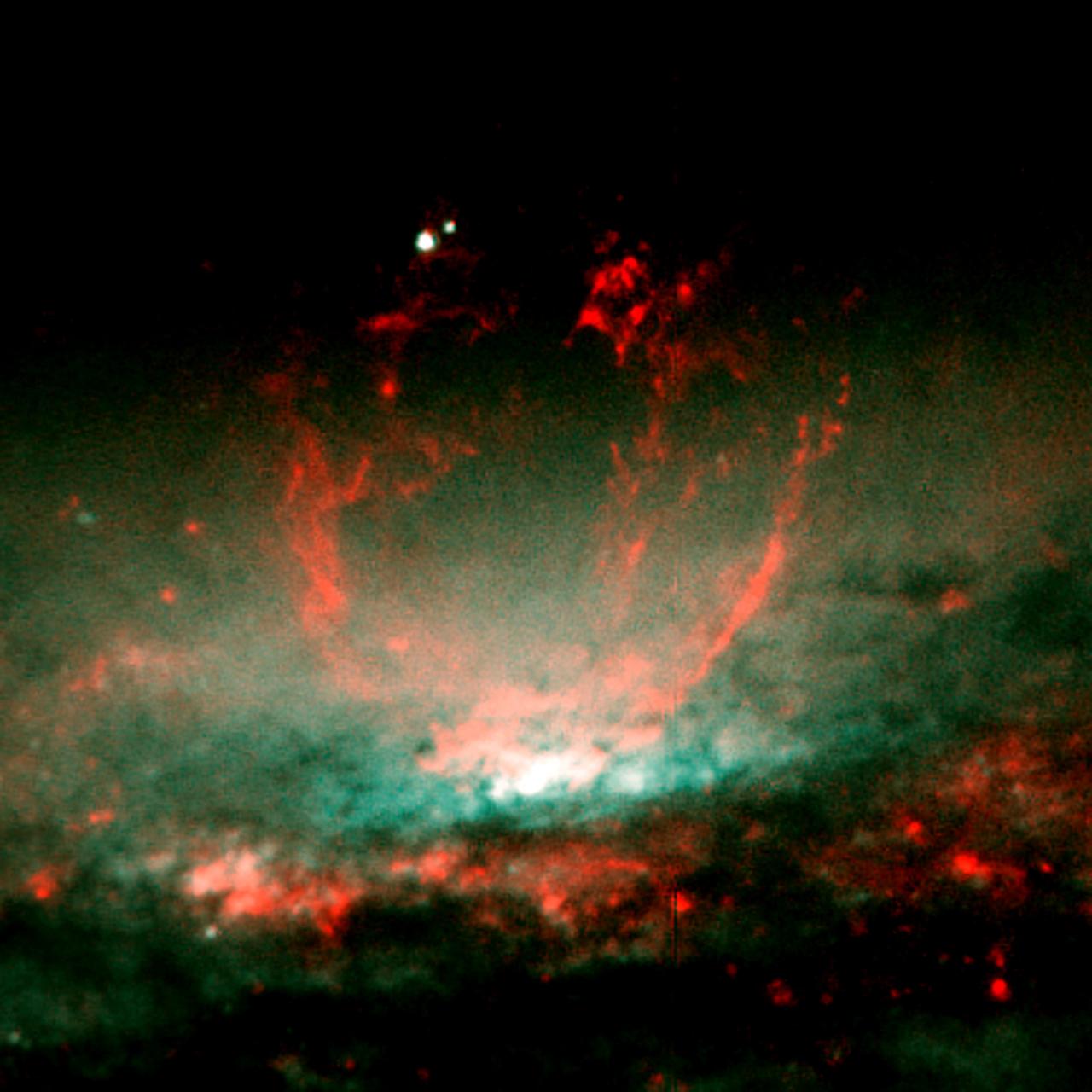
NASA's Hubble Space Telescope (HST) captures a lumpy bubble of hot gas rising from a cauldron of glowing matter in Galaxy NGC 3079, located 50 million light-years from Earth in the constellation Ursa Major. Astronomers suspect the bubble is being blown by "winds" or high speed streams of particles, released during a burst of star formation. The bubble's lumpy surface has four columns of gaseous filaments towering above the galaxy's disc that whirl around in a vortex and are expelled into space. Eventually, this gas will rain down on the disc and may collide with gas clouds, compress them, and form a new generation of stars.
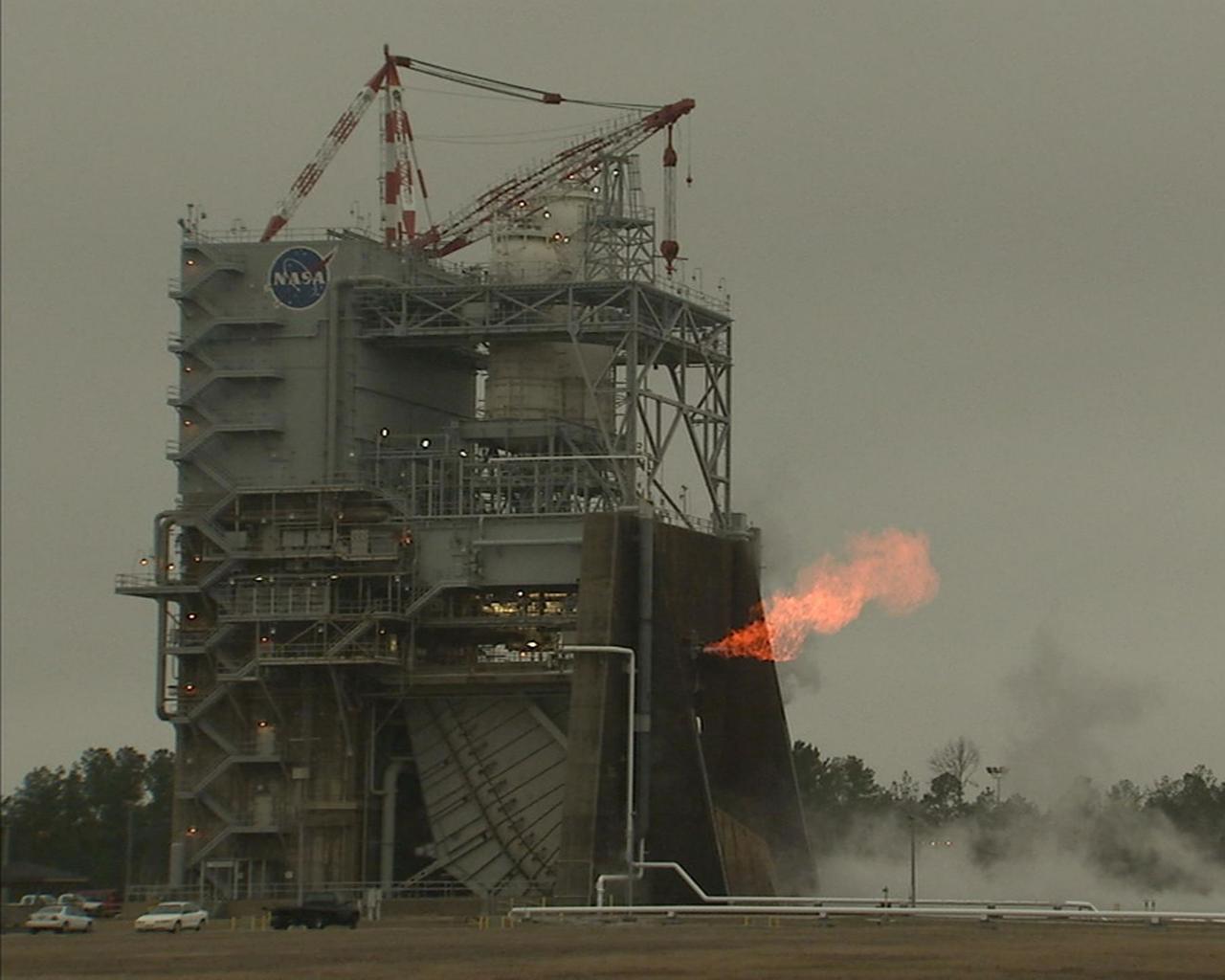
The first hot-fire test of the J-2X power pack 1A gas generator was performed Jan. 31 on the A-1 Test Stand at Stennis Space Center. Initial indications are that all test objectives were met. The test was designed as a 3.42-second helium spin start with gas generator ignition and it went the full scheduled duration. Test conductors reported a smooth start with normal shutdown and described the event as a 'good test.' The test was part of the early component testing for the new J-2X engine being built by NASA to power the Ares I and Ares V rockets that will carry humans back to the moon and on to Mars. It was performed as one in a series of 12 scheduled tests. Those tests began last November at Stennis, but the January 31 event represented the first hot-fire test. The Stennis tests are a critical step in the successful development of the J-2X engine.
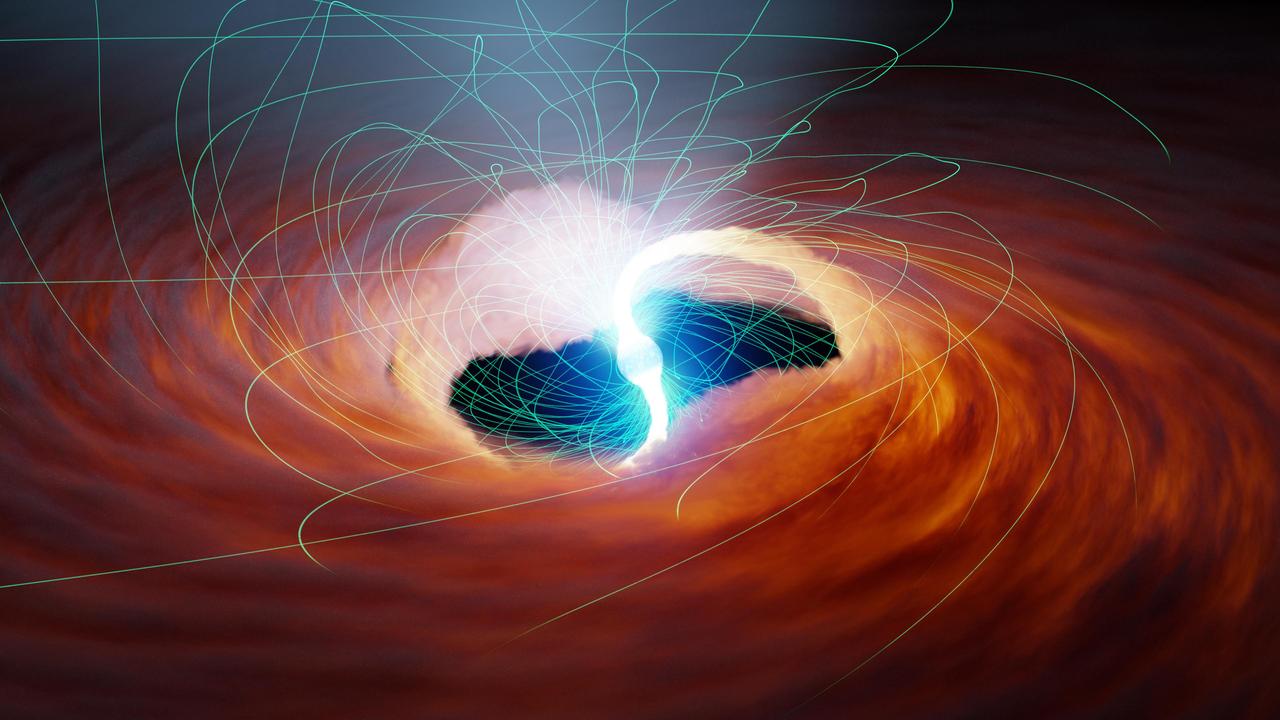
Two rivers of hot gas are siphoned onto the surface of a neutron star (the collapsed remains of a dead star) in this illustration. Neutron stars pack roughly the mass of our Sun into an area about 10 miles (6 kilometers) across. The gravity at the neutron star's surface is about 100 trillion times stronger than the gravitational pull on Earth's surface. Under those conditions, the captured gas accelerates to millions of miles per hour, releasing tremendous energy and radiation when it hits the neutron star's surface. Because these sources of light emit primarily X-rays, they are known as ultra-luminous X-ray sources (ULXs), and are visible by telescopes like NASA's NuSTAR (the Nuclear Spectroscopic Telescope Array). The neutron star's twisted magnetic field lines are illustrated in green. Some scientists hypothesize that strong magnetic fields like the ones produced by neutron stars can distort the normal shape of atoms from roughly spherical to elongated, stringy shapes. This may ultimately increase an object's maximum possible brightness. https://photojournal.jpl.nasa.gov/catalog/PIA25781

A panoramic view of a vast, sculpted area of gas and dust where thousands of stars are being born has been captured by NASA's Hubble Space Telescope. The image, taken by Hubble's Wide Field and Planetary Camera 2, is online at http://hubblesite.org/newscenter/archive/releases/2001/21/image/a/. The camera was designed and built by NASA's Jet Propulsion Laboratory, Pasadena, Calif. The photo offers an unprecedented, detailed view of the entire inner region of the fertile, star-forming 30 Doradus Nebula. The mosaic picture shows that ultraviolet radiation and high-speed material unleashed by the stars in the cluster, called R136 (the large blue blob left of center), are weaving a tapestry of creation and destruction, triggering the collapse of looming gas and dust clouds and forming pillar-like structures that incubate newborn stars. The 30 Doradus Nebula is in the Large Magellanic Cloud, a satellite galaxy of the Milky Way located 170,000 light-years from Earth. Nebulas like 30 Doradus are signposts of recent star birth. High-energy ultraviolet radiation from young, hot, massive stars in R136 causes surrounding gaseous material to glow. Previous Hubble telescope observations showed that R136 contains several dozen of the most massive stars known, each about 100 times the mass of the Sun and about 10 times as hot. These stellar behemoths formed about 2 million years ago. The stars in R136 produce intense "stellar winds," streams of material traveling at several million miles an hour. These winds push the gas away from the cluster and compress the inner regions of the surrounding gas and dust clouds (seen in the image as the pinkish material). The intense pressure triggers the collapse of parts of the clouds, producing a new star formation around the central cluster. Most stars in the nursery are not visible because they are still encased in cocoons of gas and dust. This mosaic image of 30 Doradus consists of five overlapping pictures taken between January 1994 and September 2000 by the Wide Field and Planetary Camera 2. Several color filters enhance important details in the stars and the nebula. Blue corresponds to the hot stars. The greenish color denotes hot gas energized by the central cluster of stars. Pink depicts the glowing edges of the gas and dust clouds facing the cluster, which are being bombarded by winds and radiation. Reddish-brown represents the cooler surfaces of the clouds, which are not receiving direct radiation from the central cluster. http://photojournal.jpl.nasa.gov/catalog/PIA04200
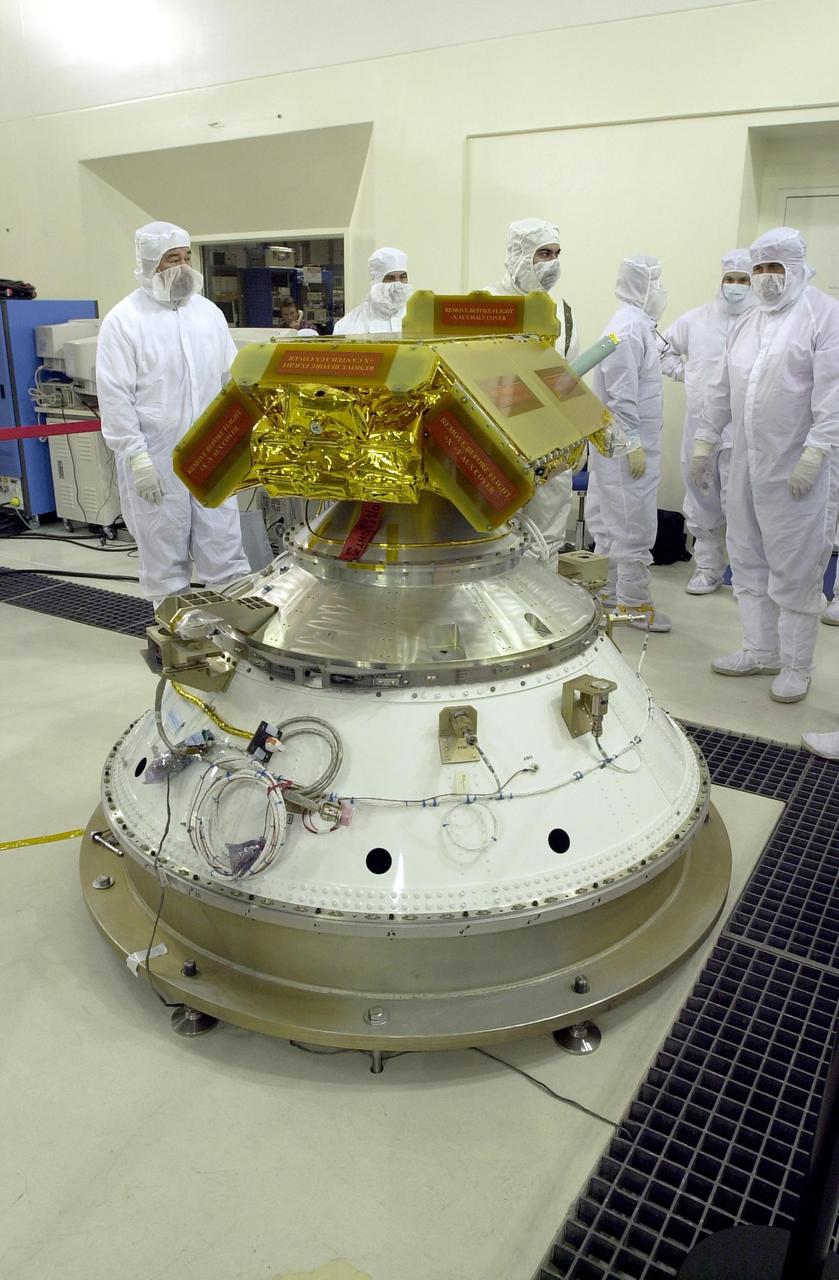
KENNEDY SPACE CENTER, FLA. - The Cosmic Hot Interstellar Plasma Spectrometer, or CHIPSat, undergoes final processing before launch. CHIPSat, a suitcase-size 131-pound satellite, will provide invaluable information into the origin, physical processes and properties of the hot gas contained in the interstellar medium. This can provide important clues about the formation and evolution of galaxies since the interstellar medium literally contains the seeds of future stars. CHIPSat is scheduled for launch, with the Ice, Cloud, and Land Elevation Satellite (ICESat), on a Delta II expendable launch vehicle from Vandenberg Air Force Base, Calif., on Jan. 11, 2003, between 4:45 p.m. - 5:30 p.m. PST.
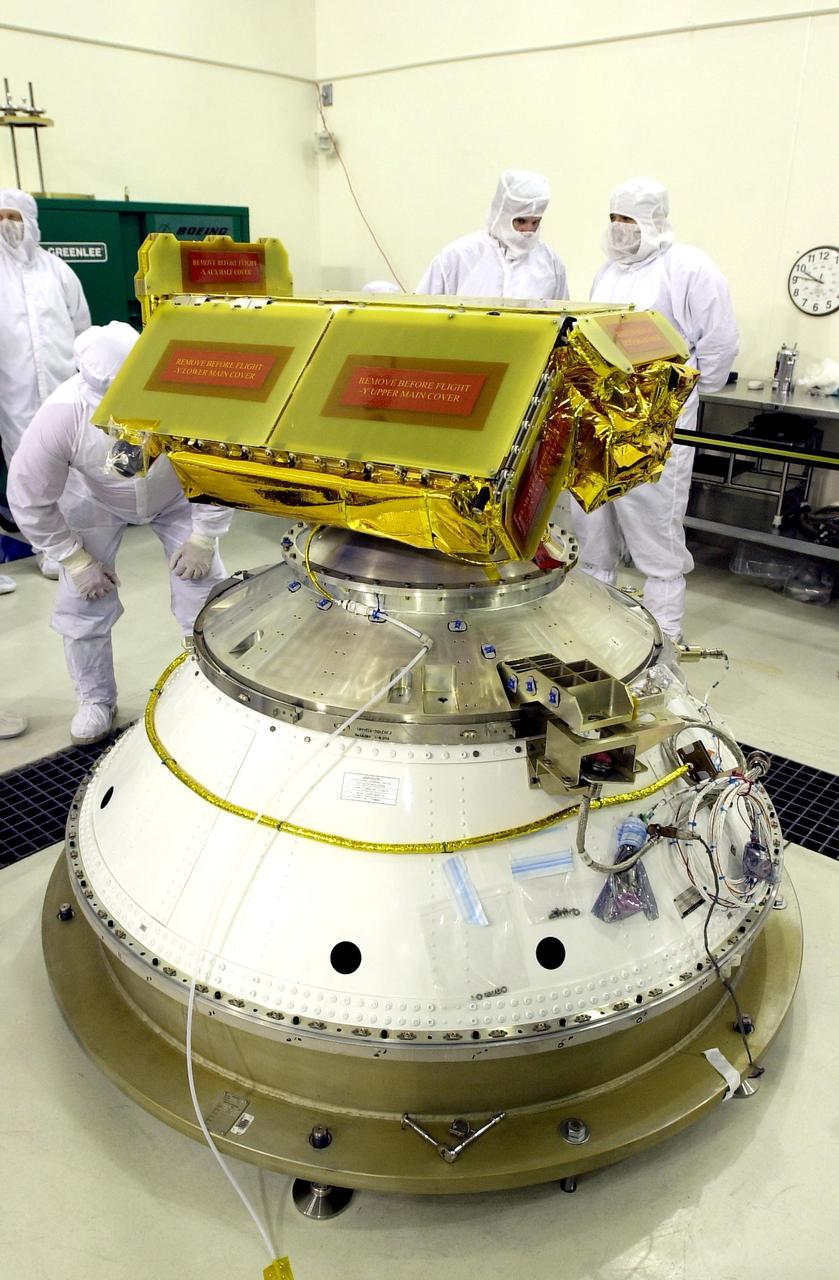
KENNEDY SPACE CENTER, FLA. - The Cosmic Hot Interstellar Plasma Spectrometer, or CHIPSat, undergoes final processing before launch. CHIPSat, a suitcase-size 131-pound satellite, will provide invaluable information into the origin, physical processes and properties of the hot gas contained in the interstellar medium. This can provide important clues about the formation and evolution of galaxies since the interstellar medium literally contains the seeds of future stars. CHIPSat is scheduled for launch, with the Ice, Cloud, and Land Elevation Satellite (ICESat), on a Delta II expendable launch vehicle from Vandenberg Air Force Base, Calif., on Jan. 11, 2003, between 4:45 p.m. - 5:30 p.m. PST.
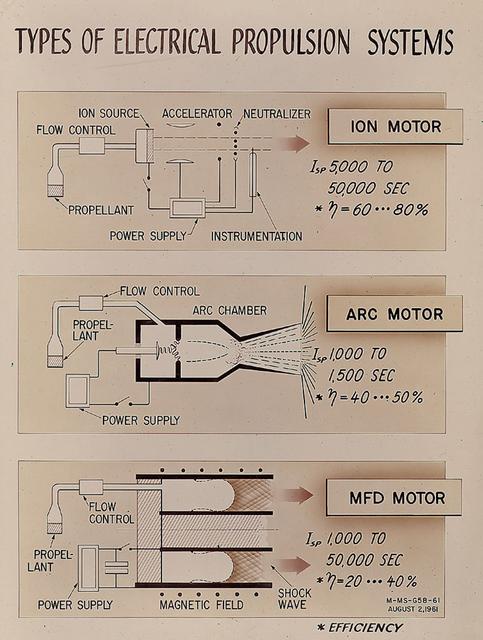
As presented by Gerhard Heller of Marshall Space Flight Center's Research Projects Division in 1961, this chart illustrates three basic types of electric propulsion systems then under consideration by NASA. The ion engine (top) utilized cesium atoms ionized by hot tungsten and accelerated by an electrostatic field to produce thrust. The arc engine (middle) achieved propulsion by heating a propellant with an electric arc and then producing an expansion of the hot gas or plasma in a convergent-divergent duct. The electromagnetic, or MFD engine (bottom) manipulated strong magnetic fields to interact with a plasma and produce acceleration.
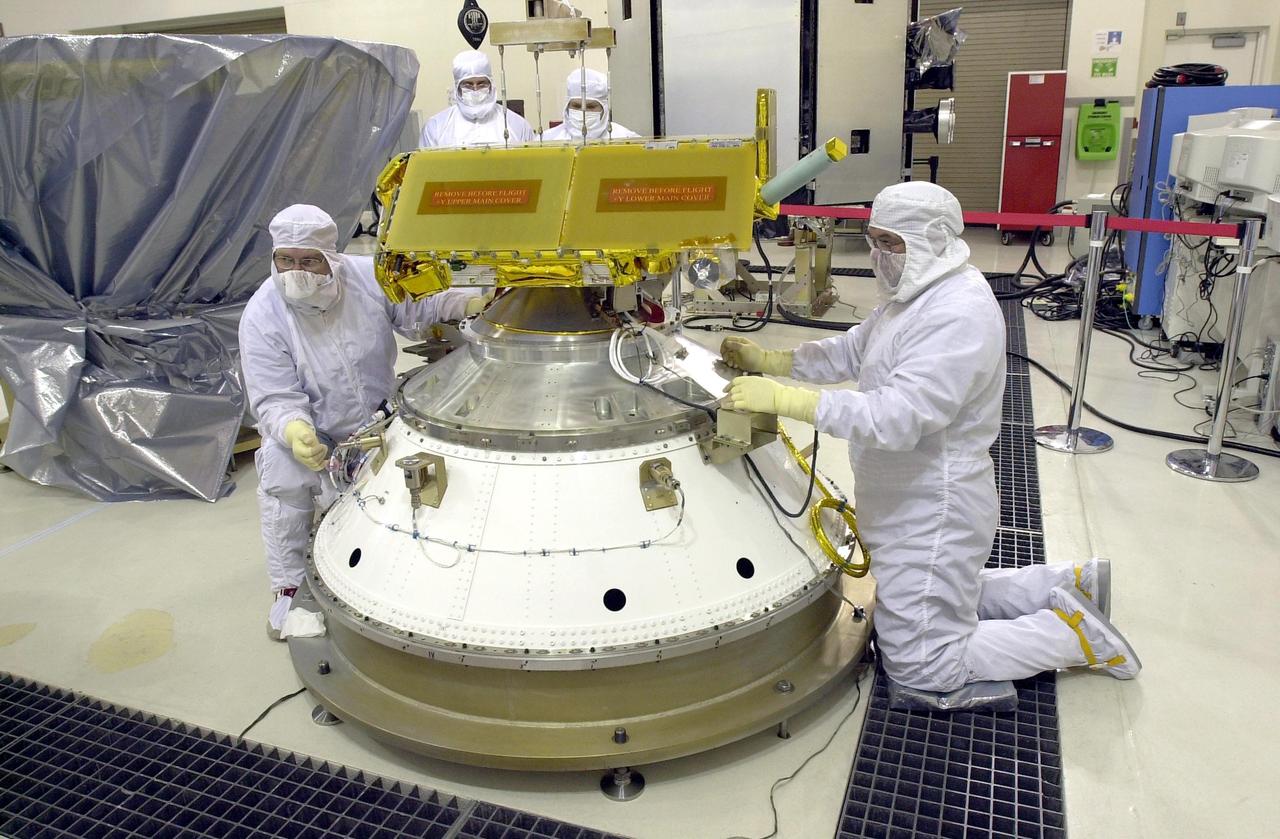
KENNEDY SPACE CENTER, FLA. - The Cosmic Hot Interstellar Plasma Spectrometer, or CHIPSat, undergoes final processing before launch. CHIPSat, a suitcase-size 131-pound satellite, will provide invaluable information into the origin, physical processes and properties of the hot gas contained in the interstellar medium. This can provide important clues about the formation and evolution of galaxies since the interstellar medium literally contains the seeds of future stars. CHIPSat is scheduled for launch, with the Ice, Cloud, and Land Elevation Satellite (ICESat), on a Delta II expendable launch vehicle from Vandenberg Air Force Base, Calif., on Jan. 11, 2003, between 4:45 p.m. - 5:30 p.m. PST.
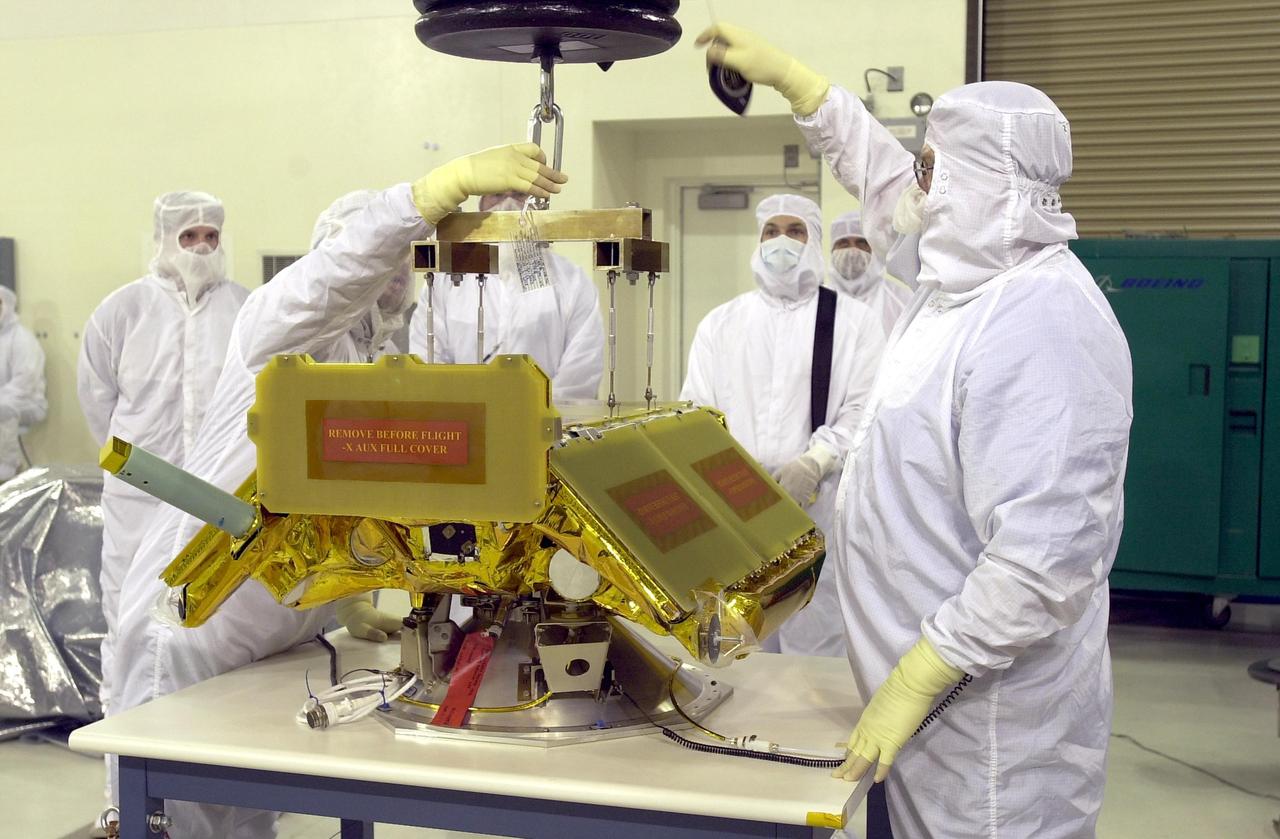
KENNEDY SPACE CENTER, FLA. - The Cosmic Hot Interstellar Plasma Spectrometer, or CHIPSat, undergoes final processing before launch. CHIPSat, a suitcase-size 131-pound satellite, will provide invaluable information into the origin, physical processes and properties of the hot gas contained in the interstellar medium. This can provide important clues about the formation and evolution of galaxies since the interstellar medium literally contains the seeds of future stars. CHIPSat is scheduled for launch, with the Ice, Cloud, and Land Elevation Satellite (ICESat), on a Delta II expendable launch vehicle from Vandenberg Air Force Base, Calif., on Jan. 11, 2003, between 4:45 p.m. - 5:30 p.m. PST.

SCI2016_0006: Map of Cepheus E emphasizing the jets of material flowing to the upper left and lower right from the protostar. The protostar itself is the central yellow-red 'blob" in the colored background map of hydrogen emission made at a wavelength of 4.5 microns by the Spitzer infrared space telescope. The contour curves show the strength of emission from cool carbon monoxide gas measured by the Plateau de Bure radio telescope located in the French Alps. Lefloch et al. used GREAT on SOFIA to measure the amount and velocity of hot carbon monoxide gas at multiple positions along both "wings" of the outflow jet. Credit: Lefloch et al. 2015 Figure 1
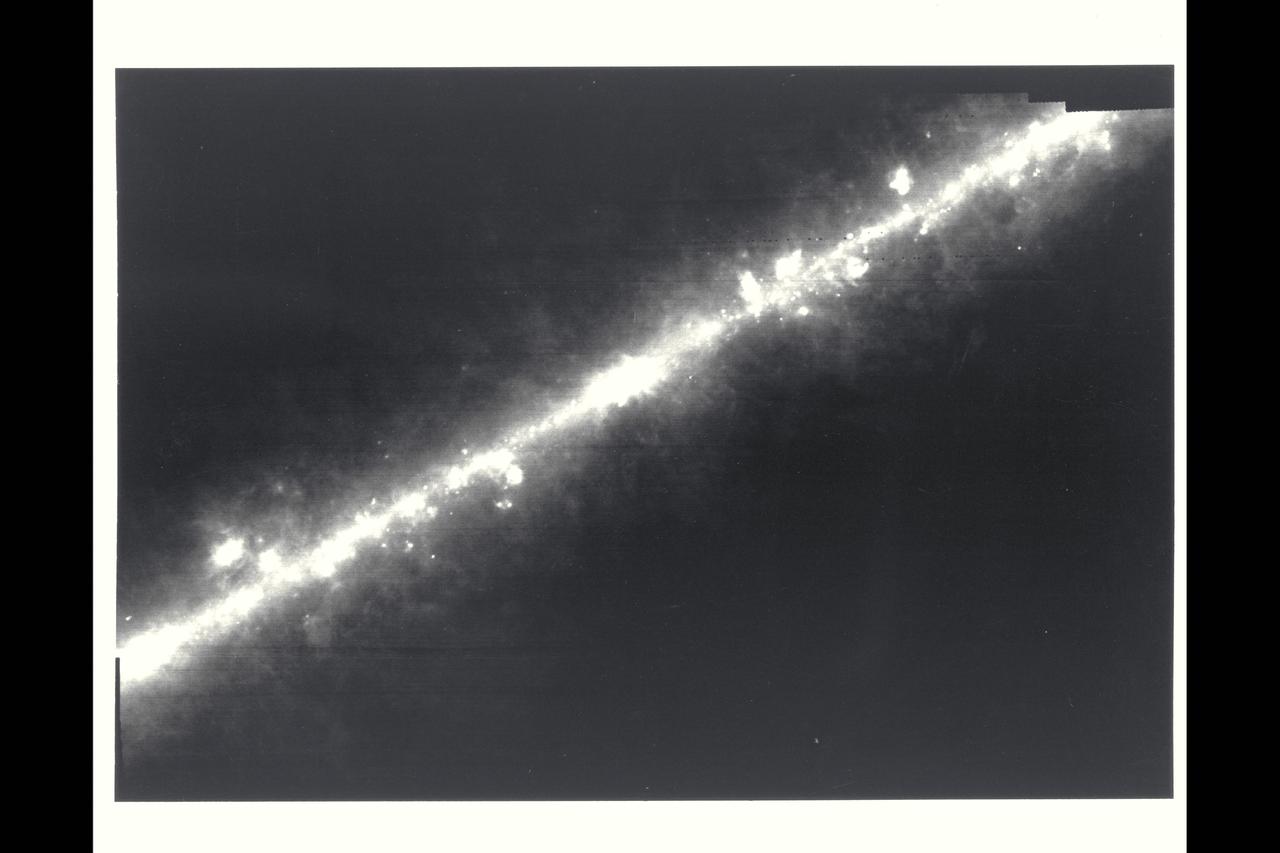
Milky way - This image of the center of our galaxy was produced from observtons made by the Infrared Astronomical Satellite (IRAS). The infrared telescope carried by IRAS sees through the dust and gas that obscures stars and other objects when viewed by optical telescopes. The bulge in the band is the center of the galaxy. The knots and blobs scattered along the band are giant clouds of interstellar gas and dust heated by nearby stars. Some are wrmed by newly formed stars in the surrounding cloud and some are heated by nearby massive, hot, blue stars tens of thousands of times brighter than our Sun.
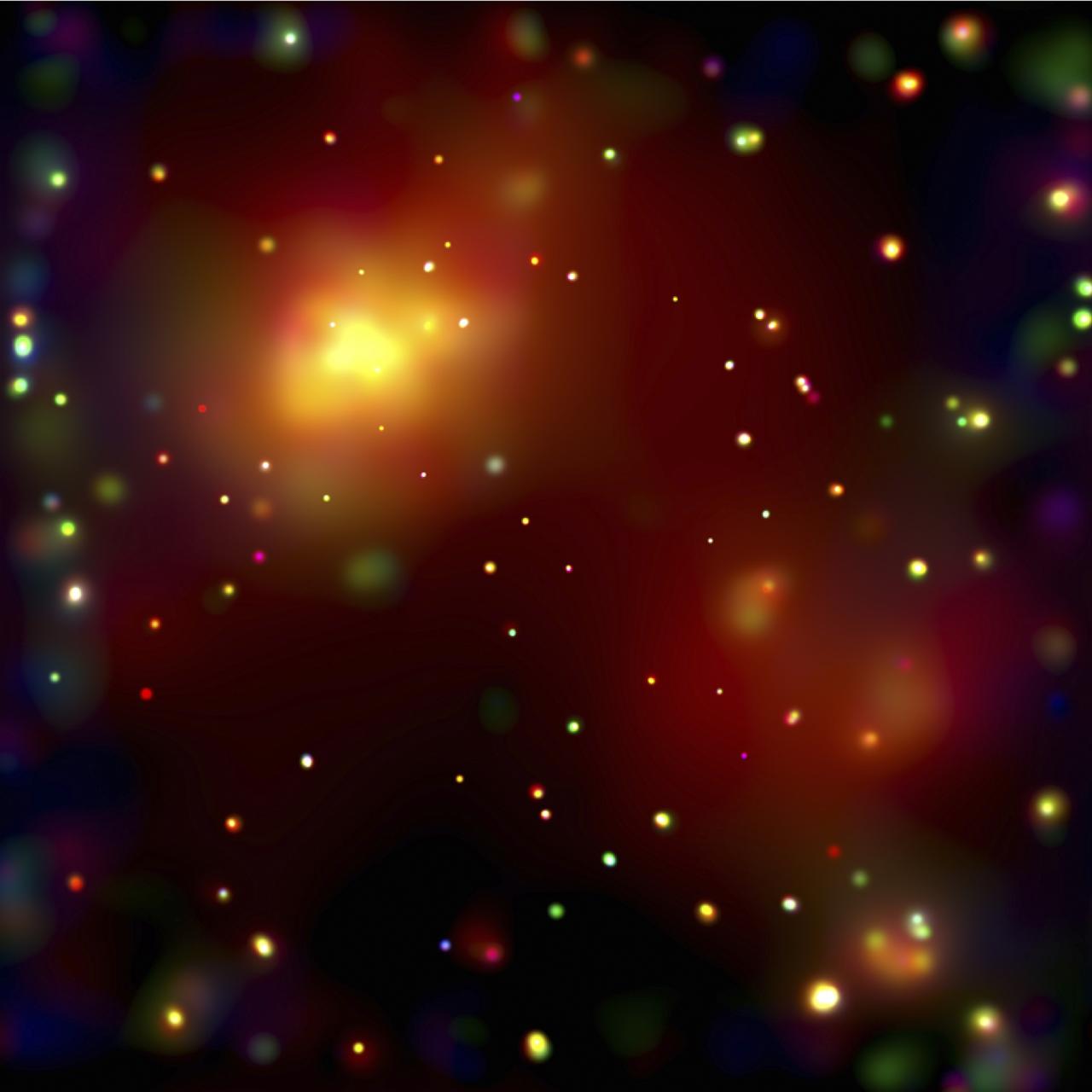
This image of the galaxy cluster Abell 2125, provided by the Chandra X-Ray Observatory (CXO), reveals several massive multimillion degree Celsius gas clouds that appear to be in the process of merging. Ten of the point-like sources are associated with galaxies in the cluster and the rest are probably distant background galaxies. The small bright feature in the extreme lower right-hand corner is probably a background galaxy cluster not associated with Abell 2125. The bright gas cloud on the upper left is the core of the cluster and envelopes hundreds of galaxies. It consists of several elongated clouds that are merging. Chandra, Hubble Space Telescope (HST), and Very Large Array radio telescope data show that several galaxies in the Abell 2125 core cluster are being stripped of their gas as they fall through surrounding high-pressure hot gas. This stripping process has enriched the core cluster's gas in heavy elements such as iron. In contrast, the bright large cloud on the lower right envelopes hundreds of galaxies and has an extraordinarily low concentration of iron atoms. It is thought that this cloud, which is several million light years from the core cluster, has not yet been enriched by the stripping of iron-rich gas from its member galaxies. Over time, as this cloud merges into the core and the hot gas pressure increases, iron atoms should be swept from the galaxies. Building a massive galaxy cluster is a step-by-step enterprise that takes billions of years and affects the growth and evolution of the member galaxies. The observations of A 2125 provide a rare glimpse into the early steps in this process. NASA’s Marshall Space Flight Center in Huntsville, Alabama manages both the Chandra and Hubble programs. (NASA/UMass/D. Wang et al.))

NASA image release March 2, 2012 This composite image shows the distribution of dark matter, galaxies, and hot gas in the core of the merging galaxy cluster Abell 520, formed from a violent collision of massive galaxy clusters. The natural-color image of the galaxies was taken with NASA's Hubble Space Telescope and with the Canada-France-Hawaii Telescope in Hawaii. Superimposed on the image are "false-colored" maps showing the concentration of starlight, hot gas, and dark matter in the cluster. Starlight from galaxies, derived from observations by the Canada-France-Hawaii Telescope, is colored orange. The green-tinted regions show hot gas, as detected by NASA's Chandra X-ray Observatory. The gas is evidence that a collision took place. The blue-colored areas pinpoint the location of most of the mass in the cluster, which is dominated by dark matter. Dark matter is an invisible substance that makes up most of the universe's mass. The dark-matter map was derived from the Hubble Wide Field Planetary Camera 2 observations, by detecting how light from distant objects is distorted by the cluster galaxies, an effect called gravitational lensing. The blend of blue and green in the center of the image reveals that a clump of dark matter resides near most of the hot gas, where very few galaxies are found. This finding confirms previous observations of a dark-matter core in the cluster. The result could present a challenge to basic theories of dark matter, which predict that galaxies should be anchored to dark matter, even during the shock of a collision. Abell 520 resides 2.4 billion light-years away. To read more go to: <a href="http://www.nasa.gov/mission_pages/hubble/science/dark-matter-core.html" rel="nofollow">www.nasa.gov/mission_pages/hubble/science/dark-matter-cor...</a> Credit: NASA, ESA, CFHT, CXO, M.J. Jee (University of California, Davis), and A. Mahdavi (San Francisco State University) <b><a href="http://www.nasa.gov/audience/formedia/features/MP_Photo_Guidelines.html" rel="nofollow">NASA image use policy.</a></b> <b><a href="http://www.nasa.gov/centers/goddard/home/index.html" rel="nofollow">NASA Goddard Space Flight Center</a></b> enables NASA’s mission through four scientific endeavors: Earth Science, Heliophysics, Solar System Exploration, and Astrophysics. Goddard plays a leading role in NASA’s accomplishments by contributing compelling scientific knowledge to advance the Agency’s mission. <b>Follow us on <a href="http://twitter.com/NASA_GoddardPix" rel="nofollow">Twitter</a></b> <b>Like us on <a href="http://www.facebook.com/pages/Greenbelt-MD/NASA-Goddard/395013845897?ref=tsd" rel="nofollow">Facebook</a></b> <b>Find us on <a href="http://instagrid.me/nasagoddard/?vm=grid" rel="nofollow">Instagram</a></b>
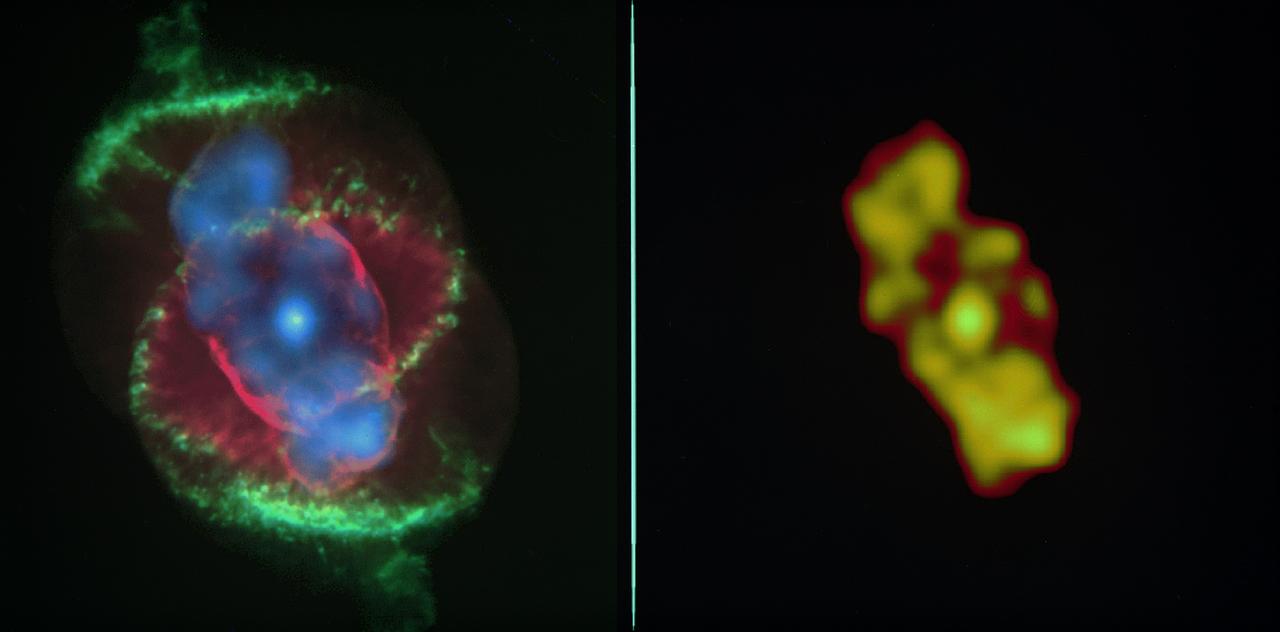
Left image: The x-ray data from the Chandra X-Ray Observatory (CXO) has revealed a bright central star surrounded by a cloud of multimillion-degree gas in the planetary nebula known as the Cat's Eye. This CXO image, where the intensity of the x-ray emission is correlated to the brightness of the orange coloring, captures the expulsion of material from a star that is expected to collapse into a white dwarf in a few million years. The intensity of x-rays from the central star was unexpected, and it is the first time astronomers have seen such x-ray emission from the central star of a planetary nebula. Right image: An image of Cat's Eye taken by the Hubble Space Telescope (HST). By comparing the CXO data with that from the HST, researchers are able to see where the hotter, x-ray emitting gas appears in relation to the cooler material seen in optical wavelengths by the HST. The CXO team found that the chemical abundance in the region of hot gas (its x-ray intensity is shown in purple) was not like those in the wind from the central star and different from the outer cooler material (the red and green structures.) Although still incredibly energetic and hot enough to radiate x-rays, CXO shows the hot gas to be somewhat cooler than scientists would have expected for such a system. CXO image credit: (NASA/UIUC/Y. Chu et al.) HST image credit: (NASA/HST)
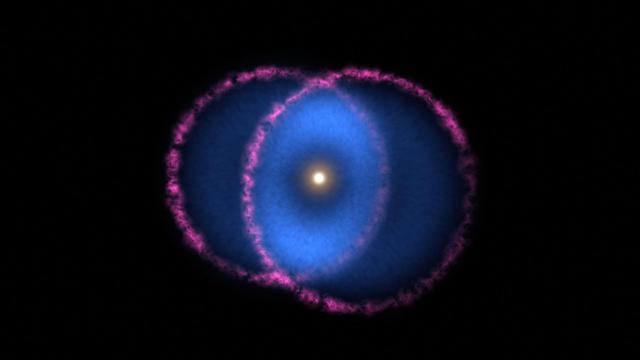
The Blue Ring Nebula is thought to be the product of two stars merging into one. The collision of the bodies ejected a cloud of hot debris into space. A disk of gas orbiting the larger star cut the cloud in half, creating two cones that are moving away from the star in opposite directions. The base of one cone is moving almost directly toward Earth, while the other is moving almost directly away. Magenta represents optical light from the shockwave at the front of the expanding debris cones, outlining the two cone bases at their widest points. Blue represents far-ultraviolet light (not visible to the human eye) and comes from gas behind the shockwave. As the gas expands and cools, it forms hydrogen molecules that interact with the interstellar medium and emit only far-ultraviolet light. These emissions are visible only where the cones overlap (as seen from Earth), forming the blue ring around the central star. Movie available at https://photojournal.jpl.nasa.gov/catalog/PIA23868
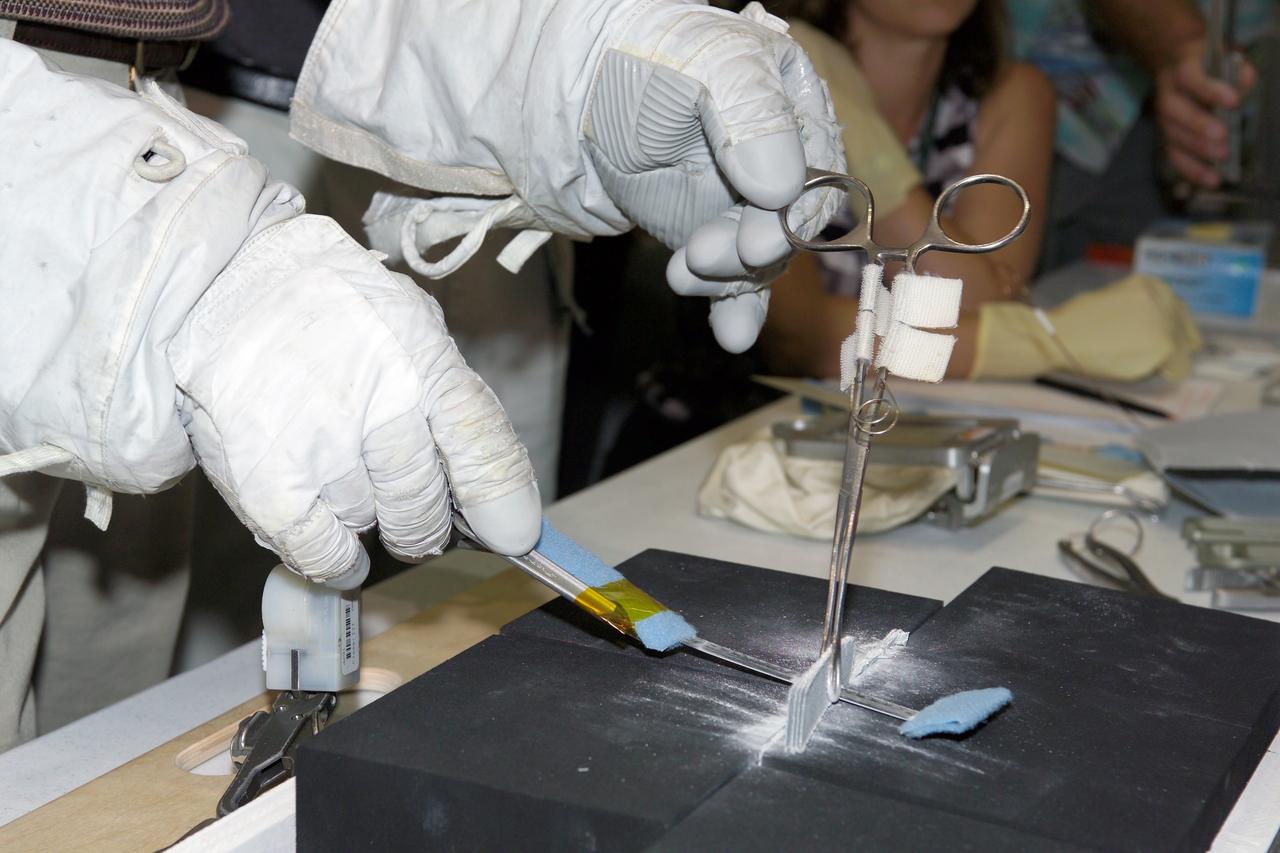
JSC2005-E-30917 (31 July 2005) --- Astronaut Joe Tanner joins other astronauts and engineers at the Johnson Space Center to practice techniques to eliminate or trim protruding gap fillers that Astronauts Noguchi and Robinson will use during their spacewalk. The ceramic coated-fabric gap fillers are used to protect against hot gas from seeping into gaps between the Shuttle’s protective tiles. Photo Credit: NASA/James Blair
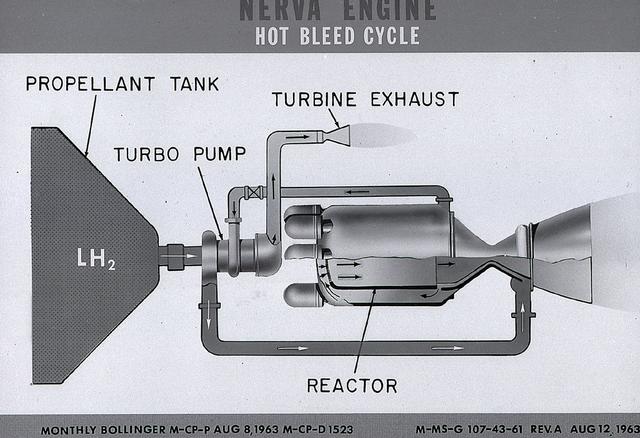
This artist's concept illustrates the NERVA (Nuclear Engine for Rocket Vehicle Application) engine's hot bleed cycle in which a small amount of hydrogen gas is diverted from the thrust nozzle, thus eliminating the need for a separate system to drive the turbine. The NERVA engine, based on KIWI nuclear reactor technology, would power a RIFT (Reactor-In-Flight-Test) nuclear stage, for which the Marshall Space Flight Center had development responsibility.
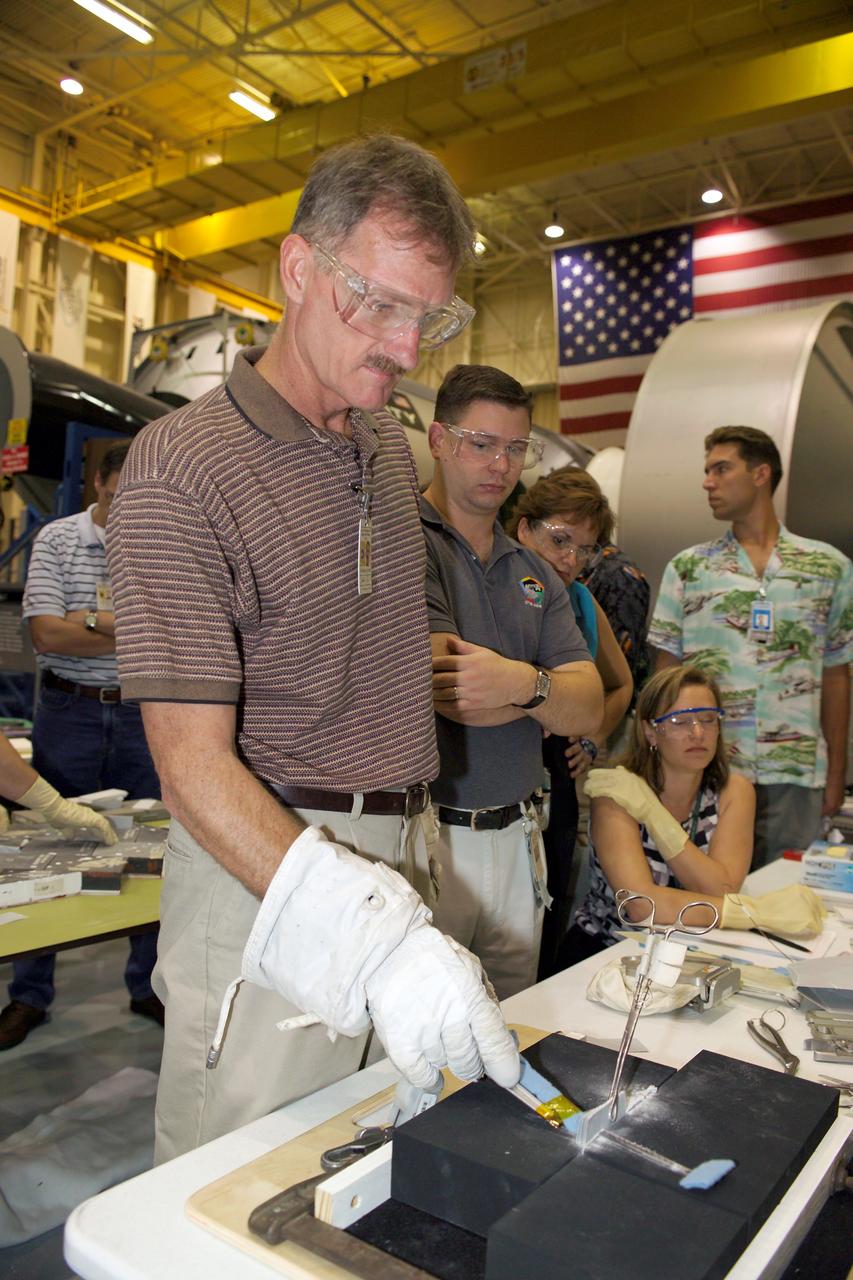
JSC2005-E-30915 (31 July 2005) --- NASA astronaut Joe Tanner (foreground) joins other astronauts and engineers at the Johnson Space Center to practice techniques to eliminate or trim protruding gap fillers that Astronauts Noguchi and Robinson will use during their spacewalk. The ceramic coated-fabric gap fillers are used to protect against hot gas from seeping into gaps between the Shuttle’s protective tiles. Photo credit: NASA/James Blair

This image from NASA's Spitzer Space Telescope shows the Tarantula Nebula in two wavelengths of infrared light, each represented by a different color. The red color at the heart of the nebula shows the presence of particularly hot gas emitting infrared light at a wavelength of 4.5 micrometers. The blue regions are dust composed of molecules called polycyclic aromatic hydrocarbons (PAHs), which are also found in ash from coal, wood and oil fires on Earth. Regions emitting both wavelengths appear white. https://photojournal.jpl.nasa.gov/catalog/PIA23646
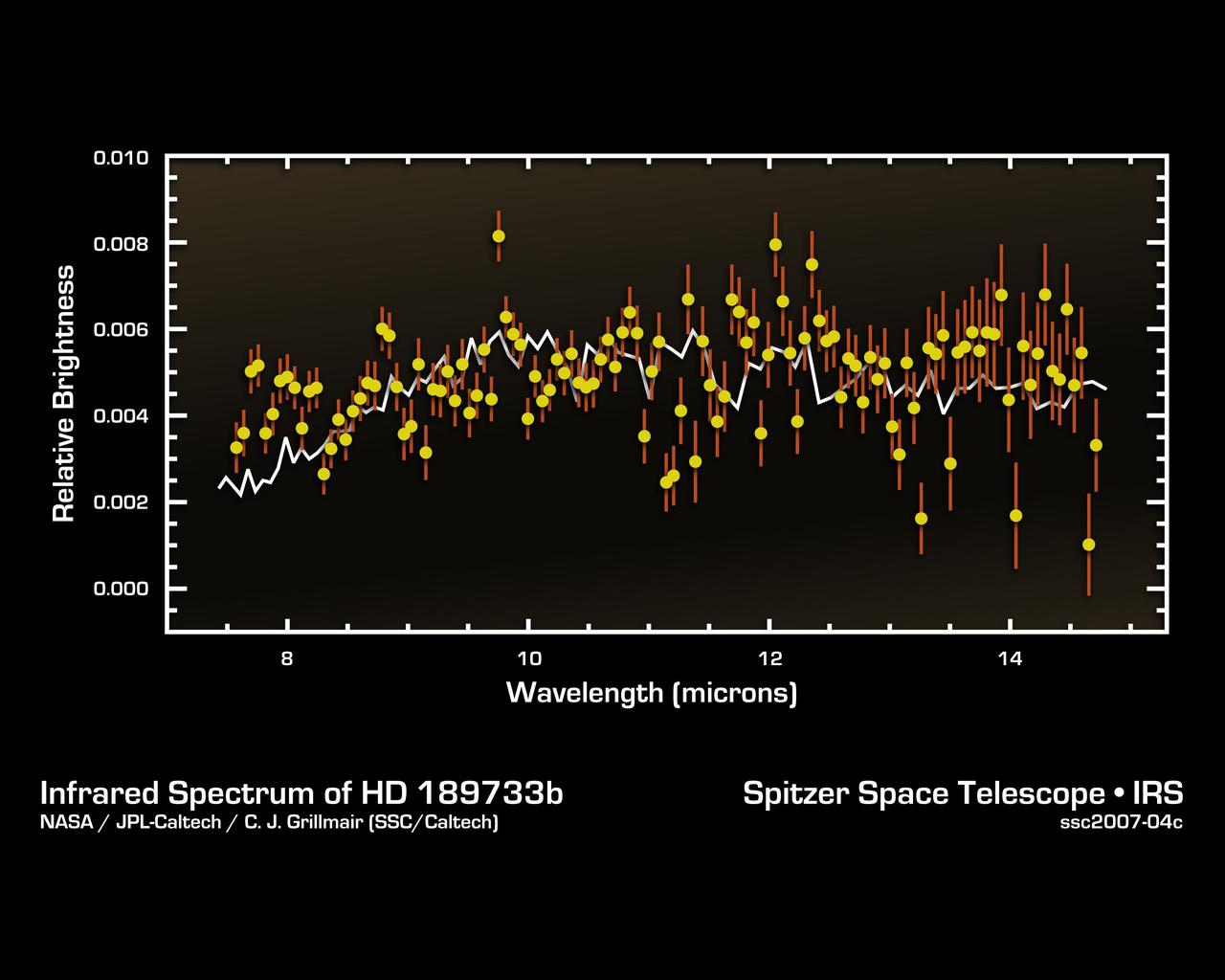
This infrared data from NASA's Spitzer Space Telescope -- called a spectrum -- tells astronomers that a distant gas planet, a so-called "hot Jupiter" called HD 189733b, might be smothered with high clouds. It is one of the first spectra of an alien world. A spectrum is created when an instrument called a spectrograph cracks light from an object open into a rainbow of different wavelengths. Patterns or ripples within the spectrum indicate the presence, or absence, of molecules making up the object. Astronomers using Spitzer's spectrograph were able to obtain infrared spectra for two so-called "transiting" hot-Jupiter planets using the "secondary eclipse" technique. In this method, the spectrograph first collects the combined infrared light from the planet plus its star, then, as the planet is eclipsed by the star, the infrared light of just the star. Subtracting the latter from the former reveals the planet's own rainbow of infrared colors. Astronomers were perplexed when they first saw the infrared spectrum above. It doesn't look anything like what theorists had predicted. Theorists thought the spectra of hot, Jupiter-like planets like this one would be filled with the signatures of molecules in the planets' atmospheres. But the spectrum doesn't show any molecules, and is instead what astronomers call "flat." For example, theorists thought there'd be a strong signature of water in the form of a big drop in the wavelength range between 7 and 10 microns. The fact that water is not detected may indicate that it is hidden underneath a thick blanket of high, dry clouds. The average brightness of the spectrum is also a bit lower than theoretical predictions, suggesting that very high winds are rapidly moving the terrific heat of the noonday sun from the day side of HD 189733b to the night side. This spectrum was produced by Dr. Carl Grillmair of NASA's Spitzer Science Center at the California Institute of Technology in Pasadena, Calif., and his colleagues. The data were taken by Spitzer's infrared spectrograph on November 22, 2006. http://photojournal.jpl.nasa.gov/catalog/PIA09199
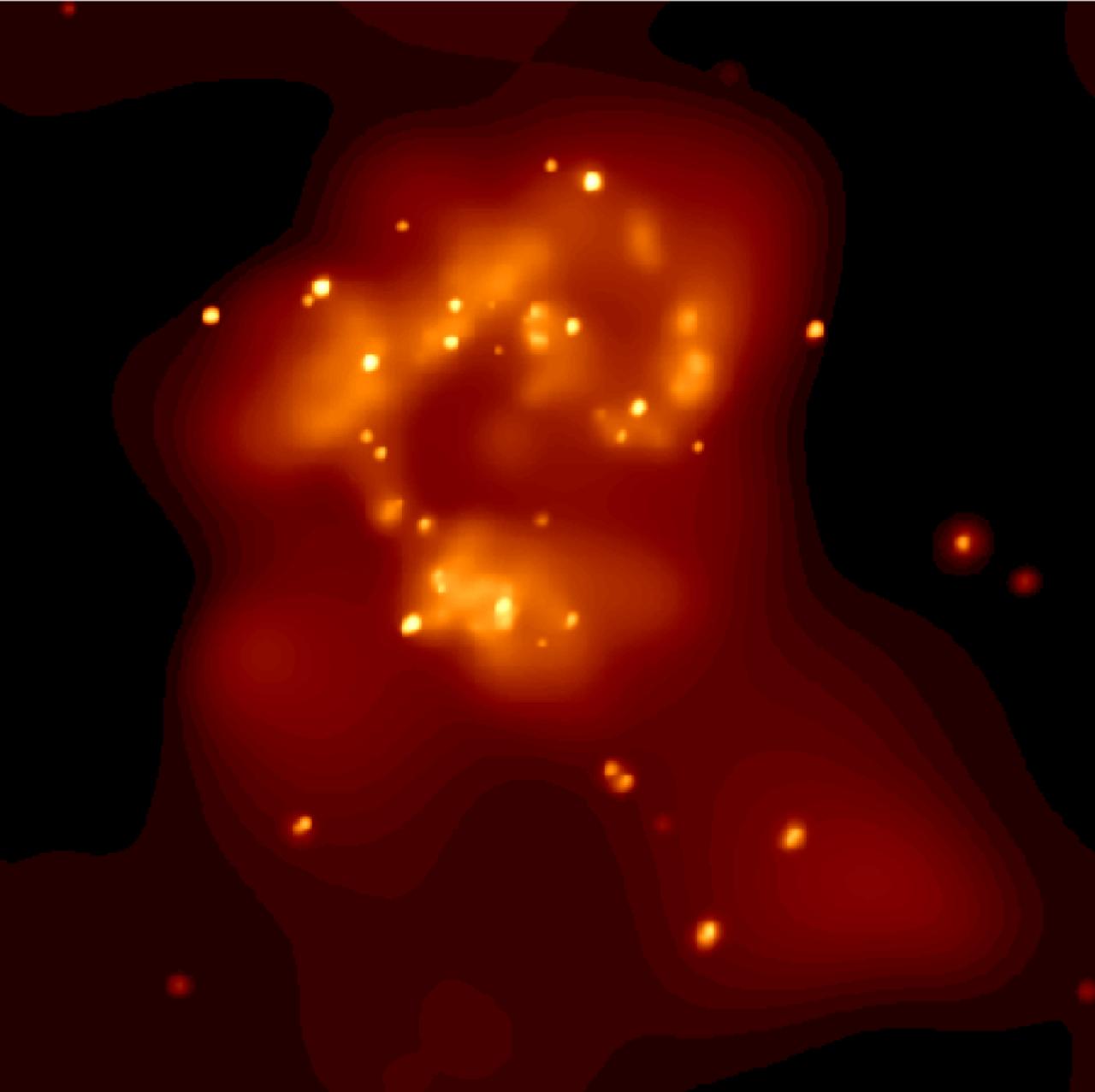
This Chandra image shows the central regions of two colliding galaxies known collectively as the Antennae (NGC-4038/4039). The dozens of bright pointy-like sources are neutron stars or black holes pulling gas off nearby stars. The bright fuzzy patches are multimillion degree gas superbubbles, thousands of light years in diameter that were produced by the accumulated power of thousands of supernovae. The remaining glow of x-ray emission could be due to many faint x-ray sources or to clouds of hot gas in the galaxies. About 60 million light years from Earth in the constellation Corvus, the Antennae Galaxies got their nickname from the wispy anntennae-like streams of gas as seen by optical telescopes. These ongoing wisps are believed to have been produced approximately 100 million years ago by the collision between the galaxies. Although it is rare for stars to hit each other during a galactic collision, clouds of dust and gas do collide. Compression of these clouds can lead to the rebirth of millions of stars, and a few million years later, to thousands of supernovae.
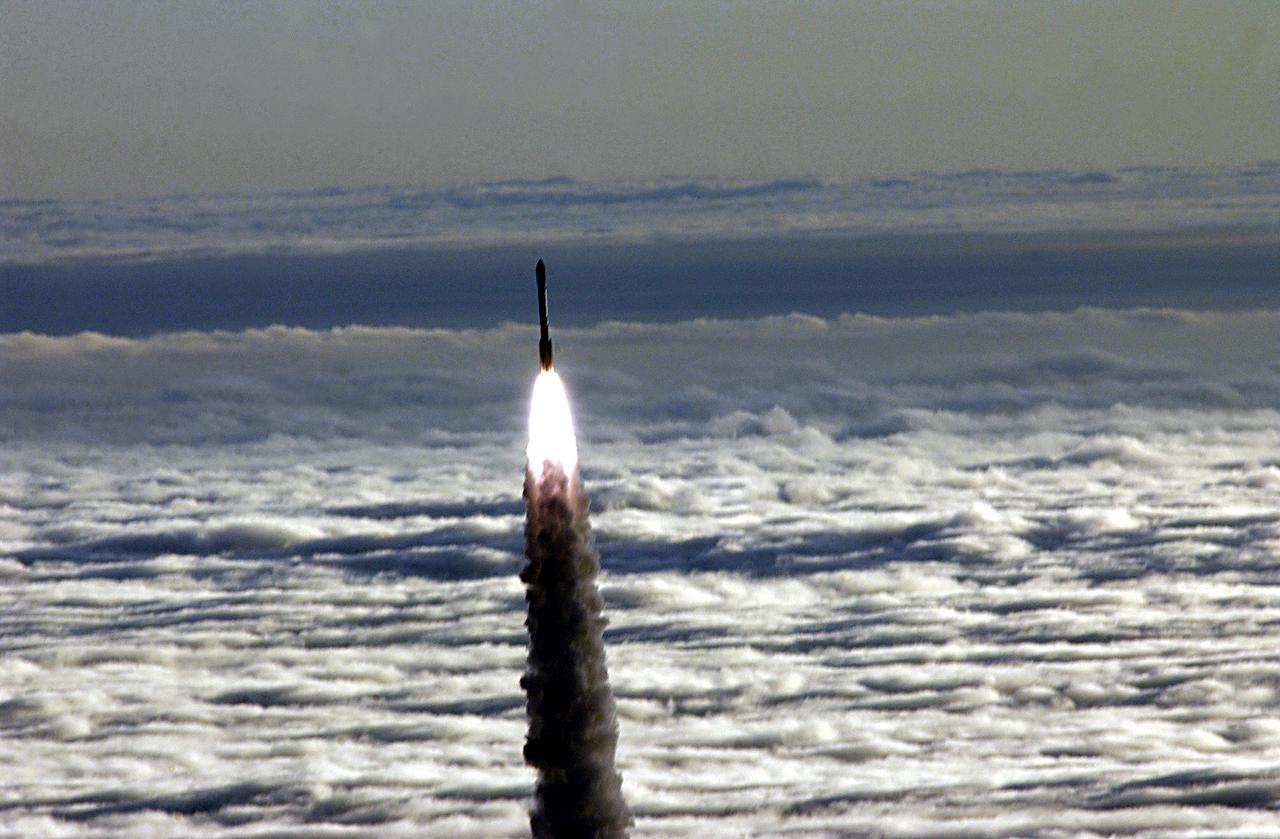
Vandenberg AFB CA-- A Boeing Delta II rocket soars above the clouds here today at Vandenberg AFB CA. The NASA payload aboard the rocket is the ICESat, an Ice Cloud and land Elevation Satellite, and CHIPSat, a Cosmic Hot Interstellar Plasma Spectrometer. ICESat, a 661-pound satellite, is a benchmark satellite for the Earth Observing System that will help scientists determine if the global sea level is rising or falling. It will observe the ice sheets that blanket the Earth’s poles to determine if they are growing or shrinking. It will assist in developing an understanding of how changes in the Earth’s atmosphere and climate affect polar ice masses and global sea level. The Geoscience Laser Altimeter System is the sole instrument on the satellite. CHIPSat, a suitcase-size 131-pound satellite, will provide information about the origin, physical processes and properties of the hot gas contained in the interstellar medium. This launch, marks the first Delta from Vandenberg this year. (USAF photo by: SSgt Lee A Osberry Jr.)

VANDENBERG AFB, Calif. -- A Boeing Delta II rocket soars above the clouds here today at Vandenberg AFB, Calif. The NASA payloads aboard the rocket are the ICESat, an Ice Cloud and land Elevation Satellite, and CHIPSat, a Cosmic Hot Interstellar Plasma Spectrometer. ICESat, a 661-pound satellite, is a benchmark satellite for the Earth Observing System that will help scientists determine if the global sea level is rising or falling. It will observe the ice sheets that blanket the Earth’s poles to determine if they are growing or shrinking. It will assist in developing an understanding of how changes in the Earth’s atmosphere and climate affect polar ice masses and global sea level. The Geoscience Laser Altimeter System is the sole instrument on the satellite. CHIPSat, a suitcase-size 131-pound satellite, will provide information about the origin, physical processes and properties of the hot gas contained in the interstellar medium. This launch marks the first Delta from Vandenberg this year. (USAF photo by: SSgt. Lee A Osberry Jr.)

Here we see the spectacular cosmic pairing of the star Hen 2-427 — more commonly known as WR 124 — and the nebula M1-67 which surrounds it. Both objects, captured here by the NASA/ESA Hubble Space Telescope are found in the constellation of Sagittarius and lie 15 000 light-years away. The star Hen 2-427 shines brightly at the very centre of this explosive image and around the hot clumps of gas are ejected into space at over 150 000 kilometres per hour. Hen 2-427 is a Wolf–Rayet star, named after the astronomers Charles Wolf and Georges Rayet. Wolf–Rayet are super-hot stars characterised by a fierce ejection of mass. The nebula M1-67 is estimated to be no more than 10 000 years old — just a baby in astronomical terms — but what a beautiful and magnificent sight it makes. A version of this image was released in 1998, but has now been re-reduced with the latest software.
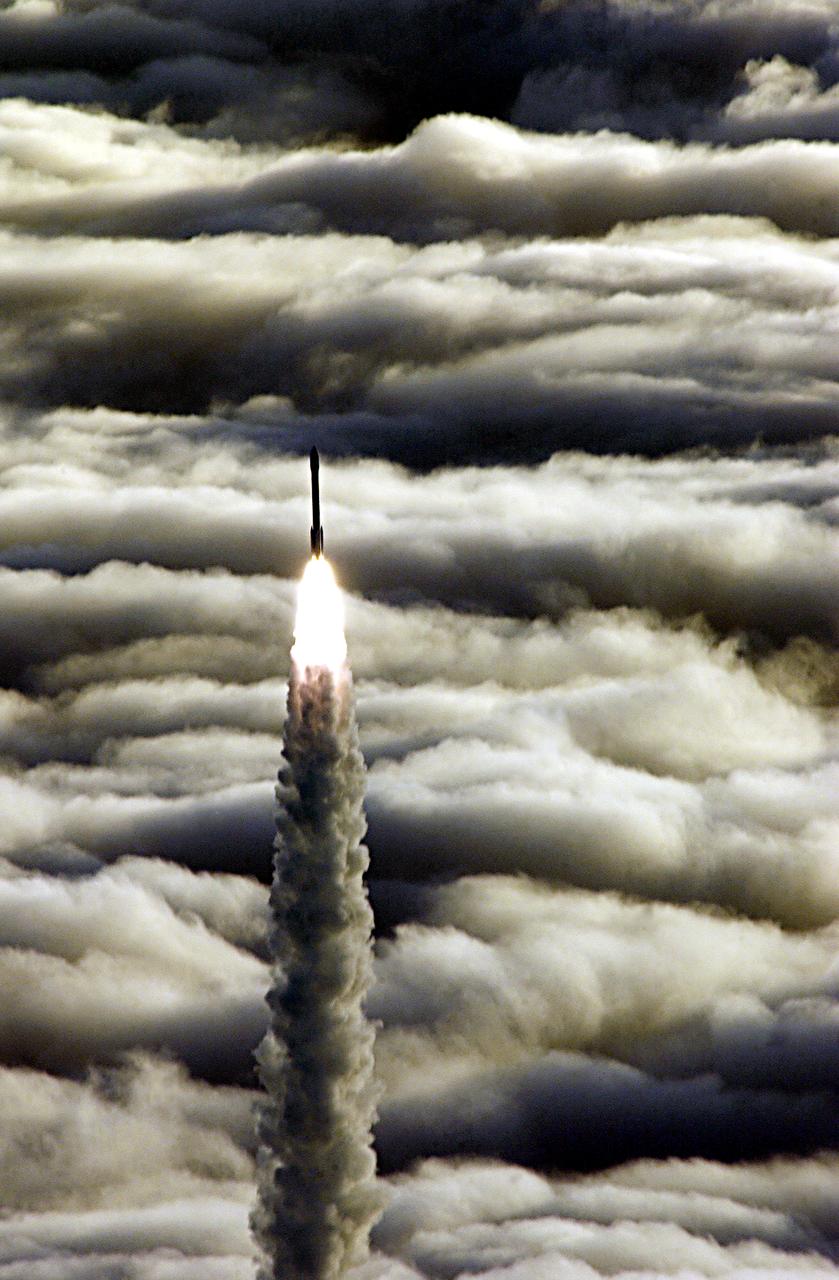
Vandenberg AFB CA-- A Boeing Delta II rocket soars above the clouds here today at Vandenberg AFB CA. The NASA payload aboard the rocket is the ICESat, an Ice Cloud and land Elevation Satellite, and CHIPSat, a Cosmic Hot Interstellar Plasma Spectrometer. ICESat, a 661-pound satellite, is a benchmark satellite for the Earth Observing System that will help scientists determine if the global sea level is rising or falling. It will observe the ice sheets that blanket the Earth’s poles to determine if they are growing or shrinking. It will assist in developing an understanding of how changes in the Earth’s atmosphere and climate affect polar ice masses and global sea level. The Geoscience Laser Altimeter System is the sole instrument on the satellite. CHIPSat, a suitcase-size 131-pound satellite, will provide information about the origin, physical processes and properties of the hot gas contained in the interstellar medium. This launch, marks the first Delta from Vandenberg this year. (USAF photo by: SSgt Lee A Osberry Jr.)

VANDENBERG AFB, Calif. -- A Boeing Delta II rocket soars above the clouds here today at Vandenberg AFB, Calif. The NASA payload aboard the rocket are the ICESat, an Ice Cloud and land Elevation Satellite, and CHIPSat, a Cosmic Hot Interstellar Plasma Spectrometer. ICESat, a 661-pound satellite, is a benchmark satellite for the Earth Observing System that will help scientists determine if the global sea level is rising or falling. It will observe the ice sheets that blanket the Earth’s poles to determine if they are growing or shrinking. It will assist in developing an understanding of how changes in the Earth’s atmosphere and climate affect polar ice masses and global sea level. The Geoscience Laser Altimeter System is the sole instrument on the satellite. CHIPSat, a suitcase-size 131-pound satellite, will provide information about the origin, physical processes and properties of the hot gas contained in the interstellar medium. This launch marks the first Delta from Vandenberg this year. (USAF photo by: SSgt Lee A Osberry Jr.)

NASA image release July 3, 2012 Caption: Resembling a Fourth of July skyrocket, Herbig-Haro 110 is a geyser of hot gas from a newborn star that splashes up against and ricochets off the dense core of a cloud of molecular hydrogen. Although the plumes of gas look like whiffs of smoke, they are actually billions of times less dense than the smoke from a July 4 firework. This Hubble Space Telescope photo shows the integrated light from plumes, which are light-years across. -- Herbig-Haro (HH) objects come in a wide array of shapes, but the basic configuration stays the same. Twin jets of heated gas, ejected in opposite directions away from a forming star, stream through interstellar space. Astronomers suspect that these outflows are fueled by gas accreting onto a young star surrounded by a disk of dust and gas. The disk is the "fuel tank," the star is the gravitational engine, and the jets are the exhaust. When these energetic jets slam into colder gas, the collision plays out like a traffic jam on the interstate. Gas within the shock front slows to a crawl, but more gas continues to pile up as the jet keeps slamming into the shock from behind. Temperatures climb sharply, and this curving, flared region starts to glow. These "bow shocks" are so named because they resemble the waves that form at the front of a boat. In the case of the single HH 110 jet, astronomers observe a spectacular and unusual permutation on this basic model. Careful study has repeatedly failed to find the source star driving HH 110, and there may be good reason for this: perhaps the HH 110 outflow is itself generated by another jet. Astronomers now believe that the nearby HH 270 jet grazes an immovable obstacle - a much denser, colder cloud core - and gets diverted off at about a 60-degree angle. The jet goes dark and then reemerges, having reinvented itself as HH 110. The jet shows that these energetic flows are like the erratic outbursts from a Roman candle. As fast-moving blobs of gas catch up and collide with slower blobs, new shocks arise along the jet's interior. The light emitted from excited gas in these hot blue ridges marks the boundaries of these interior collisions. By measuring the current velocity and positions of different blobs and hot ridges along the chain within the jet, astronomers can effectively "rewind" the outflow, extrapolating the blobs back to the moment when they were emitted. This technique can be used to gain insight into the source star's history of mass accretion. This image is a composite of data taken with Hubble's Advanced Camera for Surveys in 2004 and 2005 and the Wide Field Camera 3 in April 2011. Credit: NASA, ESA, and the Hubble Heritage Team (STScI/AURA) <b><a href="http://www.nasa.gov/audience/formedia/features/MP_Photo_Guidelines.html" rel="nofollow">NASA image use policy.</a></b> <b><a href="http://www.nasa.gov/centers/goddard/home/index.html" rel="nofollow">NASA Goddard Space Flight Center</a></b> enables NASA’s mission through four scientific endeavors: Earth Science, Heliophysics, Solar System Exploration, and Astrophysics. Goddard plays a leading role in NASA’s accomplishments by contributing compelling scientific knowledge to advance the Agency’s mission. <b>Follow us on <a href="http://twitter.com/NASA_GoddardPix" rel="nofollow">Twitter</a></b> <b>Like us on <a href="http://www.facebook.com/pages/Greenbelt-MD/NASA-Goddard/395013845897?ref=tsd" rel="nofollow">Facebook</a></b> <b>Find us on <a href="http://instagrid.me/nasagoddard/?vm=grid" rel="nofollow">Instagram</a></b>
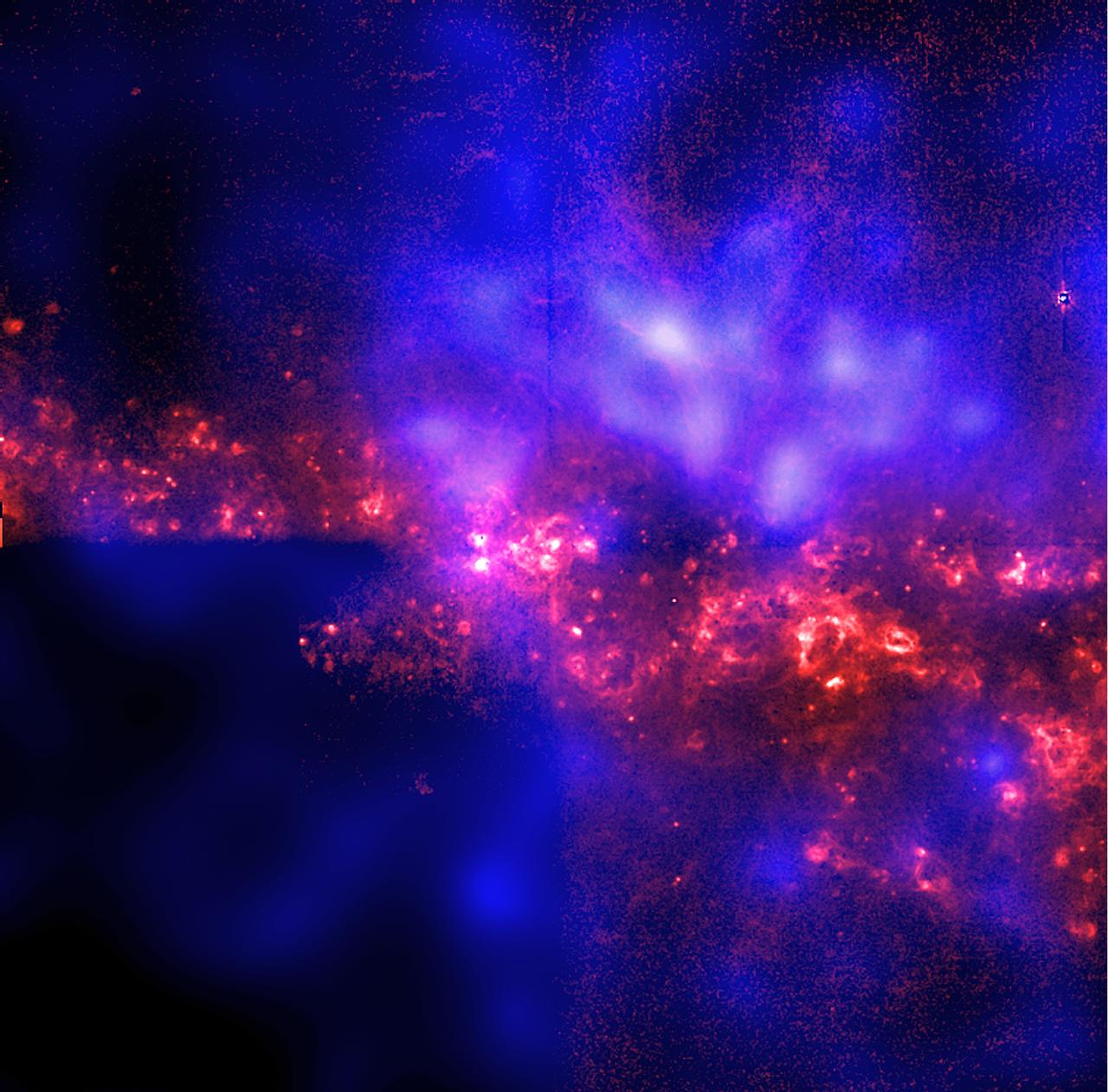
This image shows the central region of the spiral galaxy NGC 4631 as seen edge-on from the Chandra X-Ray Observatory (CXO) and the Hubble Space Telescope (HST). The Chandra data, shown in blue and purple, provide the first unambiguous evidence for a halo of hot gas surrounding a galaxy that is very similar to our Milky Way. The structure across the middle of the image and the extended faint filaments, shown in orange, represent the observation from the HST that reveals giant bursting bubbles created by clusters of massive stars. Scientists have debated for more than 40 years whether the Milky Way has an extended corona, or halo, of hot gas. Observations of NGC 4631 and similar galaxies provide astronomers with an important tool in the understanding our own galactic environment. A team of astronomers, led by Daniel Wang of the University of Massachusetts at Amherst, observed NGC 4631 with CXO's Advanced Charge-Coupled Device (CCD) Imaging Spectrometer (ACIS). The observation took place on April 15, 2000, and its duration was approximately 60,000 seconds.
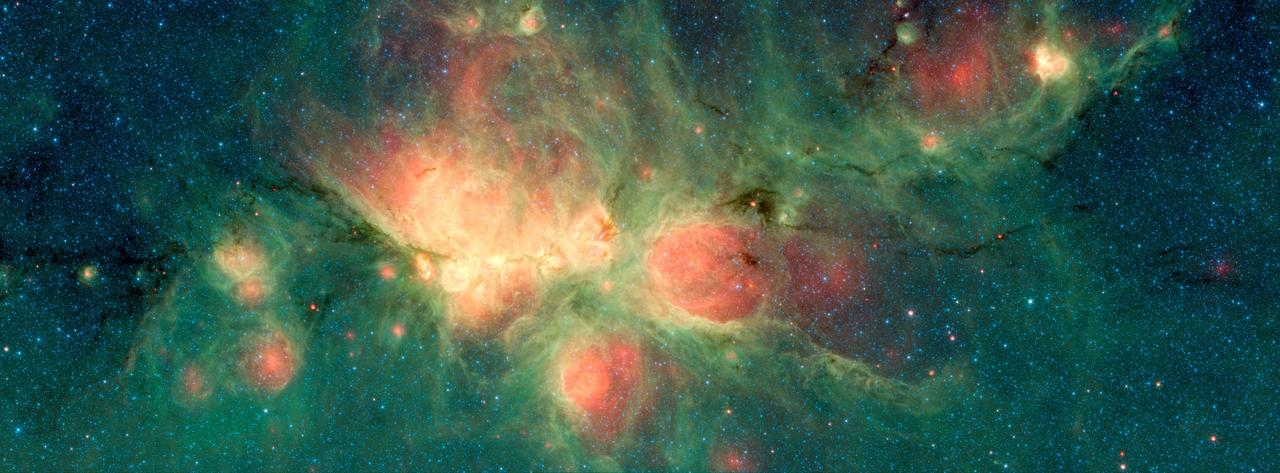
The Cat's Paw Nebula, imaged here by NASA's Spitzer Space Telescope, lies inside the Milky Way Galaxy and is located in the constellation Scorpius. Its distance from Earth is estimated to be between 1.3 kiloparsecs (about 4,200 light years) to 1.7 kiloparsecs (about 5,500 light years). The bright, cloudlike band running left to right across the image shows the presence of gas and dust that can collapse to form new stars. The black filaments running through the nebula are particularly dense regions of gas and dust. The entire star-forming region is thought to be between 24 and 27 parsecs (80-90 light years) across. The stars that form inside the nebula heat up the pressurized gas surrounding them, such that the gas may expand and form "bubbles", which appear red in this image. Asymmetric bubbles may "burst," creating U-shaped features. The green areas show regions where radiation from hot stars collided with large molecules and small dust grains called "polycyclic aromatic hydocarbons" (PAHs), causing them to fluoresce. This image was compiled using data from two Spitzer instruments, the Infrared Array Camera (IRAC) and the Multiband Imaging Photometer (MIPS). The colors correspond with wavelengths of 3.6 microns (blue), 4.5 microns (cyan), 8 microns (green) and 24 microns (red). https://photojournal.jpl.nasa.gov/catalog/PIA22568

This Chandra X-ray observatory image of M83 shows numerous point-like neutron stars and black hole x-ray sources scattered throughout the disk of this spiral galaxy. The bright nuclear region of the galaxy glows prominently due to a burst of star formation that is estimated to have begun about 20 million years ago in the galaxy's time frame. The nuclear region, enveloped by a 7 million degree Celsius gas cloud of carbon, neon, magnesium, silicon, and sulfur atoms, contains a much higher concentration of neutron stars and black holes than the rest of the galaxy. Hot gas with a slightly lower temperature of 4 million degrees observed along the spiral arms of the galaxy suggests that star formation in this region may be occurring at a more sedate rate.
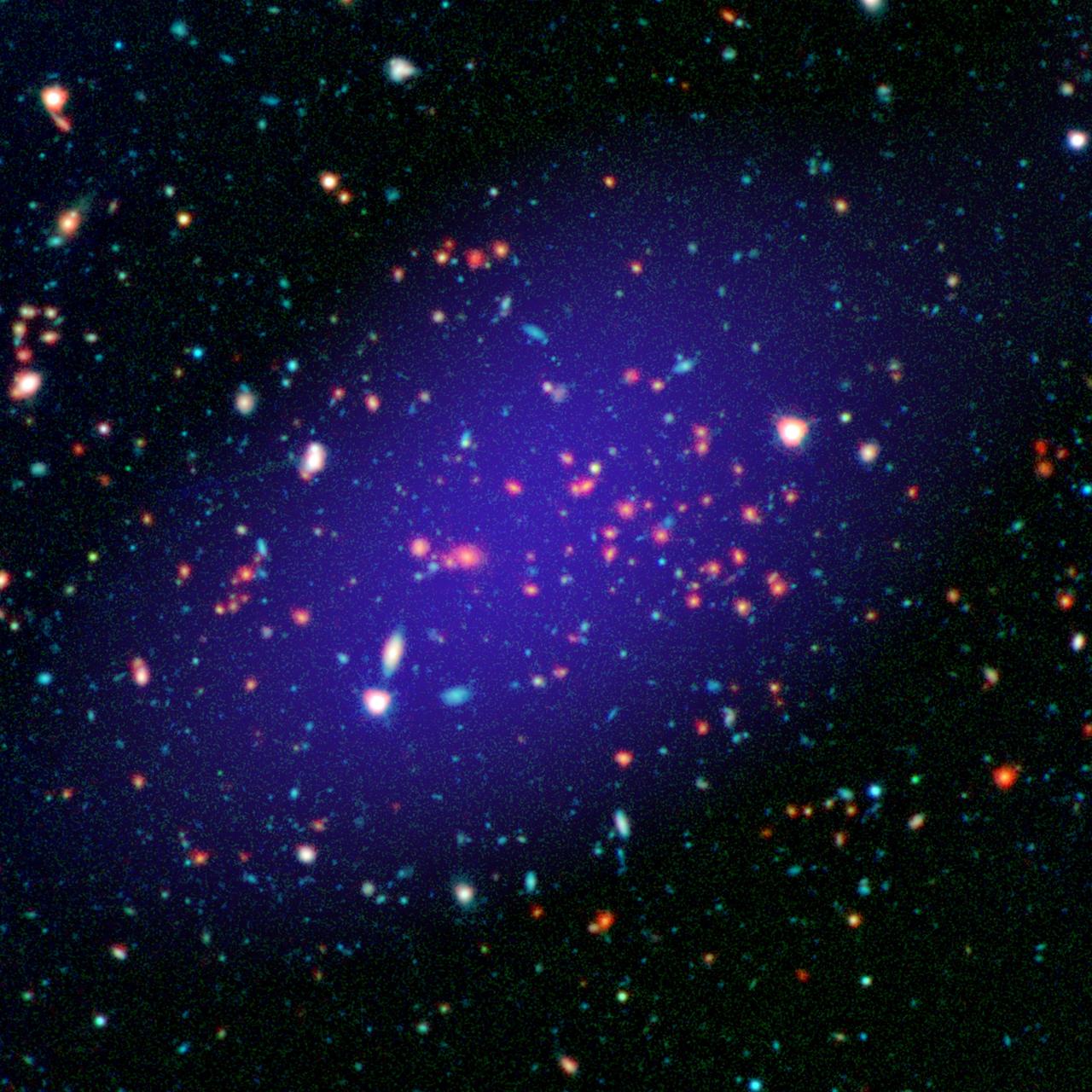
The galaxy cluster called MOO J1142+1527 can be seen here as it existed when light left it 8.5 billion years ago. The red galaxies at the center of the image make up the heart of the galaxy cluster. This color image is constructed from multi-wavelength observations: Infrared observations from NASA's Spitzer Space Telescope are shown in red; near-infrared and visible light captured by the Gemini Observatory atop Mauna Kea in Hawaii is green and blue; and radio light from the Combined Array for Research in Millimeter-wave Astronomy (CARMA), near Owens Valley in California, is purple. In addition to galaxies, clusters also contain a reservoir of hot gas with temperatures in the tens of millions of degrees Celsius/Kelvin. CARMA was used to detect this gas, and to determine the mass of this cluster. http://photojournal.jpl.nasa.gov/catalog/PIA20052

RainCube was deployed into low-Earth orbit from the International Space Station in July, 2018, where it has been measuring rain and snowfall from space. The size of the tiny weather satellite can be seen in comparison to the Space Station. RainCube is a prototype for a possible fleet of small satellites that could one day help monitor severe storms, lead to improving the accuracy of weather forecasts and track climate change over time. A closer look at these images reveals there are two CubeSats very close together -- RainCube is the bottom CubeSat closer to Earth, while the one above it is HaloSat, used to map the distribution of hot gas in the Milky Way. https://photojournal.jpl.nasa.gov/catalog/PIA22653
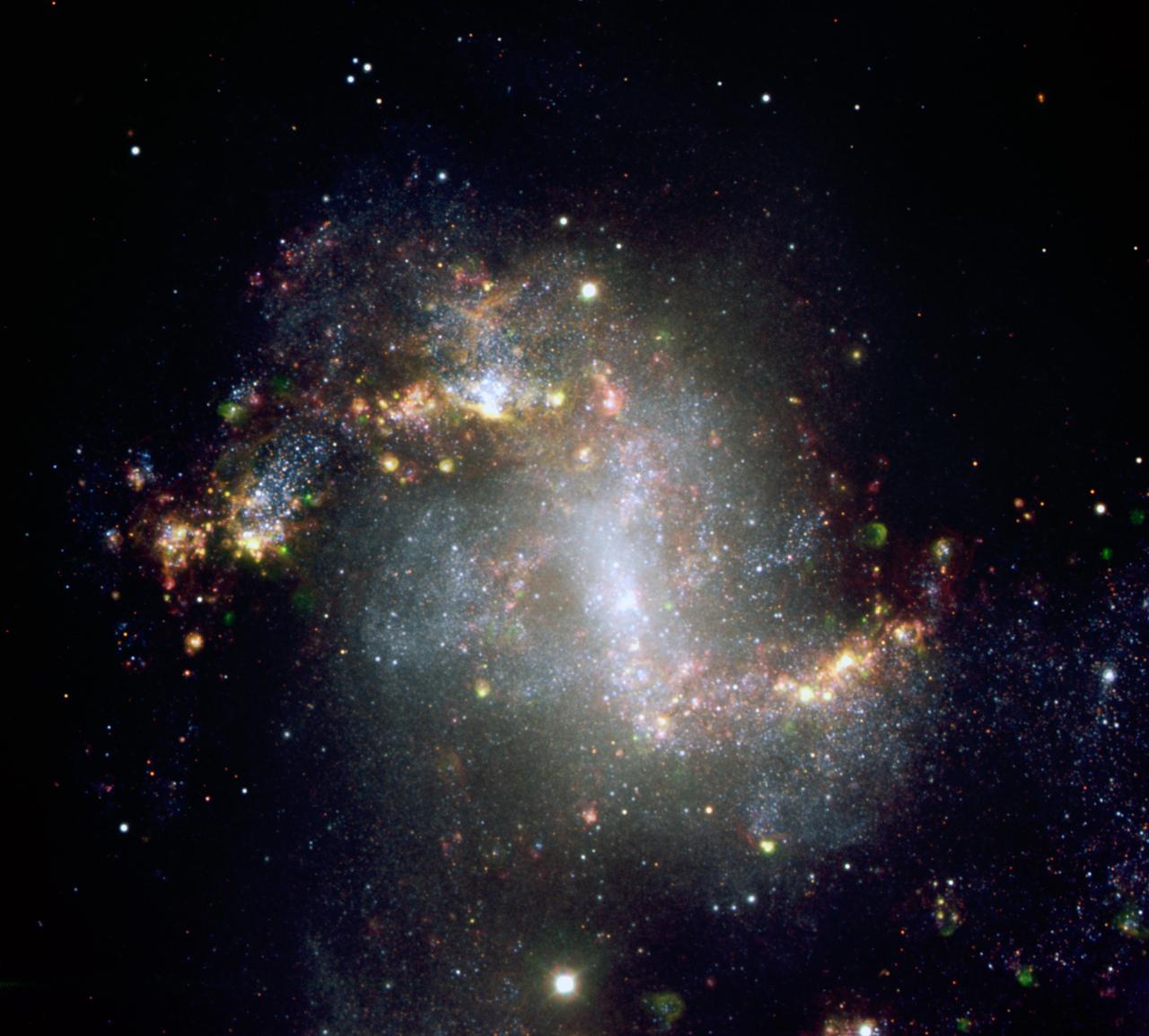
The central parts of the starburst galaxy NGC 1313. The very active state of this galaxy is evident from the image, showing many star formation regions. A great number of supershell nebulae, that is, cocoons of gas inflated and etched by successive bursts of star formation, are visible. The green nebulosities are regions emitting in the ionised oxygen lines and may harbour clusters with very hot stars. This colour-composite is based on images obtained with the FORS1 instrument on one of the 8.2-m Unit Telescope of ESO's Very Large Telescope, located at Cerro Paranal. The data were obtained in the night of 16 December 2003, through different broad- (R, B, and z) and narrow-band filters (H-alpha, OI, and OIII).

This artist concept shows K2-138, the first multi-planet system discovered by citizen scientists. The central star is slightly smaller and cooler than our Sun. The five known planets are all between the size of Earth and Neptune. Planet b may potentially be rocky, but planets c, d, e, and f likely contain large amounts of ice and gas. All five planets have orbital periods shorter than 13 days and are all incredibly hot, ranging from 800 to 1,800 degrees Fahrenheit. https://photojournal.jpl.nasa.gov/catalog/PIA22088
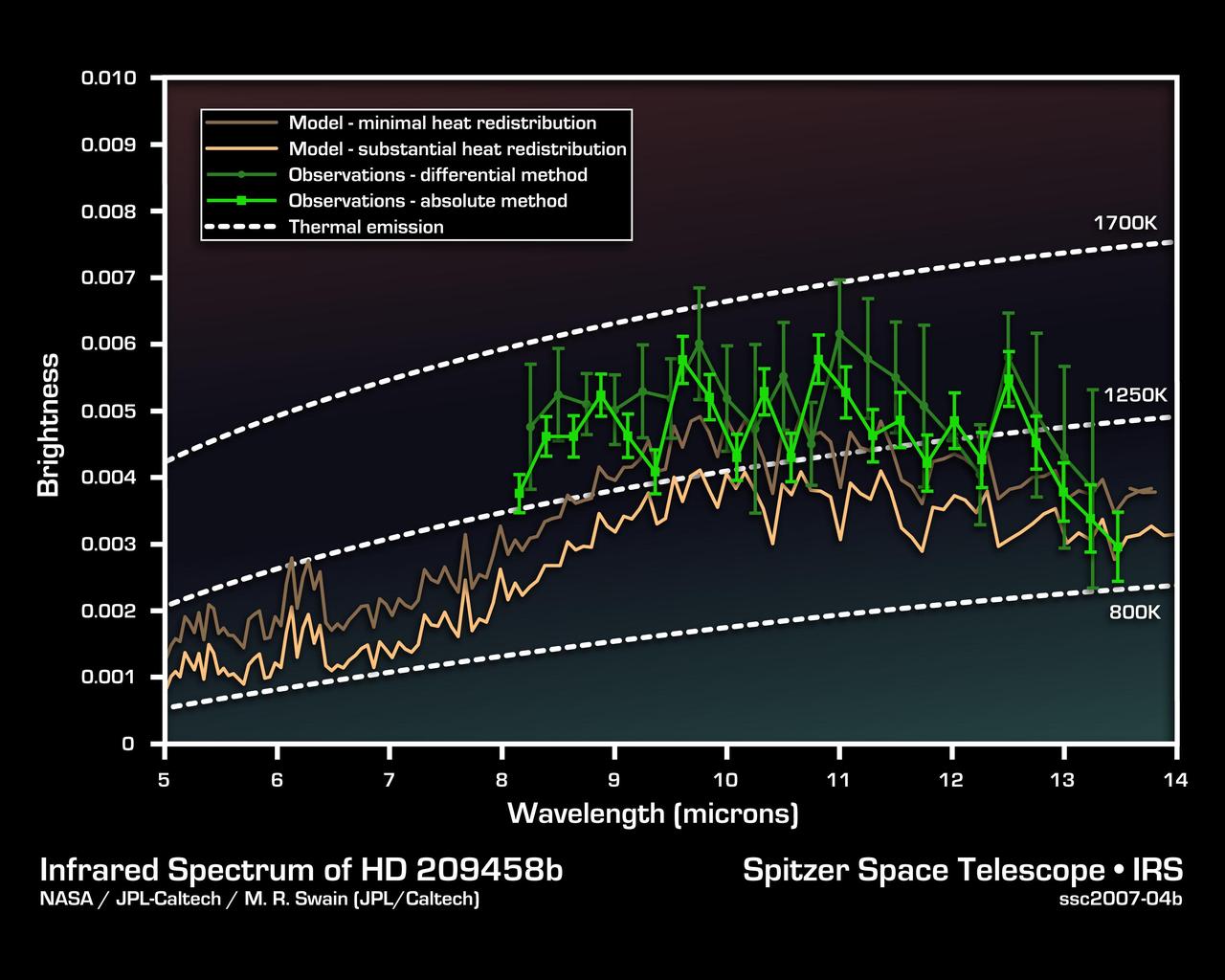
This infrared data from NASA's Spitzer Space Telescope -- called a spectrum -- tells astronomers that a distant gas planet, a so-called "hot Jupiter" called HD 209458b, might be smothered with high clouds. It is one of the first spectra of an alien world. A spectrum is created when an instrument called a spectrograph cracks light from an object open into a rainbow of different wavelengths. Patterns or ripples within the spectrum indicate the presence, or absence, of molecules making up the object. Astronomers using Spitzer's spectrograph were able to obtain infrared spectra for two so-called "transiting" hot-Jupiter planets using the "secondary eclipse" technique. In this method, the spectrograph first collects the combined infrared light from the planet plus its star, then, as the planet is eclipsed by the star, the infrared light of just the star. Subtracting the latter from the former reveals the planet's own rainbow of infrared colors. When astronomers first saw the infrared spectrum above, they were shocked. It doesn't look anything like what theorists had predicted. For example, theorists thought there'd be signatures of water in the wavelength ranges of 8 to 9 microns. The fact that water is not detected might indicate that it is hidden under a thick blanket of high, dry clouds. In addition, the spectrum shows signs of silicate dust -- tiny grains of sand -- in the wavelength range of 9 to 10 microns. This suggests that the planet's skies could be filled with high clouds of dust unlike anything seen in our own solar system. There is also an unidentified molecular signature at 7.78 microns. Future observations using Spitzer's spectrograph should be able to determine the nature of the mysterious feature. This spectrum was produced by Dr. Jeremy Richardson of NASA's Goddard Space Flight Center, Greenbelt, Md. and his colleagues. The data were taken by Spitzer's infrared spectrograph on July 6 and 13, 2005. http://photojournal.jpl.nasa.gov/catalog/PIA09198
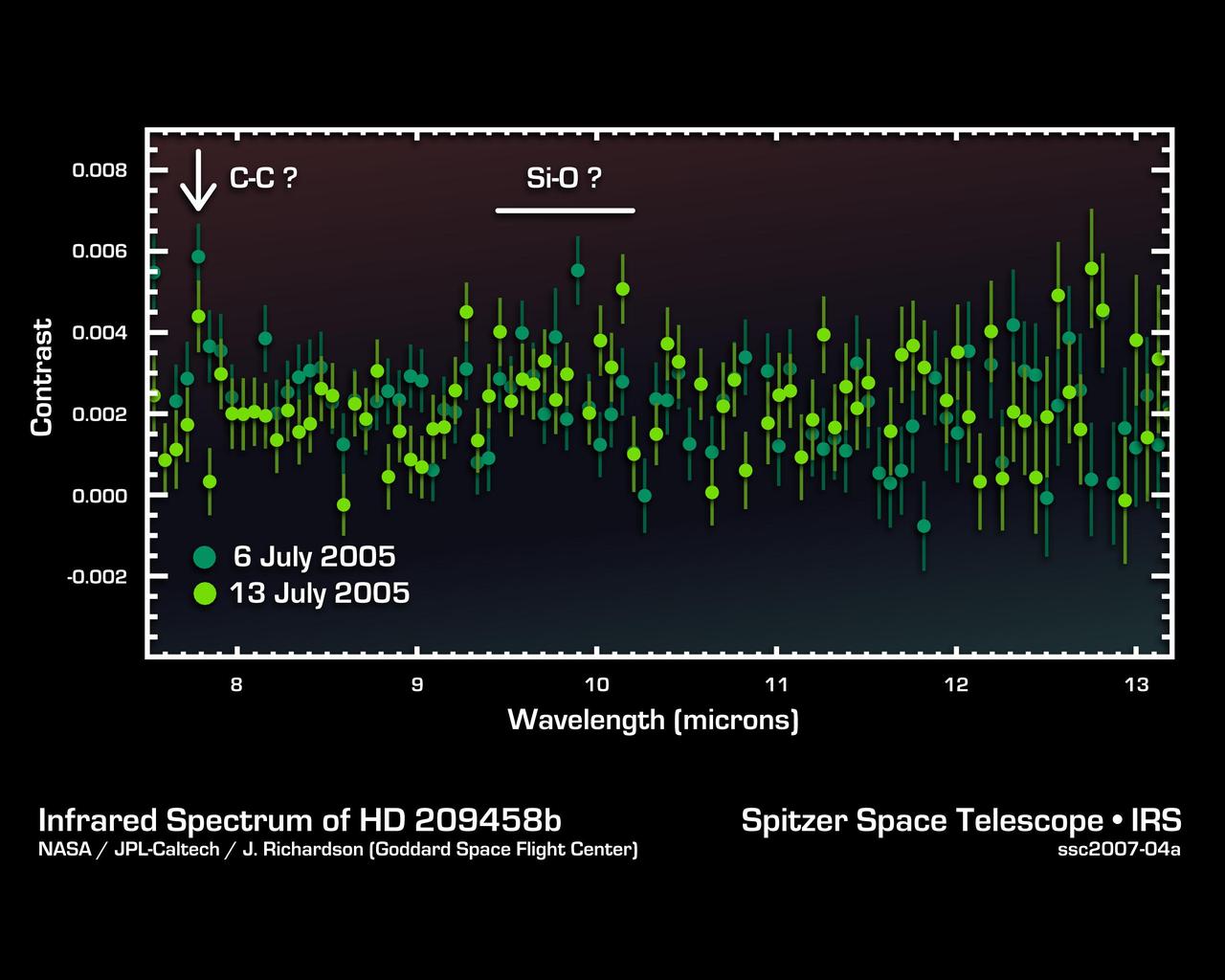
This infrared data from NASA's Spitzer Space Telescope -- called a spectrum -- tells astronomers that a distant gas planet, a so-called "hot Jupiter" called HD 209458b, might be smothered with high clouds. It is one of the first spectra of an alien world. A spectrum is created when an instrument called a spectrograph cracks light from an object open into a rainbow of different wavelengths. Patterns or ripples within the spectrum indicate the presence, or absence, of molecules making up the object. Astronomers using Spitzer's spectrograph were able to obtain infrared spectra for two so-called "transiting" hot-Jupiter planets using the "secondary eclipse" technique. In this method, the spectrograph first collects the combined infrared light from the planet plus its star, then, as the planet is eclipsed by the star, the infrared light of just the star. Subtracting the latter from the former reveals the planet's own rainbow of infrared colors. When astronomers first saw the infrared spectrum above, they were shocked. It doesn't look anything like what theorists had predicted. For example, theorists thought there'd be signatures of water in the wavelength ranges of 8 to 9 microns. The fact that water is not detected might indicate that it is hidden under a thick blanket of high, dry clouds. In addition, the spectrum shows signs of silicate dust -- tiny grains of sand -- in the wavelength range of 9 to 10 microns. This suggests that the planet's skies could be filled with high clouds of dust unlike anything seen in our own solar system. There is also an unidentified molecular signature at 7.78 microns. Future observations using Spitzer's spectrograph should be able to determine the nature of the mysterious feature. This spectrum was produced by Dr. Jeremy Richardson of NASA's Goddard Space Flight Center, Greenbelt, Md. and his colleagues. The data were taken by Spitzer's infrared spectrograph on July 6 and 13, 2005. http://photojournal.jpl.nasa.gov/catalog/PIA09197
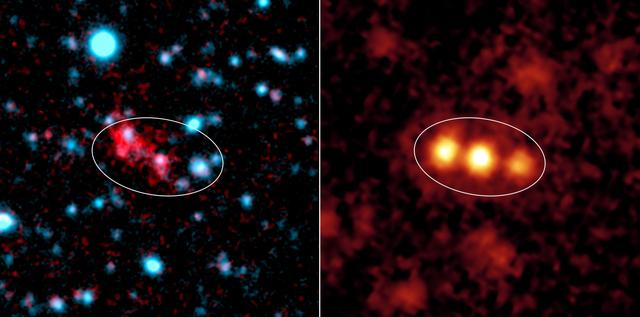
This image composite shows a giant galactic blob (red) and the three merging galaxies NASA's Spitzer Space Telescope discovered within it (yellow). Blobs are intensely glowing clouds of hot hydrogen gas that envelop faraway galaxies. They are about 10 times as large as the galaxies they surround. Visible-light images reveal the vast extent of blobs, but don't provide much information about their host galaxies. Using its heat-seeking infrared eyes, Spitzer was able to see the dusty galaxies tucked inside one well-known blob located 11 billion light-years away. The findings reveal three monstrously bright galaxies, trillions of times brighter than the Sun, in the process of merging together. Spitzer also observed three other blobs located in the same cosmic neighborhood, all of which were found to be glaringly bright. One of these blobs is also known to be a galactic merger, only between two galaxies instead of three. It remains to be seen whether the final two blobs studied also contain mergers. The Spitzer data were acquired by its multiband imaging photometer. The visible-light image was taken by the Blanco Telescope at the Cerro Tololo Inter-American Observatory, Chile. http://photojournal.jpl.nasa.gov/catalog/PIA07220

Hubble’s Spirograph In this classic Hubble image from 2000, the planetary nebula IC 418 glows like a multifaceted jewel with enigmatic patterns. IC 418 lies about 2,000 light-years from Earth in the direction of the constellation Lepus. A planetary nebula represents the final stage in the evolution of a star similar to our sun. The star at the center of IC 418 was a red giant a few thousand years ago, but then ejected its outer layers into space to form the nebula, which has now expanded to a diameter of about 0.1 light-year. The stellar remnant at the center is the hot core of the red giant, from which ultraviolet radiation floods out into the surrounding gas, causing it to fluoresce. Over the next several thousand years, the nebula will gradually disperse into space, and then the star will cool and fade away for billions of years as a white dwarf. Our own sun is expected to undergo a similar fate, but fortunately, this will not occur until some 5 billion years from now. The Hubble image of IC 418 is shown with colors added to represent the different camera filters used that isolate light from various chemical elements. Red shows emission from ionized nitrogen (the coolest gas in the nebula, located furthest from the hot nucleus), green shows emission from hydrogen and blue traces the emission from ionized oxygen (the hottest gas, closest to the central star). The remarkable textures seen in the nebula are newly revealed by the Hubble Space Telescope, and their origin is still uncertain. Read more: <a href="https://go.nasa.gov/2roofKS" rel="nofollow">go.nasa.gov/2roofKS</a> Credit: NASA and The Hubble Heritage Team (STScI/AURA); Acknowledgment: Dr. Raghvendra Sahai (JPL) and Dr. Arsen R. Hajian (USNO)
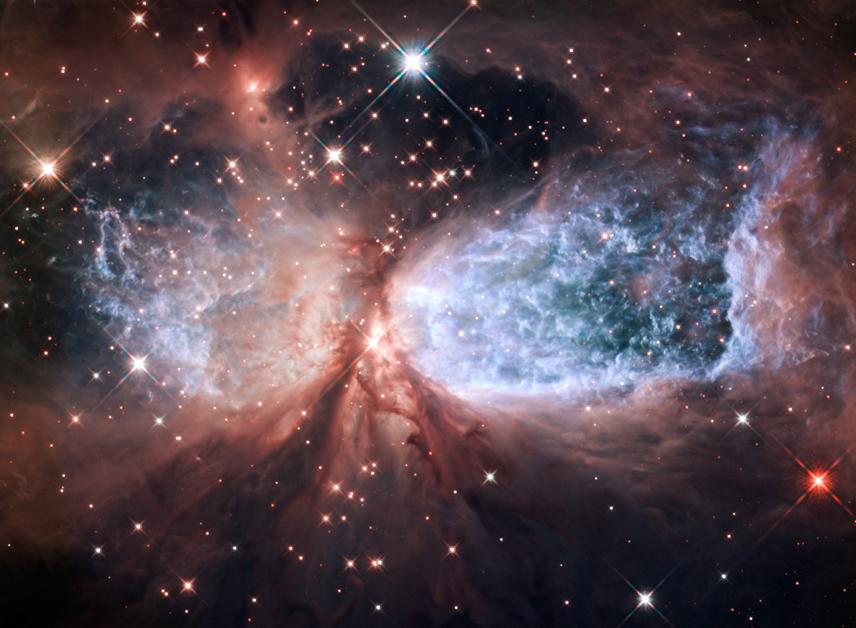
The bipolar star-forming region, called Sharpless 2-106, looks like a soaring, celestial snow angel. The outstretched “wings” of the nebula record the contrasting imprint of heat and motion against the backdrop of a colder medium. Twin lobes of super-hot gas, glowing blue in this image, stretch outward from the central star. This hot gas creates the “wings” of our angel. A ring of dust and gas orbiting the star acts like a belt, cinching the expanding nebula into an “hourglass” shape. To read more about this image go to: <a href="http://www.nasa.gov/mission_pages/hubble/science/snow-angel.html" rel="nofollow">www.nasa.gov/mission_pages/hubble/science/snow-angel.html</a> Credit: NASA, ESA, and the Hubble Heritage Team (STScI/AURA) <b><a href="http://www.nasa.gov/audience/formedia/features/MP_Photo_Guidelines.html" rel="nofollow">NASA image use policy.</a></b> <b><a href="http://www.nasa.gov/centers/goddard/home/index.html" rel="nofollow">NASA Goddard Space Flight Center</a></b> enables NASA’s mission through four scientific endeavors: Earth Science, Heliophysics, Solar System Exploration, and Astrophysics. Goddard plays a leading role in NASA’s accomplishments by contributing compelling scientific knowledge to advance the Agency’s mission. <b>Follow us on <a href="http://twitter.com/NASA_GoddardPix" rel="nofollow">Twitter</a></b> <b>Like us on <a href="http://www.facebook.com/pages/Greenbelt-MD/NASA-Goddard/395013845897?ref=tsd" rel="nofollow">Facebook</a></b> <b>Find us on <a href="http://instagrid.me/nasagoddard/?vm=grid" rel="nofollow">Instagram</a></b>
![Some of the most breathtaking views in the Universe are created by nebulae — hot, glowing clouds of gas. This new NASA/ESA Hubble Space Telescope image shows the centre of the Lagoon Nebula, an object with a deceptively tranquil name. The region is filled with intense winds from hot stars, churning funnels of gas, and energetic star formation, all embedded within an intricate haze of gas and pitch-dark dust. Nebulae are often named based on their key characteristics — particularly beautiful examples include the Ring Nebula (heic1310), the Horsehead Nebula (heic1307) and the Butterfly Nebula (heic0910). This new NASA/ESA Hubble Space Telescope image shows the centre of the Lagoon Nebula, otherwise known as Messier 8, in the constellation of Sagittarius (The Archer). The inspiration for this nebula’s name may not be immediately obvious — this is because the image captures only the very heart of the nebula. The Lagoon Nebula’s name becomes much clearer in a wider field view (opo0417i) when the broad, lagoon-shaped dust lane that crosses the glowing gas of the nebula can be made out. Another clear difference between this new image and others is that this image combines both infrared and optical light rather than being purely optical(heic1015). Infrared light cuts through thick, obscuring patches of dust and gas, revealing the more intricate structures underneath and producing a completely different landscape [1]. However, even in visible light, the tranquil name remains misleading as the region is packed full of violent phenomena. The bright star embedded in dark clouds at the centre of this image is known as Herschel 36. This star is responsible for sculpting the surrounding cloud, stripping away material and influencing its shape. Herschel 36 is the main source of ionising radiation [2] for this part of the Lagoon Nebula. This central part of the Lagoon Nebula contains two main structures of gas and dust connected by wispy twisters, visible in the middle third of this image (opo9638). These features are quite similar to their namesakes on Earth — they are thought to be wrapped up into their funnel-like shapes by temperature differences between the hot surface and cold interior of the clouds. The nebula is also actively forming new stars, and energetic winds from these newborns may contribute to creating the twisters. This image combines images taken using optical and infrared light gathered by Hubble’s Wide Field Planetary Camera 2. Credit: NASA, ESA, J. Trauger (Jet Propulson Laboratory) <b><a href="http://www.nasa.gov/audience/formedia/features/MP_Photo_Guidelines.html" rel="nofollow">NASA image use policy.</a></b> <b><a href="http://www.nasa.gov/centers/goddard/home/index.html" rel="nofollow">NASA Goddard Space Flight Center</a></b> enables NASA’s mission through four scientific endeavors: Earth Science, Heliophysics, Solar System Exploration, and Astrophysics. Goddard plays a leading role in NASA’s accomplishments by contributing compelling scientific knowledge to advance the Agency’s mission. <b>Follow us on <a href="http://twitter.com/NASAGoddardPix" rel="nofollow">Twitter</a></b> <b>Like us on <a href="http://www.facebook.com/pages/Greenbelt-MD/NASA-Goddard/395013845897?ref=tsd" rel="nofollow">Facebook</a></b> <b>Find us on <a href="http://instagrid.me/nasagoddard/?vm=grid" rel="nofollow">Instagram</a></b>](https://images-assets.nasa.gov/image/GSFC_20171208_Archive_e000671/GSFC_20171208_Archive_e000671~small.jpg)
Some of the most breathtaking views in the Universe are created by nebulae — hot, glowing clouds of gas. This new NASA/ESA Hubble Space Telescope image shows the centre of the Lagoon Nebula, an object with a deceptively tranquil name. The region is filled with intense winds from hot stars, churning funnels of gas, and energetic star formation, all embedded within an intricate haze of gas and pitch-dark dust. Nebulae are often named based on their key characteristics — particularly beautiful examples include the Ring Nebula (heic1310), the Horsehead Nebula (heic1307) and the Butterfly Nebula (heic0910). This new NASA/ESA Hubble Space Telescope image shows the centre of the Lagoon Nebula, otherwise known as Messier 8, in the constellation of Sagittarius (The Archer). The inspiration for this nebula’s name may not be immediately obvious — this is because the image captures only the very heart of the nebula. The Lagoon Nebula’s name becomes much clearer in a wider field view (opo0417i) when the broad, lagoon-shaped dust lane that crosses the glowing gas of the nebula can be made out. Another clear difference between this new image and others is that this image combines both infrared and optical light rather than being purely optical(heic1015). Infrared light cuts through thick, obscuring patches of dust and gas, revealing the more intricate structures underneath and producing a completely different landscape [1]. However, even in visible light, the tranquil name remains misleading as the region is packed full of violent phenomena. The bright star embedded in dark clouds at the centre of this image is known as Herschel 36. This star is responsible for sculpting the surrounding cloud, stripping away material and influencing its shape. Herschel 36 is the main source of ionising radiation [2] for this part of the Lagoon Nebula. This central part of the Lagoon Nebula contains two main structures of gas and dust connected by wispy twisters, visible in the middle third of this image (opo9638). These features are quite similar to their namesakes on Earth — they are thought to be wrapped up into their funnel-like shapes by temperature differences between the hot surface and cold interior of the clouds. The nebula is also actively forming new stars, and energetic winds from these newborns may contribute to creating the twisters. This image combines images taken using optical and infrared light gathered by Hubble’s Wide Field Planetary Camera 2. Credit: NASA, ESA, J. Trauger (Jet Propulson Laboratory) <b><a href="http://www.nasa.gov/audience/formedia/features/MP_Photo_Guidelines.html" rel="nofollow">NASA image use policy.</a></b> <b><a href="http://www.nasa.gov/centers/goddard/home/index.html" rel="nofollow">NASA Goddard Space Flight Center</a></b> enables NASA’s mission through four scientific endeavors: Earth Science, Heliophysics, Solar System Exploration, and Astrophysics. Goddard plays a leading role in NASA’s accomplishments by contributing compelling scientific knowledge to advance the Agency’s mission. <b>Follow us on <a href="http://twitter.com/NASAGoddardPix" rel="nofollow">Twitter</a></b> <b>Like us on <a href="http://www.facebook.com/pages/Greenbelt-MD/NASA-Goddard/395013845897?ref=tsd" rel="nofollow">Facebook</a></b> <b>Find us on <a href="http://instagrid.me/nasagoddard/?vm=grid" rel="nofollow">Instagram</a></b>
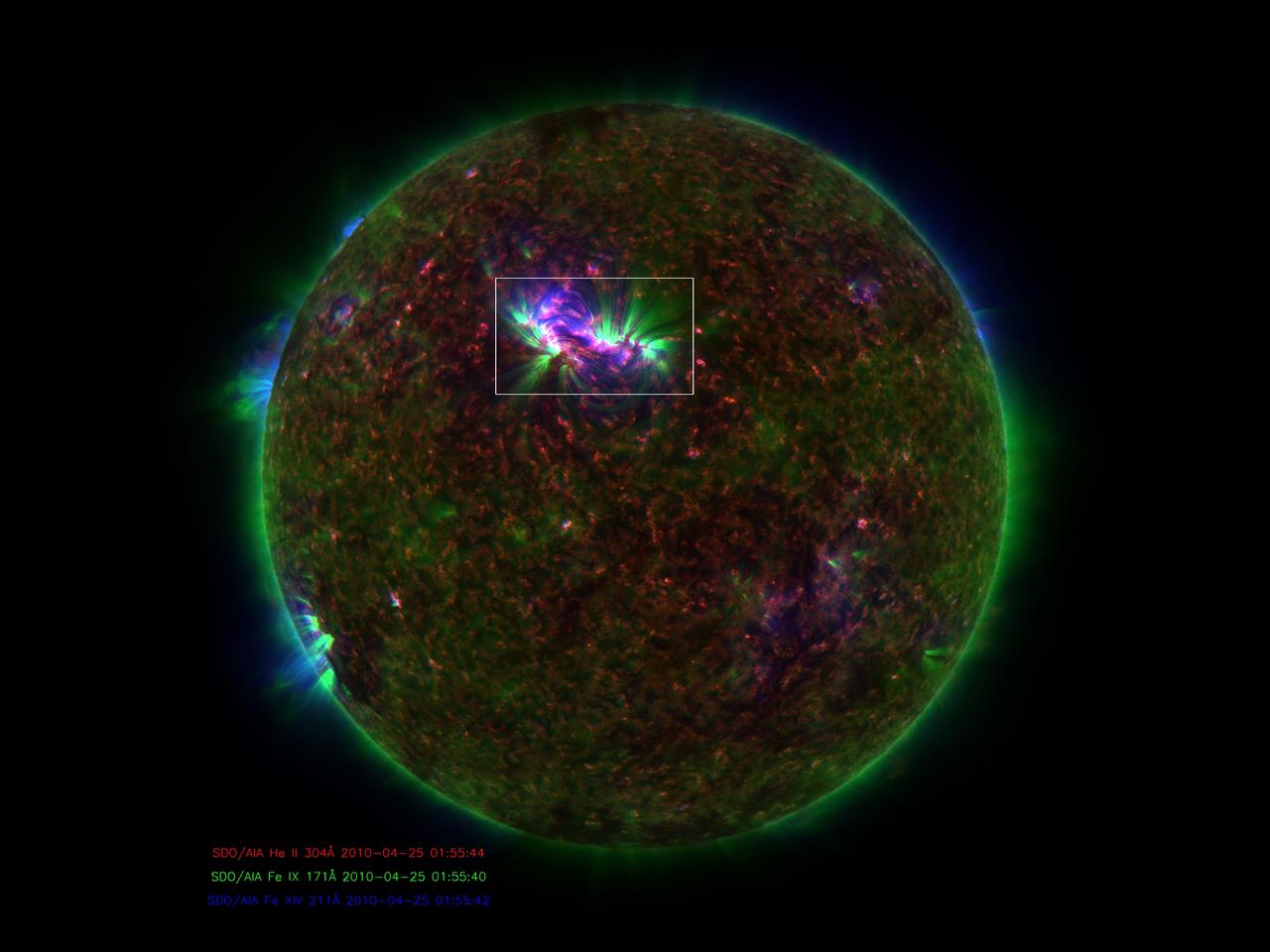
NASA image release January 6, 2010 Caption: Spicules on the sun, as observed by the Solar Dynamics Observatory. These bursts of gas jet off the surface of the sun at 150,000 miles per hour and contain gas that reaches temperatures over a million degrees. GREENBELT, Md. -- Observations from NASA's Solar Dynamics Observatory (SDO) and the Japanese satellite Hinode show that some gas in the giant, fountain-like jets in the sun's atmosphere known as spicules can reach temperatures of millions of degrees. The finding offers a possible new framework for how the sun's high atmosphere gets so much hotter than the surface of the sun. What makes the high atmosphere, or corona, so hot – over a million degrees, compared to the sun surface's 10,000 degrees Fahrenheit -- remains a poorly understood aspect of the sun's complicated space weather system. That weather system can reach Earth, causing auroral lights and, if strong enough, disrupting Earth's communications and power systems. Understanding such phenomena, therefore, is an important step towards better protecting our satellites and power grids. "The traditional view is that all the heating happens higher up in the corona," says Dean Pesnell, who is SDO's project scientist at NASA's Goddard Space Flight Center in Greenbelt, Md. "The suggestion in this paper is that cool gas is being ejected from the sun's surface in spicules and getting heated on its way to the corona." Spicules were first named in the 1940s, but were hard to study in detail until recently, says Bart De Pontieu of Lockheed Martin's Solar and Astrophysics Laboratory, Palo Alto, Calif. who is the lead author on a paper on this subject in the January 7, 2011 issue of Science magazine. In visible light, spicules can be seen to send large masses of so-called plasma – the electromagnetic gas that surrounds the sun – up through the lower solar atmosphere or photosphere. The amount of material sent up is stunning, some 100 times as much as streams away from the sun in the solar wind towards the edges of the solar system. But nobody knew if they contained hot gas. "Heating of spicules to the necessary hot temperatures has never been observed, so their role in coronal heating had been dismissed as unlikely," says De Pontieu. Now, De Pontieu's team -- which included researchers at Lockheed Martin, the High Altitude Observatory of the National Center for Atmospheric Research (NCAR) in Colorado and the University of Oslo, Norway -- was able to combine images from SDO and Hinode to produce a more complete picture of the gas inside these gigantic fountains. The scientists found that a large fraction of the gas is heated to a hundred thousand degrees, while a small fraction is heated to millions of degrees. Time-lapsed images show that this material spews up into the corona, with most falling back down towards the surface of the sun. However, the small fraction of the gas that is heated to millions of degrees does not immediately return to the surface. Given the large number of spicules on the Sun, and the amount of material in the spicules, the scientists believe that if even some of that super hot plasma stays aloft it would make a contribution to coronal heating. Astrophysicist Jonathan Cirtain, who is the U.S. project scientist for Hinode at NASA's Marshall Space Flight Center, Huntsville, Ala., says that incorporating such new information helps address an important question that reaches far beyond the sun. "This breakthrough in our understanding of the mechanisms which transfer energy from the solar photosphere to the corona addresses one of the most compelling questions in stellar astrophysics: How is the atmosphere of a star heated?" he says. "This is a fantastic discovery, and demonstrates the muscle of the NASA Heliophysics System Observatory, comprised of numerous instruments on multiple observatories." Hinode is the second mission in NASA's Solar Terrestrial Probes program, the goal of which is to improve understanding of fundamental solar and space physics processes. The mission is led by the Japan Aerospace Exploration Agency (JAXA) and the National Astronomical Observatory of Japan (NAOJ). The collaborative mission includes the U.S., the United Kingdom, Norway and Europe. NASA Marshall manages Hinode U.S. science operations and oversaw development of the scientific instrumentation provided for the mission by NASA, academia and industry. The Lockheed Martin Advanced Technology Center is the lead U.S. investigator for the Solar Optical Telescope on Hinode. SDO is the first mission in a NASA science program called Living With a Star, the goal of which is to develop the scientific understanding necessary to address those aspects of the sun-Earth system that directly affect our lives and society. NASA Goddard built, operates, and manages the SDO spacecraft for NASA's Science Mission Directorate in Washington. To learn more go to: <a href="http://www.nasa.gov/mission_pages/sdo/news/news20110106-spicules.html" rel="nofollow">www.nasa.gov/mission_pages/sdo/news/news20110106-spicules...</a> Credit: NASA Goddard/SDO/AIA <b><a href="http://www.nasa.gov/centers/goddard/home/index.html" rel="nofollow">NASA Goddard Space Flight Center</a></b> enables NASA’s mission through four scientific endeavors: Earth Science, Heliophysics, Solar System Exploration, and Astrophysics. Goddard plays a leading role in NASA’s accomplishments by contributing compelling scientific knowledge to advance the Agency’s mission. <b>Follow us on <a href="http://twitter.com/NASA_GoddardPix" rel="nofollow">Twitter</a></b> <b>Join us on <a href="http://www.facebook.com/pages/Greenbelt-MD/NASA-Goddard/395013845897?ref=tsd" rel="nofollow">Facebook</a></b>

What looks much like craggy mountains on a moonlit evening is actually the edge of a nearby, young, star-forming region NGC 3324 in the Carina Nebula. Captured in infrared light by the Near-Infrared Camera (NIRCam) on NASA’s James Webb Space Telescope, this image reveals previously obscured areas of star birth. Called the Cosmic Cliffs, the region is actually the edge of a gigantic, gaseous cavity within NGC 3324, roughly 7,600 light-years away. The cavernous area has been carved from the nebula by the intense ultraviolet radiation and stellar winds from extremely massive, hot, young stars located in the center of the bubble, above the area shown in this image. The high-energy radiation from these stars is sculpting the nebula’s wall by slowly eroding it away. NIRCam – with its crisp resolution and unparalleled sensitivity – unveils hundreds of previously hidden stars, and even numerous background galaxies. Several prominent features in this image are described below. • The “steam” that appears to rise from the celestial “mountains” is actually hot, ionized gas and hot dust streaming away from the nebula due to intense, ultraviolet radiation. • Dramatic pillars rise above the glowing wall of gas, resisting the blistering ultraviolet radiation from the young stars. • Bubbles and cavities are being blown by the intense radiation and stellar winds of newborn stars. • Protostellar jets and outflows, which appear in gold, shoot from dust-enshrouded, nascent stars. • A “blow-out” erupts at the top-center of the ridge, spewing gas and dust into the interstellar medium. • An unusual “arch” appears, looking like a bent-over cylinder. This period of very early star formation is difficult to capture because, for an individual star, it lasts only about 50,000 to 100,000 years – but Webb’s extreme sensitivity and exquisite spatial resolution have chronicled this rare event. Located roughly 7,600 light-years away, NGC 3324 was first catalogued by James Dunlop in 1826. Visible from the Southern Hemisphere, it is located at the northwest corner of the Carina Nebula (NGC 3372), which resides in the constellation Carina. The Carina Nebula is home to the Keyhole Nebula and the active, unstable supergiant star called Eta Carinae. NIRCam was built by a team at the University of Arizona and Lockheed Martin’s Advanced Technology Center.
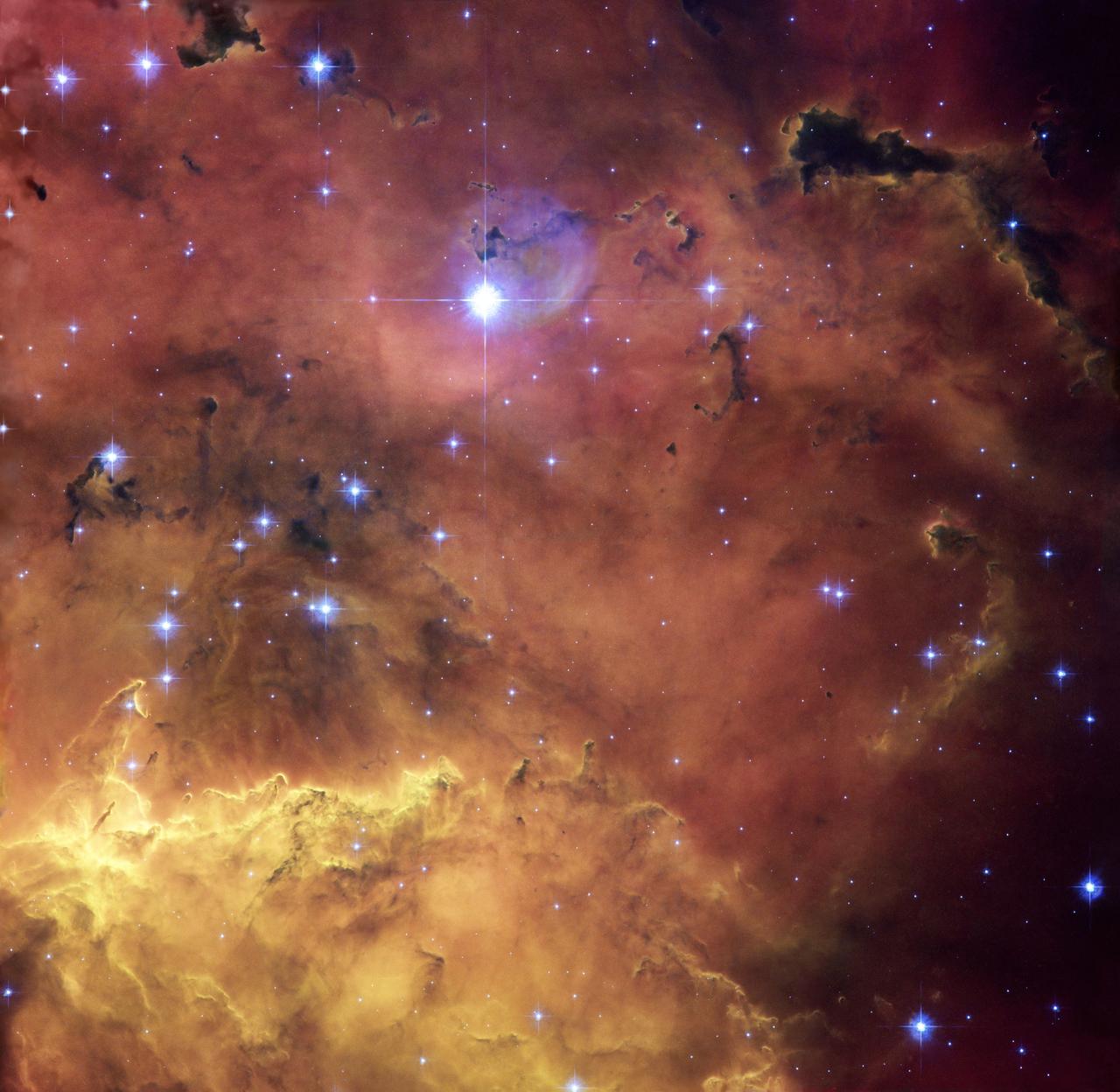
NASA image release July 13, 2010 To view a video of this image go to: <a href="http://www.flickr.com/photos/gsfc/4790394066/">www.flickr.com/photos/gsfc/4790394066/</a> and here: <a href="http://www.flickr.com/photos/gsfc/4789786191/">www.flickr.com/photos/gsfc/4789786191/</a> A colourful star-forming region is featured in this stunning new NASA/ESA Hubble Space Telescope image of NGC 2467. Looking like a roiling cauldron of some exotic cosmic brew, huge clouds of gas and dust are sprinkled with bright blue hot young stars. Strangely shaped dust clouds, resembling spilled liquids, are silhouetted against a colourful background of glowing gas in this newly released Hubble image. The star-forming region NGC 2467 is a vast cloud of gas – mostly hydrogen – that serves as an incubator for new stars. Some of these youthful stars have emerged from the dense clouds where they were born and now shine brightly, hot and blue in this picture, but many others remain hidden. The full beauty of this object and hints of the astrophysical processes at work within it are revealed in this super-sharp image from Hubble. Hot young stars that recently formed from the cloud are emitting fierce ultraviolet radiation that is causing the whole scene to glow while also sculpting the environment and gradually eroding the gas clouds. Studies have shown that most of the radiation comes from the single hot and brilliant massive star just above the centre of the image. Its fierce radiation has cleared the surrounding region and some of the next generation of stars are forming in the denser regions around the edge. One of the most familiar star-forming regions is the Orion Nebula, which can be seen with the naked eye. NGC 2467 is a similar but more distant example. Such stellar nurseries can be seen out to considerable distances in the Universe, and their study is important in determining the distance and chemical composition of other galaxies. Some galaxies contain huge star-forming regions, which may contain tens of thousands of stars. Another dramatic example is the 30 Doradus region in the Large Magellanic Cloud. NGC 2467 was discovered in the nineteenth century and lies in the southern constellation of Puppis, which represents the poop deck of Jason's fabled ship Argo from Greek mythology. NGC 2467 is thought to lie about 13 000 light-years from Earth. The picture was created from images taken with the Wide Field Channel of the Advanced Camera for Surveys through three different filters (F550M, F660N and F658N, shown in blue, green and red respectively). These data were taken in 2004. The Hubble Space Telescope is a project of international cooperation between ESA and NASA. Credit: NASA, ESA and Orsola De Marco (Macquarie University) <b><a href="http://www.nasa.gov/centers/goddard/home/index.html" rel="nofollow">NASA Goddard Space Flight Center</a></b> is home to the nation's largest organization of combined scientists, engineers and technologists that build spacecraft, instruments and new technology to study the Earth, the sun, our solar system, and the universe.
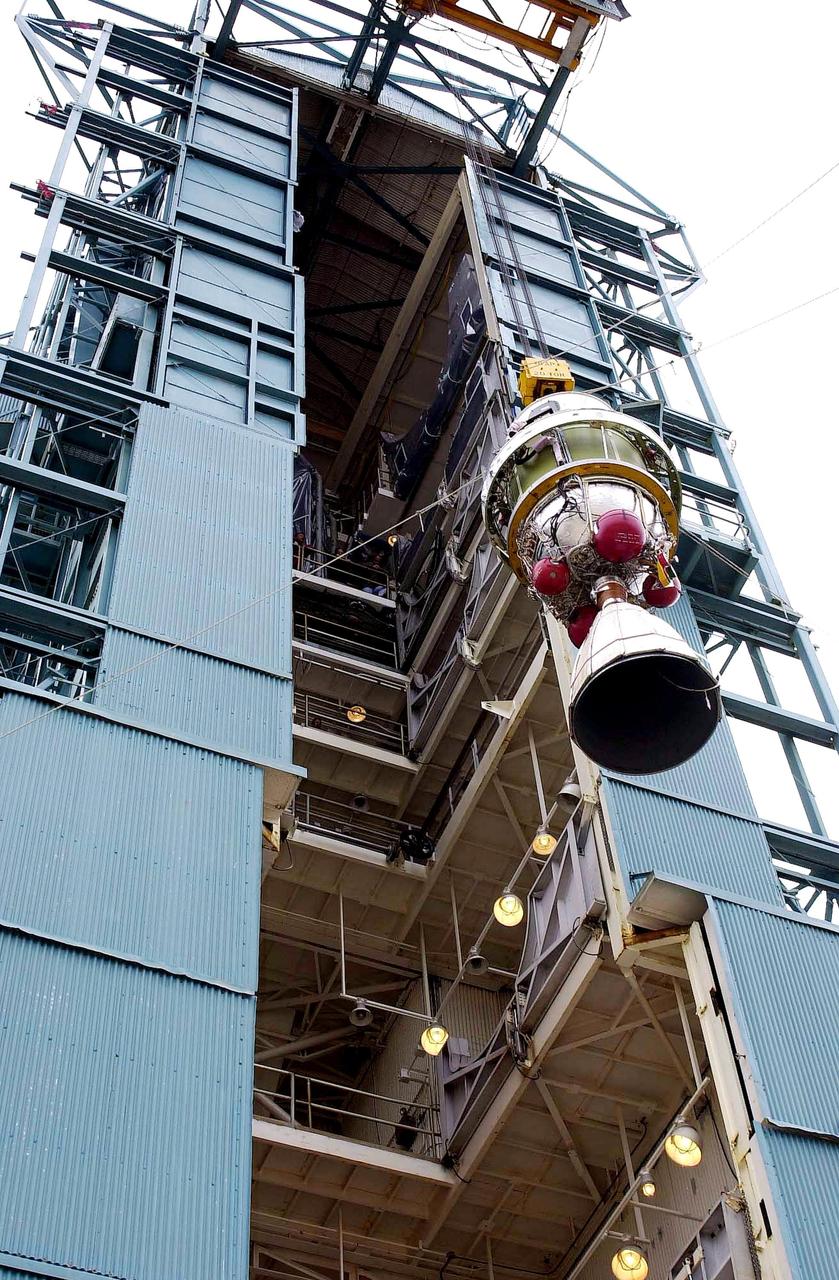
KENNEDY SPACE CENTER, FLA. - A second stage is lifted at NASA's Space Launch Complex 2 (SLC-2) at Vandenberg Air Force Base, Calif., for placement atop a Delta II rocket. The rocket will carry the ICESat and CHIPSat satellites into Earth orbits. The Ice, Cloud, and Land Elevation Satellite, or ICESat, is a 661-pound satellite carrying the Geoscience Laser Altimeter System (GLAS) that will revolutionize our understanding of ice and its role in global climate change and how we protect and understand our home planet. It will help scientists determine if the global sea level is rising or falling. It will look at the ice sheets that blanket the Earth's poles to see if they are growing or shrinking. It will assist in developing an understanding of how changes in the Earth's atmosphere and climate effect polar ice masses and global sea level. The Cosmic Hot Interstellar Plasma Spectrometer, or CHIPSat, a suitcase-size 131-pound satellite, will provide invaluable information into the origin, physical processes and properties of the hot gas contained in the interstellar medium. This can provide important clues about the formation and evolution of galaxies since the interstellar medium literally contains the seeds of future stars. The Delta II launch is scheduled for Jan. 11, 2003, between 4:45 p.m. - 5:30 p.m. PST.
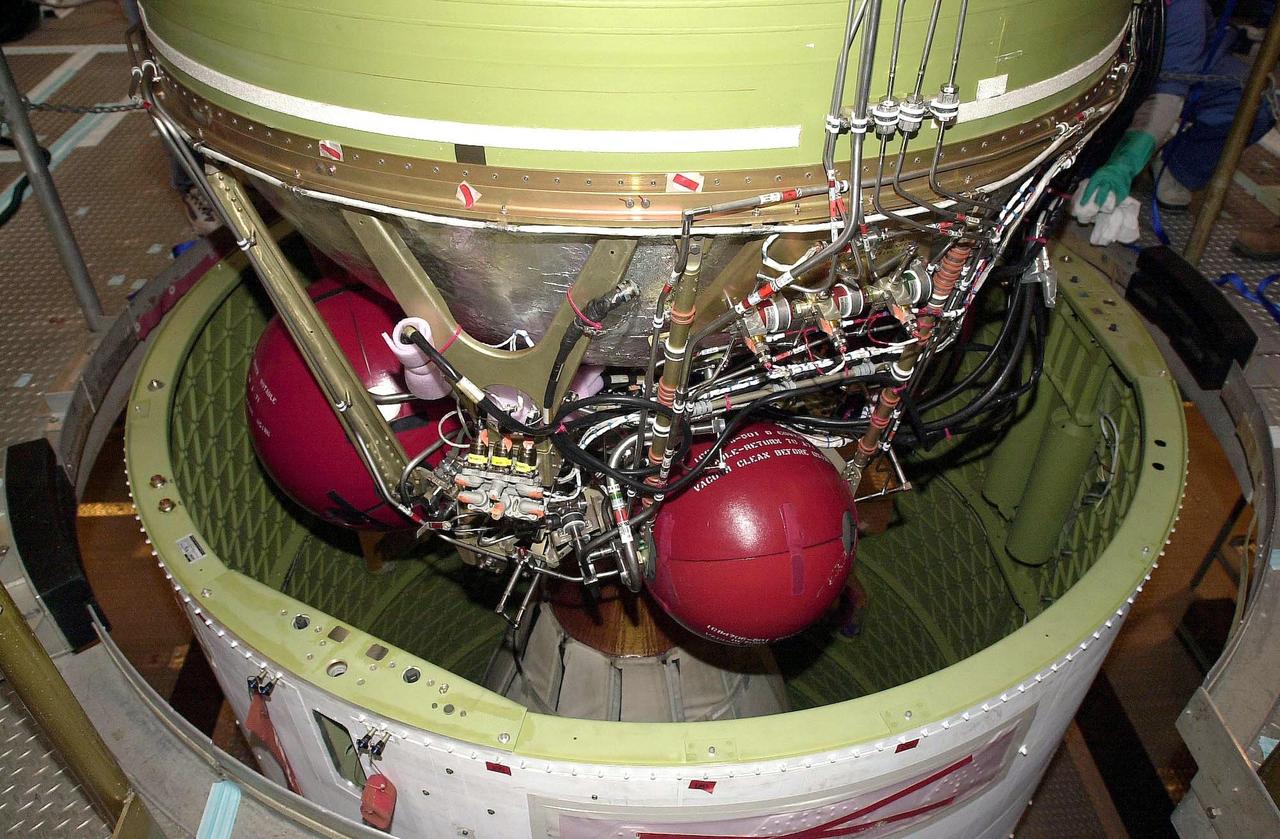
KENNEDY SPACE CENTER, FLA. - A second stage is inserted into an interstage atop a Delta II rocket at NASA's Space Launch Complex 2 (SLC-2) at Vandenberg Air Force Base, Calif. The rocket will carry the ICESat and CHIPSat satellites into Earth orbits. The Ice, Cloud, and Land Elevation Satellite, or ICESat, is a 661-pound satellite carrying the Geoscience Laser Altimeter System (GLAS) that will revolutionize our understanding of ice and its role in global climate change and how we protect and understand our home planet. It will help scientists determine if the global sea level is rising or falling. It will look at the ice sheets that blanket the Earth's poles to see if they are growing or shrinking. It will assist in developing an understanding of how changes in the Earth's atmosphere and climate effect polar ice masses and global sea level. The Cosmic Hot Interstellar Plasma Spectrometer, or CHIPSat, a suitcase-size 131-pound satellite, will provide invaluable information into the origin, physical processes and properties of the hot gas contained in the interstellar medium. This can provide important clues about the formation and evolution of galaxies since the interstellar medium literally contains the seeds of future stars. The Delta II launch is scheduled for Jan. 11, 2003, between 4:45 p.m. - 5:30 p.m. PST.
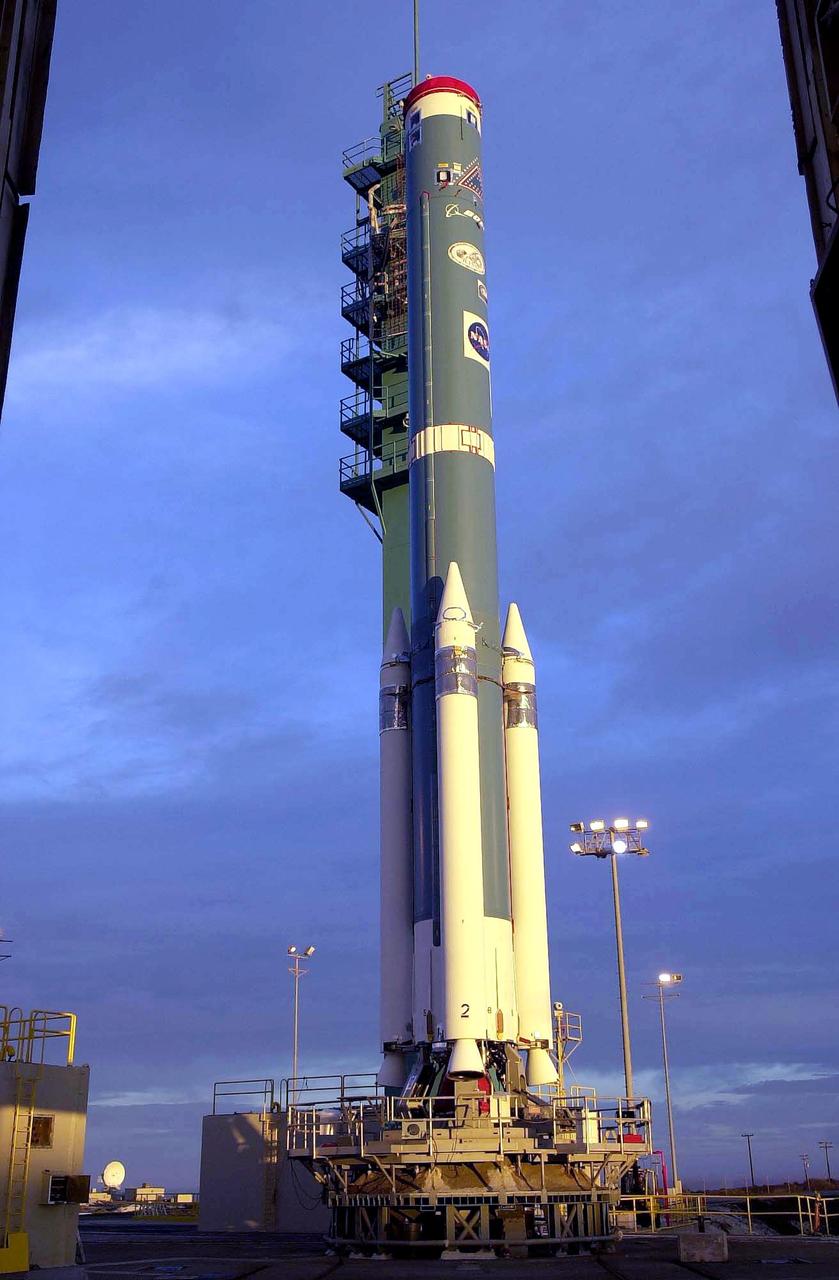
KENNEDY SPACE CENTER, FLA. - At NASA's Space Launch Complex 2 (SLC-2), Vandenberg Air Force Base, Calif., the launch tower has been rolled back to reveal a Delta II rocket with its solid rocket boosters attached. The rocket will carry the ICESat and CHIPSat satellites into Earth orbits. The Ice, Cloud, and Land Elevation Satellite, or ICESat, is a 661-pound satellite known as Geoscience Laser Altimeter System (GLAS) that will revolutionize our understanding of ice and its role in global climate change and how we protect and understand our home planet. It will help scientists determine if the global sea level is rising or falling. It will look at the ice sheets that blanket the Earth's poles to see if they are growing or shrinking. It will assist in developing an understanding of how changes in the Earth's atmosphere and climate effect polar ice masses and global sea level. The Cosmic Hot Interstellar Plasma Spectrometer, or CHIPSat, a suitcase-size 131-pound satellite, will provide invaluable information into the origin, physical processes and properties of the hot gas contained in the interstellar medium. This can provide important clues about the formation and evolution of galaxies since the interstellar medium literally contains the seeds of future stars. The Delta II launch is scheduled for Jan. 11, 2003, between 4:45 p.m. - 5:30 p.m. PST.
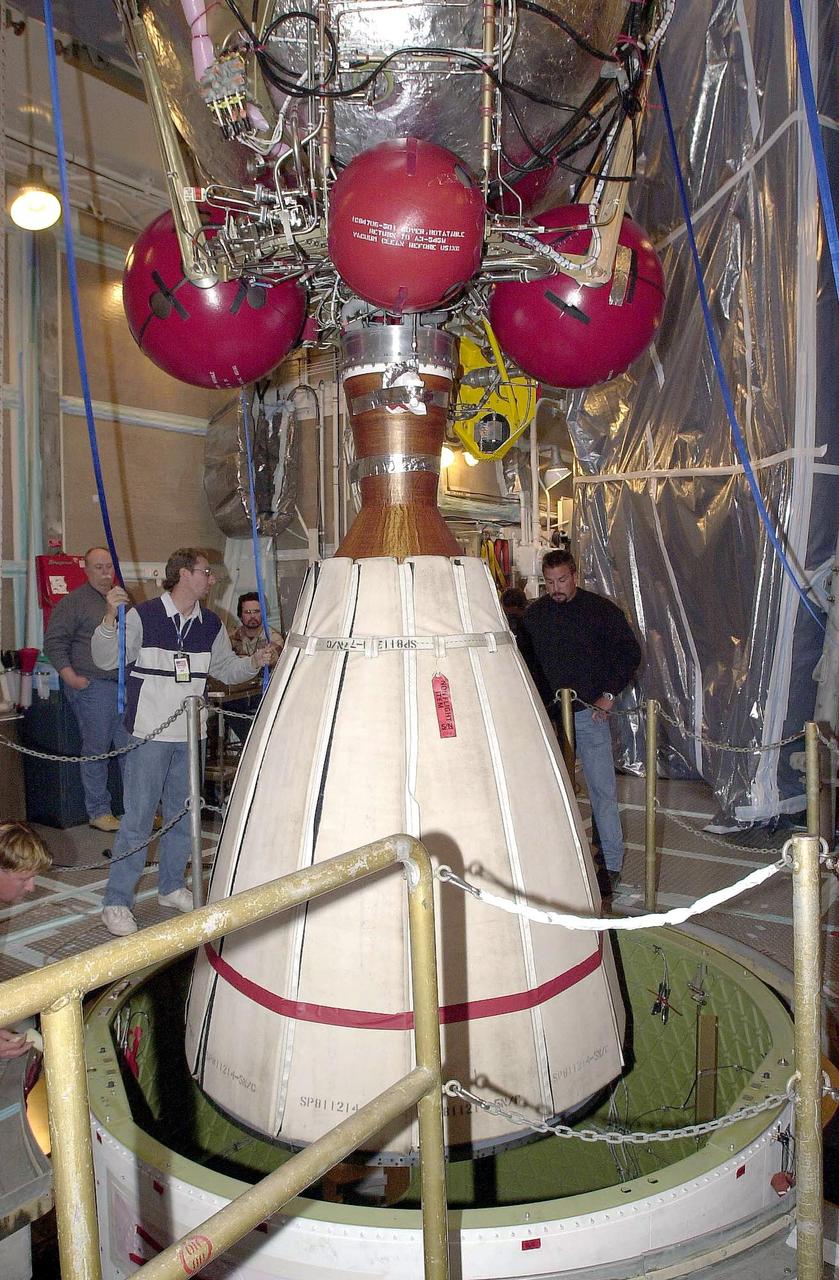
KENNEDY SPACE CENTER, FLA. - A second stage is lifted into place at NASA's Space Launch Complex 2 (SLC-2) at Vandenberg Air Force Base, Calif., atop a Delta II rocket. The rocket will carry the ICESat and CHIPSat satellites into Earth orbits. The Ice, Cloud, and Land Elevation Satellite, or ICESat, is a 661-pound satellite carrying the Geoscience Laser Altimeter System (GLAS) that will revolutionize our understanding of ice and its role in global climate change and how we protect and understand our home planet. It will help scientists determine if the global sea level is rising or falling. It will look at the ice sheets that blanket the Earth's poles to see if they are growing or shrinking. It will assist in developing an understanding of how changes in the Earth's atmosphere and climate effect polar ice masses and global sea level. The Cosmic Hot Interstellar Plasma Spectrometer, or CHIPSat, a suitcase-size 131-pound satellite, will provide invaluable information into the origin, physical processes and properties of the hot gas contained in the interstellar medium. This can provide important clues about the formation and evolution of galaxies since the interstellar medium literally contains the seeds of future stars. The Delta II launch is scheduled for Jan. 11, 2003, between 4:45 p.m. - 5:30 p.m. PST.
KENNEDY SPACE CENTER, FLA. - A second stage is inserted and secured into an interstage atop a Delta II rocket at NASA's Space Launch Complex 2 (SLC-2) at Vandenberg Air Force Base, Calif. The rocket will carry the ICESat and CHIPSat satellites into Earth orbits. The Ice, Cloud, and Land Elevation Satellite, or ICESat, is a 661-pound satellite carrying the Geoscience Laser Altimeter System (GLAS) that will revolutionize our understanding of ice and its role in global climate change and how we protect and understand our home planet. It will help scientists determine if the global sea level is rising or falling. It will look at the ice sheets that blanket the Earth's poles to see if they are growing or shrinking. It will assist in developing an understanding of how changes in the Earth's atmosphere and climate effect polar ice masses and global sea level. The Cosmic Hot Interstellar Plasma Spectrometer, or CHIPSat, a suitcase-size 131-pound satellite, will provide invaluable information into the origin, physical processes and properties of the hot gas contained in the interstellar medium. This can provide important clues about the formation and evolution of galaxies since the interstellar medium literally contains the seeds of future stars. The Delta II launch is scheduled for Jan. 11, 2003, between 4:45 p.m. - 5:30 p.m. PST.
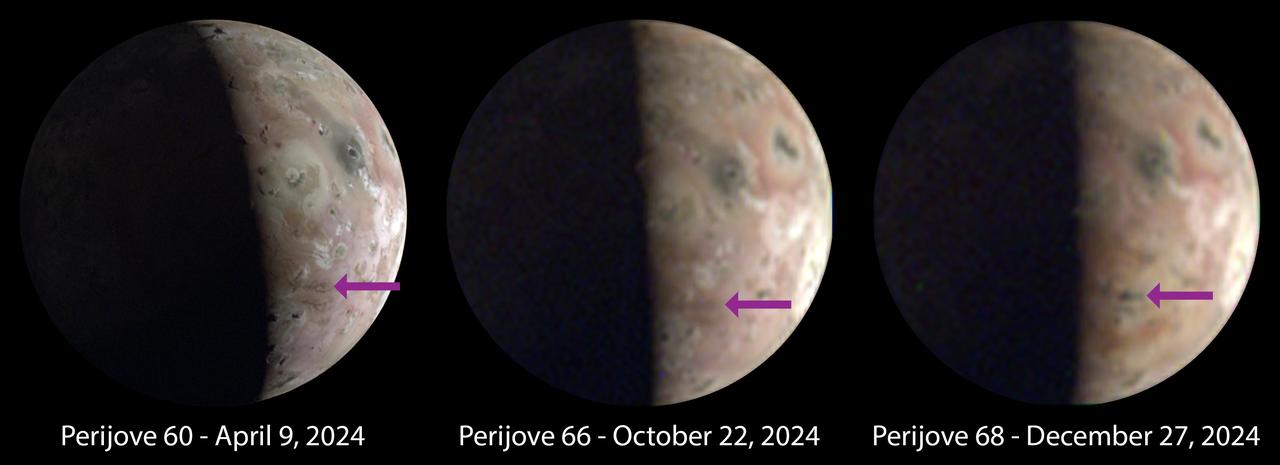
Images of Io captured in 2024 by the JunoCam imager aboard NASA's Juno spacecraft show surface changes that occurred near the fiery Jovian moon's south pole. The arrow annotation highlights the location on Io's surface where these significant and visible surface changes took place between the 66th and 68th perijove, or the point during Juno's orbit when the spacecraft was closest to the gas giant. The resolution of each of the three Io images varies because it is dependent on the altitude at which the data was acquired. While the images from the 68th perijove are of lower resolution – since Juno was farther away – the relative changes in surface coloring around a newly discovered hot spot are clear. Such changes in Io's surface are known in the planetary science community to be associated with hot spots and volcanic activity. The leftmost image is the highest resolution of this area of Io, acquired during Perijove 60 on April 9, 2024, when the spacecraft came as close as about 10,250 miles (16,500 kilometers) from the moon. The center image was acquired at a distance of about 37,310 miles (60,050 kilometers) during Perijove 66 on Oct. 22, 2024. The image at right was acquired on Dec. 27, 2024, during Perijove 68, in which the spacecraft's flyby distance from Io was about 46,200 miles (74,400 kilometers). The JunoCam images were processed by citizen scientist Jason Perry. https://photojournal.jpl.nasa.gov/catalog/PIA26526
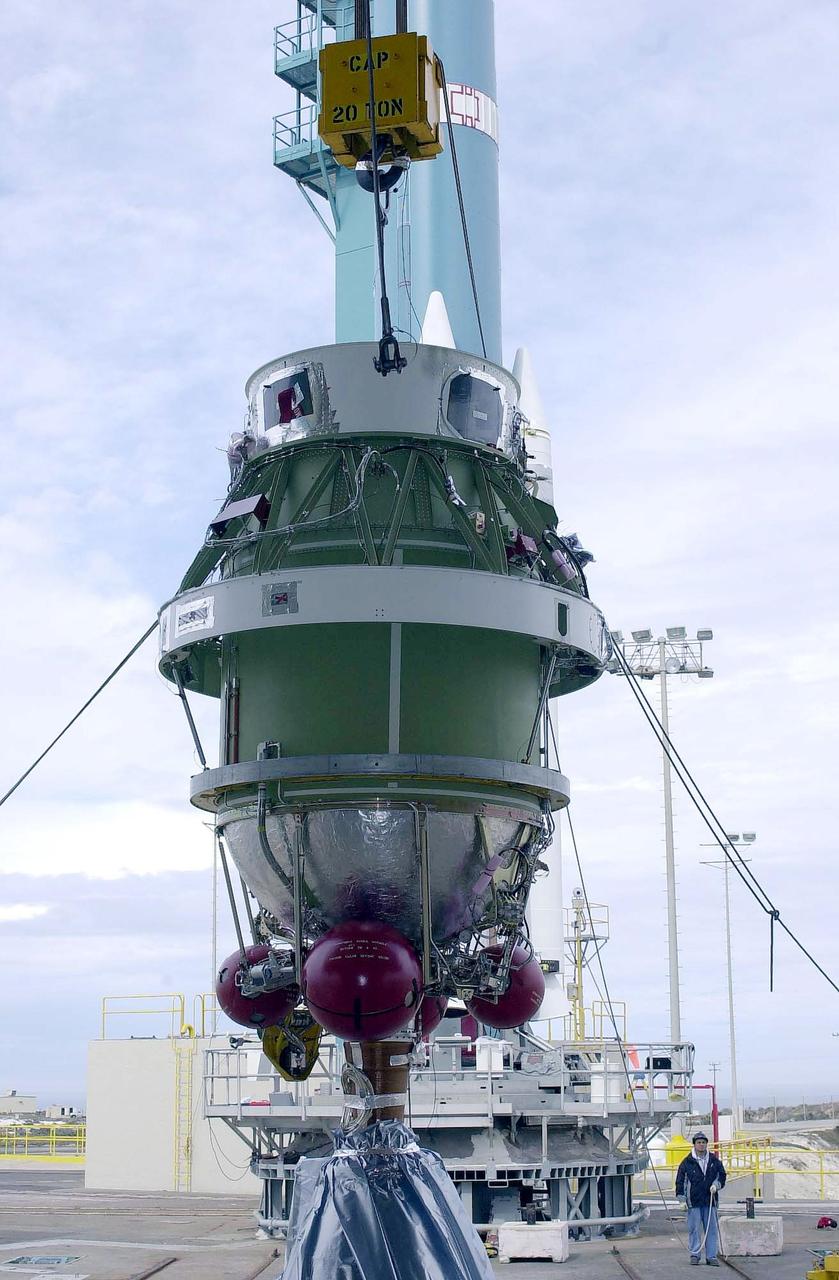
KENNEDY SPACE CENTER, FLA. - A second stage is lifted at NASA's Space Launch Complex 2 (SLC-2) at Vandenberg Air Force Base, Calif., for placement on a Delta II rocket The rocket will carry the ICESat and CHIPSat satellites into Earth orbits. The Ice, Cloud, and Land Elevation Satellite, or ICESat, is a 661-pound satellite carrying the Geoscience Laser Altimeter System (GLAS) that will revolutionize our understanding of ice and its role in global climate change and how we protect and understand our home planet. It will help scientists determine if the global sea level is rising or falling. It will look at the ice sheets that blanket the Earth's poles to see if they are growing or shrinking. It will assist in developing an understanding of how changes in the Earth's atmosphere and climate effect polar ice masses and global sea level. The Cosmic Hot Interstellar Plasma Spectrometer, or CHIPSat, a suitcase-size 131-pound satellite, will provide invaluable information into the origin, physical processes and properties of the hot gas contained in the interstellar medium. This can provide important clues about the formation and evolution of galaxies since the interstellar medium literally contains the seeds of future stars. The Delta II launch is scheduled for Jan. 11, 2003, between 4:45 p.m. - 5:30 p.m. PST.
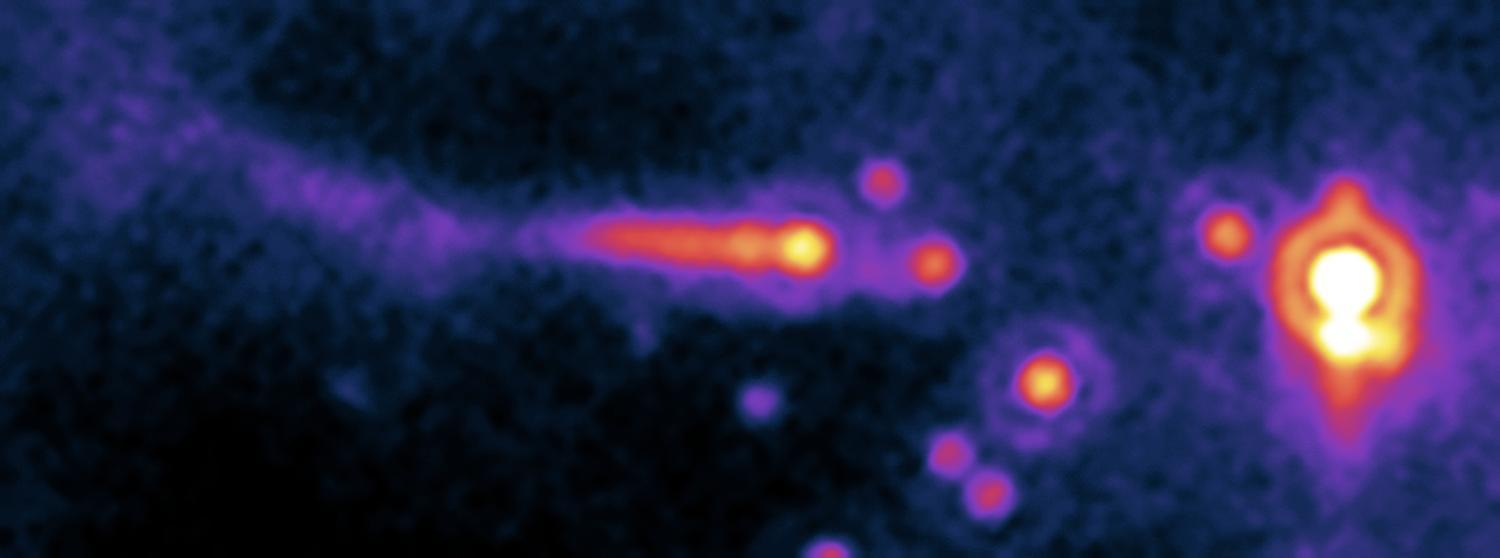
The potential planet-forming disk (or "protoplanetary disk") of a sun-like star is being violently ripped away by the powerful winds of a nearby hot O-type star in this image from NASA's Spitzer Space Telescope. At up to 100 times the mass of sun-like stars, O stars are the most massive and energetic stars in the universe. The O star can be seen to the right of the image, as the large orange spot with the white center. To the left, the comet-like structure is actually a neighboring solar system that is being destroyed by the O star's powerful winds and intense ultraviolet light. In a process called "photoevaporation," immense output from the O star heats up the nearby protoplanetary disk so much that gas and dust boil off, and the disk can no longer hold together. Photon (or light) blasts from the O star then strip the potential planet-forming disk off its neighbor star by blowing away evaporated material. This effect is illustrated in the smaller system's comet-like structure. The system is located about 2,450 light-years away in the star-forming cloud IC 1396. The image was taken with Spitzer's multiband imaging photometer instrument at 24 microns. The picture is a pseudo-color stretch representing intensity. Yellow and white represent hot areas, whereas purple and blue represent relatively cooler, fainter regions.
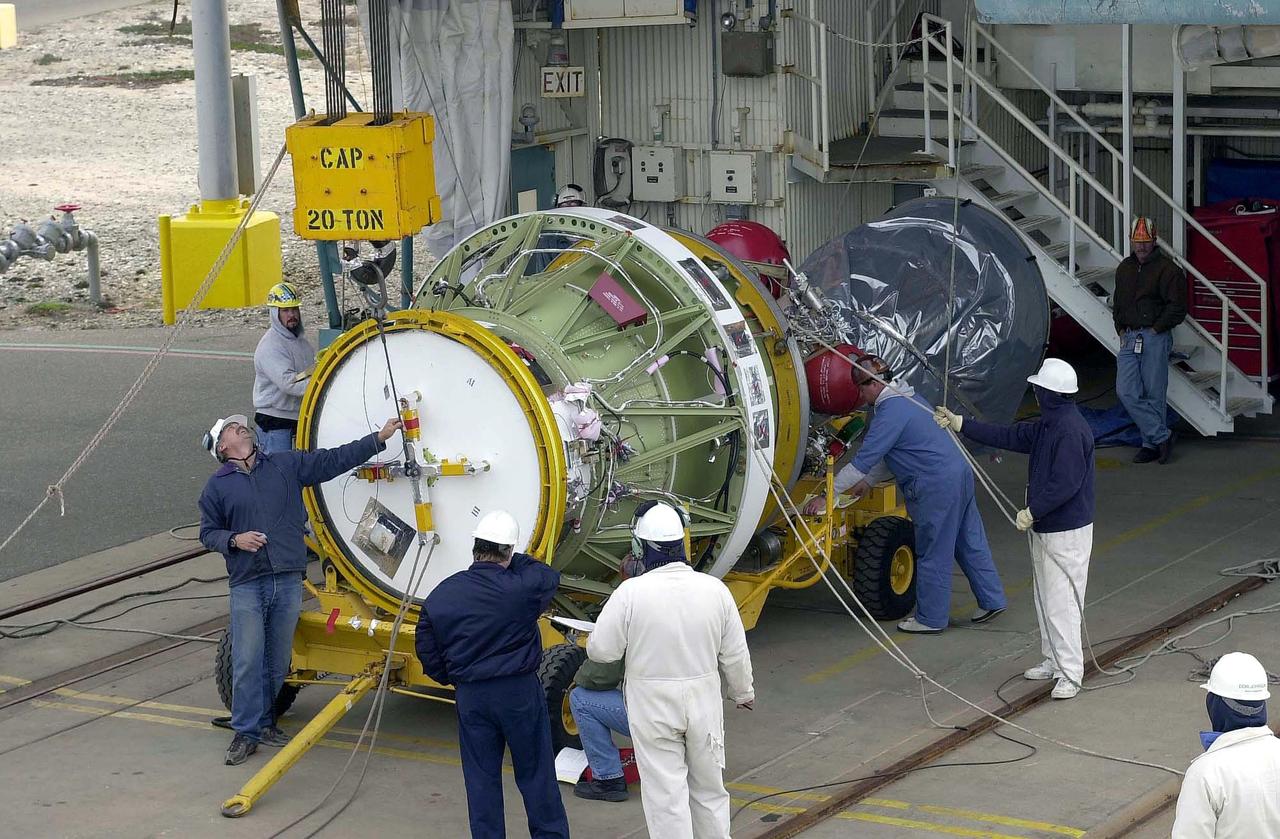
KENNEDY SPACE CENTER, FLA. - The second stage arrives at NASA's Space Launch Complex 2 (SLC-2) at Vandenberg Air Force Base, Calif., for placement on a Delta II rocket The rocket will carry the ICESat and CHIPSat satellites into Earth orbits. The Ice, Cloud, and Land Elevation Satellite, or ICESat, is a 661-pound satellite carrying the Geoscience Laser Altimeter System (GLAS) that will revolutionize our understanding of ice and its role in global climate change and how we protect and understand our home planet. It will help scientists determine if the global sea level is rising or falling. It will look at the ice sheets that blanket the Earth's poles to see if they are growing or shrinking. It will assist in developing an understanding of how changes in the Earth's atmosphere and climate effect polar ice masses and global sea level. The Cosmic Hot Interstellar Plasma Spectrometer, or CHIPSat, a suitcase-size 131-pound satellite, will provide invaluable information into the origin, physical processes and properties of the hot gas contained in the interstellar medium. This can provide important clues about the formation and evolution of galaxies since the interstellar medium literally contains the seeds of future stars. The Delta II launch is scheduled for Jan. 11, 2003, between 4:45 p.m. - 5:30 p.m. PST.
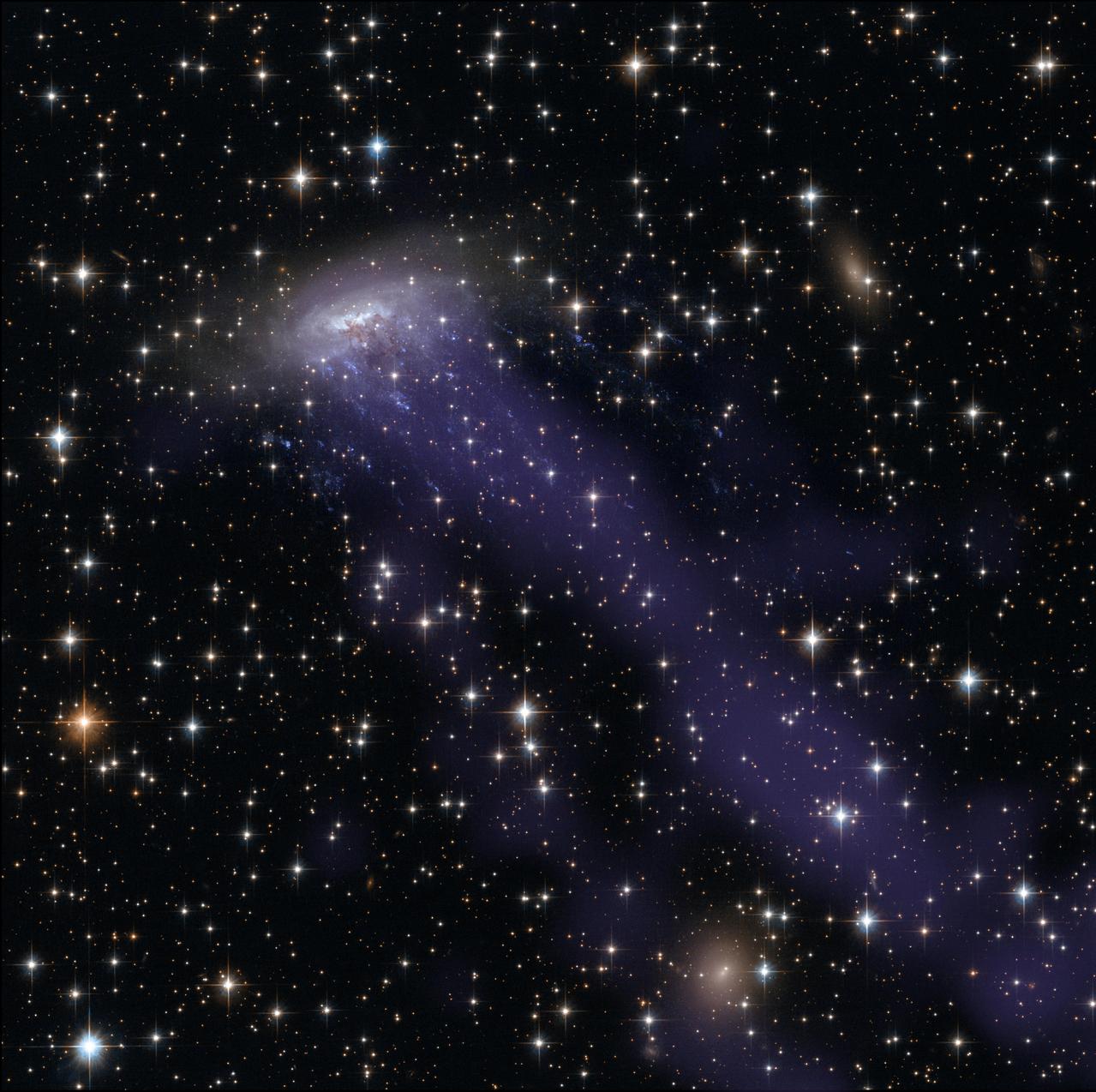
This image combines NASA/ESA Hubble Space Telescope observations with data from the Chandra X-ray Observatory. As well as the electric blue ram pressure stripping streaks seen emanating from ESO 137-001, a giant gas stream can be seen extending towards the bottom of the frame, only visible in the X-ray part of the spectrum. Credit: NASA, ESA, CXC The spiral galaxy ESO 137-001 looks like a dandelion caught in a breeze in this new Hubble Space Telescope image. The galaxy is zooming toward the upper right of this image, in between other galaxies in the Norma cluster located over 200 million light-years away. The road is harsh: intergalactic gas in the Norma cluster is sparse, but so hot at 180 million degrees Fahrenheit that it glows in X-rays. The spiral plows through the seething intra-cluster gas so rapidly – at nearly 4.5 million miles per hour — that much of its own gas is caught and torn away. Astronomers call this "ram pressure stripping." The galaxy’s stars remain intact due to the binding force of their gravity. Tattered threads of gas, the blue jellyfish-tendrils trailing ESO 137-001 in the image, illustrate the process. Ram pressure has strung this gas away from its home in the spiral galaxy and out over intergalactic space. Once there, these strips of gas have erupted with young, massive stars, which are pumping out light in vivid blues and ultraviolet. The brown, smoky region near the center of the spiral is being pushed in a similar manner, although in this case it is small dust particles, and not gas, that are being dragged backwards by the intra-cluster medium. Read more here: <a href="http://1.usa.gov/P0HSFh" rel="nofollow">1.usa.gov/P0HSFh</a> <b><a href="http://www.nasa.gov/audience/formedia/features/MP_Photo_Guidelines.html" rel="nofollow">NASA image use policy.</a></b> <b><a href="http://www.nasa.gov/centers/goddard/home/index.html" rel="nofollow">NASA Goddard Space Flight Center</a></b> enables NASA’s mission through four scientific endeavors: Earth Science, Heliophysics, Solar System Exploration, and Astrophysics. Goddard plays a leading role in NASA’s accomplishments by contributing compelling scientific knowledge to advance the Agency’s mission. <b>Follow us on <a href="http://twitter.com/NASAGoddardPix" rel="nofollow">Twitter</a></b> <b>Like us on <a href="http://www.facebook.com/pages/Greenbelt-MD/NASA-Goddard/395013845897?ref=tsd" rel="nofollow">Facebook</a></b> <b>Find us on <a href="http://instagram.com/nasagoddard?vm=grid" rel="nofollow">Instagram</a></b>

A transmission spectrum made from a single observation using Webb’s Near-Infrared Imager and Slitless Spectrograph (NIRISS) reveals atmospheric characteristics of the hot gas giant exoplanet WASP-96 b. A transmission spectrum is made by comparing starlight filtered through a planet’s atmosphere as it moves across the star, to the unfiltered starlight detected when the planet is beside the star. Each of the 141 data points (white circles) on this graph represents the amount of a specific wavelength of light that is blocked by the planet and absorbed by its atmosphere. In this observation, the wavelengths detected by NIRISS range from 0.6 microns (red) to 2.8 microns (in the near-infrared). The amount of starlight blocked ranges from about 13,600 parts per million (1.36 percent) to 14,700 parts per million (1.47 percent). Researchers are able to detect and measure the abundances of key gases in a planet’s atmosphere based on the absorption pattern – the locations and heights of peaks on the graph: each gas has a characteristic set of wavelengths that it absorbs. The temperature of the atmosphere can be calculated based in part on the height of the peaks: a hotter planet has taller peaks. Other characteristics, like the presence of haze and clouds, can be inferred based on the overall shape of different portions of the spectrum. The gray lines extending above and below each data point are error bars that show the uncertainty of each measurement, or the reasonable range of actual possible values. For a single observation, the error on these measurements is remarkably small. The blue line is a best-fit model that takes into account the data, the known properties of WASP-96 b and its star (e.g., size, mass, temperature), and assumed characteristics of the atmosphere. Researchers can vary the parameters in the model – changing unknown characteristics like cloud height in the atmosphere and abundances of various gases – to get a better fit and further understand what the atmosphere is really like. The difference between the best-fit model shown here and the data simply reflects the additional work to be done in analyzing and interpreting the data and the planet. Although full analysis of the spectrum will take additional time, it is possible to draw a number of preliminary conclusions. The labeled peaks in the spectrum indicate the presence of water vapor. The height of the water peaks, which is less than expected based on previous observations, is evidence for the presence of clouds that suppress the water vapor features. The gradual downward slope of the left side of the spectrum (shorter wavelengths) is indicative of possible haze. The height of the peaks along with other characteristics of the spectrum is used to calculate an atmospheric temperature of about 1350°F (725°C). This is the most detailed infrared exoplanet transmission spectrum ever collected, the first transmission spectrum that includes wavelengths longer than 1.6 microns with such high resolution and accuracy, and the first to cover the entire wavelength range from 0.6 microns (visible red light) to 2.8 microns (near-infrared) in a single shot. The speed with which researchers have been able to make confident interpretations of the spectrum is further testament to the quality of the data. The observation was made using NIRISS’s Single-Object Slitless Spectroscopy (SOSS) mode, which involves capturing the spectrum of a single bright object, like the star WASP-96, in a field of view. WASP-96 b is a hot gas giant exoplanet that orbits a Sun-like star roughly 1,150 light-years away, in the constellation Phoenix. The planet orbits extremely close to its star (less than 1/20th the distance between Earth and the Sun) and completes one orbit in less than 3½ Earth-days. The planet’s discovery, based on ground-based observations, was announced in 2014. The star, WASP-96, is somewhat older than the Sun, but is about the same size, mass, temperature, and color. The background illustration of WASP-96 b and its star is based on current understanding of the planet from both NIRISS spectroscopy and previous ground- and space-based observations. Webb has not captured a direct image of the planet or its atmosphere. NIRISS was contributed by the Canadian Space Agency. The instrument was designed and built by Honeywell in collaboration with the Université de Montréal and the National Research Council Canada.
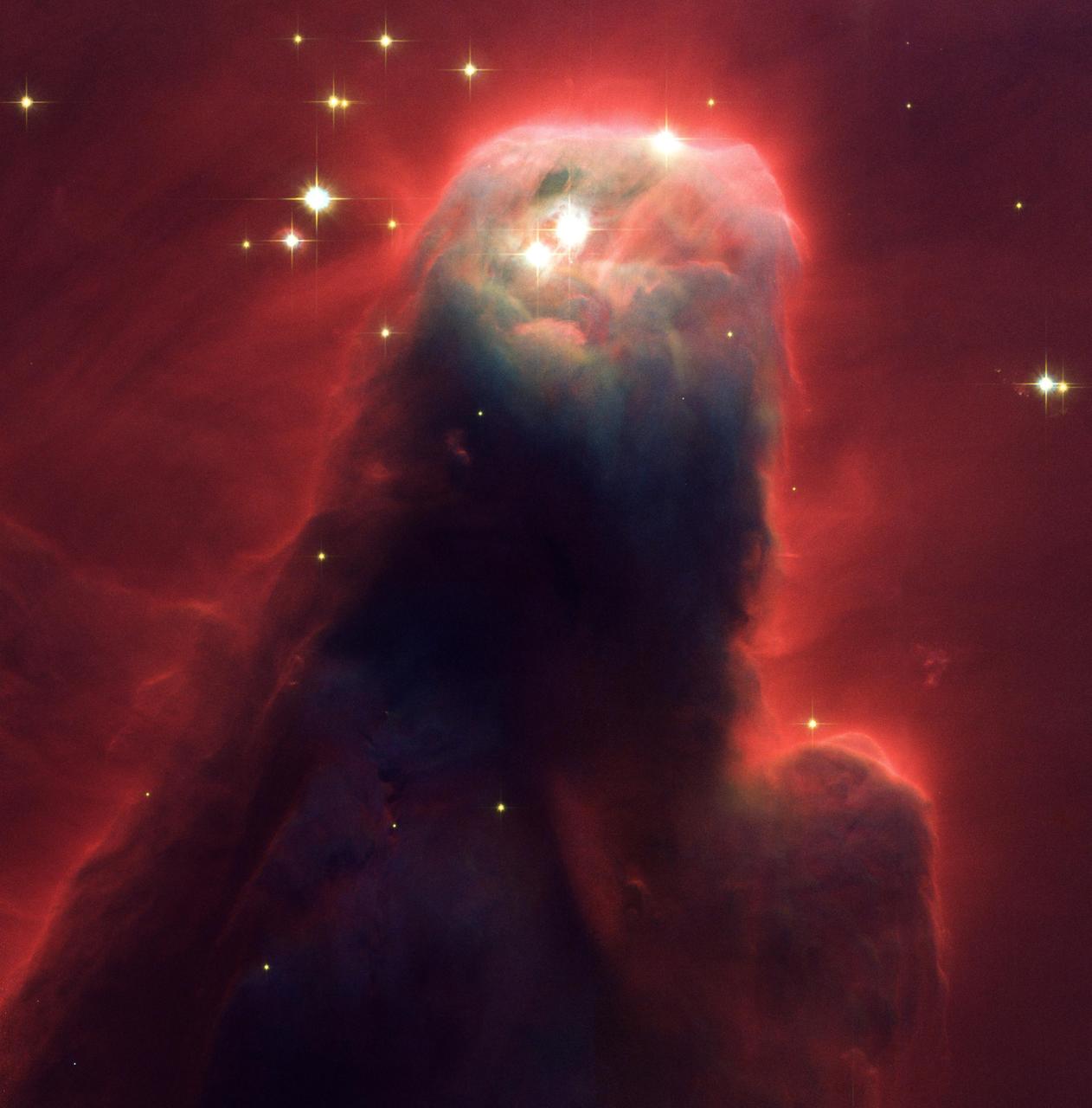
Resembling a nightmarish beast rearing its head from a crimson sea, this monstrous object is actually an irnocuous pillar of gas and dust. Called the Cone Nebula (NGC 2264), this giant pillar resides in a turbulent star-forming region. This picture, taken by the newly installed Advanced Camera for Surveys (ACS) aboard Hubble Space Telescope (HST) during Space Shuttle STS-109 mission in March 2002, shows the upper 2.5 light-years of the nebula, a height that equals 23 million roundtrips to the Moon. The entire nebula is 7 light-years long. The Cone Nebula resides 2,500 light-years away in the constellation Monoceros. Radiation from hot, young stars (located beyond the top of the image) has slowly eroded the nebula over millions of years. Ultraviolet light heats the edges of the dark cloud, releasing gas into the relatively empty region of surrounding space. There, additional ultraviolet radiation causes the hydrogen gas to glow, which produces the red halo of light seen around the pillar. A similar process occurs on a much smaller scale to gas surrounding a single star, forming the bow-shaped arc seen near the upper left side of the Cone. This arc, seen previously with the HST, is 65 times larger than the diameter of our solar system. The blue-white light from surrounding stars is reflected by dust. Background stars can be seen peeking through the evaporating tendrils of gas, while the turbulent base is pockmarked with stars reddened by dust. Credit: NASA, H. Ford (JHU), G. Illingworth (USCS/LO), M. Clampin (STScI), G. Hartig (STScI), the ACS Science Team, and ESA.
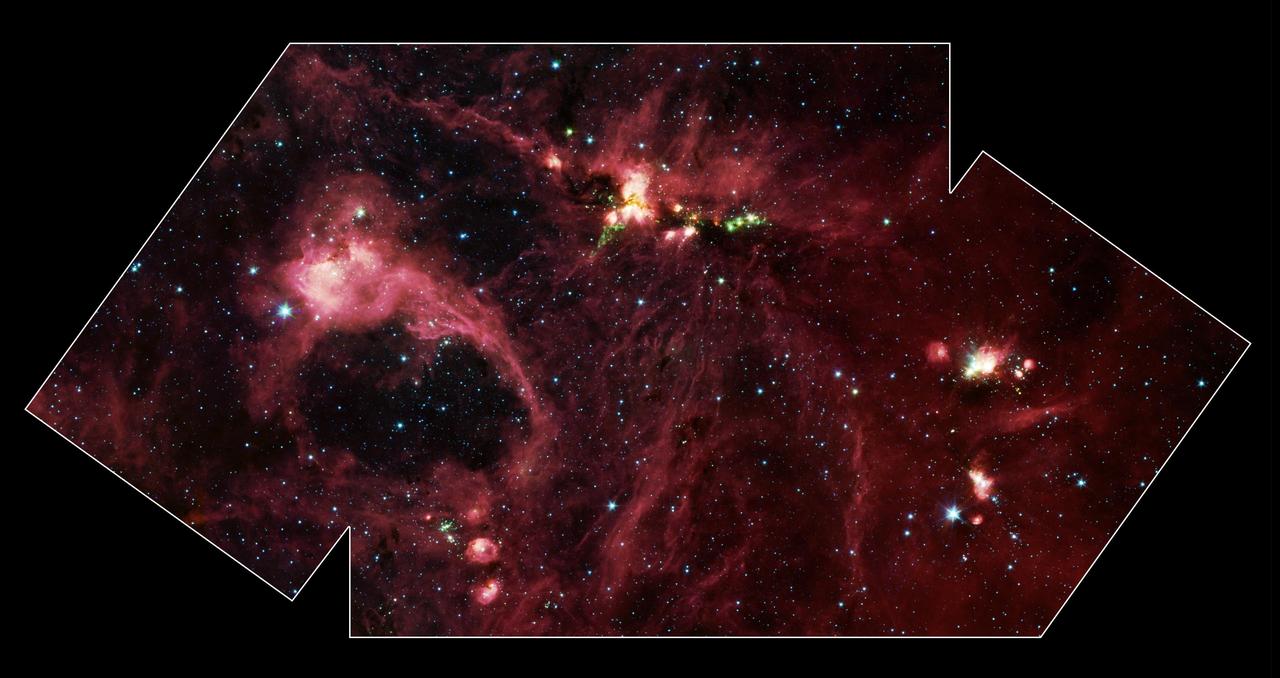
Hidden behind a shroud of dust in the constellation Cygnus is a stellar nursery called DR21, which is giving birth to some of the most massive stars in our galaxy. Visible light images reveal no trace of this interstellar cauldron because of heavy dust obscuration. In fact, visible light is attenuated in DR21 by a factor of more than 10,000,000,000,000,000,000,000,000,000,000,000,000,000 (ten thousand trillion heptillion). New images from NASA's Spitzer Space Telescope allow us to peek behind the cosmic veil and pinpoint one of the most massive natal stars yet seen in our Milky Way galaxy. The never-before-seen star is 100,000 times as bright as the Sun. Also revealed for the first time is a powerful outflow of hot gas emanating from this star and bursting through a giant molecular cloud. This image is a large-scale mosaic assembled from individual photographs obtained with the InfraRed Array Camera (IRAC) aboard Spitzer. The image covers an area about two times that of a full moon. The mosaic is a composite of images obtained at mid-infrared wavelengths of 3.6 microns (blue), 4.5 microns (green), 5.8 microns (orange) and 8 microns (red). The brightest infrared cloud near the top center corresponds to DR21, which presumably contains a cluster of newly forming stars at a distance of 10,000 light-years. Protruding out from DR21 toward the bottom left of the image is a gaseous outflow (green), containing both carbon monoxide and molecular hydrogen. Data from the Spitzer spectrograph, which breaks light into its constituent individual wavelengths, indicate the presence of hot steam formed as the outflow heats the surrounding molecular gas. Outflows are physical signatures of processes that create supersonic beams, or jets, of gas. They are usually accompanied by discs of material around the new star, which likely contain the materials from which future planetary systems are formed. Additional newborn stars, depicted in green, can be seen surrounding the DR21 region. The red filaments stretching across this image denote the presence of polycyclic aromatic hydrocarbons. These organic molecules, comprised of carbon and hydrogen, are excited by surrounding interstellar radiation and become luminescent at wavelengths near 8.0 microns. The complex pattern of filaments is caused by an intricate combination of radiation pressure, gravity and magnetic fields. The result is a tapestry in which winds, outflows and turbulence move and shape the interstellar medium. To the lower left of the mosaic is a large bubble of gas and dust, which may represent the remnants of a past generation of stars. http://photojournal.jpl.nasa.gov/catalog/PIA05732
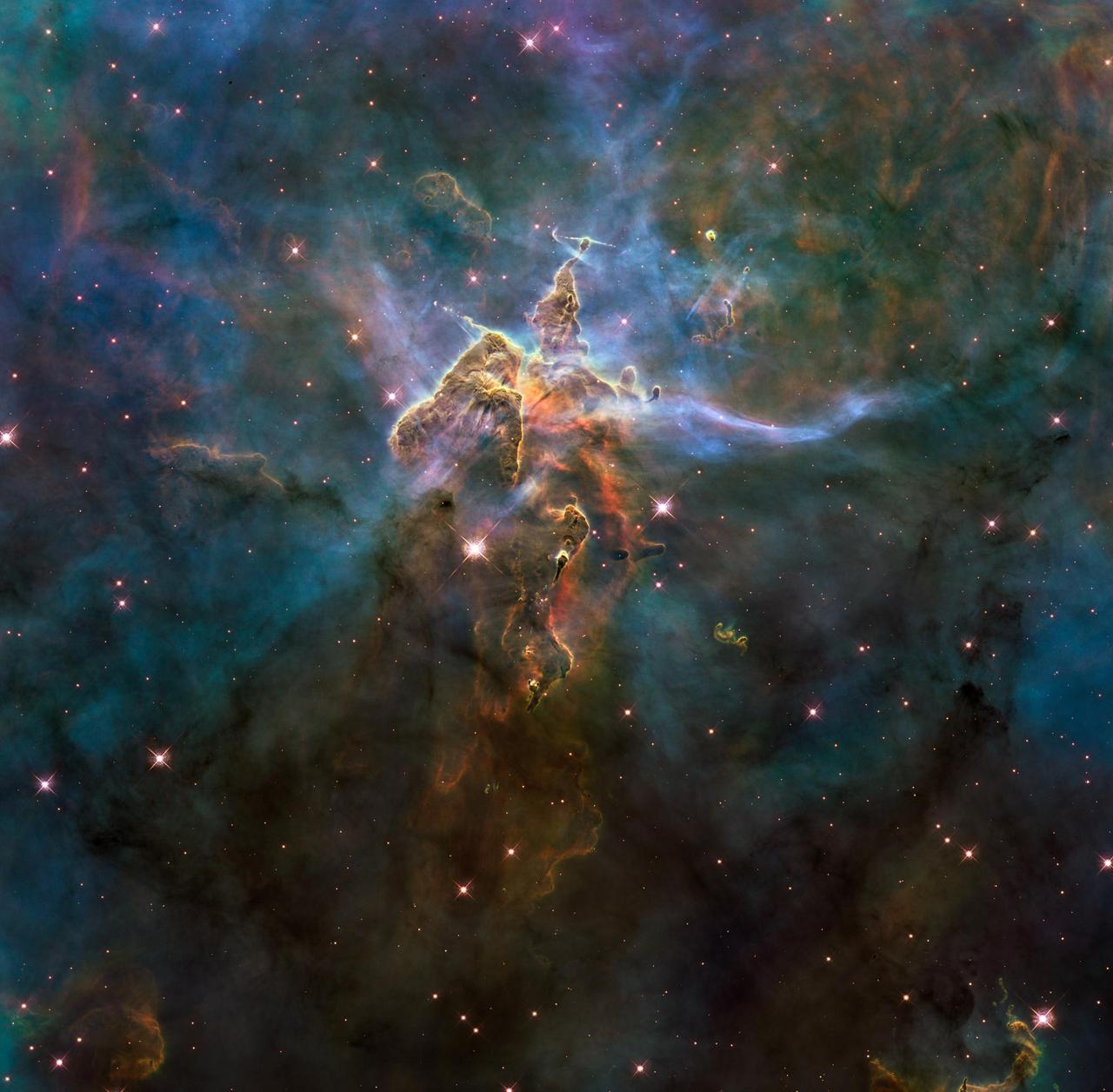
NASA image release April 22, 2010 This craggy fantasy mountaintop enshrouded by wispy clouds looks like a bizarre landscape from Tolkien's "The Lord of the Rings" or a Dr. Seuss book, depending on your imagination. The NASA Hubble Space Telescope photograph, which is stranger than fiction, captures the chaotic activity atop a three-light-year-tall pillar of gas and dust that is being eaten away by the brilliant light from nearby bright stars. The pillar is also being assaulted from within, as infant stars buried inside it fire off jets of gas that can be seen streaming from towering peaks. This turbulent cosmic pinnacle lies within a tempestuous stellar nursery called the Carina Nebula, located 7,500 light-years away in the southern constellation Carina. The image marks the 20th anniversary of Hubble's launch and deployment into Earth orbit. Scorching radiation and fast winds (streams of charged particles) from hot newborn stars in the nebula are shaping and compressing the pillar, causing new stars to form within it. Streamers of hot ionized gas can be seen flowing off the ridges of the structure, and wispy veils of dust, illuminated by starlight, float around its peaks. The pillar is resisting being eroded by radiation much like a towering butte in Utah's Monument Valley withstands erosion by water and wind. Nestled inside this dense mountain are fledgling stars. Long streamers of gas can be seen shooting in opposite directions off the pedestal at the top of the image. Another pair of jets is visible at another peak near the center of the image. These jets are the signpost for new star birth. The jets are launched by swirling disks around the stars, as these disks allow material to slowly accrete onto the stars' surfaces. Hubble's Wide Field Camera 3 observed the pillar on Feb. 1-2, 2010. The colors in this composite image correspond to the glow of oxygen (blue), hydrogen and nitrogen (green), and sulfur (red). Object Names: HH 901, HH 902 Image Type: Astronomical Credit: NASA, ESA, and M. Livio and the Hubble 20th Anniversary Team (STScI) To read learn more about this image go to: <a href="http://www.nasa.gov/mission_pages/hubble/science/hubble20th-img.html" rel="nofollow">www.nasa.gov/mission_pages/hubble/science/hubble20th-img....</a> <b><a href="http://www.nasa.gov/centers/goddard/home/index.html" rel="nofollow">NASA Goddard Space Flight Center</a></b> is home to the nation's largest organization of combined scientists, engineers and technologists that build spacecraft, instruments and new technology to study the Earth, the sun, our solar system, and the universe.
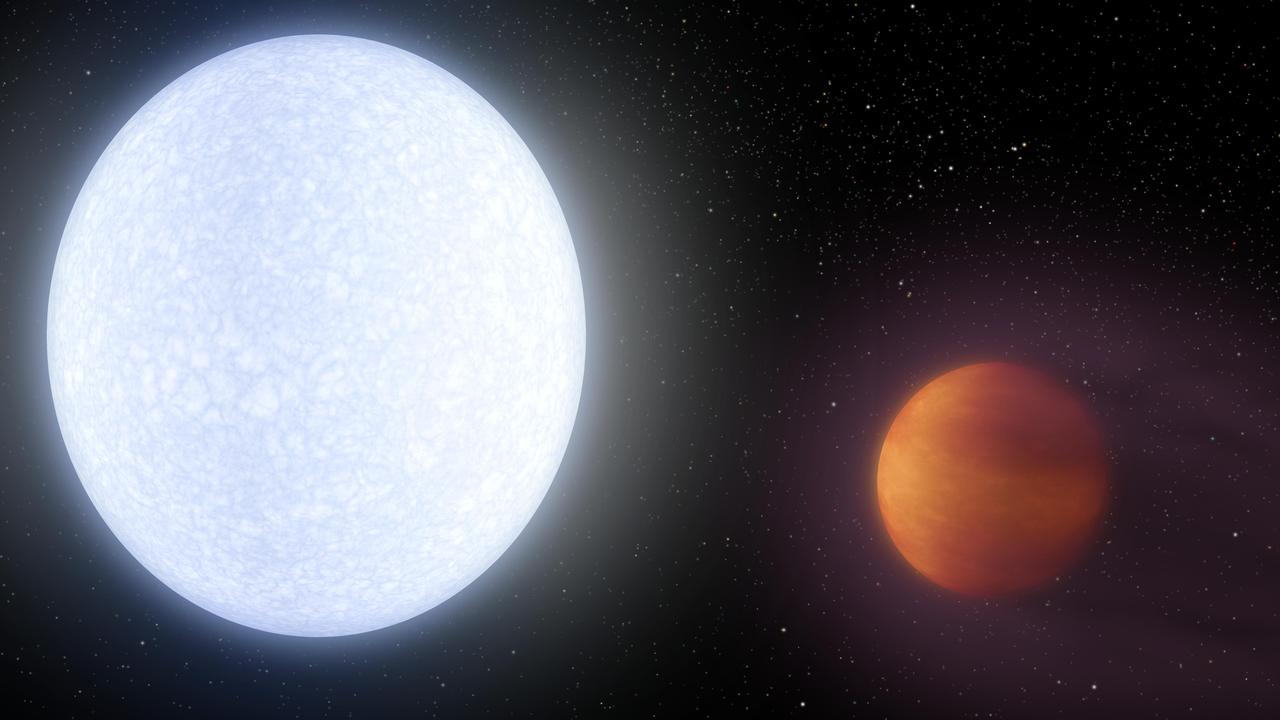
This artist's concept shows planet KELT-9b orbiting its host star, KELT-9. It is the hottest gas giant planet discovered so far. With a dayside temperature of more than 7,800 degrees Fahrenheit (4,600 Kelvin), KELT-9b is a planet that is hotter than most stars. But its star, called KELT-9, is even hotter -- a blue A-type star that is likely unraveling the planet through evaporation. KELT-9b is a gas giant 2.8 times more massive than Jupiter, but only half as dense. Scientists would expect the planet to have a smaller radius, but the extreme radiation from its host star has caused the planet's atmosphere to puff up like a balloon. The planet is also unusual in that it orbits perpendicular to the spin axis of the star. That would be analogous to the planet orbiting perpendicular to the plane of our solar system. One "year" on this planet is less than two days long. The KELT-9 star is only 300 million years old, which is young in star time. It is more than twice as large, and nearly twice as hot, as our sun. Given that the planet's atmosphere is constantly blasted with high levels of ultraviolet radiation, the planet may even be shedding a tail of evaporated planetary material like a comet. An animation is available at https://photojournal.jpl.nasa.gov/catalog/PIA21472
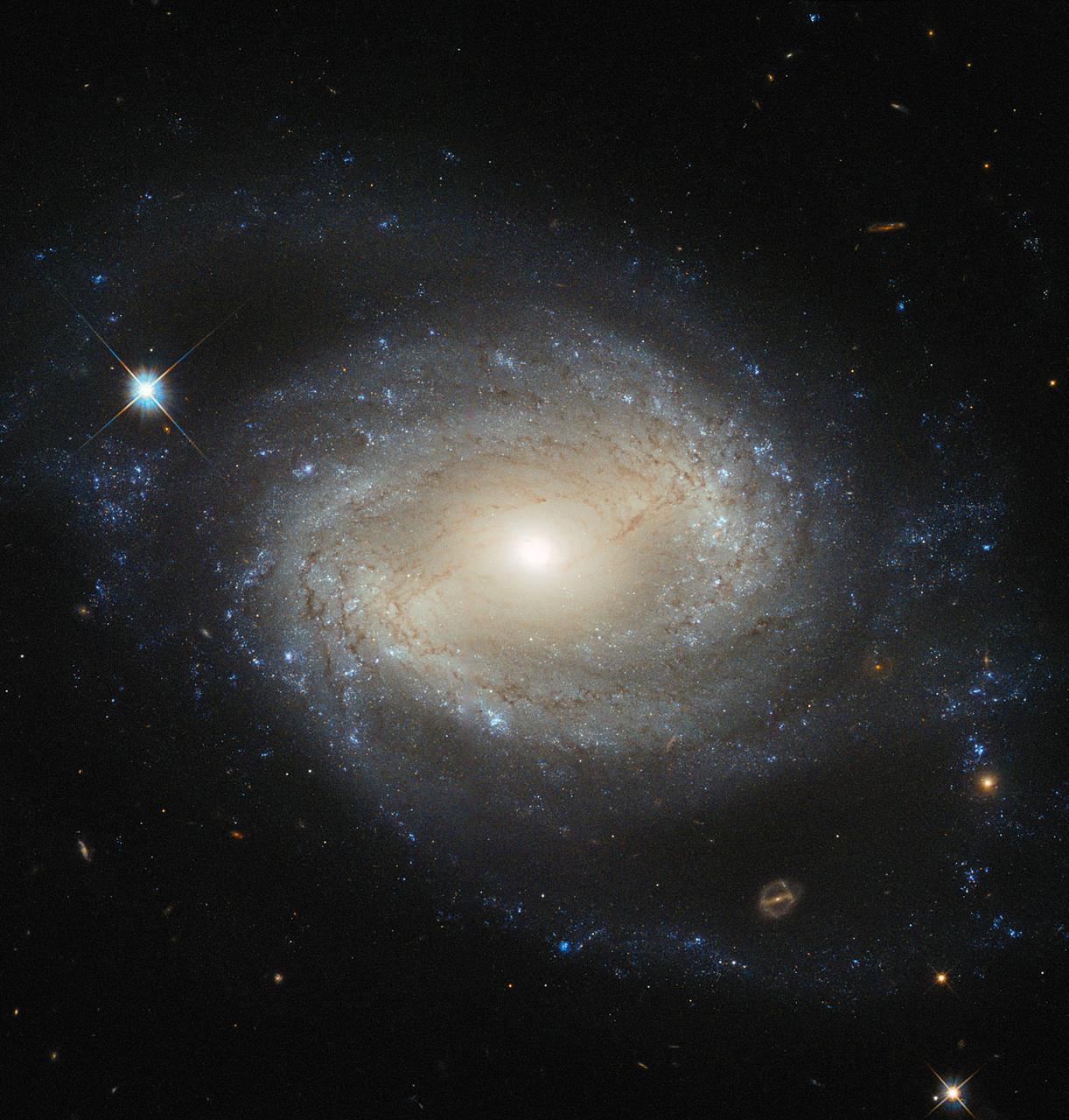
NGC 4639 is a beautiful example of a type of galaxy known as a barred spiral. It lies over 70 million light-years away in the constellation of Virgo and is one of about 1500 galaxies that make up the Virgo Cluster. In this image, taken by the NASA/ESA Hubble Space Telescope, one can clearly see the bar running through the bright, round core of the galaxy. Bars are found in around two thirds of spiral galaxies, and are thought to be a natural phase in their evolution. The galaxy’s spiral arms are sprinkled with bright regions of active star formation. Each of these tiny jewels is actually several hundred light-years across and contains hundreds or thousands of newly formed stars. But NGC 4639 also conceals a dark secret in its core — a massive black hole that is consuming the surrounding gas. This is known as an active galactic nucleus (AGN), and is revealed by characteristic features in the spectrum of light from the galaxy and by X-rays produced close to the black hole as the hot gas plunges towards it. Most galaxies are thought to contain a black hole at the centre. NGC 4639 is in fact a very weak example of an AGN, demonstrating that AGNs exist over a large range of activity, from galaxies like NGC 4639 to distant quasars, where the parent galaxy is almost completely dominated by the emissions from the AGN.
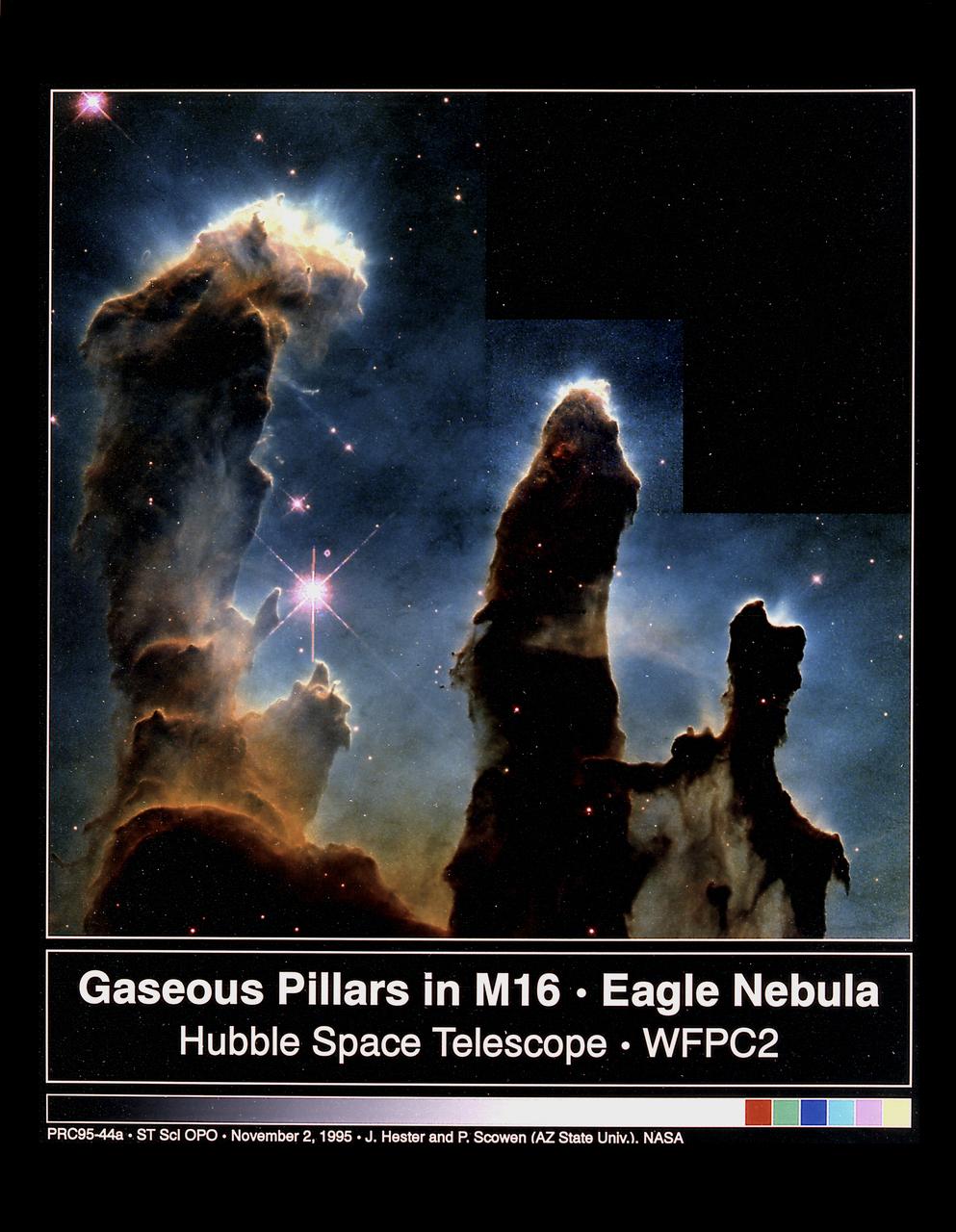
These eerie, dark, pillar-like structures are actually columns of cool interstellar hydrogen gas and dust that are also incubators for new stars. The pillars protrude from the interior wall of a dark molecular cloud like stalagmites from the floor of a cavern. They are part of the Eagle Nebula (also called M16), a nearby star-forming region 7,000 light-years away, in the constellation Serpens. The ultraviolet light from hot, massive, newborn stars is responsible for illuminating the convoluted surfaces of the columns and the ghostly streamers of gas boiling away from their surfaces, producing the dramatic visual effects that highlight the three-dimensional nature of the clouds. This image was taken on April 1, 1995 with the Hubble Space Telescope Wide Field Planetary Camera 2. The color image is constructed from three separate images taken in the light of emission from different types of atoms. Red shows emissions from singly-ionized sulfur atoms, green shows emissions from hydrogen, and blue shows light emitted by doubly-ionized oxygen atoms.

This shot from the NASA/ESA Hubble Space Telescope shows a maelstrom of glowing gas and dark dust within one of the Milky Way’s satellite galaxies, the Large Magellanic Cloud (LMC). This stormy scene shows a stellar nursery known as N159, an HII region over 150 light-years across. N159 contains many hot young stars. These stars are emitting intense ultraviolet light, which causes nearby hydrogen gas to glow, and torrential stellar winds, which are carving out ridges, arcs, and filaments from the surrounding material. At the heart of this cosmic cloud lies the Papillon Nebula, a butterfly-shaped region of nebulosity. This small, dense object is classified as a High-Excitation Blob, and is thought to be tightly linked to the early stages of massive star formation. N159 is located over 160,000 light-years away. It resides just south of the Tarantula Nebula (heic1402), another massive star-forming complex within the LMC. This image comes from Hubble’s Advanced Camera for Surveys. The region was previously imaged by Hubble’s Wide Field Planetary Camera 2, which also resolved the Papillon Nebula for the first time. Credit: ESA/Hubble & NASA
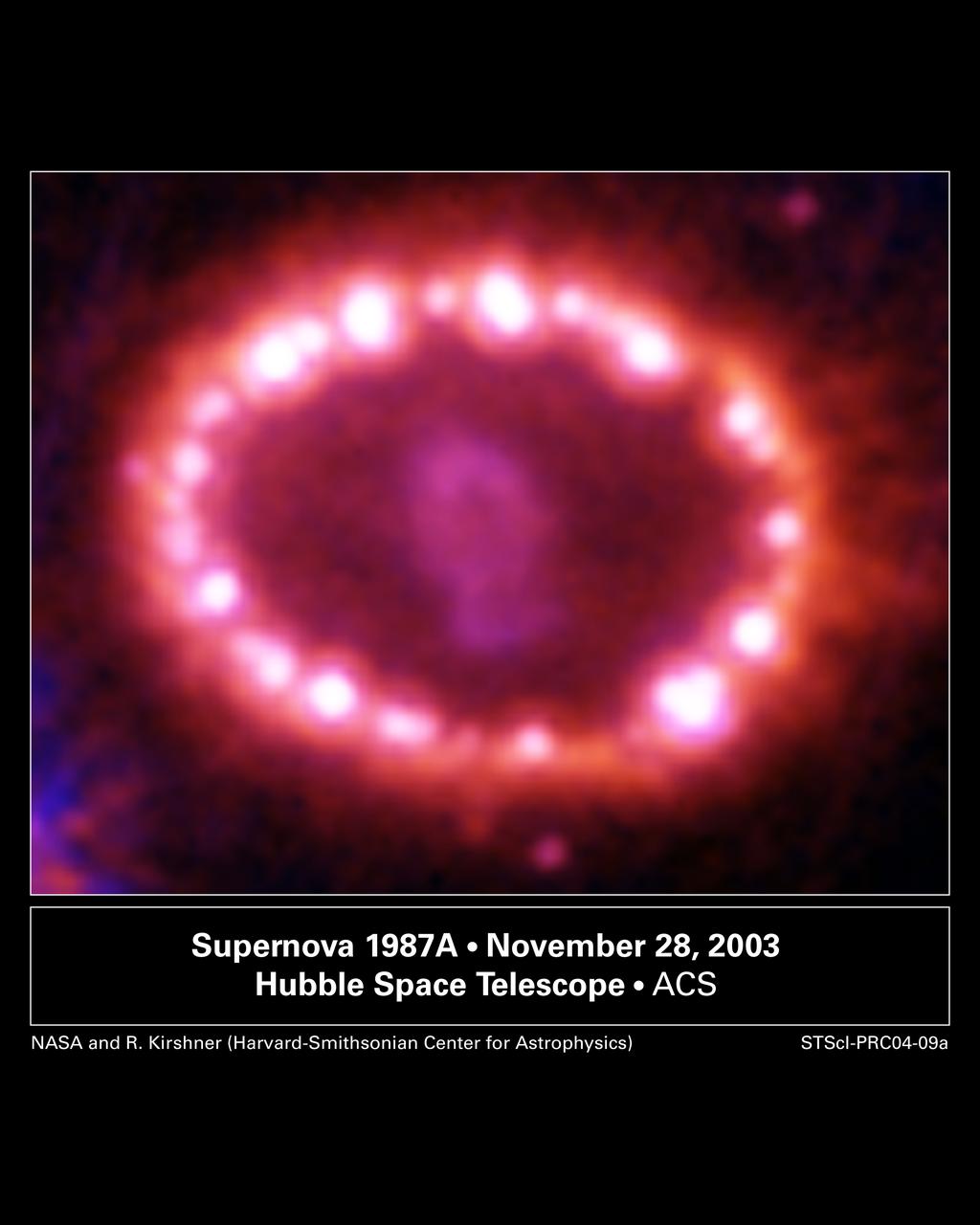
This image of SN 1987A, taken November 28, 2003 by the Advanced Camera for Surveys aboard NASA's Hubble Space Telescope (HST), shows many bright spots along a ring of gas, like pearls on a necklace. These cosmic pearls are being produced as superior shock waves unleashed during an explosion slam into the ring at more than a million miles per hour. The collision is heating the gas ring, causing its irnermost regions to glow. Astronomers detected the first of these hot spots in 1996, but now they see dozens of them all around the ring. With temperatures surging from a few thousand degrees to a million degrees, the flares are increasing in number. In the next few years, the entire ring will be ablaze as it absorbs the full force of the crash and is expected to become bright enough to illuminate the star's surroundings. Astronomers will then be able to obtain information on how the star ejected material before the explosion. The elongated and expanding object in the center of the ring is debris form the supernova blast which is being heated by radioactive elements, principally titanium 44, that were created in the explosion. This explosion was first observed by astronomers seventeen years ago in 1987, although the explosion took place about 160,000 years ago.

This image was acquired on May 15, 2018 by NASA's Mars Reconnaissance Orbiter. This observation shows relatively bright mounds scattered throughout darker and diverse surfaces in Chryse Planitia. These mounds are hundreds of meters in size. The largest of the mounds shows a central pit, similar to the collapsed craters found at the summit of some volcanoes on Earth. The origins of these pitted mounds or cratered cones are uncertain. They could be the result of the interaction of lava and water, or perhaps formed from the eruption of hot mud originating from beneath the surface. These features are very interesting to scientists who study Mars, especially to those involved in the ExoMars Trace Gas Orbiter mission. If these mounds are indeed mud-related, they may be one of the long sought after sources for transient methane on Mars. More information is available at https://photojournal.jpl.nasa.gov/catalog/PIA22682
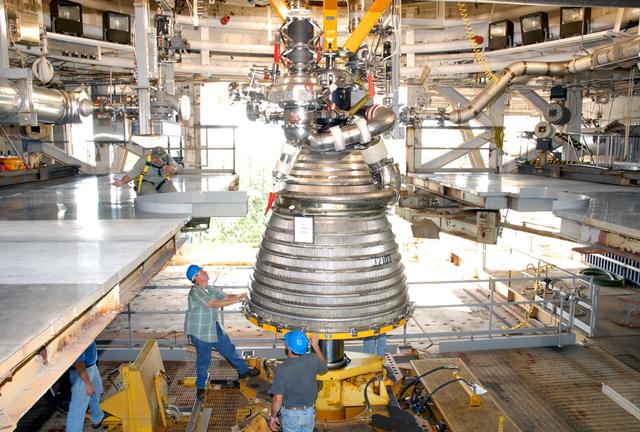
Core components of the J-2X engine being designed for NASA's Constellation Program recently were installed on the A-1 Test Stand at NASA's Stennis Space Center near Bay St. Louis, Miss. Tests of the components, known as Powerpack 1A, will be conducted from November 2007 through February 2008. The Powerpack 1A test article consists of a gas generator and engine turbopumps originally developed for the Apollo Program that put Americans on the moon in the late 1960s and early 1970s. Engineers are testing these heritage components to obtain data that will help them modify the turbomachinery to meet the higher performance requirements of the Ares I and Ares V launch vehicles. The upcoming tests will simulate inlet and outlet conditions that would be present on the turbomachinery during a full-up engine hot-fire test.
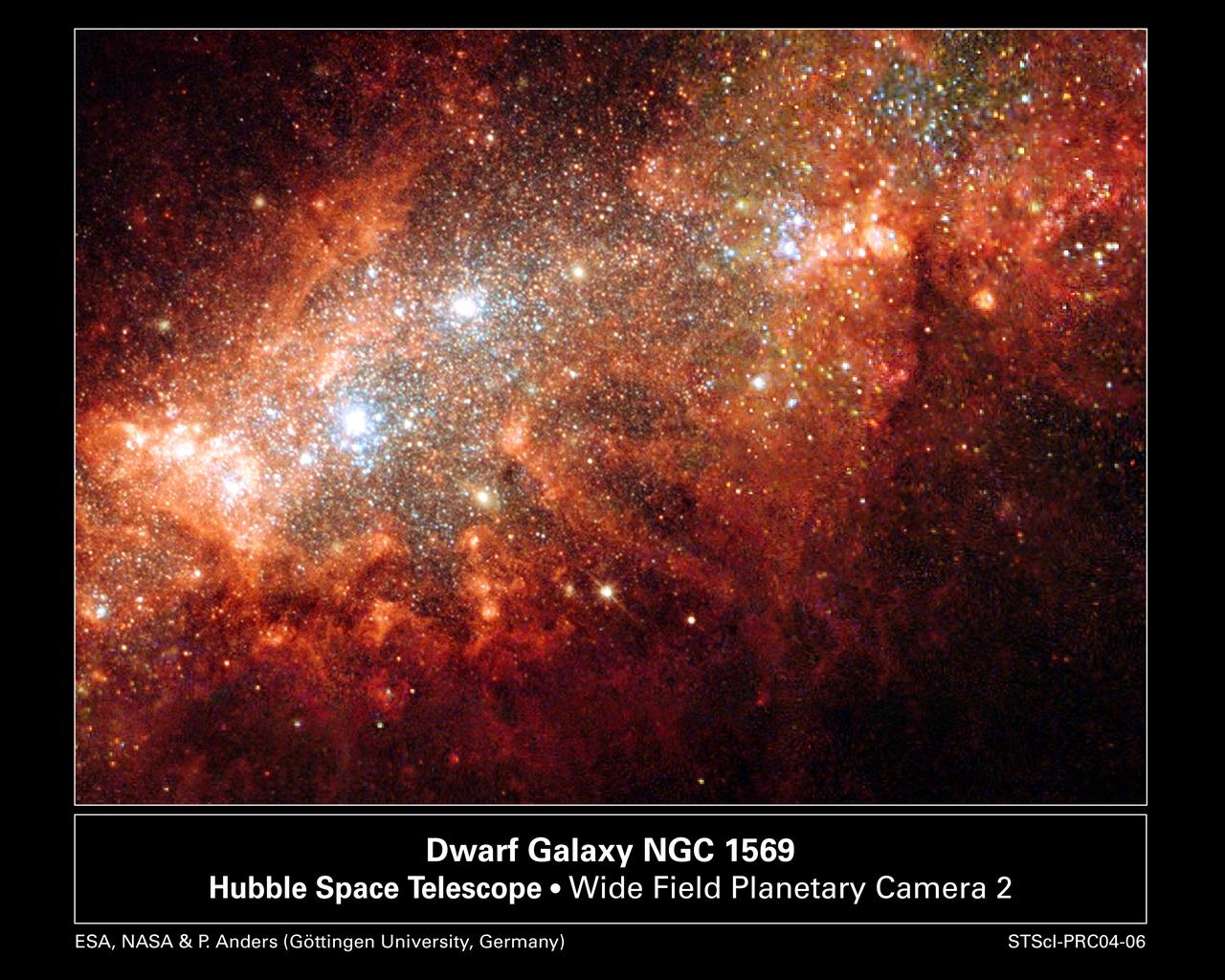
This new image taken with NASA's Hubble Space Telescope (HST) is of the nearby dwarf galaxy NGC 1569. This galaxy is a hotbed of vigorous star birth activity which blows huge bubbles that riddle its main body. The bubble structure is sculpted by the galactic super-winds and outflows caused by a colossal input of energy from collective supernova explosions that are linked with a massive episode of star birth. The bubbles seen in this image are made of hydrogen gas that glows when hit by the fierce wind and radiation from hot young stars and is racked by supernova shocks. Its "star factories" are also manufacturing brilliant blue star clusters. NGC 1569 had a sudden onset of star birth about 25 million years ago, which subsided about the time the very earliest human ancestors appeared on Earth. The Marshall Space Flight Center had responsibility for the design, development, and construction of the HST.
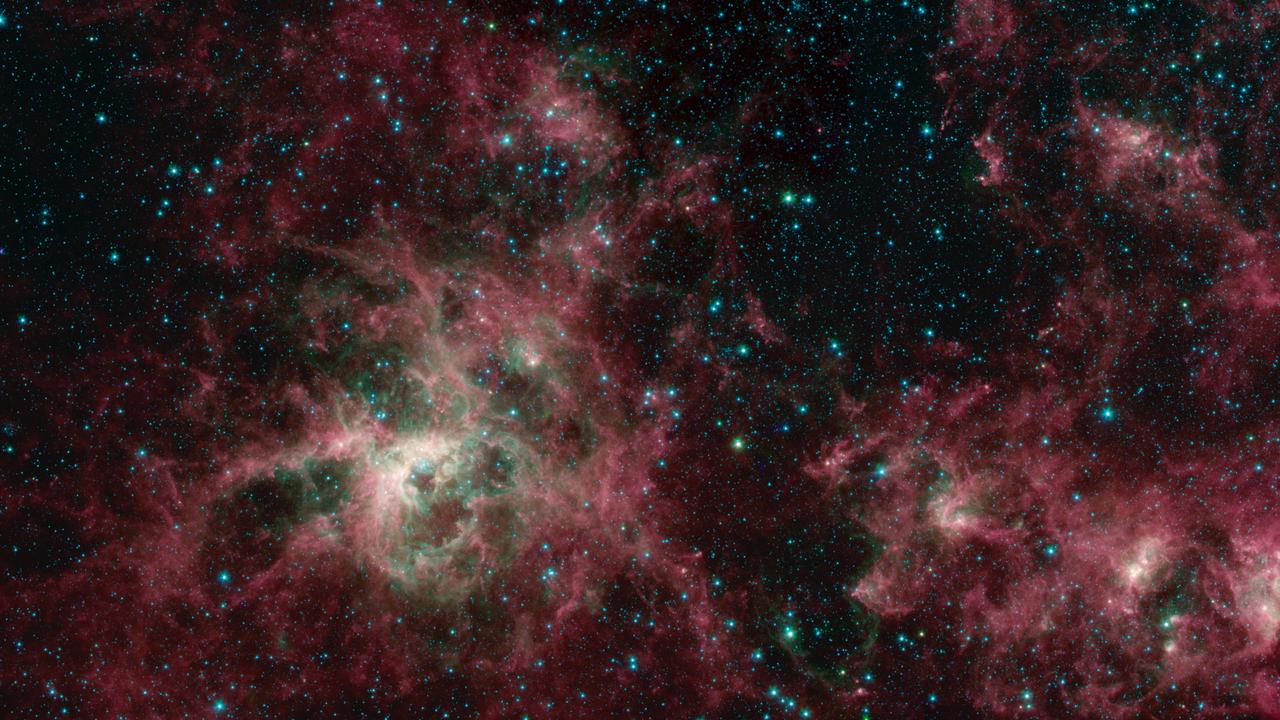
This image from NASA's Spitzer Space Telescope shows the Tarantula Nebula in three wavelengths of infrared light, each represented by a different color. The magenta-colored regions are dust composed of molecules called polycyclic aromatic hydrocarbons (PAHs), which are also found in ash from coal, wood and oil fires on Earth. PAHs emit in multiple wavelengths. The PAHs emit in multiple wavelengths, so the magenta color is a combination of red (corresponding to an infrared wavelength of 8 micrometers) and blue (3.6 micrometers). The green color in this image shows the presence of particularly hot gas emitting infrared light at a wavelength of 4.5 micrometers. The stars in the image are mostly a combination of green and blue. White hues indicate regions that radiate in all three wavelengths. https://photojournal.jpl.nasa.gov/catalog/PIA23647
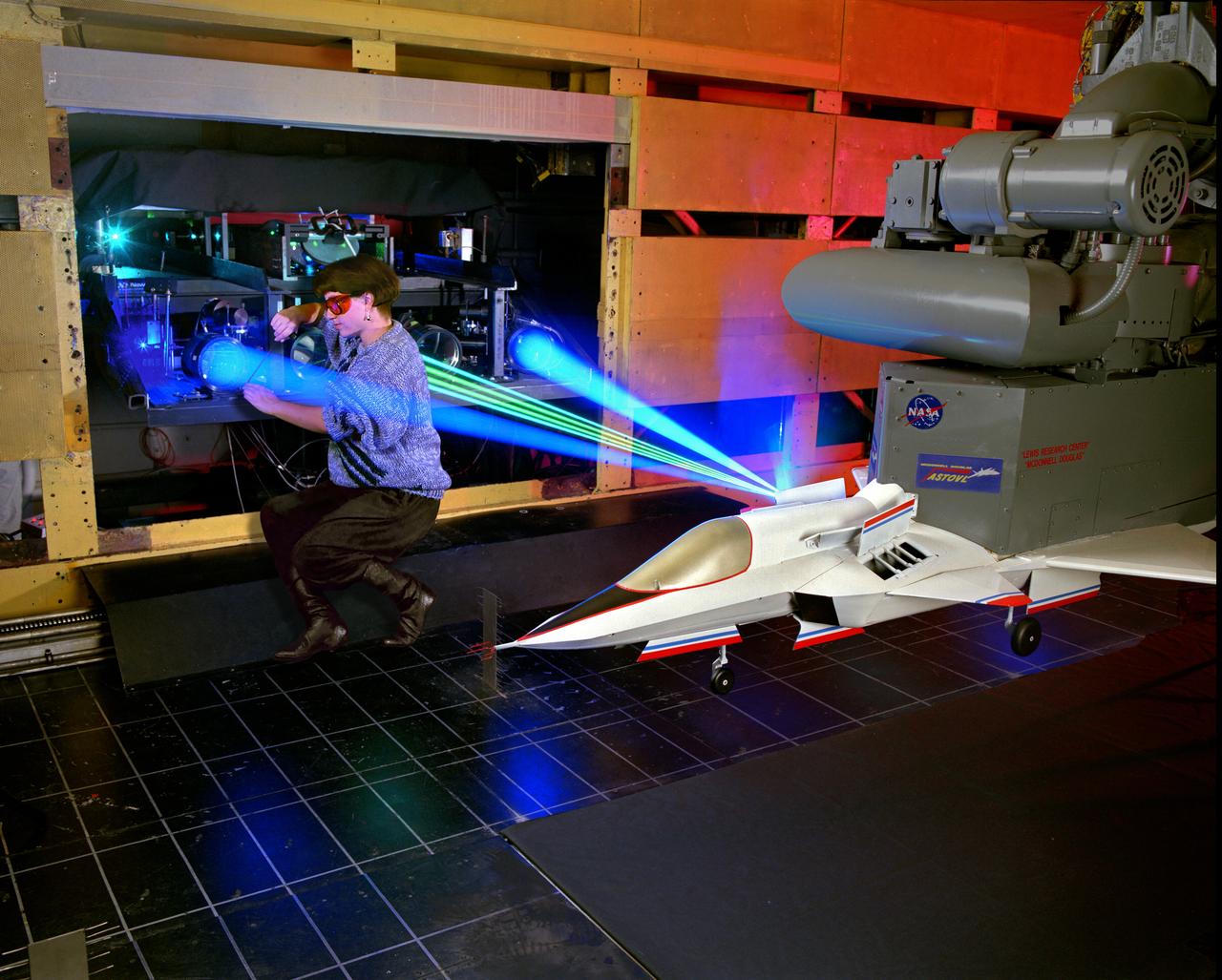
The 9x15 low speed tunnel tests take off and landing of aircraft. The laser velocimetry system for flow measurement show here, with the color blue and green lasers, measures engine exhaust that comes back up from the ground. The STOVL model n the 9x15 low speed wind tunnel, building 39, is similar to the British Harrier aircraft.
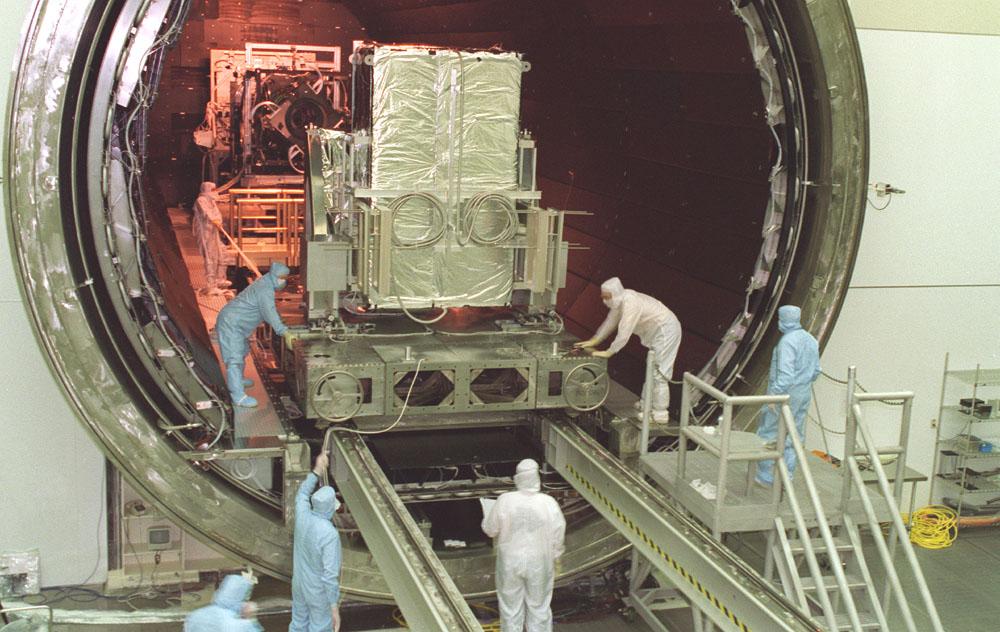
This photograph captures the installation of the Chandra X-Ray Observatory, formerly Advanced X-Ray Astrophysics Facility (AXAF), Advanced Charged-Coupled Device (CCD) Imaging Spectrometer (ACIS) into the Vacuum Chamber at the X-Ray Calibration Facility (XRCF) at Marshall Space Flight Center (MSFC). The AXAF was renamed Chandra X-Ray Observatory (CXO) in 1999. The CXO is the most sophisticated and the world's most powerful x-ray telescope ever built. It observes x-rays from high-energy regions of the universe, such as hot gas in the remnants of exploded stars. The ACIS is one of two focal plane instruments. As the name suggests, this instrument is an array of CCDs similar to those used in a camcorder. This instrument will be especially useful because it can make x-ray images and measure the energies of incoming x-rays. It is the instrument of choice for studying the temperature variation across x-ray sources, such as vast clouds of hot-gas intergalactic space. MSFC's XRCF is the world's largest, most advanced laboratory for simulating x-ray emissions from distant celestial objects. It produces a space-like environment in which components related to x-ray telescope imaging are tested and the quality of their performances in space is predicted. TRW, Inc. was the prime contractor for the development of the CXO and NASA's MSFC was responsible for its project management. The Smithsonian Astrophysical Observatory controls science and flight operations of the CXO for NASA from Cambridge, Massachusetts. The CXO was launched July 22, 1999 aboard the Space Shuttle Columbia (STS-93).

ISS016-E-010894 (17 Nov. 2007) --- Cosiguina Volcano, Nicaragua is featured in this image photographed by an Expedition 16 crewmember on the International Space Station. Three Central American countries (El Salvador, Honduras, and Nicaragua) include coastline along the Gulf of Fonseca that opens into the Pacific Ocean. The southern boundary of the Gulf is a peninsula formed by the Cosiguina volcano illustrated in this view. Cosiguina is a stratovolcano, typically tall cone-shaped structures formed by alternating layers of solidified lava and volcanic rocks (ash, pyroclastic flows, breccias) produced by explosive eruptions. The summit crater is filled with a lake (Laguna Cosiguina). The volcano last erupted in 1859, but its most famous activity occurred in 1835 when it produced the largest historical eruption in Nicaragua. Ash from the 1835 eruption has been found in Mexico, Costa Rica, and Jamaica. The volcano has been quiet since 1859, only an instant in terms of geological time. An earthquake swarm was measured near Cosiguina in 2002, indicating that tectonic forces are still active in the region although the volcano is somewhat isolated from the line of more recently active Central American volcanoes to the northwest and southeast. Intermittently observed gas bubbles in Laguna Cosiguina, and a hot spring along the eastern flank of the volcano are the only indicators of hydrothermal activity at the volcano. The fairly uniform vegetation cover (green) on the volcano's sides also attest to a general lack of gas emissions or "hot spots" on the 872 meter high cone, according to NASA scientists who study the photos downlinked from the orbital outpost.
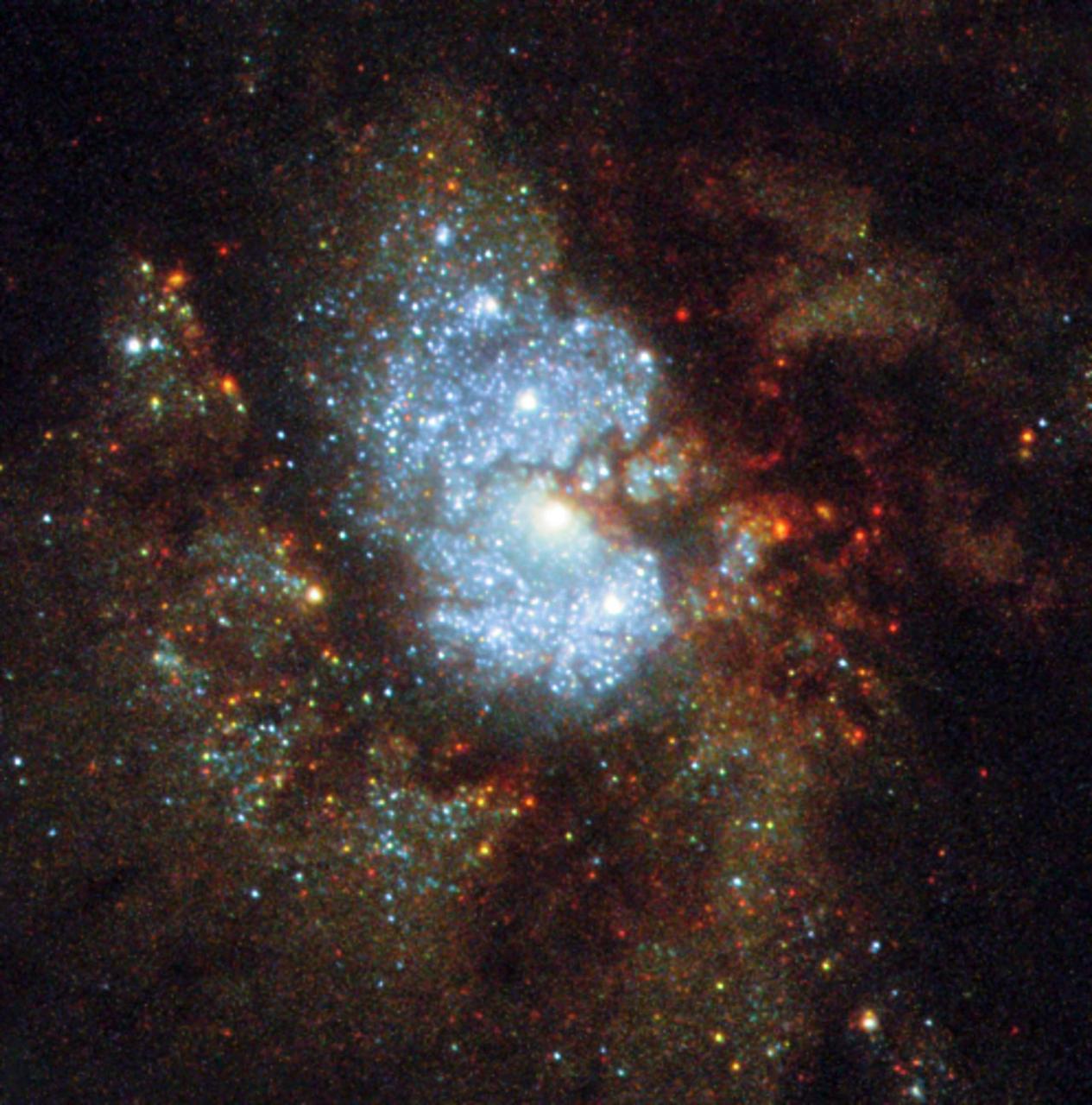
IC 342 is a challenging cosmic target. Although it is bright, the galaxy sits near the equator of the Milky Way’s galactic disk, where the sky is thick with glowing cosmic gas, bright stars, and dark, obscuring dust. In order for astronomers to see the intricate spiral structure of IC 342, they must gaze through a large amount of material contained within our own galaxy — no easy feat! As a result IC 342 is relatively difficult to spot and image, giving rise to its intriguing nickname: the “Hidden Galaxy.” Located very close (in astronomical terms) to the Milky Way, this sweeping spiral galaxy would be among the brightest in the sky were it not for its dust-obscured location. The galaxy is very active, as indicated by the range of colors visible in this NASA/ESA Hubble Space Telescope image, depicting the very central region of the galaxy. A beautiful mixture of hot, blue star-forming regions, redder, cooler regions of gas, and dark lanes of opaque dust can be seen, all swirling together around a bright core. In 2003, astronomers confirmed this core to be a specific type of central region known as an HII nucleus — a name that indicates the presence of ionized hydrogen — that is likely to be creating many hot new stars. Credit: ESA/Hubble & NASA <b><a href="http://www.nasa.gov/audience/formedia/features/MP_Photo_Guidelines.html" rel="nofollow">NASA image use policy.</a></b> <b><a href="http://www.nasa.gov/centers/goddard/home/index.html" rel="nofollow">NASA Goddard Space Flight Center</a></b> enables NASA’s mission through four scientific endeavors: Earth Science, Heliophysics, Solar System Exploration, and Astrophysics. Goddard plays a leading role in NASA’s accomplishments by contributing compelling scientific knowledge to advance the Agency’s mission. <b>Follow us on <a href="http://twitter.com/NASAGoddardPix" rel="nofollow">Twitter</a></b> <b>Like us on <a href="http://www.facebook.com/pages/Greenbelt-MD/NASA-Goddard/395013845897?ref=tsd" rel="nofollow">Facebook</a></b> <b>Find us on <a href="http://instagrid.me/nasagoddard/?vm=grid" rel="nofollow">Instagram</a></b>

For the 26th birthday of NASA’s Hubble Space Telescope, astronomers are highlighting a Hubble image of an enormous bubble being blown into space by a super-hot, massive star. The Hubble image of the Bubble Nebula, or NGC 7635, was chosen to mark the 26th anniversary of the launch of Hubble into Earth orbit by the STS-31 space shuttle crew on April 24, 1990 “As Hubble makes its 26th revolution around our home star, the sun, we celebrate the event with a spectacular image of a dynamic and exciting interaction of a young star with its environment. The view of the Bubble Nebula, crafted from WFC-3 images, reminds us that Hubble gives us a front row seat to the awe inspiring universe we live in,” said John Grunsfeld, Hubble astronaut and associate administrator of NASA’s Science Mission Directorate at NASA Headquarters, in Washington, D.C. The Bubble Nebula is seven light-years across—about one-and-a-half times the distance from our sun to its nearest stellar neighbor, Alpha Centauri, and resides 7,100 light-years from Earth in the constellation Cassiopeia. The seething star forming this nebula is 45 times more massive than our sun. Gas on the star gets so hot that it escapes away into space as a “stellar wind” moving at over four million miles per hour. This outflow sweeps up the cold, interstellar gas in front of it, forming the outer edge of the bubble much like a snowplow piles up snow in front of it as it moves forward. As the surface of the bubble's shell expands outward, it slams into dense regions of cold gas on one side of the bubble. This asymmetry makes the star appear dramatically off-center from the bubble, with its location in the 10 o’clock position in the Hubble view. Dense pillars of cool hydrogen gas laced with dust appear at the upper left of the picture, and more “fingers” can be seen nearly face-on, behind the translucent bubble. The gases heated to varying temperatures emit different colors: oxygen is hot enough to emit blue light in the bubble near the star, while the cooler pillars are yellow from the combined light of hydrogen and nitrogen. The pillars are similar to the iconic columns in the “Pillars of Creation” Eagle Nebula. As seen with the structures in the Eagle Nebula, the Bubble Nebula pillars are being illuminated by the strong ultraviolet radiation from the brilliant star inside the bubble. The Bubble Nebula was discovered in 1787 by William Herschel, a prominent British astronomer. It is being formed by a proto-typical Wolf-Rayet star, BD +60º2522, an extremely bright, massive, and short-lived star that has lost most of its outer hydrogen and is now fusing helium into heavier elements. The star is about four million years old, and in 10 million to 20 million years, it will likely detonate as a supernova. Hubble’s Wide Field Camera-3 imaged the nebula in visible light with unprecedented clarity in February 2016. The colors correspond to blue for oxygen, green for hydrogen, and red for nitrogen. This information will help astronomers understand the geometry and dynamics of this complex system. The Bubble Nebula is one of only a handful of astronomical objects that have been observed with several different instruments onboard Hubble. Hubble also imaged it with the Wide Field Planetary Camera (WFPC) in September 1992, and with Wide Field Planetary Camera-2 (WFPC2) in April 1999. The Hubble Space Telescope is a project of international cooperation between NASA and the European Space Agency. NASA's Goddard Space Flight Center in Greenbelt, Maryland, manages the telescope. The Space Telescope Science Institute (STScI) in Baltimore, Maryland, conducts Hubble science operations. STScI is operated for NASA by the Association of Universities for Research in Astronomy in Washington, D.C. Credit: NASA, ESA, and the Hubble Heritage Team (STScI/AURA)

For the 26th birthday of NASA’s Hubble Space Telescope, astronomers are highlighting a Hubble image of an enormous bubble being blown into space by a super-hot, massive star. The Hubble image of the Bubble Nebula, or NGC 7635, was chosen to mark the 26th anniversary of the launch of Hubble into Earth orbit by the STS-31 space shuttle crew on April 24, 1990 “As Hubble makes its 26th revolution around our home star, the sun, we celebrate the event with a spectacular image of a dynamic and exciting interaction of a young star with its environment. The view of the Bubble Nebula, crafted from WFC-3 images, reminds us that Hubble gives us a front row seat to the awe inspiring universe we live in,” said John Grunsfeld, Hubble astronaut and associate administrator of NASA’s Science Mission Directorate at NASA Headquarters, in Washington, D.C. The Bubble Nebula is seven light-years across—about one-and-a-half times the distance from our sun to its nearest stellar neighbor, Alpha Centauri, and resides 7,100 light-years from Earth in the constellation Cassiopeia. The seething star forming this nebula is 45 times more massive than our sun. Gas on the star gets so hot that it escapes away into space as a “stellar wind” moving at over four million miles per hour. This outflow sweeps up the cold, interstellar gas in front of it, forming the outer edge of the bubble much like a snowplow piles up snow in front of it as it moves forward. As the surface of the bubble's shell expands outward, it slams into dense regions of cold gas on one side of the bubble. This asymmetry makes the star appear dramatically off-center from the bubble, with its location in the 10 o’clock position in the Hubble view. Dense pillars of cool hydrogen gas laced with dust appear at the upper left of the picture, and more “fingers” can be seen nearly face-on, behind the translucent bubble. The gases heated to varying temperatures emit different colors: oxygen is hot enough to emit blue light in the bubble near the star, while the cooler pillars are yellow from the combined light of hydrogen and nitrogen. The pillars are similar to the iconic columns in the “Pillars of Creation” Eagle Nebula. As seen with the structures in the Eagle Nebula, the Bubble Nebula pillars are being illuminated by the strong ultraviolet radiation from the brilliant star inside the bubble. The Bubble Nebula was discovered in 1787 by William Herschel, a prominent British astronomer. It is being formed by a proto-typical Wolf-Rayet star, BD +60º2522, an extremely bright, massive, and short-lived star that has lost most of its outer hydrogen and is now fusing helium into heavier elements. The star is about four million years old, and in 10 million to 20 million years, it will likely detonate as a supernova. Hubble’s Wide Field Camera-3 imaged the nebula in visible light with unprecedented clarity in February 2016. The colors correspond to blue for oxygen, green for hydrogen, and red for nitrogen. This information will help astronomers understand the geometry and dynamics of this complex system. The Bubble Nebula is one of only a handful of astronomical objects that have been observed with several different instruments onboard Hubble. Hubble also imaged it with the Wide Field Planetary Camera (WFPC) in September 1992, and with Wide Field Planetary Camera-2 (WFPC2) in April 1999. The Hubble Space Telescope is a project of international cooperation between NASA and the European Space Agency. NASA's Goddard Space Flight Center in Greenbelt, Maryland, manages the telescope. The Space Telescope Science Institute (STScI) in Baltimore, Maryland, conducts Hubble science operations. STScI is operated for NASA by the Association of Universities for Research in Astronomy in Washington, D.C. Credit: NASA, ESA, and the Hubble Heritage Team (STScI/AURA)