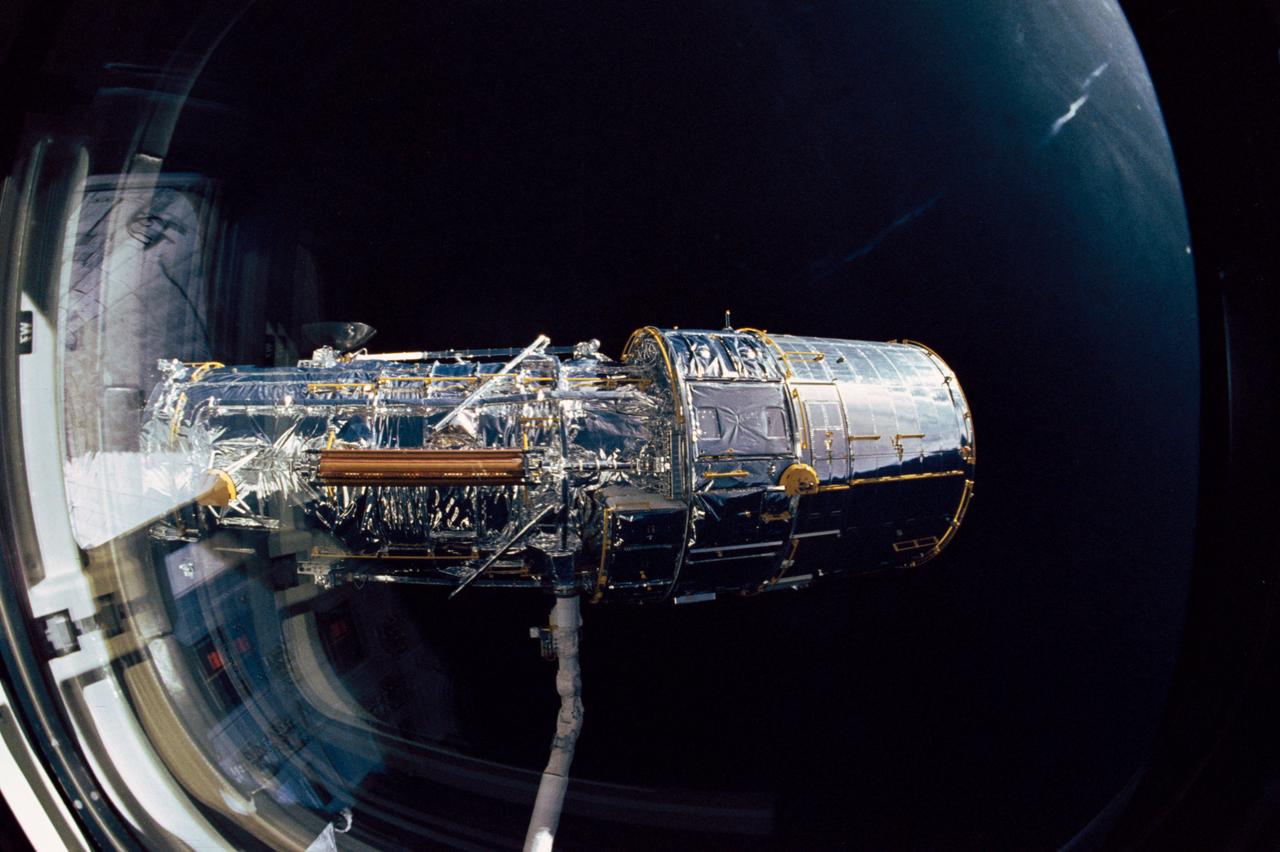
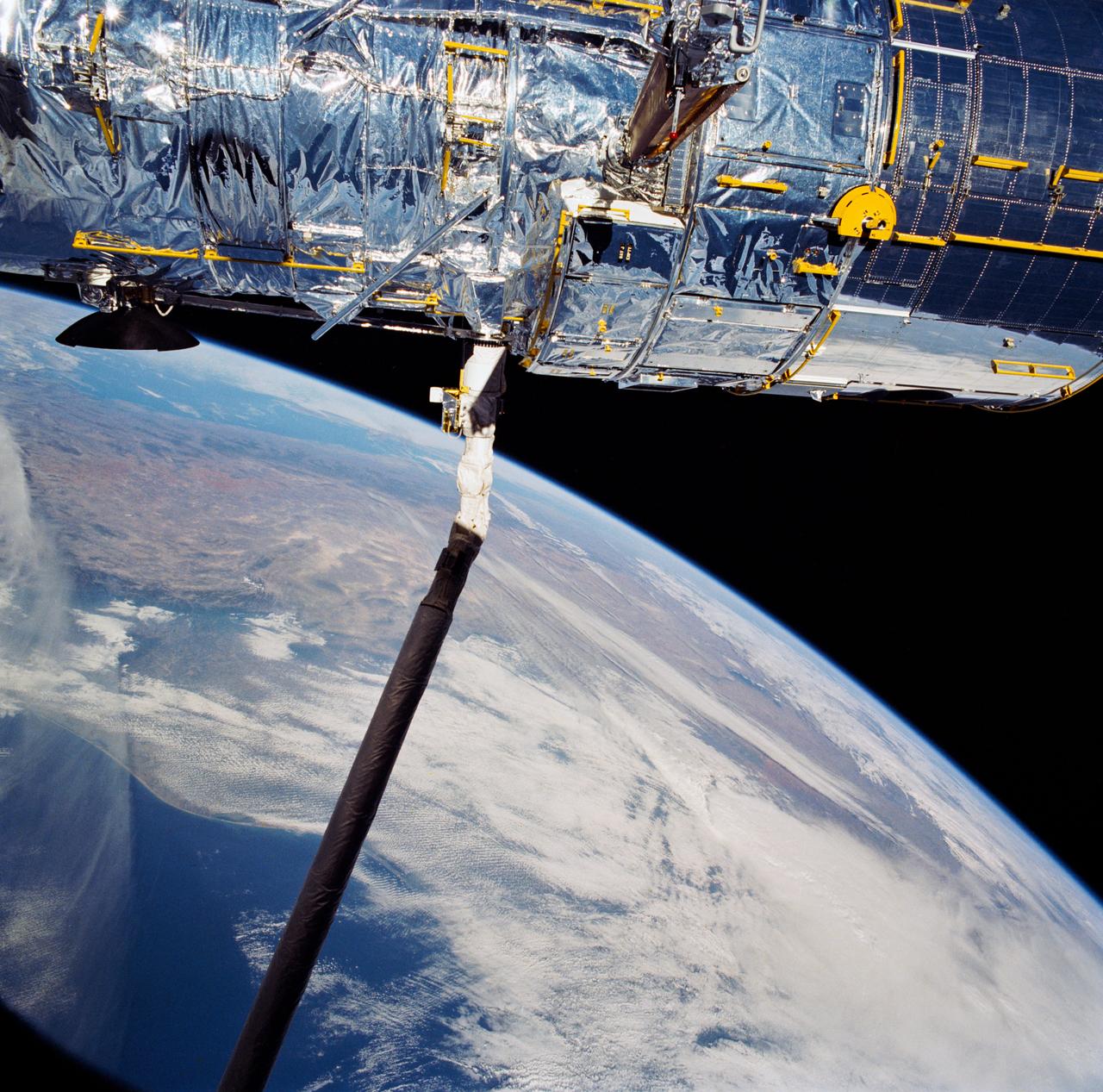
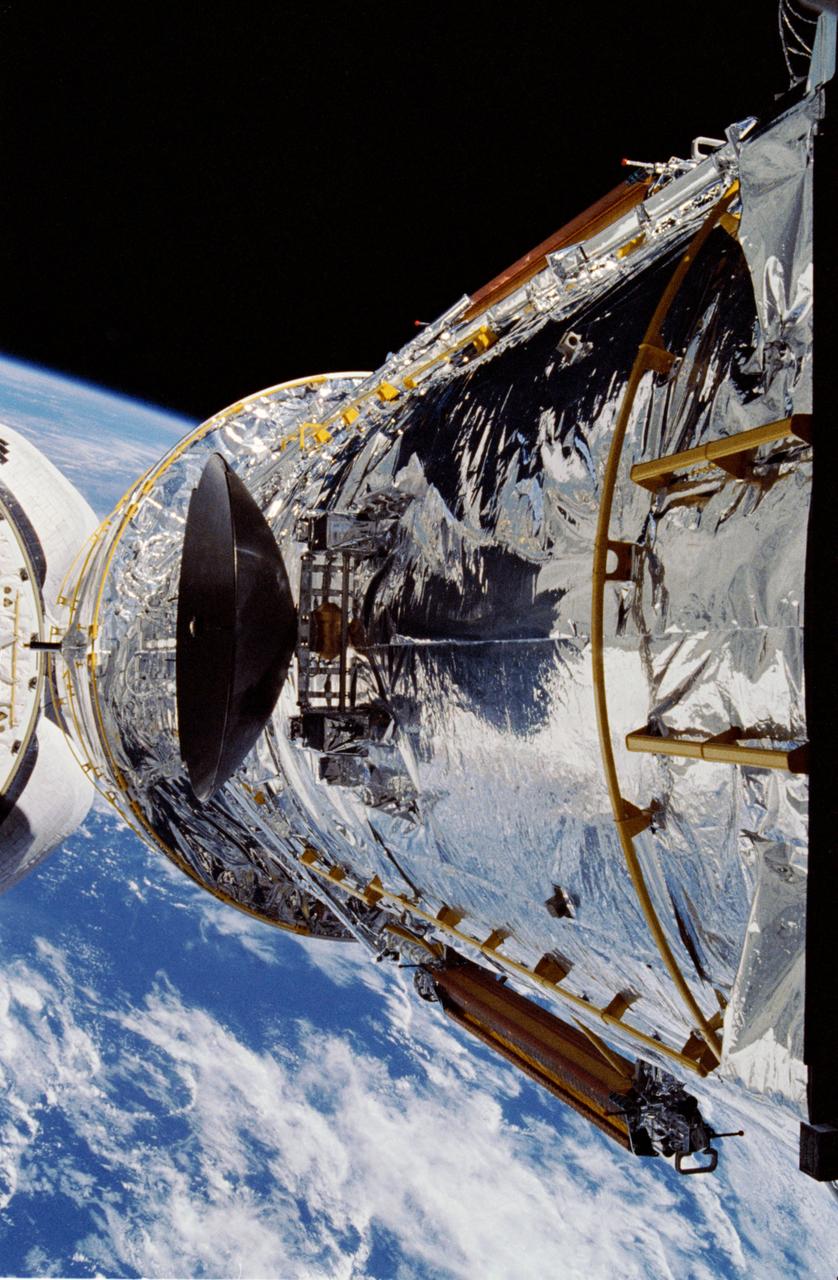
The Hubble Space Telescope (HST) is raised above the payload bay (PLB) in low hover position during STS-31 checkout and pre-deployment procedures aboard Discovery, Orbiter Vehicle (OV) 103. Stowed along the HST Support System Module (SSM) are the high gain antenna (HGA) (center) and the two solar arrays (one either side). In the background are the orbital maneuvering system (OMS) pods and the Earth's surface.
Hubble Space Telescope (HST) above OV-103's PLB during STS-31 deployment
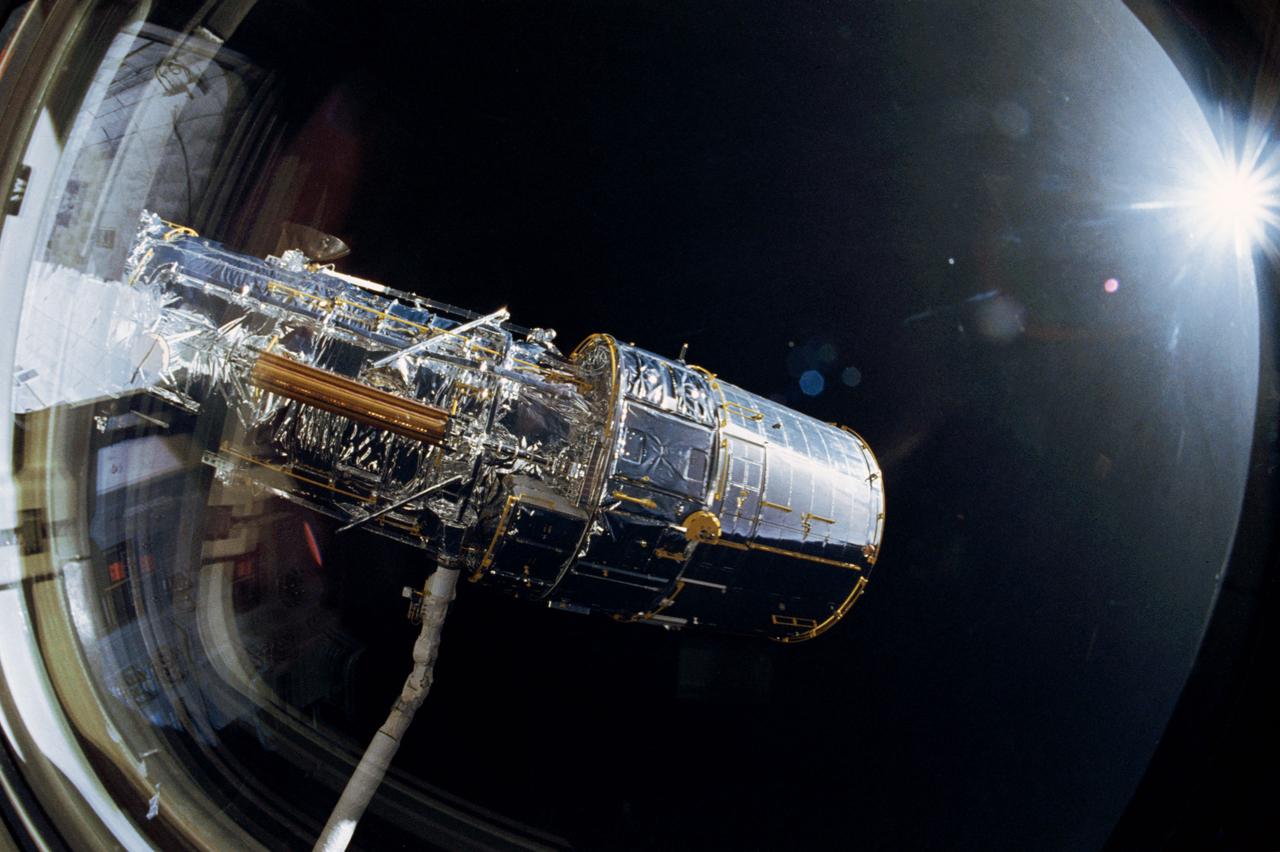
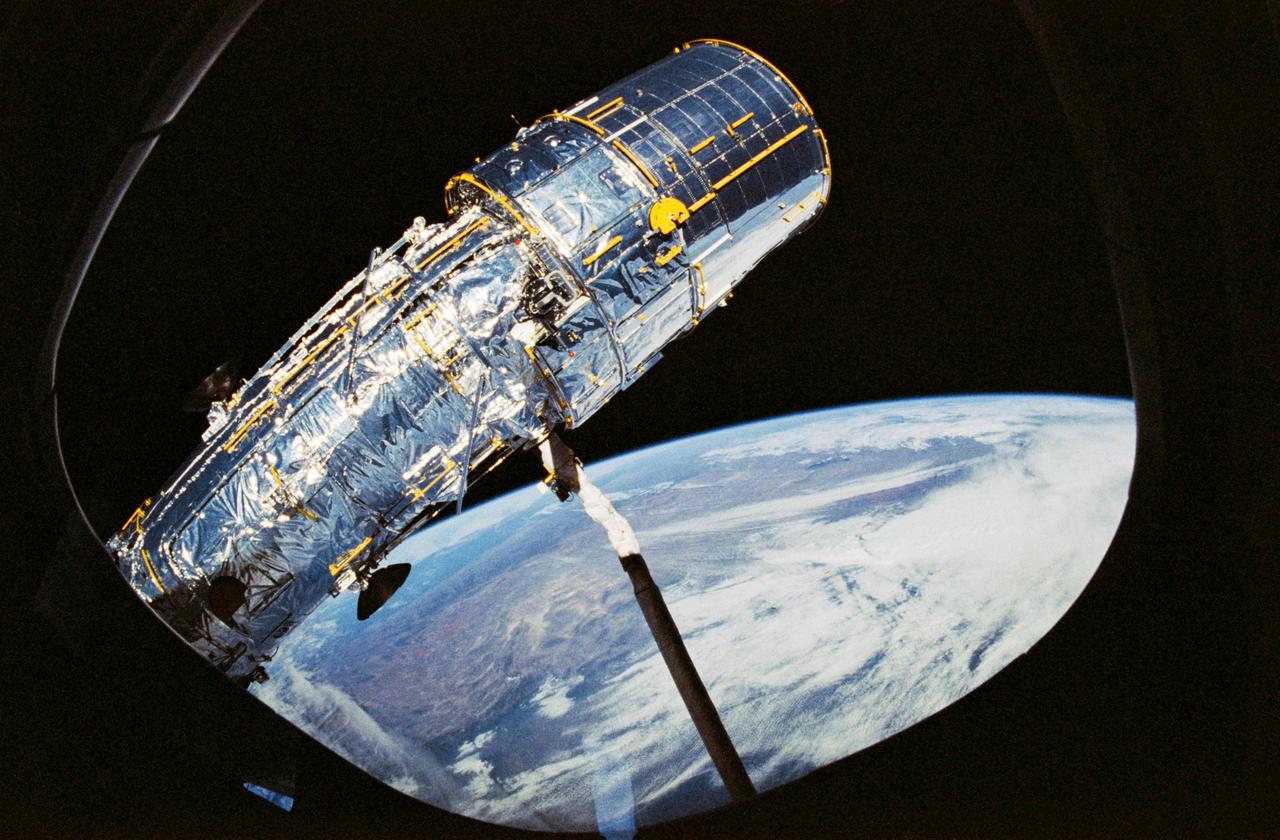
The Hubble Space Telescope (HST), grappled by Discovery's, Orbiter Vehicle (OV) 103's, remote manipulator system (RMS), is held in a pre-deployment position. During STS-31 checkout procedures, the solar array (SA) panels and the high gain antennae (HGA) will be deployed. The starboard SA (center) and the two HGA are stowed along side the Support System Module (SSM) forward shell. The sun highlights HST against the blackness of space.
Hubble Space Telescope (HST) grappled by OV-103's RMS during STS-31 checkout
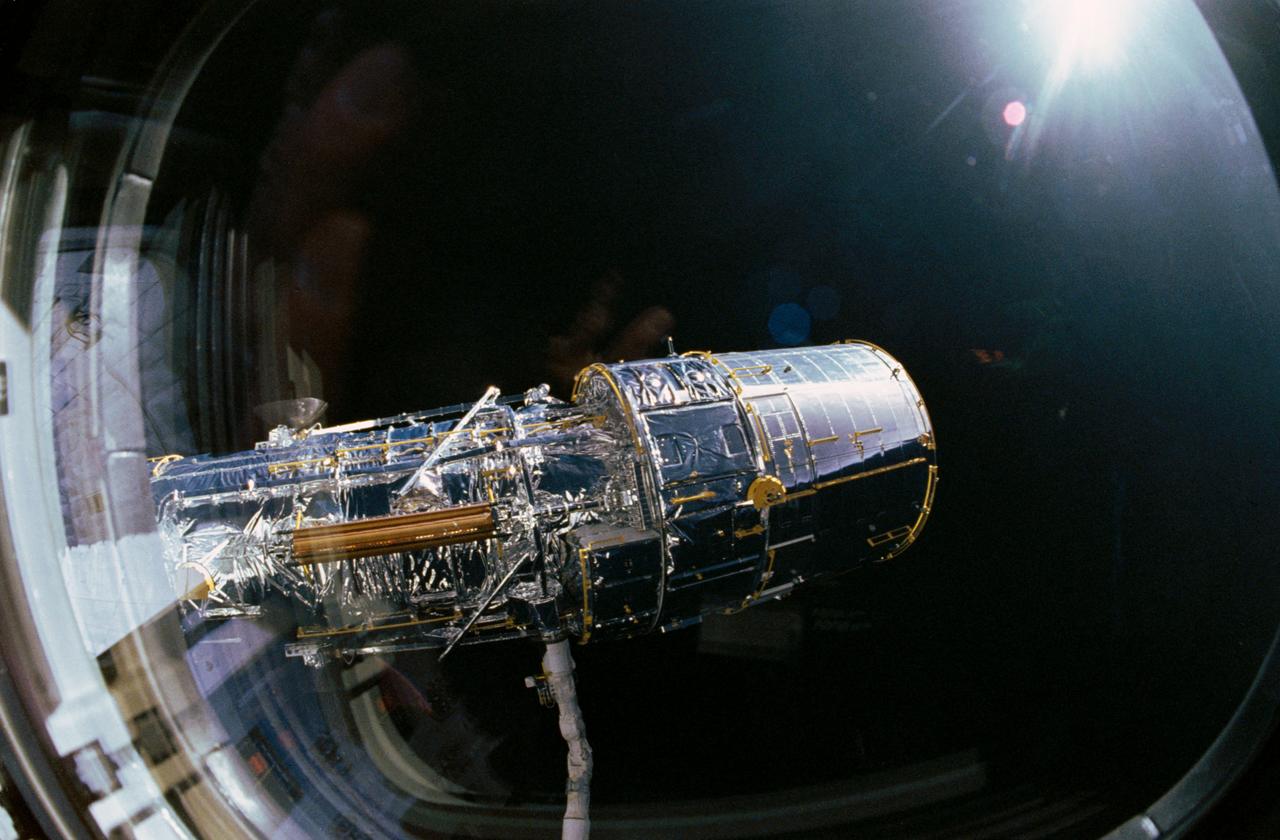
The Hubble Space Telescope (HST), grappled by Discovery's, Orbiter Vehicle (OV) 103's, remote manipulator system (RMS), is oriented in a 90 degree pitch position during STS-31 pre-deployment checkout procedures. The solar array (SA) panel (center) and high gain antennae (HGA) (on either side) are stowed along the Support System Module (SSM) forward shell prior to deployment. The sun highlights HST against the blackness of space.
STS-31 pre-deployment checkout of the Hubble Space Telescope (HST) on OV-103
View taken through overhead window W7 aboard Discovery, Orbiter Vehicle (OV) 103, shows the Hubble Space Telescope (HST) grappled by the remote manipulator system (RMS) and held in a 90 degree pitch position against the blackness of space. The solar array (SA) panel (center) and the high gain antennae (HGA) (on either side) are visible along the Support System Module (SSM) forward shell prior to deployment during STS-31.
STS-31 pre-deployment checkout of the Hubble Space Telescope (HST) on OV-103
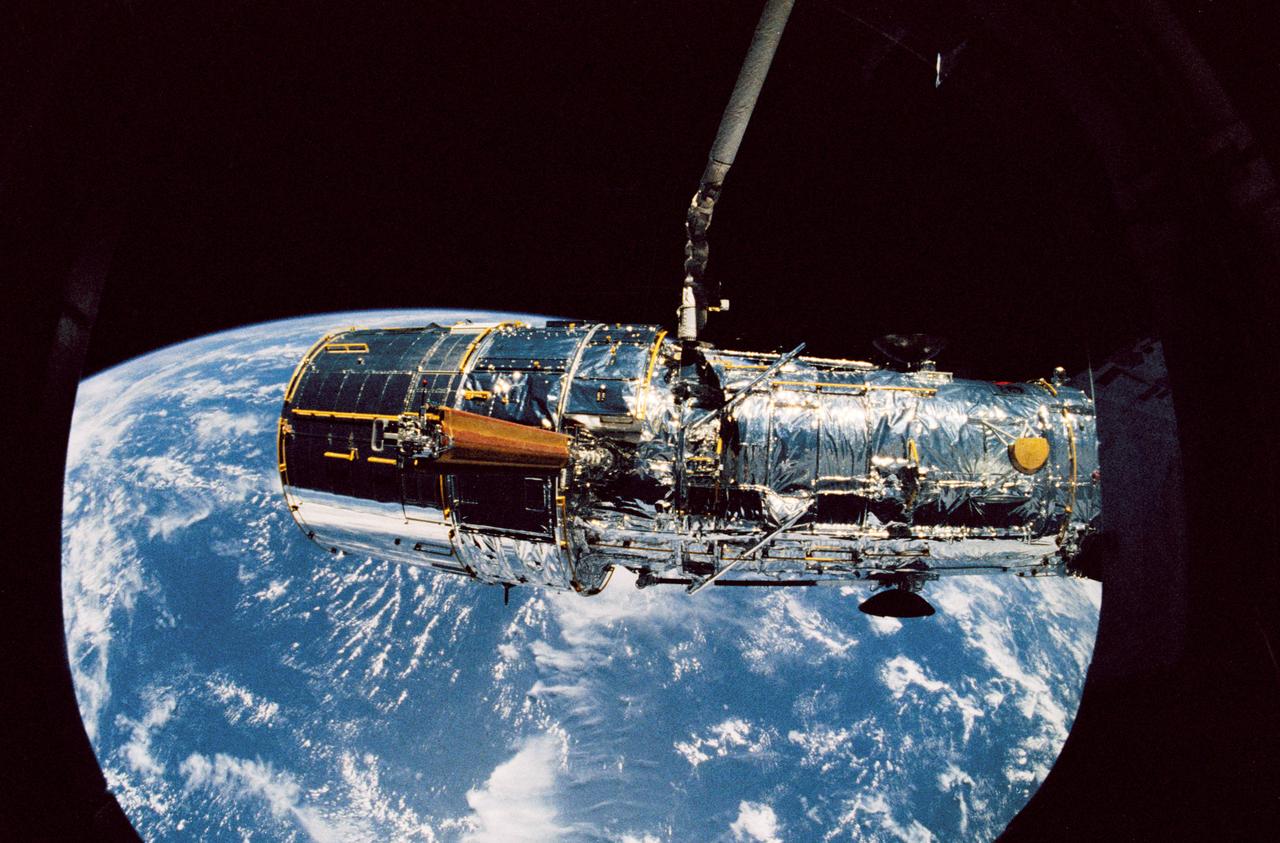
Held in appendage deploy position by Discovery's, Orbiter Vehicle (OV) 103's, remote manipulator system (RMS), the Hubble Space Telescope's (HST's) starboard solar array (SA) bistem cassette is released from its stowed position on the Support System Module (SSM) forward shell. The spreader bar & bistem begin to unfurl the SA wing. View was taken by an STS-31 crewmember through an overhead window & is backdropped against the surface of the Earth.
STS-31 Hubble Space Telescope (HST) solar array panel deploy aboard OV-103
During STS-31, the Hubble Space Telescope (HST) is held in appendage deploy position by Discovery's, Orbiter Vehicle (OV) 103's, remote manipulator system (RMS) above the payload bay (PLB) and crew compartment cabin. While in this position the solar array (SA) wing bistem cassette (HST center) is deployed from its stowed location along side the Support System Module (SSM) forward shell. A high gain antenna (HGA) remains stowed along the SSM. The Earth's surface and the Earth limb creates a dramatic backdrop.
STS-31 Hubble Space Telescope (HST) solar array (SA) deploy aboard OV-103
STS031-10-023 (25 April 1990) --- View of the Hubble Space Telescope (HST) on the end of Discovery's Remote Manipulator System (RMS) arm prior to deployment of its antennae and solar array panels.
Hubble Space Telescope (HST) solar array (SA) panel deployment during STS-31
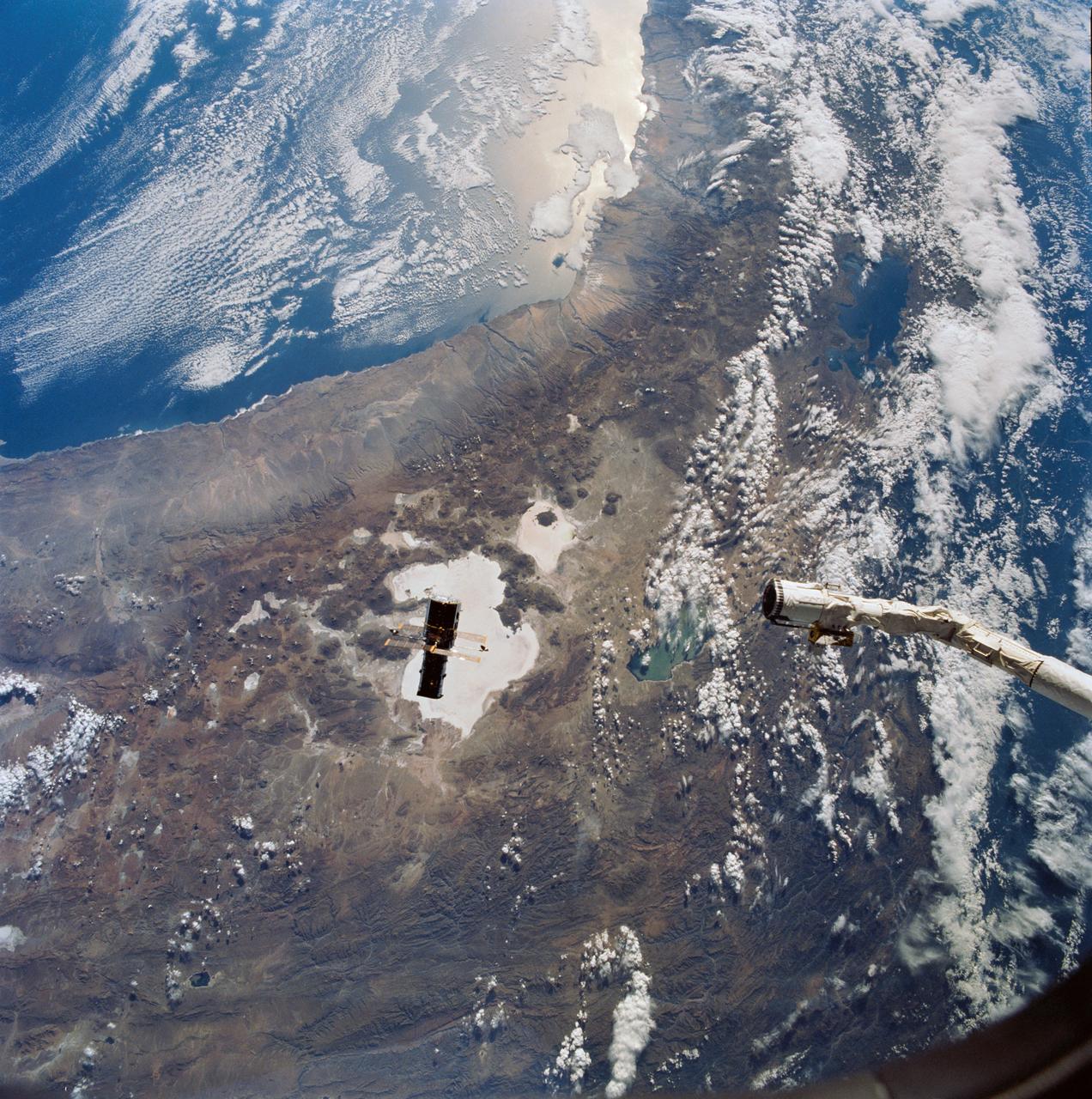
Hubble Space Telescope (HST), with its solar array (SA) wings and high gain antennae (HGA) fully extended,is released from Discovery's, Orbiter Vehicle (OV) 103's, remote manipulator system (RMS) end effector and is set free into Earth orbit by the STS-31 crew. HST drifts away from the end effector over the Andes Mountains.Parts of Bolivia, Peru, Chile, and Argentina are visible. The view covers a huge area of the western half of South America stretching from 14 degrees south latitude to 23 degrees, about 1,000 kilometers.
STS-31 Hubble Space Telescope (HST) drifts away from OV-103's RMS