S62-01698 (31 Jan. 1961) --- Chimpanzee "Ham" in his flight couch, after his trip in the Mercury-Redstone 2 (MR-2) on Jan. 31, 1961. Photo credit: NASA
Launch - "Ham" - Mercury-Redstone (MR)-2
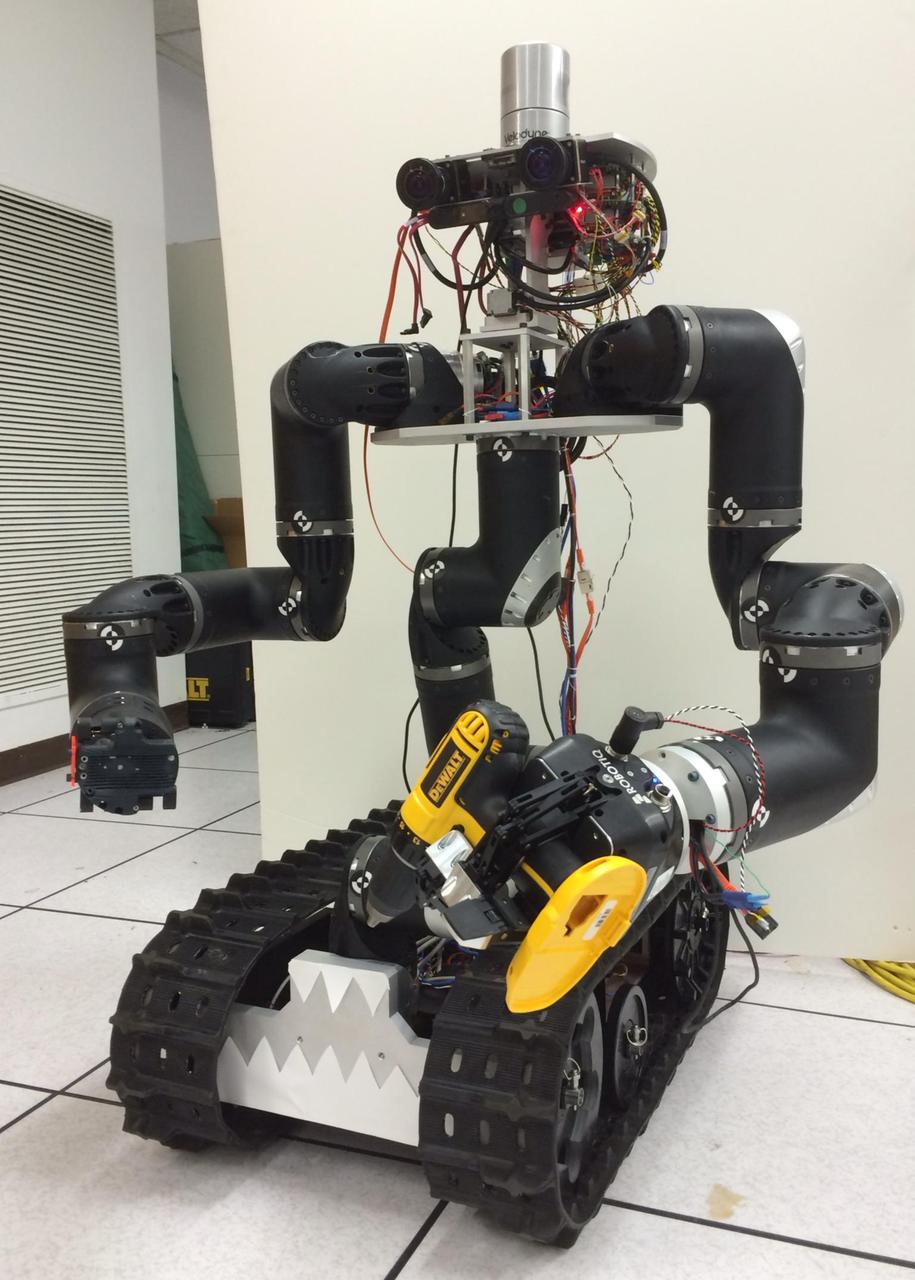
The Surrogate robot Surge, built at NASA Jet Propulsion Laboratory in Pasadena, CA., is being developed in order to extend humanity reach into hazardous environments to perform tasks such as using environmental test equipment.
Surrogate Robot
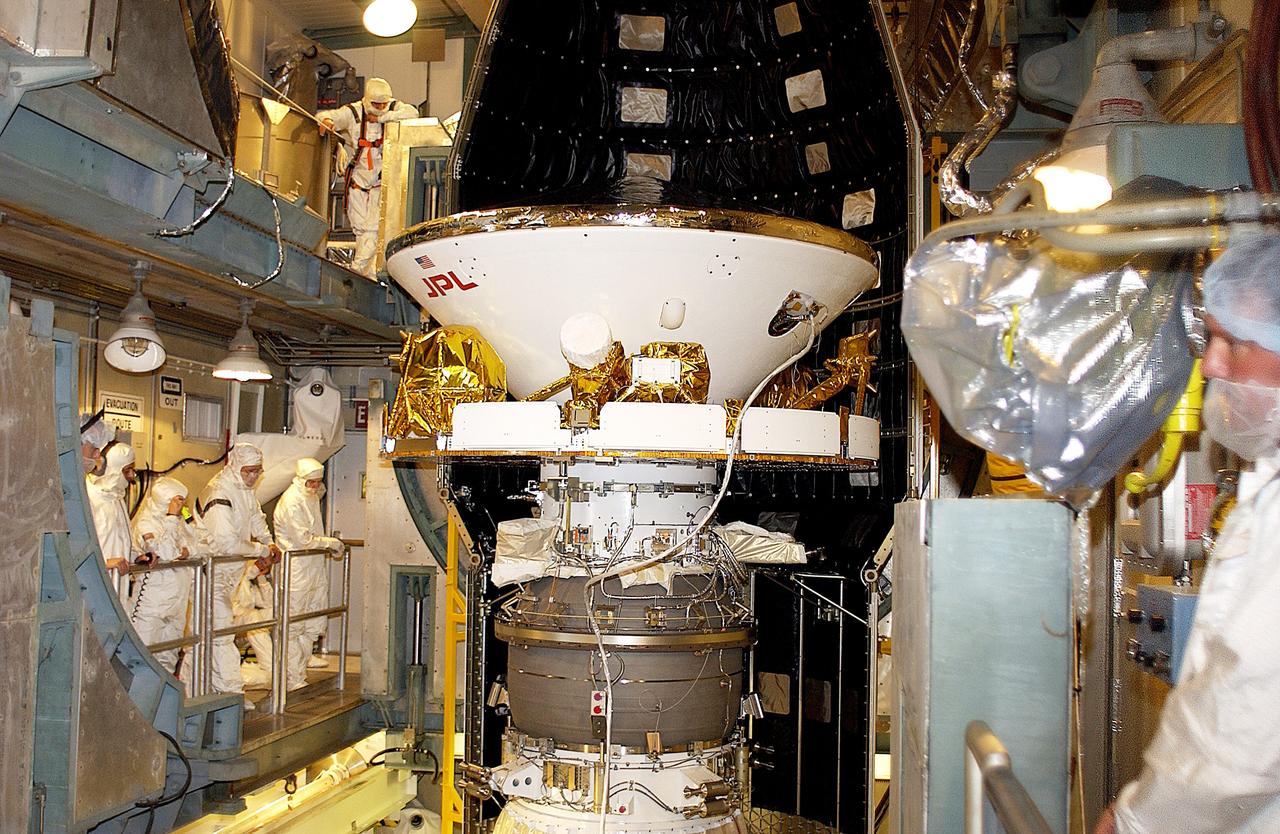
KENNEDY SPACE CENTER, FLA. - At Launch Complex 17-B, Cape Canaveral Air Force Station, the spacecraft fairing is being installed around the Mars Exploration Rover-1 (MER-B). The second of twin rovers being sent to Mars, it is equipped with a robotic arm, a drilling tool, three spectrometers, and four pairs of cameras that allow it to have a human-like, 3D view of the terrain. Each rover could travel as far as 100 meters in one day to act as Mars scientists' eyes and hands, exploring an environment where humans are not yet able to go. MER-B is scheduled to launch no earlier than June 28 at one of two available times, 11:56:16 p.m. EDT or 12:37:59 a.m. EDT.
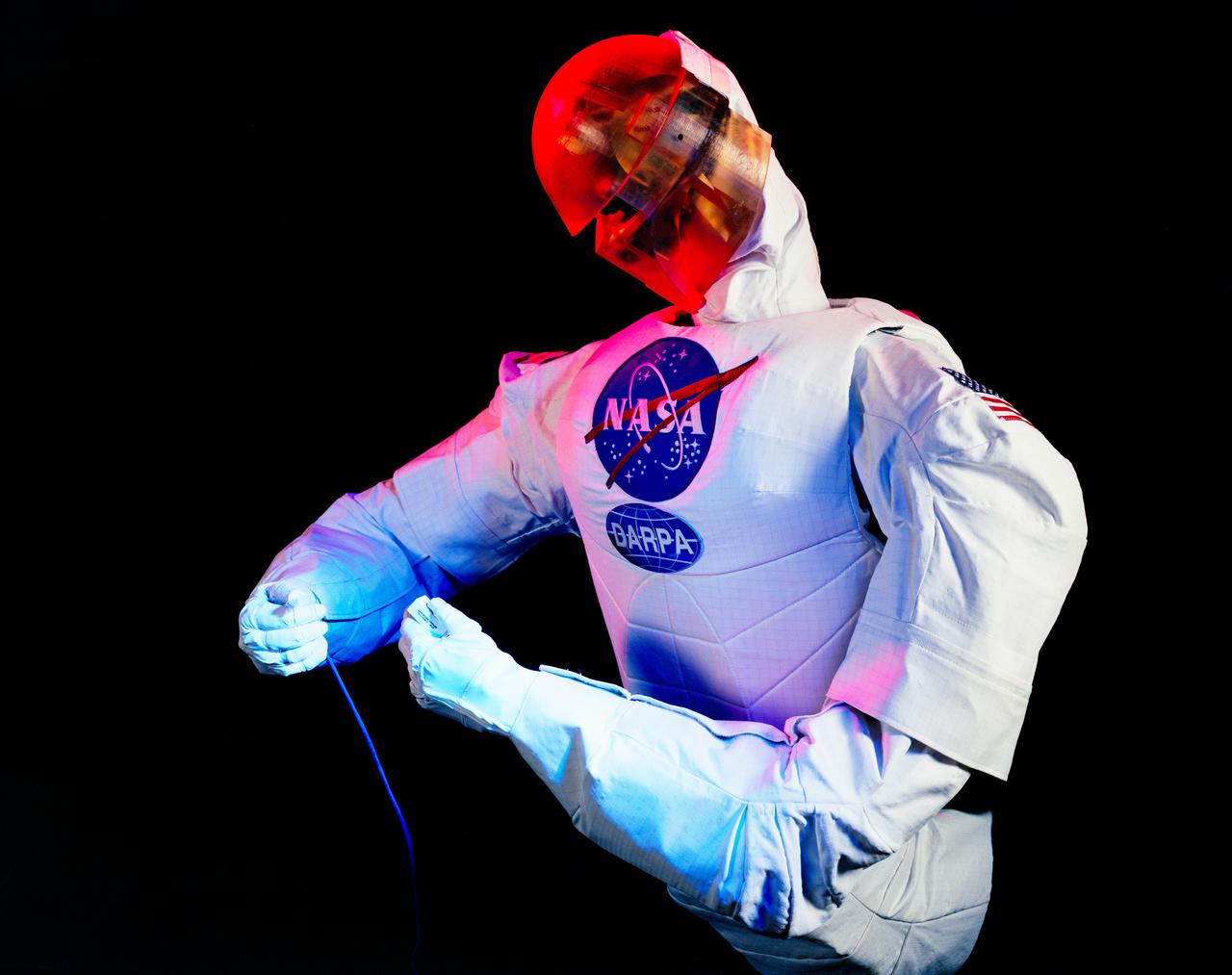
JSC2003-00263 (June 2003) --- This is Robonaut B, the newer of two NASA robots used in recent hand-in-hand testing at the Johnson Space Center with human beings to evaluate their shared ability to perform certain types of extravehicular activity.
General Howell's Conference Room Photos - Photos of Robonaut.
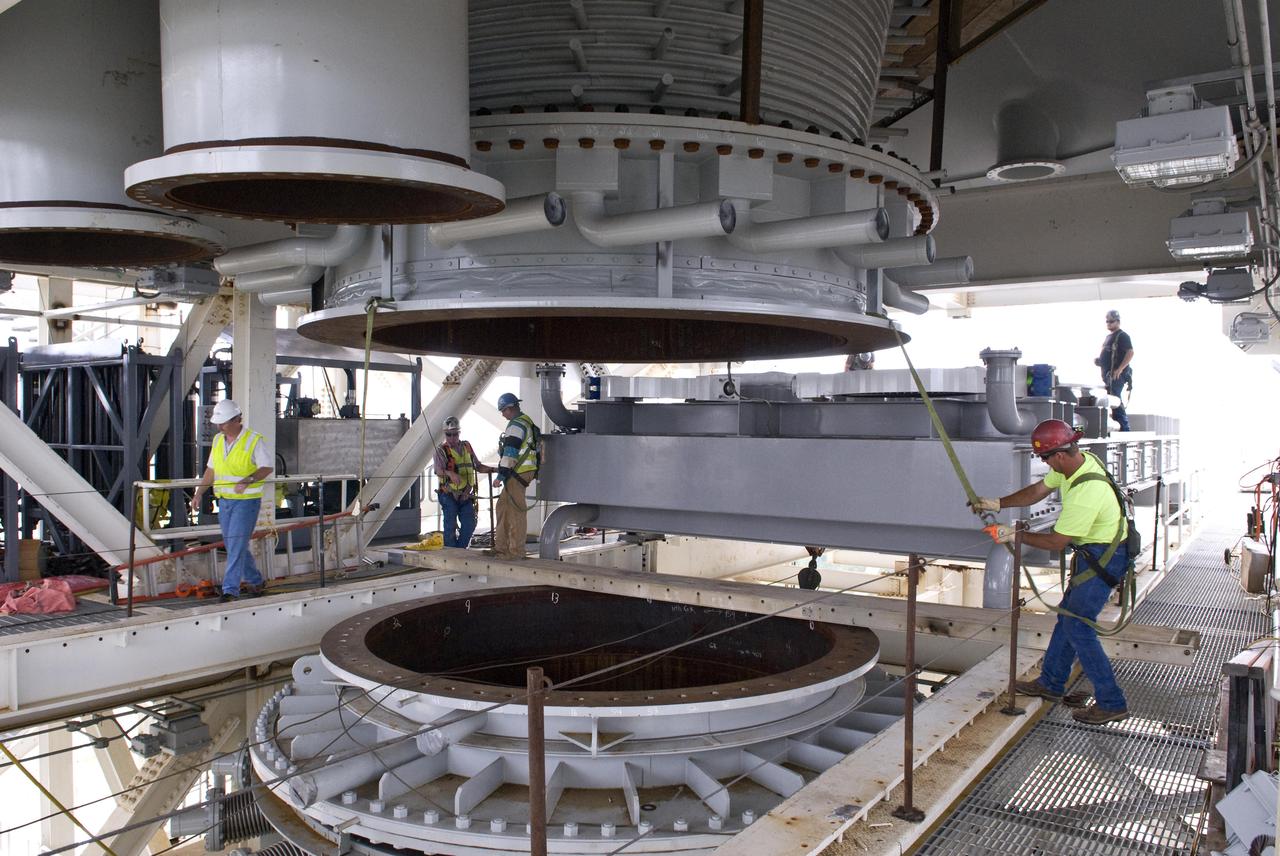
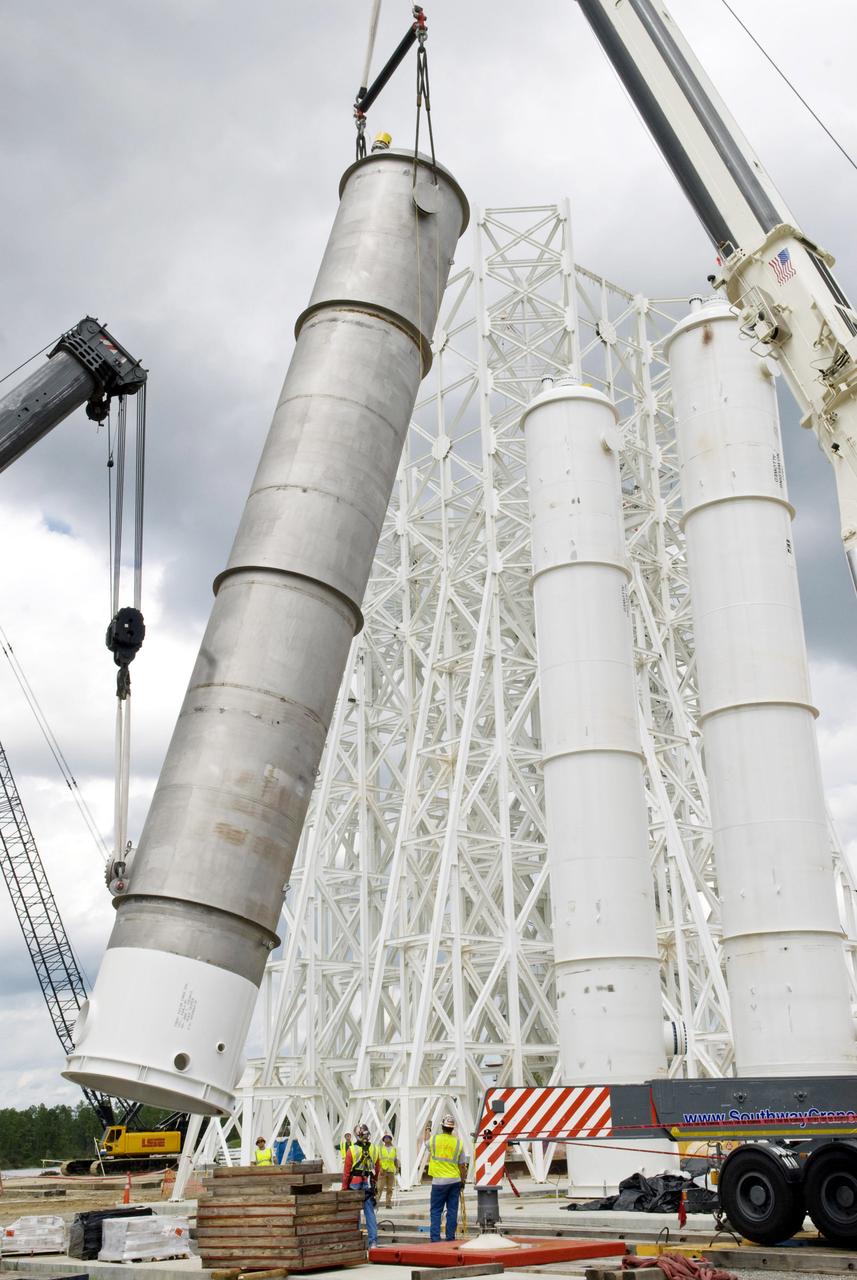
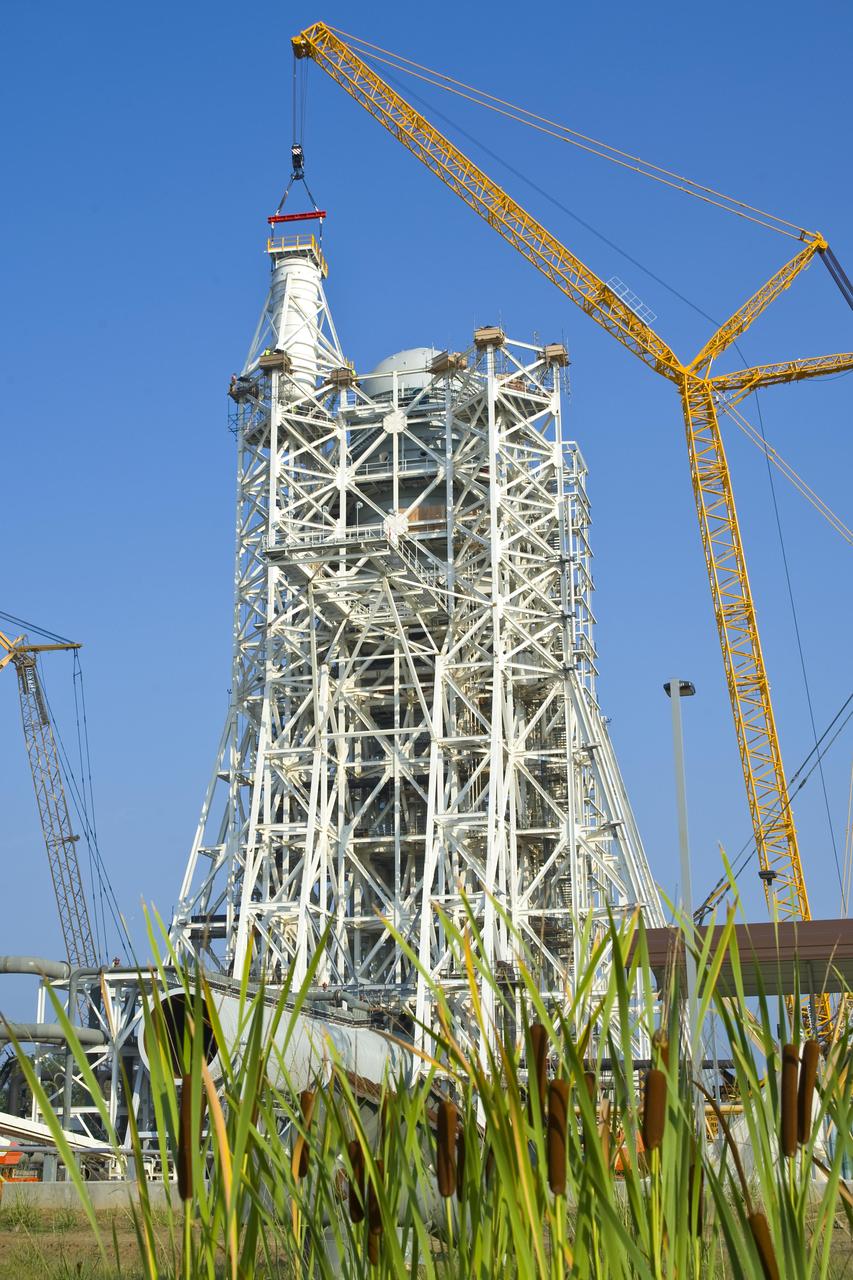
Stennis Space Center employees continue work on the A-3 Test Stand test cell. The stand is being built to test next-generation rocket engines that could carry humans beyond low-Earth orbit into deep space.
A-3 Test Stand work continues
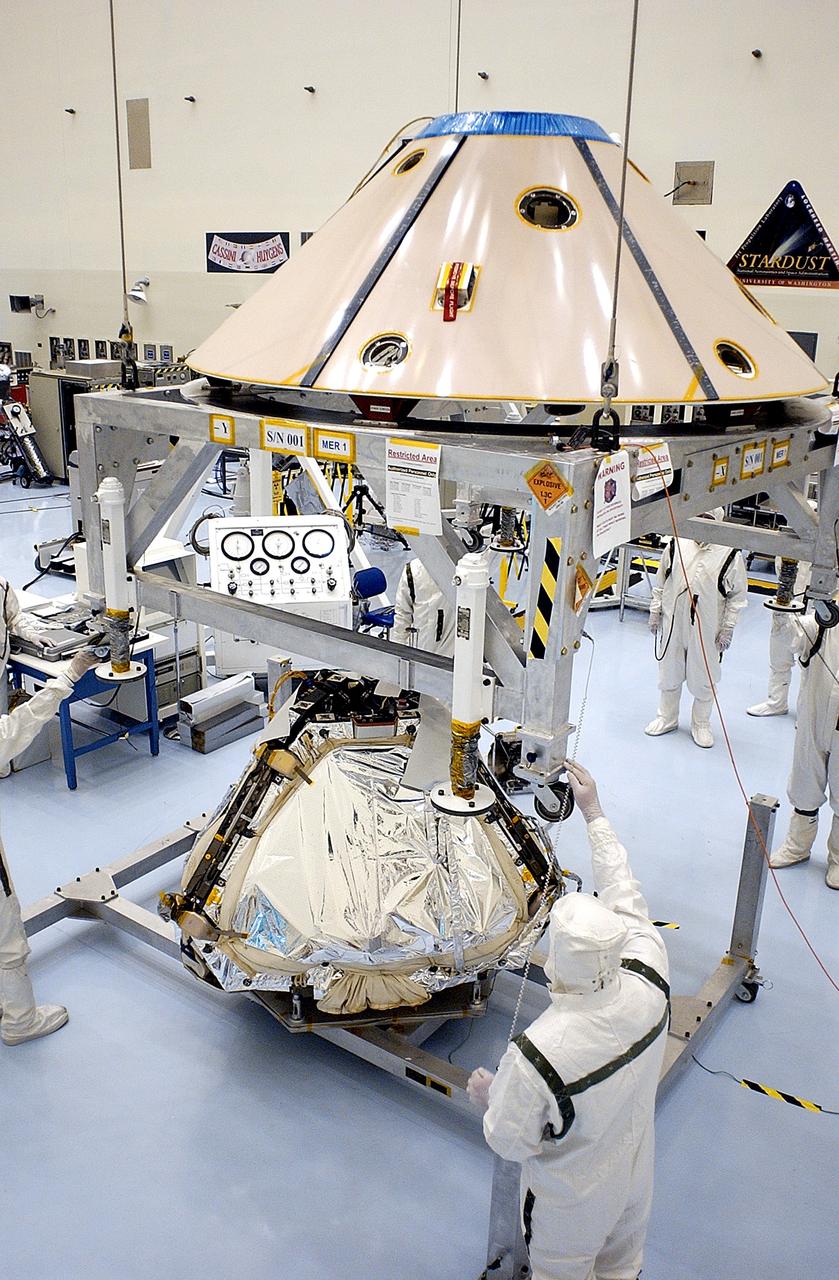
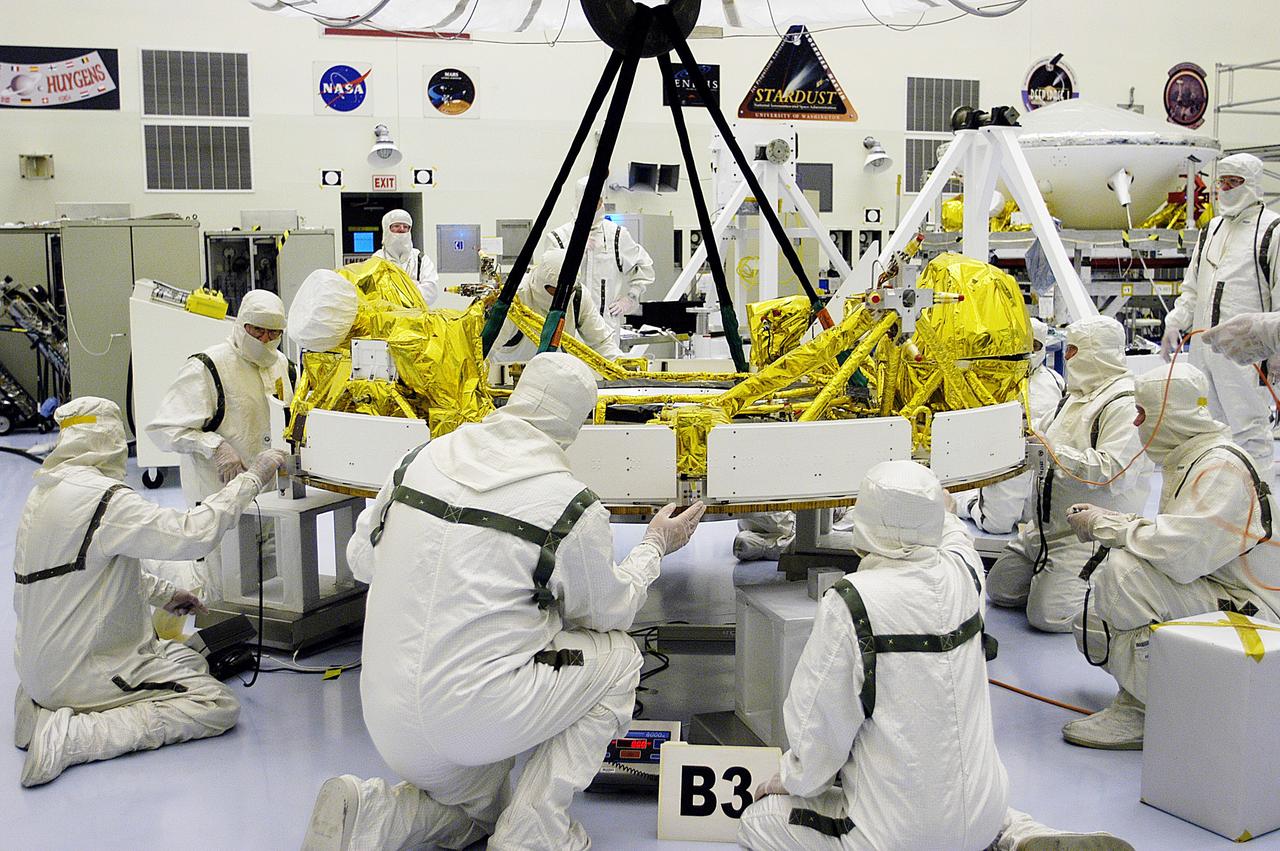
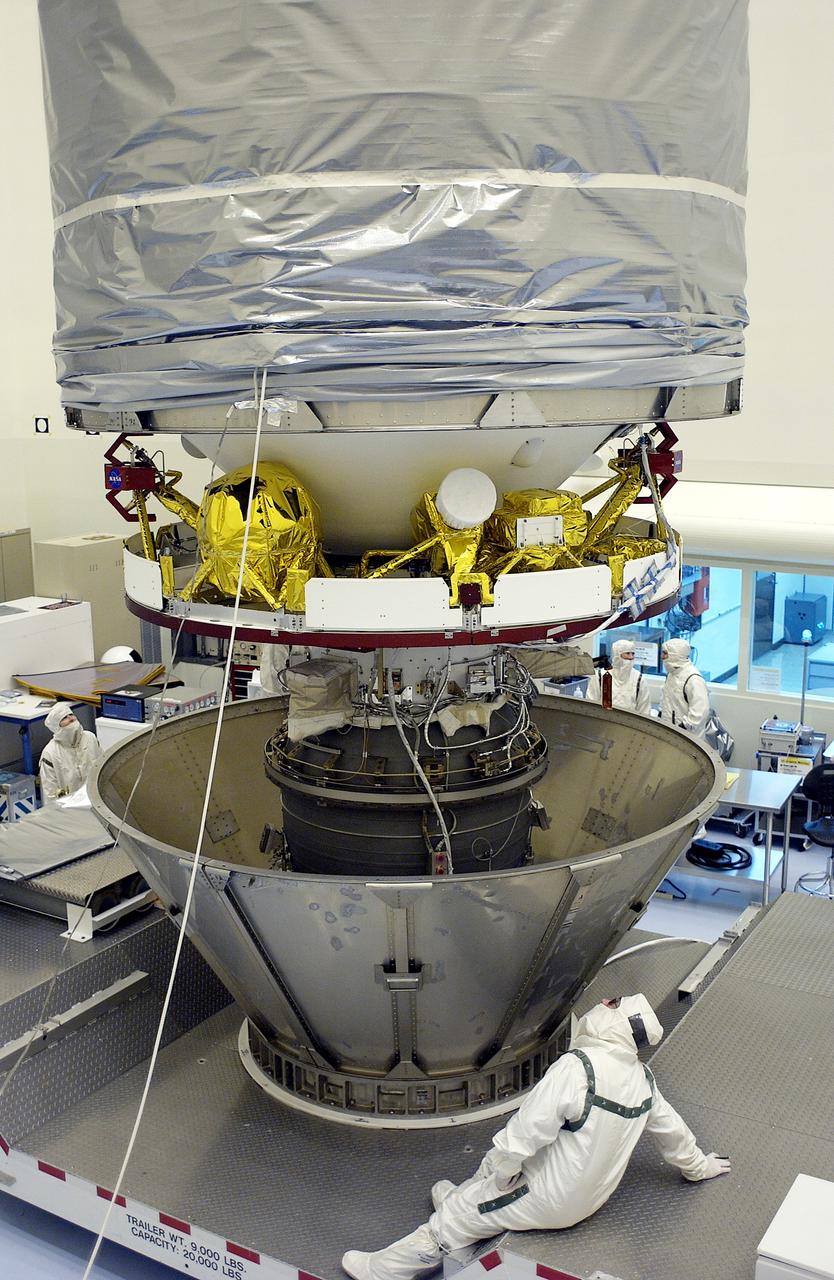
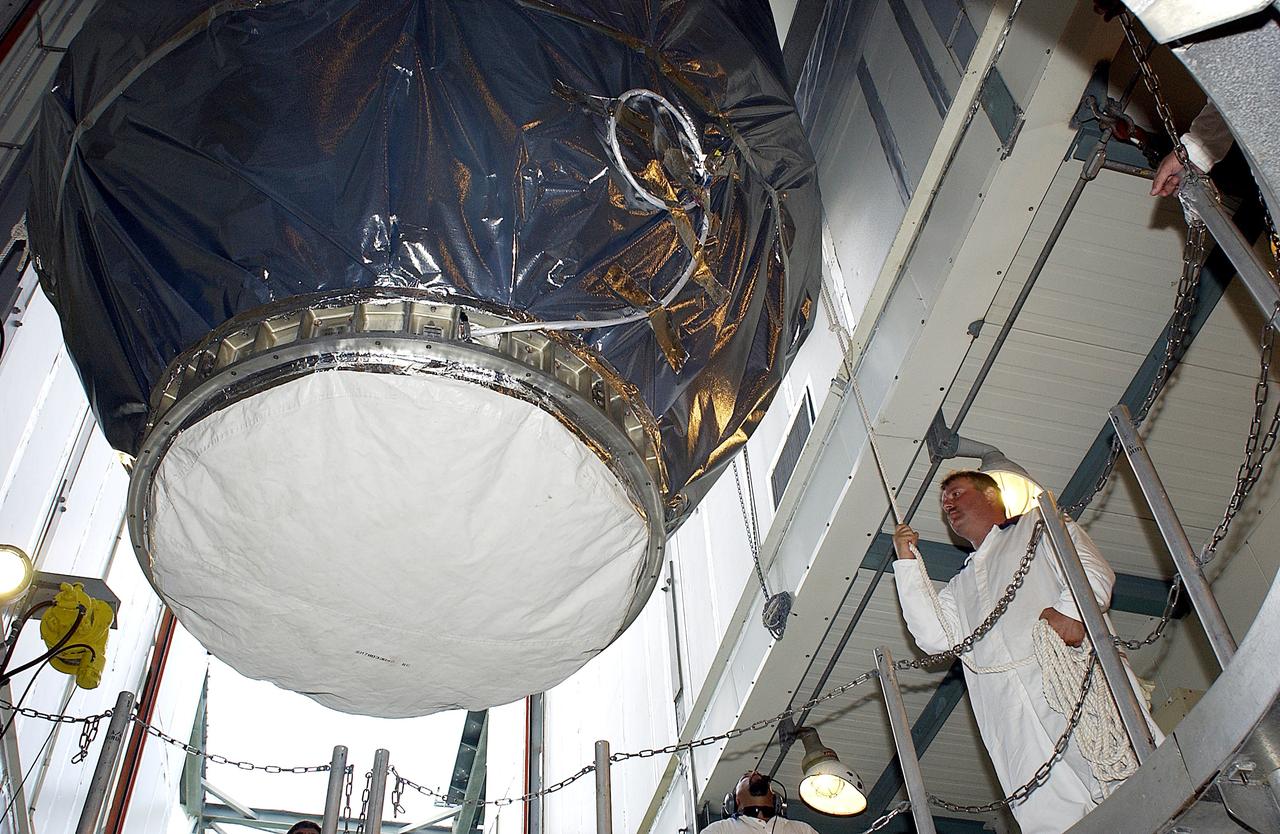
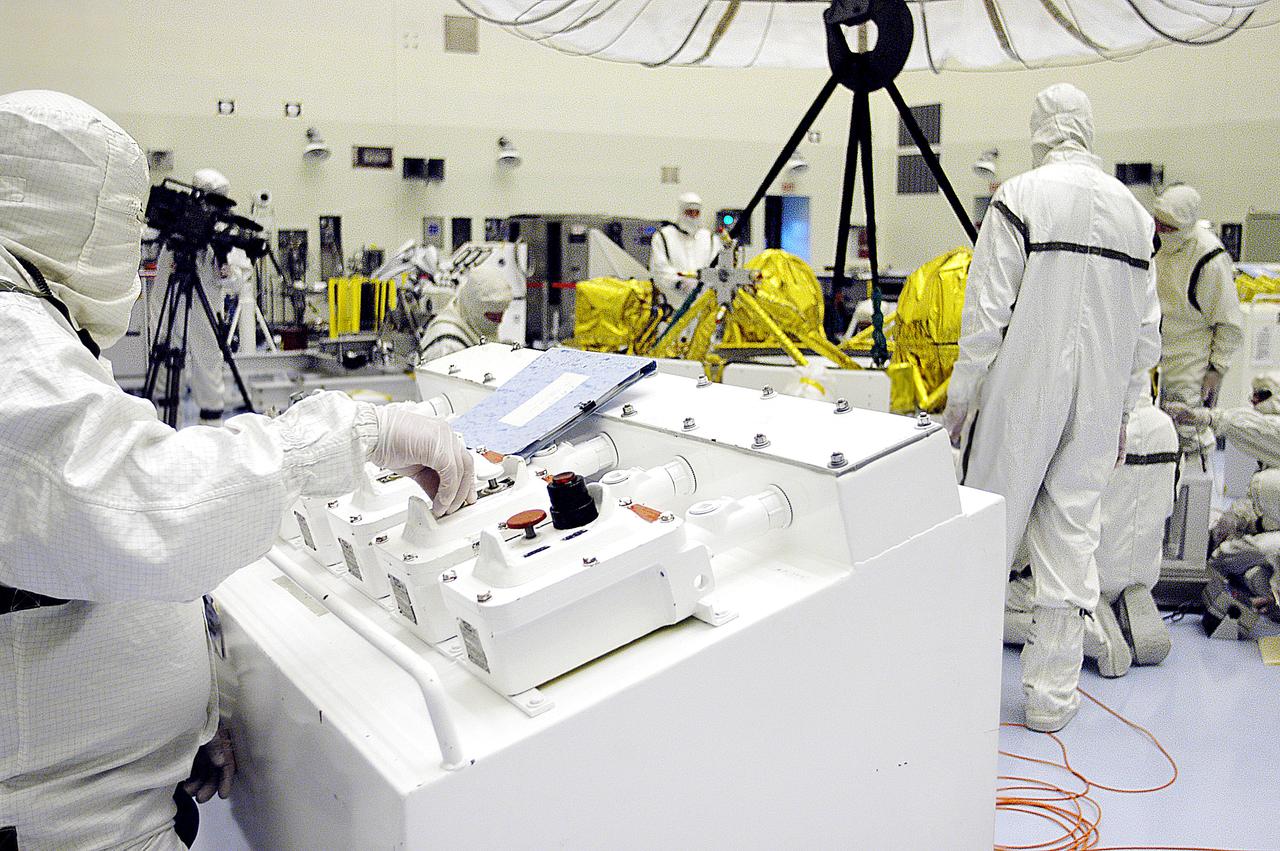
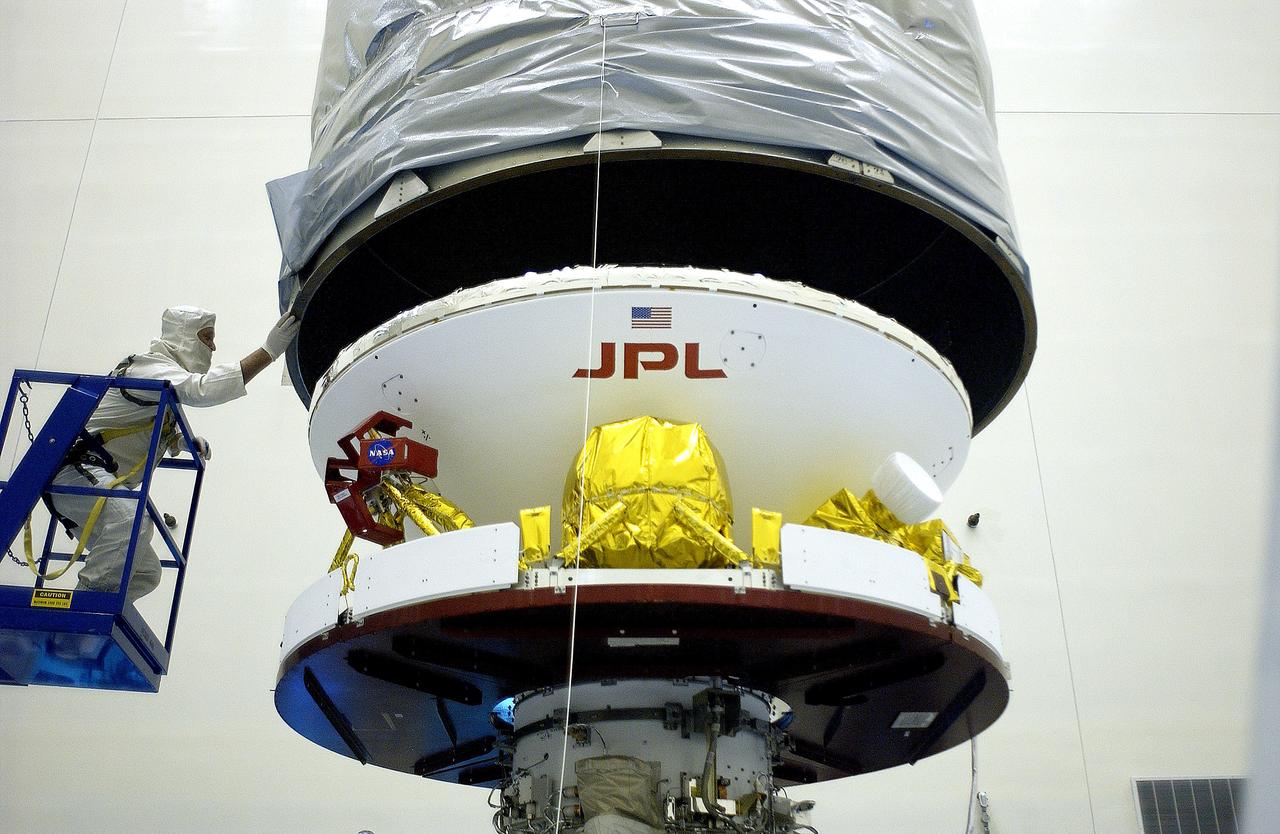
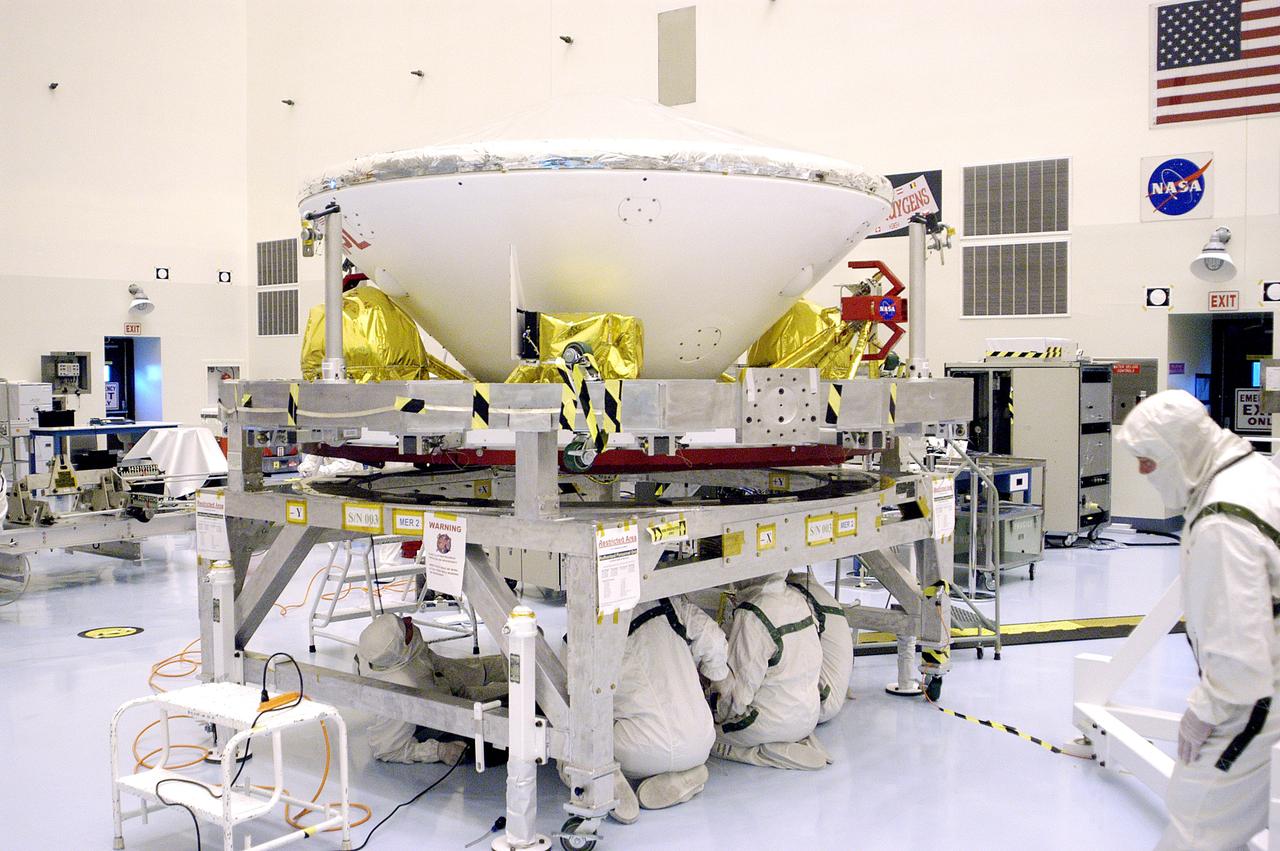
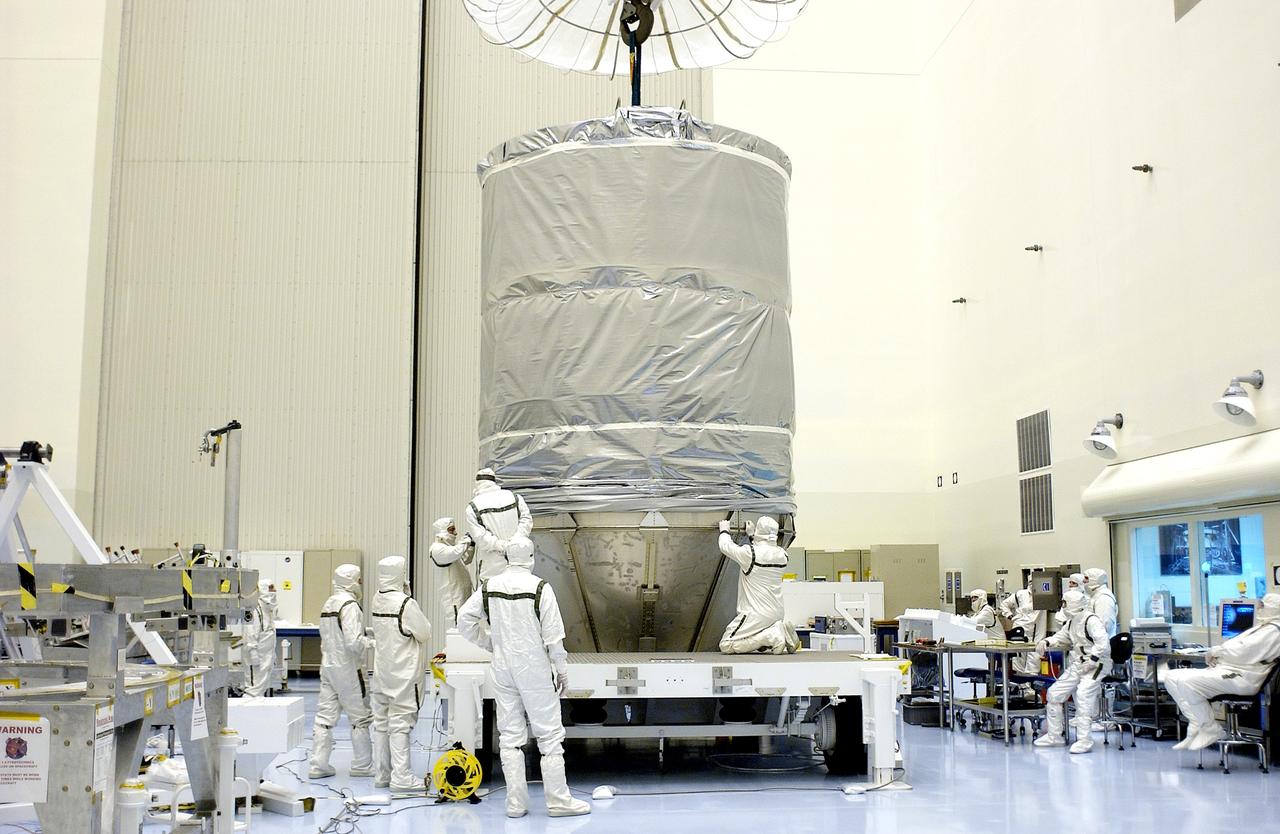
KENNEDY SPACE CENTER, FLA. - Workers in the Payload Hazardous Servicing Facility guide the backshell being lowered over the Mars Exploration Rover 1 (MER-1).  The backshell is a protective cover for the rover.  NASA's twin Mars Exploration Rovers are designed to study the history of water on Mars. These robotic geologists are equipped with a robotic arm, a drilling tool, three spectrometers, and four pairs of cameras that allow them to have a human-like, 3D view of the terrain. Each rover could travel as far as 100 meters in one day to act as Mars scientists' eyes and hands, exploring an environment where humans can't yet go.  MER-1 is scheduled to launch June 25 as MER-B aboard a Delta II rocket from Cape Canaveral Air Force Station.
KENNEDY SPACE CENTER, FLA. - Workers in the Payload Hazardous Servicing Facility guide the backshell being lowered over the Mars Exploration Rover 1 (MER-1). The backshell is a protective cover for the rover. NASA's twin Mars Exploration Rovers are designed to study the history of water on Mars. These robotic geologists are equipped with a robotic arm, a drilling tool, three spectrometers, and four pairs of cameras that allow them to have a human-like, 3D view of the terrain. Each rover could travel as far as 100 meters in one day to act as Mars scientists' eyes and hands, exploring an environment where humans can't yet go. MER-1 is scheduled to launch June 25 as MER-B aboard a Delta II rocket from Cape Canaveral Air Force Station.
KENNEDY SPACE CENTER, FLA. -   On Launch Pad 17-B, Cape Canaveral Air Force Station, the Mars Exploration Rover 1 (MER-B) arrives at the tower landing where it will be mated with the Delta rocket.  The second of twin rovers being sent to Mars, it is equipped with a robotic arm, a drilling tool, three spectrometers, and four pairs of cameras that allow it to have a human-like, 3D view of the terrain. Each rover could travel as far as 100 meters in one day to act as Mars scientists' eyes and hands, exploring an environment where humans can't yet go.  MER-B is scheduled to launch June 26 at one of two available times,  12:27:31 a.m. EDT or 1:08:45 a.m. EDT.
KENNEDY SPACE CENTER, FLA. - On Launch Pad 17-B, Cape Canaveral Air Force Station, the Mars Exploration Rover 1 (MER-B) arrives at the tower landing where it will be mated with the Delta rocket. The second of twin rovers being sent to Mars, it is equipped with a robotic arm, a drilling tool, three spectrometers, and four pairs of cameras that allow it to have a human-like, 3D view of the terrain. Each rover could travel as far as 100 meters in one day to act as Mars scientists' eyes and hands, exploring an environment where humans can't yet go. MER-B is scheduled to launch June 26 at one of two available times, 12:27:31 a.m. EDT or 1:08:45 a.m. EDT.
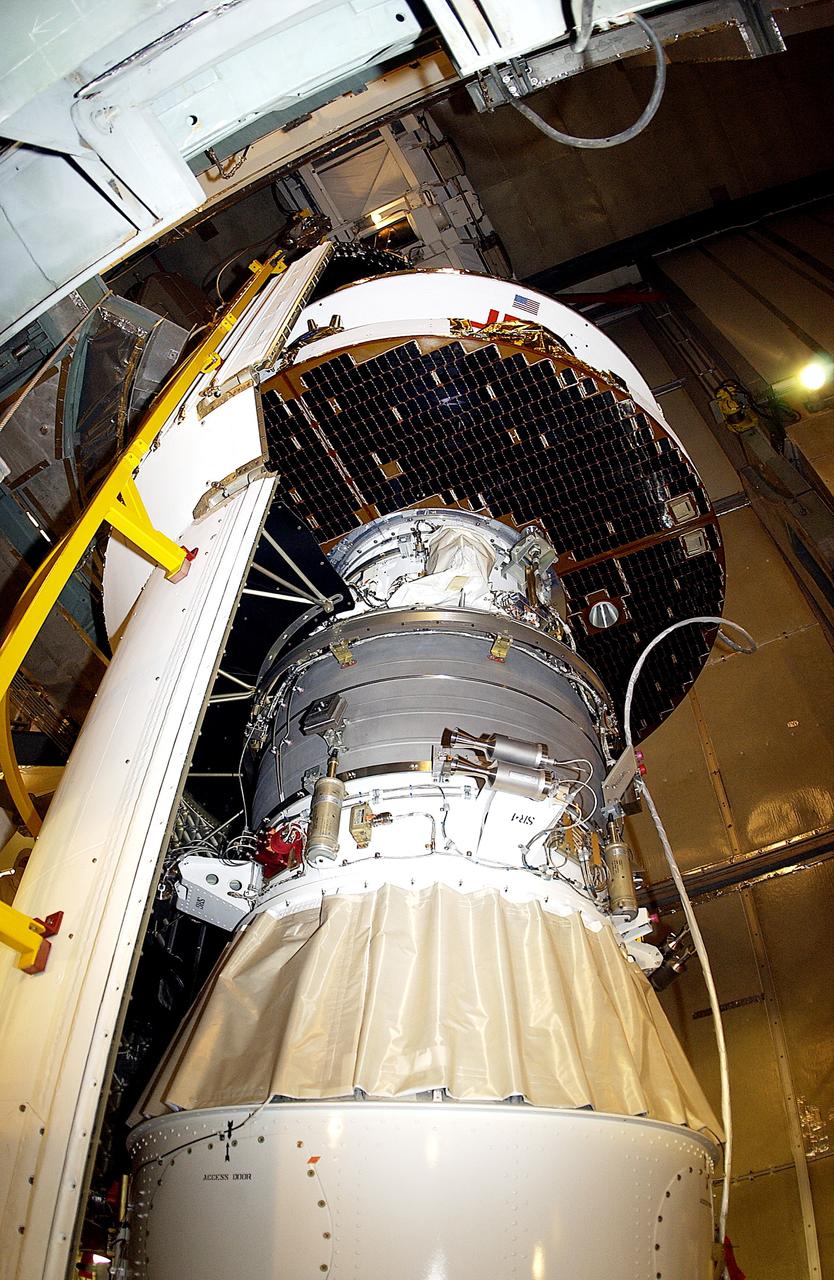
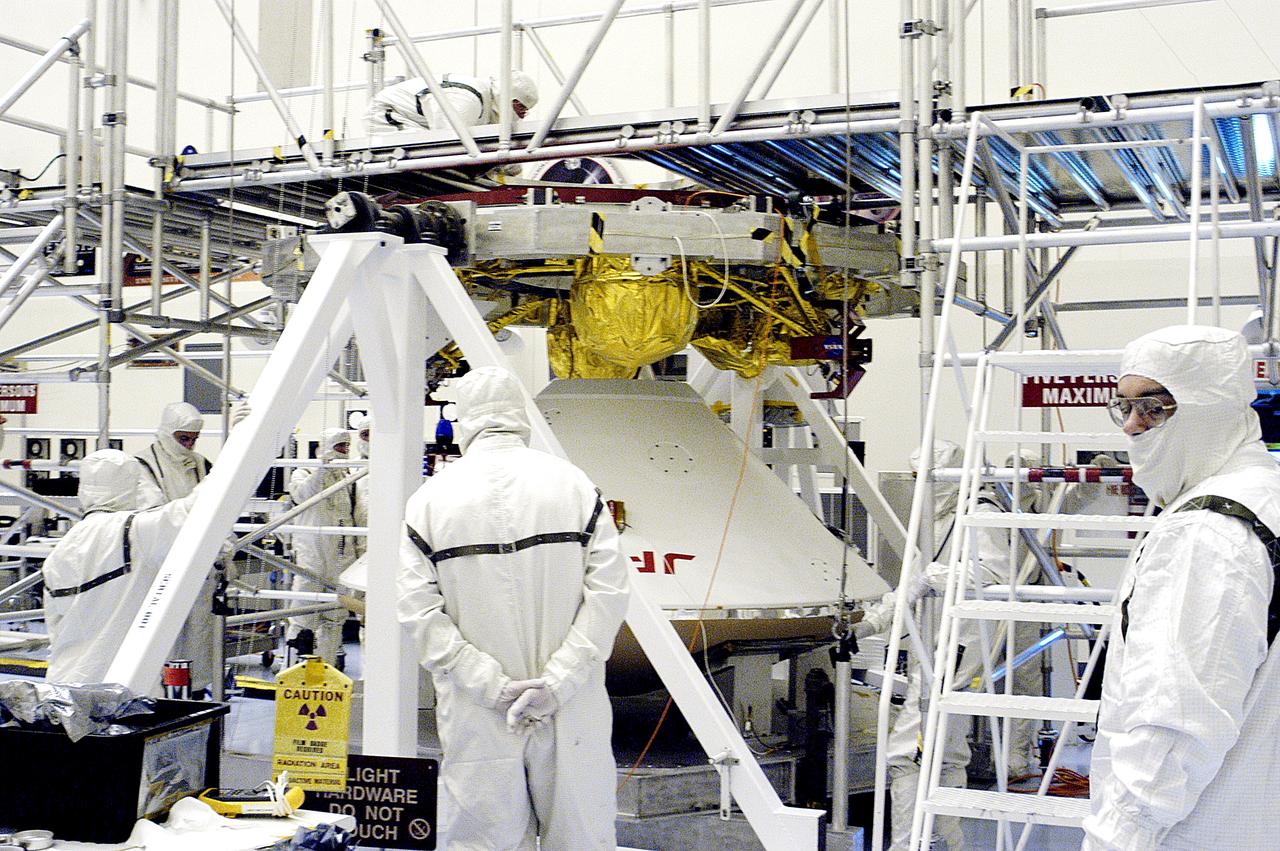
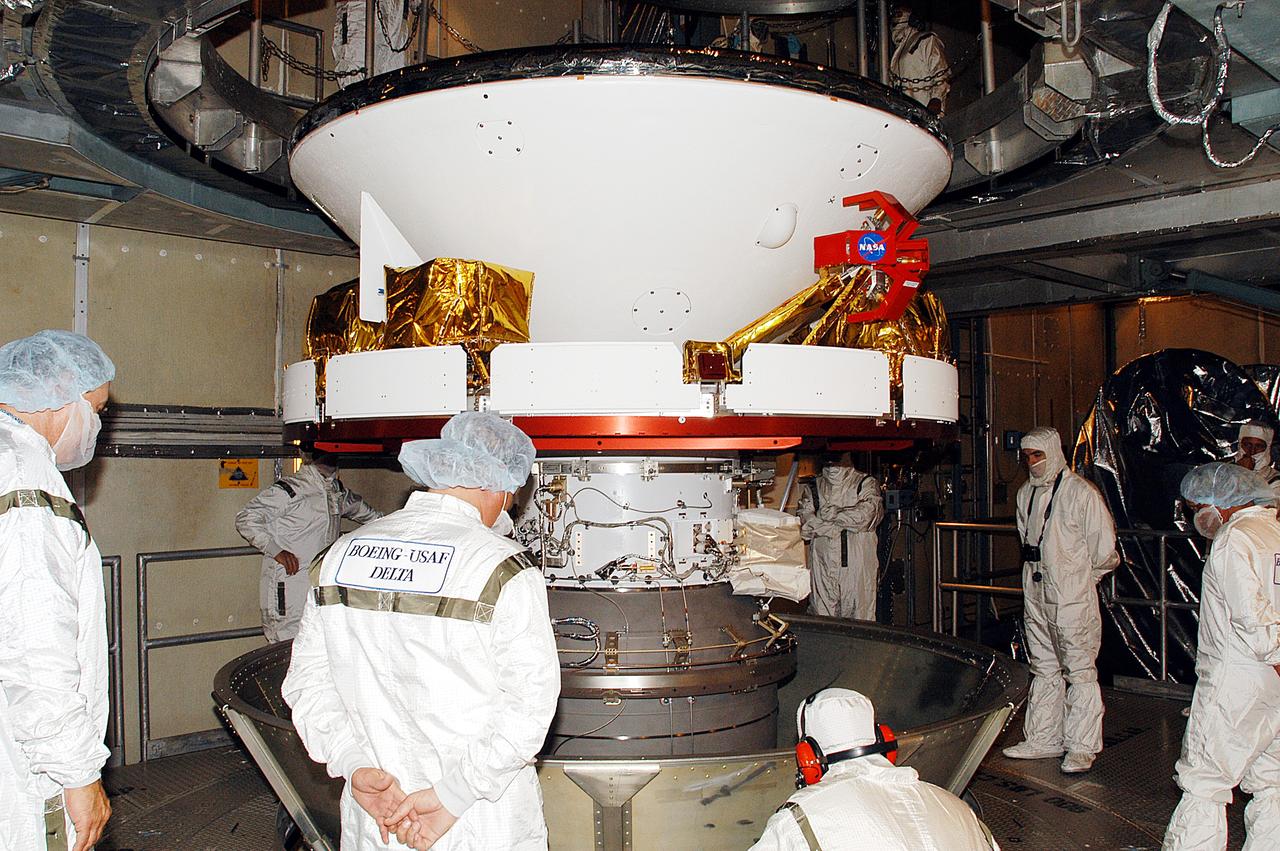
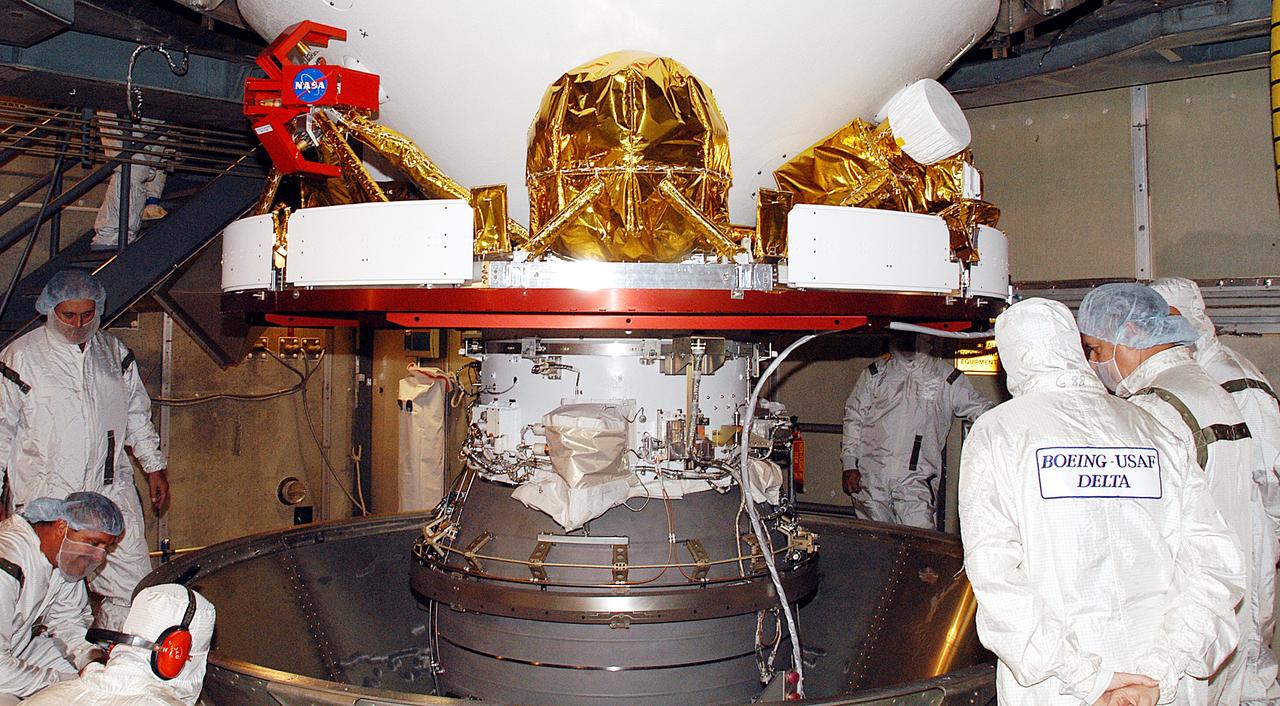
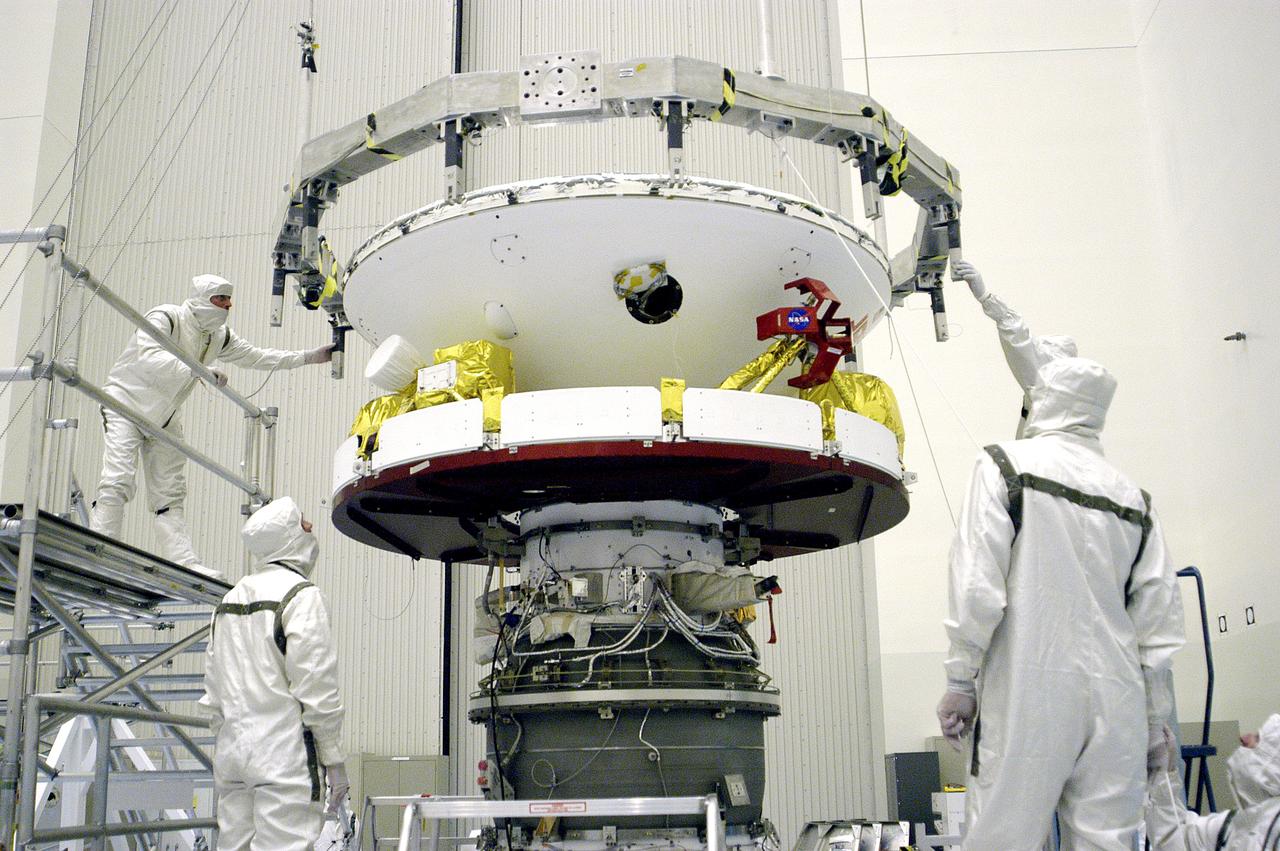
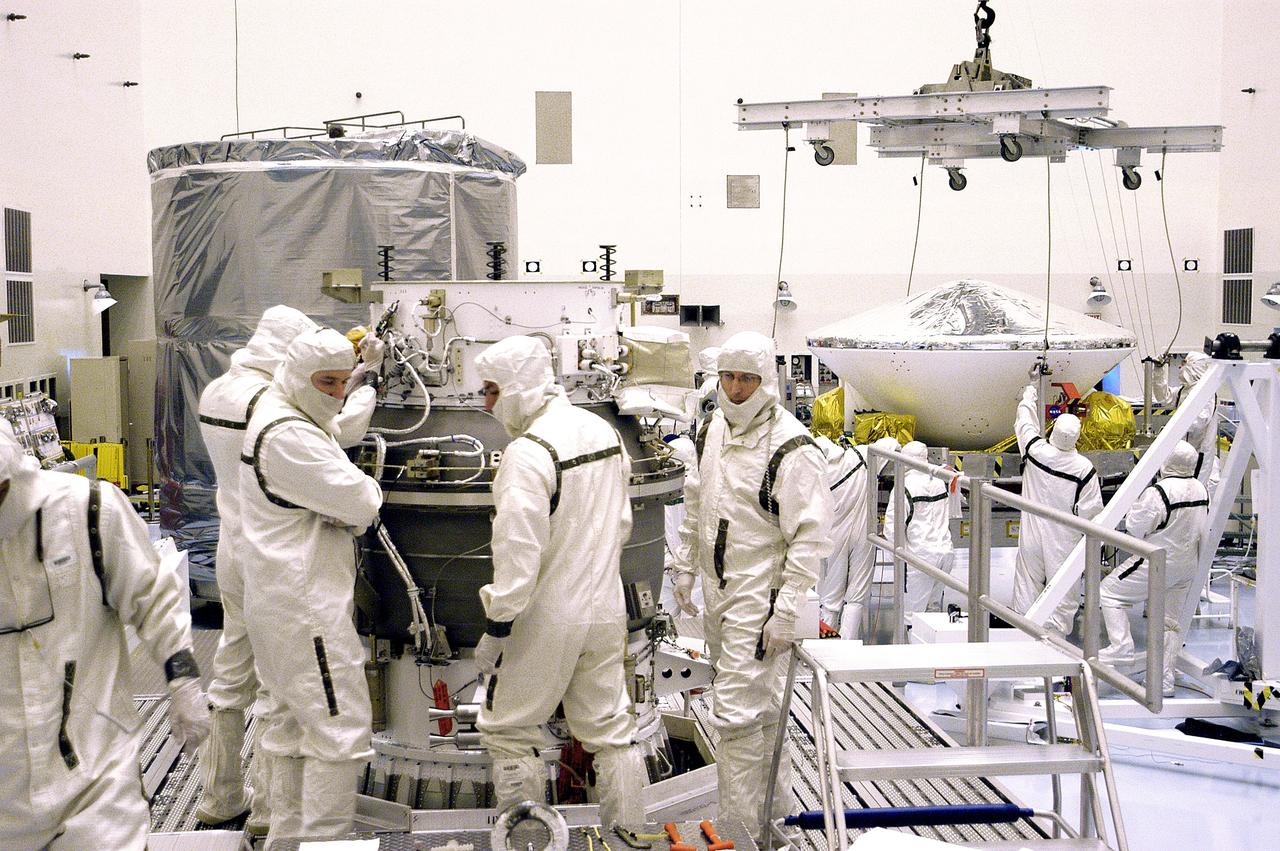
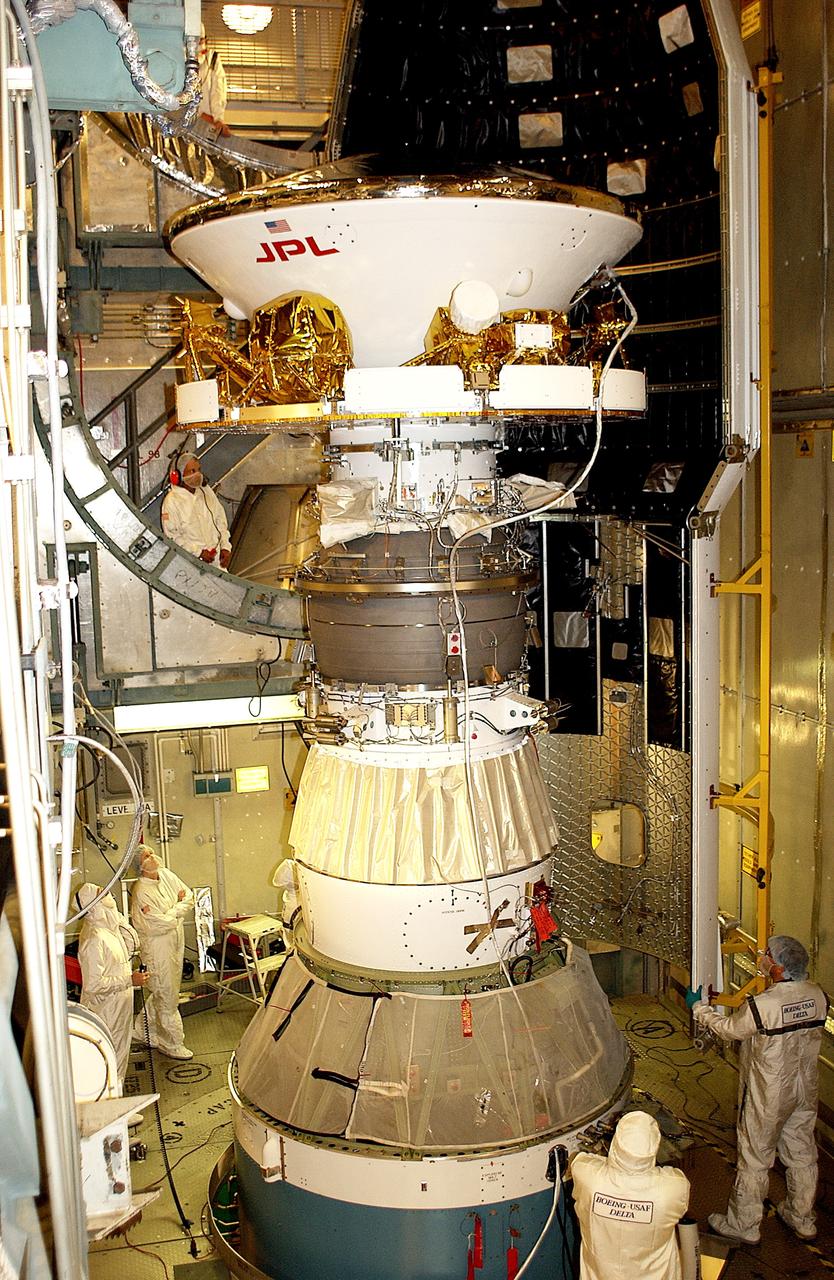
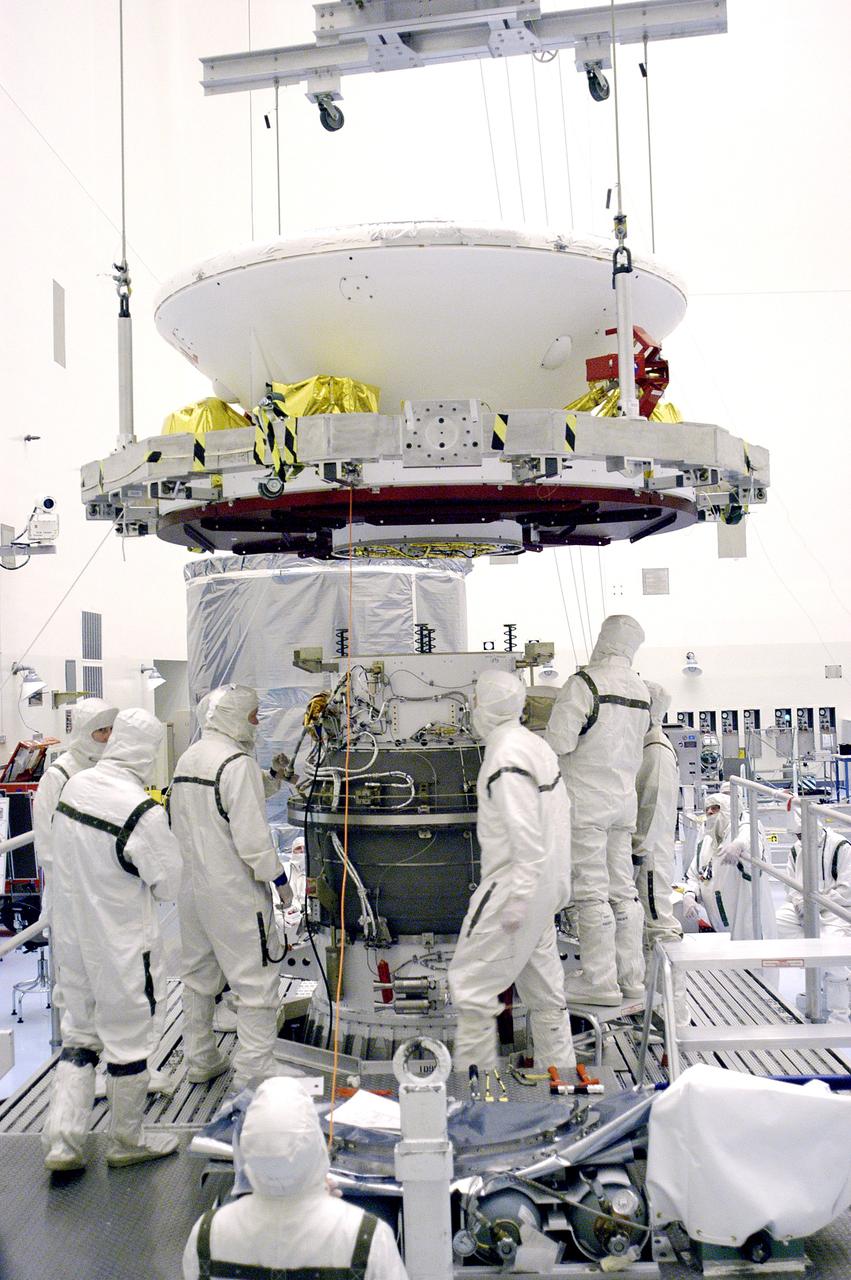
KENNEDY SPACE CENTER, FLA. - In the Payload Hazardous Servicing Facility, workers prepare to mate the Mars Exploration Rover 1 (MER-B) above with the third stage of the Delta rocket below.  The second of twin rovers being sent to Mars, it is equipped with a robotic arm, a drilling tool, three spectrometers, and four pairs of cameras that allow it to have a human-like, 3D view of the terrain. Each rover could travel as far as 100 meters in one day to act as Mars scientists' eyes and hands, exploring an environment where humans can't yet go.  MER-B is scheduled to launch from Launch Pad 17-B, Cape Canaveral Air Force Station, June 26 at one of two available times,  12:27:31 a.m. EDT or 1:08:45 a.m. EDT.
KENNEDY SPACE CENTER, FLA. - In the Payload Hazardous Servicing Facility, workers prepare to mate the Mars Exploration Rover 1 (MER-B) above with the third stage of the Delta rocket below. The second of twin rovers being sent to Mars, it is equipped with a robotic arm, a drilling tool, three spectrometers, and four pairs of cameras that allow it to have a human-like, 3D view of the terrain. Each rover could travel as far as 100 meters in one day to act as Mars scientists' eyes and hands, exploring an environment where humans can't yet go. MER-B is scheduled to launch from Launch Pad 17-B, Cape Canaveral Air Force Station, June 26 at one of two available times, 12:27:31 a.m. EDT or 1:08:45 a.m. EDT.
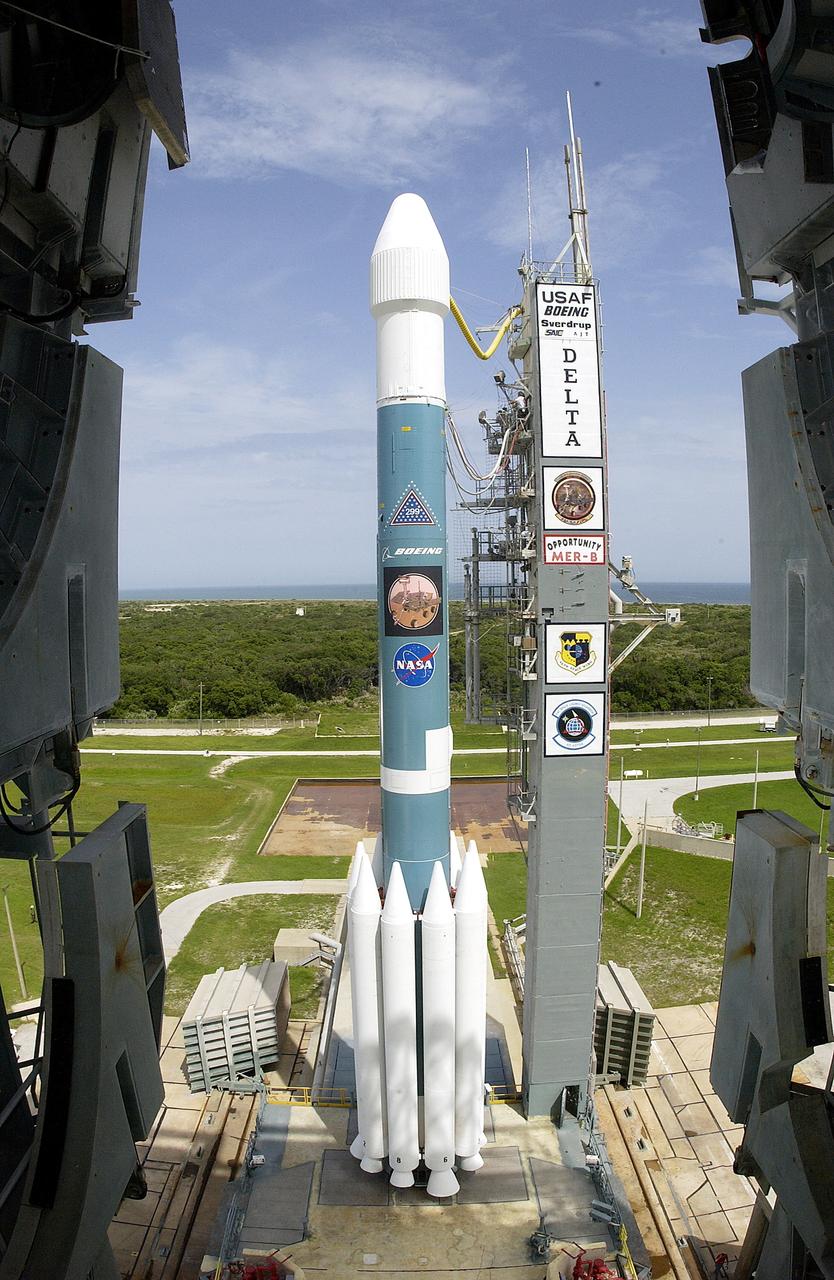
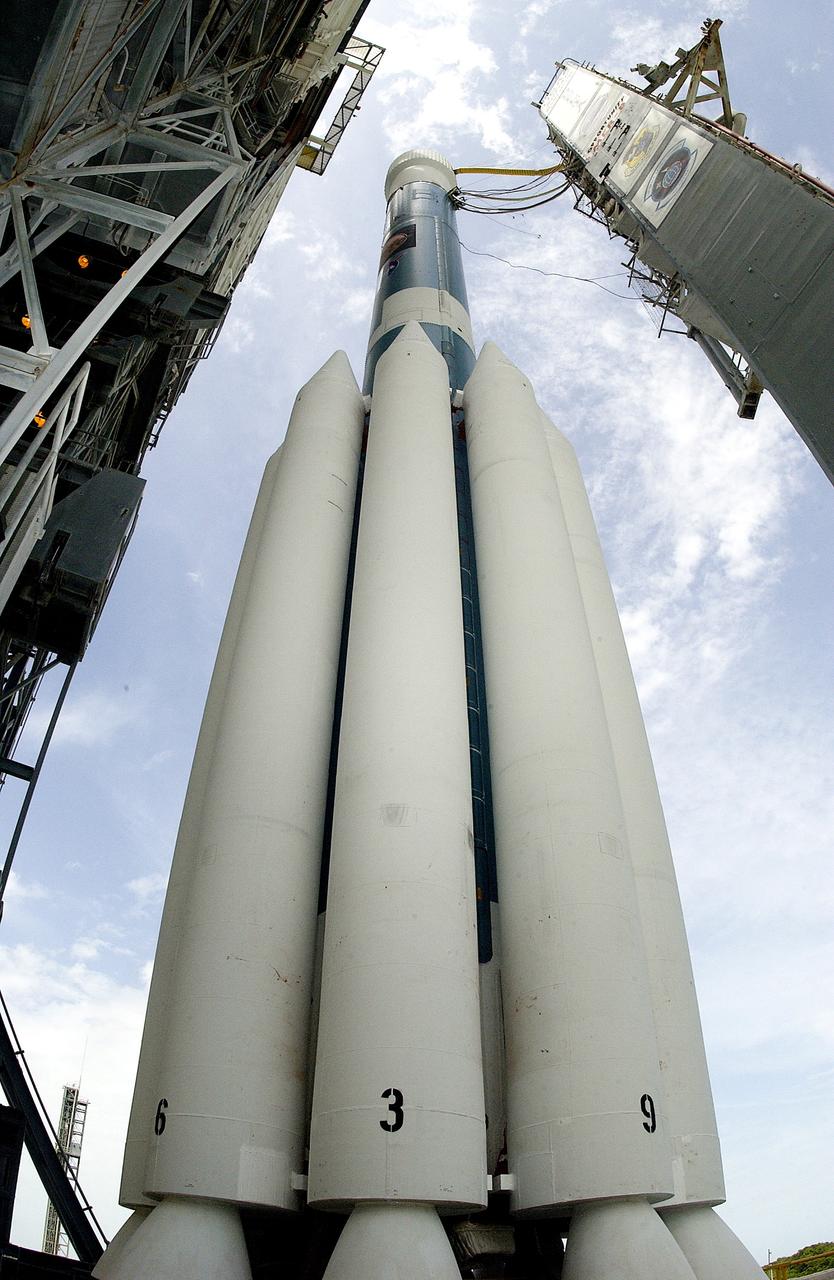
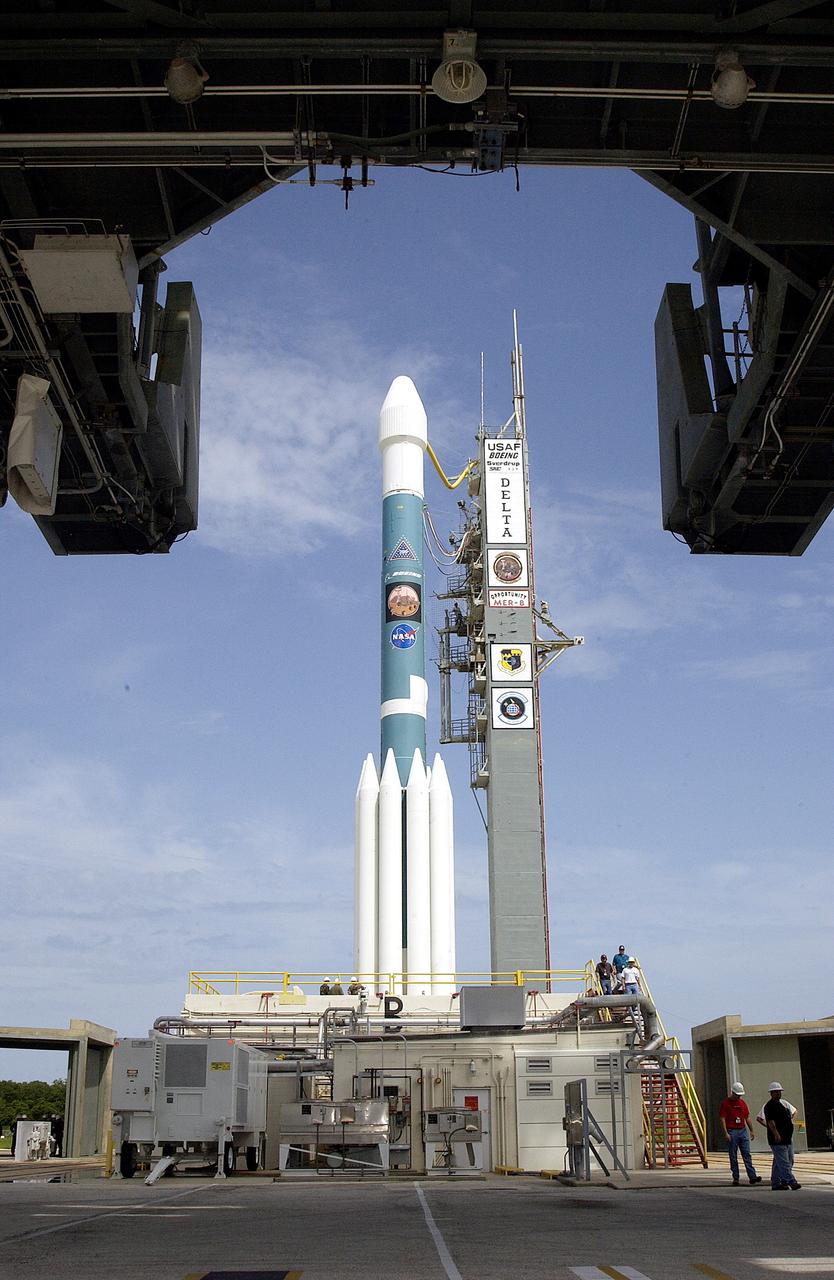
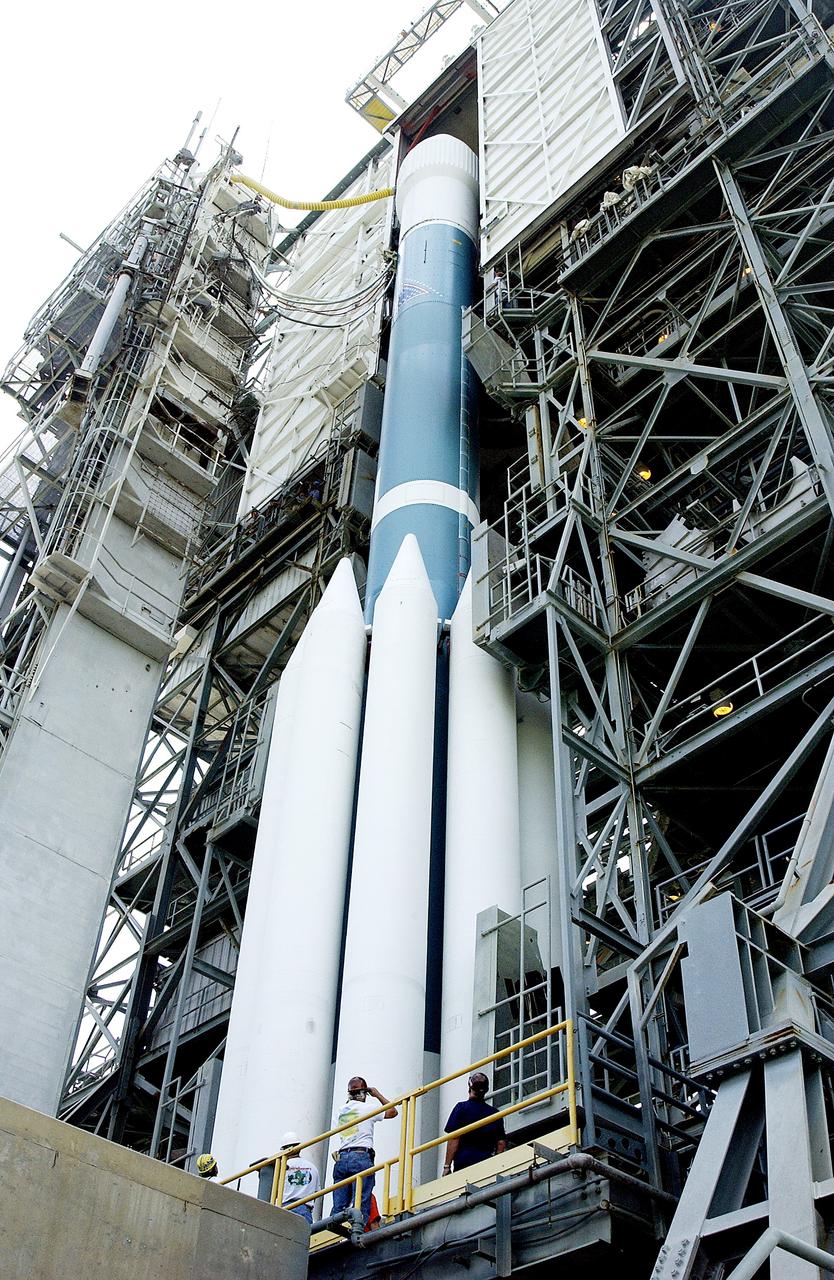
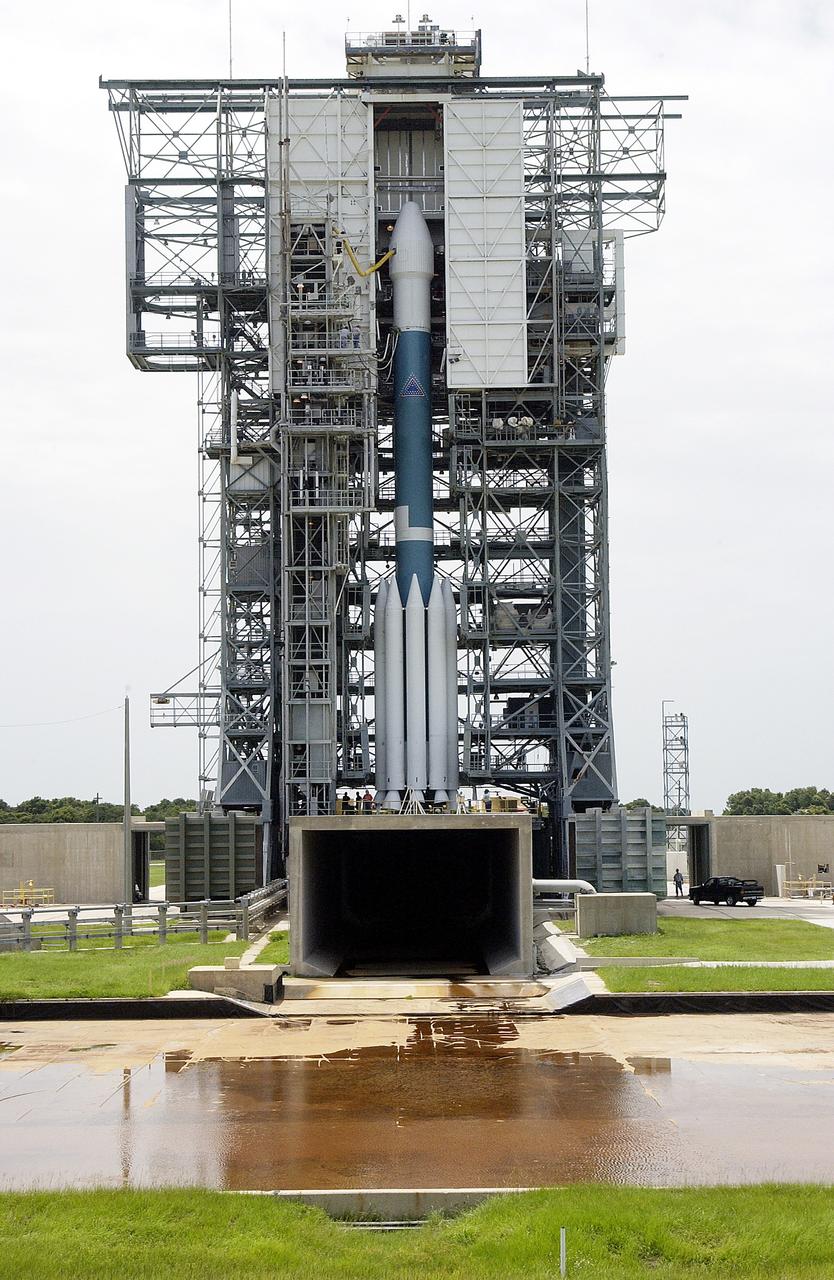
KENNEDY SPACE CENTER, FLA. -  The Mobile Service Tower is rolled back at Space Launch Complex 17B, Cape Canaveral Air Force Station, to reveal the Delta II Heavy launch vehicle ready for launch of the Mars Exploration Rover-B (MER-B) mission, with the rover "Opportunity" aboard. The second of twin rovers being sent to Mars, it is equipped with a robotic arm, a drilling tool, three spectrometers, and four pairs of cameras that allow it to have a human-like, 3D view of the terrain. Each rover could travel as far as 100 meters in one day to act as Mars scientists' eyes and hands, exploring an environment where humans are not yet able to go. MER-B is scheduled to launch on June 28 at one of two available times, 11:56:16 p.m. EDT or 12:37:59 a.m. EDT on June 29.
KENNEDY SPACE CENTER, FLA. - The Mobile Service Tower is rolled back at Space Launch Complex 17B, Cape Canaveral Air Force Station, to reveal the Delta II Heavy launch vehicle ready for launch of the Mars Exploration Rover-B (MER-B) mission, with the rover "Opportunity" aboard. The second of twin rovers being sent to Mars, it is equipped with a robotic arm, a drilling tool, three spectrometers, and four pairs of cameras that allow it to have a human-like, 3D view of the terrain. Each rover could travel as far as 100 meters in one day to act as Mars scientists' eyes and hands, exploring an environment where humans are not yet able to go. MER-B is scheduled to launch on June 28 at one of two available times, 11:56:16 p.m. EDT or 12:37:59 a.m. EDT on June 29.
KENNEDY SPACE CENTER, FLA. -   The canister is lifted off the Mars Exploration Rover 1 (MER-B) in the gantry on Launch Complex 17-B, Cape Canaveral Air Force Station.  The second of twin rovers being sent to Mars, it is equipped with a robotic arm, a drilling tool, three spectrometers, and four pairs of cameras that allow it to have a human-like, 3D view of the terrain. Each rover could travel as far as 100 meters in one day to act as Mars scientists' eyes and hands, exploring an environment where humans can't yet go.  MER-B is scheduled to launch June 26 at one of two available times,  12:27:31 a.m. EDT or 1:08:45 a.m. EDT.
KENNEDY SPACE CENTER, FLA. - The canister is lifted off the Mars Exploration Rover 1 (MER-B) in the gantry on Launch Complex 17-B, Cape Canaveral Air Force Station. The second of twin rovers being sent to Mars, it is equipped with a robotic arm, a drilling tool, three spectrometers, and four pairs of cameras that allow it to have a human-like, 3D view of the terrain. Each rover could travel as far as 100 meters in one day to act as Mars scientists' eyes and hands, exploring an environment where humans can't yet go. MER-B is scheduled to launch June 26 at one of two available times, 12:27:31 a.m. EDT or 1:08:45 a.m. EDT.
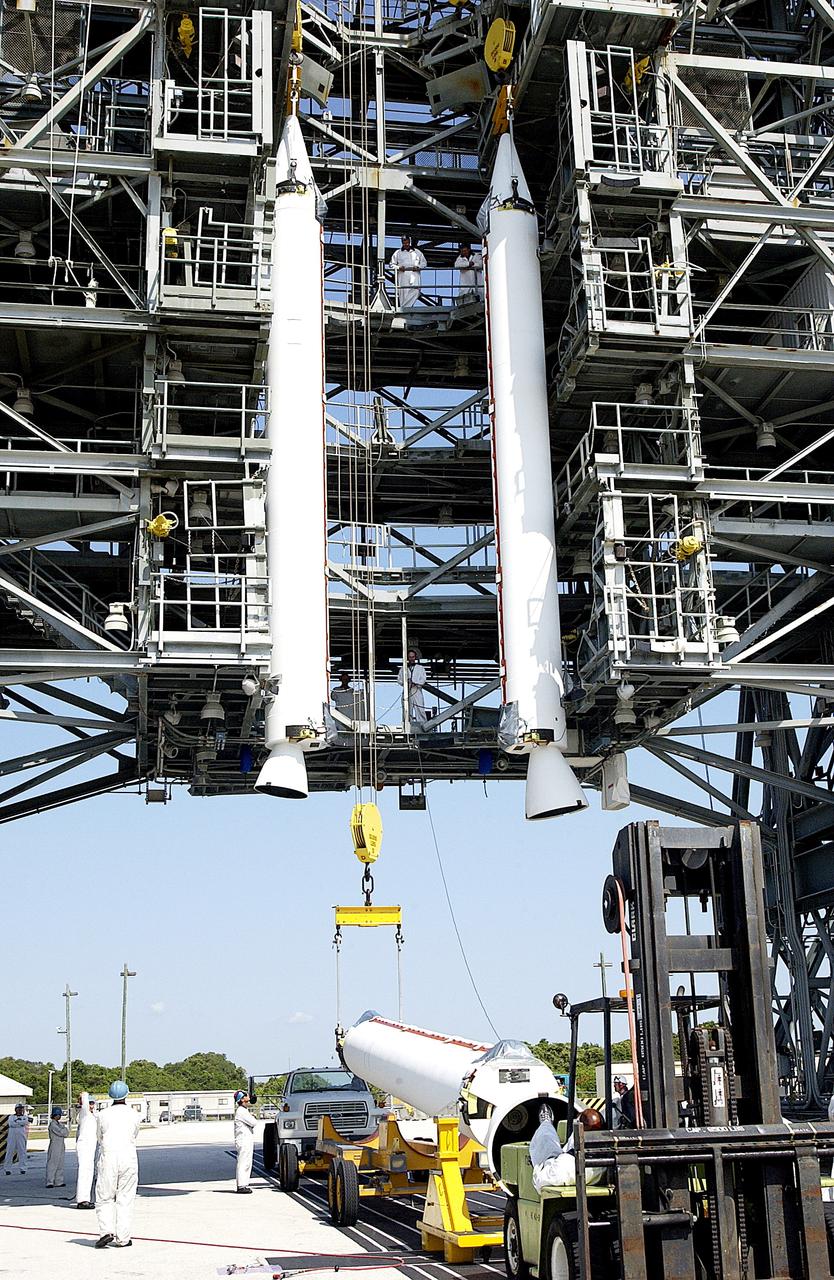
KENNEDY SPACE CENTER, FLA. - While two solid rocket boosters (SRBs) are suspended in the launch tower on Launch Complex 17-A, Cape Canaveral Air Force Station, another is being raised from its transporter for a similar lift.  They are three of nine SRBs that will be mated to the Delta rocket to launch Mars Exploration Rover 2. NASA’s twin Mars Exploration Rovers are designed to study the history of water on Mars. These robotic geologists are equipped with a robotic arm, a drilling tool, three spectrometers, and four pairs of cameras that allow them to have a human-like, 3D view of the terrain. Each rover could travel as far as 100 meters in one day to act as Mars scientists' eyes and hands, exploring an environment where humans can’t yet go.  MER-2 is scheduled to launch June 5 as MER-A.  MER-1 (MER-B) will launch June 25.
KENNEDY SPACE CENTER, FLA. - While two solid rocket boosters (SRBs) are suspended in the launch tower on Launch Complex 17-A, Cape Canaveral Air Force Station, another is being raised from its transporter for a similar lift. They are three of nine SRBs that will be mated to the Delta rocket to launch Mars Exploration Rover 2. NASA’s twin Mars Exploration Rovers are designed to study the history of water on Mars. These robotic geologists are equipped with a robotic arm, a drilling tool, three spectrometers, and four pairs of cameras that allow them to have a human-like, 3D view of the terrain. Each rover could travel as far as 100 meters in one day to act as Mars scientists' eyes and hands, exploring an environment where humans can’t yet go. MER-2 is scheduled to launch June 5 as MER-A. MER-1 (MER-B) will launch June 25.
KENNEDY SPACE CENTER, FLA. -    Workers on Launch Pad 17-B, Cape Canaveral Air Force Station, complete mating of the Mars Exploration Rover 1 (MER-B), above, to the Delta rocket below.  The second of twin rovers being sent to Mars, it is equipped with a robotic arm, a drilling tool, three spectrometers, and four pairs of cameras that allow it to have a human-like, 3D view of the terrain. Each rover could travel as far as 100 meters in one day to act as Mars scientists' eyes and hands, exploring an environment where humans can't yet go.  MER-B is scheduled to launch June 26 at one of two available times,  12:27:31 a.m. EDT or 1:08:45 a.m. EDT.
KENNEDY SPACE CENTER, FLA. - Workers on Launch Pad 17-B, Cape Canaveral Air Force Station, complete mating of the Mars Exploration Rover 1 (MER-B), above, to the Delta rocket below. The second of twin rovers being sent to Mars, it is equipped with a robotic arm, a drilling tool, three spectrometers, and four pairs of cameras that allow it to have a human-like, 3D view of the terrain. Each rover could travel as far as 100 meters in one day to act as Mars scientists' eyes and hands, exploring an environment where humans can't yet go. MER-B is scheduled to launch June 26 at one of two available times, 12:27:31 a.m. EDT or 1:08:45 a.m. EDT.
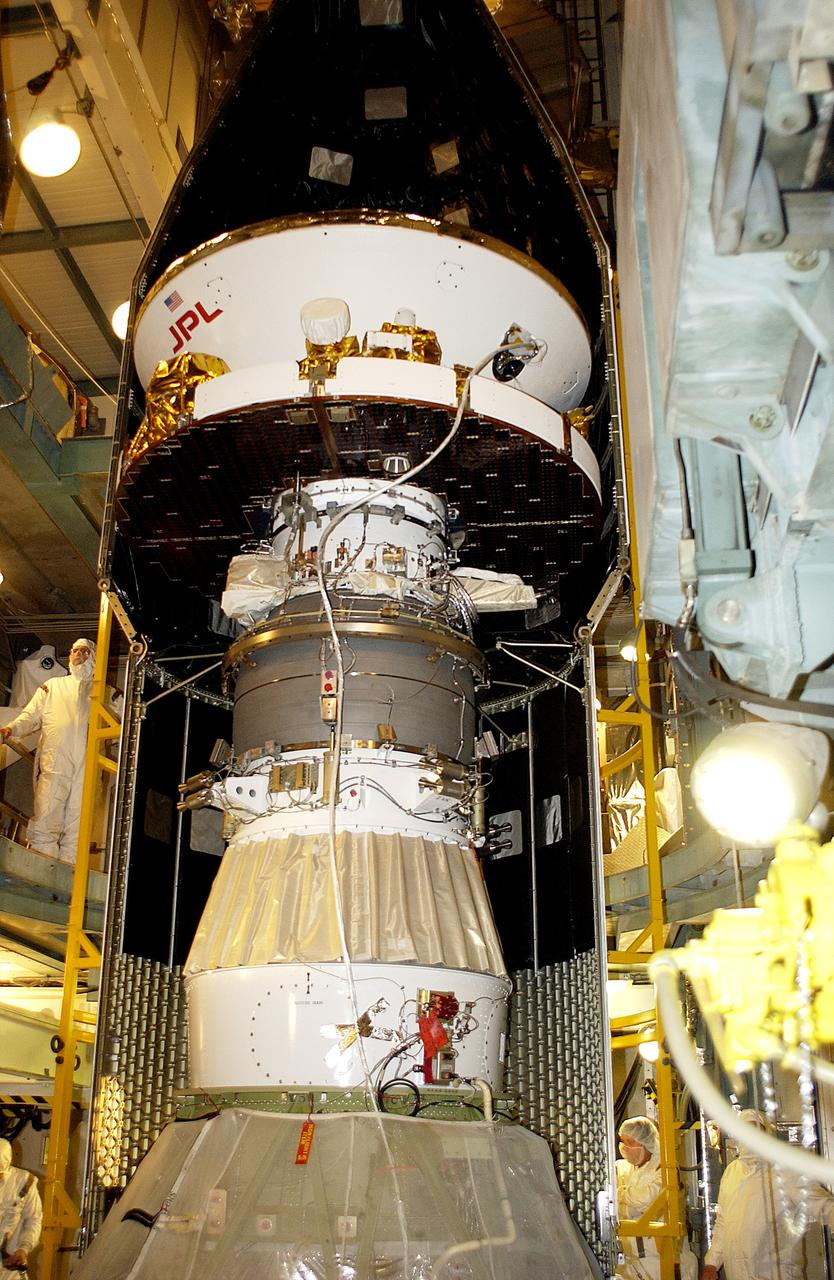
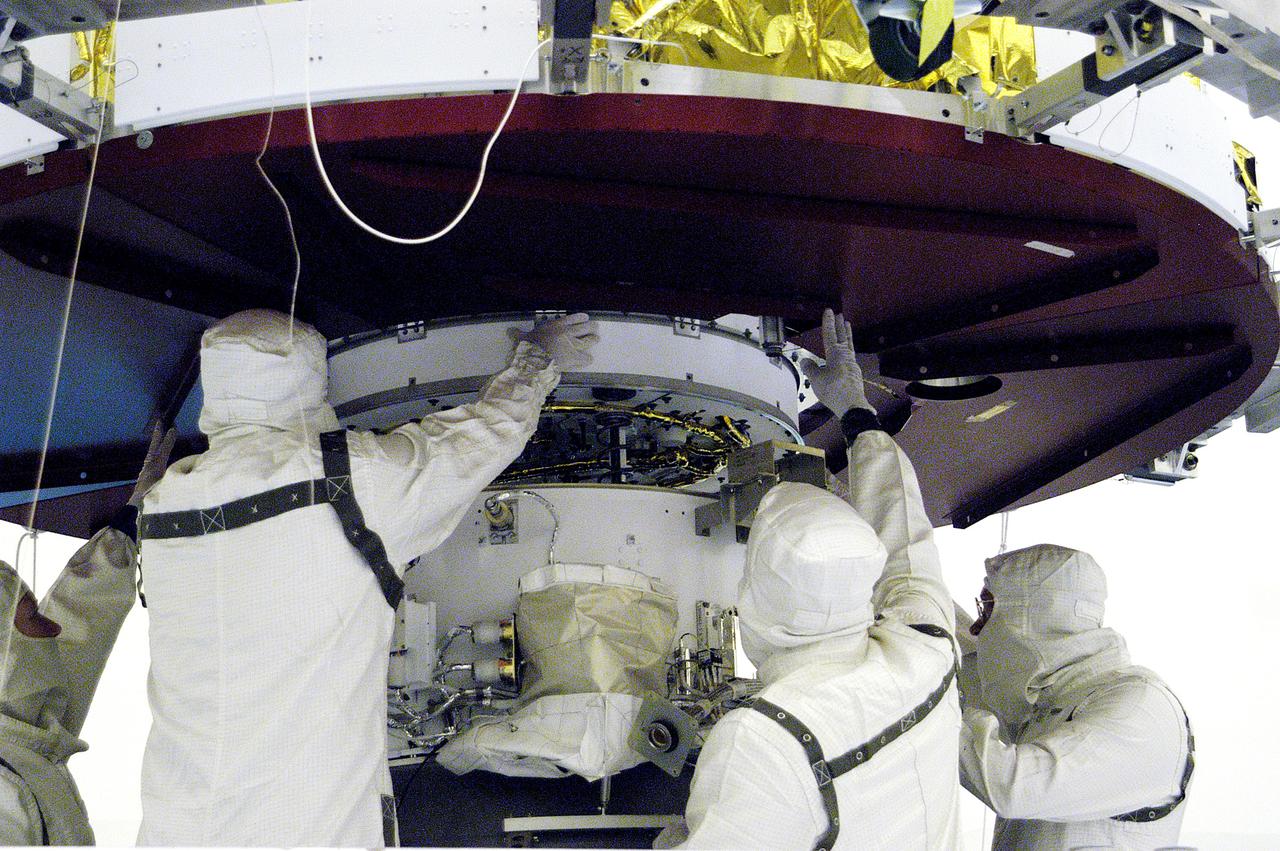
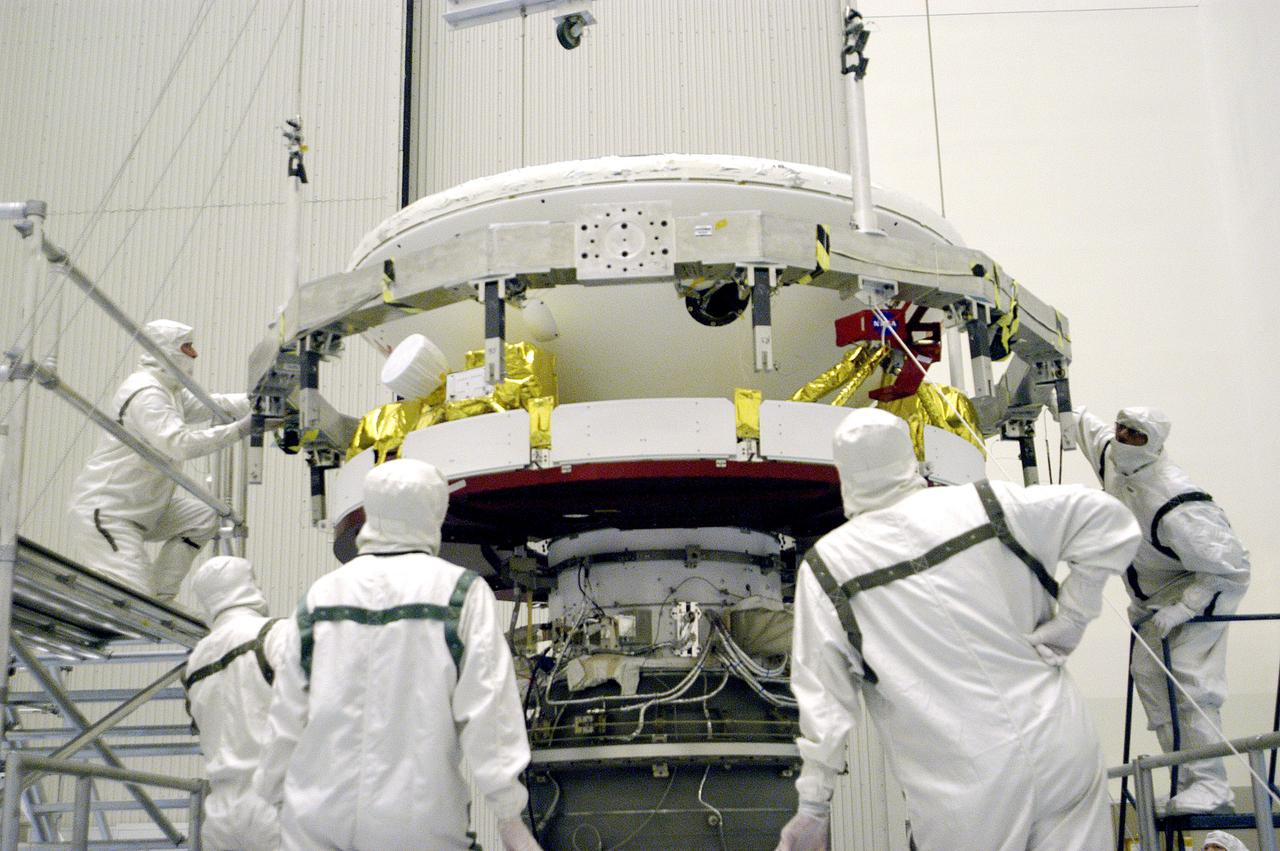
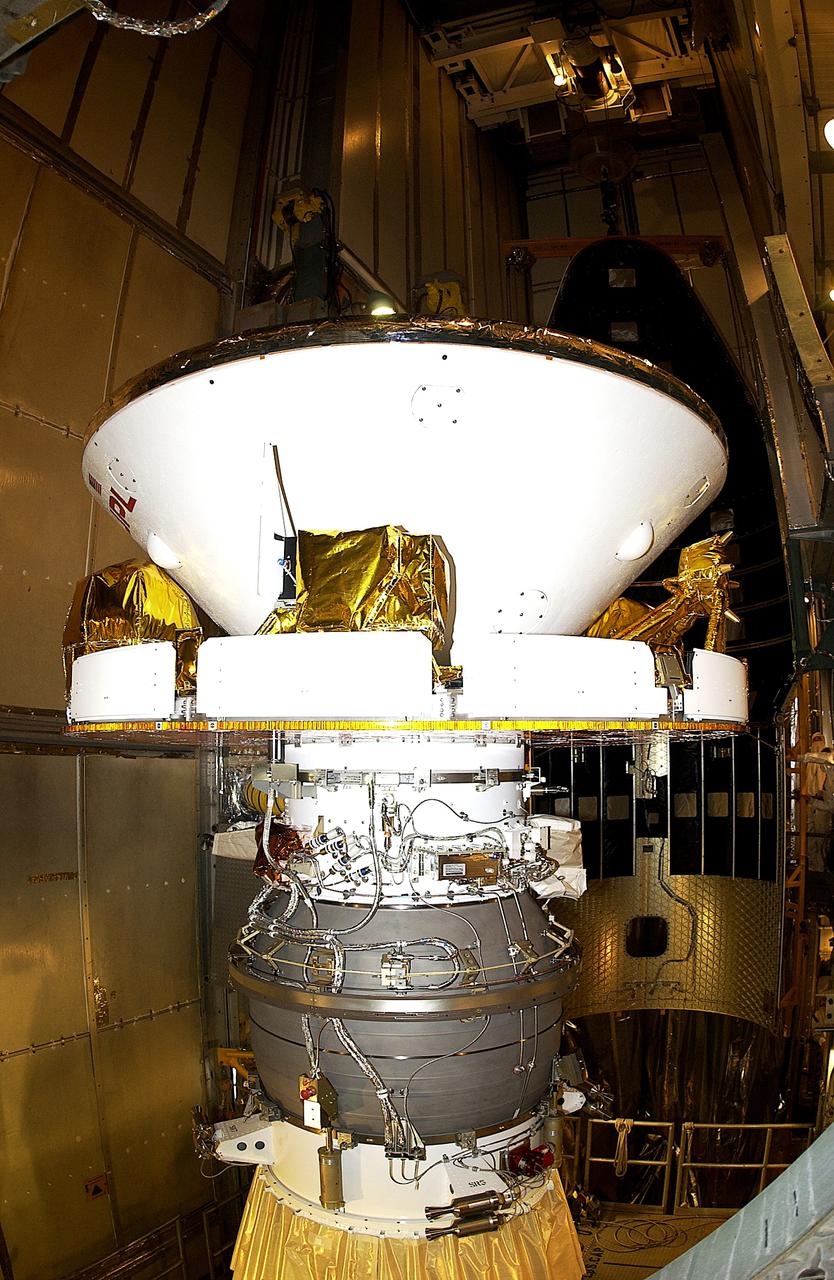
KENNEDY SPACE CENTER, FLA. -  The Mars Exploration Rover 2 (MER-2) entry vehicle (below) is being mated to the cruise stage (above).   The cruise stage includes fuel tanks, thruster clusters and avionics for steering and propulsion.  NASA's twin Mars Exploration Rovers are designed to study the history of water on Mars. These robotic geologists are equipped with a robotic arm, a drilling tool, three spectrometers, and four pairs of cameras that allow them to have a human-like, 3D view of the terrain. Each rover could travel as far as 100 meters in one day to act as Mars scientists' eyes and hands, exploring an environment where humans can't yet go.  MER-2 is scheduled to launch June 5 as MER-A aboard a Delta rocket from Cape Canaveral Air Force Station.
KENNEDY SPACE CENTER, FLA. - The Mars Exploration Rover 2 (MER-2) entry vehicle (below) is being mated to the cruise stage (above). The cruise stage includes fuel tanks, thruster clusters and avionics for steering and propulsion. NASA's twin Mars Exploration Rovers are designed to study the history of water on Mars. These robotic geologists are equipped with a robotic arm, a drilling tool, three spectrometers, and four pairs of cameras that allow them to have a human-like, 3D view of the terrain. Each rover could travel as far as 100 meters in one day to act as Mars scientists' eyes and hands, exploring an environment where humans can't yet go. MER-2 is scheduled to launch June 5 as MER-A aboard a Delta rocket from Cape Canaveral Air Force Station.
KENNEDY SPACE CENTER, FLA. -   On Launch Pad 17-B, Cape Canaveral Air Force Station, the Mars Exploration Rover 1 (MER-B) is moved toward the opening above the Delta rocket.  The rover will then be mated with the rocket for launch.  The second of twin rovers being sent to Mars, it is equipped with a robotic arm, a drilling tool, three spectrometers, and four pairs of cameras that allow it to have a human-like, 3D view of the terrain. Each rover could travel as far as 100 meters in one day to act as Mars scientists' eyes and hands, exploring an environment where humans can't yet go.  MER-B is scheduled to launch June 26 at one of two available times,  12:27:31 a.m. EDT or 1:08:45 a.m. EDT.
KENNEDY SPACE CENTER, FLA. - On Launch Pad 17-B, Cape Canaveral Air Force Station, the Mars Exploration Rover 1 (MER-B) is moved toward the opening above the Delta rocket. The rover will then be mated with the rocket for launch. The second of twin rovers being sent to Mars, it is equipped with a robotic arm, a drilling tool, three spectrometers, and four pairs of cameras that allow it to have a human-like, 3D view of the terrain. Each rover could travel as far as 100 meters in one day to act as Mars scientists' eyes and hands, exploring an environment where humans can't yet go. MER-B is scheduled to launch June 26 at one of two available times, 12:27:31 a.m. EDT or 1:08:45 a.m. EDT.
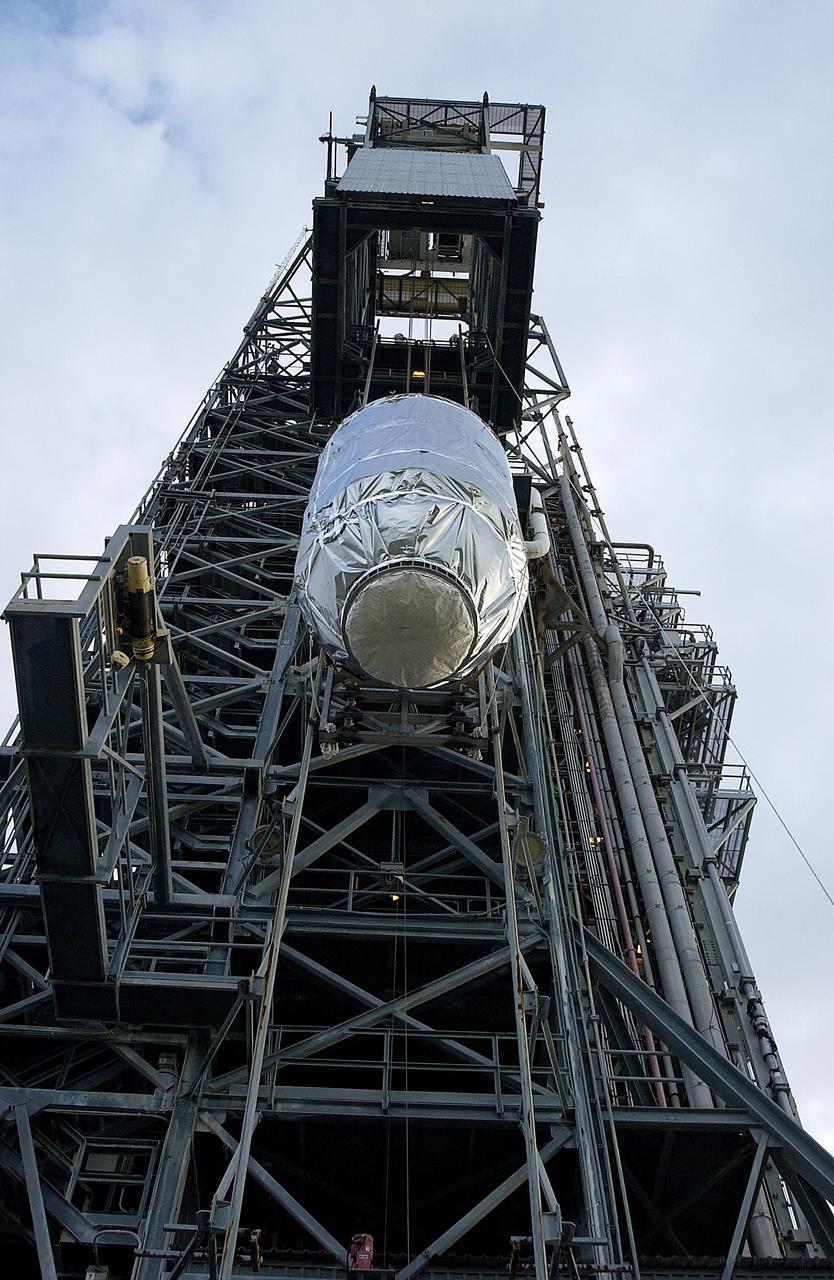
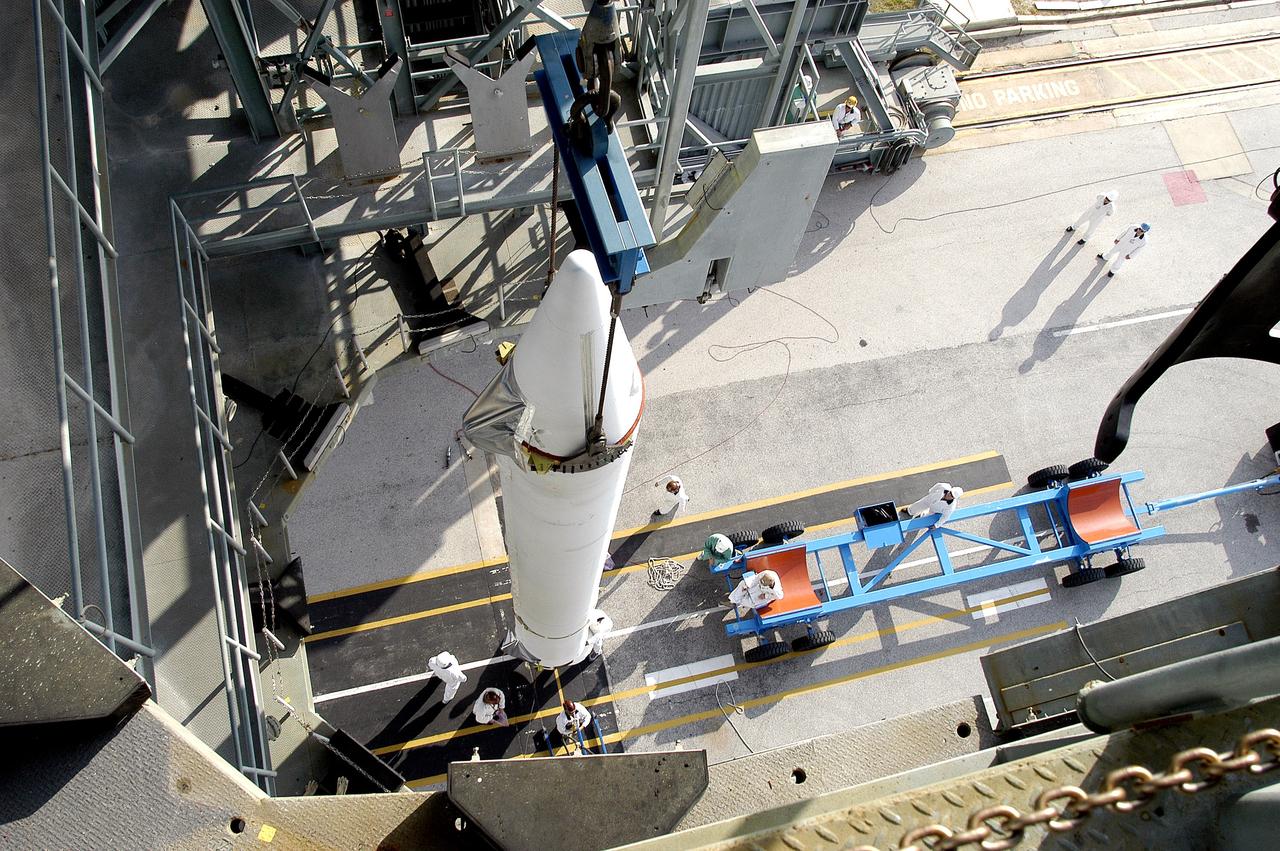
KENNEDY SPACE CENTER, FLA. -  On Launch Pad 17-B, Cape Canaveral Air Force Station, the Mars Exploration Rover 1 (MER-B) is lifted up the tower for mating with the Delta rocket.  The second of twin rovers being sent to Mars, it is equipped with a robotic arm, a drilling tool, three spectrometers, and four pairs of cameras that allow it to have a human-like, 3D view of the terrain. Each rover could travel as far as 100 meters in one day to act as Mars scientists' eyes and hands, exploring an environment where humans can't yet go.  MER-B is scheduled to launch June 26 at one of two available times,  12:27:31 a.m. EDT or 1:08:45 a.m. EDT.
KENNEDY SPACE CENTER, FLA. - On Launch Pad 17-B, Cape Canaveral Air Force Station, the Mars Exploration Rover 1 (MER-B) is lifted up the tower for mating with the Delta rocket. The second of twin rovers being sent to Mars, it is equipped with a robotic arm, a drilling tool, three spectrometers, and four pairs of cameras that allow it to have a human-like, 3D view of the terrain. Each rover could travel as far as 100 meters in one day to act as Mars scientists' eyes and hands, exploring an environment where humans can't yet go. MER-B is scheduled to launch June 26 at one of two available times, 12:27:31 a.m. EDT or 1:08:45 a.m. EDT.
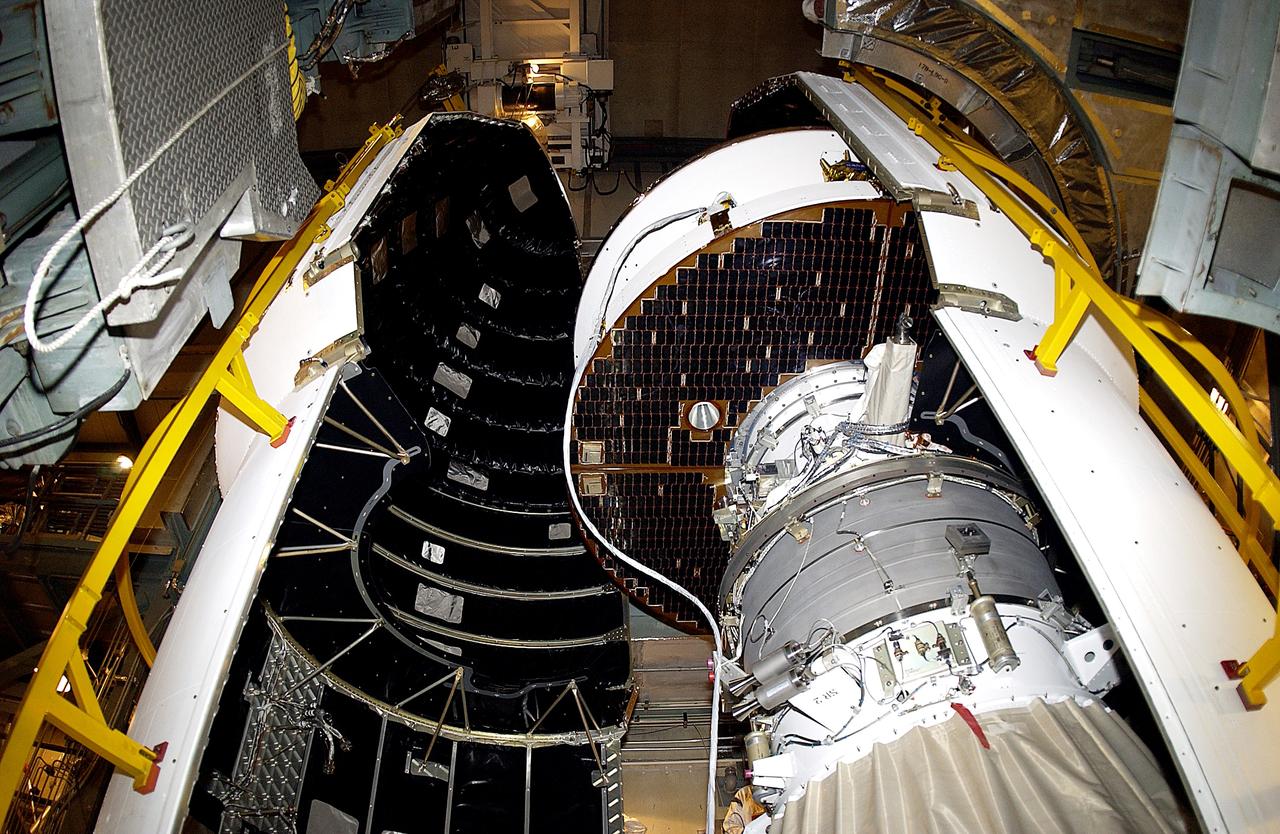
KENNEDY SPACE CENTER, FLA. -    In the gantry on Launch Complex 17-B, Cape Canaveral Air Force Station, Mars Exploration Rover 1 (MER-B) is revealed after removal of the canister.  The second of twin rovers being sent to Mars, it is equipped with a robotic arm, a drilling tool, three spectrometers, and four pairs of cameras that allow it to have a human-like, 3D view of the terrain. Each rover could travel as far as 100 meters in one day to act as Mars scientists' eyes and hands, exploring an environment where humans can't yet go.  MER-B is scheduled to launch June 26 at one of two available times,  12:27:31 a.m. EDT or 1:08:45 a.m. EDT.
KENNEDY SPACE CENTER, FLA. - In the gantry on Launch Complex 17-B, Cape Canaveral Air Force Station, Mars Exploration Rover 1 (MER-B) is revealed after removal of the canister. The second of twin rovers being sent to Mars, it is equipped with a robotic arm, a drilling tool, three spectrometers, and four pairs of cameras that allow it to have a human-like, 3D view of the terrain. Each rover could travel as far as 100 meters in one day to act as Mars scientists' eyes and hands, exploring an environment where humans can't yet go. MER-B is scheduled to launch June 26 at one of two available times, 12:27:31 a.m. EDT or 1:08:45 a.m. EDT.
KENNEDY SPACE CENTER, FLA. -  On Launch Pad 17-B, Cape Canaveral Air Force Station, the Mars Exploration Rover 1 (MER-B) is ready to be lifted up the tower for mating with the Delta rocket.  The second of twin rovers being sent to Mars, it is equipped with a robotic arm, a drilling tool, three spectrometers, and four pairs of cameras that allow it to have a human-like, 3D view of the terrain. Each rover could travel as far as 100 meters in one day to act as Mars scientists' eyes and hands, exploring an environment where humans can't yet go.  MER-B is scheduled to launch June 26 at one of two available times,  12:27:31 a.m. EDT or 1:08:45 a.m. EDT.
KENNEDY SPACE CENTER, FLA. - On Launch Pad 17-B, Cape Canaveral Air Force Station, the Mars Exploration Rover 1 (MER-B) is ready to be lifted up the tower for mating with the Delta rocket. The second of twin rovers being sent to Mars, it is equipped with a robotic arm, a drilling tool, three spectrometers, and four pairs of cameras that allow it to have a human-like, 3D view of the terrain. Each rover could travel as far as 100 meters in one day to act as Mars scientists' eyes and hands, exploring an environment where humans can't yet go. MER-B is scheduled to launch June 26 at one of two available times, 12:27:31 a.m. EDT or 1:08:45 a.m. EDT.
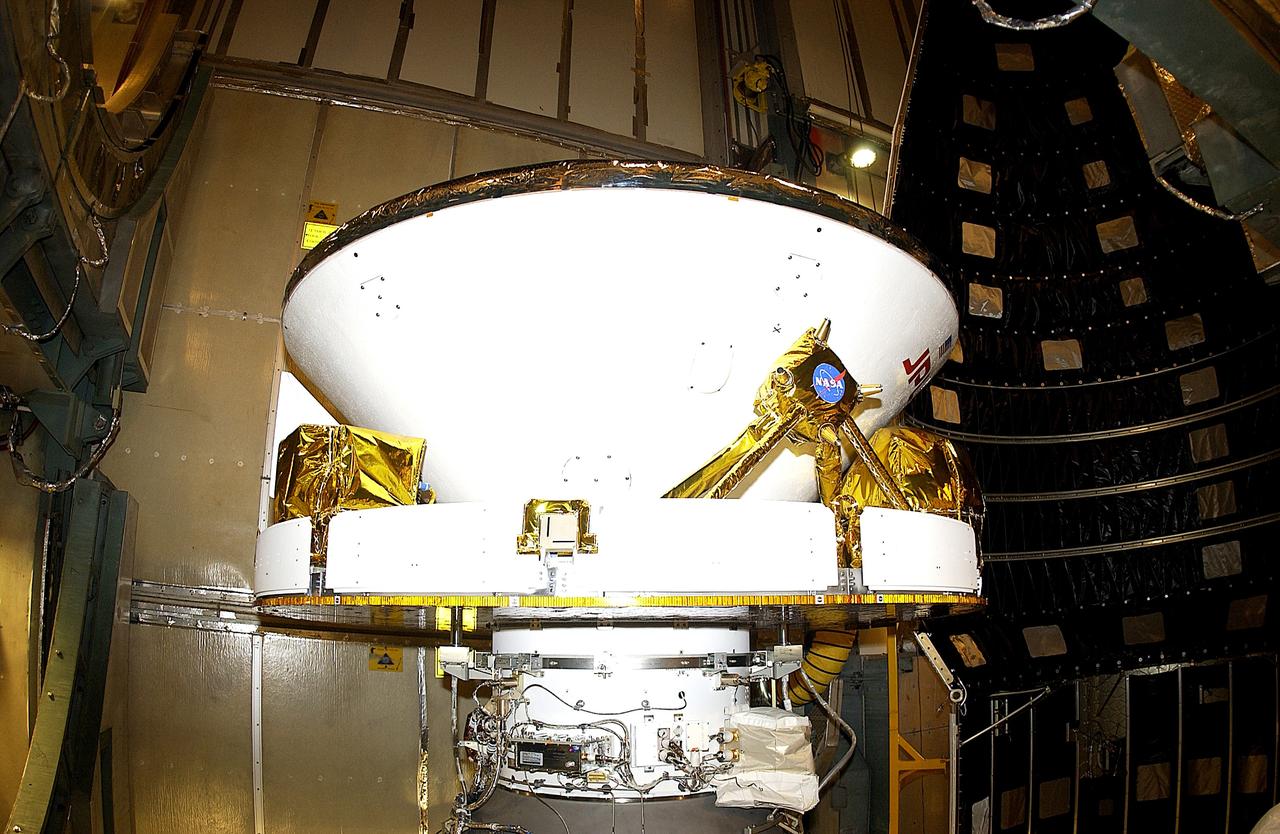
KENNEDY SPACE CENTER, FLA. - At Launch Complex 17-B, Cape Canaveral Air Force Station, a final view of the Mars Exploration Rover-1 (MER-B) is captured before it is encapsulated into its spacecraft fairing for launch. The second of twin rovers being sent to Mars, it is equipped with a robotic arm, a drilling tool, three spectrometers, and four pairs of cameras that allow it to have a human-like, 3D view of the terrain. Each rover could travel as far as 100 meters in one day to act as Mars scientists' eyes and hands, exploring an environment where humans are not yet able to go. MER-B is scheduled to launch no earlier than June 28 at one of two available times, 11:56:16 p.m. EDT or 12:37:59 a.m. EDT.
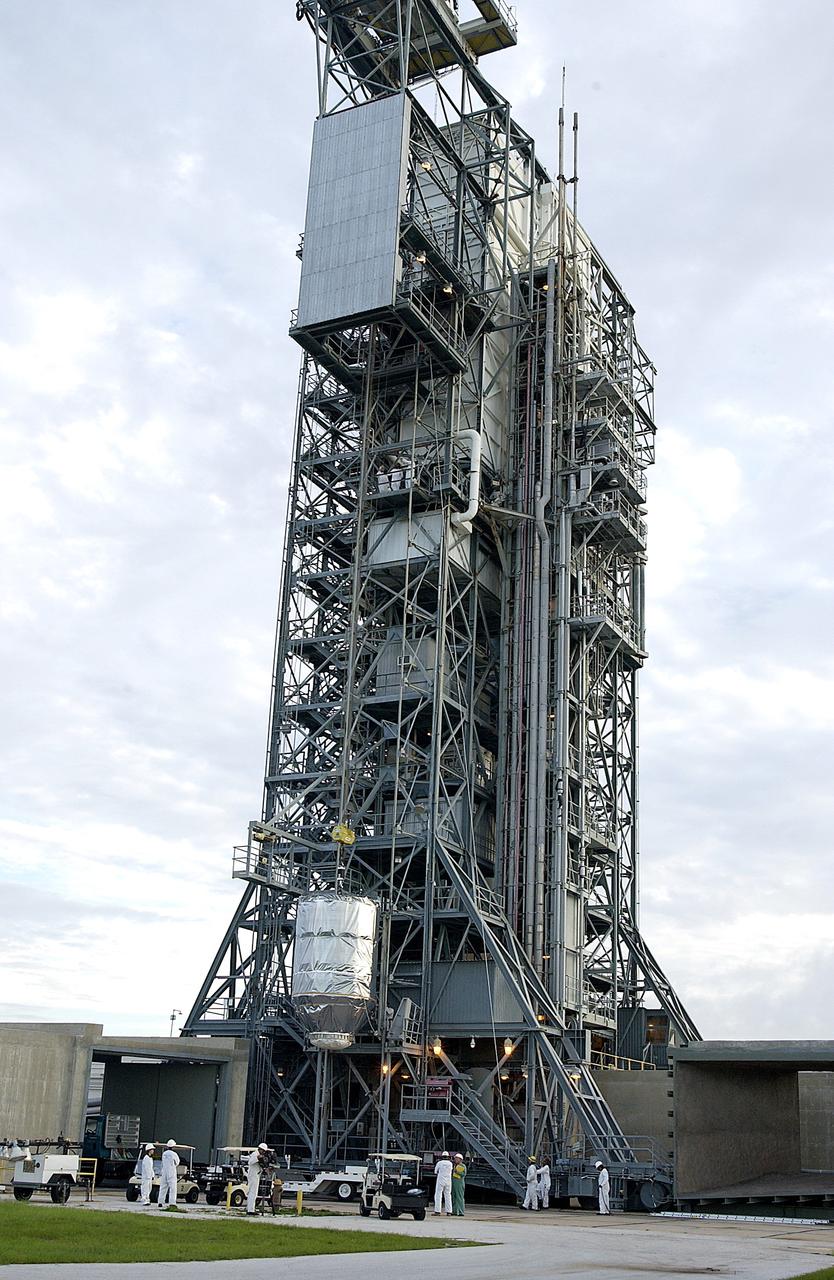
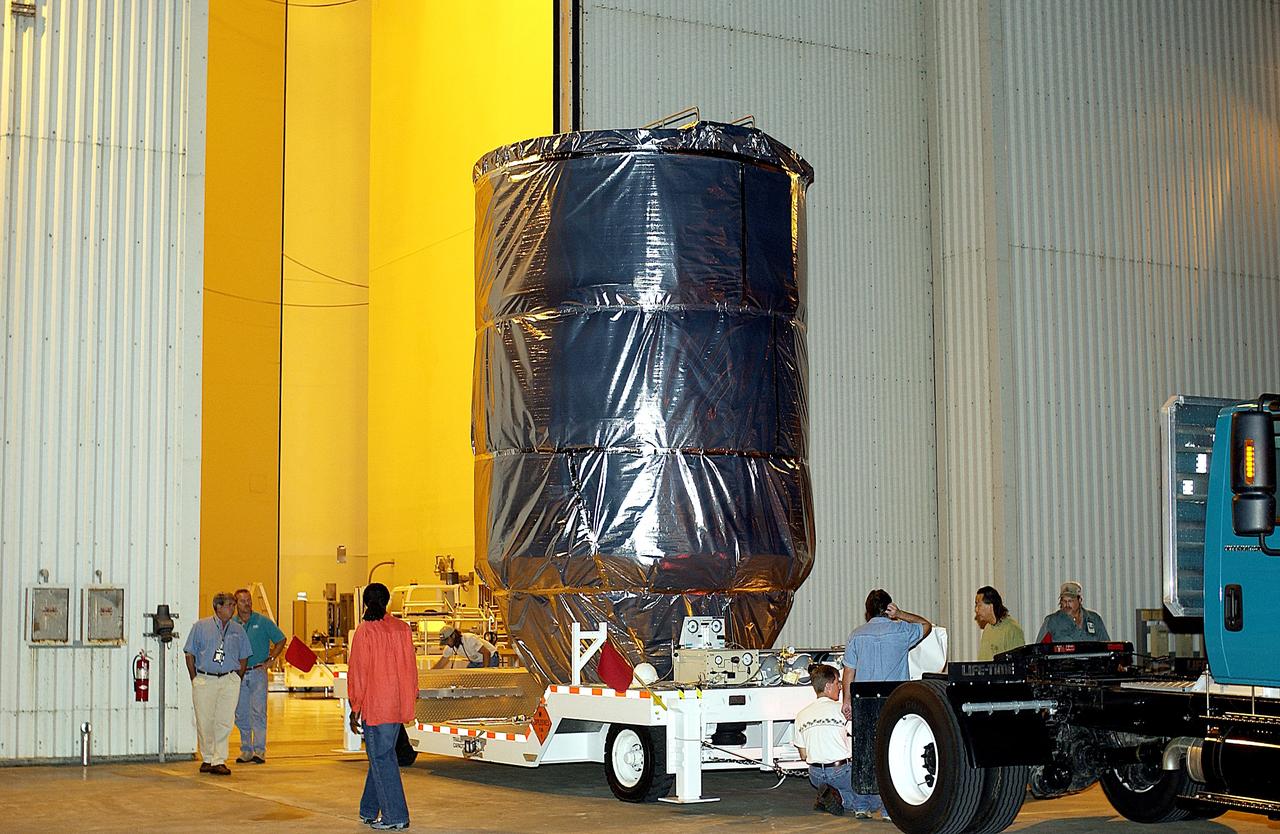
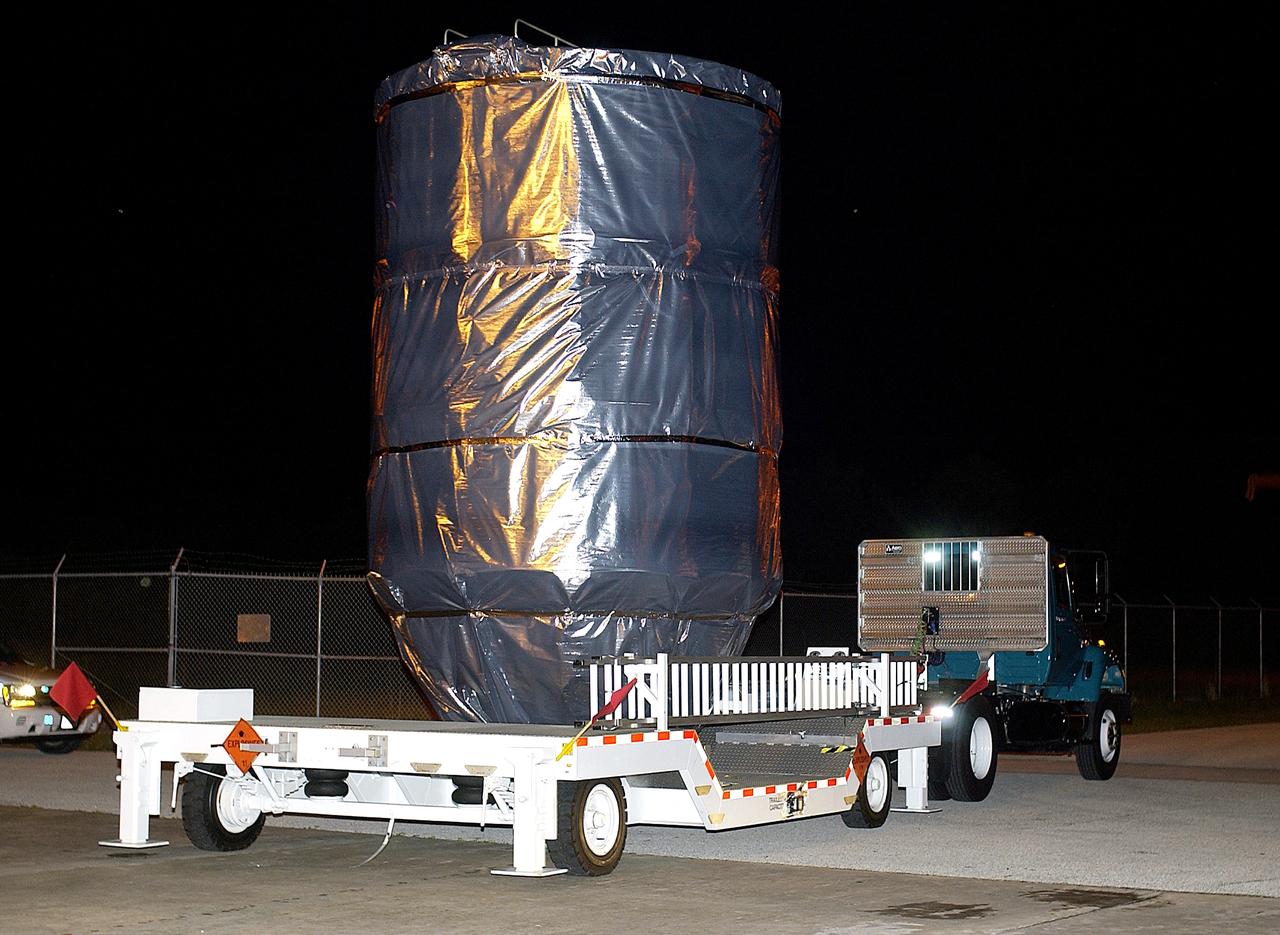
KENNEDY SPACE CENTER, FLA. -  The Mars Exploration Rover 1 (MER-B) is moved  out of the Payload Hazardous Servicing Facility for transfer to Launch Pad 17-B, Cape Canaveral Air Force Station.  The second of twin rovers being sent to Mars, it is equipped with a robotic arm, a drilling tool, three spectrometers, and four pairs of cameras that allow it to have a human-like, 3D view of the terrain. Each rover could travel as far as 100 meters in one day to act as Mars scientists' eyes and hands, exploring an environment where humans can't yet go.  MER-B is scheduled to launch June 26 at one of two available times,  12:27:31 a.m. EDT or 1:08:45 a.m. EDT.
KENNEDY SPACE CENTER, FLA. - The Mars Exploration Rover 1 (MER-B) is moved out of the Payload Hazardous Servicing Facility for transfer to Launch Pad 17-B, Cape Canaveral Air Force Station. The second of twin rovers being sent to Mars, it is equipped with a robotic arm, a drilling tool, three spectrometers, and four pairs of cameras that allow it to have a human-like, 3D view of the terrain. Each rover could travel as far as 100 meters in one day to act as Mars scientists' eyes and hands, exploring an environment where humans can't yet go. MER-B is scheduled to launch June 26 at one of two available times, 12:27:31 a.m. EDT or 1:08:45 a.m. EDT.
KENNEDY SPACE CENTER, FLA. -   In the gantry on Launch Complex 17-B, Cape Canaveral Air Force Station, workers start removing the canister from around the Mars Exploration Rover 1 (MER-B).  The second of twin rovers being sent to Mars, it is equipped with a robotic arm, a drilling tool, three spectrometers, and four pairs of cameras that allow it to have a human-like, 3D view of the terrain. Each rover could travel as far as 100 meters in one day to act as Mars scientists' eyes and hands, exploring an environment where humans can't yet go.  MER-B is scheduled to launch June 26 at one of two available times,  12:27:31 a.m. EDT or 1:08:45 a.m. EDT.
KENNEDY SPACE CENTER, FLA. - In the gantry on Launch Complex 17-B, Cape Canaveral Air Force Station, workers start removing the canister from around the Mars Exploration Rover 1 (MER-B). The second of twin rovers being sent to Mars, it is equipped with a robotic arm, a drilling tool, three spectrometers, and four pairs of cameras that allow it to have a human-like, 3D view of the terrain. Each rover could travel as far as 100 meters in one day to act as Mars scientists' eyes and hands, exploring an environment where humans can't yet go. MER-B is scheduled to launch June 26 at one of two available times, 12:27:31 a.m. EDT or 1:08:45 a.m. EDT.
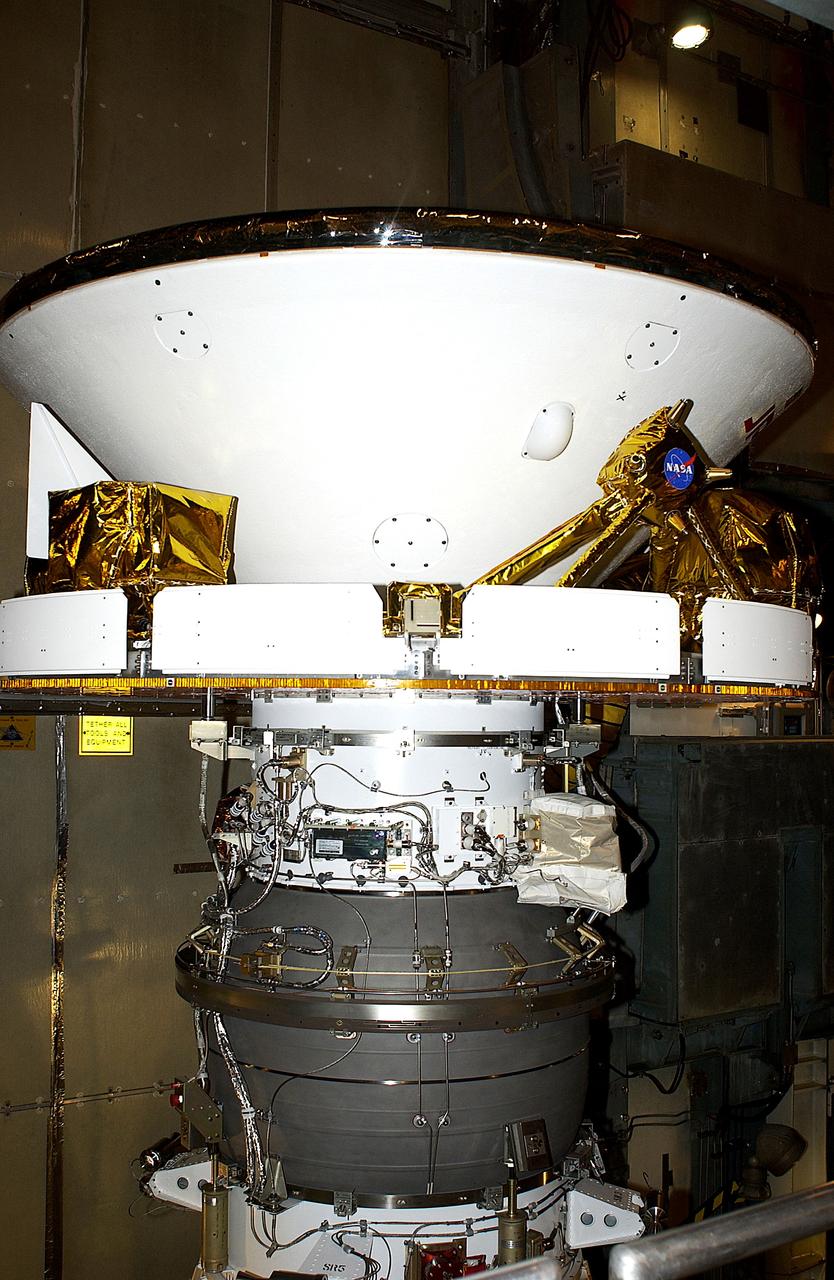
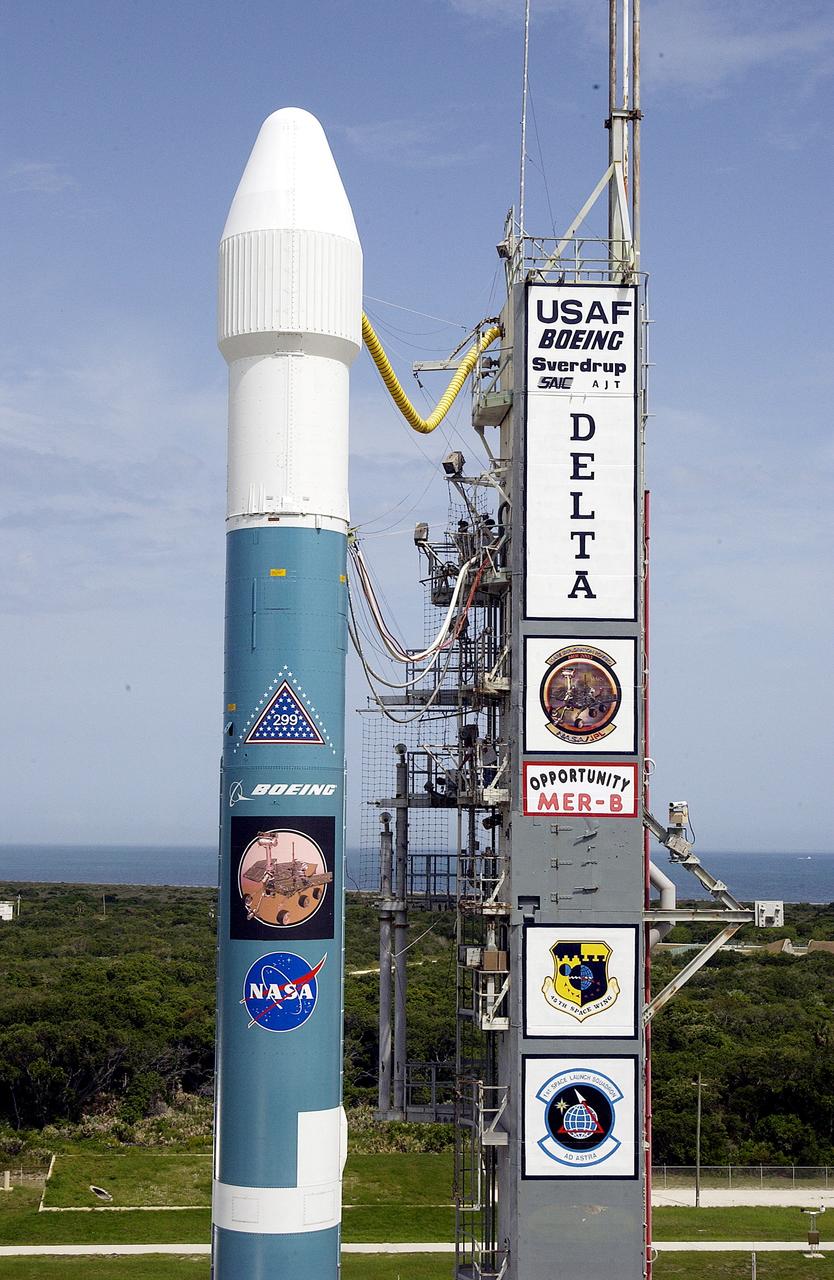
KENNEDY SPACE CENTER, FLA. - At Launch Complex 17-B, Cape Canaveral Air Force Station, Mars Exploration Rover-1 (MER-B) "Opportunity" awaits installation of its spacecraft fairing. The second of twin rovers being sent to Mars, it is equipped with a robotic arm, a drilling tool, three spectrometers, and four pairs of cameras that allow it to have a human-like, 3D view of the terrain. Each rover could travel as far as 100 meters in one day to act as Mars scientists' eyes and hands, exploring an environment where humans are not yet able to go. MER-B is scheduled to launch no earlier than June 28 at one of two available times, 11:56:16 p.m. EDT or 12:37:59 a.m. EDT.
KENNEDY SPACE CENTER, FLA. - In the Payload Hazardous Servicing Facility, workers check the status of the cruise stage of Mars Exploration Rover 1 (MER-1) after being lowered onto blocks.  The cruise stage will be integrated with the aeroshell, the entry vehicle.   NASA’s twin Mars Exploration Rovers are designed to study the history of water on Mars. These robotic geologists are equipped with a robotic arm, a drilling tool, three spectrometers, and four pairs of cameras that allow them to have a human-like, 3D view of the terrain. Each rover could travel as far as 100 meters in one day to act as Mars scientists' eyes and hands, exploring an environment where humans can’t yet go.  The MER-1 is scheduled to launch June 25 from Launch Pad 17-A, Cape Canaveral Air Force Station.
KENNEDY SPACE CENTER, FLA. - In the Payload Hazardous Servicing Facility, workers check the status of the cruise stage of Mars Exploration Rover 1 (MER-1) after being lowered onto blocks. The cruise stage will be integrated with the aeroshell, the entry vehicle. NASA’s twin Mars Exploration Rovers are designed to study the history of water on Mars. These robotic geologists are equipped with a robotic arm, a drilling tool, three spectrometers, and four pairs of cameras that allow them to have a human-like, 3D view of the terrain. Each rover could travel as far as 100 meters in one day to act as Mars scientists' eyes and hands, exploring an environment where humans can’t yet go. The MER-1 is scheduled to launch June 25 from Launch Pad 17-A, Cape Canaveral Air Force Station.
KENNEDY SPACE CENTER, FLA. -    In the gantry on Launch Complex 17-B, Cape Canaveral Air Force Station, Mars Exploration Rover 1 (MER-B) is revealed after removal of the canister.  The second of twin rovers being sent to Mars, it is equipped with a robotic arm, a drilling tool, three spectrometers, and four pairs of cameras that allow it to have a human-like, 3D view of the terrain. Each rover could travel as far as 100 meters in one day to act as Mars scientists' eyes and hands, exploring an environment where humans can't yet go.  MER-B is scheduled to launch June 26 at one of two available times,  12:27:31 a.m. EDT or 1:08:45 a.m. EDT.
KENNEDY SPACE CENTER, FLA. - In the gantry on Launch Complex 17-B, Cape Canaveral Air Force Station, Mars Exploration Rover 1 (MER-B) is revealed after removal of the canister. The second of twin rovers being sent to Mars, it is equipped with a robotic arm, a drilling tool, three spectrometers, and four pairs of cameras that allow it to have a human-like, 3D view of the terrain. Each rover could travel as far as 100 meters in one day to act as Mars scientists' eyes and hands, exploring an environment where humans can't yet go. MER-B is scheduled to launch June 26 at one of two available times, 12:27:31 a.m. EDT or 1:08:45 a.m. EDT.
KENNEDY SPACE CENTER, FLA. - At Launch Complex 17-B, Cape Canaveral Air Force Station, workers prepare to encapsulate the Mars Exploration Rover-1 (MER-B) into its spacecraft fairing. The second of twin rovers being sent to Mars, it is equipped with a robotic arm, a drilling tool, three spectrometers, and four pairs of cameras that allow it to have a human-like, 3D view of the terrain. Each rover could travel as far as 100 meters in one day to act as Mars scientists' eyes and hands, exploring an environment where humans are not yet able to go. MER-B is scheduled to launch no earlier than June 28 at one of two available times, 11:56:16 p.m. EDT or 12:37:59 a.m. EDT.
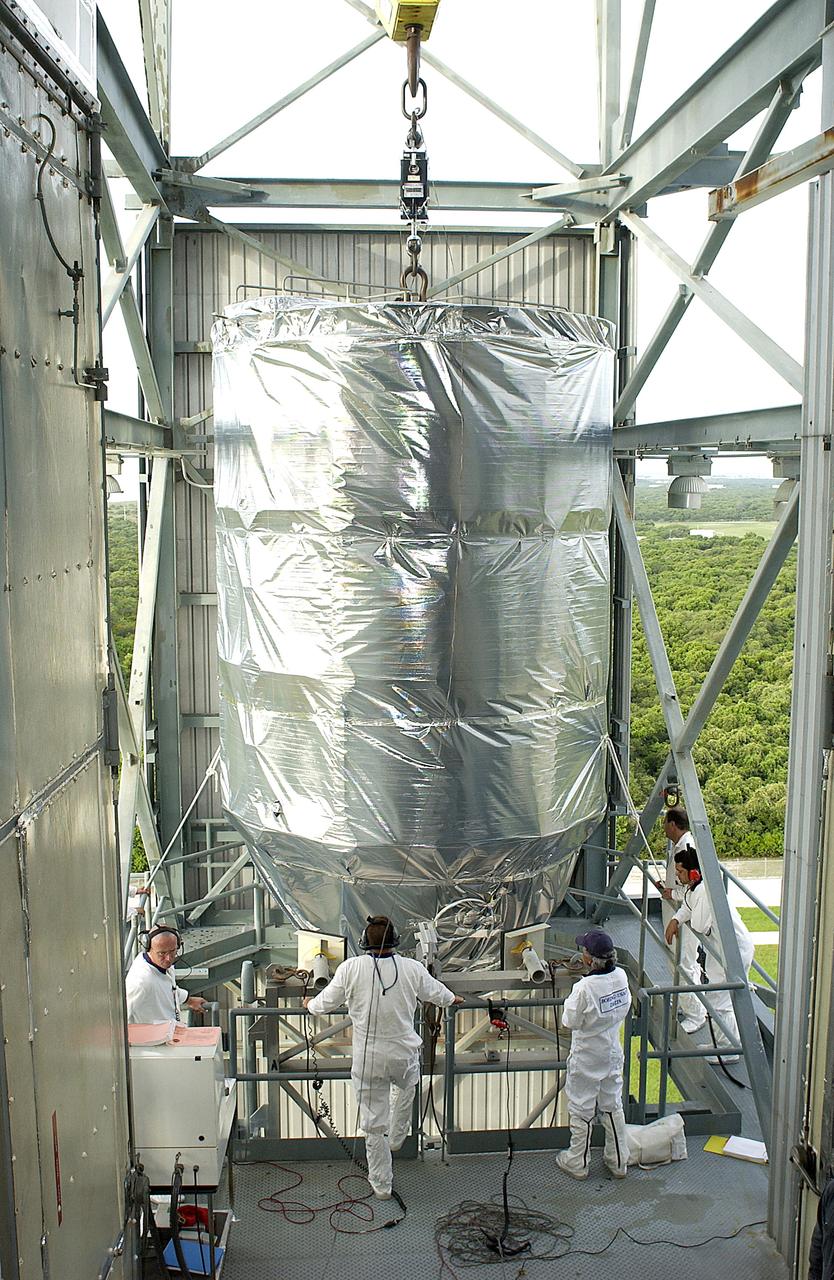
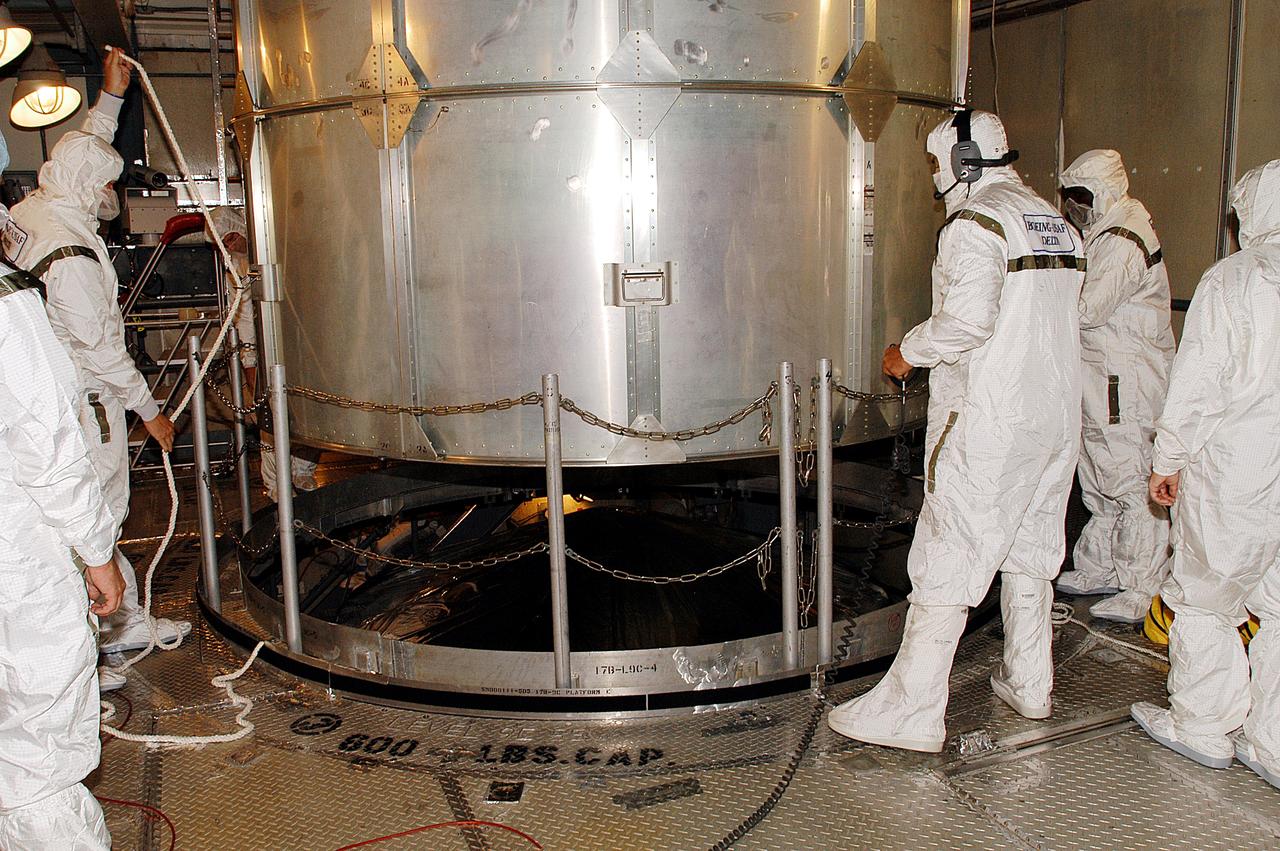
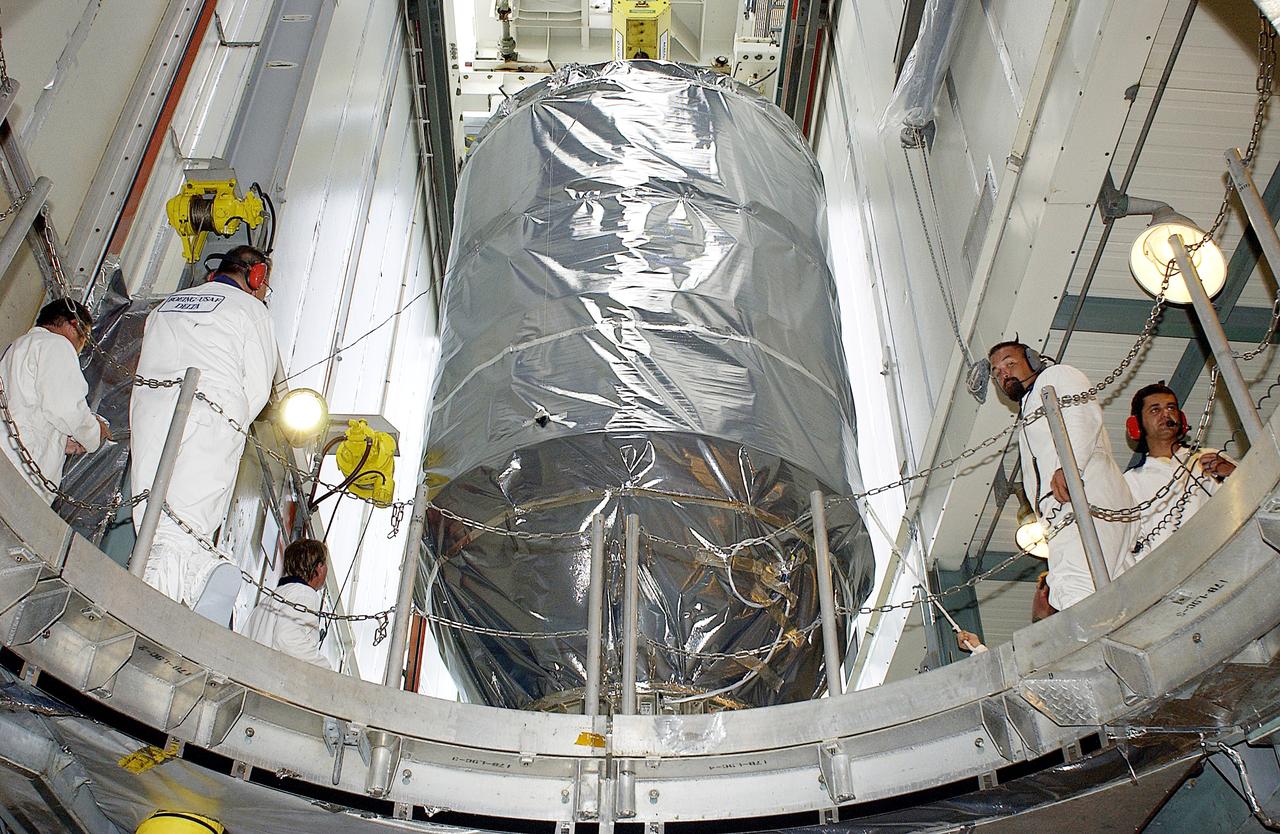
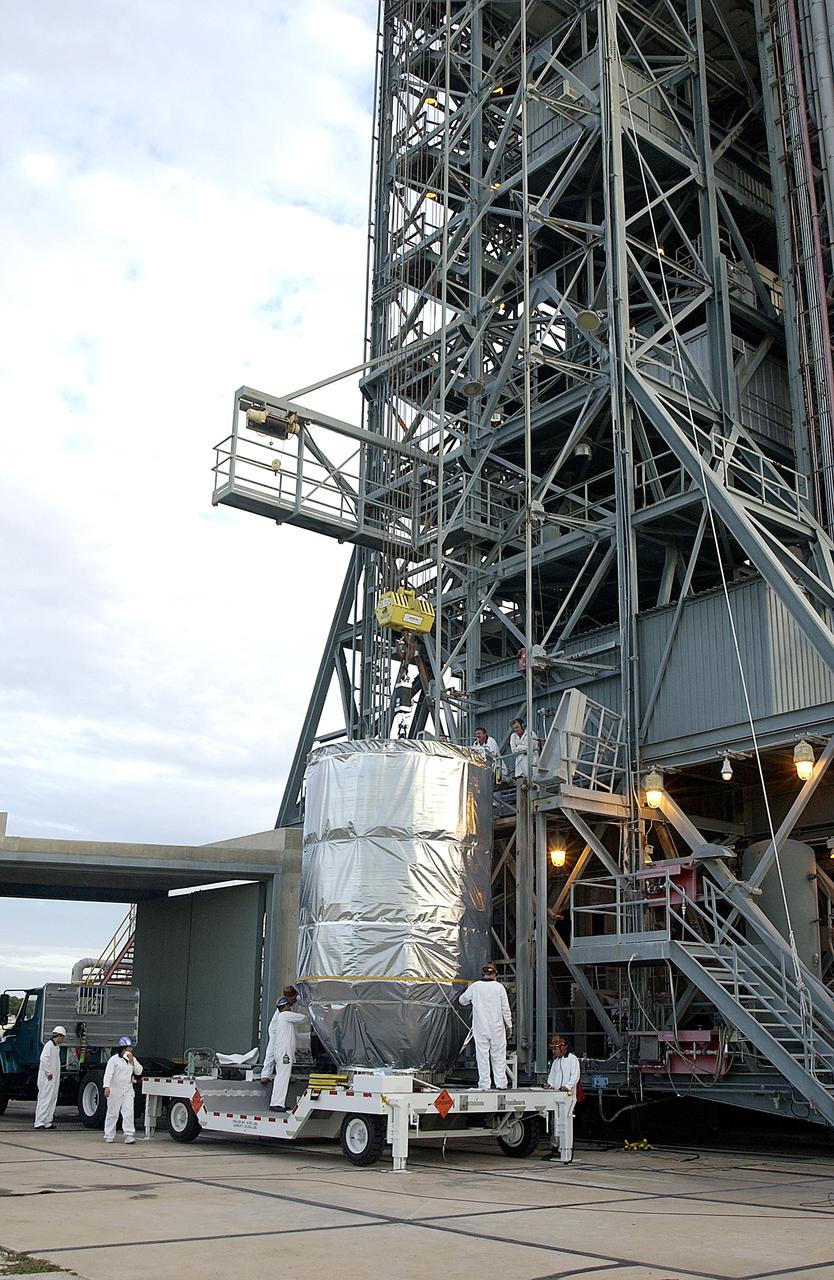
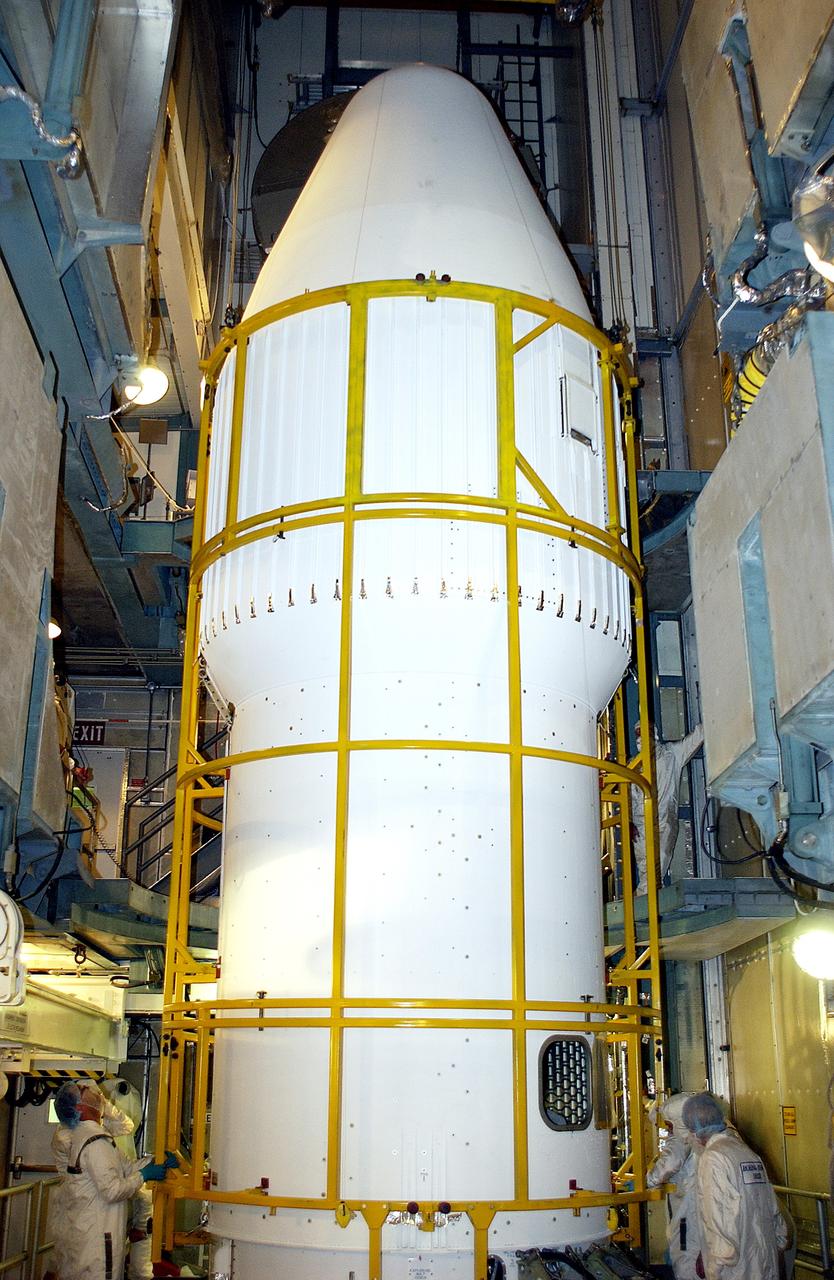
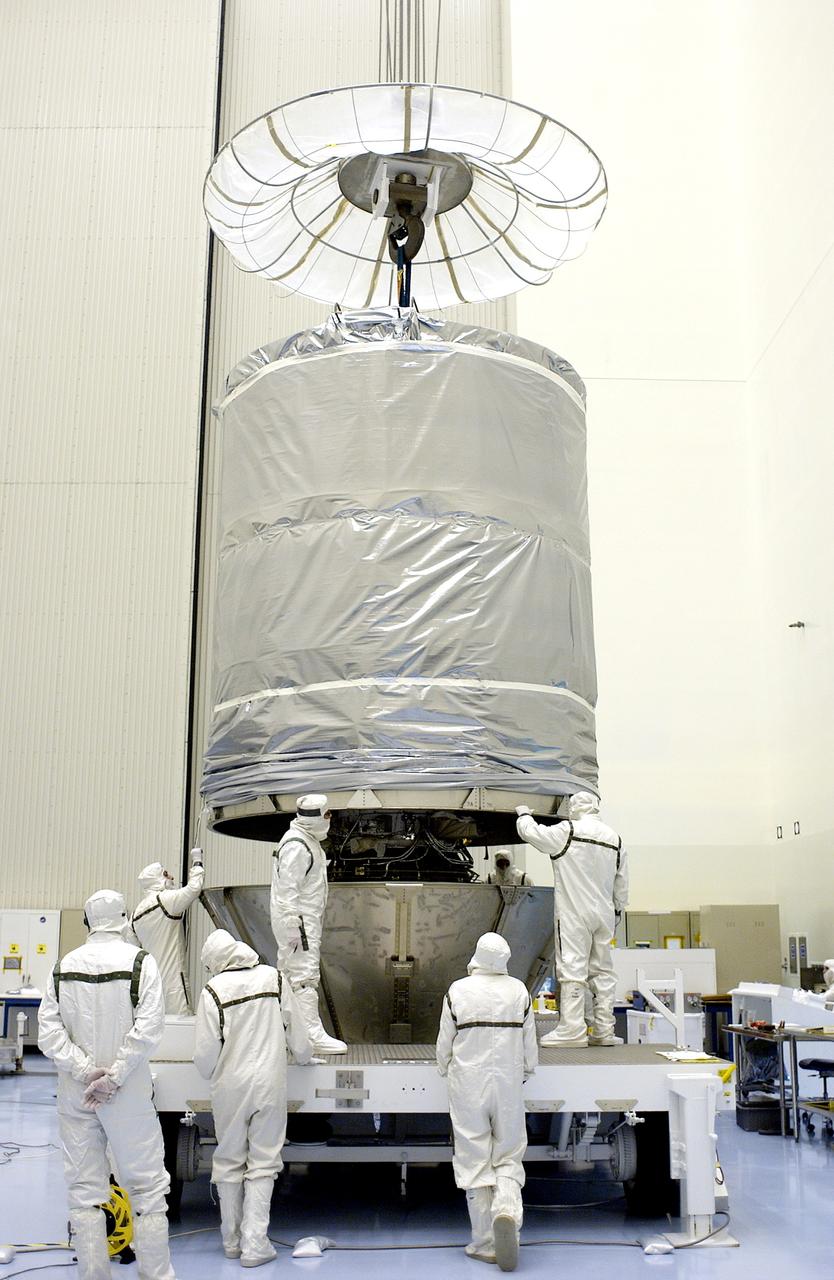
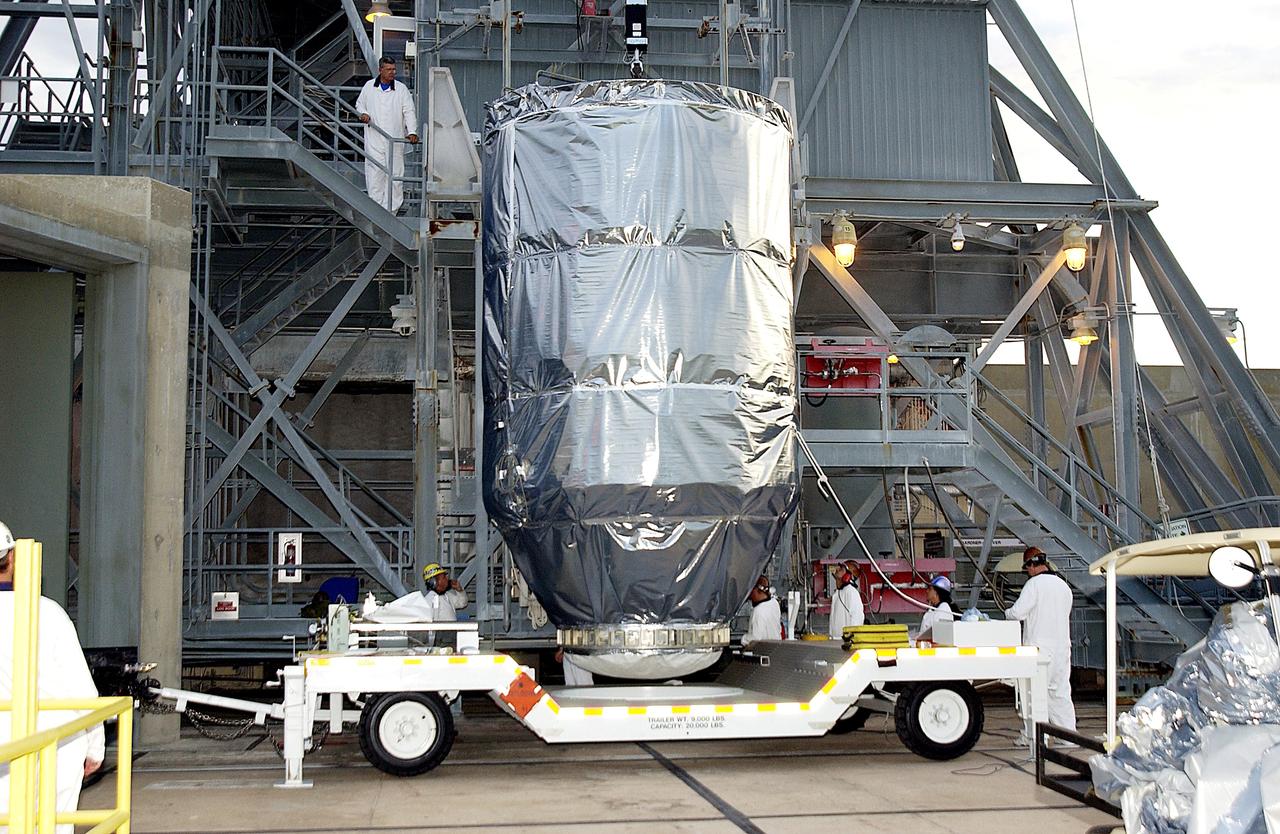
KENNEDY SPACE CENTER, FLA. - In the Payload Hazardous Servicing Facility, the cylindrical payload canister is lowered around Mars Exploration Rover 1 (MER-B).  Once secure inside the canister, the rover will be transported to Launch Complex 17-B, Cape Canaveral Air Force Station, for mating with the Delta rocket.  The second of twin rovers being sent to Mars, it is equipped with a robotic arm, a drilling tool, three spectrometers, and four pairs of cameras that allow it to have a human-like, 3D view of the terrain. Each rover could travel as far as 100 meters in one day to act as Mars scientists' eyes and hands, exploring an environment where humans can't yet go.  MER-B is scheduled to launch from Pad 17-B June 26 at one of two available times,  12:27:31 a.m. EDT or 1:08:45 a.m. EDT.
KENNEDY SPACE CENTER, FLA. - In the Payload Hazardous Servicing Facility, the cylindrical payload canister is lowered around Mars Exploration Rover 1 (MER-B). Once secure inside the canister, the rover will be transported to Launch Complex 17-B, Cape Canaveral Air Force Station, for mating with the Delta rocket. The second of twin rovers being sent to Mars, it is equipped with a robotic arm, a drilling tool, three spectrometers, and four pairs of cameras that allow it to have a human-like, 3D view of the terrain. Each rover could travel as far as 100 meters in one day to act as Mars scientists' eyes and hands, exploring an environment where humans can't yet go. MER-B is scheduled to launch from Pad 17-B June 26 at one of two available times, 12:27:31 a.m. EDT or 1:08:45 a.m. EDT.
KENNEDY SPACE CENTER, FLA. - At Launch Complex 17-B, Cape Canaveral Air Force Station, workers complete the installation of the spacecraft fairing around the Mars Exploration Rover-1 (MER-B) for launch. The second of twin rovers being sent to Mars, it is equipped with a robotic arm, a drilling tool, three spectrometers, and four pairs of cameras that allow it to have a human-like, 3D view of the terrain. Each rover could travel as far as 100 meters in one day to act as Mars scientists' eyes and hands, exploring an environment where humans are not yet able to go. MER-B is scheduled to launch no earlier than June 28 at one of two available times, 11:56:16 p.m. EDT or 12:37:59 a.m. EDT.
KENNEDY SPACE CENTER, FLA. -  The Mobile Service Tower is rolled back at Space Launch Complex 17B, Cape Canaveral Air Force Station, to reveal the Delta II Heavy launch vehicle ready for launch of the Mars Exploration Rover-B (MER-B) mission, with the rover "Opportunity" aboard. The second of twin rovers being sent to Mars, it is equipped with a robotic arm, a drilling tool, three spectrometers, and four pairs of cameras that allow it to have a human-like, 3D view of the terrain. Each rover could travel as far as 100 meters in one day to act as Mars scientists' eyes and hands, exploring an environment where humans are not yet able to go. MER-B is scheduled to launch on June 28 at one of two available times, 11:56:16 p.m. EDT or 12:37:59 a.m. EDT on June 29.
KENNEDY SPACE CENTER, FLA. - The Mobile Service Tower is rolled back at Space Launch Complex 17B, Cape Canaveral Air Force Station, to reveal the Delta II Heavy launch vehicle ready for launch of the Mars Exploration Rover-B (MER-B) mission, with the rover "Opportunity" aboard. The second of twin rovers being sent to Mars, it is equipped with a robotic arm, a drilling tool, three spectrometers, and four pairs of cameras that allow it to have a human-like, 3D view of the terrain. Each rover could travel as far as 100 meters in one day to act as Mars scientists' eyes and hands, exploring an environment where humans are not yet able to go. MER-B is scheduled to launch on June 28 at one of two available times, 11:56:16 p.m. EDT or 12:37:59 a.m. EDT on June 29.
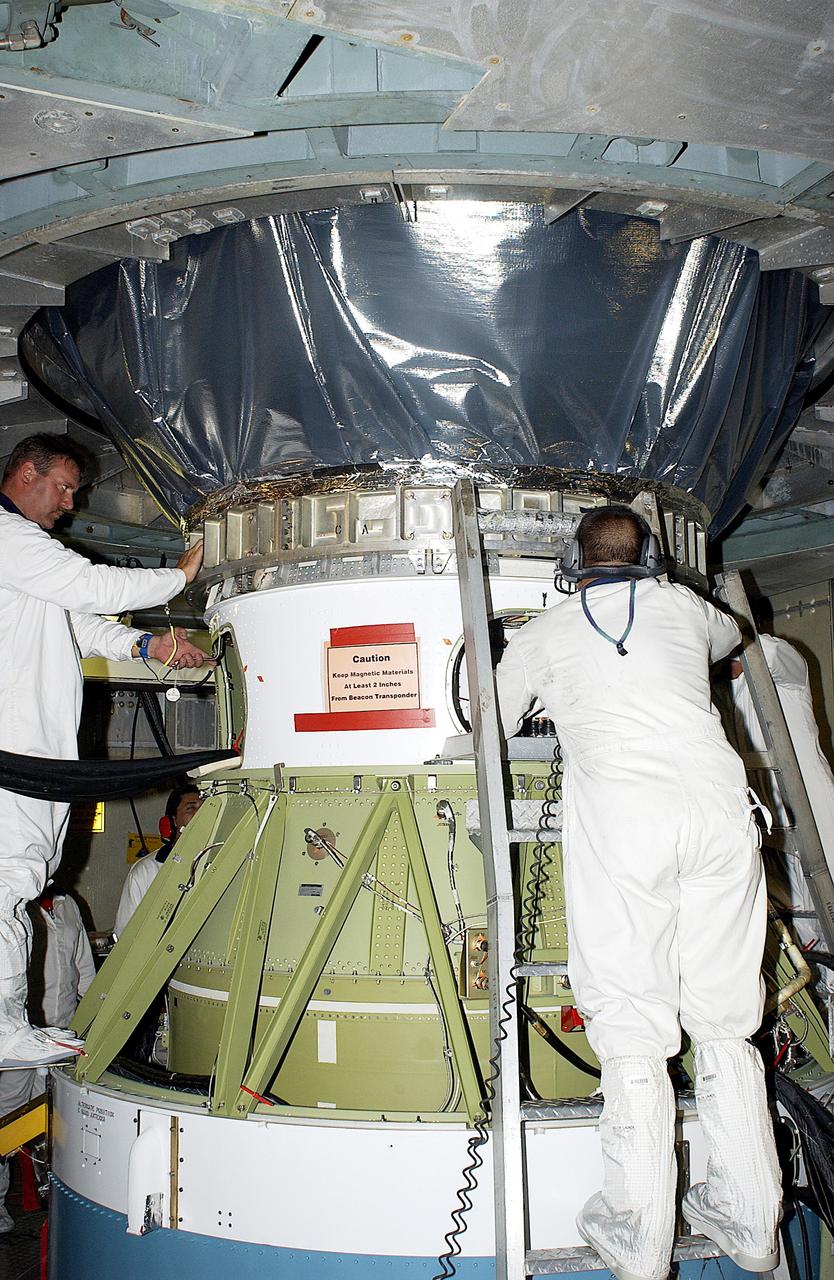
KENNEDY SPACE CENTER, FLA. -  In the Payload Hazardous Servicing Facility, workers check the connections after the Mars Exploration Rover 1 (MER-B) above was mated with the third stage of the Delta rocket below.  The second of twin rovers being sent to Mars, it is equipped with a robotic arm, a drilling tool, three spectrometers, and four pairs of cameras that allow it to have a human-like, 3D view of the terrain. Each rover could travel as far as 100 meters in one day to act as Mars scientists' eyes and hands, exploring an environment where humans can't yet go.  MER-B is scheduled to launch from Launch Pad 17-B, Cape Canaveral Air Force Station, June 26 at one of two available times,  12:27:31 a.m. EDT or 1:08:45 a.m. EDT.
KENNEDY SPACE CENTER, FLA. - In the Payload Hazardous Servicing Facility, workers check the connections after the Mars Exploration Rover 1 (MER-B) above was mated with the third stage of the Delta rocket below. The second of twin rovers being sent to Mars, it is equipped with a robotic arm, a drilling tool, three spectrometers, and four pairs of cameras that allow it to have a human-like, 3D view of the terrain. Each rover could travel as far as 100 meters in one day to act as Mars scientists' eyes and hands, exploring an environment where humans can't yet go. MER-B is scheduled to launch from Launch Pad 17-B, Cape Canaveral Air Force Station, June 26 at one of two available times, 12:27:31 a.m. EDT or 1:08:45 a.m. EDT.
KENNEDY SPACE CENTER, FLA. -  The Mobile Service Tower is rolled back at Space Launch Complex 17B, Cape Canaveral Air Force Station, to reveal the Delta II Heavy launch vehicle ready for launch of the Mars Exploration Rover-B (MER-B) mission, with the rover "Opportunity" aboard. The second of twin rovers being sent to Mars, it is equipped with a robotic arm, a drilling tool, three spectrometers, and four pairs of cameras that allow it to have a human-like, 3D view of the terrain. Each rover could travel as far as 100 meters in one day to act as Mars scientists' eyes and hands, exploring an environment where humans are not yet able to go. MER-B is scheduled to launch on June 28 at one of two available times, 11:56:16 p.m. EDT or 12:37:59 a.m. EDT on June 29.
KENNEDY SPACE CENTER, FLA. - The Mobile Service Tower is rolled back at Space Launch Complex 17B, Cape Canaveral Air Force Station, to reveal the Delta II Heavy launch vehicle ready for launch of the Mars Exploration Rover-B (MER-B) mission, with the rover "Opportunity" aboard. The second of twin rovers being sent to Mars, it is equipped with a robotic arm, a drilling tool, three spectrometers, and four pairs of cameras that allow it to have a human-like, 3D view of the terrain. Each rover could travel as far as 100 meters in one day to act as Mars scientists' eyes and hands, exploring an environment where humans are not yet able to go. MER-B is scheduled to launch on June 28 at one of two available times, 11:56:16 p.m. EDT or 12:37:59 a.m. EDT on June 29.
KENNEDY SPACE CENTER, FLA. - At Launch Complex 17-B, Cape Canaveral Air Force Station, Mars Exploration Rover-1 (MER-B) is prepared for the installation of its spacecraft fairing. The second of twin rovers being sent to Mars, it is equipped with a robotic arm, a drilling tool, three spectrometers, and four pairs of cameras that allow it to have a human-like, 3D view of the terrain. Each rover could travel as far as 100 meters in one day to act as Mars scientists' eyes and hands, exploring an environment where humans are not yet able to go. MER-B is scheduled to launch no earlier than June 28 at one of two available times, 11:56:16 p.m. EDT or 12:37:59 a.m. EDT.
KENNEDY SPACE CENTER, FLA. -  The Mars Exploration Rover 1 (MER-B) is moved  out of the Payload Hazardous Servicing Facility for transfer to Launch Pad 17-B, Cape Canaveral Air Force Station.  The second of twin rovers being sent to Mars, it is equipped with a robotic arm, a drilling tool, three spectrometers, and four pairs of cameras that allow it to have a human-like, 3D view of the terrain. Each rover could travel as far as 100 meters in one day to act as Mars scientists' eyes and hands, exploring an environment where humans can't yet go.  MER-B is scheduled to launch June 26 at one of two available times,  12:27:31 a.m. EDT or 1:08:45 a.m. EDT.
KENNEDY SPACE CENTER, FLA. - The Mars Exploration Rover 1 (MER-B) is moved out of the Payload Hazardous Servicing Facility for transfer to Launch Pad 17-B, Cape Canaveral Air Force Station. The second of twin rovers being sent to Mars, it is equipped with a robotic arm, a drilling tool, three spectrometers, and four pairs of cameras that allow it to have a human-like, 3D view of the terrain. Each rover could travel as far as 100 meters in one day to act as Mars scientists' eyes and hands, exploring an environment where humans can't yet go. MER-B is scheduled to launch June 26 at one of two available times, 12:27:31 a.m. EDT or 1:08:45 a.m. EDT.
KENNEDY SPACE CENTER, FLA. -  The Mobile Service Tower is rolled back at Space Launch Complex 17B, Cape Canaveral Air Force Station, to reveal the Delta II Heavy launch vehicle ready for launch of the Mars Exploration Rover-B (MER-B) mission, with the rover "Opportunity" aboard. The second of twin rovers being sent to Mars, it is equipped with a robotic arm, a drilling tool, three spectrometers, and four pairs of cameras that allow it to have a human-like, 3D view of the terrain. Each rover could travel as far as 100 meters in one day to act as Mars scientists' eyes and hands, exploring an environment where humans are not yet able to go. MER-B is scheduled to launch on June 28 at one of two available times, 11:56:16 p.m. EDT or 12:37:59 a.m. EDT on June 29.
KENNEDY SPACE CENTER, FLA. - The Mobile Service Tower is rolled back at Space Launch Complex 17B, Cape Canaveral Air Force Station, to reveal the Delta II Heavy launch vehicle ready for launch of the Mars Exploration Rover-B (MER-B) mission, with the rover "Opportunity" aboard. The second of twin rovers being sent to Mars, it is equipped with a robotic arm, a drilling tool, three spectrometers, and four pairs of cameras that allow it to have a human-like, 3D view of the terrain. Each rover could travel as far as 100 meters in one day to act as Mars scientists' eyes and hands, exploring an environment where humans are not yet able to go. MER-B is scheduled to launch on June 28 at one of two available times, 11:56:16 p.m. EDT or 12:37:59 a.m. EDT on June 29.
KENNEDY SPACE CENTER, FLA. -   On Launch Pad 17-B, Cape Canaveral Air Force Station, the Mars Exploration Rover 1 (MER-B) is lowered toward the Delta rocket for mating.  The second of twin rovers being sent to Mars, it is equipped with a robotic arm, a drilling tool, three spectrometers, and four pairs of cameras that allow it to have a human-like, 3D view of the terrain. Each rover could travel as far as 100 meters in one day to act as Mars scientists' eyes and hands, exploring an environment where humans can't yet go.  MER-B is scheduled to launch June 26 at one of two available times,  12:27:31 a.m. EDT or 1:08:45 a.m. EDT.
KENNEDY SPACE CENTER, FLA. - On Launch Pad 17-B, Cape Canaveral Air Force Station, the Mars Exploration Rover 1 (MER-B) is lowered toward the Delta rocket for mating. The second of twin rovers being sent to Mars, it is equipped with a robotic arm, a drilling tool, three spectrometers, and four pairs of cameras that allow it to have a human-like, 3D view of the terrain. Each rover could travel as far as 100 meters in one day to act as Mars scientists' eyes and hands, exploring an environment where humans can't yet go. MER-B is scheduled to launch June 26 at one of two available times, 12:27:31 a.m. EDT or 1:08:45 a.m. EDT.
KENNEDY SPACE CENTER, FLA. - In the Payload Hazardous Servicing Facility, workers check the status of the cruise stage of Mars Exploration Rover 1 (MER-1) after being lowered onto blocks.  The cruise stage will be integrated with the aeroshell, the entry vehicle.   NASA’s twin Mars Exploration Rovers are designed to study the history of water on Mars. These robotic geologists are equipped with a robotic arm, a drilling tool, three spectrometers, and four pairs of cameras that allow them to have a human-like, 3D view of the terrain. Each rover could travel as far as 100 meters in one day to act as Mars scientists' eyes and hands, exploring an environment where humans can’t yet go.  The MER-1 is scheduled to launch June 25 from Launch Pad 17-A, Cape Canaveral Air Force Station.
KENNEDY SPACE CENTER, FLA. - In the Payload Hazardous Servicing Facility, workers check the status of the cruise stage of Mars Exploration Rover 1 (MER-1) after being lowered onto blocks. The cruise stage will be integrated with the aeroshell, the entry vehicle. NASA’s twin Mars Exploration Rovers are designed to study the history of water on Mars. These robotic geologists are equipped with a robotic arm, a drilling tool, three spectrometers, and four pairs of cameras that allow them to have a human-like, 3D view of the terrain. Each rover could travel as far as 100 meters in one day to act as Mars scientists' eyes and hands, exploring an environment where humans can’t yet go. The MER-1 is scheduled to launch June 25 from Launch Pad 17-A, Cape Canaveral Air Force Station.
KENNEDY SPACE CENTER, FLA. - In the background, right, workers in the Payload Hazardous Servicing Facility get ready to lift Mars Exploration Rover 1 (MER-B) to the third stage of the Delta rocket (foreground) for mating.  The second of twin rovers being sent to Mars, it is equipped with a robotic arm, a drilling tool, three spectrometers, and four pairs of cameras that allow it to have a human-like, 3D view of the terrain. Each rover could travel as far as 100 meters in one day to act as Mars scientists' eyes and hands, exploring an environment where humans can't yet go.  MER-B is scheduled to launch from Launch Pad 17-B, Cape Canaveral Air Force Station, June 26 at one of two available times,  12:27:31 a.m. EDT or 1:08:45 a.m. EDT.
KENNEDY SPACE CENTER, FLA. - In the background, right, workers in the Payload Hazardous Servicing Facility get ready to lift Mars Exploration Rover 1 (MER-B) to the third stage of the Delta rocket (foreground) for mating. The second of twin rovers being sent to Mars, it is equipped with a robotic arm, a drilling tool, three spectrometers, and four pairs of cameras that allow it to have a human-like, 3D view of the terrain. Each rover could travel as far as 100 meters in one day to act as Mars scientists' eyes and hands, exploring an environment where humans can't yet go. MER-B is scheduled to launch from Launch Pad 17-B, Cape Canaveral Air Force Station, June 26 at one of two available times, 12:27:31 a.m. EDT or 1:08:45 a.m. EDT.
KENNEDY SPACE CENTER, FLA. - In the Payload Hazardous Servicing Facility, workers check the cruise stage of Mars Exploration Rover 1 (MER-1) being lifted off a stand.  The cruise stage will be integrated with the aeroshell, the entry vehicle.   NASA’s twin Mars Exploration Rovers are designed to study the history of water on Mars. These robotic geologists are equipped with a robotic arm, a drilling tool, three spectrometers, and four pairs of cameras that allow them to have a human-like, 3D view of the terrain. Each rover could travel as far as 100 meters in one day to act as Mars scientists' eyes and hands, exploring an environment where humans can’t yet go.  The MER-1 is scheduled to launch June 25 from Launch Pad 17-A, Cape Canaveral Air Force Station.
KENNEDY SPACE CENTER, FLA. - In the Payload Hazardous Servicing Facility, workers check the cruise stage of Mars Exploration Rover 1 (MER-1) being lifted off a stand. The cruise stage will be integrated with the aeroshell, the entry vehicle. NASA’s twin Mars Exploration Rovers are designed to study the history of water on Mars. These robotic geologists are equipped with a robotic arm, a drilling tool, three spectrometers, and four pairs of cameras that allow them to have a human-like, 3D view of the terrain. Each rover could travel as far as 100 meters in one day to act as Mars scientists' eyes and hands, exploring an environment where humans can’t yet go. The MER-1 is scheduled to launch June 25 from Launch Pad 17-A, Cape Canaveral Air Force Station.
KENNEDY SPACE CENTER, FLA. - At Launch Complex 17-B, Cape Canaveral Air Force Station, a final glimpse of the Mars Exploration Rover-1 (MER-B) is captured before it is enclosed by its spacecraft fairing for launch. The second of twin rovers being sent to Mars, it is equipped with a robotic arm, a drilling tool, three spectrometers, and four pairs of cameras that allow it to have a human-like, 3D view of the terrain. Each rover could travel as far as 100 meters in one day to act as Mars scientists' eyes and hands, exploring an environment where humans are not yet able to go. MER-B is scheduled to launch no earlier than June 28 at one of two available times, 11:56:16 p.m. EDT or 12:37:59 a.m. EDT.
KENNEDY SPACE CENTER, FLA. -  The Mobile Service Tower is rolled back at Space Launch Complex 17B, Cape Canaveral Air Force Station, to reveal the Delta II Heavy launch vehicle ready for launch of the Mars Exploration Rover-B (MER-B) mission, with the rover "Opportunity" aboard. The second of twin rovers being sent to Mars, it is equipped with a robotic arm, a drilling tool, three spectrometers, and four pairs of cameras that allow it to have a human-like, 3D view of the terrain. Each rover could travel as far as 100 meters in one day to act as Mars scientists' eyes and hands, exploring an environment where humans are not yet able to go. MER-B is scheduled to launch on June 28 at one of two available times, 11:56:16 p.m. EDT or 12:37:59 a.m. EDT on June 29.
KENNEDY SPACE CENTER, FLA. - The Mobile Service Tower is rolled back at Space Launch Complex 17B, Cape Canaveral Air Force Station, to reveal the Delta II Heavy launch vehicle ready for launch of the Mars Exploration Rover-B (MER-B) mission, with the rover "Opportunity" aboard. The second of twin rovers being sent to Mars, it is equipped with a robotic arm, a drilling tool, three spectrometers, and four pairs of cameras that allow it to have a human-like, 3D view of the terrain. Each rover could travel as far as 100 meters in one day to act as Mars scientists' eyes and hands, exploring an environment where humans are not yet able to go. MER-B is scheduled to launch on June 28 at one of two available times, 11:56:16 p.m. EDT or 12:37:59 a.m. EDT on June 29.
KENNEDY SPACE CENTER, FLA. - At Launch Complex 17-B, Cape Canaveral Air Force Station, workers prepare to install the spacecraft fairing around the Mars Exploration Rover-1 (MER-B). The second of twin rovers being sent to Mars, it is equipped with a robotic arm, a drilling tool, three spectrometers, and four pairs of cameras that allow it to have a human-like, 3D view of the terrain. Each rover could travel as far as 100 meters in one day to act as Mars scientists' eyes and hands, exploring an environment where humans are not yet able to go. MER-B is scheduled to launch no earlier than June 28 at one of two available times, 11:56:16 p.m. EDT or 12:37:59 a.m. EDT.
KENNEDY SPACE CENTER, FLA. -  The Mobile Service Tower is rolled back at Space Launch Complex 17B, Cape Canaveral Air Force Station, to reveal the Delta II Heavy launch vehicle ready for launch of the Mars Exploration Rover-B (MER-B) mission, with the rover "Opportunity" aboard. The second of twin rovers being sent to Mars, it is equipped with a robotic arm, a drilling tool, three spectrometers, and four pairs of cameras that allow it to have a human-like, 3D view of the terrain. Each rover could travel as far as 100 meters in one day to act as Mars scientists' eyes and hands, exploring an environment where humans are not yet able to go. MER-B is scheduled to launch on June 28 at one of two available times, 11:56:16 p.m. EDT or 12:37:59 a.m. EDT on June 29.
KENNEDY SPACE CENTER, FLA. - The Mobile Service Tower is rolled back at Space Launch Complex 17B, Cape Canaveral Air Force Station, to reveal the Delta II Heavy launch vehicle ready for launch of the Mars Exploration Rover-B (MER-B) mission, with the rover "Opportunity" aboard. The second of twin rovers being sent to Mars, it is equipped with a robotic arm, a drilling tool, three spectrometers, and four pairs of cameras that allow it to have a human-like, 3D view of the terrain. Each rover could travel as far as 100 meters in one day to act as Mars scientists' eyes and hands, exploring an environment where humans are not yet able to go. MER-B is scheduled to launch on June 28 at one of two available times, 11:56:16 p.m. EDT or 12:37:59 a.m. EDT on June 29.
KENNEDY SPACE CENTER, FLA. - In the Payload Hazardous Servicing Facility, workers maneuver the cylindrical payload canister into place around Mars Exploration Rover 1 (MER-B).  Once secure inside the canister, the rover will be transported to Launch Complex 17-B, Cape Canaveral Air Force Station, for mating with the Delta rocket.  The second of twin rovers being sent to Mars, it is equipped with a robotic arm, a drilling tool, three spectrometers, and four pairs of cameras that allow it to have a human-like, 3D view of the terrain. Each rover could travel as far as 100 meters in one day to act as Mars scientists' eyes and hands, exploring an environment where humans can't yet go.  MER-B is scheduled to launch from Pad 17-B June 26 at one of two available times,  12:27:31 a.m. EDT or 1:08:45 a.m. EDT.
KENNEDY SPACE CENTER, FLA. - In the Payload Hazardous Servicing Facility, workers maneuver the cylindrical payload canister into place around Mars Exploration Rover 1 (MER-B). Once secure inside the canister, the rover will be transported to Launch Complex 17-B, Cape Canaveral Air Force Station, for mating with the Delta rocket. The second of twin rovers being sent to Mars, it is equipped with a robotic arm, a drilling tool, three spectrometers, and four pairs of cameras that allow it to have a human-like, 3D view of the terrain. Each rover could travel as far as 100 meters in one day to act as Mars scientists' eyes and hands, exploring an environment where humans can't yet go. MER-B is scheduled to launch from Pad 17-B June 26 at one of two available times, 12:27:31 a.m. EDT or 1:08:45 a.m. EDT.
KENNEDY SPACE CENTER, FLA. -  In the Payload Hazardous Servicing Facility, the Mars Exploration Rover 2 (MER-2) is being encapsulated for transfer to Launch Complex 17-A, Cape Canaveral Air Force Station.  MER-2 is one of NASA's twin Mars Exploration Rovers designed to study the history of water on Mars. These robotic geologists are equipped with a robotic arm, a drilling tool, three spectrometers, and four pairs of cameras that allow them to have a human-like, 3D view of the terrain. Each rover could travel as far as 100 meters in one day to act as Mars scientists' eyes and hands, exploring an environment where humans can't yet go.  MER-2 is scheduled to launch no earlier than June 8 as MER-A aboard a Delta II rocket.
KENNEDY SPACE CENTER, FLA. - In the Payload Hazardous Servicing Facility, the Mars Exploration Rover 2 (MER-2) is being encapsulated for transfer to Launch Complex 17-A, Cape Canaveral Air Force Station. MER-2 is one of NASA's twin Mars Exploration Rovers designed to study the history of water on Mars. These robotic geologists are equipped with a robotic arm, a drilling tool, three spectrometers, and four pairs of cameras that allow them to have a human-like, 3D view of the terrain. Each rover could travel as far as 100 meters in one day to act as Mars scientists' eyes and hands, exploring an environment where humans can't yet go. MER-2 is scheduled to launch no earlier than June 8 as MER-A aboard a Delta II rocket.
KENNEDY SPACE CENTER, FLA. - In the Payload Hazardous Servicing Facility, an overhead crane lowers Mars Exploration Rover 1 (MER-B) over the third stage of the Delta rocket.  The rover will be mated to the third stage for launch.  The second of twin rovers being sent to Mars, it is equipped with a robotic arm, a drilling tool, three spectrometers, and four pairs of cameras that allow it to have a human-like, 3D view of the terrain. Each rover could travel as far as 100 meters in one day to act as Mars scientists' eyes and hands, exploring an environment where humans can't yet go.  MER-B is scheduled to launch from Launch Pad 17-B, Cape Canaveral Air Force Station, June 26 at one of two available times,  12:27:31 a.m. EDT or 1:08:45 a.m. EDT.
KENNEDY SPACE CENTER, FLA. - In the Payload Hazardous Servicing Facility, an overhead crane lowers Mars Exploration Rover 1 (MER-B) over the third stage of the Delta rocket. The rover will be mated to the third stage for launch. The second of twin rovers being sent to Mars, it is equipped with a robotic arm, a drilling tool, three spectrometers, and four pairs of cameras that allow it to have a human-like, 3D view of the terrain. Each rover could travel as far as 100 meters in one day to act as Mars scientists' eyes and hands, exploring an environment where humans can't yet go. MER-B is scheduled to launch from Launch Pad 17-B, Cape Canaveral Air Force Station, June 26 at one of two available times, 12:27:31 a.m. EDT or 1:08:45 a.m. EDT.
KENNEDY SPACE CENTER, FLA. -In the Payload Hazardous Servicing Facility, workers prepare to mate the Mars Exploration Rover 1 (MER-B) above with the third stage of the Delta rocket below.  The second of twin rovers being sent to Mars, it is equipped with a robotic arm, a drilling tool, three spectrometers, and four pairs of cameras that allow it to have a human-like, 3D view of the terrain. Each rover could travel as far as 100 meters in one day to act as Mars scientists' eyes and hands, exploring an environment where humans can't yet go.  MER-B is scheduled to launch from Launch Pad 17-B, Cape Canaveral Air Force Station, June 26 at one of two available times,  12:27:31 a.m. EDT or 1:08:45 a.m. EDT.
KENNEDY SPACE CENTER, FLA. -In the Payload Hazardous Servicing Facility, workers prepare to mate the Mars Exploration Rover 1 (MER-B) above with the third stage of the Delta rocket below. The second of twin rovers being sent to Mars, it is equipped with a robotic arm, a drilling tool, three spectrometers, and four pairs of cameras that allow it to have a human-like, 3D view of the terrain. Each rover could travel as far as 100 meters in one day to act as Mars scientists' eyes and hands, exploring an environment where humans can't yet go. MER-B is scheduled to launch from Launch Pad 17-B, Cape Canaveral Air Force Station, June 26 at one of two available times, 12:27:31 a.m. EDT or 1:08:45 a.m. EDT.
KENNEDY SPACE CENTER, FLA. -  The Mobile Service Tower is rolled back at Space Launch Complex 17B, Cape Canaveral Air Force Station, to reveal the Delta II Heavy launch vehicle ready for launch of the Mars Exploration Rover-B (MER-B) mission, with the rover "Opportunity" aboard. The second of twin rovers being sent to Mars, it is equipped with a robotic arm, a drilling tool, three spectrometers, and four pairs of cameras that allow it to have a human-like, 3D view of the terrain. Each rover could travel as far as 100 meters in one day to act as Mars scientists' eyes and hands, exploring an environment where humans are not yet able to go. MER-B is scheduled to launch on June 28 at one of two available times, 11:56:16 p.m. EDT or 12:37:59 a.m. EDT on June 29.
KENNEDY SPACE CENTER, FLA. - The Mobile Service Tower is rolled back at Space Launch Complex 17B, Cape Canaveral Air Force Station, to reveal the Delta II Heavy launch vehicle ready for launch of the Mars Exploration Rover-B (MER-B) mission, with the rover "Opportunity" aboard. The second of twin rovers being sent to Mars, it is equipped with a robotic arm, a drilling tool, three spectrometers, and four pairs of cameras that allow it to have a human-like, 3D view of the terrain. Each rover could travel as far as 100 meters in one day to act as Mars scientists' eyes and hands, exploring an environment where humans are not yet able to go. MER-B is scheduled to launch on June 28 at one of two available times, 11:56:16 p.m. EDT or 12:37:59 a.m. EDT on June 29.
KENNEDY SPACE CENTER, FLA. -   On Launch Pad 17-B, Cape Canaveral Air Force Station, the Mars Exploration Rover 1 (MER-B) is lifted up the tower for mating with the Delta rocket.  The second of twin rovers being sent to Mars, it is equipped with a robotic arm, a drilling tool, three spectrometers, and four pairs of cameras that allow it to have a human-like, 3D view of the terrain. Each rover could travel as far as 100 meters in one day to act as Mars scientists' eyes and hands, exploring an environment where humans can't yet go.  MER-B is scheduled to launch June 26 at one of two available times,  12:27:31 a.m. EDT or 1:08:45 a.m. EDT.
KENNEDY SPACE CENTER, FLA. - On Launch Pad 17-B, Cape Canaveral Air Force Station, the Mars Exploration Rover 1 (MER-B) is lifted up the tower for mating with the Delta rocket. The second of twin rovers being sent to Mars, it is equipped with a robotic arm, a drilling tool, three spectrometers, and four pairs of cameras that allow it to have a human-like, 3D view of the terrain. Each rover could travel as far as 100 meters in one day to act as Mars scientists' eyes and hands, exploring an environment where humans can't yet go. MER-B is scheduled to launch June 26 at one of two available times, 12:27:31 a.m. EDT or 1:08:45 a.m. EDT.
KENNEDY SPACE CENTER, FLA. -  The Mobile Service Tower is rolled back at Space Launch Complex 17B, Cape Canaveral Air Force Station, to reveal the Delta II Heavy launch vehicle ready for launch of the Mars Exploration Rover-B (MER-B) mission, with the rover "Opportunity" aboard. The second of twin rovers being sent to Mars, it is equipped with a robotic arm, a drilling tool, three spectrometers, and four pairs of cameras that allow it to have a human-like, 3D view of the terrain. Each rover could travel as far as 100 meters in one day to act as Mars scientists' eyes and hands, exploring an environment where humans are not yet able to go. MER-B is scheduled to launch on June 28 at one of two available times, 11:56:16 p.m. EDT or 12:37:59 a.m. EDT on June 29.
KENNEDY SPACE CENTER, FLA. - The Mobile Service Tower is rolled back at Space Launch Complex 17B, Cape Canaveral Air Force Station, to reveal the Delta II Heavy launch vehicle ready for launch of the Mars Exploration Rover-B (MER-B) mission, with the rover "Opportunity" aboard. The second of twin rovers being sent to Mars, it is equipped with a robotic arm, a drilling tool, three spectrometers, and four pairs of cameras that allow it to have a human-like, 3D view of the terrain. Each rover could travel as far as 100 meters in one day to act as Mars scientists' eyes and hands, exploring an environment where humans are not yet able to go. MER-B is scheduled to launch on June 28 at one of two available times, 11:56:16 p.m. EDT or 12:37:59 a.m. EDT on June 29.
KENNEDY SPACE CENTER, FLA. - Workers in the Payload Hazardous Servicing Facility prepare Mars Exploration Rover 1 (MER-B) to be mated with the third stage of the Delta rocket that will launch it to Mars.  The second of twin rovers being sent to Mars, it is equipped with a robotic arm, a drilling tool, three spectrometers, and four pairs of cameras that allow it to have a human-like, 3D view of the terrain. Each rover could travel as far as 100 meters in one day to act as Mars scientists' eyes and hands, exploring an environment where humans can't yet go.  MER-B is scheduled to launch from Launch Pad 17-B, Cape Canaveral Air Force Station, June 26 at one of two available times,  12:27:31 a.m. EDT or 1:08:45 a.m. EDT.
KENNEDY SPACE CENTER, FLA. - Workers in the Payload Hazardous Servicing Facility prepare Mars Exploration Rover 1 (MER-B) to be mated with the third stage of the Delta rocket that will launch it to Mars. The second of twin rovers being sent to Mars, it is equipped with a robotic arm, a drilling tool, three spectrometers, and four pairs of cameras that allow it to have a human-like, 3D view of the terrain. Each rover could travel as far as 100 meters in one day to act as Mars scientists' eyes and hands, exploring an environment where humans can't yet go. MER-B is scheduled to launch from Launch Pad 17-B, Cape Canaveral Air Force Station, June 26 at one of two available times, 12:27:31 a.m. EDT or 1:08:45 a.m. EDT.
KENNEDY SPACE CENTER, FLA. - On Launch Complex 17-B, Cape Canaveral Air Force Station, a solid rocket booster is viewed from above after being lifted to vertical.  It will be mated to the Delta II rocket for the Mars Exploration Rover 1 (MER-1) launch June 25.  NASA’s twin Mars Exploration Rovers are designed to study the history of water on Mars. These robotic geologists are equipped with a robotic arm, a drilling tool, three spectrometers, and four pairs of cameras that allow them to have a human-like, 3D view of the terrain. Each rover could travel as far as 100 meters in one day to act as Mars scientists' eyes and hands, exploring an environment where humans can’t yet go.  MER-2 (MER-A) will launch June 5.
KENNEDY SPACE CENTER, FLA. - On Launch Complex 17-B, Cape Canaveral Air Force Station, a solid rocket booster is viewed from above after being lifted to vertical. It will be mated to the Delta II rocket for the Mars Exploration Rover 1 (MER-1) launch June 25. NASA’s twin Mars Exploration Rovers are designed to study the history of water on Mars. These robotic geologists are equipped with a robotic arm, a drilling tool, three spectrometers, and four pairs of cameras that allow them to have a human-like, 3D view of the terrain. Each rover could travel as far as 100 meters in one day to act as Mars scientists' eyes and hands, exploring an environment where humans can’t yet go. MER-2 (MER-A) will launch June 5.
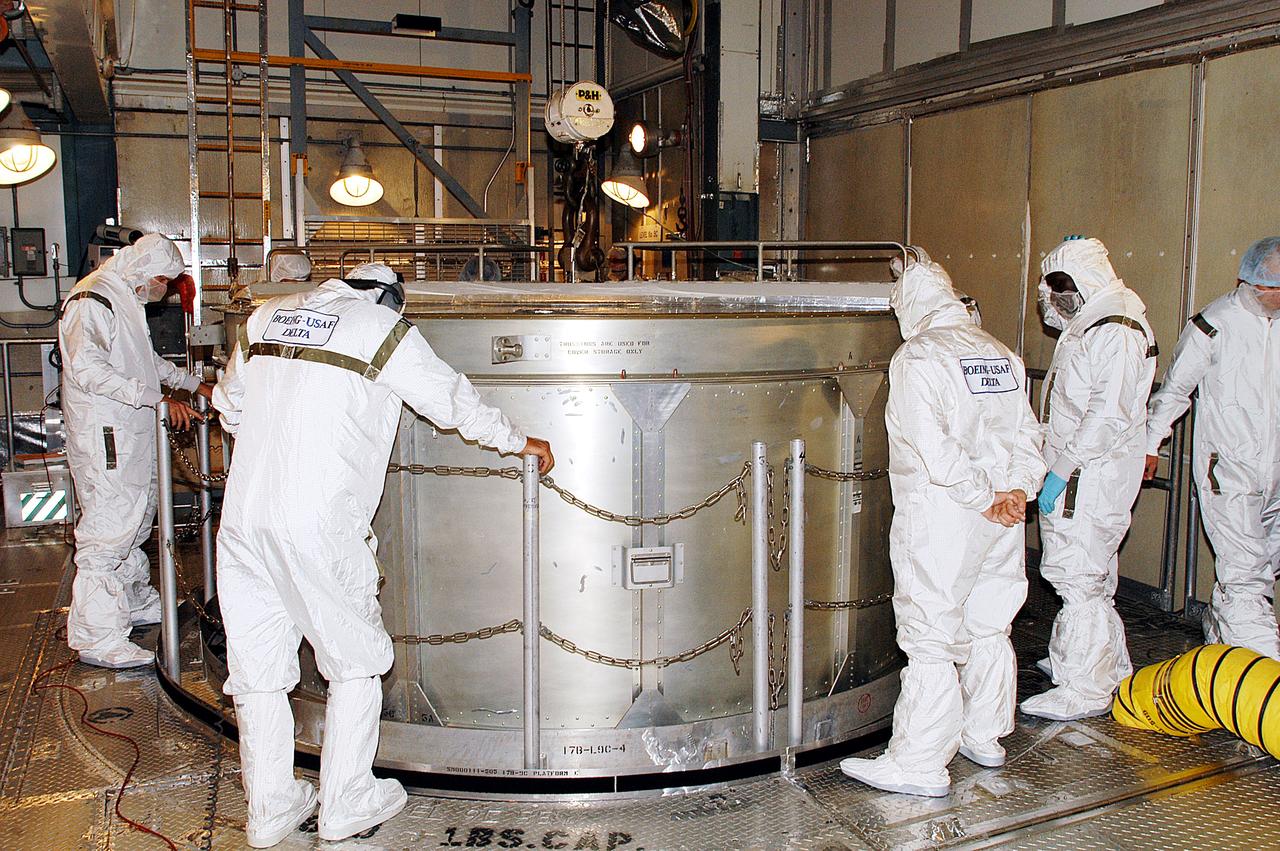
KENNEDY SPACE CENTER, FLA. - Workers in the Payload Hazardous Servicing Facility secure the lower panels of a payload canister around Mars Exploration Rover 1 (MER-B).  The rover will be transported to Launch Complex 17-B, Cape Canaveral Air Force Station, for mating with the Delta rocket.  The second of twin rovers being sent to Mars, it is equipped with a robotic arm, a drilling tool, three spectrometers, and four pairs of cameras that allow it to have a human-like, 3D view of the terrain. Each rover could travel as far as 100 meters in one day to act as Mars scientists' eyes and hands, exploring an environment where humans can't yet go.  MER-B is scheduled to launch from Pad 17-B June 26 at one of two available times,  12:27:31 a.m. EDT or 1:08:45 a.m. EDT.
KENNEDY SPACE CENTER, FLA. - Workers in the Payload Hazardous Servicing Facility secure the lower panels of a payload canister around Mars Exploration Rover 1 (MER-B). The rover will be transported to Launch Complex 17-B, Cape Canaveral Air Force Station, for mating with the Delta rocket. The second of twin rovers being sent to Mars, it is equipped with a robotic arm, a drilling tool, three spectrometers, and four pairs of cameras that allow it to have a human-like, 3D view of the terrain. Each rover could travel as far as 100 meters in one day to act as Mars scientists' eyes and hands, exploring an environment where humans can't yet go. MER-B is scheduled to launch from Pad 17-B June 26 at one of two available times, 12:27:31 a.m. EDT or 1:08:45 a.m. EDT.
KENNEDY SPACE CENTER, FLA. - The Mars Exploration Rover 1 (MER-B) arrives at Launch Pad 17-B, Cape Canaveral Air Force Station, where it will be mated with the Delta rocket for launch.  The second of twin rovers being sent to Mars, it is equipped with a robotic arm, a drilling tool, three spectrometers, and four pairs of cameras that allow it to have a human-like, 3D view of the terrain. Each rover could travel as far as 100 meters in one day to act as Mars scientists' eyes and hands, exploring an environment where humans can't yet go.  MER-B is scheduled to launch June 26 at one of two available times,  12:27:31 a.m. EDT or 1:08:45 a.m. EDT.
KENNEDY SPACE CENTER, FLA. - The Mars Exploration Rover 1 (MER-B) arrives at Launch Pad 17-B, Cape Canaveral Air Force Station, where it will be mated with the Delta rocket for launch. The second of twin rovers being sent to Mars, it is equipped with a robotic arm, a drilling tool, three spectrometers, and four pairs of cameras that allow it to have a human-like, 3D view of the terrain. Each rover could travel as far as 100 meters in one day to act as Mars scientists' eyes and hands, exploring an environment where humans can't yet go. MER-B is scheduled to launch June 26 at one of two available times, 12:27:31 a.m. EDT or 1:08:45 a.m. EDT.
KENNEDY SPACE CENTER, FLA. - At Launch Complex 17-B, Cape Canaveral Air Force Station, Mars Exploration Rover-1 (MER-B) is prepared for the installation of its spacecraft fairing. The second of twin rovers being sent to Mars, it is equipped with a robotic arm, a drilling tool, three spectrometers, and four pairs of cameras that allow it to have a human-like, 3D view of the terrain. Each rover could travel as far as 100 meters in one day to act as Mars scientists' eyes and hands, exploring an environment where humans are not yet able to go. MER-B is scheduled to launch no earlier than June 28 at one of two available times, 11:56:16 p.m. EDT or 12:37:59 a.m. EDT.
KENNEDY SPACE CENTER, FLA. - In the Payload Hazardous Servicing Facility, workers secure the cylindrical payload canister to the lower panels surrounding Mars Exploration Rover 1 (MER-B).  Once secure inside the canister, the rover will be transported to Launch Complex 17-B, Cape Canaveral Air Force Station, for mating with the Delta rocket.  The second of twin rovers being sent to Mars, it is equipped with a robotic arm, a drilling tool, three spectrometers, and four pairs of cameras that allow it to have a human-like, 3D view of the terrain. Each rover could travel as far as 100 meters in one day to act as Mars scientists' eyes and hands, exploring an environment where humans can't yet go.  MER-B is scheduled to launch from Pad 17-B June 26 at one of two available times,  12:27:31 a.m. EDT or 1:08:45 a.m. EDT.
KENNEDY SPACE CENTER, FLA. - In the Payload Hazardous Servicing Facility, workers secure the cylindrical payload canister to the lower panels surrounding Mars Exploration Rover 1 (MER-B). Once secure inside the canister, the rover will be transported to Launch Complex 17-B, Cape Canaveral Air Force Station, for mating with the Delta rocket. The second of twin rovers being sent to Mars, it is equipped with a robotic arm, a drilling tool, three spectrometers, and four pairs of cameras that allow it to have a human-like, 3D view of the terrain. Each rover could travel as far as 100 meters in one day to act as Mars scientists' eyes and hands, exploring an environment where humans can't yet go. MER-B is scheduled to launch from Pad 17-B June 26 at one of two available times, 12:27:31 a.m. EDT or 1:08:45 a.m. EDT.
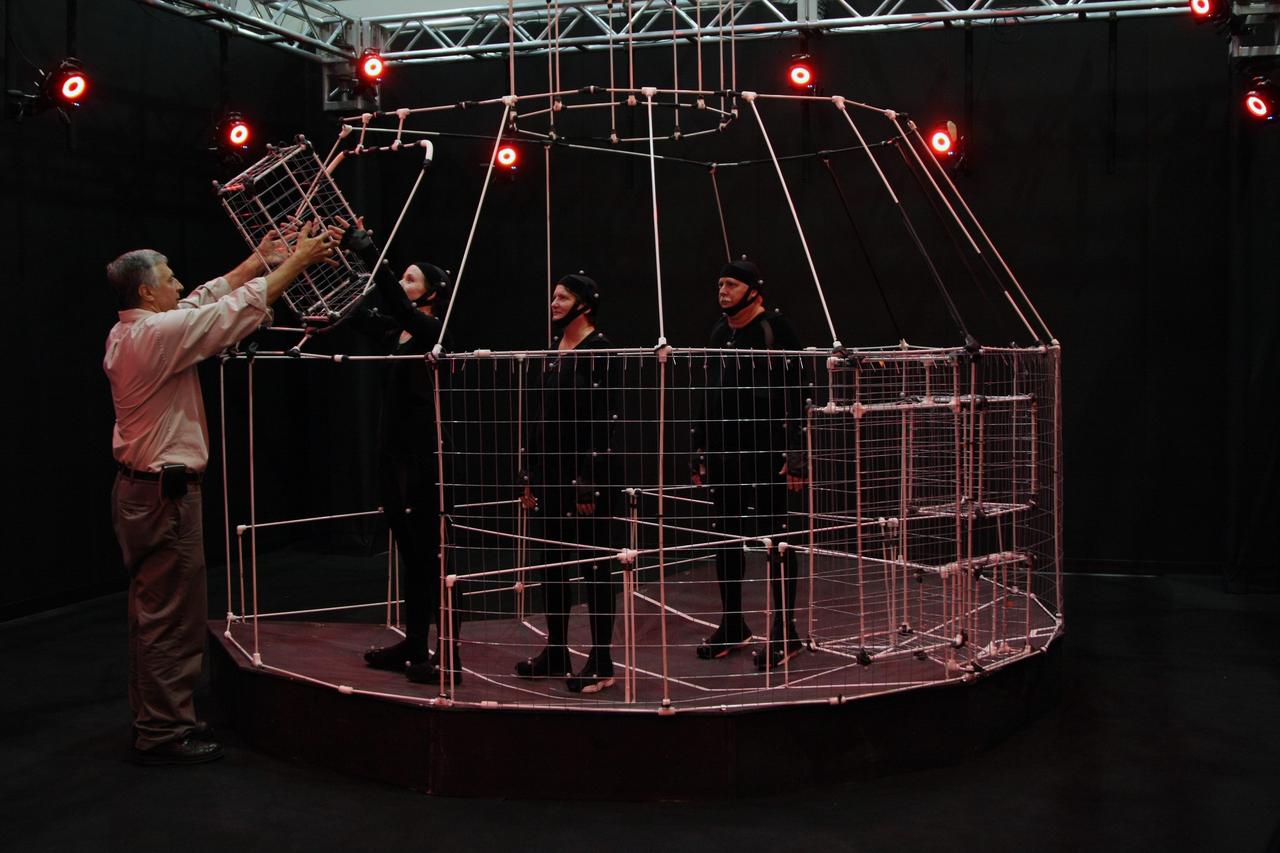
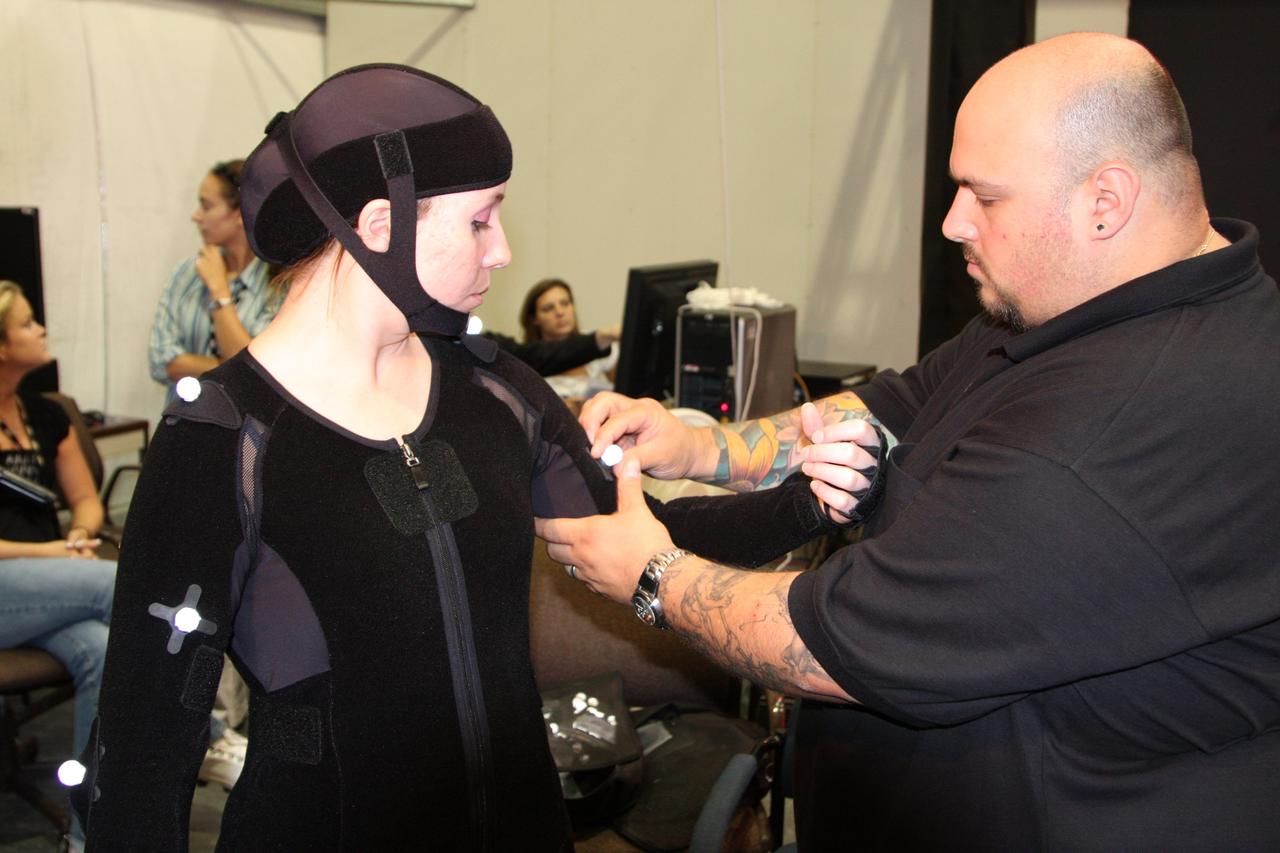
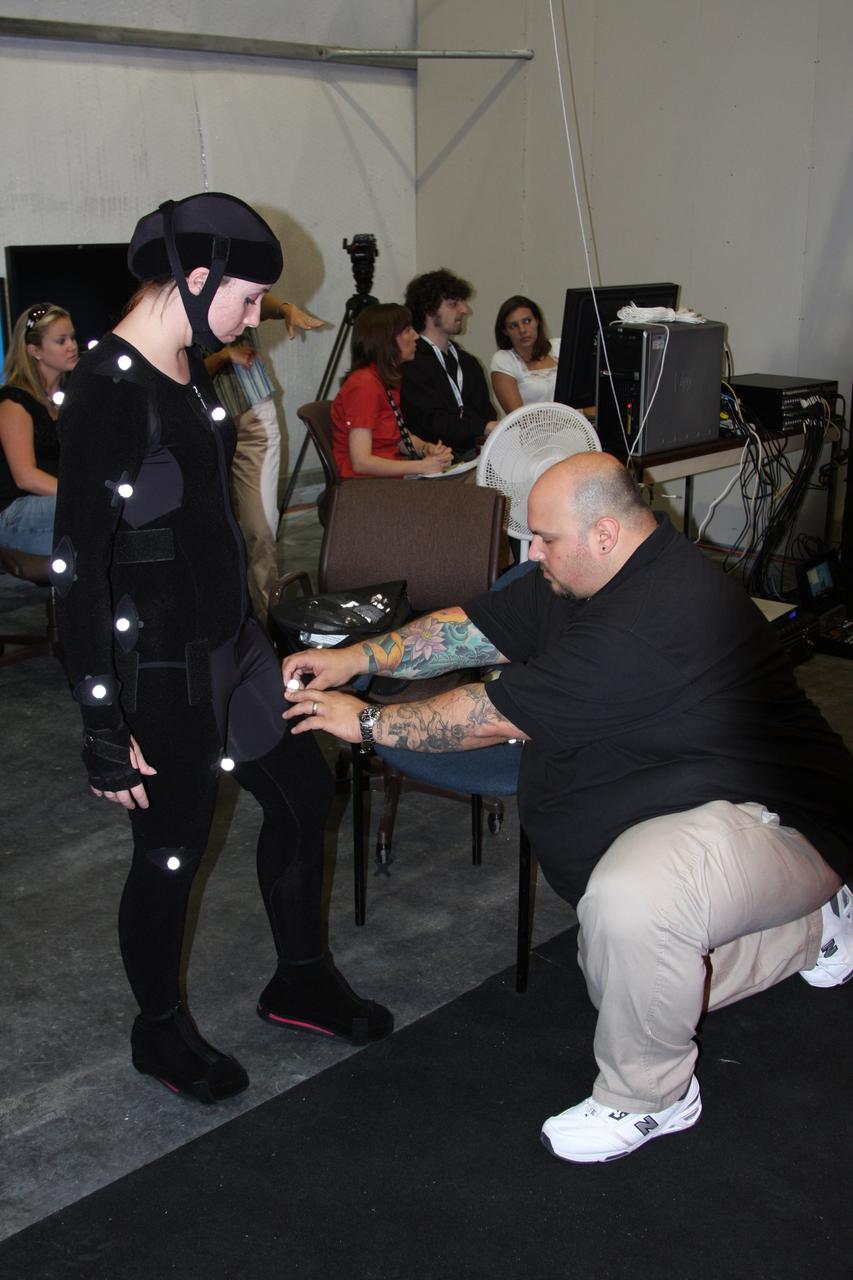
CAPE CANAVERAL, Fla. – Professor Peter Voci, NYIT MOCAP (Motion Capture) team director, (left) hands a component of the Orion Crew Module mockup to one of three technicians inside the mockup. The technicians wear motion capture suits. The motion tracking aims to improve efficiency of assembly processes and identify potential ergonomic risks for technicians assembling the mockup. The work is being performed in United Space Alliance's Human Engineering Modeling and Performance Lab in the RLV Hangar at NASA's Kennedy Space Center.  The motion tracking aims to improve efficiency of assembly processes and identify potential ergonomic risks for technicians assembling the mockup. The work is being performed in United Space Alliance's Human Engineering Modeling and Performance Lab in the RLV Hangar at NASA's Kennedy Space Center. Part of NASA's Constellation Program, the Orion spacecraft will return humans to the moon and prepare for future voyages to Mars and other destinations in our solar system.
KSC-08pd1901
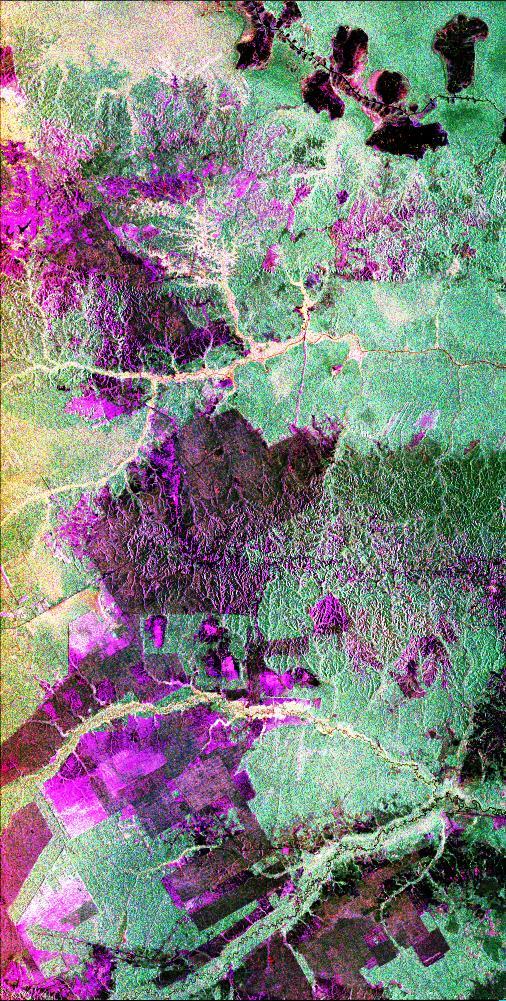
This is a radar image of the central part of the island of Sumatra in Indonesia that shows how the tropical rainforest typical of this country is being impacted by human activity. Native forest appears in green in this image, while prominent pink areas represent places where the native forest has been cleared. The large rectangular areas have been cleared for palm oil plantations. The bright pink zones are areas that have been cleared since 1989, while the dark pink zones are areas that were cleared before 1989. These radar data were processed as part of an effort to assist oil and gas companies working in the area to assess the environmental impact of both their drilling operations and the activities of the local population. Radar images are useful in these areas because heavy cloud cover and the persistent smoke and haze associated with deforestation have prevented usable visible-light imagery from being acquired since 1989. The dark shapes in the upper right (northeast) corner of the image are a chain of lakes in flat coastal marshes.  This image was acquired in October 1994 by the Spaceborne Imaging Radar C/X-Band Synthetic Aperture Radar (SIR-C/X-SAR) onboard the space shuttle Endeavour. Environmental changes can be easily documented by comparing this image with visible-light data that were acquired in previous years by the Landsat satellite. The image is centered at 0.9 degrees north latitude and 101.3 degrees east longitude. The area shown is 50 kilometers by 100 kilometers (31 miles by 62 miles). The colors in the image are assigned to different frequencies and polarizations of the radar as follows: red is L-band horizontally transmitted, horizontally received; green is L-band horizontally transmitted, vertically received; blue is L-band vertically transmitted, vertically received. SIR-C/X-SAR, a joint mission of the German, Italian and United States space agencies, is part of NASA's Mission to Planet Earth program.   http://photojournal.jpl.nasa.gov/catalog/PIA01797
Space Radar Image of Central Sumatra, Indonesia
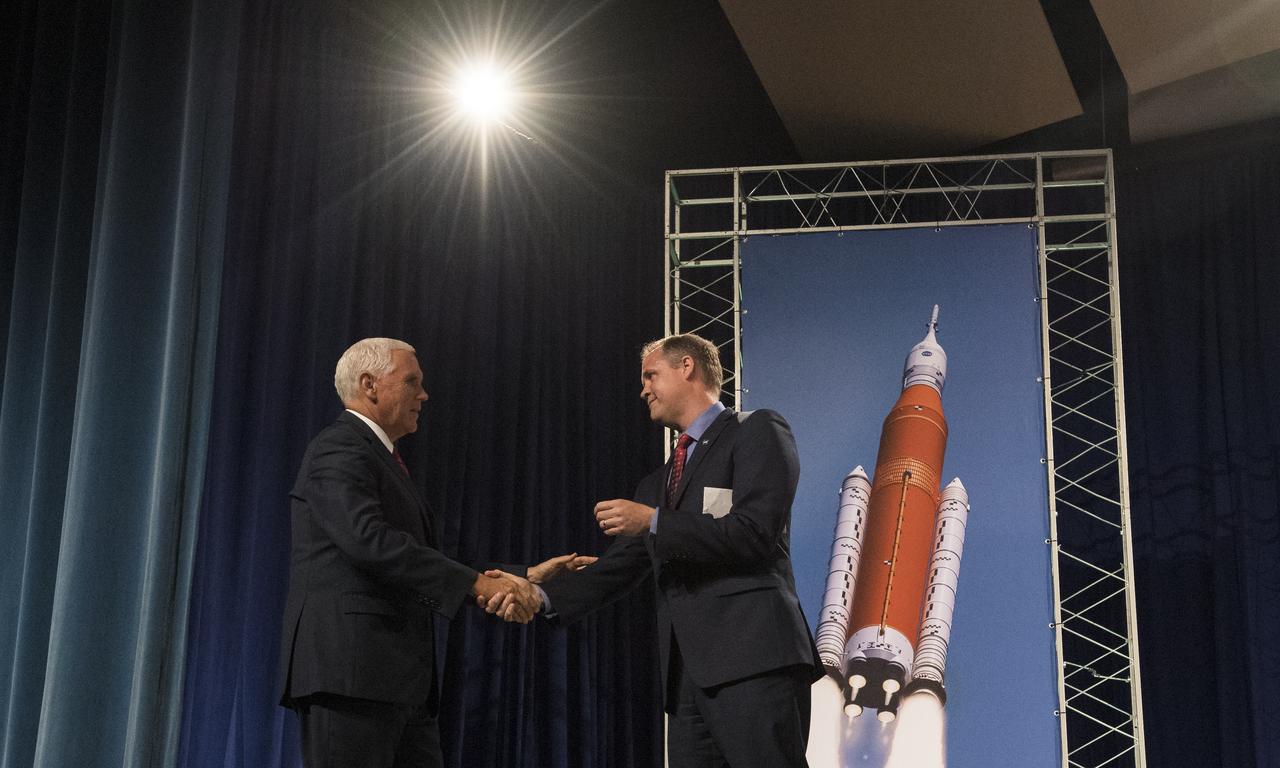
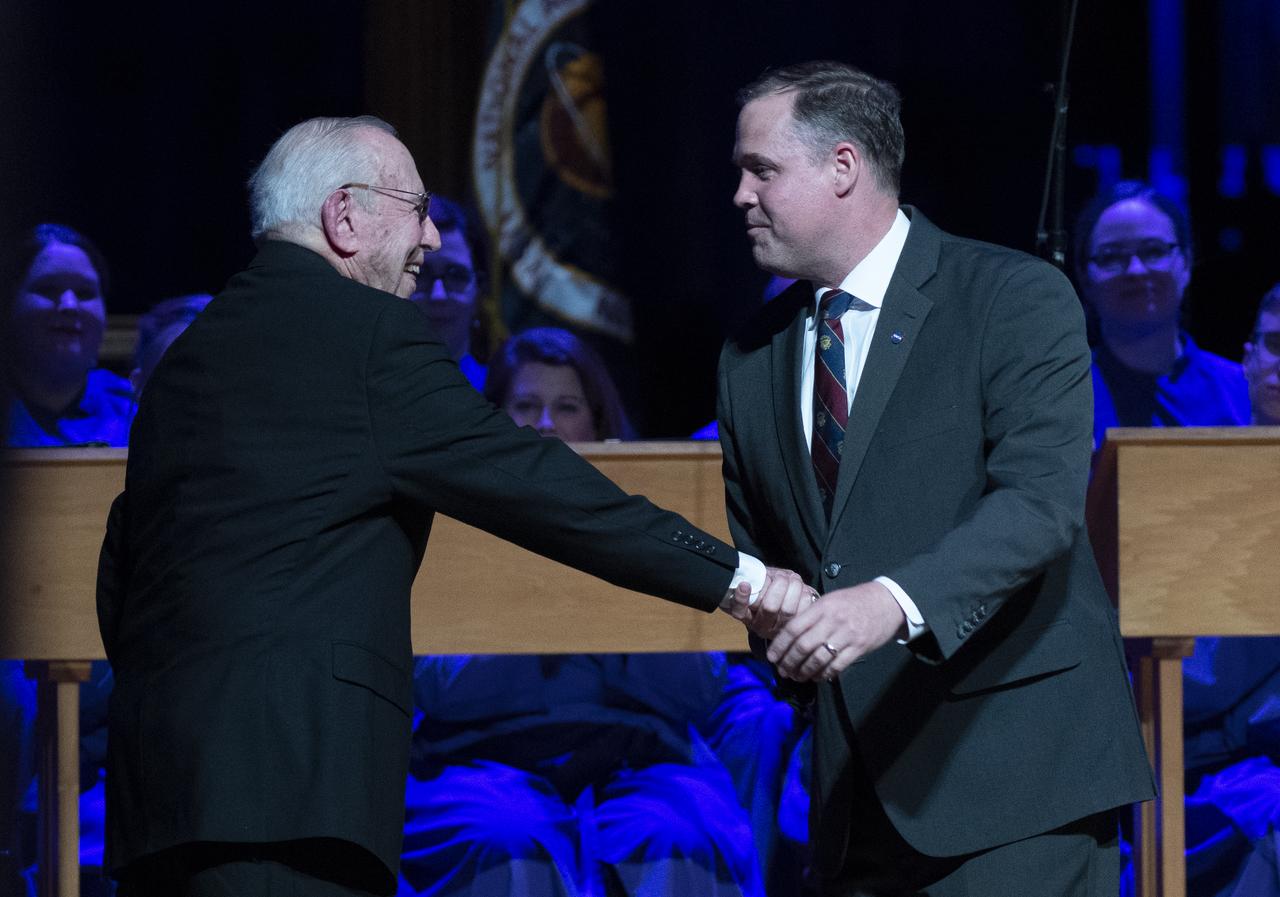
Vice President Mike Pence shakes hands with NASA Administrator Jim Bridenstine after being intruduced prior to speaking in the Teague Auditorium at NASA's Johnson Space Center, Thursday, Aug. 23, 2018 in Houston, Texas. Vice President Pence spoke about the future of human space exploration and the agency’s plans to return to the Moon as a forerunner to future human missions to Mars, stating that “soon and very soon American astronauts will return to space on American rockets launched from American soil." Photo Credit: (NASA/Joel Kowsky)
VP Pence Visits Johnson Space Center
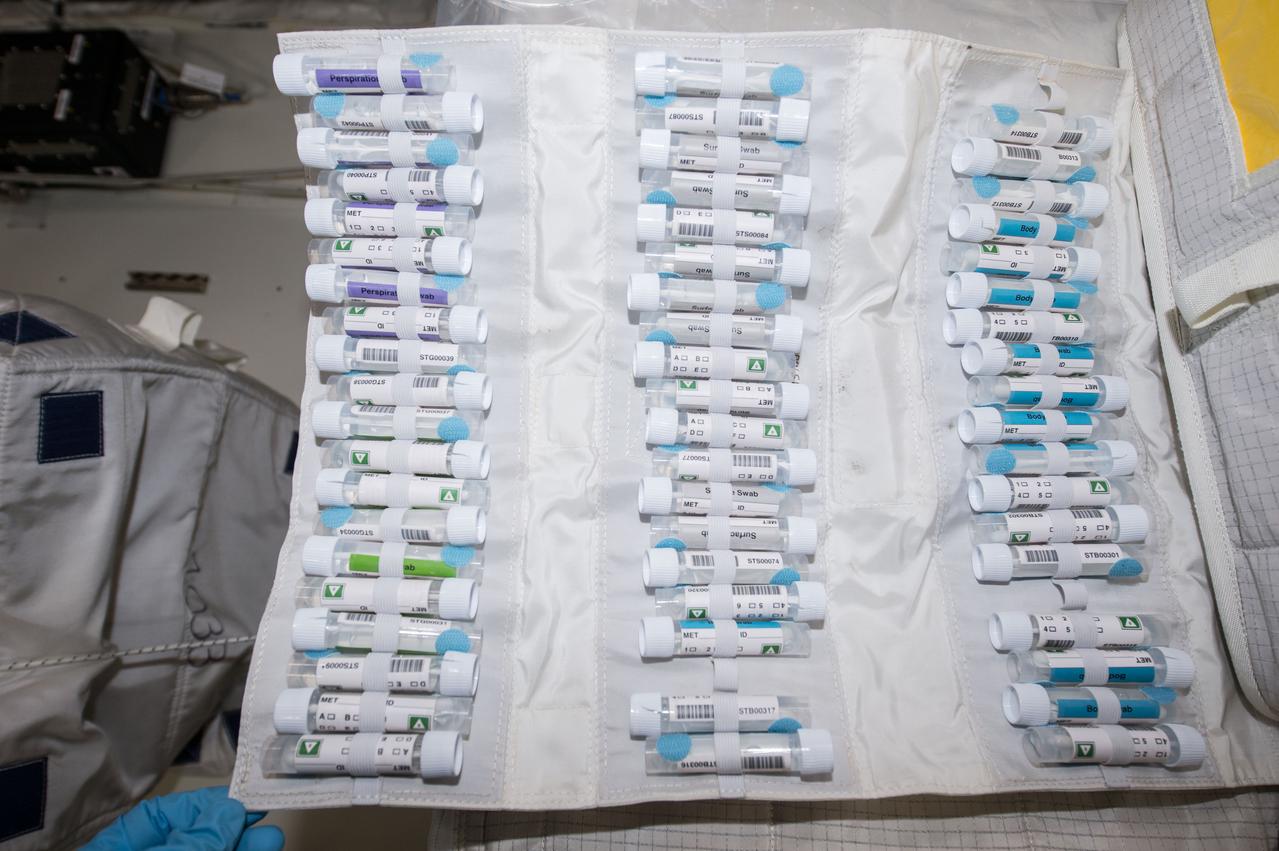
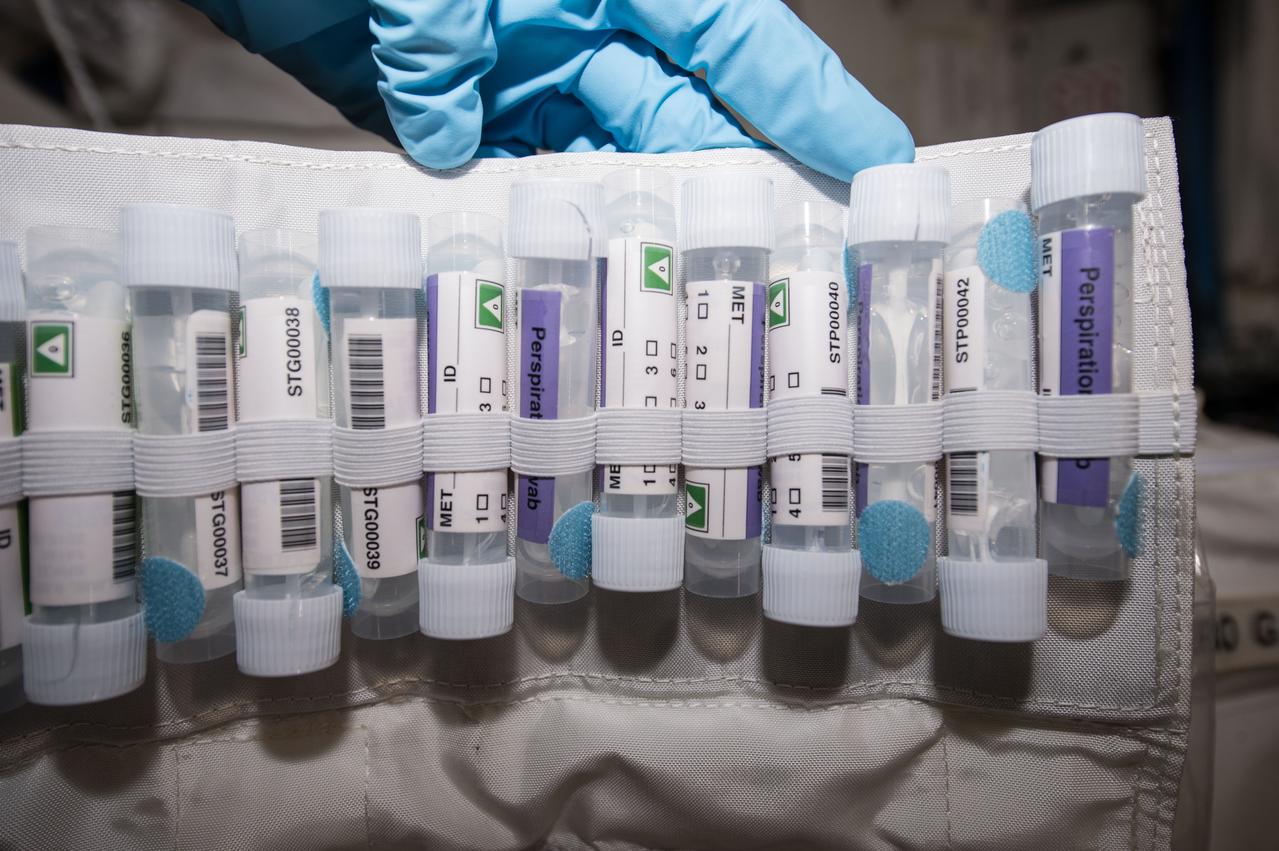
iss042e021395 (12/5/2014) --- A view of Microbiome swab kit containing Microbiome samples from various physical surfaces prior to being stowed in MELFI or GLACIER. The Study of the Impact of Long-Term Space Travel on the Astronauts' Microbiome (Microbiome) experiment investigates the impact of space travel on both the human immune system and an individual’s microbiome (the collection of microbes that live in and on the human body at any given time).
Microbiome Body Sampling Operations
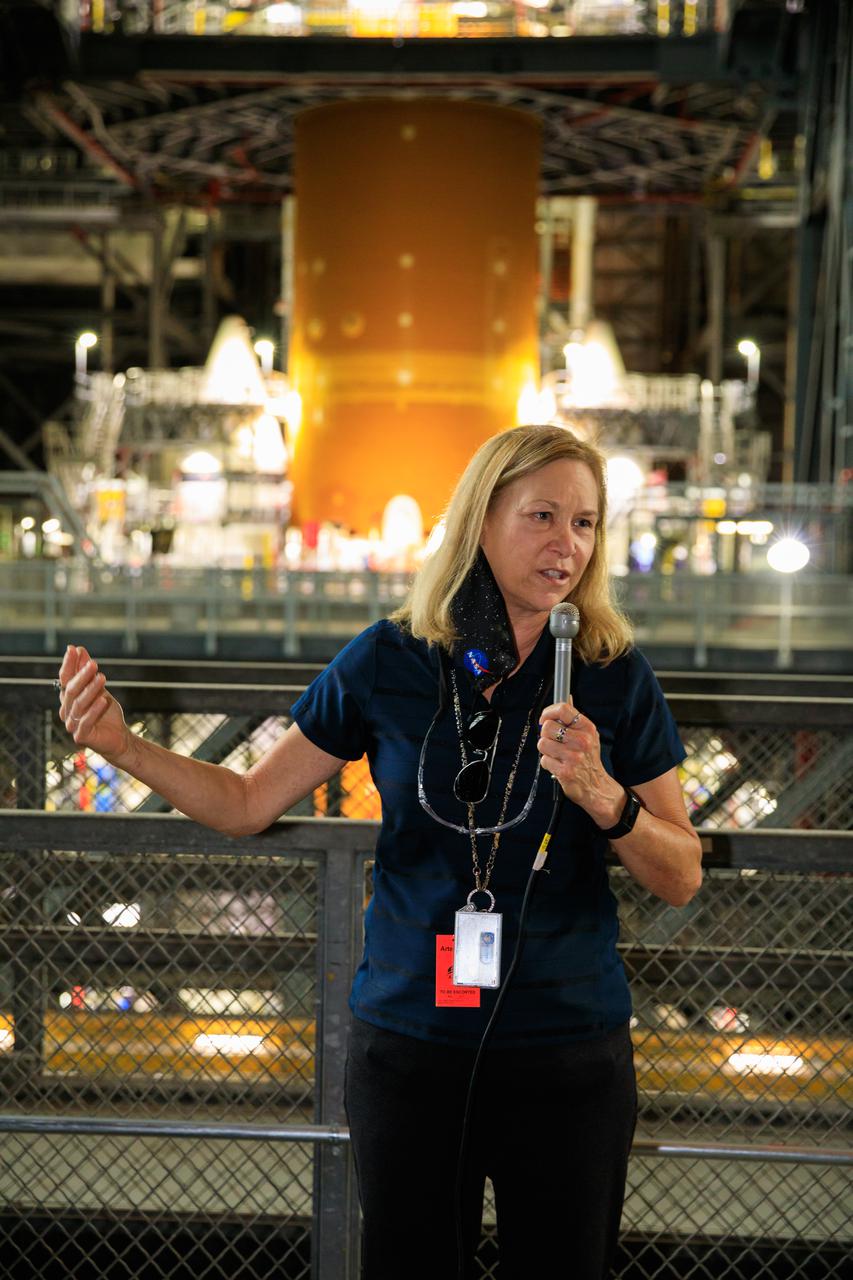
Kennedy Space Center Director Janet Petro addresses Congressional guests inside the Vehicle Assembly Building on July 30, 2021. The visitors came to the Florida spaceport to view NASA’s stacked Space Launch System rocket, which is being prepared for the Artemis I launch. During this mission, Orion will fly farther than any spacecraft built for humans has ever flown. Under Artemis, NASA will land the first woman and first person of color on the Moon and prepare for human missions to Mars.
Congressional Tour in Vehicle Assembly Building
CAPE CANAVERAL, Fla. – In the Operations and Checkout Building's high bay, "skins" are being applied to the outer mold of the simulator Orion crew module. Part of NASA's Constellation Program, the Orion spacecraft will return humans to the moon and prepare for future voyages to Mars and other destinations in our solar system. Orion is targeted to begin carrying humans to the International Space Station in 2015 and to the moon by 2020.  Photo credit: NASA/Kim Shiflett
KSC-2009-3205
iss042e021398 (12/5/2014) --- A view of Microbiome swab kit containing Microbiome samples from various physical surfaces prior to being stowed in MELFI or GLACIER. The Study of the Impact of Long-Term Space Travel on the Astronauts' Microbiome (Microbiome) experiment investigates the impact of space travel on both the human immune system and an individual’s microbiome (the collection of microbes that live in and on the human body at any given time).
Microbiome Body Sampling Operations
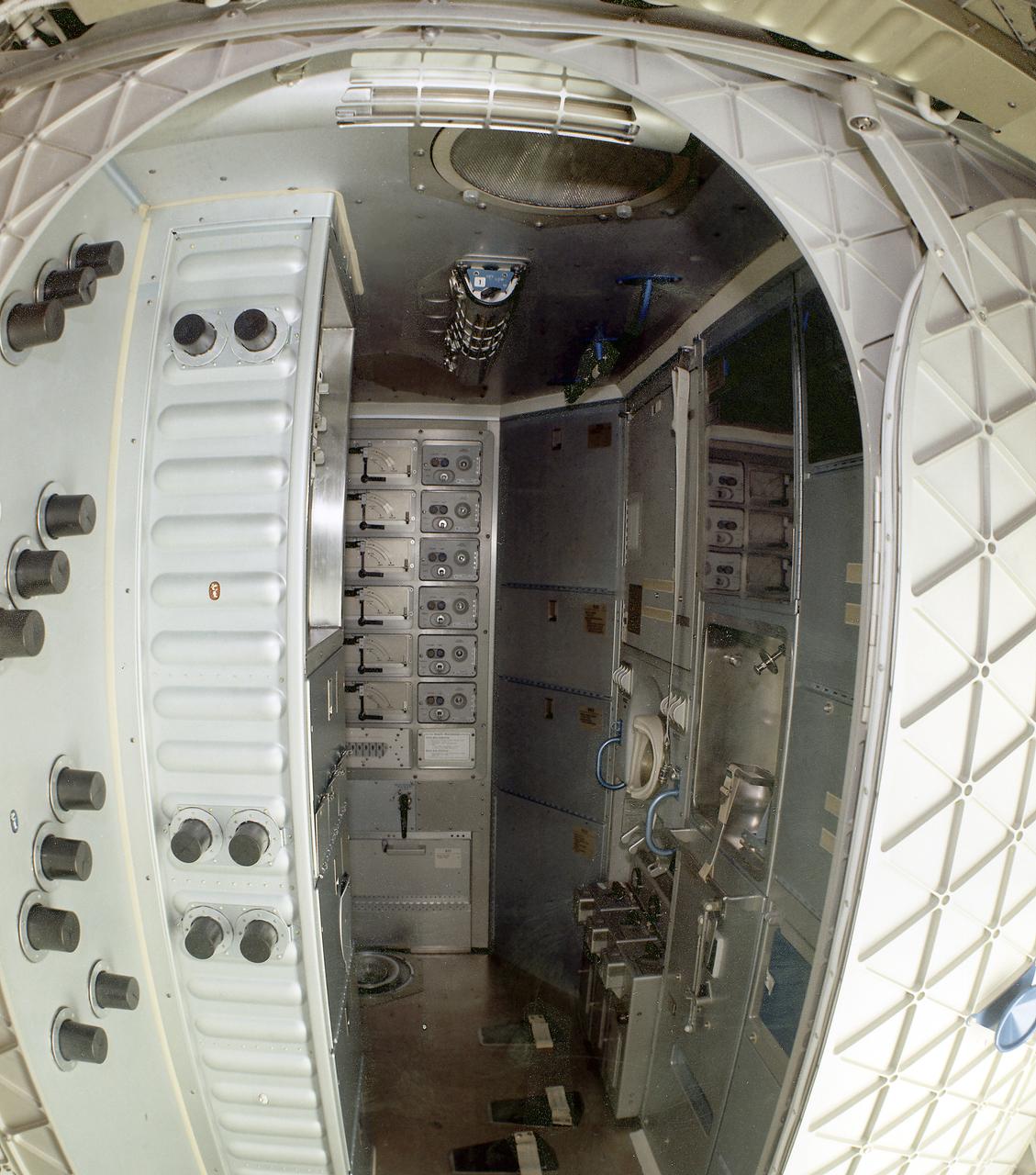
This image is a wide-angle view of the Orbital Workshop waste management compartment. The waste management facilities presented a unique challenge to spacecraft designers. In addition to collection of liquid and solid human wastes, there was a medical requirement to dry all solid human waste products and to return the residue to Earth for examination. Liquid human waste (urine) was frozen for return to Earth. Total quantities of each astronaut's liquid and solid wastes were precisely measured. Cabin air was drawn into the toilet, shown on the wall at right in this photograph, and over the waste products to generate a flow of the waste in the desired direction. The air was then filtered for odor control and antiseptic purposes prior to being discharged back into the cabin.
Skylab
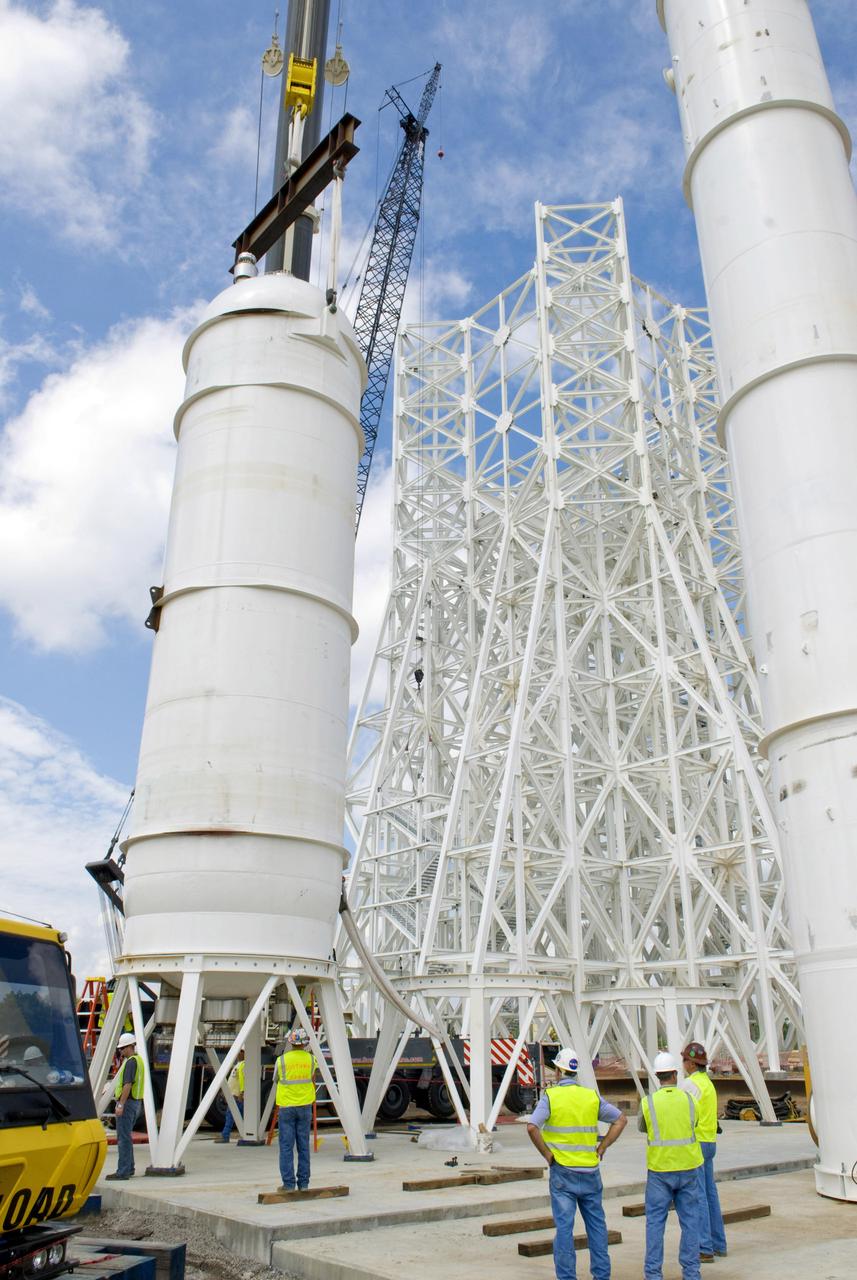
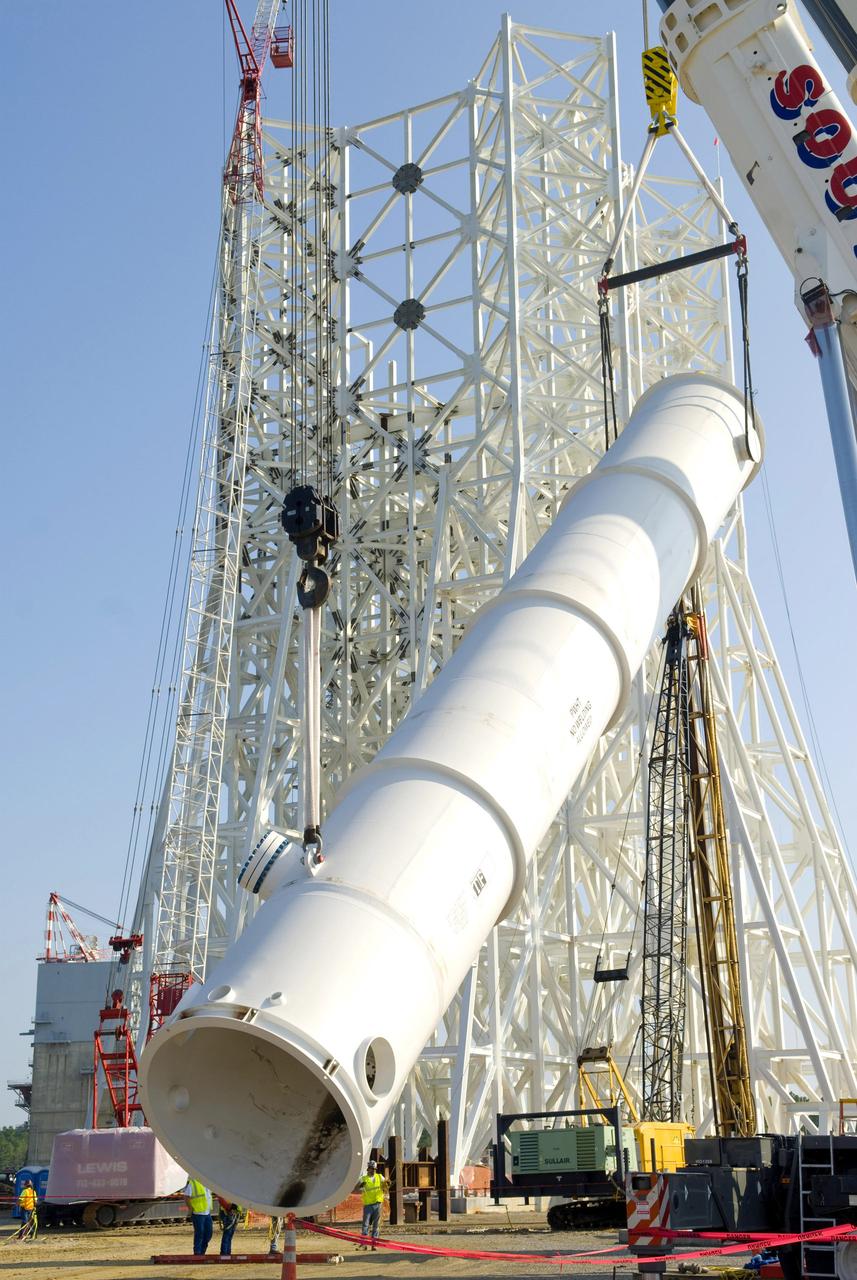
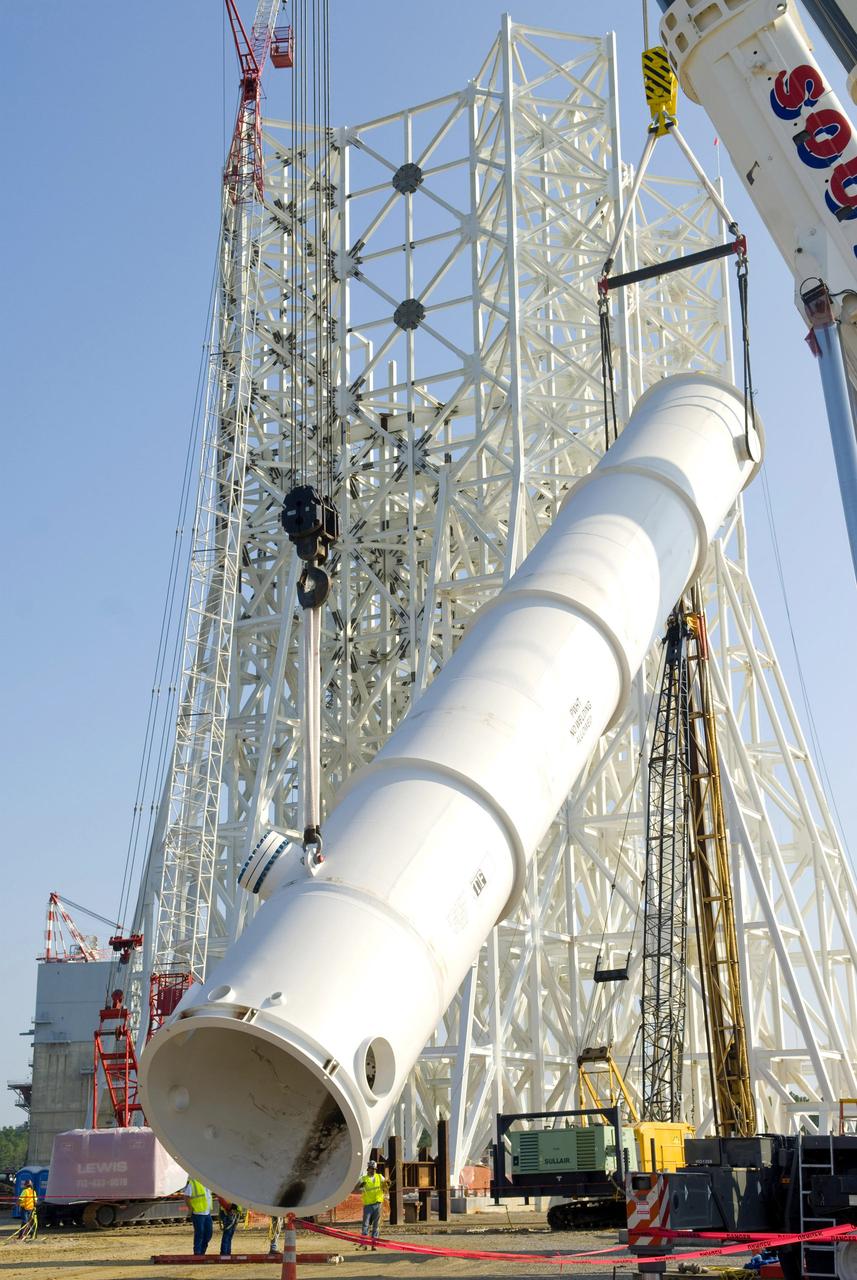
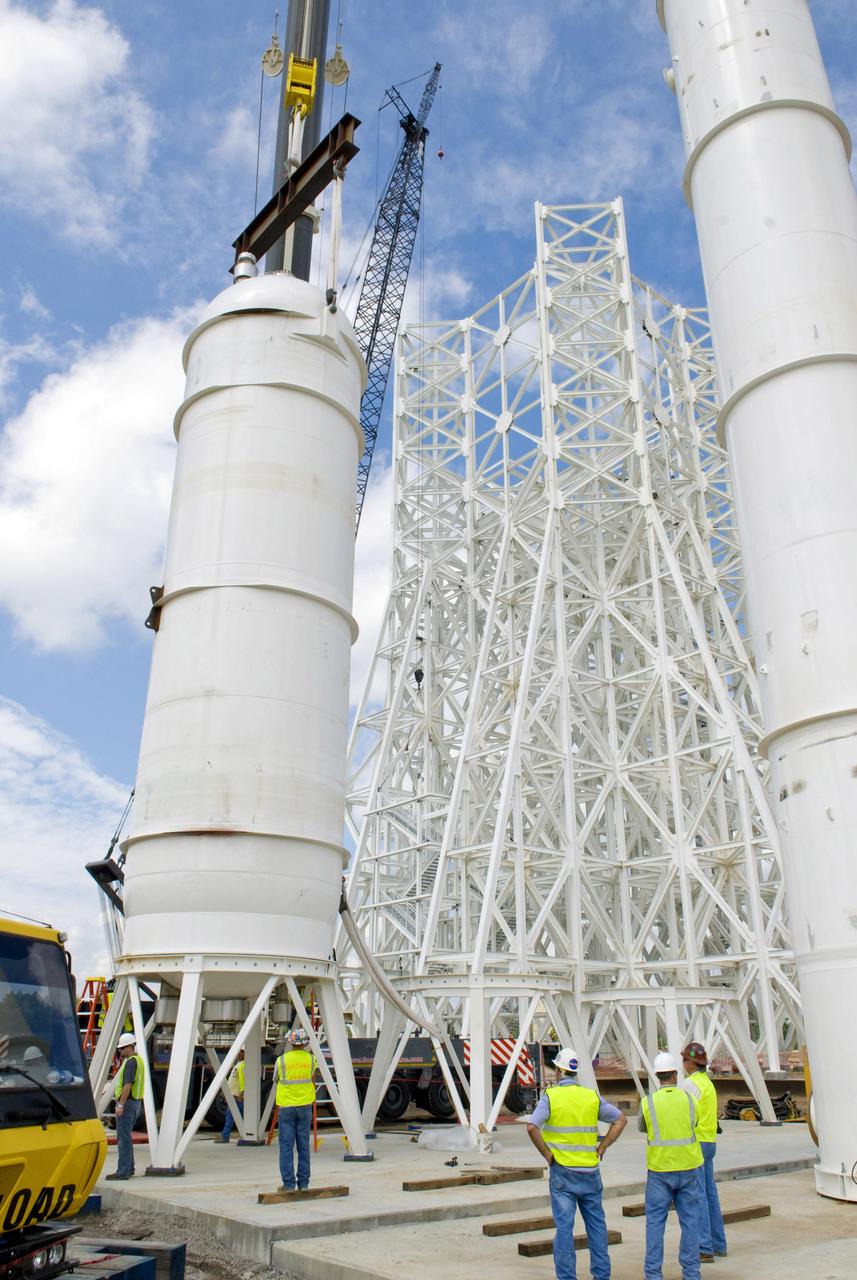
A liquid oxygen (LOX) tank is lifted into place at the A-3 Test Stand being built at NASA's John C. Stennis Space Center. Fourteen LOX, isopropyl alcohol (IPA) and water tanks are being installed to support the chemical steam generators to be used on the A-3 Test Stand. The IPA and LOX tanks will provide fuel for the generators. The water will allow the generators to produce steam that will be used to reduce pressure inside the stand's test cell diffuser, enabling operators to simulate altitudes up to 100,000 feet. In that way, operators can perform the tests needed on rocket engines being built to carry humans back to the moon and possibly beyond. The A-3 Test Stand is set for completion and activation in 2011.
Liquid oxygen tank installed at A-3 Test Stand
An isopropyl alcohol (IPA) tank is lifted into place at the A-3 Test Stand being built at NASA's John C. Stennis Space Center. Fourteen IPA, water and liquid oxygen (LOX) tanks are being installed to support the chemical steam generators to be used on the A-3 Test Stand. The IPA and LOX tanks will provide fuel for the generators. The water will allow the generators to produce steam that will be used to reduce pressure inside the stand's test cell diffuser, enabling operators to simulate altitudes up to 100,000 feet. In that way, operators can perform the tests needed on rocket engines being built to carry humans back to the moon and possibly beyond. The A-3 Test Stand is set for completion and activation in 2011.
Isopropyl alcohol tank installed at A-3 Test Stand
A water tank is lifted into place at the A-3 Test Stand being built at NASA's John C. Stennis Space Center. Fourteen water, liquid oxygen (LOX) and isopropyl alcohol (IPA) tanks are being installed to support the chemical steam generators to be used on the A-3 Test Stand. The IPA and LOX tanks will provide fuel for the generators. The water will allow the generators to produce steam that will be used to reduce pressure inside the stand's test cell diffuser, enabling operators to simulate altitudes up to 100,000 feet. In that way, operators can perform the tests needed on rocket engines being built to carry humans back to the moon and possibly beyond. The A-3 Test Stand is set for completion and activation in 2011.
Water tank installed at A-3 Test Stand
A water tank is lifted into place at the A-3 Test Stand being built at NASA's John C. Stennis Space Center. Fourteen water, liquid oxygen (LOX) and isopropyl alcohol (IPA) tanks are being installed to support the chemical steam generators to be used on the A-3 Test Stand. The IPA and LOX tanks will provide fuel for the generators. The water will allow the generators to produce steam that will be used to reduce pressure inside the stand's test cell diffuser, enabling operators to simulate altitudes up to 100,000 feet. In that way, operators can perform the tests needed on rocket engines being built to carry humans back to the moon and possibly beyond. The A-3 Test Stand is set for completion and activation in 2011.
Water tank installed at A-3 Test Stand
A liquid oxygen (LOX) tank is lifted into place at the A-3 Test Stand being built at NASA's John C. Stennis Space Center. Fourteen LOX, isopropyl alcohol (IPA) and water tanks are being installed to support the chemical steam generators to be used on the A-3 Test Stand. The IPA and LOX tanks will provide fuel for the generators. The water will allow the generators to produce steam that will be used to reduce pressure inside the stand's test cell diffuser, enabling operators to simulate altitudes up to 100,000 feet. In that way, operators can perform the tests needed on rocket engines being built to carry humans back to the moon and possibly beyond. The A-3 Test Stand is set for completion and activation in 2011.
Liquid oxygen tank installed at A-3 Test Stand
iss068e022275 (11/14/2022) ---  A view of the OVOSPACE payload in the cupola module aboard the international Space Station (ISS). The Modulation of Granulosa and Theca Cells Activity in Microgravity: Consequences for Human Health and Reproduction (OVOSPACE) investigation studies how the microgravity environment can impair ovary function and the physiological development of living beings.
Nanoracks Module in the Cupola
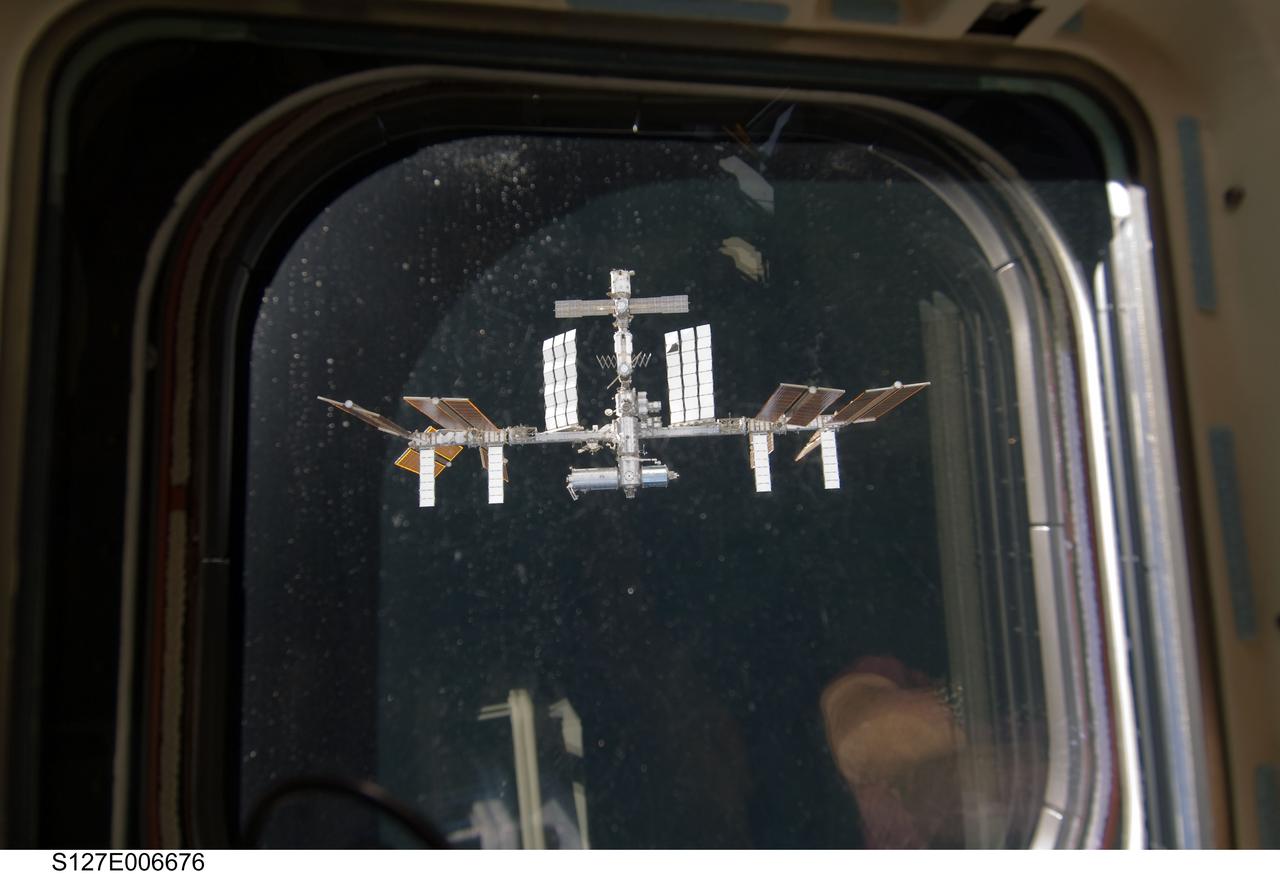
S127-E-006676 (17 July 2009) --- One of Endeavour's aft flight deck windows frames the nearby International Space Station as crewmembers aboard both spacecraft, totaling a record 13 human beings, anticipate over a week's worth of joint activities to bring the orbital outpost a step closer to completion.
ISS during docking activities
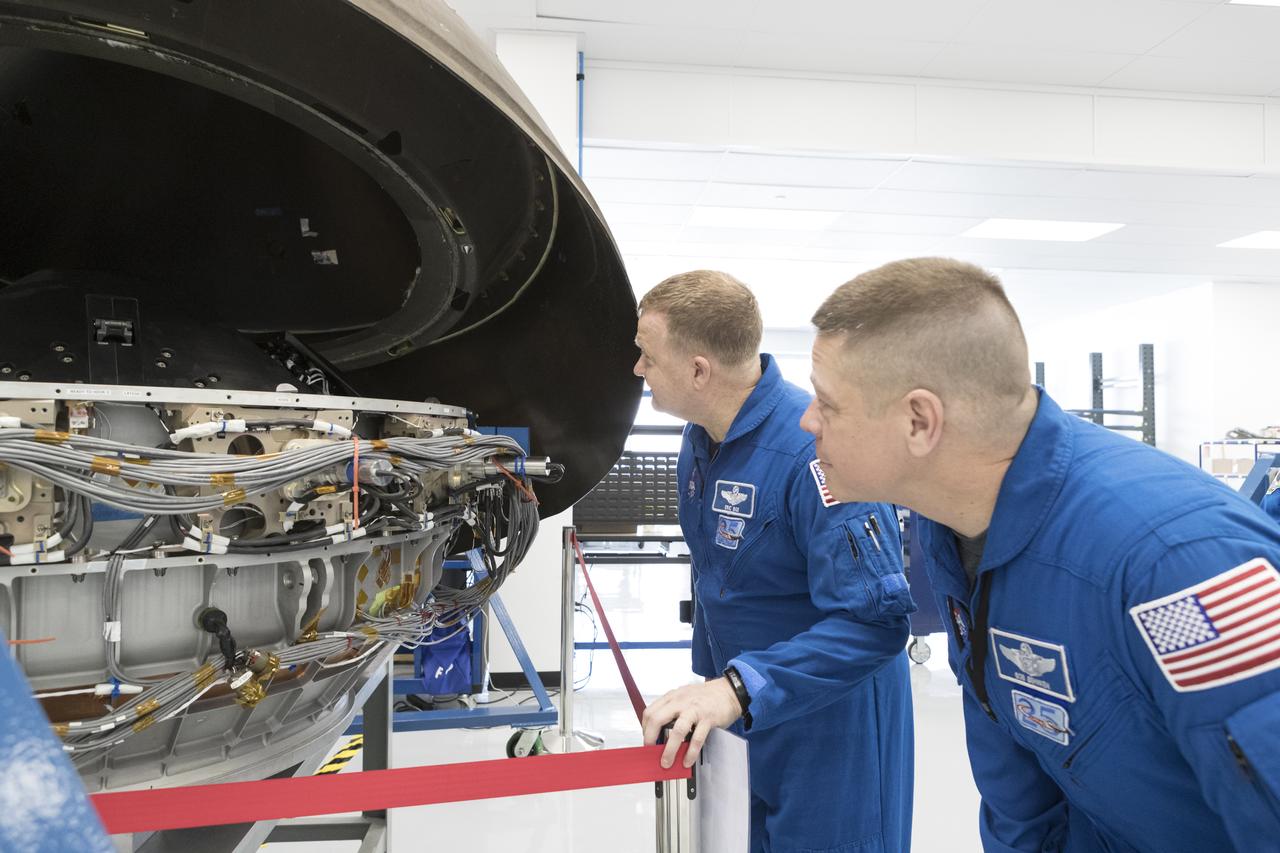
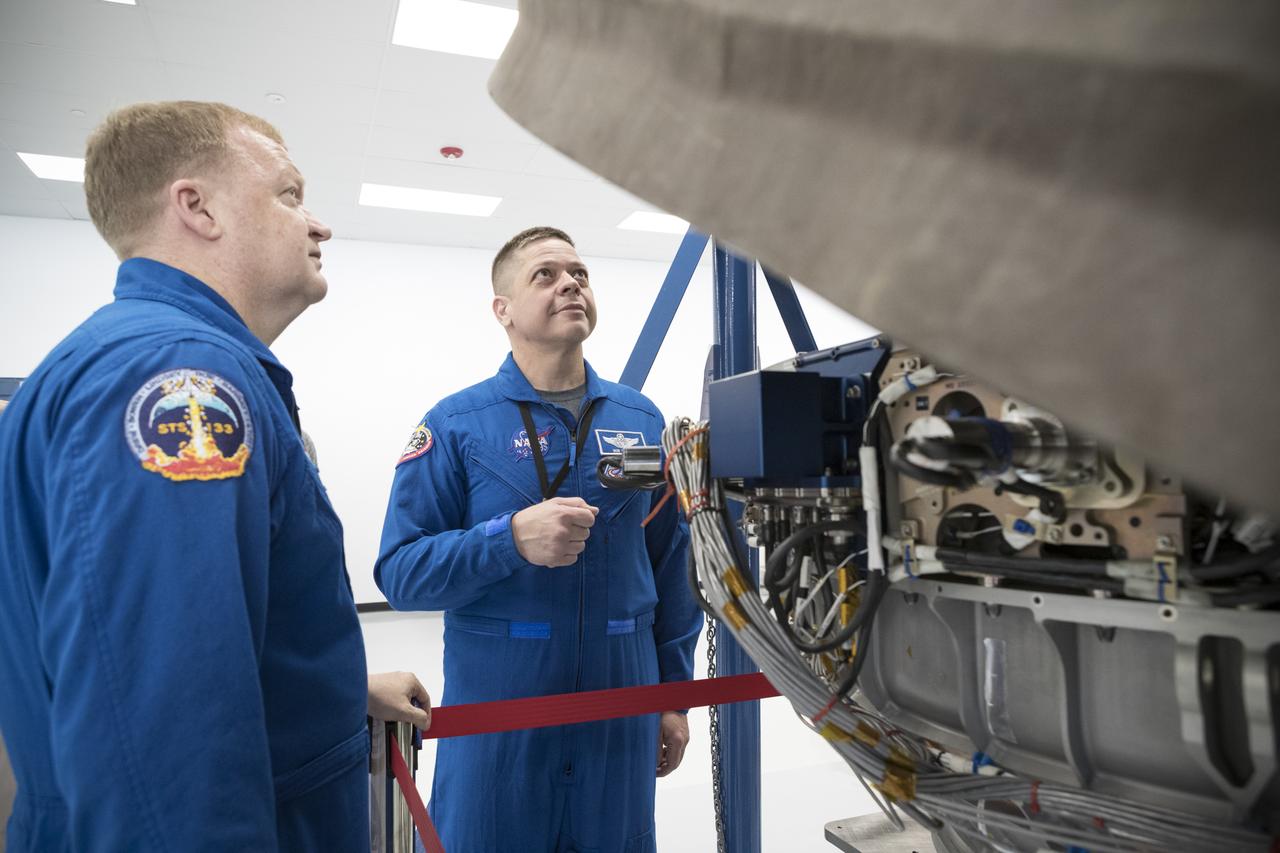
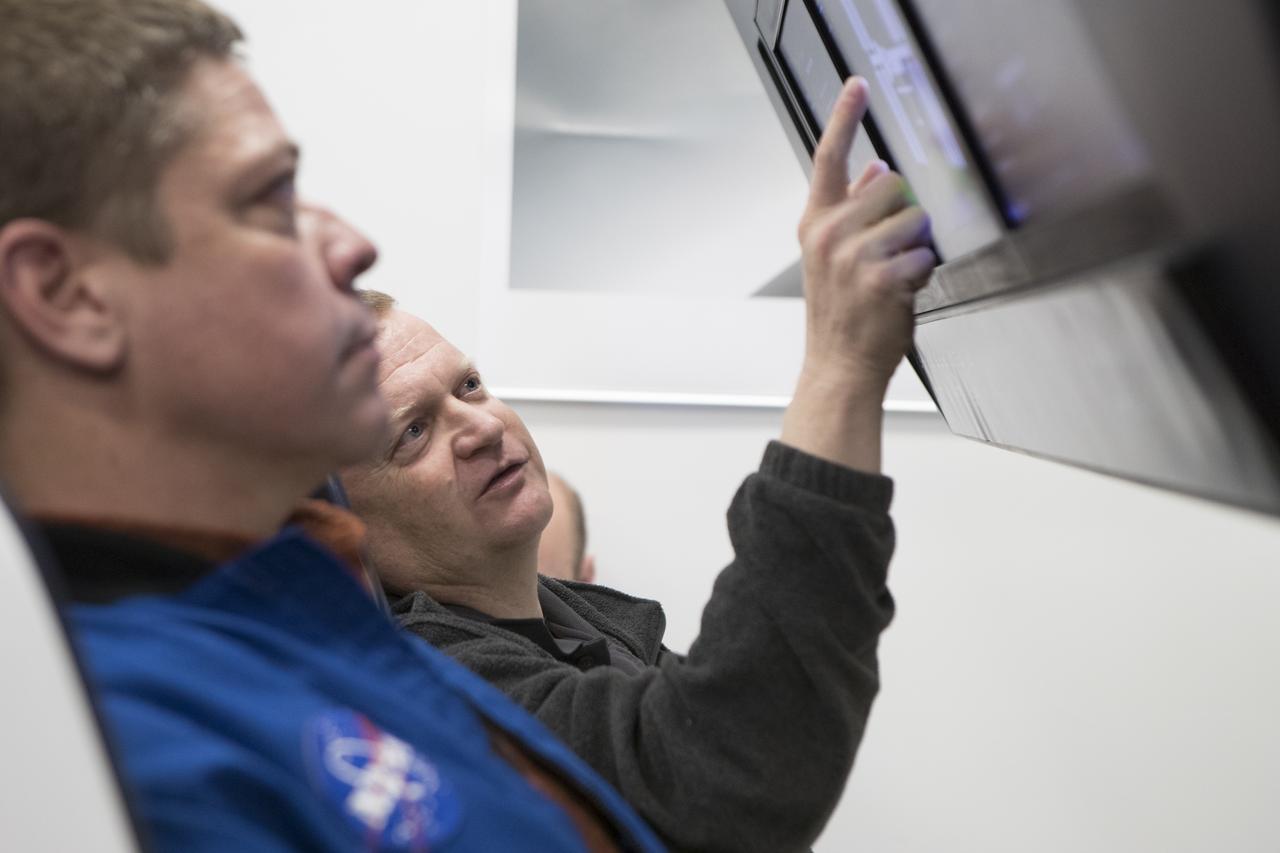
During a tour of SpaceX headquarters in Hawthorne, California, commercial crew astronauts Eric Boe, left, and Bob Behnken view the Crew Dragon on March 8, 2017. Crew Dragon is being developed and manufactured in partnership with NASA's Commercial Crew Program to return human spaceflight capabilities to the U.S.
Eric Boe and Bob Behnken Dragon Tour
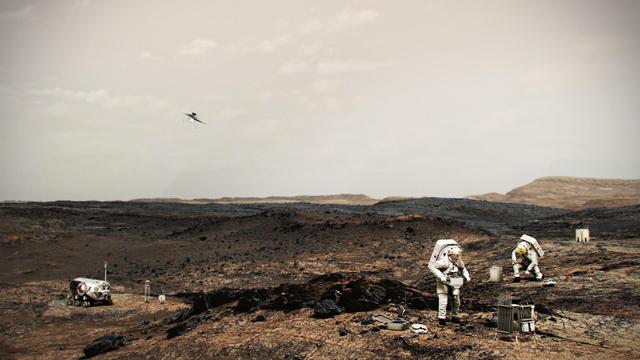
This illustration shows NASA astronauts working on the surface of Mars. A helicopter similar to the Ingenuity Mars Helicopter is airborne at left. Ingenuity is being carried aboard the Perseverance rover; it will be deployed to the Martian surface in the weeks after landing to test whether future helicopters could accompany robotic and human missions.  https://photojournal.jpl.nasa.gov/catalog/PIA24032
NASA Astronauts on Mars With Helicopter (Illustration)
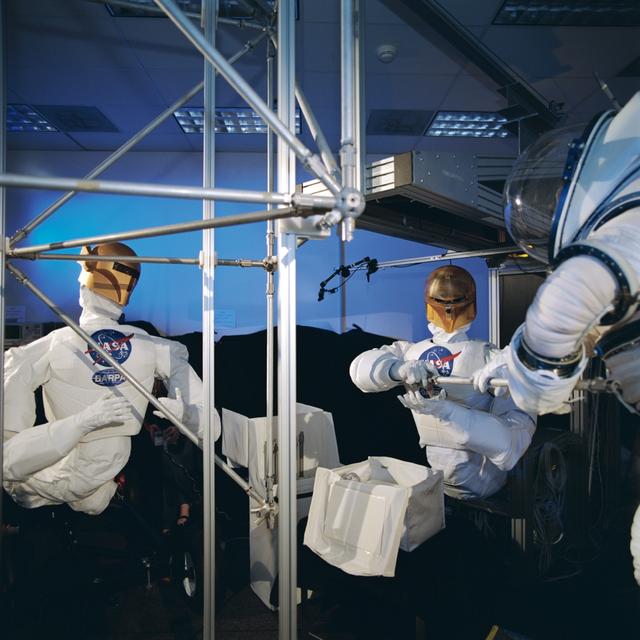
JSC2003-00300 (June 2003) --- Two Robonauts work hand-in-hand with astronaut Nancy J. Currie, partially visible at right edge of frame, during an evaluation at the Johnson Space Center  to determine the capabilities of human beings and robots to perform certain extravehicular tasks.
Robonaut activities involving joint task operations with a EVA suited astronaut
During a tour of SpaceX headquarters in Hawthorne, California, commercial crew astronauts Eric Boe, left, and Bob Behnken view the Crew Dragon on March 8, 2017. Crew Dragon is being developed and manufactured in partnership with NASA's Commercial Crew Program to return human spaceflight capabilities to the U.S.
Eric Boe and Bob Behnken Dragon Tour
ISS036-E-005515 (31 May 2013) --- European Space Agency astronaut Luca Parmitano (left) and NASA astronaut Chris Cassidy talk with fellow human beings on Earth using videoconferencing software and one of their on-board laptop computers in the U.S. lab Destiny.
Parmitano and Cassidy in U.S. Lab
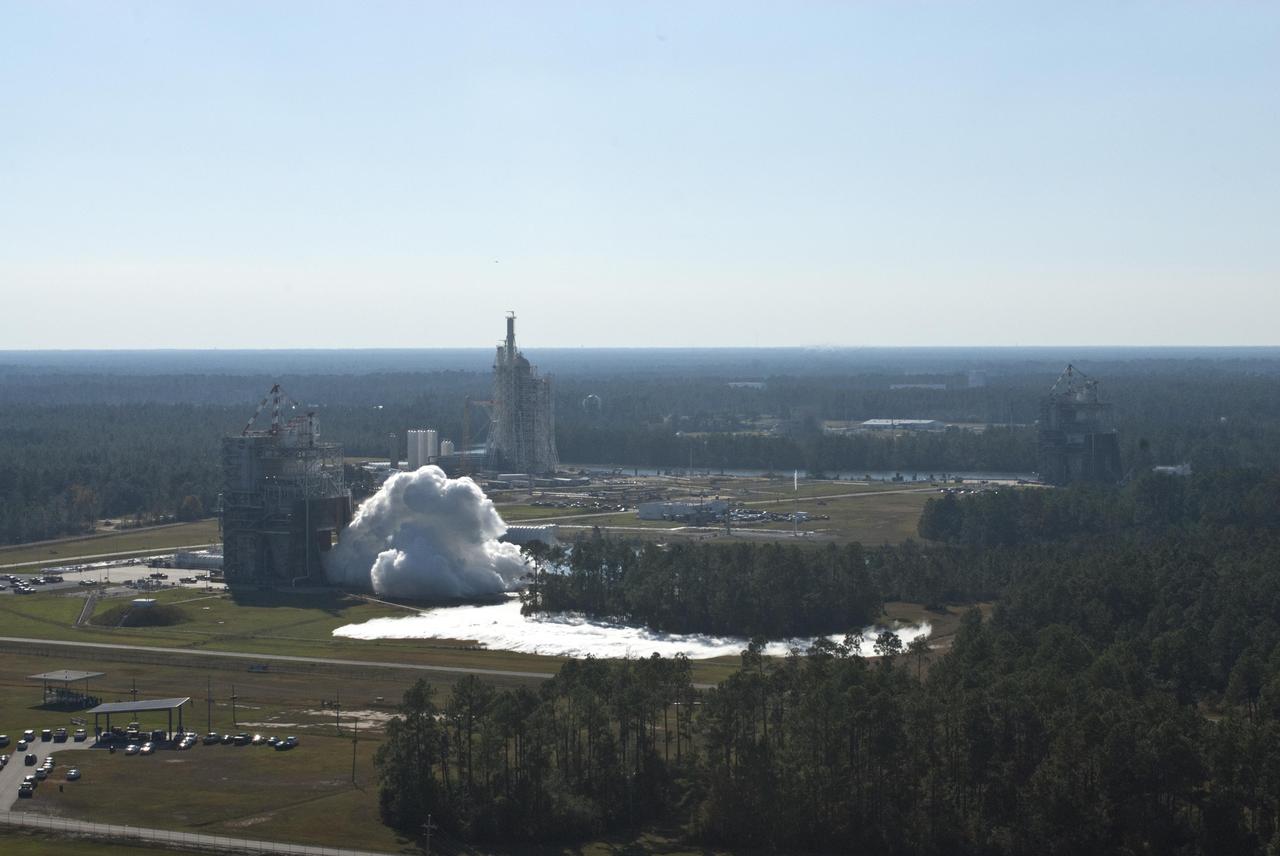
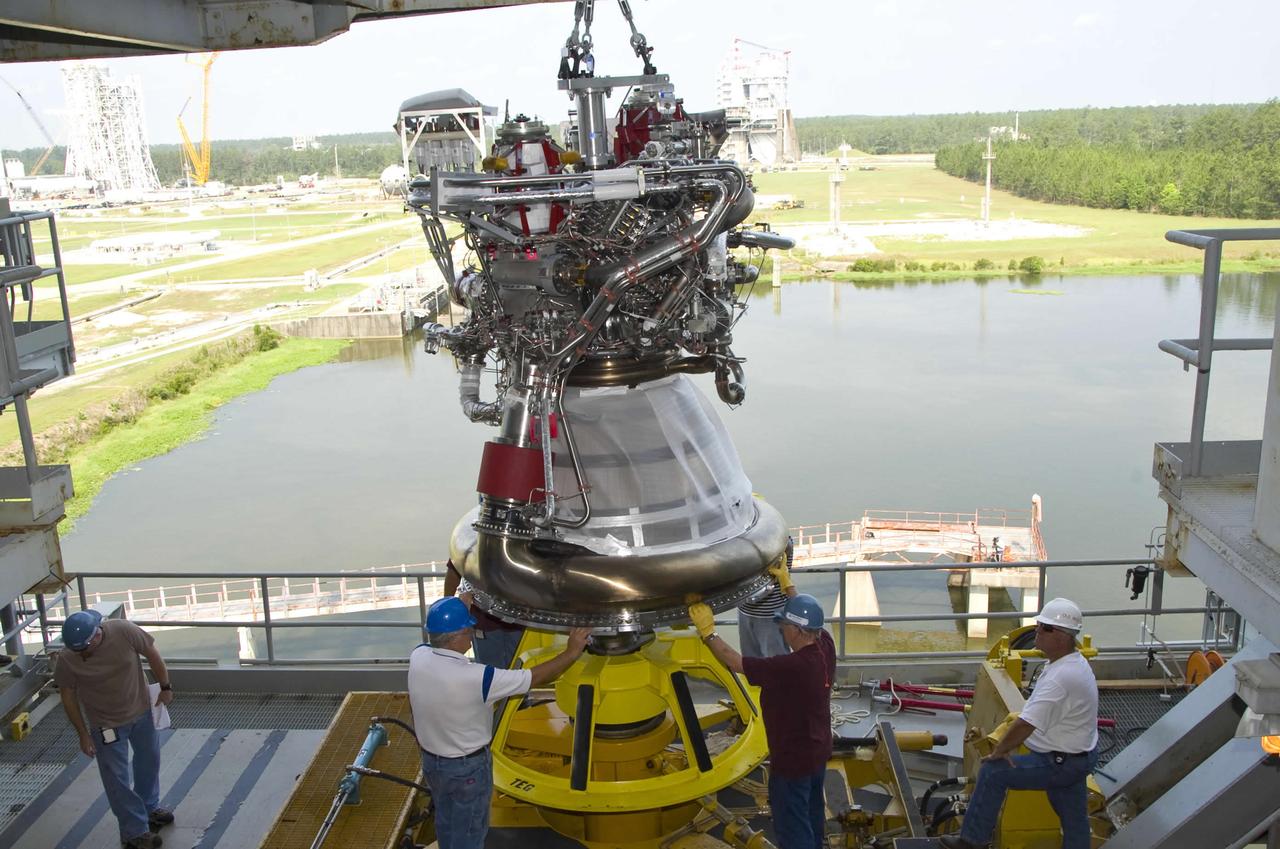
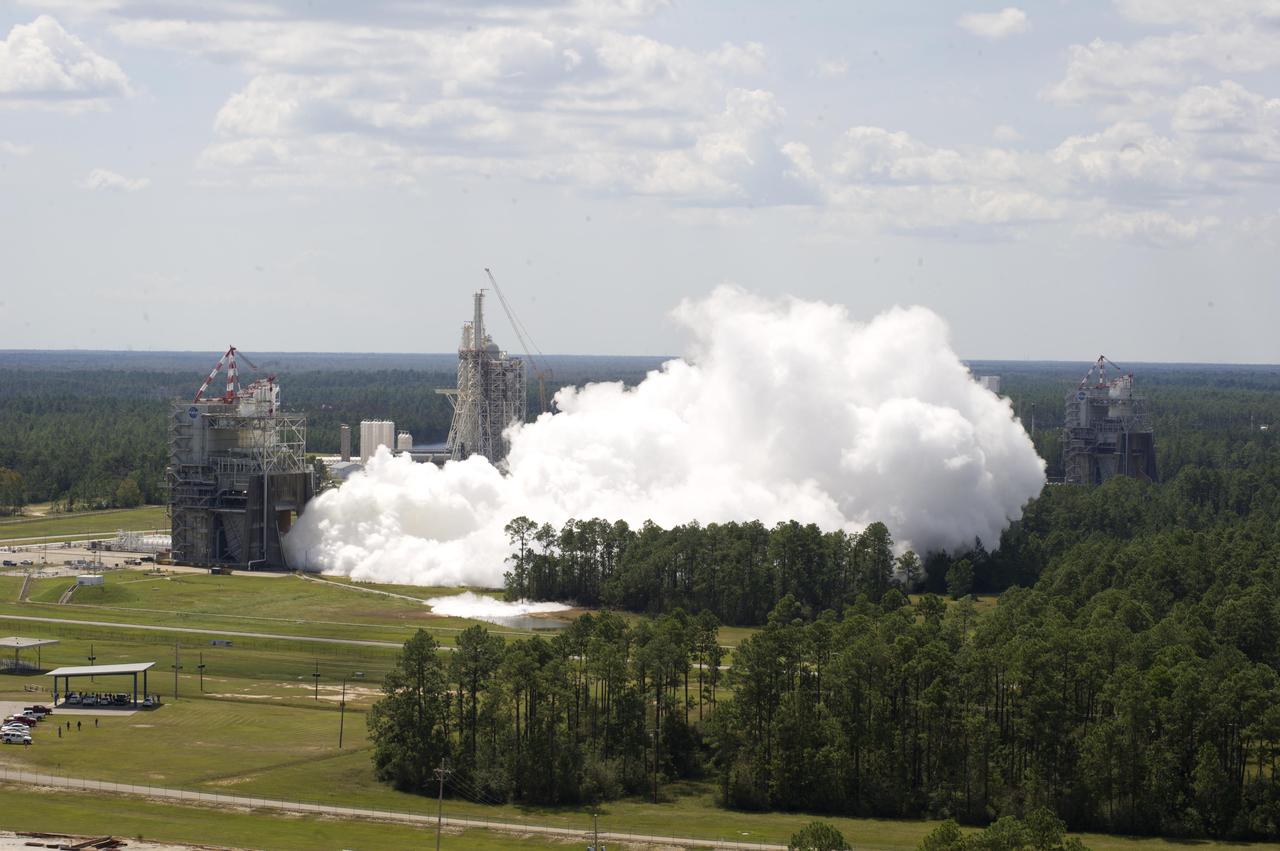
A photograph of a J-2X rocket engine on the A-2 Test Stand from atop the B Test Stand at Stennis Space Center offers a panoramic view of the A Test Complex. The J-2X engine is being developed for NASA by Pratt & Whitney Rocketdyne to carry humans deeper into space than ever before.
Stennis panorama
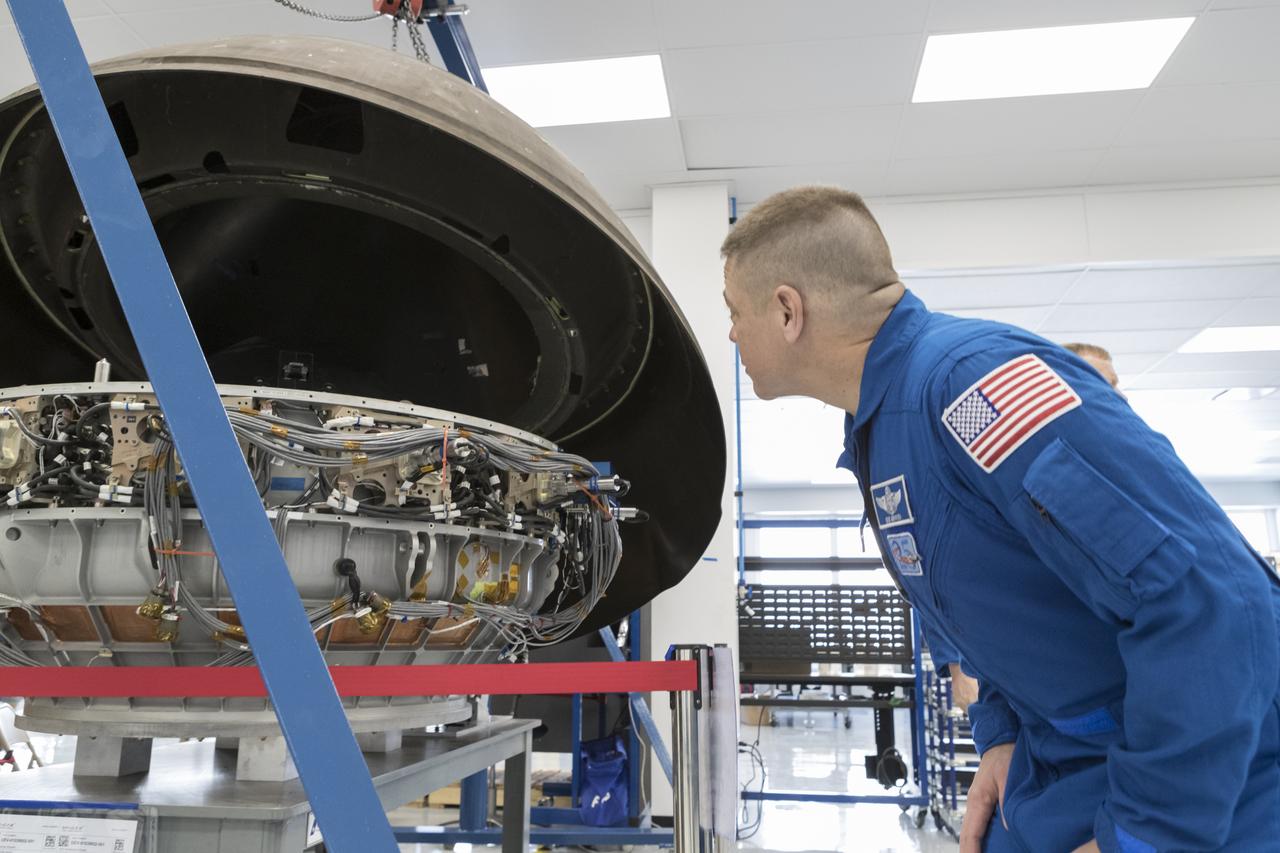
During a tour of SpaceX headquarters in Hawthorne, California, commercial crew astronaut Bob Behnken views the Crew Dragon on March 8, 2017. Crew Dragon is being developed and manufactured in partnership with NASA's Commercial Crew Program to return human spaceflight capabilities to the U.S.
Eric Boe and Bob Behnken Dragon Tour
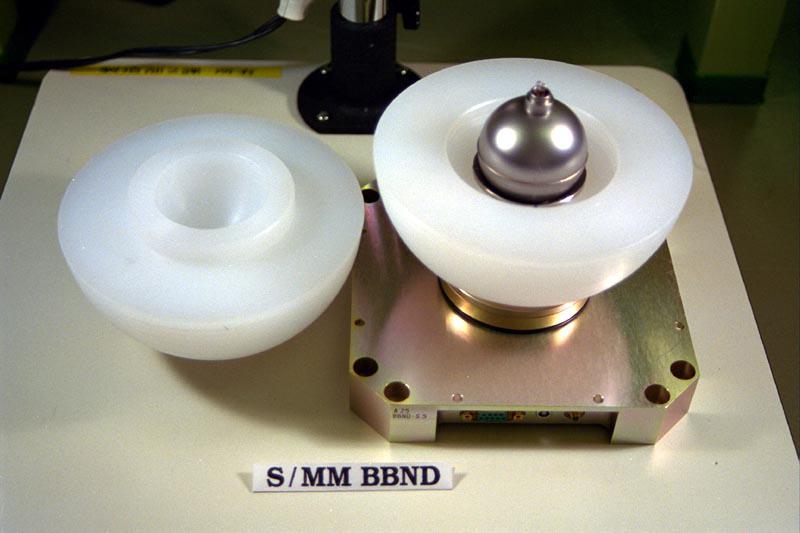
The Bonner Ball Neutron Detector measures neutron radiation. Neutrons are uncharged atomic particles that have the ability to penetrate living tissues, harming human beings in space. The Bonner Ball Neutron Detector is one of three radiation experiments during Expedition Two. The others are the Phantom Torso and Dosimetric Mapping.
Research Technology
S67-19620 (12 Sept. 1962) --- On Sept. 12, 1962, President John F. Kennedy delivers a speech announcing his goals for the nation?s space effort to land a human being on the moon before a crowd of 35,000 people in the football stadium at Rice University in Houston, Texas. Photo credit: NASA
s67-19620
A J-2X next-generation rocket engine is lifted onto the A-2 Test Stand at Stennis Space Center. Testing of the engine began the following month. The engine is being developed for NASA by Pratt & Whitney Rocketdyne and could help carry humans beyond low-Earth orbit into deep space once more.
J-2X engine installation
CAPE CANAVERAL, Fla. – NYIT MOCAP (Motion Capture) team Project Manager Jon Squitieri attaches a retro reflective marker to a motion capture suit worn by a technician who will be assembling the Orion Crew Module mockup. The motion tracking aims to improve efficiency of assembly processes and identify potential ergonomic risks for technicians assembling the mockup. The work is being performed in United Space Alliance's Human Engineering Modeling and Performance Lab in the RLV Hangar at NASA's Kennedy Space Center. Part of NASA's Constellation Program, the Orion spacecraft will return humans to the moon and prepare for future voyages to Mars and other destinations in our solar system.
KSC-08pd1899
NASA Associate Administrator for Human Exploration and Operations, William Gerstenmaier, talks during the Asteroid Initiative Industry and Partner Day at NASA Headquarters on Tuesday, June 18, 2013 in Washington. During the event NASA Deputy Administrator Lori Garver and other senior NASA officials discussed the progress being made on NASA's mission to capture, redirect, and explore an asteroid. NASA also announced an Asteroid Grand Challenge focused on finding all asteroid threats to human populations and knowing what to do about them. Photo Credit: (NASA/Bill Ingalls)
Asteroid Initiative Industry and Partner Day
KENNEDY SPACE CENTER, FLA. -- His last spaceflight behind him, STS-80 Mission Specialist Story Musgrave takes one last look at the orbiter Columbia parked on Runway 33 of KSC’s Shuttle Landing Facility. Musgrave became at age 61 the oldest human being to fly into space and in completing his sixth spaceflight ties astronaut John Young’s record for most human spaceflight, while also setting a new record for most Shuttle flights. Columbia touched down at 6:49:05 a.m. EST, Dec. 7, wrapping up Mission STS-80 and the final Shuttle flight of 1996.
KSC-96pc1338
NASA Associate Administrator for Human Exploration and Operations, William Gerstenmaier, listens to a question from the audience during the Asteroid Initiative Industry and Partner Day at NASA Headquarters on Tuesday, June 18, 2013 in Washington. During the event NASA Deputy Administrator Lori Garver and other senior NASA officials discussed the progress being made on NASA's mission to capture, redirect, and explore an asteroid. NASA also announced an Asteroid Grand Challenge focused on finding all asteroid threats to human populations and knowing what to do about them. Photo Credit: (NASA/Bill Ingalls)
Asteroid Initiative Industry and Partner Day
NASA Associate Administrator for Human Exploration and Operations, William Gerstenmaier, talks during the Asteroid Initiative Industry and Partner Day at NASA Headquarters on Tuesday, June 18, 2013 in Washington. During the event NASA Deputy Administrator Lori Garver and other senior NASA officials discussed the progress being made on NASA's mission to capture, redirect, and explore an asteroid. NASA also announced an Asteroid Grand Challenge focused on finding all asteroid threats to human populations and knowing what to do about them. Photo Credit: (NASA/Bill Ingalls)
Asteroid Initiative Industry and Partner Day
CAPE CANAVERAL, Fla. – The Project Morpheus prototype lander is being lifted by crane for positioning on a launch pad at the north end of the Shuttle Landing Facility at NASA’s Kennedy Space Center in Florida. The prototype lander is being prepared for its fourth free flight test at Kennedy. Morpheus will launch from the ground over a flame trench and then descend and land on a dedicated pad inside the autonomous landing and hazard avoidance technology, or ALHAT, hazard field. Project Morpheus tests NASA’s ALHAT and an engine that runs on liquid oxygen and methane, or green propellants, into a fully-operational lander that could deliver cargo to other planetary surfaces. The landing facility provides the lander with the kind of field necessary for realistic testing, complete with rocks, craters and hazards to avoid. Morpheus’ ALHAT payload allows it to navigate to clear landing sites amidst rocks, craters and other hazards during its descent. Project Morpheus is being managed under the Advanced Exploration Systems, or AES, Division in NASA’s Human Exploration and Operations Mission Directorate. The efforts in AES pioneer new approaches for rapidly developing prototype systems, demonstrating key capabilities and validating operational concepts for future human missions beyond Earth orbit. For more information on Project Morpheus, visit http://www.nasa.gov/centers/johnson/exploration/morpheus. Photo credit: NASA/Cory Huston
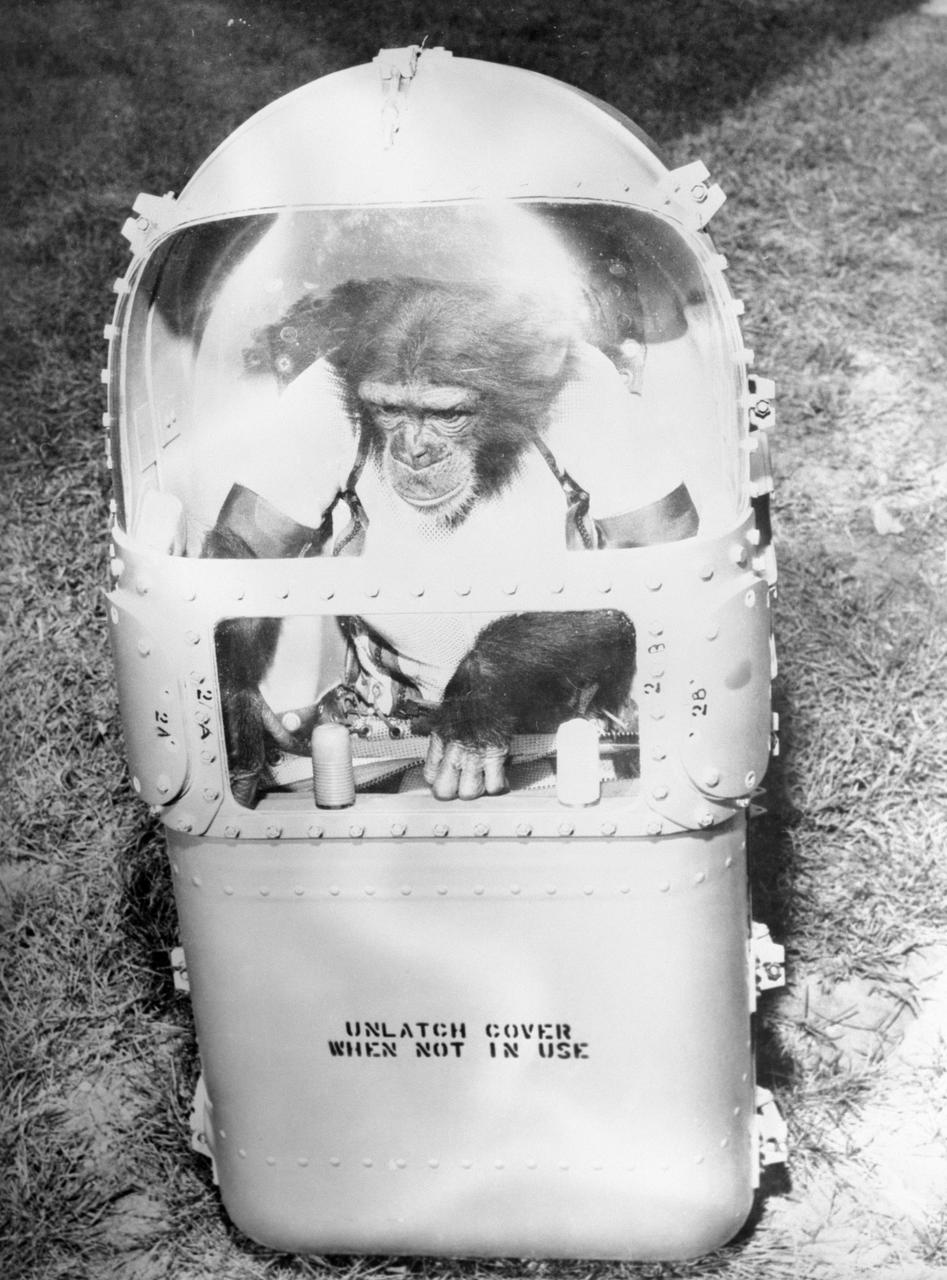
Morpheus Trailered to the SLF
CAPE CANAVERAL, Fla. –David Voci, NYIT MOCAP (Motion Capture) team co-director (seated at the workstation in the background) prepares to direct a motion capture session assisted by Kennedy Advanced Visualizations Environment staff led by Brad Lawrence (not pictured) and by Lora Ridgwell from United Space Alliance Human Factors (foreground, left). Ridgwell will help assemble the Orion Crew Module mockup. The motion tracking aims to improve efficiency of assembly processes and identify potential ergonomic risks for technicians assembling the mockup. The work is being performed in United Space Alliance's Human Engineering Modeling and Performance Lab in the RLV Hangar at NASA's Kennedy Space Center. Part of NASA's Constellation Program, the Orion spacecraft will return humans to the moon and prepare for future voyages to Mars and other destinations in our solar system.
KSC-08pd1900
NASA’s Virtual Glovebox (VGX) was developed to allow astronauts on Earth to train for complex biology research tasks in space.  The astronauts may reach into the virtual environment, naturally manipulating specimens, tools, equipment, and accessories in a simulated microgravity environment as they would do in space.  Such virtual reality technology also provides engineers and space operations staff with rapid prototyping, planning, and human performance modeling capabilities.  Other Earth based applications being explored for this technology include biomedical procedural training and training for disarming bio-terrorism weapons.
Space Science
Apollo 8 astronaut Jim Lovell shakes hands with NASA Administrator Jim Bridenstine after being introduced during the Smithsonian National Air and Space Museum's Spirit of Apollo event commemorating the 50th anniversary of Apollo 8, Tuesday, Dec. 11, 2018 at the Washington National Cathedral in Washington, DC. Apollo 8 was humanity's first journey to another world, taking astronauts Frank Borman, Jim Lovell, and William Anders to the Moon and back in December of 1968. Photo Credit: (NASA/Joel Kowsky)
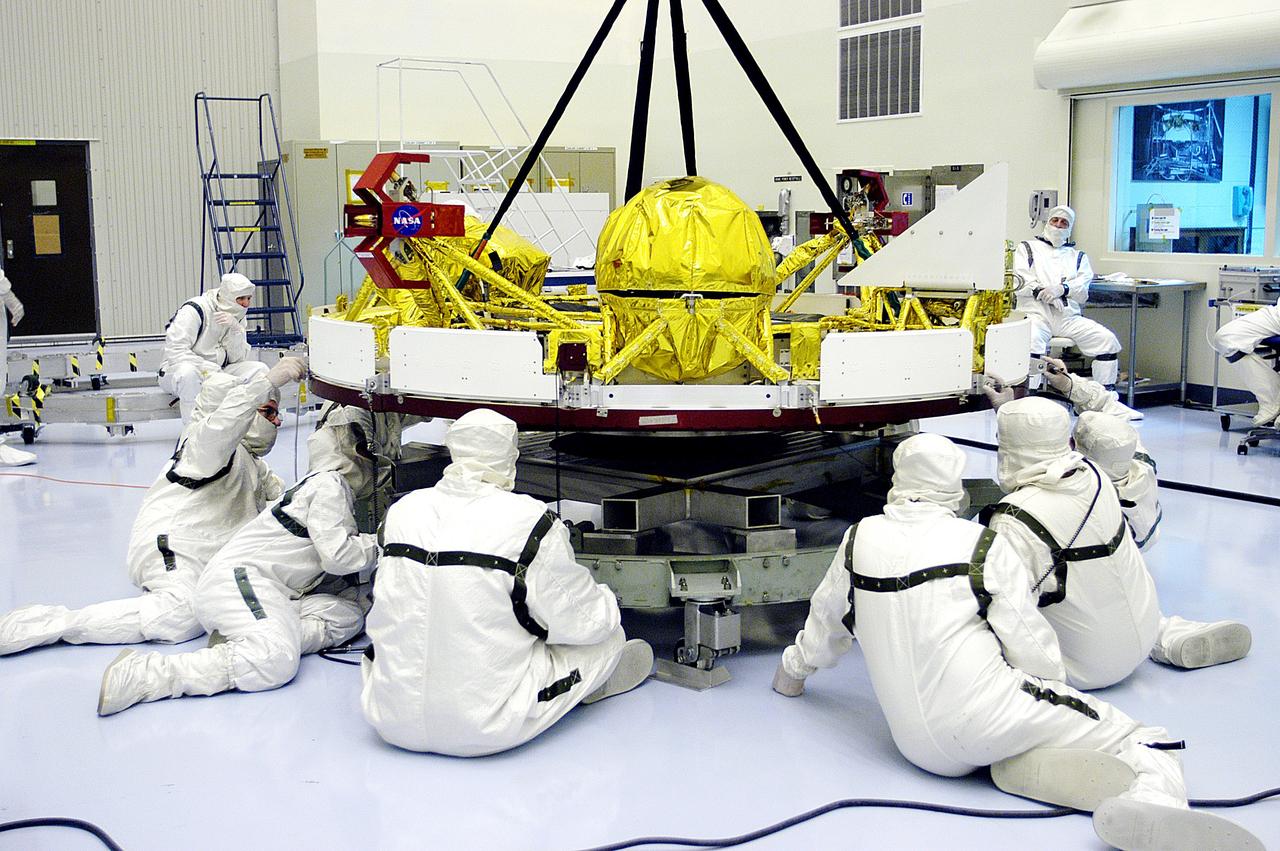
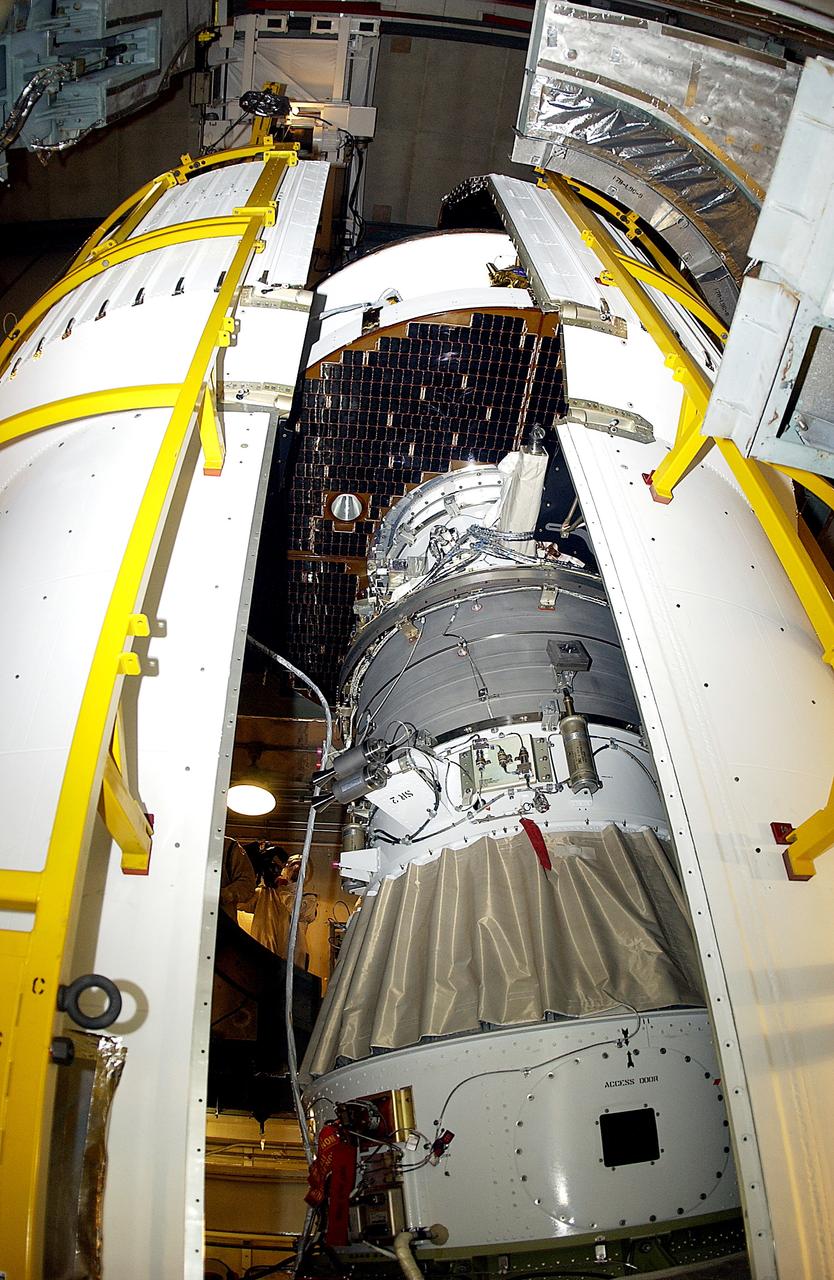
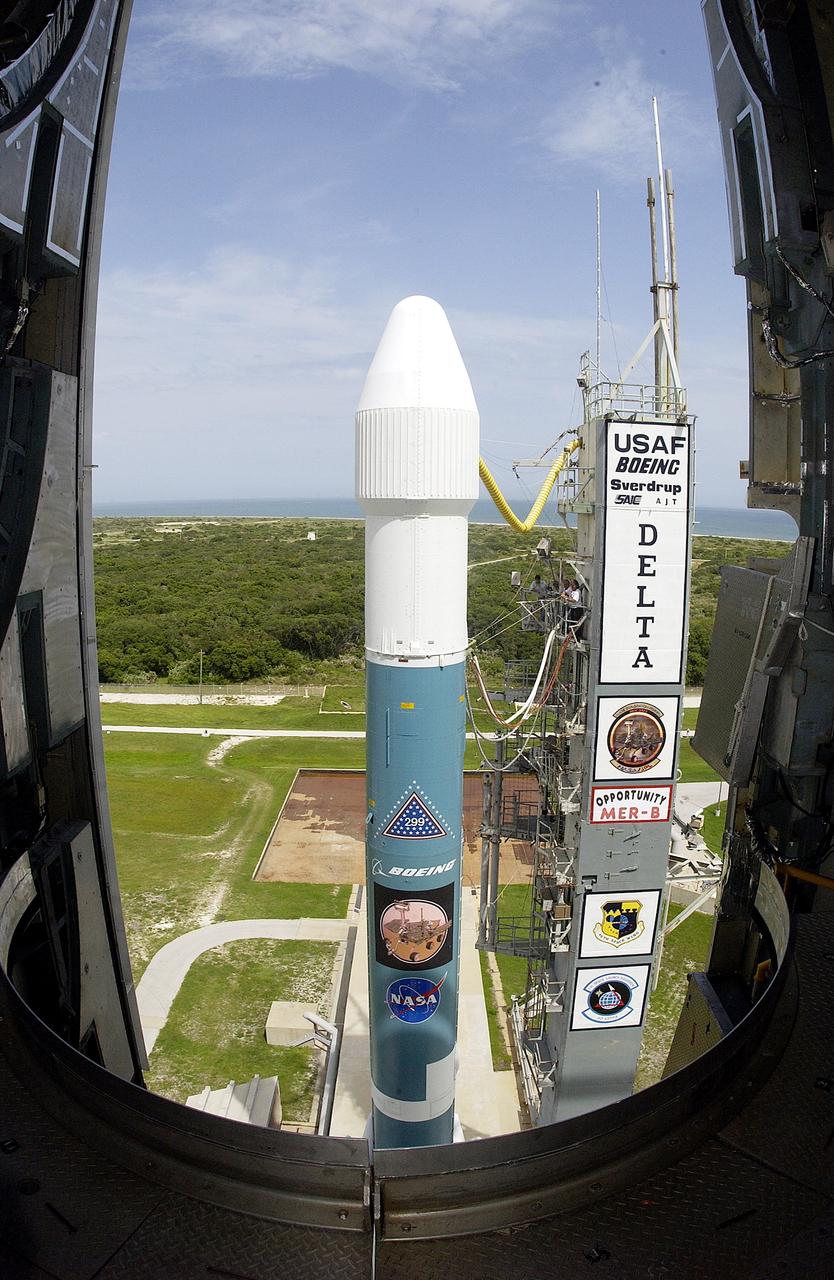
Spirit of Apollo: 50th Anniversary of Apollo 8
During a tour of SpaceX headquarters in Hawthorne, California, commercial crew astronauts Suni Williams, left, and Doug Hurley participate in joint test team training using mockup components of the Crew Dragon on Feb. 23, 2017. Crew Dragon is being developed and manufactured in partnership with NASA's Commercial Crew Program to return human spaceflight capabilities to the U.S.
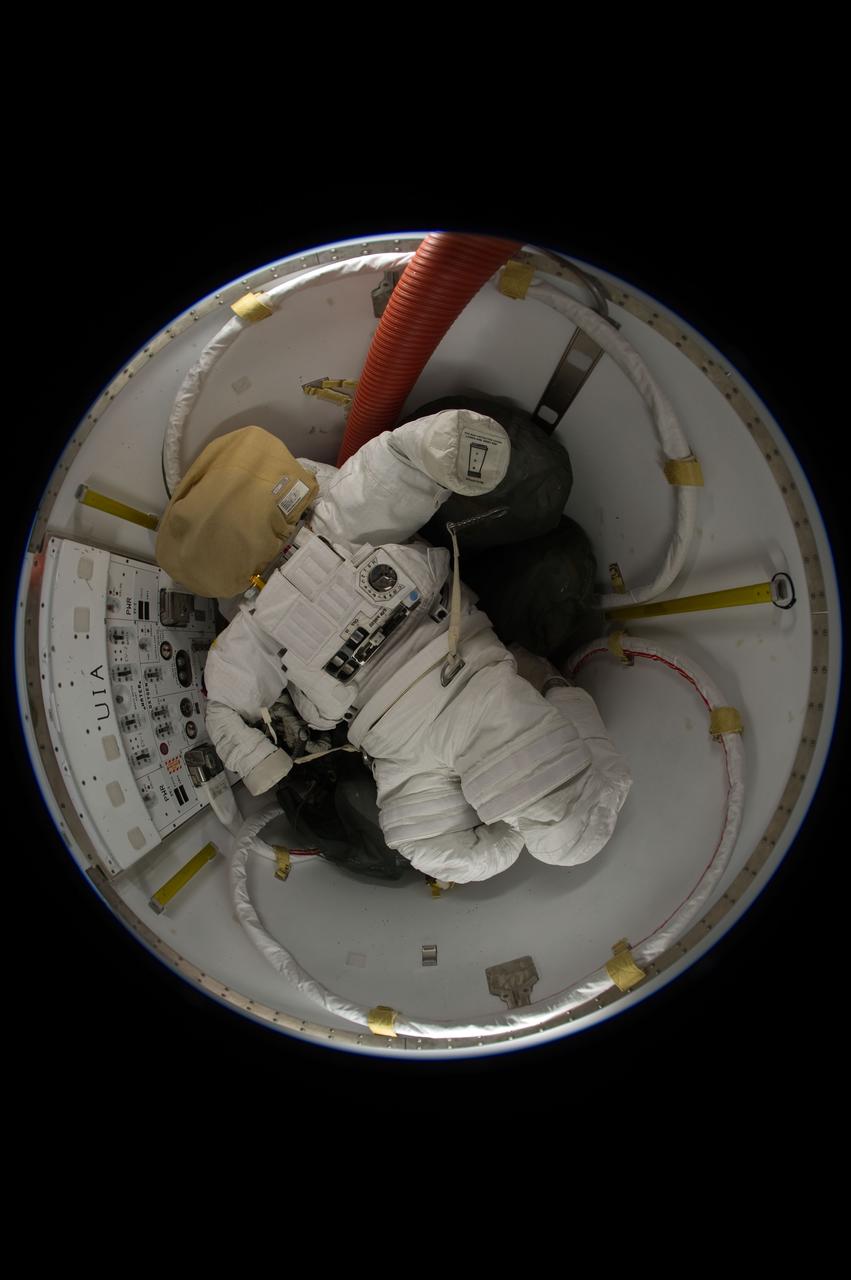
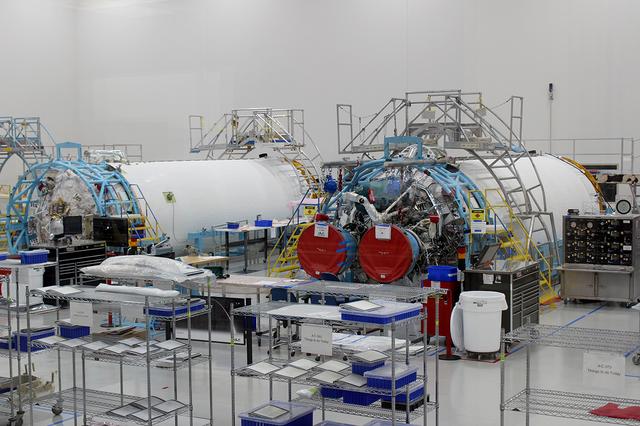
Cadre Photos for Joint Test Team Feature
iss072e629194 (Feb. 18, 2025) --- NASA astronaut and Expedition 72 Flight Engineer Nick Hague works in a portable glovebag and cleans pumps, replaces components, and installs bio-ink syringes inside the BioFabrication Facility being tested for its capability to print biological, or organ-like, tissues in space and learn how to eventually fabricate human organs off the Earth.
Astronaut Nick Hague replaces components inside the BioFabrication Facility
In a news conference broadcast live on NASA TV, key NASA leaders discussed the significance of the successful 500-second test of the agency's new J-2X rocket engine at Stennis Space Center on Nov. 9. The engine will provide upper-stage power for NASA's new Space Launch System being developed to carry humans deeper into space than ever before. Participating in the session were: (l to r) Dan Kanigan, Dan Dumbacher, Joan 'Jody' Singer, Stennis Director Patrick Scheuermann and Mike Kynard.
NASA news conference
KENNEDY SPACE CENTER, FLA.  -  In the KSC Space Life Sciences Lab’s Resource Recovery lab, bioengineer Tony Rector checks the ARMS reactor vessel.  ARMS, or Aerobic Rotational Membrane System, is a wastewater processing project being tested for use on the International Space Station to collect, clean and reuse wastewater.  It could be adapted for use on the Moon and Mars.   The Lab is exploring various aspects of a bioregenerative life support system. Such research and technology development will be crucial to long-term habitation of space by humans.
KSC-04pd1309
NASA astronaut Barry "Butch" Wilmore, center, tours Boeing's Commercial Crew and Cargo Processing Facility (C3PF) on Oct. 25, 2018, at NASA's Kennedy Space Center in Florida. Boeing's CST-100 Starliner will launch on its first uncrewed flight test on a United Launch Alliance Atlas V rocket. The Starliner is being developed and manufactured in partnership with NASA's Commercial Crew Program to return human spaceflight capabilities to the U.S.
CCP Astronauts Butch Tour
Construction of the A-3 Test Stand at Stennis Space Center continued June 8 with installation of a 35,000-gallon liquid oxygen tank atop the steel structure. The stand is being built to test next-generation rocket engines that will carry humans into deep space once more. The LOX tank and a liquid hydrogen tank to be installed atop the stand later will provide propellants for testing the engines. The A-3 Test Stand is scheduled for completion and activation in 2013.
LOX tank installation
NASA engineers continued to collect test performance data on the new J-2X rocket engine at Stennis Space Center with a 250-second test Sept. 14. The test on the A-2 Test Stand was the 19th in a series of firings to gather critical data for continued development of the engine. The J-2X is being developed by Pratt and Whitney Rocketdyne for NASA's Marshall Space Flight Center in Huntsville, Ala. It is the first liquid oxygen and liquid hydrogen rocket engine rated to carry humans into space to be developed in 40 years.
J-2X engine
iss053e215867 (Nov. 20, 2017) --- The EcAMSat, short for E. coli AntiMicrobial Satellite, is seen moments after being ejected from the NanoRacks CubeSat Deployer attached to the outside of Kibo laboratory module from the Japan Aerospace Exploration Agency. The E. coli AntiMicrobial Satellite (EcAMSat) mission will investigate space microgravity effects on the antibiotic resistance of E. coli, a bacterial pathogen responsible for urinary tract infection in humans and animals.
iss053e215867
Year 2015 got off to a blazing start as NASA conducted its first test of an RS-25 rocket engine on the A-1 Test Stand at Stennis Space Center on Jan. 9, 2015. The 500-second test provided critical data on engine performance. RS-25 engines will help power the core stage of NASA’s new Space Launch System vehicle, being developed to carry humans deeper into space than ever before.
Lighting up the Night
ISS031-E-122199 (14 June 2012 --- A NASA  extravehicular mobility unit (EMU) spacesuit  is seen in the crew lock of the International Space Station's Quest airlock, as photographed by one of the Expedition 31 crew members on June 14, 2012. The next time a human being will be wearing an EMU outside the station is scheduled to come sometime in August.
iss031e122199
The United Launch Alliance (ULA) Crew Flight Test dual engine, at left, and the Orbital Flight test dual engine, at right, for the Centaur stage of the Atlas V rocket are in production on June 11, 2018, at ULA's factory in Decatur, Alabama. Boeing's CST-100 Starliner will launch on its first uncrewed flight test on the ULA Atlas V rocket. The Starliner is being developed and manufactured in partnership with NASA's Commercial Crew Program to return human spaceflight capabilities to the U.S.
Boeing CST-100 Starliner Crew Flight Test (CFT) and Orbital Flig
During a tour of SpaceX headquarters in Hawthorne, California, commercial crew astronauts Bob Behnken, left, and Eric Boe participate in joint test team training using mockup components of the Crew Dragon on Feb. 23, 2017. Crew Dragon is being developed and manufactured in partnership with NASA's Commercial Crew Program to return human spaceflight capabilities to the U.S.
Cadre Photos for Joint Test Team Feature