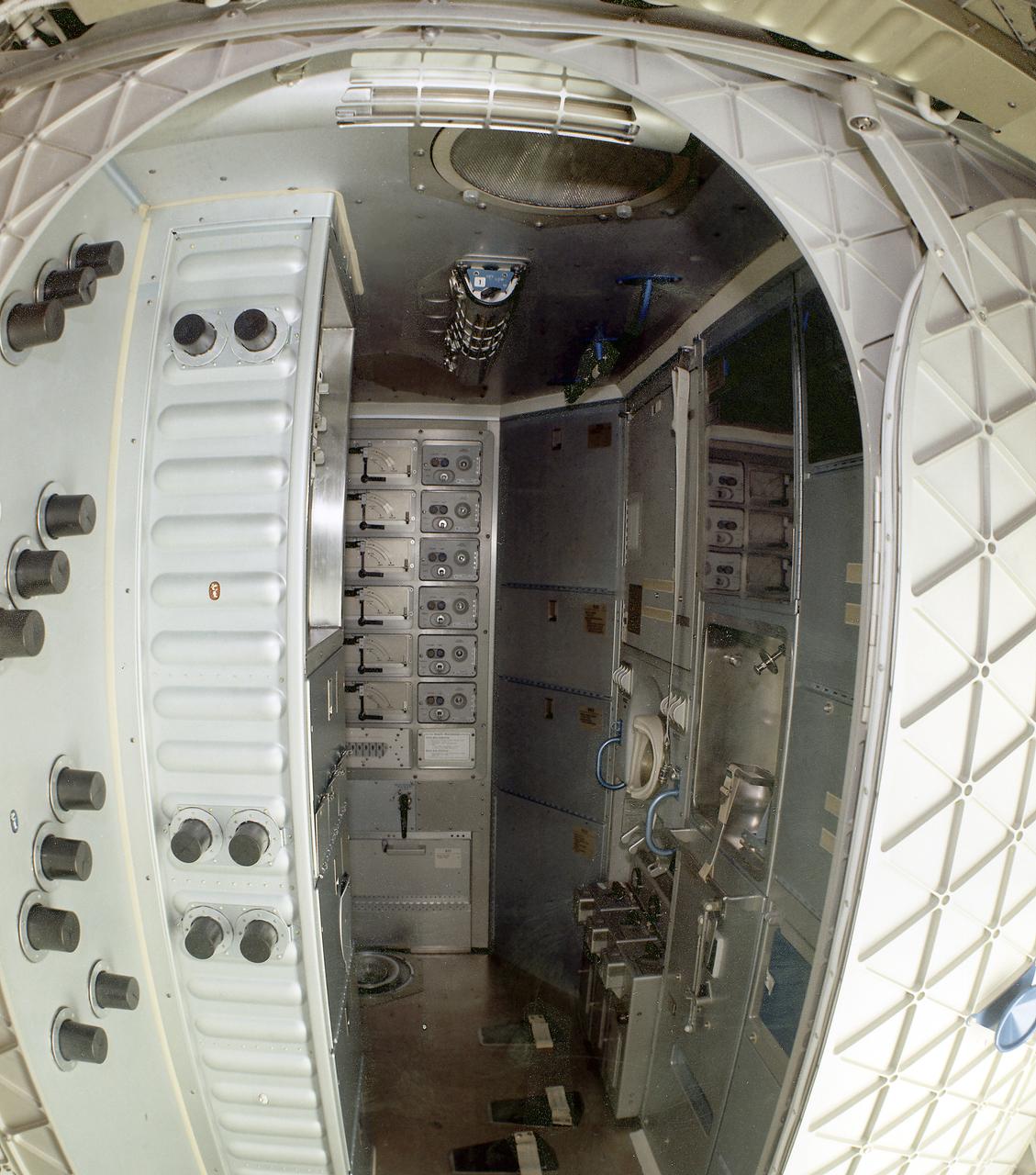
This image is a wide-angle view of the Orbital Workshop waste management compartment. The waste management facilities presented a unique challenge to spacecraft designers. In addition to collection of liquid and solid human wastes, there was a medical requirement to dry all solid human waste products and to return the residue to Earth for examination. Liquid human waste (urine) was frozen for return to Earth. Total quantities of each astronaut's liquid and solid wastes were precisely measured. Cabin air was drawn into the toilet, shown on the wall at right in this photograph, and over the waste products to generate a flow of the waste in the desired direction. The air was then filtered for odor control and antiseptic purposes prior to being discharged back into the cabin.
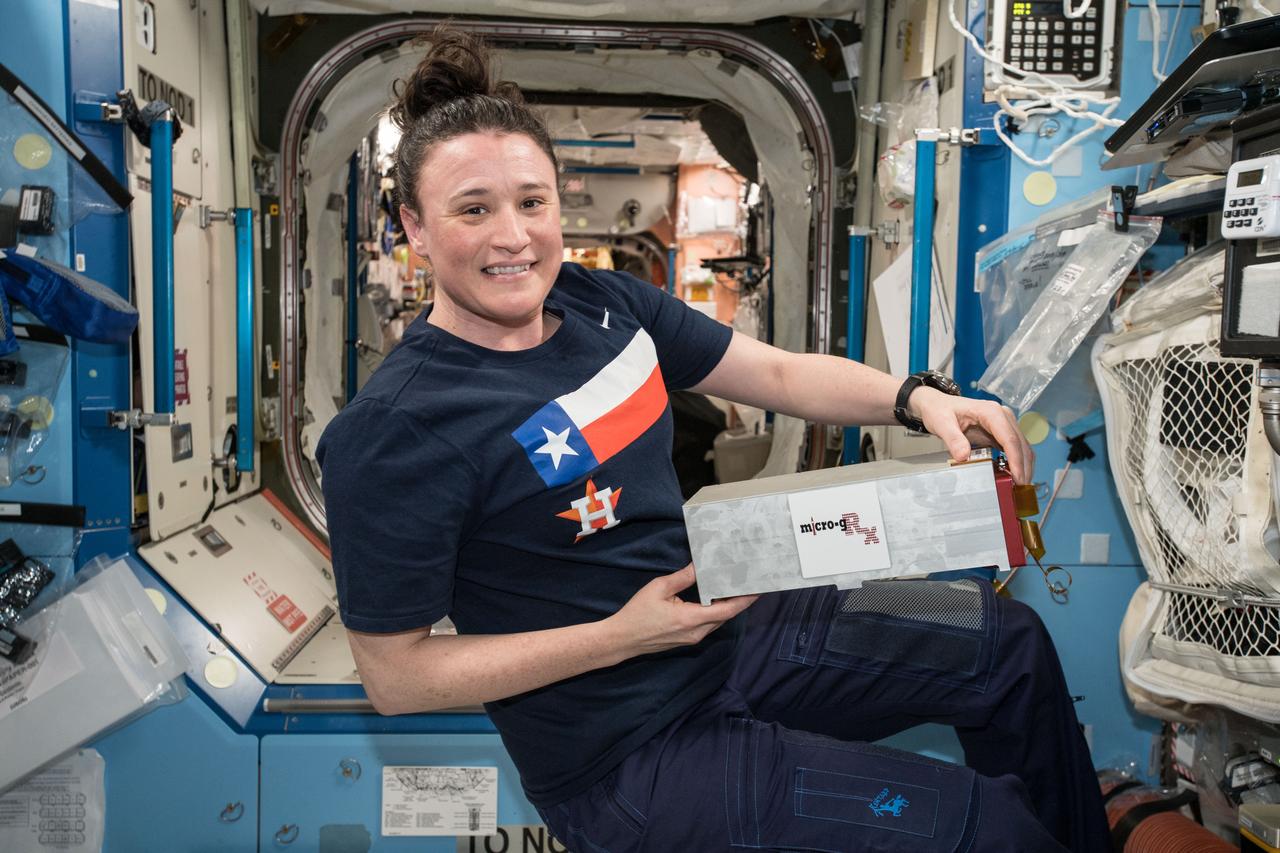
iss057e105708 (11/24/2018) --- A view of NASA astronaut Serena Auñón-Chancellor holding the Microg-Rx CubeLab. The Culturing of Human Myocytes in Microgravity: An In Vitro Model to Evaluate Therapeutics to Counteract Muscle Wasting (Culturing of Human Myocytes in Microgravity) experiment aims to better understand muscle growth and repair in microgravity. Muscle wasting occurs in people on Earth with cancer, HIV/AIDS, heart failure, rheumatoid arthritis, chronic obstructive pulmonary disease, and sarcopenia (age-related muscle loss). This investigation may support development of countermeasures and treatments for muscle wasting from these conditions.
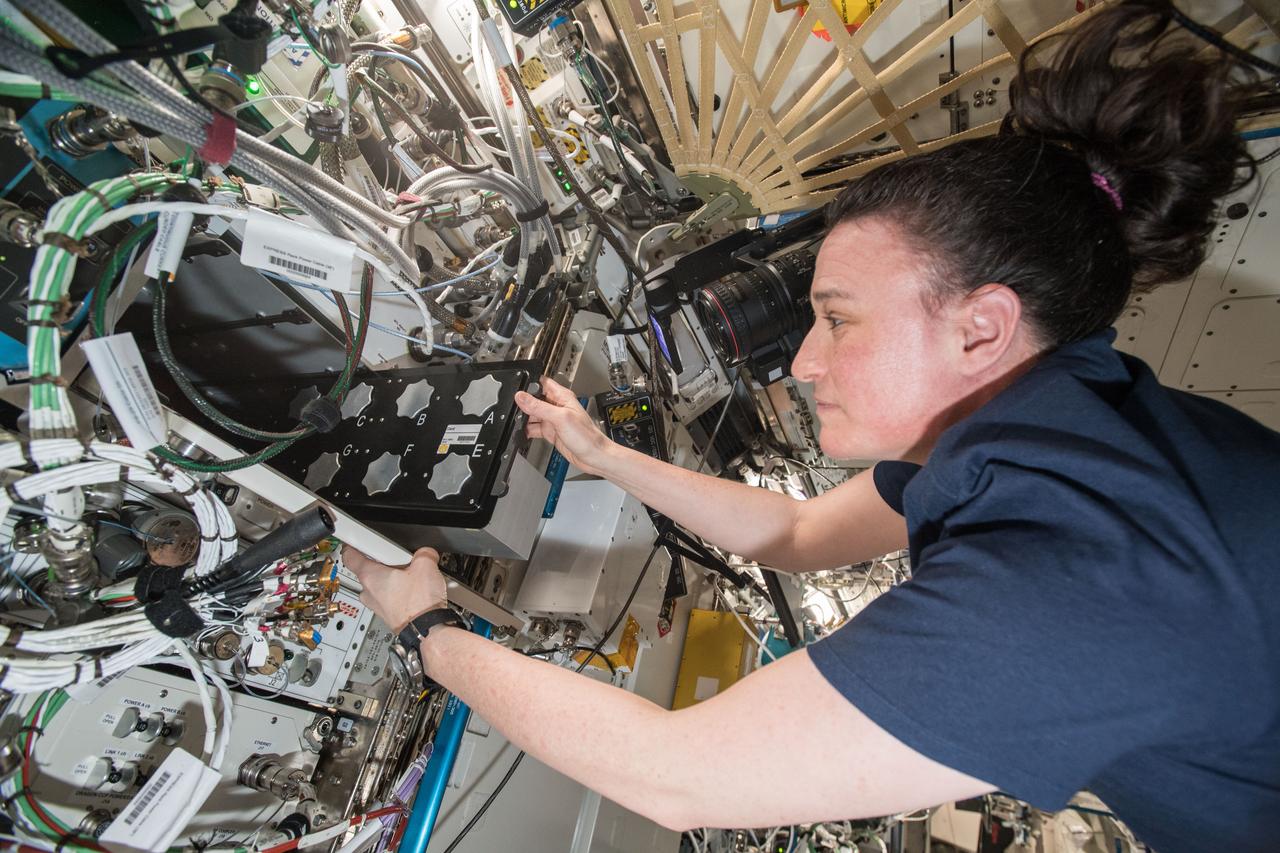
iss057e105719 (11/24/2018) --- A view of NASA astronaut Serena Auñón-Chancellor inserting the Microg-Rx CubeLab into the TangoLab facility. The Culturing of Human Myocytes in Microgravity: An In Vitro Model to Evaluate Therapeutics to Counteract Muscle Wasting (Culturing of Human Myocytes in Microgravity) experiment aims to better understand muscle growth and repair in microgravity. Muscle wasting occurs in people on Earth with cancer, HIV/AIDS, heart failure, rheumatoid arthritis, chronic obstructive pulmonary disease, and sarcopenia (age-related muscle loss). This investigation may support development of countermeasures and treatments for muscle wasting from these conditions.
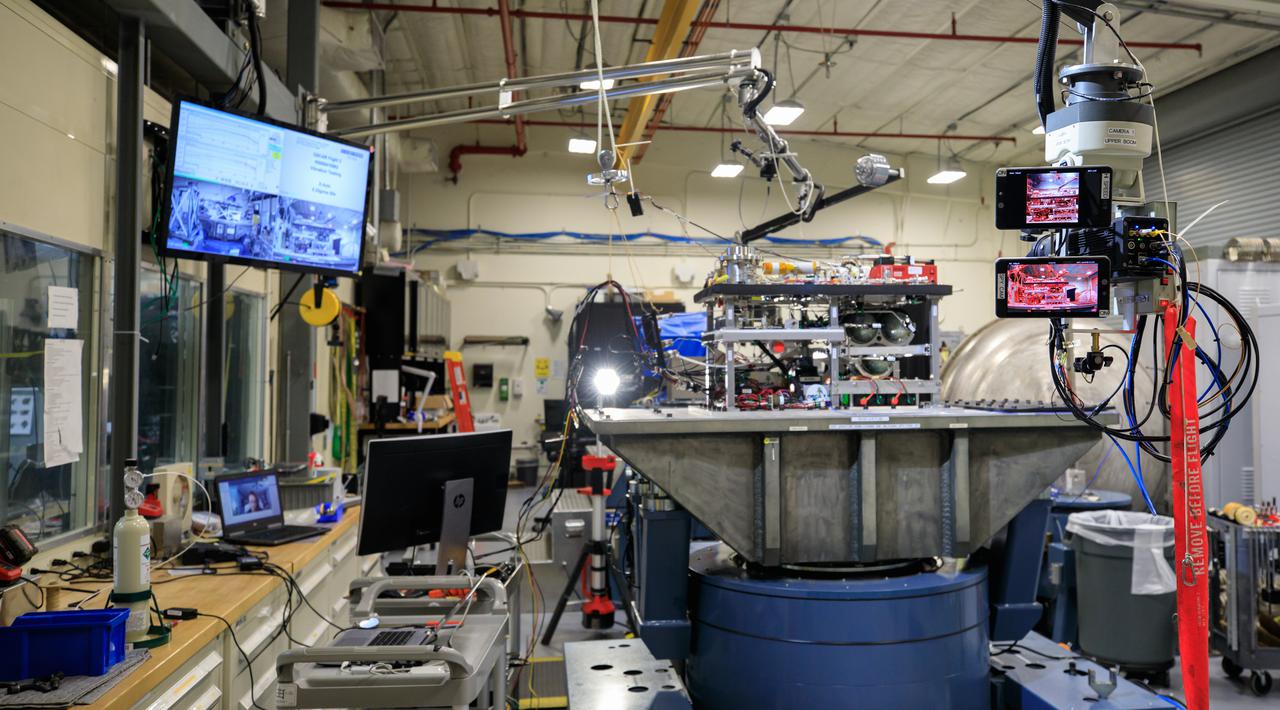
NASA’s Orbital Syngas Commodity Augmentation Reactor, or OSCAR, undergoes vibration testing inside the Vibration Test Lab at the agency’s Kennedy Space Center in Florida on Jan. 14, 2021. The tests are part of ongoing preparation for a scheduled suborbital flight test later this year. Beginning as an Early Career Initiative project, OSCAR studies technology to convert trash and human waste into useful gasses such as methane, hydrogen, and carbon dioxide. By processing small pieces of trash in a high-temperature reactor, OSCAR would reduce the amount of space needed for waste storage within a spacecraft, turn some waste into gasses that have energy storage and life support applications, and ensure waste is no longer biologically active.
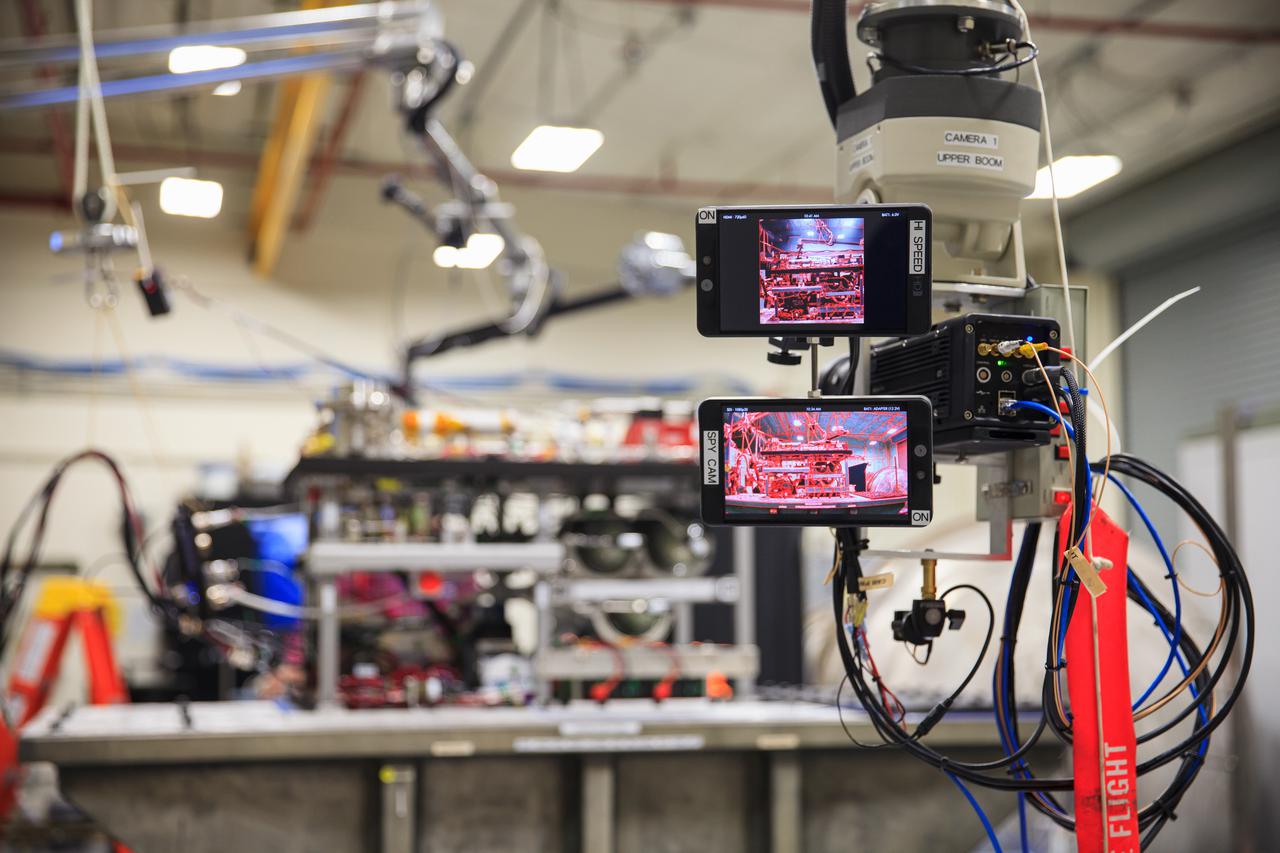
NASA’s Orbital Syngas Commodity Augmentation Reactor, or OSCAR, undergoes vibration testing inside the Vibration Test Lab at the agency’s Kennedy Space Center in Florida on Jan. 14, 2021, in preparation for a scheduled suborbital flight later this year. Beginning as an Early Career Initiative project, OSCAR studies technology to convert trash and human waste into useful gasses such as methane, hydrogen, and carbon dioxide. By processing small pieces of trash in a high-temperature reactor, OSCAR would reduce the amount of space needed for waste storage within a spacecraft, turn some waste into gasses that have energy storage and life support applications, and ensure waste is no longer biologically active.
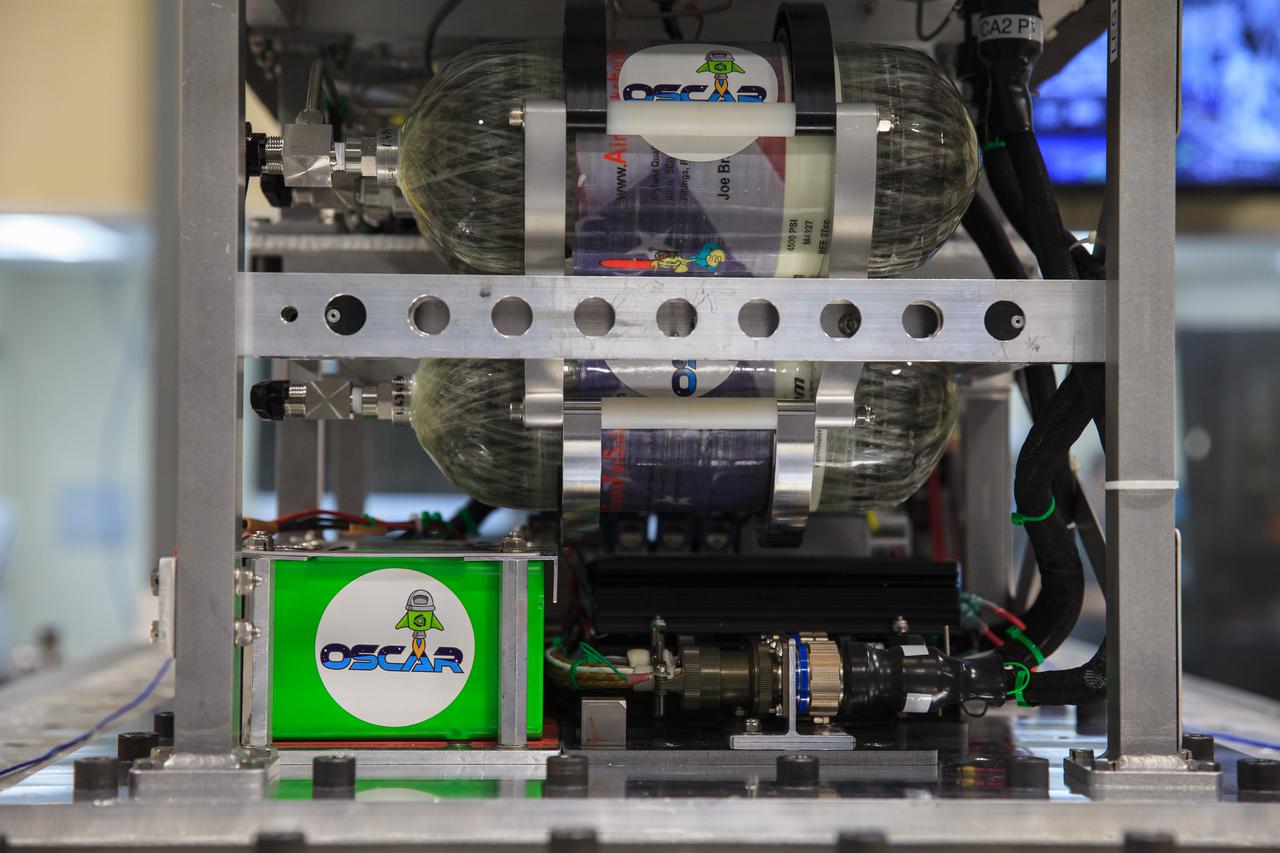
NASA’s Orbital Syngas Commodity Augmentation Reactor, or OSCAR, undergoes vibration testing inside the Vibration Test Lab at the agency’s Kennedy Space Center in Florida on Jan. 14, 2021. The tests are part of ongoing preparation for a scheduled suborbital flight test later this year. Beginning as an Early Career Initiative project, OSCAR studies technology to convert trash and human waste into useful gasses such as methane, hydrogen, and carbon dioxide. By processing small pieces of trash in a high-temperature reactor, OSCAR would reduce the amount of space needed for waste storage within a spacecraft, turn some waste into gasses that have energy storage and life support applications, and ensure waste is no longer biologically active.
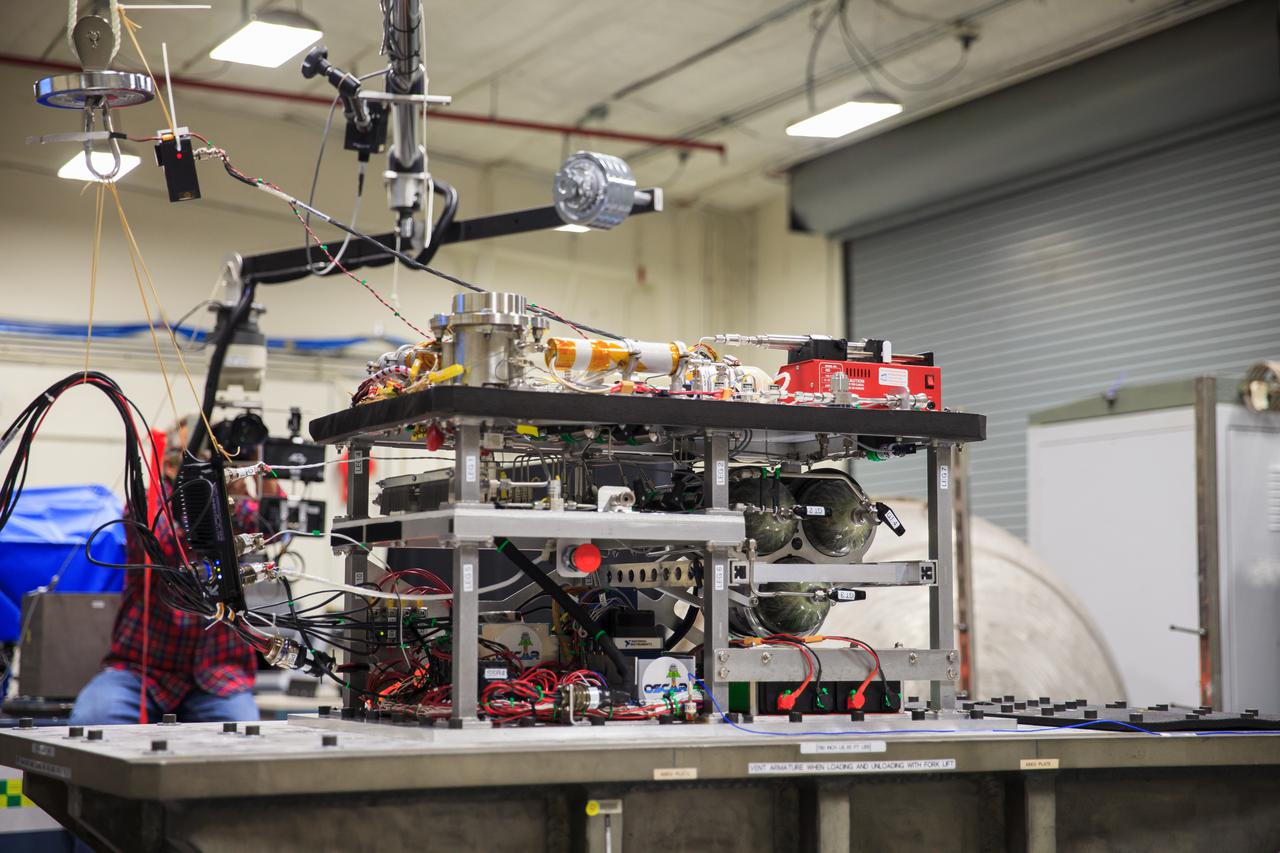
NASA’s Orbital Syngas Commodity Augmentation Reactor, or OSCAR, undergoes vibration testing inside the Vibration Test Lab at the agency’s Kennedy Space Center in Florida on Jan. 14, 2021, in preparation for a scheduled suborbital flight later this year. Beginning as an Early Career Initiative project, OSCAR studies technology to convert trash and human waste into useful gasses such as methane, hydrogen, and carbon dioxide. By processing small pieces of trash in a high-temperature reactor, OSCAR would reduce the amount of space needed for waste storage within a spacecraft, turn some waste into gasses that have energy storage and life support applications, and ensure waste is no longer biologically active.
Inside the Vibration Test Lab at NASA’s Kennedy Space Center in Florida, the agency’s Orbital Syngas Commodity Augmentation Reactor (OSCAR) undergoes vibration testing on Jan. 14, 2021, in preparation for a scheduled suborbital flight test later this year. Beginning as an Early Career Initiative project, OSCAR studies technology to convert trash and human waste into useful gasses such as methane, hydrogen, and carbon dioxide. By processing small pieces of trash in a high-temperature reactor, OSCAR would reduce the amount of space needed for waste storage within a spacecraft, turn some waste into gasses that have energy storage and life support applications, and ensure waste is no longer biologically active.
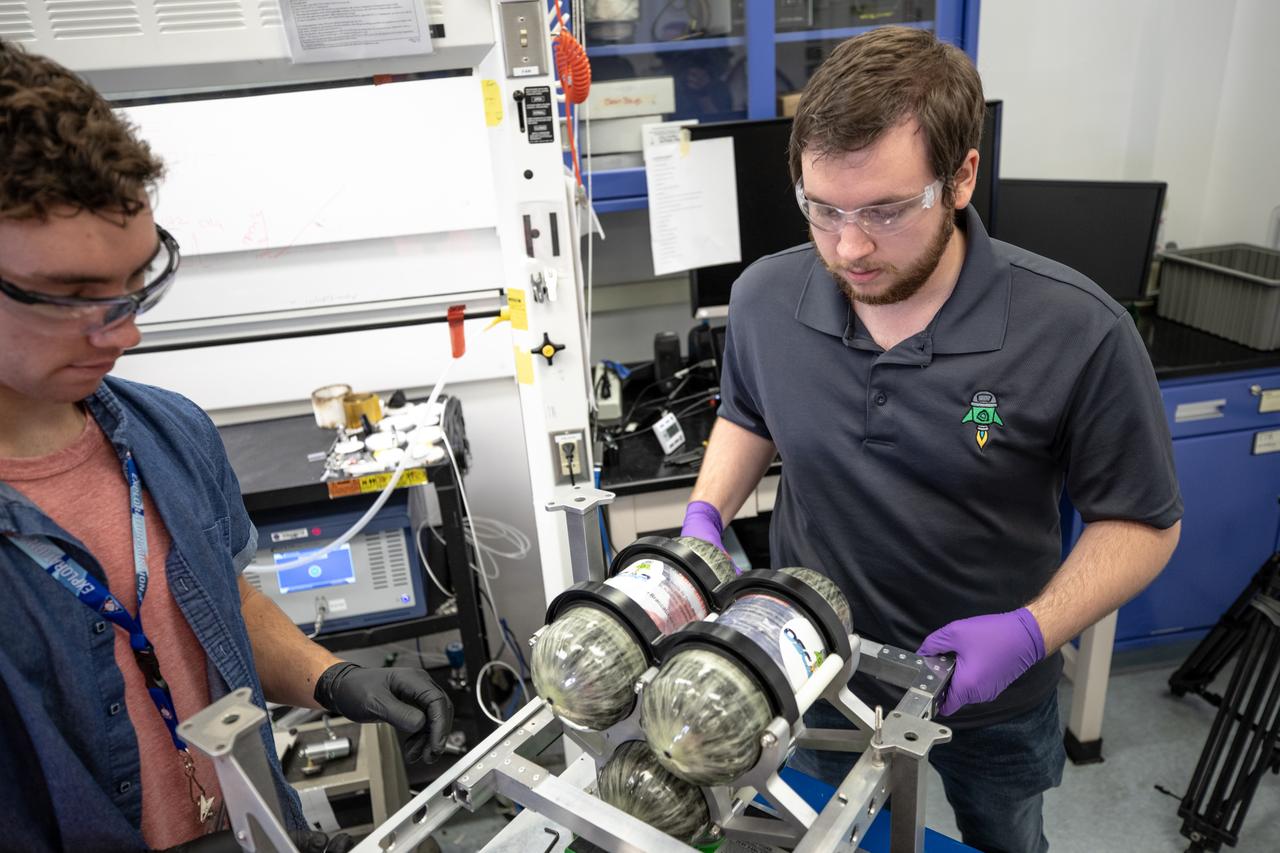
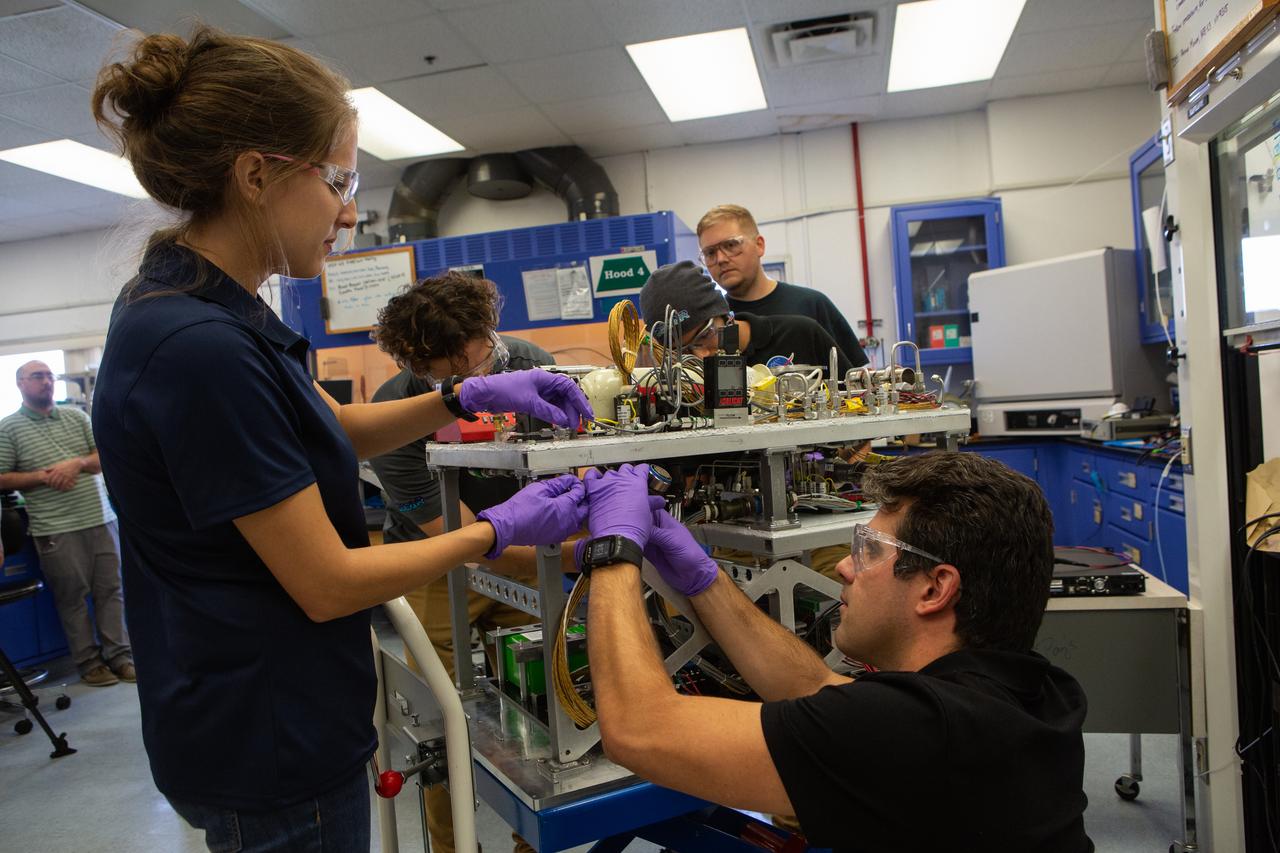
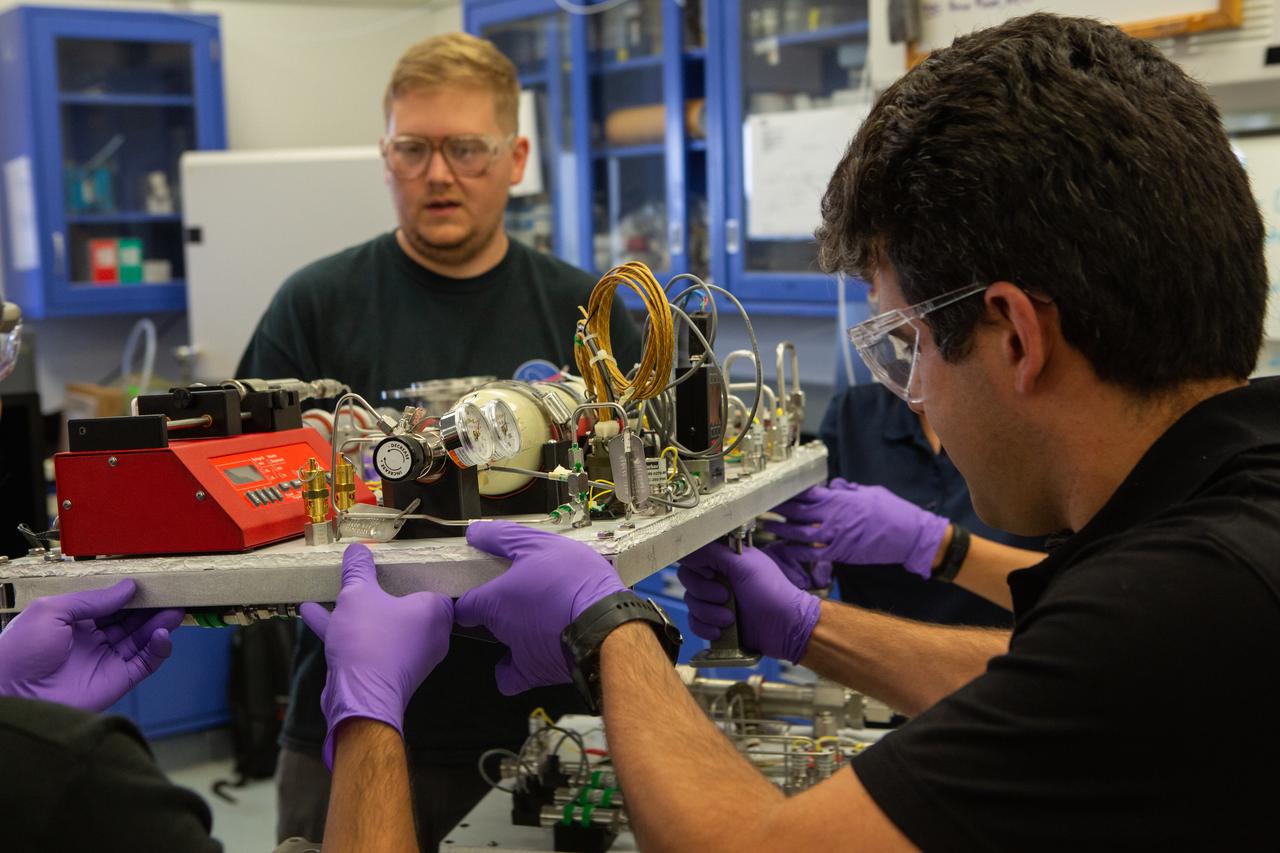
Kennedy Space Center employee Jonathan Gleeson (right) and Kennedy intern Patrick Follis assemble the flight hardware of NASA’s Orbital Syngas Commodity Augmentation Reactor, or OSCAR. OSCAR is an Early Career Initiative project at the Florida spaceport that studies technology to convert trash and human waste into useful gasses such as methane, hydrogen and carbon dioxide. By processing small pieces of trash in a high-temperature reactor, OSCAR is advancing new and innovative technology for managing waste in space. OSCAR would reduce the amount of space needed for waste storage within a spacecraft, turn some waste into gasses that have energy storage and life support applications, and ensure waste is no longer biologically active. A prototype has been developed, and a team of Kennedy employees are in the process of constructing a new rig for suborbital flight testing.
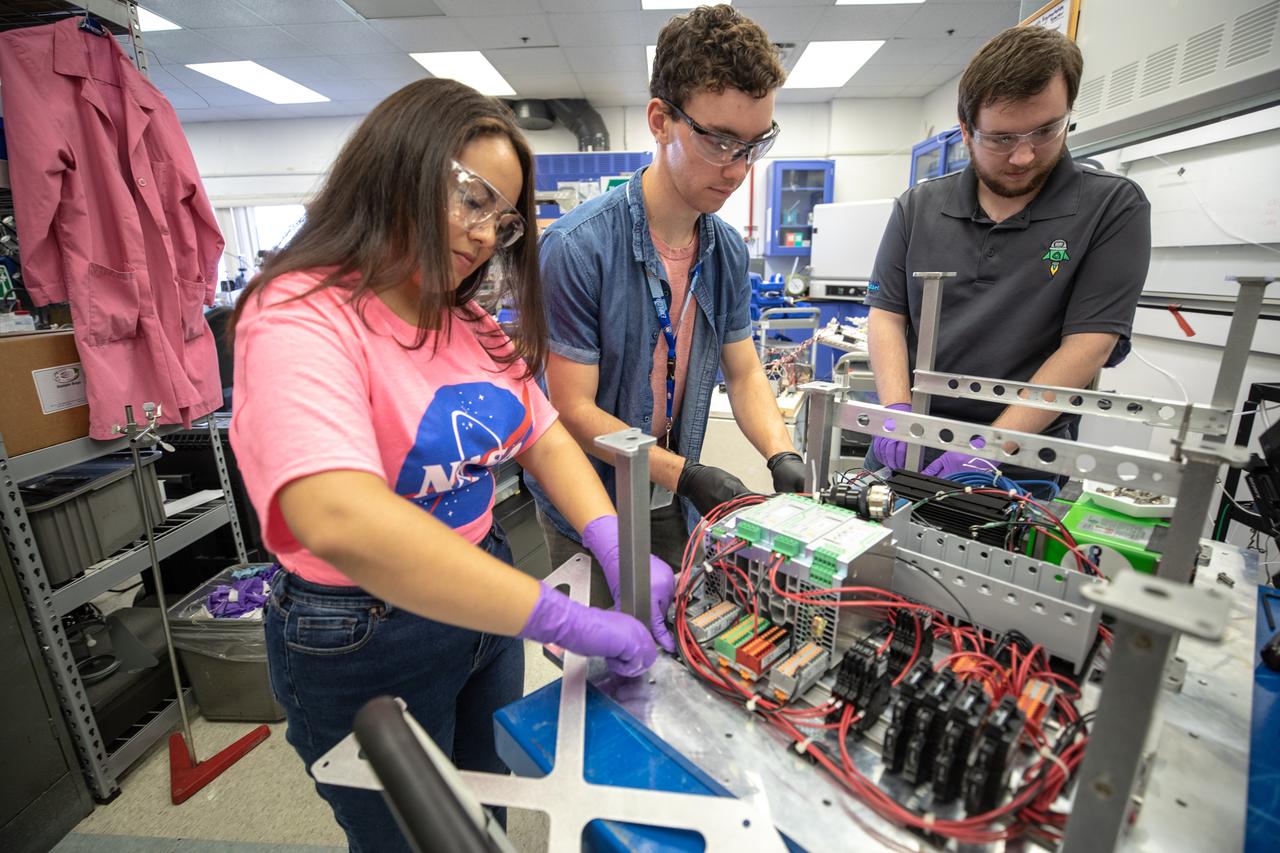
From left, Kennedy Space Center interns Brianna Sandoval and Patrick Follis, and Kennedy employee Jonathan Gleeson assemble the flight hardware of NASA’s Orbital Syngas Commodity Augmentation Reactor, or OSCAR. OSCAR is an Early Career Initiative project at the Florida spaceport that studies technology to convert trash and human waste into useful gasses such as methane, hydrogen and carbon dioxide. By processing small pieces of trash in a high-temperature reactor, OSCAR is advancing new and innovative technology for managing waste in space. OSCAR would reduce the amount of space needed for waste storage within a spacecraft, turn some waste into gasses that have energy storage and life support applications, and ensure waste is no longer biologically active. A prototype has been developed, and a team of Kennedy employees are in the process of constructing a new rig for suborbital flight testing.
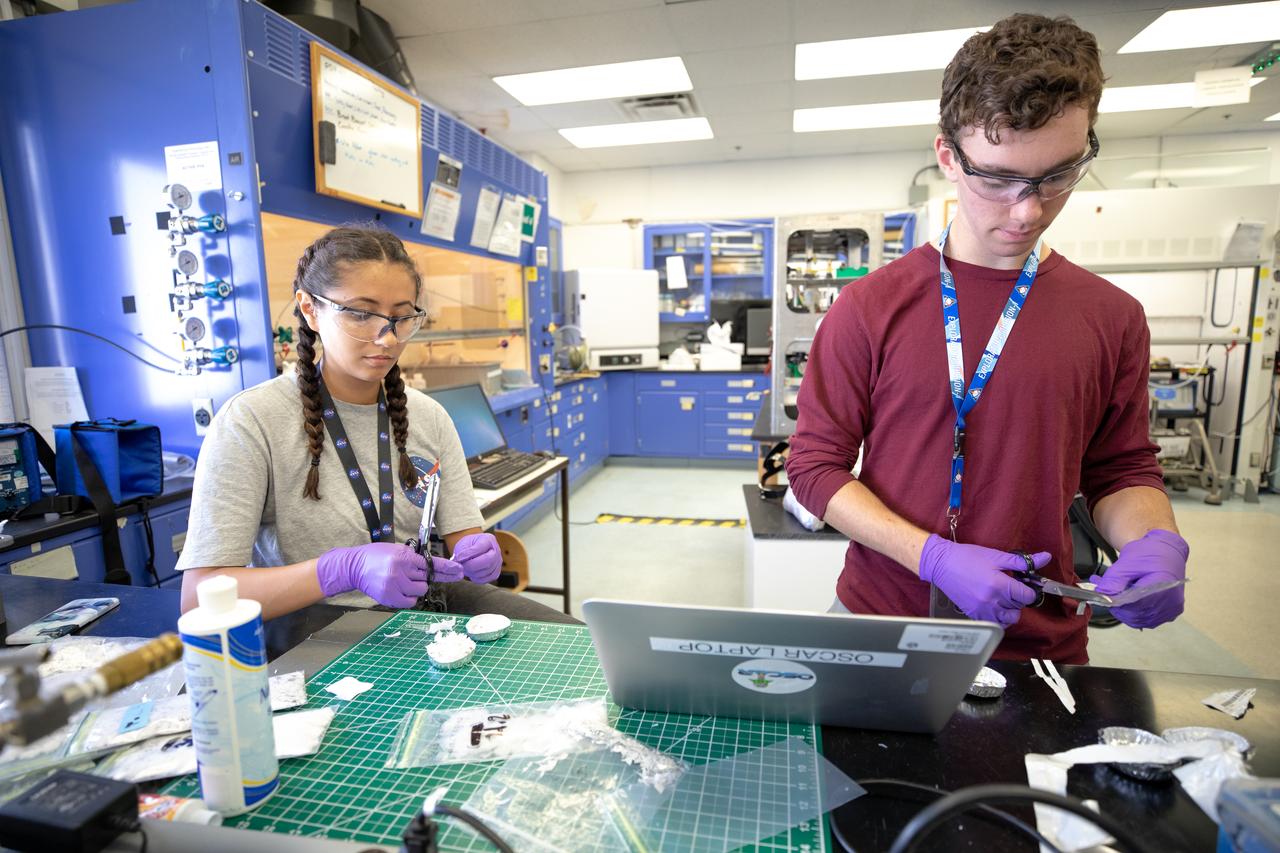
From left, interns Isabella Aviles and Patrick Follis at NASA’s Kennedy Space Center in Florida cut up different types of material for the agency’s Orbital Syngas Commodity Augmentation Reactor, or OSCAR, to use as a trash simulant during microgravity testing. OSCAR is an Early Career Initiative project at the spaceport that studies technology to convert trash and human waste into useful gasses such as methane, hydrogen and carbon dioxide. By processing small pieces of trash in a high-temperature reactor, OSCAR is advancing new and innovative technology for managing waste in space. OSCAR would reduce the amount of space needed for waste storage within a spacecraft, turn some waste into gasses that have energy storage and life support applications, recover water from trash and ensure waste is no longer biologically active. A prototype has been developed, and a team of Kennedy employees are in the process of constructing a new rig for suborbital flight testing.
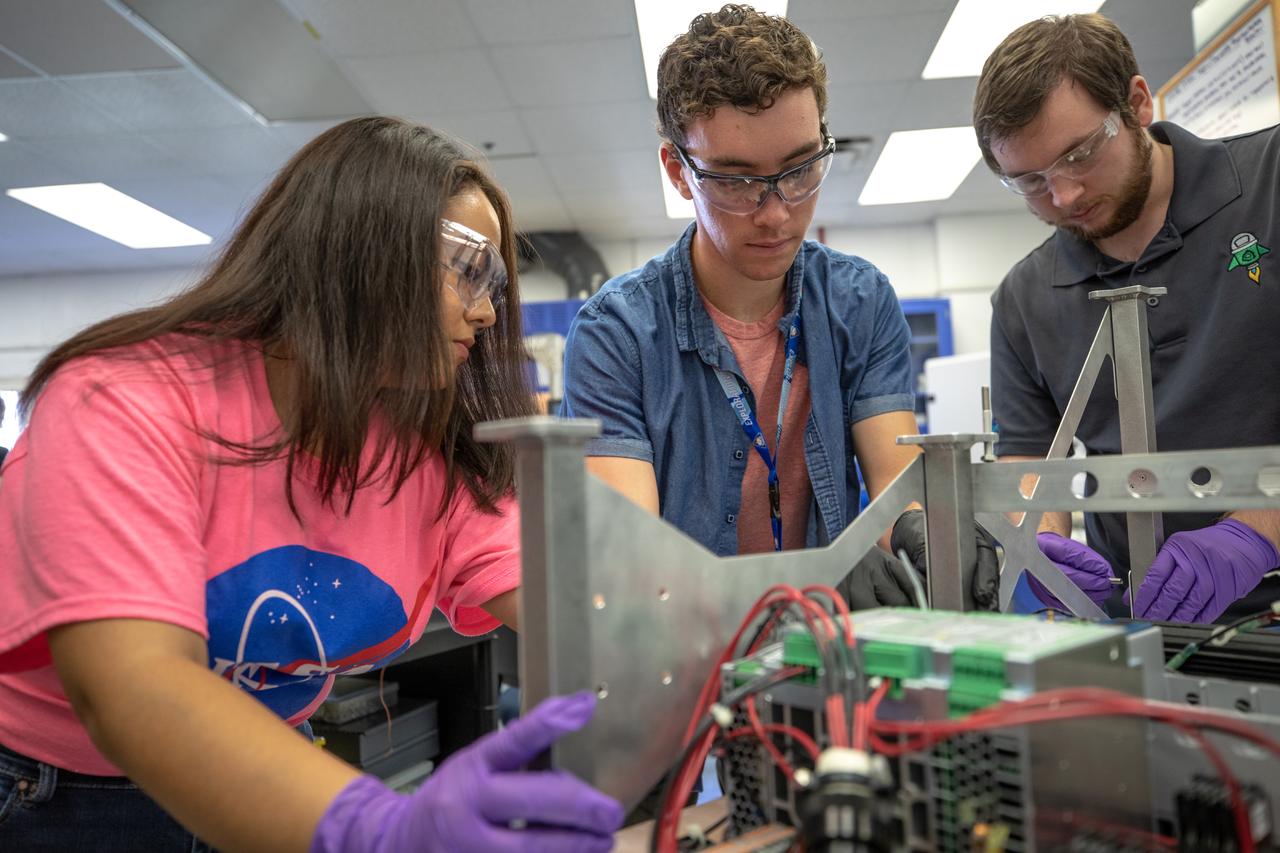
From left, Kennedy Space Center interns Brianna Sandoval and Patrick Follis, and Kennedy employee Jonathan Gleeson assemble the flight hardware of NASA’s Orbital Syngas Commodity Augmentation Reactor, or OSCAR. OSCAR is an Early Career Initiative project at the Florida spaceport that studies technology to convert trash and human waste into useful gasses such as methane, hydrogen and carbon dioxide. By processing small pieces of trash in a high-temperature reactor, OSCAR is advancing new and innovative technology for managing waste in space. OSCAR would reduce the amount of space needed for waste storage within a spacecraft, turn some waste into gasses that have energy storage and life support applications, and ensure waste is no longer biologically active. A prototype has been developed, and a team of Kennedy employees are in the process of constructing a new rig for suborbital flight testing.

NASA’s Orbital Syngas Commodity Augmentation Reactor, or OSCAR, is being prepared for suborbital flight testing at the agency’s Kennedy Space Center in Florida. OSCAR is an Early Career Initiative project at the spaceport that studies technology to convert trash and human waste into useful gasses such as methane, hydrogen and carbon dioxide. By processing small pieces of trash in a high-temperature reactor, OSCAR is advancing new and innovative technology for managing waste in space. OSCAR would reduce the amount of space needed for waste storage within a spacecraft, turn some waste into gasses that have energy storage and life support applications, and ensure waste is no longer biologically active. A prototype has been developed, and a team of Kennedy employees are in the process of constructing a new rig for the suborbital flight test.
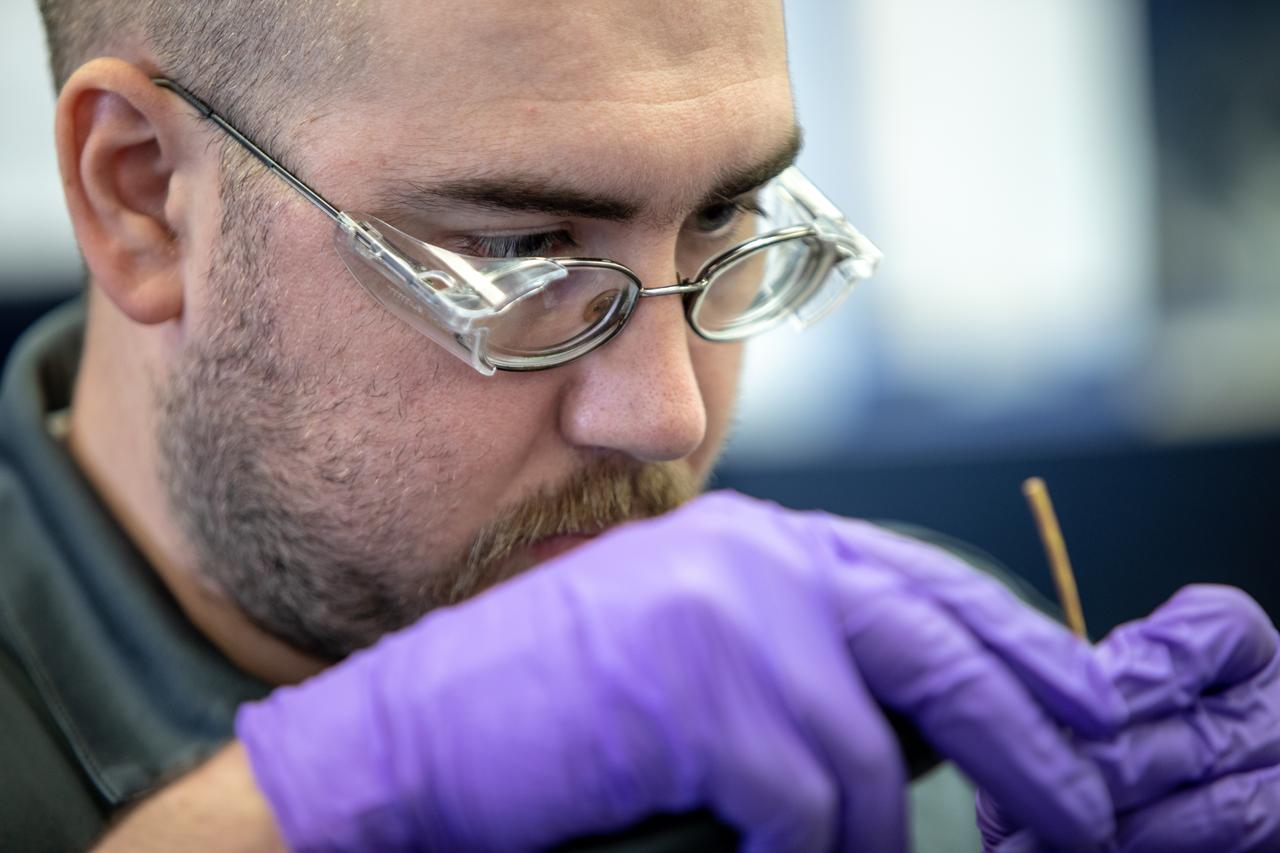
Thomas Cauvel, an intern assisting with software/electrical engineering on NASA’s Orbital Syngas Commodity Augmentation Reactor, or OSCAR, at Kennedy Space Center assembles the flight hardware. OSCAR is an Early Career Initiative project at the Florida spaceport that studies technology to convert trash and human waste into useful gasses such as methane, hydrogen and carbon dioxide. By processing small pieces of trash in a high-temperature reactor, OSCAR is advancing new and innovative technology for managing waste in space. OSCAR would reduce the amount of space needed for waste storage within a spacecraft, turn some waste into gasses that have energy storage and life support applications, and ensure waste is no longer biologically active. A prototype has been developed, and a team of Kennedy employees are in the process of constructing a new rig for suborbital flight testing.

Patrick Follis, an intern at NASA’s Kennedy Space Center in Florida, assembles the flight hardware for the agency’s Orbital Syngas Commodity Augmentation Reactor, or OSCAR. OSCAR is an Early Career Initiative project at the spaceport that studies technology to convert trash and human waste into useful gasses such as methane, hydrogen and carbon dioxide. By processing small pieces of trash in a high-temperature reactor, OSCAR is advancing new and innovative technology for managing waste in space. OSCAR would reduce the amount of space needed for waste storage within a spacecraft, turn some waste into gasses that have energy storage and life support applications, and ensure waste is no longer biologically active. A prototype has been developed, and a team of Kennedy employees are in the process of constructing a new rig for suborbital flight testing.
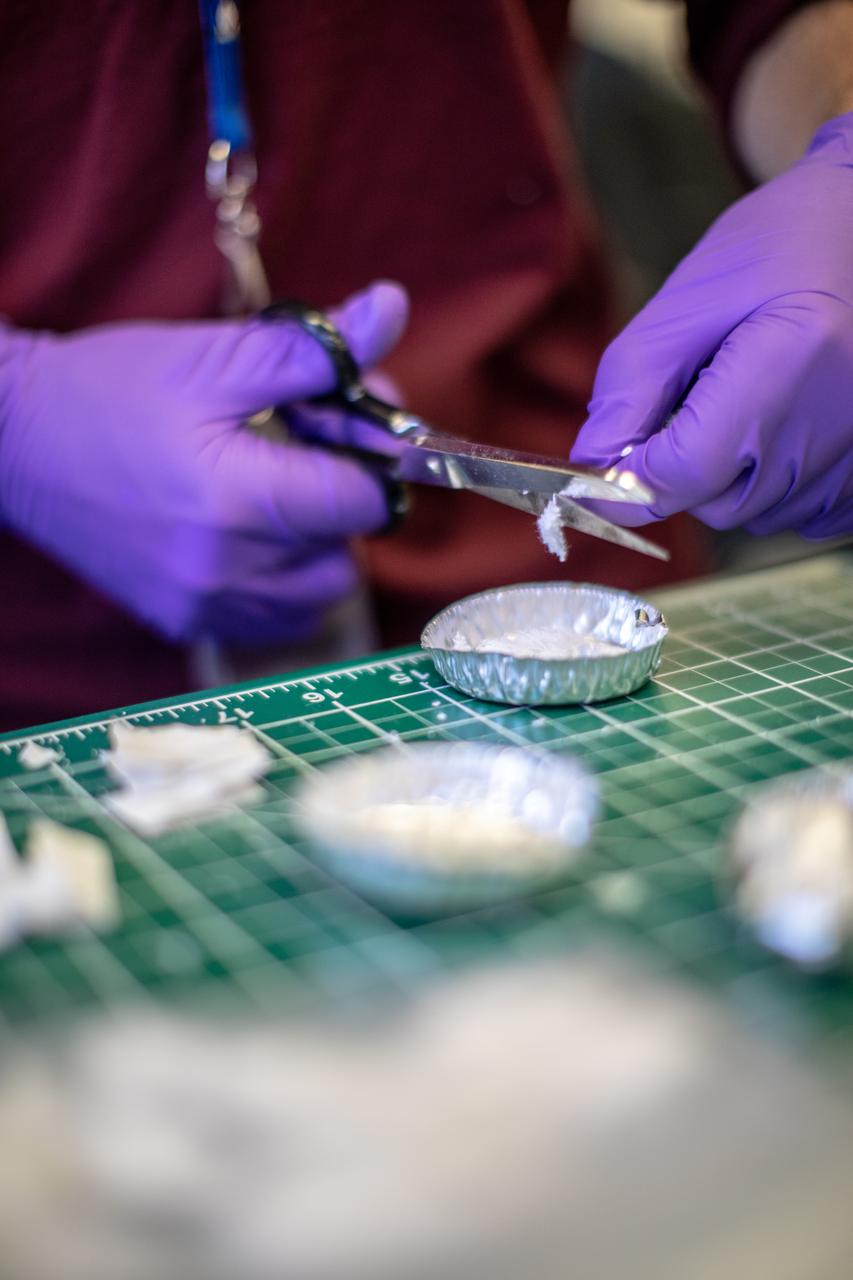
An intern at NASA’s Kennedy Space Center in Florida cuts up different types of material to be utilized as trash simulant for the agency’s Orbital Syngas Commodity Augmentation Reactor, or OSCAR. OSCAR is an Early Career Initiative project at the spaceport that studies technology to convert trash and human waste into useful gasses such as methane, hydrogen and carbon dioxide. By processing small pieces of trash in a high-temperature reactor, OSCAR is advancing new and innovative technology for managing waste in space. OSCAR would reduce the amount of space needed for waste storage within a spacecraft, turn some waste into gasses that have energy storage and life support applications, and ensure waste is no longer biologically active. A prototype has been developed, and a team of Kennedy employees are in the process of constructing a new rig for suborbital flight testing.
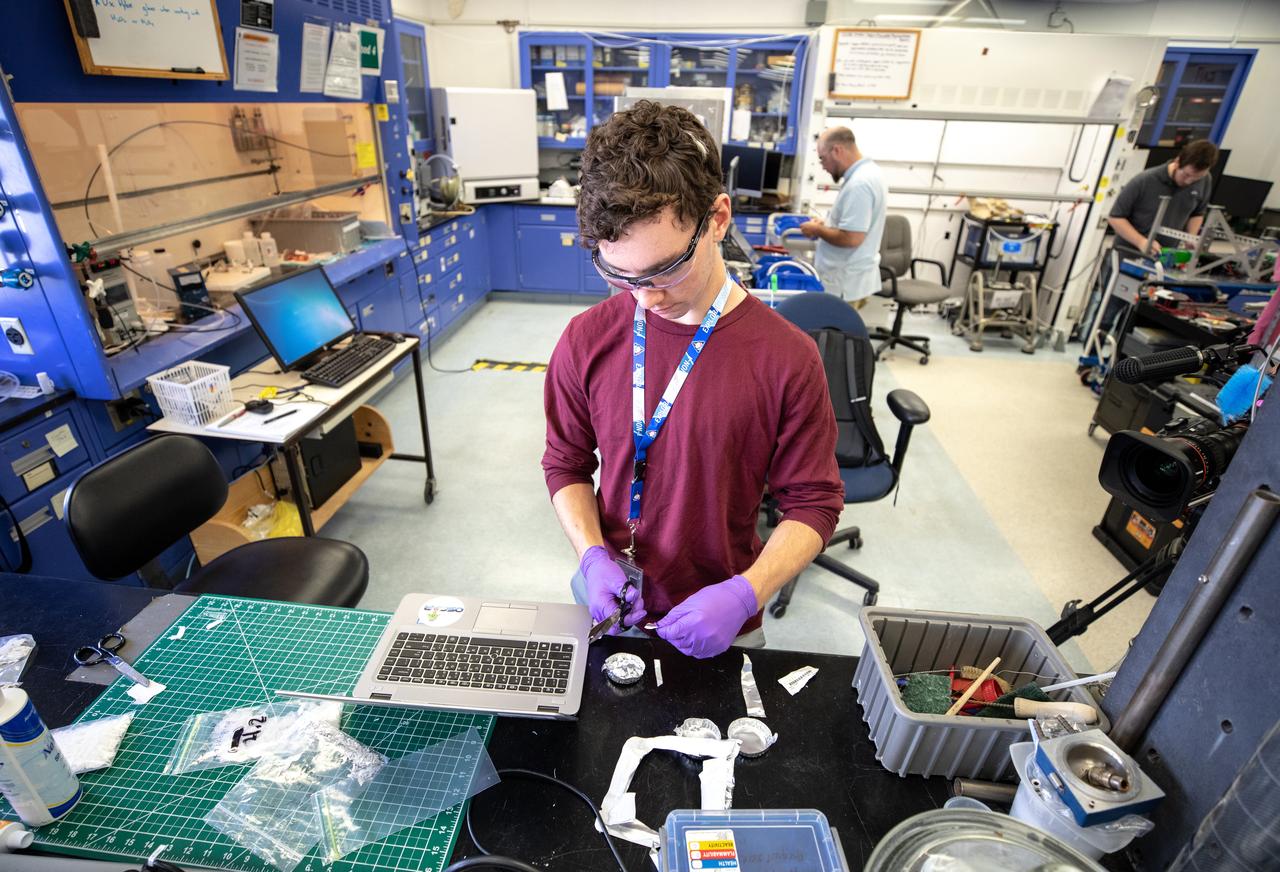
Patrick Follis, an intern at NASA’s Kennedy Space Center in Florida, cuts up different types of material for the agency’s Orbital Syngas Commodity Augmentation Reactor, or OSCAR, to use as a trash simulant during microgravity testing. OSCAR is an Early Career Initiative project at the spaceport that studies technology to convert trash and human waste into useful gasses such as methane, hydrogen and carbon dioxide. By processing small pieces of trash in a high-temperature reactor, OSCAR is advancing new and innovative technology for managing waste in space. OSCAR would reduce the amount of space needed for waste storage within a spacecraft, turn some waste into gasses that have energy storage and life support applications, and ensure waste is no longer biologically active. A prototype has been developed, and a team of Kennedy employees are in the process of constructing a new rig for suborbital flight testing.
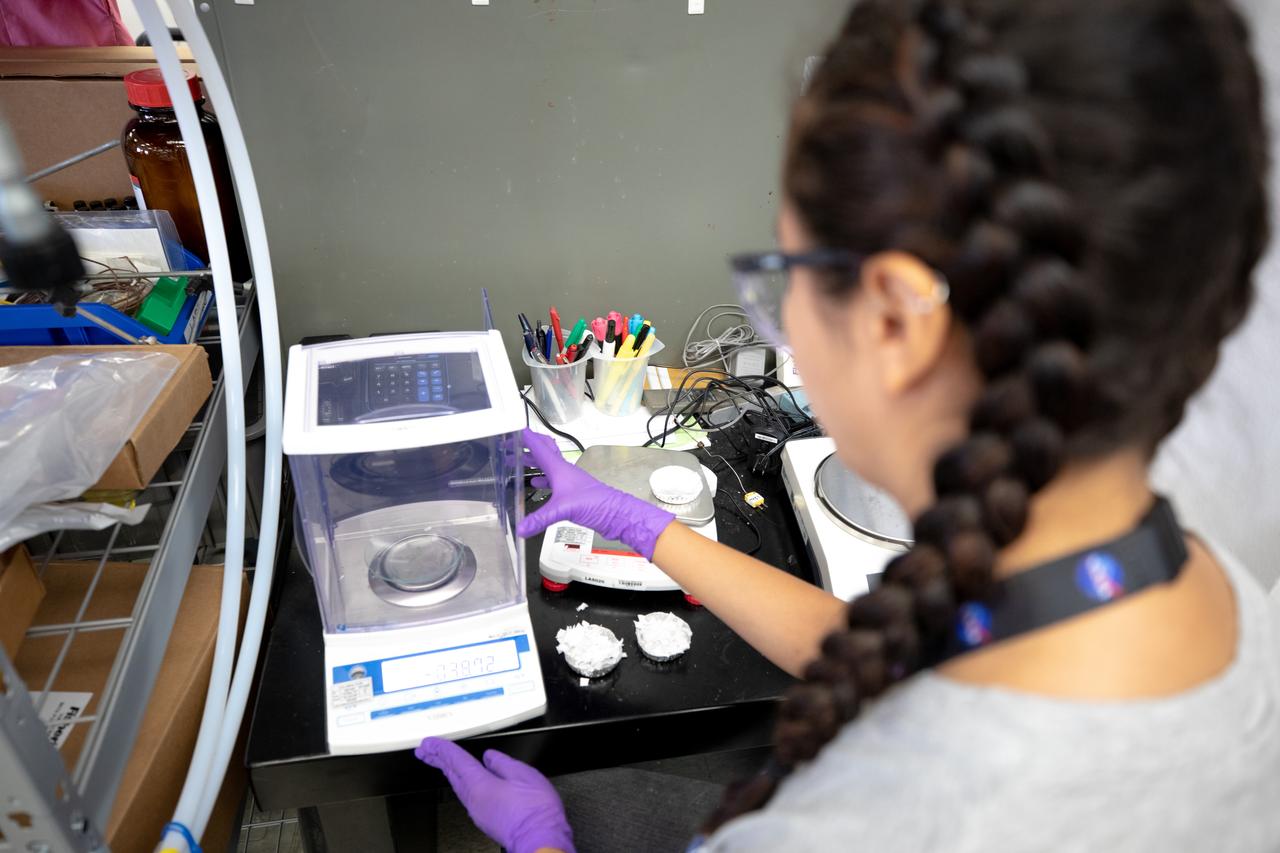
Isabella Aviles, an intern at NASA’s Kennedy Space Center in Florida, weighs trash simulant – comprised of different types of material that have been cut into tiny pieces – that will be utilized for the agency’s Orbital Syngas Commodity Augmentation Reactor, or OSCAR. OSCAR is an Early Career Initiative project at the Florida spaceport that studies technology to convert trash and human waste into useful gasses such as methane, hydrogen and carbon dioxide. By processing small pieces of trash in a high-temperature reactor, OSCAR is advancing new and innovative technology for managing waste in space. OSCAR would reduce the amount of space needed for waste storage within a spacecraft, turn some waste into gasses that have energy storage and life support applications, and ensure waste is no longer biologically active. A prototype has been developed, and a team of Kennedy employees are in the process of constructing a new rig for suborbital flight testing.
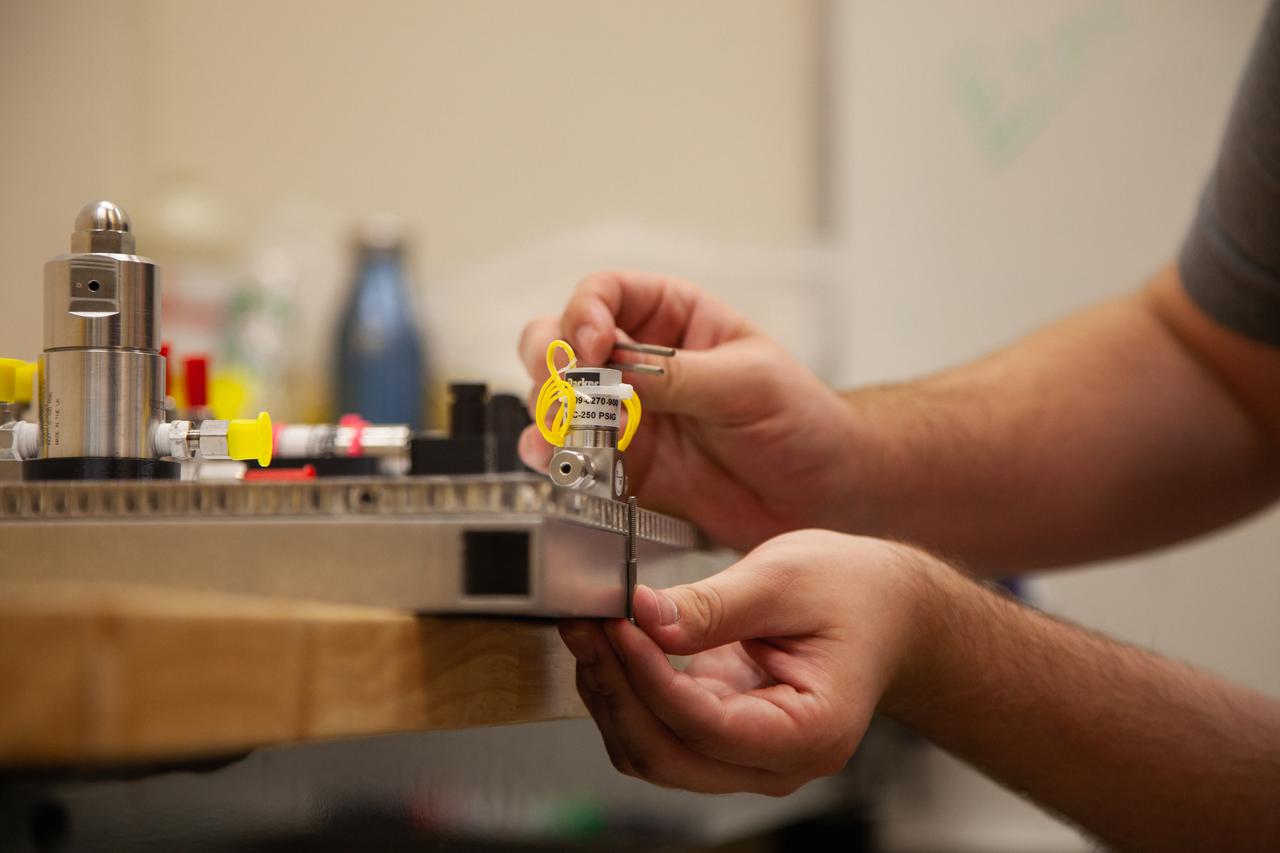
A Kennedy Space Center employee works on assembling the flight hardware of NASA’s Orbital Syngas Commodity Augmentation Reactor, or OSCAR – an Early Career Initiative project at the Florida spaceport that studies technology to convert trash and human waste into useful gasses such as methane, hydrogen and carbon dioxide. By processing small pieces of trash in a high-temperature reactor, OSCAR is advancing new and innovative technology for managing waste in space. OSCAR would reduce the amount of space needed for waste storage within a spacecraft, turn some waste into gasses that have energy storage and life support applications and ensure waste is no longer biologically active. A prototype has already been developed, and a team of Kennedy employees are in the process of constructing a new rig for suborbital flight testing.

Kennedy Space Center employees assemble the flight hardware of NASA’s Orbital Syngas Commodity Augmentation Reactor, or OSCAR – an Early Career Initiative project at the Florida spaceport that studies technology to convert trash and human waste into useful gasses such as methane, hydrogen and carbon dioxide. By processing small pieces of trash in a high-temperature reactor, OSCAR is advancing new and innovative technology for managing waste in space. OSCAR would reduce the amount of space needed for waste storage within a spacecraft, turn some waste into gasses that have energy storage and life support applications and ensure waste is no longer biologically active. A prototype has already been developed, and a team of Kennedy employees are in the process of constructing a new rig for suborbital flight testing.
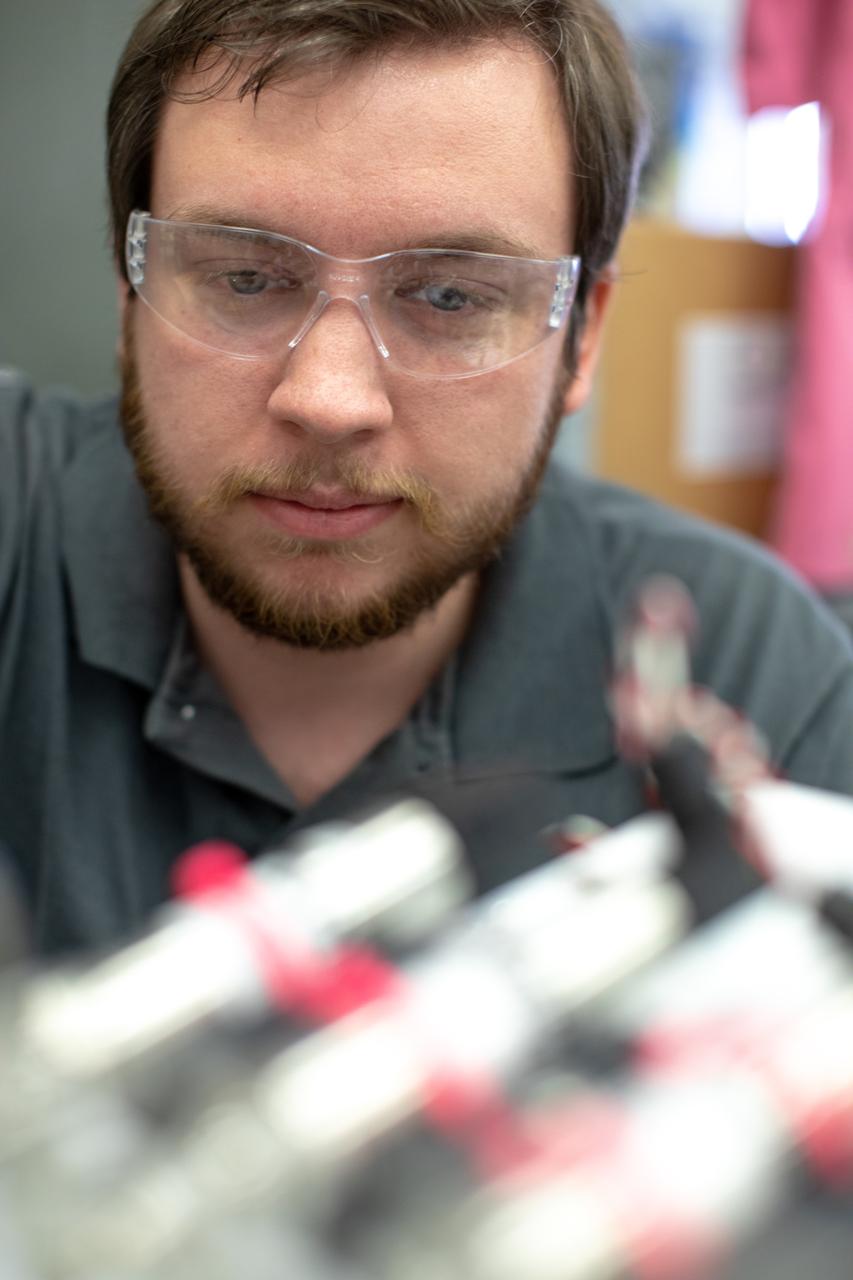
Jonathan Gleeson, Kennedy Space Center employee providing support for NASA’s Orbital Syngas Commodity Augmentation Reactor (OSCAR) under the center’s Laboratory Support Services and Operations contract, assembles the flight hardware of OSCAR. OSCAR is an Early Career Initiative project at the Florida spaceport that studies technology to convert trash and human waste into useful gasses such as methane, hydrogen and carbon dioxide. By processing small pieces of trash in a high-temperature reactor, OSCAR is advancing new and innovative technology for managing waste in space. OSCAR would reduce the amount of space needed for waste storage within a spacecraft, turn some waste into gasses that have energy storage and life support applications, and ensure waste is no longer biologically active. A prototype has been developed, and a team of Kennedy employees are in the process of constructing a new rig for suborbital flight testing.
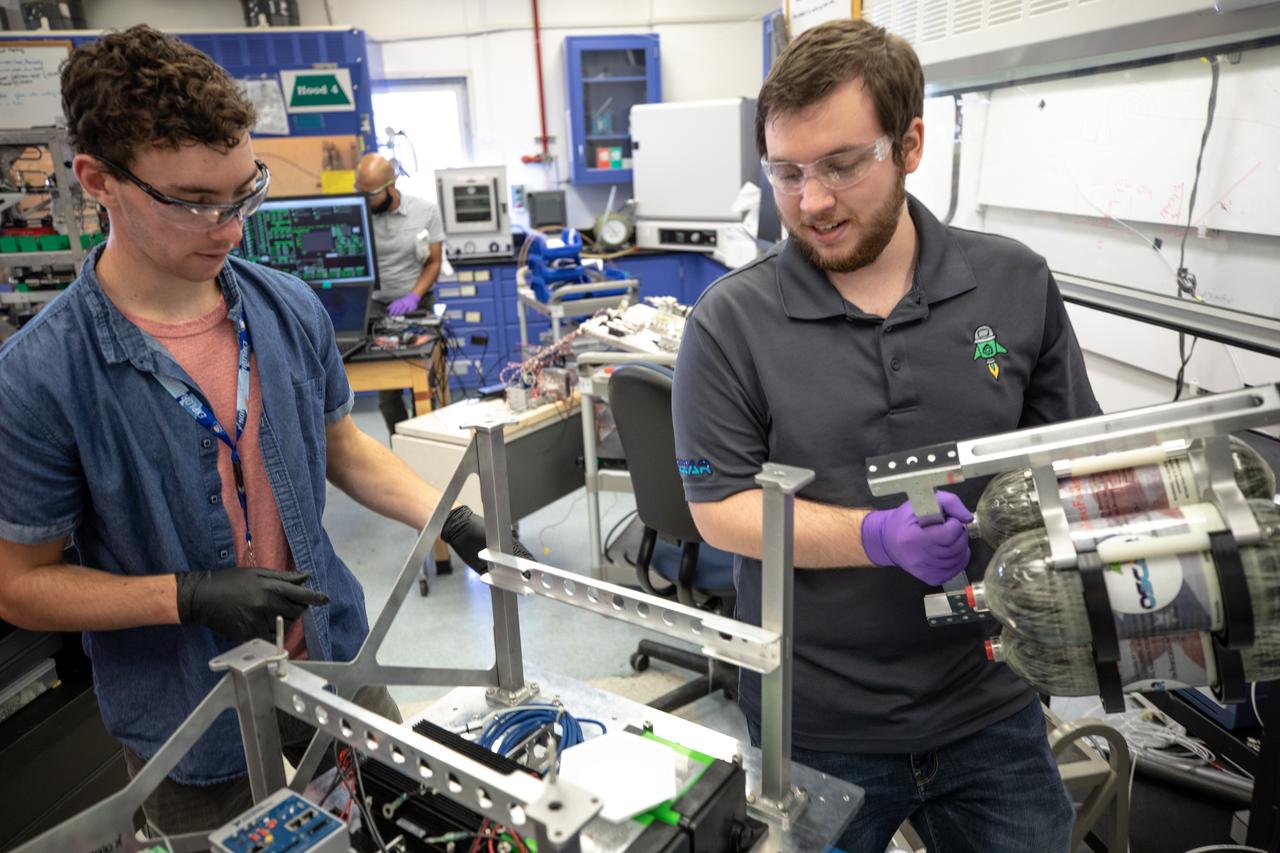
Kennedy Space Center employee Jonathan Gleeson (right) and Kennedy intern Patrick Follis assemble the flight hardware of NASA’s Orbital Syngas Commodity Augmentation Reactor, or OSCAR. OSCAR is an Early Career Initiative project at the Florida spaceport that studies technology to convert trash and human waste into useful gasses such as methane, hydrogen and carbon dioxide. By processing small pieces of trash in a high-temperature reactor, OSCAR is advancing new and innovative technology for managing waste in space. OSCAR would reduce the amount of space needed for waste storage within a spacecraft, turn some waste into gasses that have energy storage and life support applications, and ensure waste is no longer biologically active. A prototype has been developed, and a team of Kennedy employees are in the process of constructing a new rig for suborbital flight testing.
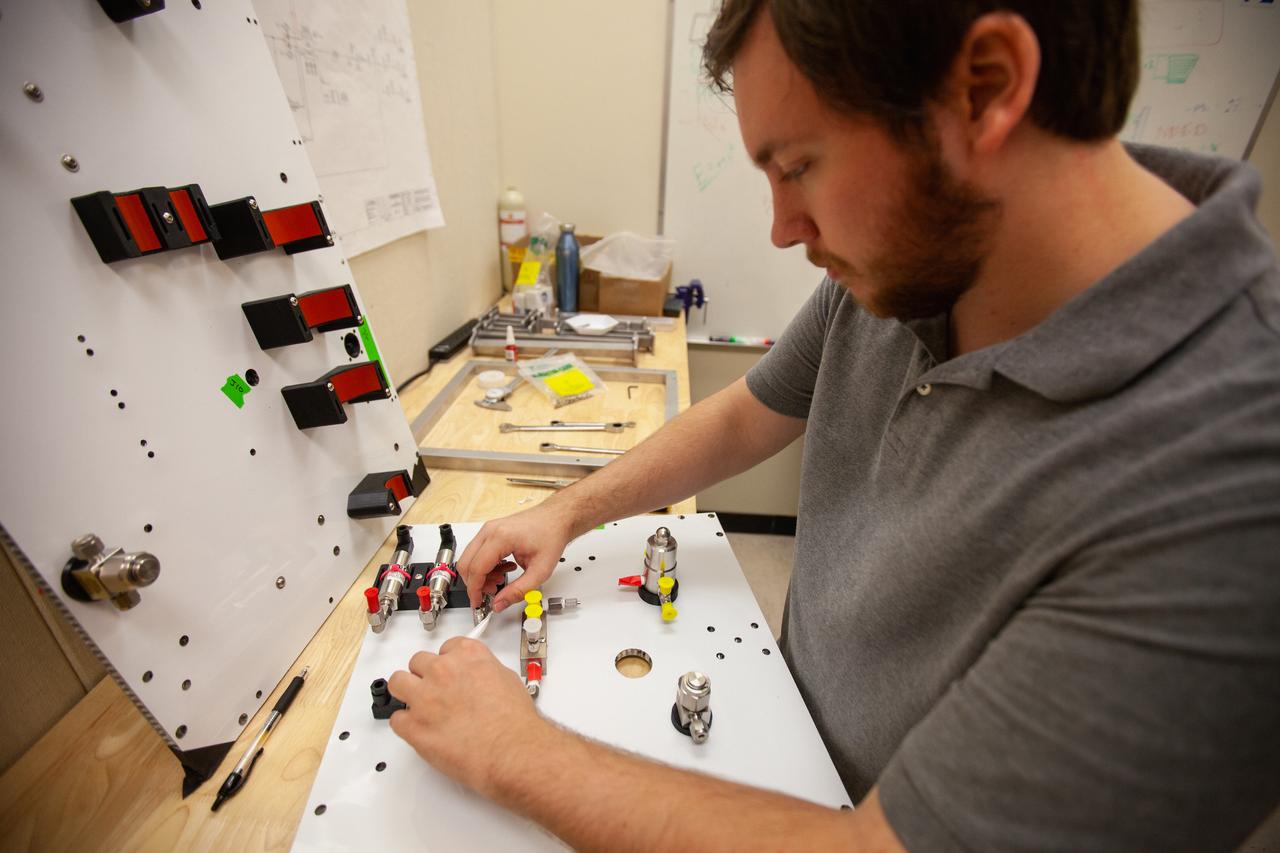
A Kennedy Space Center employee works on assembling the flight hardware of NASA’s Orbital Syngas Commodity Augmentation Reactor, or OSCAR – an Early Career Initiative project at the Florida spaceport that studies technology to convert trash and human waste into useful gasses such as methane, hydrogen and carbon dioxide. By processing small pieces of trash in a high-temperature reactor, OSCAR is advancing new and innovative technology for managing waste in space. OSCAR would reduce the amount of space needed for waste storage within a spacecraft, turn some waste into gasses that have energy storage and life support applications and ensure waste is no longer biologically active. A prototype has already been developed, and a team of Kennedy employees are in the process of constructing a new rig for suborbital flight testing.
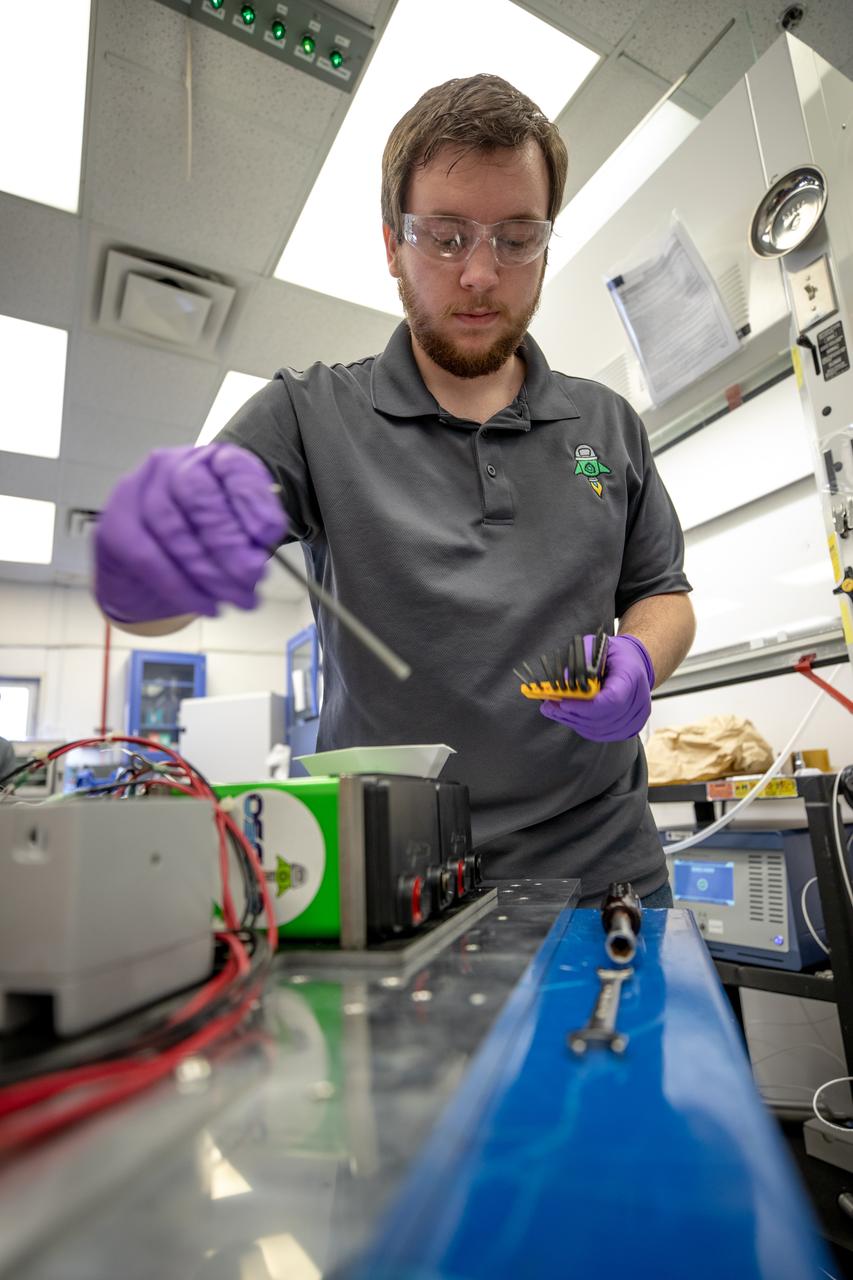
Thomas Cauvel, an intern assisting with software/electrical engineering on NASA’s Orbital Syngas Commodity Augmentation Reactor, or OSCAR, at Kennedy Space Center assembles the flight hardware. OSCAR is an Early Career Initiative project at the Florida spaceport that studies technology to convert trash and human waste into useful gasses such as methane, hydrogen and carbon dioxide. By processing small pieces of trash in a high-temperature reactor, OSCAR is advancing new and innovative technology for managing waste in space. OSCAR would reduce the amount of space needed for waste storage within a spacecraft, turn some waste into gasses that have energy storage and life support applications, and ensure waste is no longer biologically active. A prototype has been developed, and a team of Kennedy employees are in the process of constructing a new rig for suborbital flight testing.
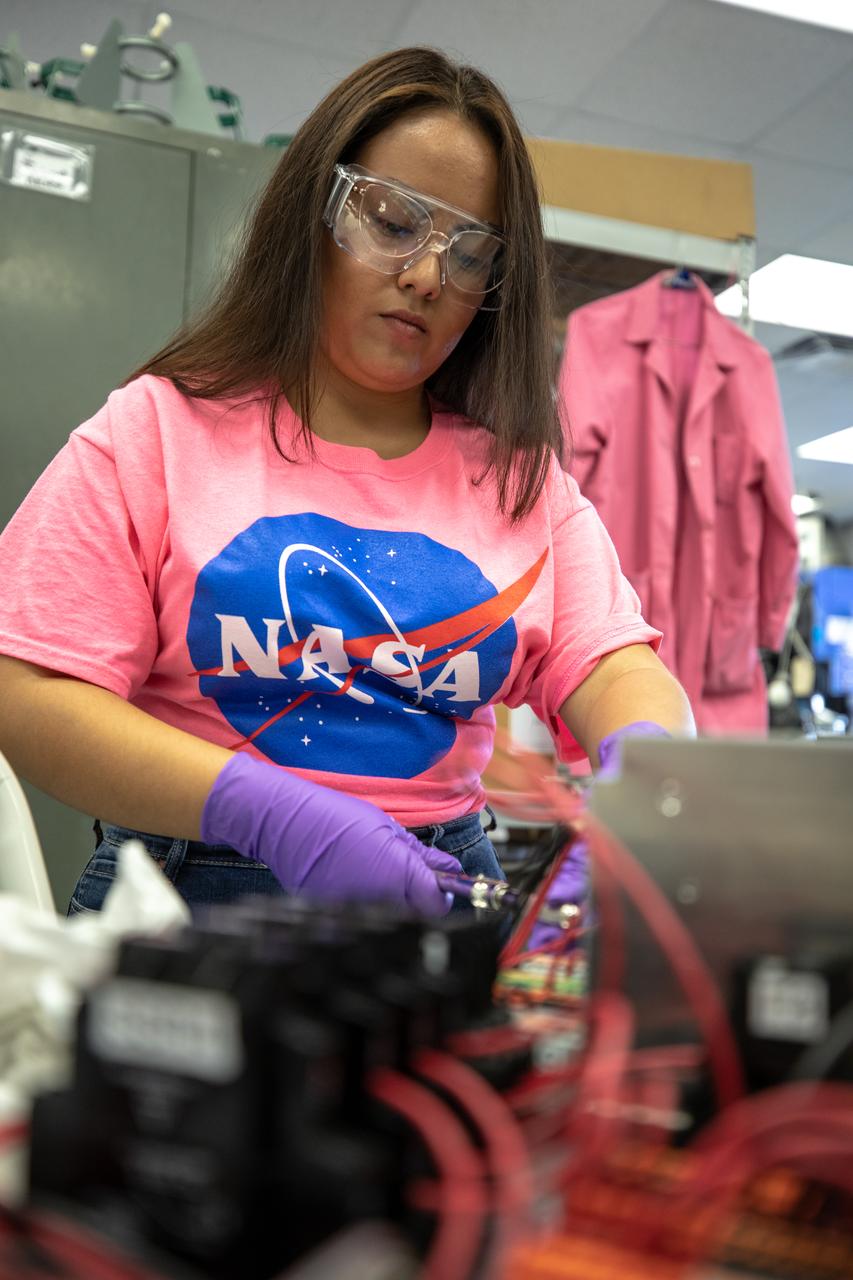
Brianna Sandoval, an intern at NASA’s Kennedy Space Center in Florida, assembles the flight hardware of the agency’s Orbital Syngas Commodity Augmentation Reactor, or OSCAR. OSCAR is an Early Career Initiative project at the spaceport that studies technology to convert trash and human waste into useful gasses such as methane, hydrogen and carbon dioxide. By processing small pieces of trash in a high-temperature reactor, OSCAR is advancing new and innovative technology for managing waste in space. OSCAR would reduce the amount of space needed for waste storage within a spacecraft, turn some waste into gasses that have energy storage and life support applications, and ensure waste is no longer biologically active. A prototype has been developed, and a team of Kennedy employees are in the process of constructing a new rig for suborbital flight testing.
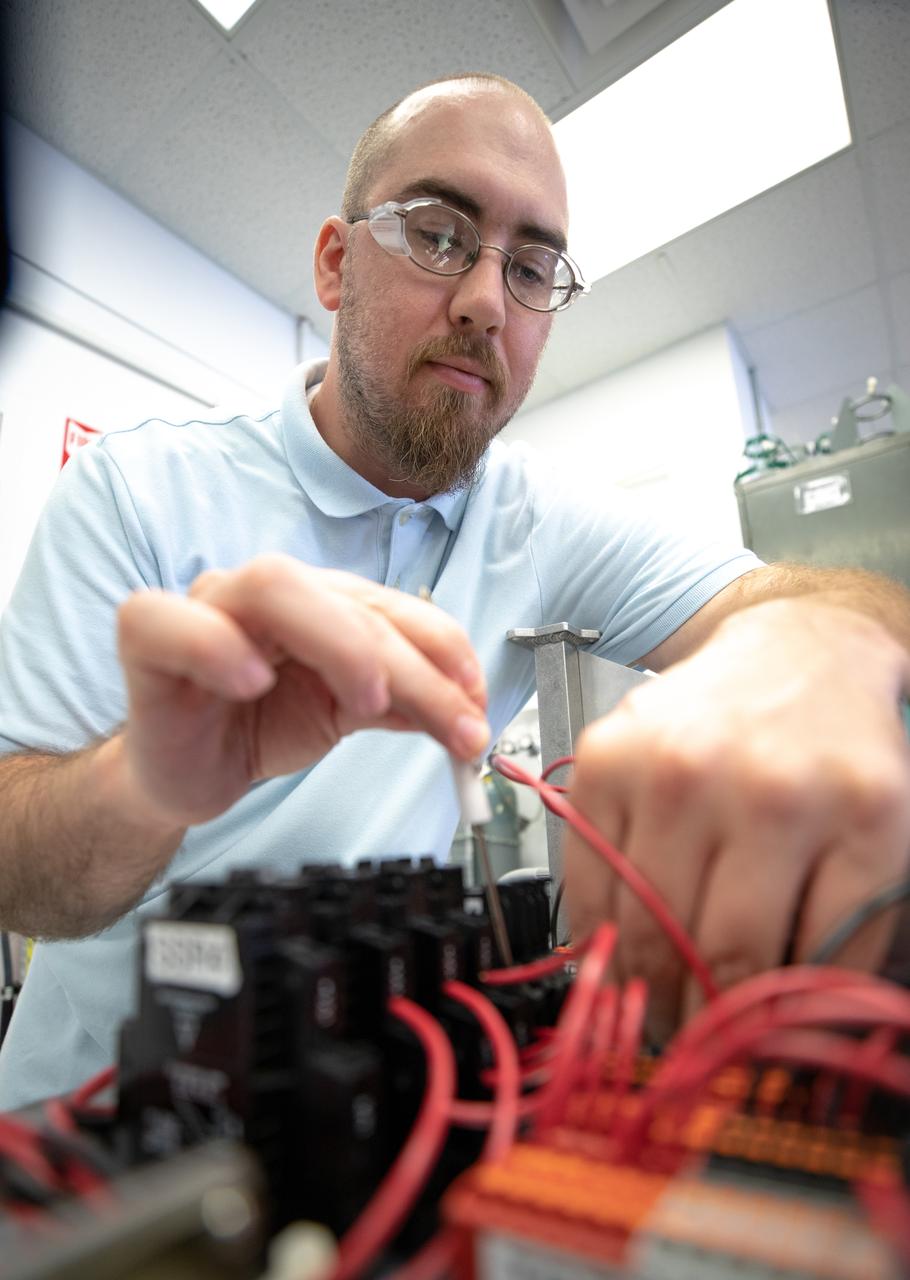
Jonathan Gleeson, Kennedy Space Center employee providing support for NASA’s Orbital Syngas Commodity Augmentation Reactor (OSCAR) under the center’s Laboratory Support Services and Operations contract, assembles the flight hardware of OSCAR. OSCAR is an Early Career Initiative project at the Florida spaceport that studies technology to convert trash and human waste into useful gasses such as methane, hydrogen and carbon dioxide. By processing small pieces of trash in a high-temperature reactor, OSCAR is advancing new and innovative technology for managing waste in space. OSCAR would reduce the amount of space needed for waste storage within a spacecraft, turn some waste into gasses that have energy storage and life support applications, and ensure waste is no longer biologically active. A prototype has been developed, and a team of Kennedy employees are in the process of constructing a new rig for suborbital flight testing.
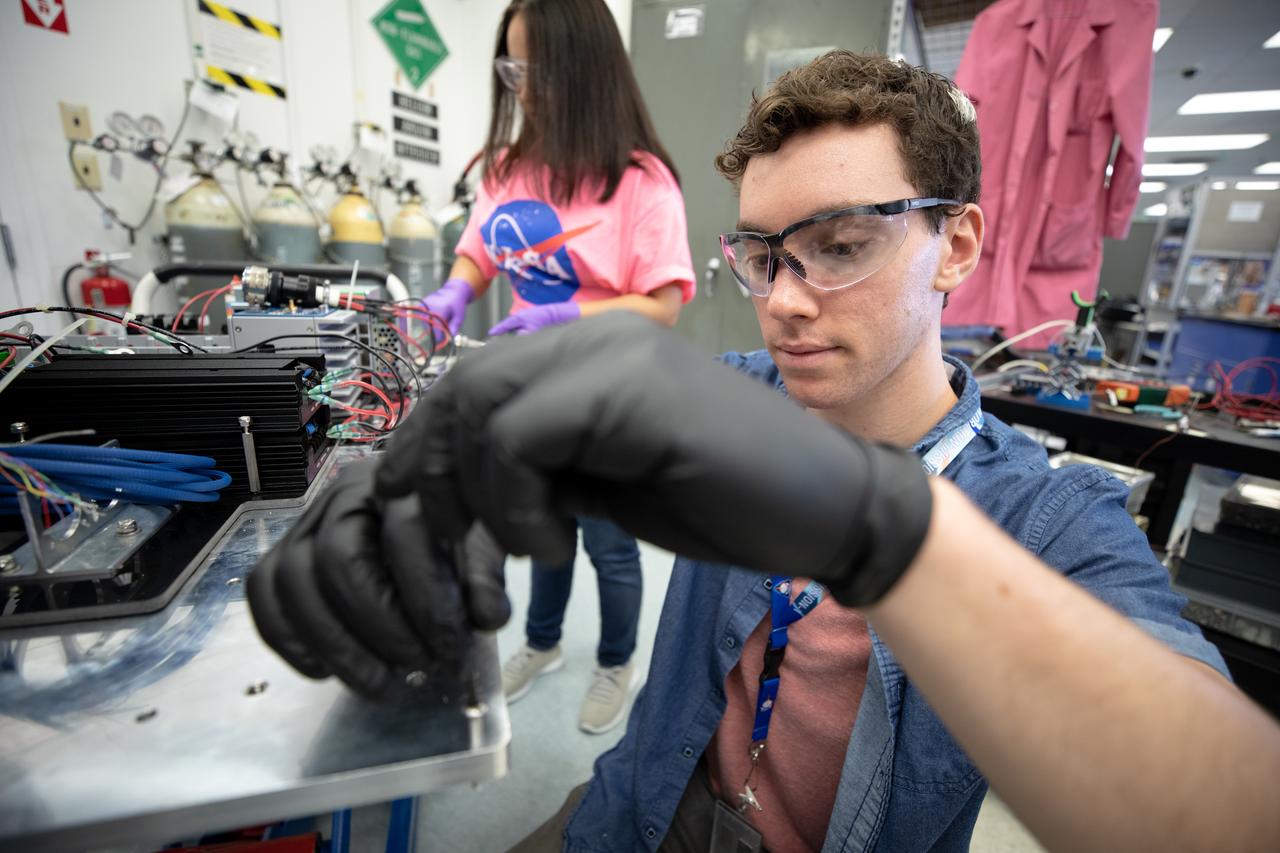
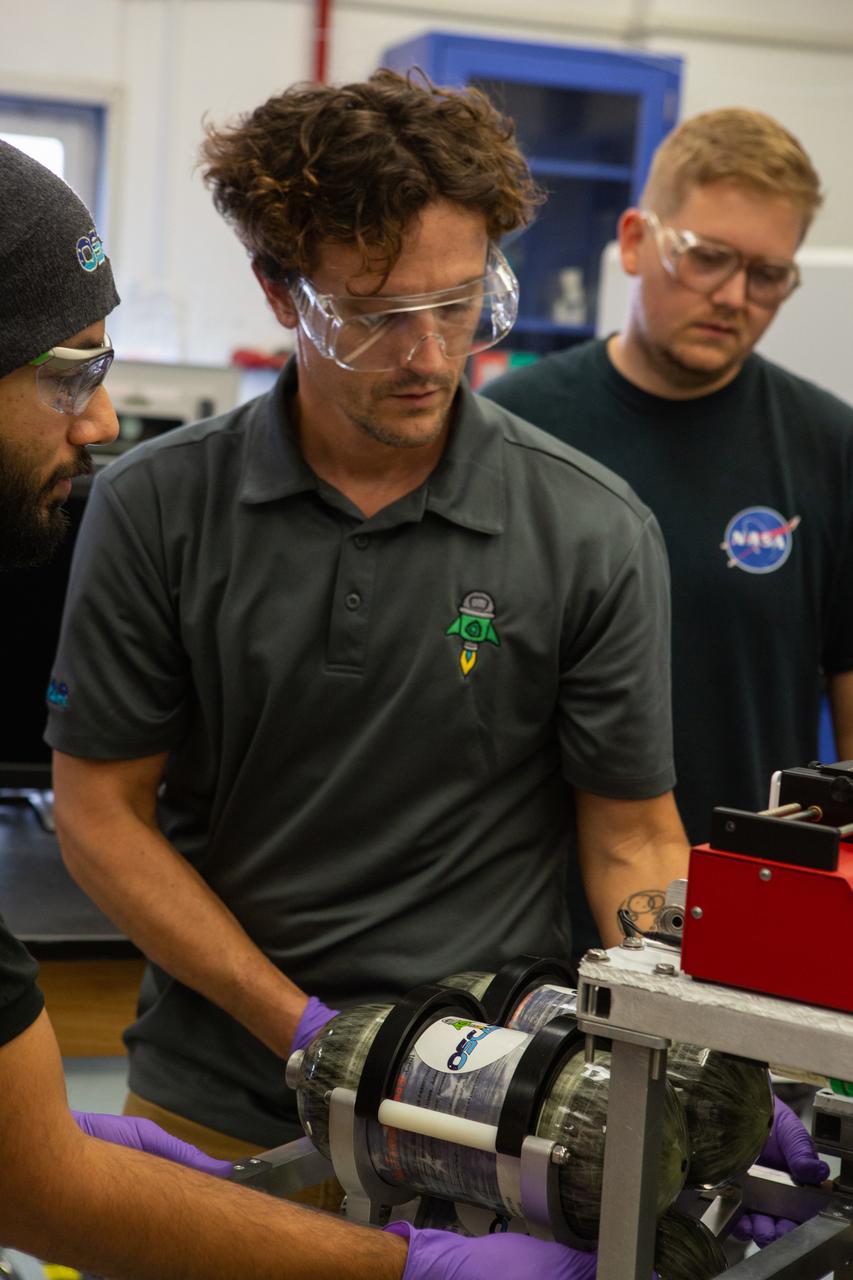
Interns Brianna Sandoval (left) and Patrick Follis at NASA’s Kennedy Space Center in Florida assemble the flight hardware for the agency’s Orbital Syngas Commodity Augmentation Reactor, or OSCAR. OSCAR is an Early Career Initiative project at the spaceport that studies technology to convert trash and human waste into useful gasses such as methane, hydrogen and carbon dioxide. By processing small pieces of trash in a high-temperature reactor, OSCAR is advancing new and innovative technology for managing waste in space. OSCAR would reduce the amount of space needed for waste storage within a spacecraft, turn some waste into gasses that have energy storage and life support applications, and ensure waste is no longer biologically active. A prototype has been developed, and a team of Kennedy employees are in the process of constructing a new rig for suborbital flight testing.
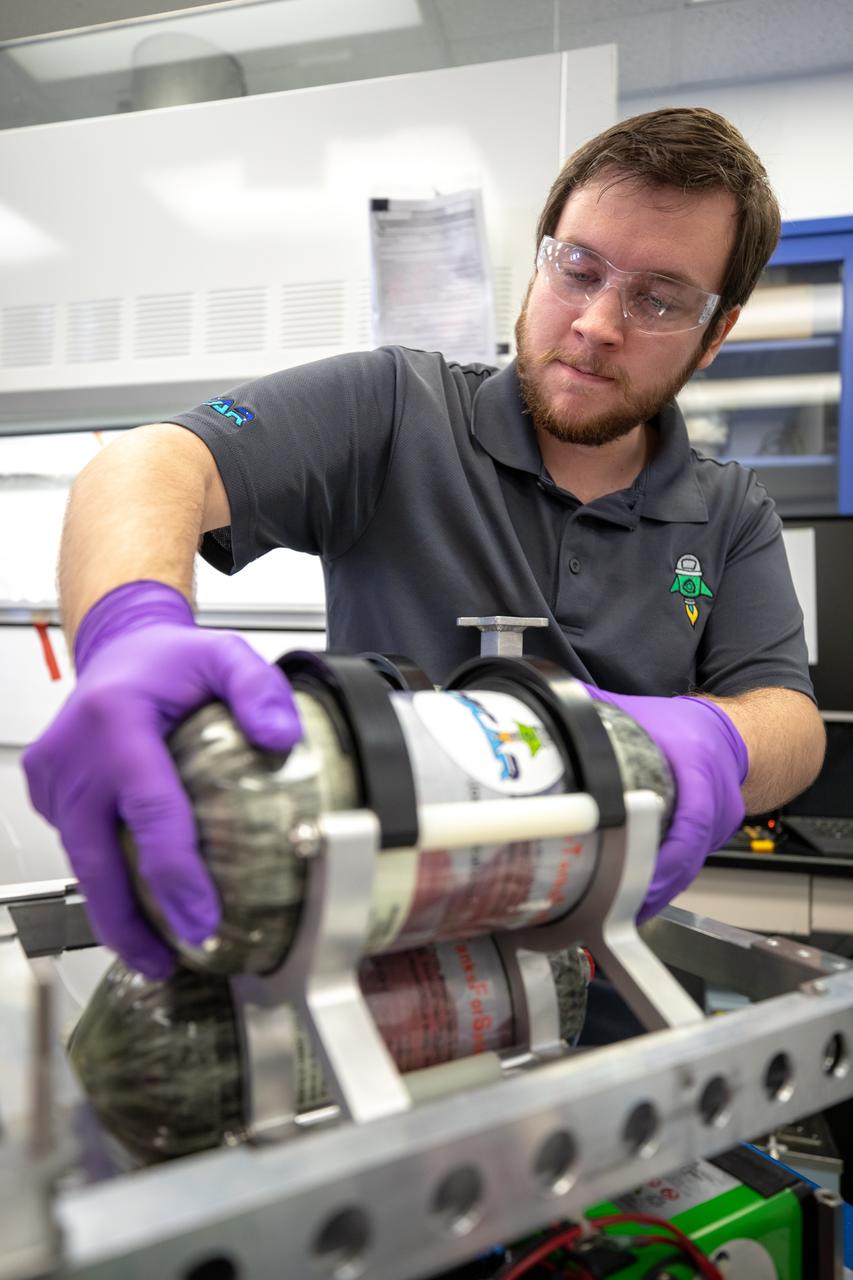
Jonathan Gleeson, Kennedy Space Center employee providing support for NASA’s Orbital Syngas Commodity Augmentation Reactor (OSCAR) under the center’s Laboratory Support Services and Operations contract, installs OSCAR to the flight hardware that will carry it on its suborbital flight test. OSCAR is an Early Career Initiative project at the Florida spaceport that studies technology to convert trash and human waste into useful gasses such as methane, hydrogen and carbon dioxide. By processing small pieces of trash in a high-temperature reactor, OSCAR is advancing new and innovative technology for managing waste in space. OSCAR would reduce the amount of space needed for waste storage within a spacecraft, turn some waste into gasses that have energy storage and life support applications, and ensure waste is no longer biologically active. A prototype has been developed, and a team of Kennedy employees have worked on constructing a new rig for suborbital flight testing.

Kennedy Space Center intern Patrick Follis (left) and Kennedy employee Jonathan Gleeson assemble the flight hardware of NASA’s Orbital Syngas Commodity Augmentation Reactor, or OSCAR – an Early Career Initiative project at the Florida spaceport that studies technology to convert trash and human waste into useful gasses such as methane, hydrogen and carbon dioxide. By processing small pieces of trash in a high-temperature reactor, OSCAR is advancing new and innovative technology for managing waste in space. OSCAR would reduce the amount of space needed for waste storage within a spacecraft, turn some waste into gasses that have energy storage and life support applications, and ensure waste is no longer biologically active. A prototype has been developed, and a team of Kennedy employees are in the process of constructing a new rig for suborbital flight testing.
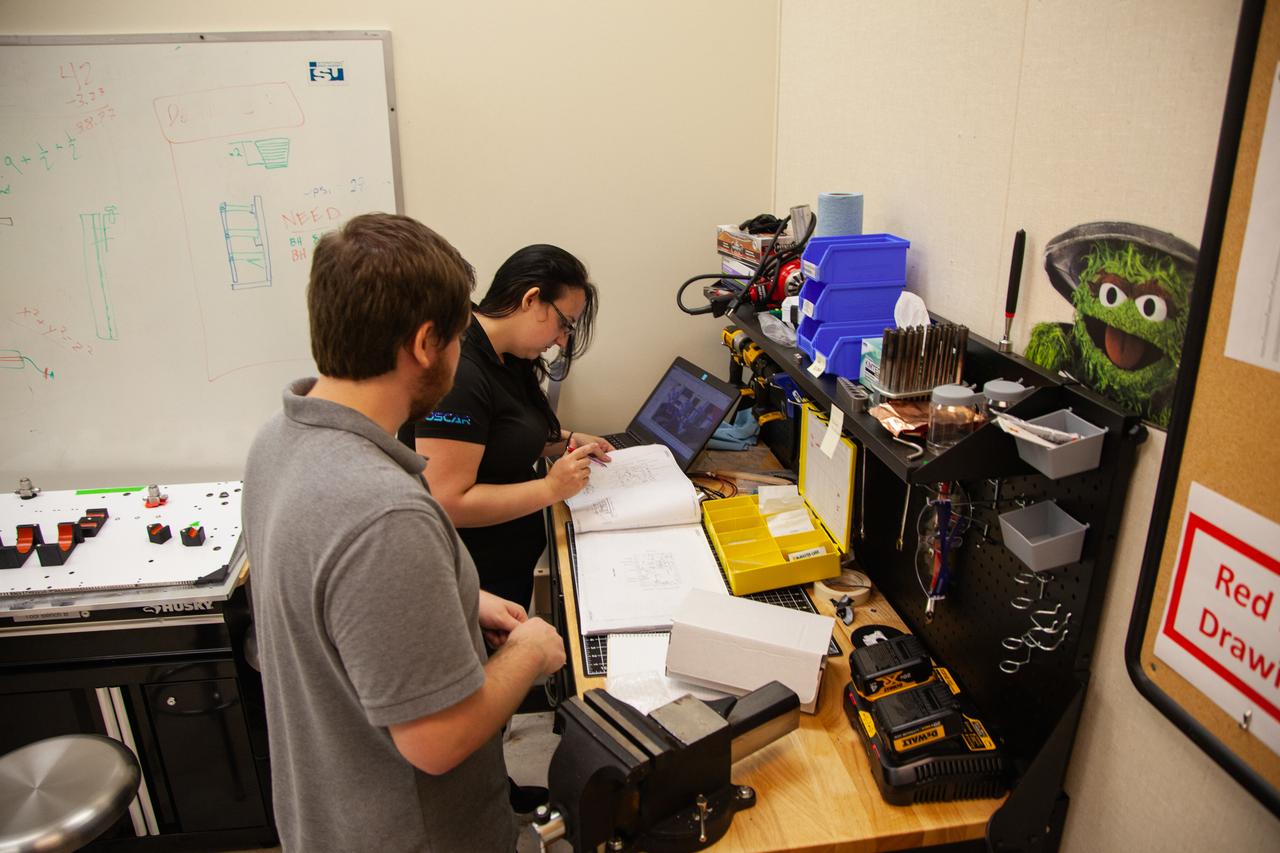
Kennedy Space Center employees are working on assembling the flight hardware of NASA’s Orbital Syngas Commodity Augmentation Reactor, or OSCAR – an Early Career Initiative project at the Florida spaceport that studies technology to convert trash and human waste into useful gasses such as methane, hydrogen and carbon dioxide. By processing small pieces of trash in a high-temperature reactor, OSCAR is advancing new and innovative technology for managing waste in space. OSCAR would reduce the amount of space needed for waste storage within a spacecraft, turn some waste into gasses that have energy storage and life support applications and ensure waste is no longer biologically active. A prototype has already been developed, and a team of Kennedy employees are in the process of constructing a new rig for suborbital flight testing.
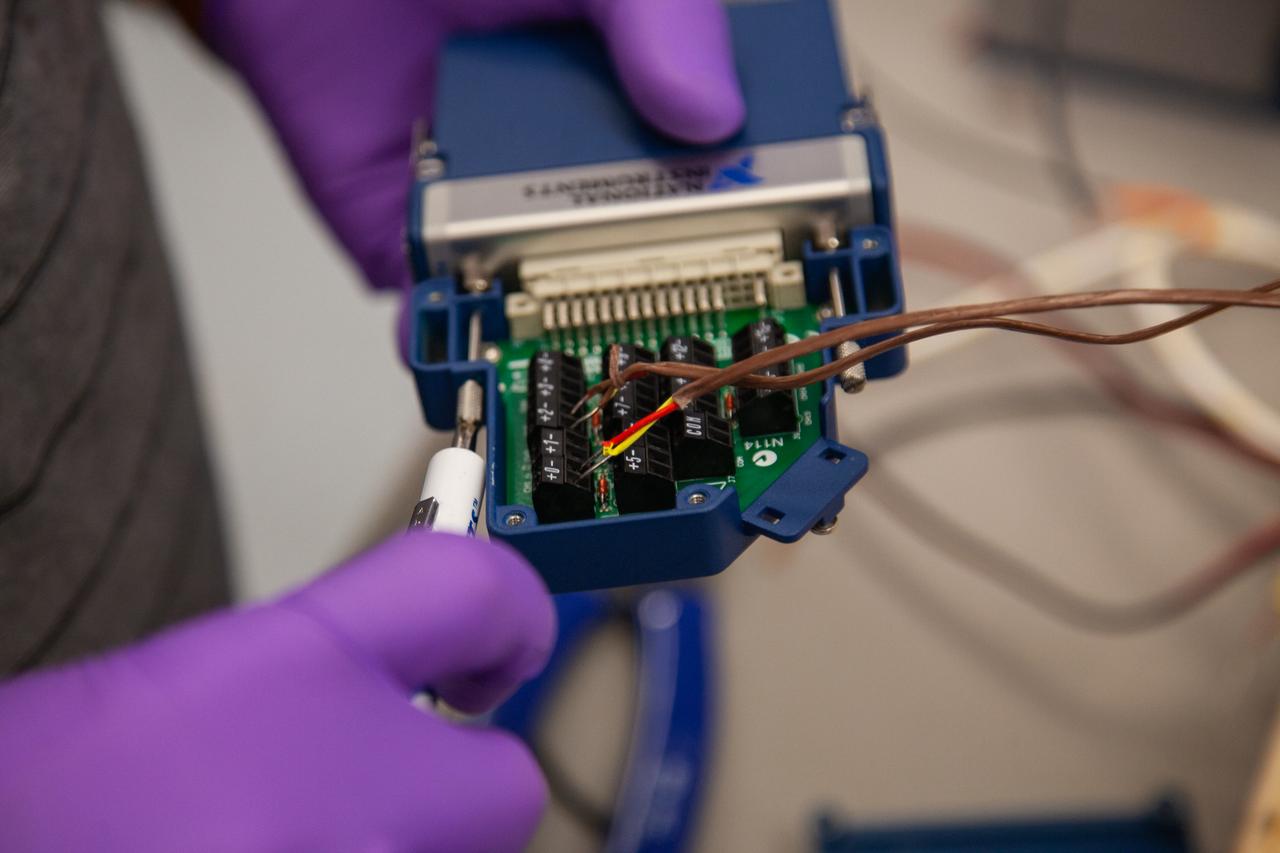
A Kennedy Space Center employee works on assembling the flight hardware of NASA’s Orbital Syngas Commodity Augmentation Reactor, or OSCAR – an Early Career Initiative project at the Florida spaceport that studies technology to convert trash and human waste into useful gasses such as methane, hydrogen and carbon dioxide. By processing small pieces of trash in a high-temperature reactor, OSCAR is advancing new and innovative technology for managing waste in space. OSCAR would reduce the amount of space needed for waste storage within a spacecraft, turn some waste into gasses that have energy storage and life support applications and ensure waste is no longer biologically active. A prototype has already been developed, and a team of Kennedy employees are in the process of constructing a new rig for suborbital flight testing.
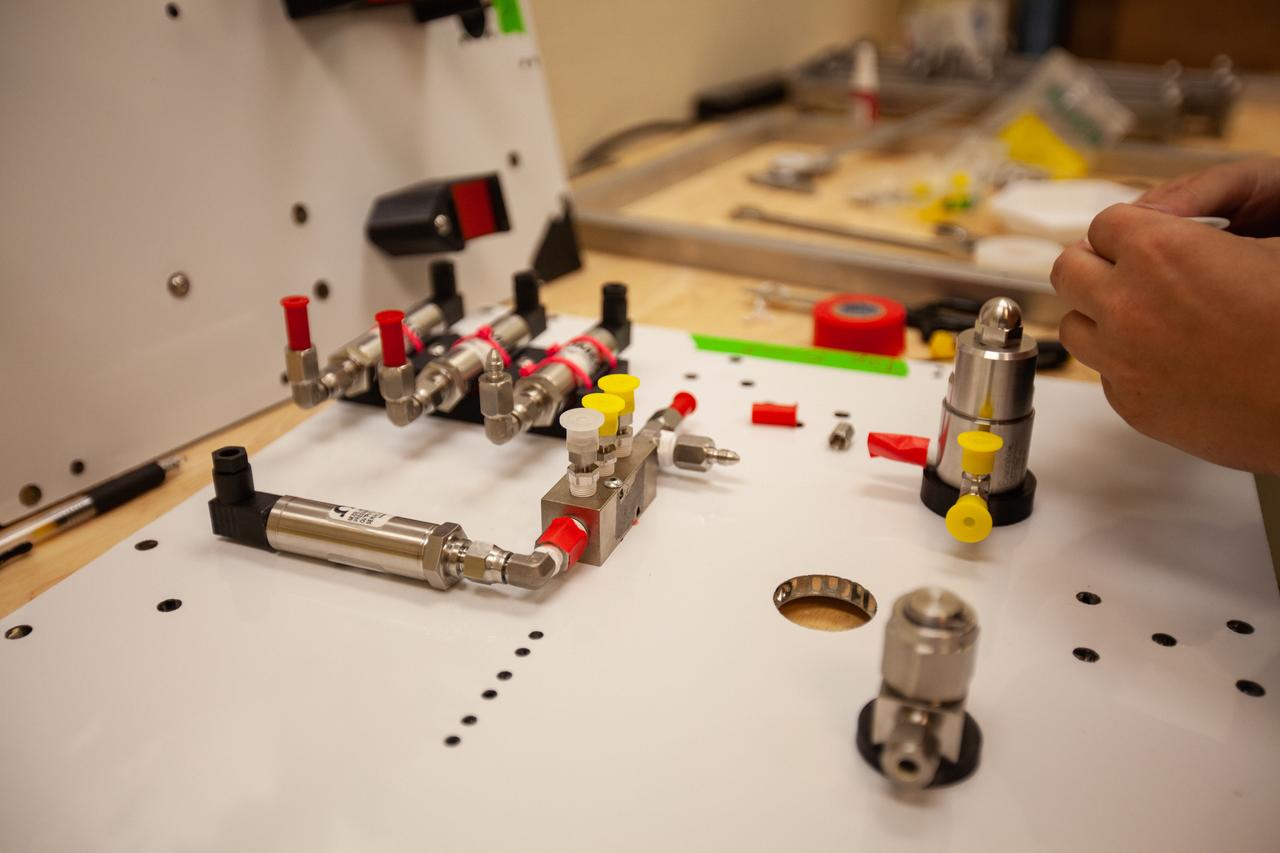
A Kennedy Space Center employee works on assembling the flight hardware of NASA’s Orbital Syngas Commodity Augmentation Reactor, or OSCAR – an Early Career Initiative project at the Florida spaceport that studies technology to convert trash and human waste into useful gasses such as methane, hydrogen and carbon dioxide. By processing small pieces of trash in a high-temperature reactor, OSCAR is advancing new and innovative technology for managing waste in space. OSCAR would reduce the amount of space needed for waste storage within a spacecraft, turn some waste into gasses that have energy storage and life support applications and ensure waste is no longer biologically active. A prototype has already been developed, and a team of Kennedy employees are in the process of constructing a new rig for suborbital flight testing.
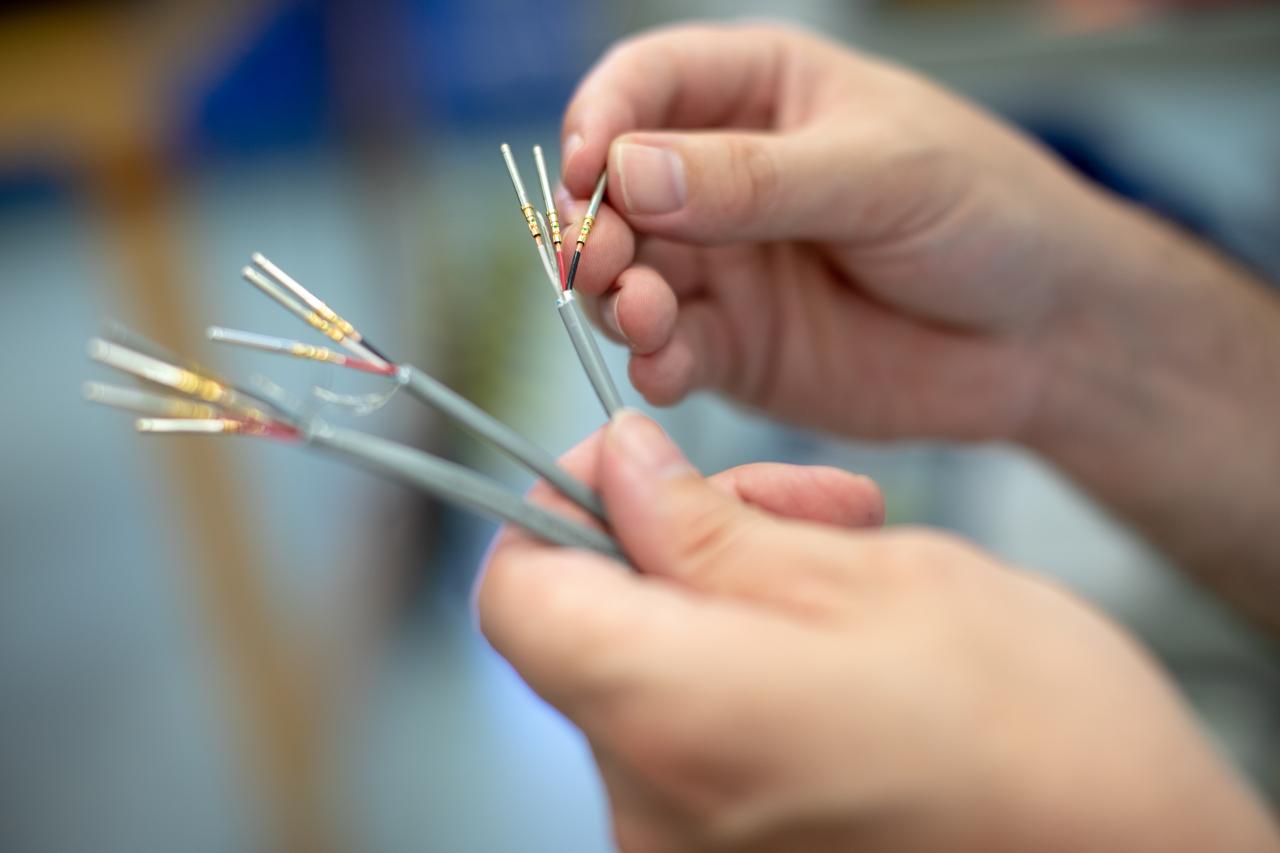
Flight hardware for NASA’s Orbital Syngas Commodity Augmentation Rector, or OSCAR, is photographed at the agency’s Kennedy Space Center in Florida. OSCAR is an Early Career Initiative project at the spaceport that studies technology to convert trash and human waste into useful gasses such as methane, hydrogen and carbon dioxide. By processing small pieces of trash in a high-temperature reactor, OSCAR is advancing new and innovative technology for managing waste in space. OSCAR would reduce the amount of space needed for waste storage within a spacecraft, turn some waste into gasses that have energy storage and life support applications, and ensure waste is no longer biologically active. A prototype has been developed, and a team of Kennedy employees are in the process of constructing a new rig for suborbital flight testing.
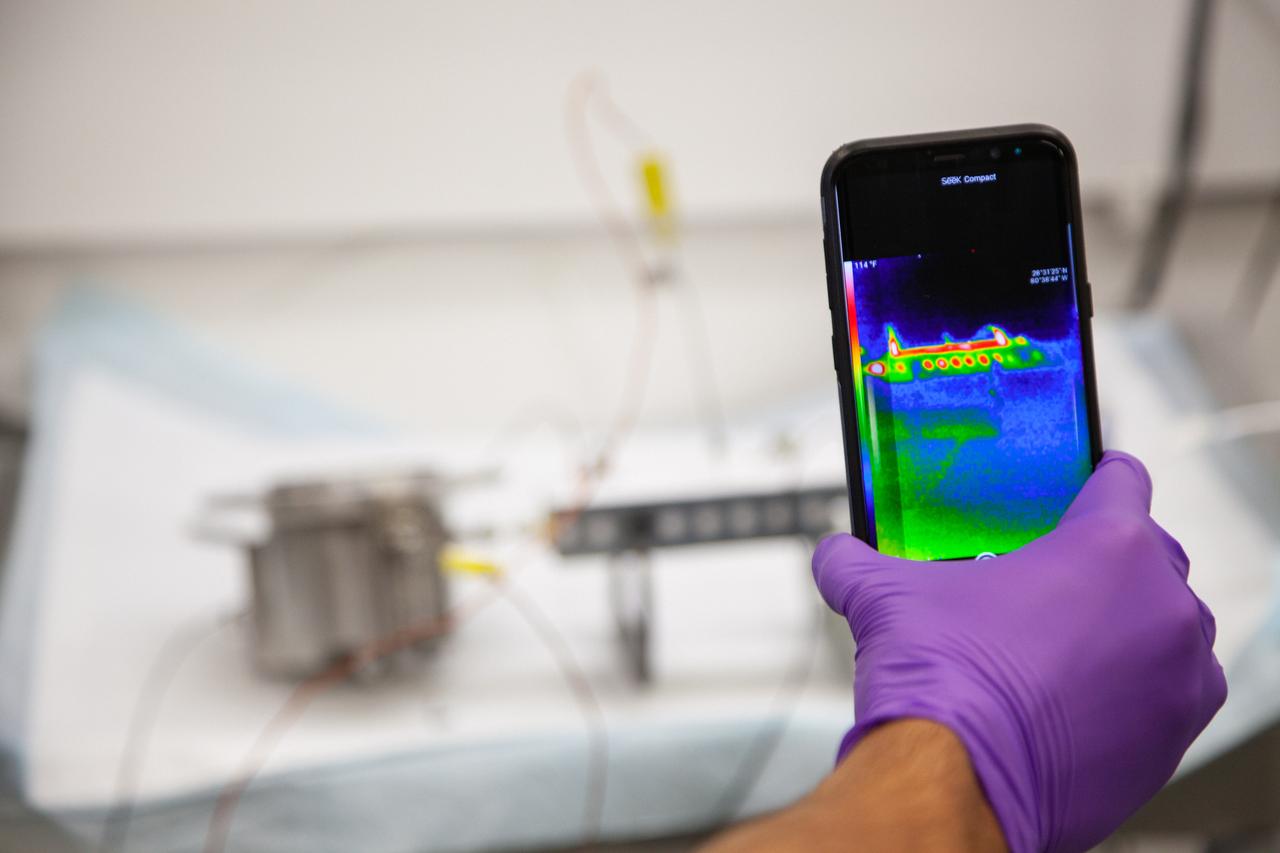
A Kennedy Space Center employee conducts thermal testing of NASA’s Orbital Syngas Commodity Augmentation Reactor, or OSCAR – an Early Career Initiative project at the Florida spaceport that studies technology to convert trash and human waste into useful gasses such as methane, hydrogen and carbon dioxide. By processing small pieces of trash in a high-temperature reactor, OSCAR is advancing new and innovative technology for managing waste in space. OSCAR would reduce the amount of space needed for waste storage within a spacecraft, turn some waste into gasses that have energy storage and life support applications and ensure waste is no longer biologically active. A prototype has already been developed, and a team of Kennedy employees are in the process of constructing a new rig for suborbital flight testing.
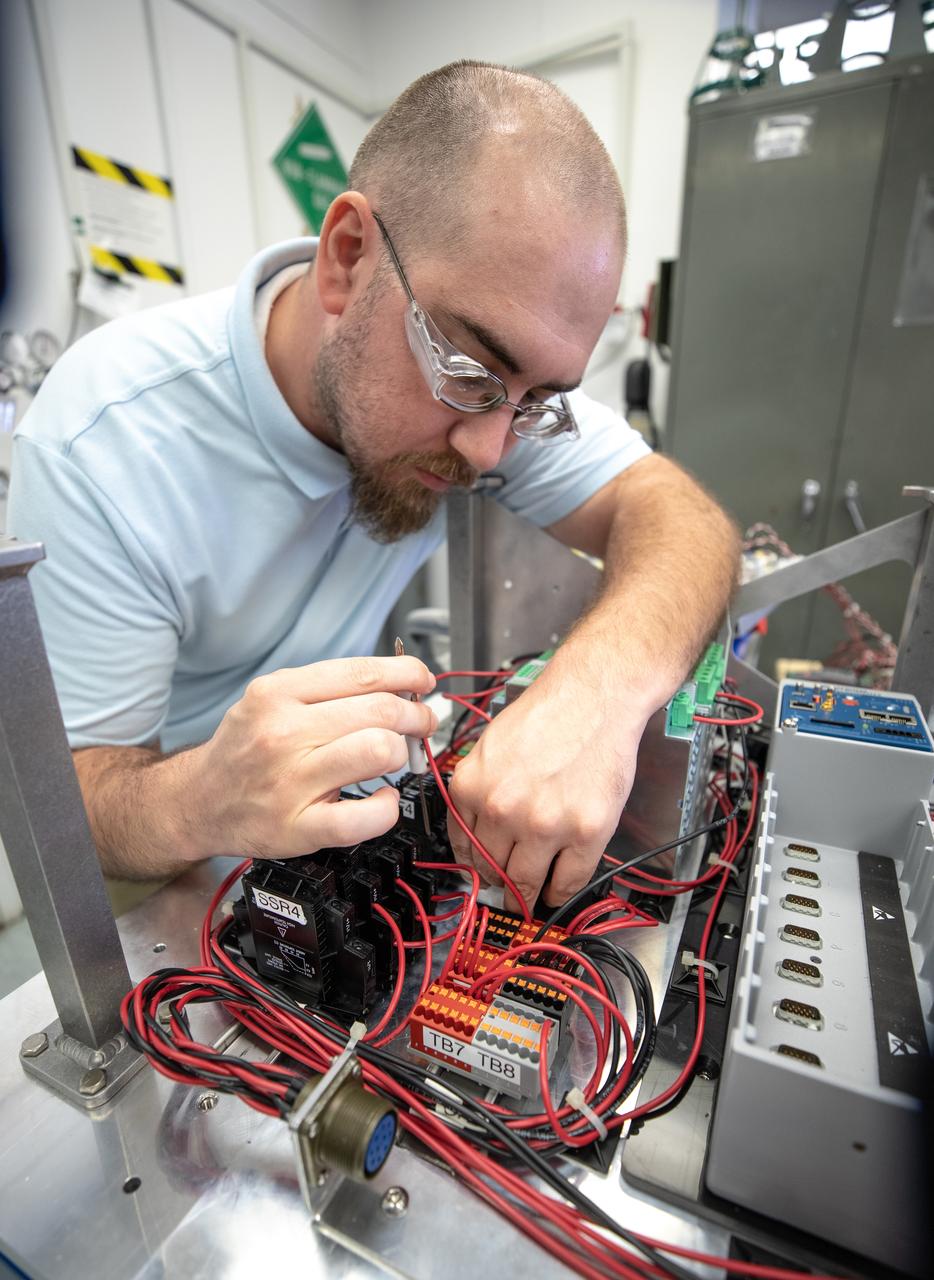
Thomas Cauvel, an intern assisting with software/electrical engineering on NASA’s Orbital Syngas Commodity Augmentation Reactor, or OSCAR, at Kennedy Space Center assembles the flight hardware. OSCAR is an Early Career Initiative project at the Florida spaceport that studies technology to convert trash and human waste into useful gasses such as methane, hydrogen and carbon dioxide. By processing small pieces of trash in a high-temperature reactor, OSCAR is advancing new and innovative technology for managing waste in space. OSCAR would reduce the amount of space needed for waste storage within a spacecraft, turn some waste into gasses that have energy storage and life support applications, and ensure waste is no longer biologically active. A prototype has been developed, and a team of Kennedy employees are in the process of constructing a new rig for suborbital flight testing.
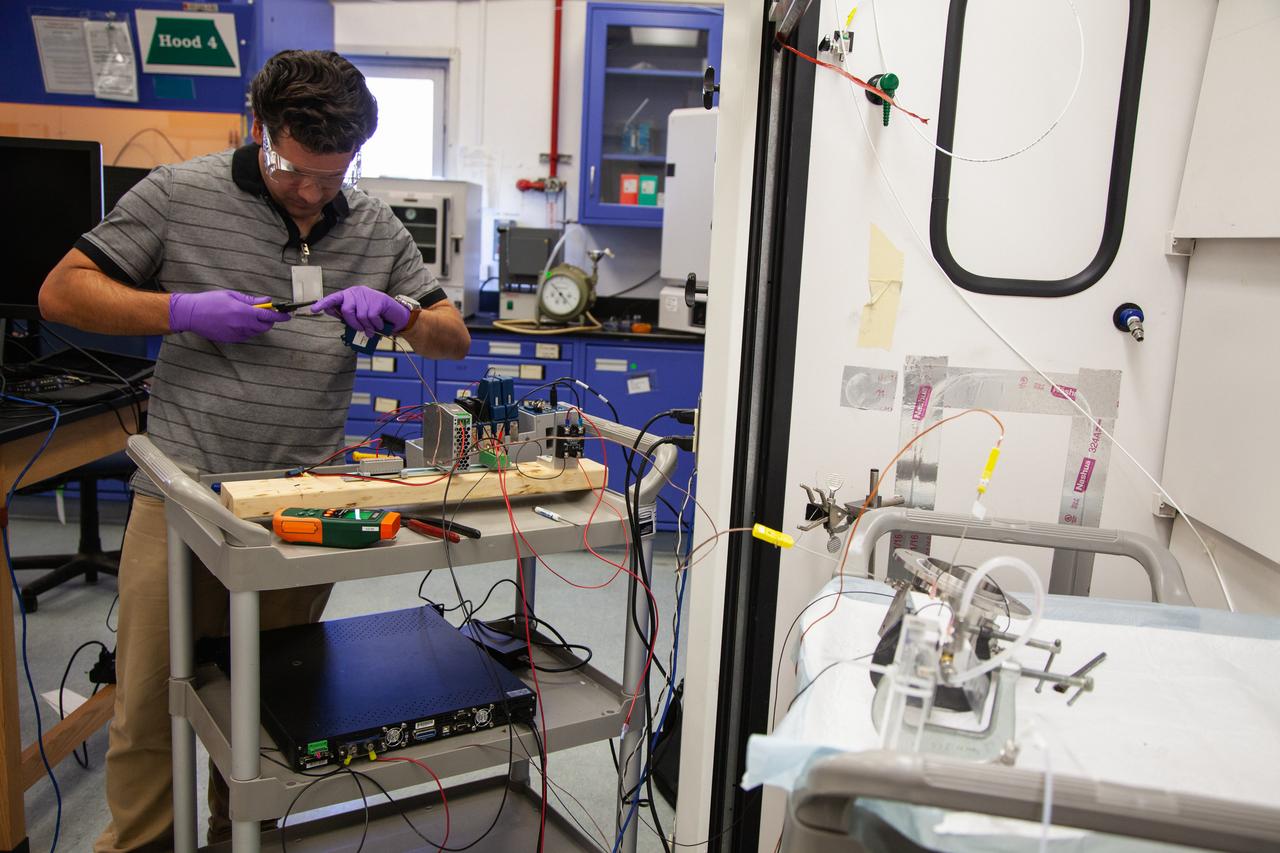
A Kennedy Space Center employee works on assembling the flight hardware of NASA’s Orbital Syngas Commodity Augmentation Reactor, or OSCAR – an Early Career Initiative project at the Florida spaceport that studies technology to convert trash and human waste into useful gasses such as methane, hydrogen and carbon dioxide. By processing small pieces of trash in a high-temperature reactor, OSCAR is advancing new and innovative technology for managing waste in space. OSCAR would reduce the amount of space needed for waste storage within a spacecraft, turn some waste into gasses that have energy storage and life support applications and ensure waste is no longer biologically active. A prototype has already been developed, and a team of Kennedy employees are in the process of constructing a new rig for suborbital flight testing.
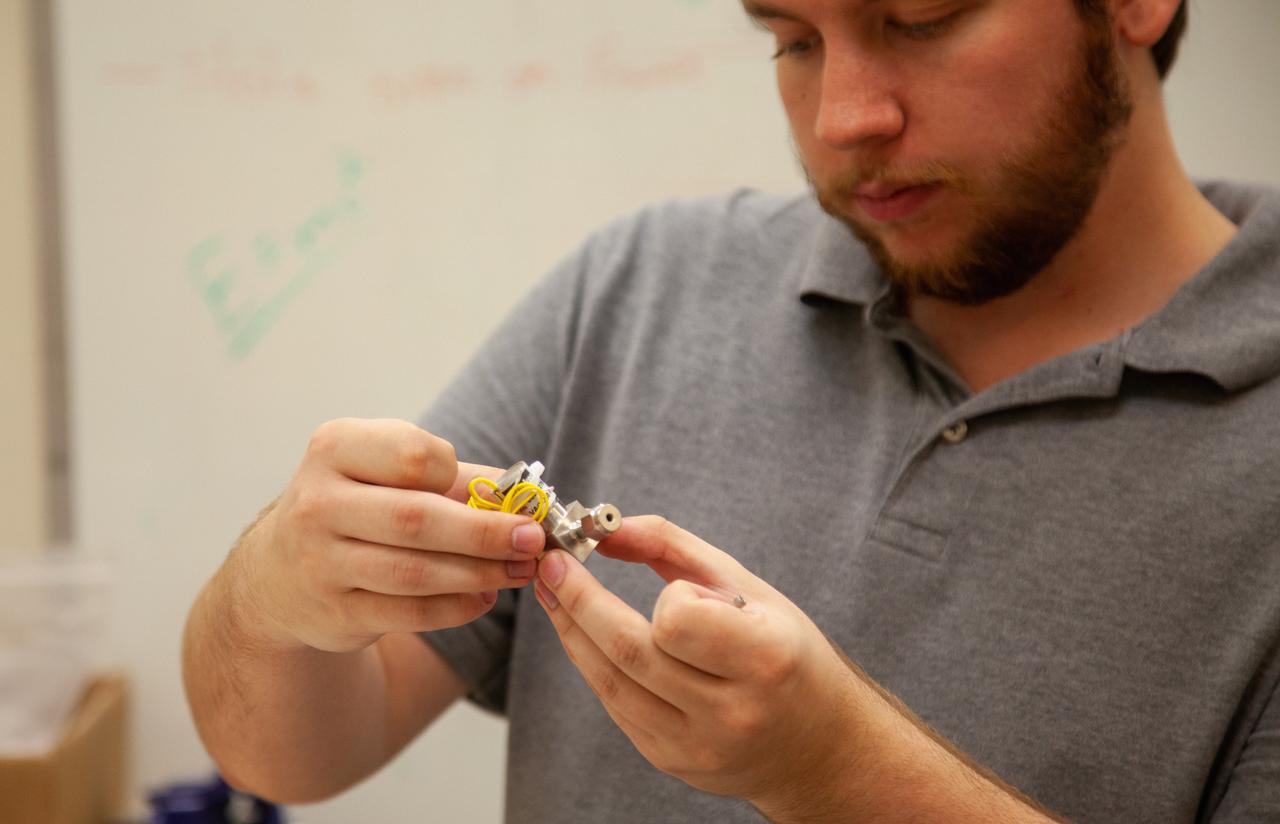
A Kennedy Space Center employee works on assembling the flight hardware of NASA’s Orbital Syngas Commodity Augmentation Reactor, or OSCAR – an Early Career Initiative project at the Florida spaceport that studies technology to convert trash and human waste into useful gasses such as methane, hydrogen and carbon dioxide. By processing small pieces of trash in a high-temperature reactor, OSCAR is advancing new and innovative technology for managing waste in space. OSCAR would reduce the amount of space needed for waste storage within a spacecraft, turn some waste into gasses that have energy storage and life support applications and ensure waste is no longer biologically active. A prototype has already been developed, and a team of Kennedy employees are in the process of constructing a new rig for suborbital flight testing.
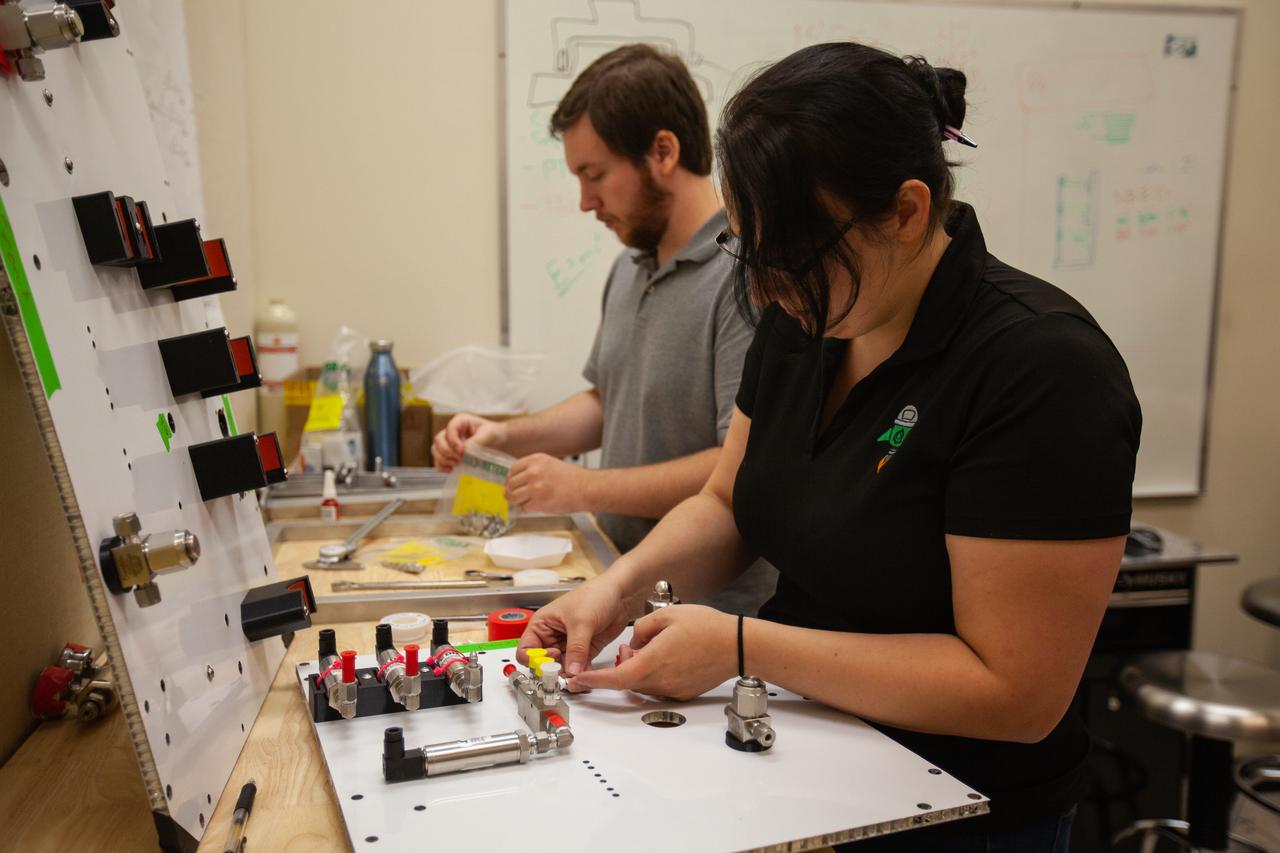
Kennedy Space Center employees assemble the flight hardware of NASA’s Orbital Syngas Commodity Augmentation Reactor, or OSCAR – an Early Career Initiative project at the Florida spaceport that studies technology to convert trash and human waste into useful gasses such as methane, hydrogen and carbon dioxide. By processing small pieces of trash in a high-temperature reactor, OSCAR is advancing new and innovative technology for managing waste in space. OSCAR would reduce the amount of space needed for waste storage within a spacecraft, turn some waste into gasses that have energy storage and life support applications and ensure waste is no longer biologically active. A prototype has already been developed, and a team of Kennedy employees are in the process of constructing a new rig for suborbital flight testing.
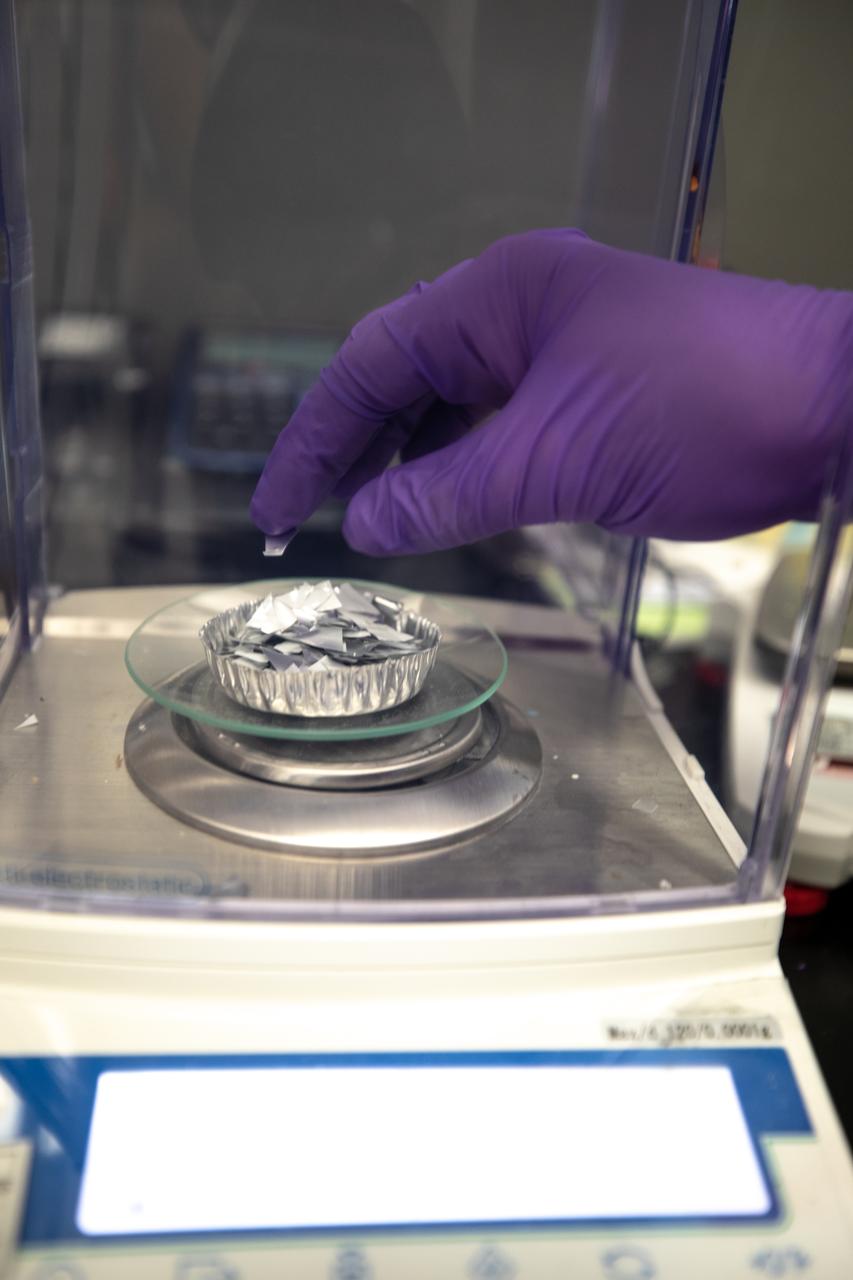
A Kennedy Space Center intern weighs trash simulant – comprised of different types of material that have been cut into tiny pieces – that will be utilized for the agency’s Orbital Syngas Commodity Augmentation Reactor, or OSCAR. OSCAR is an Early Career Initiative project at the Florida spaceport that studies technology to convert trash and human waste into useful gasses such as methane, hydrogen and carbon dioxide. By processing small pieces of trash in a high-temperature reactor, OSCAR is advancing new and innovative technology for managing waste in space. OSCAR would reduce the amount of space needed for waste storage within a spacecraft, turn some waste into gasses that have energy storage and life support applications, and ensure waste is no longer biologically active. A prototype has been developed, and a team of Kennedy employees are in the process of constructing a new rig for suborbital flight testing.
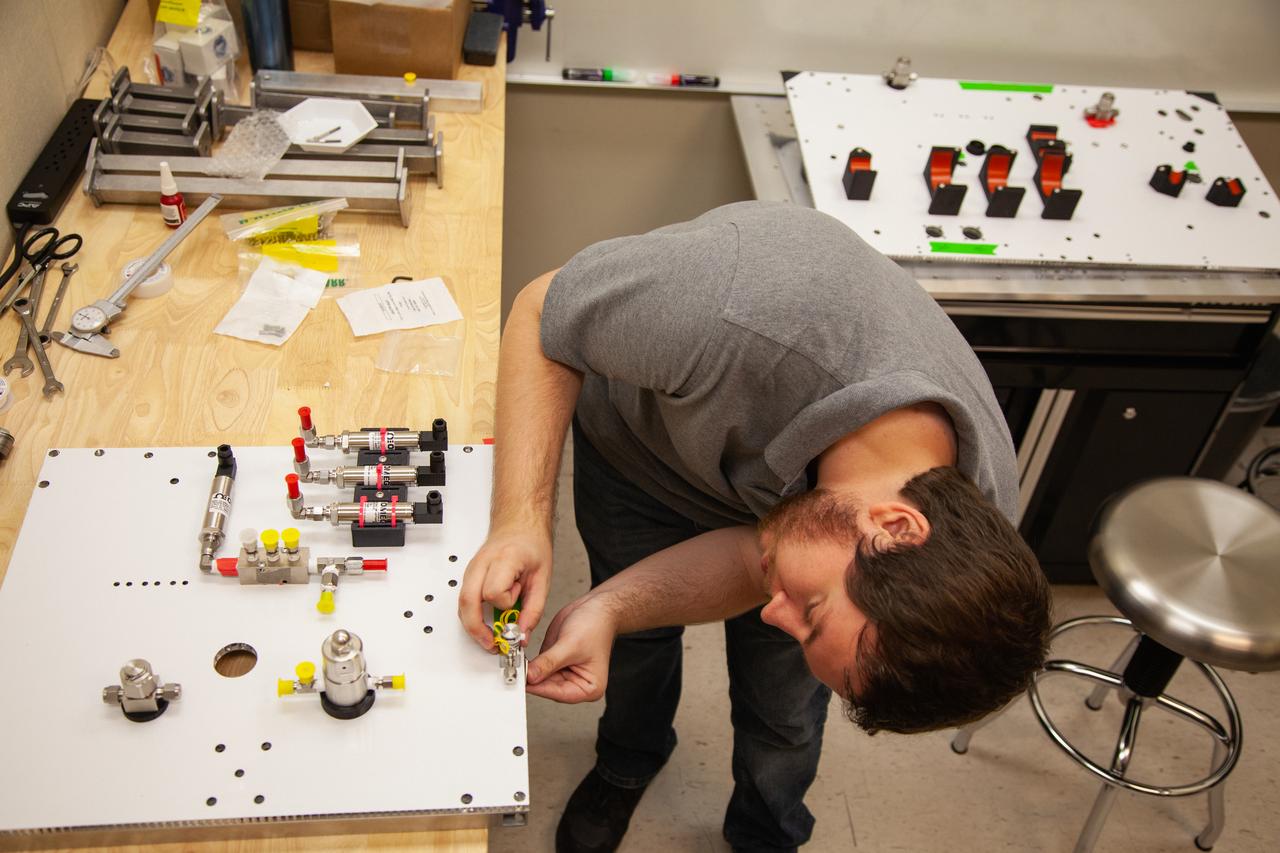
A Kennedy Space Center employee works on assembling the flight hardware of NASA’s Orbital Syngas Commodity Augmentation Reactor, or OSCAR – an Early Career Initiative project at the Florida spaceport that studies technology to convert trash and human waste into useful gasses such as methane, hydrogen and carbon dioxide. By processing small pieces of trash in a high-temperature reactor, OSCAR is advancing new and innovative technology for managing waste in space. OSCAR would reduce the amount of space needed for waste storage within a spacecraft, turn some waste into gasses that have energy storage and life support applications and ensure waste is no longer biologically active. A prototype has already been developed, and a team of Kennedy employees are in the process of constructing a new rig for suborbital flight testing.
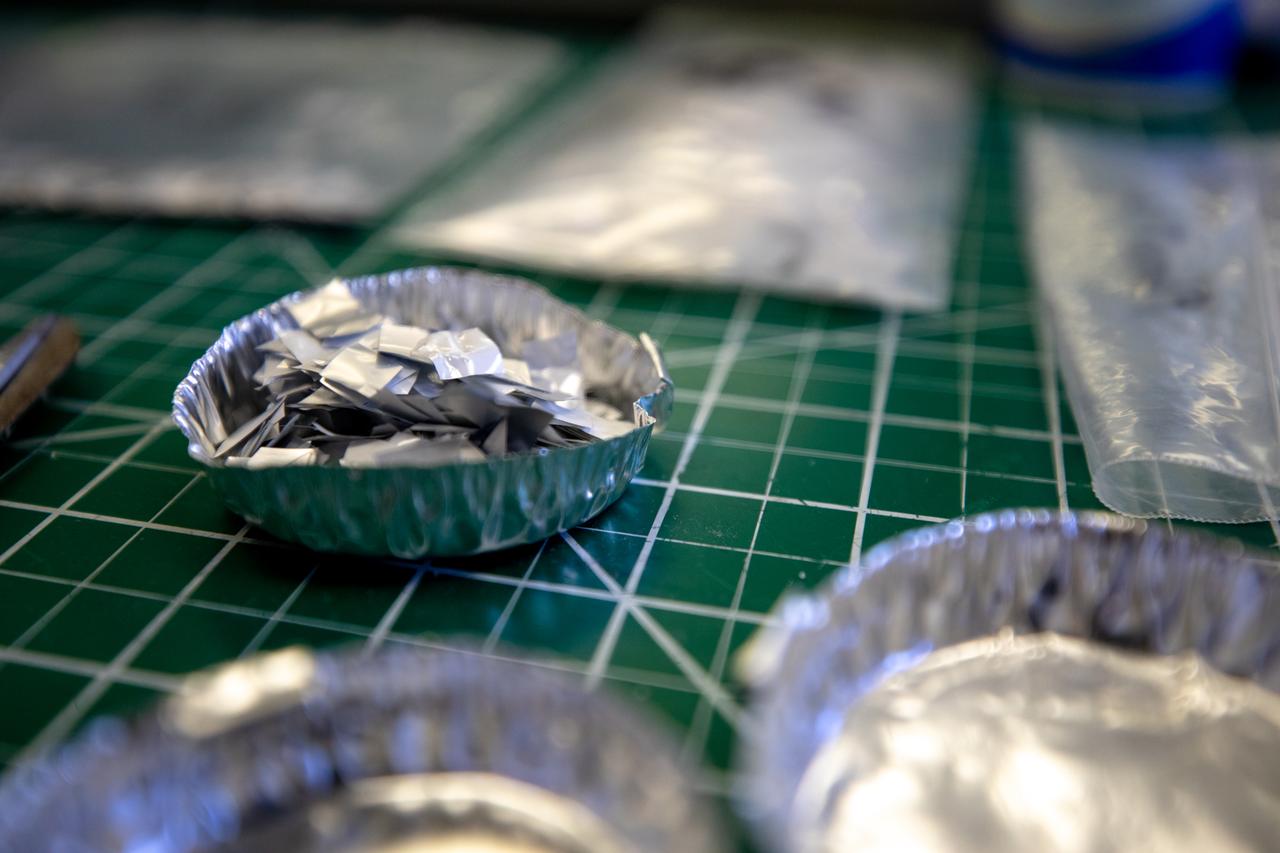
Pictured at Kennedy Space Center is trash simulant – comprised of different types of material that have been cut into tiny pieces – that will be utilized for NASA’s Orbital Syngas Commodity Augmentation Reactor, or OSCAR. OSCAR is an Early Career Initiative project at the Florida spaceport that studies technology to convert trash and human waste into useful gasses such as methane, hydrogen and carbon dioxide. By processing small pieces of trash in a high-temperature reactor, OSCAR is advancing new and innovative technology for managing waste in space. OSCAR would reduce the amount of space needed for waste storage within a spacecraft, turn some waste into gasses that have energy storage and life support applications, and ensure waste is no longer biologically active. A prototype has been developed, and a team of Kennedy employees are in the process of constructing a new rig for suborbital flight testing.
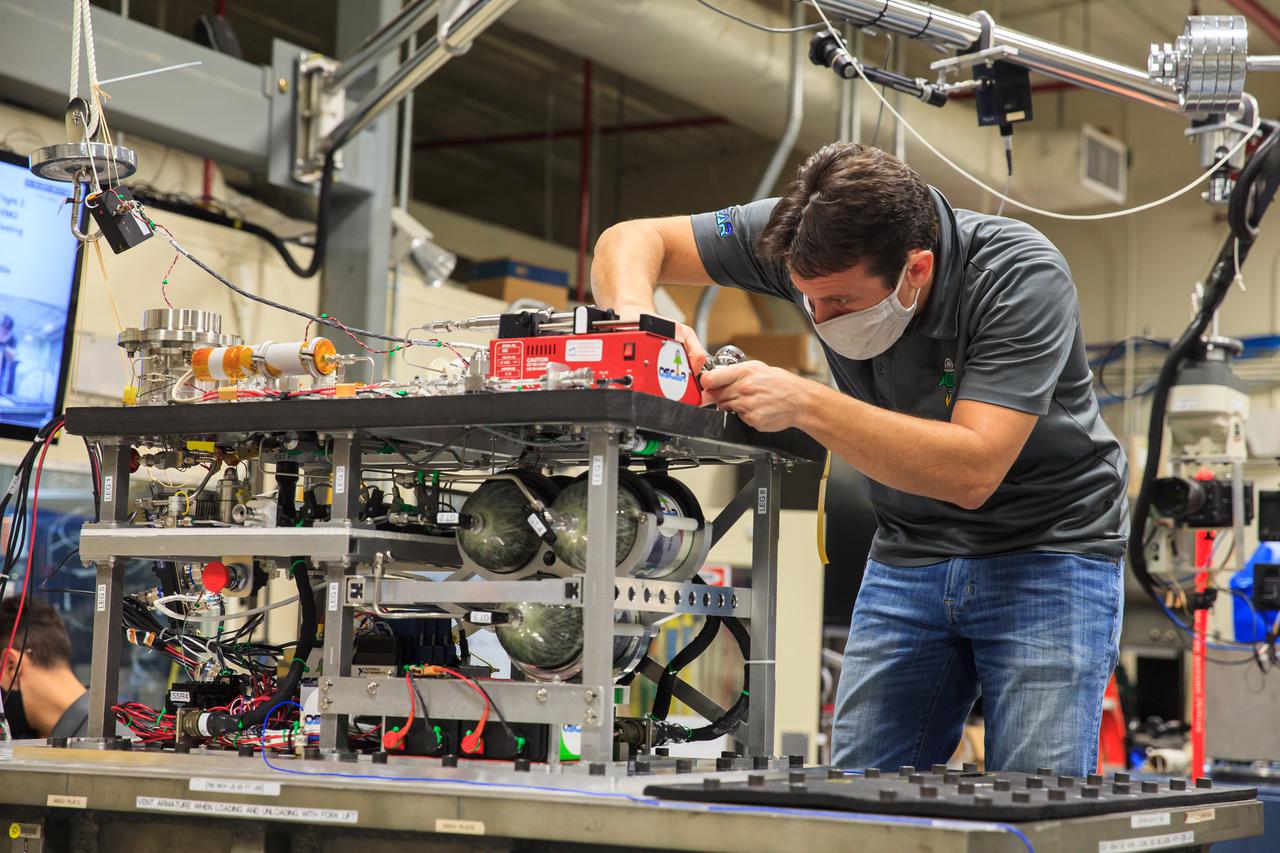
Gino Carro, a pressure vessels and systems engineer for Kennedy Space Center’s Laboratory Support Services and Operations contract, prepares NASA’s Orbital Syngas Commodity Augmentation Reactor (OSCAR) for vibration tests inside the Vibration Test Lab at the Florida spaceport on Jan. 14, 2021. The tests are part of ongoing preparation for a scheduled suborbital flight test later this year. Beginning as an Early Career Initiative project, OSCAR studies technology to convert trash and human waste into useful gasses such as methane, hydrogen, and carbon dioxide. By processing small pieces of trash in a high-temperature reactor, OSCAR would reduce the amount of space needed for waste storage within a spacecraft, turn some waste into gasses that have energy storage and life support applications, and ensure waste is no longer biologically active.

Ray Pitts, co-principal investigator for NASA’s Orbital Syngas Commodity Augmentation Reactor (OSCAR), prepares OSCAR for vibration tests inside the Vibration Test Lab at the agency’s Kennedy Space Center in Florida on Jan. 14, 2021. The tests are part of ongoing preparation for a scheduled suborbital flight test later this year. Beginning as an Early Career Initiative project, OSCAR studies technology to convert trash and human waste into useful gasses such as methane, hydrogen, and carbon dioxide. By processing small pieces of trash in a high-temperature reactor, OSCAR would reduce the amount of space needed for waste storage within a spacecraft, turn some waste into gasses that have energy storage and life support applications, and ensure waste is no longer biologically active.
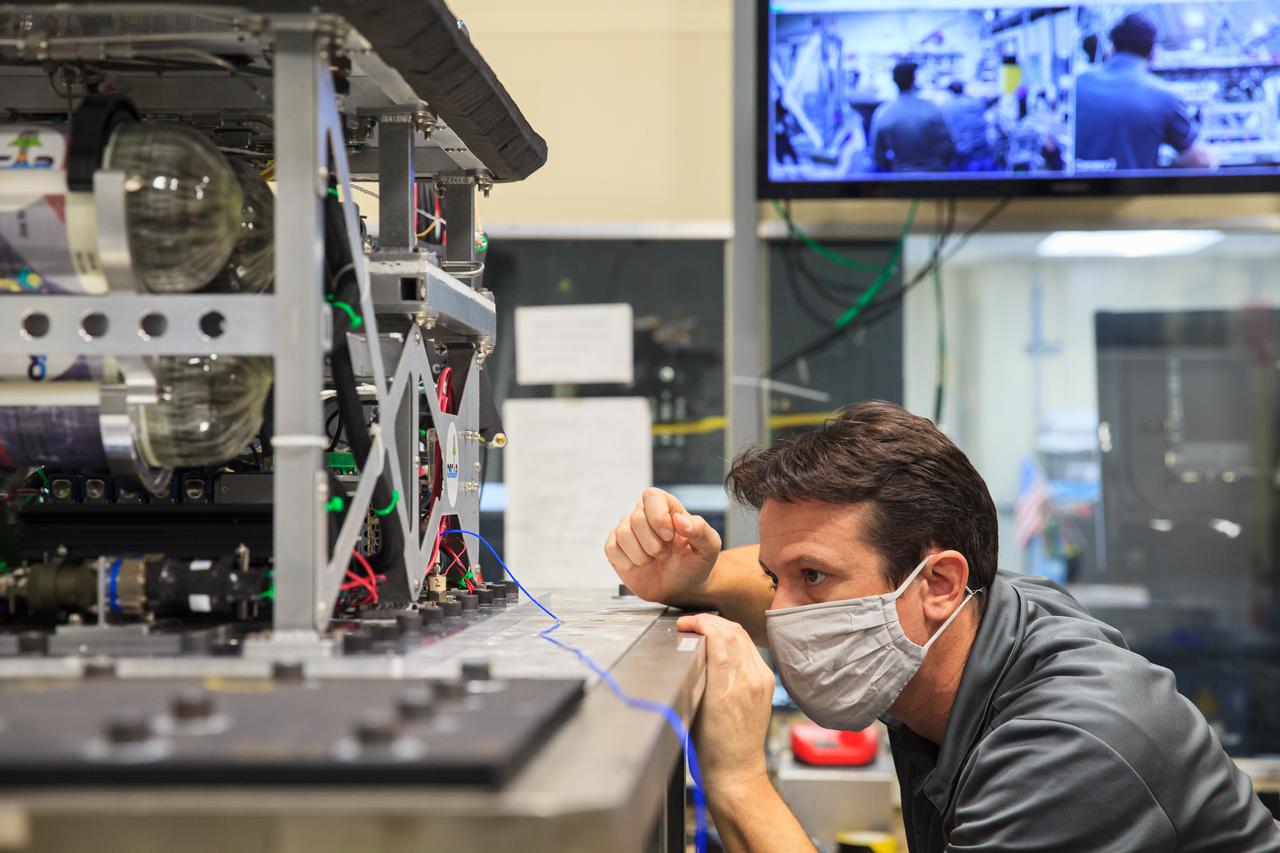
Gino Carro, a pressure vessels and systems engineer for Kennedy Space Center’s Laboratory Support Services and Operations contract, prepares NASA’s Orbital Syngas Commodity Augmentation Reactor (OSCAR) for vibration tests inside the Vibration Test Lab at the Florida spaceport on Jan. 14, 2021. The tests are part of ongoing preparation for a scheduled suborbital flight test later this year. Beginning as an Early Career Initiative project, OSCAR studies technology to convert trash and human waste into useful gasses such as methane, hydrogen, and carbon dioxide. By processing small pieces of trash in a high-temperature reactor, OSCAR would reduce the amount of space needed for waste storage within a spacecraft, turn some waste into gasses that have energy storage and life support applications, and ensure waste is no longer biologically active.
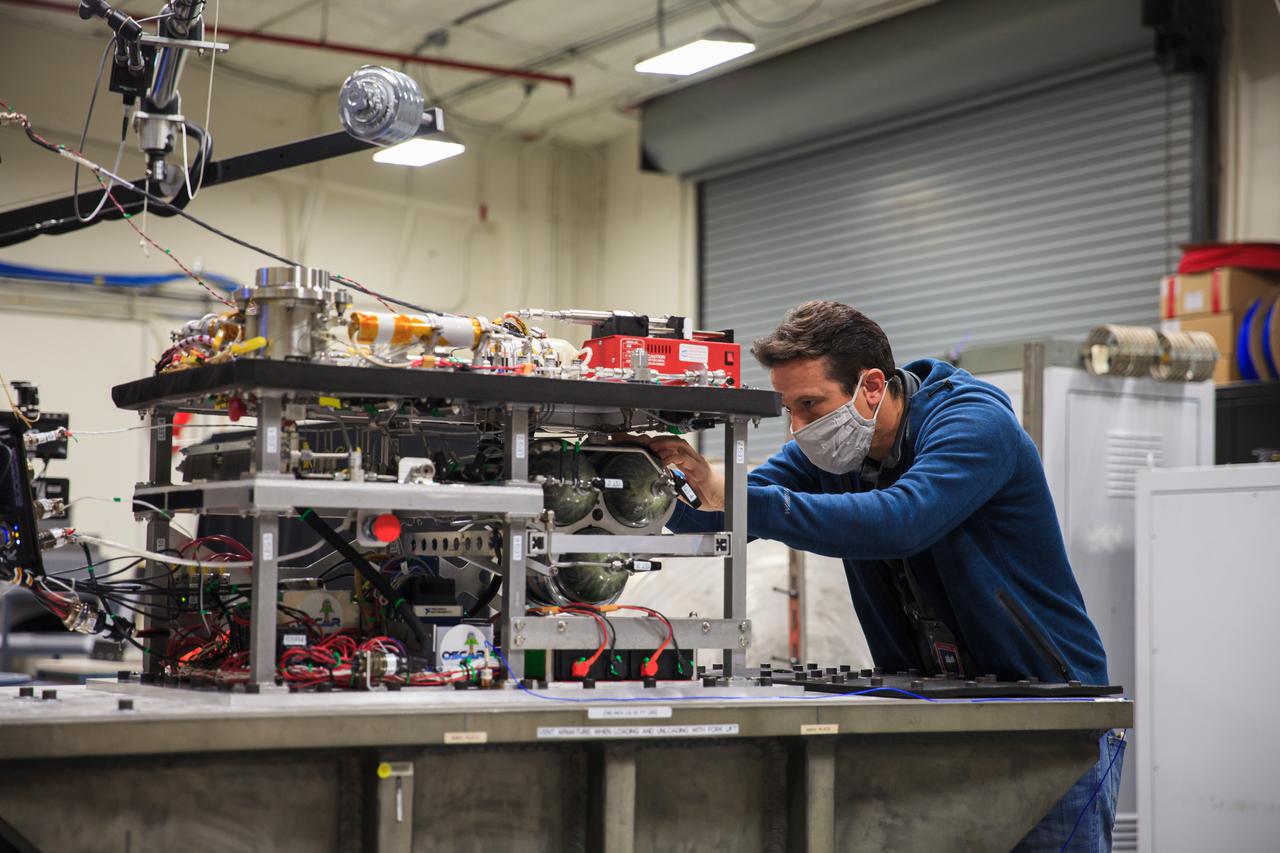
Gino Carro, a pressure vessels and systems engineer for Kennedy Space Center’s Laboratory Support Services and Operations contract, prepares NASA’s Orbital Syngas Commodity Augmentation Reactor (OSCAR) for vibration tests inside the Vibration Test Lab at the Florida spaceport on Jan. 14, 2021. The tests are part of ongoing preparation for a scheduled suborbital flight test later this year. Beginning as an Early Career Initiative project, OSCAR studies technology to convert trash and human waste into useful gasses such as methane, hydrogen, and carbon dioxide. By processing small pieces of trash in a high-temperature reactor, OSCAR would reduce the amount of space needed for waste storage within a spacecraft, turn some waste into gasses that have energy storage and life support applications, and ensure waste is no longer biologically active.
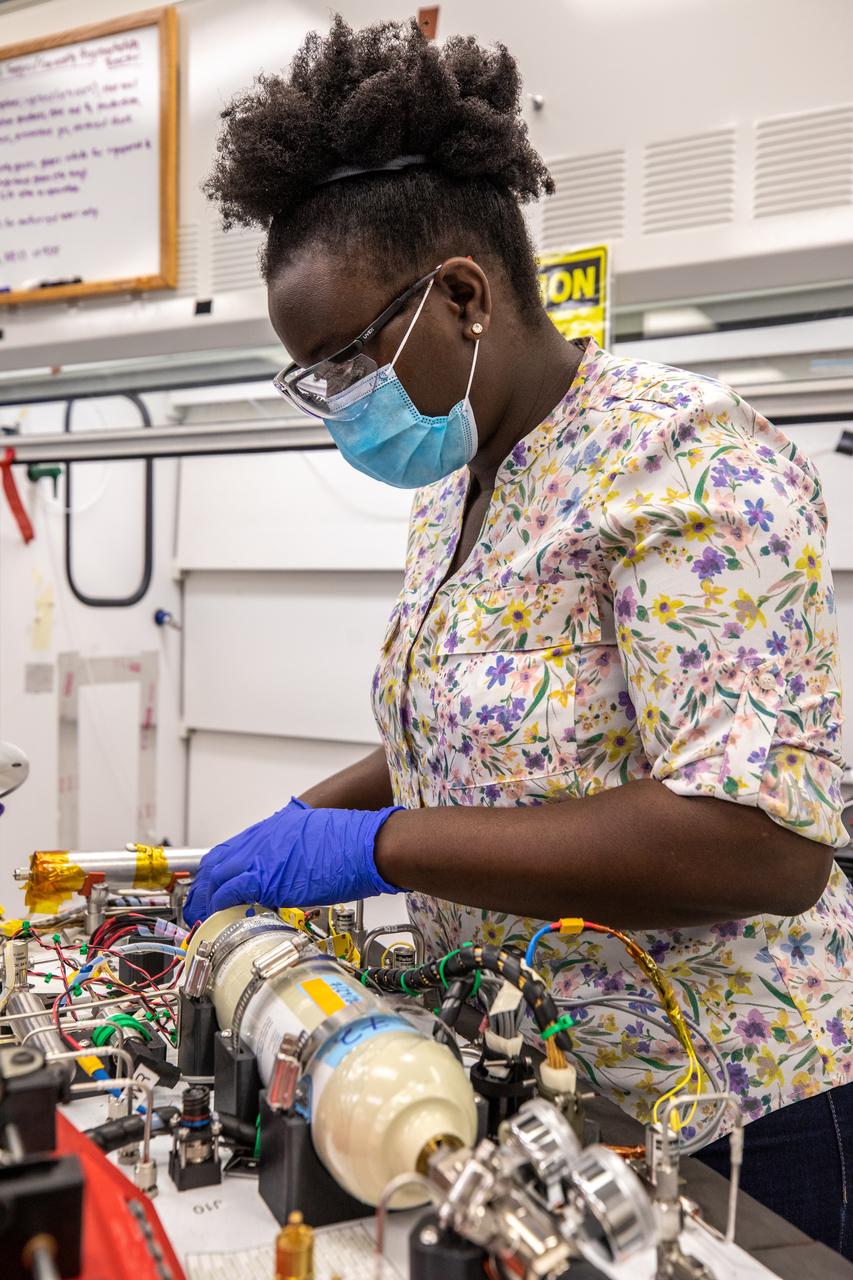
Technicians wearing protective equipment perform work for a future mission on flight hardware for NASA’s Orbital Syngas Commodity Augmentation Reactor, or OSCAR, at the Neil Armstrong Operations and Checkout Facility at the agency’s Kennedy Space Center in Florida on Aug. 10, 2020. OSCAR began as an Early Career Initiative project at the spaceport that studies technology to convert trash and human waste into useful gasses such as methane, hydrogen, and carbon dioxide. By processing small pieces of trash in a high-temperature reactor, OSCAR is advancing new and innovative technology for managing waste in space.
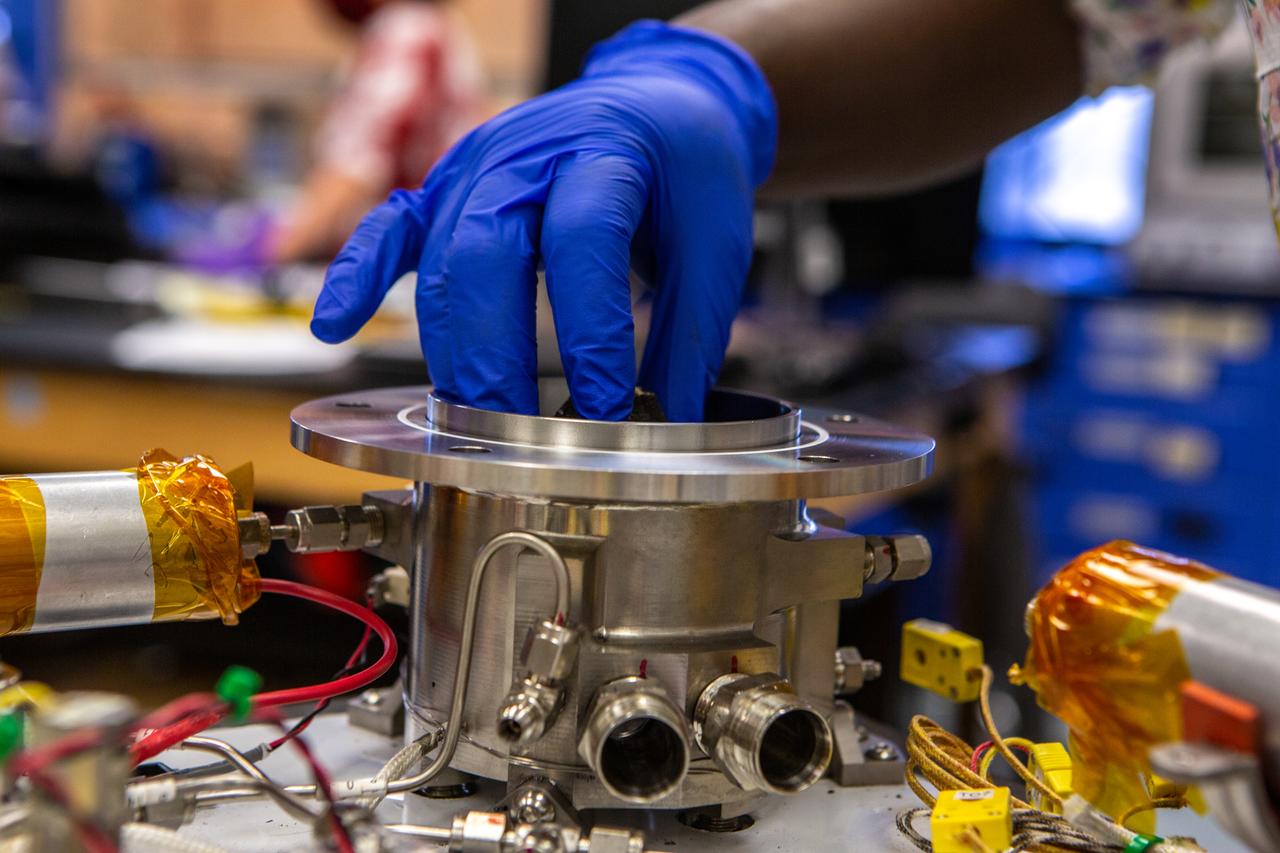
Technicians wearing protective equipment perform work for a future mission on flight hardware for NASA’s Orbital Syngas Commodity Augmentation Reactor, or OSCAR, at the Neil Armstrong Operations and Checkout Facility at the agency’s Kennedy Space Center in Florida on Aug. 10, 2020. OSCAR began as an Early Career Initiative project at the spaceport that studies technology to convert trash and human waste into useful gasses such as methane, hydrogen, and carbon dioxide. By processing small pieces of trash in a high-temperature reactor, OSCAR is advancing new and innovative technology for managing waste in space.

Flight hardware for NASA’s Orbital Syngas Commodity Augmentation Reactor, or OSCAR, is inside the Applied Physics Lab inside the Neil Armstrong Operations and Checkout Facility at the agency’s Kennedy Space Center in Florida on July 21, 2022. OSCAR began as an Early Career Initiative project at the spaceport that studies technology to convert trash and human waste into useful gasses such as methane, hydrogen, and carbon dioxide. By processing small pieces of trash in a high-temperature reactor, OSCAR is advancing new and innovative technology for managing waste in space.
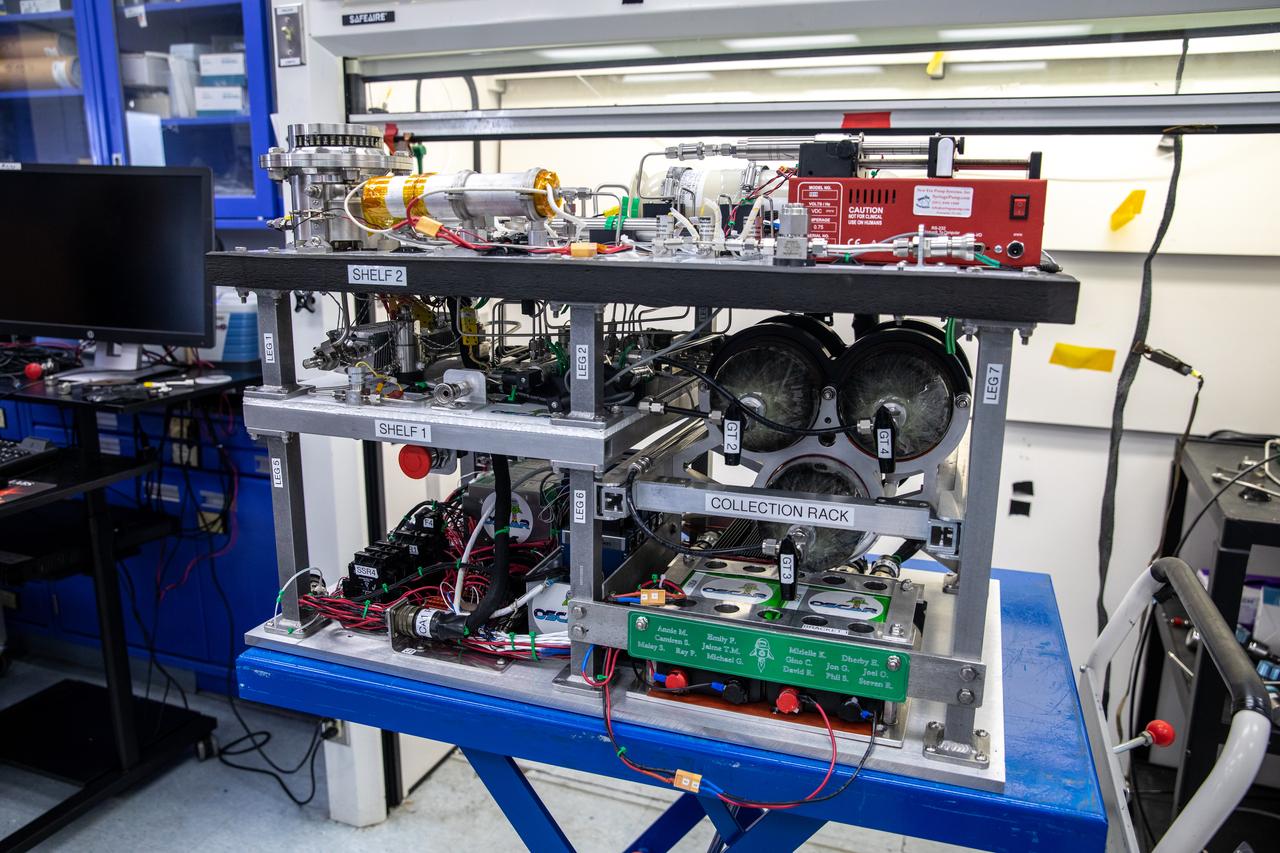
Flight hardware for NASA’s Orbital Syngas Commodity Augmentation Reactor, or OSCAR, is inside the Applied Physics Lab inside the Neil Armstrong Operations and Checkout Facility at the agency’s Kennedy Space Center in Florida on July 21, 2022. OSCAR began as an Early Career Initiative project at the spaceport that studies technology to convert trash and human waste into useful gasses such as methane, hydrogen, and carbon dioxide. By processing small pieces of trash in a high-temperature reactor, OSCAR is advancing new and innovative technology for managing waste in space.
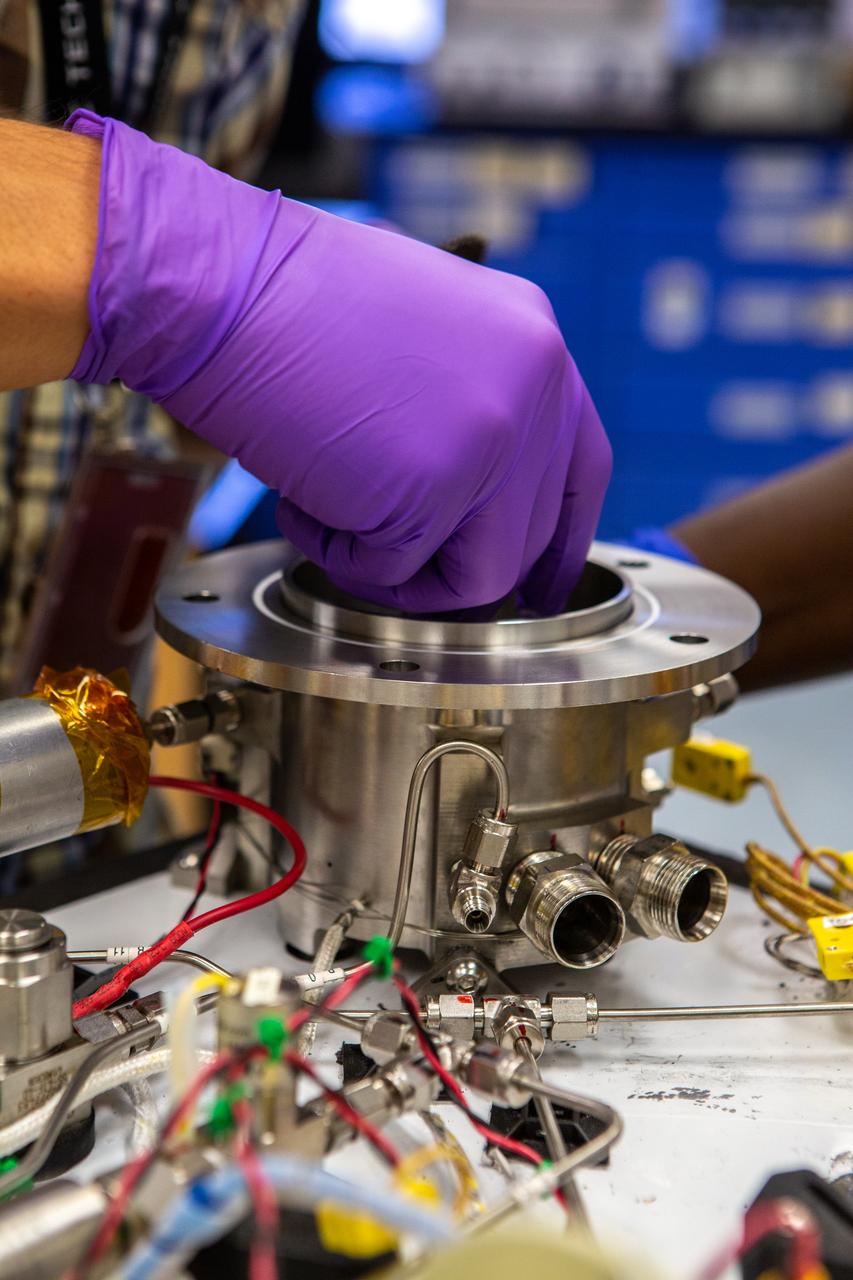
Technicians wearing protective equipment perform work for a future mission on flight hardware for NASA’s Orbital Syngas Commodity Augmentation Reactor, or OSCAR, at the Neil Armstrong Operations and Checkout Facility at the agency’s Kennedy Space Center in Florida on Aug. 10, 2020. OSCAR began as an Early Career Initiative project at the spaceport that studies technology to convert trash and human waste into useful gasses such as methane, hydrogen, and carbon dioxide. By processing small pieces of trash in a high-temperature reactor, OSCAR is advancing new and innovative technology for managing waste in space.
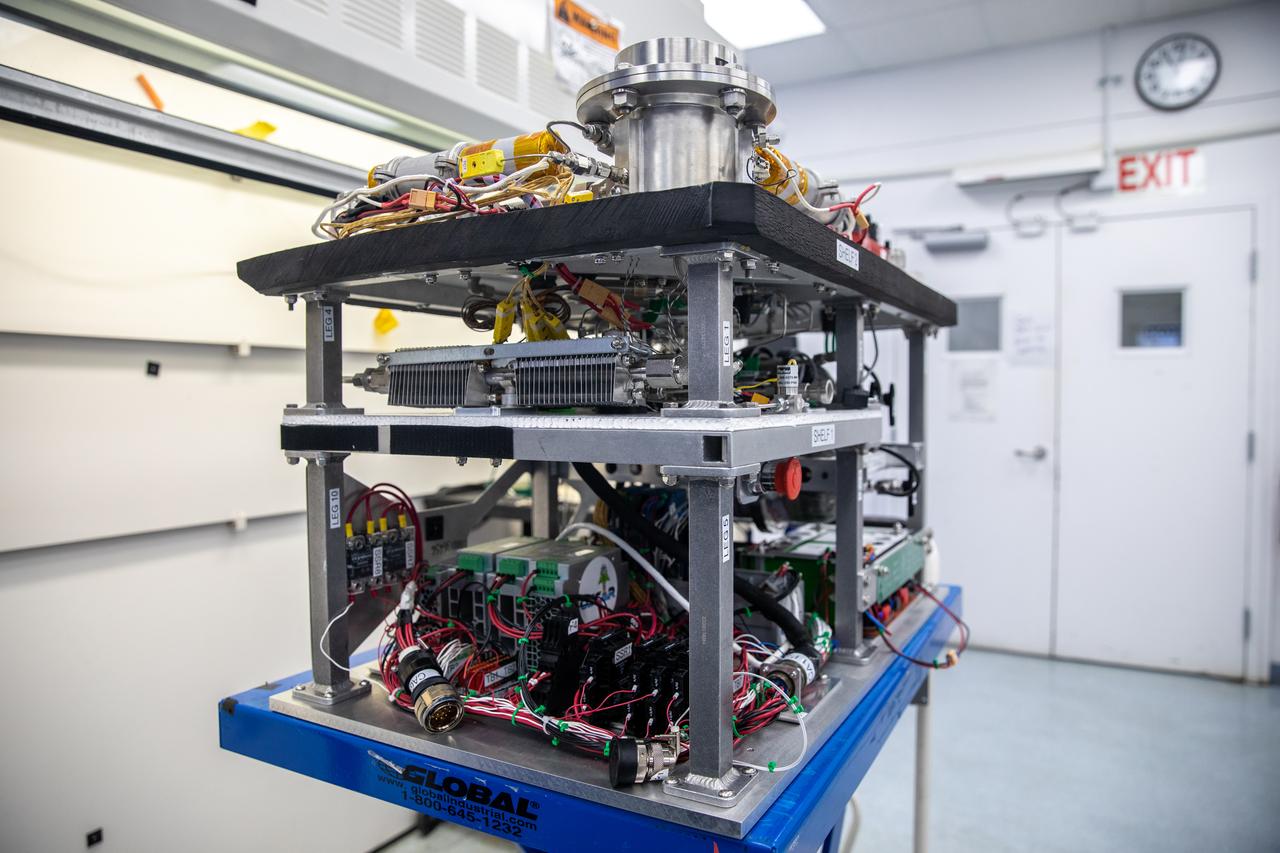
Flight hardware for NASA’s Orbital Syngas Commodity Augmentation Reactor, or OSCAR, is inside the Applied Physics Lab inside the Neil Armstrong Operations and Checkout Facility at the agency’s Kennedy Space Center in Florida on July 21, 2022. OSCAR began as an Early Career Initiative project at the spaceport that studies technology to convert trash and human waste into useful gasses such as methane, hydrogen, and carbon dioxide. By processing small pieces of trash in a high-temperature reactor, OSCAR is advancing new and innovative technology for managing waste in space.
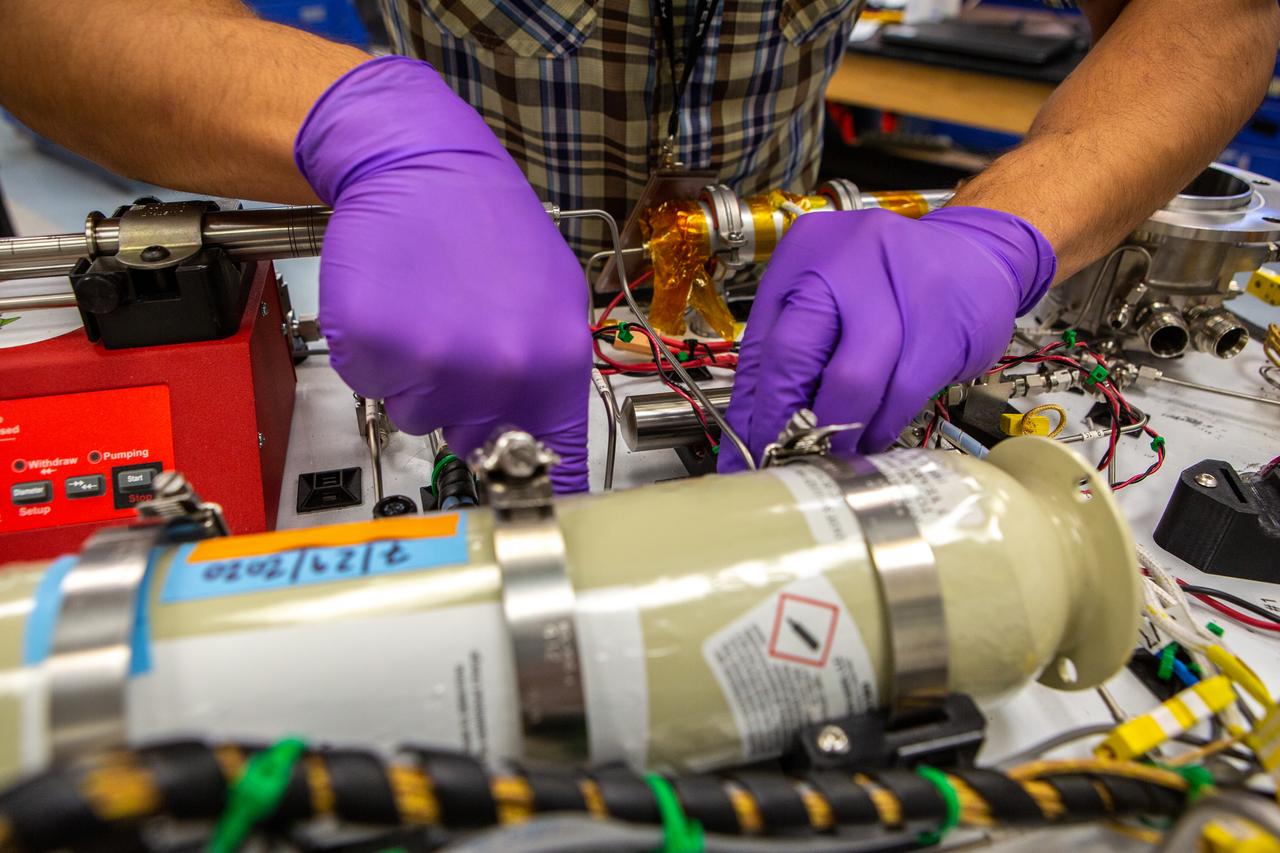
Technicians wearing protective equipment perform work for a future mission on flight hardware for NASA’s Orbital Syngas Commodity Augmentation Reactor, or OSCAR, at the Neil Armstrong Operations and Checkout Facility at the agency’s Kennedy Space Center in Florida on Aug. 10, 2020. OSCAR began as an Early Career Initiative project at the spaceport that studies technology to convert trash and human waste into useful gasses such as methane, hydrogen, and carbon dioxide. By processing small pieces of trash in a high-temperature reactor, OSCAR is advancing new and innovative technology for managing waste in space.
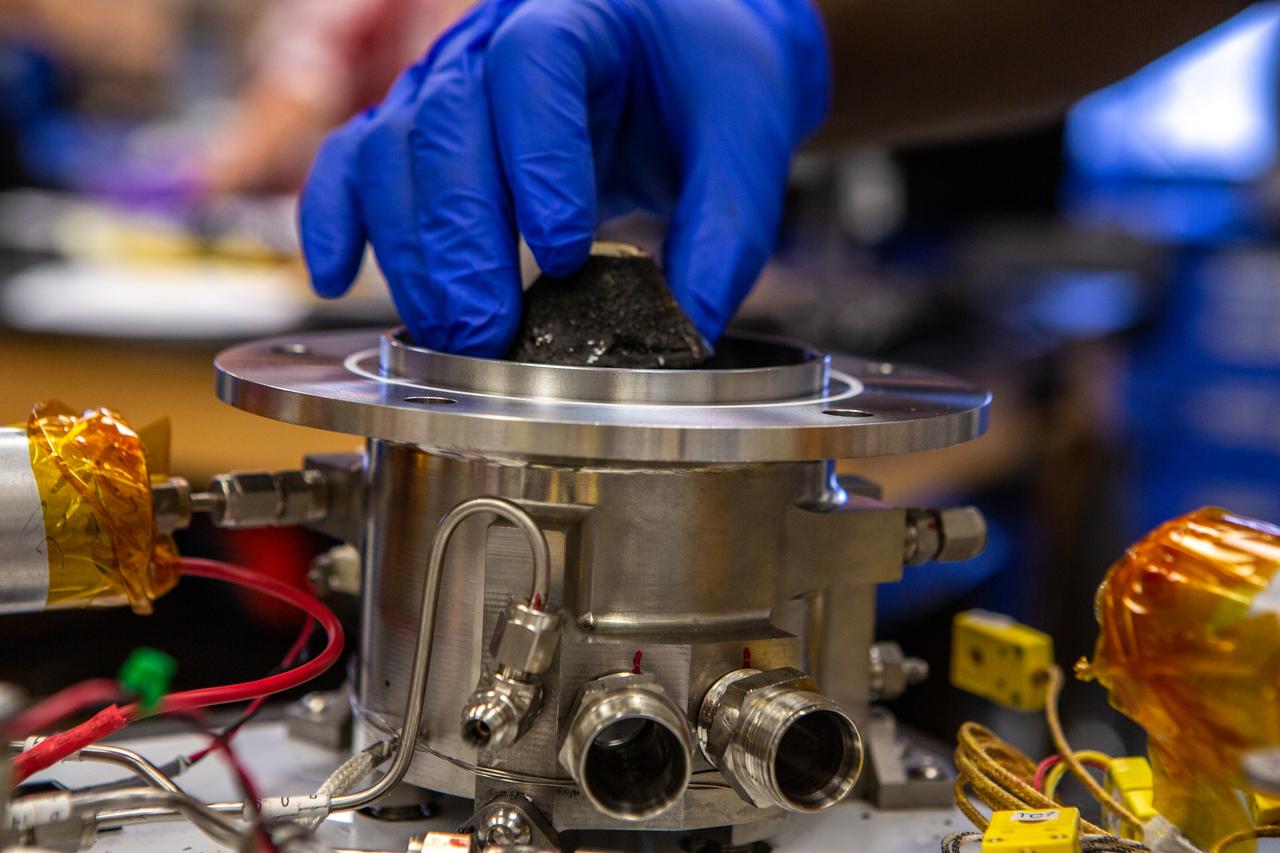
Technicians wearing protective equipment perform work for a future mission on flight hardware for NASA’s Orbital Syngas Commodity Augmentation Reactor, or OSCAR, at the Neil Armstrong Operations and Checkout Facility at the agency’s Kennedy Space Center in Florida on Aug. 10, 2020. OSCAR began as an Early Career Initiative project at the spaceport that studies technology to convert trash and human waste into useful gasses such as methane, hydrogen, and carbon dioxide. By processing small pieces of trash in a high-temperature reactor, OSCAR is advancing new and innovative technology for managing waste in space.

Flight hardware for NASA’s Orbital Syngas Commodity Augmentation Reactor, or OSCAR, is in view inside the Applied Physics Lab in the Neil Armstrong Operations and Checkout Facility at the agency’s Kennedy Space Center in Florida on July 21, 2022. OSCAR began as an Early Career Initiative project at the spaceport that studies technology to convert trash and human waste into useful gasses such as methane, hydrogen, and carbon dioxide. By processing small pieces of trash in a high-temperature reactor, OSCAR is advancing new and innovative technology for managing waste in space.
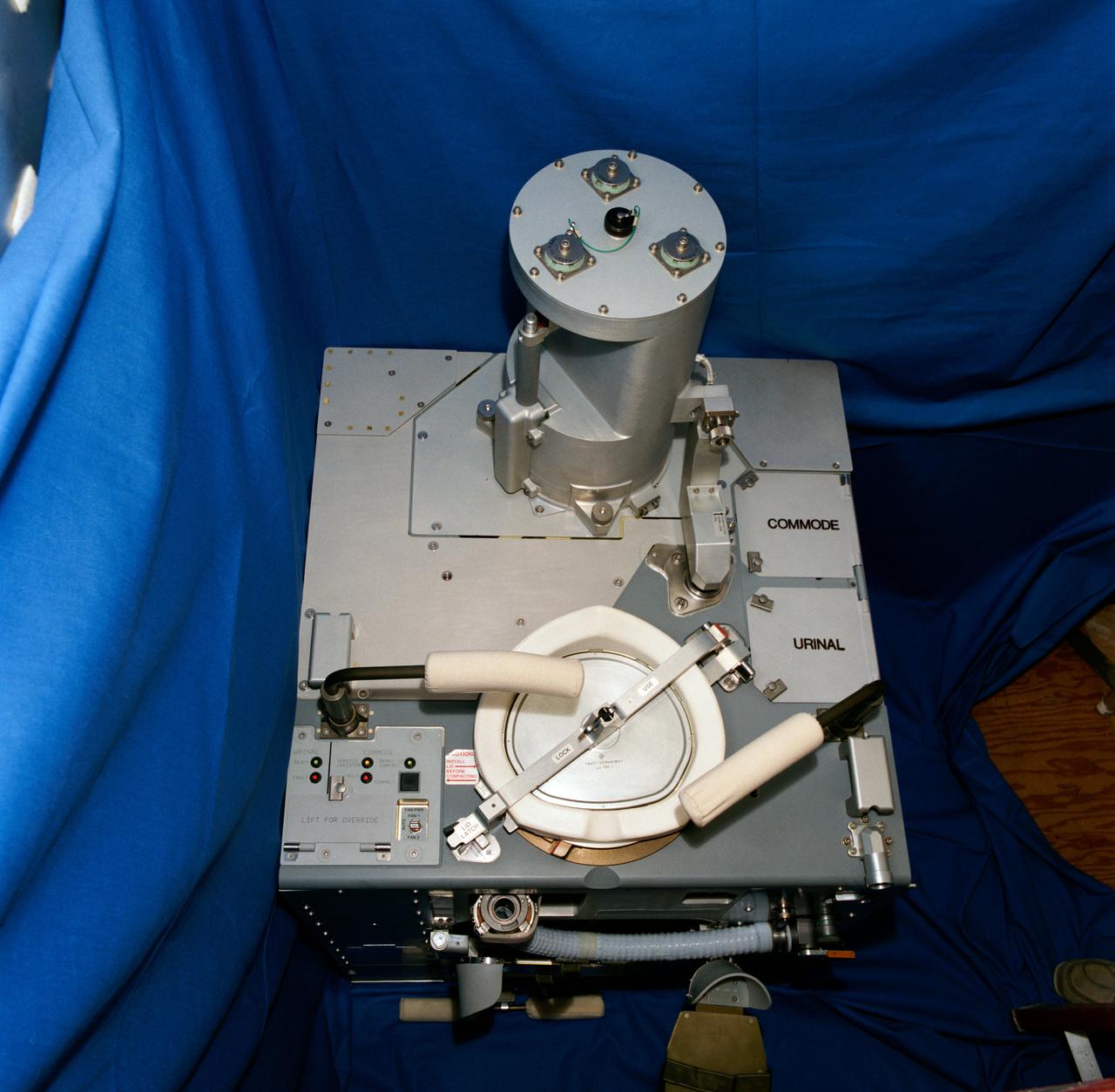
S92-46726 (November 1992) --- A high angle view of the Improved Waste Collection System (IWCS) scheduled to fly aboard NASA's Space Shuttle Endeavour for the STS-54 mission. Among the advantages the new IWCS is hoped to have over the current WCS are greater dependability, better hygiene, virtually unlimited capacity and more efficient preparation between Shuttle missions. Unlike the previous WCS, the improved version will not have to be removed from the spacecraft to be readied for the next flight.
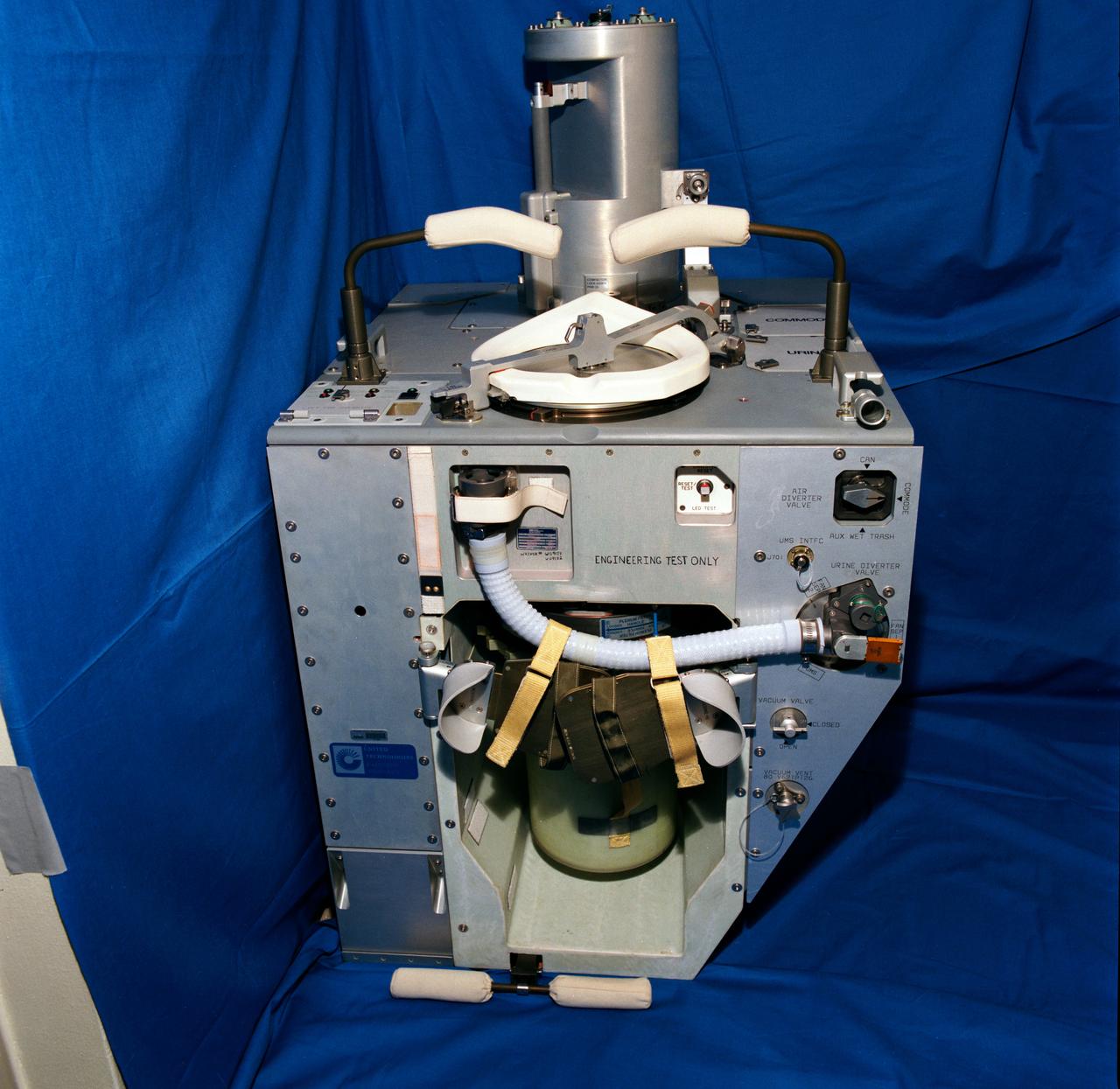
S92-46717 (November 1992) --- A front view of the improved waste collection system (IWCS) scheduled to fly aboard NASA's Space Shuttle Endeavour for the STS-54 mission. Among the advantages the new IWCS is hoped to have over the current WCS are greater dependability, better hygiene, virtually unlimited capacity and more efficient preparation between Shuttle missions. Unlike the previous WCS, the improved version will not have to be removed from the spacecraft to be readied for the next flight.
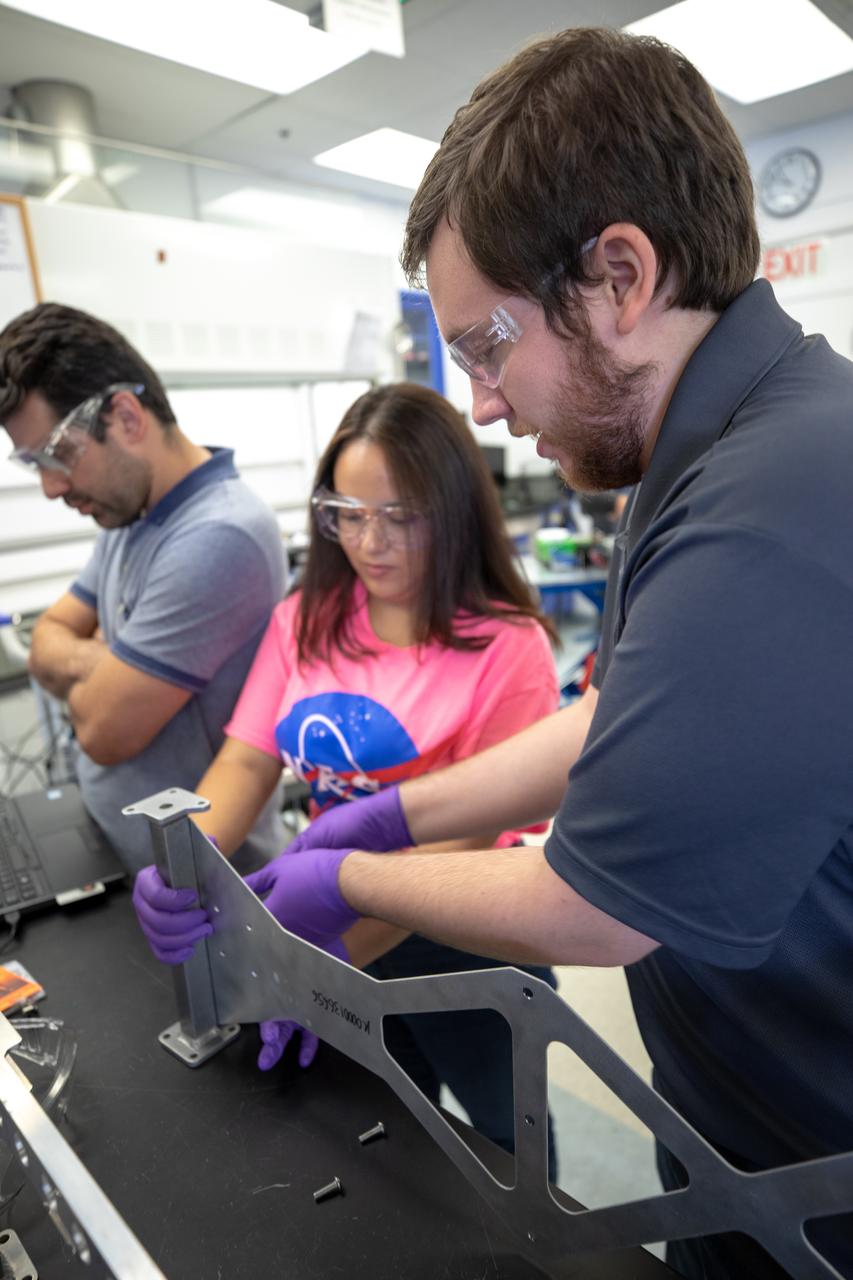
From left, Kennedy Space Center Mechanical Engineer Jaime Toro, NASA’s Orbital Syngas Commodity Augmentation Reactor (OSCAR) data acquisition and testing; Brianna Sandoval, OSCAR intern; and Jonathan Gleeson, Kennedy employee providing support for OSCAR under the center’s Laboratory Support Services and Operations contract, assemble the flight hardware of OSCAR. OSCAR is an Early Career Initiative project at the Florida spaceport that studies technology to convert trash and human waste into useful gasses such as methane, hydrogen and carbon dioxide. By processing small pieces of trash in a high-temperature reactor, OSCAR is advancing new and innovative technology for managing waste in space. OSCAR would reduce the amount of space needed for waste storage within a spacecraft, turn some waste into gasses that have energy storage and life support applications, and ensure waste is no longer biologically active. A prototype has been developed, and a team of Kennedy employees are in the process of constructing a new rig for suborbital flight testing.
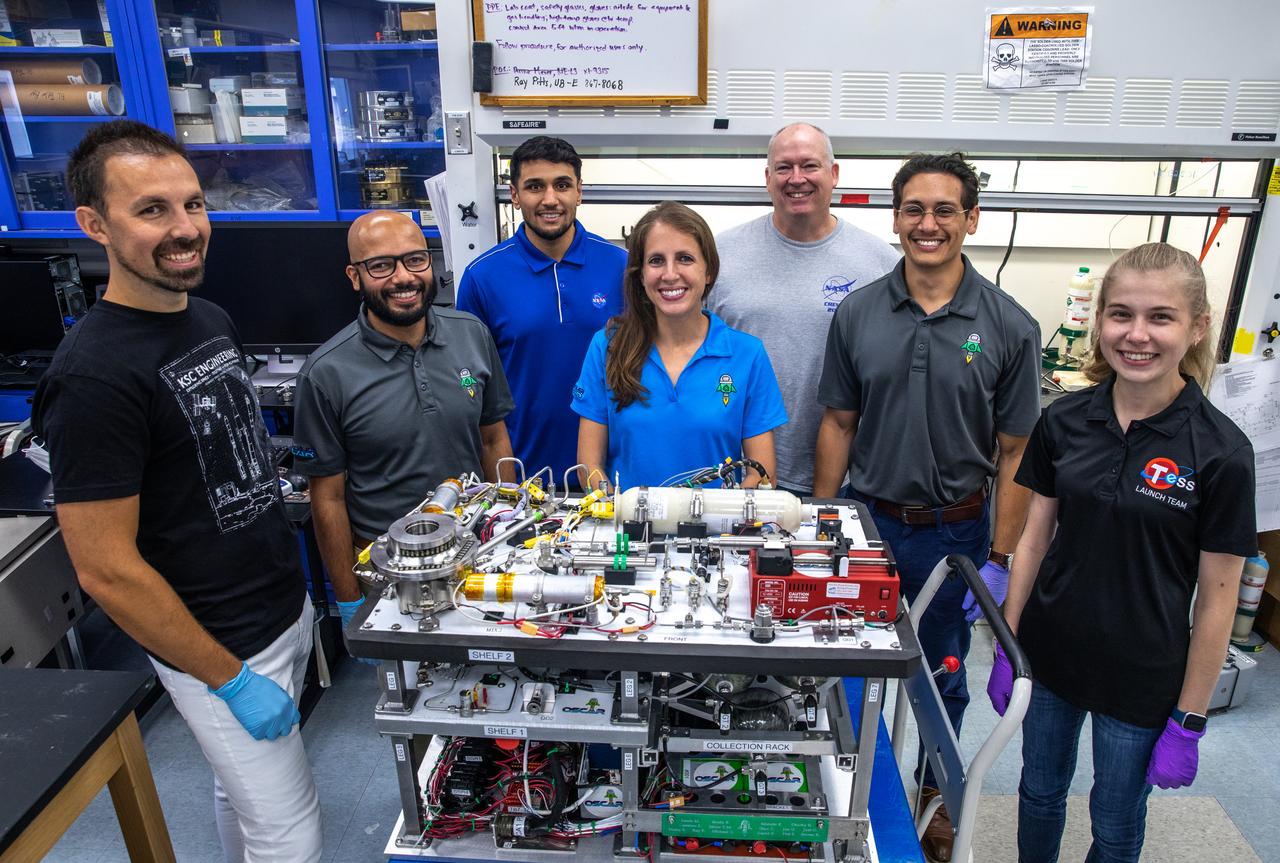
The Trash to Gas team members gather around the flight hardware for NASA’s Orbital Syngas Commodity Augmentation Reactor, or OSCAR, inside the Applied Physics Lab in the Neil Armstrong Operations and Checkout Facility at the agency’s Kennedy Space Center in Florida on July 21, 2022. OSCAR began as an Early Career Initiative project at the spaceport that studies technology to convert trash and human waste into useful gasses such as methane, hydrogen, and carbon dioxide. By processing small pieces of trash in a high-temperature reactor, OSCAR is advancing new and innovative technology for managing waste in space.
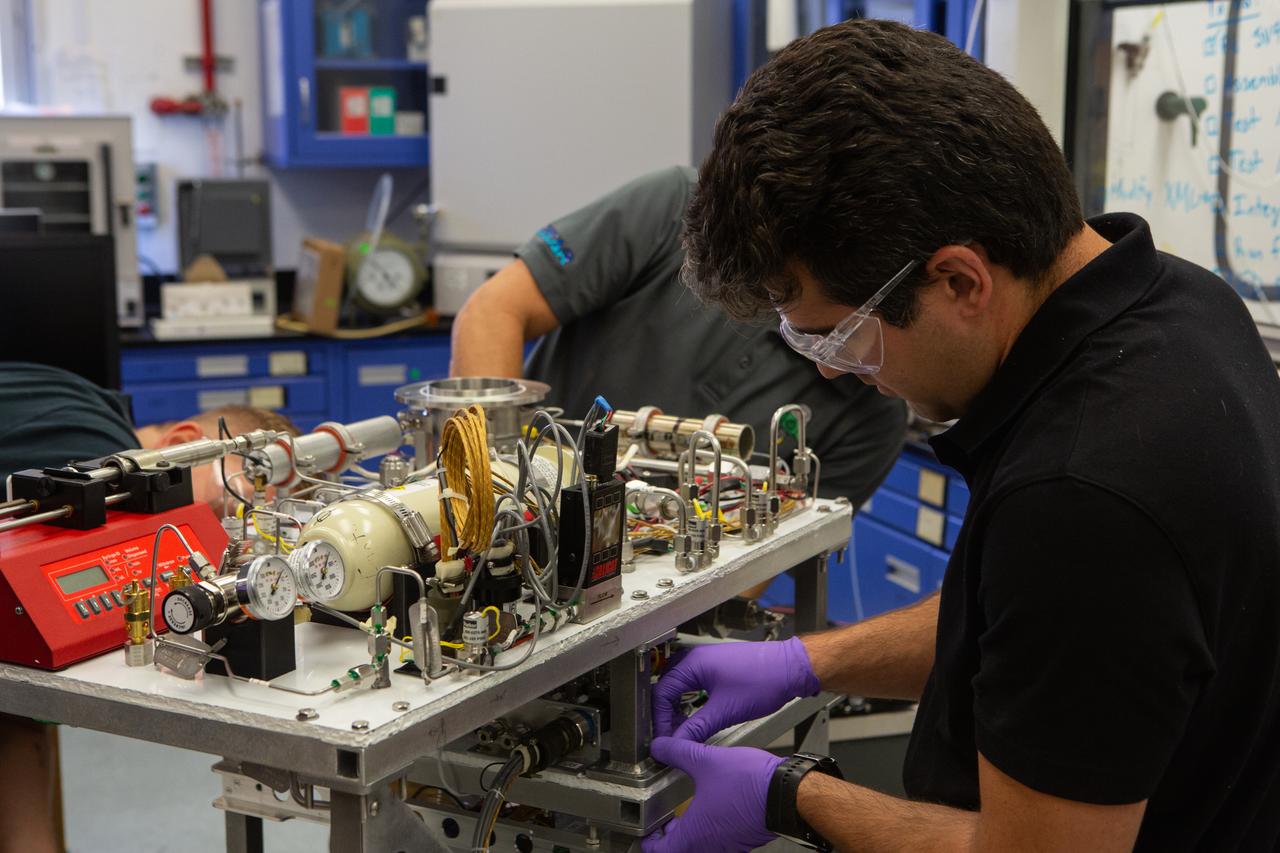
Jaime Toro assembles the flight hardware for NASA’s Orbital Syngas Commodity Augmentation Reactor, or OSCAR, on Oct. 10, 2019, in the Space Station Processing Facility at the agency’s Kennedy Space Center in Florida. OSCAR is an Early Career Initiative project at the spaceport that studies technology to convert trash and human waste into useful gasses such as methane, hydrogen and carbon dioxide. By processing small pieces of trash in a high-temperature reactor, OSCAR is advancing new and innovative technology for managing waste in space. A prototype has been developed, and the team is in the process of constructing a new rig for a suborbital flight test.

KENNEDY SPACE CENTER, FLA. - In the KSC Space Life Sciences Lab, Dr. Richard Strayer, a microbial research scientist with Dynamac at KSC, looks into the Research Space Bioconverter. The apparatus is a rotating drum composter that contains waste for decomposition. Strayer is experimenting with a process called denitrification, in which organisms use nitrate instead of oxygen to break down the waste and produce nitrogen as a byproduct. This process, anaerobic respiration using nitrate, has never been tried in composting and is achieving promising results. The Lab is exploring various aspects of a bioregenerative life support system. Such research and technology development will be crucial to long-term habitation of space by humans.
Team members assemble the flight hardware for NASA’s Orbital Syngas Commodity Augmentation Reactor, or OSCAR, on Oct. 10, 2019, in the Space Station Processing Facility at the agency’s Kennedy Space Center in Florida. From left are Annie Meier, Gino Carro, Evan Bell and Jamie Toro. OSCAR is an Early Career Initiative project at the spaceport that studies technology to convert trash and human waste into useful gasses such as methane, hydrogen and carbon dioxide. By processing small pieces of trash in a high-temperature reactor, OSCAR is advancing new and innovative technology for managing waste in space. A prototype has been developed, and the team is in the process of constructing a new rig for a suborbital flight test.
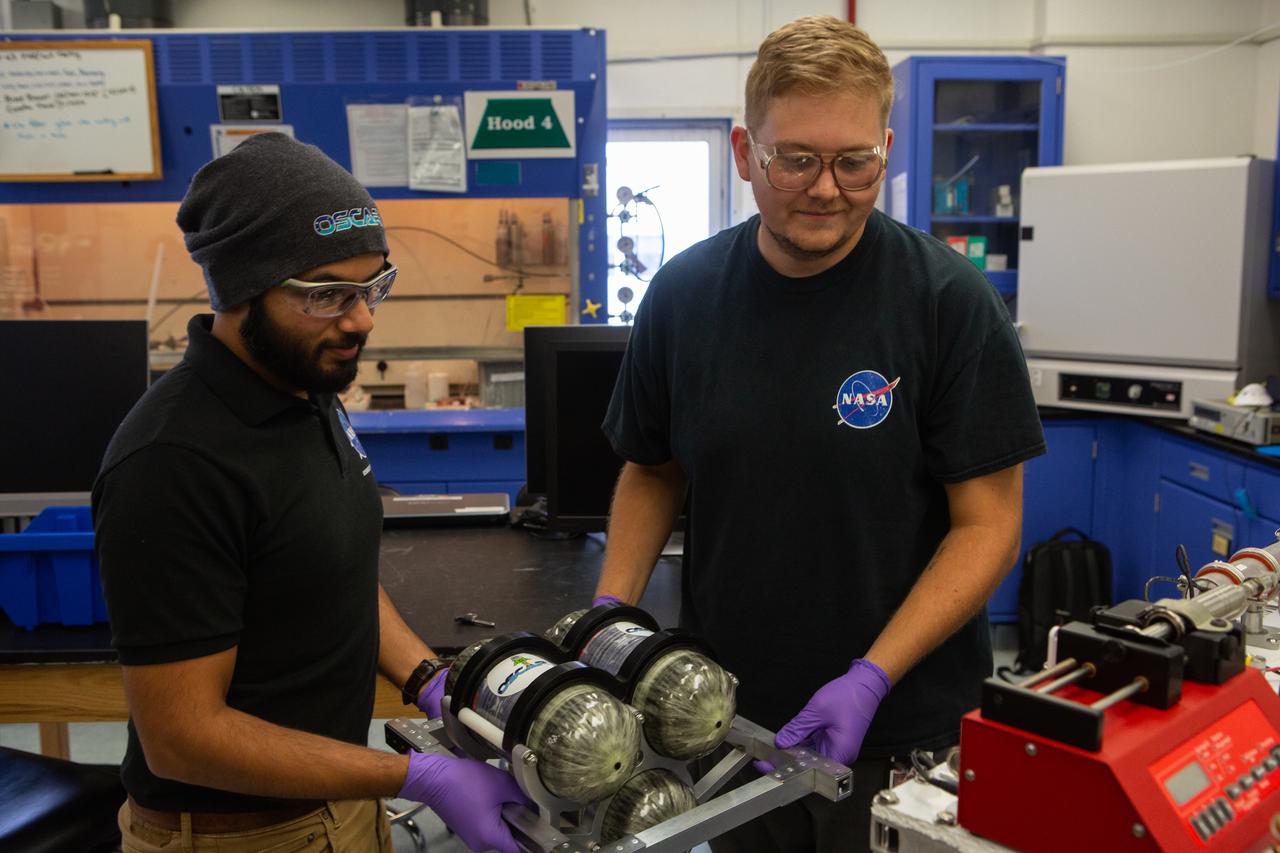
Team members Malay Shah, left, and Evan Bell assemble the flight hardware for NASA’s Orbital Syngas Commodity Augmentation Reactor, or OSCAR, on Oct. 10, 2019, in the Space Station Processing Facility at the agency’s Kennedy Space Center in Florida. OSCAR is an Early Career Initiative project at the spaceport that studies technology to convert trash and human waste into useful gasses such as methane, hydrogen and carbon dioxide. By processing small pieces of trash in a high-temperature reactor, OSCAR is advancing new and innovative technology for managing waste in space. A prototype has been developed, and the team is in the process of constructing a new rig for a suborbital flight test.
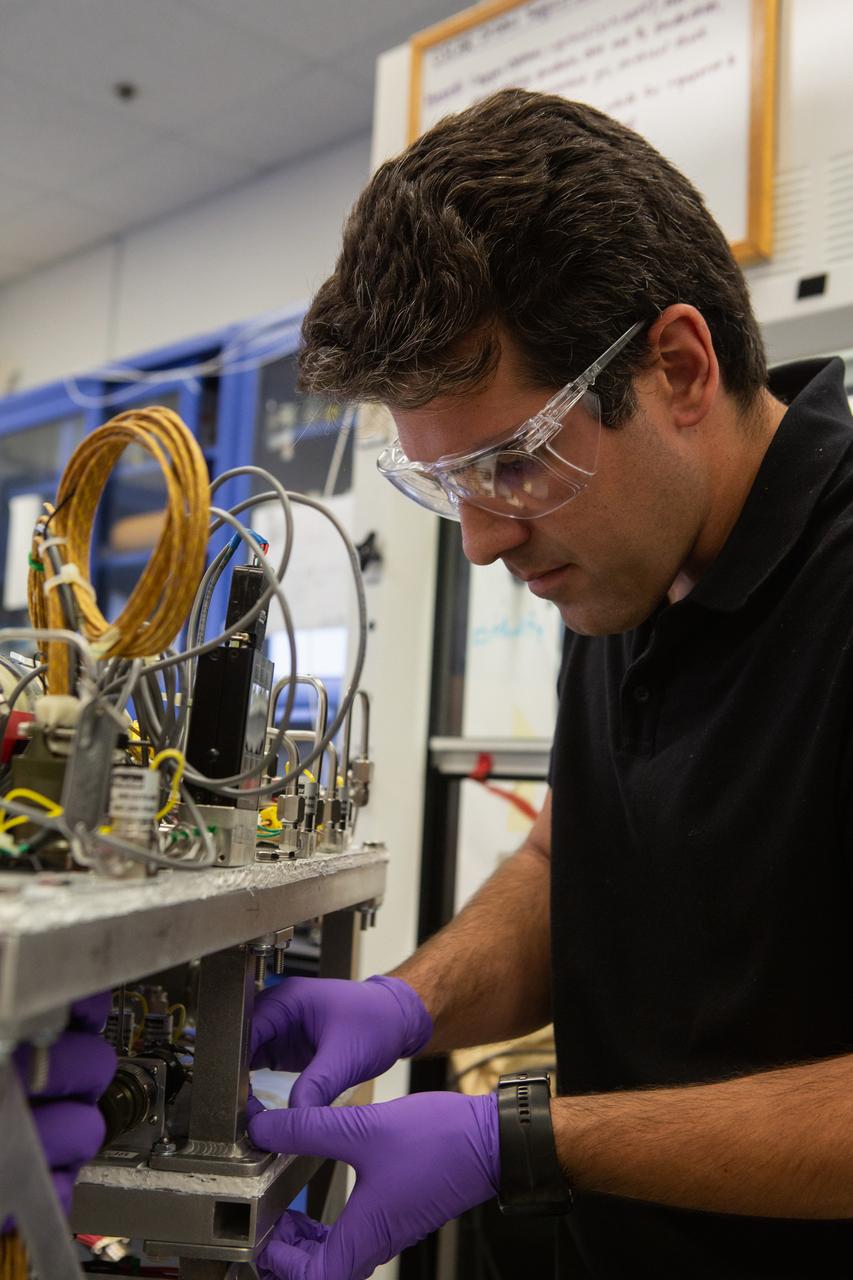
Jaime Toro assembles the flight hardware for NASA’s Orbital Syngas Commodity Augmentation Reactor, or OSCAR, on Oct. 10, 2019, in the Space Station Processing Facility at the agency’s Kennedy Space Center in Florida. OSCAR is an Early Career Initiative project at the spaceport that studies technology to convert trash and human waste into useful gasses such as methane, hydrogen and carbon dioxide. By processing small pieces of trash in a high-temperature reactor, OSCAR is advancing new and innovative technology for managing waste in space. A prototype has been developed, and the team is in the process of constructing a new rig for a suborbital flight test.
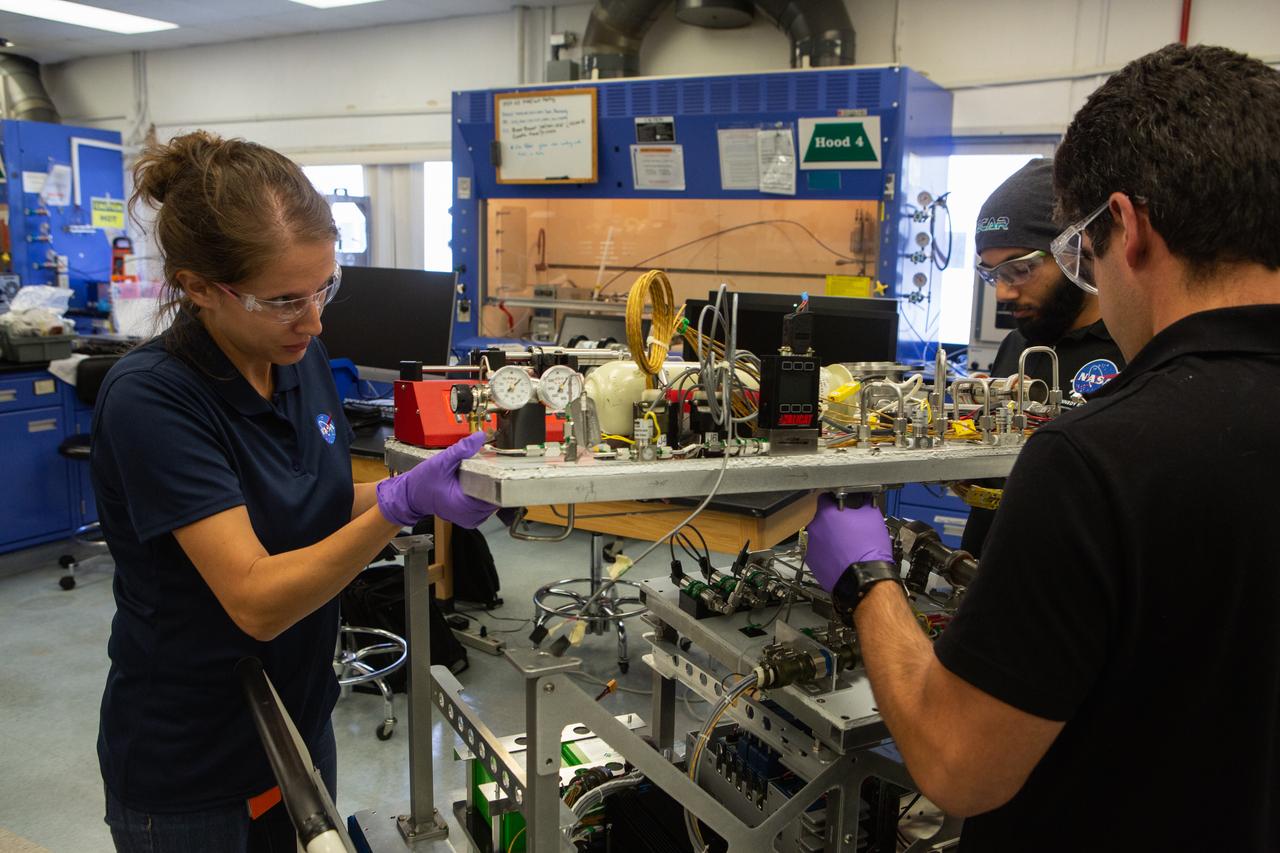
From left, team members Annie Meier, Malay Shah and Jamie Toro assemble the flight hardware for NASA’s Orbital Syngas Commodity Augmentation Reactor, or OSCAR, on Oct. 10, 2019, in the Space Station Processing Facility at the agency’s Kennedy Space Center in Florida. OSCAR is an Early Career Initiative project at the spaceport that studies technology to convert trash and human waste into useful gasses such as methane, hydrogen and carbon dioxide. By processing small pieces of trash in a high-temperature reactor, OSCAR is advancing new and innovative technology for managing waste in space. A prototype has been developed, and the team is in the process of constructing a new rig for a suborbital flight test.
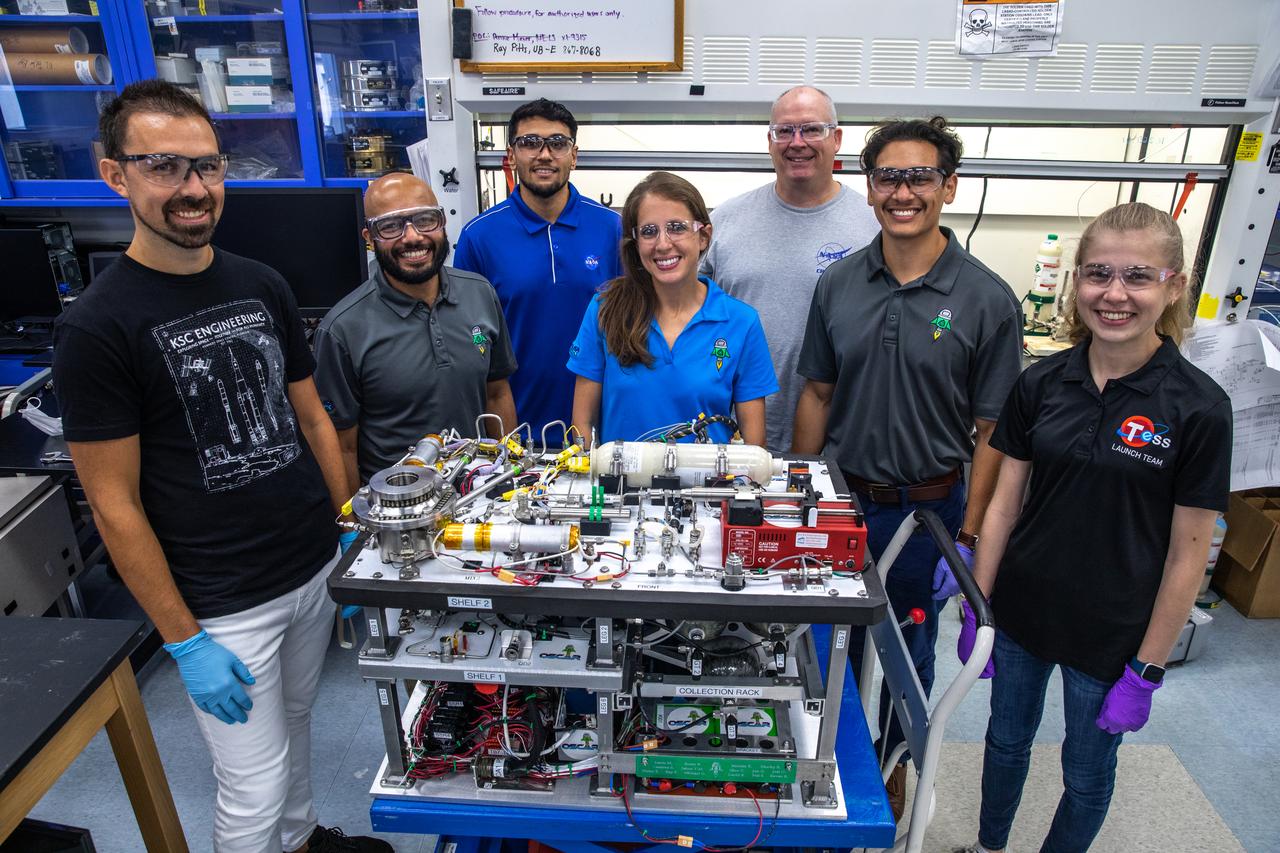
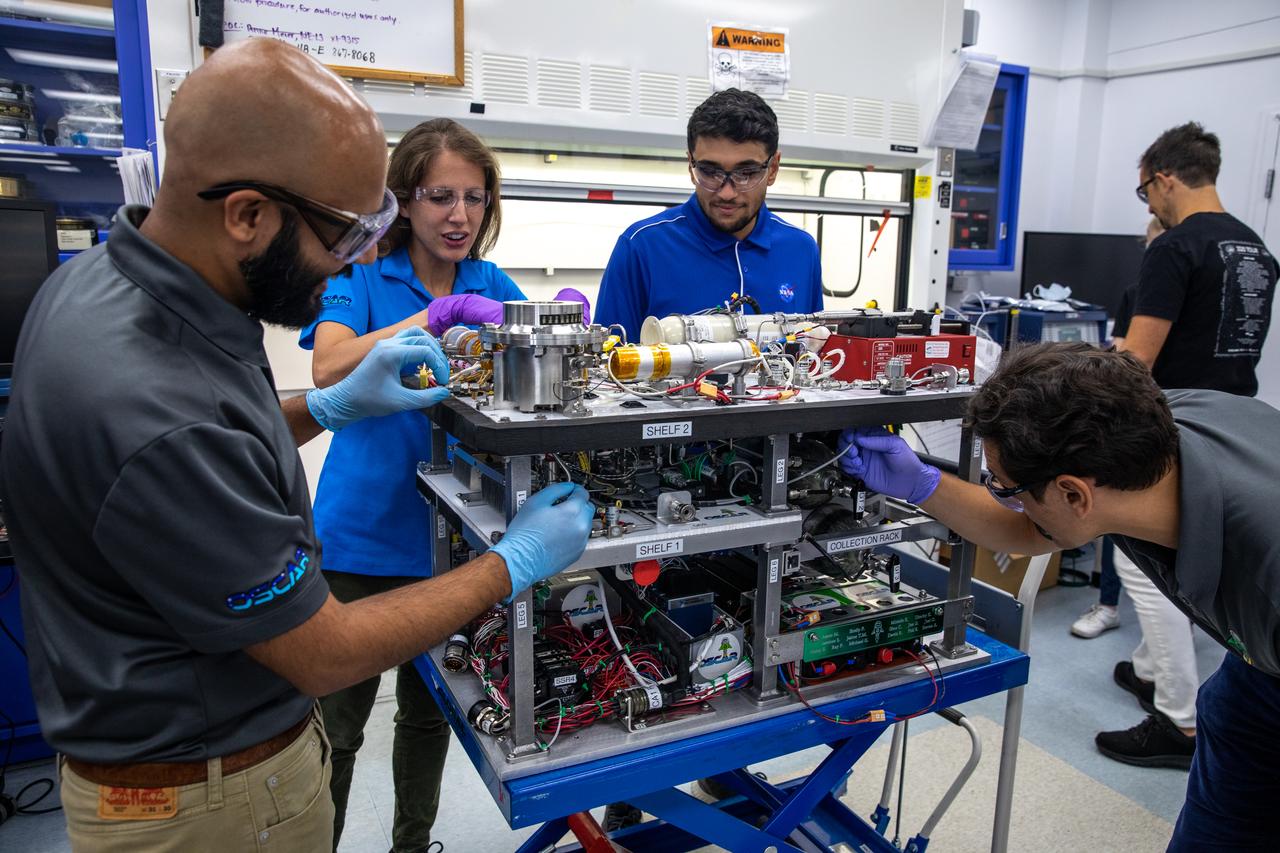
From left, team members Malay Shah, Gino Carro and Evan Bell assemble the flight hardware for NASA’s Orbital Syngas Commodity Augmentation Reactor, or OSCAR, on Oct. 10, 2019, in the Space Station Processing Facility at the agency’s Kennedy Space Center in Florida. OSCAR is an Early Career Initiative project at the spaceport that studies technology to convert trash and human waste into useful gasses such as methane, hydrogen and carbon dioxide. By processing small pieces of trash in a high-temperature reactor, OSCAR is advancing new and innovative technology for managing waste in space. A prototype has been developed, and the team is in the process of constructing a new rig for a suborbital flight test.
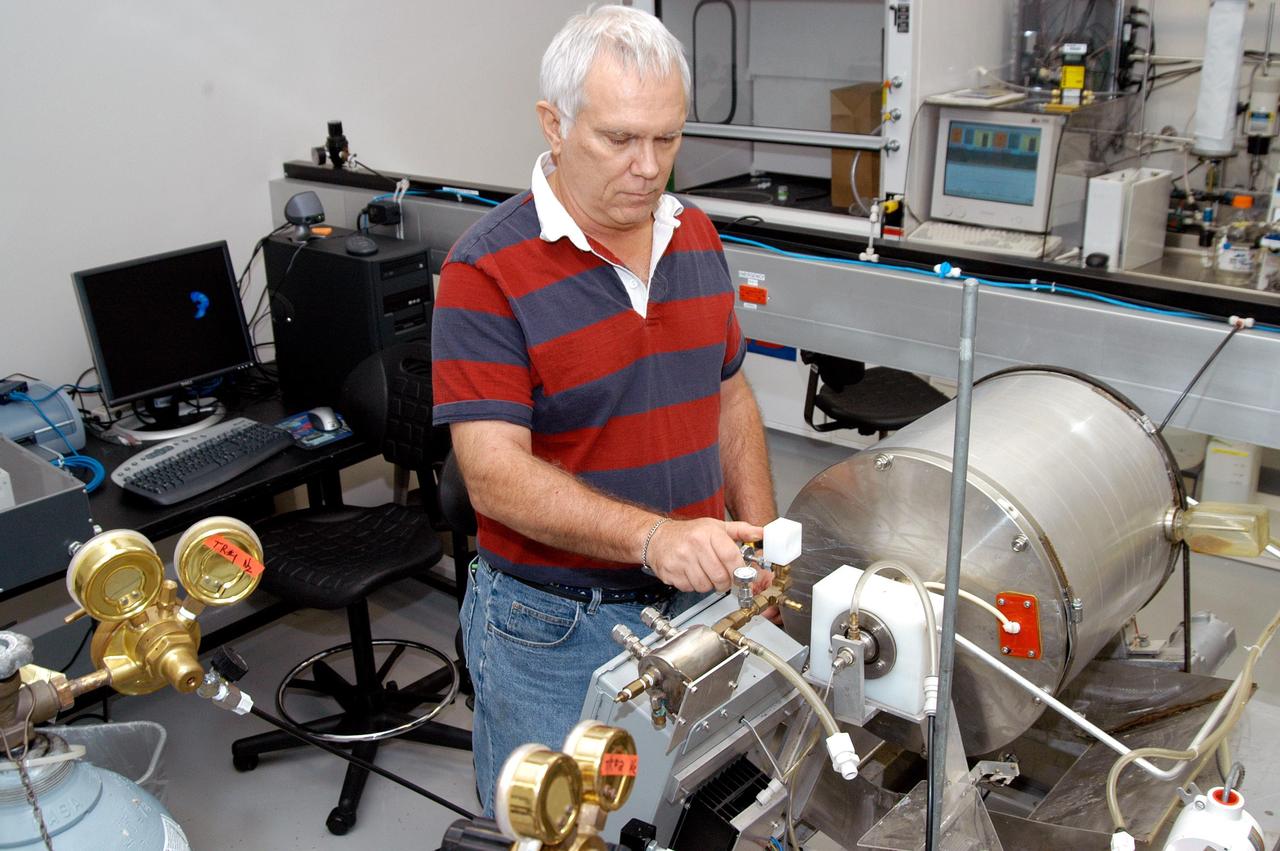
KENNEDY SPACE CENTER, FLA. - In the KSC Space Life Sciences Lab, Dr. Richard Strayer, a microbial research scientist with Dynamac at KSC, works on the Research Space Bioconverter. The apparatus is a rotating drum composter that contains waste for decomposition. Strayer is experimenting with a process called denitrification, in which organisms use nitrate instead of oxygen to break down the waste and produce nitrogen as a byproduct. This process, anaerobic respiration using nitrate, has never been tried in composting and is achieving promising results. The Lab is exploring various aspects of a bioregenerative life support system. Such research and technology development will be crucial to long-term habitation of space by humans.
The Trash to Gas team members prepare flight hardware for NASA’s Orbital Syngas Commodity Augmentation Reactor, or OSCAR, inside the Applied Physics Lab in the Neil Armstrong Operations and Checkout Facility at the agency’s Kennedy Space Center in Florida on July 21, 2022. OSCAR began as an Early Career Initiative project at the spaceport that studies technology to convert trash and human waste into useful gasses such as methane, hydrogen, and carbon dioxide. By processing small pieces of trash in a high-temperature reactor, OSCAR is advancing new and innovative technology for managing waste in space.
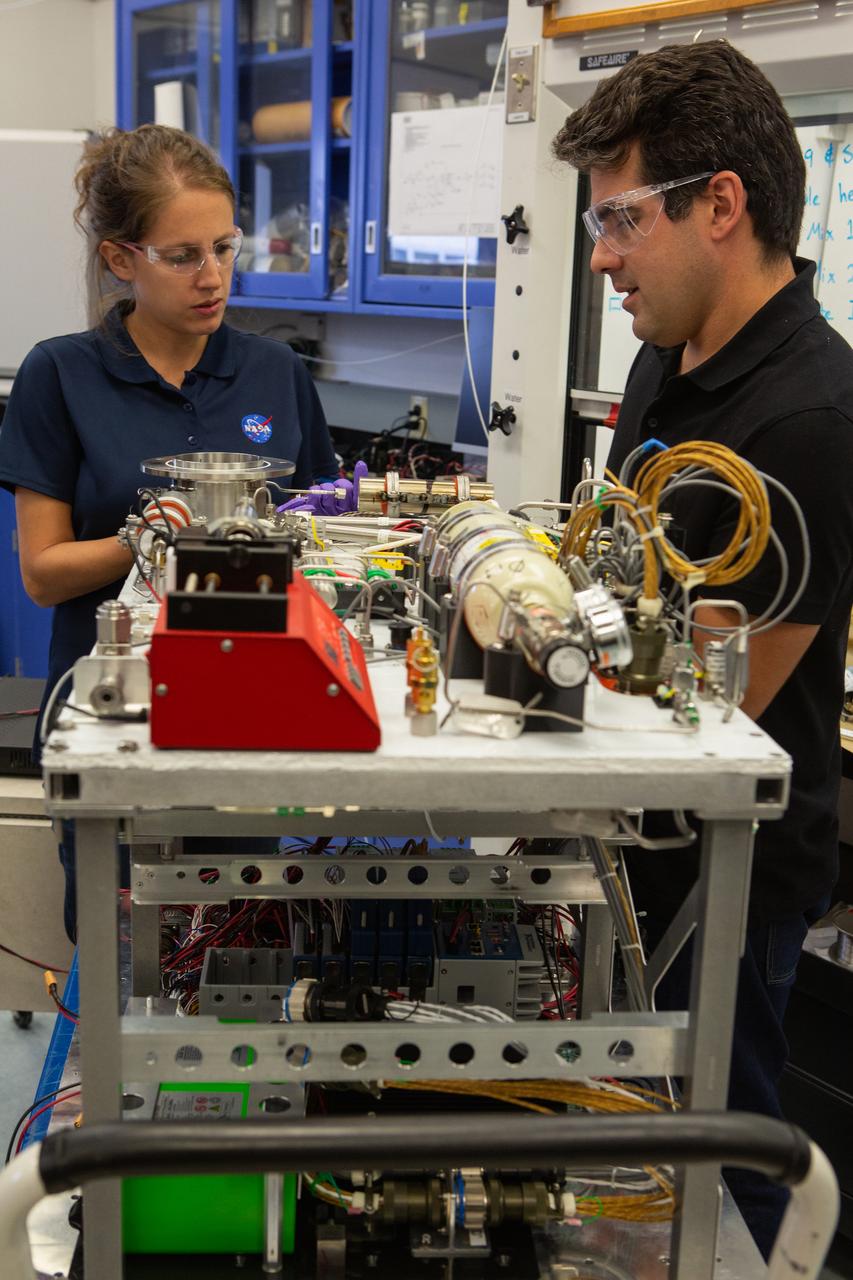
Team members Annie Meier, left, and Jamie Toro assemble the flight hardware for NASA’s Orbital Syngas Commodity Augmentation Reactor, or OSCAR, on Oct. 10, 2019, in the Space Station Processing Facility at the agency’s Kennedy Space Center in Florida. OSCAR is an Early Career Initiative project at the spaceport that studies technology to convert trash and human waste into useful gasses such as methane, hydrogen and carbon dioxide. By processing small pieces of trash in a high-temperature reactor, OSCAR is advancing new and innovative technology for managing waste in space. A prototype has been developed, and the team is in the process of constructing a new rig for a suborbital flight test.
The Trash to Gas team members prepare flight hardware for NASA’s Orbital Syngas Commodity Augmentation Reactor, or OSCAR, inside the Applied Physics Lab in the Neil Armstrong Operations and Checkout Facility at the agency’s Kennedy Space Center in Florida on July 21, 2022. OSCAR began as an Early Career Initiative project at the spaceport that studies technology to convert trash and human waste into useful gasses such as methane, hydrogen, and carbon dioxide. By processing small pieces of trash in a high-temperature reactor, OSCAR is advancing new and innovative technology for managing waste in space.
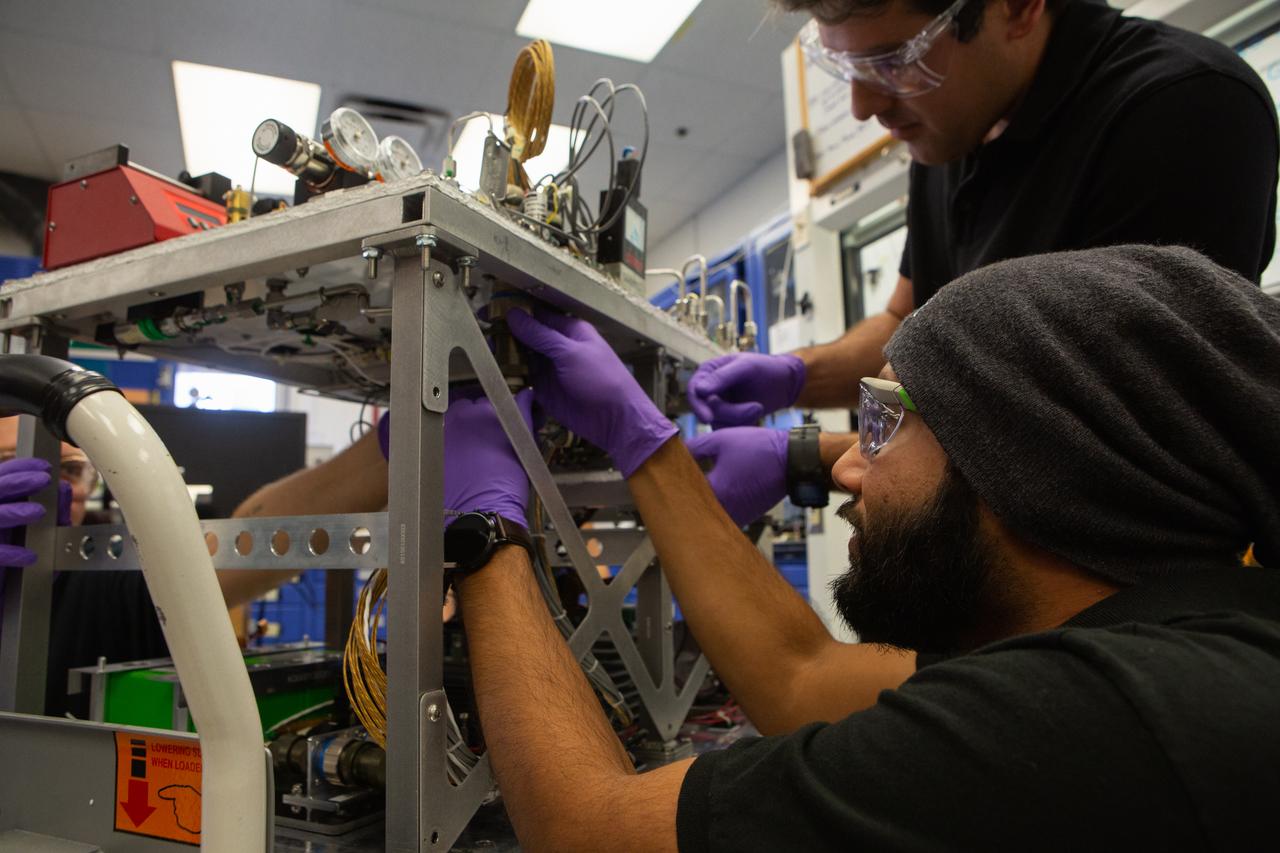
Team members Malay Shah, foreground, and Gino Carro assemble the flight hardware for NASA’s Orbital Syngas Commodity Augmentation Reactor, or OSCAR, on Oct. 10, 2019, in the Space Station Processing Facility at the agency’s Kennedy Space Center in Florida. OSCAR is an Early Career Initiative project at the spaceport that studies technology to convert trash and human waste into useful gasses such as methane, hydrogen and carbon dioxide. By processing small pieces of trash in a high-temperature reactor, OSCAR is advancing new and innovative technology for managing waste in space. A prototype has been developed, and the team is in the process of constructing a new rig for a suborbital flight test.

The Trash to Gas team members prepare flight hardware for NASA’s Orbital Syngas Commodity Augmentation Reactor, or OSCAR, inside Applied Physics lab in the Neil Armstrong Operations and Checkout Facility at the agency’s Kennedy Space Center in Florida on July 21, 2022. OSCAR began as an Early Career Initiative project at the spaceport that studies technology to convert trash and human waste into useful gasses such as methane, hydrogen, and carbon dioxide. By processing small pieces of trash in a high-temperature reactor, OSCAR is advancing new and innovative technology for managing waste in space.
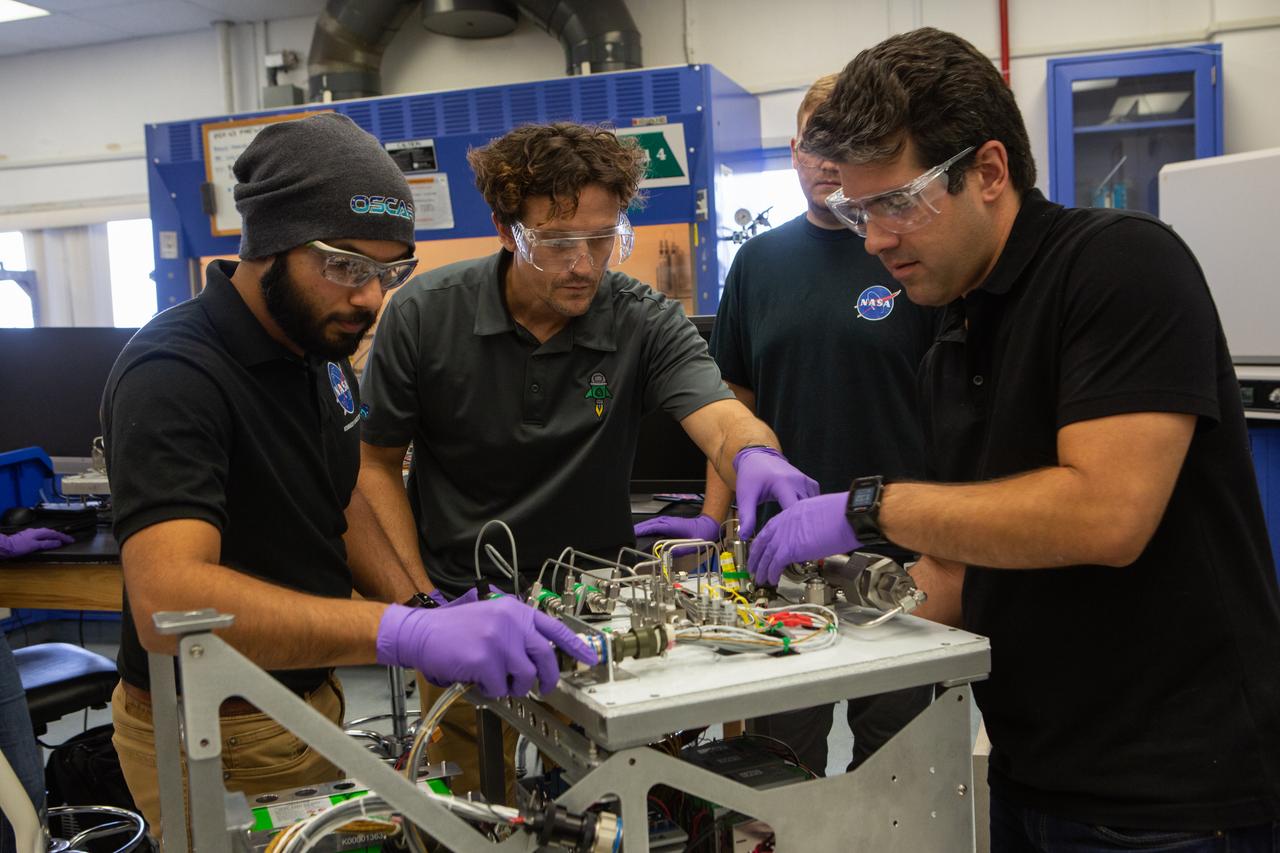
From left, team members Malay Shah, Gino Carro, Evan Bell and Jamie Toro assemble the flight hardware for NASA’s Orbital Syngas Commodity Augmentation Reactor, or OSCAR, on Oct. 10, 2019, in the Space Station Processing Facility at the agency’s Kennedy Space Center in Florida. OSCAR is an Early Career Initiative project at the spaceport that studies technology to convert trash and human waste into useful gasses such as methane, hydrogen and carbon dioxide. By processing small pieces of trash in a high-temperature reactor, OSCAR is advancing new and innovative technology for managing waste in space. A prototype has been developed, and the team is in the process of constructing a new rig for a suborbital flight test.
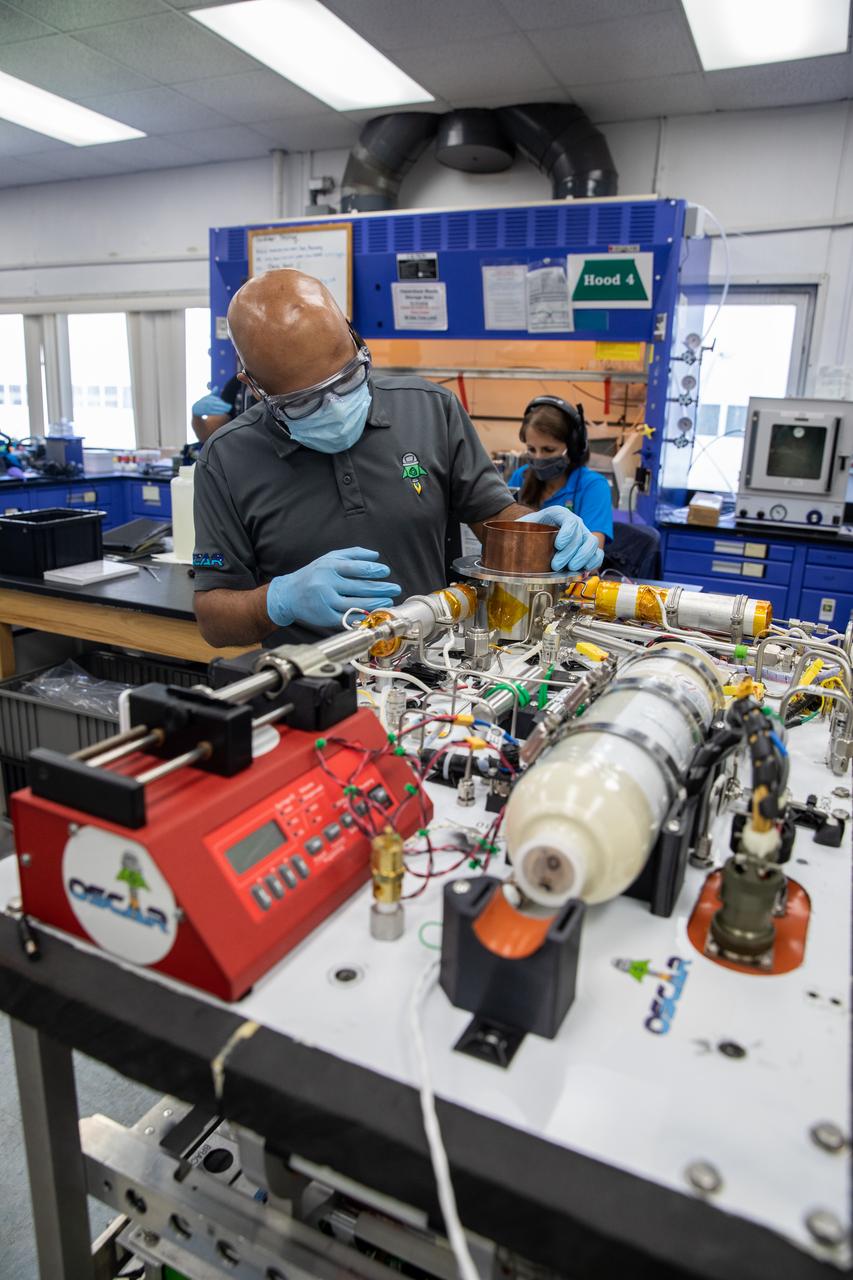
A Trash to Gas team member prepares flight hardware for NASA’s Orbital Syngas Commodity Augmentation Reactor, or OSCAR, inside the Applied Physics Lab in the Neil Armstrong Operations and Checkout Facility at the agency’s Kennedy Space Center in Florida on July 21, 2022. OSCAR began as an Early Career Initiative project at the spaceport that studies technology to convert trash and human waste into useful gasses such as methane, hydrogen, and carbon dioxide. By processing small pieces of trash in a high-temperature reactor, OSCAR is advancing new and innovative technology for managing waste in space.
Team members Evan Bell, left, and Jaime Toro assemble the flight hardware for NASA’s Orbital Syngas Commodity Augmentation Reactor, or OSCAR, on Oct. 10, 2019, in the Space Station Processing Facility at the agency’s Kennedy Space Center in Florida. OSCAR is an Early Career Initiative project at the spaceport that studies technology to convert trash and human waste into useful gasses such as methane, hydrogen and carbon dioxide. By processing small pieces of trash in a high-temperature reactor, OSCAR is advancing new and innovative technology for managing waste in space. A prototype has been developed, and the team is in the process of constructing a new rig for a suborbital flight test.
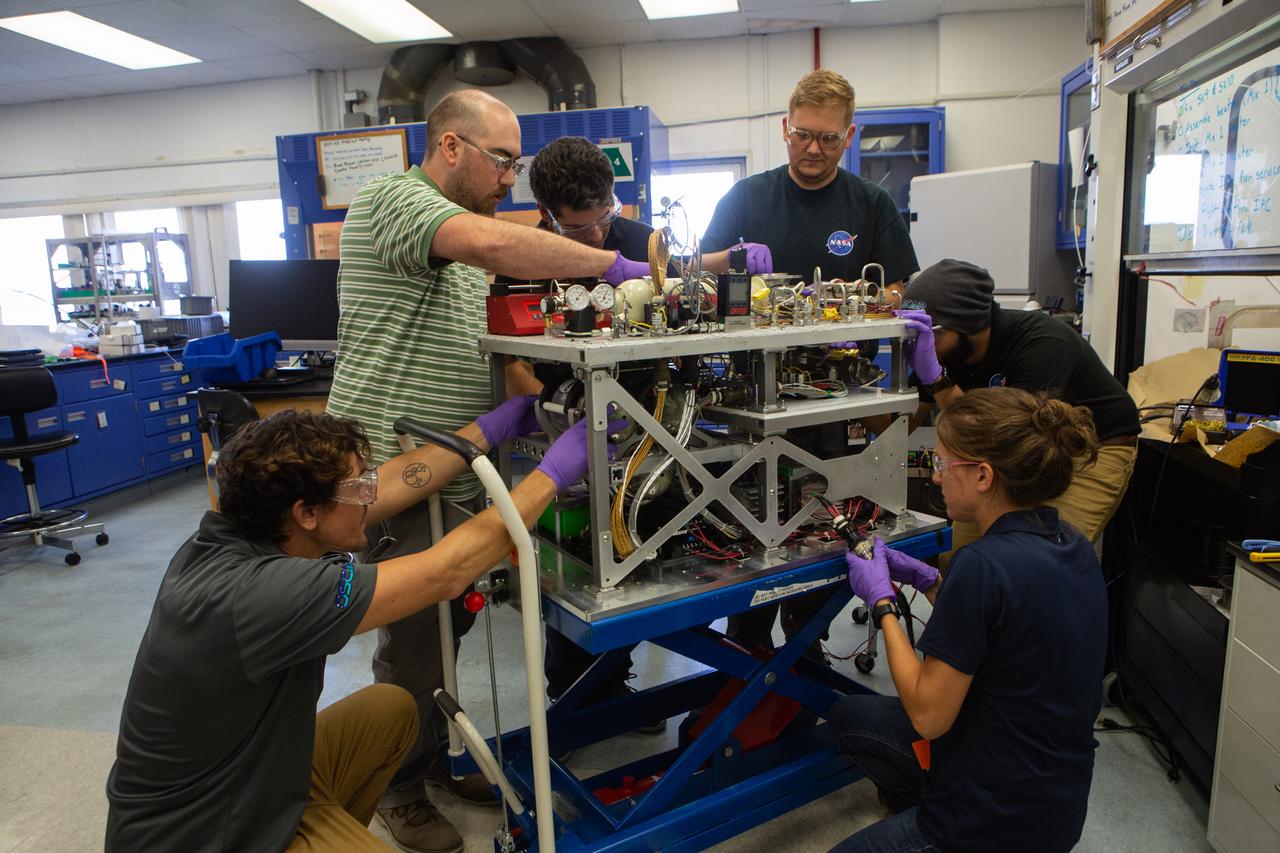
Team members assemble the flight hardware for NASA’s Orbital Syngas Commodity Augmentation Reactor, or OSCAR, on Oct. 10, 2019, in the Space Station Processing Facility at the agency’s Kennedy Space Center in Florida. From left are Gino Carro, Tom Cauvel, Jaime Toro, Evan Bell, Malay Shah and Annie Meier. OSCAR is an Early Career Initiative project at the spaceport that studies technology to convert trash and human waste into useful gasses such as methane, hydrogen and carbon dioxide. By processing small pieces of trash in a high-temperature reactor, OSCAR is advancing new and innovative technology for managing waste in space. A prototype has been developed, and the team is in the process of constructing a new rig for a suborbital flight test.
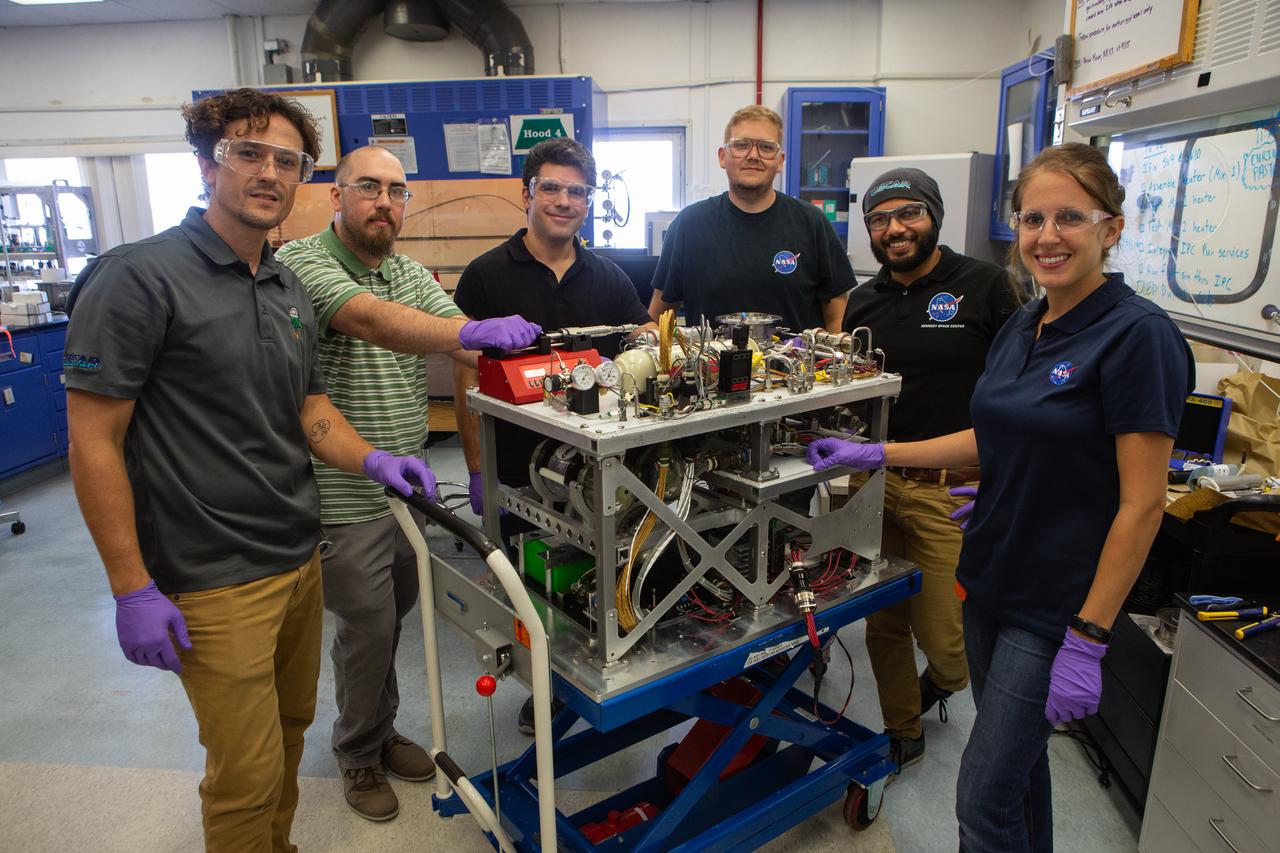
Members of NASA’s Orbital Syngas Commodity Augmentation Reactor, or OSCAR, team pause for a photo with the flight hardware on Oct. 10, 2019, in the Space Station Processing Facility at the agency’s Kennedy Space Center in Florida. From left are Gino Carro, Tom Cauvel, Jaime Toro, Evan Bell, Malay Shah and Annie Meier. OSCAR is an Early Career Initiative project at the spaceport that studies technology to convert trash and human waste into useful gasses such as methane, hydrogen and carbon dioxide. By processing small pieces of trash in a high-temperature reactor, OSCAR is advancing new and innovative technology for managing waste in space. A prototype has been developed, and the team is in the process of constructing a new rig for a suborbital flight test.
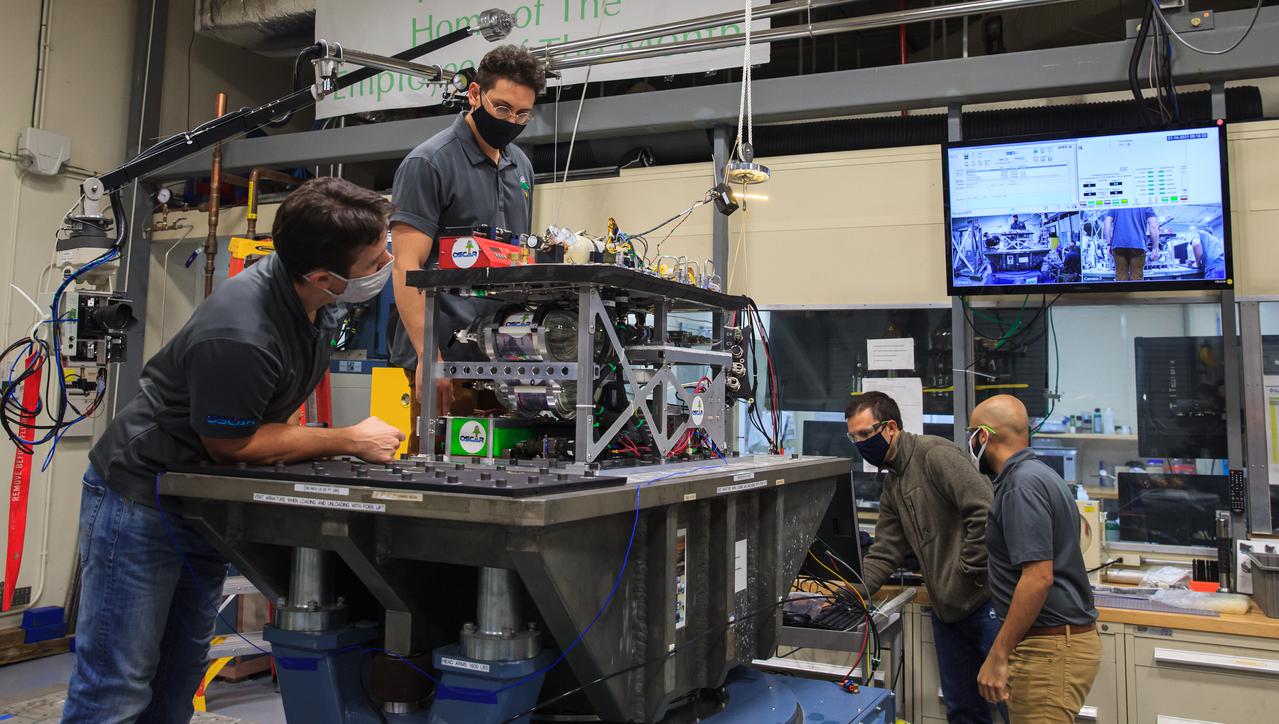
Kennedy Space Center engineers conduct vibration tests inside the Florida spaceport’s Vibration Test Lab on Jan. 14, 2021, in preparation for the suborbital flight of NASA’s Orbital Syngas Commodity Augmentation Reactor, or OSCAR, slated for later this year. From left are Gino Carro, a pressure vessels and systems engineer for the center’s Laboratory Support Services and Operations contract; Ray Pitts, co-principal investigator for OSCAR; David Rinderknecht, NASA chemical engineer; and Malay Shah, NASA thermal/fluid analysis engineer. Beginning as an Early Career Initiative project, OSCAR studies technology to convert trash and human waste into useful gasses such as methane, hydrogen, and carbon dioxide. By processing small pieces of trash in a high-temperature reactor, OSCAR is advancing new and innovative technology for managing waste in space.
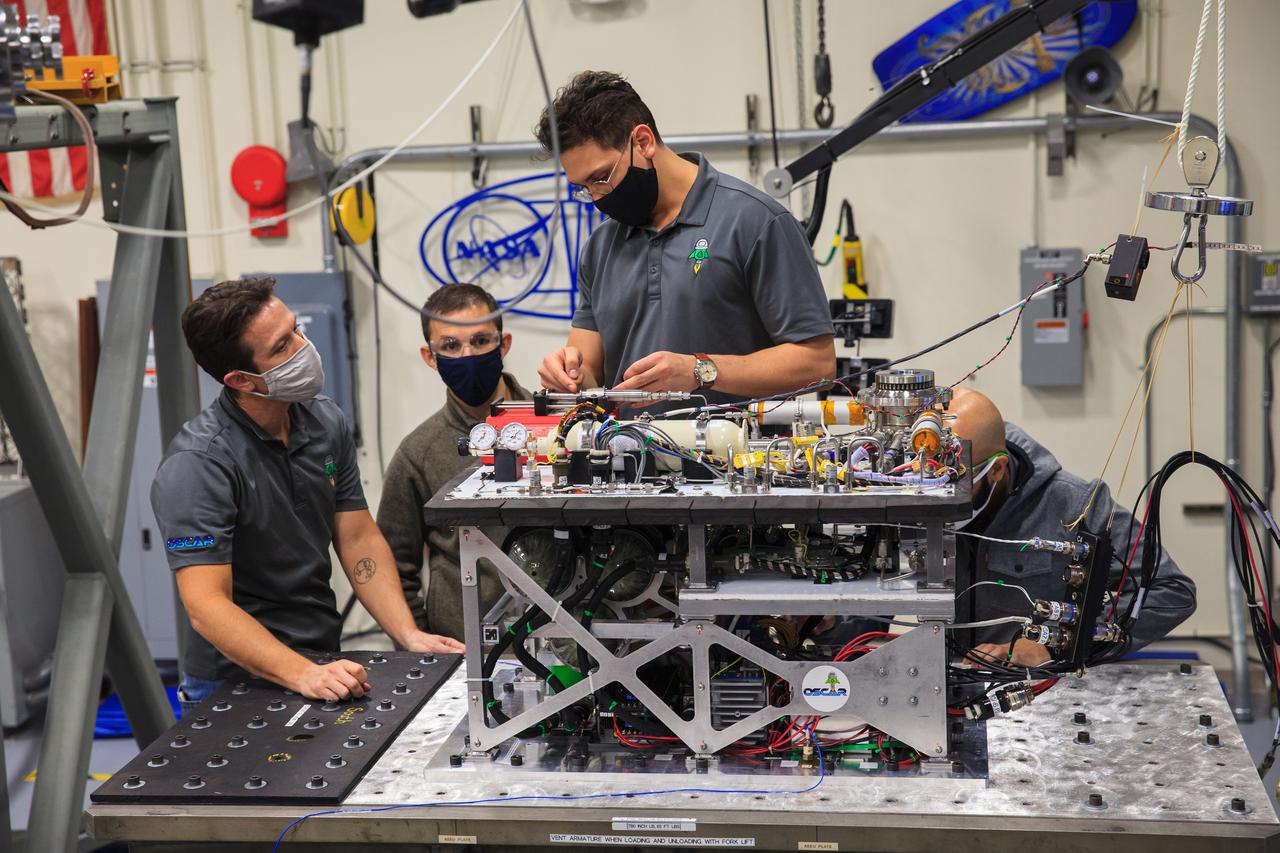
Kennedy Space Center engineers conduct vibration tests inside the Florida spaceport’s Vibration Test Lab on Jan. 14, 2021, in preparation for the suborbital flight of NASA’s Orbital Syngas Commodity Augmentation Reactor, or OSCAR, slated for later this year. From left are Gino Carro, a pressure vessels and systems engineer for the center’s Laboratory Support Services and Operations contract; David Rinderknecht, NASA chemical engineer; Ray Pitts, co-principal investigator for OSCAR; and Malay Shah, NASA thermal/fluid analysis engineer. Beginning as an Early Career Initiative project, OSCAR studies technology to convert trash and human waste into useful gasses such as methane, hydrogen, and carbon dioxide. By processing small pieces of trash in a high-temperature reactor, OSCAR is advancing new and innovative technology for managing waste in space.
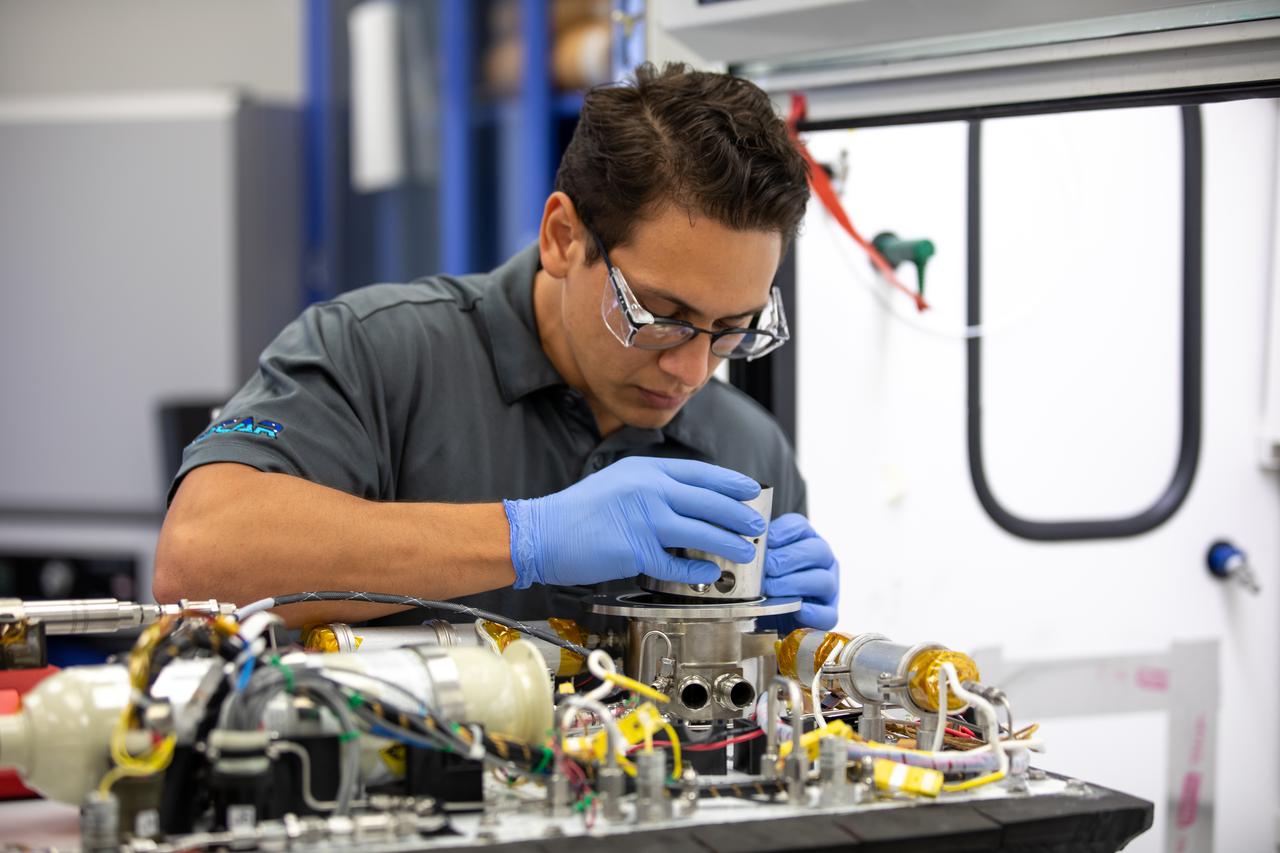
Ray Pitts, co-principal investigator for the Orbital Syngas Commodity Augmentation Reactor (OSCAR), performs ground testing at NASA’s Kennedy Space Center in Florida. The tests are in preparation for a scheduled suborbital flight test later this year, facilitated by NASA’s Flight Opportunities program. Begun as an Early Career Initiative project, OSCAR evaluates technology to make use of trash and human waste generated during long-duration spaceflight.
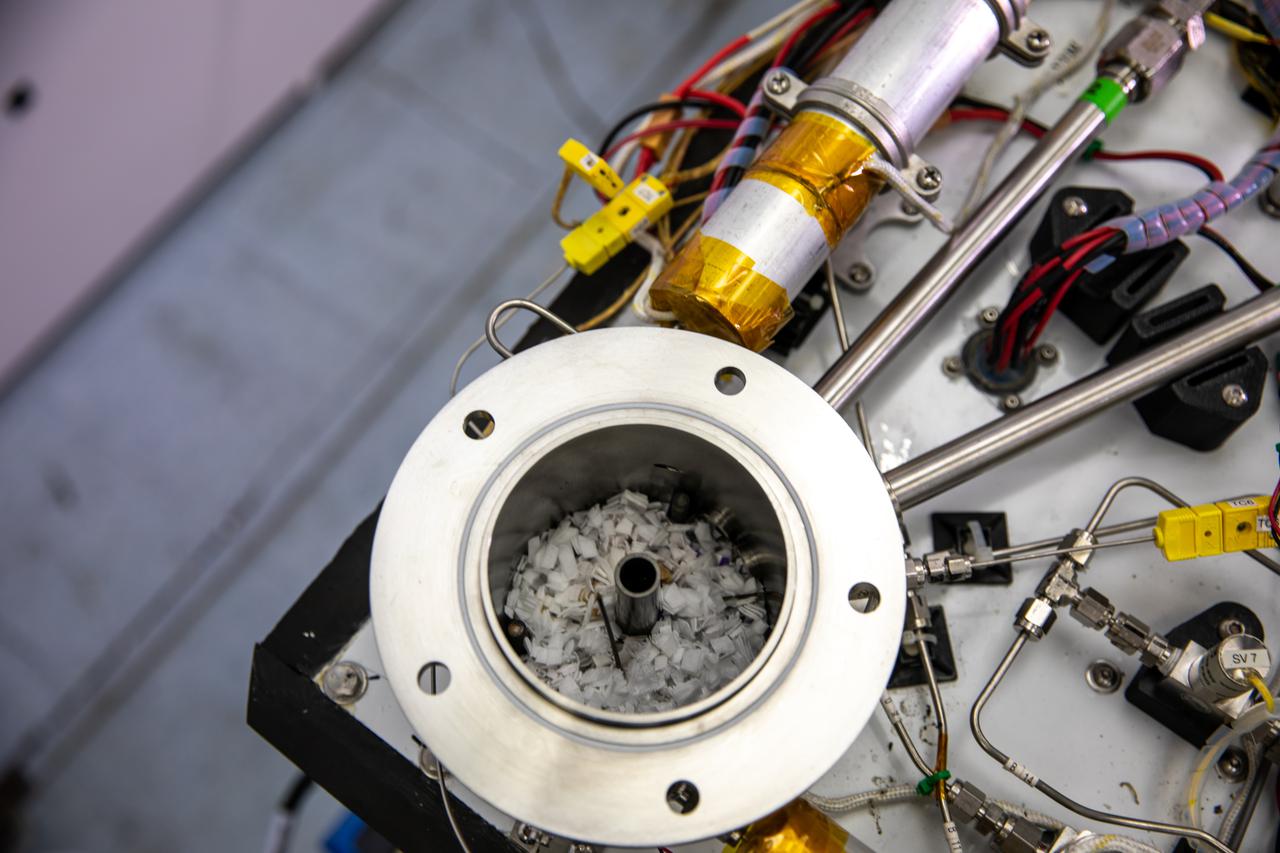
A member of the Orbital Syngas Commodity Augmentation Reactor (OSCAR) team performs ground testing at NASA’s Kennedy Space Center in Florida. The tests are in preparation for a scheduled suborbital flight test later this year, facilitated by NASA’s Flight Opportunities program. Begun as an Early Career Initiative project, OSCAR evaluates technology to make use of trash and human waste generated during long-duration spaceflight.
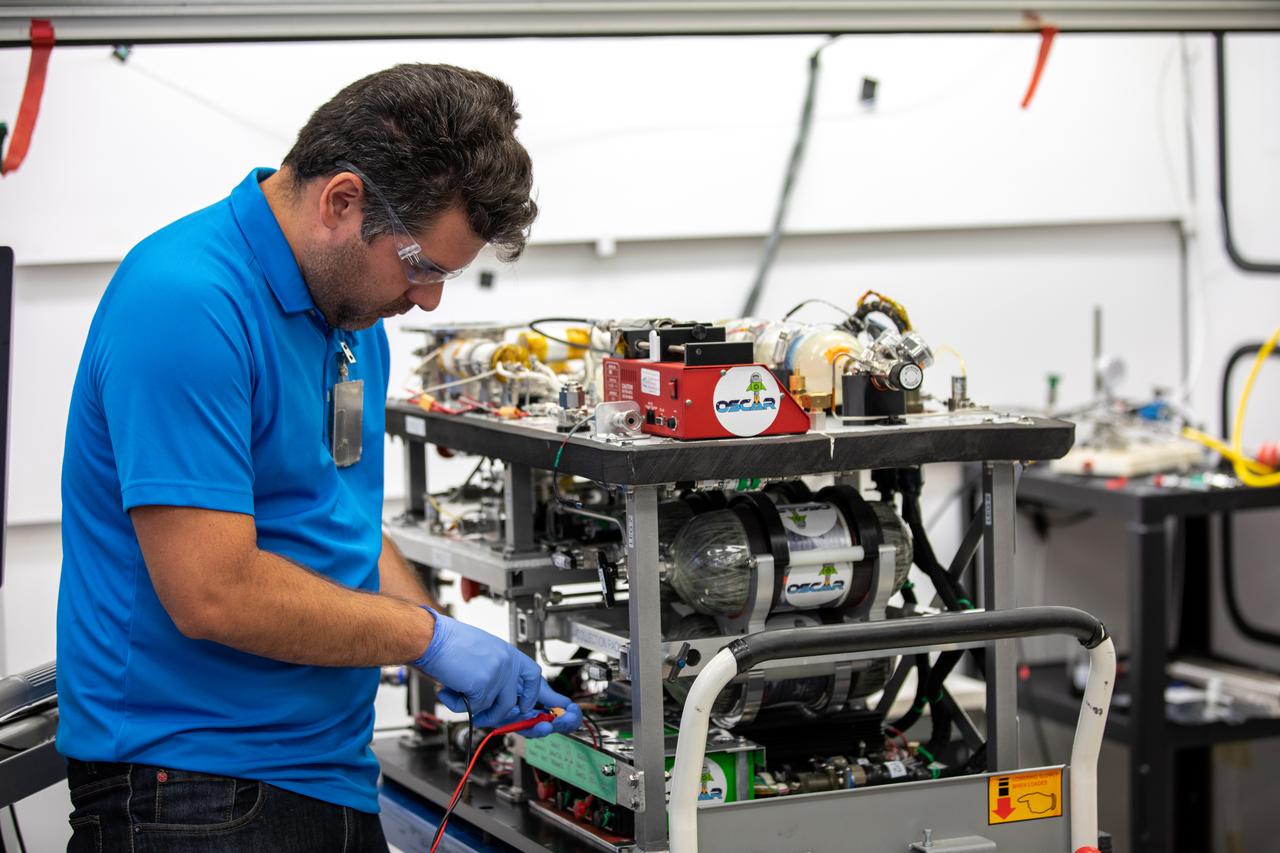
Jaime Toro, an aerospace/mechanical engineer and member of the Orbital Syngas Commodity Augmentation Reactor (OSCAR) team, performs ground testing at NASA’s Kennedy Space Center in Florida. The tests are in preparation for a scheduled suborbital flight test later this year, facilitated by NASA’s Flight Opportunities program. Begun as an Early Career Initiative project, OSCAR evaluates technology to make use of trash and human waste generated during long-duration spaceflight.
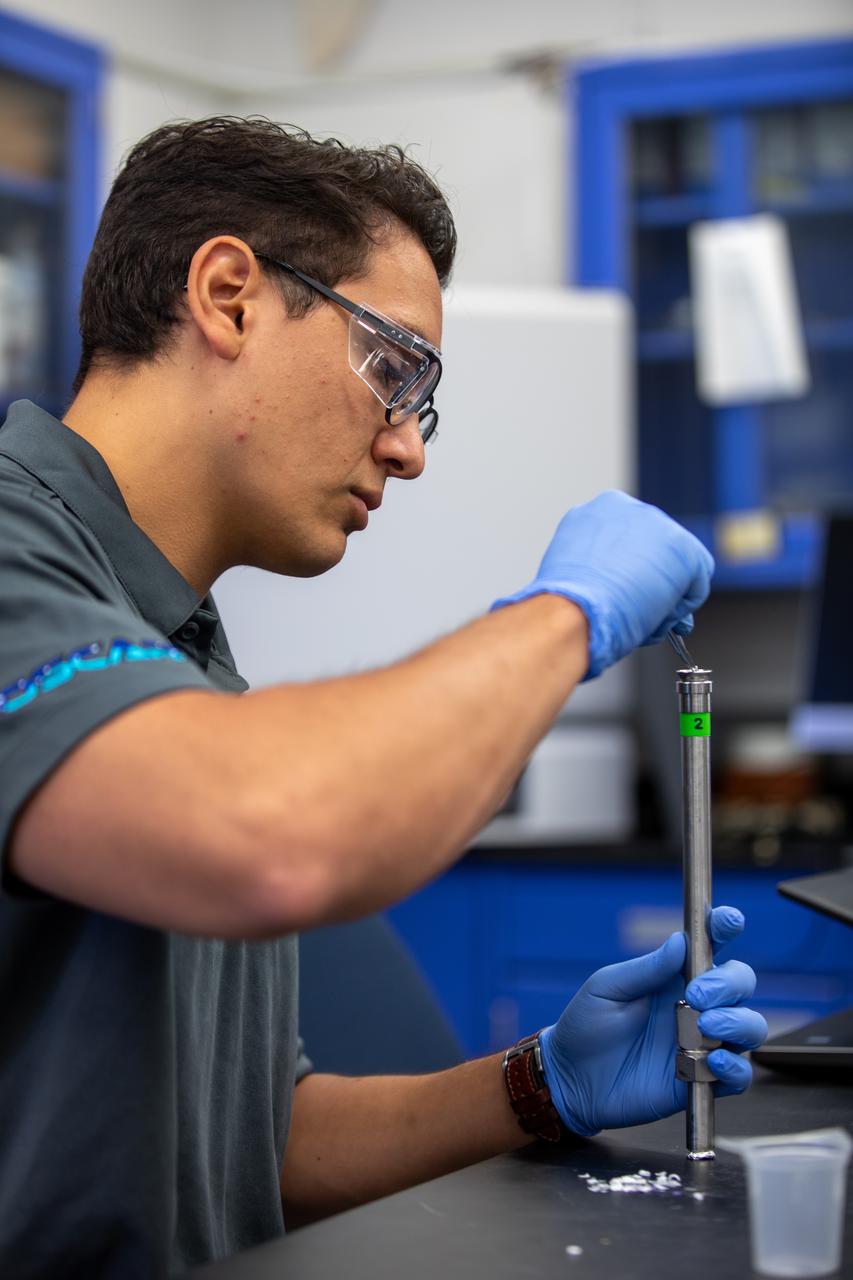
Ray Pitts, co-principal investigator for the Orbital Syngas Commodity Augmentation Reactor (OSCAR), performs ground testing at NASA’s Kennedy Space Center in Florida. The tests are in preparation for a scheduled suborbital flight test later this year, facilitated by NASA’s Flight Opportunities program. Begun as an Early Career Initiative project, OSCAR evaluates technology to make use of trash and human waste generated during long-duration spaceflight.
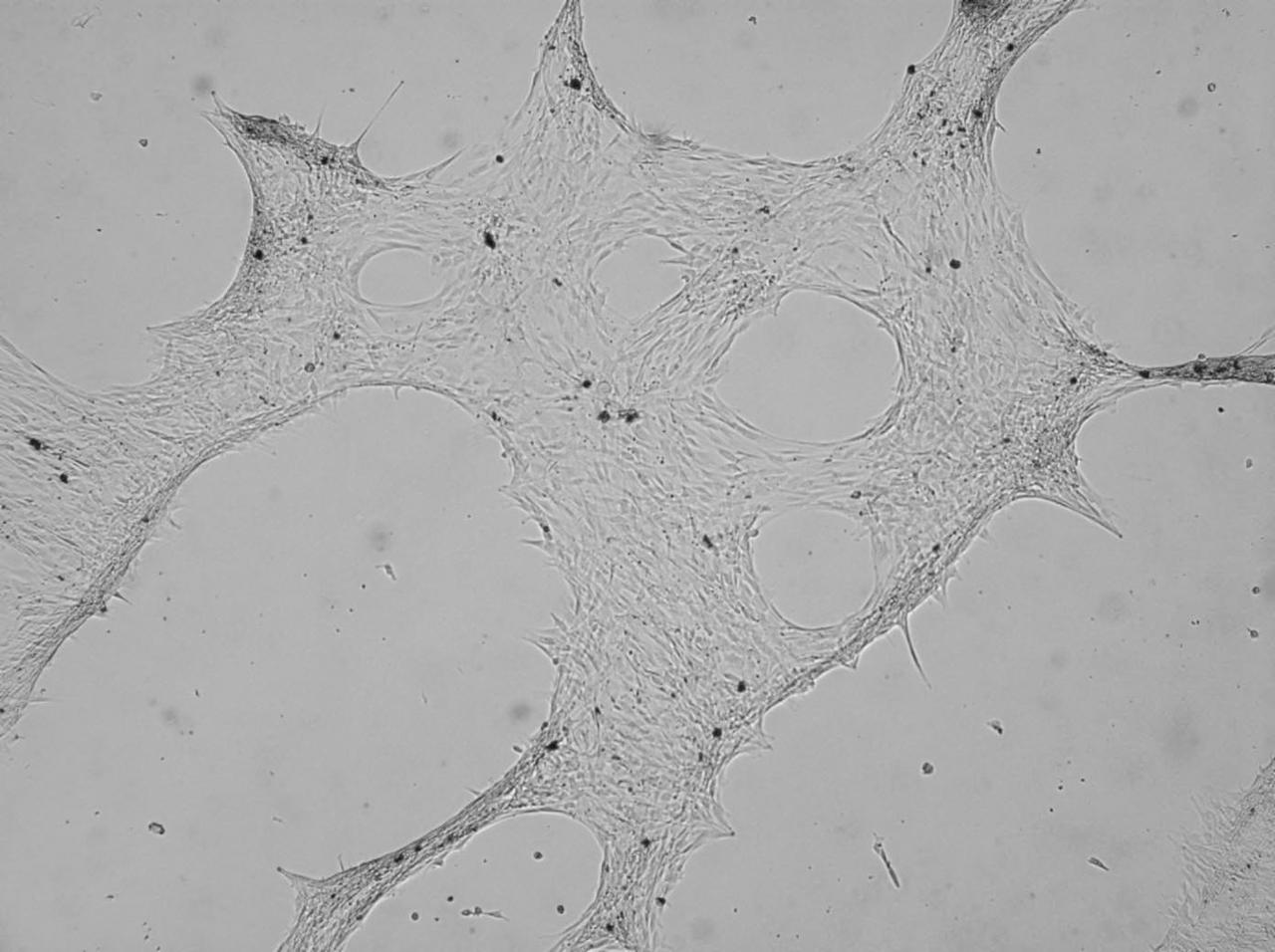
jsc2021e036650 (8/11/2021) --- A view of Osteogenesis-induced differentiation of human mesenchymal stem cells. REducing Arthritis Dependent Inflammation First Phase (READI FP) evaluates how microgravity and space radiation affect the generation of bone tissue. It also examines the potential protective effects of bio-collagen and bioactive metabolites such as antioxidants during spaceflight. The source of these metabolites are vegetal extracts produced as waste products in wine production.
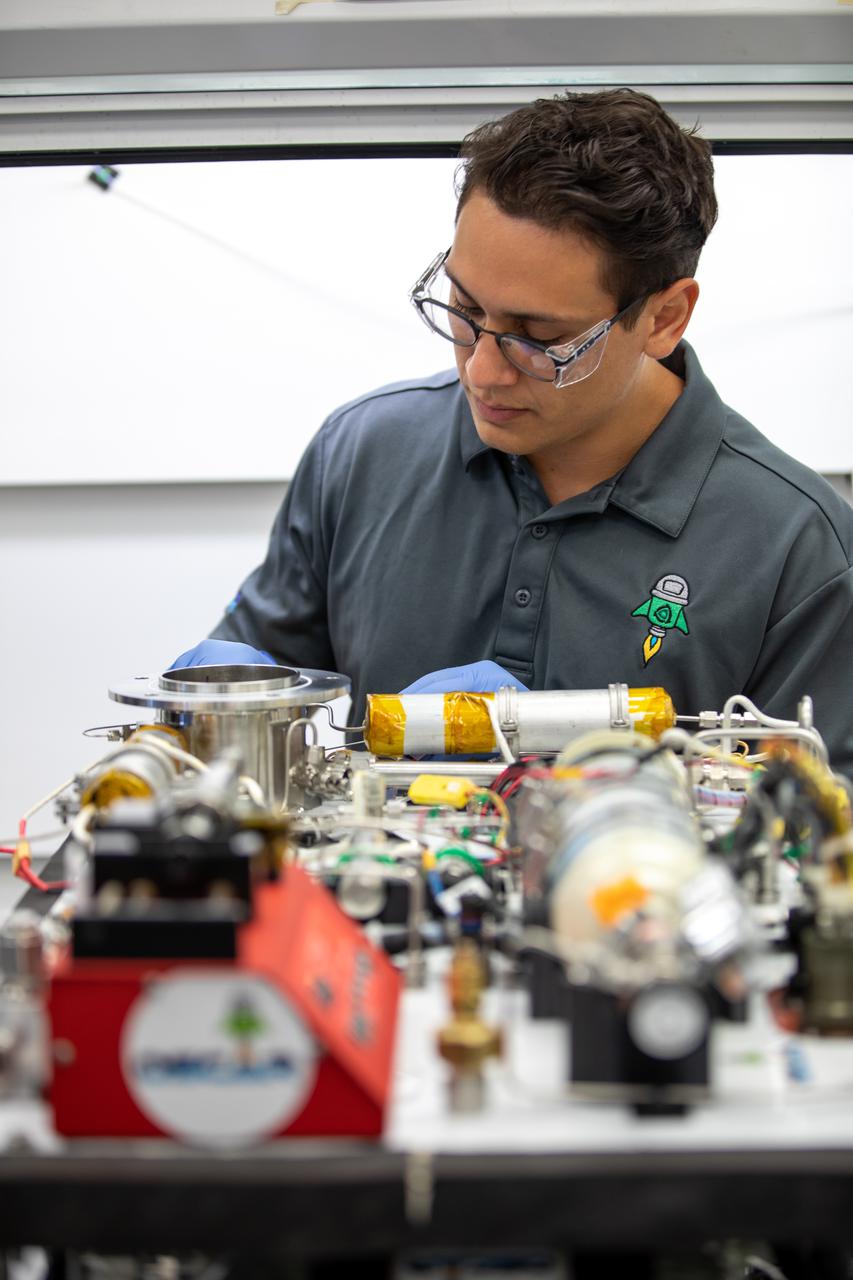
Ray Pitts, co-principal investigator for the Orbital Syngas Commodity Augmentation Reactor (OSCAR), performs ground testing at NASA’s Kennedy Space Center in Florida. The tests are in preparation for a scheduled suborbital flight test later this year, facilitated by NASA’s Flight Opportunities program. Begun as an Early Career Initiative project, OSCAR evaluates technology to make use of trash and human waste generated during long-duration spaceflight.
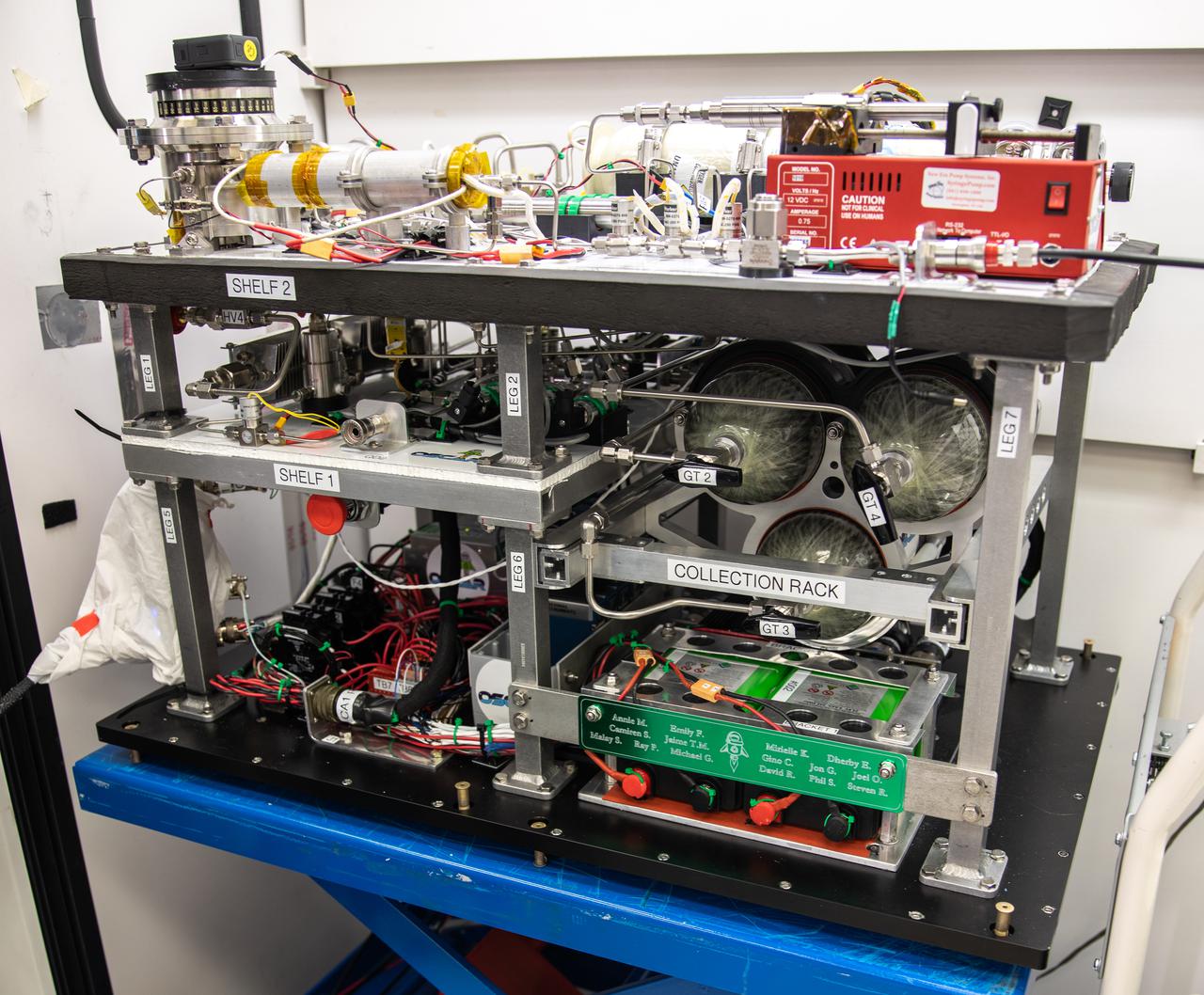
Members of the Orbital Syngas Commodity Augmentation Reactor (OSCAR) team perform ground testing at NASA’s Kennedy Space Center in Florida. The tests are in preparation for a scheduled suborbital flight test later this year, facilitated by NASA’s Flight Opportunities program. Begun as an Early Career Initiative project, OSCAR evaluates technology to make use of trash and human waste generated during long-duration spaceflight.
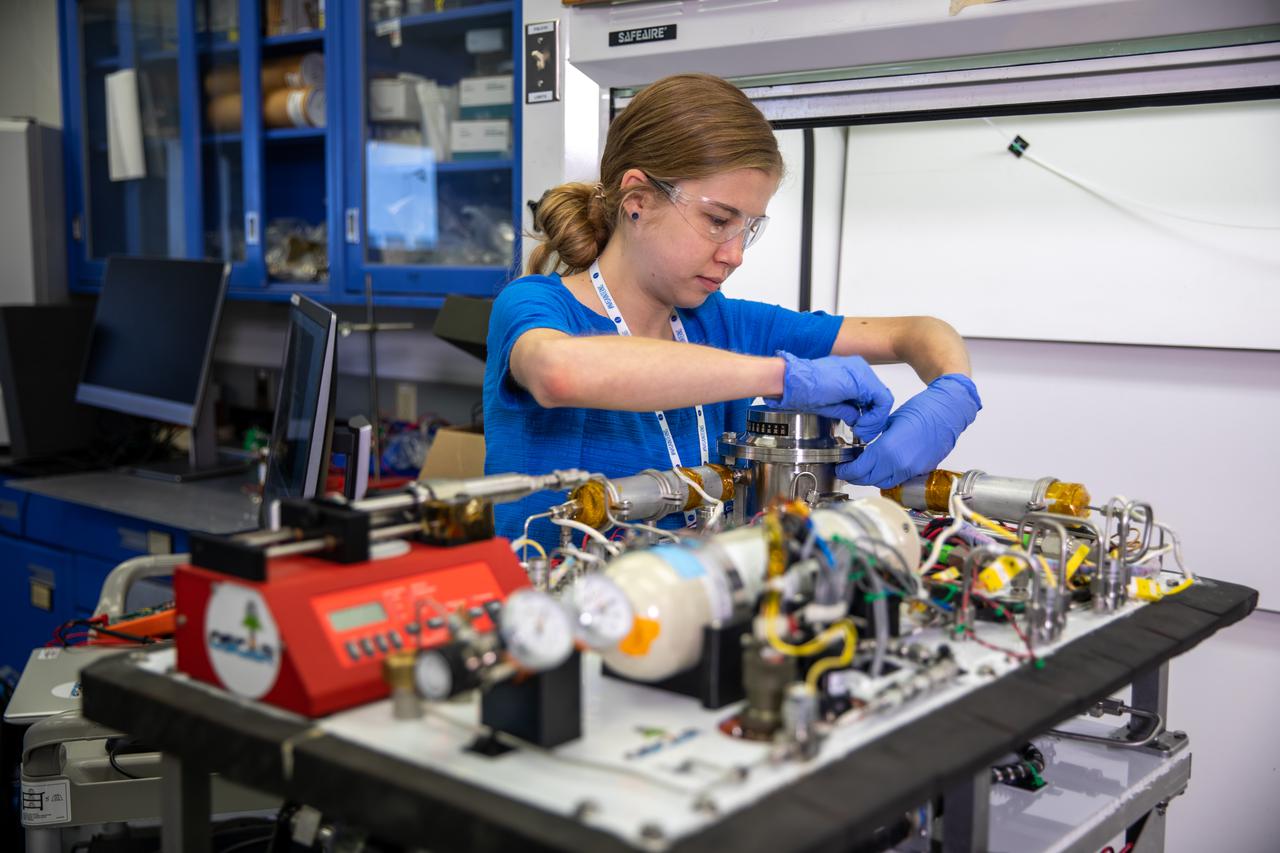
A member of the Orbital Syngas Commodity Augmentation Reactor (OSCAR) team performs ground testing at NASA’s Kennedy Space Center in Florida. The tests are in preparation for a scheduled suborbital flight test later this year, facilitated by NASA’s Flight Opportunities program. Begun as an Early Career Initiative project, OSCAR evaluates technology to make use of trash and human waste generated during long-duration spaceflight.
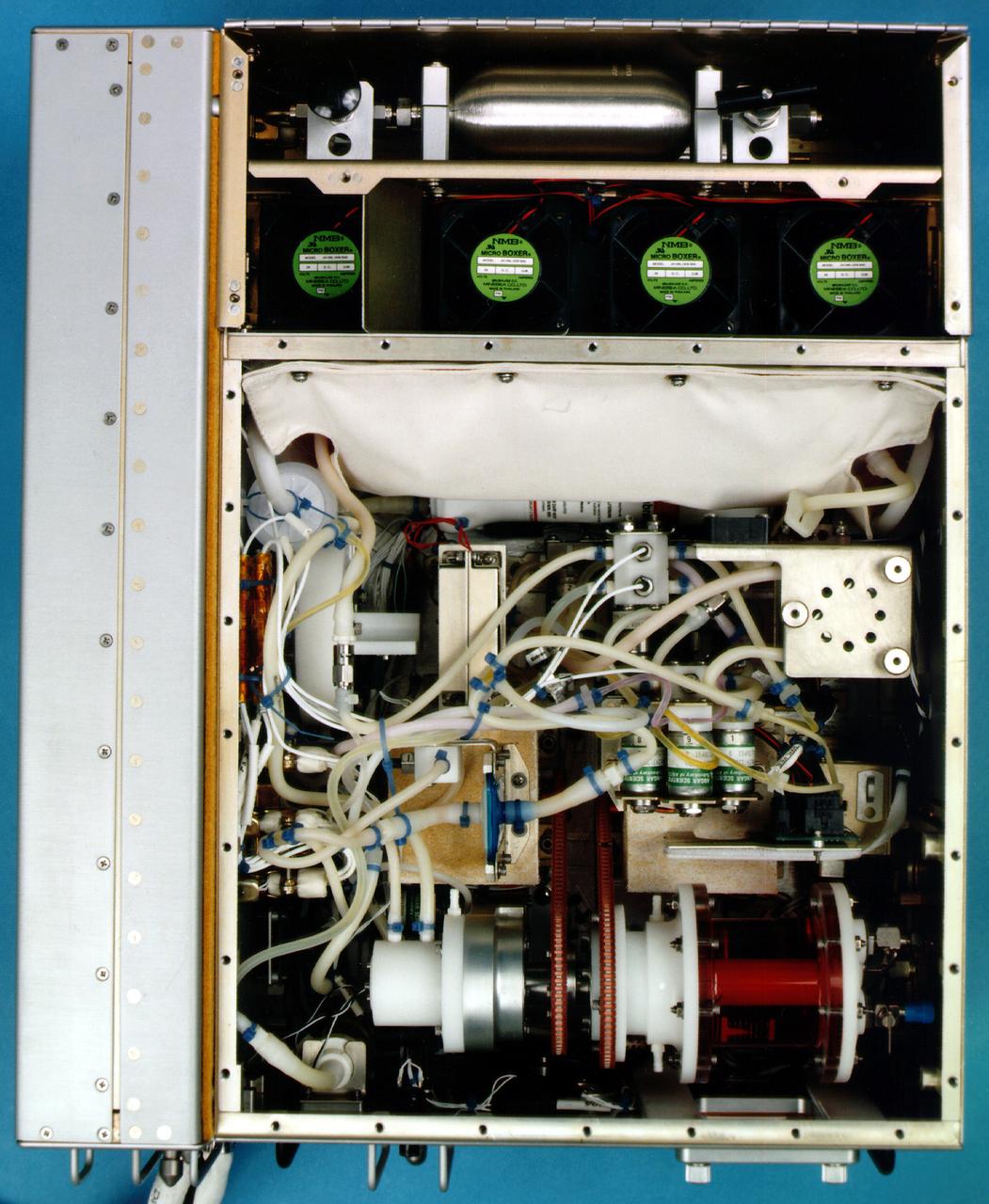
Bioreactor Demonstration System (BDS) comprises an electronics module, a gas supply module, and the incubator module housing the rotating wall vessel and its support systems. Nutrient media are pumped through an oxygenator and the culture vessel. The shell rotates at 0.5 rpm while the irner filter typically rotates at 11.5 rpm to produce a gentle flow that ensures removal of waste products as fresh media are infused. Periodically, some spent media are pumped into a waste bag and replaced by fresh media. When the waste bag is filled, an astronaut drains the waste bag and refills the supply bag through ports on the face of the incubator. Pinch valves and a perfusion pump ensure that no media are exposed to moving parts. An Experiment Control Computer controls the Bioreactor, records conditions, and alerts the crew when problems occur. The crew operates the system through a laptop computer displaying graphics designed for easy crew training and operation. The work is sponsored by NASA's Office of Biological and Physical Research. The bioreactor is managed by the Biotechnology Cell Science Program at NASA's Johnson Space Center (JSC). NASA-sponsored bioreactor research has been instrumental in helping scientists to better understand normal and cancerous tissue development. In cooperation with the medical community, the bioreactor design is being used to prepare better models of human colon, prostate, breast and ovarian tumors. Cartilage, bone marrow, heart muscle, skeletal muscle, pancreatic islet cells, liver and kidney are just a few of the normal tissues being cultured in rotating bioreactors by investigators. See No. 0101825 for a version with major elements labeled, and No. 0103180 for an operational schematic. 0101816
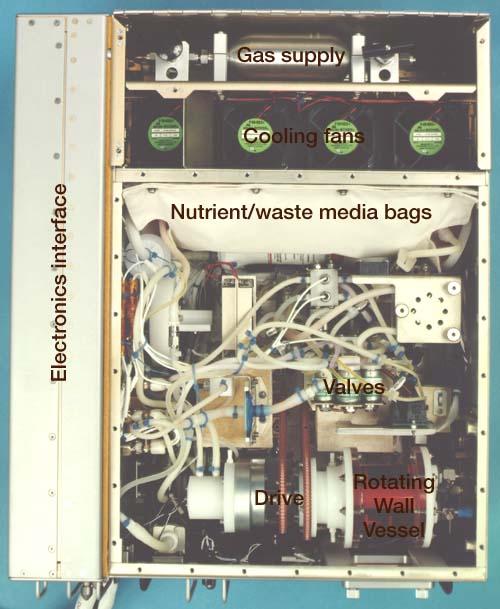
Bioreactor Demonstration System (BDS) comprises an electronics module, a gas supply module, and the incubator module housing the rotating wall vessel and its support systems. Nutrient media are pumped through an oxygenator and the culture vessel. The shell rotates at 0.5 rpm while the irner filter typically rotates at 11.5 rpm to produce a gentle flow that ensures removal of waste products as fresh media are infused. Periodically, some spent media are pumped into a waste bag and replaced by fresh media. When the waste bag is filled, an astronaut drains the waste bag and refills the supply bag through ports on the face of the incubator. Pinch valves and a perfusion pump ensure that no media are exposed to moving parts. An Experiment Control Computer controls the Bioreactor, records conditions, and alerts the crew when problems occur. The crew operates the system through a laptop computer displaying graphics designed for easy crew training and operation. The work is sponsored by NASA's Office of Biological and Physical Research. The bioreactor is managed by the Biotechnology Cell Science Program at NASA's Johnson Space Center (JSC). NASA-sponsored bioreactor research has been instrumental in helping scientists to better understand normal and cancerous tissue development. In cooperation with the medical community, the bioreactor design is being used to prepare better models of human colon, prostate, breast and ovarian tumors. Cartilage, bone marrow, heart muscle, skeletal muscle, pancreatic islet cells, liver and kidney are just a few of the normal tissues being cultured in rotating bioreactors by investigators. See No. 0101816 for a version without labels, and No. 0103180 for an operational schematic.
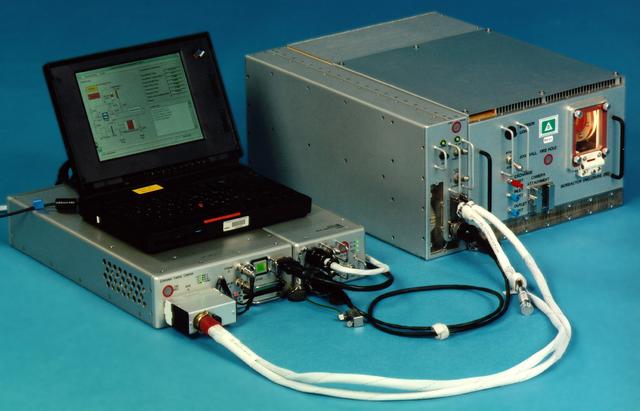
Bioreactor Demonstration System (BDS) comprises an electronics module, a gas supply module, and the incubator module housing the rotating wall vessel and its support systems. Nutrient media are pumped through an oxygenator and the culture vessel. The shell rotates at 0.5 rpm while the irner filter typically rotates at 11.5 rpm to produce a gentle flow that ensures removal of waste products as fresh media are infused. Periodically, some spent media are pumped into a waste bag and replaced by fresh media. When the waste bag is filled, an astronaut drains the waste bag and refills the supply bag through ports on the face of the incubator. Pinch valves and a perfusion pump ensure that no media are exposed to moving parts. An Experiment Control Computer controls the Bioreactor, records conditions, and alerts the crew when problems occur. The crew operates the system through a laptop computer displaying graphics designed for easy crew training and operation. The work is sponsored by NASA's Office of Biological and Physical Research. The bioreactor is managed by the Biotechnology Cell Science Program at NASA's Johnson Space Center (JSC). NASA-sponsored bioreactor research has been instrumental in helping scientists to better understand normal and cancerous tissue development. In cooperation with the medical community, the bioreactor design is being used to prepare better models of human colon, prostate, breast and ovarian tumors. Cartilage, bone marrow, heart muscle, skeletal muscle, pancreatic islet cells, liver and kidney are just a few of the normal tissues being cultured in rotating bioreactors by investigators. See No. 0101824 for a version with labels, and No. 0103180 for an operational schematic.
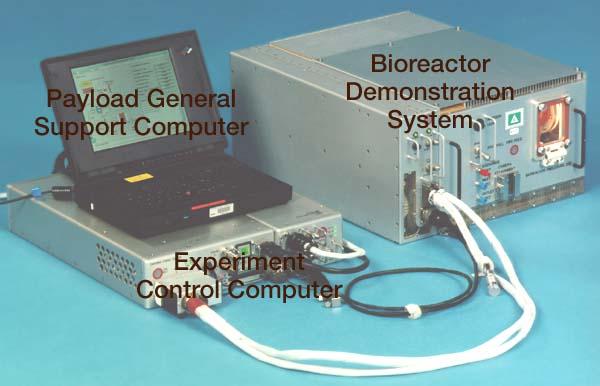
Bioreactor Demonstration System (BDS) comprises an electronics module, a gas supply module, and the incubator module housing the rotating wall vessel and its support systems. Nutrient media are pumped through an oxygenator and the culture vessel. The shell rotates at 0.5 rpm while the irner filter typically rotates at 11.5 rpm to produce a gentle flow that ensures removal of waste products as fresh media are infused. Periodically, some spent media are pumped into a waste bag and replaced by fresh media. When the waste bag is filled, an astronaut drains the waste bag and refills the supply bag through ports on the face of the incubator. Pinch valves and a perfusion pump ensure that no media are exposed to moving parts. An Experiment Control Computer controls the Bioreactor, records conditions, and alerts the crew when problems occur. The crew operates the system through a laptop computer displaying graphics designed for easy crew training and operation. The work is sponsored by NASA's Office of Biological and Physical Research. The bioreactor is managed by the Biotechnology Cell Science Program at NASA's Johnson Space Center (JSC). NASA-sponsored bioreactor research has been instrumental in helping scientists to better understand normal and cancerous tissue development. In cooperation with the medical community, the bioreactor design is being used to prepare better models of human colon, prostate, breast and ovarian tumors. Cartilage, bone marrow, heart muscle, skeletal muscle, pancreatic islet cells, liver and kidney are just a few of the normal tissues being cultured in rotating bioreactors by investigators. See No. 0101823 for a version without labels, and No. 0103180 for an operational schematic.
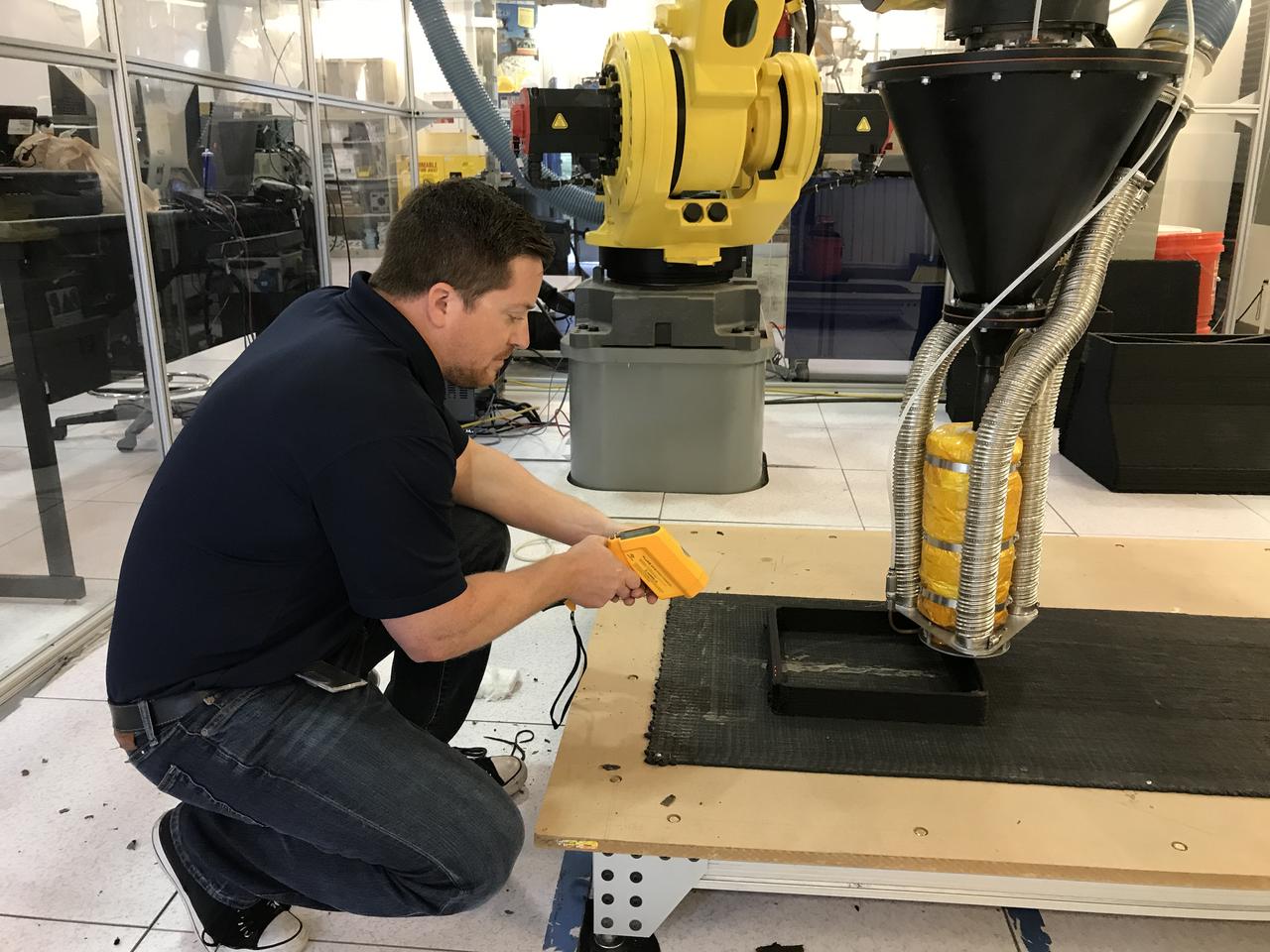
Packing light is the idea behind the Zero Launch Mass 3-D Printer. Instead of loading up on heavy building supplies, a large scale 3-D printer capable of using recycled plastic waste and dirt at the destination as construction material would save mass and money when launching robotic precursor missions to build infrastructure on the Moon or Mars in preparation for human habitation. To make this a reality, Nathan Gelino, a researcher engineer with NASA’s Swamp Works at Kennedy Space Center, measured the temperature of a test specimen from the 3-D printer Tuesday as an early step in characterizing printed material strength properties. Material temperature plays a large role in the strength of bonds between layers.
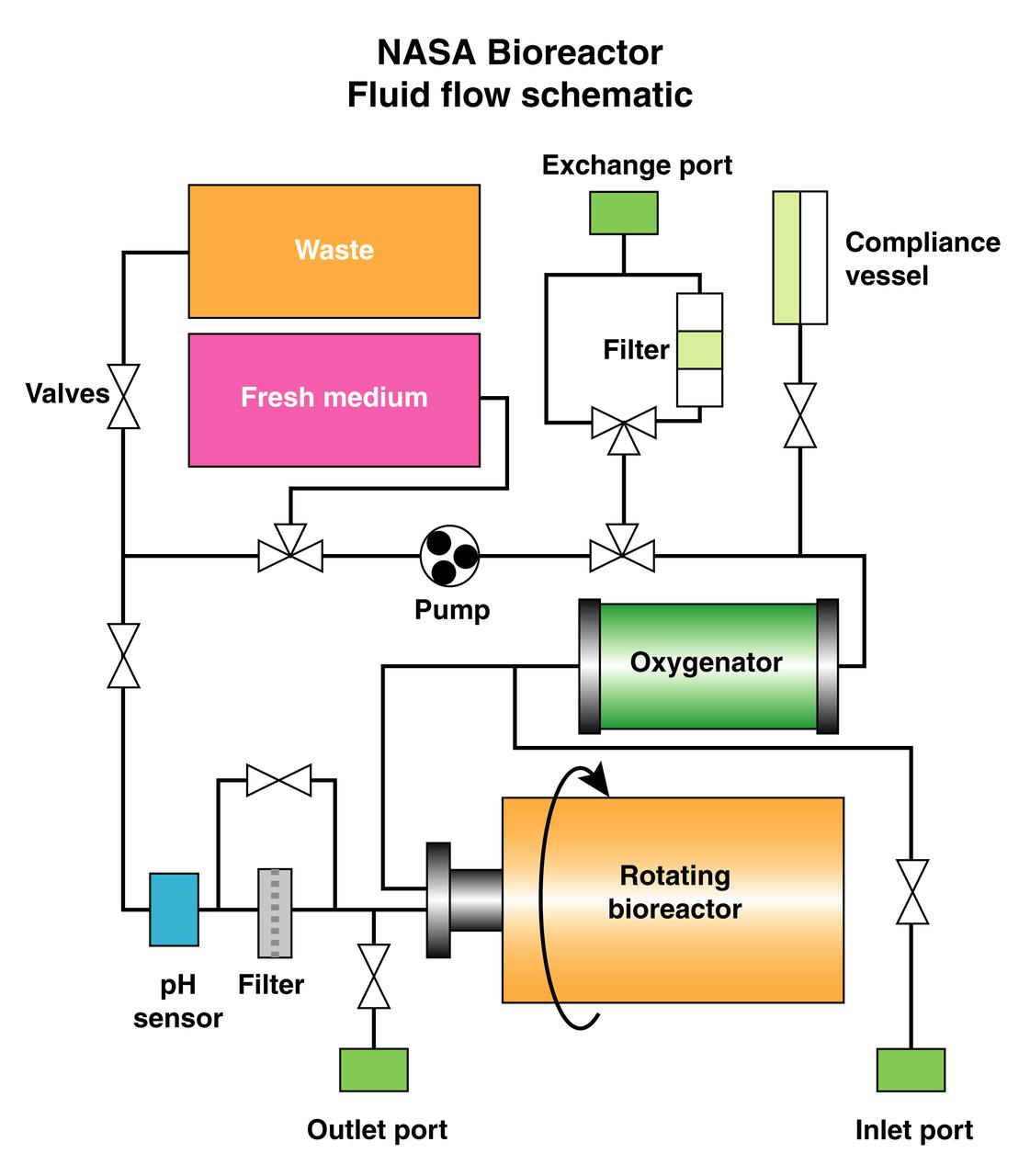
The schematic depicts the major elements and flow patterns inside the NASA Bioreactor system. Waste and fresh medium are contained in plastic bags placed side-by-side so the waste bag fills as the fresh medium bag is depleted. The compliance vessel contains a bladder to accommodate pressure transients that might damage the system. A peristolic pump moves fluid by squeezing the plastic tubing, thus avoiding potential contamination. The work is sponsored by NASA's Office of Biological and Physical Research. The bioreactor is managed by the Biotechnology Cell Science Program at NASA's Johnson Space Center (JSC). NASA-sponsored bioreactor research has been instrumental in helping scientists to better understand normal and cancerous tissue development. In cooperation with the medical community, the bioreactor design is being used to prepare better models of human colon, prostate, breast and ovarian tumors. Cartilage, bone marrow, heart muscle, skeletal muscle, pancreatic islet cells, liver and kidney are just a few of the normal tissues being cultured in rotating bioreactors by investigators.

Astronaut John Blaha replaces an exhausted media bag and filled waste bag with fresh bags to continue a bioreactor experiment aboard space station Mir in 1996. NASA-sponsored bioreactor research has been instrumental in helping scientists to better understand normal and cancerous tissue development. In cooperation with the medical community, the bioreactor design is being used to prepare better models of human colon, prostate, breast and ovarian tumors. Cartilage, bone marrow, heart muscle, skeletal muscle, pancreatic islet cells, liver and kidney are just a few of the normal tissues being cultured in rotating bioreactors by investigators. This image is from a video downlink. The work is sponsored by NASA's Office of Biological and Physical Research. The bioreactor is managed by the Biotechnology Cell Science Program at NASA's Johnson Space Center (JSC).
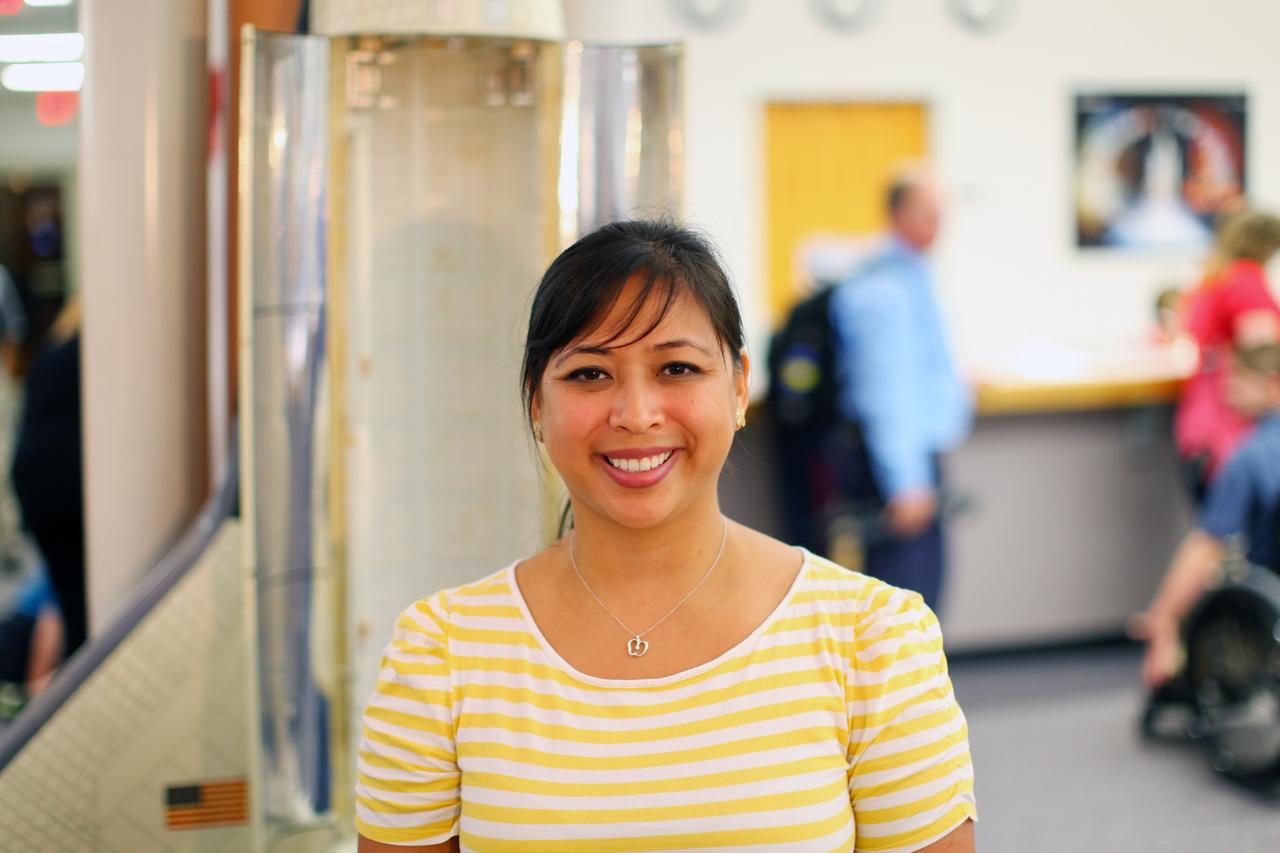
CAPE CANAVERAL, Fla. – Teacher Anthonette Pena is interviewed by the media in the NASA Newsroom at Kennedy Space Center in Florida during prelaunch activities for the SpaceX demonstration test flight. Pena is the facilitator for the student experiment developed by a team of eighth-graders at the Capitol Hill Cluster School in Washington, D.C. The experiment, “Does Hay Bacillus Break Down Human Waste Represented by Brown Egg in Microgravity as Well as in Earth Gravity?” is one of 15 in the Student Spaceflight Experiments Program, or SSEP, being ferried to the International Space Station inside the Dragon capsule. The launch will be the second demonstration test flight for SpaceX for NASA's Commercial Orbital Transportation Services program, or COTS. SSEP, which began operation in June 2010 through a partnership of the National Center for Earth and Space Science Education with NanoRacks LLC, is a U.S. national science, technology, engineering and mathematics STEM education initiative that gives students across a community the opportunity to propose and design real experiments to fly in low Earth orbit. SSEP experiments flew on space shuttle missions STS-134 and STS-135 in 2011, the final flights of space shuttles Endeavour and Atlantis. For more information on SSEP, visit http://www.nasa.gov/audience/foreducators/station-here-we-come.html. Photo credit: NASA/Gianni Woods
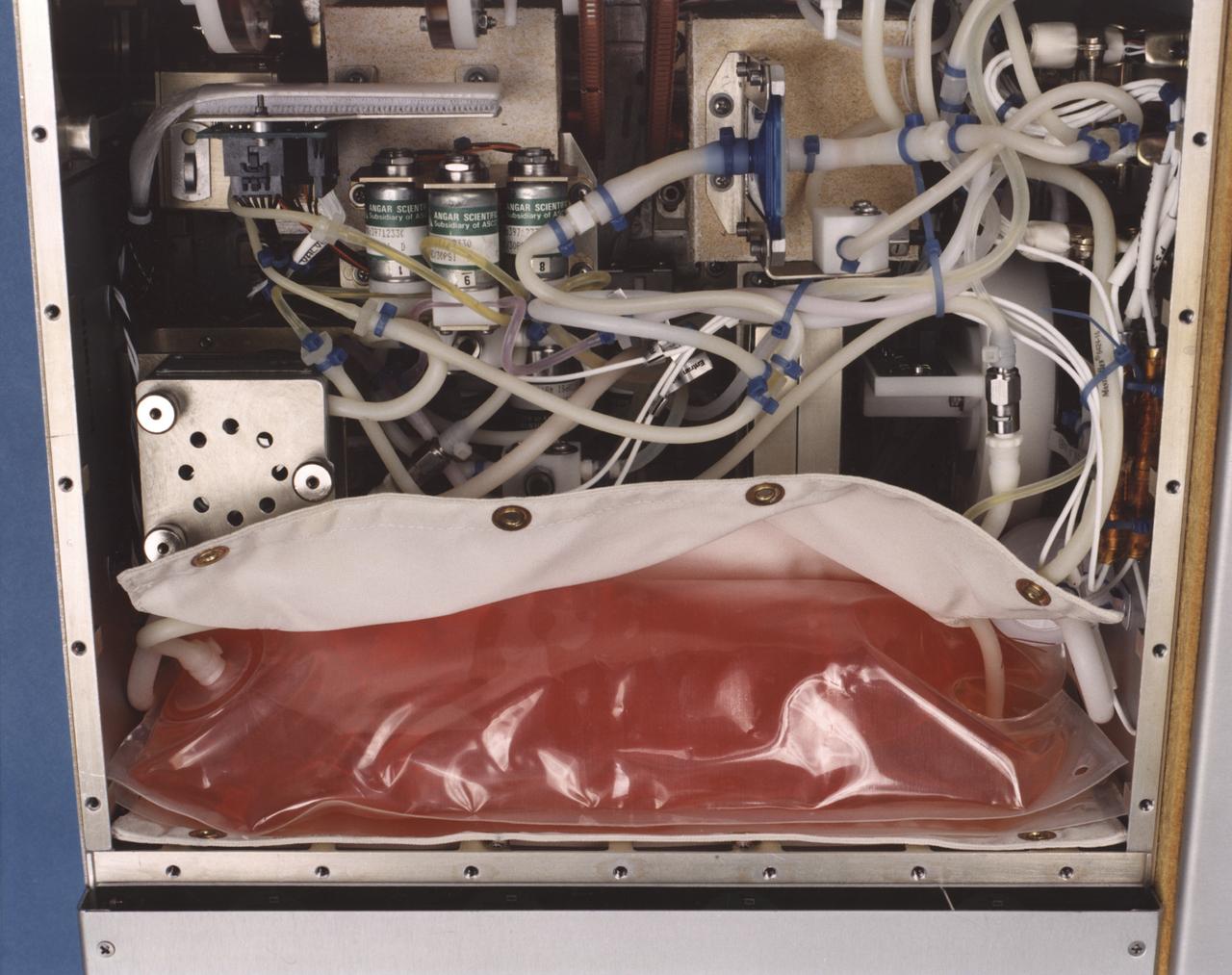
Close-up view of the interior of a NASA Bioreactor shows the plastic plumbing and valves (cylinders at center) to control fluid flow. A fresh nutrient bag is installed at top; a flattened waste bag behind it will fill as the nutrients are consumed during the course of operation. The drive chain and gears for the rotating wall vessel are visible at bottom center center. The NASA Bioreactor provides a low turbulence culture environment which promotes the formation of large, three-dimensional cell clusters. The Bioreactor is rotated to provide gentle mixing of fresh and spent nutrient without inducing shear forces that would damage the cells. Due to their high level of cellular organization and specialization, samples constructed in the bioreactor more closely resemble the original tumor or tissue found in the body. The work is sponsored by NASA's Office of Biological and Physical Research. The bioreactor is managed by the Biotechnology Cell Science Program at NASA's Johnson Space Center (JSC). NASA-sponsored bioreactor research has been instrumental in helping scientists to better understand normal and cancerous tissue development. In cooperation with the medical community, the bioreactor design is being used to prepare better models of human colon, prostate, breast and ovarian tumors. Cartilage, bone marrow, heart muscle, skeletal muscle, pancreatic islet cells, liver and kidney are just a few of the normal tissues being cultured in rotating bioreactors by investigators.
![The stimulus of gravity affects RNA production, which helps maintain the strength of human muscles on Earth (top), as seen in this section of muscle fiber taken from an astronaut before spaceflight. Astronauts in orbit and patients on Earth fighting muscle-wasting diseases need countermeasures to prevent muscle atrophy, indicated here with white lipid droplets (bottom) in the muscle sample taken from the same astronaut after spaceflight. Kerneth Baldwin of the University of California, Irvine, is conducting research on how reducing the stimulus of gravity affects production of the RNA that the body uses as a blueprint for making muscle proteins. Muscle proteins are what give muscles their strength, so when the RNA blueprints aren't available for producing new proteins to replace old ones -- a situation that occurs in microgravity -- the muscles atrophy. When the skeletal muscle system is exposed to microgravity during spaceflight, the muscles undergo a reduced mass that translates to a reduction in strength. When this happens, muscle endurance decreases and the muscles are more prone to injury, so individuals could have problems in performing extravehicular activity [space walks] or emergency egress because their bodies are functionally compromised.](https://images-assets.nasa.gov/image/0300206/0300206~medium.jpg)
The stimulus of gravity affects RNA production, which helps maintain the strength of human muscles on Earth (top), as seen in this section of muscle fiber taken from an astronaut before spaceflight. Astronauts in orbit and patients on Earth fighting muscle-wasting diseases need countermeasures to prevent muscle atrophy, indicated here with white lipid droplets (bottom) in the muscle sample taken from the same astronaut after spaceflight. Kerneth Baldwin of the University of California, Irvine, is conducting research on how reducing the stimulus of gravity affects production of the RNA that the body uses as a blueprint for making muscle proteins. Muscle proteins are what give muscles their strength, so when the RNA blueprints aren't available for producing new proteins to replace old ones -- a situation that occurs in microgravity -- the muscles atrophy. When the skeletal muscle system is exposed to microgravity during spaceflight, the muscles undergo a reduced mass that translates to a reduction in strength. When this happens, muscle endurance decreases and the muscles are more prone to injury, so individuals could have problems in performing extravehicular activity [space walks] or emergency egress because their bodies are functionally compromised.
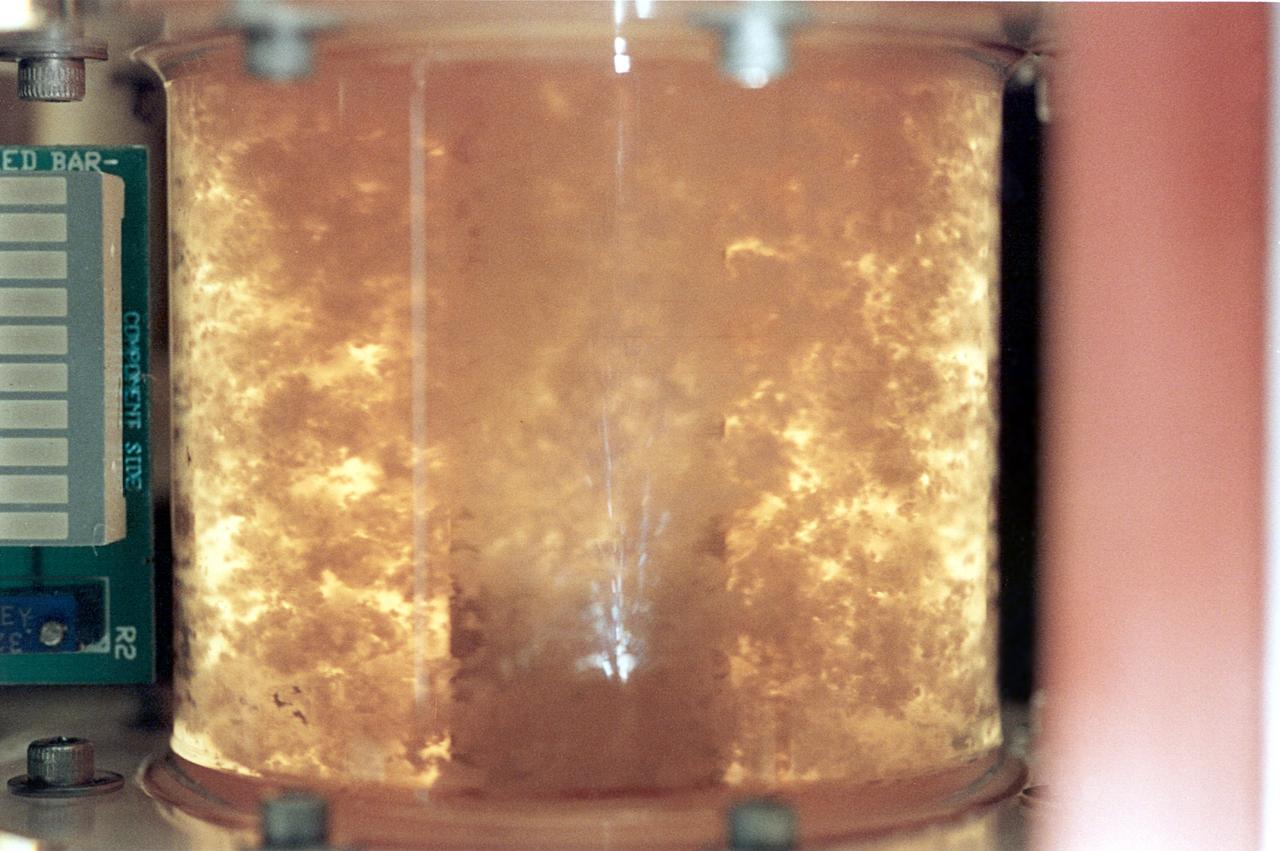
For 5 days on the STS-70 mission, a bioreactor cultivated human colon cancer cells, which grew to 30 times the volume of control specimens grown on Earth. This significant result was reproduced on STS-85 which grew mature structures that more closely match what are found in tumors in humans. Shown here, clusters of cells slowly spin inside a bioreactor. On Earth, the cells continually fall through the buffer medium and never hit bottom. In space, they are naturally suspended. Rotation ensures gentle stirring so waste is removed and fresh nutrient and oxygen are supplied. The NASA Bioreactor provides a low turbulence culture environment which promotes the formation of large, three-dimensional cell clusters. Due to their high level of cellular organization and specialization, samples constructed in the bioreactor more closely resemble the original tumor or tissue found in the body. The Bioreactor is rotated to provide gentle mixing of fresh and spent nutrient without inducing shear forces that would damage the cells. The work is sponsored by NASA's Office of Biological and Physical Research. The bioreactor is managed by the Biotechnology Cell Science Program at NASA's Johnson Space Center (JSC). NASA-sponsored bioreactor research has been instrumental in helping scientists to better understand normal and cancerous tissue development. In cooperation with the medical community, the bioreactor design is being used to prepare better models of human colon, prostate, breast and ovarian tumors. Cartilage, bone marrow, heart muscle, skeletal muscle, pancreatic islet cells, liver and kidney are just a few of the normal tissues being cultured in rotating bioreactors by investigators.
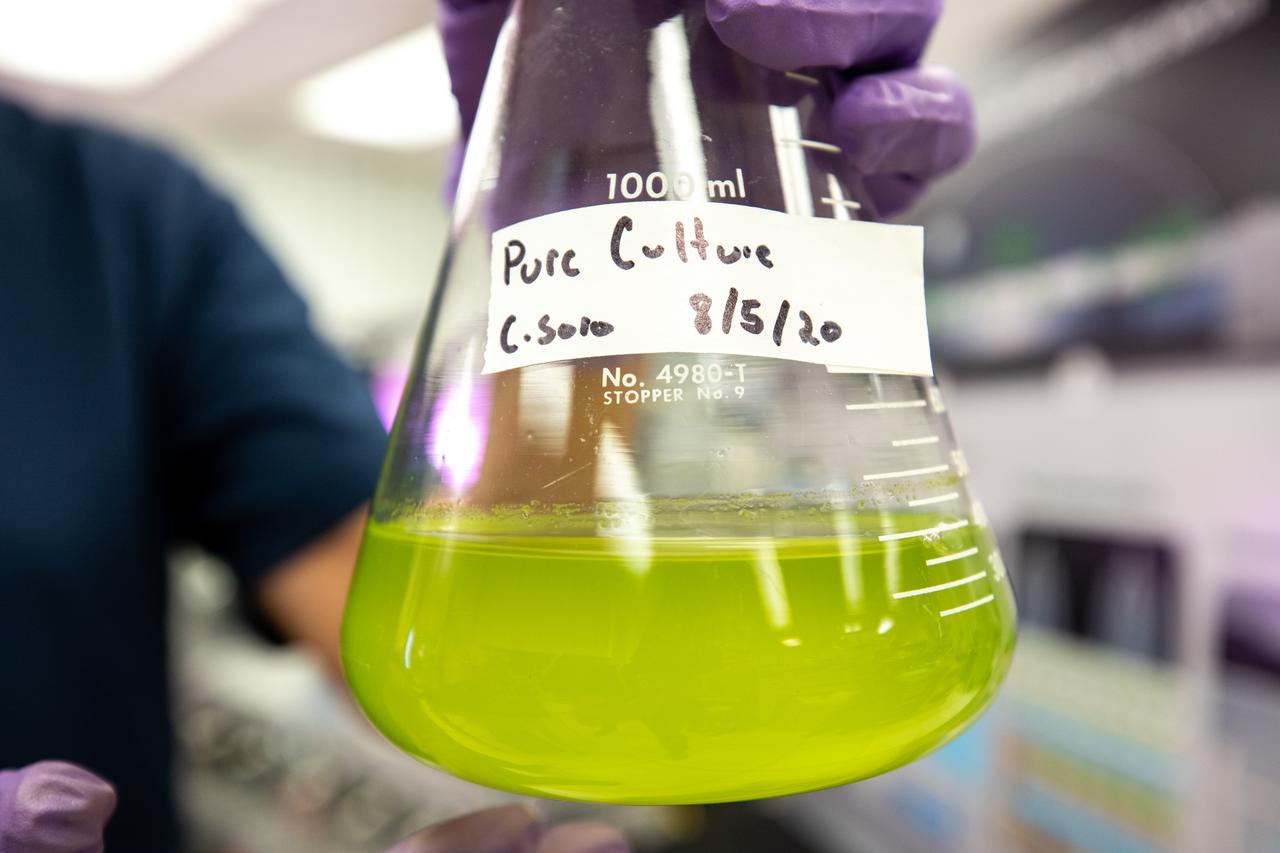
A prototype of Organic Processor Assembly (OPA) – technology capable of treating mixed organic wastes – arrives at the Neil Armstrong Operations and Checkout Building at NASA’s Kennedy Space Center in Florida on Aug. 19, 2020. At the heart of the OPA is an anaerobic membrane bioreactor – a hybrid technology that couples anaerobic digestion with membrane filtration. Developed through a collaboration between Kennedy’s Dr. Luke Roberson and the University of South Florida’s Dr. Daniel Yeh, the OPA was designed for an early planetary base scenario to help close the resource recovery loop, decreasing the agency’s dependence on resupply missions.
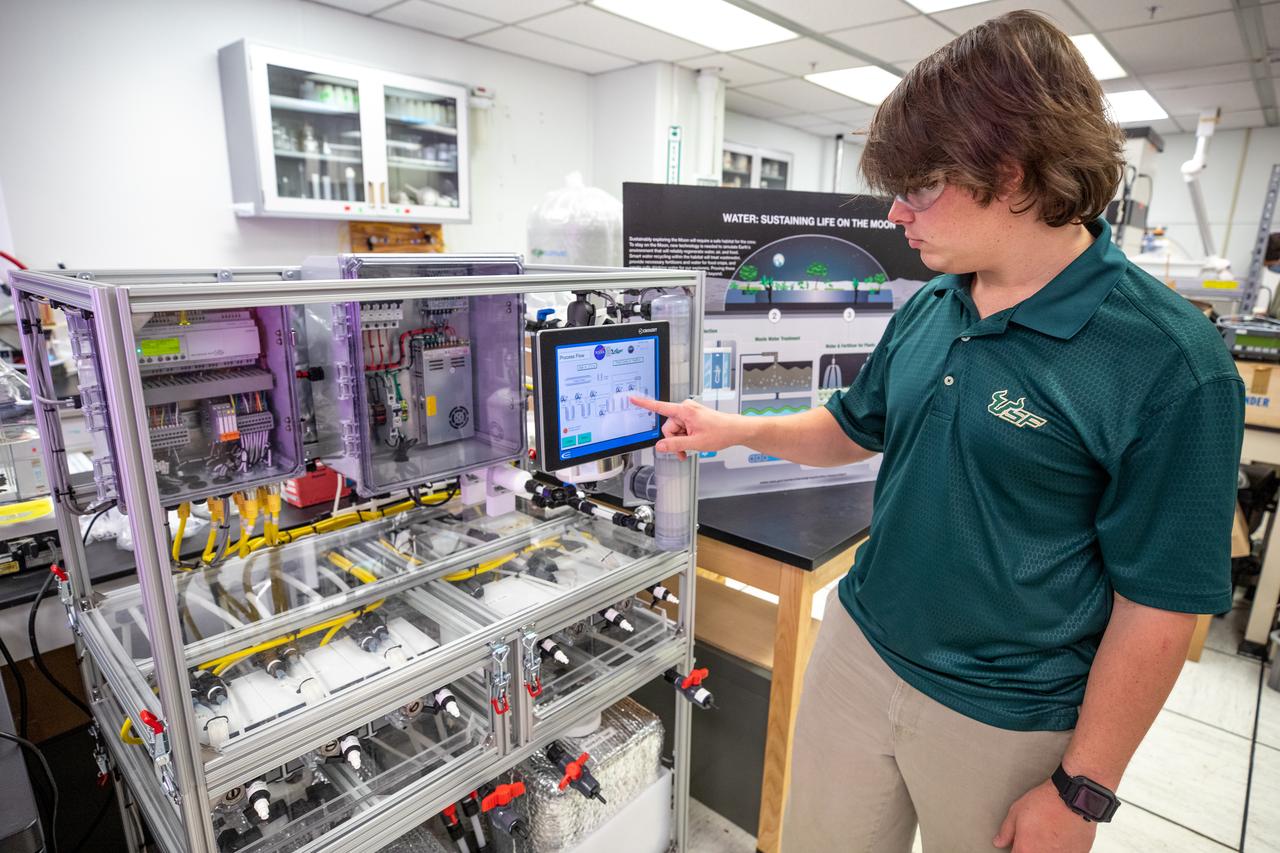
A prototype of Organic Processor Assembly (OPA) – technology capable of treating mixed organic wastes – arrives at the Neil Armstrong Operations and Checkout Building at NASA’s Kennedy Space Center in Florida on Aug. 19, 2020. Developed through a collaboration between Kennedy’s Dr. Luke Roberson and the University of South Florida’s Dr. Daniel Yeh, the OPA was designed for an early planetary base scenario to help close the resource recovery loop, decreasing the agency’s dependence on resupply missions. At the heart of the OPA is an anaerobic membrane bioreactor – a hybrid technology that couples anaerobic digestion with membrane filtration.
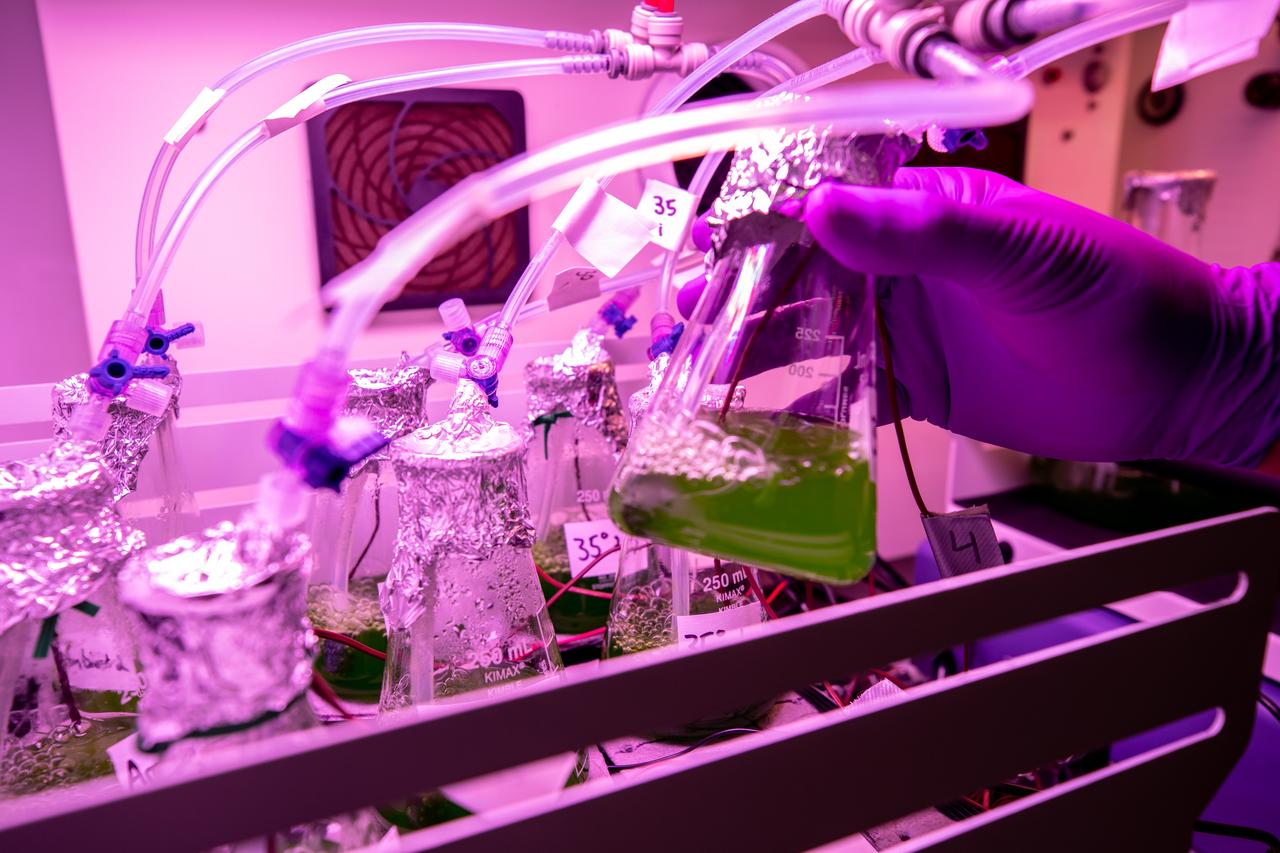
A prototype of Organic Processor Assembly (OPA) – technology capable of treating mixed organic wastes – arrives at the Neil Armstrong Operations and Checkout Building at NASA’s Kennedy Space Center in Florida on Aug. 19, 2020. At the heart of the OPA is an anaerobic membrane bioreactor – a hybrid technology that couples anaerobic digestion with membrane filtration. Developed through a collaboration between Kennedy’s Dr. Luke Roberson and the University of South Florida’s Dr. Daniel Yeh, the OPA was designed for an early planetary base scenario to help close the resource recovery loop, decreasing the agency’s dependence on resupply missions.