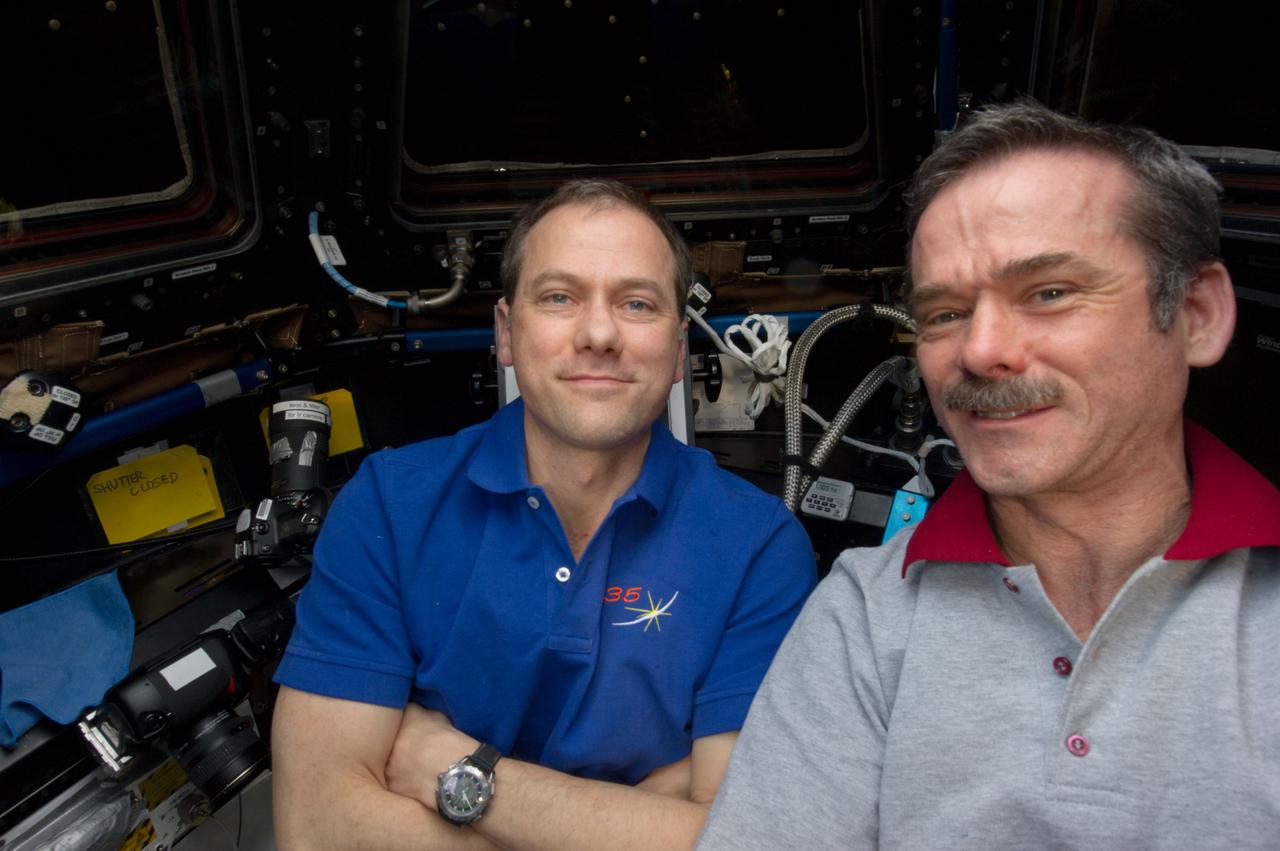
ISS035-E-008937 (26 March 2013) --- Expedition 35 Commander Chris Hadfield (right) of the Canadian Space Agency and Flight Engineer Tom Marshburn of NASA are pictured in the Cupola on the International Space Station during the operations that ultimately led to the release of the SpaceX Dragon-2 spacecraft for its return to Earth after a three-week stay aboard the orbital outpost. The Dragon was scheduled to make a landing in the Pacific Ocean, off the coast of California, later in the day.
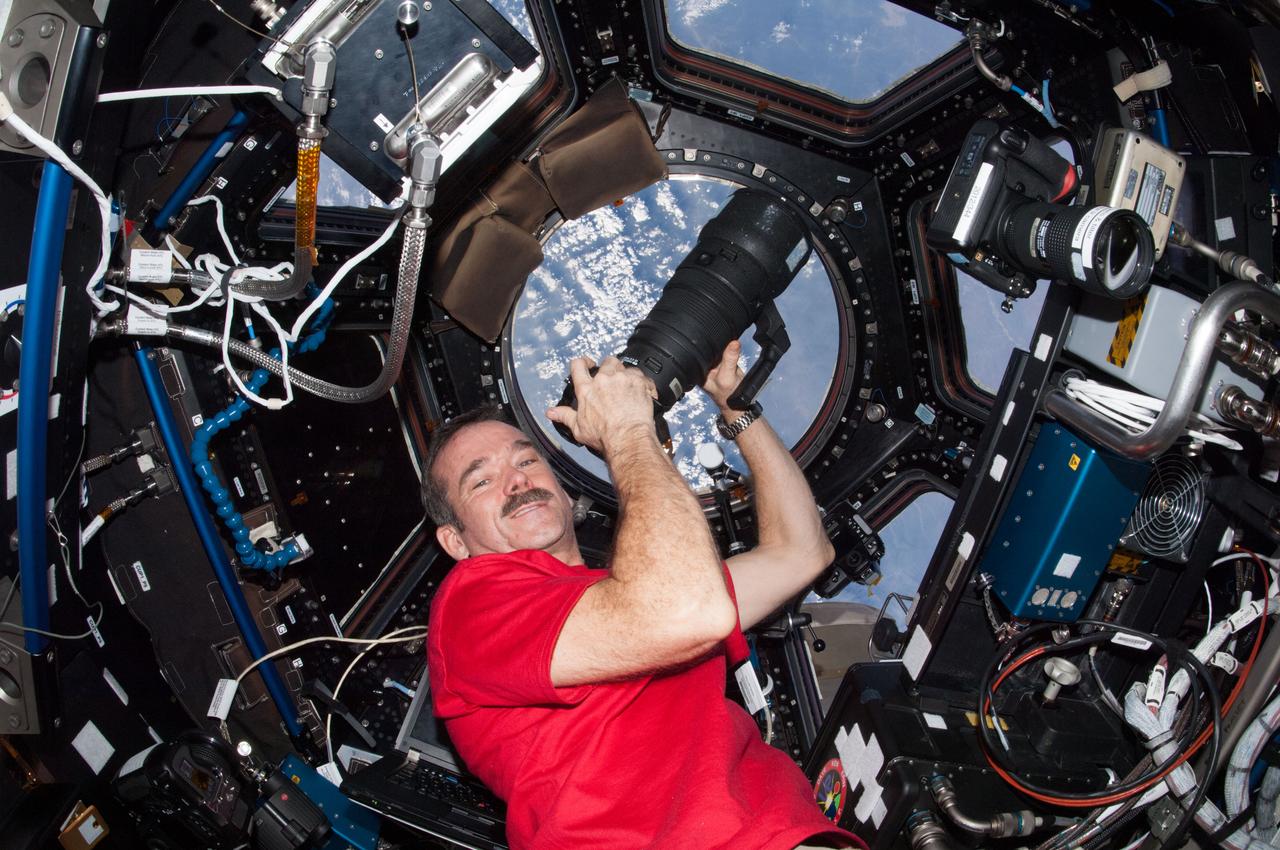
View of Canadian Space Agency (CSA) Chris Hadfield,Expedition 34 Flight Engineer (FE),using still camera,in the Cupola Module. Photo was taken during Expedition 34.
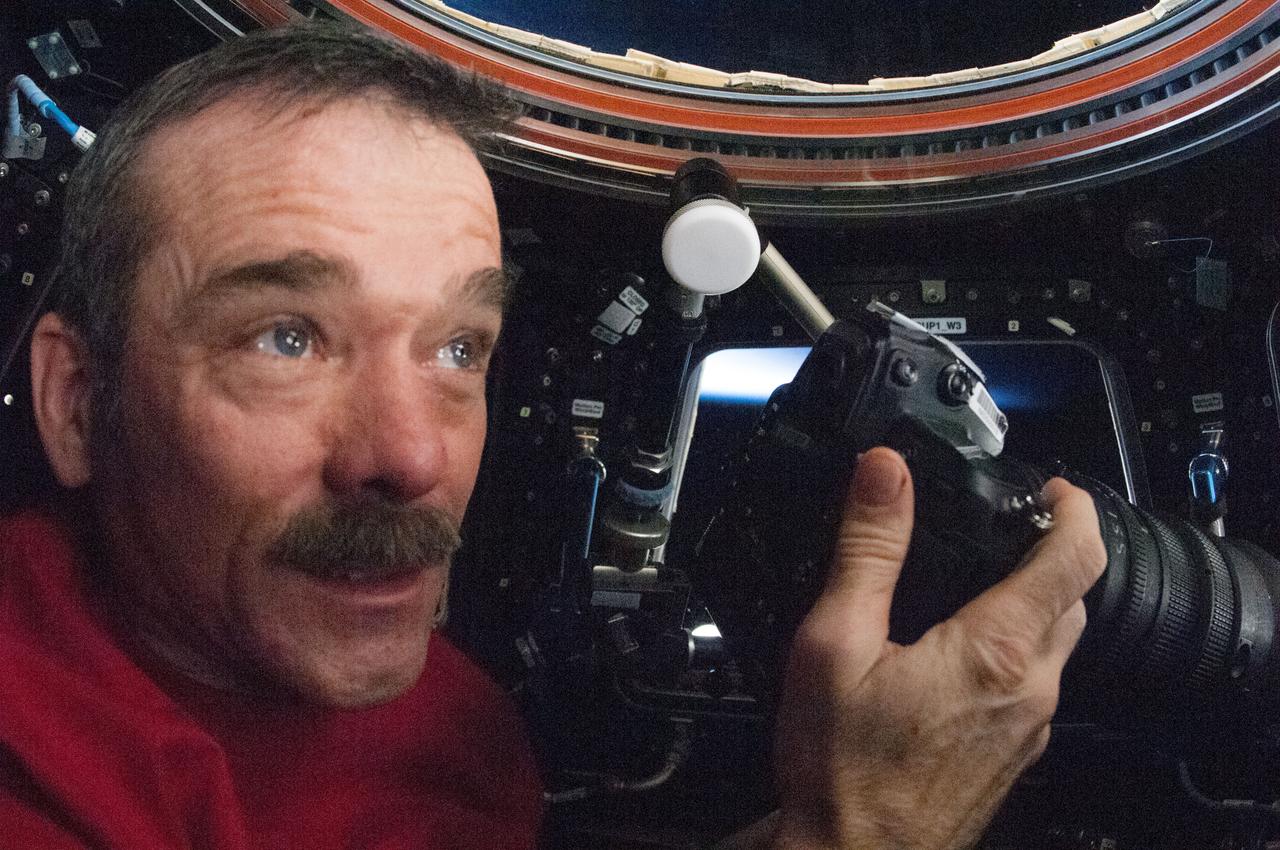
ISS034-E-024095 (7 Jan. 2013) --- Canadian Space Agency astronaut Chris Hadfield, Expedition 34 flight engineer, holds a still camera while looking through a window in the Cupola of the International Space Station.
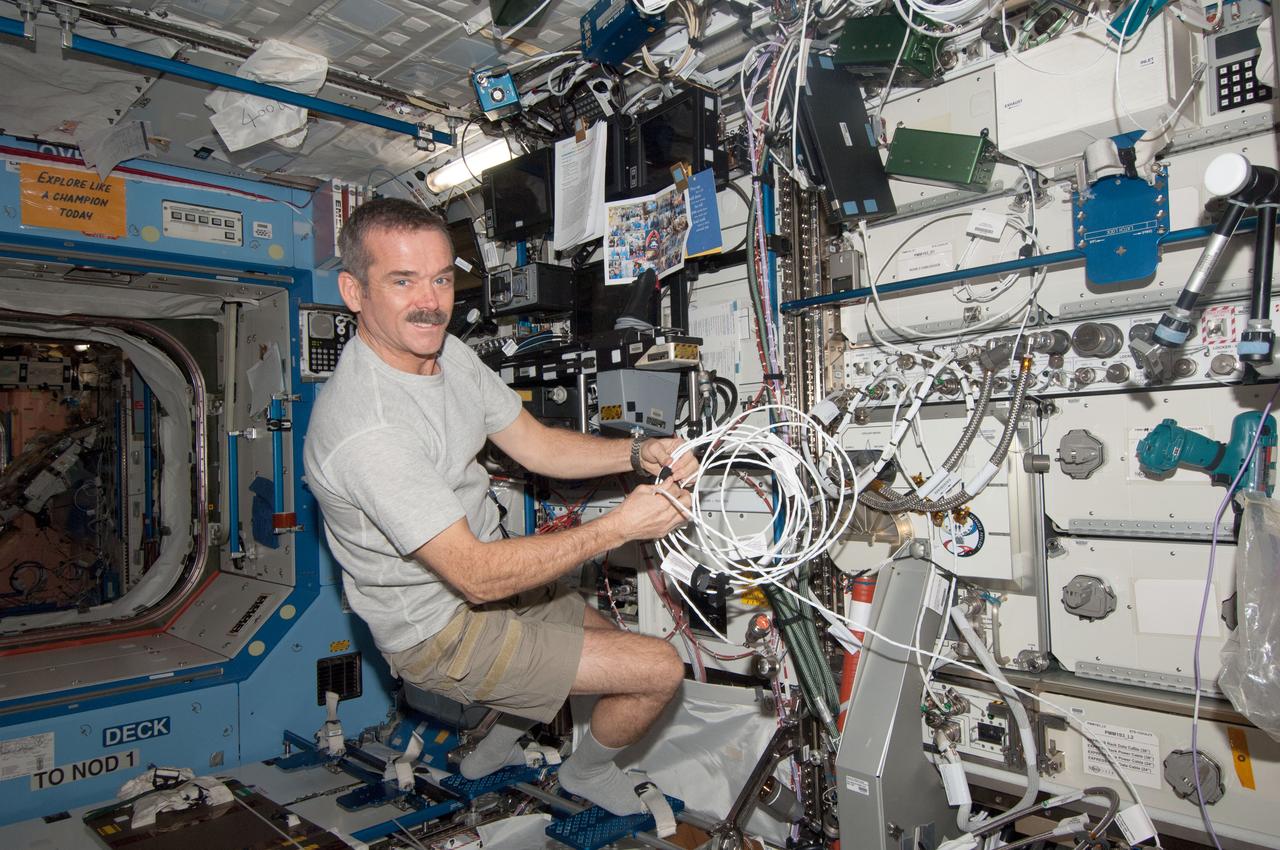
View of Canadian Space Agency (CSA) Chris Hadfield, Expedition 34 Flight Engineer (FE), wiring the condensate transfer pump, in the U.S. Laboratory. Image was released via astronaut Twitter. Original camera number is 268C1459. Photo was taken during Expedition 34.

ISS035-E-006230 (20 March 2013) --- Expedition 35 Commander Chris Hadfield in Harmony Node 2 aboard the Earth-orbiting International Space Station examines his work after reassembling the amine swing bed into its locker chassis. This device examines whether a vacuum-regenerated amine system can effectively remove carbon dioxide from the space station atmosphere using a smaller, more efficient vacuum regeneration system. The goal is to recover carbon dioxide from the atmosphere, and separate the dioxide from the carbon, so that the oxygen molecules can be used for crew life support.
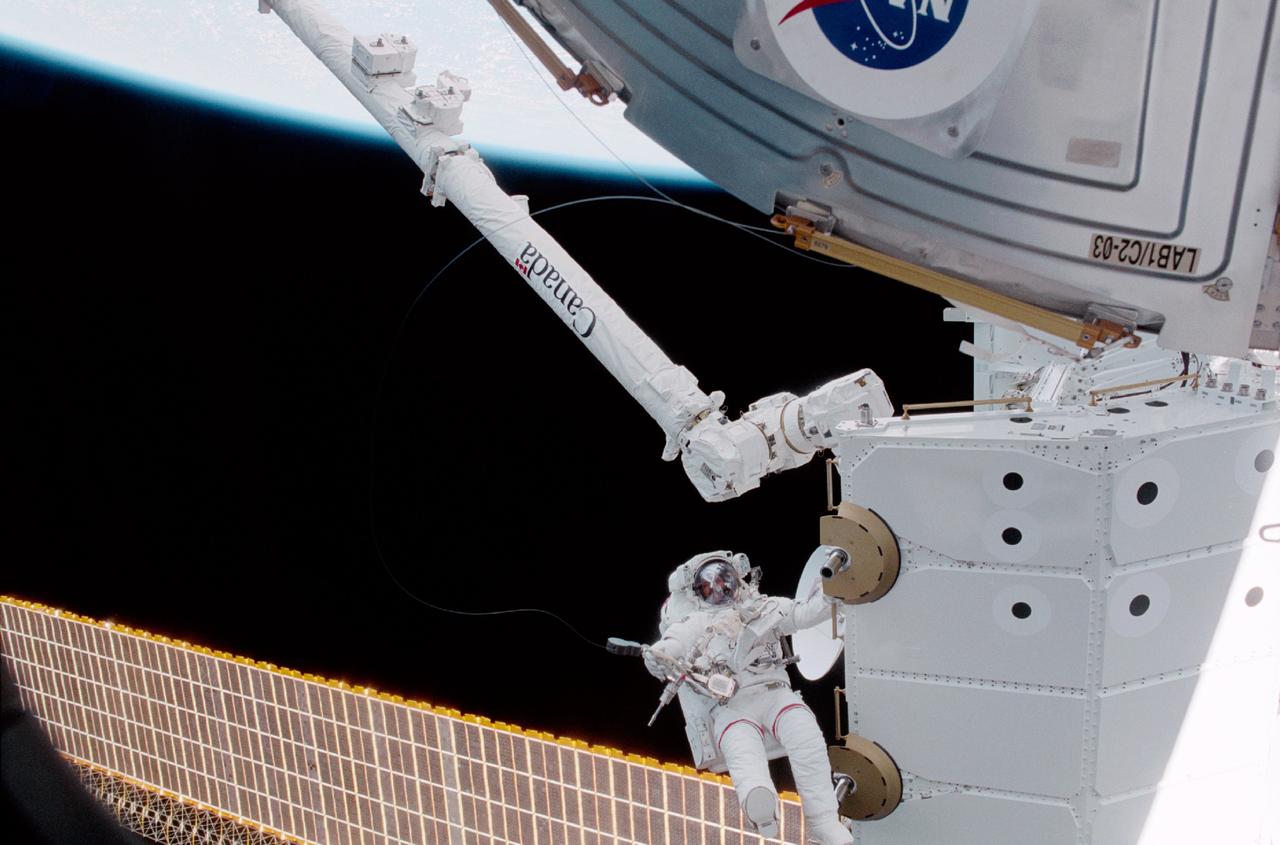
The main objective of the STS-100 mission, the sixth International Space Station (ISS) assembly flight, was the delivery and installation of the Canadian-built Space Station Remote Manipulator System (SSRMS), or Canadarm2. In this photograph, astronaut Chris A. Hadfield, mission specialist representing the Canadian Space Agency (CSA), is seen near the Canadarm2, as the new tool for the ISS grasps the space lab pallet. STS-100 launched April 19, 2001 aboard the Space Shuttle Orbiter Endeavour for an 11 day mission.
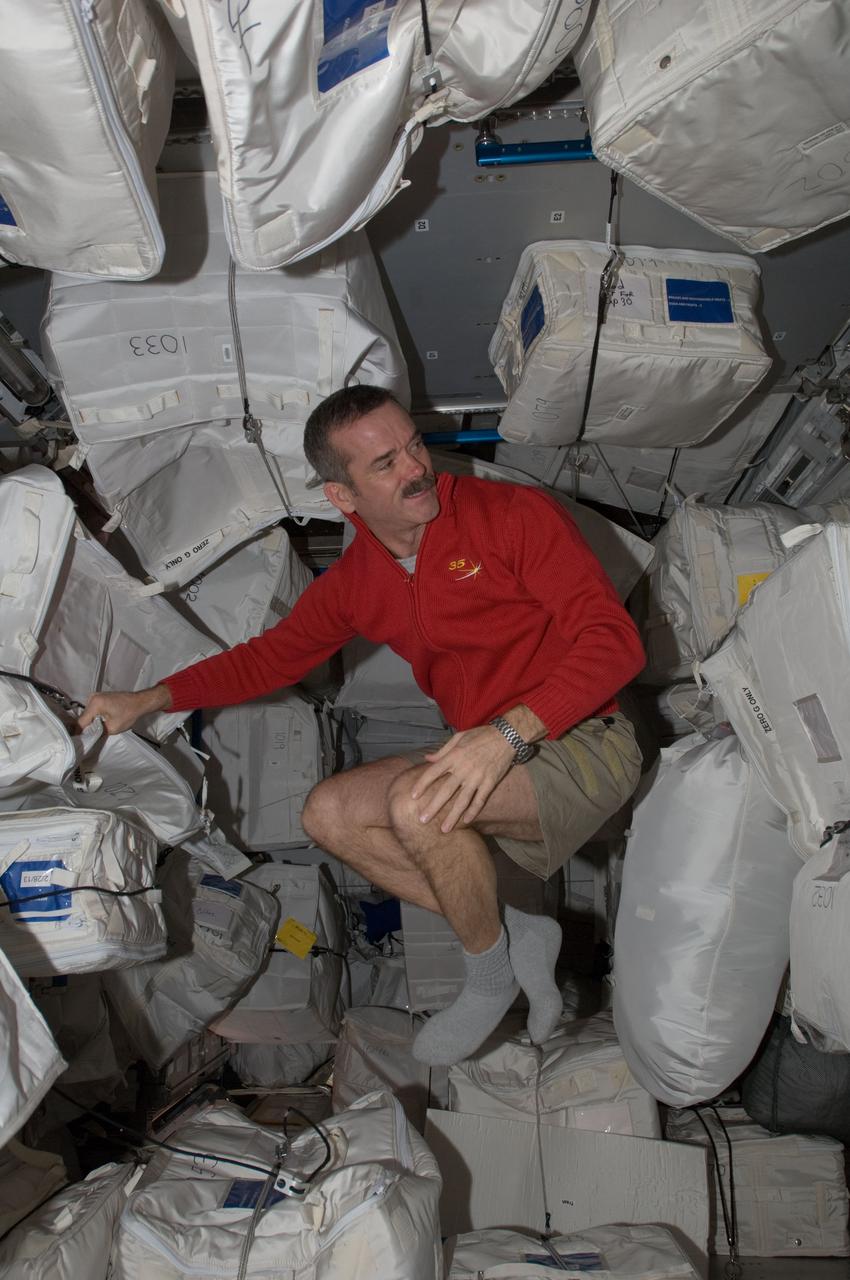
View of Chris Hadfield,Expedition 34 Flight Engineer (FE),floats near stowed Cargo Transfer Bags (CTBs). Photo was taken during Expedition 34.
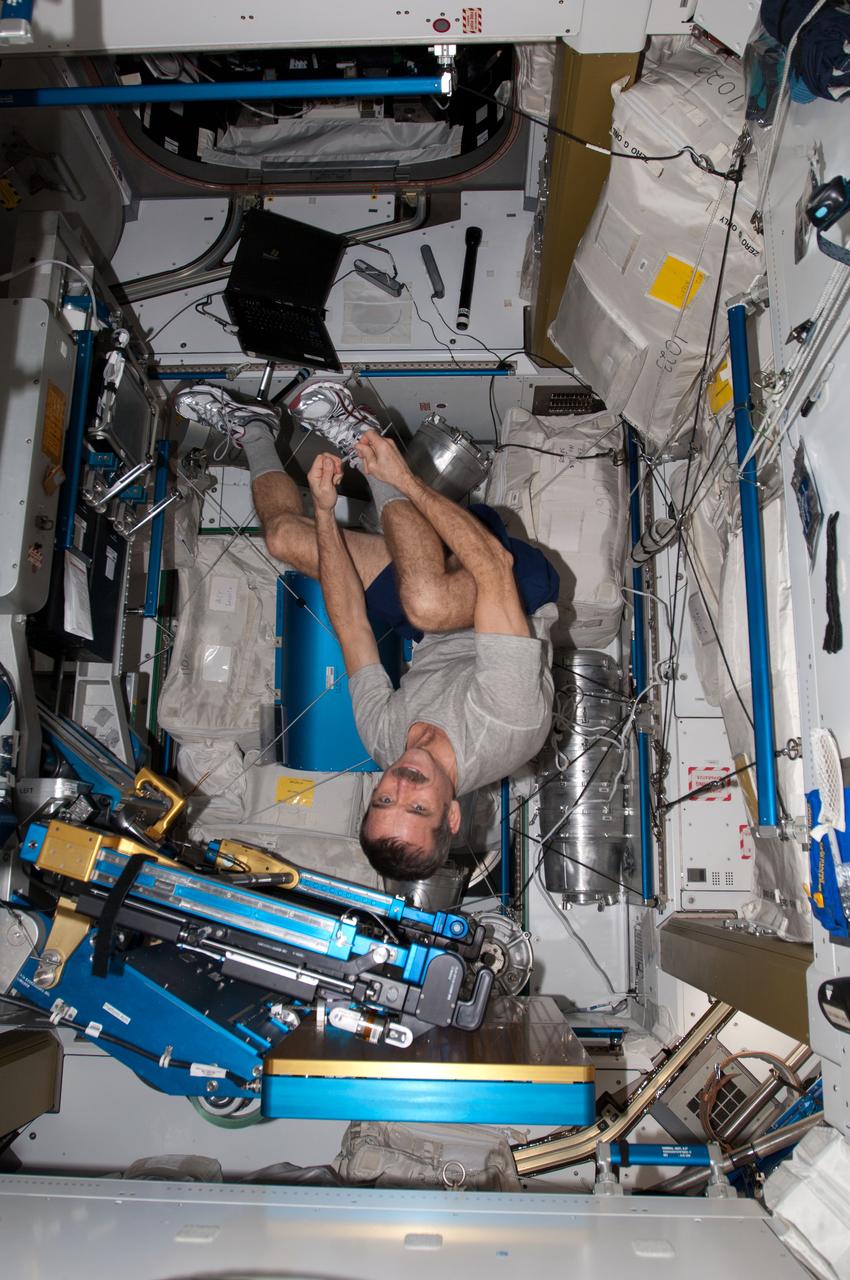
View of Canadian Space Agency (CSA) Chris Hadfield,Expedition 34 Flight Engineer (FE),putting on tennis shoes,in the Node 3.
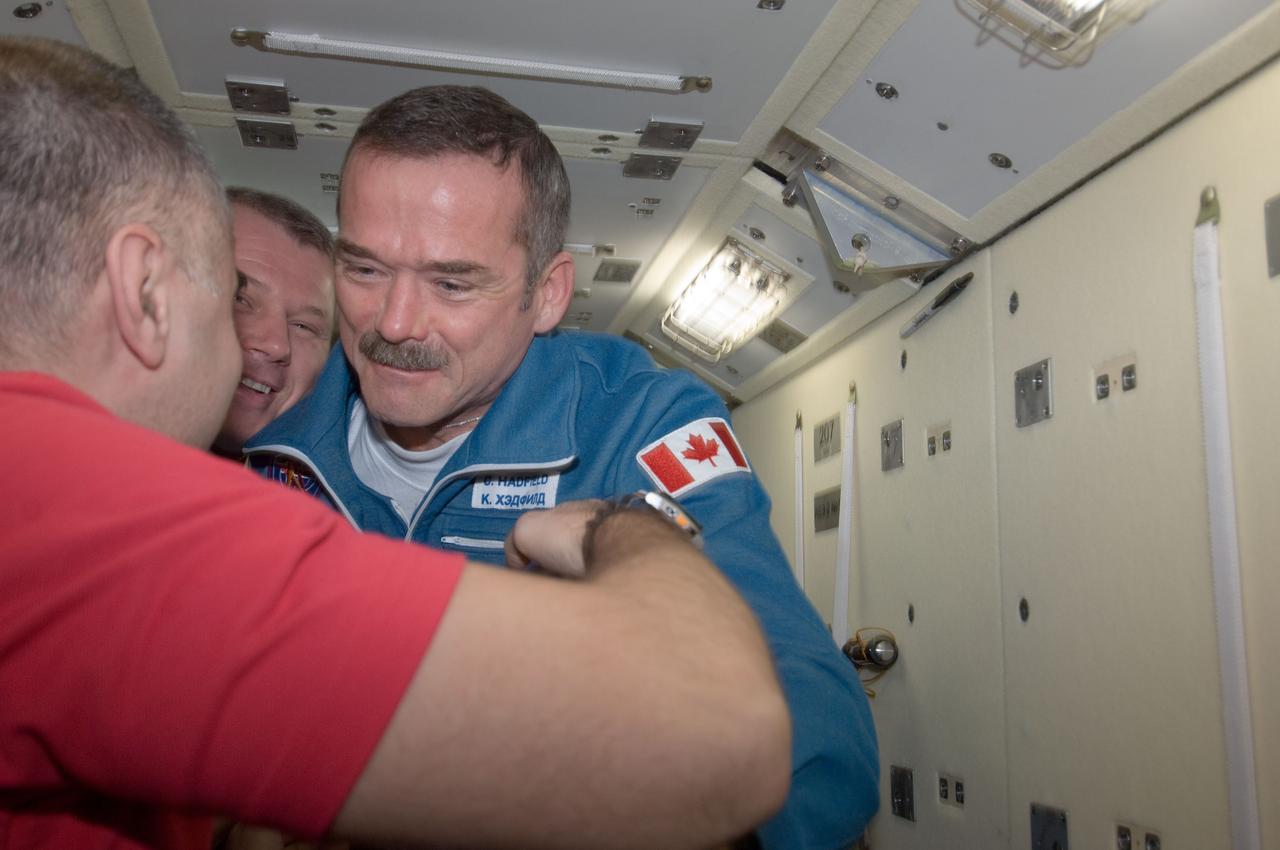
ISS034-E-009562 (21 Dec. 2012) --- Canadian Space Agency astronaut Chris Hadfield greets two Russian cosmonauts onboard the International Space Station moments after coming aboard on Dec. 21, 2012. The cosmonauts are Oleg Novitskiy (partially obscured at center) and Evgeny Tarelkin, both Expedition 34 flight engineers. Hadfield, along with a NASA astronaut and a Russian cosmonaut, launched on Dec. 19 aboard the Soyuz TMA-07M spacecraft.
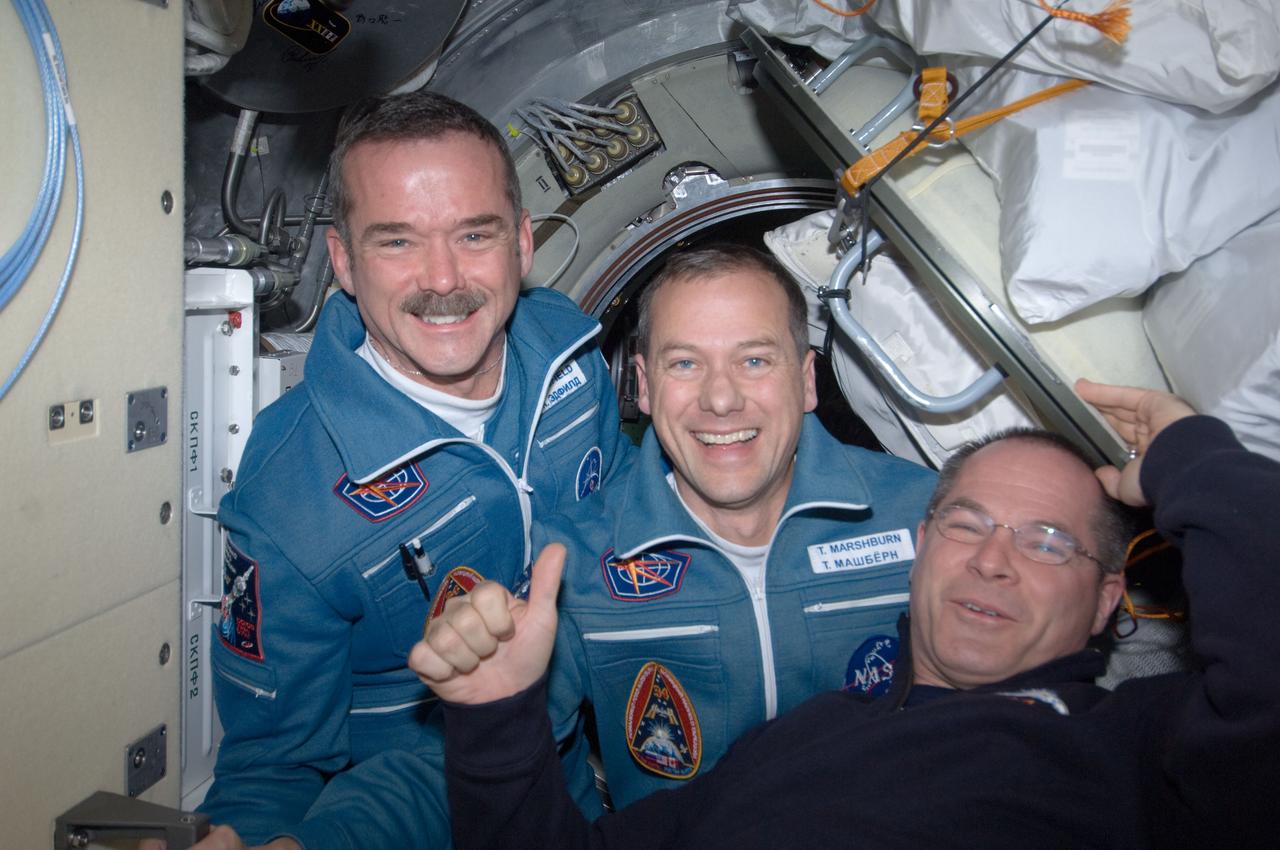
ISS034-E-009571 (21 Dec. 2012) --- Expedition 34 Commander Kevin Ford (right) of NASA welcomes astronauts Chris Hadfield and Tom Marshburn aboard the International Space Station on docking day -- Dec. 21, 2012. Hadfield, representing the Canadian Space Agency, and NASA's Marshburn launched in the Soyuz TMA-07M spacecraft on Dec. 19 to join the three-man crew already onboard the orbital outpost.
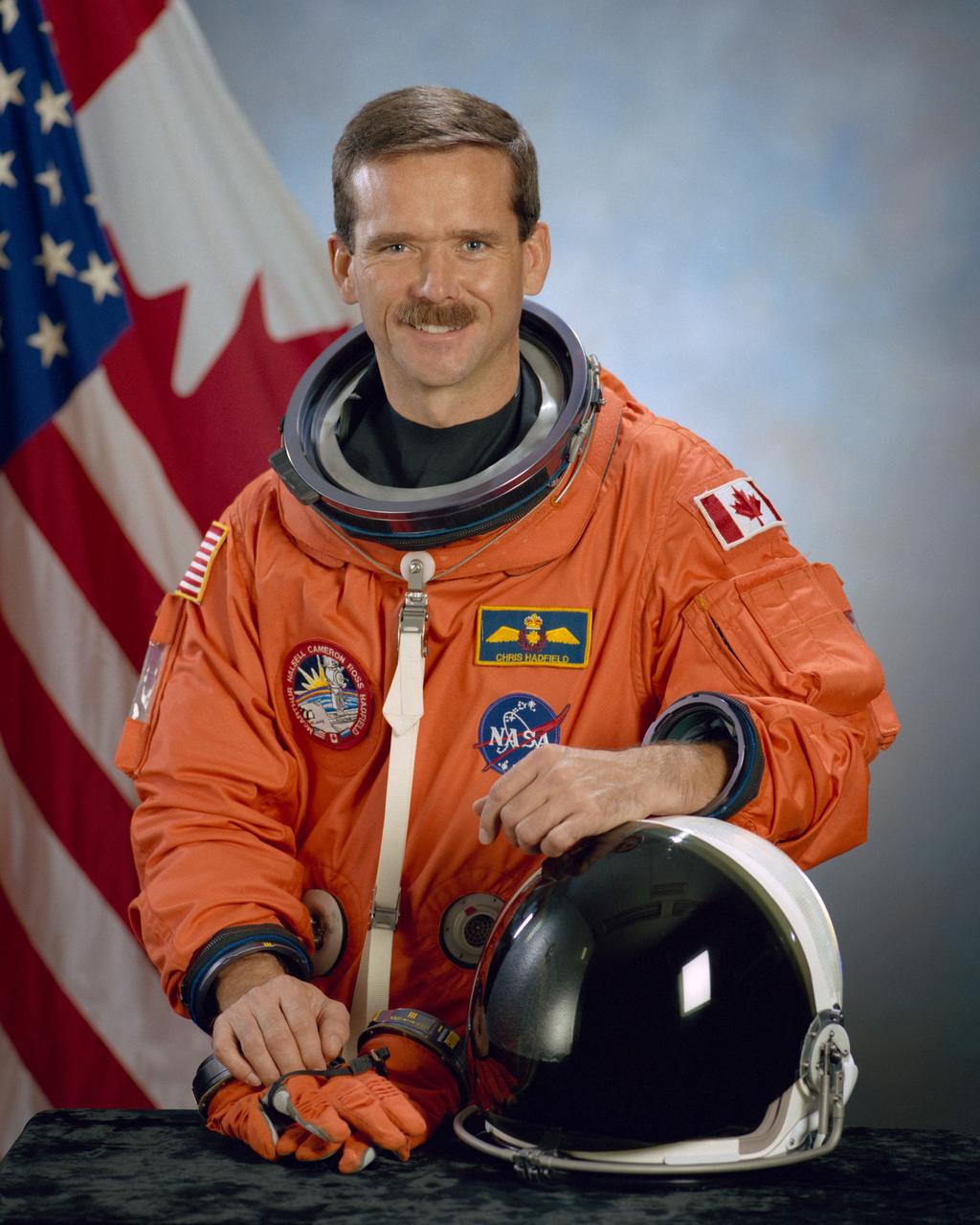
S97-00690 (18 Oct 1996) --- Astronaut Chris A. Hadfield, mission specialist representing the Canadian Space Agency (CSA).
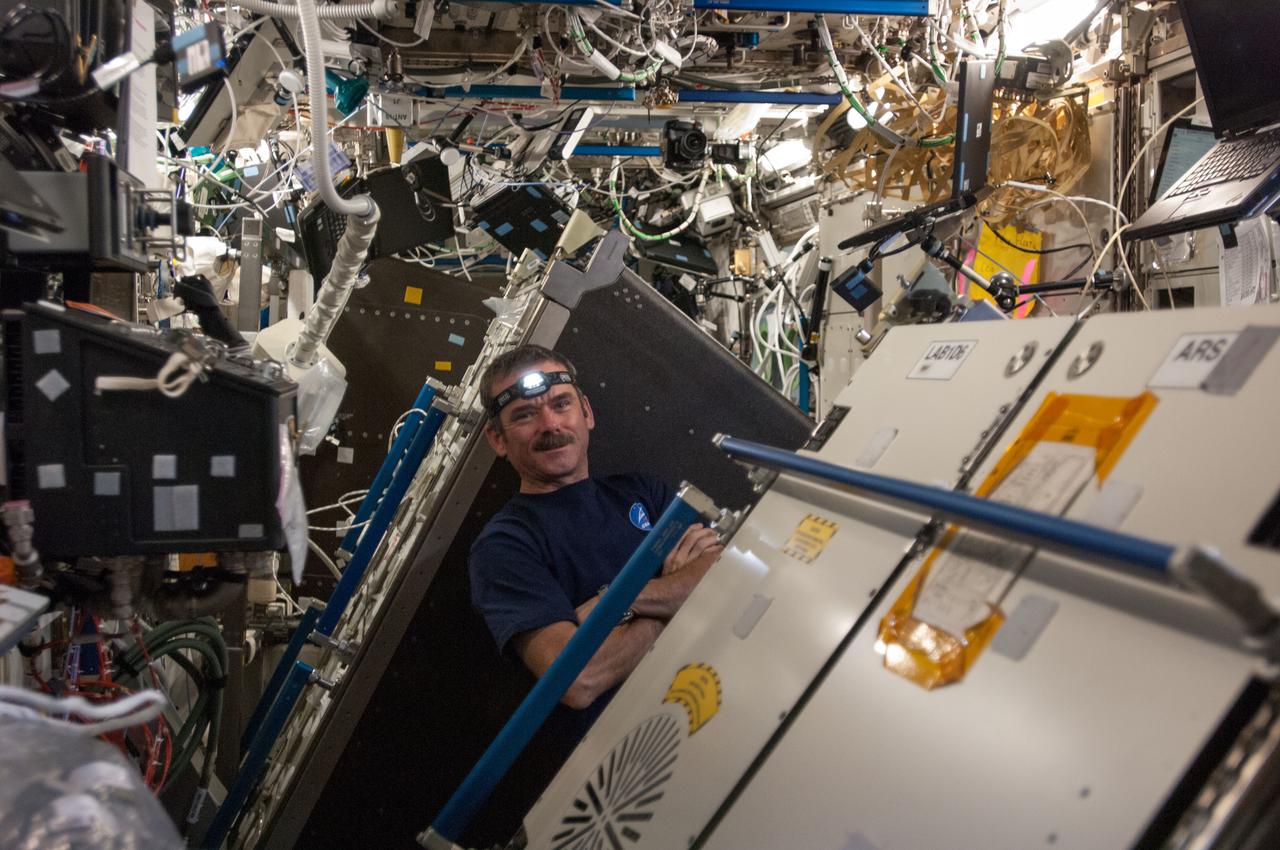
View of Canadian Space Agency (CSA) Chris Hadfield,Expedition 34 Flight Engineer (FE) posing for photo in the U.S. Laboratory. Photo was taken during Expedition 34.
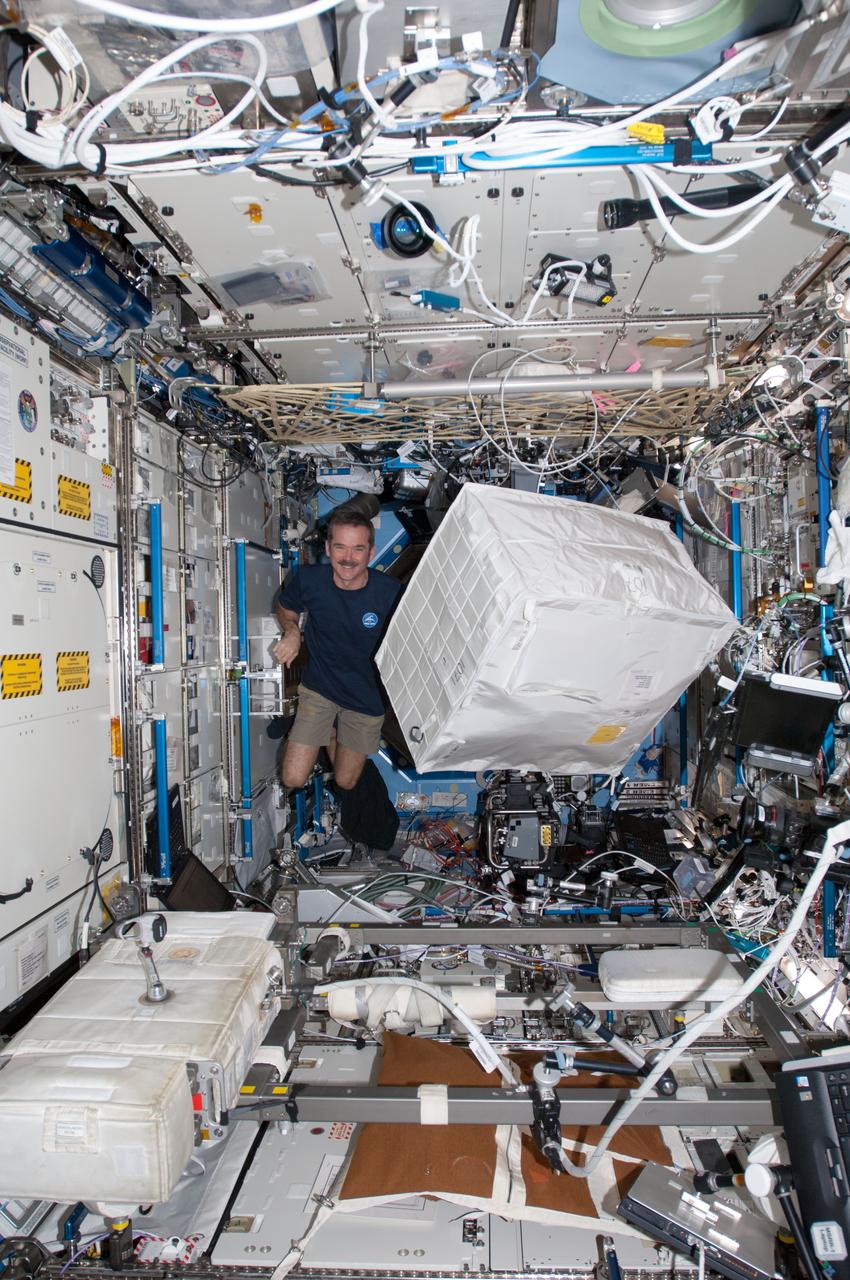
ISS034-E-029995 (15 Jan. 2013) --- Canadian Space Agency astronaut Chris Hadfield, Expedition 34 flight engineer, moves a stowage container in the Destiny laboratory of the International Space Station.
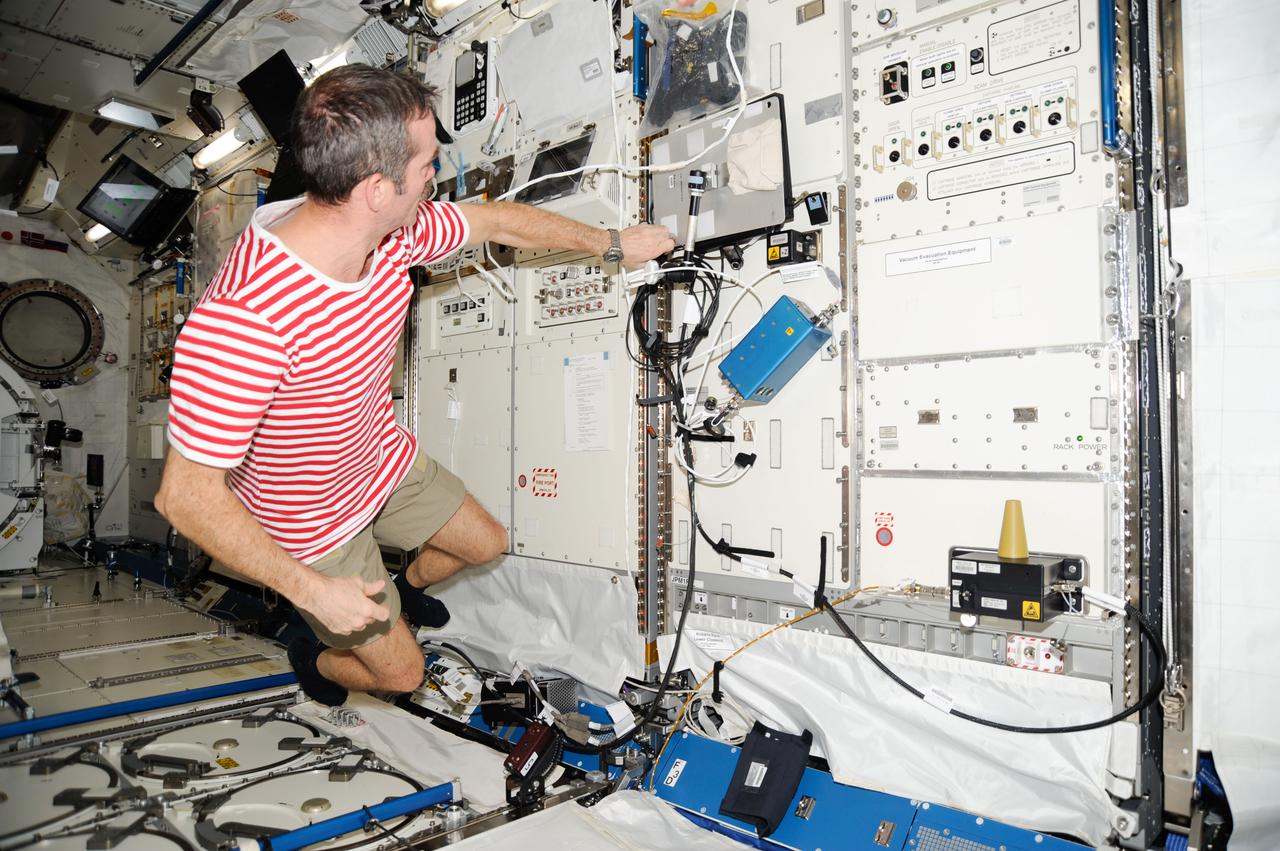
ISS034-E-031398 (18 Jan. 2013) --- Canadian Space Agency astronaut Chris Hadfield, Expedition 34 flight engineer, works in the Kibo laboratory of the International Space Station.
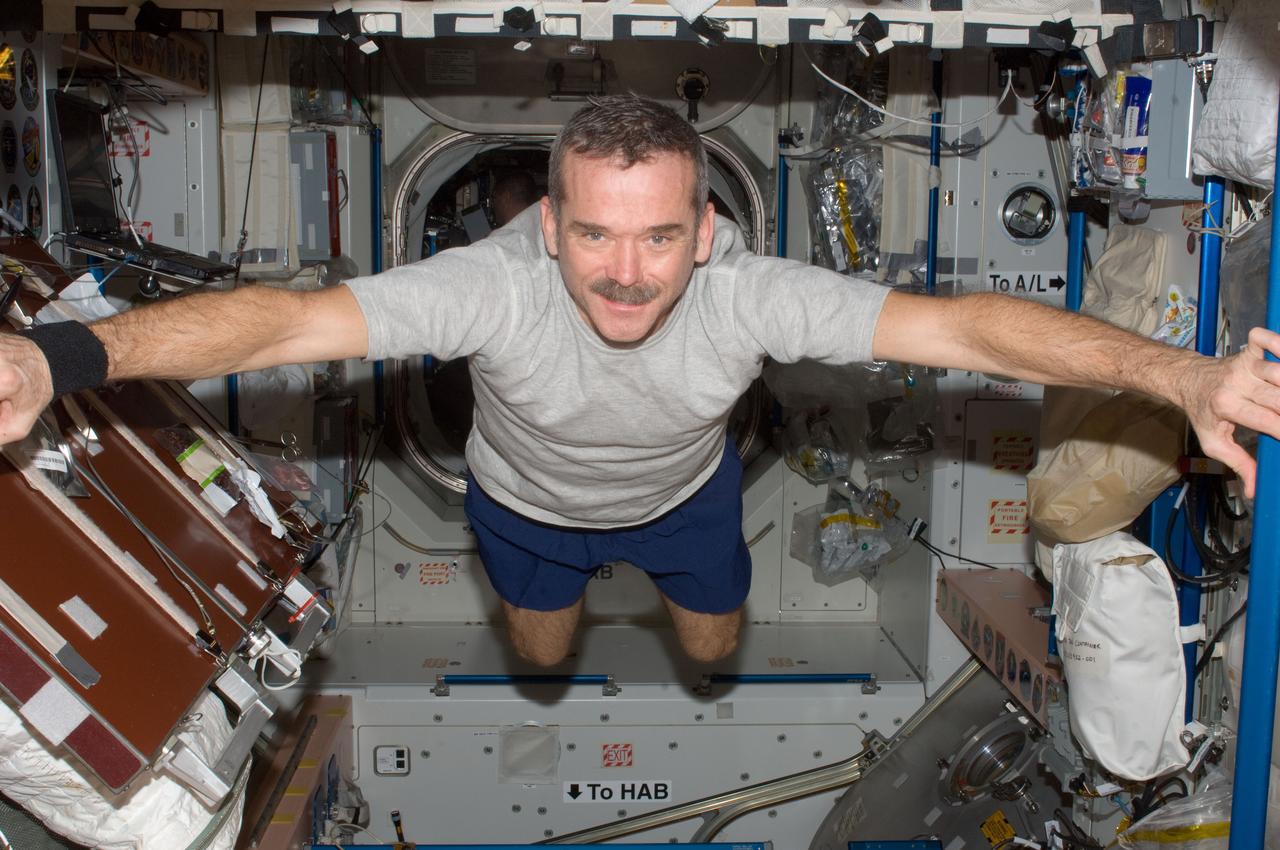
ISS034-E-010866 (31 Dec. 2012) --- Canadian Space Agency astronaut Chris Hadfield, Expedition 34 flight engineer, floats freely in the Unity node of the International Space Station.
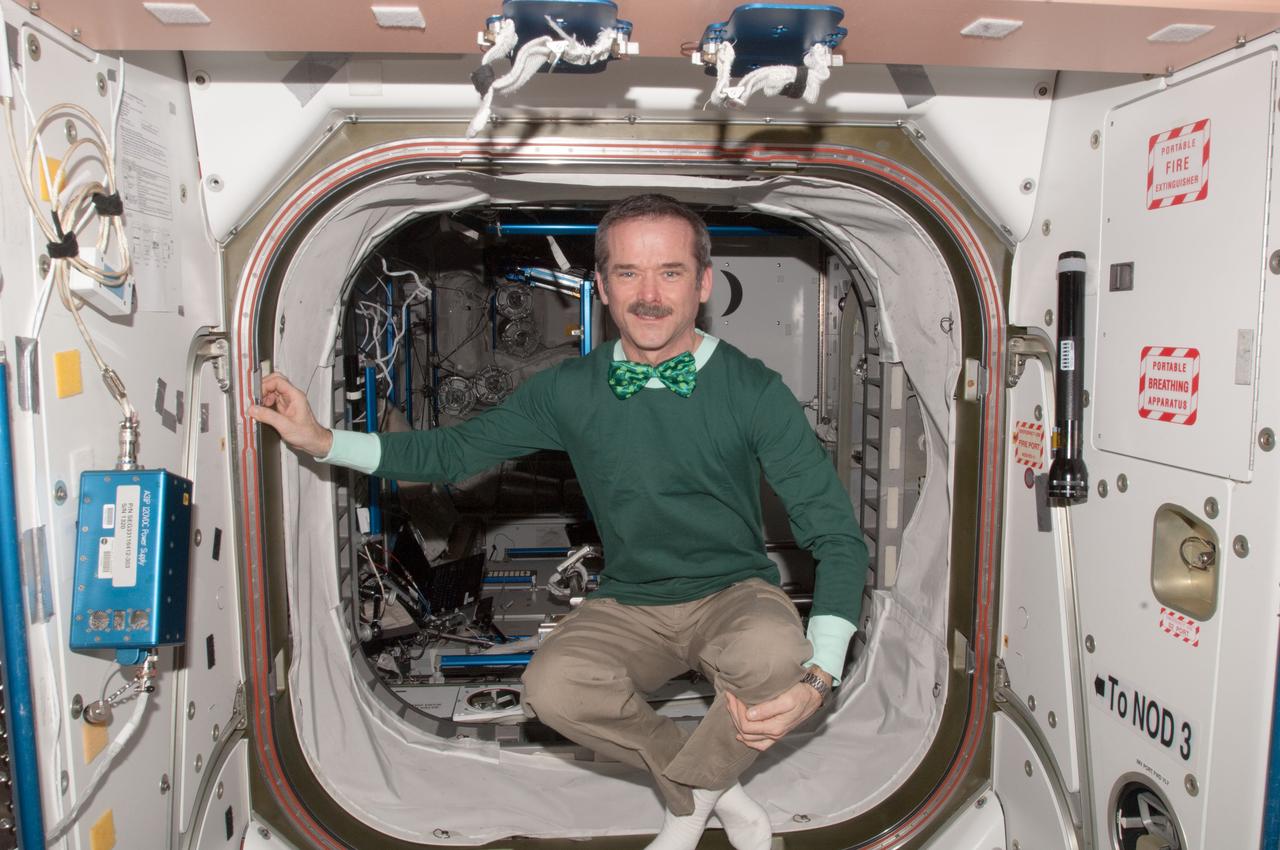
Expedition 35 commander and Canadian Space Agency (CSA) astronaut Chris Hadfield poses for a photo in the Unity Node 1. He is wearing a green shirt and bow tie in honor of St. Patrick's Day.
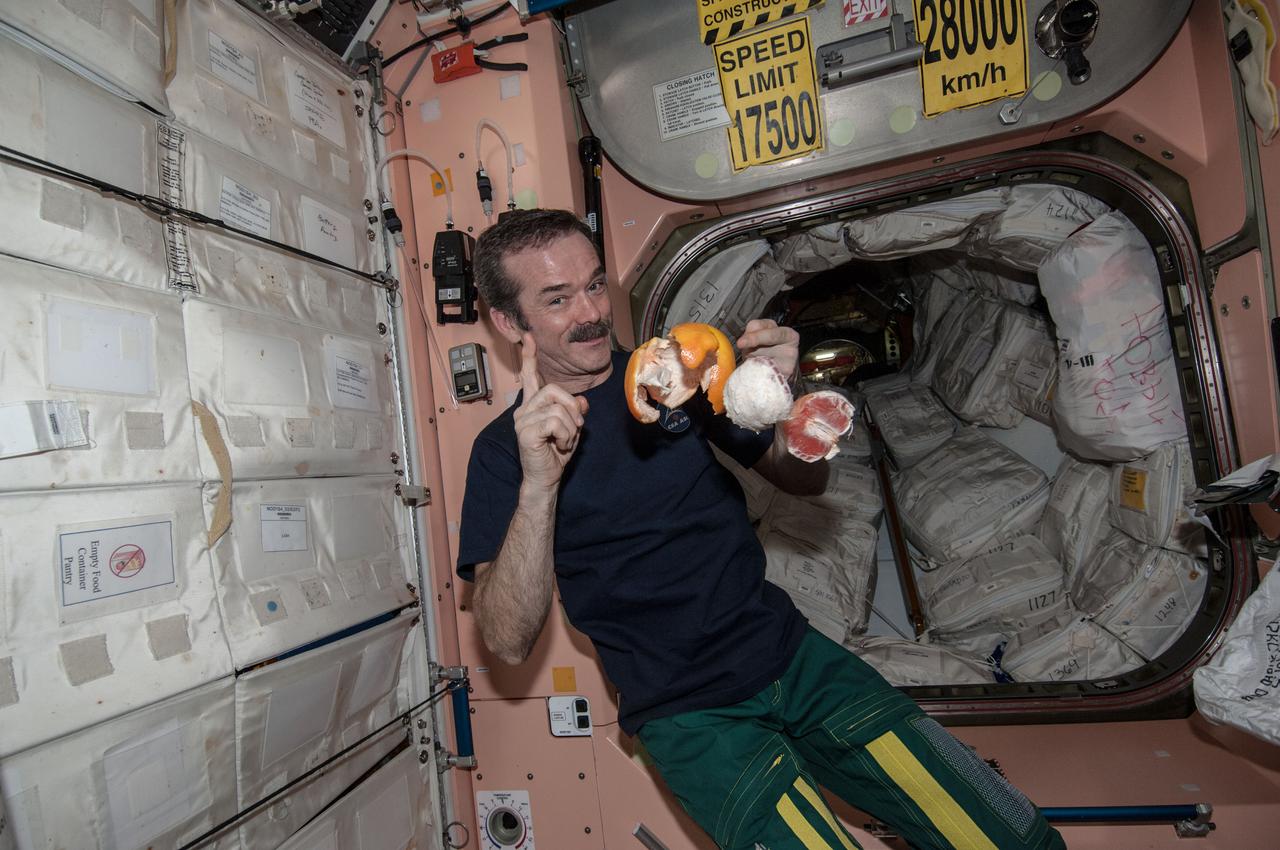
ISS035-E-010435 (30 March 2013) --- In the Unity node of the Earth-orbiting International Space Station, Expedition 35 Commander Chris Hadfield of the Canadian Space Agency enjoys part of the "fruits of labor," so to speak, from a visiting spacecraft for the second time in a month. This particular grapefruit came by way of the Soyuz TMA-08M spacecraft, which arrived on March 29, along with three new Expedition 35 crew members. The SpaceX Dragon-2 unmanned spacecraft delivered a nice assortment of fresh fruit along with more than a half ton of supplies and gear on March 3, when Hadfield was serving as a flight engineer on the Expedition 34 crew.
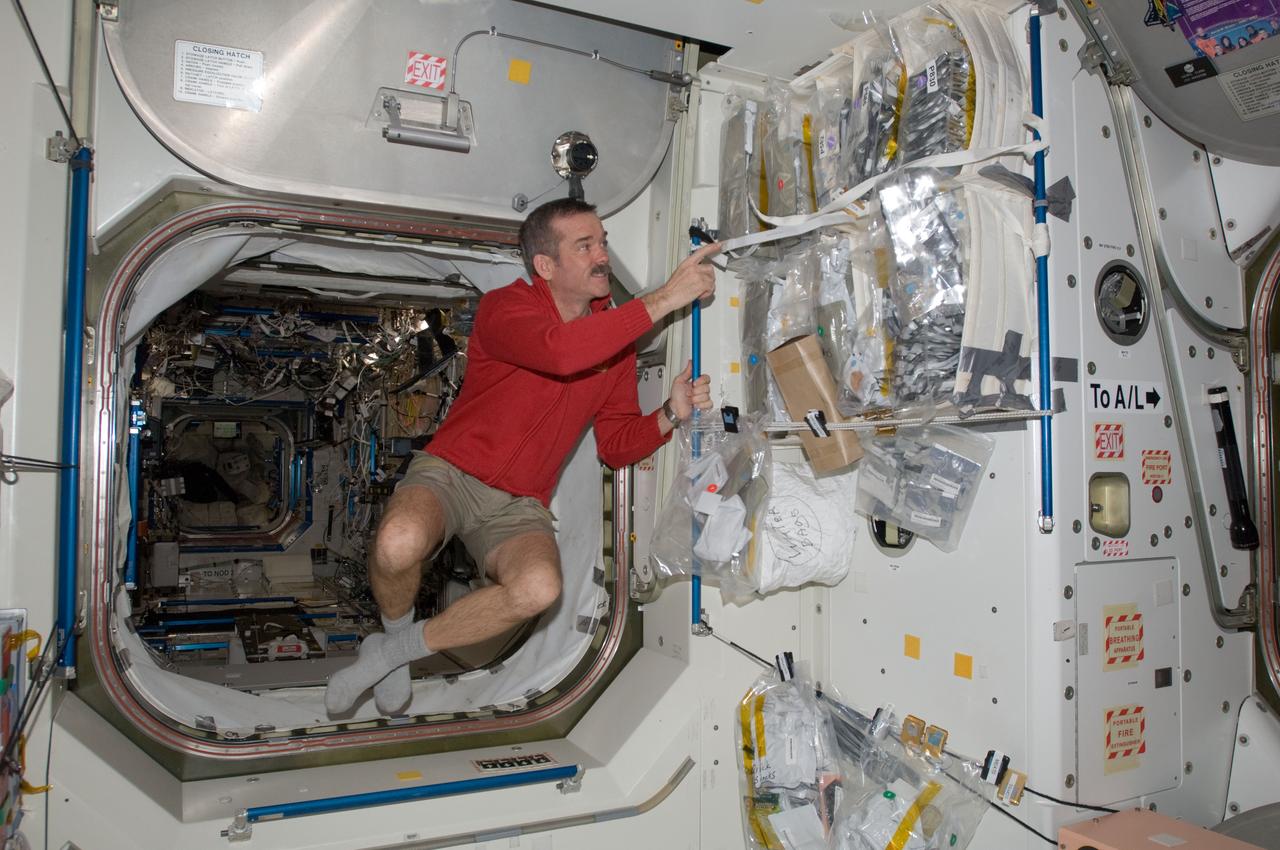
View of Chris Hadfield,Expedition 34 Flight Engineer (FE), points to stowed food packets,in the Node 1. Photo was taken during Expedition 34.
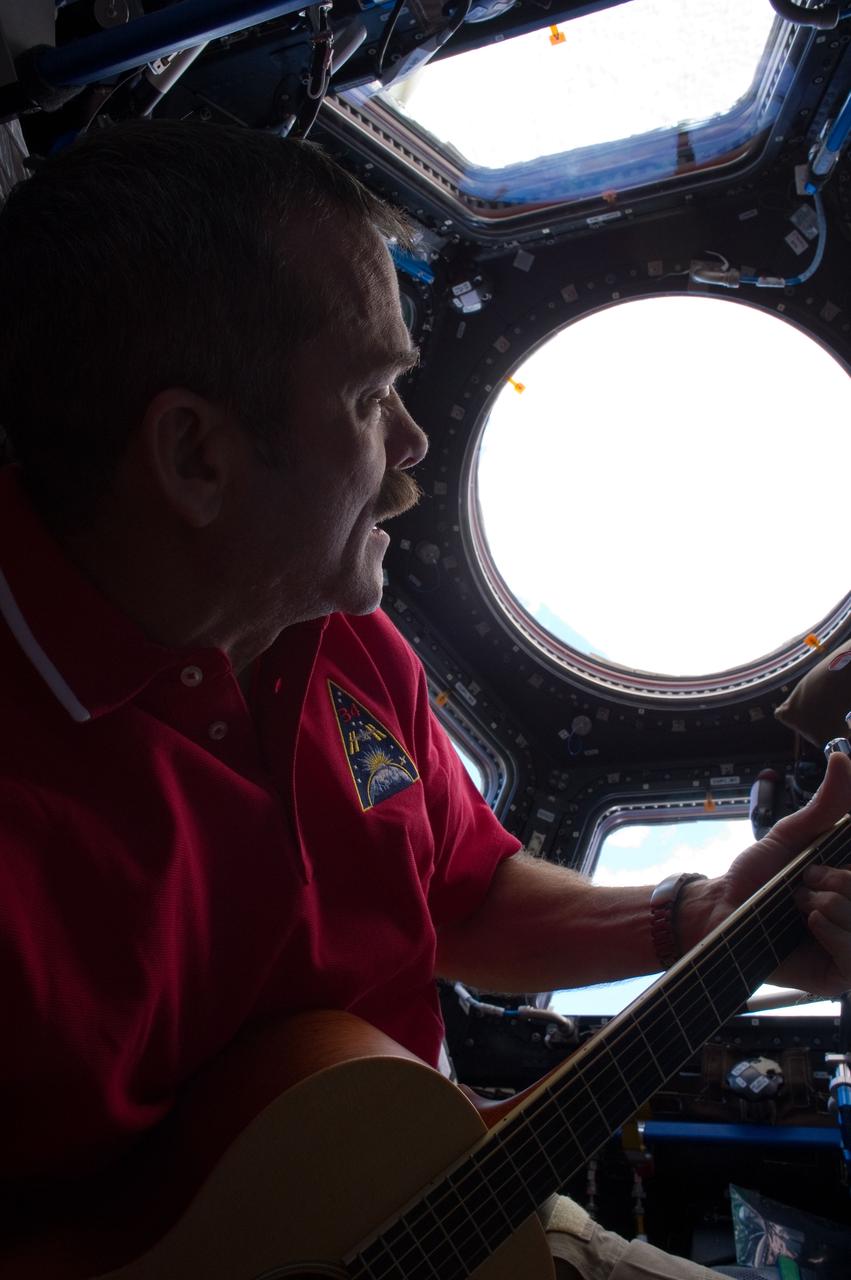
ISS034-E-010295 (25 Dec. 2012) --- Canadian Space Agency astronaut Chris Hadfield strums his guitar in the International Space Station's Cupola on Dec. 25, 2012. Hadfield, a long-time member of an astronaut band called Max Q, later joined with the other five Expedition 34 crew members in a more spacious location to provide an assortment of Christmas carols for the public.
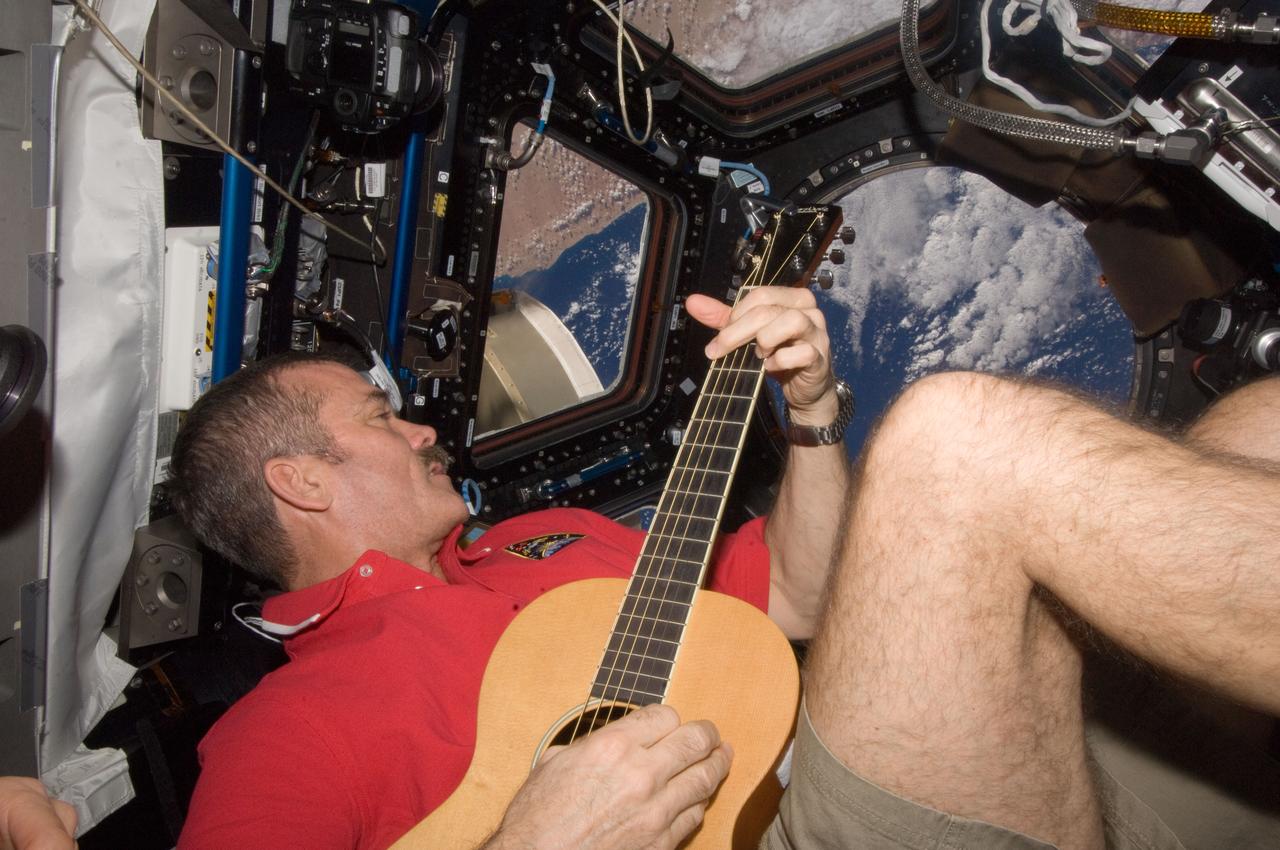
ISS034-E-009799 (25 Dec. 2012) --- Canadian Space Agency astronaut Chris Hadfield strums his guitar in the International Space Station's Cupola on Dec. 25, 2012. Hadfield, a long-time member of an astronaut band called Max Q, later joined with the other five Expedition 34 crew members in a more spacious location to provide an assortment of Christmas carols for the public.
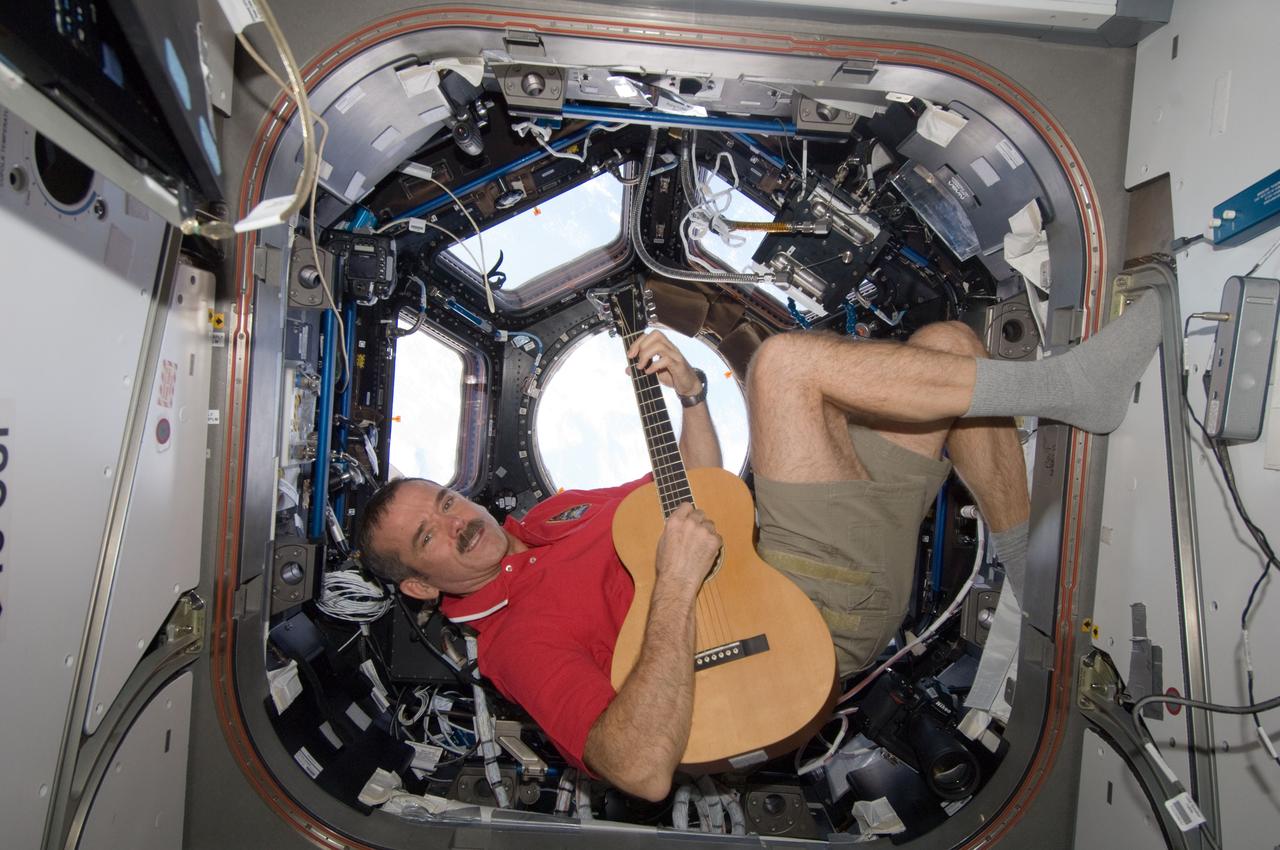
ISS034-E-009787 (25 Dec. 2012) --- Canadian Space Agency astronaut Chris Hadfield strums his guitar in the International Space Station's Cupola on Dec. 25, 2012. Hadfield, a long-time member of an astronaut band called Max Q, later joined with the other five Expedition 34 crew members in a more spacious location to provide an assortment of Christmas carols for the public.
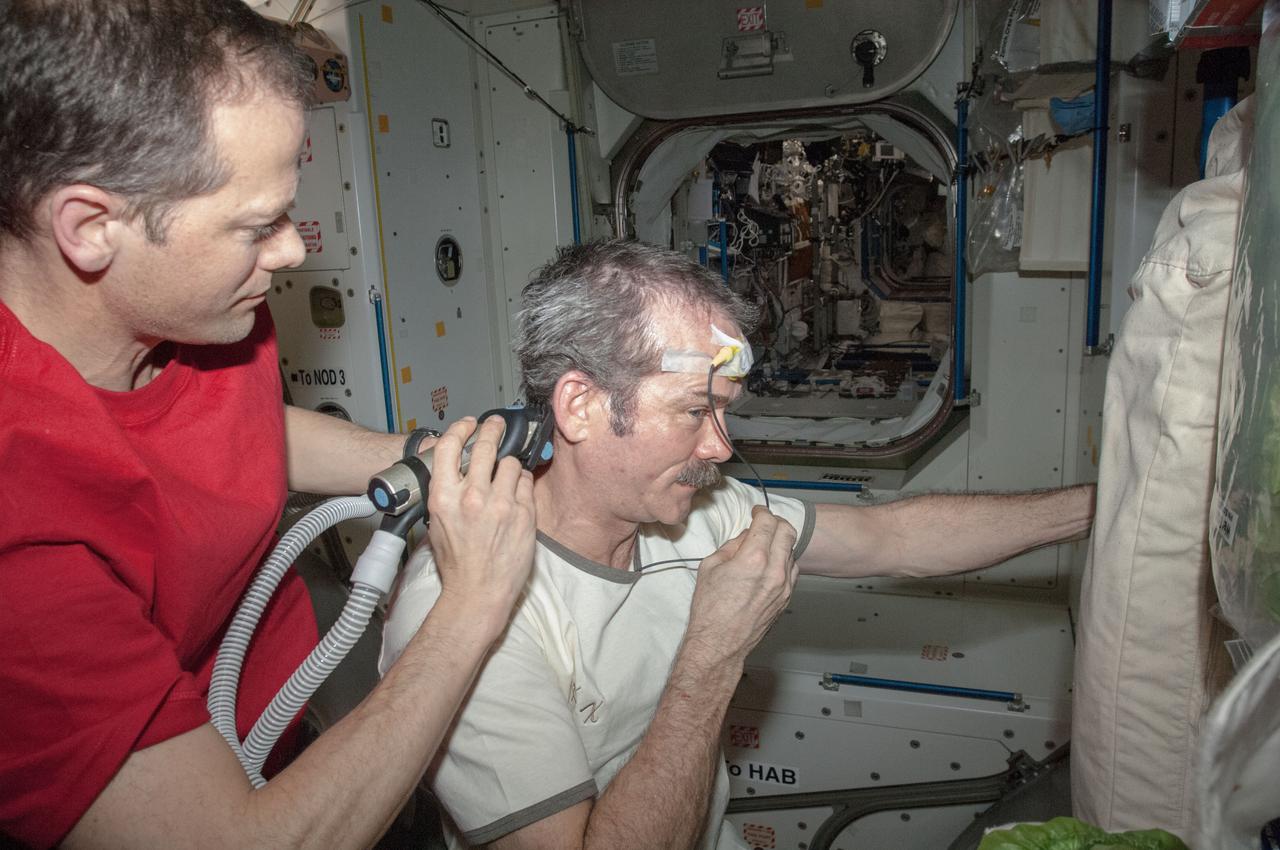
Expedition 35 flight engineer Tom Marshburn gives commander Chris Hadfield a haircut (using clippers attached to a vacuum hose) in the Unity Node 1. Hadfield (a Canadian Space Agency astronaut) has a temperature sensor taped to his forehead.
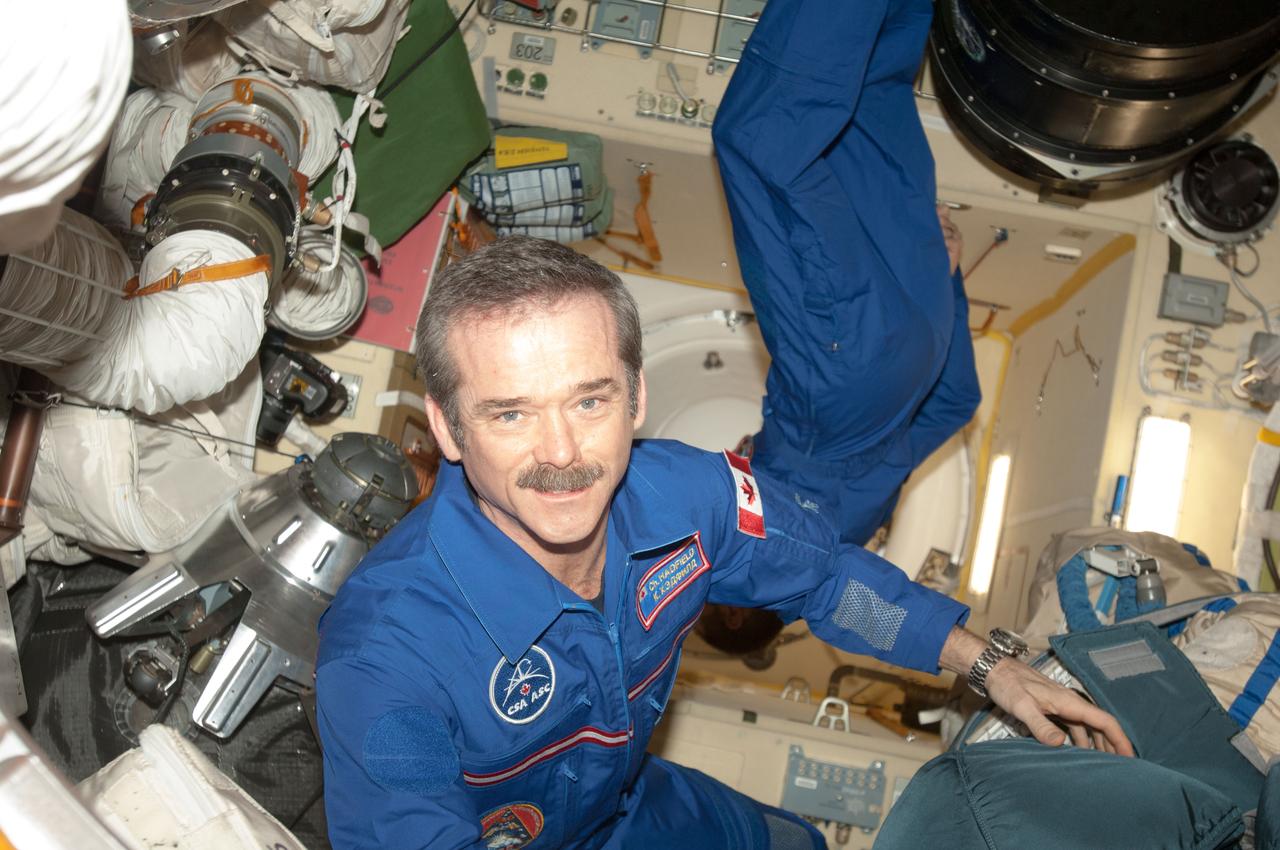
Expedition 35 commander Chris Hadfield and flight engineer Tom Marshburn (partially obscured) are photographed in the Poisk Mini-Research Module 2 (MRM2) during preparations for hatch opening with the docked Soyuz TMA-08M/34S spacecraft. Hadfield is a Canadian Space Agency (CSA) astronaut.
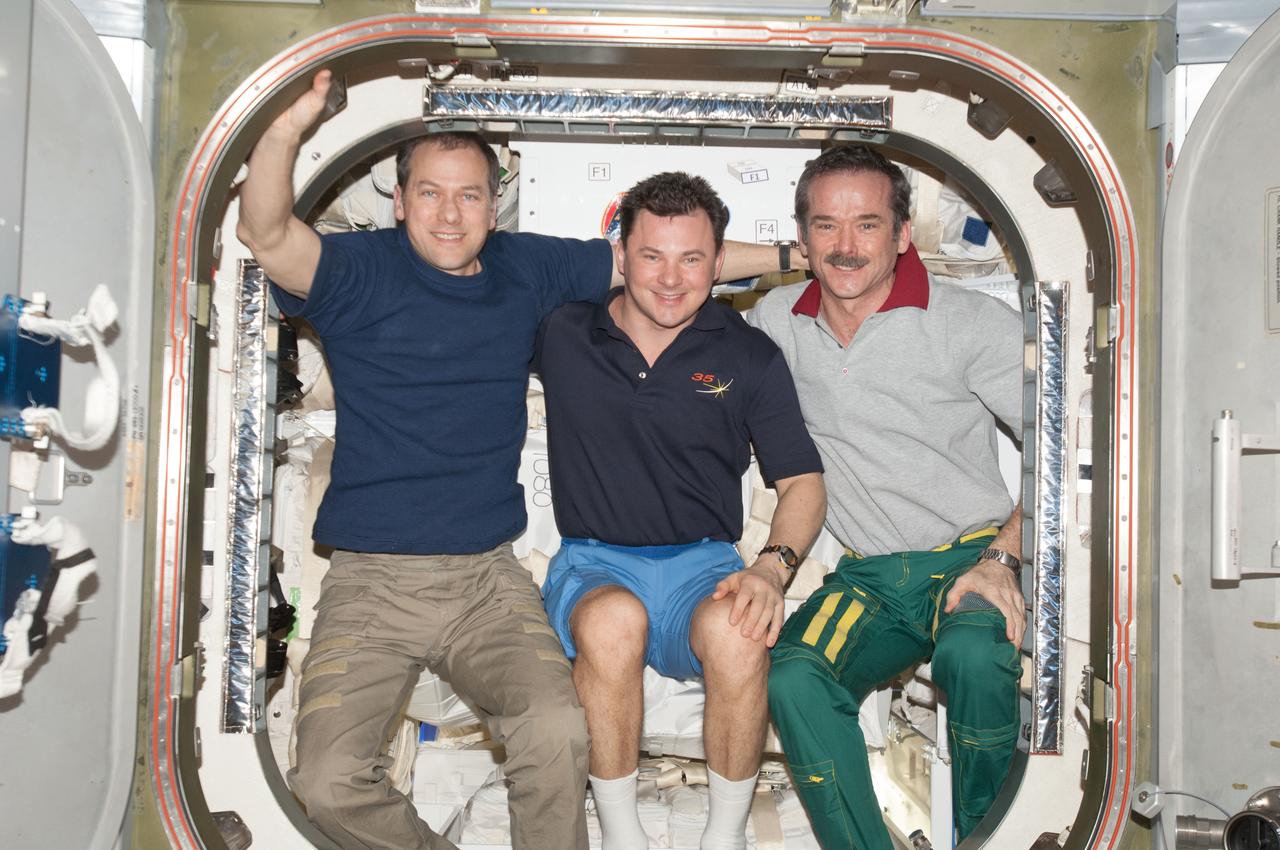
Expedition 35 flight engineer (FE) Tom Marshburn, FE Roman Romanenko, and commander Chris Hadfield pose for a photo in the SpaceX Dragon Commercial Resupply Services-2 (CRS-2) spacecraft. Romanenko is a Roscosmos cosmonaut and Hadfield is a Canadian Space Agency (CSA) astronaut.
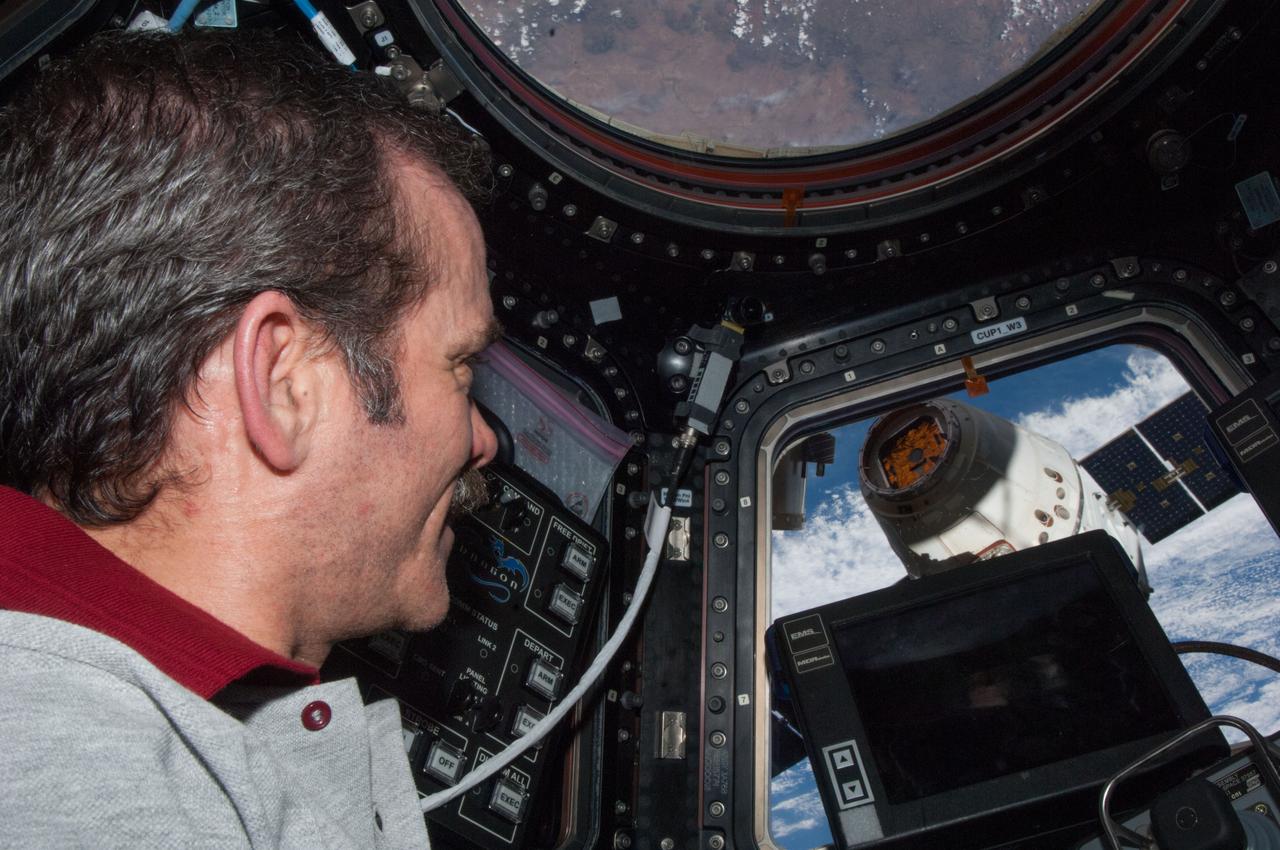
ISS035-E-010134 (26 March 2013) --- Expedition 35 Commander Chris Hadfield of the Canadian Space Agency is pictured in the Cupola on the International Space Station during the operations that ultimately led to the release of the SpaceX Dragon-2 spacecraft for its return to Earth after a three-week stay aboard the orbital outpost. The Dragon was scheduled to make a landing in the Pacific Ocean, off the coast of California, later in the day.
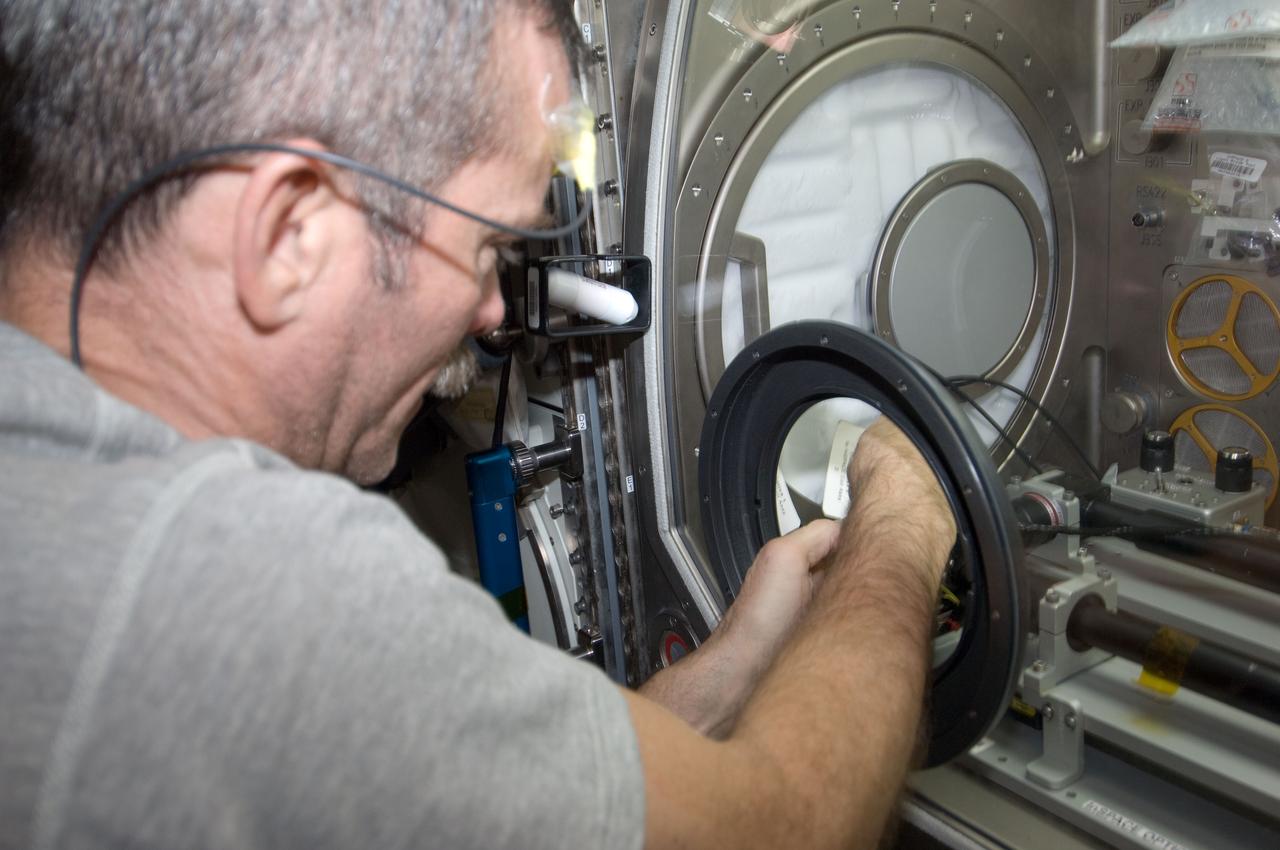
ISS034-E-010632 (31 Dec. 2012) --- Canadian Space Agency astronaut Chris Hadfield, Expedition 34 flight engineer, works with the InSpace-3 investigation in the Microgravity Science Glovebox (MSG) in the Destiny laboratory of the International Space Station.
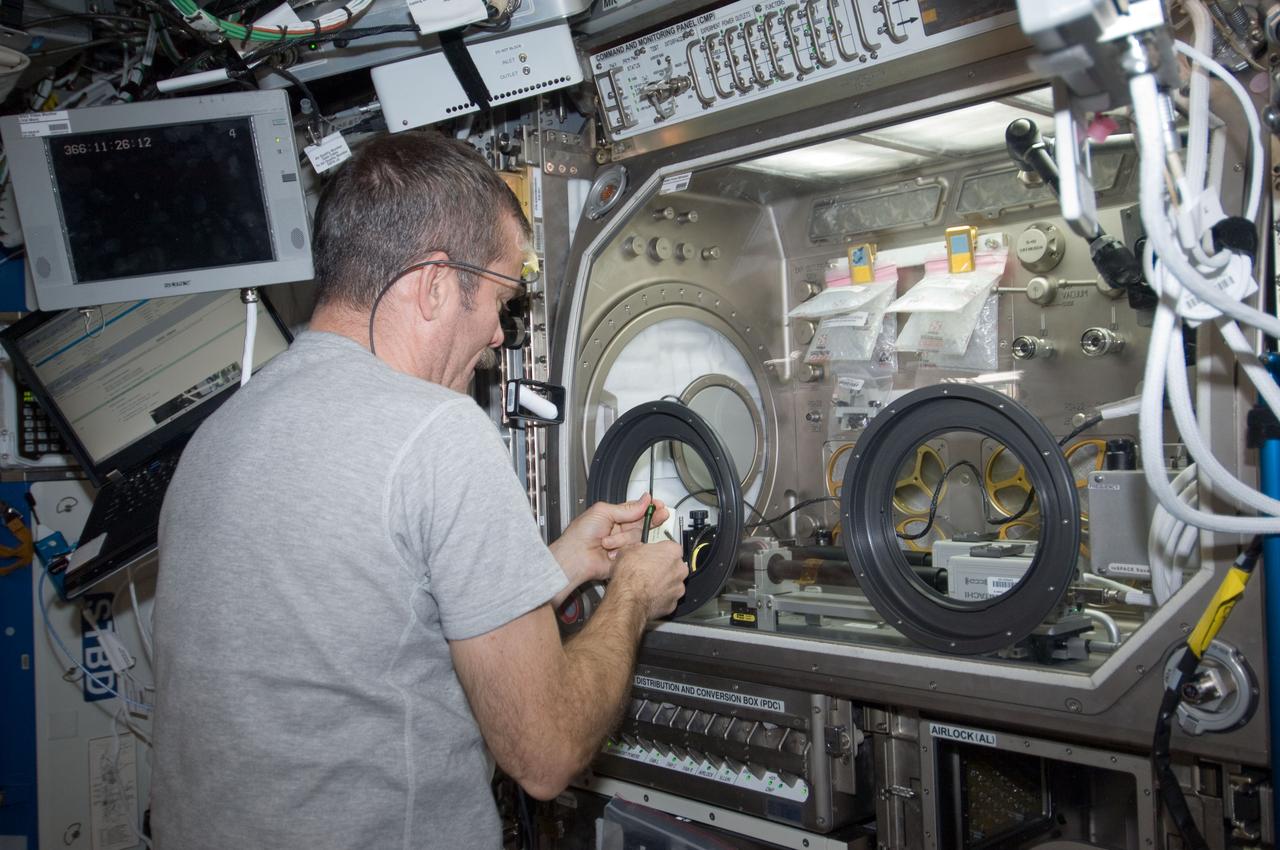
ISS034-E-010631 (31 Dec. 2012) --- Canadian Space Agency astronaut Chris Hadfield, Expedition 34 flight engineer, works with the InSpace-3 investigation in the Microgravity Science Glovebox (MSG) in the Destiny laboratory of the International Space Station.
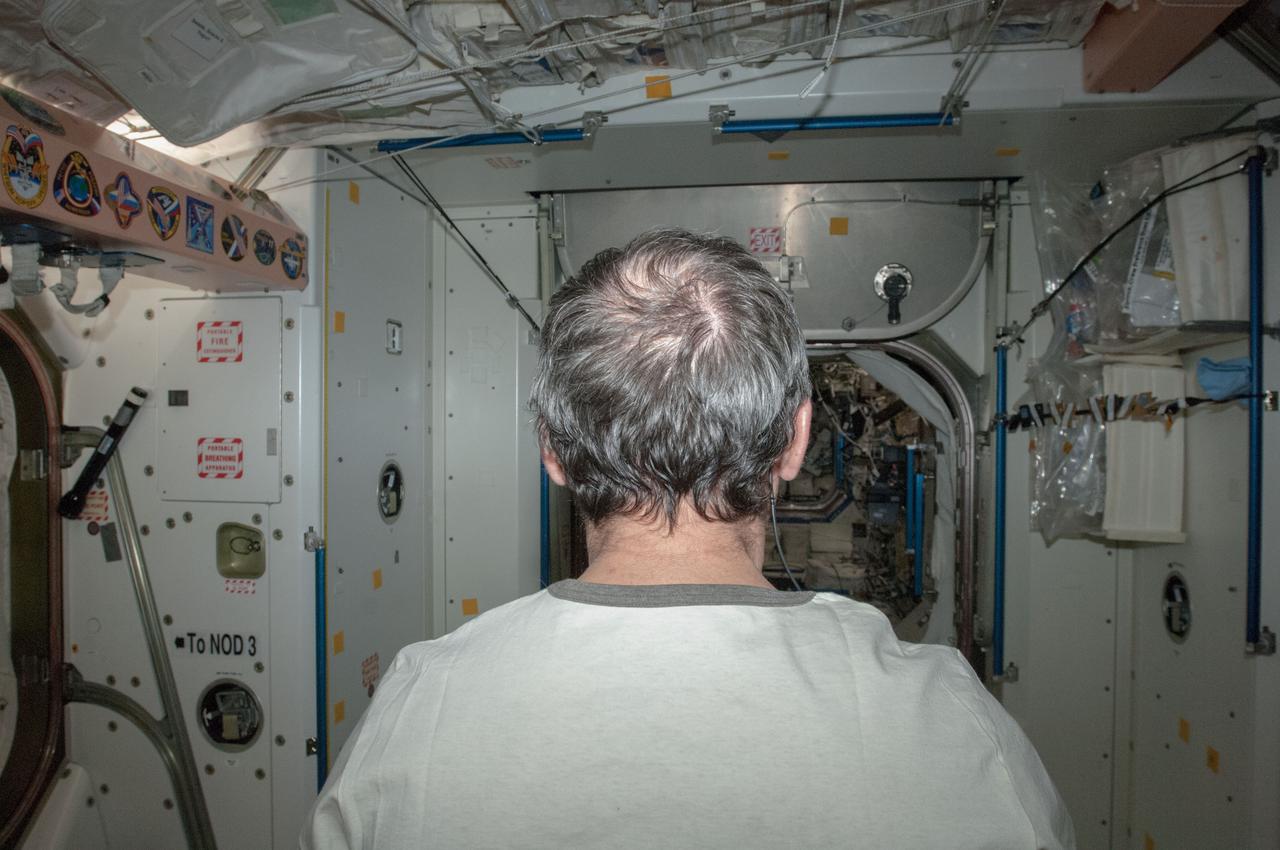
Expedition 35 commander and Canadian Space Agency astronaut Chris Hadfield (facing away from camera) poses for a photo in the Unity Node 1 before getting a haircut.
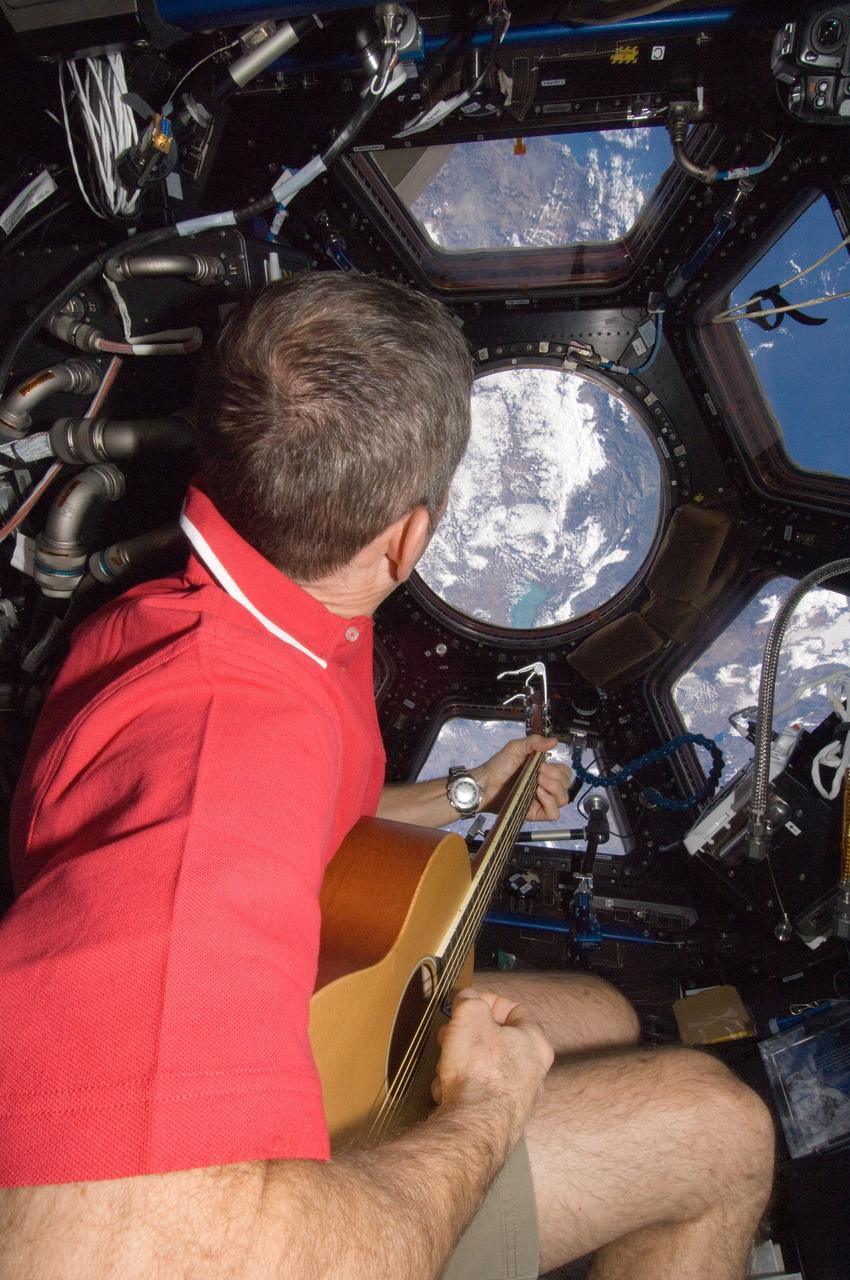
View of Canadian Space Agency (CSA) Chris Hadfield,Expedition 34 Flight Engineer (FE),playing guitar in the Cupola Module. Photo was taken during Expedition 34.
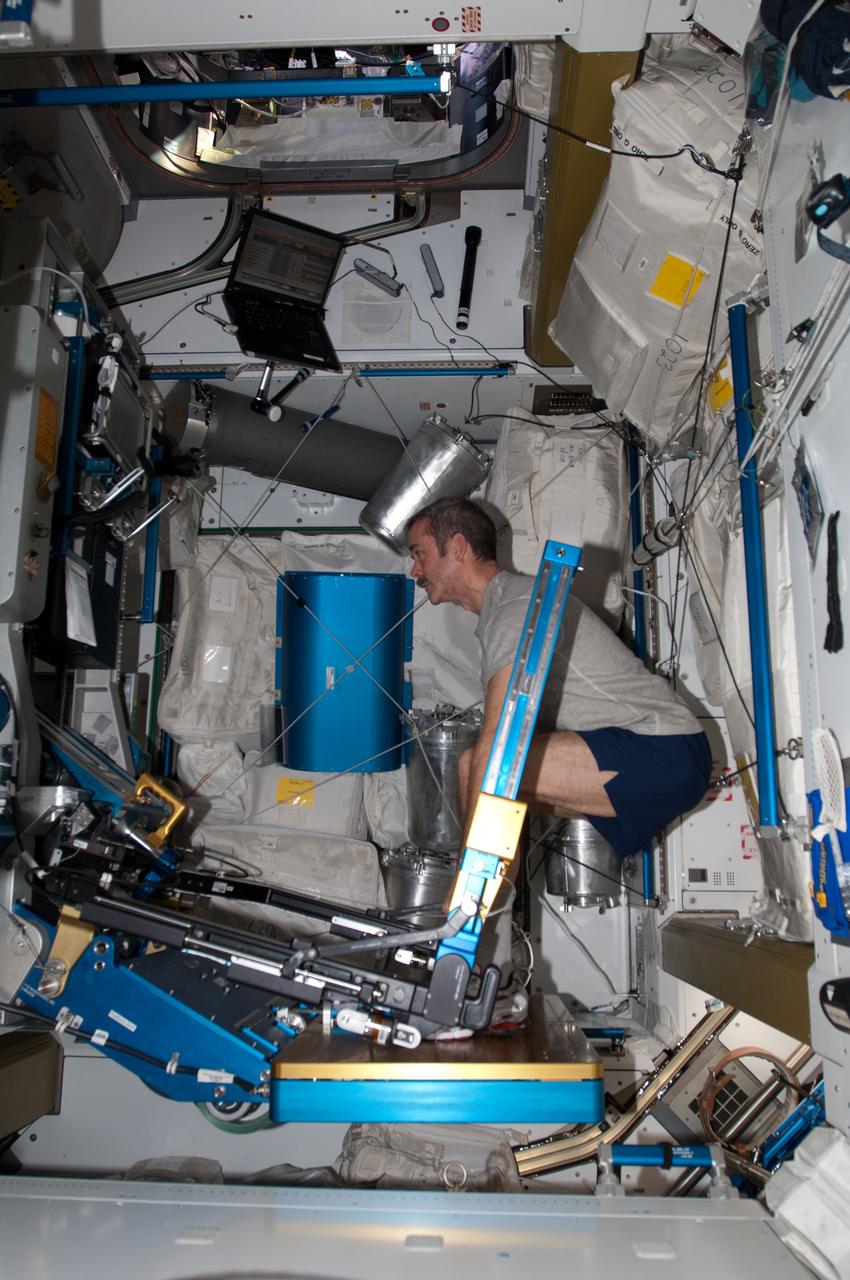
View of Canadian Space Agency (CSA) Chris Hadfield,Expedition 34 Flight Engineer (FE),exercising on the Advanced Resistive Exercise Device (ARED),in the Node 3. Photo was taken during Expedition 34.
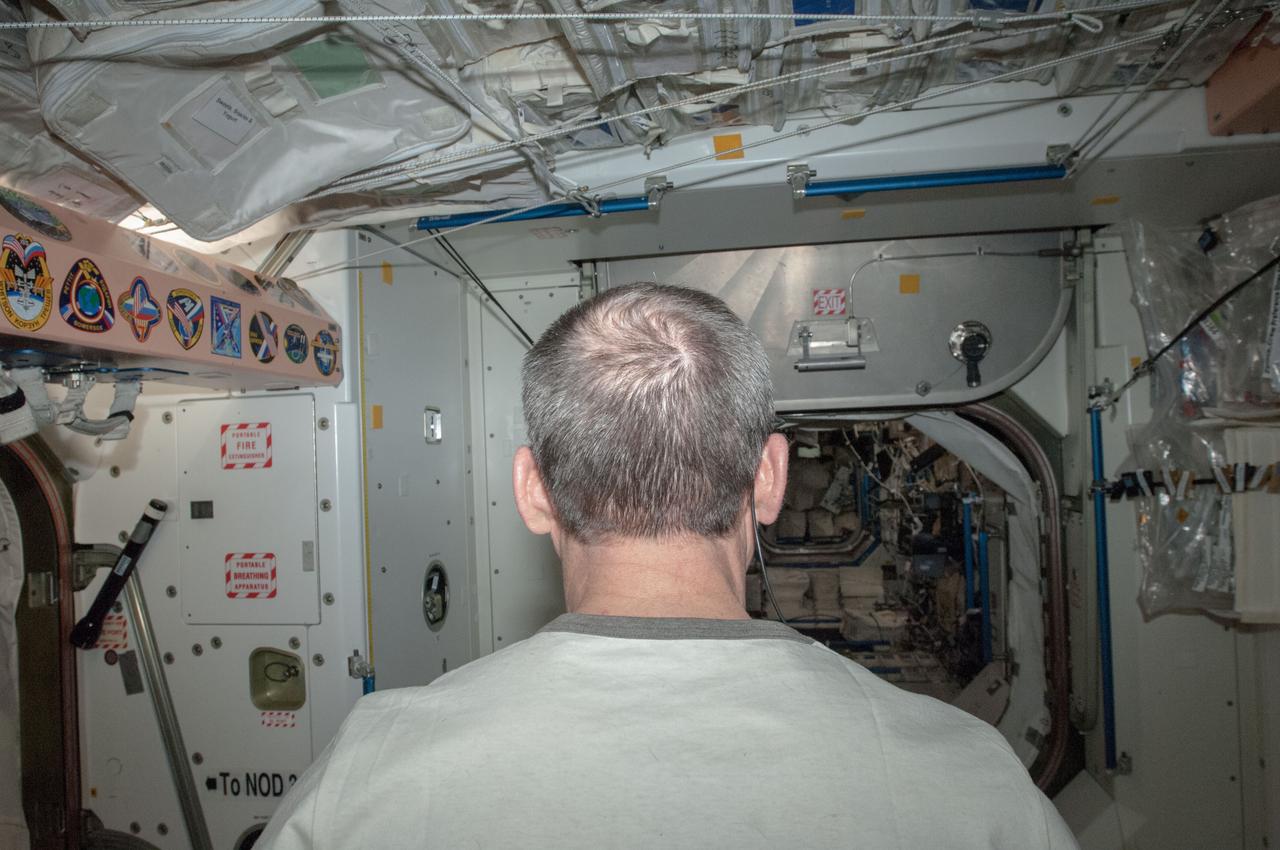
Expedition 35 commander and Canadian Space Agency astronaut Chris Hadfield (facing away from camera) poses for a photo in the Unity Node 1 after getting a haircut.
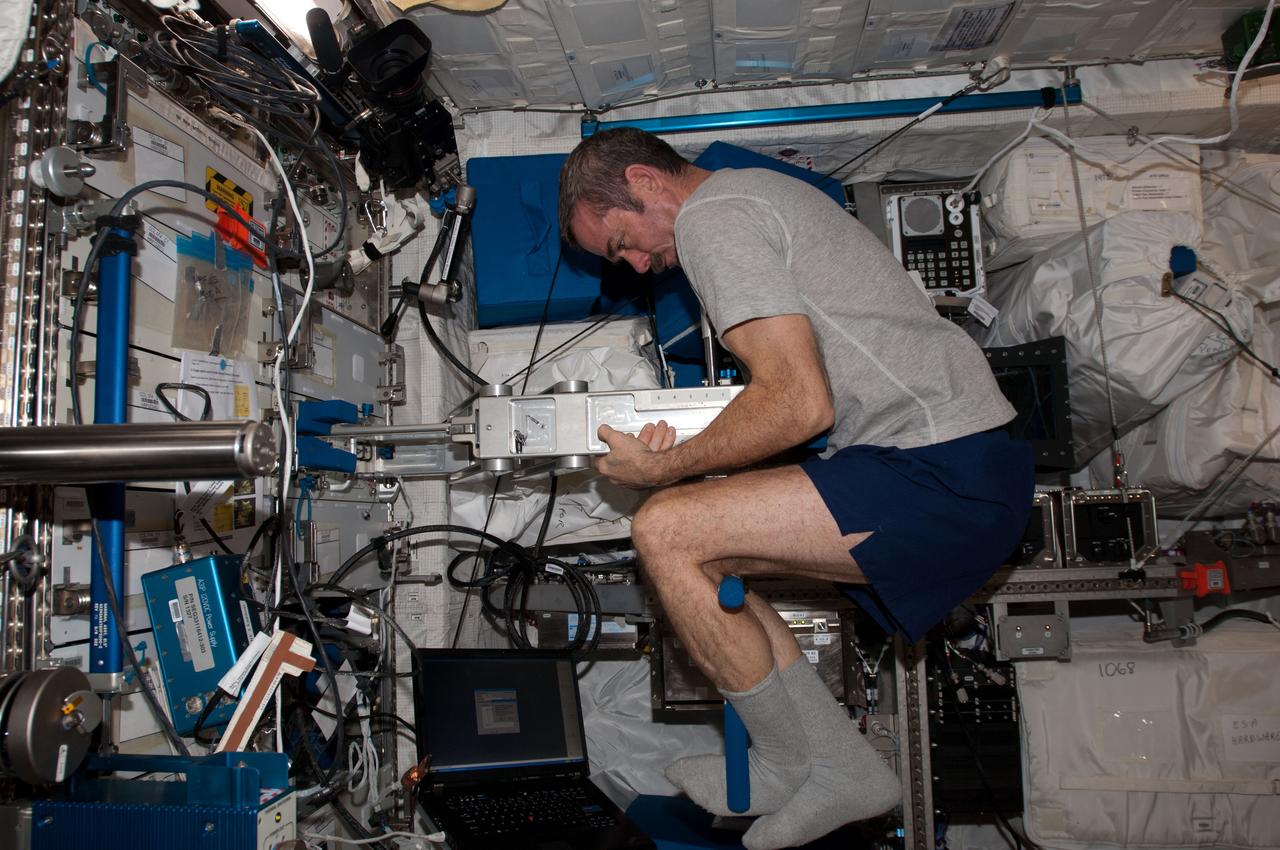
View of Canadian Space Agency (CSA) Chris Hadfield, Expedition 34 Flight Engineer (FE), using the Space Linear Acceleration Mass Measurement Device (SLAMMD) in the Columbus Module. Photo was taken during Expedition 34.
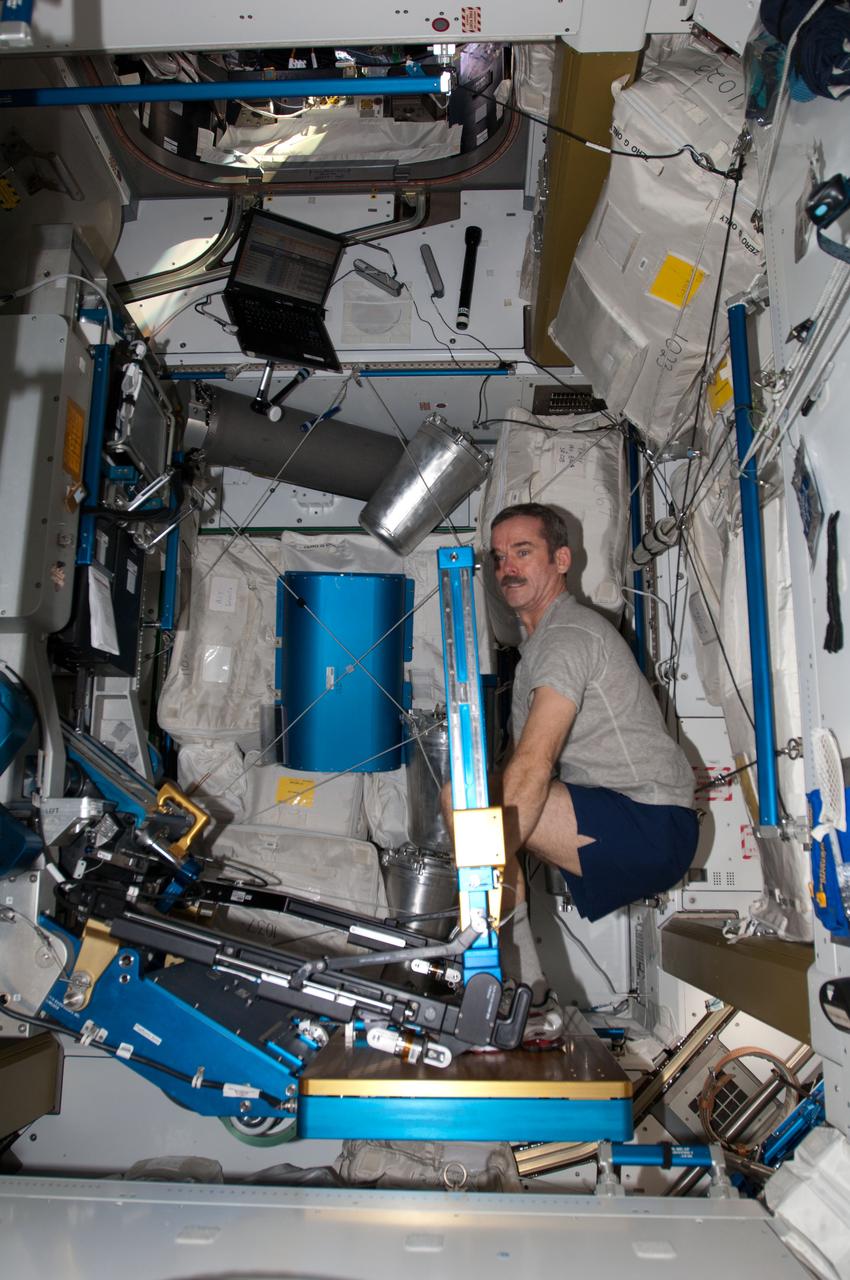
ISS034-E-026550 (11 Jan. 2013) --- Canadian Space Agency astronaut Chris Hadfield, Expedition 34 flight engineer, uses the advanced Resistive Exercise Device (aRED) to exercise in the Tranquility node of the International Space Station.
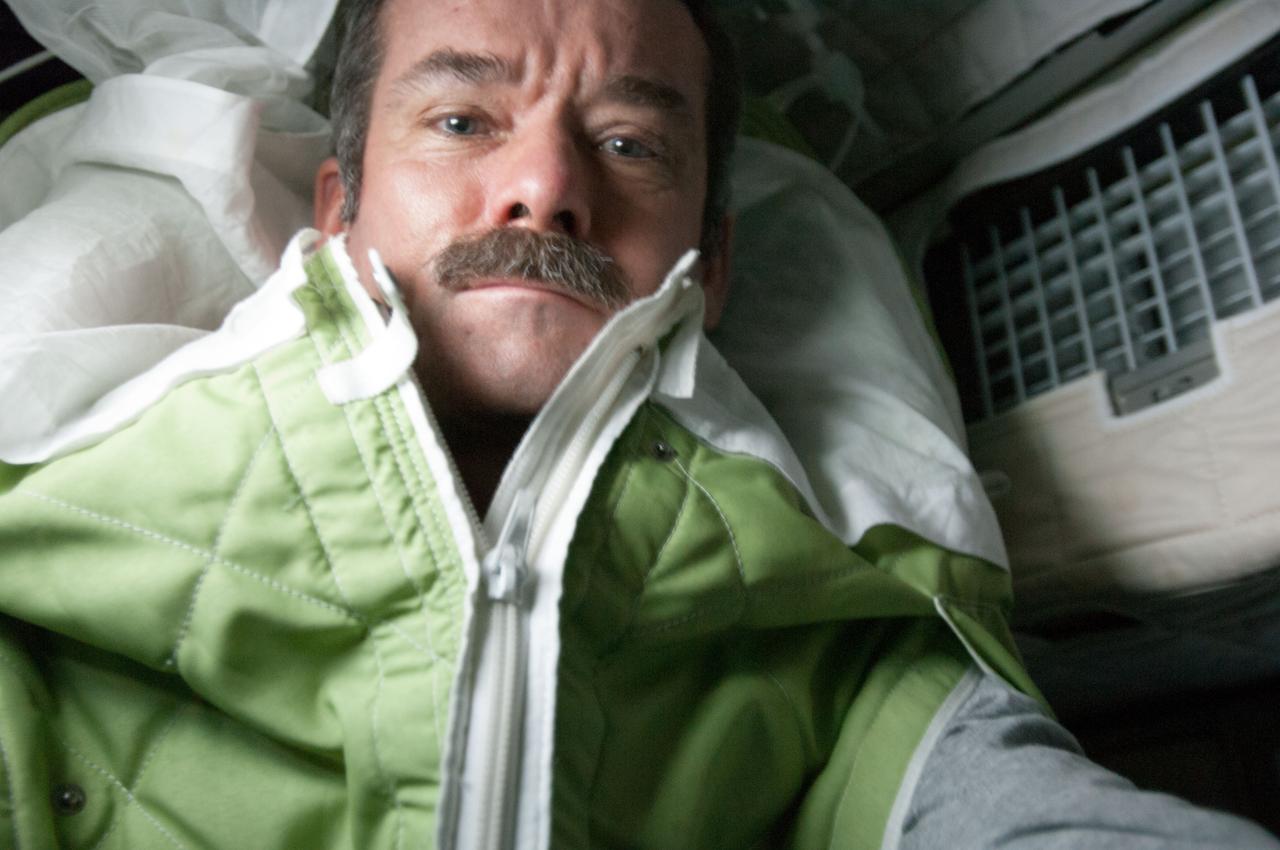
View of Canadian Space Agency (CSA) Chris Hadfield, Expedition 34 Flight Engineer (FE), in sleep station, in the Node 2. Photo was taken during Expedition 34.
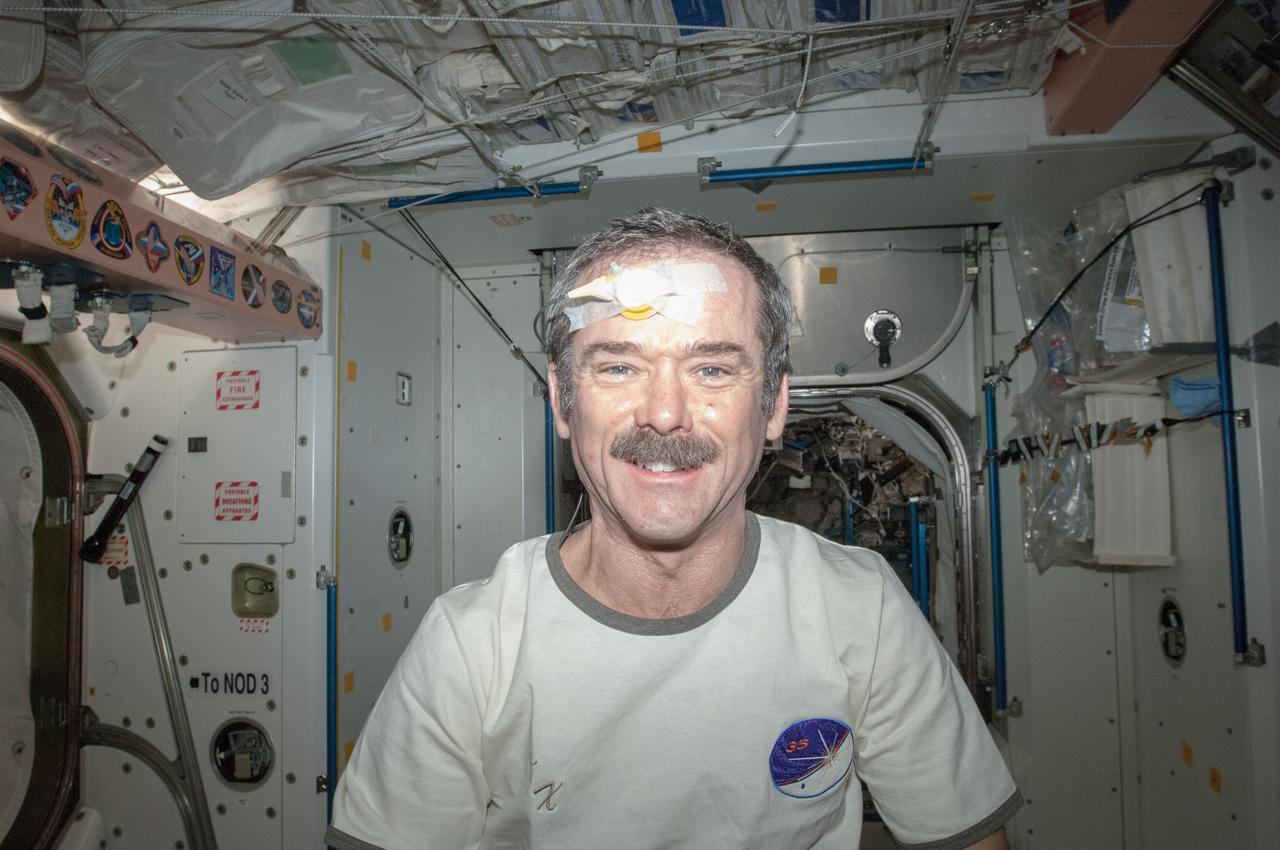
Expedition 35 commander and Canadian Space Agency astronaut Chris Hadfield (with a temperature sensor taped to his forehead) poses for a photo in the Unity Node 1 before getting a haircut.
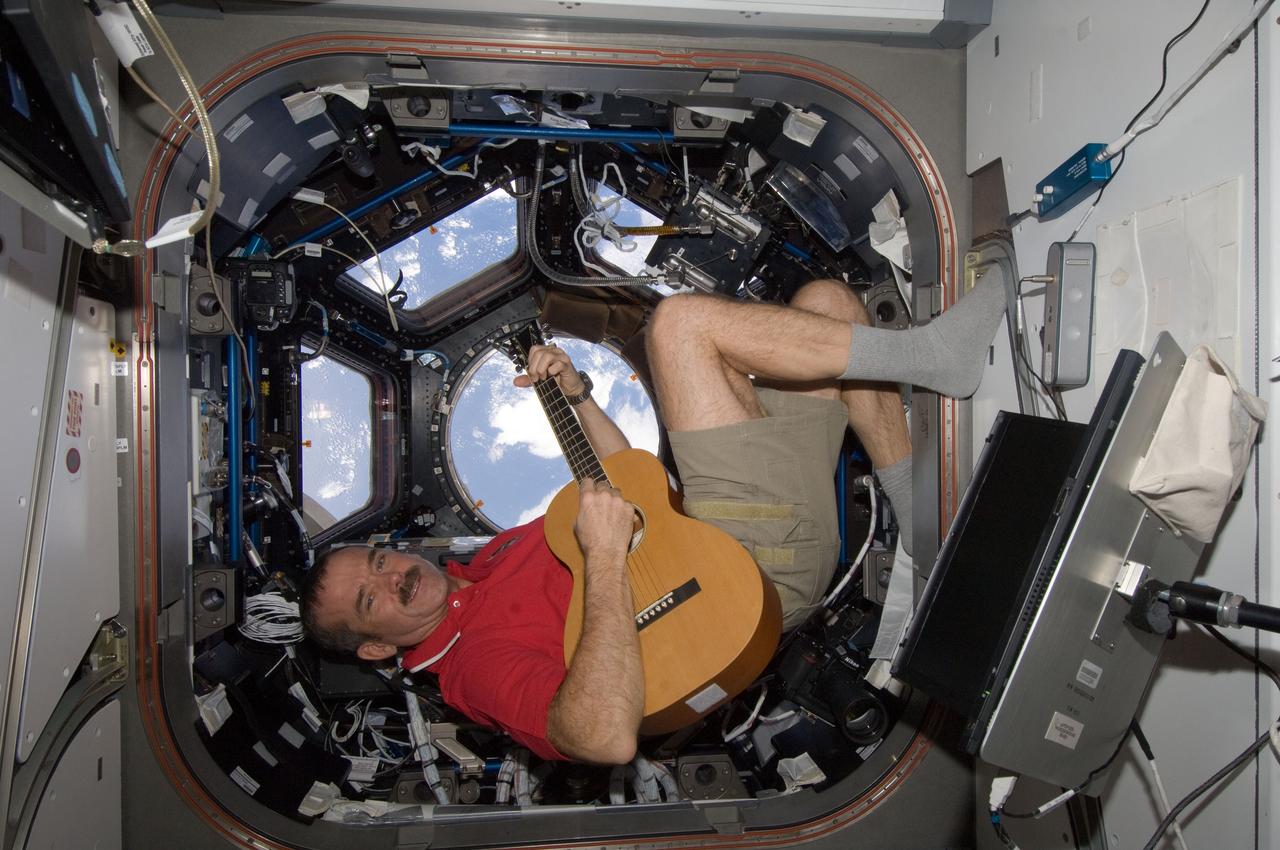
View of Canadian Space Agency (CSA) Chris Hadfield, Expedition 34 Flight Engineer (FE), playing guitar in the Cupola Module. Photo was taken during Expedition 34.
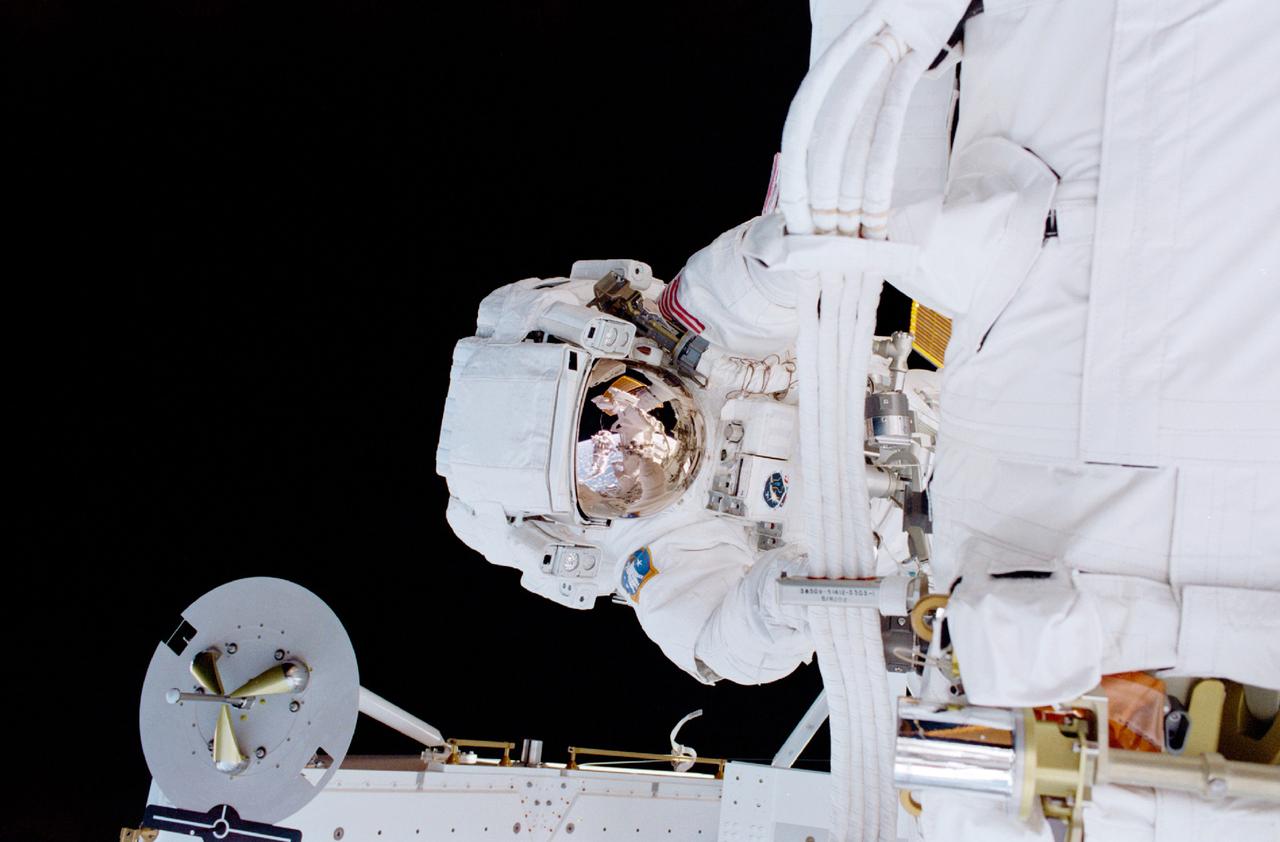
The main objective of the STS-100 mission, the sixth International Space Station (ISS) assembly flight, was the delivery and installation of the Canadian-built Space Station Remote Manipulator System (SSRMS), or Canadarm2. In this photograph, astronaut Scott E. Parazynski, mission specialist, works with cables associated with the robotic arm during one of two days of extravehicular activity (EVA). Both space walks were shared with Chris A. Hadfield, mission specialist representing the Canadian Space Agency (CSA), who is visible in the helmet visor of Parazynski. STS-100 launched April 19, 2001 aboard the Space Shuttle Orbiter Endeavour for an 11 day mission.
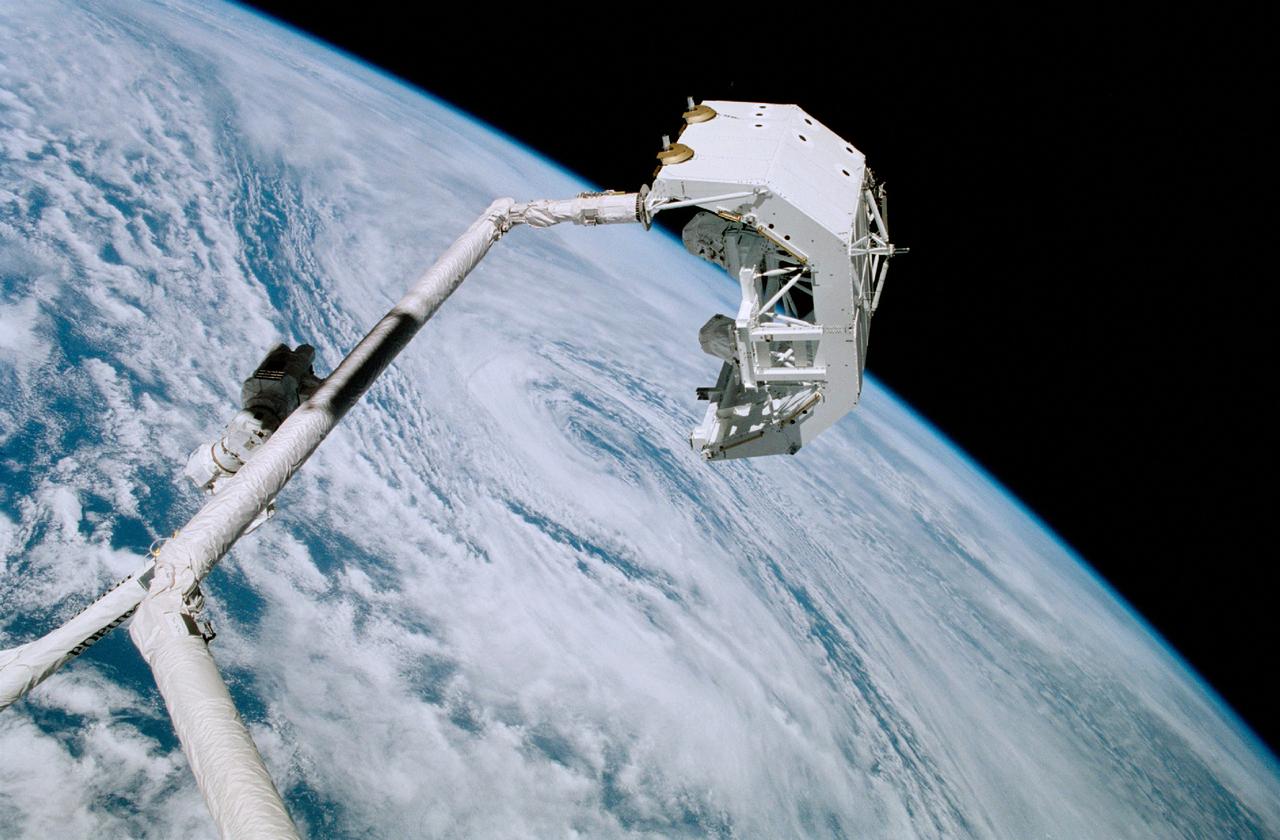
A Canadian "handshake" in space occurred on April 28, 2001, as the Canadian-built space station robotic arm (Canadarm-2) transferred its launch cradle over to Endeavor's robotic arm. Marning the controls from the shuttle's aft flight deck, Canadian Mission Specialist Chris A. Hadfield of the Canadian Space Agency (CSA) was instrumental in the activity. The Spacelab pallet that carried the Canadarm2 robotic arm to the station was developed at the Marshall Space Flight Center (MSFC) in Huntsville, Alabama.
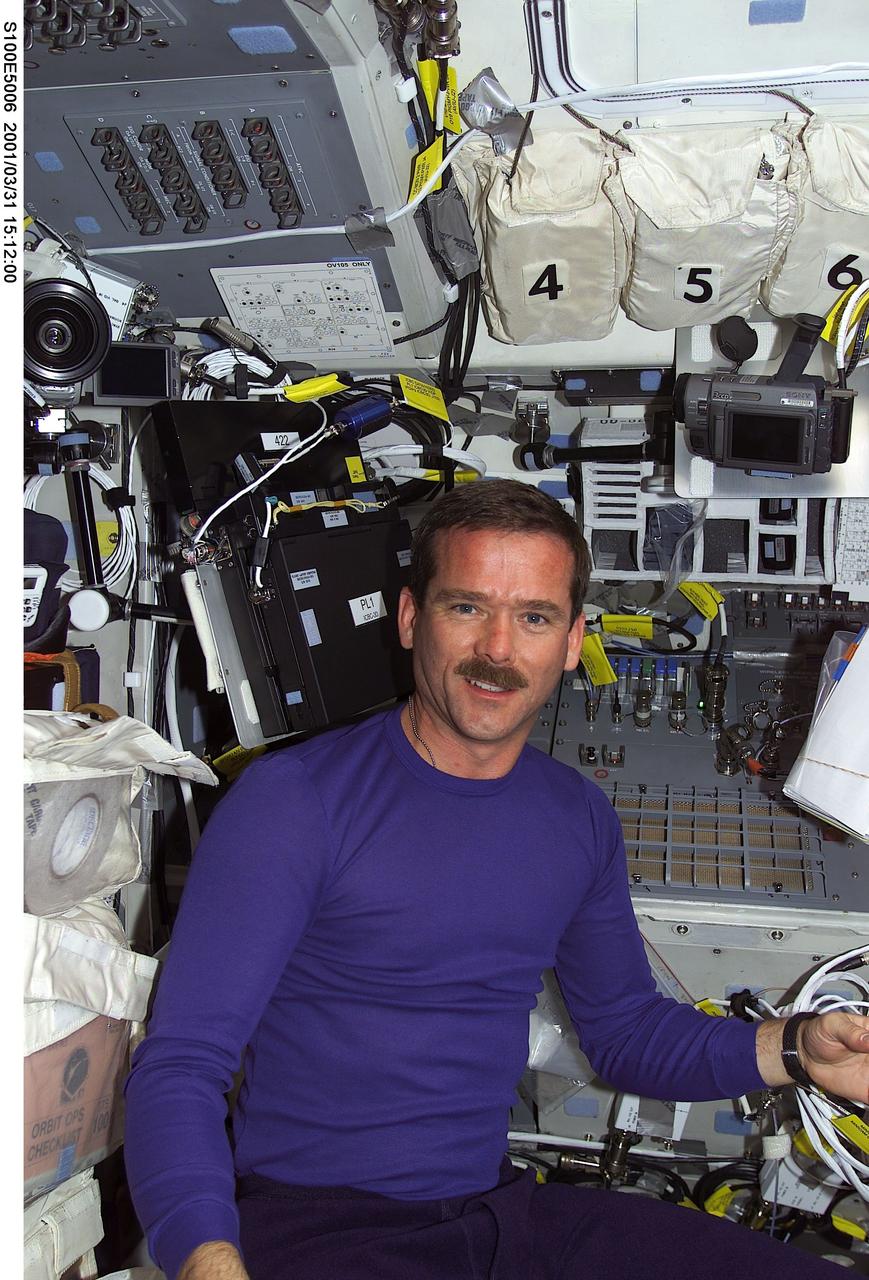
S100-E-5006 (20 April 2001) --- Astronaut Chris A. Hadfield, representing the Canadian Space Agency (CSA), is pictured on Endeavour's flight deck as the shuttle steadily makes its way toward the International Space Station (ISS) following an April 19 launch. Part of Hadfield's training has been geared toward preparing him for scheduled extravehicular activity (EVA) later in the mission. This image was recorded by a fellow crew member using a digital still camera.
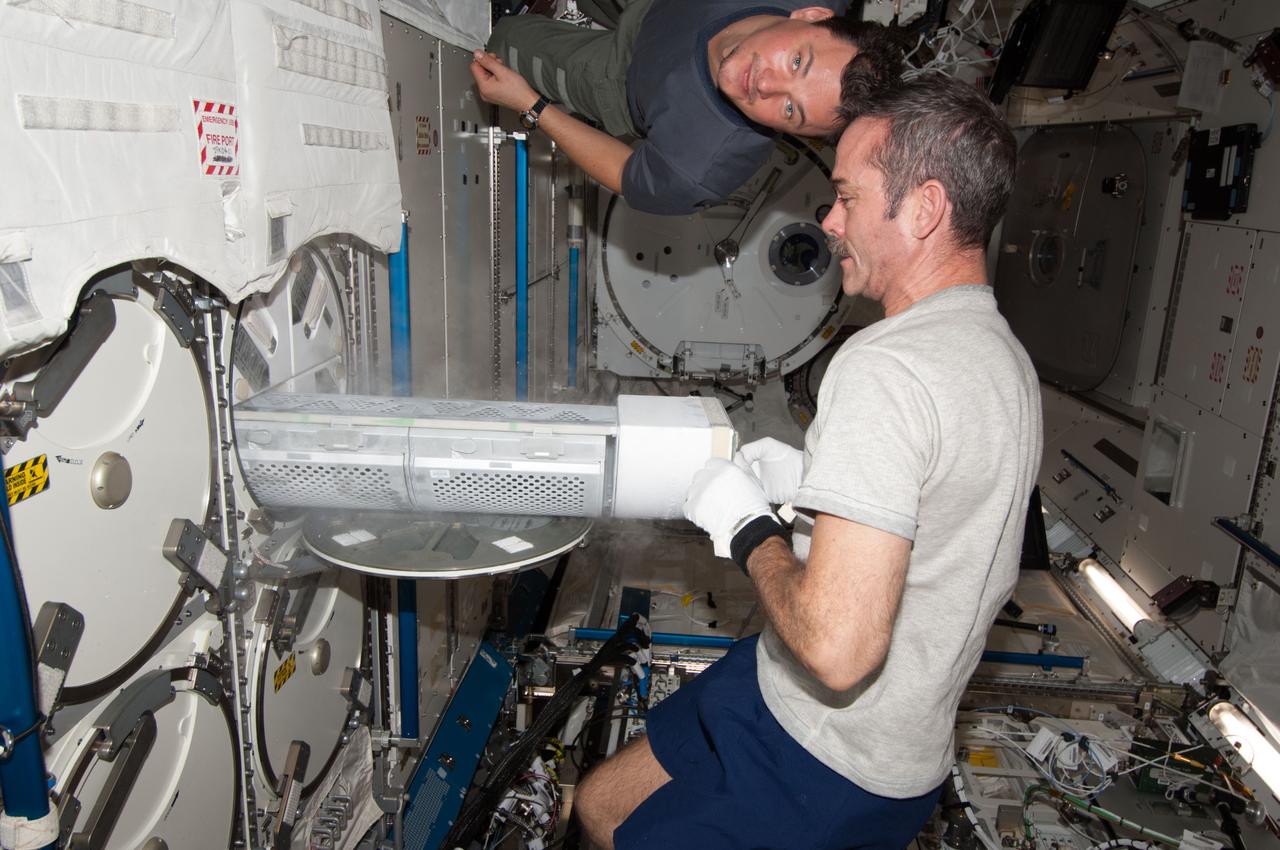
ISS034-E-023786 (7 Jan. 2013) --- Canadian Space Agency astronaut Chris Hadfield, Expedition 34 flight engineer, prepares to insert biological samples in the Minus Eighty Laboratory Freezer for ISS (MELFI-1) in the Kibo laboratory of the International Space Station. Russian cosmonaut Roman Romanenko, flight engineer, is visible near Hadfield.
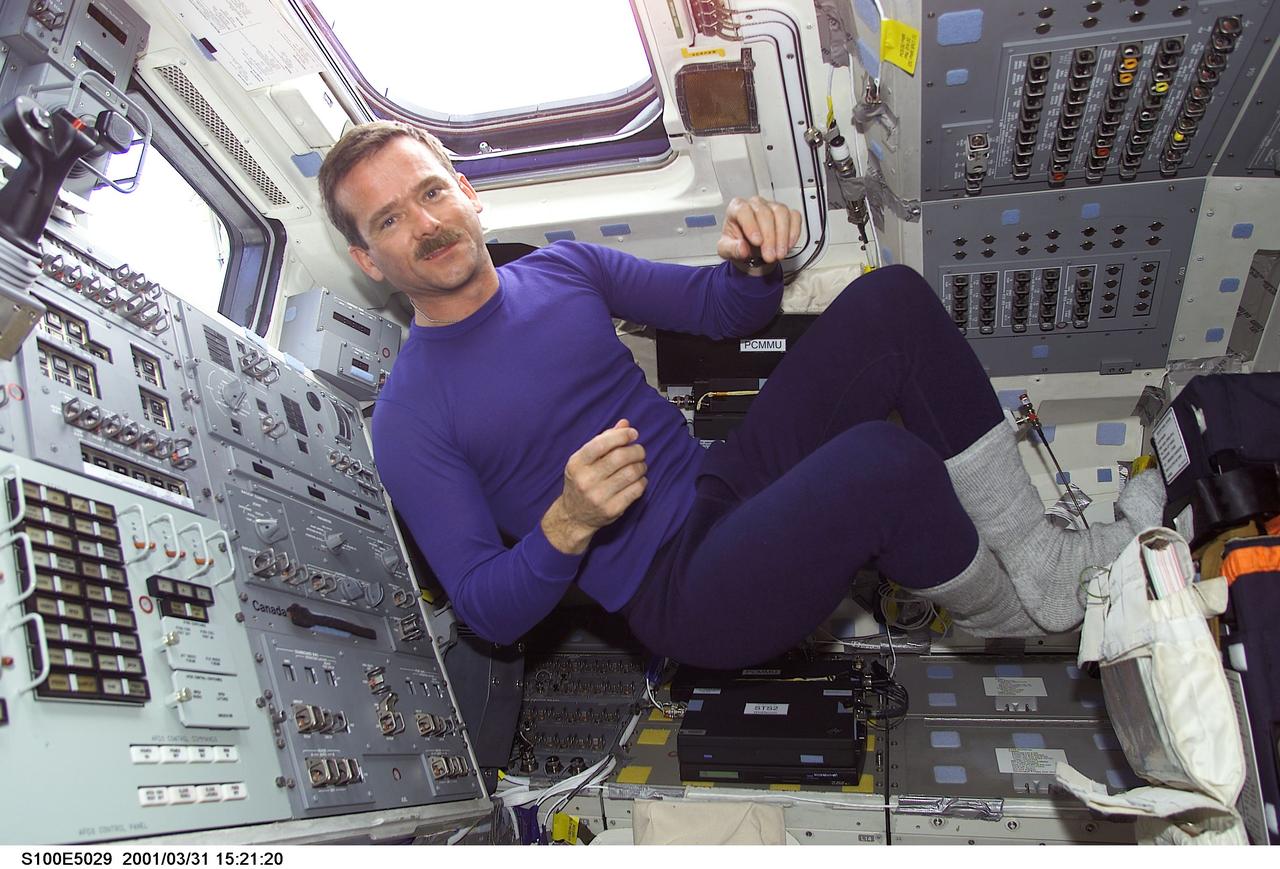
S100-E-5029 (20 April 2001) --- Astronaut Chris A. Hadfield, representing the Canadian Space Agency (CSA), is pictured on Endeavour's flight deck as the shuttle steadily makes its way toward the International Space Station (ISS) following an April 19 launch. Part of Hadfield's training has been geared toward preparing him for scheduled extravehicular activity (EVA) later in the mission. This image was recorded by a fellow crew member using a digital still camera.
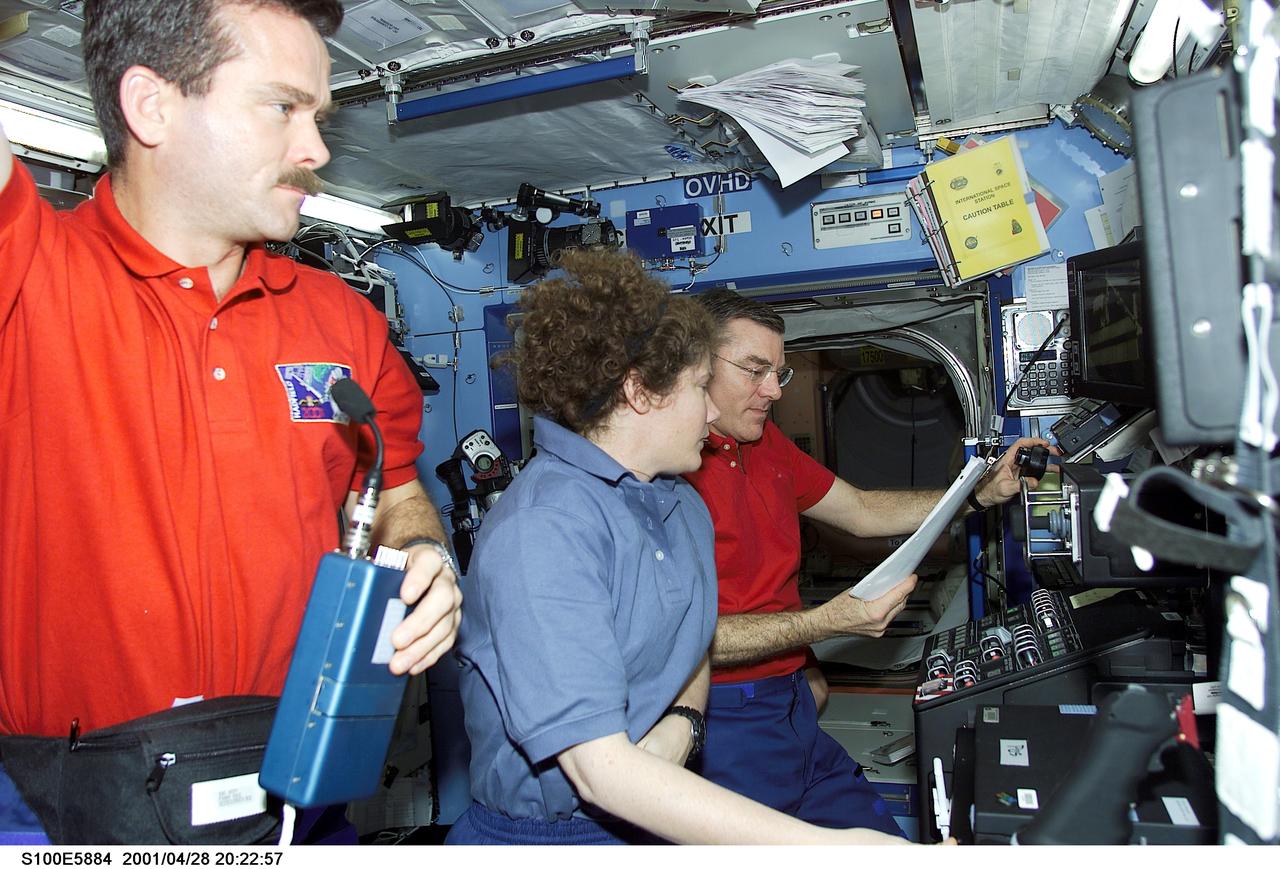
S100-E-5884 (28 April 2001) --- Some of the principal participants of an historical event are pictured in the Destiny laboratory aboard the International Space Station (ISS). From left to right are astronauts Chris A. Hadfield, STS-100 mission specialist, and astronauts Susan J. Helms and James S. Voss, Expedition Two flight engineers. A Canadian “handshake in space” occurred at 4:02 p.m (CDT), April 28, 2001, as the Canadian-built space station robotic arm – operated by Helms – transferred its launch cradle over to Endeavour’s robotic arm, with Canadian Space Agency astronaut Hadfield at the controls. In this scene, Hadfield has temporarily vacated his post on Endeavour's aft flight deck and was having a brief strategy meeting with the Expedition Two crew on the docked station. The exchange of the pallet from station arm to shuttle arm marked the first ever robotic-to-robotic transfer in space. This image was recorded with a digital still camera.
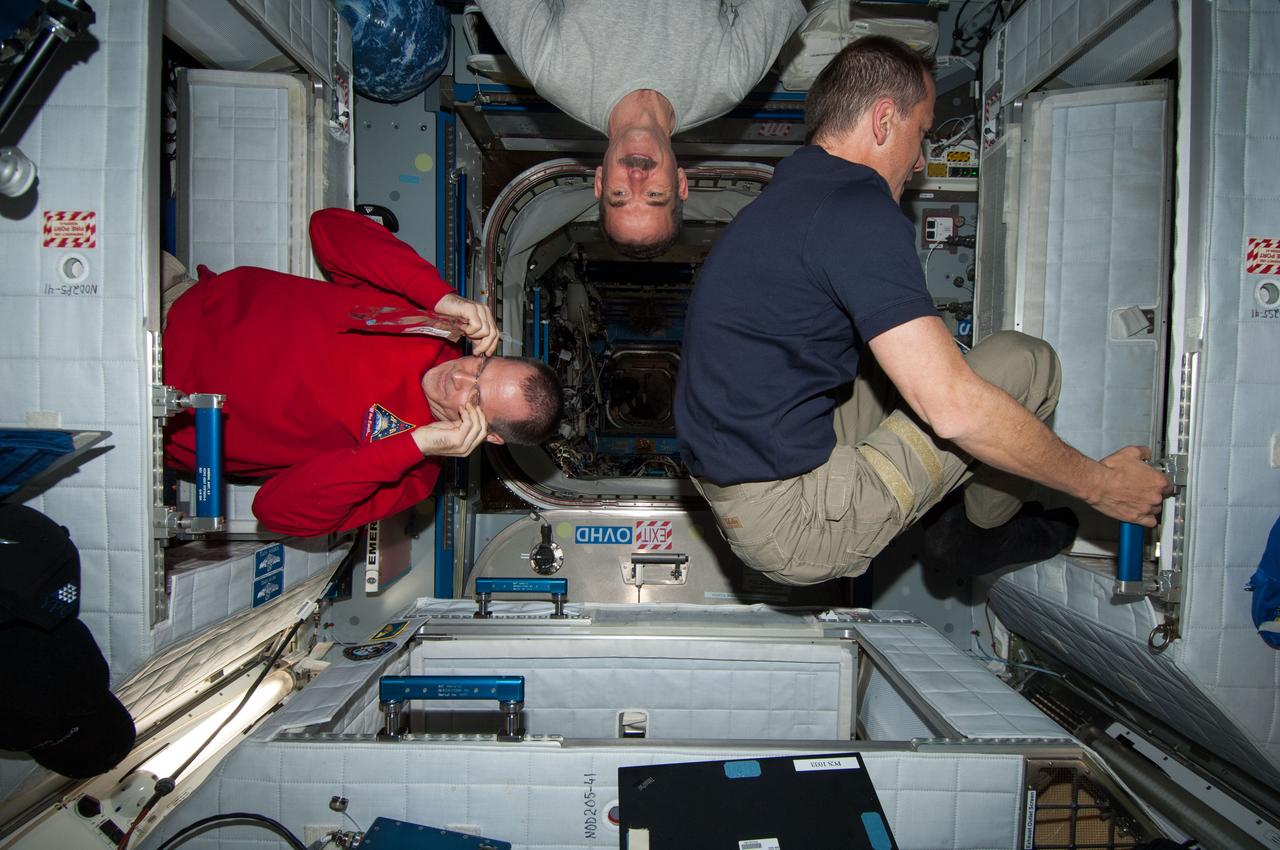
ISS034-E-026596 (22 Dec. 2012) --- NASA astronaut Kevin Ford (left), Expedition 34 commander; along with Canadian Space Agency astronaut Chris Hadfield (center) and NASA astronaut Tom Marshburn, both flight engineers, are pictured in the Harmony node of the International Space Station.
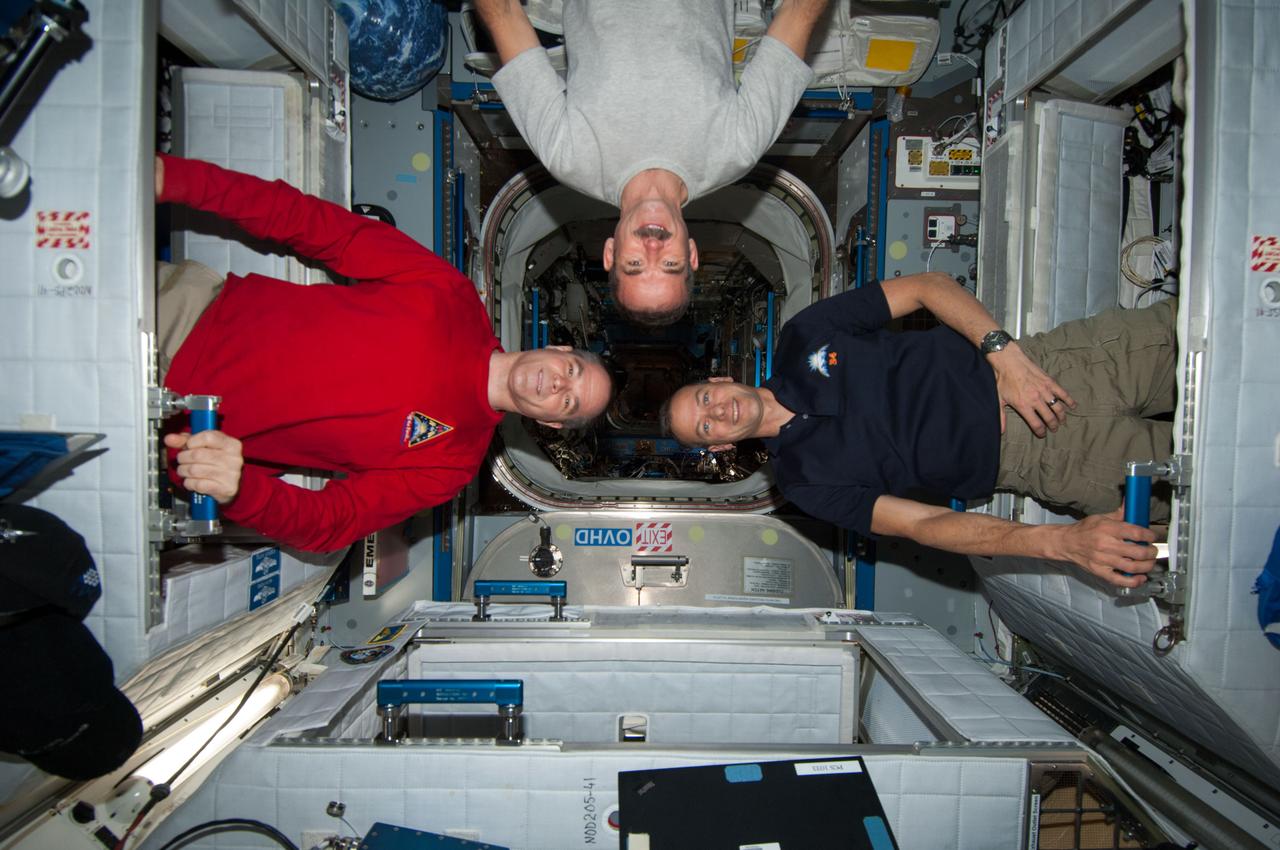
ISS034-E-026598 (22 Dec. 2012) --- NASA astronaut Kevin Ford (left), Expedition 34 commander; along with Canadian Space Agency astronaut Chris Hadfield (center) and NASA astronaut Tom Marshburn, both flight engineers, pose for a photo in the Harmony node of the International Space Station.
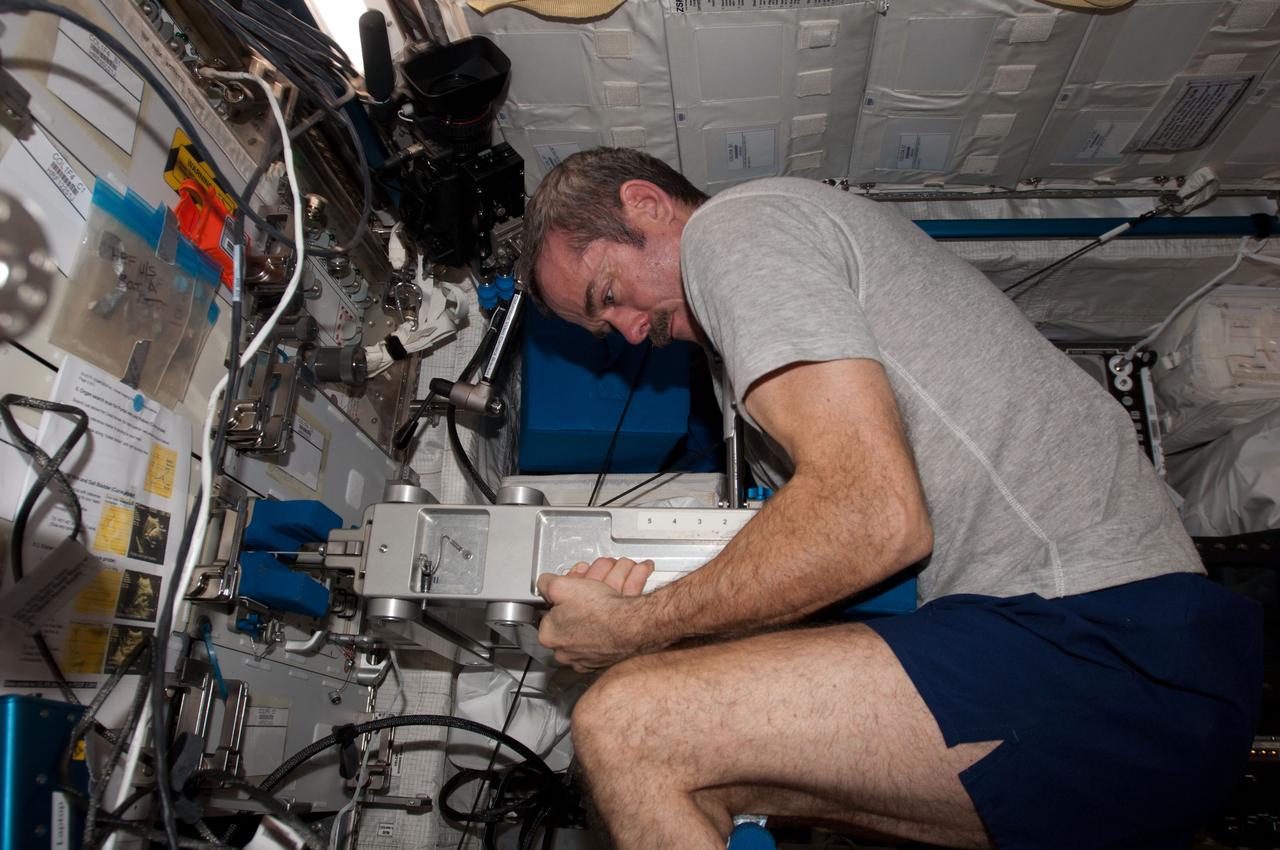
ISS034-E-026582 (11 Jan. 2013) --- Canadian Space Agency astronaut Chris Hadfield, Expedition 34 flight engineer, uses the Space Linear Acceleration Mass Measurement Device (SLAMMD) in the Columbus laboratory of the International Space Station.
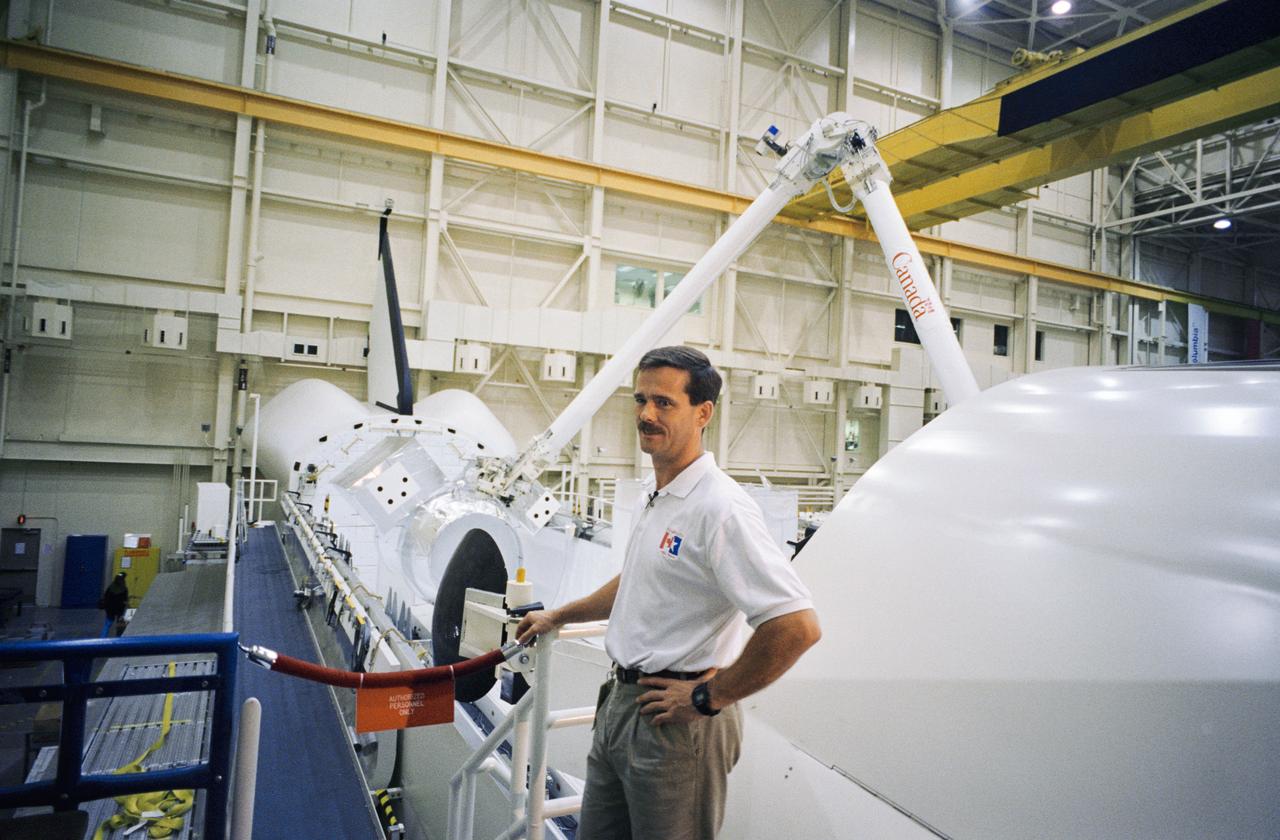
S95-12491 (8 June 1995) --- Canadian astronaut Chris A. Hadfield is seen during training at the Manipulator Development Facility (MDF) in the Systems Integration Facility at the Johnson Space Center (JSC). Hadfield will join four other NASA astronauts for the STS-74 mission aboard the Space Shuttle Atlantis later this year.
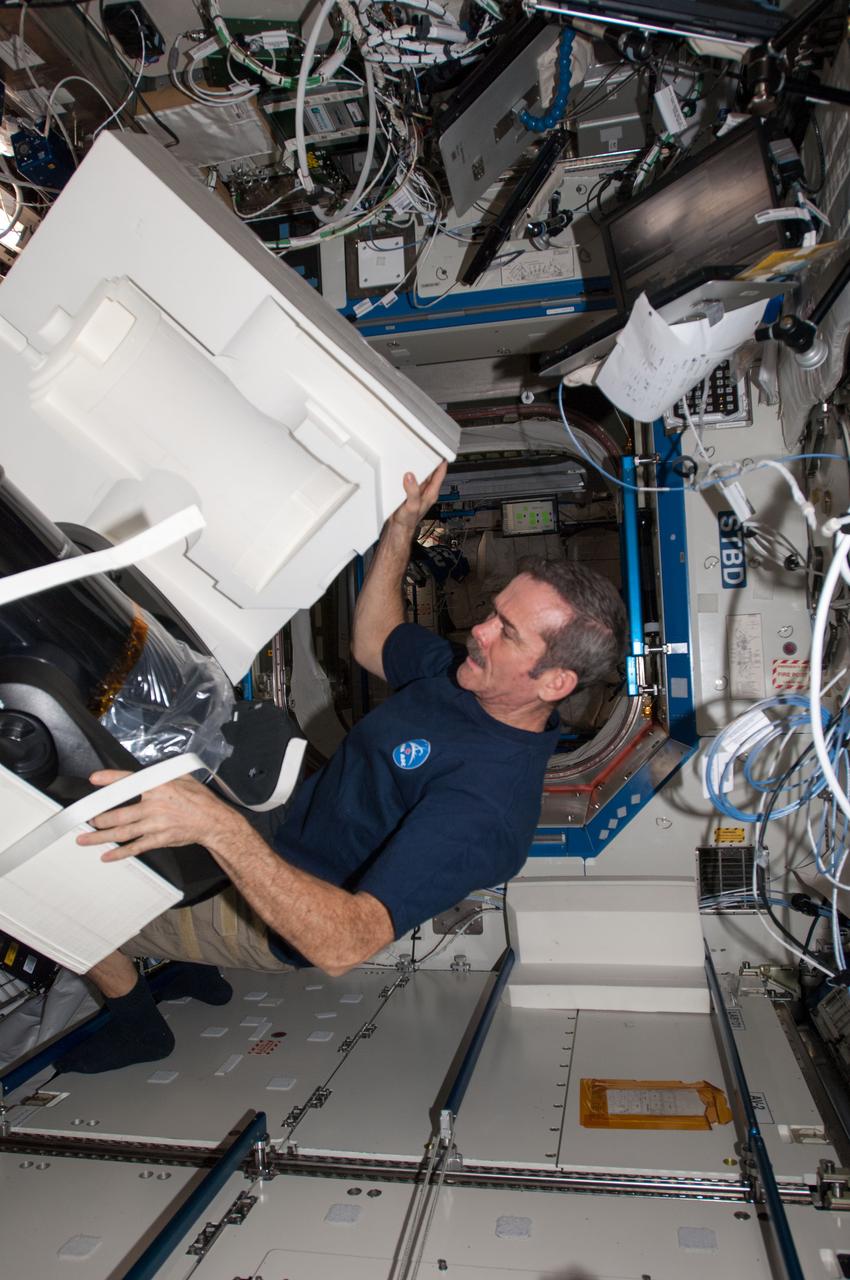
ISS034-E-029954 (15 Jan. 2013) --- Canadian Space Agency astronaut Chris Hadfield, Expedition 34 flight engineer, prepares to set up the ISS SERVIR Environmental Research and Visualization System (ISERV) in the Destiny laboratory of the International Space Station. ISERV is a fully automated image data acquisition system that flies aboard the space station and deploys in the Window Observational Research Facility (WORF) rack within Destiny. The study is expected to provide useful images for use in disaster monitoring and assessment and environmental decision making.
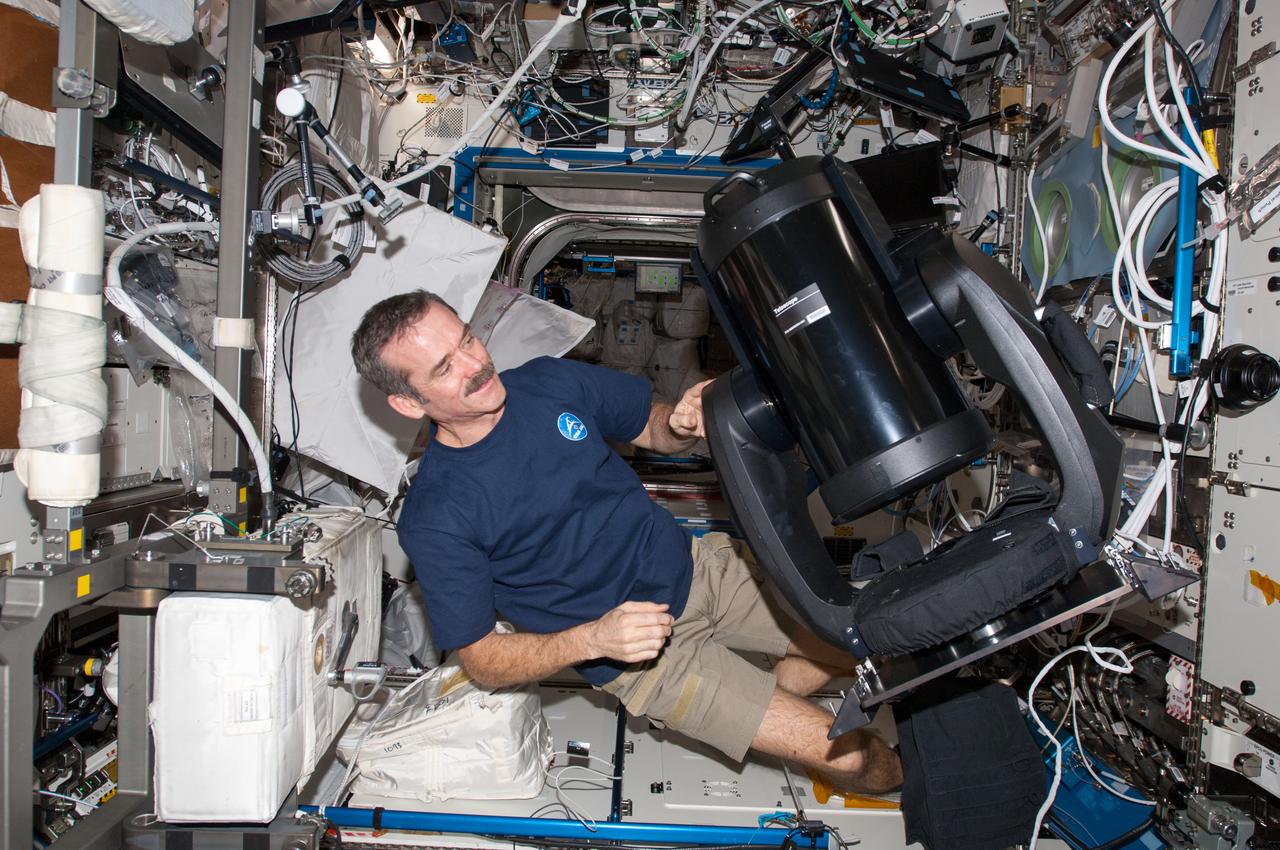
ISS034-E-029961 (15 Jan. 2013) --- Canadian Space Agency astronaut Chris Hadfield, Expedition 34 flight engineer, prepares to set up the ISS SERVIR Environmental Research and Visualization System (ISERV) in the Destiny laboratory of the International Space Station. ISERV is a fully automated image data acquisition system that flies aboard the space station and deploys in the Window Observational Research Facility (WORF) rack within Destiny. The study is expected to provide useful images for use in disaster monitoring and assessment and environmental decision making.
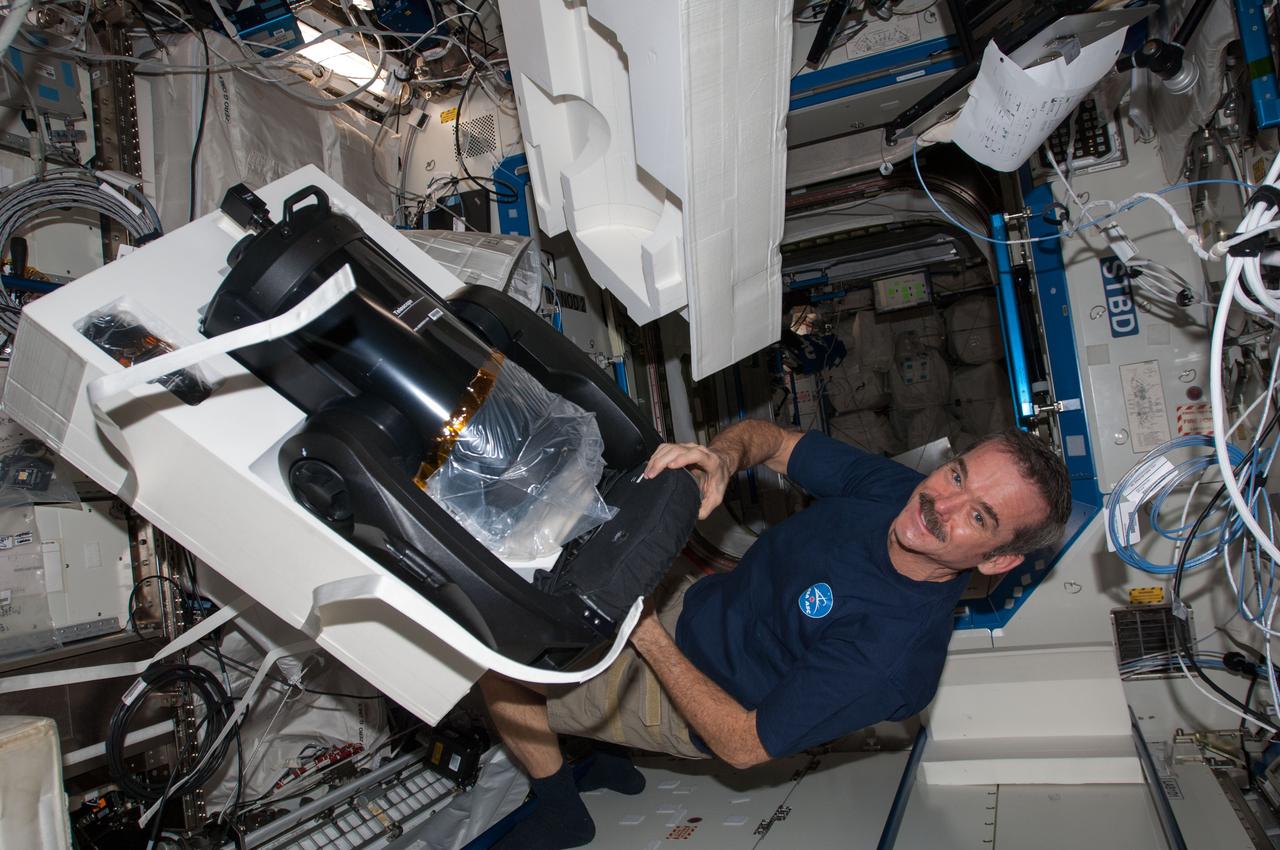
View of Canadian Space Agency (CSA) Chris Hadfield,Expedition 34 Flight Engineer (FE),unpacking ISS SERVIR Environmental Research and Visualization System (ISERV) in the U.S. Laboratory. ISERV is a fully automated image data acquisition system in the Window Observational Research Facility (WORF) rack. Kevin Ford,Expedition 34 Commander is visible on the right of frame. Photo was taken during Expedition 34.
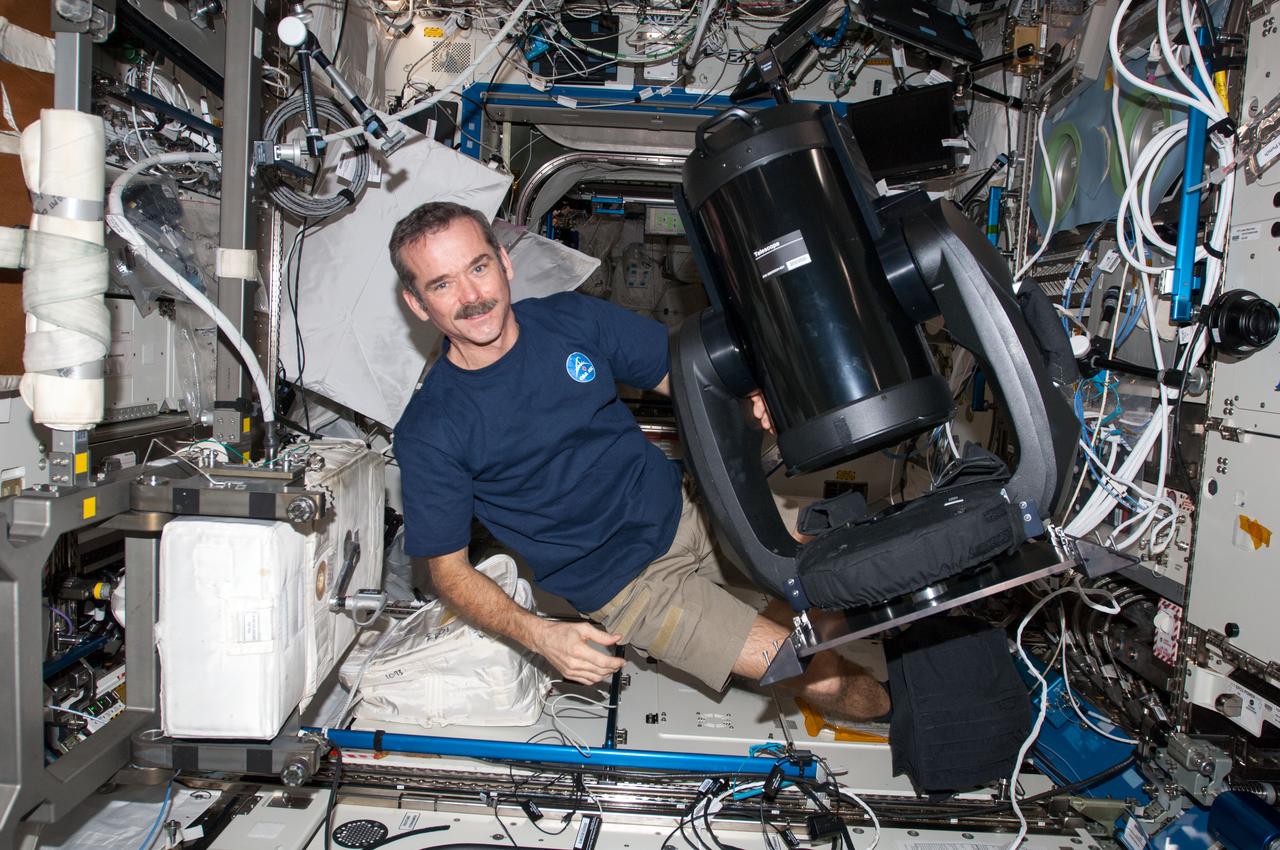
View of Canadian Space Agency (CSA) Chris Hadfield,Expedition 34 Flight Engineer (FE), preparing to setup the ISS SERVIR Environmental Research and Visualization System (ISERV) in the U.S. Laboratory. ISERV is a fully automated image data acquisition system in the Window Observational Research Facility (WORF) rack. Kevin Ford,Expedition 34 Commander is visible on the right of frame. Photo was taken during Expedition 34.
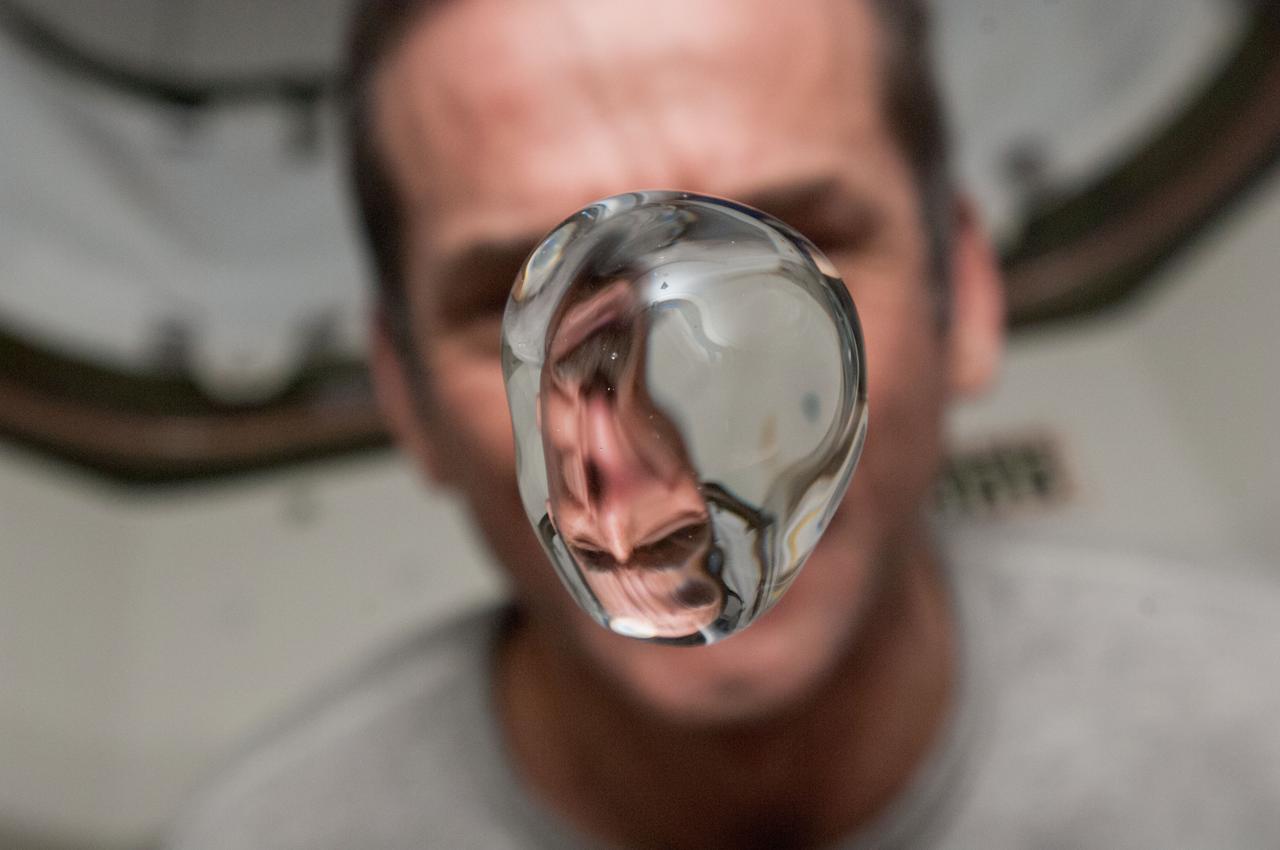
View of Canadian Space Agency (CSA) Chris Hadfield,Expedition 34 Flight Engineer (FE),watching a water bubble float freely,showing his image refracted,in the Node 1. Photo was taken during Expedition 34.
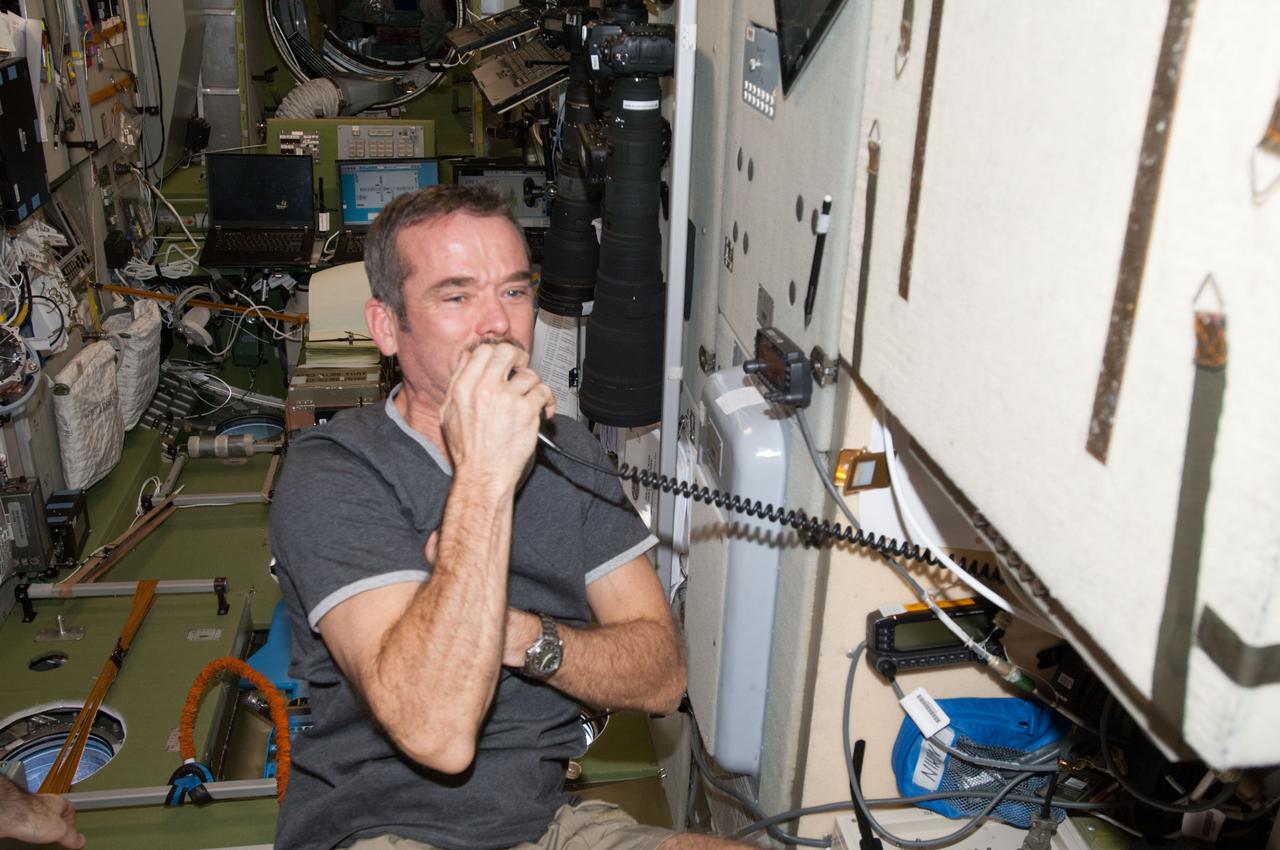
ISS034-E-023688 (5 Jan. 2013) --- Canadian Space Agency astronaut Chris Hadfield, Expedition 34 flight engineer, conducts a ham radio session in the Zvezda Service Module of the International Space Station.
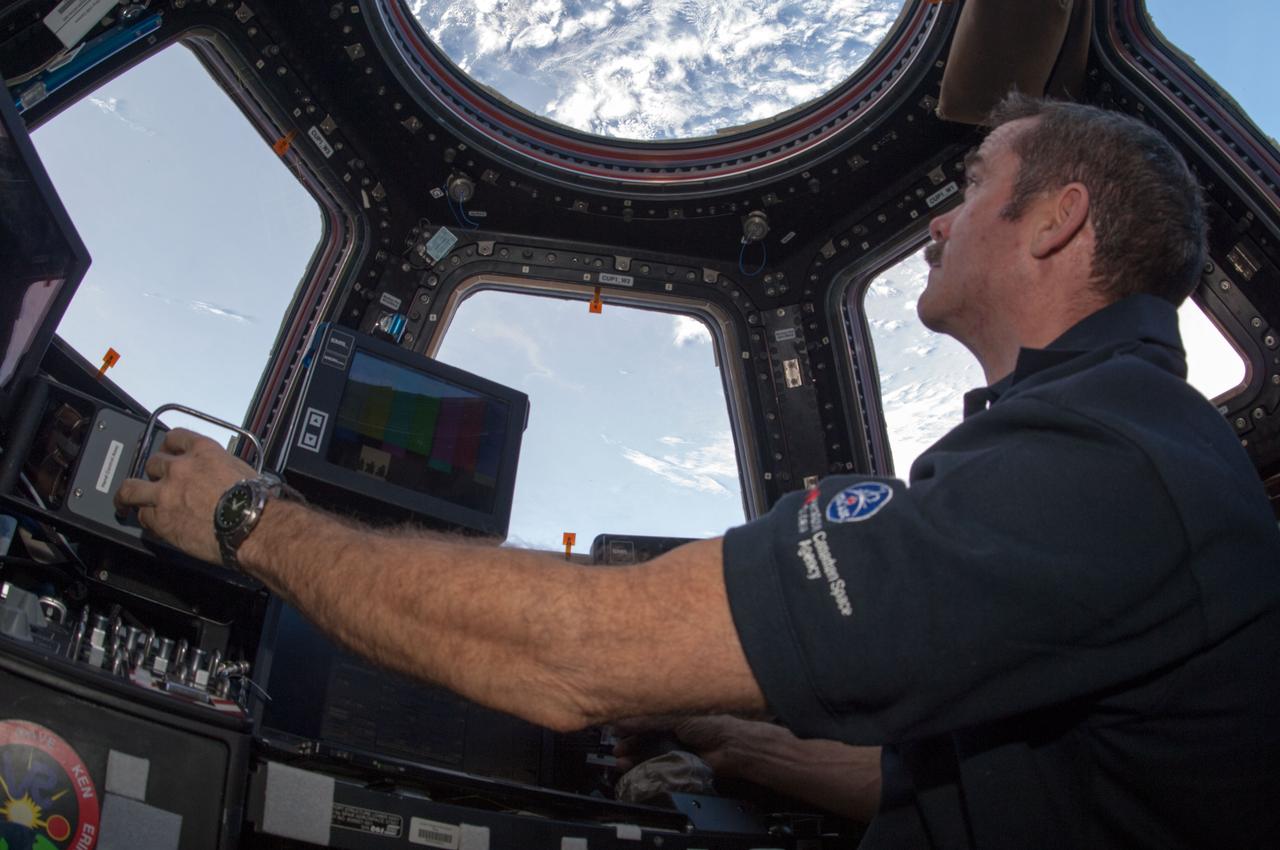
ISS034-E-027319 (10 Jan. 2013) --- Canadian Space Agency astronaut Chris Hadfield, Expedition 34 flight engineer, looks through windows while working controls at a robotic workstation in the Cupola of the International Space Station.
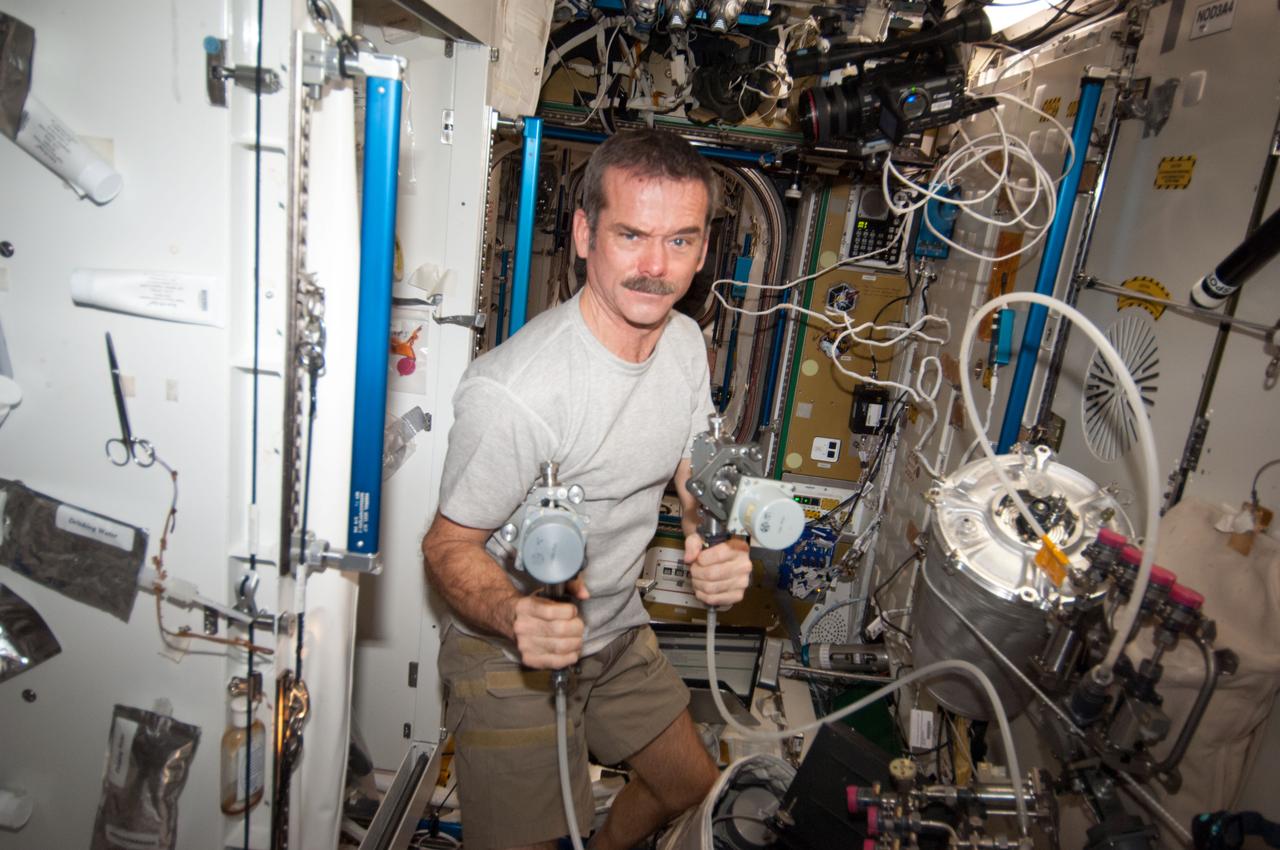
View of Canadian Space Agency (CSA) Chris Hadfield, Expedition 34 Flight Engineer (FE), during Waste and Hygiene Compartment (WHC) routine annual maintenance, in the Node 3. Photo was taken during Expedition 34.
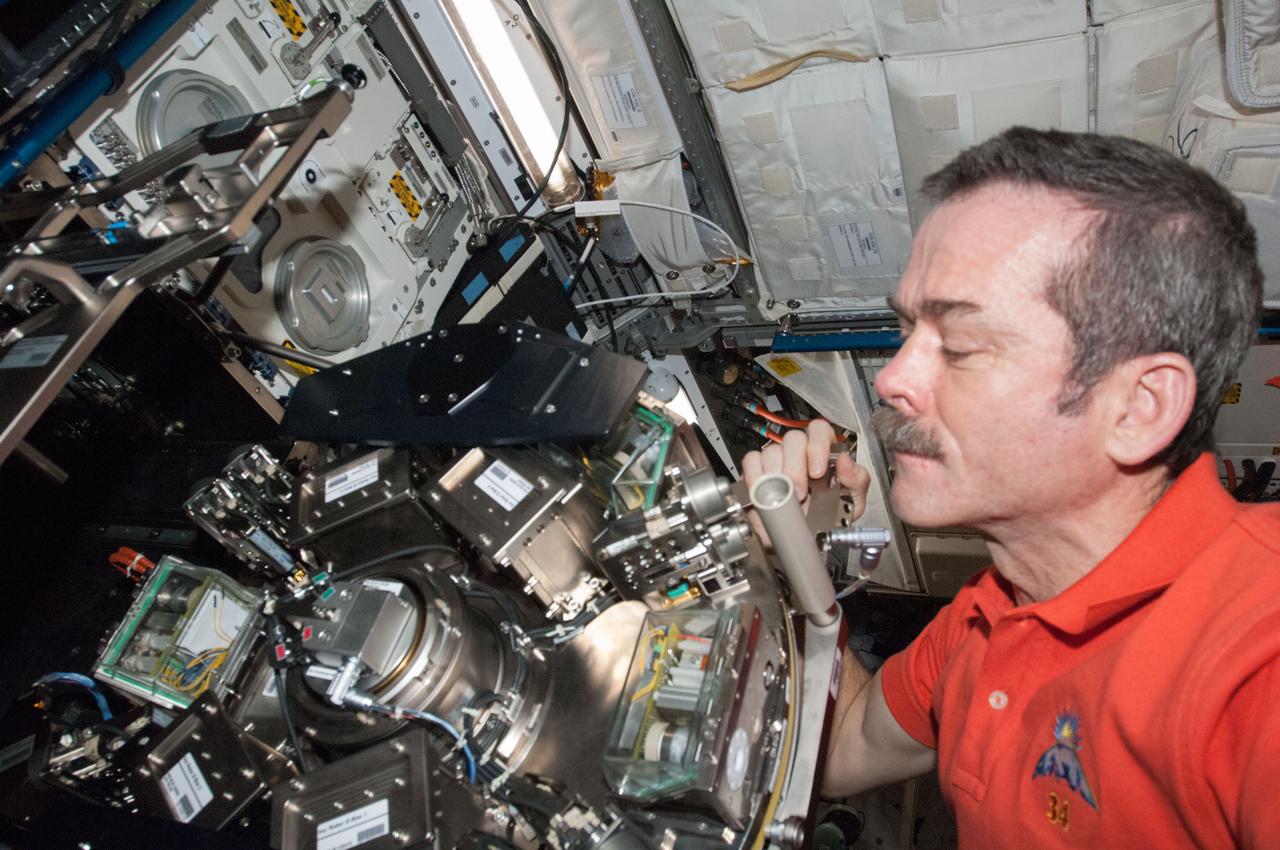
ISS034-E-051715 (20 Feb. 2013) --- Canadian Space Agency astronaut Chris Hadfield, Expedition 34 flight engineer, performs routine maintenance on Biolab in the Columbus Module aboard the International Space Station.
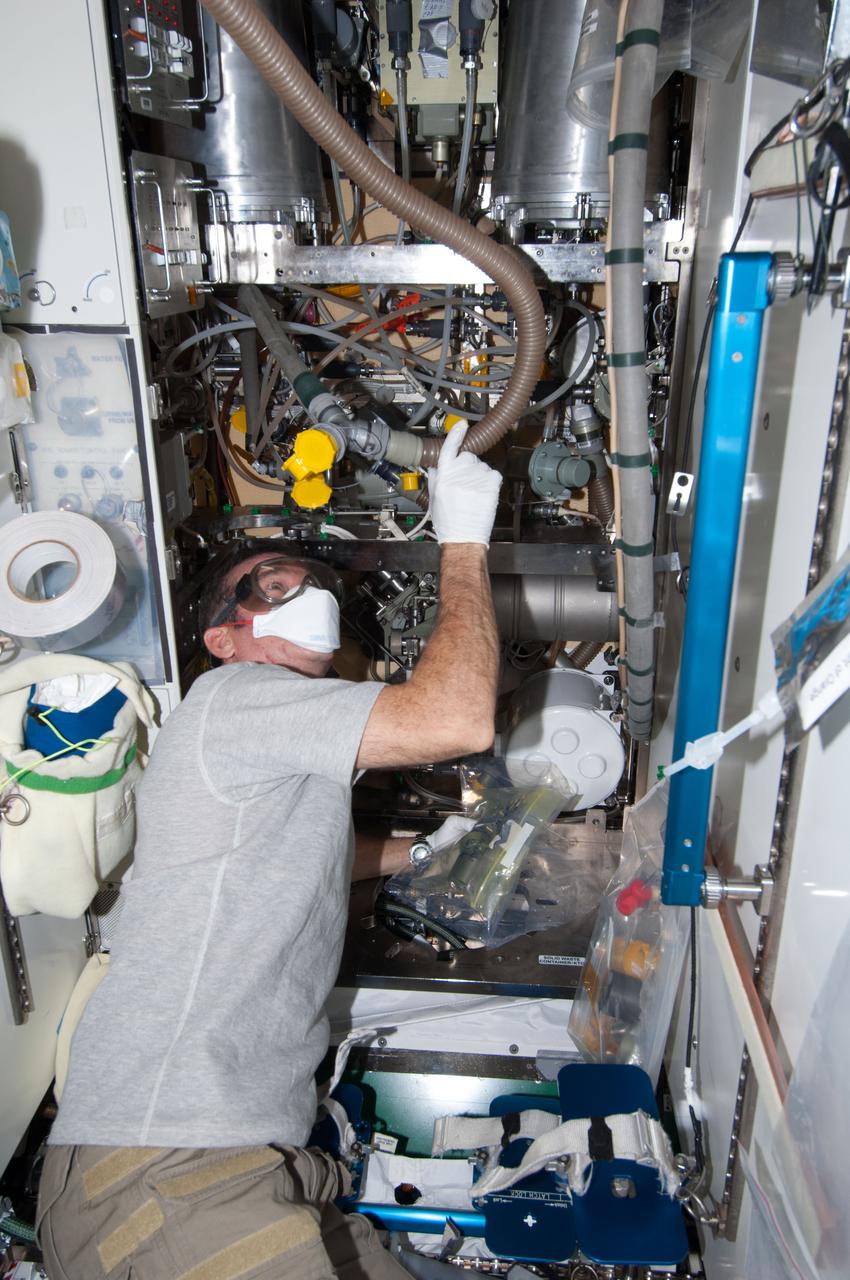
View of Canadian Space Agency (CSA) Chris Hadfield,Expedition 34 Flight Engineer (FE),performing Waste and Hygiene Compartment (WHC) overhaul,in the Node 3. Photo was taken during Expedition 34.
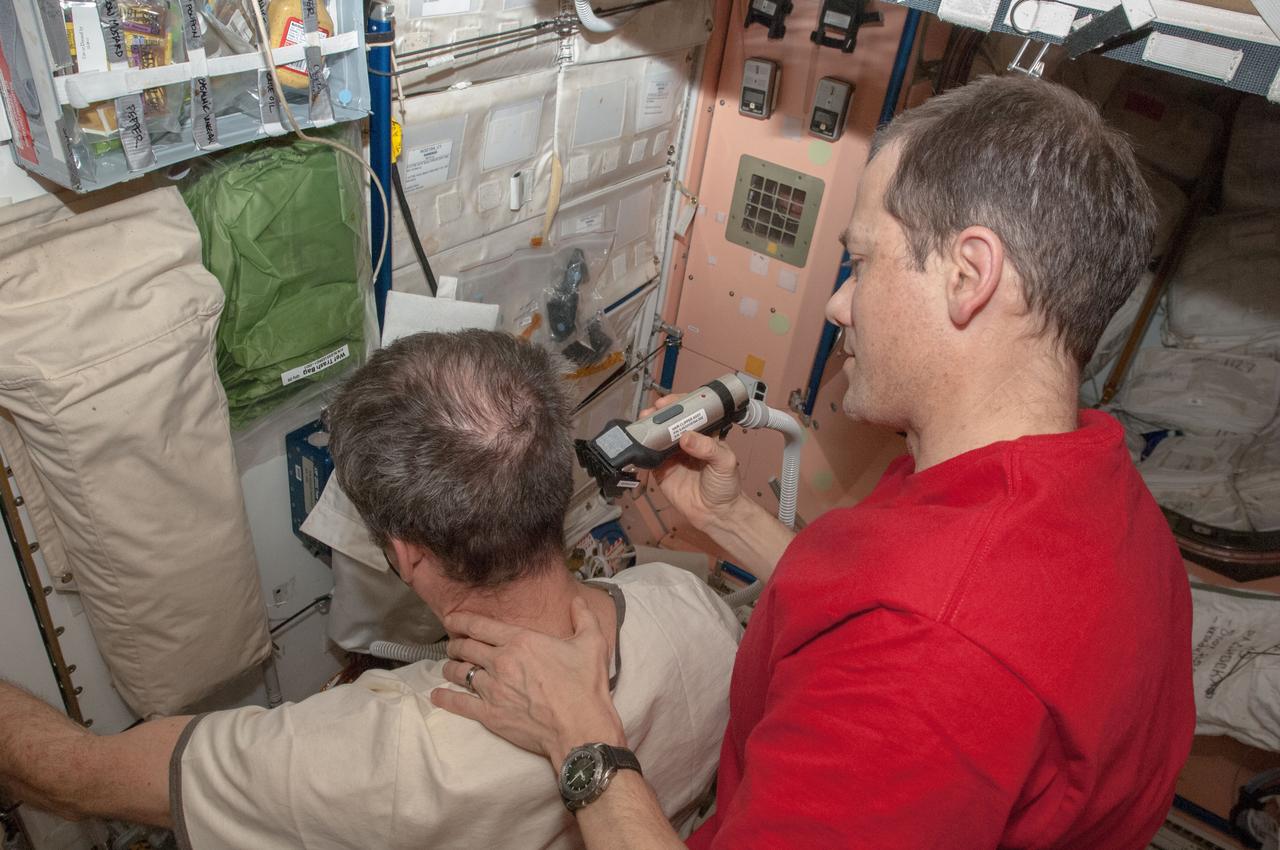
ISS035-E-016639 (7 April 2013) --- Expedition 35 Flight Engineer Tom Marshburn fills the role of barber for Commander Chris Hadfield in the Unity node of the Earth-orbiting International Space Station.
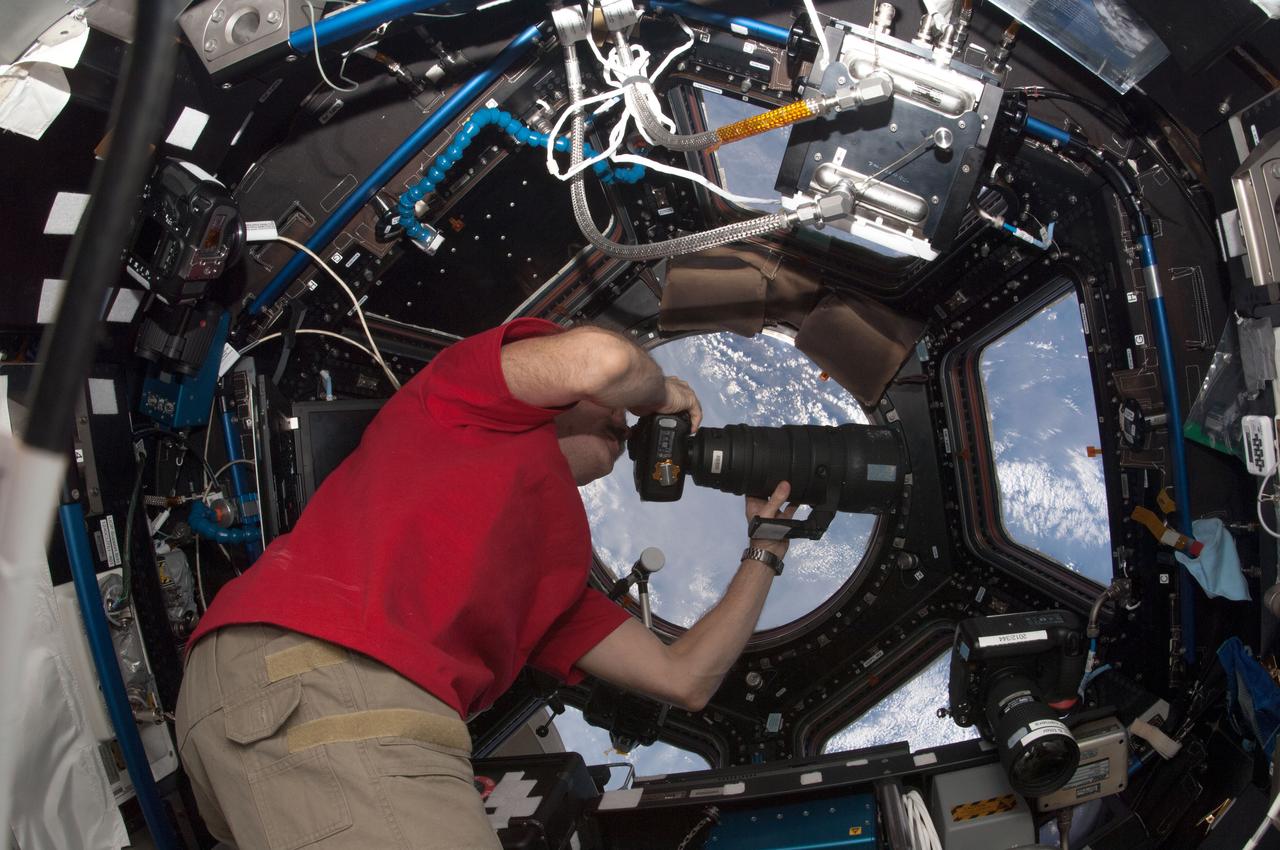
ISS034-E-027234 (7 Jan. 2013) --- Canadian Space Agency astronaut Chris Hadfield, Expedition 34 flight engineer, uses a camera to photograph the topography of a point on Earth from a window in the Cupola of the International Space Station.
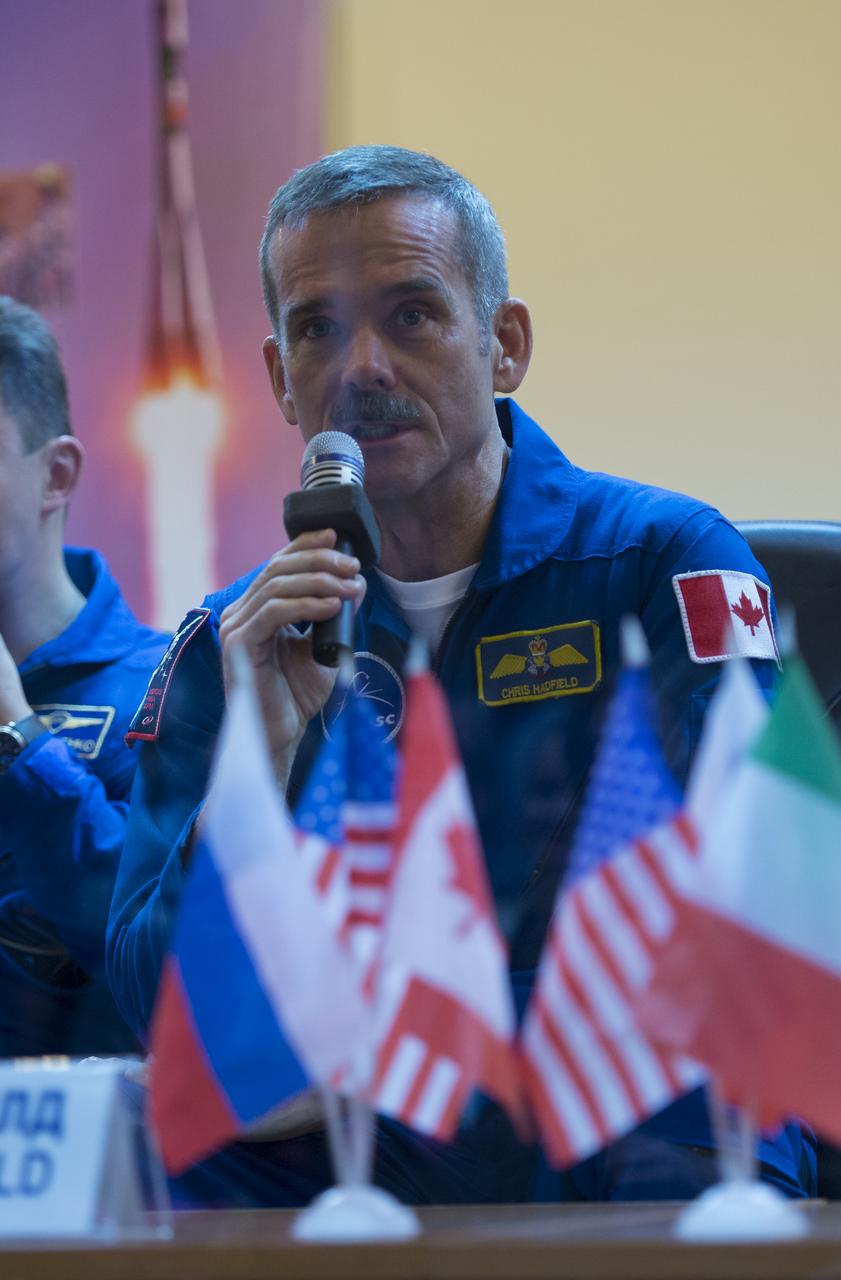
Expedition 34/35 Flight Engineer and Expedition 35 Commander Chris Hadfield of the Canadian Space Agency (CSA) answers a reporter's question at a press conference held at the Cosmonaut Hotel, on Tuesday, Dec. 18, 2012, in Baikonur, Kazakhstan. Launch of the Soyuz rocket is scheduled for December 19 and will send Hadfield, Tom Marshburn of NASA and Roman Romanenko of ROSCOSMOS on a five-month mission aboard the International Space Station. Photo Credit: (NASA/Carla Cioffi)
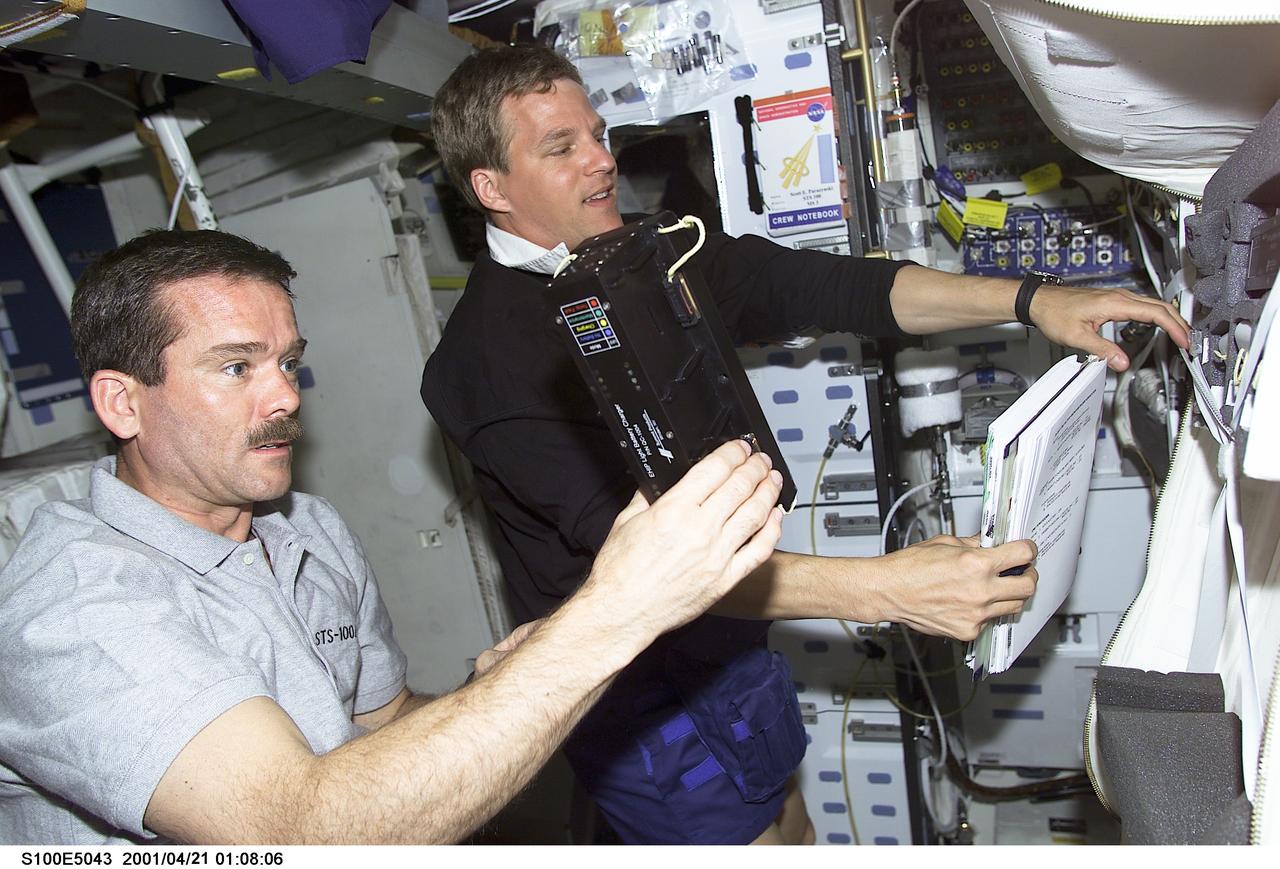
S100-E-5043 (21 April 2001) --- Astronauts Scott E. Parazynski (right) and Chris A. Hadfield of the Canadian Space Agency, both mission specialists, are seen on the middeck of the Space Shuttle Endeavour as the STS-100 crew anticipates its union with the International Space Station (ISS). Assigned space-walking astronauts Hadfield and Parazynski were later joined on the middeck by spacewalk coordinator John L. Phillips in conducting some final checks of the suits and hardware that are to be used during the next day's planned 6-hour, 30-minute spacewalk. The image was recorded with a digital still camera.
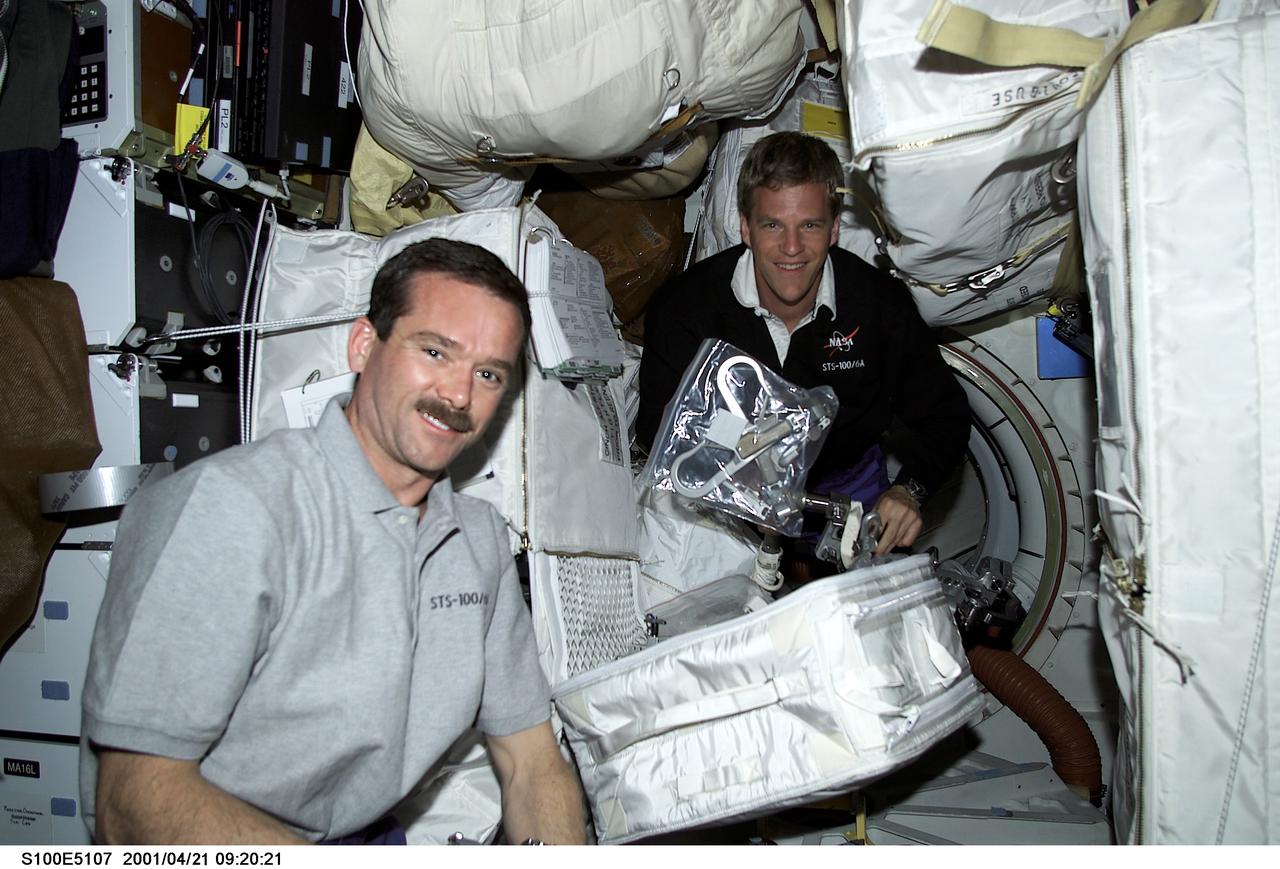
S100-E-5107 (21 April 2001) --- Astronauts Chris A. Hadfield (left) of the Canadian Space Agency and Scott E. Parazynski, both mission specialists, are seen on the middeck of the Space Shuttle Endeavour as the STS-100 crew anticipates its union with the International Space Station (ISS). Assigned space-walking astronauts Hadfield and Parazynski were later joined on the middeck by spacewalk coordinator John L. Phillips in conducting some final checks of the suits and hardware that are to be used during the next day's planned 6-hour, 30-minute spacewalk. The image was recorded with a digital still camera.
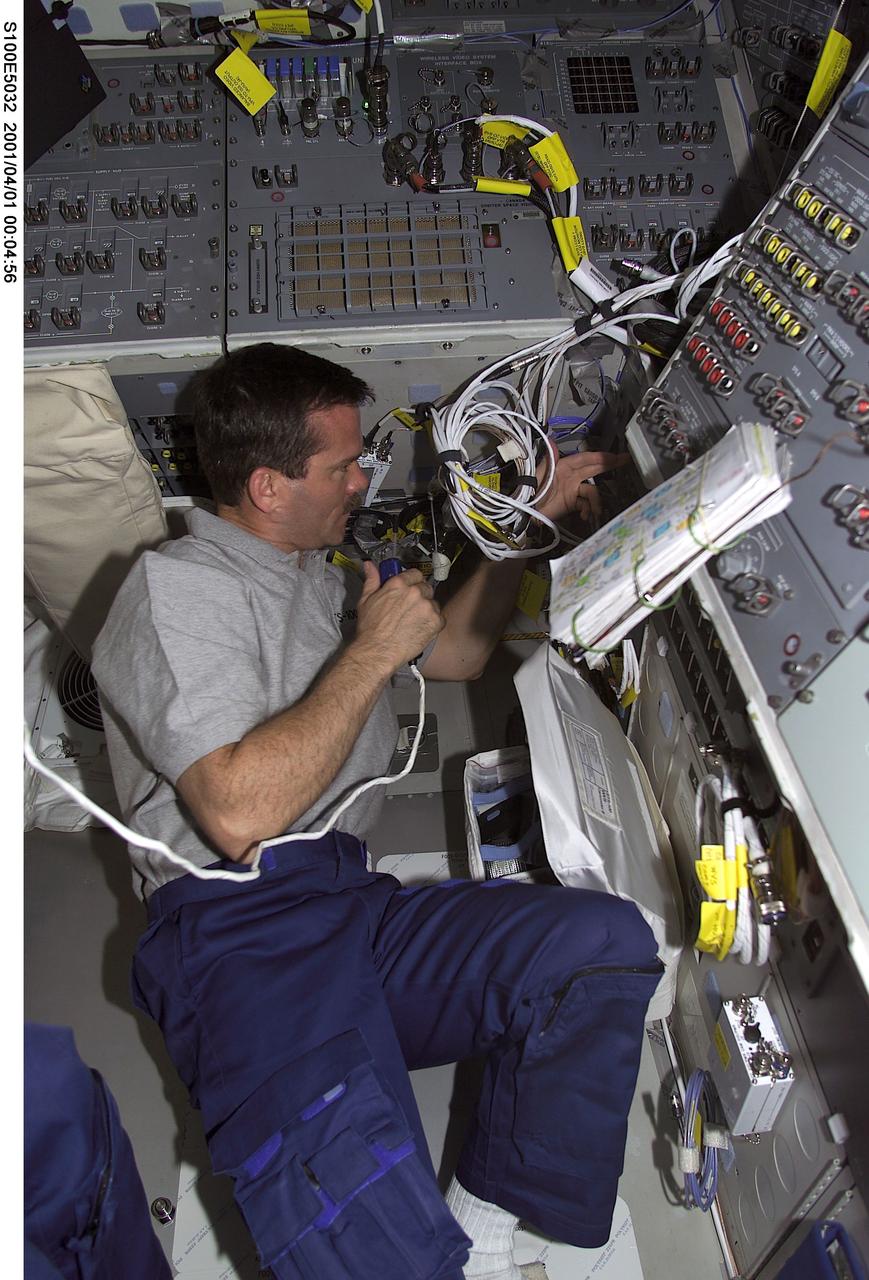
S100-E-5032 (20 April 2001) --- Astronaut Chris A. Hadfield, representing the Canadian Space Agency (CSA), is pictured on Endeavour's flight deck as the shuttle steadily makes its way toward the International Space Station (ISS) following an April 19 launch. Hadfield is checking out rendezvous and communications gear in preparation for an April 21 docking with the station. This image was recorded by a fellow crew member using a digital still camera.
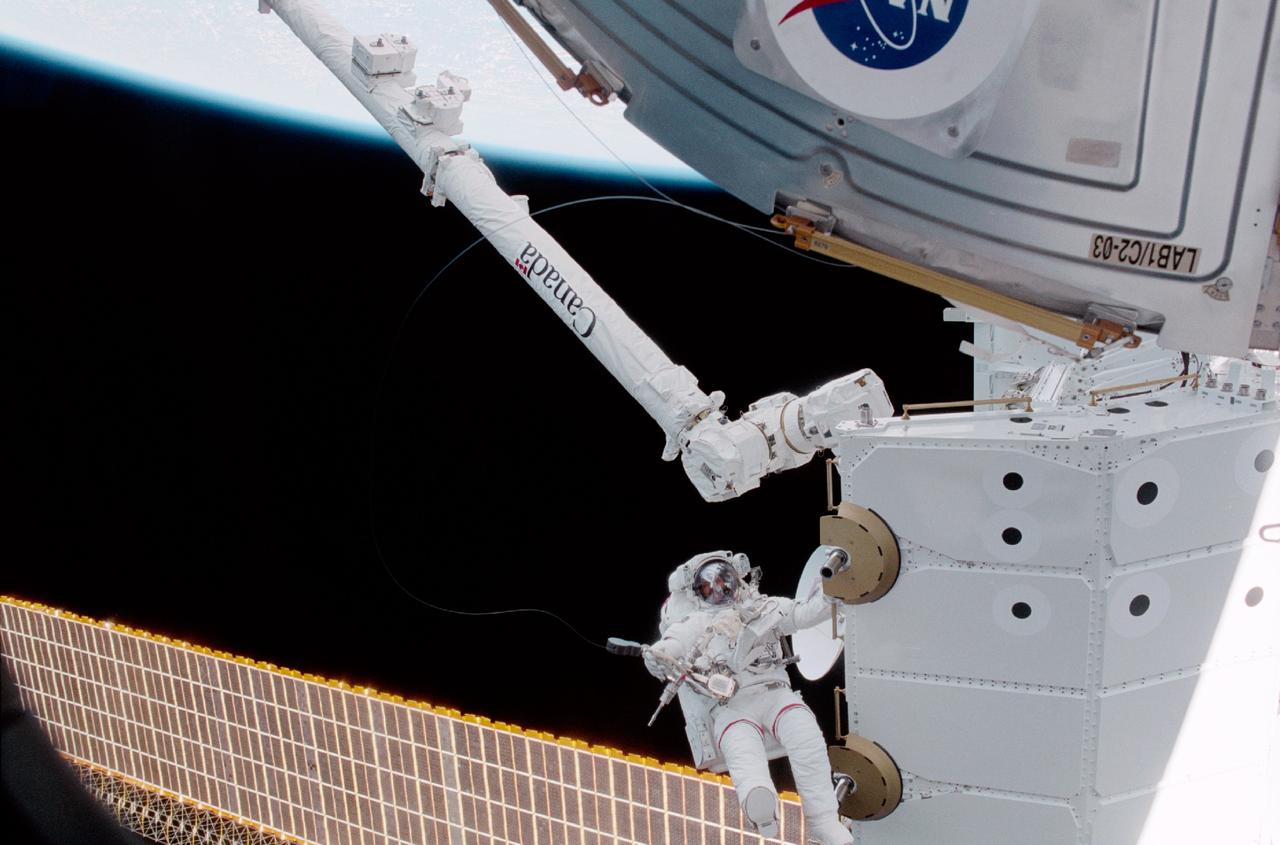
STS100-342-010 (19 April-1 May 2001) --- Astronaut Chris A. Hadfield, mission specialist representing the Canadian Space Agency (CSA), is seen near the Canadarm2 as the new robotics tool for the International Space Station (ISS) grasps the Spacelab pallet. Hadfield participated in two days of extravehicular activity (EVA) on the STS-100 mission.
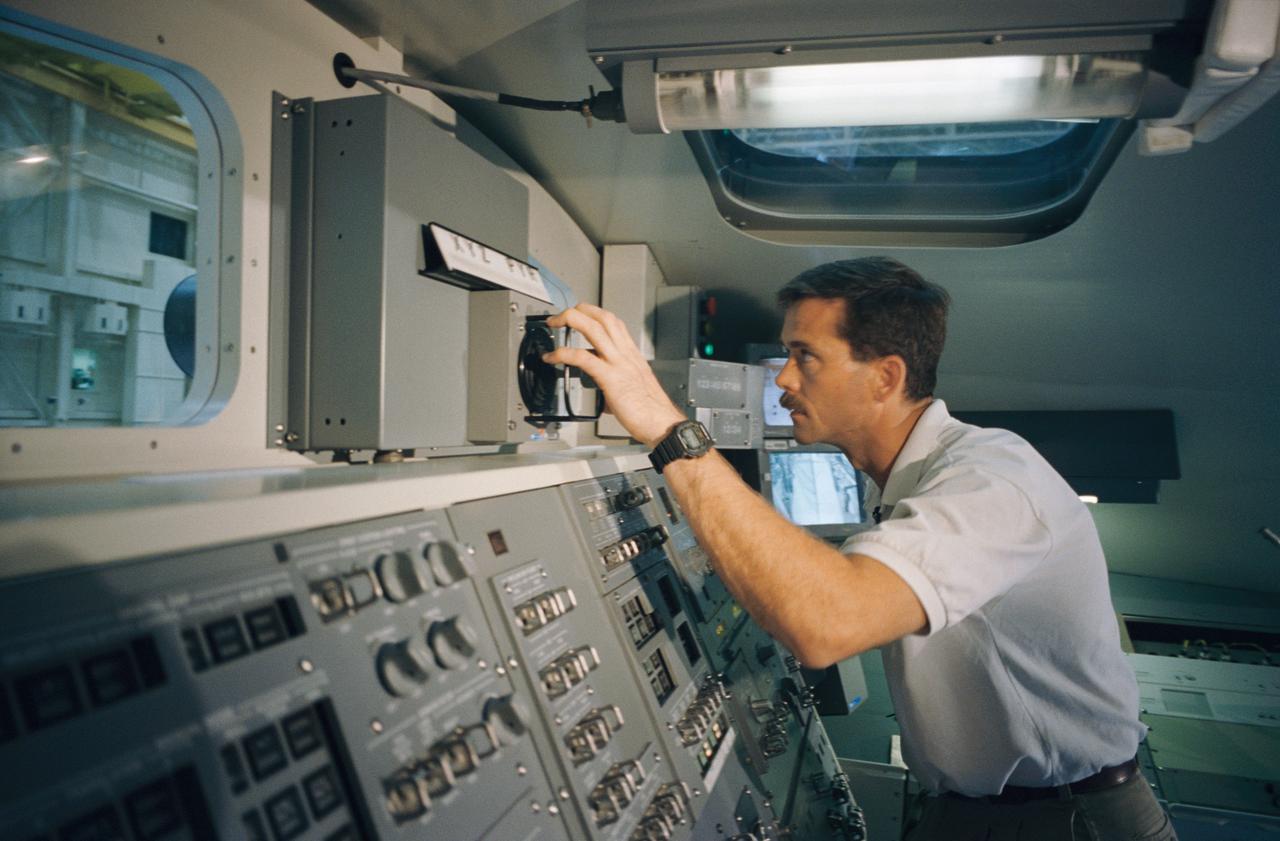
S95-12502 (8 June 1995) --- Astronaut Chris A. Hadfield, mission specialist representing the Canadian Space Agency (CSA), simulates controlling the Shuttle?s Canadian-built Remote Maneuvering System (RMS). Hadfield uses special training hardware known as the Manipulator Development Facility (MDF), located in the Systems Integration Facility at NASA?s Johnson Space Center (JSC).
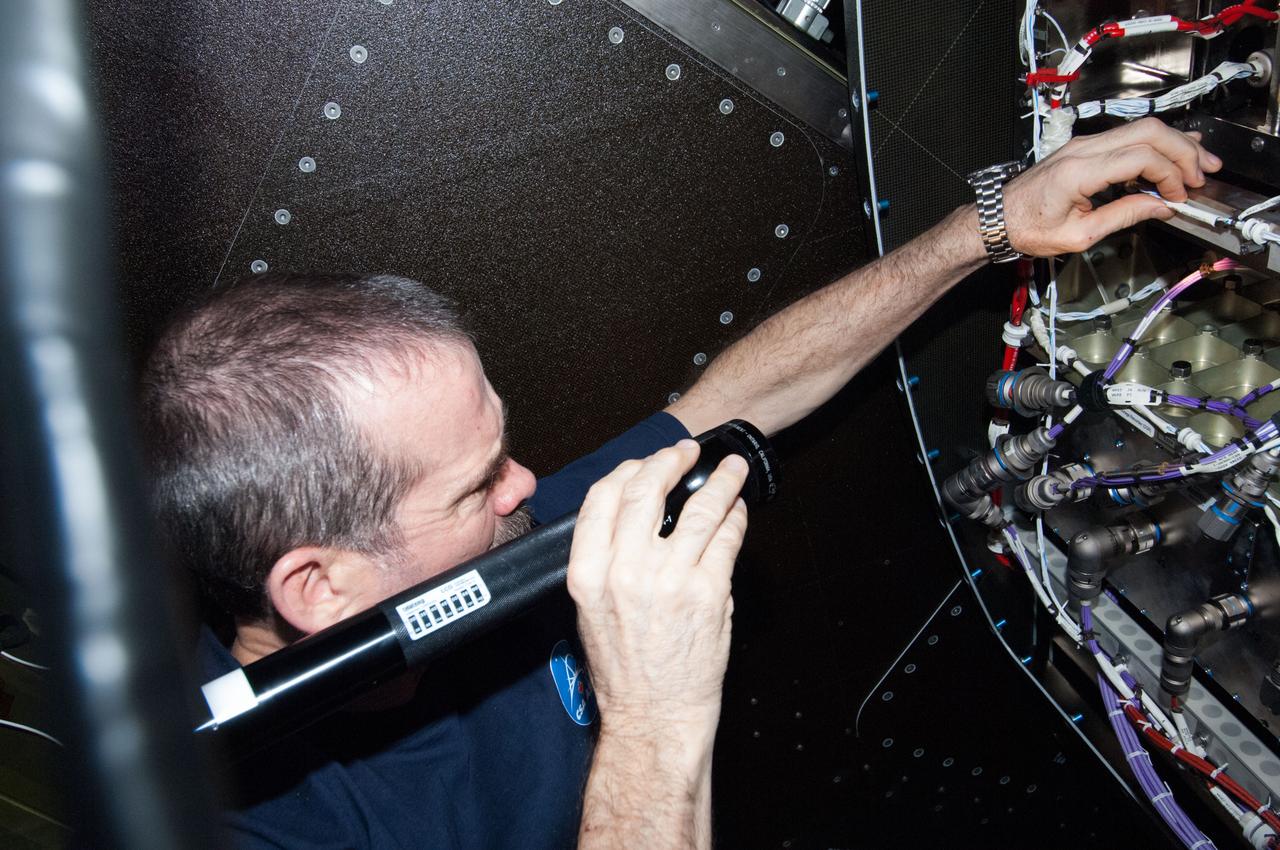
ISS035-E-018277 (11 April 2013) --- Expedition 35 Commander Chris Hadfield, astronaut with the Canadian Space Agency, installs the redundant Ku Communications 1 unit in Destiny to complete the refurbishment of the Ku system aboard the International Space Station. NASA astronaut Tom Marshburn (out of frame), Expedition 35 flight engineer, joined Hadfield for this work.
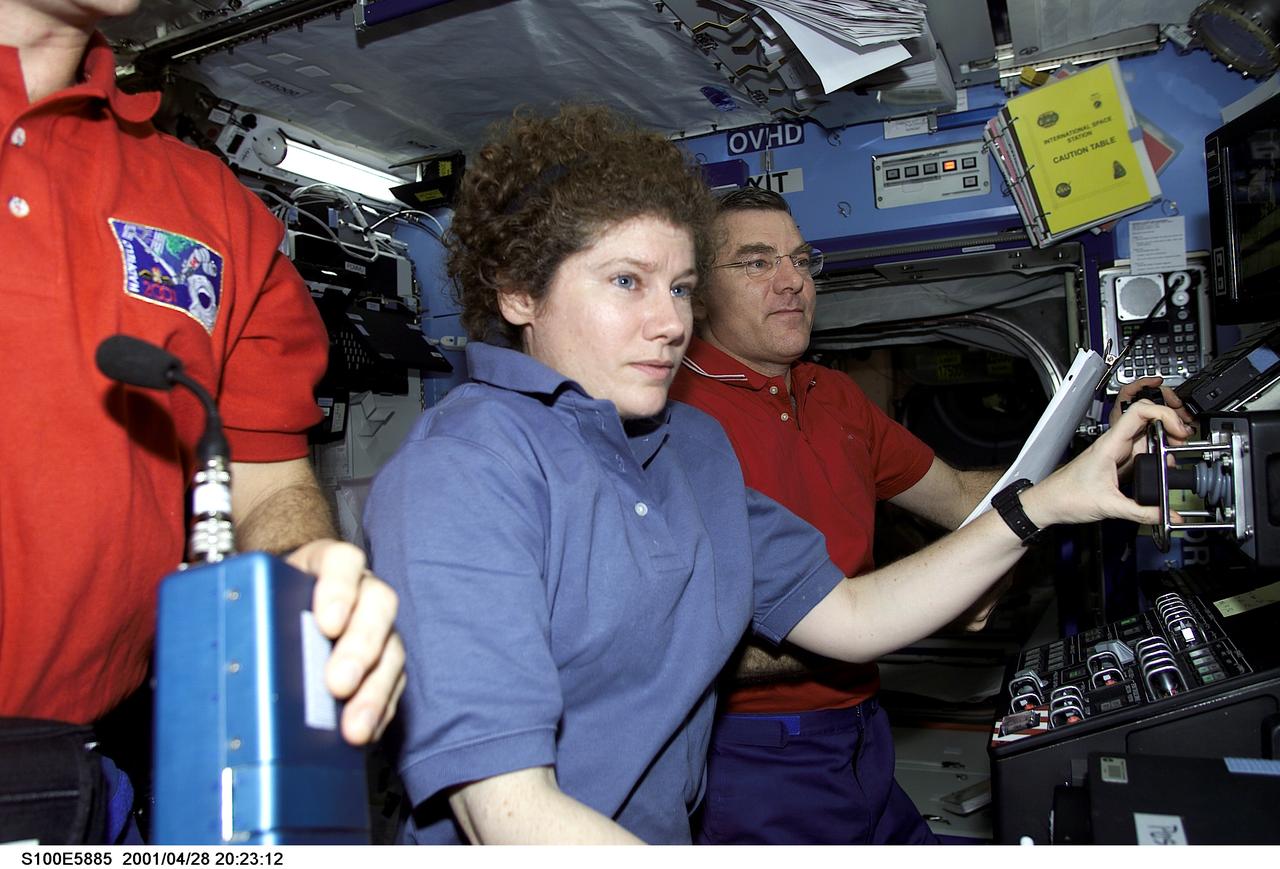
S100-E-5885 (28 April 2001) --- Some of the principal participants of an historical event are pictured in the Destiny laboratory aboard the International Space Station (ISS). From left to right are astronauts Chris A. Hadfield (partially out of frame), STS-100 mission specialist, and astronauts Susan J. Helms and James S. Voss, Expedition Two flight engineers. A Canadian “handshake in space” occurred at 4:02 p.m (CDT), April 28, 2001, as the Canadian-built space station robotic arm – operated by Helms – transferred its launch cradle over to Endeavour’s robotic arm, with Canadian Space Agency astronaut Hadfield at the controls. In this scene, Hadfield has temporarily vacated his post on Endeavour's aft flight deck and was having a brief strategy meeting with the Expedition Two crew on the docked station. The exchange of the pallet from station arm to shuttle arm marked the first ever robotic-to-robotic transfer in space. This image was recorded with a digital still camera.
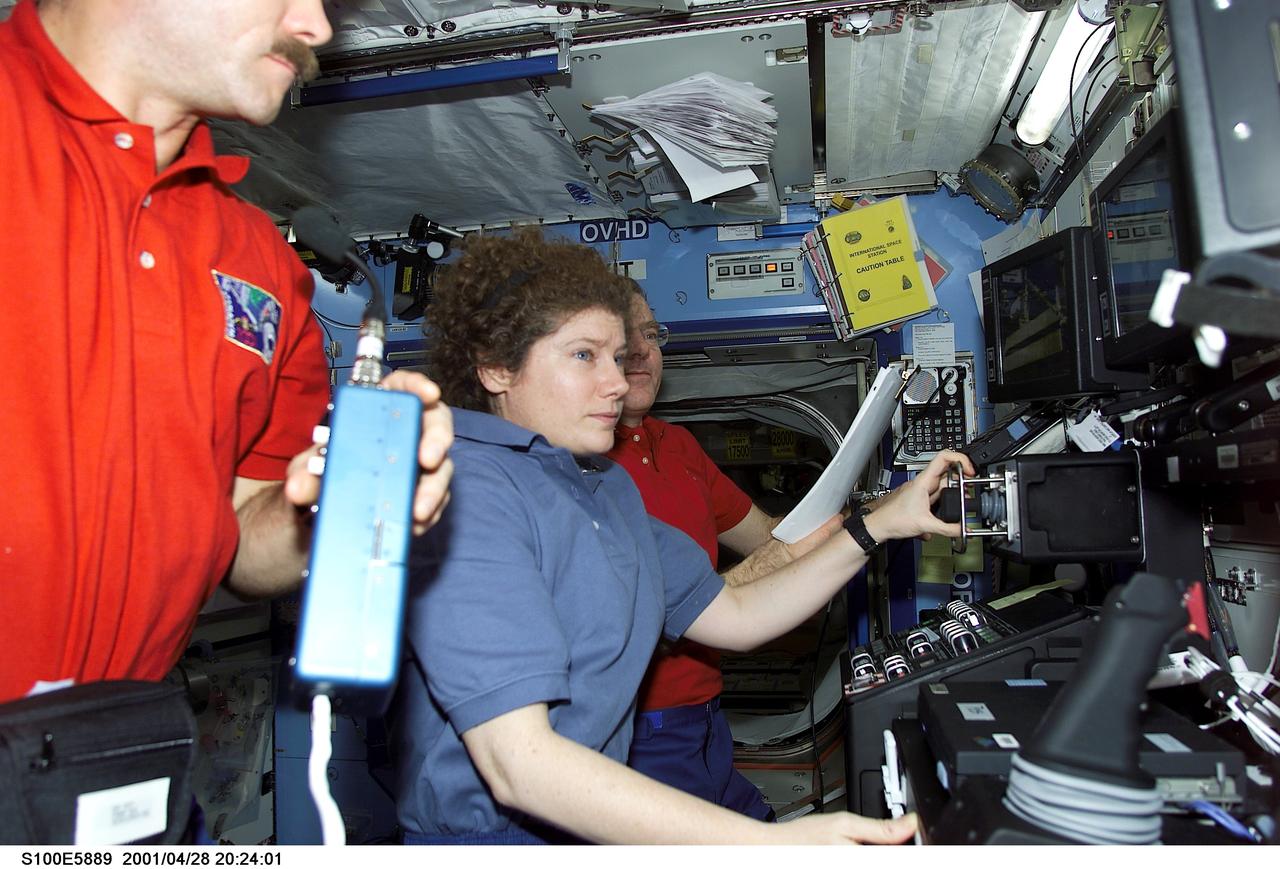
S100-E-5889 (28 April 2001) --- Two of the principal participants of an historical event are pictured in the Destiny laboratory aboard the International Space Station (ISS). Pictured are astronauts Chris A. Hadfield (partially out of frame), STS-100 mission specialist, and astronaut Susan J. Helms, flight engineer for Expedition Two. Astronaut James S. Voss, Expedition Two flight engineer, is in the background. A Canadian “handshake in space” occurred at 4:02 p.m (CDT), April 28, 2001, as the Canadian-built space station robotic arm – operated by Helms – transferred its launch cradle over to Endeavour’s robotic arm, with Canadian Space Agency astronaut Hadfield at the controls. In this scene, Hadfield has temporarily vacated his post on Endeavour's aft flight deck and was having a brief strategy meeting with Helms on the docked station. The exchange of the pallet from station arm to shuttle arm marked the first ever robotic-to-robotic transfer in space. This image was recorded with a digital still camera.
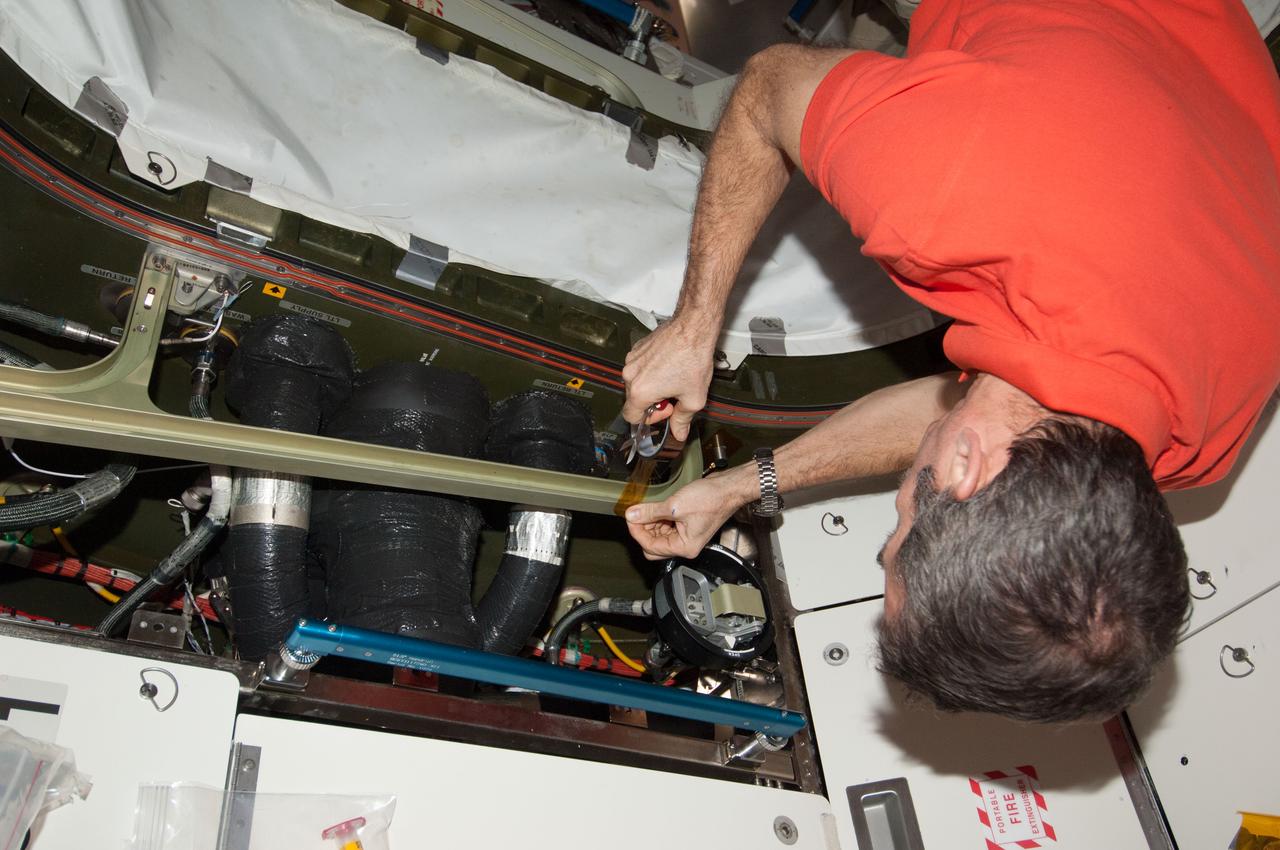
ISS034-E-037330 (31 Jan. 2013) --- Canadian Space Agency astronaut Chris Hadfield, Expedition 34 flight engineer, installs a Ultra-Sonic Background Noise Tests (UBNT) sensor kit behind a rack in the Destiny of the International Space Station.
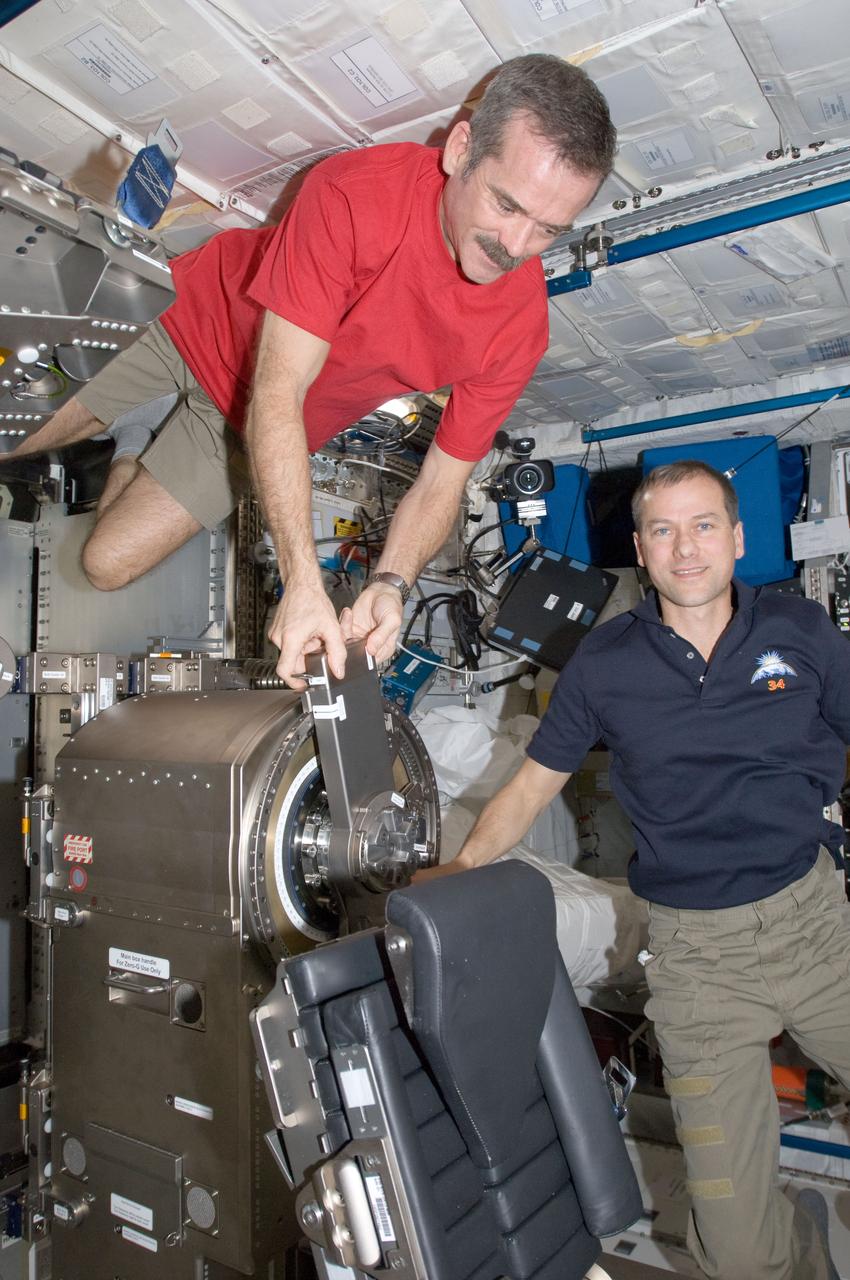
ISS034-E-014618 (3 Jan. 2013) --- Canadian Space Agency astronaut Chris Hadfield (left) and NASA astronaut Tom Marshburn, both Expedition 34 flight engineers, work with Muscle Atrophy Resistive Exercise System (MARES) hardware in the Columbus laboratory of the International Space Station.
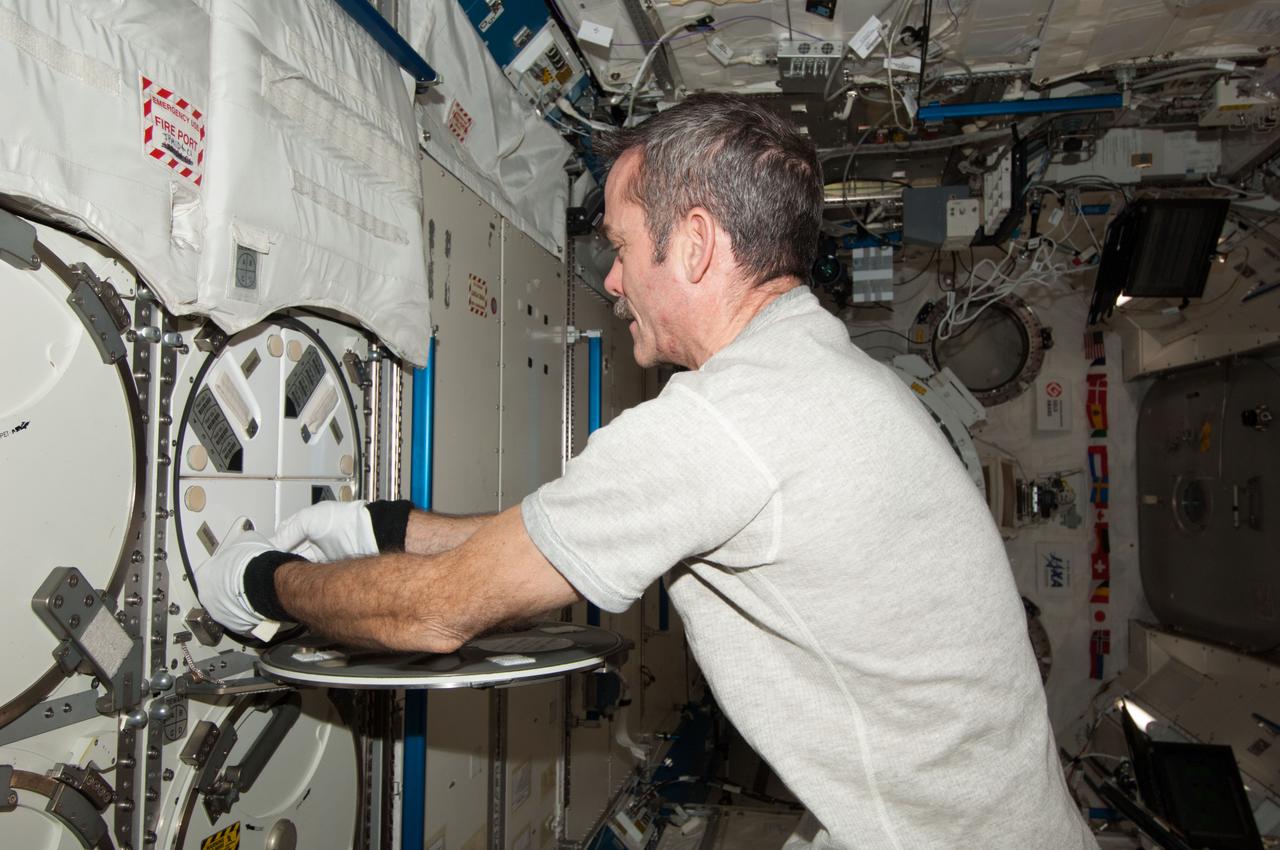
ISS034-E-023771 (7 Jan. 2013) --- Canadian Space Agency astronaut Chris Hadfield, Expedition 34 flight engineer, prepares to insert biological samples in the Minus Eighty Laboratory Freezer for ISS (MELFI-1) in the Kibo laboratory of the International Space Station.
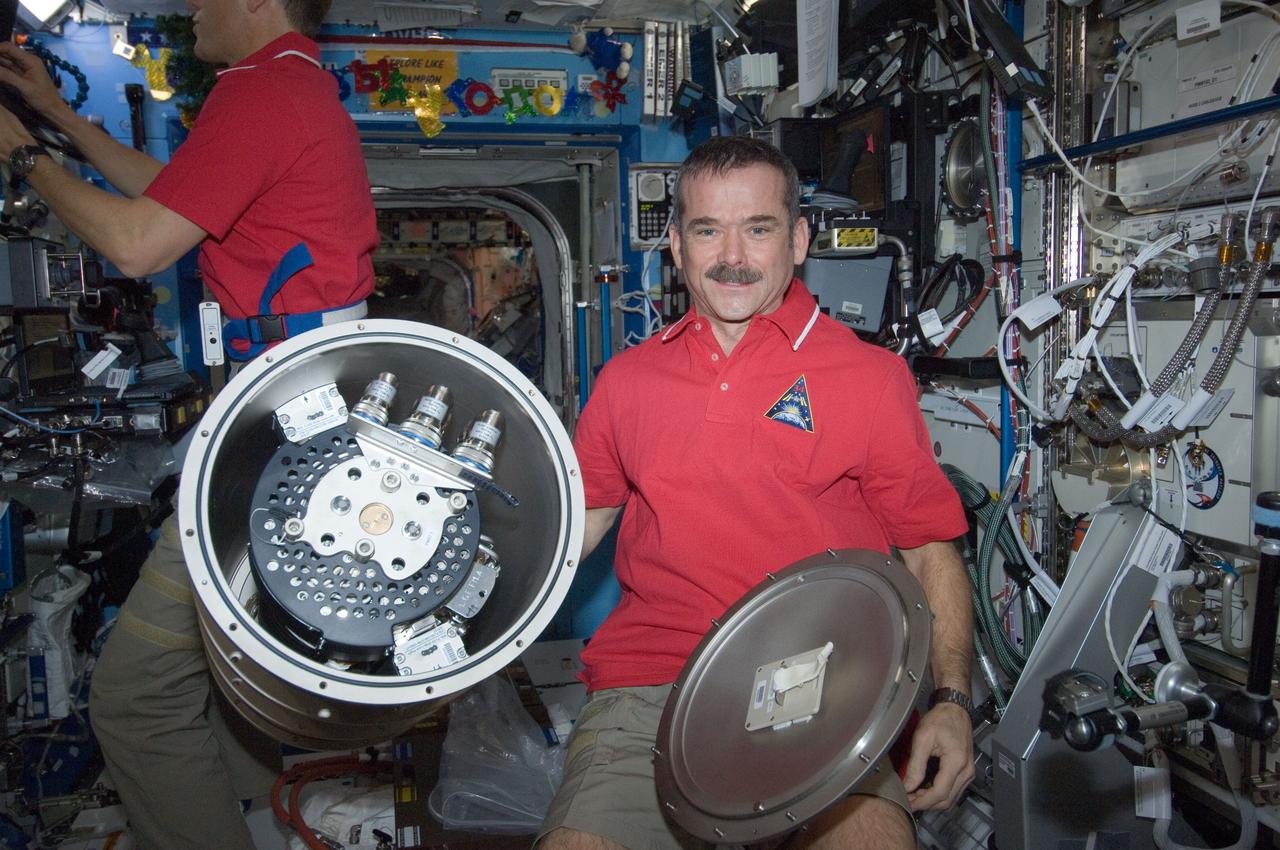
View of Canada Space Agency (CSA) Chris Hadfield, Expedition 34 Flight Engineer (FE), poses with a Materials Science Laboratory (MSL) Furnace Launch Support Structure (FLSS) in the U.S. Laboratory. Tom Marshburn (background), Expedition 34 FE uses laptop computer. Photo was taken during Expedition 34.
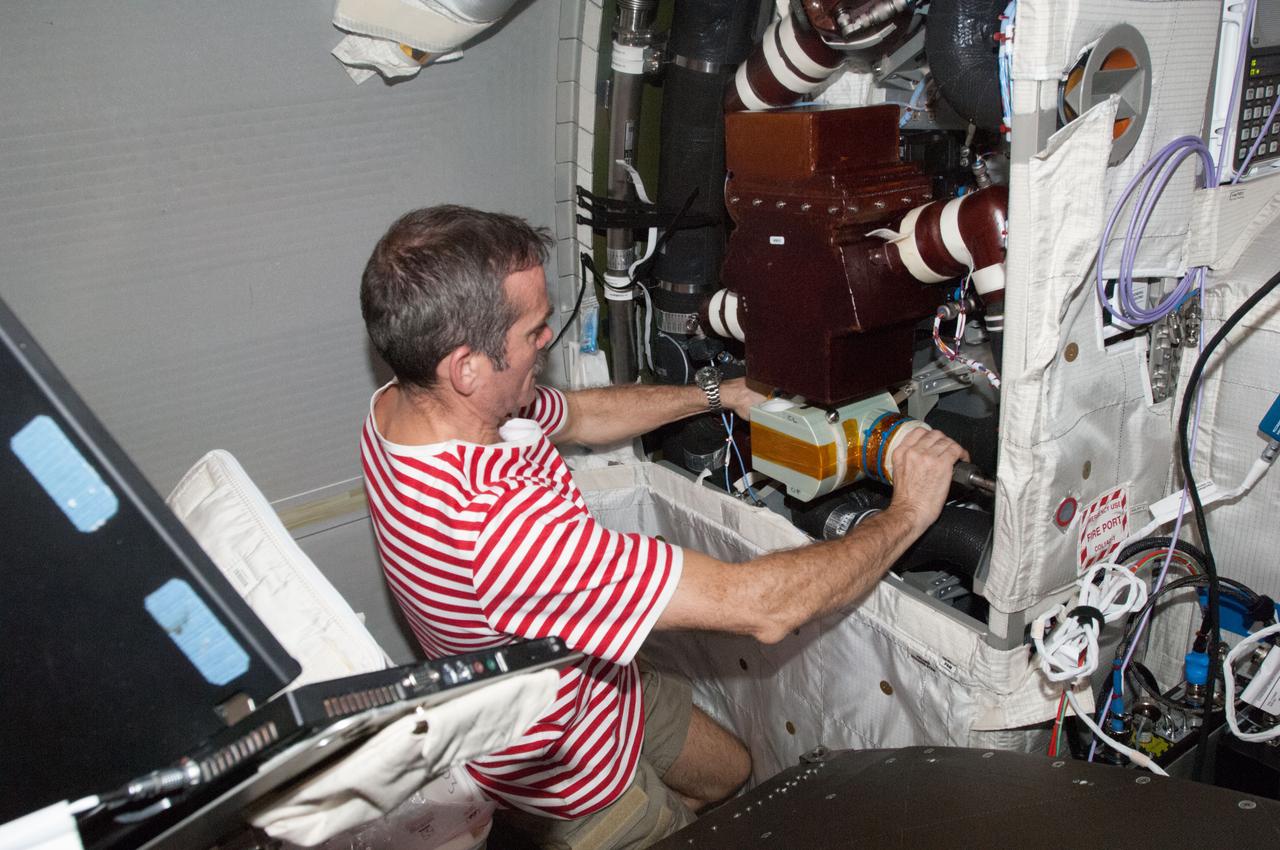
ISS034-E-031766 (18 Jan. 2013) --- Canadian Space Agency astronaut Chris Hadfield, Expedition 34 flight engineer, removes the Water Temporary Substitution Manifold (WTSM) and installs the Water On-Off Valve (WOOV) in the Columbus laboratory of the International Space Station.
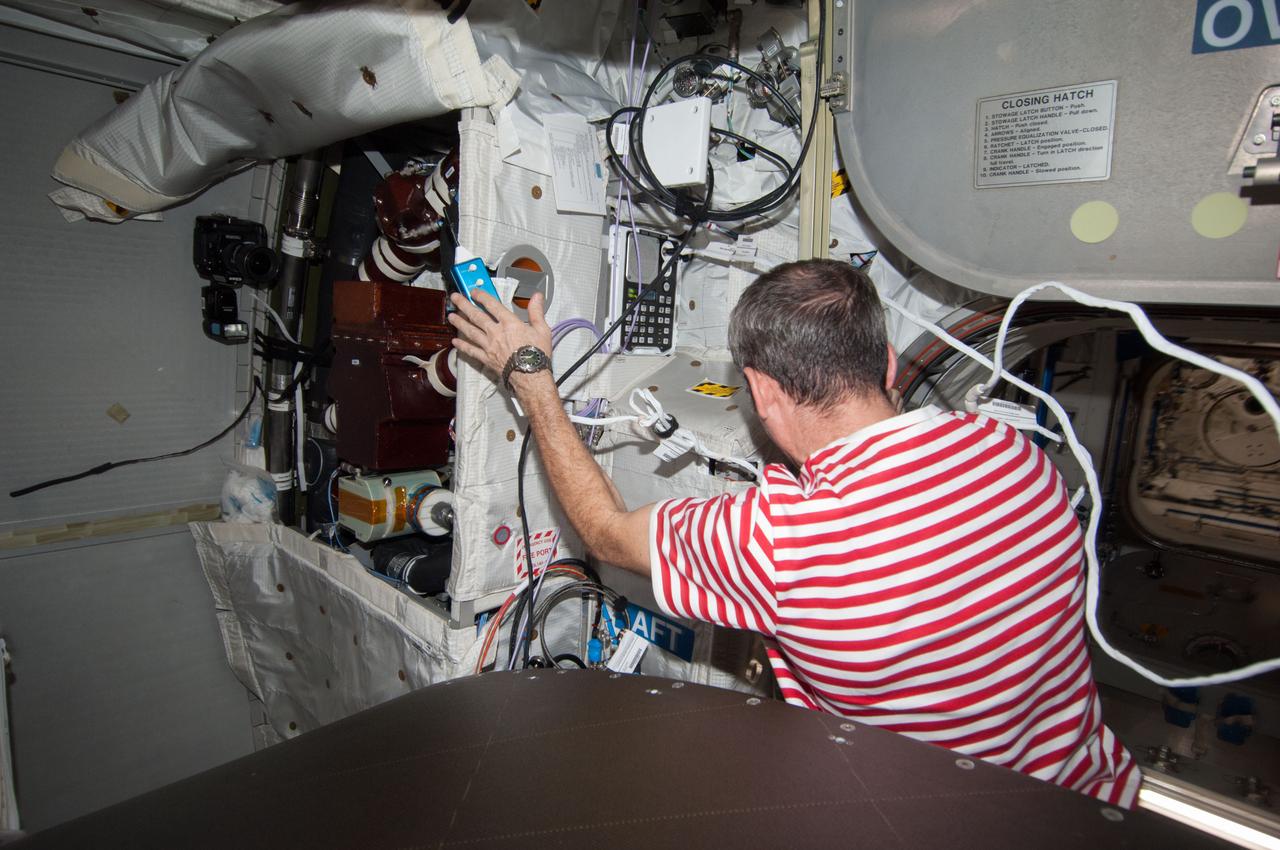
ISS034-E-031578 (18 Jan. 2013) --- Canadian Space Agency astronaut Chris Hadfield, Expedition 34 flight engineer, removes the Water Temporary Substitution Manifold (WTSM) and installs the Water On-Off Valve (WOOV) in the Columbus laboratory of the International Space Station.
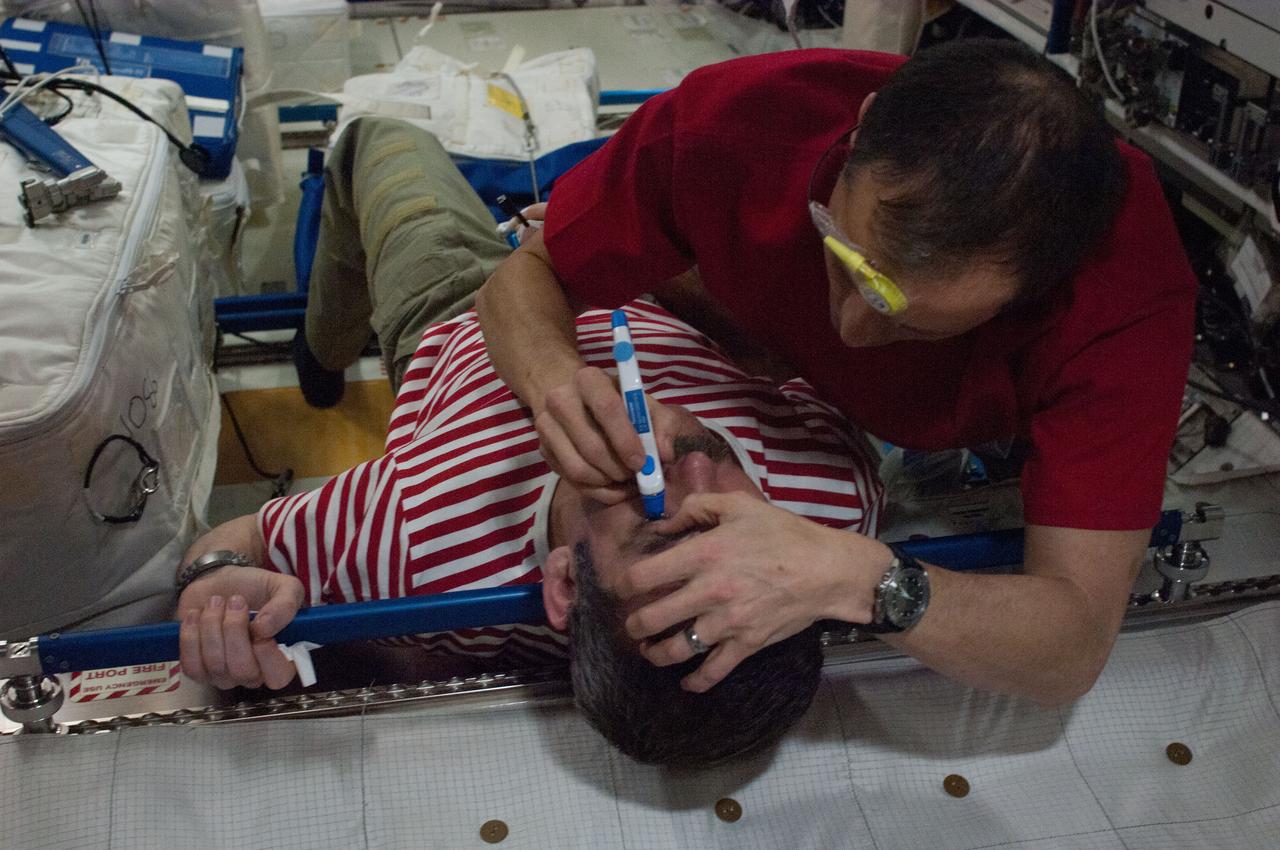
ISS034-E-035949 (21 Jan. 2013) --- NASA astronaut Tom Marshburn (right), Expedition 34 flight engineer, performs a Tonometry eye exam on Canadian Space Agency astronaut Chris Hadfield, flight engineer, in the Columbus laboratory of the International Space Station. The purpose of this exam is to measure intraocular eye pressure.
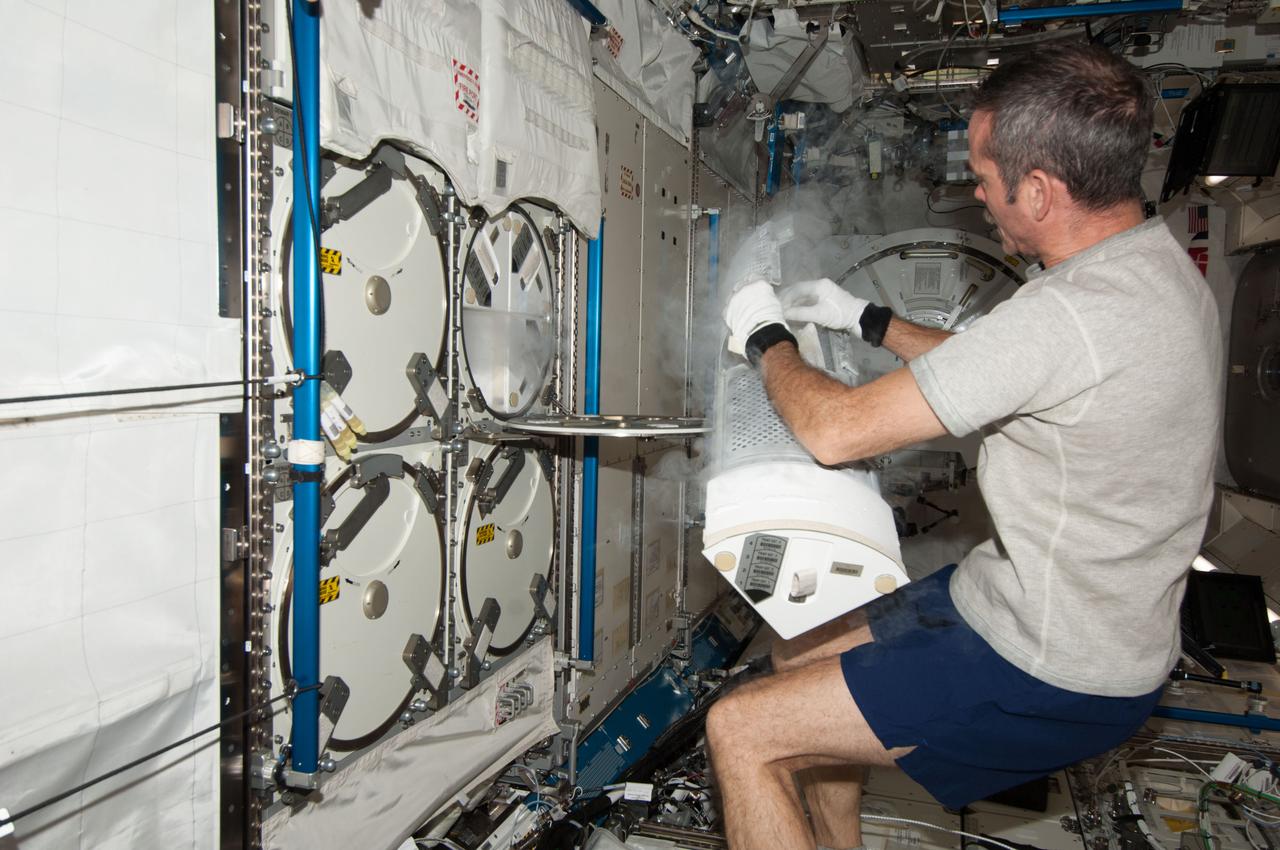
View of Canadian Space Agency (CSA) Chris Hadfield,Expedition 34 Flight Engineer (FE),preparing to insert biological samples in the Minus Eighty Laboratory Freezer for International Space Station (ISS) - (MELFI-1),in the Japanese Experiment Module (JEM) Pressurized Module (JPM). Photo was taken during Expedition 34.
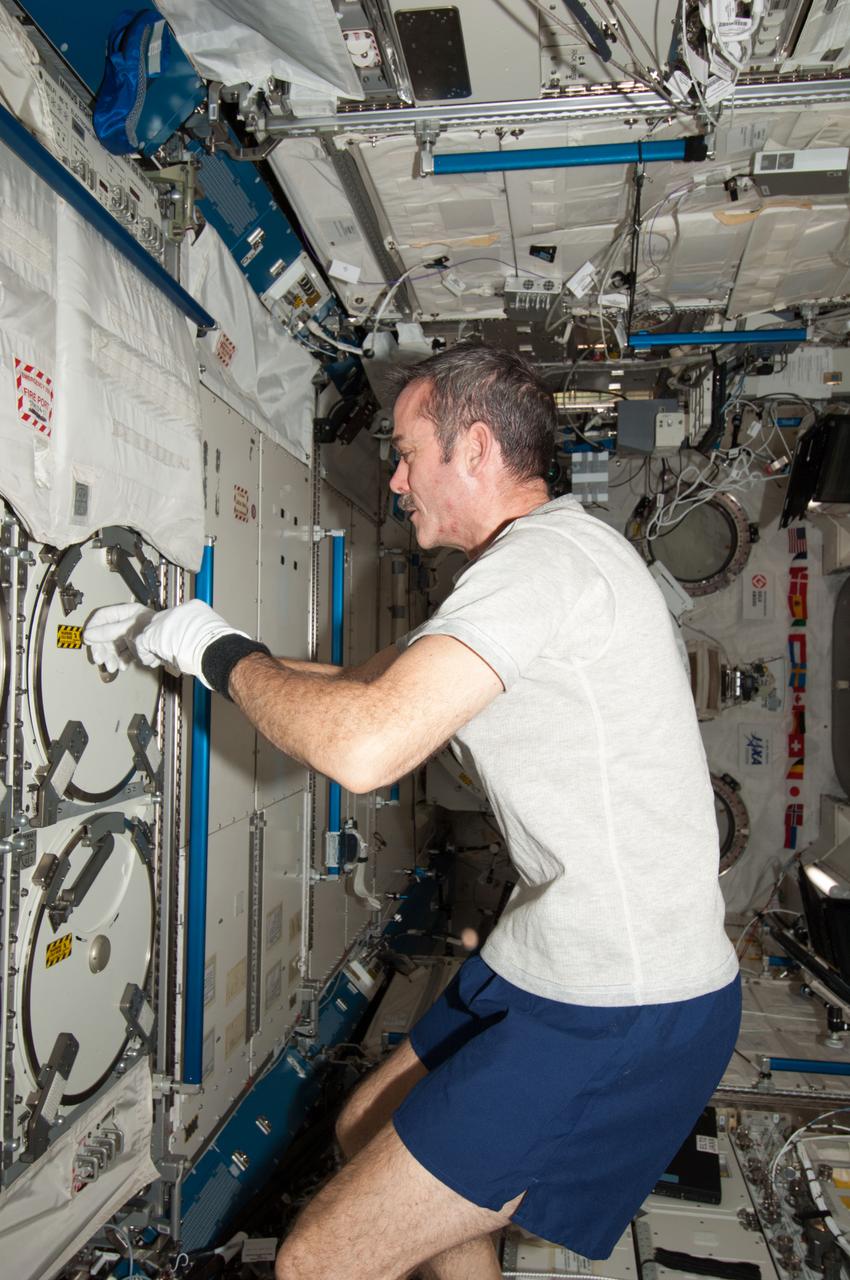
ISS034-E-023768 (7 Jan. 2013) --- Canadian Space Agency astronaut Chris Hadfield, Expedition 34 flight engineer, prepares to insert biological samples in the Minus Eighty Laboratory Freezer for ISS (MELFI-1) in the Kibo laboratory of the International Space Station.
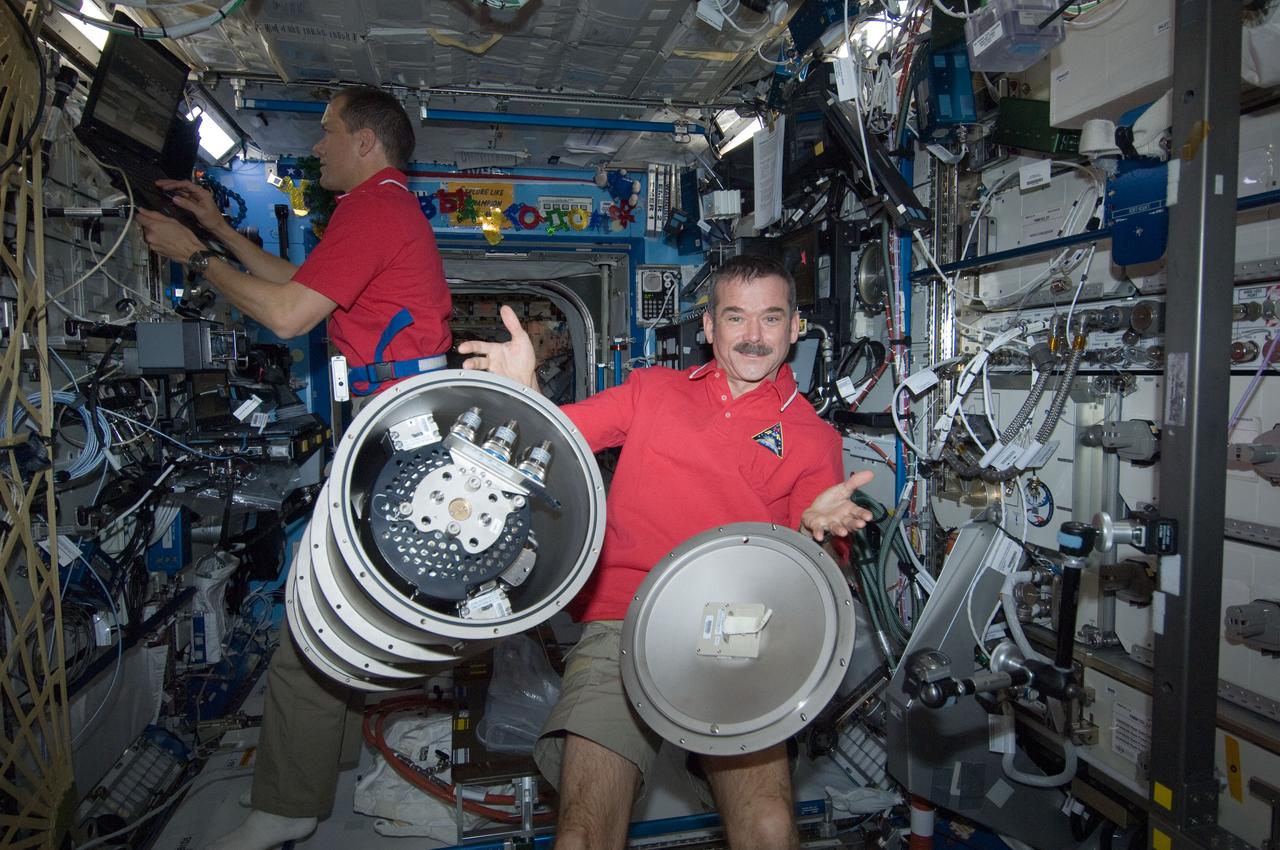
ISS034-E-010603 (28 Dec. 2012) --- Canadian Space Agency astronaut Chris Hadfield, Expedition 34 flight engineer, poses with a Materials Science Laboratory (MSL) Furnace Launch Support Structure (FLSS) in the Destiny laboratory of the International Space Station. NASA astronaut Tom Marshburn, flight engineer, uses a computer in the background.
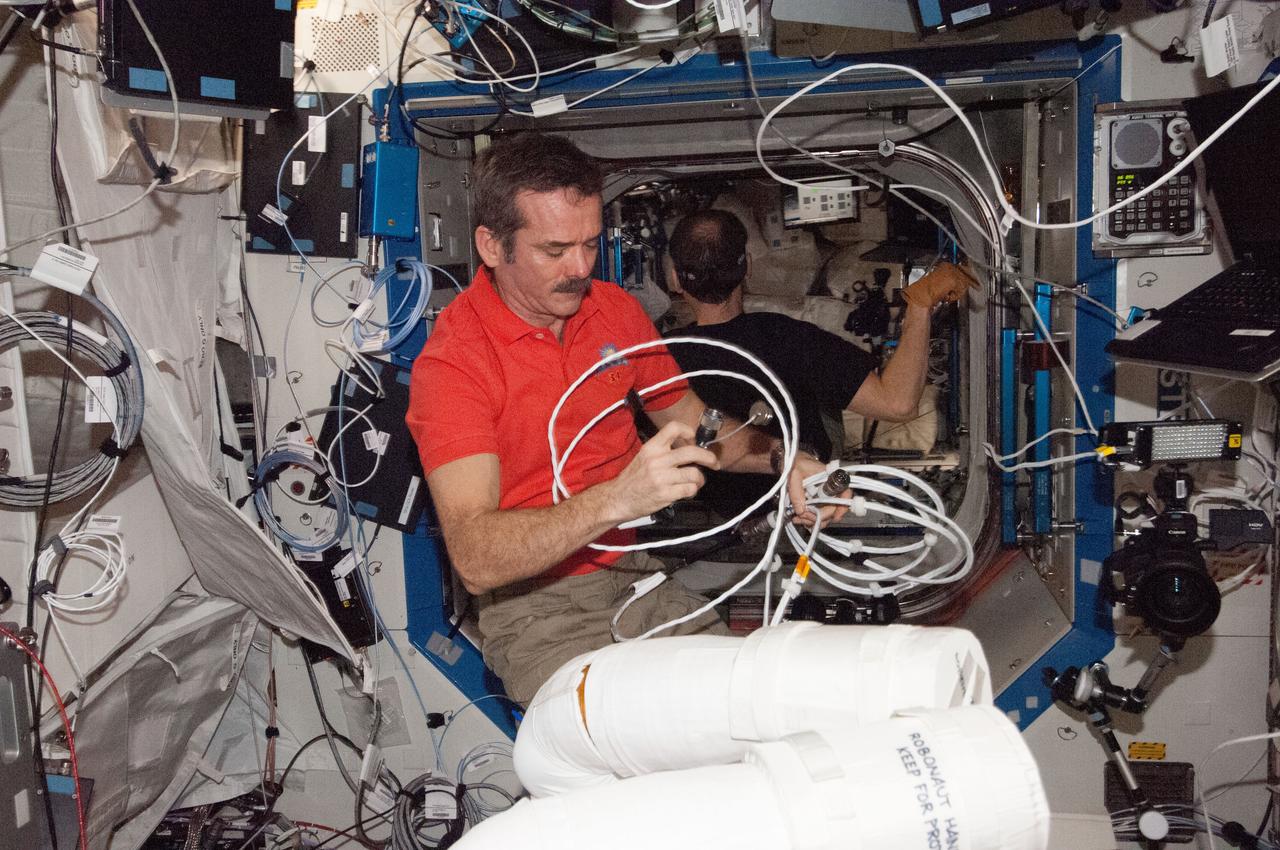
ISS034-E-037342 (31 Jan. 2013) --- Canadian Space Agency astronaut Chris Hadfield, Expedition 34 flight engineer, works with Robonaut 2 hardware in the Destiny laboratory of the International Space Station. R2’s arms are visible at bottom.
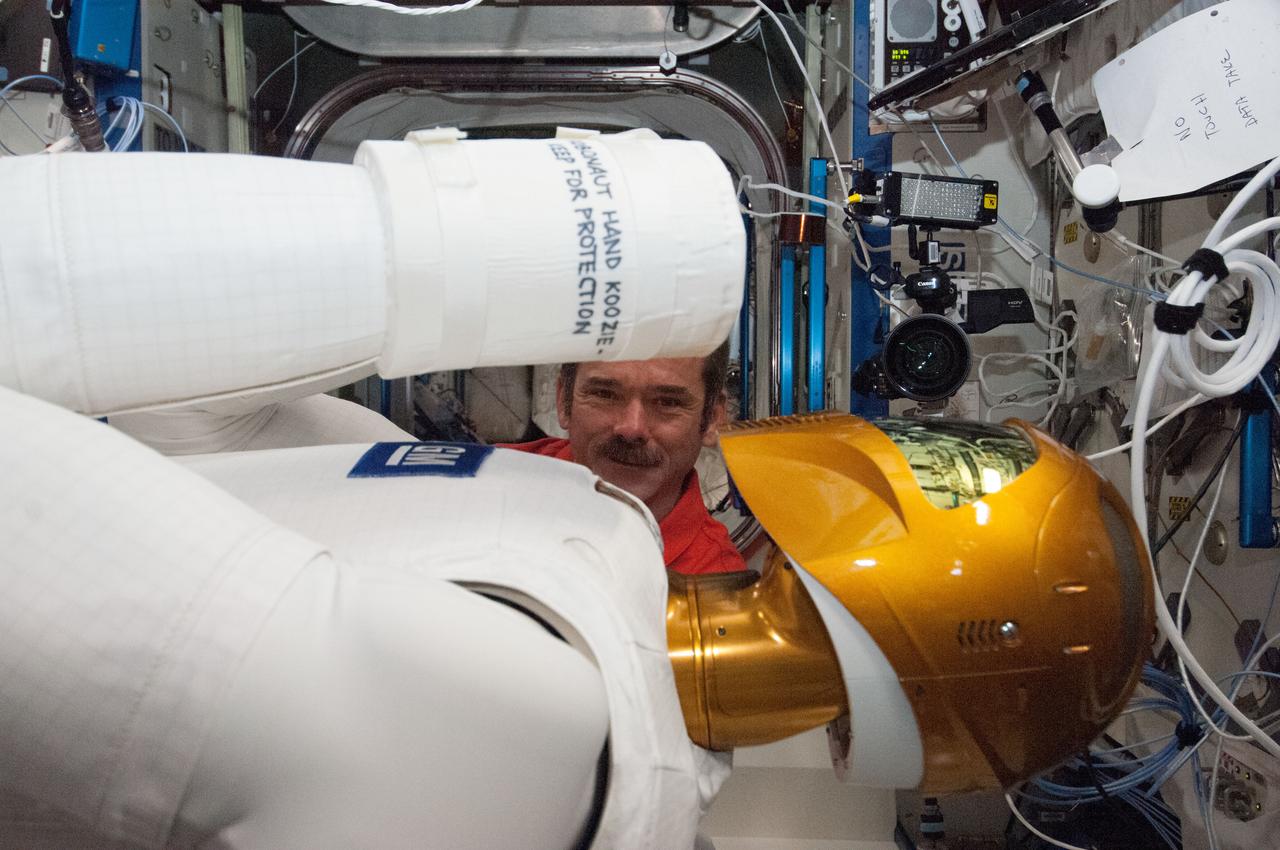
ISS034-E-037345 (31 Jan. 2013) --- Canadian Space Agency astronaut Chris Hadfield, Expedition 34 flight engineer, works with Robonaut 2, the first humanoid robot in space, in the International Space Station’s Destiny laboratory. R2 was powered up so ground controllers could run it through a series of tests and configuration checks.
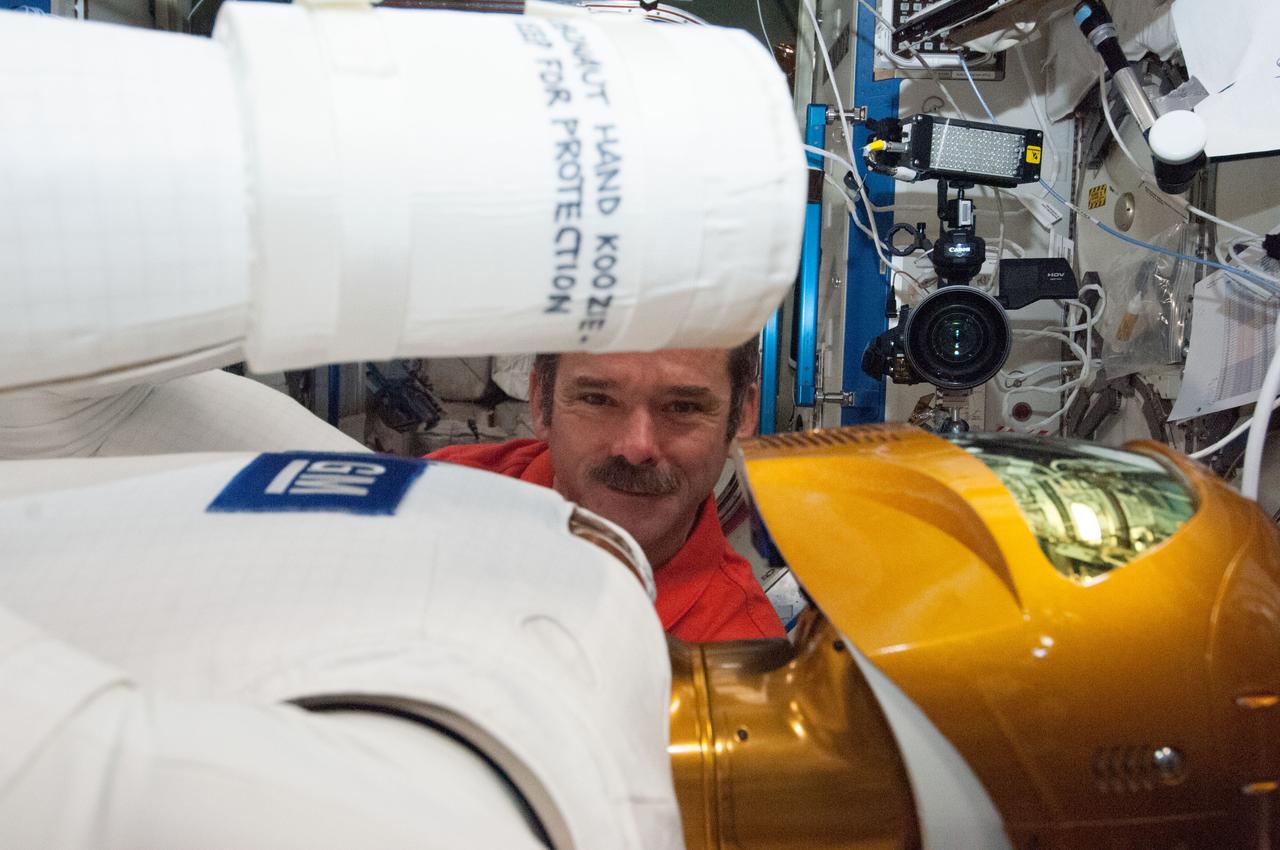
ISS034-E-037346 (31 Jan. 2013) --- Canadian Space Agency astronaut Chris Hadfield, Expedition 34 flight engineer, works with Robonaut 2, the first humanoid robot in space, in the International Space Station’s Destiny laboratory. R2 was powered up so ground controllers could run it through a series of tests and configuration checks.
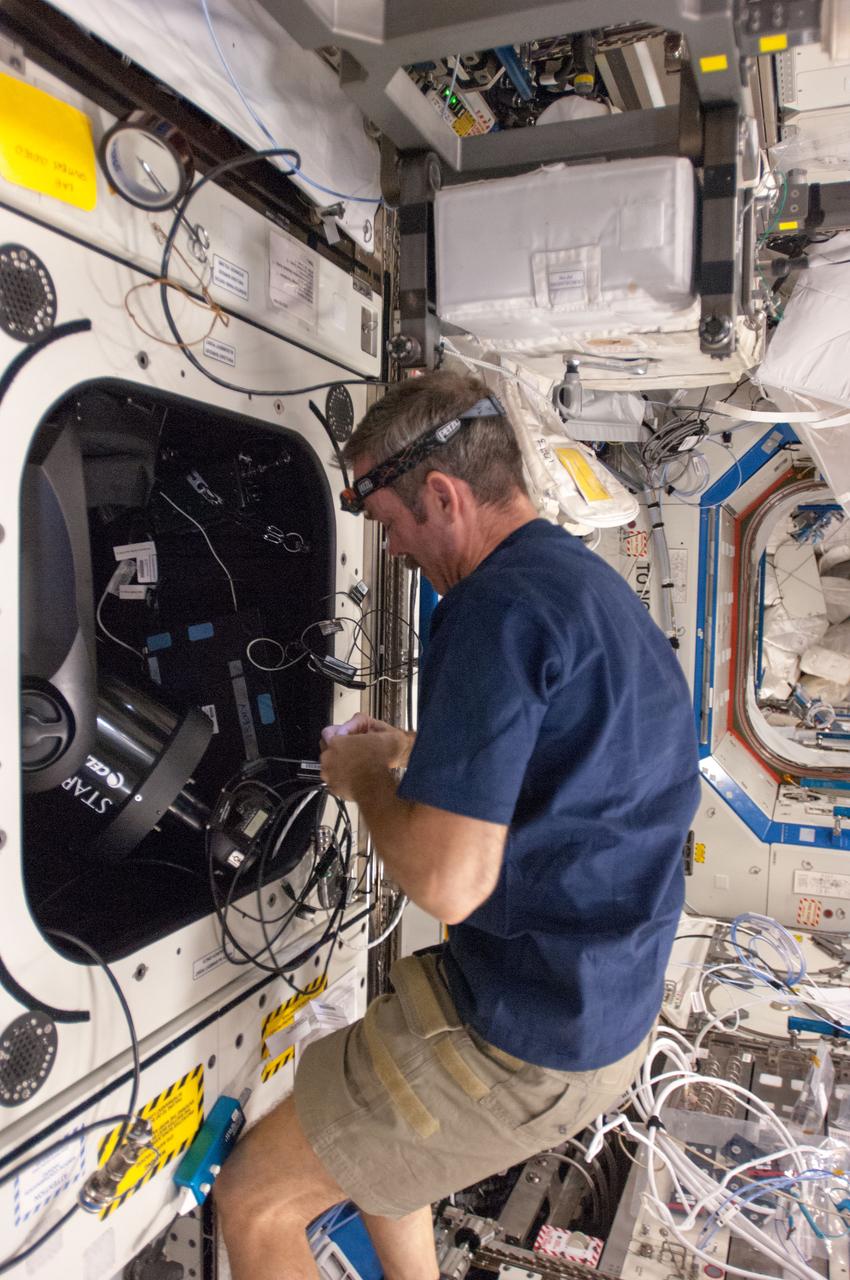
ISS034-E-029975 (15 Jan. 2013) --- Canadian Space Agency astronaut Chris Hadfield, Expedition 34 flight engineer, sets up the ISS SERVIR Environmental Research and Visualization System (ISERV) in the Destiny laboratory of the International Space Station. ISERV is a fully automated image data acquisition system that flies aboard the space station and deploys in the Window Observational Research Facility (WORF) rack within Destiny. The study is expected to provide useful images for use in disaster monitoring and assessment and environmental decision making.
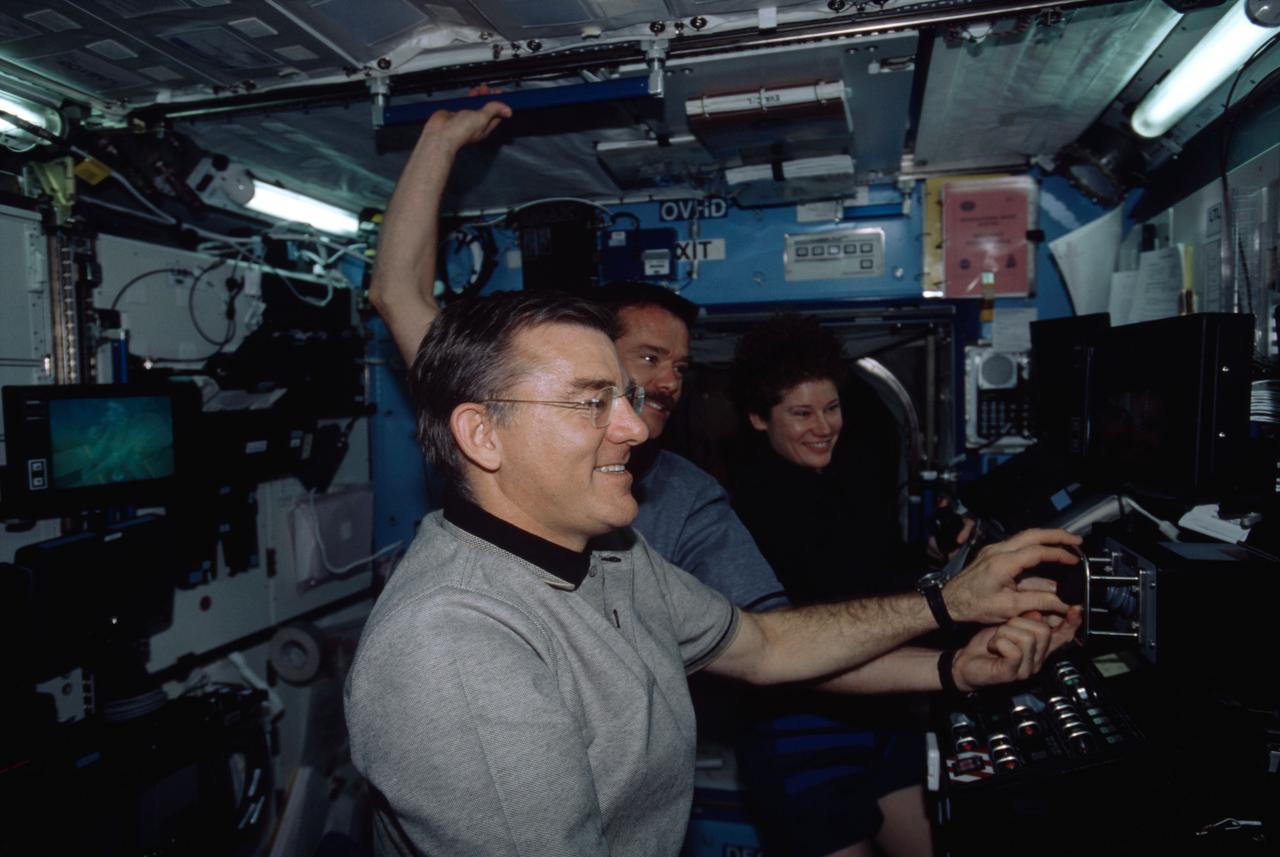
ISS002-303-036 (28 April 2001) --- Some of the principal participants of an historical event are pictured in the Destiny laboratory aboard the International Space Station (ISS). In the foreground is astronaut James S. Voss, with astronaut Chris A. Hadfield, STS-100 mission specialist, at center, and astronaut Susan J. Helms in the background. Voss and Helms are Expedition Two flight engineers. A Canadian "handshake in space" occurred at 4:02 p.m (CDT), April 28, 2001, as the Canadian-built space station robotic arm -- operated by Helms -- transferred its launch cradle over to Endeavour's robotic arm, with Canadian Space Agency astronaut Hadfield at the controls. In this scene, Hadfield had temporarily vacated his post on Endeavour's aft flight deck and was having a brief strategy meeting with the Expedition Two crew on the docked station. The exchange of the pallet from station arm to shuttle arm marked the first ever robotic-to-robotic transfer in space.
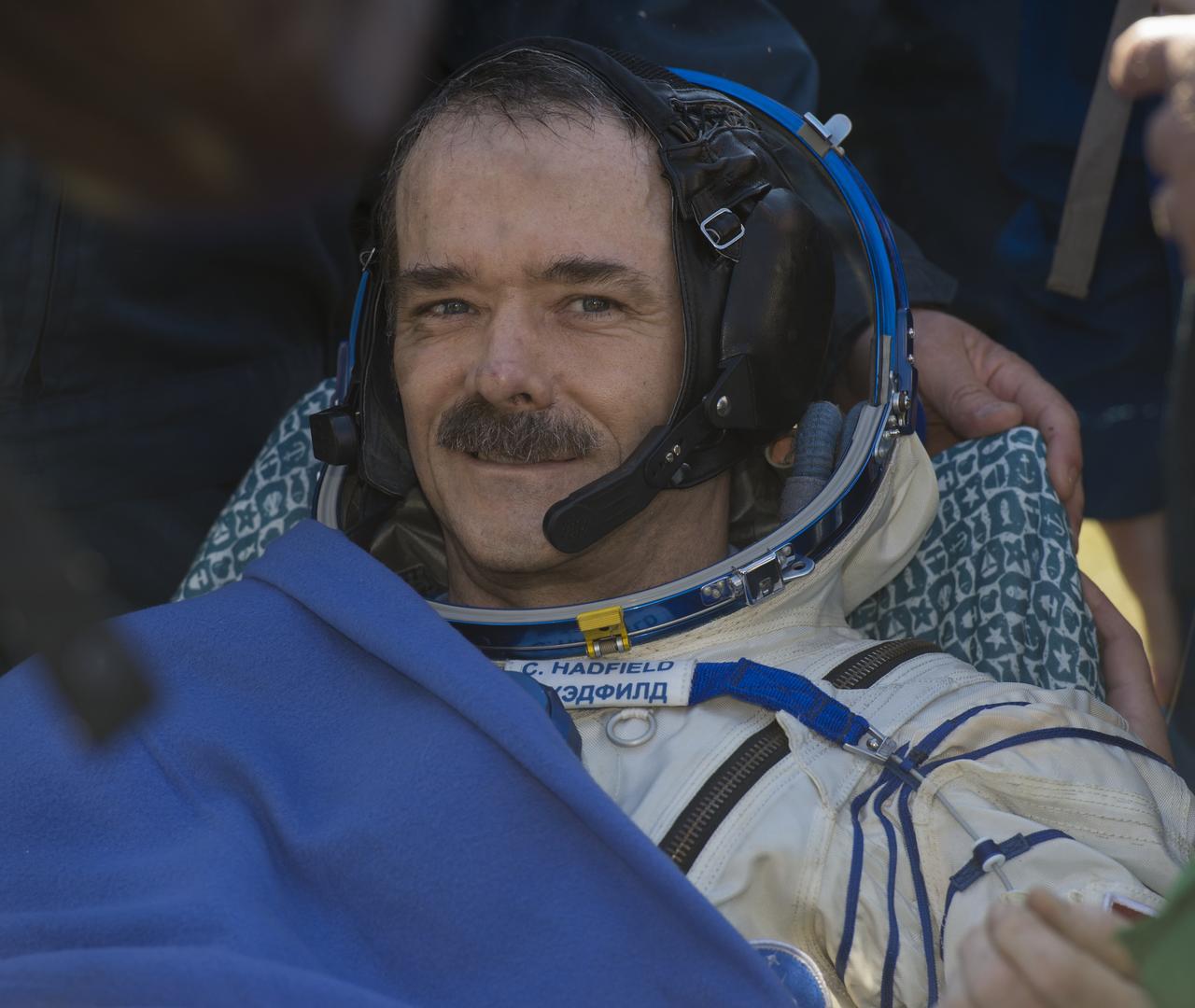
Expedition 35 Commander Chris Hadfield of the Canadian Space Agency (CSA) smiles as he rests outside of the Soyuz TMA-07M spacecraft shortly after the capsule landed with NASA Flight Engineer Tom Marshburn and Russian Flight Engineer Roman Romanenko in a remote area outside of the town of Zhezkazgan, Kazakhstan on Tuesday, May 14, 2013. Hadfield, Marshburn and Romanenko are returning from five months onboard the International Space Station where they served as members of the Expedition 34 and 35 crews. Photo Credit: (NASA/Carla Cioffi)
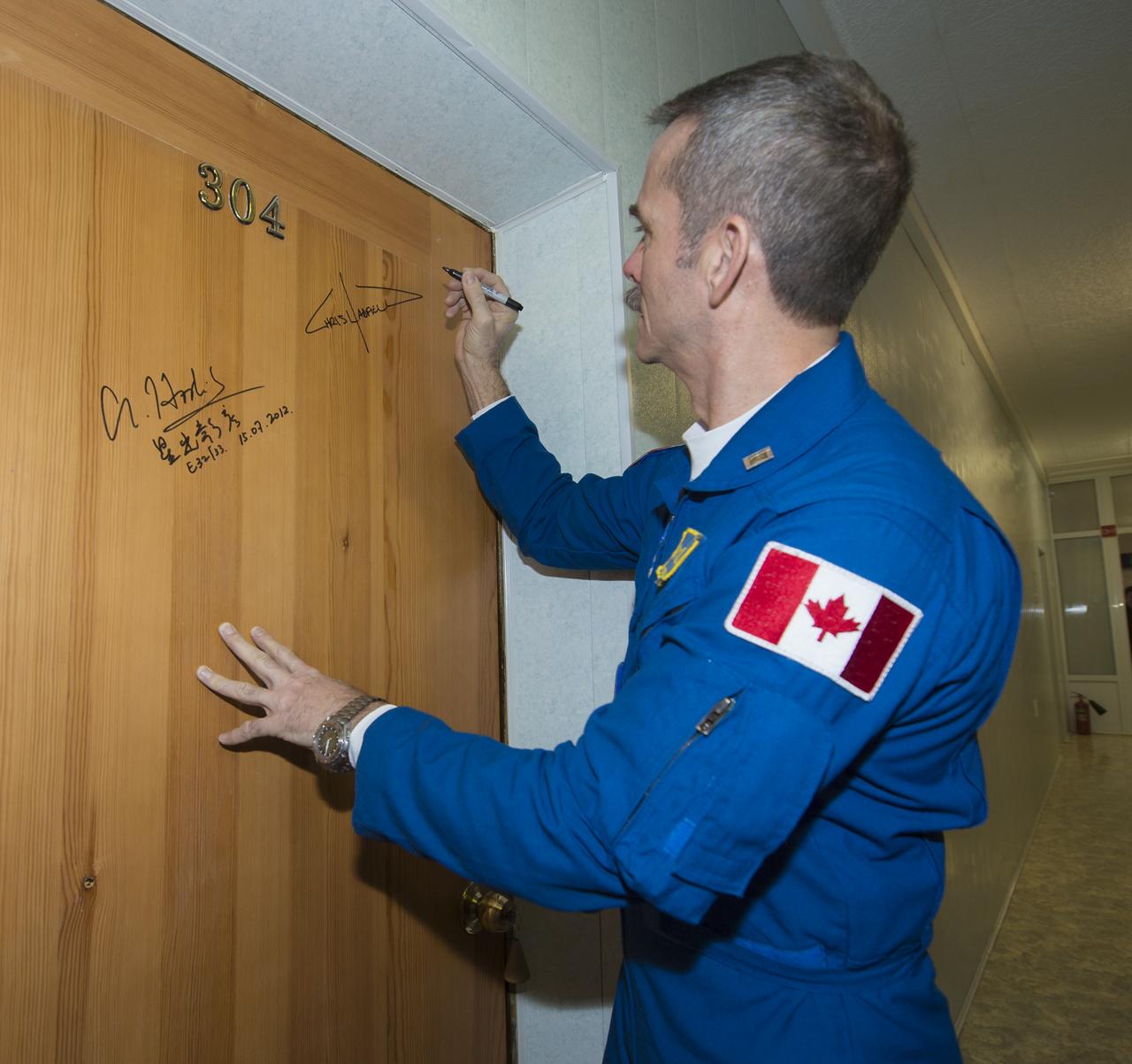
Expedition 34/35 Flight Engineer and Expedition 35 ISS Commander Chris Hadfield, of the Canadian Space Agency (CSA), performs the traditional door signing before he and fellow cremates, Flight Engineer Tom Marshburn, and Soyuz Commander Roman Romanenko depart the Cosmonaut Hotel for their Soyuz launch to the International Space Station on Wednesday, Dec. 19, 2012, in Baikonur, Kazakhstan. Launch of the Soyuz rocket will send Hadfield, Romanenko and Marshburn on a five-month mission aboard the International Space Station. Photo Credit: (NASA/Carla Cioffi)
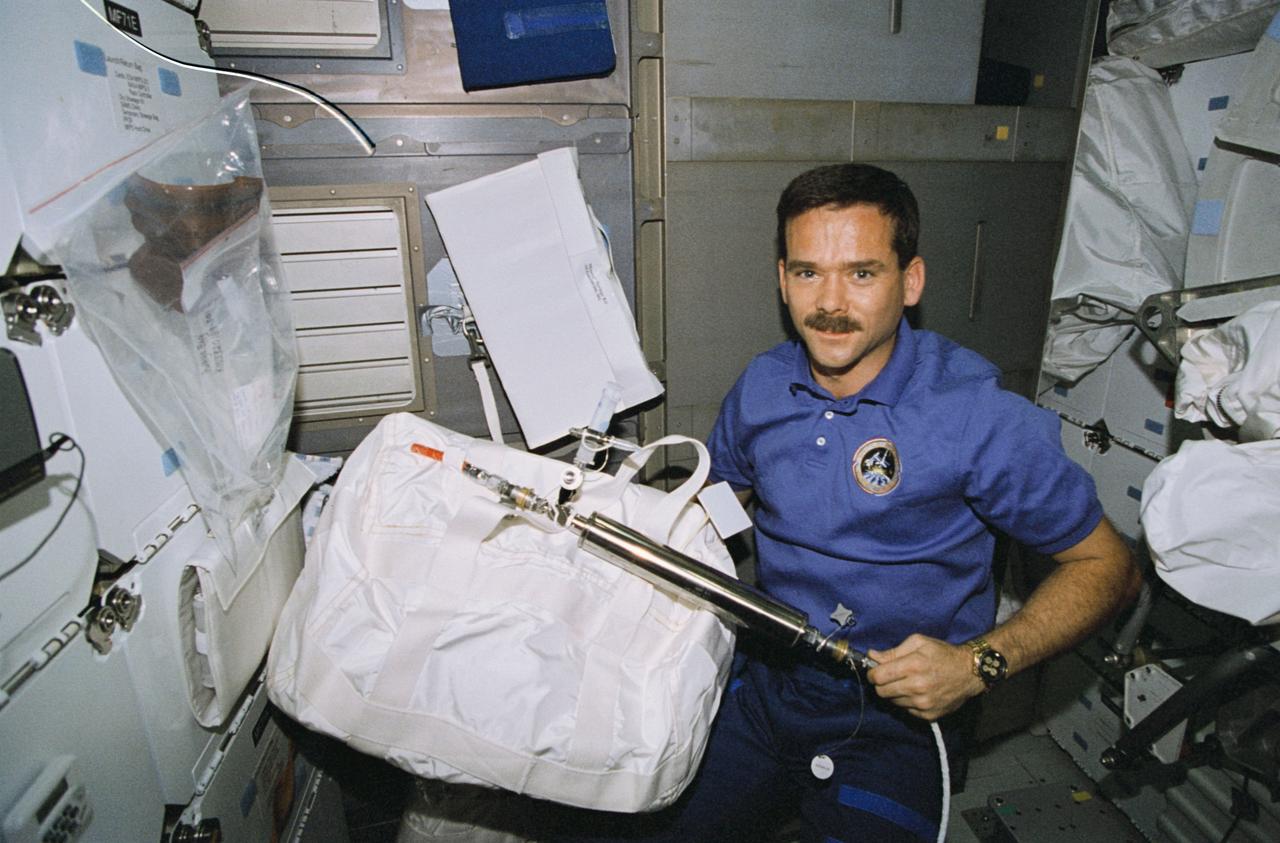
STS074-363-028 (12-20 Nov 1995) --- Canadian astronaut Chris A. Hadfield is seen with a microgravity water production system on the middeck of the Space Shuttle Atlantis. He is filling a fresh water supply bag for Russia?s Mir Space Station. With five NASA astronauts aboard, the flight of the Space Shuttle Atlantis began with a November 12, 1995, launch from Kennedy Space Center (KSC) and ended with landing there on November 20, 1995. The STS-74 crew members were astronauts Kenneth D. Cameron, mission commander; James D. Halsell Jr., pilot; William S. McArthur Jr., Jerry L. Ross and Hadfield, all mission specialists. On November 15, 1995, the Space Shuttle Atlantis docked with the Mir Space Station, on which the STS-74 astronauts joined the Mir-20 crew. The Mir-20 crew is composed of cosmonauts Yuriy P. Gidzenko, commander; and Sergei V. Avdeyev, flight engineer; along with the European Space Agency?s (ESA) Thomas Reiter, cosmonaut researcher. Joint activities on the Mir Space Station and the Space Shuttle Atlantis ended November 18, 1995, when the two spacecraft separated.
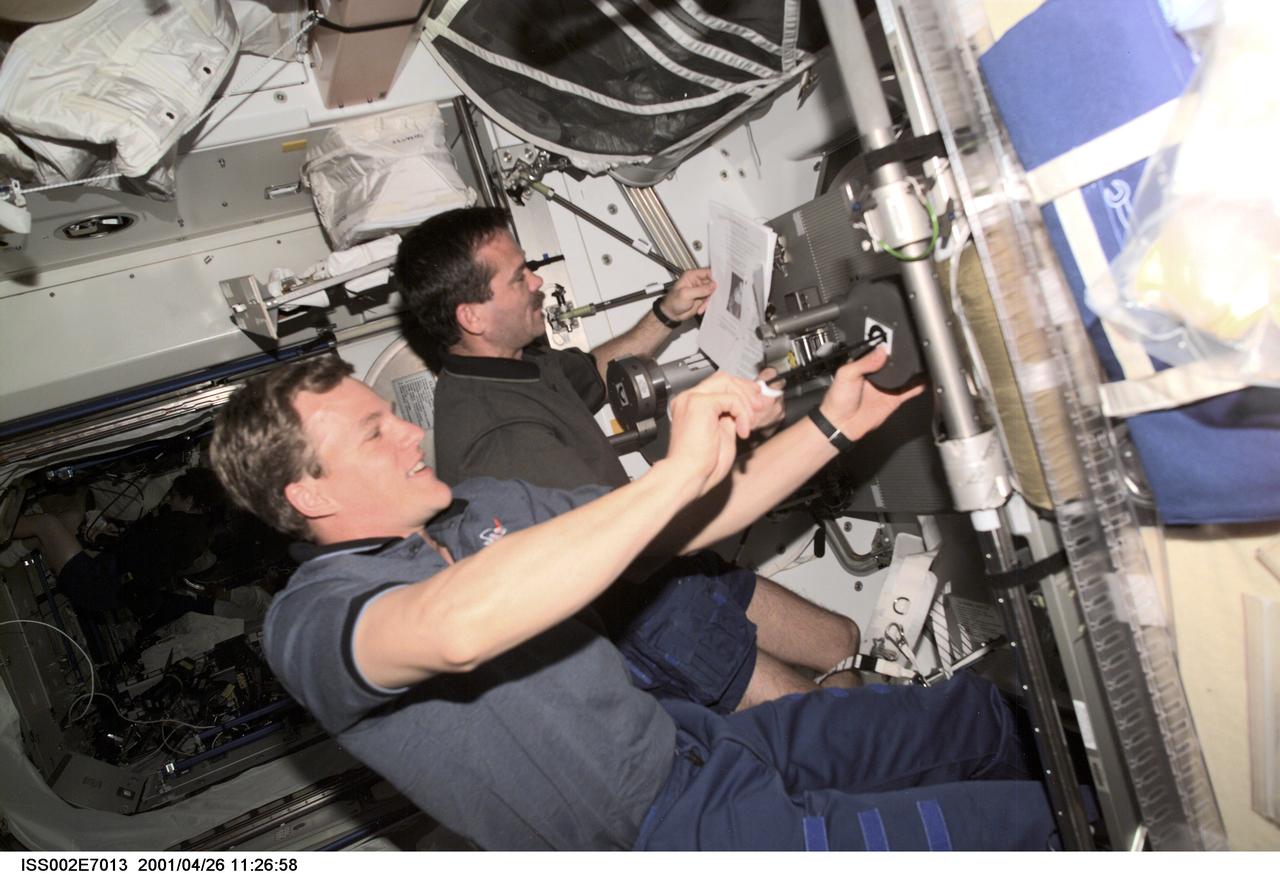
ISS002-E-7013 (26 April 2001) --- Astronauts Scott E. Parazynski and Chris A. Hadfield, mission specialists, install the Interim Resistive Exercise Devise (IRED) in the Unity/Node 1. Hadfield represents the Canadian Space Agency (CSA). A digital still camera was used to record this image.
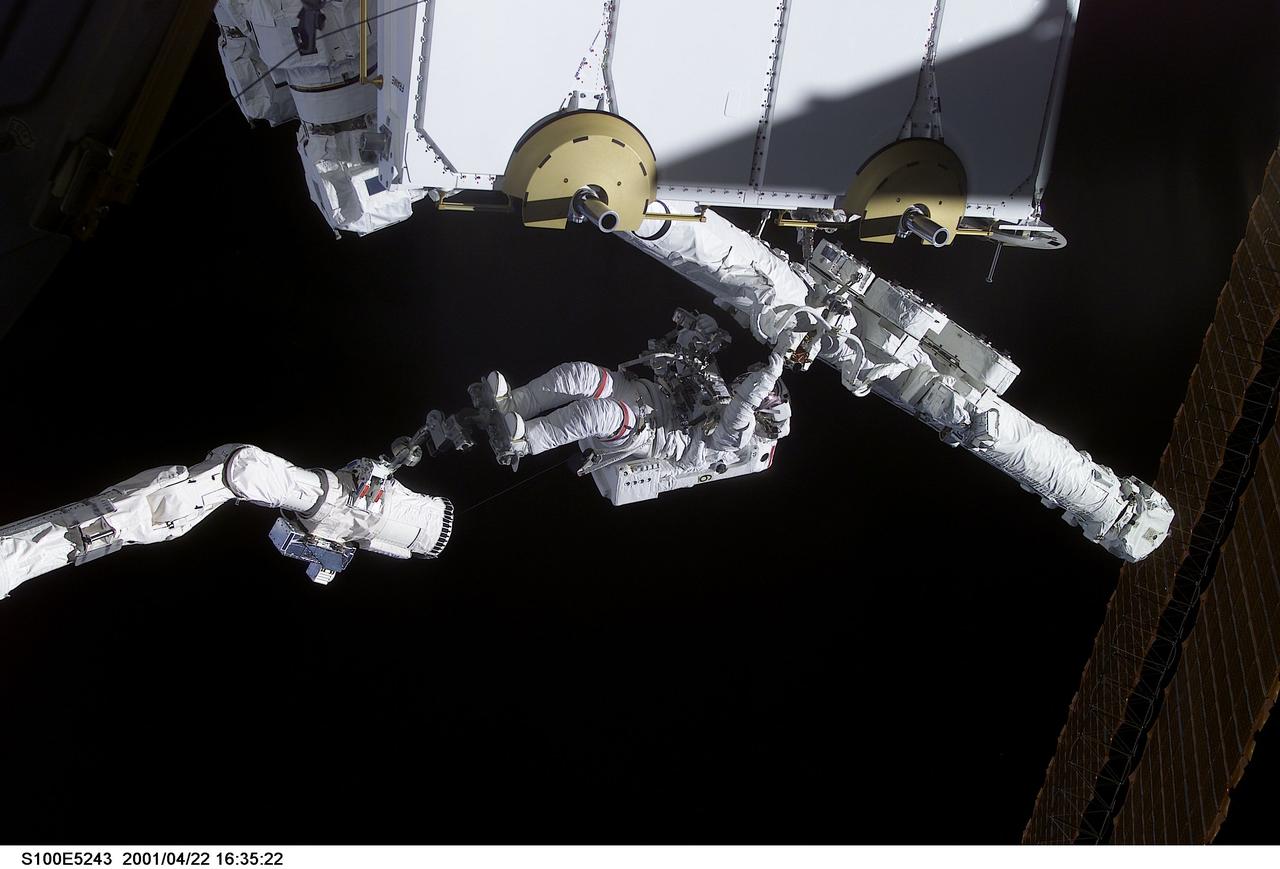
S100-E-5243 (22 April 2001) --- Astronaut Chris A. Hadfield, STS-100 mission specialist representing the Canadian Space Agency (CSA), stands on one Canadian-built robot arm to work with another one. Called Canadarm2, the newest addition to the International Space Station (ISS) was ferried up to the orbital outpost by the STS-100 crew. Hadfield's feet are secured on a special foot restraint attached to the end of the Remote Manipulator System (RMS) arm, which represents one of the standard shuttle components for the majority of the 100-plus STS missions thus far. The picture was recorded with a digital still camera.
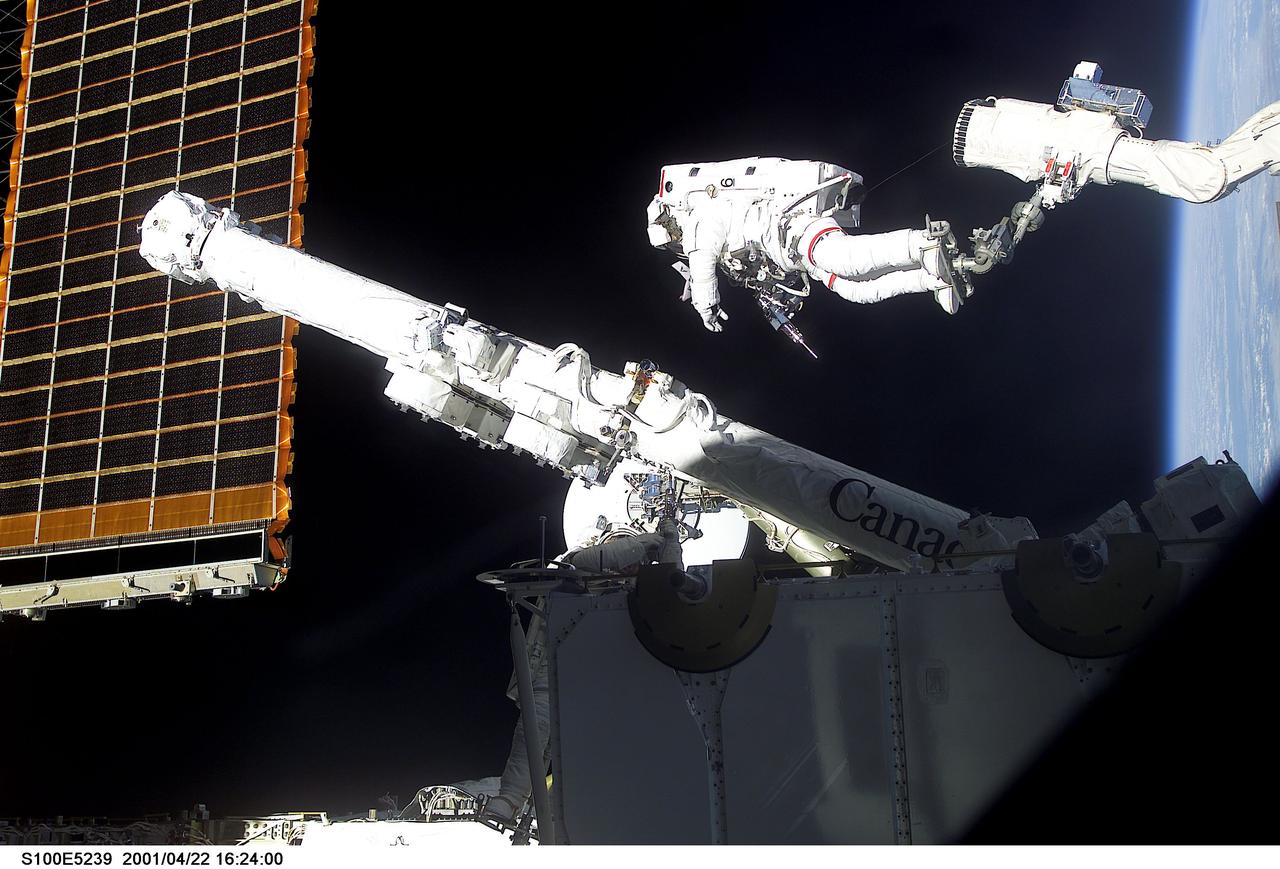
S100-E-5239 (22 April 2001) --- Astronaut Chris A. Hadfield, STS-100 mission specialist representing the Canadian Space Agency (CSA), stands on one Canadian-built robot arm to work with another one. Called Canadarm2, the newest addition to the International Space Station (ISS) was ferried up to the orbital outpost by the STS-100 crew. Hadfield's feet are secured on a special foot restraint attached to the end of the Remote Manipulator System (RMS) arm, which represents one of the standard shuttle components for the majority of the 100-plus STS missions thus far. The picture was recorded with a digital still camera.
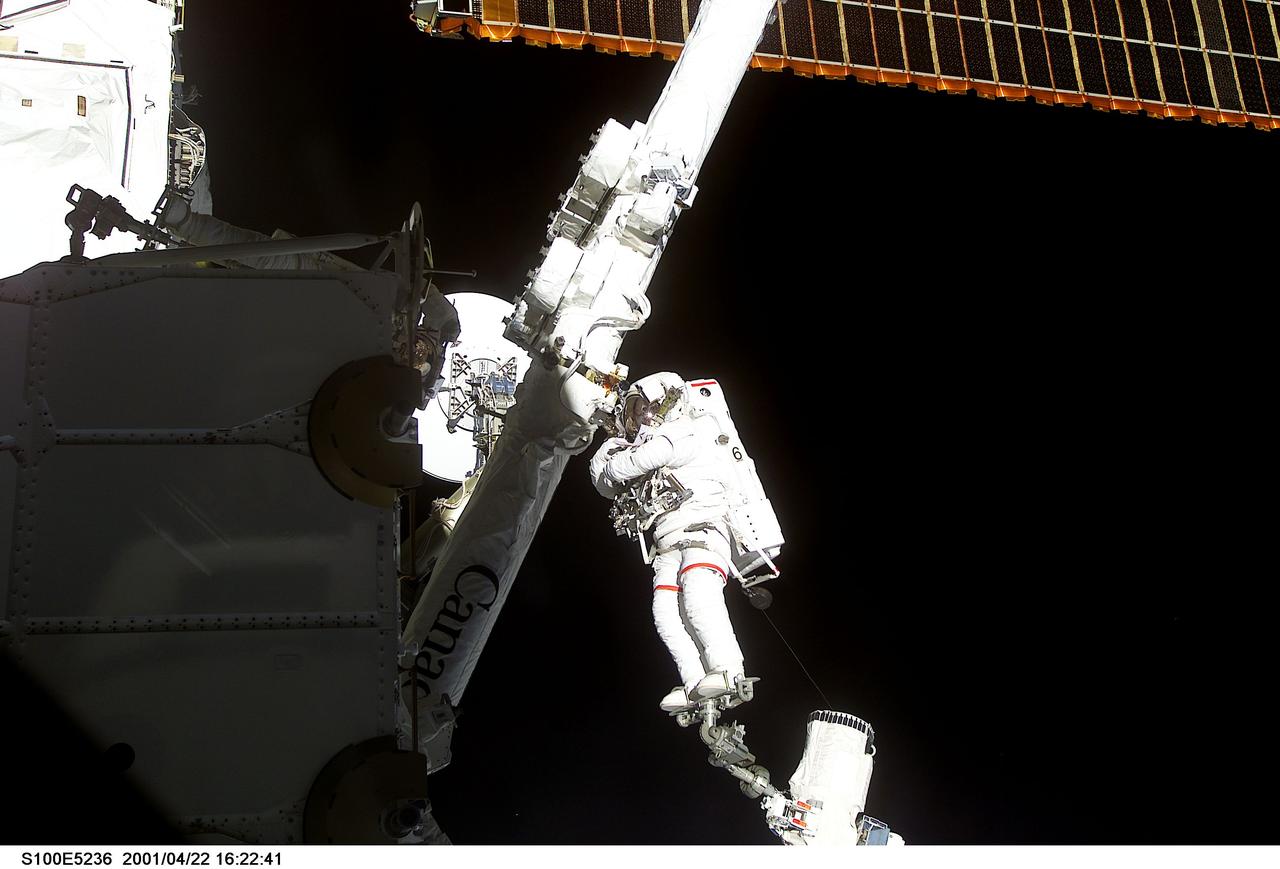
S100-E-5236 (22 April 2001) --- Astronaut Chris A. Hadfield, STS-100 mission specialist representing the Canadian Space Agency (CSA), stands on one Canadian-built robot arm to work with another one. Called Canadarm2, the newest addition to the International Space Station (ISS) was ferried up to the orbital outpost by the STS-100 crew. Hadfield's feet are secured on a special foot restraint attached to the end of the Remote Manipulator System (RMS) arm, which represents one of the standard shuttle components for the majority of the 100-plus STS missions thus far. The picture was recorded with a digital still camera.
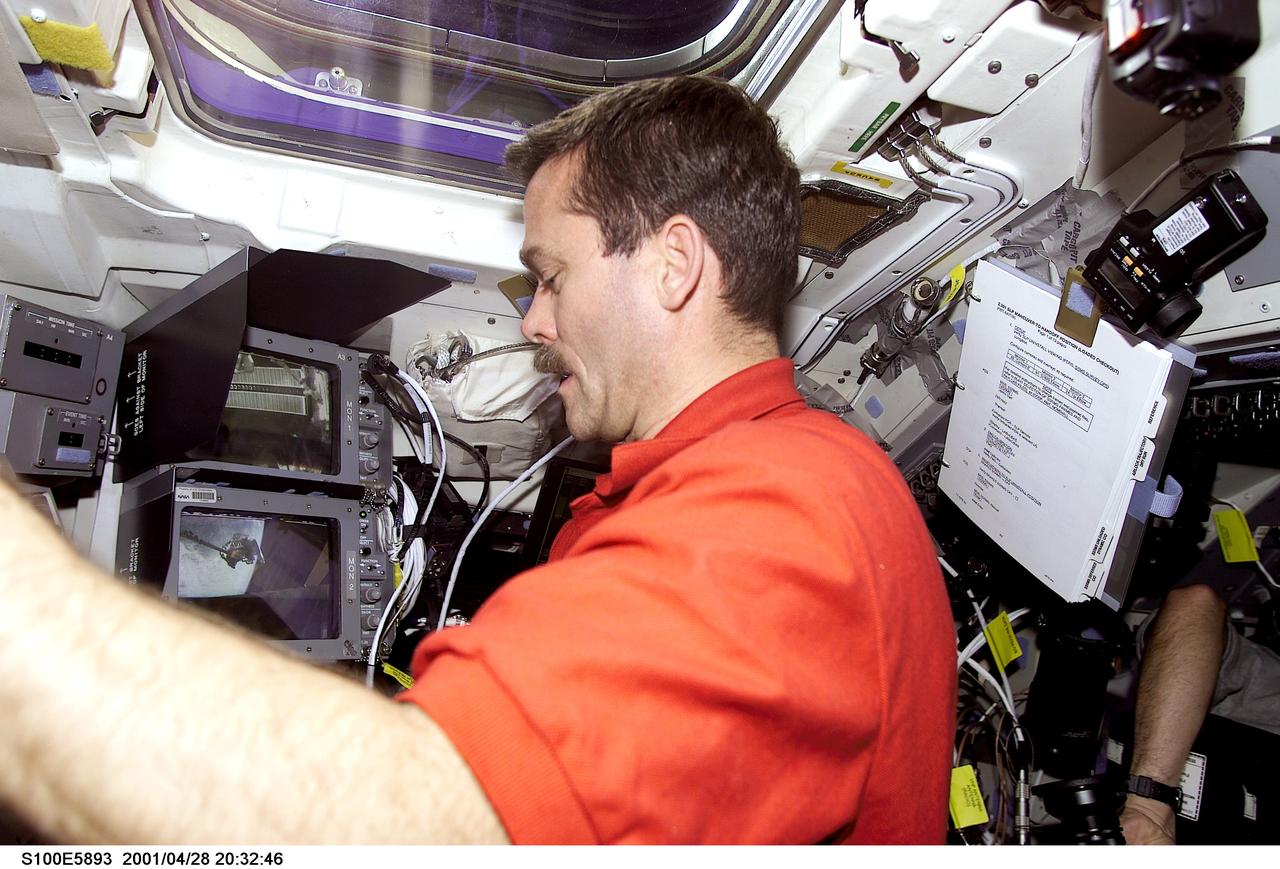
S100-E-5893 (28 April 2001) --- Astronaut Chris A. Hadfield, mission specialist, is pictured on the aft flight deck of the Space Shuttle Endeavour during an historic event. A Canadian “handshake in space” occurred at 4:02 p.m (CDT), April 28, 2001, as the Canadian-built space station robotic arm – operated by Expedition Two flight engineer Susan Helms – transferred its launch cradle over to Endeavour’s robotic arm, with Canadian Space Agency astronaut Hadfield at the controls. The exchange of the pallet from station arm to shuttle arm marked the first ever robotic-to-robotic transfer in space. This image was recorded with a digital still camera.
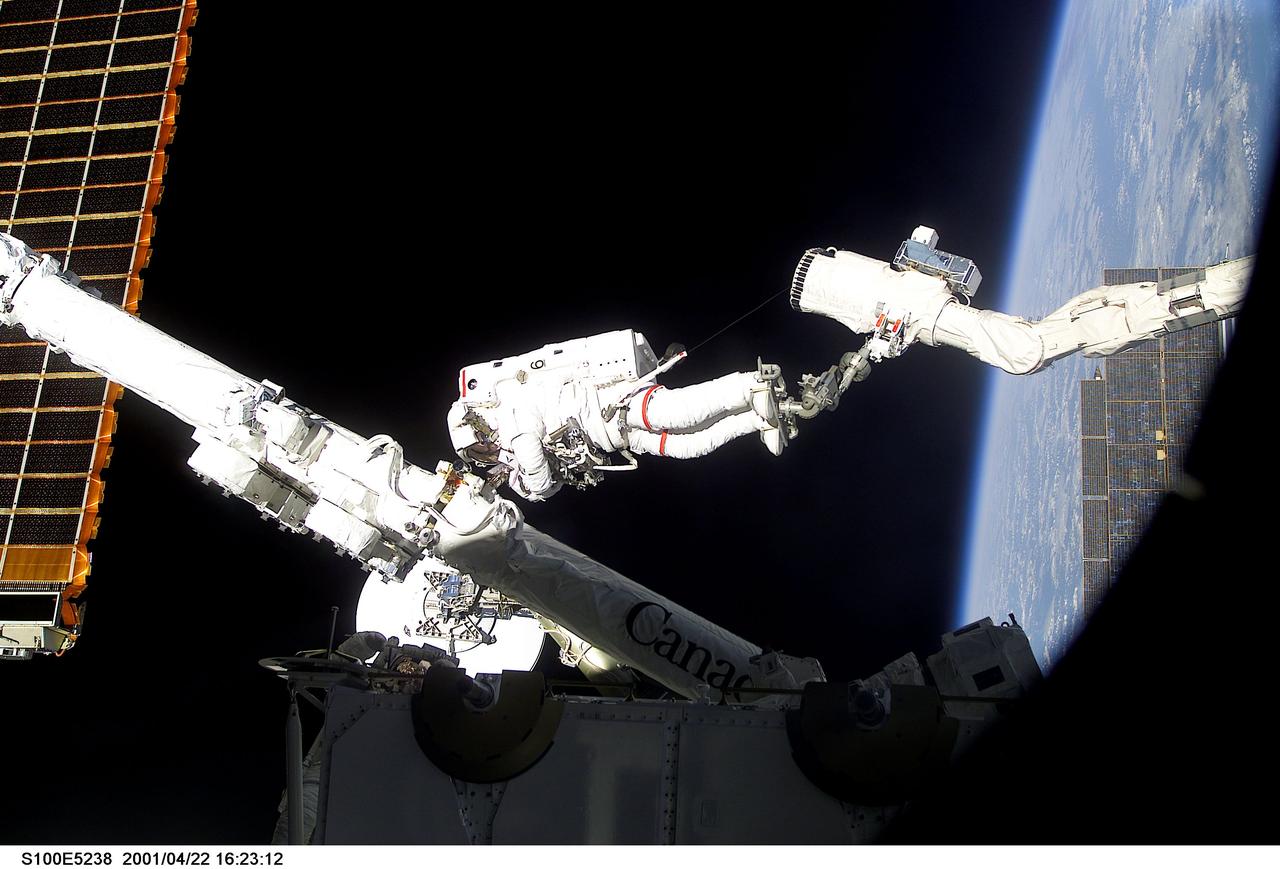
S100-E-5238 (22 April 2001) --- Astronaut Chris A. Hadfield, STS-100 mission specialist representing the Canadian Space Agency (CSA), stands on one Canadian-built robot arm to work with another one. Called Canadarm2, the newest addition to the International Space Station (ISS) was ferried up to the orbital outpost by the STS-100 crew. Hadfield's feet are secured on a special foot restraint attached to the end of the Remote Manipulator System (RMS) arm, which represents one of the standard shuttle components for the majority of the 100-plus STS missions thus far. The picture was recorded with a digital still camera.
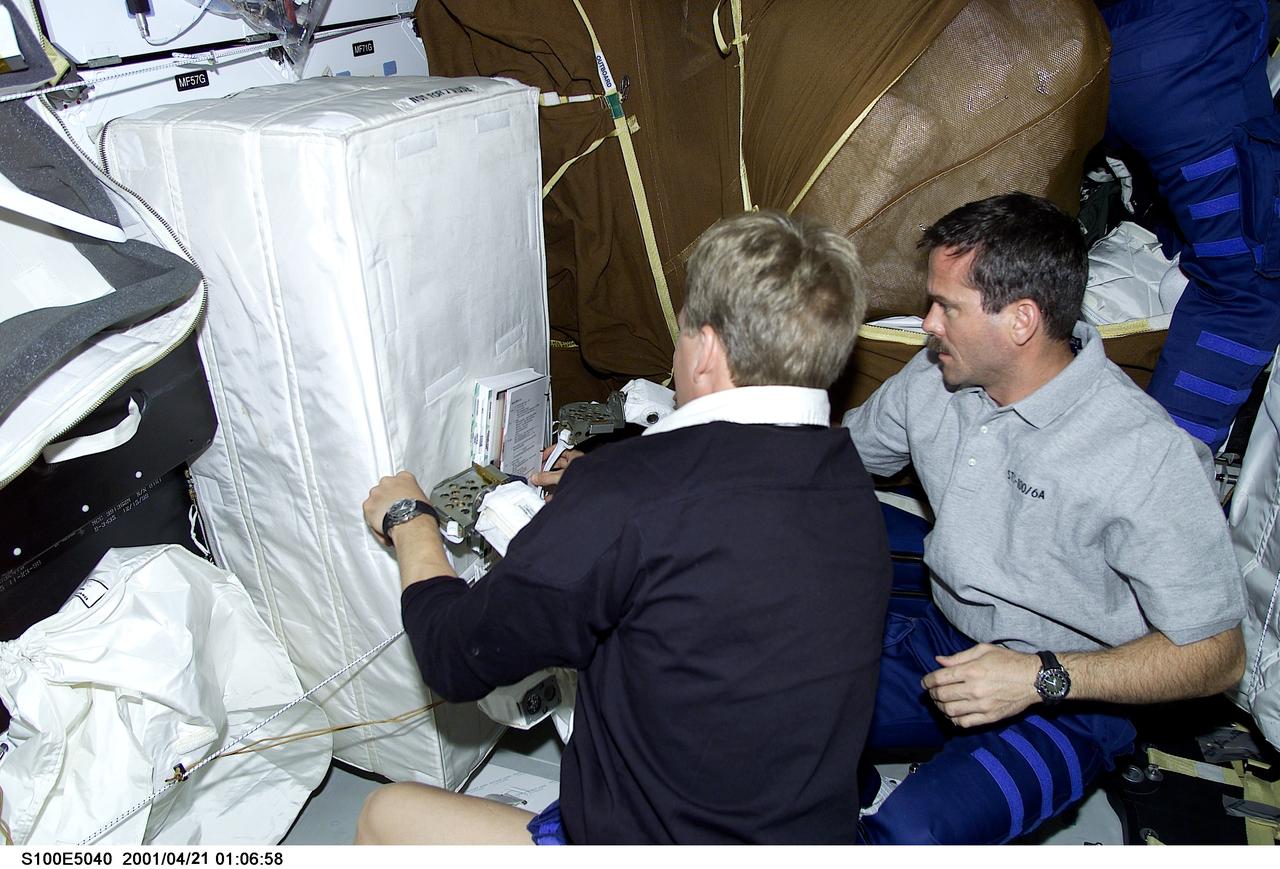
S100-E-5040 (21 April 2001) --- Astronauts Scott E. Parazynski (left) and Chris A. Hadfield of the Canadian Space Agency, both mission specialists, are seen on the middeck of the Space Shuttle Endeavour as the STS-100 crew anticipates its union with the International Space Station (ISS). Assigned space-walking astronauts Hadfield and Parazynski were later joined on the middeck by spacewalk coordinator John L. Phillips in conducting some final checks of the suits and hardware that are to be used during the next day's planned 6-hour, 30-minute spacewalk. The image was recorded with a digital still camera.
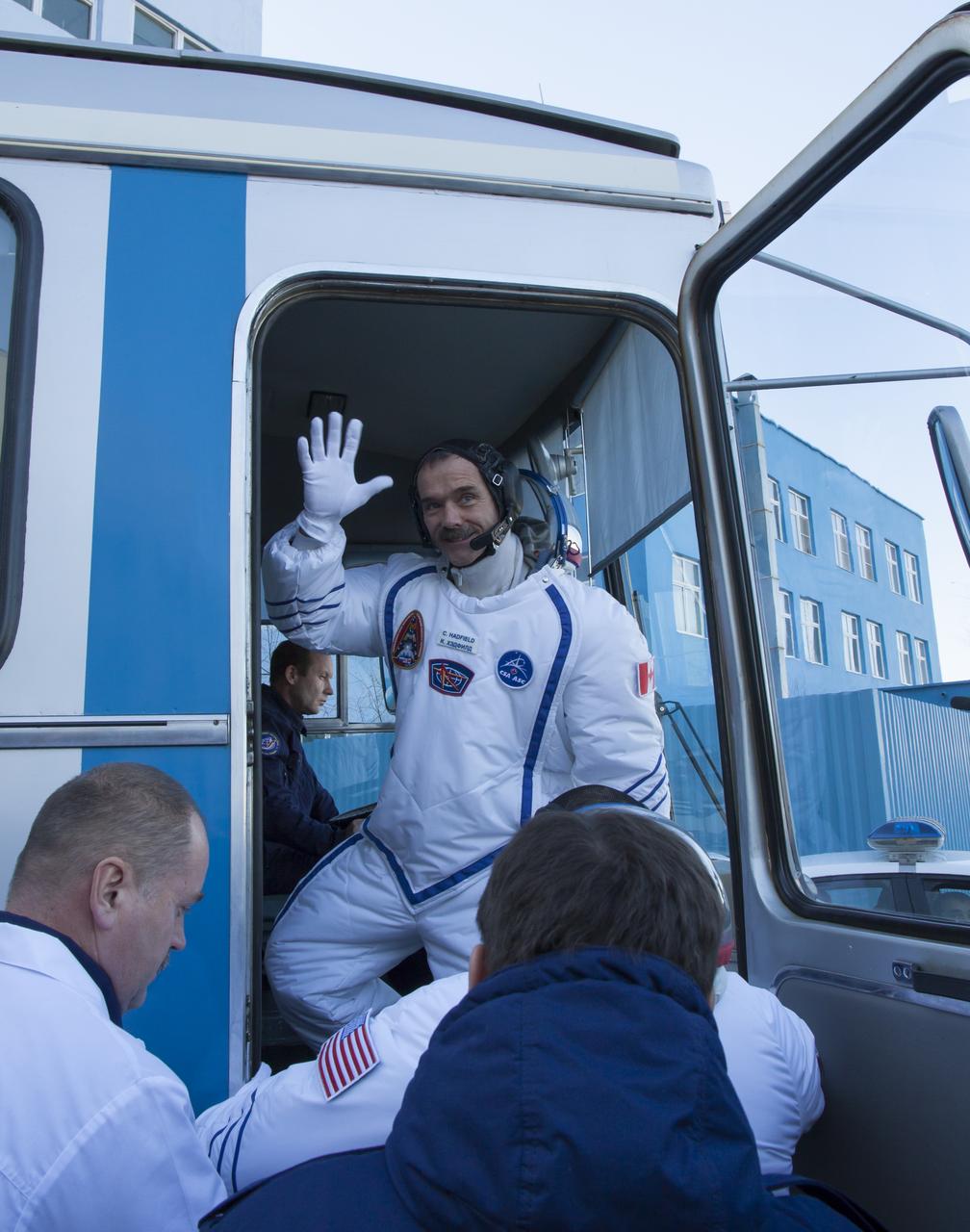
Expedition 34/35 Flight Engineer Chris Hadfield of the Canadian Space Agency (CSA) waves goodbye as he boards the bus that will take him to the launch pad where he and his fellow crew mates will board their Soyuz TMA-07M rocket, on Wednesday, Dec. 19, 2012, in Baikonur, Kazakhstan. The crew are donning special cold-weather suits over their Sokol suits to keep them insulated from the extreme sub-zero temperature. Launch of the Soyuz rocket will send Hadfield, Romanenko and Marshburn on a five-month mission aboard the International Space Station. Photo Credit: (NASA/Victor Zelentsov)
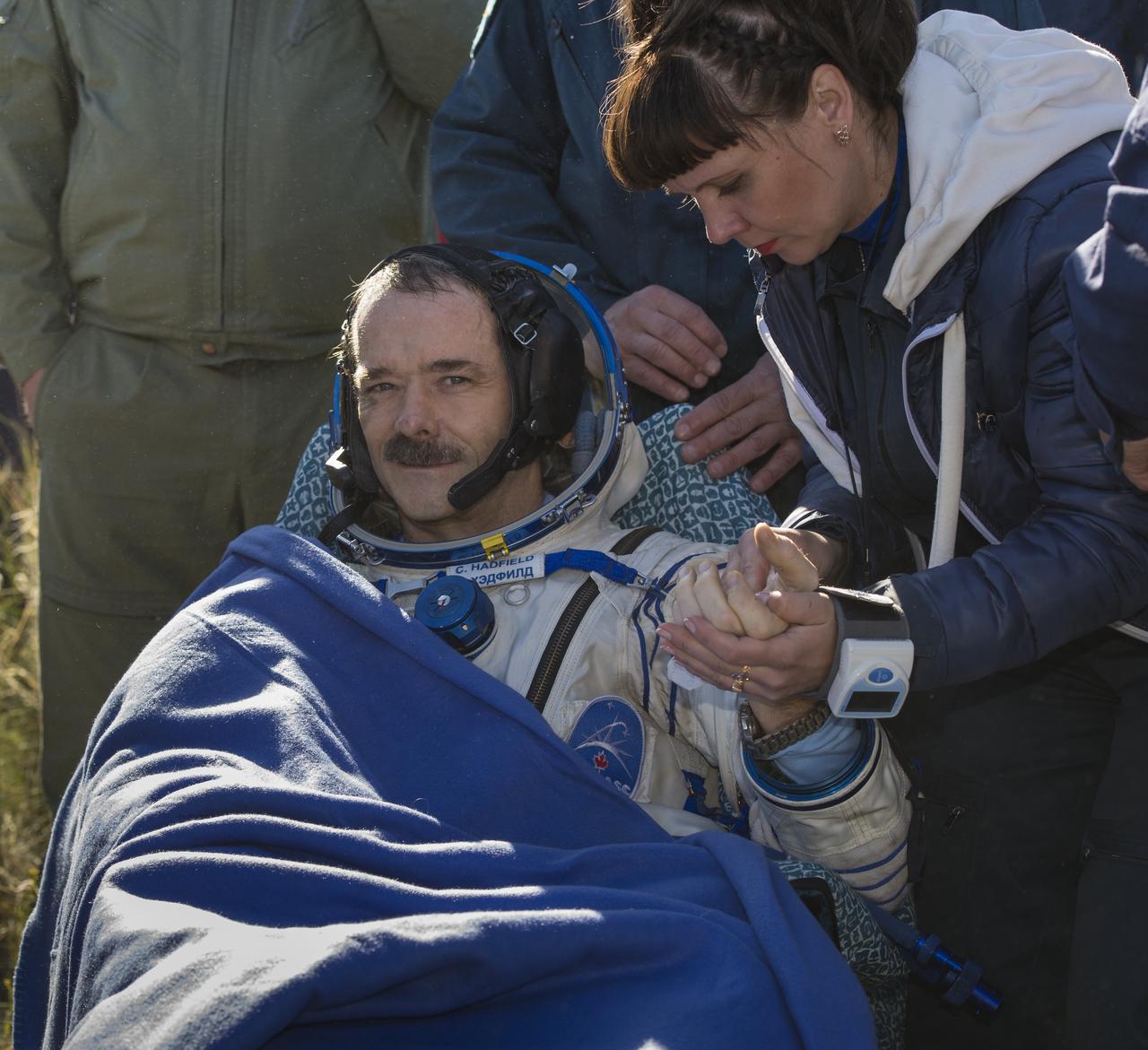
Expedition 35 Commander Chris Hadfield of the Canadian Space Agency (CSA) is attended to by his nurse following his landing in the Soyuz TMA-07M spacecraft in a remote area near the town of Zhezkazgan, Kazakhstan, Tuesday, May 14, 2013. Hadfield and crew mates NASA Flight Engineer Tom Marshburn and Russian Flight Engineer Roman Romanenko of the Russian Federal Space Agency (Roscosmos) returned to earth from more than five months onboard the International Space Station where they served as members of the Expedition 34 and 35 crews. Photo Credit: (NASA/Carla Cioffi)
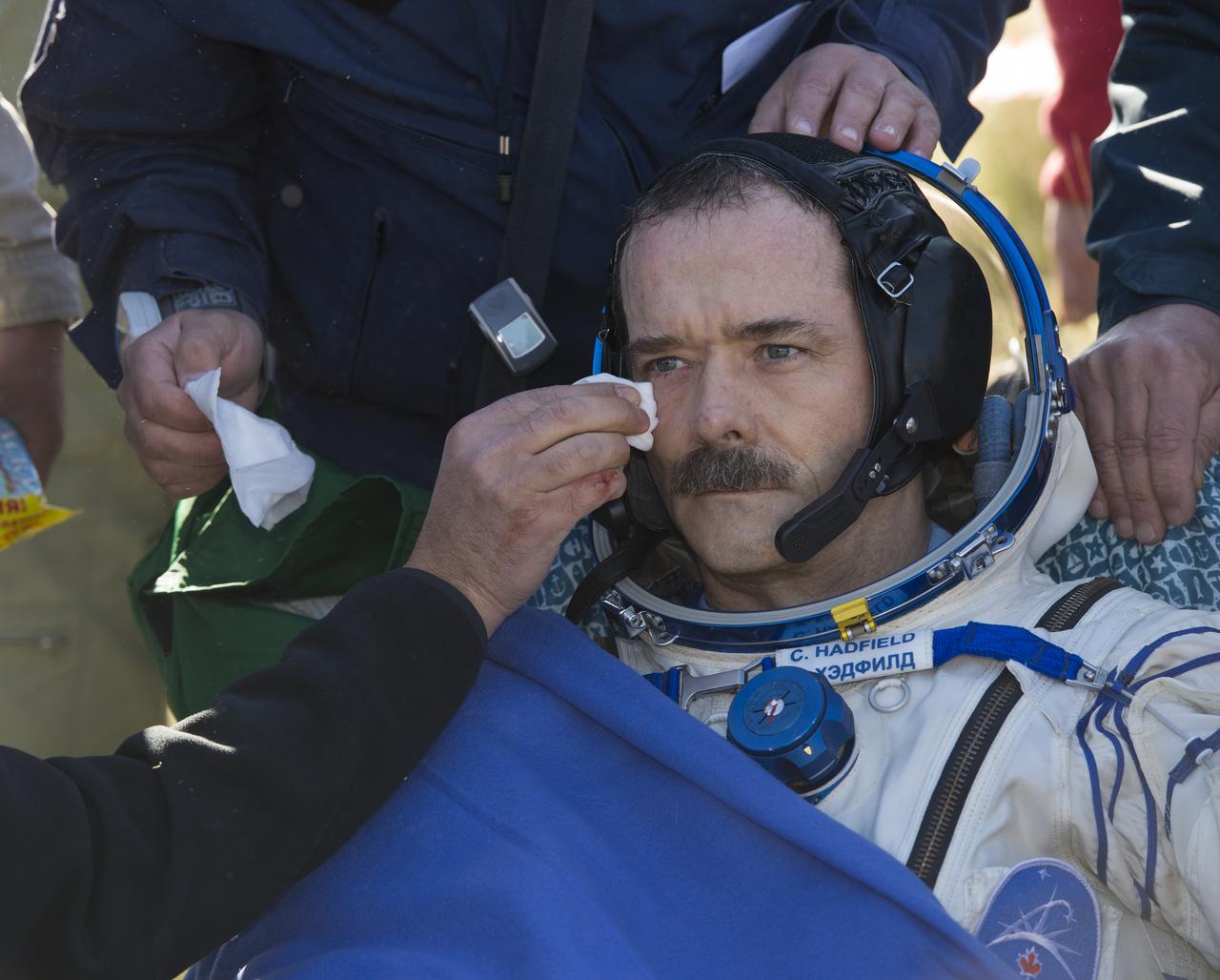
Expedition 35 Commander Chris Hadfield of the Canadian Space Agency (CSA) is attended to following his landing in the Soyuz TMA-07M spacecraft in a remote area near the town of Zhezkazgan, Kazakhstan, Tuesday, May 14, 2013. Hadfield and crew mates NASA Flight Engineer Tom Marshburn and Russian Flight Engineer Roman Romanenko of the Russian Federal Space Agency (Roscosmos) returned to earth from more than five months onboard the International Space Station where they served as members of the Expedition 34 and 35 crews. Photo Credit: (NASA/Carla Cioffi)
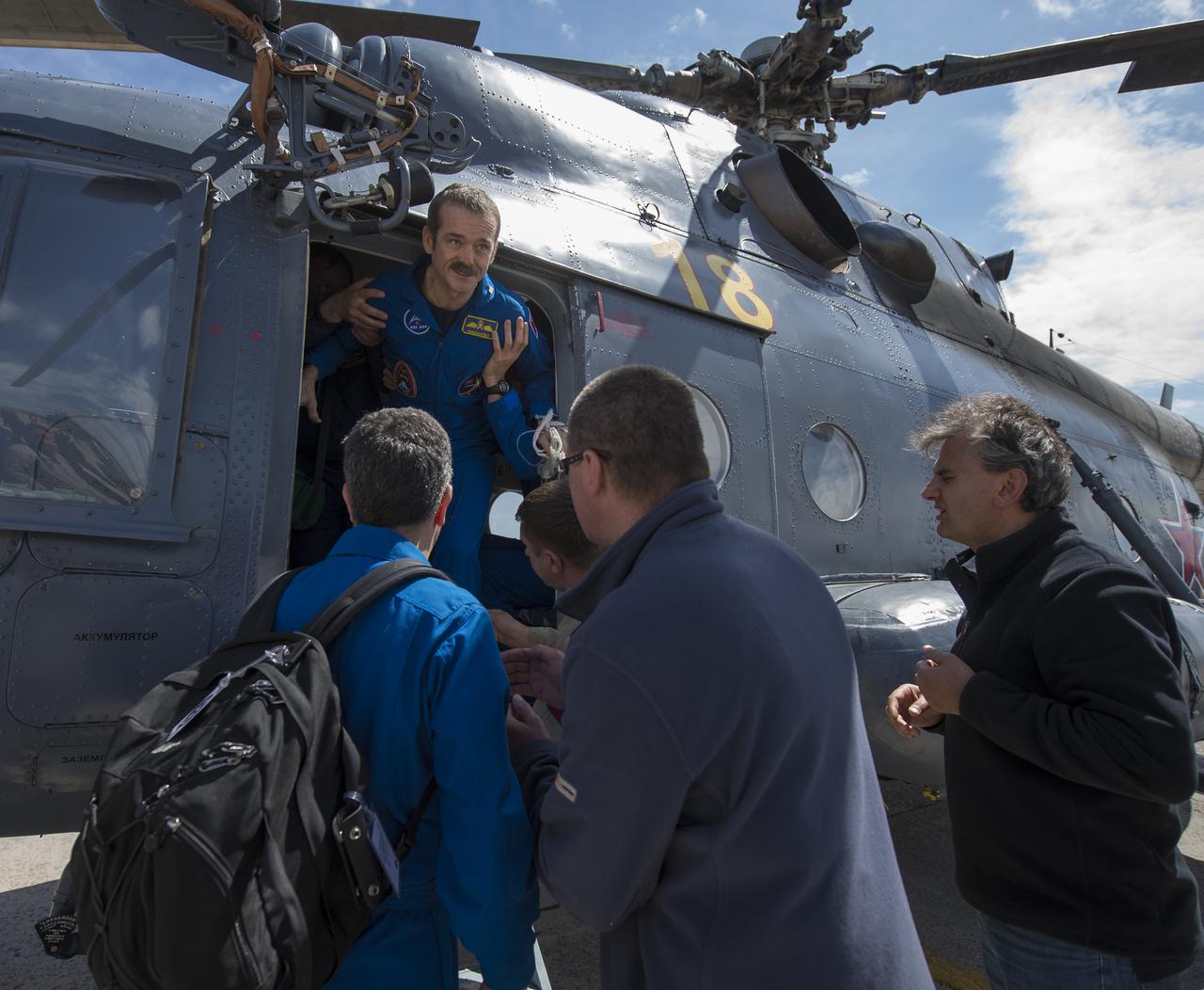
Expedition 35 Commander Chris Hadfield of the Canadian Space Agency (CSA) is helped off a Russian Search and Rescue helicopter at Karaganda Airport in Kazakhstan following his landing in the Soyuz TMA-07M spacecraft in a remote area near the town of Zhezkazgan, Kazakhstan, Tuesday, May 14, 2013. Hadfield, Expedition 35 NASA Flight Engineer Tom Marshburn and Russian Flight Engineer Roman Romanenko of the Russian Federal Space Agency (Roscosmos) returned to earth from more than five months onboard the International Space Station where they served as members of the Expedition 34 and 35 crews. Photo Credit: (NASA/Carla Cioffi)

Expedition 35 Commander Chris Hadfield of the Canadian Space Agency (CSA) is seen in a gift of traditional Kazakhstan dress during a welcome ceremony at the Karaganda Airport in Kazakhstan on Tuesday, May 14, 2013. Hadfield, Expedition 35 NASA Flight Engineer Tom Marshburn and Russian Flight Engineer Roman Romanenko of the Russian Federal Space Agency (Roscosmos) returned to earth from more than five months onboard the International Space Station where they served as members of the Expedition 34 and 35 crews. Photo Credit: (NASA/Carla Cioffi)
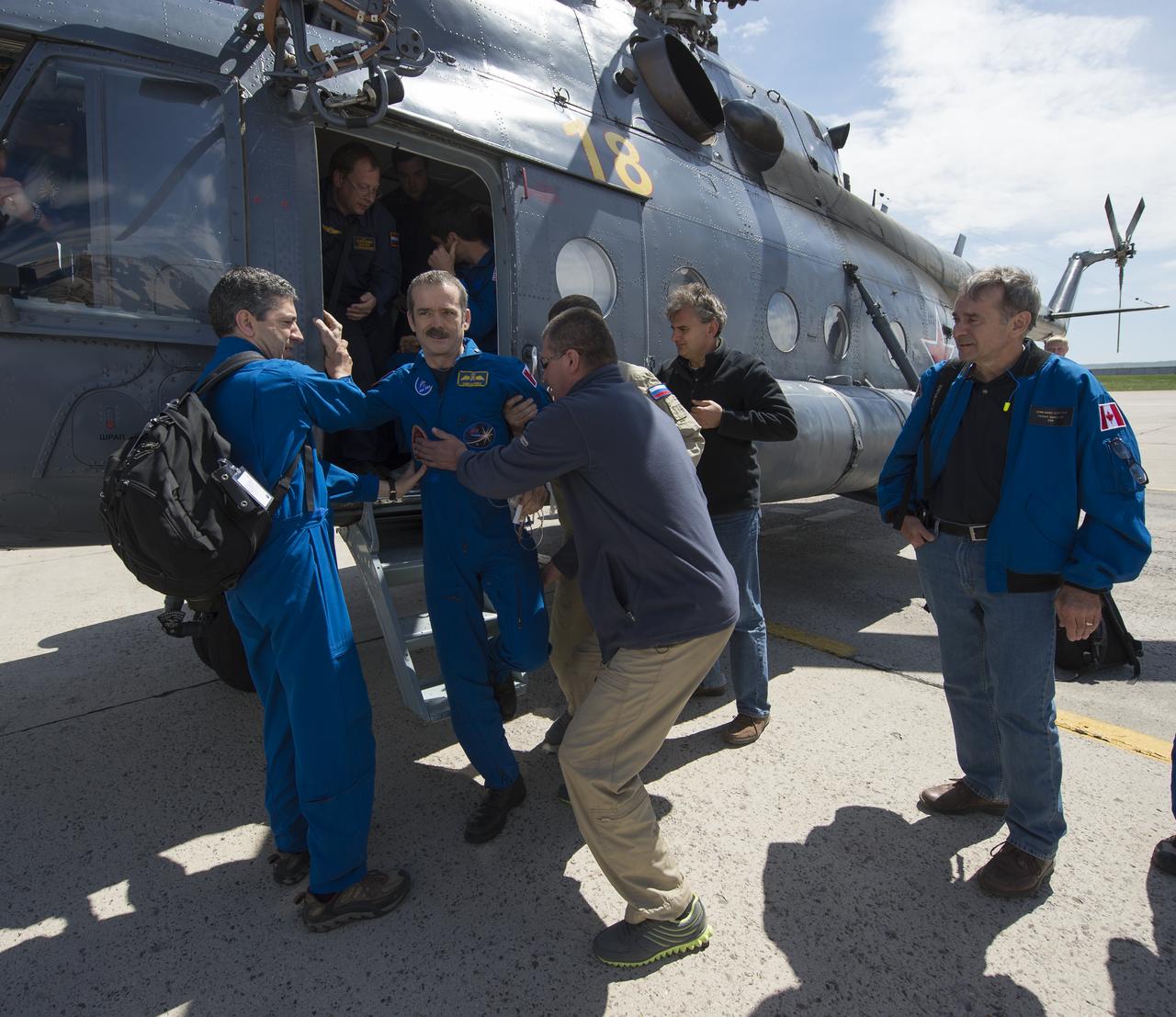
Expedition 35 Commander Chris Hadfield of the Canadian Space Agency (CSA) is helped off a Russian Search and Rescue helicopter at Karaganda Airport in Kazakhstan following his landing in the Soyuz TMA-07M spacecraft in a remote area near the town of Zhezkazgan, Kazakhstan, Tuesday, May 14, 2013. Hadfield, Expedition 35 NASA Flight Engineer Tom Marshburn and Russian Flight Engineer Roman Romanenko of the Russian Federal Space Agency (Roscosmos) returned to earth from more than five months onboard the International Space Station where they served as members of the Expedition 34 and 35 crews. Photo Credit: (NASA/Carla Cioffi)
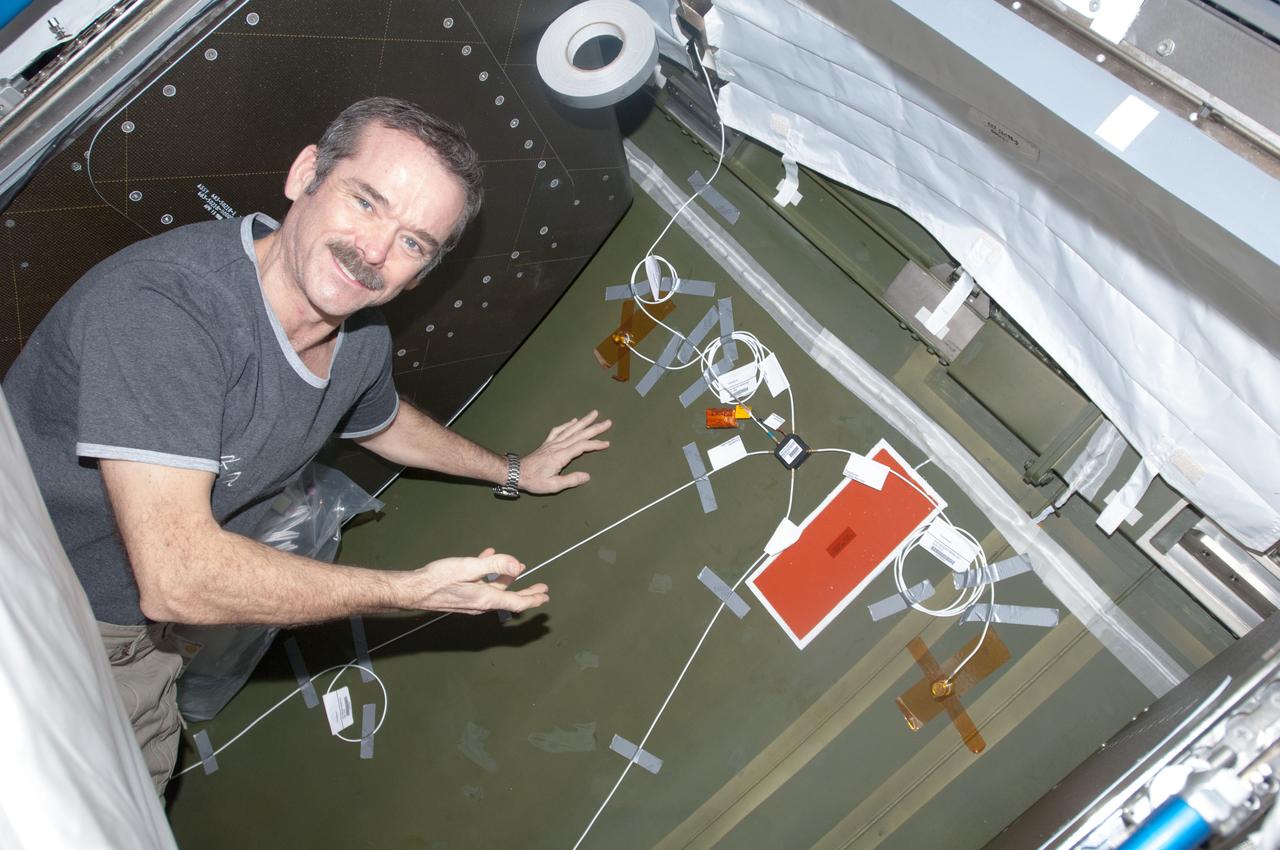
View of Canadian Space Agency (CSA) Chris Hadfield,Expedition 34 Flight Engineer (FE),installing Ultra-Sonic Background Noise Tests (UBNT) sensors behind rack in the U.S. Laboratory using the International Space Station (ISS) as Testbed for Analog Research (ISTAR) procedures. These sensors detect high frequency noise levels generated by ISS hardware and equipment operating within the U.S. Laboratory. Photo was taken during Expedition 34.
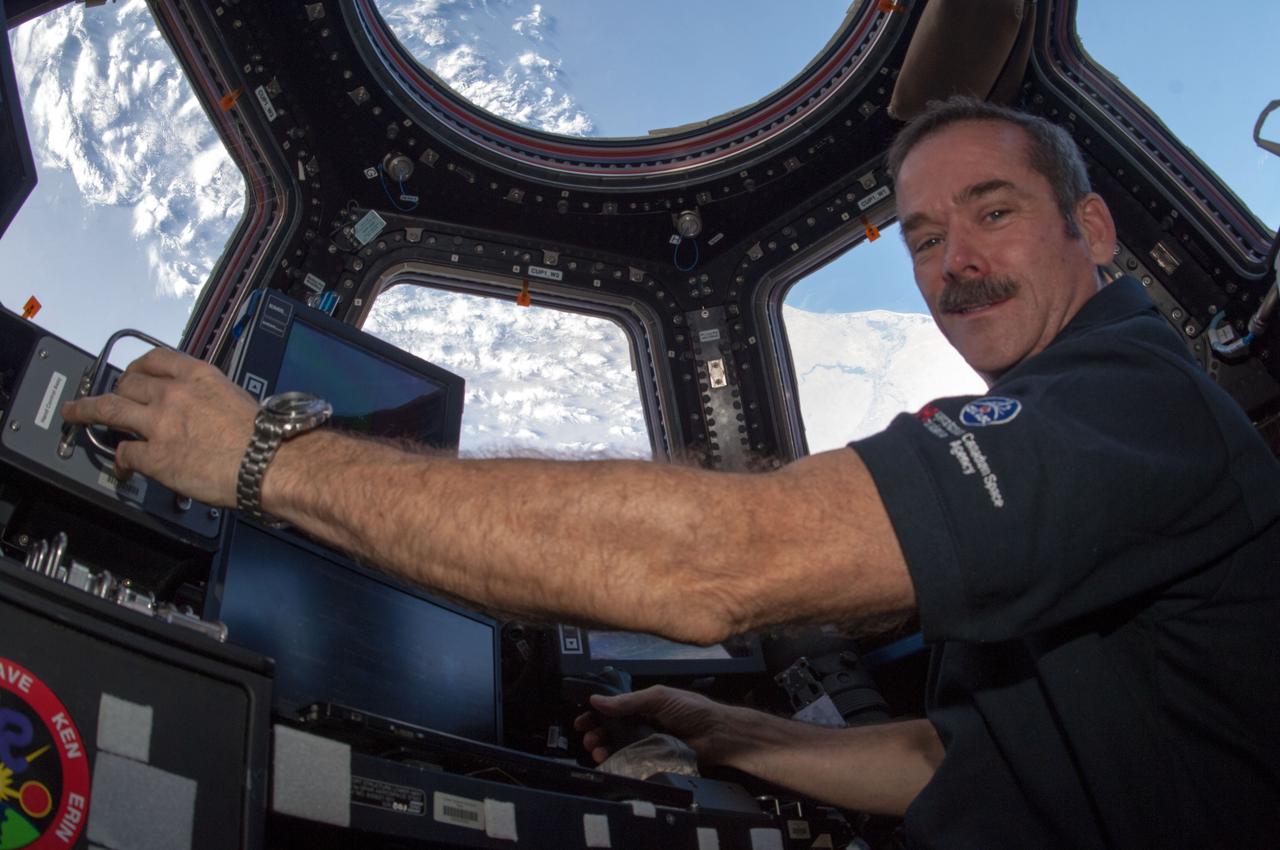
ISS034-E-027317 (10 Jan. 2013) --- In the Cupola aboard the Earth-orbiting International Space Station, Canadian Space Agency astronaut Chris Hadfield, Expedition 34 flight engineer, works the controls at the Robotic workstation to maneuver the Space Station Remote Manipulator System (SSRMS) or CanadArm2 from its parked position to grapple the Mobile Remote Servicer (MRS) Base System (MBS) Power and Data Grapple Fixture 4 (PDGF-4).