
Hubble Images of Comet Hale-Bopp

Hubble Sees Material Ejected From Comet Hale-Bopp
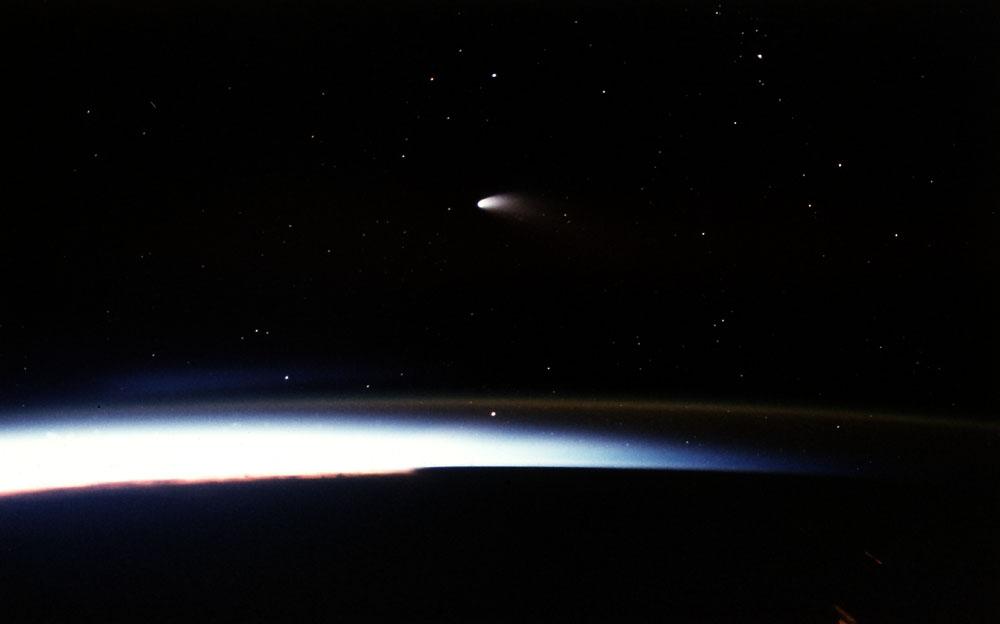
This is a Microgravity Science Laboratory-1 (MLS-1) onboard STS-83 photo of the most recent comet to date, Hale-Bopp, which passed by Earth during the spring and summer of 1997. In this view, the comet is visible during sunset. The streaks and distorted lights seen in the bottom of the photo are city lights and petroleum fires.
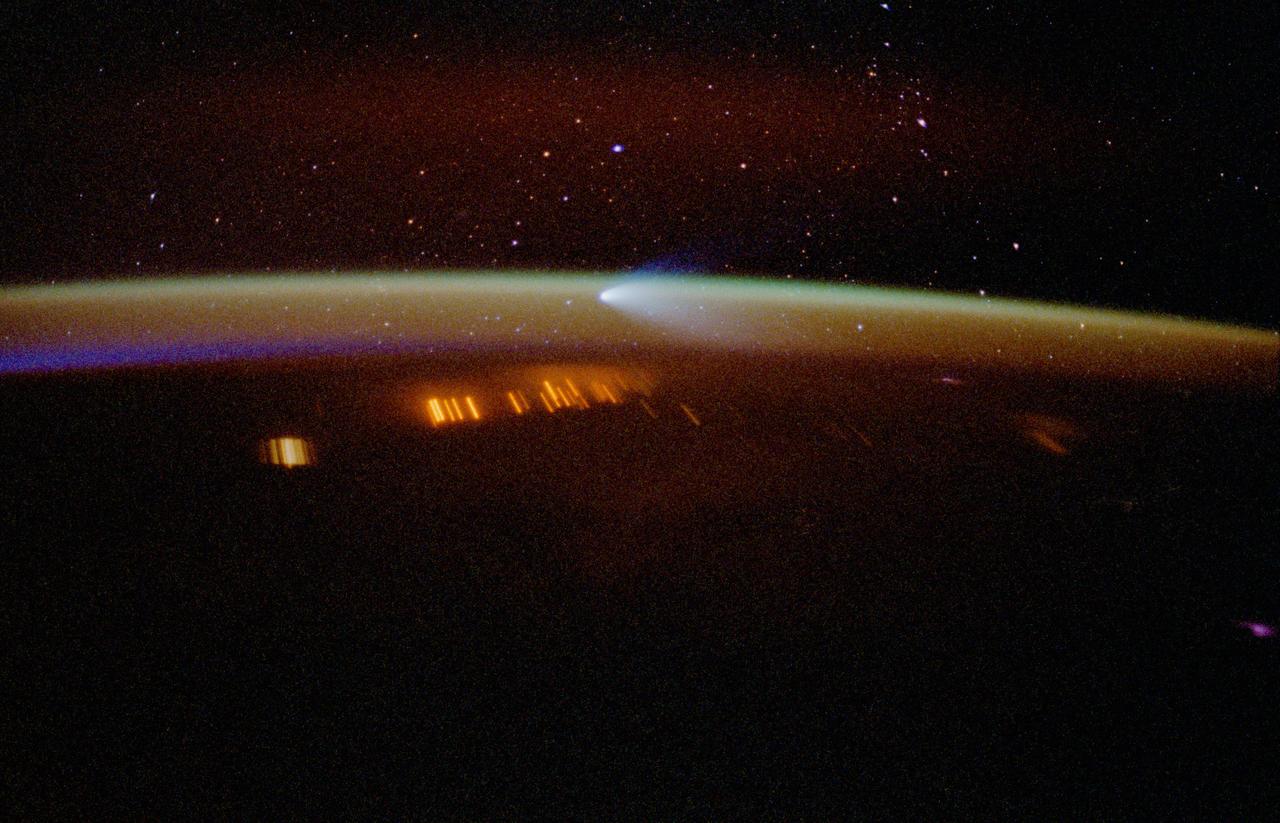
STS083-410-009 (4-8 April 1997) --- A 35mm camera was used to record this time-exposed image of Comet Hale-Bopp at sunset. Note that stars show up in this image because of the more lengthy exposure time, whereas the celestial features do not show in the majority of Space Shuttle pictures focused on Earth and its horizon. As another spin-off of the more lengthy time exposure, city lights and petroleum fires are seen as distorted streaks.
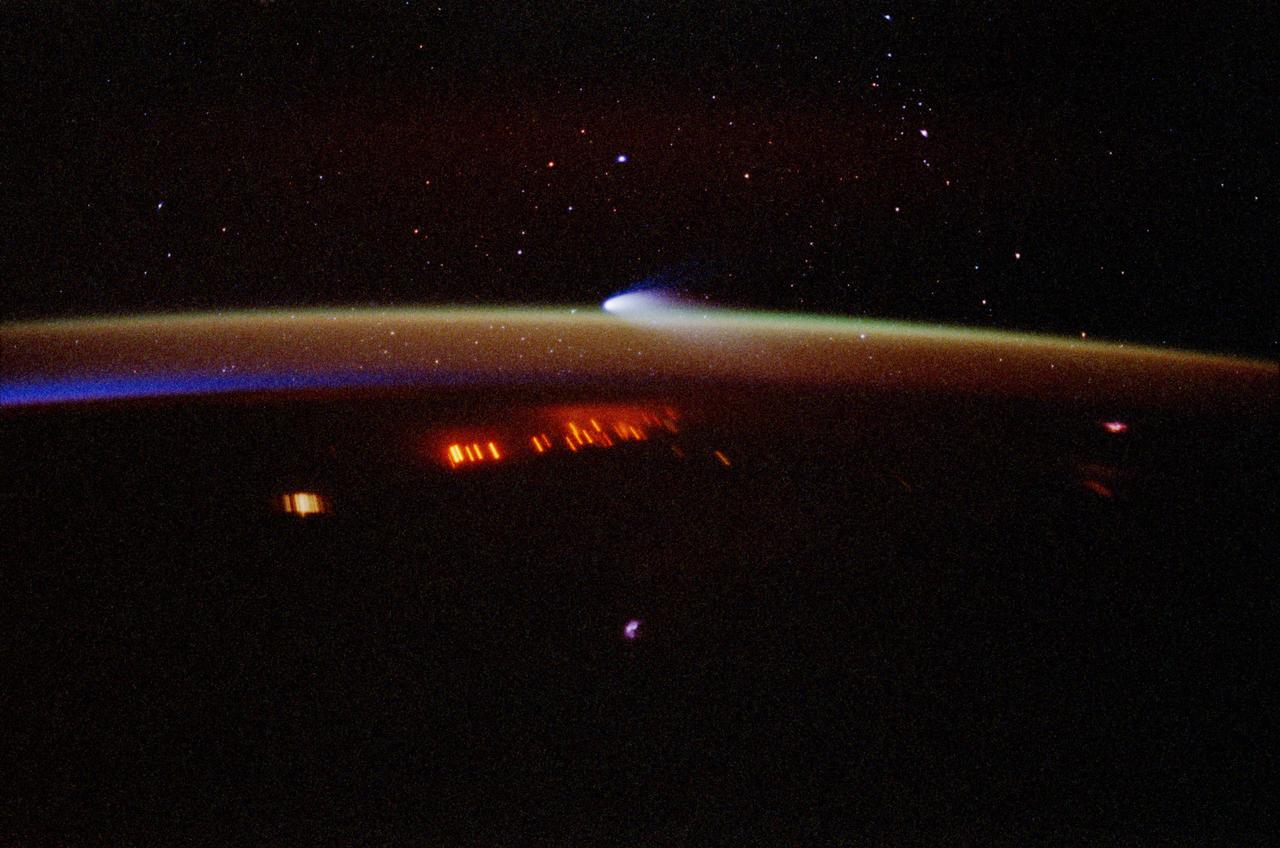
STS083-410-008 (4-8 April 1997) --- A 35mm camera was used to record this time-exposed image of Comet Hale-Bopp at sunset. Note that stars show up in this image because of the more lengthy exposure time, whereas the celestial features do not show in the majority of Space Shuttle pictures focused on Earth and its horizon. As another spin-off of the more lengthy time exposure, city lights and petroleum fires are seen as distorted streaks.
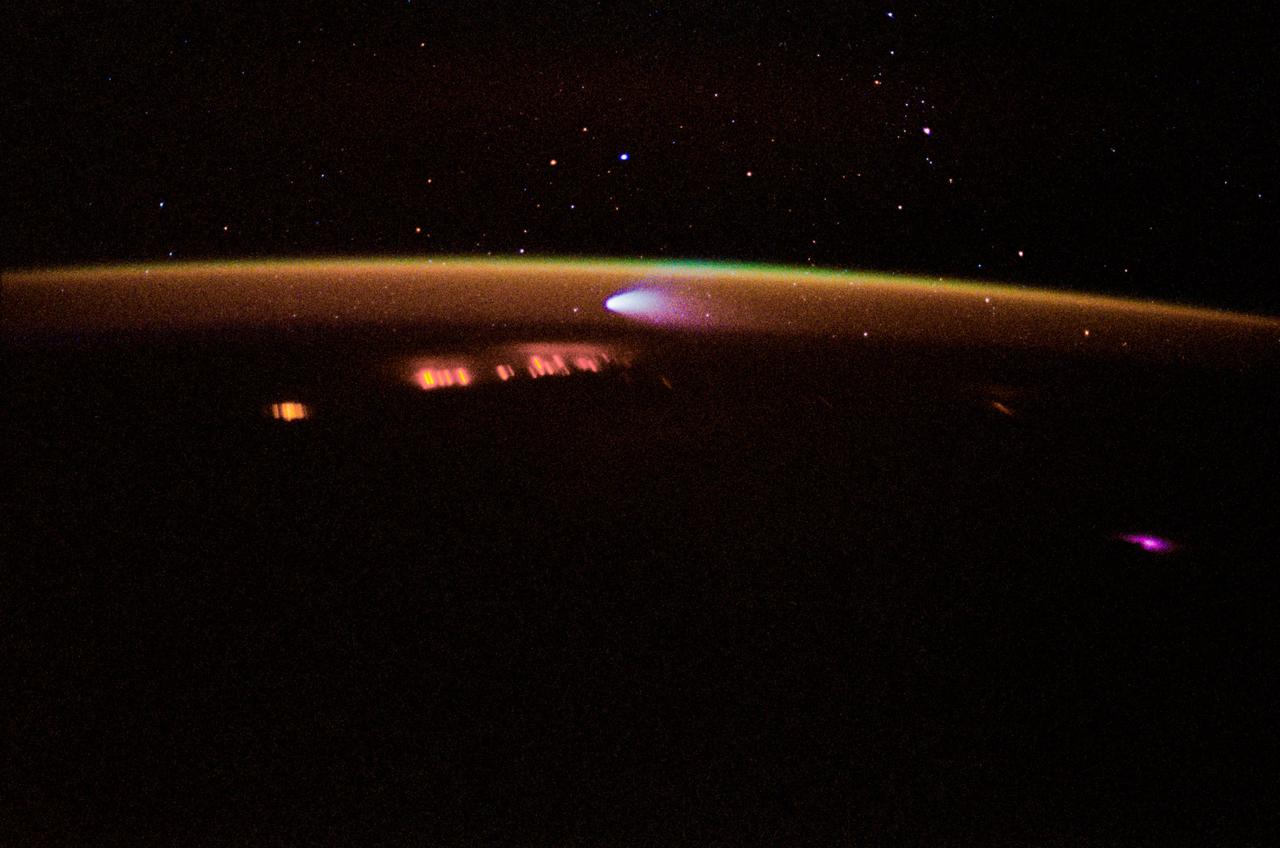
STS083-410-011 (4-8 April 1997) --- A 35mm camera was used to record this time-exposed image of Comet Hale-Bopp at sunset. Note that stars show up in this image because of the more lengthy exposure time, whereas the celestial features do not show in the majority of space shuttle pictures focused on Earth and its horizon. As another spin-off of the more lengthy time exposure, city lights and petroleum fires are seen as distorted streaks. Photo credit: NASA
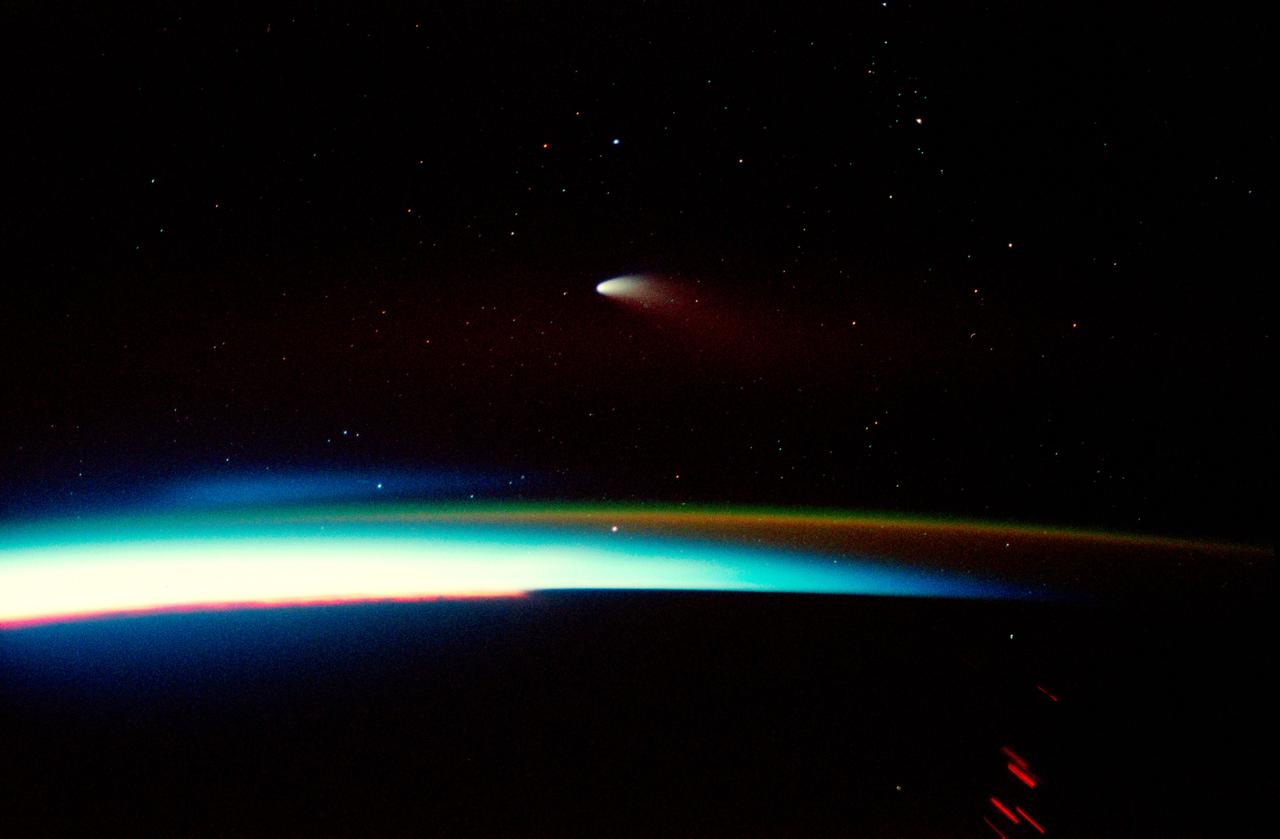
STS083-507-023 (4-8 April 1997)--- A 35mm camera was used to record this time-exposed image of Comet Hale-Bopp at sunset. As a spin-off of the more lengthy time exposure, city lights and petroleum fires are seen as distorted streaks.
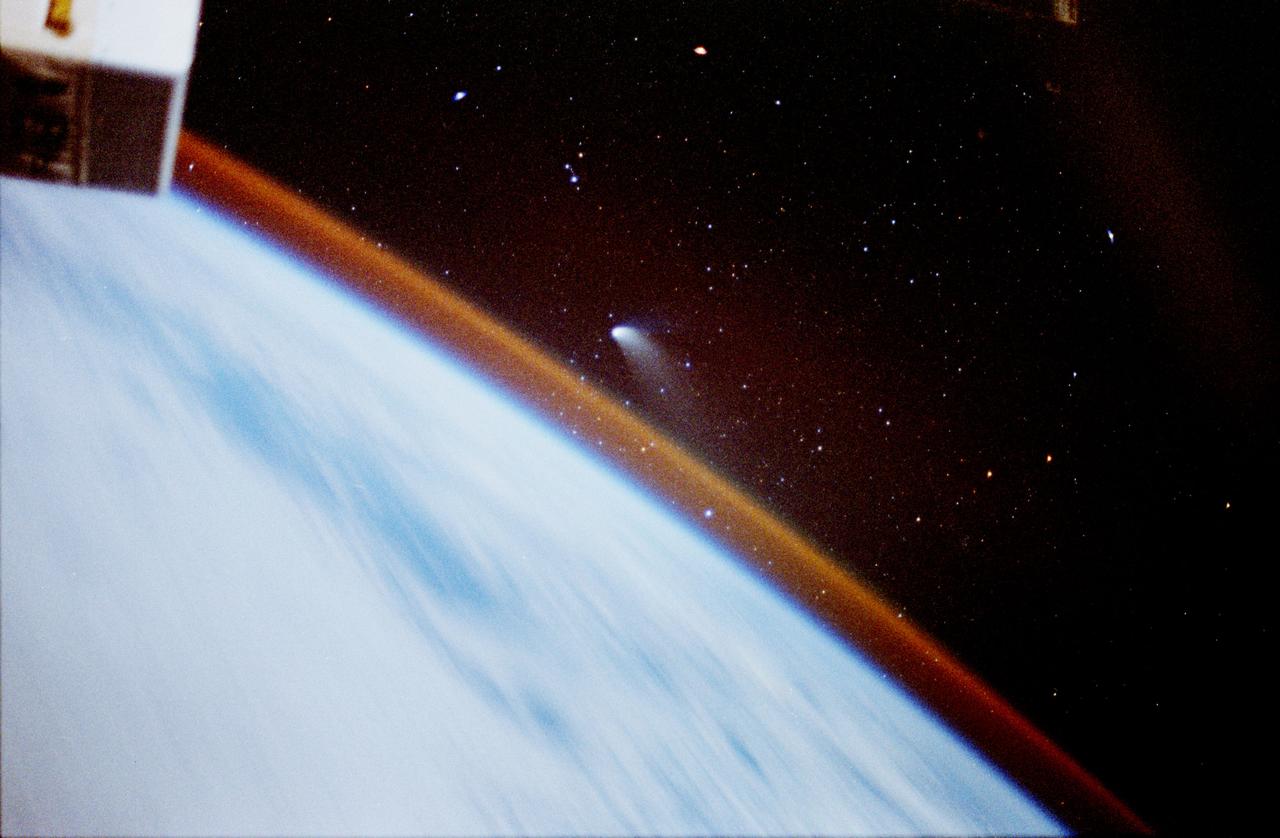
STS084-389-024 (15-24 May 1997) --- Comet Hale Bopp, seen and photographed a month and a half ago by the STS-83 crew aboard the Space Shuttle Columbia, was also visible on this mission and the crew took advantage of several photo opportunities. A crewmember used an eight-second time exposure on a 35mm camera to expose this frame of the comet over Earth's horizon. Streaking of the stars, usually associated with time exposures, was avoided due to Space Shuttle Atlantis' inertial attitude with the stars.
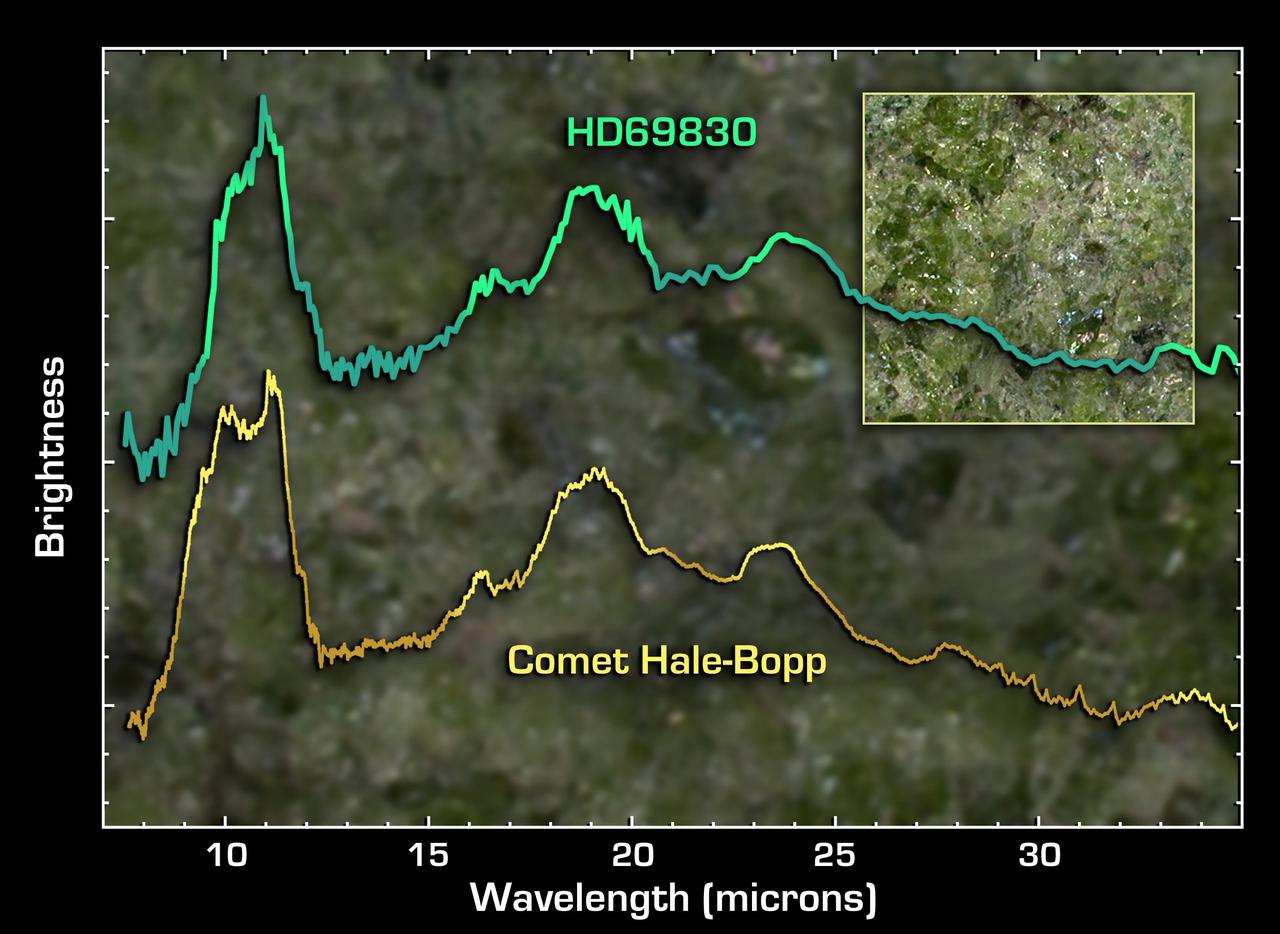
This graph of data from NASA Spitzer Space Telescope demonstrates that the dust around a nearby star called HD 69830 upper line has a very similar composition to that of Comet Hale-Bopp.
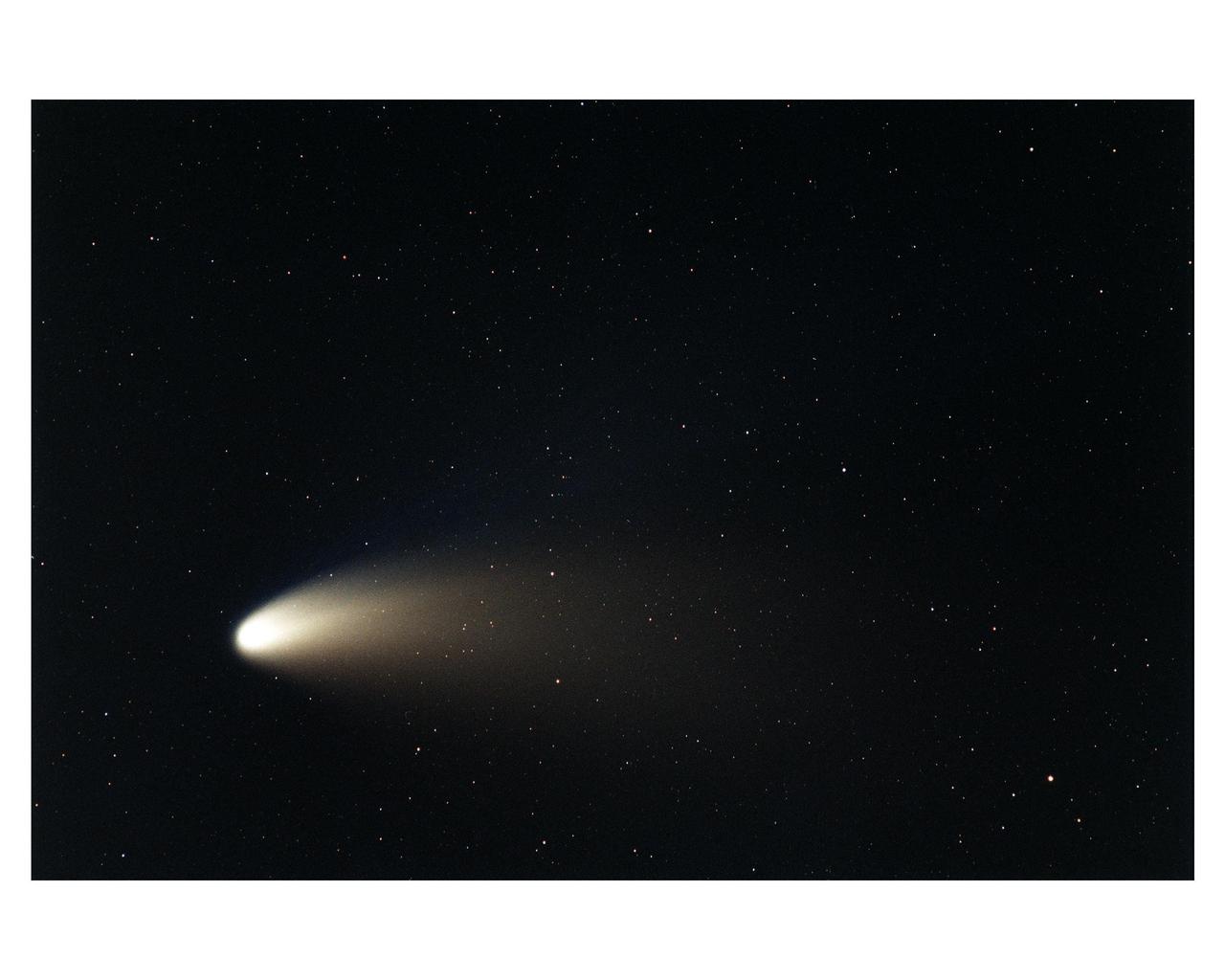
Comet Hale-Bopp was photographed in the constellation <a href="../../images/1997/hb_chart.jpg">Andromeda</a> by George Shelton, photographer for The Bionetics Corp., at 8:14 p.m. on March 31, 1997, from Merritt Island, Florida, close to the Kennedy Space Center. During this 24-hour period, Comet Hale-Bopp is making its closest approach to the Sun
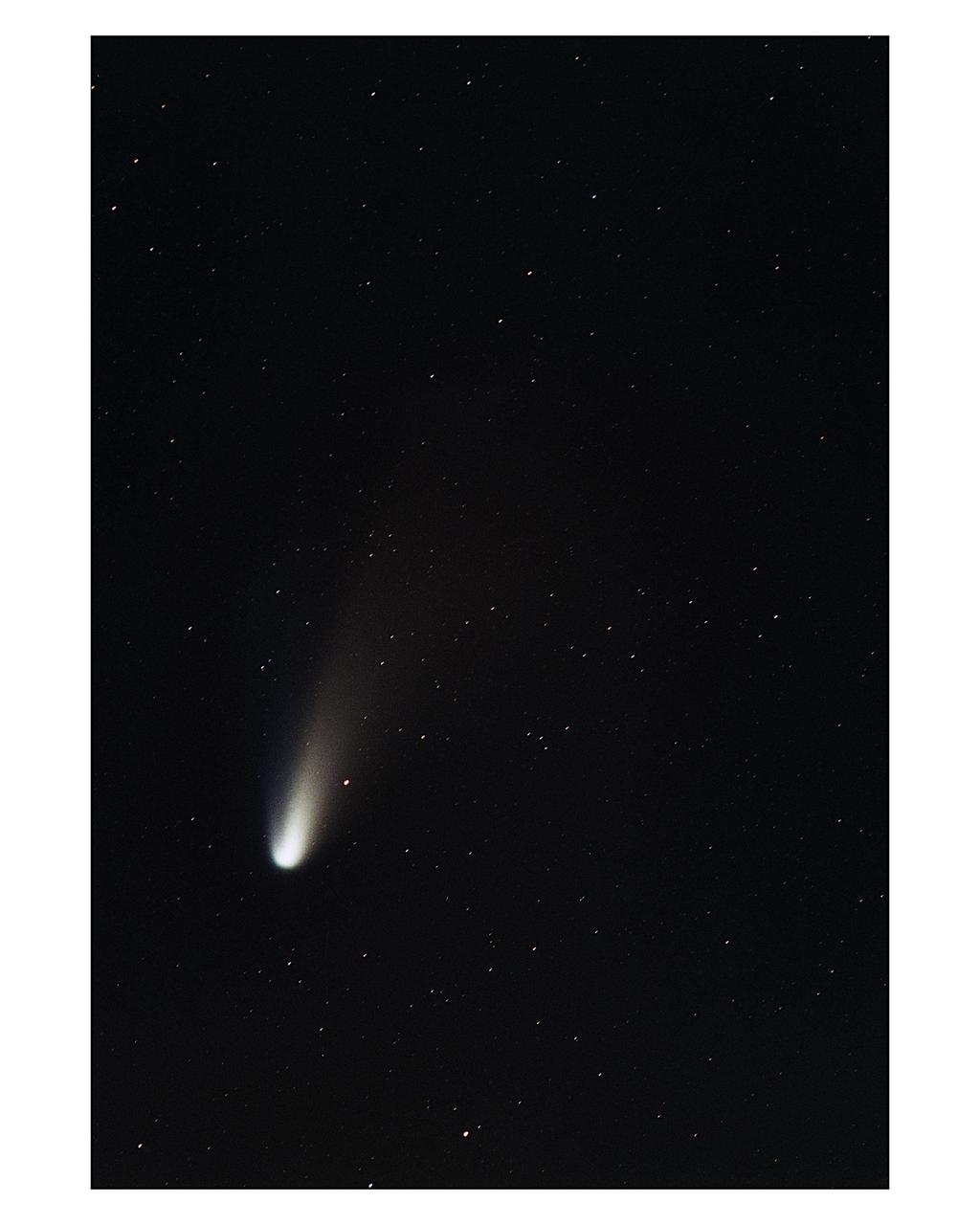
Comet Hale-Bopp is seen in the constellation Lacerta at 5:18 a.m. on March 9, 1997. North is to the left of the comet in this photograph, which was taken on Merritt Island, Florida, near Kennedy Space Center
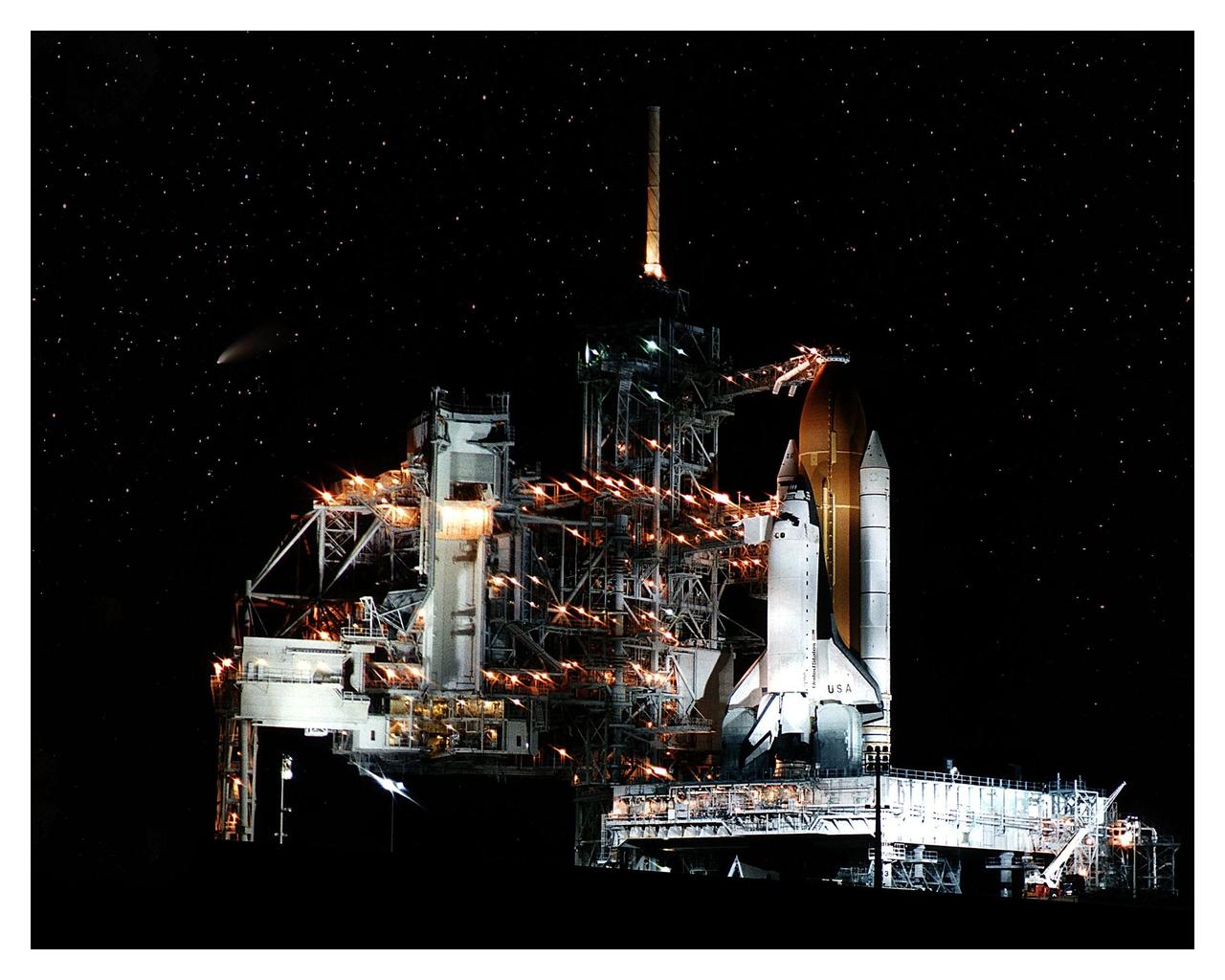
The soon-to-be-spaceborne Space Shuttle Columbia gets a flyby visit from the Comet Hale-Bopp (shown as the streak at left center) while awaiting launch on the STS-83 mission. This photo was taken the night before the planned liftoff on April 4, 1997. The Rotating Service Structure at Launch Pad 39A has been moved back prior to the start of operations to fuel the external tank. The primary objective of the STS-83 flight is to operate the Microgravity Science Laboratory-1 (MSL-1), which will test some of the hardware, facilities and procedures that will be used on the International Space Station. Columbia will have a crew of seven
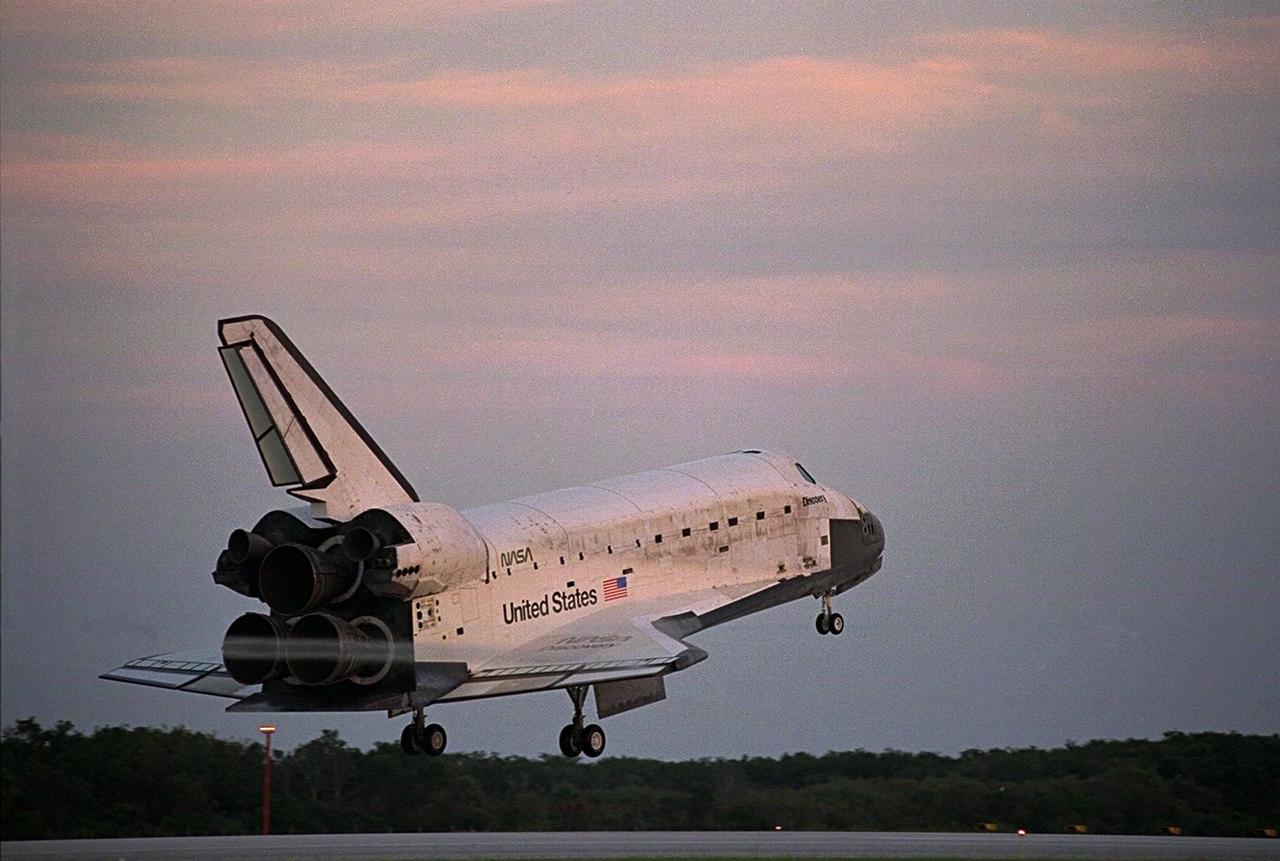
KENNEDY SPACE CENTER, FLA. -- With Commander Curtis L. Brown, Jr. and Pilot Kent V. Rominger at the controls, the Space Shuttle orbiter Discovery prepares to touch down on Runway 33 at KSC’s Shuttle Landing Facility at approximately 7:08 a.m. EDT Aug. 19 to complete the nearly 12-day-long STS-85 mission. The first landing opportunity on Aug. 18 was waved off due to the potential for ground fog. Also onboard the orbiter are Payload Commander N. Jan Davis, Mission Specialist Robert L. Curbeam, Jr., Mission Specialist Stephen K. Robinson and Payload Specialist Bjarni V. Tryggvason. During the 86th Space Shuttle mission, the crew deployed the Cryogenic Infrared Spectrometers and Telescopes for the Atmosphere-Shuttle Pallet Satellite-2 (CRISTA-SPAS-2) free-flyer to conduct research on the Earth’s middle atmosphere, retrieving it on flight day 9. They also conducted investigations with the Manipulator Flight Demonstration (MFD), Technology Applications and Science-1 (TAS-1) and International Extreme Ultraviolet Hitchhiker-2 (IEH-2) experiments. Robinson also made observations of the comet Hale-Bopp with the Southwest Ultraviolet Imaging System (SWIS) while other members of the crew conducted biological experiments in the orbiter’s crew cabin
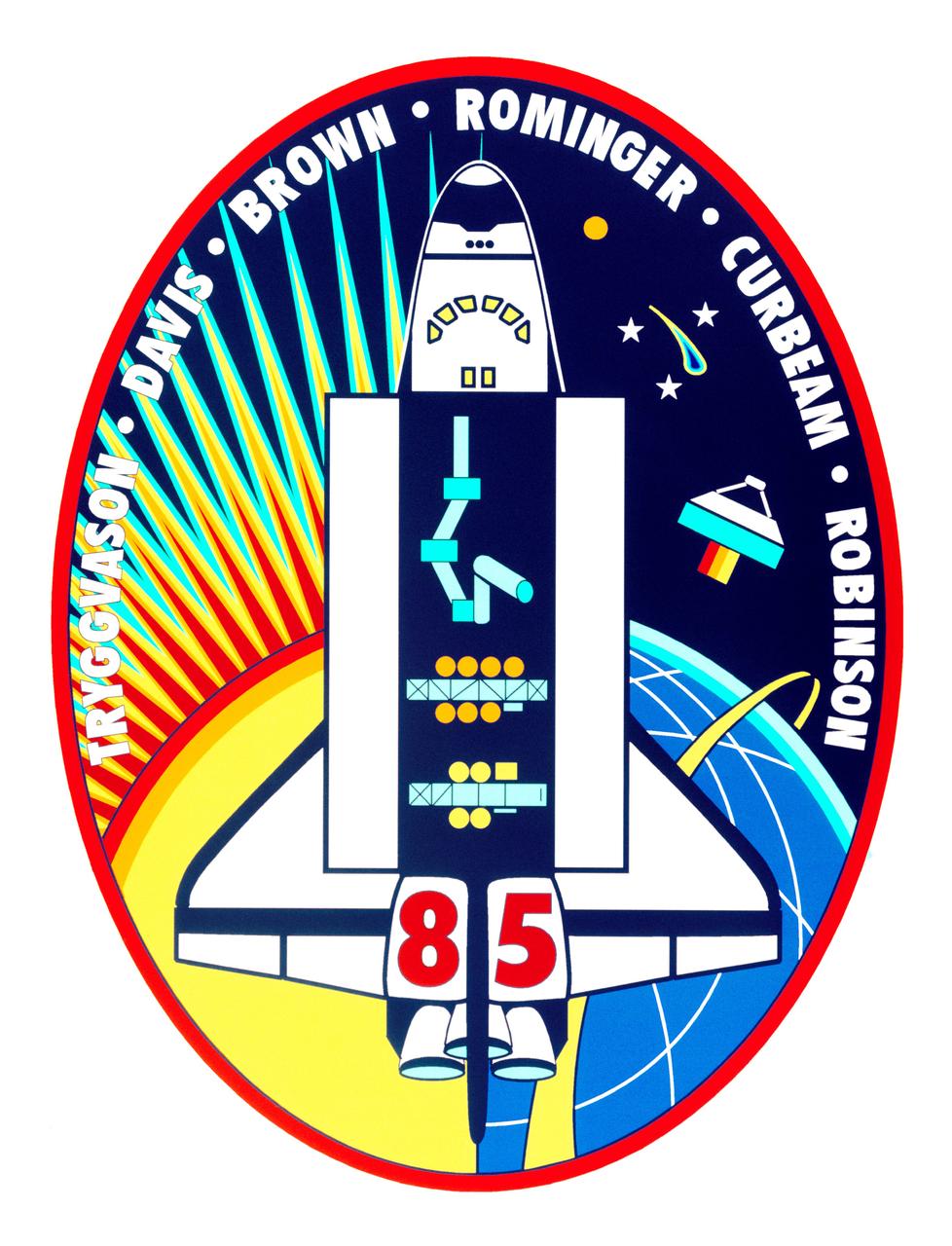
The mission patch for STS-85 is designed to reflect the broad range of science and engineering payloads on the flight. The primary objectives of the mission were to measure chemical constituents in Earth’s atmosphere with a free-flying satellite and to flight-test a new Japanese robotic arm designed for use on the International Space Station (ISS). STS-85 was the second flight of the satellite known as Cryogenic Infrared Spectrometers and Telescopes for the Atmosphere-Shuttle Pallet Satellite-2 CRISTA-SPAS-02. CRISTA, depicted on the right side of the patch pointing its trio of infrared telescopes at Earth’s atmosphere, stands for Cryogenic Infrared Spectrometers and Telescopes for the Atmosphere. The high inclination orbit is shown as a yellow band over Earth’s northern latitudes. In the Space Shuttle Discovery’s open payload bay an enlarged version of the Japanese National Space Development Agency’s (NASDA) Manipulator Flight Demonstration (MFD) robotic arm is shown. Also shown in the payload bay are two sets of multi-science experiments: the International Extreme Ultraviolet Hitchhiker (IEH-02) nearest the tail and the Technology Applications and Science (TAS-01) payload. Jupiter and three stars are shown to represent sources of ultraviolet energy in the universe. Comet Hale-Bopp, which was visible from Earth during the mission, is depicted at upper right. The left side of the patch symbolizes daytime operations over the Northern Hemisphere of Earth and the solar science objectives of several of the payloads.
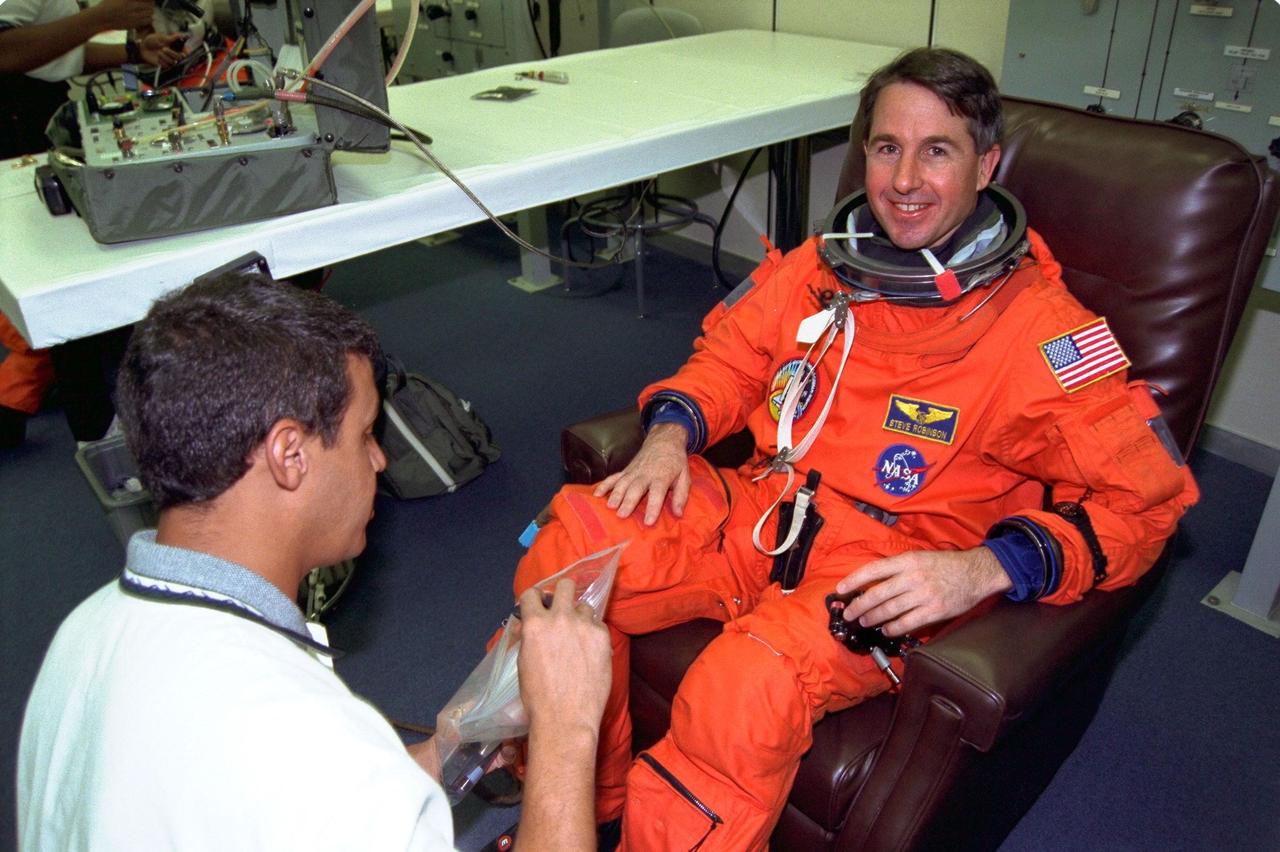
STS-85 Mission Specialist Stephen K. Robinson smiles as he is assisted with his ascent/reentry flight suit by a suit technician in the Operations and Checkout (O&C) Building. He has been a NASA employee since 1975 and has worked at Ames and Langley Research Centers. Robinson holds a doctorate in mechanical engineering and is a licensed pilot. He will assist Mission Specialist Robert L. Curbeam, Jr. with the Cryogenic Infrared Spectrometers and Telescopes for the Atmosphere-Shuttle Pallet Satellite-2 (CRISTA-SPAS-2) free-flyer and conduct Comet Hale-Bopp observations with the Southwest Ultraviolet Imaging System. Robinson will also coordinate photo and television data operations during the mission. The primary payload aboard the Space Shuttle orbiter Discovery is the CRISTA-SPAS2. Other payloads on the 11-day mission include the Manipulator Flight Demonstration (MFD), and Technology Applications and Science-1 (TAS-1) and International Extreme Ultraviolet Hitchhiker-2 (IEH-2) experiments
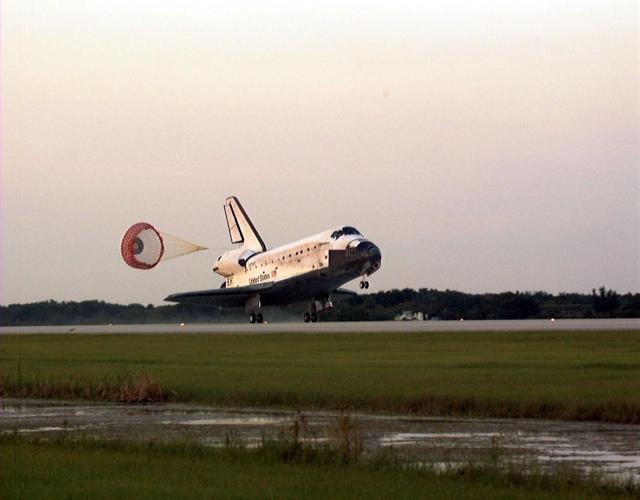
KENNEDY SPACE CENTER, FLA. -- With drag chute deployed, the Space Shuttle orbiter Discovery touches down on Runway 33 at KSC’s Shuttle Landing Facility at 7:07:59 a.m. EDT Aug. 19 to complete the 11-day, 20-hour and 27-minute-long STS-85 mission. At the controls are Commander Curtis L. Brown, Jr. and Pilot Kent V. Rominger. The first landing opportunity on Aug. 18 was waved off due to the potential for ground fog. Also onboard the orbiter are Payload Commander N. Jan Davis, Mission Specialist Robert L. Curbeam, Jr., Mission Specialist Stephen K. Robinson and Payload Specialist Bjarni V. Tryggvason. During the 86th Space Shuttle mission, the crew deployed the Cryogenic Infrared Spectrometers and Telescopes for the AtmosphereShuttle Pallet Satellite-2 (CRISTA-SPAS-2) free-flyer to conduct research on the Earth’s middle atmosphere, retrieving it on flight day 9. The crew also conducted investigations with the Manipulator Flight Demonstration (MFD), Technology Applications and Science-1 (TAS-1) and International Extreme Ultraviolet Hitchhiker-2 (IEH-2) experiments. Robinson also made observations of the comet Hale-Bopp with the Southwest Ultraviolet Imaging System (SWIS) while other members of the crew conducted biological experiments in the orbiter’s crew cabin. This was the 39th landing at KSC in the history of the Space Shuttle program and the 11th touchdown for Discovery at the space center
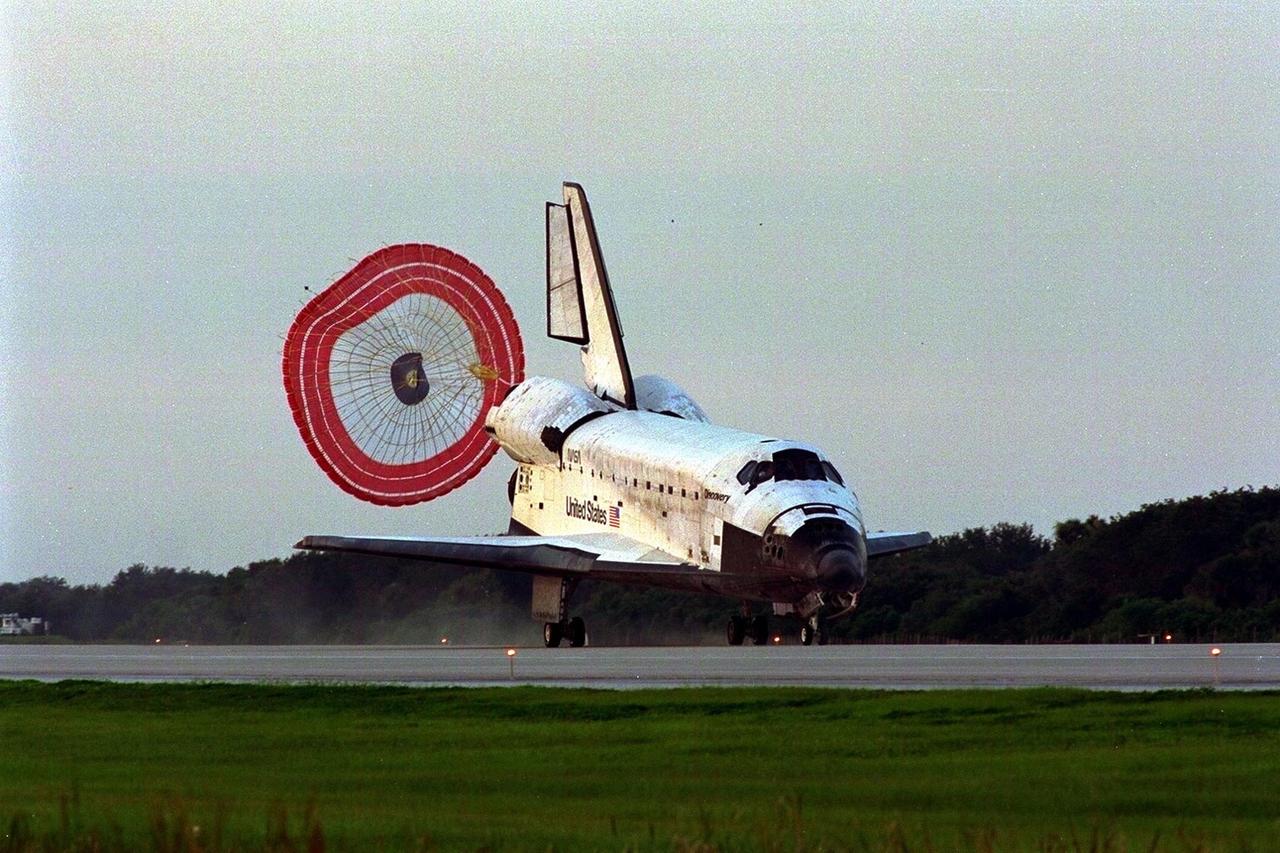
KENNEDY SPACE CENTER, FLA. -- With drag chute deployed, the Space Shuttle orbiter Discovery touches down on Runway 33 at KSC’s Shuttle Landing Facility at 7:07:59 a.m. EDT Aug. 19 to complete the 11-day, 20-hour and 27-minute-long STS-85 mission. At the controls are Commander Curtis L. Brown, Jr. and Pilot Kent V. Rominger. The first landing opportunity on Aug. 18 was waved off due to the potential for ground fog. Also onboard the orbiter are Payload Commander N. Jan Davis, Mission Specialist Robert L. Curbeam, Jr., Mission Specialist Stephen K. Robinson and Payload Specialist Bjarni V. Tryggvason. During the 86th Space Shuttle mission, the crew deployed the Cryogenic Infrared Spectrometers and Telescopes for the AtmosphereShuttle Pallet Satellite-2 (CRISTA-SPAS-2) free-flyer to conduct research on the Earth’s middle atmosphere, retrieving it on flight day 9. The crew also conducted investigations with the Manipulator Flight Demonstration (MFD), Technology Applications and Science-1 (TAS-1) and International Extreme Ultraviolet Hitchhiker-2 (IEH-2) experiments. Robinson also made observations of the comet Hale-Bopp with the Southwest Ultraviolet Imaging System (SWIS) while other members of the crew conducted biological experiments in the orbiter’s crew cabin. This was the 39th landing at KSC in the history of the Space Shuttle program and the 11th touchdown for Discovery at the space center
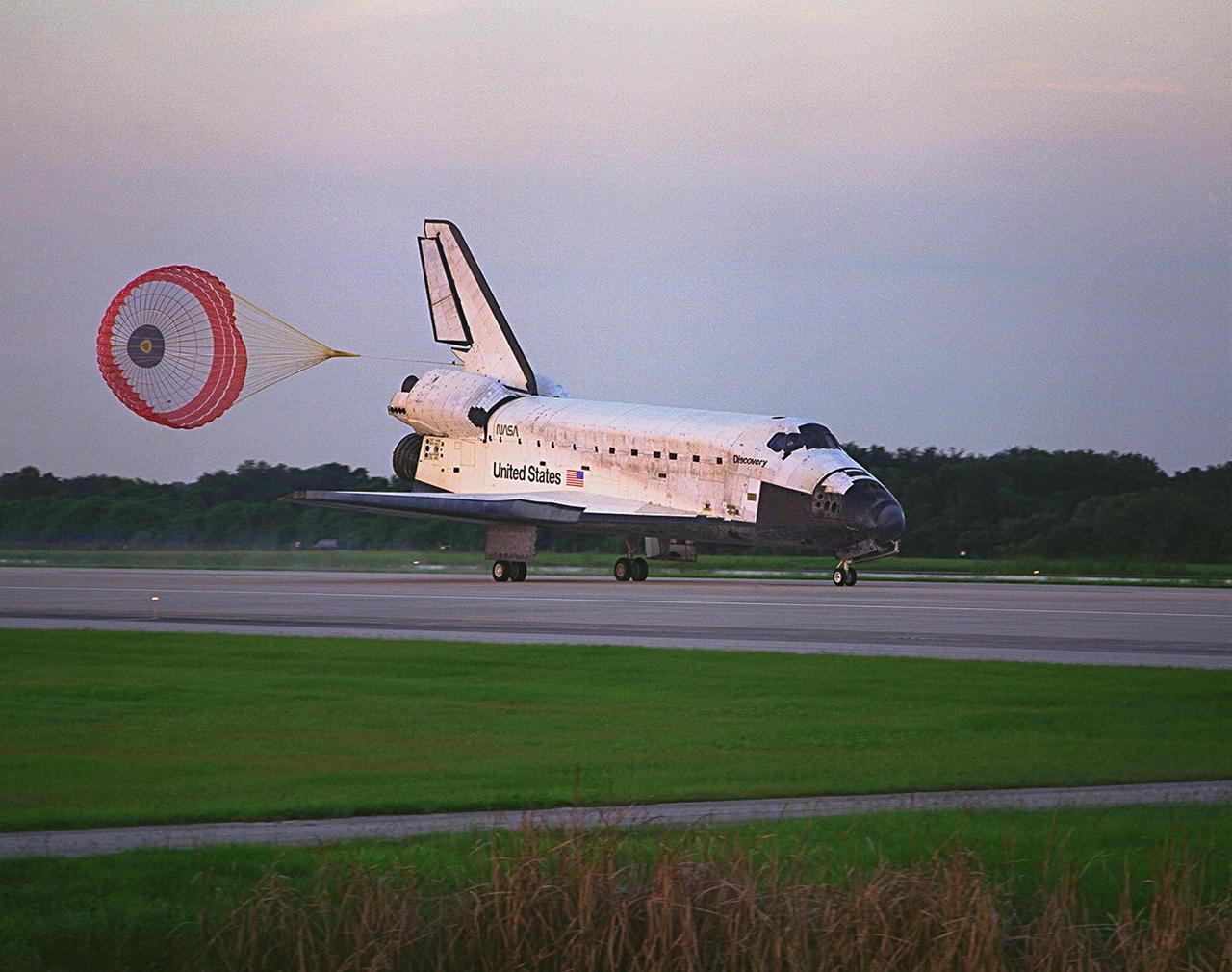
KENNEDY SPACE CENTER, FLA. -- With drag chute deployed, the Space Shuttle orbiter Discovery touches down on Runway 33 at KSC’s Shuttle Landing Facility at 7:07:59 a.m. EDT Aug. 19 to complete the 11-day, 20-hour and 27-minute-long STS-85 mission. At the controls are Commander Curtis L. Brown, Jr. and Pilot Kent V. Rominger. The first landing opportunity on Aug. 18 was waved off due to the potential for ground fog. Also onboard the orbiter are Payload Commander N. Jan Davis, Mission Specialist Robert L. Curbeam, Jr., Mission Specialist Stephen K. Robinson and Payload Specialist Bjarni V. Tryggvason. During the 86th Space Shuttle mission, the crew deployed the Cryogenic Infrared Spectrometers and Telescopes for the AtmosphereShuttle Pallet Satellite-2 (CRISTA-SPAS-2) free-flyer to conduct research on the Earth’s middle atmosphere, retrieving it on flight day 9. The crew also conducted investigations with the Manipulator Flight Demonstration (MFD), Technology Applications and Science-1 (TAS-1) and International Extreme Ultraviolet Hitchhiker-2 (IEH-2) experiments. Robinson also made observations of the comet Hale-Bopp with the Southwest Ultraviolet Imaging System (SWIS) while other members of the crew conducted biological experiments in the orbiter’s crew cabin. This was the 39th landing at KSC in the history of the Space Shuttle program and the 11th touchdown for Discovery at the space center
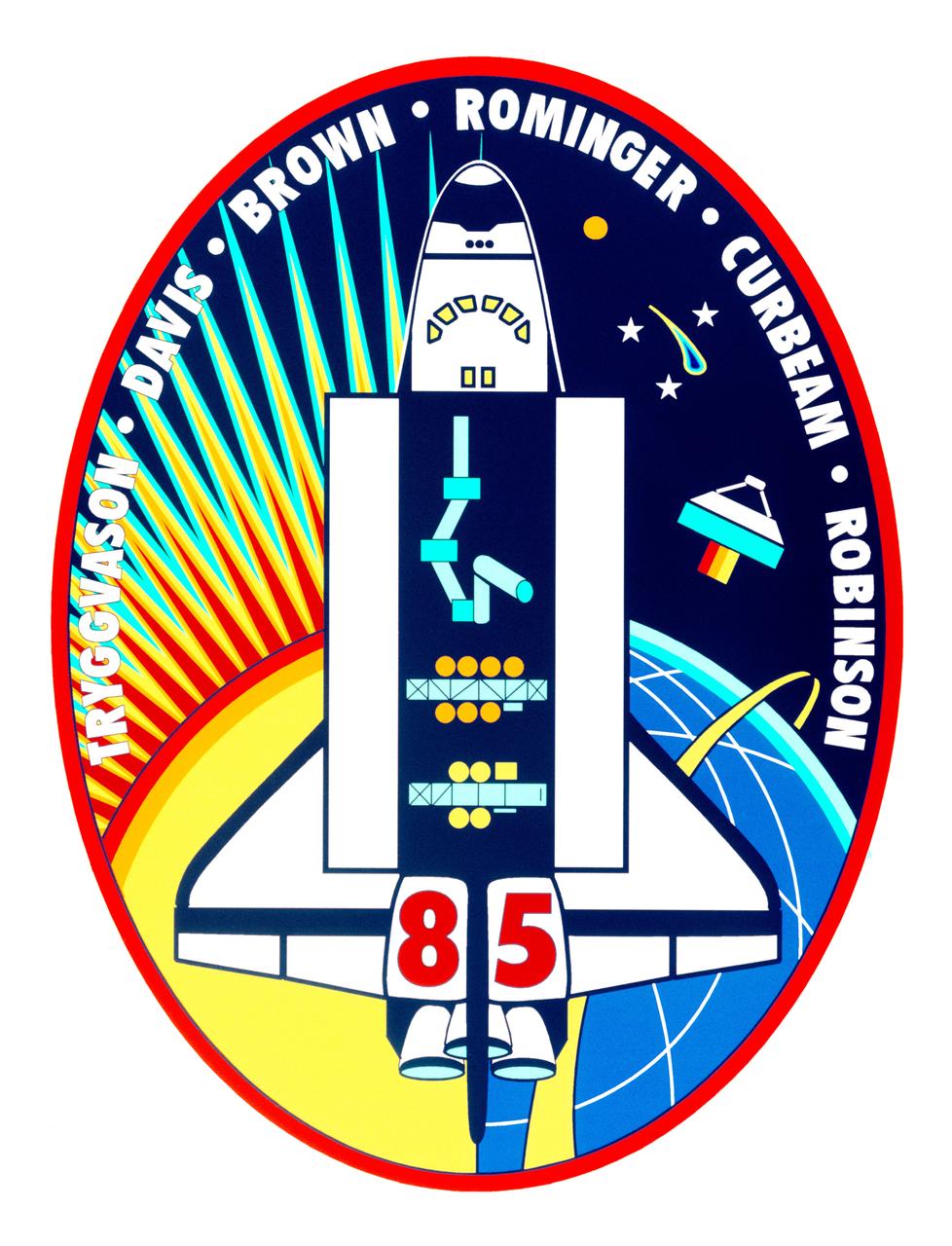
STS085-S-001 (May 1997) --- The mission patch for STS-85 is designed to reflect the broad range of science and engineering payloads on the flight. The primary objectives of the mission are to measure chemical constituents in Earth?s atmosphere with a free-flying satellite and to flight-test a new Japanese robotic arm designed for use on the International Space Station (ISS). STS-85 is the second flight of the satellite known as CRISTA-SPAS-02. CRISTA, depicted on the right side of the patch pointing its trio of infrared telescopes at Earth?s atmosphere, stands for Cryogenic Infrared Spectrometers and Telescopes for the Atmosphere. The high inclination orbit is shown as a yellow band over Earth?s northern latitudes. In the space shuttle Discovery?s open payload bay an enlarged version of the Japanese National Space Development Agency?s (NASDA) Manipulator Flight Demonstration (MFD) robotic arm is shown. Also shown in the payload bay are two sets of multi-science experiments: the International Extreme Ultraviolet Hitchhiker (IEH-02) nearest the tail and the Technology Applications and Science (TAS-01) payload. Jupiter and three stars are shown to represent sources of ultraviolet energy in the universe. Comet Hale-Bopp, which will be visible from Earth during the mission, is depicted at upper right. The left side of the patch symbolizes daytime operations over the Northern Hemisphere of Earth and the solar science objectives of several of the payloads. The NASA insignia design for space shuttle flights is reserved for use by the astronauts and for other official use as the NASA Administrator may authorize. Public availability has been approved only in the forms of illustrations by the various news media. When and if there is any change in this policy, which is not anticipated, the change will be publicly announced. Photo credit: NASA