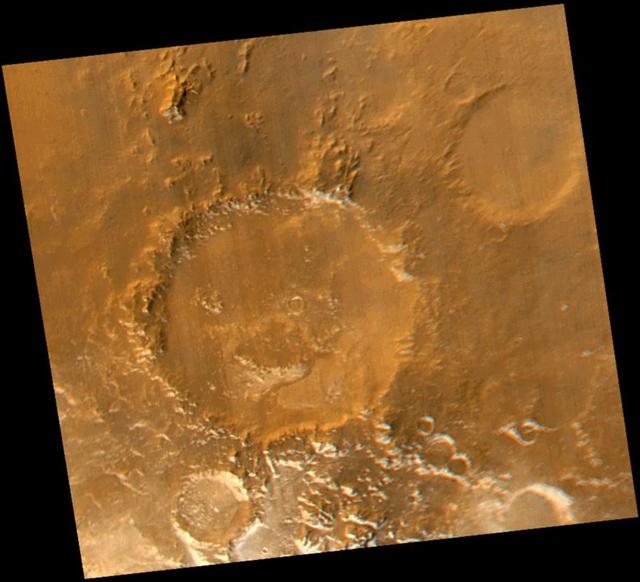
Smile! Spring has sprung in the martian southern hemisphere. With it comes the annual retreat of the winter polar frost cap. This view of "Happy Face Crater"--officially named "Galle Crater"--shows patches of white water ice frost in and around the crater's south-facing slopes. Slopes that face south will retain frost longer than north-facing slopes because they do not receive as much sunlight in early spring. This picture is a composite of images taken by the Mars Global Surveyor Mars Orbiter Camera (MOC) red and blue wide angle cameras. The wide angle cameras were designed to monitor the changing weather, frost, and wind patterns on Mars. Galle Crater is located on the east rim of the Argyre Basin and is about 215 kilometers (134 miles) across. In this picture, illumination is from the upper left and north is up. http://photojournal.jpl.nasa.gov/catalog/PIA02325
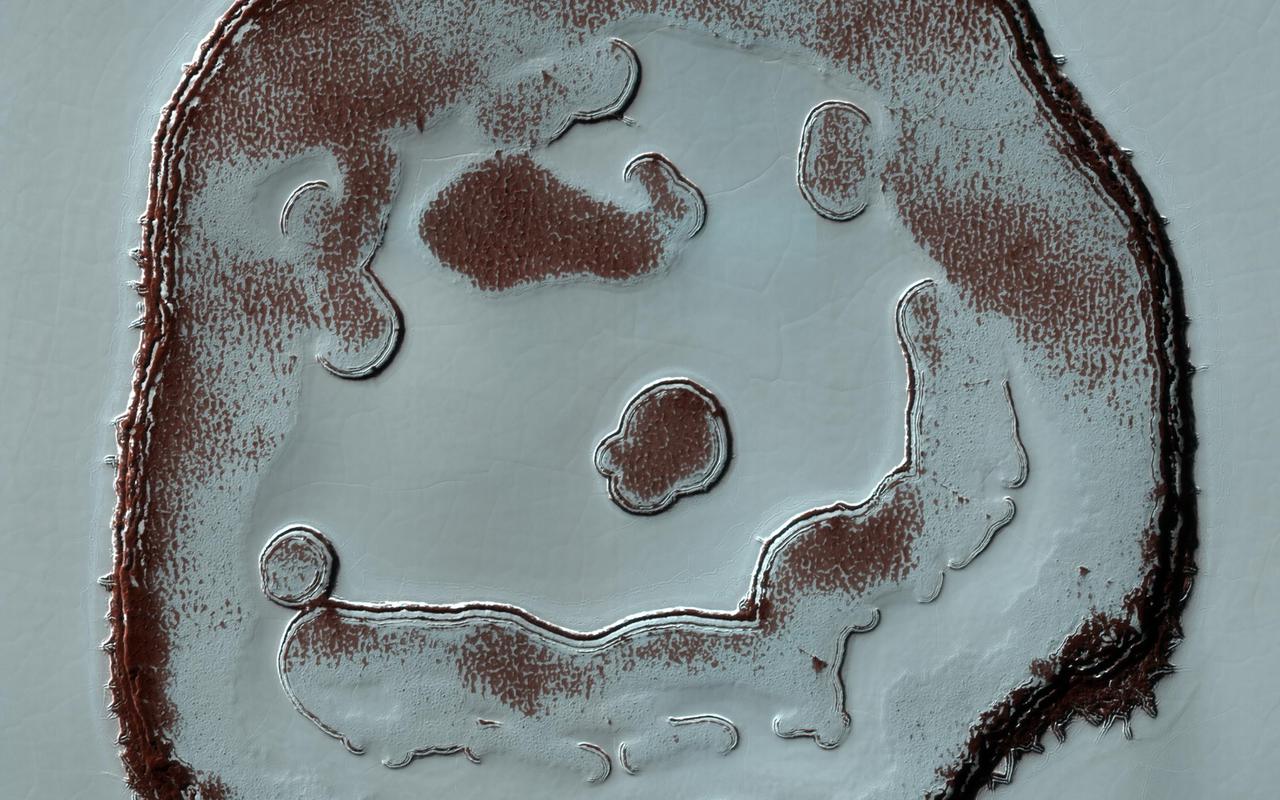
We've monitored the so-called Happy Face Crater in the south polar region of Mars for almost a decade. Two images that we took, one in 2011 and the other in 2020, at roughly the same season, show color variations that are due to different amounts of bright frost over darker red ground. The "blobby" features in the polar cap are due to the sun sublimating away the carbon dioxide into these round patterns. You can see how nine years of this thermal erosion have made the "mouth" of the face larger. The "nose" consisted of a two circular depressions in 2011, and in 2020, those two depressions have grown larger and merged. Measuring these changes throughout the Martian year help scientists understand the annual deposition and removal of polar frost, and monitoring these sites over long periods helps us understand longer term climate trends on the Red Planet. https://photojournal.jpl.nasa.gov/catalog/PIA24389