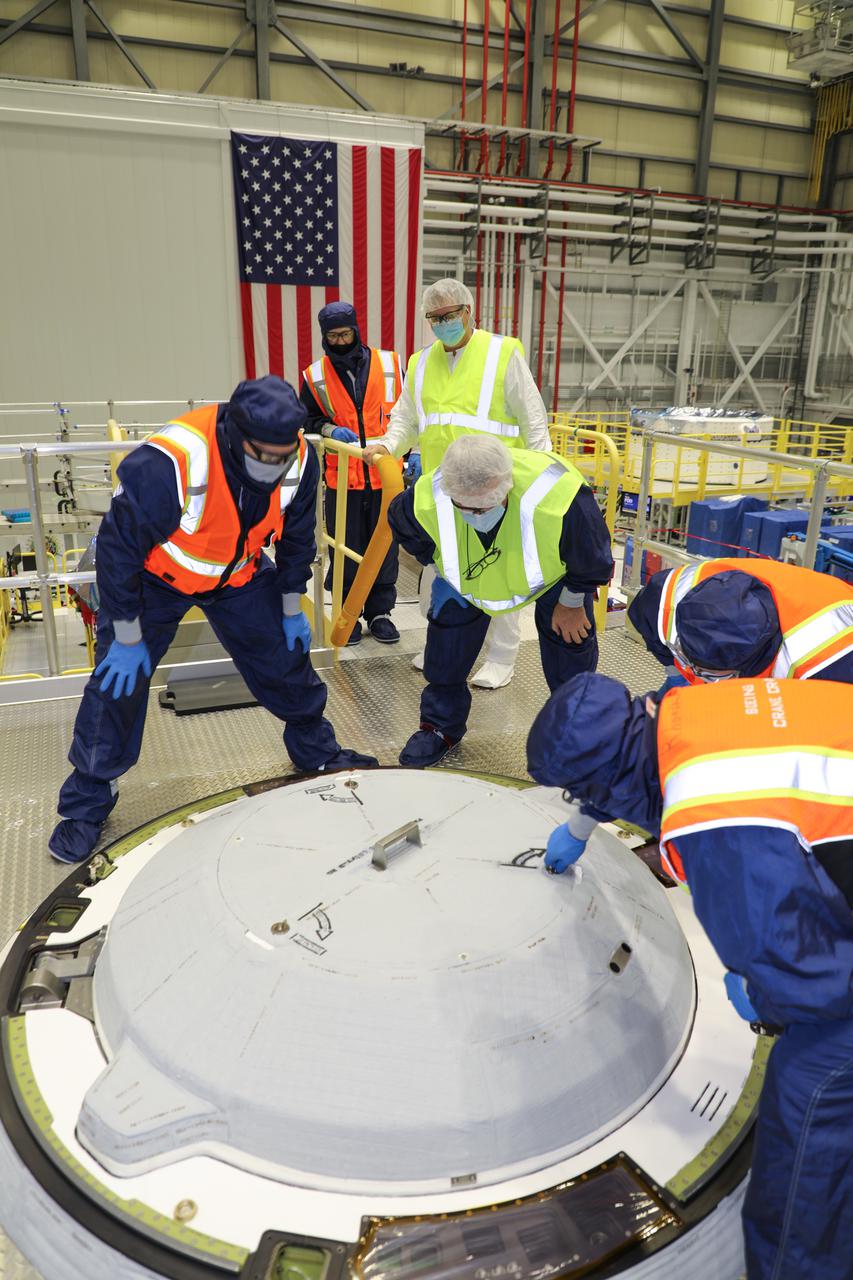
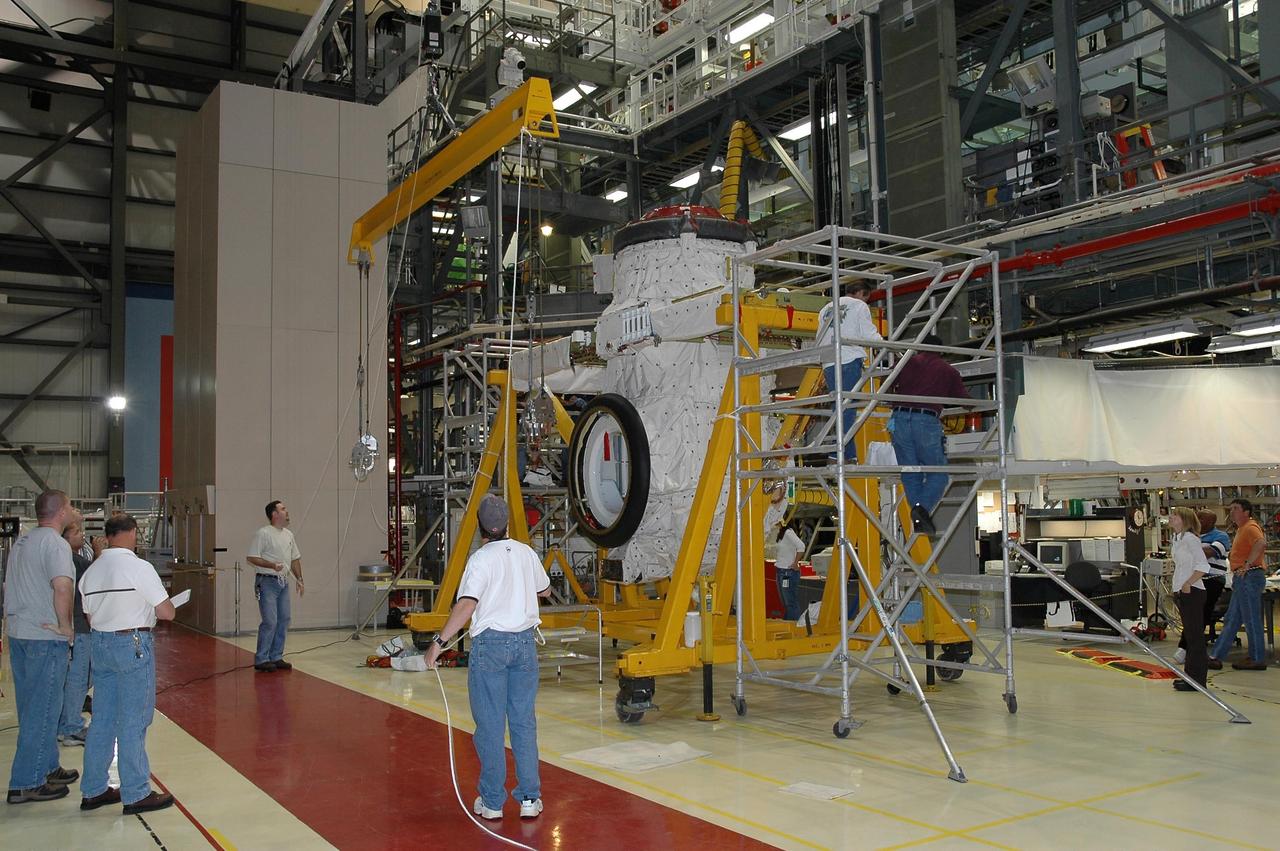
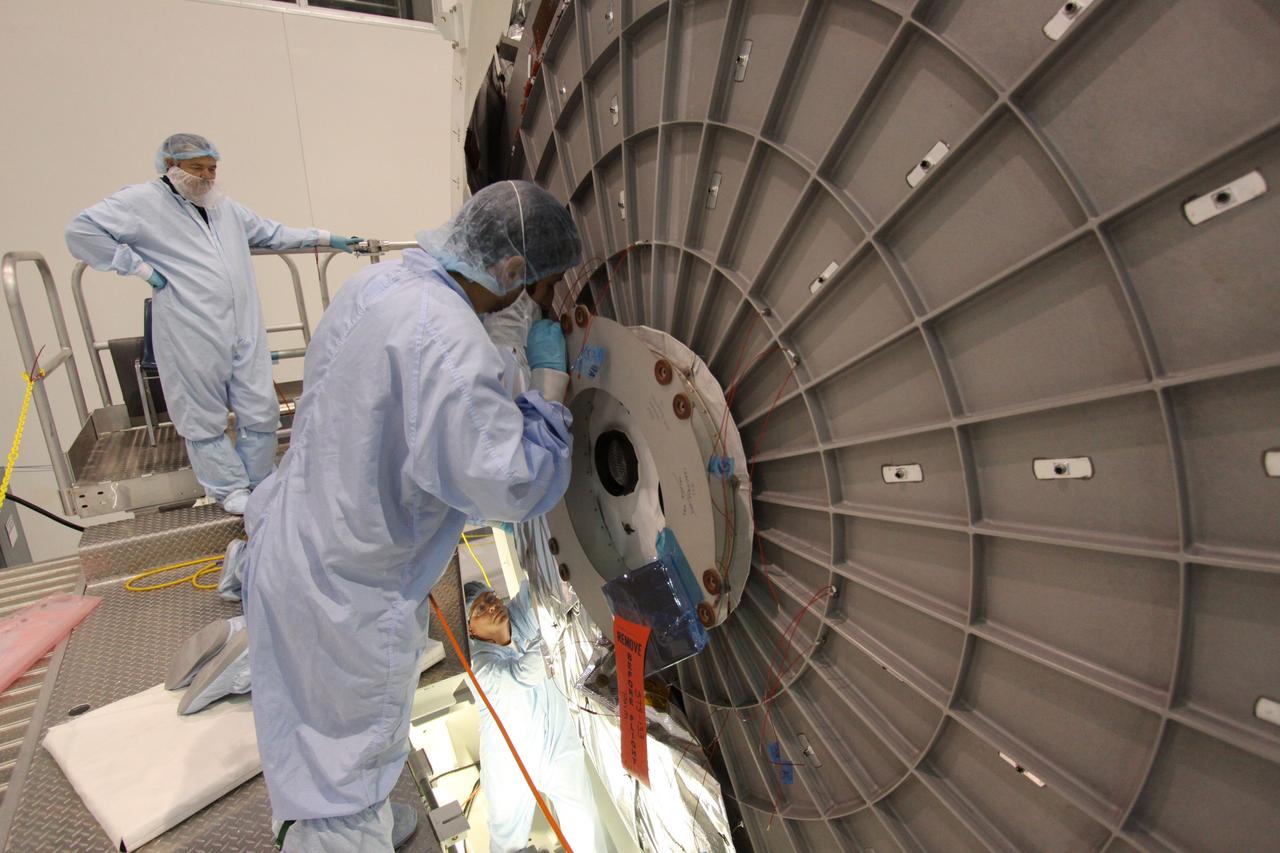
Technicians work on the NASA Docking System (NDS) hatch installation in the Commercial Crew and Cargo Processing Facility at Kennedy Space Center in Florida on Jan. 2, 2021. The NDS cover was installed on Boeing’s Starliner spacecraft in preparation for the company’s second Orbital Flight Test (OFT-2), as part of NASA’s Commercial Crew Program. The cover is designed to protect the components that connect the spacecraft to the International Space Station.
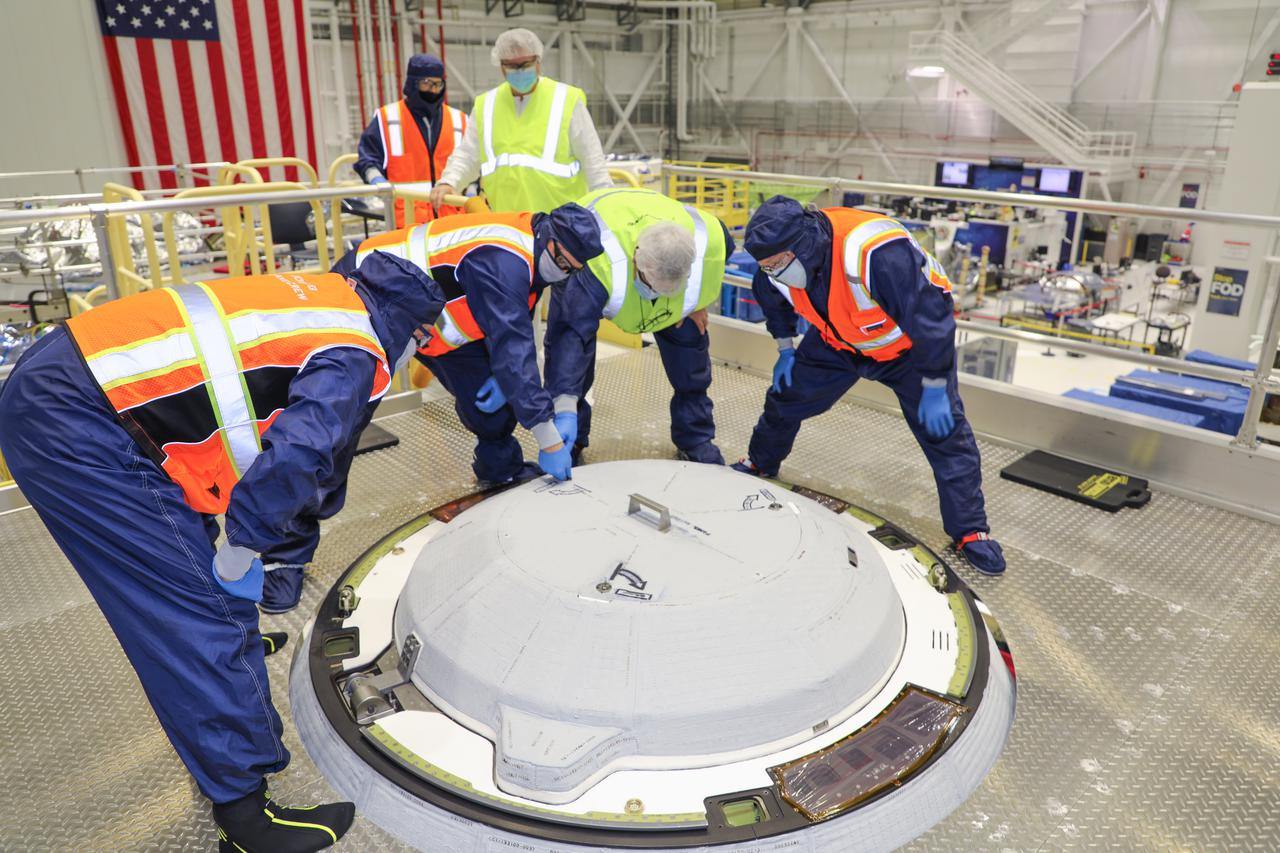
Technicians work on the NASA Docking System (NDS) cover hatch installation in the Commercial Crew and Cargo Processing Facility at Kennedy Space Center in Florida on Jan. 2, 2021. The NDS cover was installed on Boeing’s Starliner spacecraft in preparation for the company’s second Orbital Flight Test (OFT-2), as part of NASA’s Commercial Crew Program. The cover is designed to protect the components that connect the spacecraft to the International Space Station.
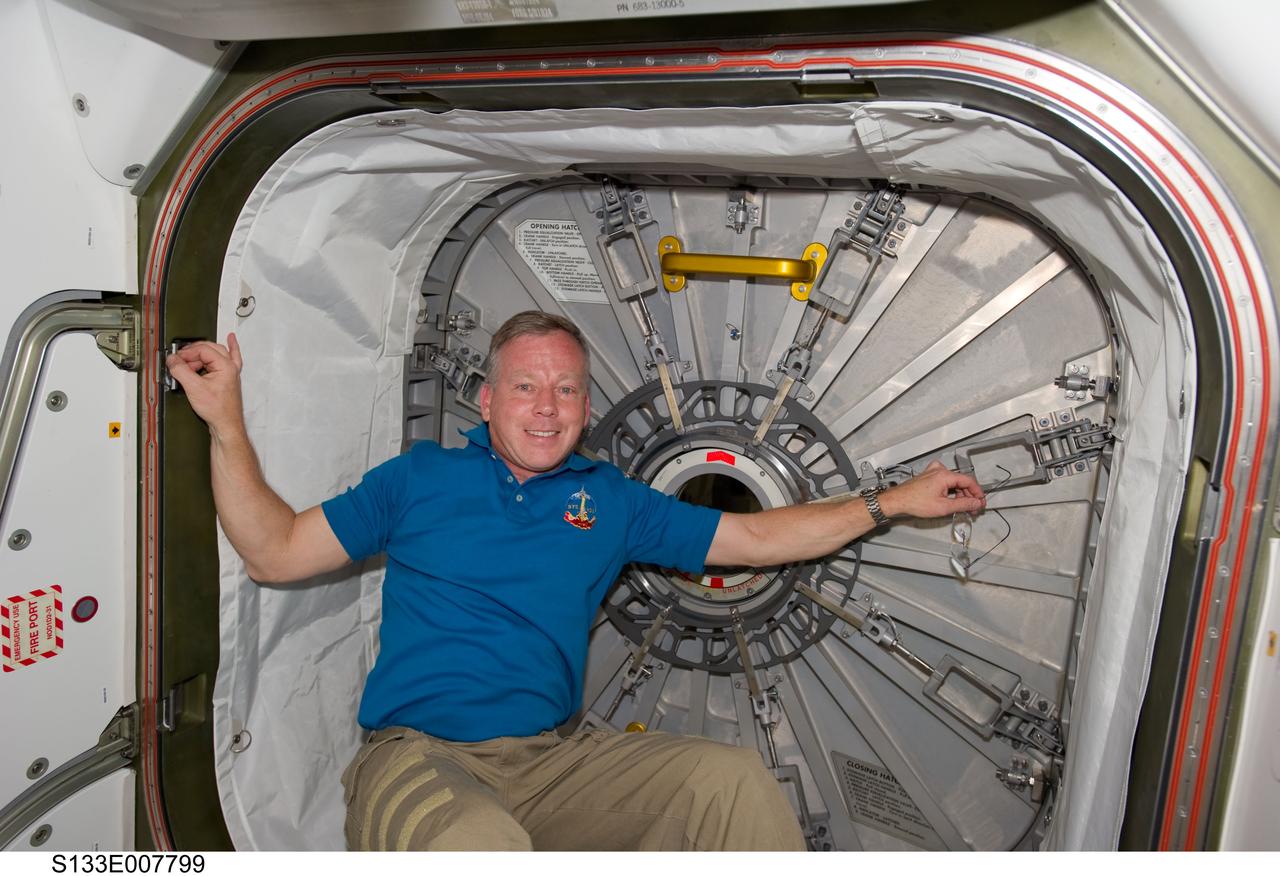
S133-E-007799 (1 March 2011) --- NASA astronaut Steve Lindsey, STS-133 commander, is pictured at the hatch of the Earth-facing port of the International Space Station’s Unity node while space shuttle Discovery remains docked with the station. On the other side of the hatch door is the newly-installed Permanent Multipurpose Module (PMM). Photo credit: NASA or National Aeronautics and Space Administration
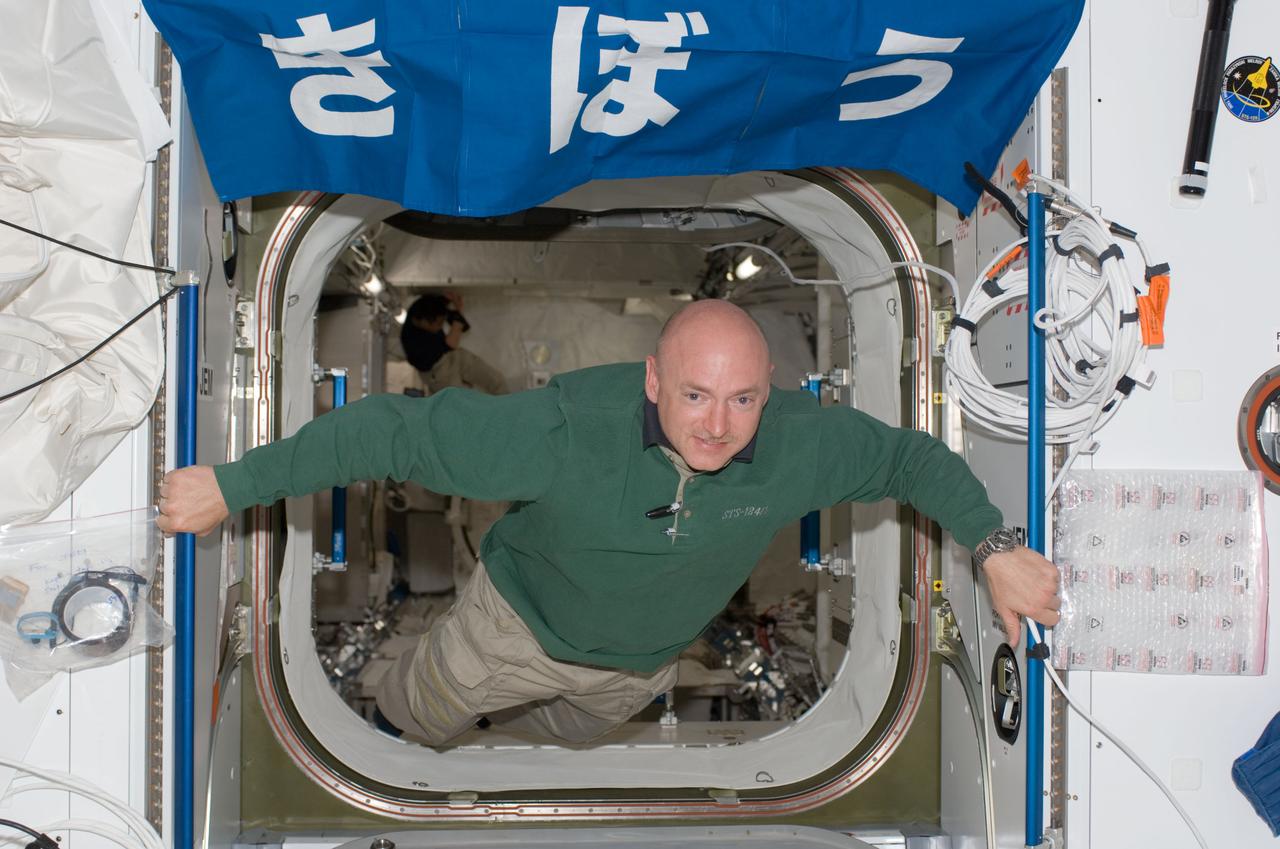
S124-E-006287 (4 June 2008) --- Astronaut Mark Kelly, STS-124 commander, floats in the hatch between the Harmony node and the newly installed Kibo Japanese Pressurized Module (JPM) of the International Space Station while Space Shuttle Discovery is docked with the station.
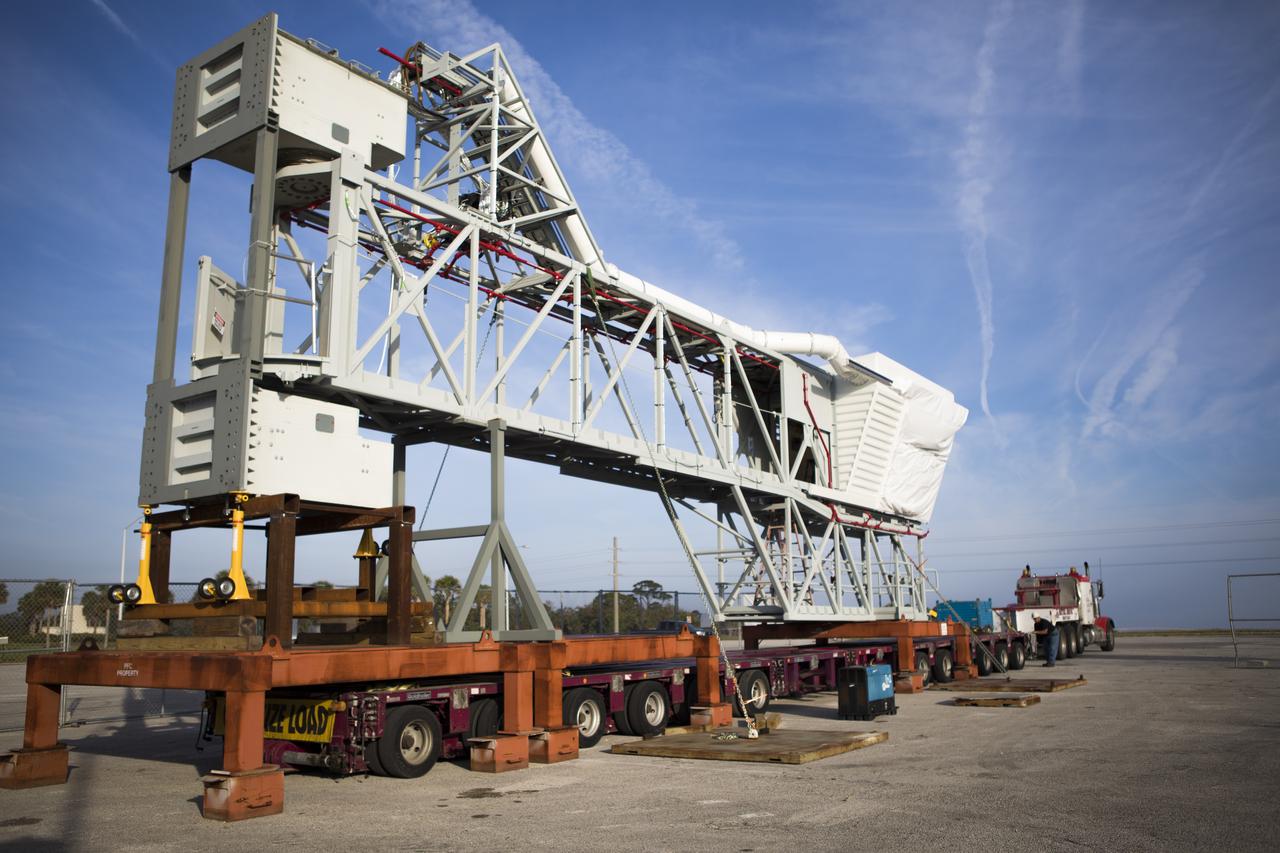
The Orion crew access arm, secured on a stand, is being prepared for its move from a storage location at NASA's Kennedy Space Center in Florida, to the mobile launcher (ML) tower near the Vehicle Assembly Building at the center. The crew access arm will be installed at about the 274-foot level on the tower. It will rotate from its retracted position and interface with the Orion crew hatch location to provide entry to the Orion crew module. The Ground Systems Development and Operations Program is overseeing installation of umbilicals and launch accessories on the ML tower.
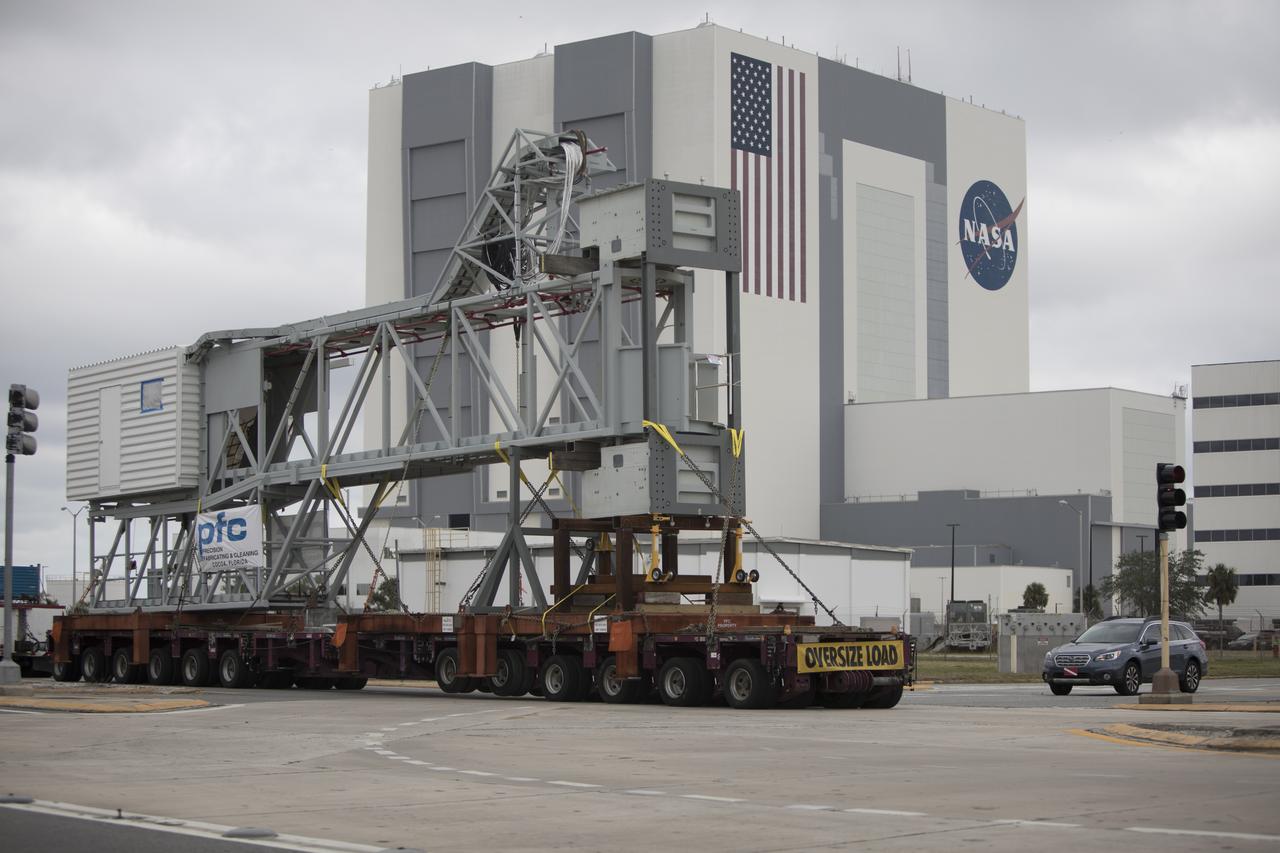
A heavy-load transport truck carrying the Orion crew access arm passes the Vehicle Assembly Building on its way to the mobile launcher at NASA's Kennedy Space Center in Florida. The access arm will be installed at about the 274-foot level on the mobile launcher tower. It will rotate from its retracted position and interface with the Orion crew hatch location to provide entry to the Orion crew module. The Ground Systems Development and Operations Program is overseeing installation of umbilicals and launch accessories on the ML tower to prepare for Exploration Mission-1.
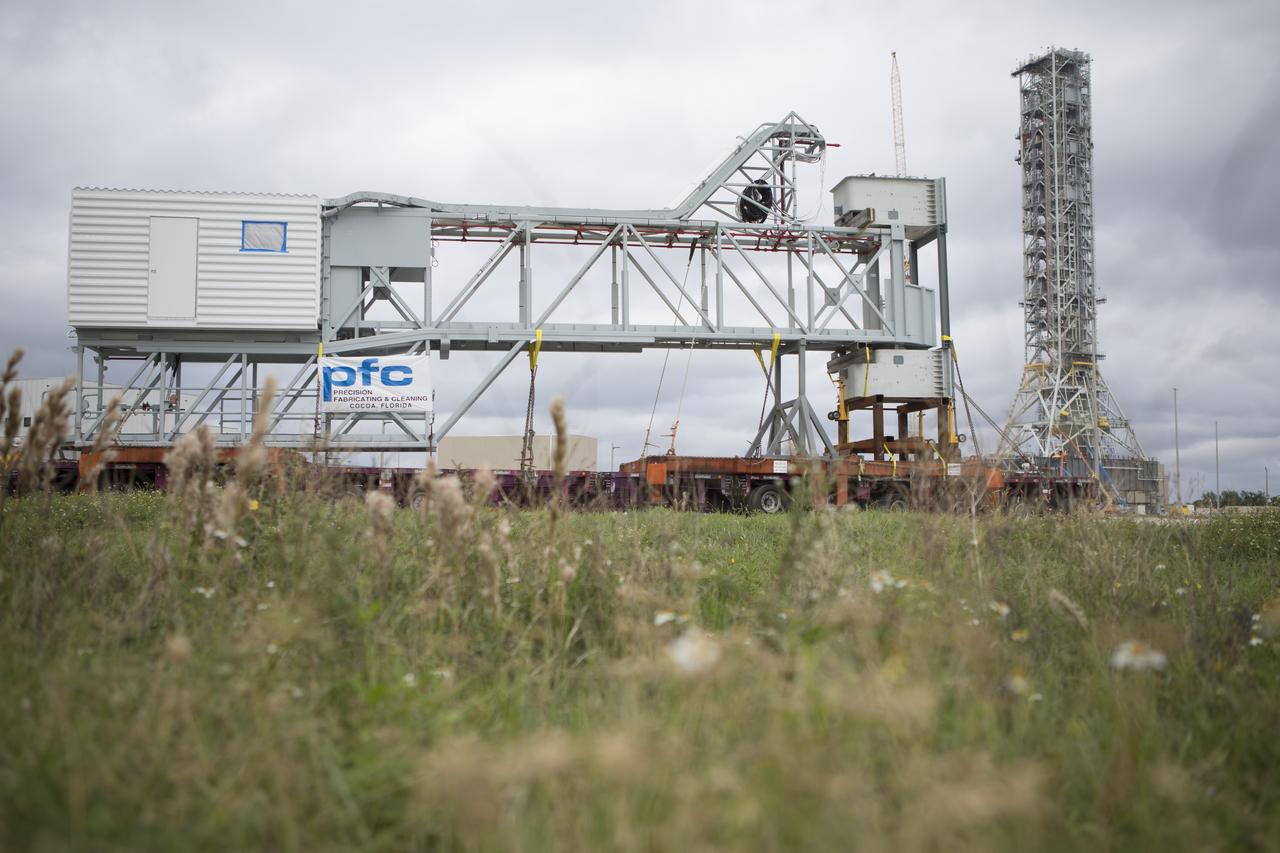
A heavy-load transport truck carrying the Orion crew access arm nears the mobile launcher (ML) at NASA's Kennedy Space Center in Florida. The crew access arm will be installed at about the 274-foot level on the mobile launcher tower. It will rotate from its retracted position and interface with the Orion crew hatch location to provide entry to the Orion crew module. The Ground Systems Development and Operations Program is overseeing installation of umbilicals and launch accessories on the ML tower to prepare for Exploration Mission-1.
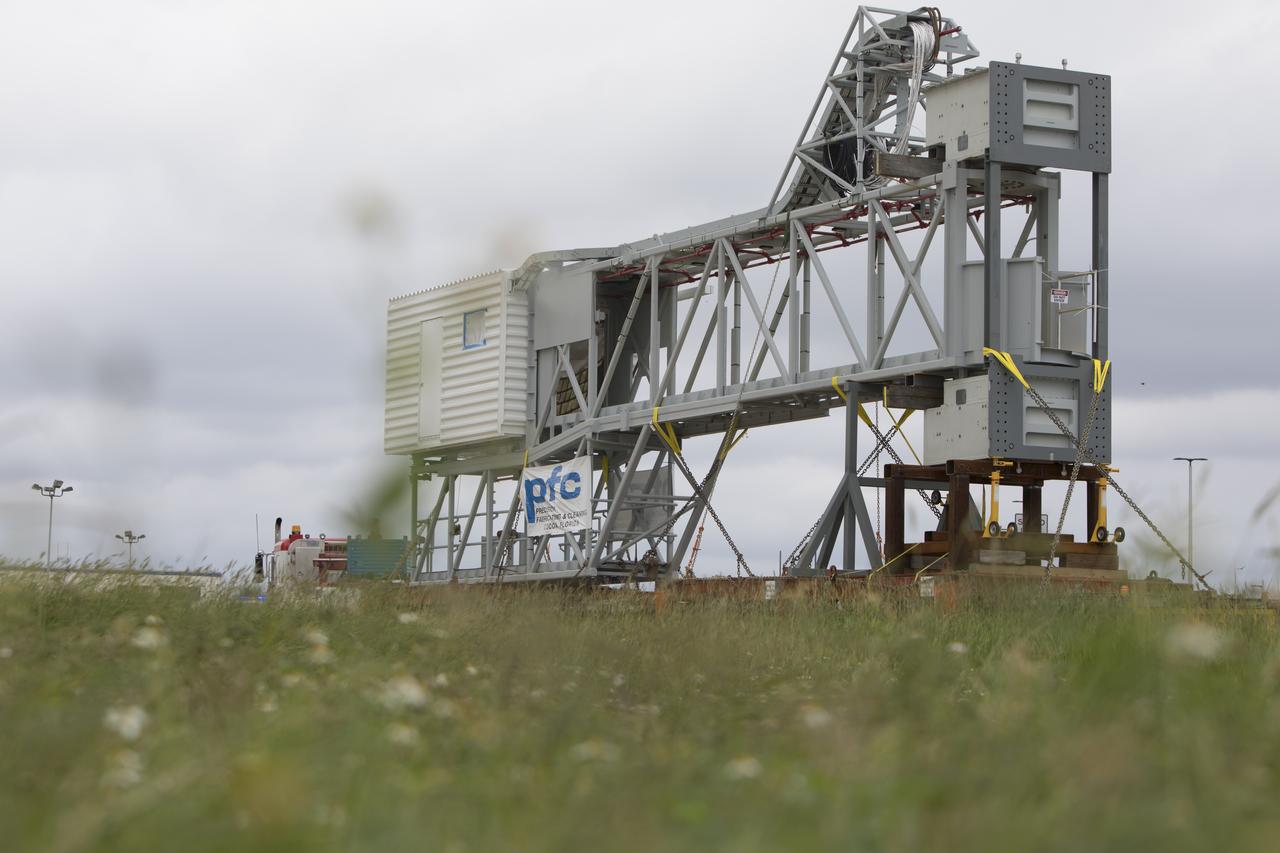
A heavy-load transport truck carrying the Orion crew access arm makes its way toward the mobile launcher (ML) at NASA's Kennedy Space Center in Florida. The crew access arm will be installed at about the 274-foot level on the mobile launcher tower. It will rotate from its retracted position and interface with the Orion crew hatch location to provide entry to the Orion crew module. The Ground Systems Development and Operations Program is overseeing installation of umbilicals and launch accessories on the ML tower to prepare for Exploration Mission-1.
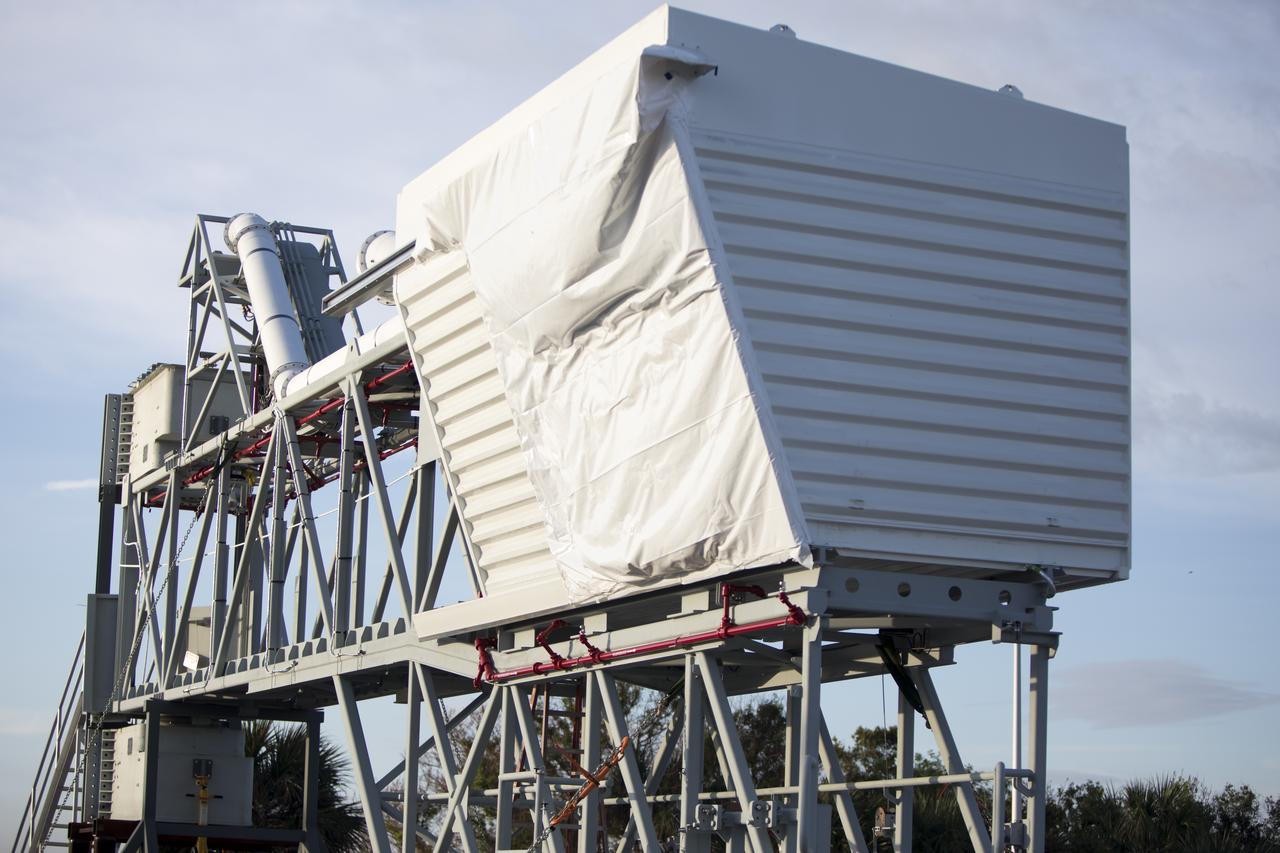
The Orion crew access arm is secured in a storage location at NASA's Kennedy Space Center in Florida. The access arm will be prepared for its move to the mobile launcher (ML) tower near the Vehicle Assembly Building at the center. The crew access arm will be installed at about the 274-foot level on the tower. It will rotate from its retracted position and interface with the Orion crew hatch location to provide entry to the Orion crew module. The Ground Systems Development and Operations Program is overseeing installation of umbilicals and launch accessories on the ML tower.
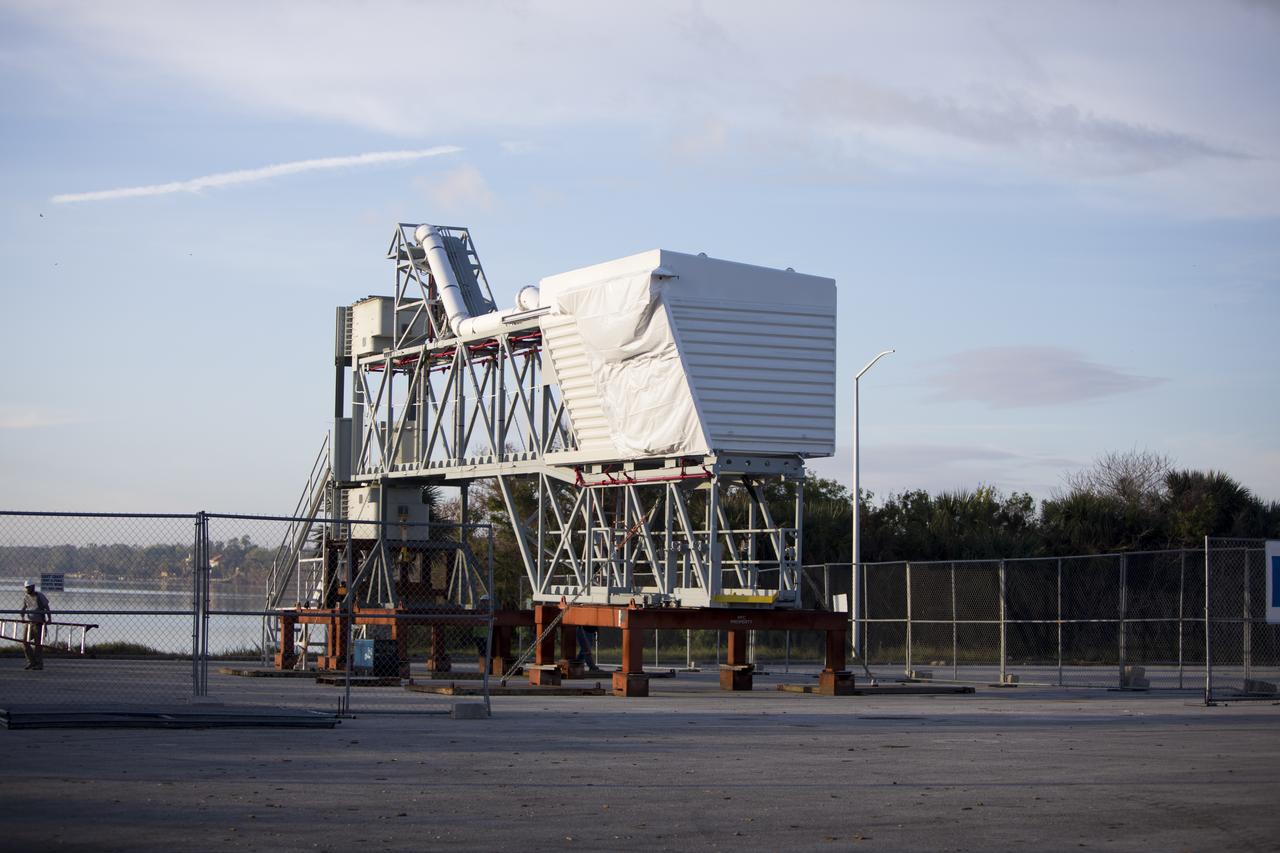
The Orion crew access arm is secured in a storage location at NASA's Kennedy Space Center in Florida. The access arm will be prepared for its move to the mobile launcher (ML) tower near the Vehicle Assembly Building at the center. The crew access arm will be installed at about the 274-foot level on the tower. It will rotate from its retracted position and interface with the Orion crew hatch location to provide entry to the Orion crew module. The Ground Systems Development and Operations Program is overseeing installation of umbilicals and launch accessories on the ML tower.
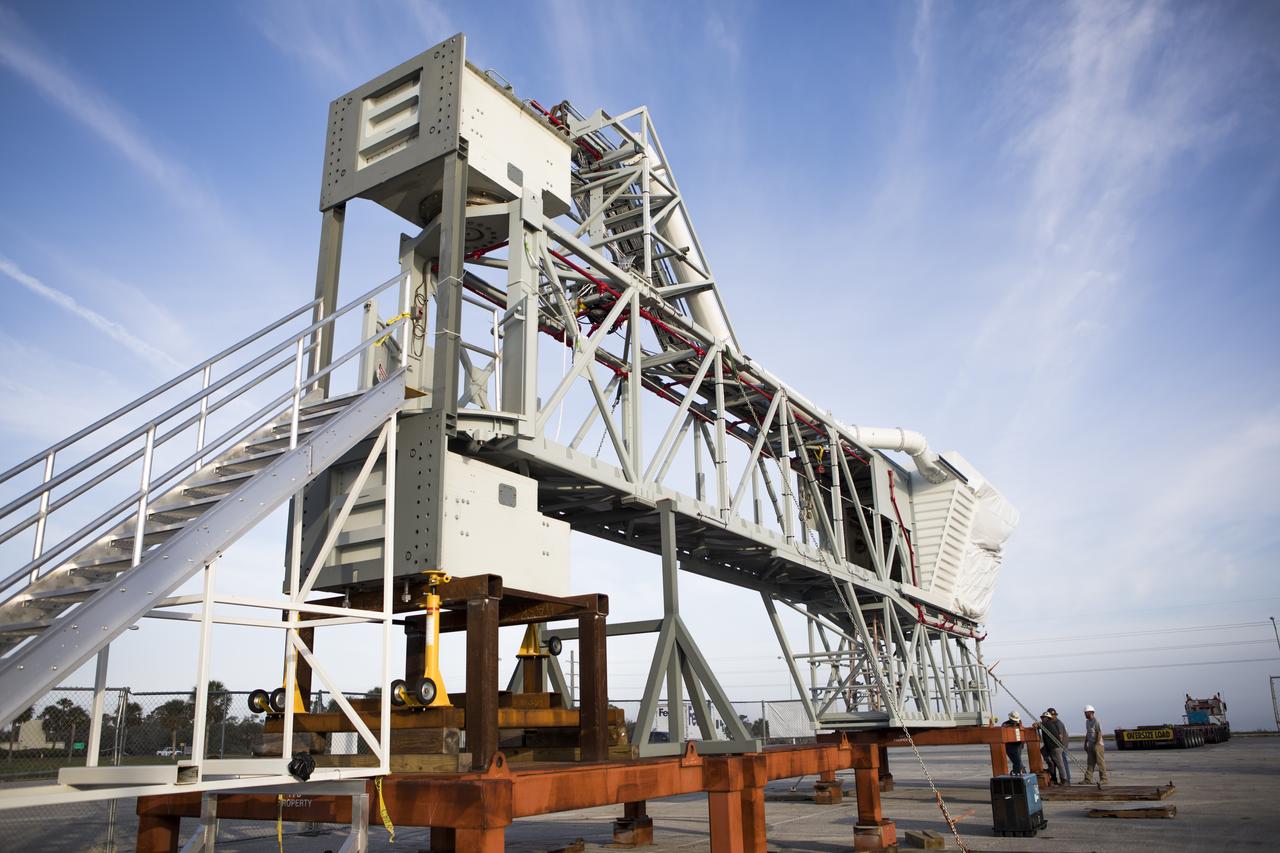
The Orion crew access arm, secured on a stand, is being prepared for its move from a storage location at NASA's Kennedy Space Center in Florida, to the mobile launcher (ML) tower near the Vehicle Assembly Building at the center. The crew access arm will be installed at about the 274-foot level on the tower. It will rotate from its retracted position and interface with the Orion crew hatch location to provide entry to the Orion crew module. The Ground Systems Development and Operations Program is overseeing installation of umbilicals and launch accessories on the ML tower.
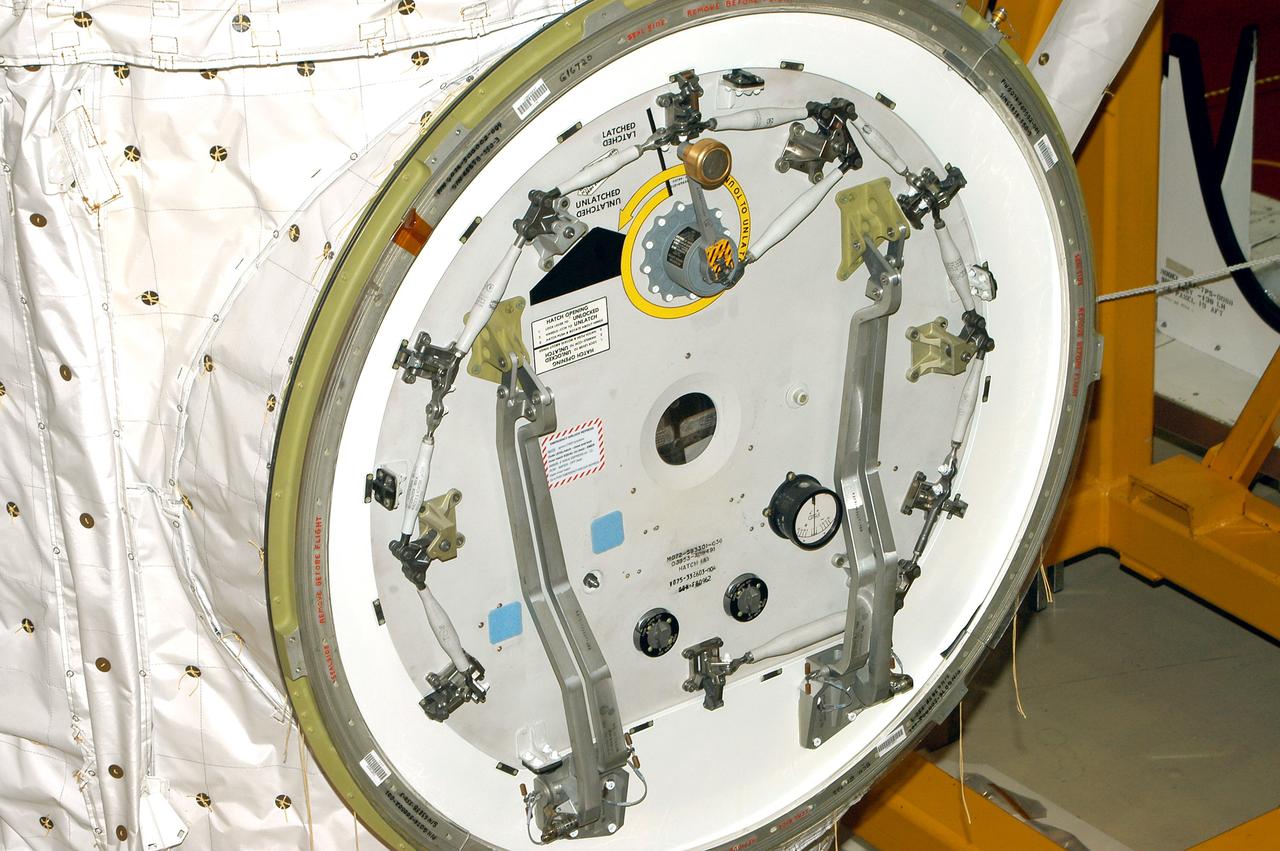
KENNEDY SPACE CENTER, FLA. - Seen in the photo is one end of the airlock that is installed in the payload bay of orbiter Discovery. The airlock is normally located inside the middeck of the spacecraft’s pressurized crew cabin. The airlock is sized to accommodate two fully suited flight crew members simultaneously. Support functions include airlock depressurization and repressurization, extravehicular activity equipment recharge, liquid-cooled garment water cooling, EVA equipment checkout, donning and communications. The outer hatch isolates the airlock from the unpressurized payload bay when closed and permits the EVA crew members to exit from the airlock to the payload bay when open.
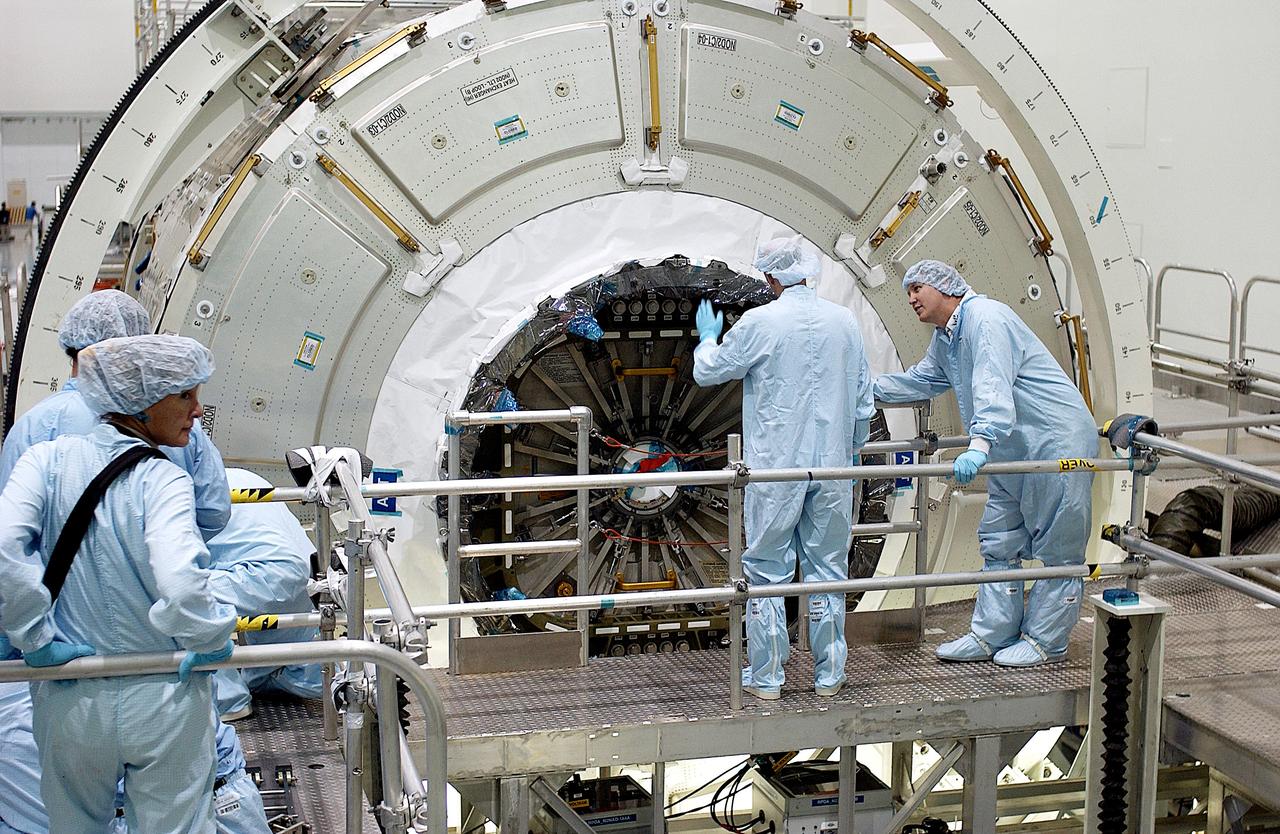
KENNEDY SPACE CENTER, FLA. - Workers in the Space Station Processing Facility look over the hatch on the Italian-built Node 2, a future element of the International Space Station. Node 2 arrived at KSC June 1. The second of three Station connecting modules, the module attaches to the end of the U.S. Lab and provides attach locations for the Japanese laboratory, European laboratory, the Centrifuge Accommodation Module and, later, Multipurpose Logistics Modules. It will provide the primary docking location for the Shuttle when a pressurized mating adapter is attached to Node 2. Installation of the module will complete the U.S. Core of the ISS. Node 2 is the designated payload for mission STS-120. No orbiter or launch date has been determined yet.
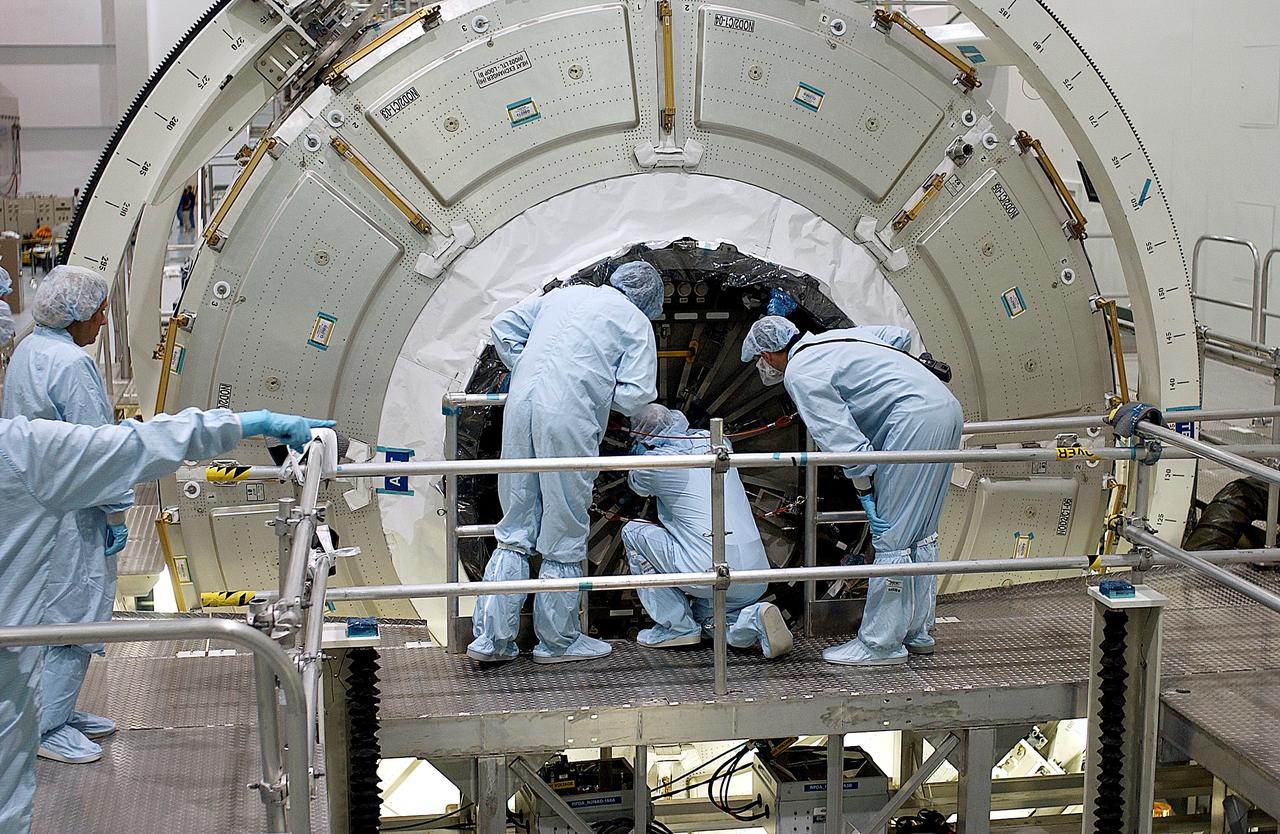
KENNEDY SPACE CENTER, FLA. - Workers in the Space Station Processing Facility attempt to open the hatch on the Italian-built Node 2, a future element of the International Space Station. Node 2 arrived at KSC June 1. The second of three Station connecting modules, the module attaches to the end of the U.S. Lab and provides attach locations for the Japanese laboratory, European laboratory, the Centrifuge Accommodation Module and, later, Multipurpose Logistics Modules. It will provide the primary docking location for the Shuttle when a pressurized mating adapter is attached to Node 2. Installation of the module will complete the U.S. Core of the ISS. Node 2 is the designated payload for mission STS-120. No orbiter or launch date has been determined yet.
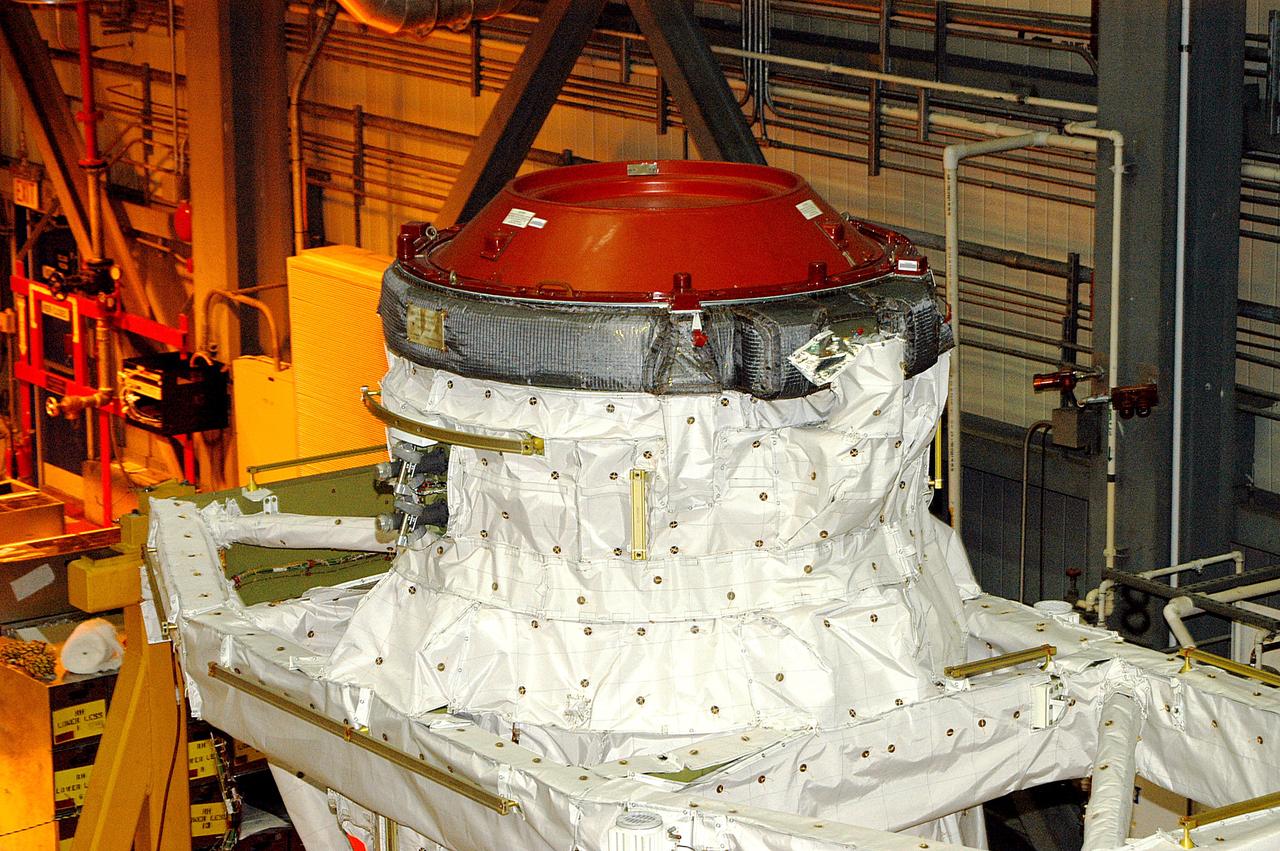
KENNEDY SPACE CENTER, FLA. - Seen in the photo is one end of the airlock that is installed in the payload bay of orbiter Discovery. The airlock is normally located inside the middeck of the spacecraft’s pressurized crew cabin. The airlock is sized to accommodate two fully suited flight crew members simultaneously. Support functions include airlock depressurization and repressurization, extravehicular activity equipment recharge, liquid-cooled garment water cooling, EVA equipment checkout, donning and communications. The outer hatch isolates the airlock from the unpressurized payload bay when closed and permits the EVA crew members to exit from the airlock to the payload bay when open.
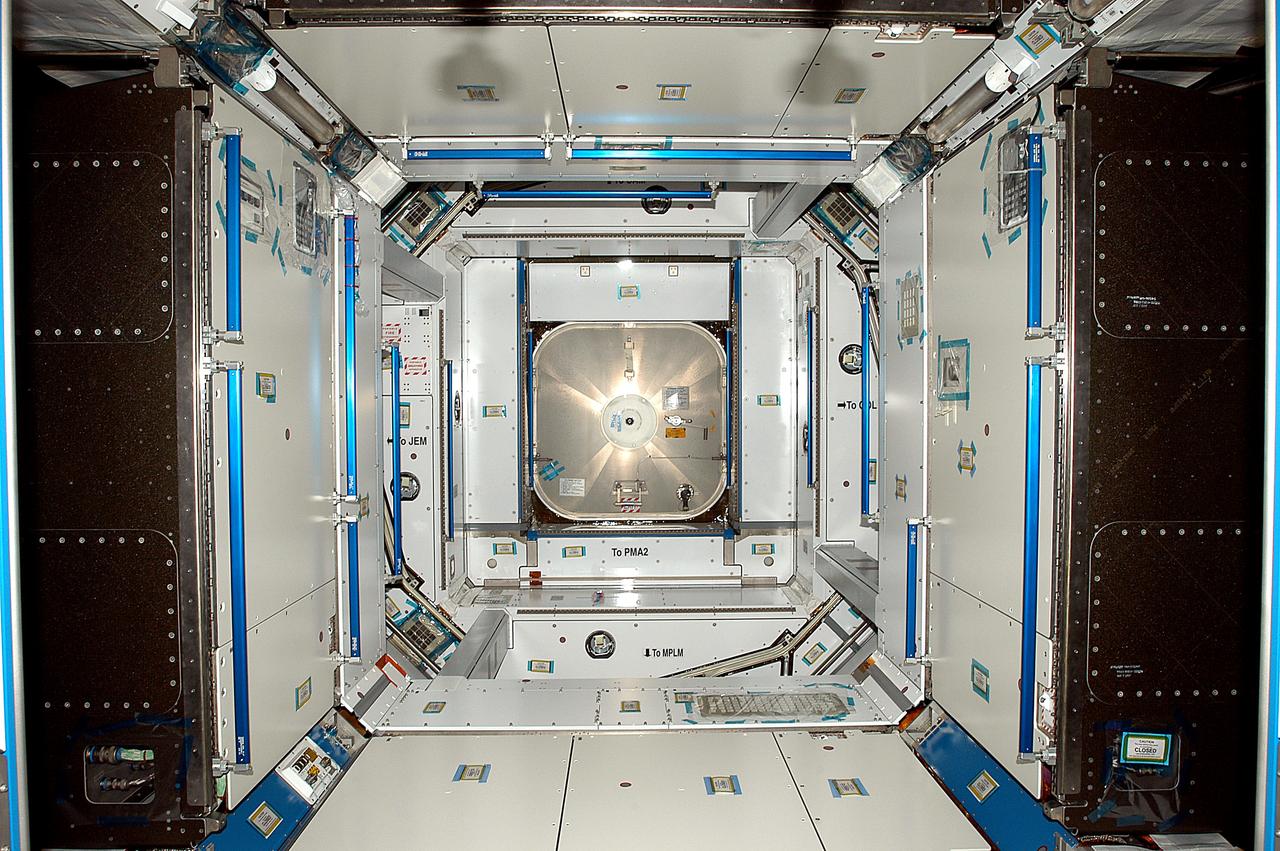
KENNEDY SPACE CENTER, FLA. - The inside of the Italian-built Node 2 looks pristine after opening of the hatch. A future element of the International Space Station, Node 2 arrived at KSC June 1. The second of three Station connecting modules, Node 2 attaches to the end of the U.S. Lab and provides attach locations for the Japanese laboratory, European laboratory, the Centrifuge Accommodation Module and, later, Multipurpose Logistics Modules. It will provide the primary docking location for the Shuttle when a pressurized mating adapter is attached to Node 2. Installation of the module will complete the U.S. Core of the ISS. Node 2 is the designated payload for mission STS-120. No orbiter or launch date has been determined yet.
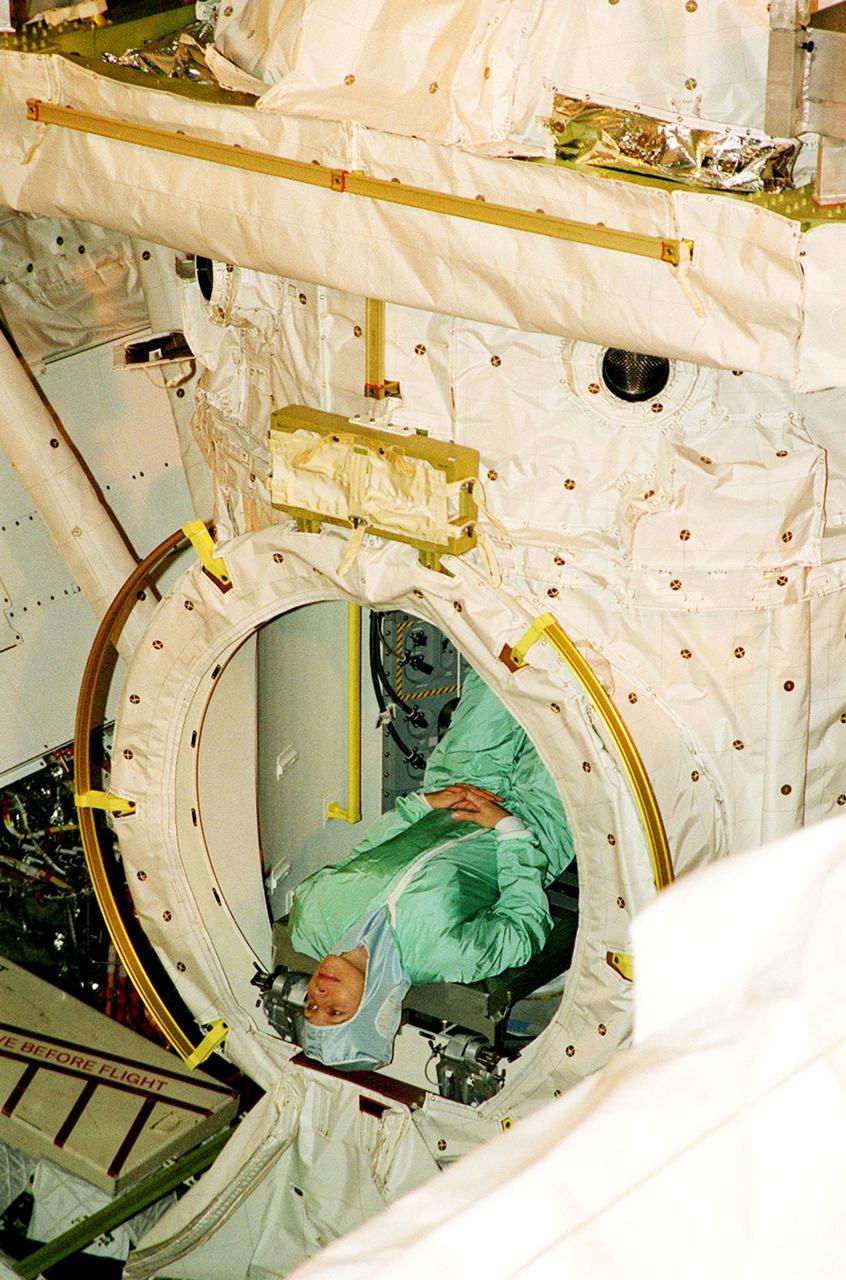
KENNEDY SPACE CENTER, FLA. -- STS-98 Mission Specialist Marsha Ivins takes a topsy-turvy look at the EVA hatch in the Orbiter Docking System, which is already installed in the payload bay of orbiter Atlantis. She and the rest of the crew are at KSC for Crew Equipment Interface Test activities. Launch on mission STS-98 is scheduled for Jan. 18, 2001. It will be transporting the U.S. Lab, Destiny, to the International Space Station with five system racks already installed inside of the module. After delivery of electronics in the lab, electrically powered attitude control for Control Moment Gyroscopes will be activated

A heavy-load transport truck carries the Orion crew access arm along the NASA Causeway east toward State Road 3 at NASA's Kennedy Space Center in Florida. The access arm will be moved to the mobile launcher (ML) near the Vehicle Assembly Building at the center. The crew access arm will be installed at about the 274-foot level on the mobile launcher tower. It will rotate from its retracted position and interface with the Orion crew hatch location to provide entry to the Orion crew module. The Ground Systems Development and Operations Program is overseeing installation of umbilicals and launch accessories on the ML tower to prepare for Exploration Mission-1.
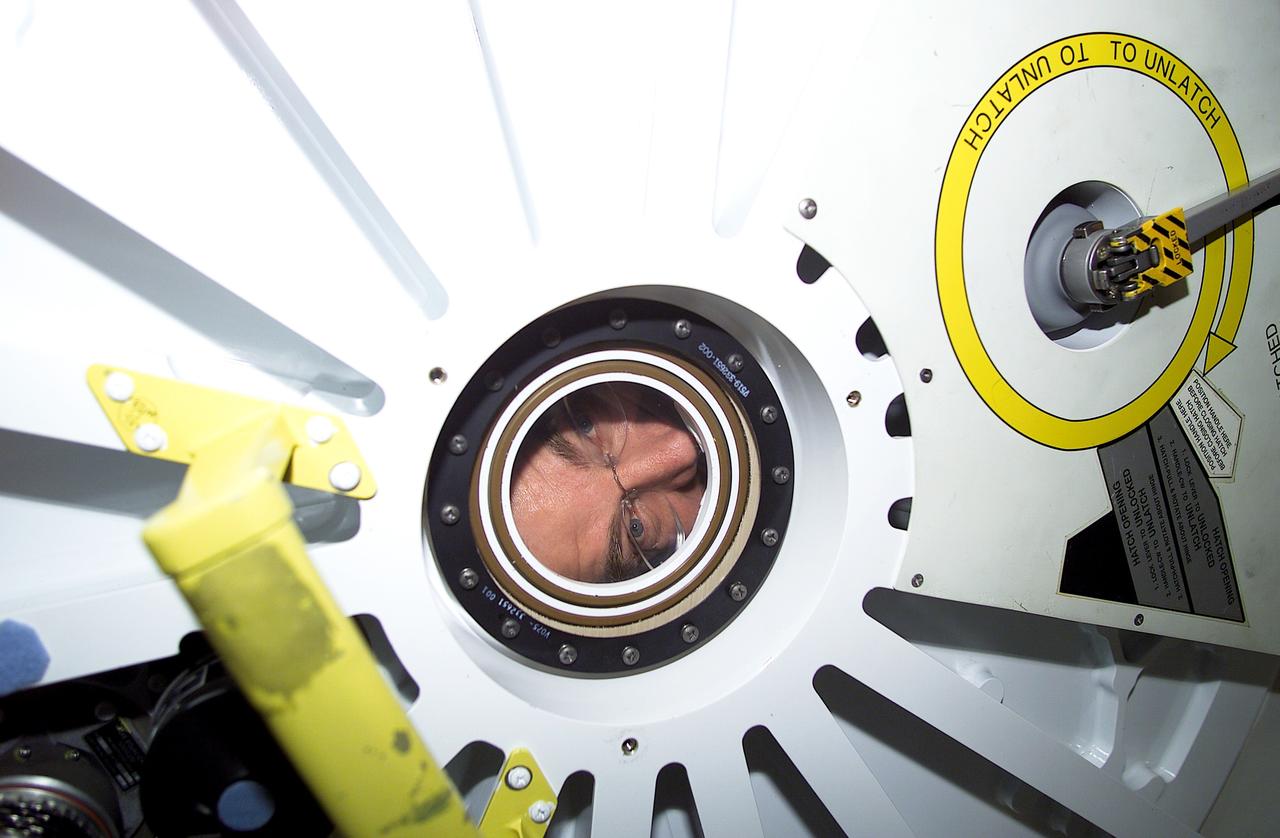
The STS-100 mission launched for the International Space Station (ISS) on April 19, 2001 as the sixth station assembly flight. Main objectives included the delivery and installation of the Canadian-built Space Station Remote Manipulator System (SSRMS), or Canadarm2, the installation of a UHF anterna for space-to-space communications for U.S. based space walks, and the delivery of supplies via the Italian Multipurpose Logistics Module (MPLM) "Raffaello". This is an STS-110 onboard photo of Astronaut James S. Voss, Expedition Two flight engineer, peering into the pressurized Mating Adapter (PMA-2) prior hatch opening. The picture was taken by one of the STS-100 crew members inside the PMA.
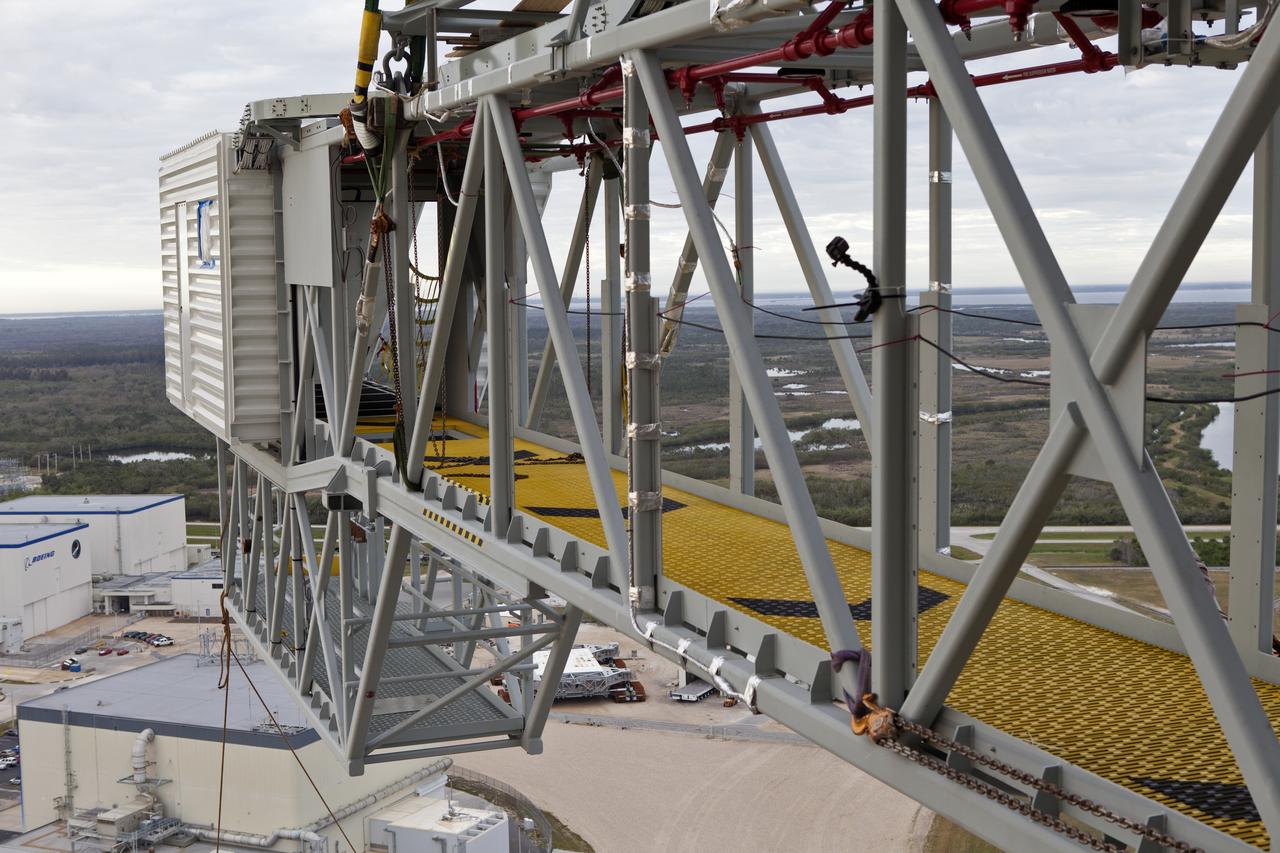
Viewed from the 274-foot level mobile launcher (ML), the Orion crew access arm (CAA) is beign installed on the tower. The CAA will support the Space launch System (SLS) rocket at NASA's Kennedy Space Center in Florida. NASA's Exploration Ground Systems organization has been overseeing installation of umbilicals and other launch accessories on the 380-foot-tall ML in preparation for stacking the first launch of the Space launch System, or SLS, rocket with an Orion spacecraft. The CAA is designed to rotate from its retracted position and line up with Orion's crew hatch providing entry for astronauts and technicians.
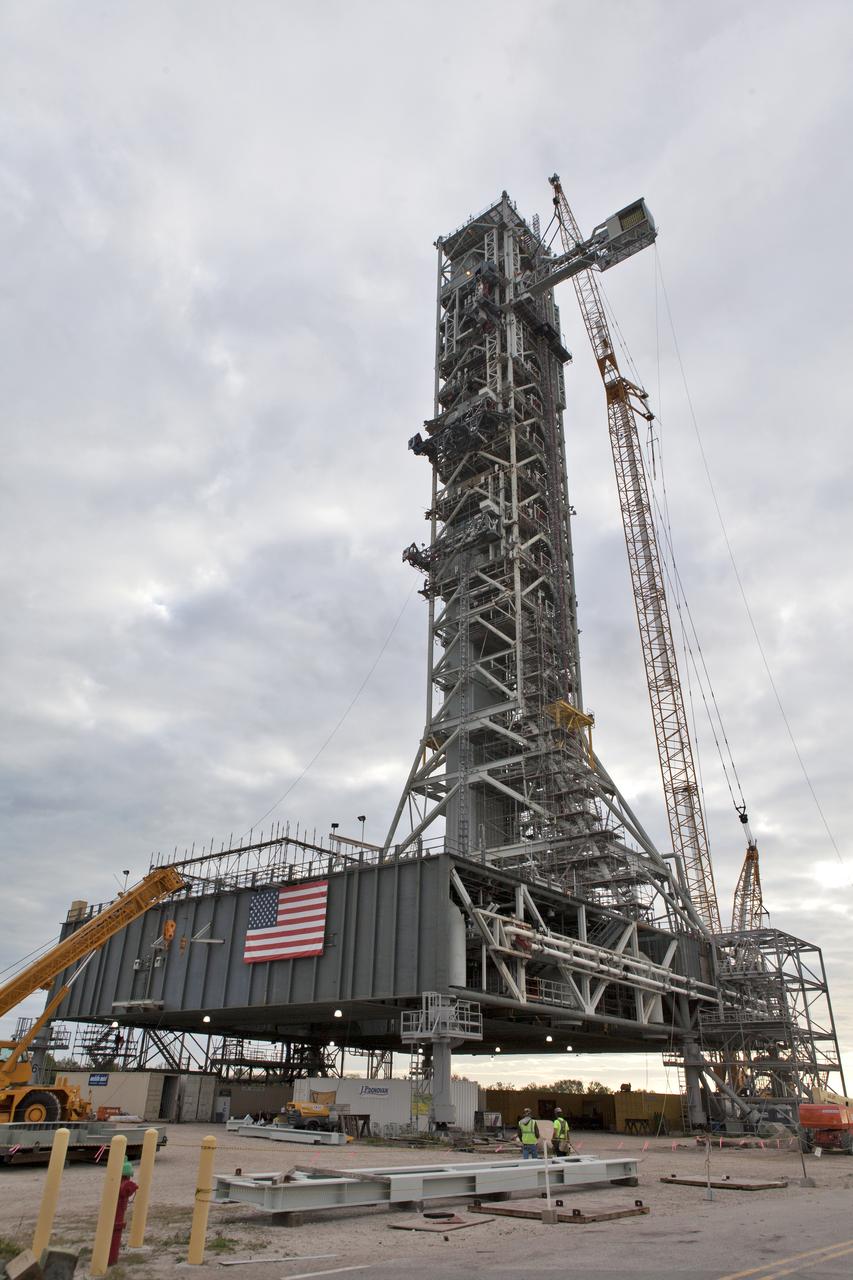
At NASA's Kennedy Space Center in Florida, a crane positions the Orion crew access arm (CAA) so it can be attached to the mobile launcher (ML). The arm will be installed at about the 274-foot level on the ML tower. NASA's Exploration Ground Systems organization has been overseeing installation of umbilicals and other launch accessories on the 380-foot-tall ML in preparation for stacking the first launch of the Space launch System (SLS), rocket with an Orion spacecraft. The CAA is designed to rotate from its retracted position and line up with Orion's crew hatch providing entry for astronauts and technicians.
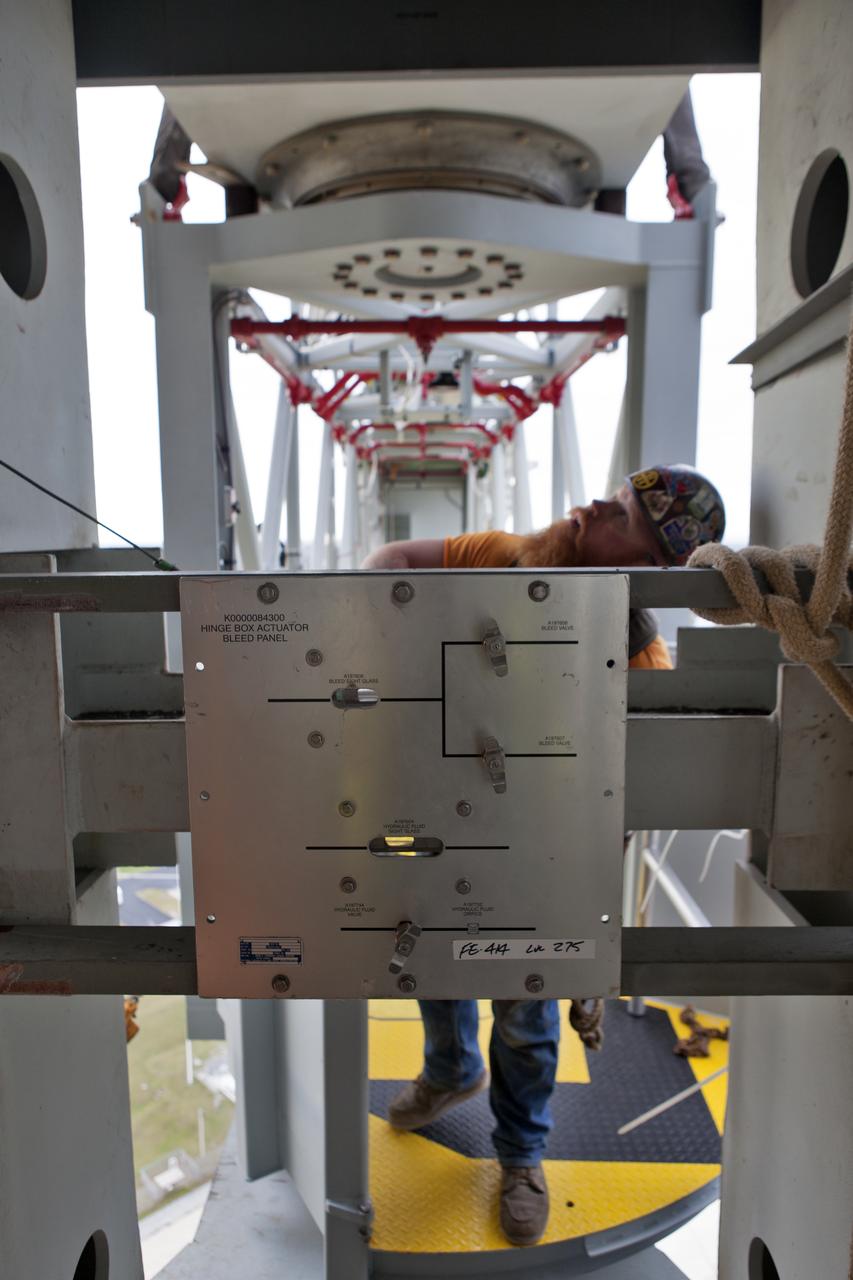
With a control panel visible in the foreground, a technician begins installation of the Orion crew access arm (CAA) to the mobile launcher (ML) tower at NASA's Kennedy Space Center in Florida. NASA's Exploration Ground Systems organization has been overseeing installation of umbilicals and other launch accessories on the 380-foot-tall ML in preparation for stacking the first launch of the Space launch System, or SLS, rocket with an Orion spacecraft. The CAA is designed to rotate from its retracted position and line up with Orion's crew hatch providing entry for astronauts and technicians.
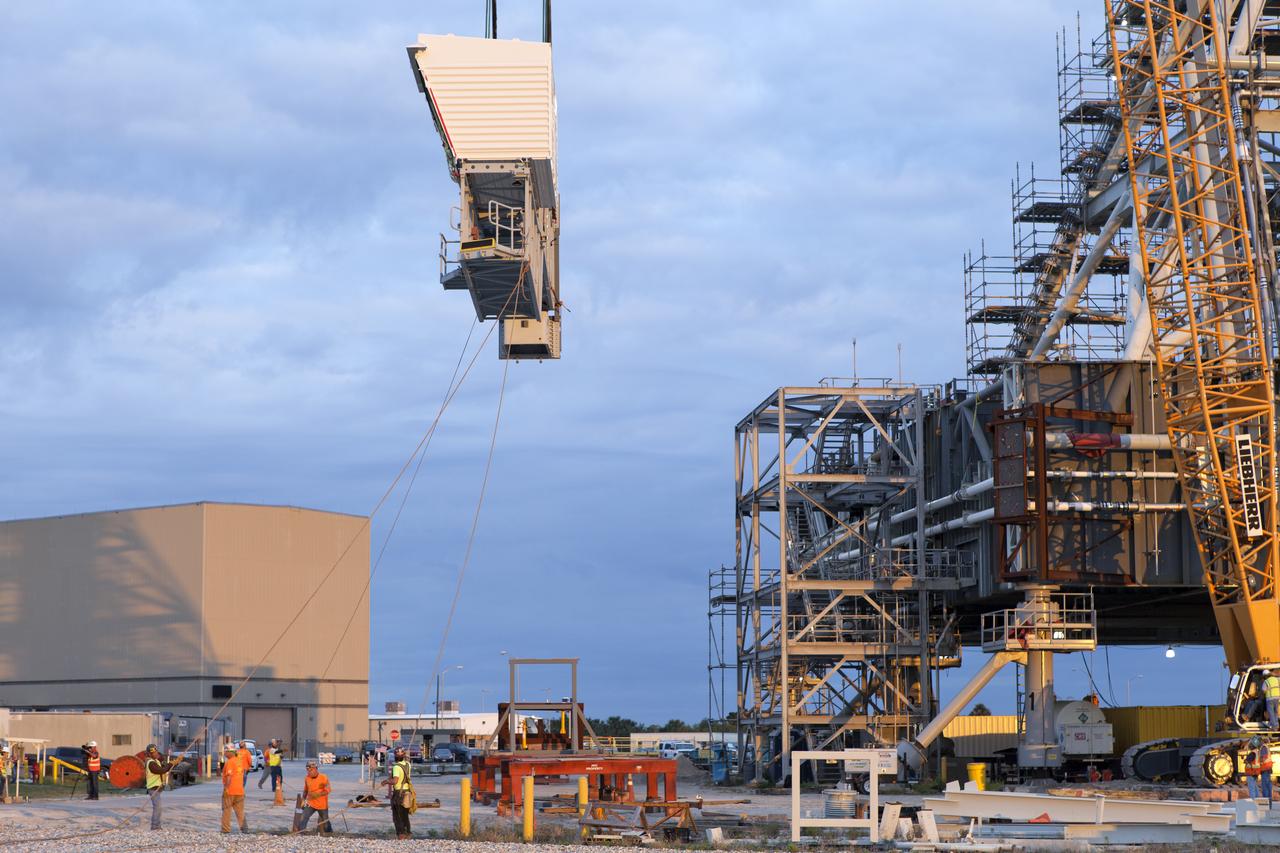
At NASA's Kennedy Space Center in Florida, a crane lifts the Orion crew access arm (CAA) so it can be attached to the mobile launcher (ML). The arm will be installed at about the 274-foot level on the ML tower. NASA's Exploration Ground Systems organization has been overseeing installation of umbilicals and other launch accessories on the 380-foot-tall ML in preparation for stacking the first launch of the Space launch System (SLS), rocket with an Orion spacecraft. The CAA is designed to rotate from its retracted position and line up with Orion's crew hatch providing entry for astronauts and technicians.
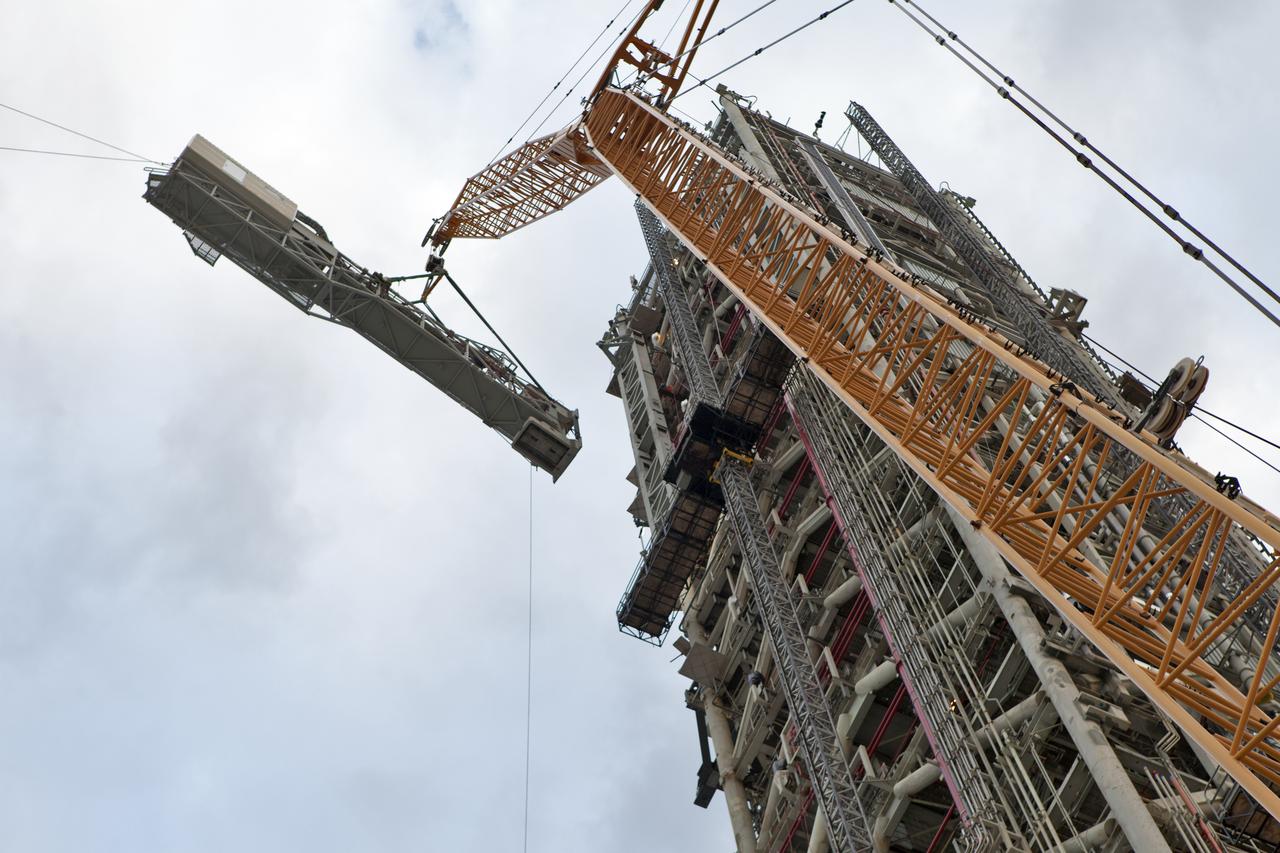
At NASA's Kennedy Space Center in Florida, a crane lifts the Orion crew access arm (CAA) so it can be attached to the mobile launcher (ML). The arm will be installed at about the 274-foot level on the ML tower. NASA's Exploration Ground Systems organization has been overseeing installation of umbilicals and other launch accessories on the 380-foot-tall ML in preparation for stacking the first launch of the Space launch System (SLS), rocket with an Orion spacecraft. The CAA is designed to rotate from its retracted position and line up with Orion's crew hatch providing entry for astronauts and technicians.
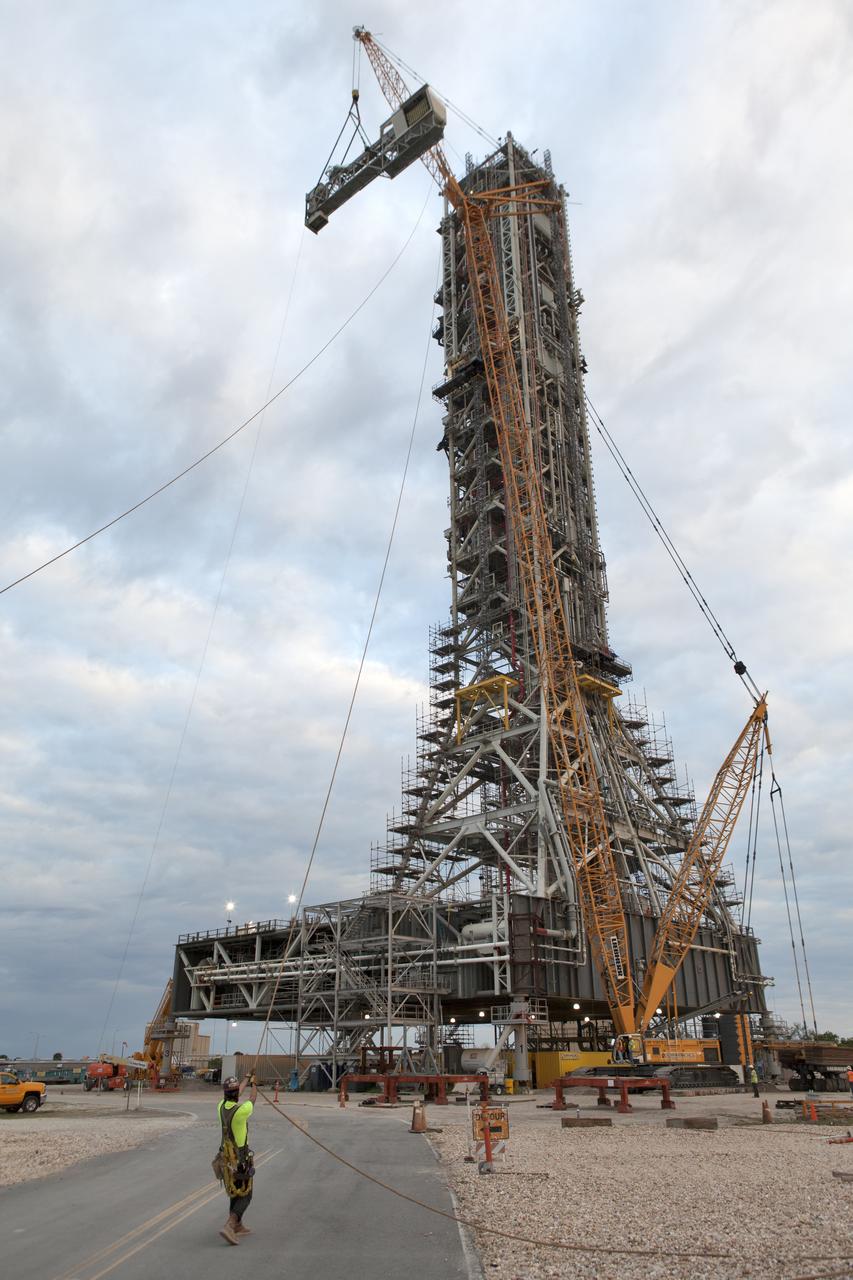
At NASA's Kennedy Space Center in Florida, a crane lifts the Orion crew access arm (CAA) so it can be attached to the mobile launcher (ML). The arm will be installed at about the 274-foot level on the ML tower. NASA's Exploration Ground Systems organization has been overseeing installation of umbilicals and other launch accessories on the 380-foot-tall ML in preparation for stacking the first launch of the Space launch System (SLS), rocket with an Orion spacecraft. The CAA is designed to rotate from its retracted position and line up with Orion's crew hatch providing entry for astronauts and technicians.
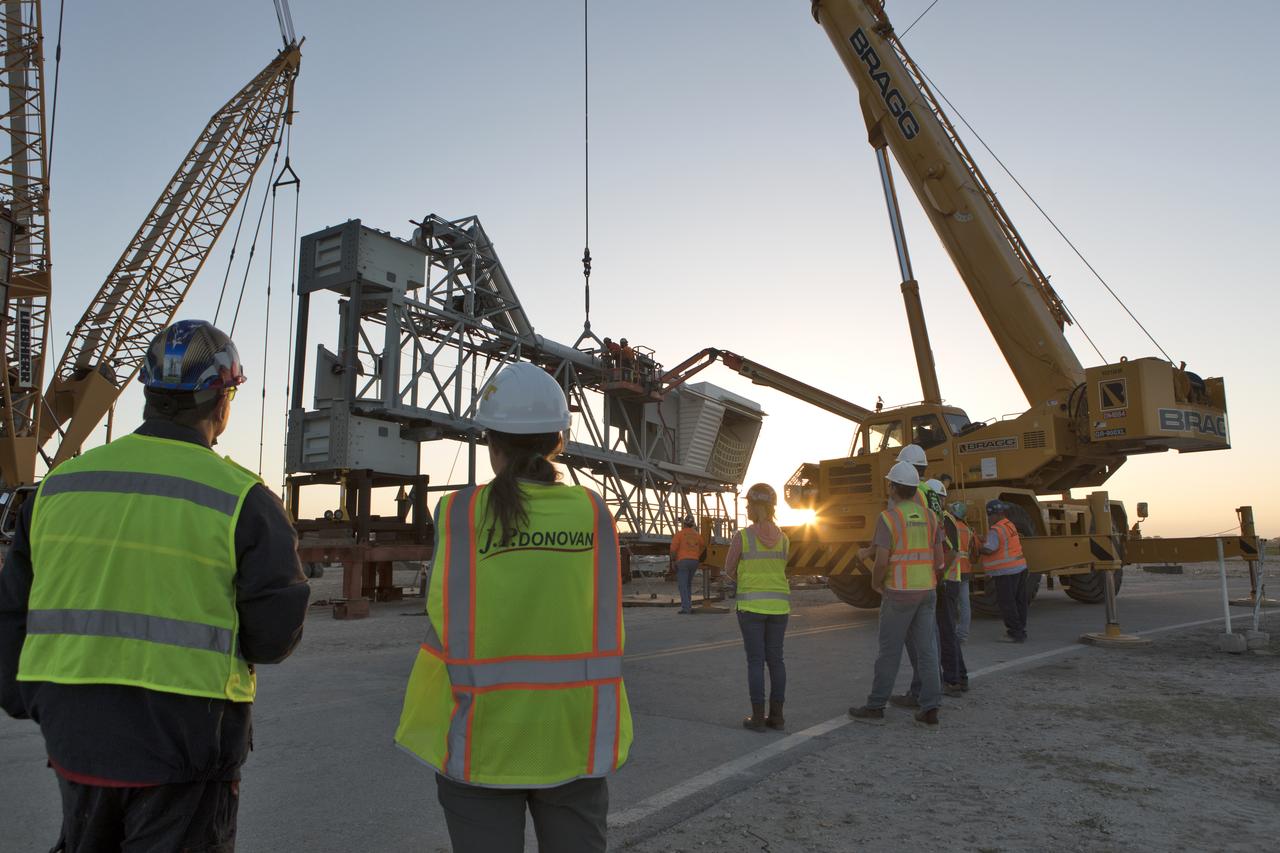
Under the watchful eye of technicians and engineers, a crane is prepared to lift the Orion crew access arm (CAA) so it can be attached to the mobile launcher (ML) at NASA's Kennedy Space Center in Florida. The arm will be installed at about the 274-foot level on the ML tower. NASA's Exploration Ground Systems organization has been overseeing installation of umbilicals and other launch accessories on the 380-foot-tall ML in preparation for stacking the first launch of the Space launch System, or SLS, rocket with an Orion spacecraft. The CAA is designed to rotate from its retracted position and line up with Orion's crew hatch providing entry for astronauts and technicians.
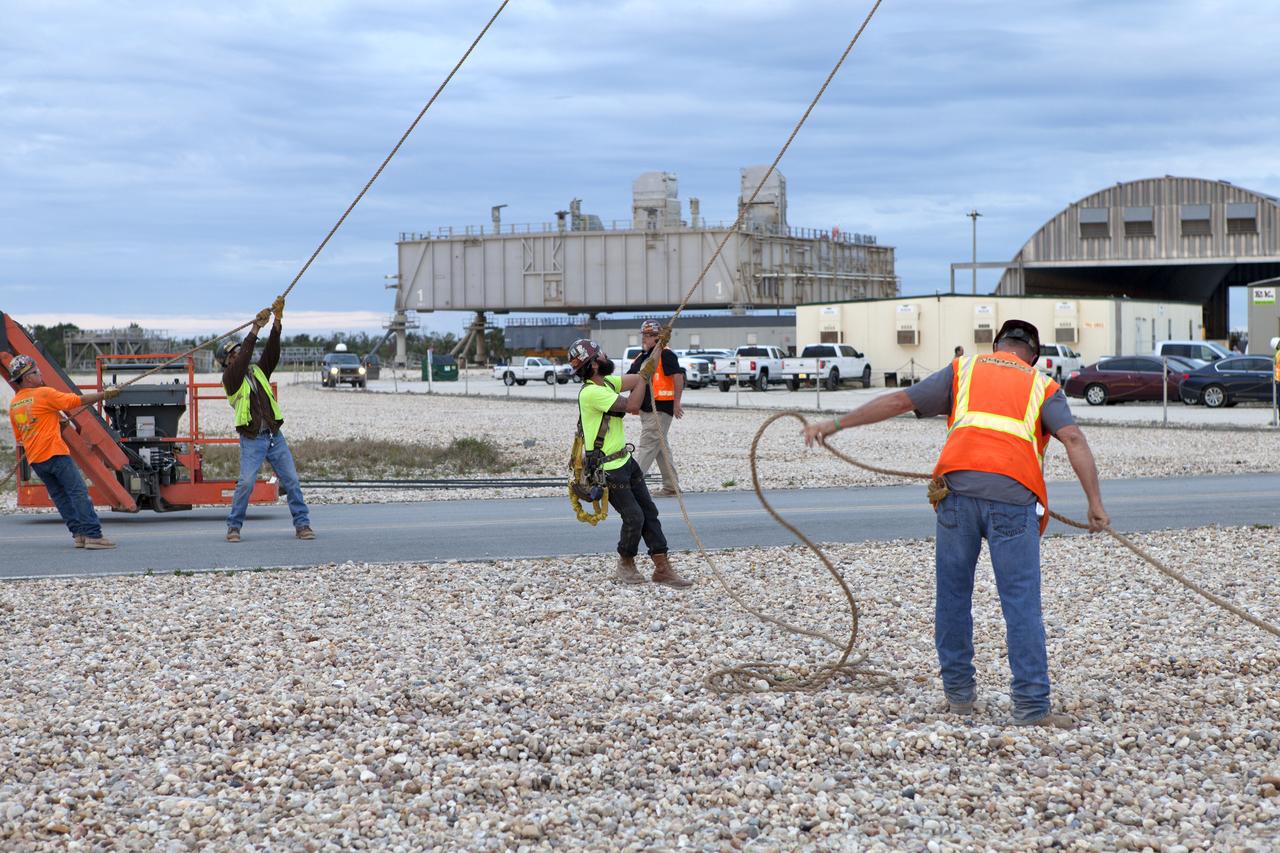
At NASA's Kennedy Space Center in Florida, technicians assist as a crane lifts the Orion crew access arm (CAA) so it can be attached to the mobile launcher (ML). The arm will be installed at about the 274-foot level on the ML tower. NASA's Exploration Ground Systems organization has been overseeing installation of umbilicals and other launch accessories on the 380-foot-tall ML in preparation for stacking the first launch of the Space launch System (SLS), rocket with an Orion spacecraft. The CAA is designed to rotate from its retracted position and line up with Orion's crew hatch providing entry for astronauts and technicians.
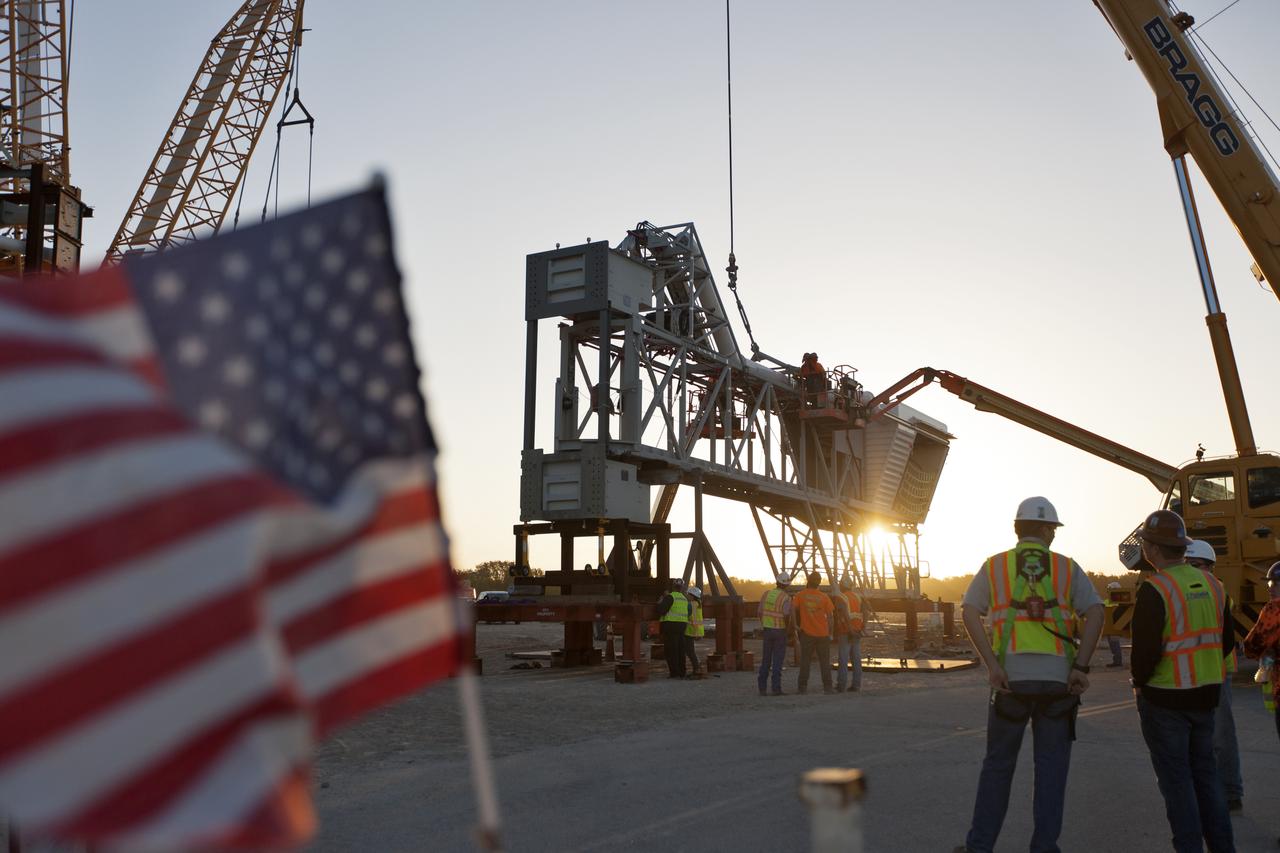
Under the watchful eye of technicians and engineers, a crane is prepared to lift the Orion crew access arm (CAA) so it can be attached to the mobile launcher (ML) at NASA's Kennedy Space Center in Florida. The arm will be installed at about the 274-foot level on the ML tower. NASA's Exploration Ground Systems organization has been overseeing installation of umbilicals and other launch accessories on the 380-foot-tall ML in preparation for stacking the first launch of the Space launch System, or SLS, rocket with an Orion spacecraft. The CAA is designed to rotate from its retracted position and line up with Orion's crew hatch providing entry for astronauts and technicians.
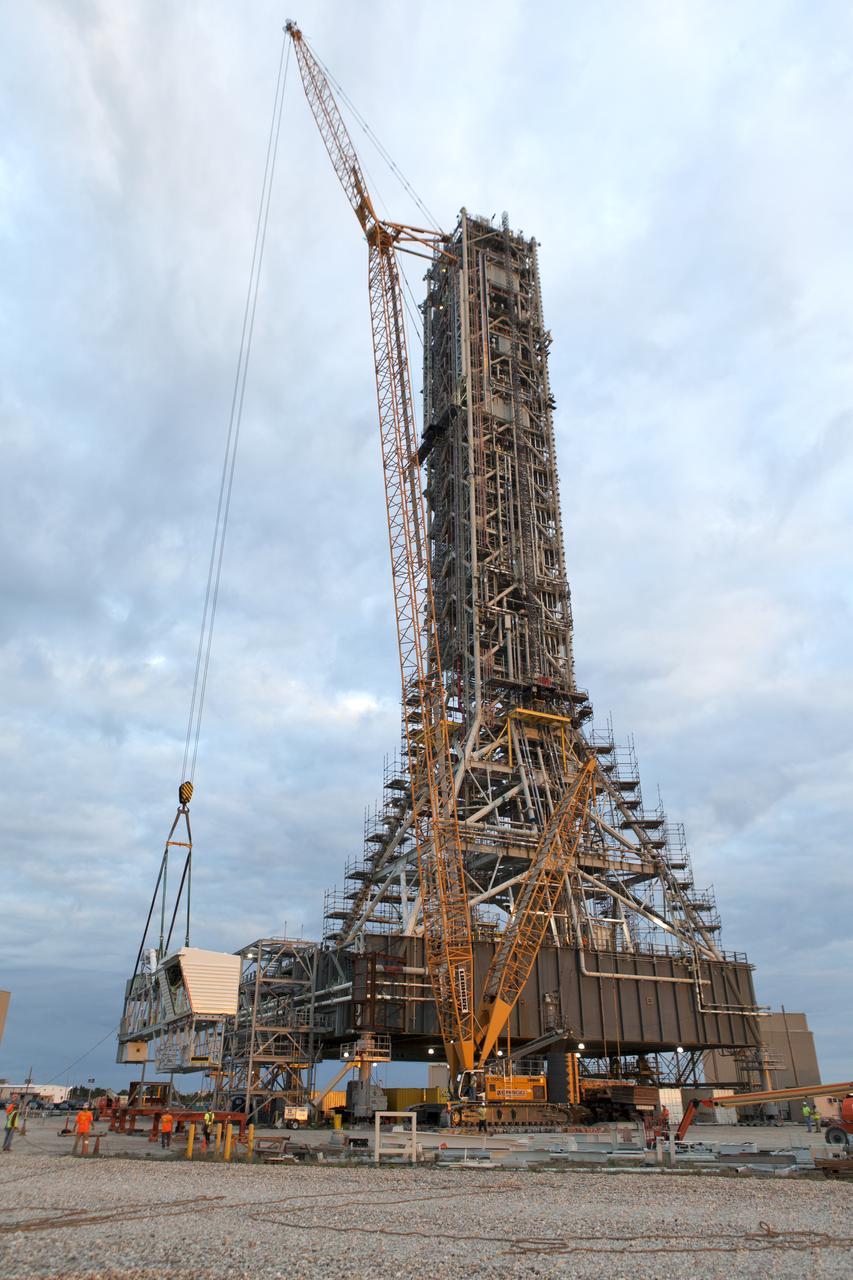
At NASA's Kennedy Space Center in Florida, a crane begins lifting the Orion crew access arm (CAA) so it can be attached to the mobile launcher (ML). The arm will be installed at about the 274-foot level on the ML tower. NASA's Exploration Ground Systems organization has been overseeing installation of umbilicals and other launch accessories on the 380-foot-tall ML in preparation for stacking the first launch of the Space launch System (SLS), rocket with an Orion spacecraft. The CAA is designed to rotate from its retracted position and line up with Orion's crew hatch providing entry for astronauts and technicians.
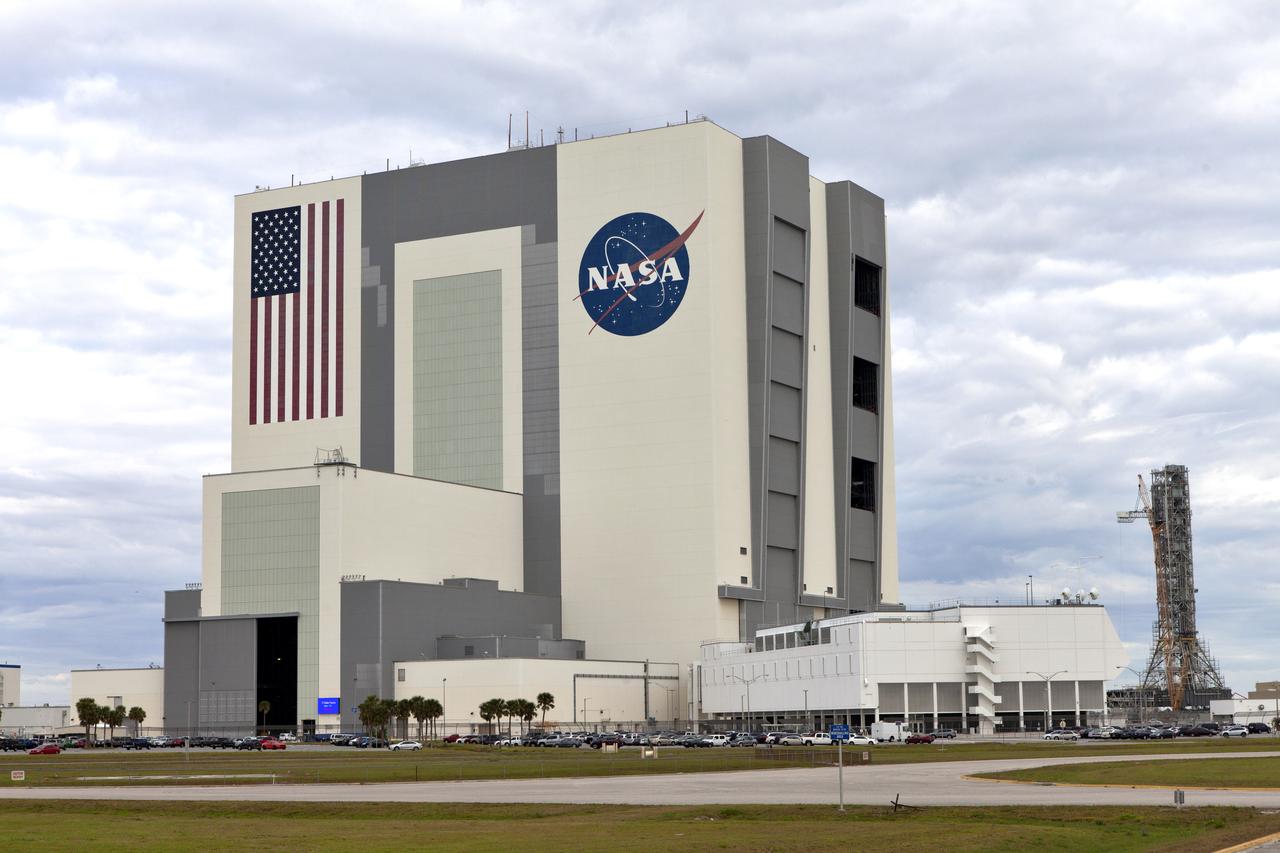
Seen to the right of the iconic Vehicle Assembly Building at NASA's Kennedy Space Center in Florida, a crane positions the Orion crew access arm (CAA) so it can be attached to the mobile launcher (ML). The arm will be installed at about the 274-foot level on the ML tower. NASA's Exploration Ground Systems organization has been overseeing installation of umbilicals and other launch accessories on the 380-foot-tall ML in preparation for stacking the first launch of the Space launch System (SLS), rocket with an Orion spacecraft. The CAA is designed to rotate from its retracted position and line up with Orion's crew hatch providing entry for astronauts and technicians.
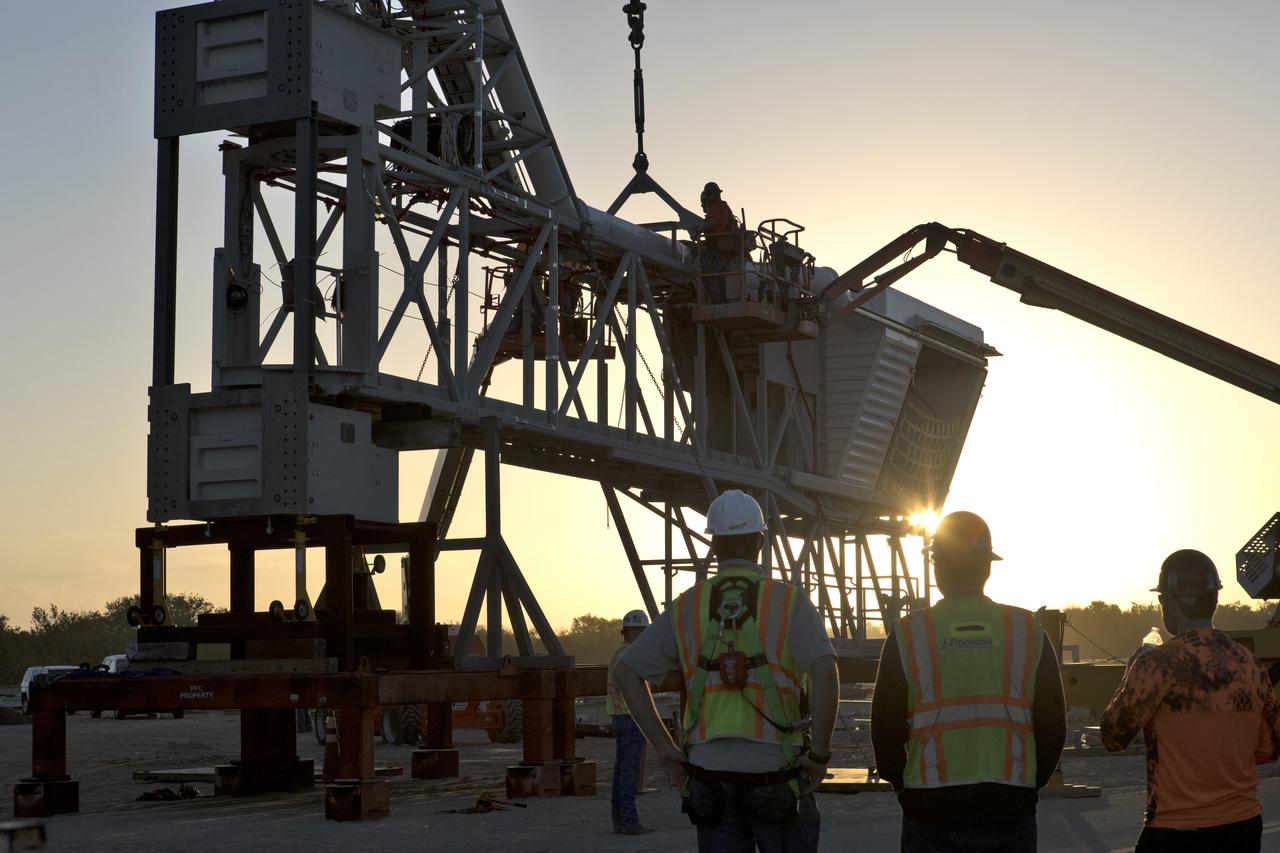
Under the watchful eye of technicians and engineers, a crane is prepared to lift the Orion crew access arm (CAA) so it can be attached to the mobile launcher (ML) at NASA's Kennedy Space Center in Florida. The arm will be installed at about the 274-foot level on the ML tower. NASA's Exploration Ground Systems organization has been overseeing installation of umbilicals and other launch accessories on the 380-foot-tall ML in preparation for stacking the first launch of the Space launch System, or SLS, rocket with an Orion spacecraft. The CAA is designed to rotate from its retracted position and line up with Orion's crew hatch providing entry for astronauts and technicians.
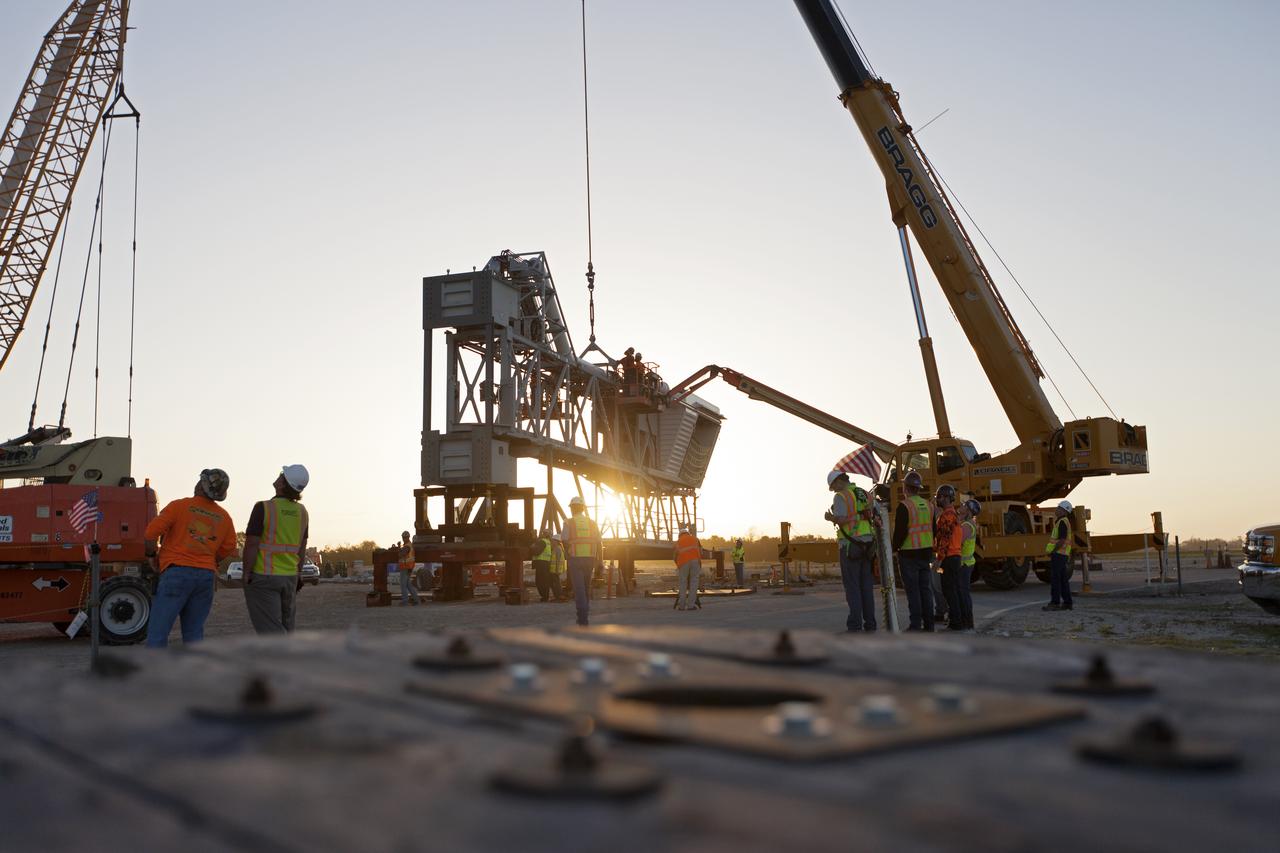
At NASA's Kennedy Space Center in Florida, a crane is prepared to lift the Orion crew access arm (CAA) so it can be attached to the mobile launcher (ML). The arm will be installed at about the 274-foot level on the ML tower. NASA's Exploration Ground Systems organization has been overseeing installation of umbilicals and other launch accessories on the 380-foot-tall ML in preparation for stacking the first launch of the Space launch System, or SLS, rocket with an Orion spacecraft. The CAA is designed to rotate from its retracted position and line up with Orion's crew hatch providing entry for astronauts and technicians.
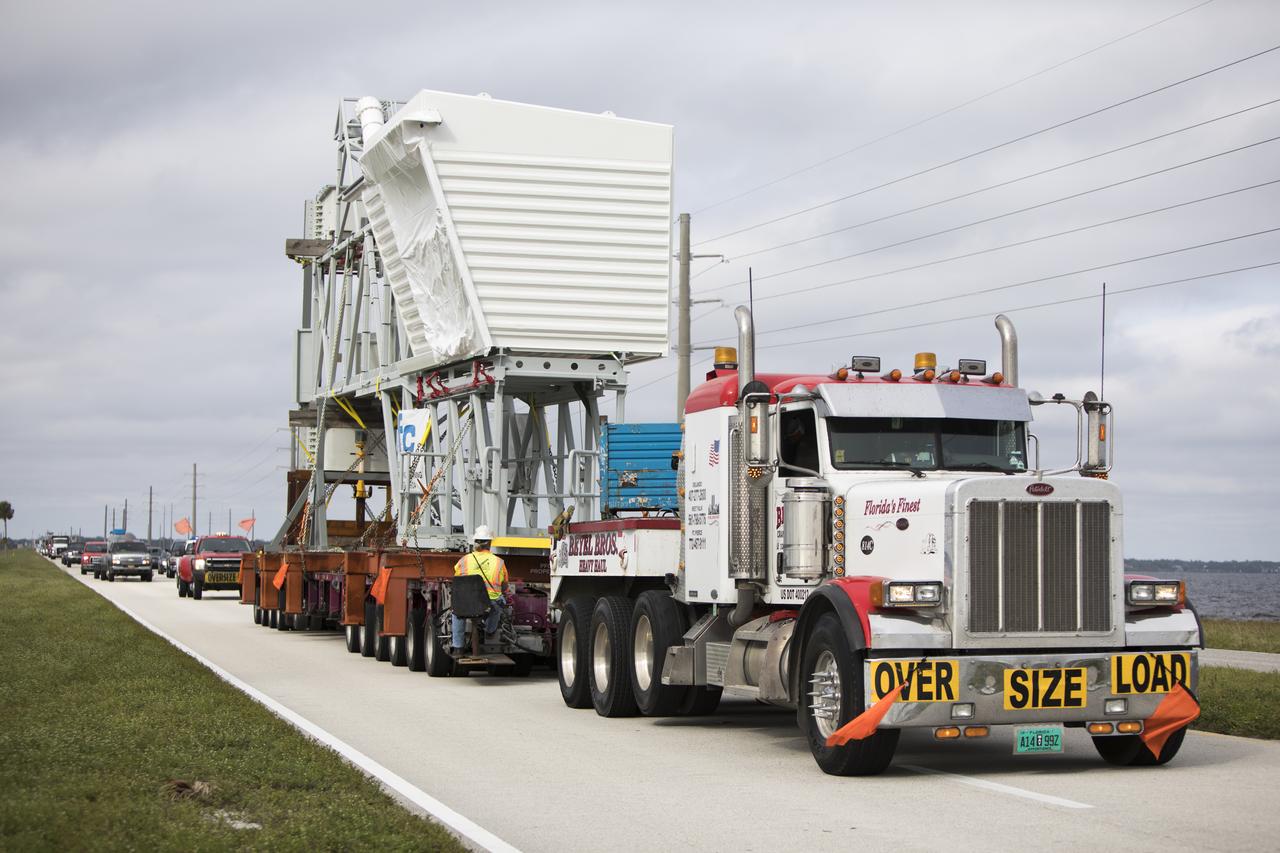
A heavy-load transport truck carries the Orion crew access arm along the NASA Causeway east toward State Road 3 at NASA's Kennedy Space Center in Florida. The access arm will be moved to the mobile launcher (ML) near the Vehicle Assembly Building at the center. The crew access arm will be installed at about the 274-foot level on the tower. It will rotate from its retracted position and interface with the Orion crew hatch location to provide entry to the Orion crew module. The Ground Systems Development and Operations Program is overseeing installation of umbilicals and launch accessories on the ML tower to prepare for Exploration Mission-1.
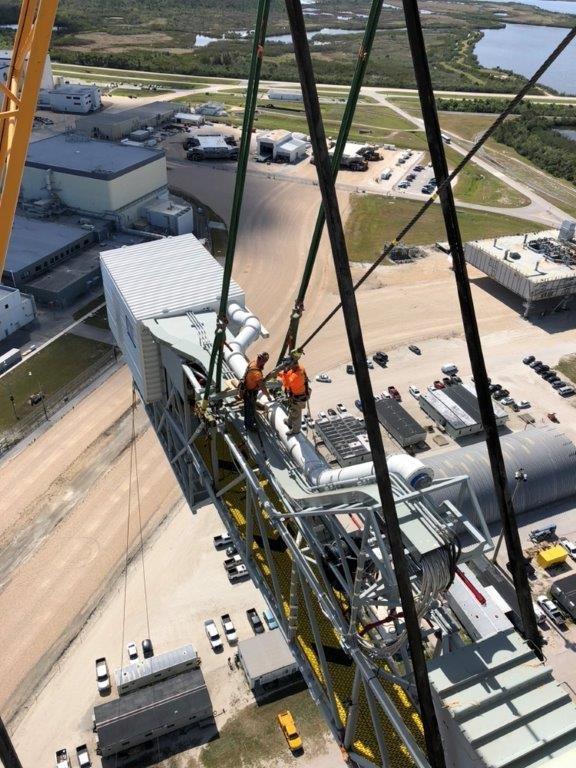
Viewed from the 274-foot level mobile launcher (ML), technicians help install the Orion crew access arm (CAA) to the tower at NASA's Kennedy Space Center in Florida. NASA's Exploration Ground Systems organization has been overseeing installation of umbilicals and other launch accessories on the 380-foot-tall ML in preparation for stacking the first launch of the Space launch System (SLS), rocket with an Orion spacecraft. The CAA is designed to rotate from its retracted position and line up with Orion's crew hatch providing entry for astronauts and technicians.
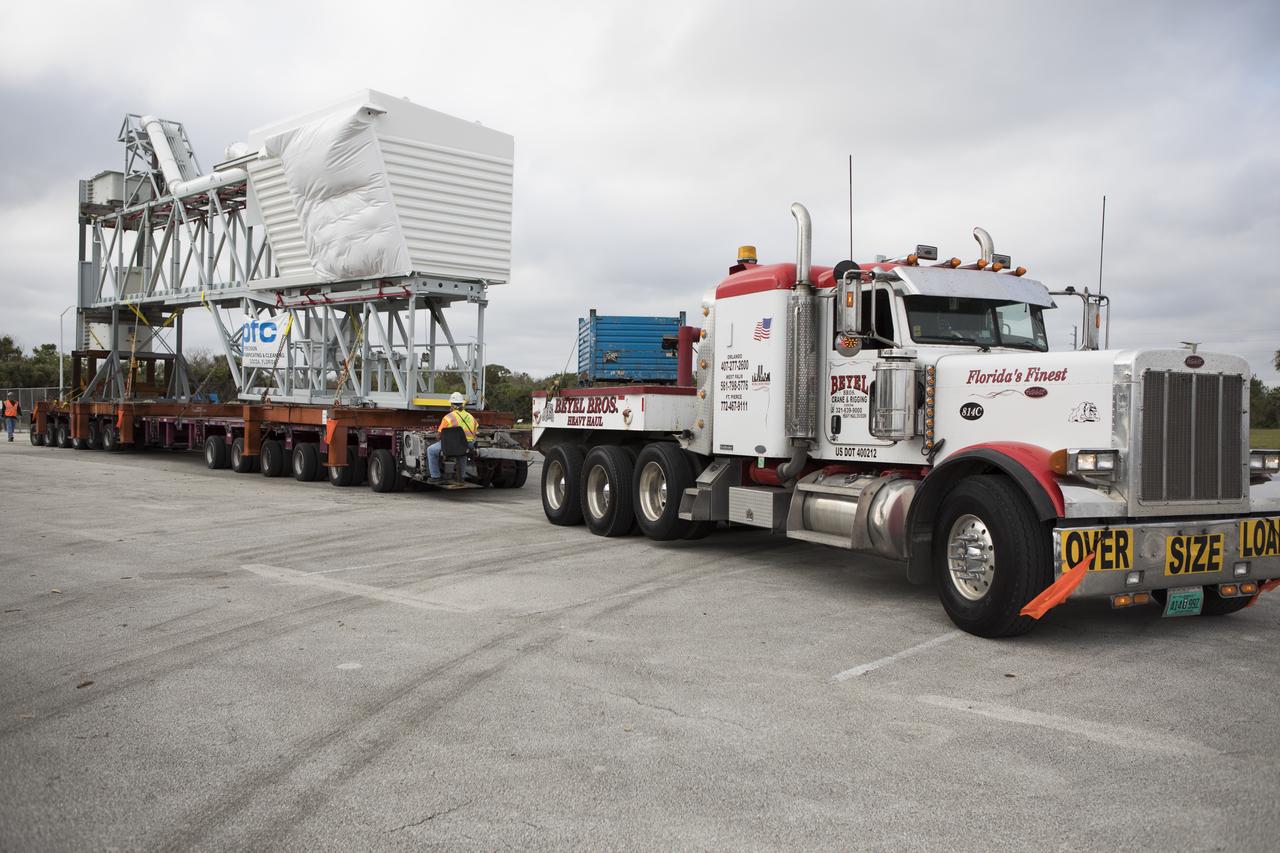
The Orion crew access arm is secured on a flatbed transporter for its move from a storage location at NASA's Kennedy Space Center in Florida to the mobile launcher (ML) tower near the Vehicle Assembly Building at the center. The crew access arm will be installed at about the 274-foot level on the mobile launcher tower. It will rotate from its retracted position and interface with the Orion crew hatch location to provide entry to the Orion crew module. The Ground Systems Development and Operations Program is overseeing installation of umbilicals and launch accessories on the ML tower to prepare for Exploration Mission-1.
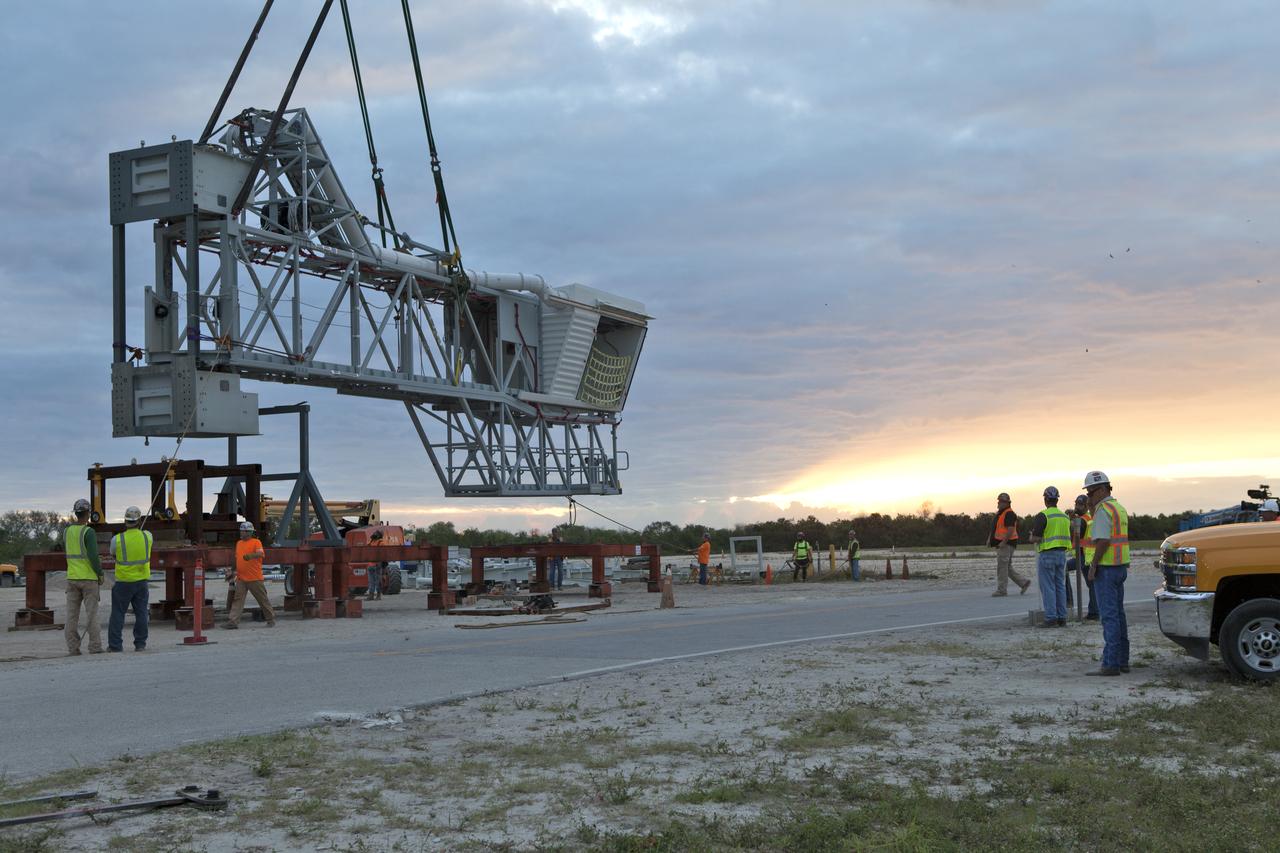
Under the watchful eye of technicians and engineers, a crane begins lifting the Orion crew access arm (CAA) so it can be attached to the mobile launcher (ML) at NASA's Kennedy Space Center in Florida. The arm will be installed at about the 274-foot level on the ML tower. NASA's Exploration Ground Systems organization has been overseeing installation of umbilicals and other launch accessories on the 380-foot-tall ML in preparation for stacking the first launch of the Space launch System (SLS), rocket with an Orion spacecraft. The CAA is designed to rotate from its retracted position and line up with Orion's crew hatch providing entry for astronauts and technicians.
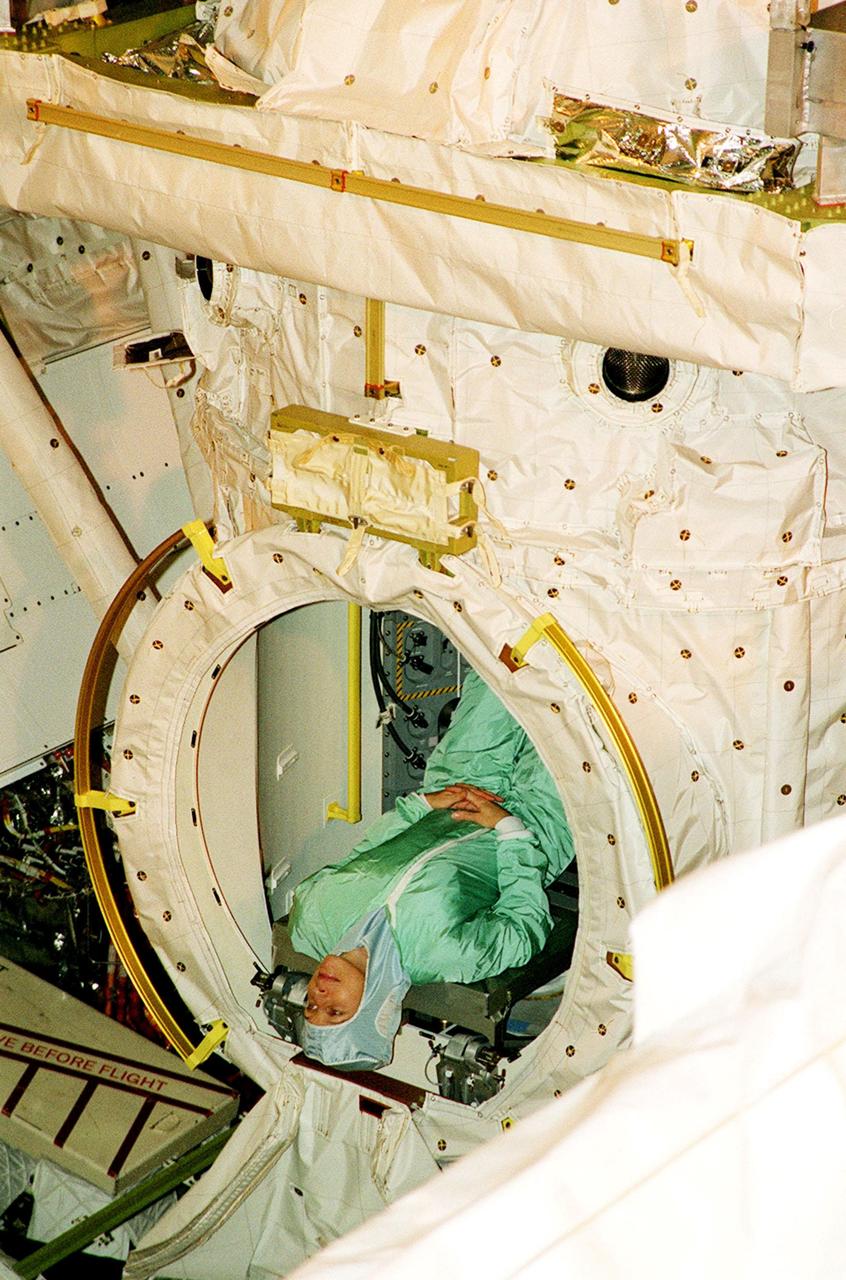
KENNEDY SPACE CENTER, FLA. -- STS-98 Mission Specialist Marsha Ivins takes a topsy-turvy look at the EVA hatch in the Orbiter Docking System, which is already installed in the payload bay of orbiter Atlantis. She and the rest of the crew are at KSC for Crew Equipment Interface Test activities. Launch on mission STS-98 is scheduled for Jan. 18, 2001. It will be transporting the U.S. Lab, Destiny, to the International Space Station with five system racks already installed inside of the module. After delivery of electronics in the lab, electrically powered attitude control for Control Moment Gyroscopes will be activated
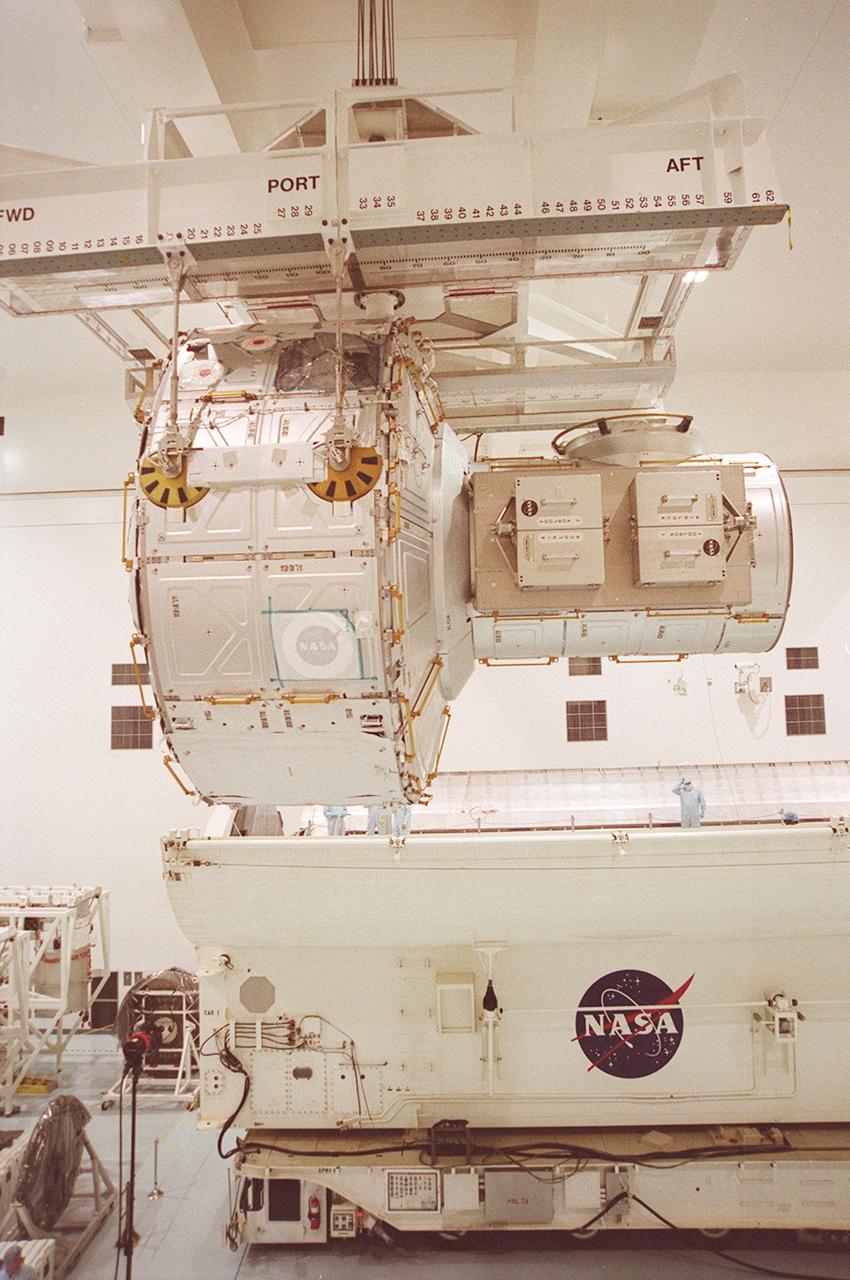
KENNEDY SPACE CENTER, FLA. -- In the Space Station Processing Facility, the Joint Airlock Module is moved closer to the payload canister. The airlock will be installed in the payload bay of Atlantis for mission STS-104 to the International Space Station. The airlock is a pressurized flight element consisting of two cylindrical chambers attached end-to-end by a connecting bulkhead and hatch. Once installed and activated, the Airlock becomes the primary path for spacewalk entry to and departure from the Space Station for U.S. spacesuits, which are known as Extravehicular Mobility Units, or EMUs. In addition, the Joint Airlock is designed to support the Russian Orlan spacesuit for EVA activity. STS-104 is scheduled for launch June 14 from Launch Pad 39B
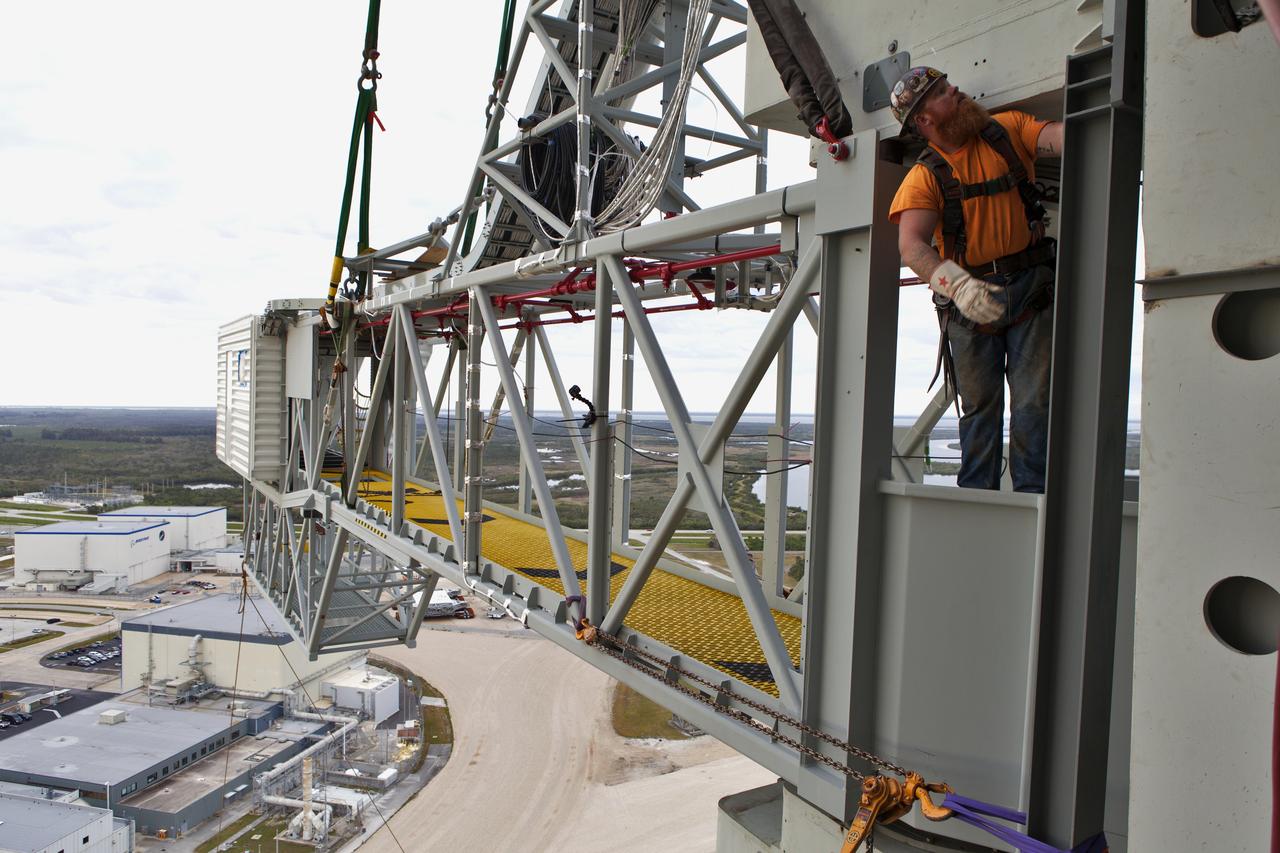
Viewed from the 274-foot level mobile launcher (ML), a technician begins installation of the Orion crew access arm (CAA) to the tower. The CAA will support the Space launch System (SLS) rocket at NASA's Kennedy Space Center in Florida. NASA's Exploration Ground Systems organization has been overseeing installation of umbilicals and other launch accessories on the 380-foot-tall ML in preparation for stacking the first launch of the Space launch System, or SLS, rocket with an Orion spacecraft. The CAA is designed to rotate from its retracted position and line up with Orion's crew hatch providing entry for astronauts and technicians.
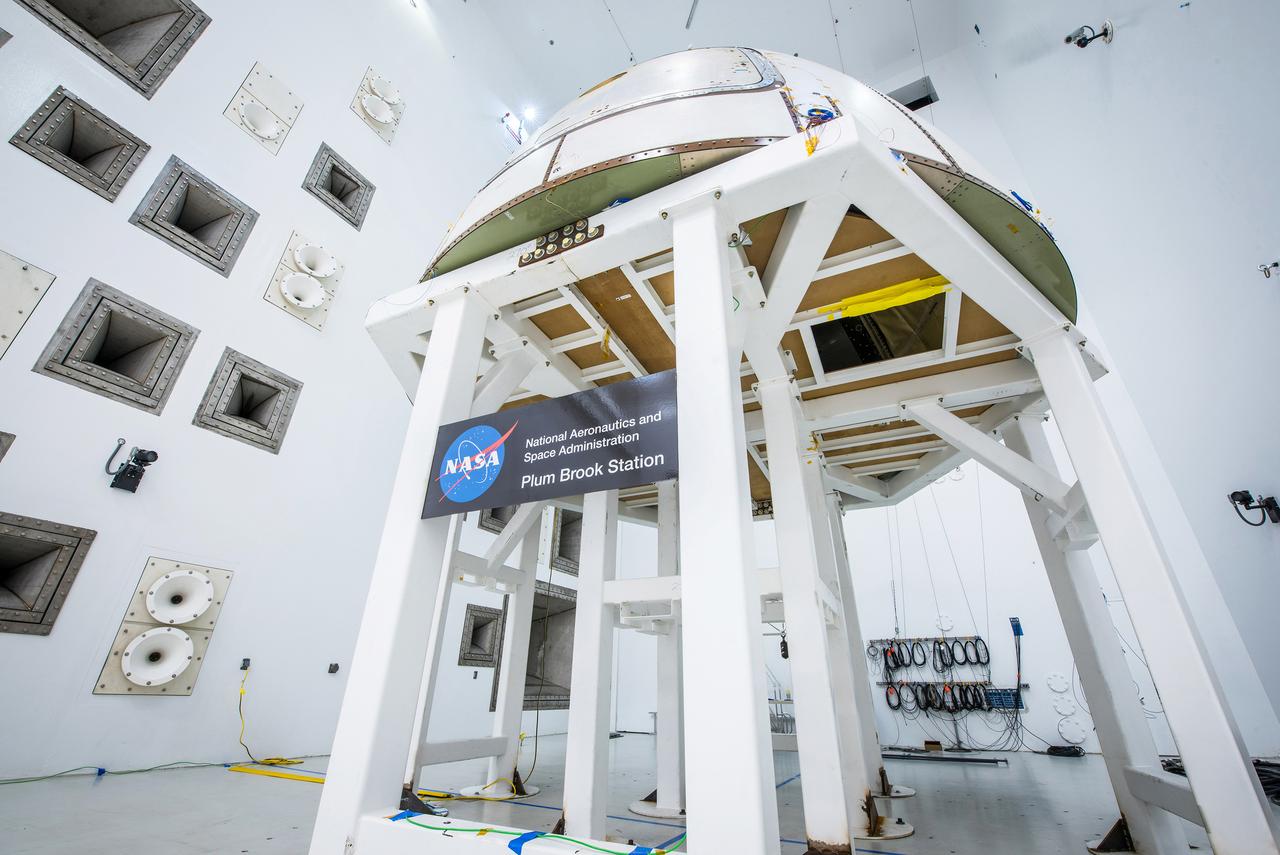
The ogive panels protect Orion's crew module from harsh acoustic conditions at launch and in case of an abort. Acoustic testing of the ogive hatch starts today at Space Power Facility at NASA Glenn Research Center's Plum Brook station in Sandusky, Ohio takes place on July 19, 2017. The ogive is installed in the Reverberant Acoustic Chamber where it will be blasted with 161 db of sound to simulate launch conditions.
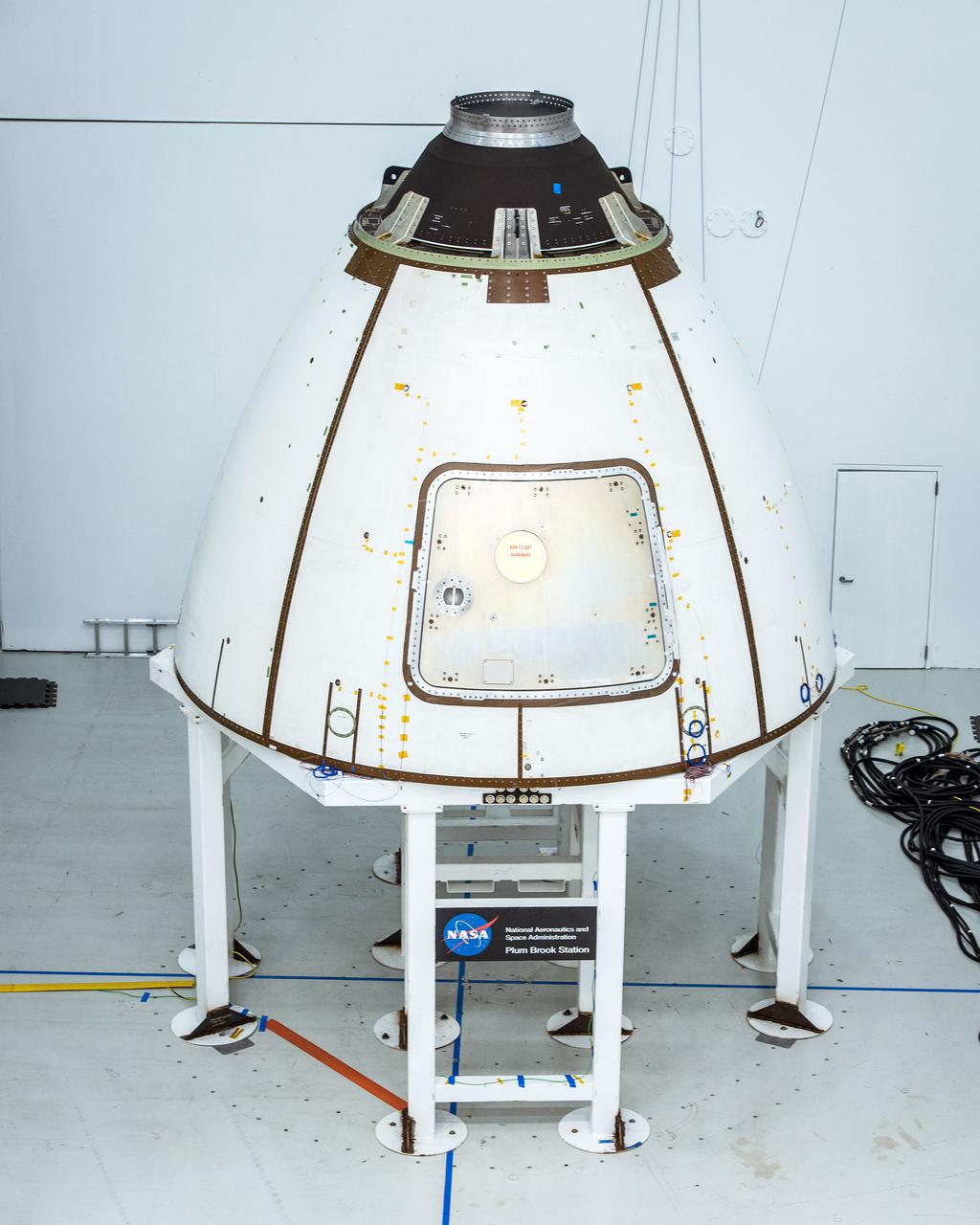
The ogive panels protect Orion's crew module from harsh acoustic conditions at launch and in case of an abort. Acoustic testing of the ogive hatch starts today at Space Power Facility at NASA Glenn Research Center's Plum Brook station in Sandusky, Ohio takes place on July 19, 2017. The ogive is installed in the Reverberant Acoustic Chamber where it will be blasted with 161 db of sound to simulate launch conditions.
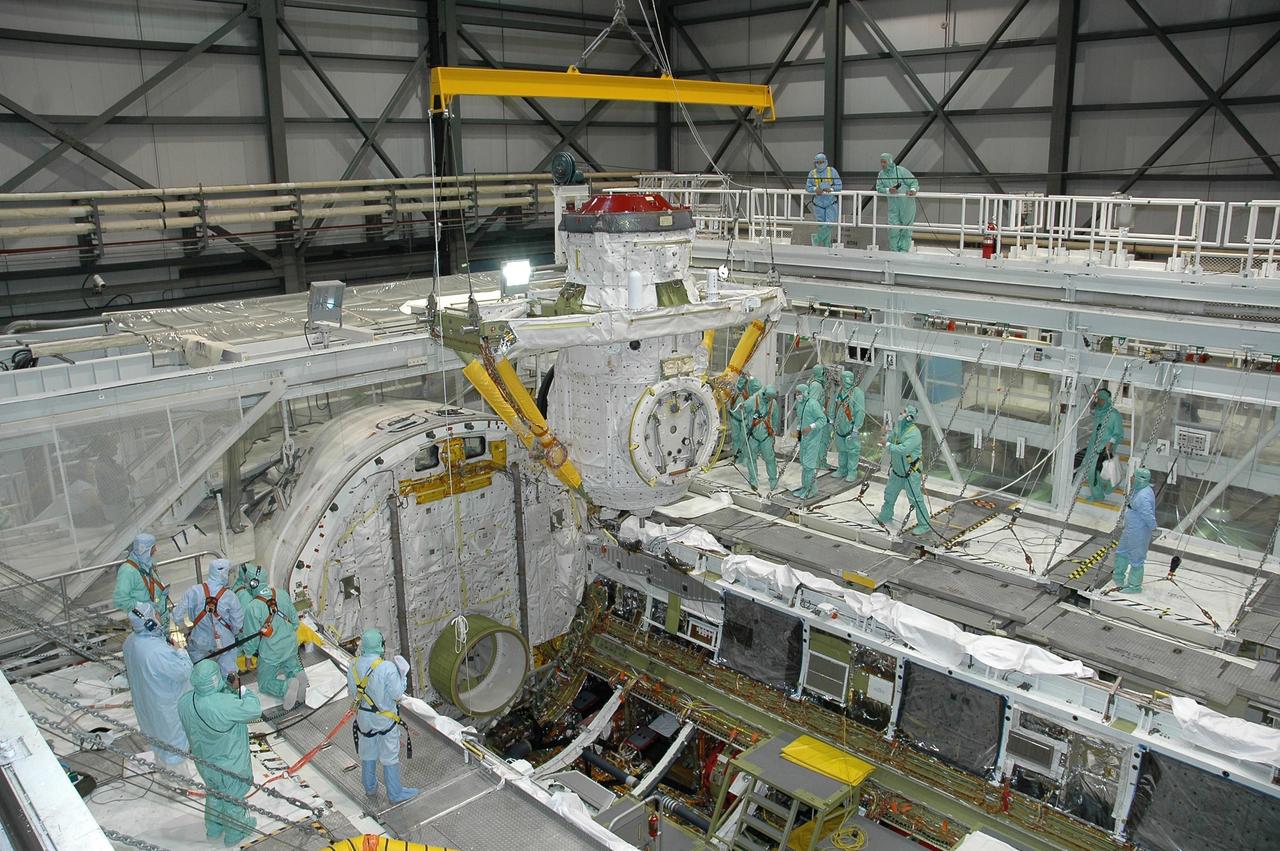
KENNEDY SPACE CENTER, FLA. - In Orbiter Processing Facility bay 2 at NASA's Kennedy Space Center, the airlock is lowered by an overhead crane into Endeavour's payload bay for installation. The airlock is located in the middeck. The airlock and airlock hatches permit flight crew members to transfer from the middeck crew compartment into the payload bay for extravehicular activities in their space suits without depressurizing the orbiter crew cabin. The airlock is sized to accommodate two fully suited flight crew members simultaneously. Photo credit: NASA/Jim Grossmann
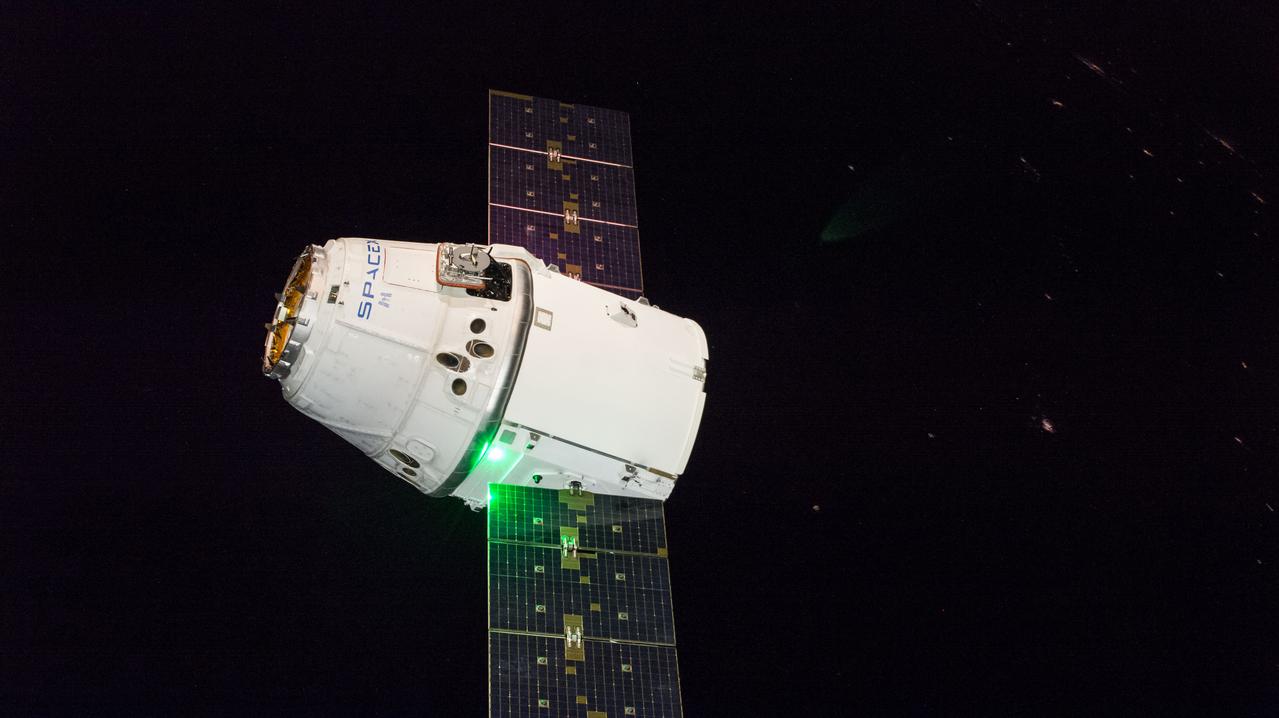
iss057e115431 (Dec. 8, 2018) --- The SpaceX Dragon cargo craft slowly approaches the International Space Station. Astronauts Alexander Gerst and Serena Auñón-Chancellor were monitoring Dragon from inside the cupola and preparing to slowly reach out and grapple the cargo craft with the Canadarm2 robotic arm. Dragon, packed with over 5,600 pounds of cargo, completed a three-day trip to the International Space Station that began with a launch from Cape Canaveral Air Force Station in Florida and ended with its installation and hatch opening on the Harmony module..
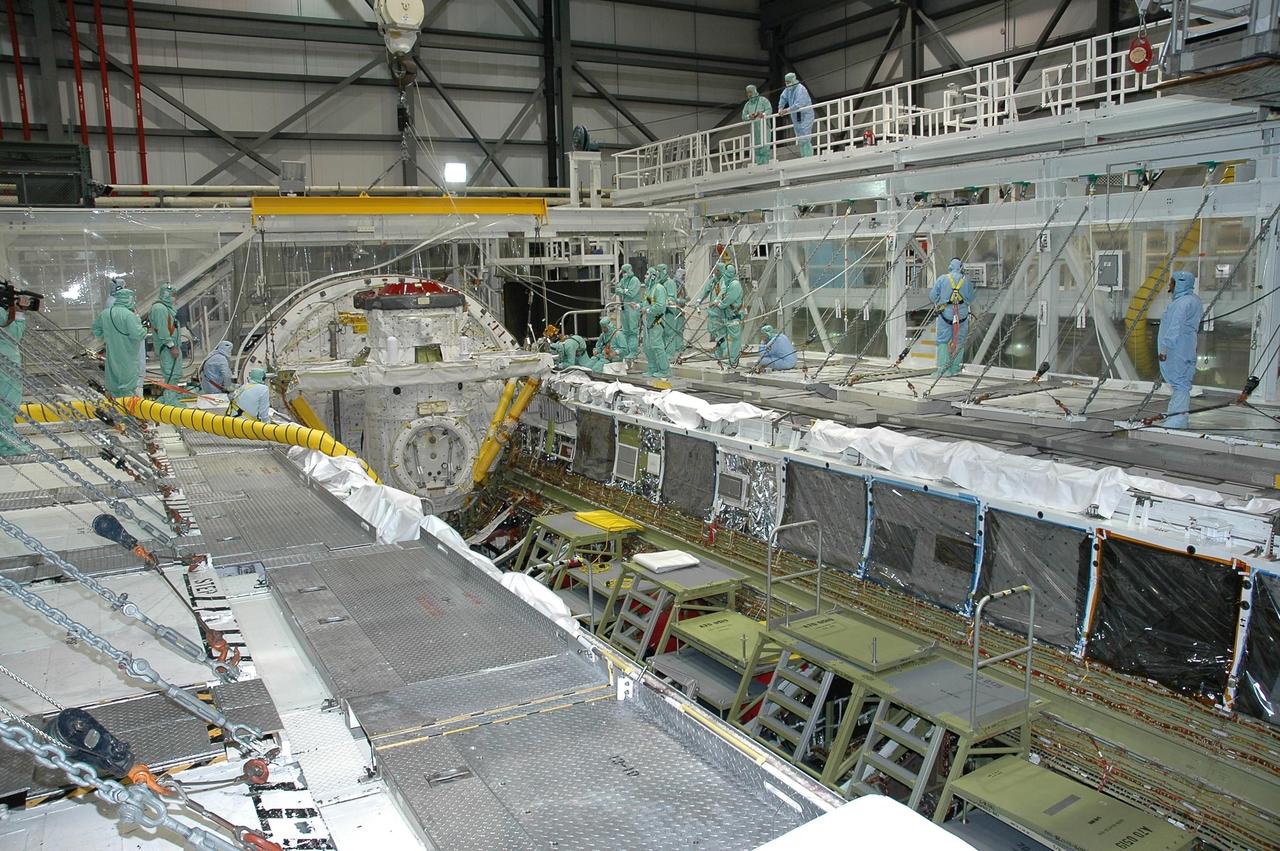
KENNEDY SPACE CENTER, FLA. - In Orbiter Processing Facility bay 2 at NASA's Kennedy Space Center, the airlock has been lowered into place for installation into Endeavour's payload bay. The airlock is located in the middeck. The airlock and airlock hatches permit flight crew members to transfer from the middeck crew compartment into the payload bay for extravehicular activities in their space suits without depressurizing the orbiter crew cabin. The airlock is sized to accommodate two fully suited flight crew members simultaneously. Photo credit: NASA/Jim Grossmann
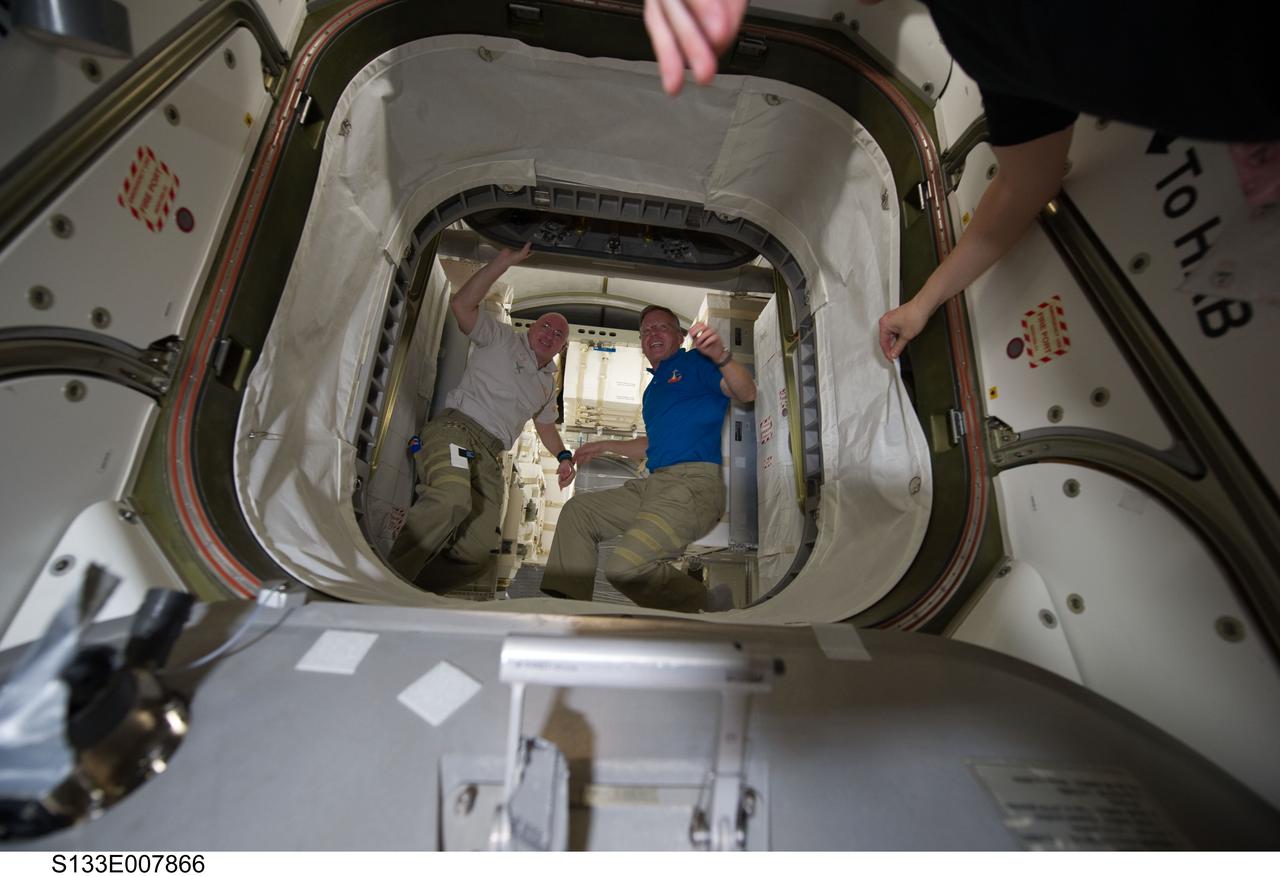
S133-E-007866 (1 March 2011) --- NASA astronauts Scott Kelly (left), Expedition 26 commander; and Steve Lindsey, STS-133 commander, are pictured in the hatch that leads to the newly-installed Permanent Multipurpose Module (PMM) of the International Space Station while space shuttle Discovery remains docked with the station. Photo credit: NASA or National Aeronautics and Space Administration
KENNEDY SPACE CENTER, FLA. - In Orbiter Processing Facility bay 2 at NASA's Kennedy Space Center, the airlock is being lifted for installation in Endeavour's payload bay. The airlock is located in the middeck. The airlock and airlock hatches permit flight crew members to transfer from the middeck crew compartment into the payload bay for extravehicular activities in their space suits without depressurizing the orbiter crew cabin. The airlock is sized to accommodate two fully suited flight crew members simultaneously. Photo credit: NASA/Jim Grossmann
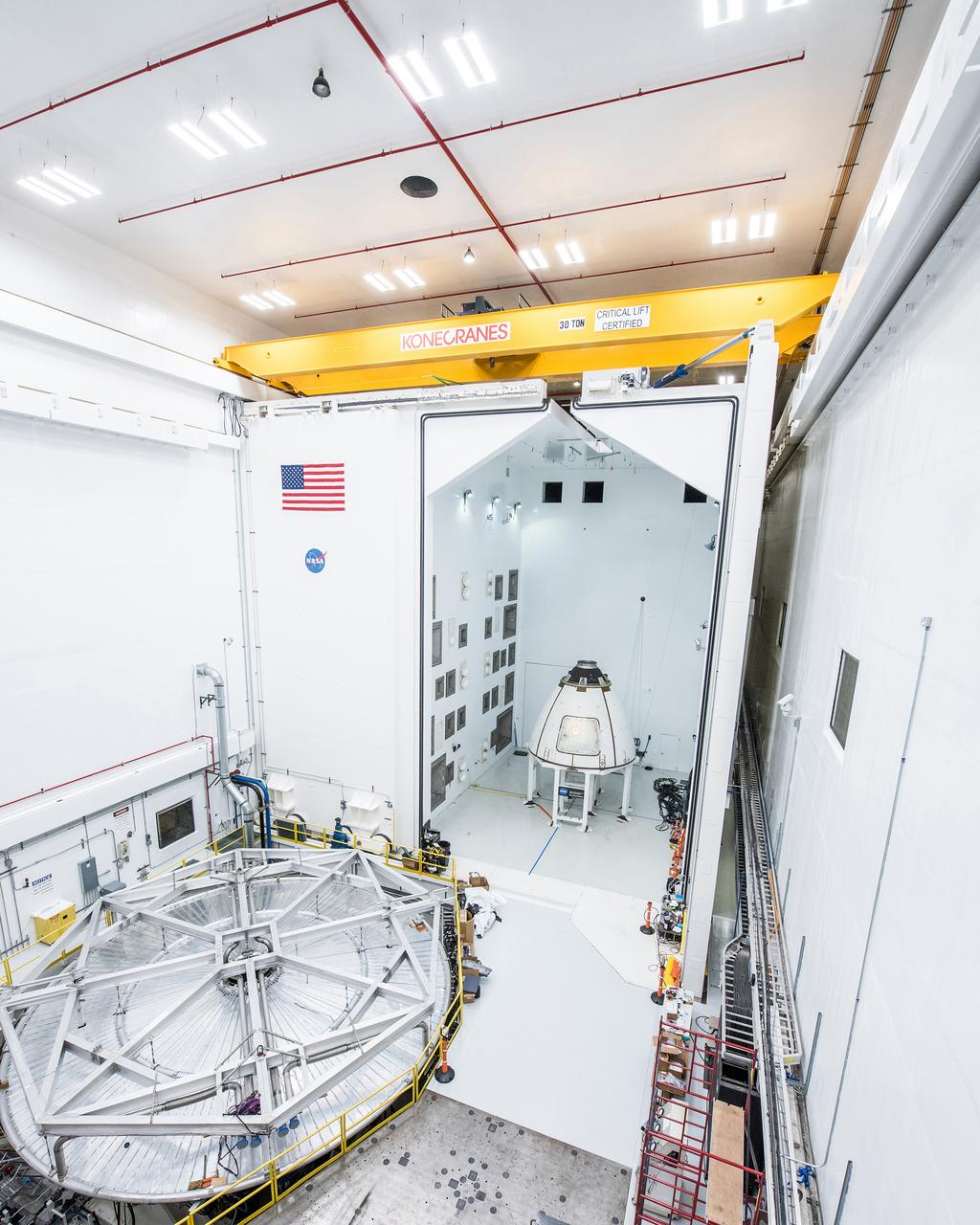
The ogive panels protect Orion's crew module from harsh acoustic conditions at launch and in case of an abort. Acoustic testing of the ogive hatch starts today at Space Power Facility at NASA Glenn Research Center's Plum Brook station in Sandusky, Ohio takes place on July 19, 2017. The ogive is installed in the Reverberant Acoustic Chamber where it will be blasted with 161 db of sound to simulate launch conditions.
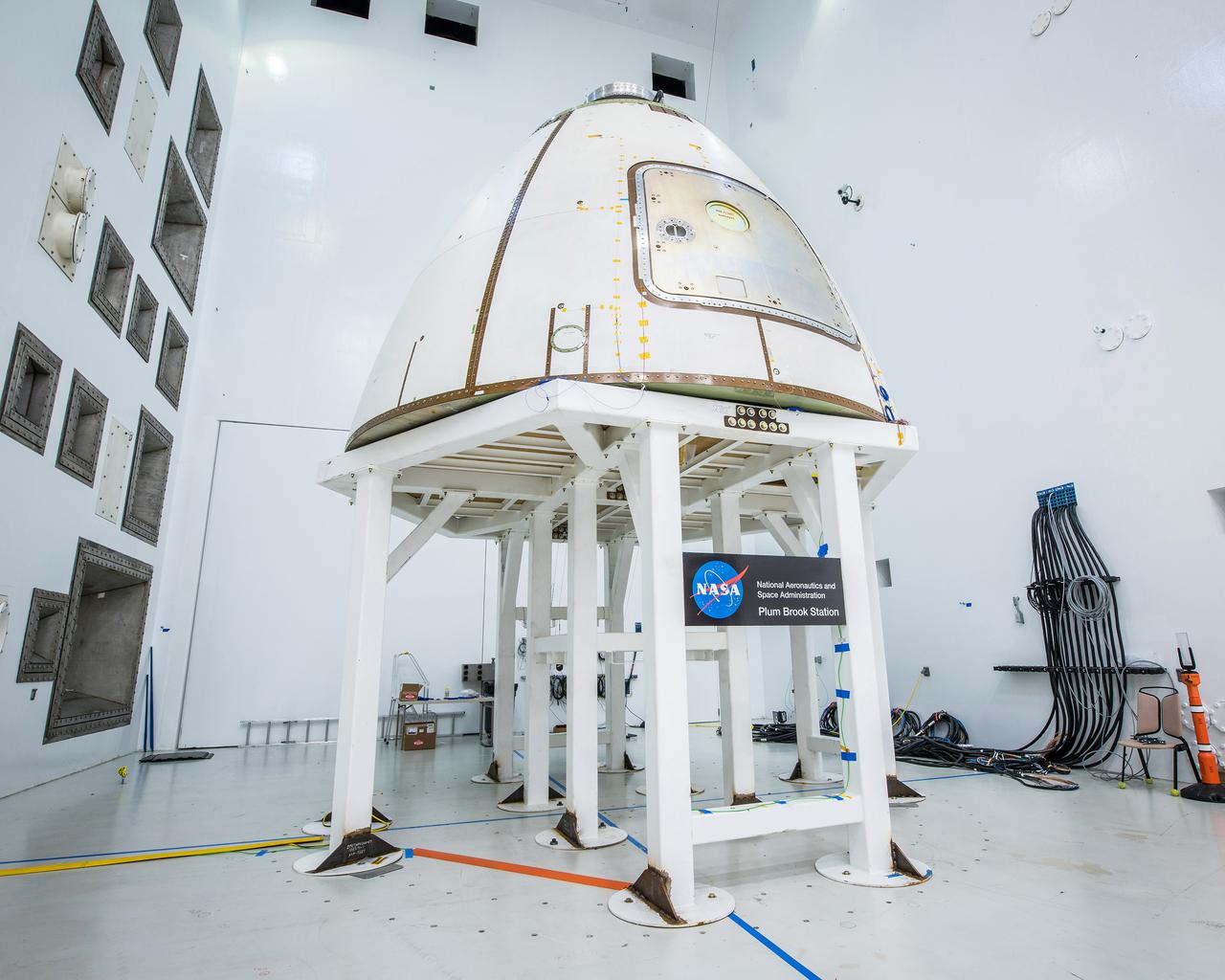
The ogive panels protect Orion's crew module from harsh acoustic conditions at launch and in case of an abort. Acoustic testing of the ogive hatch starts today at Space Power Facility at NASA Glenn Research Center's Plum Brook station in Sandusky, Ohio takes place on July 19, 2017. The ogive is installed in the Reverberant Acoustic Chamber where it will be blasted with 161 db of sound to simulate launch conditions.

iss060e021455 (Aug. 5, 2019) --- Expedition 60 Flight Engineer Nick Hague of NASA is pictured in the vestibule between the Unity module and the Northrop Grumman Cygnus space freighter. Hague had installed a SlingShot Deployer to the outside of Cygnus' hatch that would eject several small satellites once the commercial cargo craft reached a safe distance from the station after its departure.
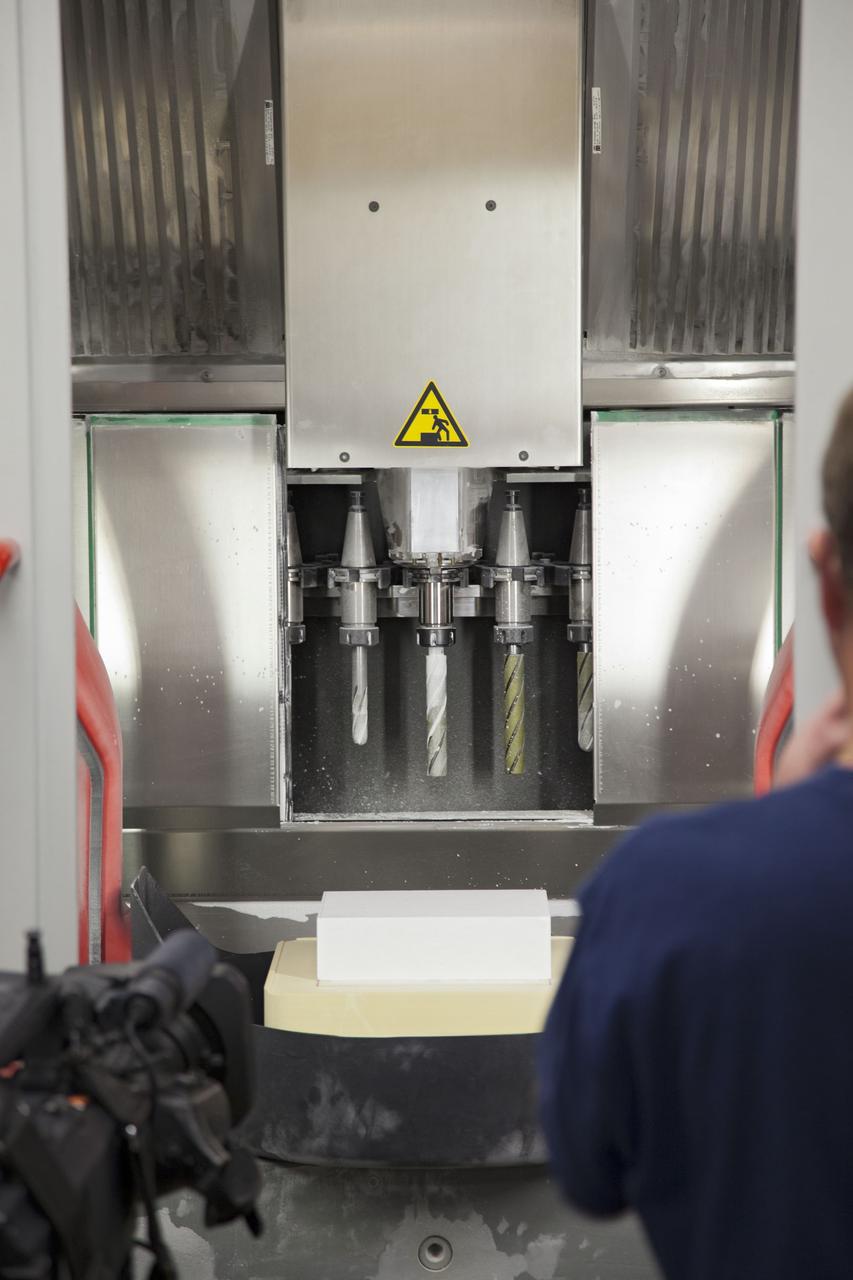
CAPE CANAVERAL, Fla. -- The heat shield tiles that will be installed to the backshell of the Orion Multi-Purpose Crew Vehicle's Exploration Flight Test EFT-1 capsule are manufactured inside the Thermal Protection System Facility at NASA's Kennedy Space Center in Florida. The insulation includes thermal barriers that are used around hatches, thrusters and other open areas of the backshell to protect the joints from heat. EFT-1 will be used during Orion's first test flight in space. For more information, visit www.nasa.gov/orion. Photo credit: Frankie Martin
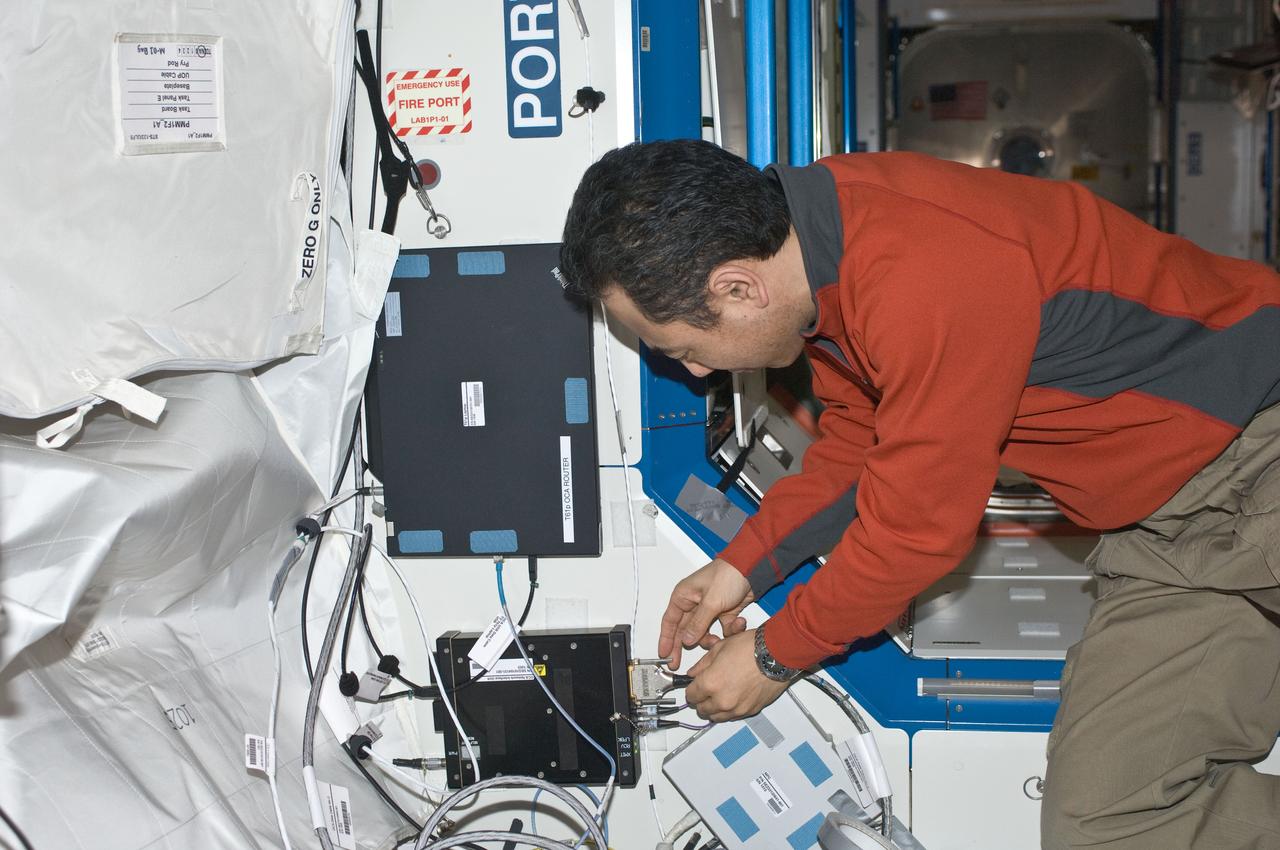
ISS029-E-007212 (21 Sept. 2011) --- Japan Aerospace Exploration Agency astronaut Satoshi Furukawa, Expedition 29 flight engineer, installs a new T61p laptop to replace the previous A31p as OCA Router in the Joint Station LAN/Local Area Network (JSL LAN). The laptop is located in the hatch area of the Destiny laboratory of the International Space Station.
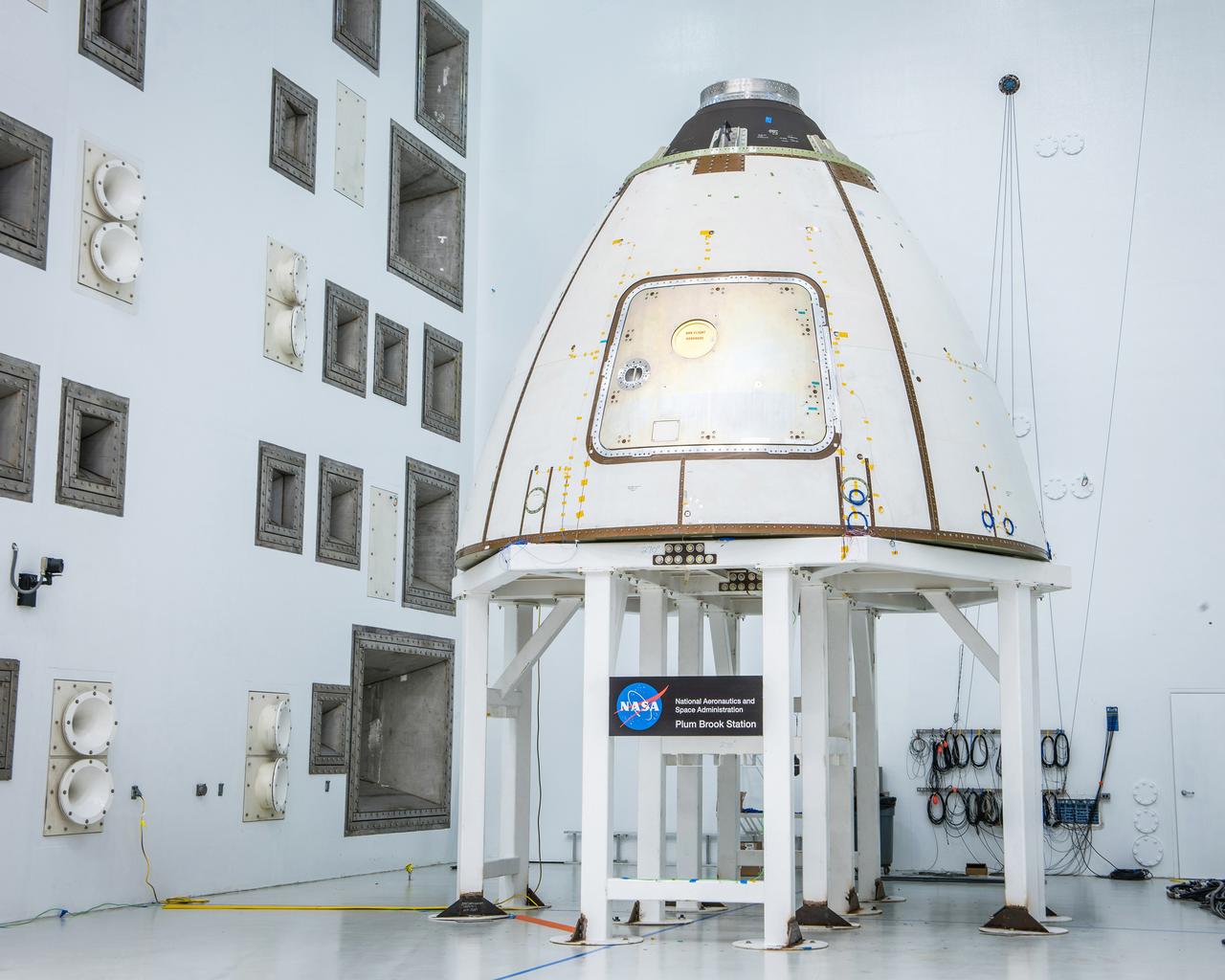
The ogive panels protect Orion's crew module from harsh acoustic conditions at launch and in case of an abort. Acoustic testing of the ogive hatch starts today at Space Power Facility at NASA Glenn Research Center's Plum Brook station in Sandusky, Ohio takes place on July 19, 2017. The ogive is installed in the Reverberant Acoustic Chamber where it will be blasted with 161 db of sound to simulate launch conditions.
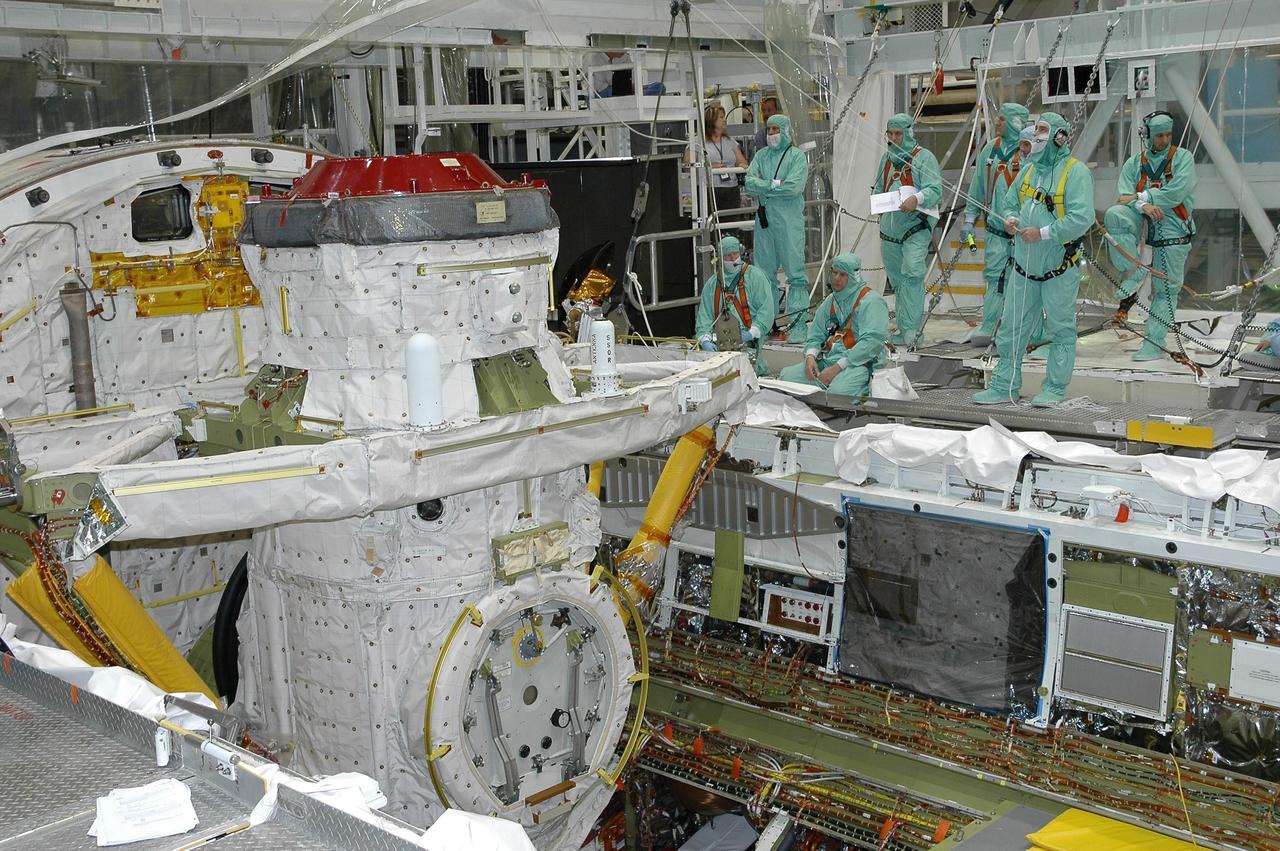
KENNEDY SPACE CENTER, FLA. - In Orbiter Processing Facility bay 2 at NASA's Kennedy Space Center, workers stand by as the airlock is lowered into place for installation into Endeavour's payload bay. The airlock is located in the middeck. The airlock and airlock hatches permit flight crew members to transfer from the middeck crew compartment into the payload bay for extravehicular activities in their space suits without depressurizing the orbiter crew cabin. The airlock is sized to accommodate two fully suited flight crew members simultaneously. Photo credit: NASA/Jim Grossmann
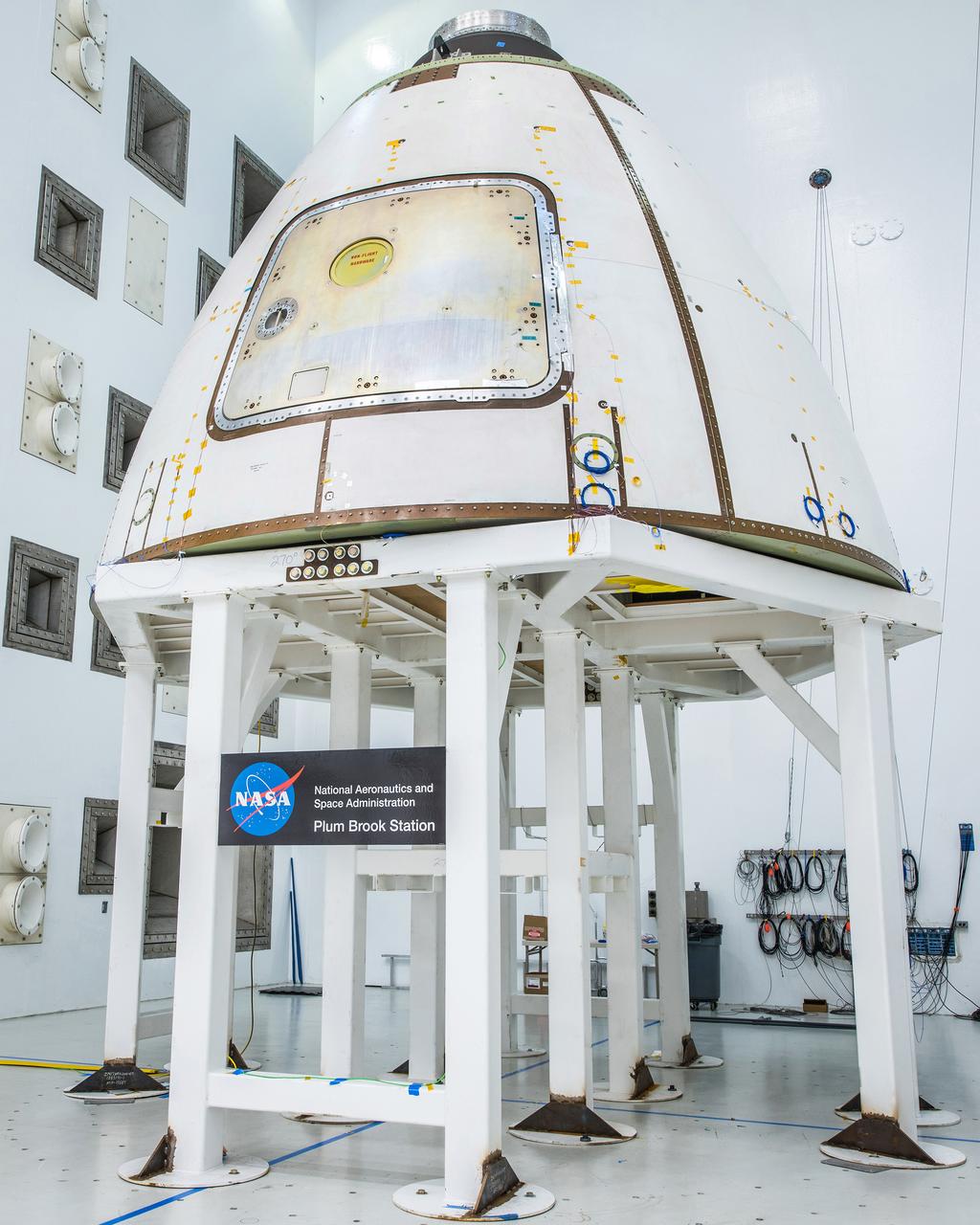
The ogive panels protect Orion's crew module from harsh acoustic conditions at launch and in case of an abort. Acoustic testing of the ogive hatch starts today at Space Power Facility at NASA Glenn Research Center's Plum Brook station in Sandusky, Ohio takes place on July 19, 2017. The ogive is installed in the Reverberant Acoustic Chamber where it will be blasted with 161 db of sound to simulate launch conditions.
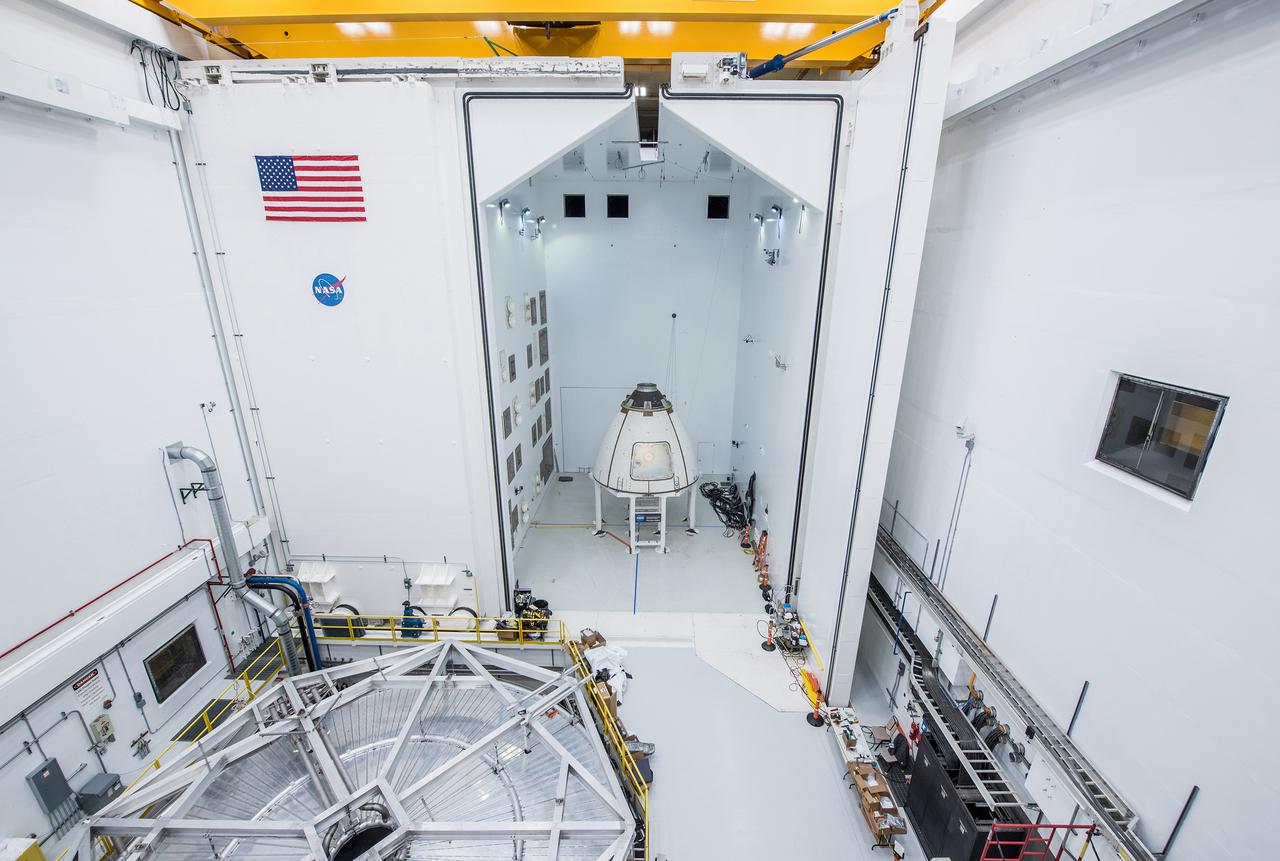
The ogive panels protect Orion's crew module from harsh acoustic conditions at launch and in case of an abort. Acoustic testing of the ogive hatch starts today at Space Power Facility at NASA Glenn Research Center's Plum Brook station in Sandusky, Ohio takes place on July 19, 2017. The ogive is installed in the Reverberant Acoustic Chamber where it will be blasted with 161 db of sound to simulate launch conditions.
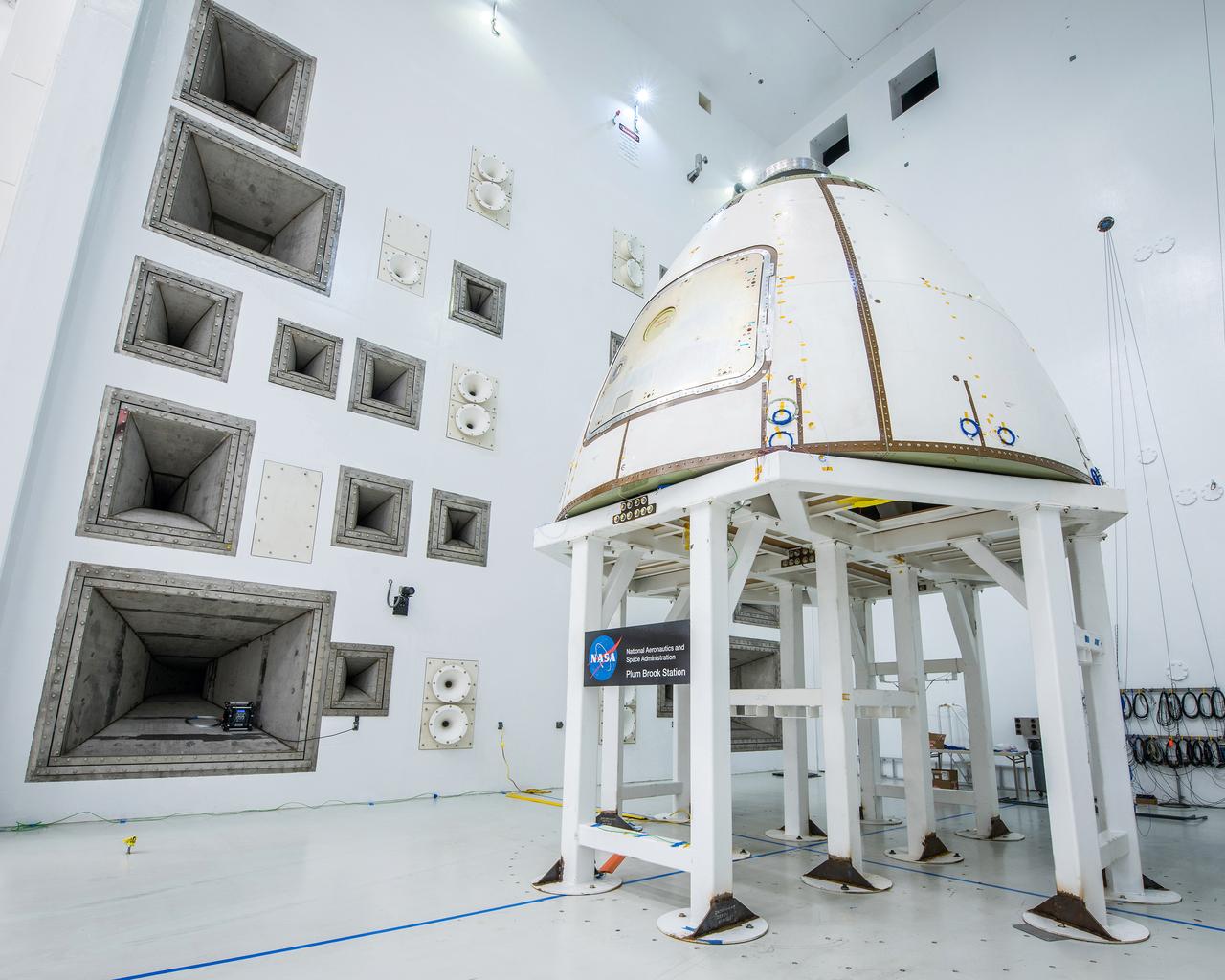
The ogive panels protect Orion's crew module from harsh acoustic conditions at launch and in case of an abort. Acoustic testing of the ogive hatch starts today at Space Power Facility at NASA Glenn Research Center's Plum Brook station in Sandusky, Ohio takes place on July 19, 2017. The ogive is installed in the Reverberant Acoustic Chamber where it will be blasted with 161 db of sound to simulate launch conditions.
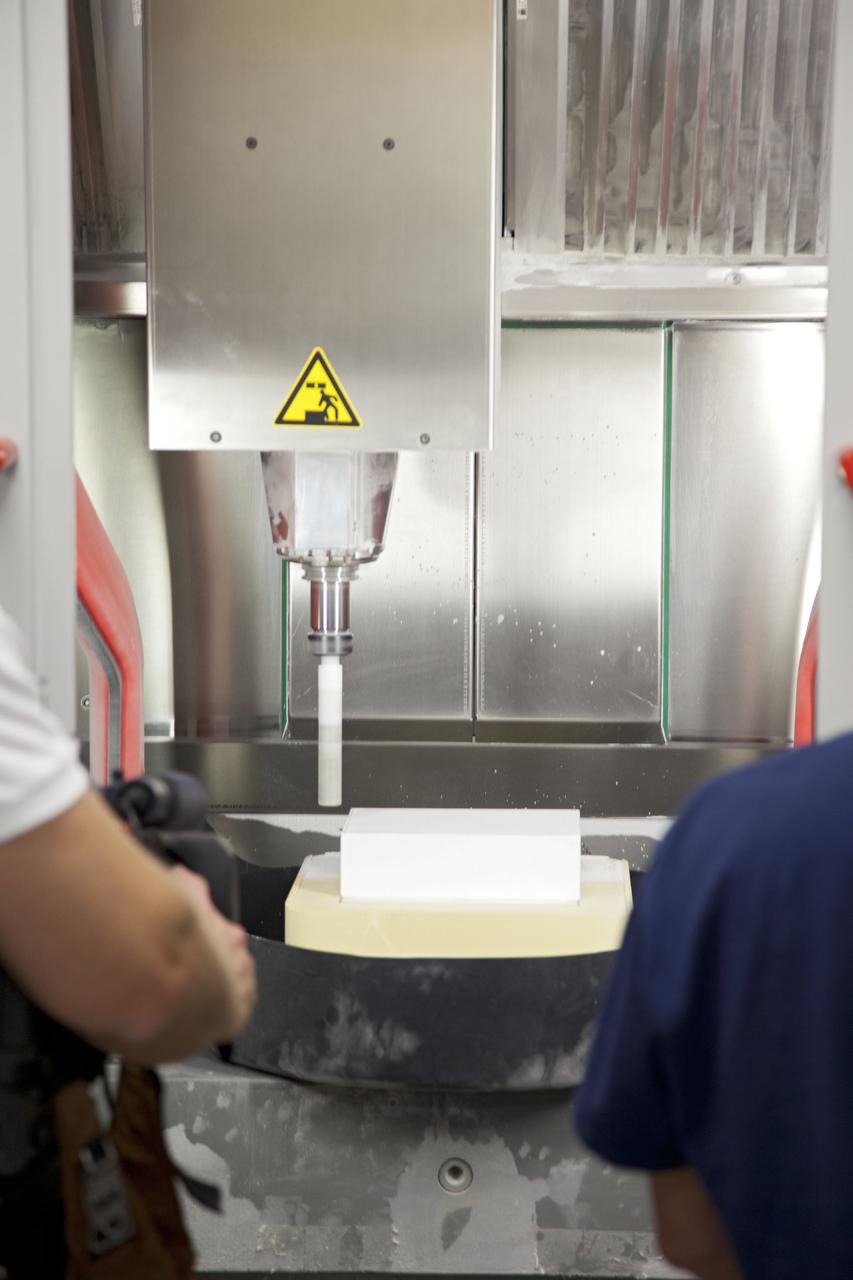
CAPE CANAVERAL, Fla. -- The heat shield tiles that will be installed to the backshell of the Orion Multi-Purpose Crew Vehicle's Exploration Flight Test EFT-1 capsule are manufactured inside the Thermal Protection System Facility at NASA's Kennedy Space Center in Florida. The insulation includes thermal barriers that are used around hatches, thrusters and other open areas of the backshell to protect the joints from heat. EFT-1 will be used during Orion's first test flight in space. For more information, visit www.nasa.gov/orion. Photo credit: Frankie Martin
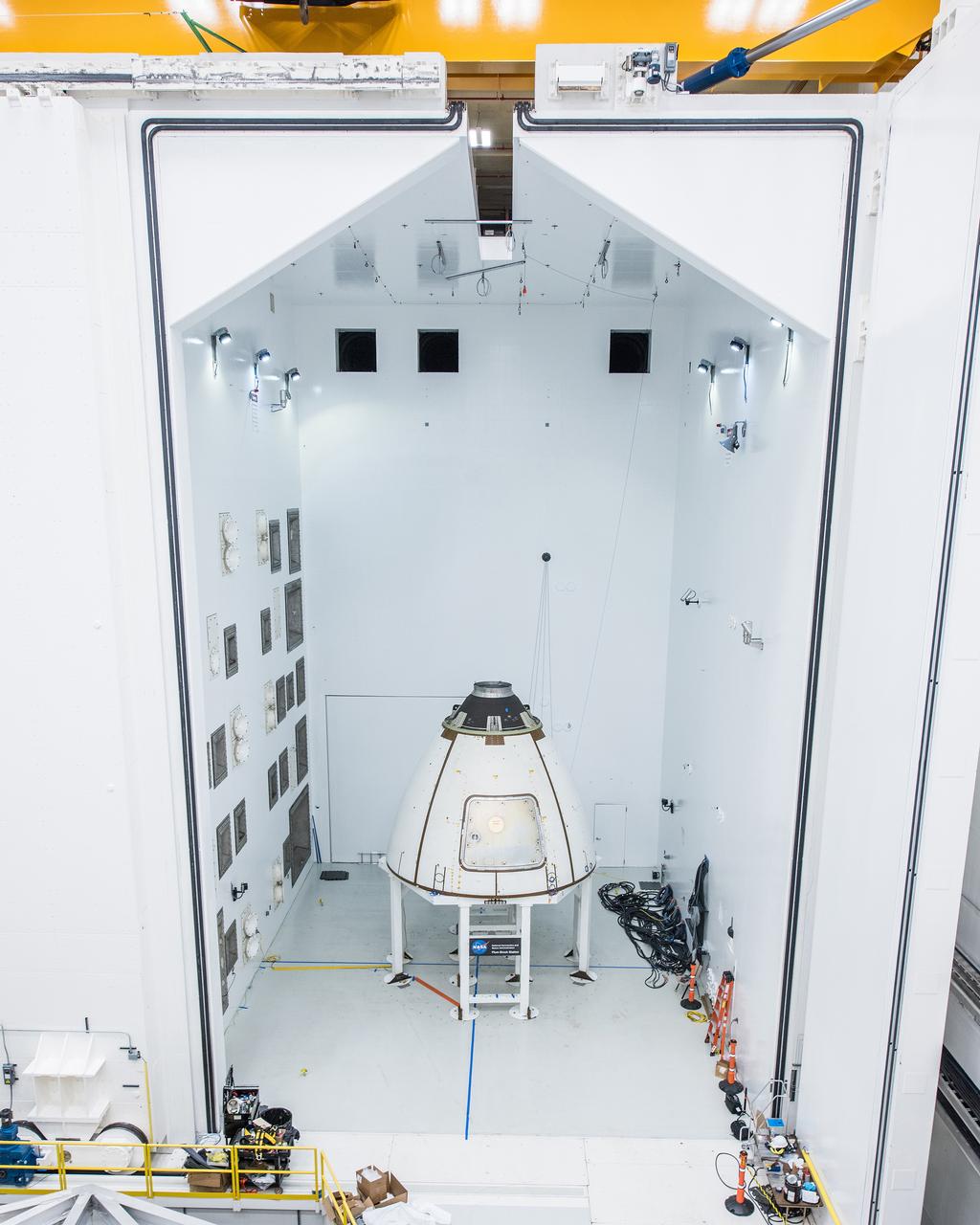
The ogive panels protect Orion's crew module from harsh acoustic conditions at launch and in case of an abort. Acoustic testing of the ogive hatch starts today at Space Power Facility at NASA Glenn Research Center's Plum Brook station in Sandusky, Ohio takes place on July 19, 2017. The ogive is installed in the Reverberant Acoustic Chamber where it will be blasted with 161 db of sound to simulate launch conditions.
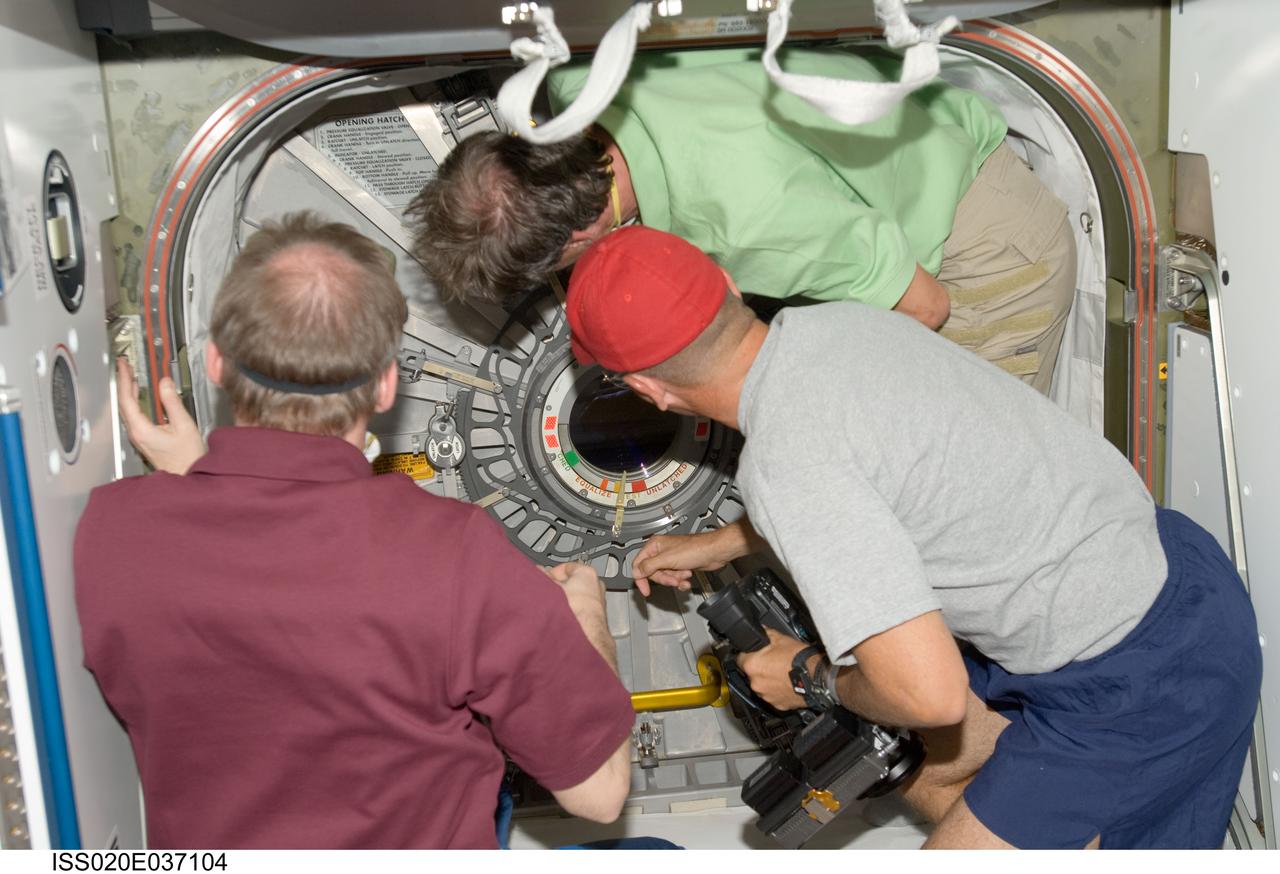
ISS020-E-037104 (31 Aug. 2009) --- NASA astronaut Rick Sturckow (right), STS-128 commander; along with European Space Agency astronauts Frank De Winne (left), Expedition 20 flight engineer; and Christer Fuglesang, STS-128 mission specialist, prepare to open the hatch that will lead into the temporarily installed Leonardo Multi-Purpose Logistics Module while Space Shuttle Discovery remains docked with the International Space Station.
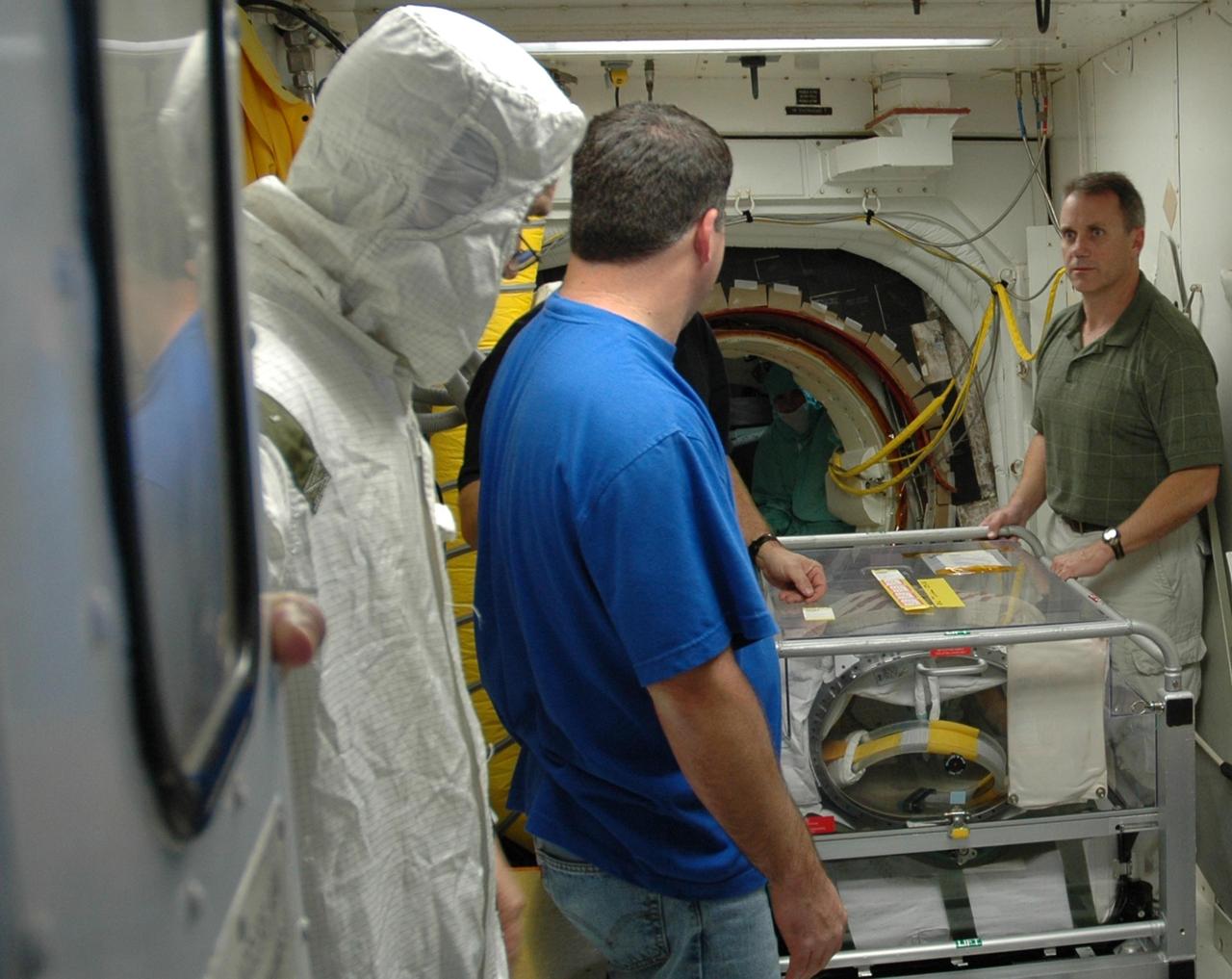
KENNEDY SPACE CENTER, FLA. -- Inside the White Room on Launch Pad 39B, workers get ready to move a cart through the hatch into Space Shuttle Discovery. The cart contains the extravehicular mobility units (or spacewalk suits) to be used on mission STS-116. The suits will be stored inside Discovery. Launch of Discovery is scheduled for 9:35 p.m. Dec. 7. The crew will deliver the P5 integrated truss to the International Space Station and install it during one or more extravehicular activities. Photo credit: NASA/Jack Pfaller
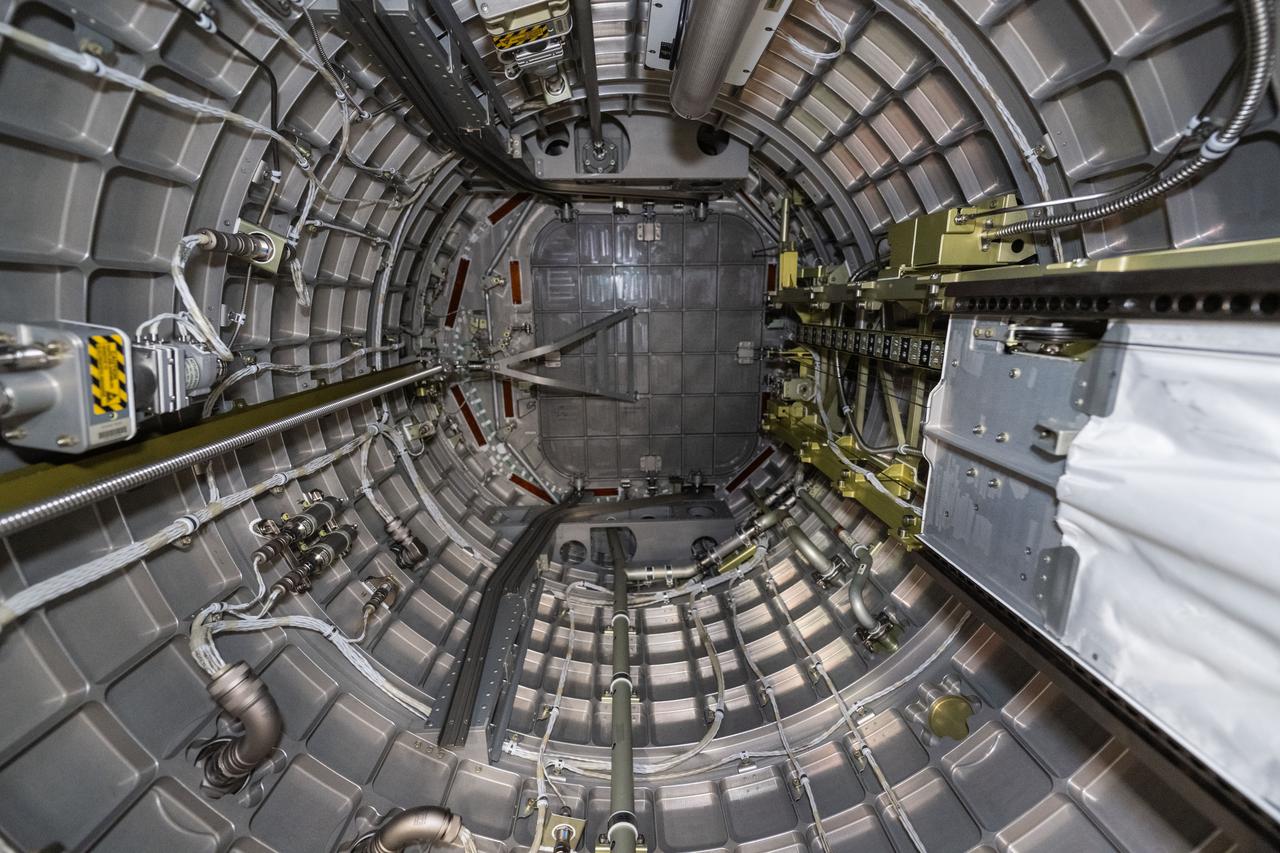
iss071e066956 (May 9, 2024) --- The inside of the Kibo laboratory module's airlock safely links the pressurized environment of the International Space Station to the vacuum of space. Astronauts load hardware, experiments, and CubeSats inside the airlock then depressurize it before the external hatch opens to the harsh environment of space. The Japanese robotic arm grapples the research hardware and installs it on an external pallet or points a small satellite deployer away from the station and deploys the CubeSats into Earth orbit.
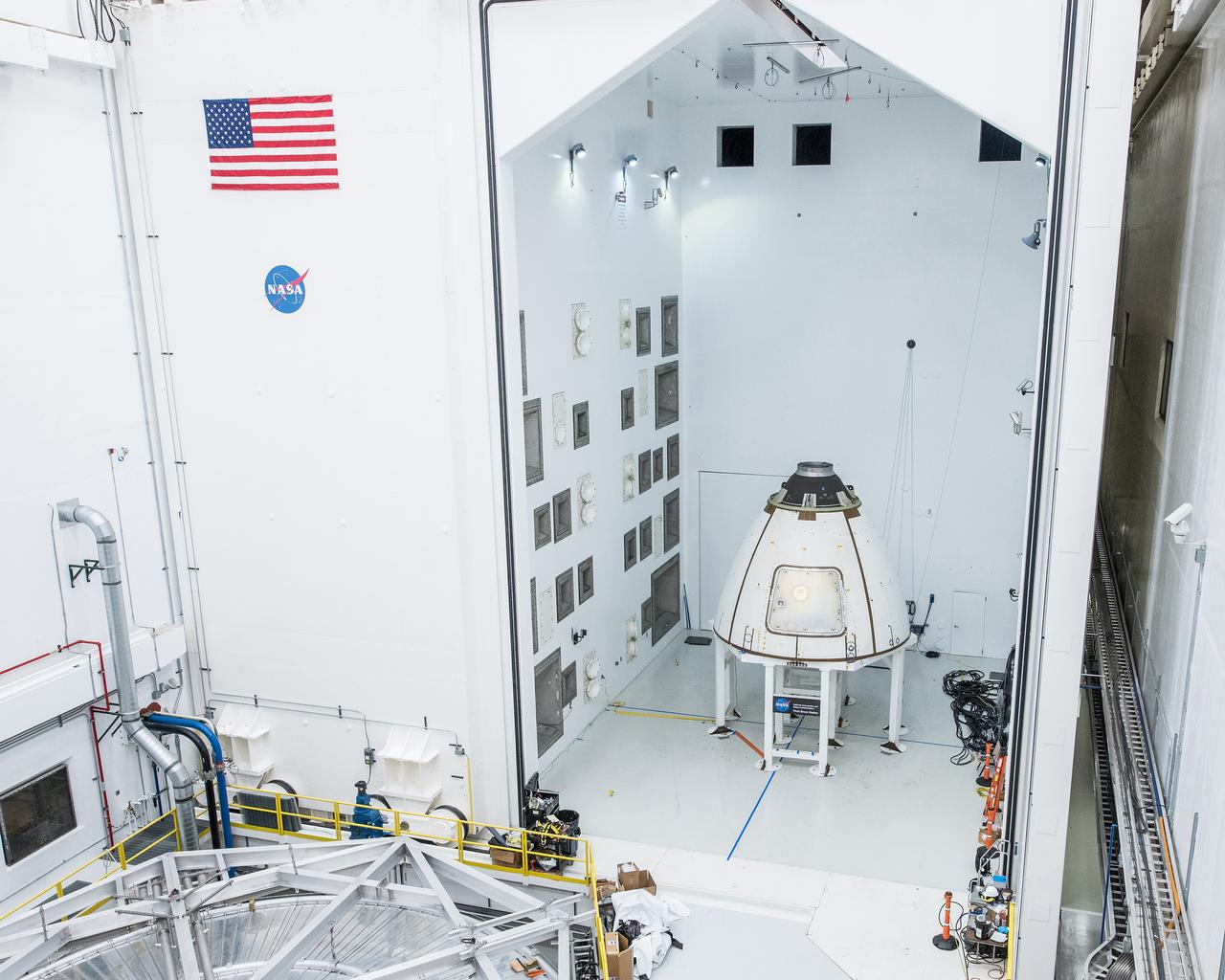
The ogive panels protect Orion's crew module from harsh acoustic conditions at launch and in case of an abort. Acoustic testing of the ogive hatch starts today at Space Power Facility at NASA Glenn Research Center's Plum Brook station in Sandusky, Ohio takes place on July 19, 2017. The ogive is installed in the Reverberant Acoustic Chamber where it will be blasted with 161 db of sound to simulate launch conditions.
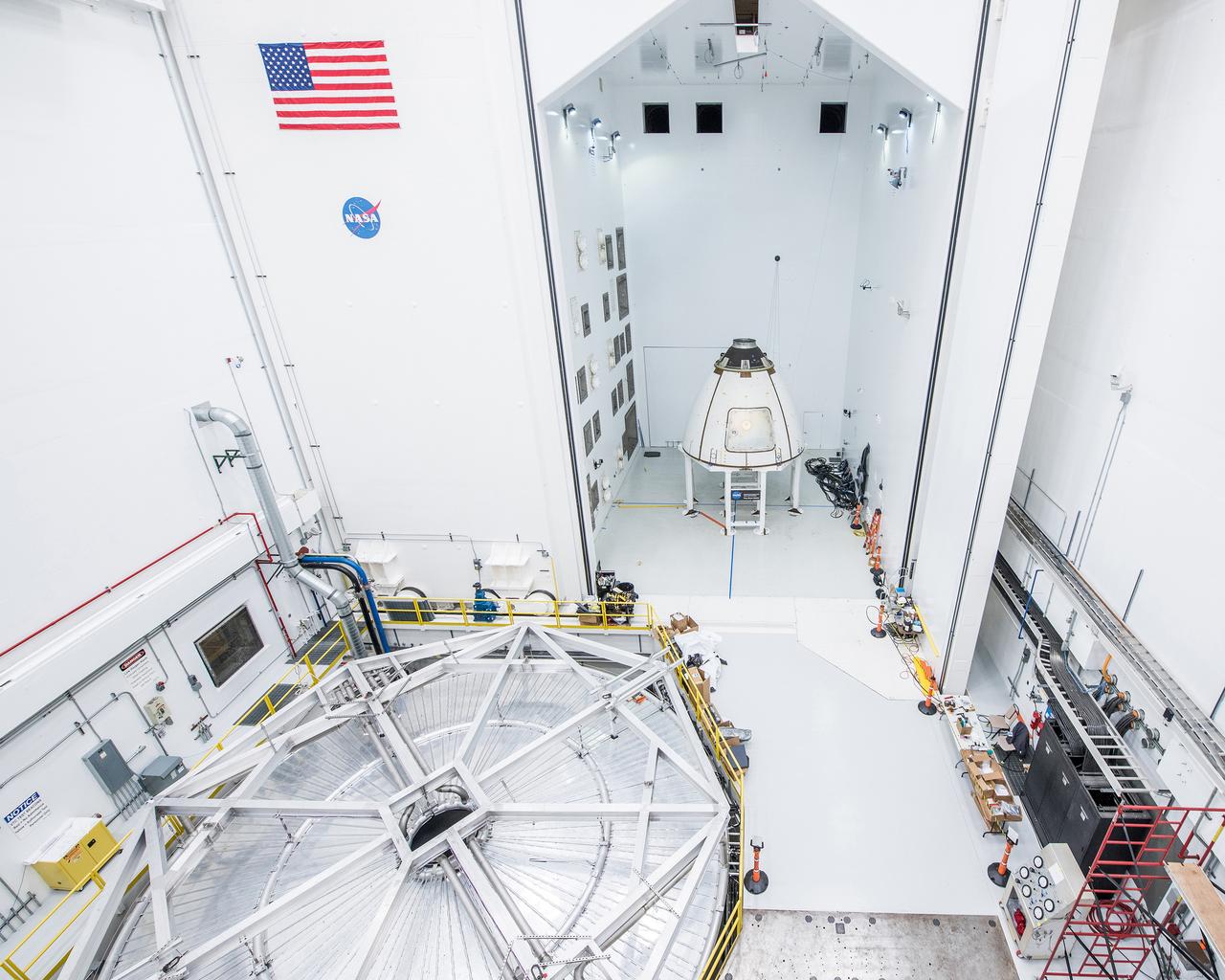
The ogive panels protect Orion's crew module from harsh acoustic conditions at launch and in case of an abort. Acoustic testing of the ogive hatch starts today at Space Power Facility at NASA Glenn Research Center's Plum Brook station in Sandusky, Ohio takes place on July 19, 2017. The ogive is installed in the Reverberant Acoustic Chamber where it will be blasted with 161 db of sound to simulate launch conditions.
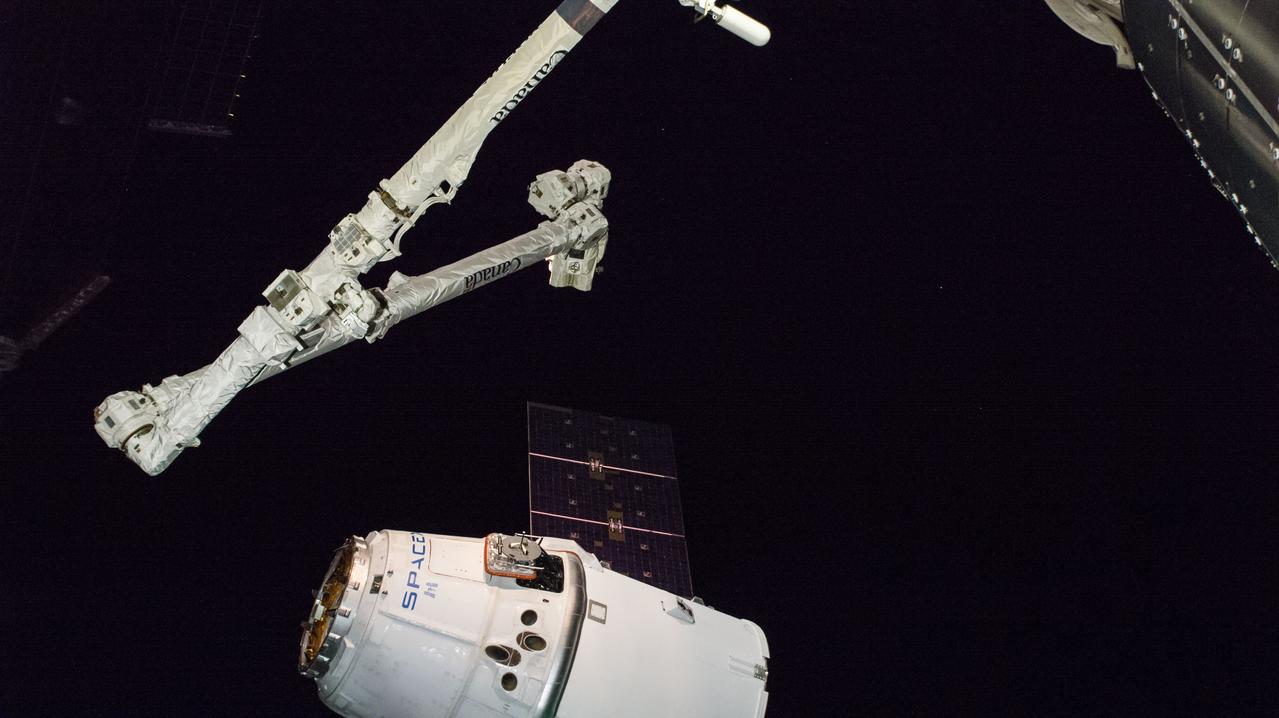
iss057e115434 (Dec. 8, 2018) --- The Canadarm2 robotic arm, operated by astronauts Alexander Gerst and Serena Auñón-Chancellor, slowly reaches out to grapple the SpaceX Dragon cargo craft. Dragon, packed with over 5,600 pounds of cargo, completed a three-day trip to the International Space Station that began with a launch from Cape Canaveral Air Force Station in Florida and ended with its installation and hatch opening on the Harmony module..
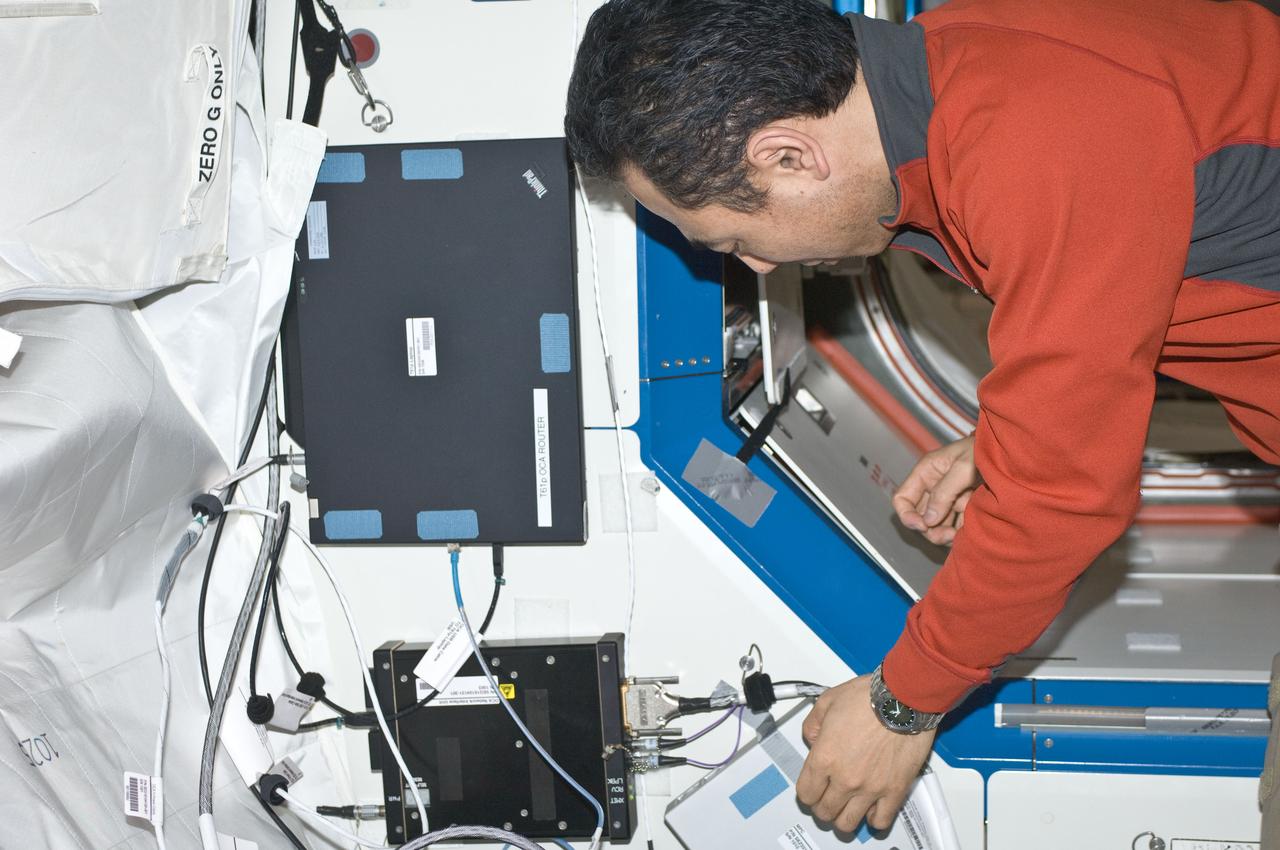
ISS029-E-007213 (21 Sept. 2011) --- Japan Aerospace Exploration Agency astronaut Satoshi Furukawa, Expedition 29 flight engineer, installs a new T61p laptop to replace the previous A31p as OCA Router in the Joint Station LAN/Local Area Network (JSL LAN). The laptop is located in the hatch area of the Destiny laboratory of the International Space Station.
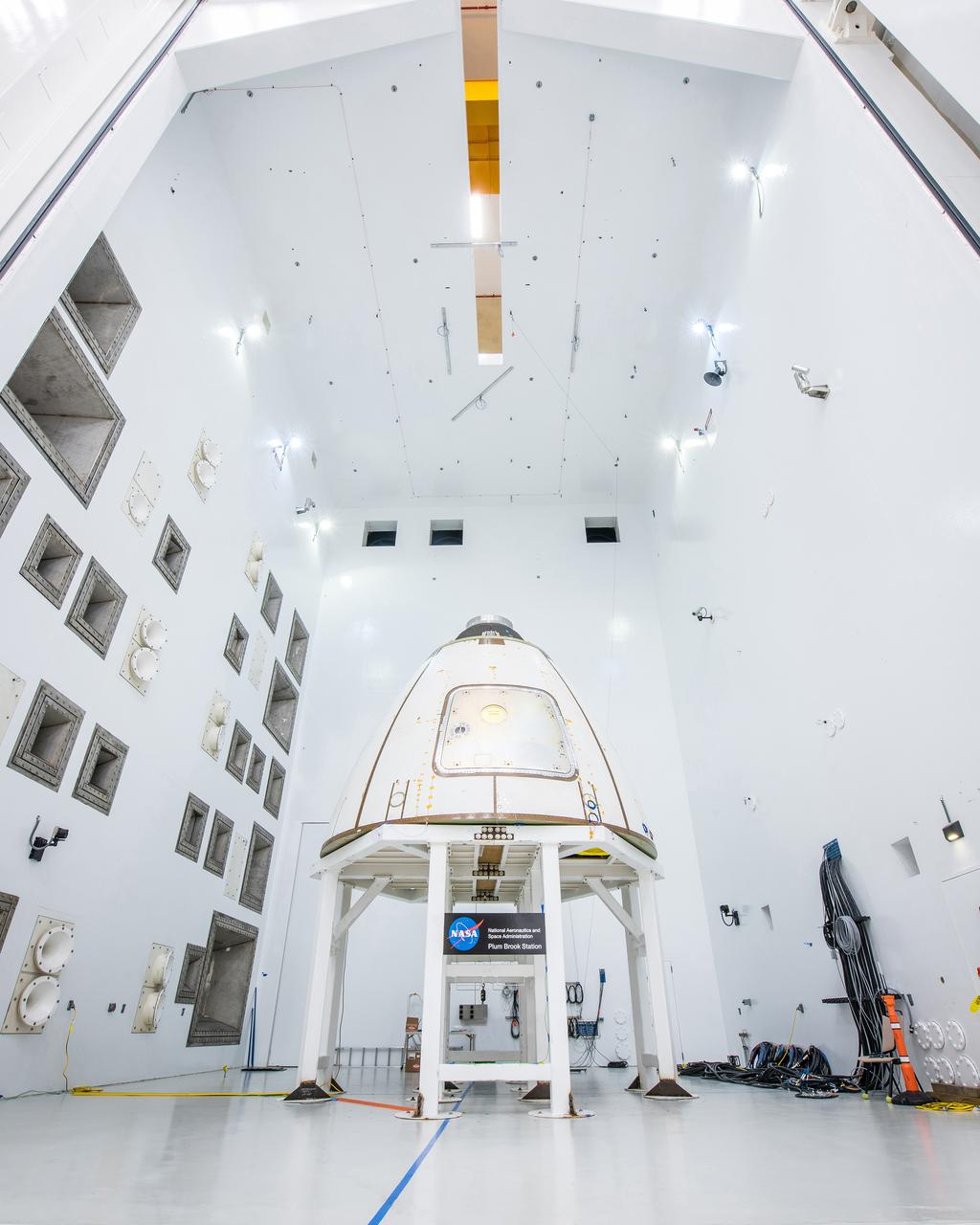
The ogive panels protect Orion's crew module from harsh acoustic conditions at launch and in case of an abort. Acoustic testing of the ogive hatch starts today at Space Power Facility at NASA Glenn Research Center's Plum Brook station in Sandusky, Ohio takes place on July 19, 2017. The ogive is installed in the Reverberant Acoustic Chamber where it will be blasted with 161 db of sound to simulate launch conditions.
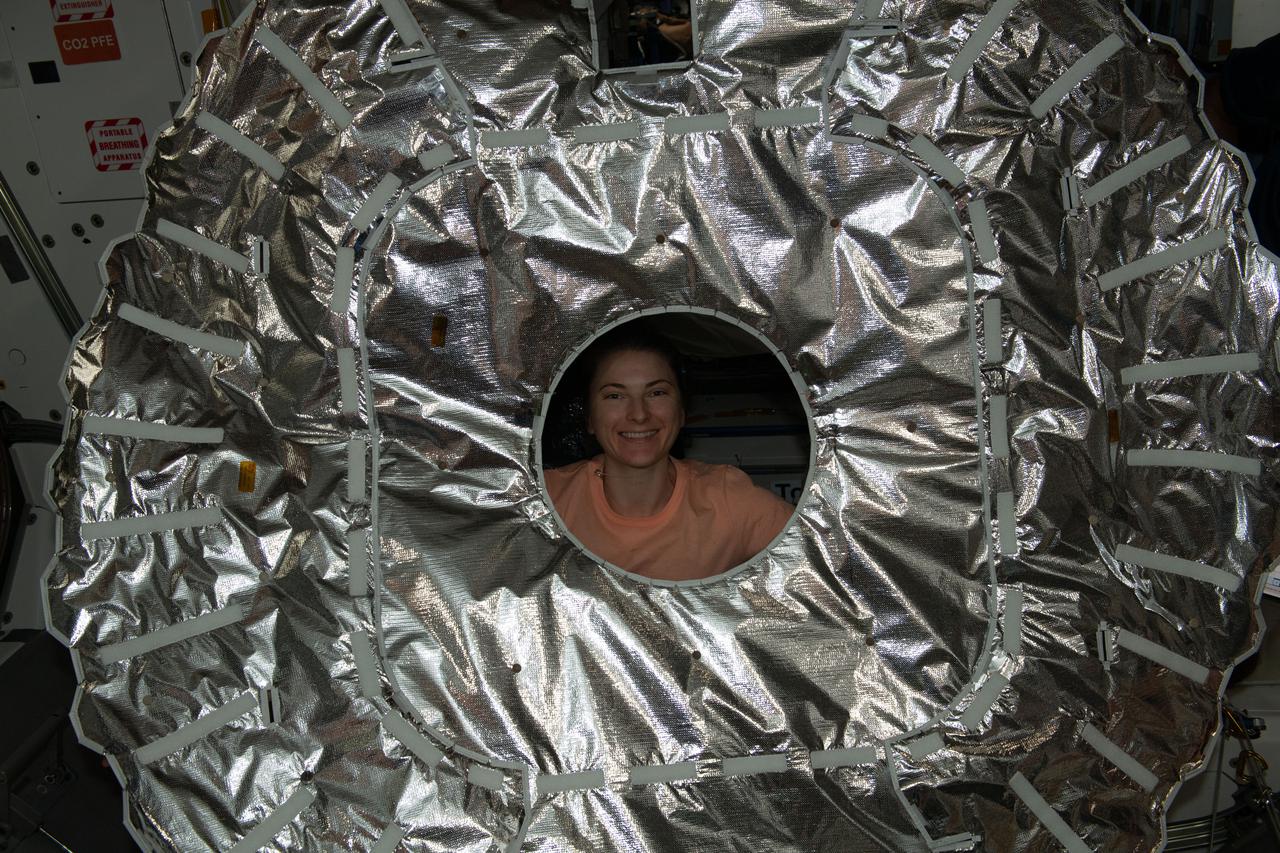
iss066e147566 (Feb. 21, 2022) --- NASA astronaut and Expedition 66 Flight Engineer Kayla Barron is pictured after removing a thermal blanket that covered the hatch to the Cygnus space freighter. The U.S. resupply ship had been captured and installed wth the Canadarm2 robotic arm to the International Space Station's Unity module a few hours ealrier.
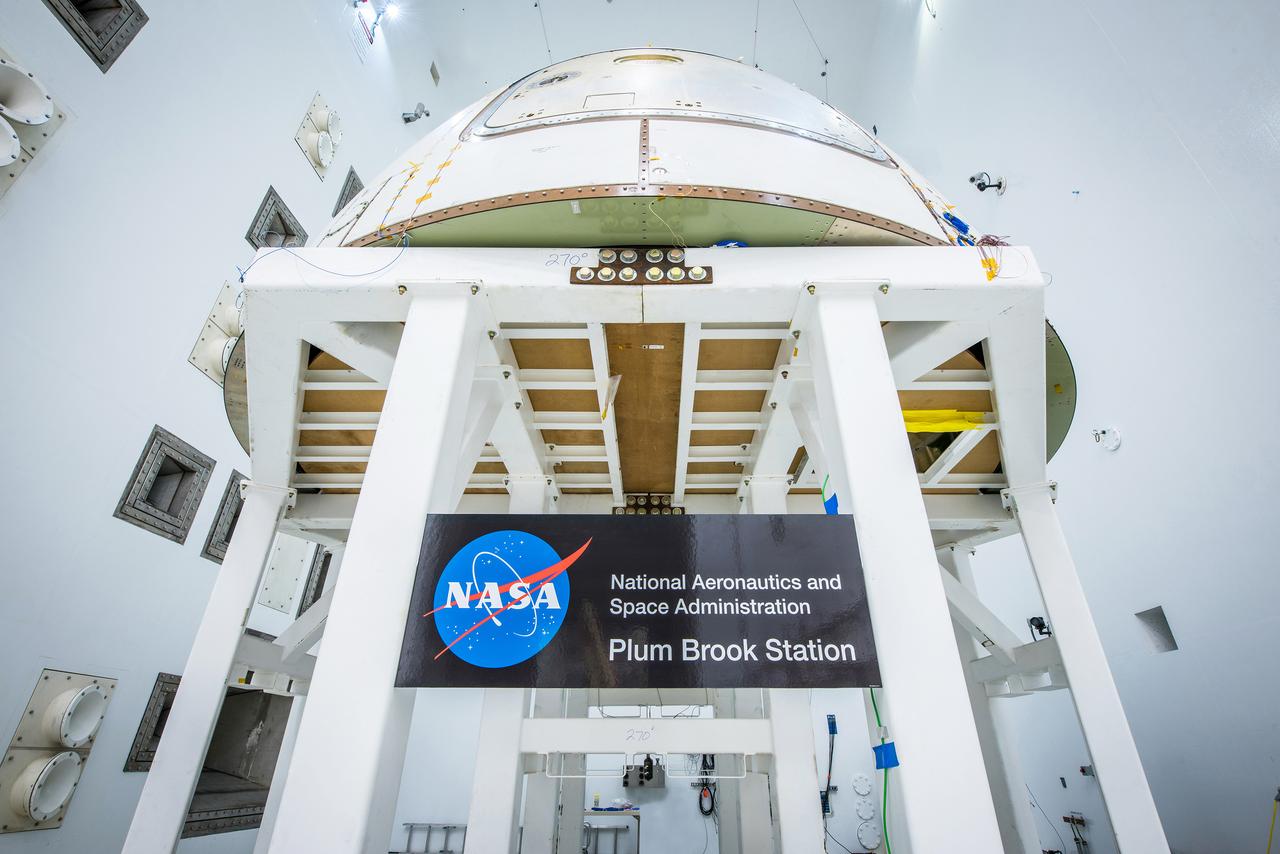
The ogive panels protect Orion's crew module from harsh acoustic conditions at launch and in case of an abort. Acoustic testing of the ogive hatch starts today at Space Power Facility at NASA Glenn Research Center's Plum Brook station in Sandusky, Ohio takes place on July 19, 2017. The ogive is installed in the Reverberant Acoustic Chamber where it will be blasted with 161 db of sound to simulate launch conditions.

S66-63537 (11 Nov. 1966) --- Astronaut Edwin E. Aldrin, pilot for the Gemini-12 spaceflight, stands up in the open hatch of the spacecraft during the first day of the four-day mission in space. He prepares a camera for installation on the outside of the spacecraft. Command pilot for the last flight in the Gemini series was astronaut James A. Lovell Jr. Photo credit: NASA
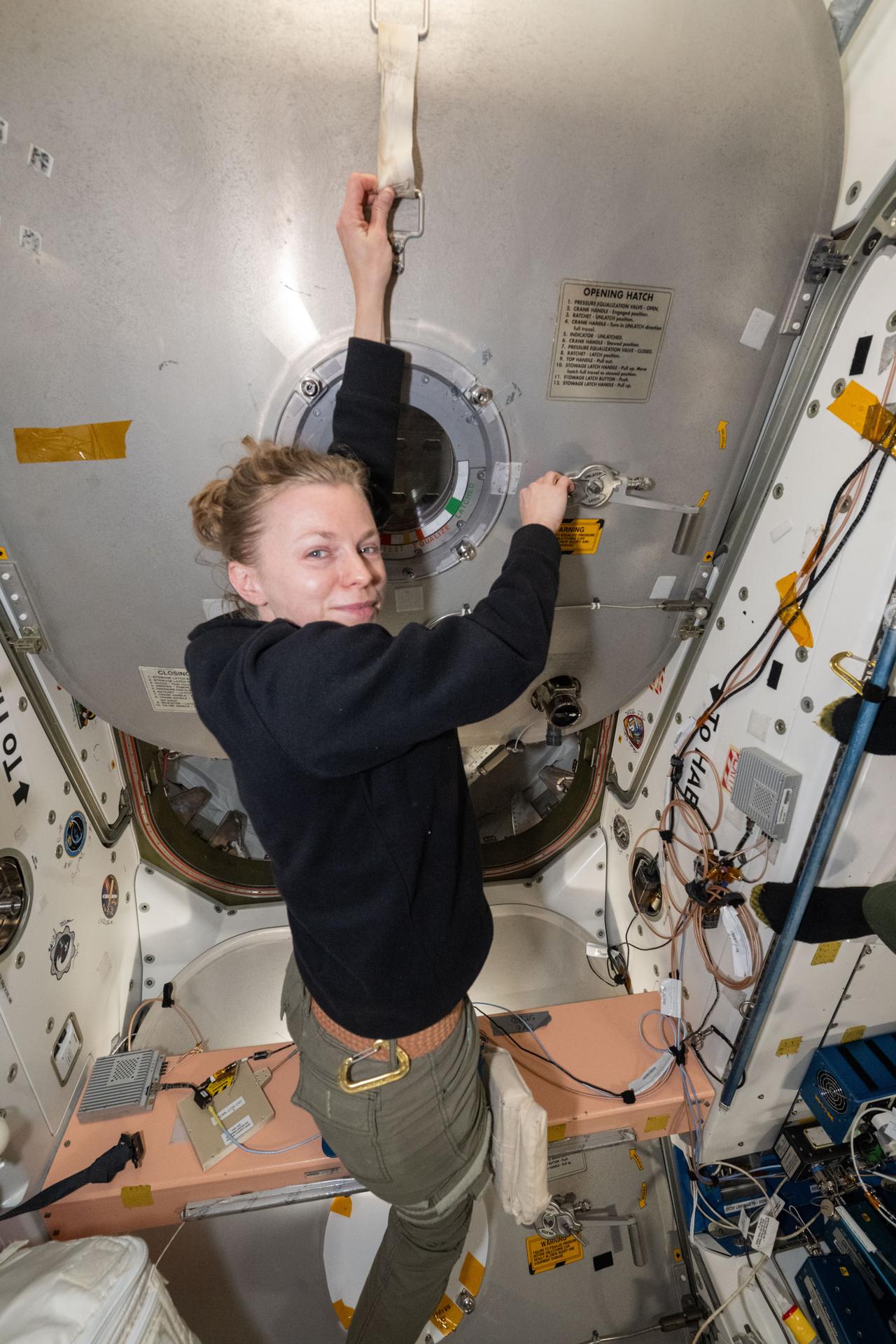
iss073e0814456 (Sept. 18, 2025) --- NASA astronaut and Expedition 73 Flight Engineer Zena Cardman is pictured inside the International Space Station’s Unity module opening the hatch to Northrop Grumman’s Cygnus XL cargo craft. Cygnus had arrived at the orbital outpost just a few hours earlier, where it was captured by the Canadarm2 robotic arm and installed on Unity’s Earth-facing port.
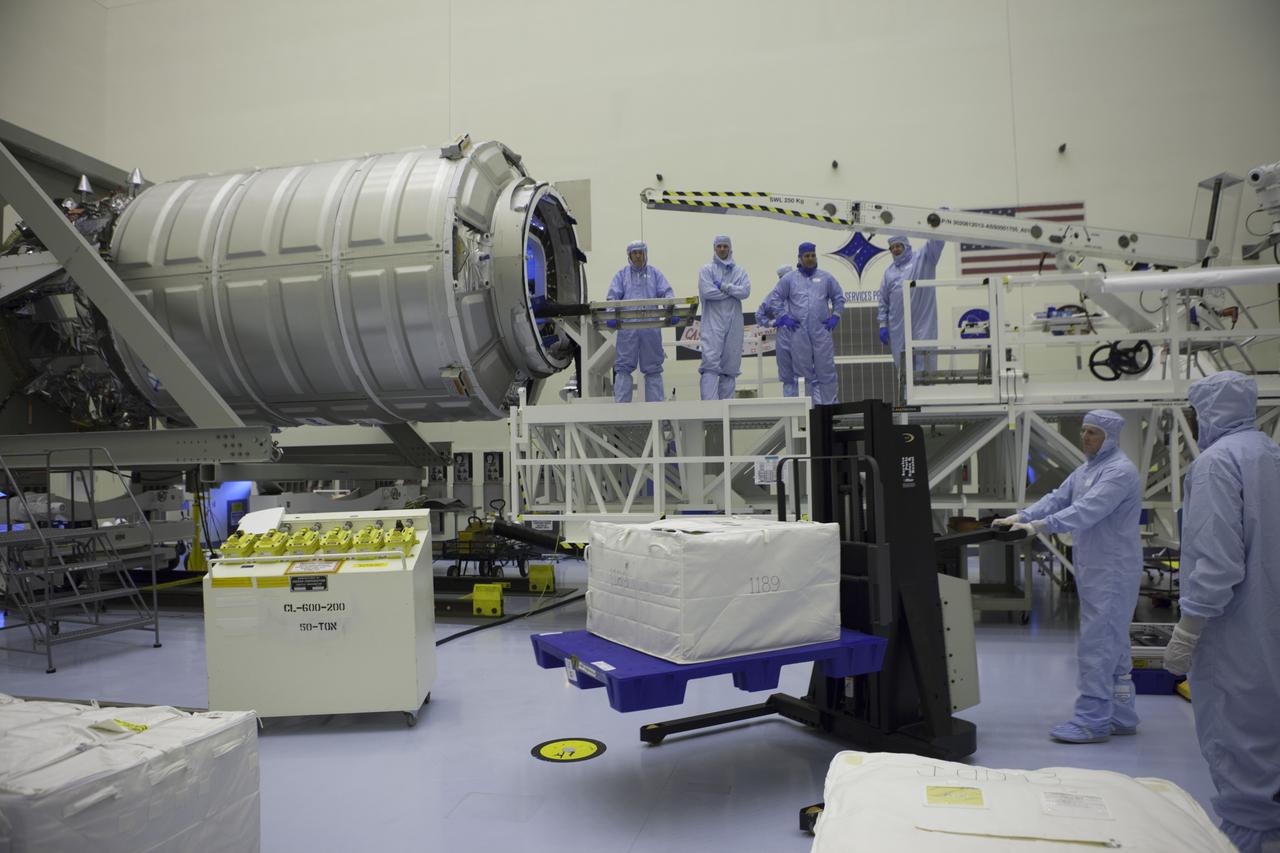
Technicians are positioned at the hatch of the Orbital ATK CRS-6 pressurized cargo module as a forklift moves a cargo package into position for installation into the spacecraft inside the Payload Hazardous Servicing Facility at NASA’s Kennedy Space Center in Florida. The spacecraft is scheduled for the upcoming Orbital ATK Commercial Resupply Services-6 mission to deliver hardware and supplies to the International Space Station. The Cygnus is scheduled to lift off atop a United Launch Alliance Atlas V rocket on March 22
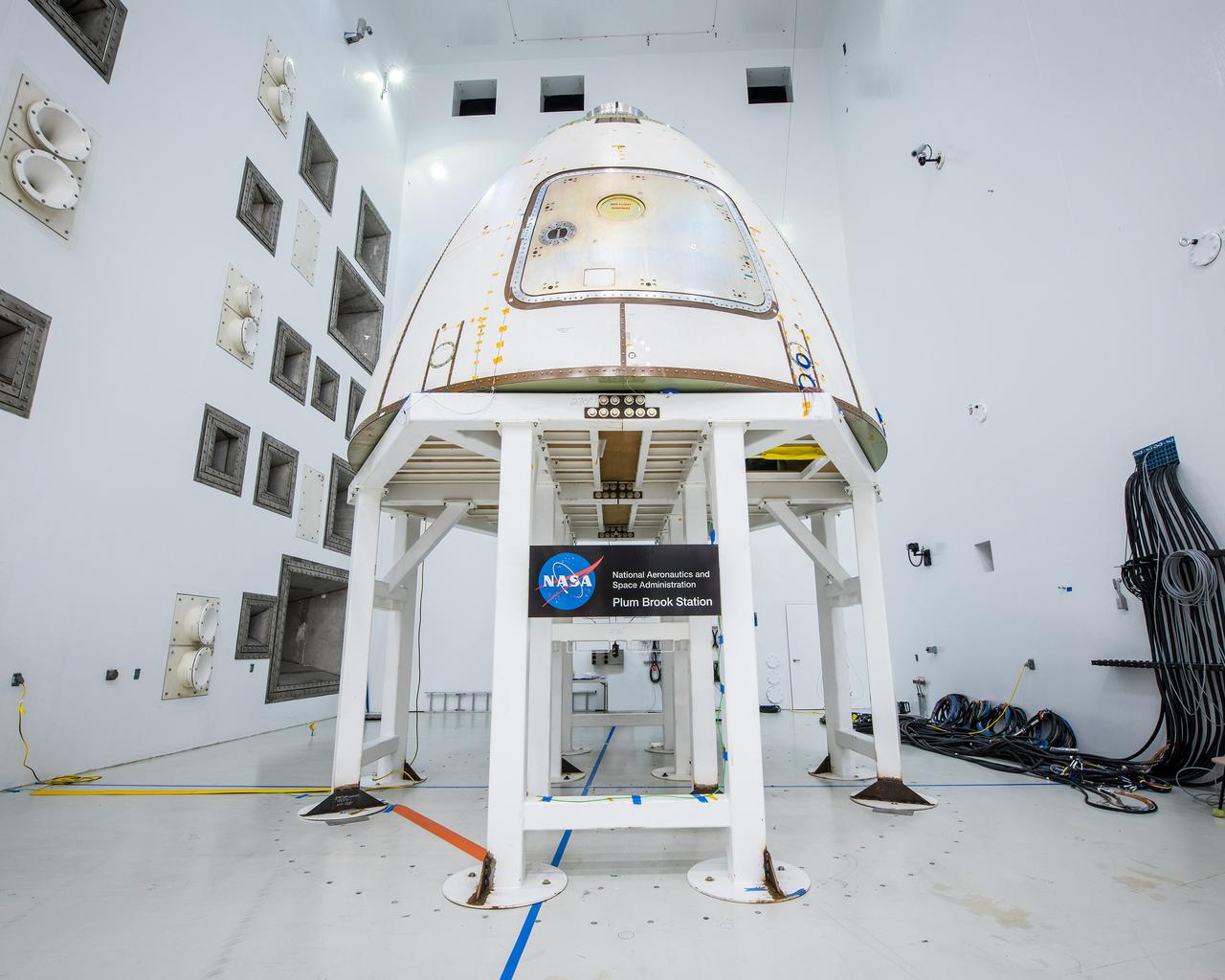
The ogive panels protect Orion's crew module from harsh acoustic conditions at launch and in case of an abort. Acoustic testing of the ogive hatch starts today at Space Power Facility at NASA Glenn Research Center's Plum Brook station in Sandusky, Ohio takes place on July 19, 2017. The ogive is installed in the Reverberant Acoustic Chamber where it will be blasted with 161 db of sound to simulate launch conditions.
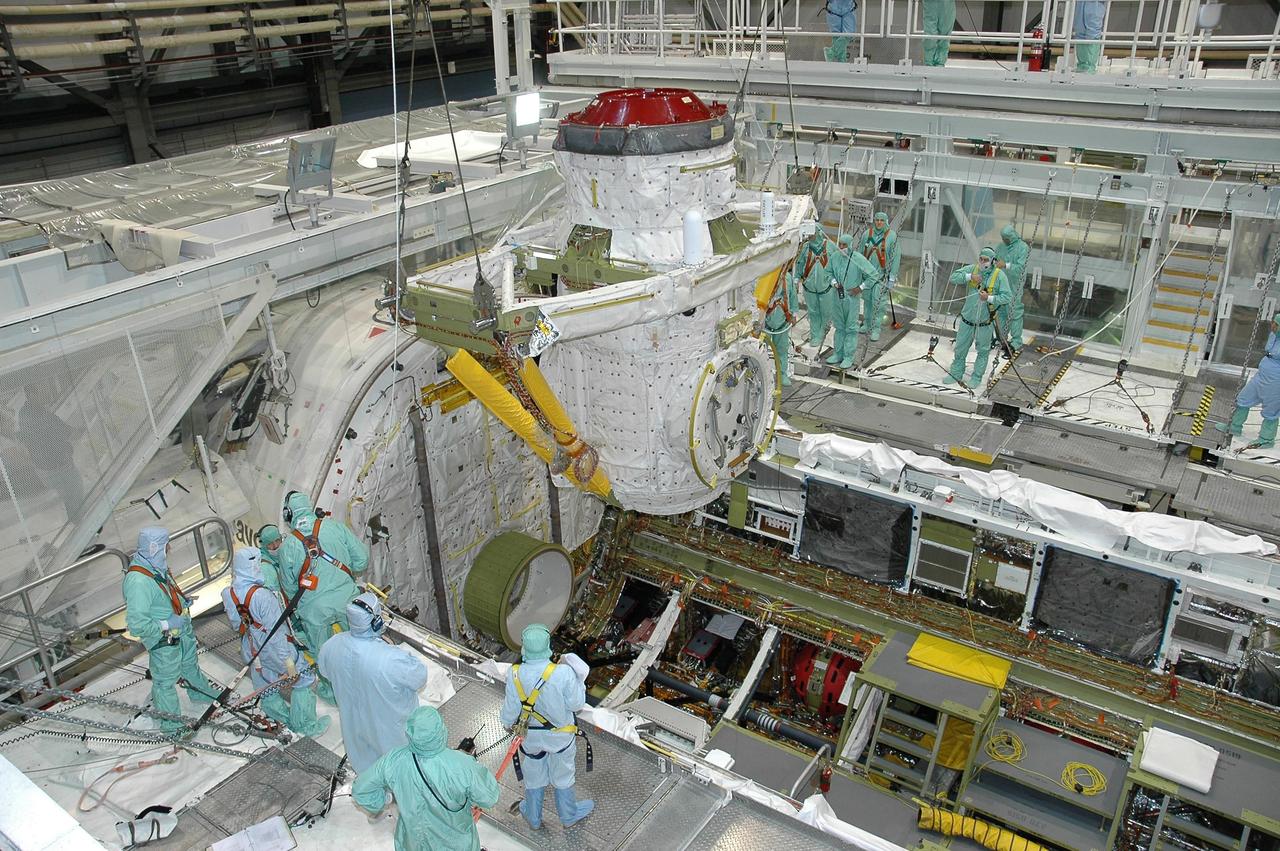
KENNEDY SPACE CENTER, FLA. - In Orbiter Processing Facility bay 2 at NASA's Kennedy Space Center, workers observe the movement of the airlock as it is lowered into Endeavour's payload bay for installation. The airlock is located in the middeck. The airlock and airlock hatches permit flight crew members to transfer from the middeck crew compartment into the payload bay for extravehicular activities in their space suits without depressurizing the orbiter crew cabin. The airlock is sized to accommodate two fully suited flight crew members simultaneously. Photo credit: NASA/Jim Grossmann
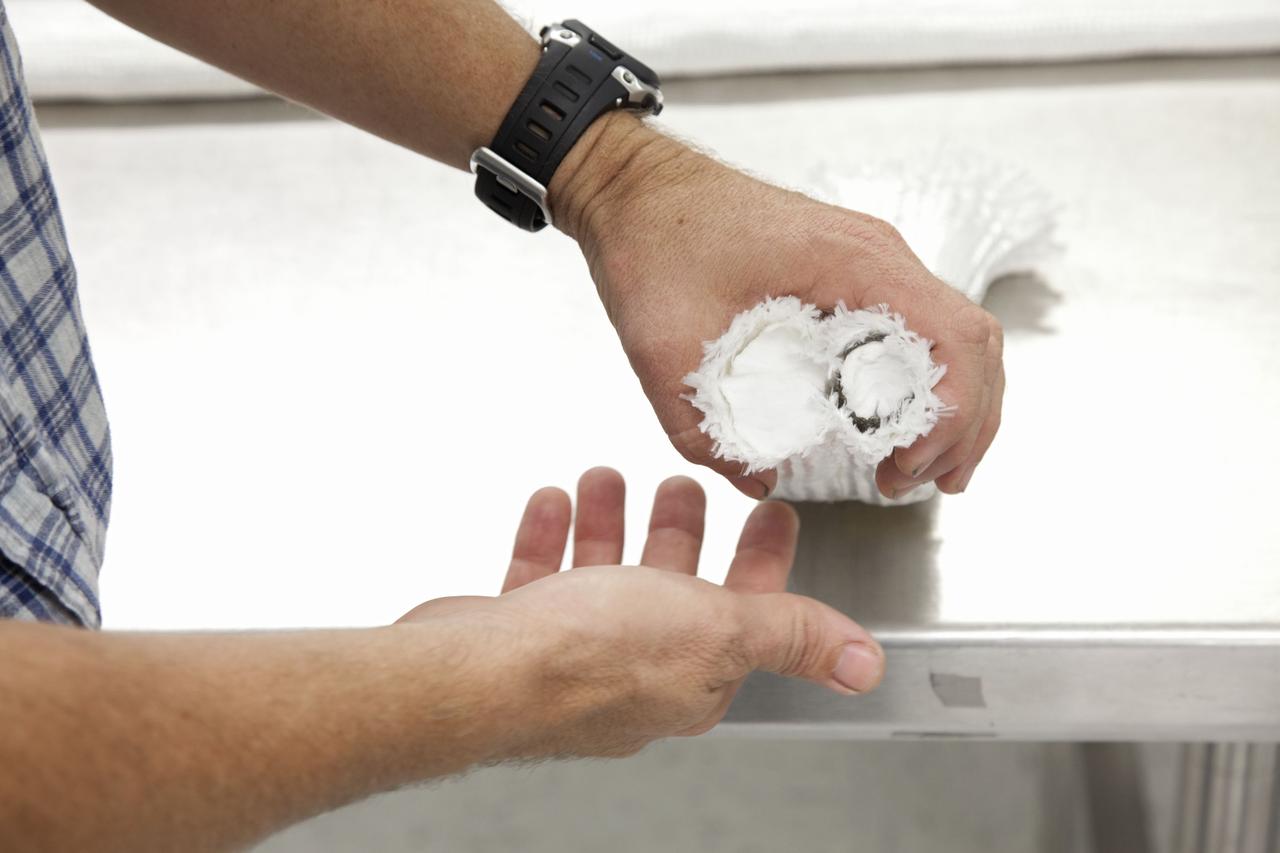
CAPE CANAVERAL, Fla. -- The heat shield tiles that will be installed to the backshell of the Orion Multi-Purpose Crew Vehicle's Exploration Flight Test EFT-1 capsule are manufactured inside the Thermal Protection System Facility at NASA's Kennedy Space Center in Florida. The insulation includes thermal barriers that are used around hatches, thrusters and other open areas of the backshell to protect the joints from heat. EFT-1 will be used during Orion's first test flight in space. For more information, visit www.nasa.gov/orion. Photo credit: Frankie Martin
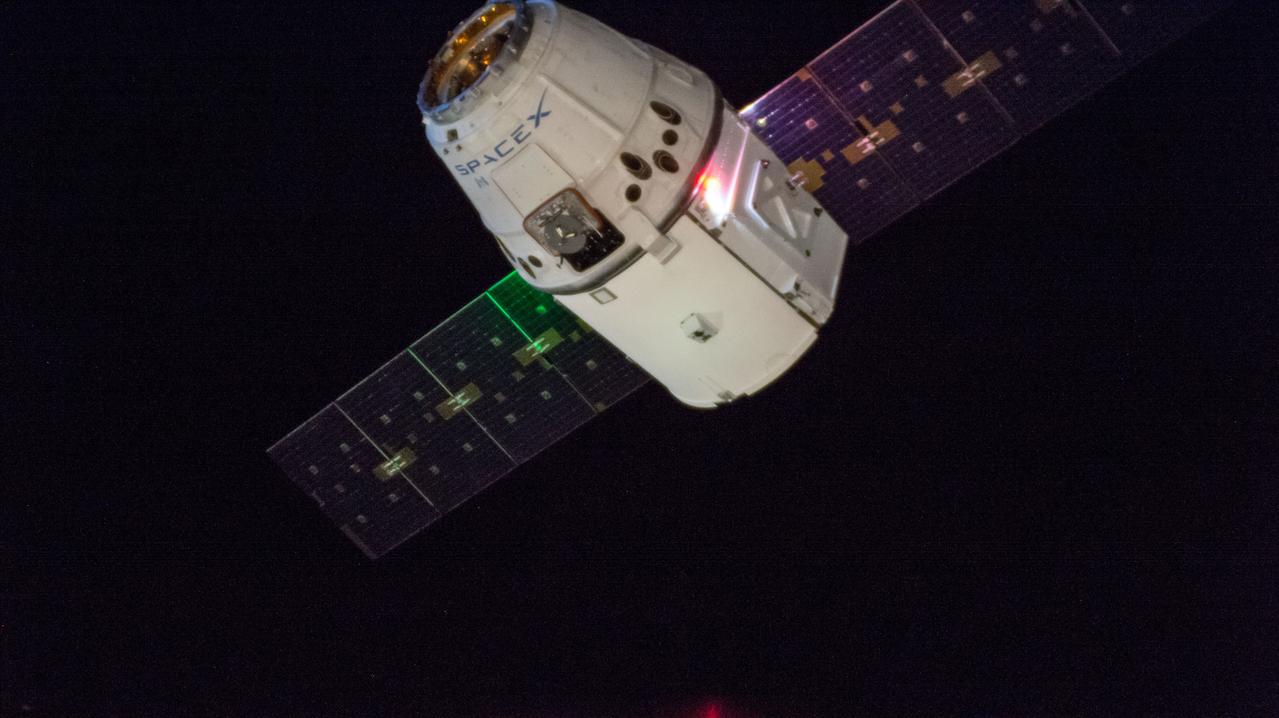
iss057e115424 (Dec. 8, 2018) --- The SpaceX Dragon cargo craft slowly approaches the International Space Station. Astronauts Alexander Gerst and Serena Auñón-Chancellor were monitoring Dragon from inside the cupola and preparing to slowly reach out and grapple the cargo craft with the Canadarm2 robotic arm. Dragon, packed with over 5,600 pounds of cargo, completed a three-day trip to the International Space Station that began with a launch from Cape Canaveral Air Force Station in Florida and ended with its installation and hatch opening on the Harmony module..
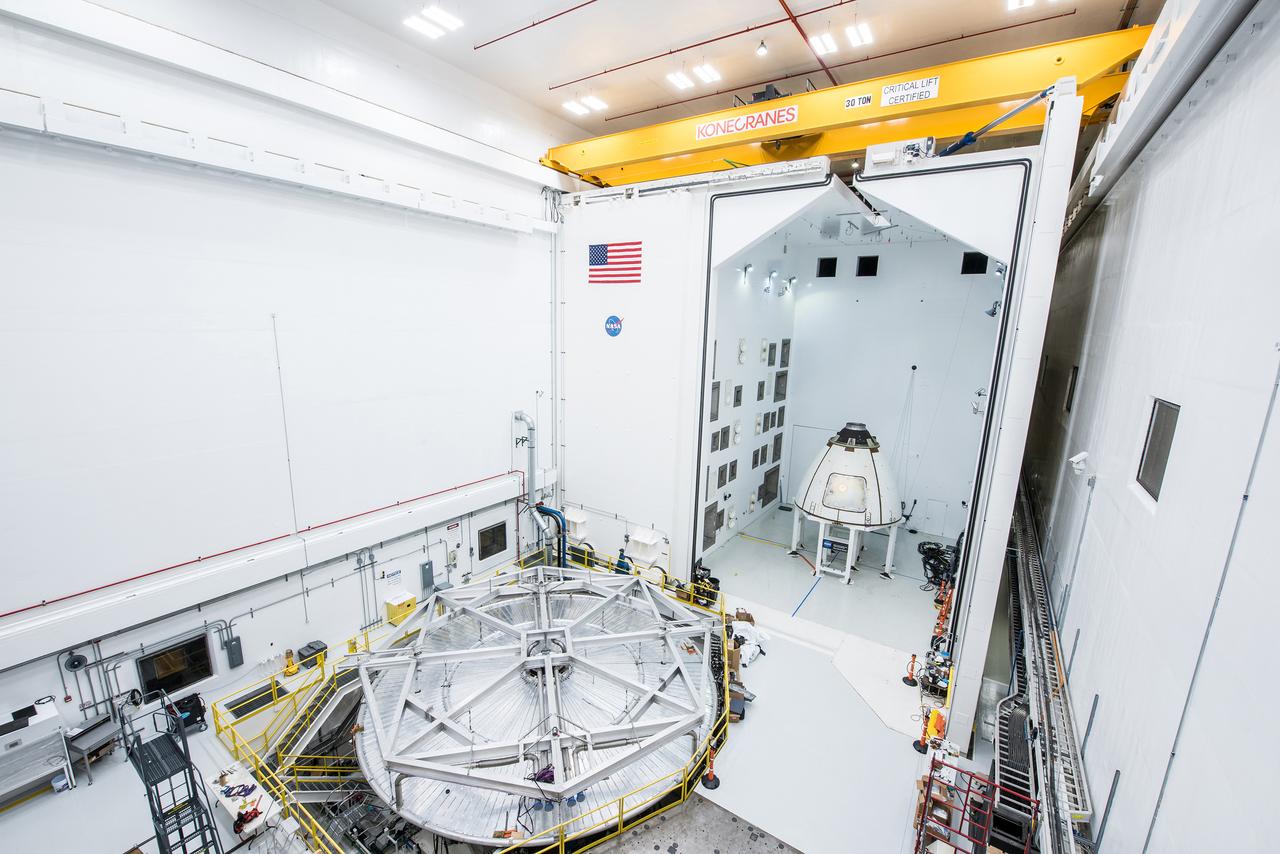
The ogive panels protect Orion's crew module from harsh acoustic conditions at launch and in case of an abort. Acoustic testing of the ogive hatch starts today at Space Power Facility at NASA Glenn Research Center's Plum Brook station in Sandusky, Ohio takes place on July 19, 2017. The ogive is installed in the Reverberant Acoustic Chamber where it will be blasted with 161 db of sound to simulate launch conditions.
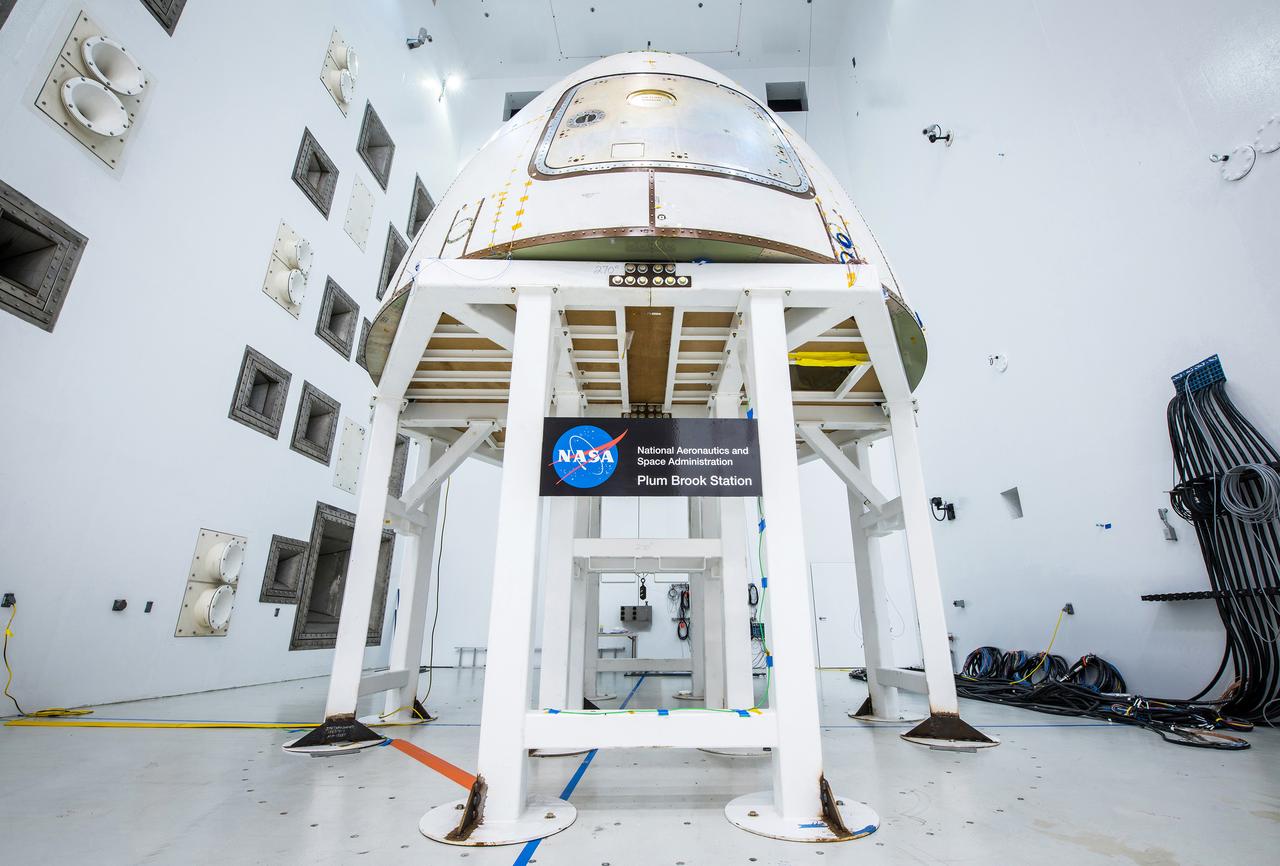
The ogive panels protect Orion's crew module from harsh acoustic conditions at launch and in case of an abort. Acoustic testing of the ogive hatch starts today at Space Power Facility at NASA Glenn Research Center's Plum Brook station in Sandusky, Ohio takes place on July 19, 2017. The ogive is installed in the Reverberant Acoustic Chamber where it will be blasted with 161 db of sound to simulate launch conditions.

KENNEDY SPACE CENTER, FLA. - In the Space Station Processing Facility, workers guide one of the hatches from the Node-2 module onto a shipping container. The hatches are being removed in preparation for shipment to the Marshall Space Flight Center, Ala., for re-balance certification. The Node-2 will launch on mission 10A, STS-120, to the International Space Station (ISS) currently scheduled for Fall 2006. The installation of the Node-2 on the ISS will signify the completion of the U.S. stage of assembly and increase the living and working space inside the Station to approximately 18,000 cubic feet. Under contract to the Italian Space Agency (ASI), Alenia Spazio in Turin, Italy, led a consortium of European subcontractors to build Node-2. The module was built for NASA under an agreement with the European Space Agency (ESA) in exchange for launch of the European Columbus Laboratory.

KENNEDY SPACE CENTER, FLA. - In the Space Station Processing Facility, workers are removing one of the hatches on the Node-2 module. The hatches are being removed in preparation for shipment to the Marshall Space Flight Center, Ala., for re-balance certification. The Node-2 will launch on mission 10A, STS-120, to the International Space Station (ISS) currently scheduled for Fall 2006. The installation of the Node-2 on the ISS will signify the completion of the U.S. stage of assembly and increase the living and working space inside the Station to approximately 18,000 cubic feet. Under contract to the Italian Space Agency (ASI), Alenia Spazio in Turin, Italy, led a consortium of European subcontractors to build Node-2. The module was built for NASA under an agreement with the European Space Agency (ESA) in exchange for launch of the European Columbus Laboratory.

KENNEDY SPACE CENTER, FLA. - In the Space Station Processing Facility, workers prepare to remove one of the hatches on the Node-2 module. The hatches are being removed in preparation for shipment to the Marshall Space Flight Center, Ala., for re-balance certification. The Node-2 will launch on mission 10A, STS-120, to the International Space Station (ISS) currently scheduled for Fall 2006. The installation of the Node-2 on the ISS will signify the completion of the U.S. stage of assembly and increase the living and working space inside the Station to approximately 18,000 cubic feet. Under contract to the Italian Space Agency (ASI), Alenia Spazio in Turin, Italy, led a consortium of European subcontractors to build Node-2. The module was built for NASA under an agreement with the European Space Agency (ESA) in exchange for launch of the European Columbus Laboratory.

KENNEDY SPACE CENTER, FLA. - In the Space Station Processing Facility, workers are removing one of the hatches on the Node-2 module. The hatches are being removed in preparation for shipment to the Marshall Space Flight Center, Ala., for re-balance certification. The Node-2 will launch on mission 10A, STS-120, to the International Space Station (ISS) currently scheduled for Fall 2006. The installation of the Node-2 on the ISS will signify the completion of the U.S. stage of assembly and increase the living and working space inside the Station to approximately 18,000 cubic feet. Under contract to the Italian Space Agency (ASI), Alenia Spazio in Turin, Italy, led a consortium of European subcontractors to build Node-2. The module was built for NASA under an agreement with the European Space Agency (ESA) in exchange for launch of the European Columbus Laboratory.

KENNEDY SPACE CENTER, FLA. - In the Space Station Processing Facility, workers finish packing one of the hatches from the Node-2 module inside a shipping container. The hatches are being removed in preparation for shipment to the Marshall Space Flight Center, Ala., for re-balance certification. The Node-2 will launch on mission 10A, STS-120, to the International Space Station (ISS) currently scheduled for Fall 2006. The installation of the Node-2 on the ISS will signify the completion of the U.S. stage of assembly and increase the living and working space inside the Station to approximately 18,000 cubic feet. Under contract to the Italian Space Agency (ASI), Alenia Spazio in Turin, Italy, led a consortium of European subcontractors to build Node-2. The module was built for NASA under an agreement with the European Space Agency (ESA) in exchange for launch of the European Columbus Laboratory.
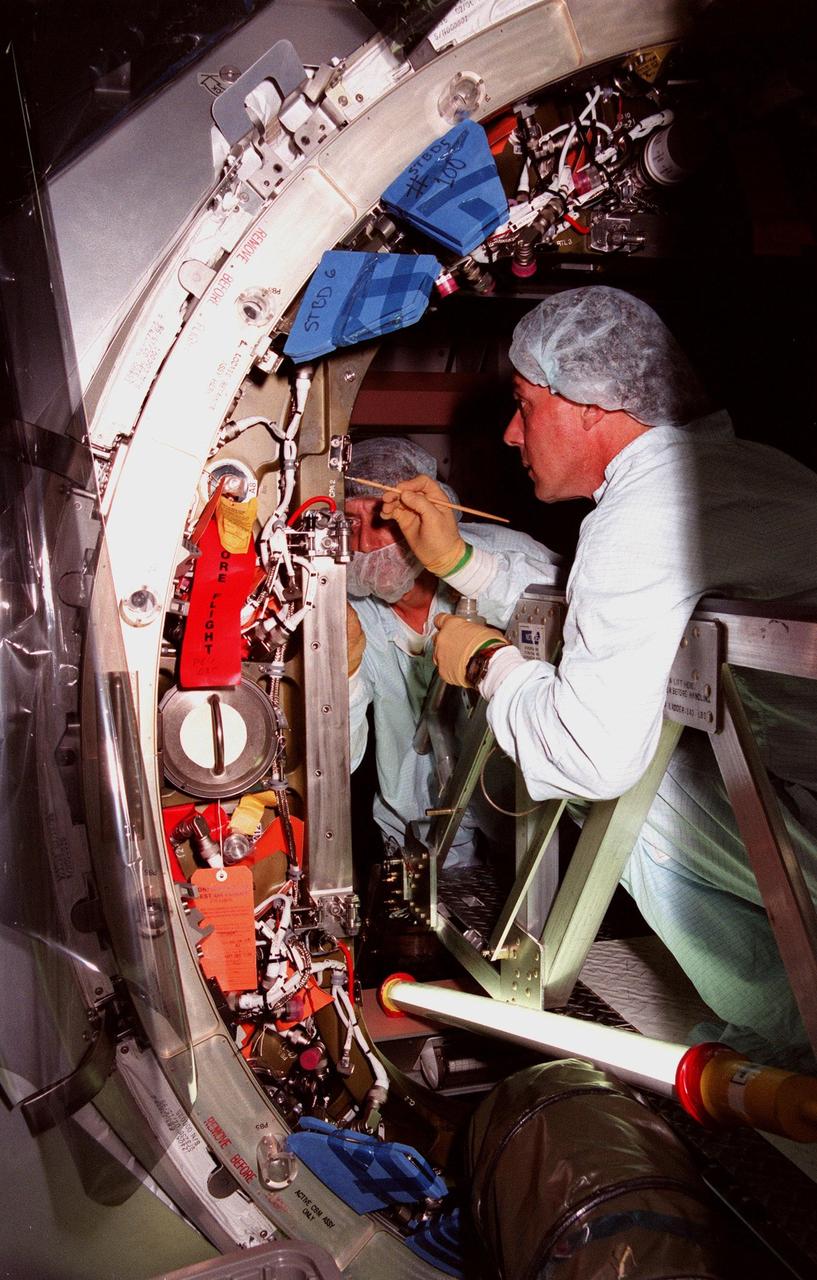
KENNEDY SPACE CENTER, FLA. -- Workers in the Space Station Processing Facility prepare the hatch of the Unity connecting module for closure before its launch aboard Space Shuttle Endeavour on STS-88 in December. Unity will now undergo a series of leak checks before a final purge of clean, dry air inside the module to ready it for initial operations in space. Other testing includes the common berthing mechanism to which other space station elements will dock and the Pad Demonstration Test to verify the compatibility of the module with the Space Shuttle as well as the ability of the astronauts to send and receive commands to Unity from the flight deck of the orbiter. The next time the hatch will be opened it will be by astronauts on orbit. Unity is expected to be ready for installation into the payload canister on Oct. 25, and transported to Launch Pad 39-A on Oct. 27. The Unity will be mated to the Russian-built Zarya control module which should already be in orbit at that time
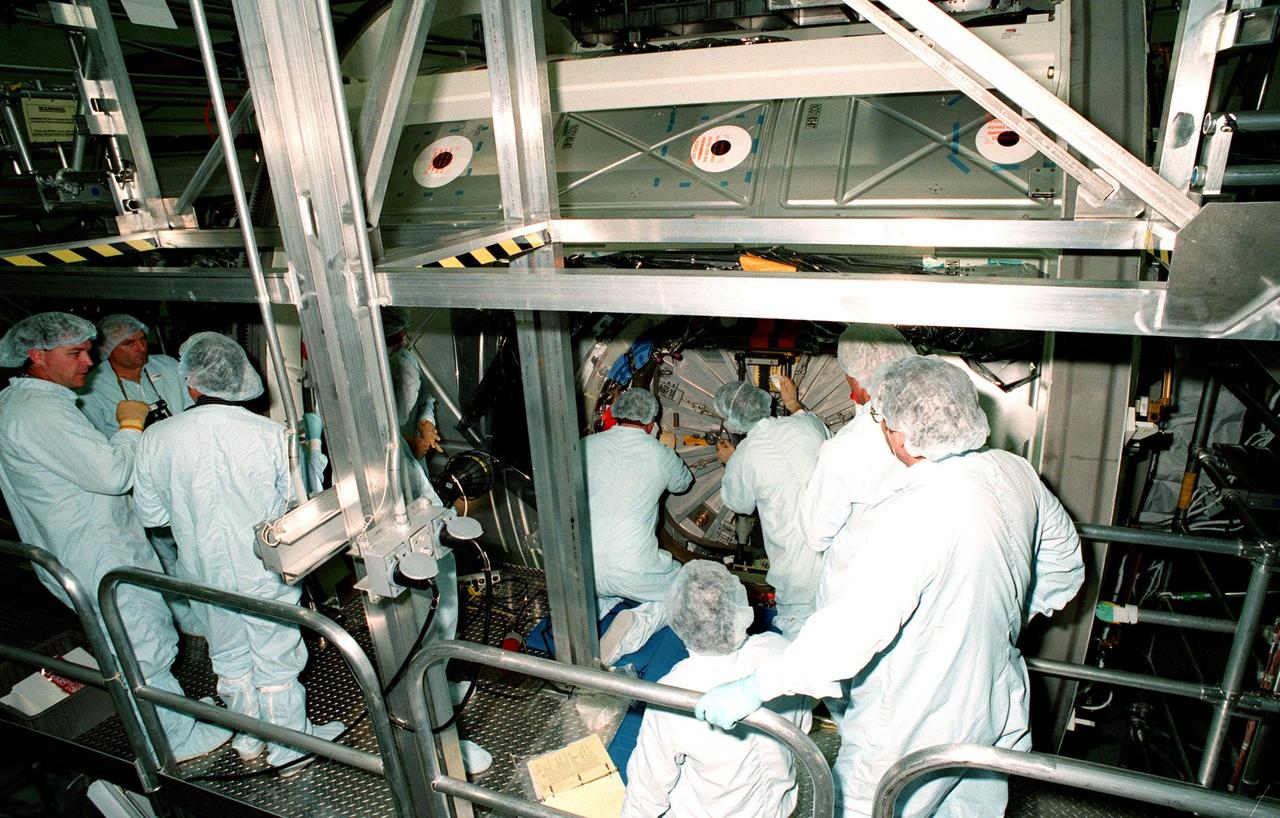
KENNEDY SPACE CENTER, FLA. -- Workers in the Space Station Processing Facility close the access hatch to the Unity connecting module, part of the International Space Station, before its launch aboard Space Shuttle Endeavour on STS-88 in December. Unity will now undergo a series of leak checks before a final purge of clean, dry air inside the module to ready it for initial operations in space. Other testing includes the common berthing mechanism to which other space station elements will dock and the Pad Demonstration Test to verify the compatibility of the module with the Space Shuttle as well as the ability of the astronauts to send and receive commands to Unity from the flight deck of the orbiter. The next time the hatch will be opened it will be by astronauts on orbit. Unity is expected to be ready for installation into the payload canister on Oct. 25, and transported to Launch Pad 39-A on Oct. 27. The Unity will be mated to the Russian-built Zarya control module which should already be in orbit at that time

KENNEDY SPACE CENTER, FLA. - In the Space Station Processing Facility, workers prepare to move one of the hatches from the Node-2 module to a shipping container. The hatches are being removed in preparation for shipment to the Marshall Space Flight Center, Ala., for re-balance certification. The Node-2 will launch on mission 10A, STS-120, to the International Space Station (ISS) currently scheduled for Fall 2006. The installation of the Node-2 on the ISS will signify the completion of the U.S. stage of assembly and increase the living and working space inside the Station to approximately 18,000 cubic feet. Under contract to the Italian Space Agency (ASI), Alenia Spazio in Turin, Italy, led a consortium of European subcontractors to build Node-2. The module was built for NASA under an agreement with the European Space Agency (ESA) in exchange for launch of the European Columbus Laboratory.
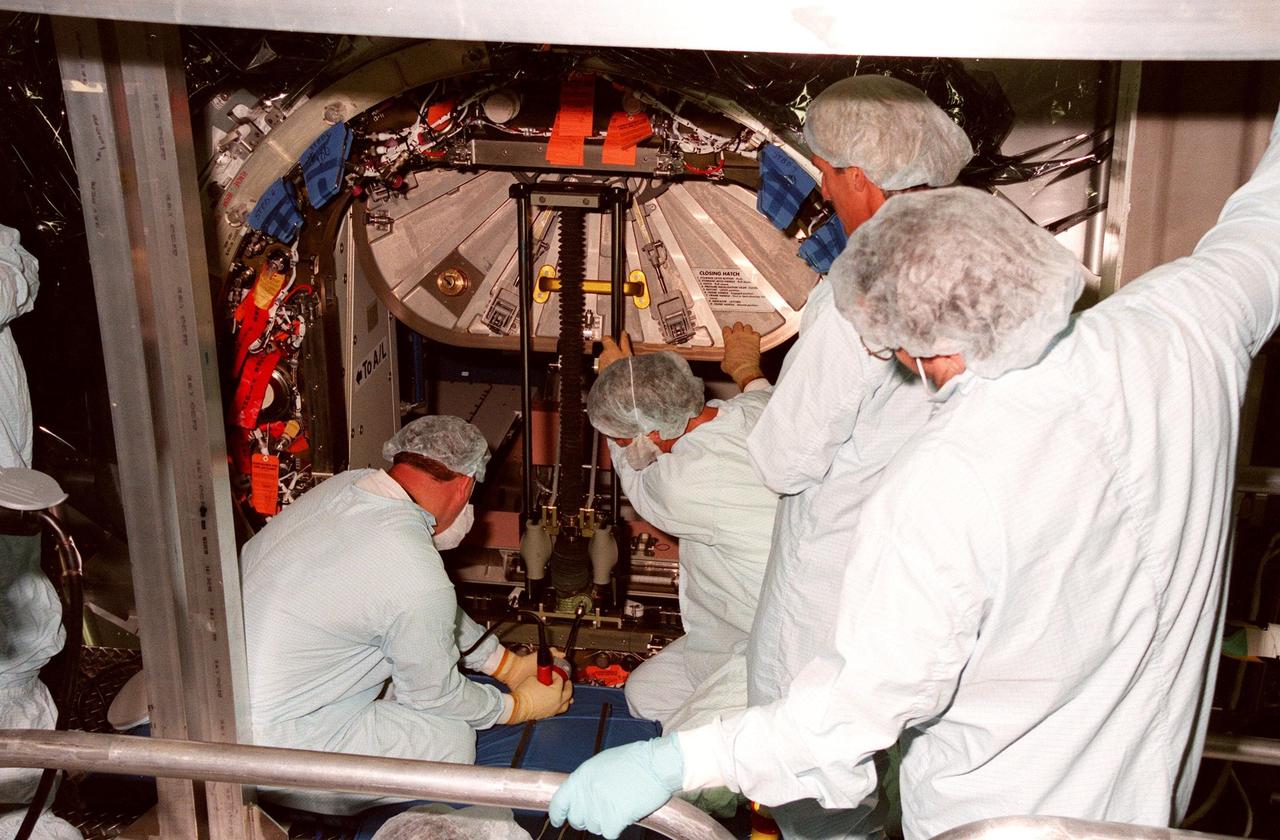
KENNEDY SPACE CENTER, FLA. -- Workers in the Space Station Processing Facility prepare to close the access hatch to the Unity connecting module, part of the International Space Station, in preparation for its launch aboard Space Shuttle Endeavour on STS-88 in December. Unity will now undergo a series of leak checks before a final purge of clean, dry air inside the module to ready it for initial operations in space. Other testing includes the common berthing mechanism to which other space station elements will dock and the Pad Demonstration Test to verify the compatibility of the module with the Space Shuttle as well as the ability of the astronauts to send and receive commands to Unity from the flight deck of the orbiter. The next time the hatch will be opened it will be by astronauts on orbit. Unity is expected to be ready for installation into the payload canister on Oct. 25, and transported to Launch Pad 39-A on Oct. 27. The Unity will be mated to the Russian-built Zarya control module which should already be in orbit at that time
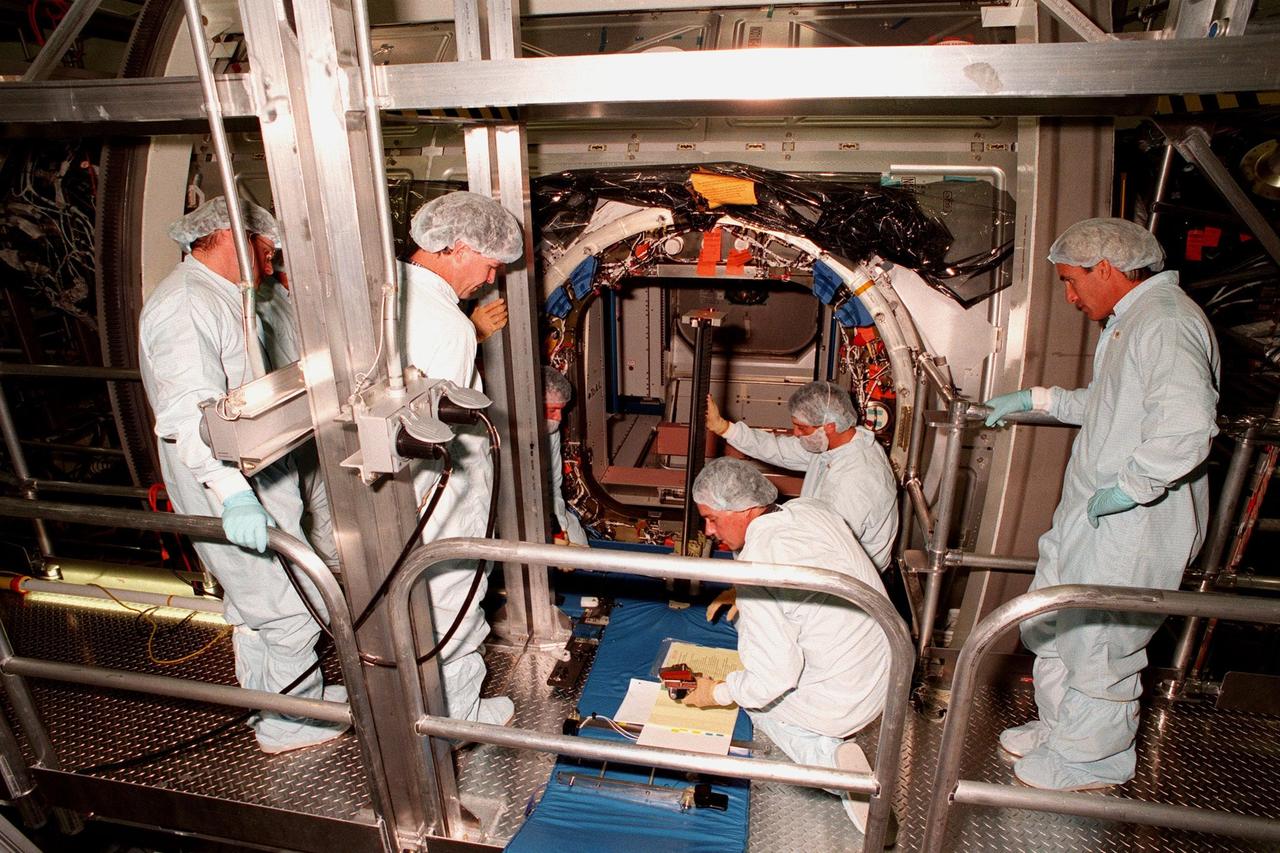
KENNEDY SPACE CENTER, FLA. -- Workers in the Space Station Processing Facility make final preparations for closing the access hatch to the Unity connecting module, part of the International Space Station, before its launch aboard Space Shuttle Endeavour on STS-88 in December. Unity will now undergo a series of leak checks before a final purge of clean, dry air inside the module to ready it for initial operations in space. Other testing includes the common berthing mechanism to which other space station elements will dock and the Pad Demonstration Test to verify the compatibility of the module with the Space Shuttle as well as the ability of the astronauts to send and receive commands to Unity from the flight deck of the orbiter. The next time the hatch will be opened it will be by astronauts on orbit. Unity is expected to be ready for installation into the payload canister on Oct. 25, and transported to Launch Pad 39-A on Oct. 27. The Unity will be mated to the Russian-built Zarya control module which should already be in orbit at that time
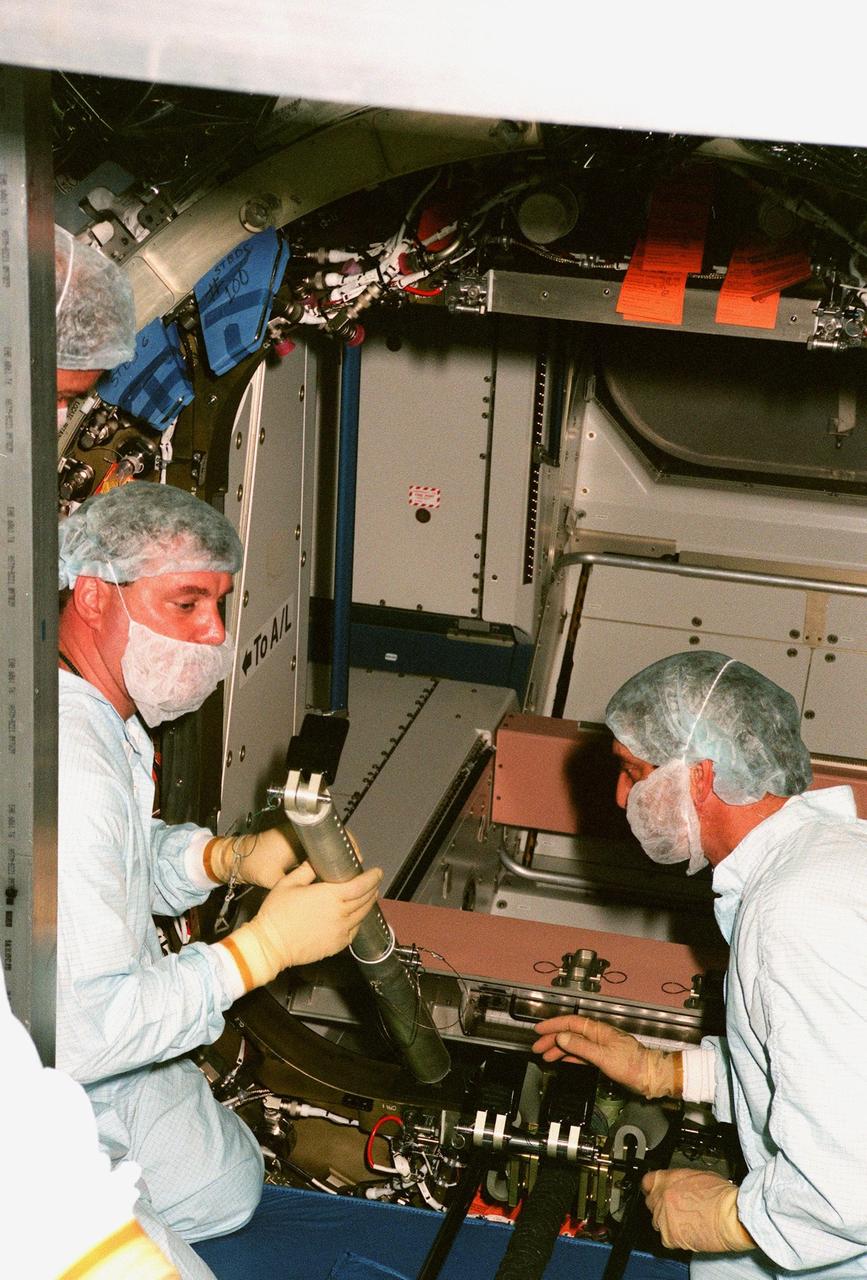
KENNEDY SPACE CENTER, FLA. -- Workers in the Space Station Processing Facility hold part of the equipment to close the hatch to the Unity connecting module, part of the International Space Station, before its launch aboard Space Shuttle Endeavour on STS-88 in December. Unity will now undergo a series of leak checks before a final purge of clean, dry air inside the module to ready it for initial operations in space. Other testing includes the common berthing mechanism to which other space station elements will dock and the Pad Demonstration Test to verify the compatibility of the module with the Space Shuttle as well as the ability of the astronauts to send and receive commands to Unity from the flight deck of the orbiter. The next time the hatch will be opened it will be by astronauts on orbit. Unity is expected to be ready for installation into the payload canister on Oct. 25, and transported to Launch Pad 39-A on Oct. 27. The Unity will be mated to the Russian-built Zarya control module which should already be in orbit at that time
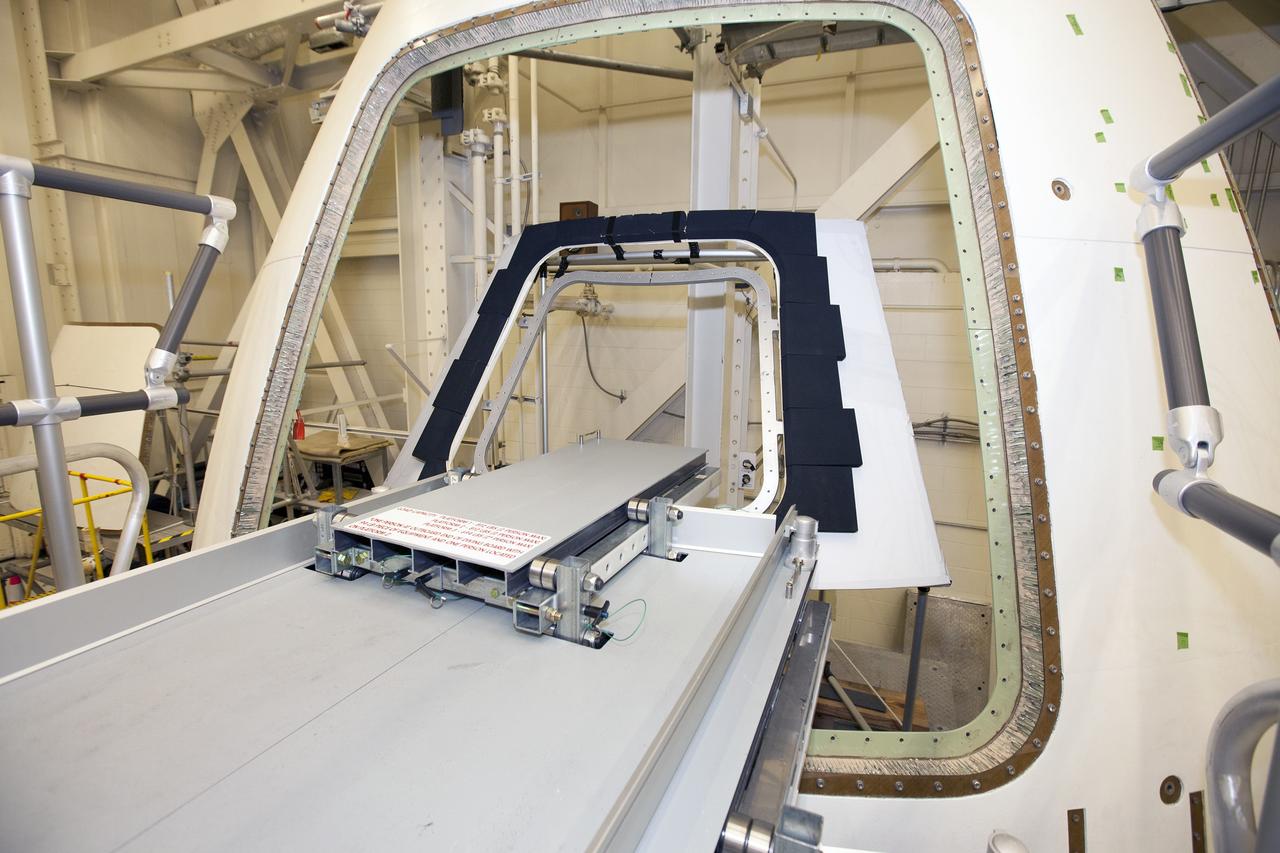
CAPE CANAVERAL, Fla. – Inside the Vehicle Assembly Building at NASA’s Kennedy Space Center in Florida, a GIZMO demonstration test is being performed on the ground test article Launch Abort System, or LAS, ogive panel and an Orion crew module simulator. An access platform and diving board have been added leading up to the mockup of the crew module hatch. The inner hatch has been removed The GIZMO is a pneumatically-balanced manipulator that will be used for installation of the hatches on the crew module and LAS for the uncrewed Exploration Flight Test-1 and Exploration Mission-1. The Ground Systems Development and Operations Program is running the test to demonstrate that the GIZMO can meet the reach and handling requirements for the task. Orion is the exploration spacecraft designed to carry astronauts to destinations not yet explored by humans, including an asteroid and Mars. It will have emergency abort capability, sustain the crew during space travel and provide safe re-entry from deep space return velocities. The first unpiloted test flight of the Orion is scheduled to launch later this year atop a Delta IV rocket and in 2017 on NASA’s Space Launch System rocket. For more information, visit http://www.nasa.gov/orion. Photo credit: NASA/Daniel Casper
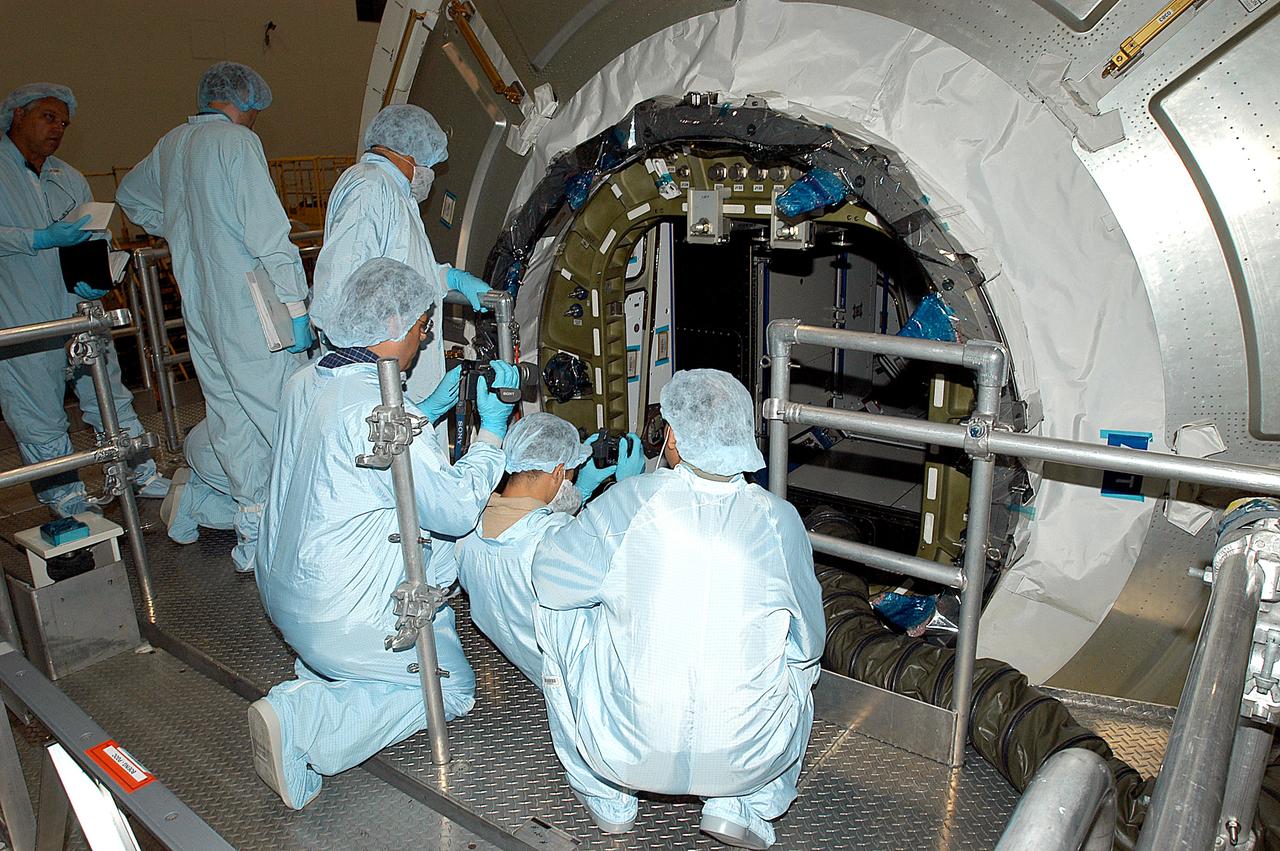
KENNEDY SPACE CENTER, FLA. - Workers in the Space Station Processing Facility attempt to open the hatch on the Italian-built Node 2, a future element of the International Space Station. Node 2 arrived at KSC June 1. The second of three Station connecting modules, the module attaches to the end of the U.S. Lab and provides attach locations for the Japanese laboratory, European laboratory, the Centrifuge Accommodation Module and, later, Multipurpose Logistics Modules. It will provide the primary docking location for the Shuttle when a pressurized mating adapter is attached to Node 2. Installation of the module will complete the U.S. Core of the ISS. Node 2 is the designated payload for mission STS-120. No orbiter or launch date has been determined yet.Installation of the module will complete the U.S. Core of the ISS. Node 2 is the designated payload for mission STS-120. No orbiter or launch date has been determined yet.
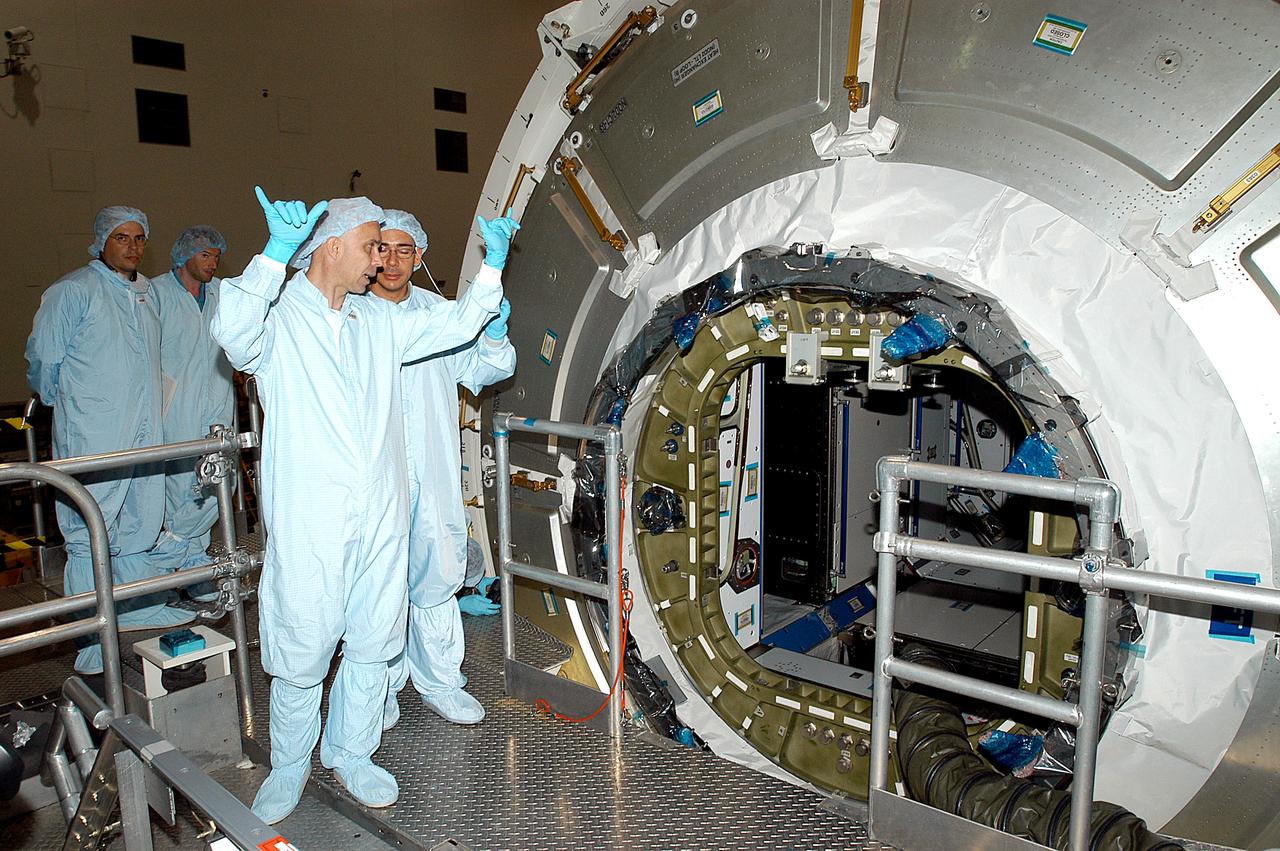
KENNEDY SPACE CENTER, FLA. - In the Space Station Processing Facility, workers talk near the opened hatch of the Italian-built Node 2. A future element of the International Space Station, Node 2 arrived at KSC June 1. The second of three Station connecting modules, Node 2 attaches to the end of the U.S. Lab and provides attach locations for the Japanese laboratory, European laboratory, the Centrifuge Accommodation Module and, later, Multipurpose Logistics Modules. It will provide the primary docking location for the Shuttle when a pressurized mating adapter is attached to Node 2. Installation of the module will complete the U.S. Core of the ISS. Node 2 is the designated payload for mission STS-120. No orbiter or launch date has been determined yet.
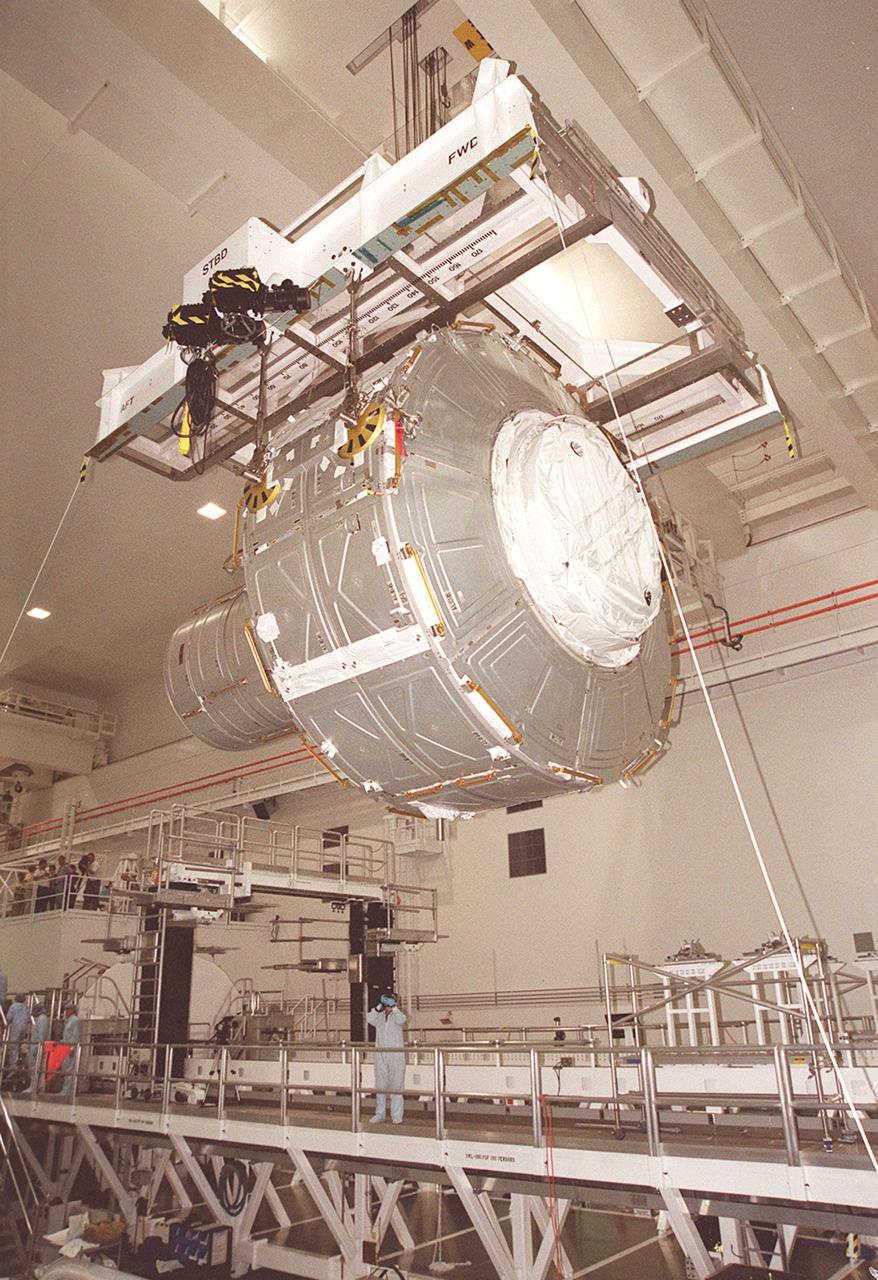
KENNEDY SPACE CENTER, FLA. -- In the Space Station Processing Facility, the Joint Airlock Module is lifted from its workstand for a transfer to the payload canister. The airlock will be installed in the payload bay of Atlantis for mission STS-104 to the International Space Station. The airlock is a pressurized flight element consisting of two cylindrical chambers attached end-to-end by a connecting bulkhead and hatch. Once installed and activated, the airlock becomes the primary path for spacewalk entry to and departure from the Space Station for U.S. spacesuits, which are known as Extravehicular Mobility Units, or EMUs. In addition, the Joint Airlock is designed to support the Russian Orlan spacesuit for EVA activity. STS-104 is scheduled for launch June 14 from Launch Pad 39B
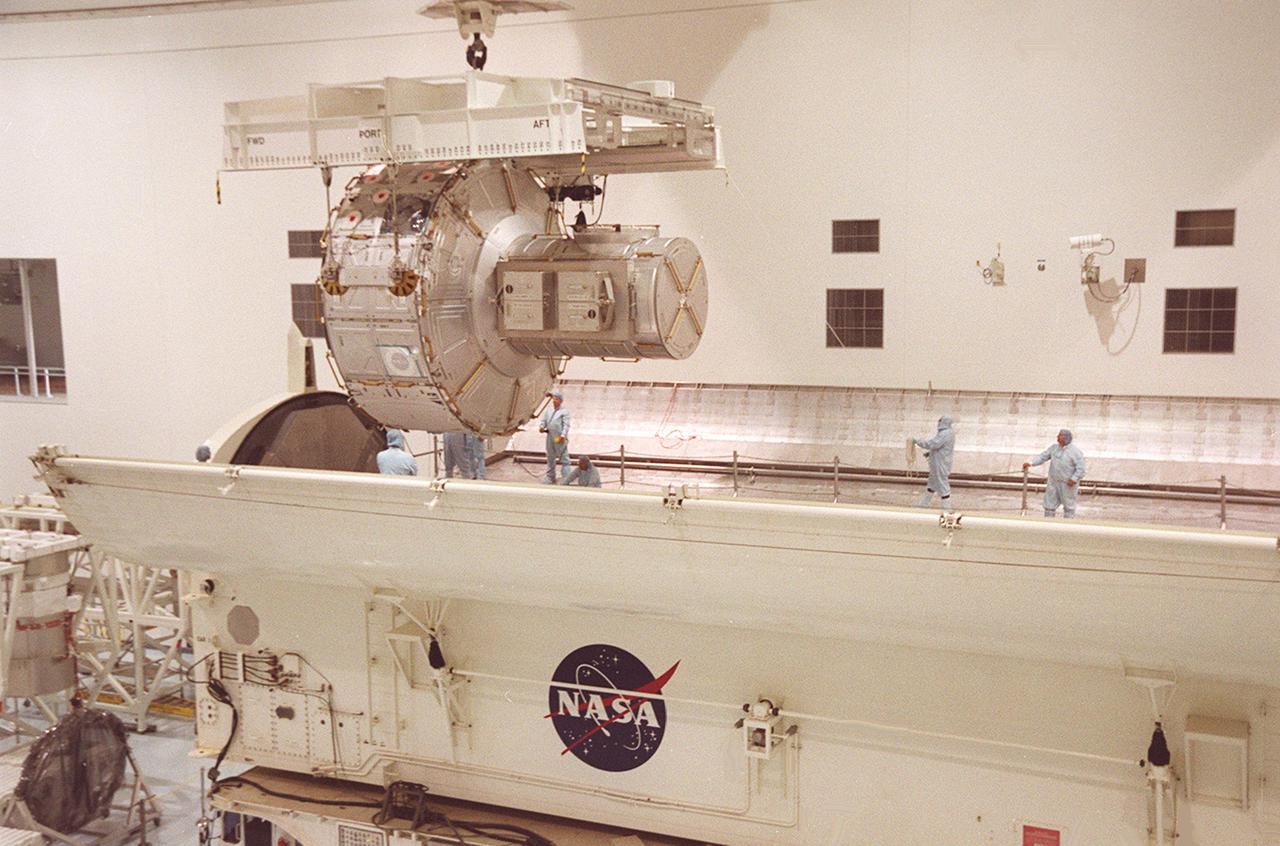
KENNEDY SPACE CENTER, FLA. -- In the Space Station Processing Facility, workers standing inside the payload canister help guide the Joint Airlock Module into place. The airlock will be installed in the payload bay of Atlantis for mission STS-104 to the International Space Station. The airlock is a pressurized flight element consisting of two cylindrical chambers attached end-to-end by a connecting bulkhead and hatch. Once installed and activated, the Airlock becomes the primary path for spacewalk entry to and departure from the Space Station for U.S. spacesuits, which are known as Extravehicular Mobility Units, or EMUs. In addition, the Joint Airlock is designed to support the Russian Orlan spacesuit for EVA activity. STS-104 is scheduled for launch June 14 from Launch Pad 39B
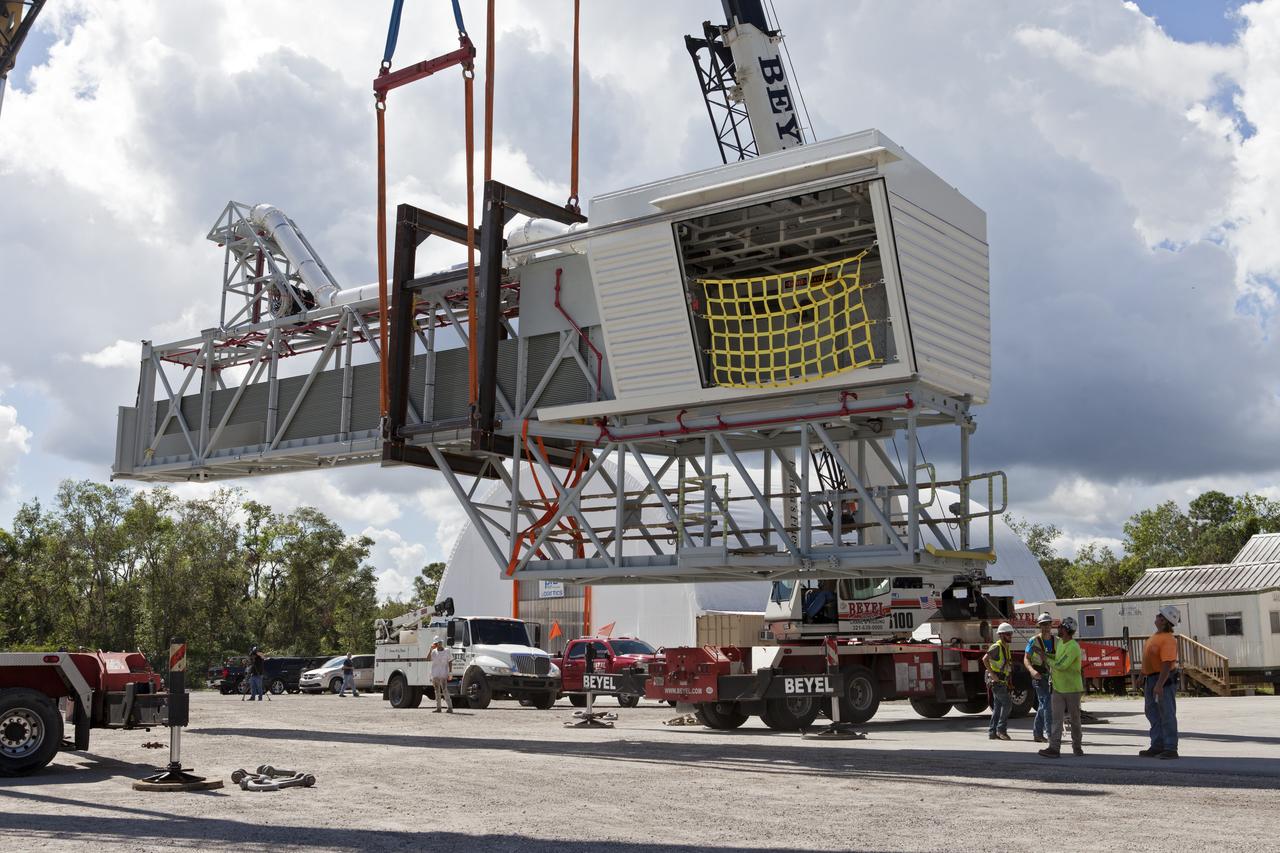
Two heavy-lift cranes are being used to move the Orion crew access arm and lower it onto a flatbed truck at Precision Fabricating and Cleaning in Cocoa, Florida. The crew access arm will be transported to a storage location near NASA's Kennedy Space Center in Florida. Later this month, the arm will be transported to the mobile launcher (ML) tower at the center. The crew access arm will be located at about the 274-foot level on the tower. It will rotate from its retracted position and interface with the Orion crew hatch location to provide entry to the Orion crew module. The Ground Systems Development and Operations Program is overseeing installation of umbilicals and launch accessories on the ML tower.

KENNEDY SPACE CENTER, FLA. - In Orbiter Processing Facility bay 2 at NASA's Kennedy Space Center, workers release the lines holding the airlock to the overhead crane. The airlock is being installed in Endeavour's payload bay. The airlock is located in the middeck. The airlock and airlock hatches permit flight crew members to transfer from the middeck crew compartment into the payload bay for extravehicular activities in their space suits without depressurizing the orbiter crew cabin. The airlock is sized to accommodate two fully suited flight crew members simultaneously. Photo credit: NASA/Jim Grossmann
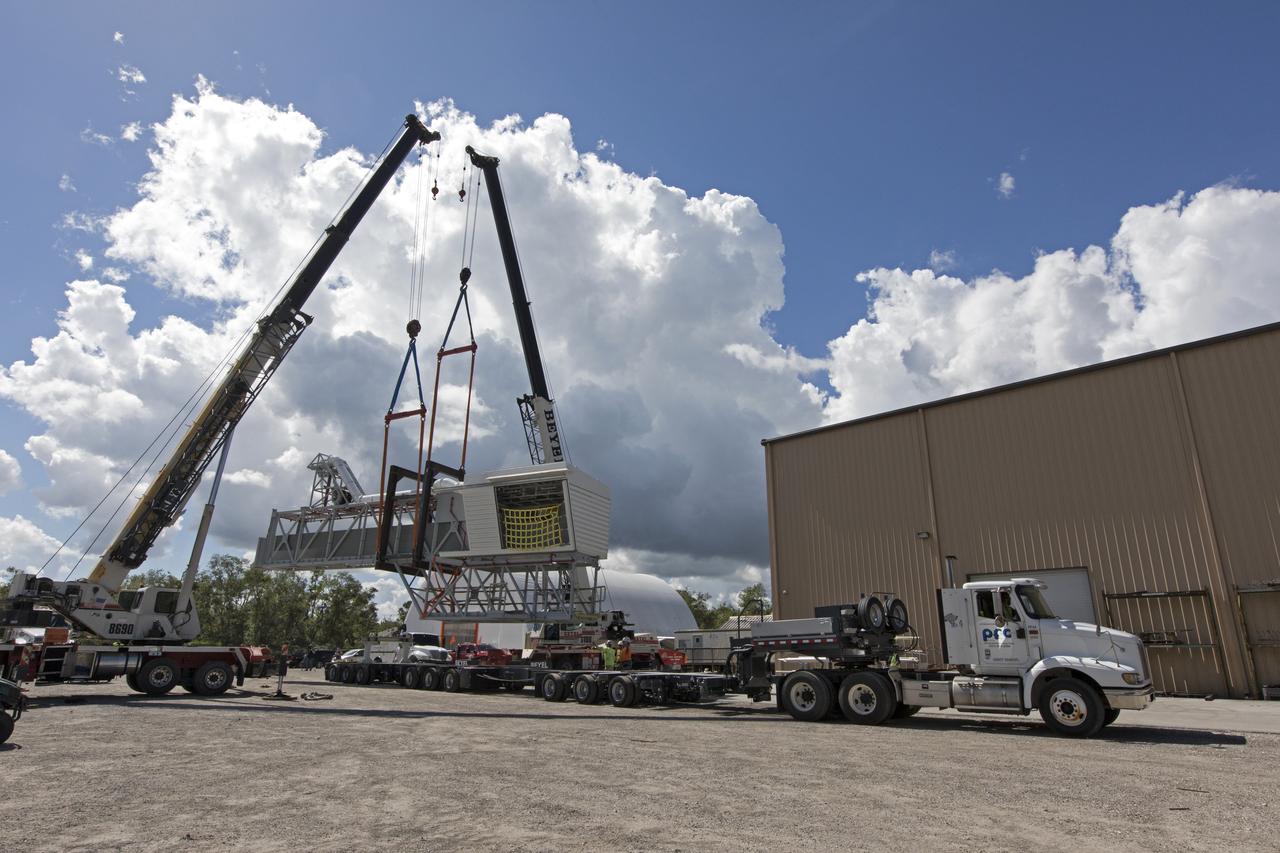
Two heavy-lift cranes are being used to lower the Orion crew access arm onto a flatbed truck at Precision Fabricating and Cleaning in Cocoa, Florida. The crew access arm will be transported to a storage location near NASA's Kennedy Space Center in Florida. Later this month, the arm will be transported to the mobile launcher (ML) tower at the center. The crew access arm will be located at about the 274-foot level on the tower. It will rotate from its retracted position and interface with the Orion crew hatch location to provide entry to the Orion crew module. The Ground Systems Development and Operations Program is overseeing installation of umbilicals and launch accessories on the ML tower.
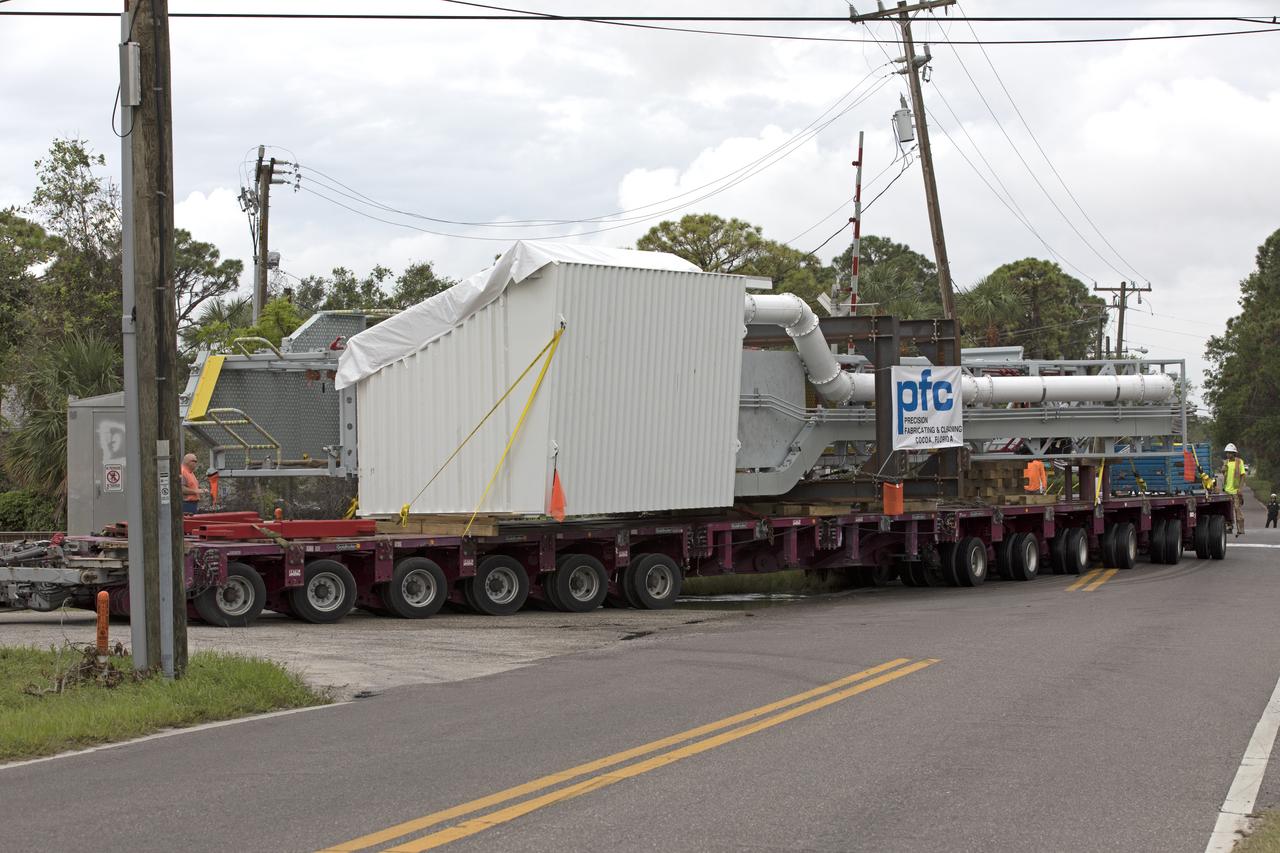
The Orion crew access arm departs Precision Fabricating and Cleaning in Cocoa, Florida, atop a flatbed truck. The access arm will be transported to a storage location at NASA's Kennedy Space Center in Florida. Later this month, the arm will be transported to the mobile launcher (ML) tower at the center. The crew access arm will be located at about the 274-foot level on the tower. It will rotate from its retracted position and interface with the Orion crew hatch location to provide entry to the Orion crew module. The Ground Systems Development and Operations Program is overseeing installation of umbilicals and launch accessories on the ML tower.
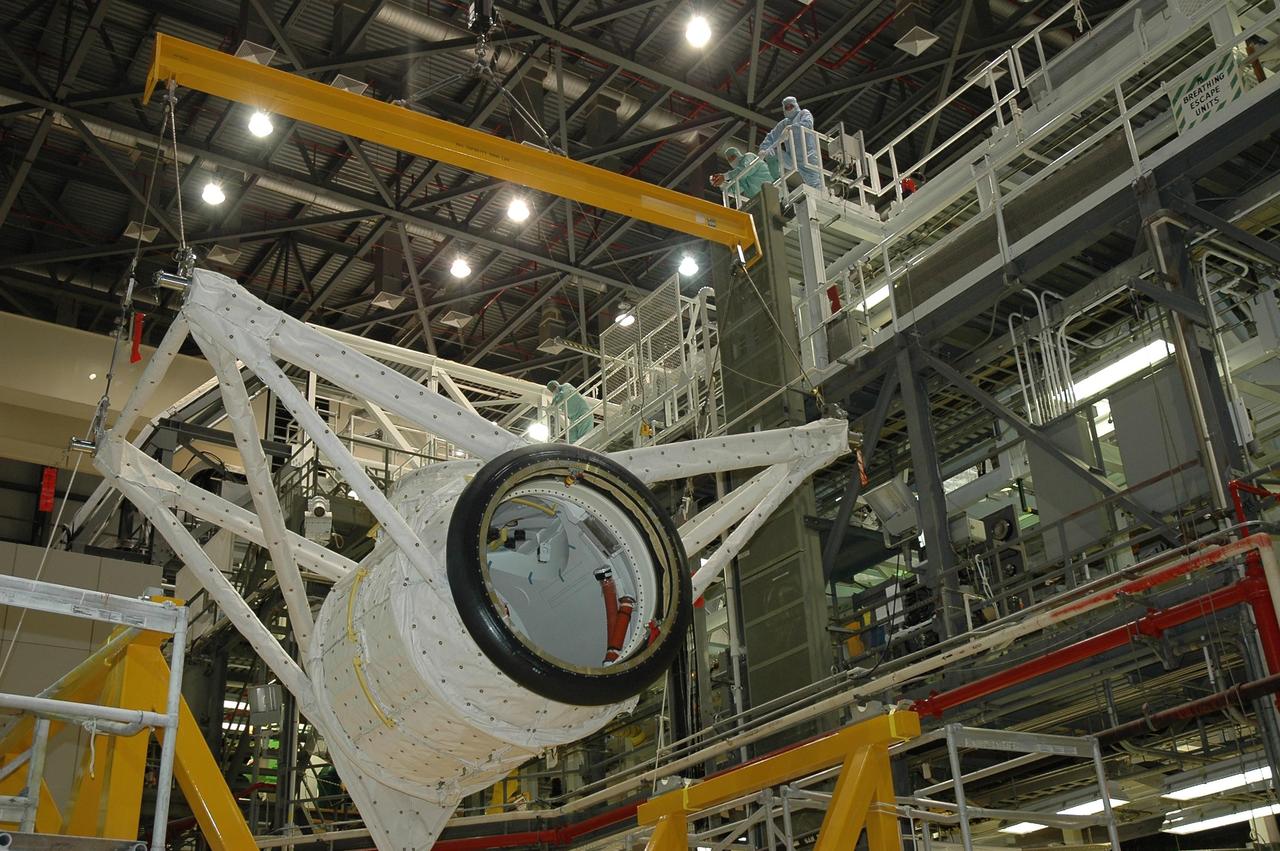
KENNEDY SPACE CENTER, FLA. -- In Orbiter Processing Facility bay 2 at NASA's Kennedy Space Center, an overhead crane moves the crew airlock module across the bay to install it in Endeavour's payload bay. The airlock is located in the middeck. The airlock and airlock hatches permit flight crew members to transfer from the middeck crew compartment into the payload bay for extravehicular activities in their space suits without depressurizing the orbiter crew cabin. The airlock is sized to accommodate two fully suited flight crew members simultaneously. Endeavour is targeted for flight on Aug. 9 on mission STS-118 to the International Space Station. Photo credit: NASA/Jack Pfaller
CAPE CANAVERAL, Fla. -- In the Space Station Processing Facility at NASA's Kennedy Space Center in Florida, technicians install insulating blankets to the hatch of the Permanent Multipurpose Module, or PMM, to protect it and its contents from the harsh environment and temperatures of space. Space shuttle Discovery and its STS-133 crew are targeted to launch Nov. 1 and will deliver the PMM, packed with supplies and critical spare parts, as well as Robonaut 2, the dexterous humanoid astronaut helper, to the International Space Station. For more information visit: www.nasa.gov/shuttle. Photo credit: NASA/Jack Pfaller
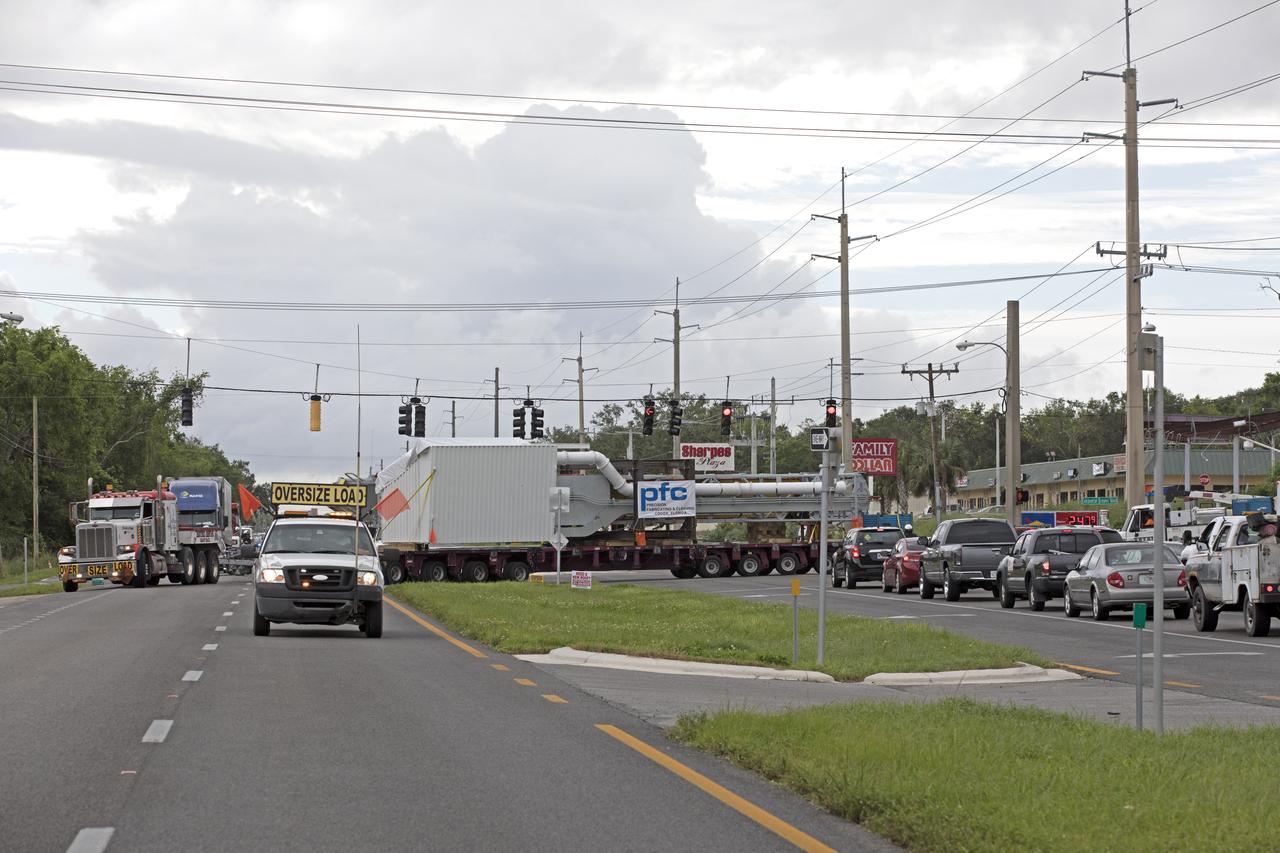
A flatbed truck with the Orion crew access arm secured atop travels along a road in Cocoa, Florida, after departing Precision Fabricating and Cleaning. The access arm will be transported to a storage location at NASA's Kennedy Space Center in Florida. Later this month, the arm will be transported to the mobile launcher (ML) tower at the center. The crew access arm will be located at about the 274-foot level on the tower. It will rotate from its retracted position and interface with the Orion crew hatch location to provide entry to the Orion crew module. The Ground Systems Development and Operations Program is overseeing installation of umbilicals and launch accessories on the ML tower.