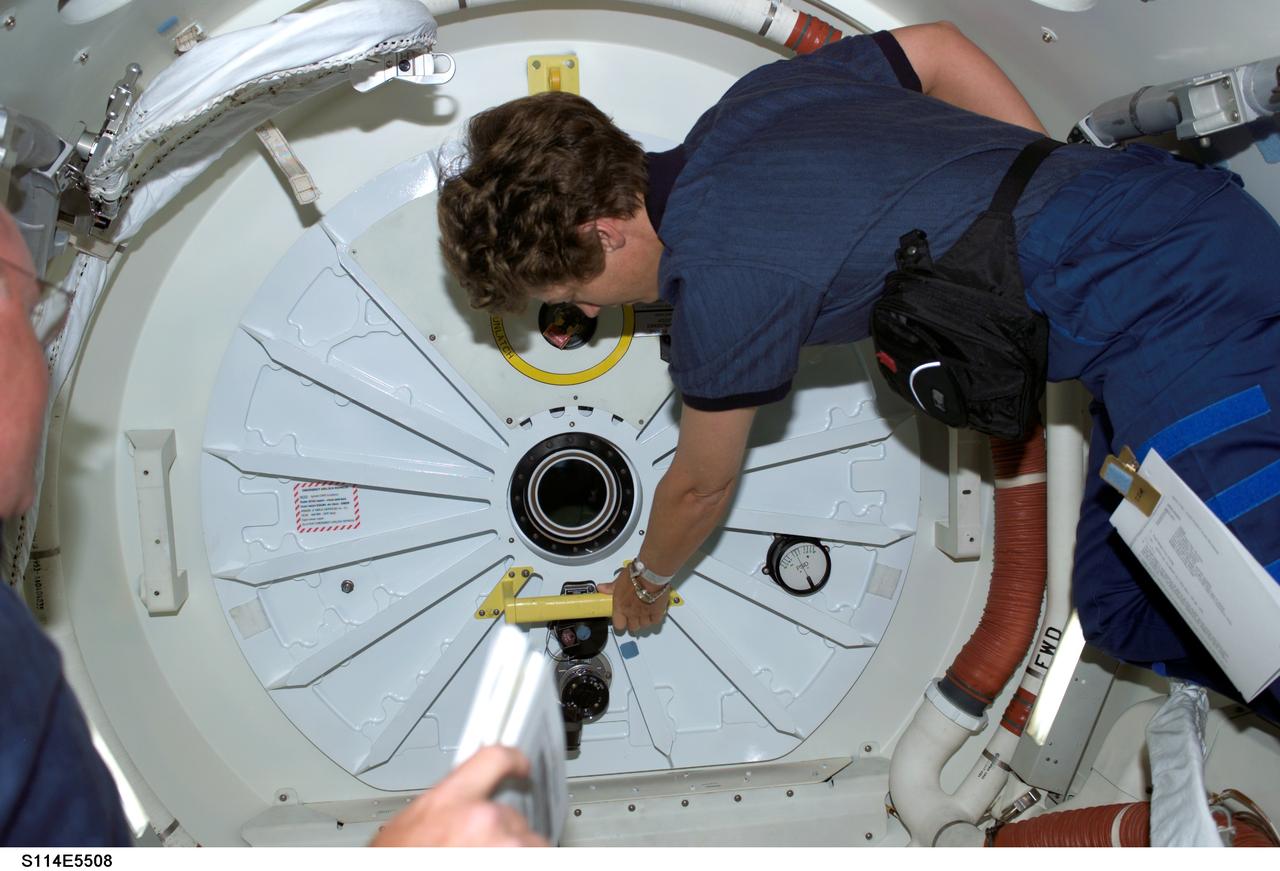
S114-E-5508 (28 July 2005) --- Astronaut Eileen M. Collins, STS-114 commander, prepares to open the hatch that will lead her and the entire Discovery crew into the International Space Station. This was just one highlight of a very busy day that earlier saw the flawless rendezvous and docking operations between the shuttle and the orbital outpost.
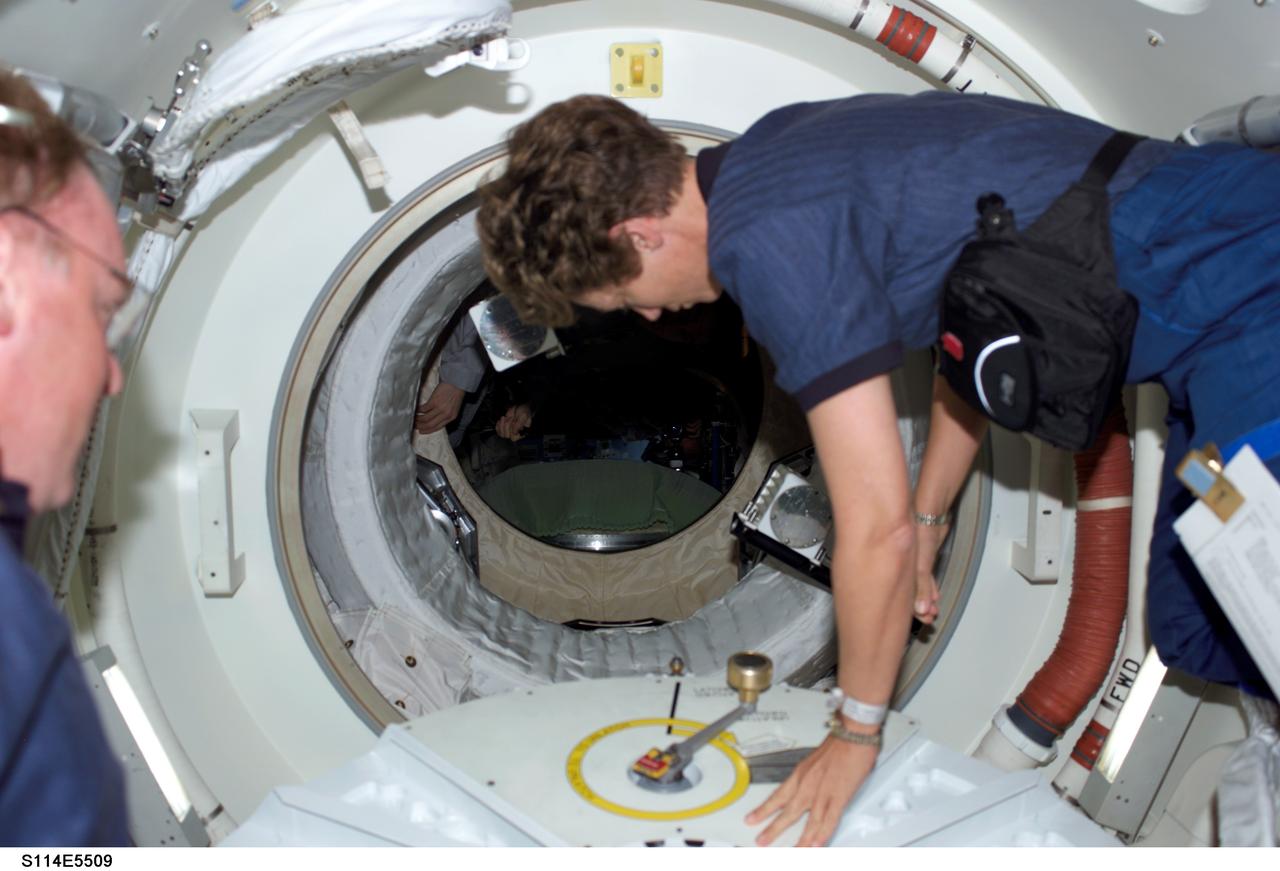
S114-E-5509 (28 July 2005) --- Astronaut Eileen M. Collins, STS-114 commander, has just opened the hatch that will lead her and the entire Discovery crew into the International Space Station. Astronaut Andrew S.W. Thomas, mission specialist, is partially visible at left edge of frame. This was just one highlight of a very busy day that earlier saw the flawless rendezvous and docking operations between the shuttle and the orbital outpost.
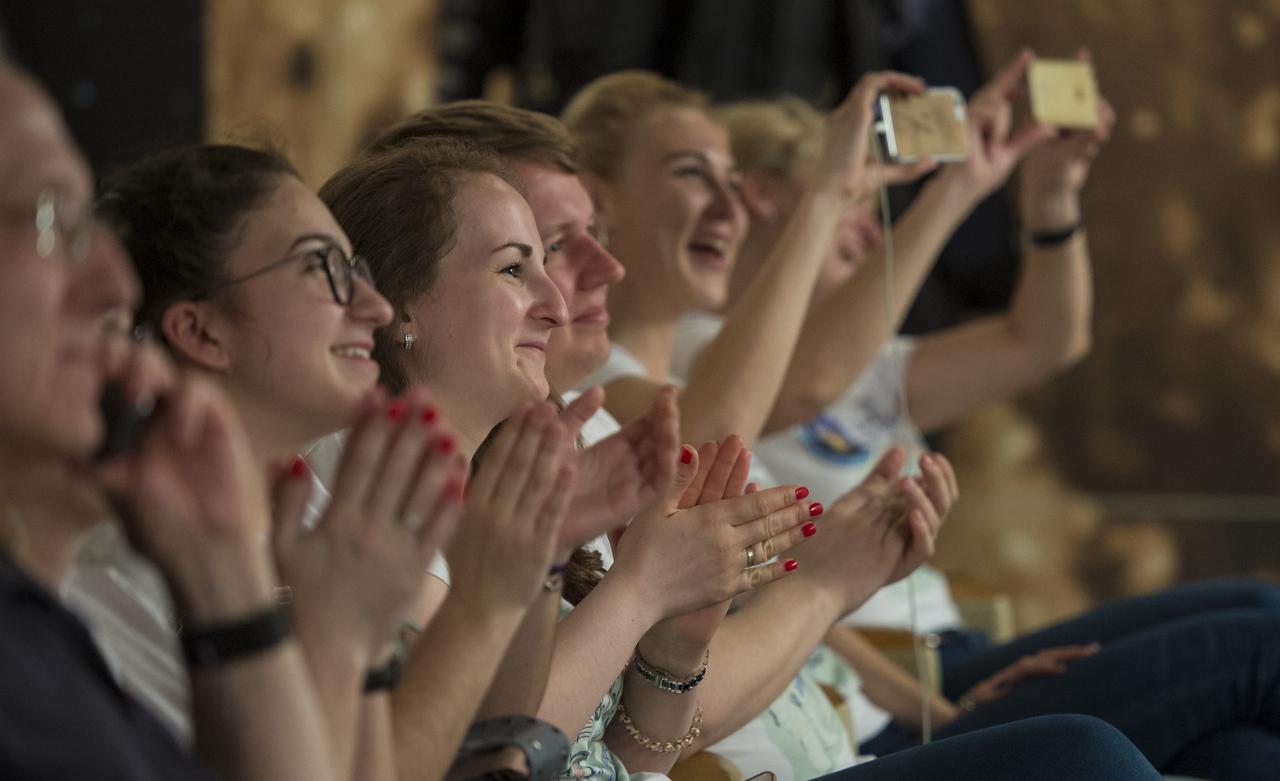
Family and friends of Expedition 51 Soyuz Commander Fyodor Yurchikhin of Roscosmos reacts as they see Yurchikhin enter the International Space Station during a live video feed of the Expedition 51 crew members a few hours after the Soyuz MS-04 spacecraft docked on Thursday, April 20, 2017 at Tsenki Conference Hall in Baikonur, Kazakhstan. Flight engineer Jack Fischer of NASA and Yurchikhin's arrival to the International Space Station comes the same day they launched from the Baikonur Cosmodrome in Kazakhstan. Photo Credit (NASA/Aubrey Gemignani)
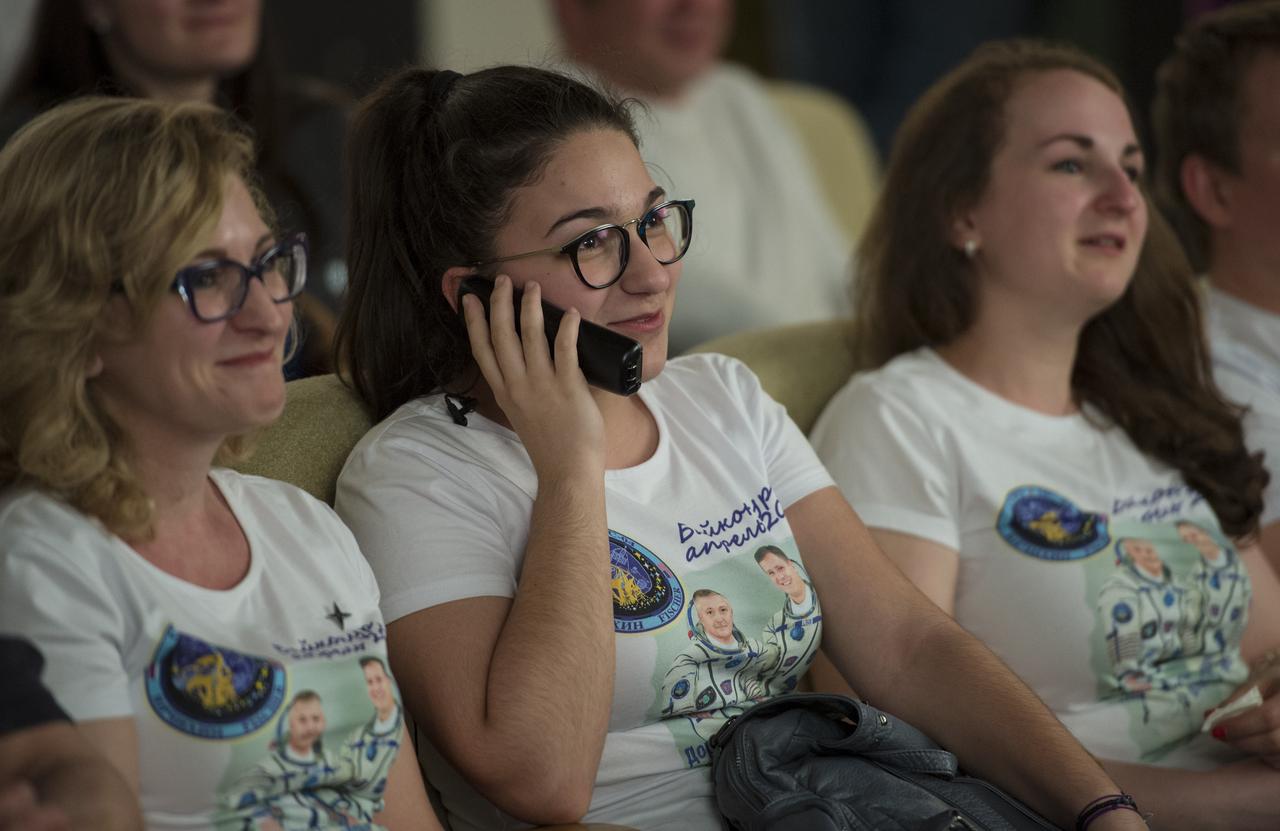
Family of Expedition 51 Soyuz Commander Fyodor Yurchikhin of Roscosmos speak to him by phone a few hours after his Soyuz MS-04 spacecraft docked to the International Space Station (ISS) on Thursday, April 20, 2017 at Tsenki Conference Hall in Baikonur, Kazakhstan. Flight engineer Jack Fischer of NASA and Yurchikhin's arrival to the ISS comes the same day they launched from the Baikonur Cosmodrome in Kazakhstan. Photo Credit (NASA/Aubrey Gemignani)
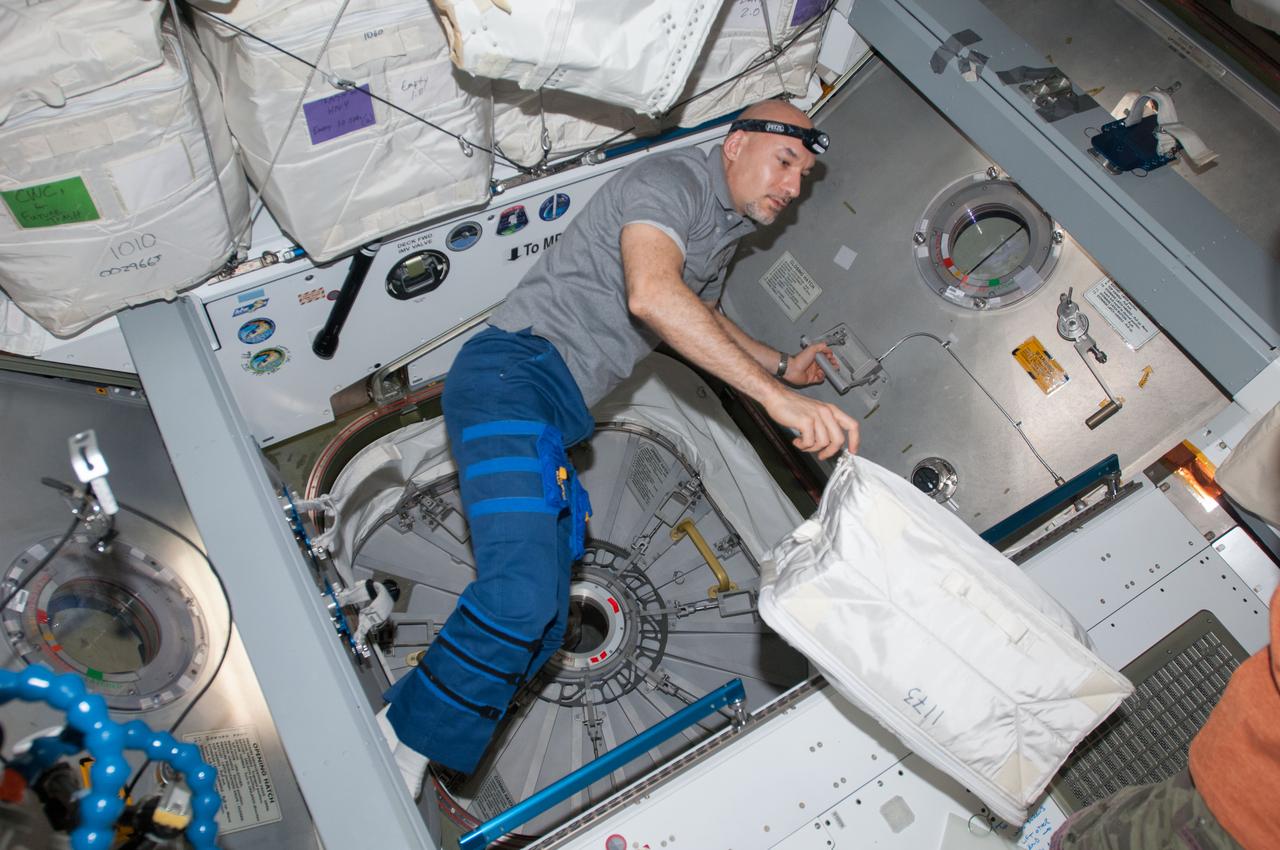
ISS036-E-030213 (9 Aug. 2013) --- European Space Agency astronaut Luca Parmitano, Expedition 36 flight engineer, prepares to open the hatch to the newly attached Japanese "Kounotori" H2 Transfer Vehicle-4 (HTV-4) docked to the International Space Station's Harmony node.
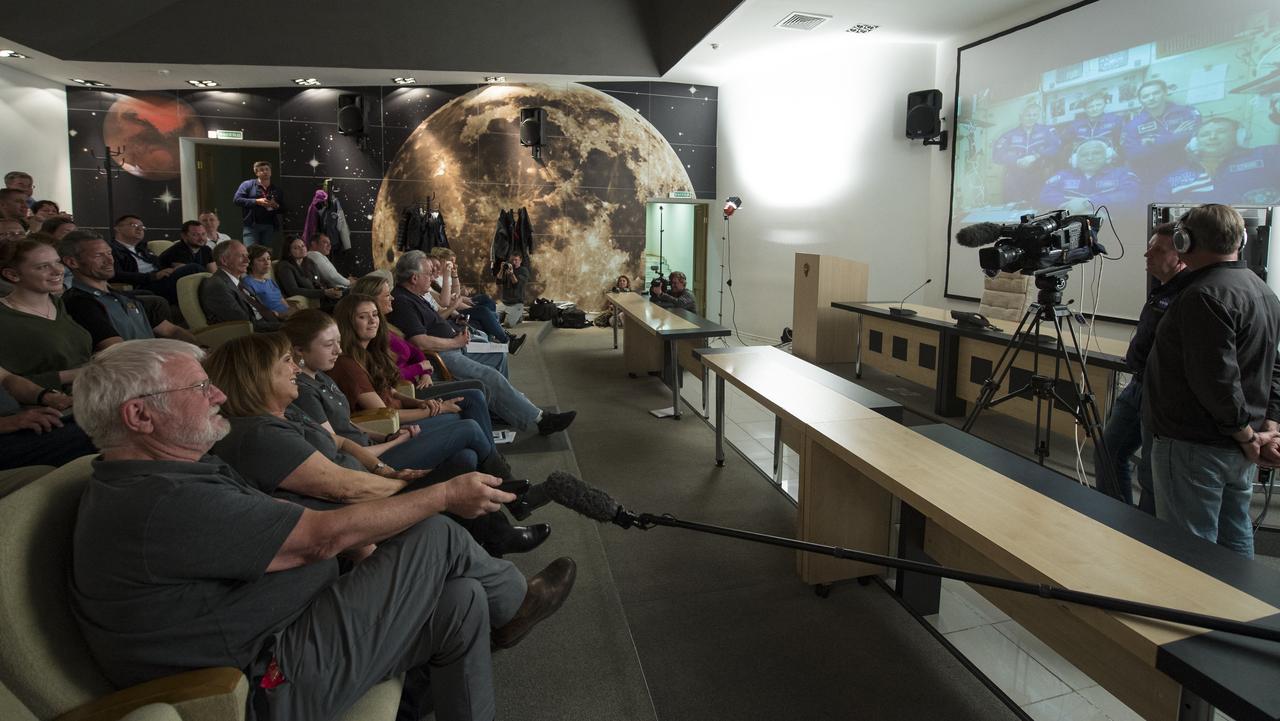
A view of the projection screens from the Tsenki Conference Hall shows live video feed of the Expedition 51 crew members gathered together on the International Space Station a few hours after the Soyuz MS-04 spacecraft docked on Thursday, April 20, 2017 in Baikonur, Kazakhstan. Pictured are Expedition 51 crew members, Soyuz Commander Fyodor Yurchikhin of Roscosmos, bottom left, and Flight Engineer Jack Fischer of NASA, bottom right. Yurchikhin and Fischer's arrival to the International Space Station comes the same day they launched from the Baikonur Cosmodrome in Kazakhstan. Photo Credit (NASA/Aubrey Gemignani)
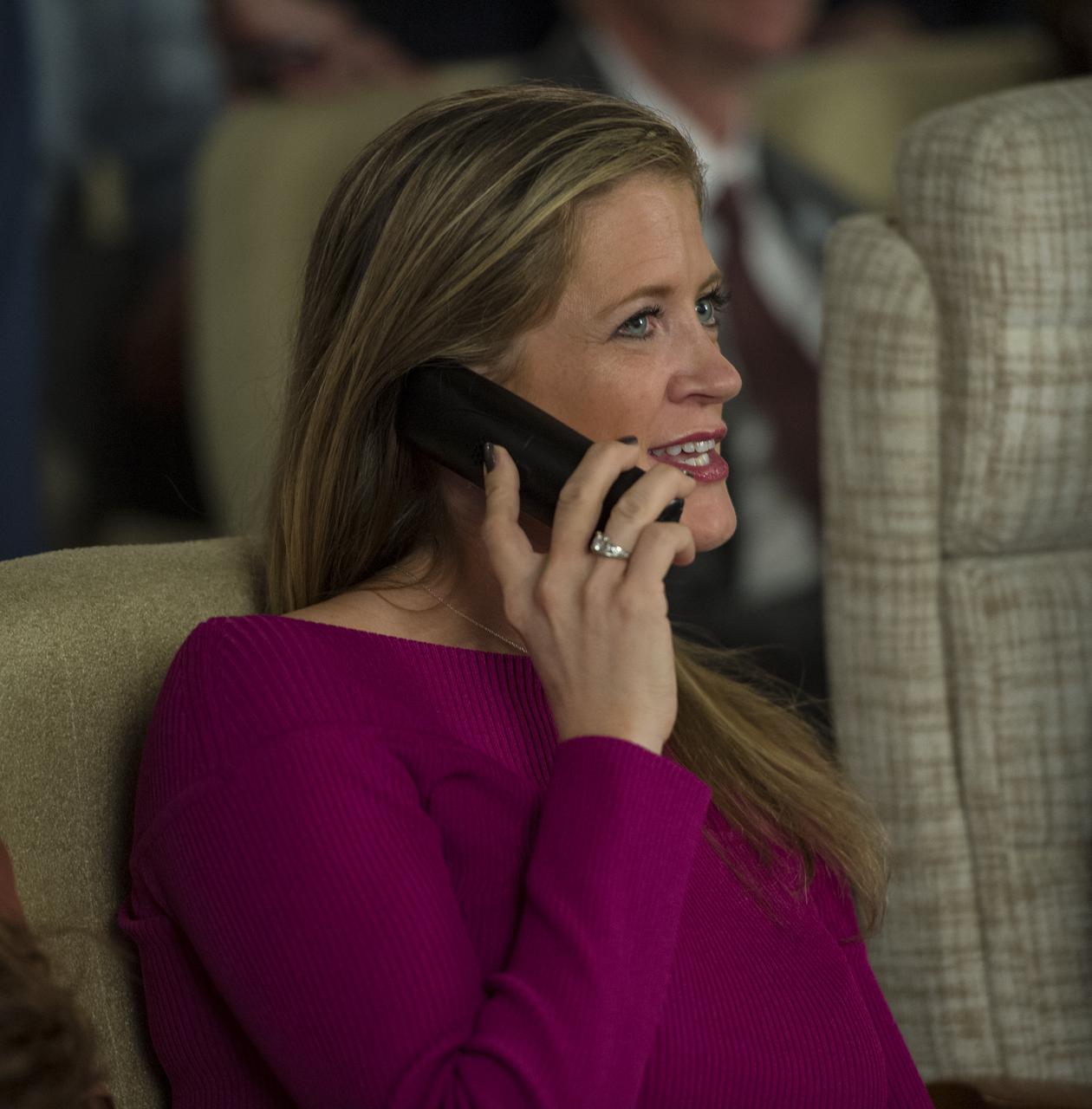
Elizabeth Fischer, wife of Expedition 51 Flight Engineer Jack Fischer of NASA, speaks to him by phone a few hours after his Soyuz MS-04 spacecraft docked to the International Space Station (ISS) on Thursday, April 20, 2017 at Tsenki Conference Hall in Baikonur, Kazakhstan. Soyuz Commander Fyodor Yurchikhin of Roscosmos and Fischer's arrival to ISS comes the same day they launched from the Baikonur Cosmodrome in Kazakhstan. Photo Credit (NASA/Aubrey Gemignani)
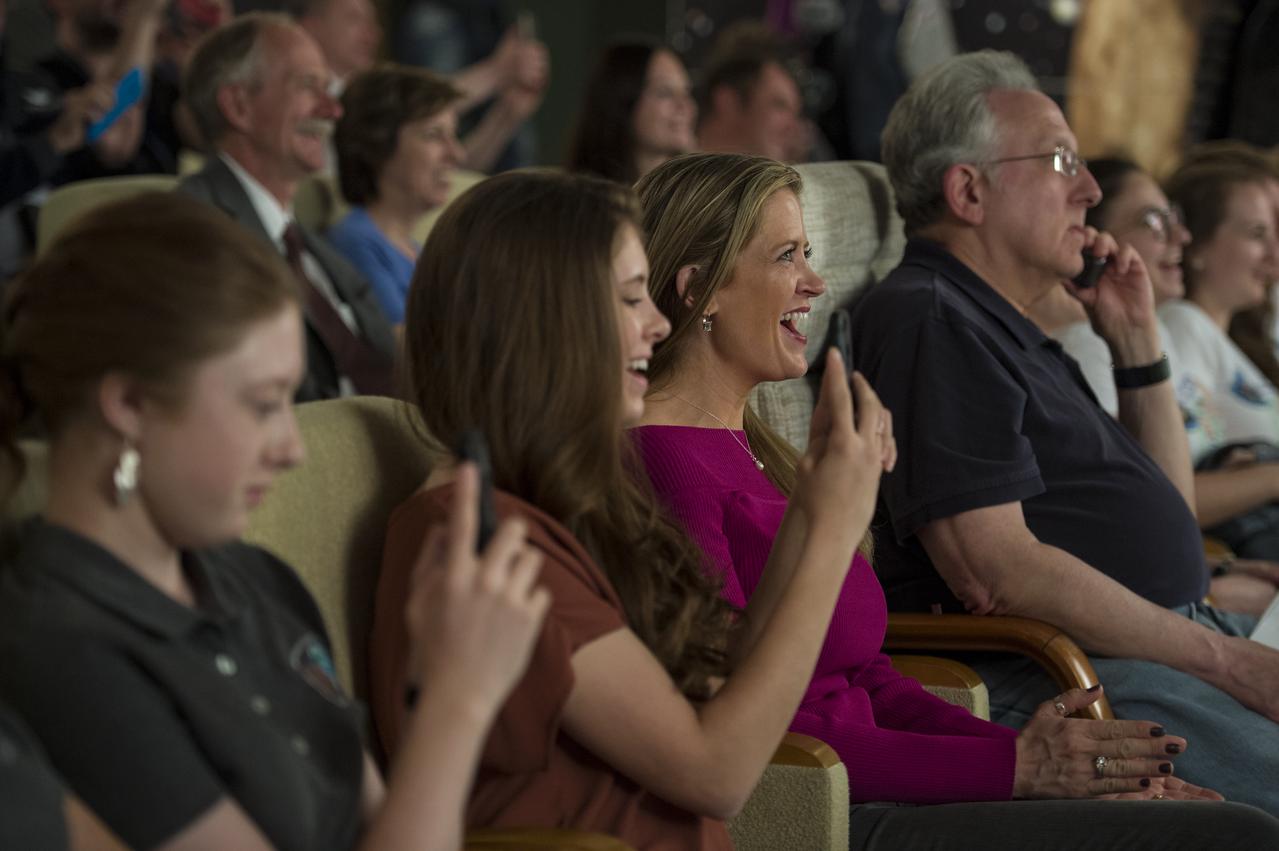
Elizabeth Fischer, wife of Expedition 51 Flight Engineer Jack Fischer of NASA, reacts as she sees Fischer enter the International Space Station during a live video feed of the Expedition 51 crew members a few hours after the Soyuz MS-04 spacecraft docked on Thursday, April 20, 2017 at Tsenki Conference Hall in Baikonur, Kazakhstan. Soyuz Commander Fyodor Yurchikhin of Roscosmos and Fischer's arrival to the International Space Station comes the same day they launched from the Baikonur Cosmodrome in Kazakhstan. Photo Credit (NASA/Aubrey Gemignani)
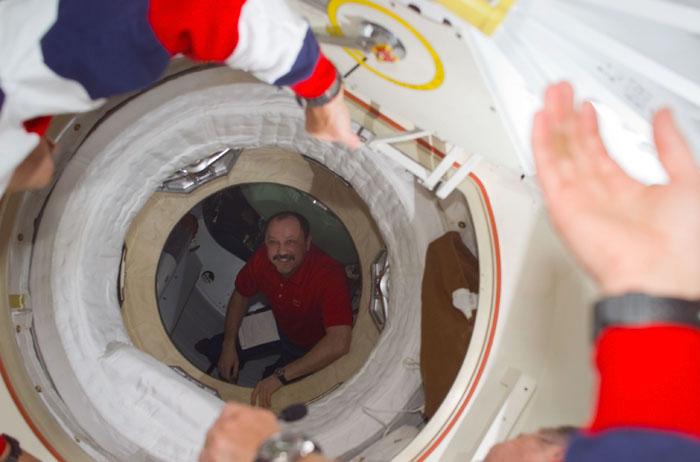
STS105-E-5094 (12 August 2001) --- Yury V. Usachev of Rosaviakosmos, Expedition Two mission commander, can be seen through the recently opened airlock hatch of Space Shuttle Discovery as he welcomes the STS-105 and Expedition Three crews. This image was taken with a digital still camera.
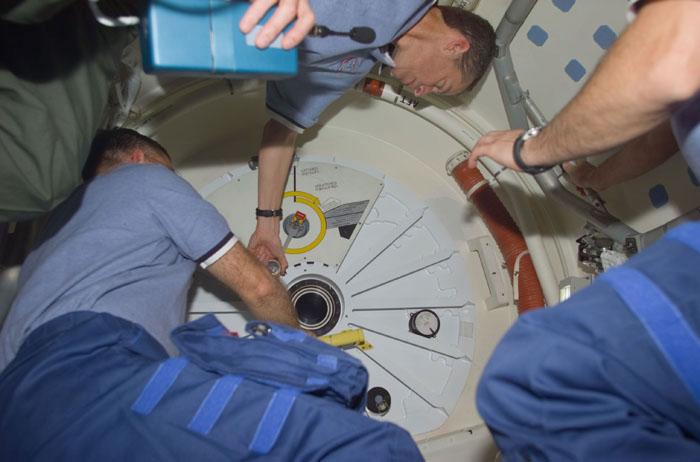
TS102-E-5089 (10 March 2001) --- Astronauts James D. Wetherbee (top) and James S. Voss, STS-102 commander and mission specialist, respectively, open hatch to the Space Station. The photograph was recorded with a digital still camera.
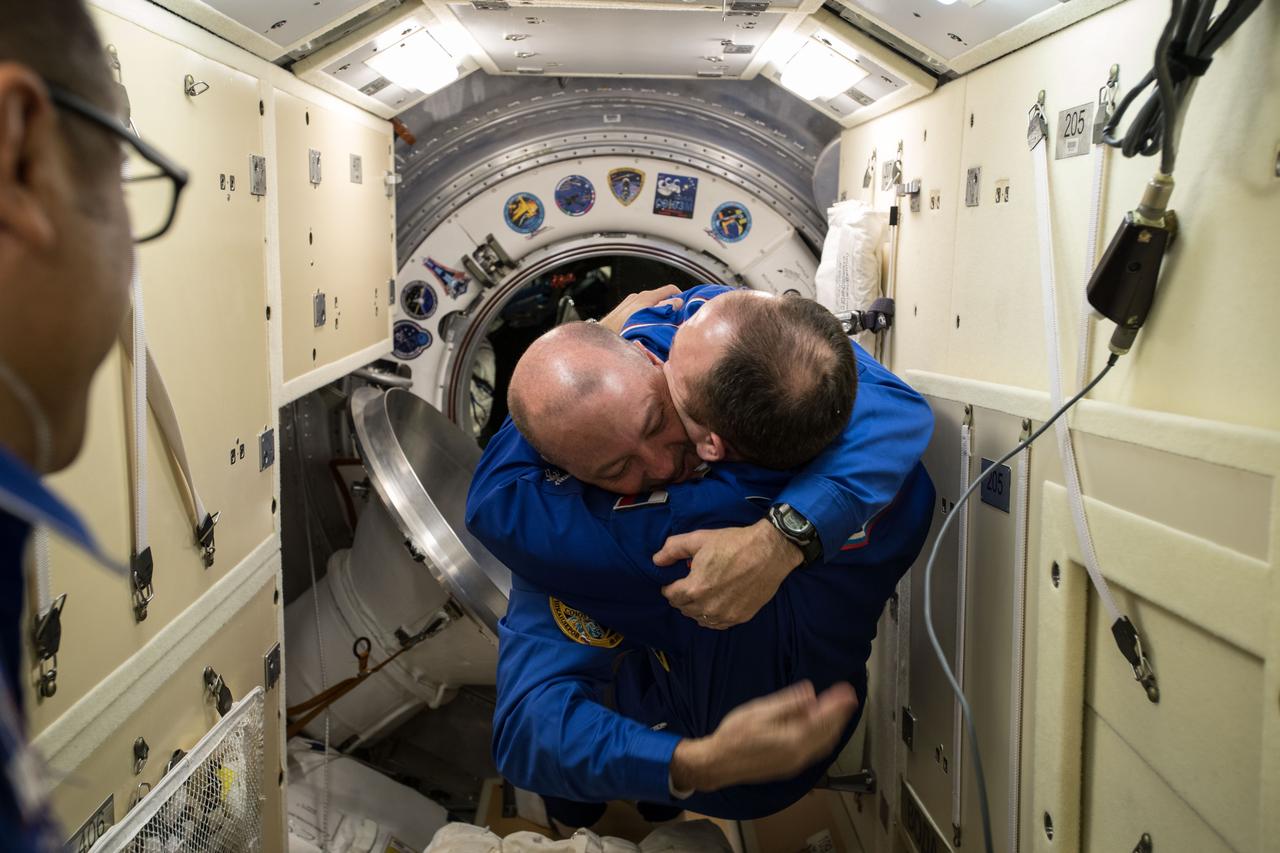
iss054e001407 (Dec. 19, 2017) --- International Space Station Commander Alexander Misurkin welcomes newly arrived Flight Engineer Scott Tingle in the Rassvet Mini-Research Module 1 following the hatch opening of the Soyuz MS-07 spacecraft.
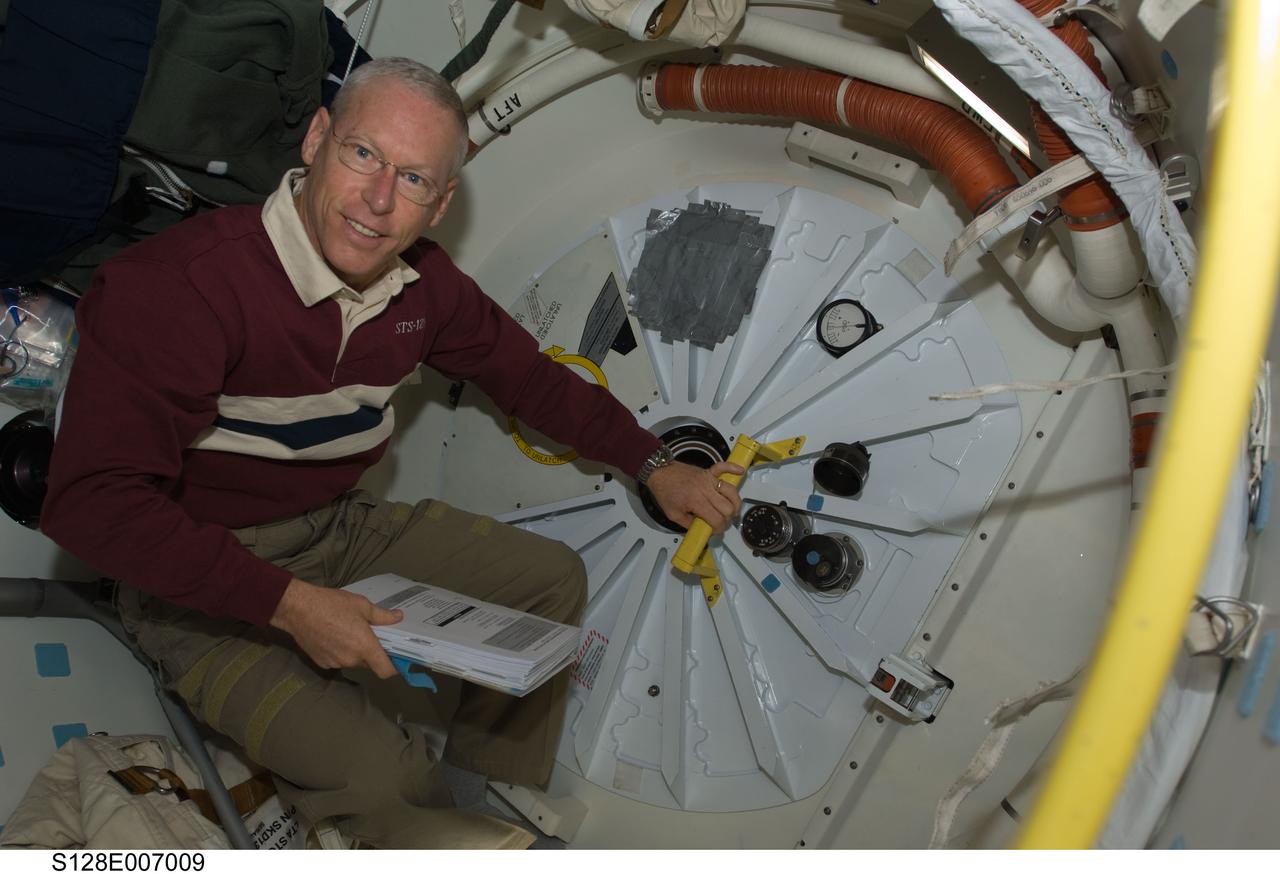
S128-E-007009 (30 Aug. 2009) --- Astronaut Patrick Forrester, STS-128 mission specialist, prepares to open the hatch that will lead the entire Space Shuttle Discovery crew into the International Space Station. The two spacecraft docked at 7:54 p.m. (CDT), and the Discovery crew entered the orbital outpost at 9:59 p.m. (CDT) on Aug. 30.
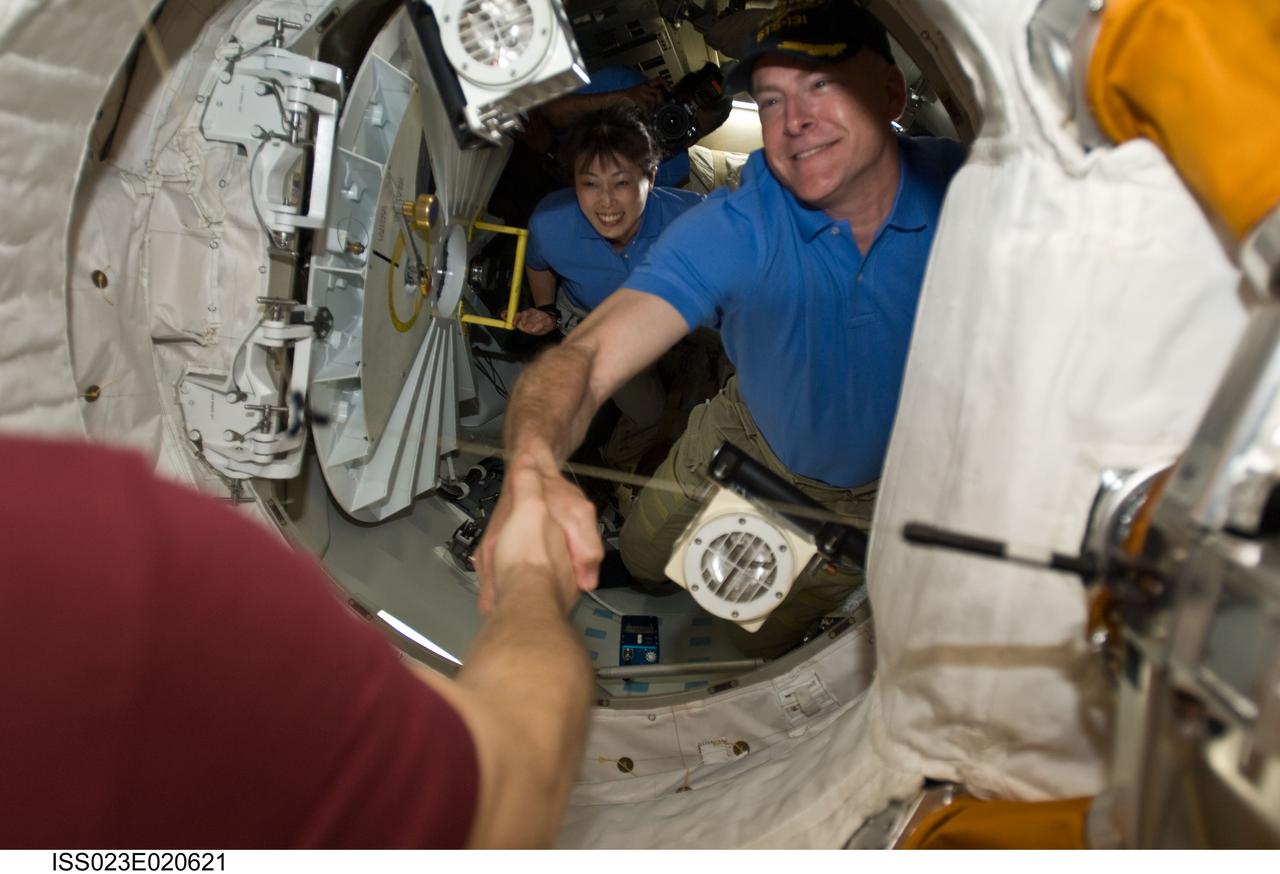
ISS023-E-020621 (7 April 2010) --- Astronaut Alan Poindexter, STS-131 mission commander who has led the Discovery crew on its mission to the International Space Station, displays a pleasant countenance as the hatches come open and two crews begin their traditional handshakes aboard the orbital outpost. Behind Poindexter is Japan Aerospace Exploration Agency astronaut Naoko Yamazaki, mission specialist.
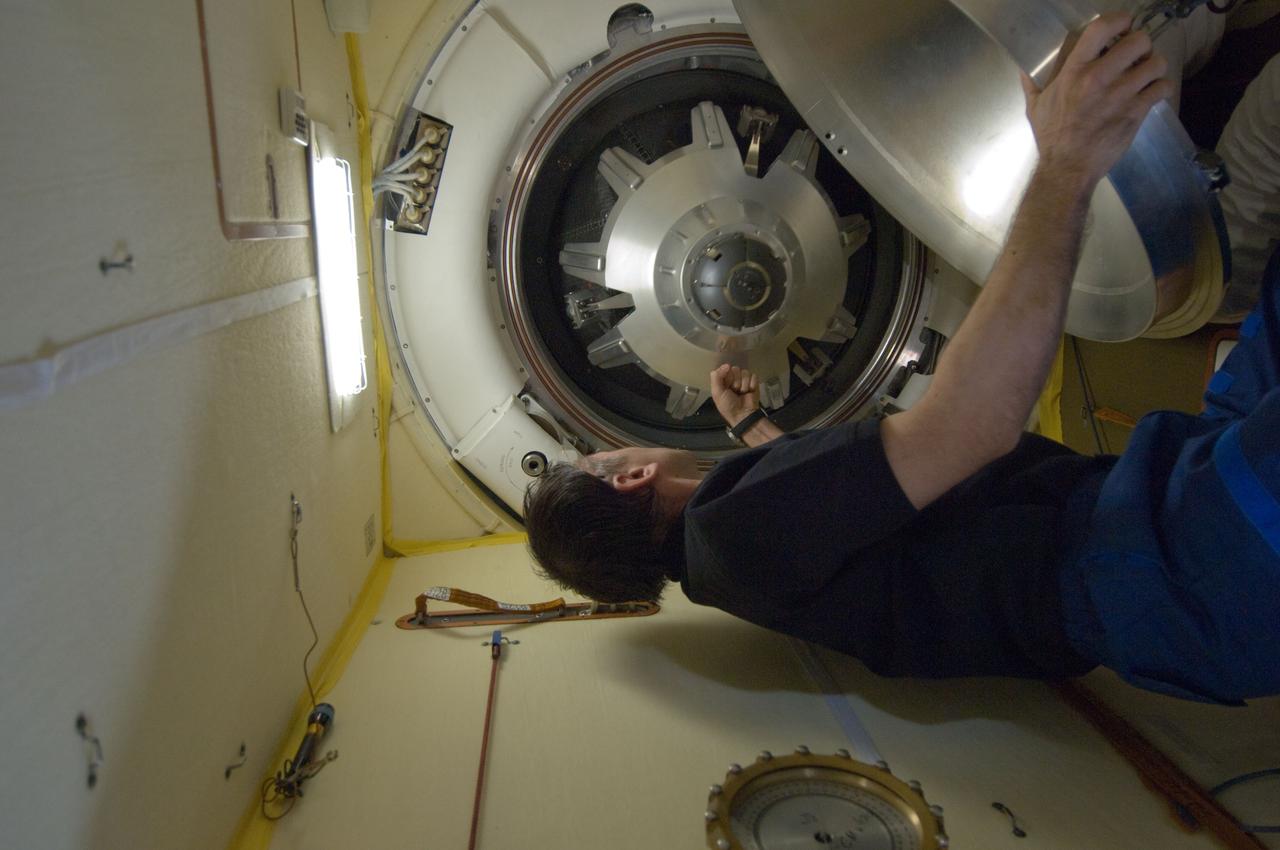
ISS033-E-016667 (25 Oct. 2012) --- Russian cosmonaut Yuri Malenchenko, Expedition 33 flight engineer, opens the hatch between the International Space Station and the Soyuz TMA-06M spacecraft as the three new Expedition 33 crew members prepare to ingress the station. Docking occurred at 8:29 a.m. (EDT) at the station’s Poisk Mini-Research Module 2 (MRM2).
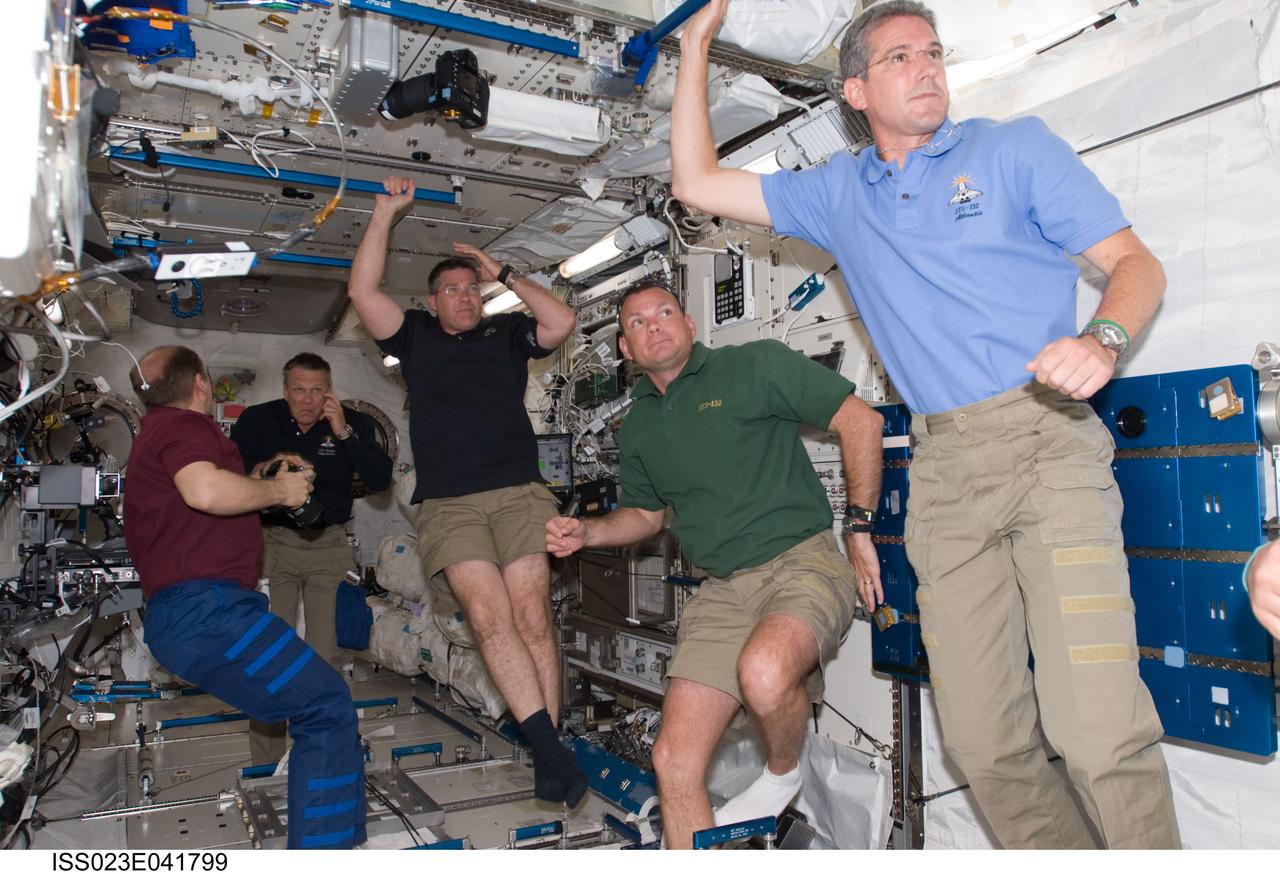
ISS023-E-041799 (16 May 2010) --- Soon after initial hatch opening, four STS-132 crew members and Russian cosmonaut Oleg Kotov (left), Expedition 23 commander, are pictured in the Kibo laboratory of the International Space Station. Pictured (front to back) are NASA astronauts Michael Good, mission specialist; Tony Antonelli, pilot; Steve Bowen and Piers Sellers, both mission specialists.
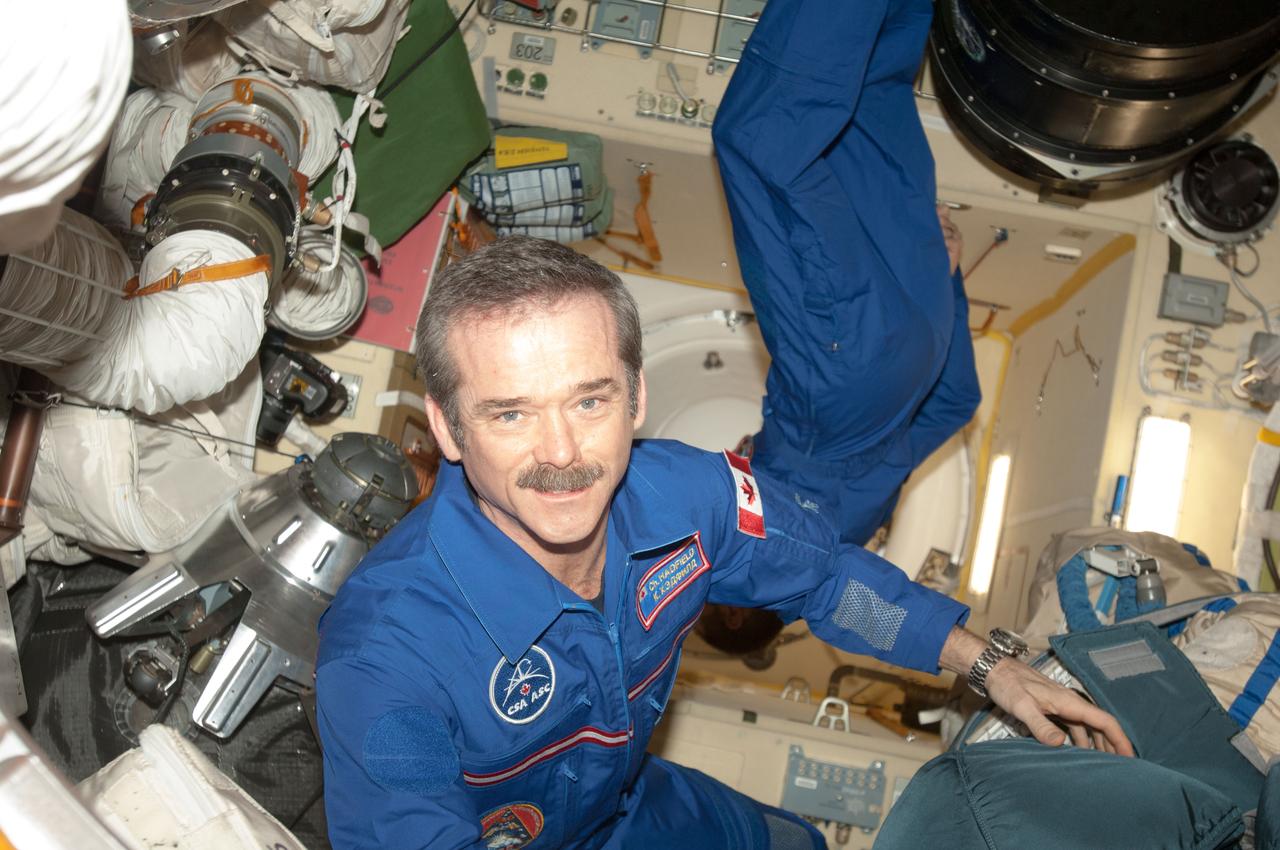
Expedition 35 commander Chris Hadfield and flight engineer Tom Marshburn (partially obscured) are photographed in the Poisk Mini-Research Module 2 (MRM2) during preparations for hatch opening with the docked Soyuz TMA-08M/34S spacecraft. Hadfield is a Canadian Space Agency (CSA) astronaut.
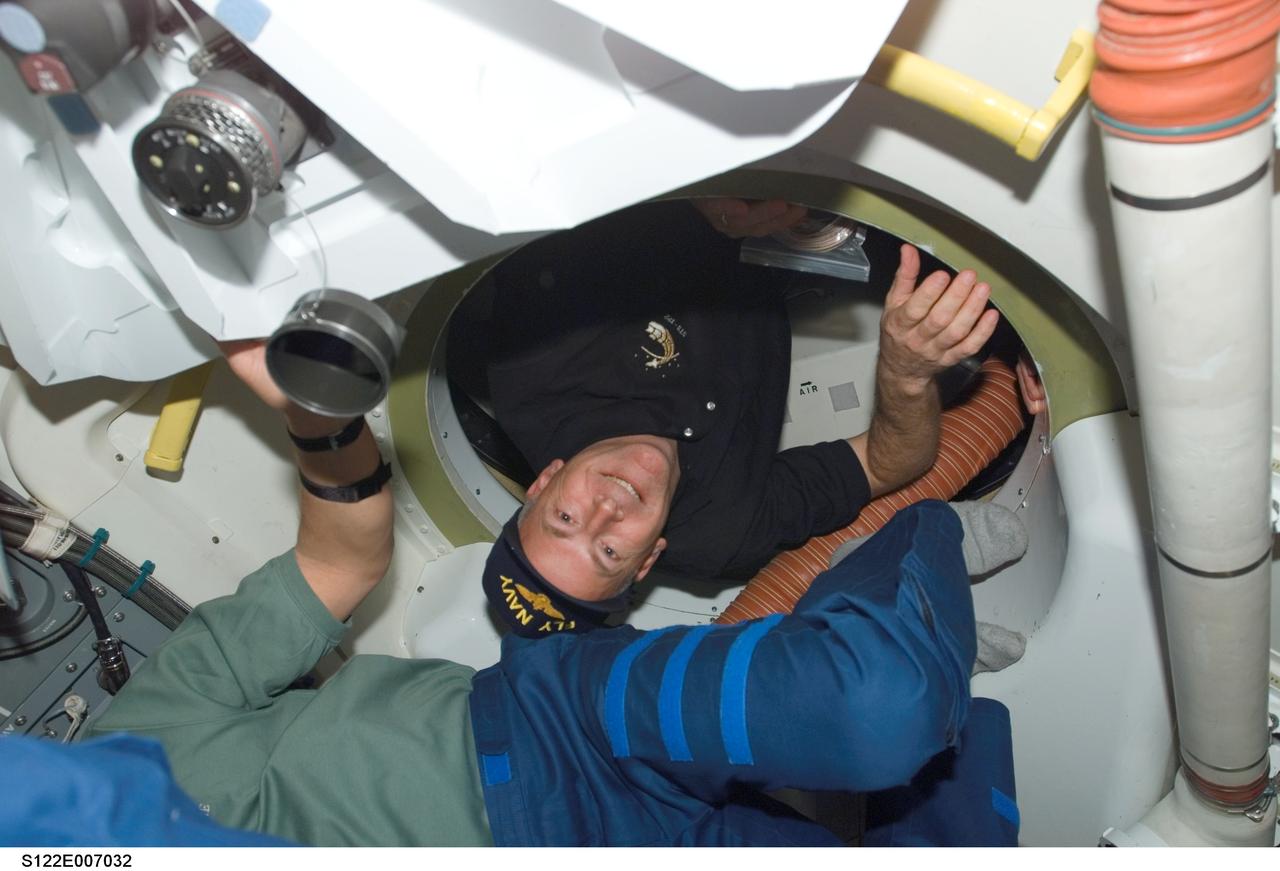
S122-E-007032 (9 Feb. 2008) --- Astronaut Alan Poindexter, STS-122 pilot, translates into the International Space Station from the Space Shuttle Atlantis shortly after the two spacecraft docked in space and the hatches were opened on Feb. 9, 2008.
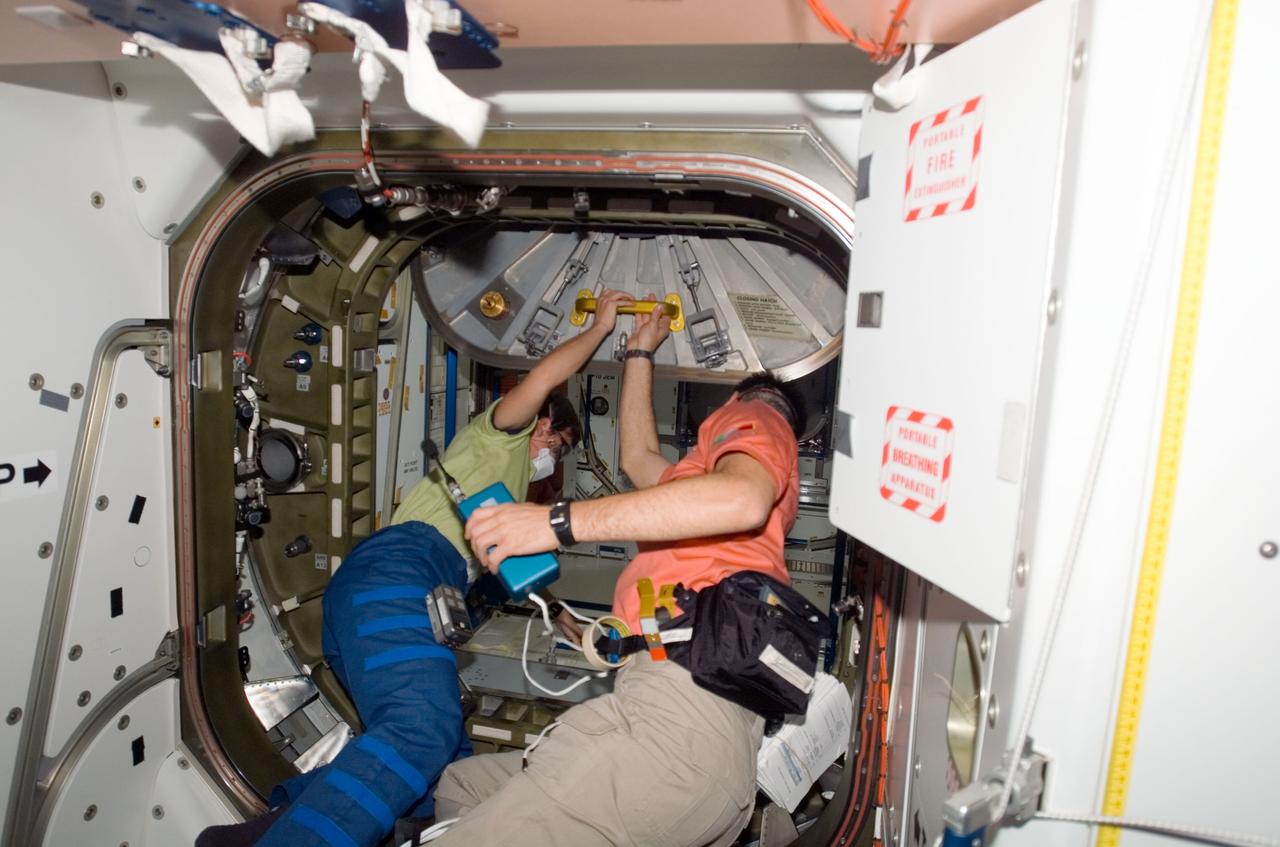
ISS016-E-006856 (27 Oct. 2007) --- NASA astronaut Peggy A. Whitson (left), Expedition 16 commander, and European Space Agency (ESA) astronaut Paolo Nespoli, STS-120 mission specialist, open the hatch to the Harmony node -- the newest additional to the International Space Station -- while Space Shuttle Discovery is docked with the station.
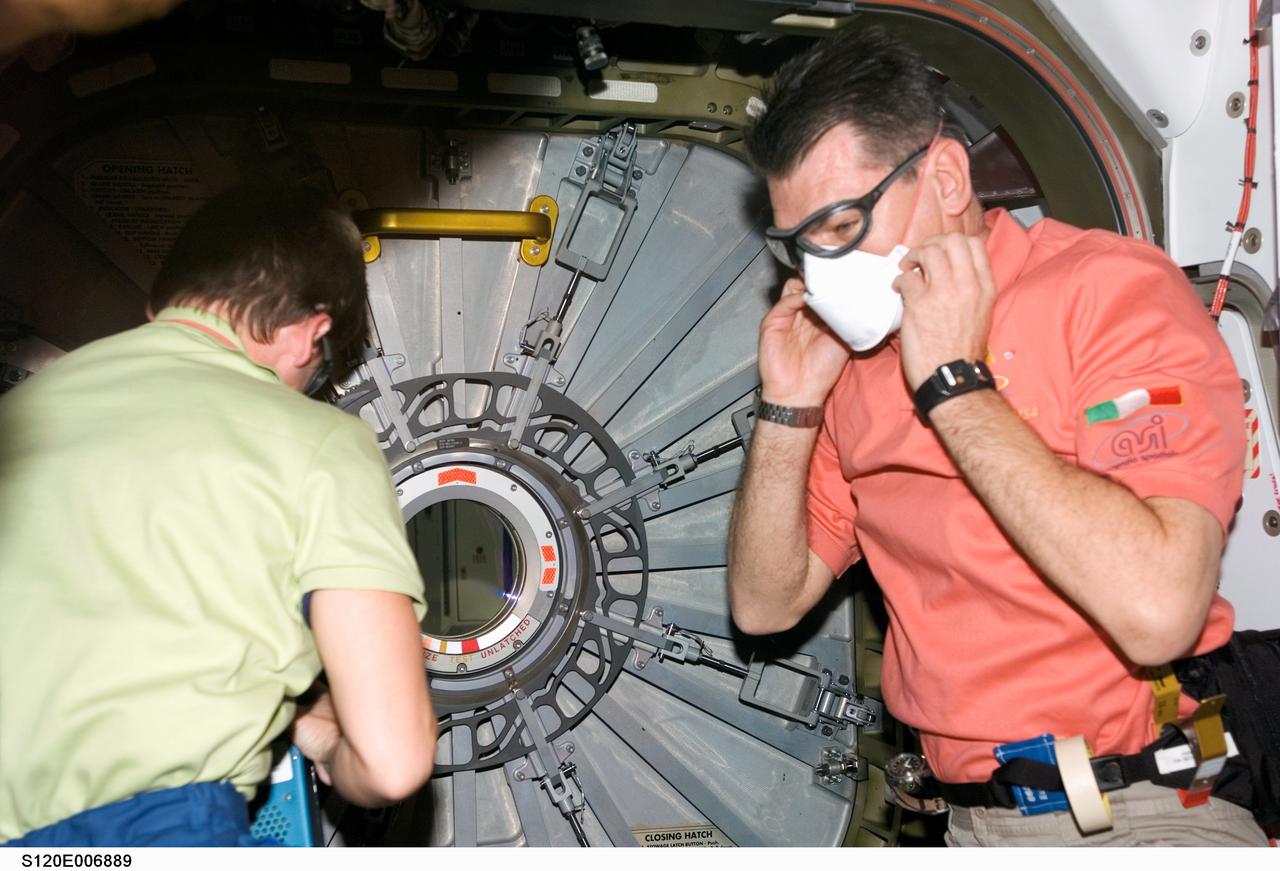
S120-E-006889 (27 Oct. 2007) --- Astronauts Peggy A. Whitson (left), Expedition 16 commander, and European Space Agency's (ESA) Paolo Nespoli, STS-120 mission specialist, prepare to open the hatch to the Harmony node -- the newest additional to the International Space Station -- while Space Shuttle Discovery is docked with the station.
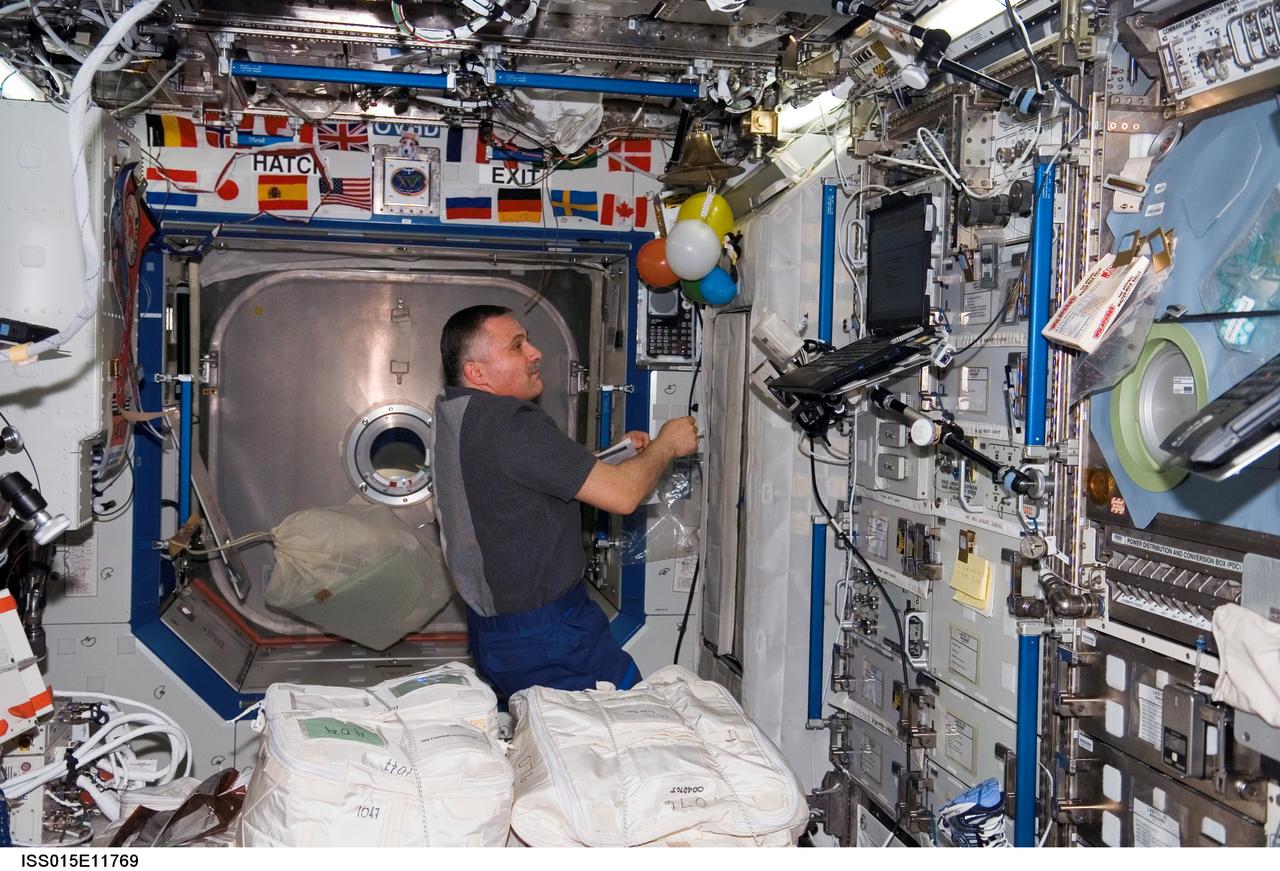
ISS015-E-11769 (10 June 2007) --- Cosmonaut Fyodor N. Yurchikhin, Expedition 15 commander representing Russia's Federal Space Agency, photographed near a hatch door in the Destiny laboratory of the International Space Station. Shortly after this image was taken, the hatches were opened between the station and Space Shuttle Atlantis.
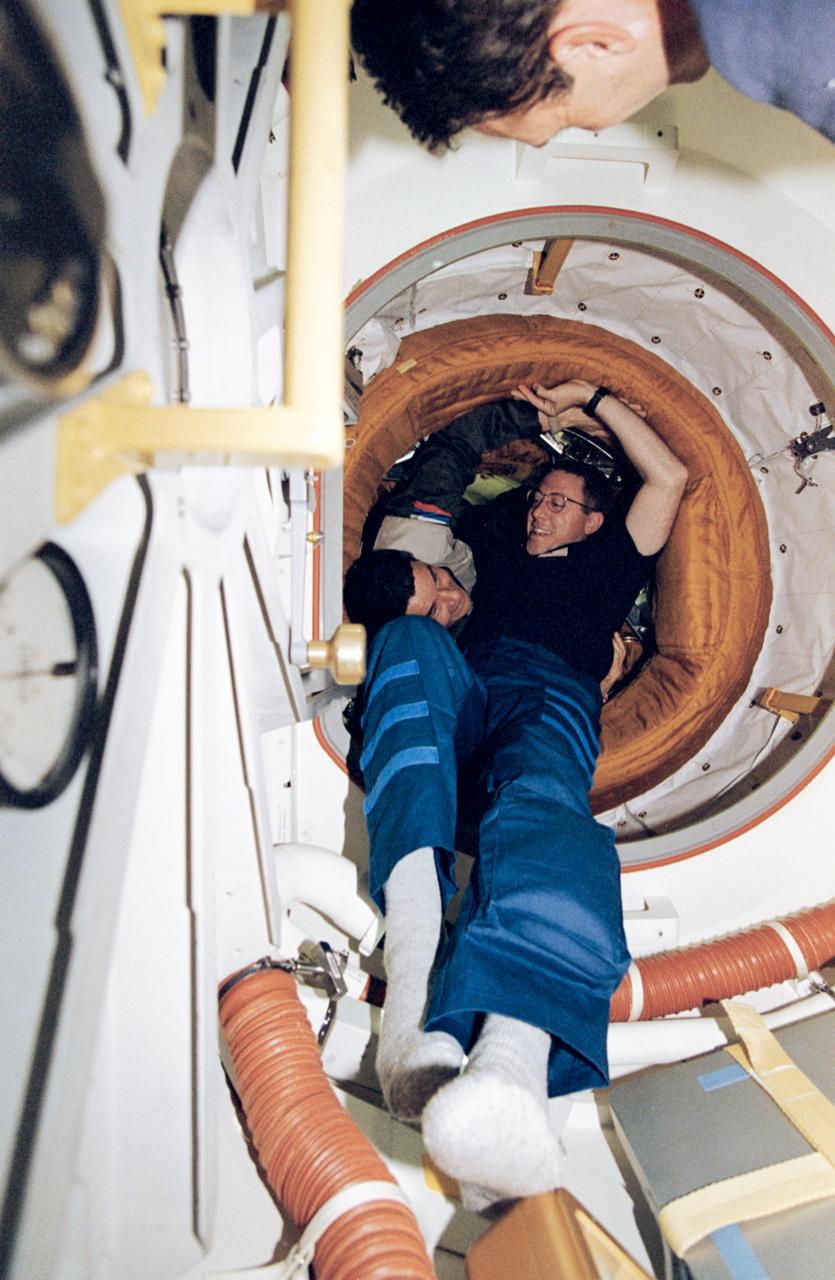
STS081-373-025 (14 Jan 1997) --- Greeting between commanders - astronaut Michael A. Baker (foreground) and cosmonaut Valeri G. Korzun - just after hatch opening following the January 14, 1997, docking. Out of frame on the Space Shuttle Atlantis is astronaut Jerry M. Linenger, soon to be trading places with John E. Blaha, the current cosmonaut guest researcher, onboard Russia?s Mir Space Station since mid September 1996. Along with Baker and Linenger, other crew members now aboard Atlantis are astronauts Brent W. Jett, Jr., pilot; and mission specialists John M. Grunsfeld, Marsha S. Ivins and Peter J. K. (Jeff) Wisoff.

S66-54590 (13 Sept. 1966) --- Astronaut Richard F. Gordon Jr., Gemini-11 pilot, prepares to open spacecraft hatch to jettison used equipment. Photo credit: NASA
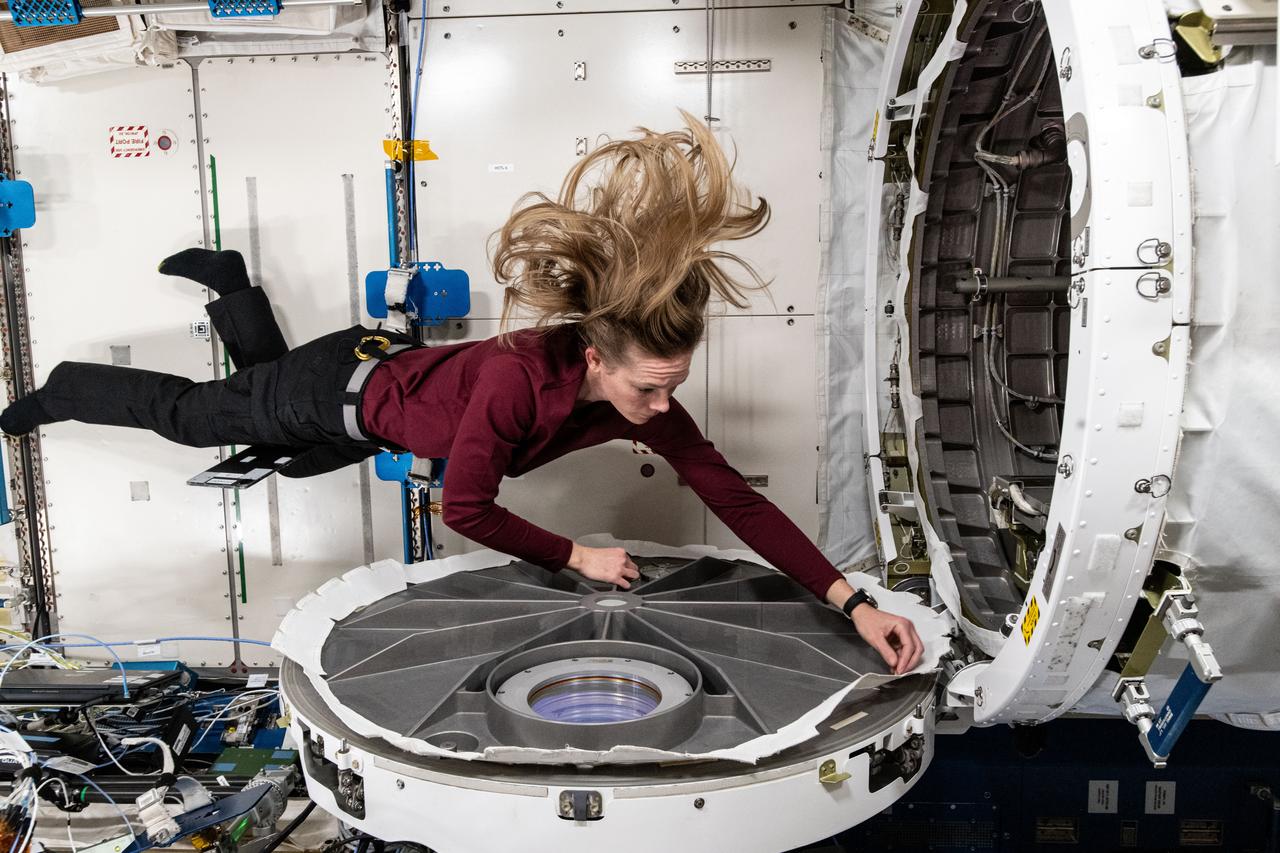
iss072e861697 (March 28, 2025) --- NASA astronaut and Expedition 72 Flight Engineer Nichole Ayers opens the hatch to the Kibo laboratory module's airlock aboard the International Space Station.
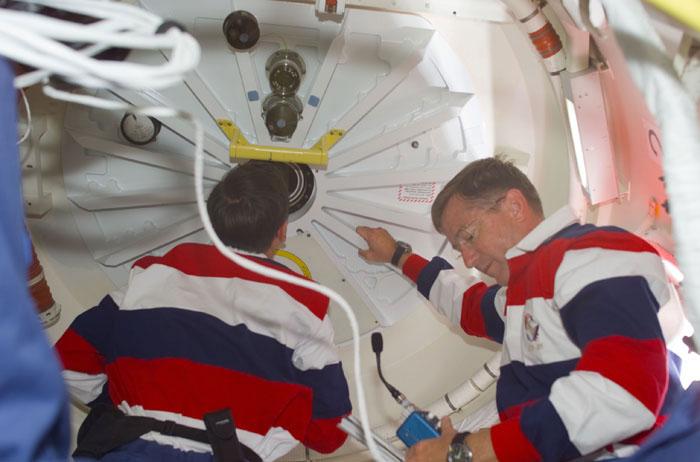
STS105-E-5089 (12 August 2001) --- Scott J. Horowitz (left), STS-105 commander, and Frank L. Culbertson, Jr., Expedition Three mission commander, prepare to open Space Shuttle Discovery's airlock hatch leading to the International Space Station (ISS). Culbertson and cosmonauts Mikhail Tyurin and Vladimir N. Dezhurov will be replacing the Expedition Two crew as residents aboard the ISS. This image was taken with a digital still camera.
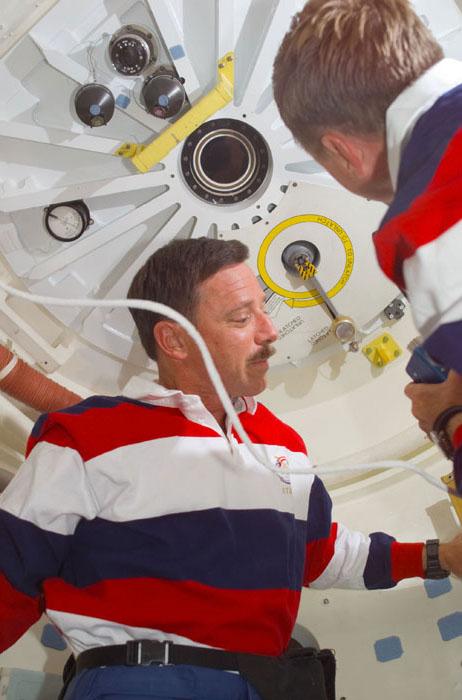
STS105-E-5092 (12 August 2001) --- Scott J. Horowitz (bottom), STS-105 commander, and Frank L. Culbertson, Jr., Expedition Three mission commander, prepare to open Space Shuttle Discovery's airlock hatch leading to the International Space Station (ISS). Culbertson and cosmonauts Mikhail Tyurin and Vladimir N. Dezhurov will be replacing the Expedition Two crew as residents aboard the ISS. This image was taken with a digital still camera.
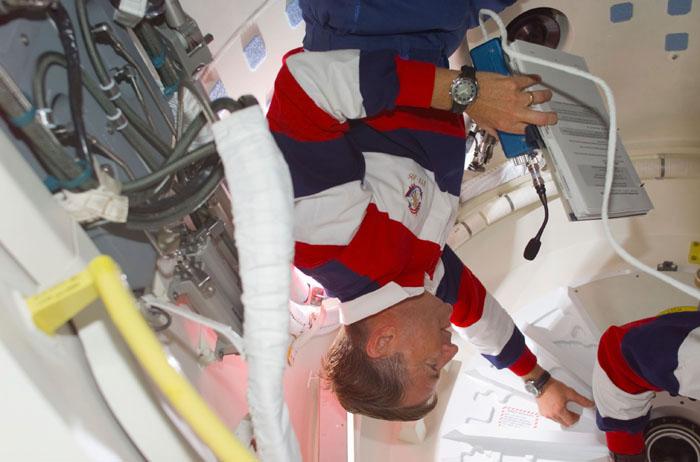
STS105-E-5091 (12 August 2001) --- Frank L. Culbertson, Jr., Expedition Three mission commander, assists Scott J. Horowitz (out of frame to the right), STS-105 commander, in opening Space Shuttle Discovery's airlock hatch leading to the International Space Station (ISS). Culbertson and cosmonauts Mikhail Tyurin and Vladimir N. Dezhurov will be replacing the Expedition Two crew as residents aboard the ISS. This image was taken with a digital still camera.
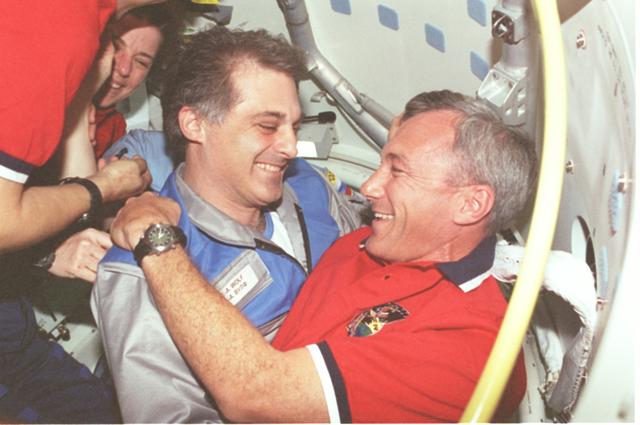
STS089-386-013 (22-31 Jan. 1998) --- Astronaut David A. Wolf, cosmonaut guest researcher, greets Terrence W. Wilcutt, STS-89 shuttle mission commander, and Bonnie J. Dunbar, payload commander, after hatch opening following Russia?s Mir Space Station's and the space shuttle Endeavour's docking. The greeting kicked off several days of joint activity between the NASA and Mir crew members, during the eighth shuttle/Mir docking mission. Photo credit: NASA
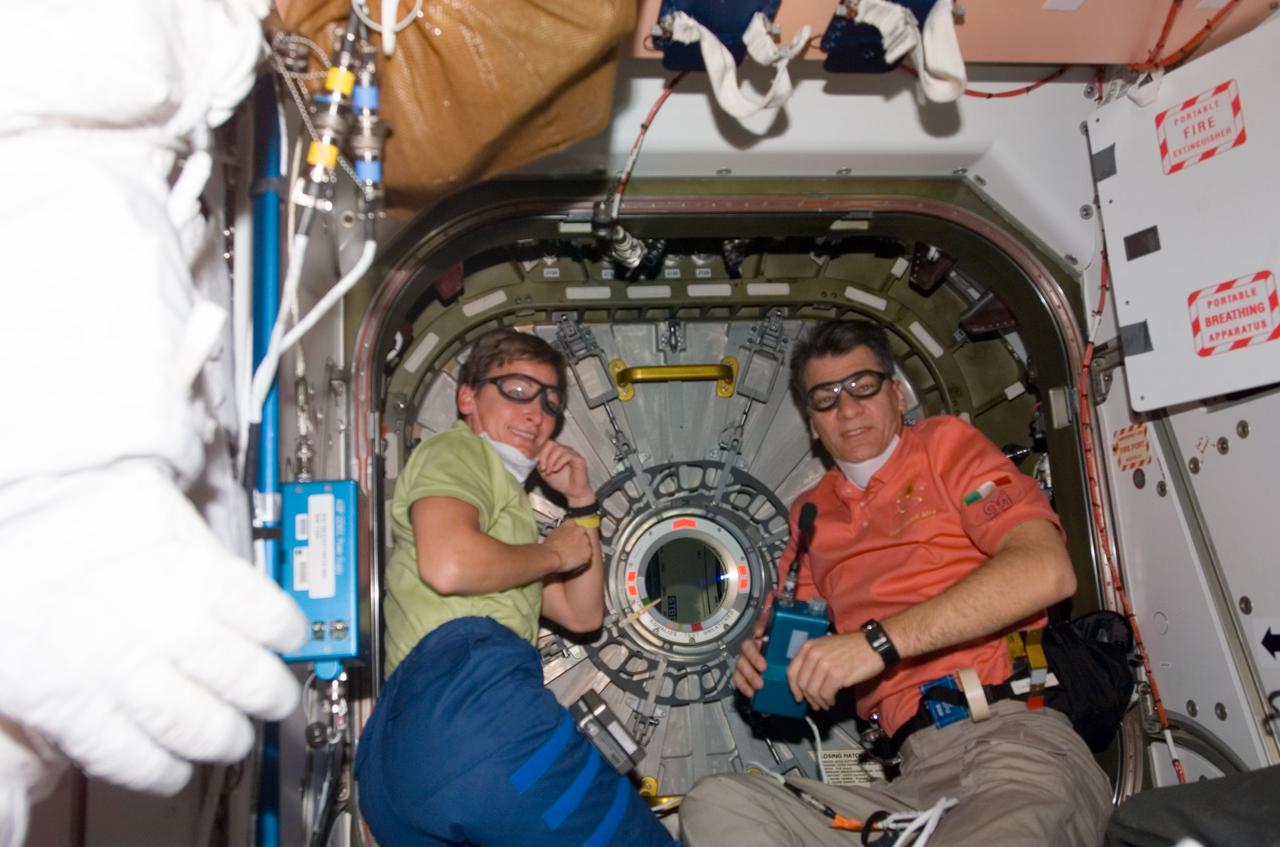
S120-E-006895 (27 Oct. 2007) --- Astronauts Peggy A. Whitson (left), Expedition 16 commander, and European Space Agency's (ESA) Paolo Nespoli, STS-120 mission specialist, take a moment for a photo as they prepare to open the hatch to the Harmony node -- the newest additional to the International Space Station -- while Space Shuttle Discovery is docked with the station.
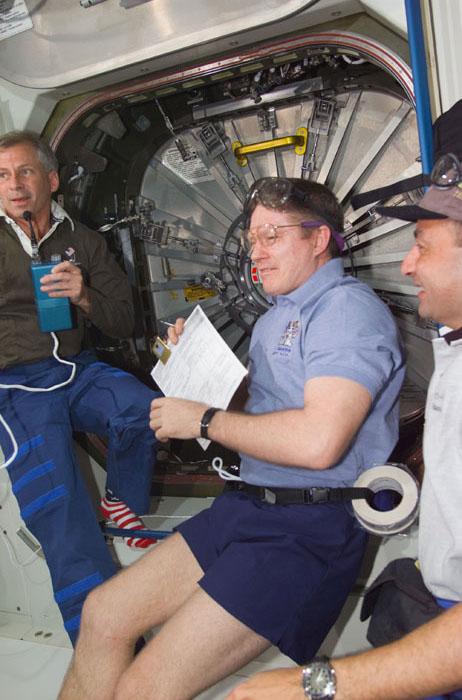
STS98-E-5127 (11 February 2001) --- Inside the Unity node, astronaut William M. (Bill) Shepherd (center), Expedition One commander, prepares to sign a document of receipt of the U.S. laboratory, called Destiny, as part of the International Space Station (ISS). Looking on are astronauts Kenneth D. Cockrell (left) and Mark L. Polansky, commander and pilot, respectively, for STS-98. The hatch to Destiny, not yet opened, is in the background. This scene was recorded with a digital still camera.
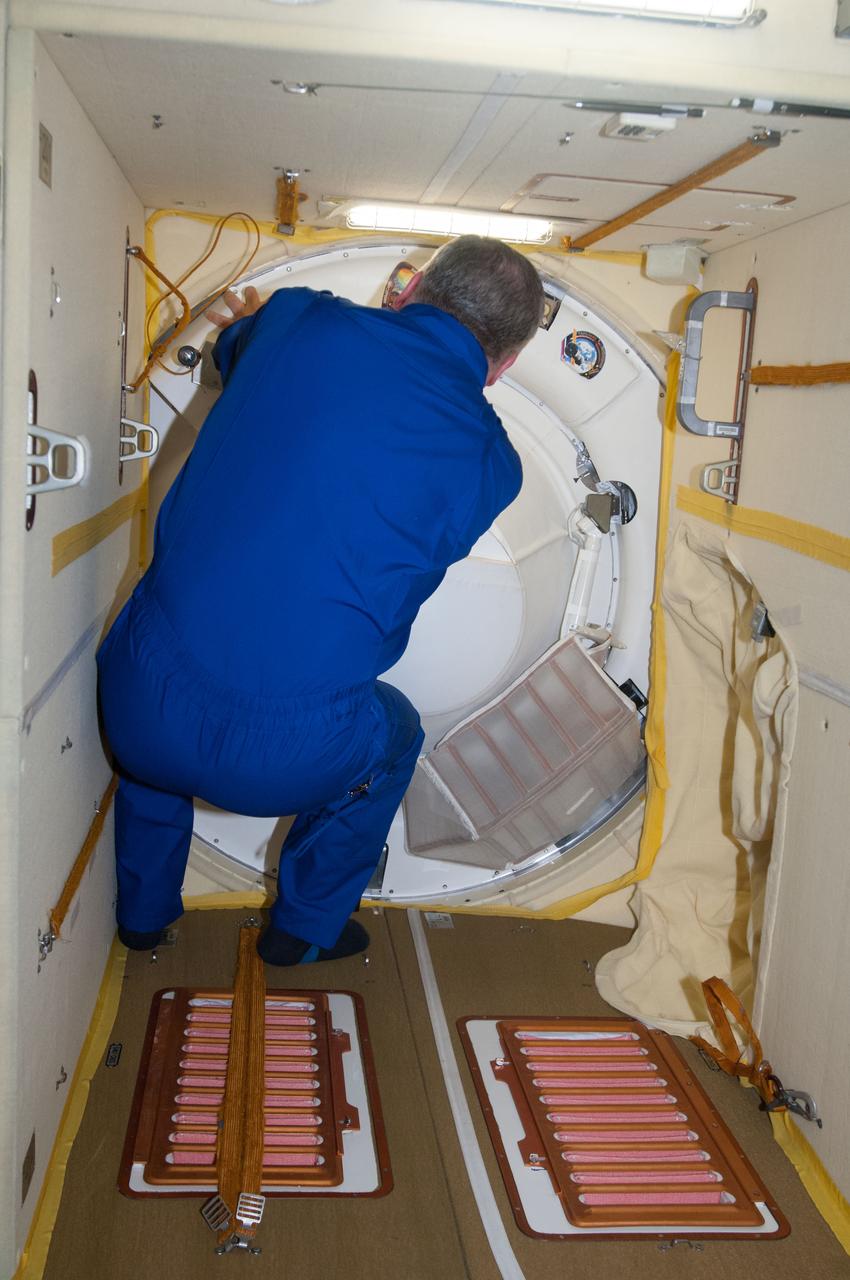
ISS037-E-002684 (25 Sept. 2013) --- Russian cosmonaut Fyodor Yurchikhin, Expedition 37 commander, prepares to open the hatch between the Soyuz TMA-10M spacecraft and the International Space Station's Poisk Mini-Research Module 2 (MRM2) shortly after the Soyuz docked with the station, bringing Russian cosmonauts Oleg Kotov and Sergey Ryazanskiy, and NASA astronaut Michael Hopkins.
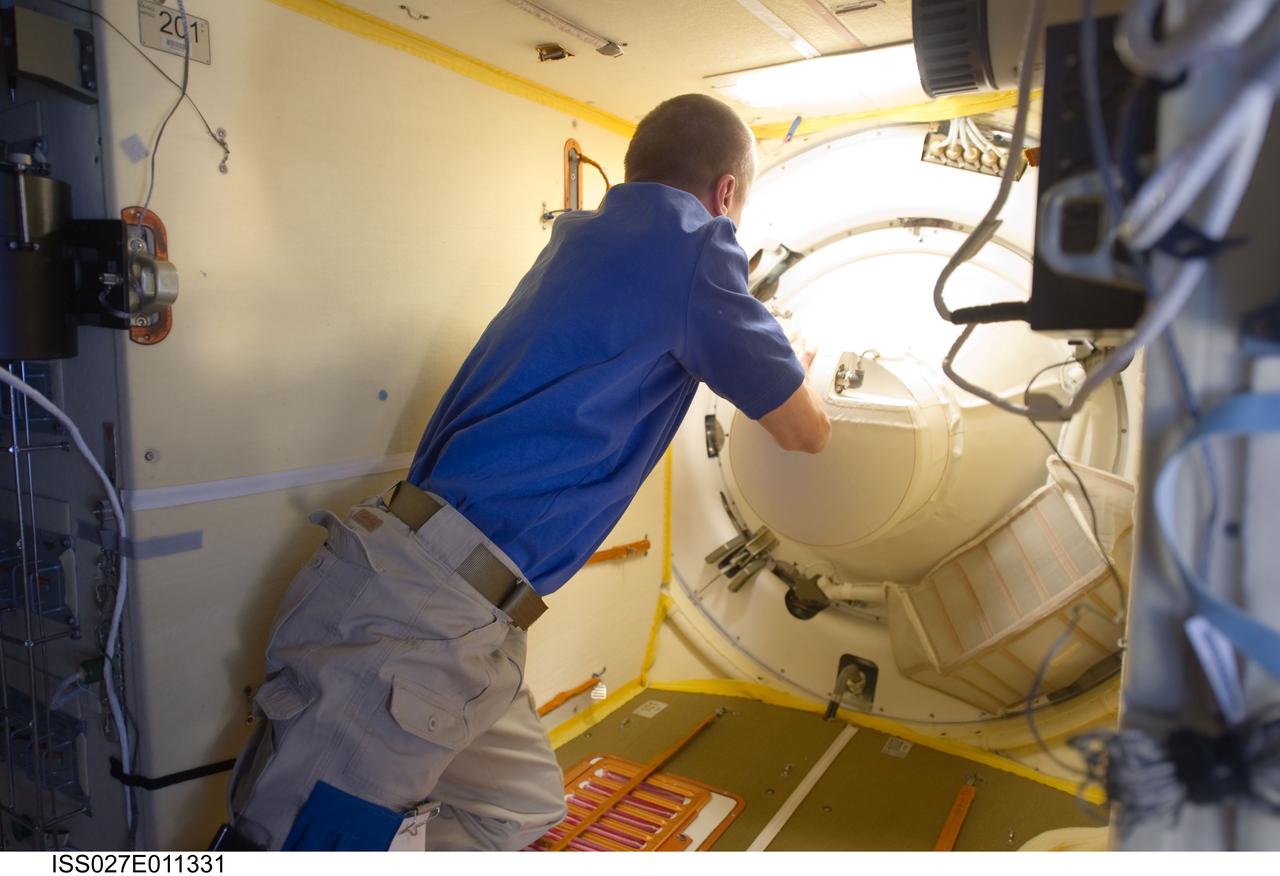
ISS027-E-011331 (6 April 2011) --- Russian cosmonaut Dmitry Kondratyev, Expedition 27 commander, prepares to open the Poisk Mini-Research Module 2 (MRM2) hatch to welcome NASA astronaut Ron Garan, along with Russian cosmonauts Andrey Borisenko and Alexander Samokutyaev, all flight engineers, to the International Space Station. The Soyuz TMA-21 docked to the MRM2 at 7:09 p.m. (EDT) on April 6, 2011.
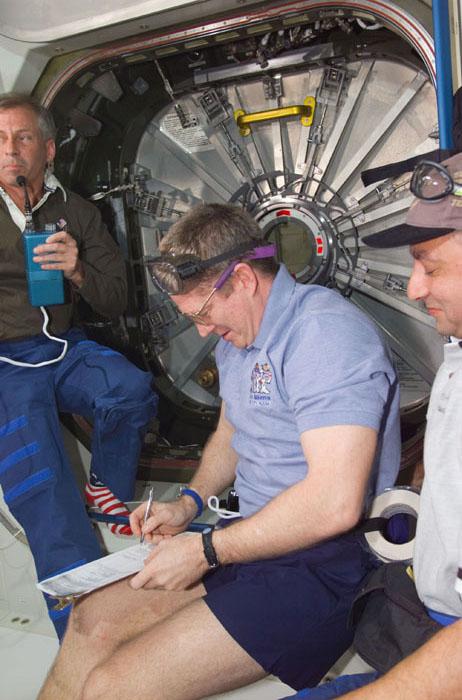
STS98-E-5125 (11 February 2001) --- Inside the Unity node, astronaut William M. (Bill) Shepherd (center), Expedition One commander, signs a document of receipt of the U.S. laboratory, called Destiny, as part of the International Space Station (ISS). Looking on are astronauts Kenneth D. Cockrell (left) and Mark L. Polansky, commander and pilot, respectively, for STS-98. The hatch to Destiny, not yet opened, is in the background. This scene was recorded with a digital still camera.
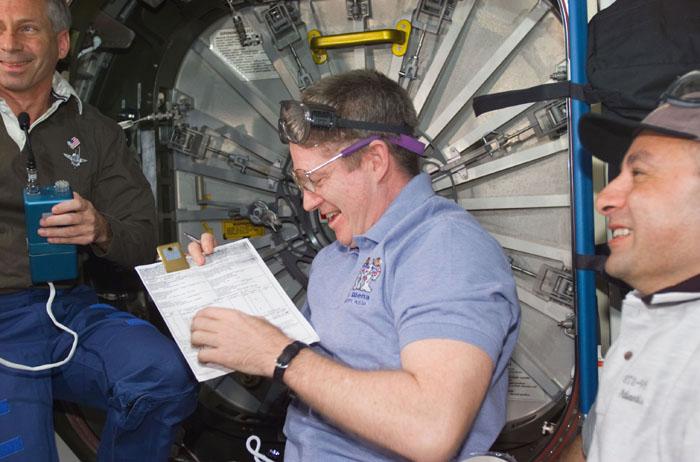
STS98-E-5129 (11 February 2001) --- Inside the Unity node, astronaut William M. (Bill) Shepherd (center), Expedition One commander, signs a document of receipt of the U.S. laboratory, called Destiny, as part of the International Space Station (ISS). Looking on are astronauts Kenneth D. Cockrell (left) and Mark L. Polansky, commander and pilot, respectively, for STS-98. The hatch to Destiny, not yet opened, is in the background. This scene was recorded with a digital still camera.
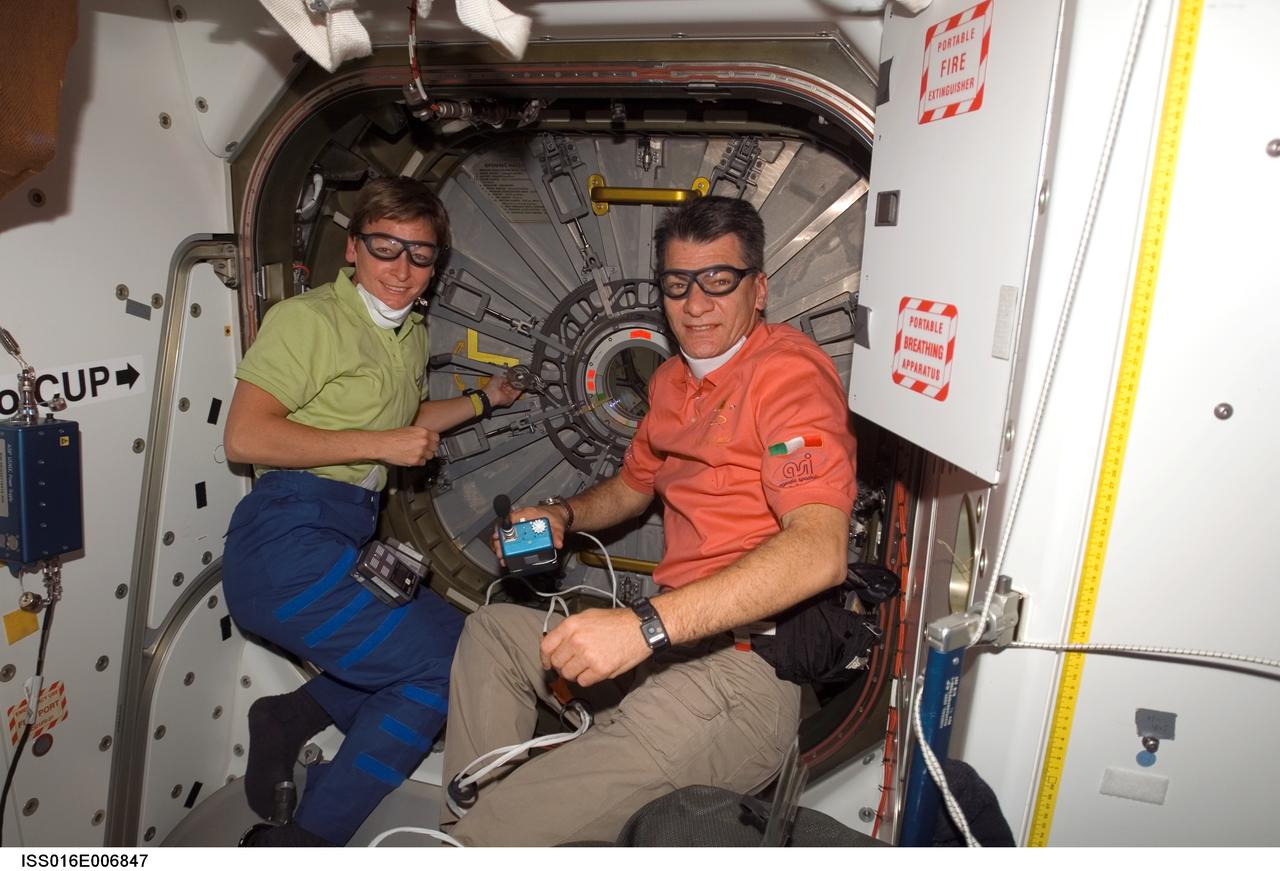
ISS016-E-006847 (27 Oct. 2007) --- NASA astronaut Peggy A. Whitson (left), Expedition 16 commander, and European Space Agency (ESA) astronaut Paolo Nespoli, STS-120 mission specialist, take a moment for a photo as they prepare to open the hatch to the Harmony node -- the newest additional to the International Space Station -- while Space Shuttle Discovery is docked with the station.
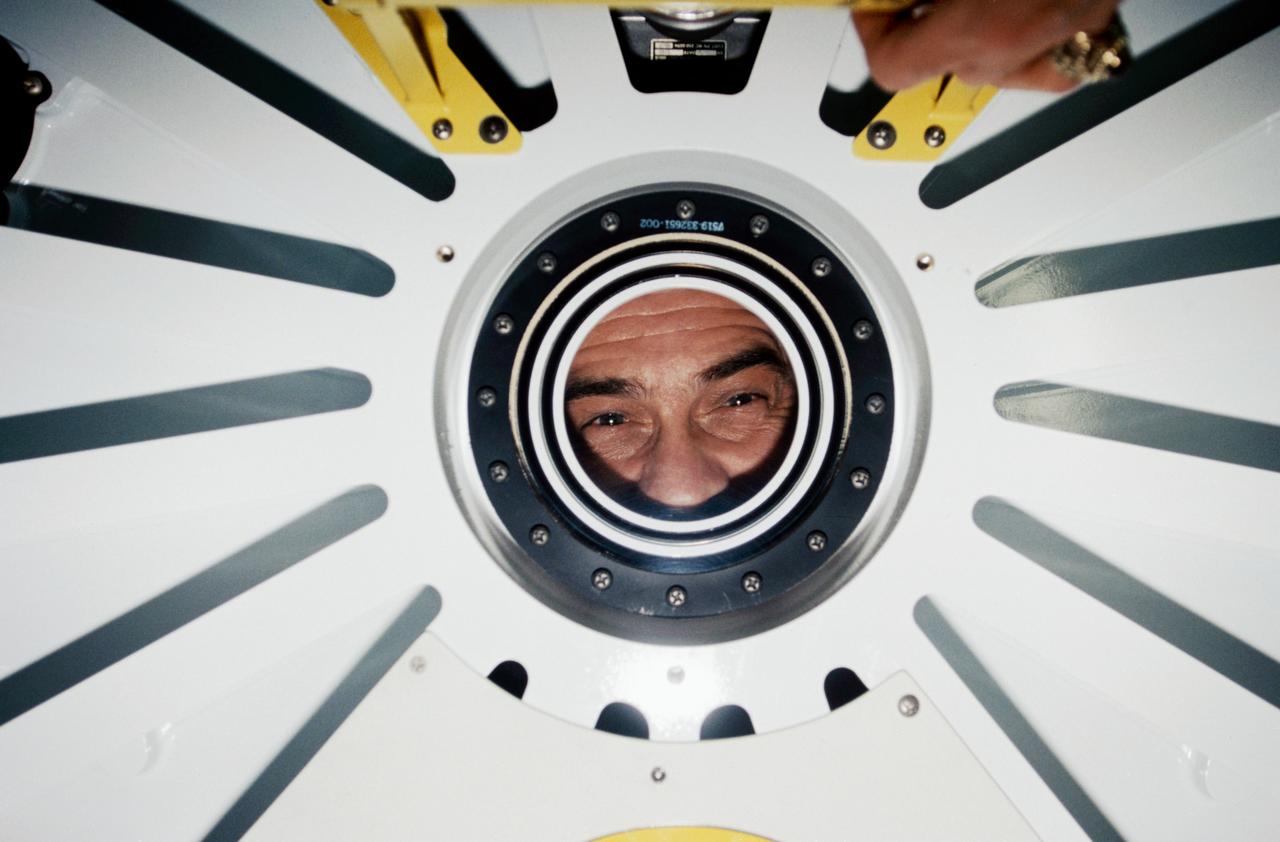
STS089-349-021 (22-31 Jan 1998) --- Cosmonaut Pavel Vinogradov, flight engineer for the Mir-24 crew, peers through the hatch, from the inside of the Russia?s Mir Space Station, at arriving Space Shuttle Endeavour members of the STS-89 crew prior to hatch opening. STS-89/Mir-24 marked the eighth of nine Shuttle/Mir dockings.
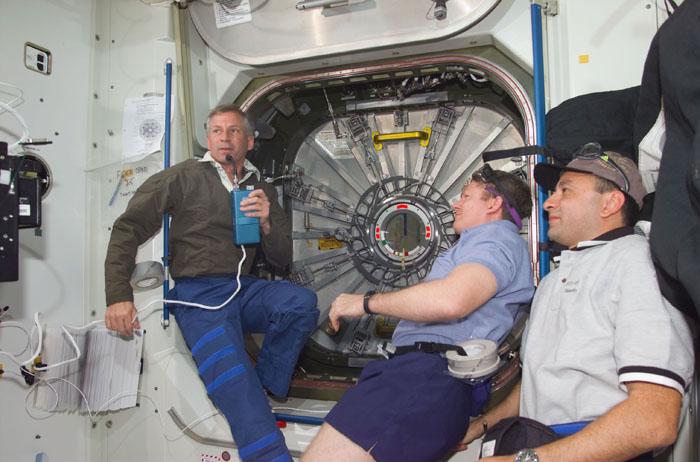
STS98-E-5123 (11 February 2001) --- This digital still camera shot shows STS-98 mission commander Kenneth D. Cockrell (from left), Expedition One commander William M. (Bill) Shepherd and STS-98 pilot Mark L. Polansky pausing at Unity's closed hatch to the newly attached Destiny laboratory. The crews of Atlantis and the International Space Station opened the laboratory shortly after this photo was made on Feb. 11; and the astronauts and cosmonauts spent the first full day of what are planned to be years of work ahead inside the orbiting science and command center. Shepherd opened the Destiny hatch, and he and shuttle commander Cockrell ventured inside at 8:38 a.m. (CST), Feb. 11. As depicted in subsequent digital images in this series, members of both crews went to work quickly inside the new module, activating air systems, fire extinguishers, alarm systems, computers and internal communications. The crew also continued equipment transfers from the shuttle to the station.
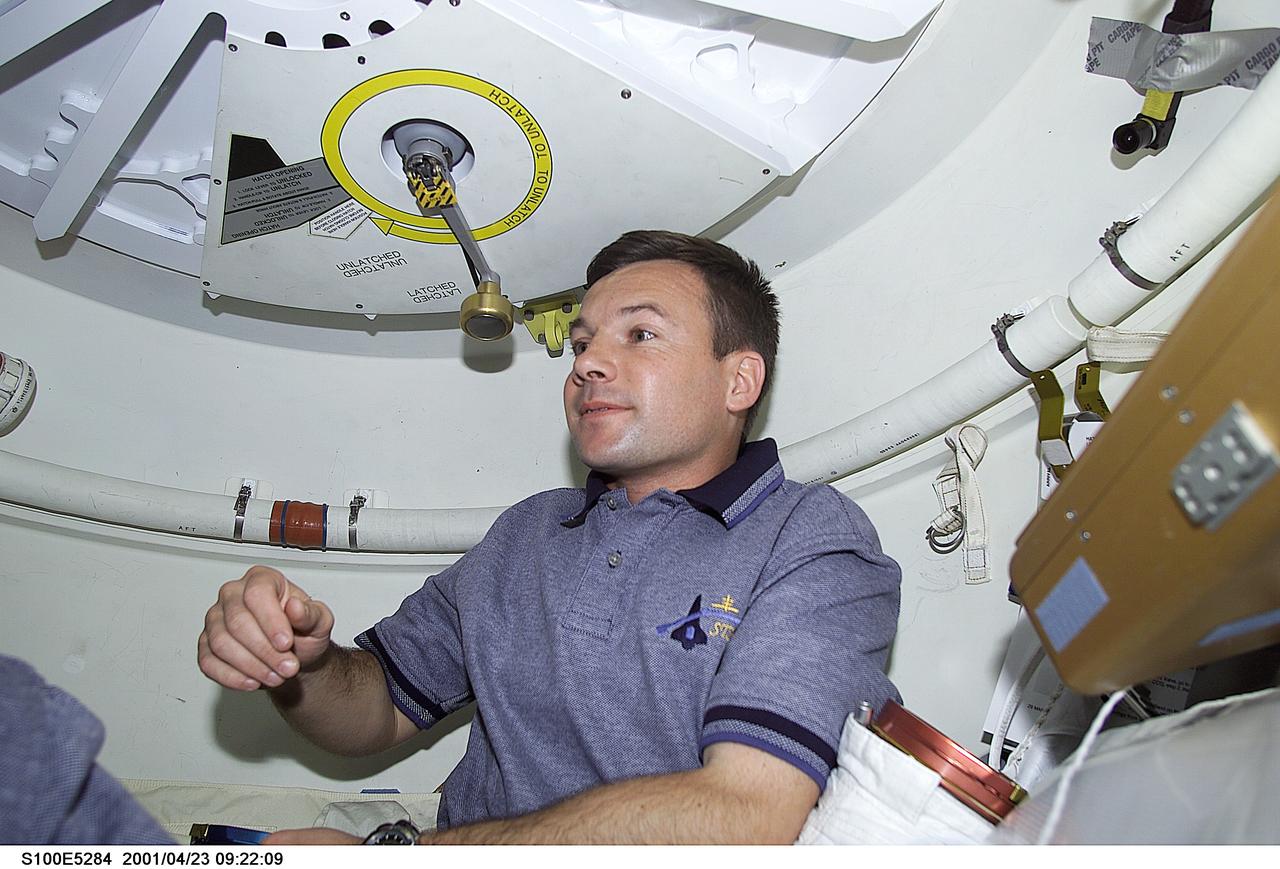
S100-E-5284 (23 April 2001) --- Cosmonaut Yuri V. Lonchakov, STS-100 mission specialist representing Rosaviakosmos, is in the Pressurized Mating Adapter (PMA-2) prior to hatch-opening. The image was recorded with a digital still camera.
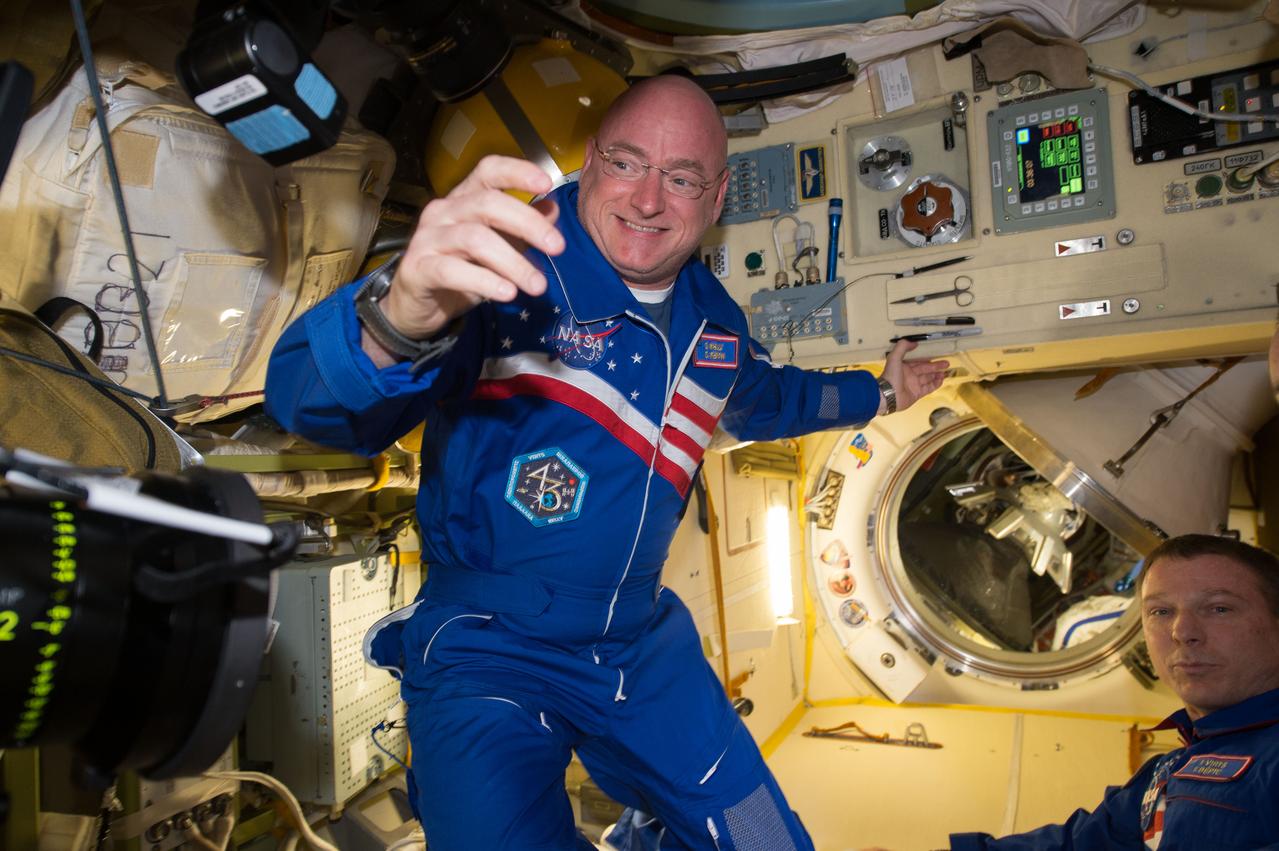
ISS043E059259 (03/28/2015) --- NASA astronaut Scott Kelly (left) is happy to be aboard the International Space Station after the hatch opening of the Soyuz spacecraft Mar. 28, 2015. Kelly traveled with Expedition 43 Russian cosmonauts Mikhail Kornienko and Gennady Padalka of the Russian Federal Space Agency (Roscosmos) on the Soyuz TMA-16M that launched Friday, March 27, 2015 from Baikonur, Kazakhstan. Kelly and Kornienko will spend a year in space and return to Earth on Soyuz TMA-18M in March 2016. Most expeditions to the space station last four to six months. By doubling the length of this mission, researchers hope to better understand how the human body reacts and adapts to long-duration spaceflight. This knowledge is critical as NASA looks toward human journeys deeper into the solar system, including to and from Mars.
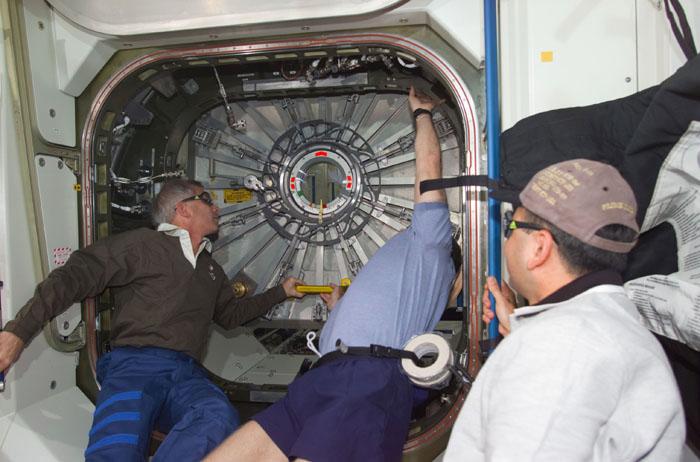
STS98-E-5131 (11 February 2001) --- The crews of Atlantis and the International Space Station open the Destiny laboratory on February 11 in this digital still camera view. From the left are astronauts Kenneth D. Cockrell, STS-98 commander; William M. (Bill) Shepherd, Expedition One commander; and Mark L. Polansky, STS-98 pilot. Later, the astronauts and cosmonauts spent the first full day of what are planned to be years of work ahead inside the orbiting science and command center. After Shepherd opened the Destiny hatch, he and Cockrell ventured inside at 8:38 a.m. (CST). As depicted in subsequent digital images in this series, members of both crews went to work quickly inside the new module, activating air systems, fire extinguishers, alarm systems, computers and internal communications. The crew also continued equipment transfers from the shuttle to the station.
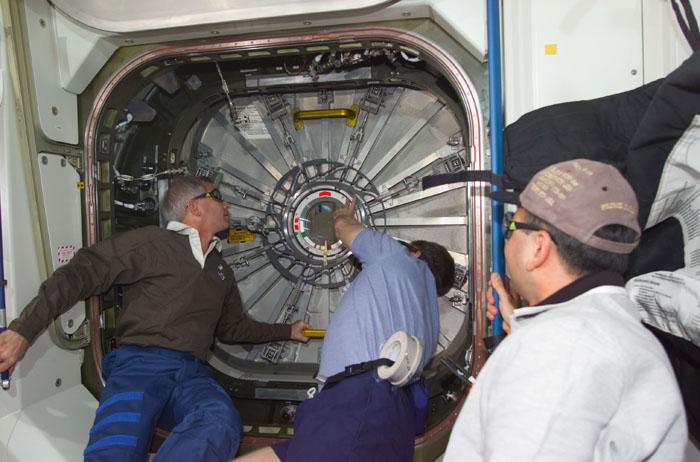
STS98-E-5130 (11 February 2001) --- The crews of Atlantis and the International Space Station open the Destiny laboratory on February 11 in this digital still camera view. From the left are astronauts Kenneth D. Cockrell, STS-98 commander; William M. (Bill) Shepherd, Expedition One commander; and Mark L. Polansky, STS-98 pilot. Later, the astronauts and cosmonauts spent the first full day of what are planned to be years of work ahead inside the orbiting science and command center. After Shepherd opened the Destiny hatch, he and Cockrell ventured inside at 8:38 a.m. (CST). As depicted in subsequent digital images in this series, members of both crews went to work quickly inside the new module, activating air systems, fire extinguishers, alarm systems, computers and internal communications. The crew also continued equipment transfers from the shuttle to the station.
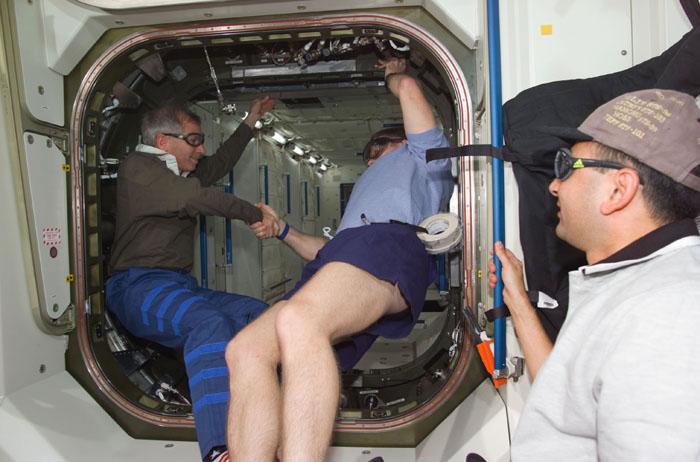
STS98-E-5133 (11 February 2001) --- The crew commanders of Atlantis and the International Space Station shake hands following the opening of the Destiny laboratory on February 11 in this digital still camera view. From the left are astronauts Kenneth D. Cockrell, STS-98 commander; William M. (Bill) Shepherd, Expedition One commander; and Mark L. Polansky, STS-98 pilot. Later, the astronauts and cosmonauts spent the first full day of what are planned to be years of work ahead inside the orbiting science and command center. After Shepherd opened the Destiny hatch, he and Cockrell ventured inside at 8:38 a.m. (CST). As depicted in subsequent digital images in this series, members of both crews went to work quickly inside the new module, activating air systems, fire extinguishers, alarm systems, computers and internal communications. The crew also continued equipment transfers from the shuttle to the station.
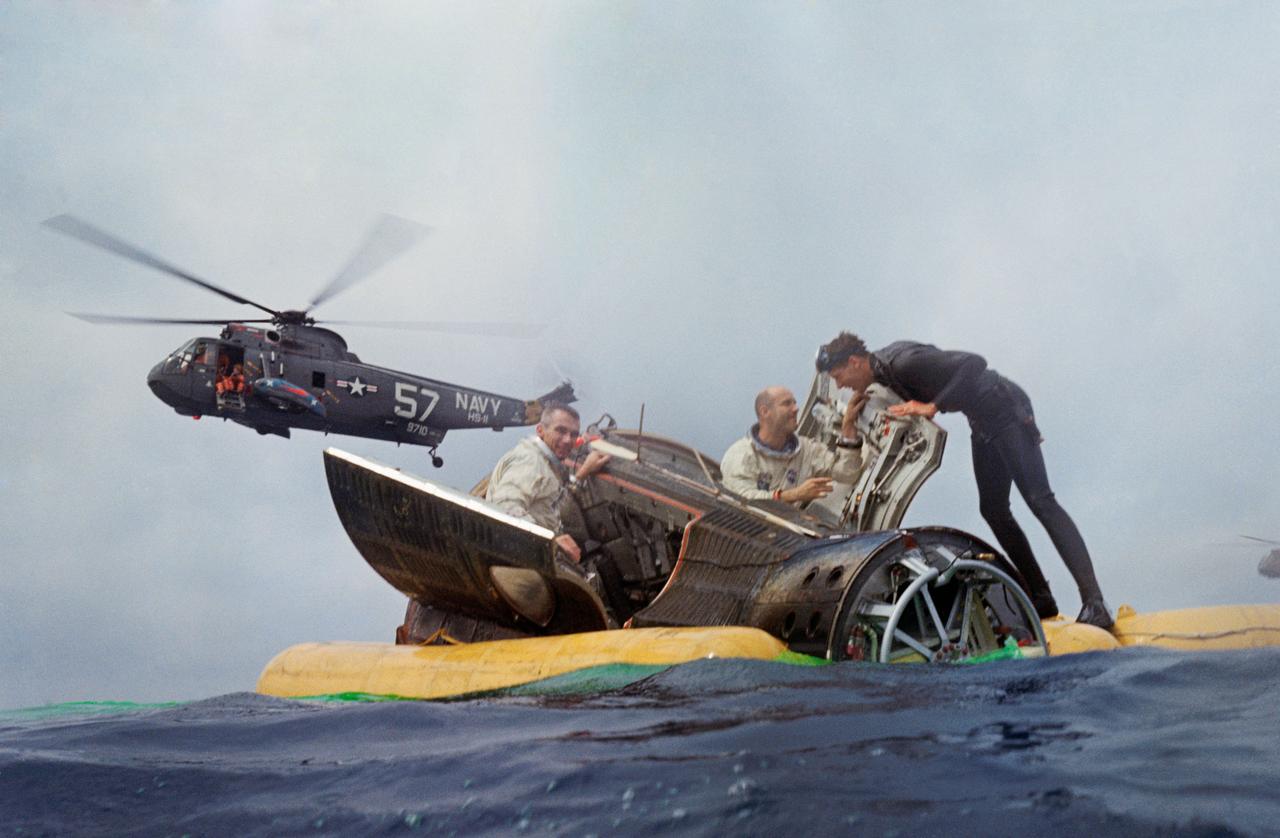
S66-34124 (6 June 1966) --- Astronauts Eugene A. Cernan and Thomas P. Stafford sit with their Gemini 9A spacecraft hatches open while awaiting the arrival of the recovery ship U.S.S. Wasp.

Kathy Lueders, manager of NASA's Commercial Crew Program, watches as the hatches are opened between SpaceX’s Crew Dragon spacecraft with NASA astronauts Douglas Hurley and Robert Behnken onboard and the International Space Station, Sunday, May 31, 2020, in firing room four of the Launch Control Center at NASA’s Kennedy Space Center in Florida. NASA’s SpaceX Demo-2 mission is the first launch with astronauts of the SpaceX Crew Dragon spacecraft and Falcon 9 rocket to the International Space Station as part of the agency’s Commercial Crew Program. The test flight serves as an end-to-end demonstration of SpaceX’s crew transportation system. Behnken and Hurley launched at 3:22 p.m. EDT on Saturday, May 30, from Launch Complex 39A at the Kennedy Space Center and docked with the International Space Station at 10:16am EDT on Sunday, May 31.. A new era of human spaceflight is set to begin as American astronauts once again launch on an American rocket from American soil to low-Earth orbit for the first time since the conclusion of the Space Shuttle Program in 2011. Photo Credit: (NASA/Joel Kowsky)
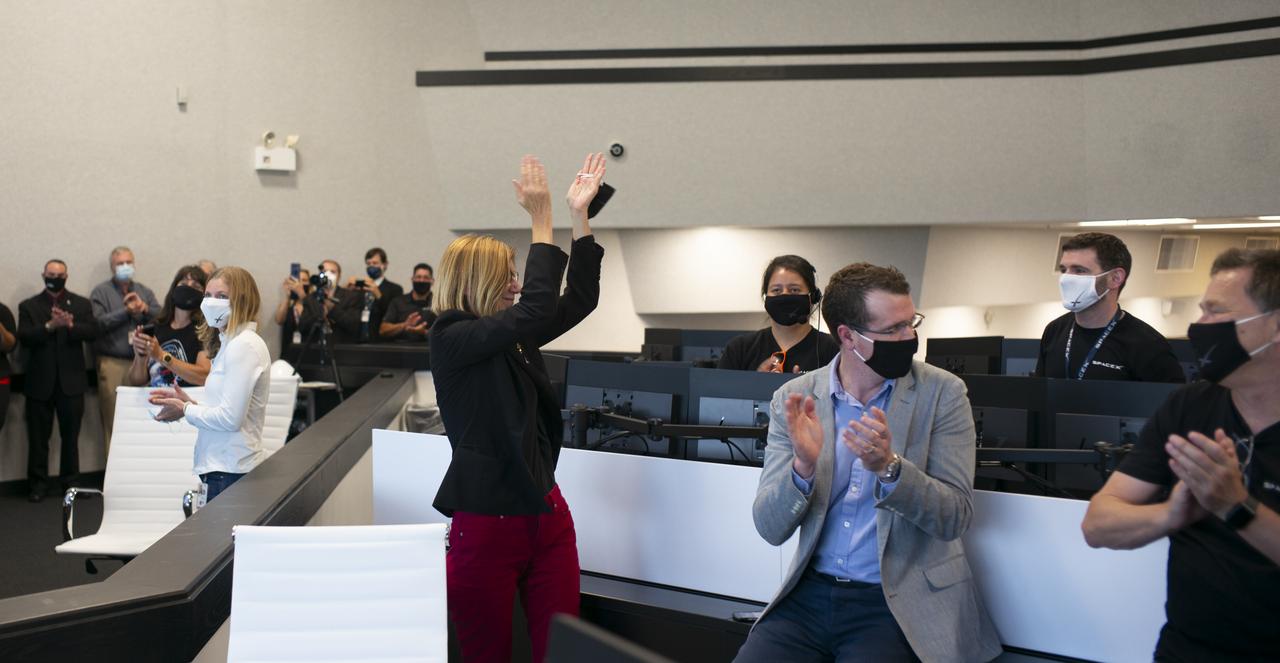
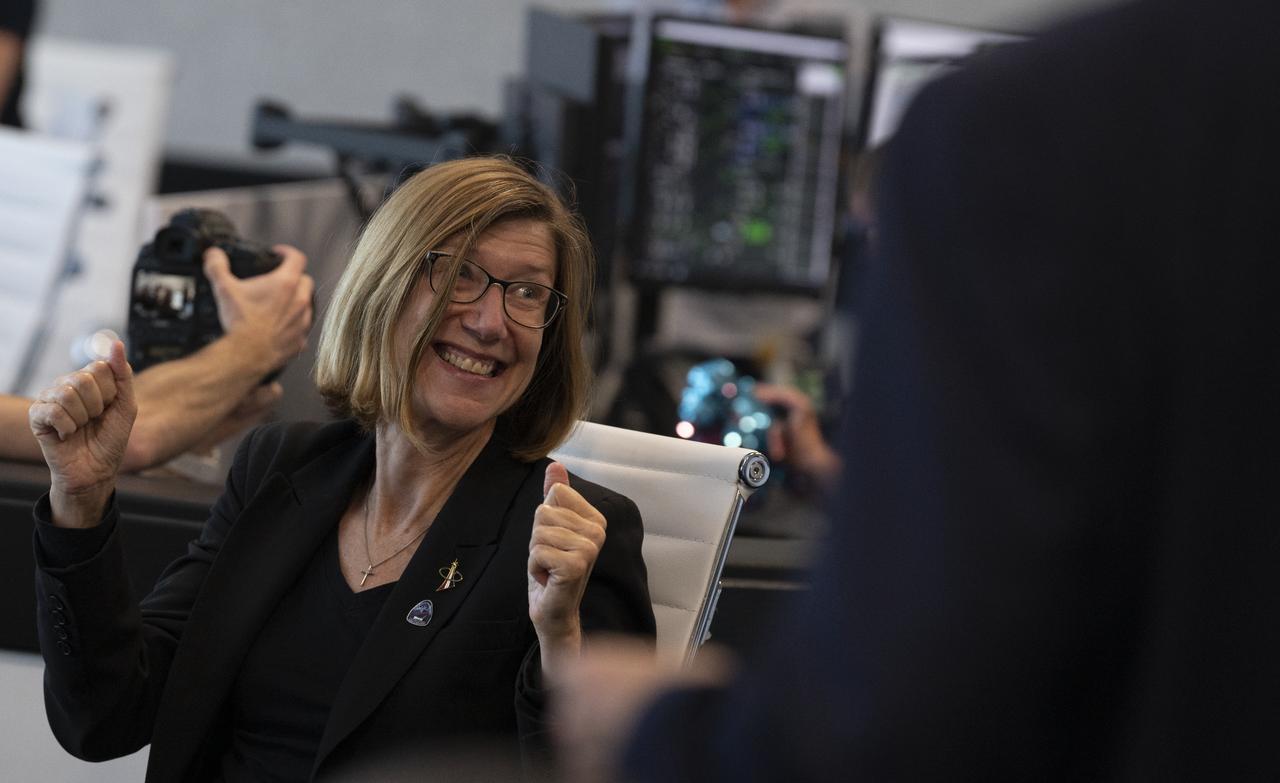
Kathy Lueders, manager of NASA's Commercial Crew Program, applauds the SpaceX and NASA teams present in firing room four after the hatches were opened between SpaceX’s Crew Dragon spacecraft with NASA astronauts Douglas Hurley and Robert Behnken onboard and the International Space Station, Sunday, May 31, 2020, in firing room four of the Launch Control Center at NASA’s Kennedy Space Center in Florida. NASA’s SpaceX Demo-2 mission is the first launch with astronauts of the SpaceX Crew Dragon spacecraft and Falcon 9 rocket to the International Space Station as part of the agency’s Commercial Crew Program. The test flight serves as an end-to-end demonstration of SpaceX’s crew transportation system. Behnken and Hurley launched at 3:22 p.m. EDT on Saturday, May 30, from Launch Complex 39A at the Kennedy Space Center and docked with the International Space Station at 10:16am EDT on Sunday, May 31.. A new era of human spaceflight is set to begin as American astronauts once again launch on an American rocket from American soil to low-Earth orbit for the first time since the conclusion of the Space Shuttle Program in 2011. Photo Credit: (NASA/Joel Kowsky)
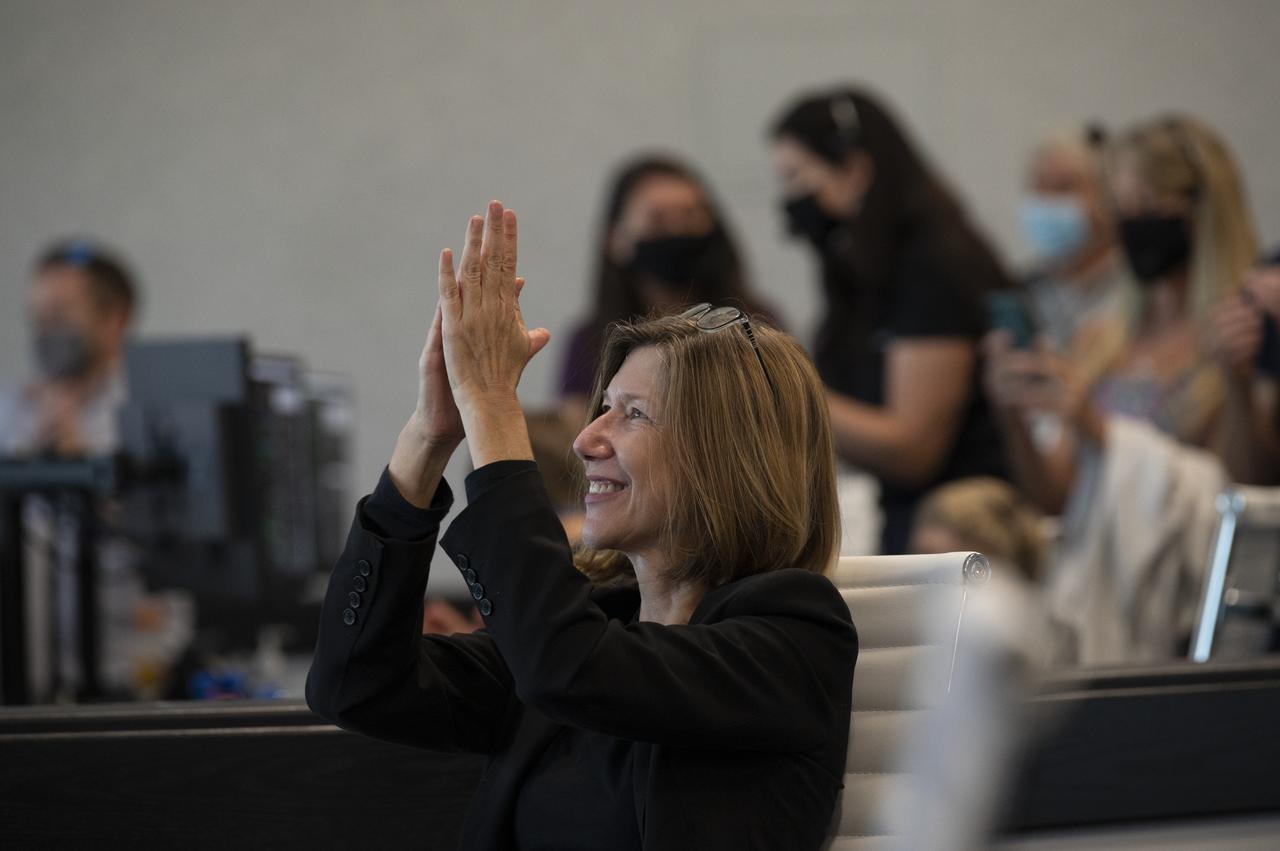
Kathy Lueders, manager of NASA's Commercial Crew Program, is seen after the hatches are opened between SpaceX’s Crew Dragon spacecraft with NASA astronauts Douglas Hurley and Robert Behnken onboard and the International Space Station, Sunday, May 31, 2020, in firing room four of the Launch Control Center at NASA’s Kennedy Space Center in Florida. NASA’s SpaceX Demo-2 mission is the first launch with astronauts of the SpaceX Crew Dragon spacecraft and Falcon 9 rocket to the International Space Station as part of the agency’s Commercial Crew Program. The test flight serves as an end-to-end demonstration of SpaceX’s crew transportation system. Behnken and Hurley launched at 3:22 p.m. EDT on Saturday, May 30, from Launch Complex 39A at the Kennedy Space Center and docked with the International Space Station at 10:16am EDT on Sunday, May 31.. A new era of human spaceflight is set to begin as American astronauts once again launch on an American rocket from American soil to low-Earth orbit for the first time since the conclusion of the Space Shuttle Program in 2011. Photo Credit: (NASA/Joel Kowsky)
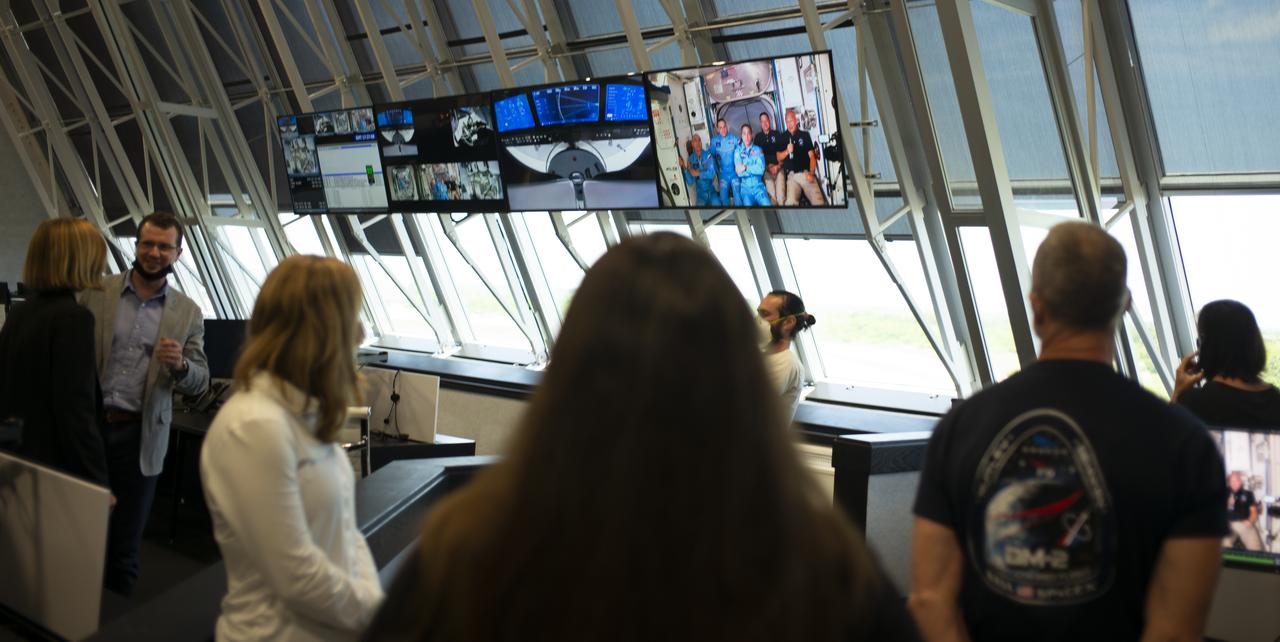
NASA astronauts Robert Behnken and Douglas Hurley are seen with Expedition 53 Commander NASA astronaut Chris Cassidy and cosmonauts Anatoly Ivanishin and Ivan Vagner of Roscosmos onboard the International Space Station after hatches were opened between SpaceX’s Crew Dragon spacecraft the orbiting laboratory, Sunday, May 31, 2020, in firing room four of the Launch Control Center at NASA’s Kennedy Space Center in Florida. NASA’s SpaceX Demo-2 mission is the first launch with astronauts of the SpaceX Crew Dragon spacecraft and Falcon 9 rocket to the International Space Station as part of the agency’s Commercial Crew Program. The test flight serves as an end-to-end demonstration of SpaceX’s crew transportation system. Behnken and Hurley launched at 3:22 p.m. EDT on Saturday, May 30, from Launch Complex 39A at the Kennedy Space Center and docked with the International Space Station at 10:16am EDT on Sunday, May 31. A new era of human spaceflight is set to begin as American astronauts once again launch on an American rocket from American soil to low-Earth orbit for the first time since the conclusion of the Space Shuttle Program in 2011. Photo Credit: (NASA/Joel Kowsky)
Kathy Lueders, manager of NASA's Commercial Crew Program, is seen after the hatches are opened between SpaceX’s Crew Dragon spacecraft with NASA astronauts Douglas Hurley and Robert Behnken onboard and the International Space Station, Sunday, May 31, 2020, in firing room four of the Launch Control Center at NASA’s Kennedy Space Center in Florida. NASA’s SpaceX Demo-2 mission is the first launch with astronauts of the SpaceX Crew Dragon spacecraft and Falcon 9 rocket to the International Space Station as part of the agency’s Commercial Crew Program. The test flight serves as an end-to-end demonstration of SpaceX’s crew transportation system. Behnken and Hurley launched at 3:22 p.m. EDT on Saturday, May 30, from Launch Complex 39A at the Kennedy Space Center and docked with the International Space Station at 10:16am EDT on Sunday, May 31.. A new era of human spaceflight is set to begin as American astronauts once again launch on an American rocket from American soil to low-Earth orbit for the first time since the conclusion of the Space Shuttle Program in 2011. Photo Credit: (NASA/Joel Kowsky)
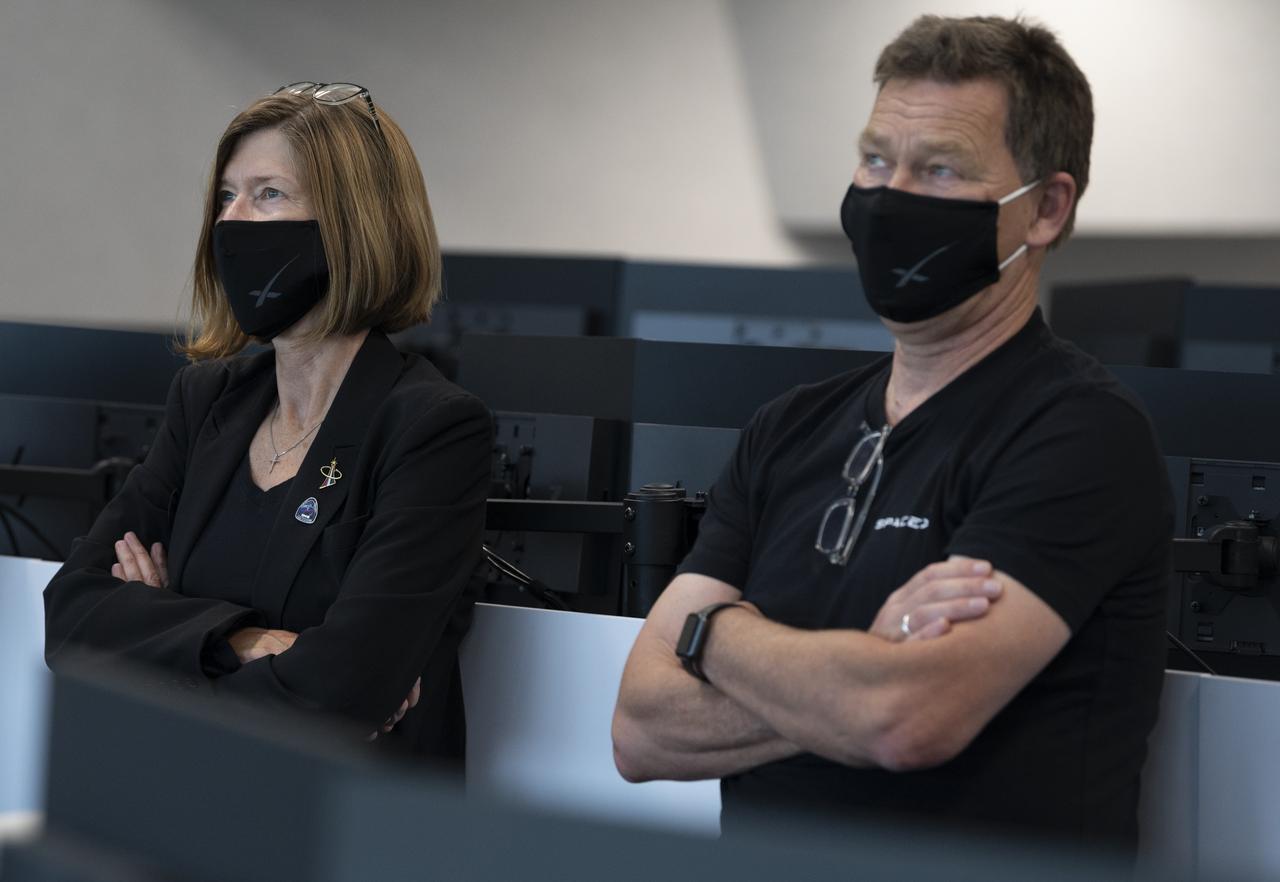
Kathy Lueders, manager of NASA's Commercial Crew Program, left, and Hans Koenigsmann, vice president for build and flight reliability at SpaceX, watch as the hatches are opened between SpaceX’s Crew Dragon spacecraft with NASA astronauts Douglas Hurley and Robert Behnken onboard and the International Space Station, Sunday, May 31, 2020, in firing room four of the Launch Control Center at NASA’s Kennedy Space Center in Florida. NASA’s SpaceX Demo-2 mission is the first launch with astronauts of the SpaceX Crew Dragon spacecraft and Falcon 9 rocket to the International Space Station as part of the agency’s Commercial Crew Program. The test flight serves as an end-to-end demonstration of SpaceX’s crew transportation system. Behnken and Hurley launched at 3:22 p.m. EDT on Saturday, May 30, from Launch Complex 39A at the Kennedy Space Center and docked with the International Space Station at 10:16am EDT on Sunday, May 31.. A new era of human spaceflight is set to begin as American astronauts once again launch on an American rocket from American soil to low-Earth orbit for the first time since the conclusion of the Space Shuttle Program in 2011. Photo Credit: (NASA/Joel Kowsky)

Ken Bowersox, acting Associate Administrator for NASA's Human Exploration and Operations Mission Directorate, watches as the hatches are opened between SpaceX’s Crew Dragon spacecraft with NASA astronauts Douglas Hurley and Robert Behnken onboard and the International Space Station, Sunday, May 31, 2020, in firing room four of the Launch Control Center at NASA’s Kennedy Space Center in Florida. NASA’s SpaceX Demo-2 mission is the first launch with astronauts of the SpaceX Crew Dragon spacecraft and Falcon 9 rocket to the International Space Station as part of the agency’s Commercial Crew Program. The test flight serves as an end-to-end demonstration of SpaceX’s crew transportation system. Behnken and Hurley launched at 3:22 p.m. EDT on Saturday, May 30, from Launch Complex 39A at the Kennedy Space Center and docked with the International Space Station at 10:16am EDT on Sunday, May 31.. A new era of human spaceflight is set to begin as American astronauts once again launch on an American rocket from American soil to low-Earth orbit for the first time since the conclusion of the Space Shuttle Program in 2011. Photo Credit: (NASA/Joel Kowsky)
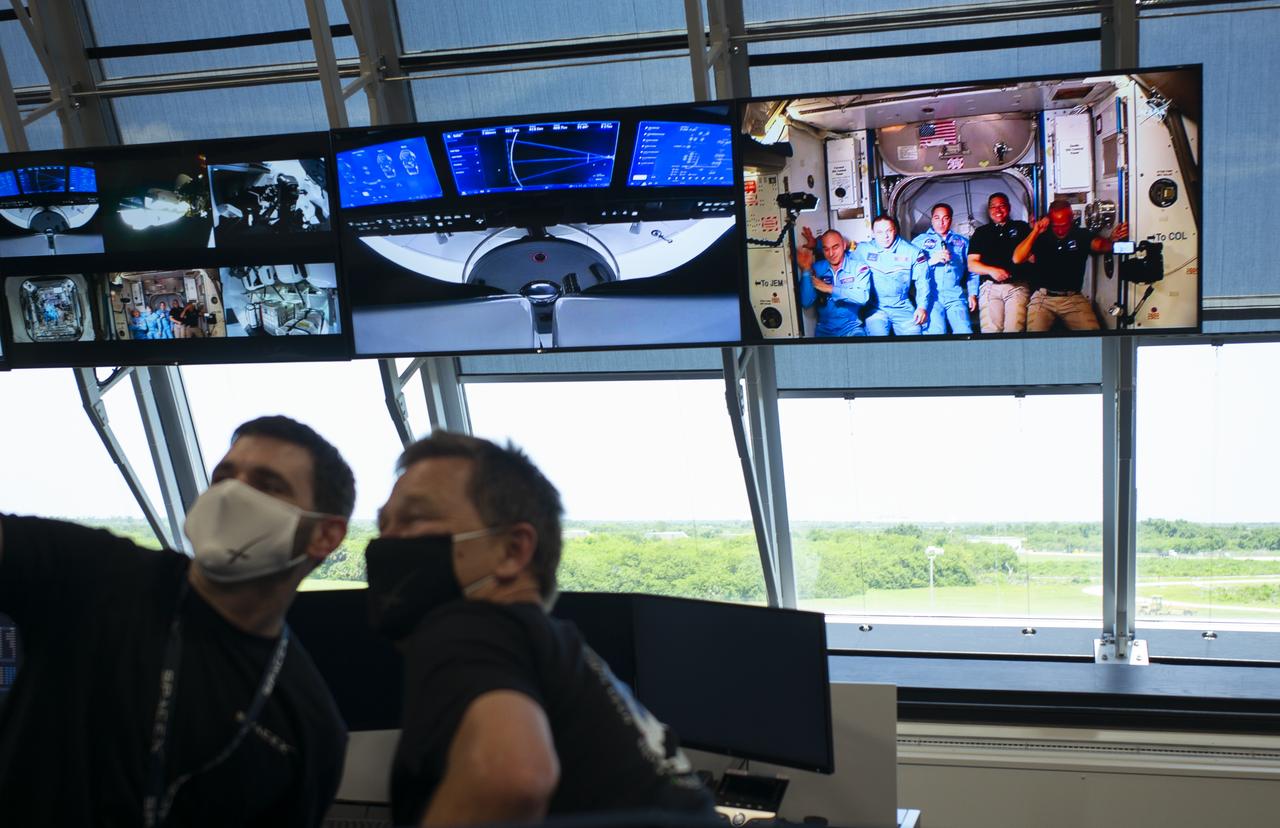
NASA astronauts Robert Behnken and Douglas Hurley are seen with Expedition 53 Commander NASA astronaut Chris Cassidy and cosmonauts Anatoly Ivanishin and Ivan Vagner of Roscosmos onboard the International Space Station after hatches were opened between SpaceX’s Crew Dragon spacecraft the orbiting laboratory, Sunday, May 31, 2020, in firing room four of the Launch Control Center at NASA’s Kennedy Space Center in Florida. NASA’s SpaceX Demo-2 mission is the first launch with astronauts of the SpaceX Crew Dragon spacecraft and Falcon 9 rocket to the International Space Station as part of the agency’s Commercial Crew Program. The test flight serves as an end-to-end demonstration of SpaceX’s crew transportation system. Behnken and Hurley launched at 3:22 p.m. EDT on Saturday, May 30, from Launch Complex 39A at the Kennedy Space Center and docked with the International Space Station at 10:16am EDT on Sunday, May 31. A new era of human spaceflight is set to begin as American astronauts once again launch on an American rocket from American soil to low-Earth orbit for the first time since the conclusion of the Space Shuttle Program in 2011. Photo Credit: (NASA/Joel Kowsky)
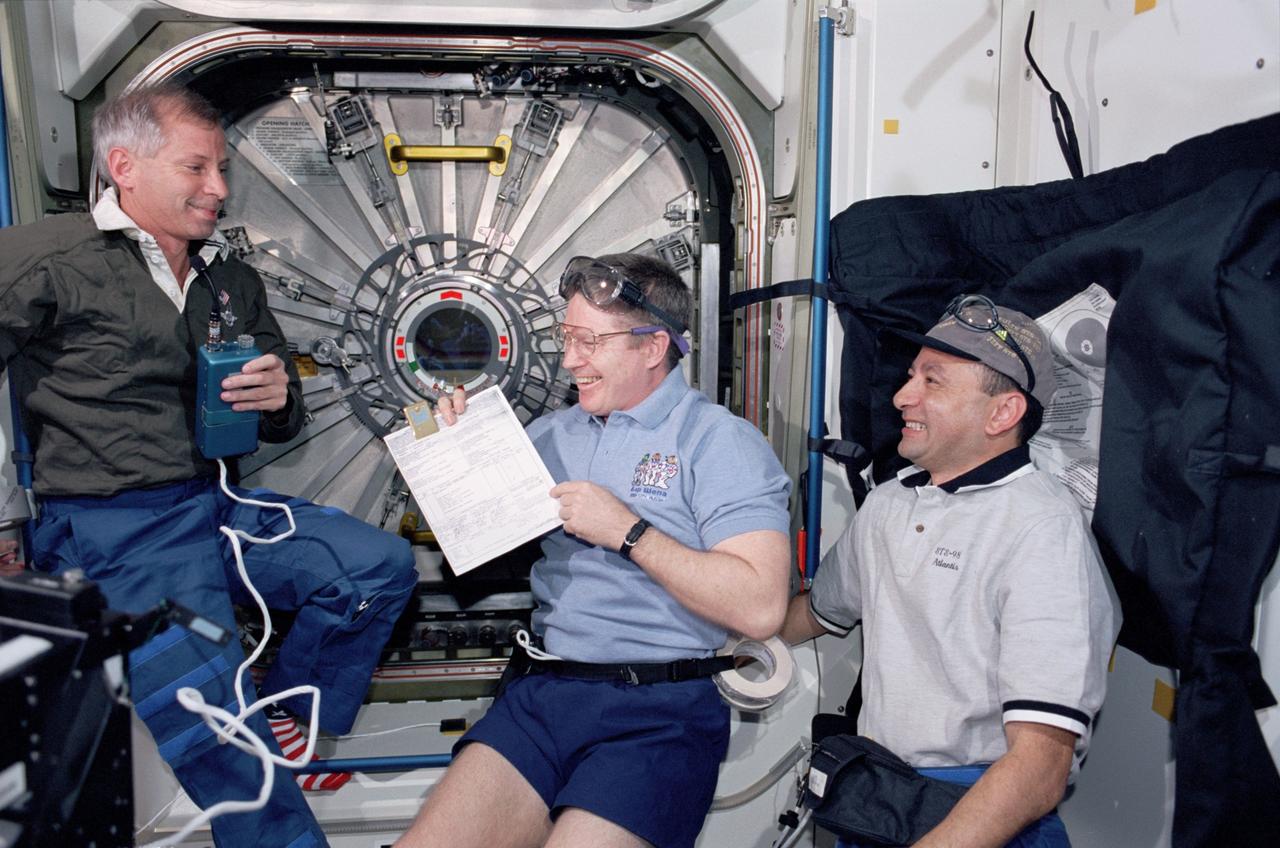
STS098-352-0019 (11 February 2001) --- Inside the Unity node, astronaut William M. (Bill) Shepherd (center), Expedition One commander, holds a document of receipt of the U.S. laboratory, called Destiny, as part of the International Space Station (ISS). Looking on are astronauts Kenneth D. Cockrell (left) and Mark L. Polansky, commander and pilot, respectively, for STS-98. The hatch to Destiny, not yet opened, is in the background.
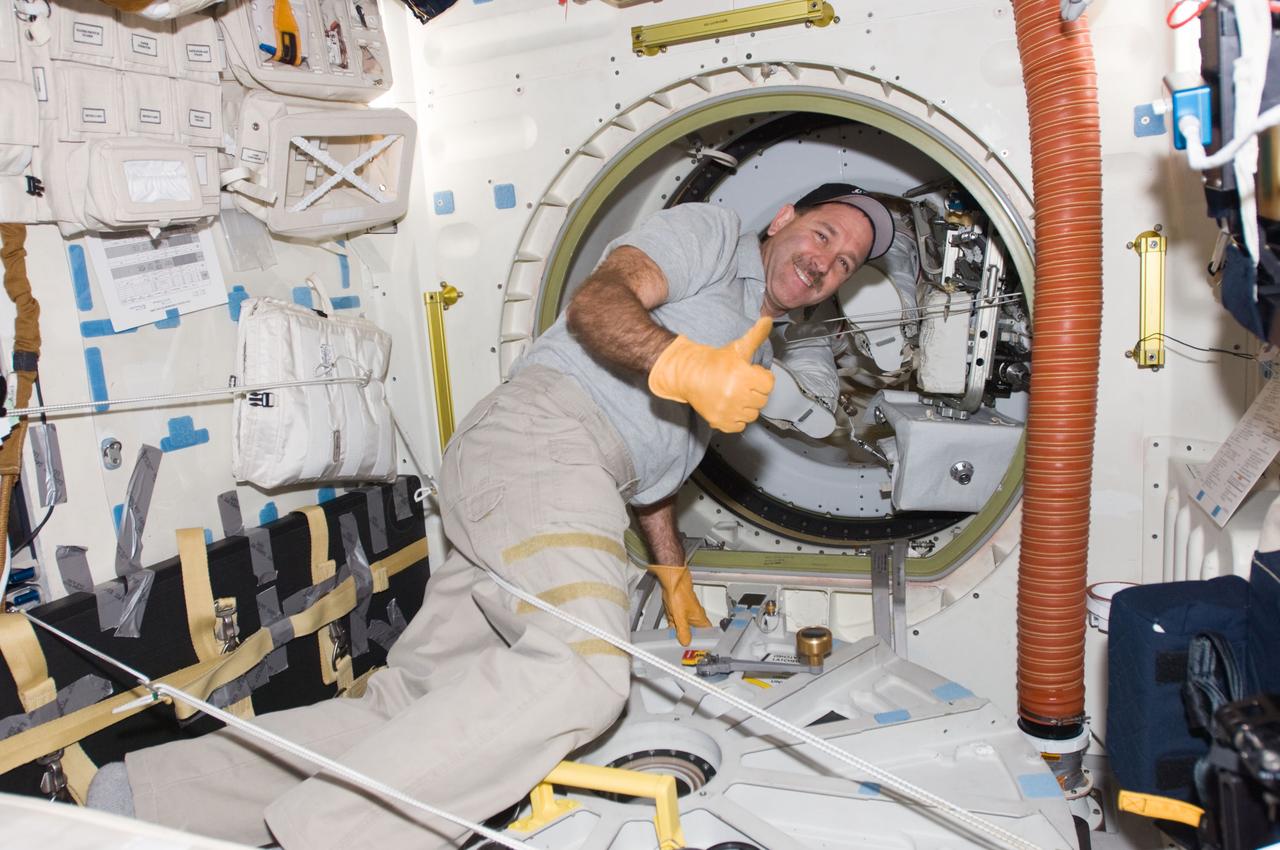
S125-E-007789 (15 May 2009) --- Astronaut John Grunsfeld signals "thumbs up" to indicate two of his crewmates coming inside from a lengthy space walk are "home." Grunsfeld had just opened the hatch that leads from the mid deck to the airlock. Completing this day's session of extravehicular activity and in the airlock when this photo was made were astronauts Mike Massimino and Michael Good.
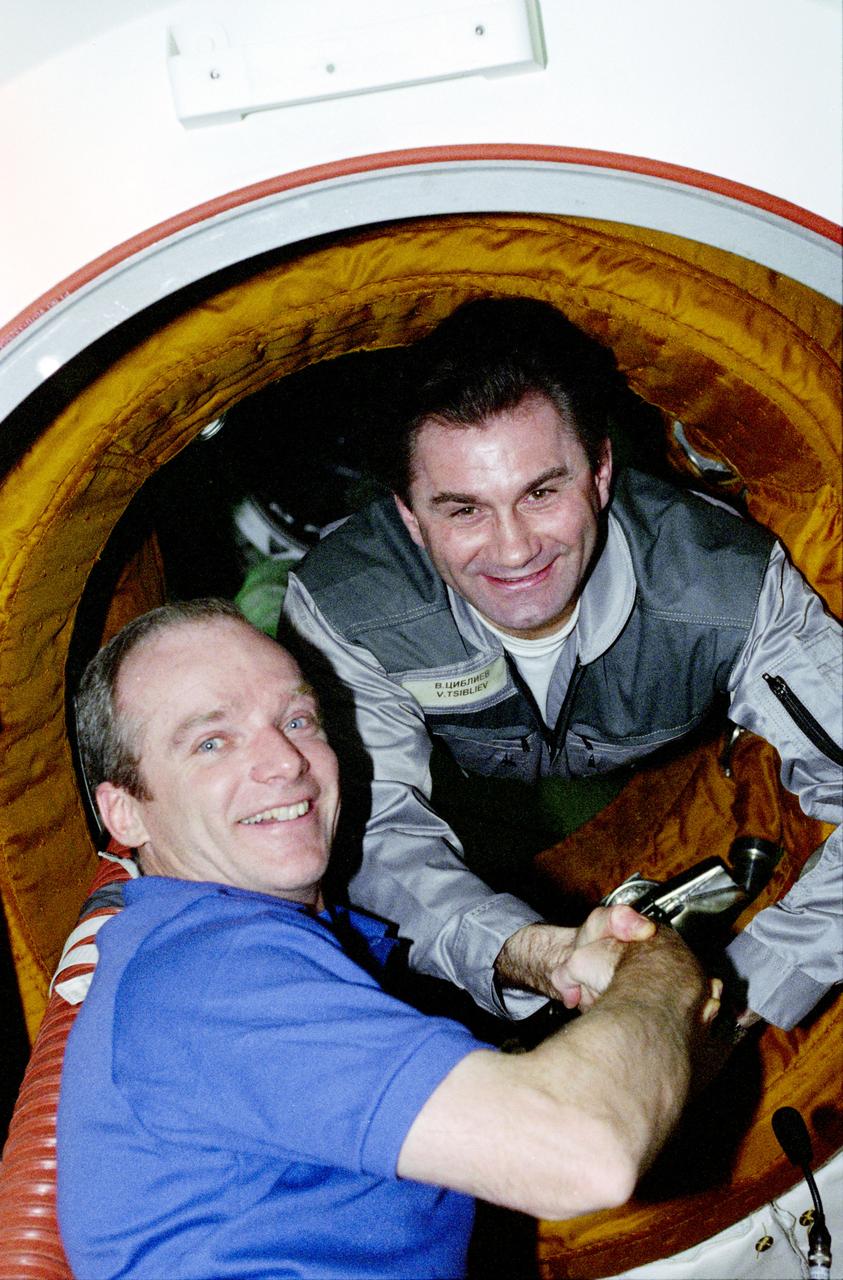
STS084-379-034 (15-24 May 1997) --- Two mission commanders greet and shake hands moments after hatch-opening on docking day, of the Space Shuttle Atlantis and Russia's Mir Space Station. Charles J. Precourt (left), STS-84 commander, and Vasili V. Tsibliyev, Mir-23 commander, along with their respective flight crews went on to spend several days sharing joint activities in Earth-orbit. This is the sixth Atlantis/Mir docking mission.
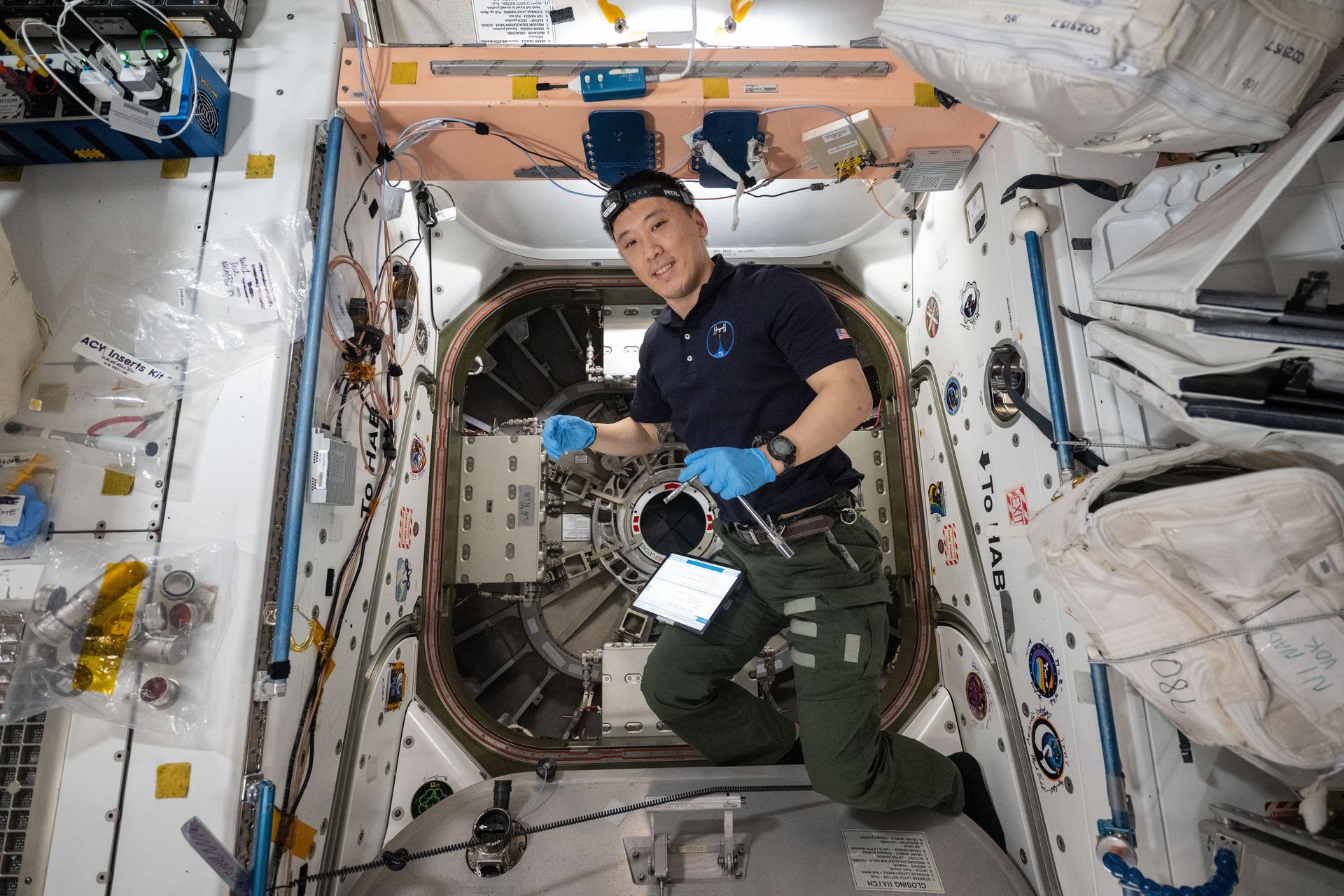
iss073e0814521 (Sept. 18, 2025) --- NASA astronaut and Expedition 73 Flight Engineer Jonny Kim is pictured inside the vestibule between the International Space Station's Unity module and the Cygnus XL cargo spacecraft from Northrop Grumman. Kim was preparing to open Cygnus' hatch to begin unloading about 11,000 pounds of new science and supplies for the Expedition 73 crew.
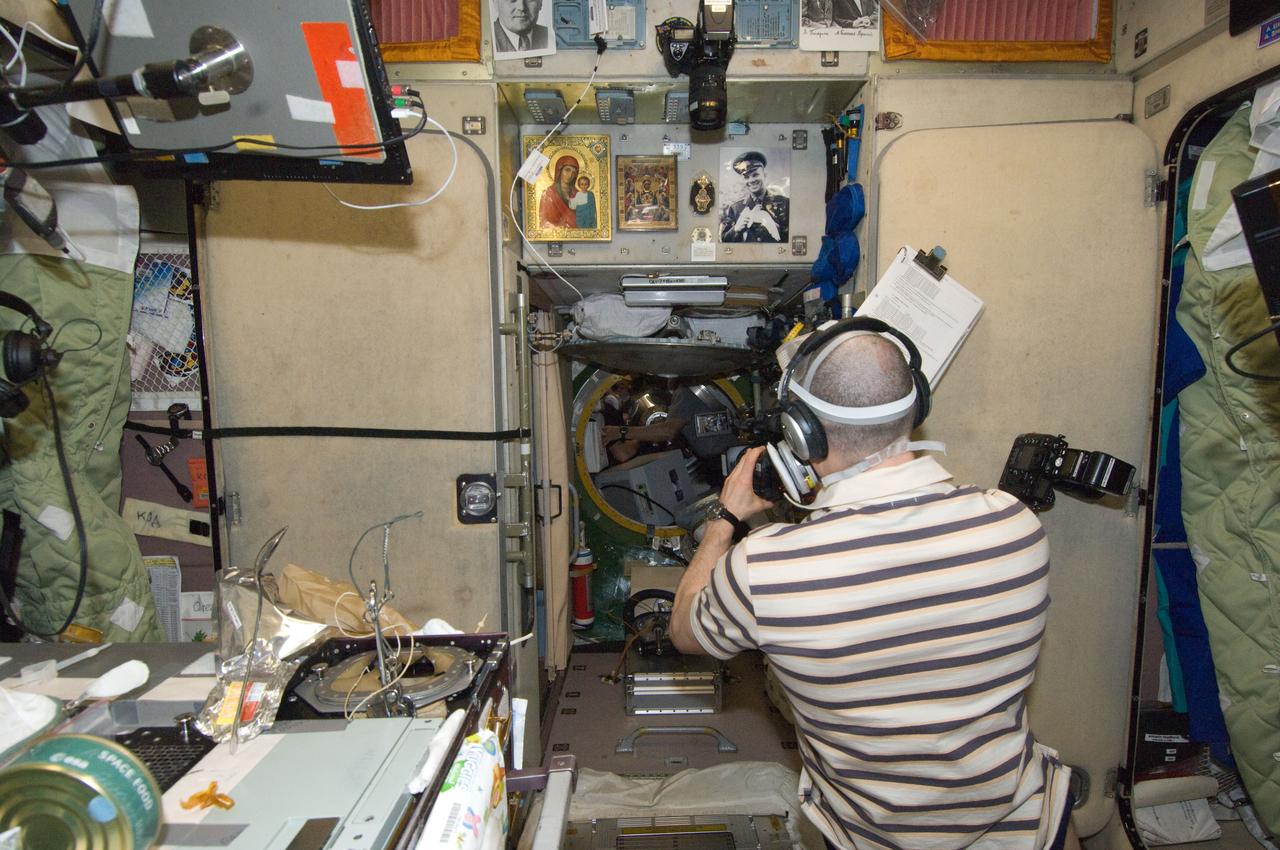
ISS030-E-177715 (29 March 2012) --- In the International Space Station?s Zvezda Service Module, Russian cosmonaut Anatoly Ivanishin, Expedition 30 flight engineer, uses a video camera as his crewmates prepare to open the hatch to European Space Agency?s ?Edoardo Amaldi? Automated Transfer Vehicle-3 (ATV-3). The ATV docked with the space station on March 28, 2012.
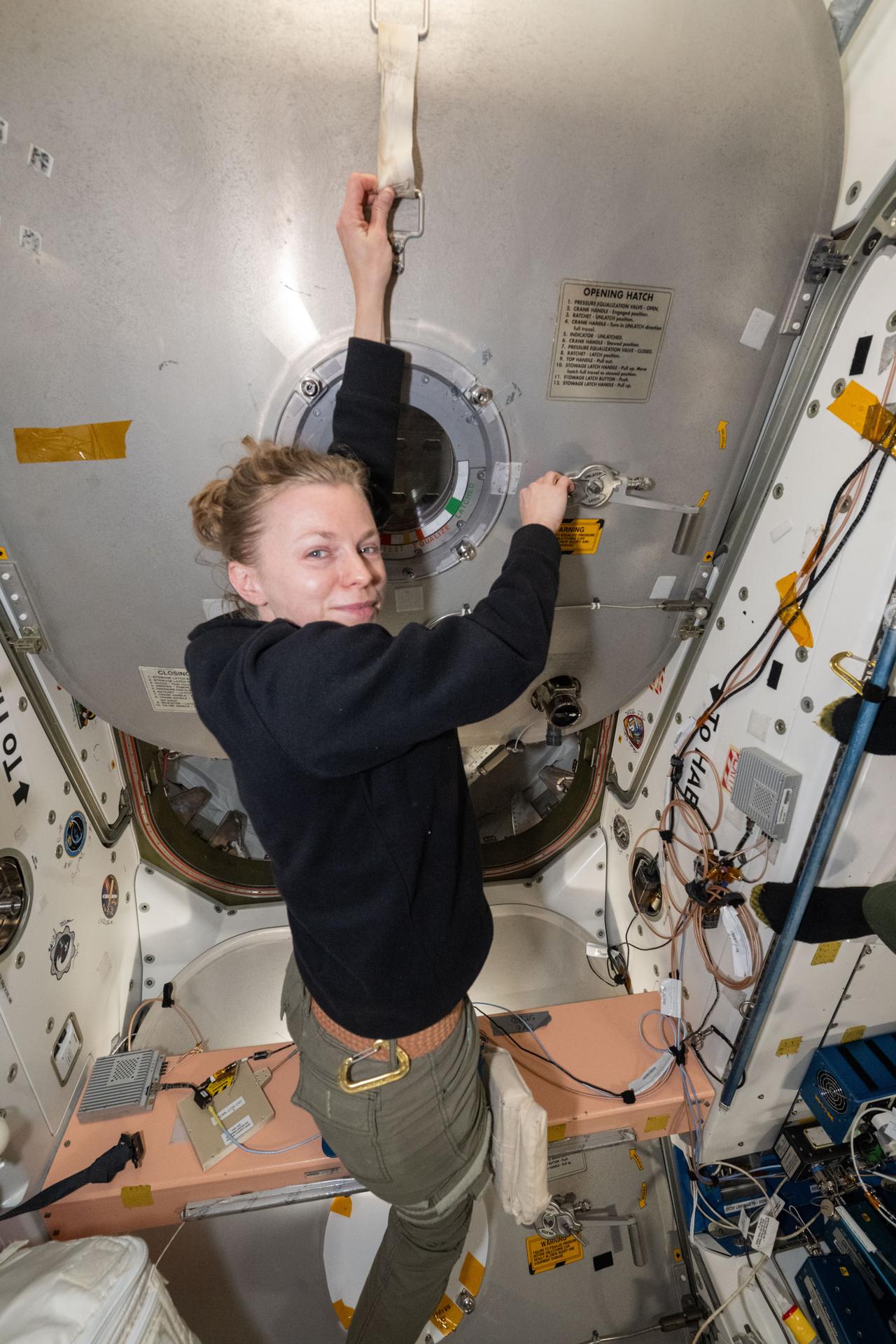
iss073e0814456 (Sept. 18, 2025) --- NASA astronaut and Expedition 73 Flight Engineer Zena Cardman is pictured inside the International Space Station’s Unity module opening the hatch to Northrop Grumman’s Cygnus XL cargo craft. Cygnus had arrived at the orbital outpost just a few hours earlier, where it was captured by the Canadarm2 robotic arm and installed on Unity’s Earth-facing port.
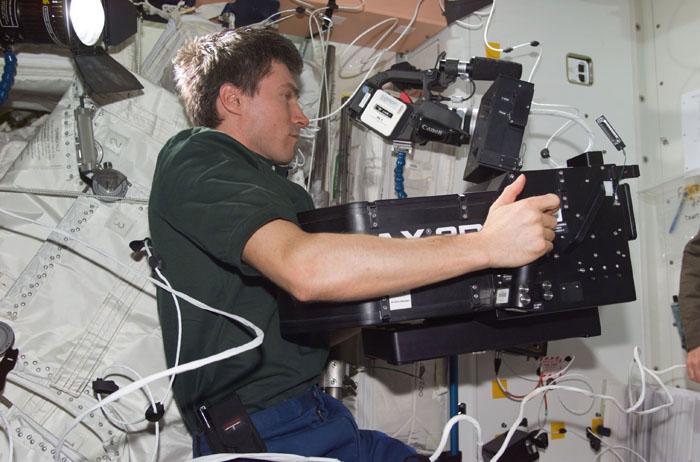
STS98-E-5124 (11 February 2001) --- Cosmonaut Sergei K. Krikalev, Expedition One flight engineer representing the Russian Aviation and Space Agency, films activity in the Unity node, just outside the newly attached Destiny laboratory. The crews of Atlantis and the International Space Station on February 11 opened the Destiny laboratory and spent the first full day of what are planned to be years of work ahead inside the orbiting science and command center. Astronaut William M. (Bill) Shepherd (just out of frame here) opened the Destiny hatch, and he and Shuttle commander Kenneth D. Cockrell ventured inside at 8:38 a.m. (CST). Members of both crews went to work quickly inside the new module, activating air systems, fire extinguishers, alarm systems, computers and internal communications. The crew also continued equipment transfers from the shuttle to the station and filmed several scenes onboard the station using the IMAX camera. This scene was recorded with a digital still camera.
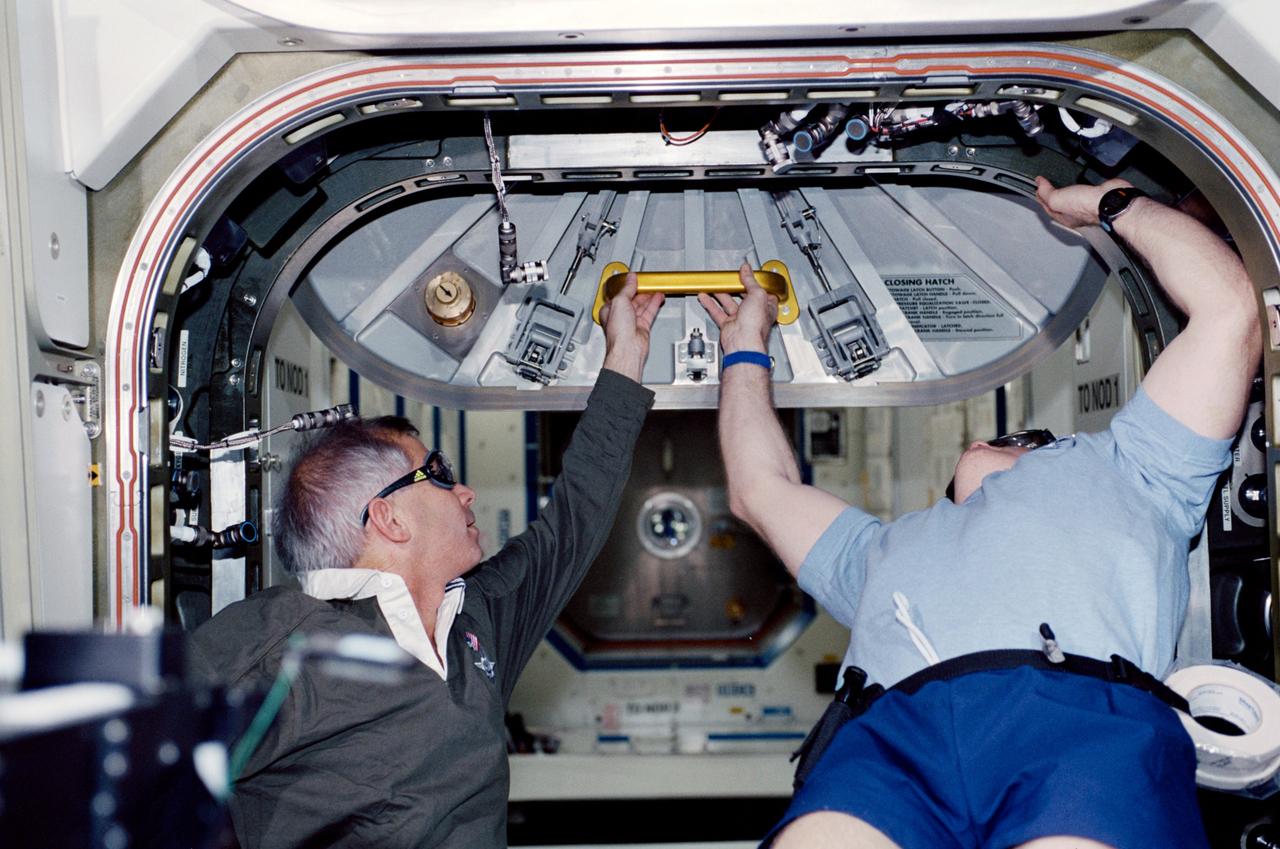
STS098-352-0025 (11 February 2001) --- STS-98 mission commander Kenneth D. Cockrell (left) assists as Expedition One commander William M. (Bill) Shepherd opens the hatch to the newly attached Destiny laboratory. The crews of Atlantis and the International Space Station entered the laboratory shortly after this photo was made on February 11; and the astronauts and cosmonauts spent the first full day of what are planned to be years of work ahead inside the orbiting science and command center. Members of both crews went to work quickly inside the new module, activating air systems, fire extinguishers, alarm systems, computers and internal communications. The crew also continued equipment transfers from the shuttle to the station.
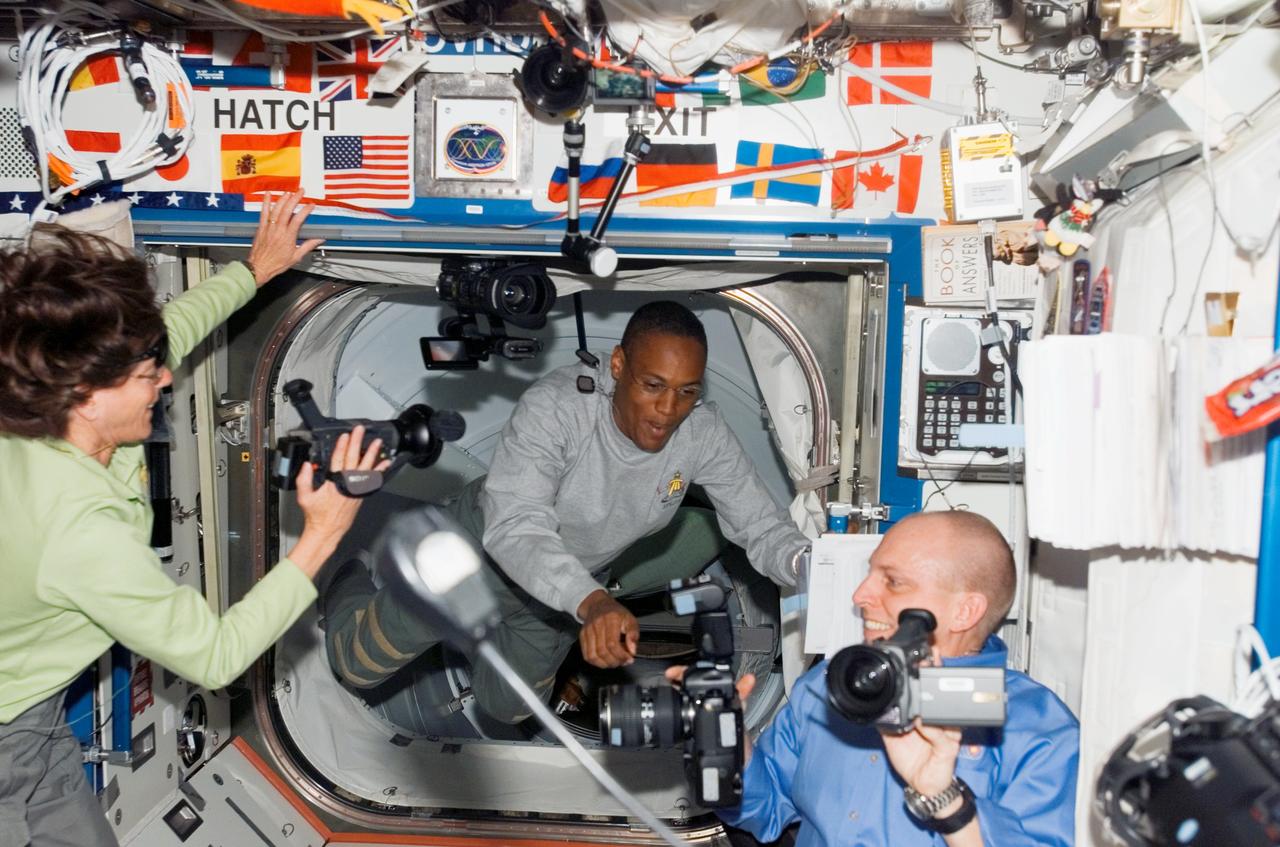
S118-E-06097 (10 Aug. 2007) --- Barbara R. Morgan, STS-118 mission specialist, participates in what looks like a photographers' convention in the Destiny lab onboard the International Space Station. Her two "fellow delegates" are astronaut Alvin Drew (center), STS-118 mission specialist, and astronaut Clay Anderson, Expedition 15 flight engineer. The photo was taken not long after the hatches were open on the orbital outpost, an action that allowed the station's population to surge from three to ten in short order.

iss074e0587443 (May 17, 2026) --- NASA astronaut and Expedition 74 flight engineer Jack Hathaway is pictured inside the vestibule between the SpaceX Dragon cargo spacecraft and the International Space Station’s forward port on the Harmony module. Moments later, Hathaway would open the Dragon’s hatch and begin unloading nearly 6,500 pounds of food, supplies, and equipment for the Expedition 74 crew. Credit: NASA/Chris Williams
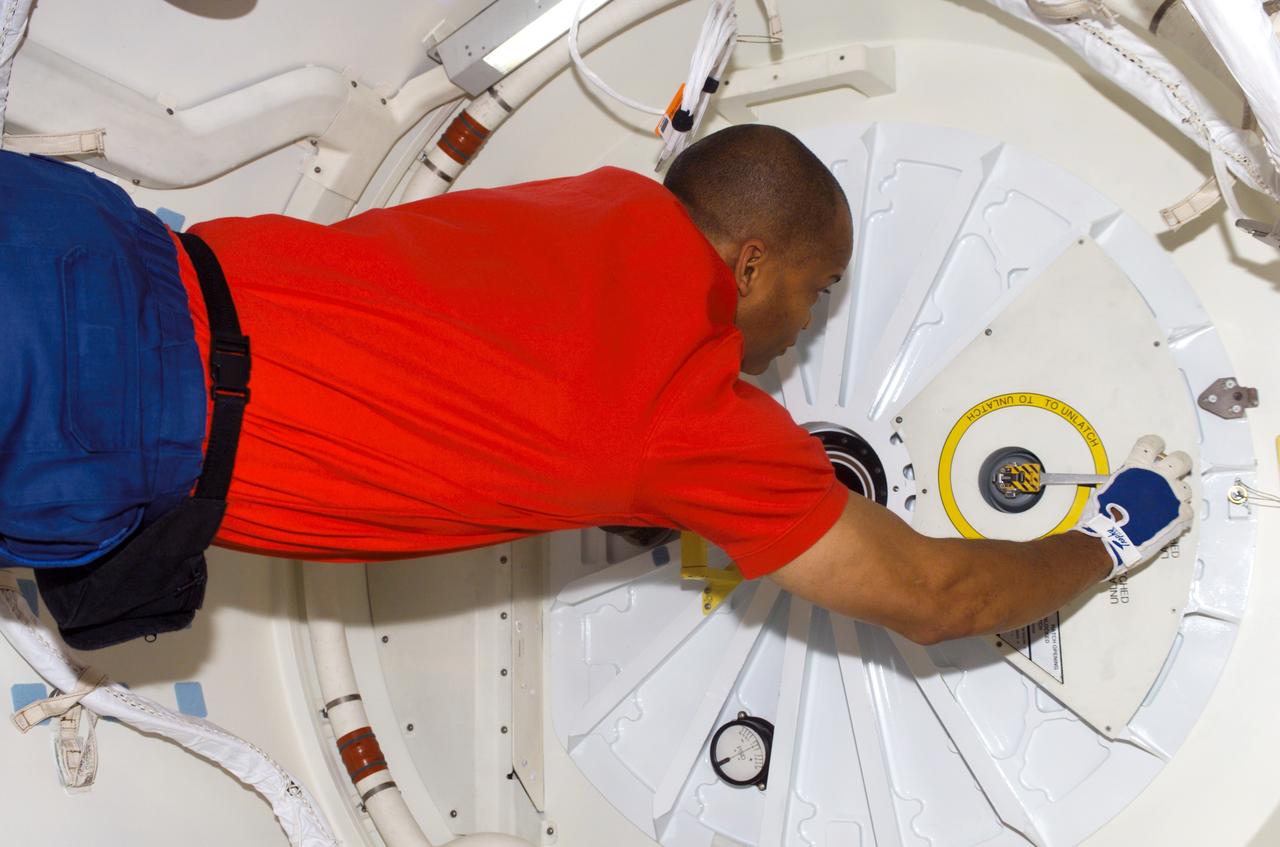
S116-E-05569 (11 Dec. 2006) --- Astronaut Robert L. Curbeam, Jr., STS-116 mission specialist, prepares to open the hatch that will lead the entire Space Shuttle Discovery crew into the International Space Station. This was just one highlight of a very busy day that earlier saw the flawless rendezvous and docking operations between the shuttle and station. Docking occurred at 4:12 p.m. (CST) and the crew entered the orbital outpost at 5:54 p.m. (CST) on Dec. 11.
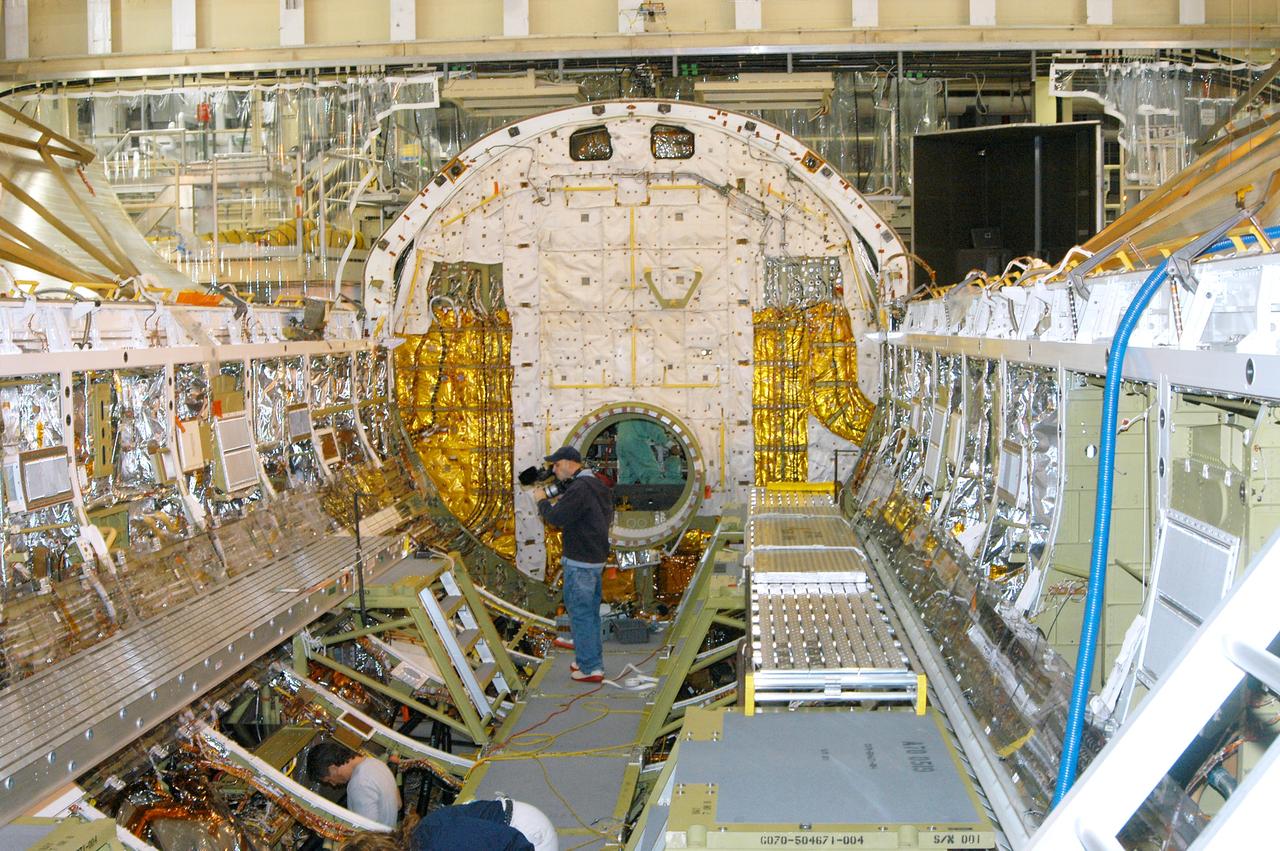
KENNEDY SPACE CENTER, FLA. - In the Orbiter Processing Facility, a cameraman films part of Discovery’s payload bay for a special feature on the KSC Web. In the background is the open hatch of the airlock, located inside the middeck of the spacecraft’s pressurized crew cabin. The airlock is sized to accommodate two fully suited flight crew members simultaneously. Support functions include airlock depressurization and repressurization, extravehicular activity equipment recharge, liquid-cooled garment water cooling, EVA equipment checkout, donning and communications. The outer hatch isolates the airlock from the unpressurized payload bay when closed and permits the EVA crew members to exit from the airlock to the payload bay when open.
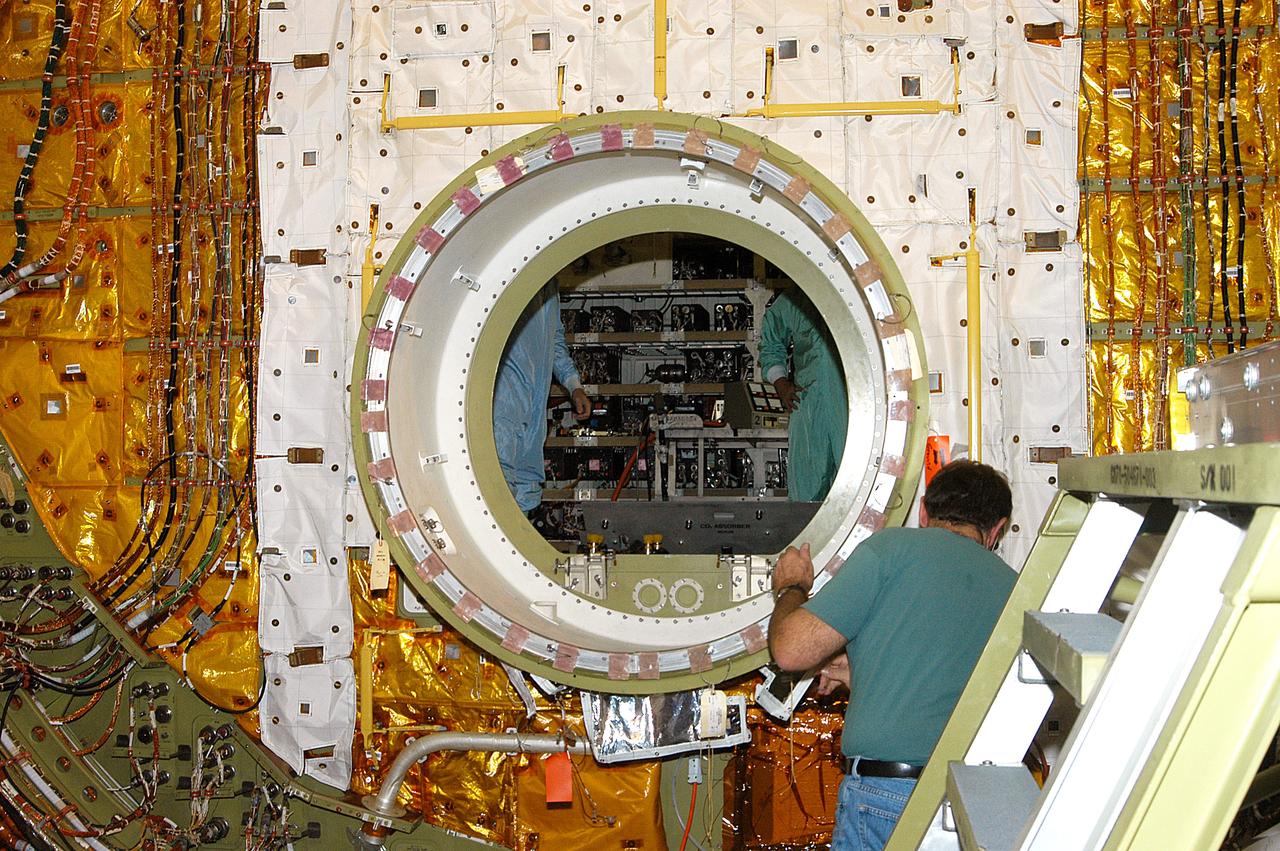
KENNEDY SPACE CENTER, FLA. - A worker in the Orbiter Processing Facility checks the open hatch of the airlock in Discovery’s payload bay. The airlock is normally located inside the middeck of the spacecraft’s pressurized crew cabin. The airlock is sized to accommodate two fully suited flight crew members simultaneously. Support functions include airlock depressurization and repressurization, extravehicular activity equipment recharge, liquid-cooled garment water cooling, EVA equipment checkout, donning and communications. The outer hatch isolates the airlock from the unpressurized payload bay when closed and permits the EVA crew members to exit from the airlock to the payload bay when open.
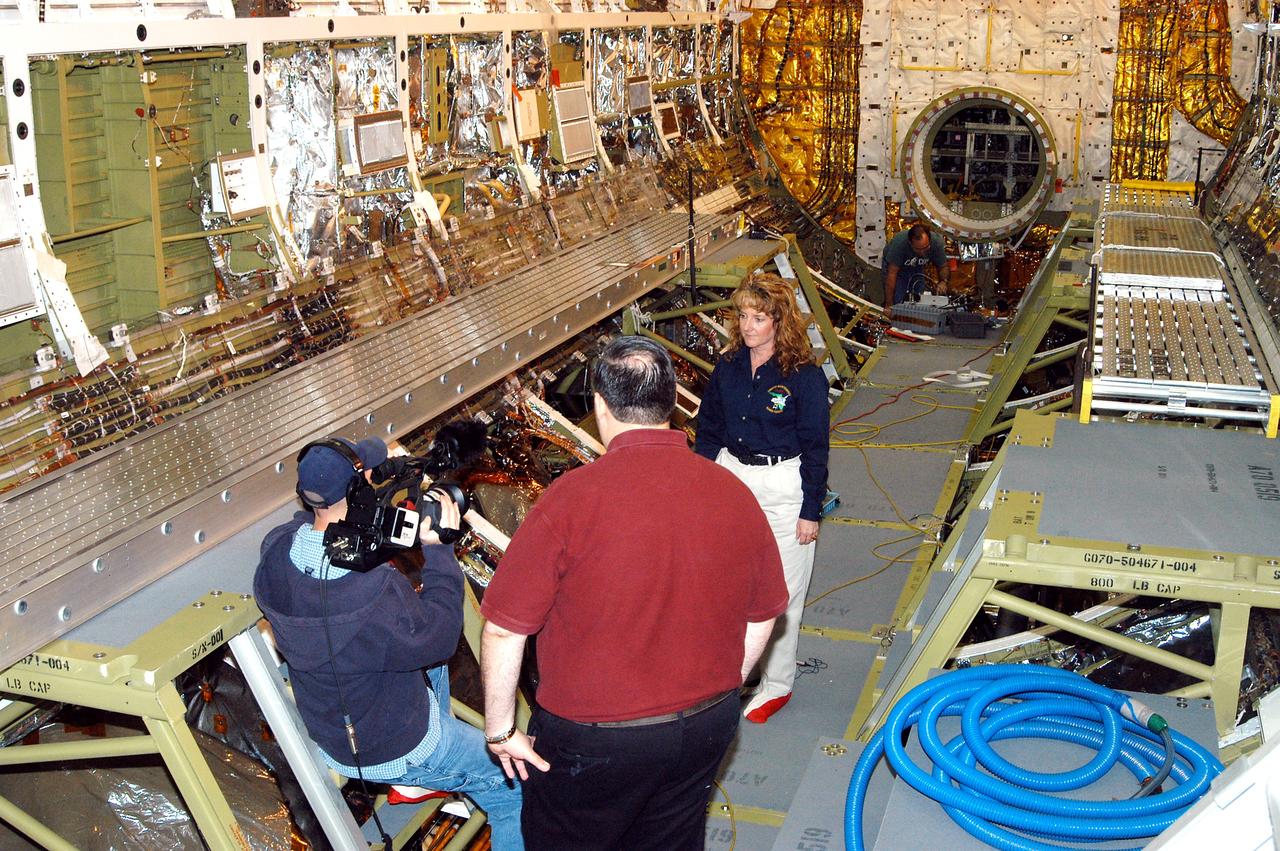
KENNEDY SPACE CENTER, FLA. - Standing inside Discovery’s payload bay, Carol Scott (right), lead orbiter engineer, talks about her job as part of a special feature for the KSC Web. With his back to the camera is Bill Kallus, Media manager in the KSC Web Studio. Behind Scott can be seen the open hatch of the airlock, which provides support functions such as airlock depressurization and repressurization, extravehicular activity equipment recharge, liquid-cooled garment water cooling, EVA equipment checkout, donning and communications. The outer hatch isolates the airlock from the unpressurized payload bay when closed and permits the EVA crew members to exit from the airlock to the payload bay when open.
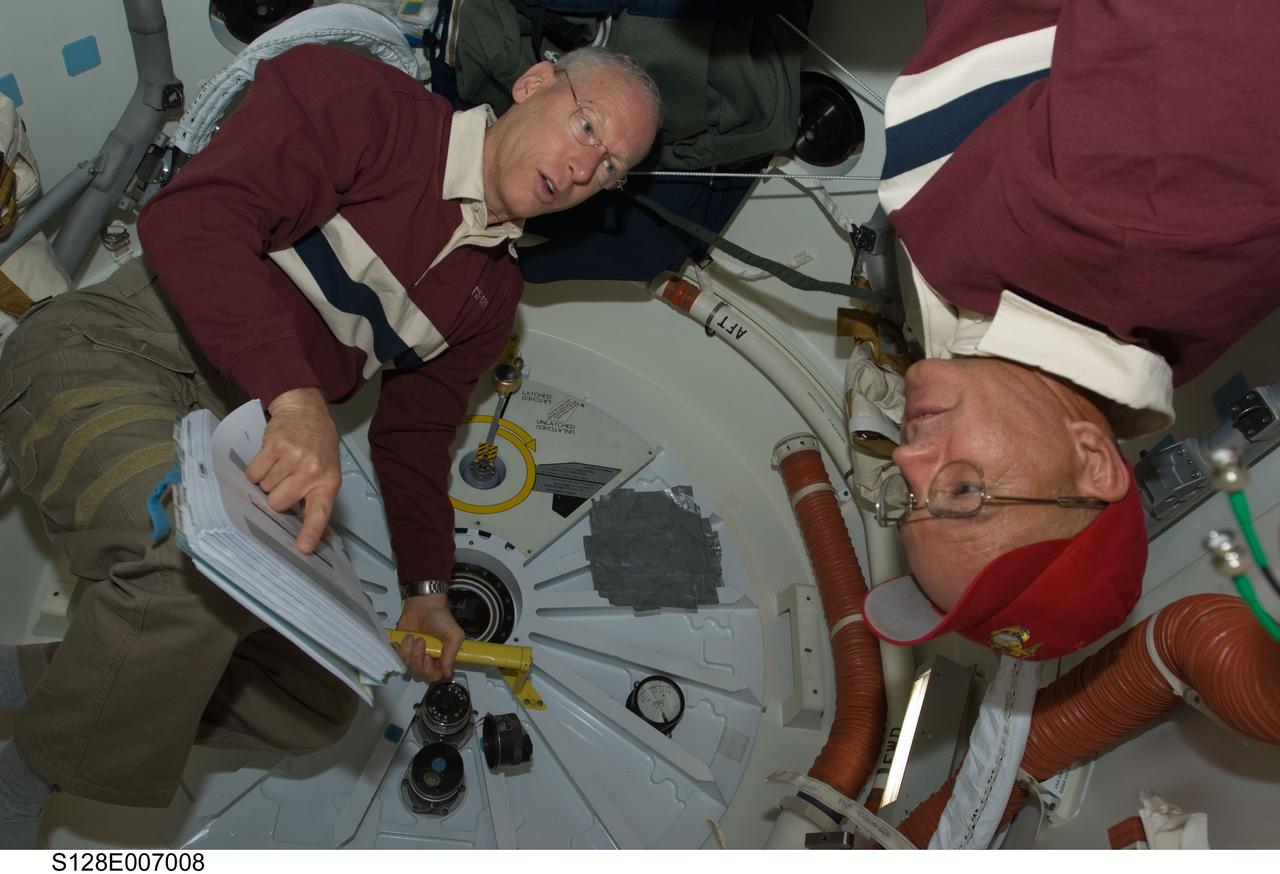
S128-E-007008 (30 Aug. 2009) --- Astronauts Rick Sturckow (right), STS-128 commander; and Patrick Forrester, mission specialist, are pictured near the hatch on the middeck of Space Shuttle Discovery after docking with the International Space Station. The two spacecraft docked at 7:54 p.m. (CDT), and the Discovery crew entered the orbital outpost at 9:59 p.m. (CDT) on Aug. 30.
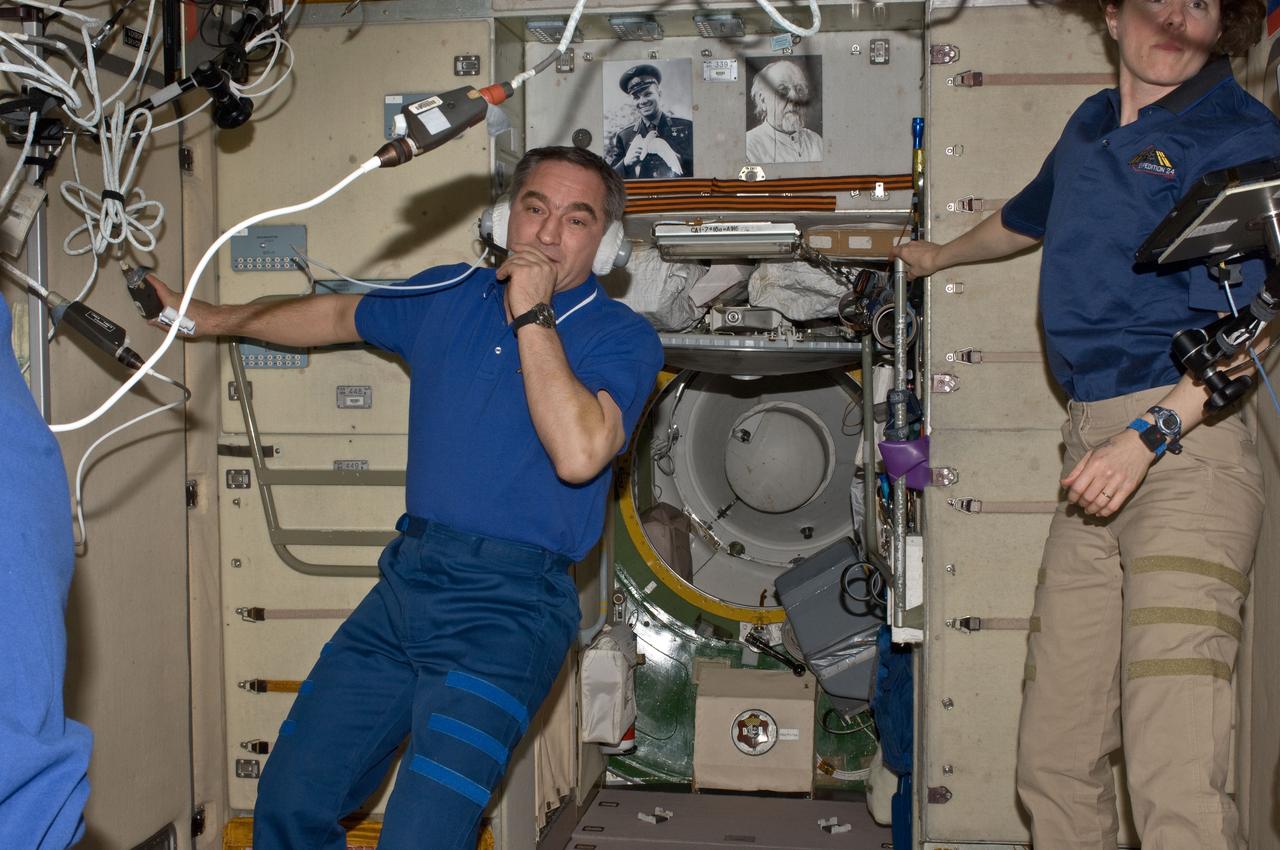
ISS024-E-006205 (17 June 2010) --- Russian cosmonaut Alexander Skvortsov, Expedition 24 commander, uses a communication system in the Zvezda Service Module of the International Space Station. NASA astronaut Tracy Caldwell Dyson, flight engineer, is at right.
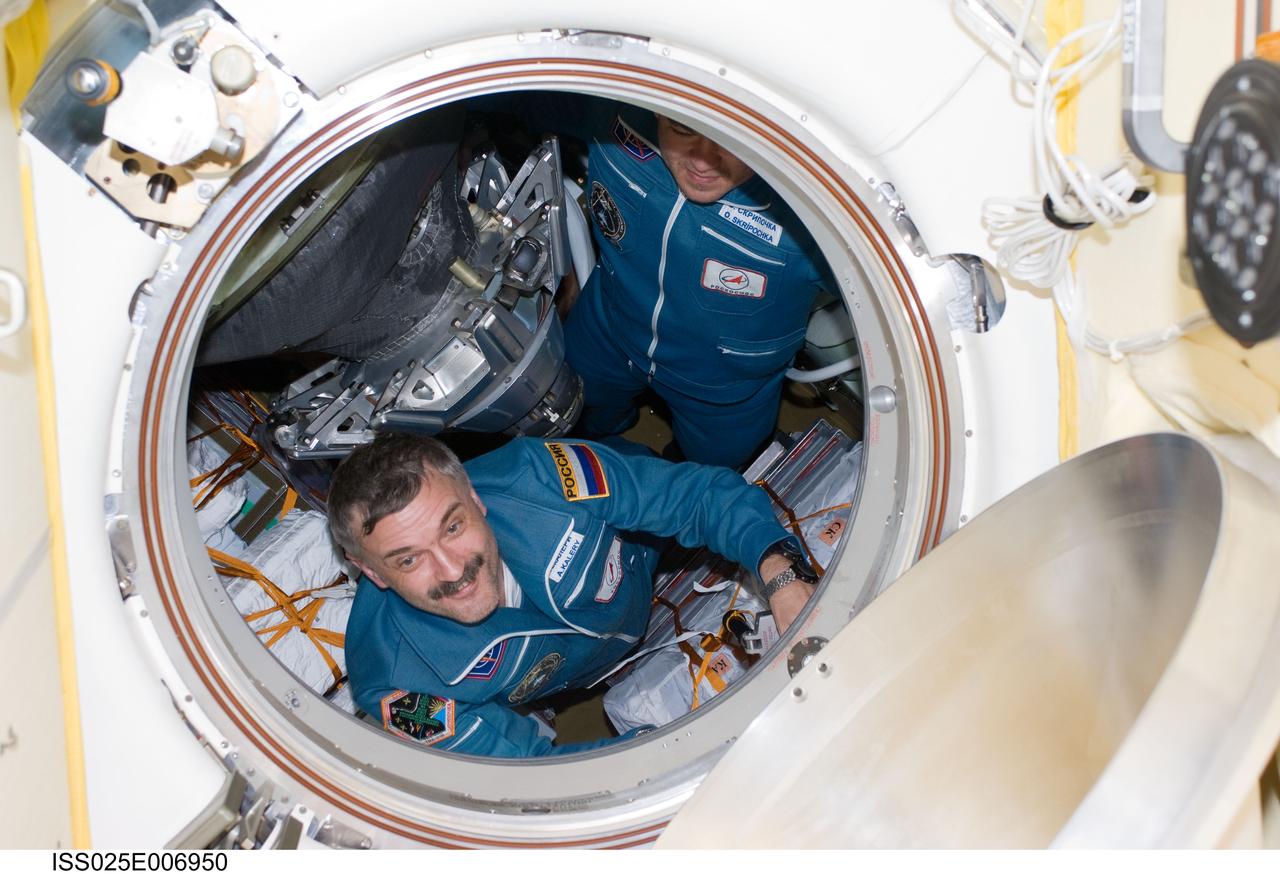
ISS025-E-006950 (9 Oct. 2010) --- Russian cosmonauts Alexander Kaleri (foreground), Soyuz commander and Expedition 25 flight engineer, and Oleg Skripochka, flight engineer, arrive at the International Space Station to begin their tours aboard the orbiting outpost. Along with NASA astronaut Scott Kelly, flight engineer, the cosmonauts join a third cosmonaut and two other astronauts already onboard to complete the crew of six. Docking of the Soyuz TMA-01M and the ISS occurred at 8:01 p.m. (EDT) on Oct. 9, 2010.
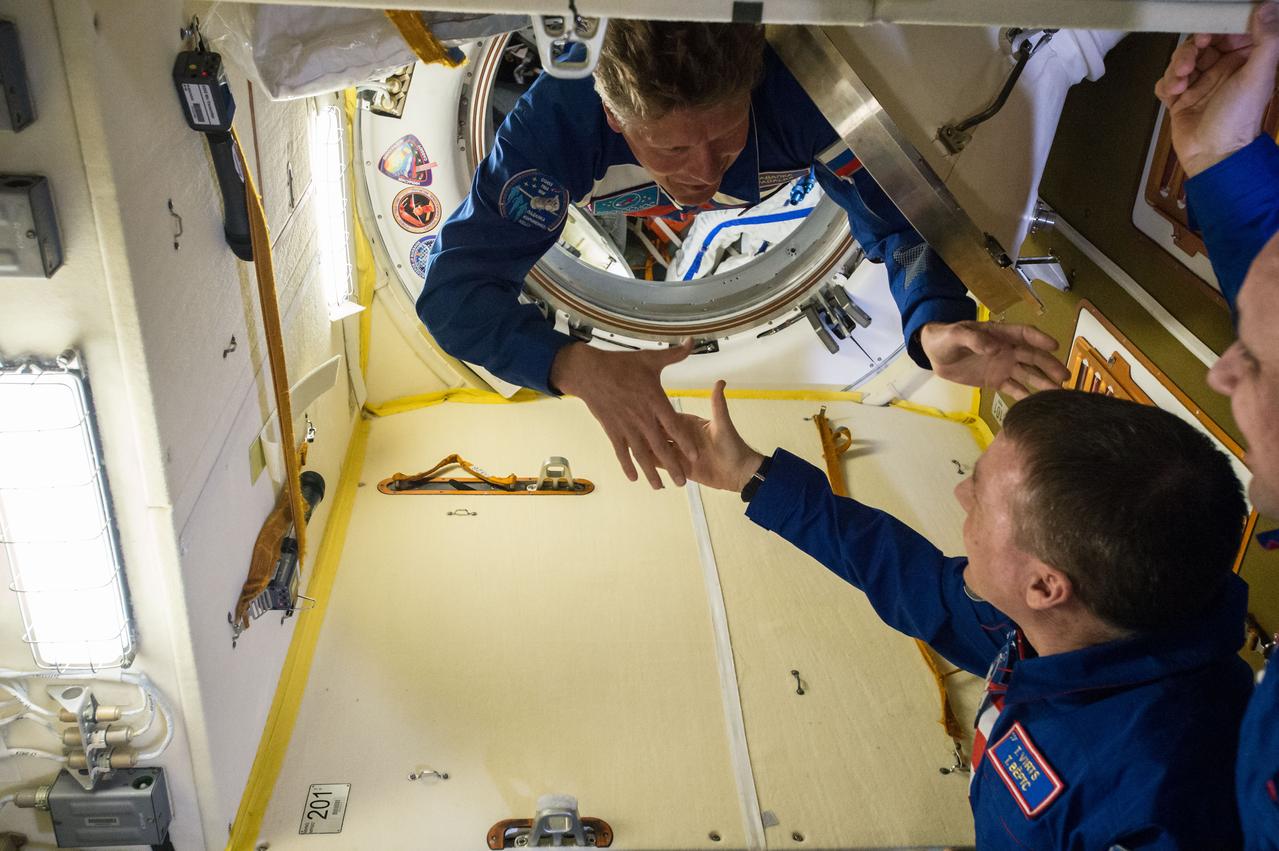
ISS043E056045 (03/28/2015) --- Russian cosmonaut Gennady Padalka of the Russian Federal Space Agency (Roscosmos) is first through the hatch of the Soyuz TMA-16M spacecraft into the International Space Station after launching from the Baikonur Cosmodrome in Kazakhstan. He is welcomed aboard by Expedition 43 Commander and NASA astronaut Terry Virts. Padalka will serve a normal length tour of duty on the station but his two crewmembers arriving with him, Russian cosmonaut Mikhail Kornienko and NASA astronaut Scott Kelly, will spend a year in space and return to Earth on Soyuz TMA-18M in March 2016.
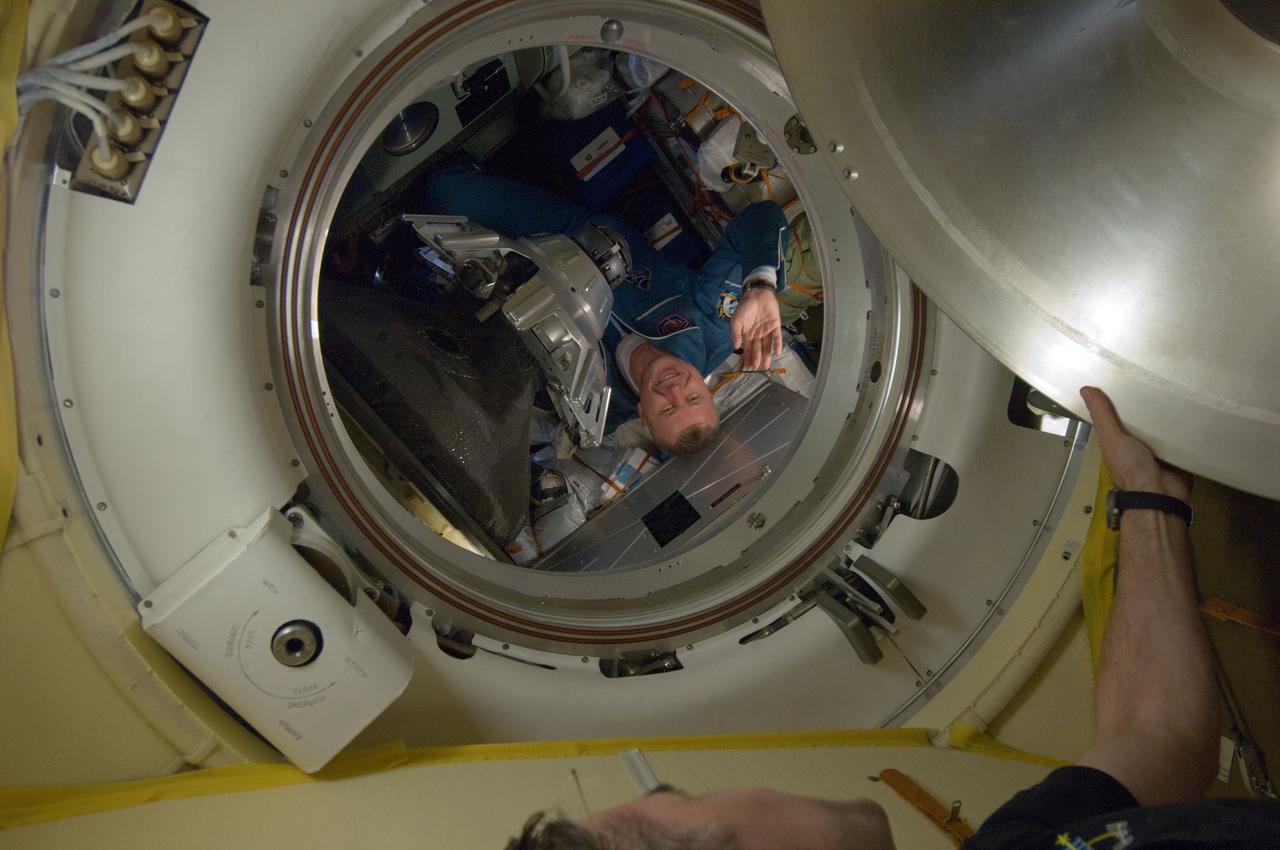
ISS033-E-016668 (25 Oct. 2012) --- Russian cosmonaut Oleg Novitskiy, Expedition 33 flight engineer, waves as he prepares to ingress the International Space Station’s Poisk Mini-Research Module 2 (MRM2) along with NASA astronaut Kevin Ford and Russian cosmonaut Evgeny Tarelkin (both out of frame). The Soyuz TMA-06M spacecraft carrying the three new Expedition 33 crew members docked at 8:29 a.m. (EDT) on Oct. 25, 2012.
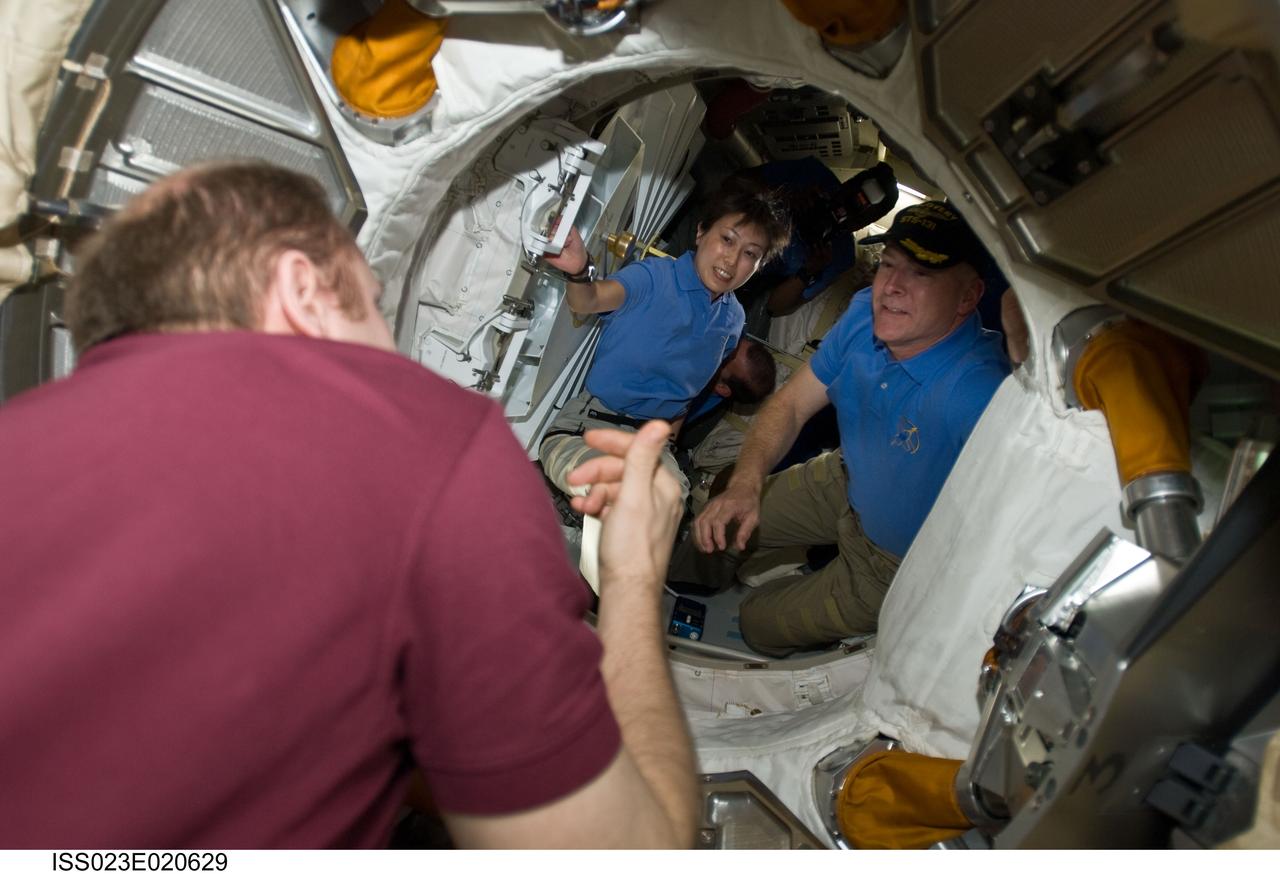
ISS023-E-020629 (7 April 2010) --- Russian cosmonaut Oleg Kotov (far left), Expedition 23 commander, prepares to greet the STS-131 crew as it comes aboard the International Space Station to spend several days in a number of busy joint activities for the two crews. Seen clearly in the hatch are astronaut Alan Poindexter, STS-131 commander, and Japan Aerospace Agency astronaut Naoko Yamazaki, mission specialist.
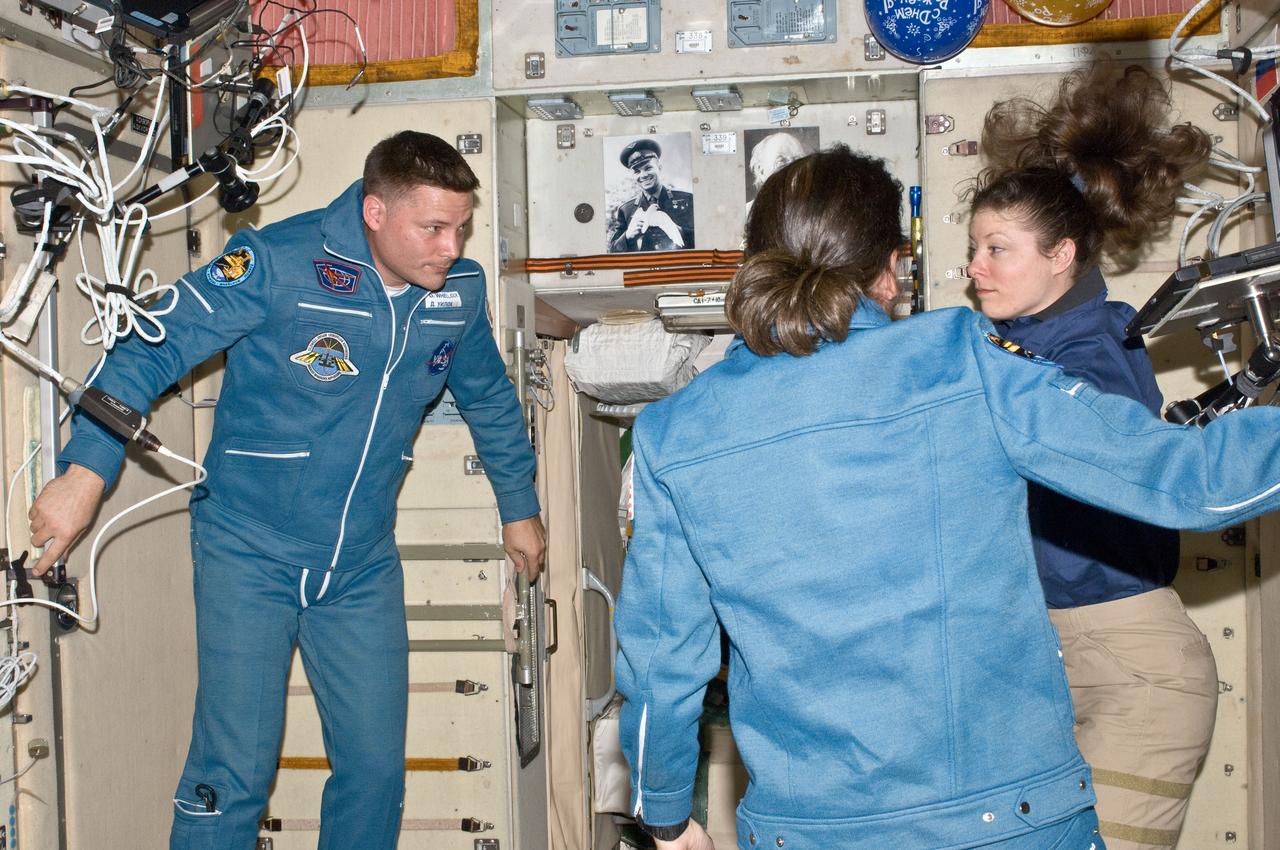
ISS024-E-006194 (17 June 2010) --- NASA astronauts Doug Wheelock, Shannon Walker (foreground) and Tracy Caldwell Dyson, all Expedition 24 flight engineers, are pictured in the Zvezda Service Module of the International Space Station shortly after Wheelock and Walker’s arrival in the Soyuz TMA-19 spacecraft.
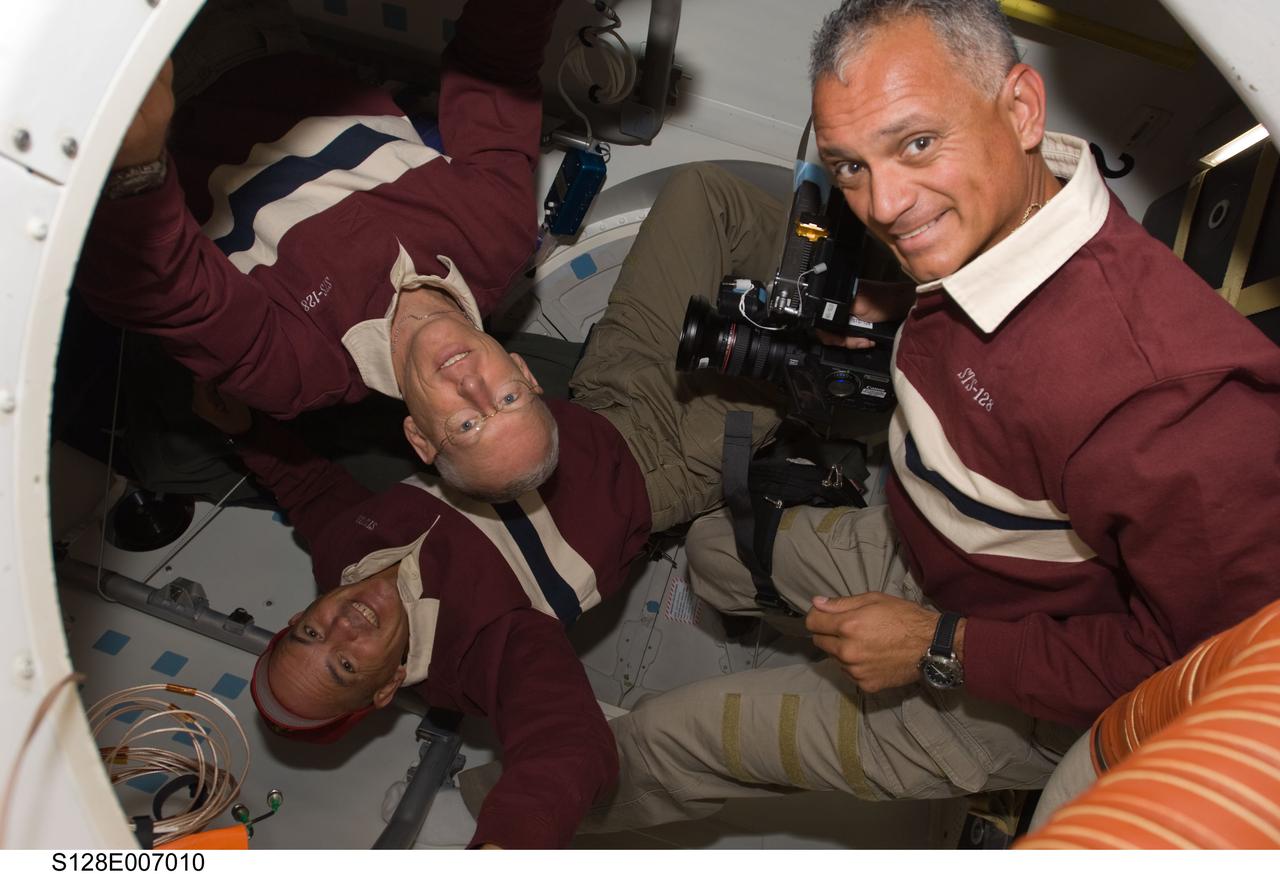
S128-E-007010 (30 Aug. 2009) --- Astronauts Rick Sturckow (bottom), STS-128 commander; John “Danny” Olivas (right) and Patrick Forrester, both mission specialists, are pictured near the hatch on the middeck of Space Shuttle Discovery after docking with the International Space Station. The two spacecraft docked at 7:54 p.m. (CDT), and the Discovery crew entered the orbital outpost at 9:59 p.m. (CDT) on Aug. 30.
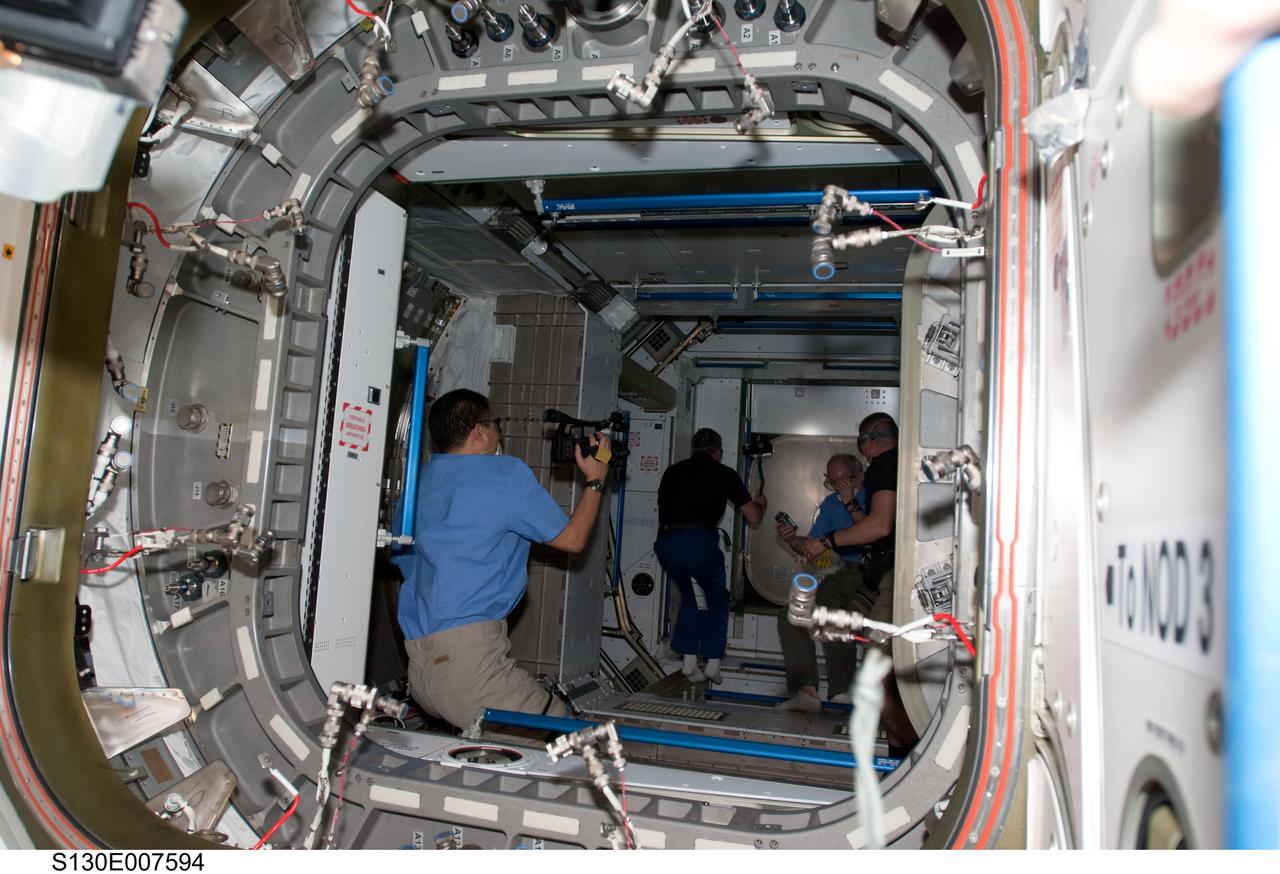
S130-E-007594 (13 Feb. 2010) --- Japan Aerospace Exploration Agency (JAXA) astronaut Soichi Noguchi, Expedition 22 flight engineer, uses a video camera in the newly-installed Tranquility node of the International Space Station while space shuttle Endeavour remains docked with the station. NASA astronauts George Zamka (right), STS-130 commander; Jeffrey Williams (center), Expedition 22 commander; and Stephen Robinson, STS-130 mission specialist, are visible in the background.
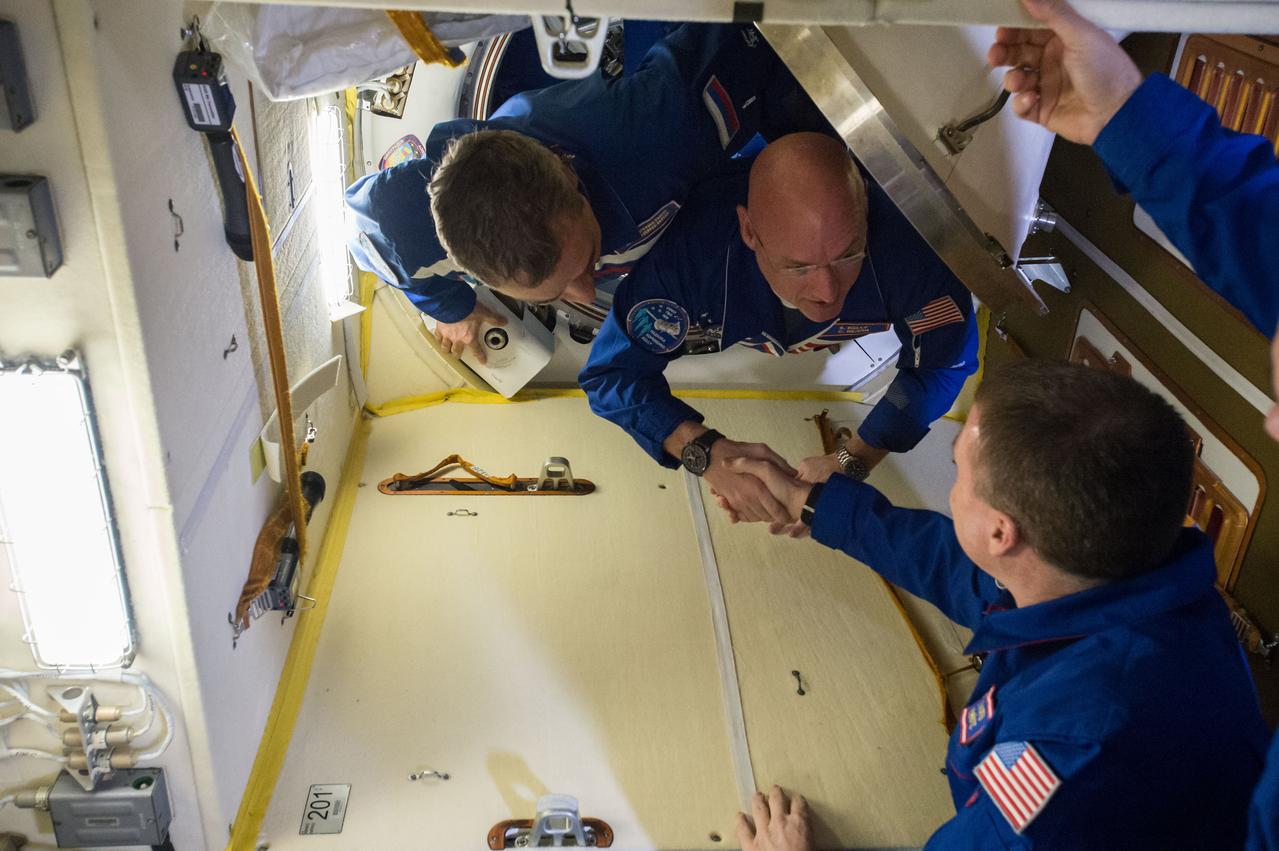
ISS043E056048 (03/28/2015) --- NASA astronaut Scott Kelly (top right) emerges through the hatch from the Soyuz spacecraft after launching from the Earth earlier to be welcomed by Expedition 43 commander and NASA astronaut Terry Virts aboard the International Space Station on Mar. 28, 2015. Russian cosmonaut Mikhail Kornienko (top left) is next out of the hatch to be welcomed aboard. These two will begin a unique one-year mission on board the station to study longer time frames in space to prepare for the journey to Mars.

ISS027-E-034867(18 May 2011) --- Soon after the space shuttle Endeavour docked with the International Space Station on May 18, six crew members from each spacecraft greeted and reunited before starting in on several days of shared work. Here, NASA astronaut Scott Kelly greets two members of the Expedition 27 crew -- European Space Agency astronaut Paolo Nespoli (left), flight engineer, and Russian cosmonaut Dmitry Kondratyev, Expedition 27 commander. Nespoli and Kondratyev, along with NASA astronaut Cady Coleman (not pictured), will be returning to Earth on May 23, leaving nine astronauts and cosmonauts to continue several more days of joint activities.
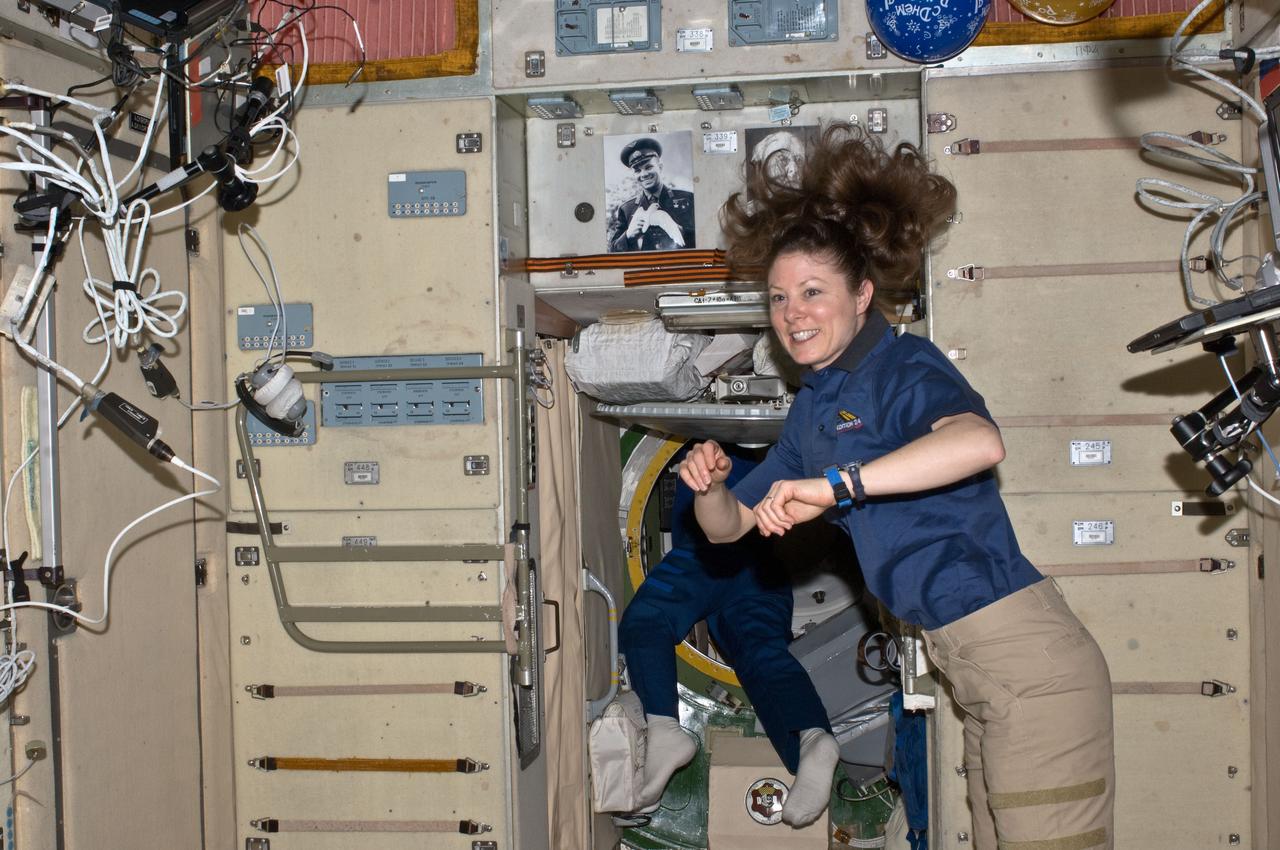
ISS024-E-006182 (17 June 2010) --- NASA astronaut Tracy Caldwell Dyson, Expedition 24 flight engineer, is pictured in the Zvezda Service Module of the International Space Station.
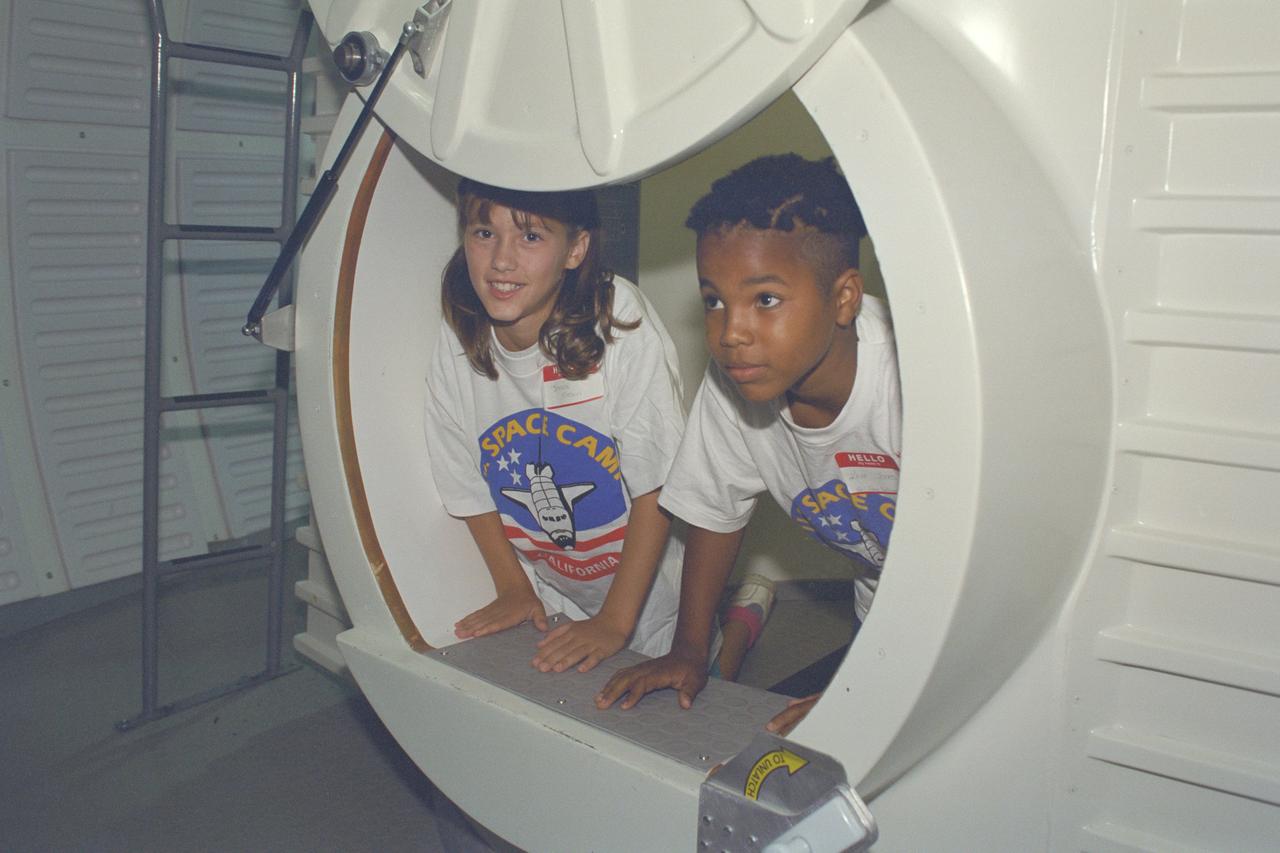
U.S. Space Camp California 'Day Camp' Grand Opening kids discover shuttle hatch
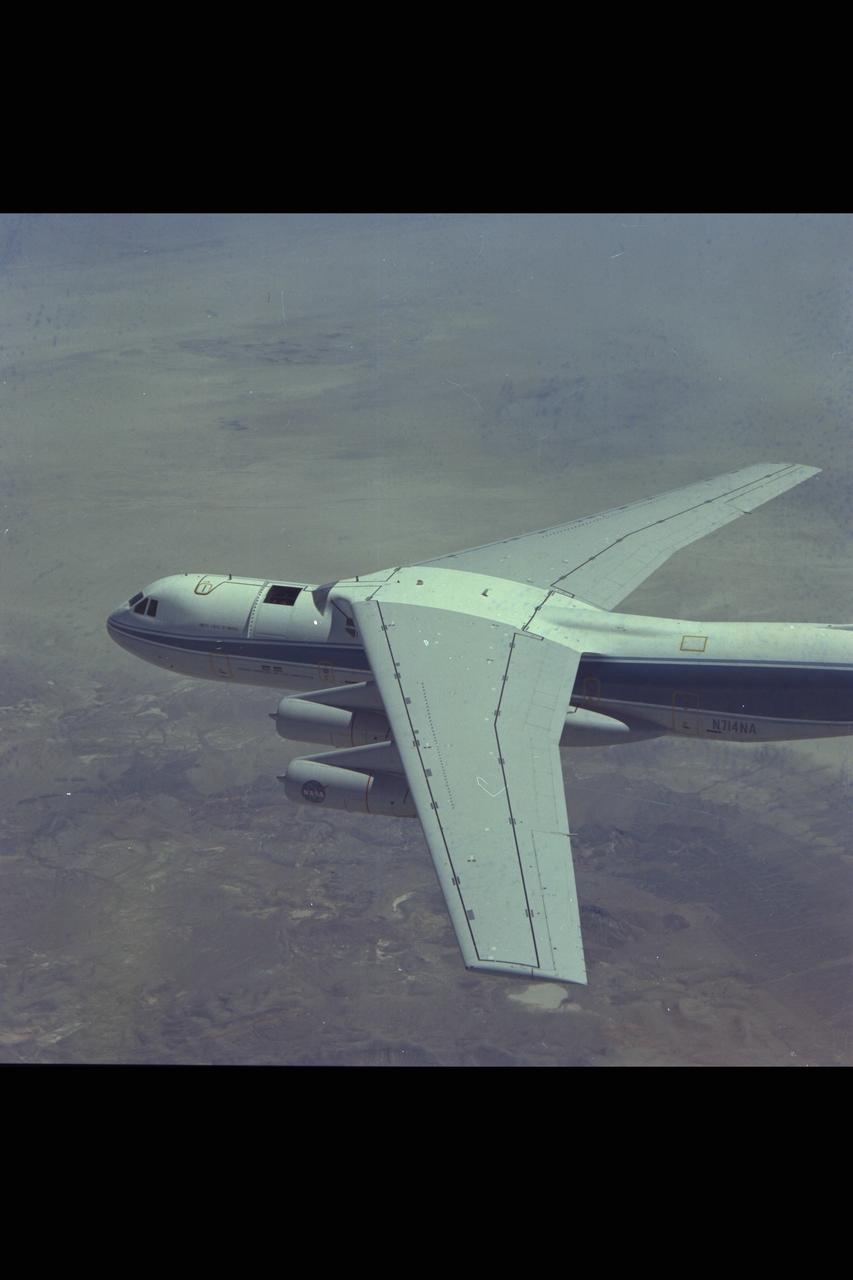
C-141 (NASA-714) Kuipter Airborne Observatory in flight, telescope hatch open
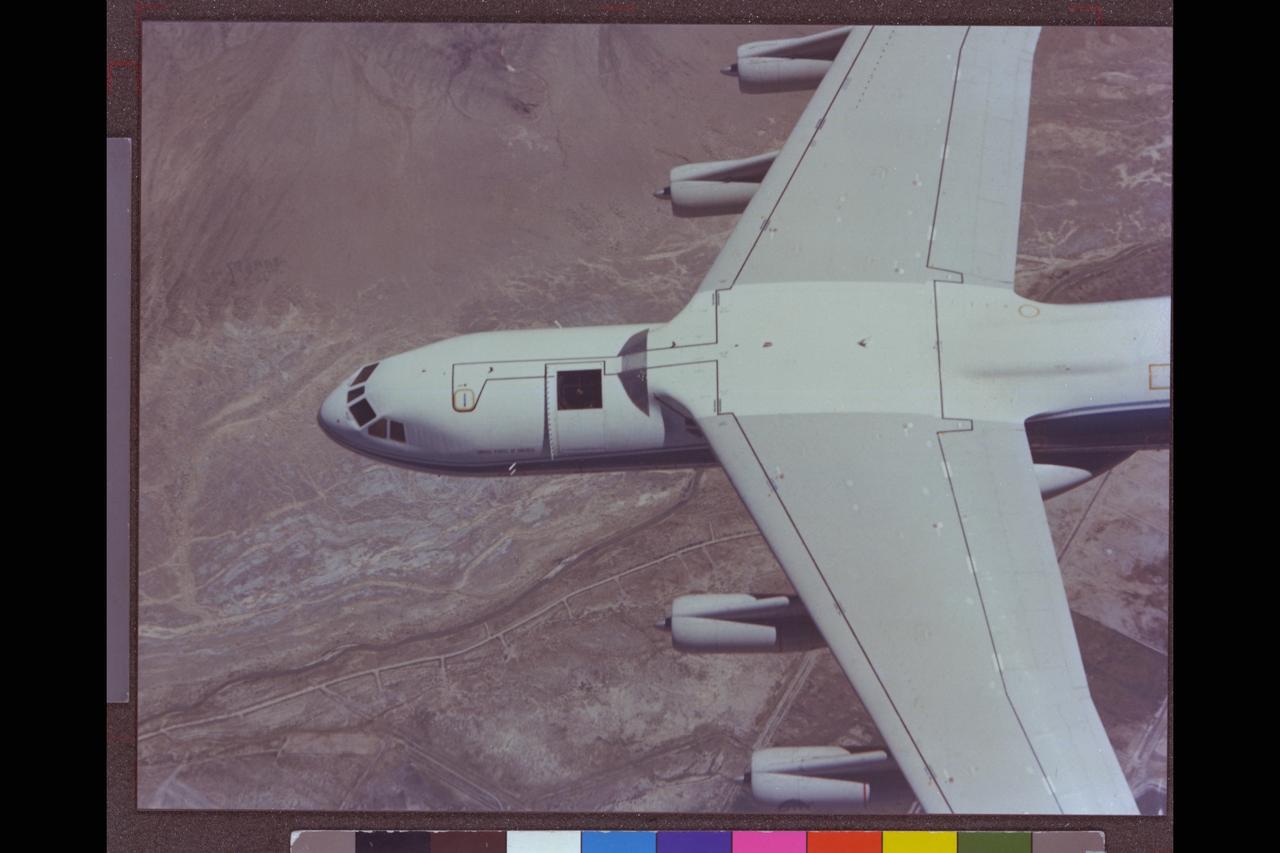
C-141 (NASA-714) Kuipter Airborne Observatory in flight, telescope hatch open
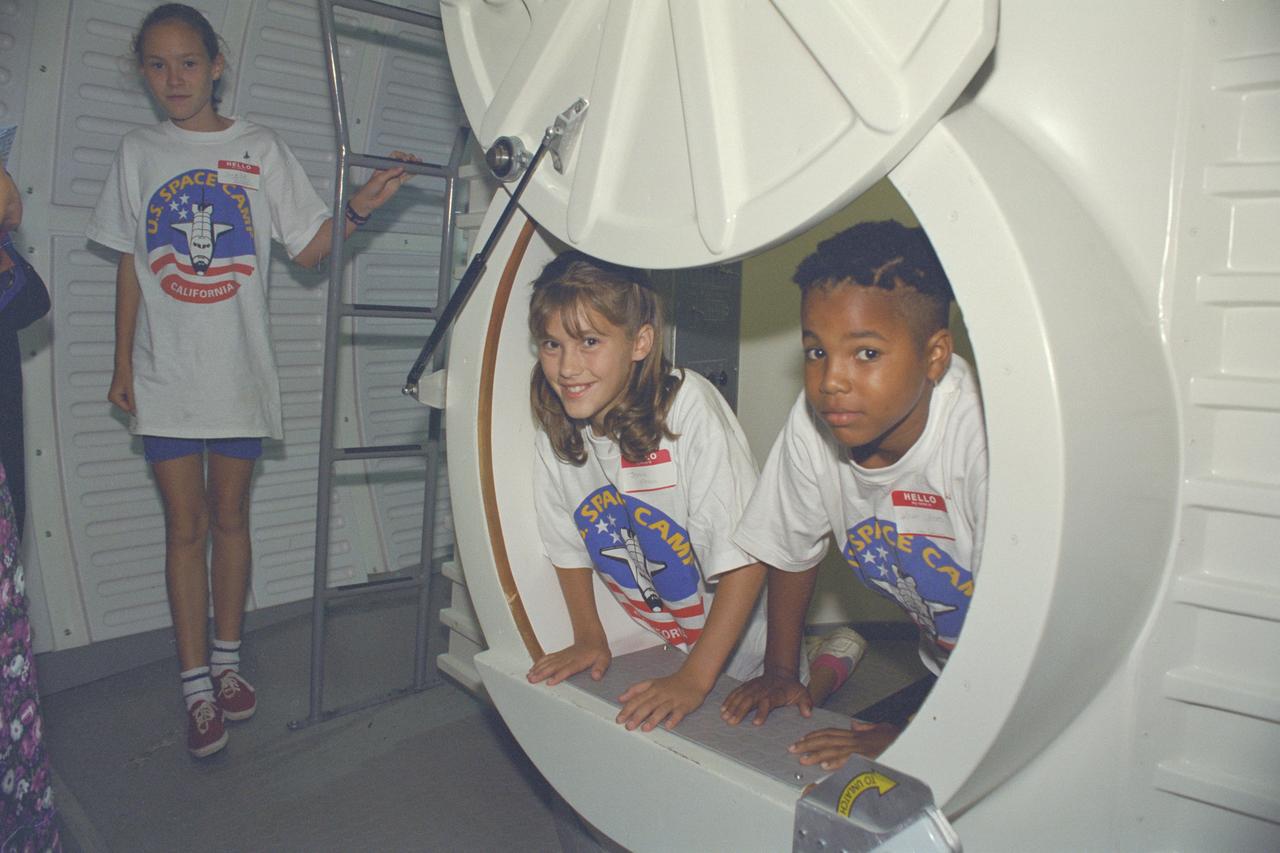
U.S. Space Camp California 'Day Camp' Grand Opening kids discover Shuttle hatch
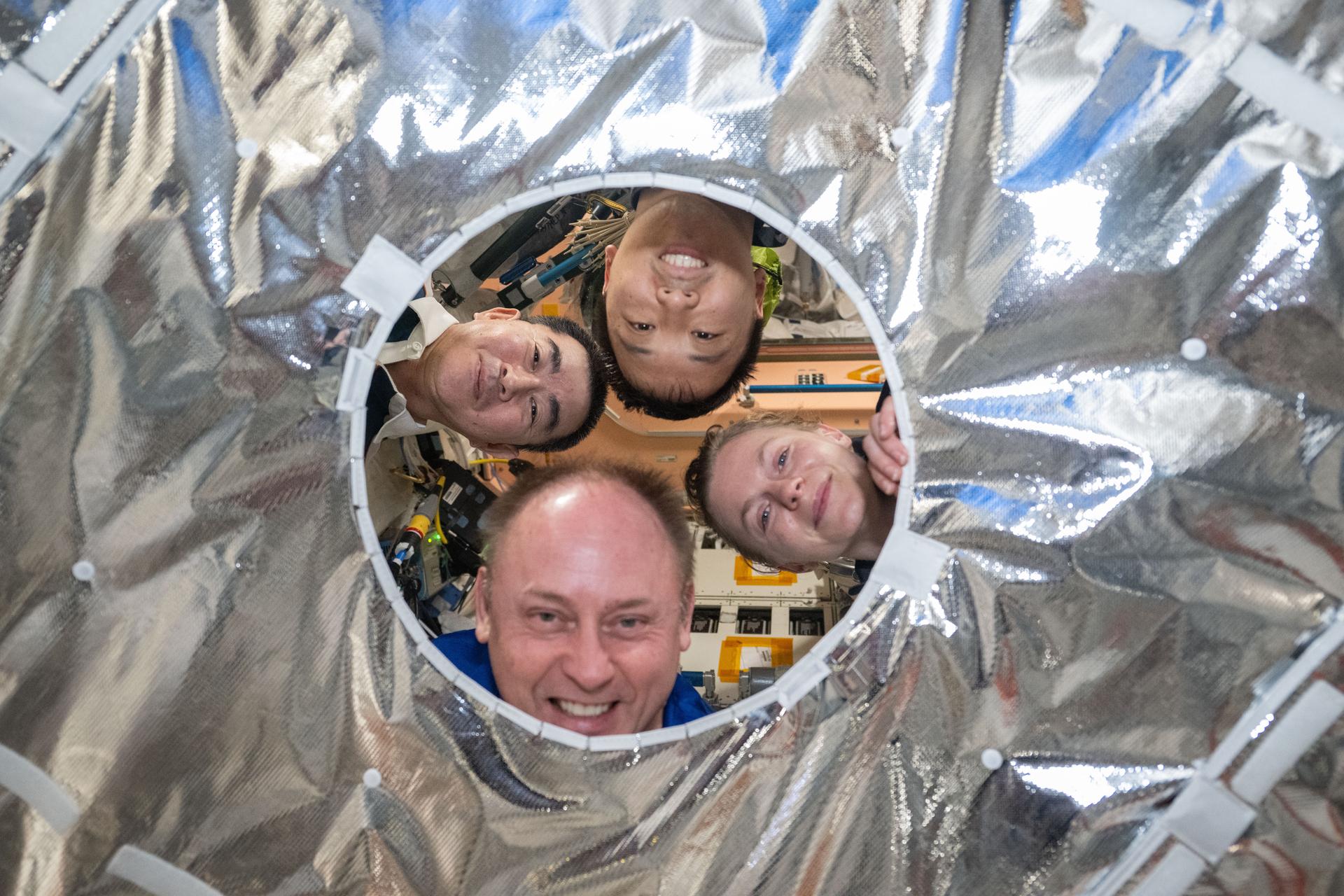
iss073e0814504 (Sept. 18, 2025) --- Four Expedition 73 flight engineers pose for a playful portrait through a circular opening in a hatch thermal cover aboard the International Space Station. The cover provides micrometeoroid and orbital debris protection while maintaining cleanliness and pressure integrity in the vestibule between Northrop Grumman's Cygnus XL cargo spacecraft and the orbital outpost. The opening allows for visual inspection of hatch alignment, access to the hatch handle or pressure equalization valve, and visibility for sensors or cameras during berthing operations. Clockwise from left, are JAXA (Japan Aerospace Exploration Agency) astronaut Kimiya Yui and NASA astronauts Jonny Kim, Zena Cardman, and Mike Fincke.
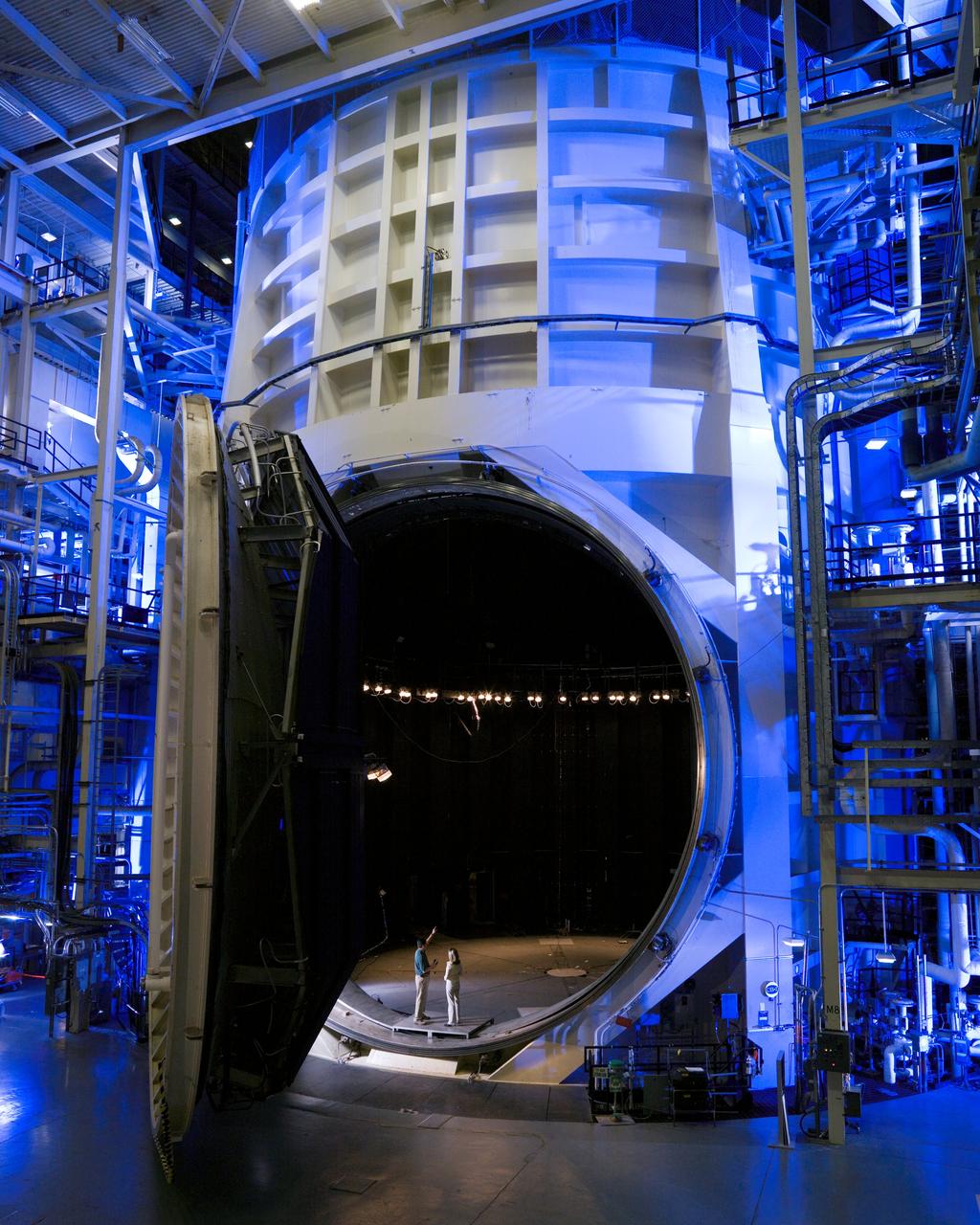
View of Thermal Vacuum Test Chamber A (with it's door opened) in bldg 32. Two people are standing inside the hatch to show a size comparision.
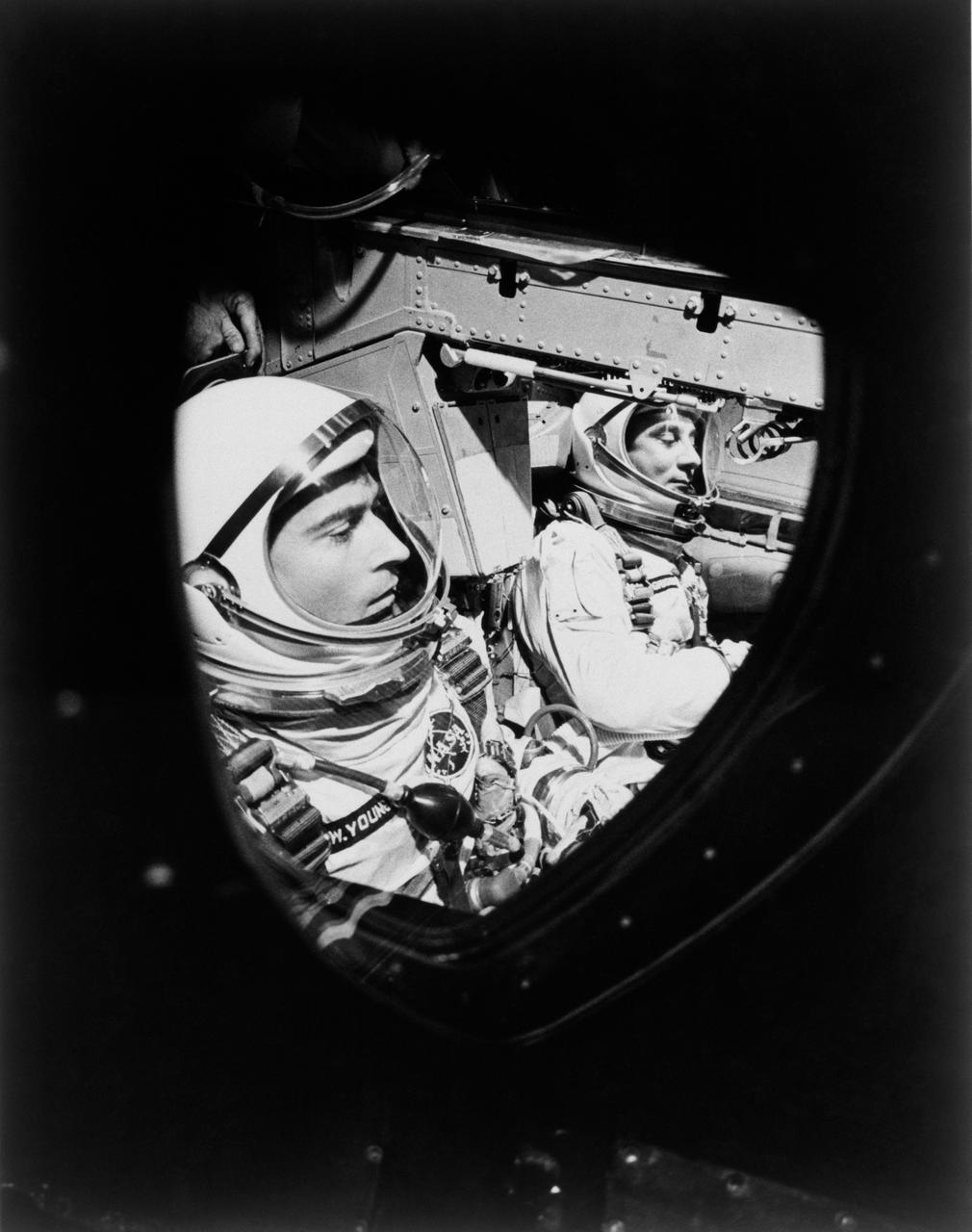
S65-19225 (23 March 1965) --- This view of astronauts John W. Young (left), pilot, and Virgil I. Grissom, command pilot, was taken through the window of the open hatch on Young's side of the Gemini-Titan 3 spacecraft just before the hatches were closed in readiness for their three-orbit flight.
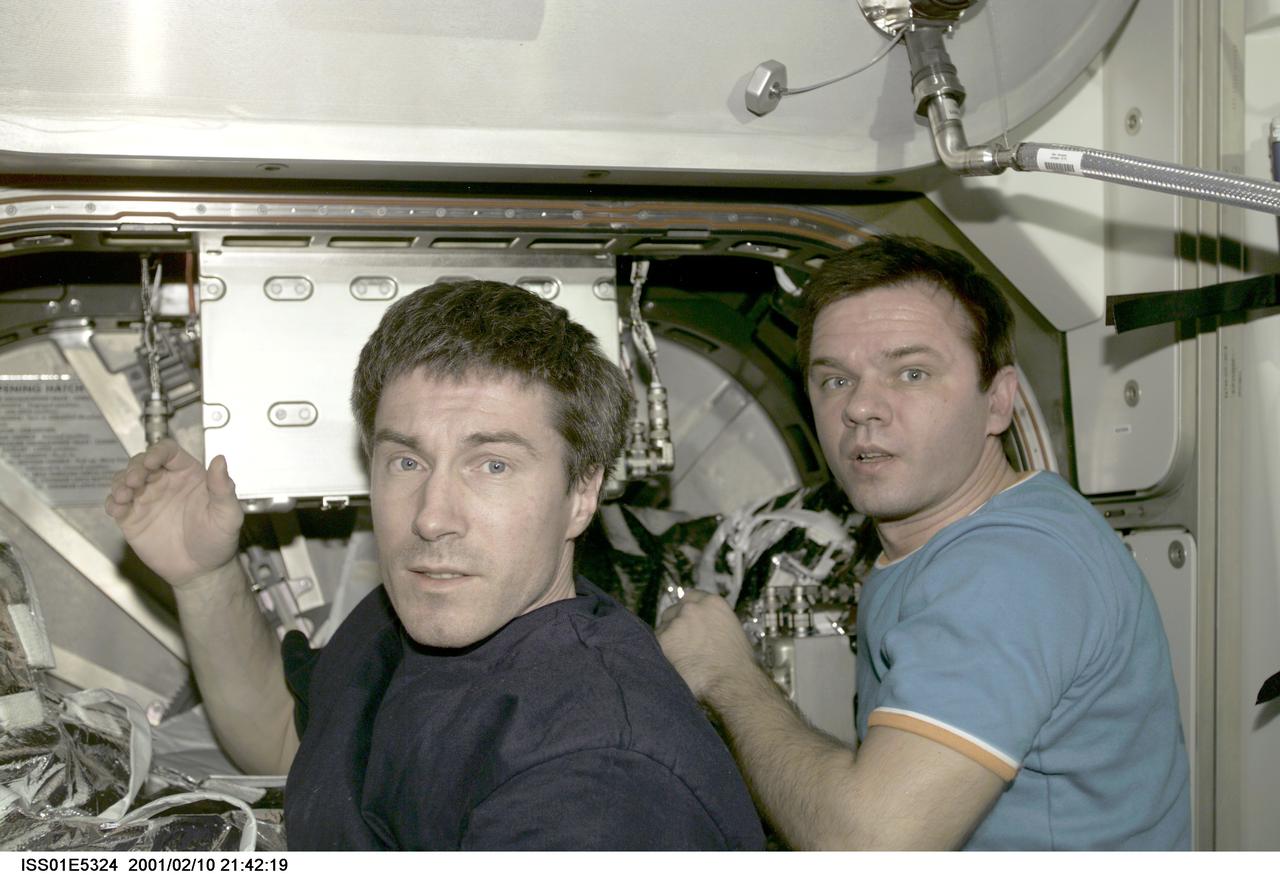
ISS-01-E-5324 (10 February 2001) --- Cosmonauts Sergei K. Krikalev (left), Expedition One flight engineer, and Yuri P. Gidzenko, Soyuz commander, are pictured at the hatch that leads from the Unity node into the newly attached Destiny laboratory. The picture was recorded with a digital still camera on the day the hatch was initially opened.
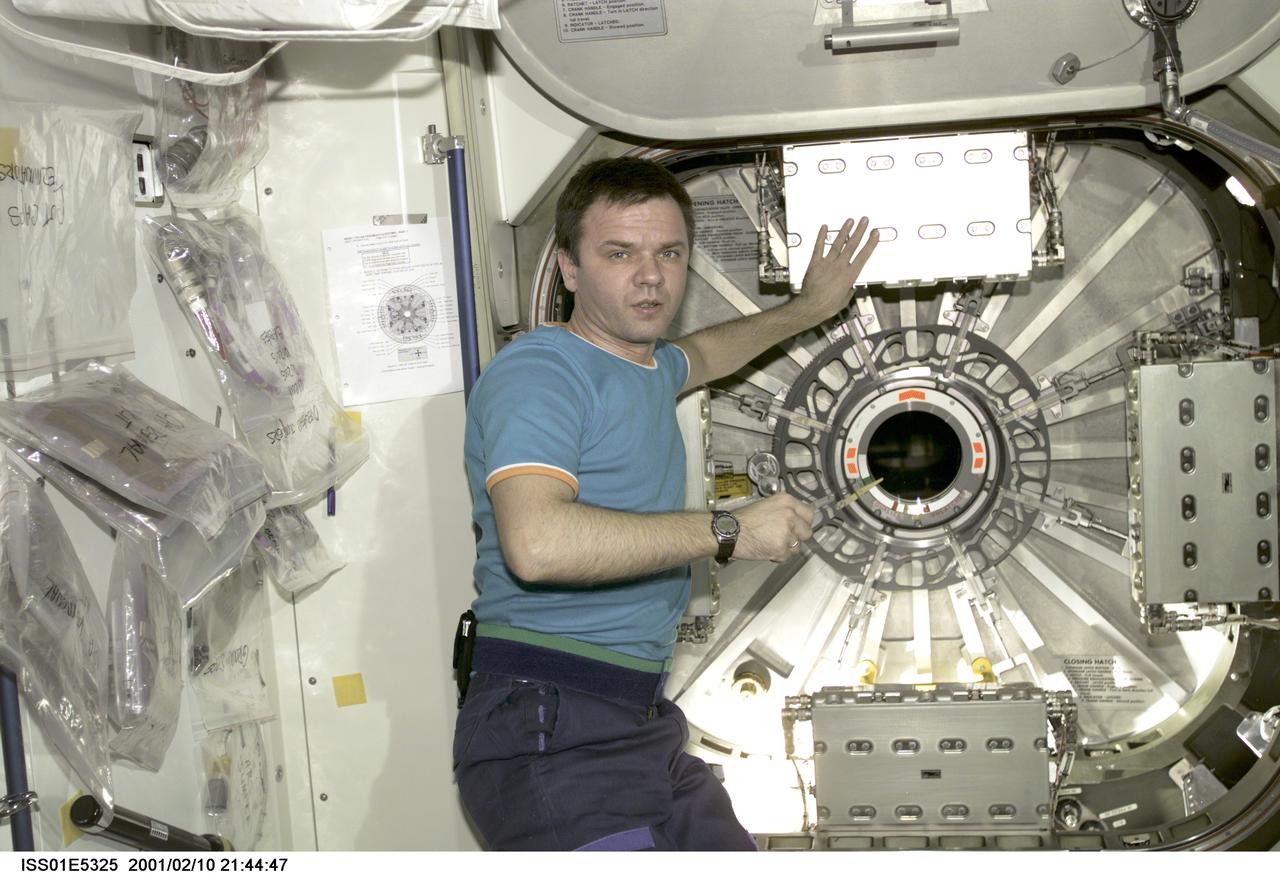
ISS01-E-5325 (10 February 2001) --- Cosmonaut Yuri P. Gidzenko, Expedition One Soyuz commander, stands near the hatch leading from the Unity node into the newly attached Destiny laboratory aboard the International Space Station (ISS). The picture was recorded with a digital still camera on the day the hatch was initially opened.
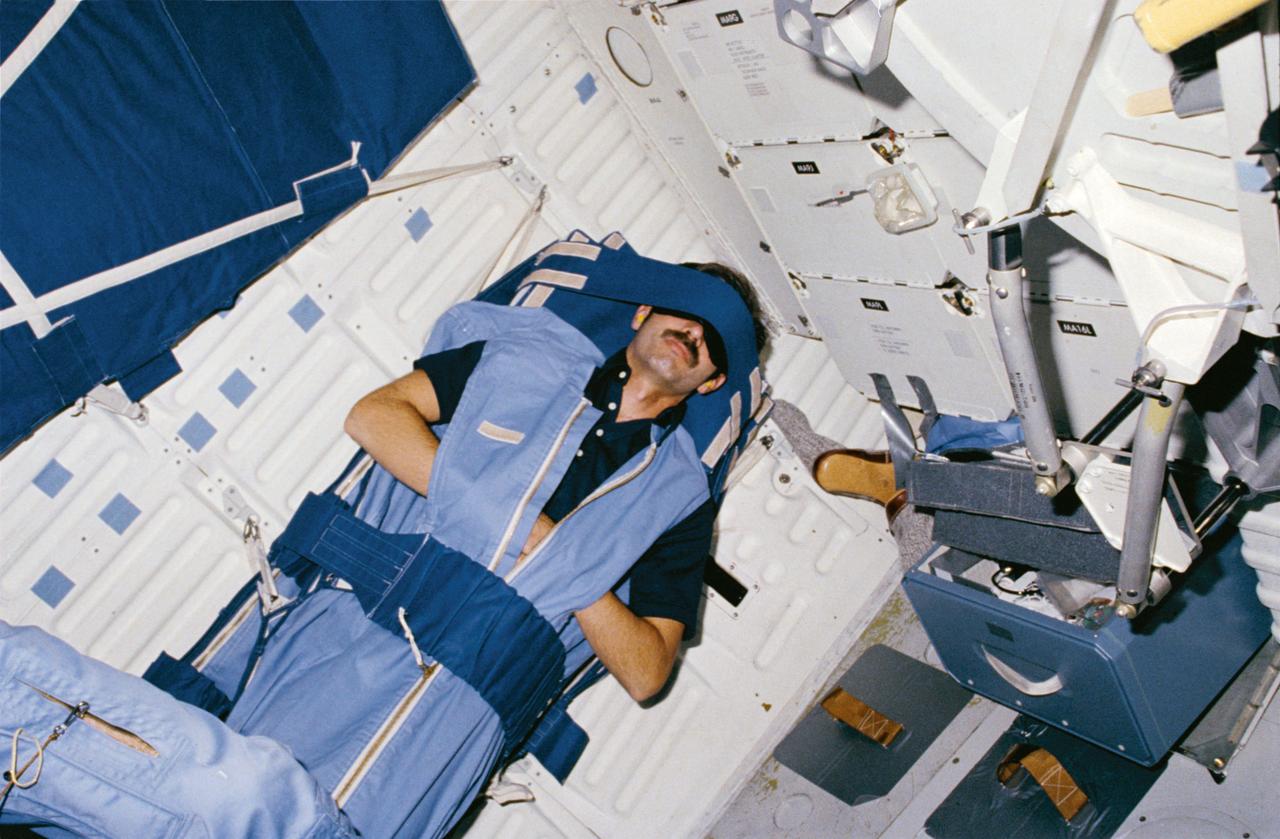
STS008-05-145 (5 Sept 1983) --- On middeck (MDK), Mission Specialist (MS) Gardner sleeps in sleep restraint attached to starboard wall. Open airlock hatch, airlock hatch hinge, and free-floating footwear appear in view.
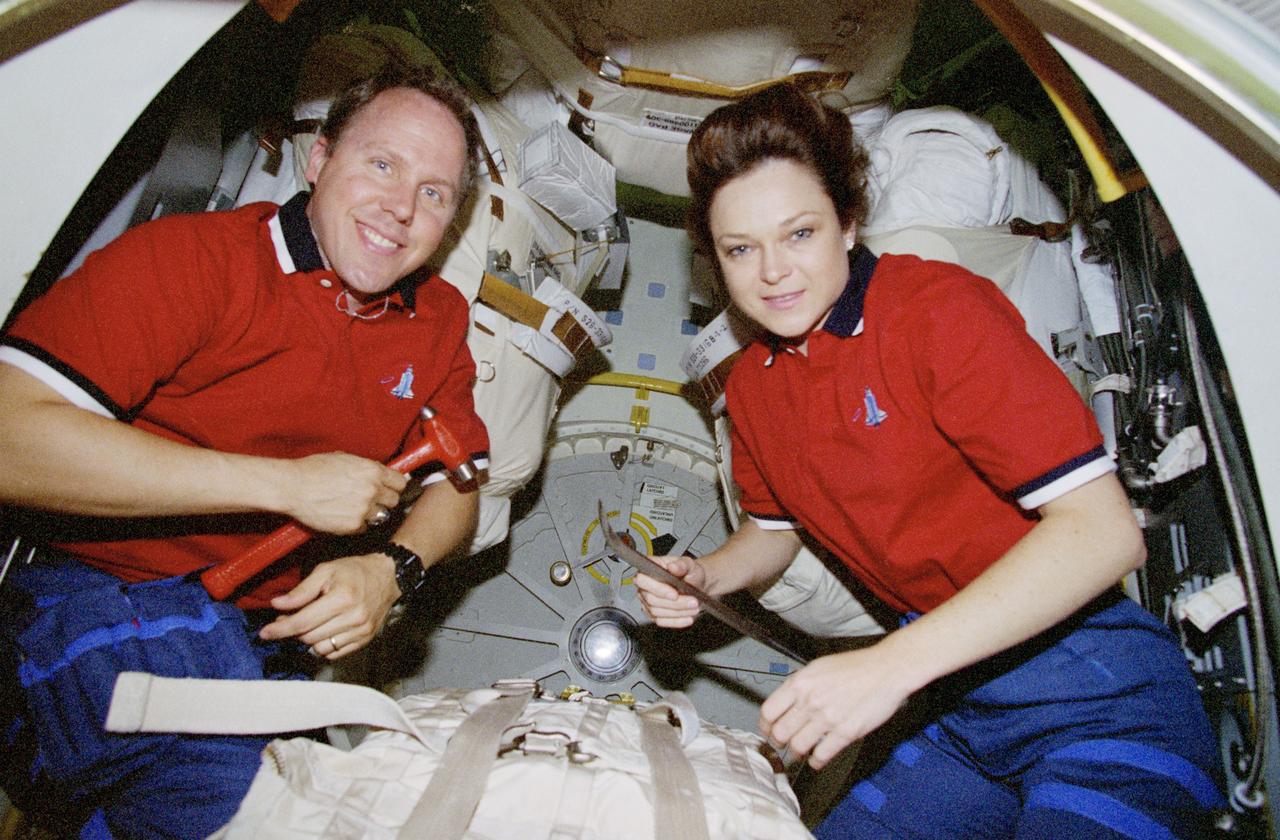
STS080-317-018 (28 Nov. 1996) --- Astronauts Thomas D. Jones, with a hammer, and Tamara E. Jernigan, holding a crow bar, display just two of the tools they called on during an intense effort to open the space shuttle Columbia's hatch leading to the cargo bay. Scheduled Extravehicular Activities (EVA) for the two were canceled by NASA when all efforts to open the hatch were unsuccessful.
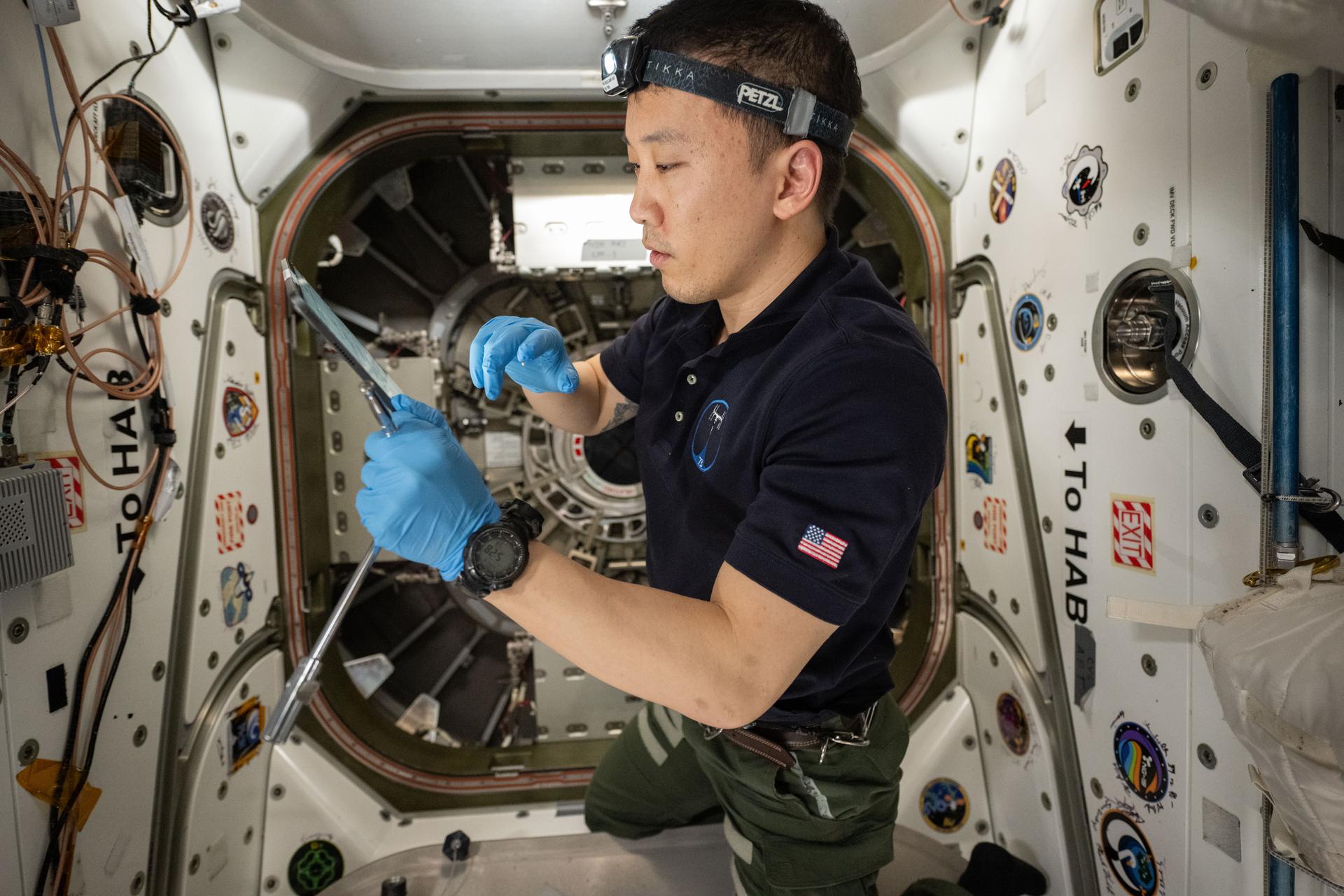
iss073e0814523 (Sept. 18, 2025) --- NASA astronaut and Expedition 73 Flight Engineer Jonny Kim reviews procedures on a computer tablet before opening the hatch to the Cygnus XL cargo spacecraft from Northrop Grumman. He was preparing to open Cygnus' hatch to begin unloading about 11,000 pounds of new science and supplies for the Expedition 73 crew.
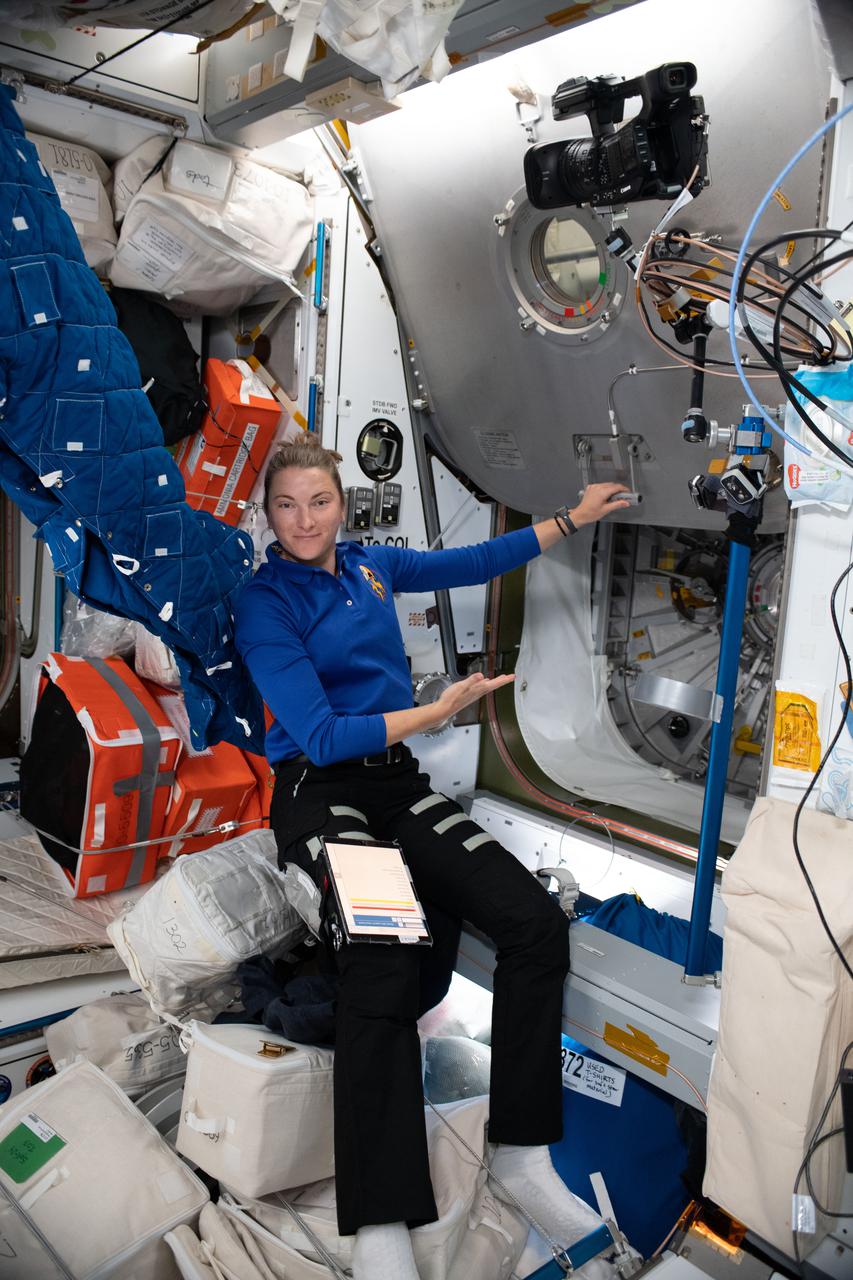
iss066e078289 (Nov. 17, 2021) --- NASA astronaut and Expedition 66 Flight Engineer Kayla Barron opens the hatch to the Columbus laboratory module aboard the International Space Station.
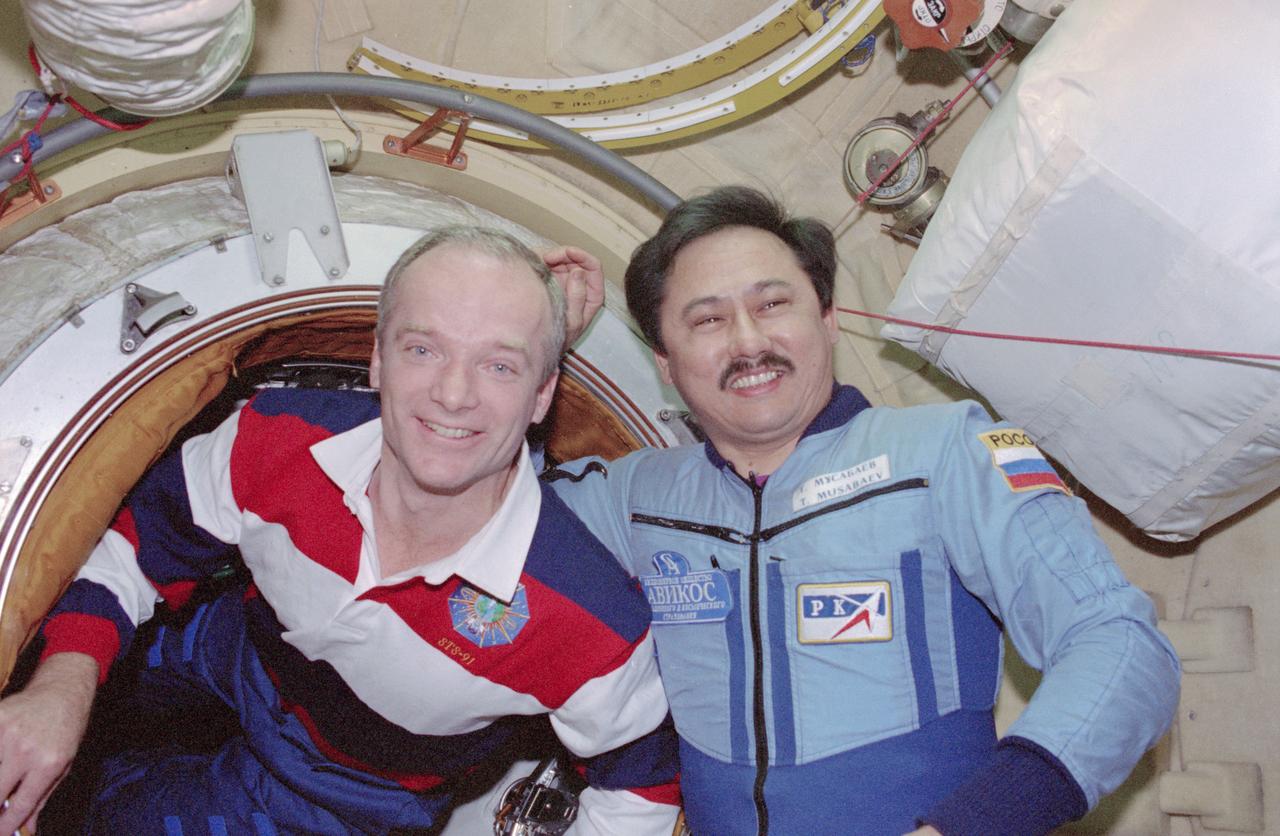
STS091-370-035 (2-12 June 1998) --- Astronaut Charles J. Precourt (left), STS-91 mission commander; and Talgat A. Musabayev, Mir-25 commander, reunite following hatch opening.
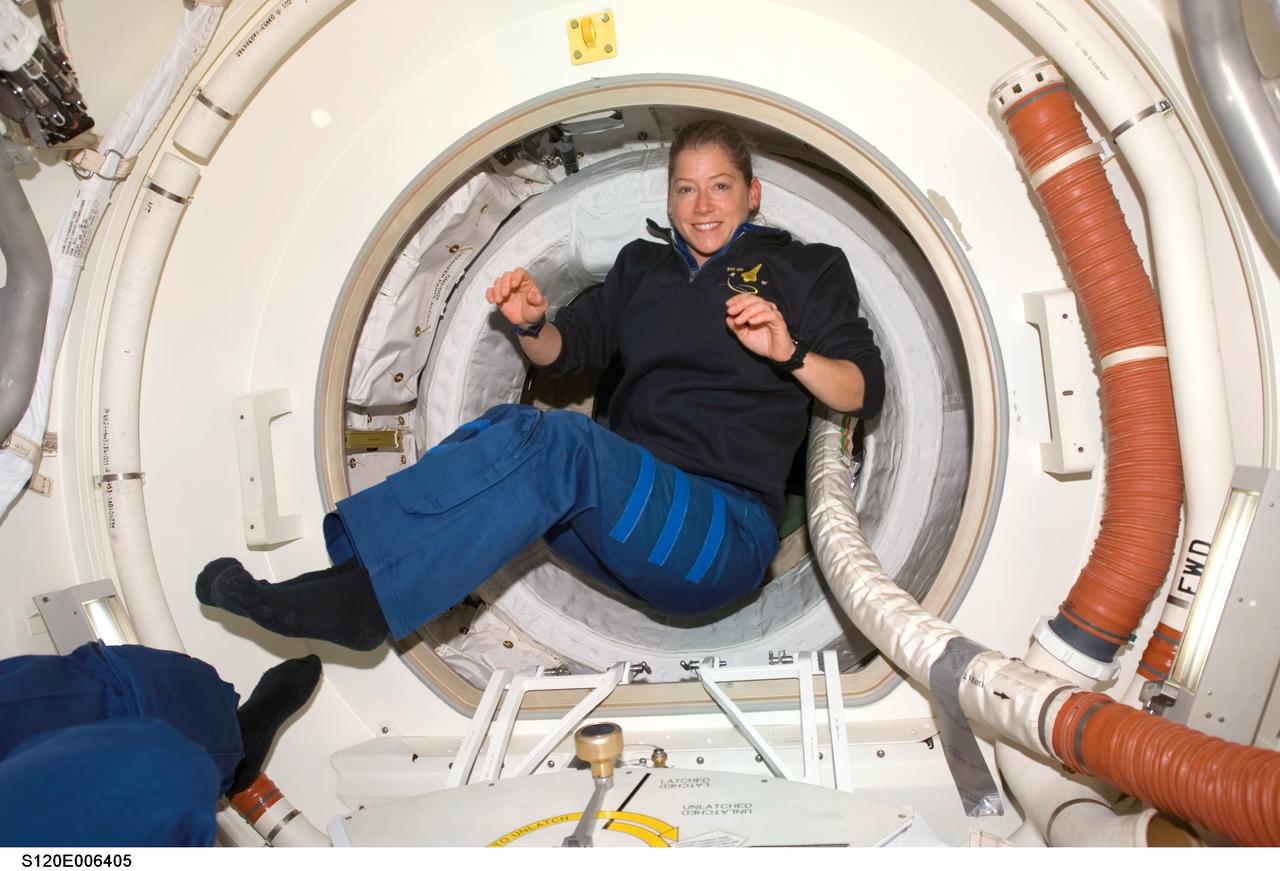
S120-E-006405 (25 Oct. 2007) --- Astronaut Pam Melroy, STS-120 commander, floats in the Orbiter Docking Compartment (ODS) after hatch opening between the International Space Station and Space Shuttle Discovery.
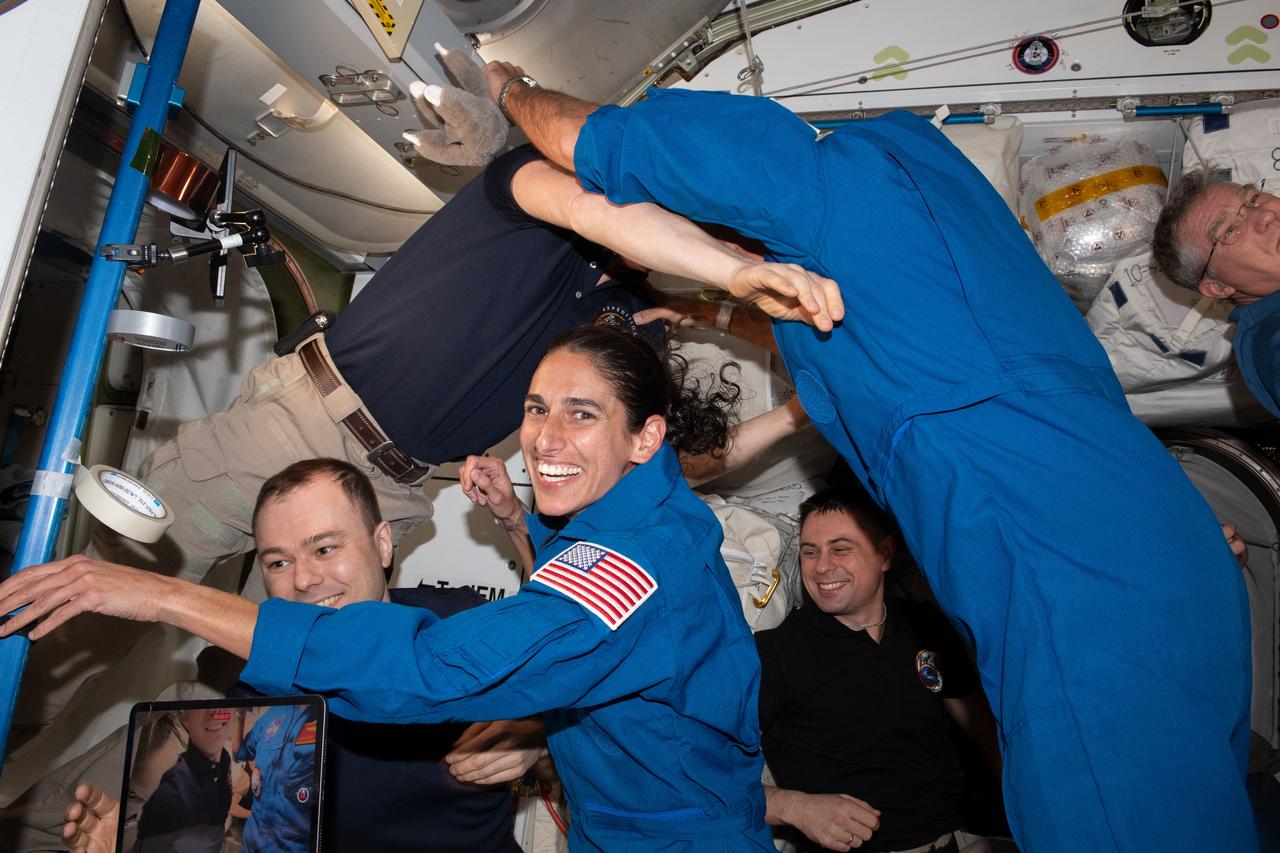
iss069e082554 (August 27, 2023) -- NASA astronaut and Crew-7 Commander, Jasmin Moghbeli, poses for a photo in the first moments the Crew-7 quartet is onboard the International Space Station after hatch opening on August 27, 2023.
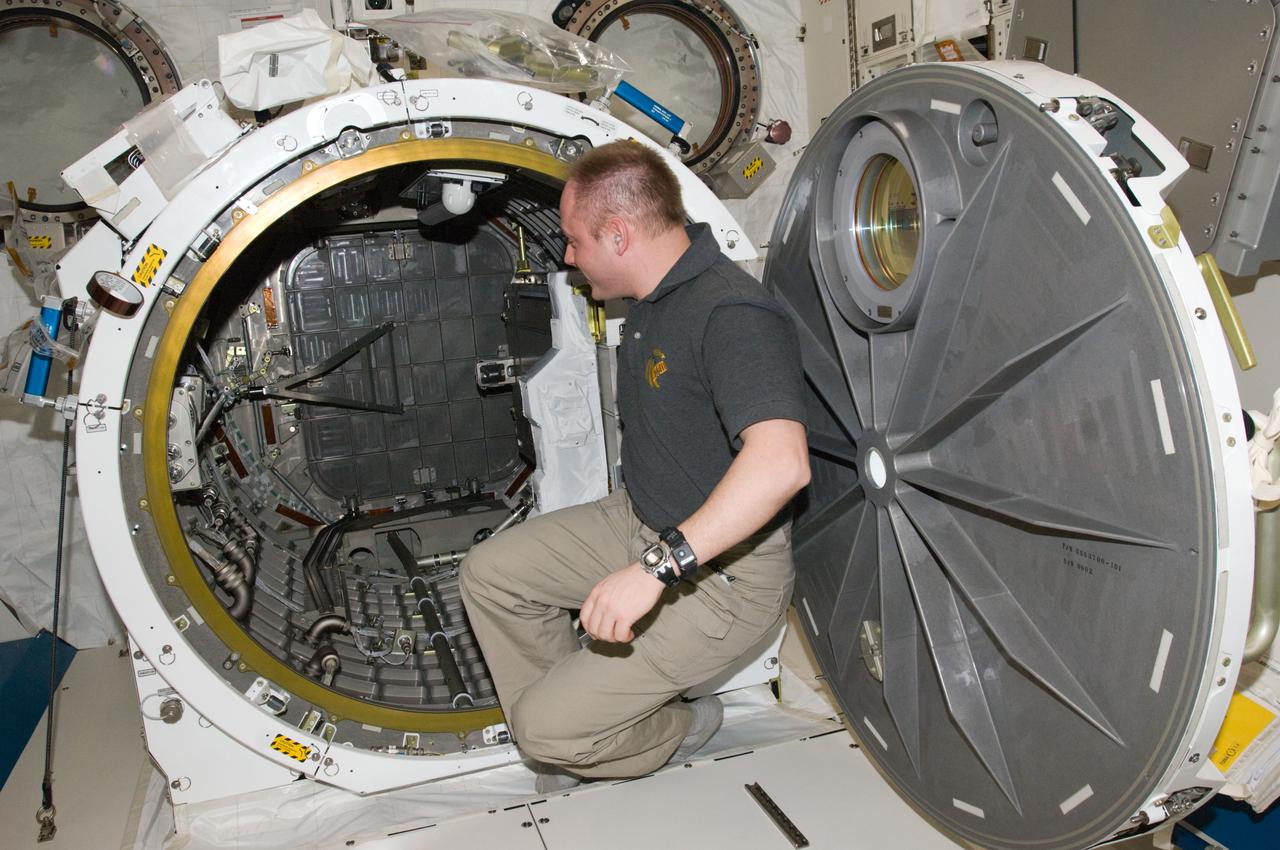
ISS018-E-046057 (5 April 2009) --- Astronaut Michael Fincke, Expedition 18 commander, is pictured at the open hatch of the Kibo laboratory airlock of the International Space Station.
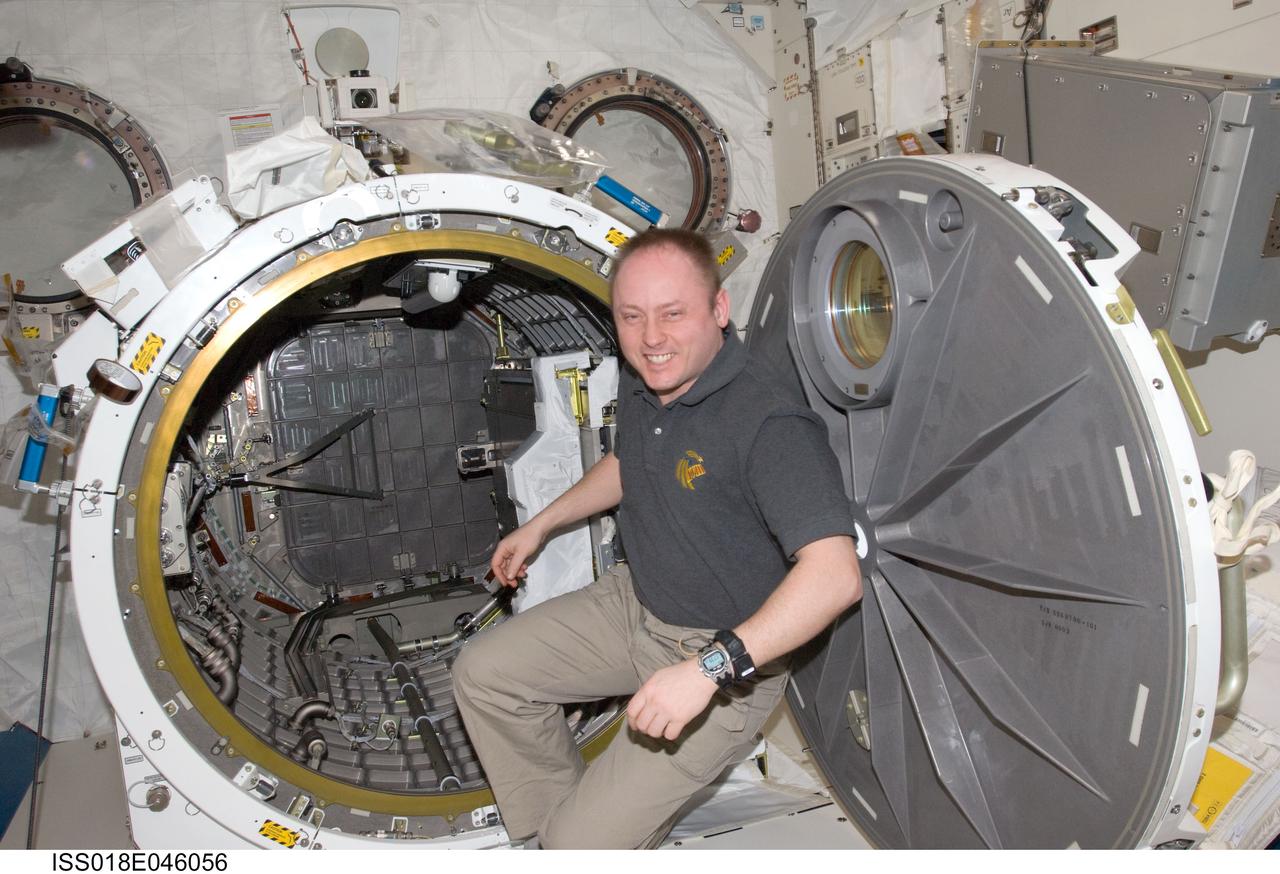
ISS018-E-046056 (5 April 2009) --- Astronaut Michael Fincke, Expedition 18 commander, is pictured at the open hatch of the Kibo laboratory airlock of the International Space Station.
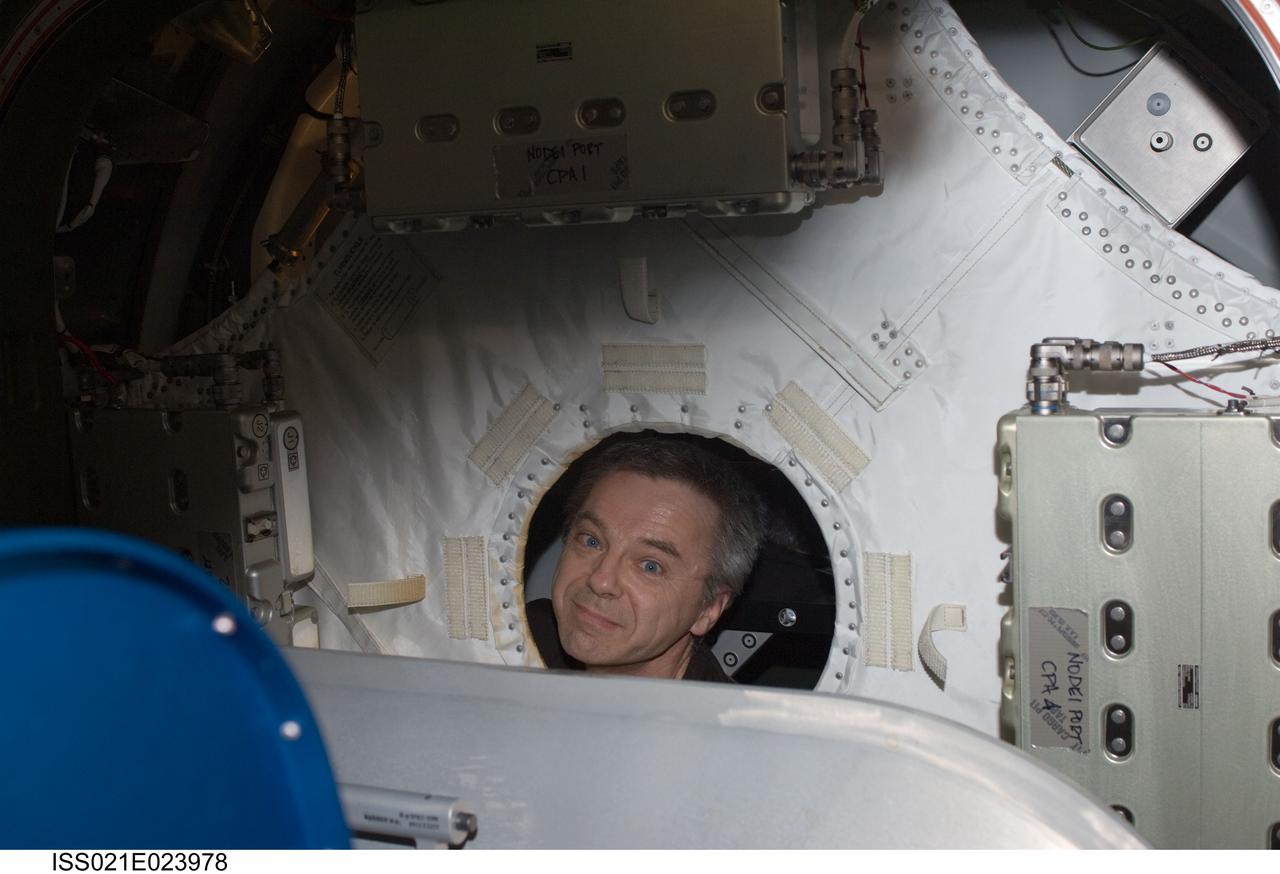
ISS021-E-023978 (4 Nov. 2009) --- Canadian Space Agency astronaut Robert Thirsk, Expedition 21 flight engineer, looks through an opening on a hatch cover in the Unity node of the International Space Station.
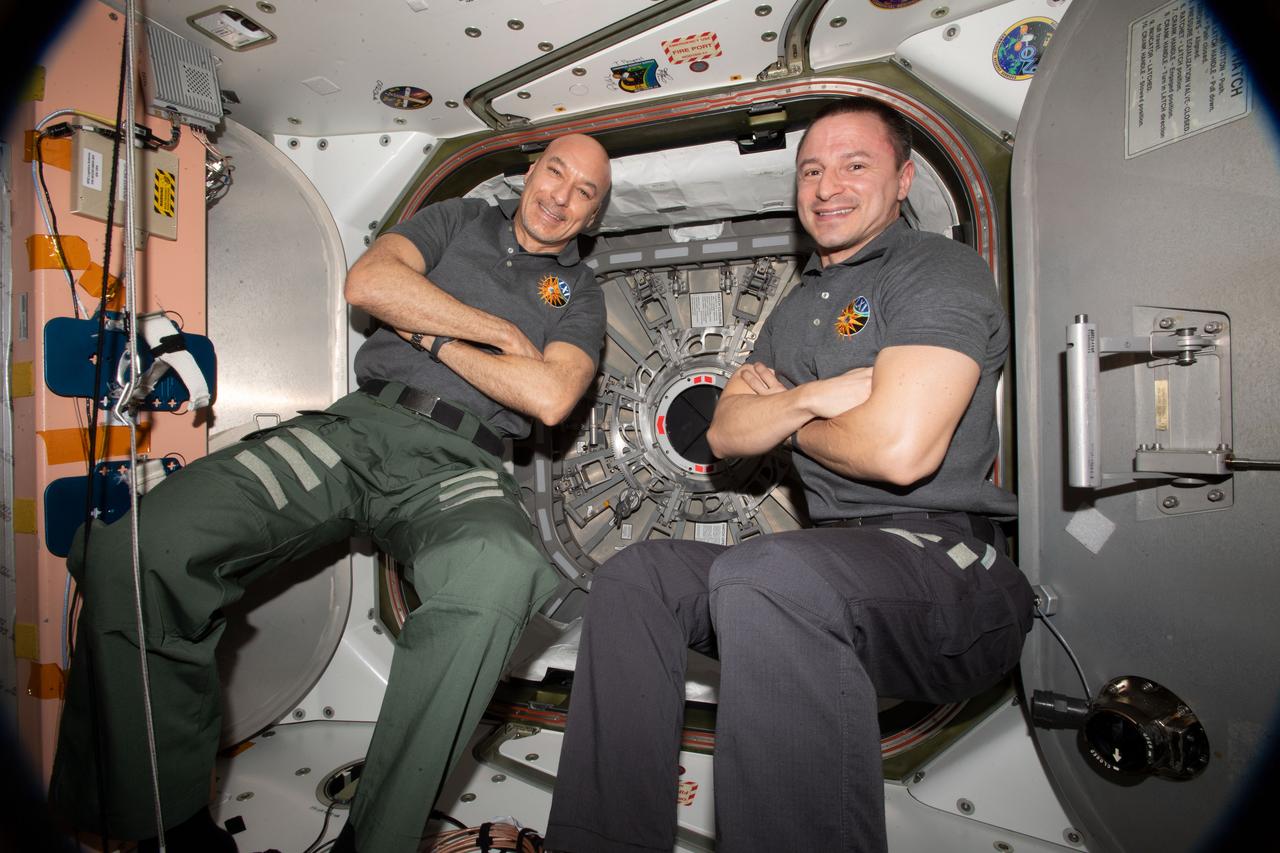
iss061e028299 (Nov. 4, 2019) --- Astronauts (from left) Luca Parmitano of ESA (European Space Agency) and Andrew Morgan of NASA pose for a portrait in front the hatch that opens to the Cygnus space freighter from Northrop Grumman.
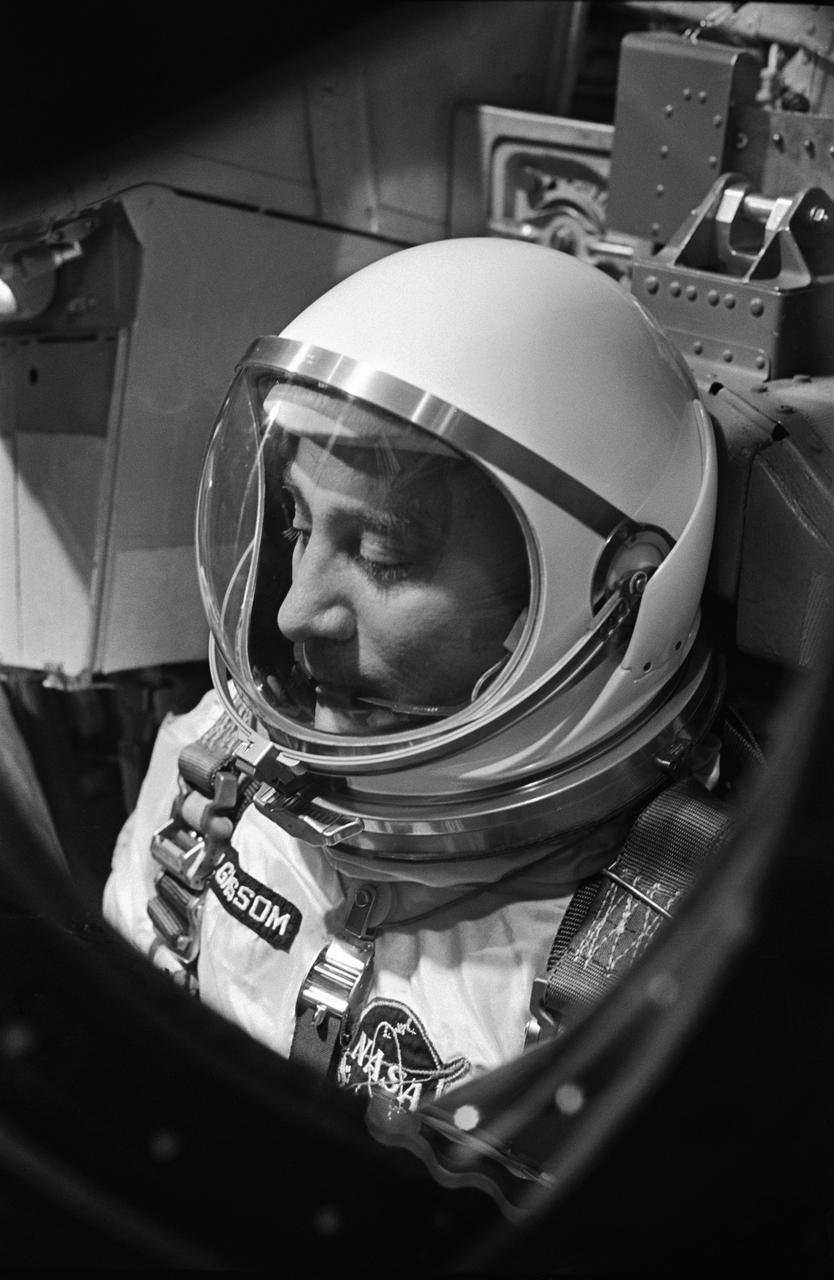
S65-20605 (23 March 1965) --- Astronaut Virgil I. Grissom, the command pilot of the Gemini-Titan 3 mission, is shown through the window of the open hatch on the Gemini spacecraft in the white room on the morning of the launch.
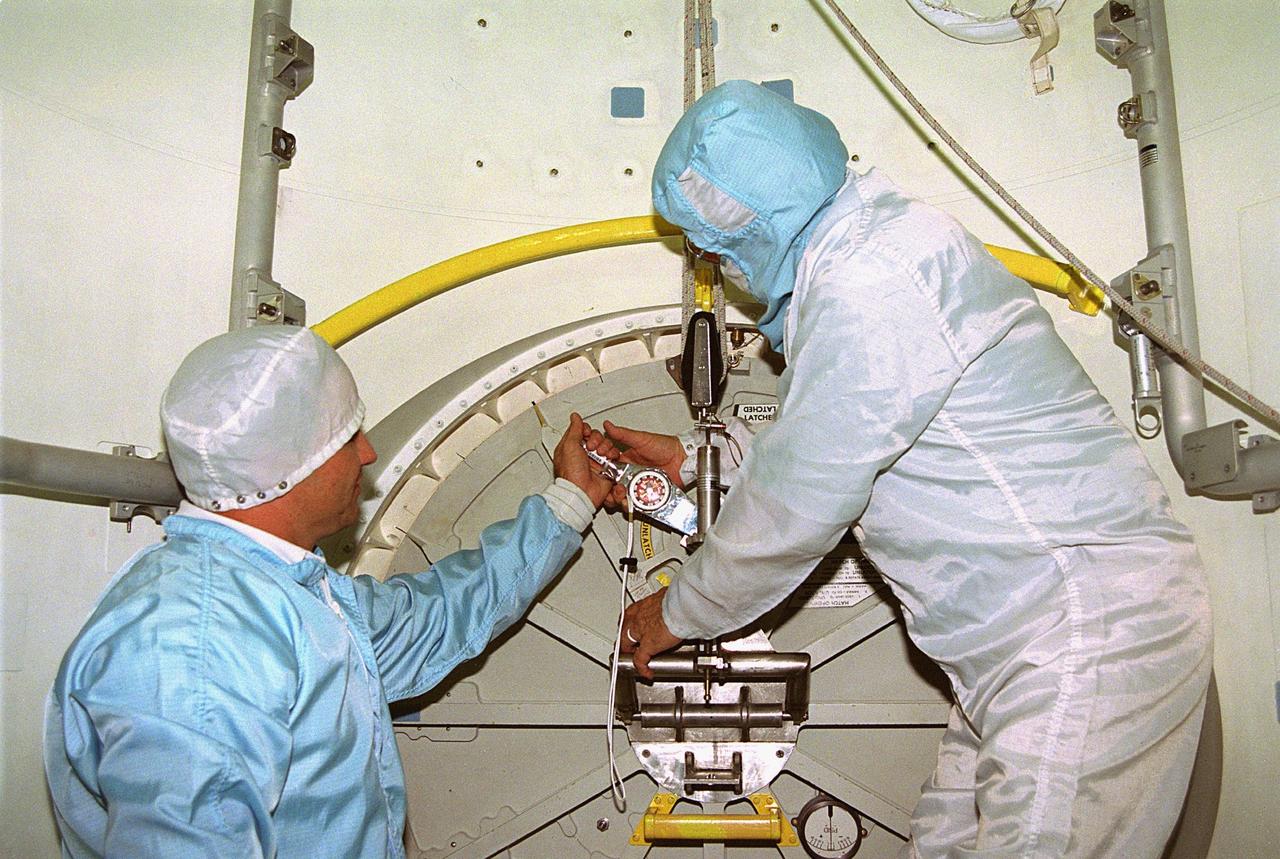
KENNEDY SPACE CENTER, FLA. -- In Orbiter Processing Facility Bay 1, United Space Alliance (USA) technicians Dave Lawrence, at left, and James Cullop troubleshoot the orbiter Columbia’s outer hatch of the airlock, which failed to open during the recent STS-80 Space Shuttle mission. Mission Specialists Tamara E. Jernigan and Thomas D. Jones did not perform the mission’s planned two extravehicular activities (EVAs) or spacewalks because the hatch would not open on orbit. The spacewalks were to be part of the continuing series of EVA Development Flight Tests to evaluate equipment and procedures and to build spacewalking experience in preparation for the International Space Station.
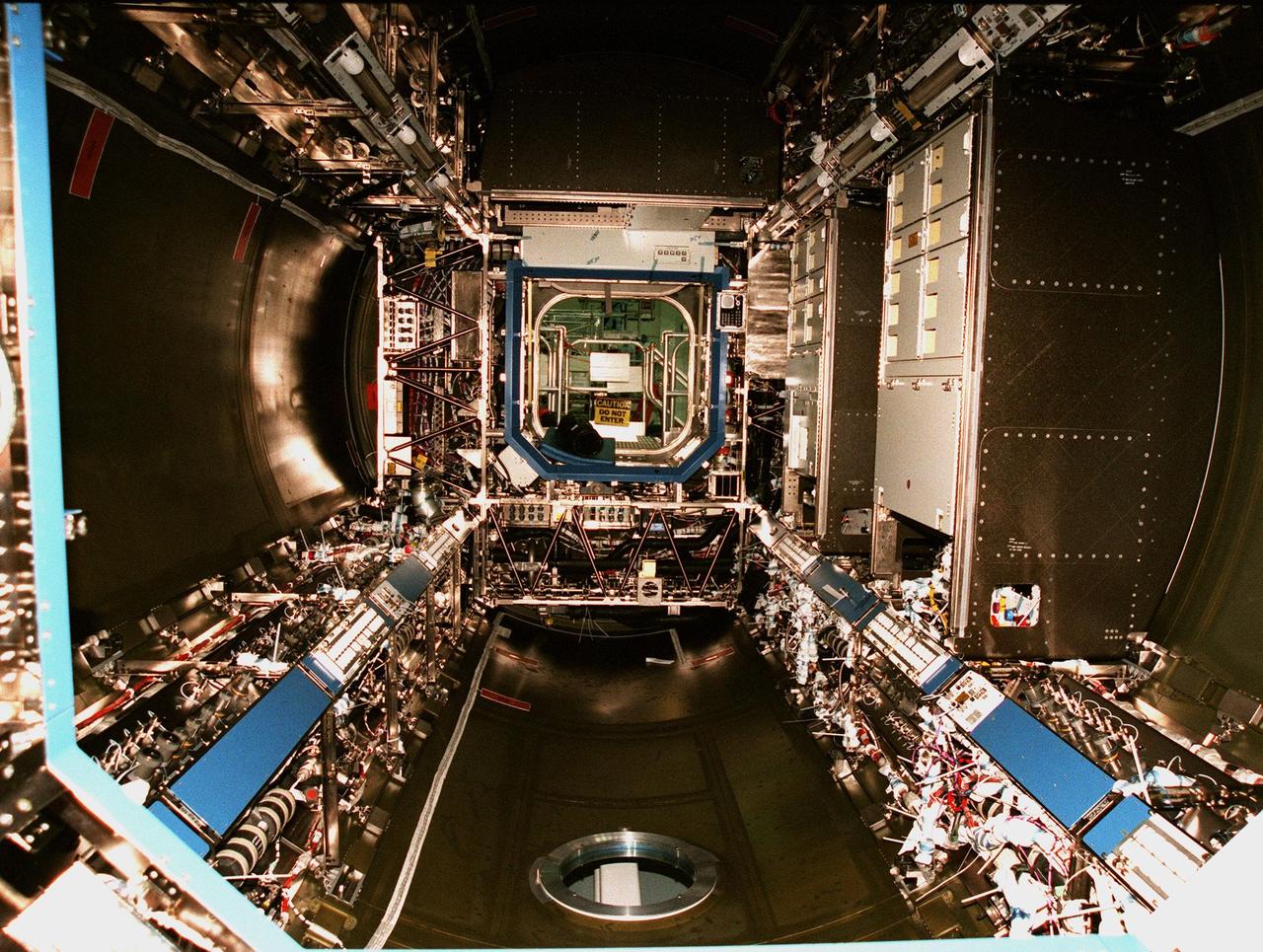
KENNEDY SPACE CENTER, FLA. -- The inside of the U.S. laboratory module is seen after the opening of a hatch on one end. An element of the International Space Station, the lab is undergoing pre-launch preparations before its launch aboard the Shuttle Endeavour on mission STS-98. The laboratory comprises three cylindrical sections with two end cones. Each end-cone contains a hatch opening for entering and exiting the lab. The lab will provide a shirtsleeve environment for research in the areas of life science, microgravity science, Earth science and space science. Designated Flight 5A, this mission is targeted for launch in early 2000
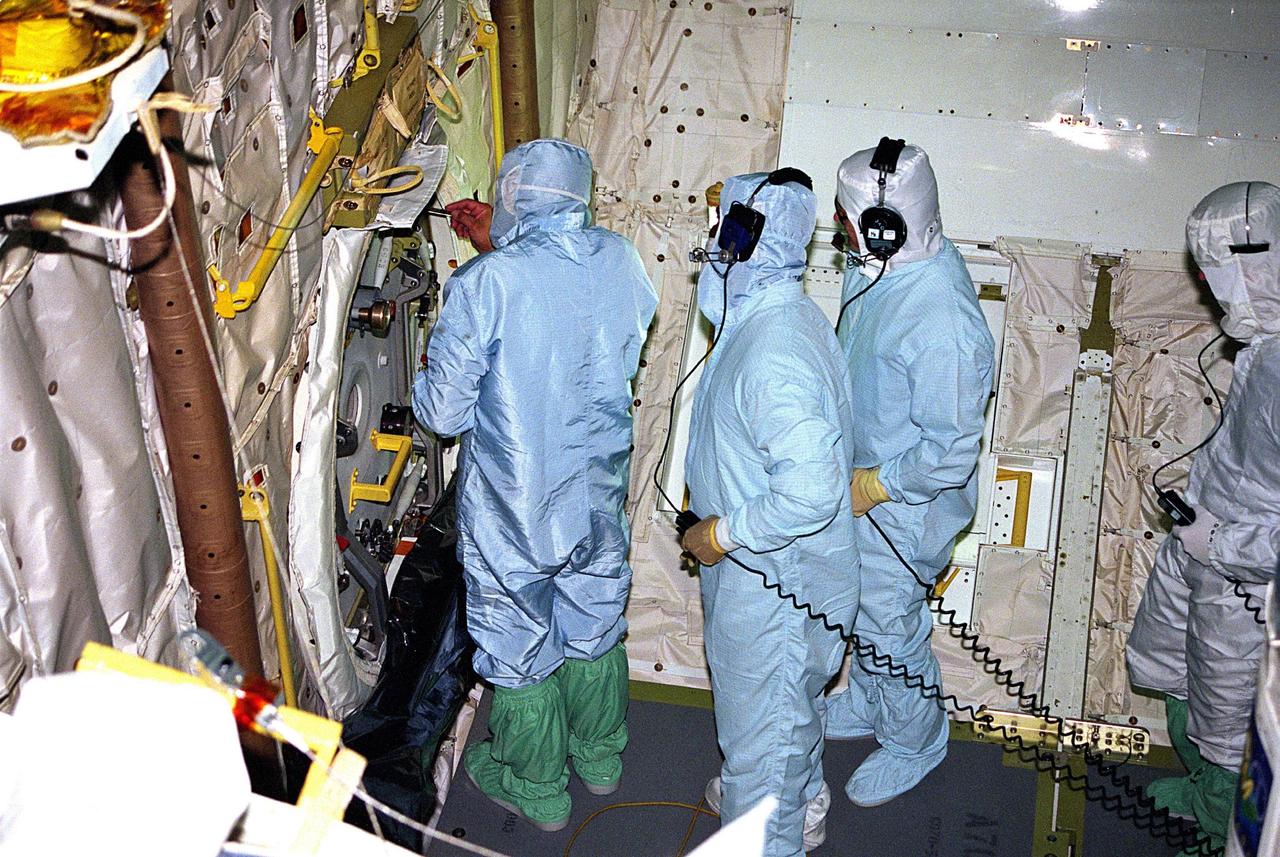
KENNEDY SPACE CENTER, FLA. -- United Space Alliance (USA) technicians in Orbiter Processing Facility Bay 1 troubleshoot the orbiter Columbia’s outer hatch of the airlock, which failed to open during the recent STS-80 Space Shuttle mission. Mission Specialists Tamara E. Jernigan and Thomas D. Jones did not perform the mission’s planned two extravehicular activities (EVAs) or spacewalks because the hatch would not open on orbit. The spacewalks were to be part of the continuing series of EVA Development Flight Tests to evaluate equipment and procedures and to build spacewalking experience in preparation for the International Space Station.