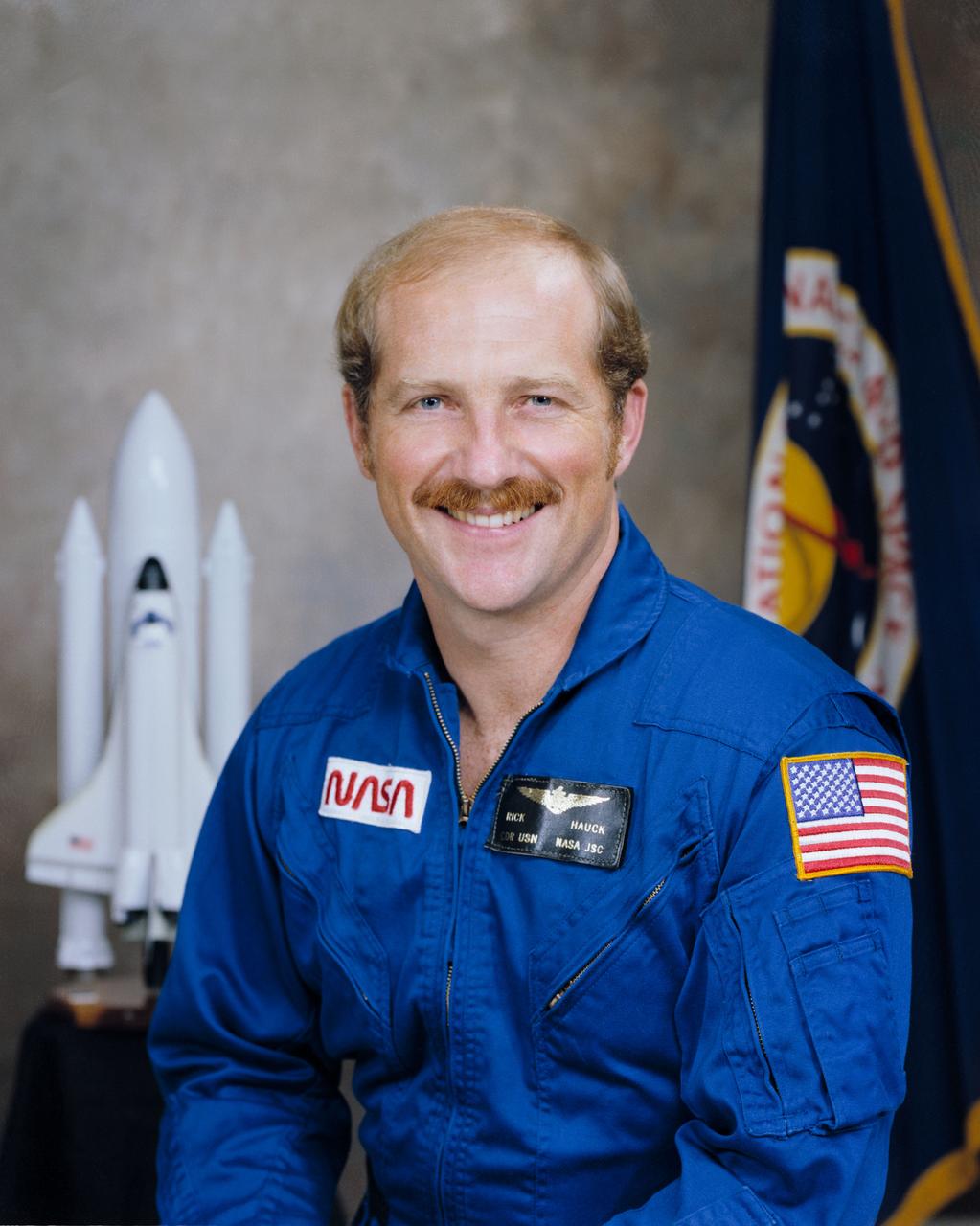
S78-35289 (20 Sept 1978) --- Astronaut Frederick H. Hauck.
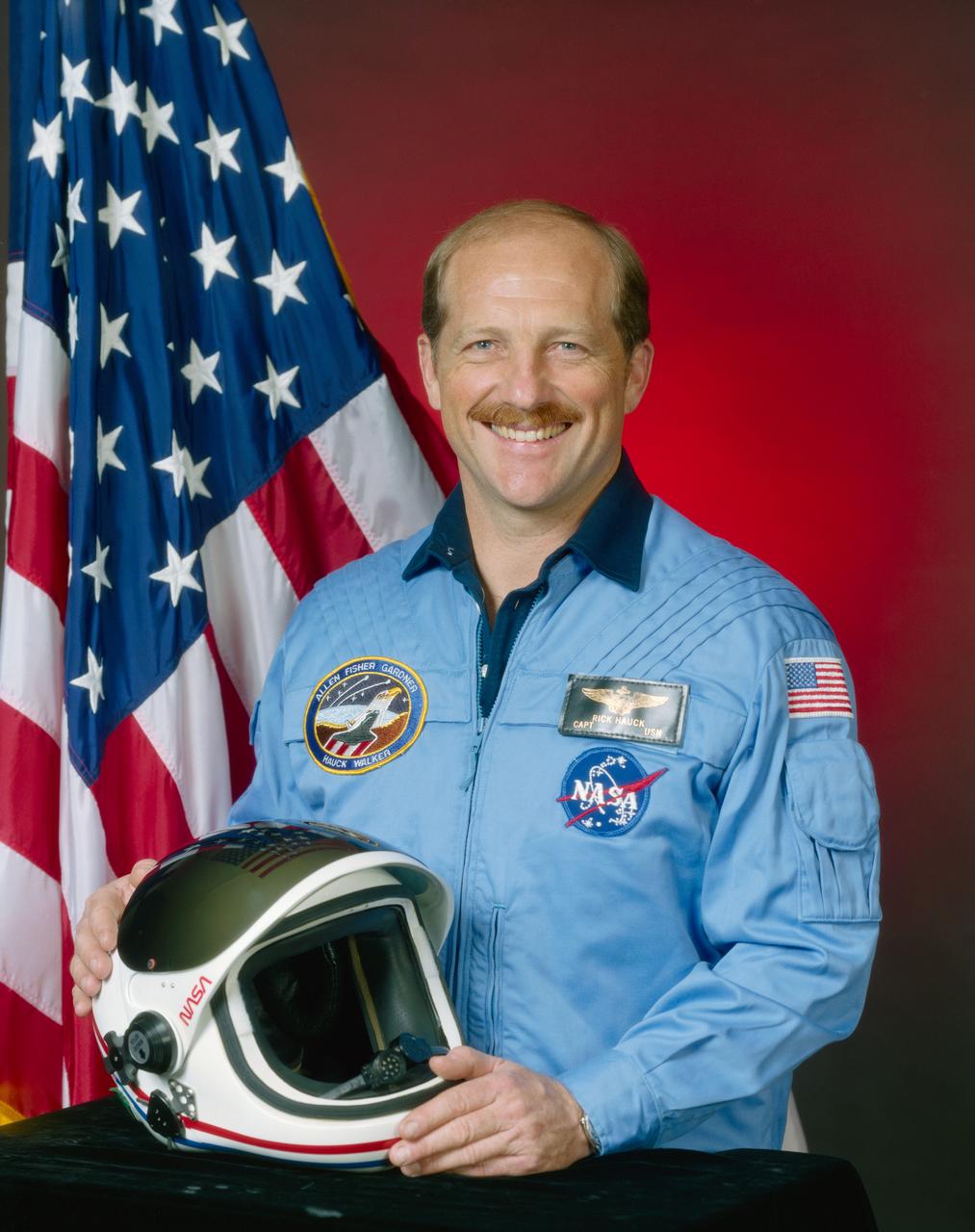
S85-36058 (1985) --- Astronaut Frederick H. "Rick" Hauck

View of astronaut candidates Daniel C. Brandenstein and Frederick H. Hauck, posed behind model of the Space shuttle orbiter.
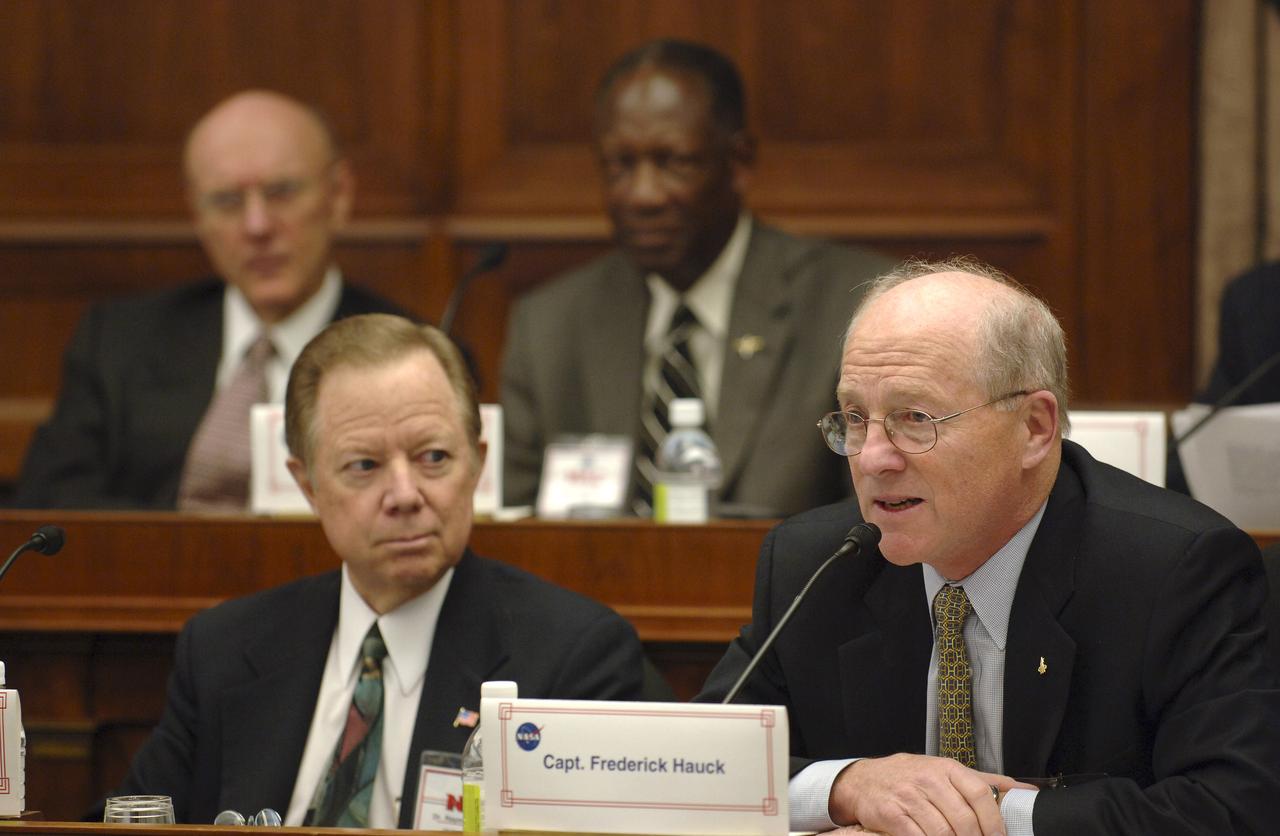
Capt. Frederick Hauck, USN (Ret.) talks during the NASA Advisory Council meeting held at the Rayburn House Office Building, Tuesday, Nov. 29, 2005, in Washington. Photo Credit: (NASA/Bill Ingalls)
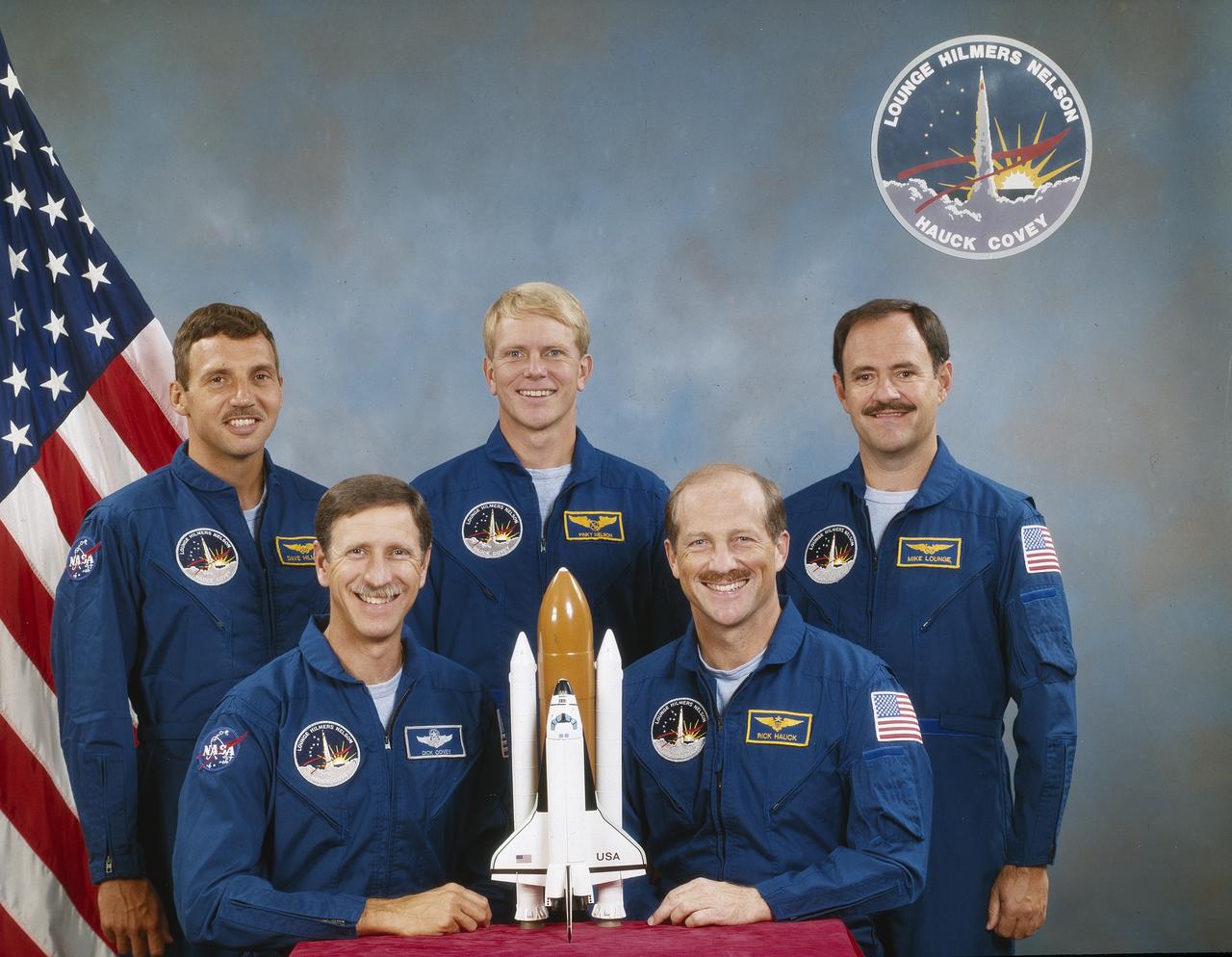
Five astronauts composed the crew of the STS-26 mission. Pictured in the portrait (left to right) are David C. Hilmer, mission specialist; Richard O. Covey, pilot; George D. Nelson, mission specialist; Frederick H. Hauck, Jr., commander; and John, M. Lounge, mission specialist. Launched aboard the Space Shuttle Orbiter Discovery, liftoff occurred on September 29, 1988 at 11:37am (EDT). This was the 7th flight of the Orbiter Discovery, and the return to flight after the STS-51L mission accident. The primary payload was the NASA Tracking and Data Relay Satellite-3 (TDRS-3).
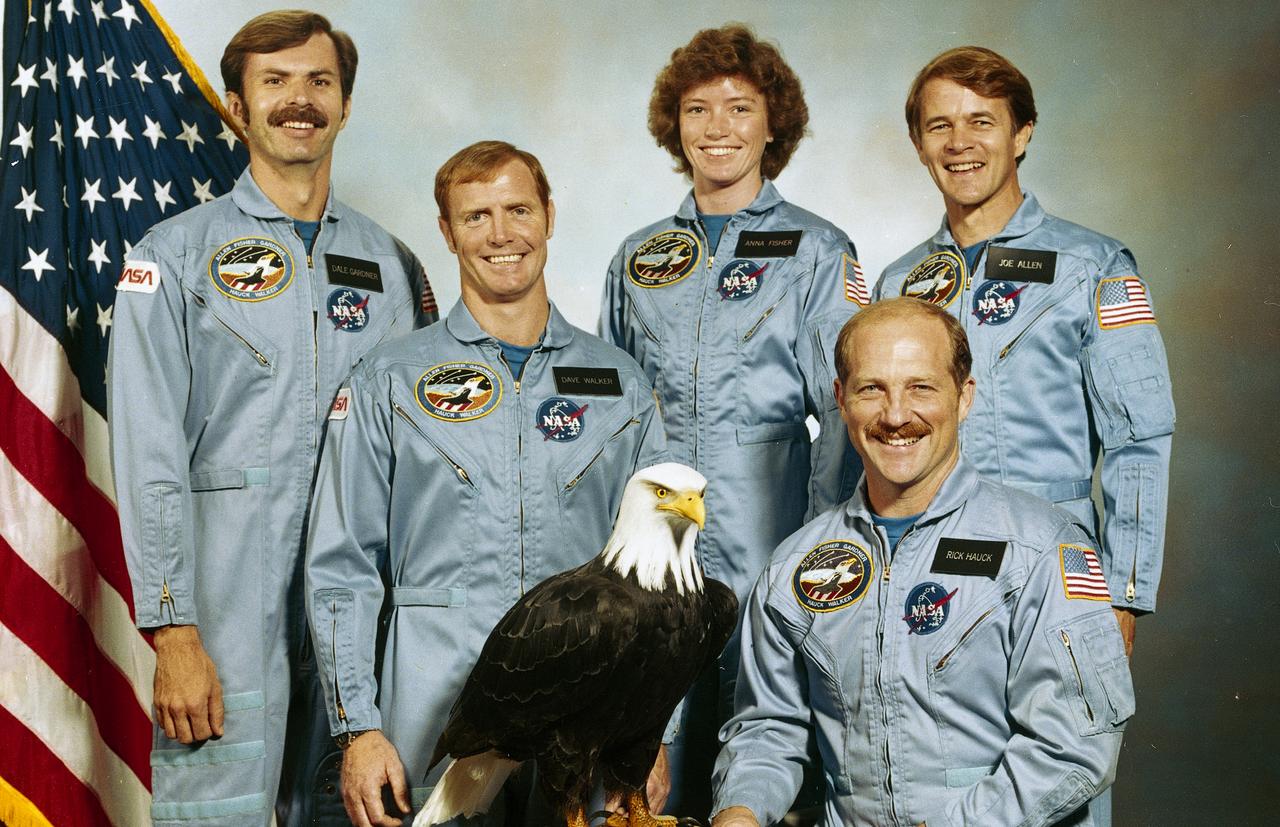
The crew assigned to the STS-51A mission included Frederick H. Hauck, commander,who is seated to the right. Standing, left to right, are Dale A. Gardner, mission specialist; David M. Walker, pilot; and mission specialists Anna L. Fisher, and Joseph P. Allen. Launched aboard the Space Shuttle Discovery on November 8, 1984 at 7:15:00 am (EST), the STS-51A mission deployed the Canadian communications satellite TELLESAT-H (ANIK), and the defense communications satellite SYCOM IV-1 (also known as LEASAT-1). In addition, 2 malfunctioning satellites were retrieved: the PALAPA-B2 and the WESTAR-VI.
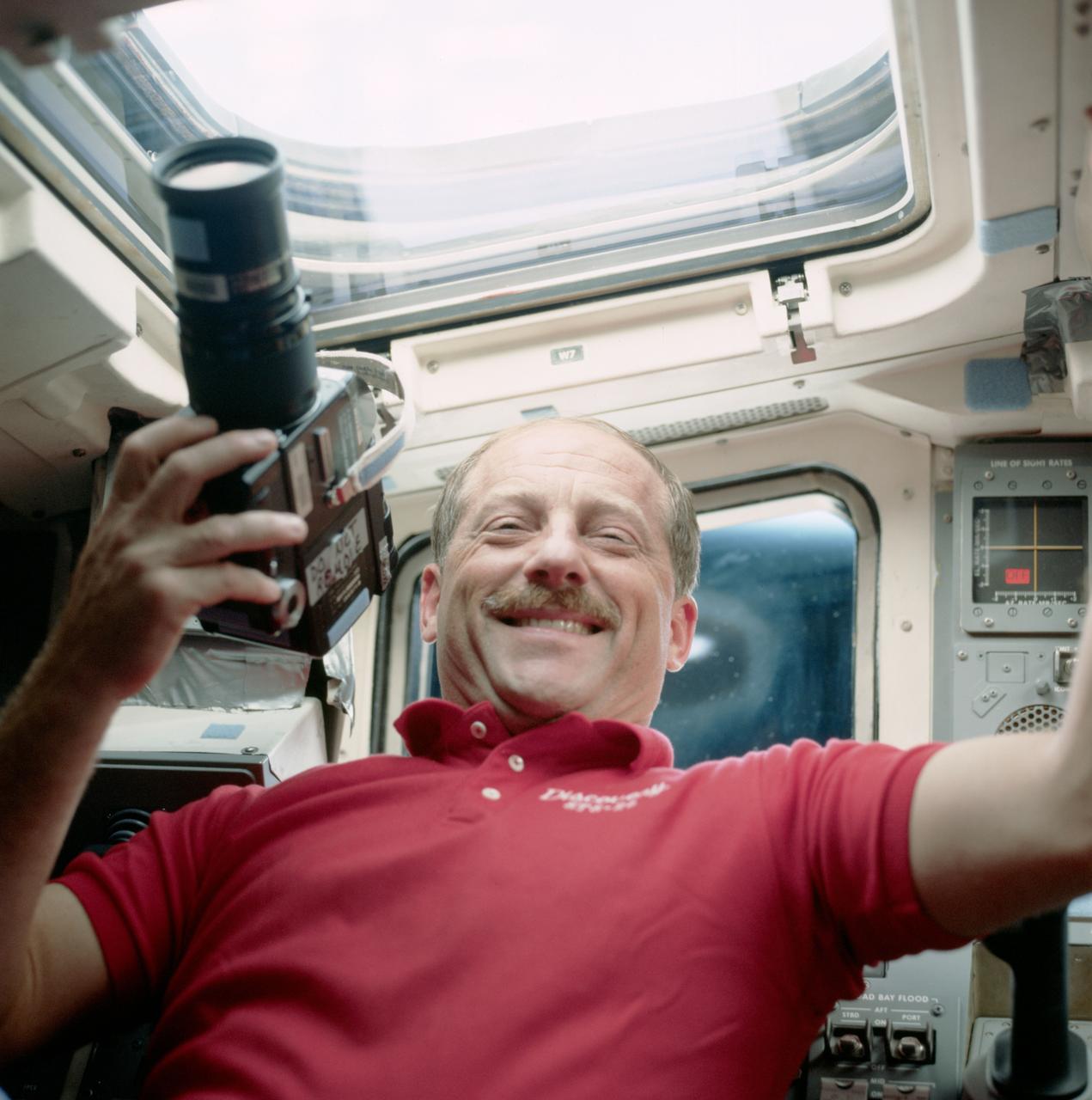
STS026-47-013 (5 Oct 1988) --- Astronaut Frederick H. (Rick) Hauck, commander, on the flight deck, with one of the many cameras carried onboard Discovery to renew documentation of planet Earth. This particular camera is a 70mm handheld Hasselblad.
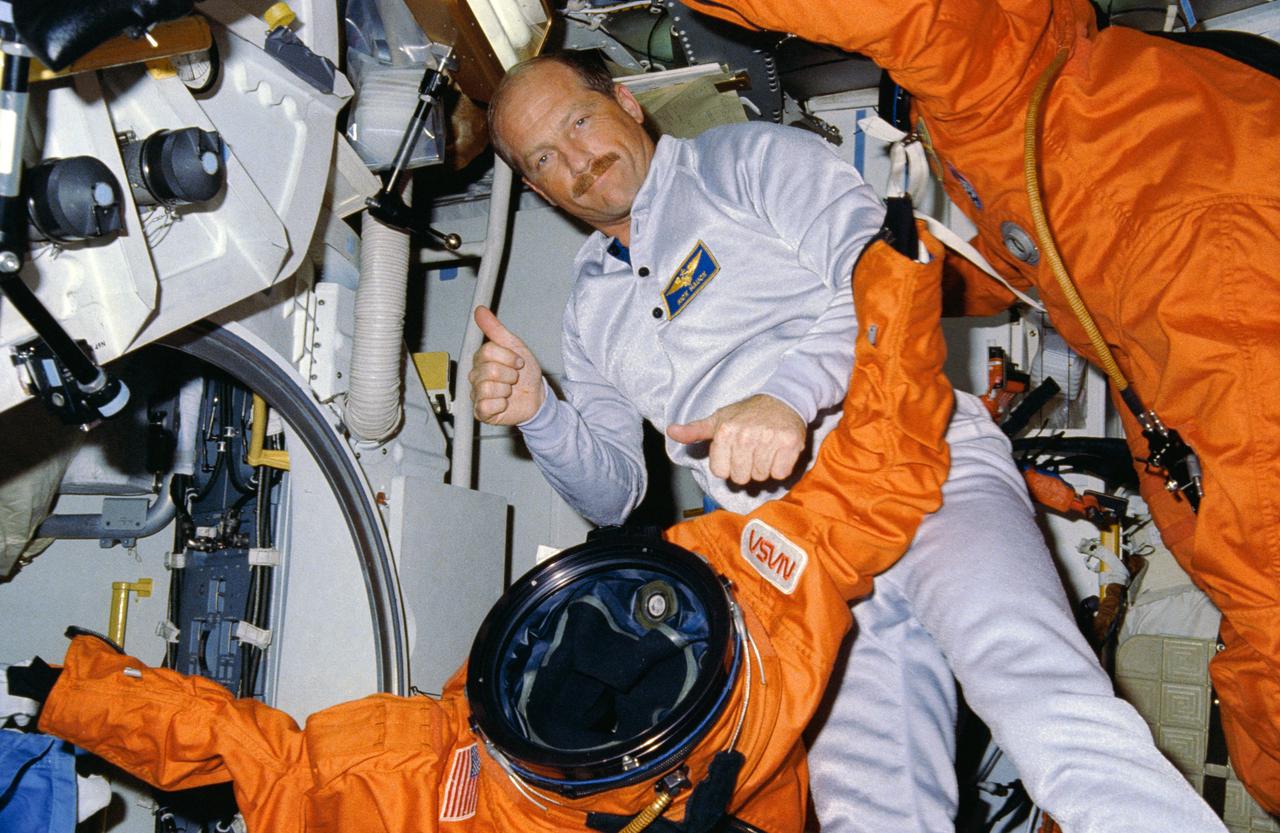
STS026-05-022 (5 Oct 1988) --- Astronaut Frederick H. (Rick) Hauck, commander, rehearses the donning of the new orange partial pressure suit which he and the other four crewmembers will put on just prior to the entry phase of the flight. The suit made its debut for the launch phase three days earlier; however the crew had the advantage of a one-G environment for the chore on that occasion.
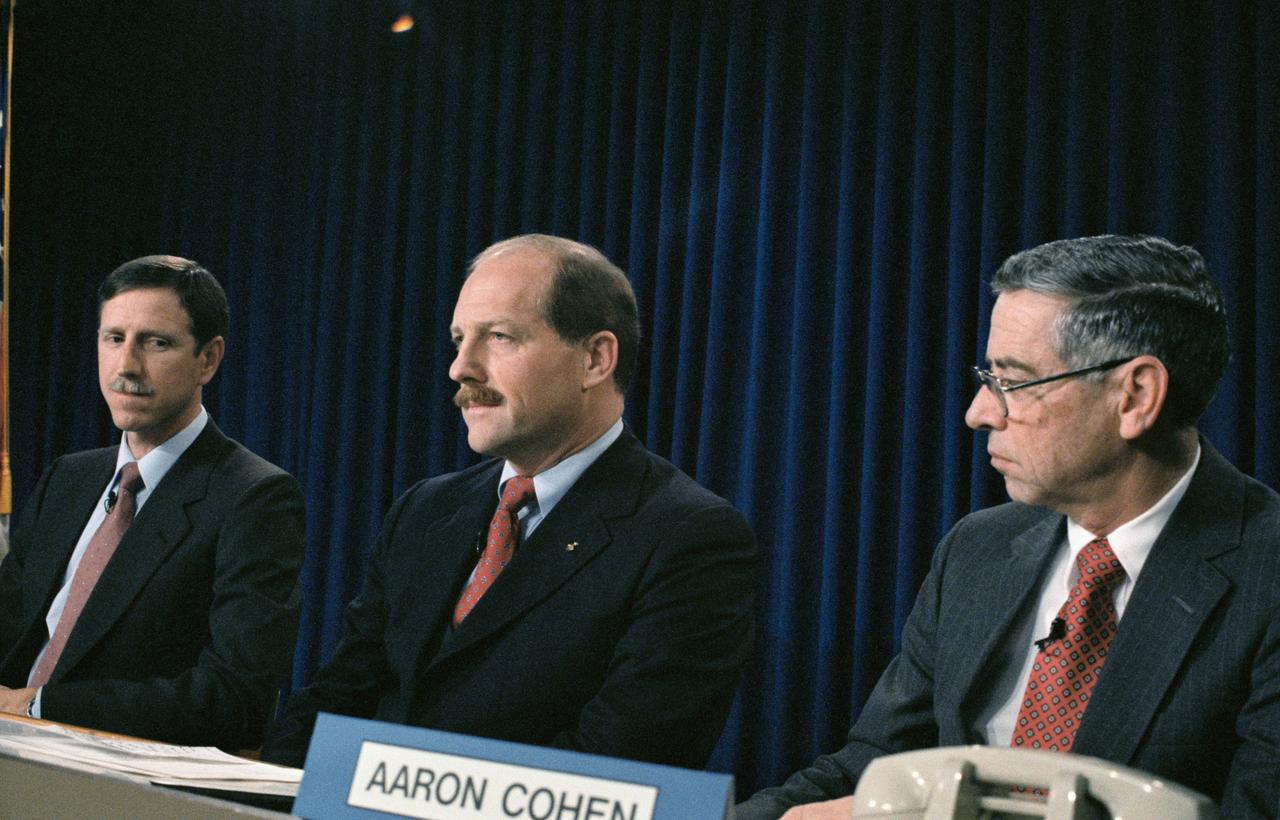
STS-26 Discovery, Orbiter Vehicle (OV) 103, crew including Commander Frederick H. Hauck and Pilot Richard O. Covey and JSC Director Aaron Cohen participate in press conference held at JSC Auditorium and Public Affairs Facility Bldg 2. Hauck and Covey are shown with Cohen as they ponder queries from news media representatives during the first press conference for the group since the mission's announcement last week. Left to right are Covey, Hauck, and Cohen.
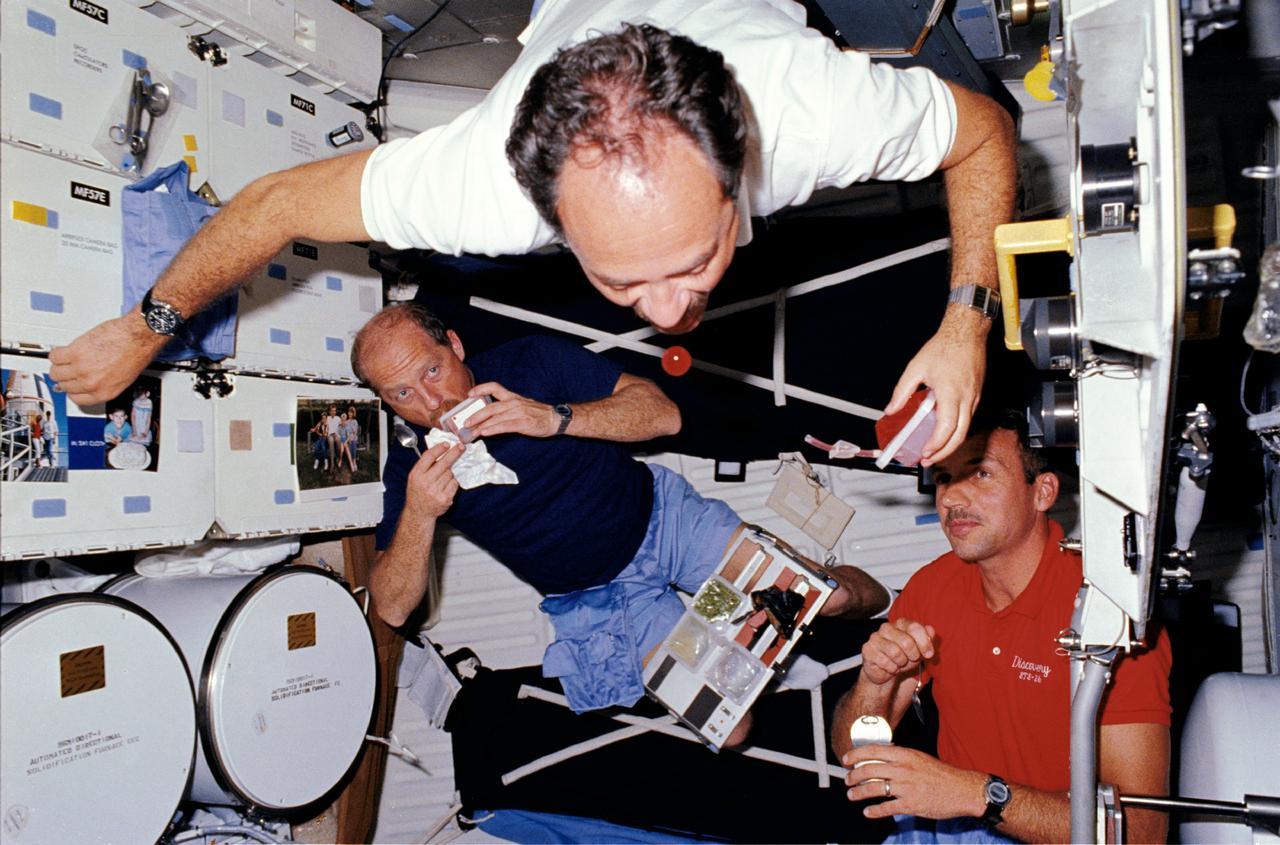
STS026-06-018 (29 Sept. - 3 Oct. 1988) --- Astronaut John M. Lounge, STS-26 mission specialist (MS), using a beverage container, experiments with microgravity as Commander Frederick H. Hauck (left) and MS David C. Hilmers (right) look on. Lounge freefloats as he closes in on a sphere of the red liquid drifting in front of his mouth. Hauck holds a spoon while sipping from a beverage container as he balances a meal tray assembly on his thighs. Hilmers, partially blocked by the open airlock hatch and holding a spoon and a can of food, pauses to watch the experiment. Automated Directional Solidification Furnace (ADSF) and forward middeck lockers appear on Lounge's right.

STS007-15-671 / S83-35767 (21 June 1983) --- Among the "firsts" on the mission is this unprecedented scene of a crew of five astronauts aboard the Space Shuttle Challenger in space. A pre-set 35mm camera exposed the frame. Left to right on the flight deck are Norman E. Thagard, mission specialist; Robert L. Crippen, commander; Frederick H. Hauck, pilot; Sally K. Ride, mission specialist; and John M. Fabian, mission specialist. Crippen the crew commander, is making his second Space Shuttle trip; pilot Hauck and mission specialist Dr. Ride, Dr. Thagard and Fabian are members of the 1978 class of astronaut candidates (ASCAN).

S83-32571 (23 May 1983) --- Four-fifths of the STS-7 crew take a break from simulations in the Johnson Space Center?s Mission Simulation and Training Facility and pose for NASA photographer. Standing on the steps leading into the motion-based Shuttle Mission Simulator (SMS) are (left to right) astronauts Robert L. Crippen, John M. Fabian, Frederick H. Hauck and Sally K. Ride. Crippen is crew commander; Hauck, pilot; and Fabian and Ride are mission specialists, along with Norman E. Thagard (not involved in this phase of training and not pictured). Photo credit: NASA

STS007-08-396 (18-24 June 1983) --- Astronaut Robert L. Crippen, STS-7 commander, used a 35mm camera to expose this frame of the four representatives of the "thirty five new guys" onboard the Earth-orbiting Space Shuttle Challenger. The TFNG (notice Frederick H. Hauck's T-shirt at left) pays tribute to the 1978 astronaut candidate (ASCAN) class of NASA astronauts. Others in the photograph are Astronauts Norman E. Thagard, Sally K. Ride and John M. Fabian. Hauck is the crew's pilot and the other three are mission specialist. The crew members are in the process of preparing a snack of meal. The tall experiment in the background is the Continuous Flow Electrophoresis System (CFES).
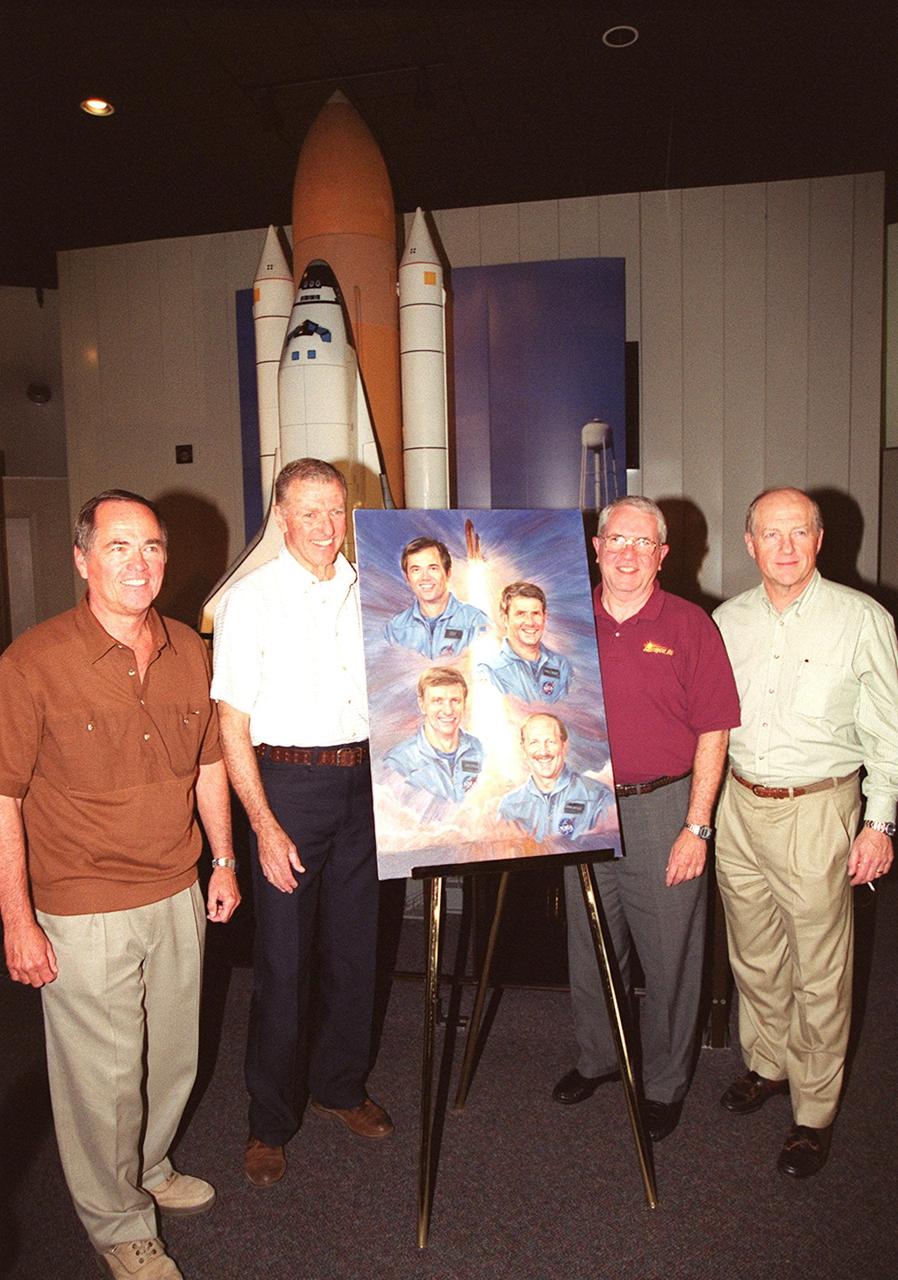
KENNEDY SPACE CENTER, Fla. -- The 2001 inductees into the Astronaut Hall of Fame gather around a drawing of all four. From left, Robert Crippen, Joe Engle, Richard Truly and Frederick "Rick" Hauck were honored as the first four Shuttle astronauts in a ceremony at the KSC Visitor Complex Nov. 10
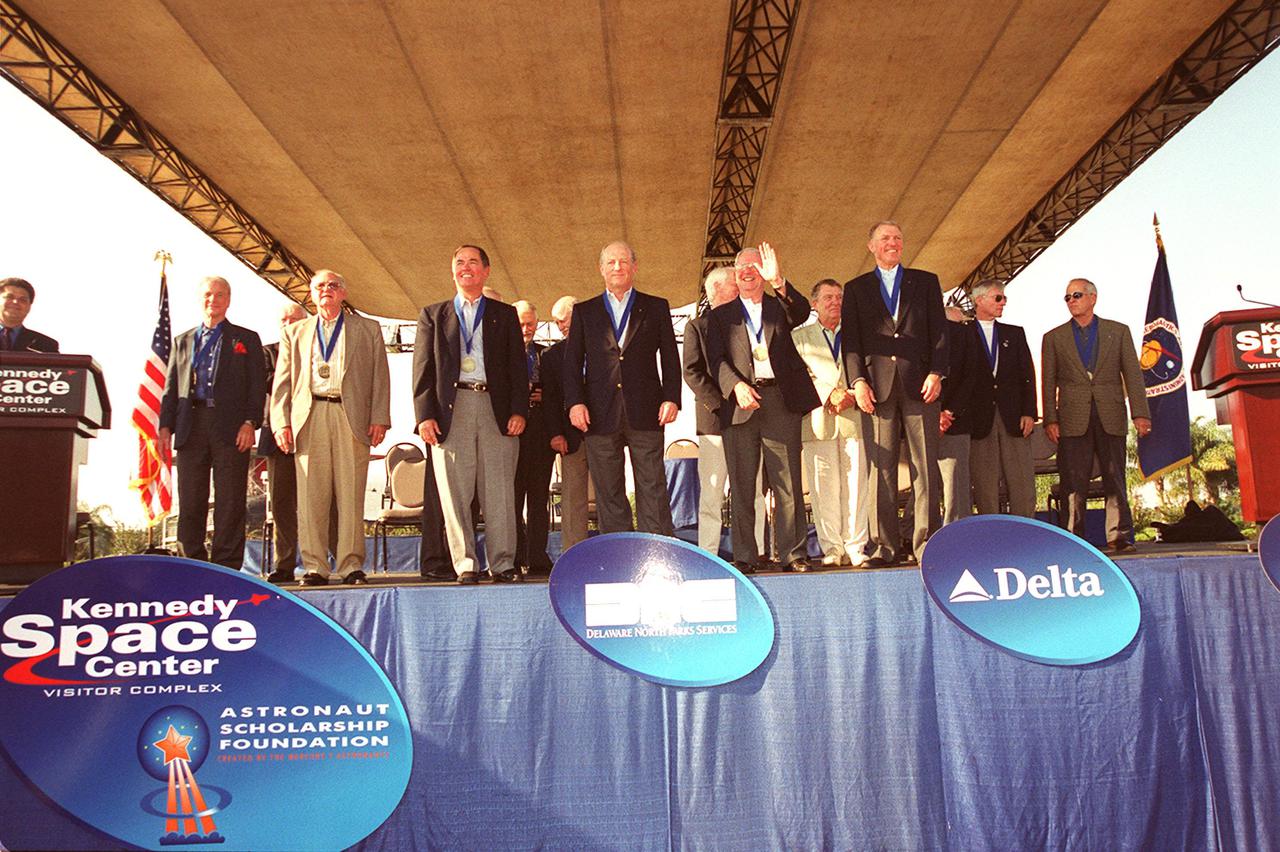
KENNEDY SPACE CENTER, Fla. -- The outdoor stage at the KSC Visitor Complex is filled with members of the Astronaut Hall of Fame who gathered to honor the four standing in the front center: Robert Crippen (second from left), Frederick 'Rick' Hauck, Richard Truly and Joe Engle. These first Shuttle astronauts were the 2001 inductees.
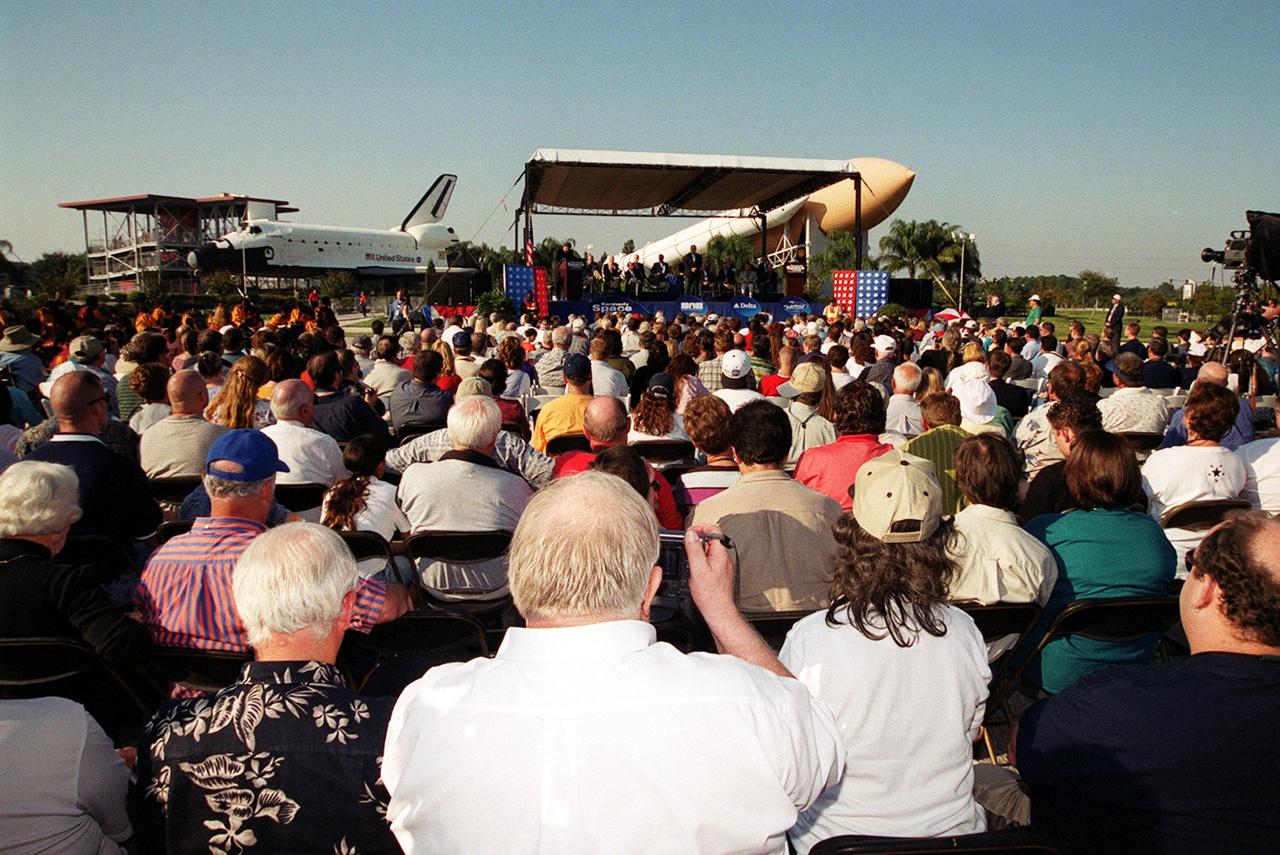
KENNEDY SPACE CENTER, Fla. -- A large crowd is gathered at the KSC Visitor Complex to honor the induction of the first four Shuttle astronauts into the Astronaut Hall of Fame. The four honored were Robert Crippen, Frederick "Rick" Hauck, Richard Truly and Joe Engle.
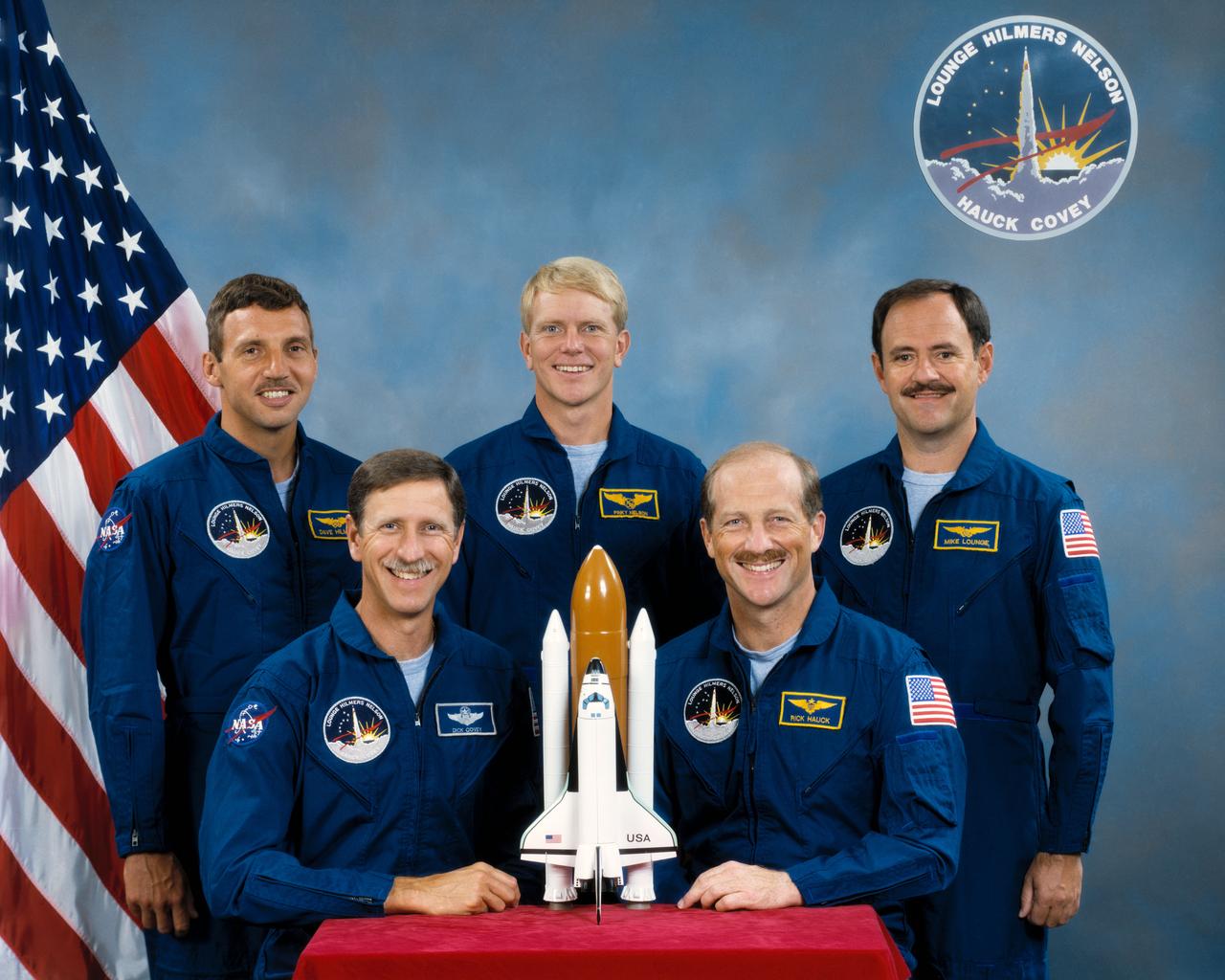
S87-40673 (September 1987) --- Astronauts Frederick H. (Rick) Hauck (right front), mission commander, and Richard O. Covey (left front), pilot, are flanked by NASA's STS-26 mission specialists (l.-r.) David C. Hilmers, George D. (Pinky) Nelson and John M. (Mike) Lounge.
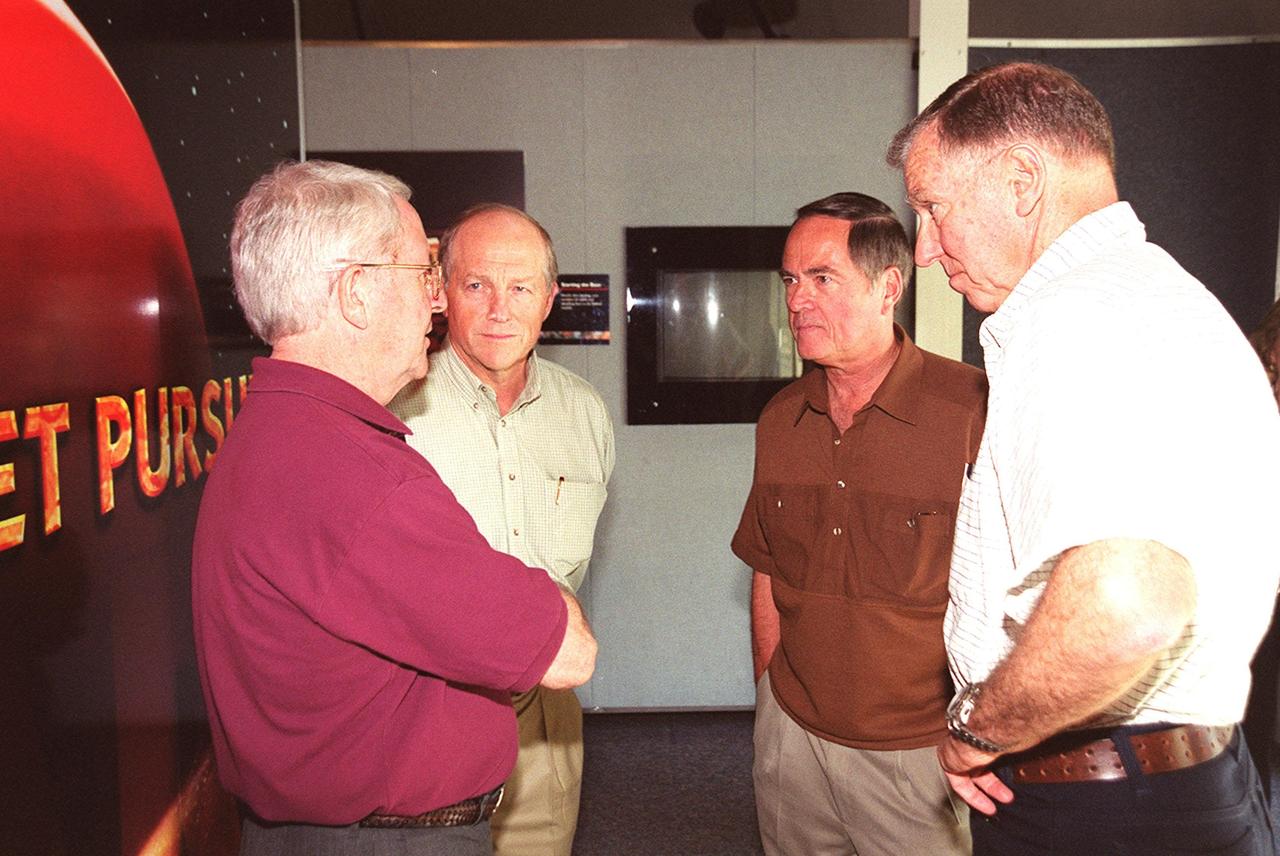
KENNEDY SPACE CENTER, Fla. -- The first four Shuttle astronauts share a moment of nostalgia at the Kennedy Space Center Visitor Complex. Pictured from left are Richard Truly, Frederick "Rick" Hauck, Robert Crippen and Joe Engle. All were inducted into the U.S. Astronaut Hall of Fame Nov. 10.
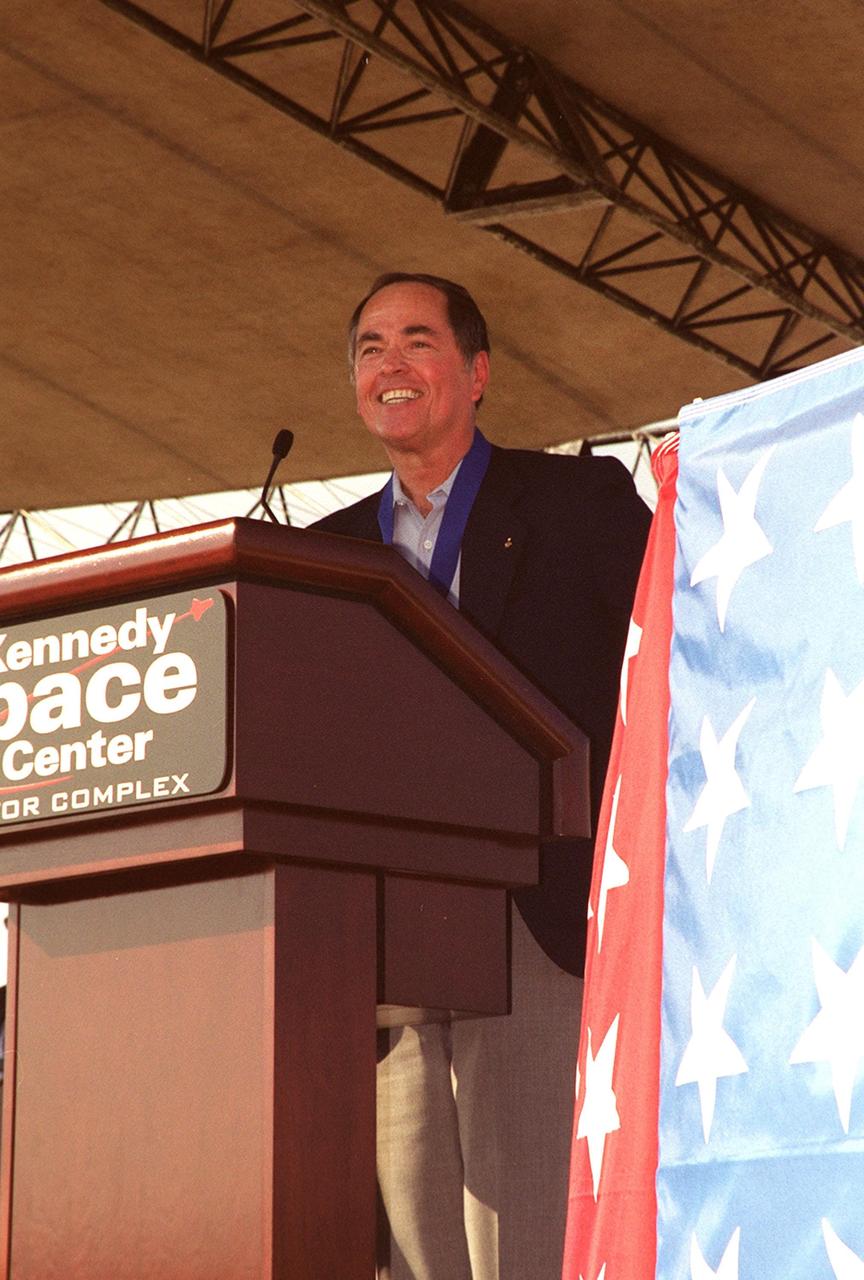
KENNEDY SPACE CENTER, Fla. -- Astronaut Robert Crippen, who served as pilot on STS-1, speaks to the guests gathered at the KSC Visitor Complex Nov. 10 for induction ceremonies into the Astronaut Hall of Fame. Crippen and other astronauts Frederick "Rick" Hauck, Richard Truly and Joe Engle were honored as the first Shuttle astronauts.
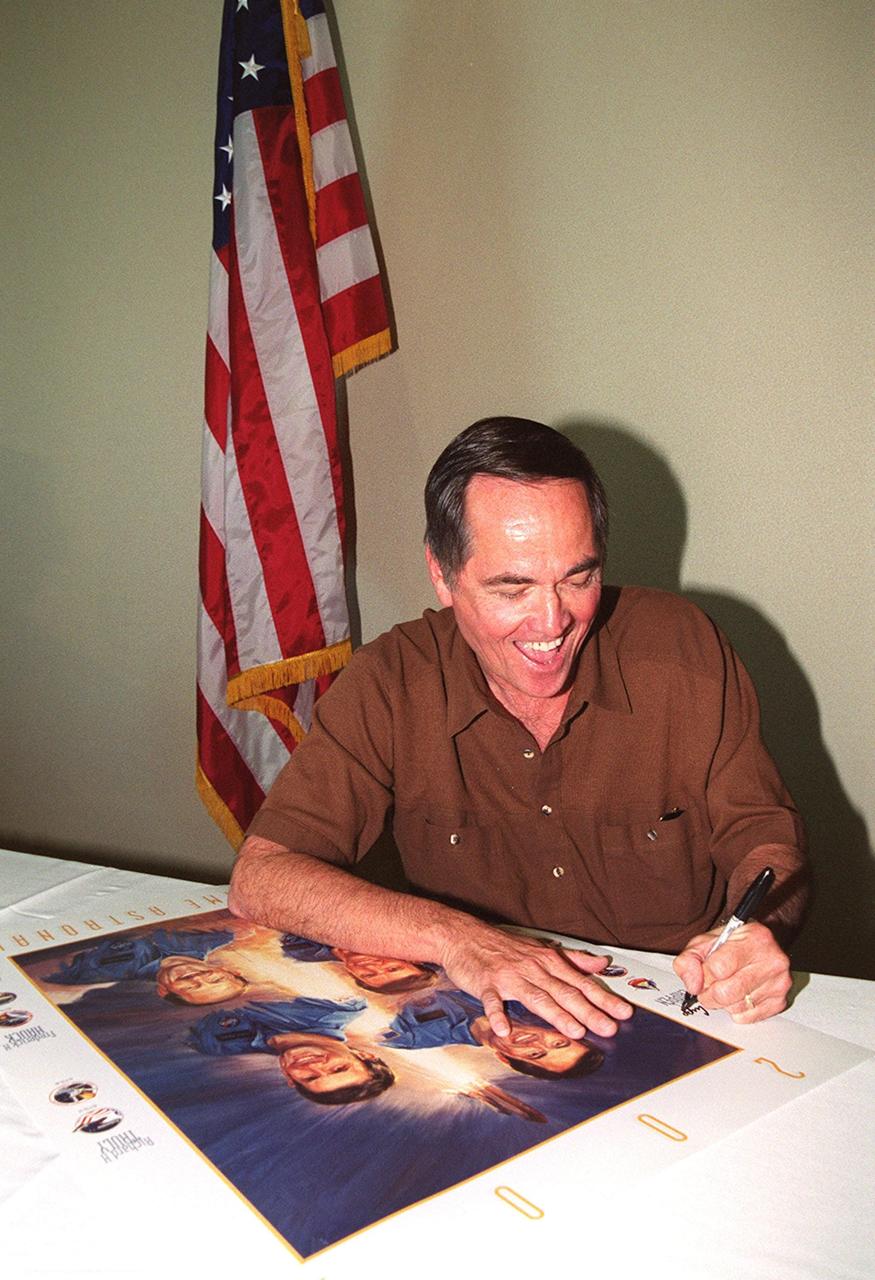
KENNEDY SPACE CENTER, Fla. -- One of the first Shuttle astronauts, Robert Crippen signs a poster during induction ceremonies into the U.S. Astronaut Hall of Fame Nov. 10. He shared the induction honor with astronauts Richard Truly, Joe Engle, and Frederick "Rick" Hauck. The event took place at the KSC Visitor Complex
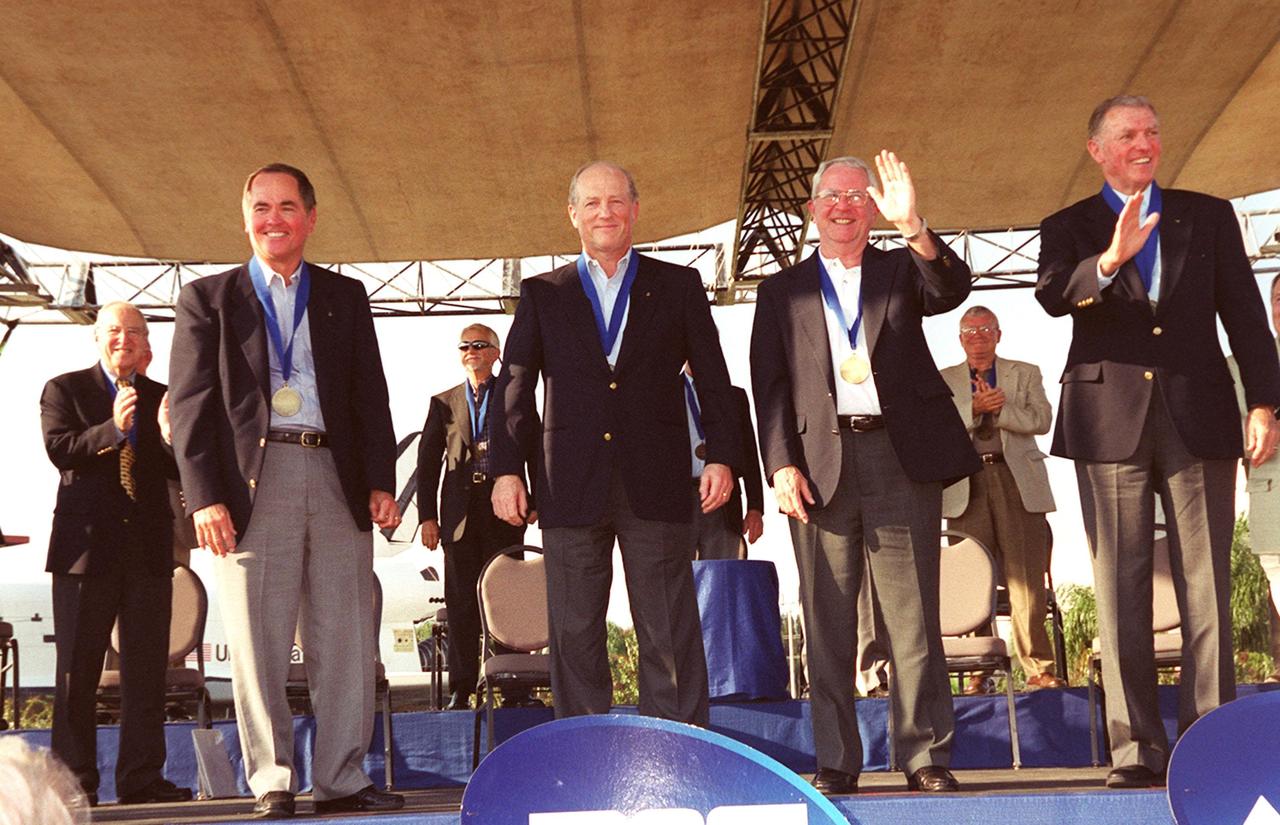
KENNEDY SPACE CENTER, Fla. -- Astronaut Hall of Fame inductees Robert Crippen, Frederick "Rick" Hauck, Richard Truly and Joe Engle acknowledge the applause from the audience. The four were honored as the first Shuttle astronauts in a ceremony at the KSC Visitor Complex Nov. 10.
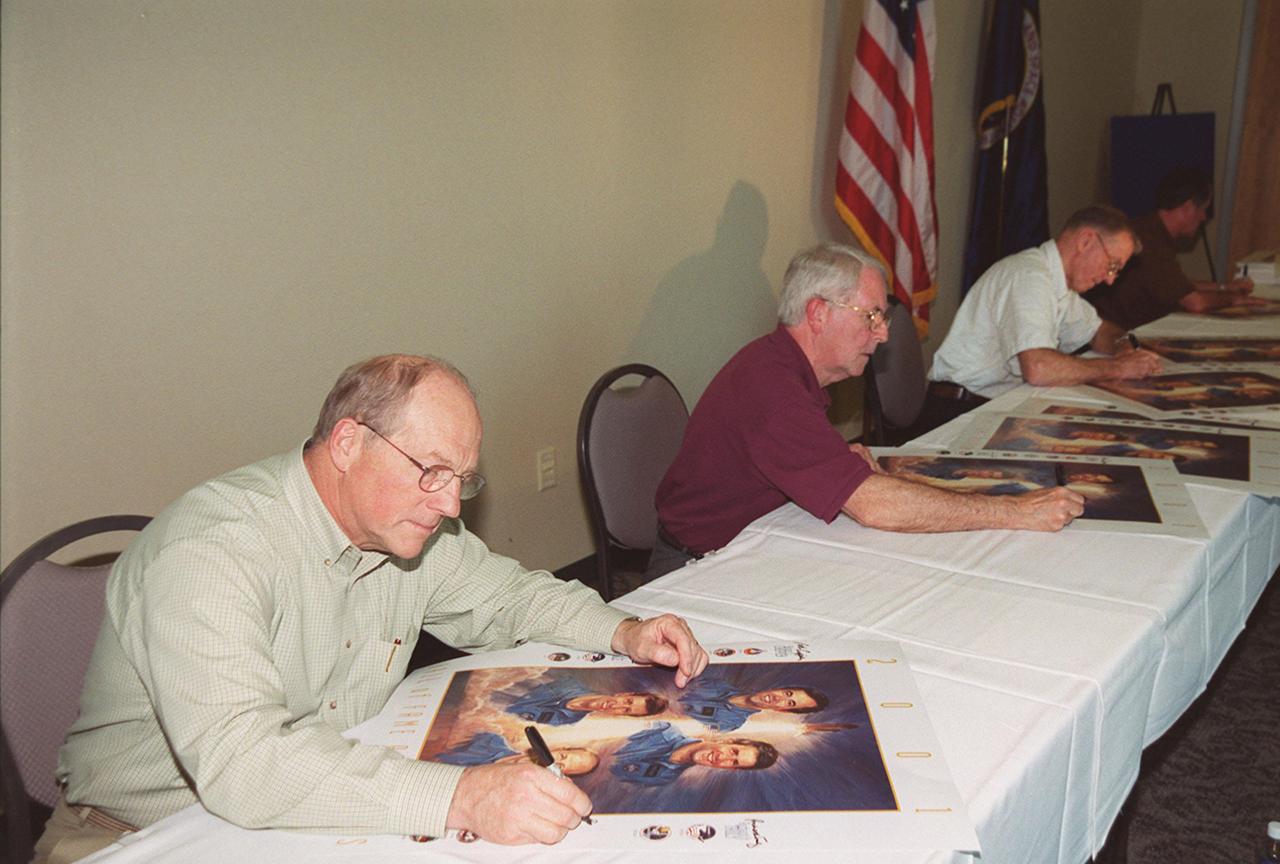
KENNEDY SPACE CENTER, Fla. -- The first four Shuttle astronauts take time to sign posters commemorating their induction into the U.S. Astronaut Hall of Fame Nov. 10. Seated from left are Frederick 'Rick' Hauck, Richard Truly, Joe Engle and Robert Crippen. The event took place at the KSC Visitor Complex
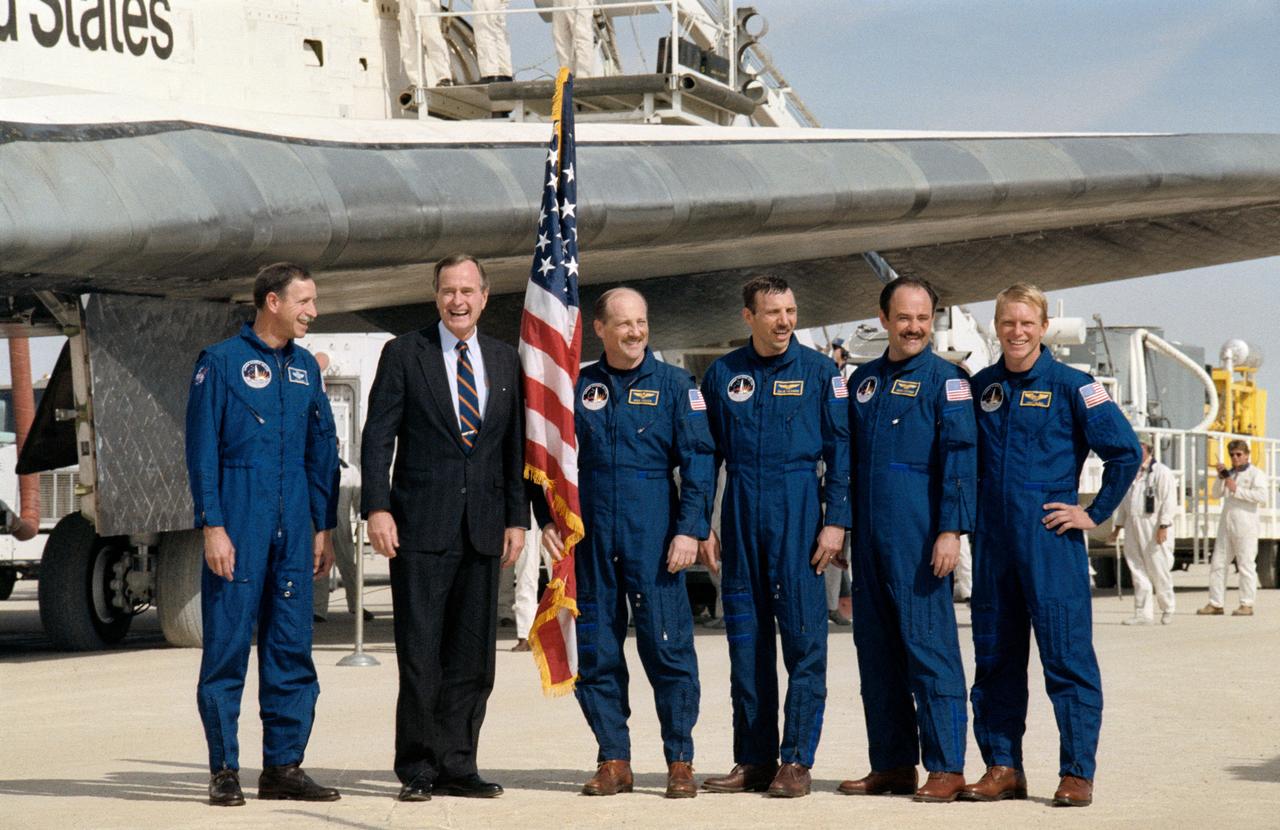
STS026-S-169 (3 Oct 1988) --- The five STS 26 crewmembers pose with Vice President George Bush after completing a successful four-day mission aboard the Space Shuttle Discovery (background). Pictured, from left to right, are astronaut Richard O. Covey, pilot; Vice President Bush; and astronauts Frederick H. (Rick) Hauck, mission commander; and David C. Hilmers, John M. (Mike) Lounge, and George D. Nelson, all mission specialists.
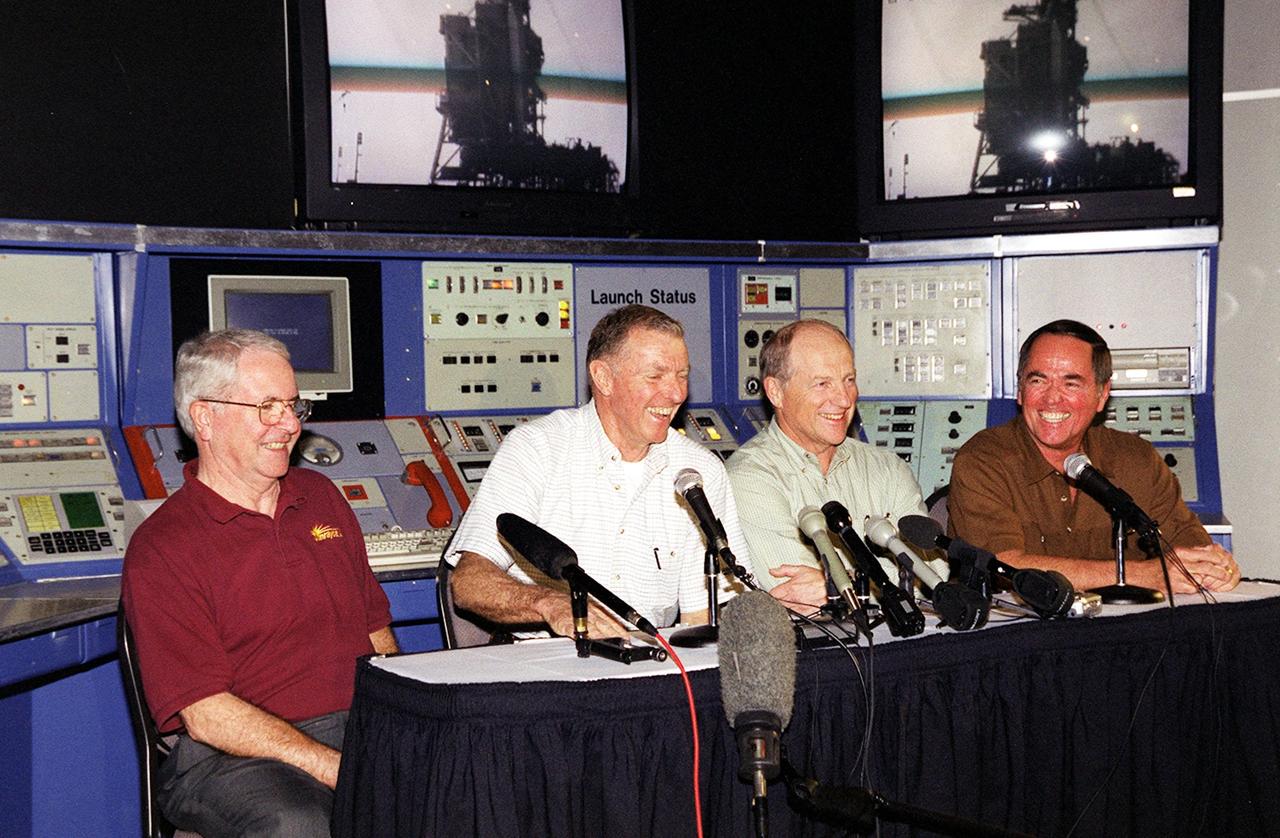
KENNEDY SPACE CENTER, Fla. -- The first four Shuttle astronauts -- seated, from left, Richard Truly, Joe Engle, Frederick "Rick" Hauck and Robert Crippen -- share a light moment about their experiences while seated in a replica of the early launch control center in the KSC Visitor Complex. All were inducted into the U.S. Astronaut Hall of Fame Nov. 10
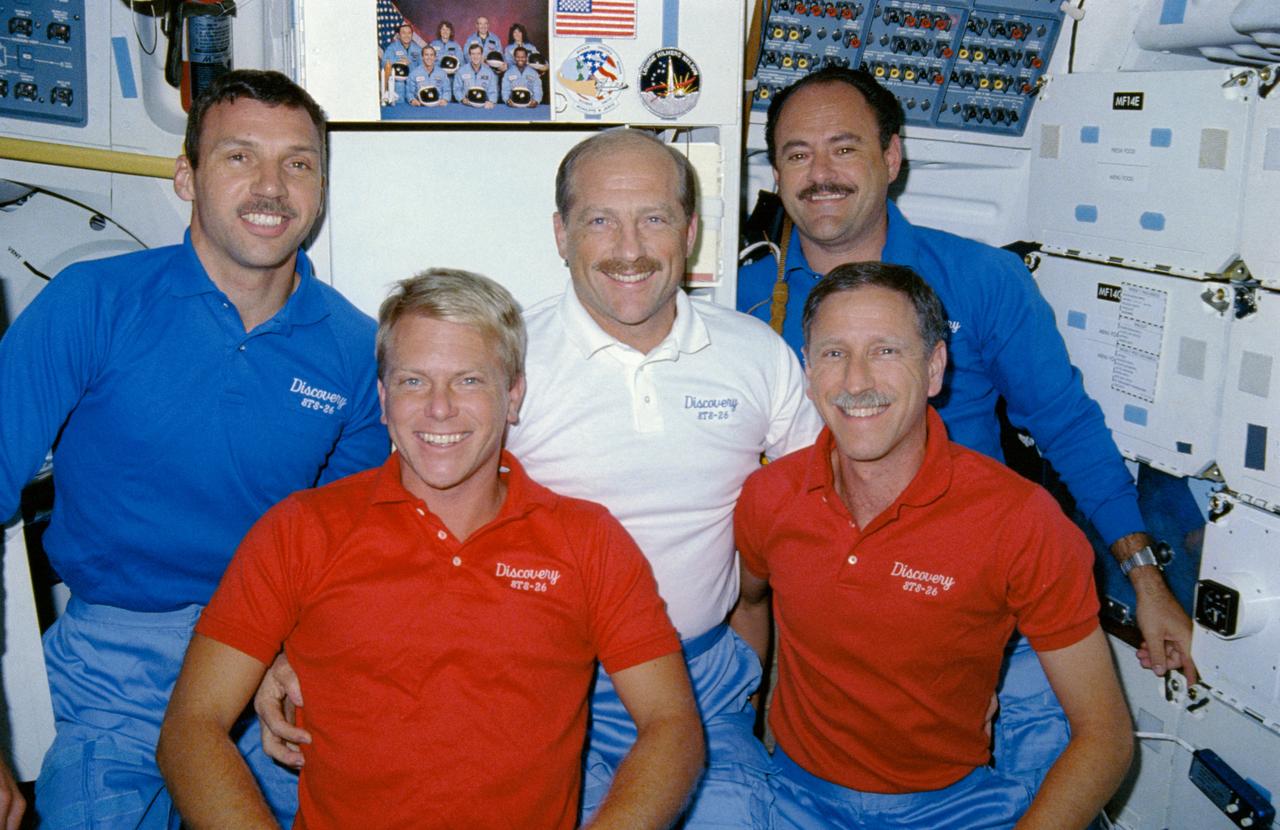
STS026-08-007 (29 Sept-3 Oct 1988) --- An in-space crew portrait on the middeck of Discovery. Left to right are Astronauts David C. Hilmers, George D. Nelson, Frederick H. (Rick) Hauck, John M. (Mike) Lounge and Richard O. Covey (front). The crew portrait for STS 51-L, its flight insignia and the STS 26 flight insignia are at top edge of the frame. This photo was shown by the STS 26 astronaut crew during its Oct. 11, l988 post-flight press conference.

S83-29016 (4 March 1983) --- These five astronauts represent the Space Transportation System's (STS) first five-member crew. They will be aboard the Space Shuttle Challenger for the mission, scheduled for June of this year. Astronaut Robert L. Crippen (center, first row) is crew commander. Other crew members are astronauts Frederick H. Hauck, right, pilot; and Sally K. Ride, John M. Fabian and Norman E. Thagard, mission specialists. Seven stars and the Challenger provide the backdrop for the crew's portrait.
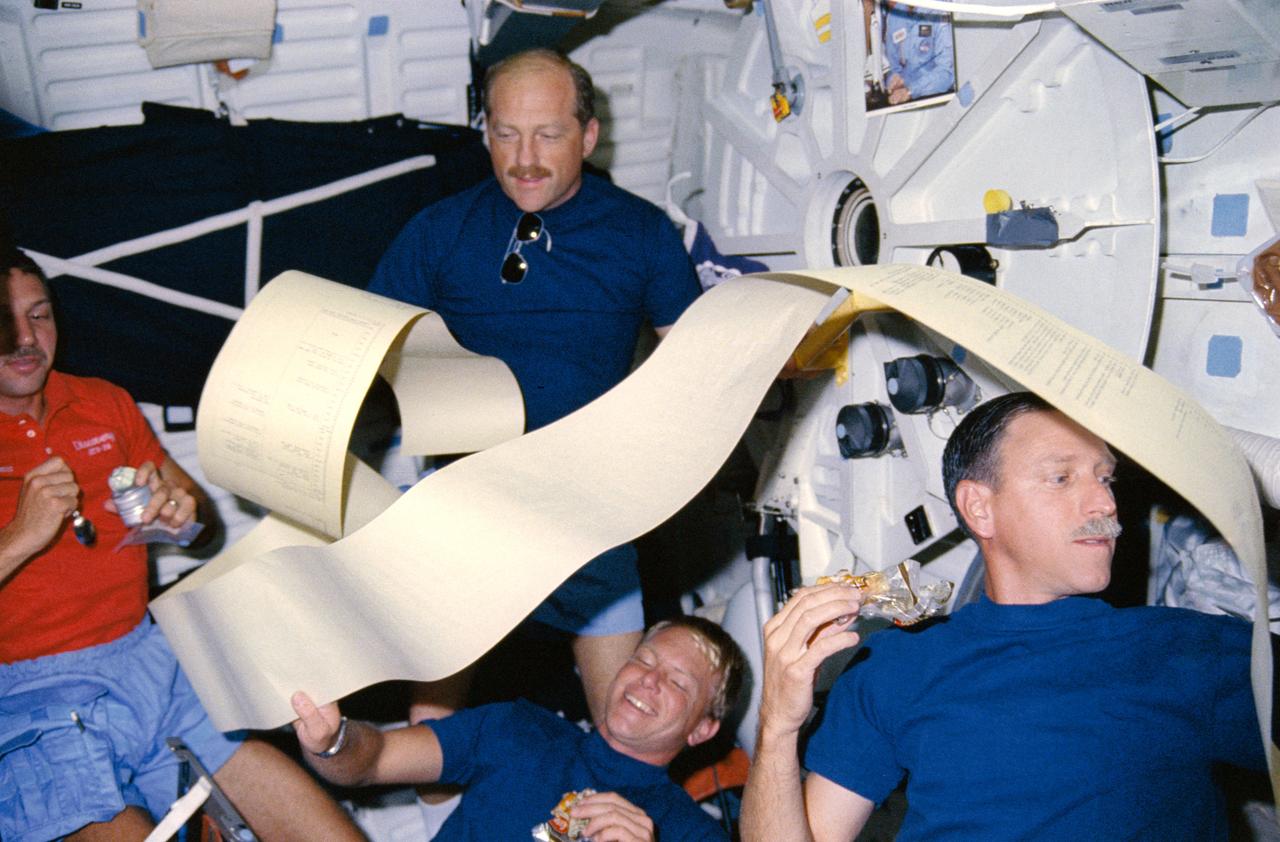
STS026-03-019 (3 Oct 1988) --- STS-26 Commander Frederick H. Hauck (center) reviews lengthy text and graphics system (TAGS) printout as it drifts across the middeck while his fellow crewmembers (left to right) Mission Specialist (MS) David C. Hilmers, MS George D. Nelson, and Pilot Richard O. Covey eat various snack items. The open airlock hatch and the sleep restraints on the starboard wall are visible in the background.
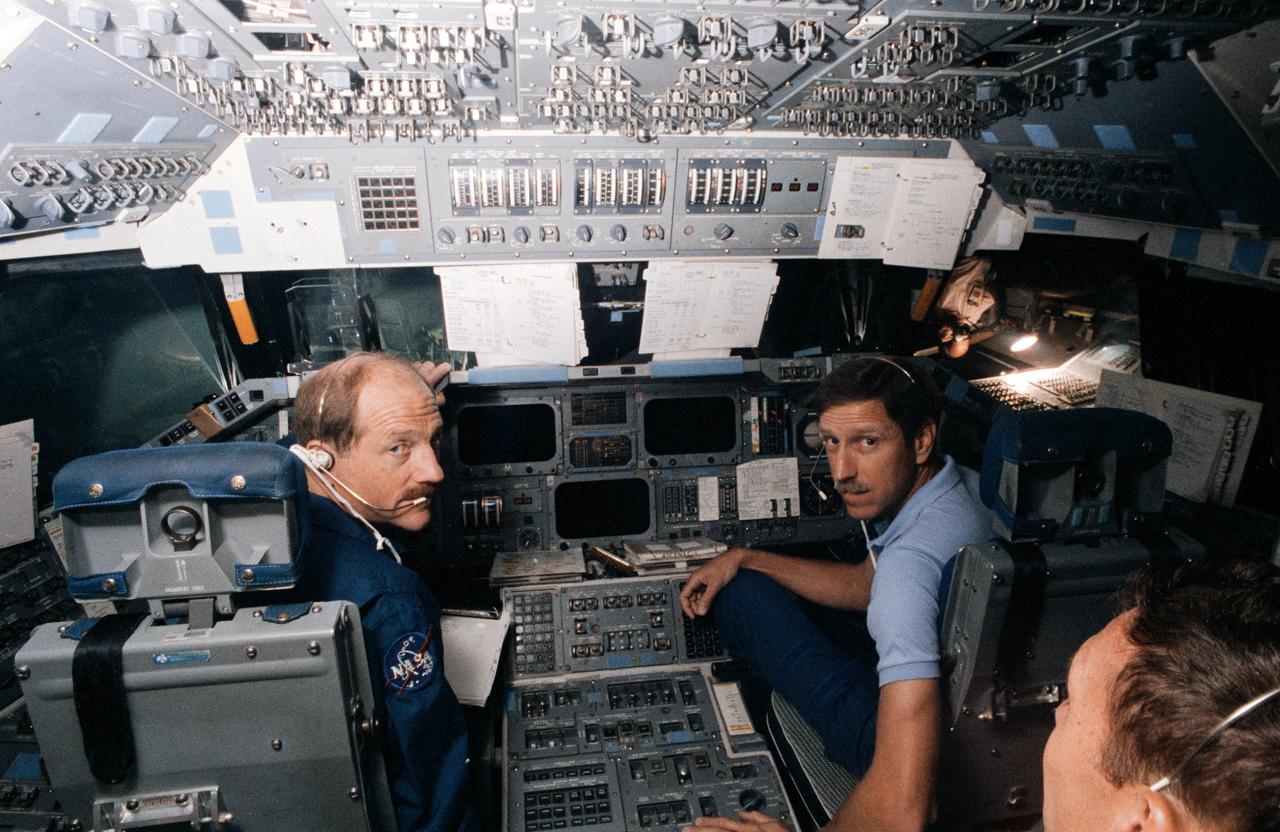
S87-46304 (20 Oct 1987) --- Astronauts Frederick H. (Rick) Hauck, left, STS-26 commander, and Richard O. Covey, pilot, man their respective stations in the Shuttle mission simulator (fixed base) at the Johnson Space Center. A simulation for their anticipated June 1988 flight aboard the space shuttle Discovery began Oct. 20. Astronaut David C. Hilmers, one of three mission specialists for the flight, is partially visible in the foreground.
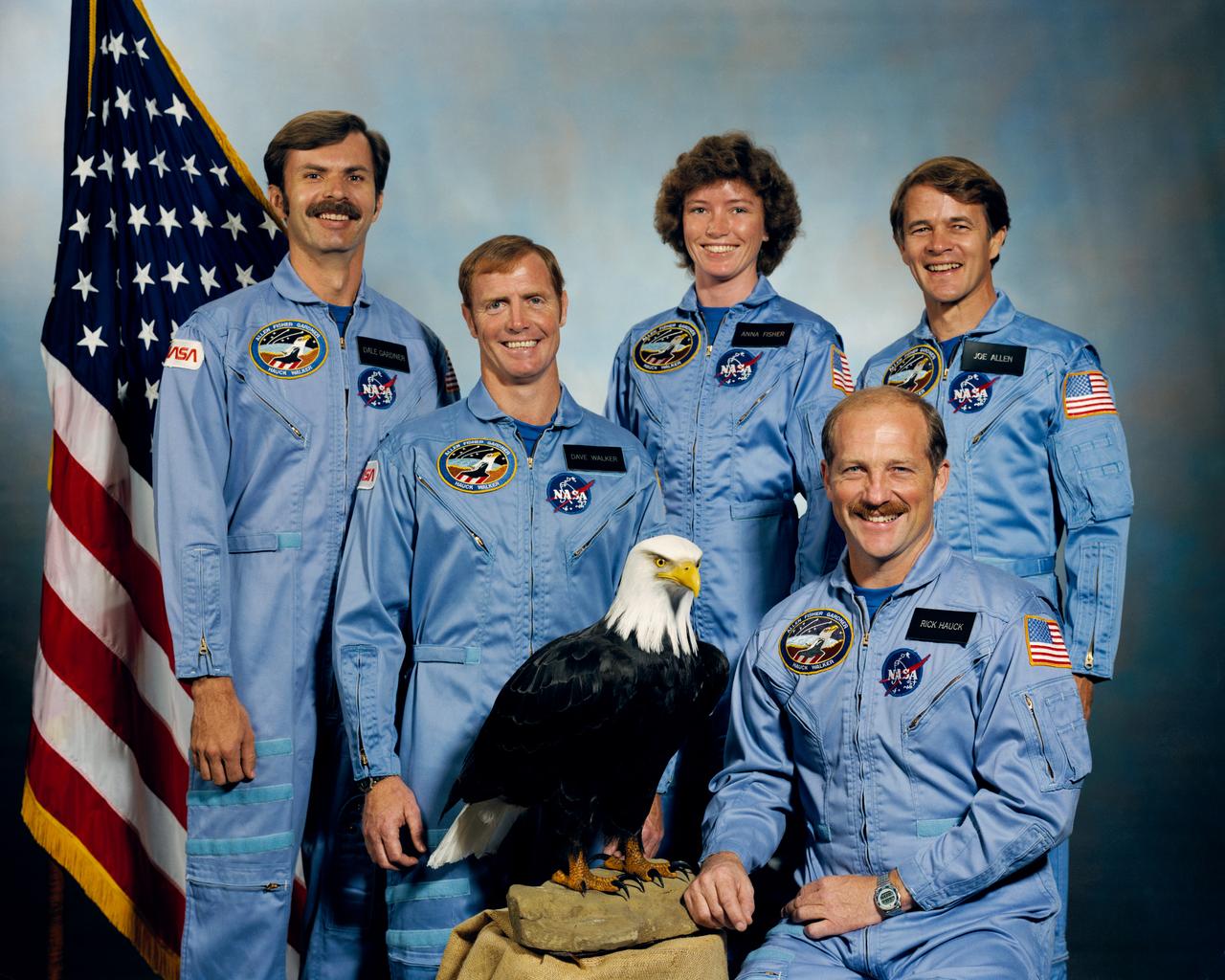
S84-40082 (August 1984) --- These five astronauts are scheduled to fly aboard the Space Shuttle Discovery on Mission STS-51A for NASA. The mission is scheduled for early November 1984. Astronaut Frederick H. (Rick) Hauck, seated, is crew commander. Astronaut David M. Walker, pilot, stands next to the Eagle, 51-A mascot. Others on the back row, left-to-right, are astronauts Dale A. Gardner, Anna L. Fisher and Joseph P. Allen IV, all mission specialists.

51A-13-028 (12 Nov 1984) --- The five-member crew celebrates a successful mission. The reference to the eagle has to do with the Discovery crew’s mascot, which appeared both in its crew portrait and insignia. L-R (front row) astronauts David M. Walker, Anna Lee Fisher and Joseph P. Allen; (back row) Dale A. Gardner and Frederick H. (Rick) Hauck.

51A-90032 (8 Nov 1984) --- Space Shuttle Discovery blasts off from launch pad 39A to begin its second space trip. Five crewmembers inside head toward a scheduled eight-day stay in earth orbit, during which two satellites will be deployed and two more will be retrieved for eventual re-deployment. Onboard Discovery are astronauts Frederick H. (Rick) Hauck, David M. Walker, Joseph P. Allen, Dale A. Gardenter and Anna L. Fisher.
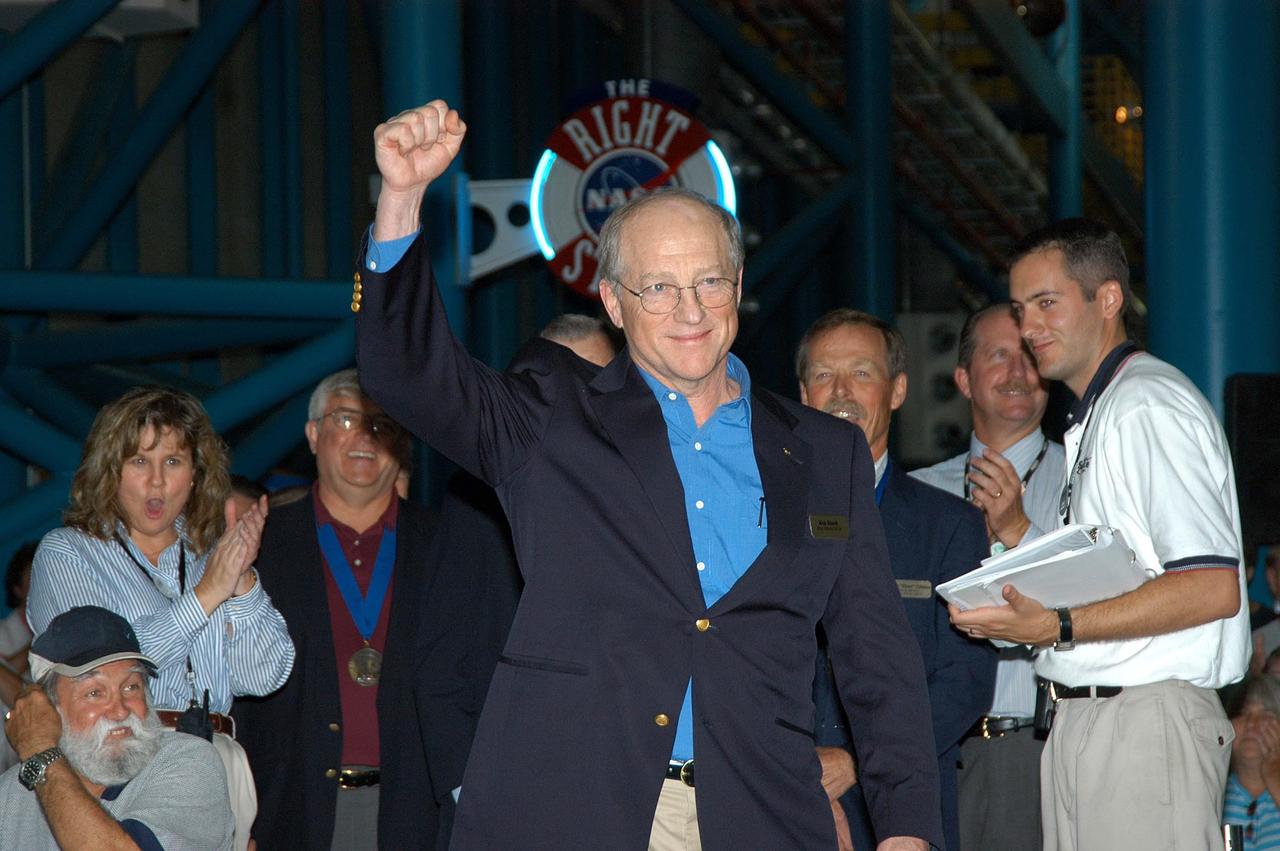
KENNEDY SPACE CENTER, FLA. -- Former astronaut Frederick (Rick) Hauck acknowledges the warm response to his introduction as a previous inductee into the U.S. Astronaut Hall of Fame. He and other Hall of Fame members were present for the induction of five new space program heroes into the U.S. Astronaut Hall of Fame: Richard O. Covey, commander of the Hubble Space Telescope repair mission; Norman E. Thagard, the first American to occupy Russia’s Mir space station; the late Francis R. "Dick" Scobee, commander of the ill-fated 1986 Challenger mission; Kathryn D. Sullivan, the first American woman to walk in space; and Frederick D. Gregory, the first African-American to command a space mission and the current NASA deputy administrator. Hauck flew on three Space Shuttle missions, including command of the redesigned spaceship on its critical first flight after the explosion of Challenger. The induction ceremony was held at the Apollo/Saturn V Center at KSC. The U.S. Astronaut Hall of Fame opened in 1990 to provide a place where space travelers could be remembered for their participation and accomplishments in the U.S. space program. The five inductees join 52 previously honored astronauts from the ranks of the Gemini, Apollo, Skylab, Apollo-Soyuz, and Space Shuttle programs.
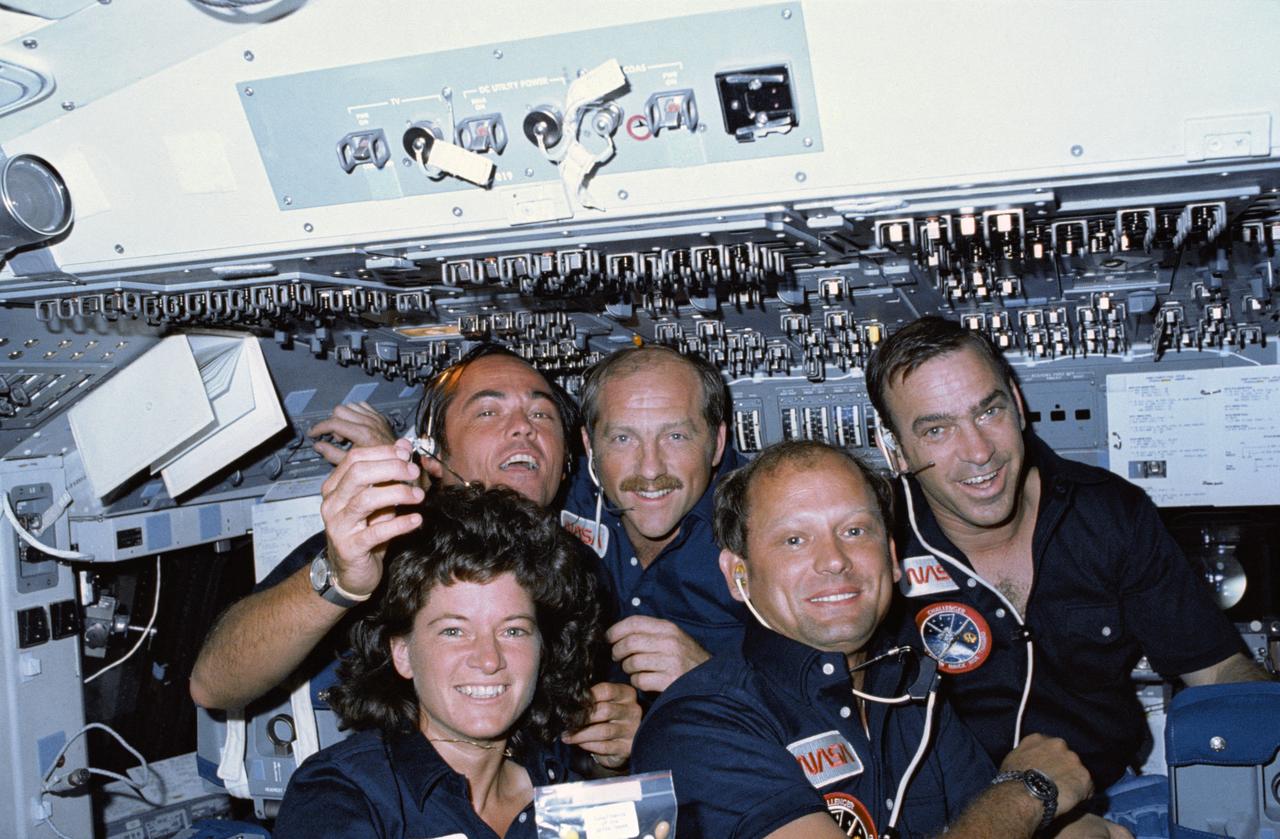
S83-35774 / STS007-30-1574 (21 June 1983) --- The five "passengers" onboard the Earth-orbiting Space Shuttle Challenger display some jelly beans discovered among their food supplies during their six-day mission. The label on the candy reads, "Compliments of the White House." In the rear are (left to right) astronauts Robert L. Crippen, crew commander, Frederick H. Hauck, pilot; and John M. Fabian, mission specialist. In front are Drs. Sally K. Ride and Norman E. Thagard, mission specialists. The scene was exposed by a pre-set 35mm camera.
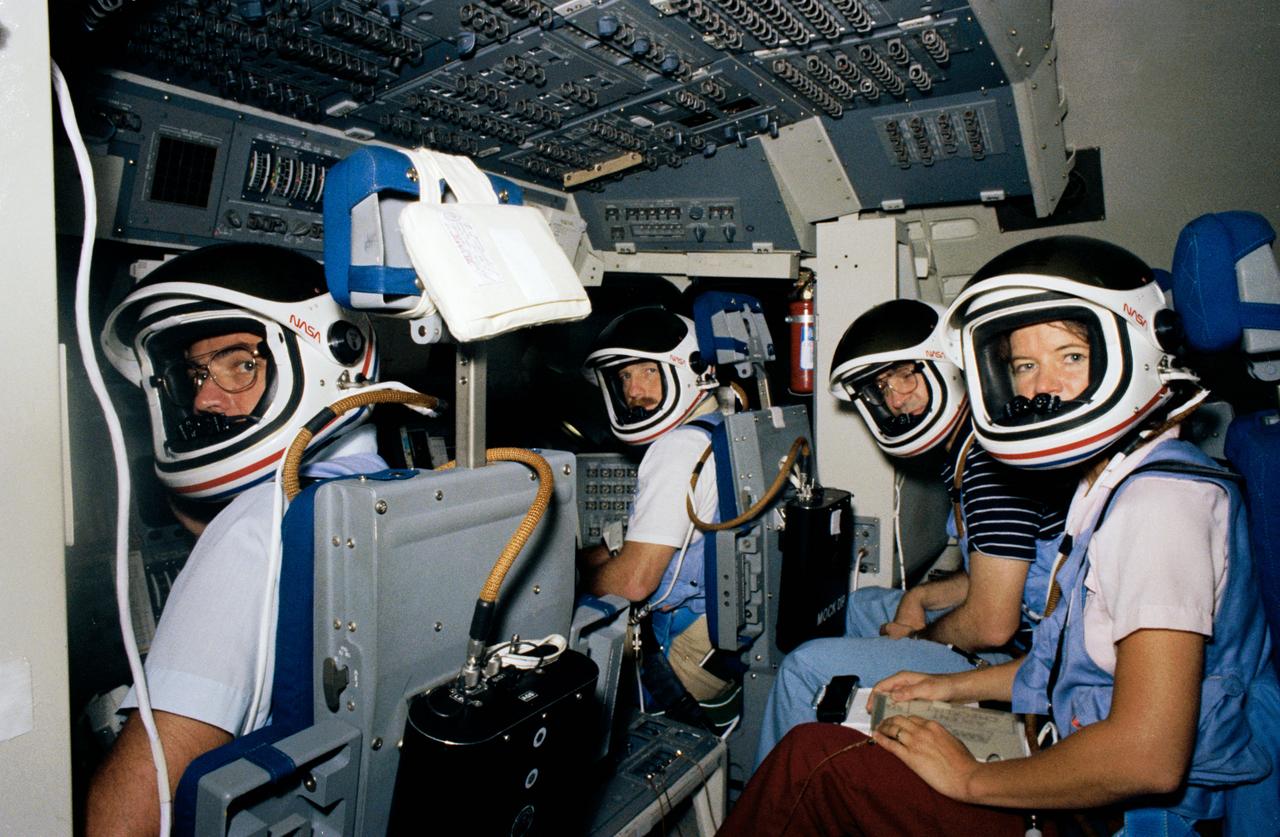
S83-32569 (23 May 1983) --- A preview of NASA?s next spaceflight is provided by this scene in the Johnson Space Center?s Shuttle mission simulator (SMS) with four-fifths of the crew in the same stations they will be in for launch and landing phases of the Challenger?s second space mission. They are (left-right) Astronauts Robert L. Crippen, crew commander; Frederick H. Hauck, pilot; John M. Fabian and Dr. Sally K. Ride, mission specialists. Dr. Norman E. Thagard, a third mission specialist, is to be seated in the mid-deck area below the flight deck for launch and landing phases. Launch is now scheduled for June 18.
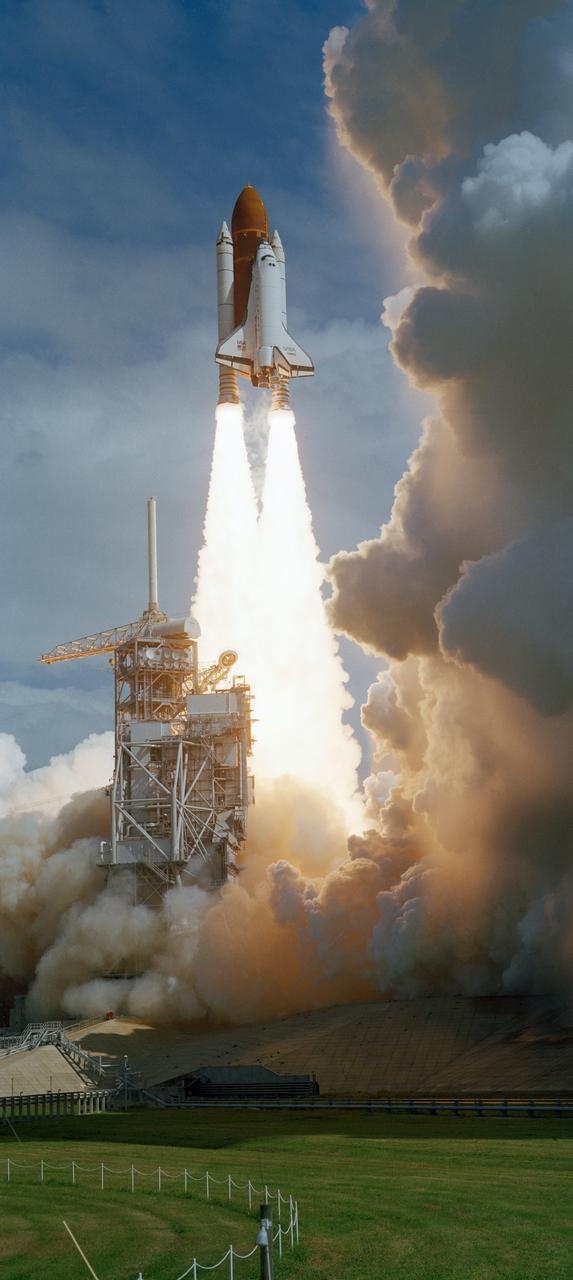
S26-S-032 (29 Sept. 1988) --- The STS-26 launch of space shuttle Discovery begins the first flight to be flown after the Challenger accident. The flight crew included astronauts Rick Hauck, commander; Dick Covey, pilot; and three mission specialists, Dave Hilmers, Mike Lounge, and George (Pinky) Nelson. During the four-day mission, the crew deployed the Tracking and Data Relay Satellite (TDRS-C) and operated eleven mid-deck experiments. Discovery completed 64 orbits of the earth before landing at Edwards Air Force Base, California, on October 3, 1988. Photo credit: NASA or National Aeronautics and Space Administration
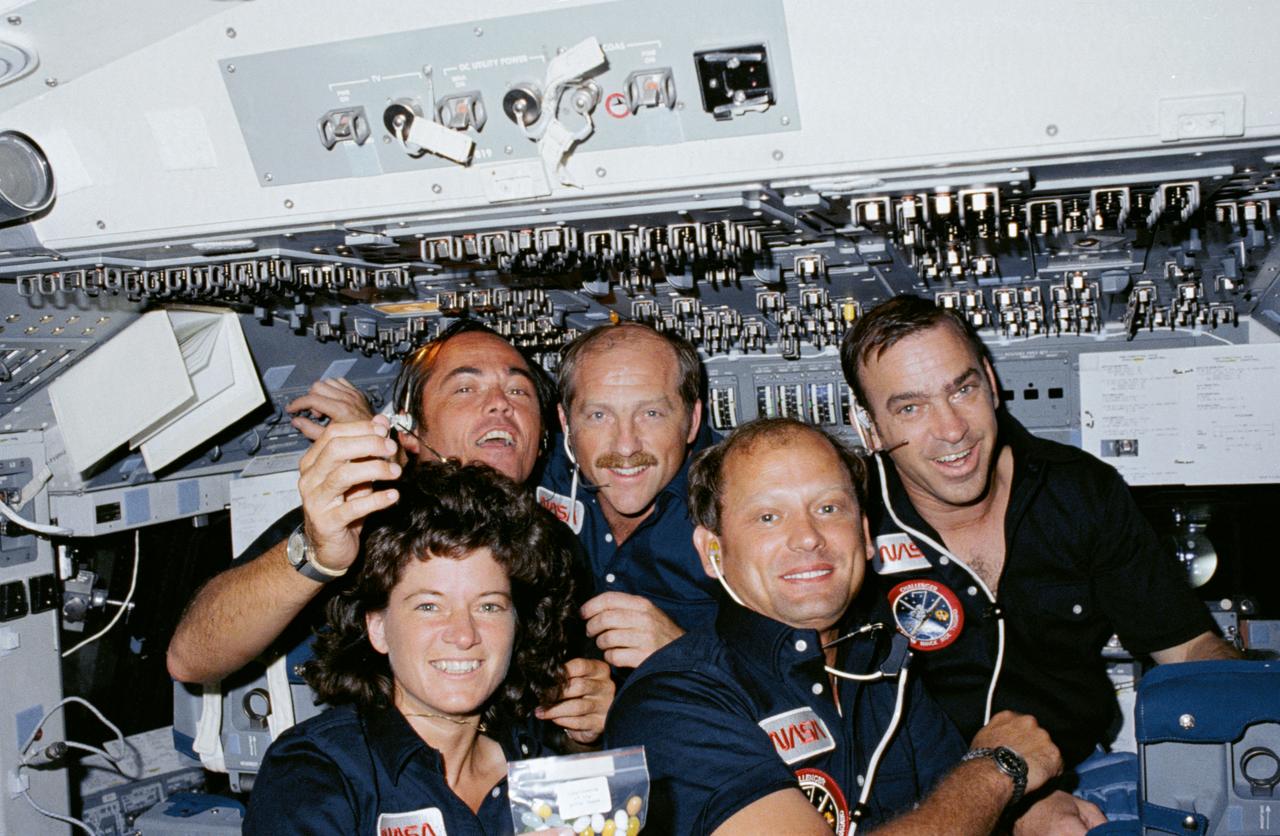
STS007-30-1574 / S83-35774 (21 June 1983) --- The five "passengers" onboard the Earth-orbiting Space Shuttle Challenger display some jelly beans discovered among their food supplies during their six-day mission. The label on the candy reads, "Compliments of the White House." In the rear are (left to right) astronauts Robert L. Crippen, crew commander, Frederick H. Hauck, pilot; and John M. Fabian, mission specialist. In front are Drs. Sally K. Ride and Norman E. Thagard, mission specialists. The scene was exposed by a pre-set 35mm camera.
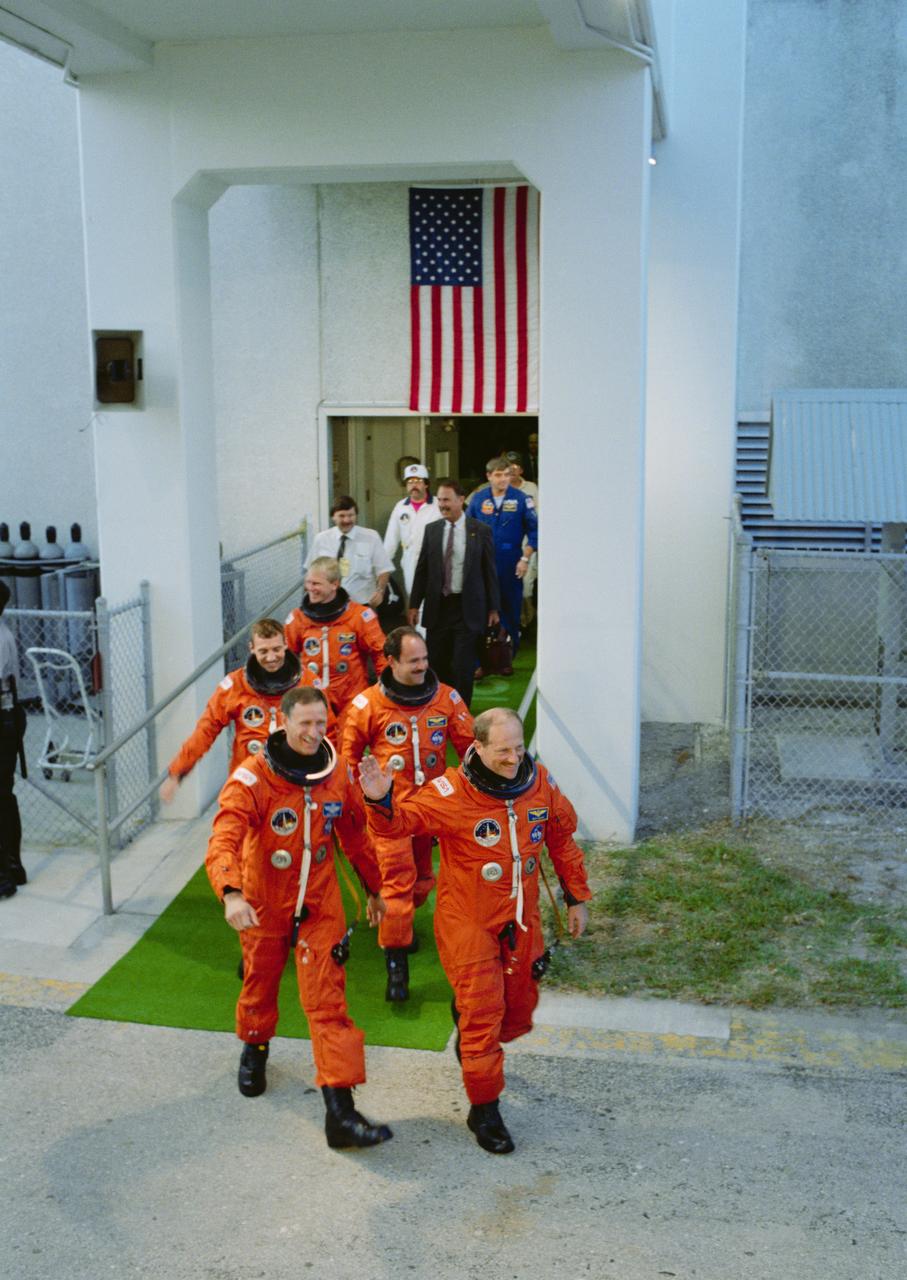
STS-26 crewmembers, suited in launch and entry suits (LESs), leave the Kennedy Space Center (KSC) Operations and Checkout (O&C) Building on their way to the launch complex (LC) pad 39B where they will board Discovery, Orbiter Vehicle (OV) 103. Commander Frederick H. Hauck, waving to spectators, is followed by Pilot Richard O. Covey, Mission Specialist (MS) John M. Lounge, MS David C. Hilmers, and MS George D. Nelson. Others accompanying the crew are JSC Flight Crew Operations Directorate (FCOD) Director Donald R. Puddy, Astronaut Office Chief Daniel C. Brandenstein, and a Crew Training Officer Richard W. Nygren.
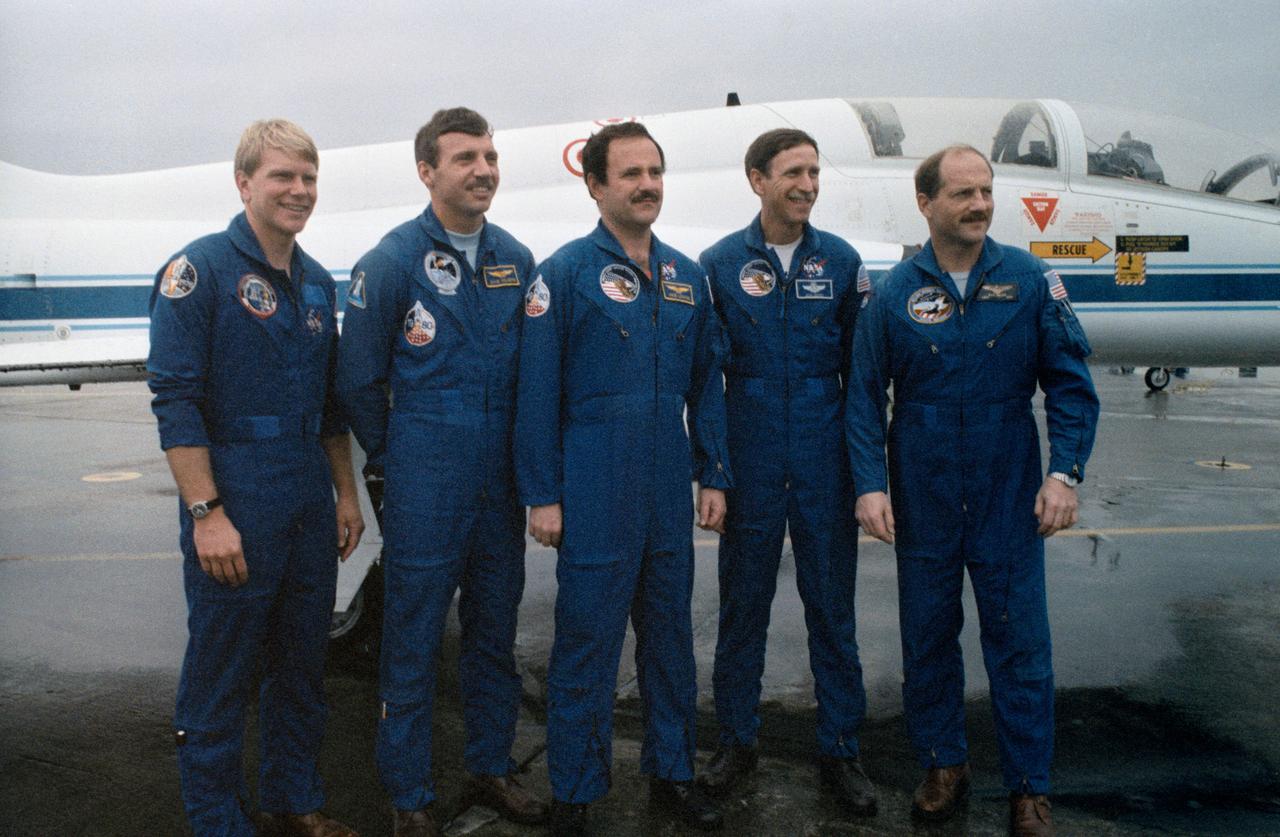
S87-28139 (26 Feb 1987) --- The five veteran astronauts recently assigned to the STS 26 space mission pose for photographers prior to departure from Ellington Field in T-38 jets (parked in background). Astronaut Frederick H. (Rick) Hauck (right) is mission commander. Astronaut Richard O. Covey, second right, is pilot; and (l.-r.) Astronauts George D. Nelson, David C. Hilmers and John M. (Mike) Lounge are mission specialists. The five were headed for KSC in Florida where they were to interface with flight hardware. The Discovery has been assigned as the STS 26 Shuttle vehicle.
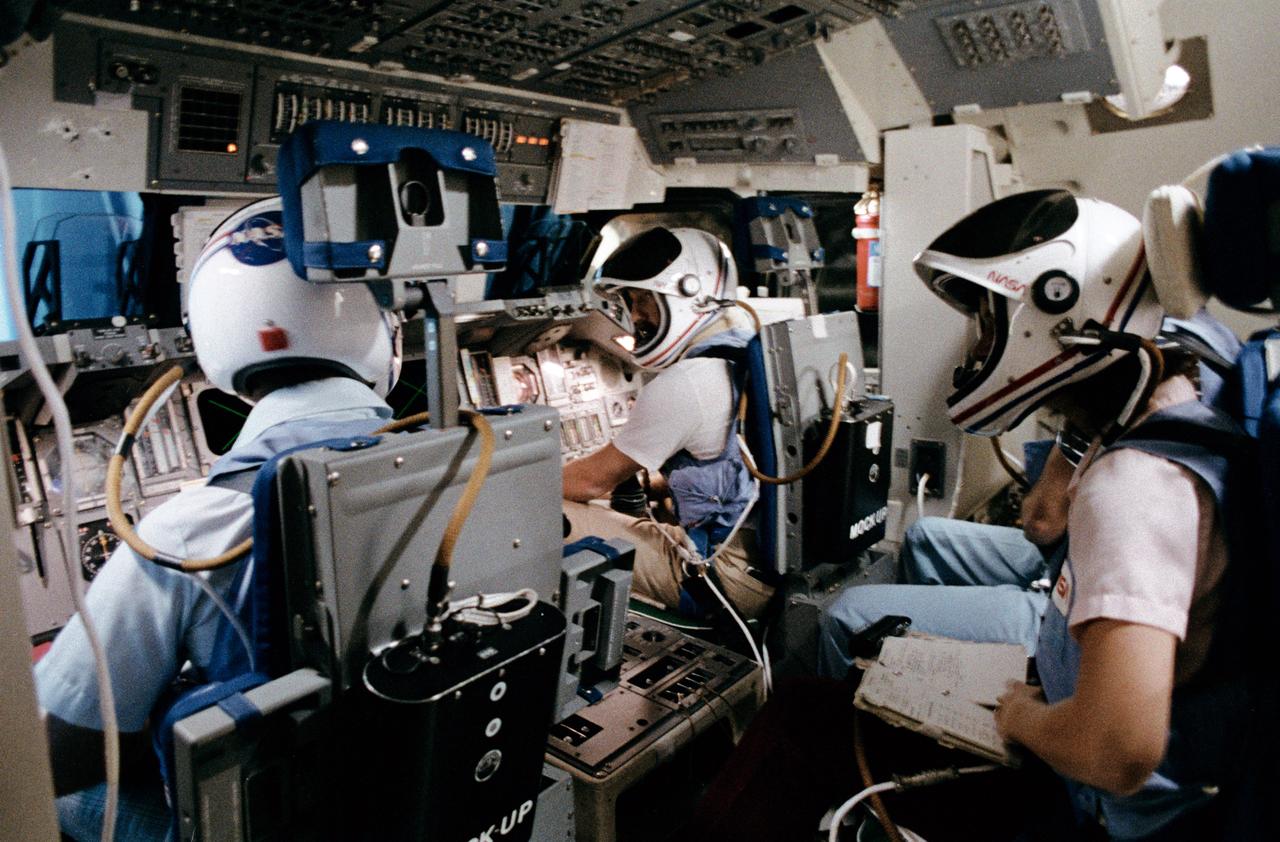
S83-32723 (23 May 1983) --- This scene in the Shuttle Mission Simulator (SMS) previews next month?s STS-7 flight in the space shuttle Challenger. Taken during a simulation session, the photo illustrates the seating arrangement for launch and landing phases of the Challenger?s second spaceflight and its first with five crew members. Pictured, left to right, are astronauts Robert L. Crippen, commander; Frederick H. Hauck, pilot; Sally K. Ride and John M. Fabian (almost totally obscured), mission specialists. Dr. Norman E. Thagard, a third mission specialist, will be seated in the middeck for launch and landing phases. Photo credit: NASA/Otis Imboden/National Geographic Society.
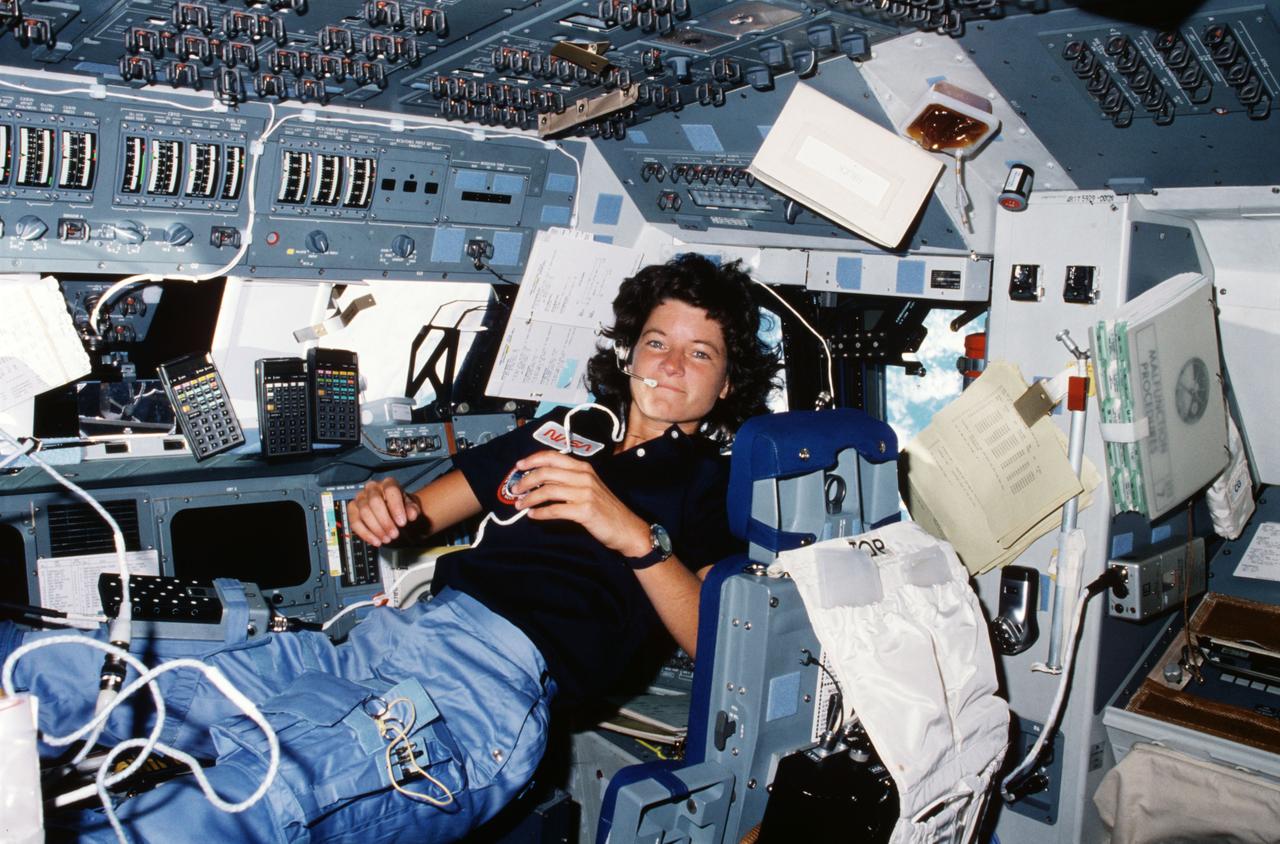
STS007-14-629 (21 June 1983) --– Astronaut Sally K. Ride, STS-7 mission specialist, performs a number of functions simultaneously, proving the necessity for versatility and dexterity in space travel. Floating freely on the flight deck, Dr. Ride communicates with ground controllers in Houston, moves within feet of important reference data, hand calculators and other aids all at the same time. She is one of the five astronaut crew members for the Challenger’s second orbital mission. Her head is in the station normally occupied by the pilot (in this case, Frederick H. (Rick) Hauck) and her feet are anchored at the station for the crew commander (in this case, Robert L. Crippen). Photo credit: NASA
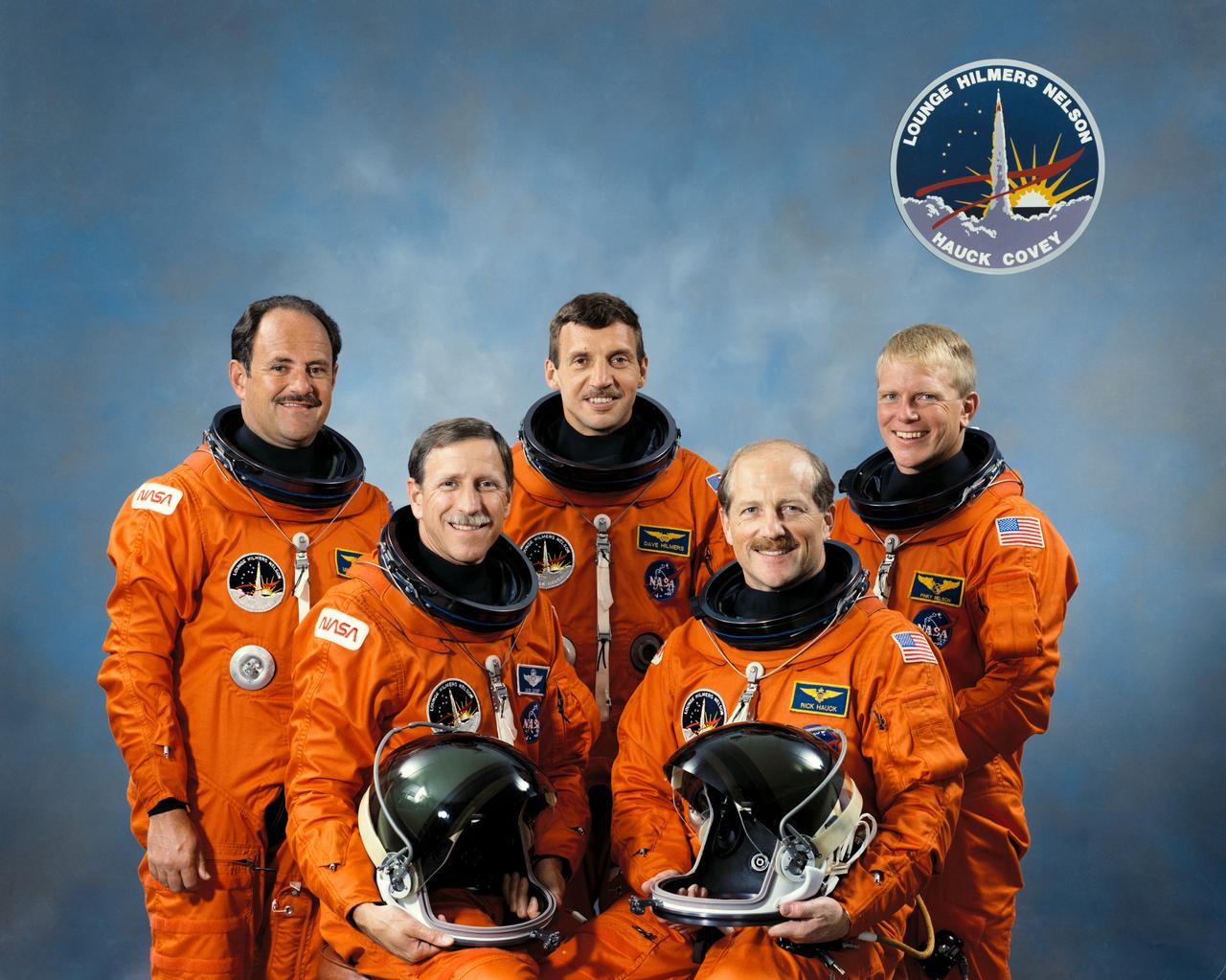
S88-47522 (10 Sept 1988) --- These five veteran astronauts have been training for over a year to serve as NASA's crew aboard the Space Shuttle Discovery for STS-26. On the front row are Astronauts Frederick H. (Rick) Hauck (right), commander; and Richard O. Covey, pilot. On the back row are Astronauts John M. (Mike) Lounge, David C. Hilmers and George D. Nelson -- all mission specialists. The crewmembers are wearing the orange partial pressure garments that they will be wearing on the launch and entry phases of the flight, scheduled for launch later this month.
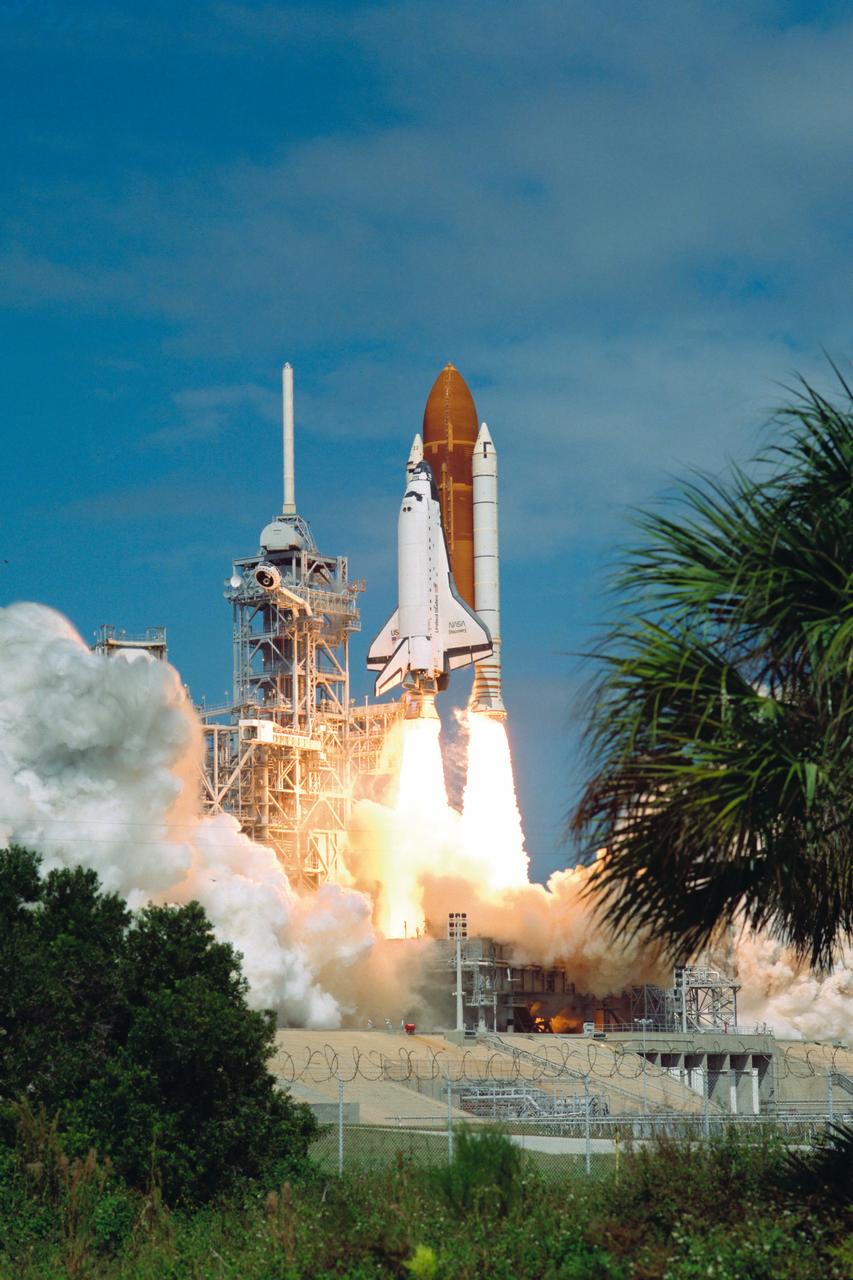
S26-S-187 (29 Sept. 1988) --- The STS-26 launch of space shuttle Discovery begins the first flight to be flown after the Challenger accident. The flight crew included astronauts Rick Hauck, commander; Dick Covey, pilot; and three mission specialists, Dave Hilmers, Mike Lounge, and George (Pinky) Nelson. During the four-day mission, the crew deployed the Tracking and Data Relay Satellite (TDRS-C) and operated eleven mid-deck experiments. Discovery completed 64 orbits of the earth before landing at Edwards Air Force Base, California, on October 3, 1988. Photo credit: NASA or National Aeronautics and Space Administration

KENNEDY SPACE CENTER, FLA. - At the KSC Visitor Complex, former astronaut Frederick H. (Rick) Hauck (standing right) congratulates former astronaut Daniel Brandenstein (standing center) at his induction ceremony into the U.S. Astronaut Hall of Fame. Also standing is former astronaut James A. Lovell. Seated on the dais, from left, are former astronauts John H. Glenn and Gordon Cooper, both previously inducted into the Hall of Fame. Being inducted with Brandenstein are Space Shuttle astronauts Robert "Hoot" Gibson, Story Musgrave, and Sally K. Ride. Conceived by six of the Mercury Program astronauts, the U.S. Astronaut Hall of Fame opened in 1990 to provide a place where space travelers could be remembered for their participation and accomplishments in the U.S. space program. The four new inductees join 48 previously honored astronauts from the ranks of the Gemini, Apollo, Skylab, Apollo-Soyuz, and Space Shuttle programs.
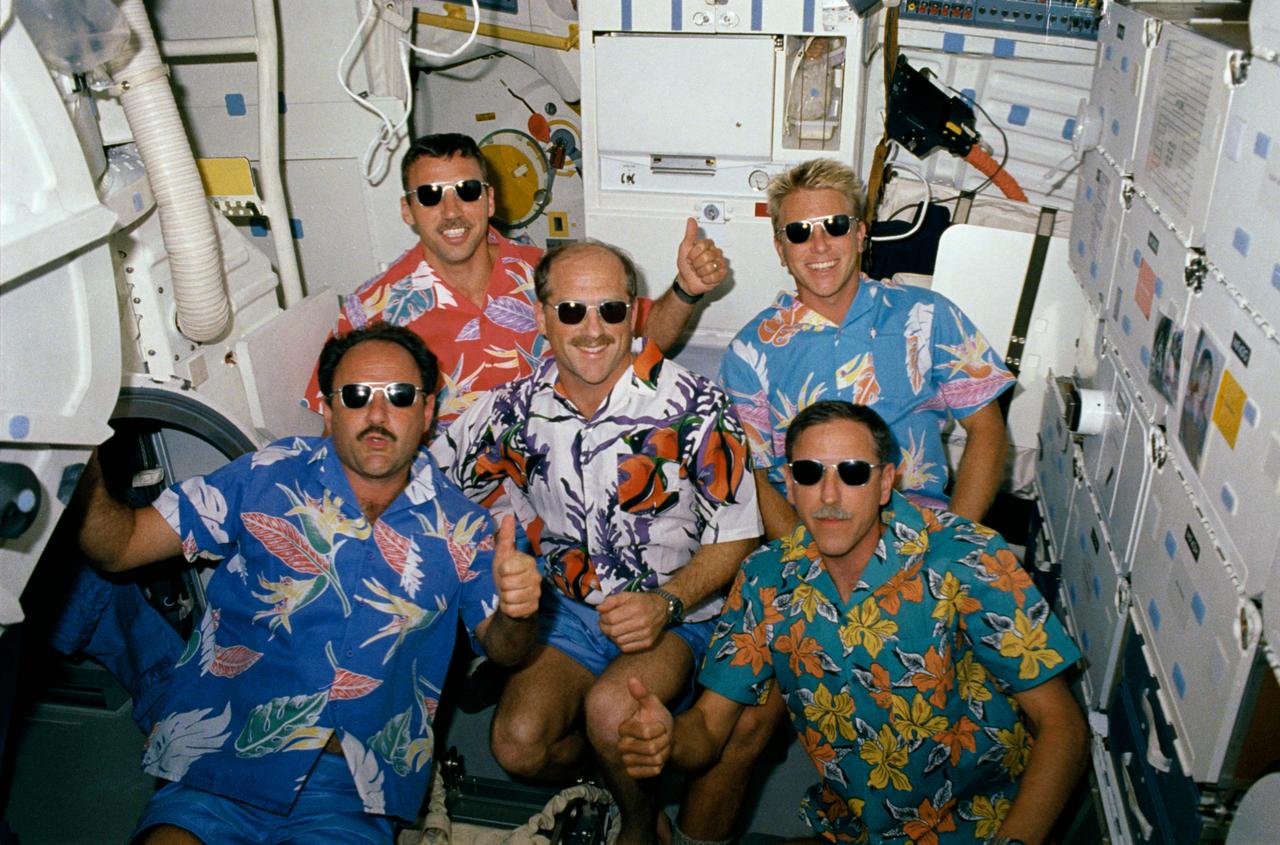
STS026-09-008 (3 Oct 1988) --- STS-26 crewmembers wear Hawaiian attire (brightly colored shirts with bold prints) and sunglasses while giving the "thumbs up" signal as they pay tribute to the Hawaii tracking station during an unscheduled television (TV) downlink. On Discovery's, Orbiter Vehicle (OV) 103's, middeck are (left to right) Mission Specialist (MS) John M. Lounge, holding onto open airlock hatch, MS David C. Hilmers, wearing red shirt, Commander Frederick H. Hauck, wearing white shirt and positioned in center of crew, MS George D. Nelson, and Pilot Richard O. Covey (lower right corner of the frame). The shirts were given to the crewmembers by the Kennedy Space Center (KSC) Loud and Proud Team.
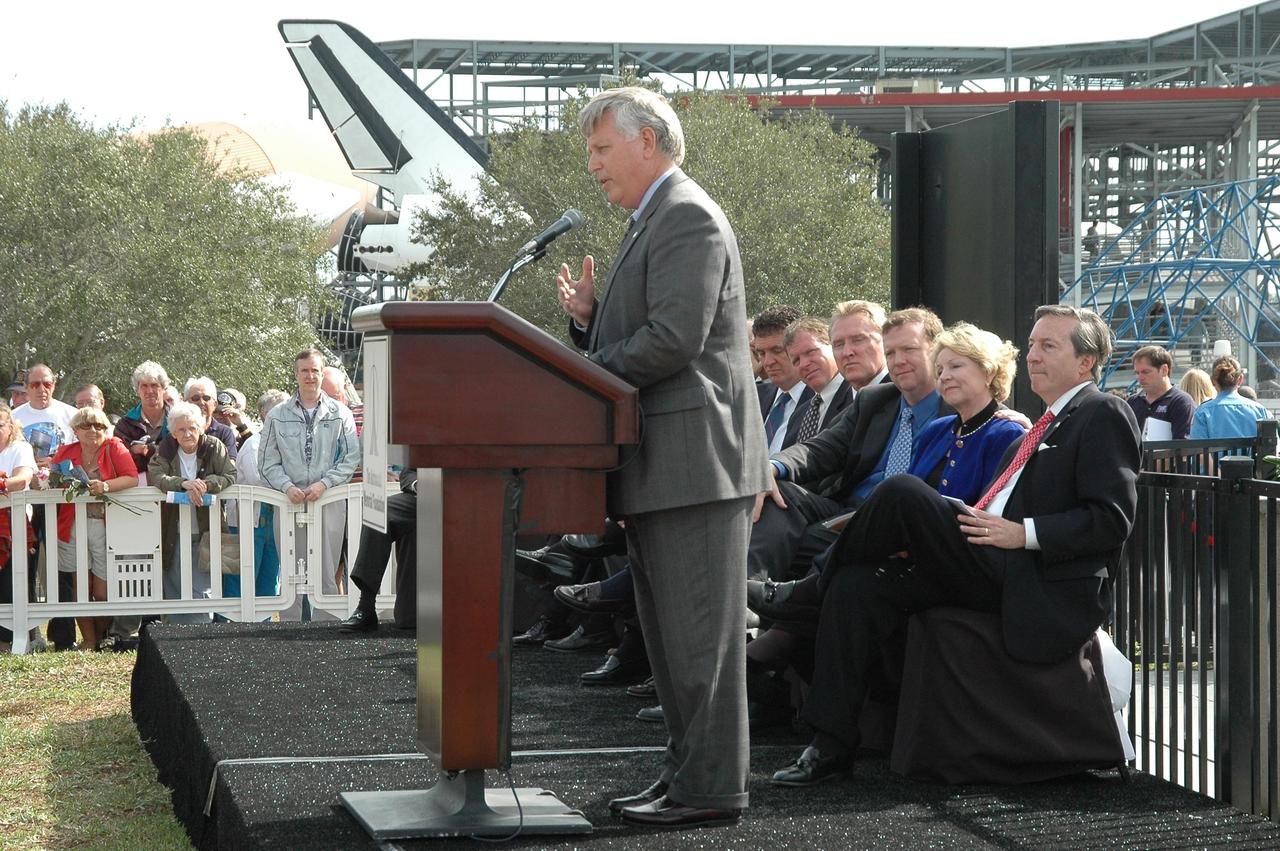
KENNEDY SPACE CENTER, FLA. — During the Challenger memorial ceremony held Jan. 28 in front of the Space Memorial Mirror at NASA Kennedy Space Center’s Visitor Complex, Center Director Jim Kennedy talks to visitors. Others participating in the ceremony are Dr. Mick Ukleja, who gave the invocation; Dr. Stephen Feldman, president of the Astronauts Memorial Foundation; Rep. Dave Weldon and Rep. Tom Feeney; William Potter, chairman of the Board of Directors of the Astronauts Memorial Foundation; William Gerstenmaier, associate administrator for Space Operations at NASA; June Scobee Rodgers, widow of Dick Scobee, commander of Challenger; Col. Richard Scobee, son of Dick Scobee and June Scobee Rodgers; Capt. Frederick Hauck, commander of the first mission after Challenger; Dr. Joseph Allen, astronaut and scientist and chairman of the Board of the Challenger Centers for Space Science. June Scobee Rodgers and Gerstenmaier placed a wreath at the base of the memorial. Photo credit: NASA/Kim Shiflett
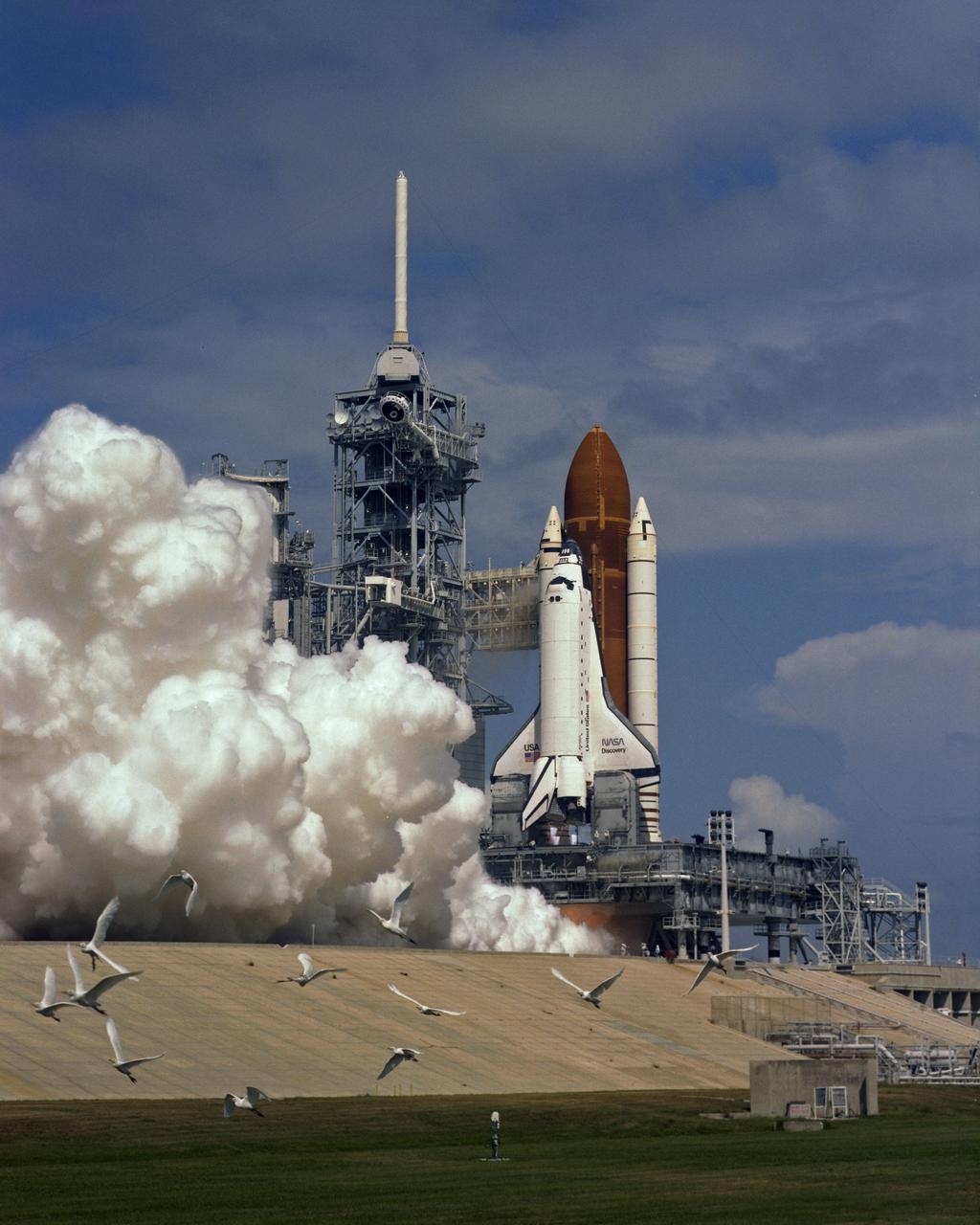
CAPE CANAVERAL, Fla. - The space shuttle Discovery and its five-man crew is launched from pad 39B at 11:37 a.m. as STS-26 embarks on a four-day mission marking America's return to space. On the first day of orbit, the crew will deploy from the orbiter's payload bay the primary payload, the Tracking and Date Relay Satellite, or TDRS-C. The inertial upper stage, or IUS, will boost the satellite to a geosynchronous altitude from low Earth orbit. When it place, TDRS-C will relay date from low Earth orbiting spacecraft and air-to-ground voice communications sand television from shape shuttle orbiters during missions. The crew members of STST-26 are Commander Rick Hauck, Pilot Richard Covey, and Mission Specialists Dave Hilmers, Mike Lounge and George "Pinky" Nelson. Photo Credit: NASA
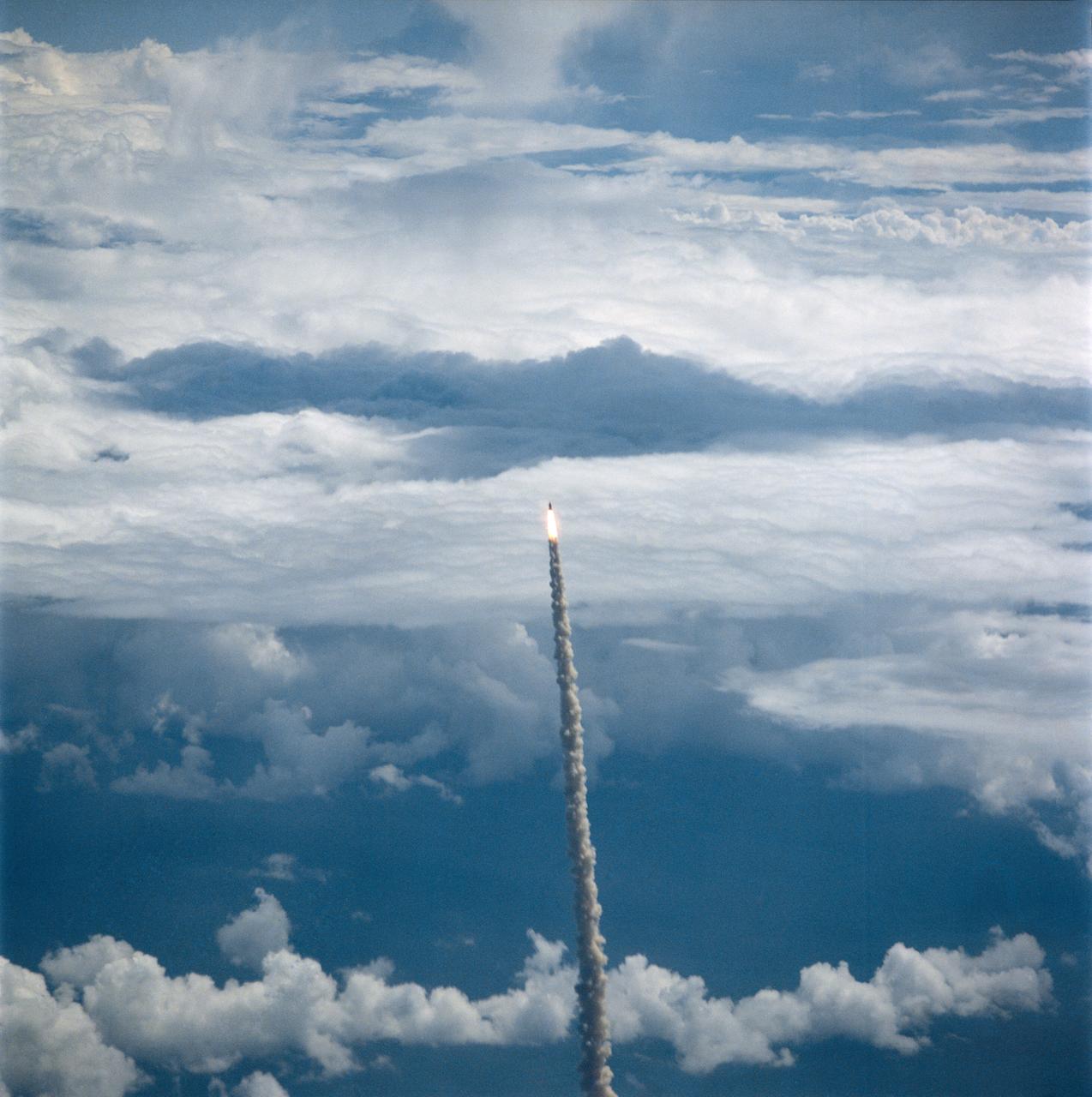
S26-S-026 (29 Sept. 1988) --- The STS-26 launch was captured on film from the NASA Shuttle Training Aircraft, piloted by astronaut Daniel C. Brandenstein, chief of JSC's Astronaut Office. Discovery?s mission was the first flight to be flown after the Challenger accident. The flight crew included astronauts Rick Hauck, commander; Dick Covey, pilot; and three mission specialists, Dave Hilmers, Mike Lounge, and George (Pinky) Nelson. During the four-day mission, the crew deployed the Tracking and Data Relay Satellite (TDRS-C) and operated eleven mid-deck experiments. Discovery completed 64 orbits of the earth before landing at Edwards Air Force Base, California, on October 3, 1988. Photo credit: NASA or National Aeronautics and Space Administration
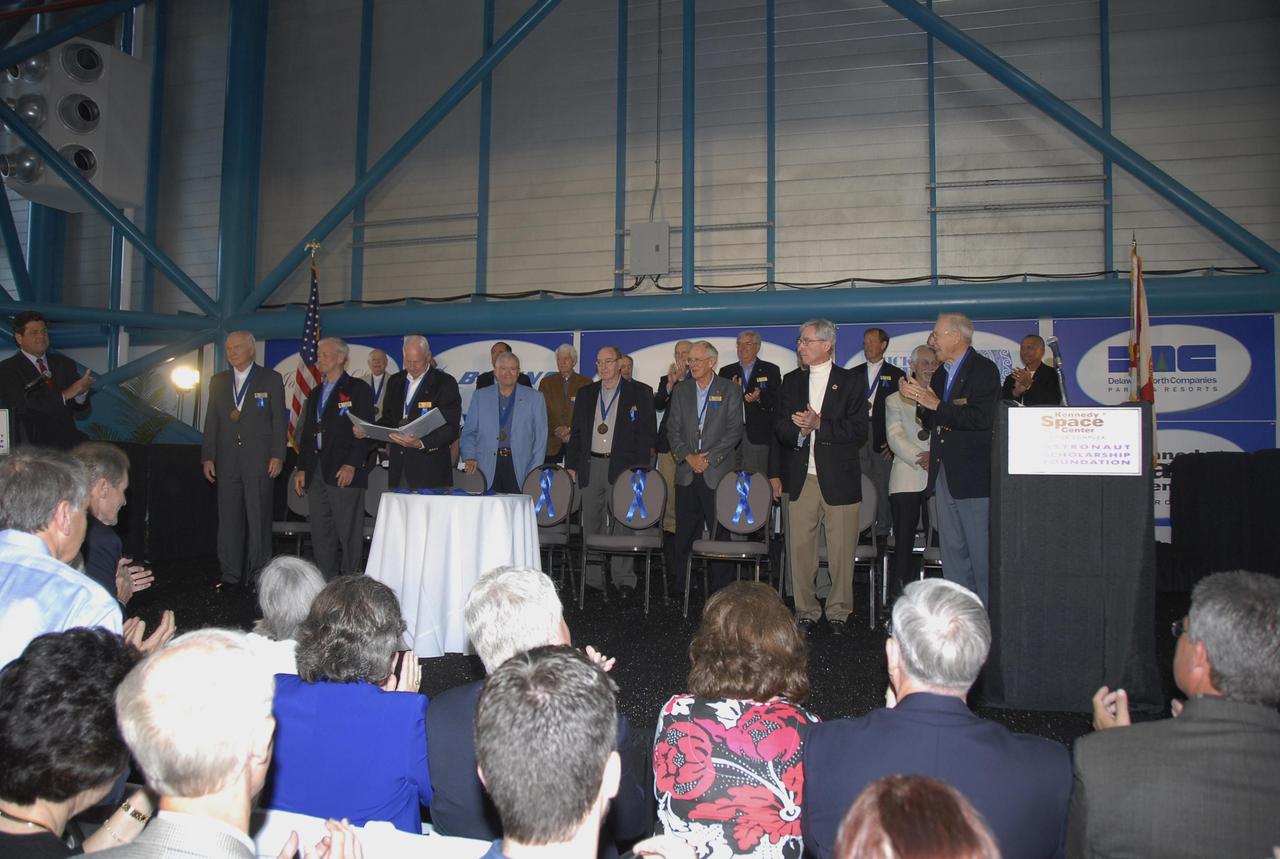
KENNEDY SPACE CENTER, FLA. -- Retired Astronaut Al Worden (third from left in front row) reads a list of the astronauts honored in past ceremonies, some of whom stand on the dais. Standing in the front row, from left, are John Glenn, Scott Carpenter, Worden, Fred Haise, Edgar Mitchell, Charlie Duke, John Young and Jim Lovell. Pictured standing in the back row, from left, are Jerry Carr, Bob Crippen, Hank Hartsfield, Joe Allen, Rick Hauck, Dan Brandenstein, Robert “Hoot” Gibson, Owen Garriott and Charlie Bolden. The May 5 induction added space shuttle commanders Michael L. Coats, Steven A. Hawley and Jeffrey A. Hoffman to the Hall of Fame. They grow the number of space explorers enshrined in the Hall of Fame to 66. The ceremony was held at the Kennedy Space Center's Apollo/Saturn V Center. Photo credit: NASA/Kim Shiflett
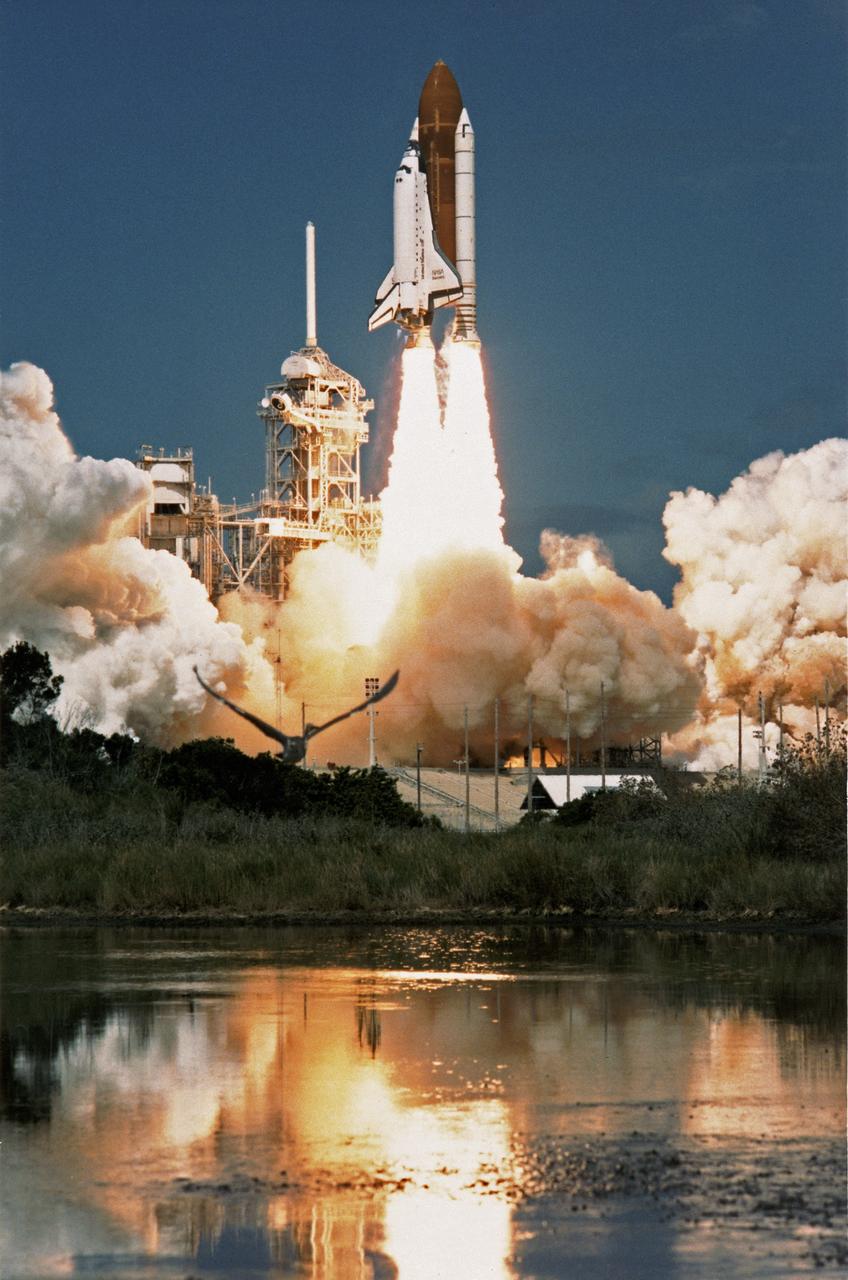
CAPE CANAVERAL, Fla. - The space shuttle Discovery and its five-man crew is launched from pad 39B at 11:37 a.m. as STS-26 embarks on a four-day mission marking America's return to space. On the first day of orbit, the crew will deploy from the orbiter's payload bay the primary payload, the Tracking and Data Relay Satellite, or TDRS-C. The inertial upper stage, or IUS, will boost the satellite to a geosynchronous altitude from low Earth orbit. When it place, TDRS-C will relay date from low Earth orbiting spacecraft and air-to-ground voice communications sand television from shape shuttle orbiters during missions. The crew members of STST-26 are Commander Rick Hauck, Pilot Richard Covey, and mission specialists Dave Hilmers, Mike Lounge and George "Pinky" Nelson. Photo Credit: NASA
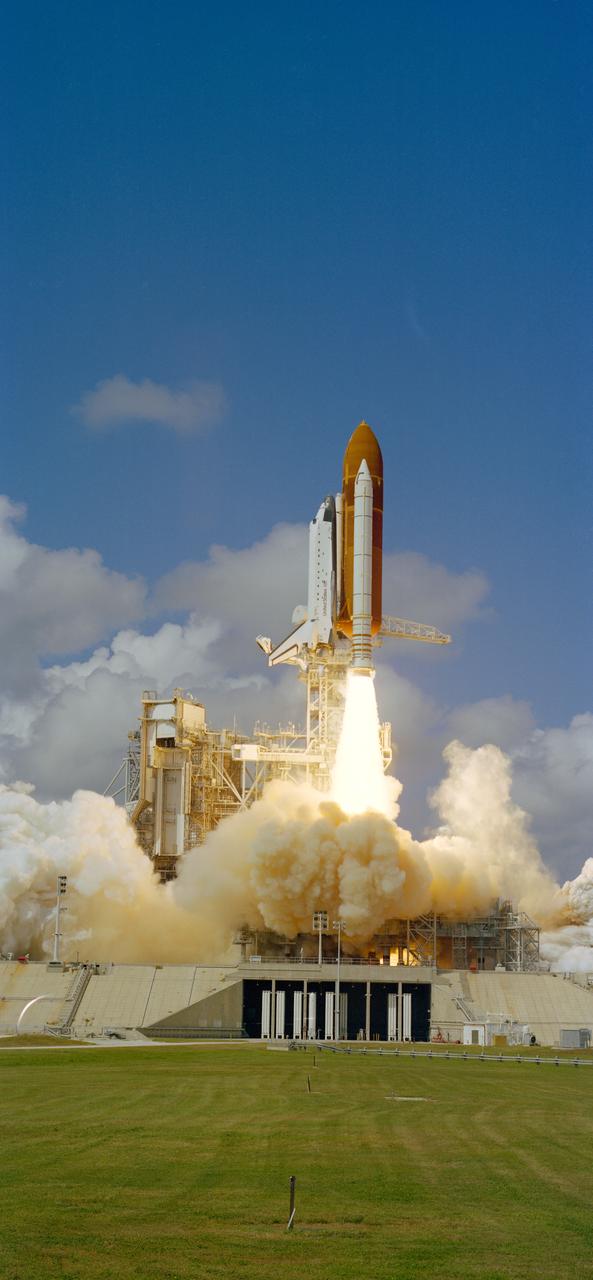
STS026-S-031 (29 Sept 1988) --- Just moments after ignition, the Space Shuttle Discovery, mated to two solid rocket boosters and an external fuel tank, heads, toward Earth orbit. The mission marks Discovery?s first flight since September of 1985 and NASA?s first manned mission since September of 1985 and NASA?s first manned mission since the 51L Challenger accident of January 28, 1986. Onboard the spacecraft are Astronauts Frederick H. (Rick) Hauck, commander; Richard O. Covey, pilot; and George D. Nelson, John M. (Mike) Lounge and David C. Hilmers, mission specialists. Discovery?s dry weight is 171,419 pounds. The tracking and data relay satellite and its inertial upper stage total about 37,000 pounds.
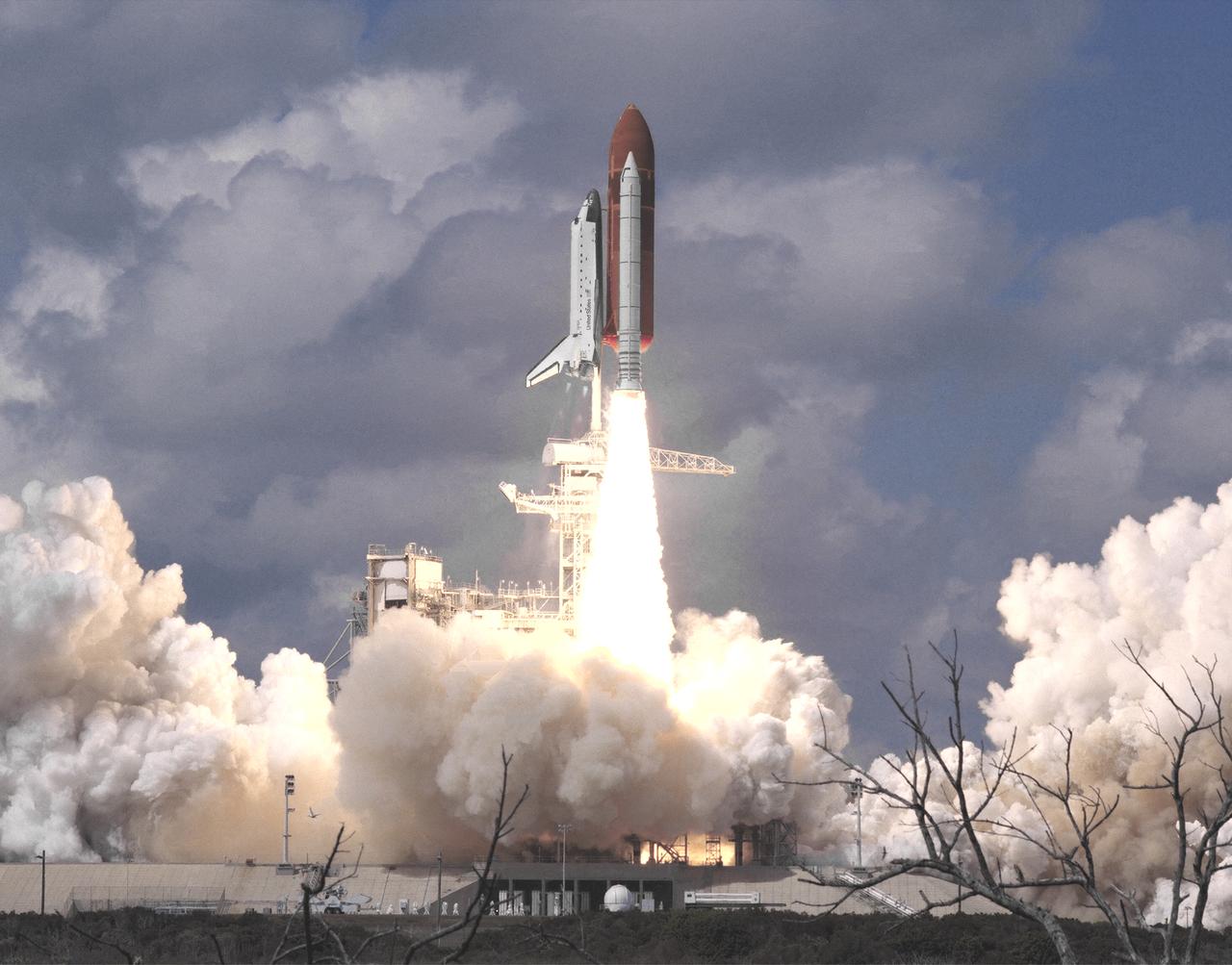
The Space Shuttle Discovery takes off from Launch Pad 39B at the Kennedy Space Center, Florida, to being Mission STS-26 on 29 September 1988,11:37:00 a.m. EDT. The 26th shuttle mission lasted four days, one hour, zero minutes, and 11 seconds. Discovery landed 3 October 1988, 9:37:11 a.m. PDT, on Runway 17 at Edwards Air Force Base, California. Its primary payload, NASA Tracking and Data Relay Satellite-3 (TDRS-3) attached to an Inertial Upper Stage (IUS), became the second TDRS deployed. After deployment, IUS propelled the satellite to a geosynchronous orbit. The crew consisted of Frederick H. Hauck, Commander; Richard O. Covey, Pilot; John M. Lounge, Mission Specialist 1; George D. Nelson, Mission Specialist 2; and David C. Hilmers, Mission Specialist 3.
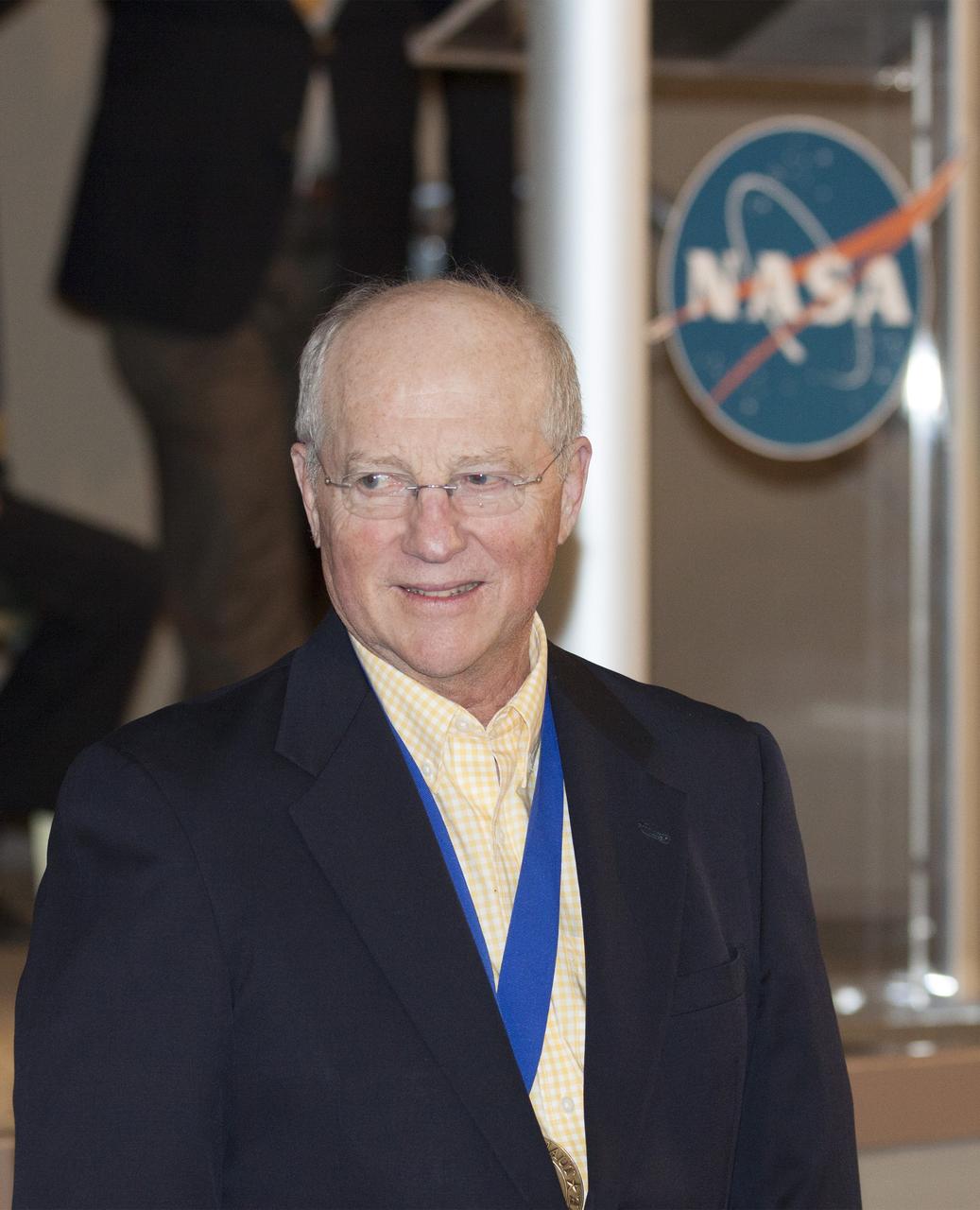
CAPE CANAVERAL, Fla. – U.S. Astronaut Hall of Fame member Rick Hauck is introduced at NASA’s Kennedy Space Center Visitor Complex in Florida, prior to the ceremony in which Bonnie Dunbar, Curt Brown and Eileen Collins will be inducted into the group of space pioneers. This induction is the twelfth group of space shuttle astronauts named to the AHOF, and the first time two women are inducted at the same time. The year’s inductees were selected by a committee of current Hall of Fame astronauts, former NASA officials, historians and journalists. The selection process is administered by the Astronaut Scholarship Foundation. For more on the U.S. Astronaut Hall of Fame, go to http://www.kennedyspacecenter.com/astronaut-hall-of-fame.aspx For more on the Astronaut Scholarship Foundation, go to http://astronautscholarship.org/ Photo credit: NASA/ Kim Shiflett
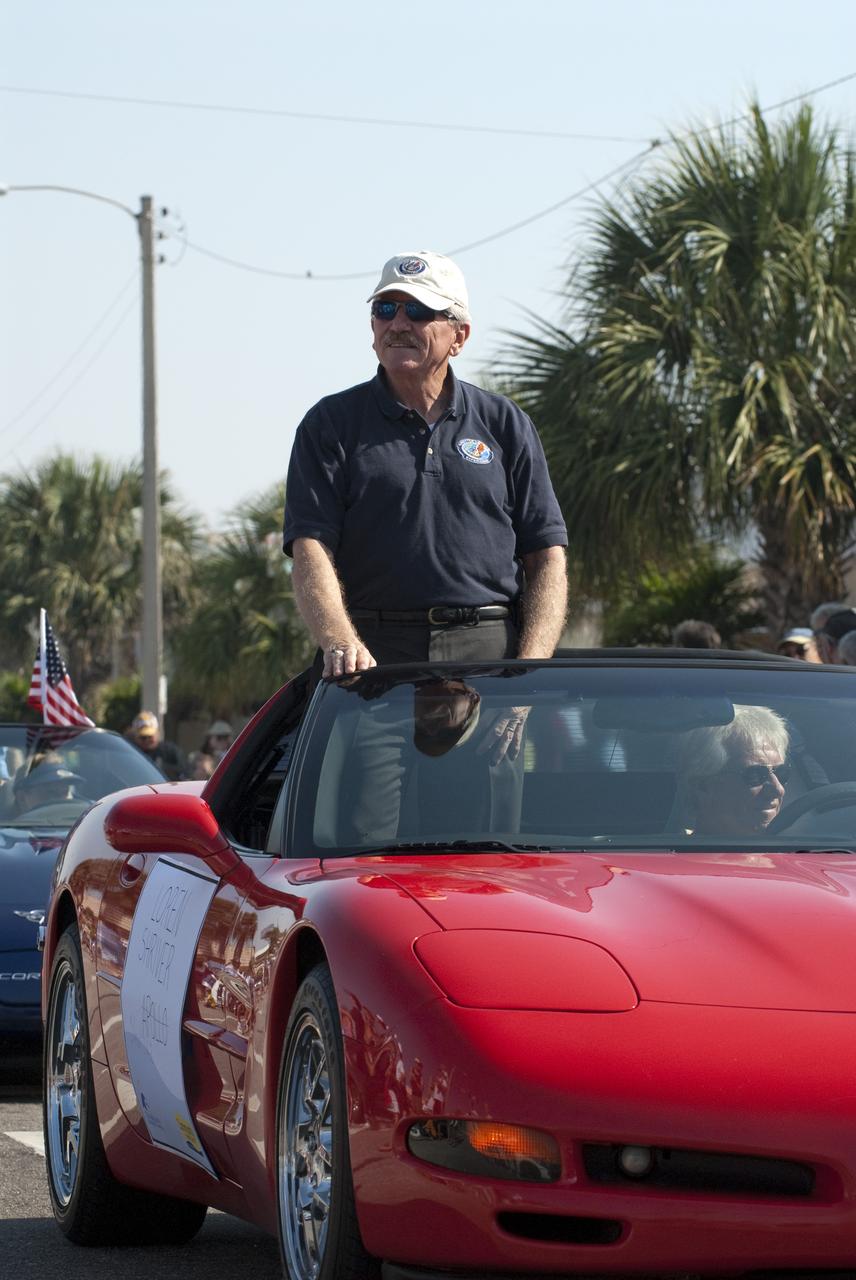
Cape Canaveral, Fla. -- Retired space shuttle astronaut Loren Shriver Hauck greets spectators from a Chevrolet Corvette during a commemorative parade in Cocoa Beach, Fla. A group of current and retired NASA astronauts gathered in Cocoa Beach to commemorate NASA’s 50 years of accomplishments and to honor astronaut Alan Shepard’s Mercury/Freedom 7 suborbital flight May 5, 1961.The event was marked by a parade, with the astronauts riding in a fleet of Chevrolet Corvettes that corresponded with the time period of their space missions. Members of the Cape Kennedy Corvette Club, a group established in 1967, escorted almost two dozen astronauts or their family representatives in club members' cars. The Corvette parade started at the glass bank building, at 9:34 a.m. EDT, the same time Shepard launched into space. Photo credit: NASA/Kim Shiflett
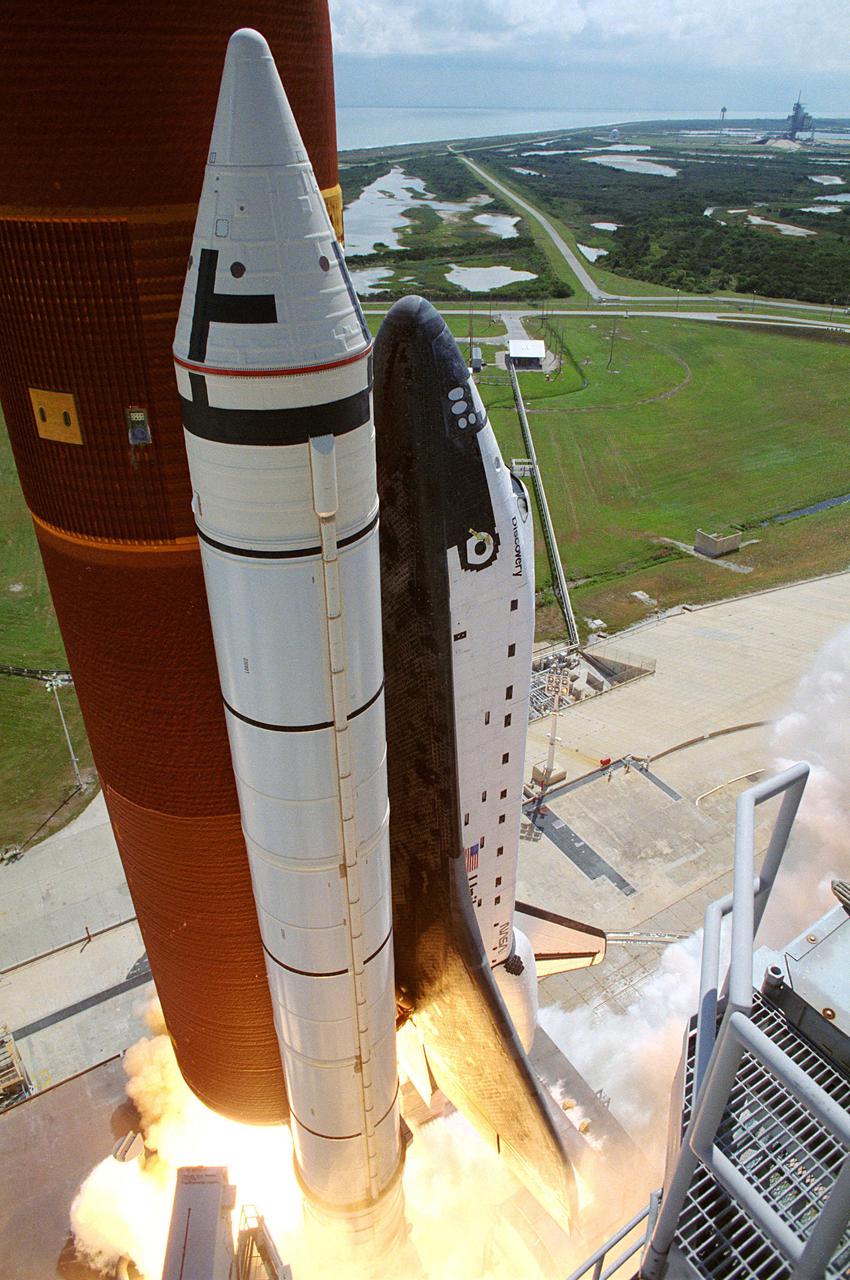
KENNEDY SPACE CENTER, FLA. -- The Space Shuttle Discovery and its five-man crew is launched from pad 39B at 11:37 a.m. as STS-26 embarks on a four-day mission, marking America's return to space. On the first day of orbit, the crew will deploy from the orbiter's payload bay the primary payload, the Tracking and Data Relay Satellite (TDRS-C). The Inertial Upper Stage (IUS) will boost the satellite to a geosynchronous altitude from low-Earth orbit. When in place, TDRS-C will relay data from low-Earth orbiting spacecraft, and air-to-ground voice communications and television from Space Shuttle orbiters during missions. The crew members of STS-26 are Commander Rick Hauck, Pilot Richard Covey, and Mission Specialists Dave Hilmers, Mike Lounge, and George 'Pinky' Nelson.
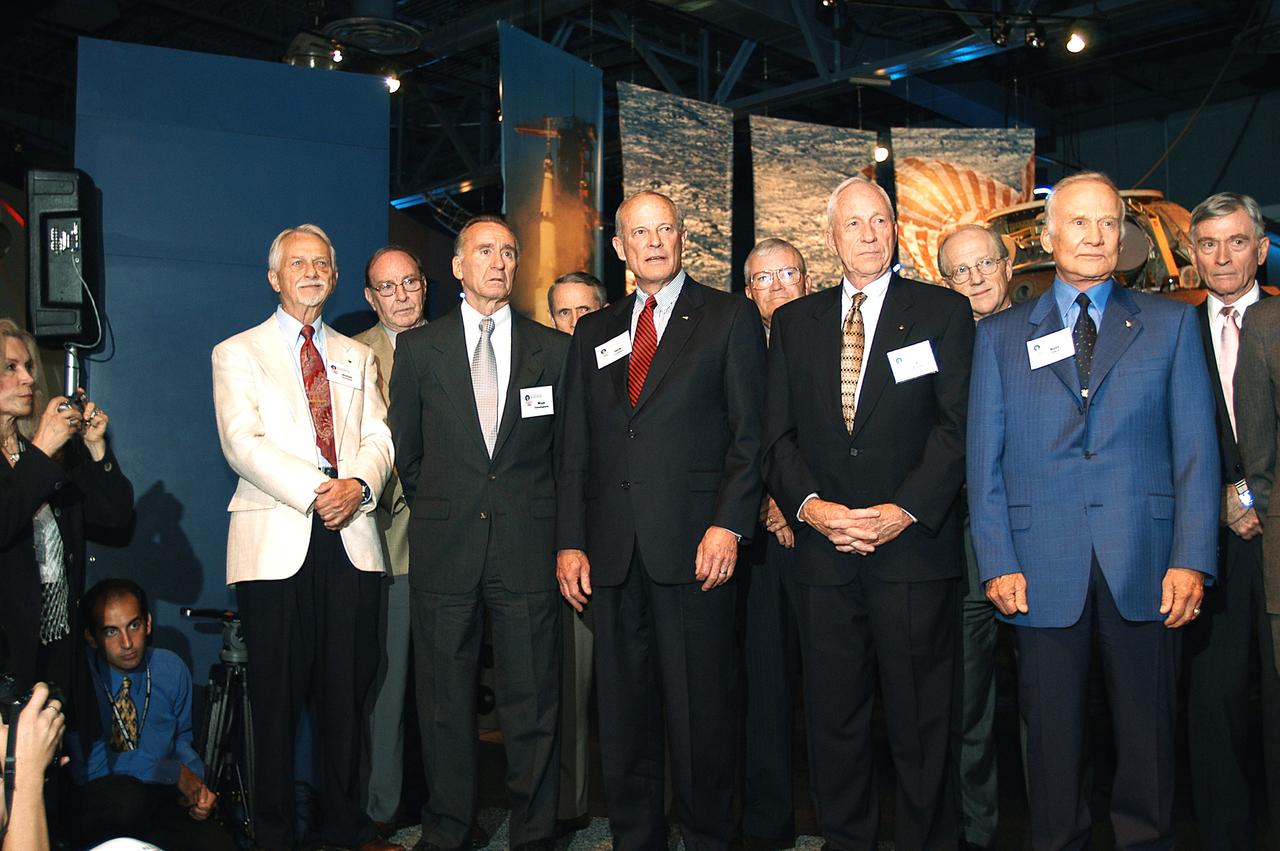
KENNEDY SPACE CENTER, FLA. - A group of current and former U.S. astronauts are introduced to the audience at a ribbon cutting ceremony officially opening the U.S. Astronaut Hall of Fame as part of the Kennedy Space Center Visitor Complex. In the front row, from left, are Owen K. Garriott, Walter Cunningham, Jack R. Lousma, Alfred M. Worden, and Buzz Aldrin. In the back row, from left, are Edgar D. Mitchell, Edward G. Gibson, Fred W. Haise, Frederick H. (Rick) Hauck, and John W. Young. The ceremony was held in conjunction with the induction of four Space Shuttle astronauts into the Hall of Fame including Daniel Brandenstein, Robert "Hoot" Gibson, Story Musgrave, and Sally Ride. Conceived by six of the Mercury Program astronauts, the U.S. Astronaut Hall of Fame opened in 1990 to provide a place where space travelers could be remembered for their participation and accomplishments in the U.S. space program. The four new inductees join 48 previously honored astronauts from the ranks of the Gemini, Apollo, Skylab, Apollo-Soyuz, and Space Shuttle programs.

KENNEDY SPACE CENTER, FLA. - Center Director and former astronaut Roy D. Bridges, Jr., (left) shakes hands with former astronaut James Lovell following a ribbon cutting ceremony officially opening the U.S. Astronaut Hall of Fame as part of the Kennedy Space Center Visitor Complex. Invited guests and dignitaries look on, such as, from left, former astronauts Edward G. Gibson, Edgar D. Mitchell, Jack R. Lousma, Frederick H. (Rick) Hauck, and Buzz Aldrin (far right). The ceremony was held in conjunction with the induction of four Space Shuttle astronauts into the Hall of Fame including Daniel Brandenstein, Robert "Hoot" Gibson, Story Musgrave, and Sally Ride. Conceived by six of the Mercury Program astronauts, the U.S. Astronaut Hall of Fame opened in 1990 to provide a place where space travelers could be remembered for their participation and accomplishments in the U.S. space program. The four new inductees join 48 previously honored astronauts from the ranks of the Gemini, Apollo, Skylab, Apollo-Soyuz, and Space Shuttle programs.
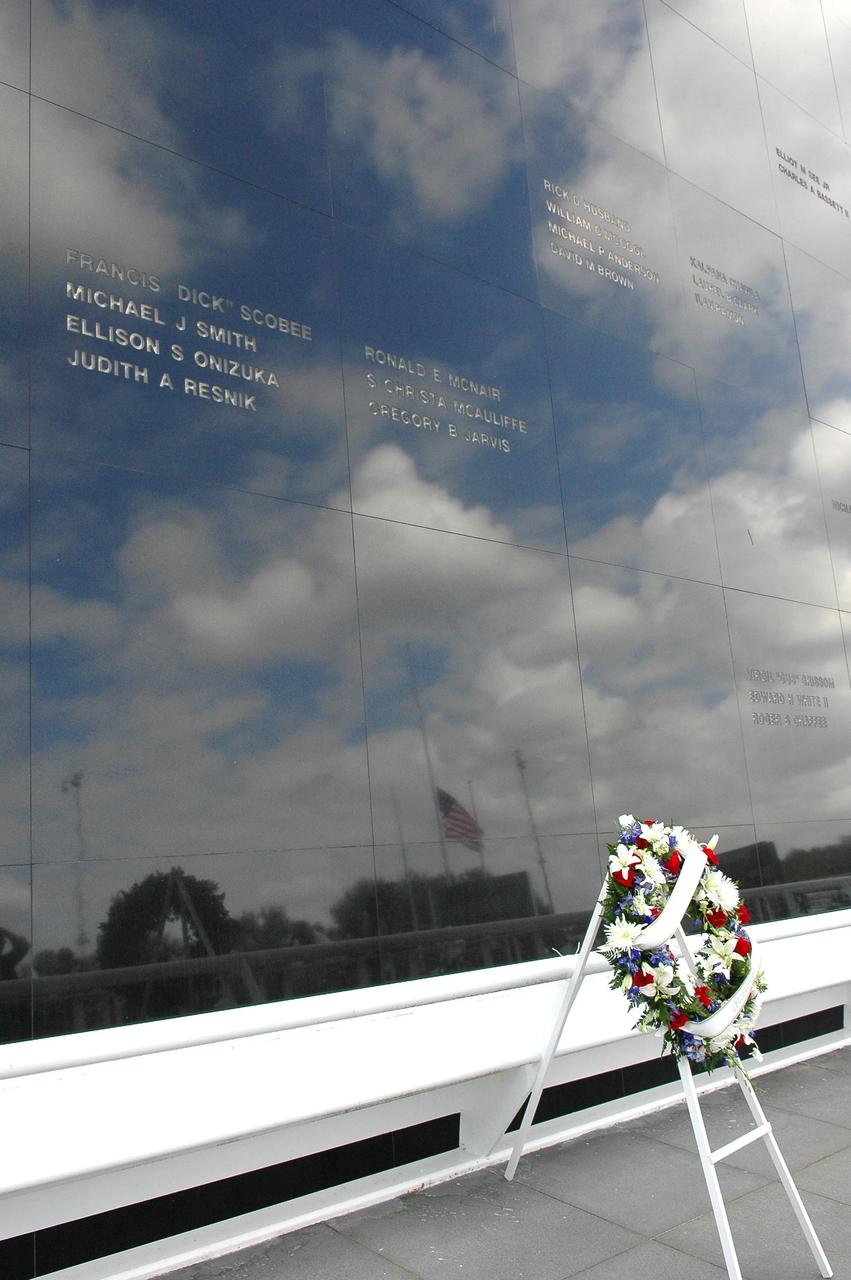
KENNEDY SPACE CENTER, FLA. — Following the Challenger memorial ceremony held Jan. 28 in front of the Space Memorial Mirror at NASA Kennedy Space Center’s Visitor Complex, this wreath remains as a reminder of the fallen heroes. It was placed there by June Scobee Rodgers, widow of Dick Scobee, commander of Challenger, and William Gerstenmaier, associate administrator for Space Operations at NASA. They were participants in the ceremony, along with Dr. Mick Ukleja, who gave the invocation; Dr. Stephen Feldman, president of the Astronauts Memorial Foundation; Rep. Dave Weldon and Rep. Tom Feeney; William Potter, chairman of the Board of Directors of the Astronauts Memorial Foundation; William Gerstenmaier, associate administrator for Space Operations at NASA; Jim Kennedy (second from left), center director of KSC; June Scobee Rodgers, widow of Dick Scobee, commander of Challenger; Col. Richard Scobee, son of Dick Scobee and June Scobee Rodgers; Capt. Frederick Hauck, commander of the first mission after Challenger; Dr. Joseph Allen, astronaut and scientist and chairman of the Board of the Challenger Centers for Space Science. June Scobee Rodgers and Gerstenmaier placed a wreath at the base of the memorial. Photo credit: NASA/Kim Shiflett
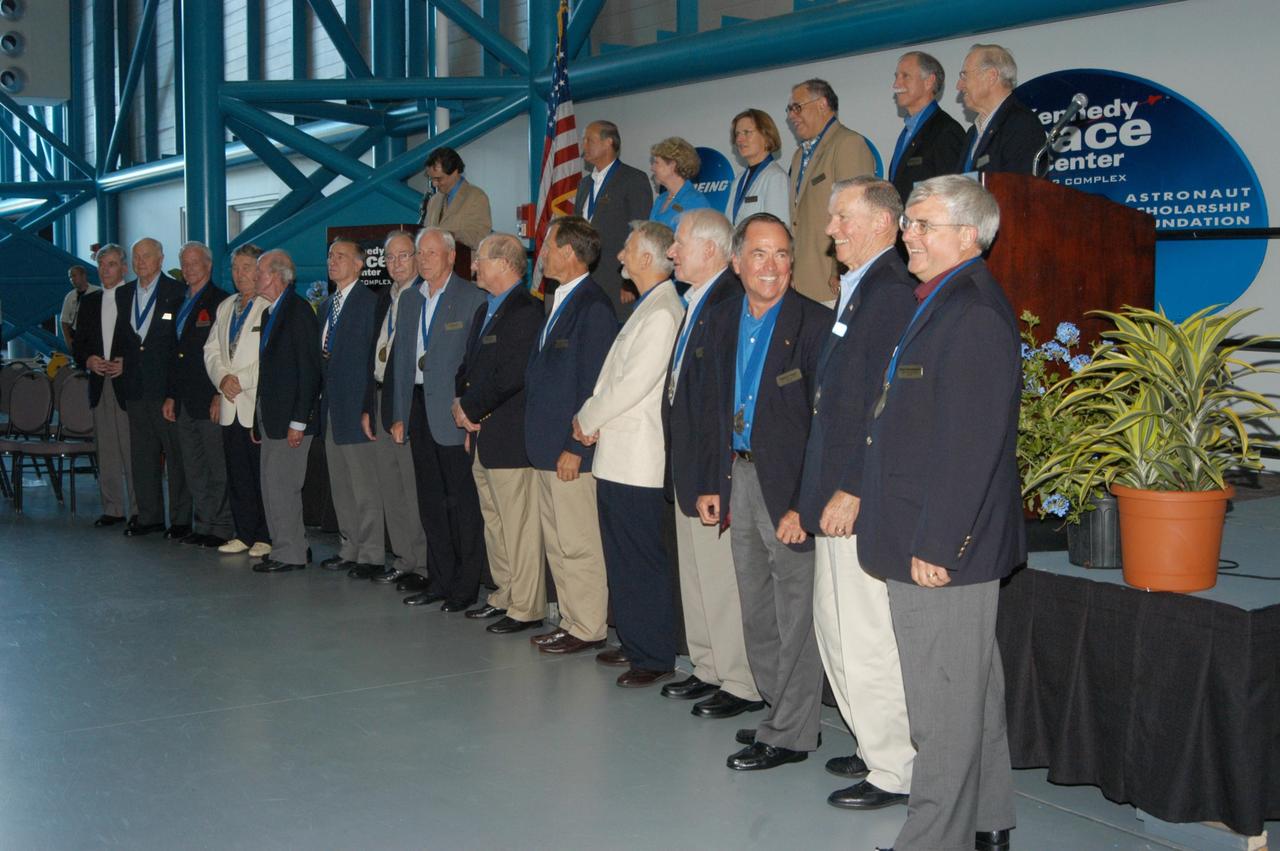
KENNEDY SPACE CENTER, FLA. -- Following the induction ceremony welcoming five new space program heroes in the U.S. Astronaut Hall of Fame, the members line up for a commemorative photo. From left, in front, are John Young, John Glenn Jr., Scott Carpenter, Wally Schirra, Gordon Cooper, Walt Cunningham, Ed Mitchell, Al Worden, Rick Hauck, Ed Gibson, Owen Garriott, Vance Brand, Robert Crippen, Joe Engle, Dan Brandenstein. In back are space author Andrew Chaikin, at the podium; and Norm Thagard, June Scobee representing her late husband Dick Scobee, Kathryn Sullivan, Fred Gregory, Richard Covey and Jim Lovell. The induction ceremony was held at the Apollo/Saturn V Center at KSC. The U.S. Astronaut Hall of Fame opened in 1990 to provide a place where space travelers could be remembered for their participation and accomplishments in the U.S. space program. The five inductees join 52 previously honored astronauts from the ranks of the Gemini, Apollo, Skylab, Apollo-Soyuz, and Space Shuttle programs.
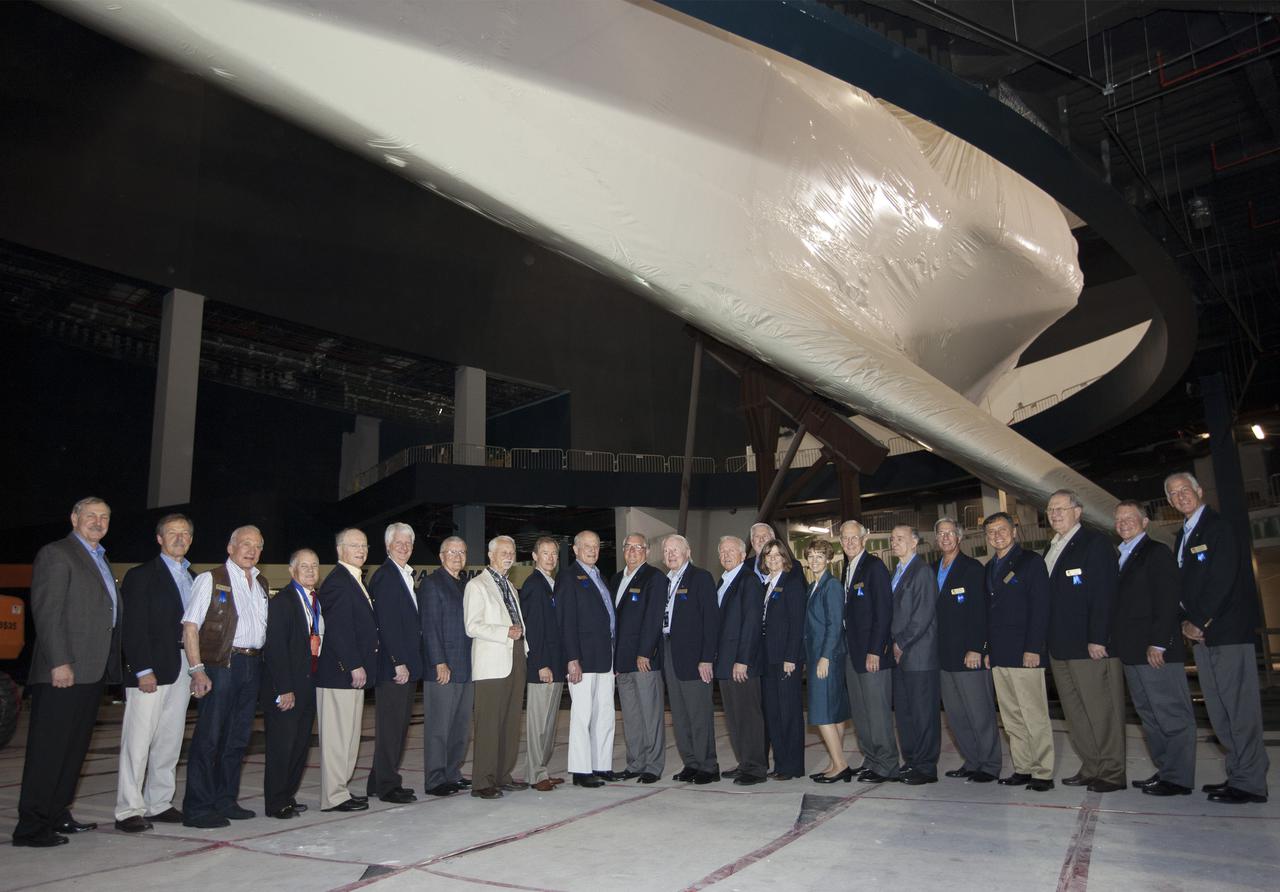
CAPE CANAVERAL, Fla. – At NASA’s Kennedy Space Center Visitor Complex in Florida, members of the U.S. Astronaut Hall of Fame are joined by Bill Moore, chief operating officer of the visitor complex pose under the space shuttle Atlantis in the facility where it will be displayed beginning June 29. The shuttle is currently protected by plastic wrap as constitution contuse. Pictured, left to right are, Curt Brown, Robert, 'Hoot' Gibson, Buzz Aldrin, Joe Allen, Rick Hauck, Steven Hawley, Fred Haise, Owen Garriott, Brewster Shaw. Jack Lousma, Dan Brandenstein, Vance Brand, Loren Shriver, Moore, Bonnie Dunbar, Eileen Collins, Charlie Duke, Walt Cunningham, John Blaha, Franklin Chang-Diaz, Karol Bobko, George 'Pinky' Nelson and Jeff Hoffmann. This induction is the twelfth group of space shuttle astronauts named to the AHOF, and the first time two women are inducted at the same time. The year’s inductees were selected by a committee of current Hall of Fame astronauts, former NASA officials, historians and journalists. The selection process is administered by the Astronaut Scholarship Foundation. For more on the U.S. Astronaut Hall of Fame, go to http:__www.kennedyspacecenter.com_astronaut-hall-of-fame.aspx For more on the Astronaut Scholarship Foundation, go to http:__astronautscholarship.org_ Photo credit: NASA_ Kim Shiflett
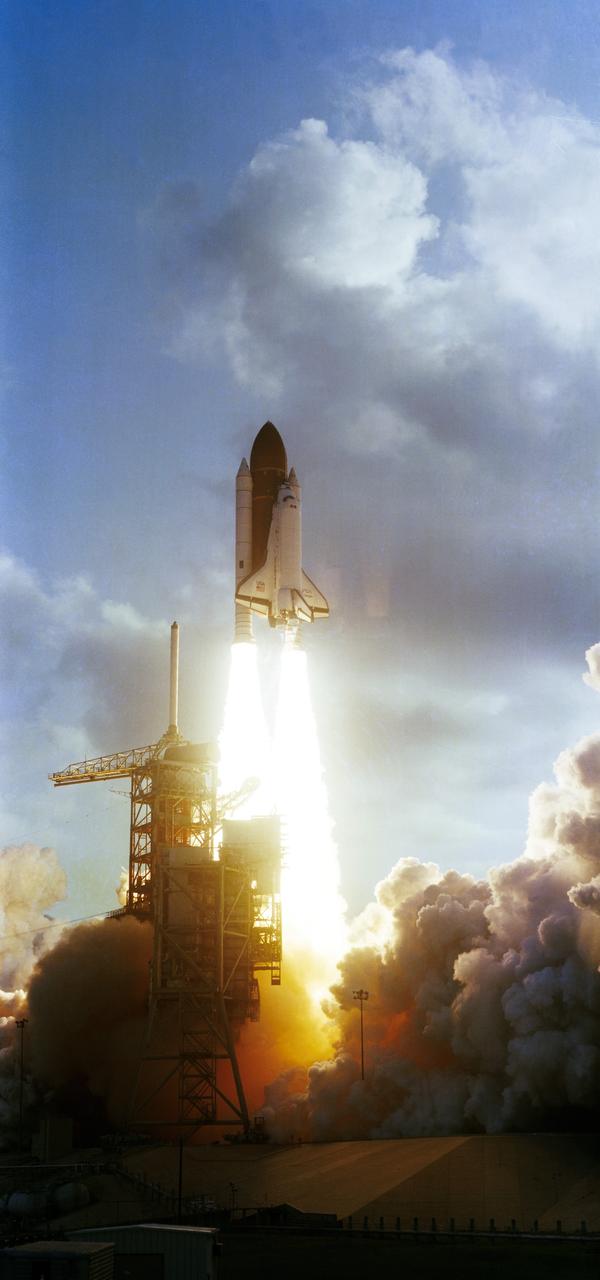
S83-35702 (18 June 1983) --- The seventh launch of the NASA Space Transportation System and the second lift-off of the space shuttle Challenger occurred at 7:33 a.m. (EDT) today from the Pad 39A launch site, at the Kennedy Space Center (KSC). The six-day mission will be highlighted by the first direct landing from space by an orbiter to the Shuttle Landing Facility (SLF). The crew consists of astronauts Robert Crippen, commander, the first two-time space shuttle astronaut; Frederick H. Hauck, pilot; and three mission specialists -- Sally K. Ride, John M. Fabian and Norman E. Thagard. During the mission the crew will deploy the Indonesian PALAPA-B and the Canadian ANIK-C communications satellites. They will also use the Remote Manipulator System (RMS) arm to deploy and retrieve a platform for space experiments called the Shuttle Pallet Satellite (SPAS), and serve as a spaceborne laboratory for OSTA-2, a scientific payload. Getaway Special canisters and materials processing experiments will fill out the complement of payloads on the mission. Photo credit: NASA
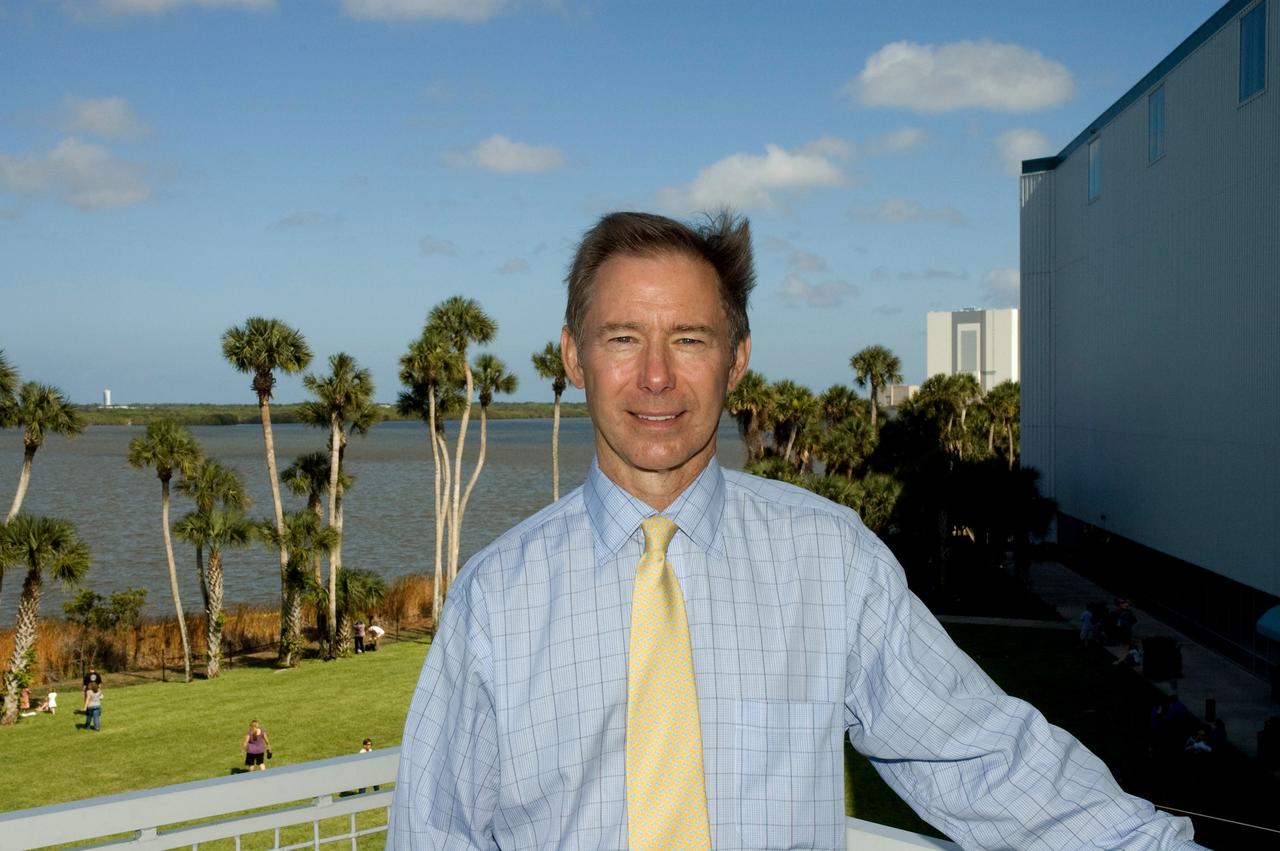
CAPE CANAVERAL, Fla. -- Brewster Shaw is a former astronaut from the first graduating class of astronauts after the Apollo program. He and others from the class were guests at NASA's Kennedy Space Center for the launch of space shuttle Discovery on its STS-124 mission. Shaw is Vice President and General Manager, Space Exploration, for Integrated Defense Systems, The Boeing Company. In 1978 a new group of 35 astronauts was selected after nine years without new astronauts. The pilots were Daniel Brandenstein, Michael Coats, Richard Covey, John Creighton, Robert Gibson, Frederick D. Gregory, Frederick Hauck, Jon McBride, Francis "Dick" Scobee, Brewster Shaw, Loren Shriver, David Walker and Donald Williams. The mission specialists were Guion Bluford, James Buchli, John Fabian, Anna Fisher, Dale Gardner, S. David Griggs, Terry Hart, Steven Hawley, Jeffrey Hoffman, Shannon Lucid, Ronald McNair, Richard Mullane, Steven Nagel, George Nelson, Ellison Onizuka, Judith Resnik, Sally Ride, Rhea Seddon, Robert Stewart, Kathryn D. Sullivan, Norman Thagard and James van Hoften. Since then, a new group has been selected roughly every two years. Photo credit: NASA/Jim Grossmann

CAPE CANAVERAL, Fla. -- A group from the first graduating class of astronauts after the Apollo program gathers at the Banana River viewing site at NASA's Kennedy Space Center before the launch of space shuttle Discovery on its STS-124 mission. In 1978 a new group of 35 astronauts was selected after nine years without new astronauts. The pilots were Daniel Brandenstein, Michael Coats, Richard Covey, John Creighton, Robert Gibson, Frederick D. Gregory, Frederick Hauck, Jon McBride, Francis "Dick" Scobee, Brewster Shaw, Loren Shriver, David Walker and Donald Williams. The mission specialists were Guion Bluford, James Buchli, John Fabian, Anna Fisher, Dale Gardner, S. David Griggs, Terry Hart, Steven Hawley, Jeffrey Hoffman, Shannon Lucid, Ronald McNair, Richard Mullane, Steven Nagel, George Nelson, Ellison Onizuka, Judith Resnik, Sally Ride, Rhea Seddon, Robert Stewart, Kathryn D. Sullivan, Norman Thagard and James van Hoften. Since then, a new group has been selected roughly every two years. Photo credit: NASA/Jim Grossmann

S78-26481 (January 1978) --- This is a montage of the individual portraits of the 35-member 1978 class of astronaut candidates. From left to right are Guion S. Bluford, Daniel C. Brandenstein, James F. Buchli, Michael L. Coats, Richard O. Covey, John O. Creighton, John M. Fabian, Anna L. Fisher, Dale A. Gardner, Robert L. Gibson, Frederick D. Gregory, S. David Griggs, Terry J. Hart, Frederick H. (Rick) Hauck, Steven A. Hawley, Jeffrey A. Hoffman, Shannon W. Lucid, Jon A. McBride, Ronald E. McNair, Richard M. (Mike) Mullane, Steven R. Nagel, George D. Nelson, Ellison S. Onizuka, Judith A. Resnik, Sally K. Ride, Francis R. (Dick) Scobee, Rhea Seddon, Brewster H. Shaw Jr., Loren J. Shriver, Robert L. Stewart, Kathryn D. Sullivan, Norman E. Thagard, James D. Van Hoften, David M. Walker and Donald E. Williams. Photo credit: NASA or National Aeronautics and Space Administration
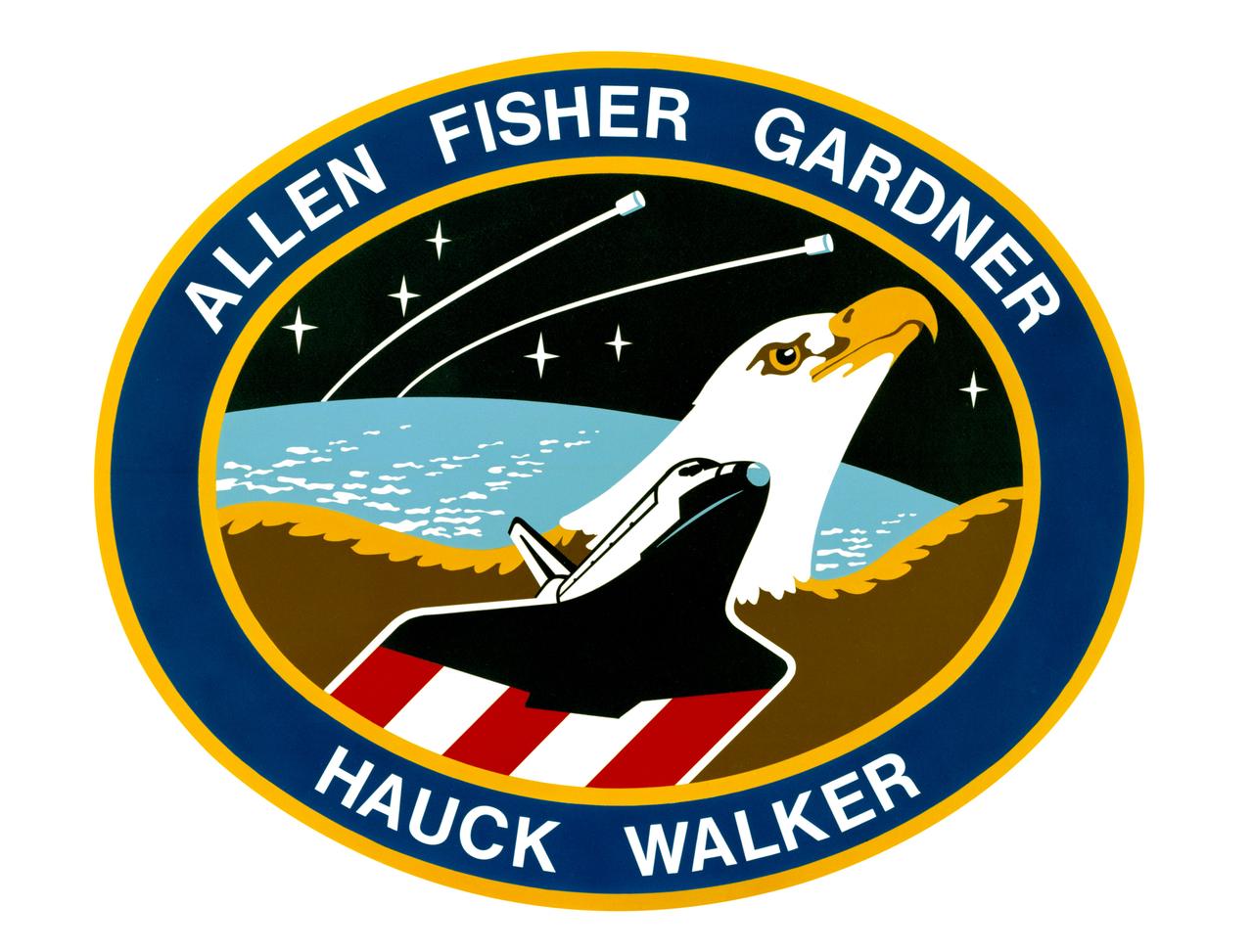
S84-40148 (8 Oct. 1984) --- The space shuttle Discovery en route to Earth orbit for NASA's 51-A mission is reminiscent of a soaring Eagle. The red and white trailing stripes and the blue background, along with the presence of the Eagle, generate memories of America's 208-year-old history and traditions. The two satellites orbiting Earth backgrounded amidst a celestial scene are a universal representation of the versatility of the space shuttle. White lettering against the blue border lists the surnames of the five-member crew--astronauts Frederick H. (Rick) Hauck, David M. Walker, Joseph P. Allen IV, Anna Lee Fisher and Dale A. Gardner. The artwork was done by artist Stephen R. Hustvedt. The NASA insignia design for space shuttle flights is reserved for use by the astronauts and for other official use as the NASA Administrator may authorize. Public availability has been approved only in the forms of illustrations by the various news media. When and if there is any change in this policy, which is not anticipated, the change will be publicly announced. Photo credit: NASA
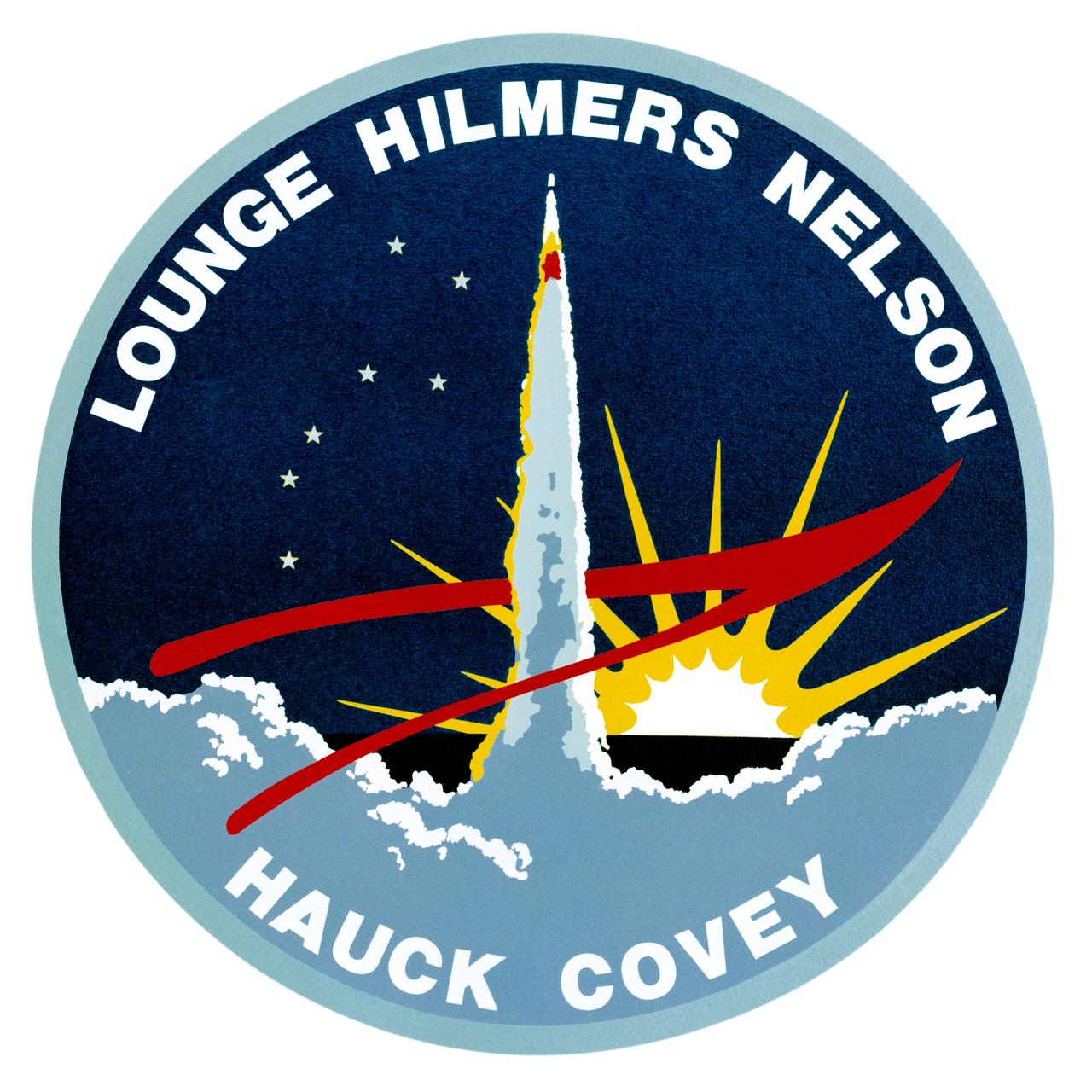
S87-39136 (4 Aug. 1987) --- This is the STS-26 crew patch. The predominant themes are: a new beginning (sunrise), a safe mission (stylized launch and plume), the building upon the traditional strengths of NASA (the red vector which symbolizes aeronautics on the original NASA insignia), and a remembrance of their seven colleagues who died aboard Challenger (the seven-starred Big Dipper). The patch was designed by artist Stephen R. Hustvedt of Annapolis, MD. STS-26 crew members are astronauts Frederick H. (Rick) Hauck, commander; Richard O. Covey, pilot; and George D. (Pinky) Nelson, John M. (Mike) Lounge and David C. Hilmers, mission specialists. The NASA insignia design for space shuttle flights is reserved for use by the astronauts and for other official use as the NASA Administrator may authorize. Public availability has been approved only in the forms of illustrations by the various news media. When and if there is any change in this policy, which is not anticipated, the change will be publicly announced. Photo credit: NASA
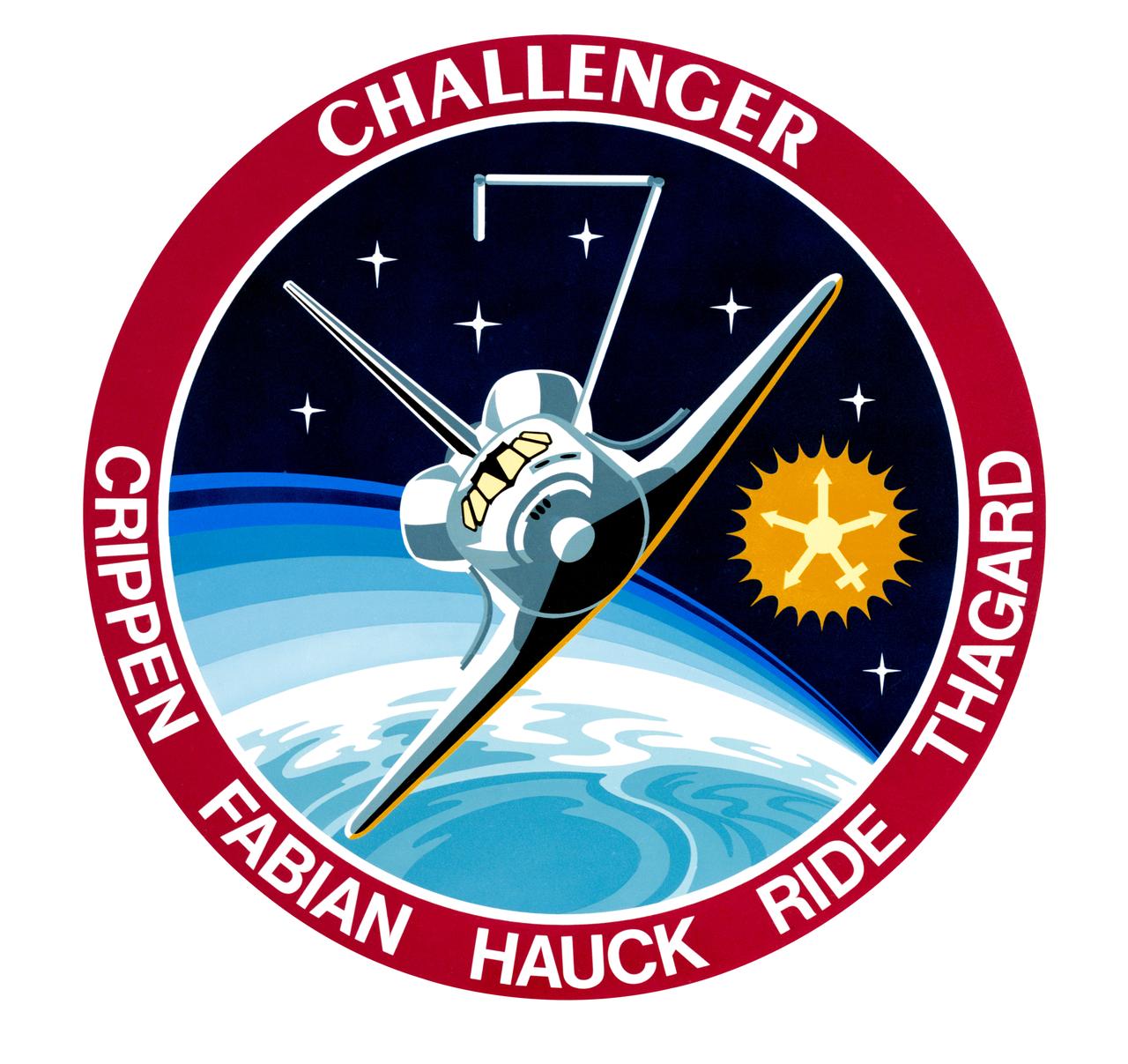
S83-28355 (March 1983) --- The space shuttle Challenger, making its second flight into space on STS-7, is featured in the art for the insignia for that NASA flight. The remote manipulator arm is positioned such that, the number 7 is formed. Likewise, seven stars are visible against the black sky. Within the sun?s center are representations for the five crew members, including, for the first time in NASA?s space program, a woman ? Dr. Sally K. Ride, mission specialist. The crew member?s surnames are listed along the outside edge of the sphere. They are astronauts Robert L. Crippen, commander; Frederick H. Hauck, pilot; John M. Fabian, Sally K. Ride and Norman E. Thagard, mission specialists. The flight is scheduled for the first week of June 1983. The NASA insignia design for space shuttle flights is reserved for use by the astronauts and for other official use as the NASA Administrator may authorize. Public availability has been approved only in the forms of illustrations by the various news media. When and if there is any change in this policy, which is not anticipated, the change will be publicly announced. Photo credit: NASA
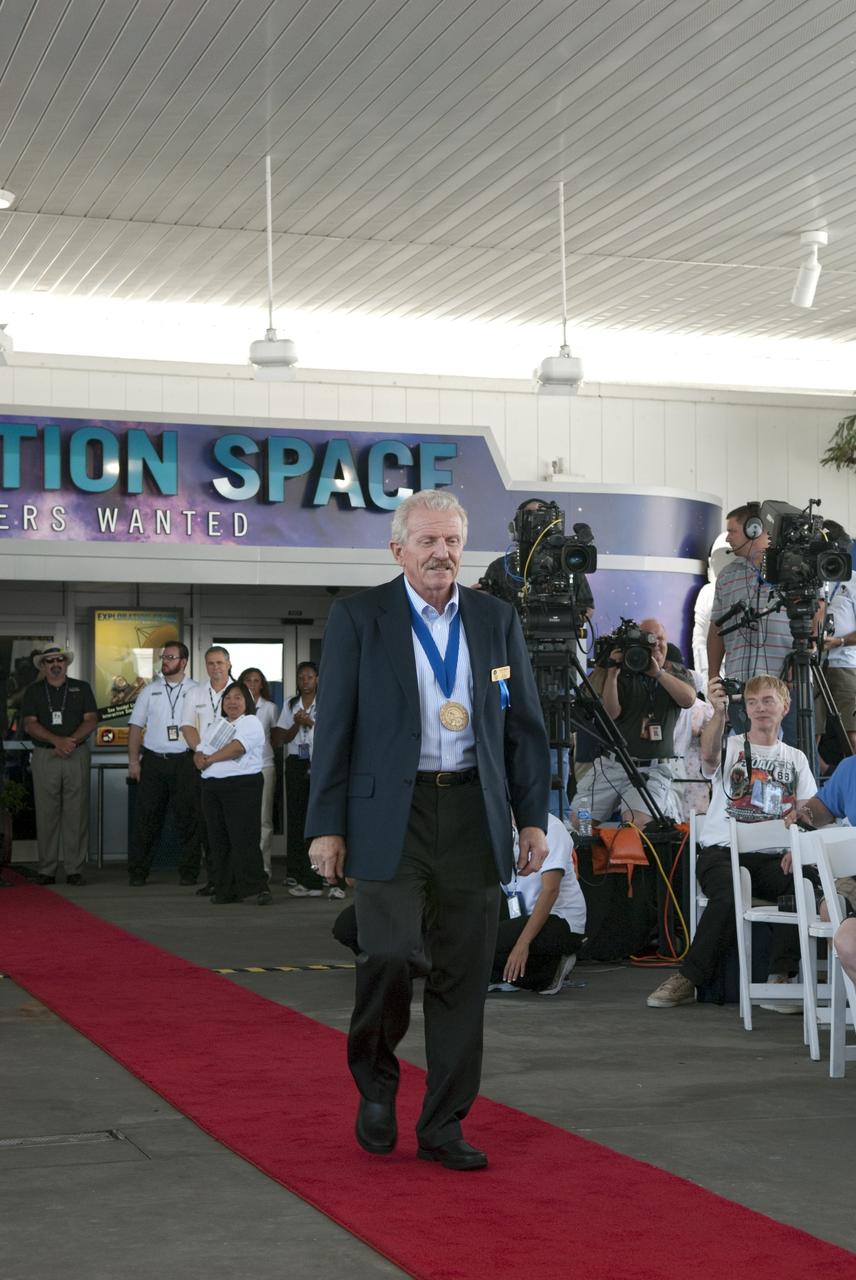
Cape Canaveral, Fla. -- Hall of Fame astronaut Rick Hauck is warmly greeted at the 2011 U.S. Astronaut Hall of Fame induction ceremony at NASA's Kennedy Space Center Visitor Complex in Florida. Hall of Fame astronauts and visitors gathered to honor 2011 inductees Karol "Bo" Bobko and Susan Helms. During his 19 years in the astronaut program, Bobko flew on three space shuttle missions and logged more than 386 hours in space. He served as pilot during the first voyage of space shuttle Challenger aboard STS-6 in April 1983 and as commander during the maiden flight of space shuttle Atlantis aboard STS-51J in October 1985. Helms, a five-time space shuttle astronaut, has logged 5,064 hours in space. During her stay onboard the International Space Station as a member of the Expedition-2 crew in 2001, Helms performed a world record 8 hour and 56 minute spacewalk. Bobko and Helms join the ranks of the U.S. Astronaut Hall of Fame bringing the number of space explorers enshrined in the Hall of Fame to 79. Photo Credit: NASA/Jim Grossmann
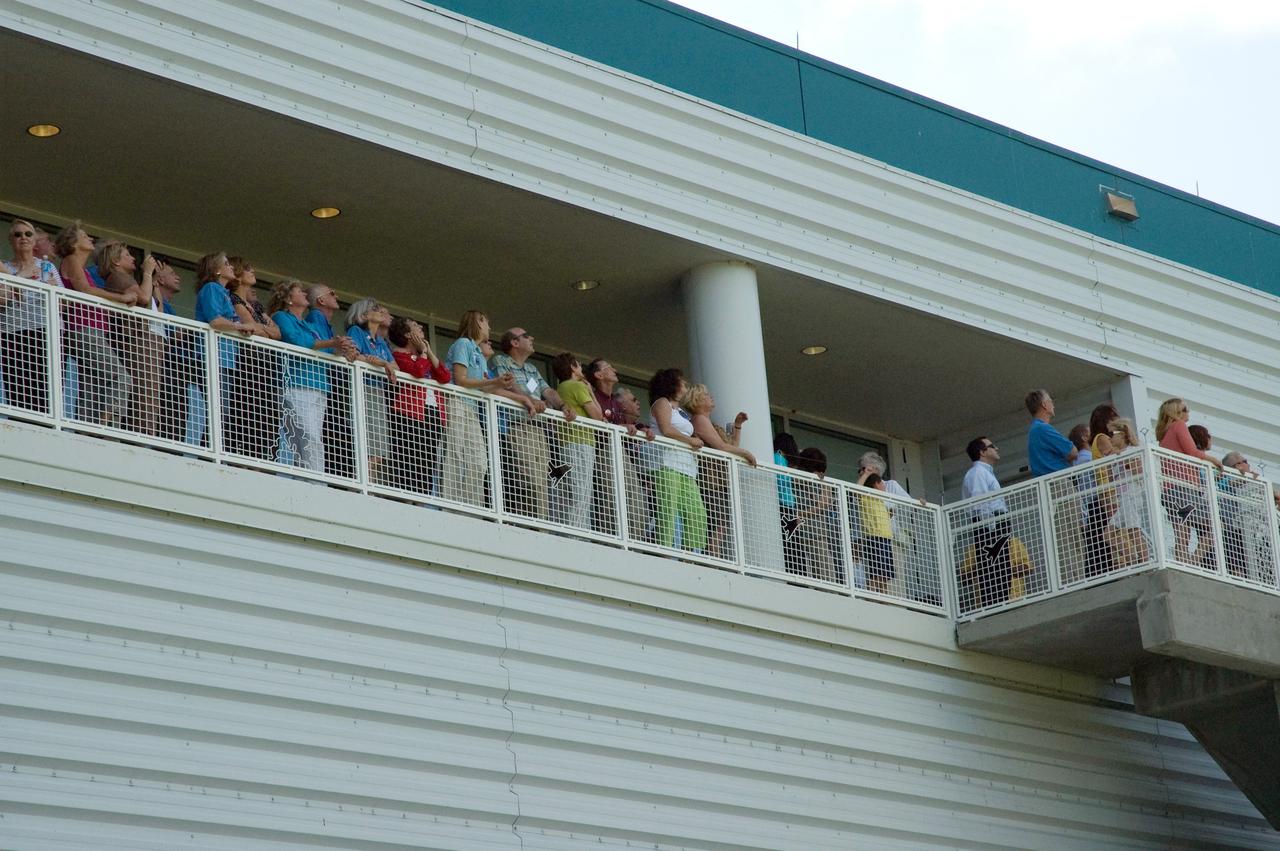
CAPE CANAVERAL, Fla. -- All eyes look skyward as space shuttle Discovery launches on its STS-124 mission. The group gathered here at the Banana River viewing site at NASA's Kennedy Space Center are members of the first graduating class of astronauts after the Apollo program. In 1978 a new group of 35 astronauts was selected after nine years without new astronauts. The pilots were Daniel Brandenstein, Michael Coats, Richard Covey, John Creighton, Robert Gibson, Frederick D. Gregory, Frederick Hauck, Jon McBride, Francis "Dick" Scobee, Brewster Shaw, Loren Shriver, David Walker and Donald Williams. The mission specialists were Guion Bluford, James Buchli, John Fabian, Anna Fisher, Dale Gardner, S. David Griggs, Terry Hart, Steven Hawley, Jeffrey Hoffman, Shannon Lucid, Ronald McNair, Richard Mullane, Steven Nagel, George Nelson, Ellison Onizuka, Judith Resnik, Sally Ride, Rhea Seddon, Robert Stewart, Kathryn D. Sullivan, Norman Thagard and James van Hoften. Since then, a new group has been selected roughly every two years. Photo credit: NASA/Jim Grossmann
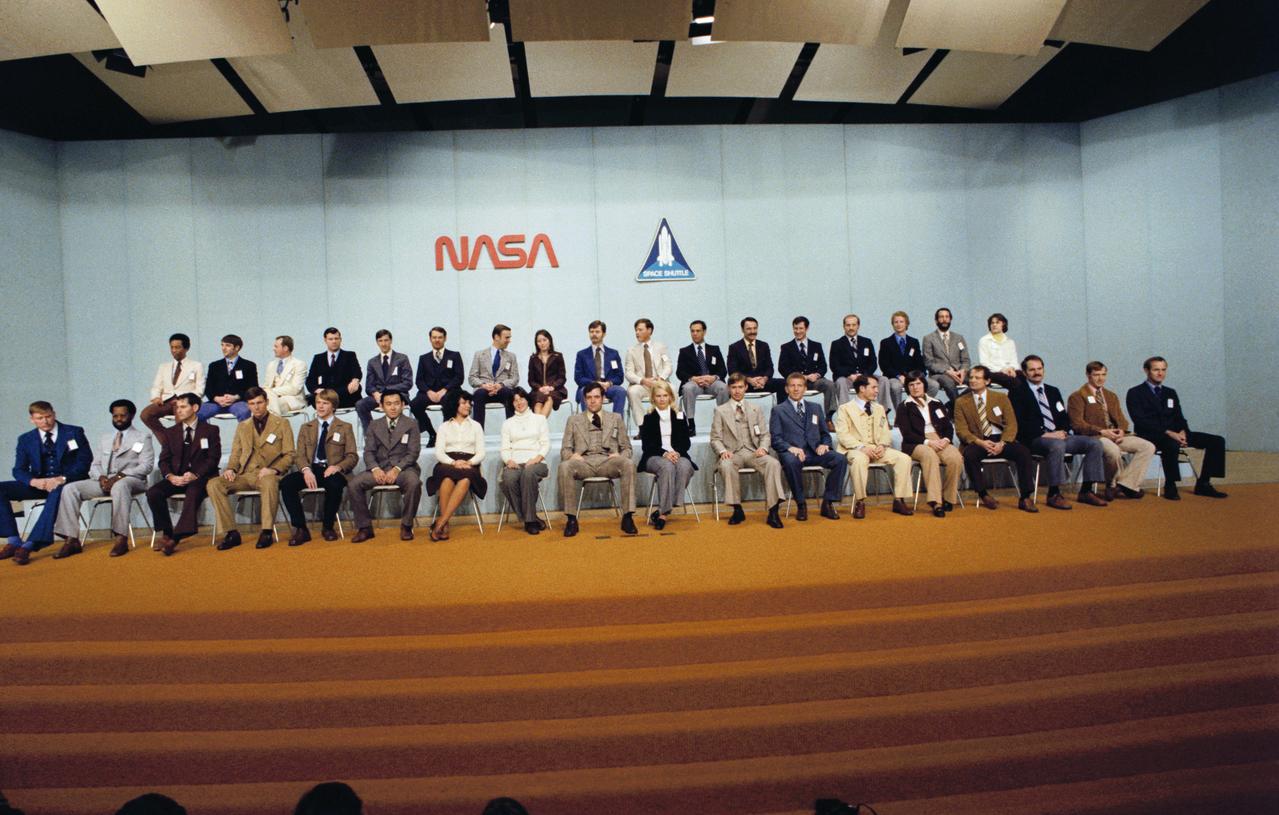
S78-26569 (31 Jan. 1978) --- The 35 new astronaut candidates, presented Jan. 31, 1978, in the Building 2 auditorium at NASA's Johnson Space Center, pose for photographers. They are arranged in alphabetical order with top left as beginning point and bottom right as stopping point. They are Guion S. Bluford, Daniel C. Brandenstein, James F. Buchli, Michael L. Coats, Richard O. Covey, John O. Creighton, John M. Fabian, Anna L. Fisher, Dale A. Gardner, Robert L. Gibson, Frederick D. Gregory, S. David Griggs, Terry J. Hart, Frederick H. (Rick) Hauck, Steven A. Hawley, Jeffrey A. Hoffman, Shannon W. Lucid, Jon A. McBride, Ronald E. McNair, Richard M. (Mike) Mullane, Steven R. Nagel, George D. Nelson, Ellison S. Onizuka, Judith A. Resnik, Sally K. Ride, Francis R. (Dick) Scobee, Rhea Seddon, Brewster H. Shaw Jr., Loren J. Shriver, Robert L. Stewart, Kathryn D. Sullivan, Norman E. Thagard, James D. van Hoften, David M. Walker and Donald E. Williams. Photo credit: NASA or National Aeronautics and Space Administration
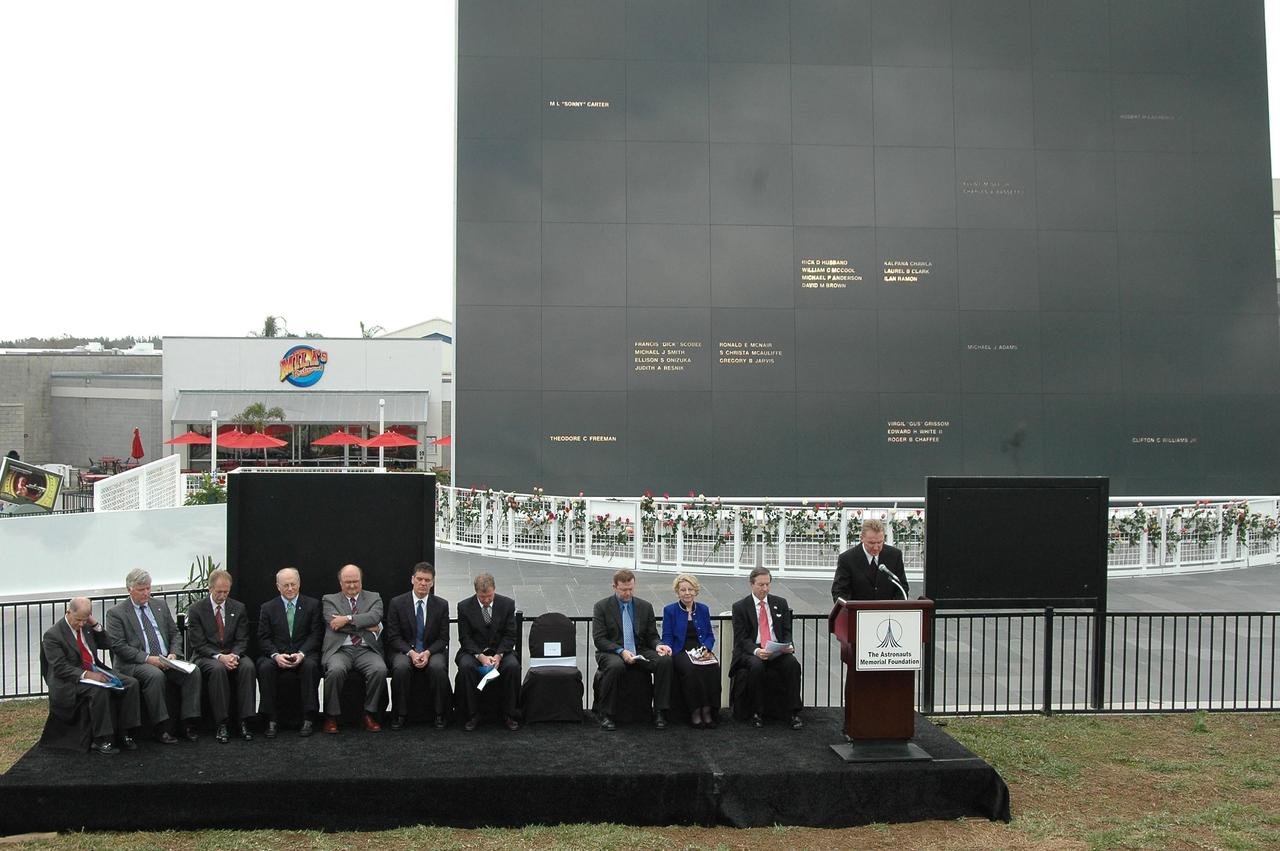
KENNEDY SPACE CENTER, FLA. — Dr. Mick Ukleja gives the invocation at the opening of the Challenger memorial ceremony held Jan. 28 in front of the Space Memorial Mirror at NASA Kennedy Space Center’s Visitor Complex. Others participating in the ceremony are Dr. Stephen Feldman, president of the Astronauts Memorial Foundation; Rep. Dave Weldon and Rep. Tom Feeney; William Potter, chairman of the Board of Directors of the Astronauts Memorial Foundation; William Gerstenmaier, associate administrator for Space Operations at NASA; Jim Kennedy (second from left), center director of KSC; June Scobee Rodgers, widow of Dick Scobee, commander of Challenger; Col. Richard Scobee, son of Dick Scobee and June Scobee Rodgers; Capt. Frederick Hauck, commander of the first mission after Challenger; Dr. Joseph Allen, astronaut and scientist and chairman of the Board of the Challenger Centers for Space Science. June Scobee Rodgers and Gerstenmaier placed a wreath at the base of the memorial. Photo credit: NASA/Kim Shiflett