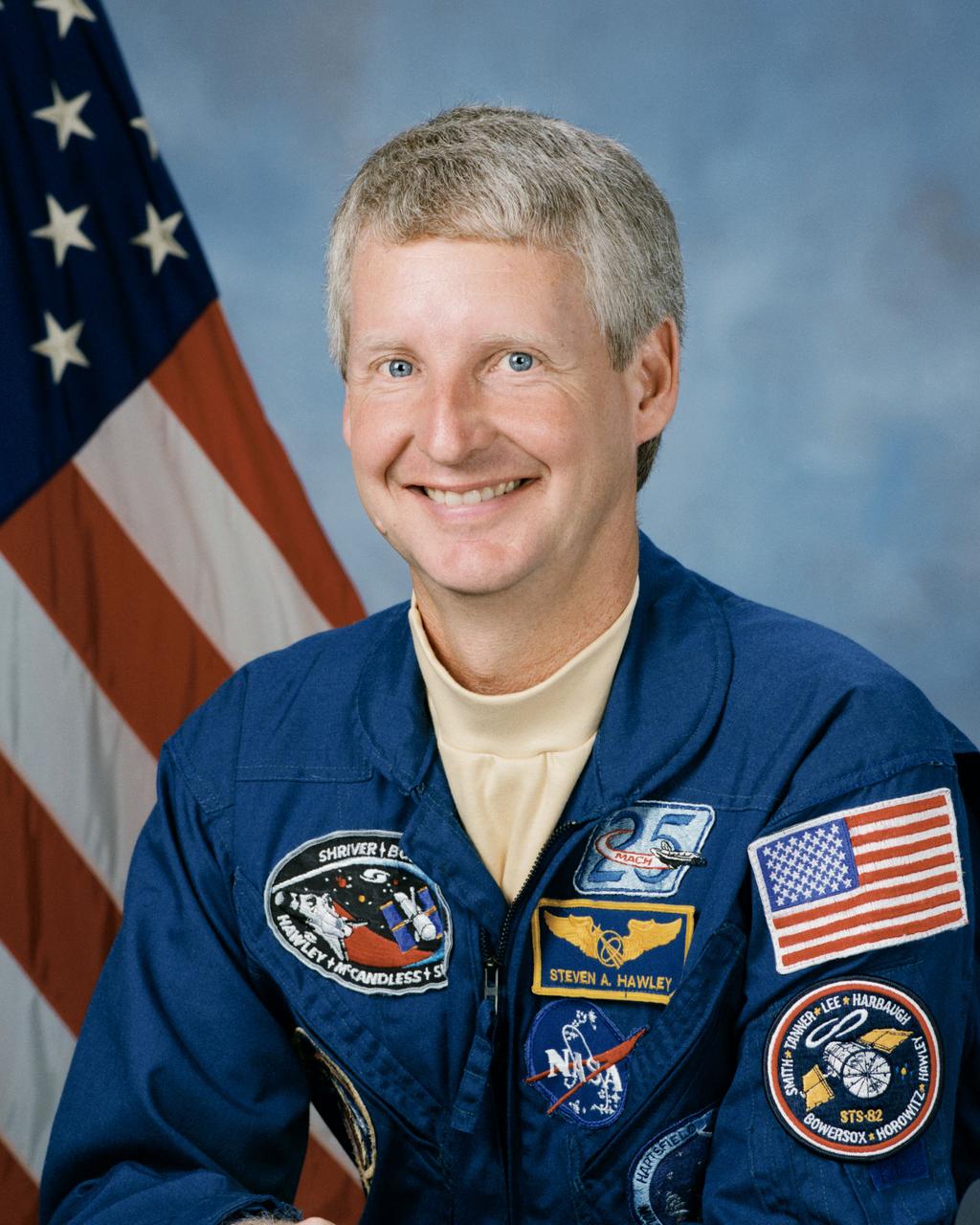
S96-14625 (6 Sept. 1996) --- Astronaut Steven A. Hawley, mission specialist.
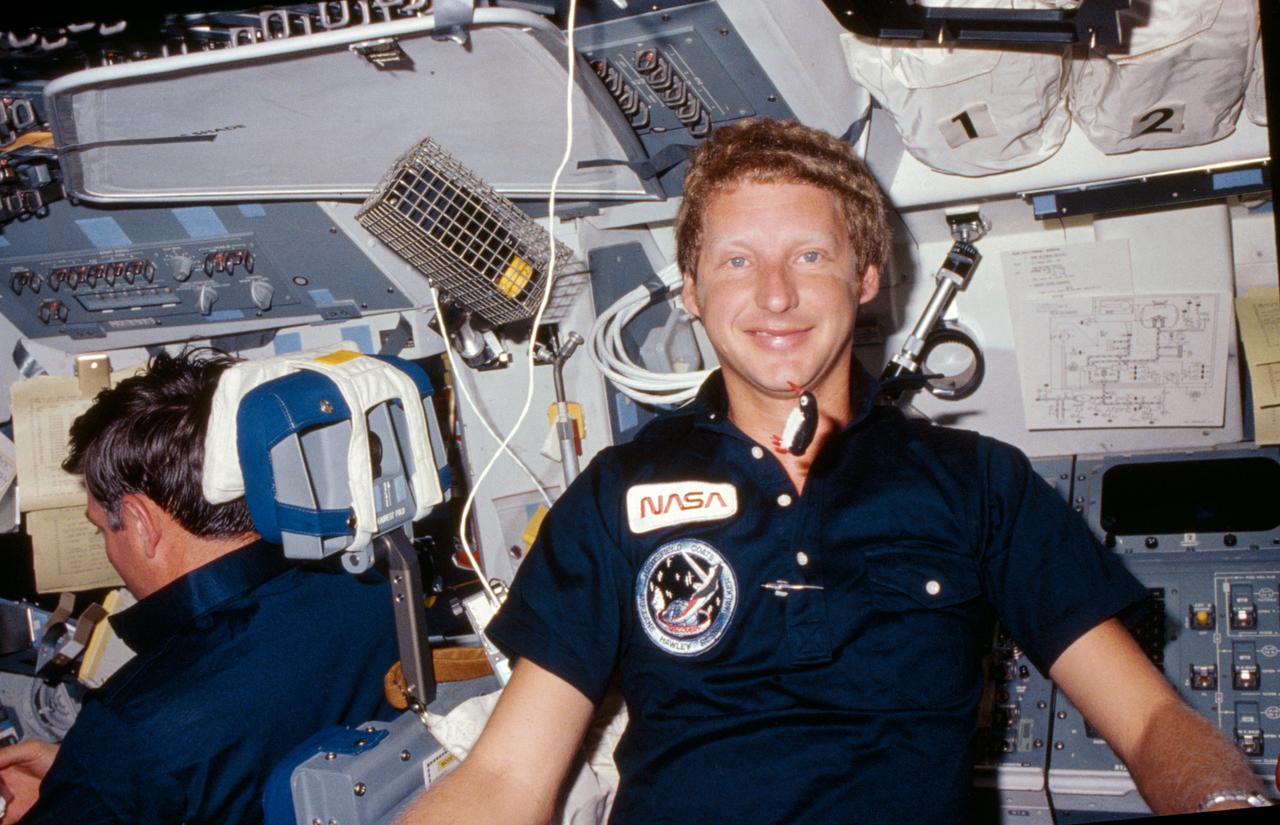
A tiny stuffed penguin floats in front of Mission specialist Steven Hawley as he sits at the mission specialists position behind the pilot on the flight deck.
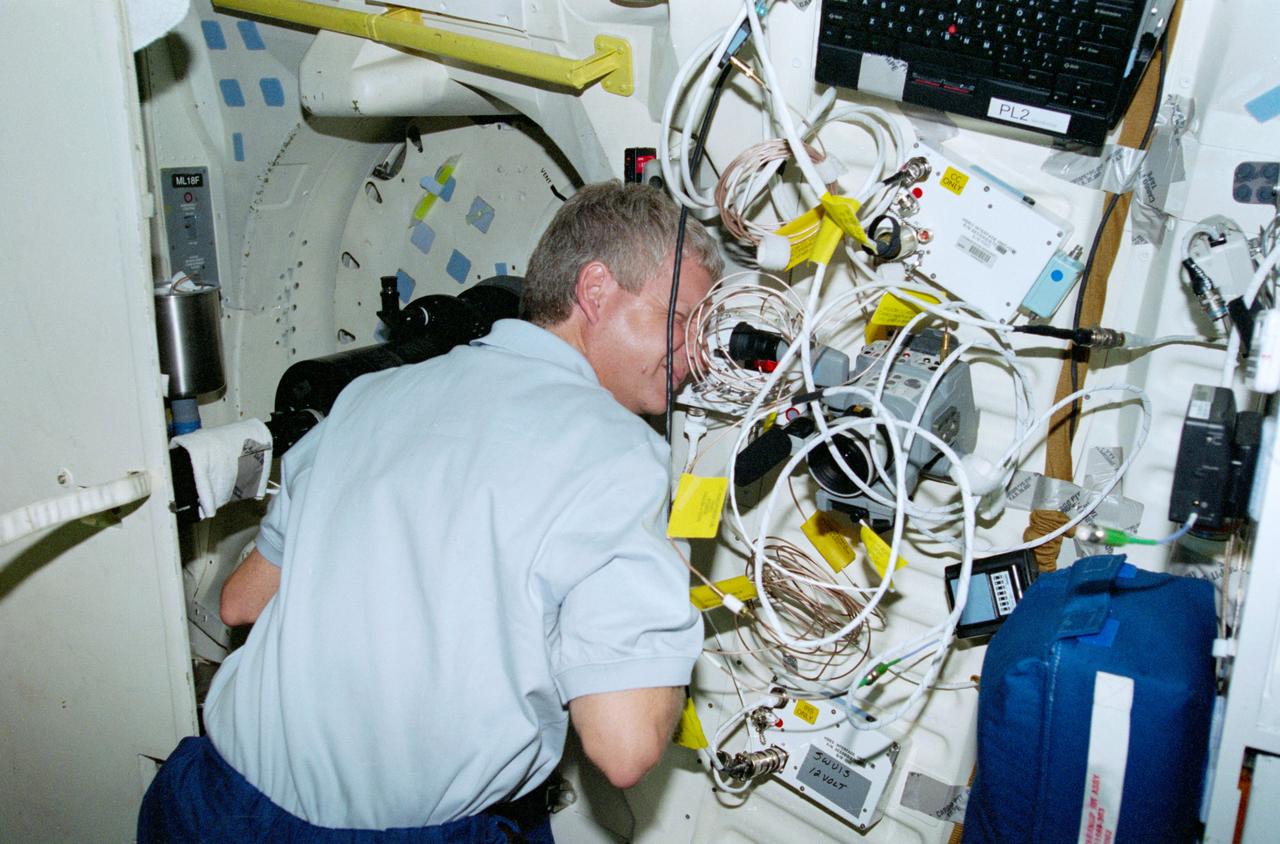
STS093-321-018 (22-27 July 1999) --- Astronaut Steven A. Hawley, mission specialist, works with the Southwest Ultraviolet Imaging System (SWUIS) experiment on the mid deck of the Space Shuttle Columbia.
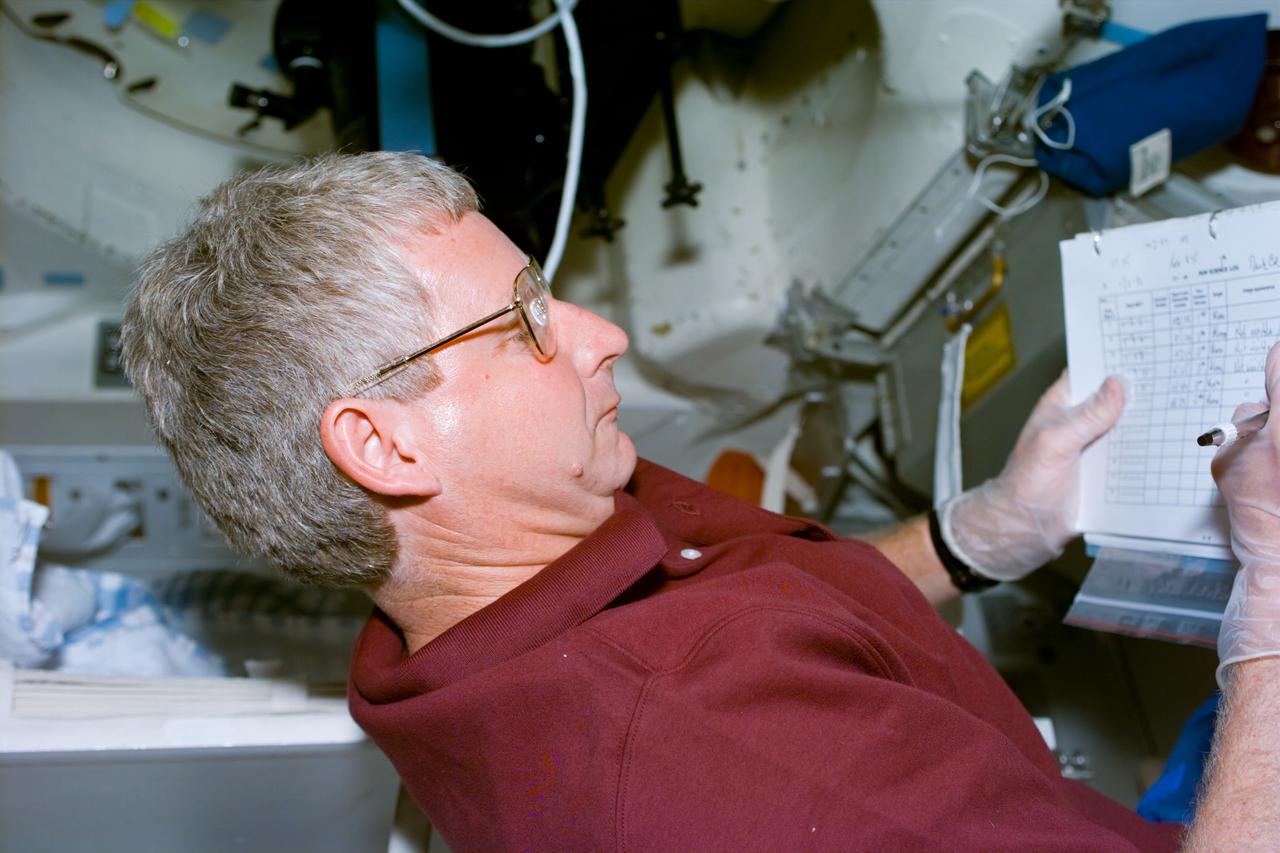
S93-E-5011 (23 July 1999) --- Astronaut Steven A. Hawley, mission specialist, looks over a checklist on Columbia's middeck during Flight Day 1 activity. The image was recorded with an electronic still camera (ESC).
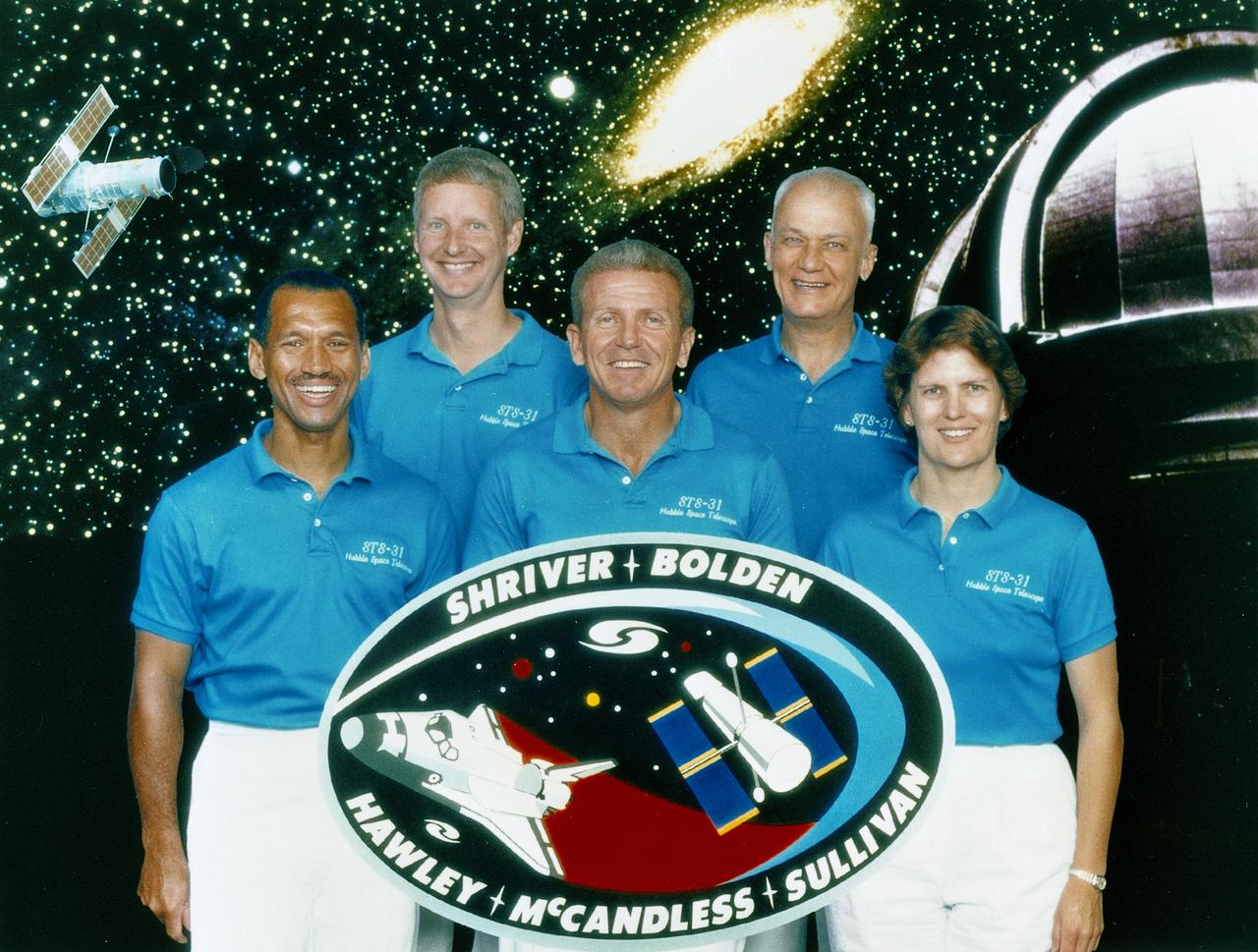
The STS-31 crew of five included (left to right) Charles F. Bolden, pilot; Steven A. Hawley, mission specialist; Loren J. Shriver, commander; Bruce McCandless, mission specialist; and Kathryn D. Sullivan, mission specialist. Launched aboard the Space Shuttle Discovery on April 24, 1990 at 8:33:51am (EDT), the primary payload was the Hubble Space Telescope. This was the first flight to use carbon brakes at landing.
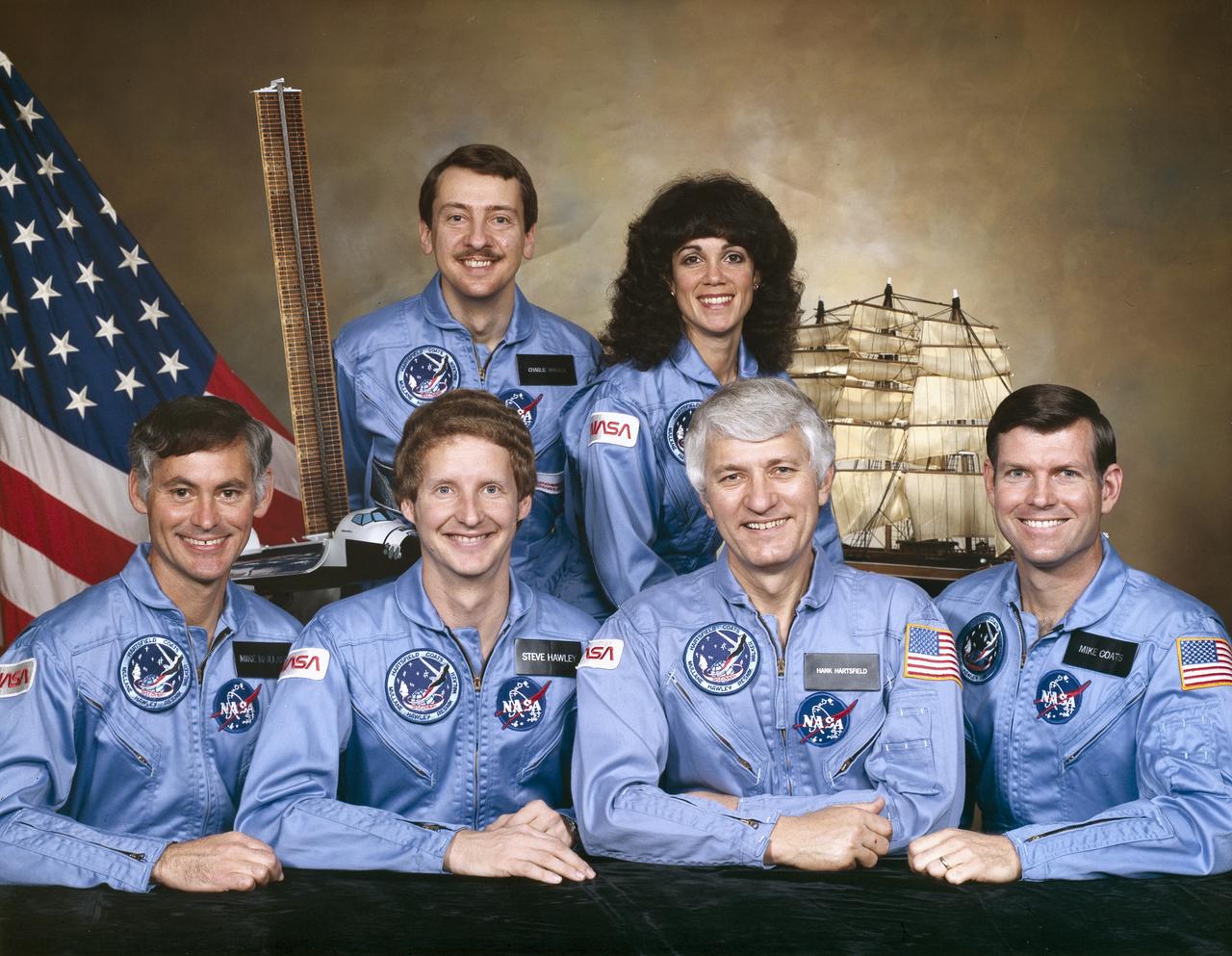
The crew assigned to the STS-41D mission included (seated left to right) Richard M. (Mike) Mullane, mission specialist; Steven A. Hawley, mission specialist; Henry W. Hartsfield, commander; and Michael L. (Mike) Coats, pilot. Standing in the rear are Charles D. Walker, payload specialist; and Judith A. (Judy) Resnik, mission specialist. Launched aboard the Space Shuttle Discovery August 30, 1984 at 8:41:50 am (EDT), the STS-41D mission deployed three satellites: the Satellite Business System SBS-D; the SYCOM IV-2 (also known as LEASAT-2); and the TELSTAR.
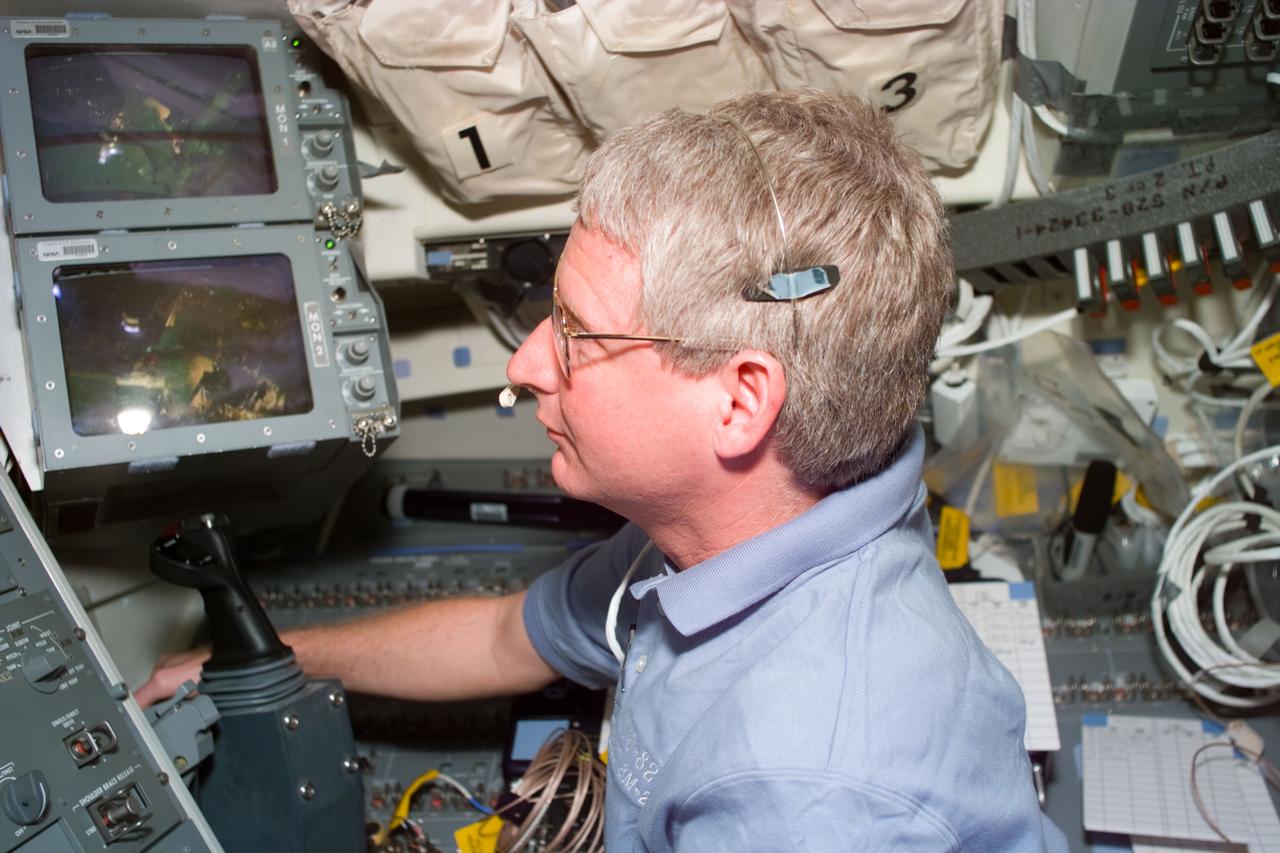
S82-E-5568 (16 Feb. 1997) --- Astronaut Steven A. Hawley, at controls for Remote Manipulator System (RMS), during third Extravehicular Activity (EVA). Hawley had been a mission specialist for the NASA mission which deployed the giant HST in 1990. This view was taken with an Electronic Still Camera (ESC).
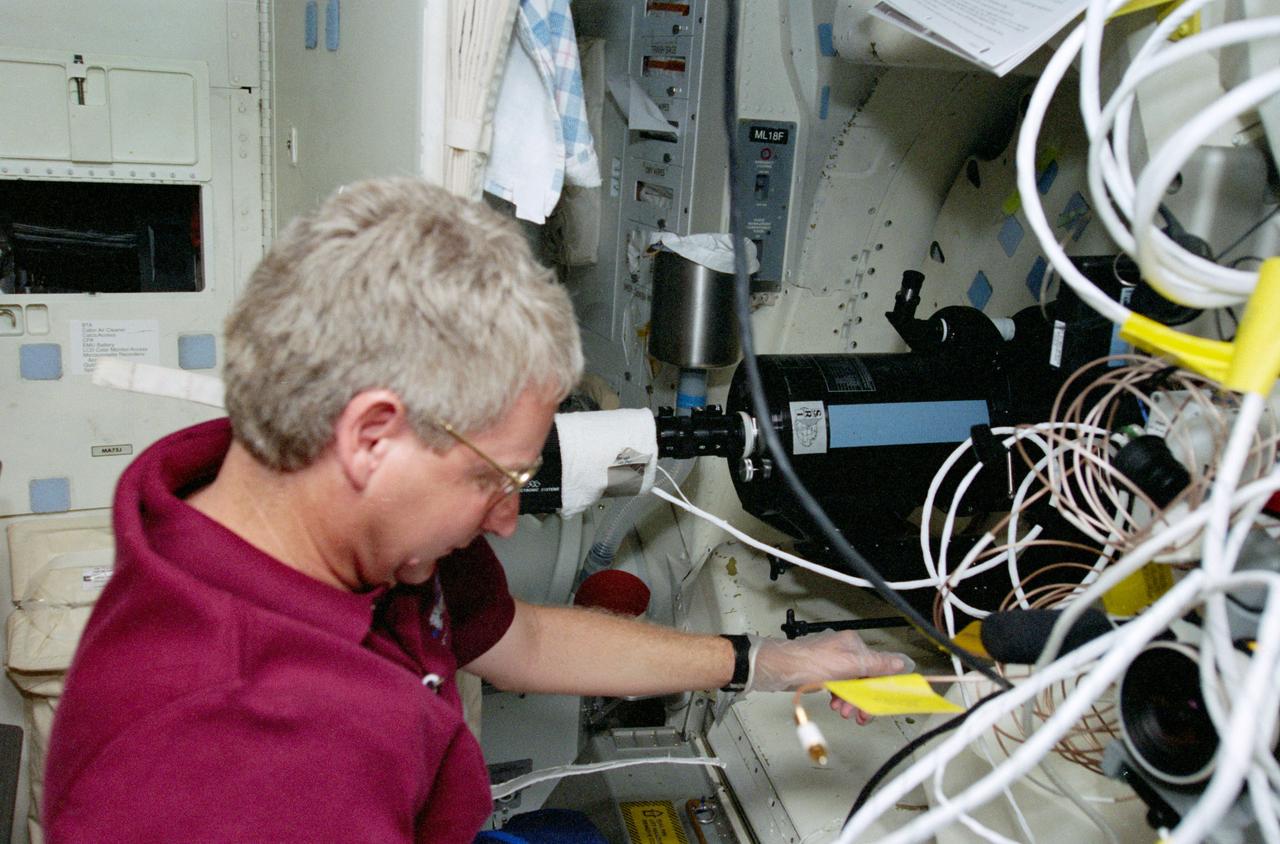
STS093-350-022 (22-27 July 1999) --- Astronaut Steven A. Hawley, mission specialist, works with the Southwest Ultraviolet Imaging System (SWUIS) experiment onboard the Earth-orbiting Space Shuttle Columbia. The SWUIS is based around a Maksutov-design Ultraviolet (UV) telescope and a UV-sensitive, image-intensified Charge-Coupled Device (CCD) camera that frames at video frame rates.
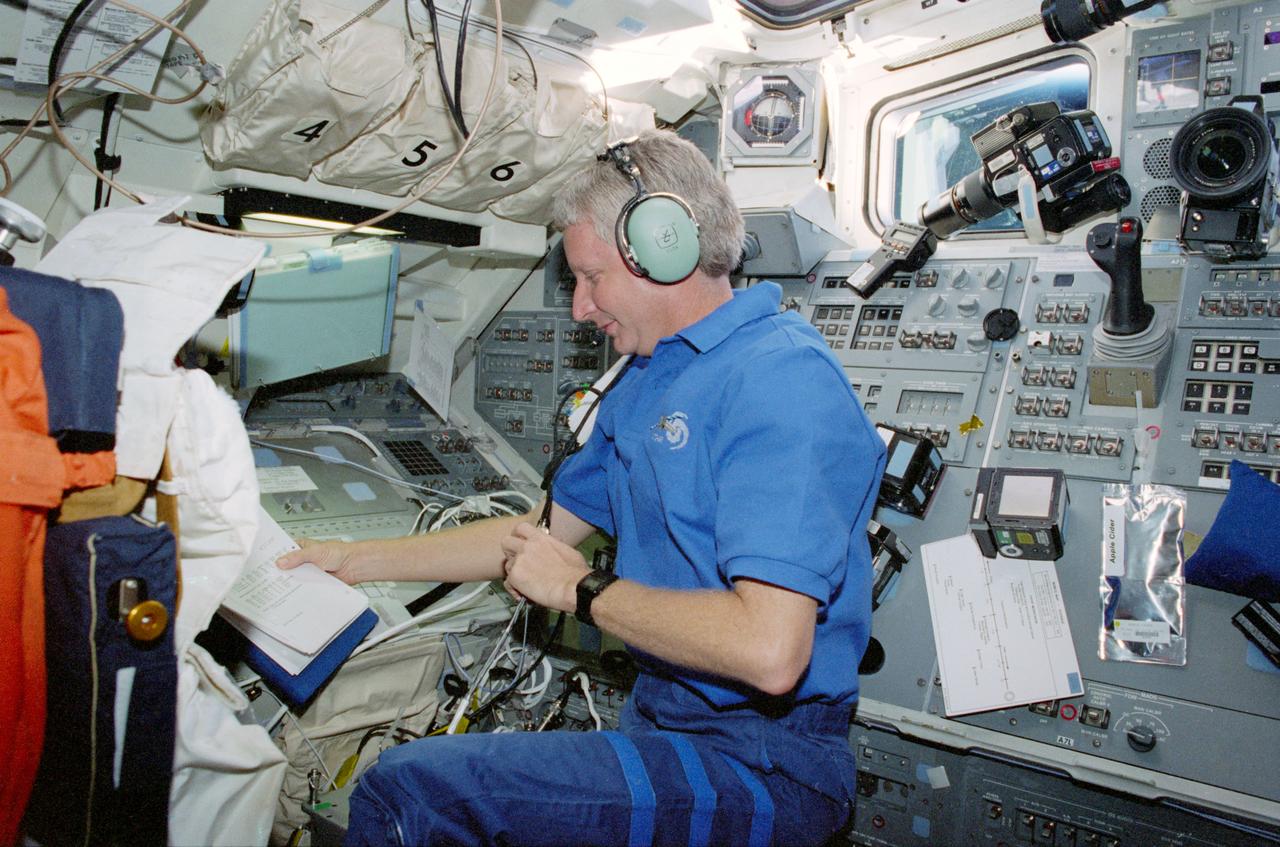
STS093-348-006 (22-27 July 1999) --- Astronaut Steven A. Hawley, mission specialist, communicates with students using the Shuttle Amateur Radio Experiment-2 (SAREX II) equipment on the flight deck of the Earth-orbiting Space Shuttle Columbia.
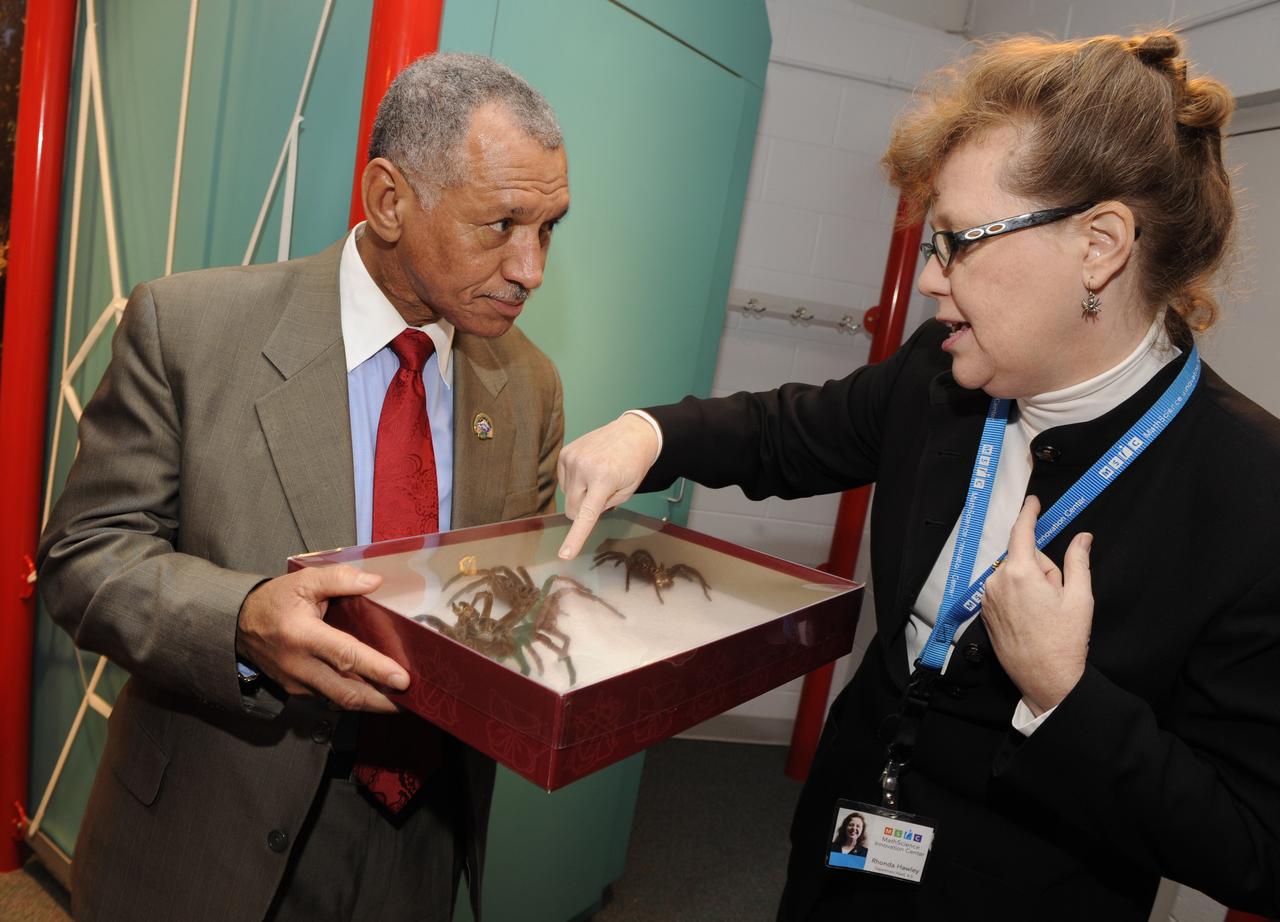
NASA Administrator Charles Bolden, left, holds a box of spiders as MathScience Innovation Center Instructor Rhonda Hawley describes them during a visit to the "Spider Room" at the center, Friday, Jan. 28. 2011, at the center in Richmond, Va. Earlier, Bolden spoke to students from Albert Hill Middle School, where he highlighted the importance of science, technology, engineering and math, or STEM, as he shared his life experiences with the students. (Photo Credit:NASA/Paul E. Alers)
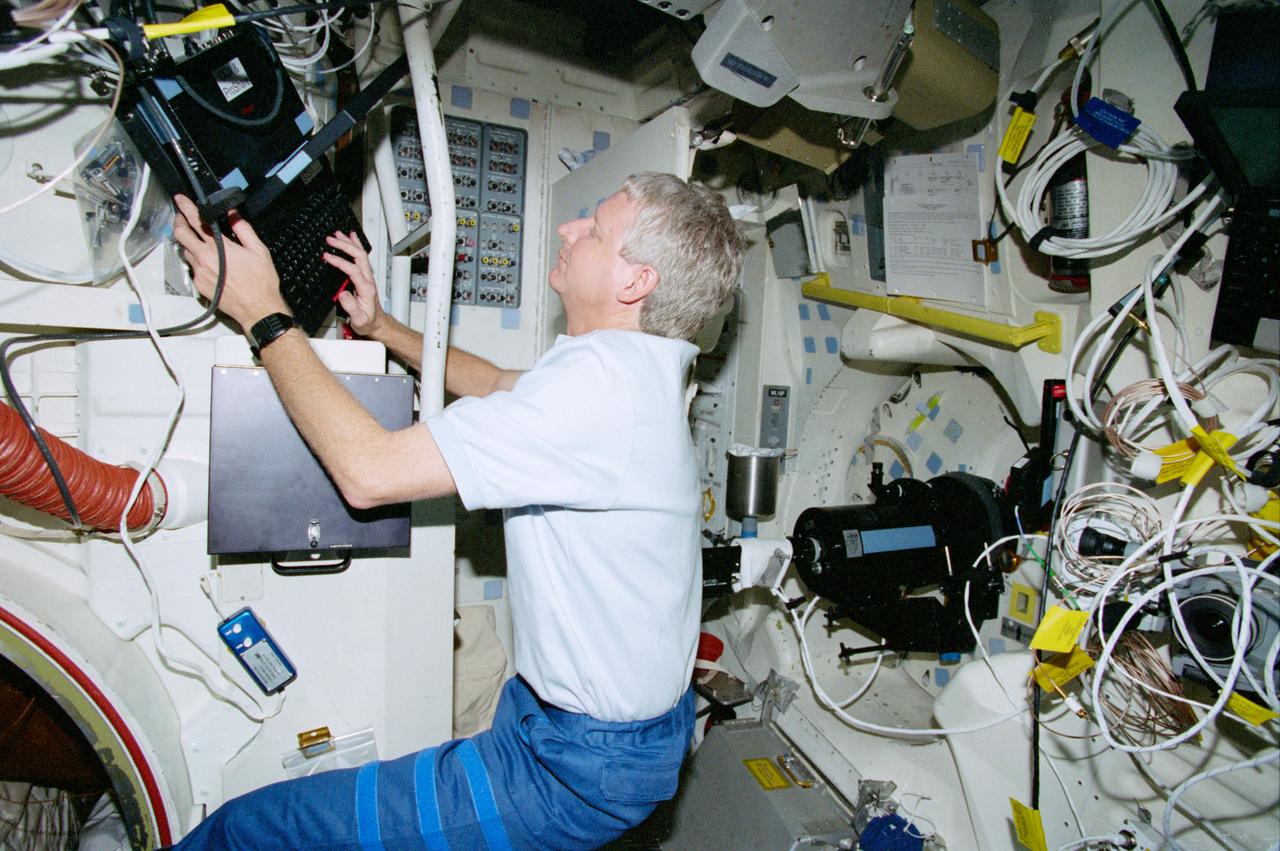
STS093-327-004 (23-27 July 1999) --- Astronaut Steven A. Hawley works with data associated with the Orbital Communications Adapter (OCA) on the middeck of the Space Shuttle Columbia. Not far away from him is the window-mounted instrument which supports the Southwest Ultraviolet Imaging System (SWUIS). SWUIS is an innovative telescope/charge-coupled device camera system designed to image planets and other solar system bodies.
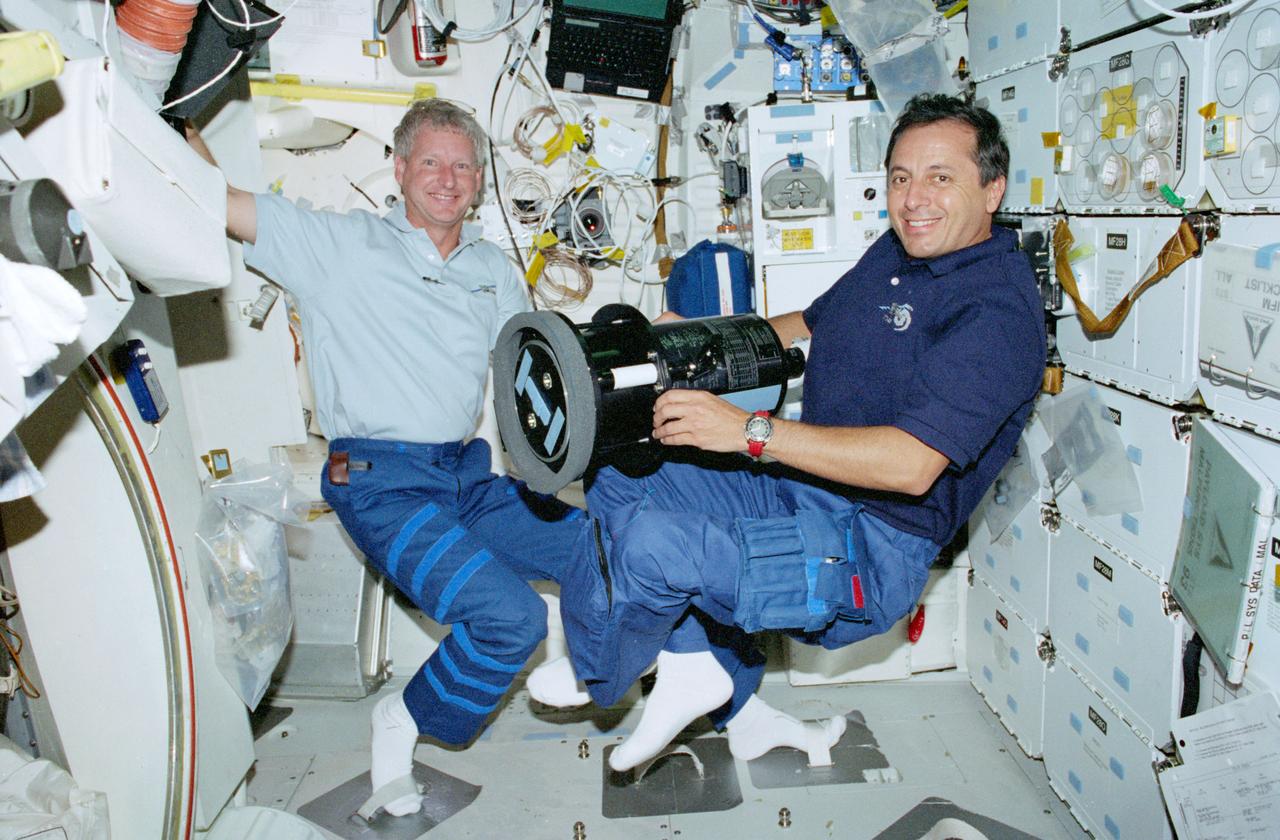
STS093-347-027 (23-27 July 1999) --- Astronauts Steven A. Hawley (left) and Michel Tognini, mission specialists, are pictured with the Southwest Ultraviolet Imaging System (SWUIS) on the middeck of the Space Shuttle Columbia. SWUIS was used during the mission to image planets and other solar system bodies in order to explore their atmospheres and surfaces in ultraviolet (UV) region of the spectrum, which astronomers value for diagnostic work. Tognini represents the Centre National d'Etudes Spatiales (CNES) of France.
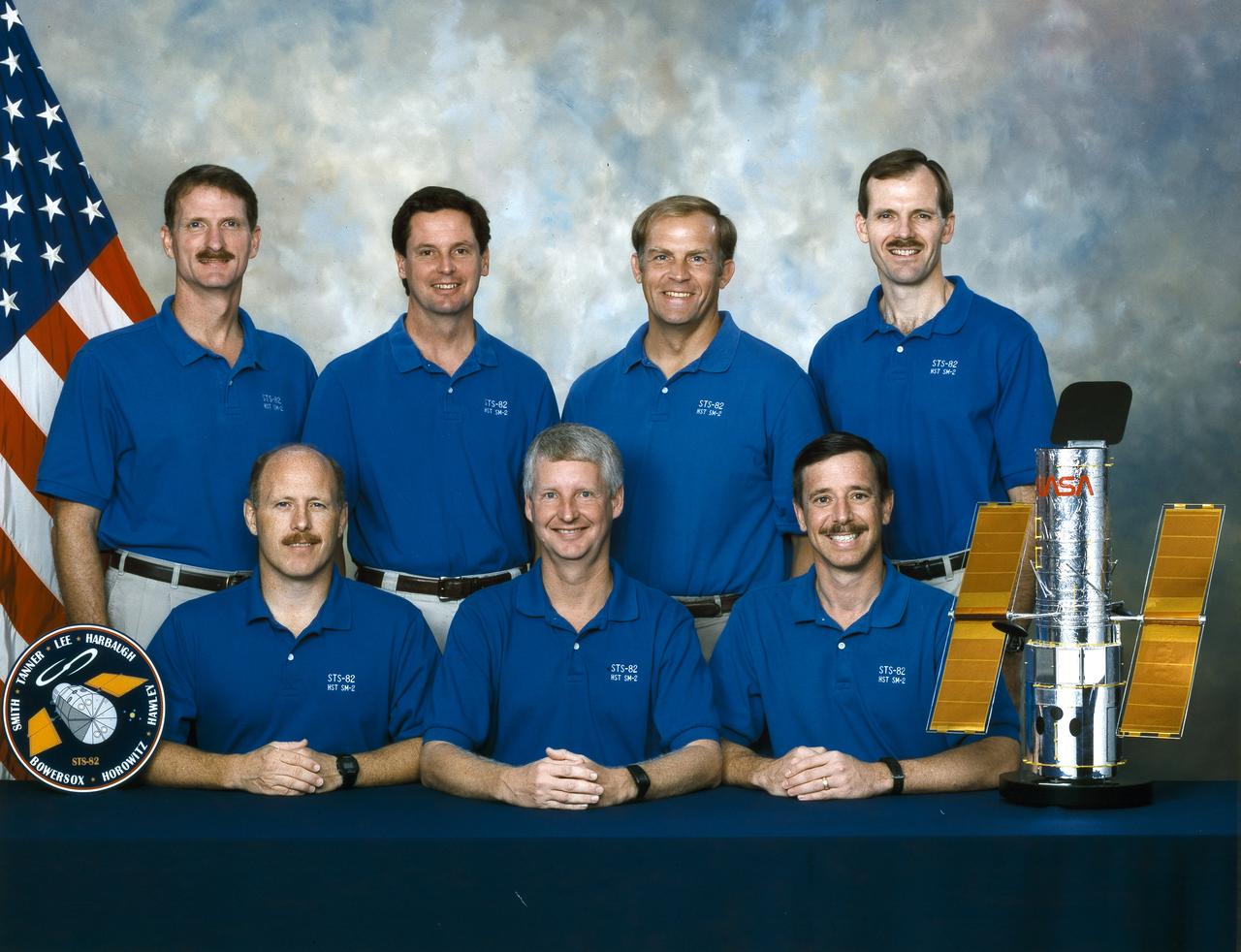
The crew assigned to the STS-82 mission included (seated front left to right) Kenneth D. Bowersox, commander; Steven A. Hawley, mission specialist; and Scott J. Horowitz, pilot. On the back row (left to right) are Joseph R. Tanner, mission specialist; Gregory J. Harbaugh, mission specialist; Mark C. Lee, payload commander; and Steven L. Smith, mission specialist. Launched aboard the Space Shuttle Discovery on February 11, 1997 at 3:55:17 am (EST), the STS-82 mission served as the second Hubble Space telescope servicing mission.
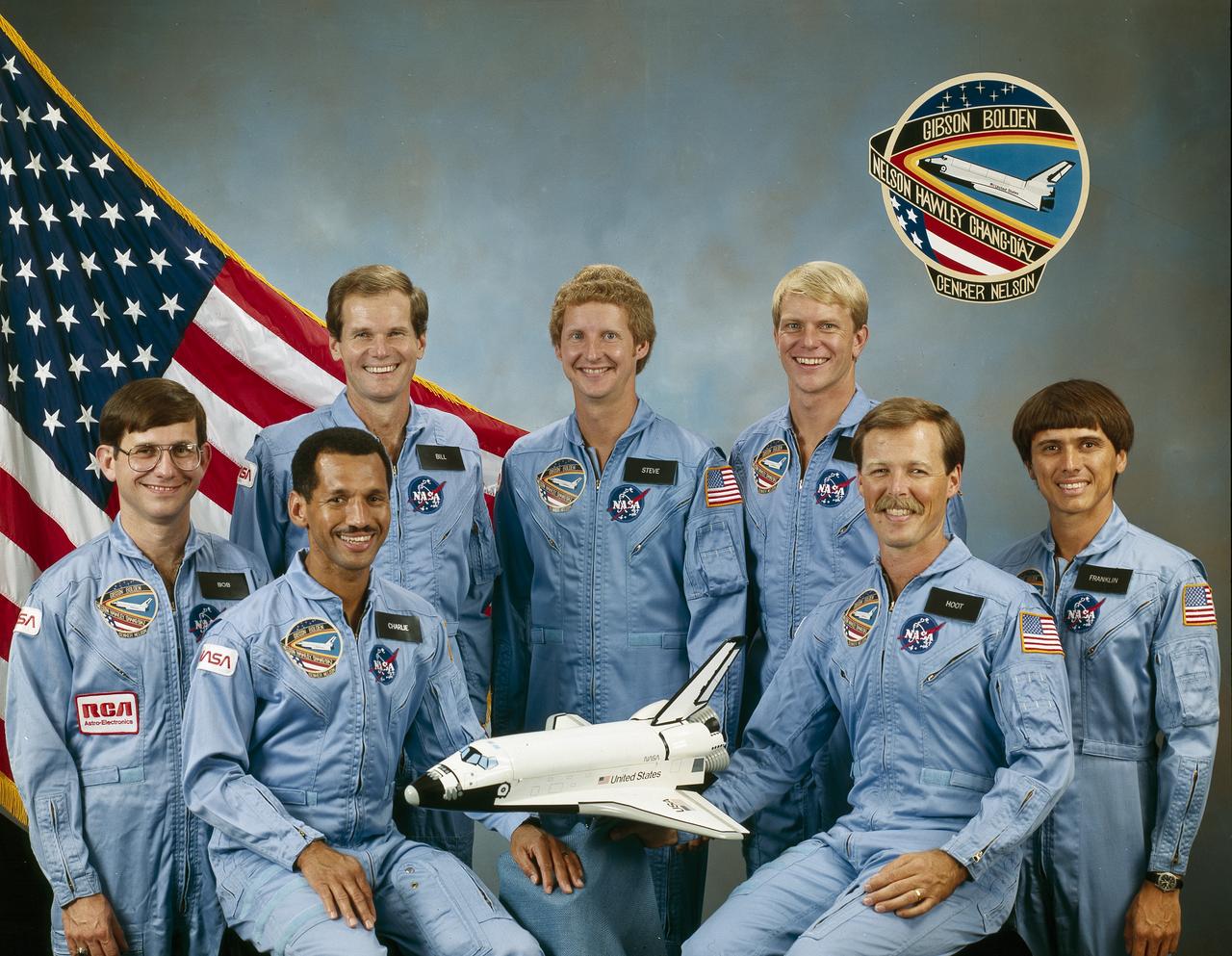
The crew assigned to the STS-61C mission included (seated left to right) Charles F. Bolden, Jr., pilot; and Robert L. (Hoot) Gibson, commander. On the back row, left to right, are payload specialists Robert J. Cenker, and Congressman Bill Nelson. To the right of Nelson are mission specialists Steven A. Hawley, George D. Nelson, and Franklin R. Chang-Diaz. Launched aboard the Space Shuttle Columbia on January 12, 1986 at 6:55:00 am (EST), the STS-61C mission’s primary payload was the communications satellite SATCOM KU-1 (RCA Americom).
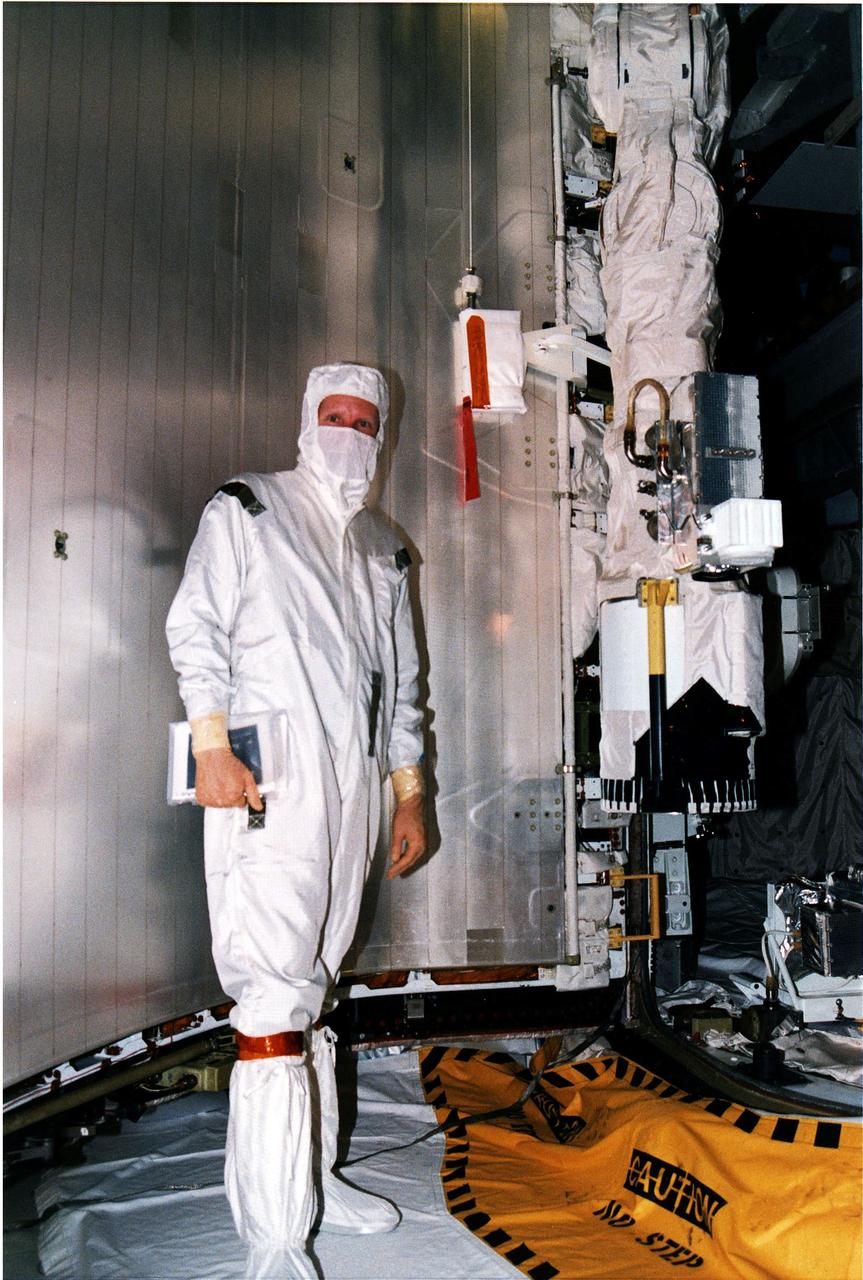
KENNEDY SPACE CENTER, FLA. - STS-82 Mission Specialist Steven A Hawley stands beside part of Discovery's Remote Manipulator System (RMS) arm, at right, which he will operate for the capture, berthing and redeployment of the Hubble Space Telescope (HST). The robotic arm also will be used as work platform for the four spacewalkers. Hawley is the prime RMS operator on the flight, which will be the second HST servicing mission. He and the other six members of the crew are making a final inspection of the payload at Launch Pad 39A before launch. STS-82 is scheduled for liftoff on Feb. 11 during a 65-minute launch window that opens at 3:56 a.m. EST.
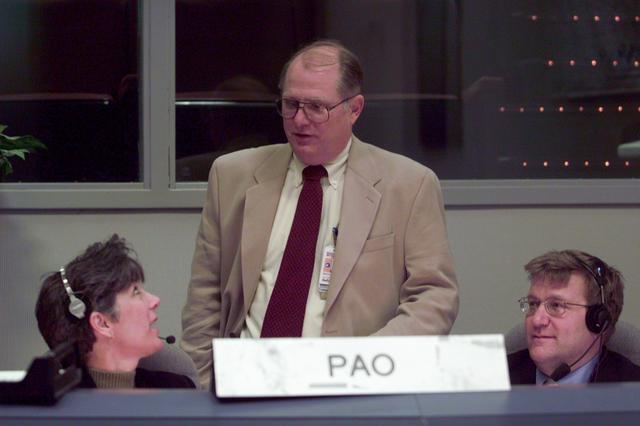
JSC2001-E-06205 (8 March 2001) --- Eileen Hawley at the Public Affairs Officer (PAO) console poses a query to Brock R. (Randy) Stone (center) of the Mission Operations Directorate (MOD) prior to the launch of STS-102. Hawley was the launch commentator for the Discovery mission. Daniel Carpenter, director of the Public Affairs Office, is at right.
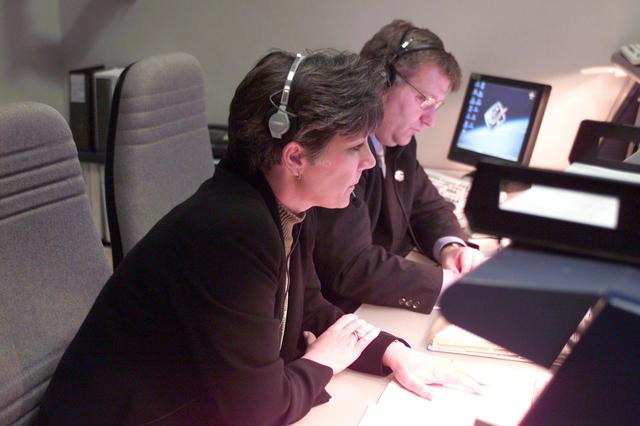
JSC2001-E-06218 (8 March 2001) --- Eileen Hawley and Daniel K. Carpenter look over launch data at the Public Affairs Officer (PAO) console in Houston's Mission Control Center (MCC). Hawley is the ascent commentator for PAO and Carpenter is JSC Director of Public Affairs.
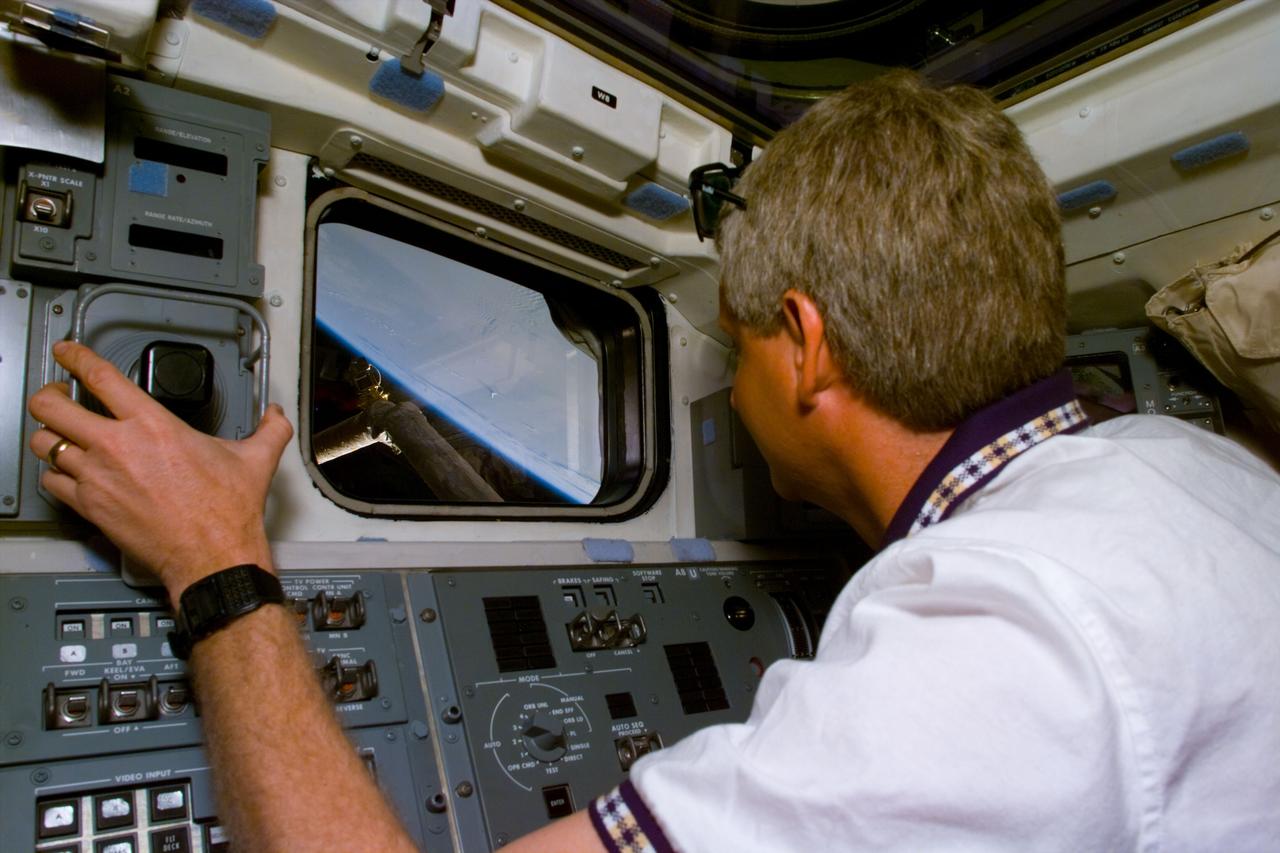
S82-E-5016 (12 Feb. 1997) --- Astronaut Steven A. Hawley, STS-82 mission specialist, controls Discovery's Remote Manipulation System (RMS), from the aft flight deck. Hawley and his crew mates are preparing for a scheduled Extravehicular Activity (EVA) with the Hubble Space Telescope (HST), which will be pulled into the Space Shuttle Discovery's cargo bay with the aid of the Remote Manipulator System (RMS). A series of EVA's will be required to properly service the giant telescope. Hawley served as a mission specialist on NASA's 1990 mission which was responsible for placing HST in Earth-orbit. This view was taken with an Electronic Still Camera (ESC).
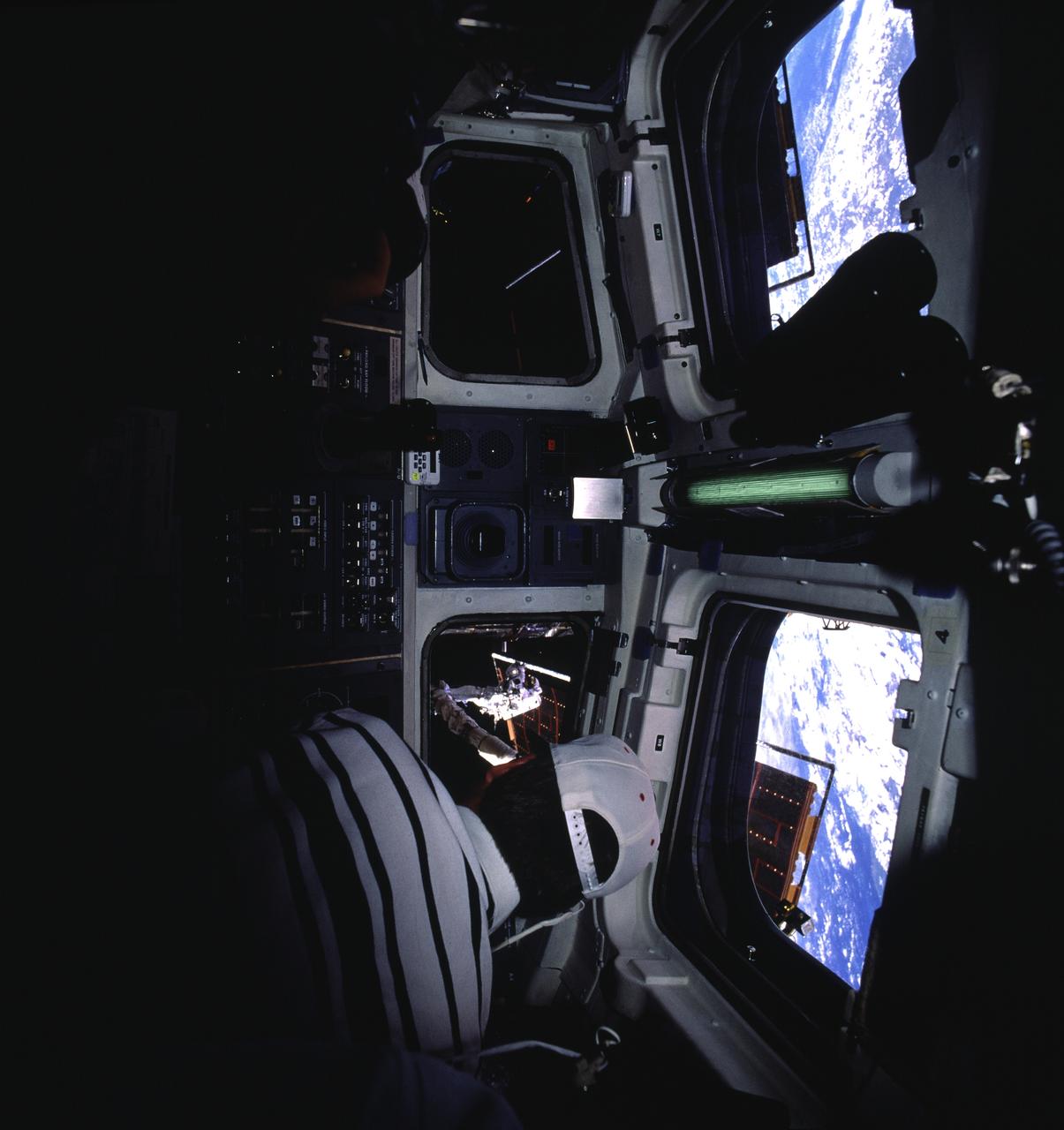
STS082-711-094 (11-21 Feb. 1997) --- From inside the crew cabin, astronaut Steven A. Hawley watches the Extravehicular Activity (EVA) of astronaut Mark C. Lee, payload commander, visible in the background through one of the Space Shuttle Discovery's aft flight deck windows. Actually, Hawley is doing more than watching the EVA to perform servicing work on the Hubble Space Telescope (HST). For most of the five days of EVA, Hawley, a veteran of the April 1990 flight which deployed the giant orbiting observatory, controlled the Remote Manipulator System (RMS), on which Lee is standing in this scene.
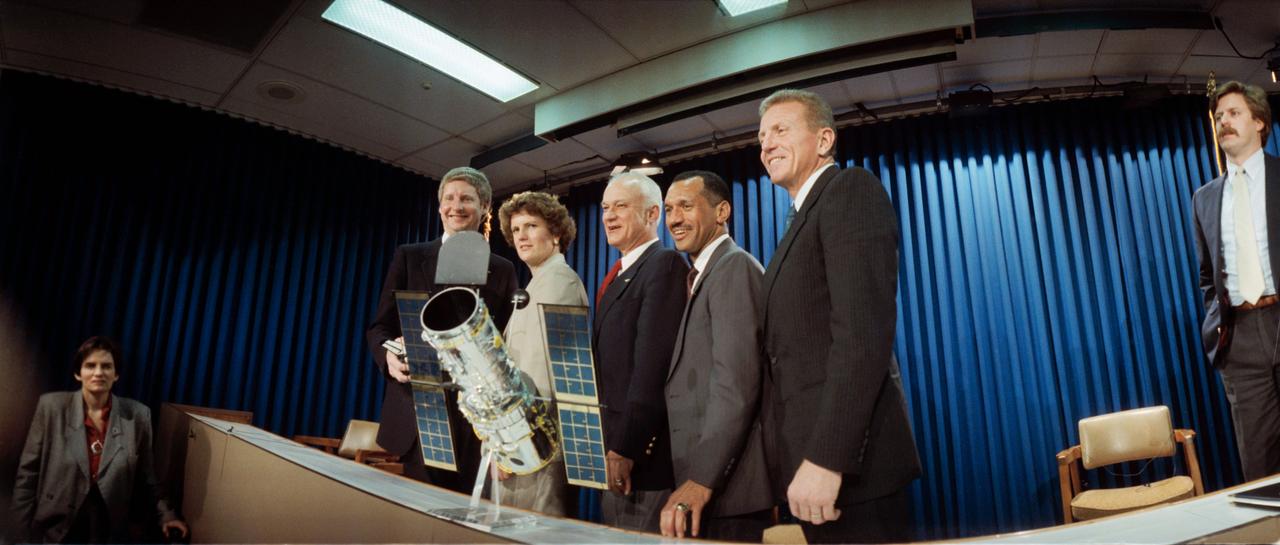
PHOTOS OF STS-31 (DISCOVERY) CREW WITH MODELS OF THE HUBBLE SPACE TELESCOPE (HST) AND SPACE SHUTTLE AT T-30 (THIRTY DAYS BEFORE LAUNCH) BRIEFING 03/22/90 IN THE AUDITORIUM AND PUBLIC AFFAIRS FACILITY BLDG 2. GROUP PHOTOS OF LOREN J. SHRIVER, CHARLES F. BOLDEN, STEVEN A. HAWLEY, BRUCE MCCANDLESS, AND KATHRYN D. SULLIVAN (32748, 32750, 32758-60 (WIDE ANGLE)) AND INDIVIDUAL PHOTOS OF HAWLEY (32747), MCCANDLESS (32751), SULLIVAN (32753-4), BOLDEN (32755), AND SHRIVER (32757) INCLUDED. ALSO PHOTGRAPHED TOGETHER ARE SULLIVAN, HAWLEY, MCCANDLESS (32749) AND BOLDEN, SHRIVER (32752, 32756).

STS-82 Mission Specialist Steven A. Hawley makes some final adjustments to his launch and entry suit with assistance from a suit technician in the Operations and Checkout Building. This is Hawley’s fourth space flight. He and the six other crew members will depart shortly for Launch Pad 39A, where the Space Shuttle Discovery awaits liftoff on a 10-day mission to service the orbiting Hubble Space Telescope (HST). This will be the second HST servicing mission. Four back-toback spacewalks are planned

STS082-353-035 (11-21 Feb. 1997) --- Astronaut Steven A. Hawley, who spent many hours aboard Discovery controlling the shuttle's Remote Manipulator System (RMS), watches the Extravehicular Activity (EVA) of a two-man space walking team from Discovery's aft flight deck. Hawley had flown on the 1990 mission that was responsible for deploying the orbiting observatory.
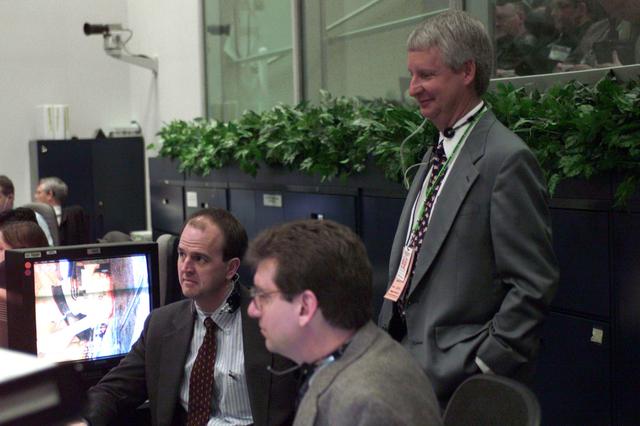
JSC2001-E-06209 (8 March 2001) --- At the Mission Operations Directorate (MOD) console in Houston's Mission Control Center (MCC), (from the left) Robbie D. Gest, Jeffrey W. Bantle and Steven A. Hawley monitor pre-launch activity for STS-102. Gest is Project Leader for Mission Operations for the United Space Alliance (USA); Bantle is with the Flight Director Office in MOD; and Hawley is with the Flight Crew Operations Directorate.
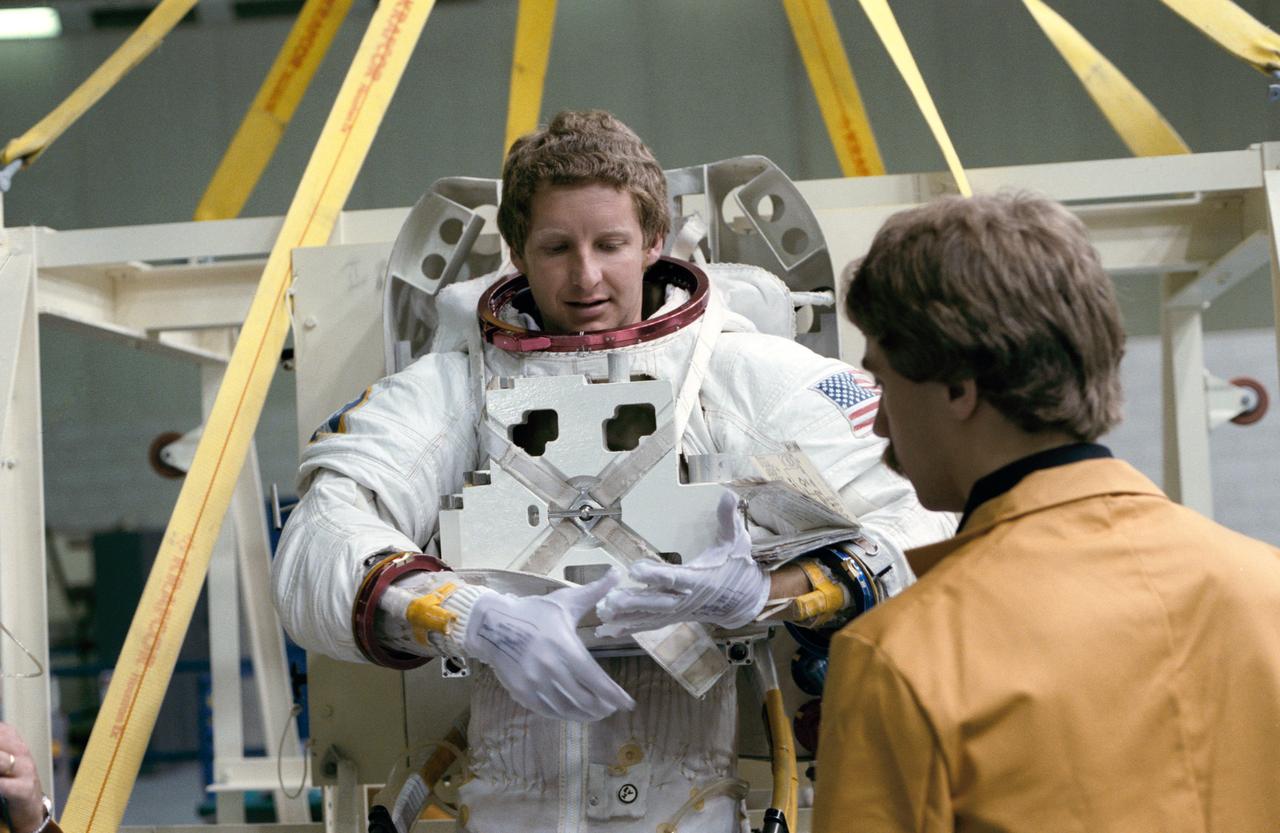
S84-28203 (24 Feb 1984) --- Astronaut Steven A. Hawley, 41-D mission specialists, completes suiting up procedures before being submerged in the Johnson Space Center's (JSC) 25 ft. deep weightless environment training facility (WET-F). Obscured behind Dr. Hawley is astronaut Richard M. (Mike) Mullane, 41-D mission specialist. later the pair were lowered into the facility for an underwater simulation of a contingent extravehicular activity for the week-long flight.
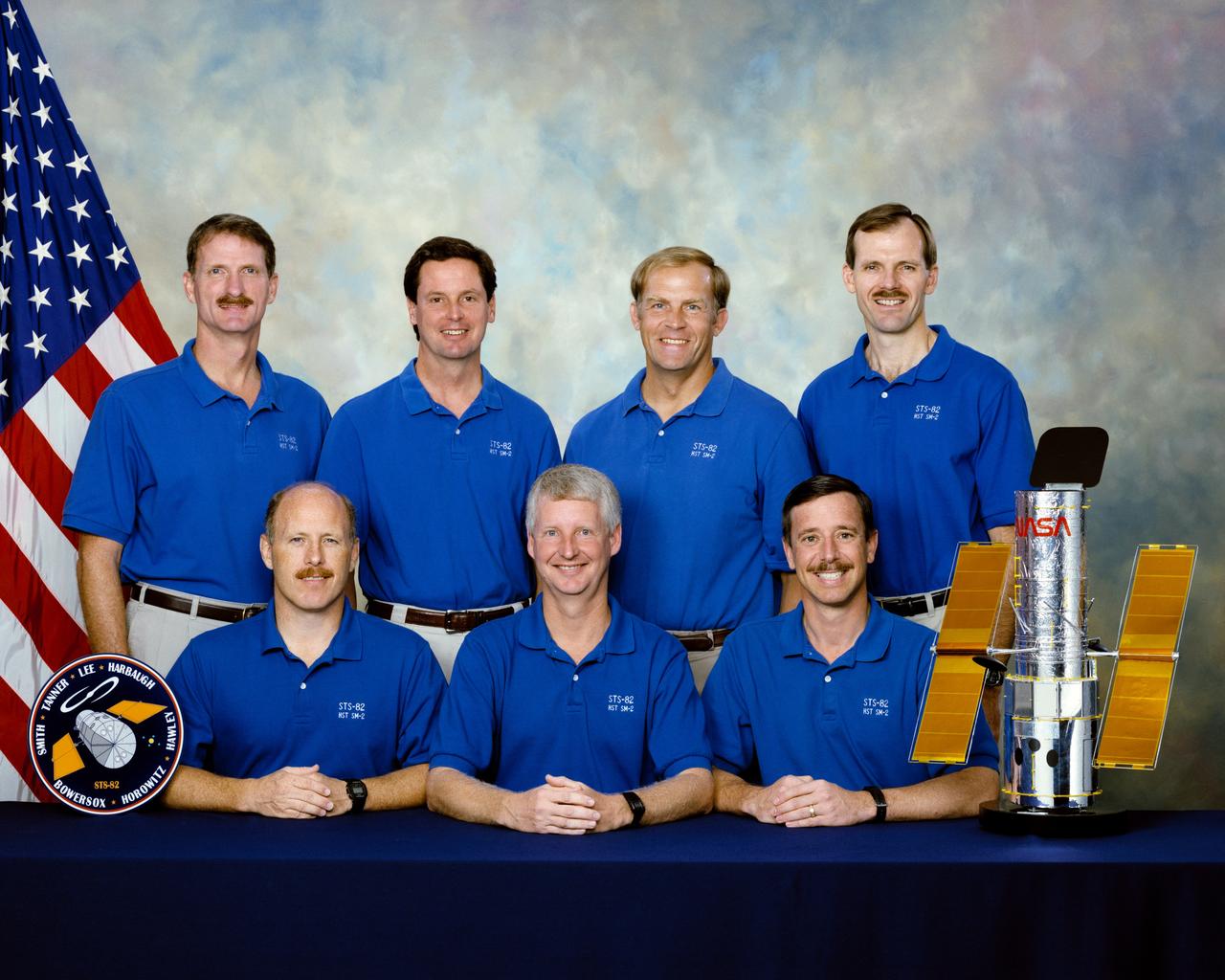
STS082-S-002 (December 1996) --- These seven astronauts are prime crew members for NASA’s STS-82 mission. They are, on the front row, from the left, Kenneth D. Bowersox, Steven A. Hawley and Scott J. Horowitz. On the back row are Joseph R. Tanner, Gregory J. Harbaugh; Mark C. Lee and Steven L. Smith. Bowersox and Horowitz are commander and pilot, respectively, with Lee assigned as payload commander. Hawley, Harbaugh, Smith and Tanner are mission specialists. The seven are pictured with a small model of the Hubble Space Telescope (HST), which they will be paying a visit representing the second HST maintenance mission. Bowersox was pilot for the STS-61 mission, which performed the first maintenance on HST. Hawley was a mission specialist on STS-31, the mission whose astronauts originally deployed the HST.

STS-82 Mission Specialist Steven A. Hawley prepares to enter the Space Shuttle Discovery at Launch Pad 39A, with the assistance of white room closeout crew members James Davis, at left, and George Schramm
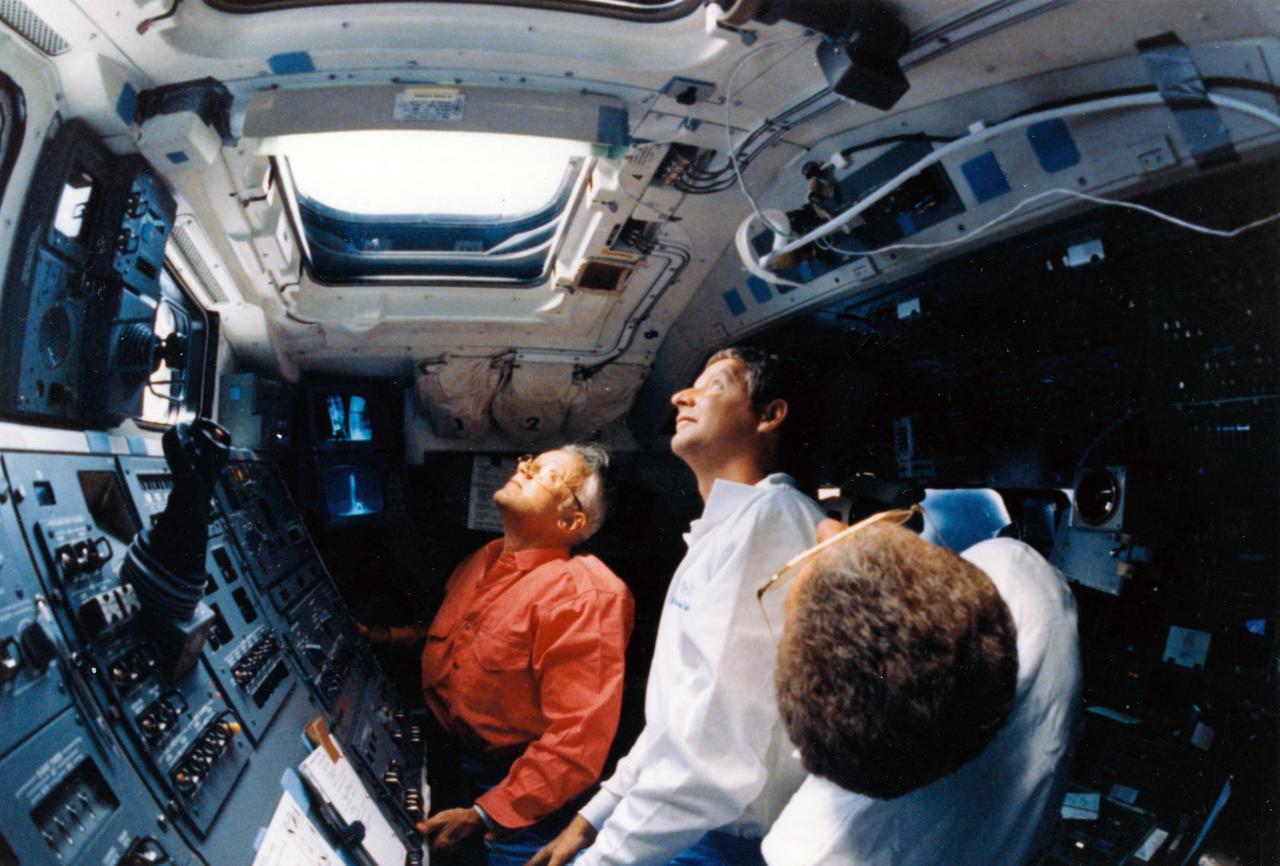
JOHNSON SPACE CENTER, HOUSTON, TEXAS -- Three crew members look at the Hubble Space Telescope through overhead windows. Left to right are Bruce McCandless, Steve Hawley and Loren Shriver.
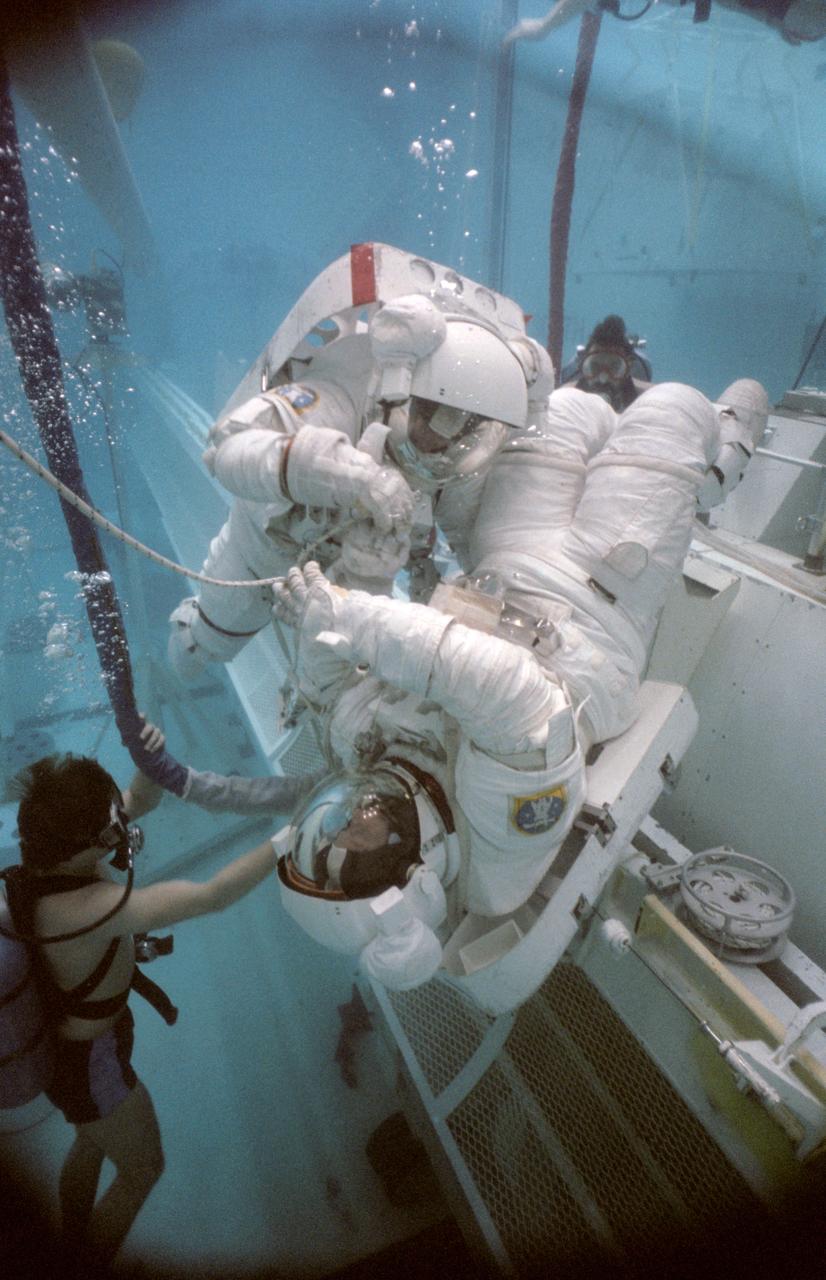
S84-28206 (26 Feb 1984) --- Astronauts Richard M. (Mike) Mullane (with striped suit and PLSS) and Steven A. Hawley participate in and underwater simulation of a 41-D contingency extravehicular activity (EVA) in the Johnson Space Center's weightless environment training facility (WET-F). All Shuttle crews, many of which are not scheduled for definite EVAs, possess team members trained to perform in space certain tasks normally done remotely in the event of systems failures. Among those contingent tasks is the manual closing of the payload bay doors. Mullane and Hawley are two of three mission specialists assigned duty on the seven-day 41-D flight. This photograph was taken by Otis Imboden.
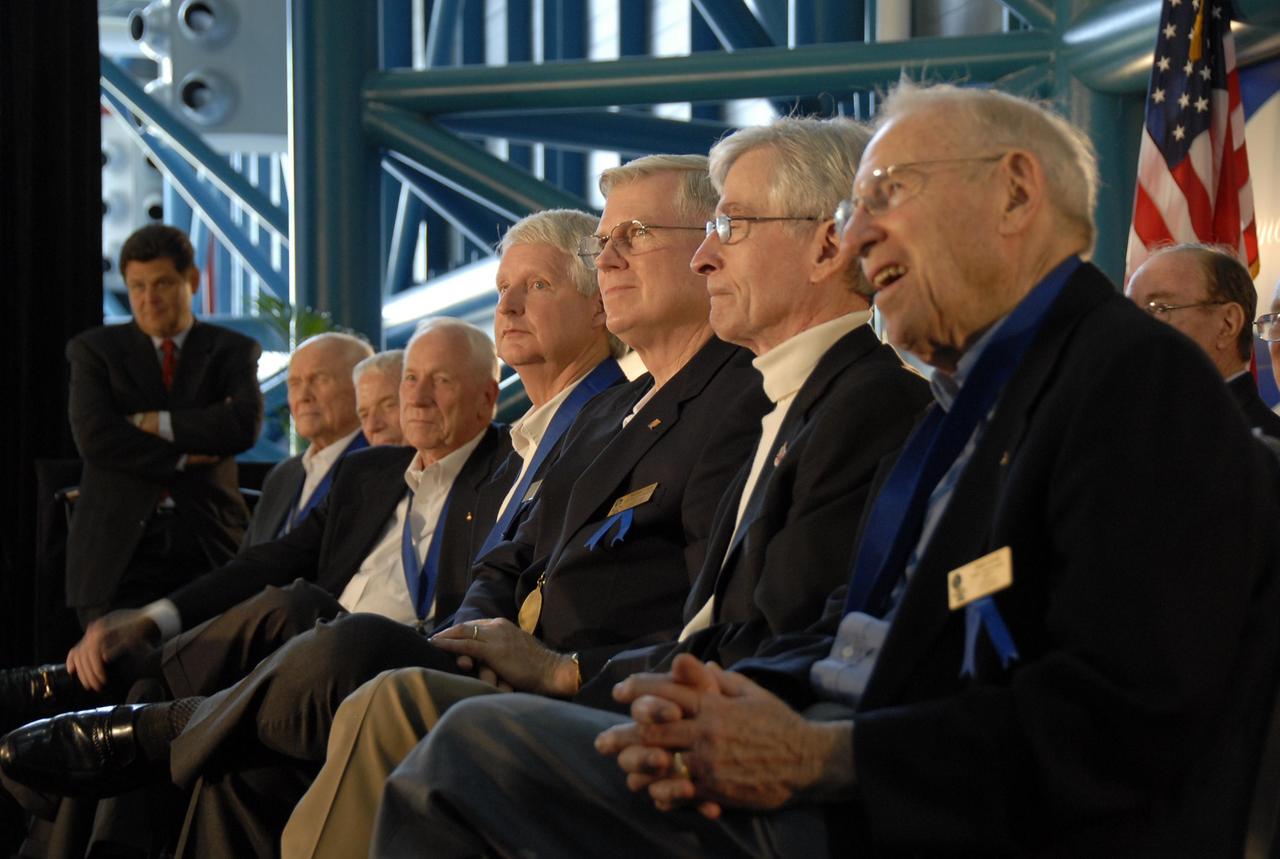
KENNEDY SPACE CENTER, FLA. -- At the U.S. Astronaut Hall of Fame induction ceremony, new and former inductees are seated on the dais. In the front row, from left, are John Glenn, Scott Carpenter, Al Worden, Steven Hawley, Michael Coats, John Young, Jim Lovell and Ed Mitchell. At far left is John Zarrella, CNN's Miami Bureau Chief, who moderated. The May 5 induction added space shuttle commanders Michael L. Coats, Steven A. Hawley and Jeffrey A. Hoffman to the Hall of Fame. They grow the number of space explorers enshrined in the Hall of Fame to 66. The ceremony was held at the Kennedy Space Center's Apollo/Saturn V Center. Photo credit: NASA/Kim Shiflett
![[14] ISO: 100 Aprt: F4 Shut: 60 Lens: 35 Exps: P Prog: Po ExpC: -1.3 Metr: Mtrx Fl s: Norm D md: S F md: S F ar: Spot Dist: 1.6m](https://images-assets.nasa.gov/image/s93e5050/s93e5050~medium.jpg)
[14] ISO: 100 Aprt: F4 Shut: 60 Lens: 35 Exps: P Prog: Po ExpC: -1.3 Metr: Mtrx Fl s: Norm D md: S F md: S F ar: Spot Dist: 1.6m
![[56] ISO: 100 Aprt: F4 Shut: 60 Lens: 35 Exps: P Prog: Po ExpC: -1.3 Metr: Mtrx Fl s: Norm D md: S F md: S F ar: Spot Dist: 1.8m](https://images-assets.nasa.gov/image/s93e5067/s93e5067~medium.jpg)
[56] ISO: 100 Aprt: F4 Shut: 60 Lens: 35 Exps: P Prog: Po ExpC: -1.3 Metr: Mtrx Fl s: Norm D md: S F md: S F ar: Spot Dist: 1.8m
![[55] ISO: 100 Aprt: F4 Shut: 60 Lens: 35 Exps: P Prog: Po ExpC: -1.3 Metr: Mtrx Fl s: Norm D md: S F md: S F ar: Spot Dist: 1.8m](https://images-assets.nasa.gov/image/s93e5066/s93e5066~medium.jpg)
[55] ISO: 100 Aprt: F4 Shut: 60 Lens: 35 Exps: P Prog: Po ExpC: -1.3 Metr: Mtrx Fl s: Norm D md: S F md: S F ar: Spot Dist: 1.8m
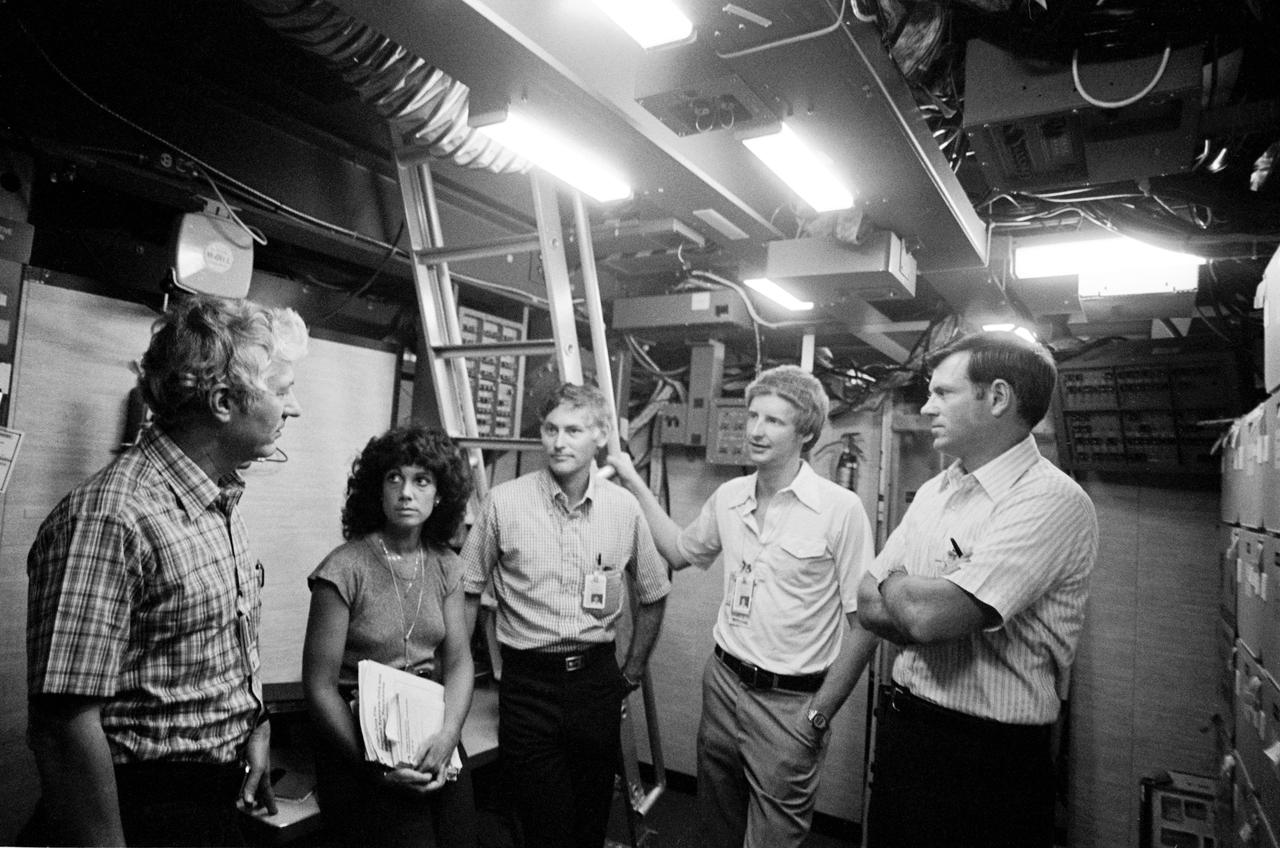
View of STS 41-D mission crew training in Shuttle Mission simulator. From left to right are Henry Hartsfield, Jr., commander; mission specialists Judith Resnik, Richard Mullane, and Steven Hawley; and Michael Coats, pilot. They appear to be standing in the middeck mockup, preparing for training.
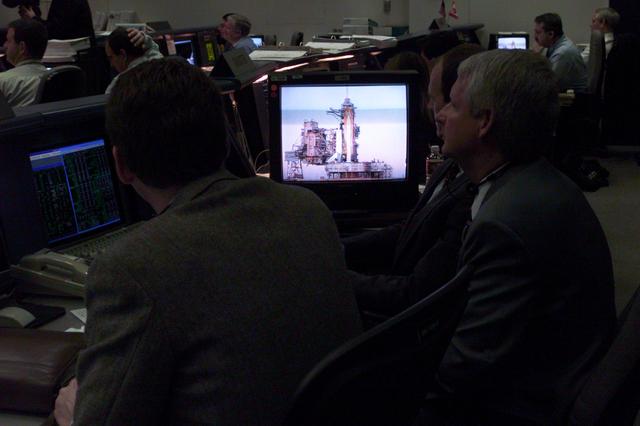
JSC2001-E-06216 (8 March 2001) --- In Houston's Mission Control Center (MCC), the silhouette of astronaut Steven A. Hawley of the Flight Crew Operations Directorate appears just to the right of the monitor displaying the Space Shuttle Discovery's pre-launch activities several hundred miles away in Florida.
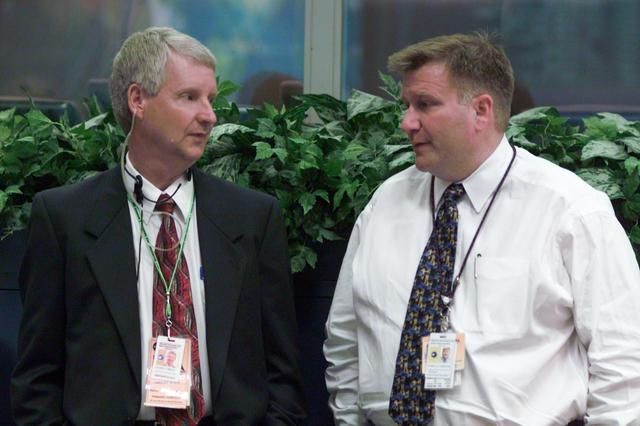
JSC2001-E-12119 (19 April 2001) --- Steven A. Hawley of the Flight Crew Operations Directorate chats with Daniel K. Carpenter, Director of the Johnson Space Center (JSC) Public Affairs Office, as the two await liftoff of the Space Shuttle Endeavour. The two are at the rear of the flight control room of JSC's Mission Control Center.
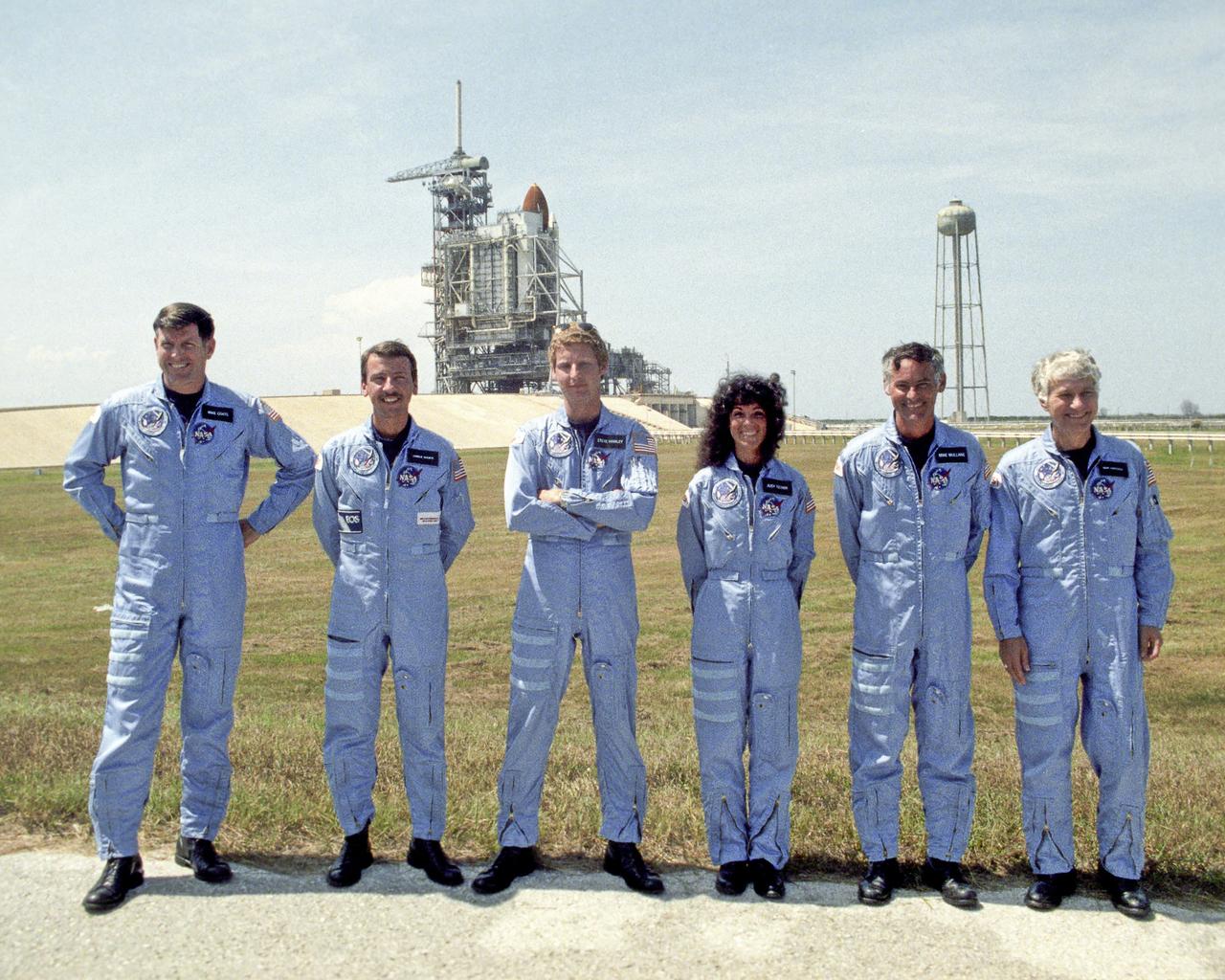
CAPE CANAVERAL, Fla. -- Members of the STS-41D flight crew are, from left to right, Michael L. Coats, Charles D. Walker, Steven A. Hawley, Judith A. Resnik, Richard M. Mullane, and Henry Hartsfield. Photo credit: NASA
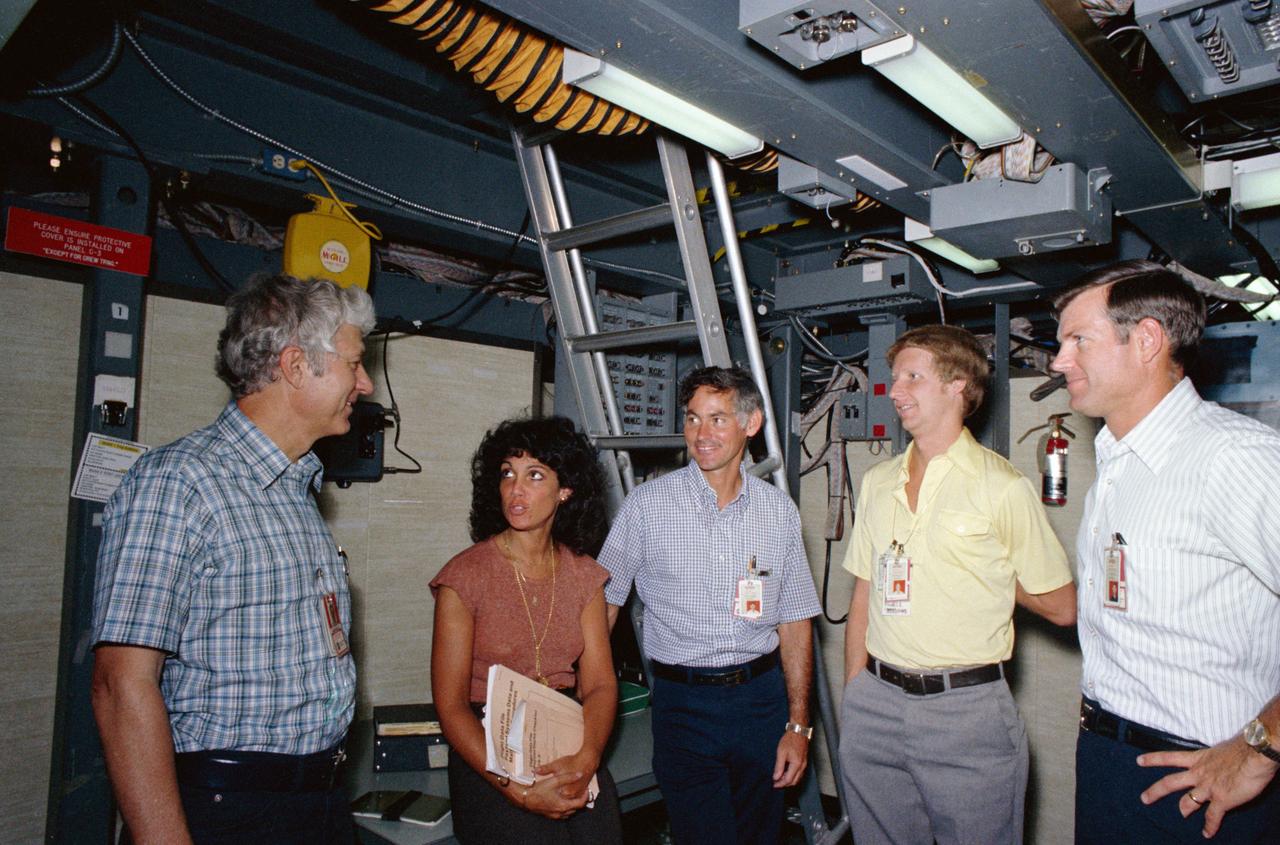
View of STS 41-D mission crew training in Shuttle Mission simulator. From left to right are Henry Hartsfield, Jr., commander; mission specialists Judith Resnik, Richard Mullane, and Steven Hawley; and Michael Coats, pilot. They appear to be standing in the middeck mockup, preparing for training.
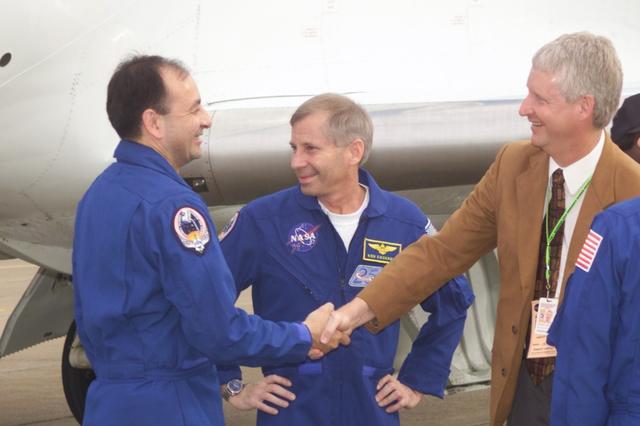
JSC2001-E-04804 (21 February 2001) --- Astronauts Mark L. Polansky (left) and Kenneth D. Cockrell (center), pilot and commander, respectively, for the STS-98 mission, are greeted by Steven A. Hawley of the Flight Crew Operations Directorate upon their return to Houston. The greetings took place prior to a welcoming ceremony at Ellington Field.

S82-E-5616 (17 Feb. 1997) --- Astronaut Steven A. Hawley, STS-82 mission specialist, controls the Remote Manipulator System (RMS) on the Space Shuttle Atlantis' aft flight deck. This view was taken with an Electronic Still Camera (ESC).
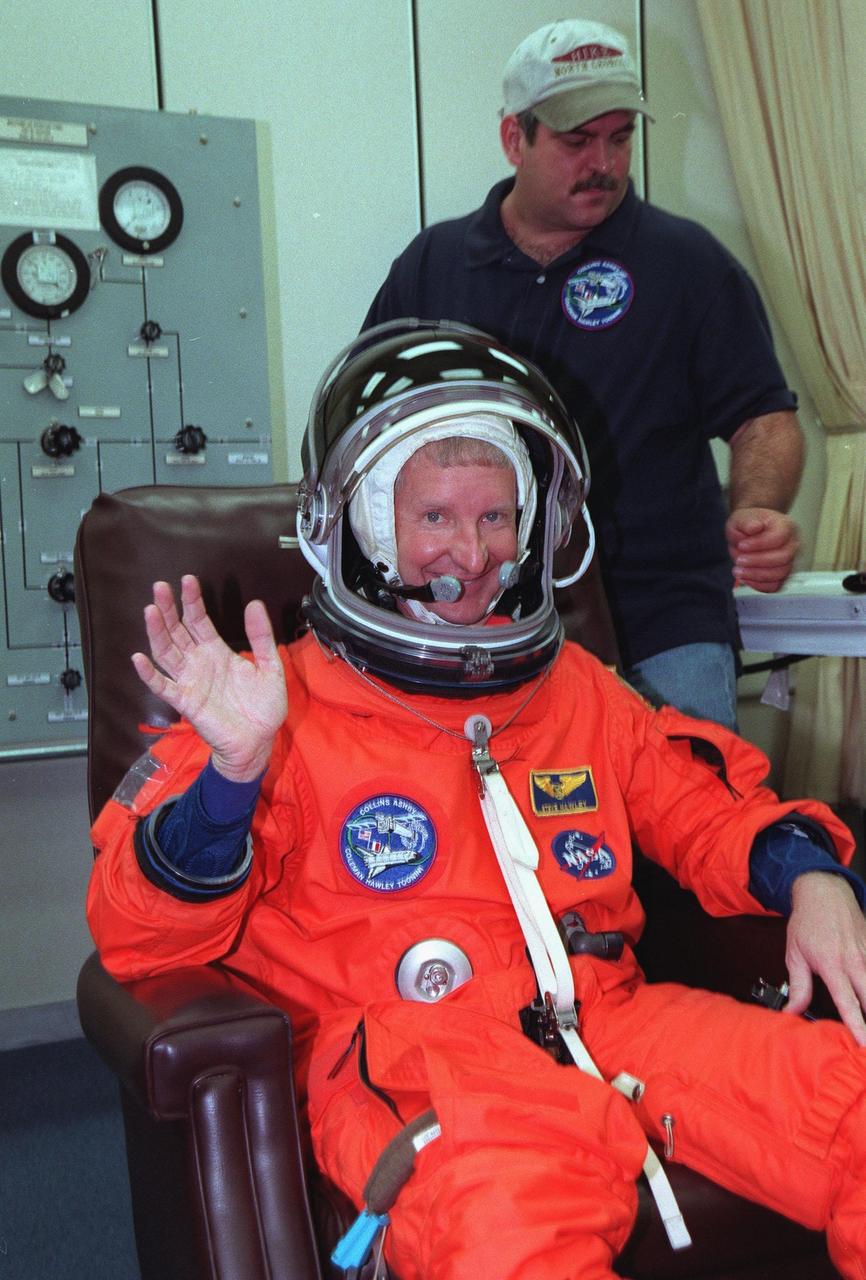
For the third time, during final launch preparations in the Operations and Checkout Building, STS-93 Mission Specialist Steven A. Hawley (Ph.D.) waves after donning his launch and entry suit. After Space Shuttle Columbia's July 20 and 22 launch attempts were scrubbed, the launch was again rescheduled for Friday, July 23, at 12:24 a.m. EDT. STS-93 is a five-day mission primarily to release the Chandra X-ray Observatory, which will allow scientists from around the world to study some of the most distant, powerful and dynamic objects in the universe. The STS-93 crew numbers five: Commander Eileen M. Collins, Pilot Jeffrey S. Ashby, and Mission Specialists Hawley, Catherine G. Coleman (Ph.D.) and Michel Tognini of France, with the Centre National d'Etudes Spatiales (CNES). Collins is the first woman to serve as commander of a shuttle mission
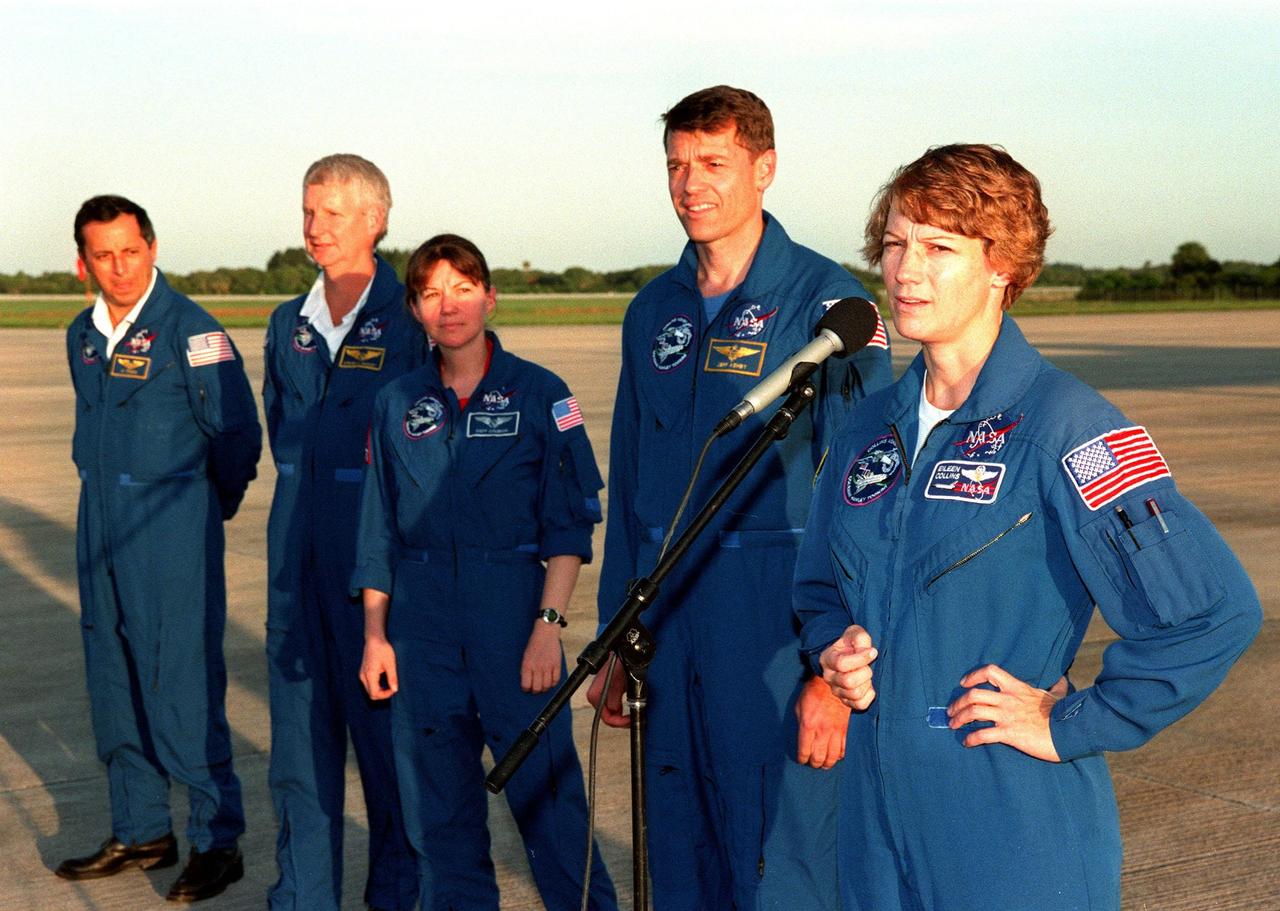
After arrival at KSC's Shuttle Landing Facility, the STS-93 crew speak to the media about their mission. From left are Mission Specialists Michel Tognini of France, who is with the Centre National d'Etudes Spatiales (CNES), Steven A. Hawley (Ph.D.), and Catherine G. "Cady" Coleman (Ph.D.), Pilot Jeffrey S. Ashby, and Commander Eileen M. Collins. Hawley has the most Shuttle flights, this being his fifth. Collins is making her third flight (the first as a commander), Coleman is making her second flight, and Ashby and Tognini are making their first flights. The primary mission of STS-93 is the release of the Chandra X-ray Observatory, which will allow scientists from around the world to study some of the most distant, powerful and dynamic objects in the universe. The new telescope is 20 to 50 times more sensitive than any previous X-ray telescope and is expected to unlock the secrets of supernovae, quasars and black holes

KENNEDY SPACE CENTER, Fla. -- At Launch Pad 39A, STS-82 crew members pose for a group photo outside the entrance to the Space Shuttle Discovery’s crew cabin. Kneeling in front is Mission Specialist Steven A. Hawley. Payload Commander Mark C. Lee is at far left. In second row behind Hawley, from left, are Mission Specialists Gregory J. Harbaugh and Steven L. Smith, and Mission Commander Kenneth D. Bowersox. In back, from left, are Mission Specialists Joseph R. "Joe" Tanner and Pilot Scott J. "Doc" Horowitz. The crew are at KSC to participate in the Terminal Countdown Demonstration Test (TCDT), a dress rehearsal for launch. The seven-member crew will conduct the second Hubble Space Telescope servicing mission. Liftoff of the 10-day flight is scheduled Feb. 11
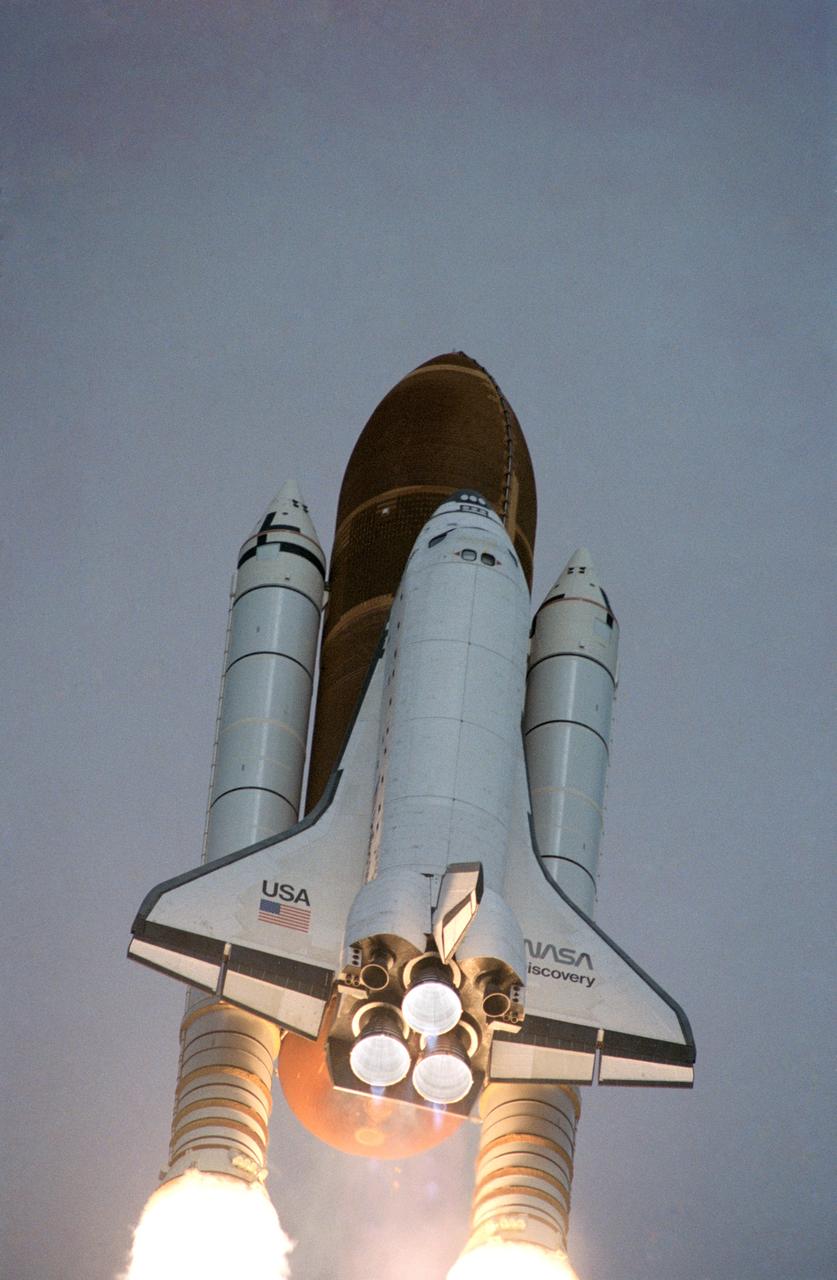
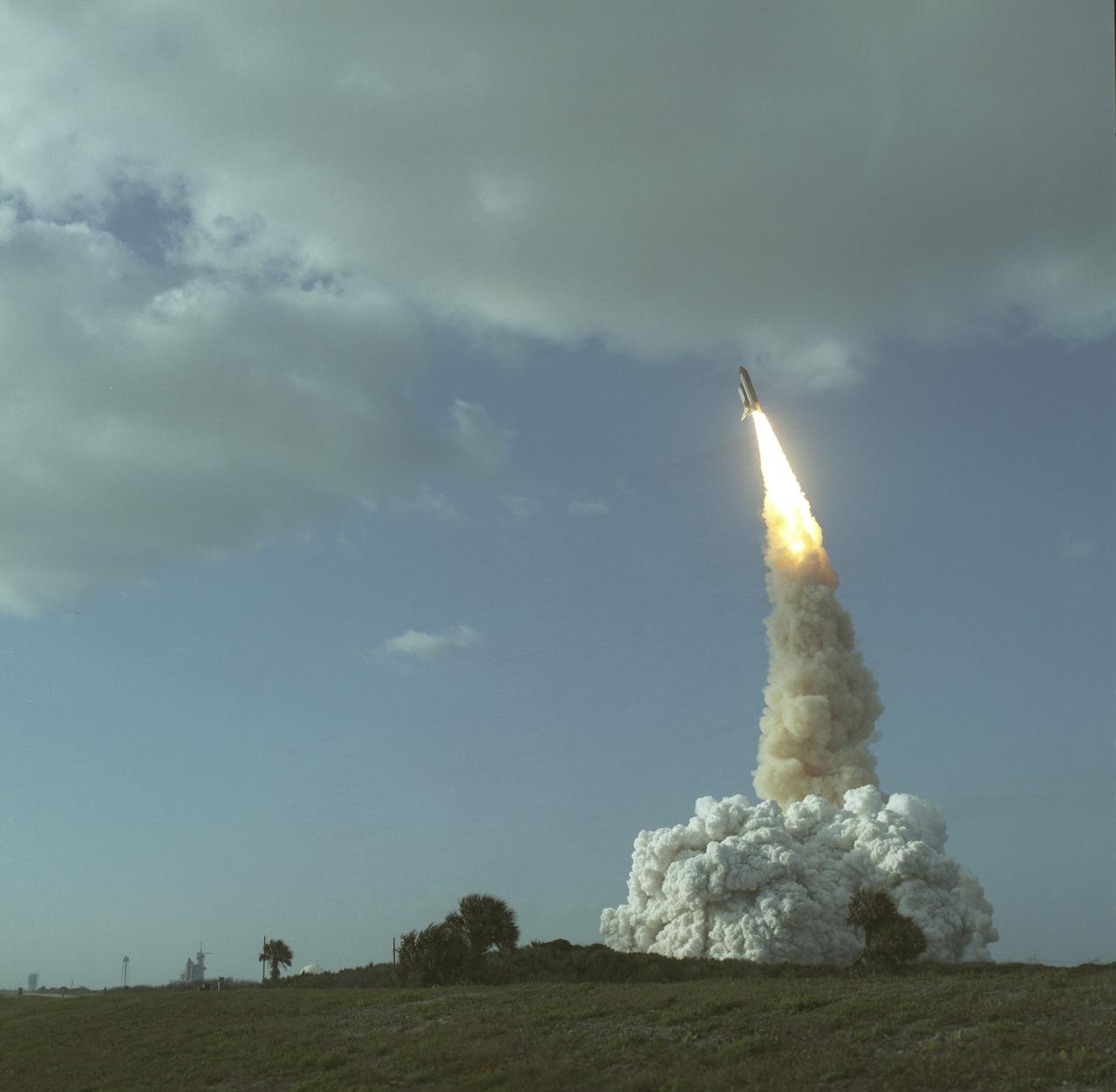
STS031-S-074 (24 April 1990) --- A low-angle view of the launch of the STS-31 mission. Onboard Discovery are a crew of five veteran astronauts and the Hubble Space Telescope (HST). Official launch time was 8:33:51.0492 a.m. (EDT). Headed for approximately five days in space are astronauts Loren J. Shriver, Charles F. Bolden Jr., Bruce McCandless II, Kathryn D. Sullivan and Steven S. Hawley.
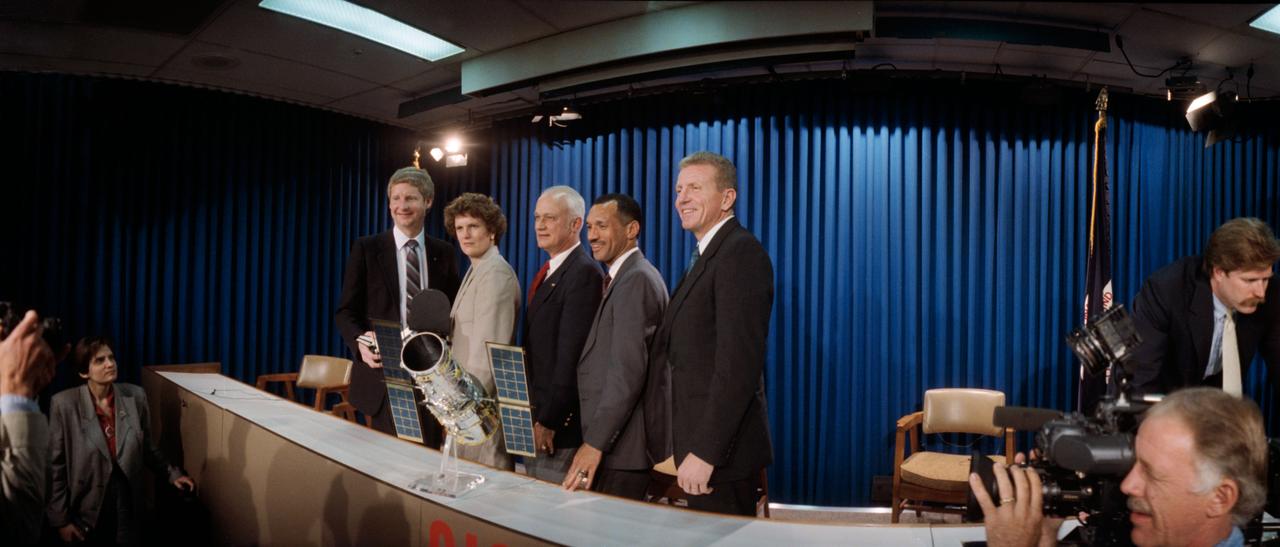
STS-31 Discovery, Orbiter Vehicle (OV) 103, crewmembers pose for an informal portrait after the T-30 (thirty days before launch) briefing at JSC's Auditorium and Public Affairs Facility Bldg 2. Standing behind the conference table are (left to right) Mission Specialist (MS) Steven A. Hawley, MS Kathryn D. Sullivan, MS Bruce McCandless II, Pilot Charles F. Bolden, and Commander Loren J. Shriver.
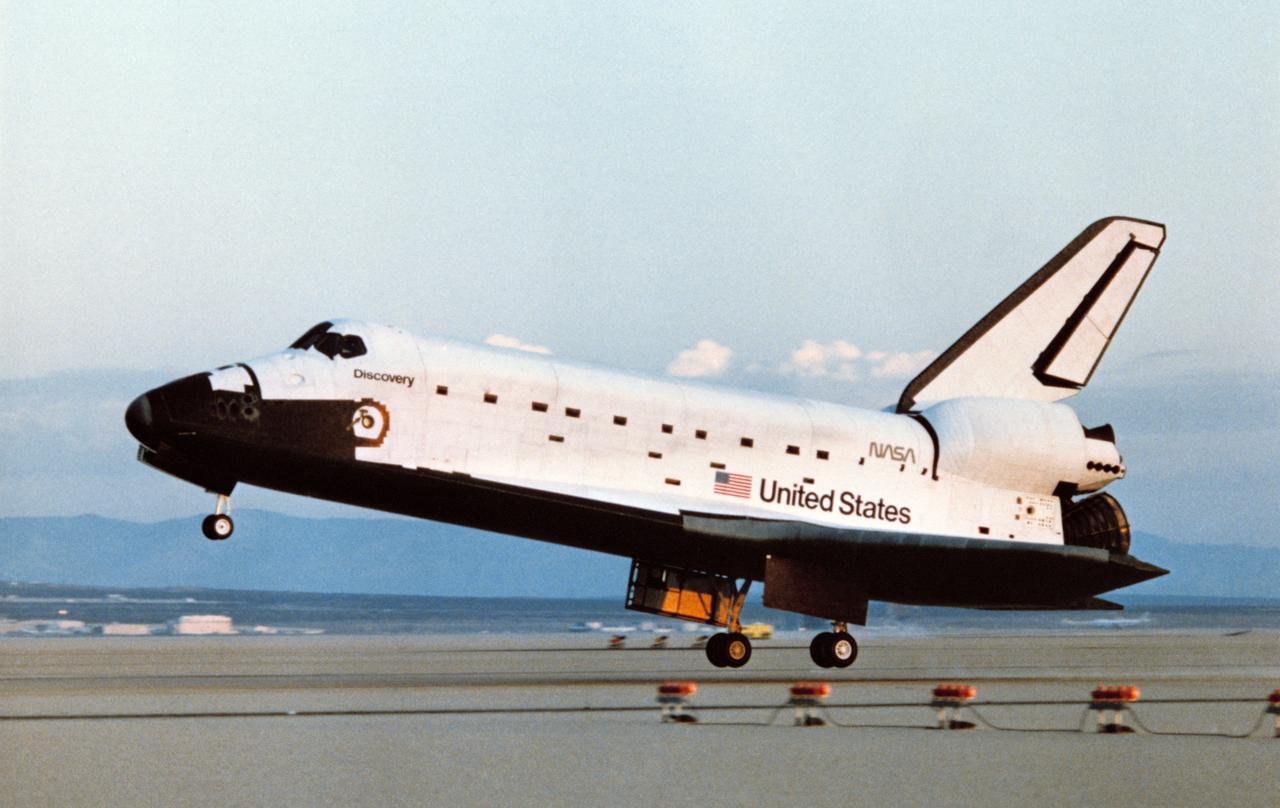
41D-3299 (5 Sept 1984) --- The Space Shuttle Discovery was captured on film just prior to touchdown on Runway 17 at Edwards Air Force Base to successfully complete a six-day mission in space. Inside were Henry W. Hartsfield, Jr., Michael L., Coats, Richard M. (Mike) Mullane, Steven A. Hawley, Judith A. Resnik and Charles D. Walker. Mission duration time was six days, 56 minutes and four seconds.
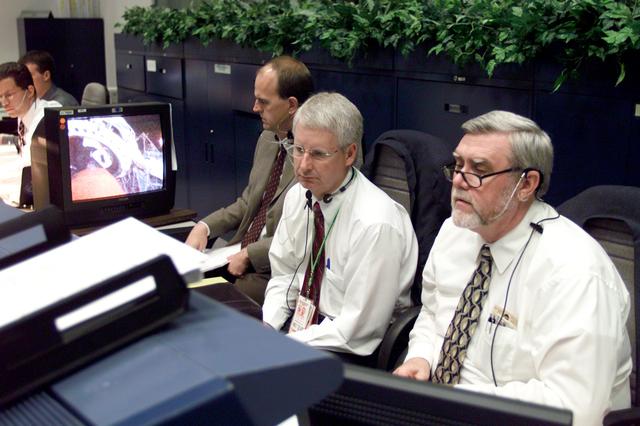
JSC2001-E-21338 (12 July 2001) --- Robert Gest (left), with United Space Alliance (USA); Steven A. Hawley, deputy director of flight crew operations; and Alan L. (Lee) Briscoe, chief engineer for the Mission Operations Directorate, watch their monitors at the MOD console in the shuttle flight control room (WFCR) as the external tank oxygen vent hood is raised and retracted minutes prior to the launch of the Space Shuttle Atlantis.
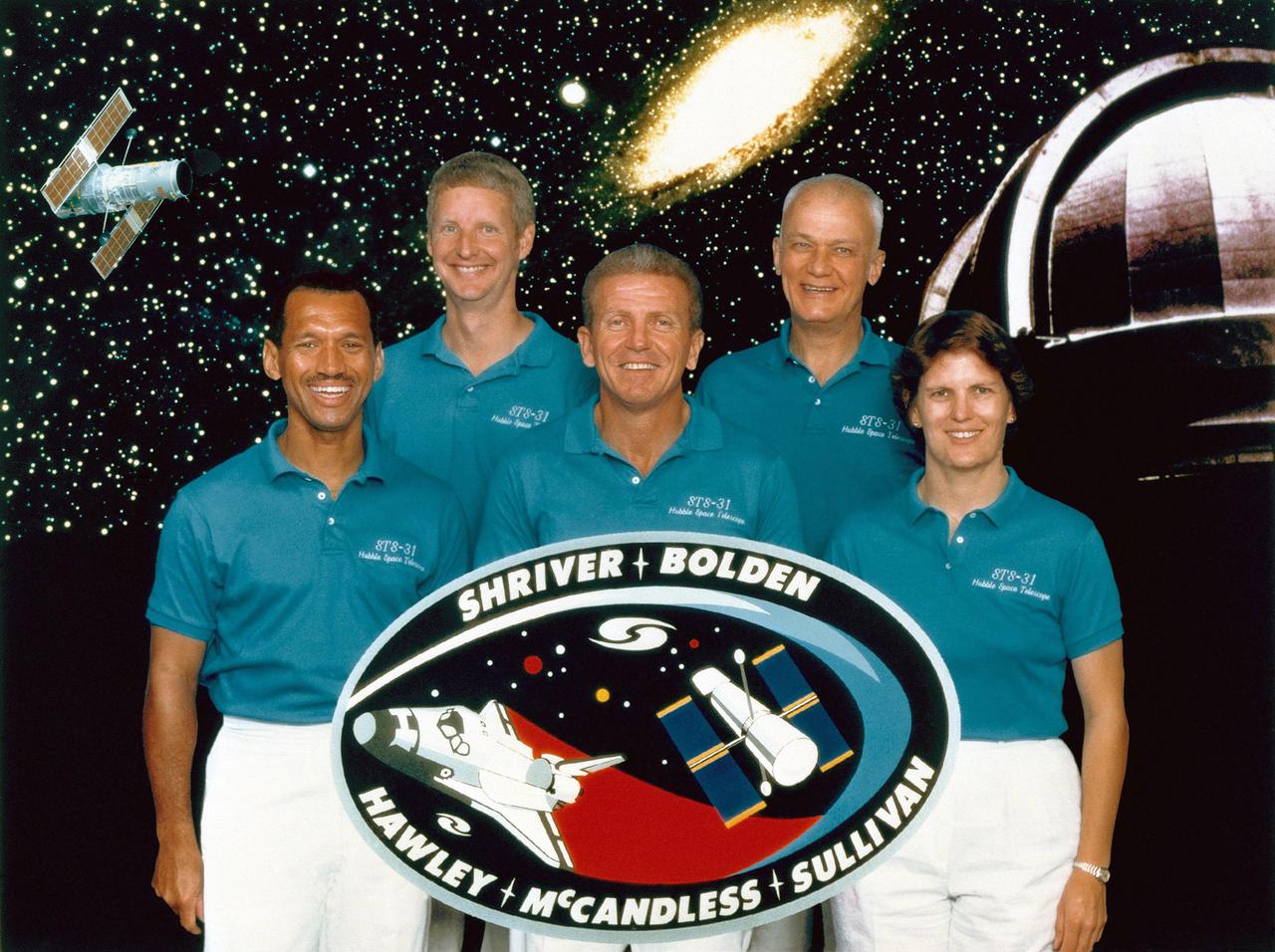
KENNEDY SPACE CENTER, FLA. -- STS-31 crew portrait: Mission Commander Loren J. Shriver, center front; other crew members are (L to R) Pilot Charles F. Bolden Jr. and Mission Specialists Steven A. Hawley, Bruce McCandless II and Kathryn D. Sullivan. Primary payload on the mission is the Hubble Space Telescope, to be deployed ina 380-statute-mile orbit.
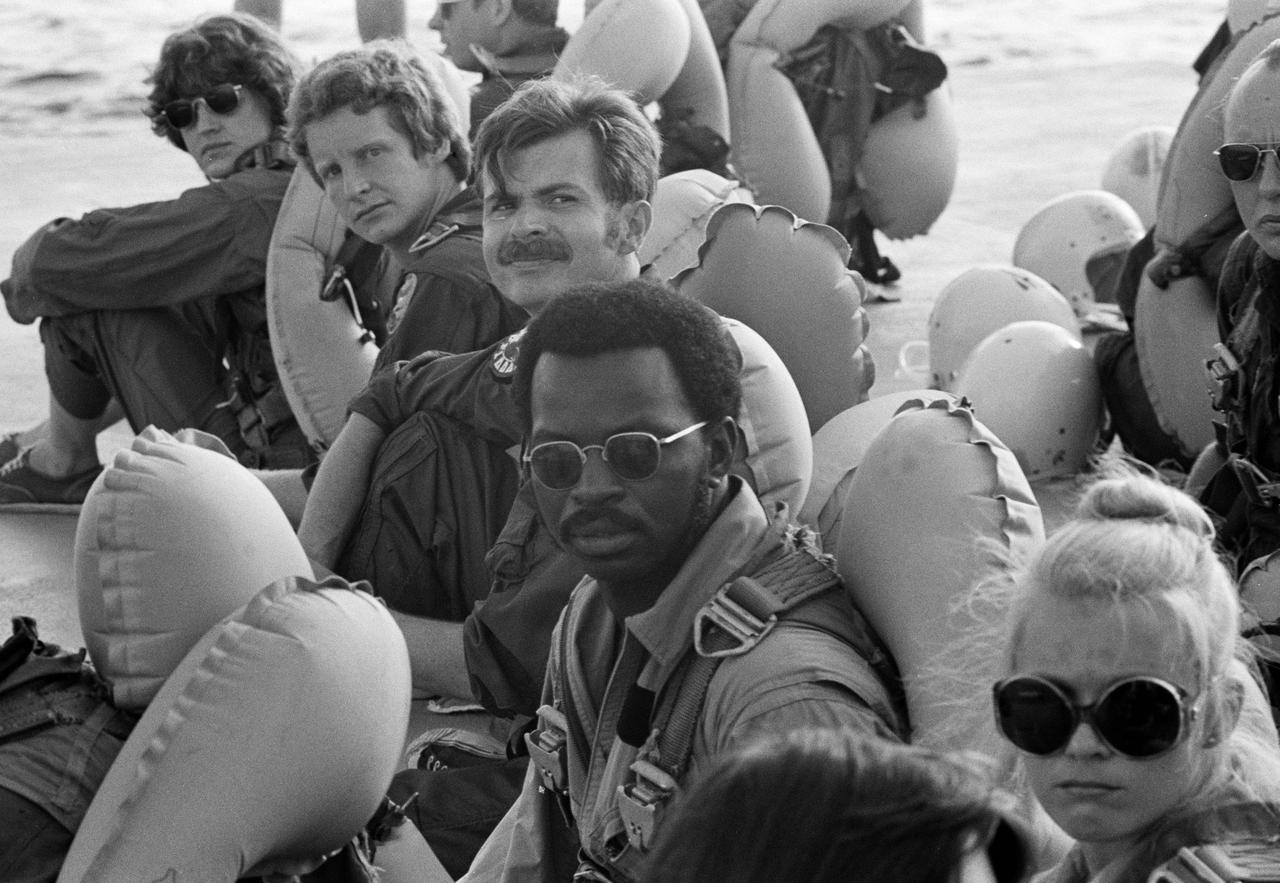
S78-33689 (1978) ASCAN WATER SURVIVAL SCHOOL TRAINING VIEW 1978. Several new astronaut trainees are seen prior to a training exercise at the water survival school in Florida attended by 16 of the candidates. From far left to right are Shannon W. Lucid, Steven A. Hawley, Jeffrey A. Hoffman, Ronald E. McNair and Rhea Seddon. The overall program, held at Homestead Air Force Base, was designed to prepare the trainees for proper measures to take in the event of ejection from an aircraft over water. NASA Photograph.
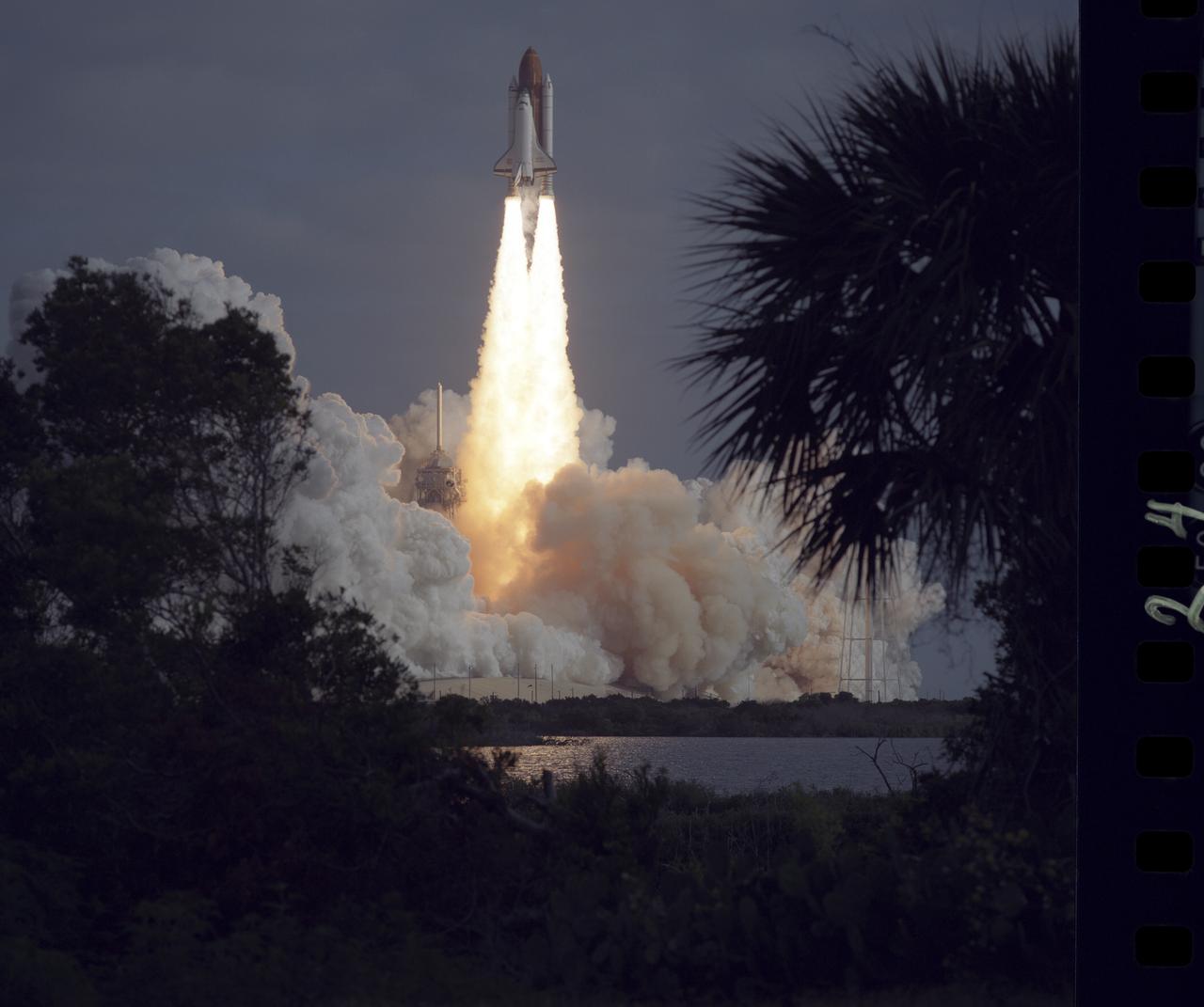
The STS-31 crew launched aboard the Space Shuttle Discovery on April 24, 1990 at 8:33:51am (EDT). Included in the crew of five were Loren J. Shriver, commander; Charles F. Bolden, pilot; and Steven A. Hawley, Bruce McCandless, and Kathryn D. Sullivan, all mission specialists. The primary goal of the mission was the deployment of the Hubble Space Telescope (HST) which was a Marshall Space Flight Center (MSFC) managed program.
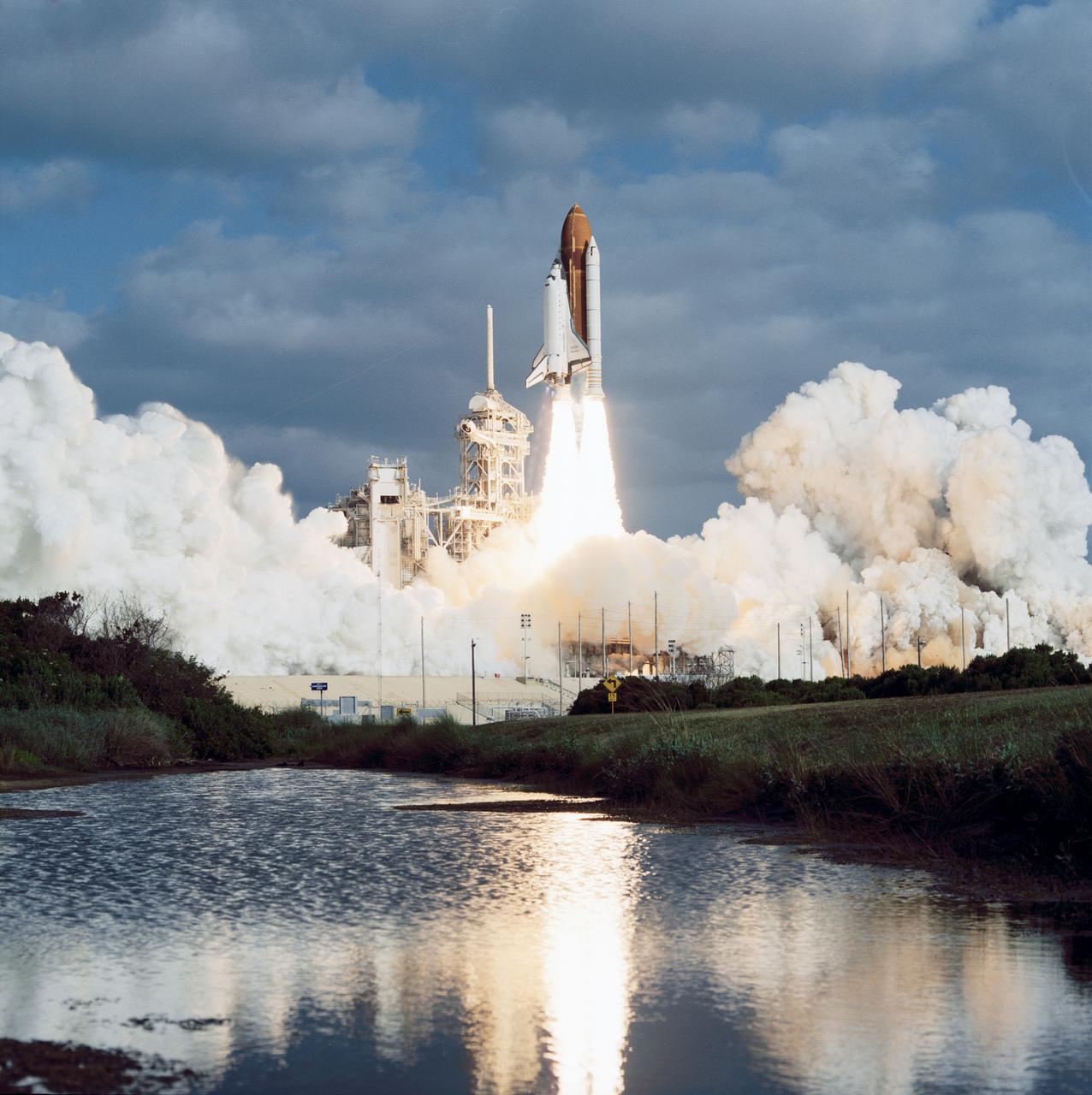
STS031-S-064 (24 April 1990) --- A horizontal view of the launch of the STS-31 mission. Onboard Space Shuttle Discovery are the crew of five veteran astronauts and the Hubble Space Telescope (HST). Official launch time was 8:33:51.0492 a.m. (EDT). Headed for approximately five days in space are astronauts Loren J. Shriver, Charles F. Bolden, Jr., Bruce McCandless, II, Kathryn D. Sullivan, and Steven A. Hawley.
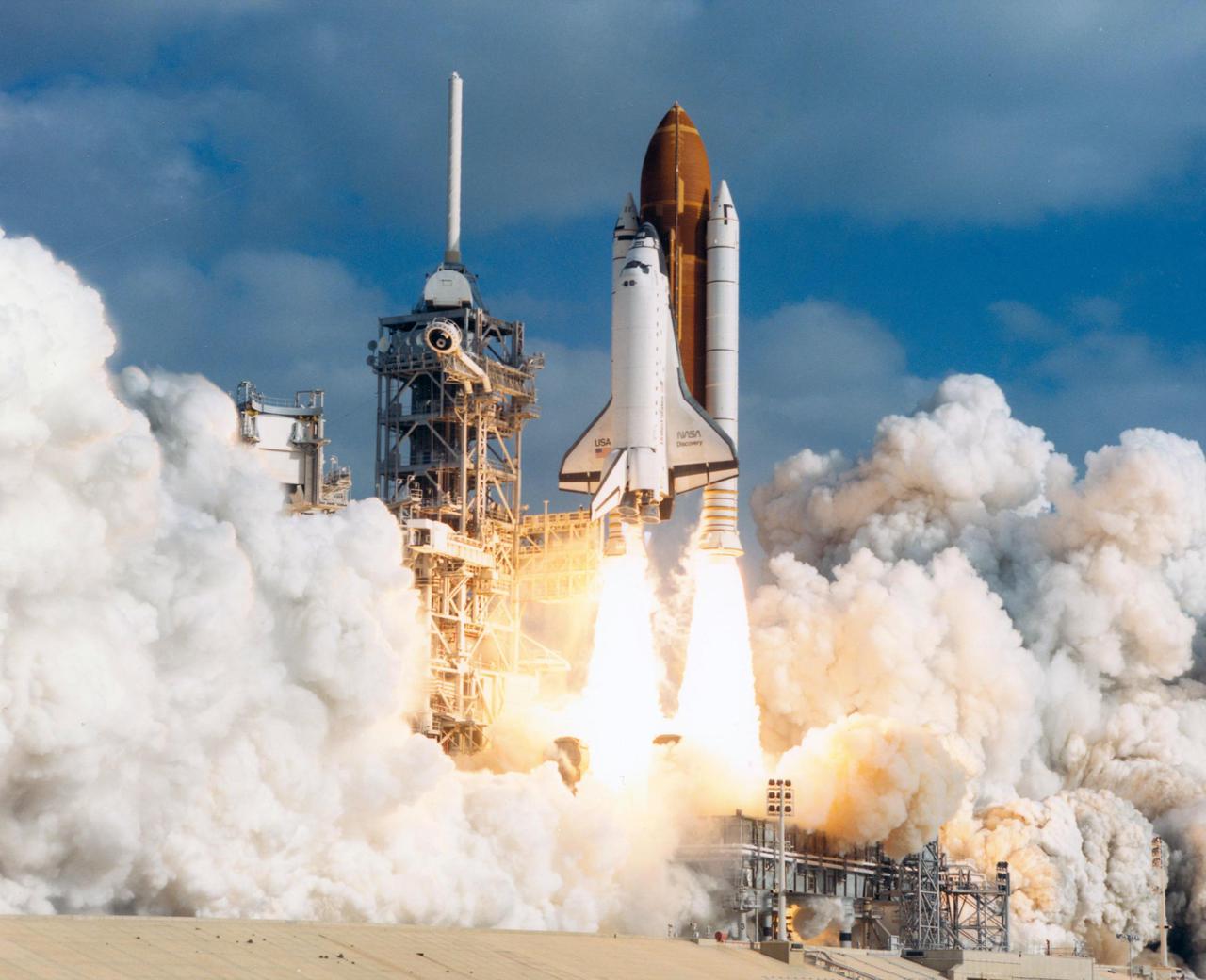
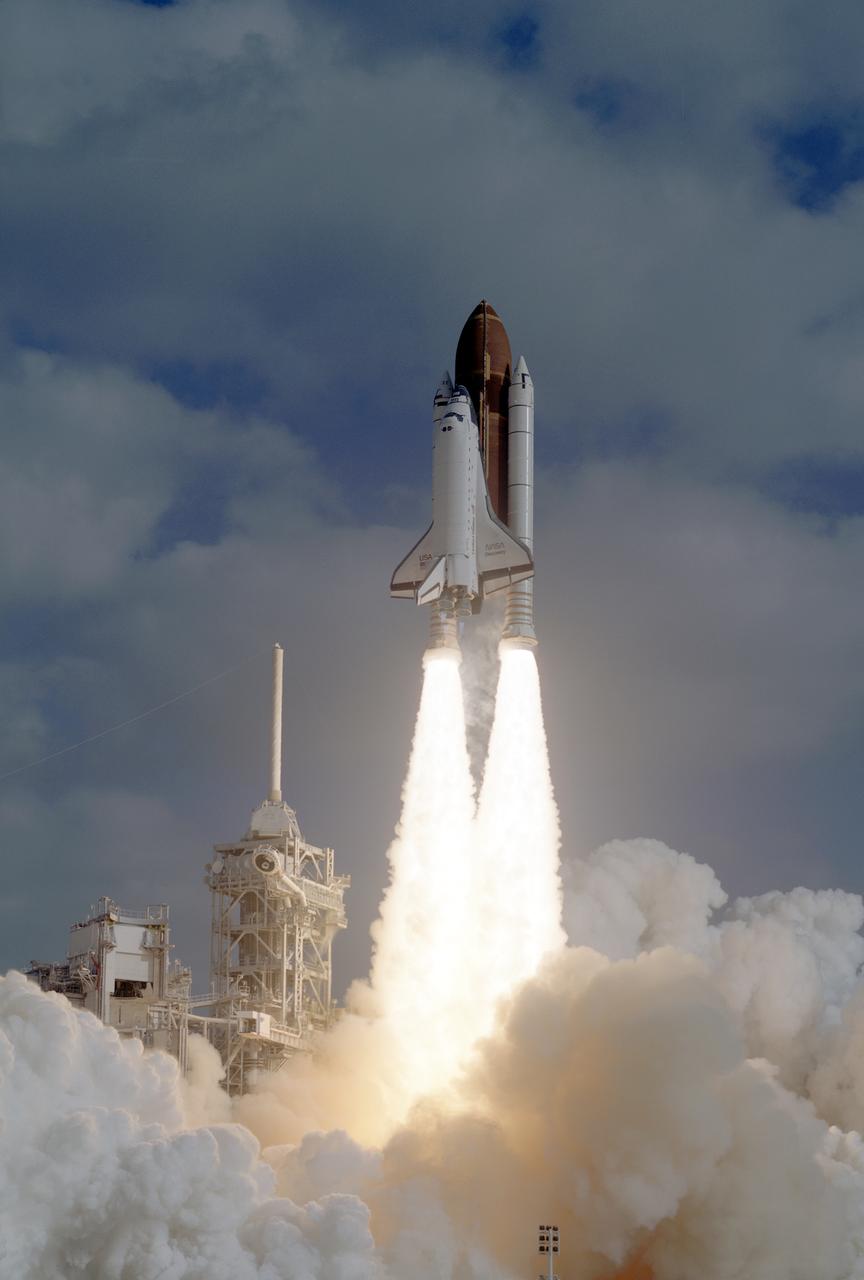
KENNEDY SPACE CENTER, FLA. -- The Space Shuttle Discovery soars into the morning skies above Florida, carying a crew of five and the Hubble Space Telescope. Launch of Space Shuttle Mission STS-31from Pad 39B occurred at 8:33:51 a.m. EDT, April 24. Crew members are Commander Loren J. Shriver; Pilot Charles F. Bolden Jr.; and Mission Specialists Kathryn D. Sullivan, Steven A. Hawley, and Bruce McCandless II.
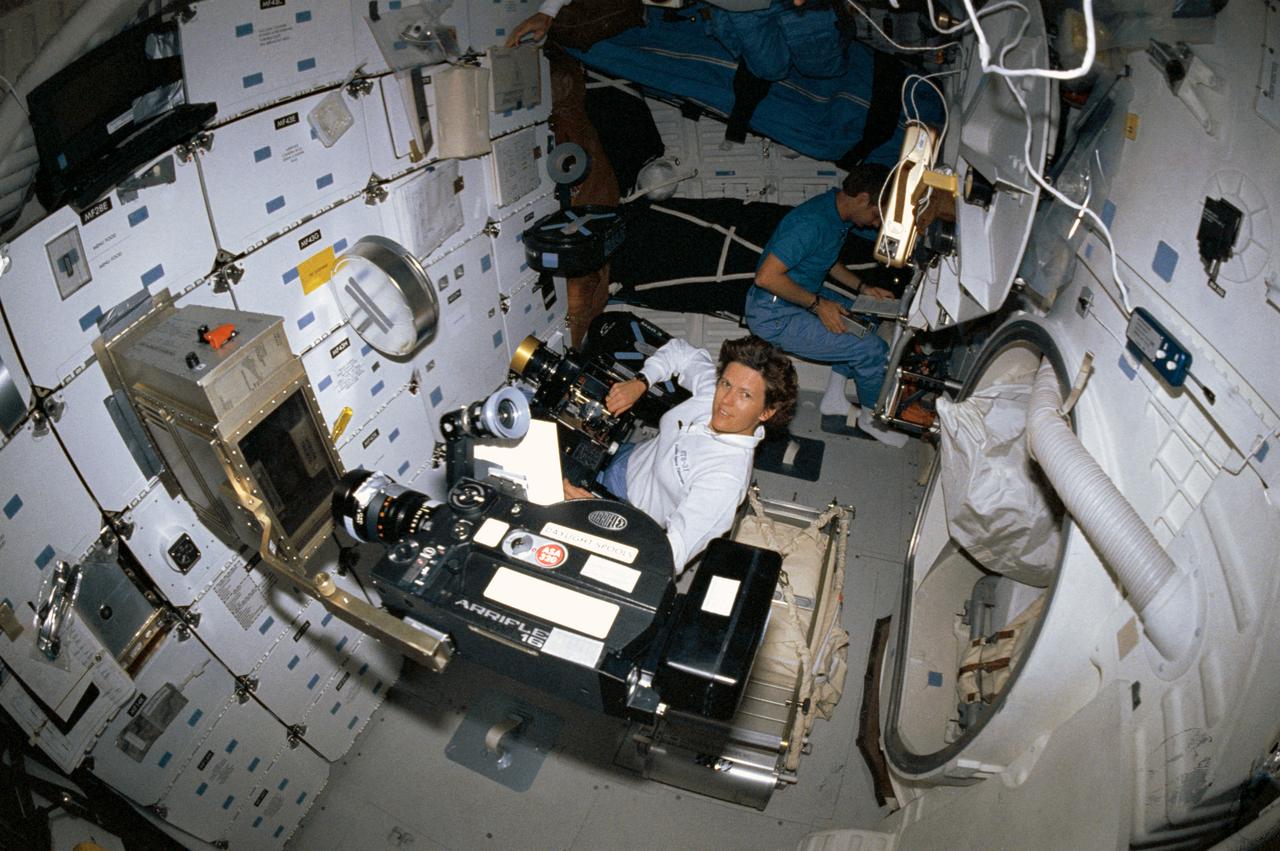
STS031-05-002 (24-29 April 1990) --- A 35mm camera with a "fish eye" lens captured this high angle image on Discovery's middeck. Astronaut Kathryn D. Sullivan works with the IMAX camera in foreground, while Astronaut Steven A. Hawley consults a checklist in corner. An Arriflex motion picture camera records student ion arc experiment in apparatus mounted on stowage locker. The experiment was the project of Gregory S. Peterson, currently a student at Utah State University.
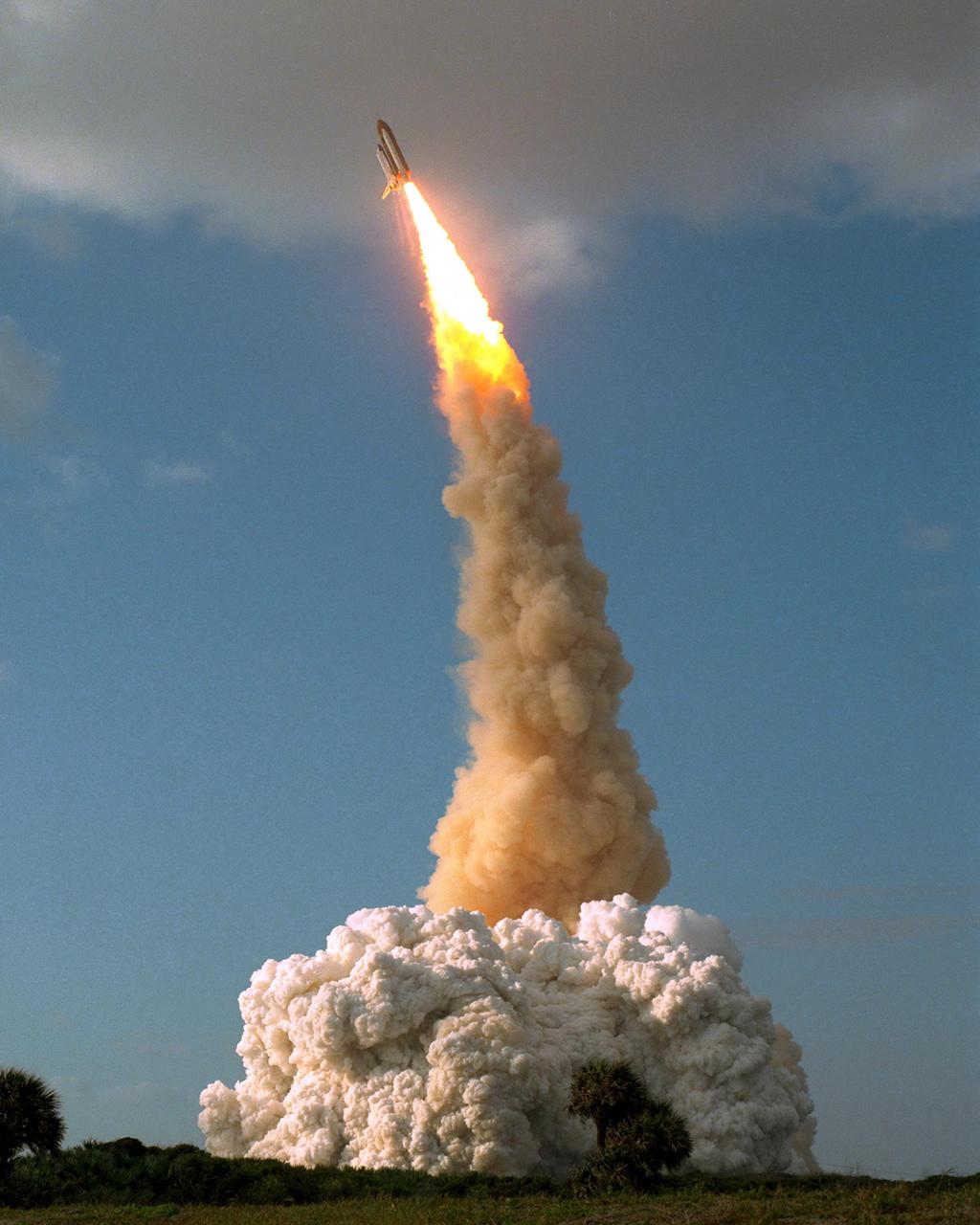
KENNEDY SPACE CENTER, FLA. -- The Space Shuttle Discovery lifts off from Pad 39-B at 8:33 a.m. EDT carrying a crew of five and the Hubble Space Telescope. STS-31 crew members are Commander Loren Shriver, Pilot Charles Bolden and Mission Specialists Steven Hawley, Bruce McCandless II and Kathryn Sullivan.
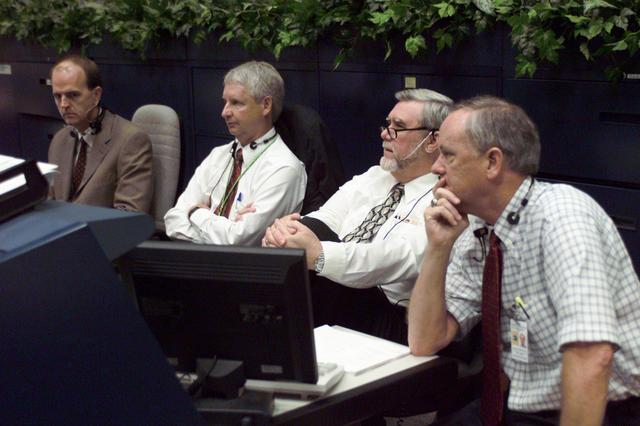
JSC2001-E-21323 (12 July 2001) --- From left to right, Robert Gest with United Space Alliance; Steven A. Hawley, deputy director of Flight Crew Operations; Alan L. (Lee) Briscoe, chief engineer for the Mission Operations Directorate (MOD); and J. Milton (Milt) Heflin, chief of the Flight Director's Office, watch the monitor at the MOD console during the pre-launch activity for the STS-104 mission in the shuttle flight control room (WFCR) of Houston's Mission Control Center (MCC).
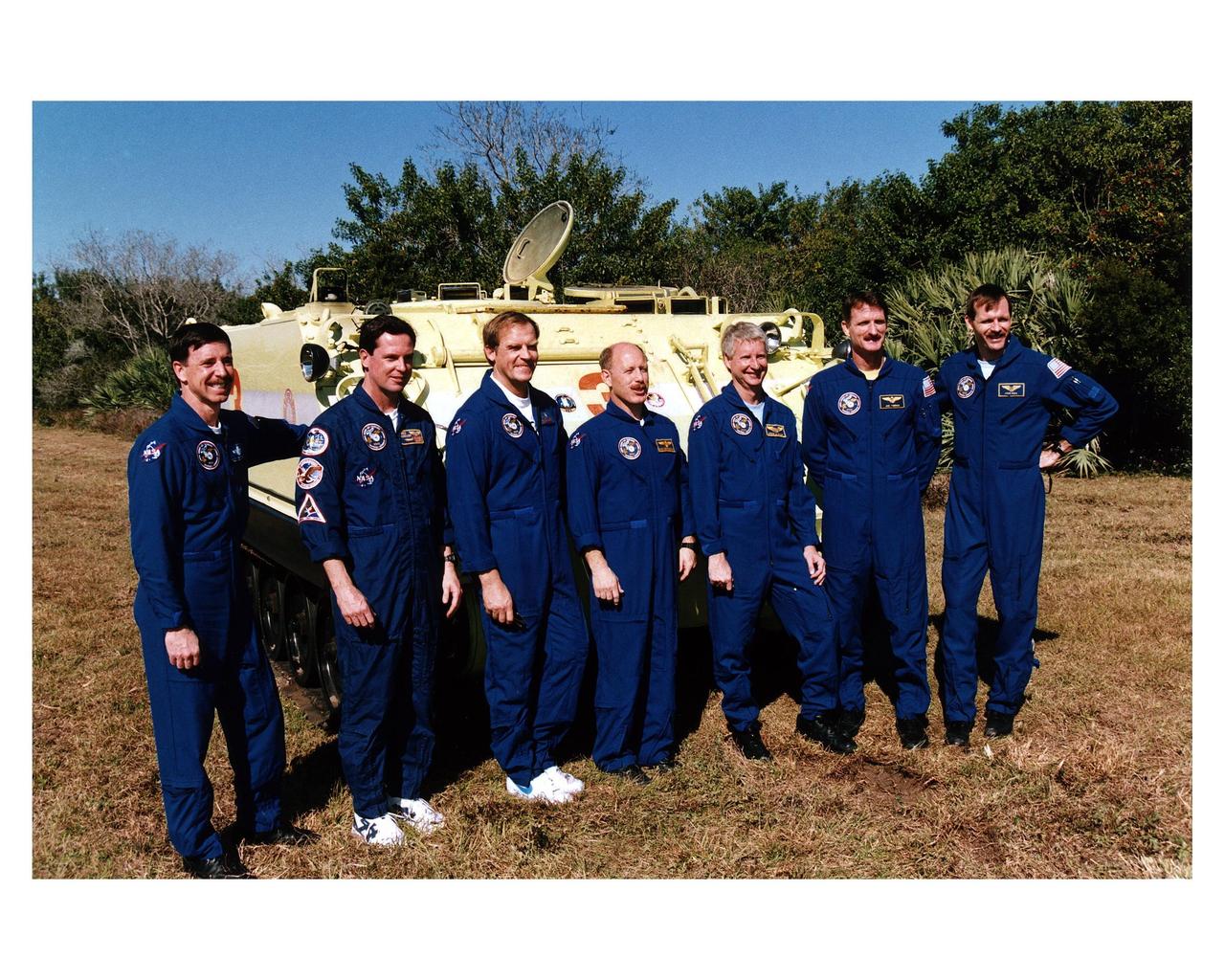
KENNEDY SPACE CENTER, FLA. -- STS-82 Terminal Countdown Demonstration Test (TCDT). Crew members are Mission Commander Kenneth D. Bowersox, Pilot Scott J. "Doc" Horowitz, Payload Commander Mark C. Lee, and Mission Specialists Steven L. Smith, Gregory J. Harbaugh, Joseph R. "Joe" Tanner and Steven A. Hawley.
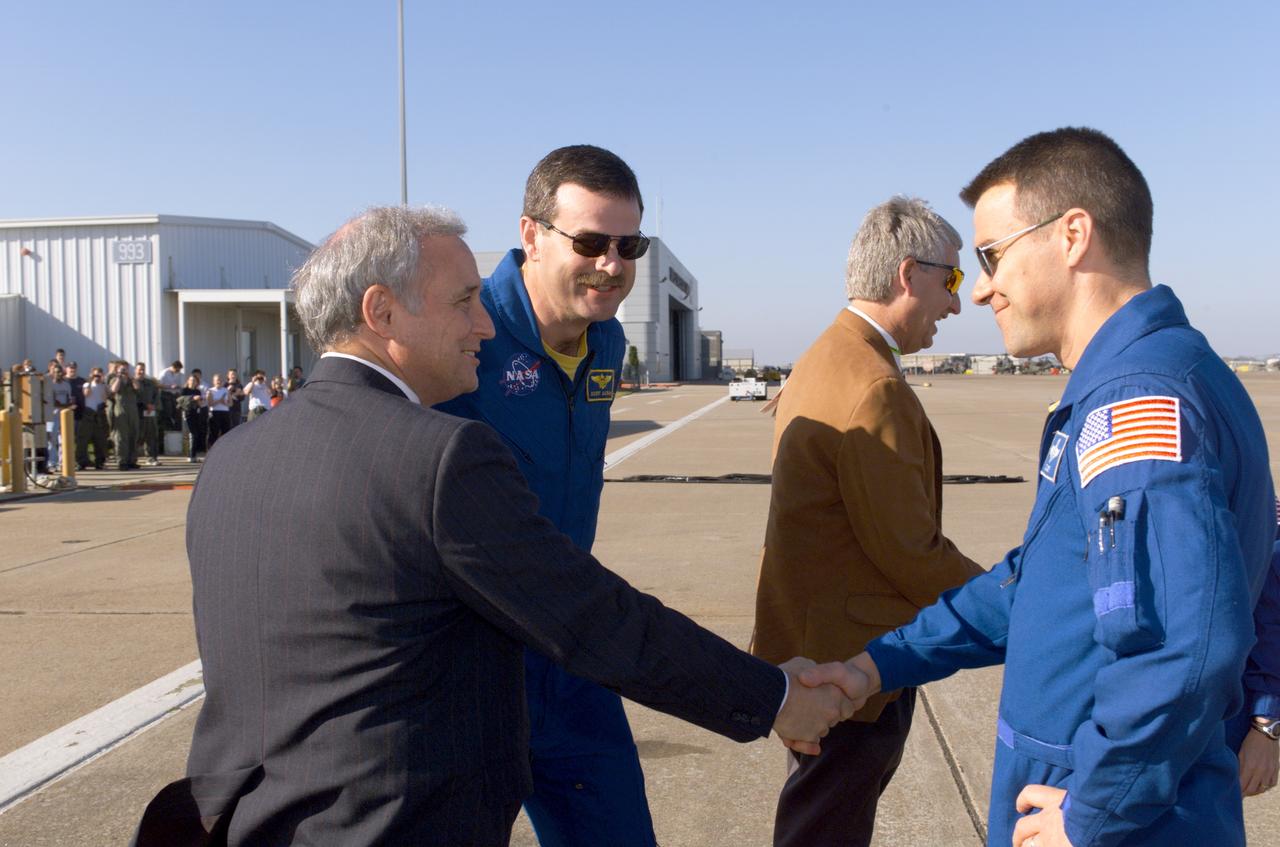
JSC2002-E-09329 (13 March 2002) --- Astronaut Duane G. Carey (right foreground), STS-109 pilot, shakes hands with Johnson Space Center’s (JSC) Acting Director Roy Estess during the crew return ceremonies at Ellington Field. Also pictured are astronaut Scott D. Altman (left background), mission commander, and astronaut Steven A. Hawley, Director of Flight Crew Operations.

The space shuttle Discovery lifts off from Launch Pad 39-B at 8:33 a.m. EDT carrying a crew of five and the Hubble Space Telescope. STS-31 crew members are Commander Loren Shriver, Pilot Charles Bolden and Mission Specialists Steven Hawley, Bruce McCandless II and Kathryn Sullivan. Photo credit: NASA
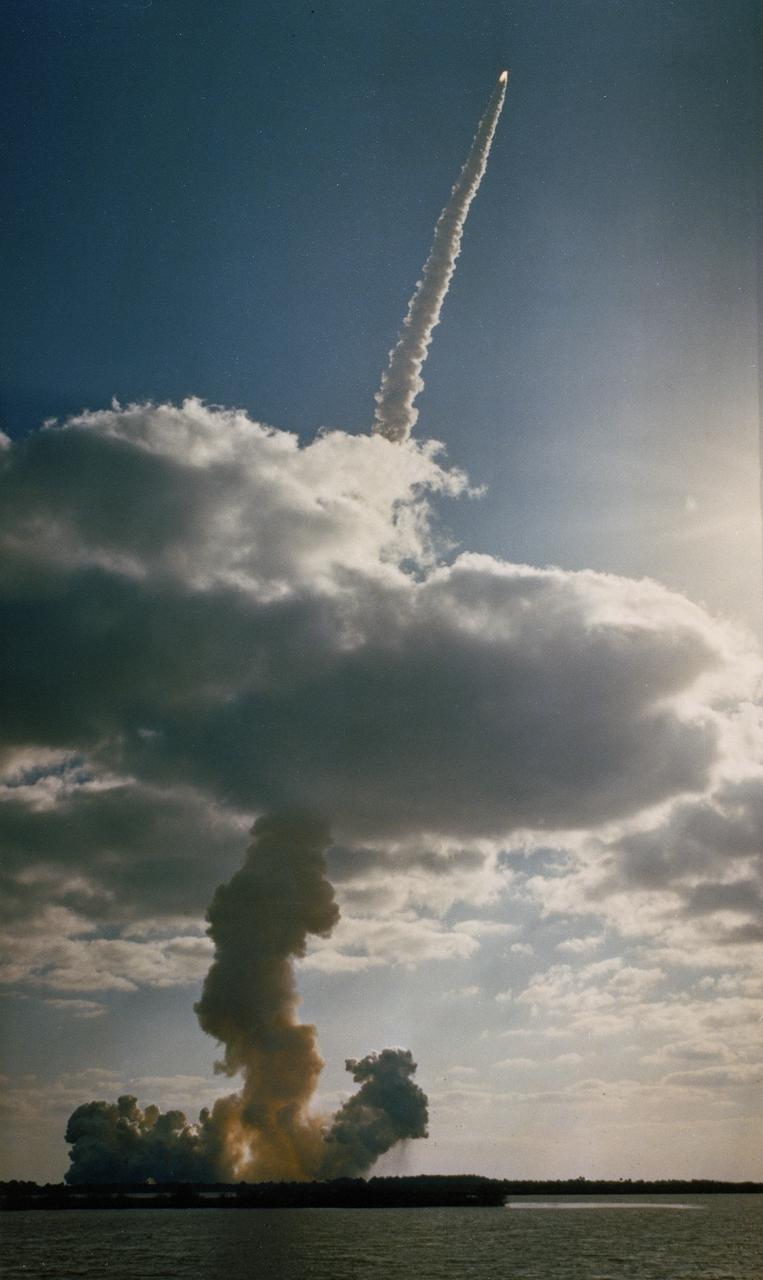
The STS-31 crew launched aboard the Space Shuttle Discovery on April 24, 1990 at 8:33:51am (EDT). Included in the crew of five were Loren J. Shriver, commander; Charles F. Bolden, pilot; and Steven A. Hawley, Bruce McCandless, and Kathryn D. Sullivan, all mission specialists. The primary goal of the mission was the deployment of the Hubble Space Telescope (HST) which was a Marshall Space Flight Center (MSFC) managed program.
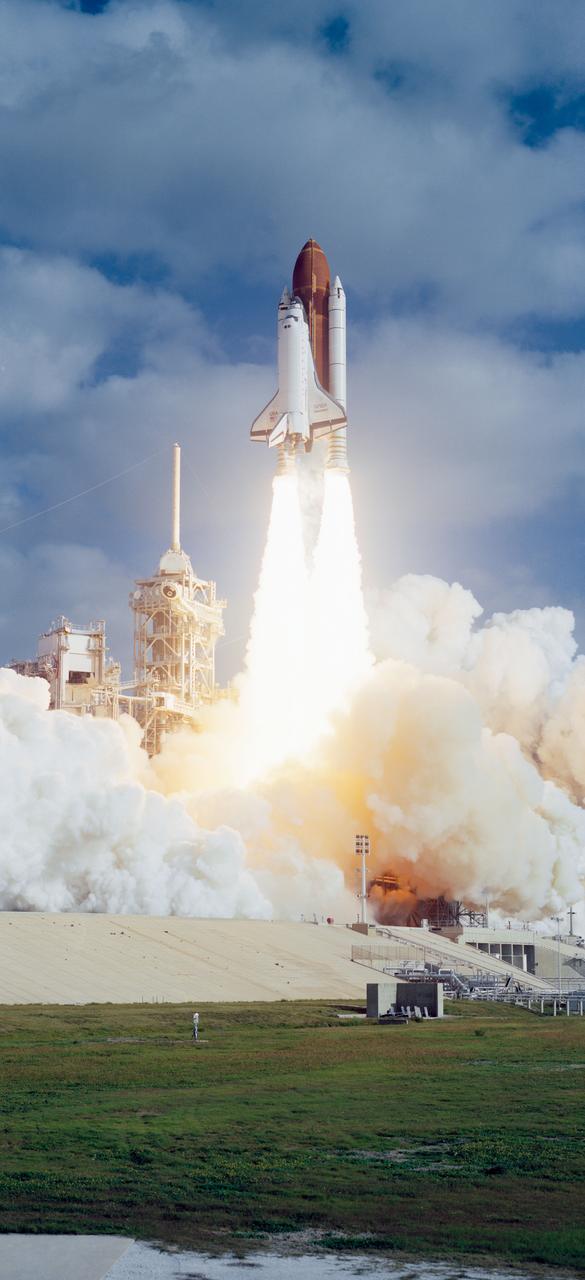
STS031-S-073 (24 April 1990) --? A vertical view of the launch of the STS-31 mission. Onboard Space Shuttle Discovery are the crew of five veteran astronauts and the Hubble Space Telescope (HST). Official launch time was 8:33:51.0492 a.m. (EDT). Headed for approximately five days in space are astronauts Loren J. Shriver, Charles F. Bolden, Jr., Bruce McCandless, II, Kathryn D. Sullivan, and Steven A. Hawley.
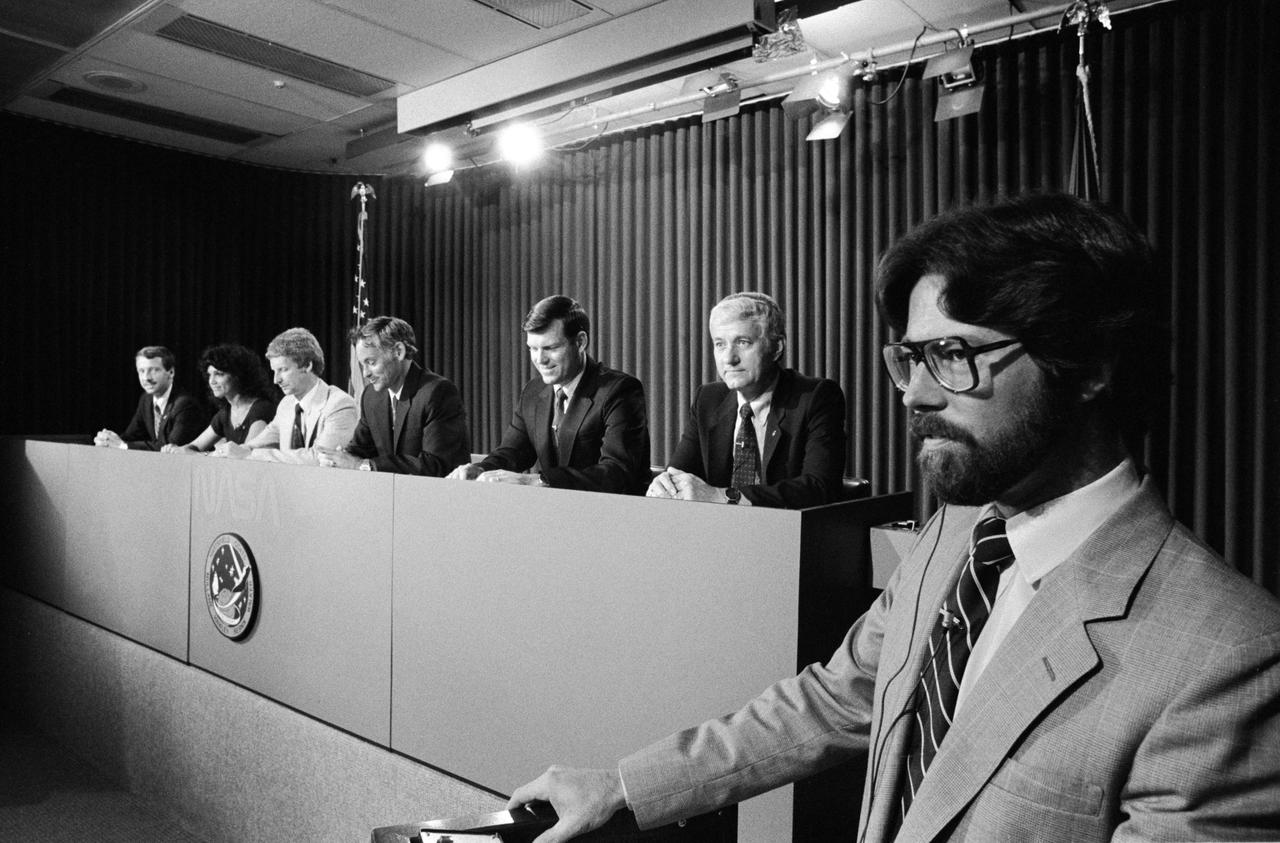
S84-40185 (08/21/1984) --- stronaut preflight Press Conference with the STS-41D Crew with Public Affairs Office (PAO) Reprentative Steve Nesbitt in the foreground in the Bldg 2 Briefing Room on 08/17/1984. Crewmembers visible (R-L) are: Henry W. Hartsfield, Jr., Crew Commander; Michael L. Coats, Pilot: Richard M. (Mike) Mullane, Steven A. Hawley, Judith A. Resnik - all Mission Specialists: and, Charlie D. Walker, Payload Specialist. JSC, Houston, TX
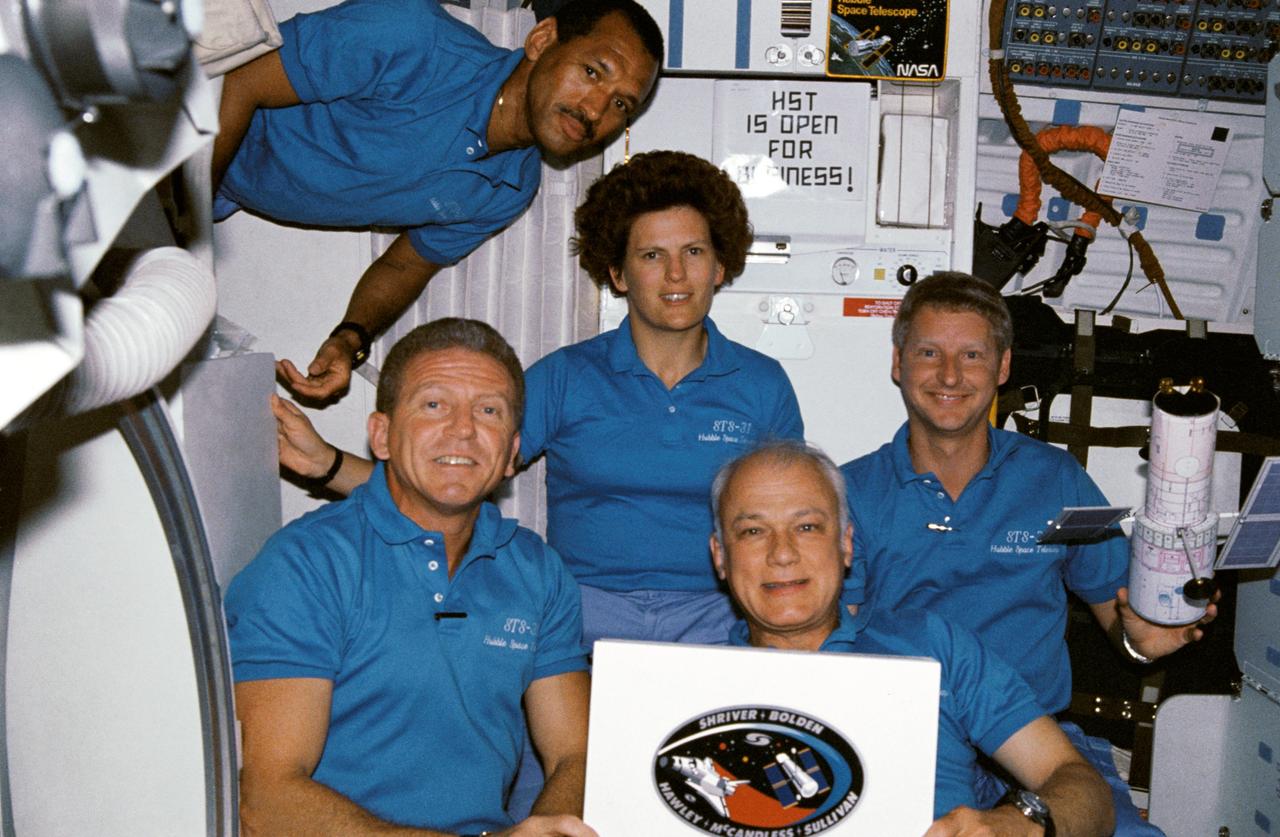
STS031-12-031 (24-29 April 1990) --- On Discovery's middeck, the STS-31 crew poses for a traditional in-flight portrait. Astronaut Loren J. Shriver, mission commander, is at lower left. Astronaut Charles F. Bolden, pilot, floats above. Others, left to right, are Kathryn D. Sullivan, Bruce McCandless II and Steven A. Hawley, all mission specialists. Photo credit: NASA
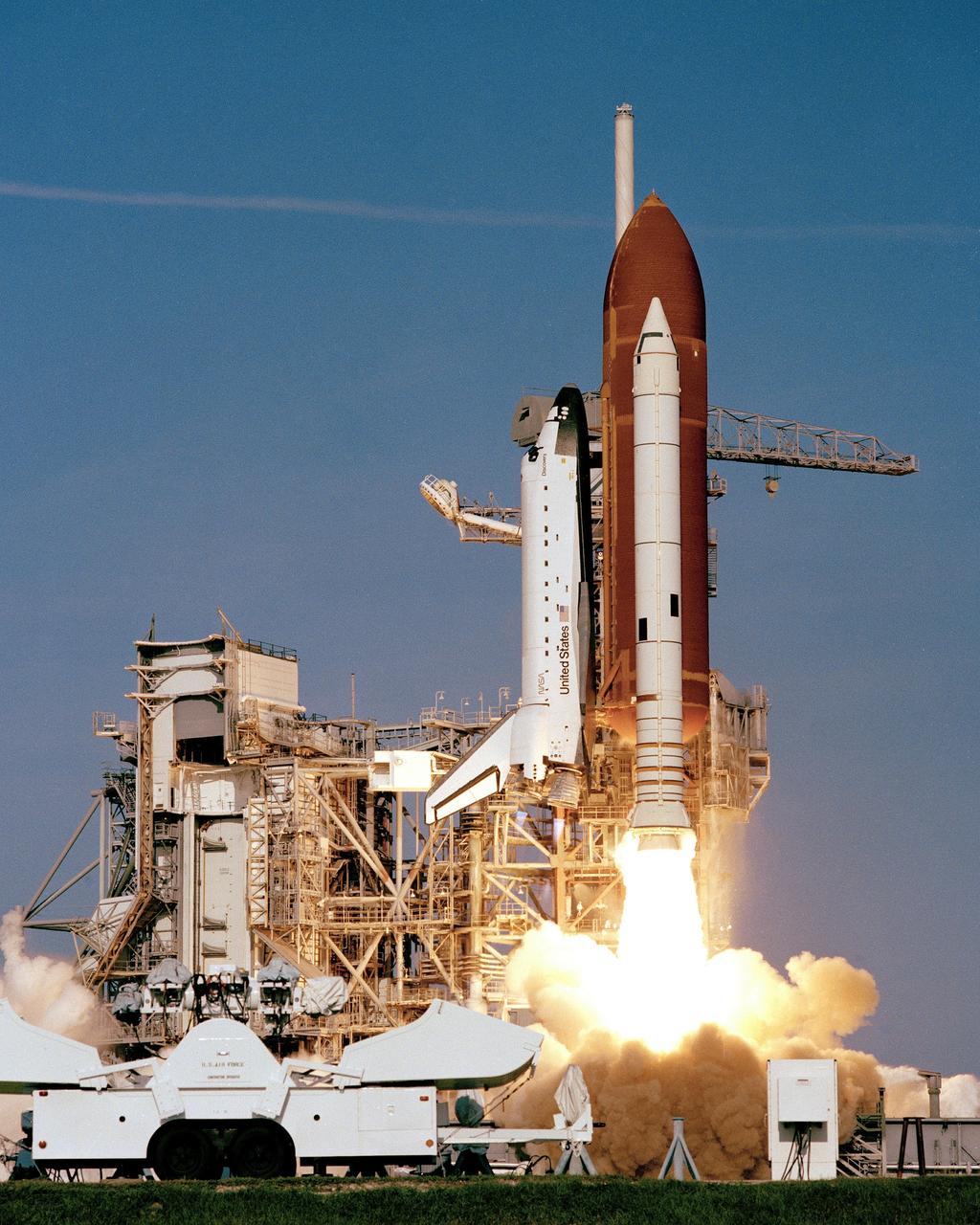
CAPE CANAVERAL, Fla. -- At the Kennedy Space Center in Florida, The space shuttle Discovery lifts off from Launch Pad 39A for its maiden flight at 8:42 a.m. EDT. The crew members for the 41-D flight are commander Henry w. Hartsfield, pilot Michael L. Coats, mission specialists Judith A. Resnik, Steven A. Hawley, Richard M. Mullane, and payload specialist Charles W. Walker. Photo Credit: NASA
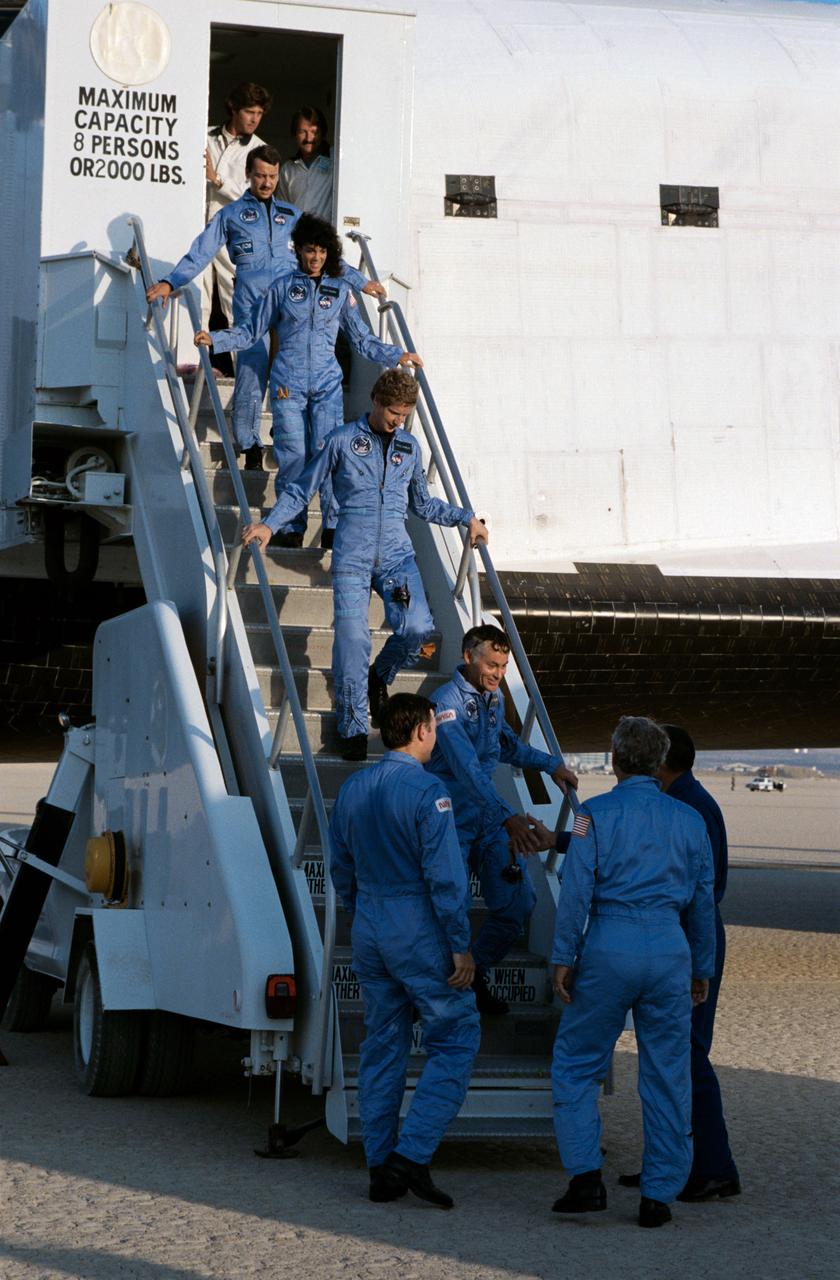
The crew of the STS 41-D mission exit the orbiter after landing at Edwards Air Force Base in California. Starting at the top of the ladder is Astronaut Charles D. Walker, payload specialist; Judith A. Resnik, mission specialist; Steven A. Hawley, mission specialist; and Richard M. Mike Mullane, mission specialist. Waiting at the bottom of the ramp are Astronaut Mike Coats (left), pilot and Henry W. Hartsfield, Jr. (center), crew commander.
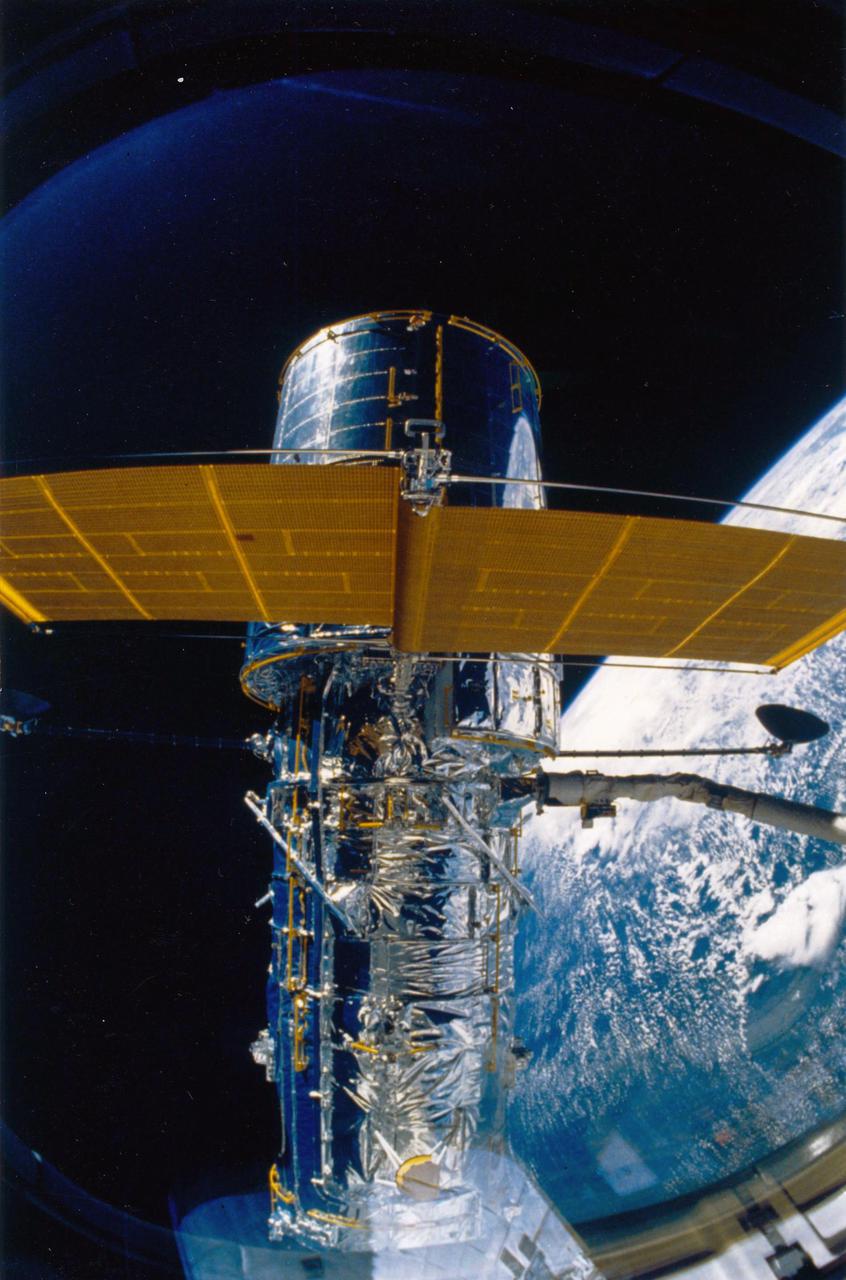
JOHNSON SPACE CENTER, HOUSTON, TEXAS -- From the overhead windows on the flight deck of Discovery, the Hubble Space Telescope is viewed just prior to its release from the remote manipulator arm. The solar panels are fully extended. The two S-band high-gain antennas used for communications through the Tracking and Data Relay Satellite are deployed. The telescope was released by Astronaut Steve Hawley on April 25, one day after launch.
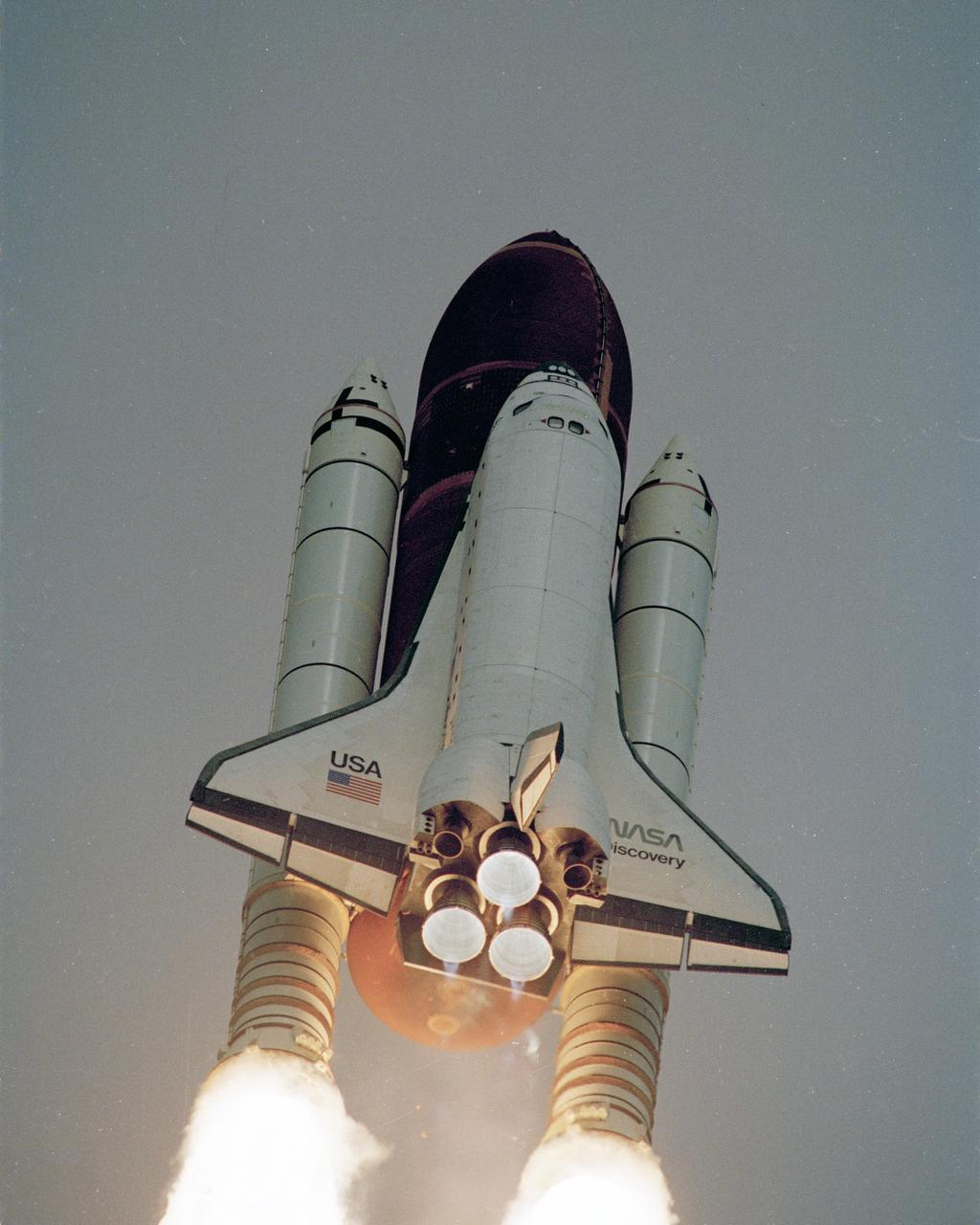
The space shuttle Discovery lifts off from Launch Pad 39-B at 8:33 a.m. EDT carrying a crew of five and the Hubble Space Telescope. STS-31 crew members are Commander Loren Shriver, Pilot Charles Bolden and Mission Specialists Steven Hawley, Bruce McCandless II and Kathryn Sullivan. Photo credit: NASA
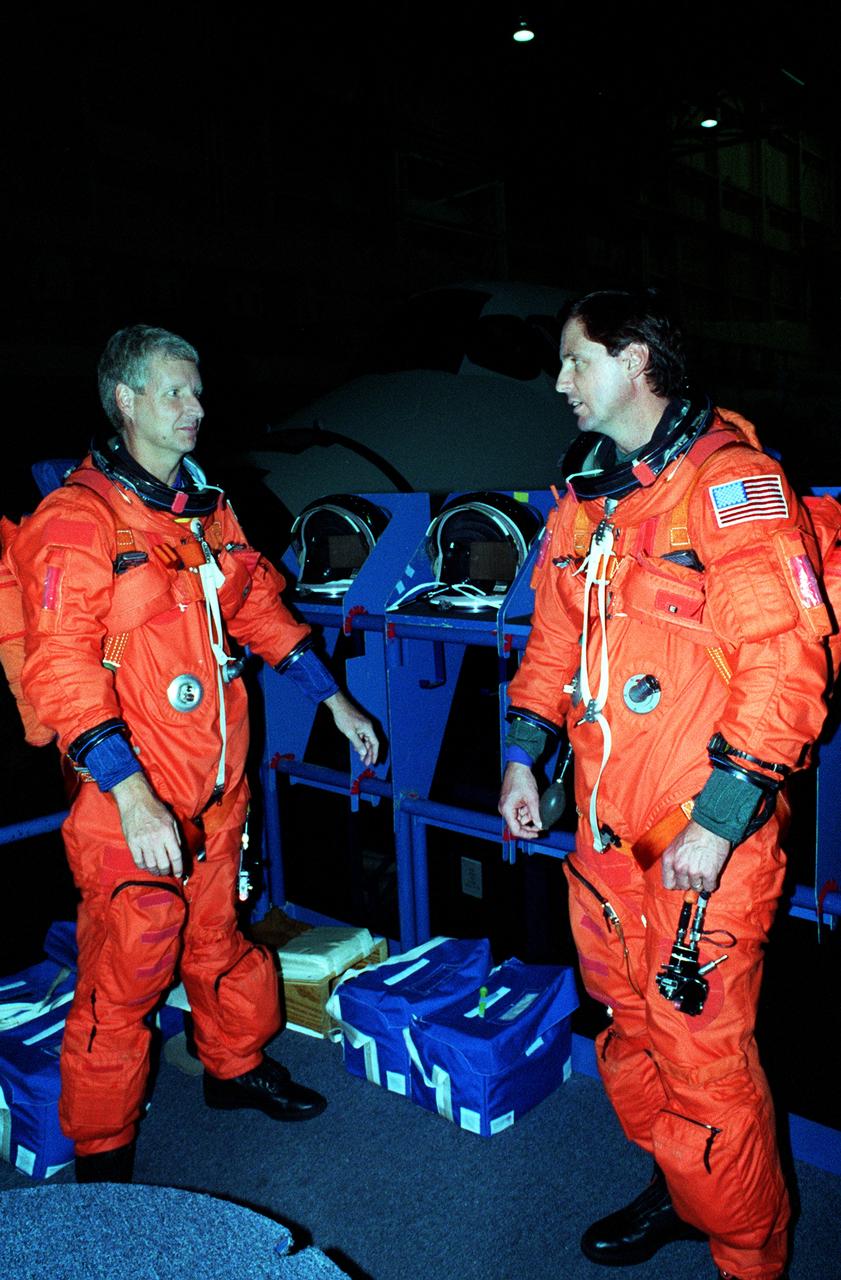
S96-18557 (30 Oct. 1996) --- Astronauts Steven A. Hawley (left) and Gregory J. Harbaugh participate in a training session in JSC's systems integration facility. Wearing training versions of the partial pressure launch and entry escape suit, the two STS-82 mission specialists and their crewmates simulated an emergency ejection, using an escape pole on the mid deck, as well as other phases of their scheduled February mission.
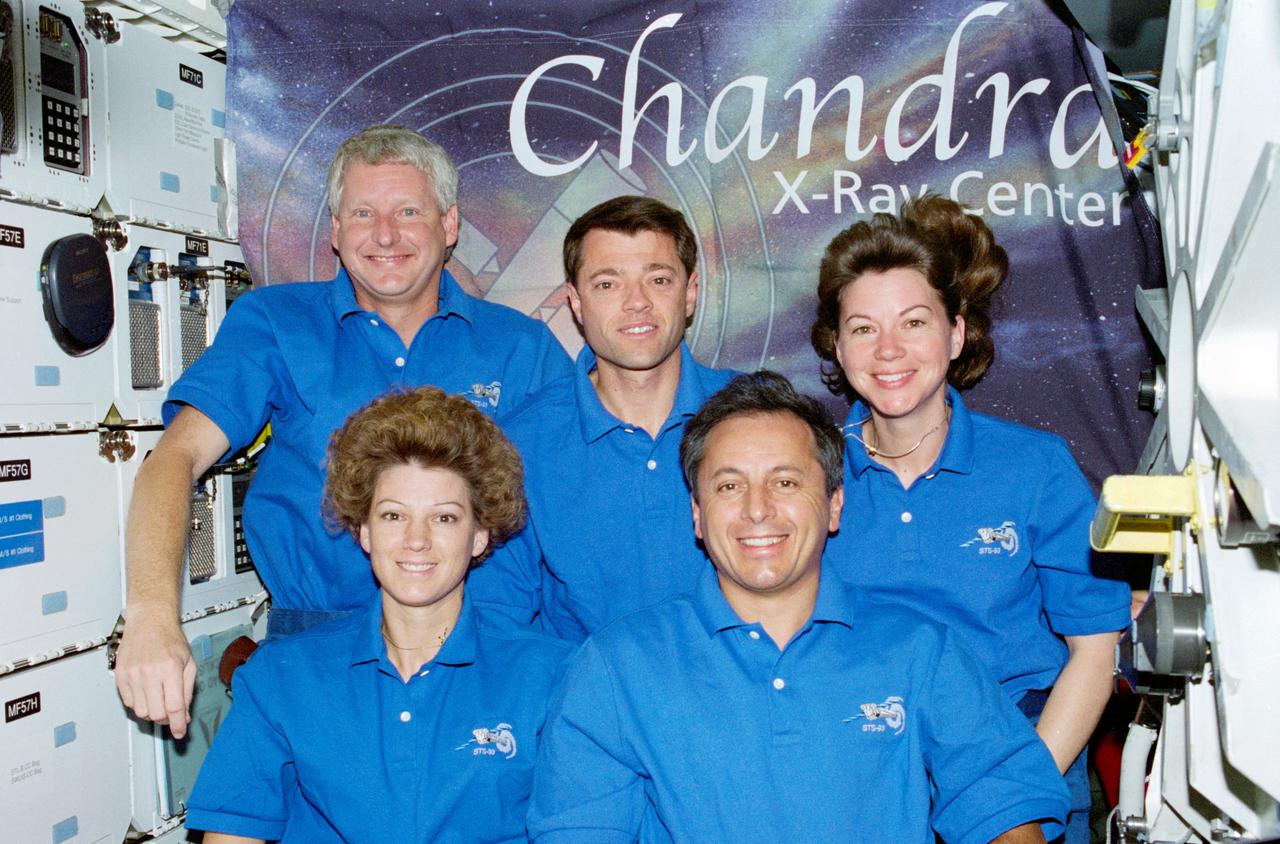
STS093-322-017 (23-27 July 1999) --- The five STS-93 astronauts pose for the traditional inflight crew portrait on Columbia's middeck. In front are astronauts Eileen M. Collins, mission commander, and Michel Tognini, mission specialist, representing France's Centre National d'Etudes Spatiales (CNES). Behind them are (from the left) astronauts Steven A. Hawley, mission specialist; Jeffrey S. Ashby, pilot; and Catherine G. (Cady) Coleman, mission specialist.
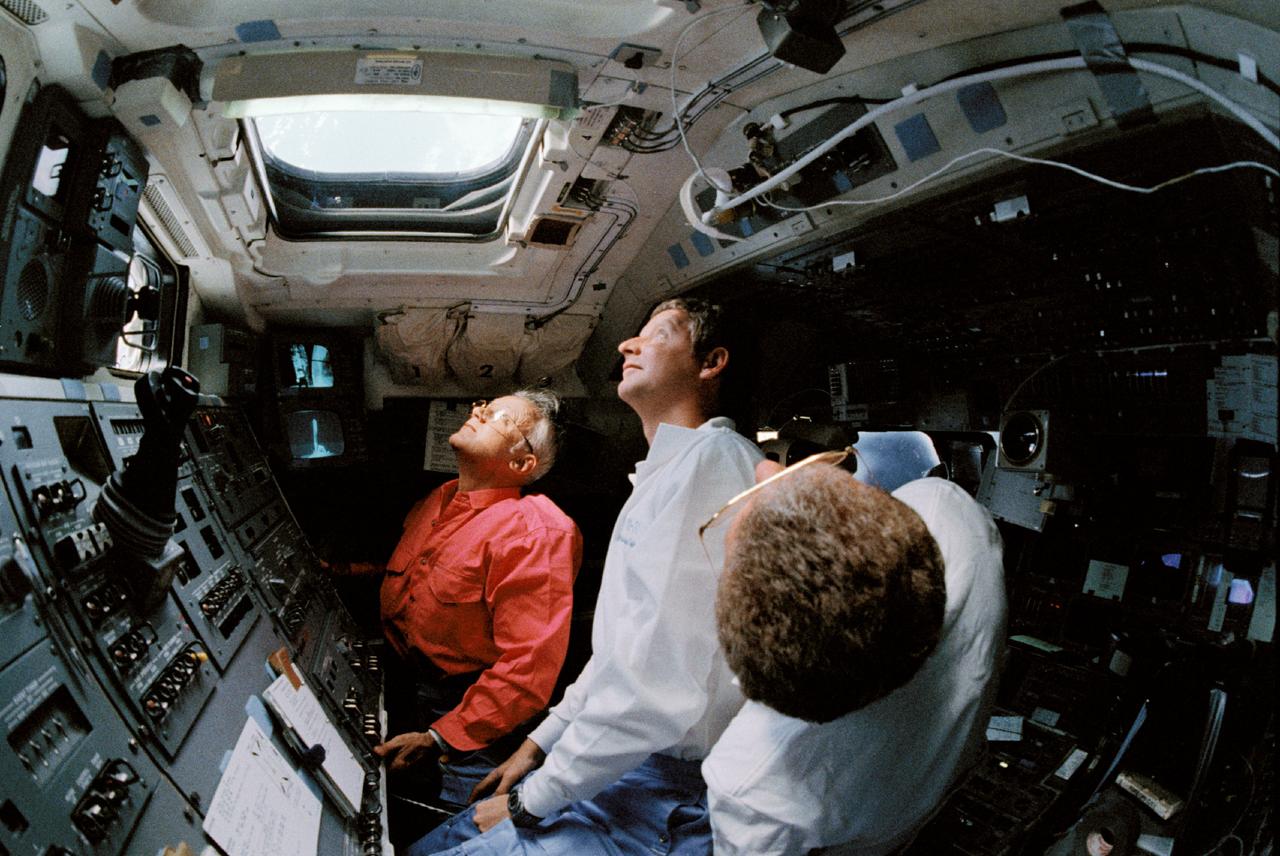
STS031-10-027 (24-29 April 1990) --- A "fish eye" lens captured this overall view of the aft flight deck of Space Shuttle Discovery while the crewmembers were monitoring the Hubble Space Telescope (HST) deployment checkout procedures. From front to back are astronauts Loren J. Shriver, commander, and Steven A. Hawley and MS Bruce McCandless II, both mission specialists, looking up at overhead windows and the HST on the remote manipulator system (RMS) outside them.
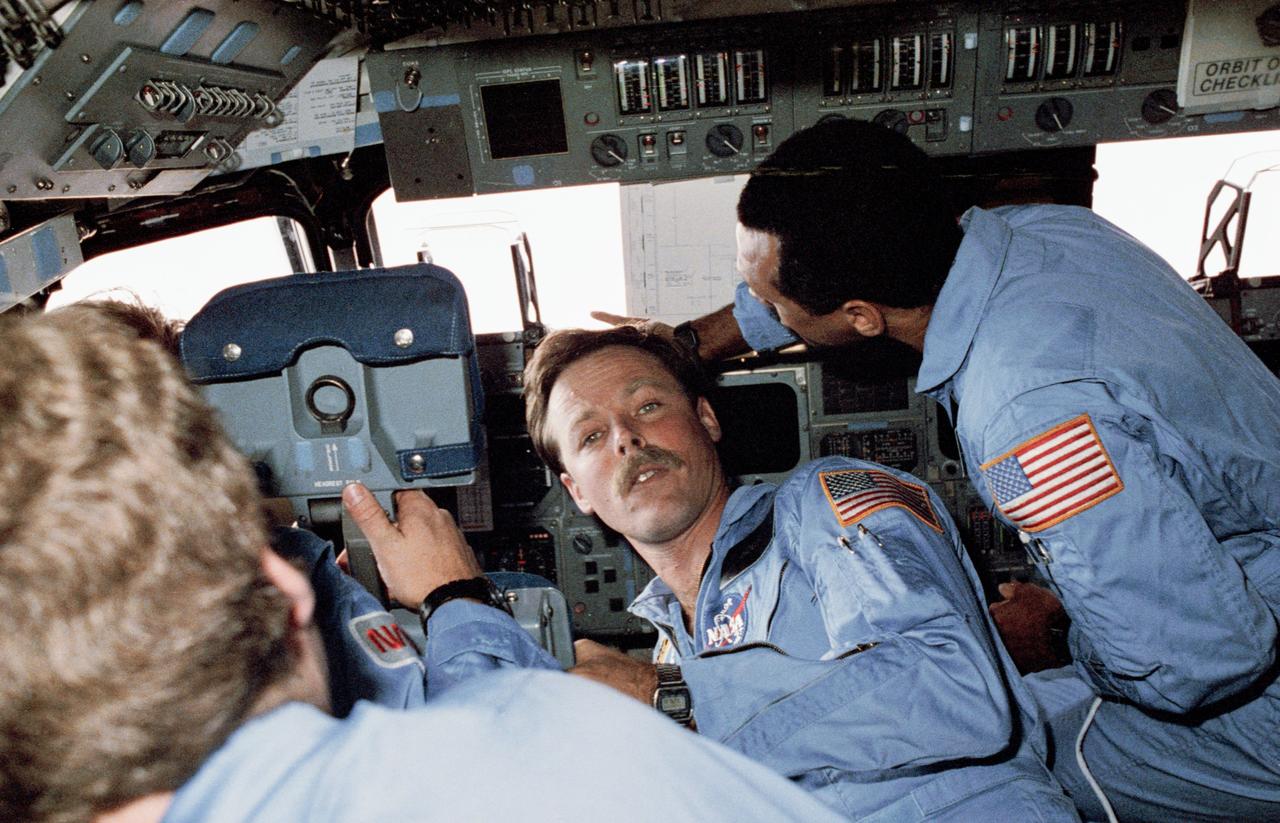
61C-21-009 (12-17 Jan 1986) --- Four members of the seven-man STS 61-C crew aboard the Columbia convene at the commander's station during the five-day mission which kicks off a busy 1986 for the Space Transportation System (STS). Astronaut Robert L. Gibson (center frame), mission commander, is surrounded by (l.-r.). Astronaut Steven A. Hawley, mission specialist, an unidentified crewmember (only partially visible) and astronaut Charles F. Bolden, pilot.
The STS-31 crew launched aboard the Space Shuttle Discovery on April 24, 1990 at 8:33:51am (EDT). Included in the crew of five were Loren J. Shriver, commander; Charles F. Bolden, pilot; and Steven A. Hawley, Bruce McCandless, and Kathryn D. Sullivan, all mission specialists. The primary goal of the mission was the deployment of the Hubble Space Telescope (HST) which was a Marshall Space Flight Center (MSFC) managed program.
The STS-31 crew launched aboard the Space Shuttle Discovery on April 24, 1990 at 8:33:51am (EDT). Included in the crew of five were Loren J. Shriver, commander; Charles F. Bolden, pilot; and Steven A. Hawley, Bruce McCandless, and Kathryn D. Sullivan, all mission specialists. The primary goal of the mission was the deployment of the Hubble Space Telescope (HST) which was a Marshall Space Flight Center (MSFC) managed program.
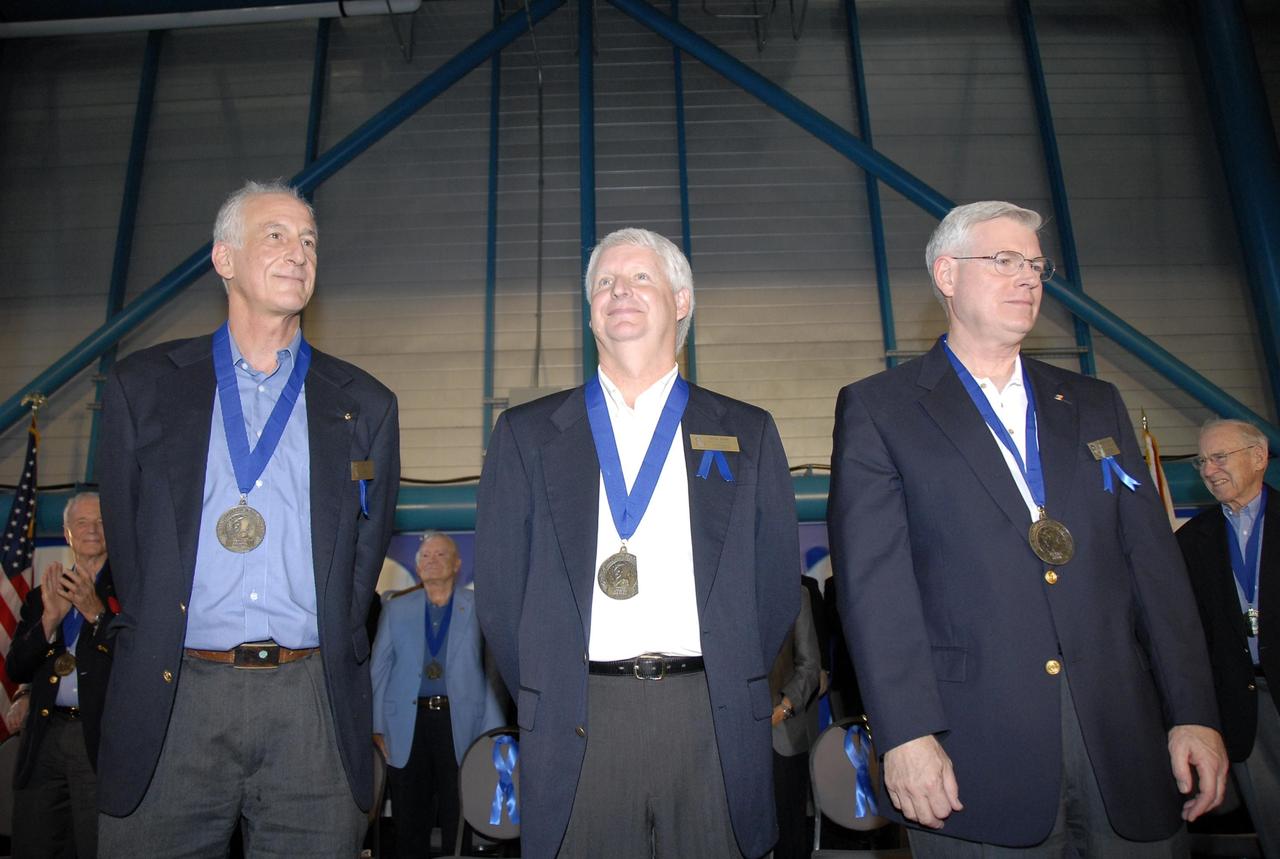
KENNEDY SPACE CENTER, FLA. -- The newest inductees to the U.S. Astronaut Hall of Fame stand tall of the ceremony. From left are Jeffrey A. Hoffman, Steven A. Hawley and Michael L. Coats. The May 5 induction has grown the number of space explorers enshrined in the Hall of Fame to 66. The ceremony was held at the Kennedy Space Center's Apollo/Saturn V Center. Photo credit: NASA/Kim Shiflett
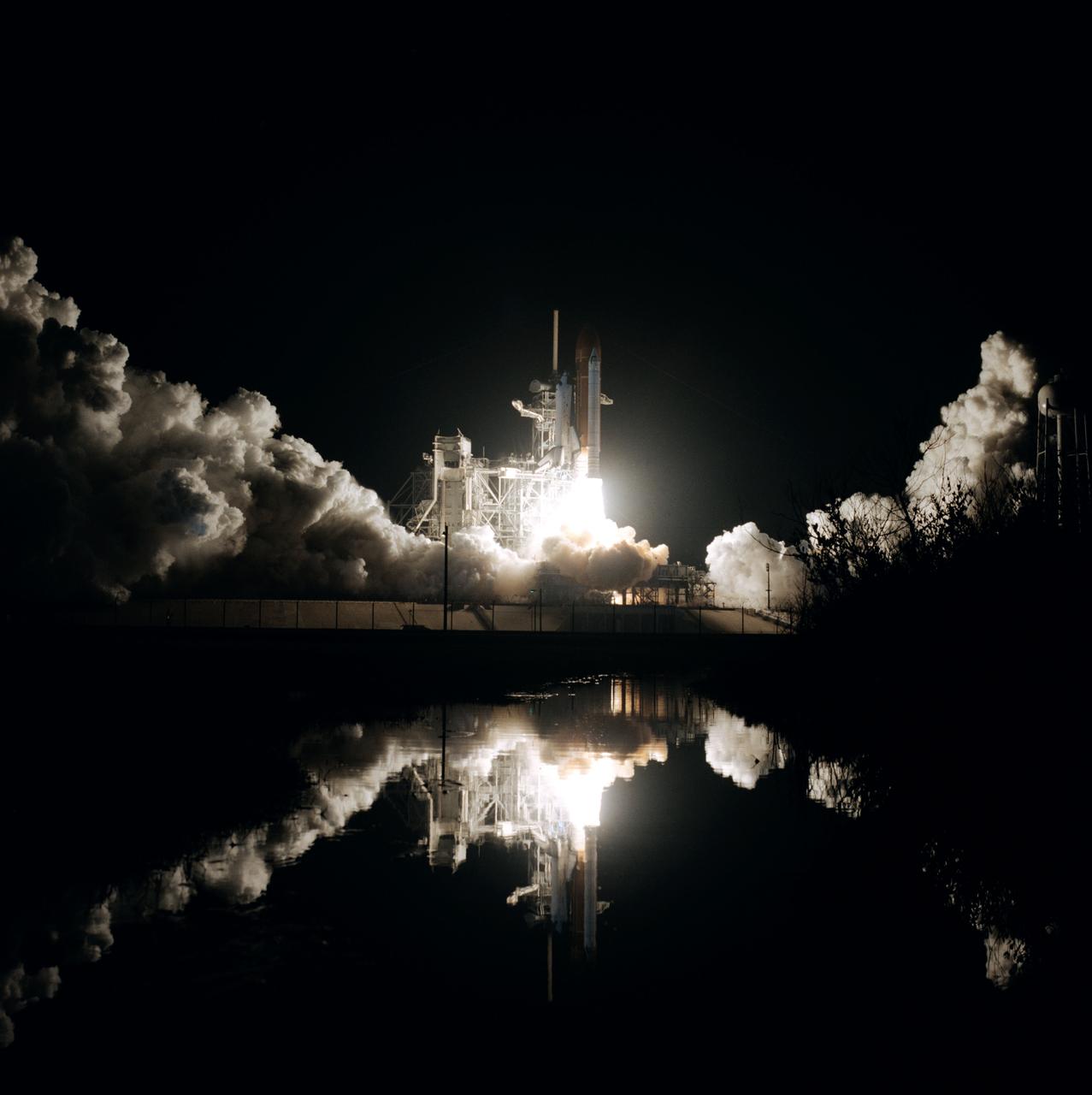
STS61C-S-048 (12 Jan. 1986) --- This is a wide shot of the early morning launch at Florida?s Kennedy Space Center of the space shuttle Columbia and the STS-61C crew on Jan. 12, 1986. Onboard were the following crew members -- Mission Commander Robert L. Gibson and Pilot Charles F. Bolden, along with Mission Specialists Franklin R. Chang-Diaz, Steven A. Hawley and George D. Nelson and Payload Specialists Robert J. Cenker of RCA and U.S. Rep. Bill Nelson. Photo credit: NASA
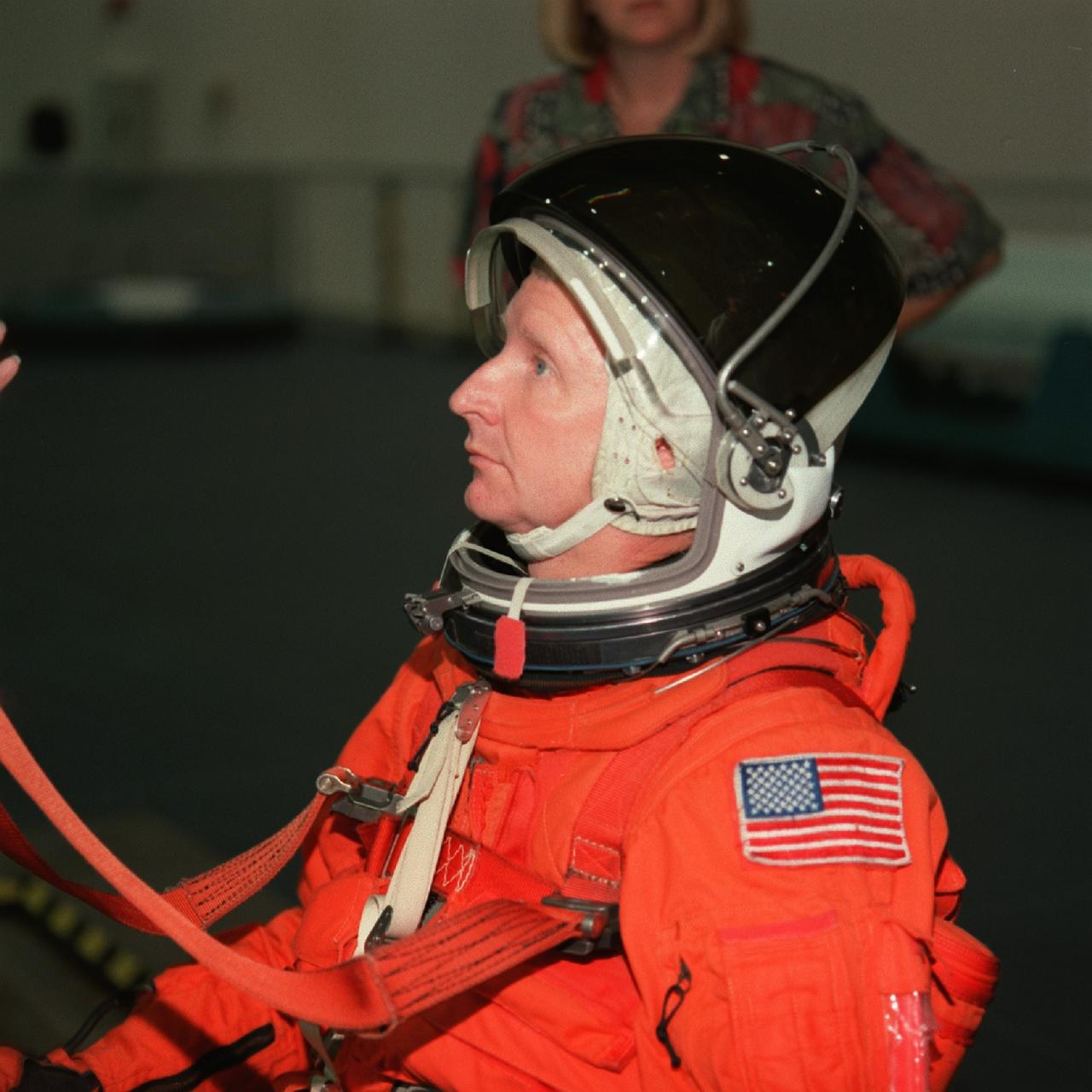
S98-09507 (6-24-98) --- Attired in a training version of the shuttle partial pressure launch and entry suit, astronaut Steven A. Hawley participates in a water survival/emergency egress training exercise in the Neutral Buoyancy Laboratory (NBL) at the Johnson Space Center's Sonny Carter Training Center. The mission specialist will join four other astronauts for a springtime 1999 mission in Earth orbit aboard the Space Shuttle Columbia.
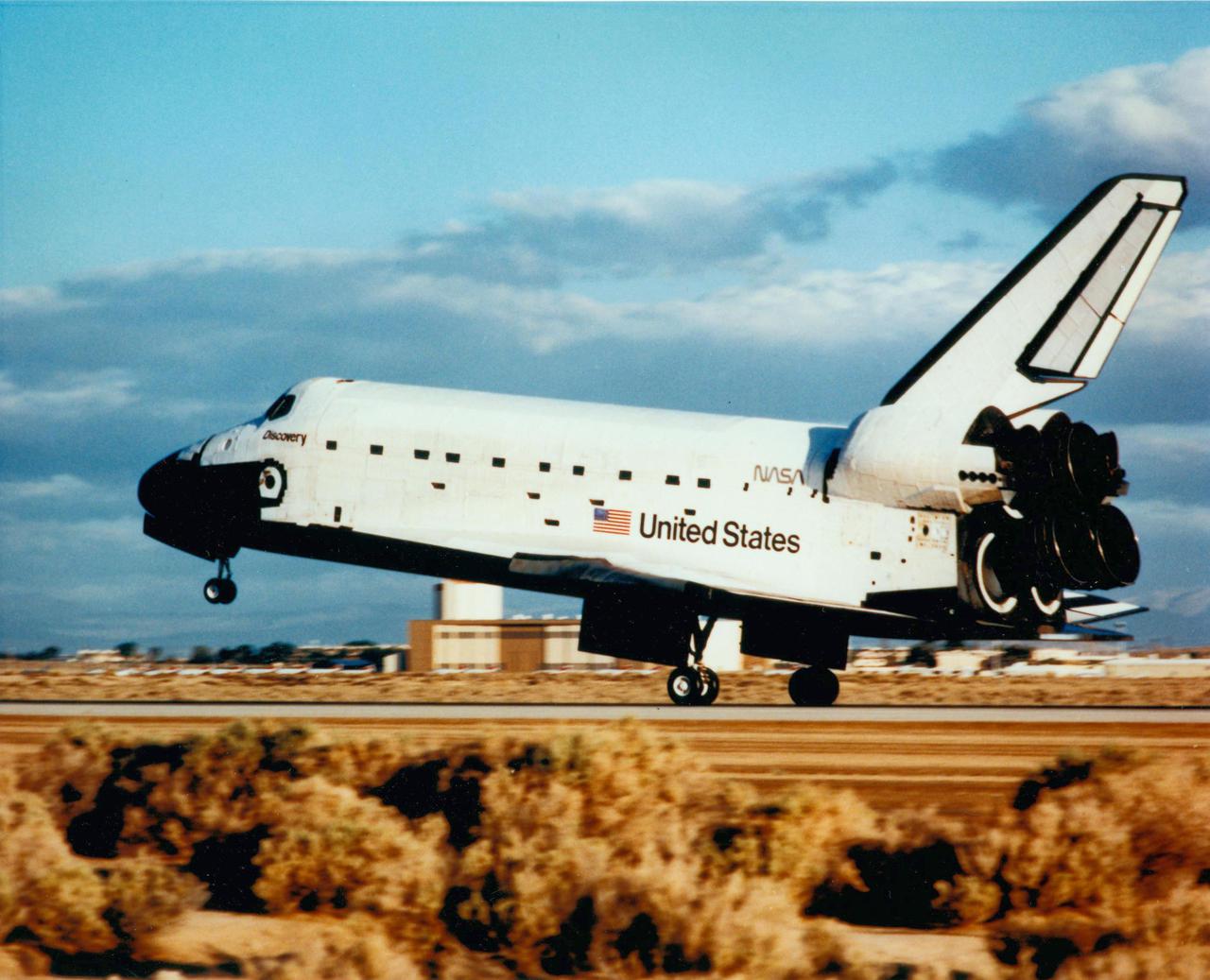
KENNEDY SPACE CENTER, FLA. -- The Space Shuttle Discovery makes a smooth landing on the runway at Edwards Air Force Base to complete a highly successful five-day mission. It was an Earth-orbital flight during which the Hubble Space Telescope was sent toward its 15-year mission. Landing was completed at 6:51 a.m. (PDT), April 29, 1990. Inside the spacecraft for STS-31 were Astronauts Loren J. Shriver, Charles F. Bolden, Bruce McCandless II, Kathryn D. Sullivan and Steven A. Hawley.

In the Operations and Checkout Building, STS-93 Mission Specialist Steven A. Hawley (Ph.D.) smiles after donning his launch and entry suit during final launch preparations. STS-93 is a five-day mission primarily to release the Chandra X-ray Observatory, which will allow scientists from around the world to study some of the most distant, powerful and dynamic objects in the universe. The new telescope is 20 to 50 times more sensitive than any previous X-ray telescope and is expected unlock the secrets of supernovae, quasars and black holes. The STS-93 crew numbers five: Commander Eileen M. Collins, Pilot Jeffrey S. Ashby, and Mission Specialists Hawley, Catherine G. Coleman (Ph.D.) and Michel Tognini of France, with the Centre National d'Etudes Spatiales (CNES). Collins is the first woman to serve as commander of a shuttle mission. STS-93 is scheduled to lift off at 12:36 a.m. EDT July 20. The target landing date is July 24 at 11:30 p.m. EDT
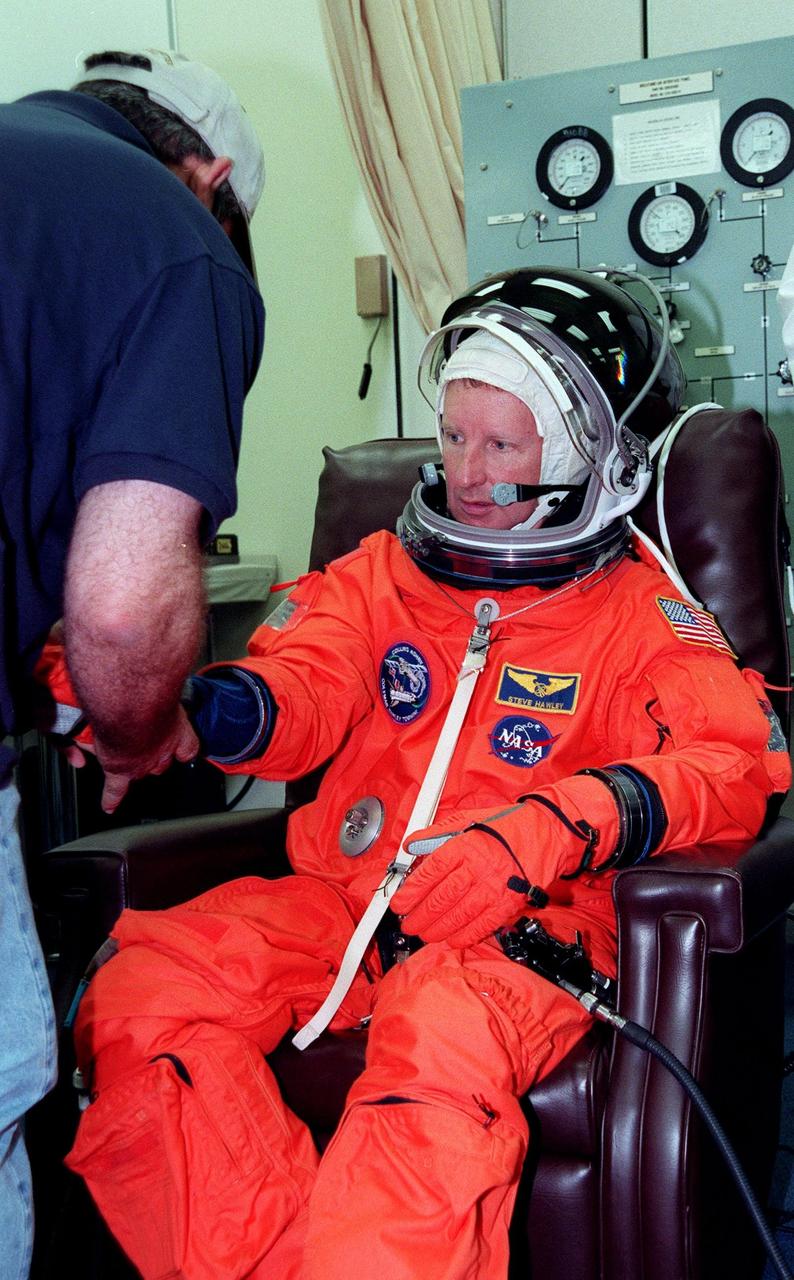
During final launch preparations in the Operations and Checkout Building, STS-93 Mission Specialist Steven A. Hawley (Ph.D.)gets help donning his launch and entry suit from a suit tech. After Space Shuttle Columbia's July 20 launch attempt was scrubbed at the T-7 second mark in the countdown, the launch was rescheduled for Thursday, July 22, at 12:28 a.m. EDT. The target landing date is July 26, 1999, at 11:24 p.m. EDT. STS-93 is a five-day mission primarily to release the Chandra X-ray Observatory, which will allow scientists from around the world to study some of the most distant, powerful and dynamic objects in the universe. The new telescope is 20 to 50 times more sensitive than any previous X-ray telescope and is expected unlock the secrets of supernovae, quasars and black holes. The STS-93 crew numbers five: Commander Eileen M. Collins, Pilot Jeffrey S. Ashby, and Mission Specialists Hawley, Catherine G. Coleman (Ph.D.) and Michel Tognini of France, with the Centre National d'Etudes Spatiales (CNES). Collins is the first woman to serve as commander of a shuttle mission

STS-93 Mission Specialist Steven A. Hawley (Ph.D.) grins as he steps down from a T-38 jet aircraft after landing at KSC's Shuttle Landing Facility. The STS-93 crew are at KSC to participate in Terminal Countdown Demonstration Tests (TCDT) this week. TCDT activities familiarize the crew with the mission, provide training in emergency exit from the orbiter and launch pad, and include a launch-day dress rehearsal culminating with a simulated main engine cut-off. Joining Hawley are Commander Eileen M. Collins, Pilot Jeffrey S. Ashby, and Mission Specialists Catherine G. Coleman (Ph.D.) and Michel Tognini of France, with the Centre National d'Etudes Spatiales (CNES). Collins is the first woman to serve as mission commander. The primary mission of STS-93 is the release of the Chandra X-ray Observatory, which will allow scientists from around the world to obtain unprecedented X-ray images of exotic environments in space to help understand the structure and evolution of the universe. Chandra is expected to provide unique and crucial information on the nature of objects ranging from comets in our solar system to quasars at the edge of the observable universe. Since X-rays are absorbed by the Earth's atmosphere, space-based observatories are necessary to study these phenomena and allow scientists to analyze some of the greatest mysteries of the universe
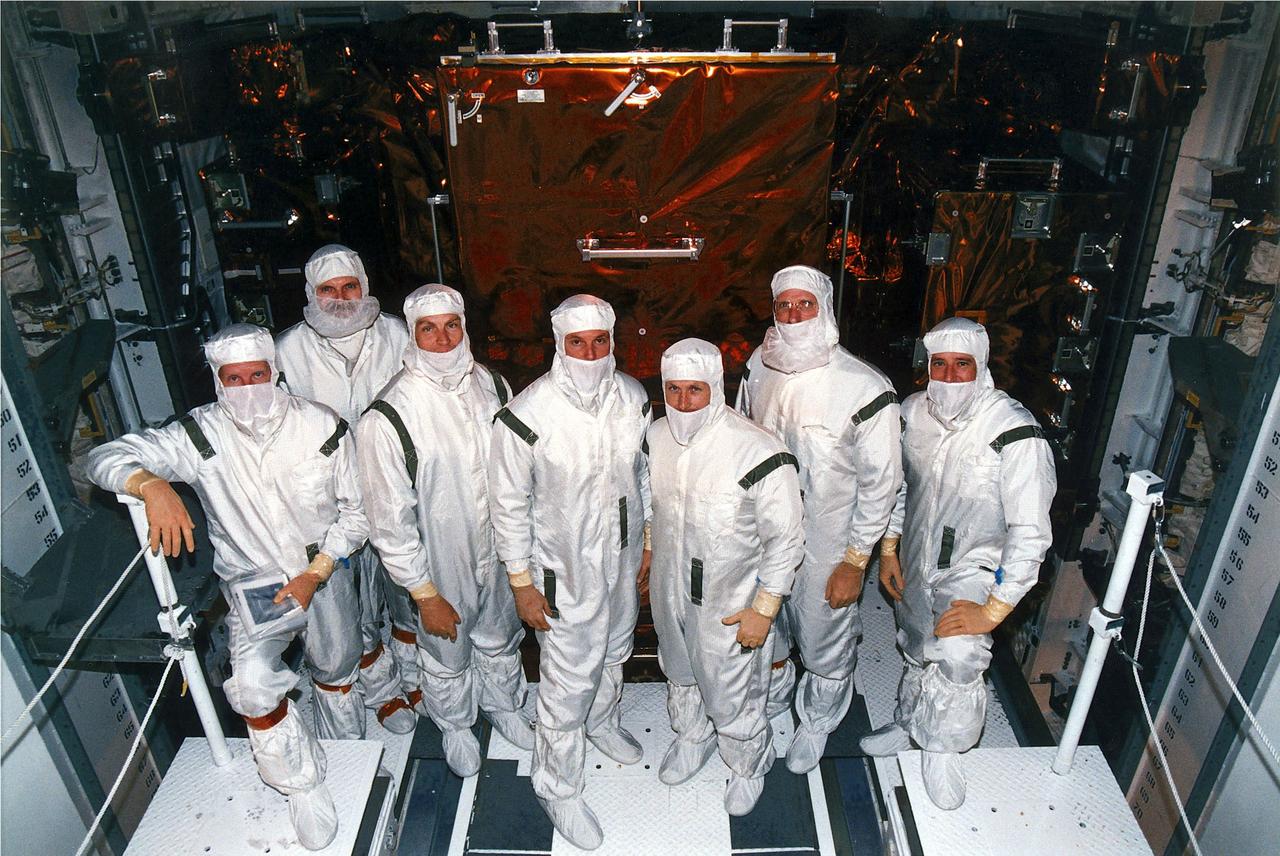
KENNEDY SPACE CENTER, FLA. - STS-82 crew members pose in their clean room suits at Launch Pad 39A where the Space Shuttle Discovery is undergoing final preparations for liftoff on the second Hubble Space Telescope (HST) servicing mission. They are making a final inspection of the payload before payload bay closure. From left are Mission Specialists Steven A. Hawley and Steven L. Smith, Payload Commander Mark C. Lee, Mission Specialist GregoryJ. Harbaugh, Mission Commander Kenneth D. Bowersox, Mission Specialist Joseph R. "Joe" Tanner and Pilot Scott J. "Doc" Horowitz. STS-82 is scheduled for liftoff on Feb. 11 during a 65-minute launch window that opens at 3:56 a.m. EST.
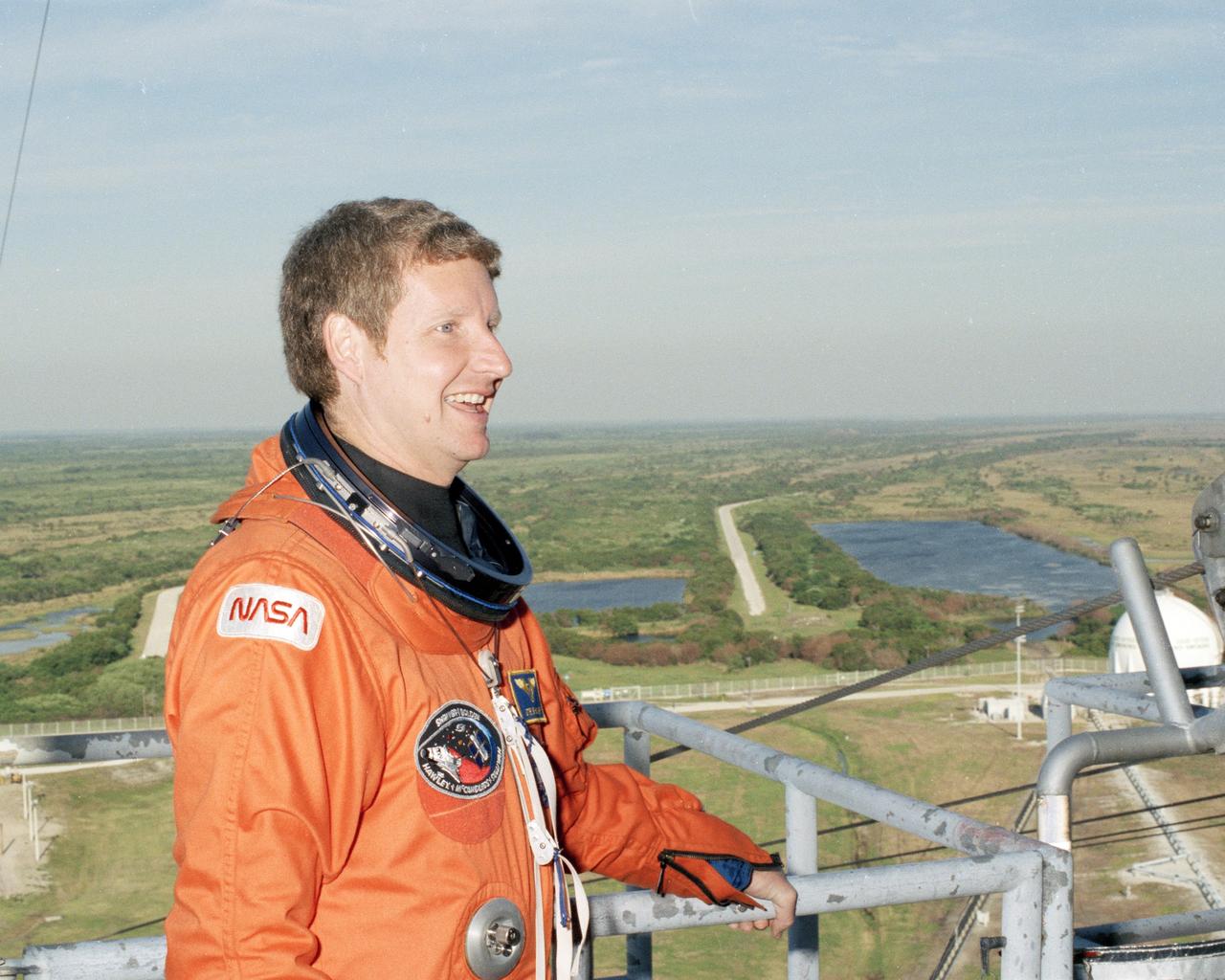
Wide-open Florida terrain creates a dramatic backas STS-31 Mission Specialist Steven A. Hawley stands near the emergency exit system at the 194-foot level of Launch Pad 39B during the Terminal Countdown Demonstration Test, or TCDT. Conducted March 19-20, the TCDT is a dress rehearsal for launch, simulating final countdown from the T-24 hour mark up to T-5 seconds. Space shuttle mission STS-31 is set to lift off on April 12, carrying a five-member crew and the Hubble Space Telescope. Photo credit: NASA
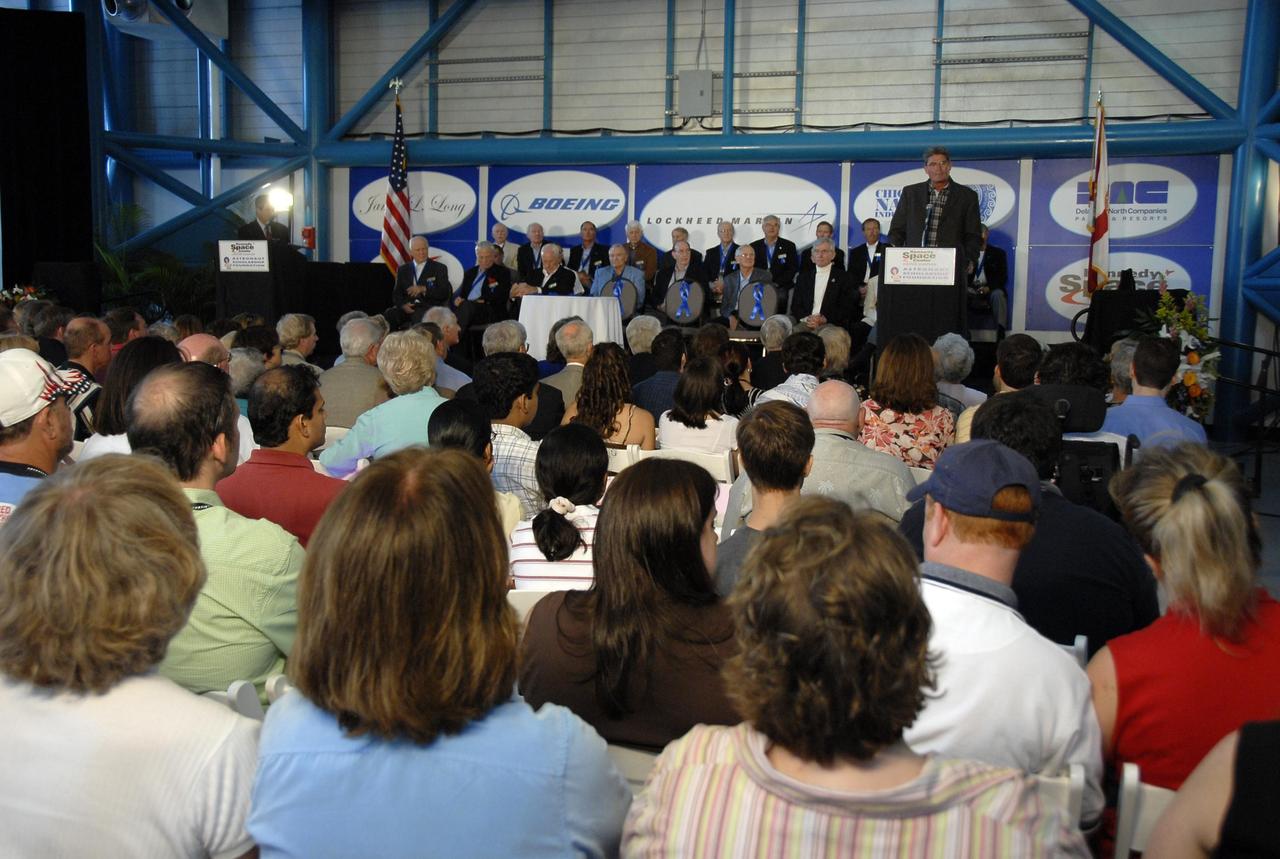
KENNEDY SPACE CENTER, FLA. -- At the U.S. Astronaut Hall of Fame induction ceremony, Kennedy Space Center Director Bill Parsons speaks about the accomplishments of the newest inductees to the Hall of Fame. The May 5 induction added space shuttle commanders Michael L. Coats, Steven A. Hawley and Jeffrey A. Hoffman to the Hall of Fame. They grow the number of space explorers enshrined in the Hall of Fame to 66. These gentlemen have joined such American space heroes as Neil Armstrong, Glenn, Alan Shepard and Sally Ride. The ceremony was held at the Kennedy Space Center's Apollo/Saturn V Center. Photo credit: NASA/Kim Shiflett
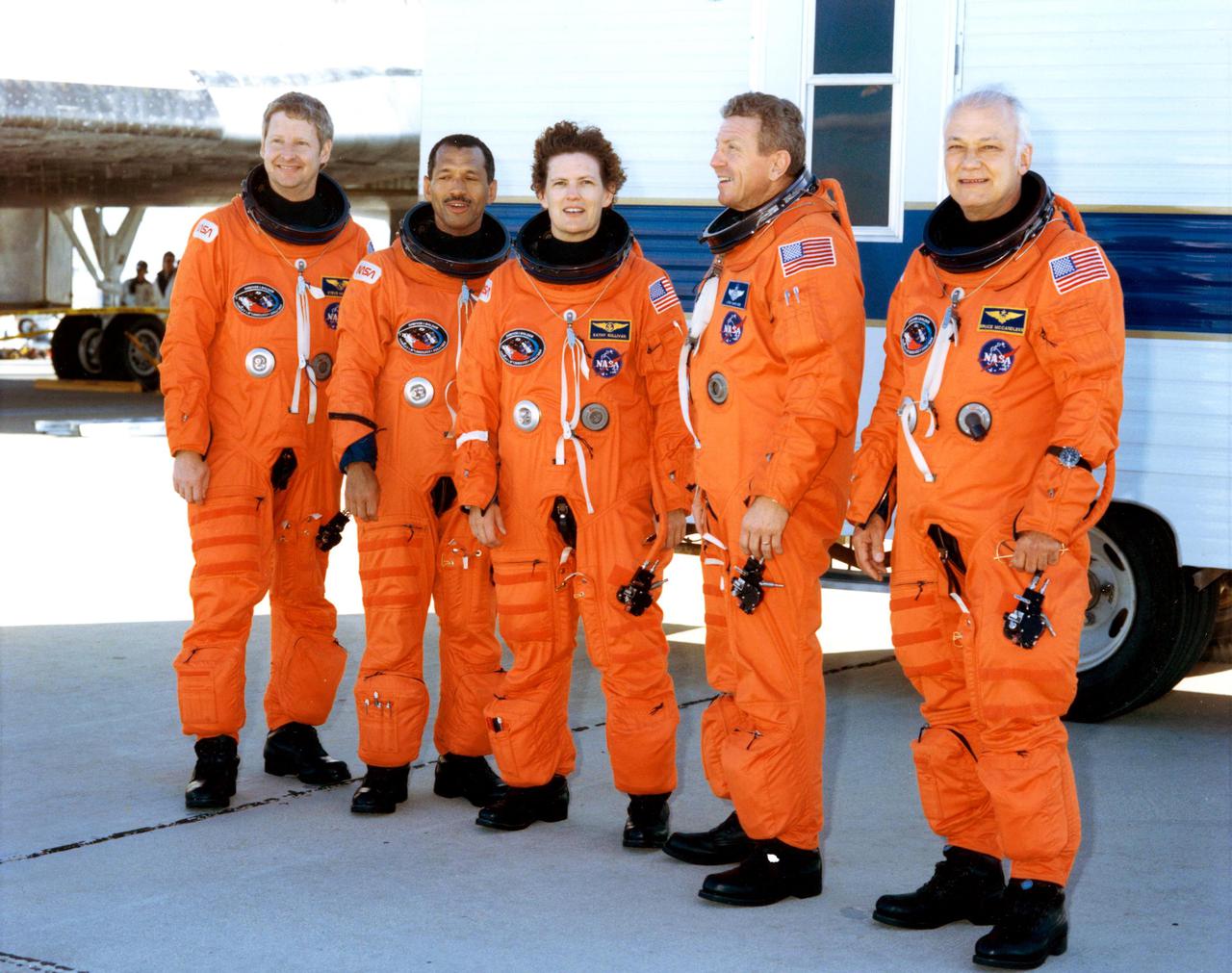
DRYDEN FLIGHT RESEARCH FACILITY, EDWARDS, CALIF. -- STS-31 POST-LANDING CREW PORTRAIT -- The astronauts of STS-31 pose for a quick photo near the Space Shuttle Discovery following a smooth landing on the runway at Edwards Air Force Base to complete a highly successful five day mission. Picture, left to right, are Astronauts Steven A. Hawley, Charles F. Bolden Jr., Kathryn D. Sullivan, Loren J. Shriver, and Bruce McCandless II. Theirs was an Earth-orbital flight during which the Hubble Space Telescope was sent toward its 15-year mission. Landing was completed at 6:51 a.m. (PDT), April 29, 1990.

KENNEDY SPACE CENTER, FLA. -- At the Kennedy Space Center's Apollo/Saturn V Center, a wreath and poster honor former astronaut Wally Schirra, who died May 3. The site is the location for the U.S. Astronaut Hall of Fame induction ceremony. The May 5 induction added space shuttle commanders Michael L. Coats, Steven A. Hawley and Jeffrey A. Hoffman to the Hall of Fame. They grow the number of space explorers enshrined in the Hall of Fame to 66. These gentlemen have joined such American space heroes as Neil Armstrong, John Glenn, Alan Shepard and Sally Ride. Photo credit: NASA/Kim Shiflett
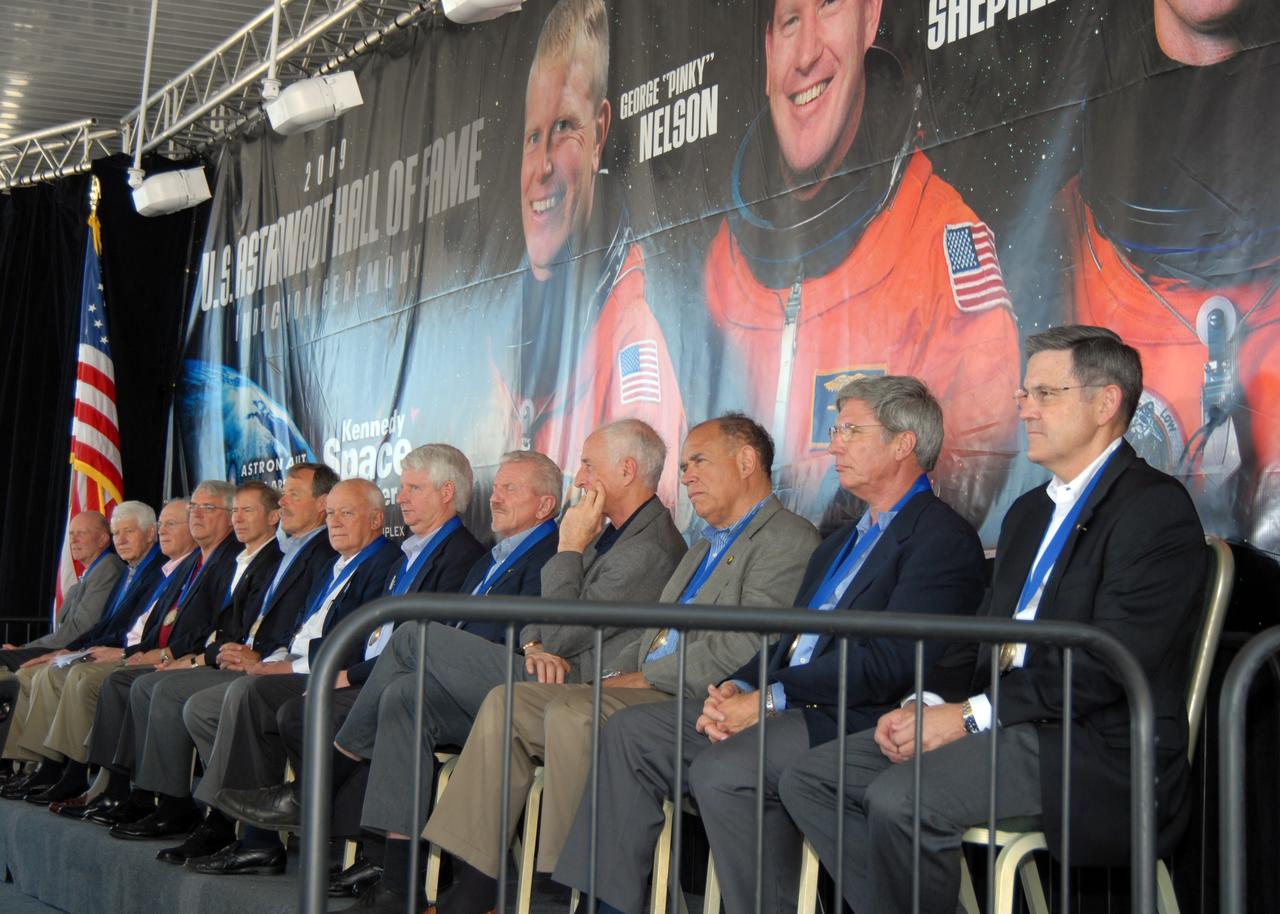
CAPE CANAVERAL, Fla. –– Hall of Fame astronauts (from left) Gordon Fullerton, Henry W. "Hank" Hartsfield Jr., Rick Hauk, Dan Brandenstein, Brewster Shaw, Robert "Hoot" Gibson, Bruce McCandless, Steven Hawley, Loren Shriver, Jeff Hoffman, Fred Gregory, John Blaha and Bob Cabana watch the U.S. Astronaut Hall of Fame induction ceremony at NASA's Kennedy Space Center Visitor Complex in Florida. Cabana is the Kennedy Space Center director. The ceremony took place May 2. More than 20 hall of fame astronauts attended, including Scott Carpenter, Walt Cunningham, Jim Lovell and Bob Crippen. Photo credit: NASA/Jim Grossmann
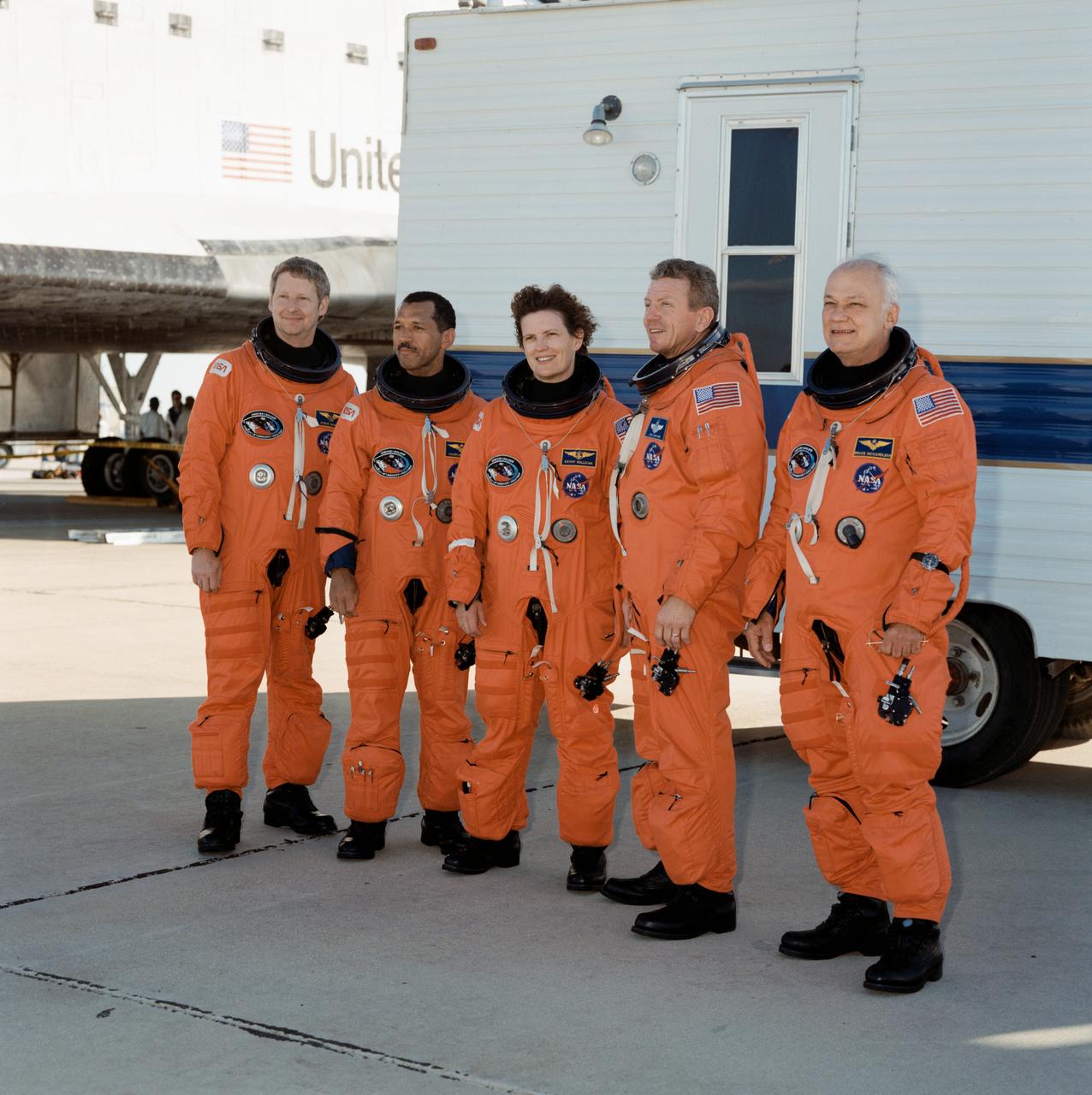
STS031-S-130 (29 April 1990) --- The astronauts of STS-31 pose for a quick photo near the Space Shuttle Discovery following a smooth landing on the runway at Edwards Air Force Base to complete a highly successful five-day mission. Pictured, left to right, are Astronauts Steven A. Hawley, Charles F. Bolden Jr., Kathryn D. Sullivan, Loren J. Shriver, and Bruce McCandless II. Theirs was an Earth orbital flight during which the Hubble Space Telescope (HST) was sent toward its 15-year mission.
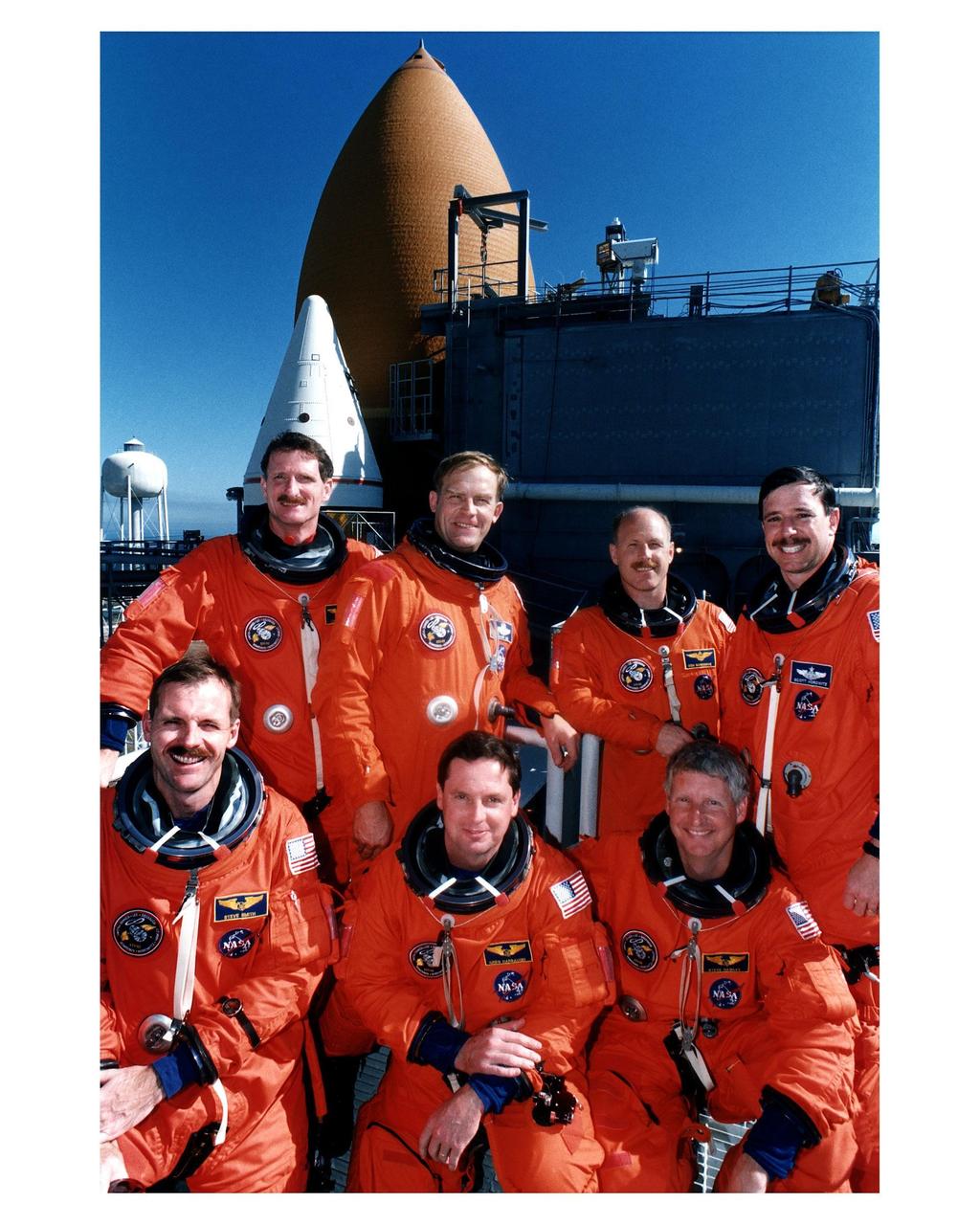
KENNEDY SPACE CENTER, FLA. -- STS-82 crew members are all smiles as they pose for a group photo at Launch Pad 39A in front of the Space Shuttle Discovery. They are participating in the Terminal Countdown Demonstration Test (TCDT), a dress rehearsal for launch. In the front row, from left, are Mission Specialists Steven L. Smith, Gregory J. Harbaugh and Steven A. Hawley. Standing in the back row, from left, are Joseph R. "Joe" Tanner, Payload Commander Mark C. Lee, Mission Commander Kenneth D. Bowersox and Pilot Scott J. "Doc" Horowitz. STS-82 will be the second Hubble Space Telescope servicing mission. Liftoff is targeted for Feb. 11
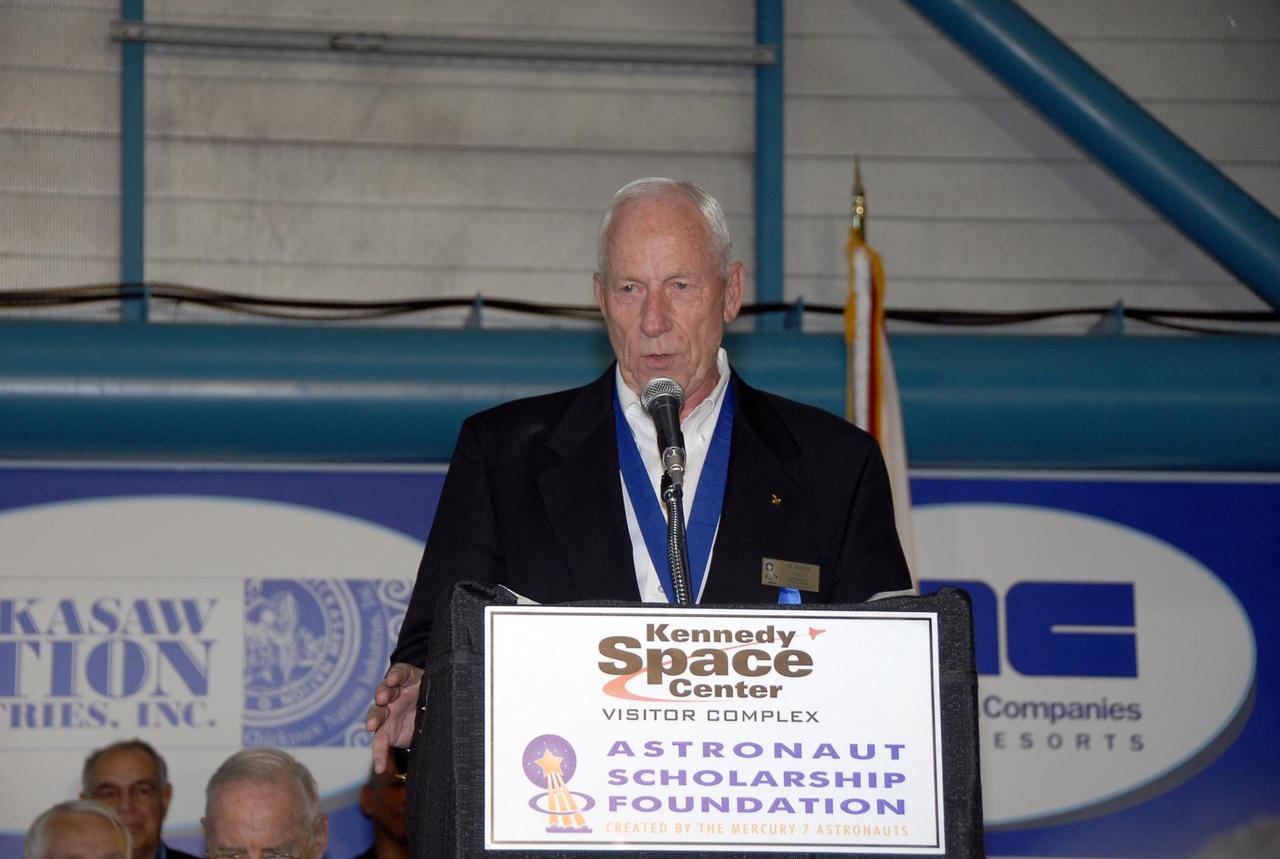
KENNEDY SPACE CENTER, FLA. -- U.S. Astronaut Hall of Fame member Al Worden speaks about the accomplishments of the newest inductees to the Hall of Fame. The May 5 induction added space shuttle commanders Michael L. Coats, Steven A. Hawley and Jeffrey A. Hoffman to the Hall of Fame. They grow the number of space explorers enshrined in the Hall of Fame to 66. These gentlemen have joined such American space heroes as Neil Armstrong, Glenn, Alan Shepard and Sally Ride. The ceremony was held at the Kennedy Space Center's Apollo/Saturn V Center. Photo credit: NASA/Kim Shiflett
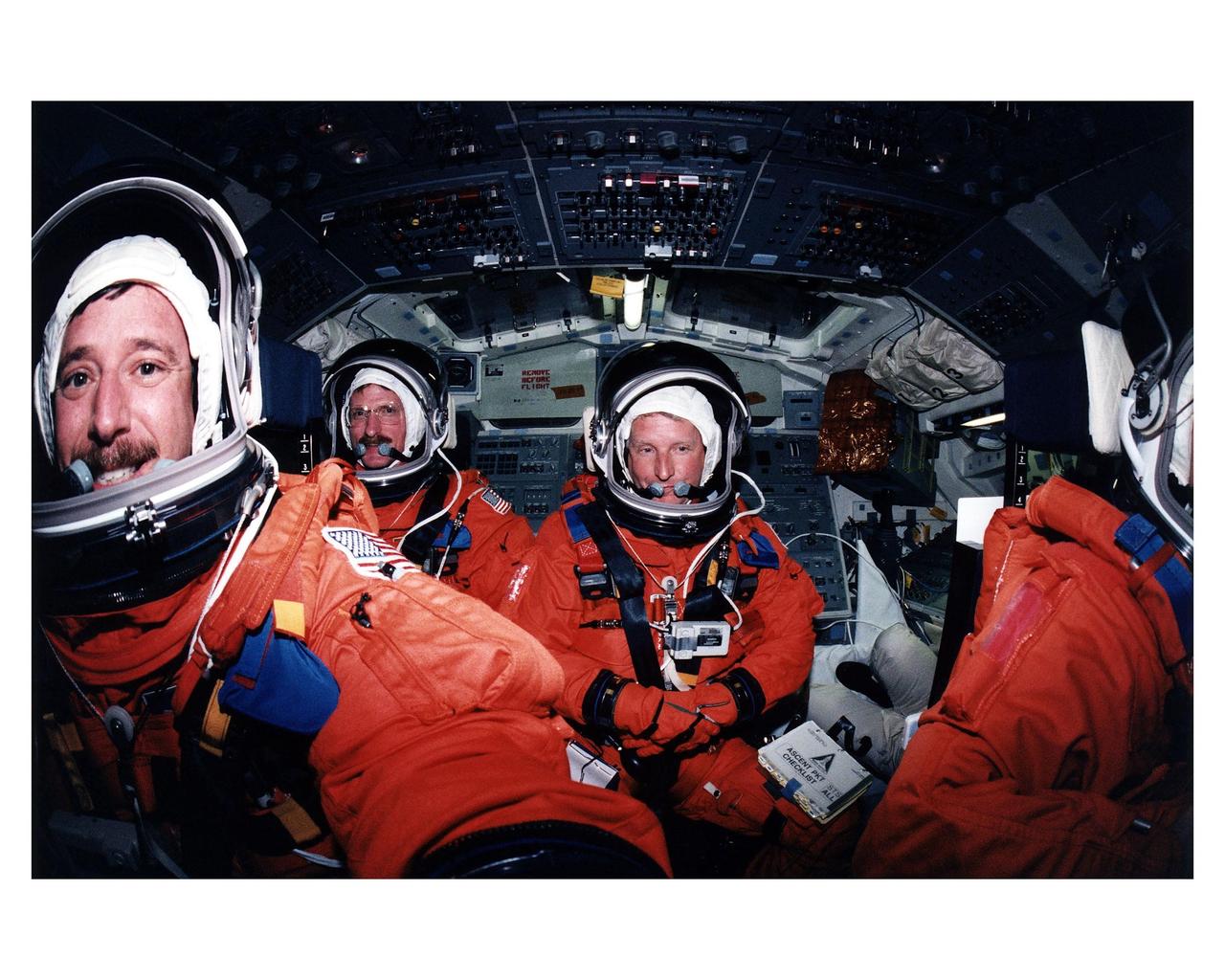
STS-82 crew members participate in a practice launch countdown inside the crew cabin of the Space Shuttle Discovery during Terminal Countdown Demonstration Test (TCDT) activities. Pilot Scott J. "Doc" Horowitz is in foreground at left. Seated across from him, with only an arm and part of his helmet showing, is Mission Commander Kenneth D. Bowersox. At rear, from left, are Mission Specialists Joseph R. "Joe" Tanner and Steven A. Hawley. STS-82 will be the second Hubble Space Telescope servicing mission. Liftoff is targeted for Feb. 11

STS93-S-009 (23 July 1999) --- The Space Shuttle Columbia lifts off from Launch Pad 39B to begin the five-day STS-93 mission. After two unsuccessful attempts earlier in the week, liftoff occurred at 12:31 a.m. (EDT), July 23, 1999. Only hours after this picture was taken, the five-member crew released the Chandra X-Ray Observatory into orbit. Onboard were astronauts Eileen M. Collins, first woman shuttle mission commander; Jeffrey S. Ashby, pilot; and Steven A. Hawley, Catherine G. Coleman and Michel Tognini, all mission specialists. Tognini represents the Centre National d'Etudes Spatiales (CNES) of France.
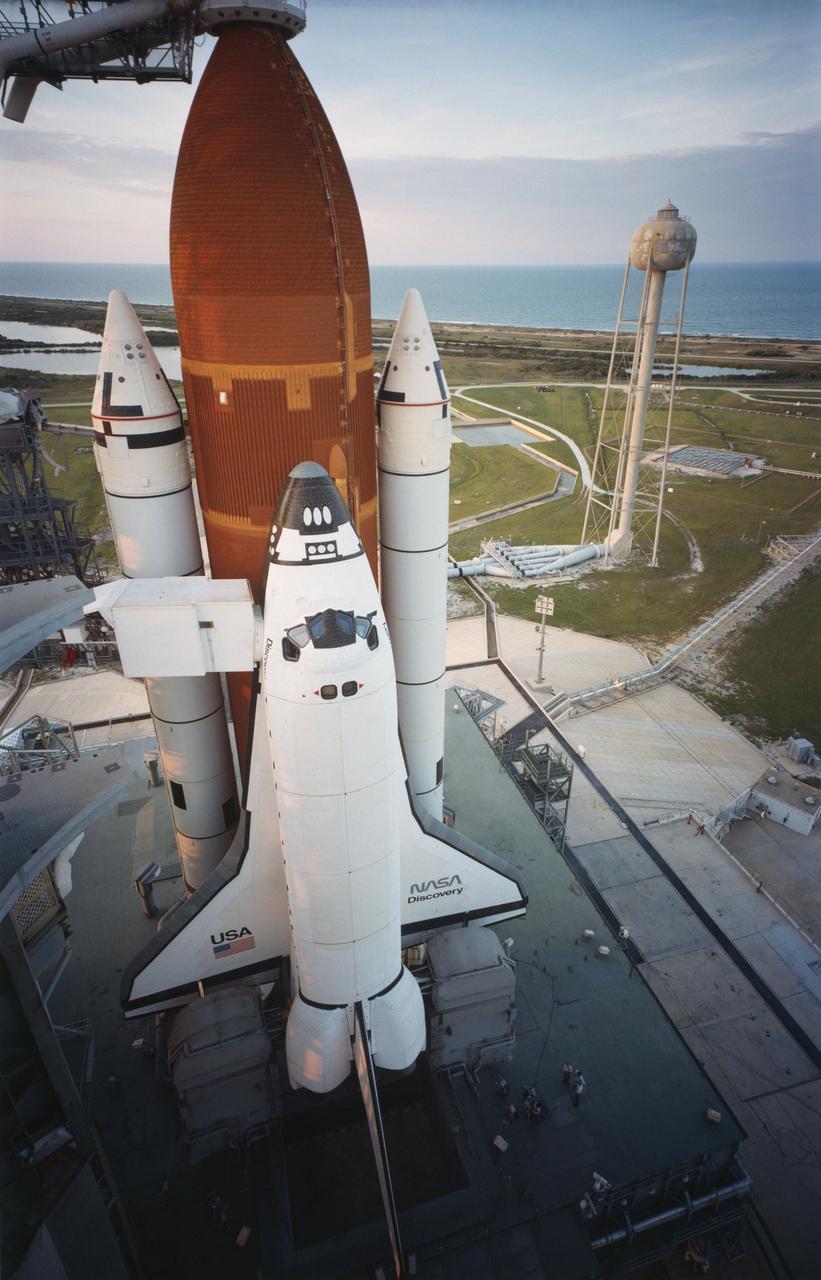
KSC-84PC-476 (For release Aug. 29, 1984) --- Orbiter Discovery is poised on Launch Pad 39A as the sun sets the evening prior to its maiden launch. Space shuttle Discovery (STS-41D) was successfully launched at 8:41 a.m. Aug. 30, 1984, after two failed attempts in June. Carrying a crew of six astronauts and three satellites, Discovery is the third in NASA?s stable of four Space Transportation System orbiters. The six-person crew includes Commander Henry Hartsfield, Pilot Michael Coats, Mission Specialists Judith Resnik, Mike Mullane and Steve Hawley and the first commercial payload specialist, Charles Walker of McDonnell Douglas. Photo credit: NASA
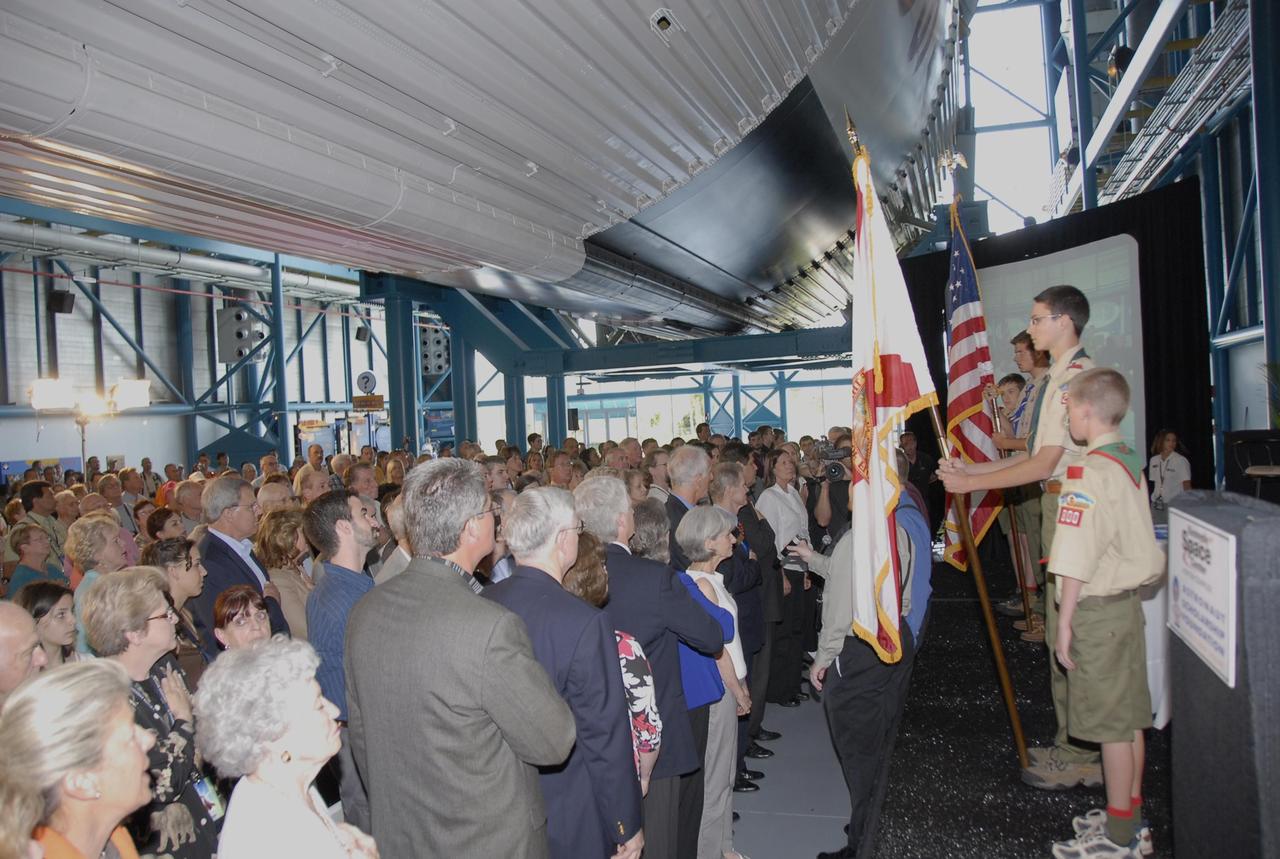
KENNEDY SPACE CENTER, FLA. -- At the U.S. Astronaut Hall of Fame induction ceremony, Boy Scouts lead the pledge of allegiance. The May 5 induction added space shuttle commanders Michael L. Coats, Steven A. Hawley and Jeffrey A. Hoffman to the Hall of Fame. They grow the number of space explorers enshrined in the Hall of Fame to 66. These gentlemen have joined such American space heroes as Neil Armstrong, John Glenn, Alan Shepard and Sally Ride. The ceremony was held at the Kennedy Space Center's Apollo/Saturn V Center. Photo credit: NASA/Kim Shiflett
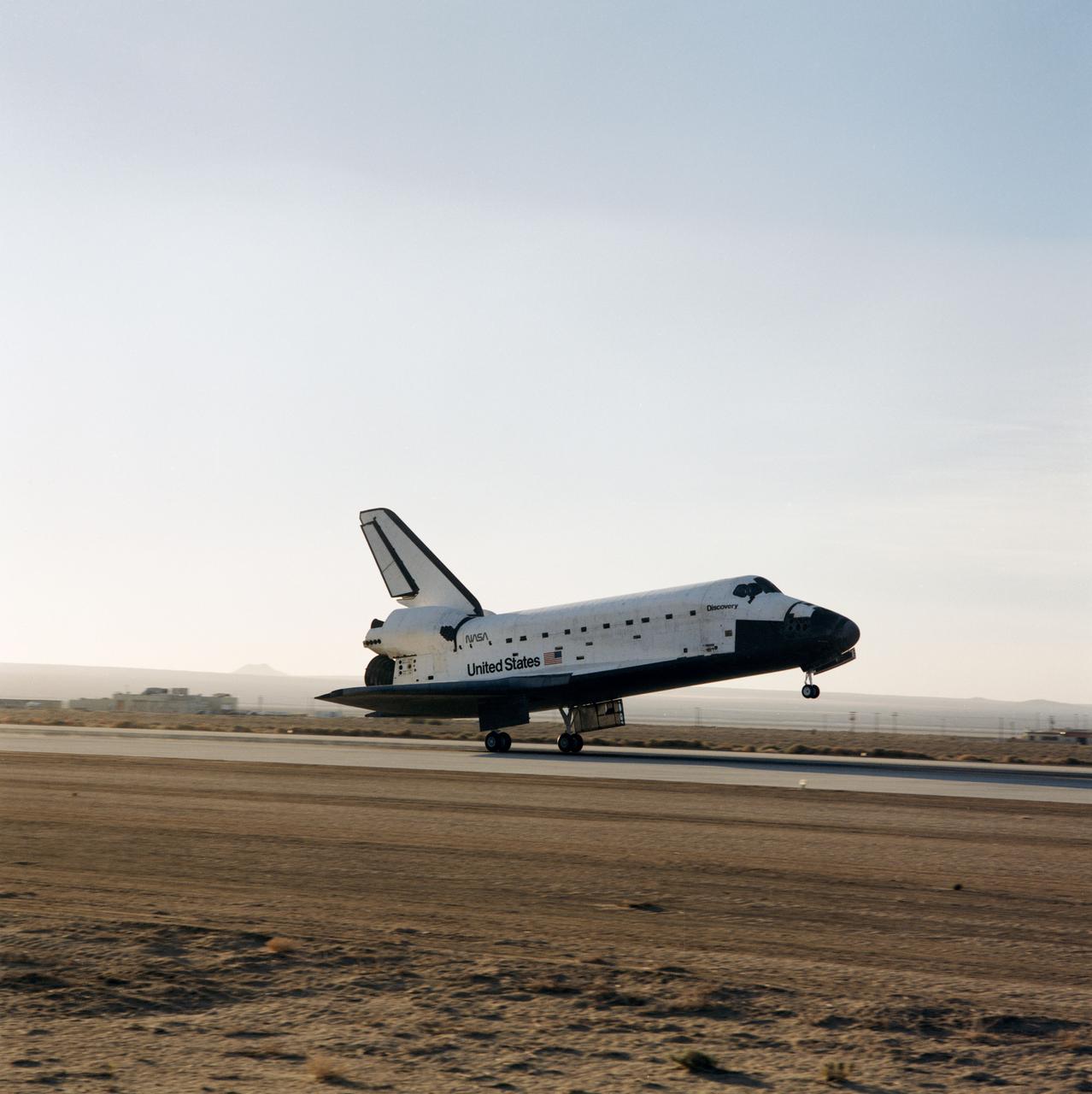
STS031-S-135 (29 April 1990) --- The Space Shuttle Discovery makes a smooth landing on the runway at Edwards Air Force Base to complete a highly successful five-day mission. It was an Earth orbital flight during which the Hubble Space Telescope (HST) was sent toward its 15-year mission. Landing was completed at 6:51 a.m. (PDT), April 29, 1990. Inside the spacecraft for STS-31 were Astronauts Loren J. Shriver, Charles F. Bolden, Bruce McCandless II, Kathryn D. Sullivan and Steven A. Hawley.
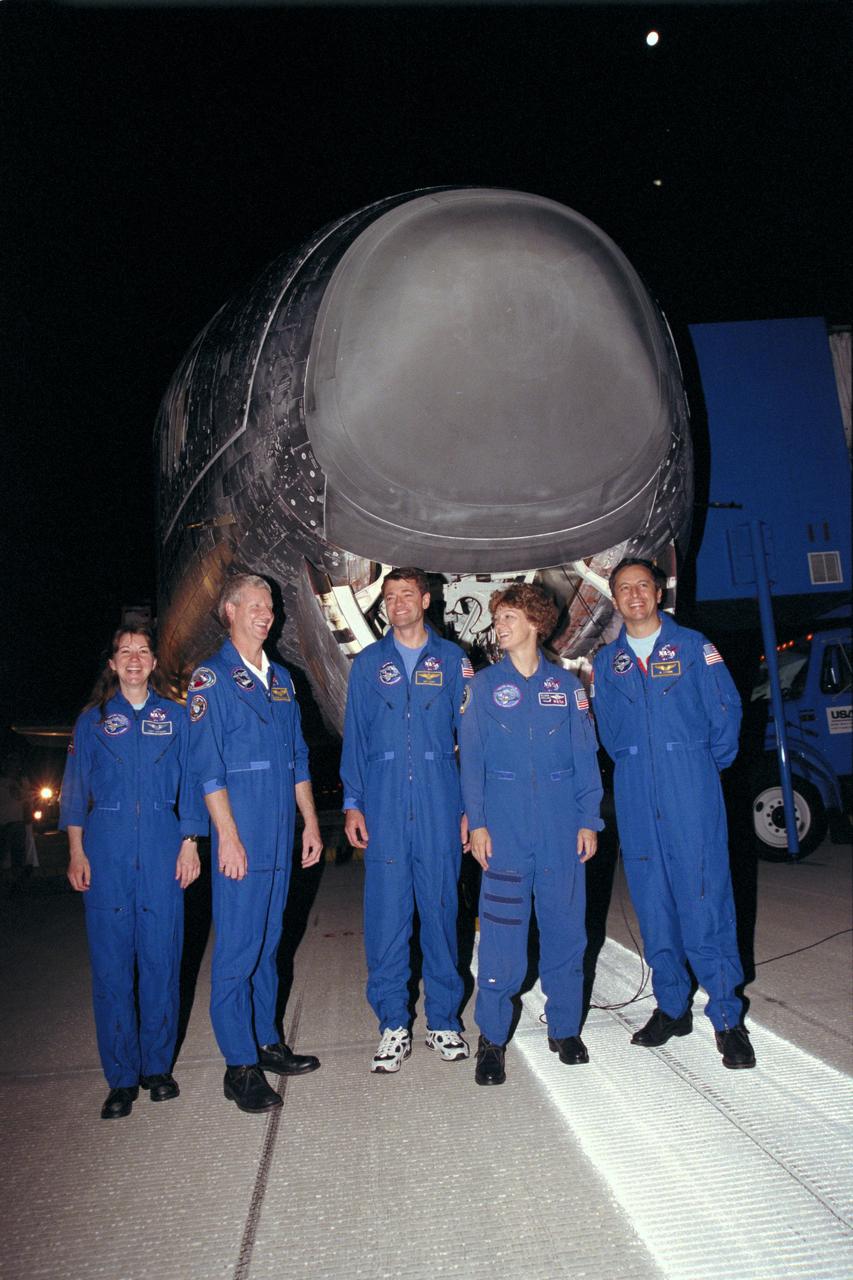
STS093-(S)-016 (27 July 1999) --- Members of the STS-93 crew pose in front of the Space Shuttle Columbia following the night landing on runway 33 at Kennedy Space Center's Shuttle Landing Facility. From the left are astronauts Catherine G. (Cady) Coleman and Steven A. Hawley, both mission specialists; Jeffrey S. Ashby, pilot; Eileen M. Collins, mission commander; and Michel Tognini, mission specialist representing France's Centre National d'Etudes Spatiales (CNES). Main gear touchdown occurred at 11:20:35 p.m.(EDT), July 27, 1999.
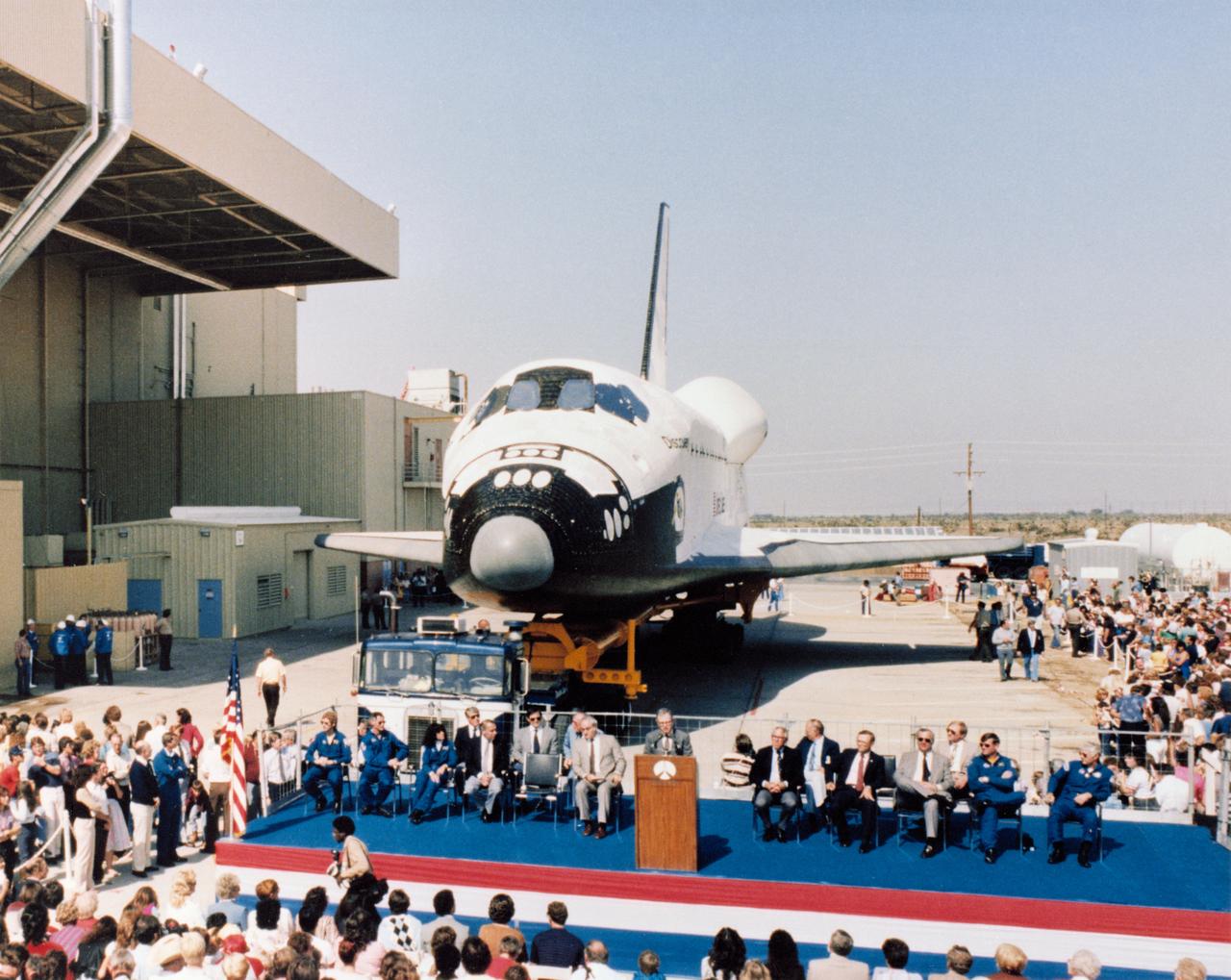
S84-30898 (16 Oct 1983) --- NASA Space Shuttle Orbiter 103, Discovery, is rolled out in formal ceremonies at the Rockwell International Palmdale, California, facility. On hand to greet the vehicle and the public are members of the 41-D crew--the first team of astronauts to man the new vehicle. Scheduled for a spring or summer flight in 1984 are astronauts Henry W. Hartsfield (right), commander; Michael L. Coats (second right), pilot; and Judith A. Resnik, Richard M. (Mike) Mullane and Steven A. Hawley (on left of stage), all mission specialists. Don Beall of Rockwell International (at lectern) prepares to introduce Dr. Rocco A. Petrone, president of Rockwell's Space Transportation Systems Division.
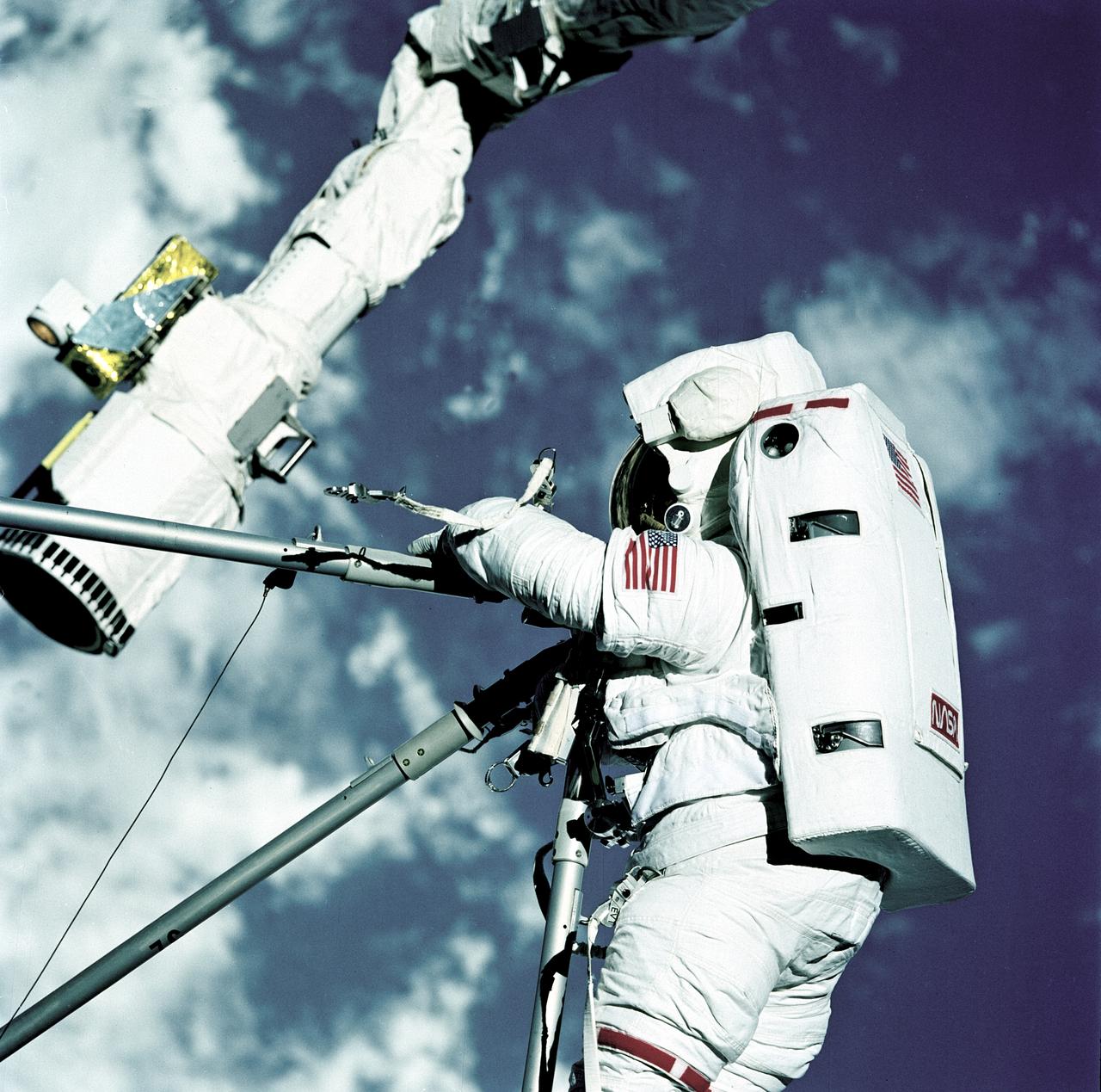
STS082-717-029 (11-21 Feb. 1997) --- Astronauts Mark C. Lee, STS-82 payload commander, (bottom), and Steven L. Smith, mission specialist, handle Hubble Space Telescope (HST) replacement parts during Extravehicular Activity (EVA) on Flight Day 4. The two were participating in the first of five eventual days of EVA to service the giant orbital observatory. Smith is standing on the end of the Remote Manipulator System (RMS) arm, which was controlled by astronaut Steven A. Hawley inside the Space Shuttle Discovery's crew cabin.
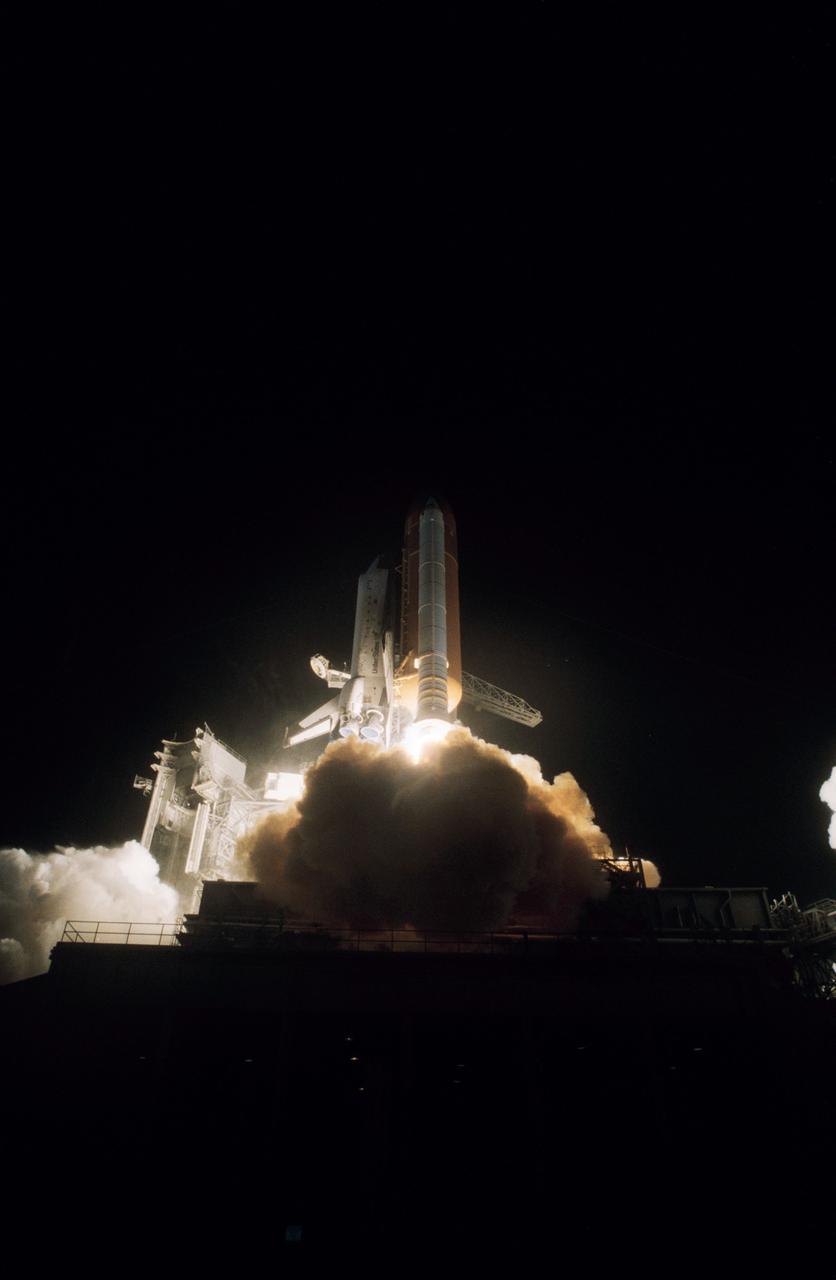
STS61C-S-047 (12 Jan. 1986) --- A remote camera records the early morning launch at Florida?s Kennedy Space Center of the space shuttle Columbia and the STS-61C crew on Jan. 12, 1986. Onboard were the following crew members -- Mission Commander Robert L. Gibson and Pilot Charles F. Bolden, along with Mission Specialists Franklin R. Chang-Diaz, Steven A. Hawley and George D. Nelson and Payload Specialists Robert J. Cenker of RCA and U.S. Rep. Bill Nelson. Photo credit: NASA
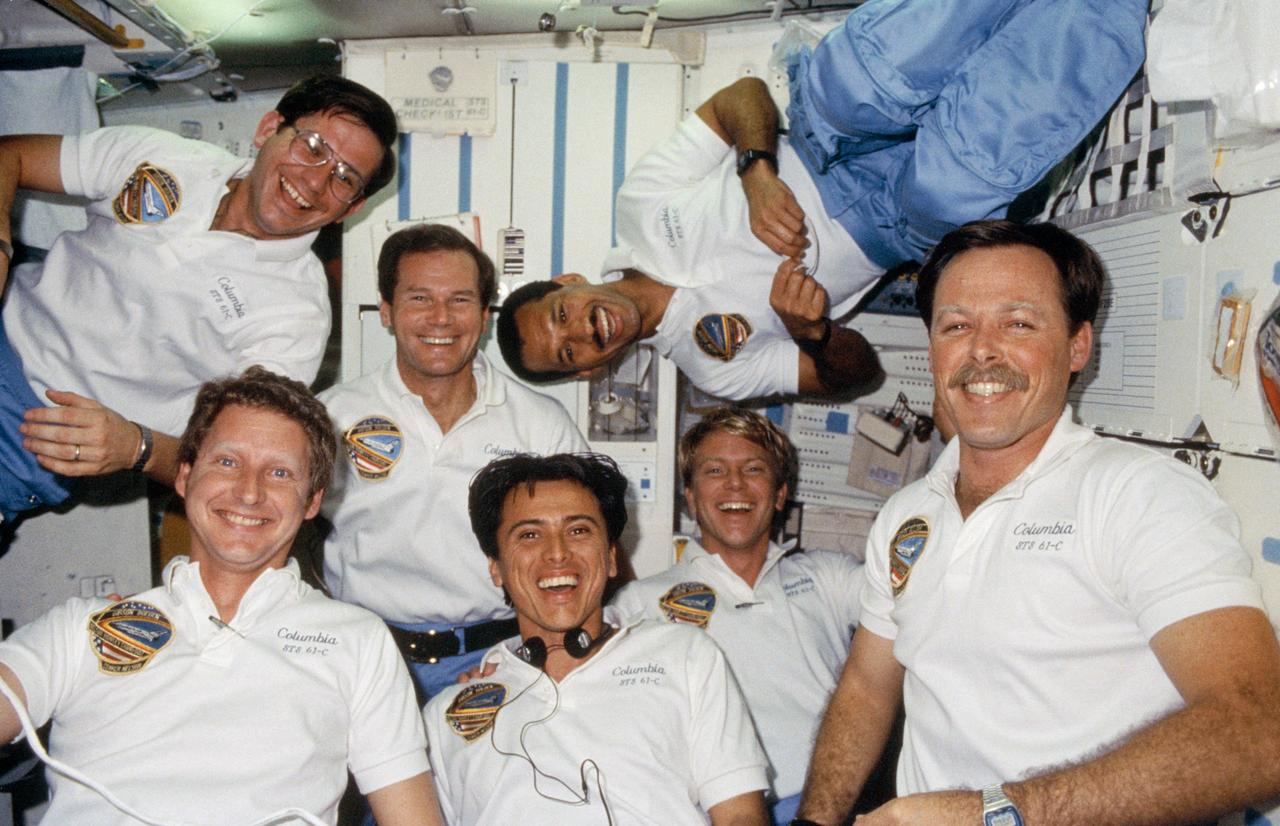
61C-14-008 (12-18 Jan. 1986) --- The seven crew members for STS-61C mission use the space shuttle Columbia's middeck for the traditional in-flight group portrait. Astronaut Robert L. Gibson (lower right corner), commander, is surrounded by fellow crew members, counter-clockwise from upper right: astronaut Charles F. Bolden, pilot; U.S. Representative Bill Nelson (D., Florida), payload specialist; Robert J. Cenker, RCA payload specialist; and astronauts Steven A. Hawley, Franklin R. Chang-Diaz and George D. Nelson, all mission specialists. Photo credit: NASA
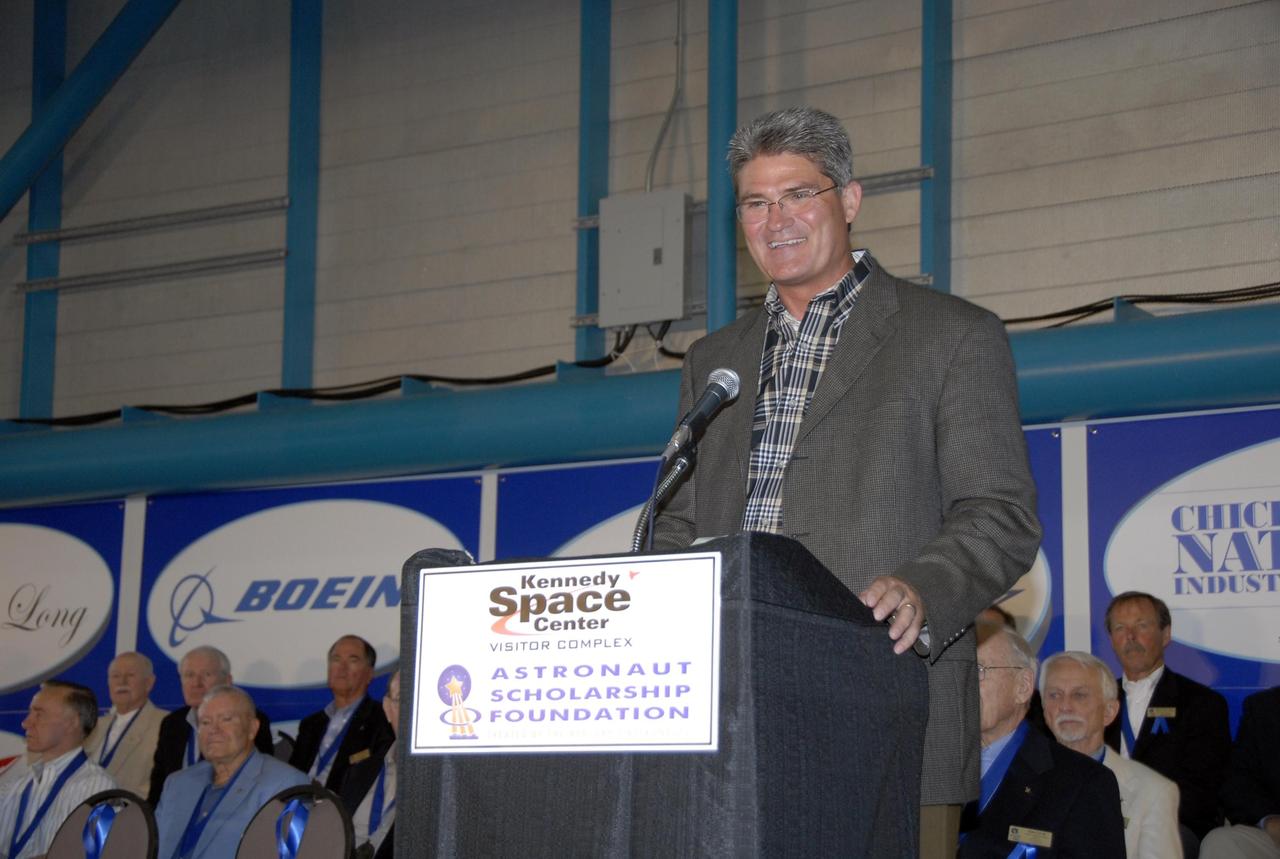
KENNEDY SPACE CENTER, FLA. -- At the U.S. Astronaut Hall of Fame induction ceremony, Kennedy Space Center Director Bill Parsons speaks about the accomplishments of the newest inductees to the Hall of Fame. The May 5 induction added space shuttle commanders Michael L. Coats, Steven A. Hawley and Jeffrey A. Hoffman to the Hall of Fame. They grow the number of space explorers enshrined in the Hall of Fame to 66. These gentlemen have joined such American space heroes as Neil Armstrong, Glenn, Alan Shepard and Sally Ride. The ceremony was held at the Kennedy Space Center's Apollo/Saturn V Center. Photo credit: NASA/Kim Shiflett
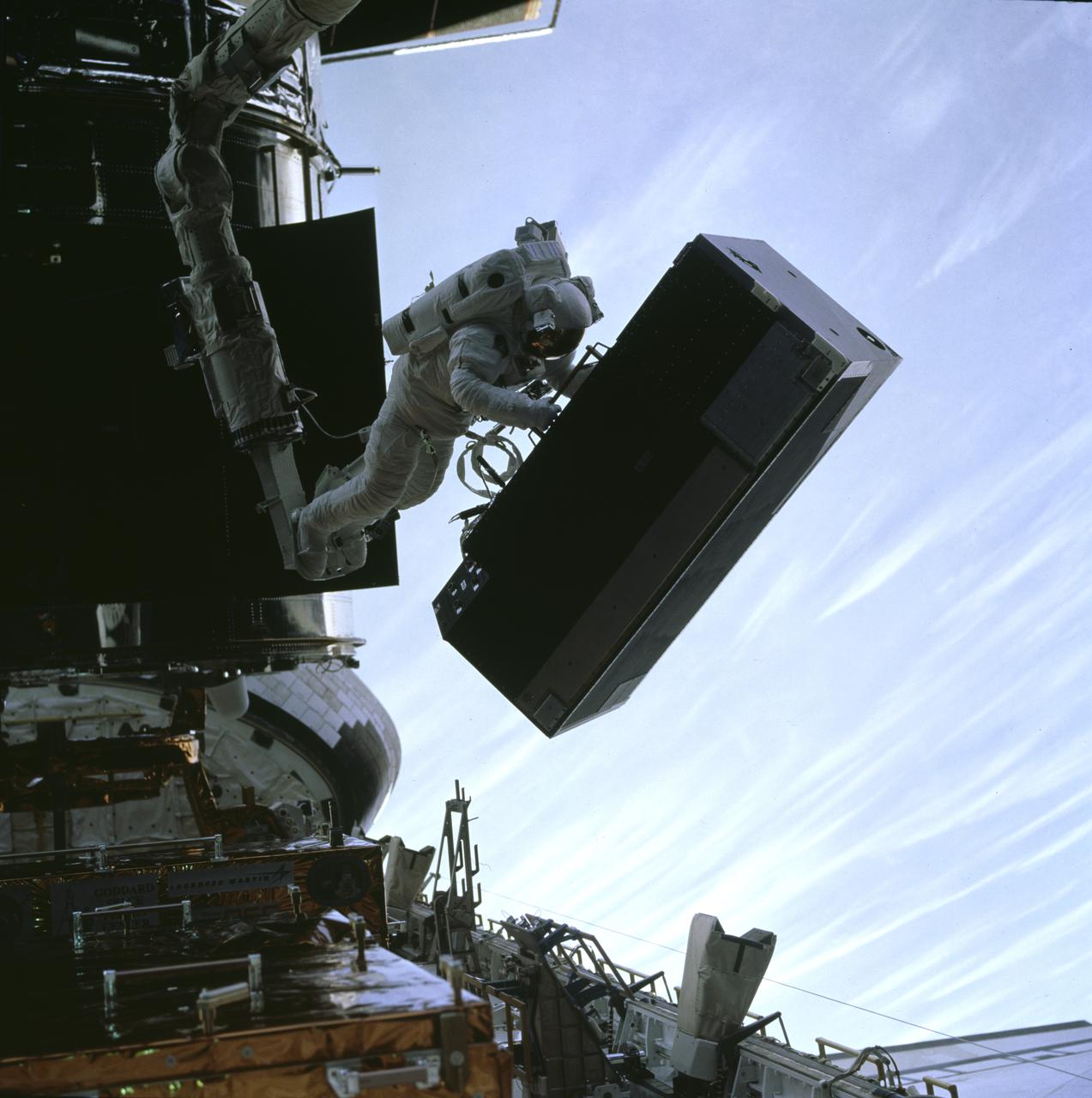
STS082-730-090 (11-21 Feb. 1997) --- Astronaut Steven L. Smith handles one of the Goddard High Resolution Spectrograph (GHRS) boxes, changed out on the Hubble Space Telescope (HST) on Flight Day 4. Astronauts Smith and Mark C. Lee were participating in the first of five eventual days of Extravehicular Activity (EVA) to service the giant orbital observatory. Smith is standing on the end of the Remote Manipulator System (RMS) arm, which was controlled by astronaut Steven A. Hawley inside the Space Shuttle Discovery's crew cabin.
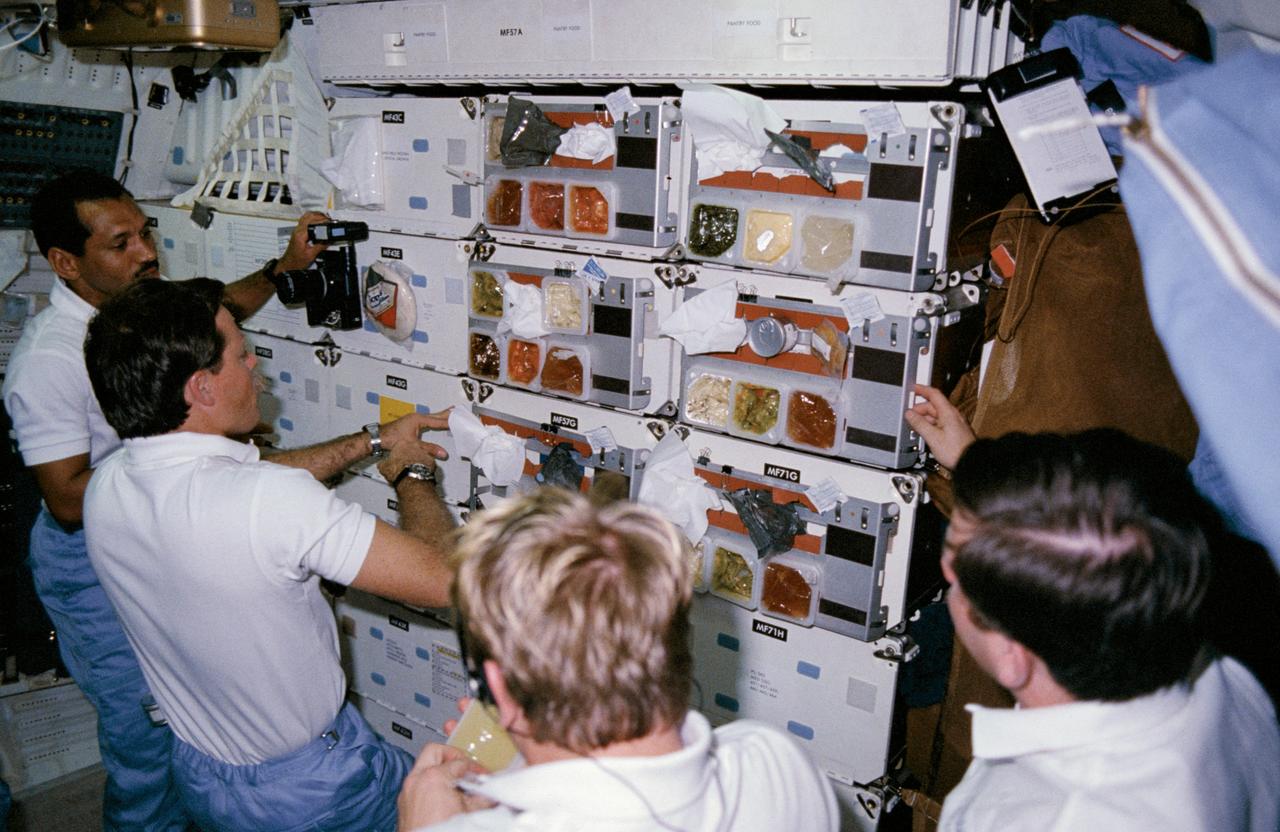
61C-14-015 (12-18 Jan. 1986) --- Astronauts Charles F. Bolden, STS-61C pilot; Robert L. Gibson, commander; George D. Nelson, mission specialist, and payload specialist Robert J. Cenker (RCA) queue at "chow line" on middeck of the space shuttle Columbia. Others onboard for the week-long mission were astronauts Steven A. Hawley and Franklin R. Chang-Diaz, mission specialists; and U.S. Representative Bill Nelson (Democrat - Florida). This photo was used as one of the visual aids at the crew's press conference on Jan. 23, 1986.