
Jeff Greulich, DynCorp life support technician, adjusts a prototype helmet on pilot Craig Bomben at NASA Dryden Flight Research Center, Edwards, Calif. Built by Gentex Corp., Carbondale, Pa., the helmet was evaluated by five NASA pilots during the summer and fall of 2002. The objective was to obtain data on helmet fit, comfort and functionality. The inner helmet of the modular system is fitted to the individual crewmember. The outer helmet features a fully integrated spectral mounted helmet display and a binocular helmet mounted display. The helmet will be adaptable to all flying platforms. The Dryden evaluation was overseen by the Center's Life Support office. Assessments have taken place during normal proficiency flights and some air-to-air combat maneuvering. Evaluation platforms included the F-18, B-52 and C-12. The prototype helmet is being developed by the Naval Air Science and Technology Office and the Aircrew Systems Program Office, Patuxent River, Md.
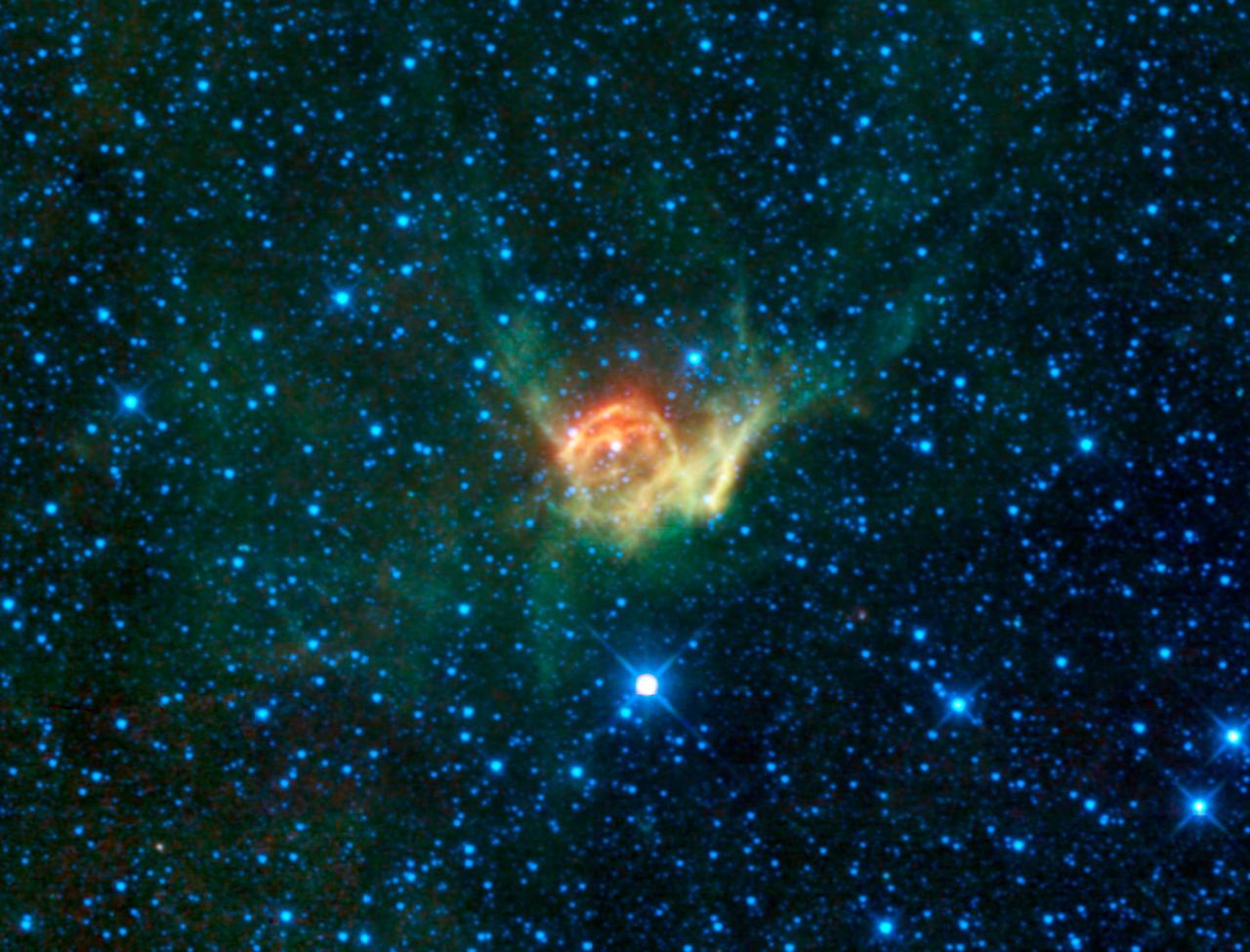
This heroic image from from NASA Wide-field Infrared Survey Explorer is of a special cloud of dust and gas in the constellation Canis Major catalogued as NGC 2359, or more commonly known as Thor Helmet.
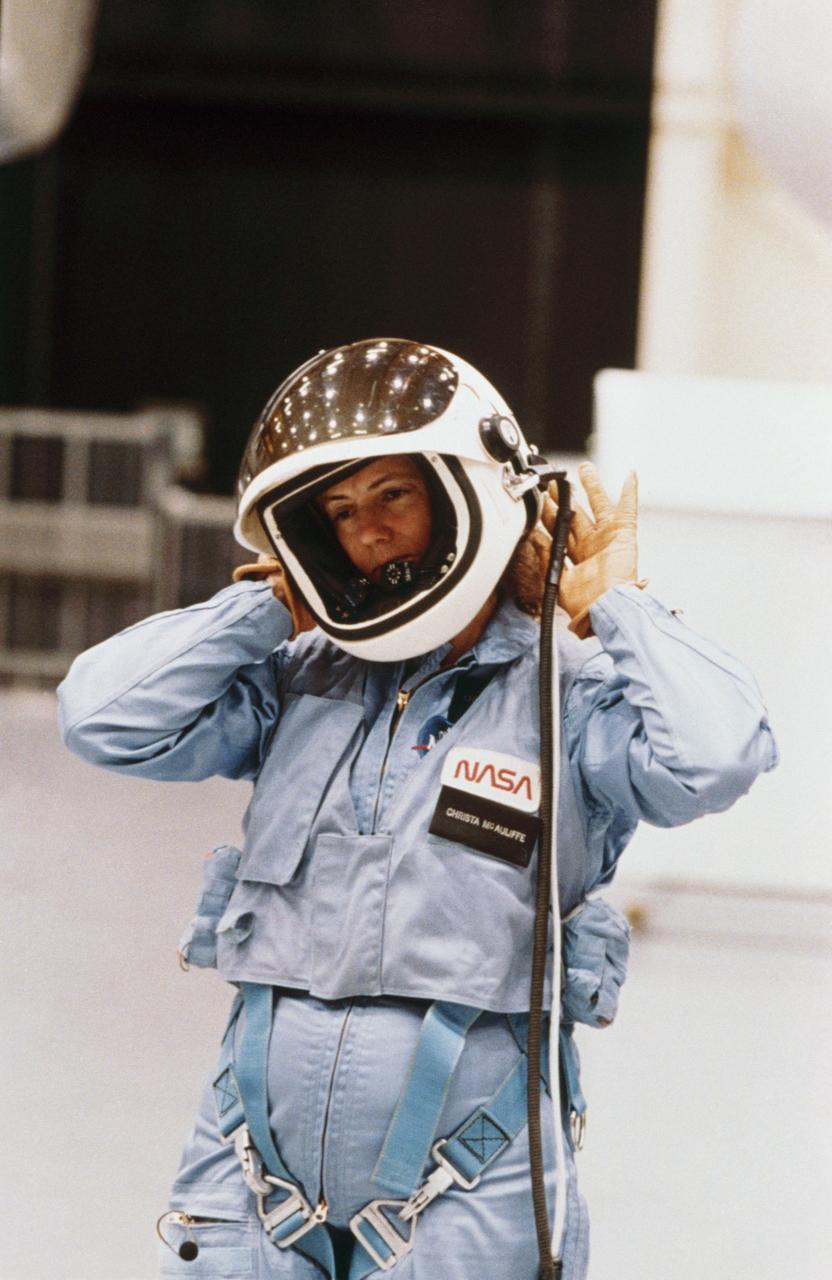
S86-25182 (for release January 1986) --- Sharon Christa McAuliffe, STS-51L citizen observer/payload specialist, prepares to remove her helmet after participating in emergency egress training in the shuttle mock-up and integration lab at the Johnson Space Center. McAuliffe will represent the Teacher-in-Space Project aboard the Challenger when it launches in late January. The photo was taken by Keith Meyers of the New York Times. Photo credit: NASA
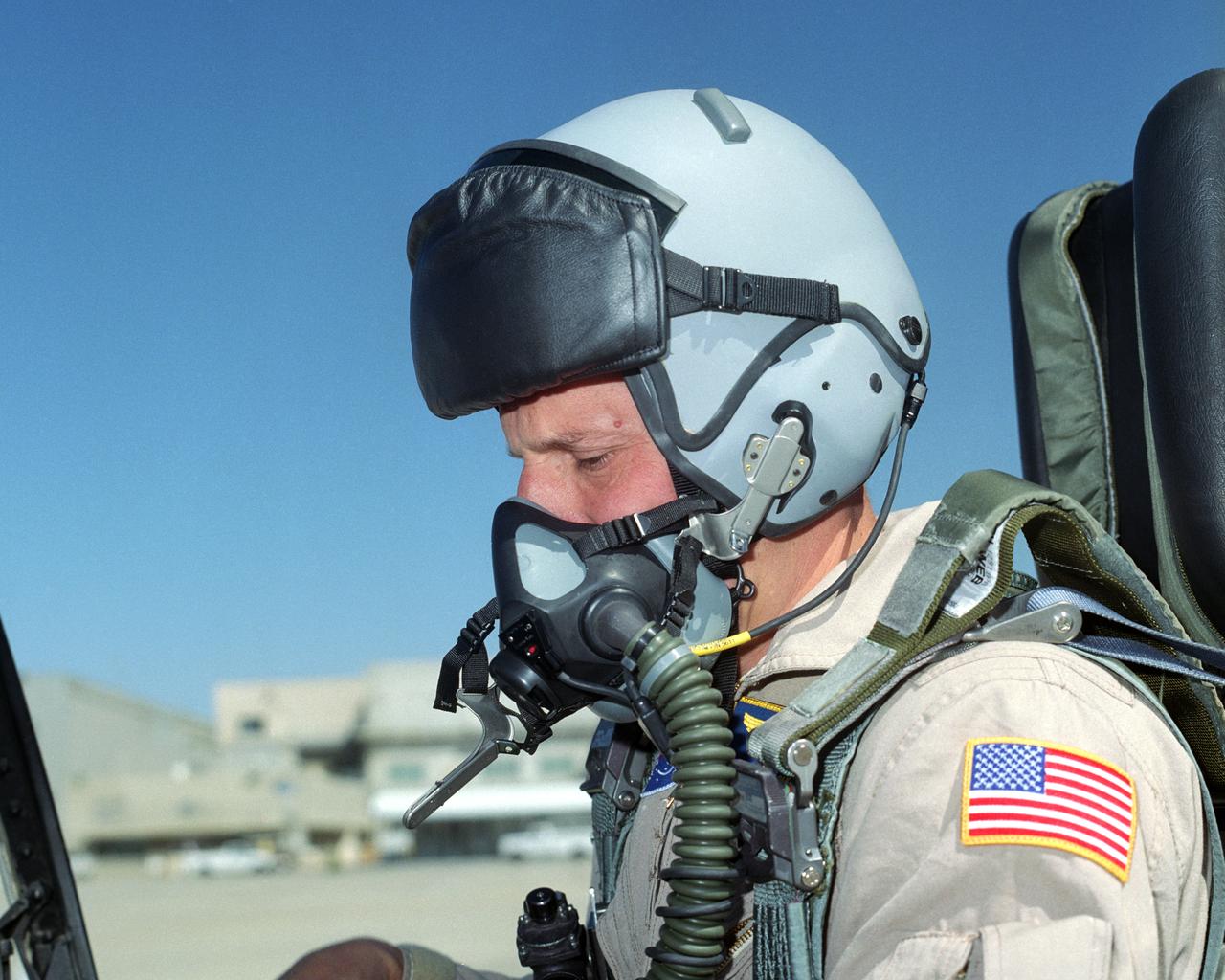
Research pilots from the NASA Dryden Flight Research Center, Edwards, Calif., tested a prototype two-part helmet. Built by Gentex Corp., Carbondale, Pa., the helmet was evaluated by five NASA pilots during the summer and fall of 2002. The objective was to obtain data on helmet fit, comfort and functionality. The inner helmet of the modular system is fitted to the individual crewmember. The outer helmet features a fully integrated spectral mounted helmet display and a binocular helmet mounted display. The helmet will be adaptable to all flying platforms. The Dryden evaluation was overseen by the Center's Life Support office. Assessments have taken place during normal proficiency flights and some air-to-air combat maneuvering. Evaluation platforms included the F-18, B-52 and C-12. The prototype helmet is being developed by the Naval Air Science and Technology Office and the Aircrew Systems Program Office, Patuxent River, Md.
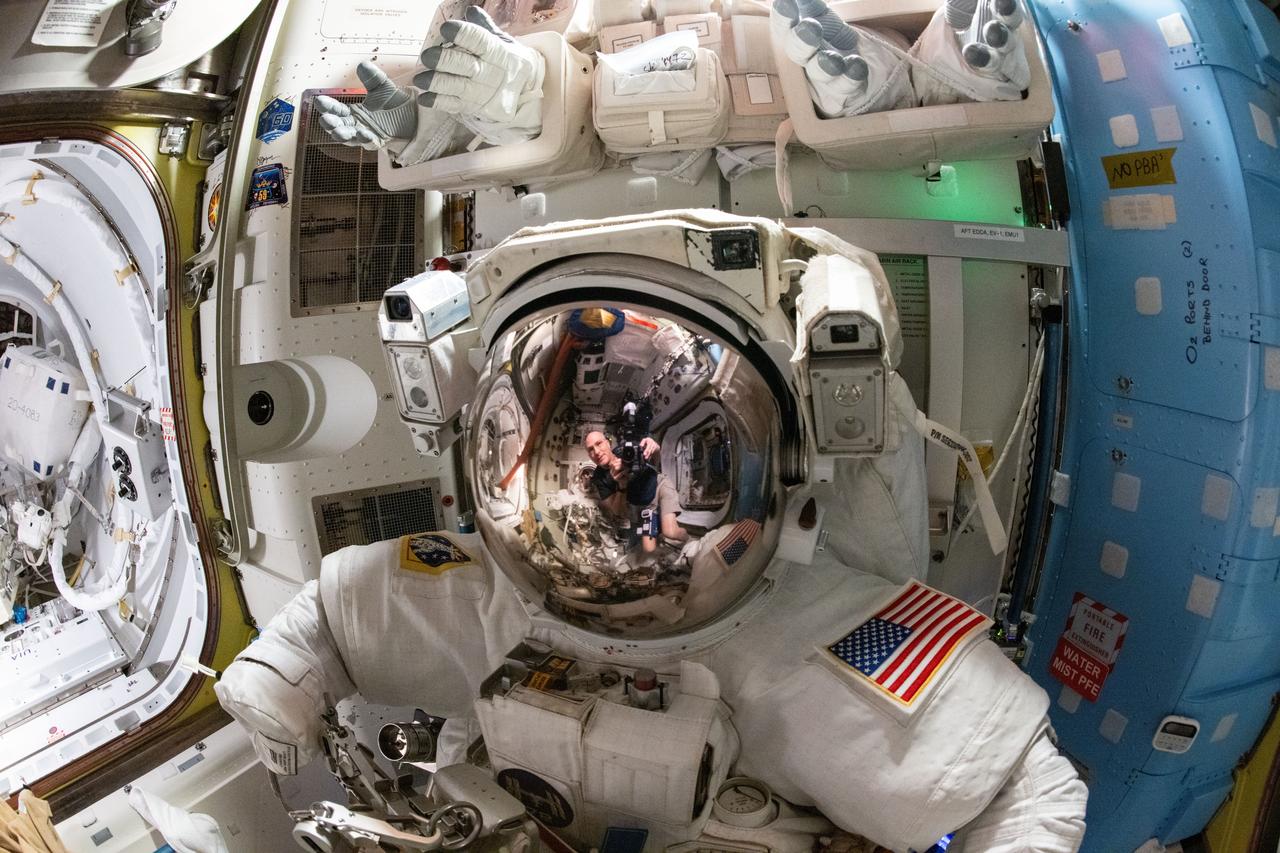
iss072e518423 (Jan. 23, 2025) --- NASA astronaut and Expedition 72 Flight Engineer Don Pettit's reflection is pictured on the helmet visor of a spacesuit in this photograph he took inside the International Space Station's Quest airlock.
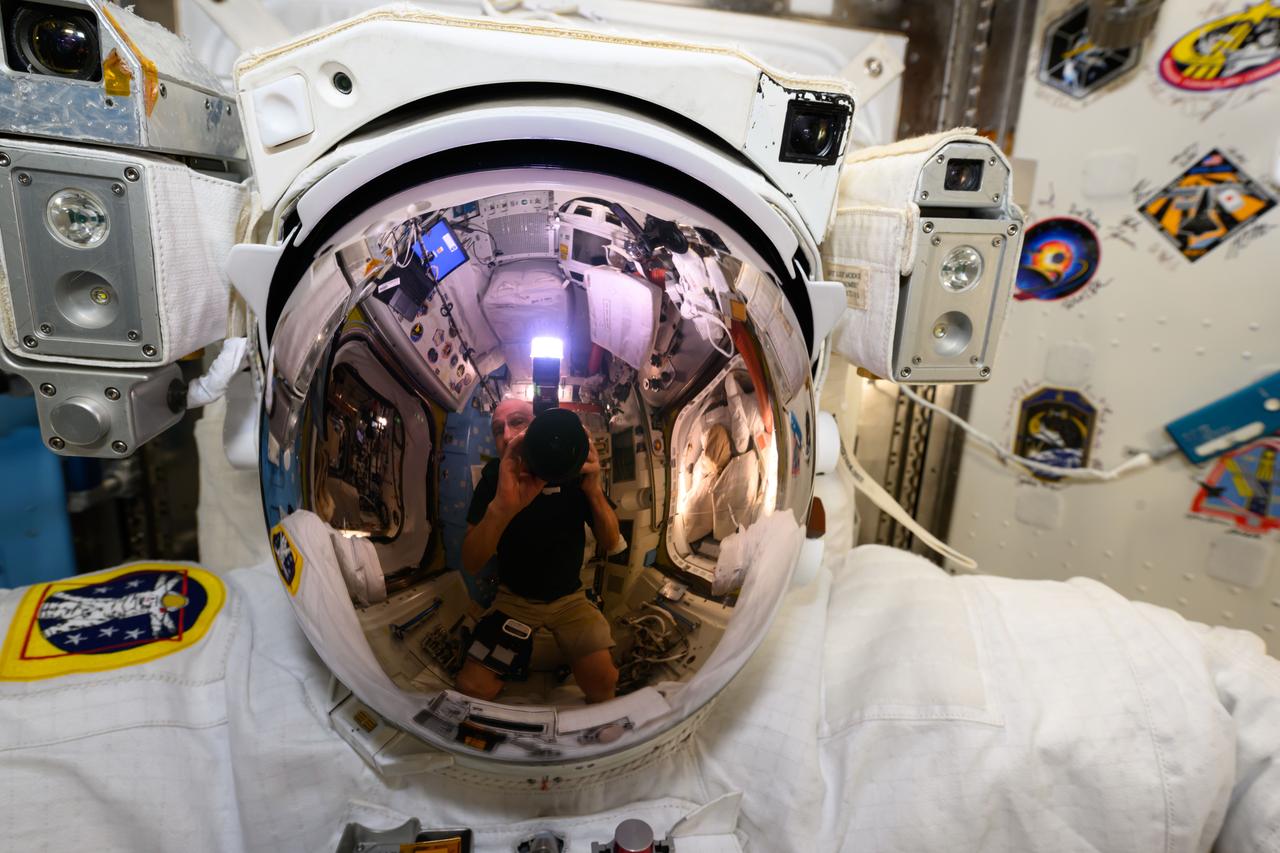
iss072e363878 (Dec. 9, 2024) --- NASA astronaut and Expedtion 72 Flight Engineer Don Pettit took this photograph of a U.S. spacesuit helmet with his reflection prominent on the helmet's visor inside the International Space Station's Quest airlock.
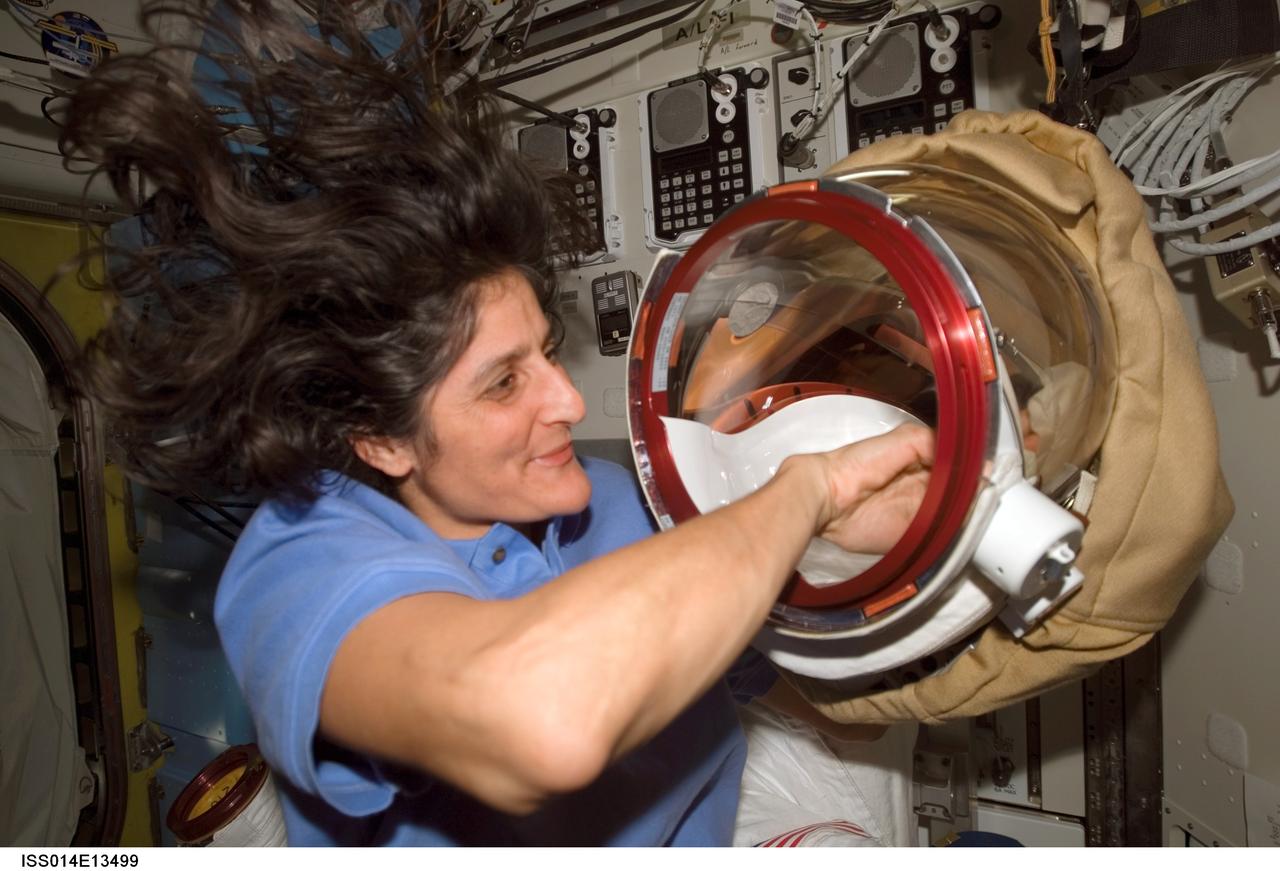
ISS014-E-13499 (7 Feb. 2007) --- Astronaut Sunita L. Williams, Expedition 14 flight engineer, works with the helmet of her Extravehicular Mobility Unit (EMU) spacesuit in the Quest Airlock of the International Space Station as she prepares for the final of three sessions of extravehicular activity (EVA) in nine days, scheduled for Feb. 8.
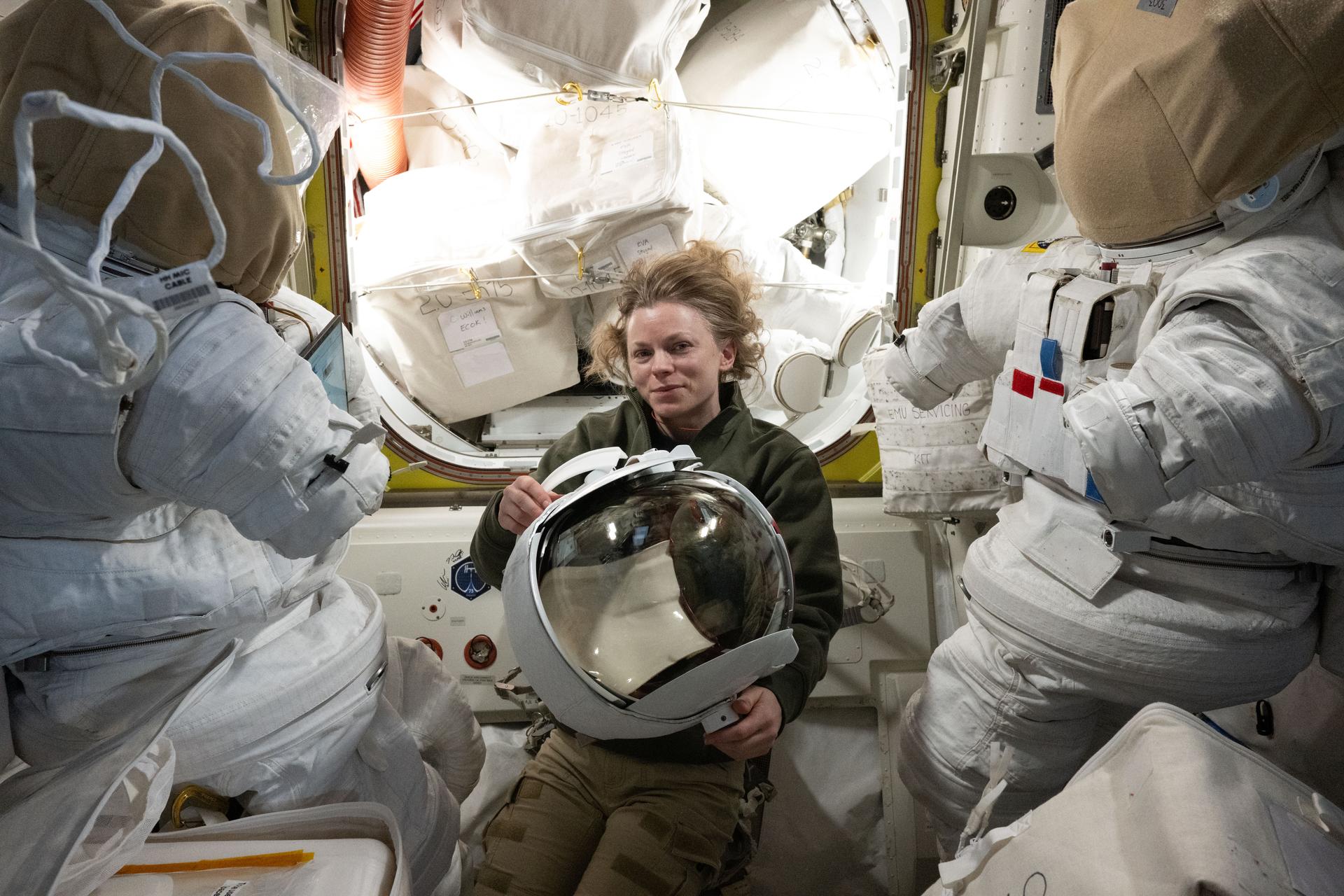
iss073e0872076 (Oct. 10, 2025) --- NASA astronaut and Expedition 73 Flight Engineer Zena Cardman inspects a spacesuit helmet during maintenance activities inside the International Space Station's Quest airlock.
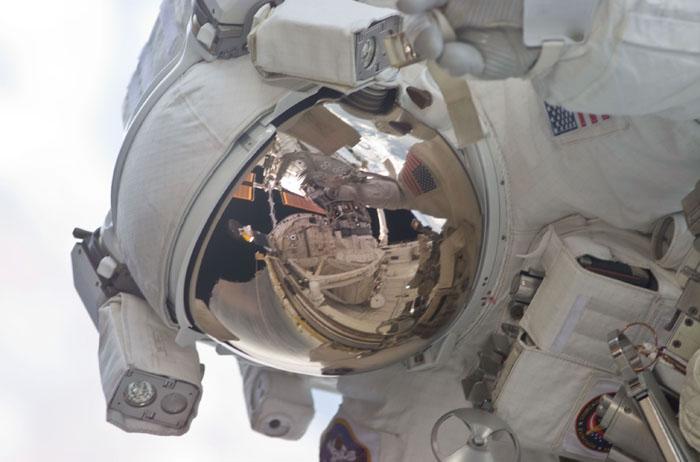
STS105-E-5228 (16 August 2001) --- Closeup view of the helmet visor and upper torso of astronaut Patrick G. Forrester during early stages of the first space walk on STS-105. Most of the cargo bay of the Space Shuttle Discovery is reflected in the helmet. The image was recorded with a digital still camera.
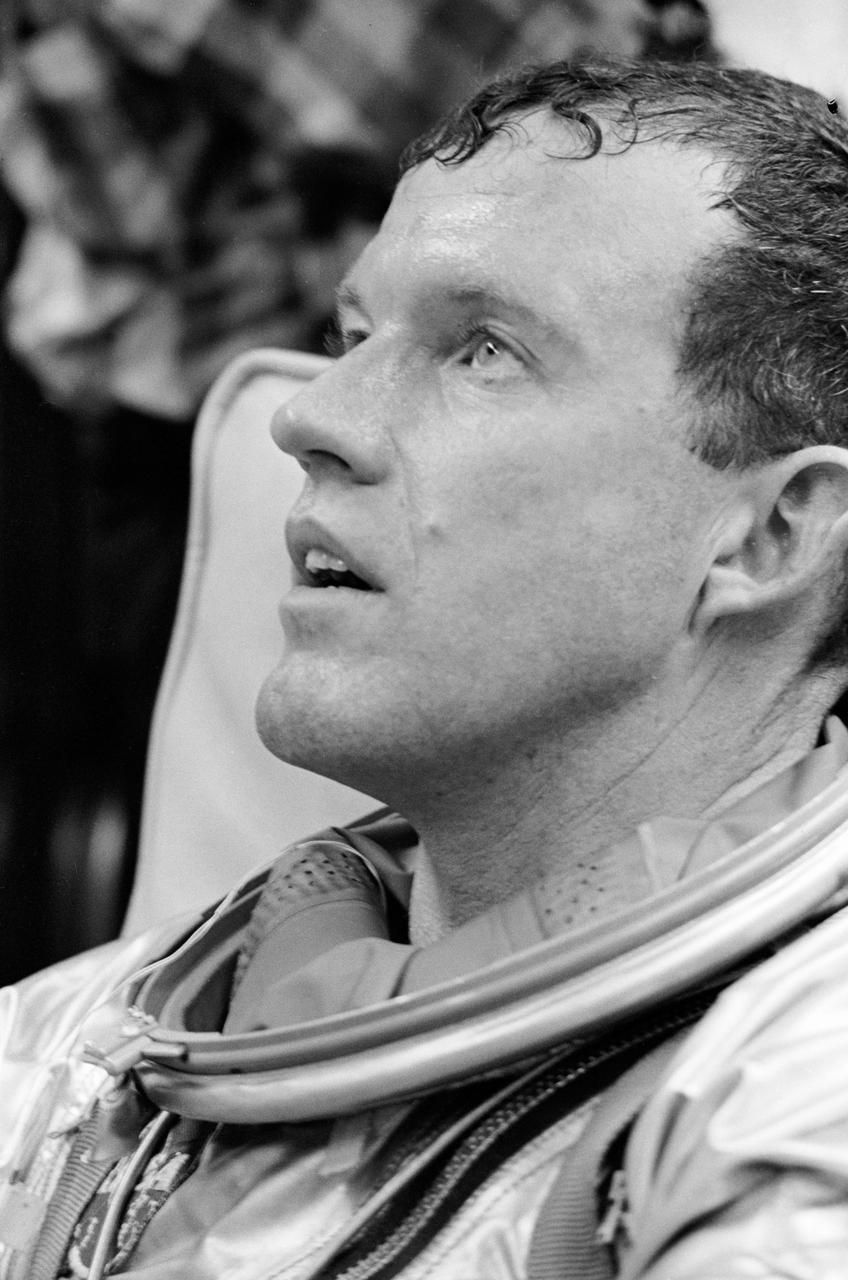
S63-03984 (1963) --- Astronaut L. Gordon Cooper Jr., prime pilot for the Mercury-Atlas 9 (MA-9) mission, is pictured just after his helmet had been removed. He has just spent approximately five hours in the spacecraft during altitude chamber tests. Photo credit: NASA
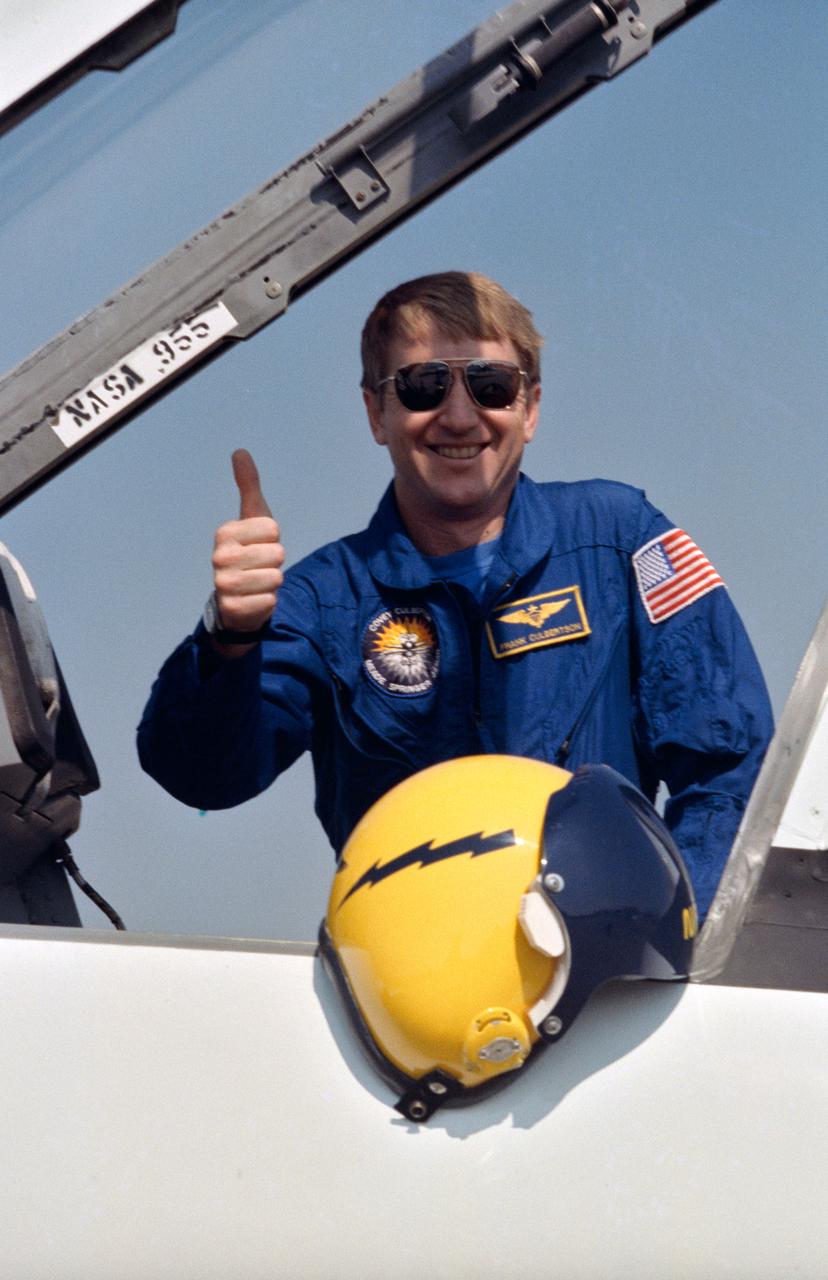
STS-38 Pilot Frank L. Culbertson gives "thumbs up" before climbing into the T-38A NASA 955 forward cockpit. Crewmembers are preparing for departure from Ellington Field to the Kennedy Space Center (KSC). Culbertson's bright yellow helmet is displayed in front of him.
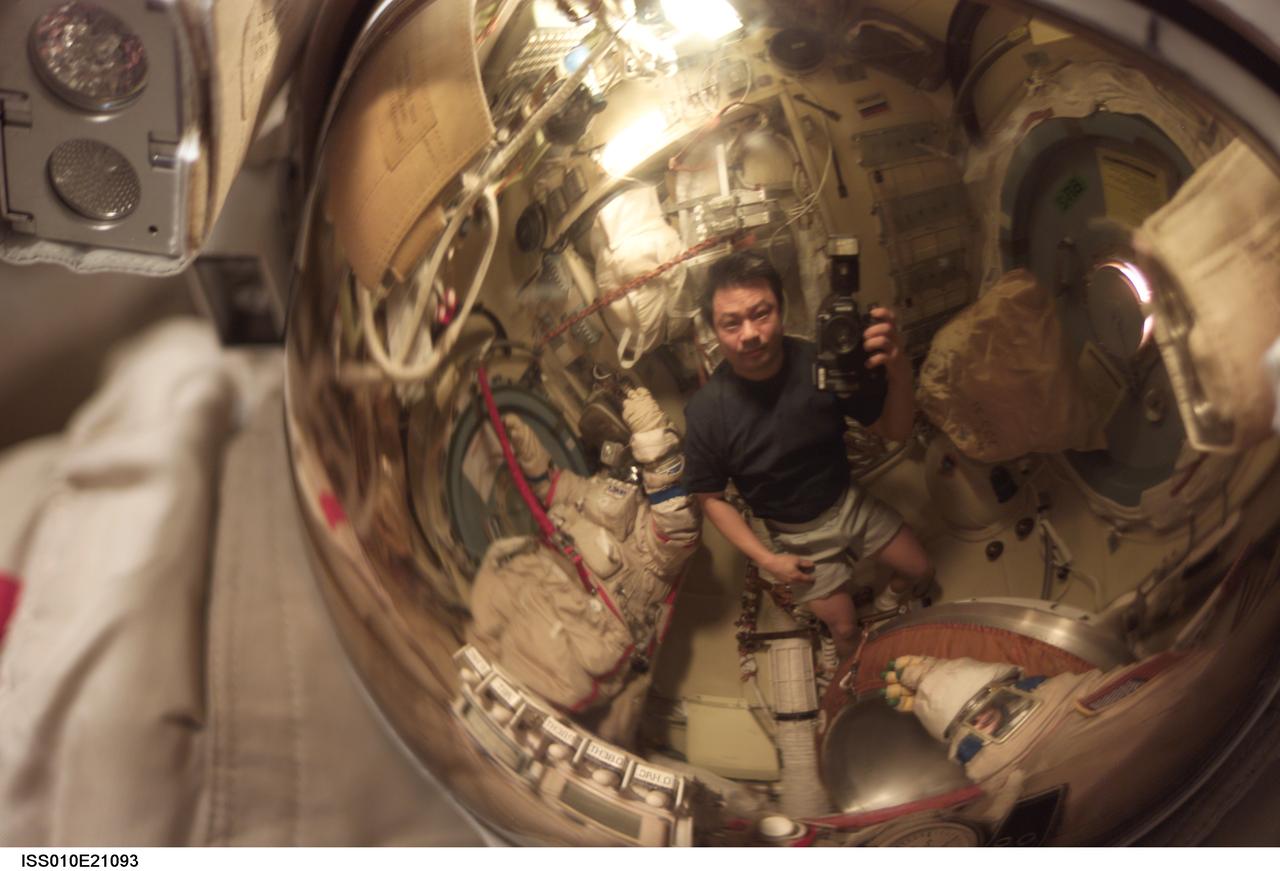
ISS010-E-21093 (22 March 2005) --- Astronaut Leroy Chiao, Expedition 10 commander and NASA ISS science officer, appears as a small reflection in a helmet visor in the Pirs Docking Compartment of the International Space Station (ISS).
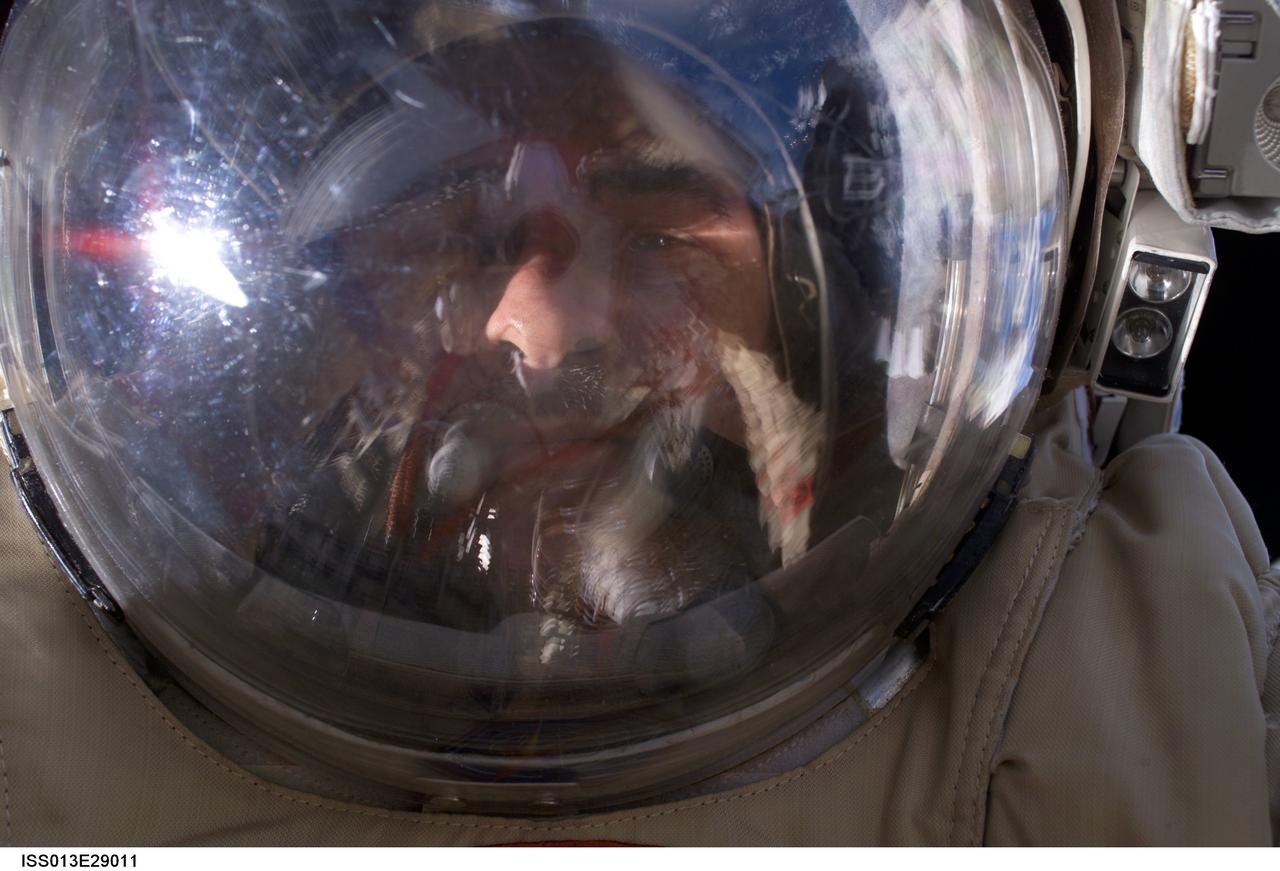
ISS013-E-29011 (1 June 2006) --- A close-up view shows the face of cosmonaut Pavel V. Vinogradov, Expedition 13 commander representing Russia's Federal Space Agency, through his helmet visor during the first session of extravehicular activity (EVA) performed by the Expedition 13 crew during their six-month mission. Vinogradov was attired in a Russian Orlan spacesuit.
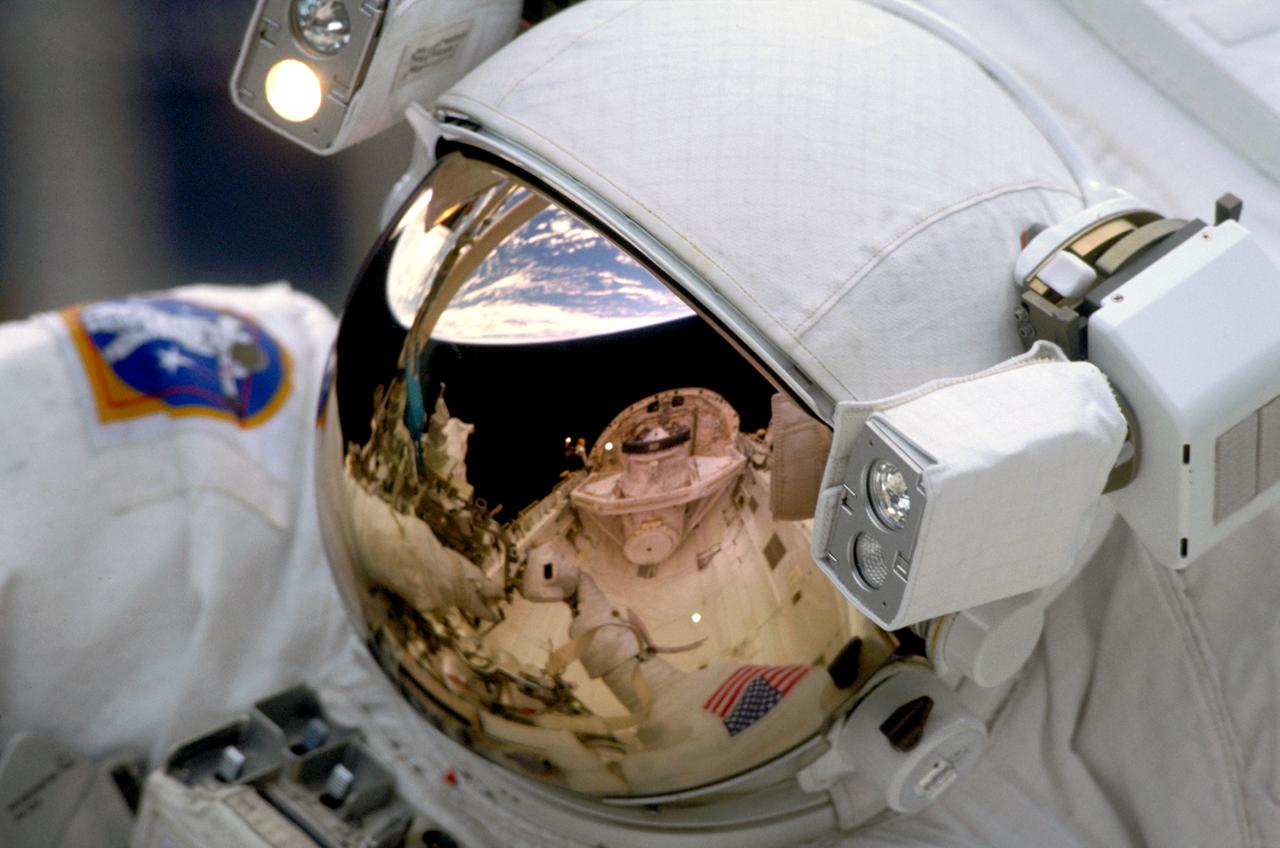
STS103-302-002 (19- 27 December 1999)---.The Space Shuttle Discovery's Cargo Bay and Crew Module, and the Earth's horizon are reflected in the helmet visor of one of the space walking astronauts on STS-103..Astronauts Steven L. Smith, John M. Grunsfeld, C. Michael Foale and Claude Nicollier participated in three days of.extravehicular activity on the NASA's third servicing visit to the Hubble Space Telescope (HST).
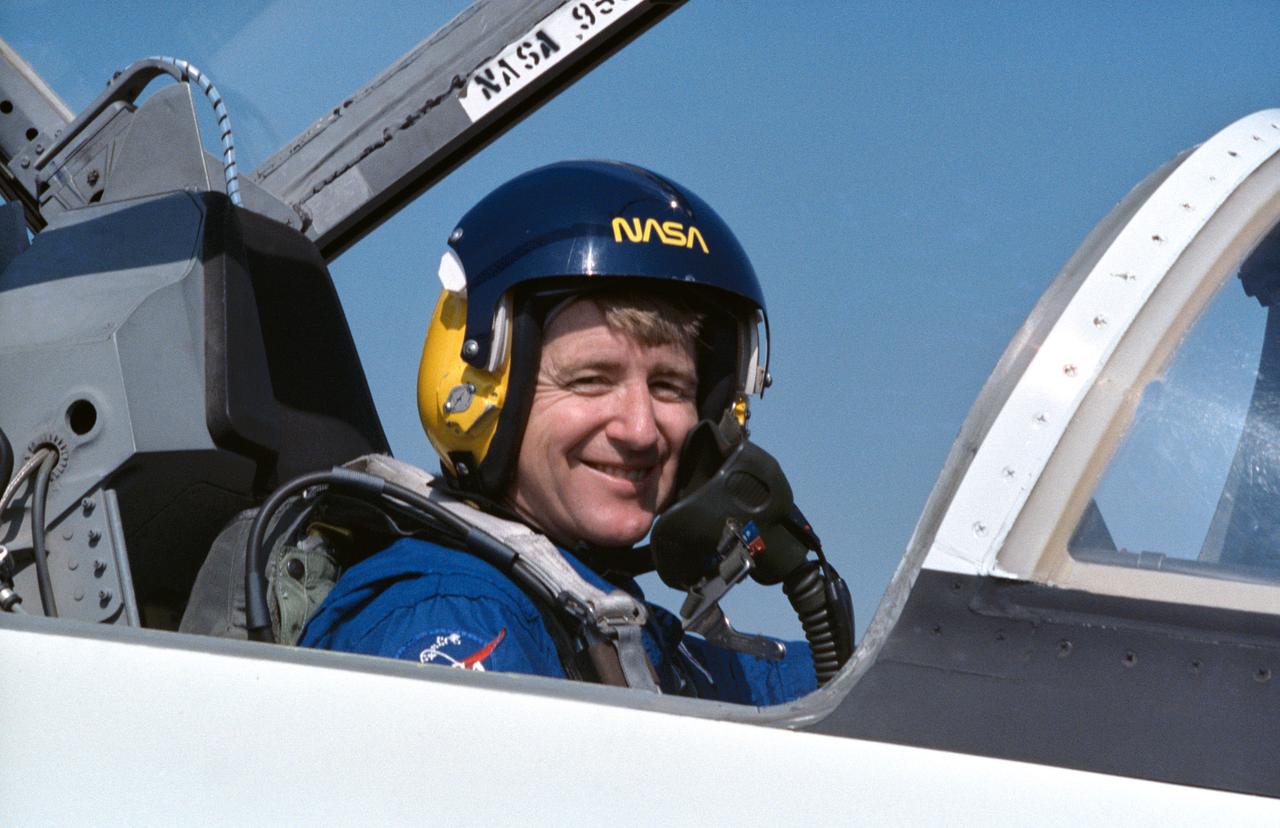
STS-38 Pilot Frank L. Culberston, smiling and wearing his helmet with breathing apparatus attached, sits in T-38A NASA 955 forward cockpit at Ellington Field and prepares for departure.
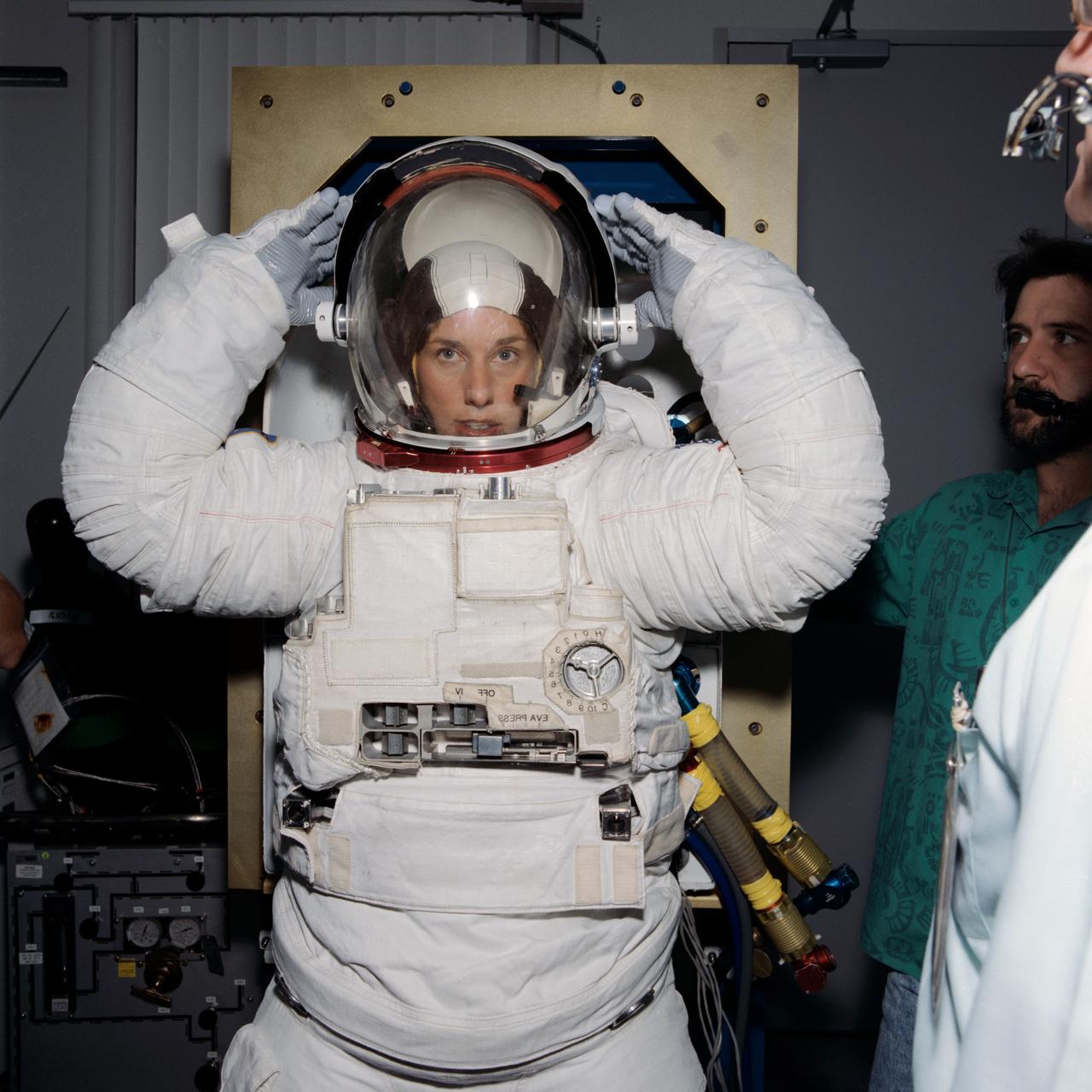
Astronaut N. Jan Davis, with her arms over her head, adjusts her helmet visor during crewmember shuttle suit fit check conducted at JSC's Crew Systems Laboratory Bldg 7.
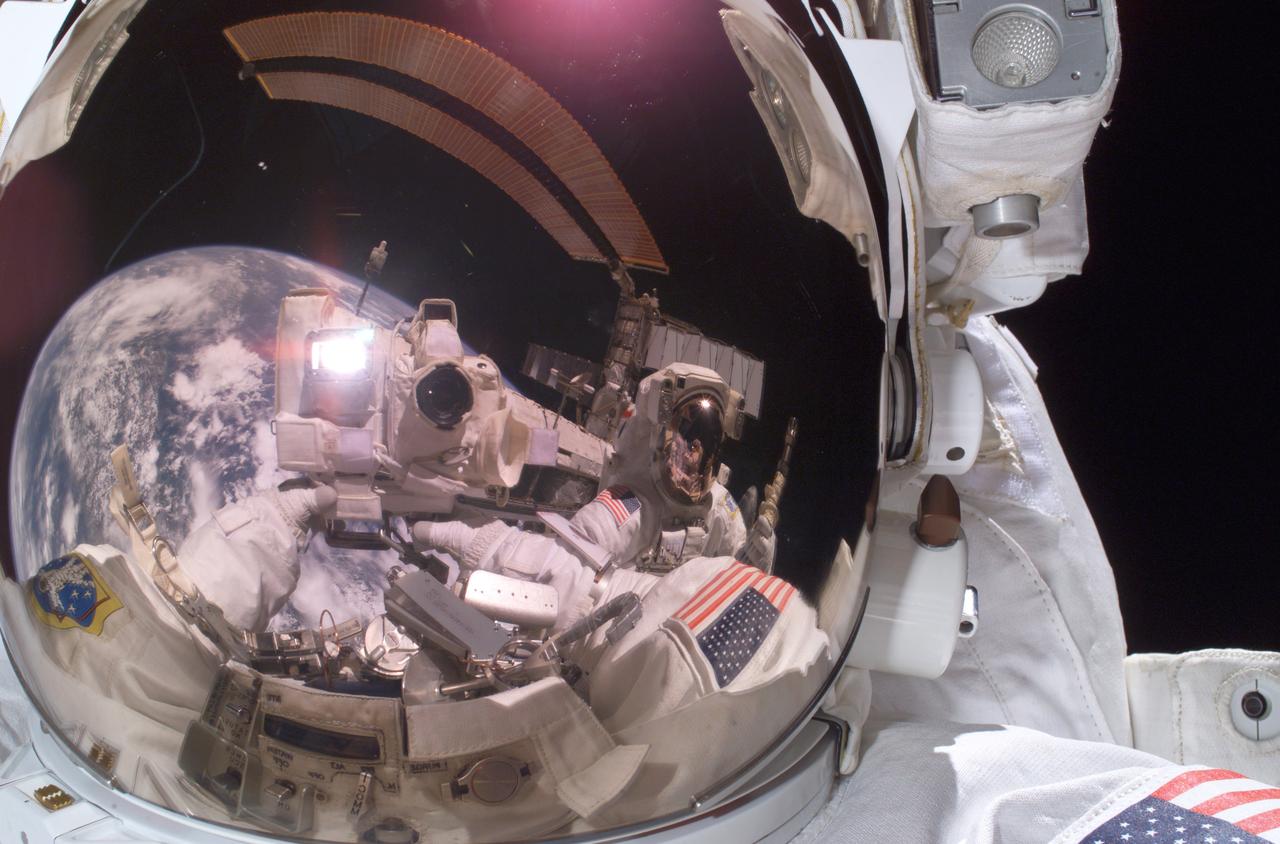
Astronaut Michael E. Fossum, STS-121 mission specialist, used a digital still camera to expose a photo of his helmet visor during a session of extravehicular activity (EVA) while Space Shuttle Discovery was docked with the International Space Station (ISS). Also visible in the visor reflections are fellow space walker Piers J. Sellers, mission specialist, Earth's horizon, and a station solar array. During its 12-day mission, this utilization and logistics flight delivered a multipurpose logistics module (MPLM) to the ISS with several thousand pounds of new supplies and experiments. In addition, some new orbital replacement units (ORUs) were delivered and stowed externally on the ISS on a special pallet. These ORUs are spares for critical machinery located on the outside of the ISS. During this mission the crew also carried out testing of Shuttle inspection and repair hardware, as well as evaluated operational techniques and concepts for conducting on-orbit inspection and repair.
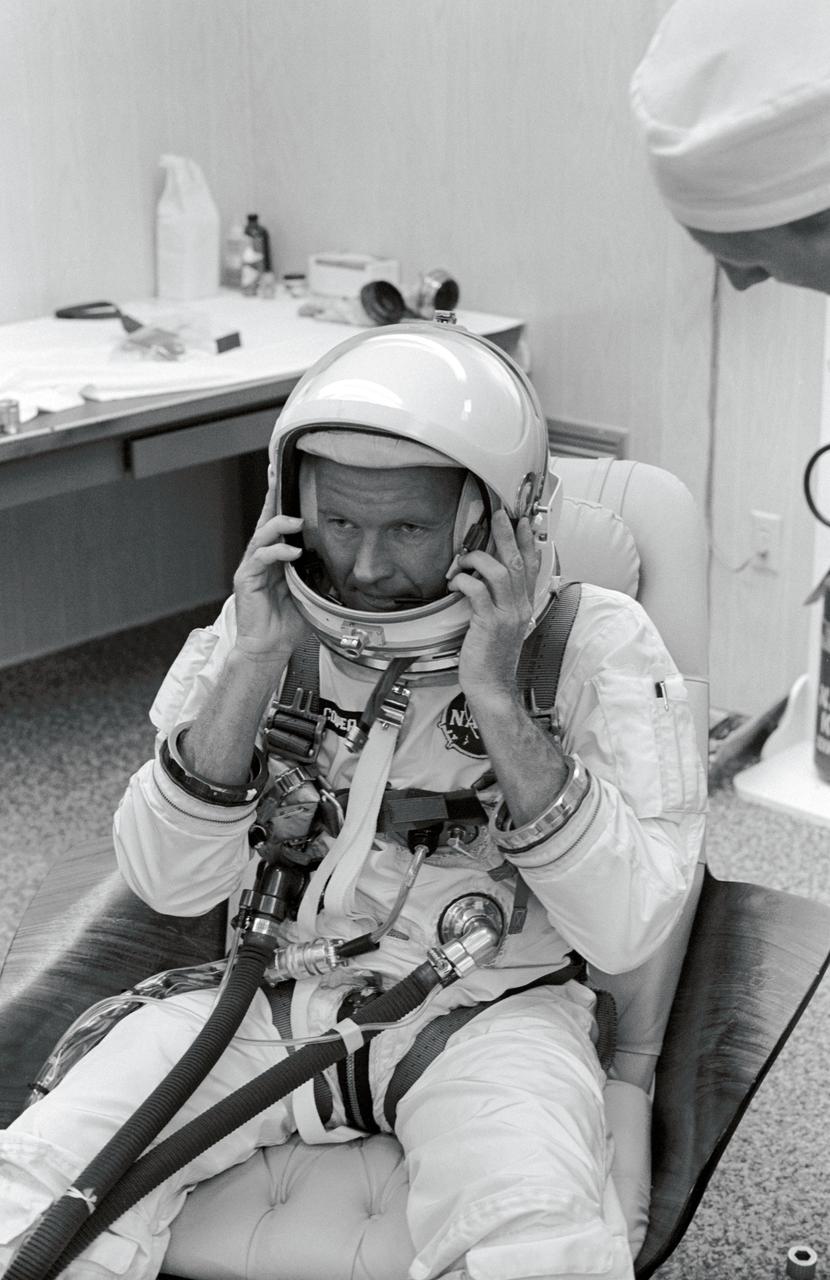
S65-41886 (22 July 1965) --- Astronaut L. Gordon Cooper Jr. makes adjustments to his helmet during suiting up exercise at Pad 16, Cape Kennedy, Florida. He is preparing for the Gemini-5 spaceflight. Photo credit: NASA
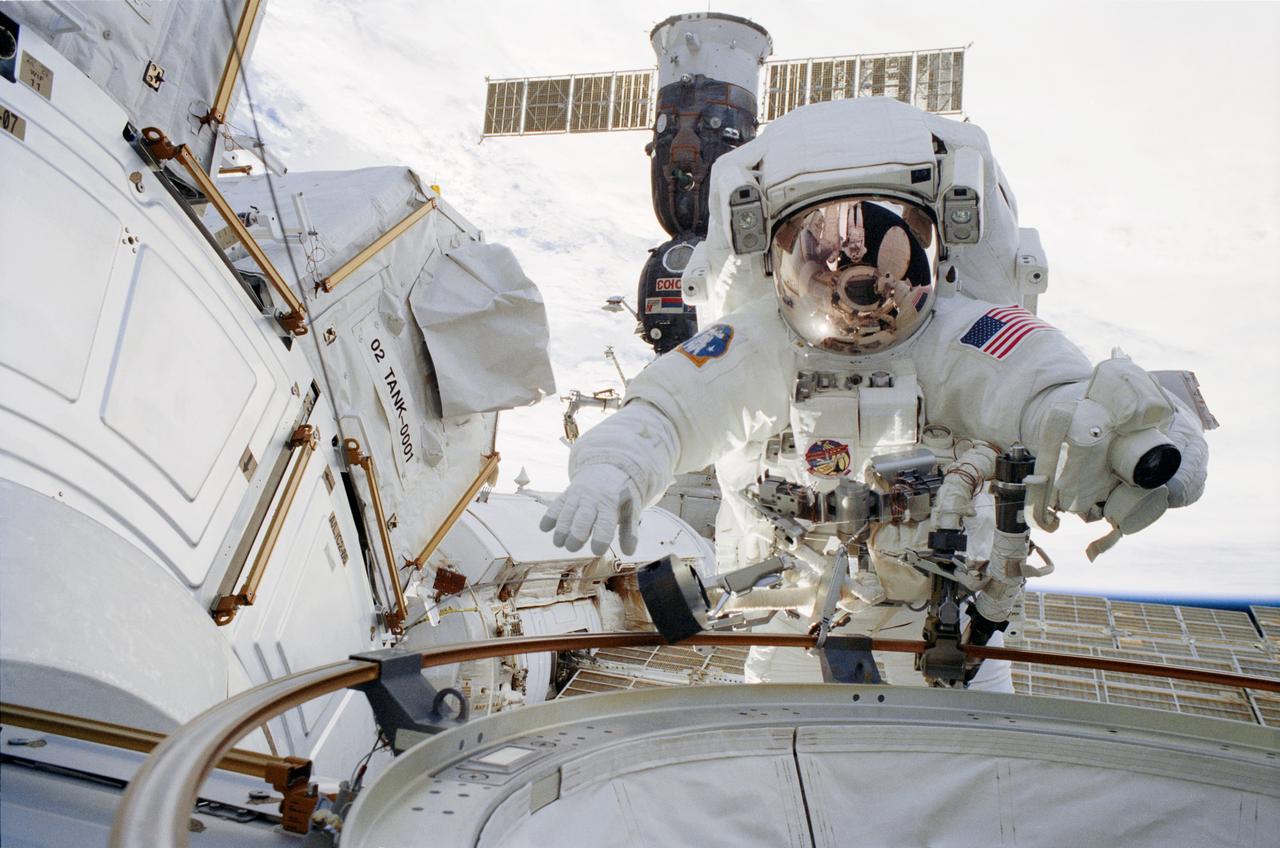
STS113-305-007 (26 November 2002) --- Astronaut John B. Herrington, STS-113 mission specialist, participates in the mission’s first spacewalk. The opened hatch of the Quest Airlock can be seen reflected in Herrington’s helmet visor.
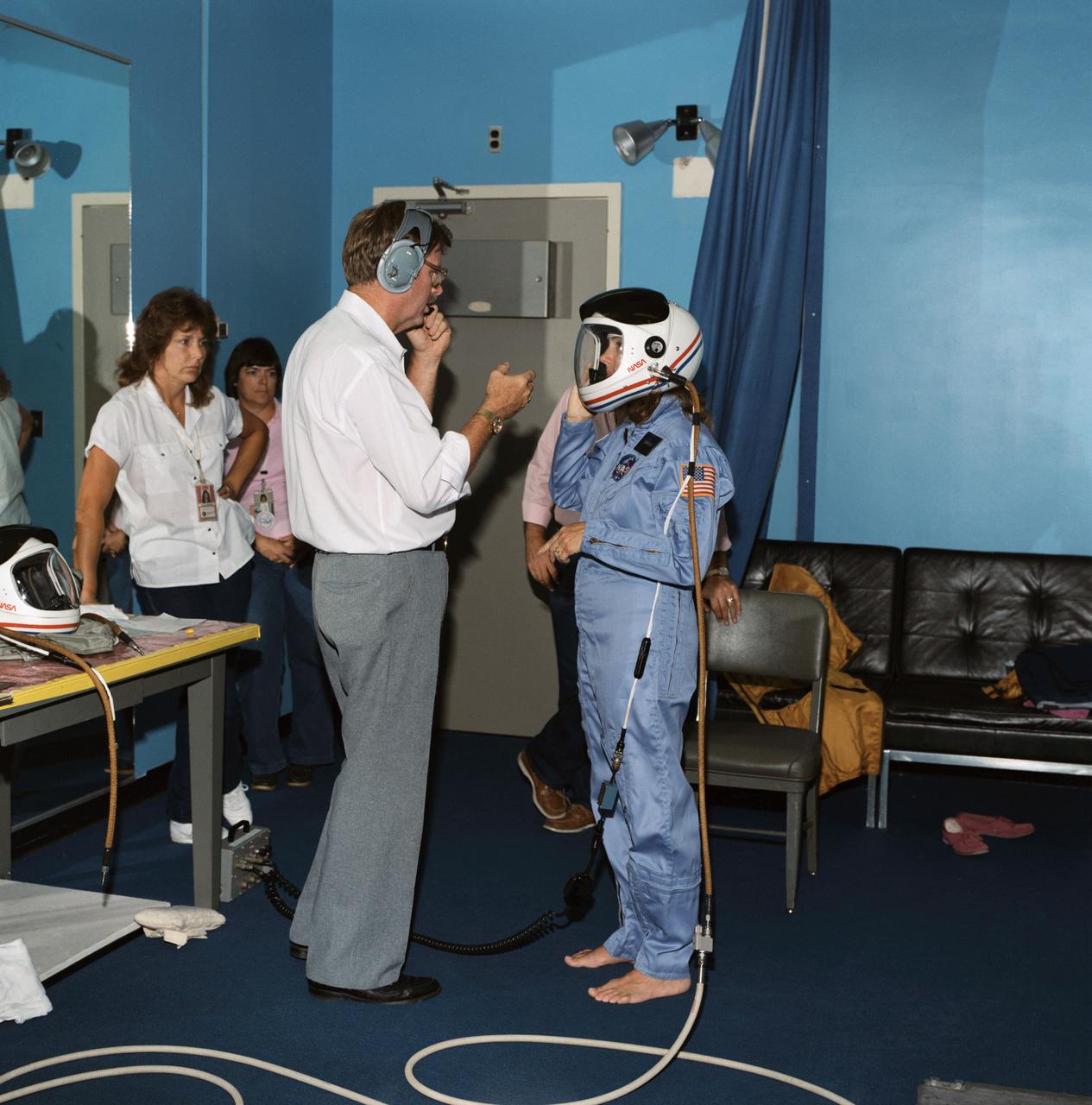
S85-40031 (November 1985) --- Payload specialist Sharon Christa McAuliffe is briefed on launch/entry helmets by crew systems technician Alan M. Rochford in the Johnson Space Center’s crew systems lab. McAuliffe is one of seven crew members in training for STS-51L flight scheduled for January 1986. Photo credit: NASA
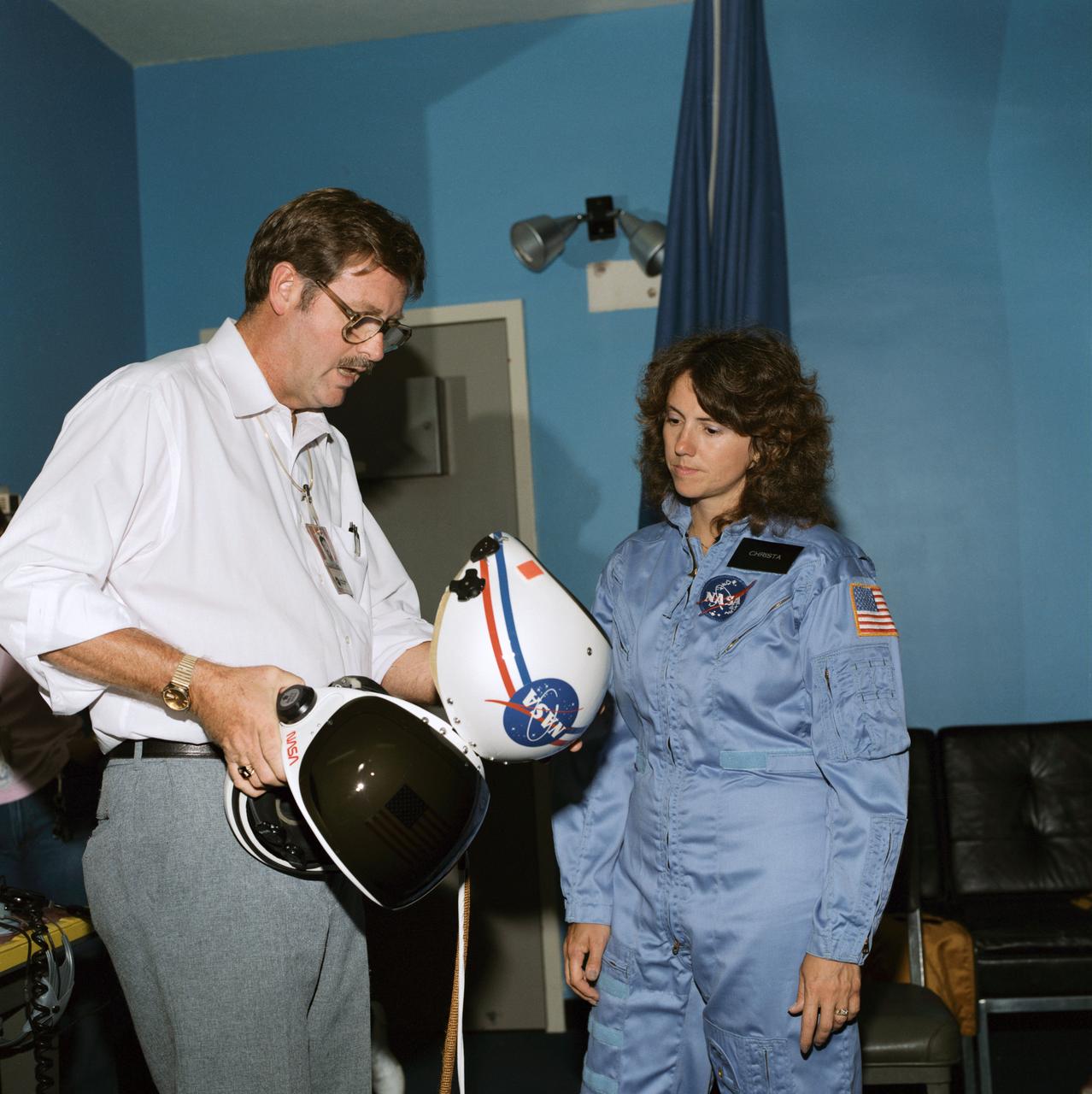
S85-40029 (November 1985) --- Payload specialist Sharon Christa McAuliffe is briefed on launch/entry helmets by crew systems technician Alan M. Rochford in the Johnson Space Center’s crew systems lab. McAuliffe is one of seven crew members in training for STS-51L flight scheduled for January 1986. Photo credit: NASA
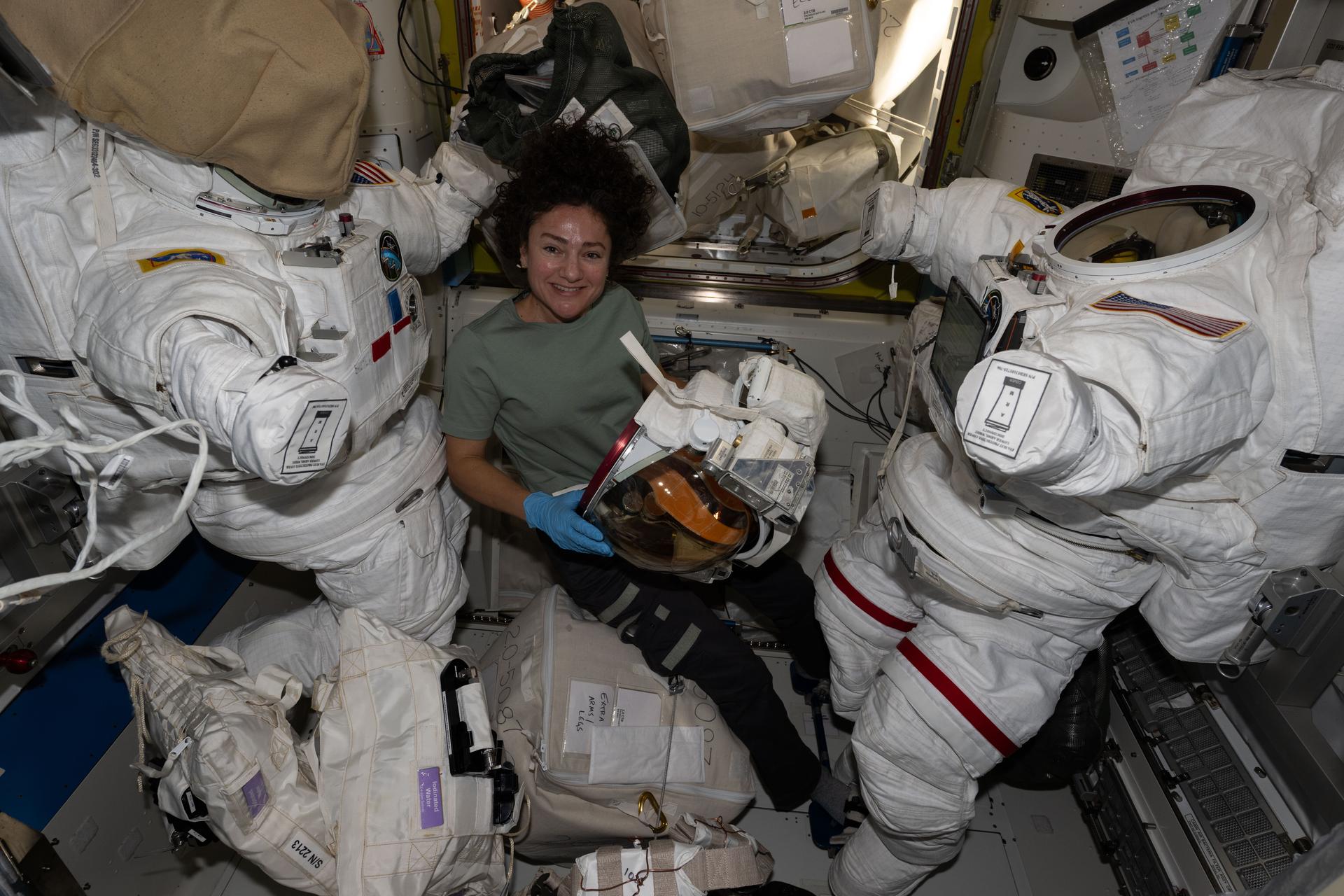
iss074e0365172 (March 9, 2026) --- NASA astronaut and Expedition 74 flight engineer Jessica Meir smiles for a portrait while preparing a helmet for installation on a spacesuit inside the International Space Station's Quest airlock. Credit: NASA/Jessica Meir
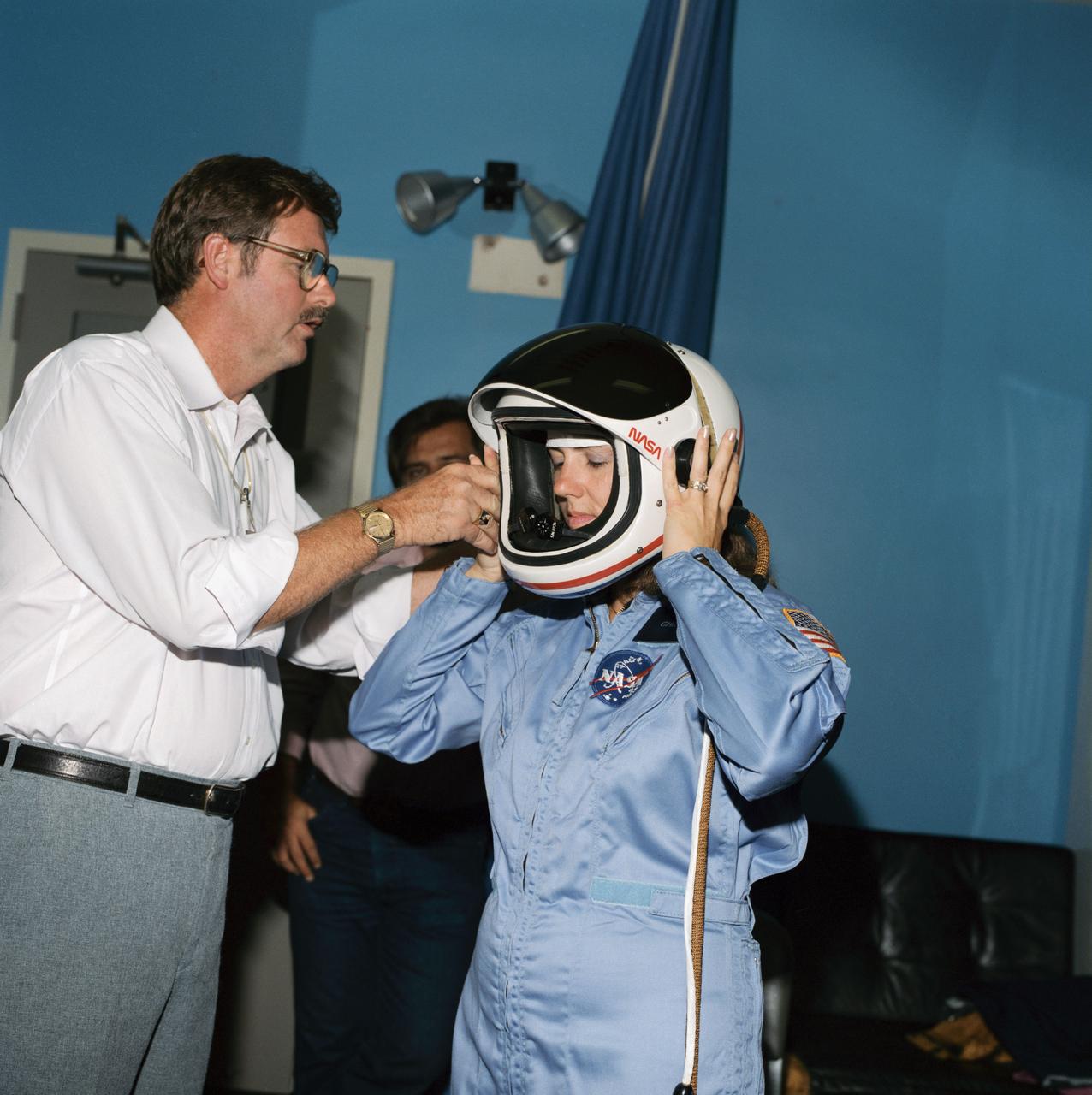
S85-40030 (November 1985) --- Payload specialist Sharon Christa McAuliffe is briefed on launch/entry helmets by crew systems technician Alan M. Rochford in the Johnson Space Center’s crew systems lab. McAuliffe is one of seven crew members in training for STS-51L flight scheduled for January 1986. Photo credit: NASA
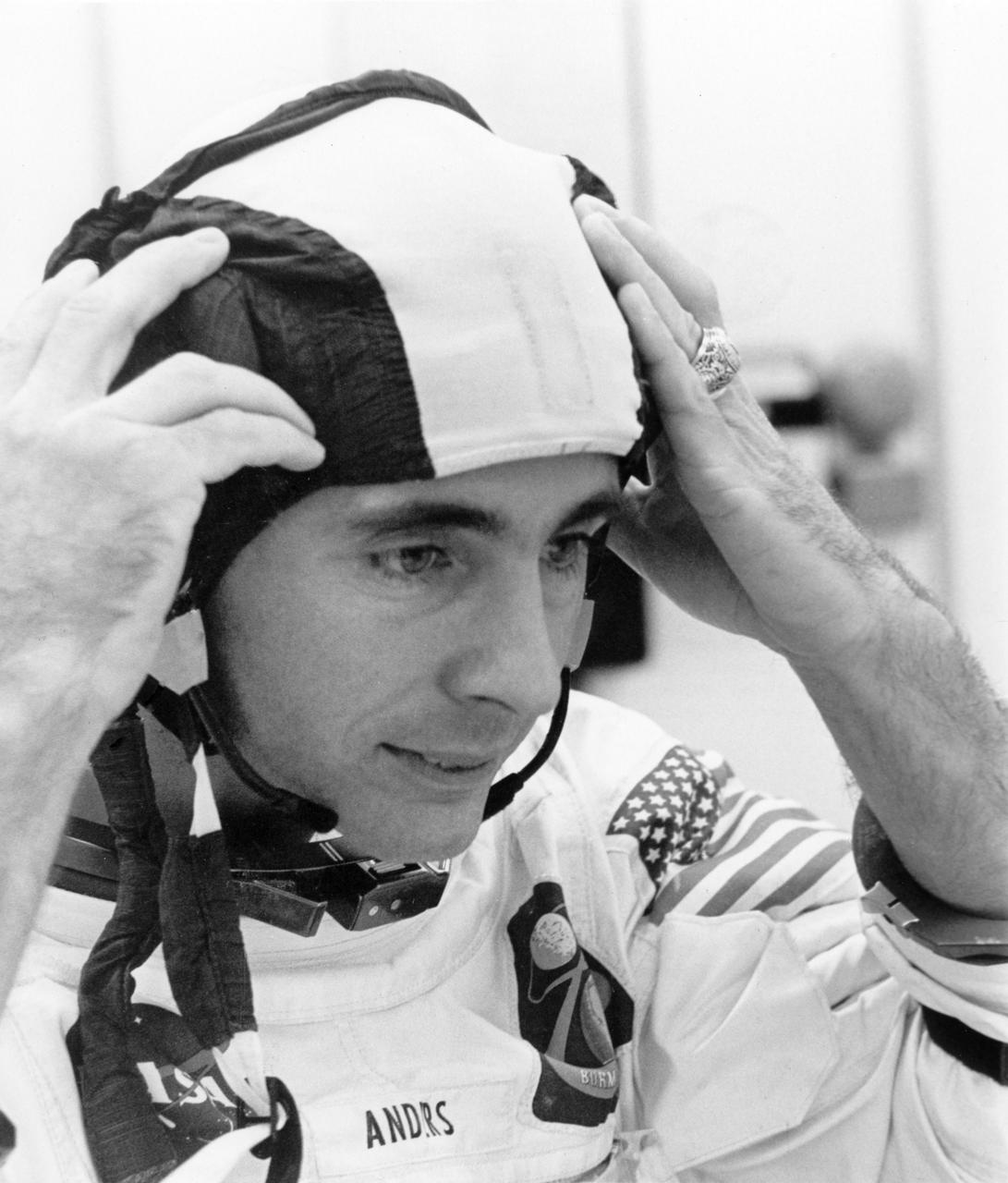
Apollo 8 Astronaut William Anders, Lunar Module (LM) pilot, adjusts his helmet as he suits up for the Apollo 8 mission. The first manned Apollo mission launched aboard the Saturn V and first manned Apollo craft to enter lunar orbit, the SA-503, Apollo 8 mission lift off occurred on December 21, 1968 and returned safely to Earth on December 27, 1968. Aboard were Anders and fellow astronauts James Lovell, Command Module (CM) pilot; and Frank Borman, commander. The mission achieved operational experience and tested the Apollo command module systems, including communications, tracking, and life-support, in cis-lunar space and lunar orbit, and allowed evaluation of crew performance on a lunar orbiting mission. The crew photographed the lunar surface, both far side and near side, obtaining information on topography and landmarks as well as other scientific information necessary for future Apollo landings. All systems operated within allowable parameters and all objectives of the mission were achieved.
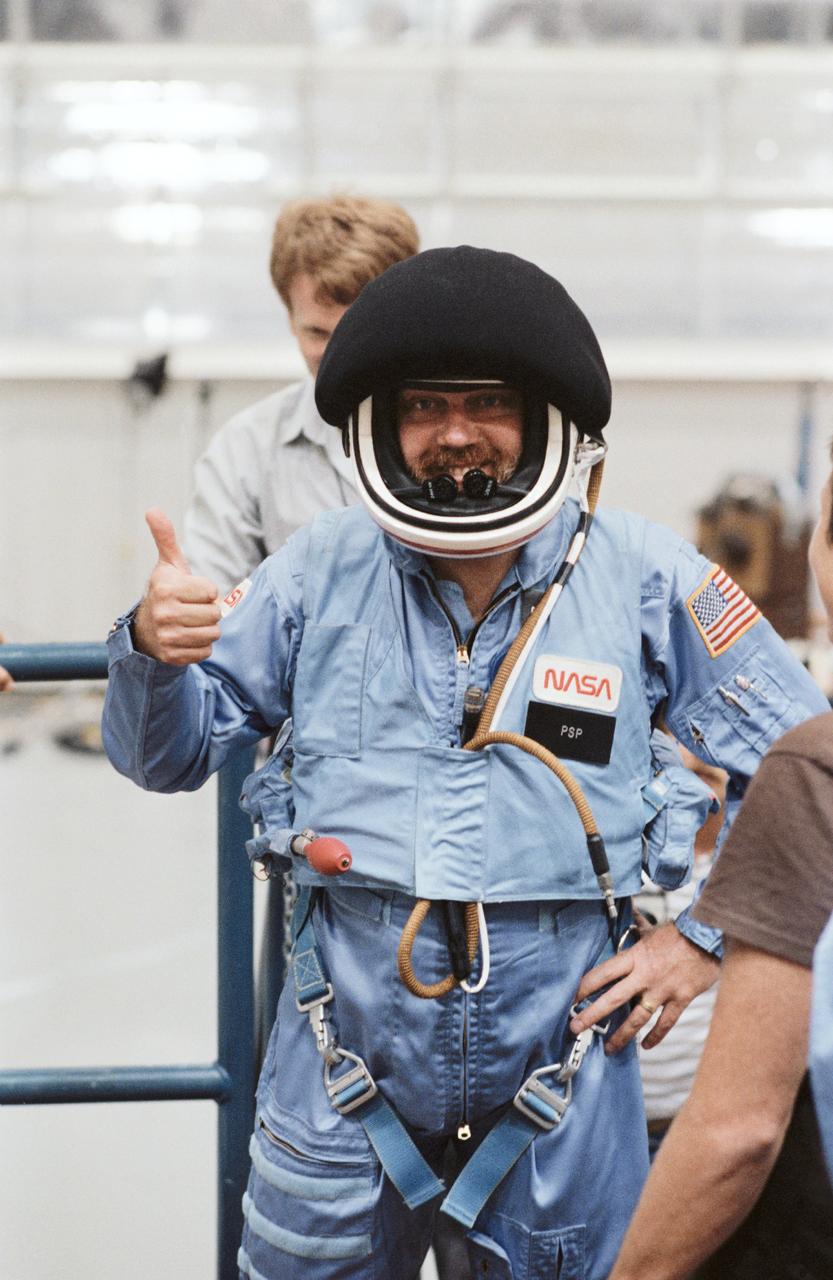
41D-3183 (2 Sept. 1984) --- Paul D. Scully-Power, 41-G payload specialist, appears ready to participate in the eight-day space shuttle mission in this photograph taken during a pause in training in the Johnson Space Center's mockup and integration laboratory. The U.S. Navy oceanographer and a Canadian will join five NASA astronauts for a busy stay in space aboard the Challenger next month. The team was practicing for emergency egress. Photo credit: NASA (Editor's note: Please ignore the odd photo identification number for this image. This is a 41-G training image.)
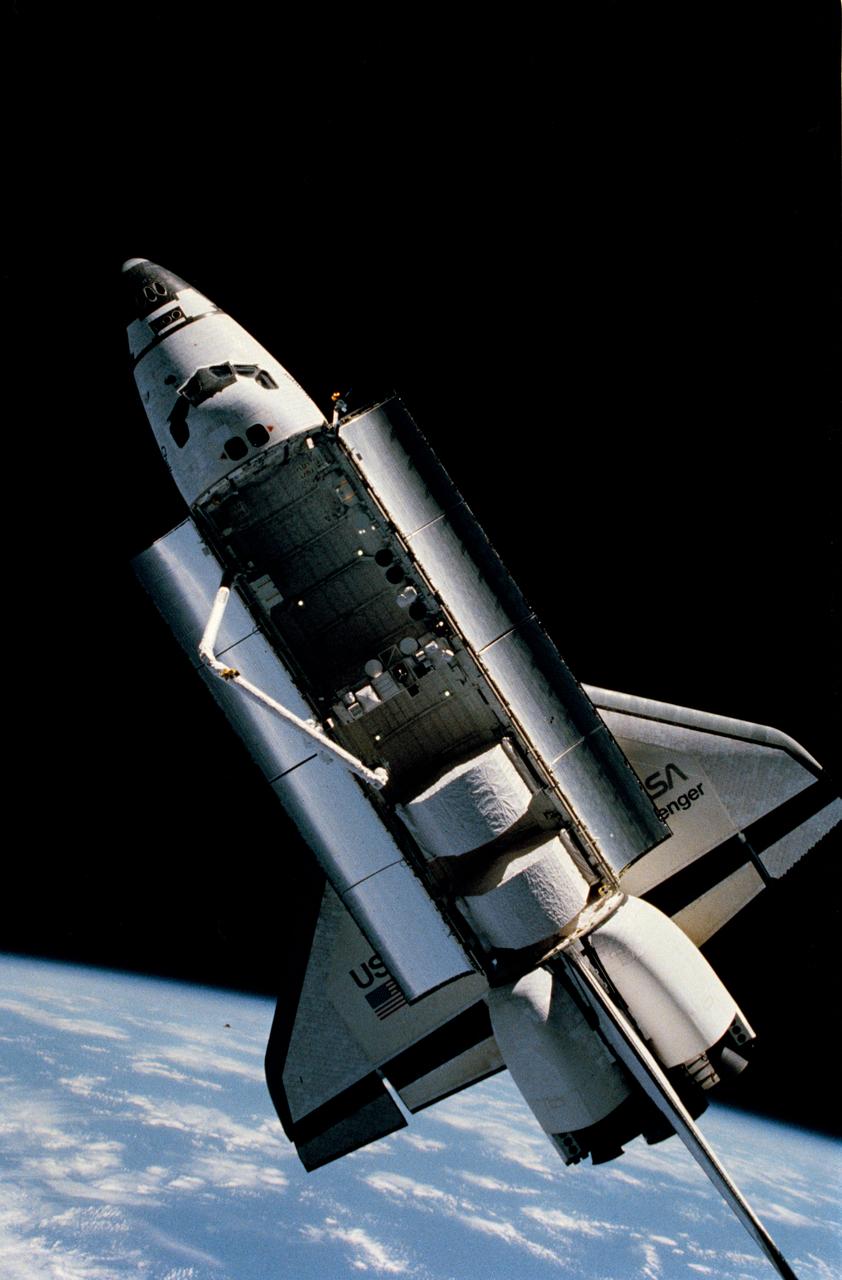
S84-27020 (7 Feb 1984) --- A fixed camera on astronaut Bruce McCandless II's helmet recorded this rare scene of the Space Shuttle Challenger some 50 to 60 meters away during a history-making extravehicular activity (EVA), February 7, 1984. The Shuttle Pallet Satellite (SPAS-01A) is configured mid-cargo bay. Astronaut Robert L. Stewart, standing beneath the Remote Manipulator System (RMS) arm, later donned the same Manned Maneuvering Unit (MMU) which afforded McCandless the freedom of movement to record this image. Also visible in the cargo bay are the support stations for the two MMU back-packs, the sunshields for the Palapa B and Westar VI Satellites, KU-Band antenna and a number of Getaway Special (GAS) canisters.
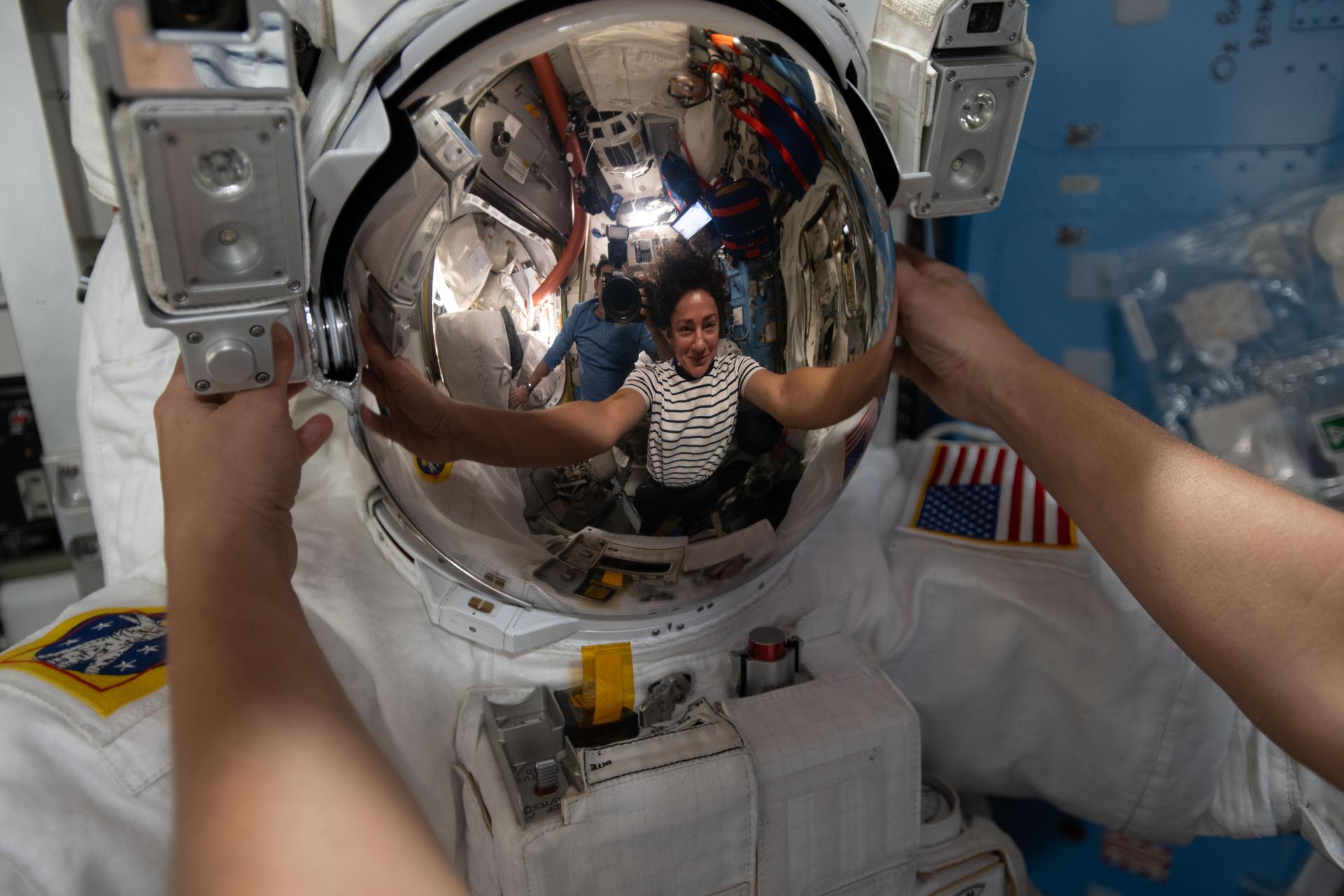
iss074e0336282 (March 2, 2026) --- NASA astronaut and Expedition 74 flight engineer Jessica Meir’s reflection is captured in a spacesuit helmet visor. The visor assembly is coated with a microscopic layer of gold that reflects infrared radiation to protect an astronaut’s eyes while allowing visible light to pass through. Meir was working inside the International Space Station's Quest airlock, installing leg and arm components on the spacesuit and swapping components from one suit to another. Credit: NASA/Jack Hathaway

iss072e575164 (Jan. 30, 2025) --- NASA astronaut and Expedition 72 Commander Suni Williams' camera is reflected in her spacesuit helmet's visor as she points it toward herself and takes an out-of-this-world "space-selfie" during a five-hour and 26-minute spacewalk. The International Space Station was orbiting 263 miles above the Pacific Ocean at the time of this photograph.
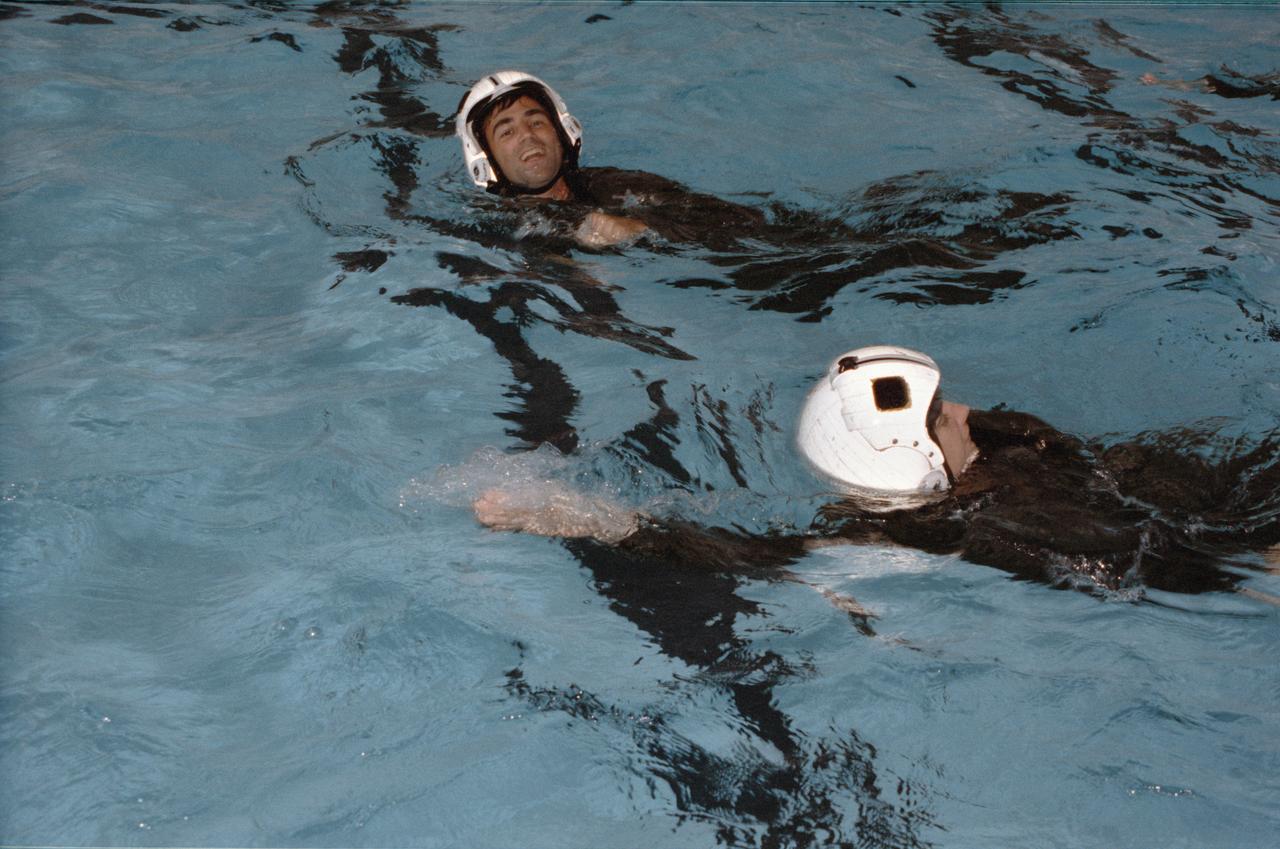
1990 Group 13 Astronaut Candidates (ASCANs) Susan J. Helms (foreground) and William G. Gregory, wearing helmets and flight suits, swim in pool at Elgin Air Force Base (AFB) in Pensacola, Florida, during water survival exercises. The training familiarized the candidates with survival techniques necessary in the event of a water landing. ASCANs participated in the exercises from 08-14-90 through 08-17-90.
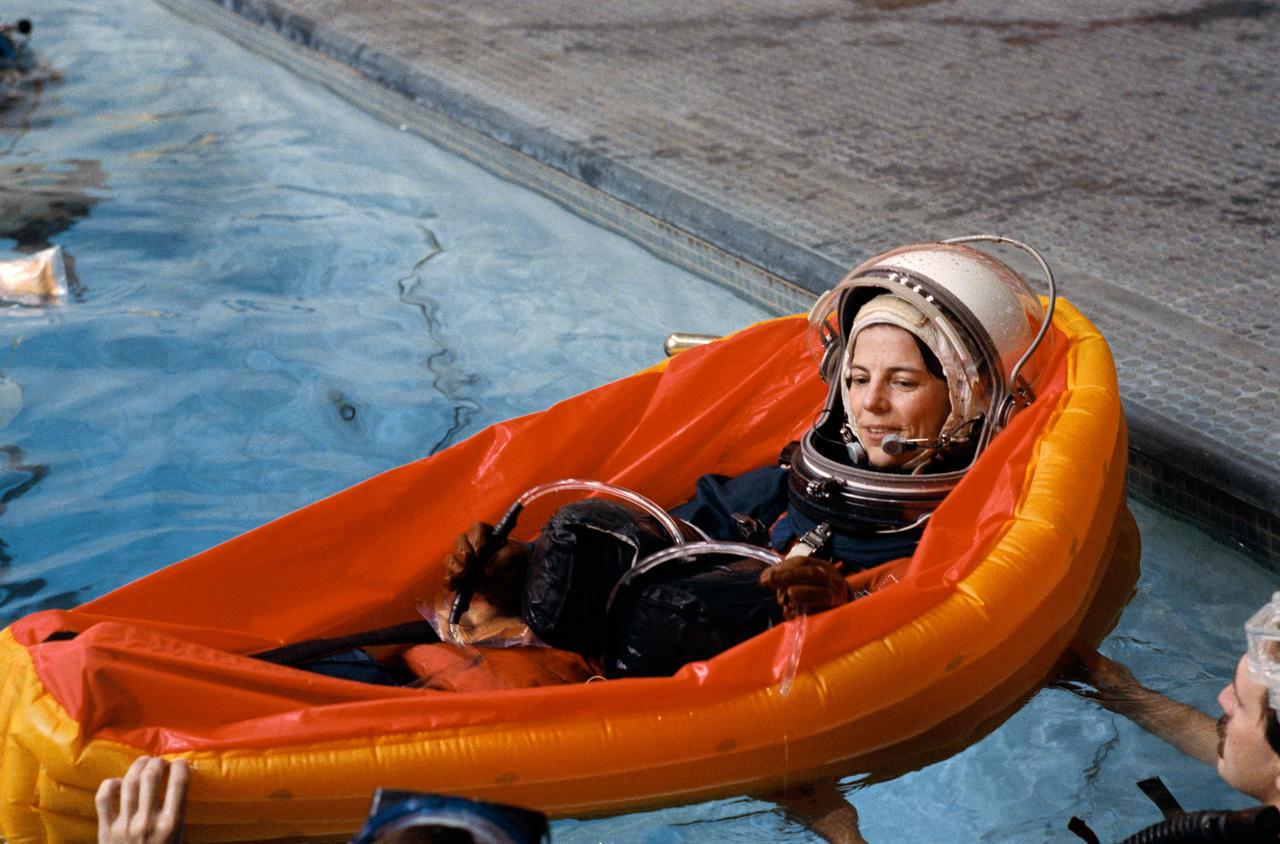
STS-32 Mission Specialist (MS) Bonnie J. Dunbar, wearing a launch and entry suit (LES) and lauch and entry helmet (LEH), in a single-occupant (one man) lift raft enlists the aid of two SCUBA-equipped divers as she floats in 25 ft deep pool located in JSC's Weightless Environment Training Facility (WETF) Bldg 29. During the exercises the crew practiced the procedures to follow in the event of an emergency aboard the Space Shuttle and familiarized themselves with post-Challenger pole system of emergency egress.
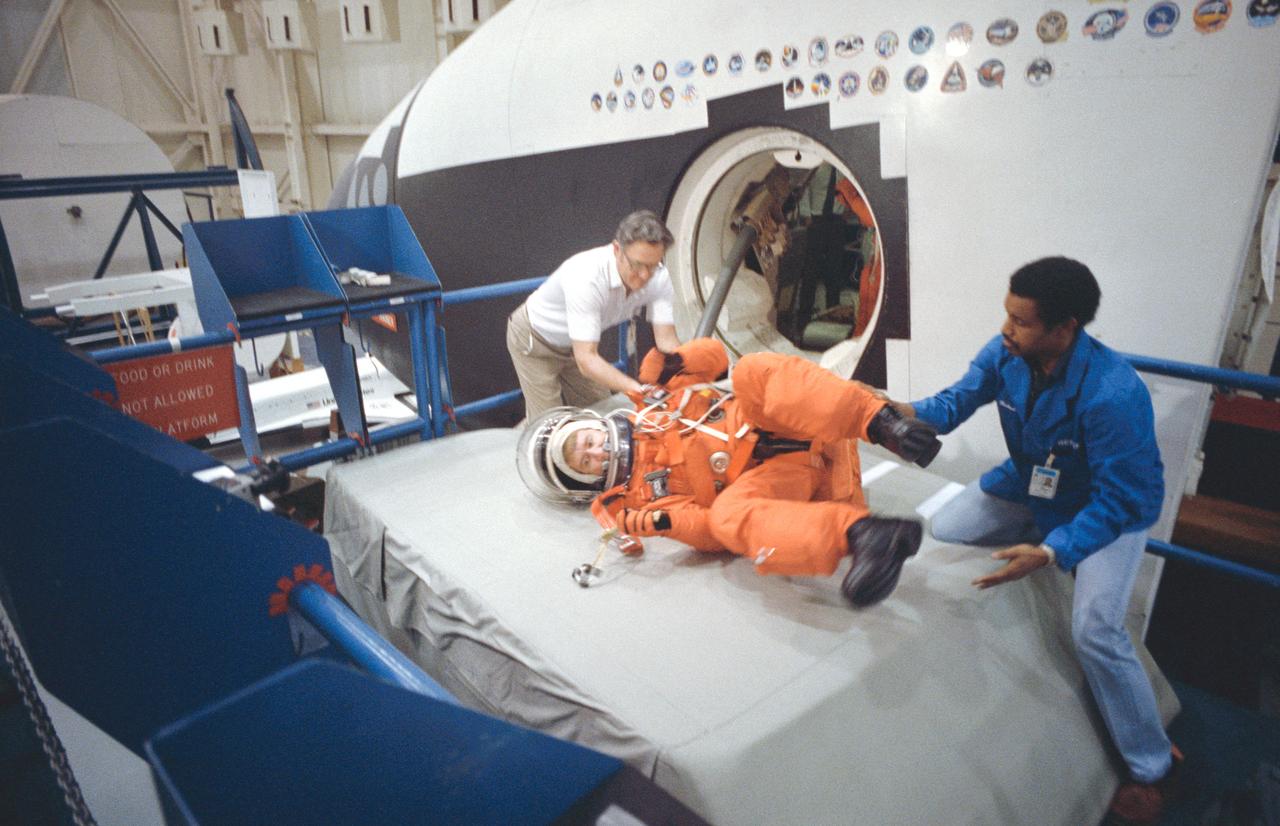
STS-38 Pilot Frank L. Culbertson, wearing launch and entry suit (LES) and launch and entry helmet (LEH), rolls through the side hatch of the crew compartment trainer (CCT) located in JSC's Mockup and Integration Laboratory (MAIL) Bldg 9A. Assisted by technicians, Culbertson practices emergency egress through the side hatch using the crew escape system (CES) pole which extends out the side hatch. The inflated safety cushion breaks Culbertson's fall as he rolls out of the side hatch.
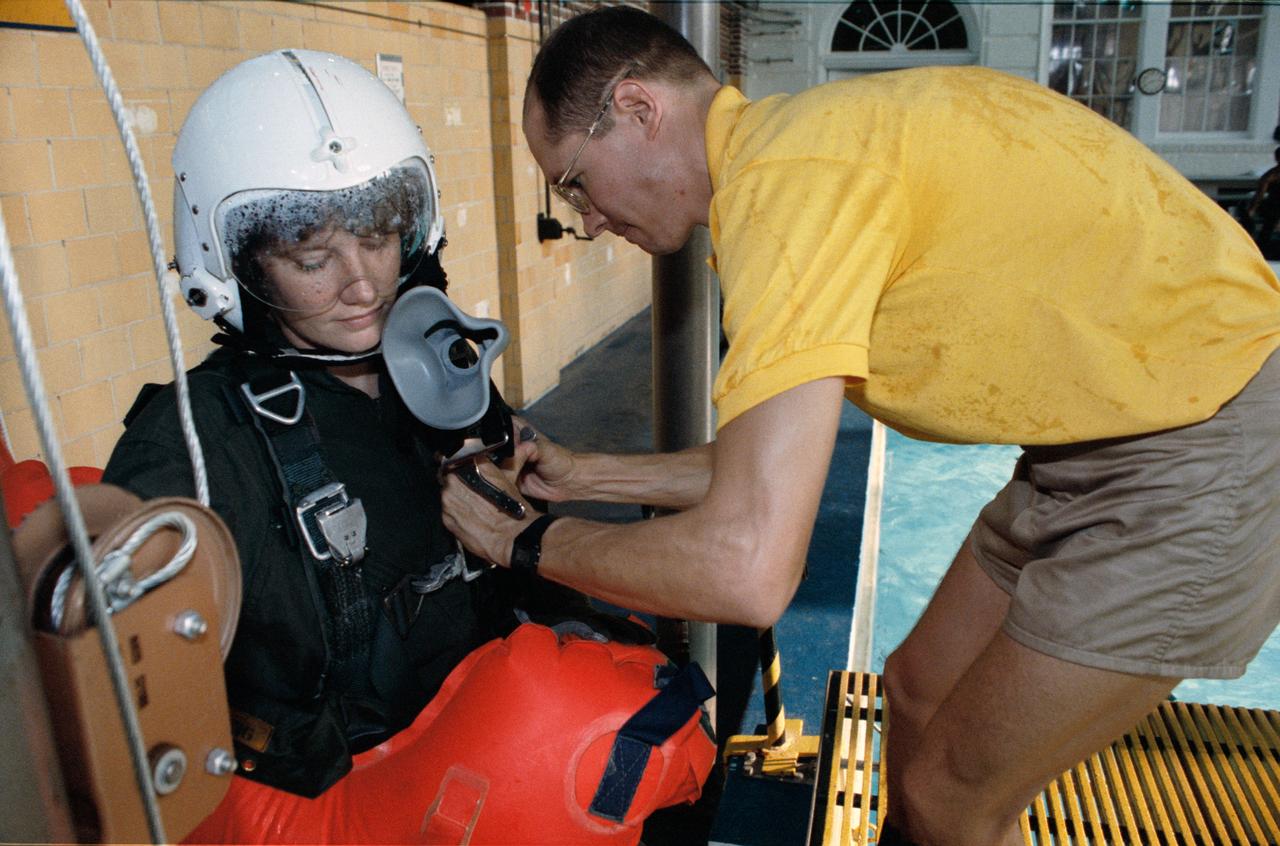
1990 Group 13 Astronaut Candidate (ASCAN) Susan J. Helms, wearing helmet with oxygen mask and inflated life jacket, is assisted by training instructor during water survival exercises at Elgin Air Force Base (AFB) in Pensacola, Florida. Helms looks on as the instructor adjusts her parachute harness. When ready, Helms will be dropped from the harness into the pool (in background) to simulate a water landing after T-38 ejection. ASCANs participated in the exercises from 08-14-90 through 08-17-90.
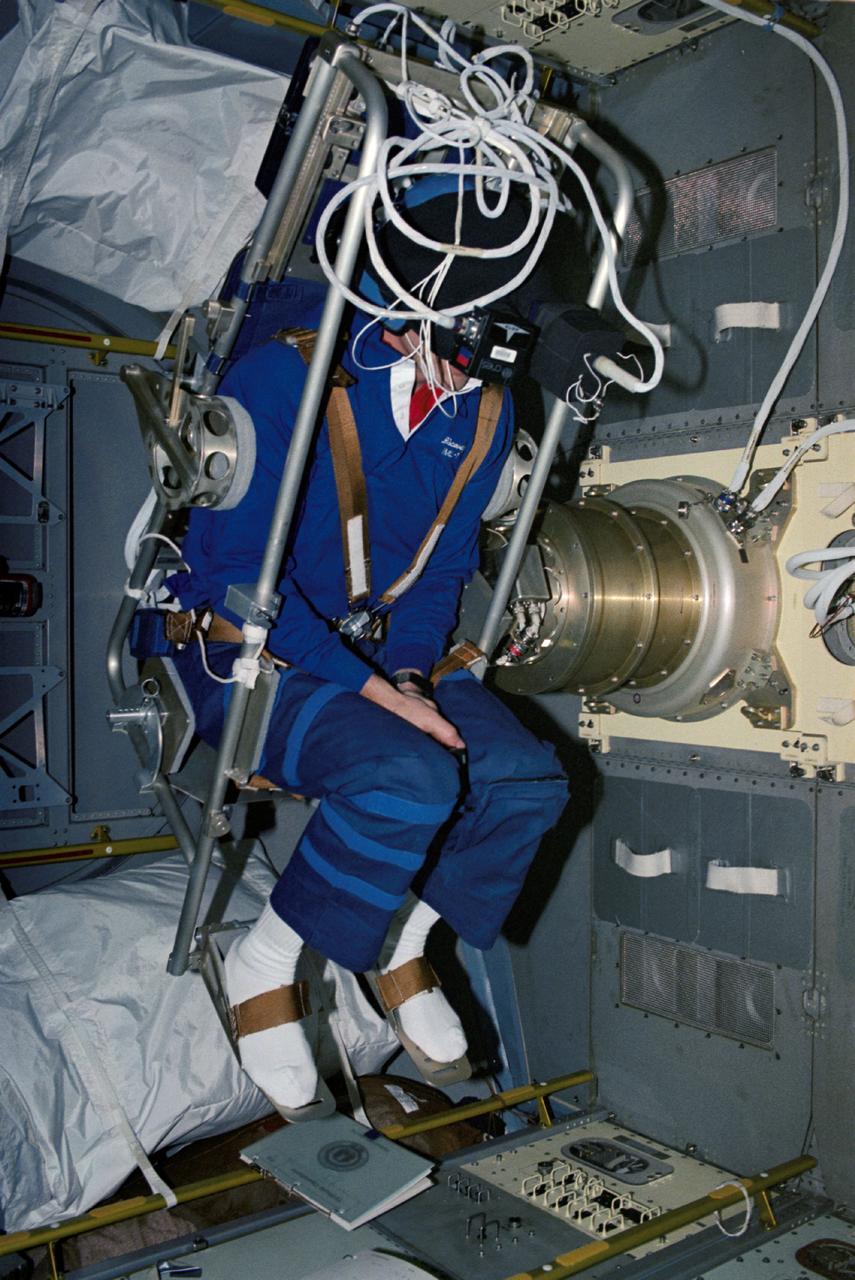
STS042-27-037 (22-30 Jan. 1992) --- Astronaut David C. Hilmers, STS-42 mission specialist, wearing a helmet assembly, sits in the Microgravity Vestibular Investigation (MVI) rotating chair. The scene is in the International Microgravity Laboratory (IML-1) science module aboard Discovery. Hilmers, a mission specialist, and six other crewmembers spent more than eight days in Earth-orbit conducting experiments. Hilmer's helmet assembly is outfitted with accelerometers to measure head movements and visors that fit over each eye independently to provide visual stimuli. The chair system has three movement patterns: "sinusoidal" or traveling predictably back and forth over the same distance at a constant speed; "pseudorandom" or moving back and forth over the varying distances; and "stepped" or varying speeds beginning and stopping suddenly.
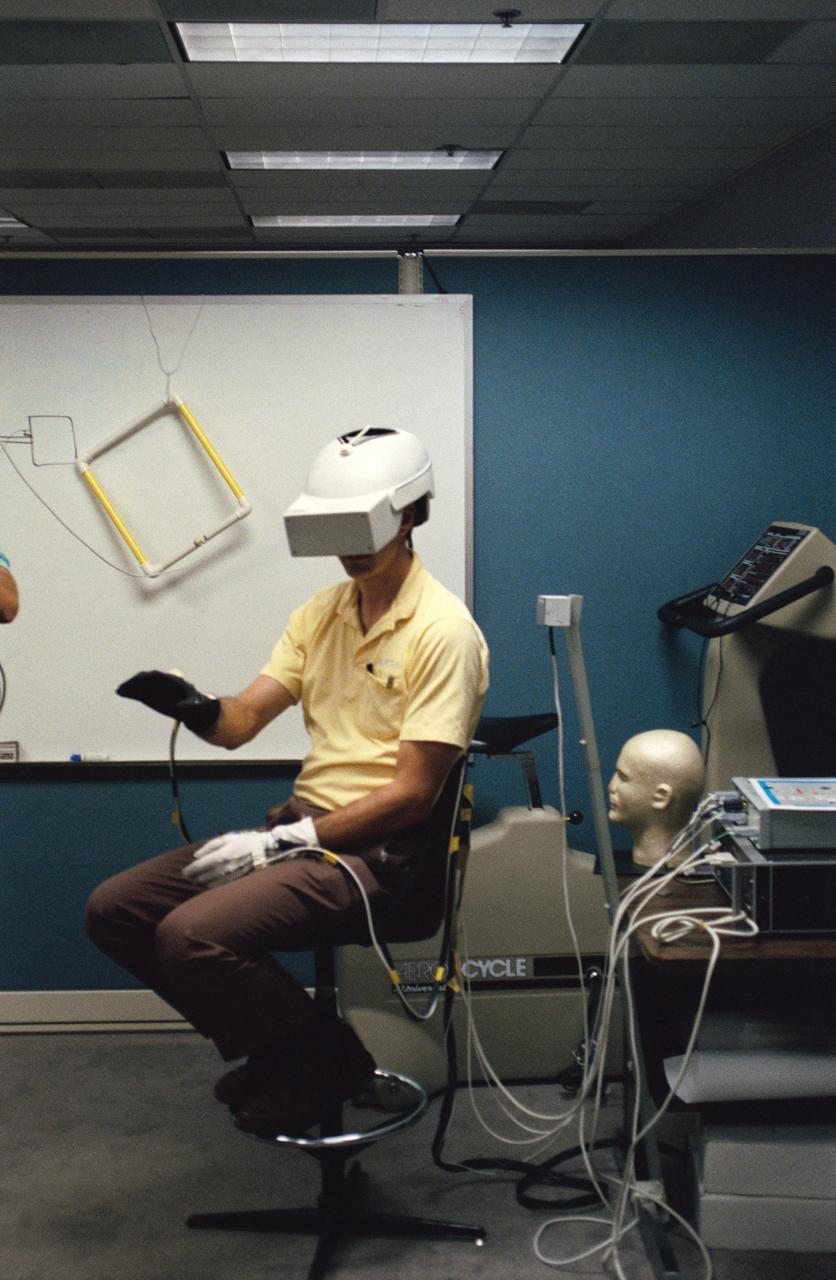
Astronaut Jeffrey A. Hoffman, one of four crewmembers for STS-61 that will conduct scheduled spacewalks during the flight, wears a special helmet and gloves designed to assist in proper positioning near the telescope while on the end of the robot arm. Crewmembers are utilizing a new virtual reality training aid which assists in refining positioning patterns for Space Shuttle Endeavour's Remote Manipulator System (RMS) (36890); Astronaut Claude Nicollier looks at a computer display of the Shuttle's robot arm movements as Thomas D. Akers and Kathryn C. Thornton, mission specialists look on. Nicollier will be responsible for maneuvering the astronauts while they stand in a foot restraint on the end of the RMS arm (36891,36894); Hoffman wears a special helmet and gloves designed to assist in proper positioning near the telescope while on the end of the robot arm (35892); Nicollier looks at a computer display of the Shuttle's robot arm movements as Akers looks on (36893); While (l-r) Astronauts Kenneth Bowersox, Kathryn Thornton, Richard O. Covey and Thomas D. Akers watch, Nicollier moves the Robot arm to desired locations in the Shuttle's payload bay using the Virtual Reality program (36895); Bowersox takes his turn maneuvering the RMS while mission specialist Hoffman, wearing the Virtual Reality helmet, follows his own progress on the end of the robot arm. Crewmembers participating during the training session are (l-r) Astronauts Akers, Hoffman, Bowersox, Nicollier, Covey, and Thornton. In the background, David Homan, an engineer in the JSC Engineering Directorate's Automation and Robotics Division, looks on (36896).
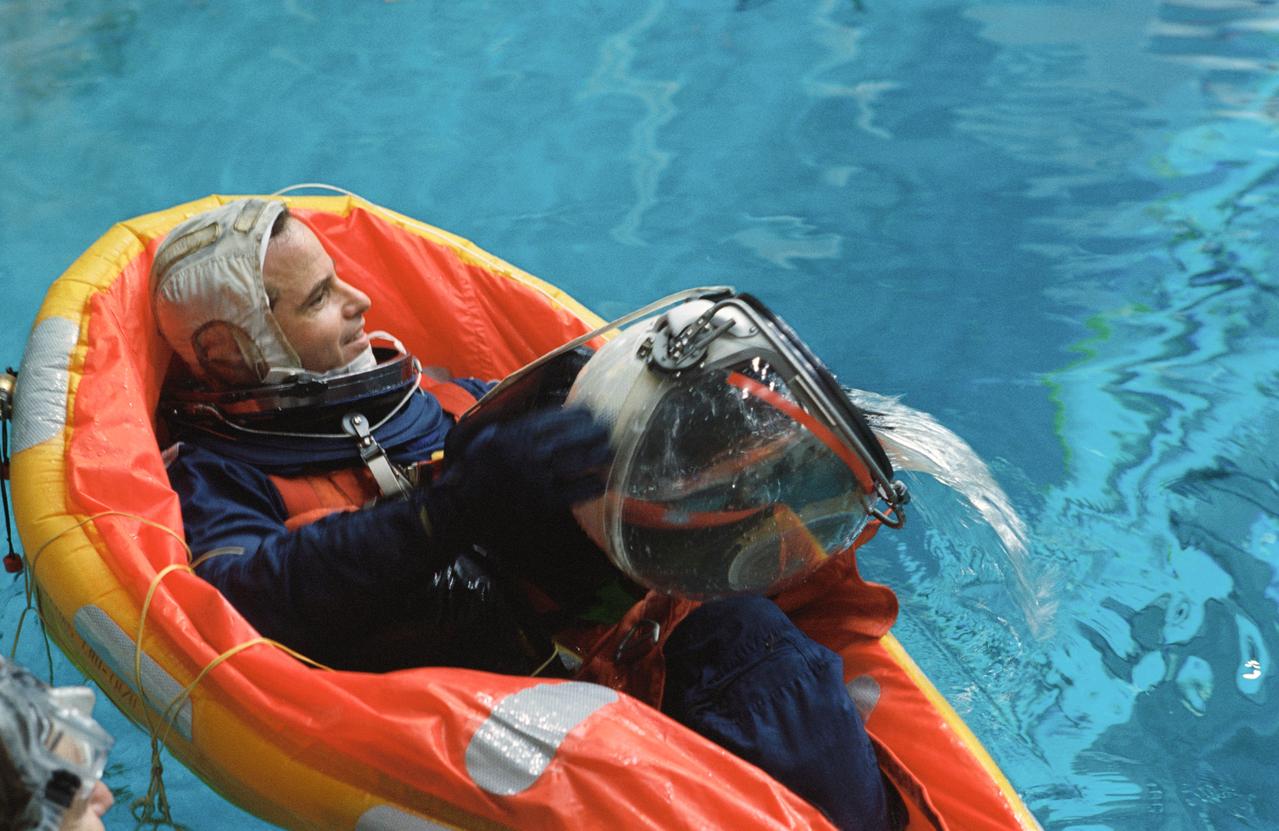
S93-50705 (22 Dec 1993) --- Astronaut Kevin P. Chilton, pilot, uses his helmet to bail water from his life raft during emergency bailout training at the Johnson Space Center's (JSC) Weightless Environment Training Facility (WET-F). Chilton and five other NASA astronauts are scheduled to fly aboard the Space Shuttle Endeavour next year.
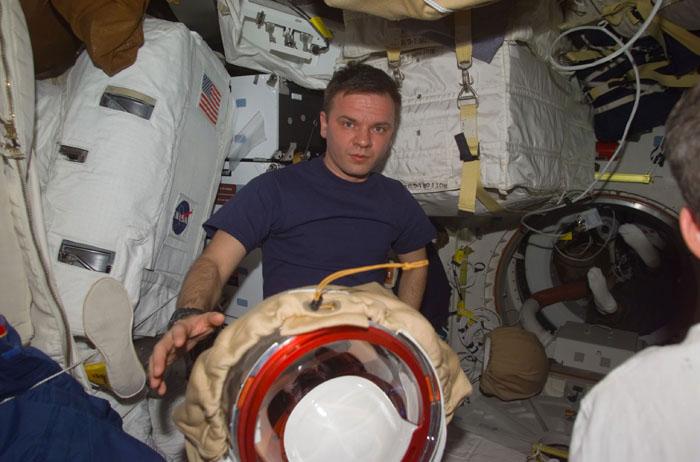
STS102-E-5152 (13 March 2001) --- Cosmonaut Yuri P. Gidzenko, now a member of the STS-102 crew, on Discovery's mid deck with extravehicular mobility unit (EMU) space suits. Gidzenko, representing Rosaviakosmos, had been onboard the International Space Station (ISS) since early November 2000. The photograph was taken with a digital still camera.
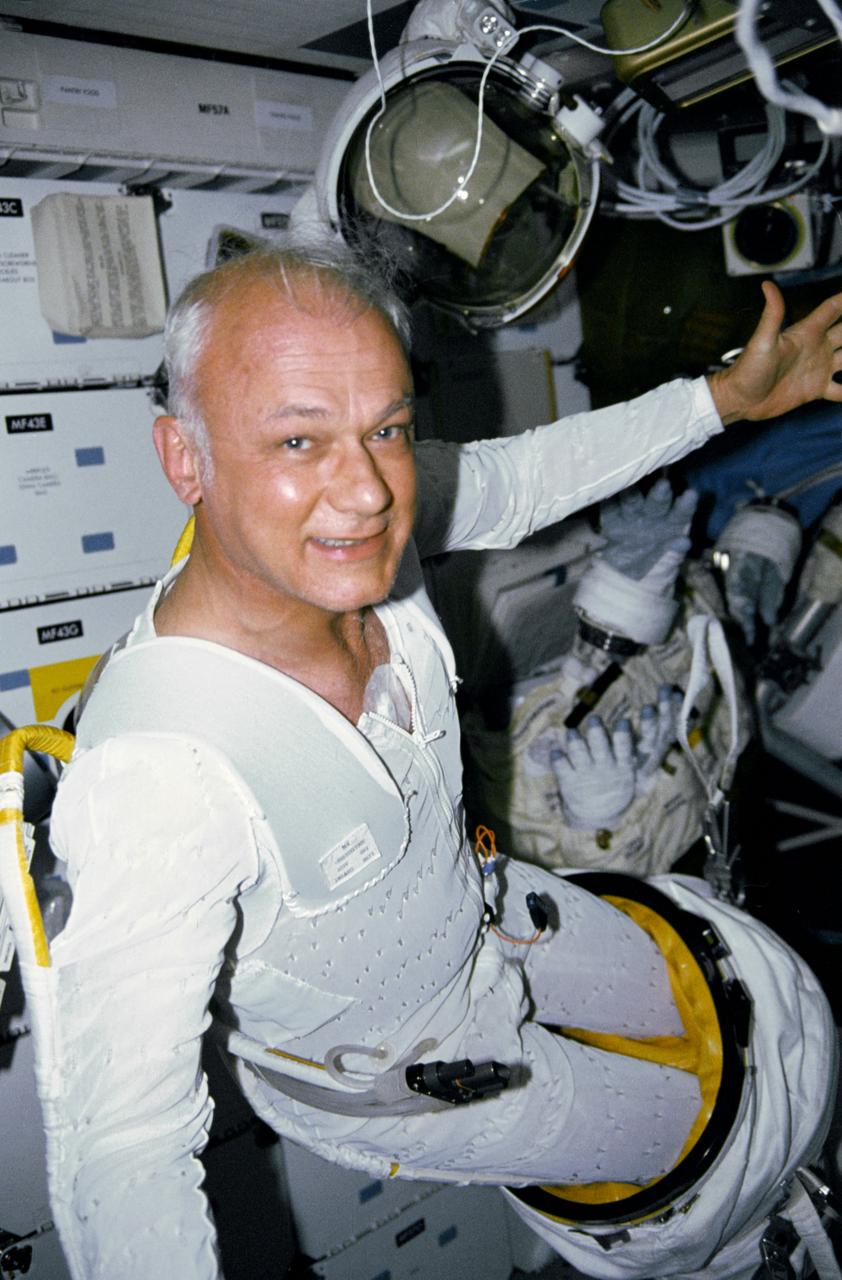
STS-31 Mission Specialist (MS) Bruce McCandless II, wearing liquid cooling and ventilation garment (LCVG), works his way out of the extravehicular mobility unit (EMU) lower torso on the middeck of Discovery, Orbiter Vehicle (OV) 103. McCandless was in a standby mode to perform extravehicular activity (EVA) if needed to support Hubble Space Telescope (HST) deployment and post- deployment tasks. None was needed. His helmet and gloves freefloat in the background.
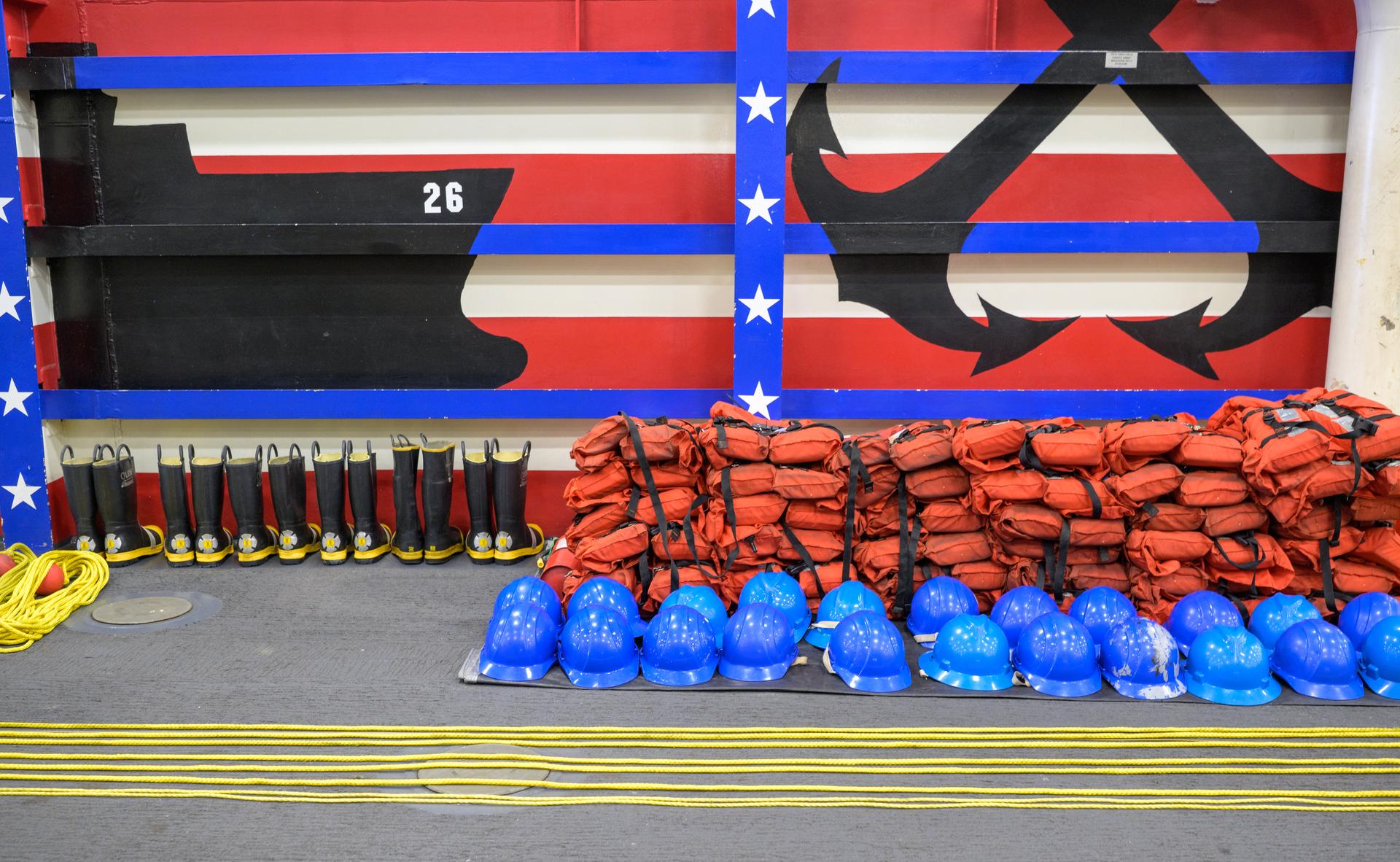
Life jackets, helmets, throw ropes, and boots are seen laid out onboard USS John P. Murtha as NASA, U.S. Navy., and U.S. Air Force teams prepare for the return of the Artemis II crewmembers to Earth, Thursday, April 9, 2026, in the Pacific Ocean off the coast of California. NASA’s Artemis II mission is taking NASA astronauts Reid Wiseman, commander; Victor Glover, pilot; Christina Koch, mission specialist; and CSA (Canadian Space Agency) astronaut Jeremy Hansen, mission specialist on a 10-day journey around the Moon and back aboard their Orion spacecraft. Wiseman, Glover, Koch, and Hansen are scheduled to splash down off the coast of San Diego at approximately 5:07 p.m. PDT (8:07 p.m. EDT) on Friday, April 10. Photo Credit: (NASA/Bill Ingalls)
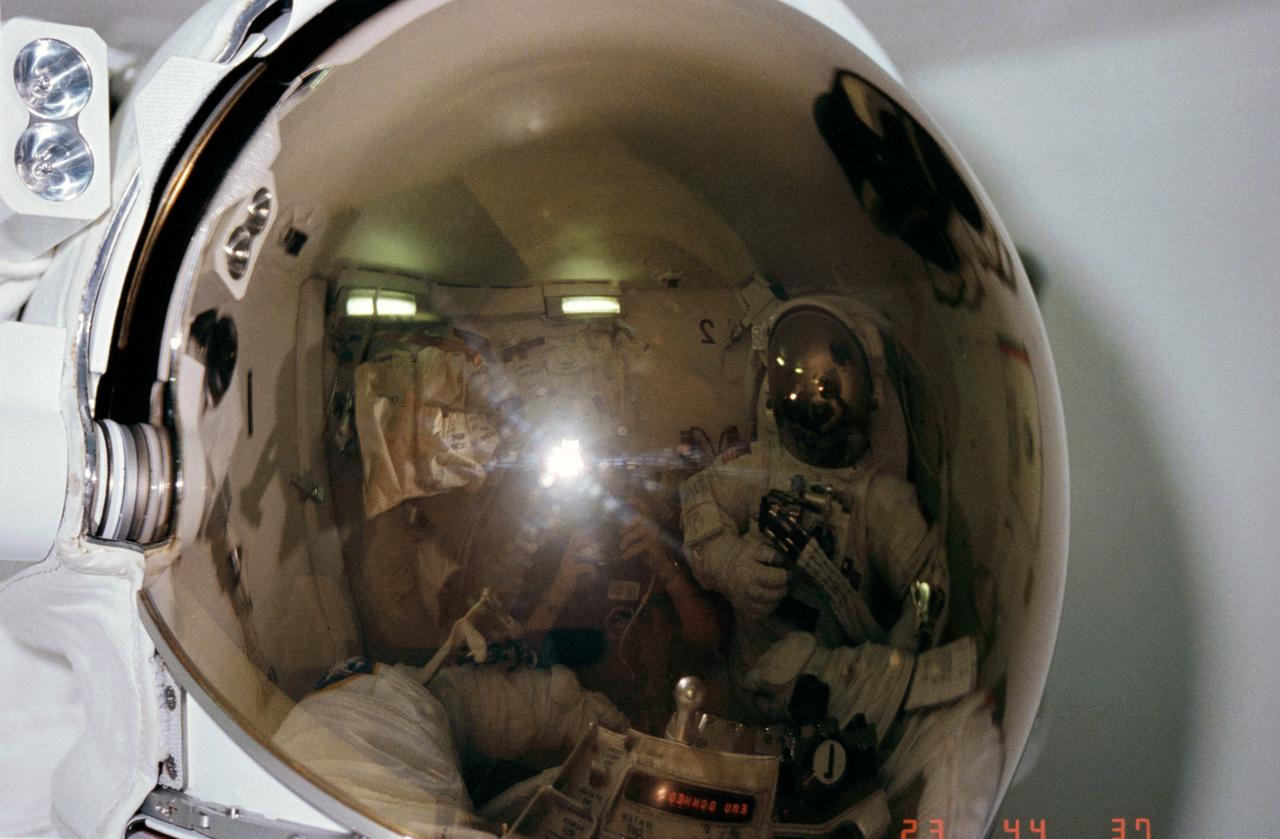
STS006-06-465 (7 April 1983) --- Three-fourths of the STS-6 astronaut crew appears in this unusual 35mm frame exposed in the airlock of the Earth-orbiting space shuttle Challenger. Astronaut F. Story Musgrave’s helmet visor encompasses all the action in the frame. Dr. Musgrave and astronaut Donald H. Peterson (reflected on right side of the visor) were fully suited in their Extravehicular Mobility Unit (EMU) spacesuits and were participating in EVA preparation exercises. Astronaut Karol J. Bobko, STS-6 pilot, wearing conventional onboard shuttle clothing, photographed the two during their procedures and appears at center of frame. The reversed number (1 and 2 in the mirrored image represent the EVA designations for the two mission specialists. Photo credit: NASA
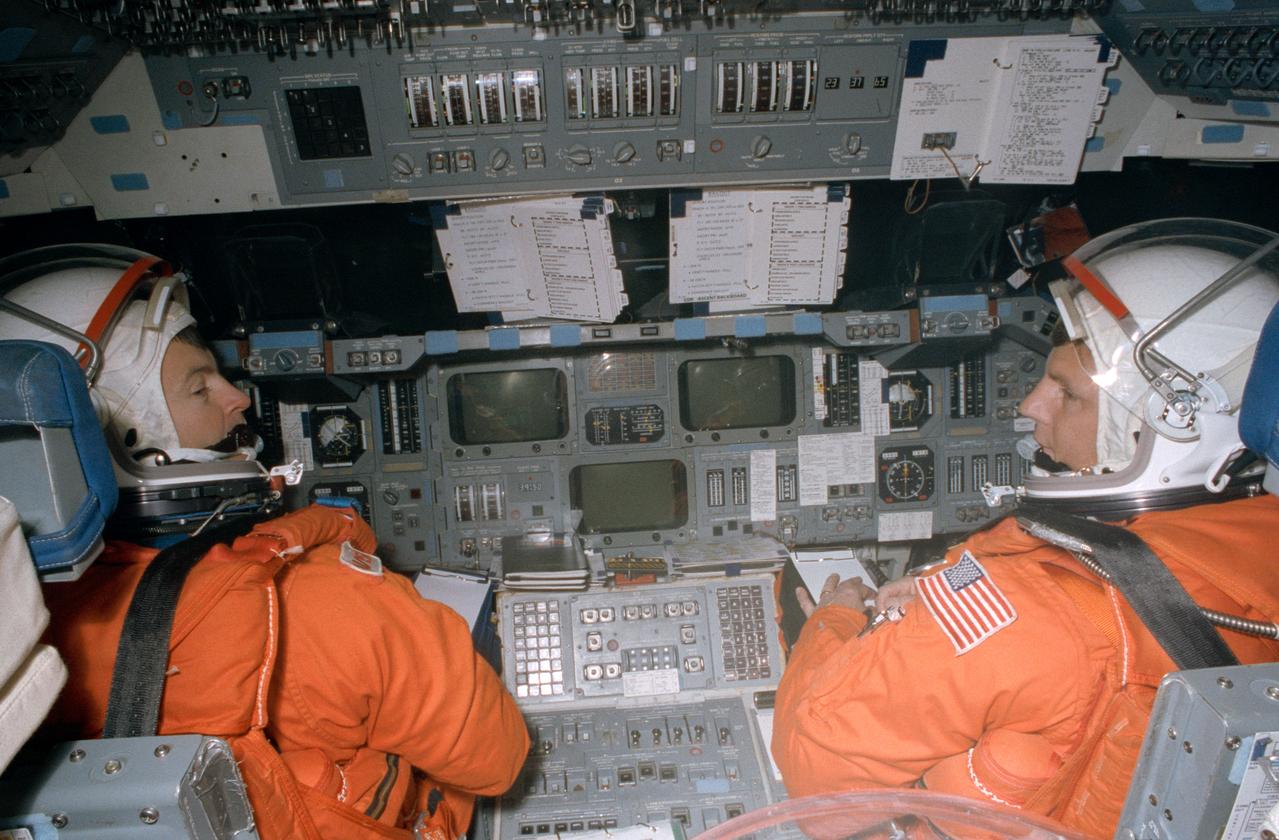
STS-56 Discovery, Orbiter Vehicle (OV) 103, Commander Kenneth Cameron, (left) and Pilot Stephen S. Oswald, wearing launch and entry suits (LESs) and launch and entry helmets (LEHs), are seated on the forward flight deck of the crew compartment trainer (CCT), a shuttle mockup. Cameron mans the commander station controls and Oswald the pilots station controls during an emergency egress (bailout) simulation. The view was taken from the aft flight deck looking forward and includes Cameron's and Oswald's profiles and the forward flight deck controls and checklists. The CCT is located in JSC's Mockup and Integration Laboratory (MAIL) Bldg 9NE.
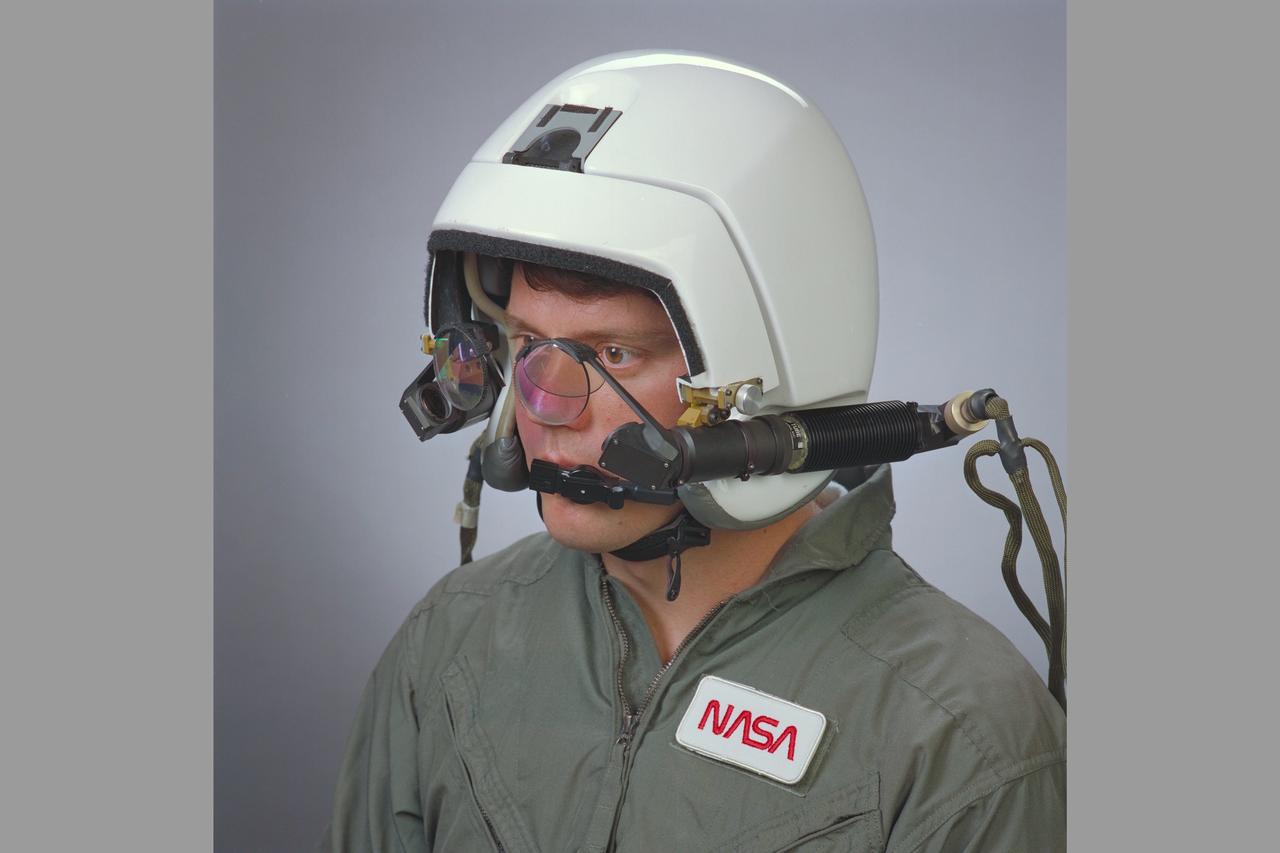
RASCAL color helmet mounted display with Oliver Field
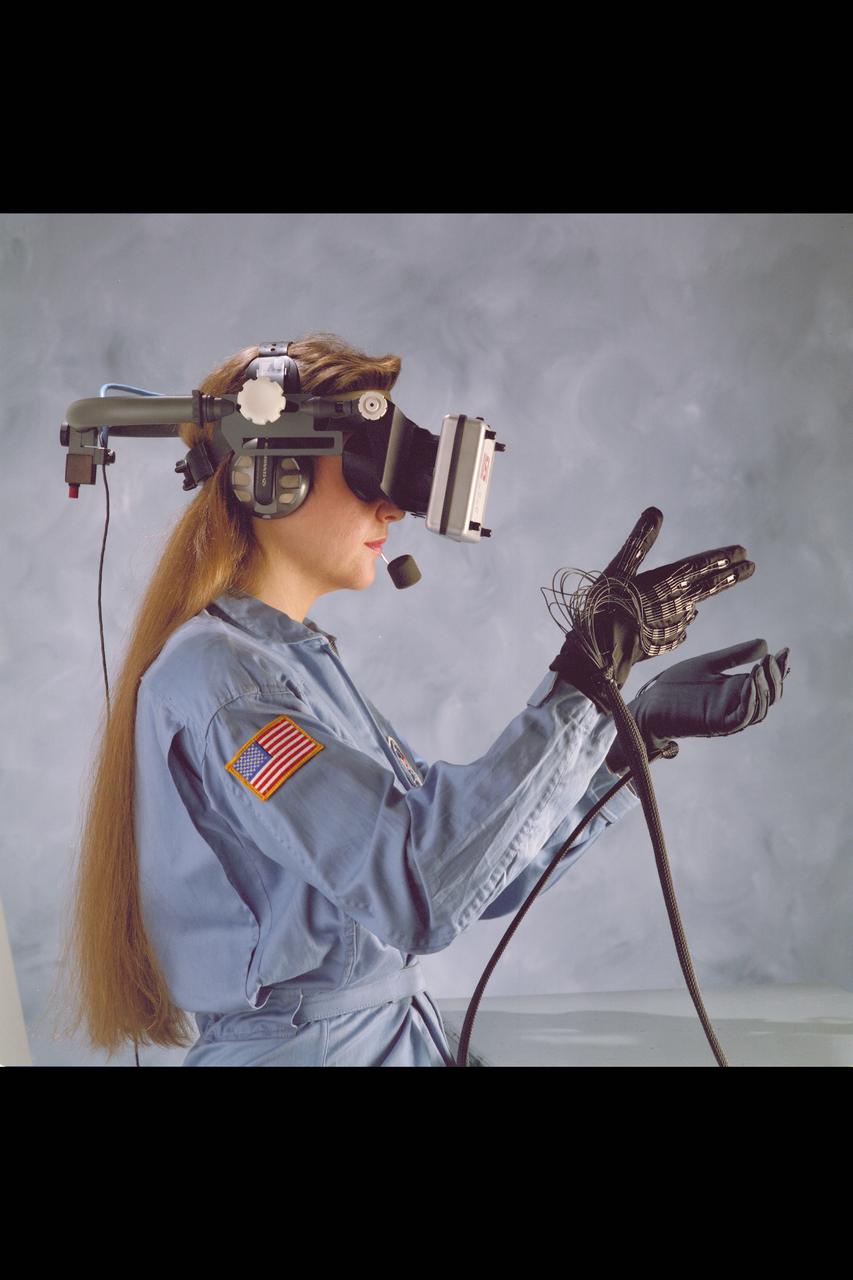
Virtual Environment Reality workstation technology (helmet & gloves)
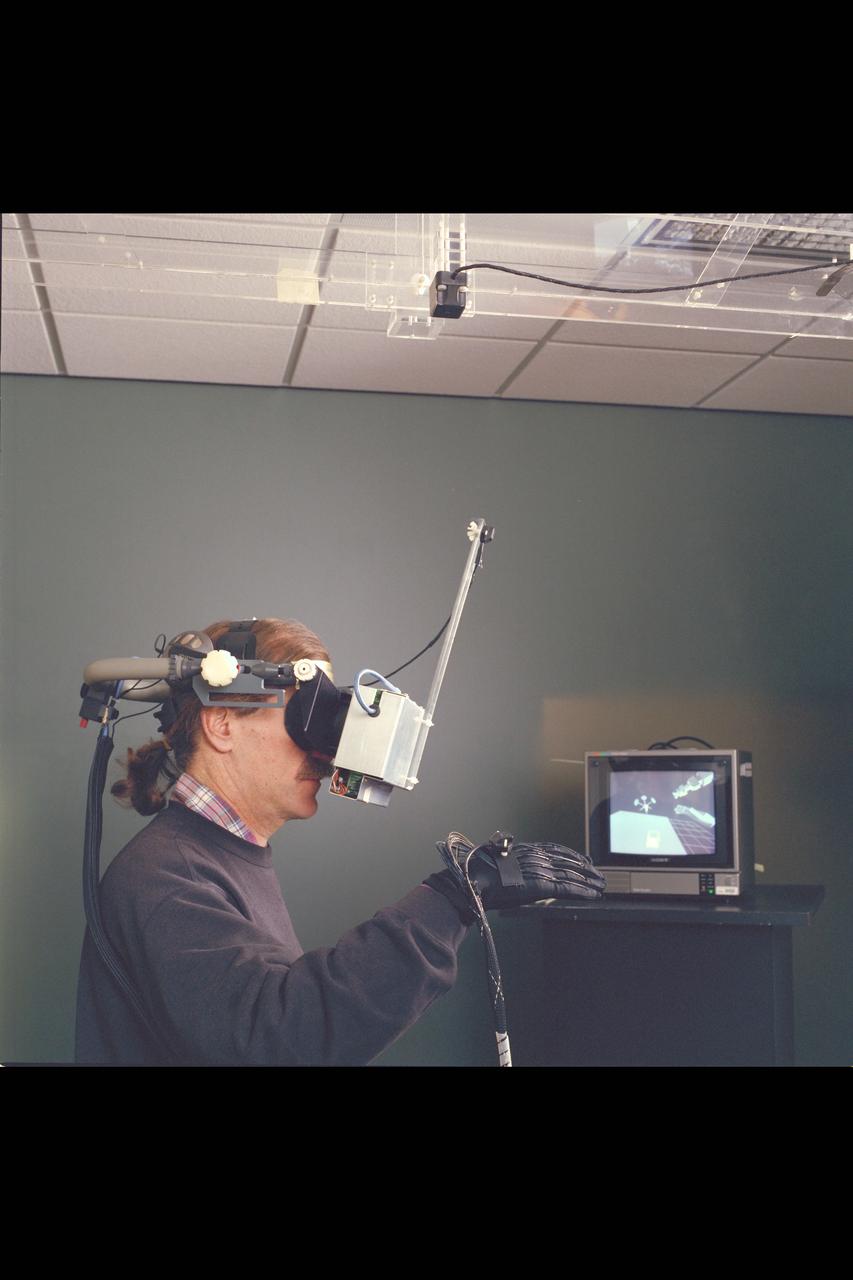
Robotics Laboratory: Helmet, glove & viewing screen
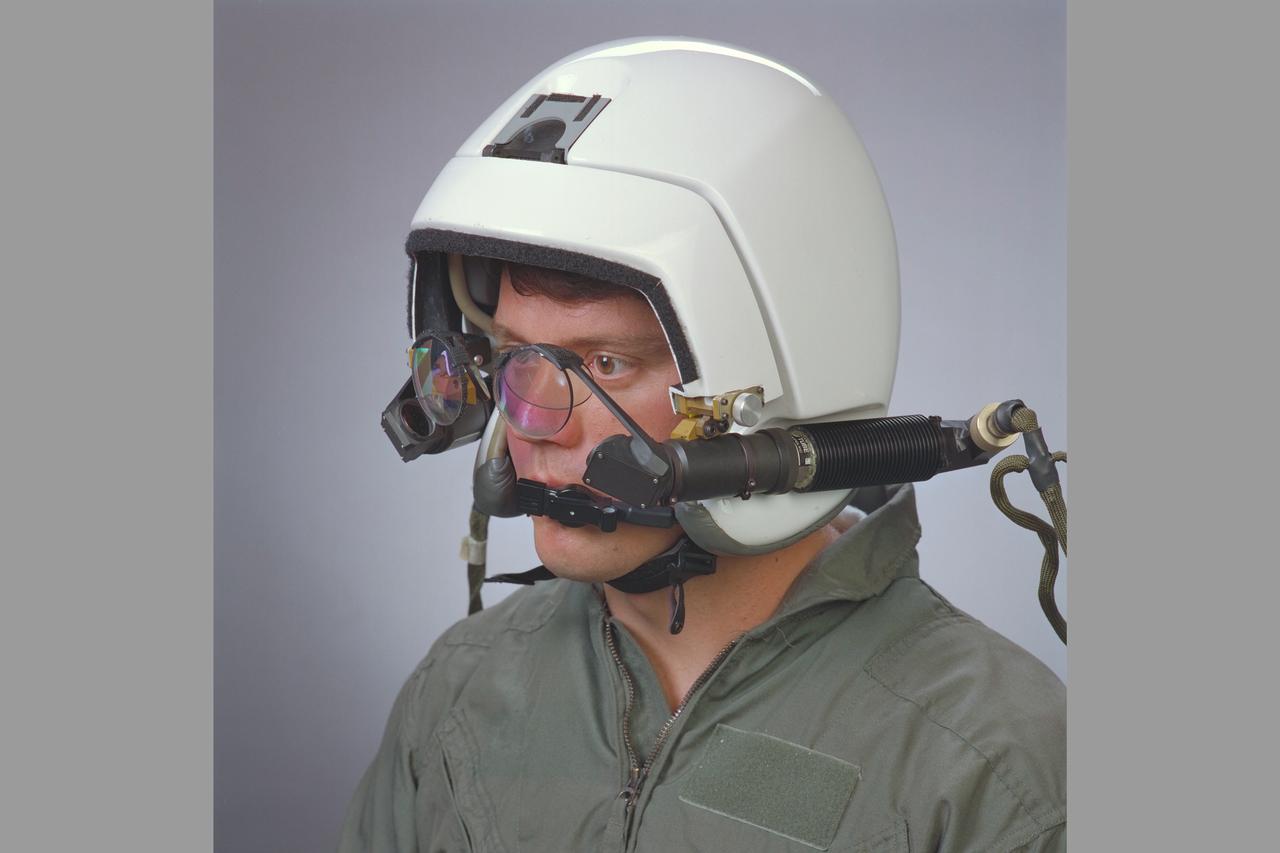
RASCAL color helmet mounted display with Oliver Field
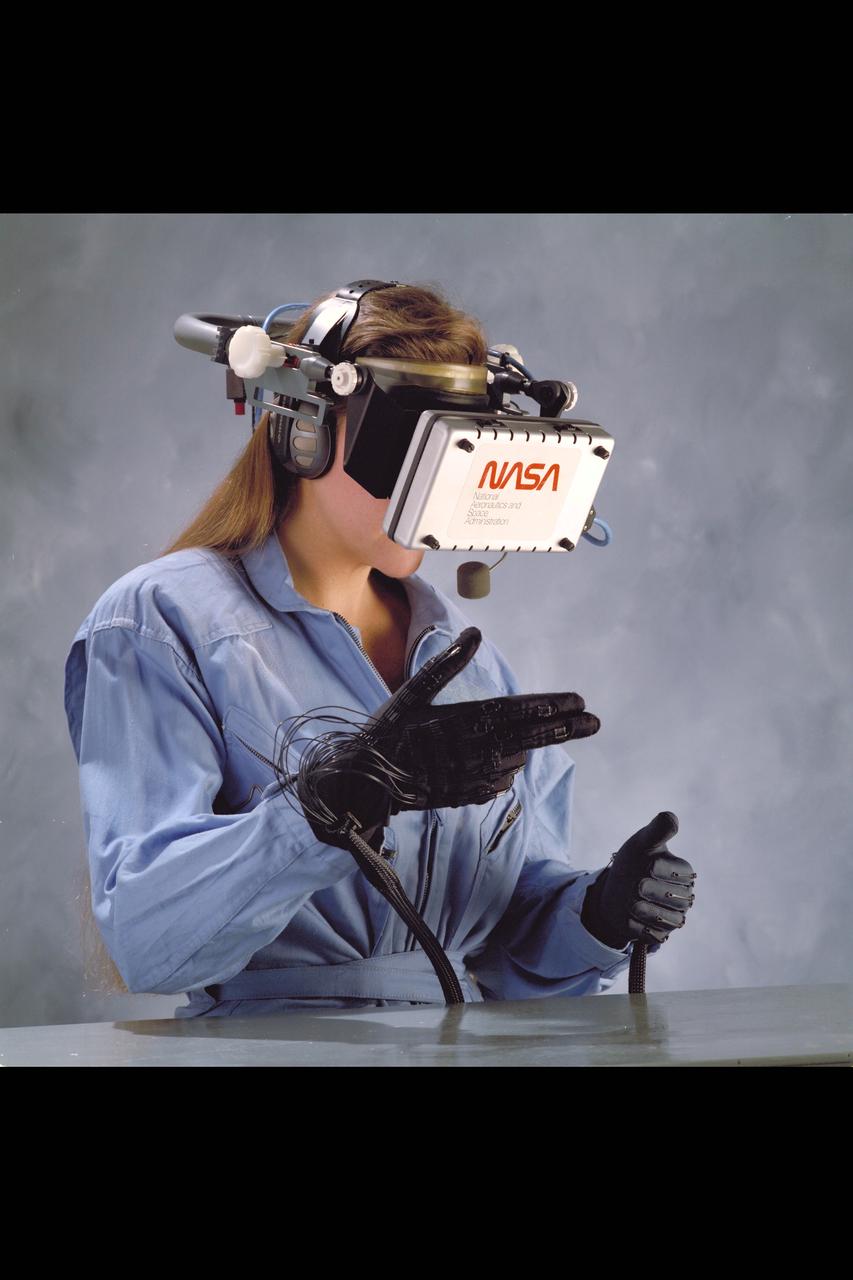
Virtual Environment Reality workstation technology (helmet & gloves)
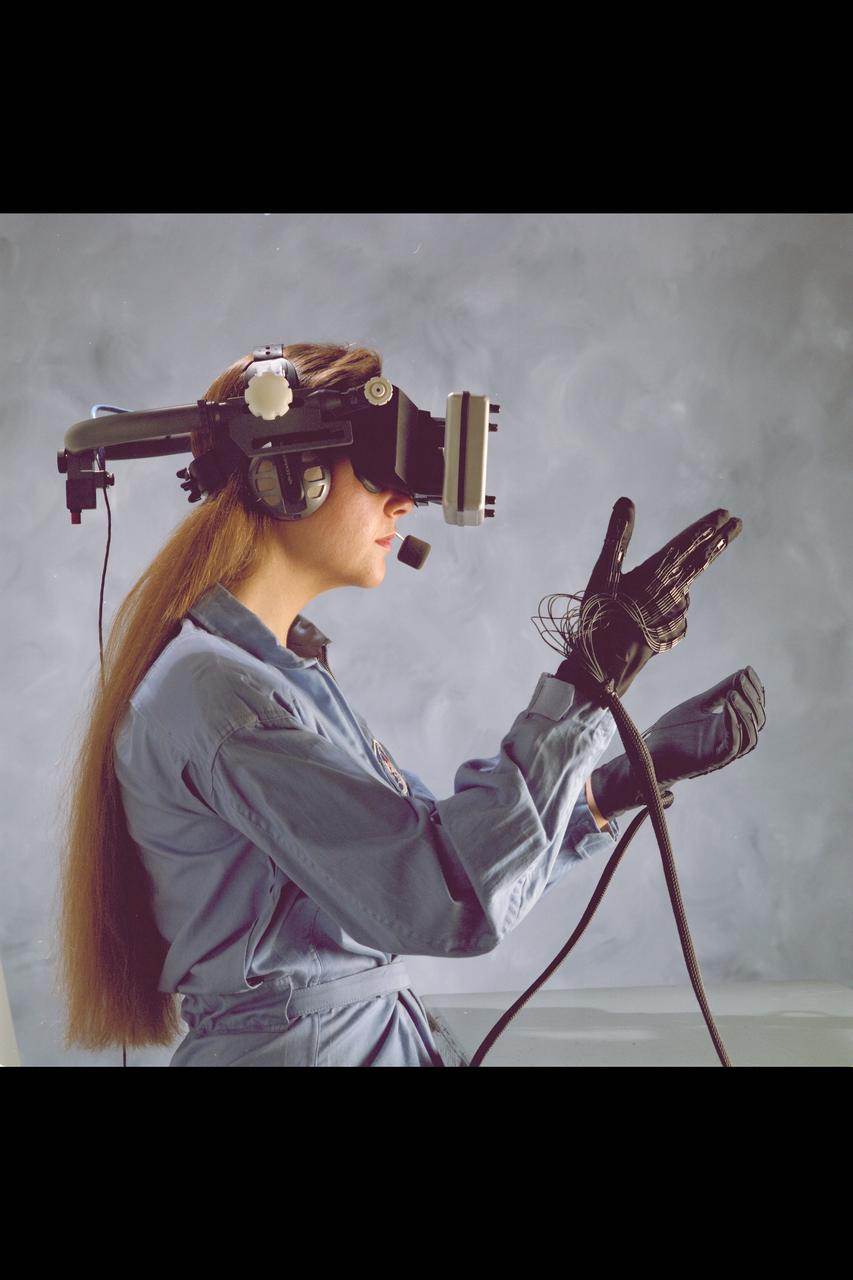
Virtual Environment Reality workstation helmet and gloves
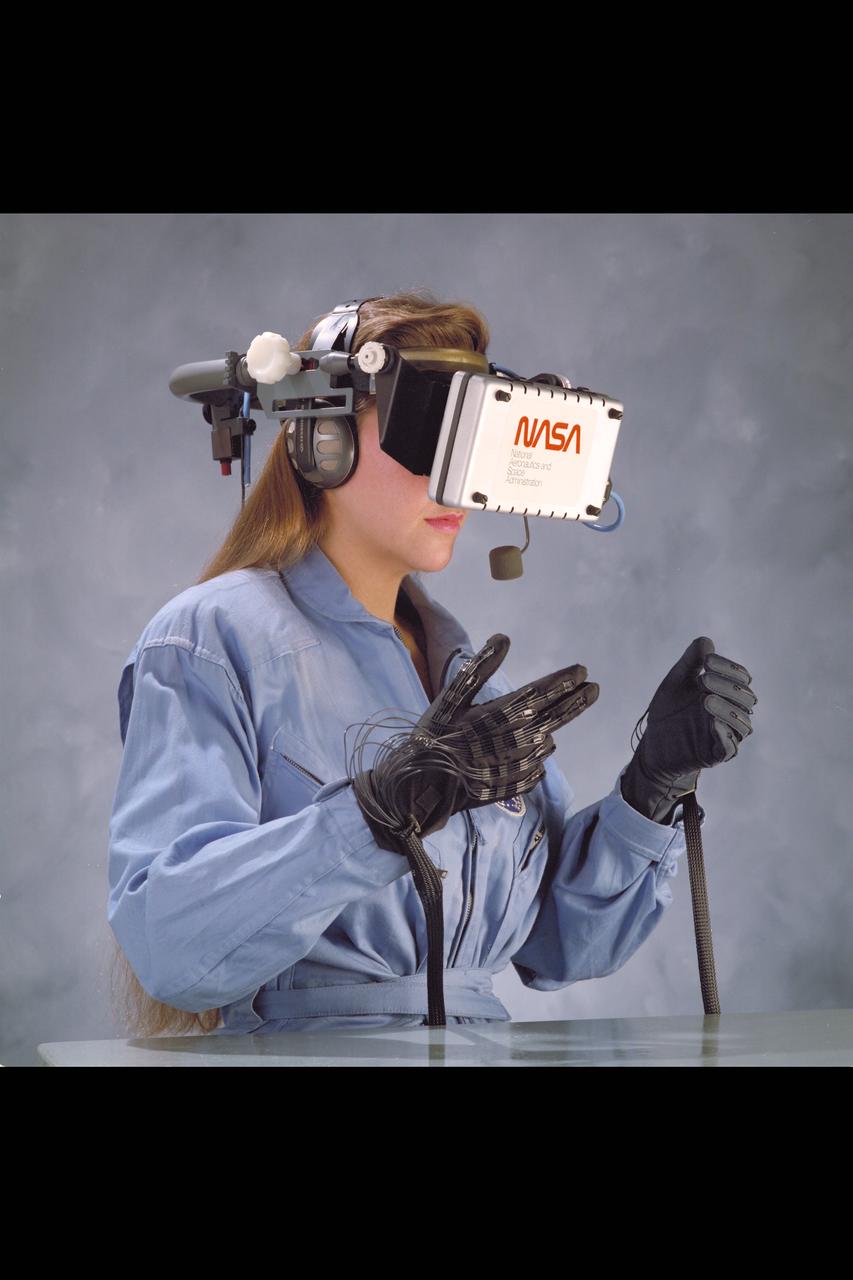
Virtual Environment Reality workstation technology (helmet & gloves)
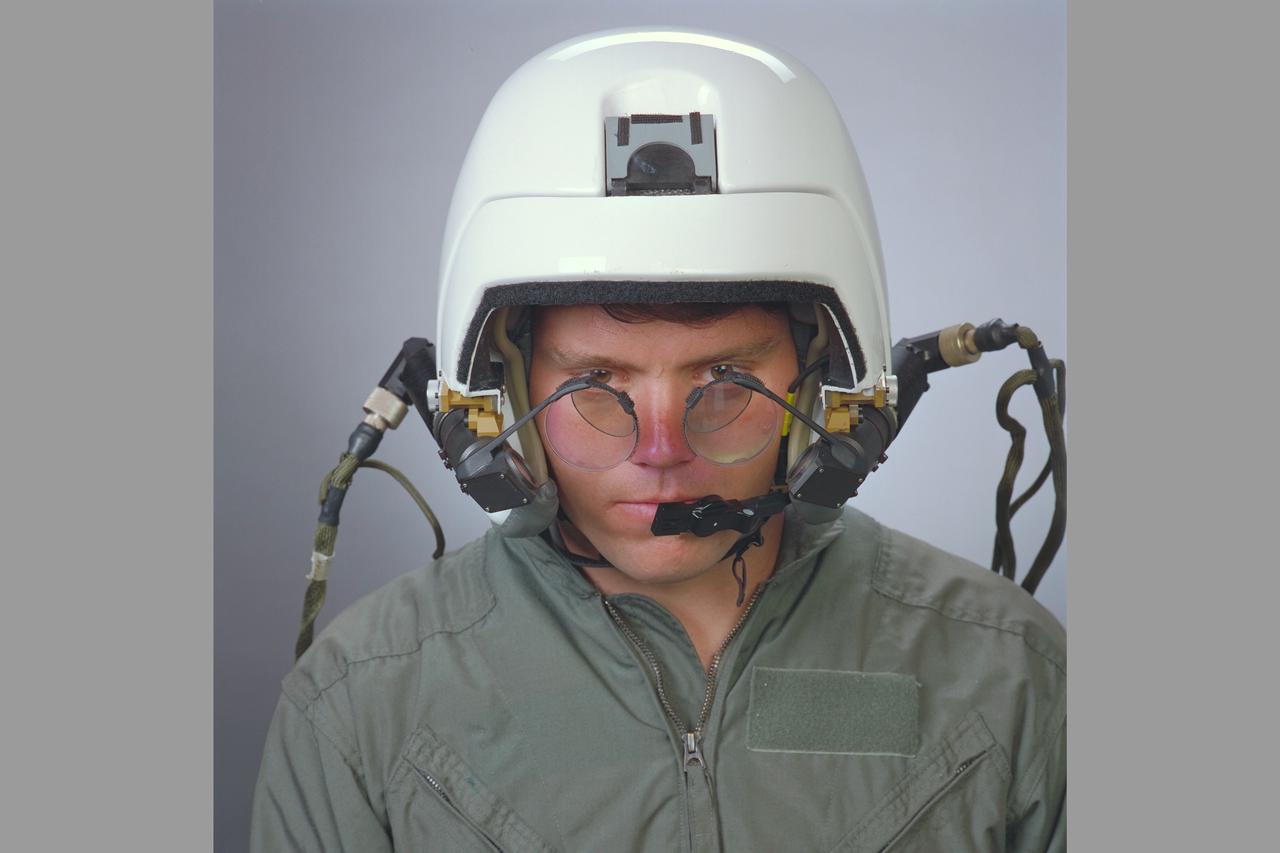
RASCAL color helmet mounted display with Oliver Field
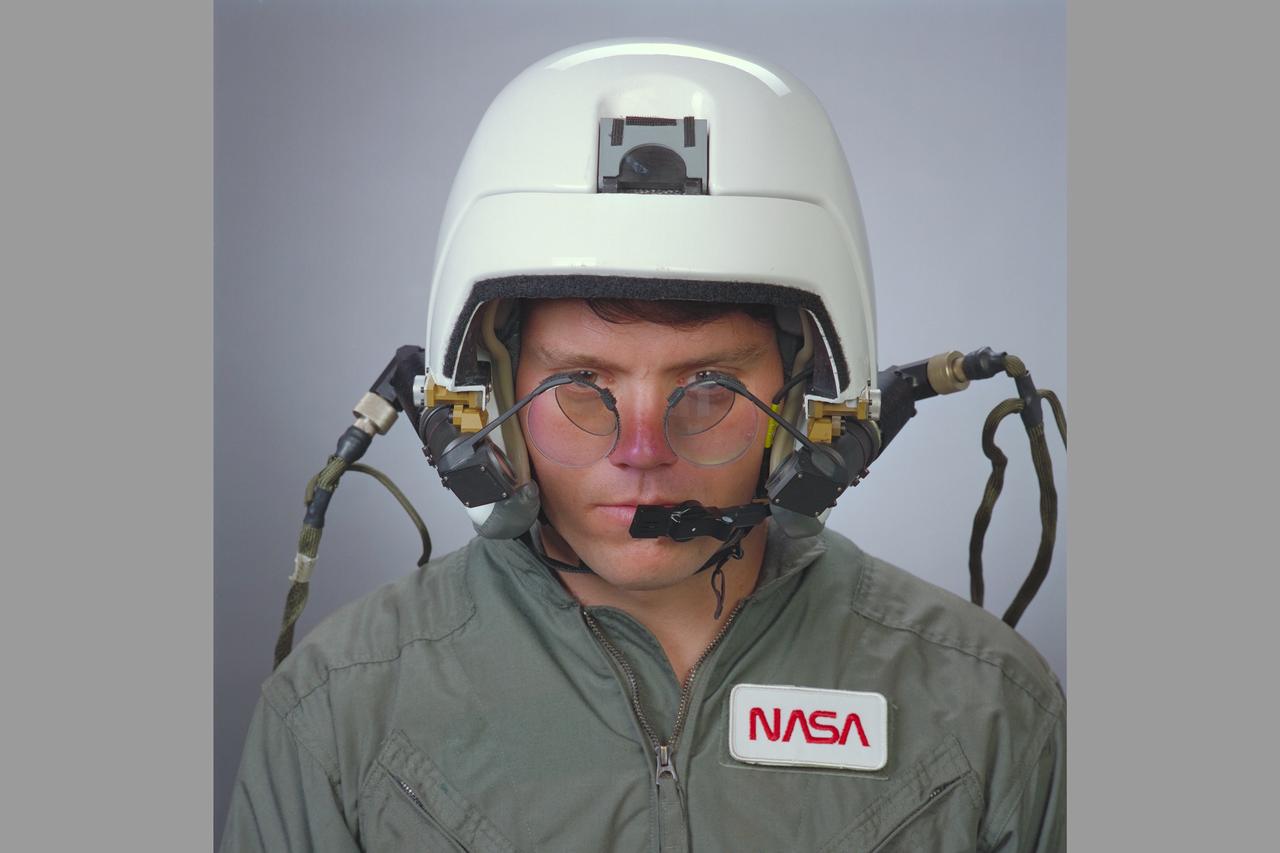
RASCAL color helmet mounted display with Oliver Field
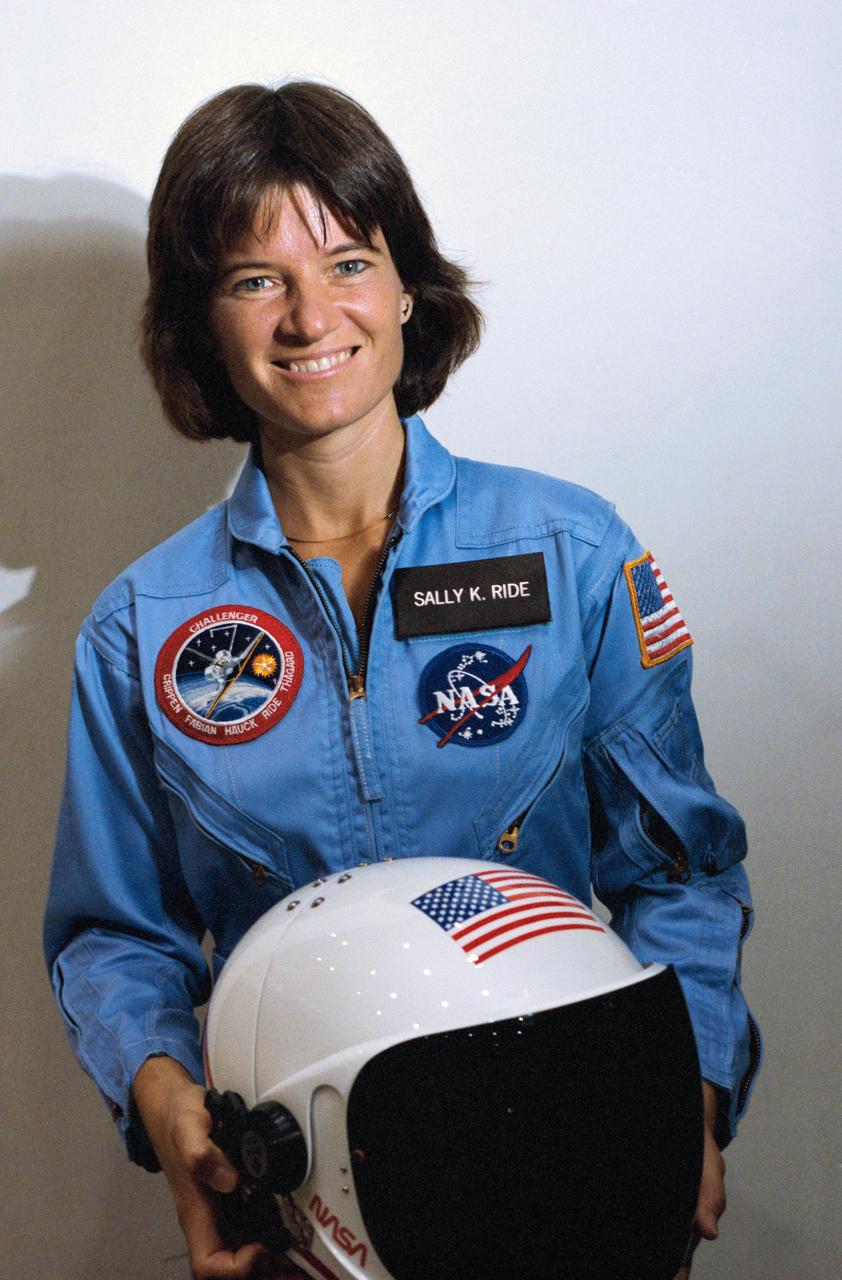
S85-41007 (9 May 1983) --- At NASA's Johnson Space Center, astronaut Sally K. Ride takes a break from training as a mission specialist for NASA's STS-7 spaceflight in Earth orbit. Photo credit: NASA
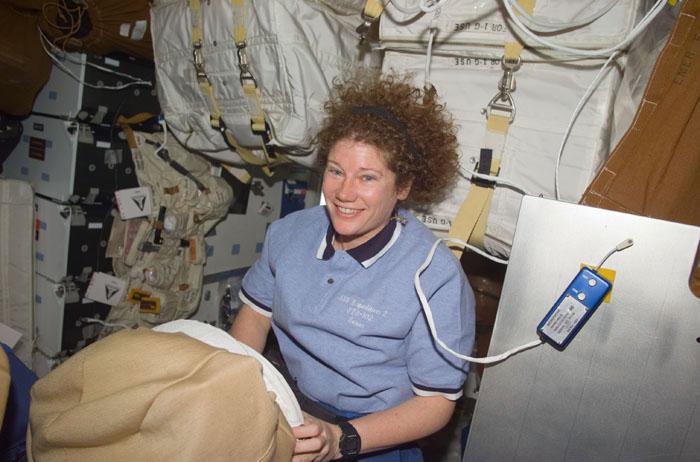
STS102-E-5048 (10 March 2001) --- Astronaut Susan J. Helms, STS-102 mission specialist, looks over some supplies on the mid deck. Helms is one of two astronauts assigned to space walk duties after the Space Shuttle Discovery and the International Space Station (ISS) link in Earth orbit. The photograph was recorded with a digital still camera.
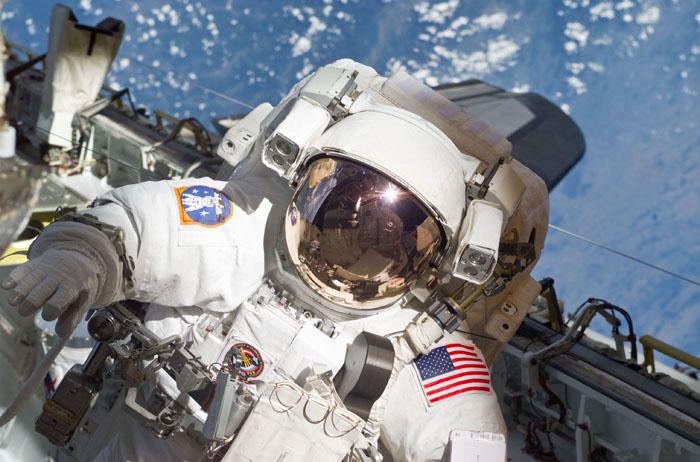
STS105-E-5233 (16 August 2001) --- The helmet and torso of astronaut Patrick G. Forrester are featured in this digital still camera's view recorded during early stages of the first space walk on STS-105. Most of the cargo bay of the Space Shuttle Discovery and the aft cabin is reflected in the helmet visor.
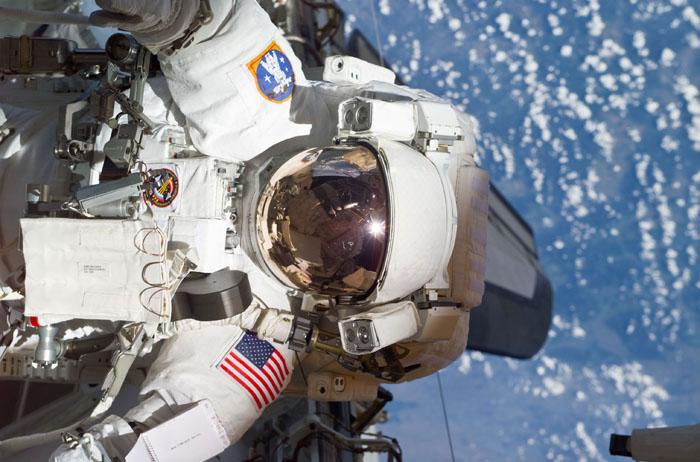
STS105-E-5231 (16 August 2001) --- The helmet and torso of astronaut Patrick G. Forrester are featured in this digital still camera's view recorded during early stages of the first space walk on STS-105. Most of the cargo bay of the Space Shuttle Discovery and the aft cabin is reflected in the helmet visor.
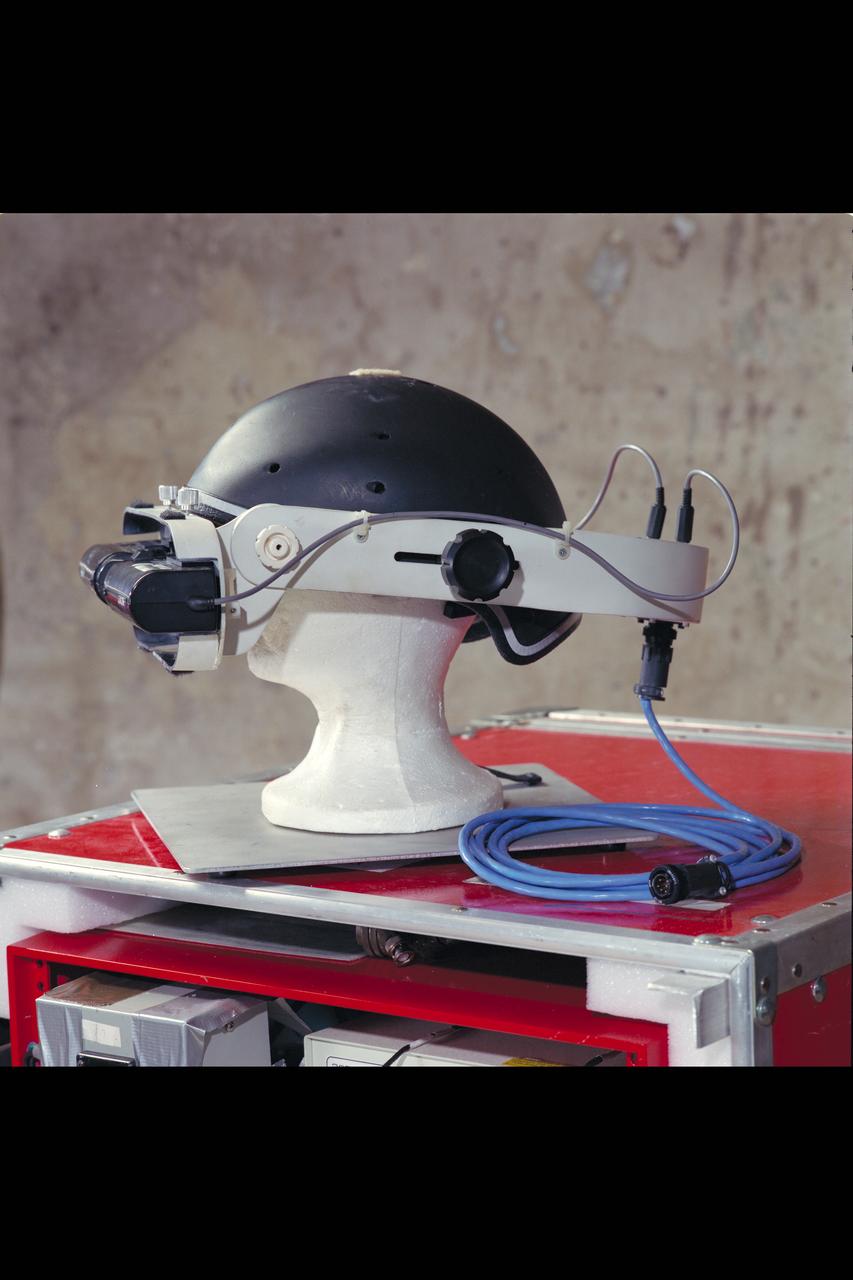
NASA Mars Underwater Rover Phantom 2 TROV (Telepresences Controlled Remotely Operated Vehicle) - helmet head piece
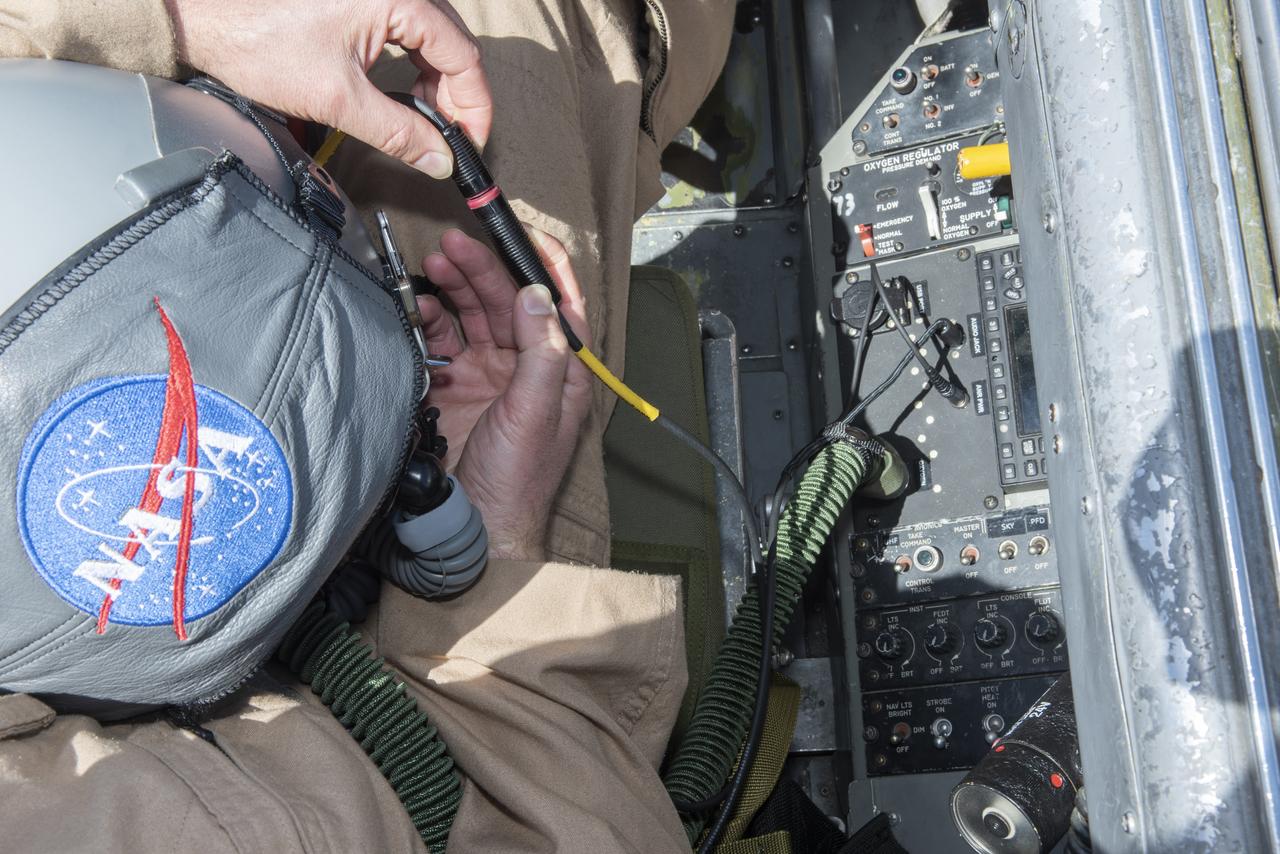
The new Active Noise Reduction system plugs directly from the helmet to a panel inside the aircraft.
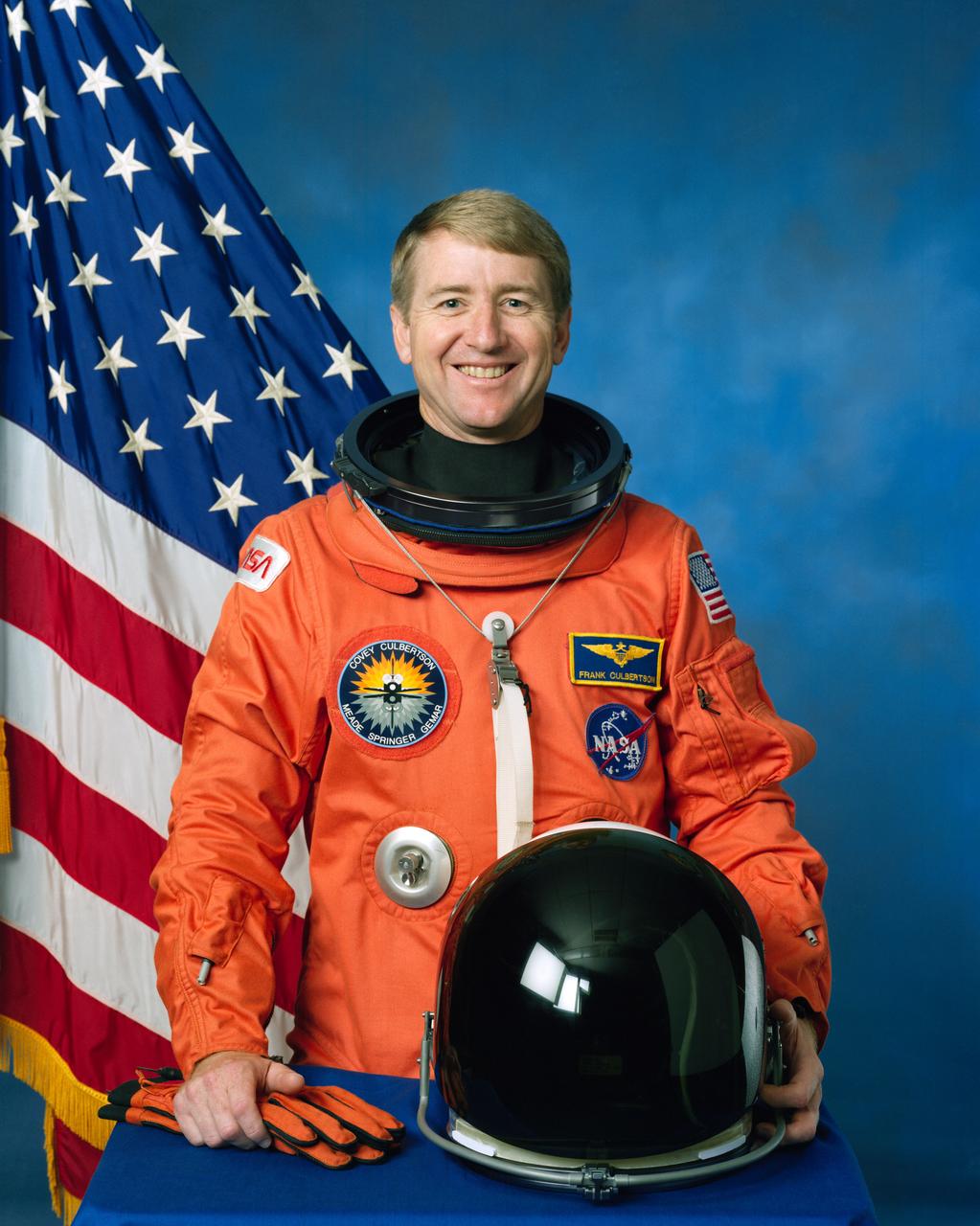
Portrait of Astronaut Frank L. Culbertson dressed in an orange launch/entry suit with his helmet on the table in front of him.
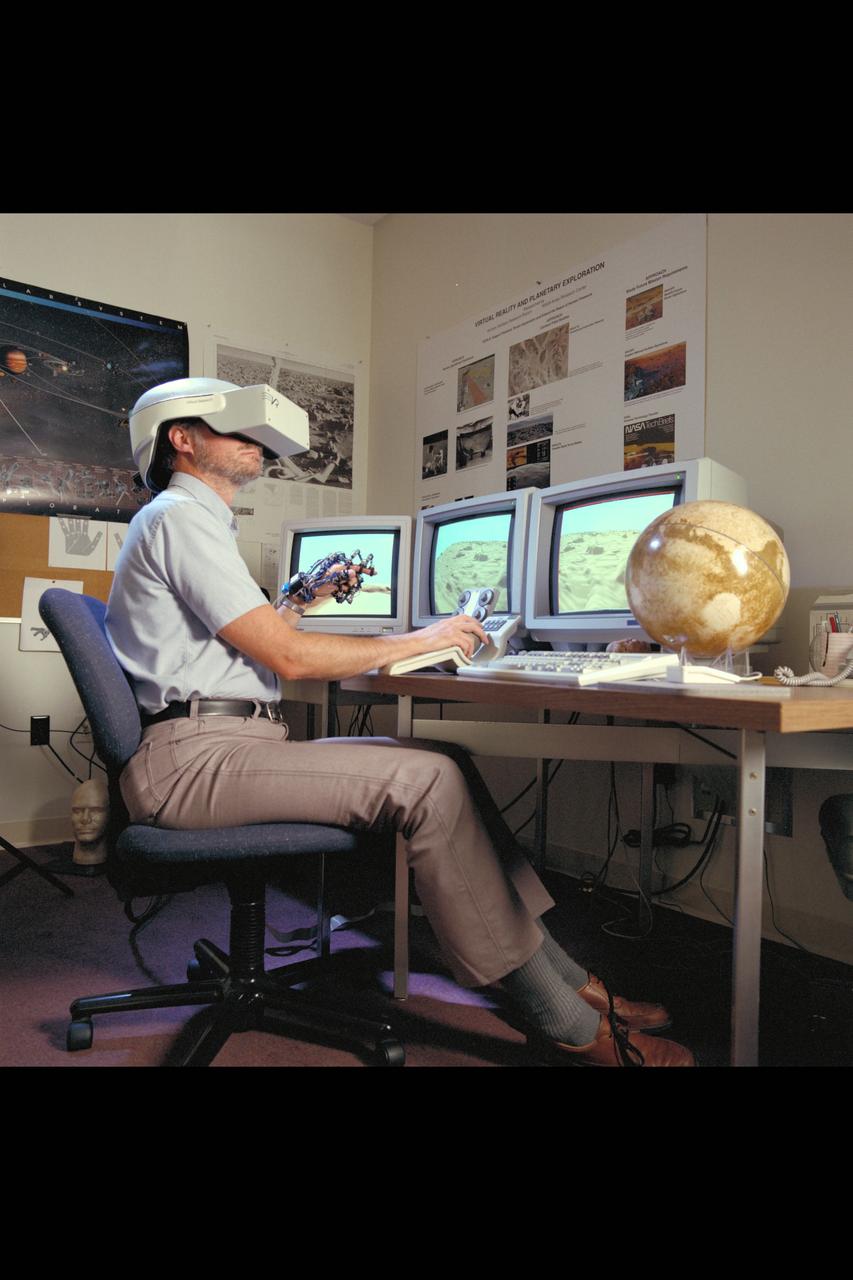
Virtual Environment Telepresence workstation, simulated Mars Exploration shows Lewis Hitchner with virtual helmet and EXOS Dexterous interface (virtual hand)
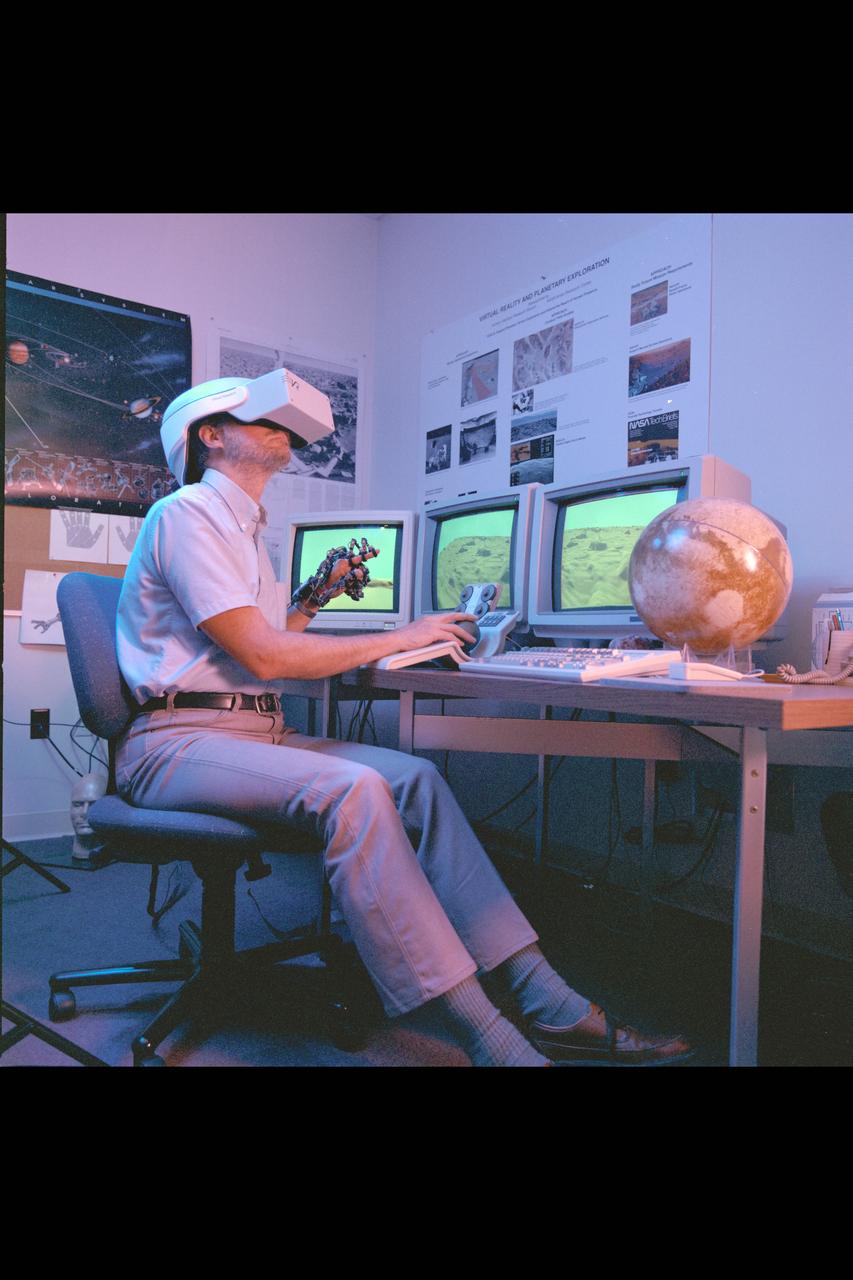
Virtual Environment Telepresence workstation, simulated Mars Exploration shows Lewis Hitchner with virtual helmet and EXOS Dexterous interface (virtual hand)
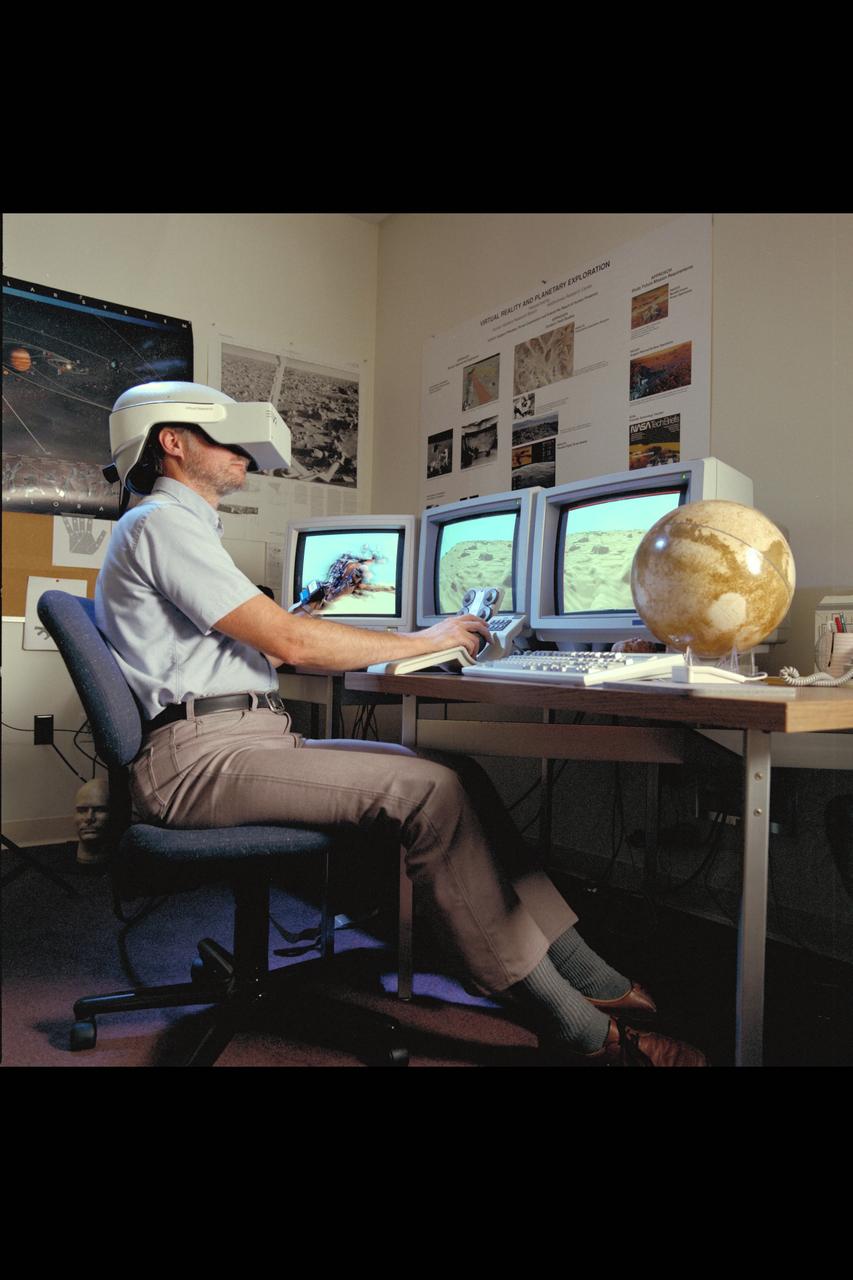
Virtual Environment Telepresence workstation, simulated Mars Exploration shows Lewis Hitchner with virtual helmet and EXOS Dexterous interface (virtual hand)
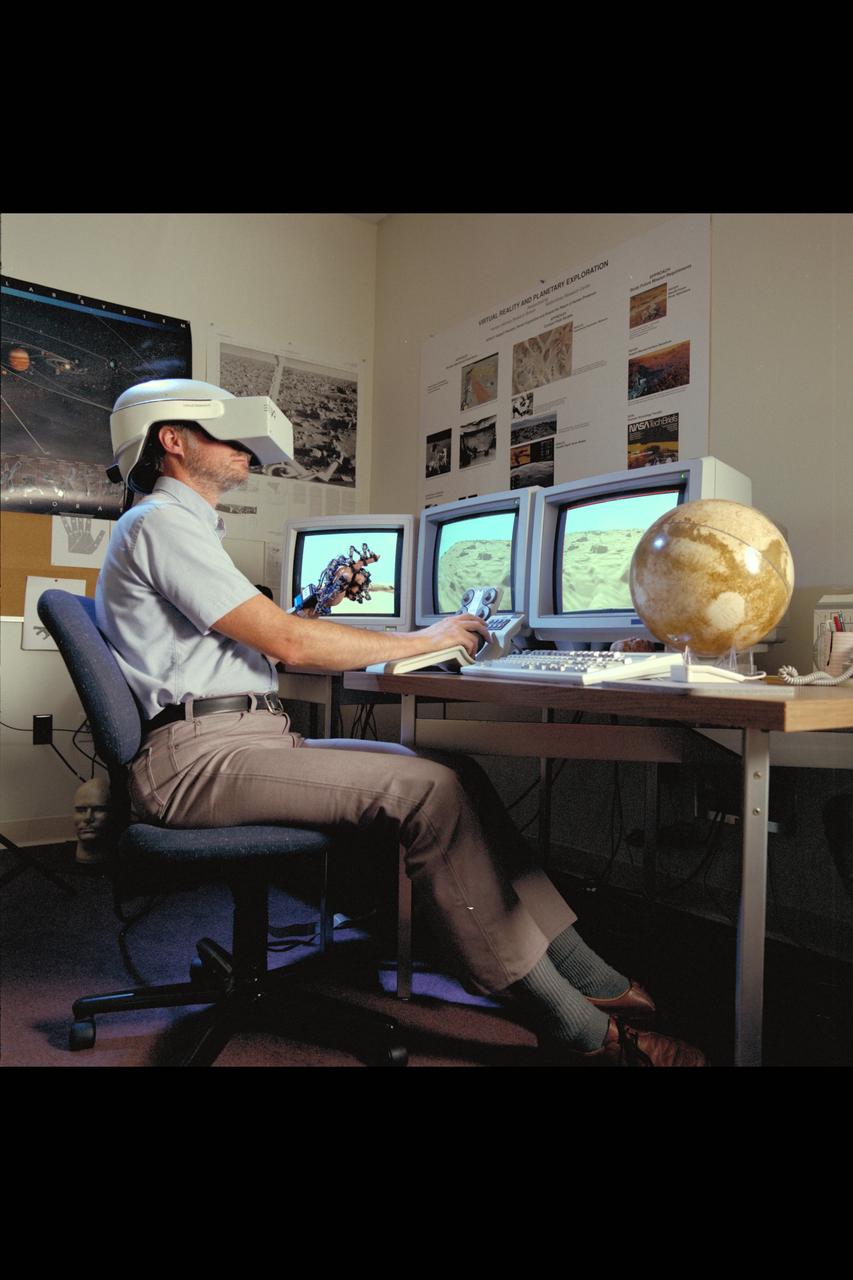
Virtual Environment Telepresence workstation, simulated Mars Exploration shows Lewis Hitchner with virtual helmet and EXOS Dexterous interface (virtual hand)
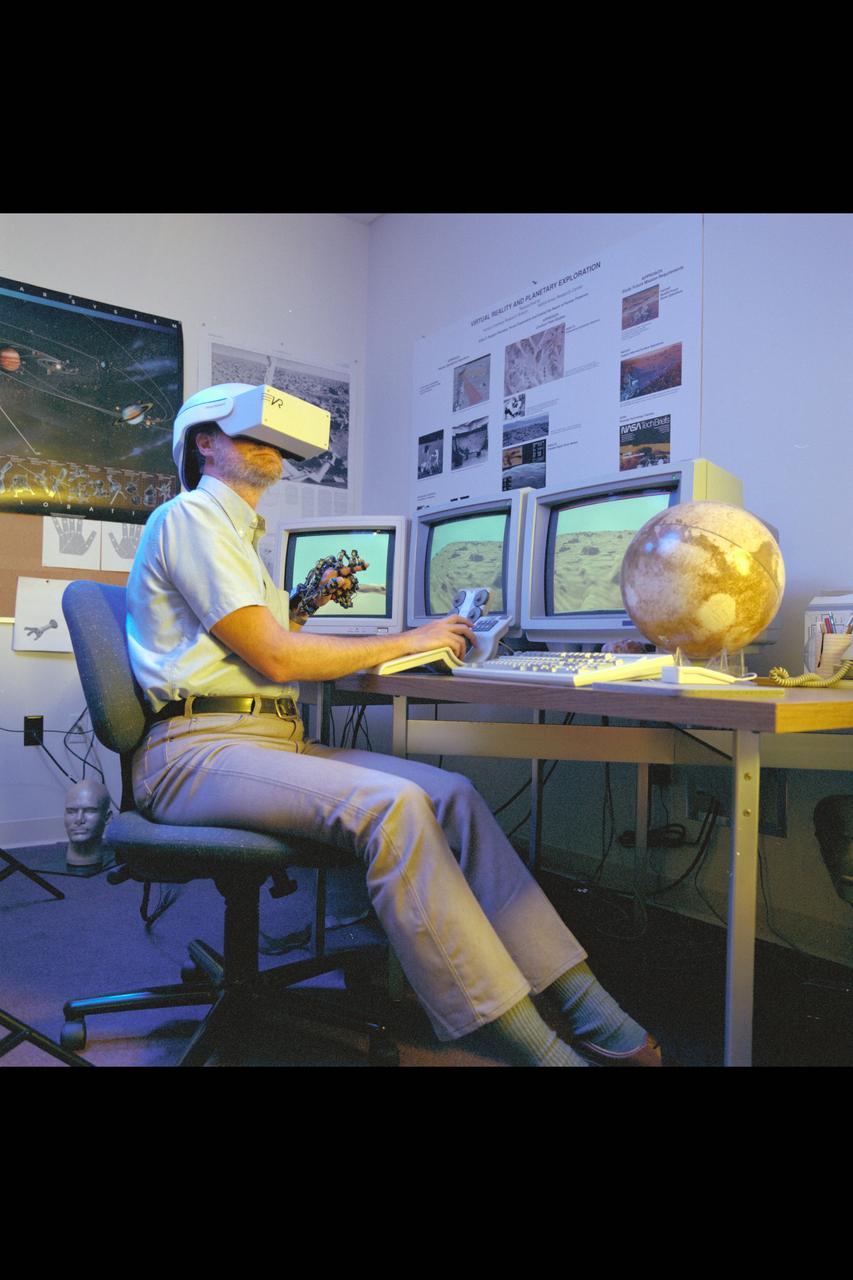
Virtual Environment Telepresence workstation, simulated Mars Exploration shows Lewis Hitchner with virtual helmet and EXOS Dexterous interface (virtual hand)
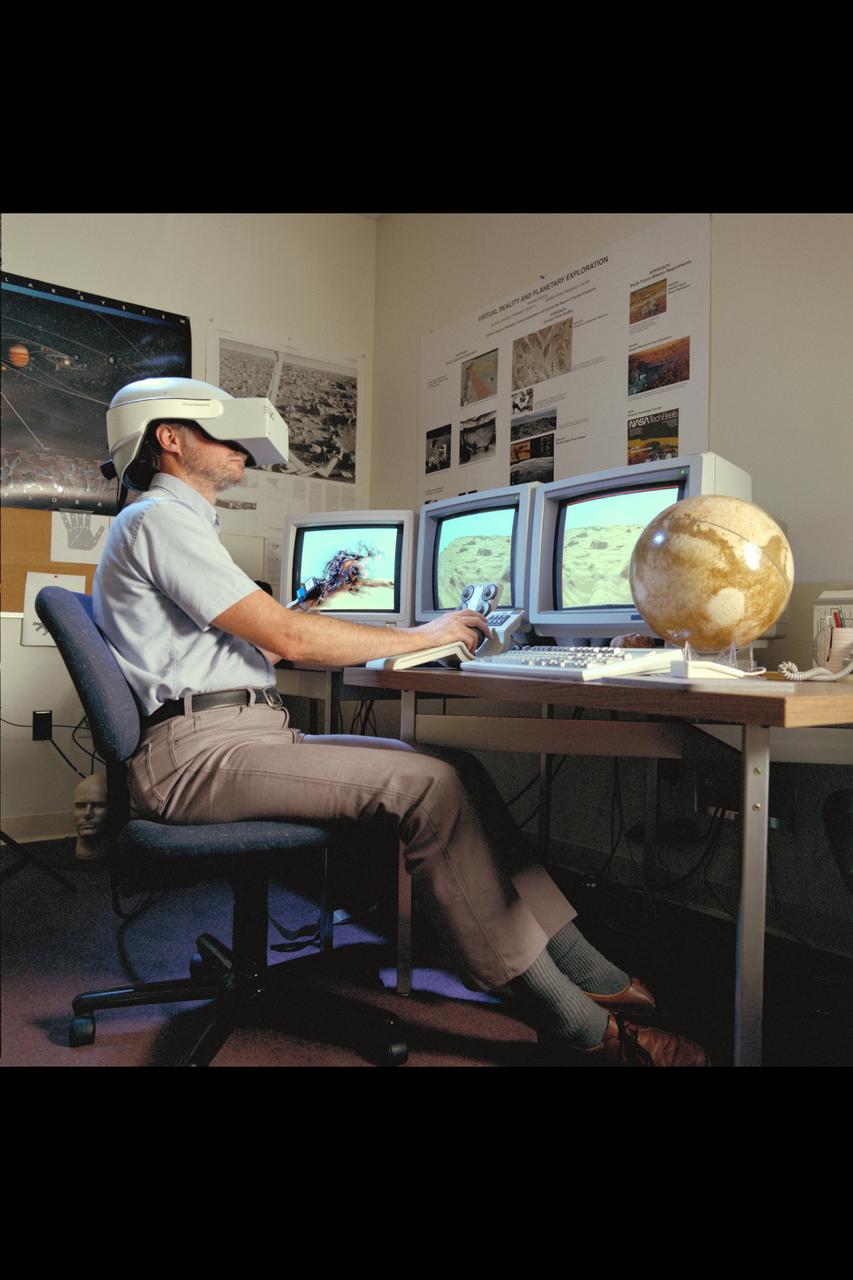
Virtual Environment Telepresence workstation, simulated Mars Exploration shows Lewis Hitchner with virtual helmet and EXOS Dexterous interface (virtual hand)
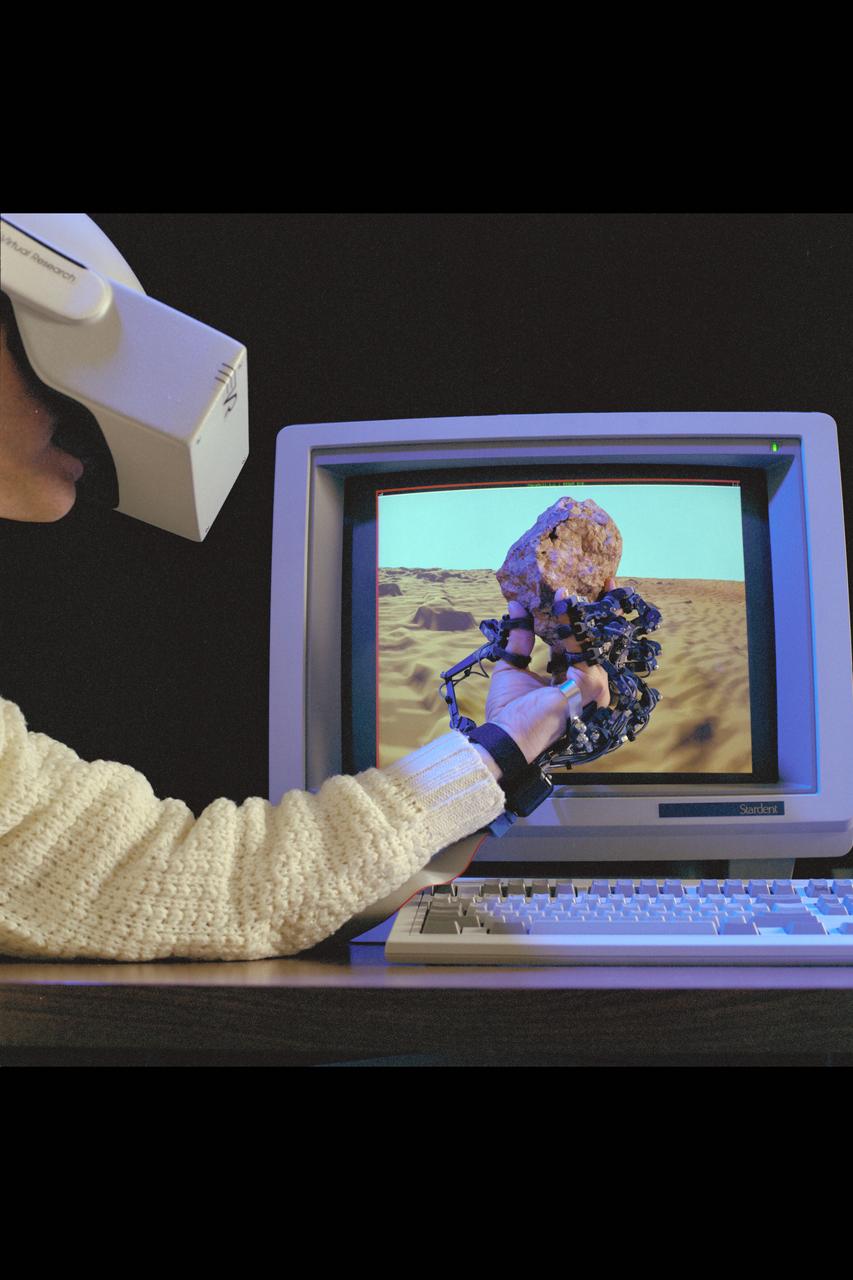
Virtual Environment Telepresence workstation, simulated Mars Exploration shows Dr Michael McGreevy with virtual helmet and EXOS Dexterous interface (holding rock invirtual hand)
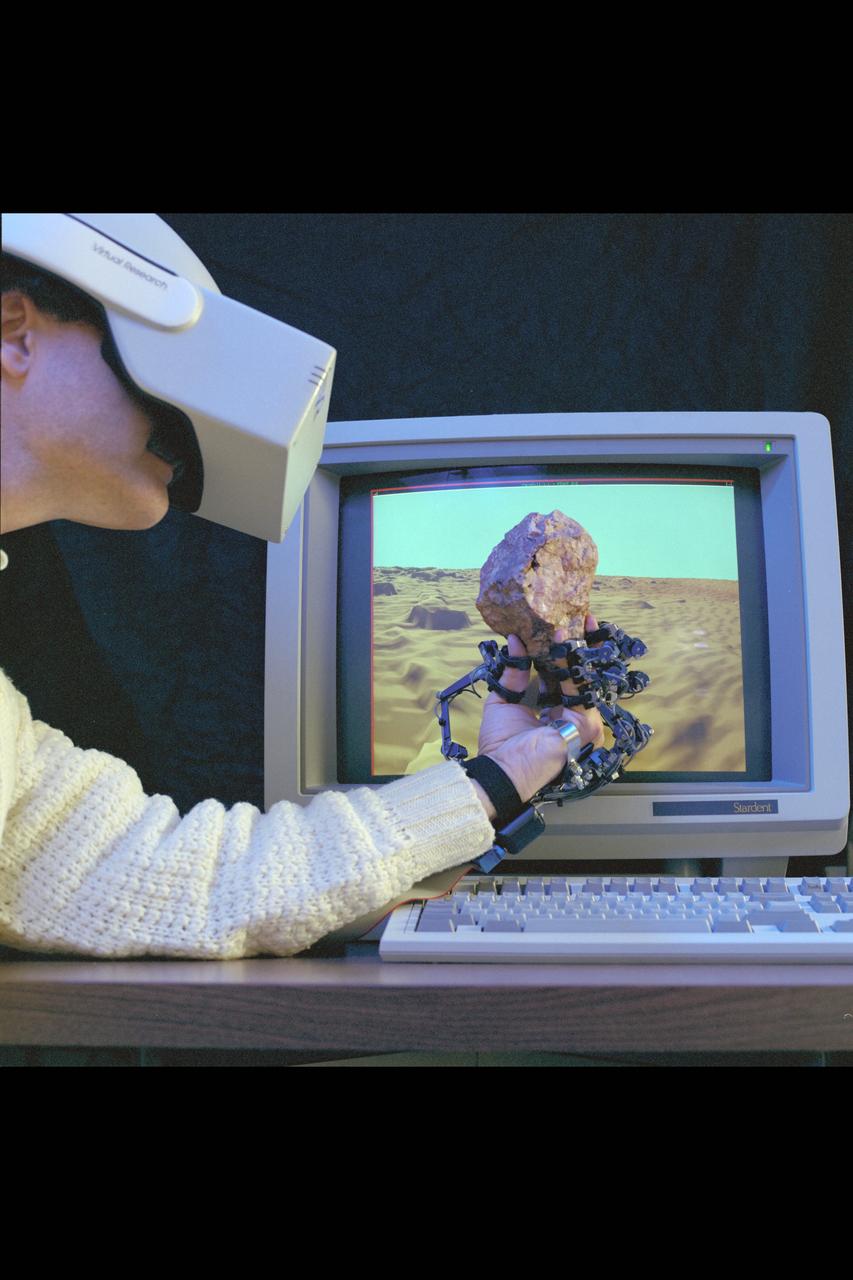
Virtual Environment Telepresence workstation, simulated Mars Exploration shows Dr Michael McGreevy with virtual helmet and EXOS Dexterous interface (holding rock in virtual hand)
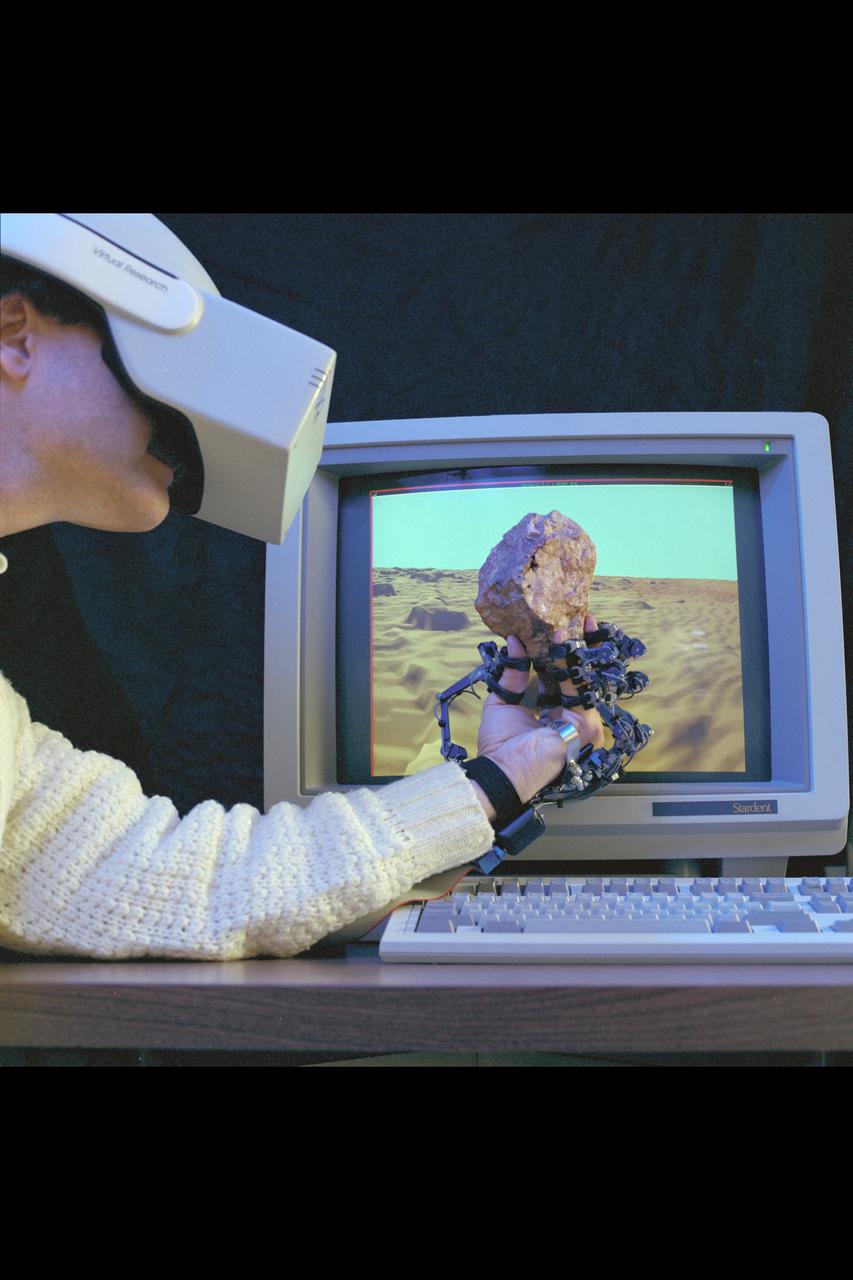
Virtual Environment Telepresence workstation, simulated Mars Exploration shows Dr Michael McGreevy with virtual helmet and EXOS Dexterous interface (holding rock invirtual hand)
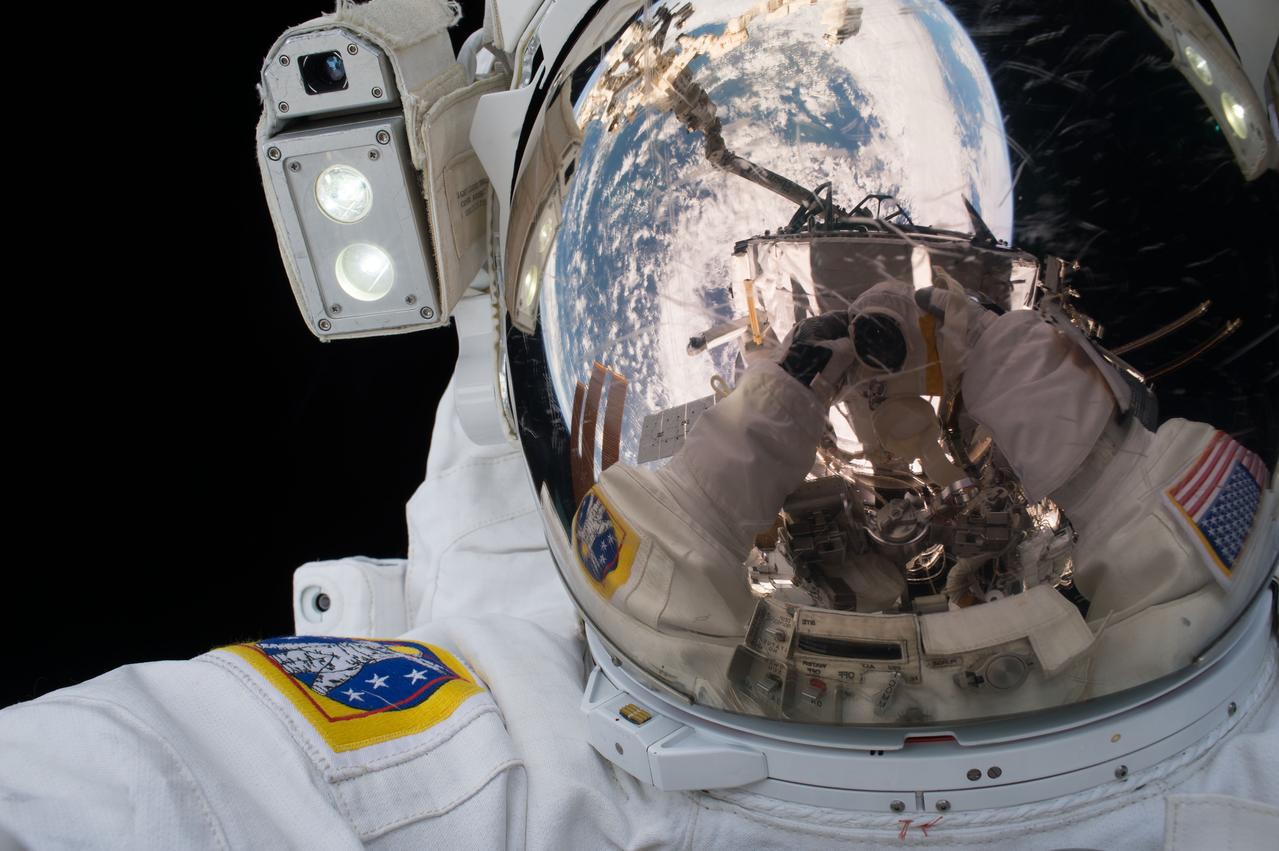
The camera is reflected in his helmet visor as Extravehicular crewmember 1 (EV1) Jeff Williams takes a self-portrait during Extravehicular Activity 36 (EVA 36).
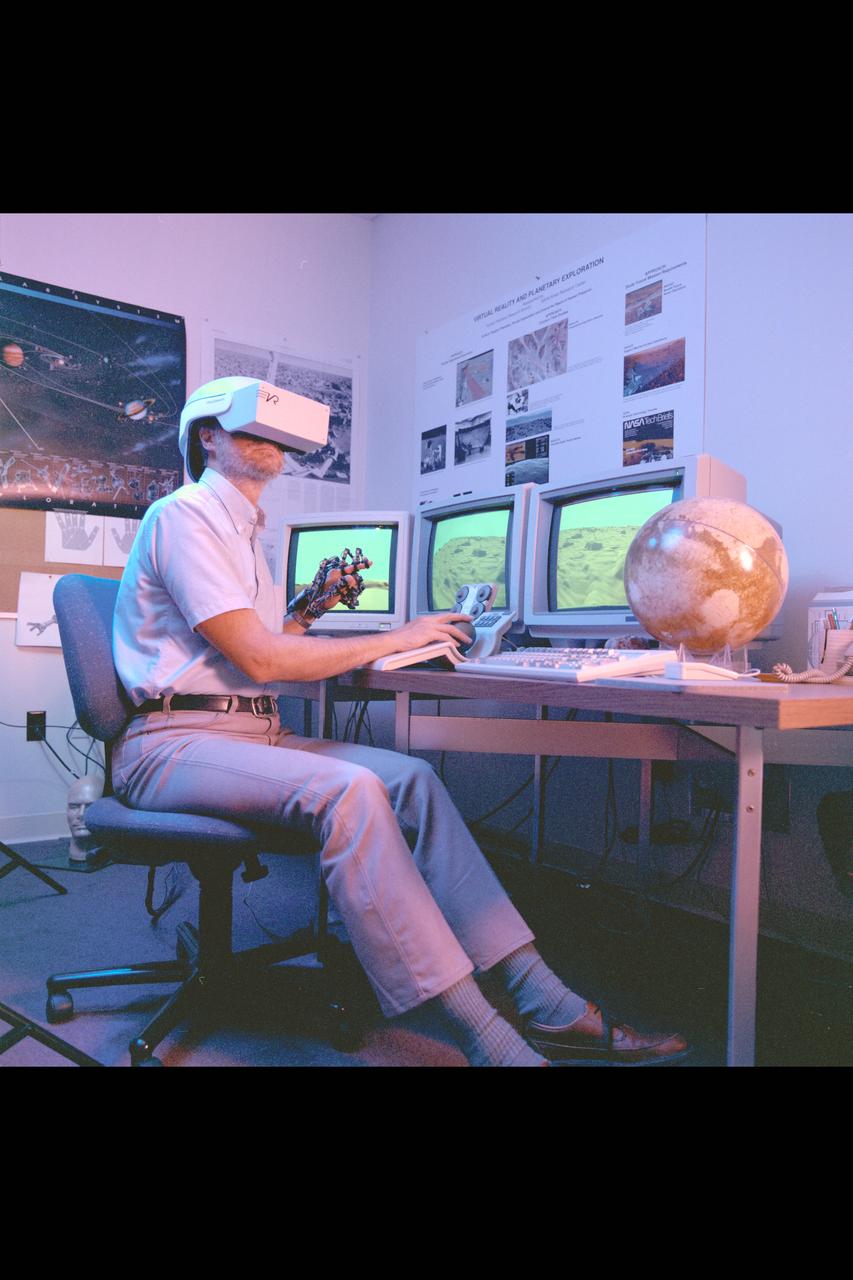
Virtual Environment Telepresence workstation, simulated Mars Exploration shows Lewis Hitchner with virtual helmet and EXOS Dexterous interface (virtual hand)
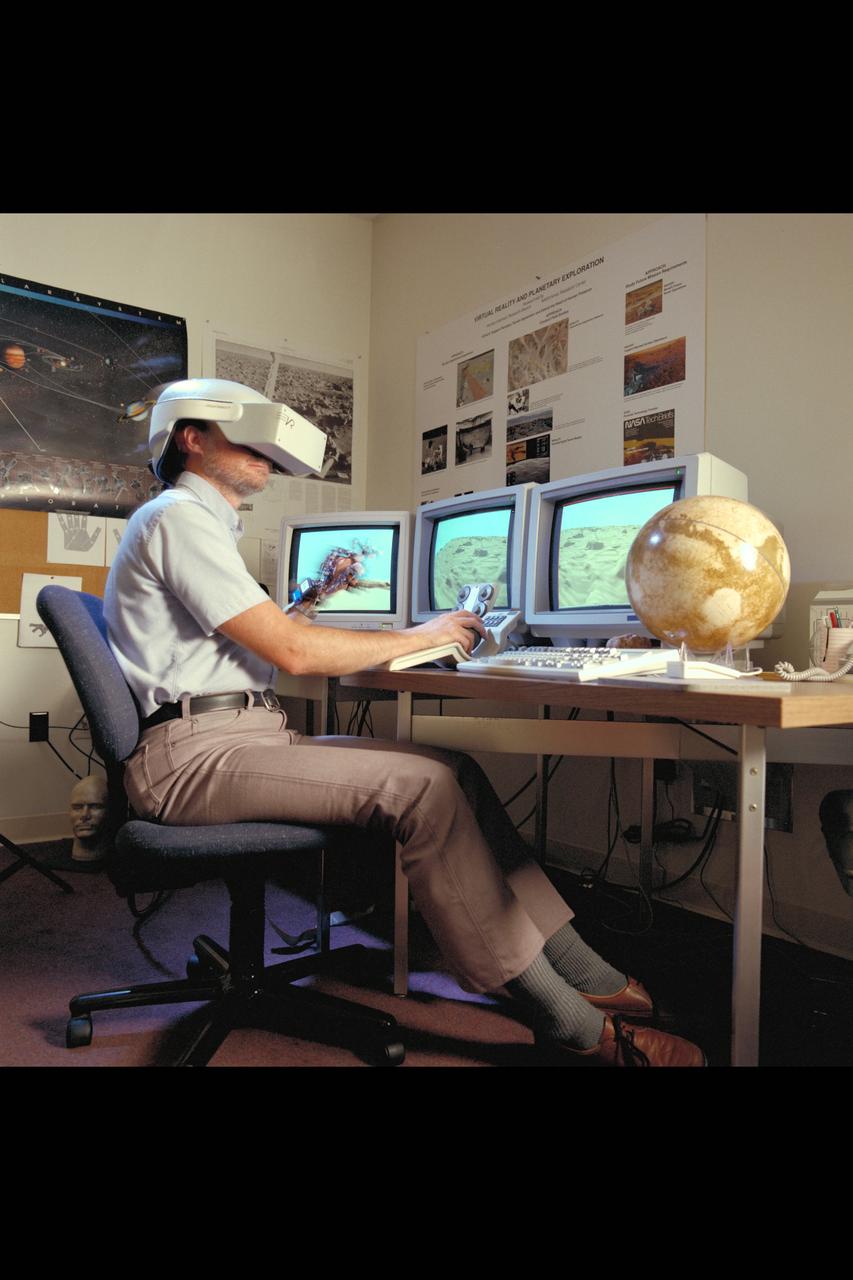
Virtual Environment Telepresence workstation, simulated Mars Exploration shows Lewis Hitchner with virtual helmet and EXOS Dexterous interface (virtual hand)
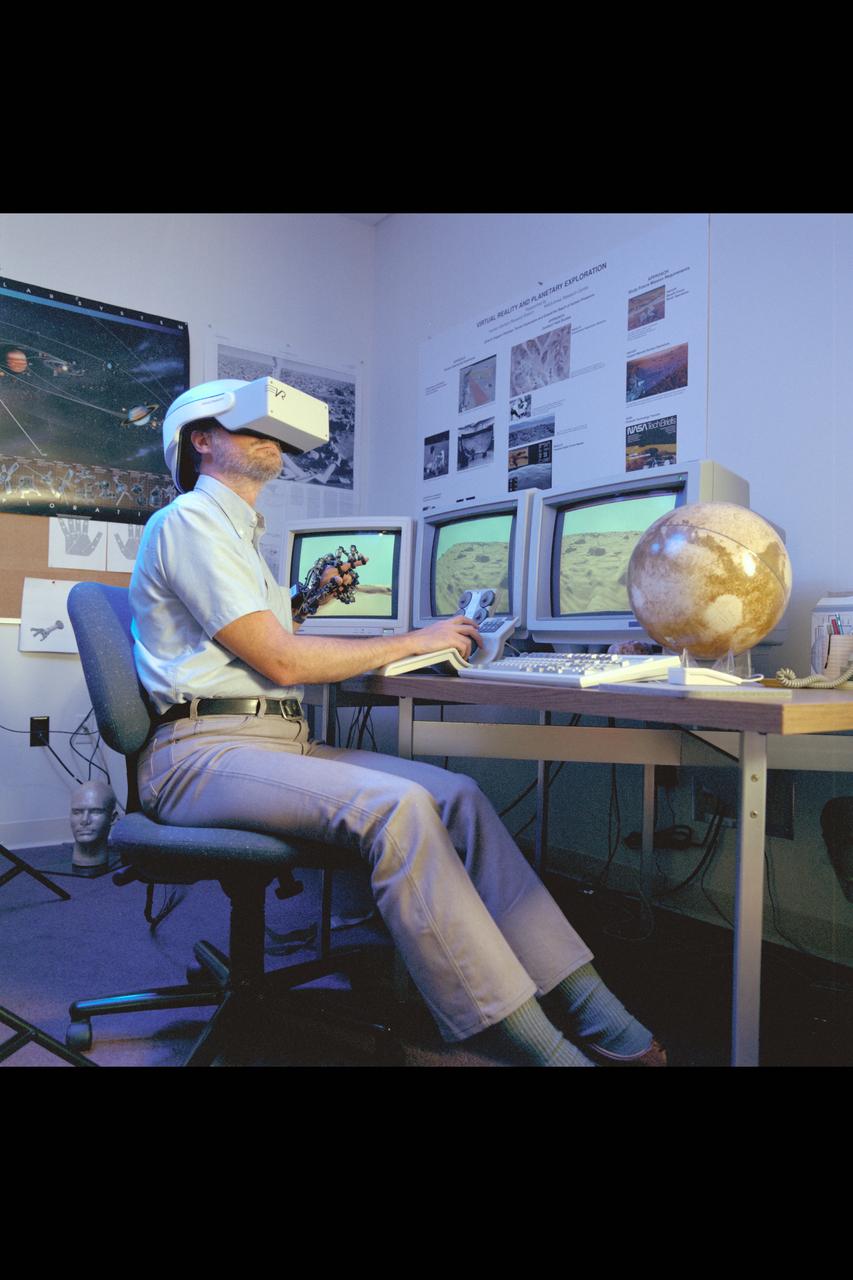
Virtual Environment Telepresence workstation, simulated Mars Exploration shows Lewis Hitchner with virtual helmet and EXOS Dexterous interface (virtual hand)
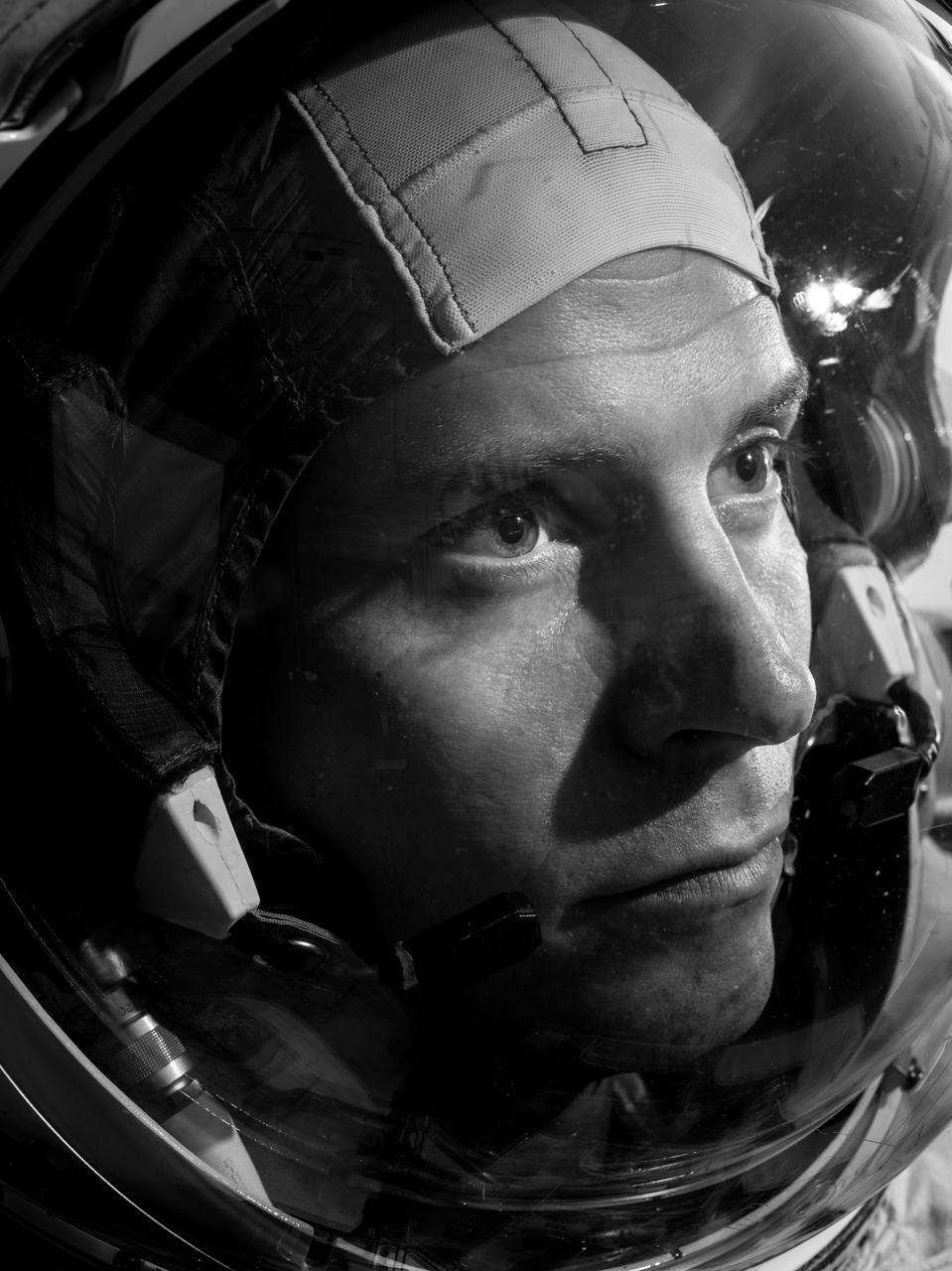
(April 20, 2018) -- Portrait view of Expedition 57/58 Crew Member Nick Hague wearing EMU helmet. Photo credit: NASA/Josh Valcarcel
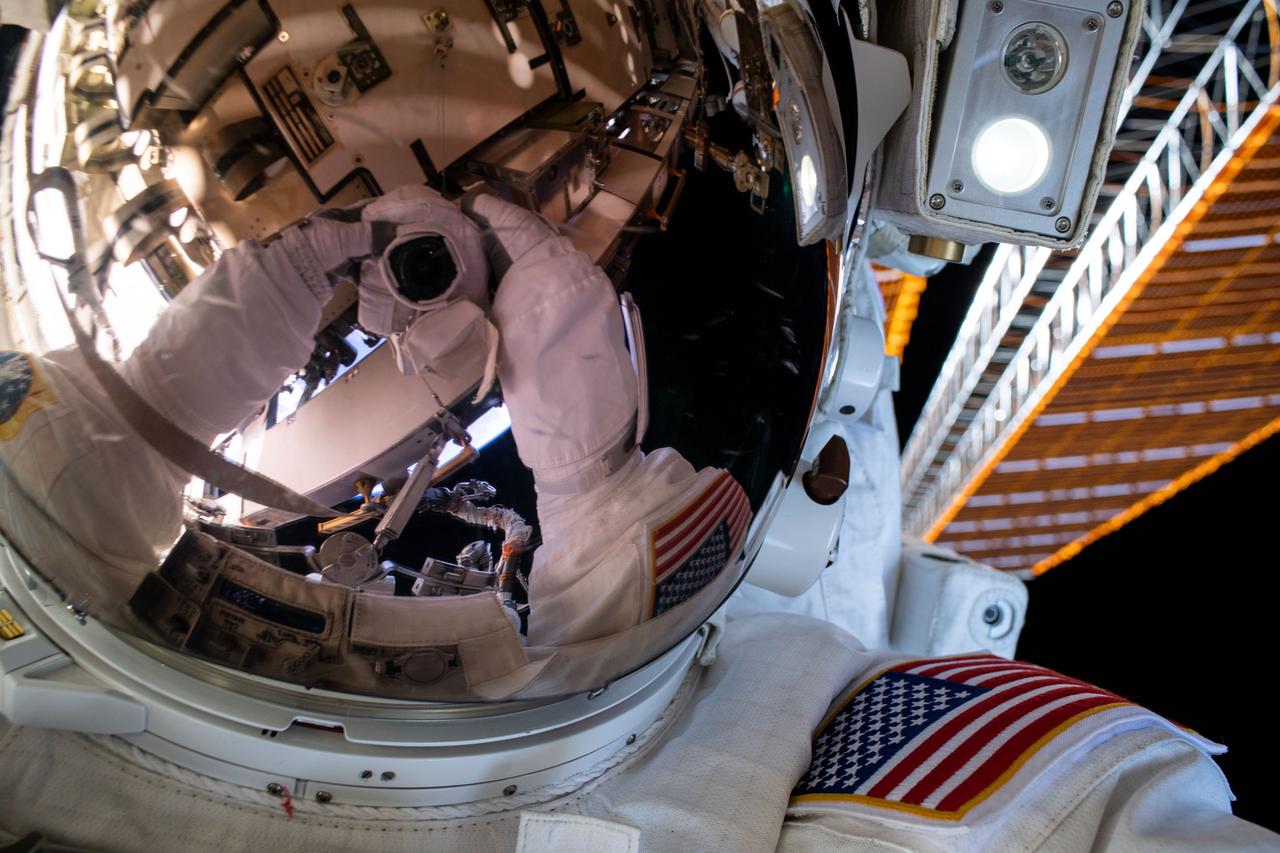
iss063e033403 (June 26, 2020) --- A spacewalker's spacesuit gloves and camera are reflected in the helmet visor in this "space-selfie" taken during a six-hour and seven-minute spacewalk.
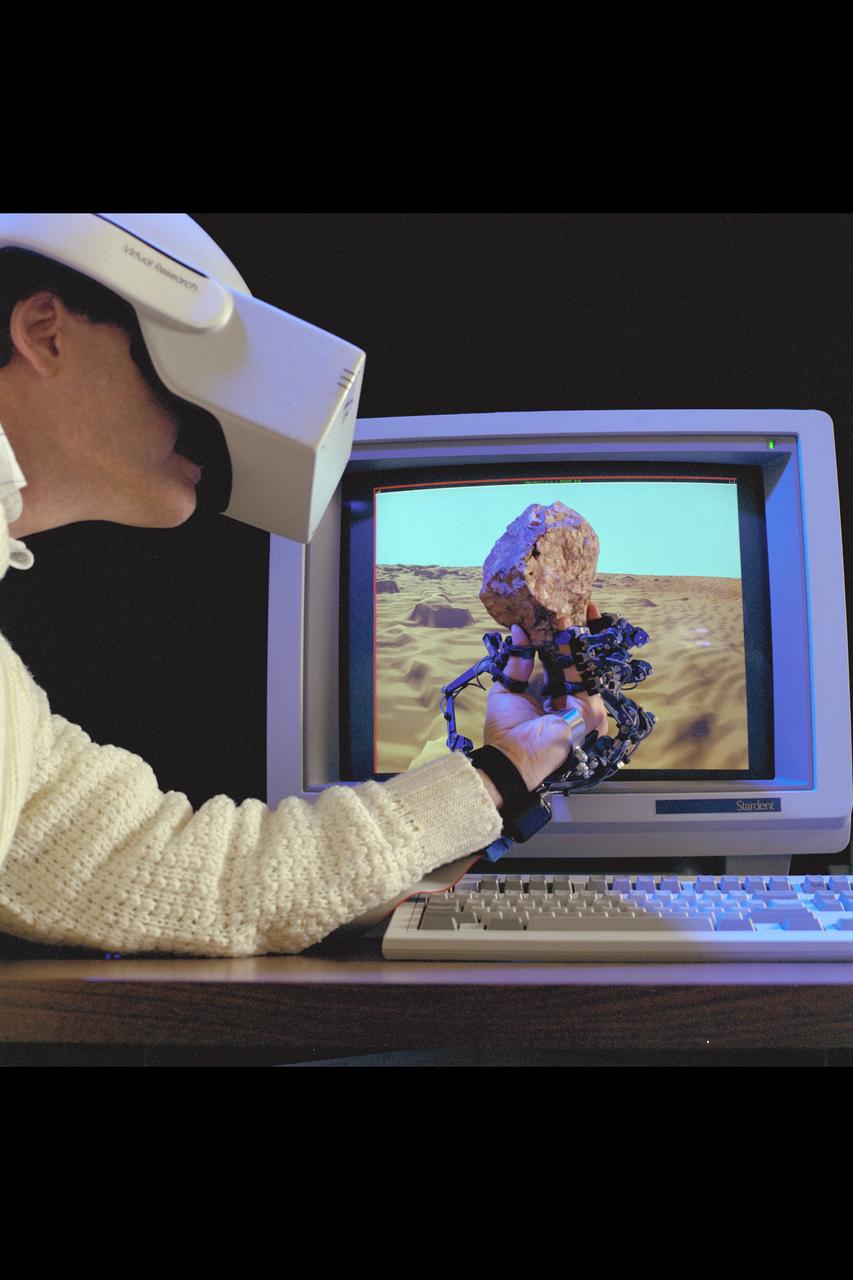
Virtual Environment Telepresence workstation, simulated Mars Exploration shows Dr Michael McGreevy with virtual helmet and EXOS Dexterous interface (holding rock invirtual hand)
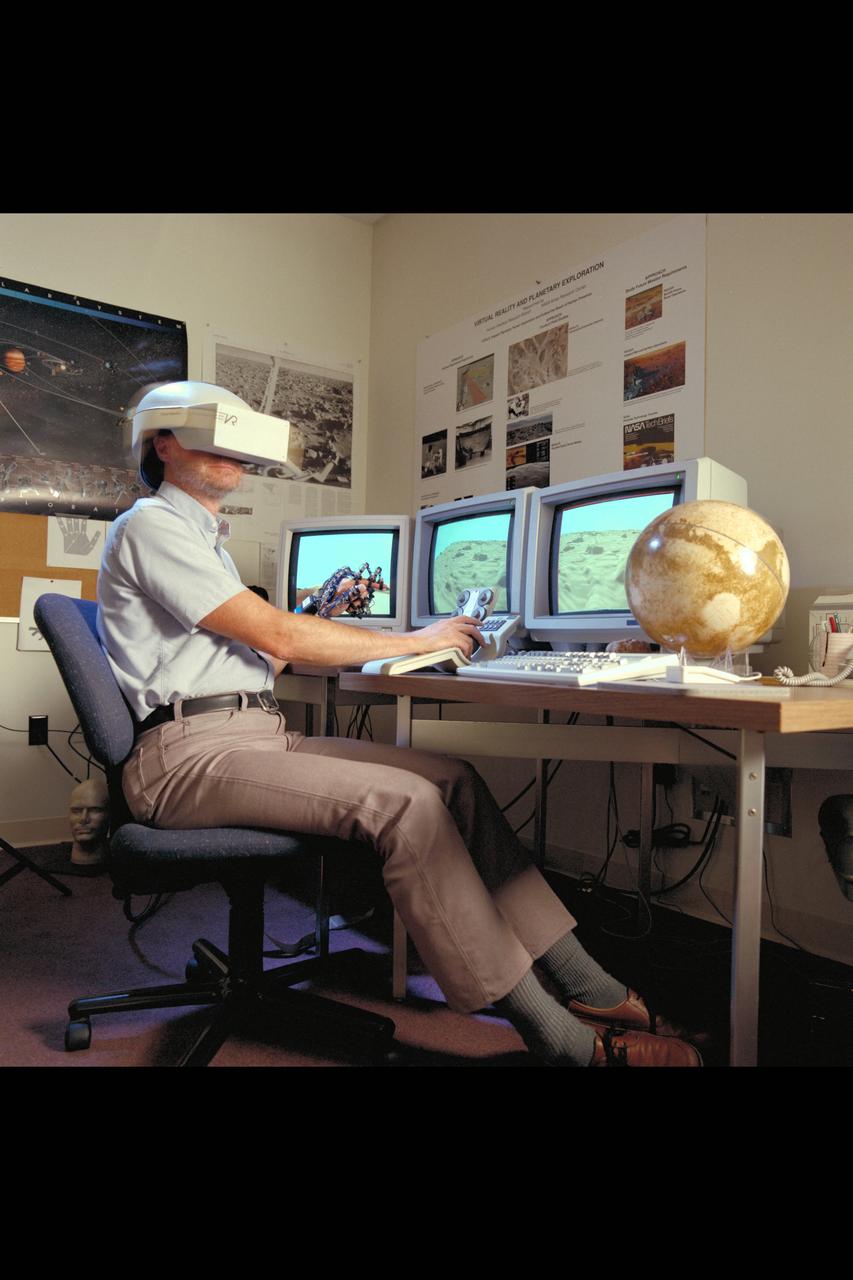
Virtual Environment Telepresence workstation, simulated Mars Exploration shows Lewis Hitchner with virtual helmet and EXOS Dexterous interface (virtual hand)

Virtual Environment Telepresence workstation, simulated Mars Exploration shows Lewis Hitchner with virtual helmet and EXOS Dexterous interface (virtual hand)
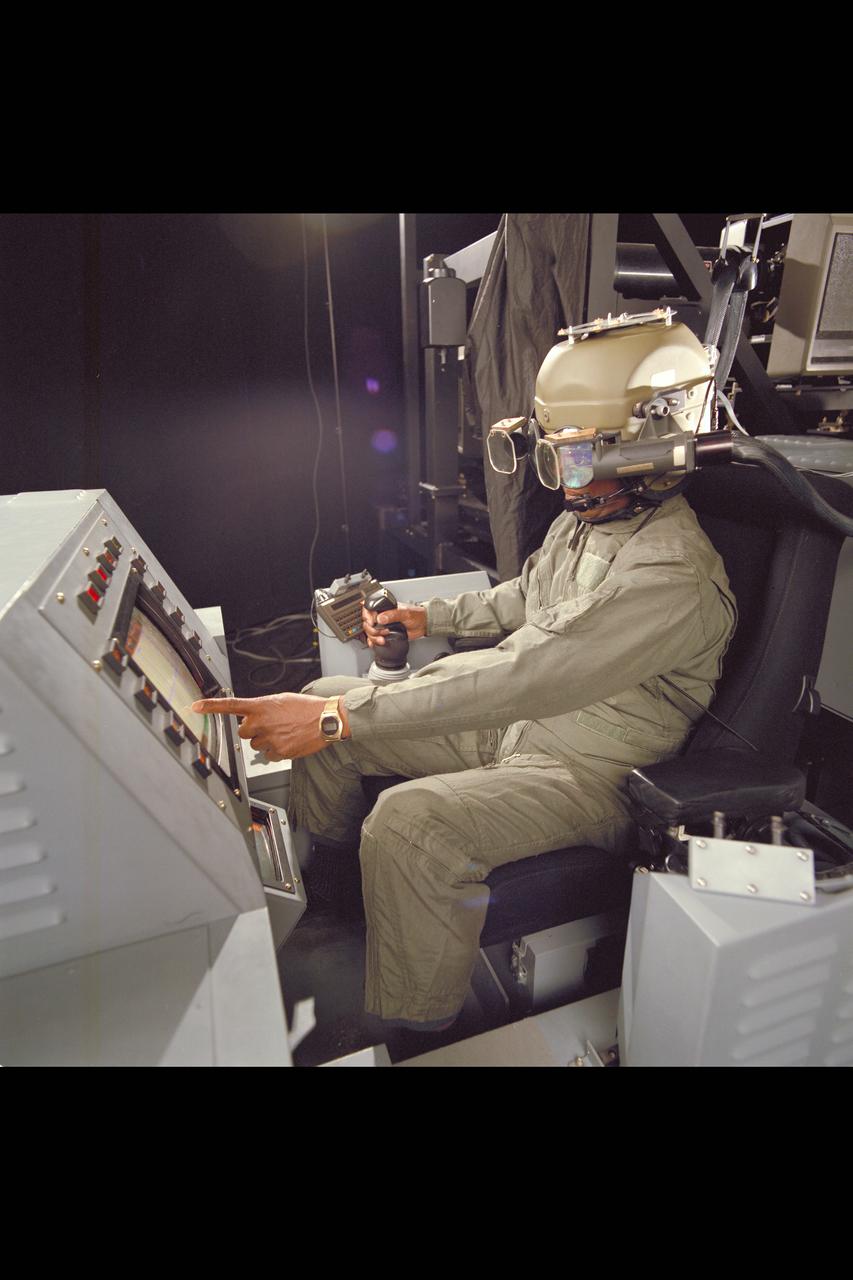
Crew Station Research and Developement Facility (CSRDF) A NASA Army simulator to design and evaluate advanced rotorcraft showing fiber optic helmet & workstation
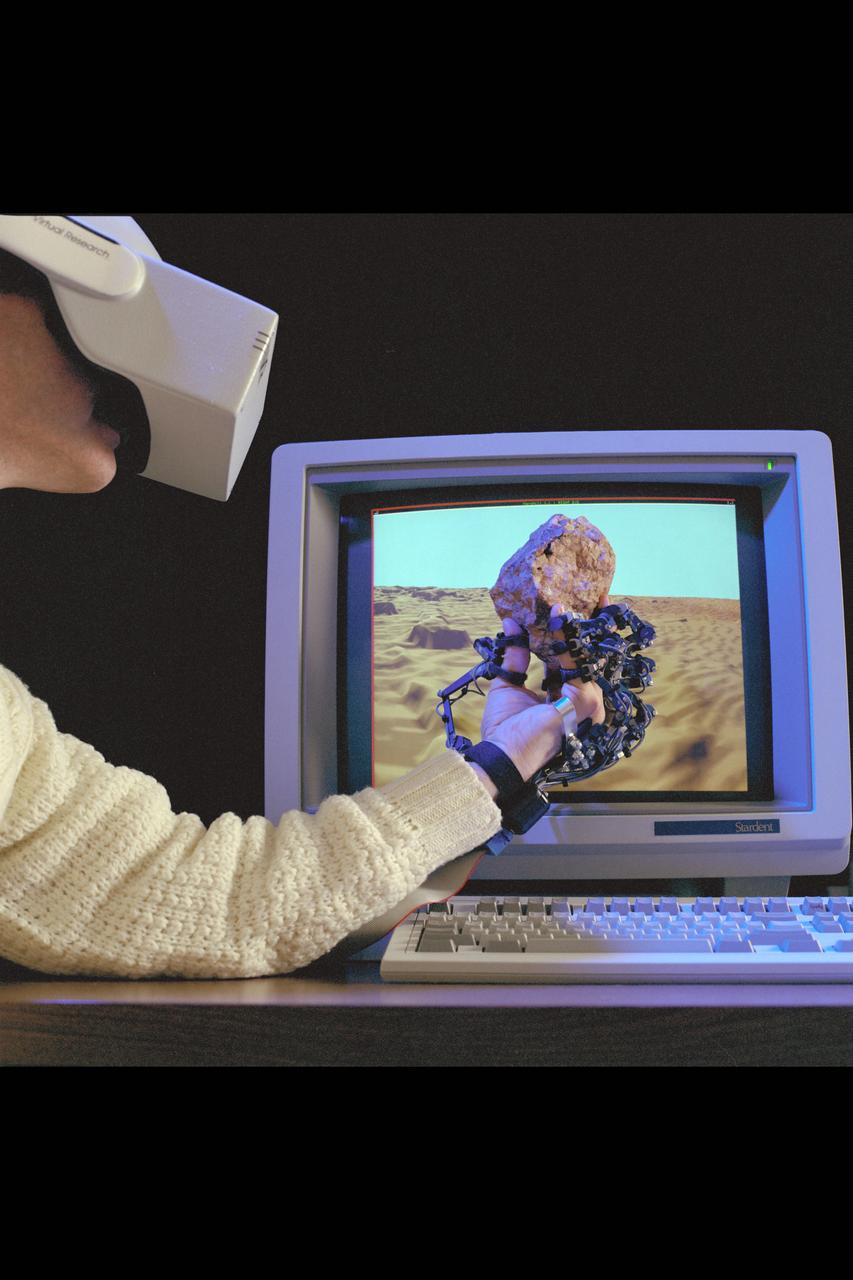
Virtual Environment Telepresence workstation, simulated Mars Exploration shows Dr Michael McGreevy with virtual helmet and EXOS Dexterous interface (holding rock invirtual hand)
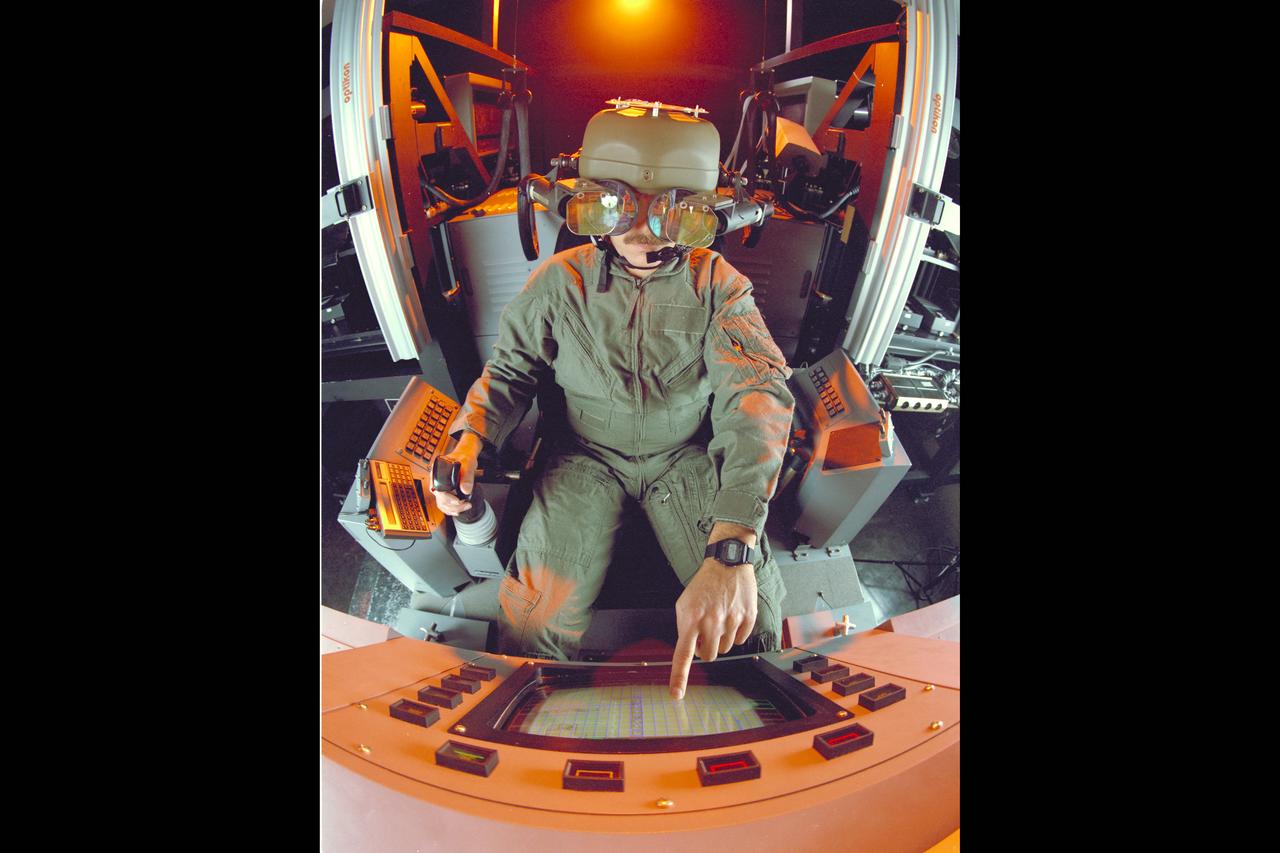
Crew Station Research and Developement Facility (CSRDF) A NASA Army simulator to design and evaluate advanced rotorcraft showing fiber optic helmet & workstation
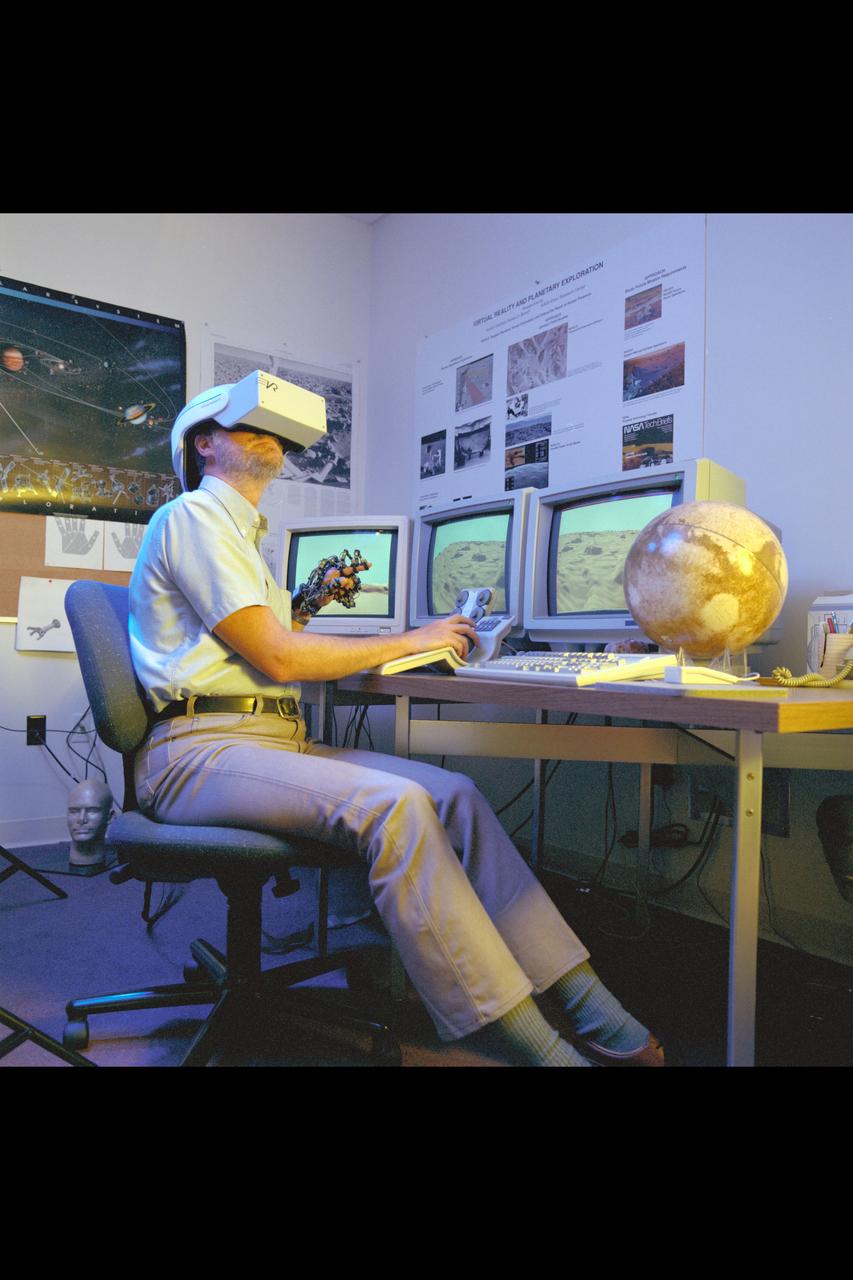
Virtual Environment Telepresence workstation, simulated Mars Exploration shows Lewis Hitchner with virtual helmet and EXOS Dexterous interface (virtual hand)
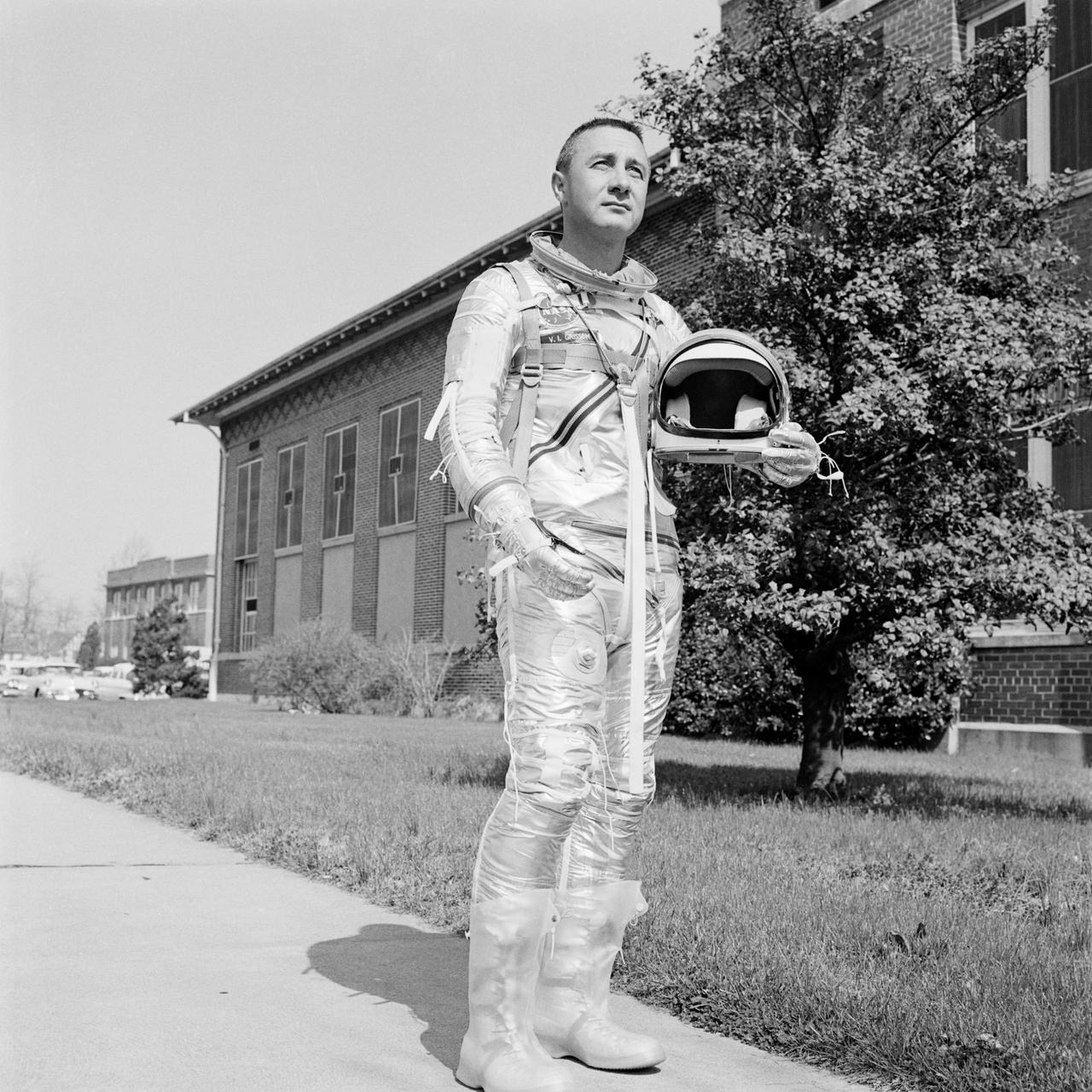
S61-01490 (4 April 1961) --- Astronaut Virgil Grissom photographed in the new Mercury spacesuit, holding his helmet. Photo credit: NASA
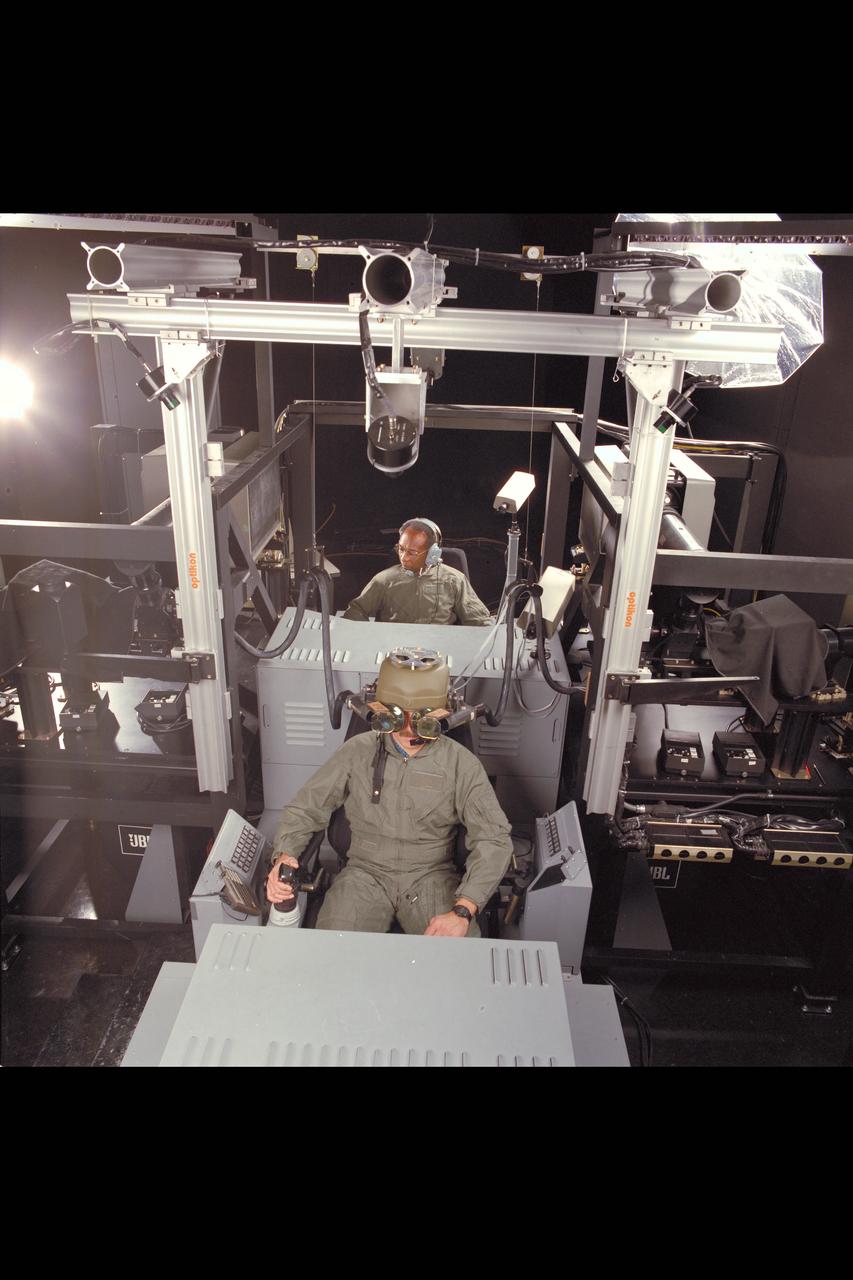
Crew Station Research and Developement Facility (CSRDF) A NASA Army simulator to design and evaluate advanced rotorcraft showing fiber optic helmet & workstation
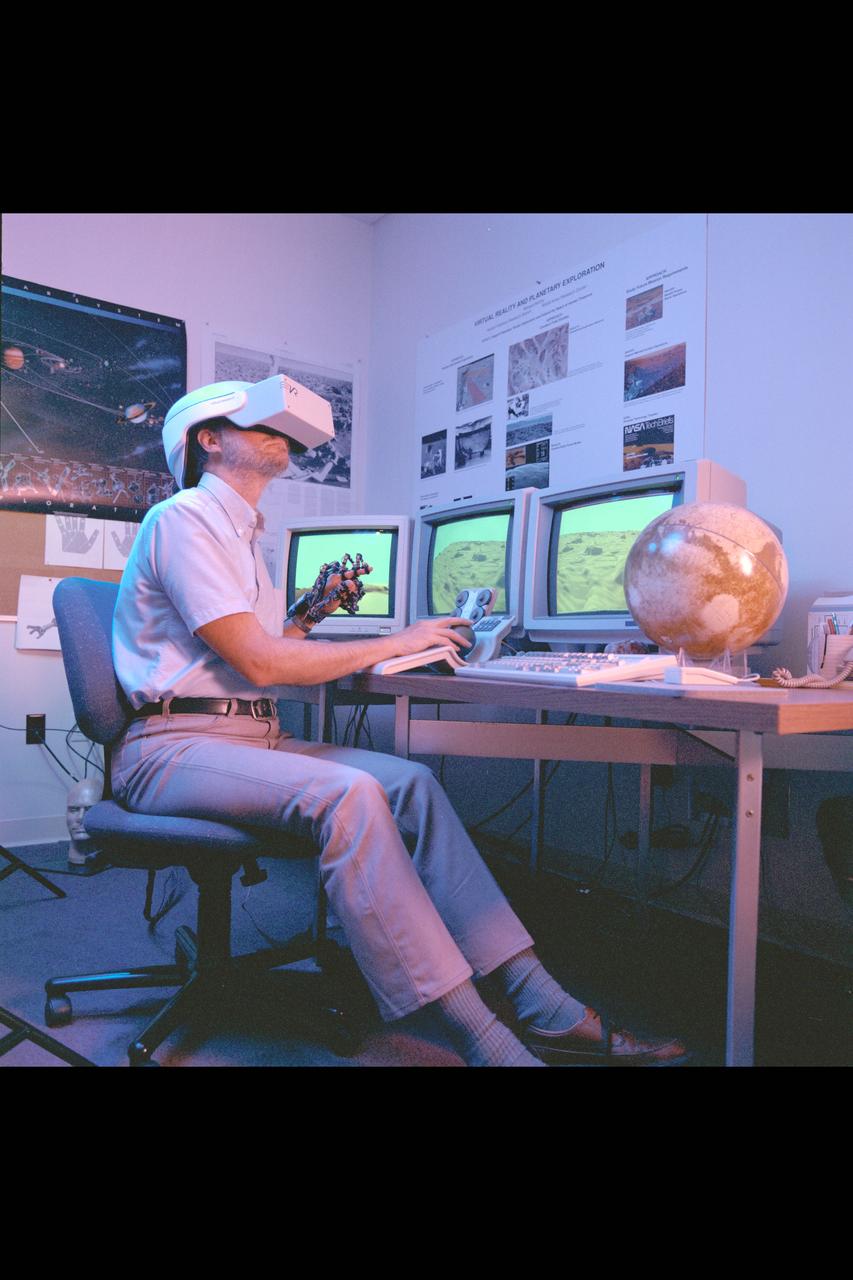
Virtual Environment Telepresence workstation, simulated Mars Exploration shows Lewis Hitchner with virtual helmet and EXOS Dexterous interface (virtual hand)
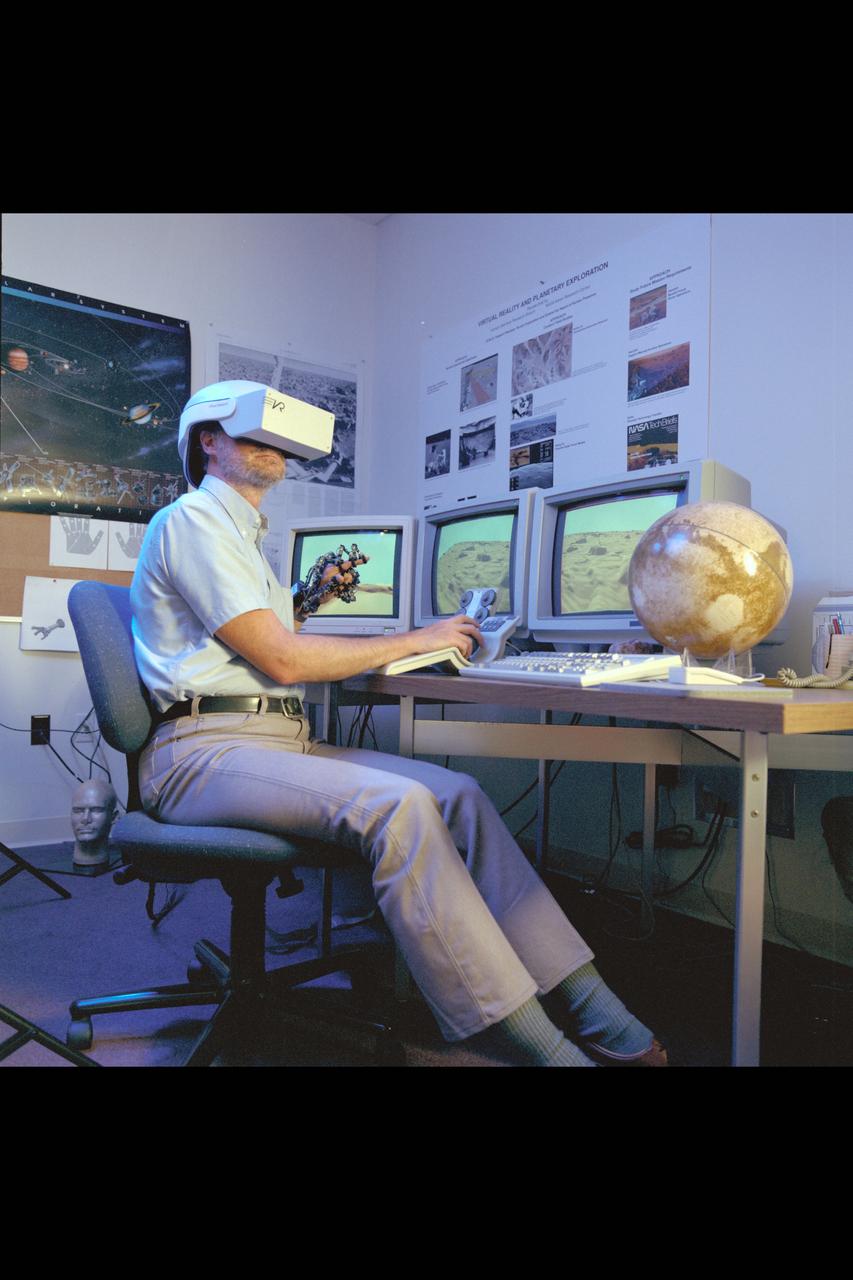
Virtual Environment Telepresence workstation, simulated Mars Exploration shows Lewis Hitchner with virtual helmet and EXOS Dexterous interface (virtual hand)
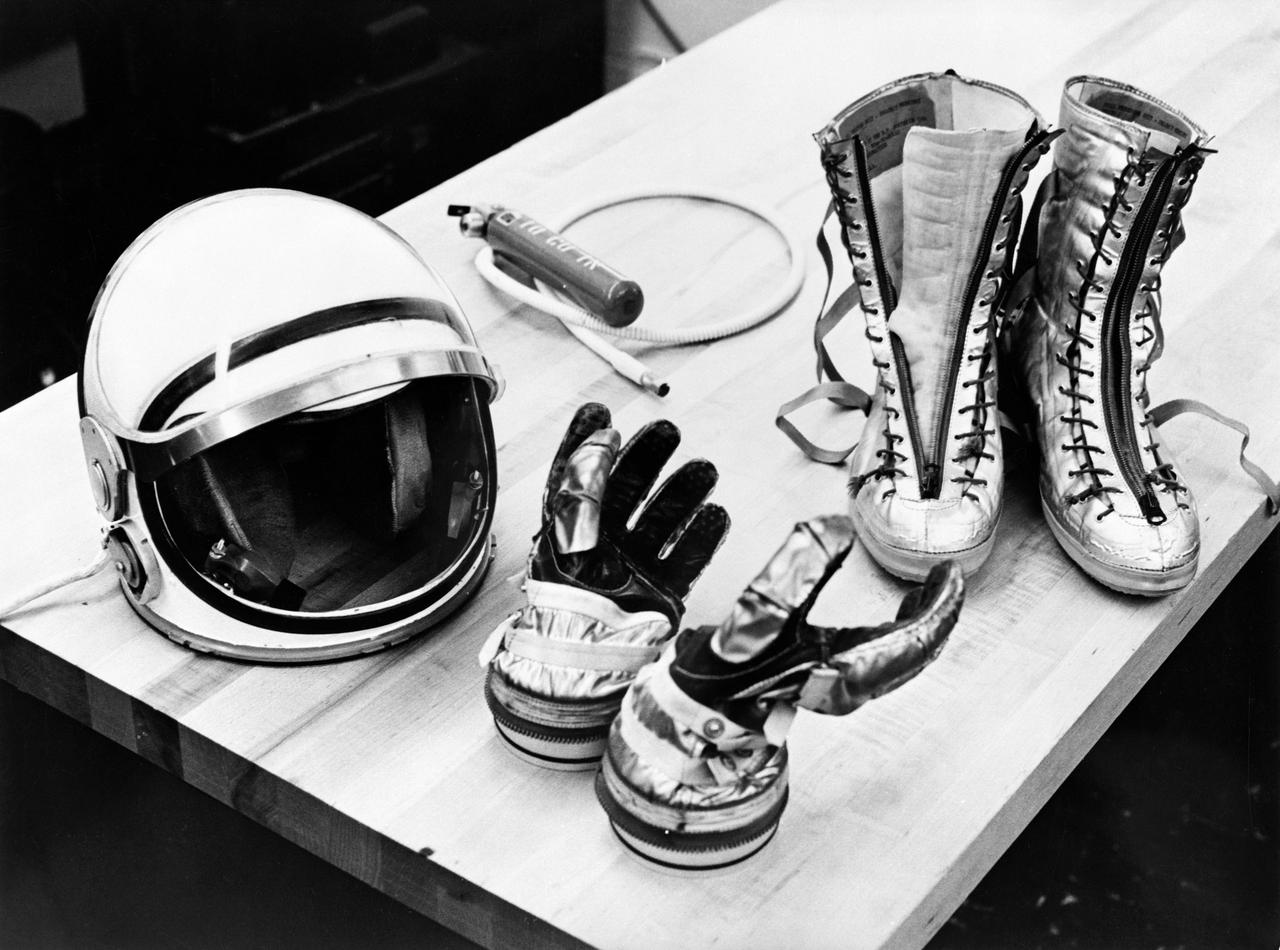
S61-02733 (28 July 1961) --- Table top view of some of the Mercury suit components including gloves, boots and helmet. Photo credit: NASA
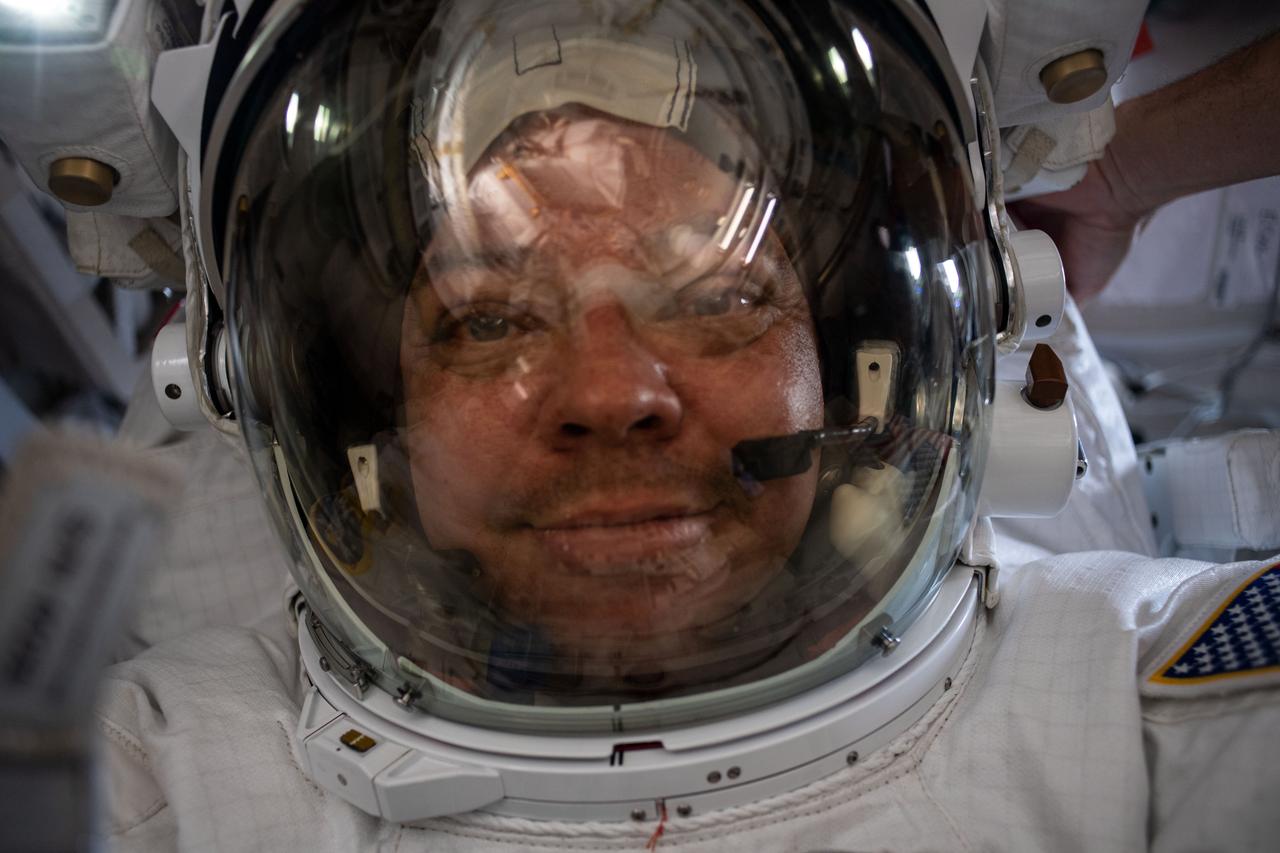
iss063e052704 (July 21, 2020) --- NASA spacewalker Bob Behnken takes a "space-selfie" with his helmet visor up on his U.S. spacesuit.
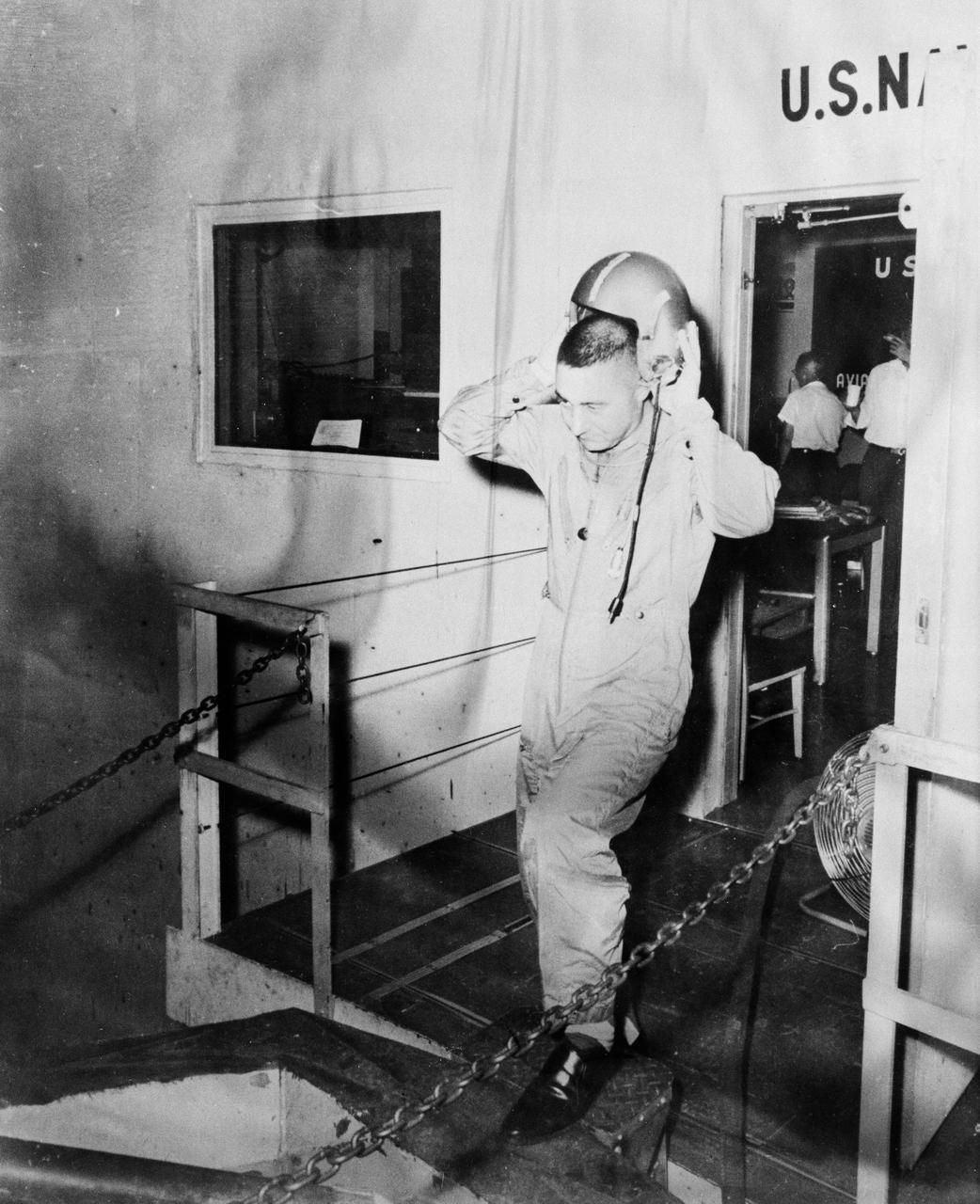
B59-00587 (1959) --- Astronaut Virgil (Gus) Grissom is pictured leaving a U.S. Navy installation and removing his helmet. Photo credit: NASA
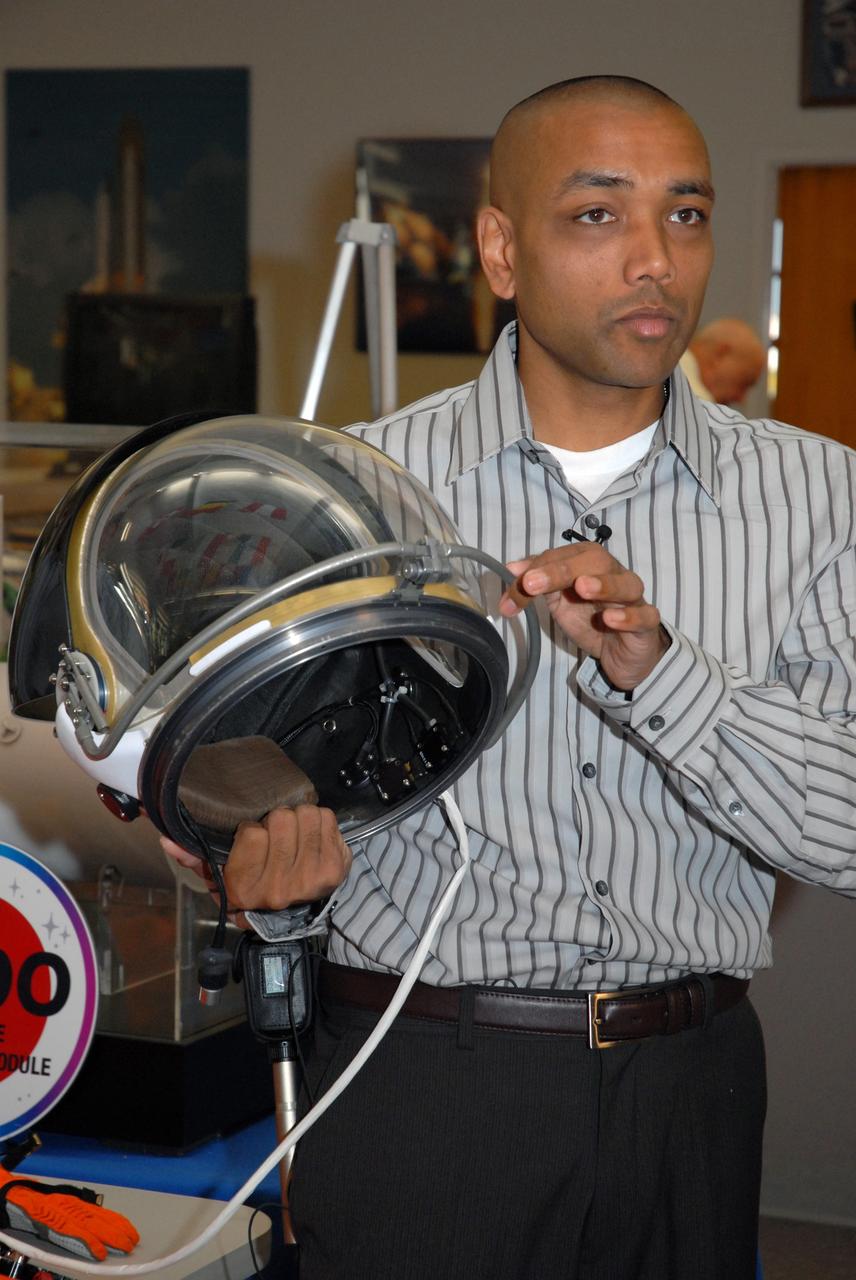
CAPE CANAVERAL, Fla. -- In the NASA News Center at NASA's Kennedy Space Center, Shuttle Crew Escape System Manager KC Chhipwadia describes for the media the elements of the helmet that is part of the launch and entry suit (seen on the table) used by shuttle crews during their missions. He is holding onto the bar that latches to secure the closed visor. The helmet provides oxygen when needed plus a communication system. Photo credit: NASA/Amanda Diller
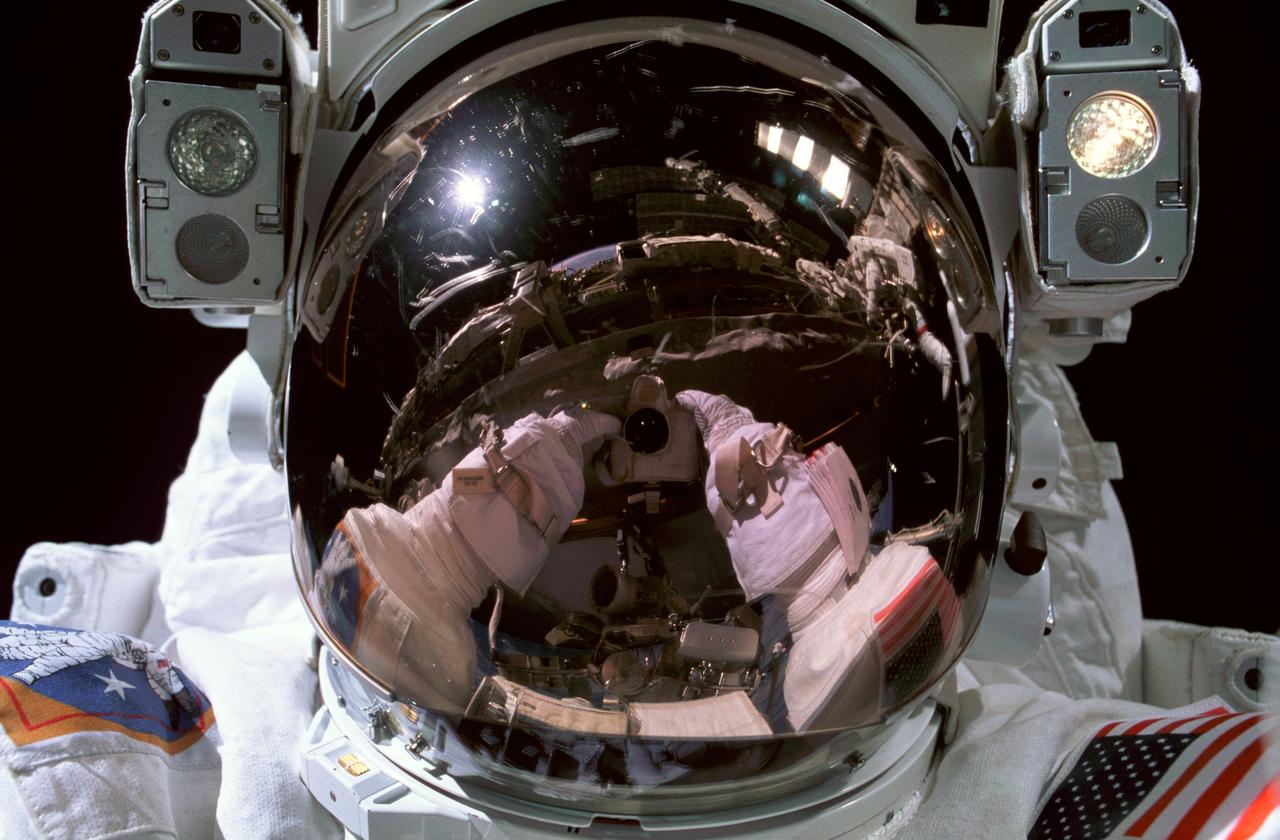
ISS006-344-011 (15 January 2003) --- Astronaut Donald R. Pettit, Expedition 6 NASA ISS science officer, photographs his helmet visor during a session of extravehicular activity (EVA). Pettit’s arms and camera are visible in the reflection of his helmet visor. Astronaut Kenneth D. Bowersox, mission commander, is also visible in visor reflection, upper right.
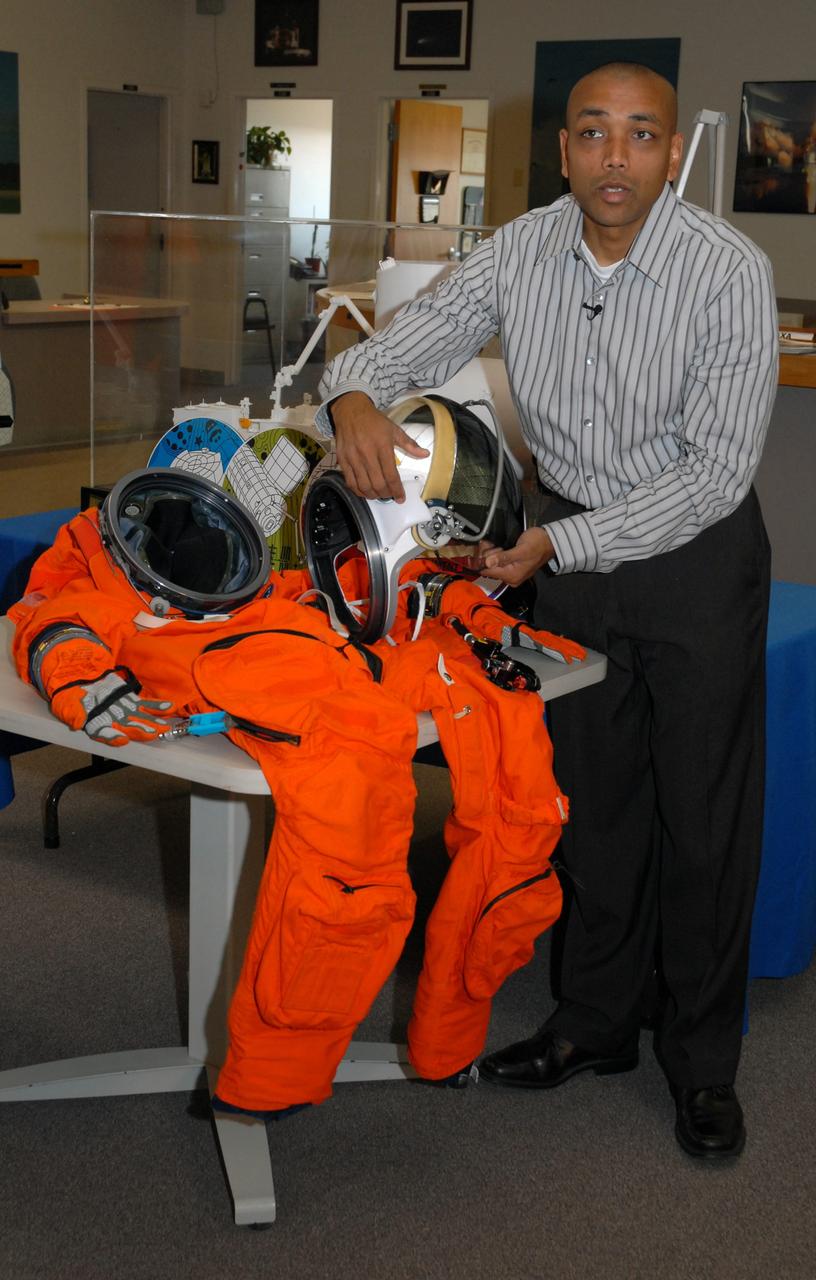
CAPE CANAVERAL, Fla. -- In the NASA News Center at NASA's Kennedy Space Center, Shuttle Crew Escape System Manager KC Chhipwadia describes for the media the elements of the helmet that is part of the launch and entry suit (seen on the table) used by shuttle crews during their missions. The helmet provides oxygen when needed plus a communication system. Photo credit: NASA/Amanda Diller
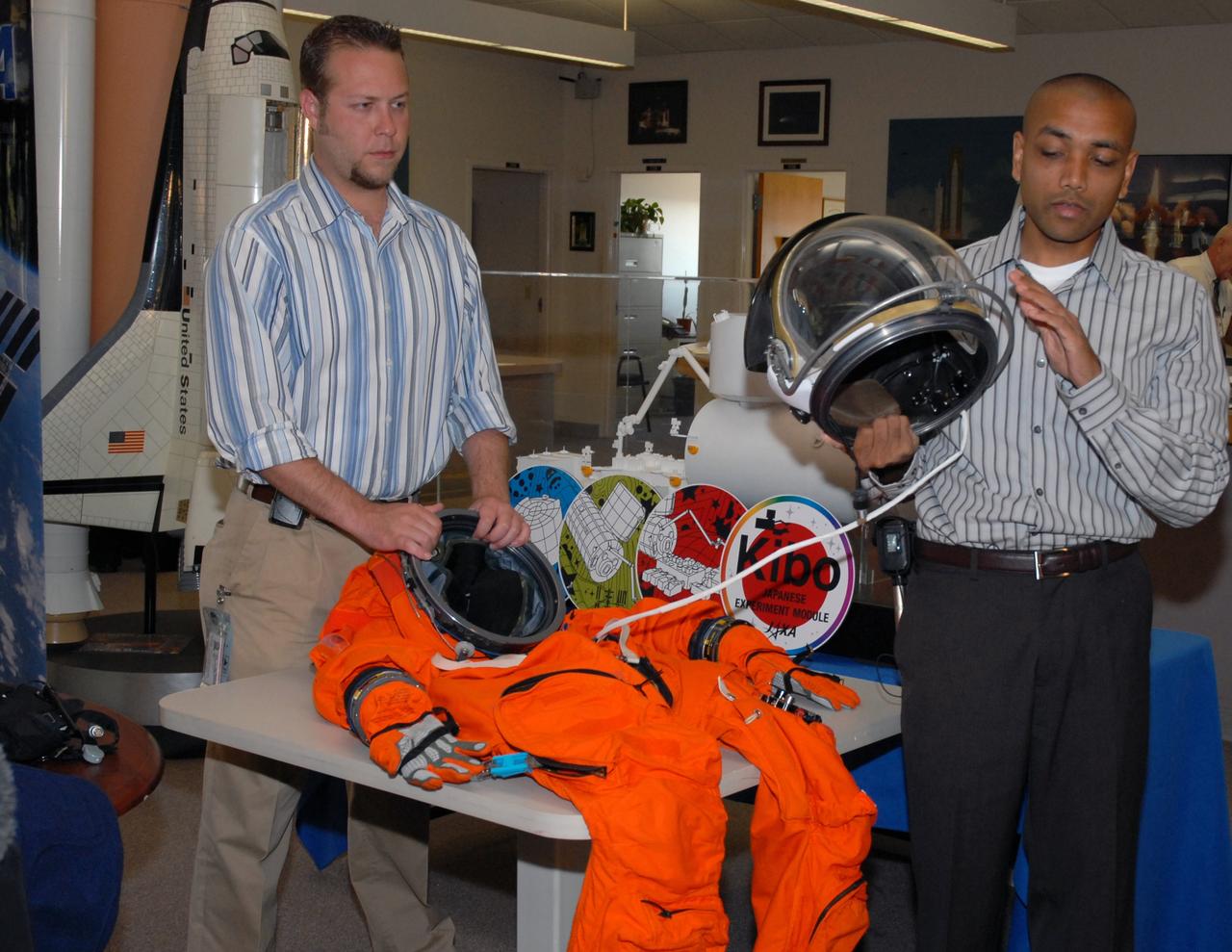
CAPE CANAVERAL, Fla. -- In the NASA News Center at NASA's Kennedy Space Center, Shuttle Crew Escape System Manager KC Chhipwadia (right) describes for the media the elements of the helmet that is part of the launch and entry suit (seen on the table) used by shuttle crews during their missions. The helmet provides oxygen when needed plus a communication system. Photo credit: NASA/Amanda Diller
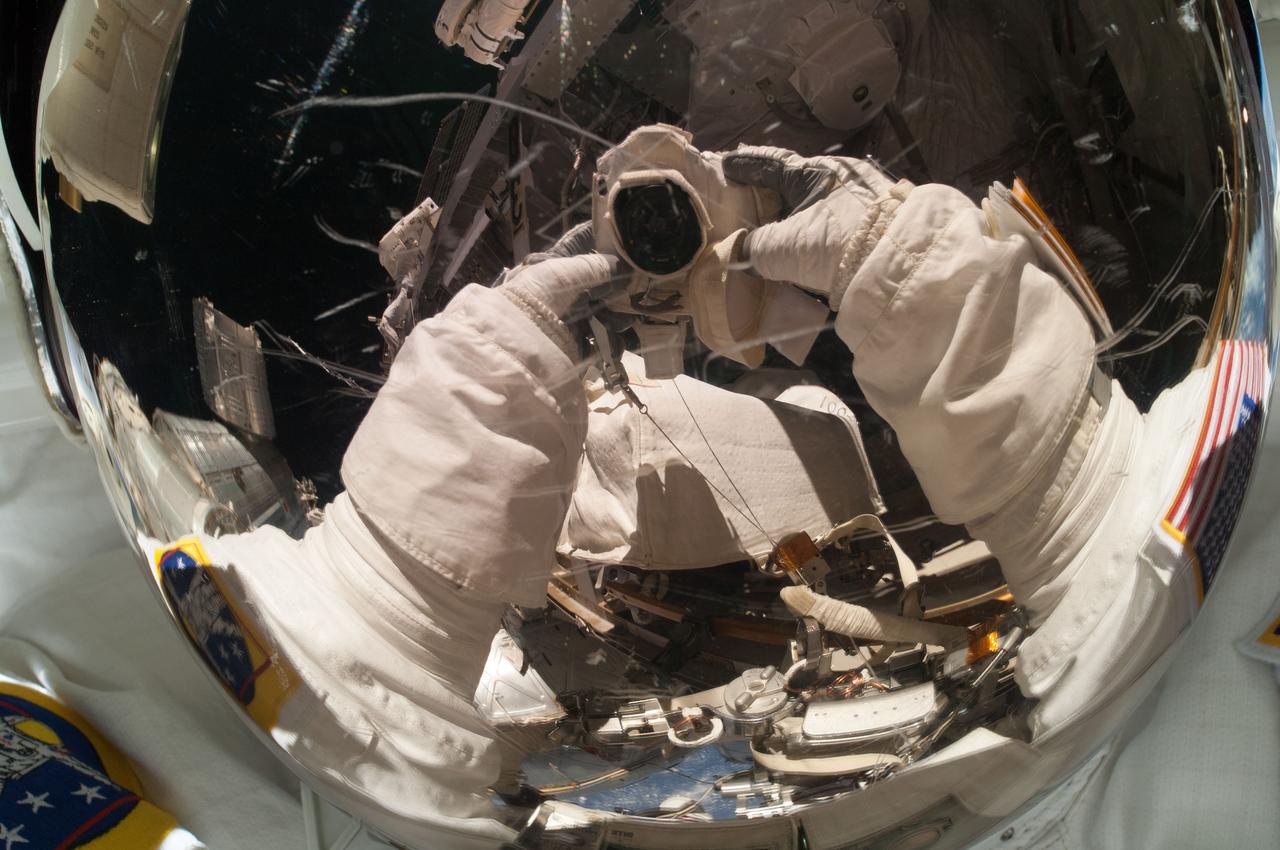
ISS039-E-014878 (22 April 2014) --- Part of the upper body of NASA astronaut Rick Mastracchio is pictured in a "selfie" or self-portrait during a spacewalk to replace a failed backup computer relay box in the S0 truss of the International Space Station on April 22, 2014. He was accompanied on the spacewalk by fellow Flight Engineer Steve Swanson of NASA.
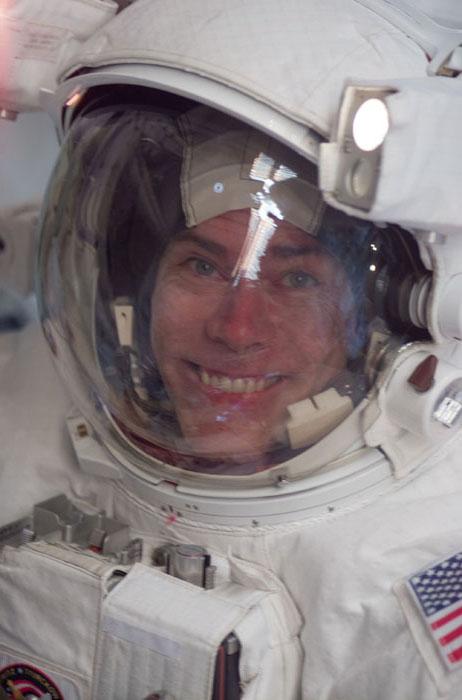
STS105-E-5318 (16 August 2001) --- Astronaut Daniel T. Barry, mission specialist, pauses for this close-up view during the first of two scheduled STS-105 space walks. This image was recorded with a digital still camera.
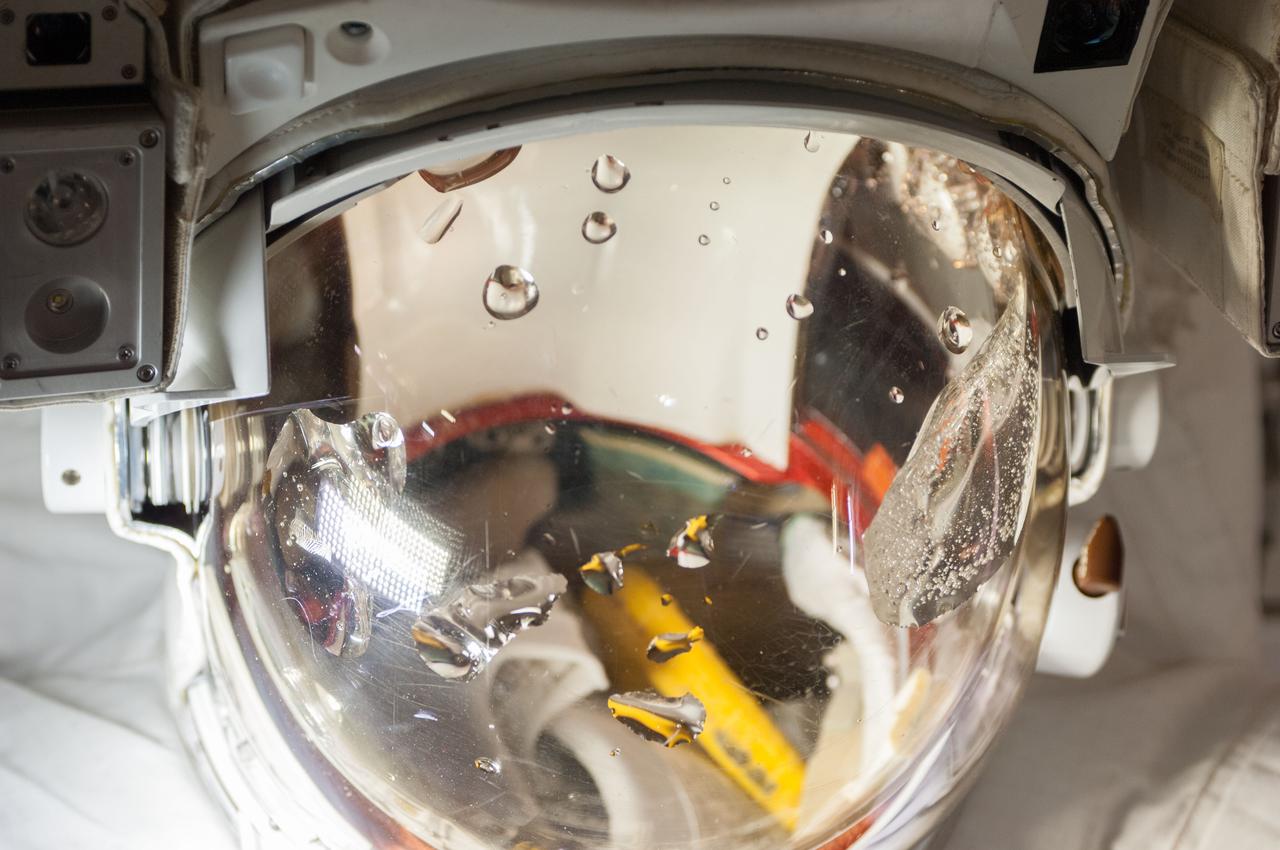
ISS036-E-037249 (27 Aug. 2013) --- The Extravehicular Mobility Unit (EMU) spacesuit helmet ? worn by European Space Agency astronaut Luca Parmitano during a July 16 spacewalk that was cut short when the helmet began to fill with water ? is captured in a close-up image in the Quest airlock of the International Space Station. After assembling and powering up the empty suit as if it were about to go out on another spacewalk, Parmitano and NASA astronaut Chris Cassidy (both out of frame), both Expedition 36 flight engineers, observed water once again leaking into the helmet. With the issue reproduced, NASA now has a baseline configuration for the crew to begin swapping out parts for additional tests to pinpoint the problem. There are also opportunities to either launch replacement parts on upcoming cargo flights or return parts to Earth for further study once more is known about the cause of the issue.
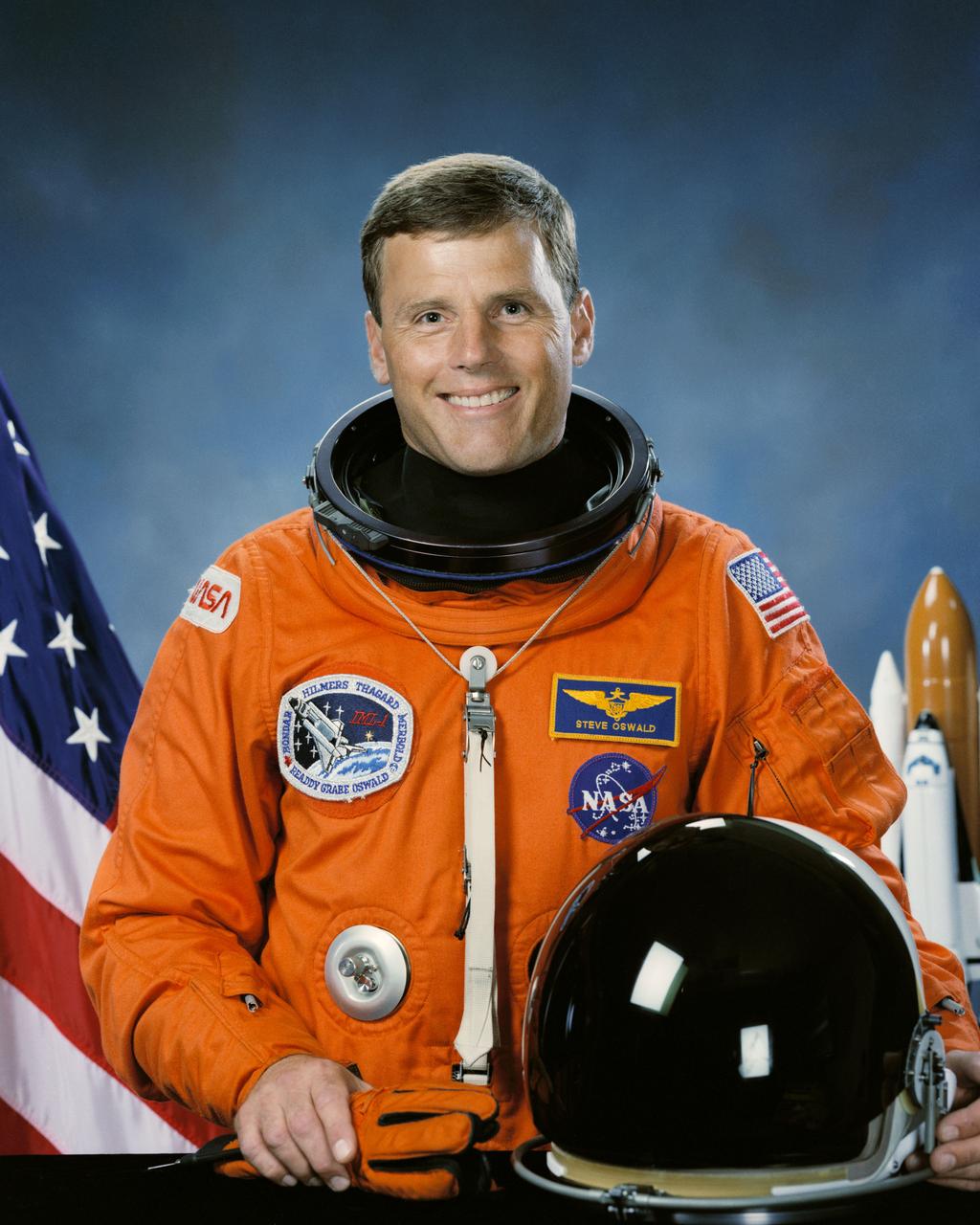
S92-31007 (March 1992) --- Astronaut Stephen S. Oswald.
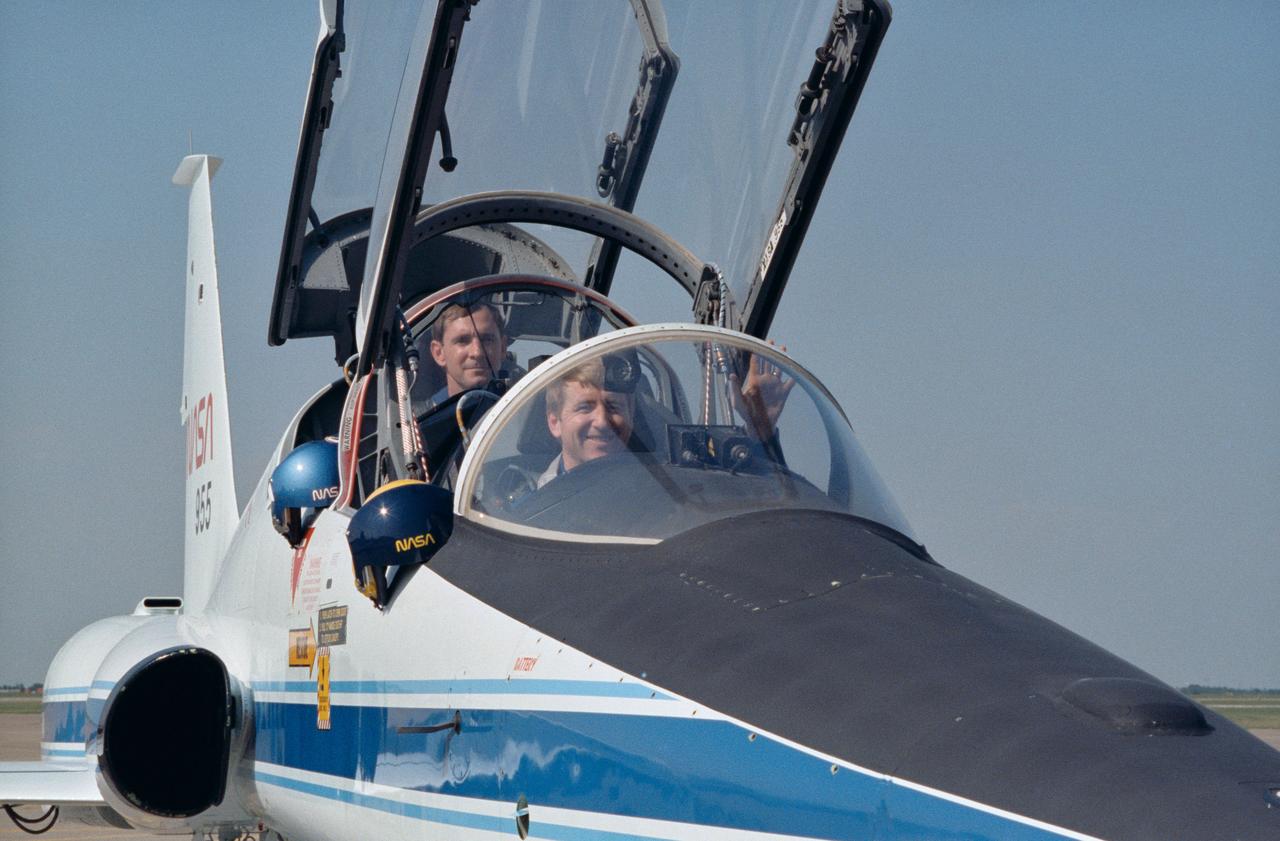
STS-38 Pilot Frank L. Culbertson waves from T-38A NASA 955 forward cockpit prior to Ellington Field departure. Astronaut Curtis L. Brown, Jr is stationed in the aft cockpit behind Culbertson.
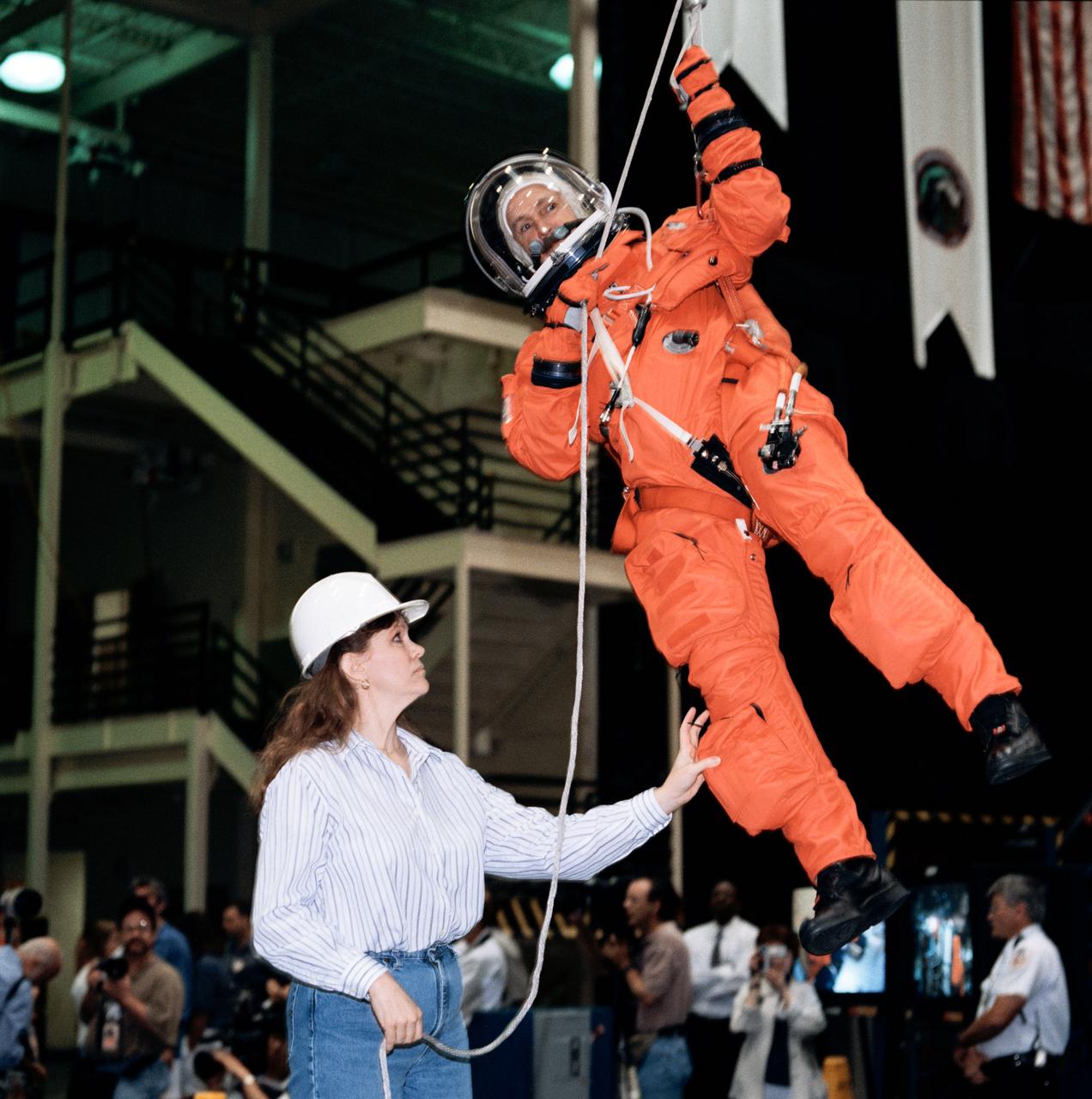
Photographic documentation of the STS-95 crew emergency egress training at the bldg 9A Full Fuselage Trainer (FFT). Views include: Mission specialist Senator John Glenn (in his orange Launch and Landing (LES) suit) is photographed by his wife as other visitors look on (07958). STS-95 crewmember prepares to use the Sky Genie to climb down the side of the FFT (07959). STS-95 crew lines up to pose for pictures in their LES's. Left to right are: Mission specialist Pedro Duque, payload specialist Chiaki Mukai, commander Curt Brown, payload specialist U.S. Senator John Glenn, mission specialist Stephen Robinson, pilot Steven Lindsey, and mission specialist Scott F. Parazynski (07960). Parazynski, Glenn and Robinson talk while their photo is being taken (07961). Mukai receives assistance from suit techs in donning her LES helmet (07962). Glenn receives assistance from suit techs in donning his LES helmet (07963). Glenn, in his LES, walks toward the FFT (07964). Glenn uses the Sky Genie to prepare to climb down the side of the FFT (07965). View of Mrs. Annie Glenn watching her husband during training (07966). Mukai receives assistance from a suit tech with her LES while Glenn watches (07967). Close-up view of Mukai in her LES without a helmet (07968). Glenn and Mukai prepare to strap themselves into their seats in the mockup of the FFT middeck (07969-70). Close-up view of Mukai with her helmet on (07971). Mukai climbs down the rope with help from a technician on the ground (07972). Lindsey, Parazynski, Duque, Mukai and Glenn are photographed seated, waiting for training (07973). Close-up of Duque without his helmet (07974). Close-up of Lindsey with his helmet on, talking to a trainer (07975-6). View of Lindsey climbing down the rope (07977).
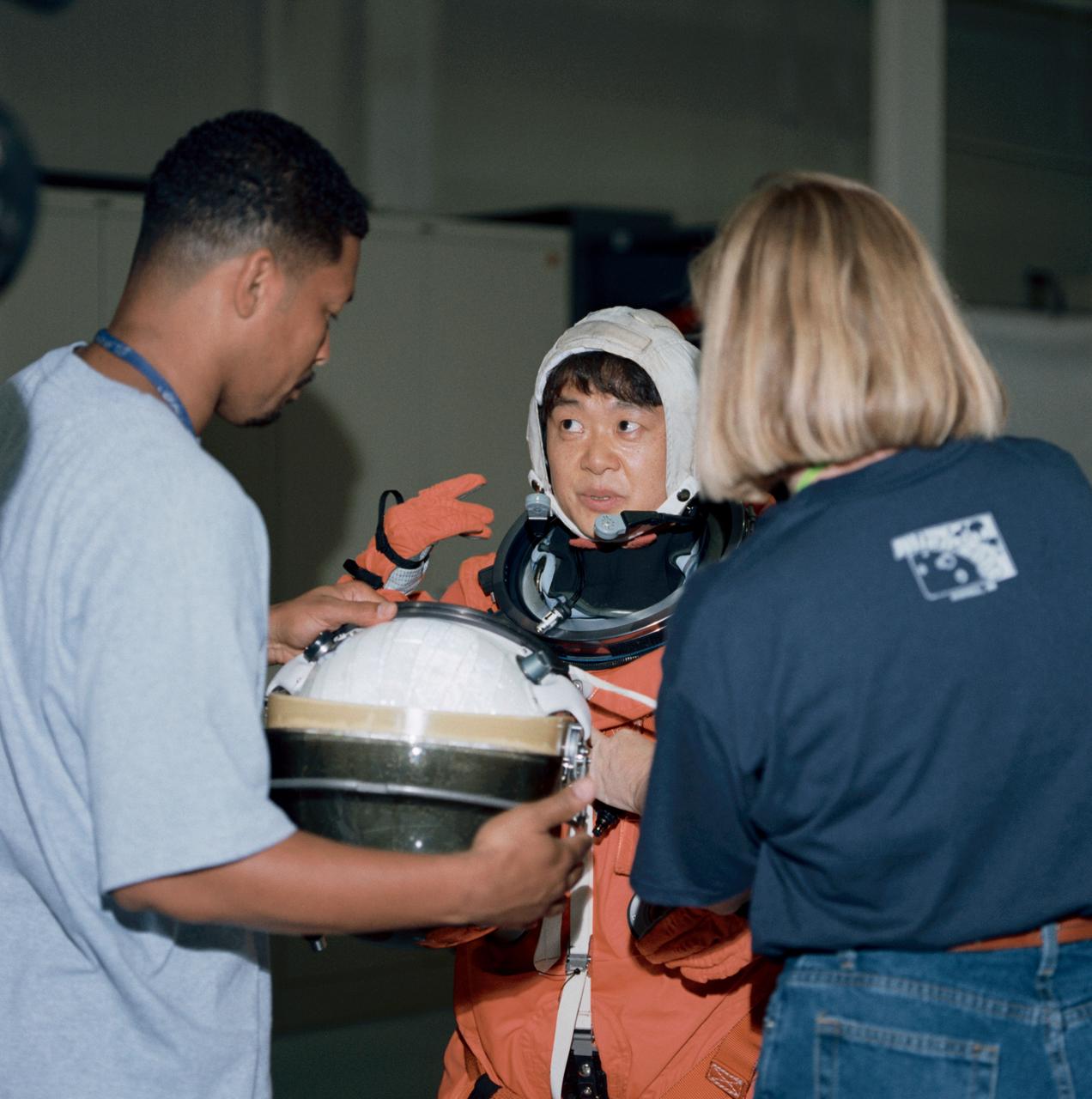
Photographic documentation of the STS-95 crew emergency egress training at the bldg 9A Full Fuselage Trainer (FFT). Views include: Mission specialist Senator John Glenn (in his orange Launch and Landing (LES) suit) is photographed by his wife as other visitors look on (07958). STS-95 crewmember prepares to use the Sky Genie to climb down the side of the FFT (07959). STS-95 crew lines up to pose for pictures in their LES's. Left to right are: Mission specialist Pedro Duque, payload specialist Chiaki Mukai, commander Curt Brown, payload specialist U.S. Senator John Glenn, mission specialist Stephen Robinson, pilot Steven Lindsey, and mission specialist Scott F. Parazynski (07960). Parazynski, Glenn and Robinson talk while their photo is being taken (07961). Mukai receives assistance from suit techs in donning her LES helmet (07962). Glenn receives assistance from suit techs in donning his LES helmet (07963). Glenn, in his LES, walks toward the FFT (07964). Glenn uses the Sky Genie to prepare to climb down the side of the FFT (07965). View of Mrs. Annie Glenn watching her husband during training (07966). Mukai receives assistance from a suit tech with her LES while Glenn watches (07967). Close-up view of Mukai in her LES without a helmet (07968). Glenn and Mukai prepare to strap themselves into their seats in the mockup of the FFT middeck (07969-70). Close-up view of Mukai with her helmet on (07971). Mukai climbs down the rope with help from a technician on the ground (07972). Lindsey, Parazynski, Duque, Mukai and Glenn are photographed seated, waiting for training (07973). Close-up of Duque without his helmet (07974). Close-up of Lindsey with his helmet on, talking to a trainer (07975-6). View of Lindsey climbing down the rope (07977).
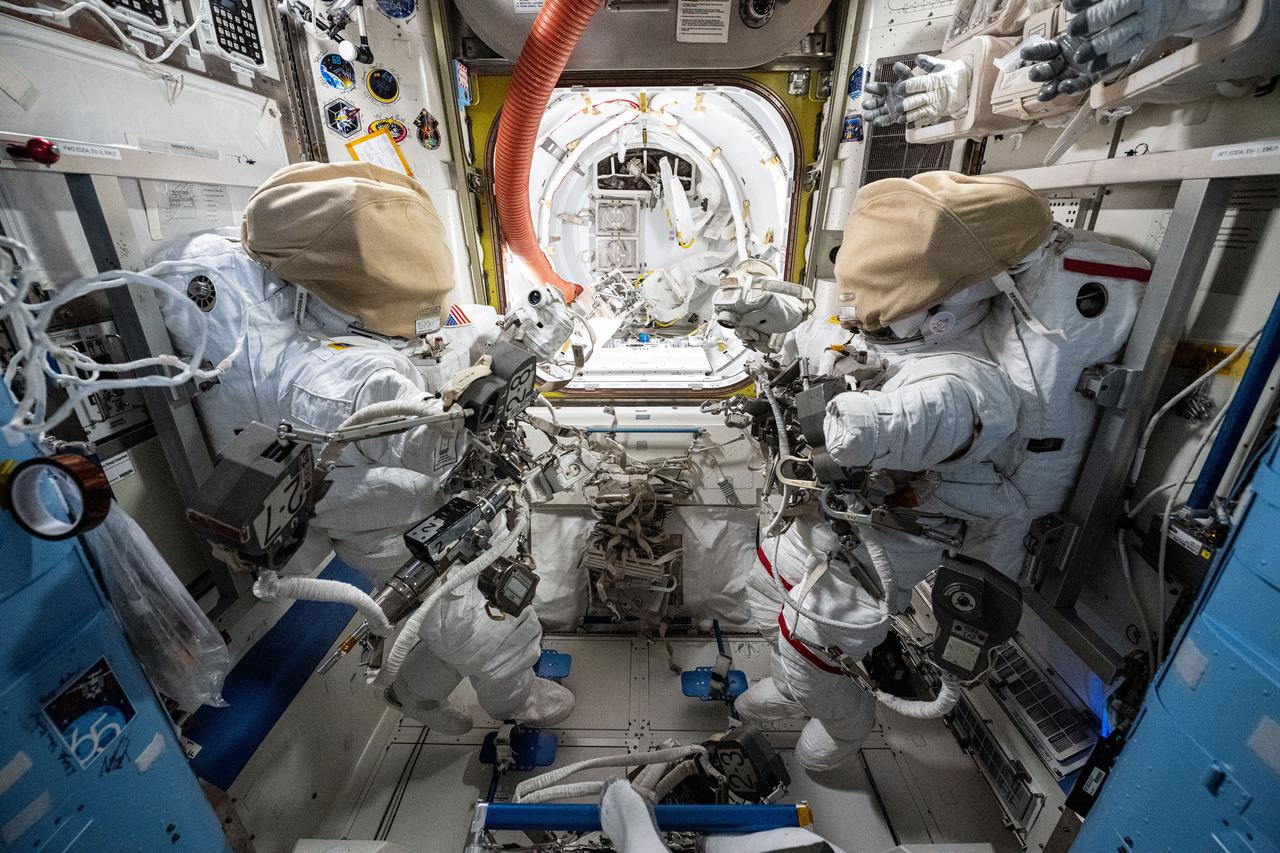
iss072e572297 (Jan. 28, 2025) --- Two spacesuits, with the helmets covered for protection, are staged inside the International Space Station's Quest airlock in preparation for spacewalk that NASA astronauts Suni Williams and Butch Wilmore conducted on Jan. 30, 2025.
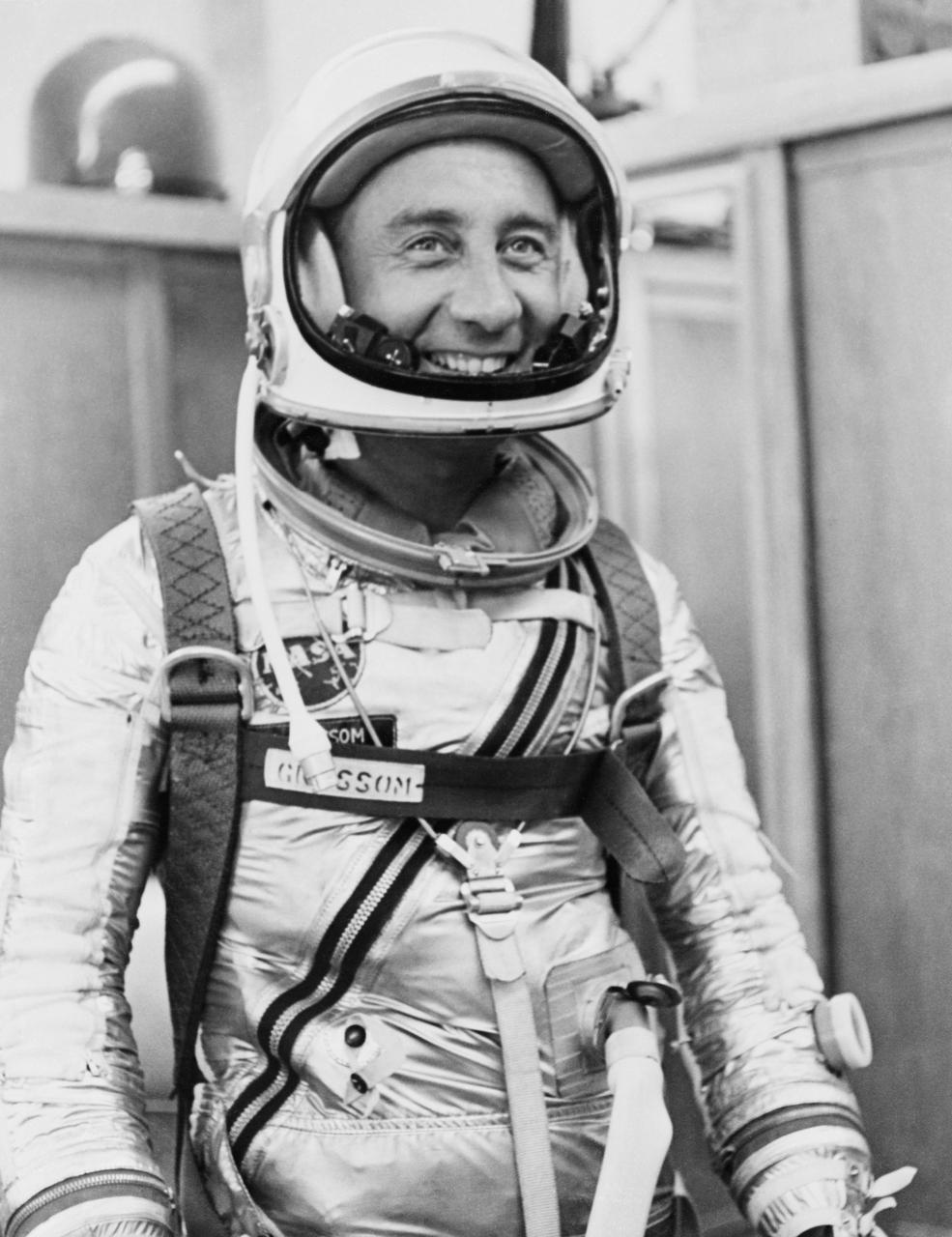
S61-02845 (1961) --- Portrait of astronaut Virgil I. (Gus) Grissom in his pressure suit and wearing his helmet in Hangar S at Cape Canaveral, Florida before the Mercury-Redstone 4 mission. Photo credit: NASA
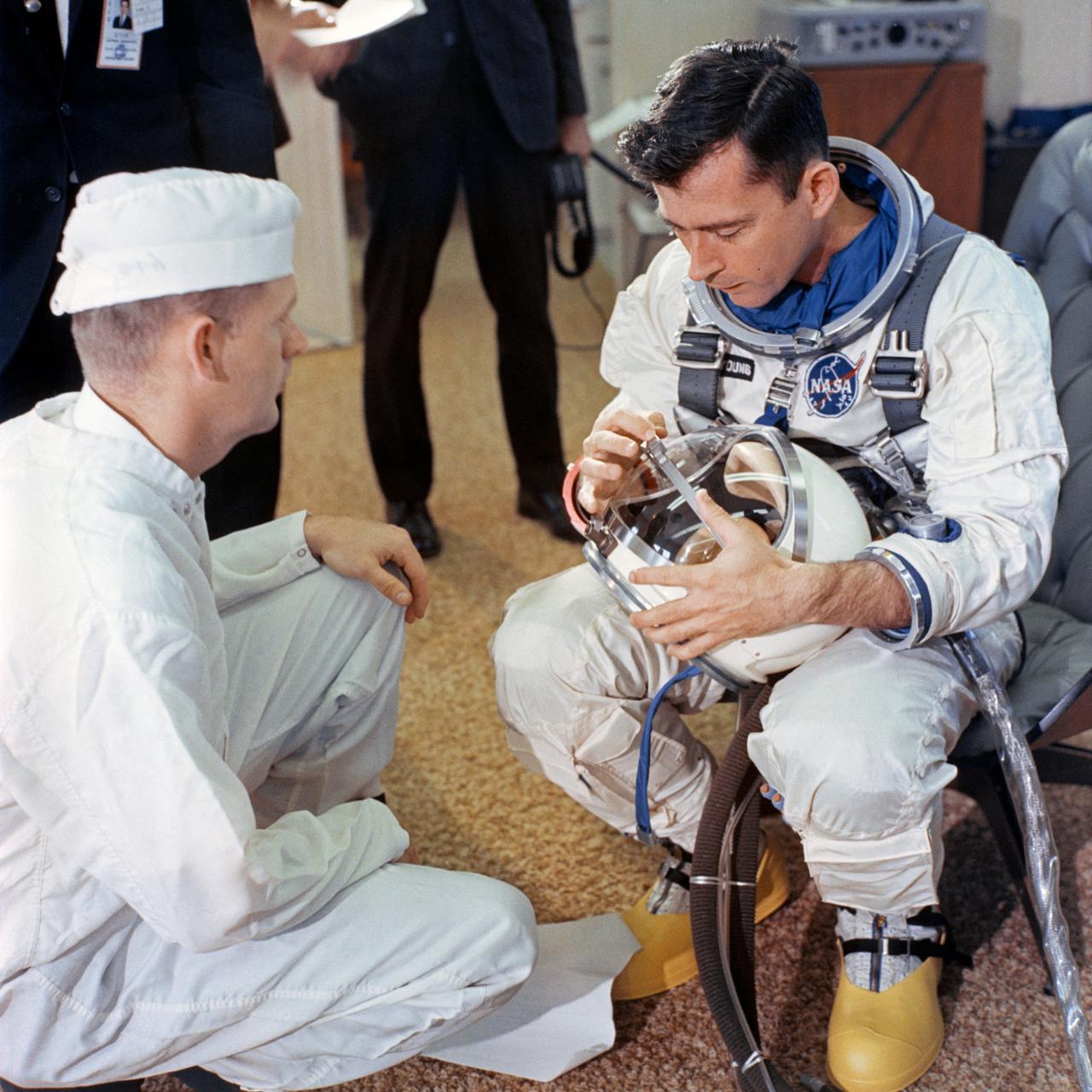
S65-23488 (23 March 1965) --- Astronaut John W. Young, pilot of the Gemini-Titan 3 space flight, checks over his helmet during suiting operations in the suiting trailer at Pad 16 prior to flight.
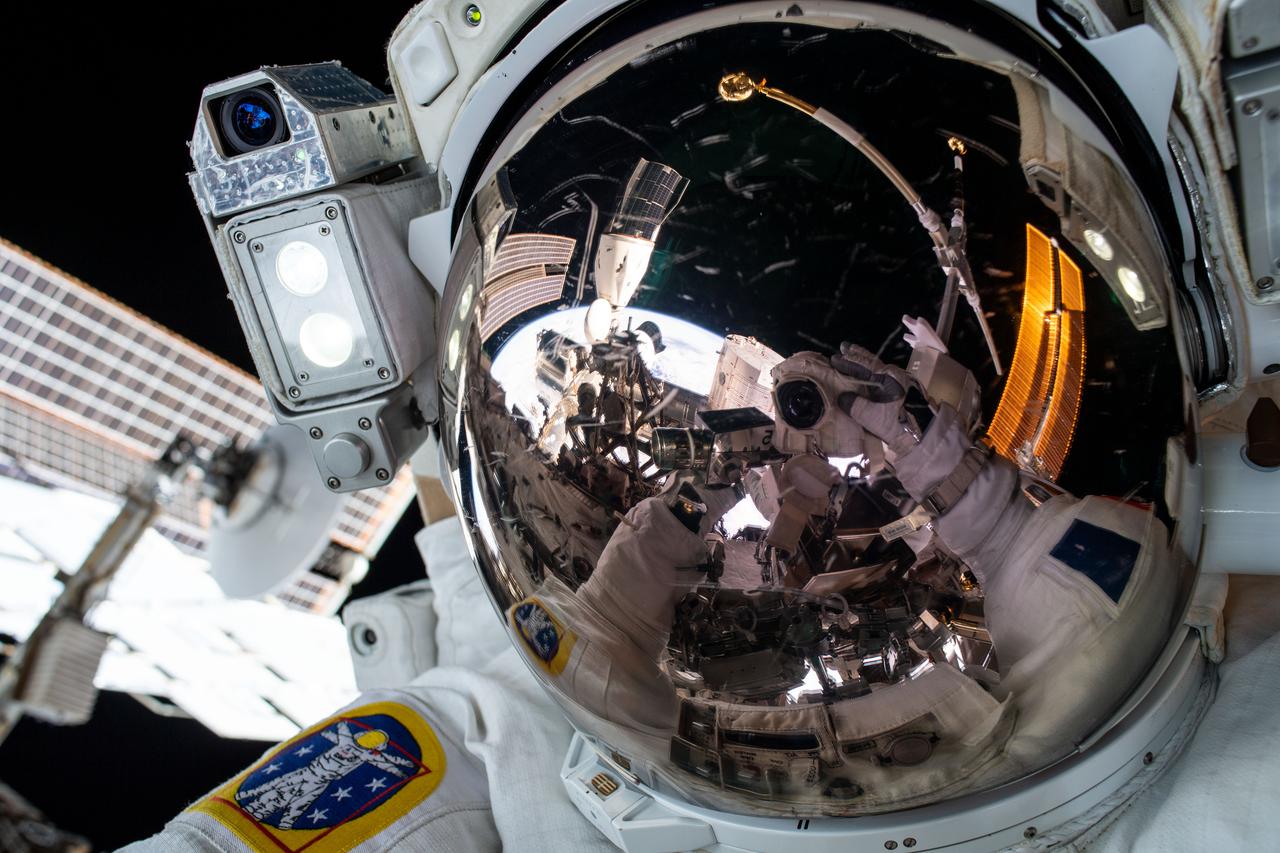
iss065e376212 (Sept. 12, 2021) --- ESA (European Space Agency) astronaut Thomas Pesquet is pictured with his helmet visor down in this "space-selfie" taken during a spacewalk.