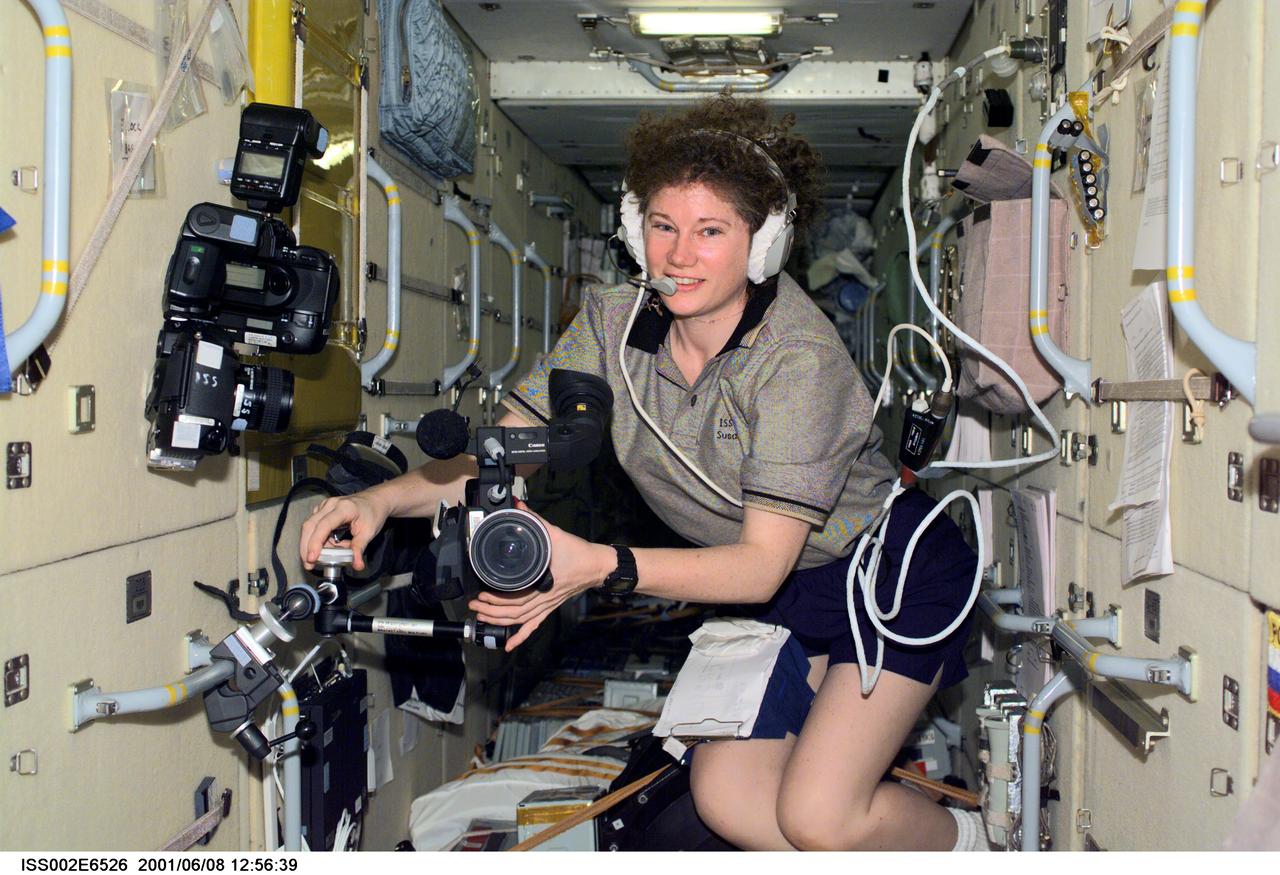
ISS002-E-6526 (8 June 2001) --- Astronaut Susan J. Helms, Expedition Two flight engineer, mounts a video camera onto a bracket in the Zarya or Functional Cargo Block (FGB) of the International Space Station (ISS). The image was recorded with a digital still camera. Alternate NASA ID of 0202499.
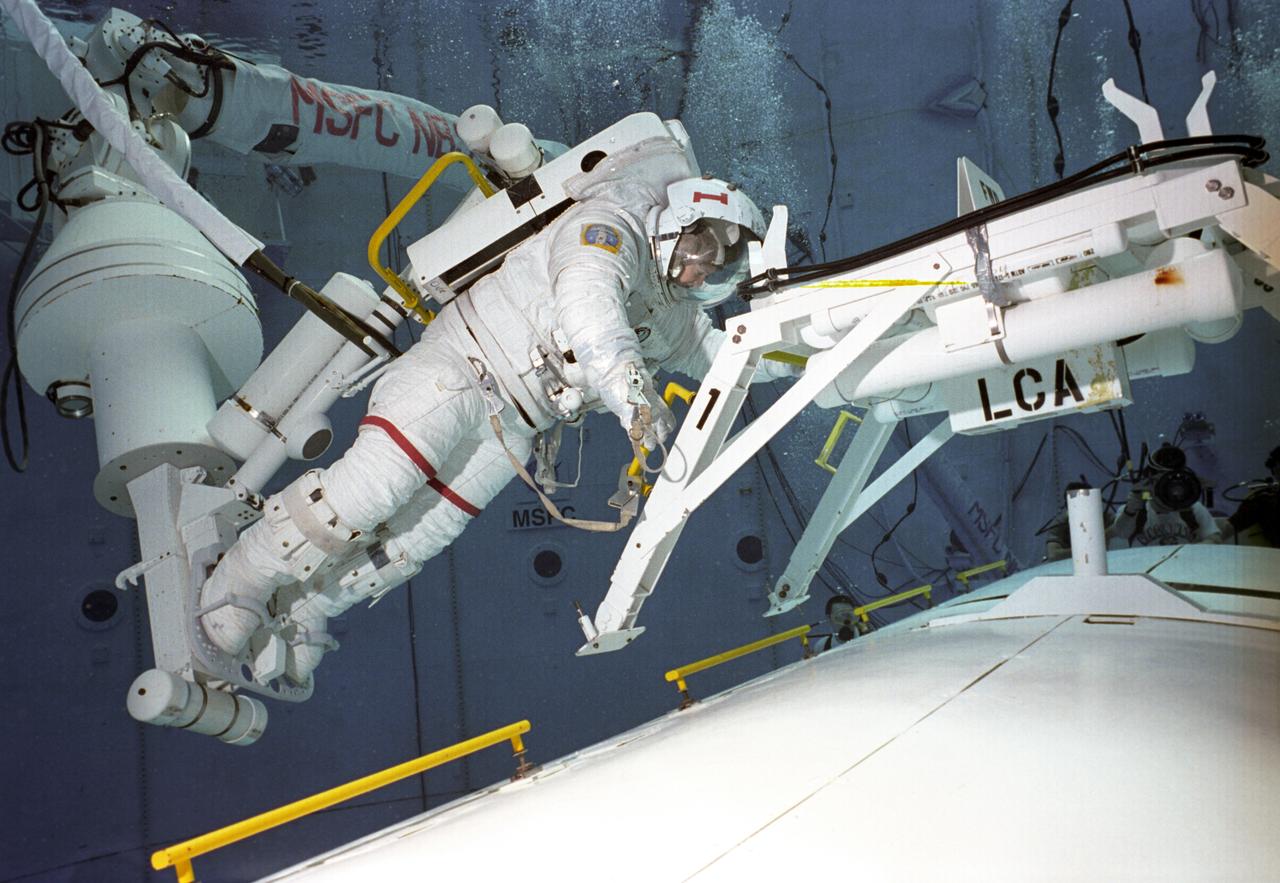
Astronauts Susan Helms (#1) and Carl Walz (#2) are training in the Neutral Buoyancy Simulator (NBS) at Marshall Space Flight center with an exercise for International Space Station Alpha. The NBS provided the weightless environment encountered in space needed for testing and the practices of Extravehicular Activities (EVA).
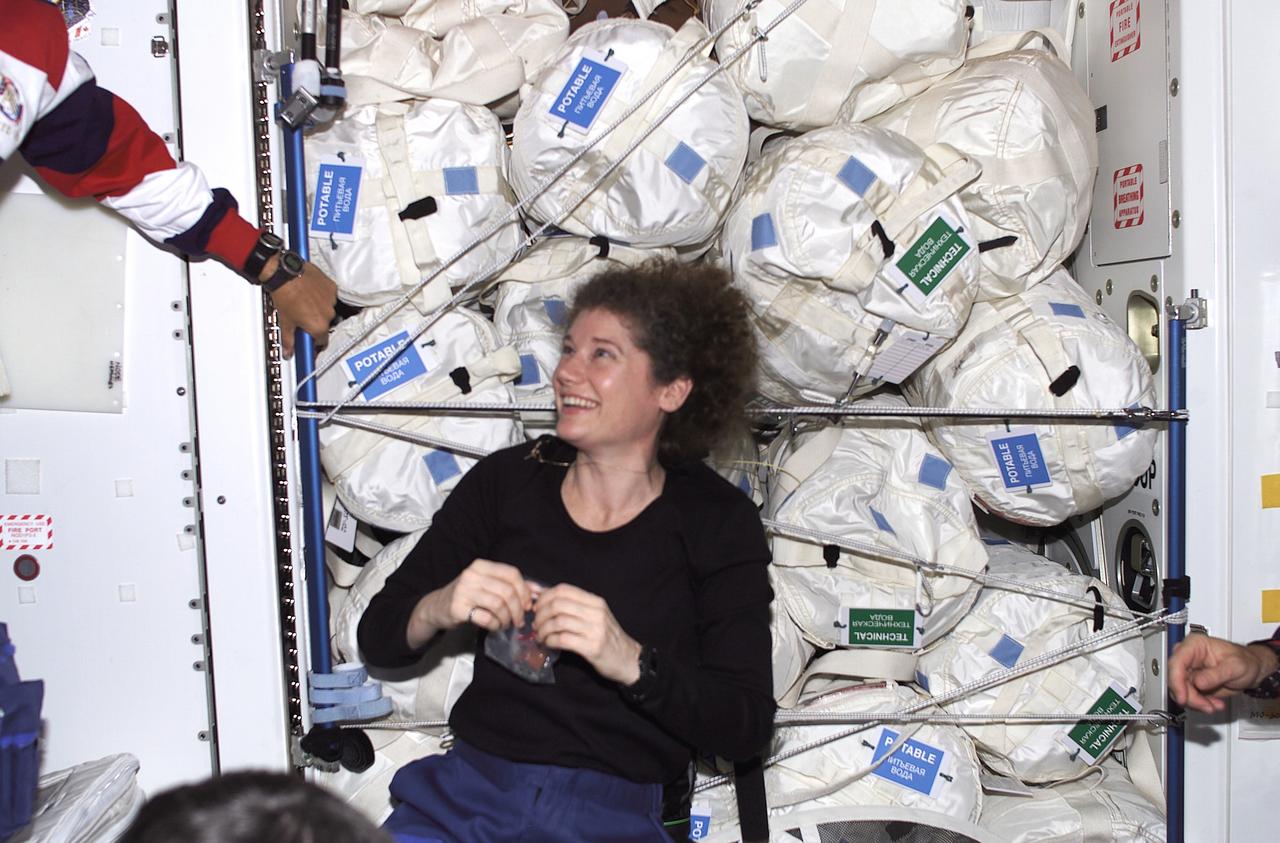
In this photograph, Astronaut Susan Helms, Expedition Two flight engineer, is positioned near a large amount of water temporarily stored in the Unity Node aboard the International Space Station (ISS). Astronaut Helms accompanied the STS-105 crew back to Earth after having spent five months with two crewmates aboard the ISS. The 11th ISS assembly flight, the Space Shuttle Orbiter Discovery STS-105 mission was launched on August 10, 2001, and landed on August 22, 2001 at the Kennedy Space Center after the completion of the successful 12-day mission.

STS102-E-5158 (13 March 2001) --- Astronaut Susan J. Helms on Discovery's mid deck. The photograph was taken with a digital still camera.
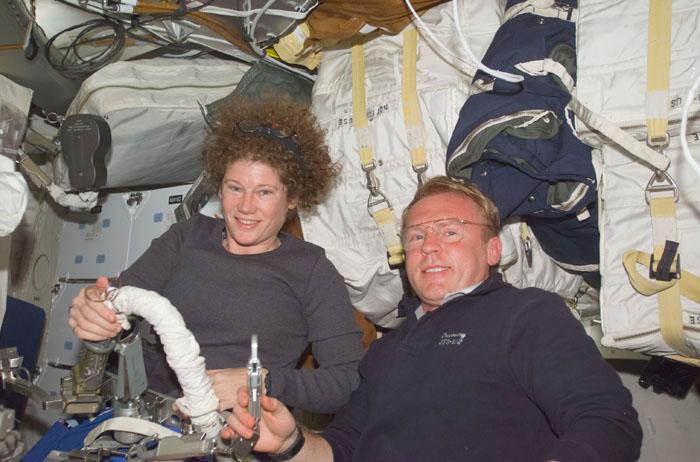
STS102-E-5034 (9 March 2001) --- Astronauts Susan J. Helms and Andrew S.W. Thomas, STS-102 mission specialists, check out some of the extravehicular activity (EVA) gear on Discovery's mid deck during Flight Day 1 activity. Helms is scheduled to participate in the space walk, less than two days away.
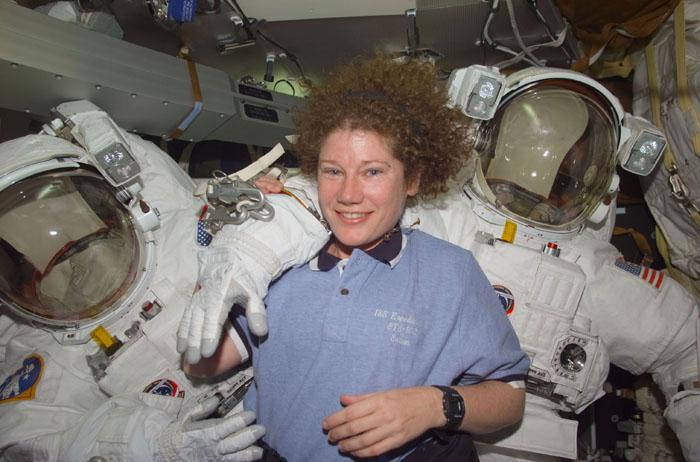
TS102-E-5054 (10 March 2001) --- Astronaut Susan J. Helms, STS-102 mission specialist, is pictured on the mid deck with both Extravehicular Mobility Unit (EMU) space suits designated for extravehicular activity (EVA). Helms is one of two astronauts assigned to space walk duties after the Space Shuttle Discovery and the International Space Station (ISS) link in Earth orbit. The photograph was recorded with a digital still camera.
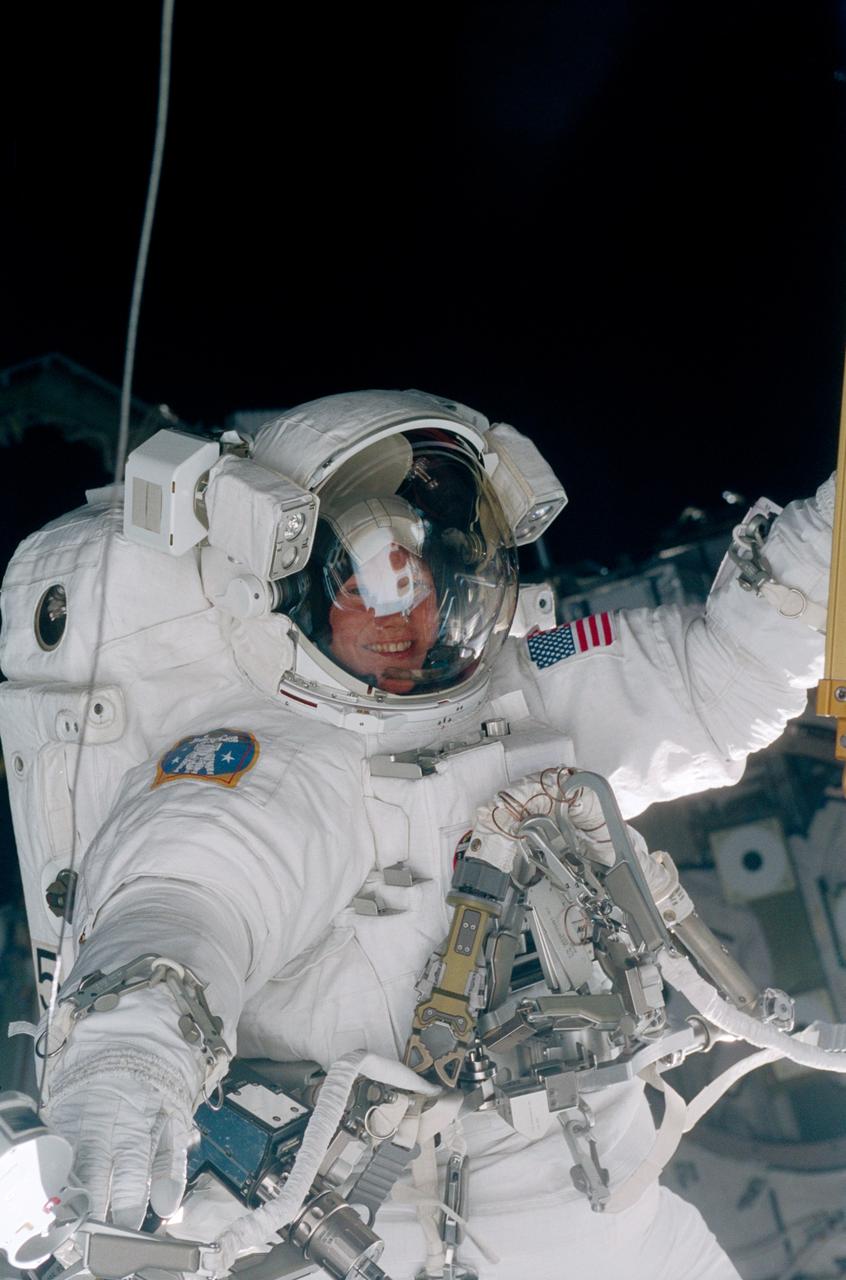
STS102-325-023 (11 March 2001) --- Astronaut Susan J. Helms completes a scheduled space walk task on the International Space Station (ISS). This extravehicular activity (EVA), on which Helms was joined by astronaut James S. Voss (out of frame), was the first of two scheduled STS-102 EVA sessions. The pair, destined to become members of the Expedition Two crew aboard the station later in the mission, rode aboard Discovery into orbit and at the time of this EVA were still regarded as STS-102 mission specialists.
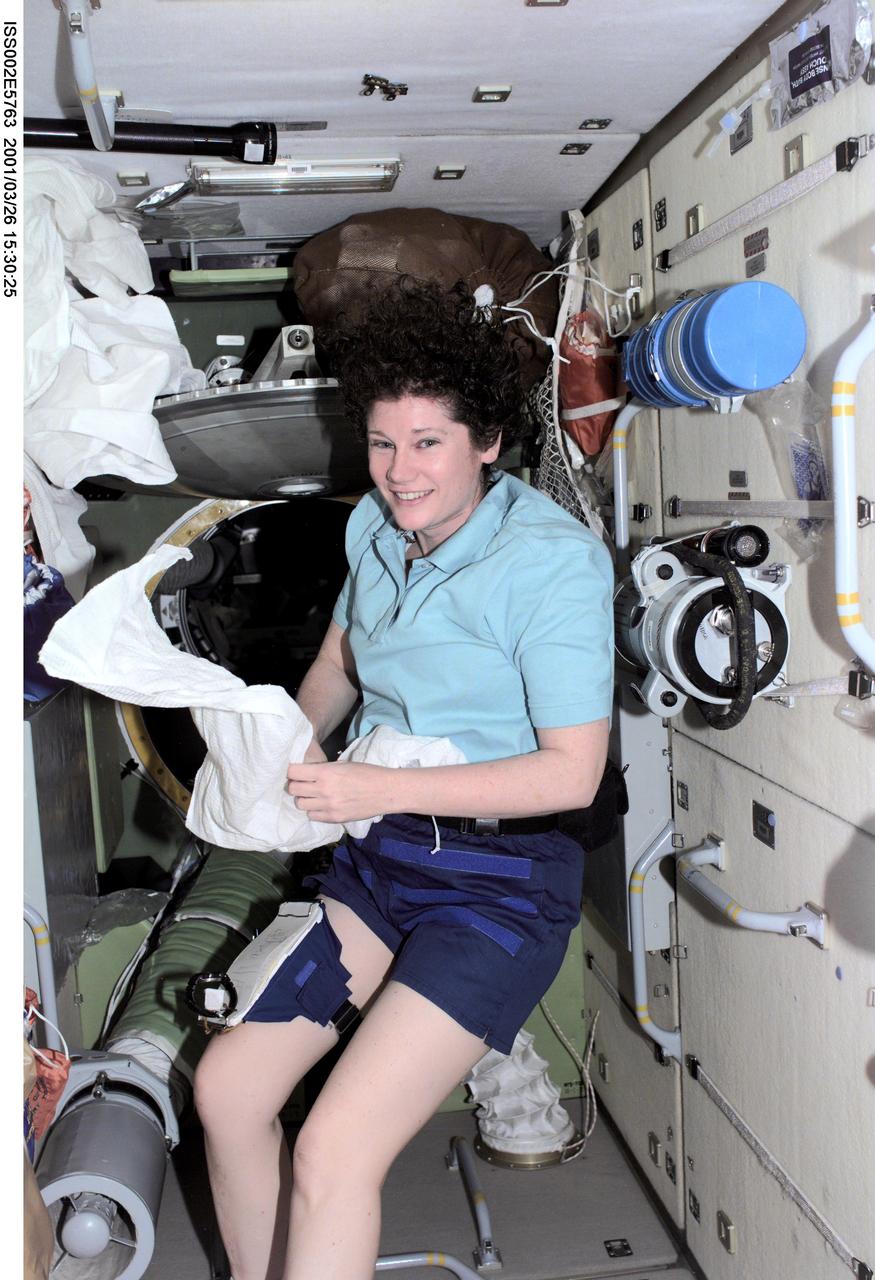
ISS002-E-5763 (26 March 2001) --- Astronaut Susan J. Helms, Expedition Two flight engineer, is pictured in the Zarya or Functional Cargo Block (FGB) of the International Space Station (ISS). Helms has spent about two and half weeks aboard the orbiting outpost, which will be her home for the next several months. The photo was recorded with a digital still camera.
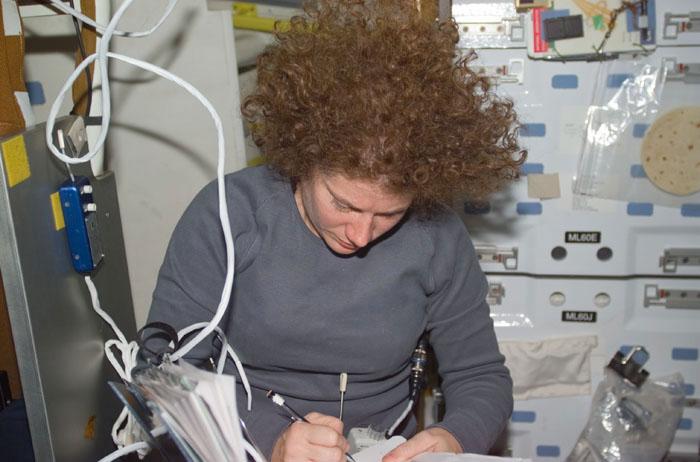
STS102-E-5206 (13 March 2001) --- Astronaut Susan J. Helms enters notes on the mid deck of the Space Shuttle Discovery. The photograph was taken with a digital still camera.
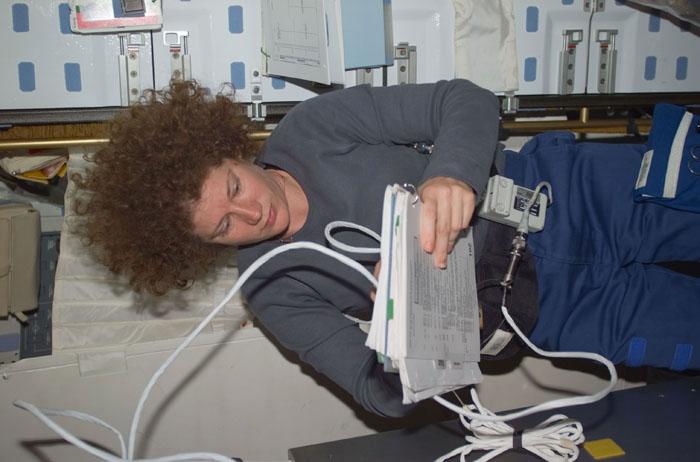
STS102-E-5208 (13 March 2001) --- Astronaut Susan J. Helms enters notes on the mid deck of the Space Shuttle Discovery. The photograph was taken with a digital still camera.
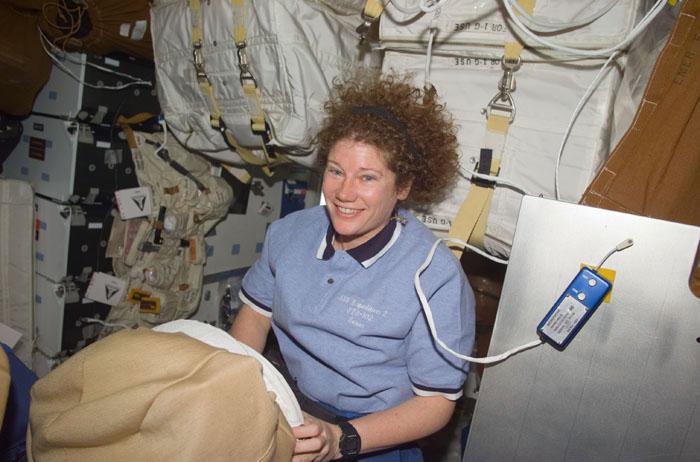
STS102-E-5048 (10 March 2001) --- Astronaut Susan J. Helms, STS-102 mission specialist, looks over some supplies on the mid deck. Helms is one of two astronauts assigned to space walk duties after the Space Shuttle Discovery and the International Space Station (ISS) link in Earth orbit. The photograph was recorded with a digital still camera.
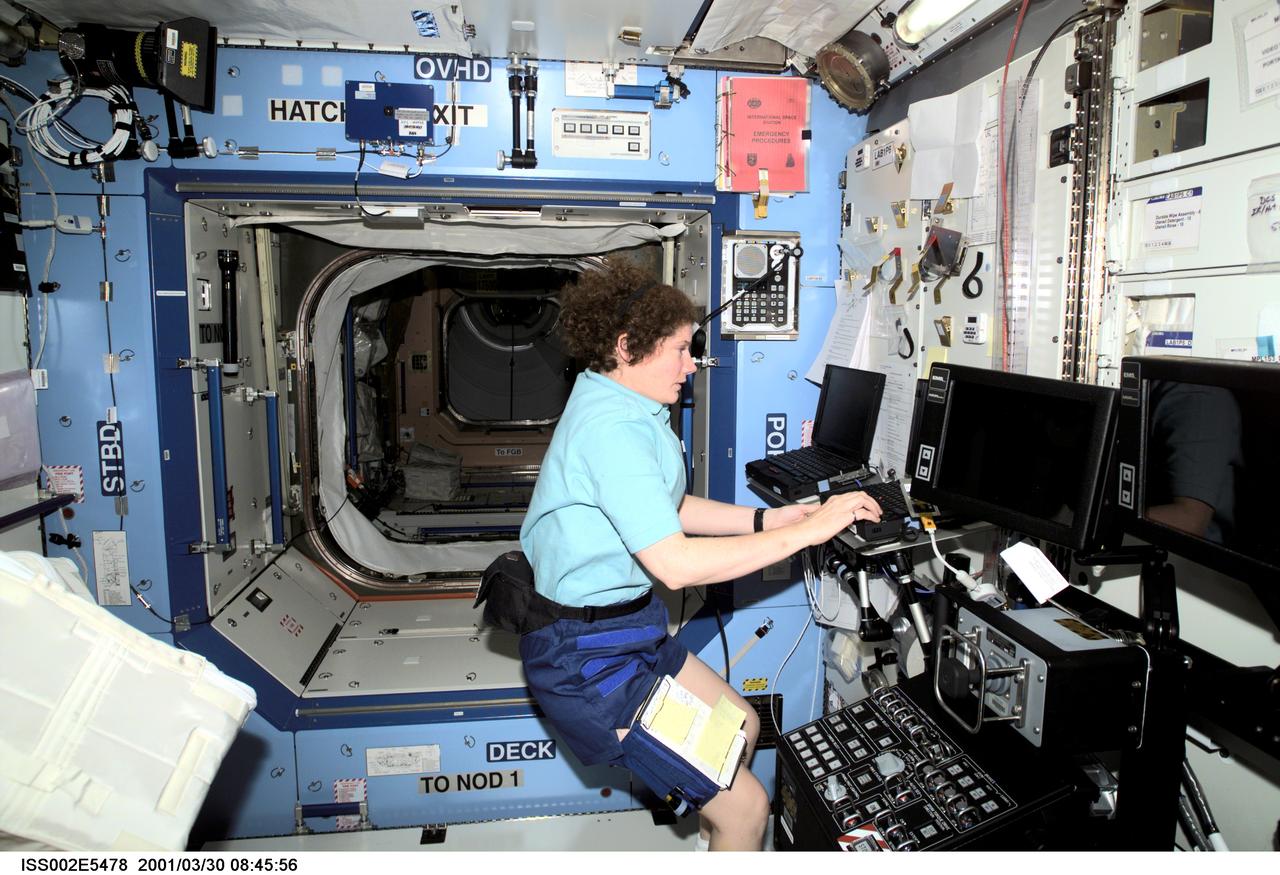
ISS002-E-5478 (30 March 2001) --- Astronaut Susan J. Helms, Expedition Two flight engineer, works at a laptop computer in the U.S. Laboratory / Destiny module of the International Space Station (ISS). The Space Station Remote Manipulator System (SSRMS) control panel is visible to Helms' right. This image was recorded with a digital still camera.
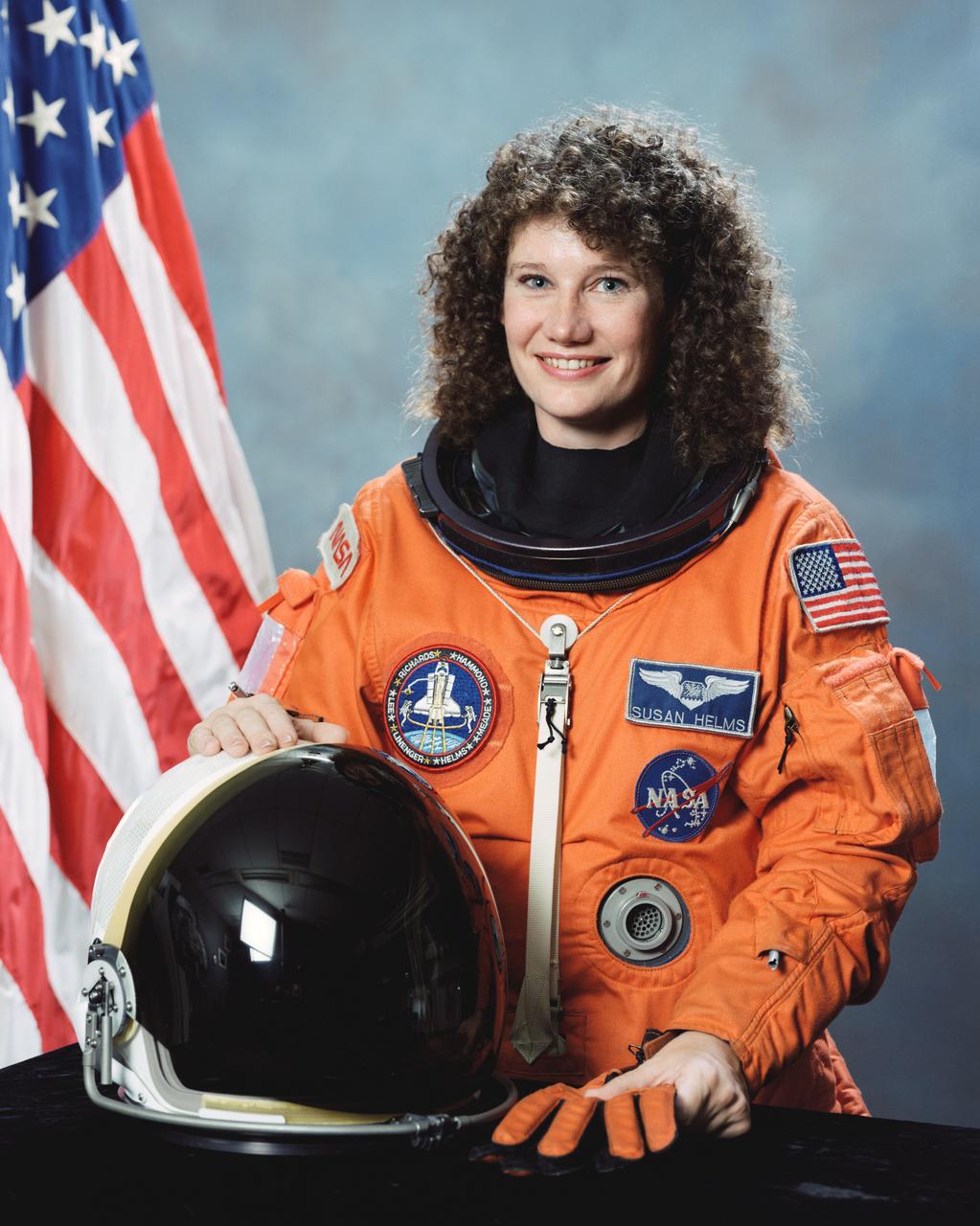
S94-38174 (30 June 1994) --- Astronaut Susan J. Helms.
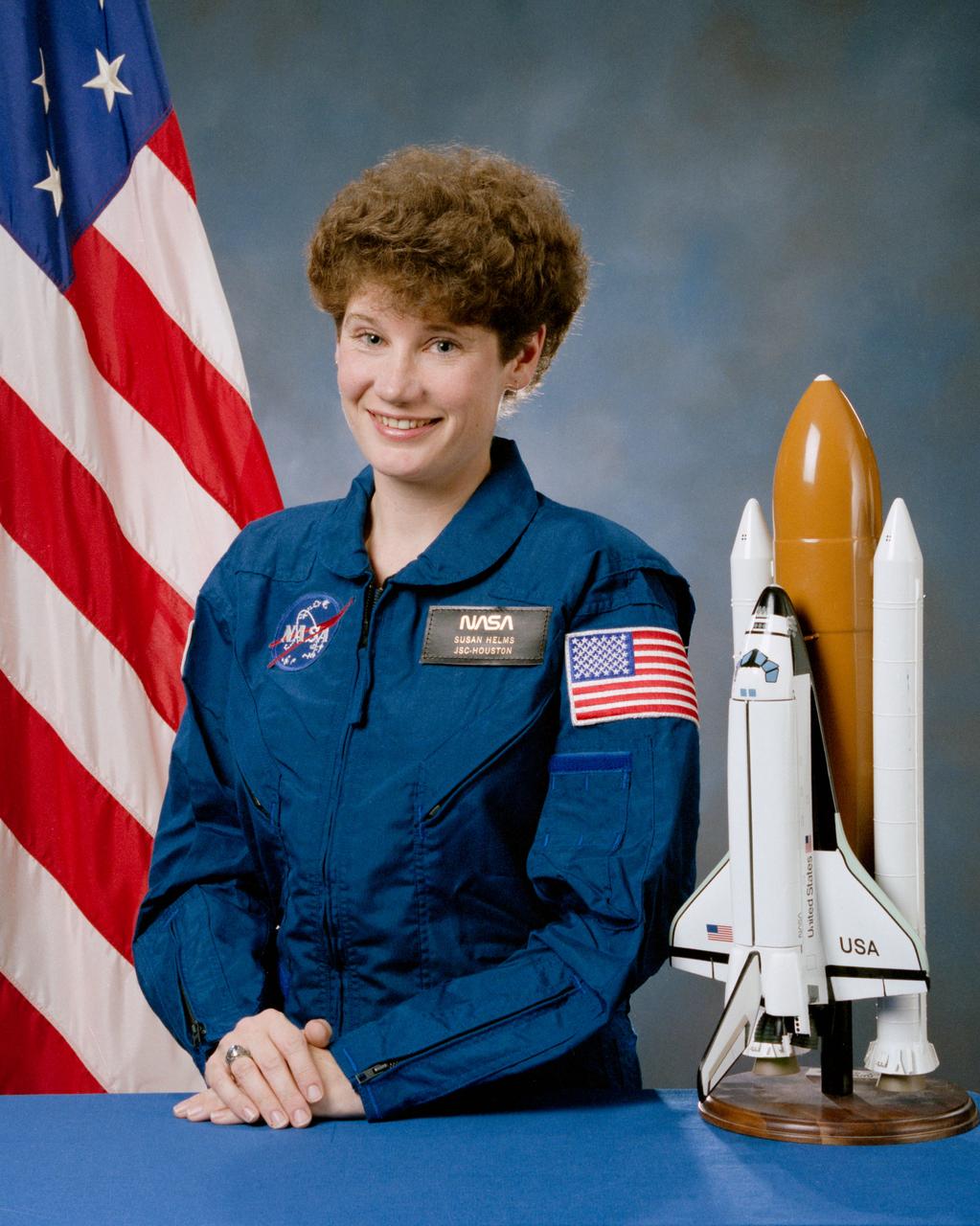
S90-45390 (August 1990) --- Astronaut Susan J. Helms, mission specialist.
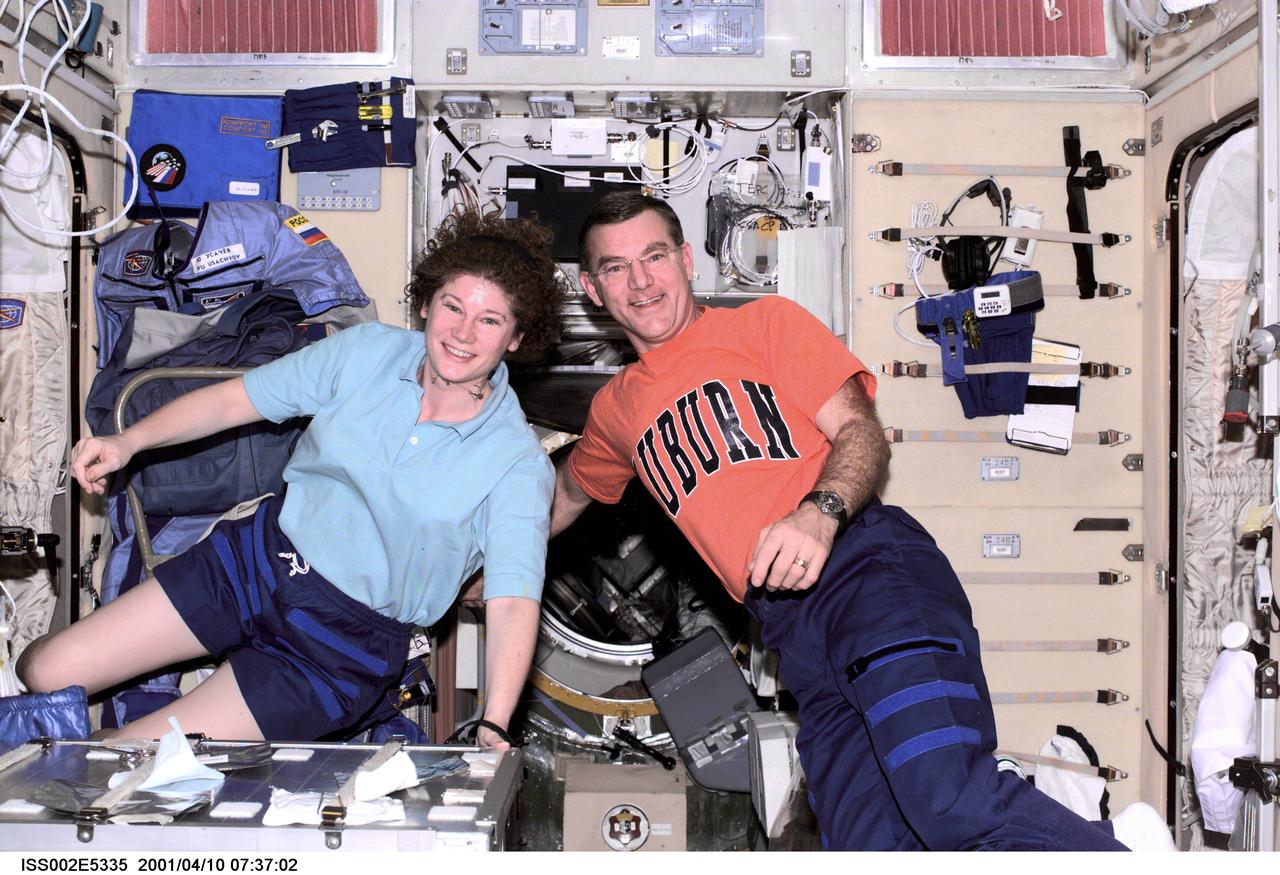
ISS002-E-5335 (10 April 2001) --- Astronaut Susan J. Helms (left and astronaut James S. Voss, both Expedition Two flight engineers, pose for a photograph aboard the Zvezda/Service Module of the International Space Station (ISS). This image was recorded with a digital still camera.
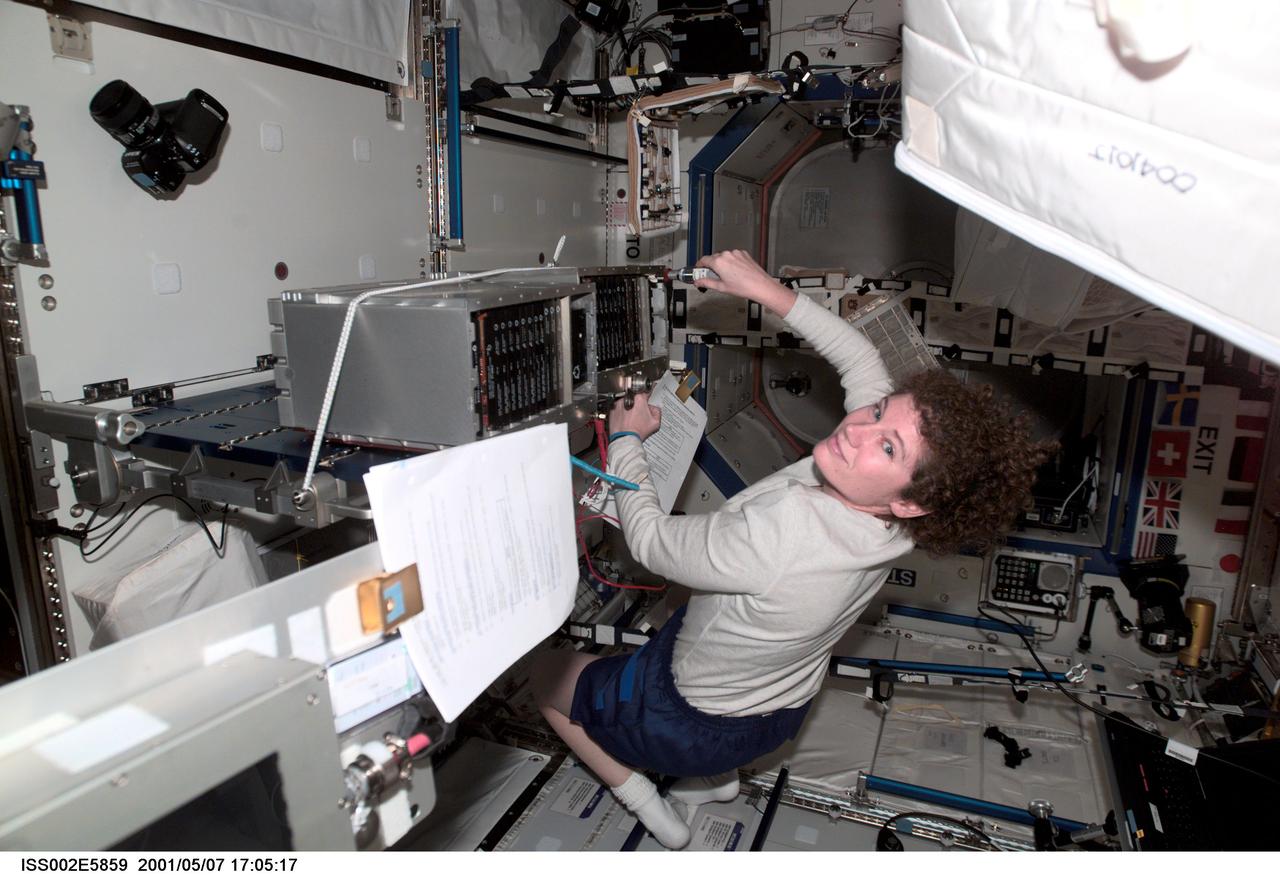
ISS002-E-5859 (7 May 2001) --- Susan J. Helms, Expedition Two flight engineer, works on an Enhanced Space Station Multiplexer / Demultiplexer (ESSMDM) at the Maintenance Work Assembly (MWA) work surface in the Destiny module. The image was taken with a digital still camera.
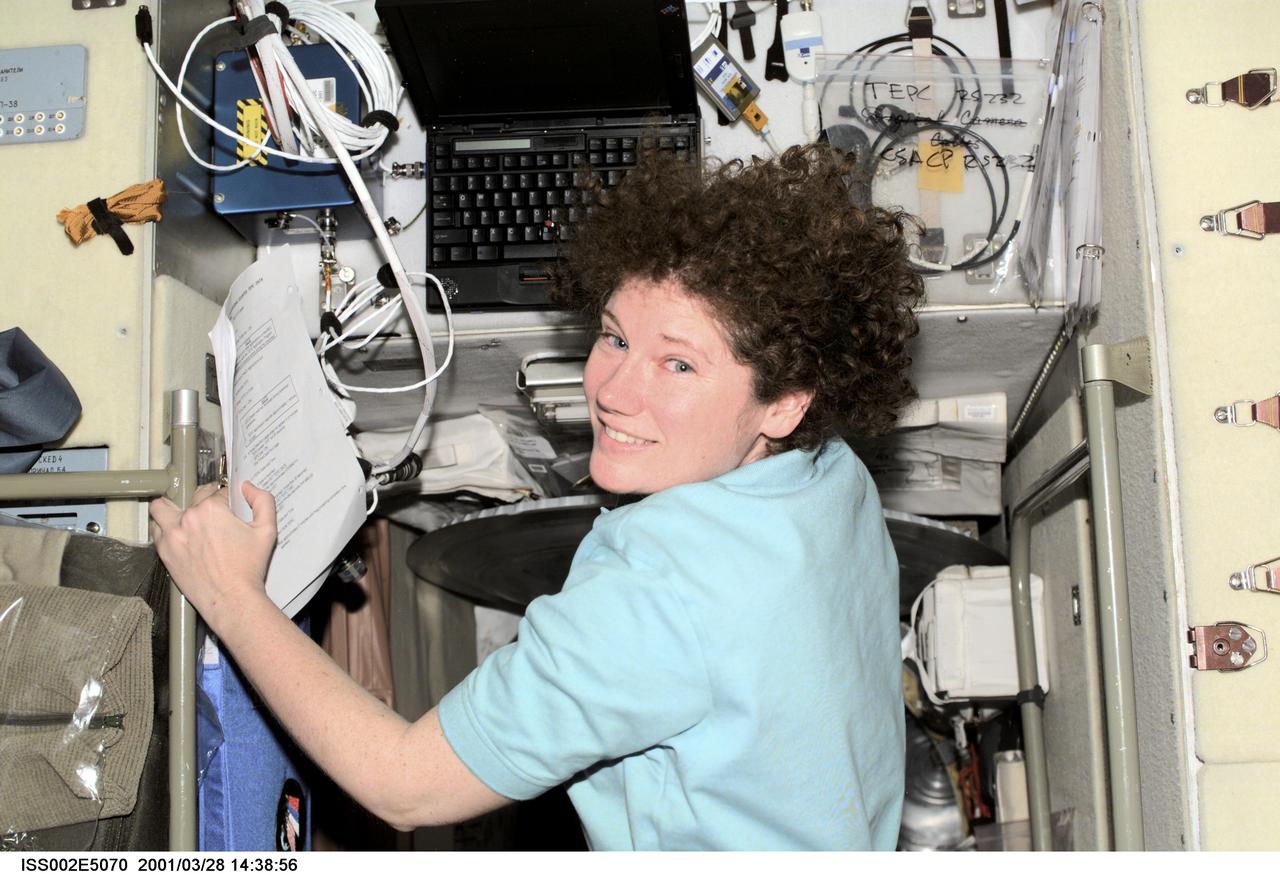
ISS002-E-5070 (28 March 2001) --- Astronaut Susan J. Helms, Expedition Two flight engineer, checks over a printout while going about routine tasks in the Zvezda Service Module onboard the International Space Station (ISS). The photo was recorded with digital still camera.
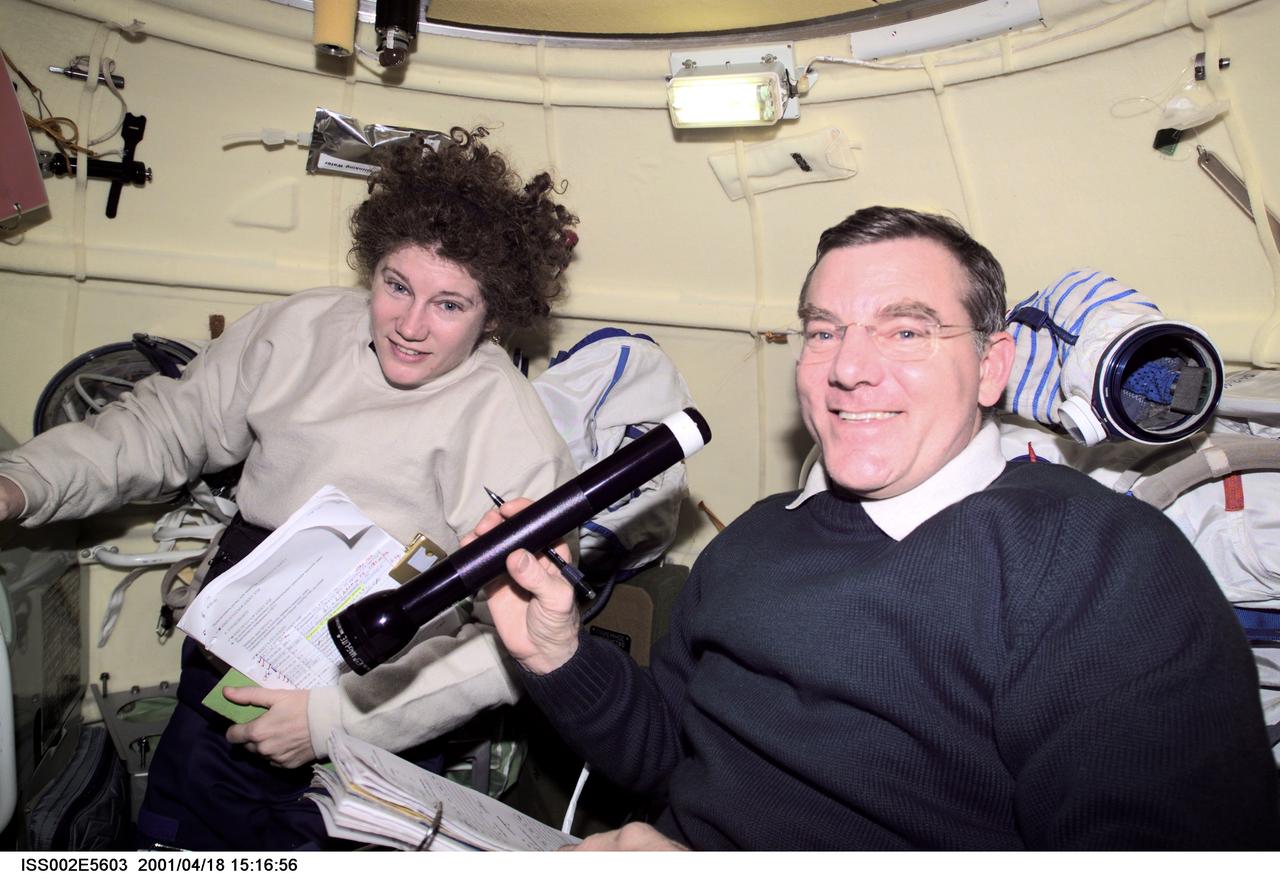
ISS002-E-5603 (18 April 2001) --- Astronauts Susan J. Helms and James S. Voss, both Expedition Two flight engineers, share a task in the Soyuz spacecraft which is docked to the International Space Station (ISS). The image was recorded with a digital still camera.
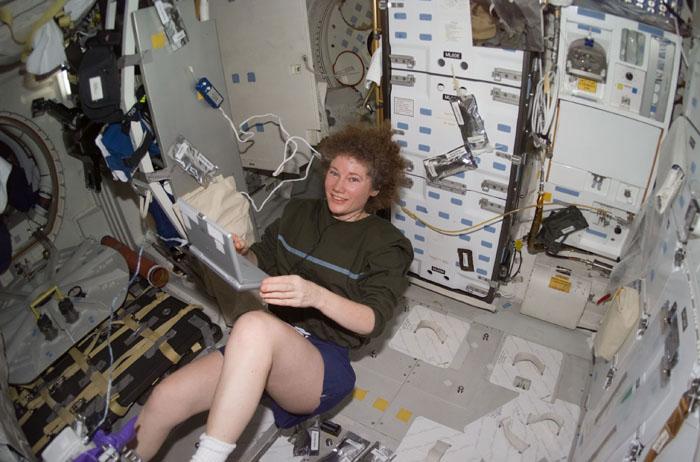
STS105-E-5226 (16 August 2001) --- Now a member of the STS-105 crew, departing Expedition Two flight engineer Susan J. Helms works out on the ergometer device on the mid deck of the Space Shuttle Discovery. The image was recorded with a digital still camera.
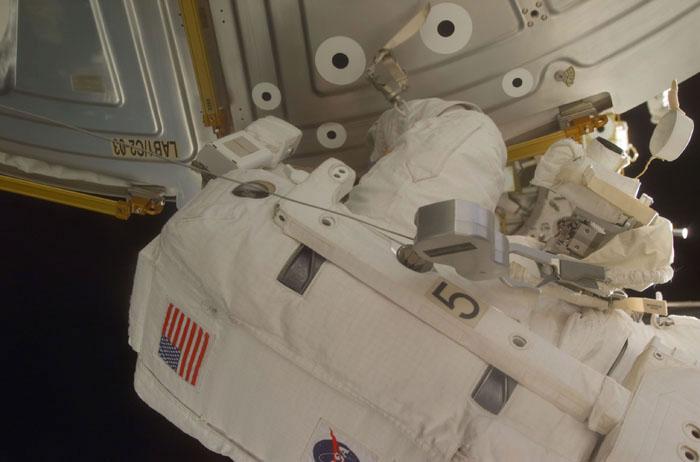
STS102-E-5124 (11 March 2001) --- Astronaut Susan J. Helms works at the Destiny laboratory during the first STS-102 space walk. This extravehicular activity (EVA) by mission specialists Helms and James S. Voss, two thirds of the exchange crew for the International Space Station (ISS), will be followed by another space walk involving two other STS-102 mission specialists. This photo was taken with a digital still camera.
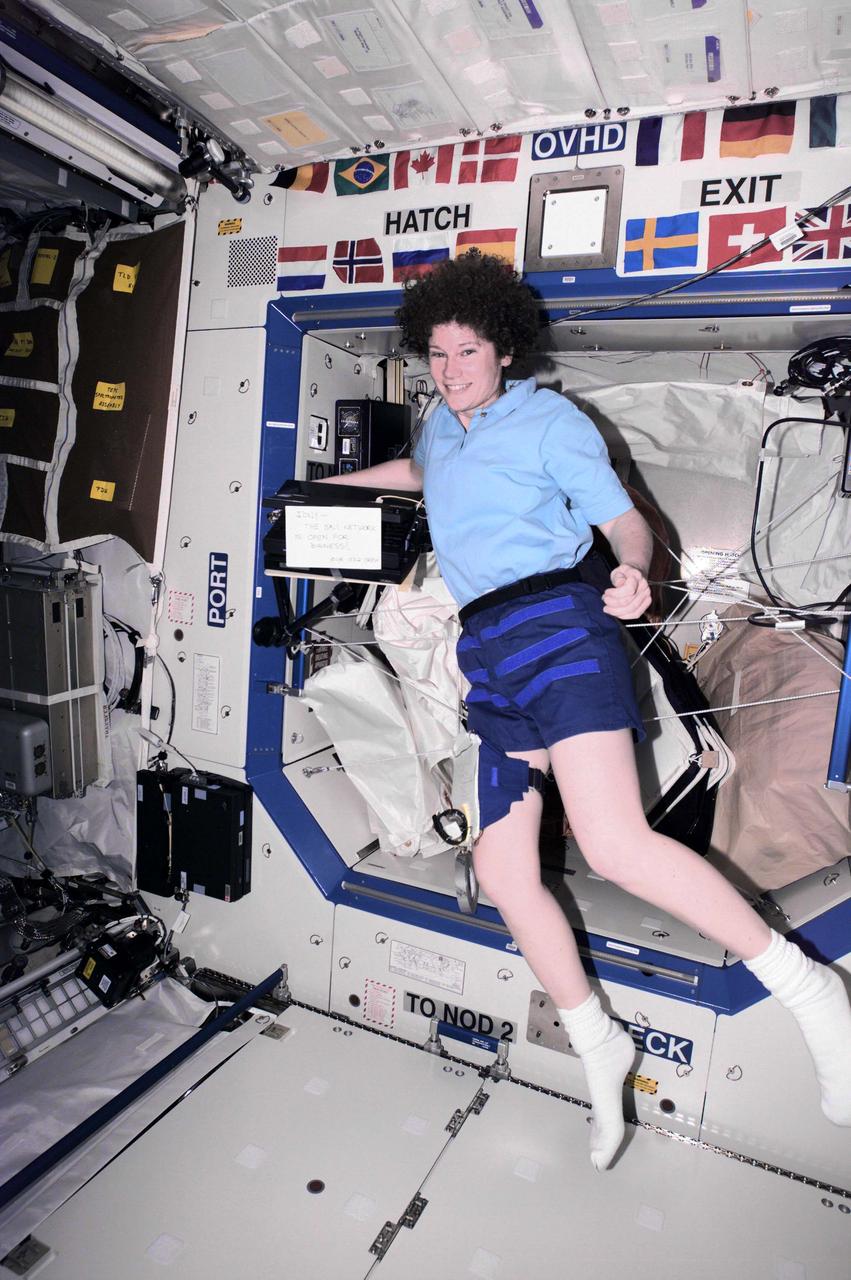
ISS002-E-5052 (March 2001) --- Astronaut Susan J. Helms, Expedition Two flight engineer, totes computer hardware on the Destiny laboratory. Helms, along with cosmonaut Yury V. Usachev of Rosaviakosmos and astronaut James S. Voss, recently took over residency on the International Space Station (ISS) from a three-member crew who had been on board since early November 2000. The image was recorded with a digital still camera.

STS105-E-5386 (20 August 2001) --- The Expedition Two crewmembers, Susan J. Helms (left), flight engineer, cosmonaut Yury V. Usachev, mission commander, and James S. Voss, flight engineer, pose in Unity Node 1 for their final group photograph aboard the International Space Station (ISS). With the arrival of Expedition Three, Usachev, Helms and Voss will return to Earth with the STS-105 crew thus completing their five month mission. This image was taken with a digital still camera.
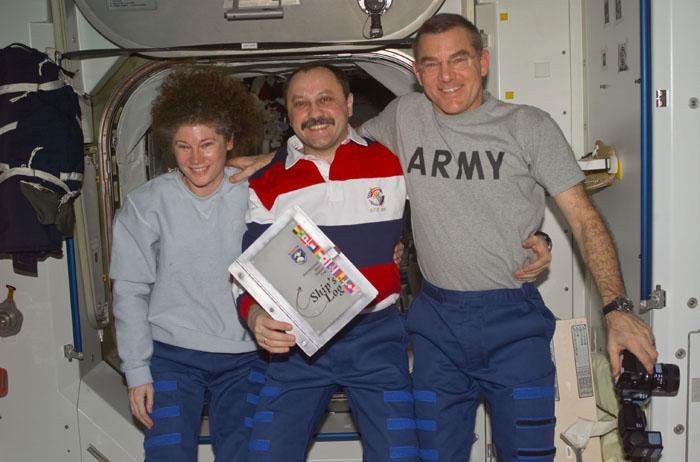
STS105-E-5383 (20 August 2001) --- The Expedition Two crewmembers, Susan J. Helms (left), flight engineer, cosmonaut Yury V. Usachev, mission commander, and James S. Voss, flight engineer, pose in Unity Node 1 for their final group photograph aboard the International Space Station (ISS). With the arrival of Expedition Three, Usachev, Helms and Voss will return to Earth with the STS-105 crew thus completing their five month mission. This image was taken with a digital still camera.
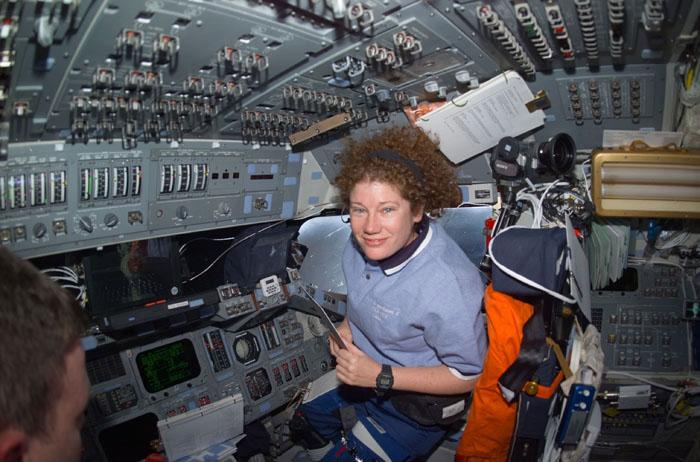
STS102-E-5084 (10 March 2001) --- Astronaut Susan J. Helms, STS-102 mission specialist, is pictured at the pilot's station on the flight deck. Helms is one of two astronauts assigned to space walk duties after the Space Shuttle Discovery and the International Space Station (ISS) link in Earth orbit. The photograph was recorded with a digital still camera.
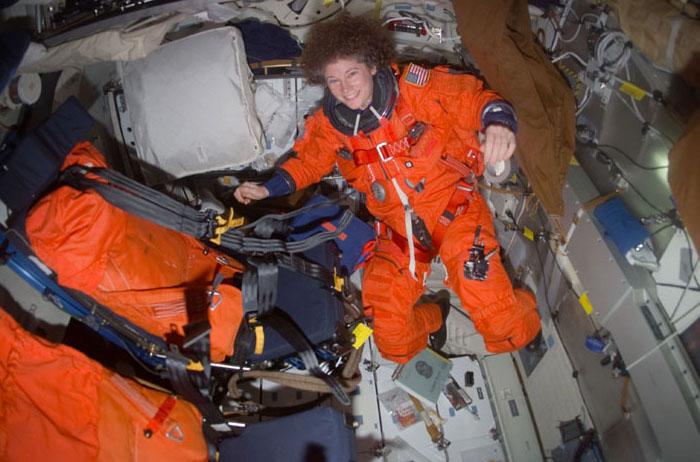
STS105-E-5438 (21 August 2001) --- Astronaut Susan J. Helms, Expedition Two flight engineer, is dressed in her Launch and Entry Suit (LES) on the mid deck of the Space Shuttle Discovery in preparation for the descent back to Earth. Helms and fellow Expedition Two crew members James S. Voss and cosmonaut Yury V. Usachev are returning to Earth after completing their five month mission aboard the International Space Station (ISS). This image was taken with a digital still camera.
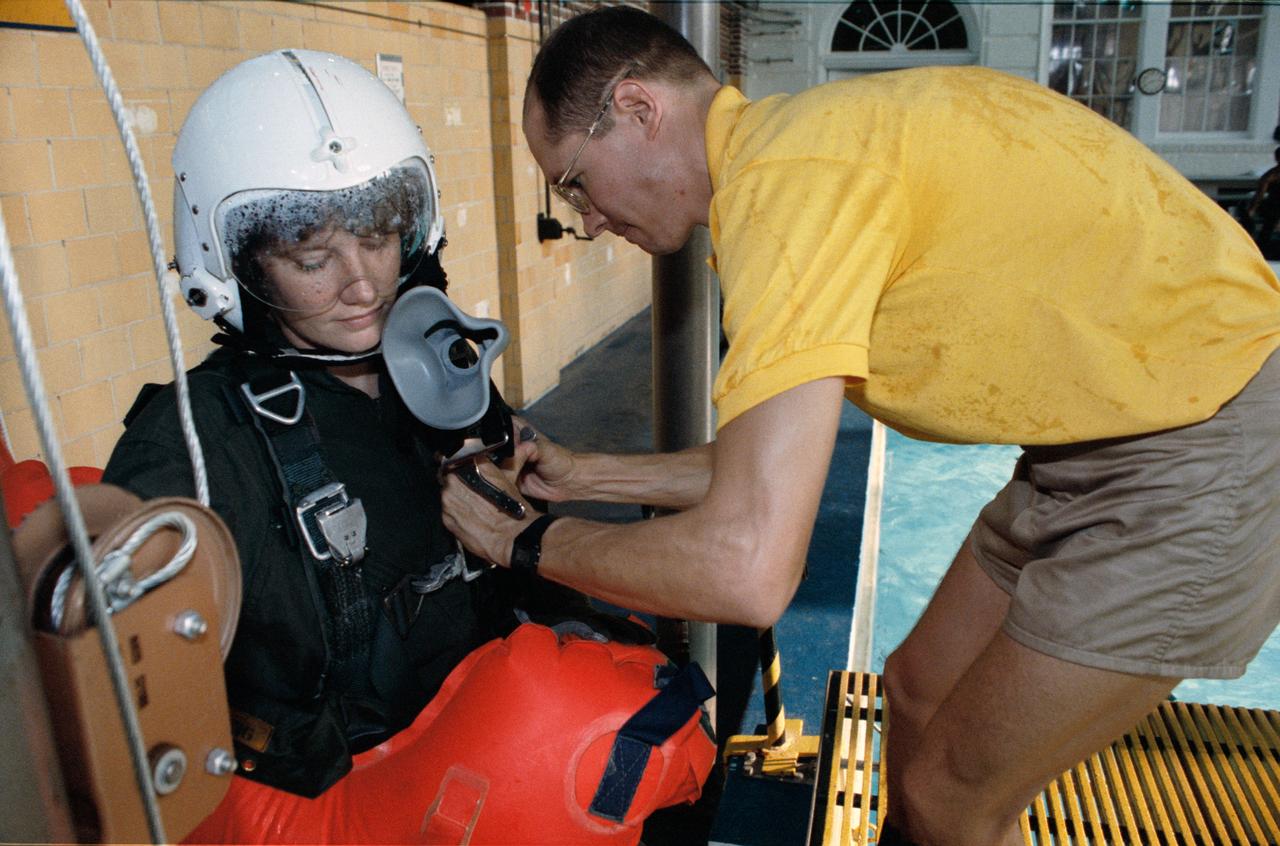
1990 Group 13 Astronaut Candidate (ASCAN) Susan J. Helms, wearing helmet with oxygen mask and inflated life jacket, is assisted by training instructor during water survival exercises at Elgin Air Force Base (AFB) in Pensacola, Florida. Helms looks on as the instructor adjusts her parachute harness. When ready, Helms will be dropped from the harness into the pool (in background) to simulate a water landing after T-38 ejection. ASCANs participated in the exercises from 08-14-90 through 08-17-90.
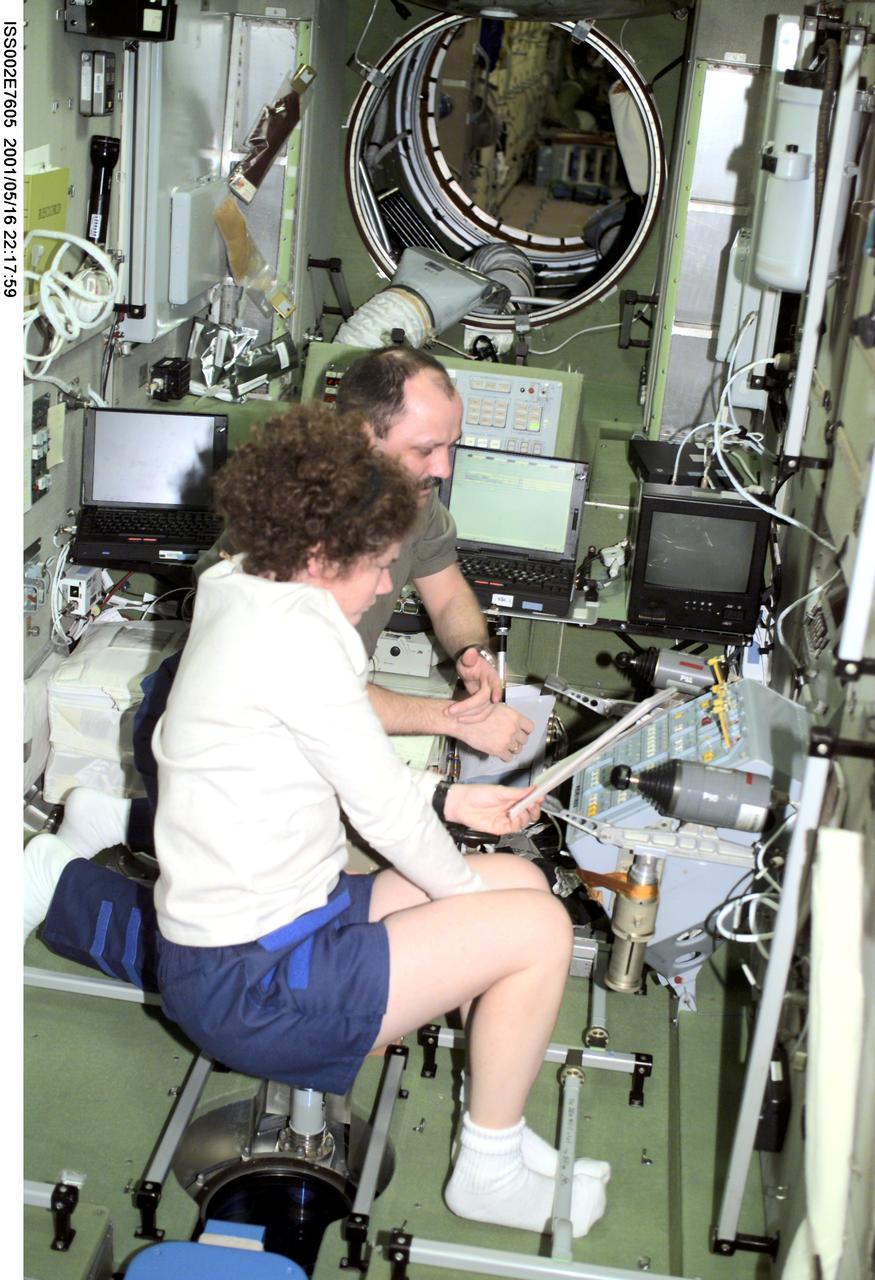
ISS002-E-7605 (16 May 2001) --- Susan J. Helms, flight engineer, and Yury V. Usachev of Rosaviakosmos, mission commander, read over procedures at the computer workstation in the Zvezda Service Module during the Expedition Two mission. The image was taken with a digital still camera.
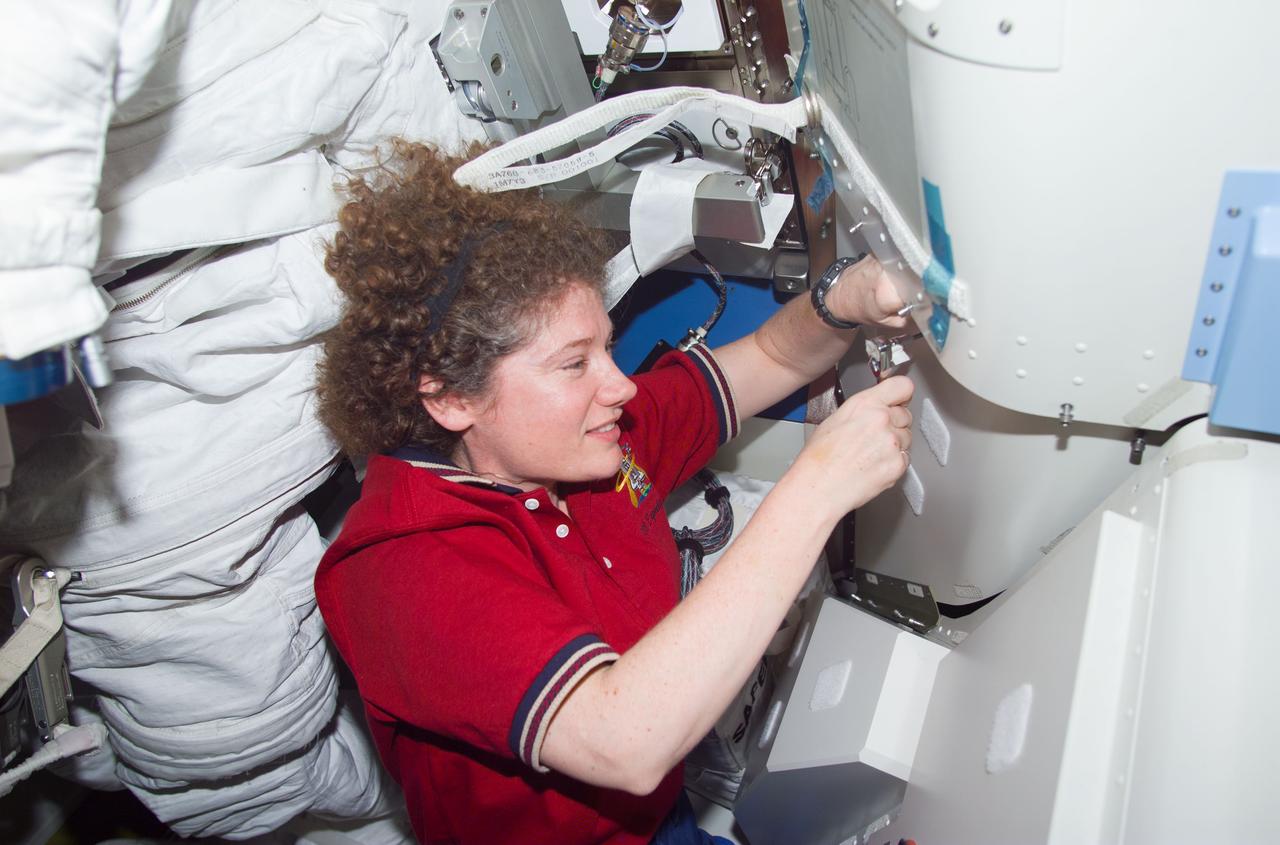
STS104-E-5199 (20 July 2001) --- Astronaut Susan J. Helms, Expedition Two flight engineer, works in the Equipment Lock of Airlock Quest during its internal outfitting on STS-104. The image was recorded with a digital still camera.
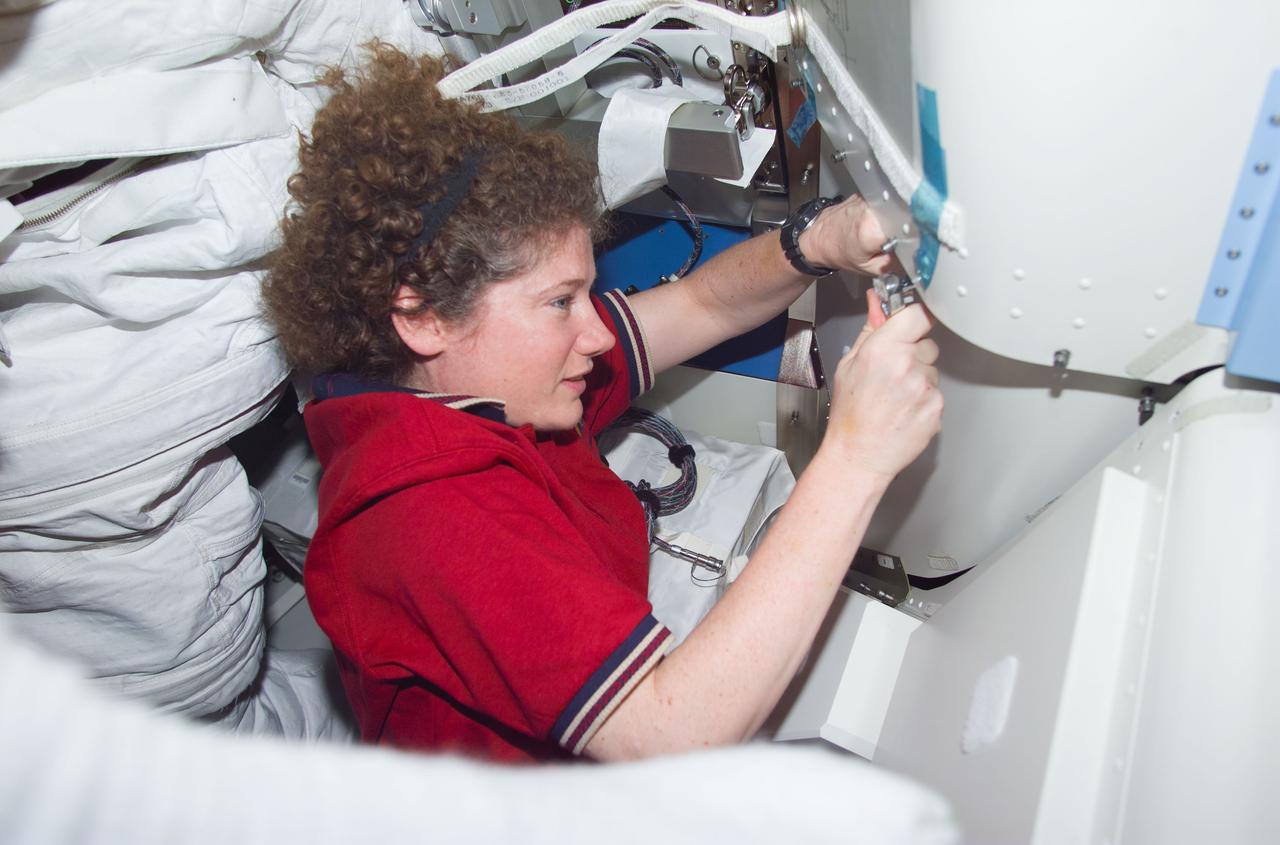
STS104-E-5198 (20 July 2001) --- Astronaut Susan J. Helms, Expedition Two flight engineer, works in the Equipment Lock of Airlock Quest during its internal outfitting on STS-104. The image was recorded with a digital still camera.
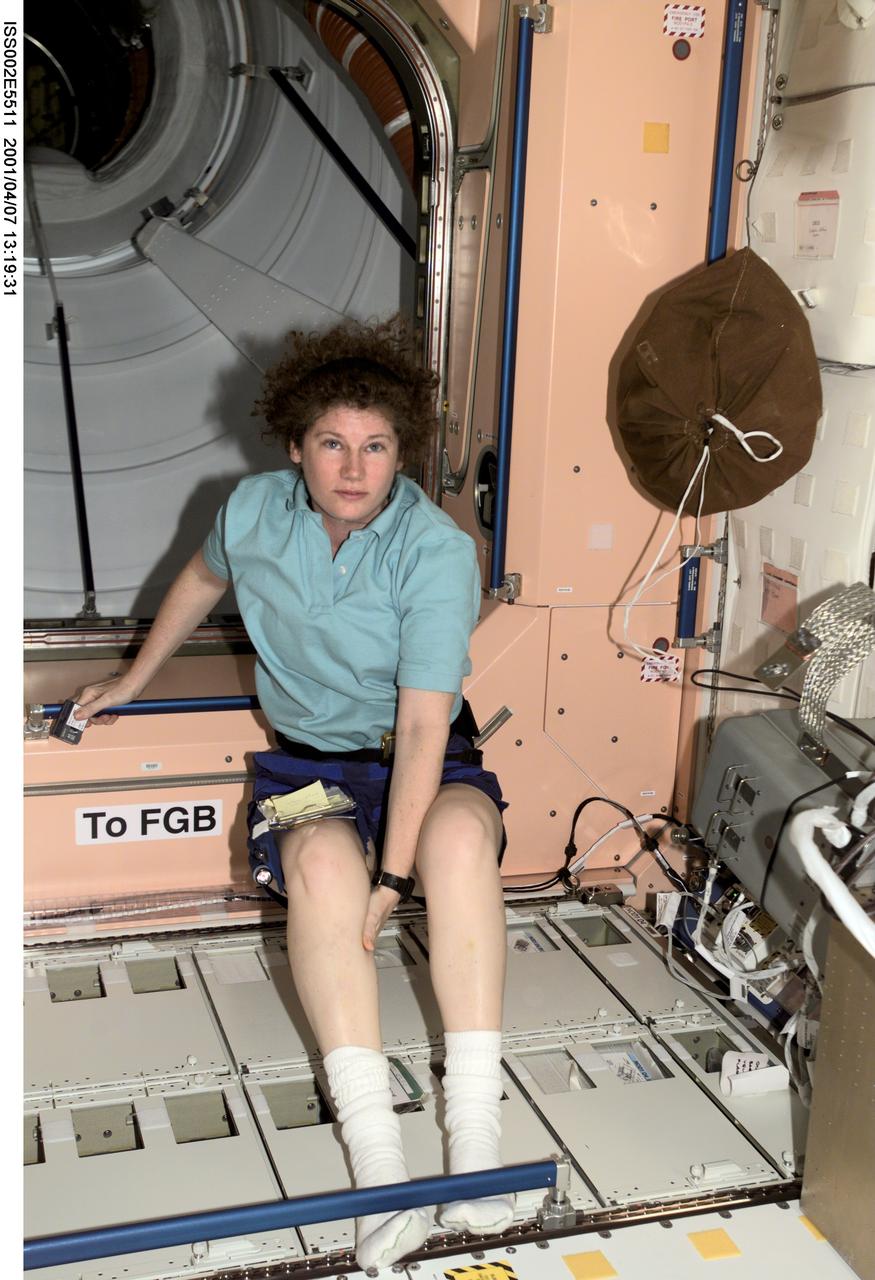
ISS002-E-5511 (07 April 2001) --- Astronaut Susan J. Helms, Expedition Two flight engineer, pauses from moving through the Node 1 / Unity module of the International Space Station (ISS) to pose for a photograph. This image was recorded with a digital still camera.
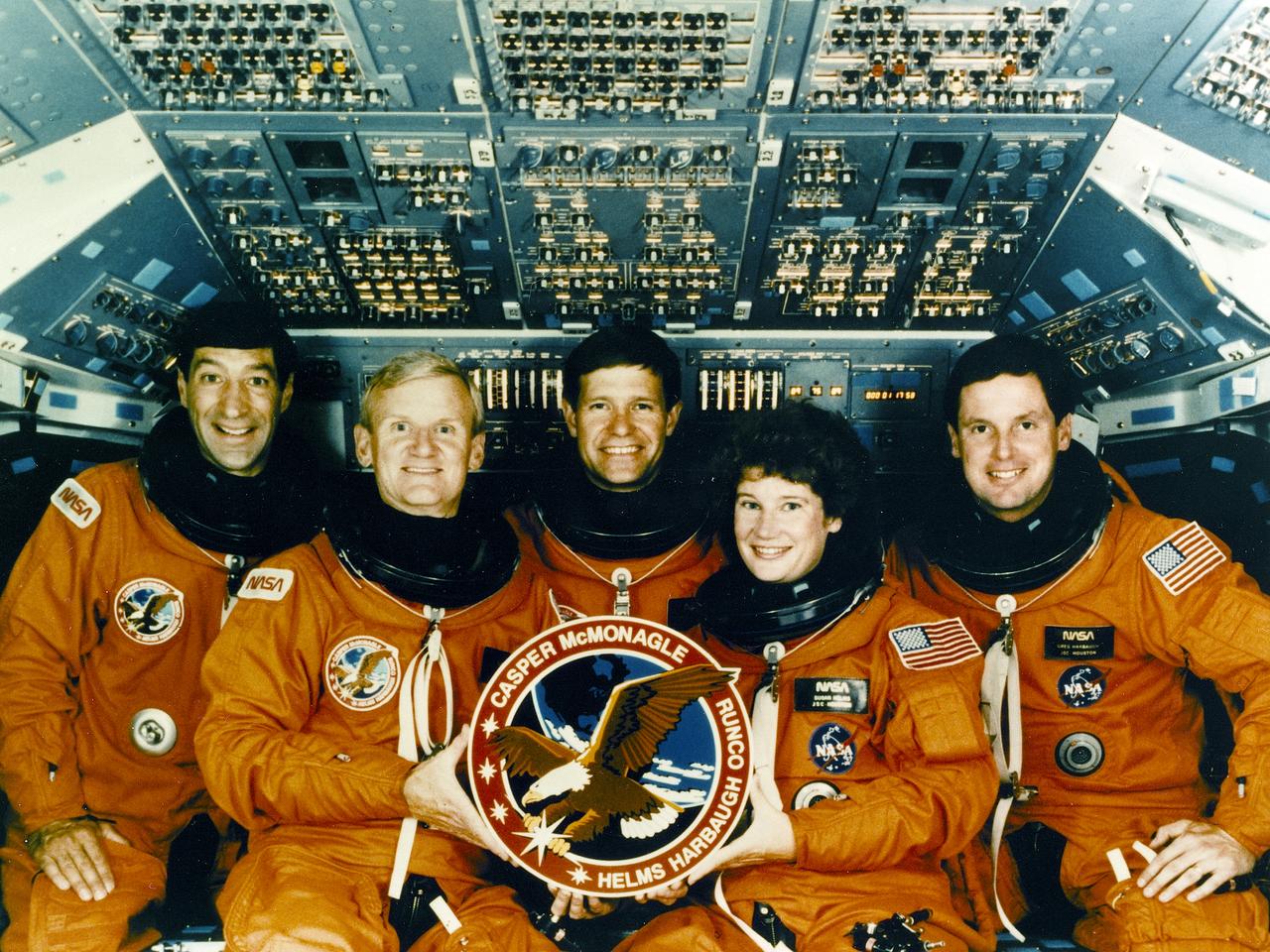
Astronauts pictured in the STS-54 crew portrait from left to right are: Mario Runco, Jr., mission specialist; John H. Casper, commander; Donald R. McMonagle, pilot; and mission specialists Susan J. Helms, and Gregory J. Harbaugh. Launched aboard the Space Shuttle Endeavour on January 13, 1993 at 8:59:30 am (EST), the crew deployed the fifth Tracking and Data Relay Satellite (TDRS-6).
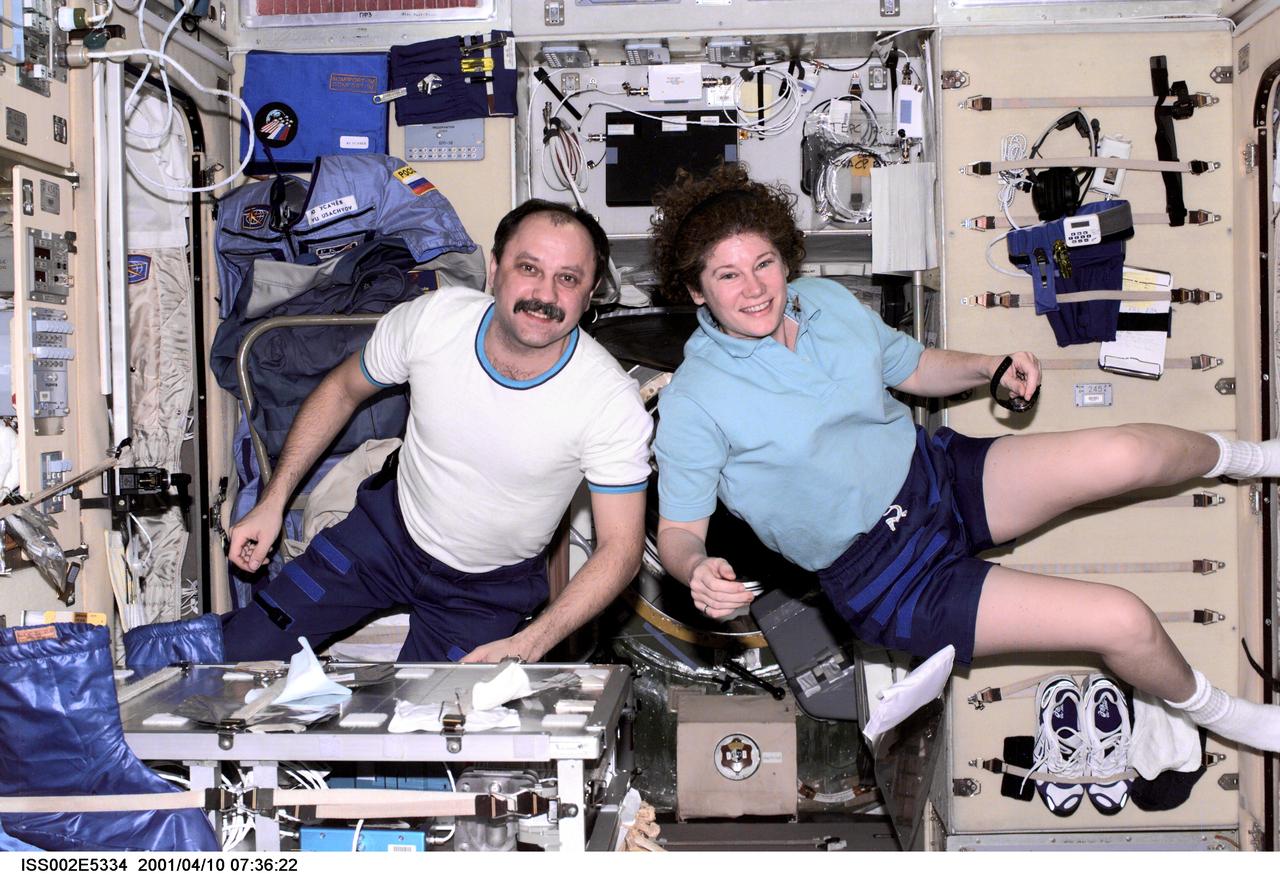
ISS002-E-5334 (10 April 2001) --- Cosmonaut Yury V. Usachev (left), Expedition Two mission commander, and astronaut Susan J. Helms, Expedition Two flight engineer, pause from their work to pose for a photograph aboard the Zvezda / Service Module of the International Space Station (ISS). This image was recorded with a digital still camera.
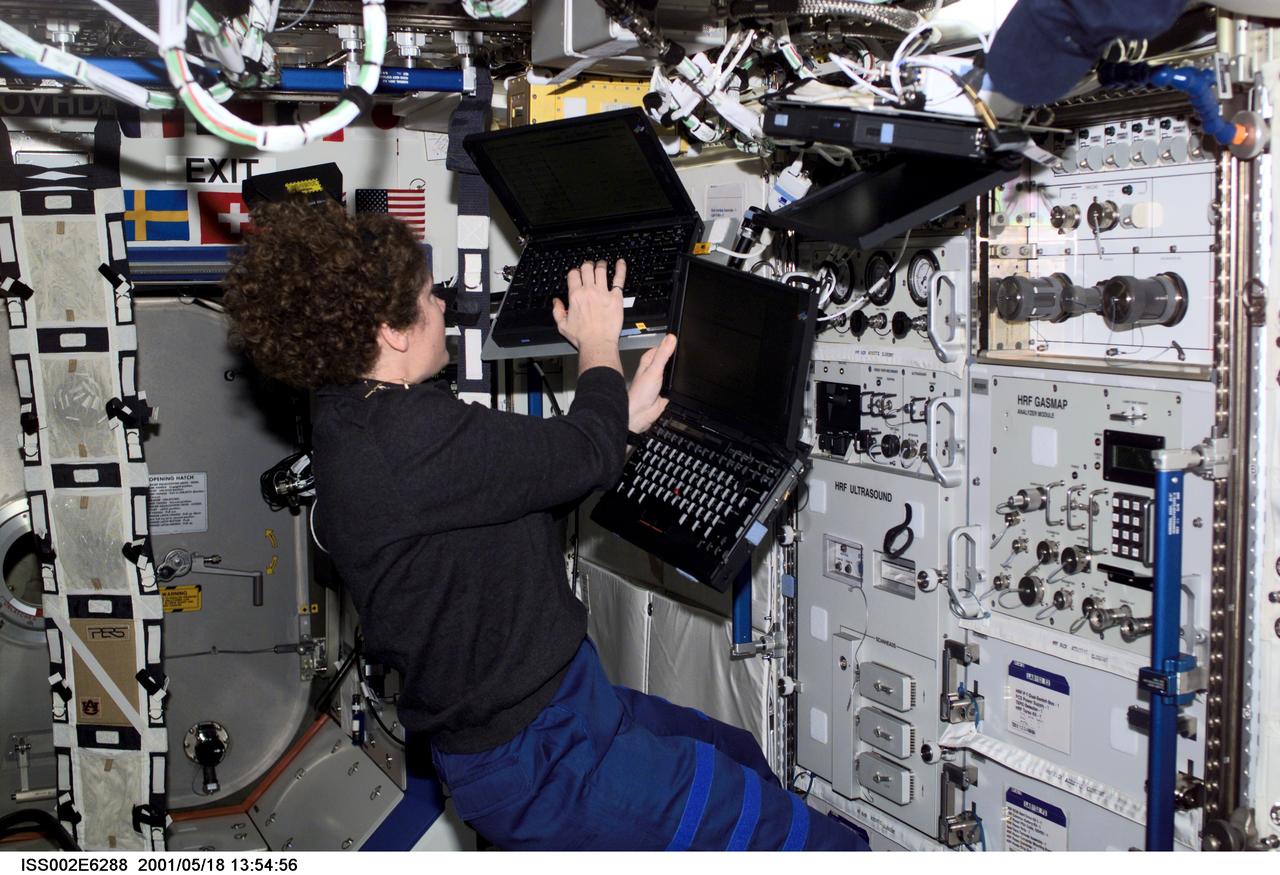
ISS002-E-6288 (18 May 2001) --- Susan J. Helms, Expedition Two flight engineer, works with three laptop computers at the Human Research Facility (HRF) in the U.S. Laboratory. The image was taken with a digital still camera.
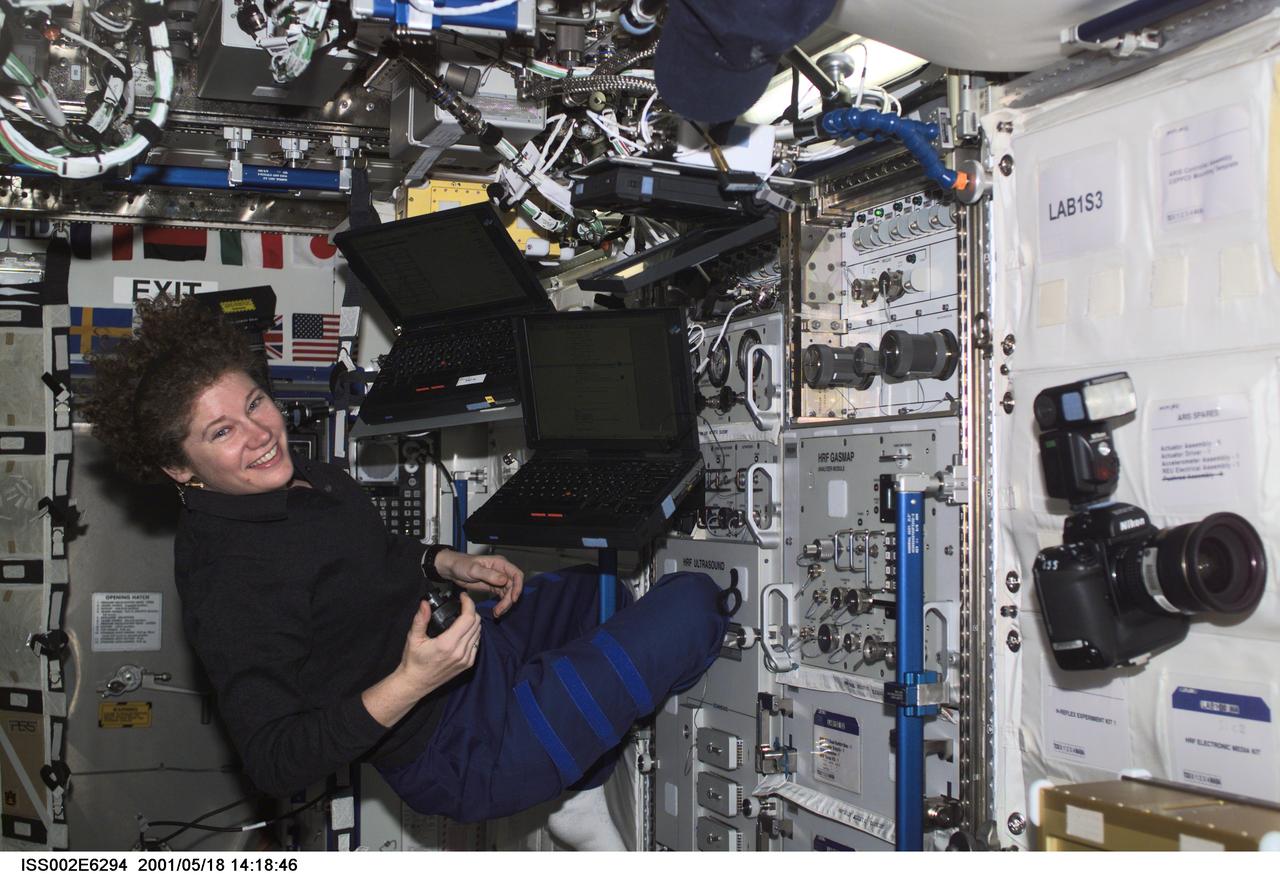
ISS002-E-6294 (18 May 2001) --- Susan J. Helms, Expedition Two flight engineer, works with three laptop computers at the Human Research Facility (HRF) in the U.S. Laboratory. The image was taken with a digital still camera.
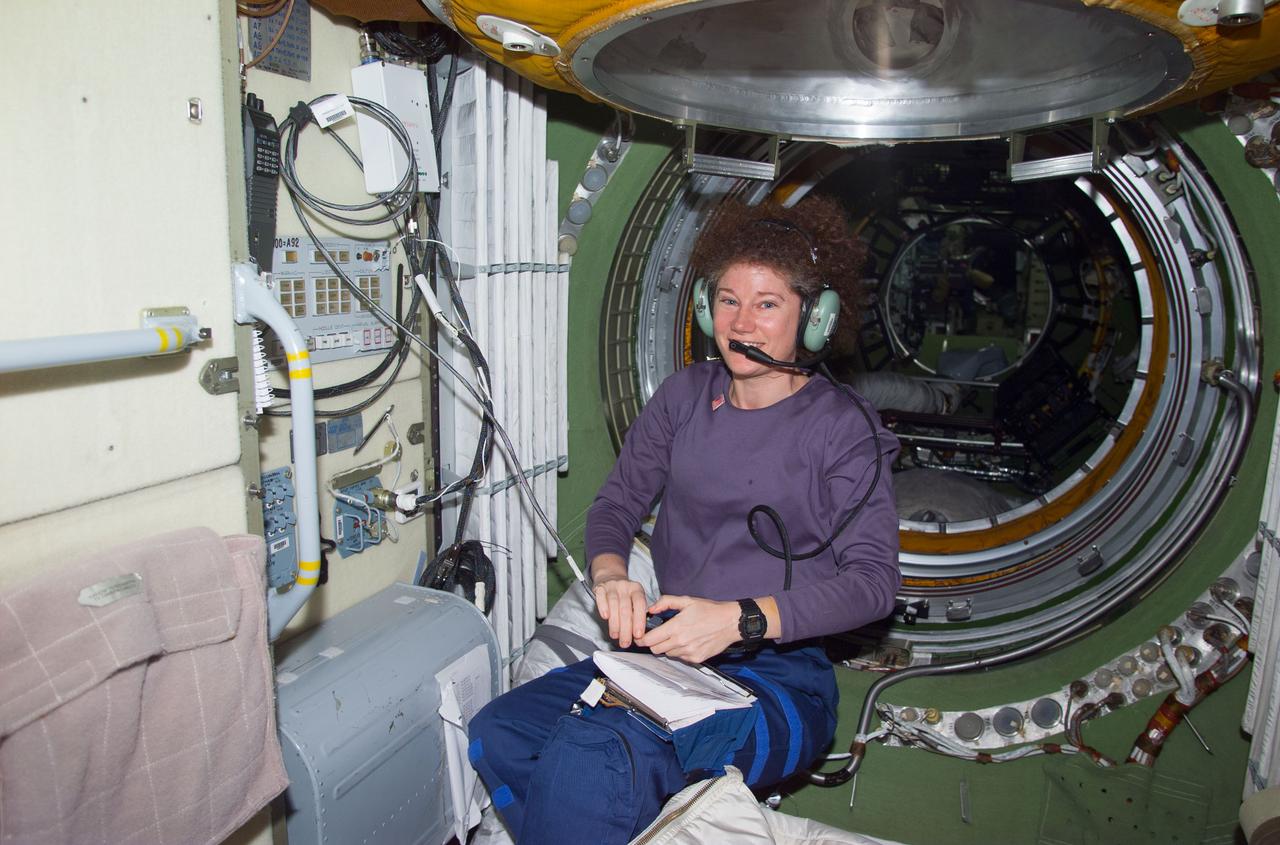
S104-E-5092 (16 July 2001) --- Susan J. Helms, Expedition Two flight engineer, talks to amateur radio operators on Earth from the HAM radio workstation in the Zarya module of the International Space Station (ISS).
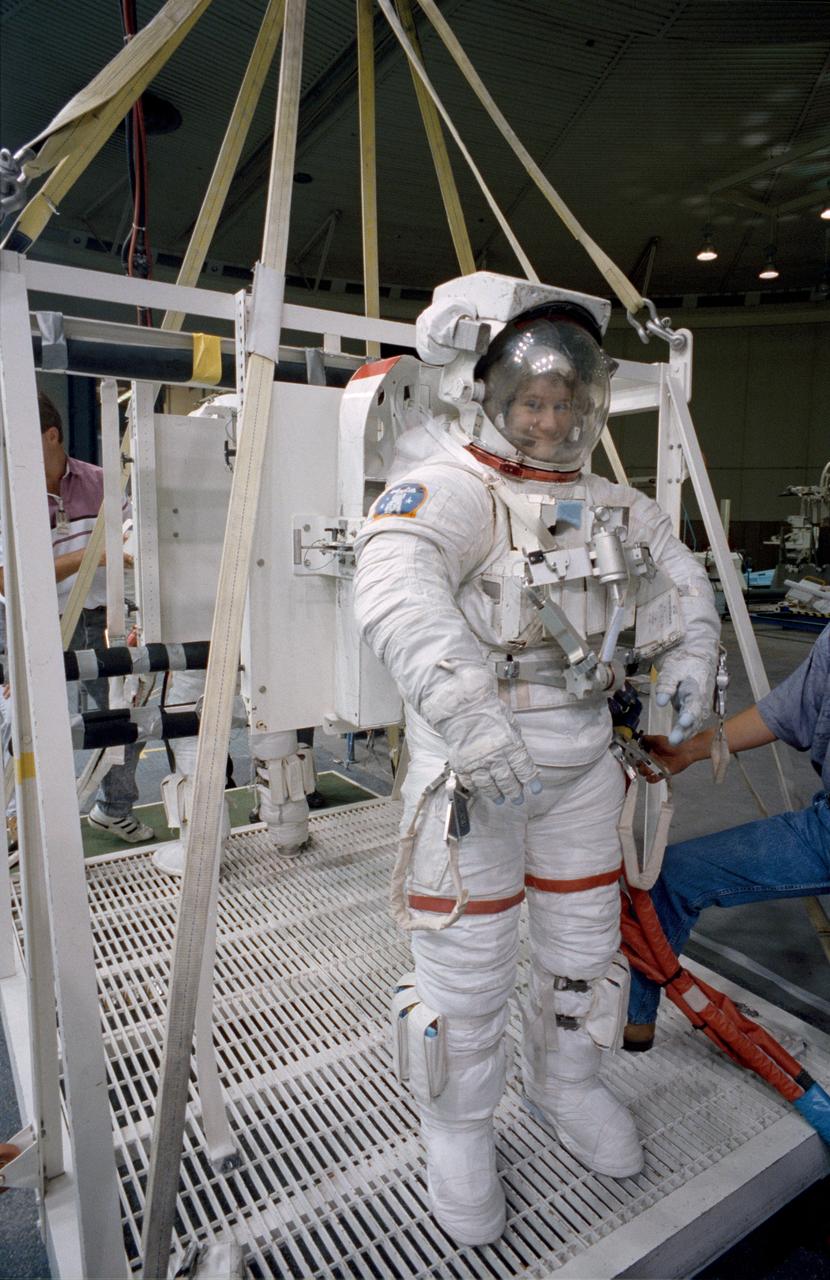
S92-42754 (31 July 1992) --- Astronaut Susan J. Helms, mission specialist assigned to fly aboard the Space Shuttle Endeavour for the STS-54 mission, gets assistance to complete the donning of her spacesuit. Though not assigned to the scheduled extravehicular activity (EVA), Helms is trained in the weightless environment training facility (WET-F). She will aid astronauts Gregory J. Harbaugh and Mario Runco Jr. in their planned EVA, scheduled for January of next year, and serve a backup role. Wearing this high fidelity training version of the extravehicular mobility unit (EMU), Helms was later lowered into the 25-ft. deep WET-F pool. The pressurized suit is weighted so as to allow Helms to achieve neutral buoyancy and simulate the various chores of the spacewalk.
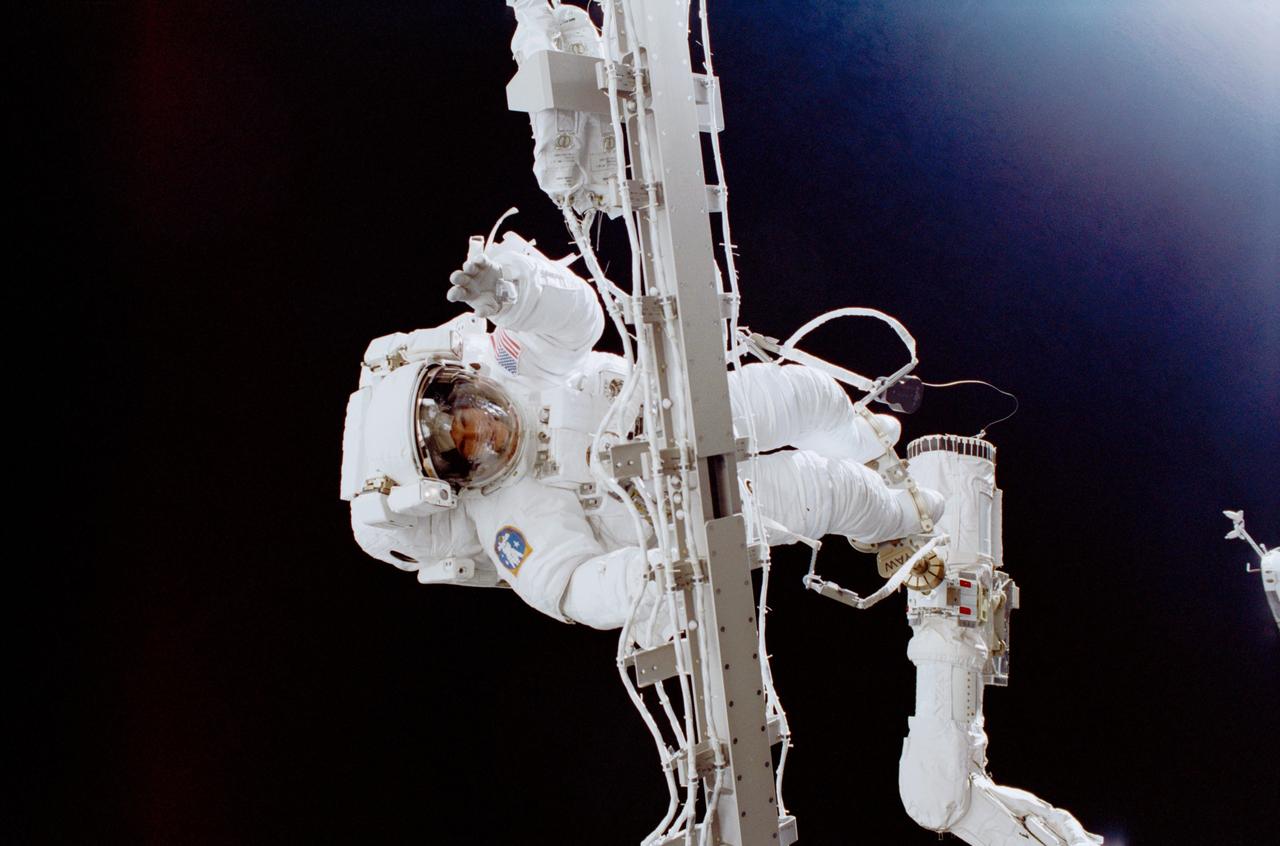
STS102-314-003 (11 March 2001) --- Astronaut Susan J. Helms works while holding onto a rigid umbilical and with her feet anchored to the remote manipulator system (RMS) robot arm on the Space Shuttle Discovery. This extravehicular activity (EVA), on which Helms was joined by astronaut James S. Voss (out of frame), was the first of two scheduled STS-102 space walks. The pair, destined to become members of the Expedition Two crew aboard the station later in the mission, rode aboard Discovery into orbit and at the time of this EVA were still regarded as STS-102 mission specialists.
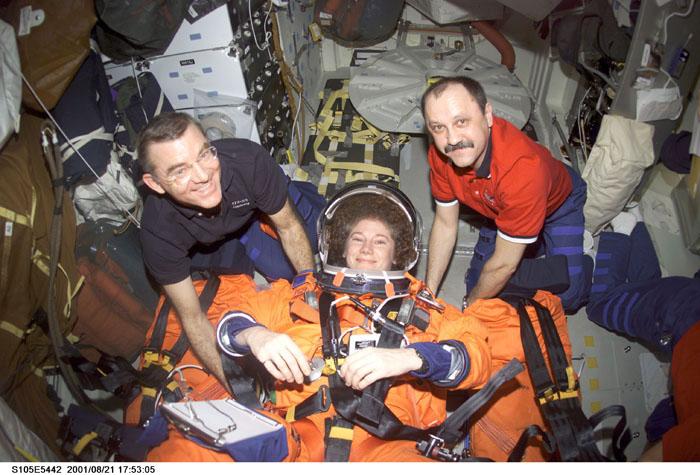
STS105-E-5442 (21 August 2001) --- As they near completion of their mission, the Expedition Two crew members prepare for the descent back to Earth. Astronaut James S. Voss (left), flight engineer, and cosmonaut Yury V. Usachev (right), mission commander, strap astronaut Susan J. Helms, flight engineer, into her seat on the mid deck of the Space Shuttle Discovery. Voss and Helms, representing NASA, and Usachev, representing Rosaviakosmos, are returning to Earth after completing their five-month assignment aboard the International Space Station (ISS). This image was recorded with a digital still camera.

STS105-E-5439 (21 August 2001) --- Astronaut Susan J. Helms, Expedition Two flight engineer, rehearses preparations for return to Earth. Dressed in her full-pressure Launch and Entry Suit (LES) on Discovery's mid deck, Helms nears the end of a five-month stay (most of which was spent onboard the International Space Station) in Earth orbit along with astronaut James S. Voss (seen working with a stowage bag at left), flight engineer, and cosmonaut Yury V. Usachev (out of frame), mission commander. The three joined four STS-105 astronauts in readying for the return home, scheduled for August 22. The image was recorded with a digital still camera.
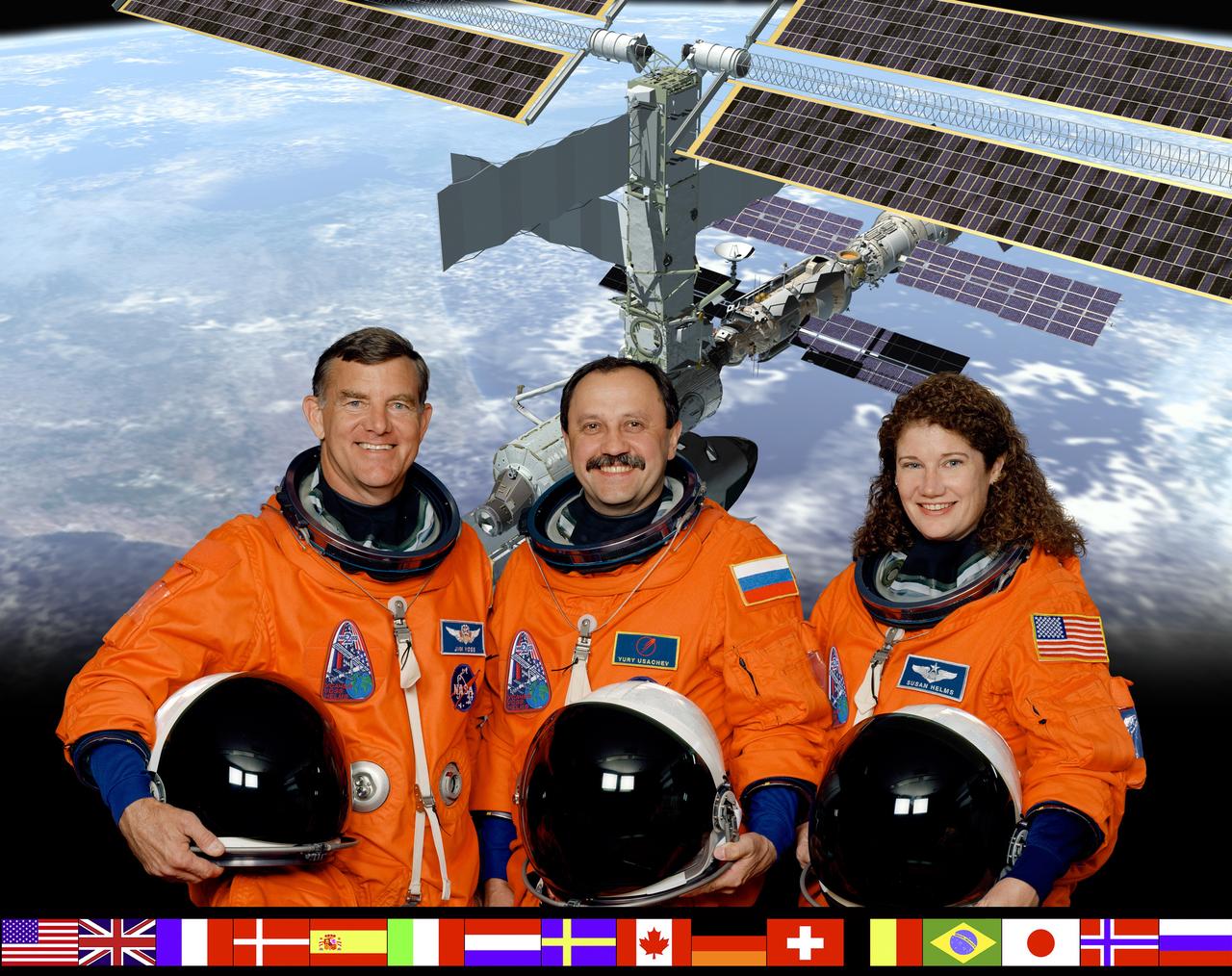
This is a crew portrait of the International Space Station (ISS) Expedition Two. Left to right are Astronaut James S. Voss, flight engineer; Cosmonaut Yury V. Usachev, commander; and Astronaut Susan J. Helms, flight engineer. The crew was launched on March 8, 2001 aboard the STS-102 mission Space Shuttle Orbiter Discovery for an extended stay on the ISS. After living and working on the ISS for the duration of 165 days, the crew returned to Earth on August 22, 2001 aboard the STS-105 mission Space Shuttle Orbiter Discovery. Cosmonaut Usachev represents the Russian Aviation and Space Agency. The flags representing all the international partners are arrayed at bottom.
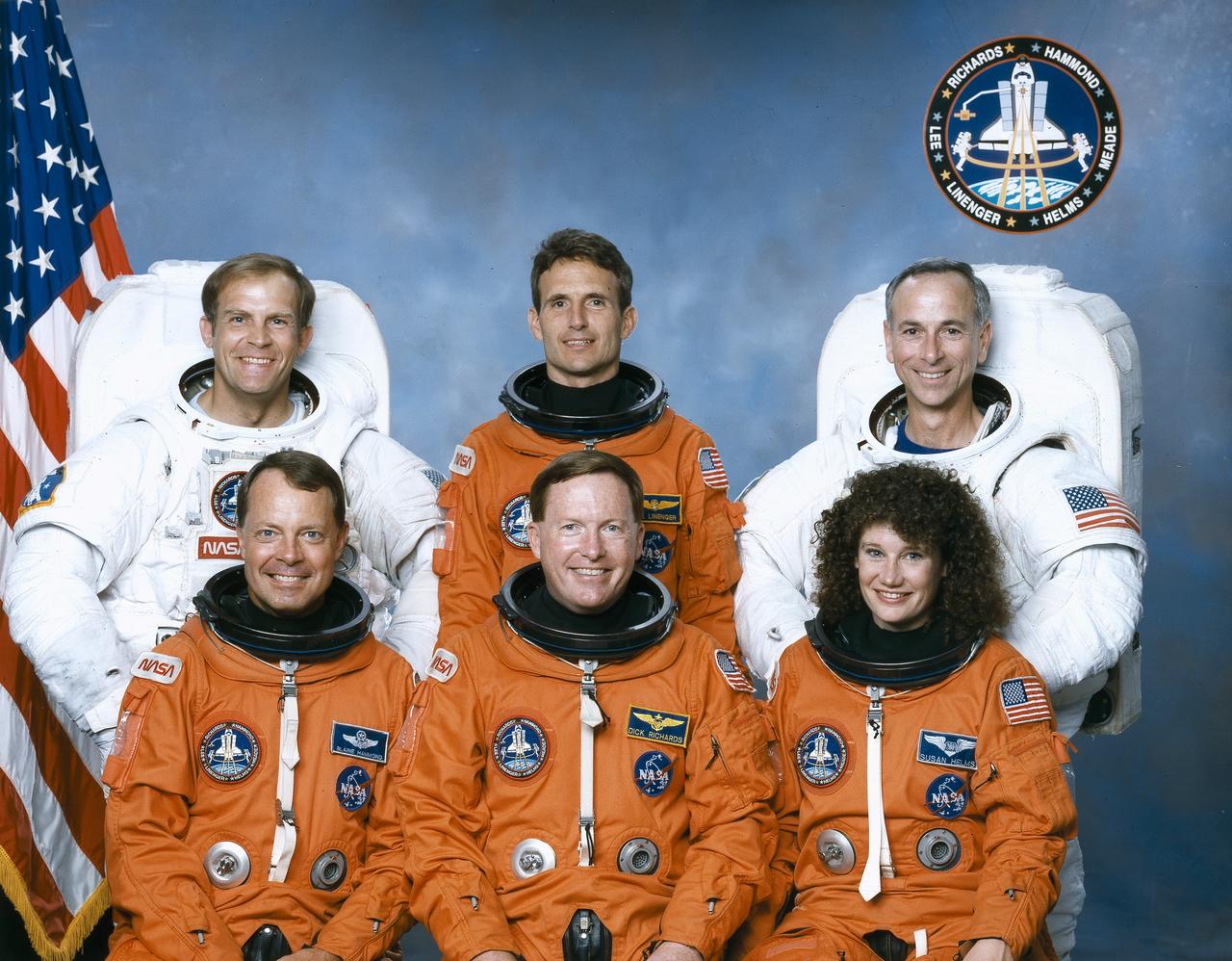
The crew assigned to the STS-64 mission included Richard N. Richards, commander (center front); L. Blaine Hammond Jr., pilot (front left); and Susan J. Helms, mission specialist (front right). On the back row, from left to right, are Mark C. Lee, Jerry M. Linenger, and Carl J. Meade, all mission specialists. Launched aboard the Space Shuttle Discovery on September 9, 1994 at 6:22:55 pm (EDT), the STS-64 mission marked the first flight of the Lidar In-Space Technology Experiment (LITE) and the first untethered Extravehicular Activity (EVA) in ten years.
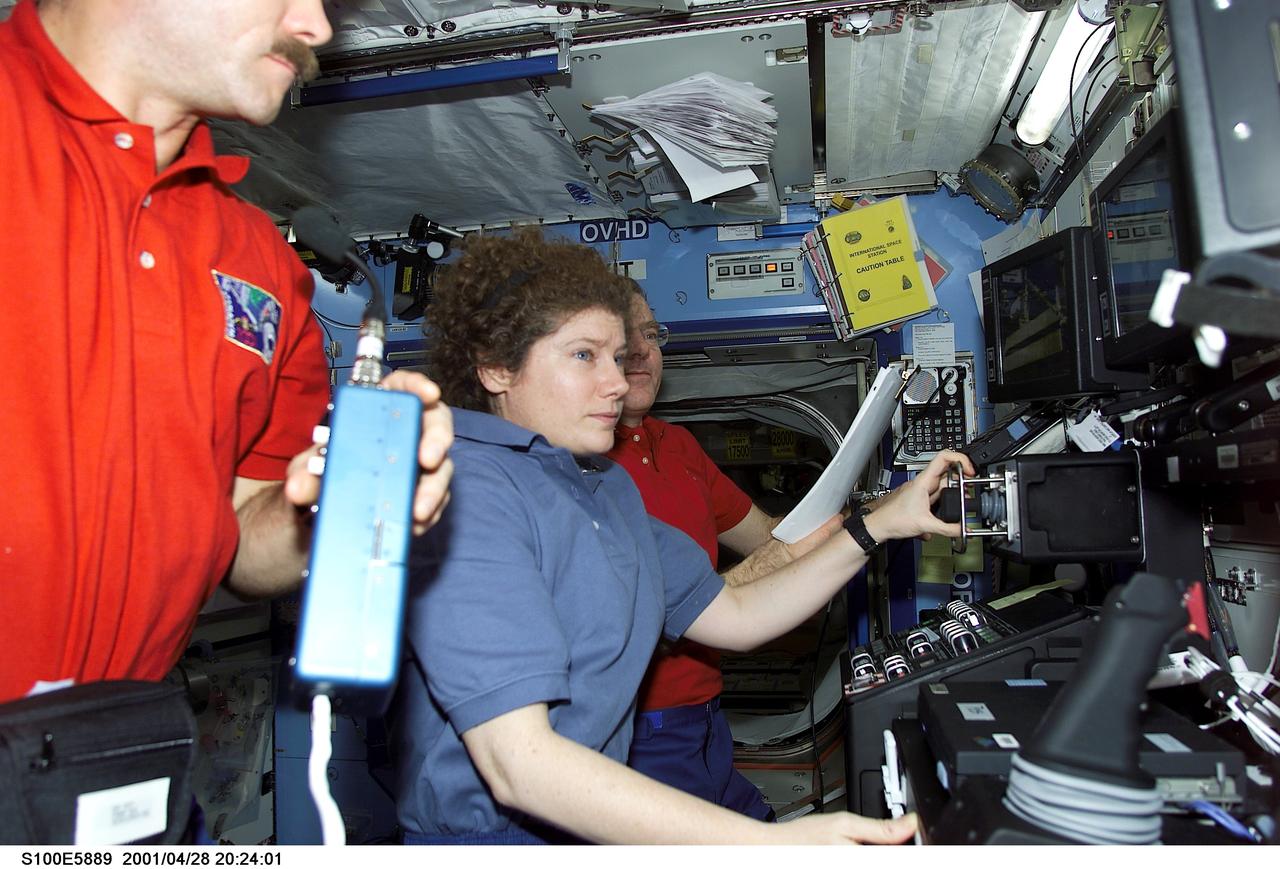
S100-E-5889 (28 April 2001) --- Two of the principal participants of an historical event are pictured in the Destiny laboratory aboard the International Space Station (ISS). Pictured are astronauts Chris A. Hadfield (partially out of frame), STS-100 mission specialist, and astronaut Susan J. Helms, flight engineer for Expedition Two. Astronaut James S. Voss, Expedition Two flight engineer, is in the background. A Canadian “handshake in space” occurred at 4:02 p.m (CDT), April 28, 2001, as the Canadian-built space station robotic arm – operated by Helms – transferred its launch cradle over to Endeavour’s robotic arm, with Canadian Space Agency astronaut Hadfield at the controls. In this scene, Hadfield has temporarily vacated his post on Endeavour's aft flight deck and was having a brief strategy meeting with Helms on the docked station. The exchange of the pallet from station arm to shuttle arm marked the first ever robotic-to-robotic transfer in space. This image was recorded with a digital still camera.
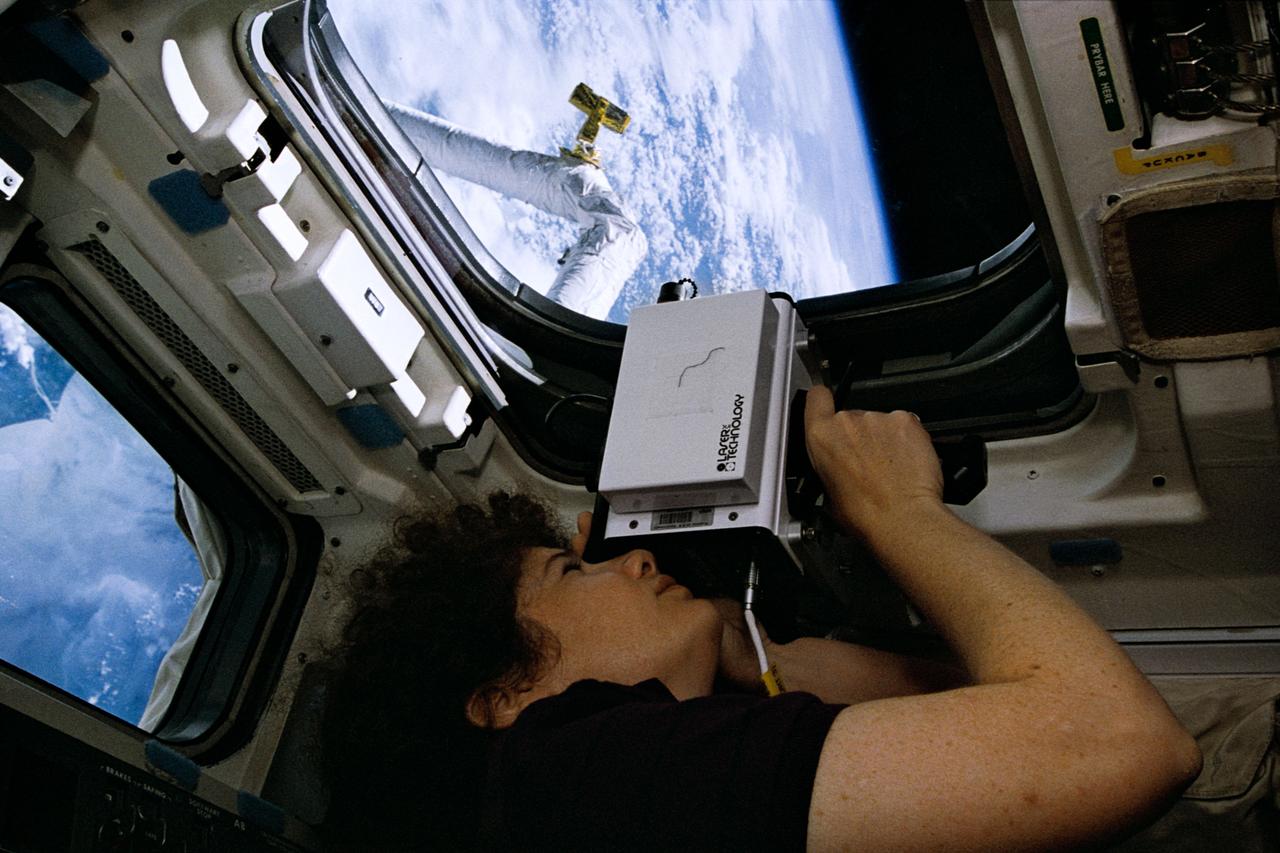
STS064-33-003 (9-20 Sept. 1994) --- Astronaut Susan J. Helms, STS-64 mission specialist, uses a laser instrument during operations with the Shuttle Pointed Autonomous Research Tool for Astronomy 201 (SPARTAN 201). Helms, who spent many mission hours at the controls of the Remote Manipulator System (RMS), joined five other NASA astronauts for almost 11 days in Earth orbit aboard the space shuttle Discovery. Photo credit: NASA or National Aeronautics and Space Administration
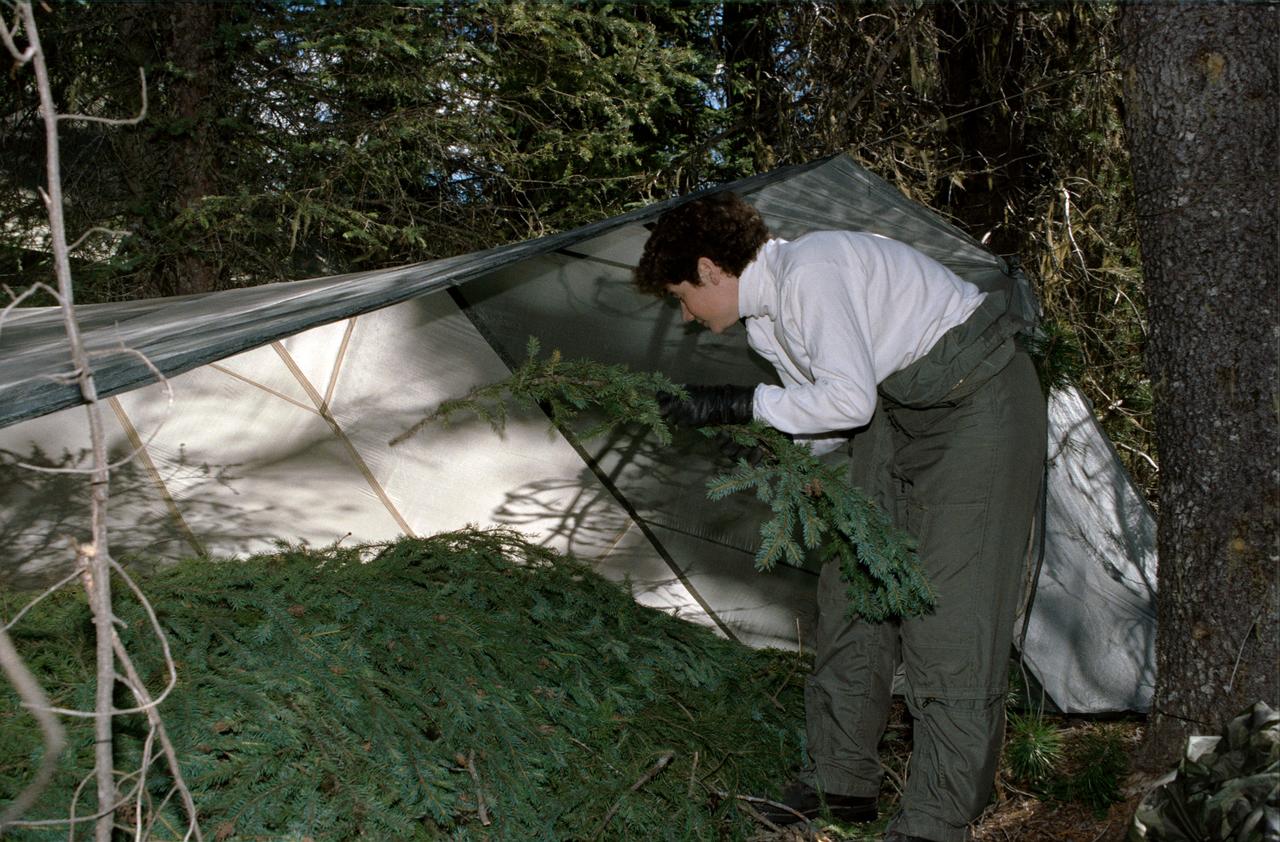
1990 Group 13 Astronaut Candidate (ASCAN) Susan J. Helms gathers pine branches to create bedding under a tent she has constructed from a parachute. Helms, along with her classmates, is participating in wilderness survival training at Fairchild Air Force Base (AFB) Spokane, Washington. The training was conducted in the mountain forests of Washington from 08-26-90 through 08-30-90.
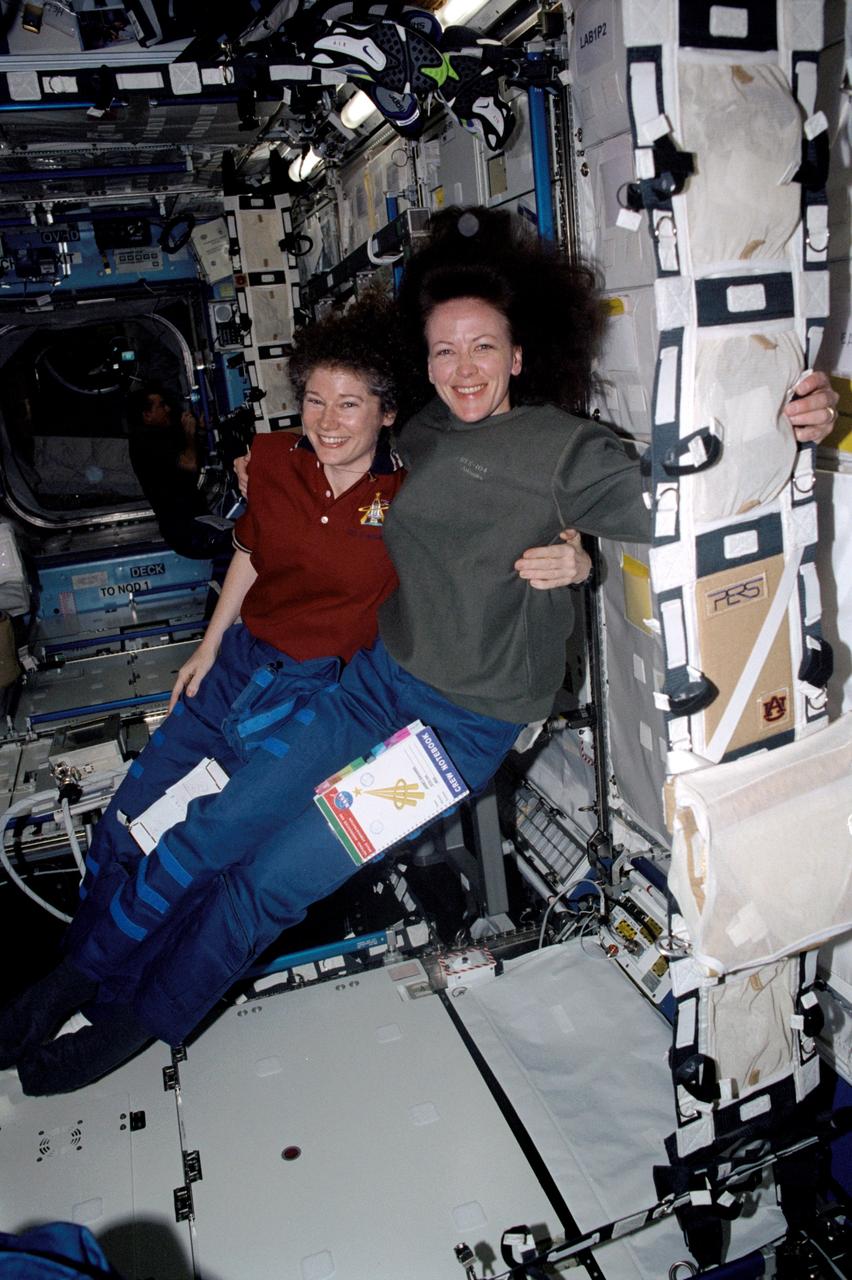
STS104-313-016 (12-24 July 2001) --- Astronauts Susan J. Helms (left) and Janet L. Kavandi reunite in the Destiny laboratory aboard the International Space Station (ISS). Kavandi is a mission specialist on the STS-104 Atlantis crew and Helms is a flight engineer for the Expedition Two crew which has been aboard the International Space Station (ISS) for several months.
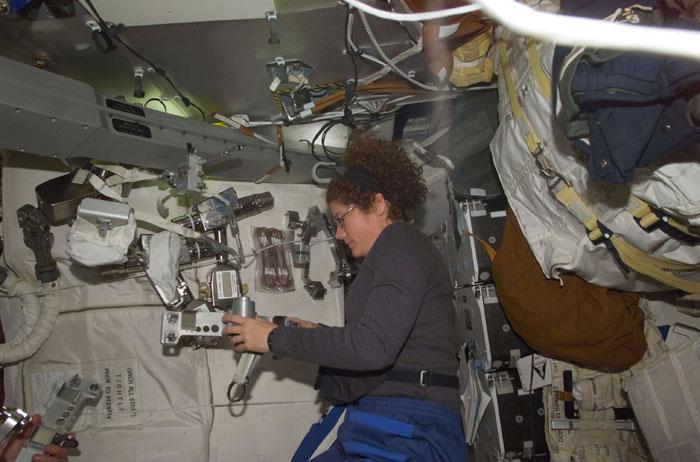
STS102-E-5029 (9 March 2001) --- Astronaut Susan J. Helms, STS-102 mission specialist, checks out some of the space walk gear during Flight Day 1 activity on the mid deck of the Space Shuttle Discovery. Helms is less than two days away from participation in extravehicular activity (EVA). She will later be part of a three-member crew that will replace the Expedition One crew which has been aboard the International Space Station (ISS) since early November 2000.
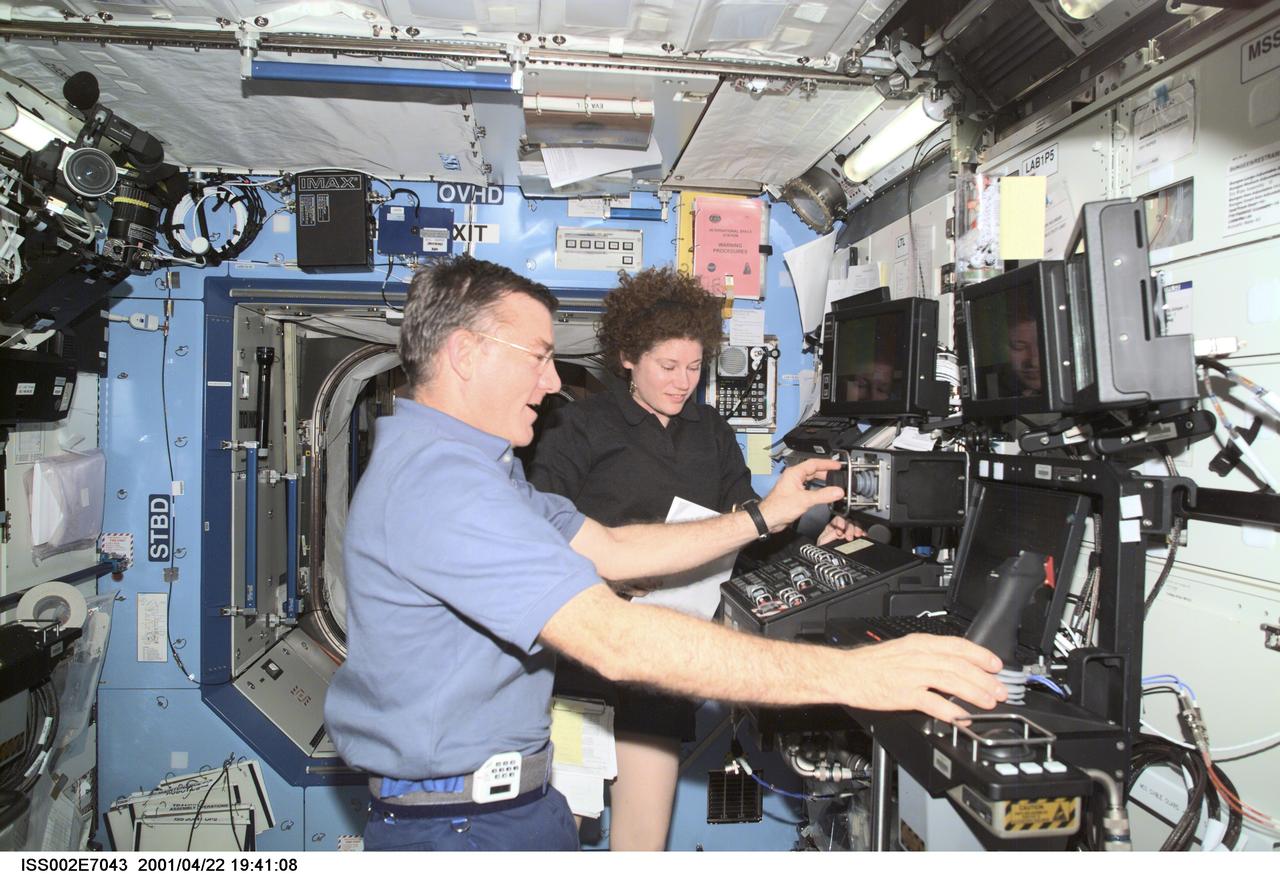
ISS002-E-7043 (22 April 2001) --- Expedition Two flight engineers James S. Voss and Susan J. Helms work at the Canadarm2 / Space Station Remote Manipulator System (SSRMS) control station in the Destiny Laboratory. The image was recorded with a digital still camera.
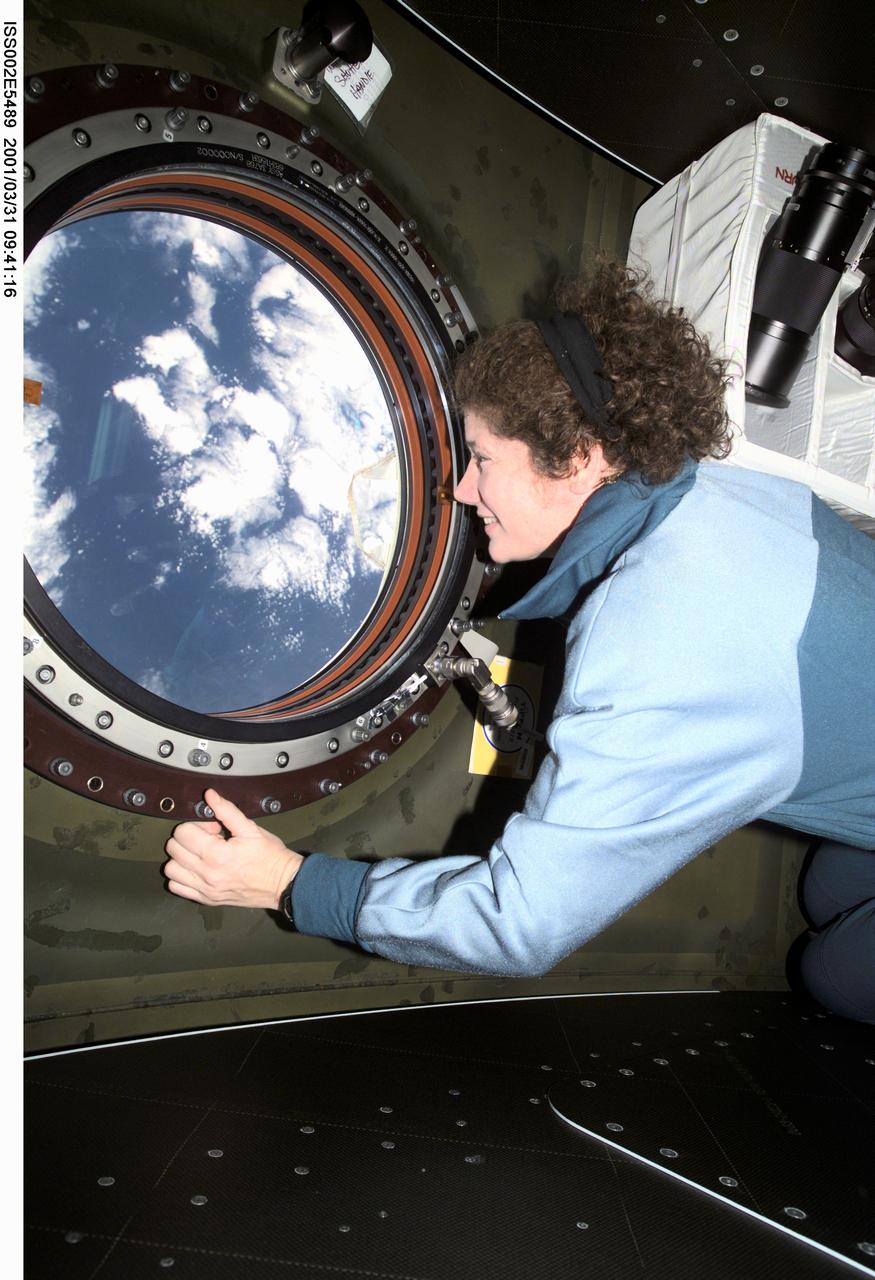
ISS002-E-5489 (31 March 2001) --- Astronaut Susan J. Helms, Expedition Two flight engineer, views the topography of a point on Earth from the nadir window in the U.S. Laboratory / Destiny module of the International Space Station (ISS). The image was recorded with a digital still camera.
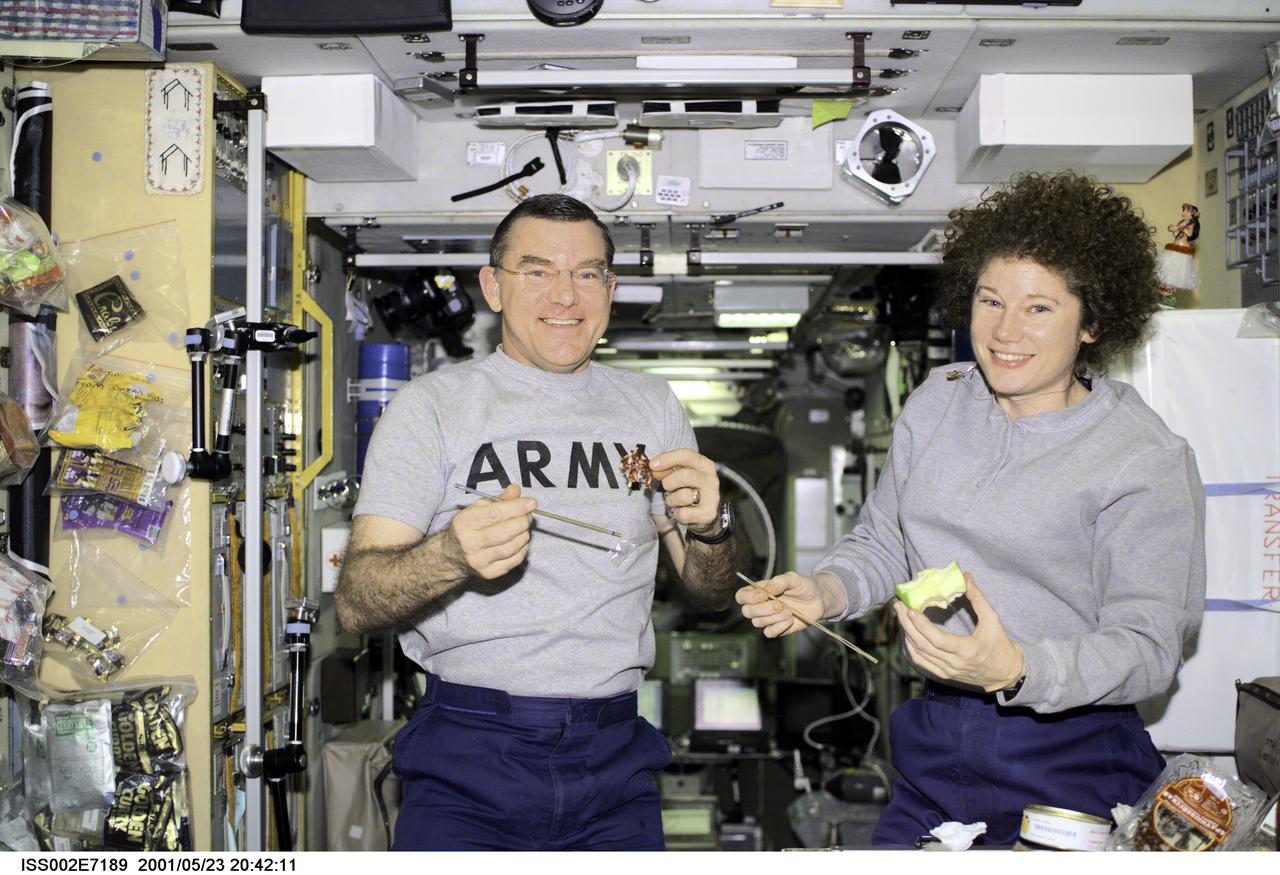
ISS002-E-7189 (23 May 2001) --- Astronauts James S. Voss and Susan J. Helms take a snack break in the Zvezda Service Module. The Expedition Two flight engineers were captured with a digital still camera by Rosaviakosmos cosmonaut Yury V. Usachev, commander.
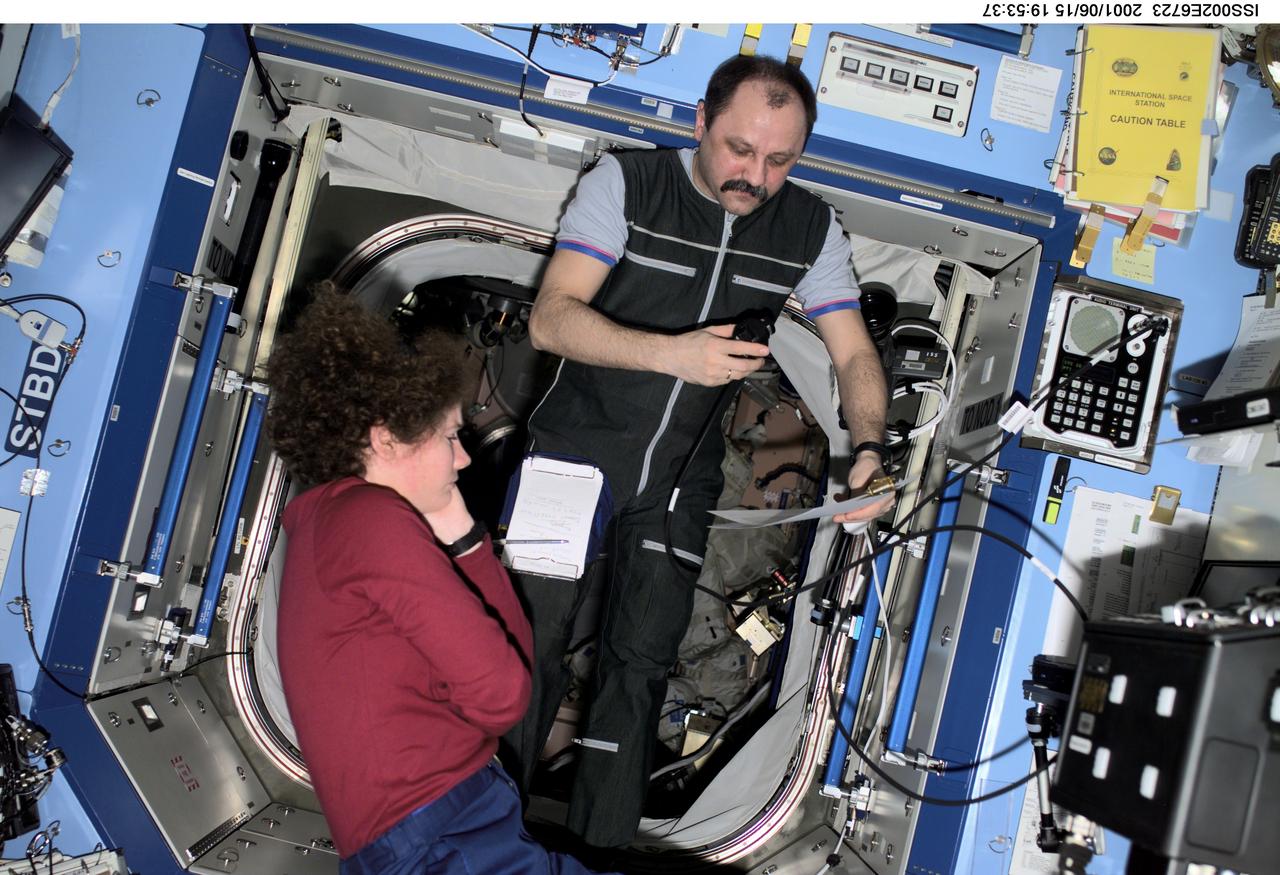
ISS002-E-6723 (15 June 2001) --- Astronaut Susan J. Helms, Expedition Two flight engineer, and cosmonaut Yury V. Usachev, mission commander, discuss a checklist in the Destiny/U.S. Laboratory. Usachev is with Rosaviakosmos. The photo was taken with a digital still camera.
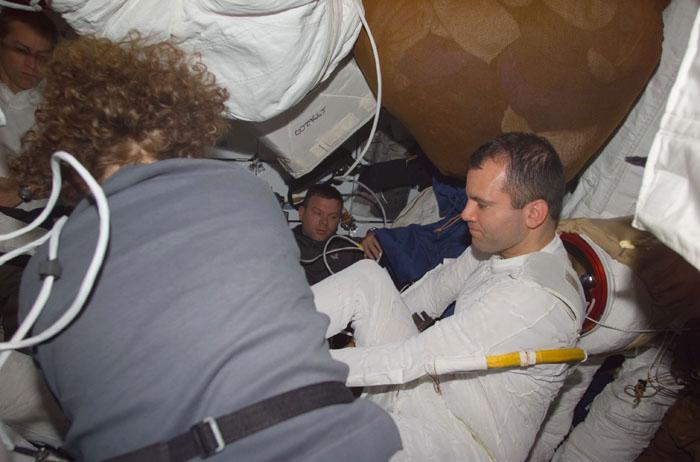
STS102-E-5162 (13 March 2001) --- Astronaut Susan J. Helms assists astronaut Paul W. Richards, mission specialist, during suit donning on Discovery's mid deck. Shortly afterward,Richards joined astronaut Andrew S.W. Thomas for the second STS-102 space walk.
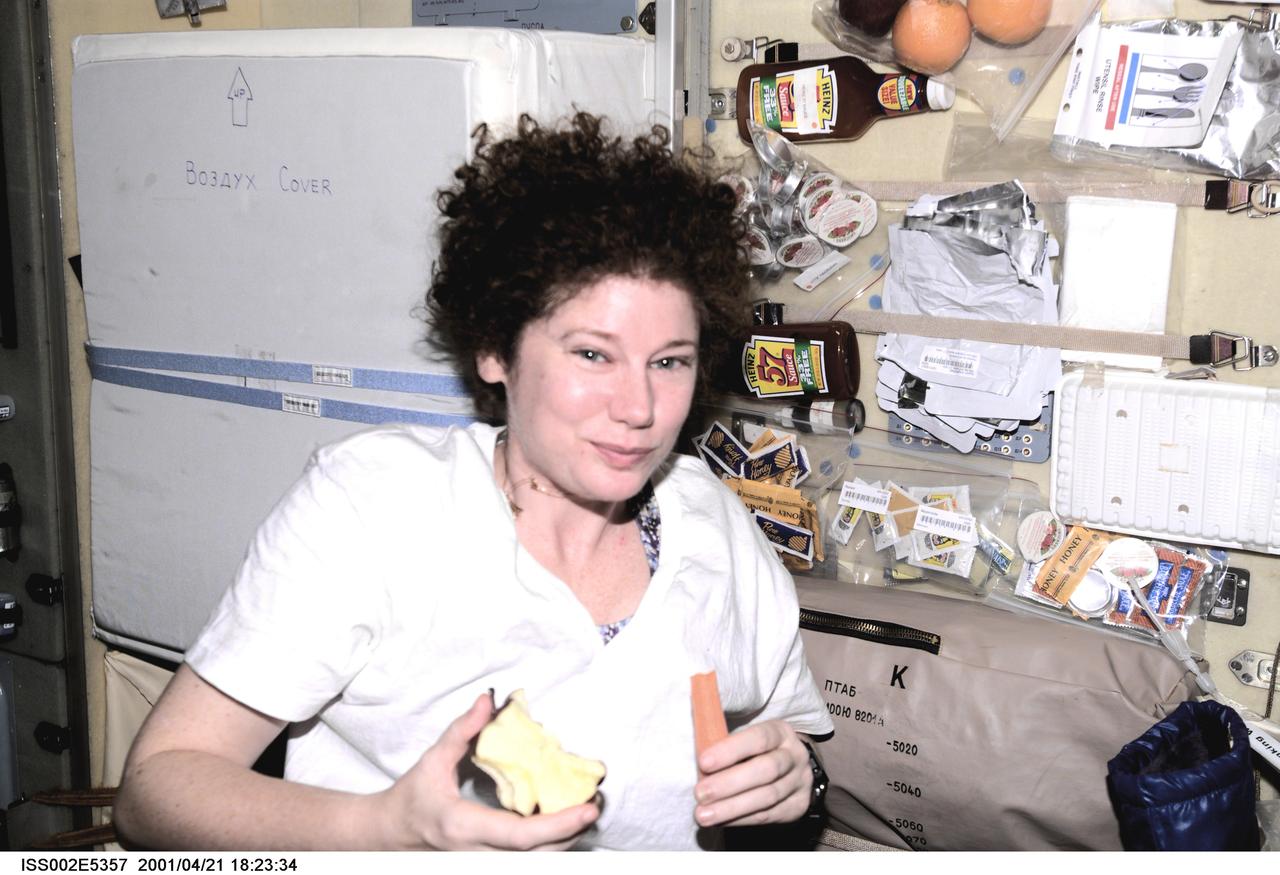
ISS002-E-5357 (21 April 2001) --- Just hours before the arrival of the STS-100/Endeavour crew, astronaut Susan J. Helms, Expedition Two flight engineer, enjoys a brief snack in the Zvezda Service Module on the International Space Station (ISS). The image was recorded with a digital still camera.
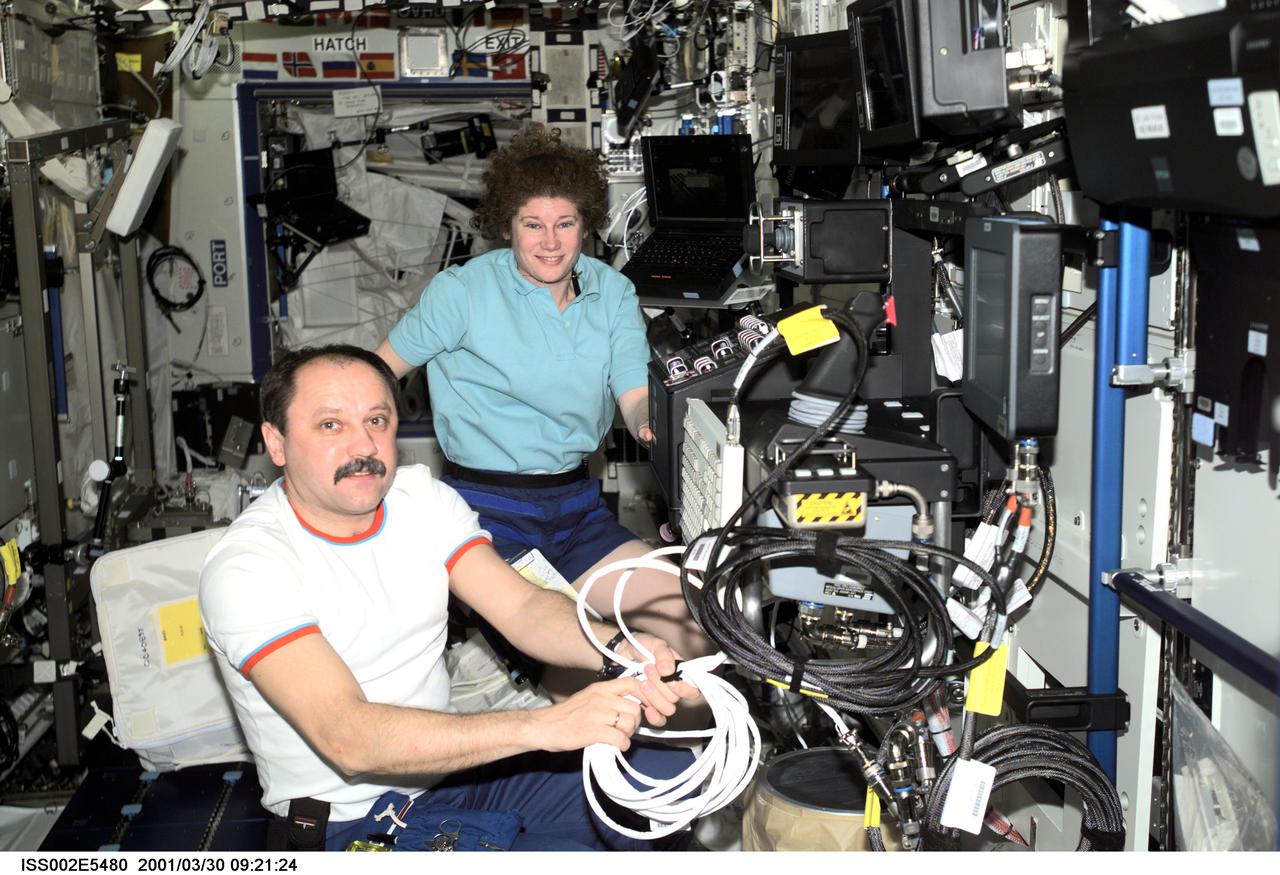
ISS002E5480 (30 March 2001) --- Cosmonaut Yury V. Usachev (foreground), Expedition Two mission commander, and astronaut Susan J. Helms, Expedition Two flight engineer, install cables for the Space Station Remote Manipulator System (SSRMS) or Canadarm2 control panel in preparation for the delivery of the Canadarm2 by the STS-100 crew in April. This image was recorded with a digital still camera.
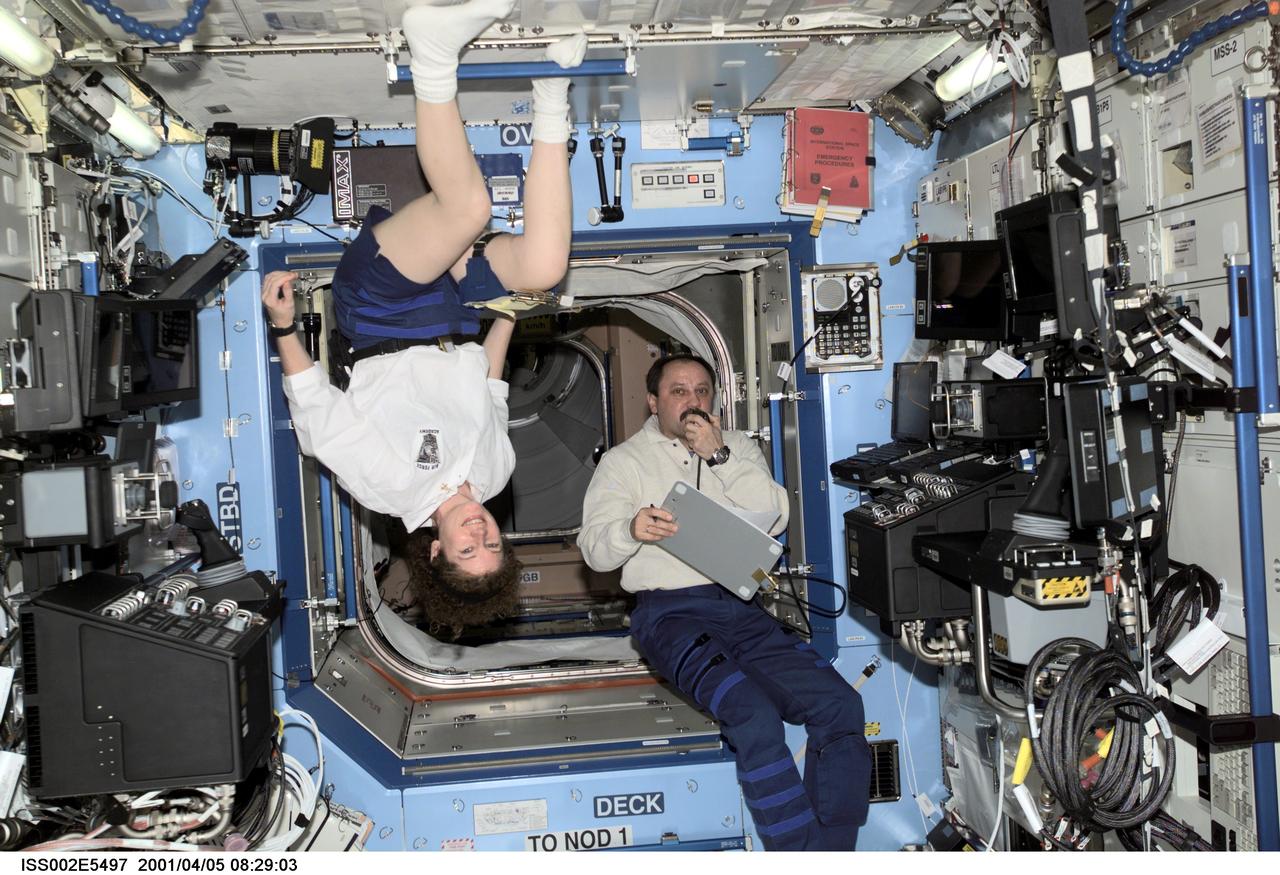
ISS002-E-5497 (05 April 2001) --- Astronaut Susan J. Helms (left), Expedition Two flight engineer, pauses from her work to pose for a photograph while Expedition Two mission commander, cosmonaut Yury V. Usachev, speaks into a microphone aboard the U.S. Laboratory / Destiny module of the International Space Station (ISS). This image was recorded with a digital still camera.
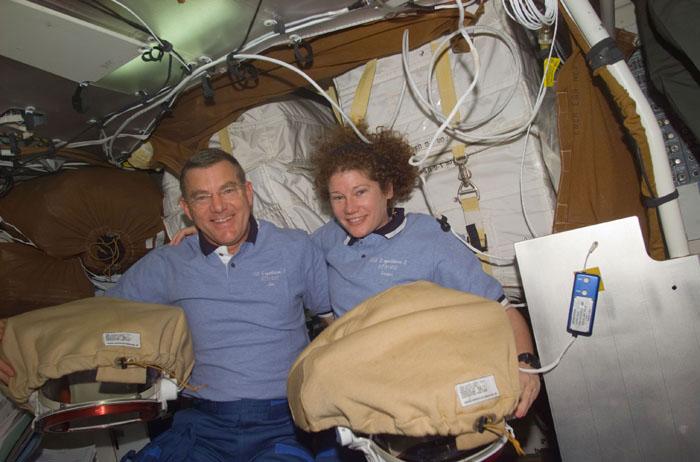
STS102-E-5049 (10 March 2001) --- Astronauts James S. Voss and Susan J. Helms, STS-102 mission specialists, are pictured with supplies on the mid deck. The two astronauts are assigned to space walk duties after the Space Shuttle Discovery and the International Space Station (ISS) link in Earth orbit. The photograph was recorded with a digital still camera.
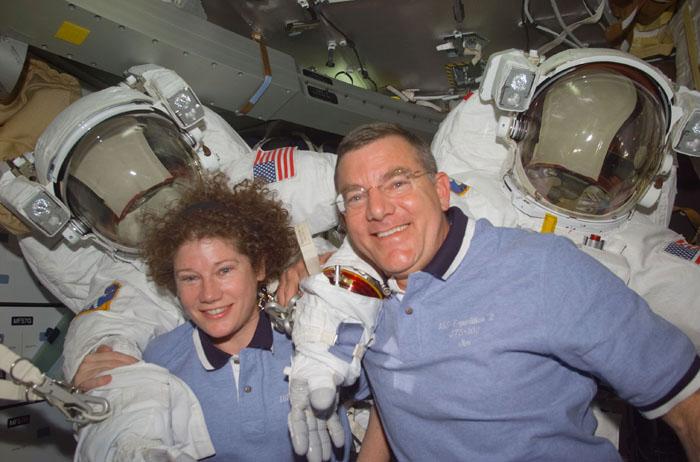
STS102-E-5061 (10 March 2001) --- Astronauts James S. Voss and Susan J. Helms, STS-102 mission specialists, are pictured with their Extravehicular Mobility Unit (EMU) space suits on the mid deck. The two astronauts are assigned to space walk duties after the Space Shuttle Discovery and the International Space Station (ISS) link in Earth orbit. The photograph was recorded with a digital still camera.
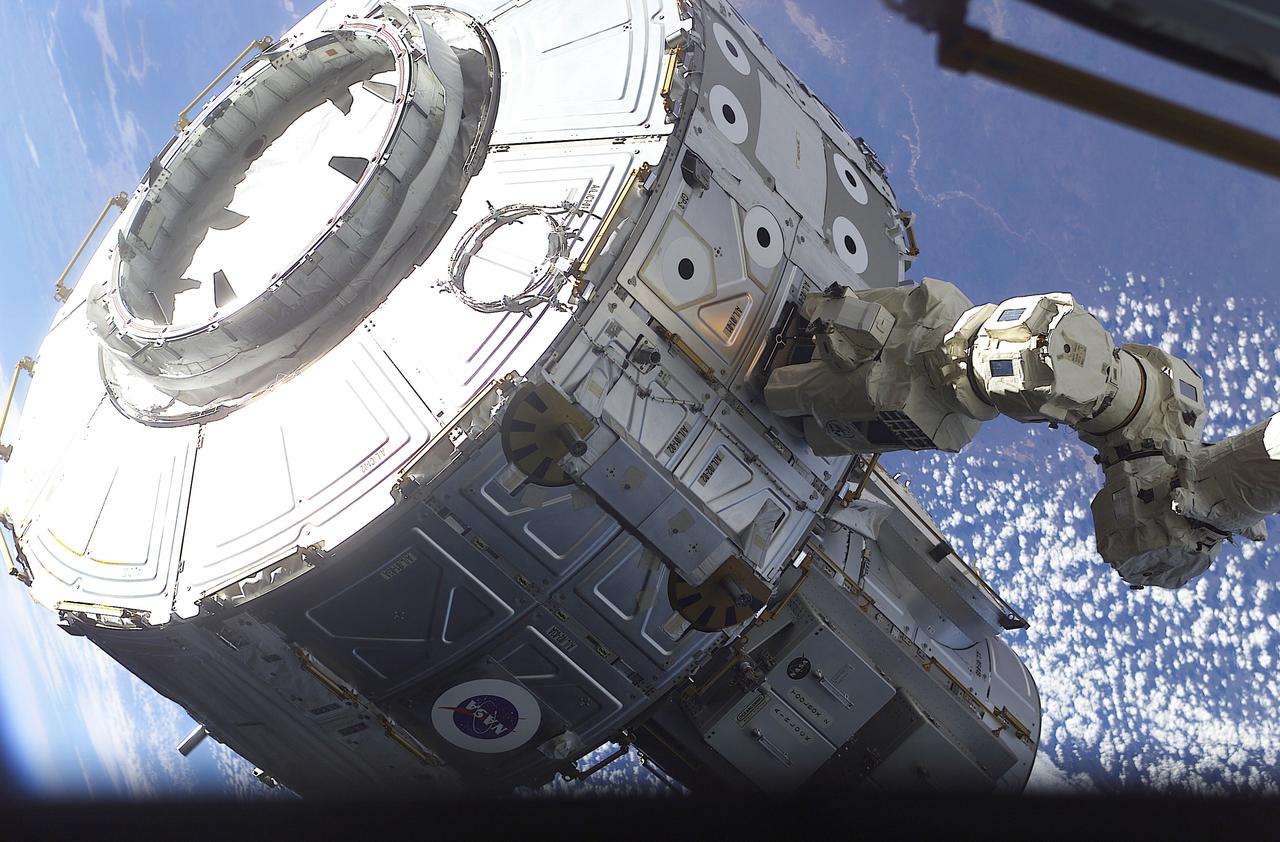
At the control of Expedition Two Flight Engineer Susan B. Helms, the newly-installed Canadian-built Canadarm2, Space Station Remote Manipulator System (SSRMS) maneuvers the Quest Airlock into the proper position to be mated onto the starboard side of the Unity Node I during the first of three extravehicular activities (EVA) of the STS-104 mission. The Quest Airlock makes it easier to perform space walks, and allows both Russian and American spacesuits to be worn when the Shuttle is not docked with the International Space Station (ISS). American suits will not fit through Russion airlocks at the Station. The Boeing Company, the space station prime contractor, built the 6.5-ton (5.8 metric ton) airlock and several other key components at the Marshall Space Flight Center (MSFC), in the same building where the Saturn V rocket was built. Installation activities were supported by the development team from the Payload Operations Control Center (POCC) located at the MSFC and the Mission Control Center at NASA's Johnson Space Flight Center in Houston, Texas.
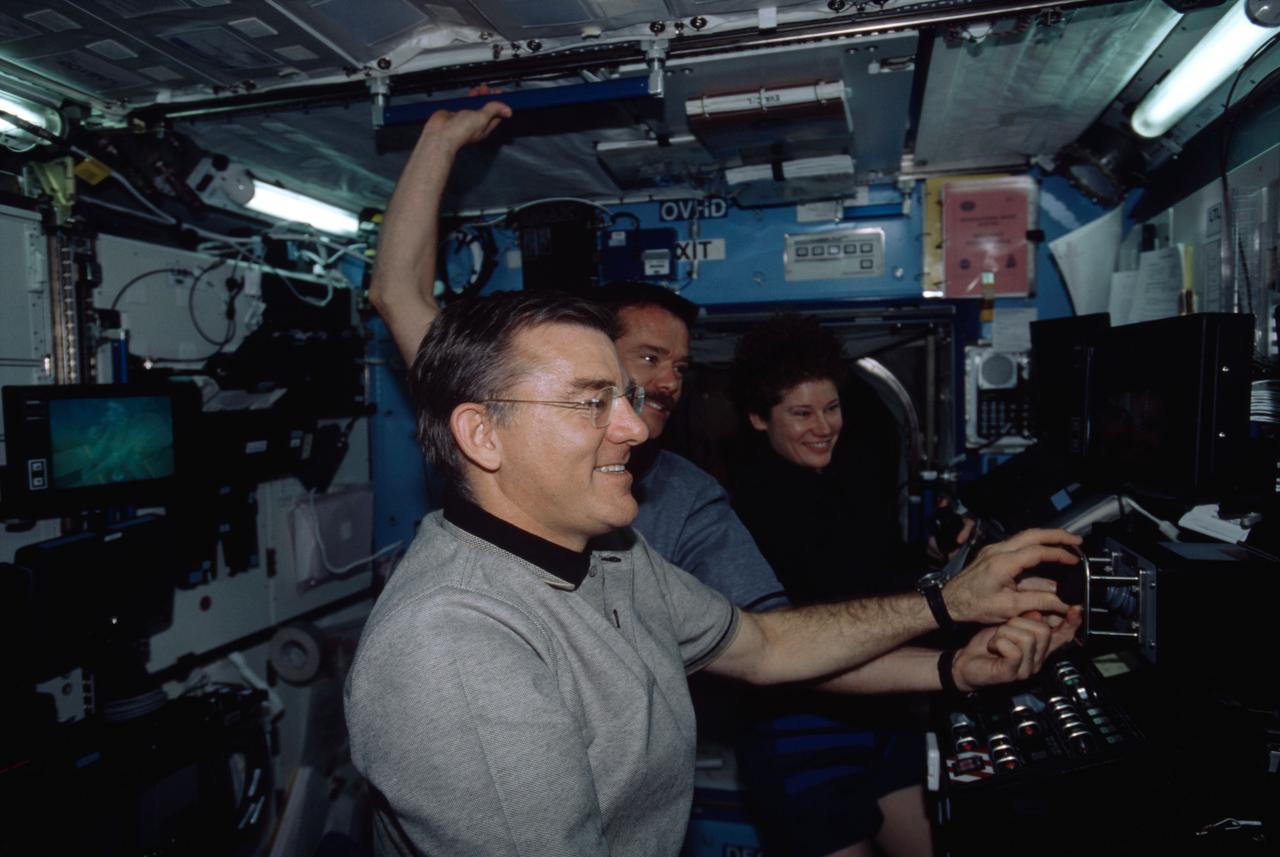
ISS002-303-036 (28 April 2001) --- Some of the principal participants of an historical event are pictured in the Destiny laboratory aboard the International Space Station (ISS). In the foreground is astronaut James S. Voss, with astronaut Chris A. Hadfield, STS-100 mission specialist, at center, and astronaut Susan J. Helms in the background. Voss and Helms are Expedition Two flight engineers. A Canadian "handshake in space" occurred at 4:02 p.m (CDT), April 28, 2001, as the Canadian-built space station robotic arm -- operated by Helms -- transferred its launch cradle over to Endeavour's robotic arm, with Canadian Space Agency astronaut Hadfield at the controls. In this scene, Hadfield had temporarily vacated his post on Endeavour's aft flight deck and was having a brief strategy meeting with the Expedition Two crew on the docked station. The exchange of the pallet from station arm to shuttle arm marked the first ever robotic-to-robotic transfer in space.
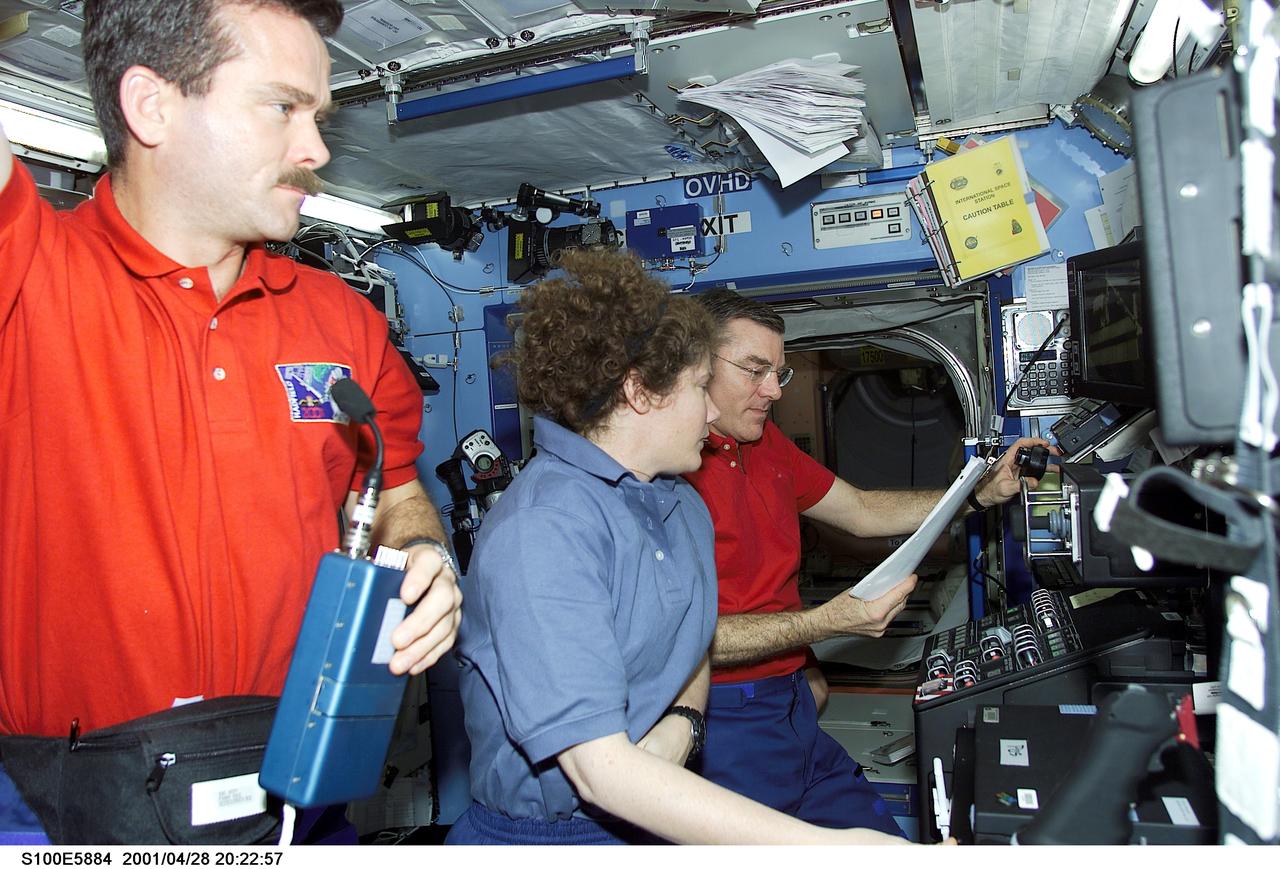
S100-E-5884 (28 April 2001) --- Some of the principal participants of an historical event are pictured in the Destiny laboratory aboard the International Space Station (ISS). From left to right are astronauts Chris A. Hadfield, STS-100 mission specialist, and astronauts Susan J. Helms and James S. Voss, Expedition Two flight engineers. A Canadian “handshake in space” occurred at 4:02 p.m (CDT), April 28, 2001, as the Canadian-built space station robotic arm – operated by Helms – transferred its launch cradle over to Endeavour’s robotic arm, with Canadian Space Agency astronaut Hadfield at the controls. In this scene, Hadfield has temporarily vacated his post on Endeavour's aft flight deck and was having a brief strategy meeting with the Expedition Two crew on the docked station. The exchange of the pallet from station arm to shuttle arm marked the first ever robotic-to-robotic transfer in space. This image was recorded with a digital still camera.
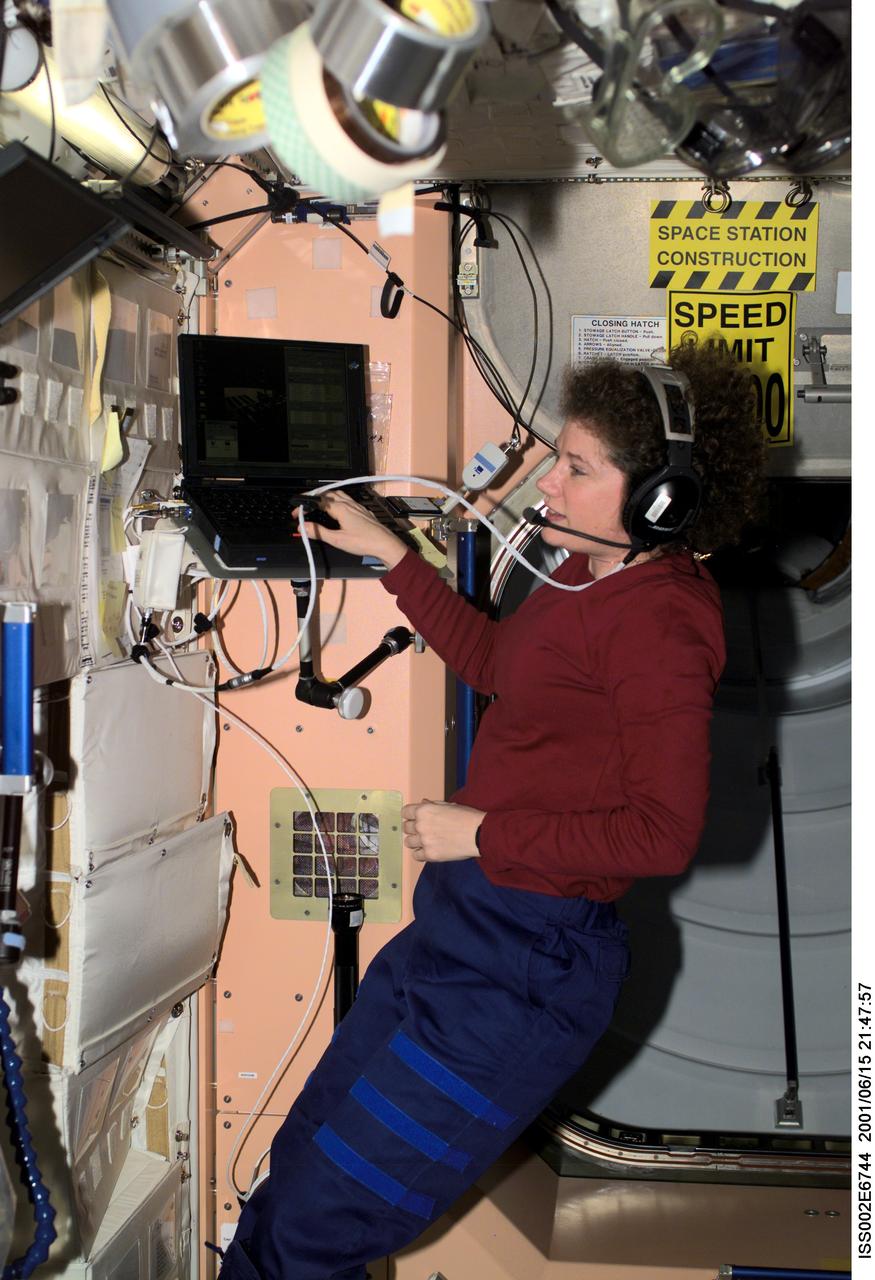
ISS002-E-6744 (15 June 2001) --- Susan J. Helms, Expedition Two flight engineer, talks with mission control while working on a laptop computer in Unity Node 1.
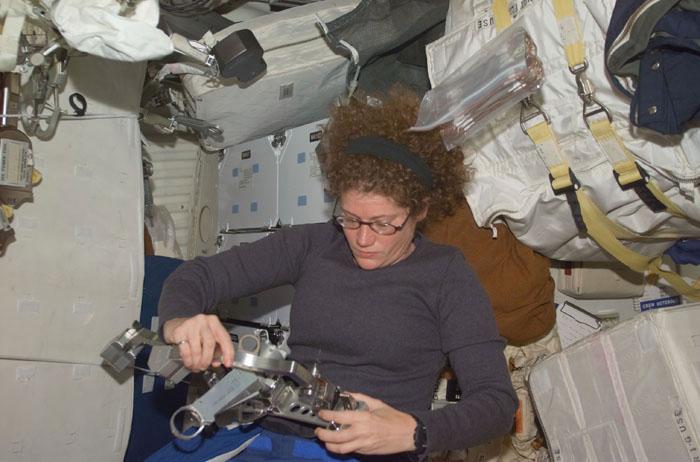
STS102-E-5031 (9 March 2001) --- On Discovery's mid deck, astronaut Susan J. Helms, STS-102 mission specialist, checks gear associated with her upcoming space walk.
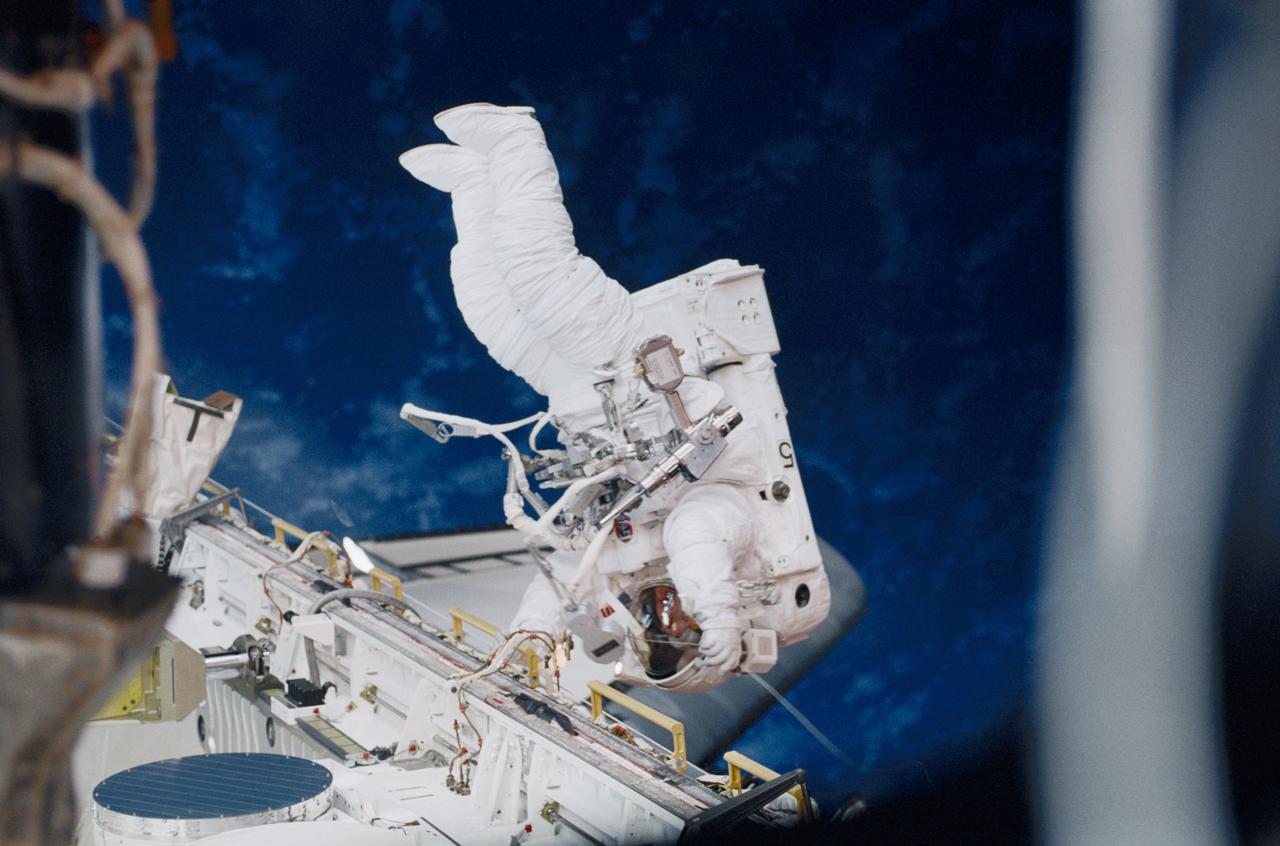
STS102-353-004 (11 March 2001) --- Astronaut Susan J. Helms translates along the longerons of the Space Shuttle Discovery during the first of two STS-102 space walks.
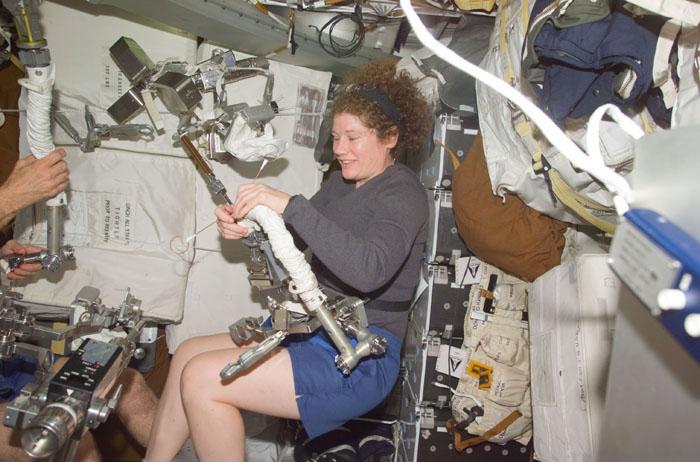
STS102-E-5033 (9 March 2001) --- On Discovery's mid deck, astronaut Susan J. Helms, STS-102 mission specialist, checks gear associated with her upcoming space walk.
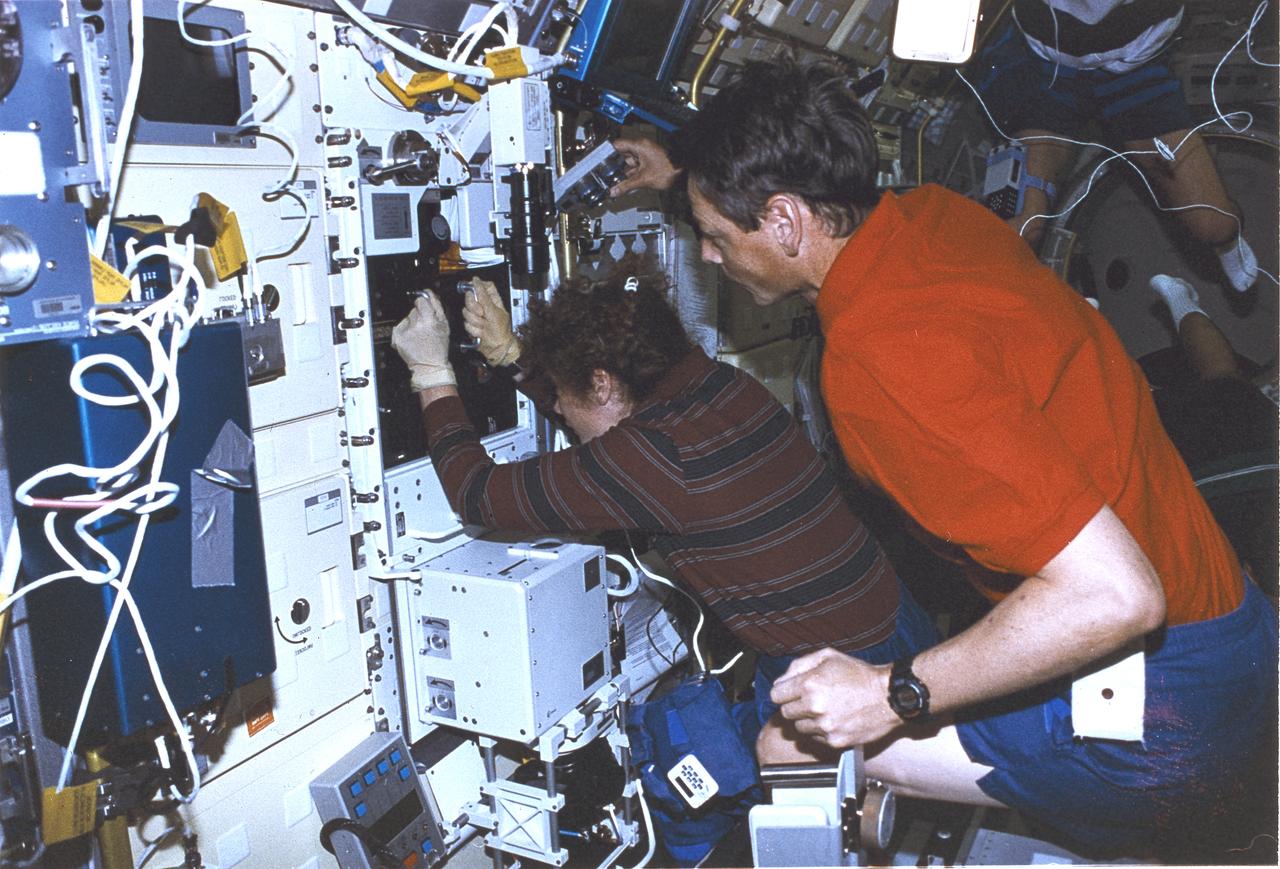
Launched on June 20, 1996, the STS-78 mission’s primary payload was the Life and Microgravity Spacelab (LMS), which was managed by the Marshall Space Flight Center (MSFC). During the 17 day space flight, the crew conducted a diverse slate of experiments divided into a mix of life science and microgravity investigations. In a manner very similar to future International Space Station operations, LMS researchers from the United States and their European counterparts shared resources such as crew time and equipment. Five space agencies (NASA/USA, European Space Agency/Europe (ESA), French Space Agency/France, Canadian Space Agency /Canada, and Italian Space Agency/Italy) along with research scientists from 10 countries worked together on the design, development and construction of the LMS. This onboard photo represents payload commander Susan Helms and fellow astronaut in the LMS.
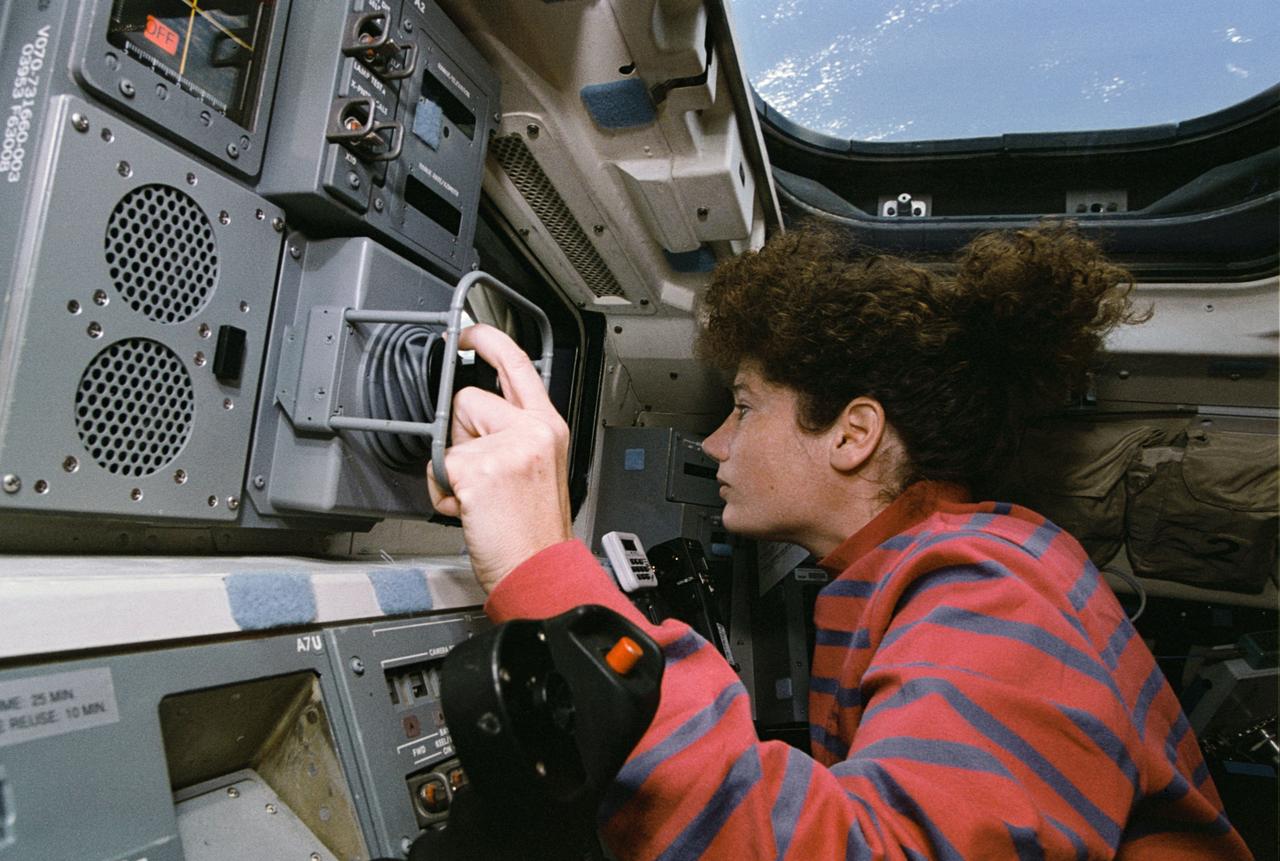
STS064-05-028 (9-20 Sept. 1994) --- On the space shuttle Discovery's aft flight deck, astronaut Susan J. Helms handles controls for the Remote Manipulator System (RMS). The robot arm operated by Helms, who remained inside the cabin, was used to support several tasks performed by the crew during the almost 11-day mission. Those tasks included the release and retrieval of the free-flying Shuttle Pointed Autonomous Research Tool For Astronomy 201 (SPARTAN 201), a six-hour spacewalk and the Shuttle Plume Impingement Flight Experiment (SPIFEX). Photo credit: NASA or National Aeronautics and Space Administration
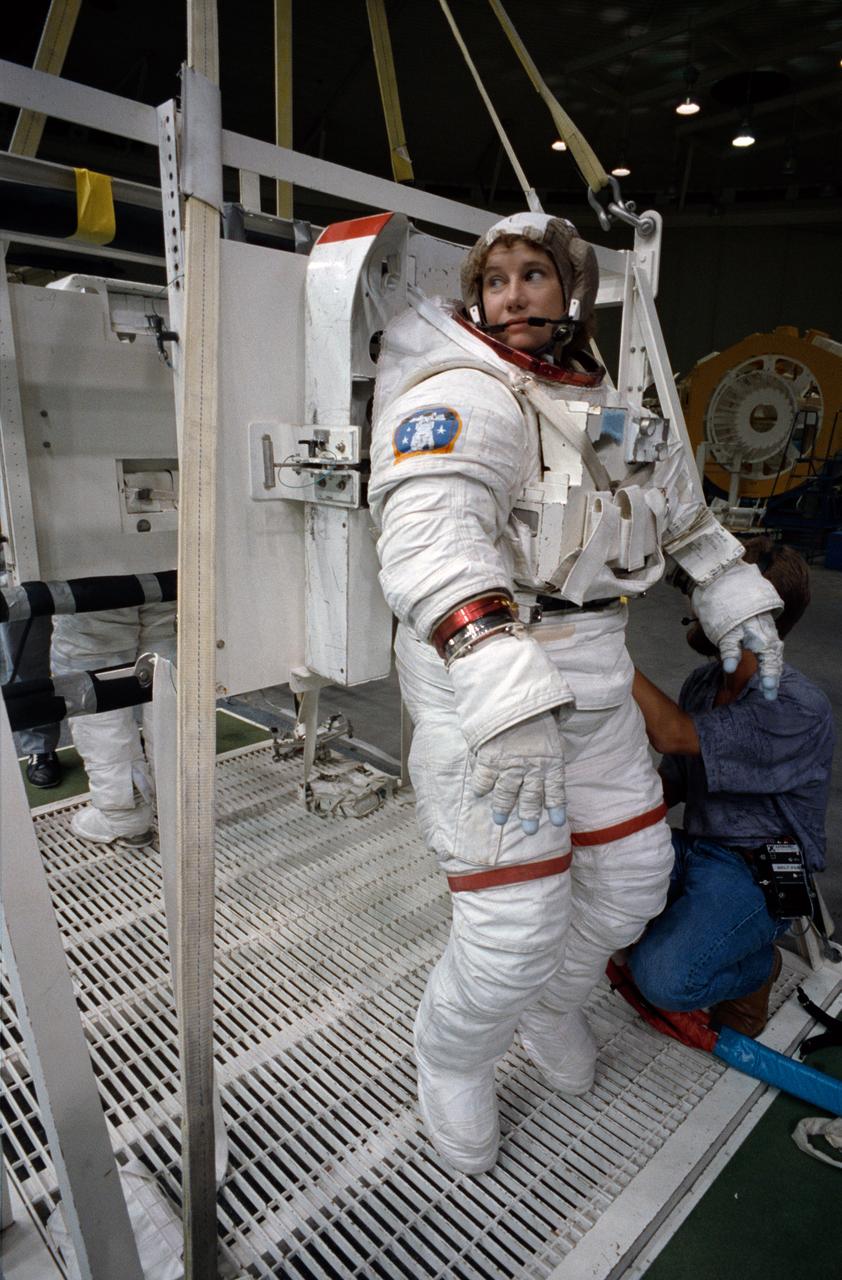
S92-42753 (31 July 1992) --- Astronaut Susan J. Helms, mission specialist assigned to fly aboard the Space Shuttle Endeavour for the STS-54 mission, gets assistance to complete the donning of her spacesuit. Though not assigned to the scheduled extravehicular activity (EVA), Helms is trained in the weightless environment training facility (WET-F). She will aid astronauts Gregory J. Harbaugh and Mario Runco Jr. in their planned EVA, scheduled for January of next year, and serve a backup role. Wearing this high fidelity training version of the extravehicular mobility unit (EMU), Helms was later lowered into the 25-ft. deep WET-F pool. The pressurized suit is weighted so as to allow Helms to achieve neutral buoyancy and simulate the various chores of the spacewalk.
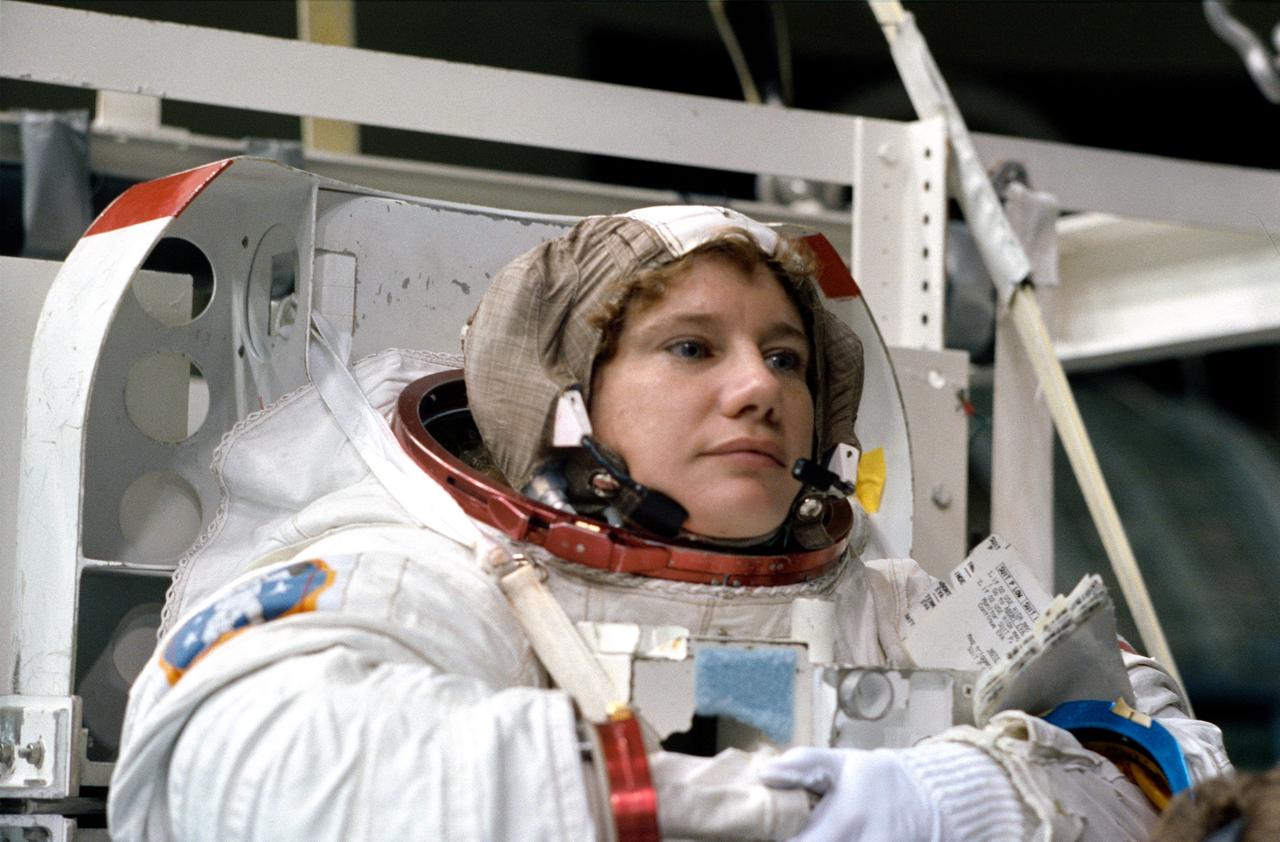
S92-42755 (31 July 1992) --- Astronaut Susan J. Helms, mission specialist assigned to fly aboard the Space Shuttle Endeavour for the STS-54 mission, completes the donning of her spacesuit before a training exercise. Though not assigned to the scheduled extravehicular activity (EVA), Helms is trained in the weightless environment training facility (WET-F). She will aid astronauts Gregory J. Harbaugh and Mario Runco Jr. in their planned EVA, scheduled for January of next year, and serve a backup role. Wearing this high fidelity training version of the extravehicular mobility unit (EMU), Helms was later lowered into the 25-ft. deep WET-F pool. The pressurized suit is weighted so as to allow Helms to achieve neutral buoyancy and simulate the various chores of the spacewalk.
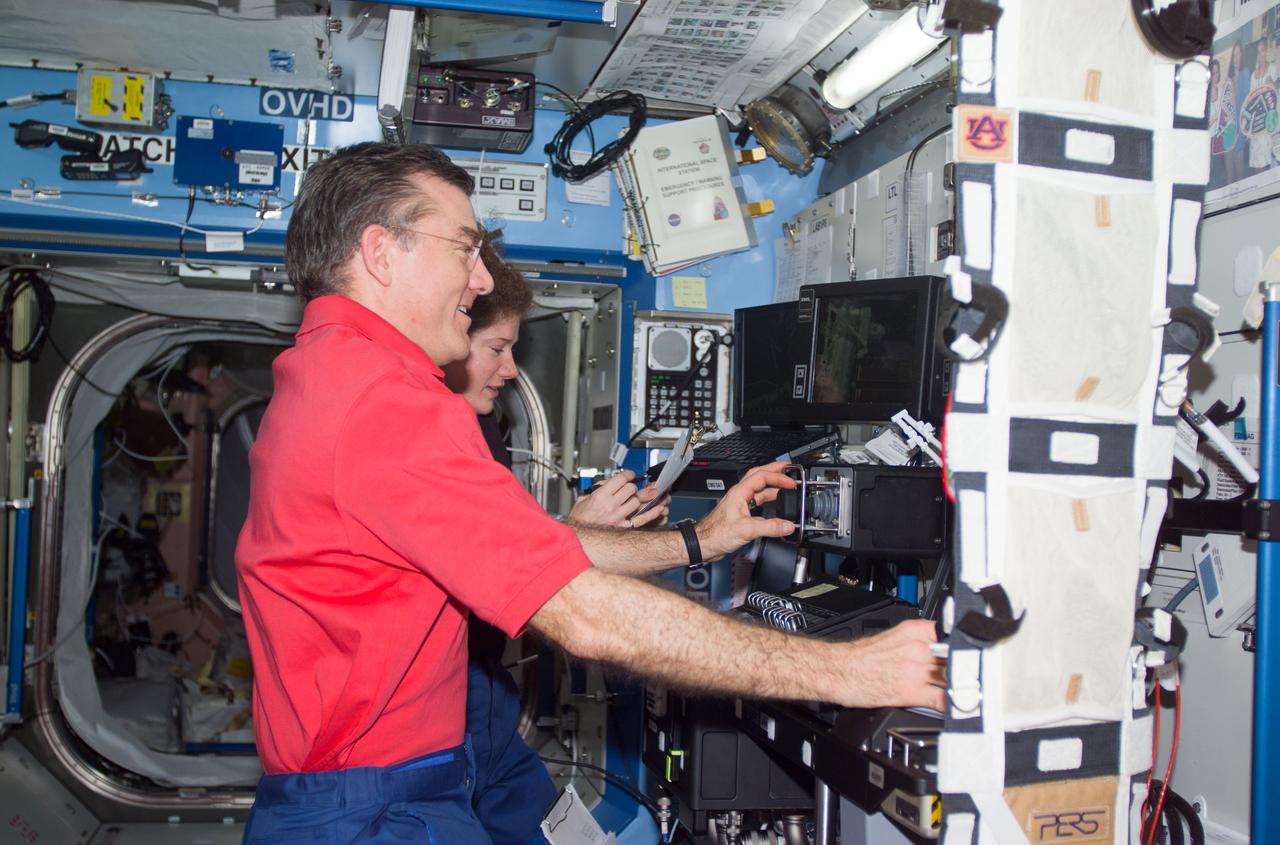
STS104-E-5225 (21 July 2001) --- A crew member used a digital still camera to take a picture of members of the Expedition Two crew at work in the Destiny laboratory. Within the final three weeks of their habitation aboard the International Space Station (ISS), astronauts James S. Voss and Susan J. Helms, flight engineers, both performed important maneuvers with the Canadarm2, Space Station Remote Manipulator System (SSRMS), during the STS-104 mission. Cosmonaut Yury V. Usachev, Expedition Two commander, is out of frame.
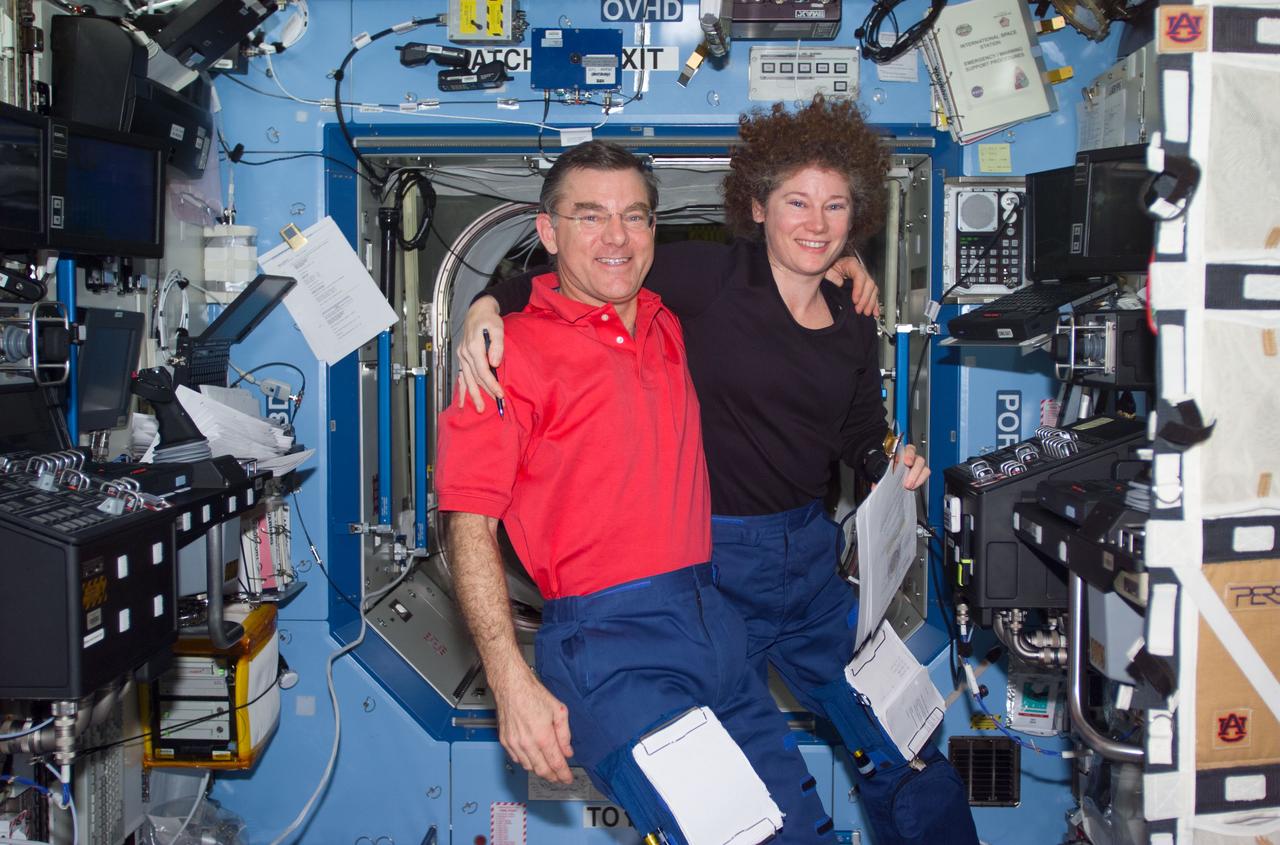
STS104-E-5223 (21 July 2001) --- A crew member used a digital still camera to take a picture of members of the Expedition Two crew in the Destiny laboratory. Within the final three weeks of their habitation aboard the International Space Station (ISS), astronauts James S. Voss and Susan J. Helms, flight engineers, both performed important maneuvers with the Canadarm2, Space Station Remote Manipulator System (SSRMS), during the STS-104 mission. Cosmonaut Yury V. Usachev, Expedition Two commander, is out of frame.
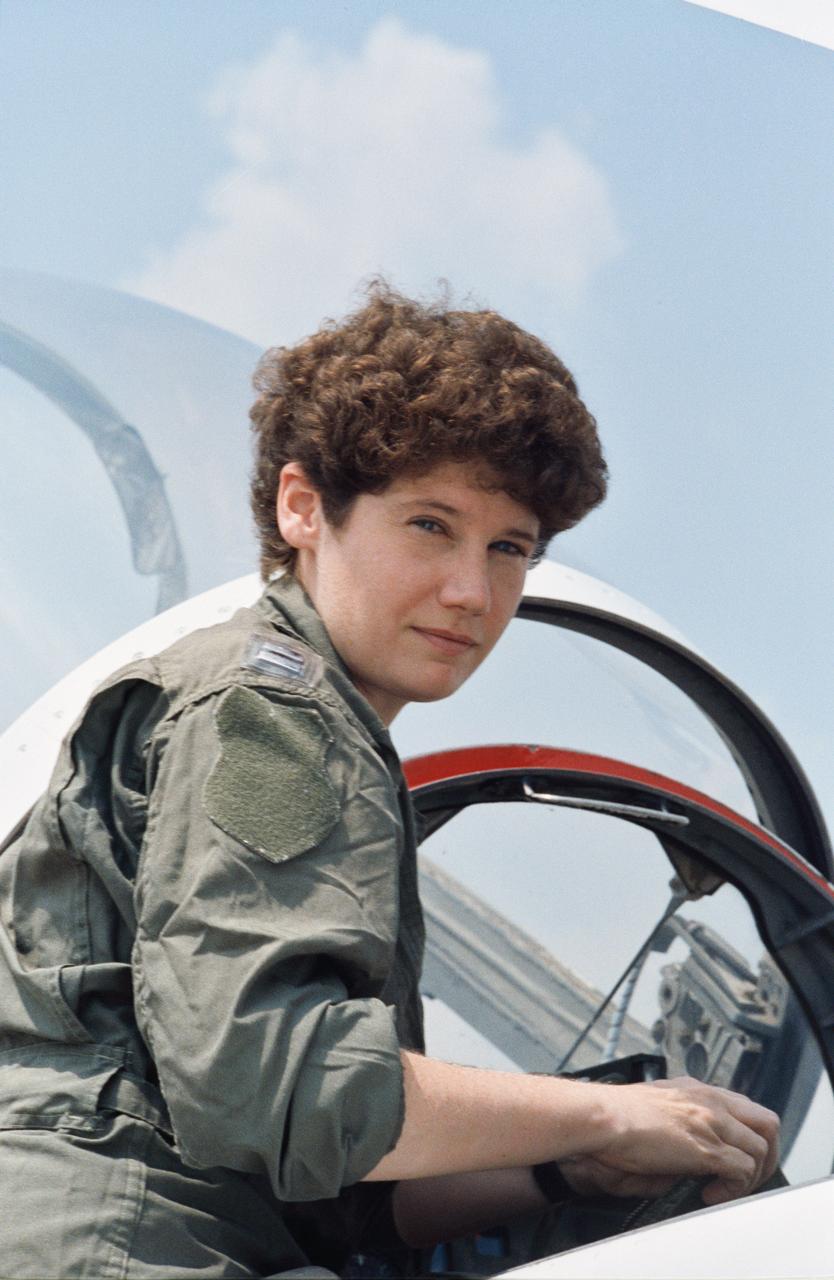
S90-45810 (29-31 July 1990) --- Susan J. Helms, one of 23 astronaut candidate who began a year's training and evaluation in July, climbs into a T-38 jet trainer during a survival training school at Vance Air Force Base in Oklahoma.
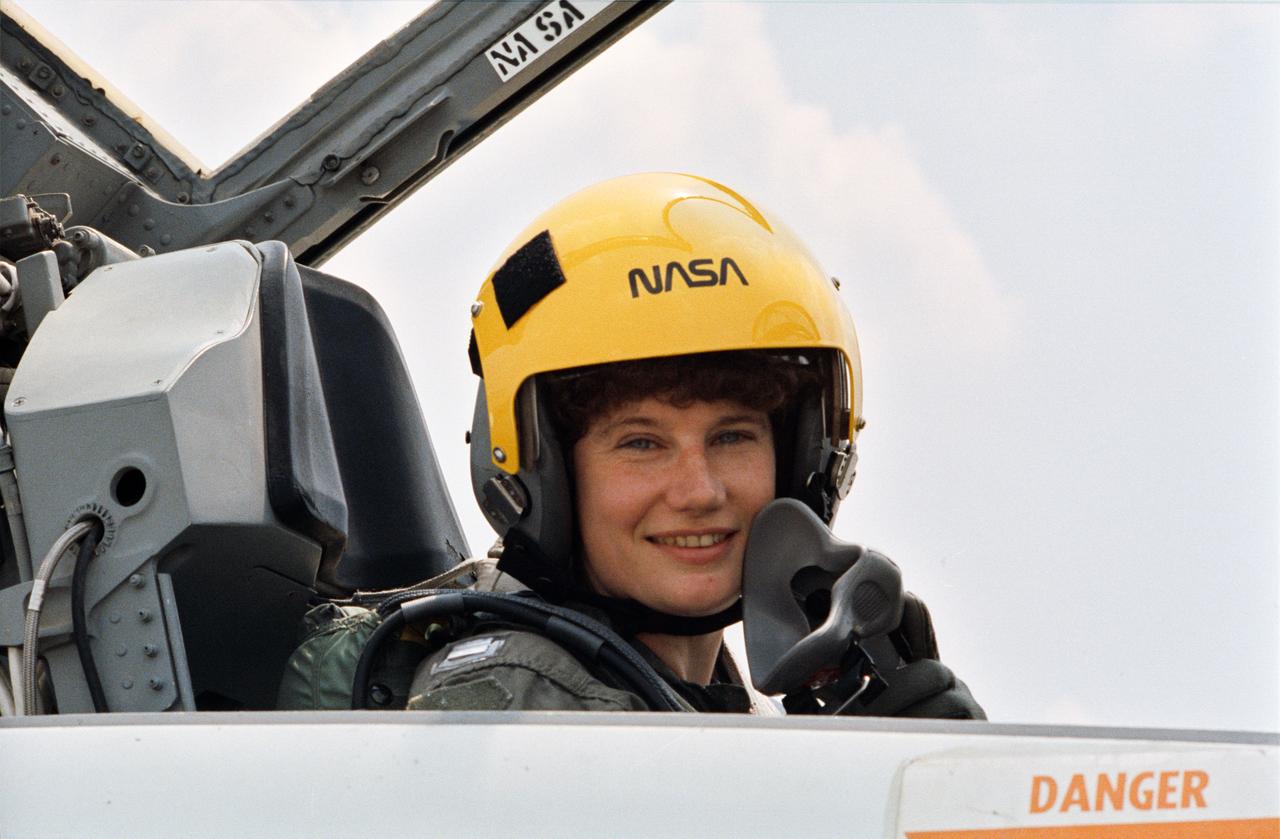
S90-45809 (July 1990) --- Susan J. Helms, one of the 23 astronaut candidates who began a year's training and evaluation program recently, sits in the cockpit of a NASA T-38 jet trainer at Ellington Field near the Johnson Space Center.
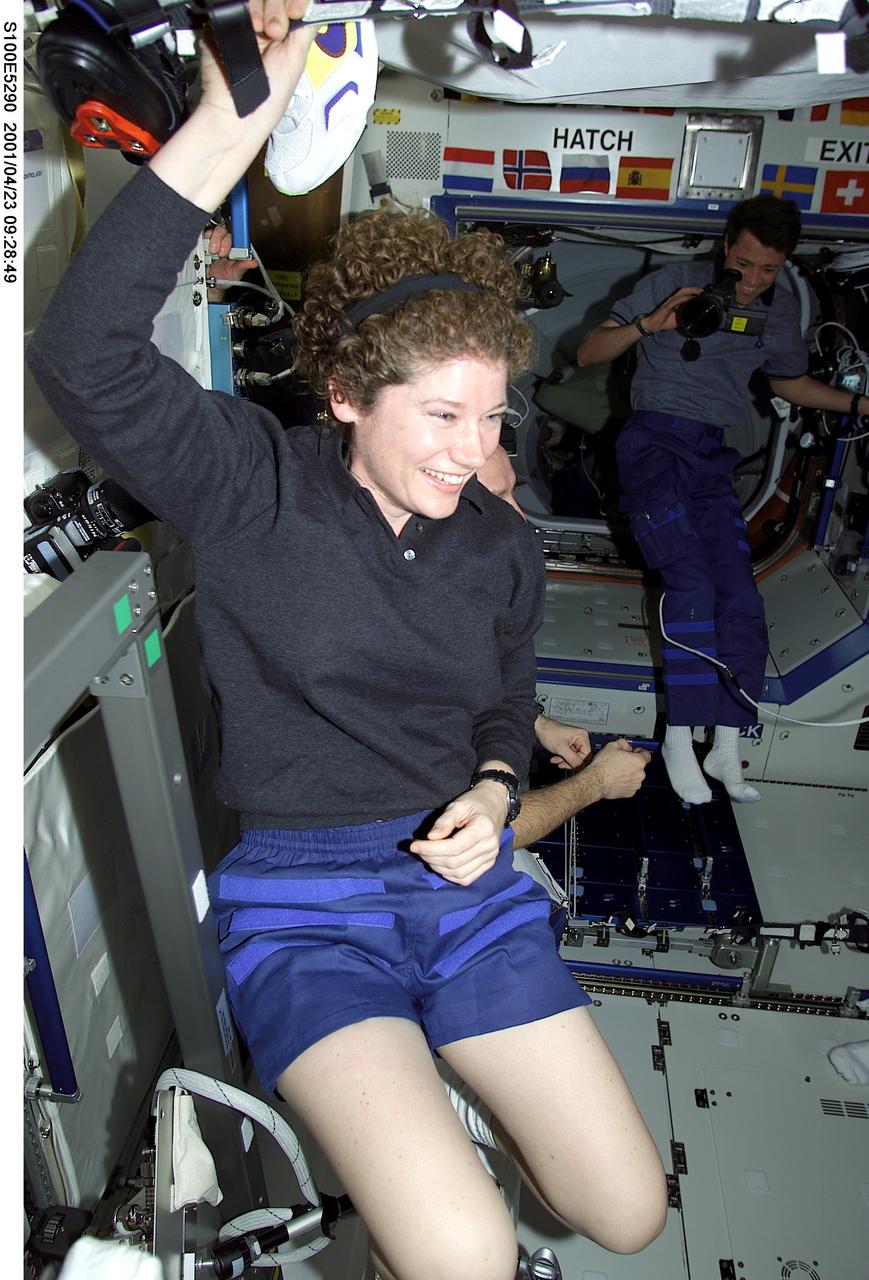
S100-E-5290 (23 April 2001)--- Astronaut Susan J. Helms, Expedition Two flight engineer, greets members of the STS-100 crew in the Destiny laboratory just after hatch opening. Astronaut Jeffrey S. Ashby, STS-100 pilot, documents the reunion in the background. The image was recorded with a digital still camera.
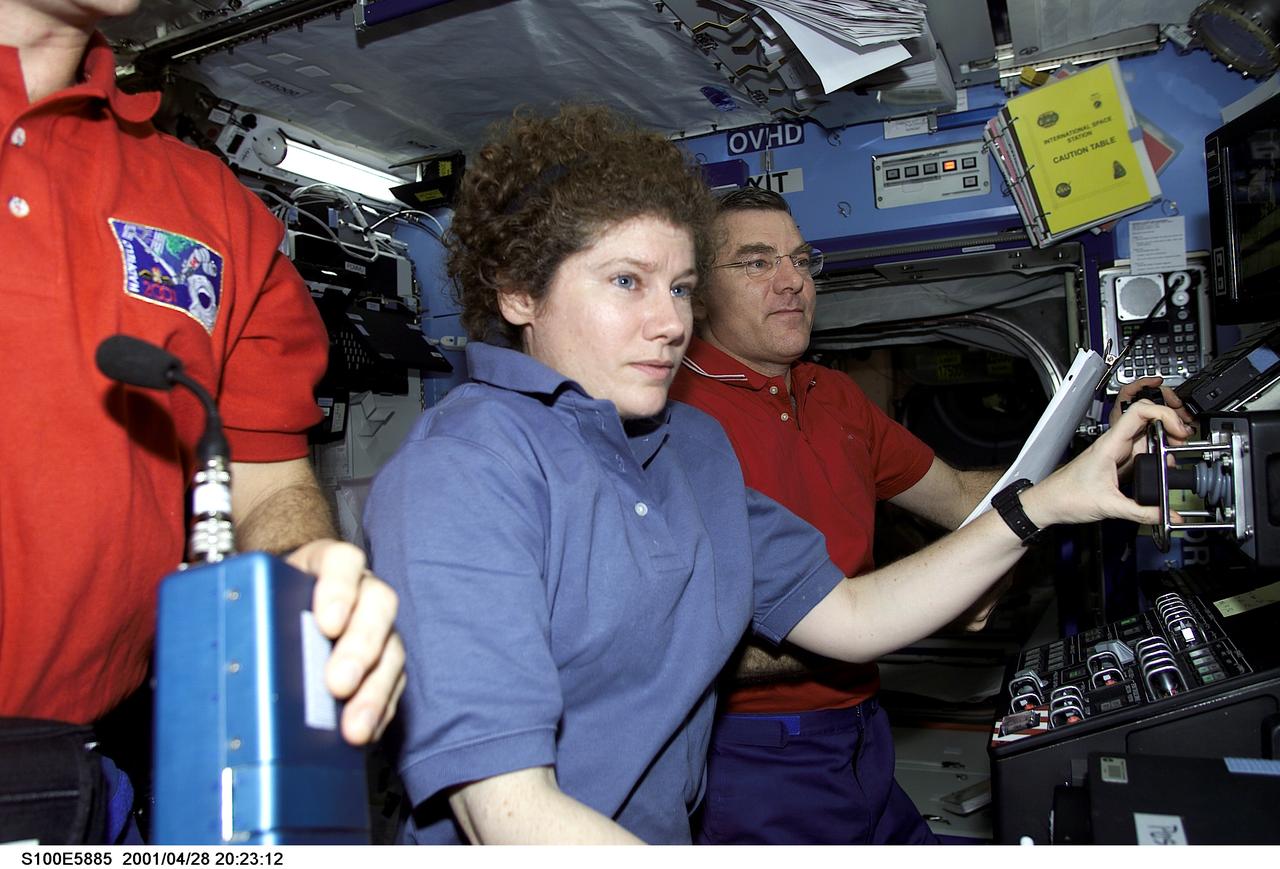
S100-E-5885 (28 April 2001) --- Some of the principal participants of an historical event are pictured in the Destiny laboratory aboard the International Space Station (ISS). From left to right are astronauts Chris A. Hadfield (partially out of frame), STS-100 mission specialist, and astronauts Susan J. Helms and James S. Voss, Expedition Two flight engineers. A Canadian “handshake in space” occurred at 4:02 p.m (CDT), April 28, 2001, as the Canadian-built space station robotic arm – operated by Helms – transferred its launch cradle over to Endeavour’s robotic arm, with Canadian Space Agency astronaut Hadfield at the controls. In this scene, Hadfield has temporarily vacated his post on Endeavour's aft flight deck and was having a brief strategy meeting with the Expedition Two crew on the docked station. The exchange of the pallet from station arm to shuttle arm marked the first ever robotic-to-robotic transfer in space. This image was recorded with a digital still camera.
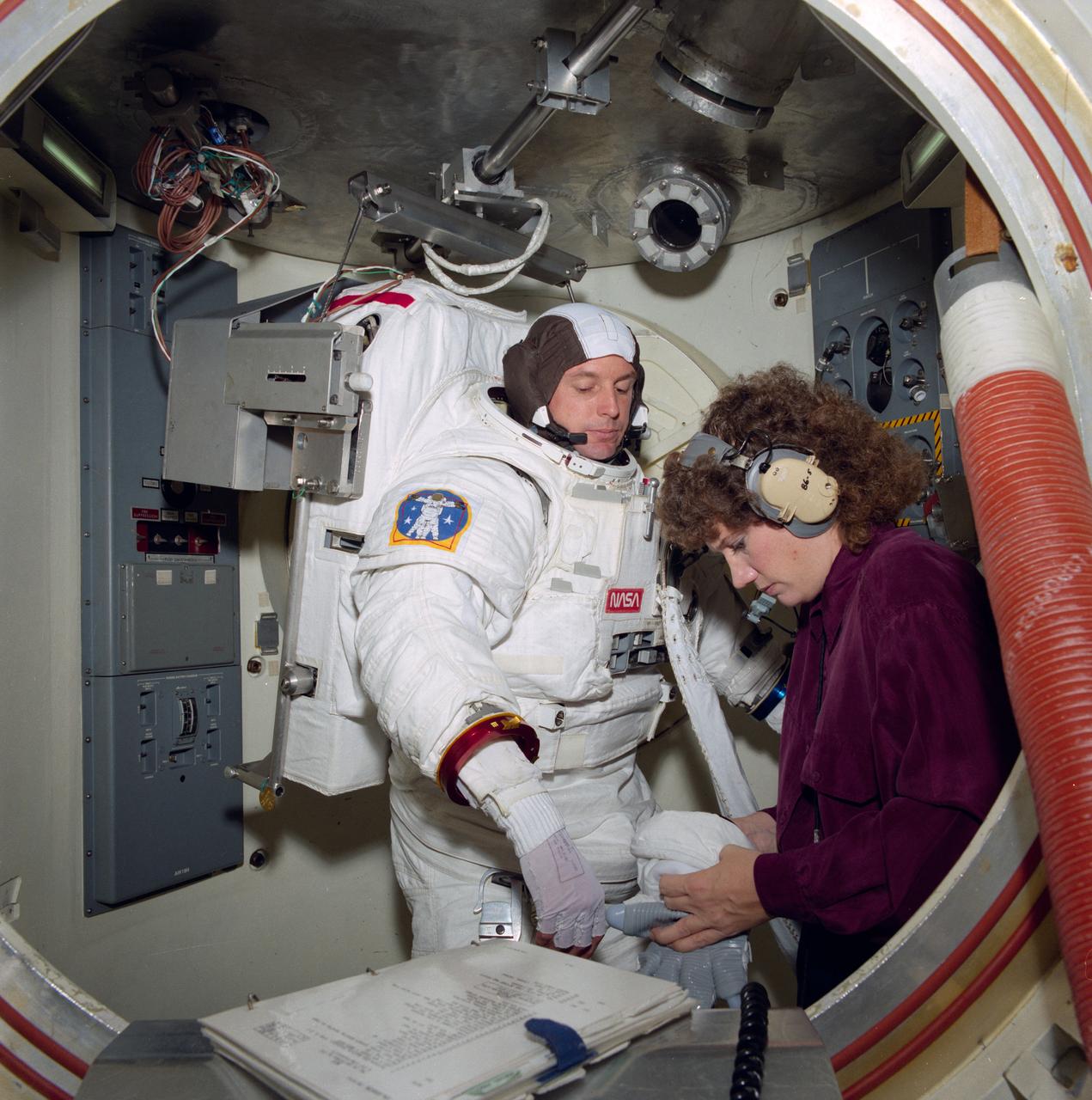
S92-49812 (11 Nov 1992) --- Astronauts Gregory J. Harbaugh and Susan J. Helms, mission specialists assigned to fly aboard the Space Shuttle Endeavour for the STS-54 mission, rehearse for the upcoming flight. The two are in the airlock of a trainer at the Johnson Space Center's crew systems laboratory. Harbaugh and Mario Runco Jr., also a mission specialist, have been assigned to perform a four-hour-plus extravehicular activity (EVA). Helms is to assist the pair of spacewalkers during the mission as well as in this training exercise.
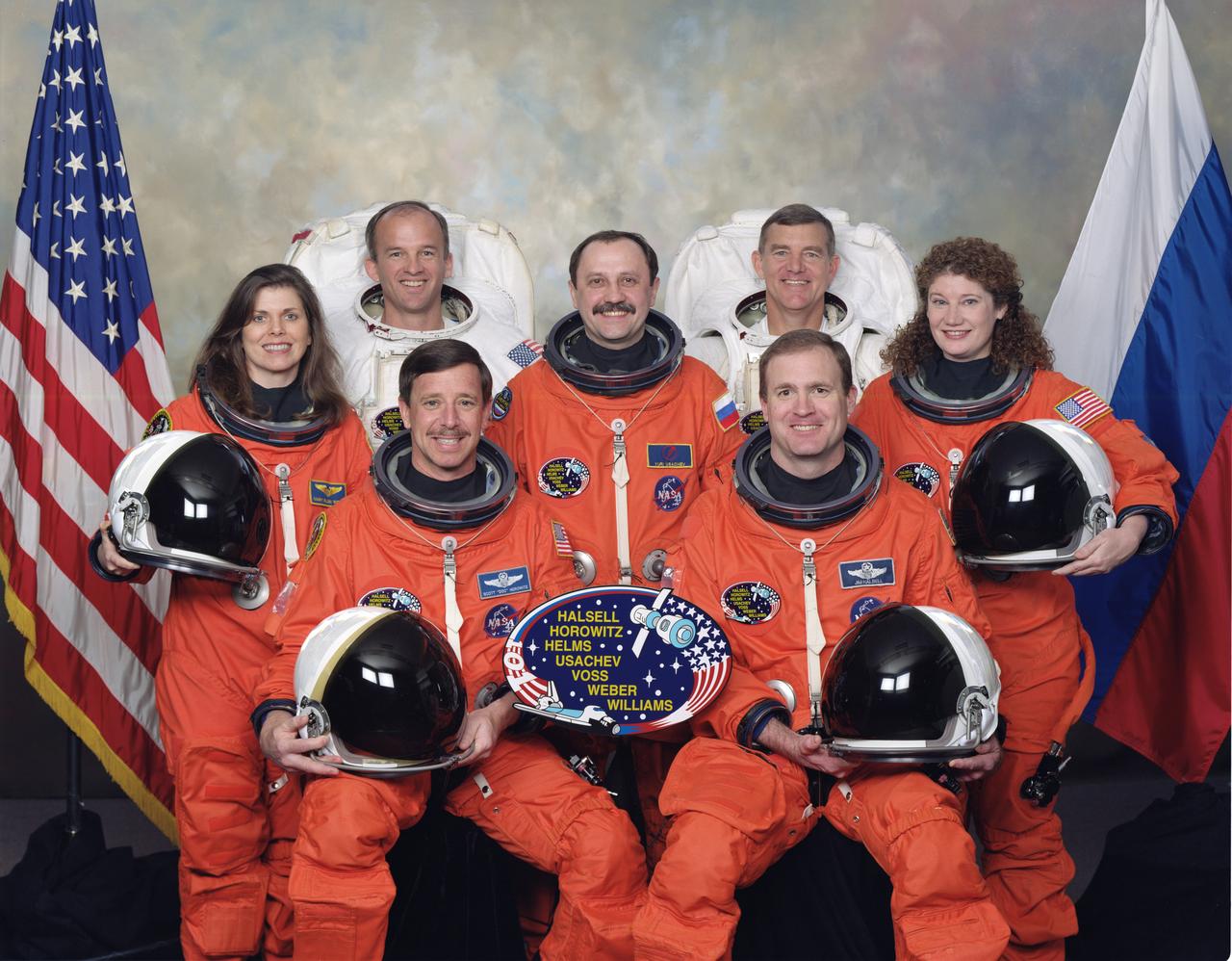
Six astronauts and a Russian cosmonaut comprised the STS-101 mission that launched aboard the Space Shuttle Atlantis on May 19, 2000 at 5:11 am (CDT). Seated in front are astronauts James D. Halsell (right), mission commander; and Scott J. Horowitz, pilot. Others, from the left, are Mary Ellen Weber, Jeffrey N. Williams, Yury V. Usachev, James S. Voss and Susan J. Helms, all mission specialists. Usachev represents the Russian Space Agency (RSA). The crew of the STS- 101 mission refurbished and replaced components in both the Zarya and Unity modules, with top priority being the Zarya module.
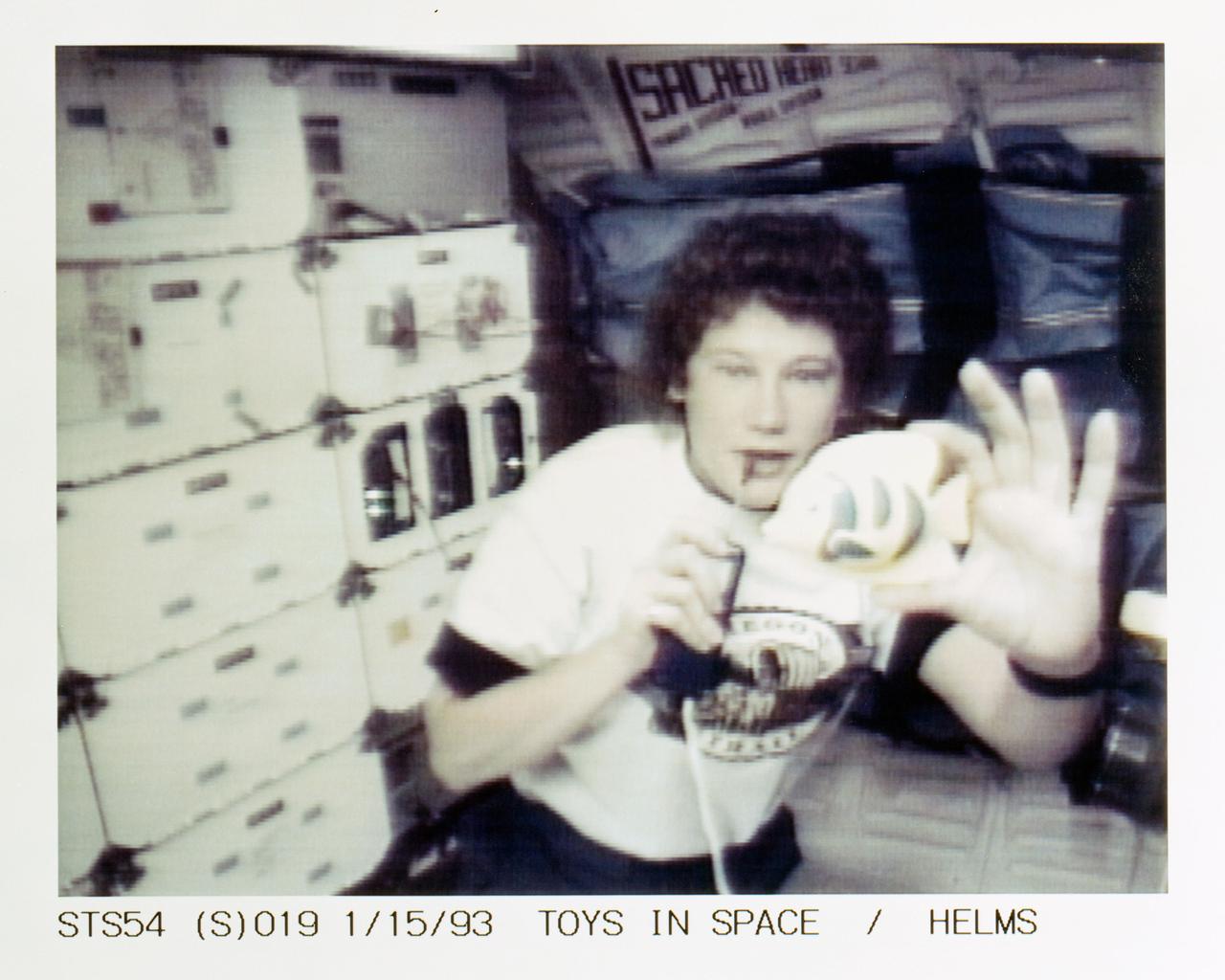
STS054-S-019 (15 Jan 1993) --- Helms with a fish toy on the middeck demonstrates some of the physics of toys to students watching on television. Four schools were chosen to ask questions of the astronauts during the lengthy program. Helms fielded questions from students at Shaver Elementary School in Portland, Oregon. The fish was used to demonstrate Newton's third law of motion and the conservation of angular momentum. The entire collection of toys will be videotaped for an educational program to be distributed to schools in the fall of this year. The scene was recorded at 17:50:08:27 GMT, Jan. 15, 1993.
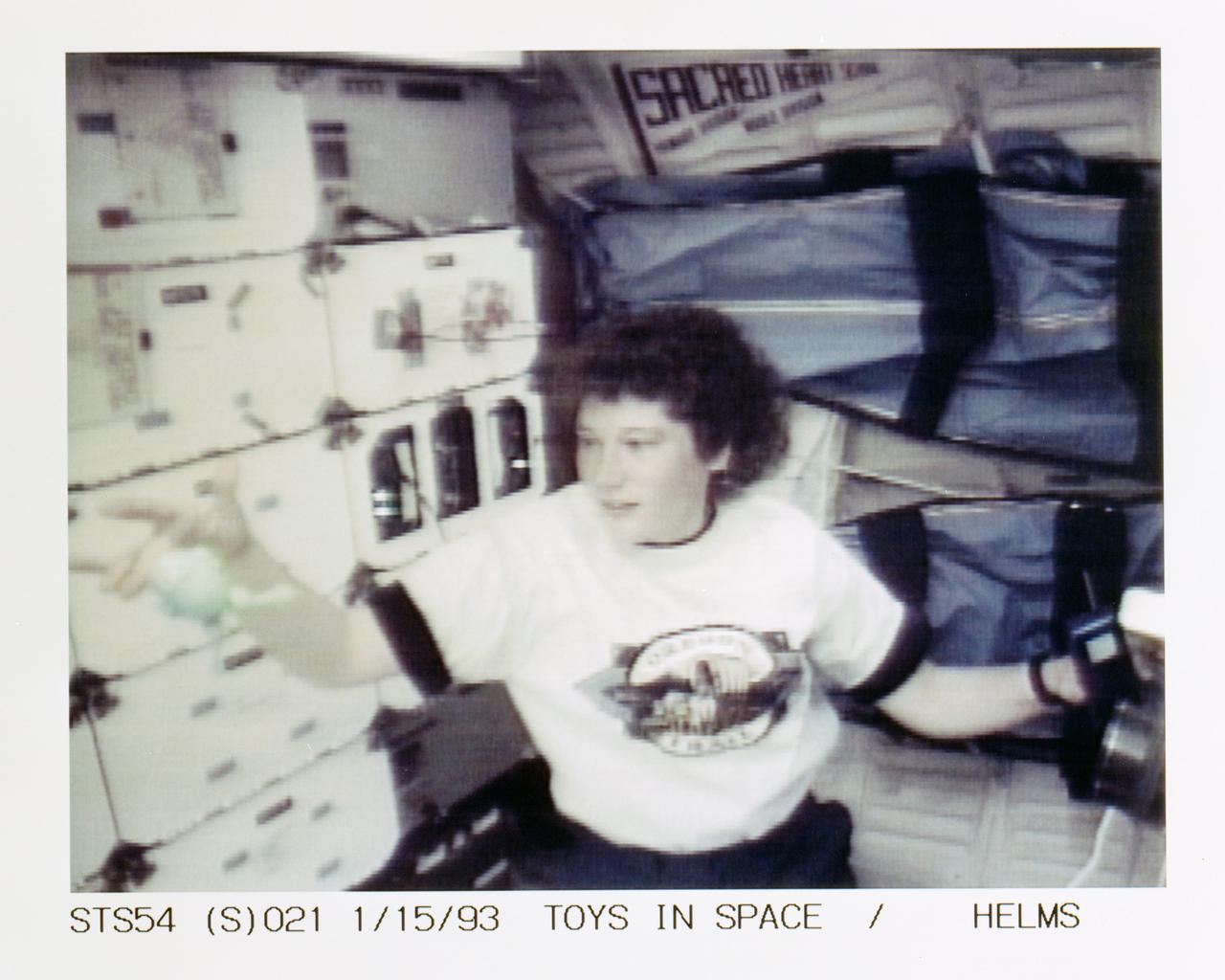
STS054-S-021 (15 Jan 1993) --- Helms with a frog swimmer toy on the middeck demonstrates some of the physics of toys to students watching on television. Four schools were chosen to ask questions of the astronauts during the lengthy program. Helms fielded questions from students at Shaver Elementary School in Portland, Oregon. The swimmer frog was used to demonstrate Newton's third law of motion and the conservation of angular momentum. The entire collection of toys will be videotaped for an educational program to be distributed to schools in the fall of this year. The scene was recorded at 17:51:38:12 GMT, Jan. 15, 1993.
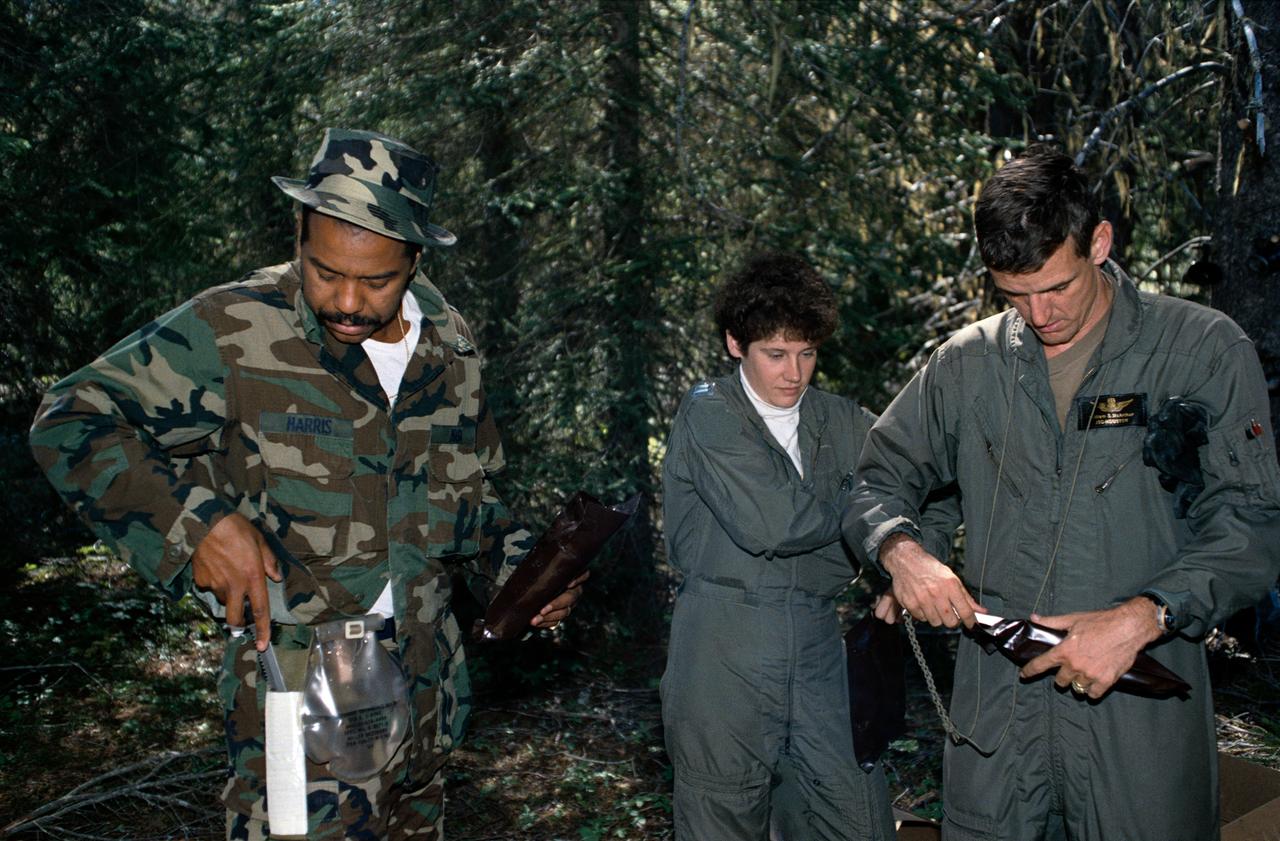
1990 Group 13 Astronaut Candidates (ASCANs) (left to right) Bernard J. Harris, Jr, Susan J. Helms, and William S. McArthur, Jr open dehydrated food packages during wilderness survival training at Fairchild Air Force Base (AFB) in Spokane, Washington. The training was conducted in the mountain forests of Washington from 08-26-90 through 08-30-90.
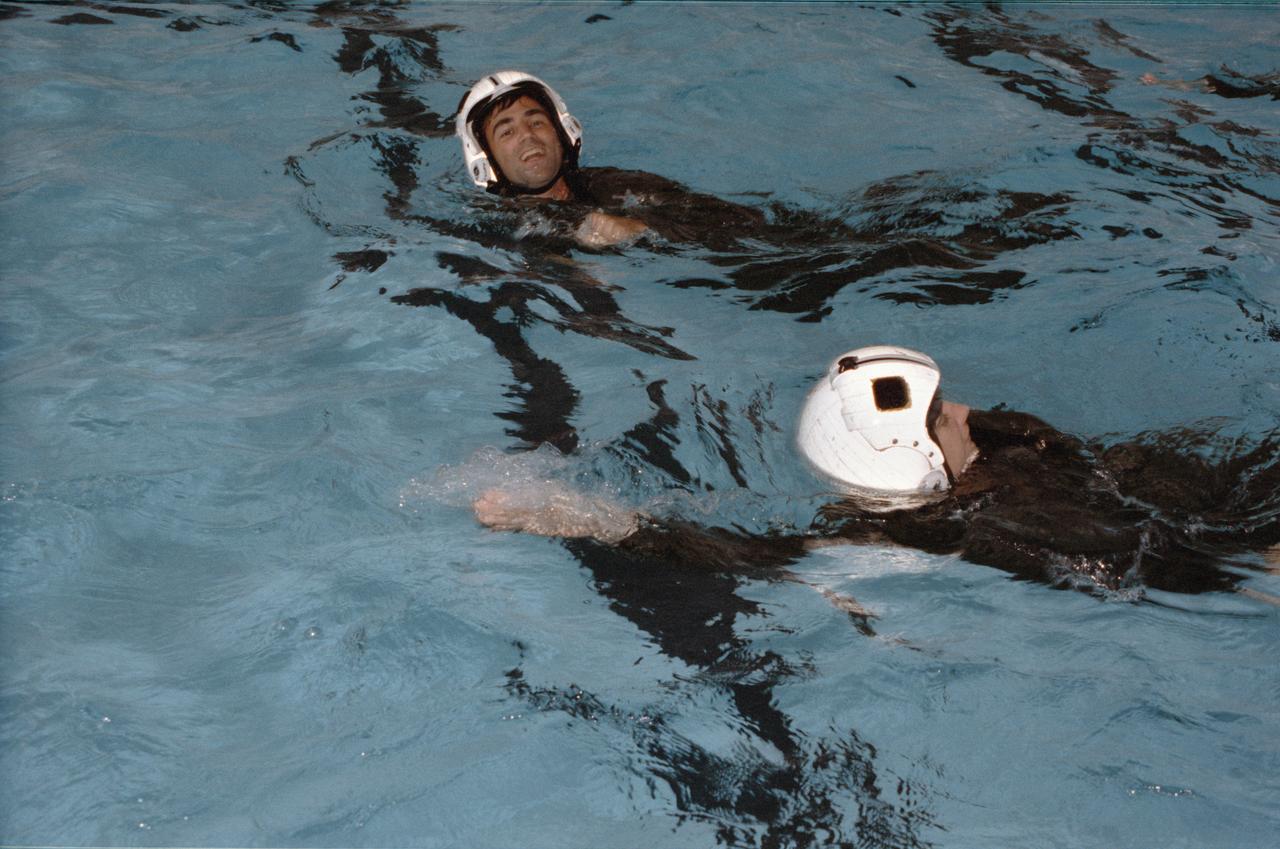
1990 Group 13 Astronaut Candidates (ASCANs) Susan J. Helms (foreground) and William G. Gregory, wearing helmets and flight suits, swim in pool at Elgin Air Force Base (AFB) in Pensacola, Florida, during water survival exercises. The training familiarized the candidates with survival techniques necessary in the event of a water landing. ASCANs participated in the exercises from 08-14-90 through 08-17-90.
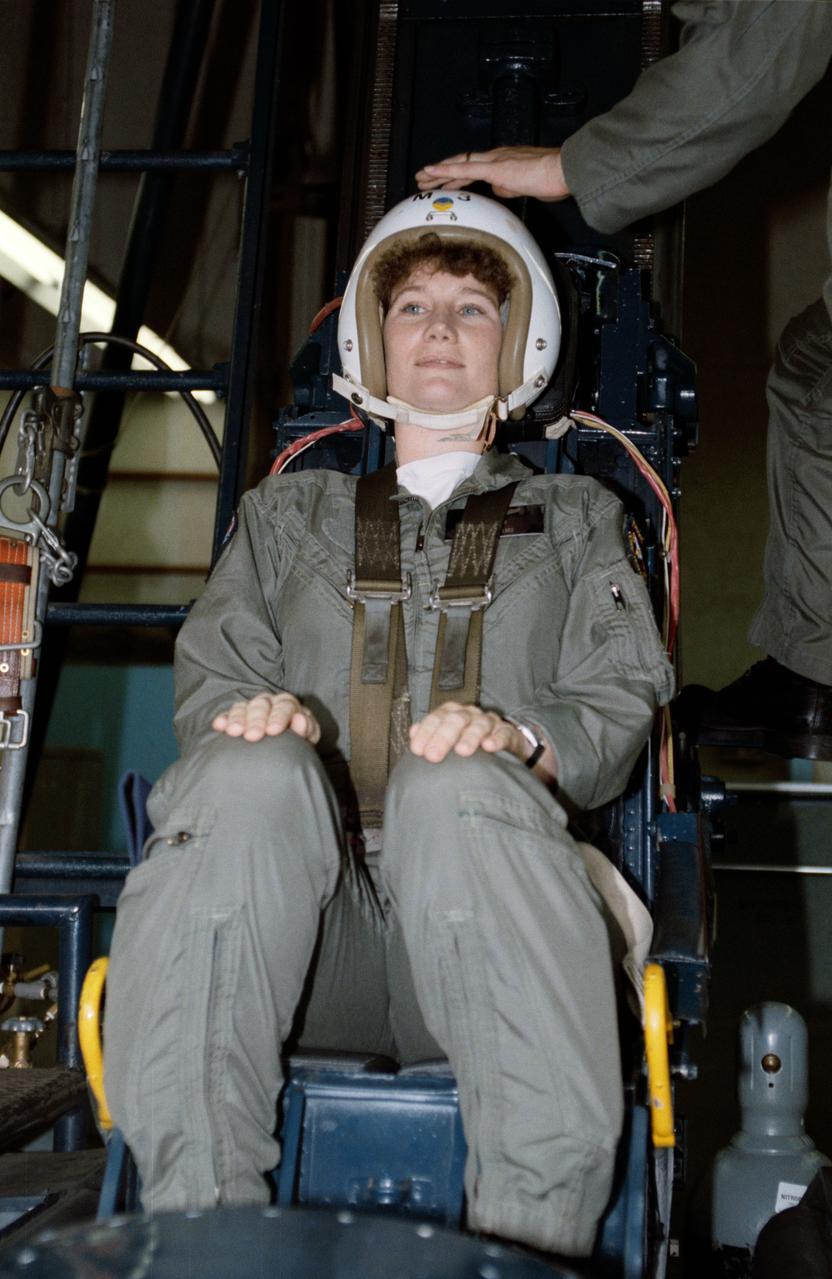
S90-45852 (29-31 July 1990) --- Susan J. Helms, one of 23 astronaut candidates who began a year's training and evaluation in July, participates in one of may sessions at a survival training course at Vance Air Force Base. This portion of the course is designed to familiarize the trainee with the "feel" of emergency ejection from a jet aircraft.
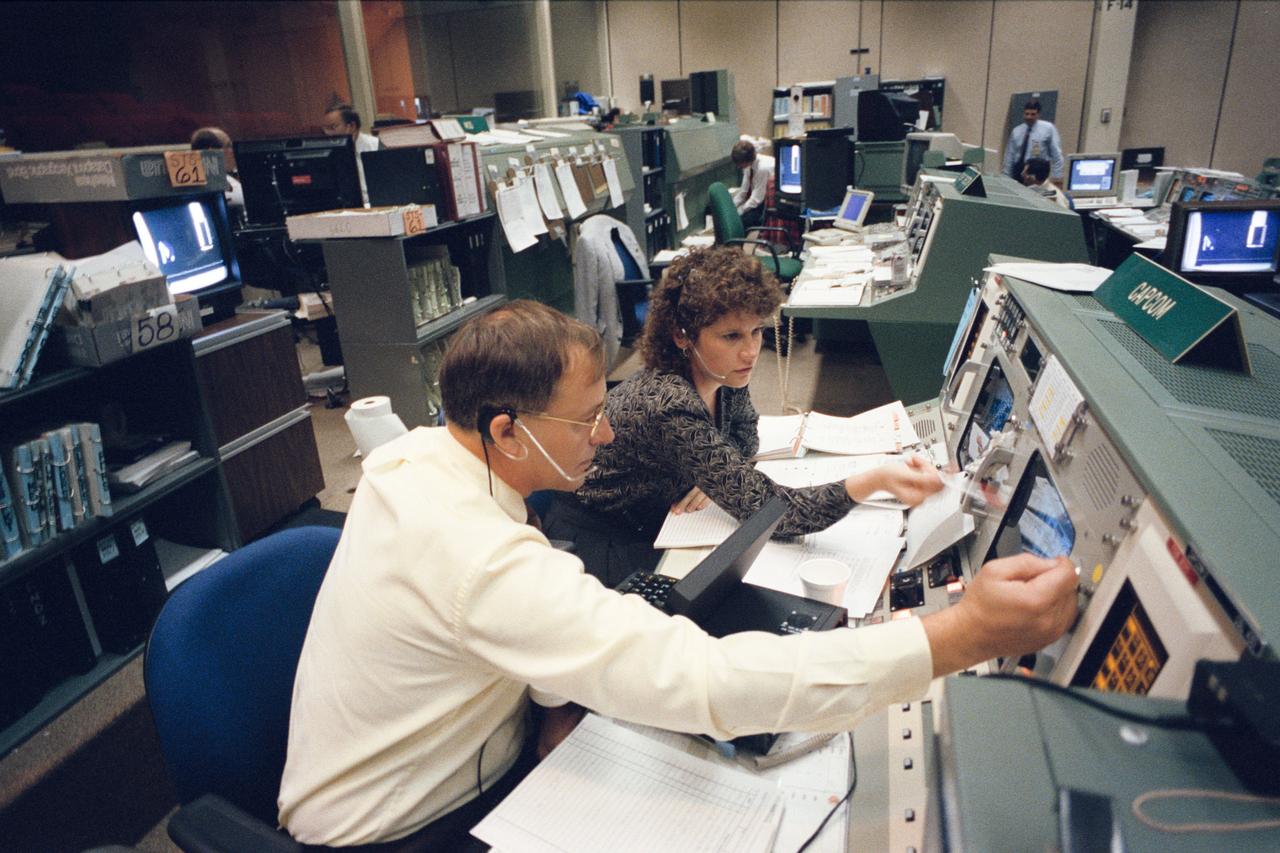
S93-43752 (1 Sept 1993) --- Astronauts Jerry L. Ross and Susan J. Helms are pictured at the Spacecraft Communicators Console during joint integrated simulations for the STS-61 mission. Astronauts assigned to extravehicular activity (EVA) tasks with the Hubble Space Telescope (HST) were simultaneously rehearsing in a Neutral Buoyancy Simulator (NBS) tank at the Marshall Space Flight Center (MSFC) in Alabama.
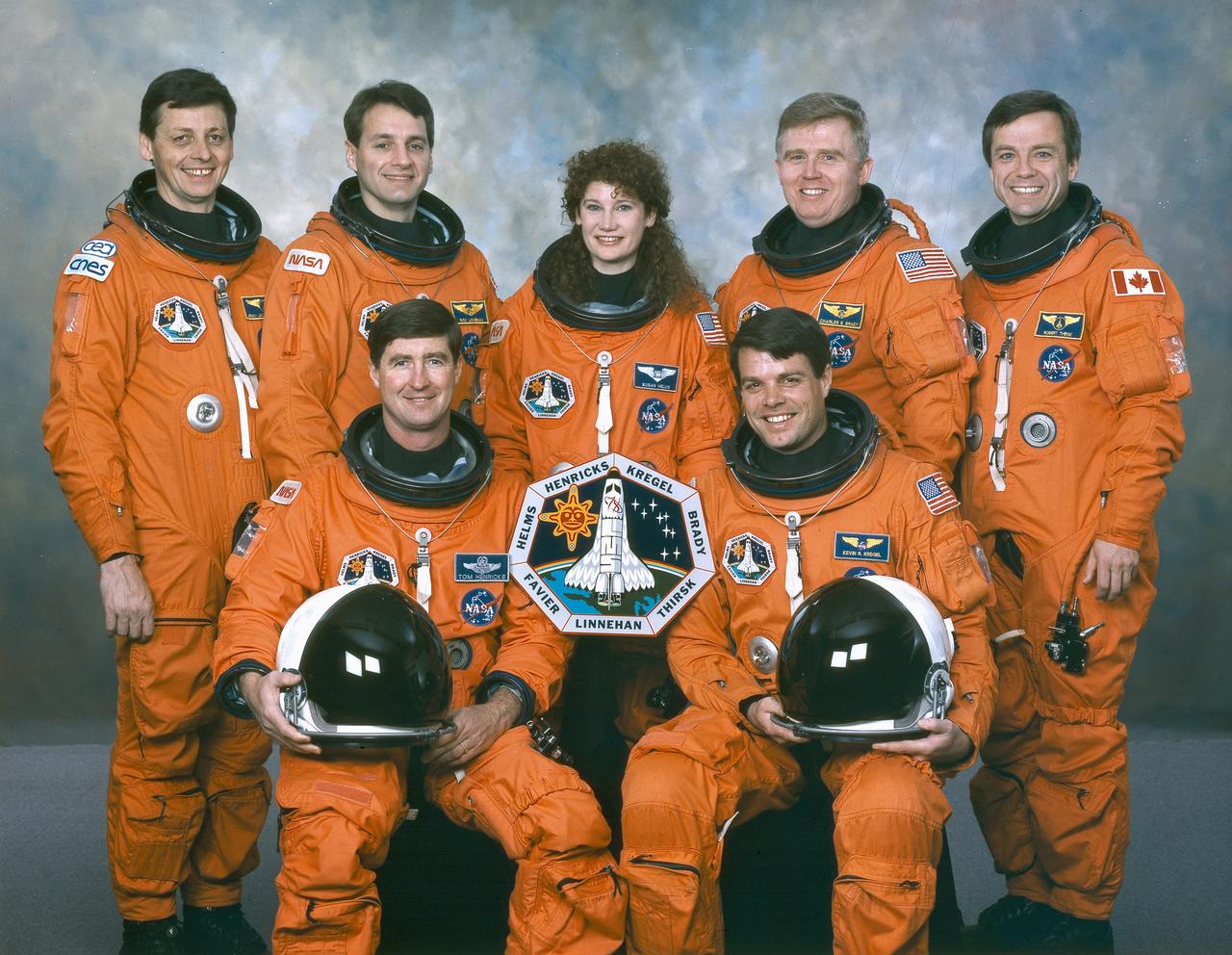
The crew assigned to the STS-78 mission included (seated left to right) Terrence T. (Tom) Henricks, commander; and Kevin R. Kregel, pilot. Standing, left to right, are Jean-Jacques Favier (CNES), payload specialist; Richard M. Linneham, mission specialist; Susan J. Helms, payload commander; Charles E. Brady, mission specialist; and Robert Brent Thirsk (CSA). Launched aboard the Space Shuttle Columbia on June 20, 1996 at 10:49:00 am (EDT), the STS-78 mission’s primary payloads was the Life and Microgravity Spacelab (LMS). Five space agencies (NASA/USA, European Space Agency/Europe (ESA), French Space Agency/France, Canadian Space Agency /Canada, and Italian Space Agency/Italy) along with research scientists from 10 countries worked together on the design, development and construction of the LMS.
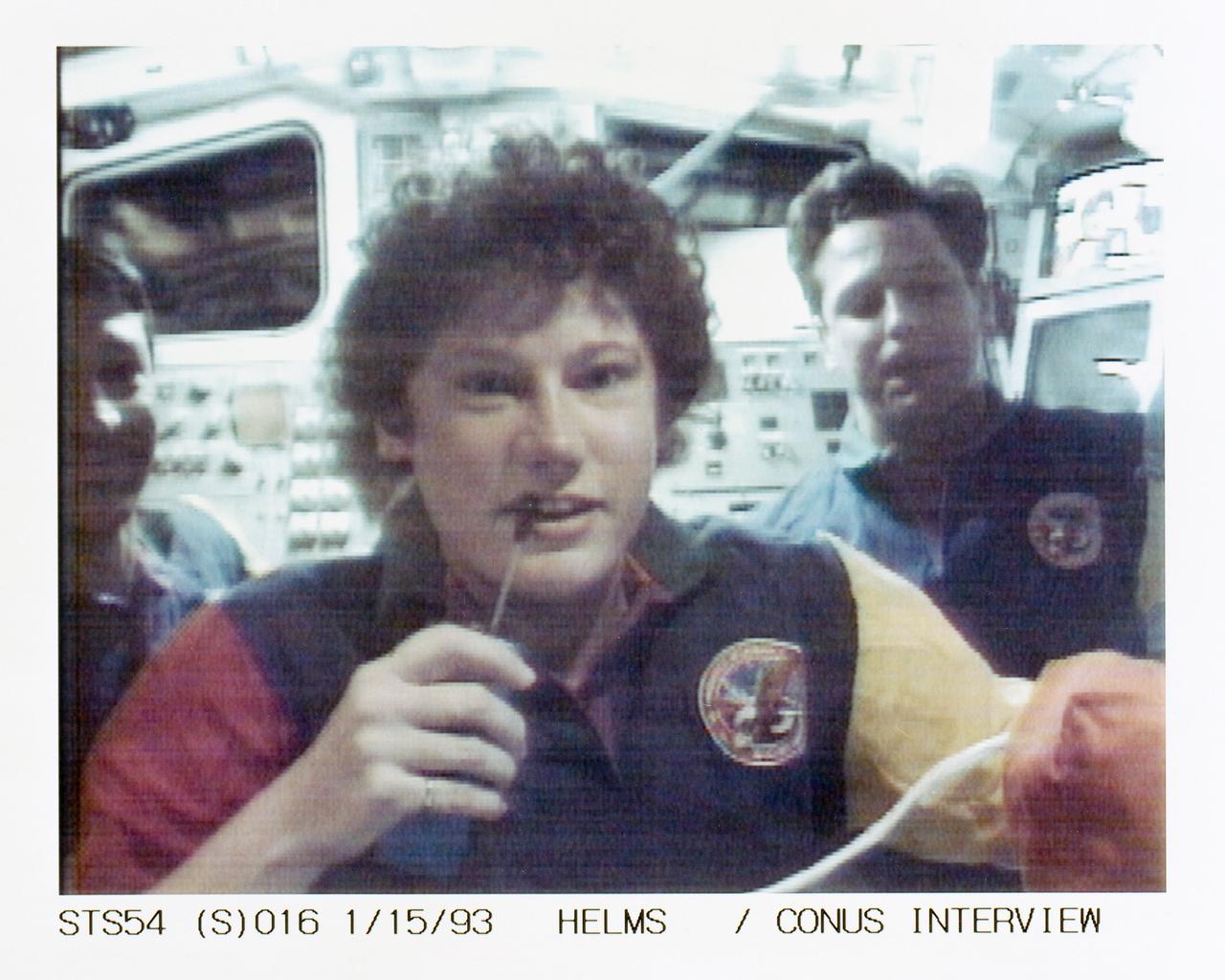
STS054-S-016 (15 Jan 1993) --- Helms talks to a radio station from the flight deck of Endeavour while Runco, left, and Harbaugh look on in the background. The scene was recorded at 13:54:14:13 GMT, Jan. 15, 1993.
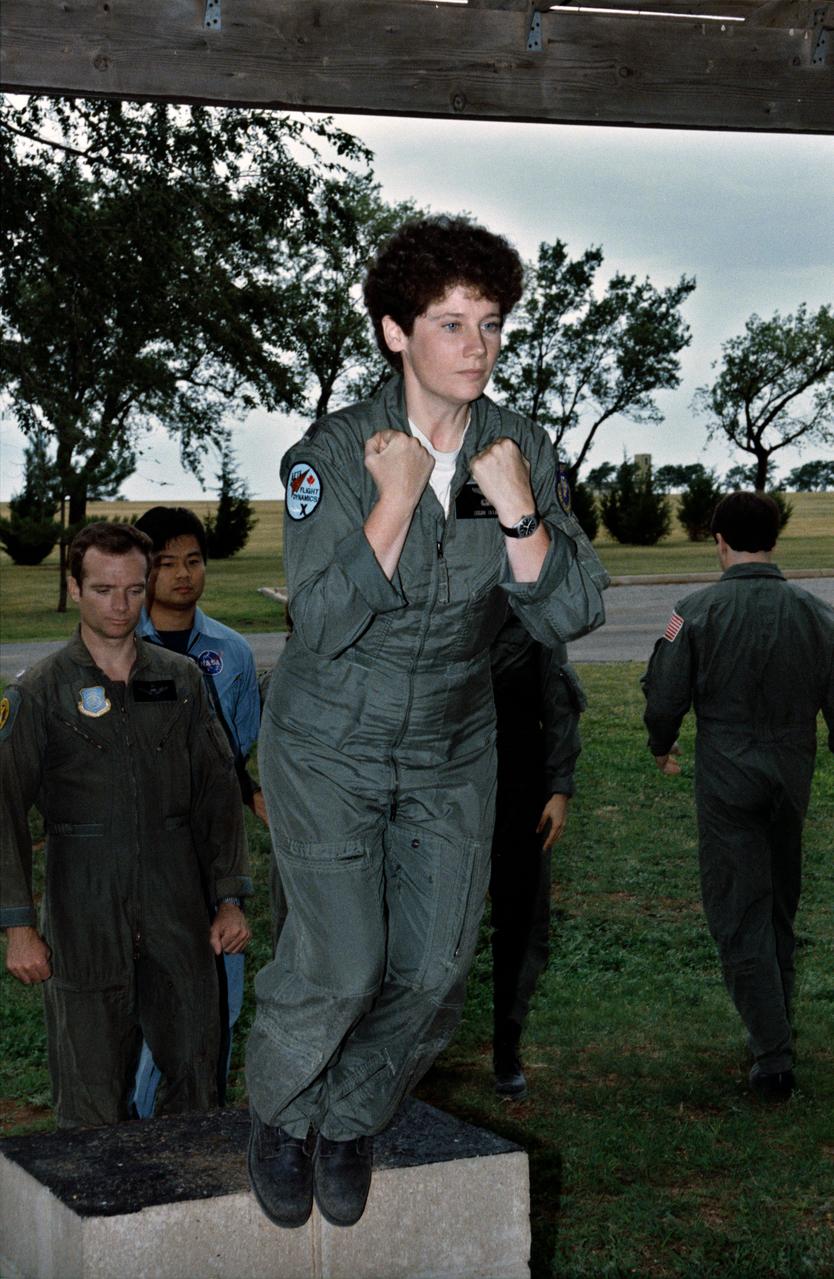
S90-48372 (29-31 July 1990) --- Mission specialist astronaut candidate Susan J. Helms simulates a parachute jump during a survival training course at Vance Air Force Base. She is one of 23 astronaut candidates from the Johnson Space Center who have joined military personnel for the special three-day training course. The course is designed to prepare the trainees for proper survival measures to take in the event of an emergency aboard the T-38 jet trainer aircraft they will frequently use once they become full-fledged astronauts.
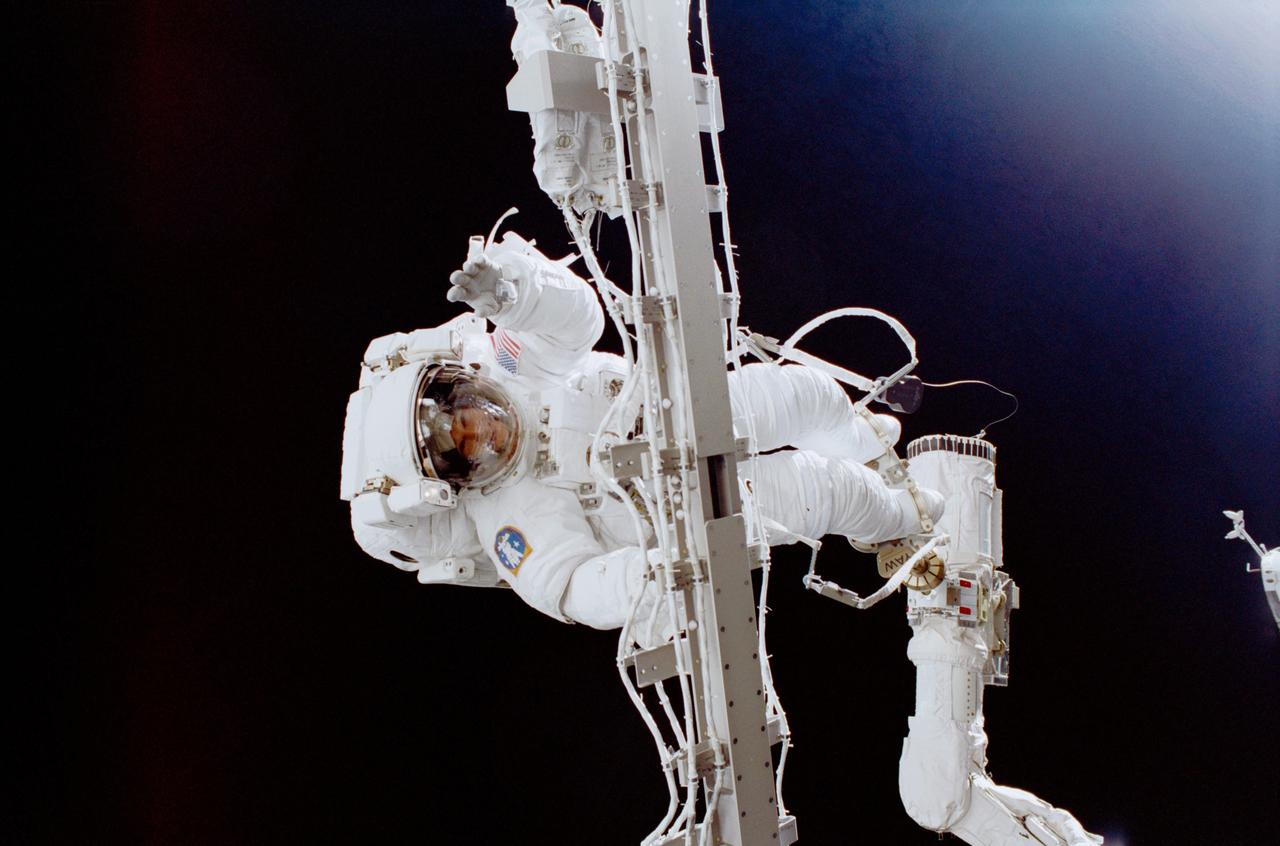
STS-102 mission astronaut Susan J. Helms works outside the International Space Station (ISS) while holding onto a rigid umbilical and her feet anchored to the Remote Manipulator System (RMS) robotic arm on the Space Shuttle Discovery during the first of two space walks. During this space walk, the longest to date in space shuttle history, Helms in tandem with James S. Voss (out of frame), prepared the Pressurized Mating Adapter 3 for repositioning from the Unity Module's Earth-facing berth to its port-side berth to make room for the Leonardo Multipurpose Logistics Module (MPLM) supplied by the Italian Space Agency. The Leonardo MPLM is the first of three such pressurized modules that will serve as the ISS's moving vans, carrying laboratory racks filled with equipment, experiments, and supplies to and from the Station aboard the Space Shuttle. The cylindrical module is approximately 21-feet long and 15- feet in diameter, weighing almost 4.5 tons. It can carry up to 10 tons of cargo in 16 standard Space Station equipment racks. Of the 16 racks the module can carry, 5 can be furnished with power, data, and fluid to support refrigerators or freezers. In order to function as an attached station module as well as a cargo transport, the logistics module also includes components that provide life support, fire detection and suppression, electrical distribution, and computer functions. Launched on May 8, 2001 for nearly 13 days in space, STS-102 mission was the 8th spacecraft assembly flight to the ISS and NASA's 103rd overall mission. The mission also served as a crew rotation flight. It delivered the Expedition Two crew to the Station and returned the Expedition One crew back to Earth.
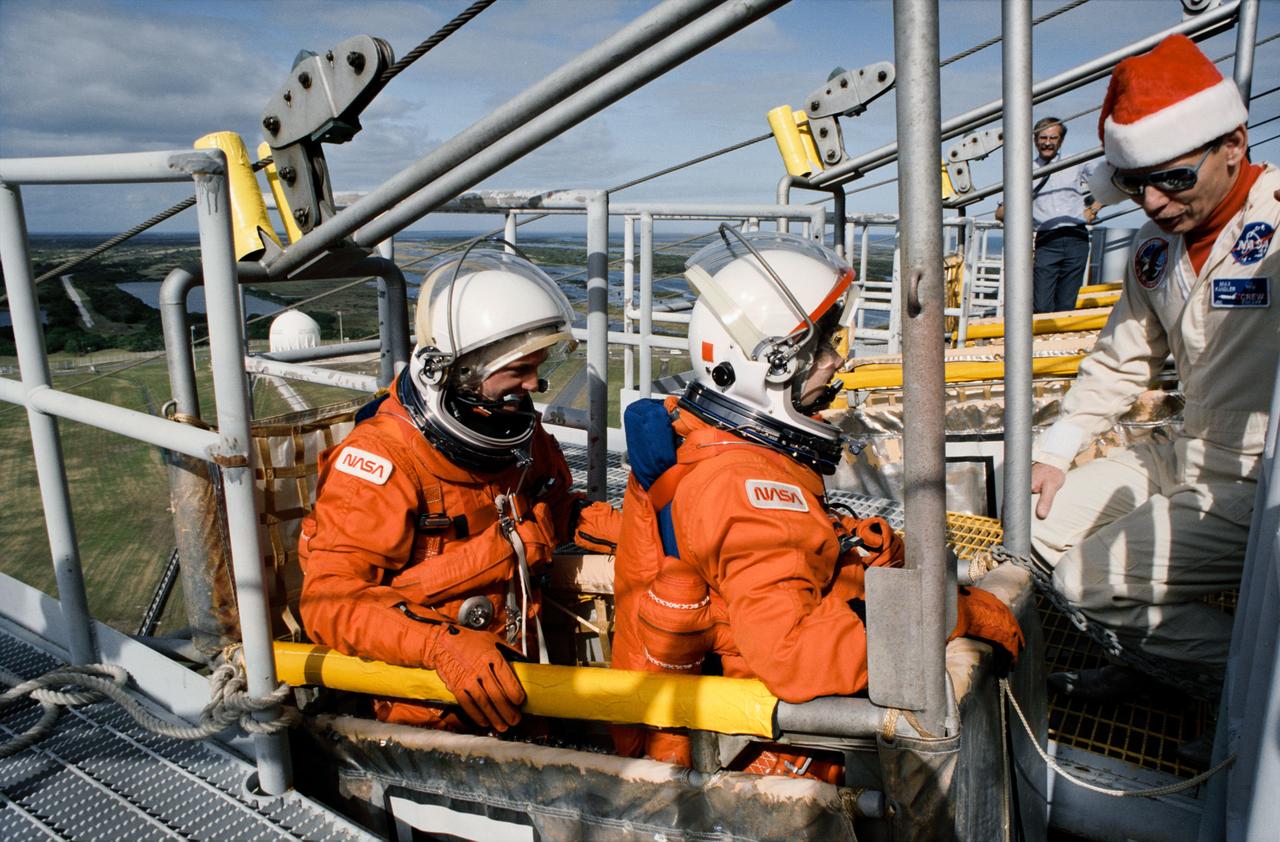
S93-25030 (15 Dec 1992) --- Two astronauts assigned to fly aboard Endeavour for the STS-54 mission are briefed on the slidewire escape system at the launch pad. Pictured in the slidewire litter are astronauts Gregory J. Harbaugh (left) and Susan J. Helms, mission specialists. They are assisted by Max Kandler of Lockheed, Houston. All five crewmembers are in Florida this week to participate in countdown demonstration tests.
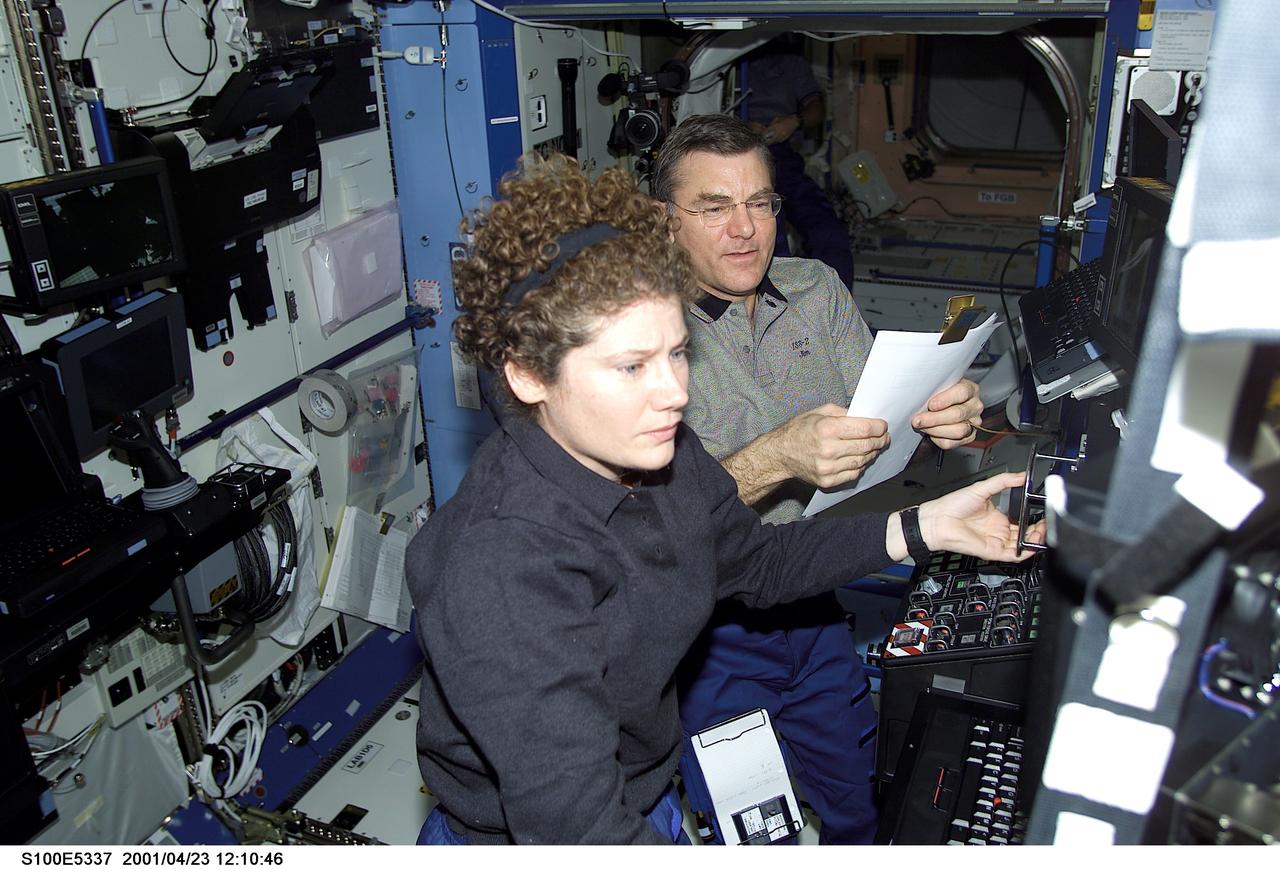
S100-E-5337 (23 April 2001) --- Astronauts Susan J. Helms and James S. Voss, Expedition Two flight engineers,work together to check out some data in the Destiny laboratory aboard the International Space Station (ISS). The image was recorded witha digital still camera by one of the visiting STS-100 crew members.
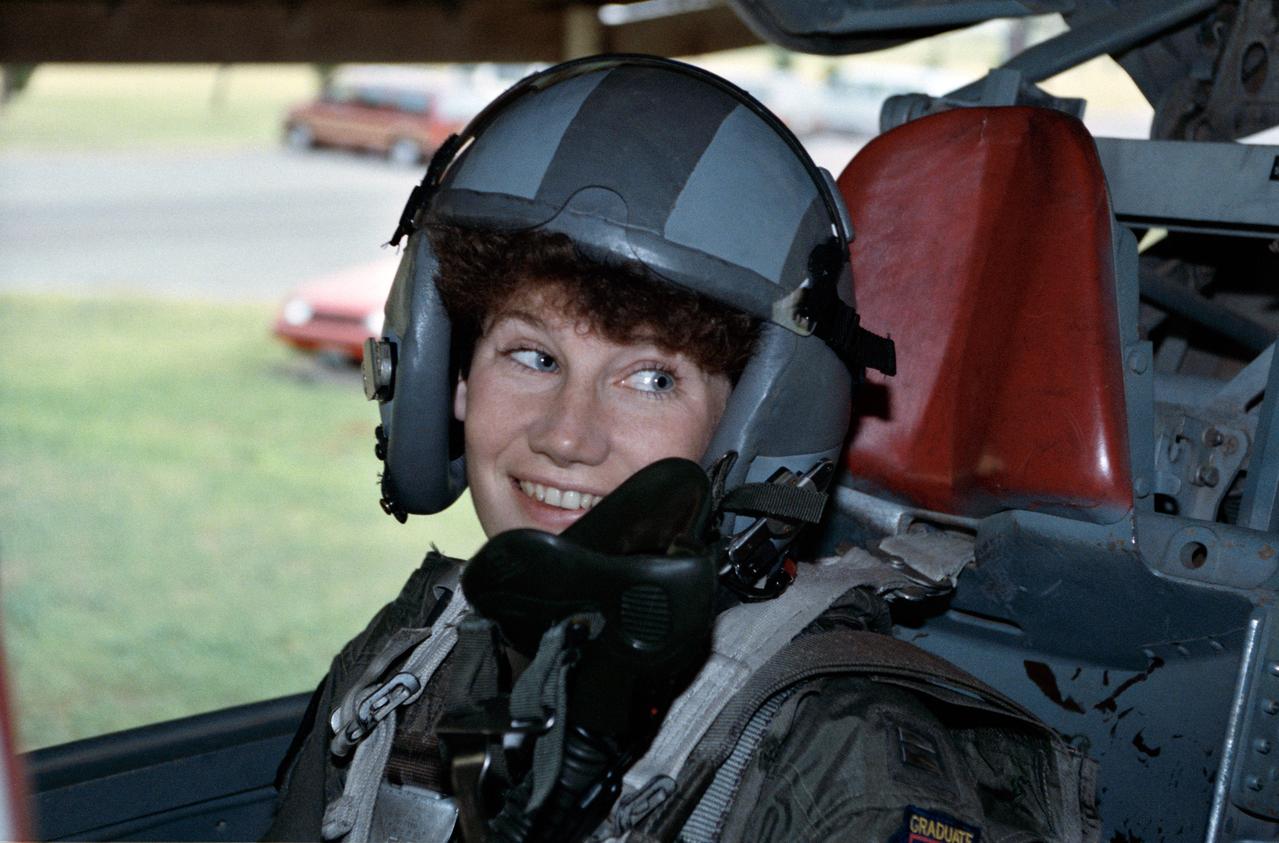
S90-45896 (29-31 July 1990) --- Susan J. Helms, one of the 23 astronaut candidates who began a year's training and evaluation program in July, participates in one of themany sessions at a survival training course at Vance Air Force Base. This portion of the course is designed to familiarize the trainee with procedures to follow in preparation for ejection from a jet aircraft.
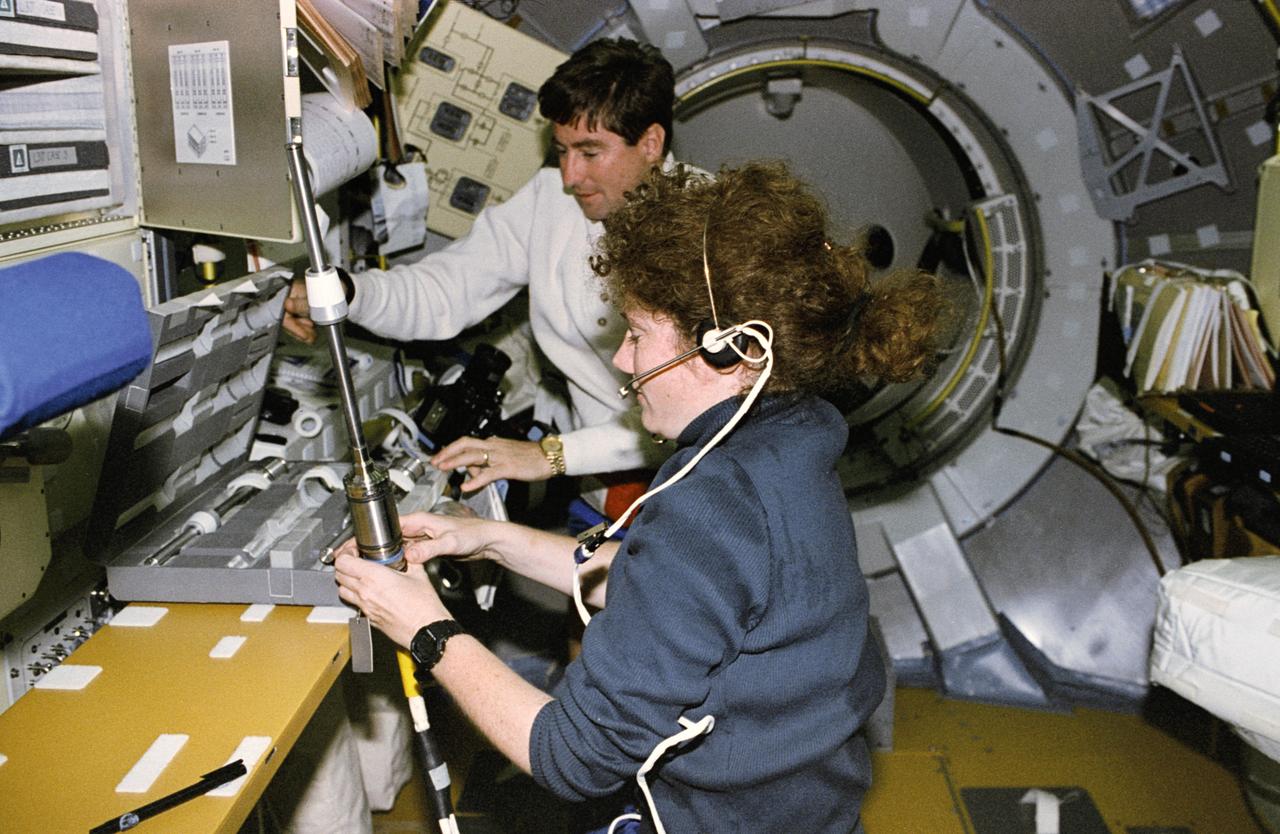
STS078-368-022 (20 June - 7 July 1996) --- Astronauts Susan J. Helms, payload commander, and Terence T. (Tom) Henricks, mission commander, prepare a sample cartridge containing semiconductor crystals for Spacelab research. The crystals were later placed in the Advanced Gradient Heating Furnace (AGHF) in the Life and Microgravity Spacelab (LMS-1) Science Module. The AGHF is designed for directional solidification of the crystals in the sample cartridges. The microgravity of space allows the crystals to grow in a perfect state that can not be accomplished in Earth's gravity.
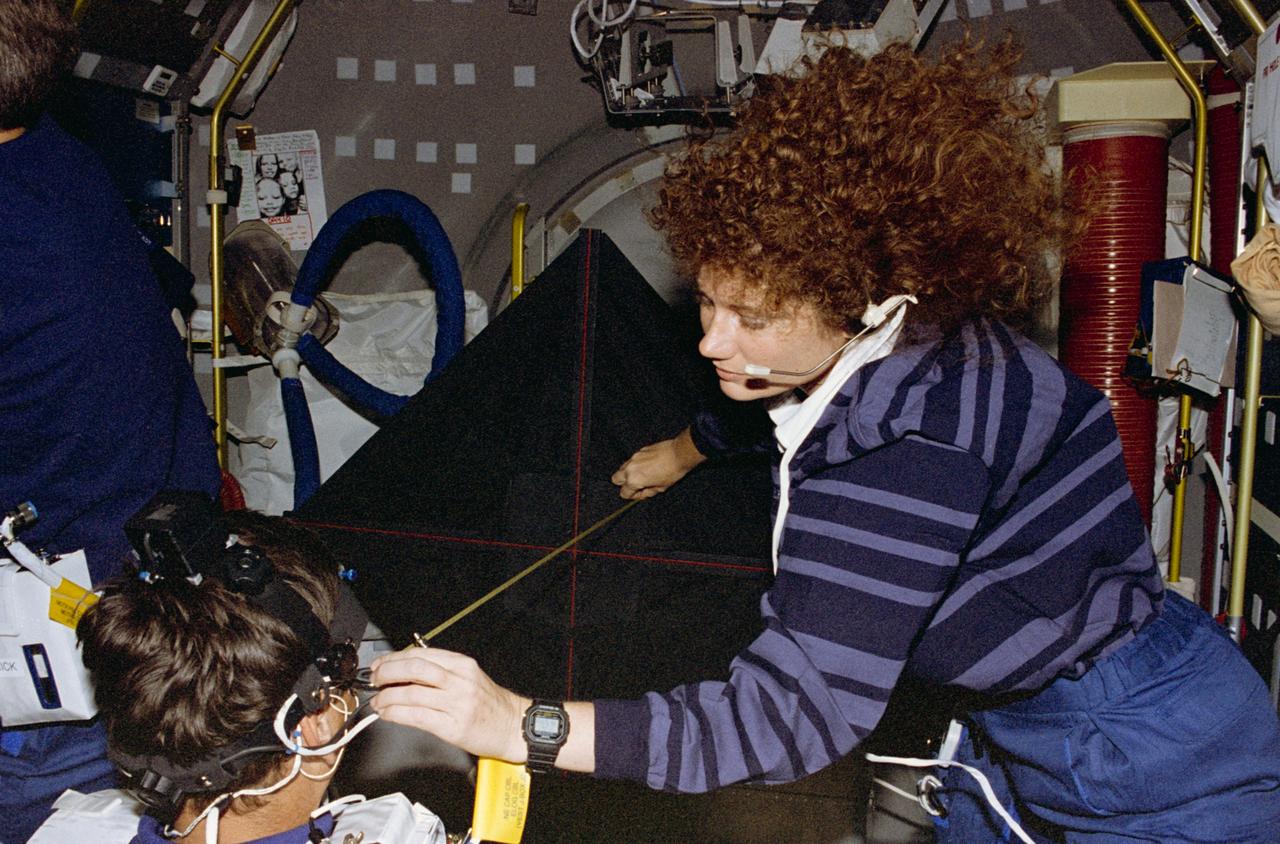
STS078-398-032 (20 June - 7 July 1996) --- Astronaut Susan J. Helms, payload commander, measures the distance between Jean-Jacques Favier’s head and the luminous torque, used for the Canal and Otolith Interaction Study (COIS) on the Life and Microgravity Spacelab (LMS-1) mission. Favier, representing the French Space Agency (CNES), is one of two international payload specialists on the almost-17-day flight. This view shows the Voluntary Head Movement (VHM) segment of the experiment. The VHM is meant to characterize how the coordination of head and eye movement changes as a result of spaceflight. Since most vestibular functions are influenced by gravity, the COIS experiment is meant to measure response differences in microgravity.
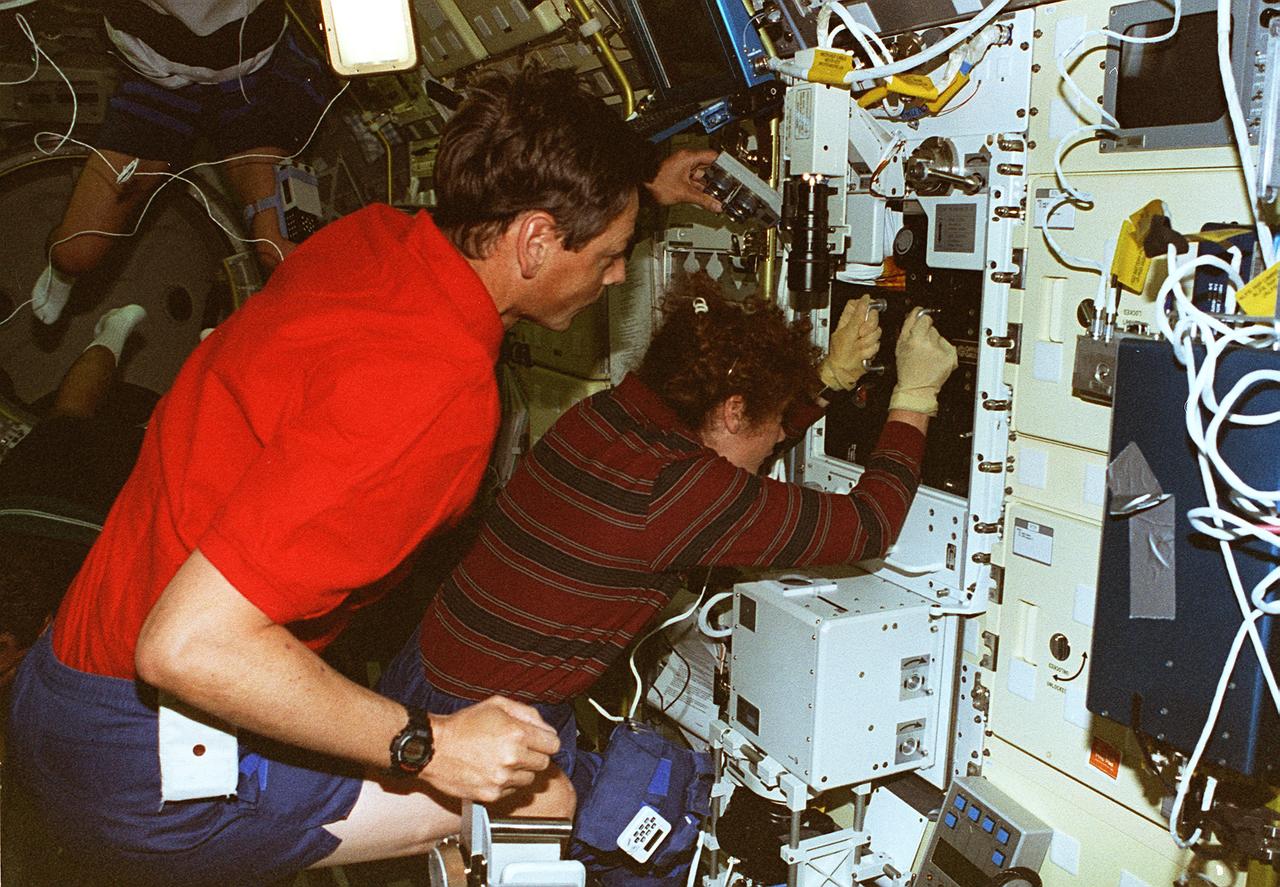
STS078-306-035 (20 June - 7 July 1996) --- Astronaut Susan J. Helms, payload commander, and payload specialist Jean-Jacques Favier, representing the French Space Agency (CNES), insert a test container into the Bubble Drop Particle Unit (BDPU) in the Life and Microgravity Spacelab (LMS-1) Science Module aboard the Space Shuttle Columbia. The fluid in the chamber is heated and the fluid processes are observed by use of three internal cameras mounted inside the BDPU. Investigations in this facility will help characterize interfacial processes involving either bubbles, drops, liquid columns or liquid layers.
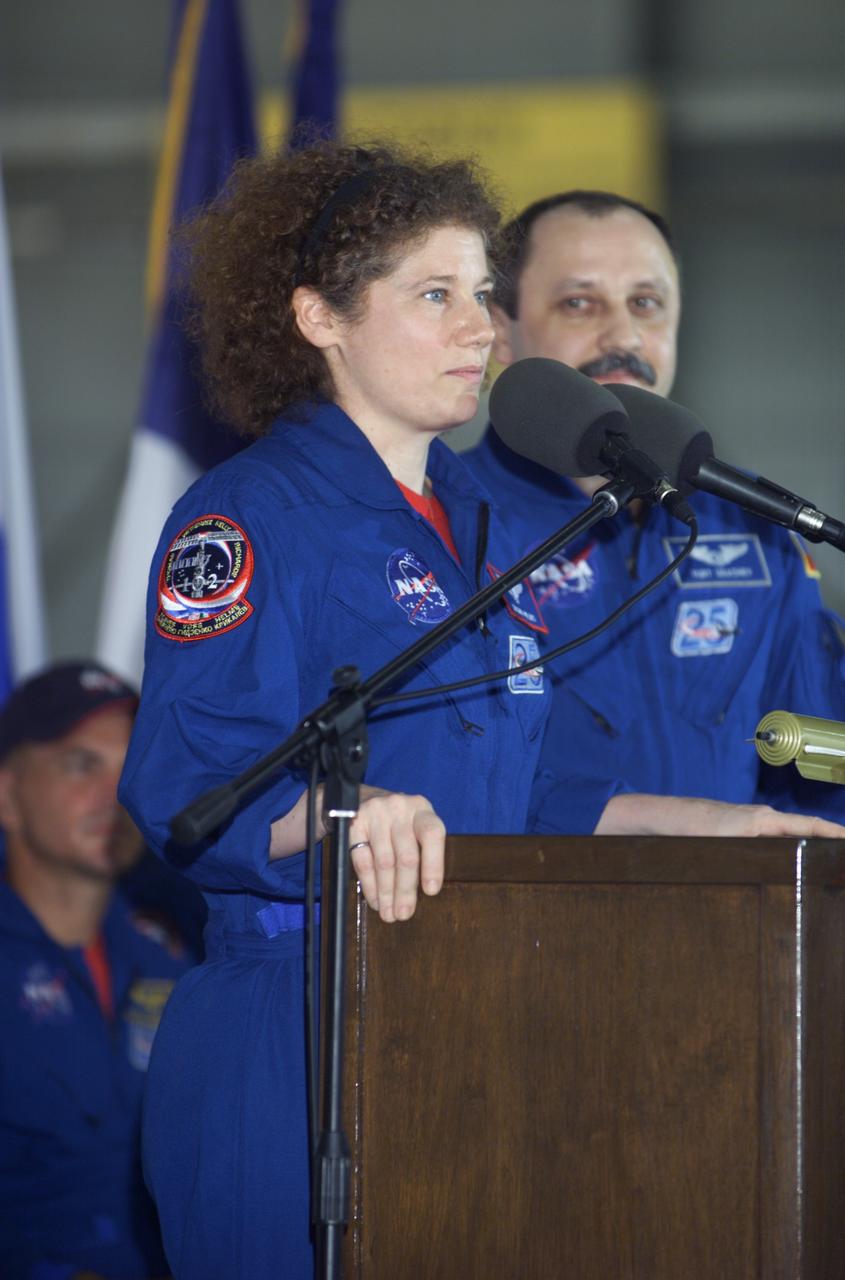
JSC2001-E-25813 (23 August 2001) --- Susan J. Helms, Expedition Two flight engineer, speaks from the podium in Hangar 990 at Ellington Field during the STS-105 and Expedition Two crew return ceremonies. Yury V. Usachev of Rosaviakosmos, Expedition Two mission commander, stands to Helms' left. Helms, Usachev and fellow Expedition Two crewmember James S. Voss spent five months aboard the International Space Station (ISS).
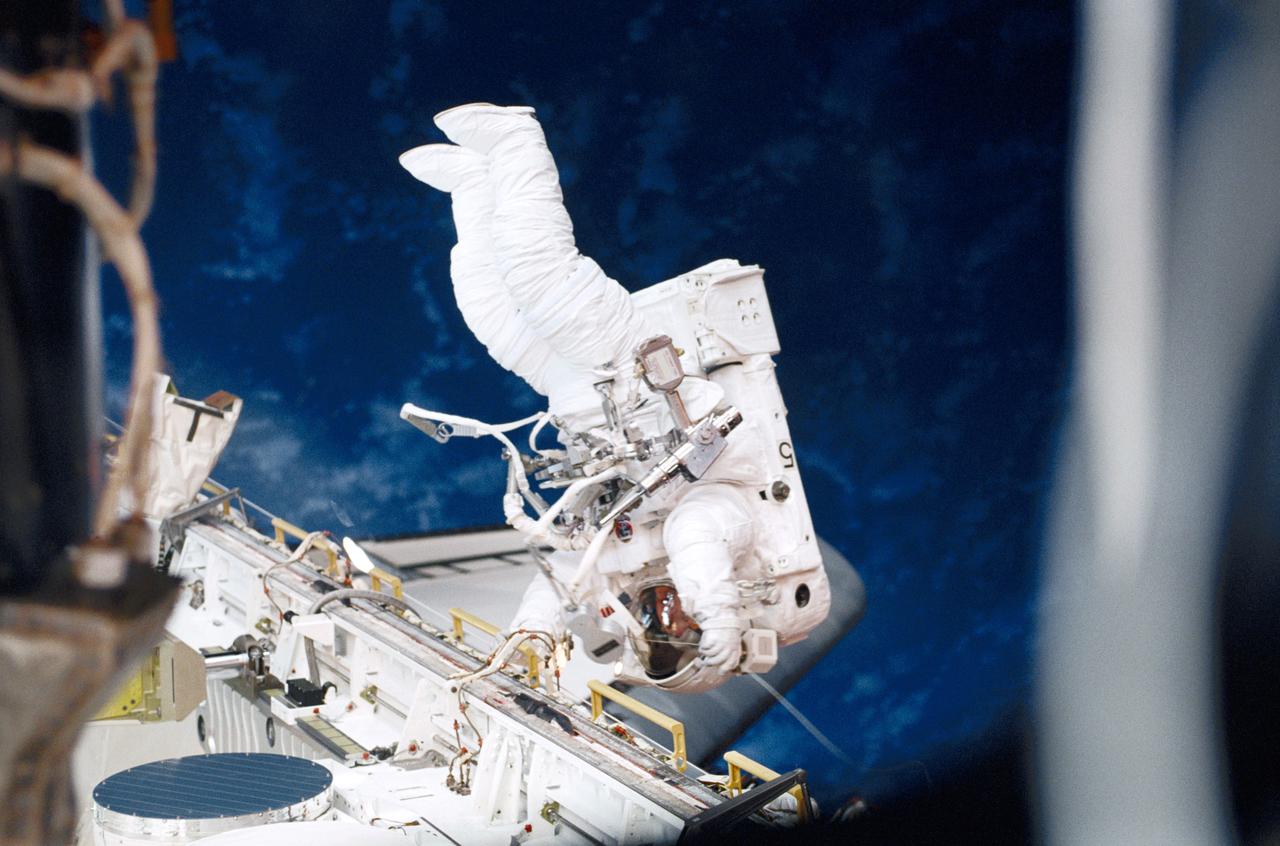
STS-102 mission astronaut Susan J. Helms translates along the longerons of the Space Shuttle Discovery during the first of two space walks. During this walk, the Pressurized Mating Adapter 3 was prepared for repositioning from the Unity Module's Earth-facing berth to its port-side berth to make room for the Leonardo multipurpose Logistics Module (MPLM), supplied by the Italian Space Agency. The Leonardo MPLM is the first of three such pressurized modules that will serve as the International Space Station's (ISS') moving vans, carrying laboratory racks filled with equipment, experiments, and supplies to and from the Station aboard the Space Shuttle. The cylindrical module is approximately 21-feet long and 15- feet in diameter, weighing almost 4.5 tons. It can carry up to 10 tons of cargo in 16 standard Space Station equipment racks. Of the 16 racks the module can carry, 5 can be furnished with power, data, and fluid to support refrigerators or freezers. In order to function as an attached station module as well as a cargo transport, the logistics module also includes components that provide life support, fire detection and suppression, electrical distribution, and computer functions. NASA's 103rd overall mission and the 8th Space Station Assembly Flight, STS-102 mission also served as a crew rotation flight. It delivered the Expedition Two crew to the Station and returned the Expedition One crew back to Earth.
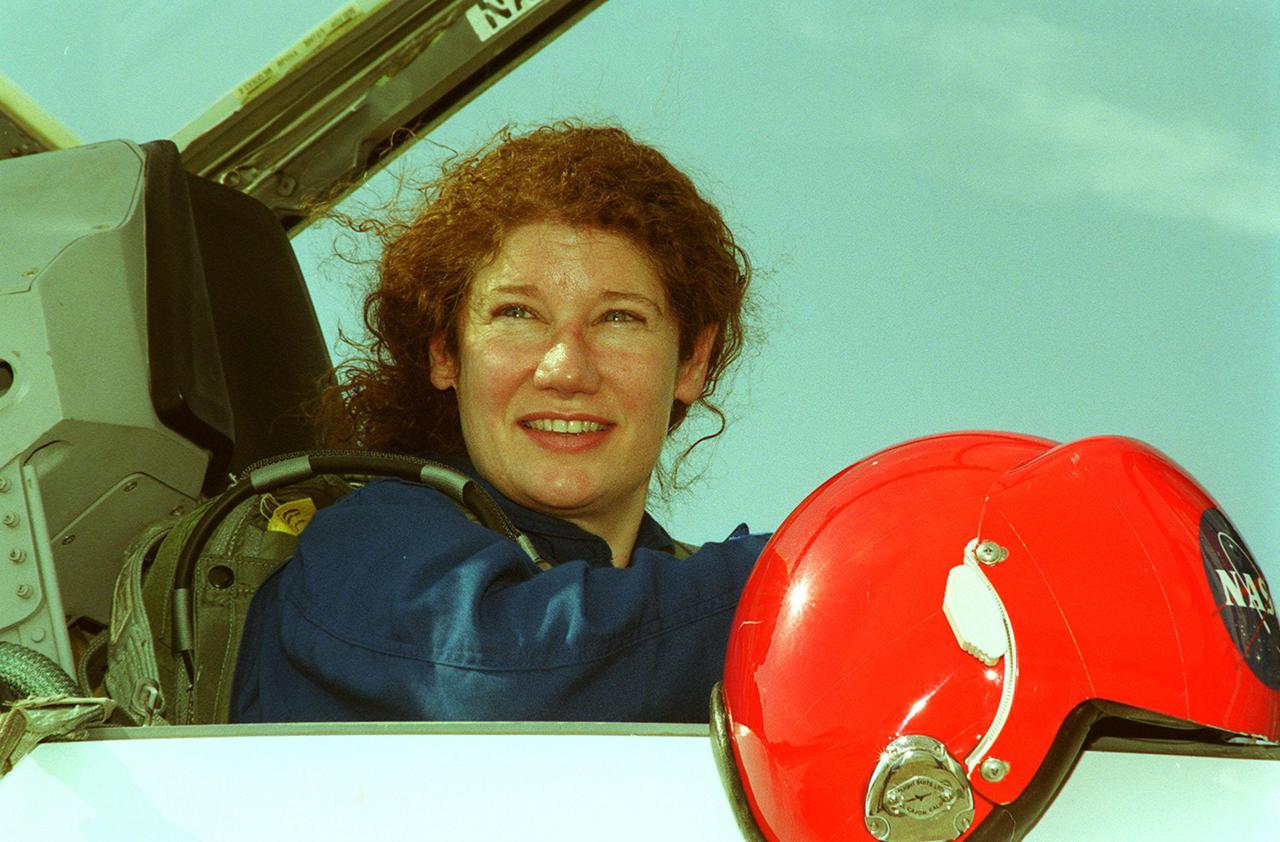
Astronaut Susan Helms arrives at the KSC Shuttle Landing Facility. Helms is flying on mission STS-102, launching March 8, as part of the Expedition Two crew going to the International Space Station. The other members of the Expedition Two crew are James Voss and Yury Usachev. They are at KSC to inspect the air lock that will be carried to the Station during their tenure in space. STS-102 will be Helms’ and Voss’s fifth Shuttle flight, and Usachev’s second. They will be replacing the Expedition One crew (Bill Shepherd, Yuri Gidzenko and Sergei Krikalev), who will return to Earth March 20 on Discovery along with the STS-102 crew
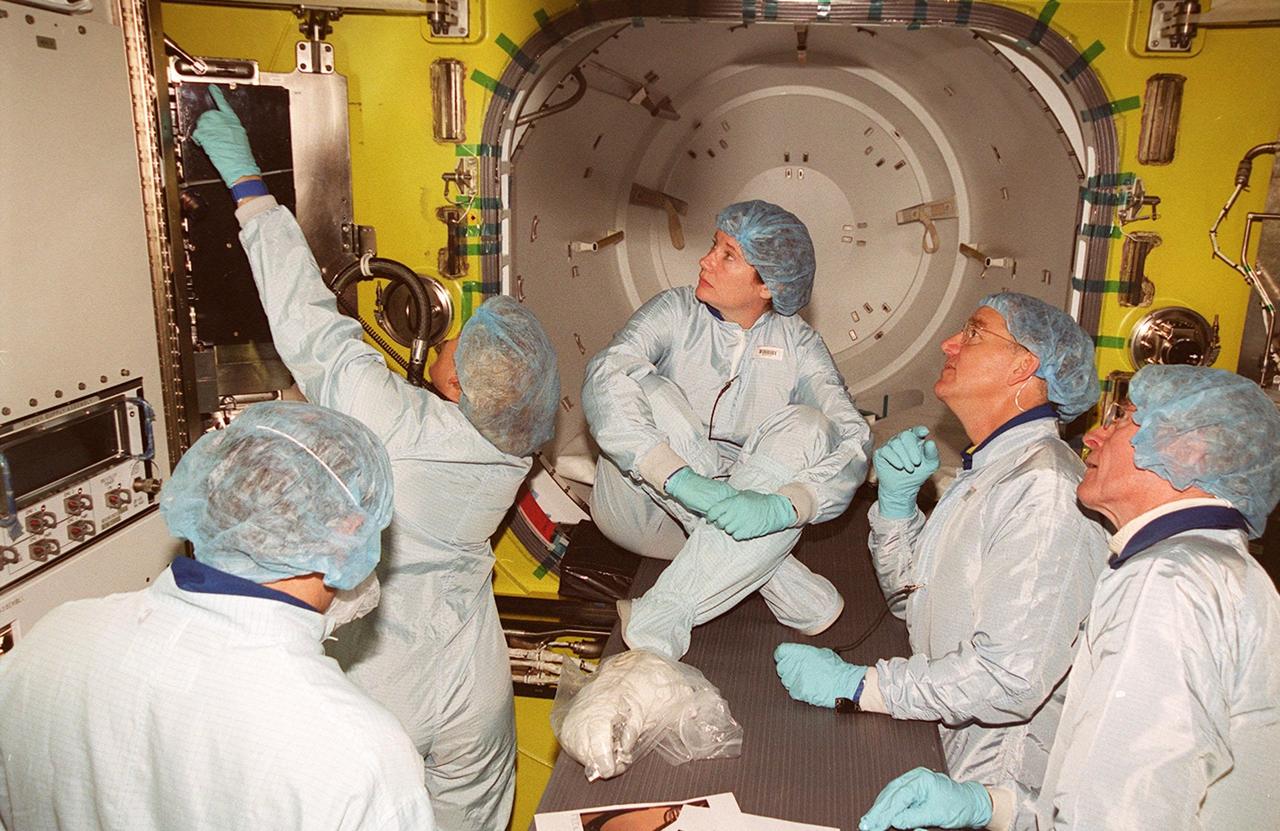
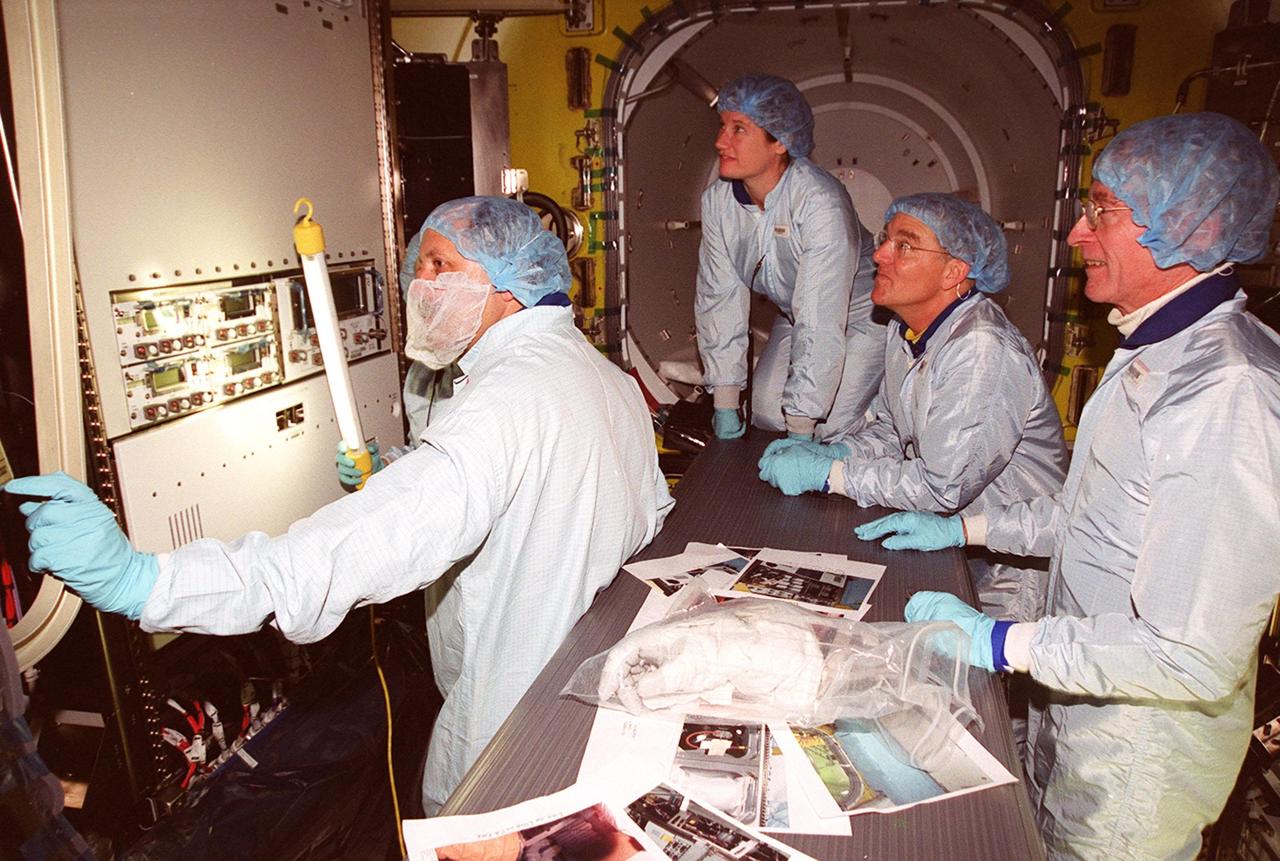
Inside the air lock in the Space Station Processing Facility, a technician points to part of the equipment. Watching her are (left to right) cosmonaut Yury Usachev (back to camera), astronaut Susan Helms (seated), astronauts James Voss and John Young, who flew on mission STS-1. Voss, Helms and Usachev will be flying on mission STS-102, launching March 8, to the International Space Station. The air lock will be carried to the Station during their tenure in space. STS-102 will be Helms’ and Voss’s fifth Shuttle flight, and Usachev’s second. They will be replacing the Expedition One crew (Bill Shepherd, Yuri Gidzenko and Sergei Krikalev), who will return to Earth March 20 on Discovery along with the STS-102 crew
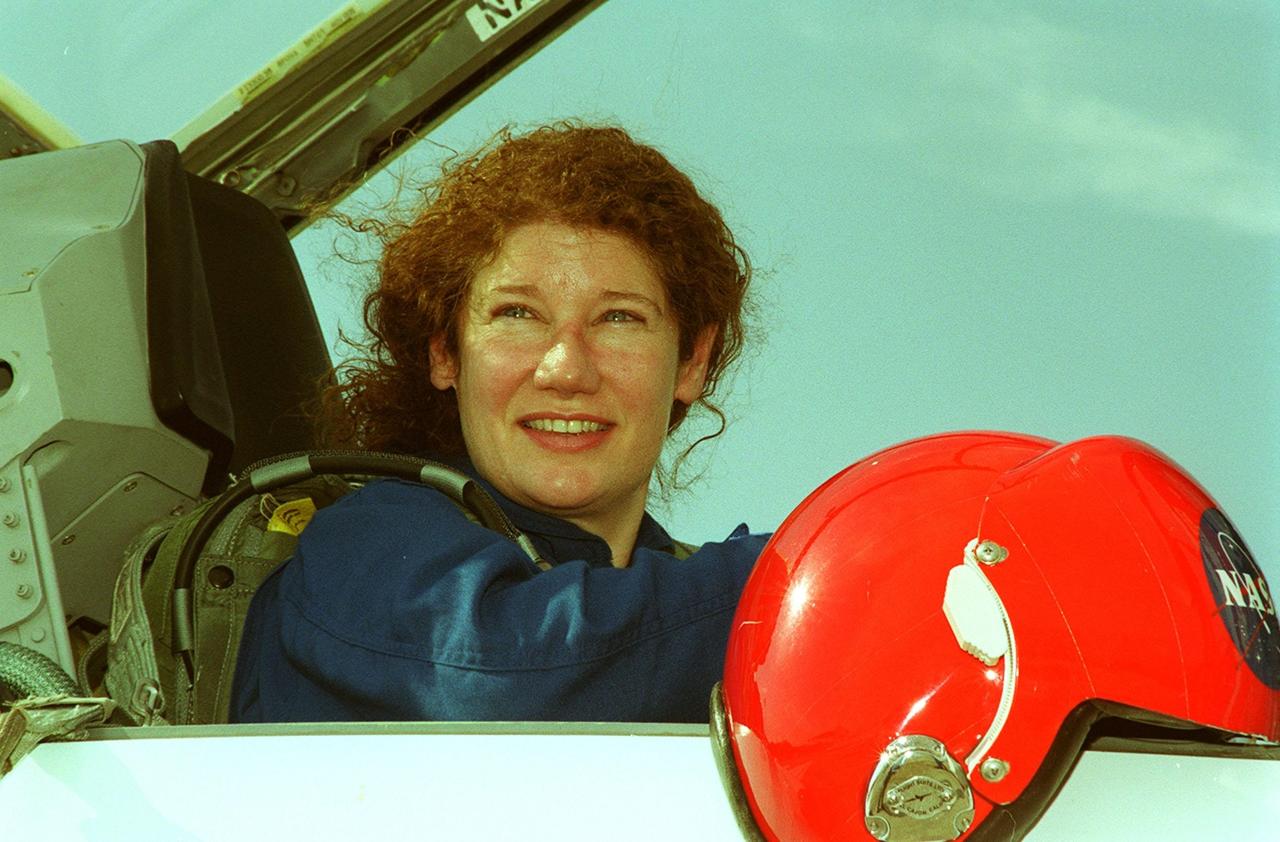
Astronaut Susan Helms arrives at the KSC Shuttle Landing Facility. Helms is flying on mission STS-102, launching March 8, as part of the Expedition Two crew going to the International Space Station. The other members of the Expedition Two crew are James Voss and Yury Usachev. They are at KSC to inspect the air lock that will be carried to the Station during their tenure in space. STS-102 will be Helms’ and Voss’s fifth Shuttle flight, and Usachev’s second. They will be replacing the Expedition One crew (Bill Shepherd, Yuri Gidzenko and Sergei Krikalev), who will return to Earth March 20 on Discovery along with the STS-102 crew
Inside the air lock in the Space Station Processing Facility, the Expedition Two crew look at equipment. Seen from left are cosmonaut Yury Usachev and astronauts Susan Helms and James Voss. At far right is astronaut John Young, who flew on mission STS-1. Usachev, Helms and Voss will be flying on mission STS-102, launching March 8. The air lock will be carried to the Station during their tenure in space. STS-102 will be Helms’ and Voss’s fifth Shuttle flight, and Usachev’s second. They will be replacing the Expedition One crew (Bill Shepherd, Yuri Gidzenko and Sergei Krikalev), who will return to Earth March 20 on Discovery along with the STS-102 crew
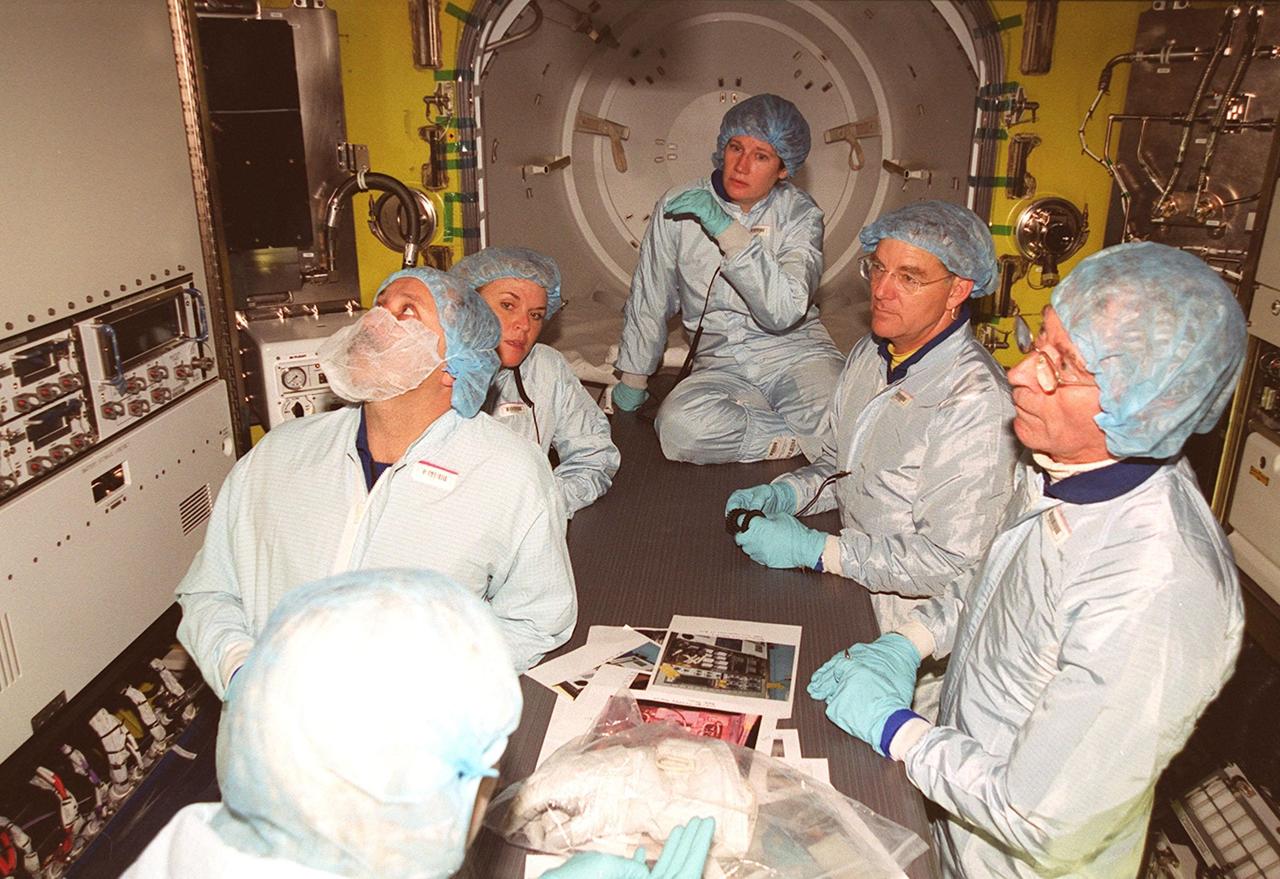
Inside the air lock in the Space Station Processing Facility, the Expedition Two crew look at equipment. Seen from left are cosmonaut Yury Usachev, a technician, and astronauts Susan Helms and James Voss. At far right is astronaut John Young, who flew on mission STS-1. Usachev, Helms and Voss will be flying on mission STS-102, launching March 8. The air lock will be carried to the Station during their tenure in space. STS-102 will be Helms’ and Voss’s fifth Shuttle flight, and Usachev’s second. They will be replacing the Expedition One crew (Bill Shepherd, Yuri Gidzenko and Sergei Krikalev), who will return to Earth March 20 on Discovery along with the STS-102 crew
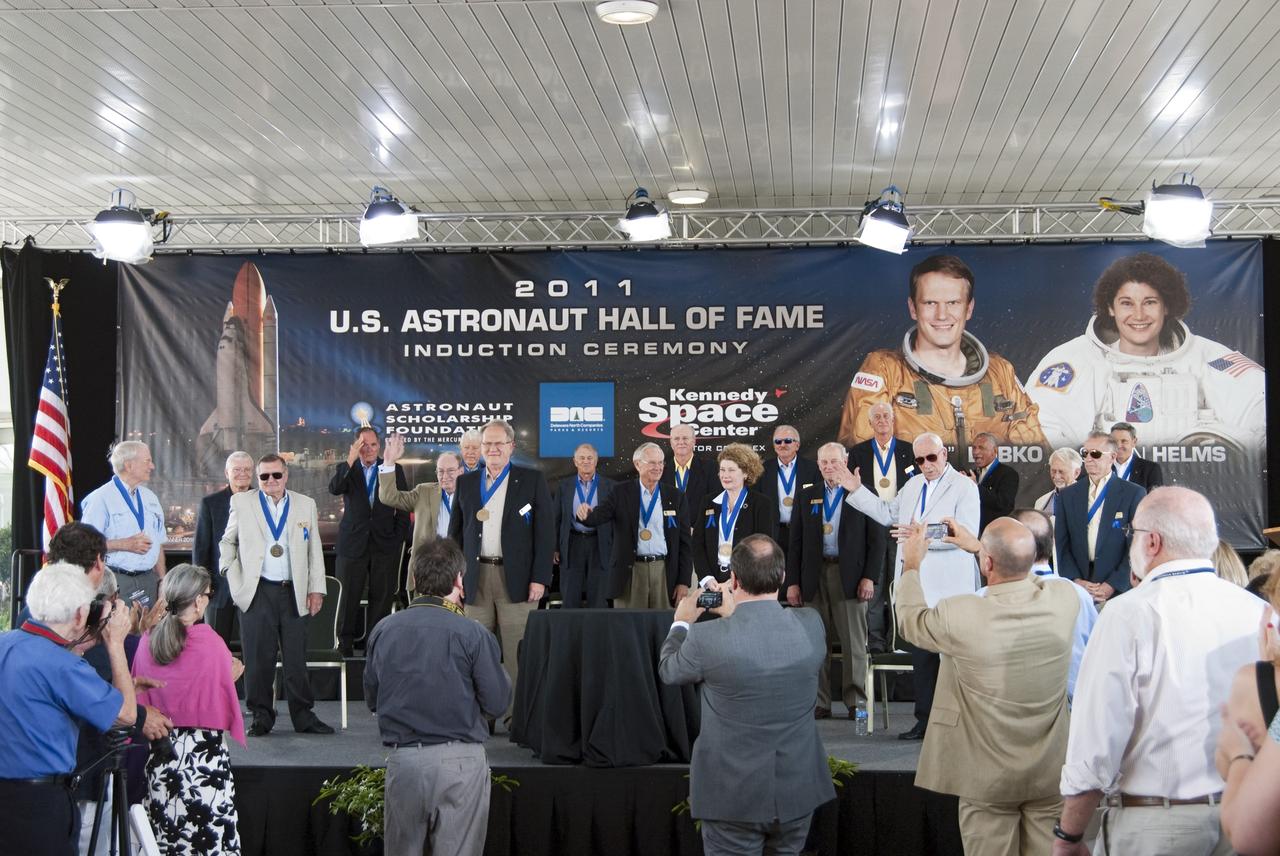
Cape Canaveral, Fla. -- At NASA's Kennedy Space Center Visitor Complex in Florida, the audiences applauds Karol "Bo" Bobko and Susan Helms after their induction into the U.S. Astronaut Hall of Fame. Hall of Fame astronauts and visitors gathered to honor 2011 inductees Karol "Bo" Bobko and Susan Helms. During his 19 years in the astronaut program, Bobko flew on three space shuttle missions and logged more than 386 hours in space. He served as pilot during the first voyage of space shuttle Challenger aboard STS-6 in April 1983 and as commander during the maiden flight of space shuttle Atlantis aboard STS-51J in October 1985. Helms, a five-time space shuttle astronaut, has logged 5,064 hours in space. During her stay onboard the International Space Station as a member of the Expedition-2 crew in 2001, Helms performed a world record 8 hour and 56 minute spacewalk. Bobko and Helms join the ranks of the U.S. Astronaut Hall of Fame bringing the number of space explorers enshrined in the Hall of Fame to 79. Photo Credit: NASA/Jim Grossmann
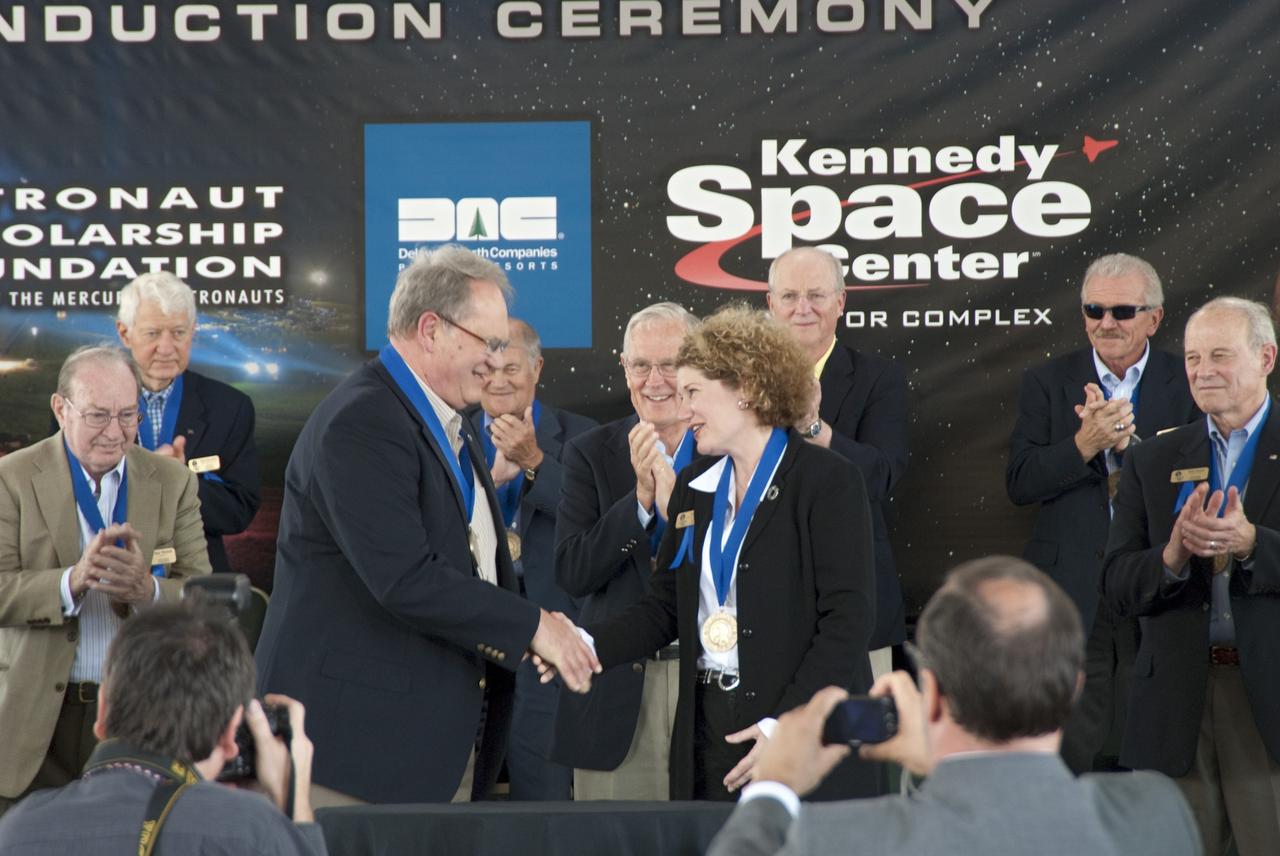
Cape Canaveral, Fla. -- Karol "Bo" Bobko and Susan Helms shake hands in mutual congratulations on their induction into the U.S. Astronaut Hall of Fame at a ceremony held at NASA's Kennedy Space Center Visitor Complex in Florida. Hall of Fame astronauts and visitors gathered to honor 2011 inductees Karol "Bo" Bobko and Susan Helms. During his 19 years in the astronaut program, Bobko flew on three space shuttle missions and logged more than 386 hours in space. He served as pilot during the first voyage of space shuttle Challenger aboard STS-6 in April 1983 and as commander during the maiden flight of space shuttle Atlantis aboard STS-51J in October 1985. Helms, a five-time space shuttle astronaut, has logged 5,064 hours in space. During her stay onboard the International Space Station as a member of the Expedition-2 crew in 2001, Helms performed a world record 8 hour and 56 minute spacewalk. Bobko and Helms join the ranks of the U.S. Astronaut Hall of Fame bringing the number of space explorers enshrined in the Hall of Fame to 79. Photo Credit: NASA/Jim Grossmann