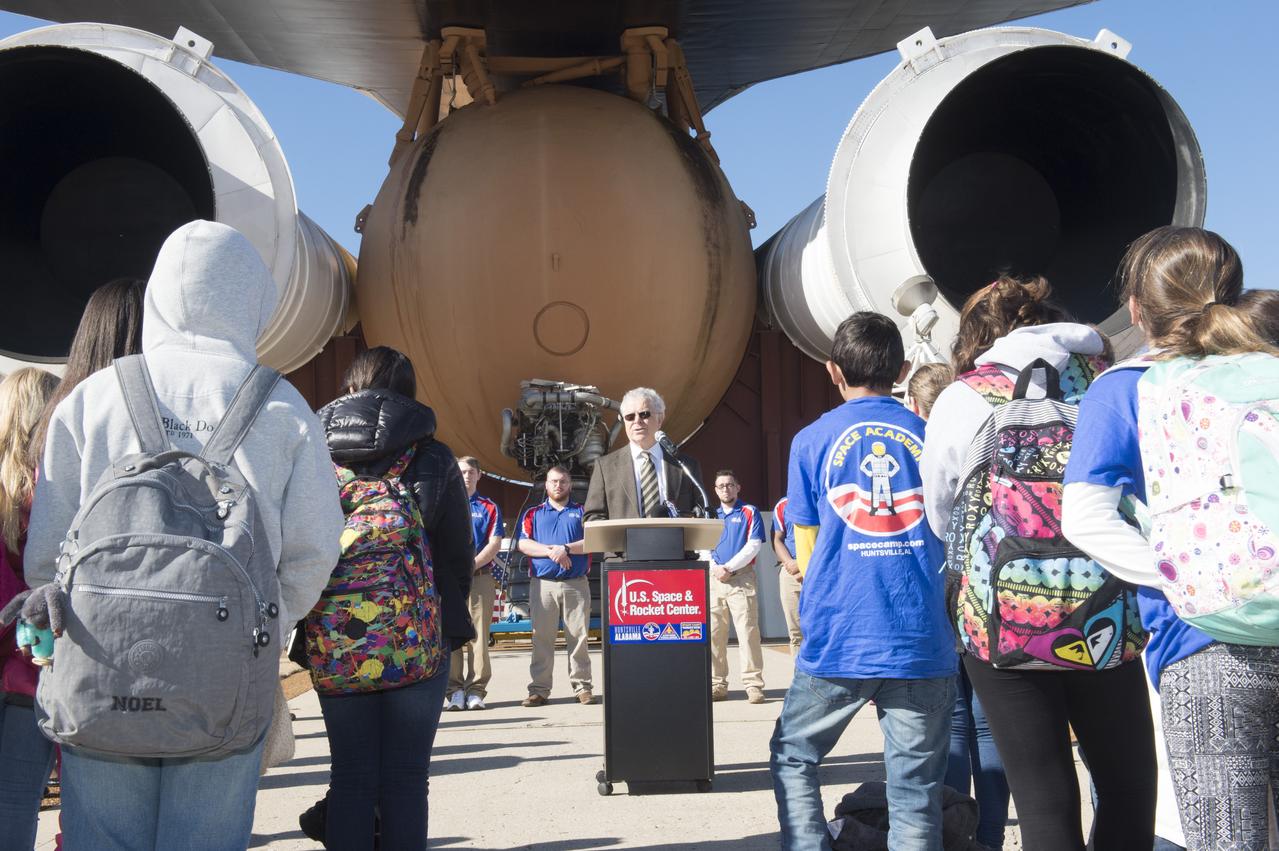
HOMER HICKAM MAKES COMMENTS AT USSRC DAY OF REMEMBRANCE EVENT, 2016
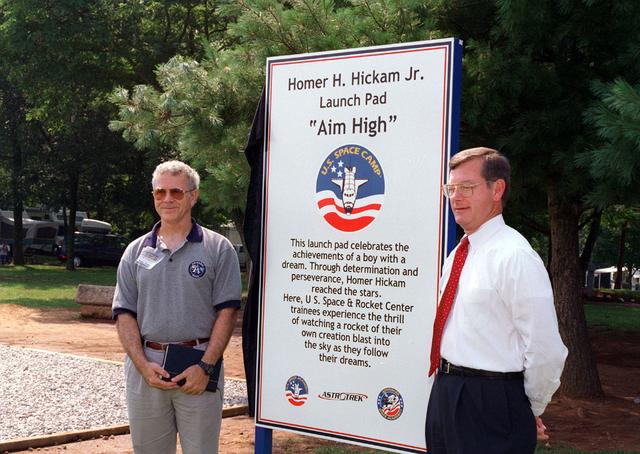
Noted author and previous Marshall Space Flight Center employee Mr. Homer Hickam Jr. poses in front of a placque commemorating his achievement in realizing his dreams of becoming a rocket scientist. The dedication site is located at the U. S. Space and Rocket Center in Huntsville, AL, and is used by amature rocket builders attending the Space Camp to launch their self-made rockets like Mr. Hickam did as a youth growing up in rural West Virginia. Posing with Mr. Hickam is the Madison County Commissioner Mr. Mike Gillispie.
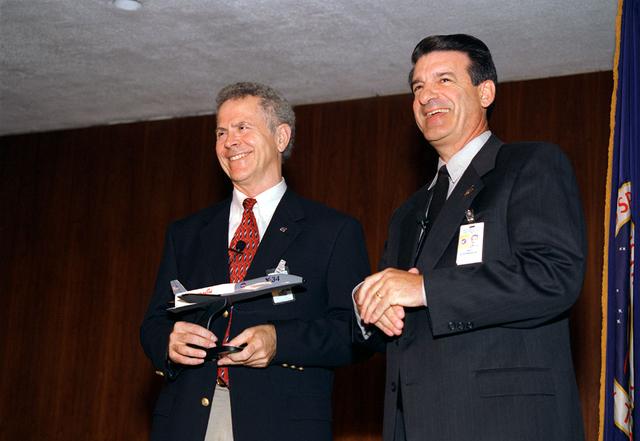
Author of Rocket Boys Homer Hickam, Jr. (left) and Marshall Space Flight Center Director Art Stephenson during a conference at Morris Auditorium. Homer Hickam worked at MSFC during the Apollo project years. As a young man, Mr. Hickam always dreamed of becoming a rocket scientist and following in the footsteps fo Wernher von Braun. Years later he would see his dream realized and had written Rocket Boys commemorating his life and the people at MSFC.
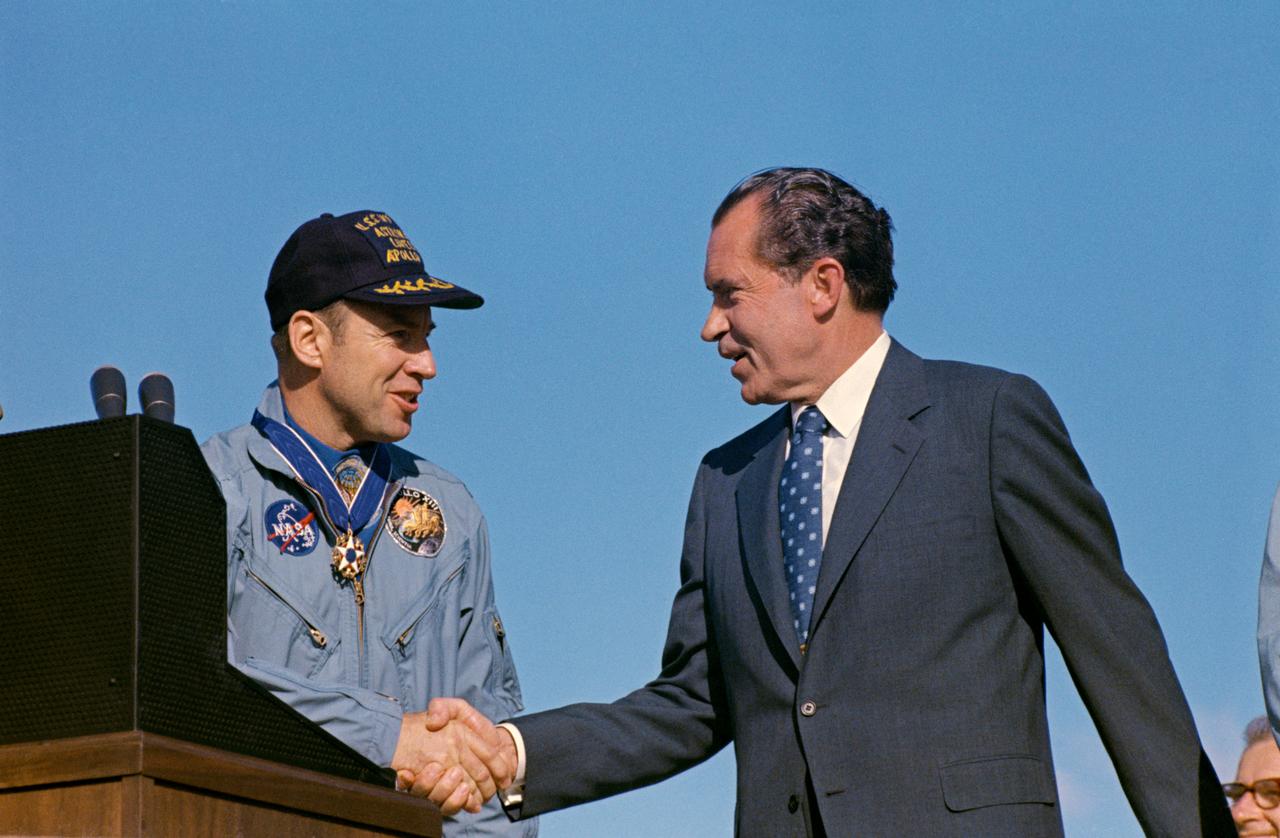
S70-15506 (18 April 1970) --- President Richard M. Nixon and astronaut James A. Lovell Jr., Apollo 13 commander, shake hands at special ceremonies at Hickam Air Force Base, Hawaii. President Nixon was in Hawaii to present the Apollo 13 crew with the Presidential Medal of Freedom, the nation's highest civilian honor. The wives of astronauts Lovell and Fred W. Haise Jr., lunar module pilot; and the parents of astronaut John L. Swigert Jr., command module pilot, flew with the Chief Executive to Hickam Air Force Base. The Apollo 13 splashdown occurred at 12:07:44 p.m. (CST), April 17, 1970, a day and a half prior to the awards ceremony.
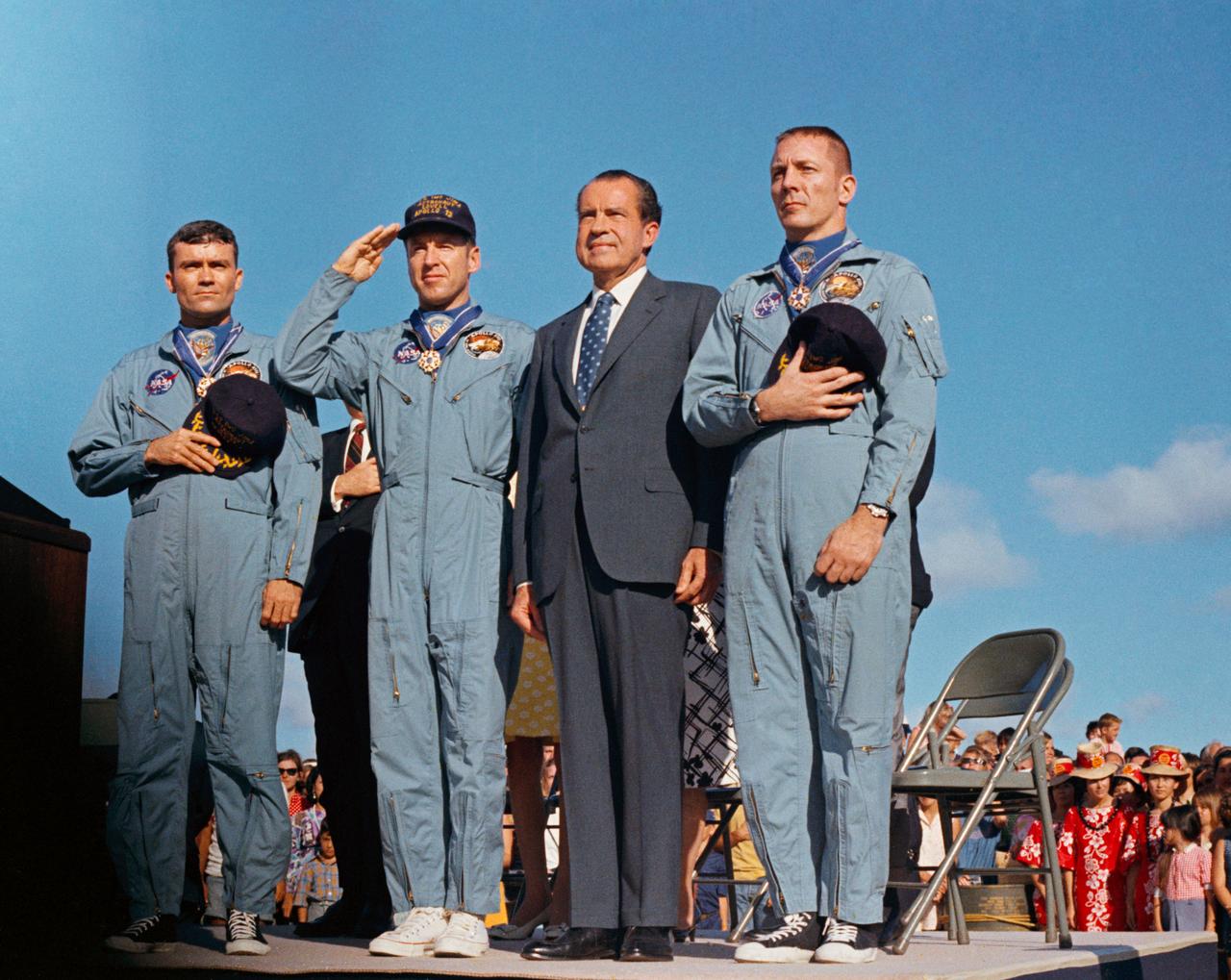
S70-15526 (18 April 1970) --- President Richard M. Nixon and the Apollo 13 crew members pay honor to the United States flag during the post-mission ceremonies at Hickam Air Force Base, Hawaii. Astronauts James A. Lovell Jr., (United States Navy Captain, salutes the flag) commander; John L. Swigert Jr., command module pilot (right); and Fred W. Haise Jr., lunar module pilot (left), were presented the Presidential Medal of Freedom by the Chief Executive. The Apollo 13 splashdown occurred at 12:07:44 p.m. (CST), April 17, 1970, about a day and a half prior to the award presentation.
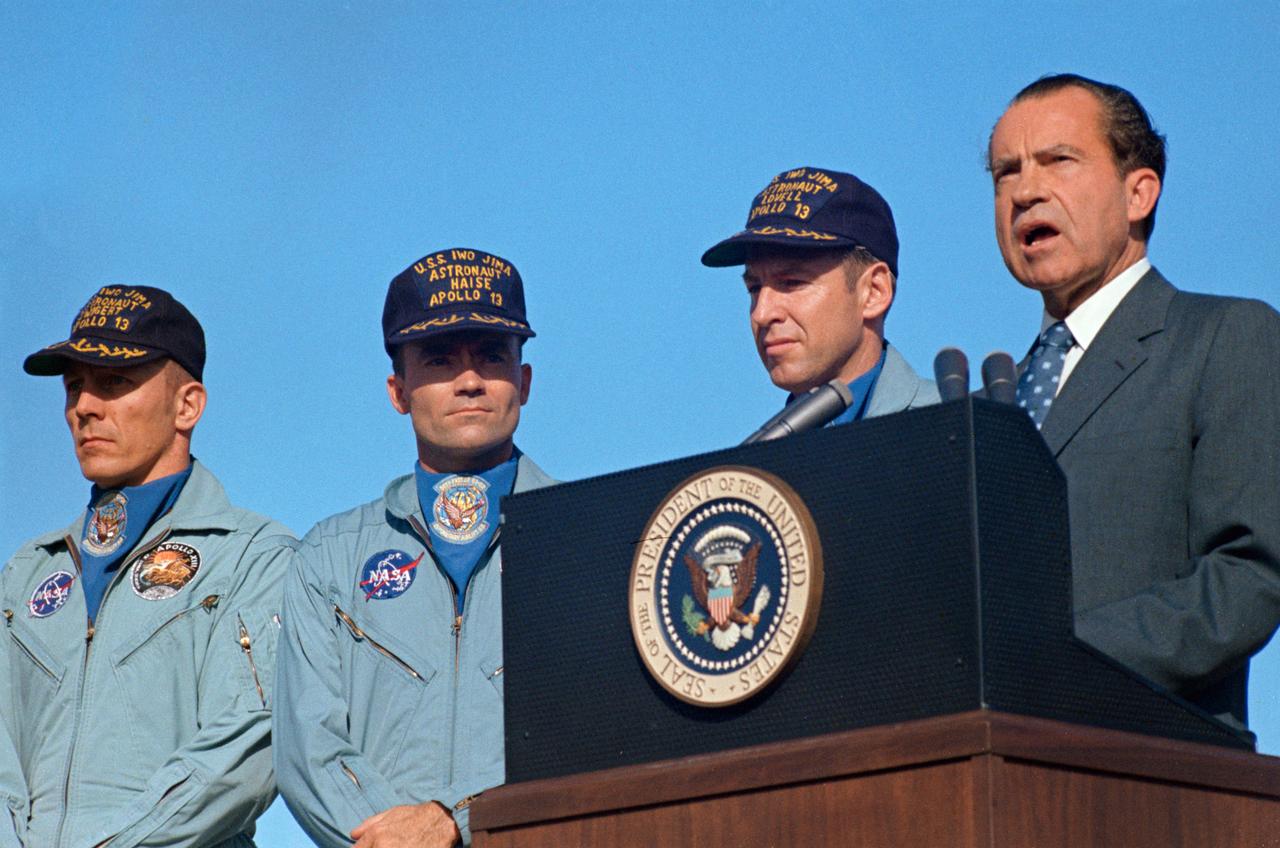
S70-15511 (19 April 1970) --- President Richard M. Nixon speaks at Hickham Air Force Base prior to presenting the nation's highest civilian award to the Apollo 13 crew. Receiving the Presidential Medal of Freedom were astronauts James A. Lovell Jr., (next to the Chief Executive), commander; John L. Swigert Jr. (left), command module pilot; and Fred W. Haise Jr., lunar module pilot. Wives of Lovell and Haise and the parents of Swigert accompanied the President to Hawaii. The Apollo 13 splashdown occurred at 12:07:44 p.m. (CST), April 17, 1970, about a day and a half prior to the Hickam Air Force Base ceremonies.
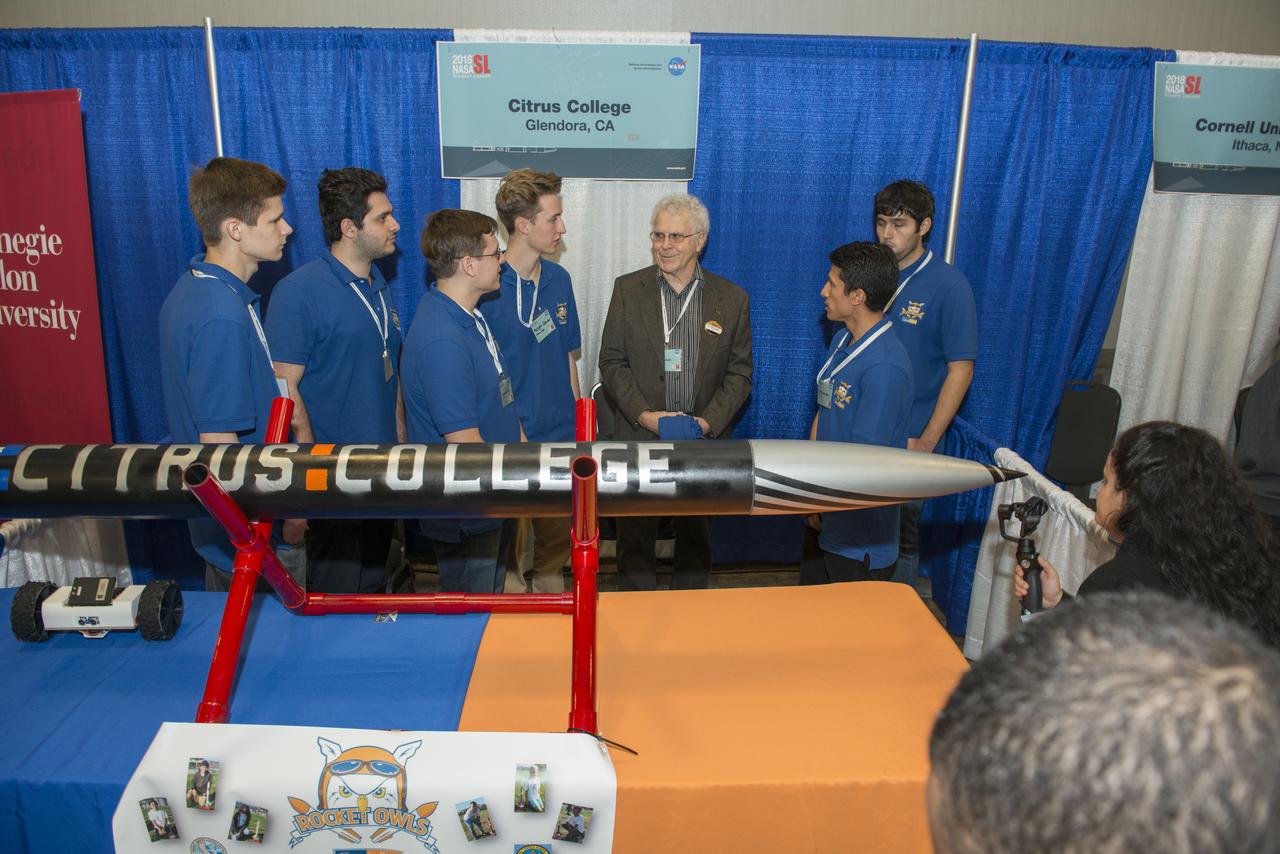
Students from 23 states display their rockets and talk about what they did to make them fly at the NASA Student Launch Rocket Fair on Friday, April 6. Over 800 students traveled to Huntsville, Alabama, to participate in a week of activities as part of NASA Student Launch. Retired NASA engineer and author Homer Hickam meets with the team from Citrus College.
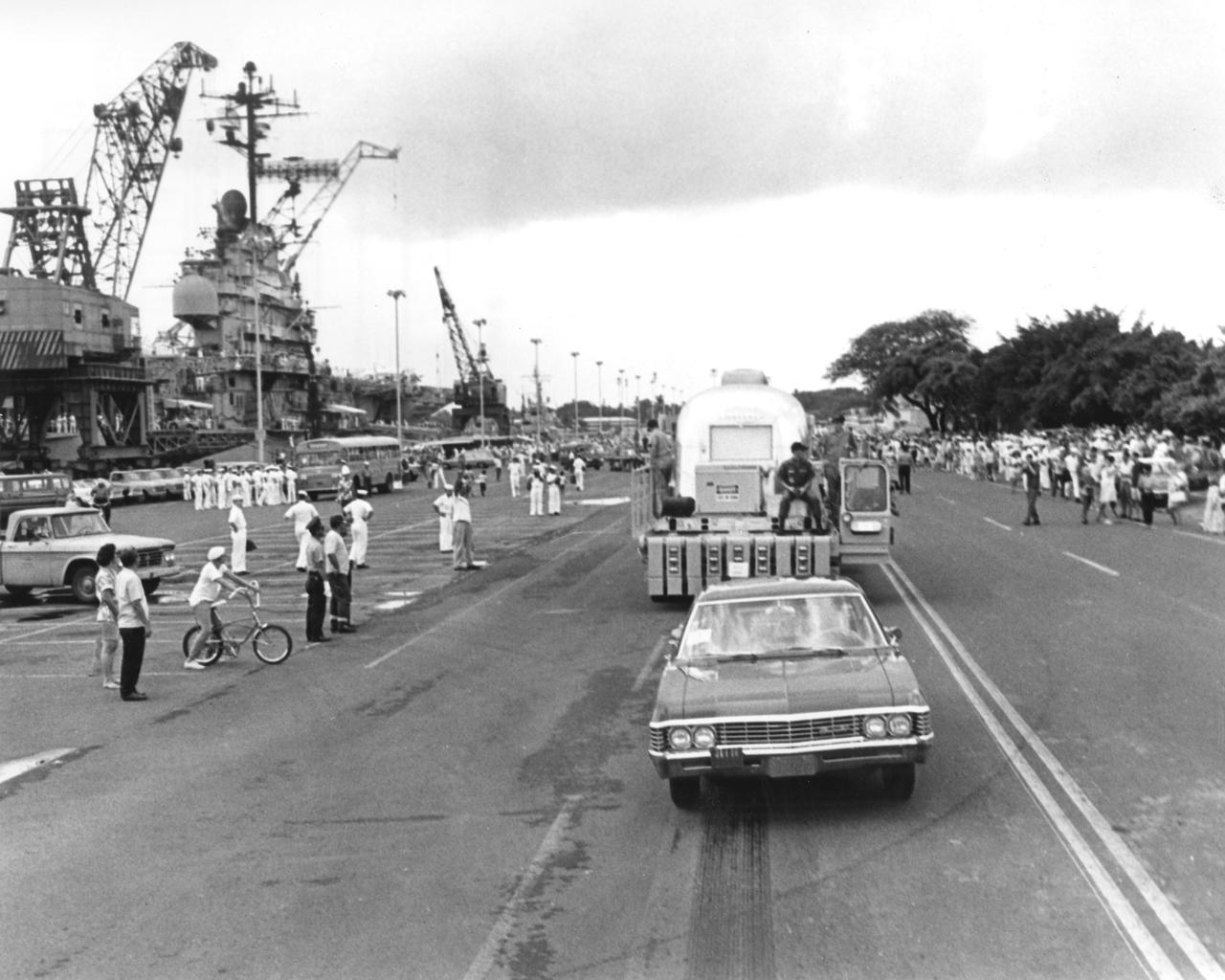
The Apollo 11 mission, the first manned lunar mission, launched from the Kennedy Space Center, Florida via the Marshall Space Flight Center (MSFC) developed Saturn V launch vehicle on July 16, 1969 and safely returned to Earth on July 24, 1969. Aboard the space craft were astronauts Neil A. Armstrong, commander; Michael Collins, Command Module (CM) pilot; and Edwin E. Aldrin Jr., Lunar Module (LM) pilot. The CM, piloted by Michael Collins remained in a parking orbit around the Moon while the LM, named “Eagle’’, carrying astronauts Neil Armstrong and Edwin Aldrin, landed on the Moon. During 2½ hours of surface exploration, the crew collected 47 pounds of lunar surface material for analysis back on Earth. The recovery operation took place in the Pacific Ocean where Navy para-rescue men recovered the capsule housing the 3-man Apollo 11 crew. The crew was airlifted to safety aboard the U.S.S. Hornet recovery ship, where they were quartered in a Mobile Quarantine Facility (MQF) which served as their home until they reached the NASA Manned Spacecraft Center (MSC) Lunar Receiving Laboratory in Houston, Texas. The occupied MQF was unloaded from the U.S.S. Hornet in Pearl Harbor, Hawaii. In this photo, the facility is moved from the Hornet’s dock enroute to Hickam Field where it was loaded aboard an Air Force C-141 jet transport for the flight back to Ellington Air Force Base Texas, and then on to the MSC.

S66-18607 (18 March 1966) --- Astronauts Neil A. Armstrong (center), Gemini-8 command pilot, and David R. Scott, pilot, arrive at Hickam Field, Hawaii on their way from Naha, Okinawa, to Cape Kennedy, Florida. Astronaut Walter M. Schirra Jr. is at extreme left. Photo credit: NASA
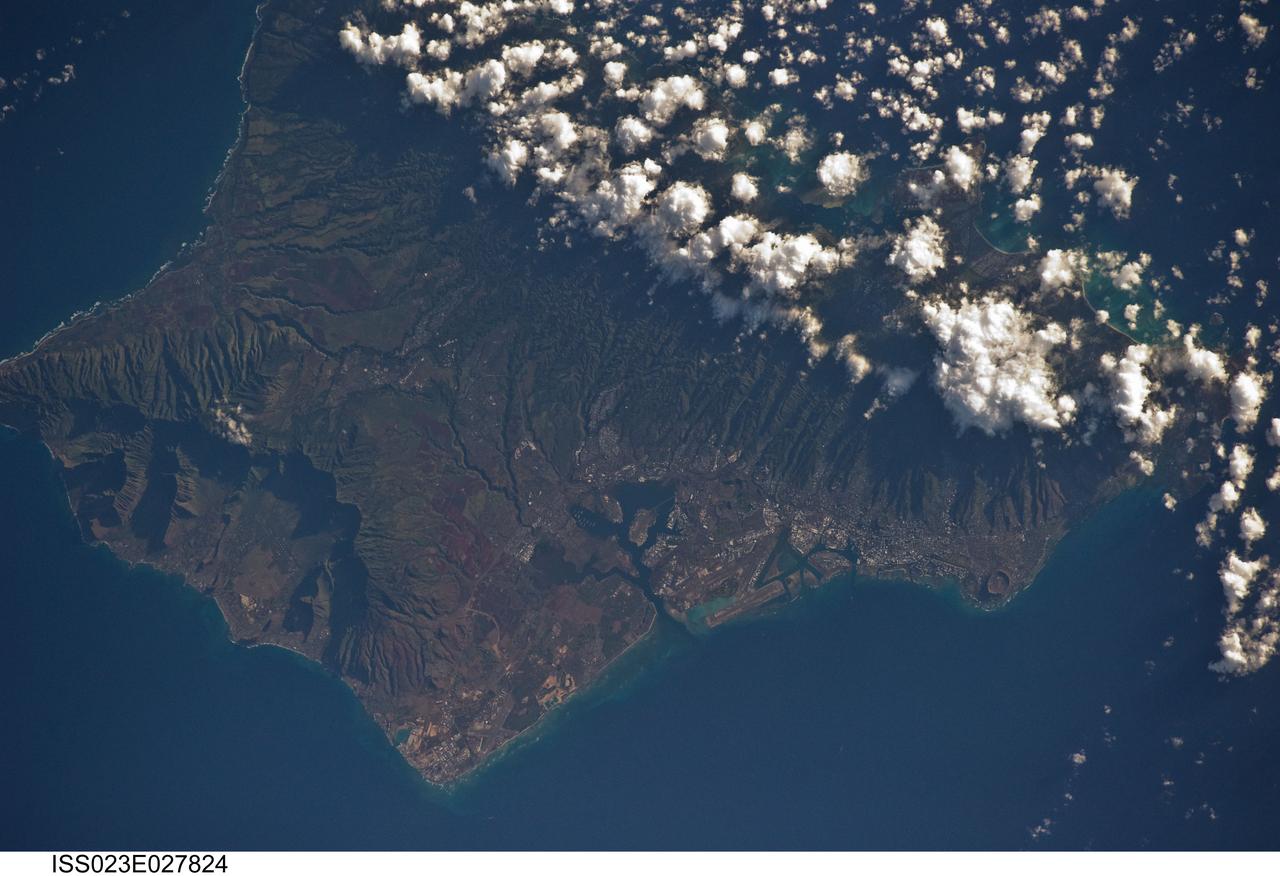
ISS023-E-027824 (23 April 2010) --- A member of the Expedition 23 crew onboard the Earth-orbiting International Space Station took this picture of Hawaii’s third largest island with an electronic still camera on April 23, 2010. Oahu is the commercial center of Hawaii, and tourism is the largest contributor to the economy. Among the many popular beaches is the renowned Waikiki Beach, backed by the famous Diamond Head, an extinct volcano. The largest community, Honolulu, is the state capital. Hickam Air Force Base is located on the island.
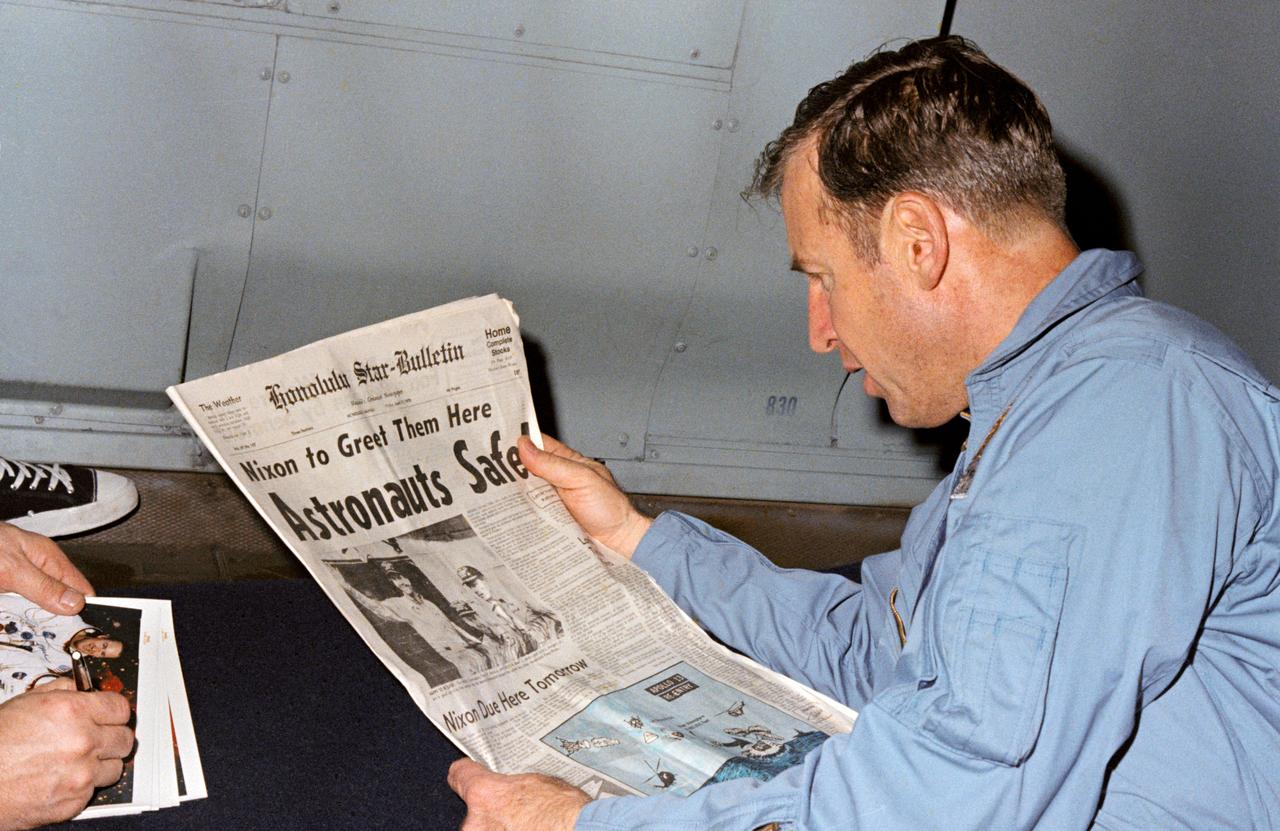
S70-15501 (17 April 1970) --- Astronaut James A. Lovell Jr., Apollo 13 mission commander, reads a newspaper account of the safe recovery of the problem plagued mission. Lovell is on board the USS Iwo Jima, prime recovery ship for Apollo 13, which was on a course headed for Pago Pago. From Pago Pago the astronauts flew to Hickam Air Force Base, Hawaii, where they were presented the Presidential Medal of Freedom by President Richard M. Nixon. Other Apollo 13 crew members were astronauts John L. Swigert Jr., command module pilot, and Fred W. Haise Jr., lunar module pilot.
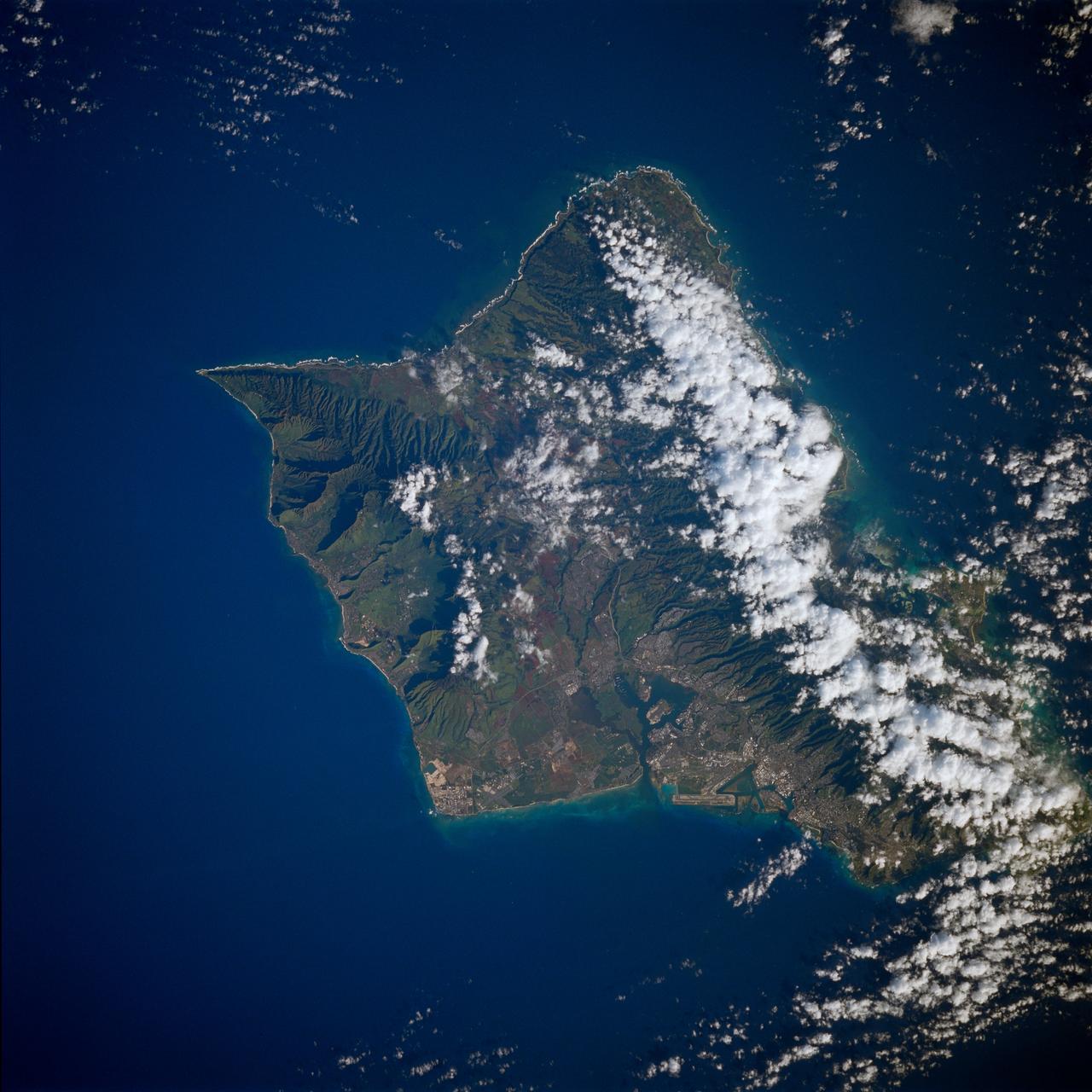
STS080-758-065 (19 Nov.-7 Dec. 1996) --- The island of Oahu, state of Hawaii was photographed by the crew members aboard the Earth-orbiting Space Shuttle Columbia. The western portion (lower part of photograph) of the well eroded extinct volcano is quite clear. The northeastern coastal area and Koolau Range of mountains, which runs the length of the island (30 miles) are cloud covered. This is an unusual case. This is the windward side of the island (great for surfing) and the warm moist Pacific winds sweep up the mountains thus causing the clouds and an unusually high rainfall. The city of Honolulu is along the right side with the Honolulu International Airport clearly seen. Below the airport is the narrow entrance to Pearl Harbor and nearby Hickam Air Force Base. The narrow sand beaches of the Waikiki Beach resort area, just above Diamond Head - on the lower right, appear as narrow white lines along the coast above the airport and port of Honolulu. The sharp point at the lower portion of the photo is Kaena Point. The cliffs there are so steep that there is no developed roadway although a narrow gauge railway was carved into the cliffs and operated the first half of the century.
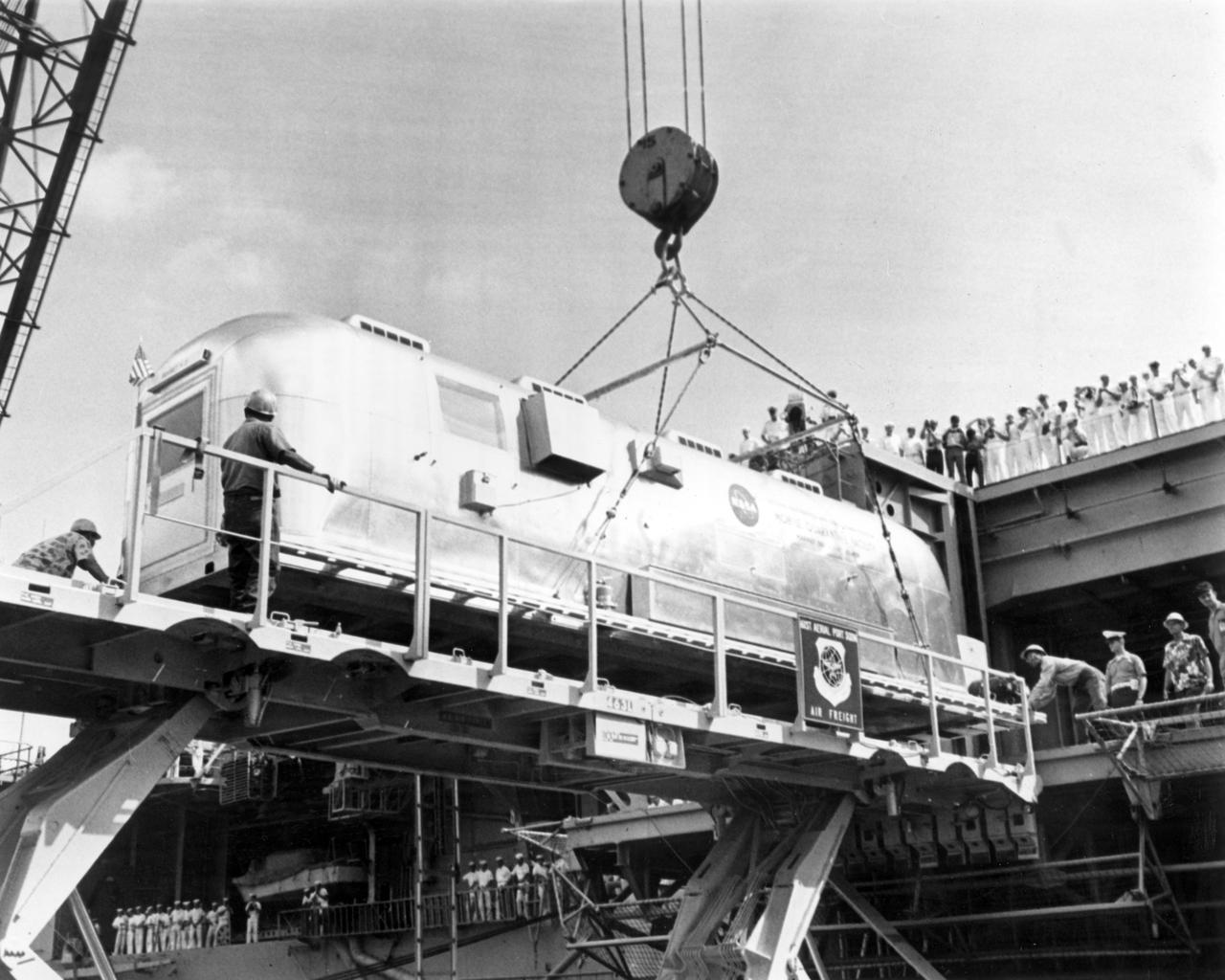
The Apollo 11 mission, the first manned lunar mission, launched from the Kennedy Space Center, Florida via the Marshall Space Flight Center (MSFC) developed Saturn V launch vehicle on July 16, 1969 and safely returned to Earth on July 24, 1969. Aboard the space craft were astronauts Neil A. Armstrong, commander; Michael Collins, Command Module (CM) pilot; and Edwin E. Aldrin Jr., Lunar Module (LM) pilot. The CM, piloted by Michael Collins remained in a parking orbit around the Moon while the LM, named “Eagle’’, carrying astronauts Neil Armstrong and Edwin Aldrin, landed on the Moon. During 2½ hours of surface exploration, the crew collected 47 pounds of lunar surface material for analysis back on Earth. The recovery operation took place in the Pacific Ocean where Navy para-rescue men recovered the capsule housing the 3-man Apollo 11 crew. The crew was airlifted to safety aboard the U.S.S. Hornet recovery ship, where they were quartered in a Mobile Quarantine Facility (MQF) which served as their home for 21 days. In this photo taken at Pearl Harbor, Hawaii, the quarantined housing facility is being lowered from the U.S.S. Hornet, onto a trailer for transport to Hickam Field. From there, it was loaded aboard an Air Force C-141 jet and flown back to Ellington Air Force Base Texas, and then on to the NASA Manned Spacecraft Center (MSC) Lunar Receiving Laboratory in Houston, Texas.