
Five of Five: The Last Scene in a High-resolution Color Mosaic
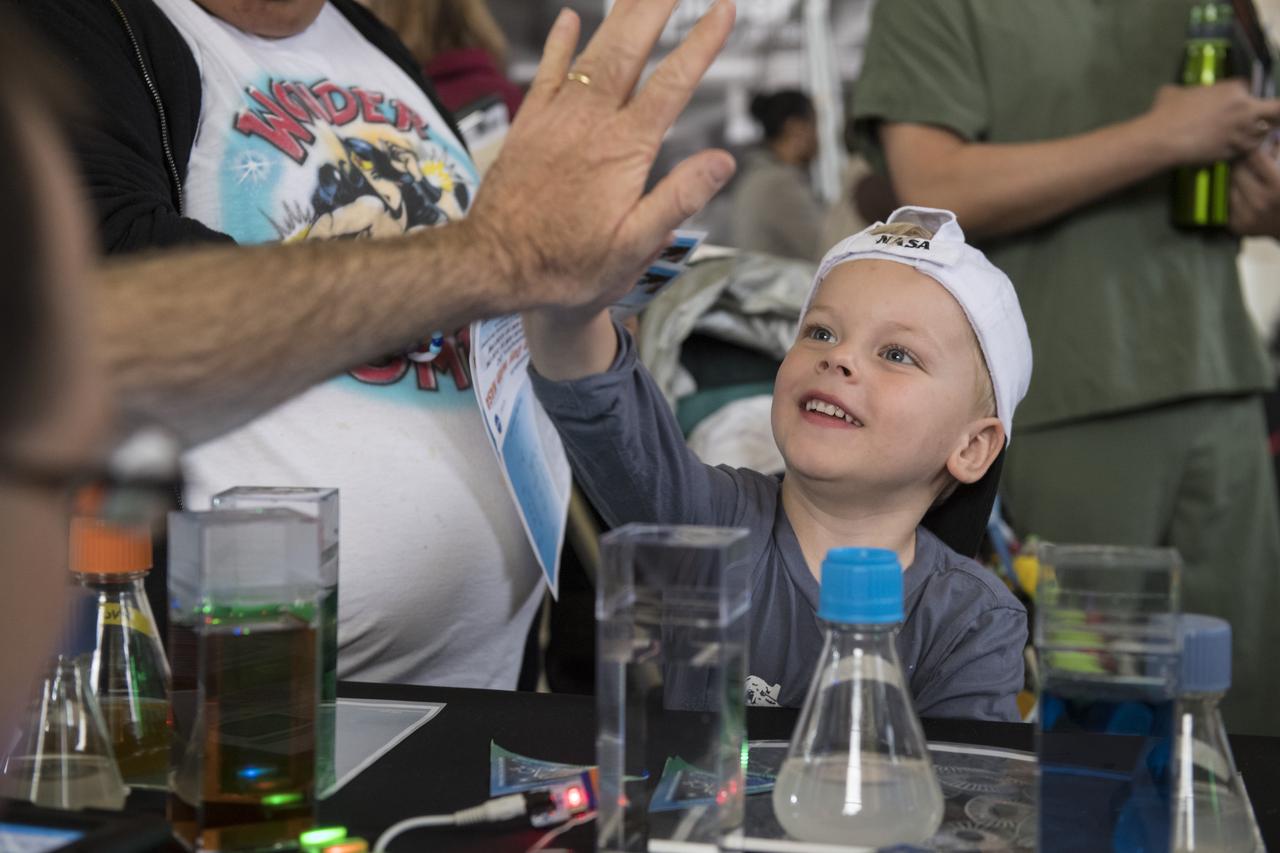
A visitor gives a high five after learning about oceans at one of NASA's exhibits at the Earth Day event on Thursday, April 19, 2018 at Union Station in Washington, D.C. Photo Credit: (NASA/Aubrey Gemignani)
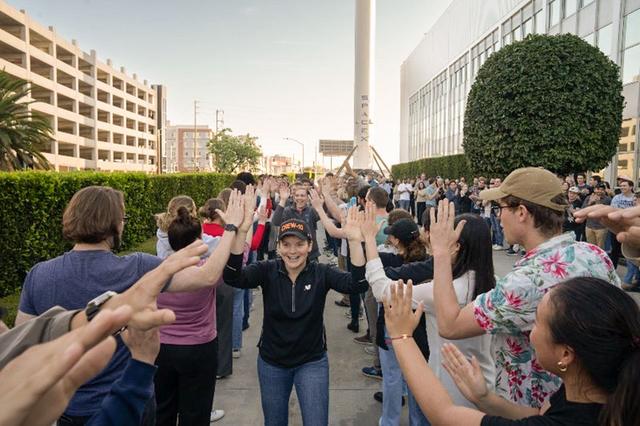
jsc2025e011329 (Feb. 24, 2025) --- NASA astronaut and commander of NASA's SpaceX Crew-10 mission Anne McClain smiles and high fives SpaceX employees during a sendoff at the company’s facility in Hawthorne, California. Credit: SpaceX
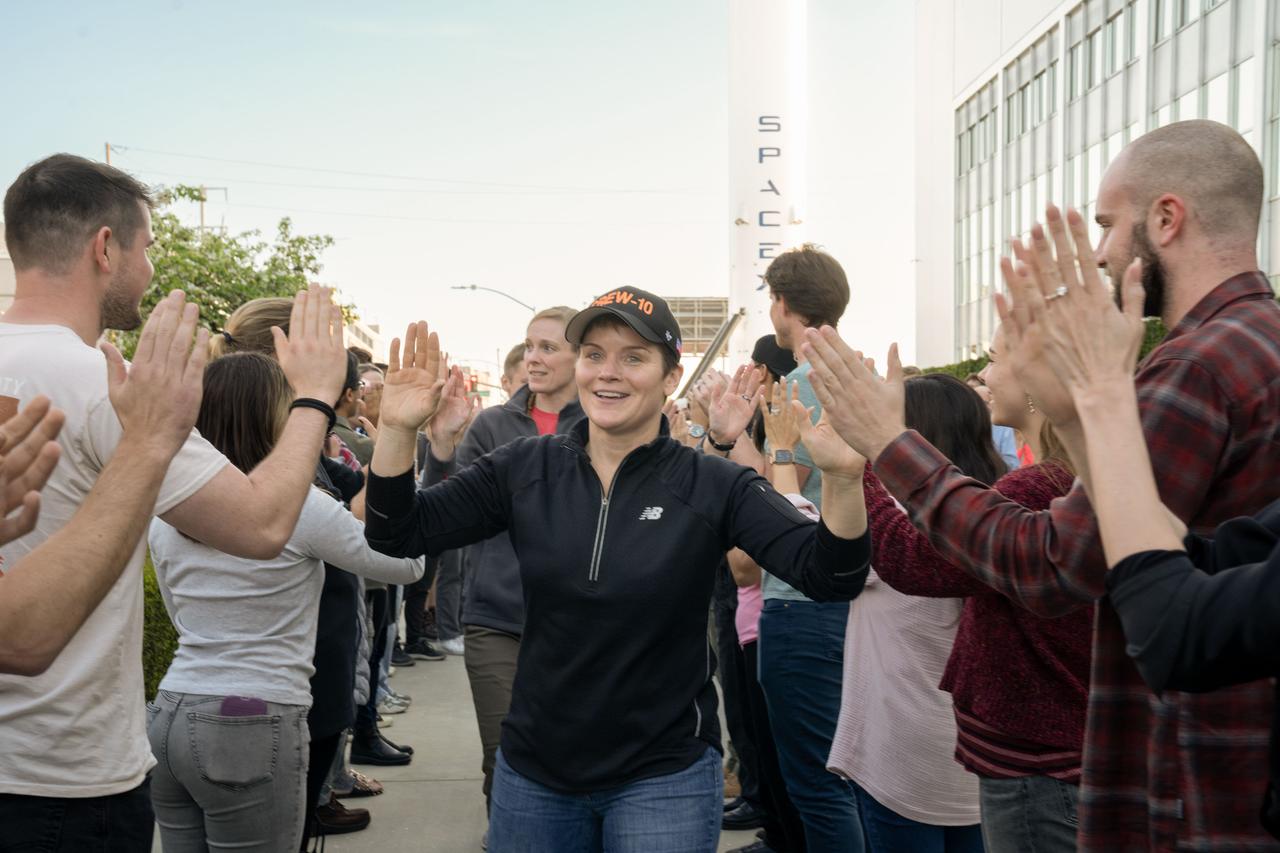
NASA astronaut and commander of NASA's SpaceX Crew-10 mission Anne McClain smiles and high fives SpaceX employees during a sendoff at the company’s facility in Hawthorne, California. Credit: SpaceX
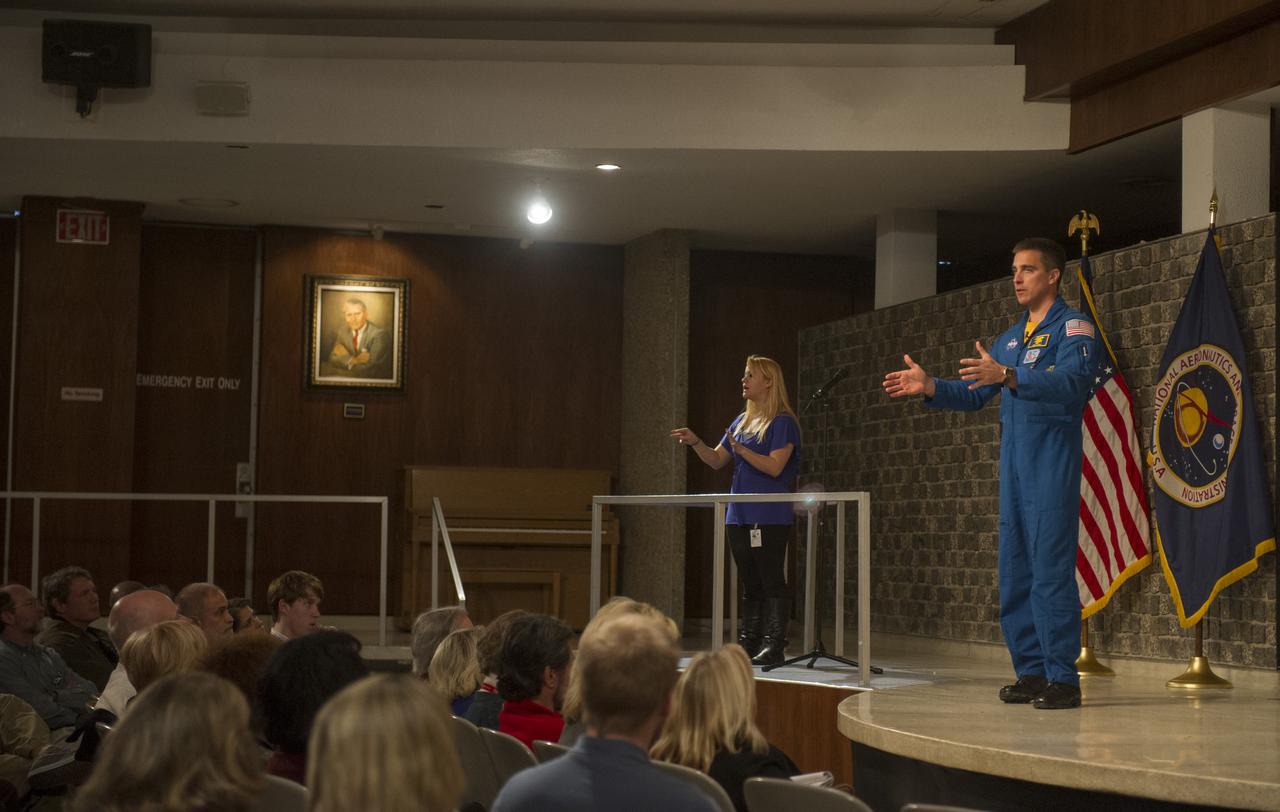
ASTRONAUT CHRIS CASSIDY, WHO LIVED AND WORKED FIVE MONTHS AS AN EXPEDITION 36 FLIGHT ENGINEER ABOARD THE INTERNATIONAL SPACE STATION, ADDRESSES MSFC EMPLOYEES AND HIGH SCHOOL STUDENTS FOR MISSION HIGHLIGHTS PROGRAM ON 1/22/14
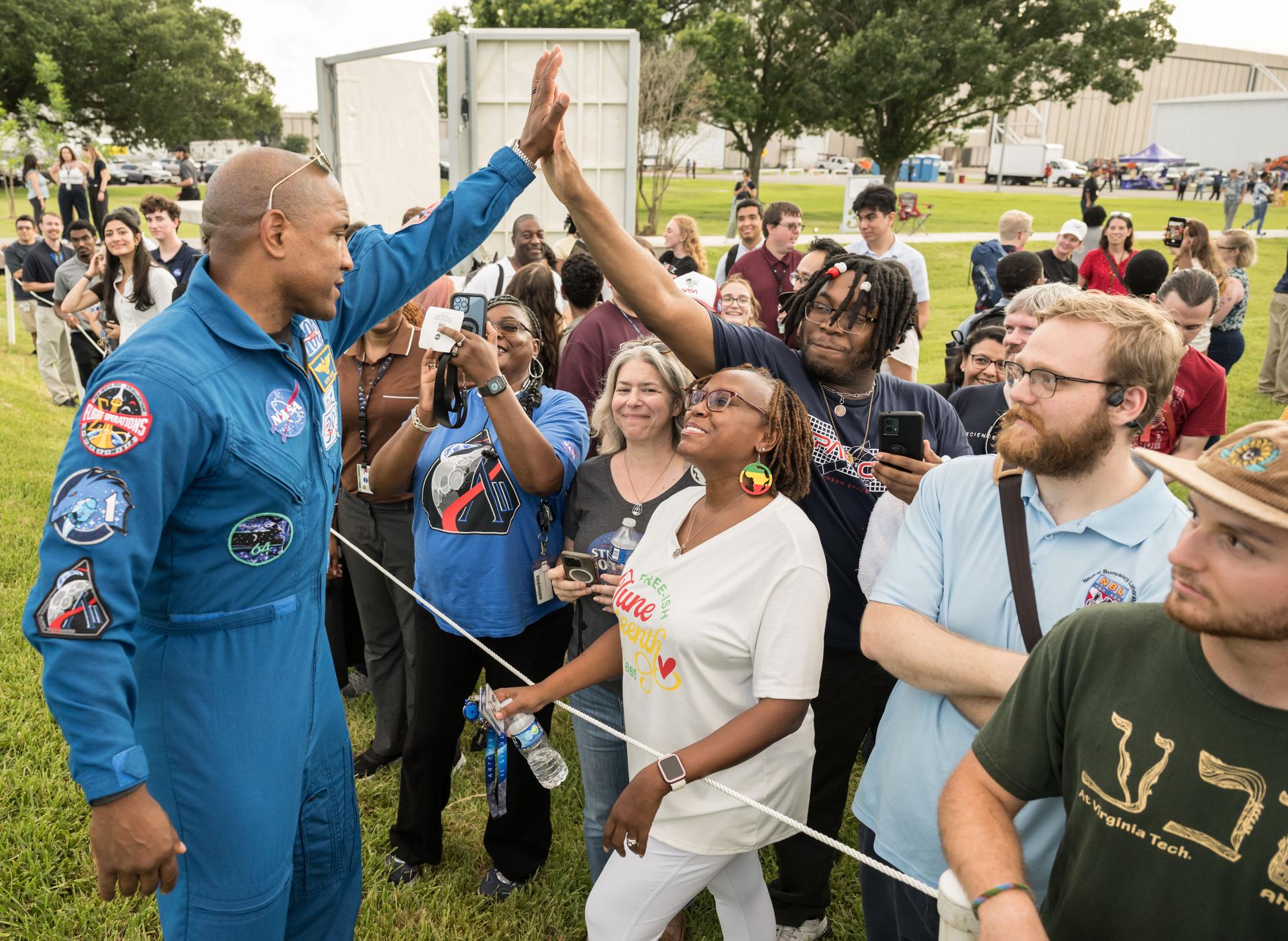
jsc2026e396795 (June 25, 2026) - NASA astronaut Victor Glover high-fives attendees at an Artemis II employee celebration event at NASA's Johnson Space Center. Credit: NASA
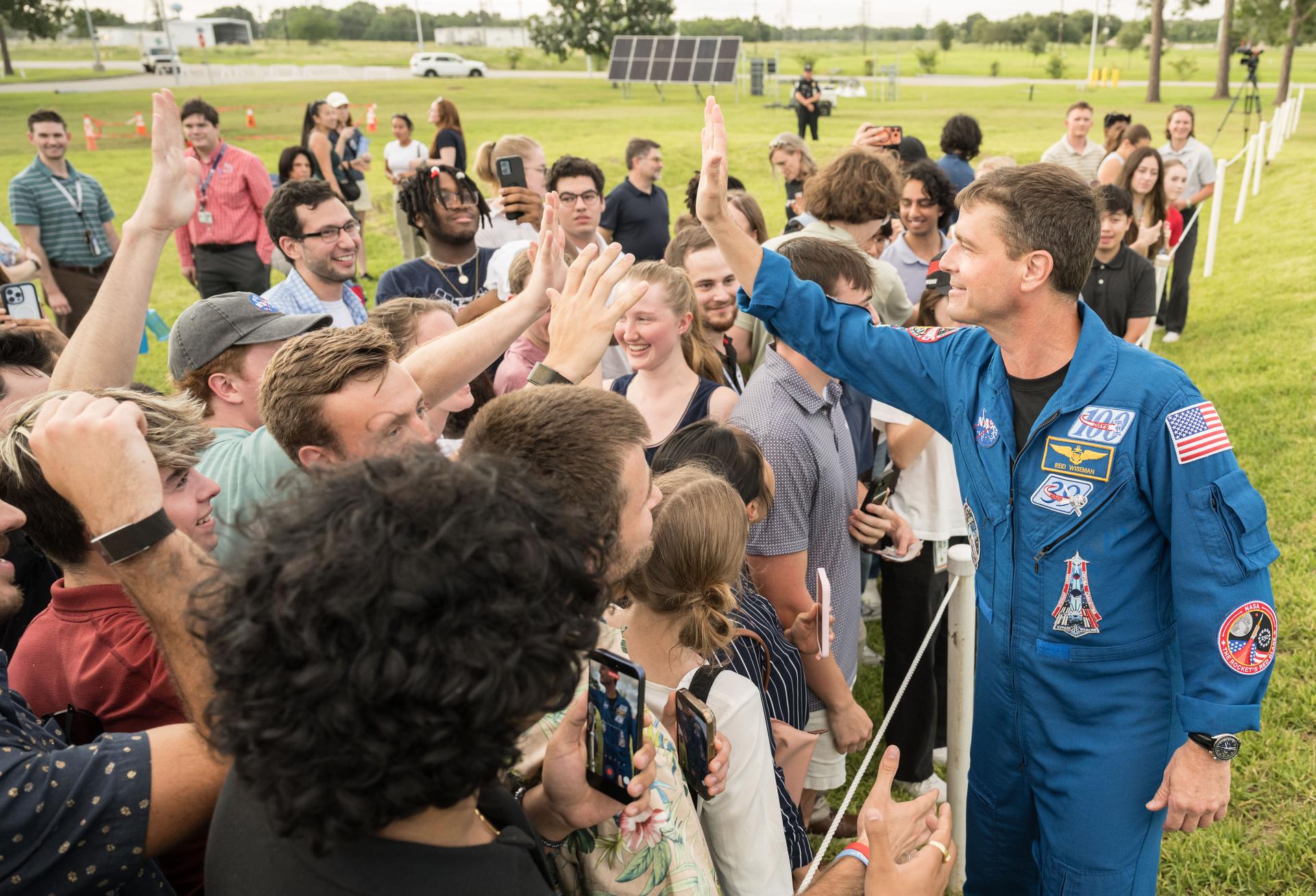
jsc2026e396793 (June 25, 2026) - NASA astronaut Reid Wiseman high-fives attendees at an Artemis II employee celebration event at NASA's Johnson Space Center. Credit: NASA
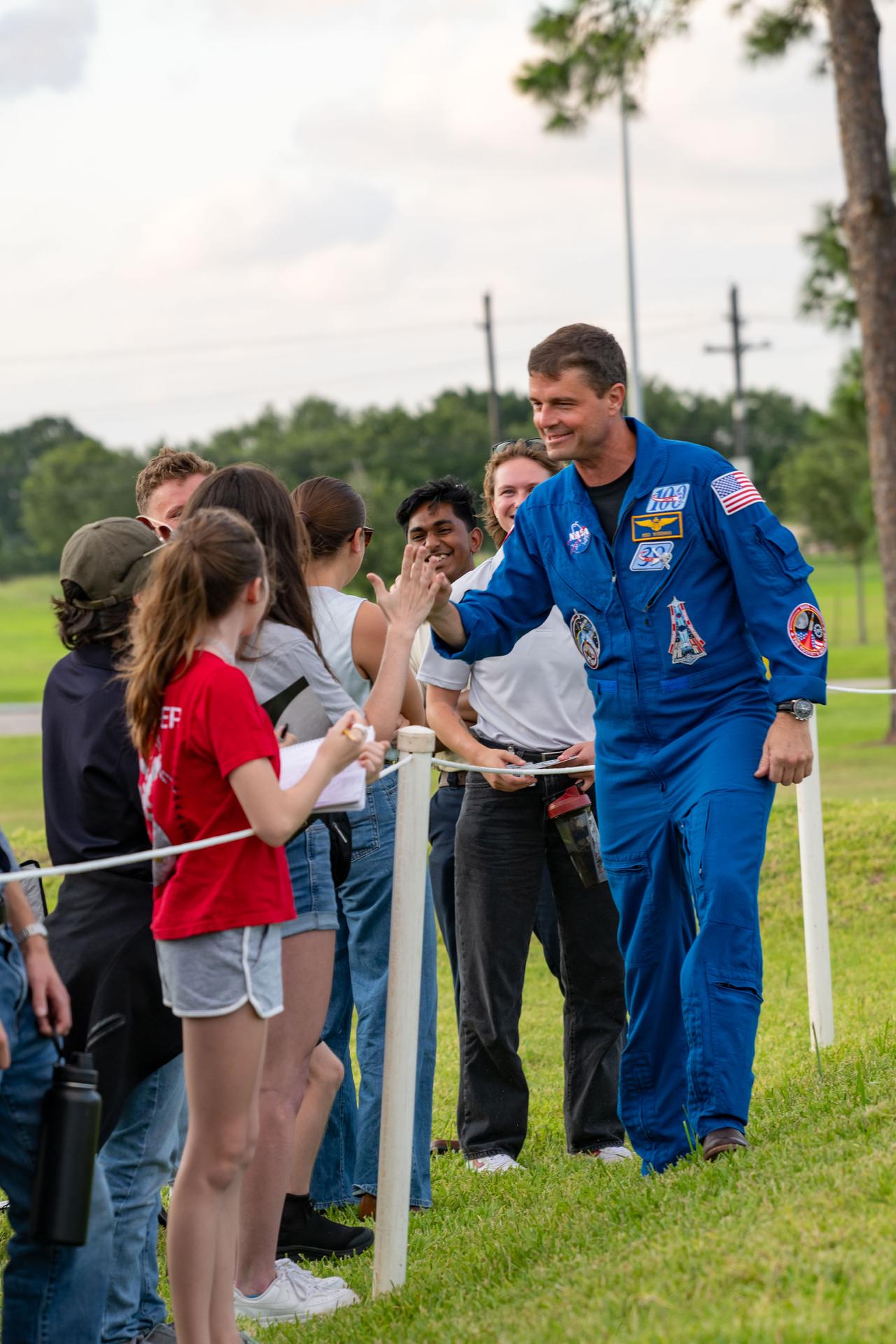
jsc2026e397515 (June 25, 2026) - NASA astronaut Reid Wiseman high-fives attendees at an Artemis II employee celebration event at NASA's Johnson Space Center. Credit: NASA
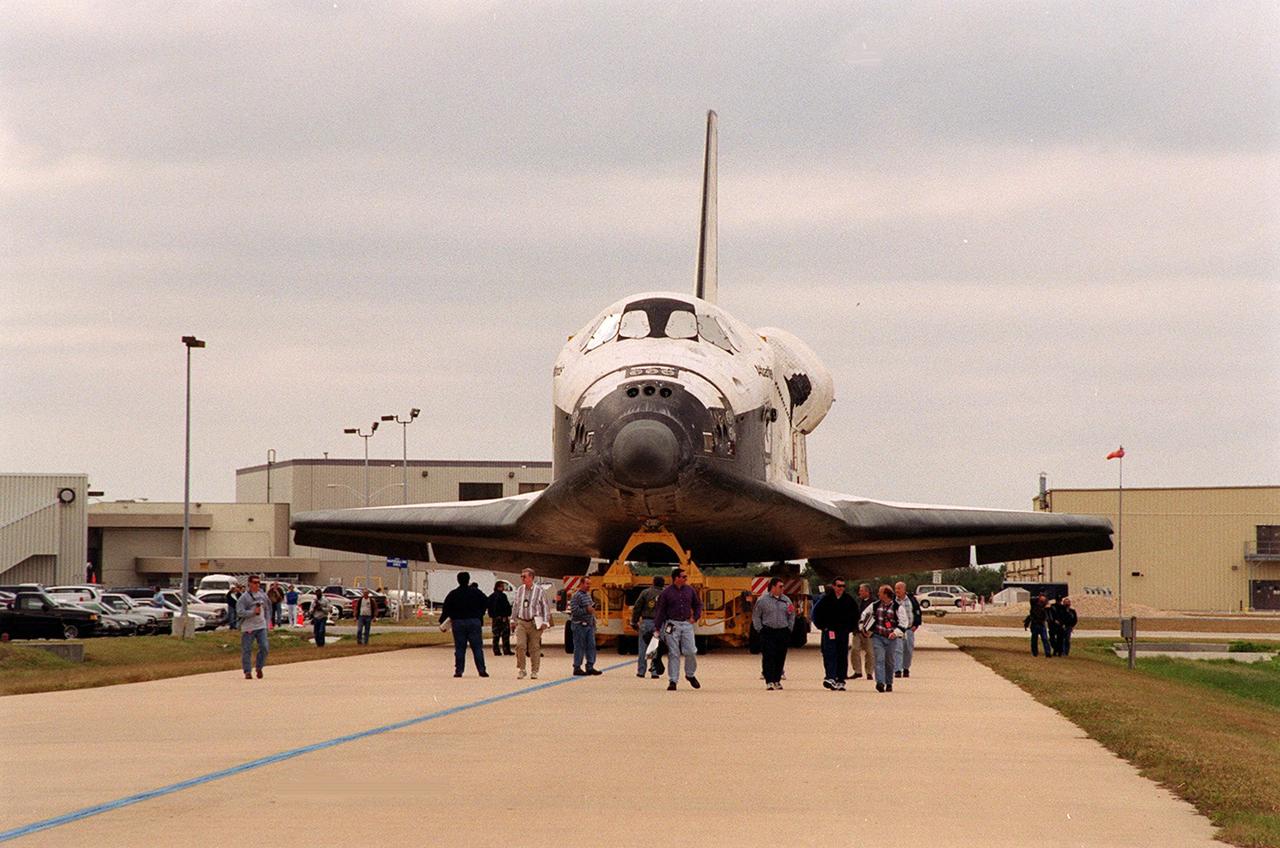
The orbiter Atlantis rolls away from the Orbiter Processing Facility bay 3 (in the background) to the Vehicle Assembly Building. In the VAB it will be raised to vertical and lifted up and into high bay 3 for stacking with its external tank and solid rocket boosters. Atlantis will fly on mission STS-98, the seventh construction flight to the International Space Station. The orbiter will carry in its payload bay the U.S. Laboratory, named Destiny, that will have five system racks already installed inside of the module. After delivery of electronics in the lab, electrically powered attitude control for Control Moment Gyroscopes will be activated. Atlantis is scheduled for launch on Jan. 18, 2001, at 2:44 a.m. EST, with a crew of five
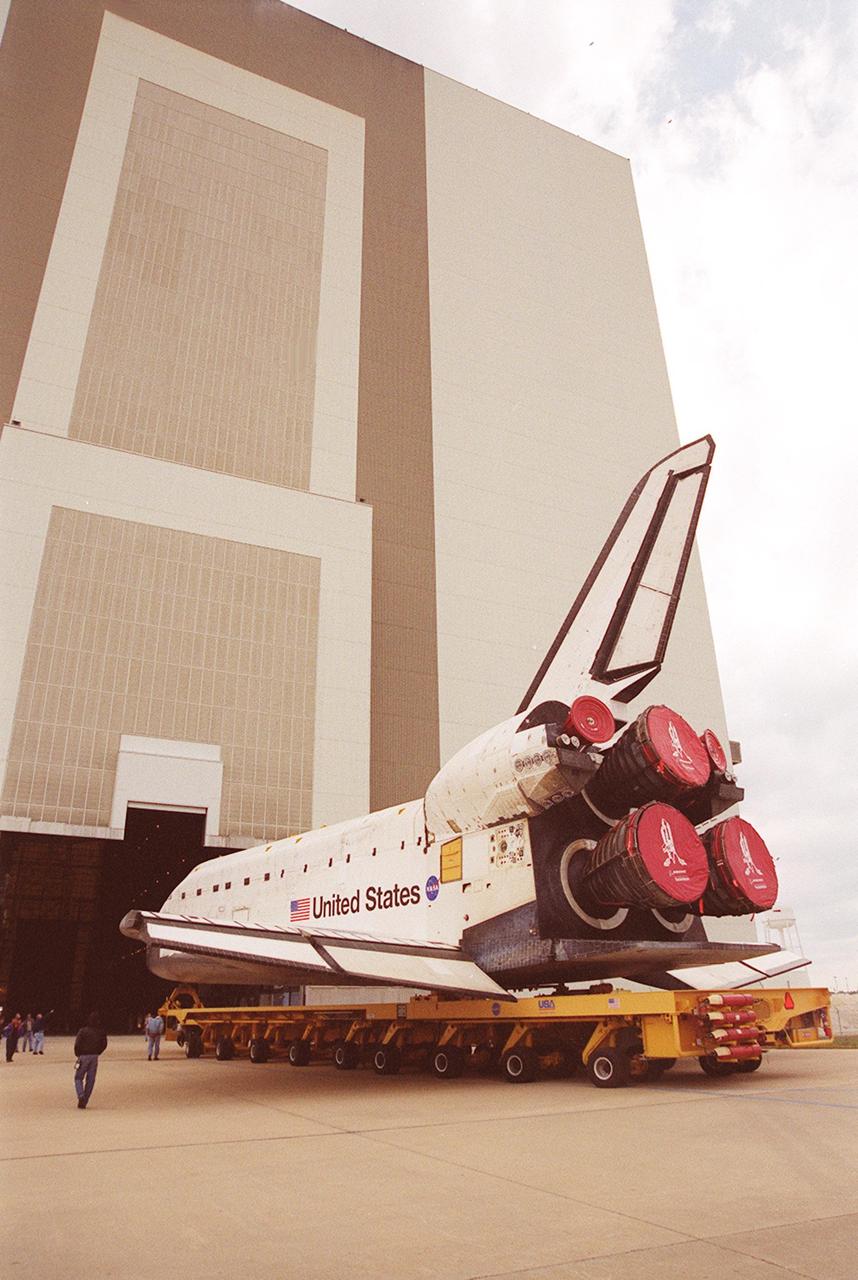
The orbiter Atlantis rolls toward the open door of the Vehicle Assembly Building after leaving the Orbiter Processing Facility bay 3. In the VAB it will be raised to vertical and lifted up and into high bay 3 for stacking with its external tank and solid rocket boosters. Atlantis will fly on mission STS-98, the seventh construction flight to the International Space Station. The orbiter will carry in its payload bay the U.S. Laboratory, named Destiny, that will have five system racks already installed inside of the module. After delivery of electronics in the lab, electrically powered attitude control for Control Moment Gyroscopes will be activated. Atlantis is scheduled for launch on Jan. 18, 2001, at 2:44 a.m. EST, with a crew of five
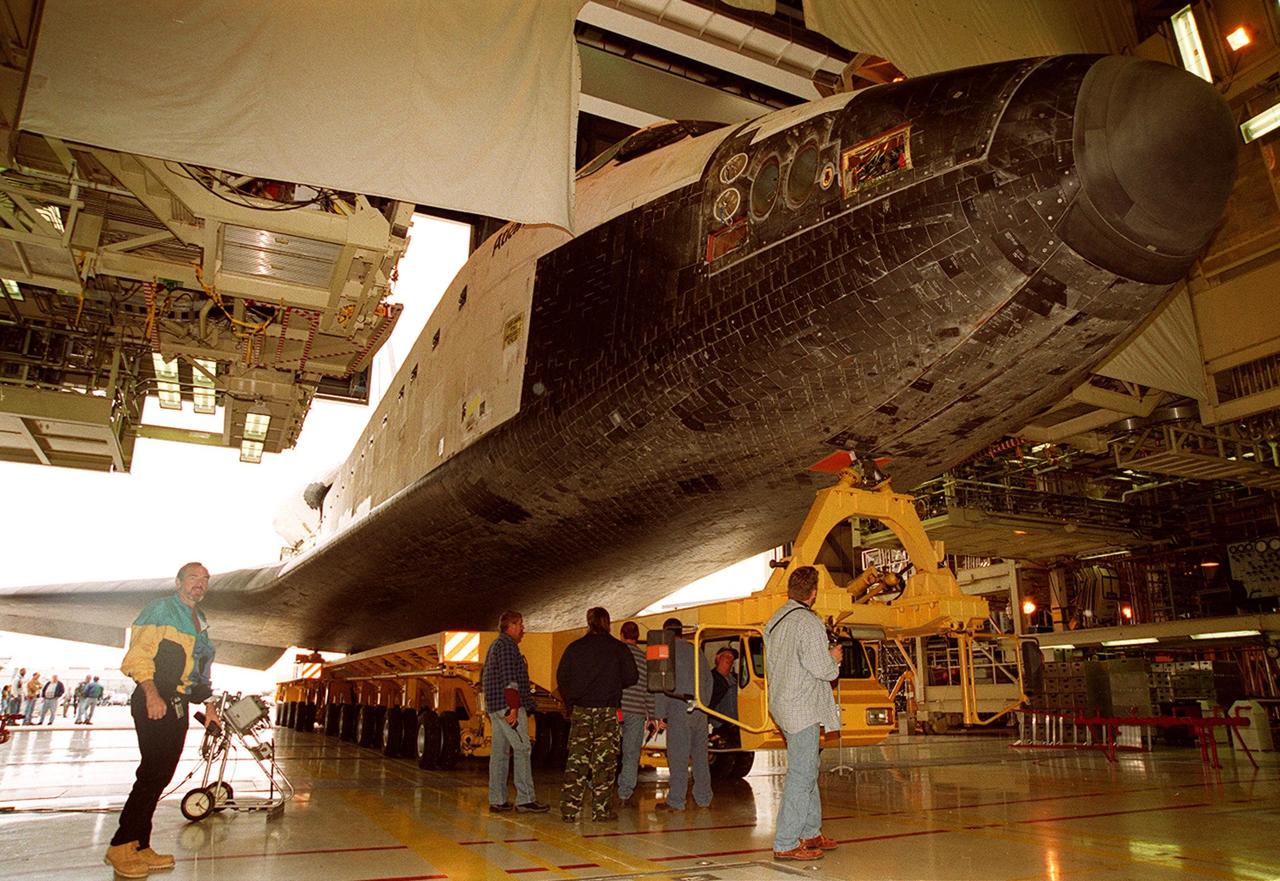
Viewed from inside Orbiter Processing Facility bay 3, Atlantis is ready for rollover to the Vehicle Assembly Building. In the VAB it will be raised to vertical and lifted up and into high bay 3 for stacking with its external tank and solid rocket boosters. Atlantis will fly on mission STS-98, the seventh construction flight to the International Space Station. The orbiter will carry in its payload bay the U.S. Laboratory, named Destiny, that will have five system racks already installed inside of the module. After delivery of electronics in the lab, electrically powered attitude control for Control Moment Gyroscopes will be activated. Atlantis is scheduled for launch on Jan. 18, 2001, at 2:44 a.m. EST, with a crew of five
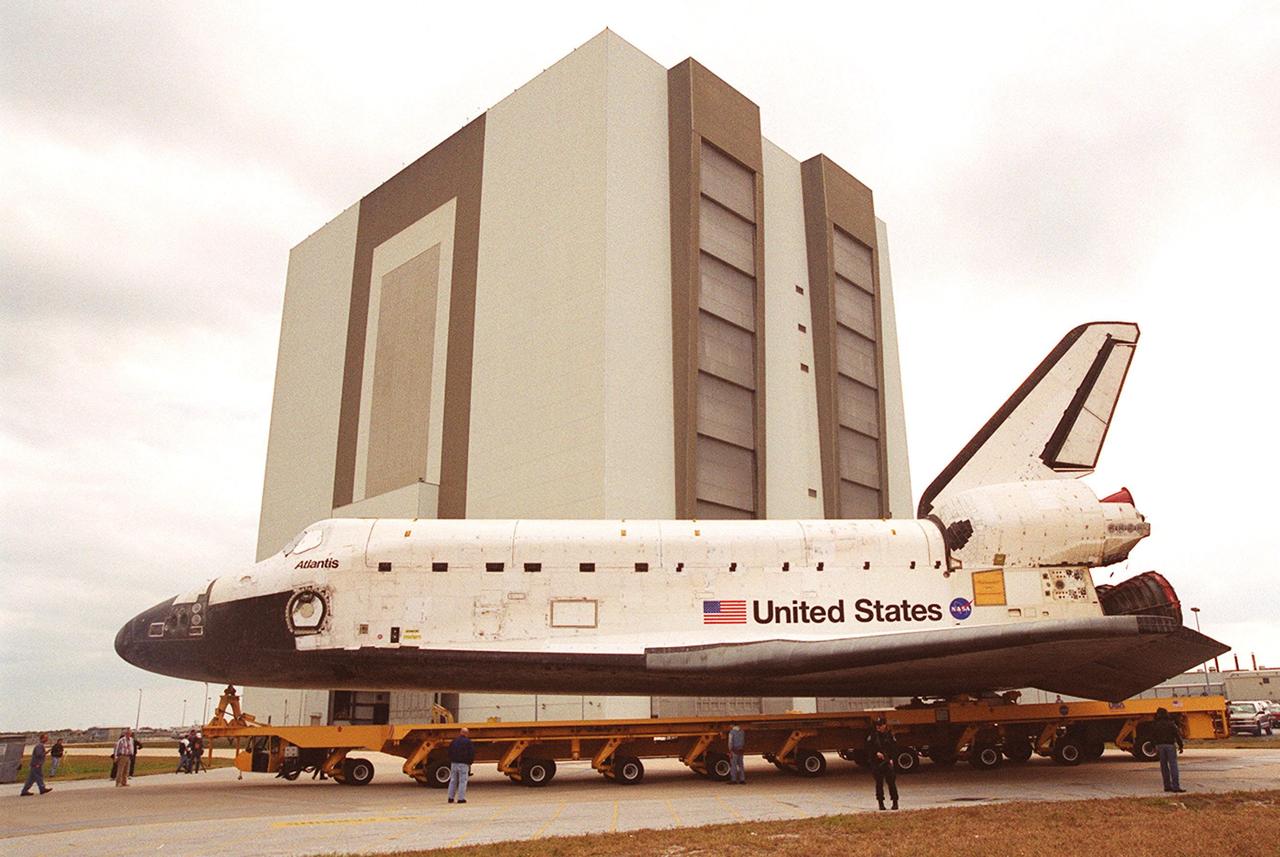
The orbiter Atlantis, on its transporter, heads into the turn toward the Vehicle Assembly Building, in the background. In the VAB it will be raised to vertical and lifted up and into high bay 3 for stacking with its external tank and solid rocket boosters. Atlantis will fly on mission STS-98, the seventh construction flight to the International Space Station. The orbiter will carry in its payload bay the U.S. Laboratory, named Destiny, that will have five system racks already installed inside of the module. After delivery of electronics in the lab, electrically powered attitude control for Control Moment Gyroscopes will be activated. Atlantis is scheduled for launch on Jan. 18, 2001, at 2:44 a.m. EST, with a crew of five
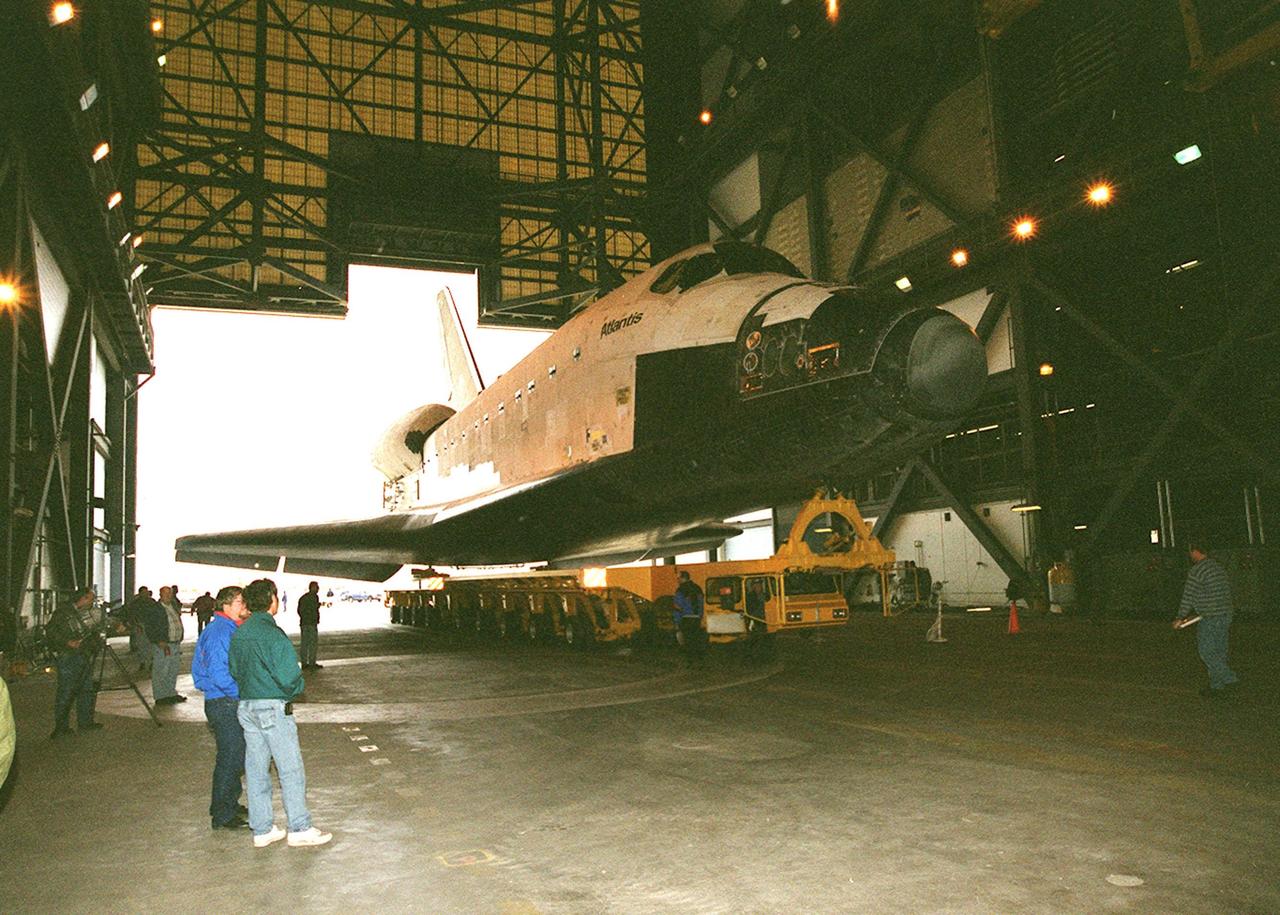
Atlantis rolls into the transfer aisle of the Vehicle Assembly Building where it will be raised to vertical and lifted into high bay 3 for stacking with its external tank and solid rocket boosters. Atlantis will fly on mission STS-98, the seventh construction flight to the International Space Station. The orbiter will carry in its payload bay the U.S. Laboratory, named Destiny, that will have five system racks already installed inside of the module. After delivery of electronics in the lab, electrically powered attitude control for Control Moment Gyroscopes will be activated. Atlantis is scheduled for launch on Jan. 18, 2001, at 2:44 a.m. EST, with a crew of five
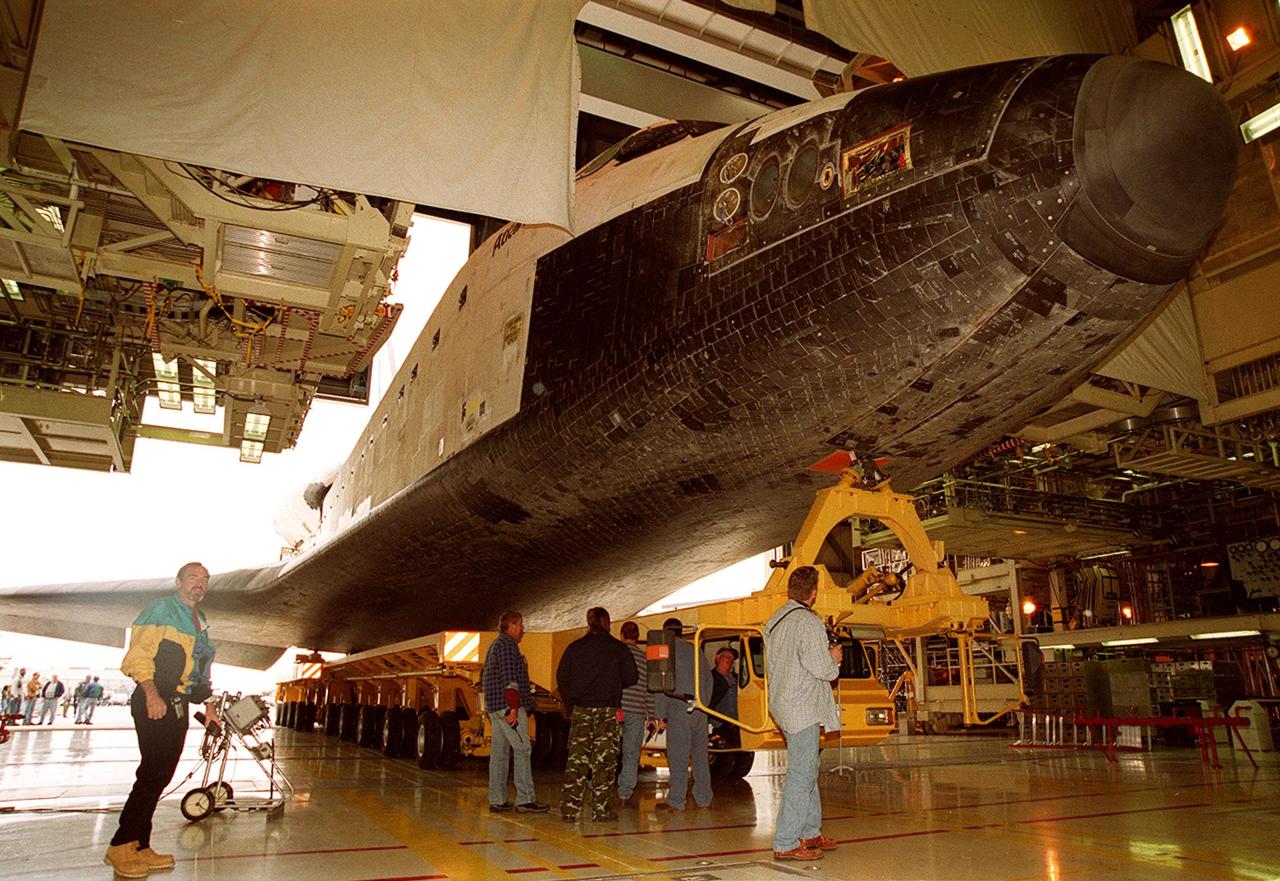
Viewed from inside Orbiter Processing Facility bay 3, Atlantis is ready for rollover to the Vehicle Assembly Building. In the VAB it will be raised to vertical and lifted up and into high bay 3 for stacking with its external tank and solid rocket boosters. Atlantis will fly on mission STS-98, the seventh construction flight to the International Space Station. The orbiter will carry in its payload bay the U.S. Laboratory, named Destiny, that will have five system racks already installed inside of the module. After delivery of electronics in the lab, electrically powered attitude control for Control Moment Gyroscopes will be activated. Atlantis is scheduled for launch on Jan. 18, 2001, at 2:44 a.m. EST, with a crew of five
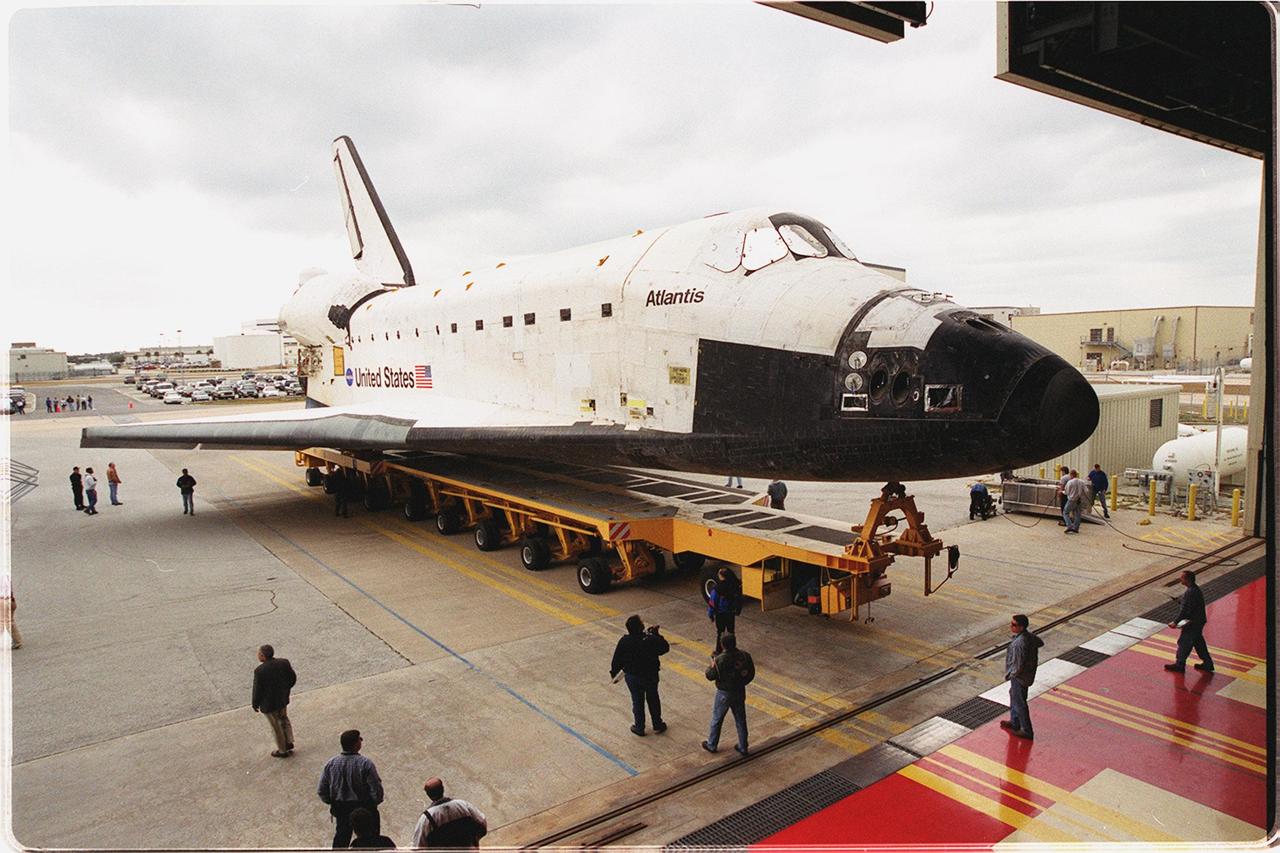
The orbiter Atlantis rolls out of the Orbiter Processing Facility bay 3 on its transporter. It is being transferred to the Vehicle Assembly Building where it will be raised to vertical and lifted up and into high bay 3 for stacking with its external tank and solid rocket boosters. Atlantis will fly on mission STS-98, the seventh construction flight to the International Space Station. The orbiter will carry in its payload bay the U.S. Laboratory, named Destiny, that will have five system racks already installed inside of the module. After delivery of electronics in the lab, electrically powered attitude control for Control Moment Gyroscopes will be activated. Atlantis is scheduled for launch on Jan. 18, 2001, at 2:44 a.m. EST, with a crew of five

Atlantis rolls into the transfer aisle of the Vehicle Assembly Building where it will be raised to vertical and lifted into high bay 3 for stacking with its external tank and solid rocket boosters. Atlantis will fly on mission STS-98, the seventh construction flight to the International Space Station. The orbiter will carry in its payload bay the U.S. Laboratory, named Destiny, that will have five system racks already installed inside of the module. After delivery of electronics in the lab, electrically powered attitude control for Control Moment Gyroscopes will be activated. Atlantis is scheduled for launch on Jan. 18, 2001, at 2:44 a.m. EST, with a crew of five
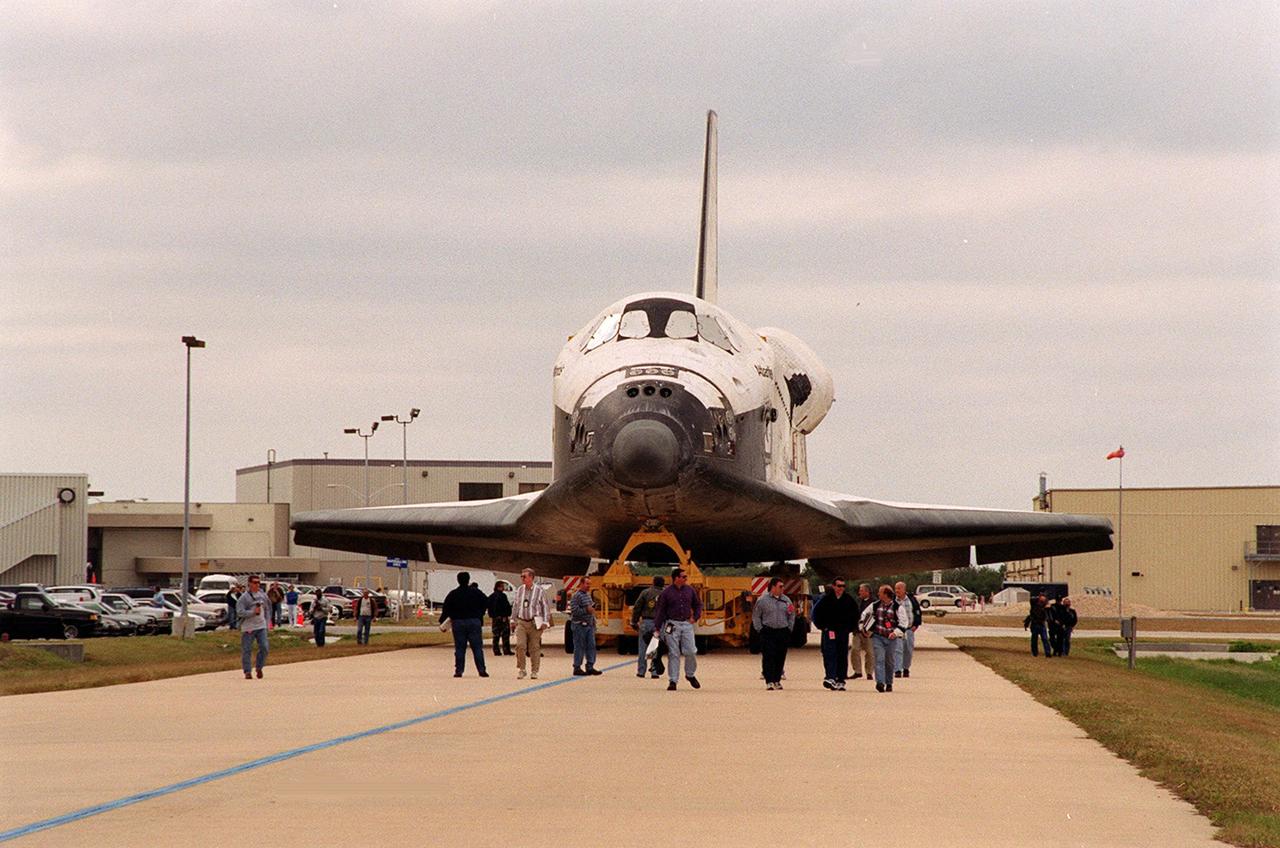
The orbiter Atlantis rolls away from the Orbiter Processing Facility bay 3 (in the background) to the Vehicle Assembly Building. In the VAB it will be raised to vertical and lifted up and into high bay 3 for stacking with its external tank and solid rocket boosters. Atlantis will fly on mission STS-98, the seventh construction flight to the International Space Station. The orbiter will carry in its payload bay the U.S. Laboratory, named Destiny, that will have five system racks already installed inside of the module. After delivery of electronics in the lab, electrically powered attitude control for Control Moment Gyroscopes will be activated. Atlantis is scheduled for launch on Jan. 18, 2001, at 2:44 a.m. EST, with a crew of five
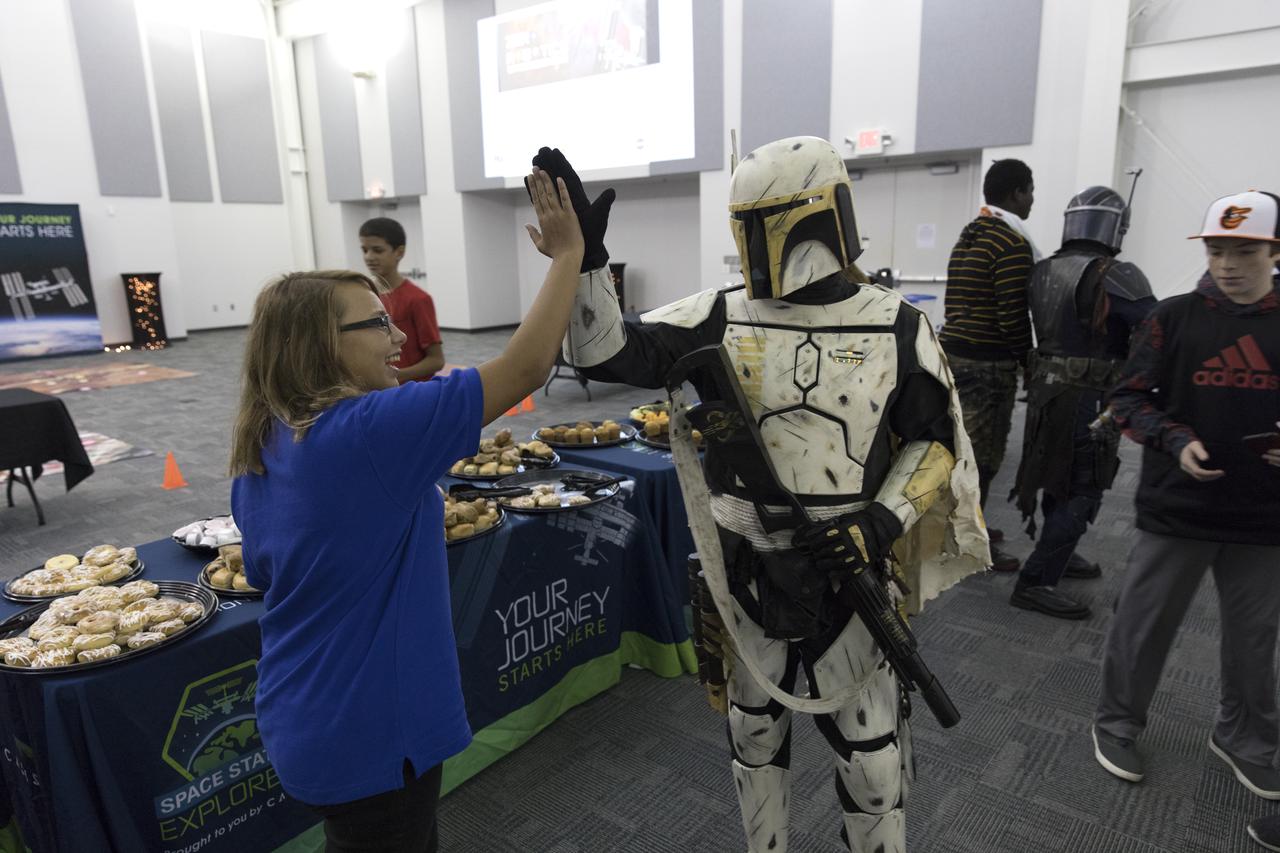
A middle-school student high-fives a Star Wars character from the 501st Legion in the Center for Space Education at NASA’s Kennedy Space Center in Florida. Teams from across the state of Florida were gathered at Kennedy for the finals of the Zero Robotics Middle School Summer Program national championship. The five-week program allows rising sixth- through ninth-graders to write programs for small satellites called SPHERES (Synchronized, Position, Hold, Engage, Reorient, Experimental Satellites). Finalists saw their code tested aboard the International Space Station.
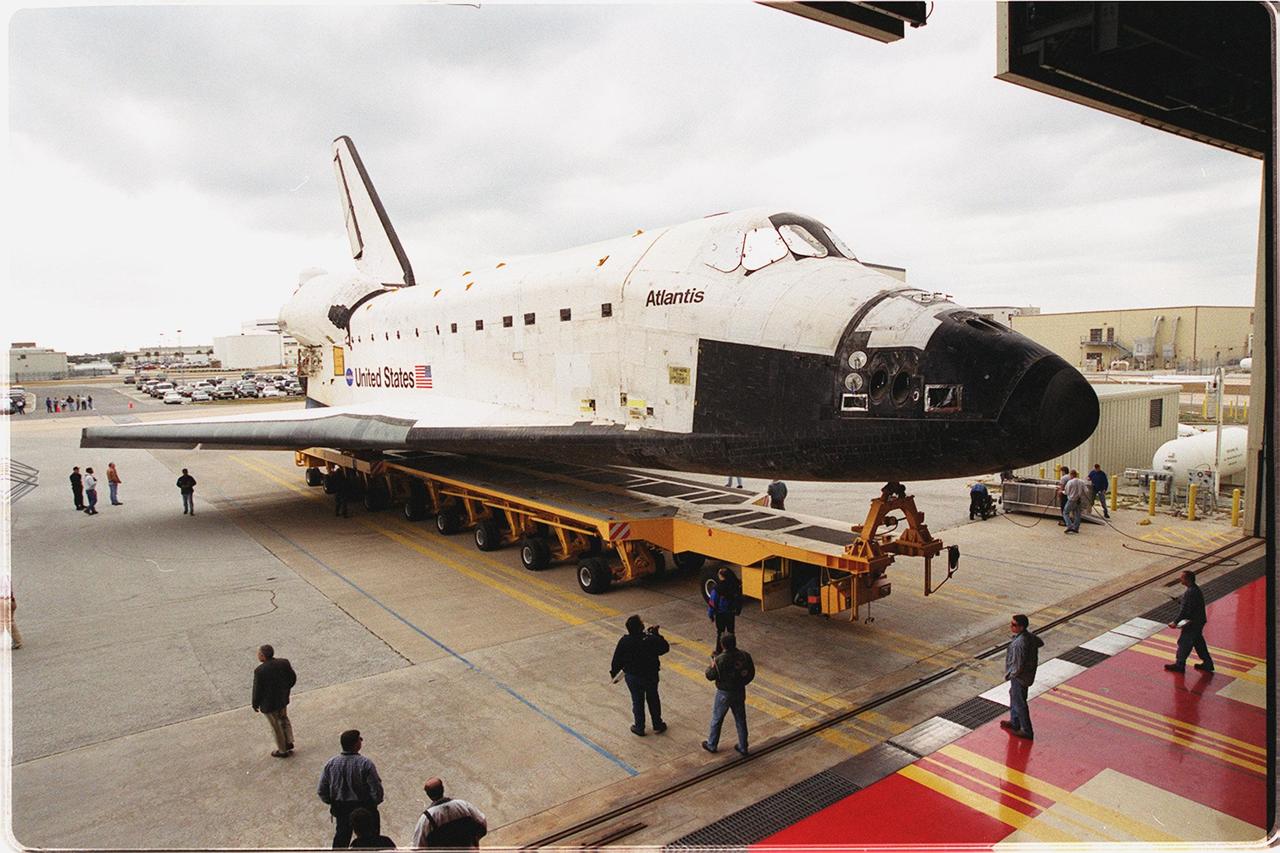
The orbiter Atlantis rolls out of the Orbiter Processing Facility bay 3 on its transporter. It is being transferred to the Vehicle Assembly Building where it will be raised to vertical and lifted up and into high bay 3 for stacking with its external tank and solid rocket boosters. Atlantis will fly on mission STS-98, the seventh construction flight to the International Space Station. The orbiter will carry in its payload bay the U.S. Laboratory, named Destiny, that will have five system racks already installed inside of the module. After delivery of electronics in the lab, electrically powered attitude control for Control Moment Gyroscopes will be activated. Atlantis is scheduled for launch on Jan. 18, 2001, at 2:44 a.m. EST, with a crew of five

The orbiter Atlantis rolls toward the open door of the Vehicle Assembly Building after leaving the Orbiter Processing Facility bay 3. In the VAB it will be raised to vertical and lifted up and into high bay 3 for stacking with its external tank and solid rocket boosters. Atlantis will fly on mission STS-98, the seventh construction flight to the International Space Station. The orbiter will carry in its payload bay the U.S. Laboratory, named Destiny, that will have five system racks already installed inside of the module. After delivery of electronics in the lab, electrically powered attitude control for Control Moment Gyroscopes will be activated. Atlantis is scheduled for launch on Jan. 18, 2001, at 2:44 a.m. EST, with a crew of five
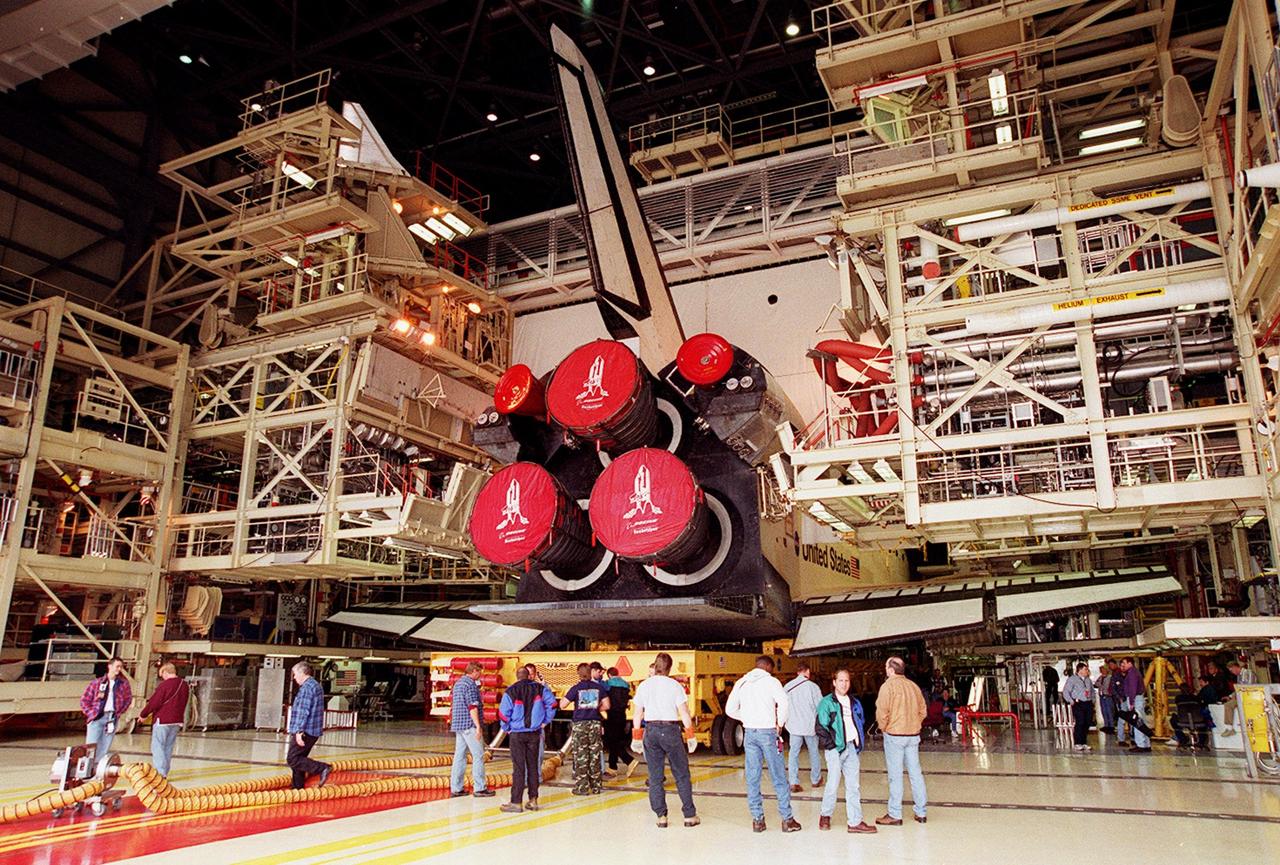
Inside Orbiter Processing Facility bay 3, Atlantis is ready for rollover to the Vehicle Assembly Building. In the VAB it will be raised to vertical and lifted up and into high bay 3 for stacking with its external tank and solid rocket boosters. Atlantis will fly on mission STS-98, the seventh construction flight to the International Space Station. The orbiter will carry in its payload bay the U.S. Laboratory, named Destiny, that will have five system racks already installed inside of the module. After delivery of electronics in the lab, electrically powered attitude control for Control Moment Gyroscopes will be activated. Atlantis is scheduled for launch on Jan. 18, 2001, at 2:44 a.m. EST, with a crew of five

Inside Orbiter Processing Facility bay 3, Atlantis is ready for rollover to the Vehicle Assembly Building. In the VAB it will be raised to vertical and lifted up and into high bay 3 for stacking with its external tank and solid rocket boosters. Atlantis will fly on mission STS-98, the seventh construction flight to the International Space Station. The orbiter will carry in its payload bay the U.S. Laboratory, named Destiny, that will have five system racks already installed inside of the module. After delivery of electronics in the lab, electrically powered attitude control for Control Moment Gyroscopes will be activated. Atlantis is scheduled for launch on Jan. 18, 2001, at 2:44 a.m. EST, with a crew of five

The orbiter Atlantis, on its transporter, heads into the turn toward the Vehicle Assembly Building, in the background. In the VAB it will be raised to vertical and lifted up and into high bay 3 for stacking with its external tank and solid rocket boosters. Atlantis will fly on mission STS-98, the seventh construction flight to the International Space Station. The orbiter will carry in its payload bay the U.S. Laboratory, named Destiny, that will have five system racks already installed inside of the module. After delivery of electronics in the lab, electrically powered attitude control for Control Moment Gyroscopes will be activated. Atlantis is scheduled for launch on Jan. 18, 2001, at 2:44 a.m. EST, with a crew of five
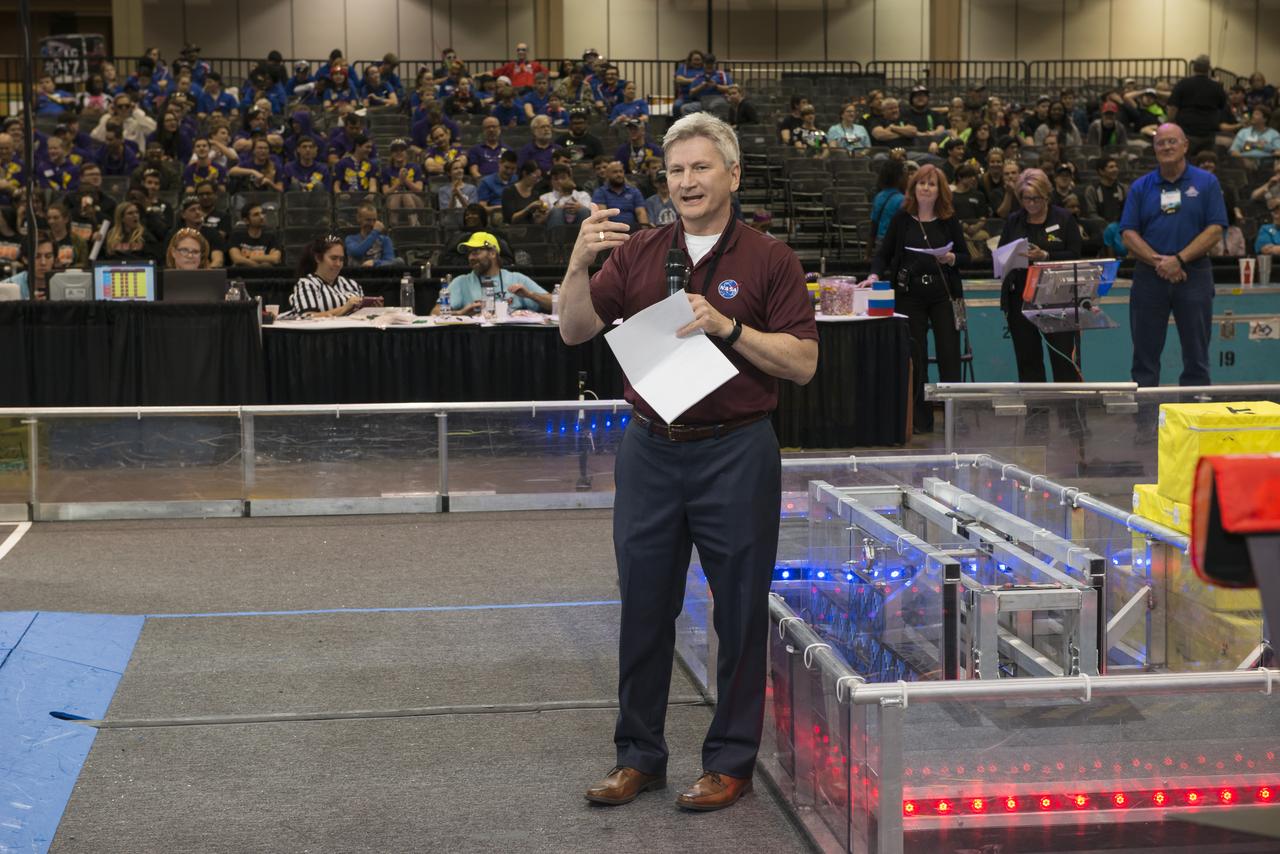
Johnny Stephenson, director of NASA Marshall Space Flight Center's Office of Strategic Analysis & Communications, addresses the crowd during the March 16 award ceremony following the first day of competition at the FIRST Robotics Rocket City Regional at the Von Braun Center in Huntsville. Ed Sparks, of the Morgan County Mech Tech team, received the award for Volunteer of the Year at the March 16 award ceremony. Mech Tech, comprised of students from five high schools in Morgan County, Alabama, also won the Industrial Design Award. The team was one of three regional finalists that will advance to the FIRST national championships April 18-21 in Houston. The other two regional finalists were Burning Magnetos of Fort Dorchester High School in North Charleston, South Carolina, and OGRE of Opelika High School in Opelika, Alabama. Mech Tech and Golden Hurricane from Columbia High School in Huntsville, were "house" teams sponsored by Marshall.
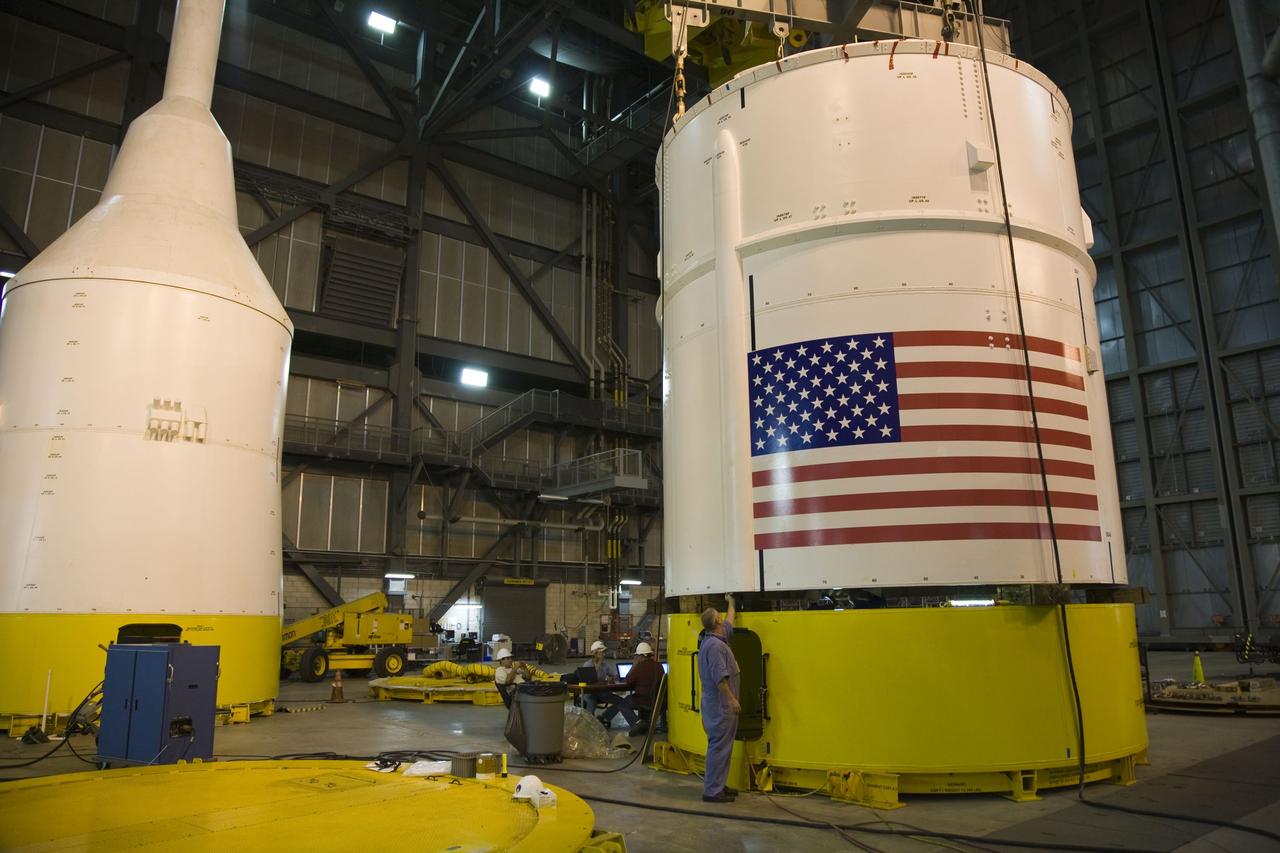
CAPE CANAVERAL, Fla. – In the Vehicle Assembly Building's High Bay 4 at NASA's Kennedy Space Center in Florida, a crane is attached to the Ares I-X Super Stack 4. The stack will be lifted and moved to High Bay 3 for integration with Super Stack 3. Five super stacks make up the upper stage that will be integrated with the four-segment solid rocket booster first stage on the mobile launch platform. Ares I-X is the test vehicle for the Ares I, which is part of the Constellation Program to return men to the moon and beyond. The Ares I-X flight test is targeted for Oct. 31, pending formal NASA Headquarters approval. Photo credit: NASA/Dimitri Gerondidakis
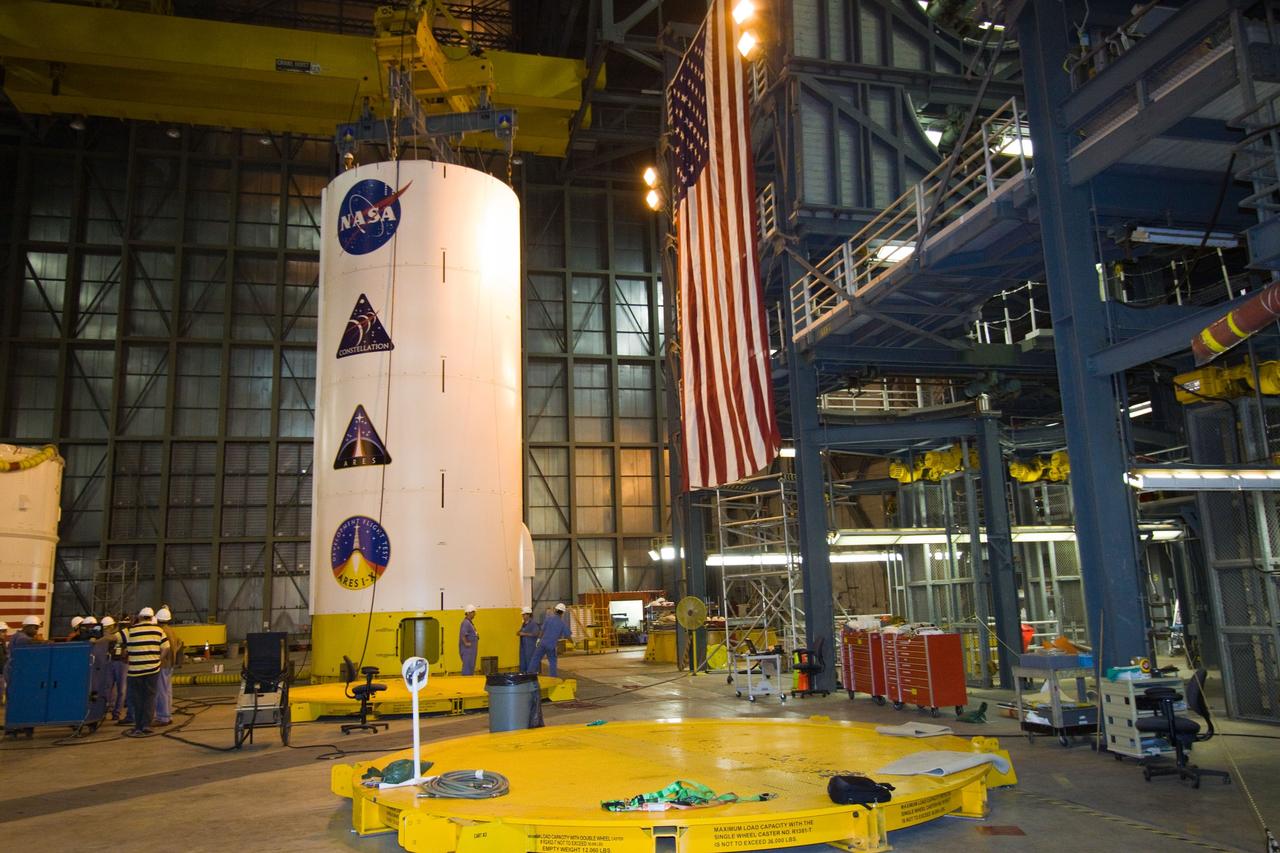
CAPE CANAVERAL, Fla. – In NASA Kennedy Space Center's Vehicle Assembly Building, a crane is attached to the Ares I-X Super Stack 3 in High Bay 3. The stack is being moved to High Bay 4 for integration with Super Stack 2. The upper stage comprises five super stacks, which are integrated with the four-segment solid rocket booster first stage on the mobile launch platform. Ares I-X is the test vehicle for the Ares I, which is part of the Constellation Program to return men to the moon and beyond. The Ares I-X flight test is targeted for Oct. 31, pending formal NASA Headquarters approval. Photo credit: NASA/Jack Pfaller
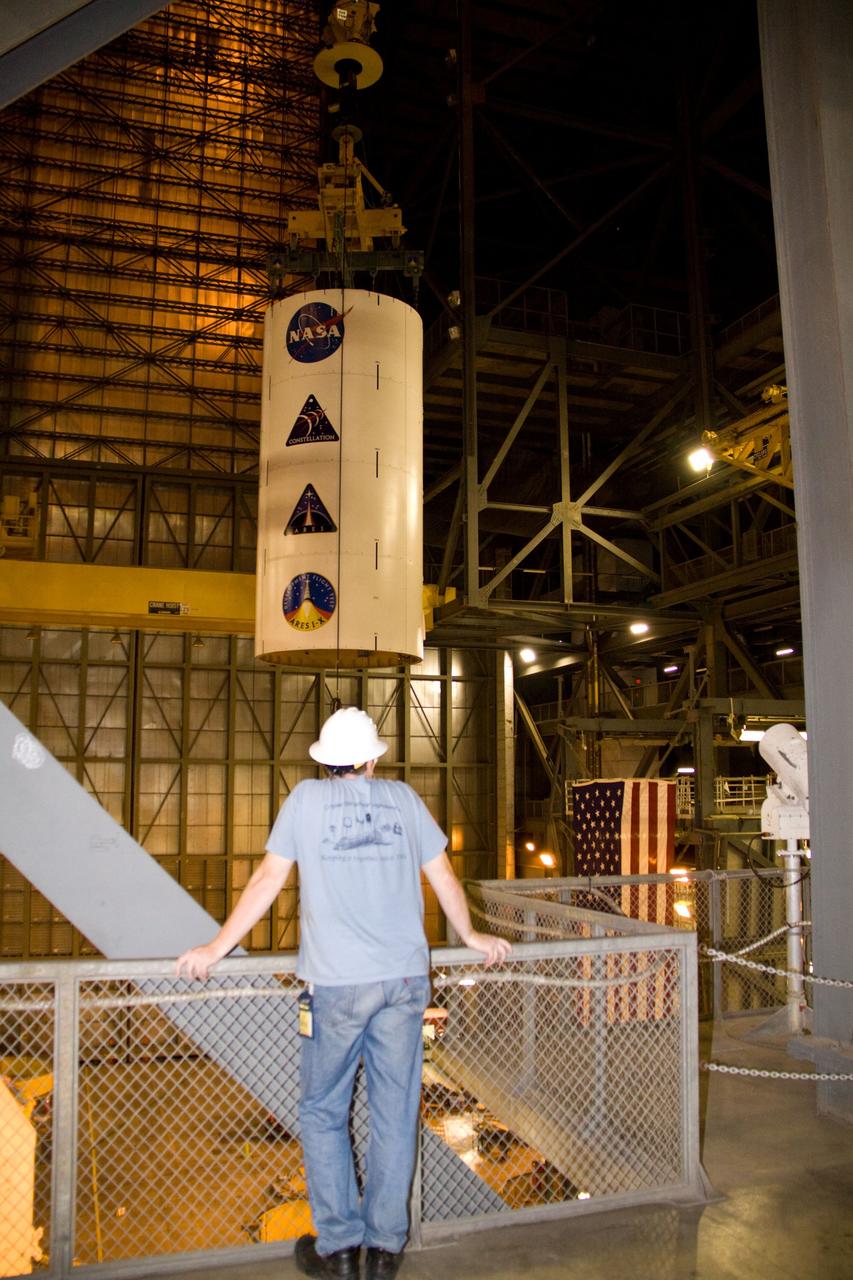
CAPE CANAVERAL, Fla. – In NASA Kennedy Space Center's Vehicle Assembly Building High Bay 3, a crane moves the Ares I-X Super Stack 3 across the transfer aisle to High Bay 4. There it will be integrated with Super Stack 2. The upper stage comprises five super stacks, which are integrated with the four-segment solid rocket booster first stage on the mobile launch platform. Ares I-X is the test vehicle for the Ares I, which is part of the Constellation Program to return men to the moon and beyond. The Ares I-X flight test is targeted for Oct. 31, pending formal NASA Headquarters approval. Photo credit: NASA/Jack Pfaller

jsc2023e038731 (6/22/2023) --- Two types of Hoshi-Tomo badges were designed by students. “Hoshi” implies star(s), planet(s), or the Earth in Japanese. “Tomo” means friend(s) in Japanese. Top: The Design Team (five students) at Mizuho Junior High School (Japan, Tokyo). Bottom: The Designer (one student) at Mizuho Dai-Ni Junior High School (Japan, Tokyo). I-Space Essay provides students and teachers the online opportunity to create wishes, which are delivered to the International Space Station's Japanese Experimental Module Kibo. Image courtesy of Mizuho Town Education Board and IHI Corporation.
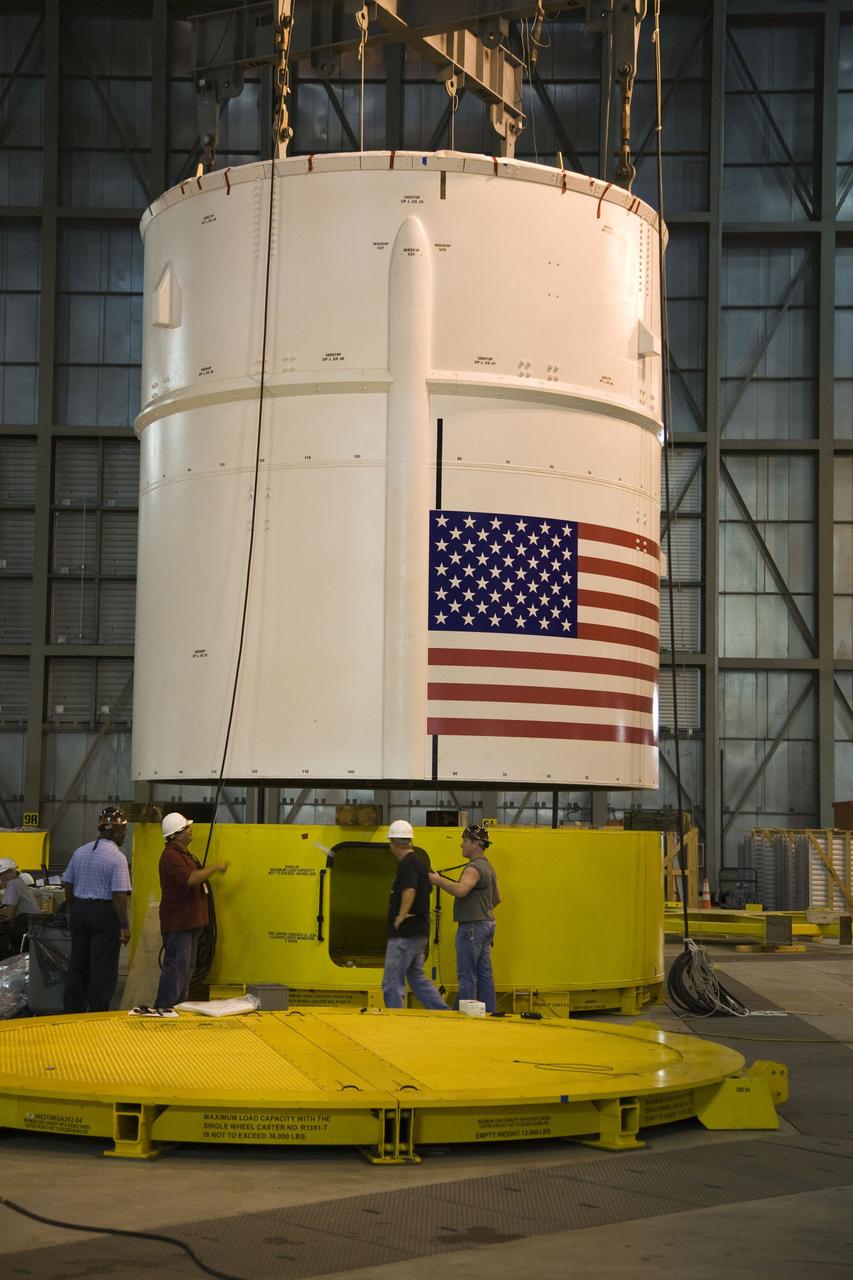
CAPE CANAVERAL, Fla. – In the Vehicle Assembly Building's High Bay 4 at NASA's Kennedy Space Center in Florida, a crane lifts the Ares I-X Super Stack 4. The stack will be moved to High Bay 3 for integration with Super Stack 3. Five super stacks make up the upper stage that will be integrated with the four-segment solid rocket booster first stage on the mobile launch platform. Ares I-X is the test vehicle for the Ares I, which is part of the Constellation Program to return men to the moon and beyond. The Ares I-X flight test is targeted for Oct. 31, pending formal NASA Headquarters approval. Photo credit: NASA/Dimitri Gerondidakis
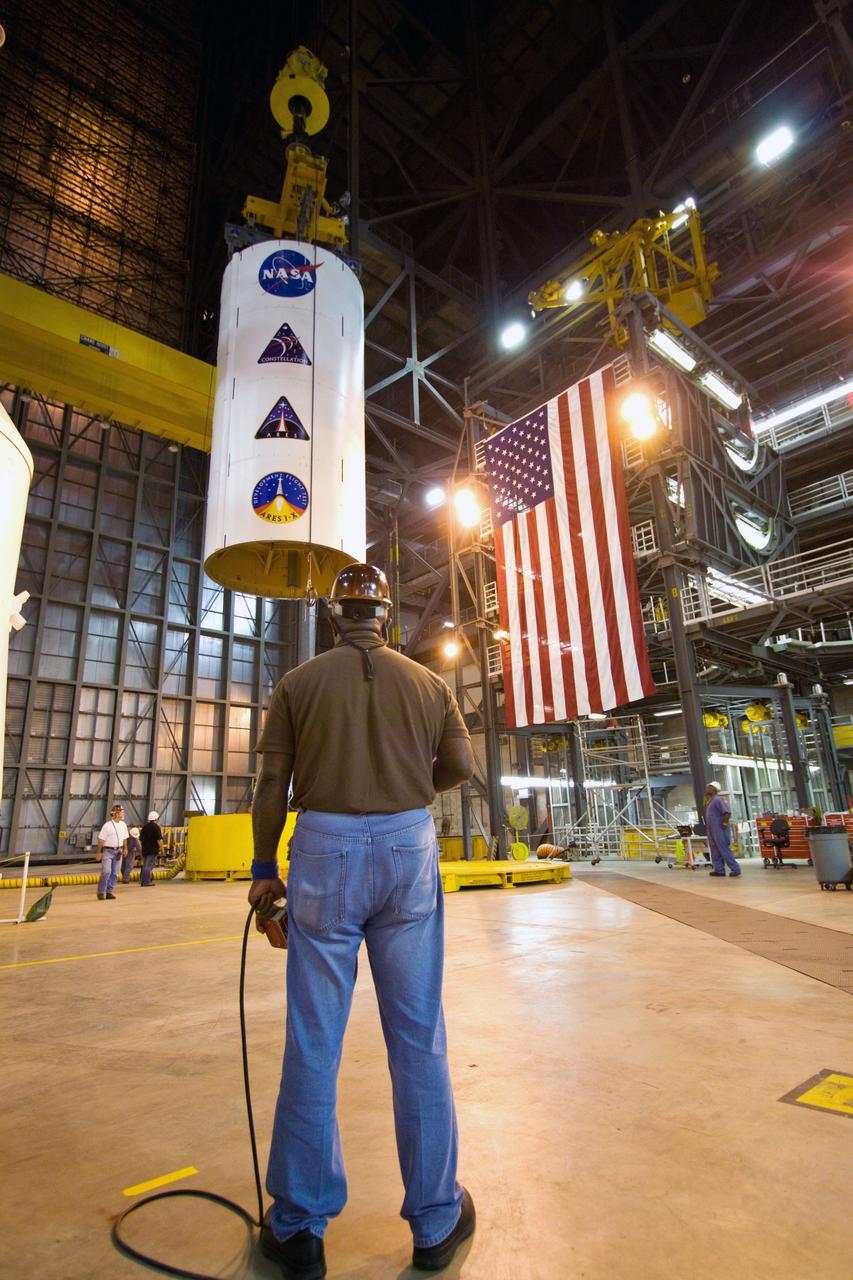
CAPE CANAVERAL, Fla. – In NASA Kennedy Space Center's Vehicle Assembly Building High Bay 3, a crane lifts the Ares I-X Super Stack 3 to move it across the transfer aisle to High Bay 4. There it will be integrated with Super Stack 2. The upper stage comprises five super stacks, which are integrated with the four-segment solid rocket booster first stage on the mobile launch platform. Ares I-X is the test vehicle for the Ares I, which is part of the Constellation Program to return men to the moon and beyond. The Ares I-X flight test is targeted for Oct. 31, pending formal NASA Headquarters approval. Photo credit: NASA/Jack Pfaller
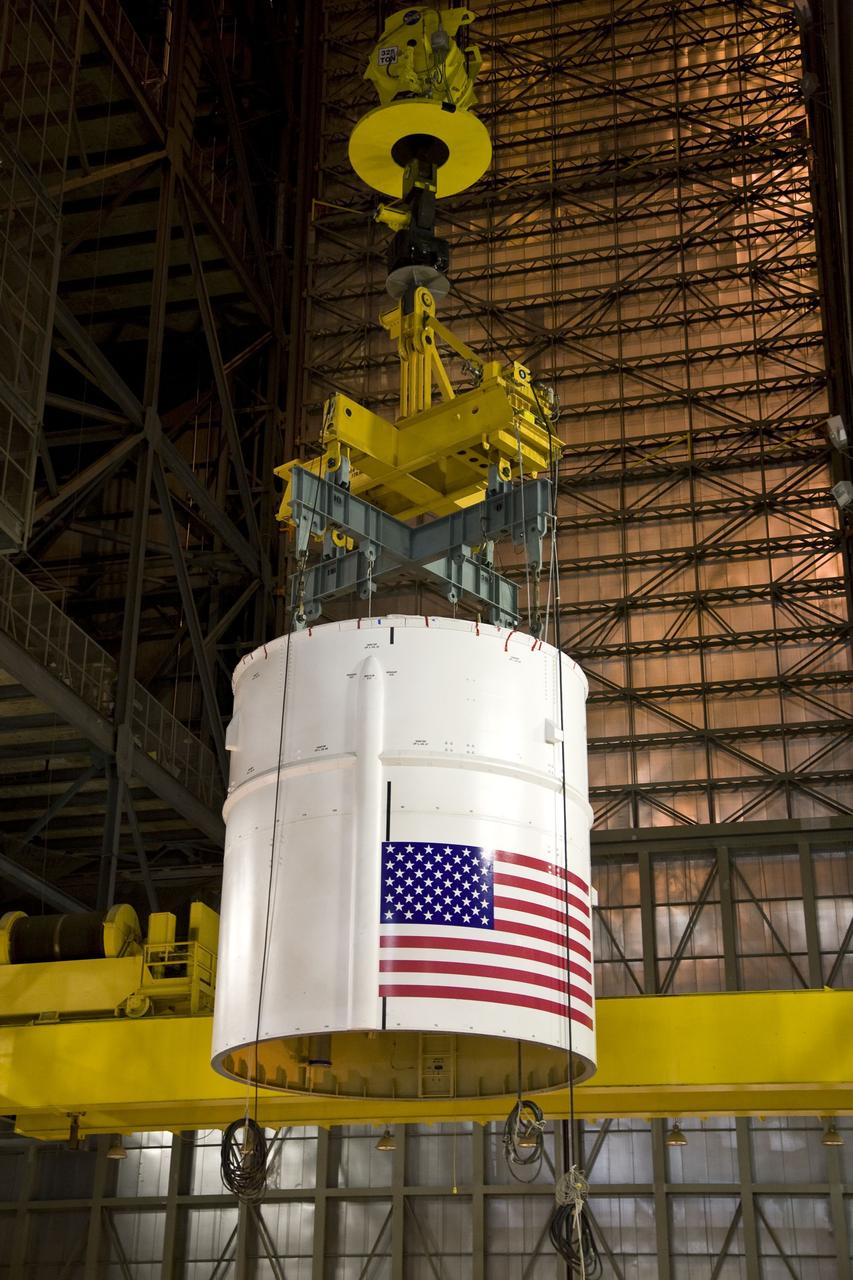
CAPE CANAVERAL, Fla. – In the Vehicle Assembly Building's High Bay 4 at NASA's Kennedy Space Center in Florida, a crane moves the Ares I-X Super Stack 4 across the floor to High Bay 3 for integration with Super Stack 3. Five super stacks make up the upper stage that will be integrated with the four-segment solid rocket booster first stage on the mobile launch platform. Ares I-X is the test vehicle for the Ares I, which is part of the Constellation Program to return men to the moon and beyond. The Ares I-X flight test is targeted for Oct. 31, pending formal NASA Headquarters approval. Photo credit: NASA/Dimitri Gerondidakis
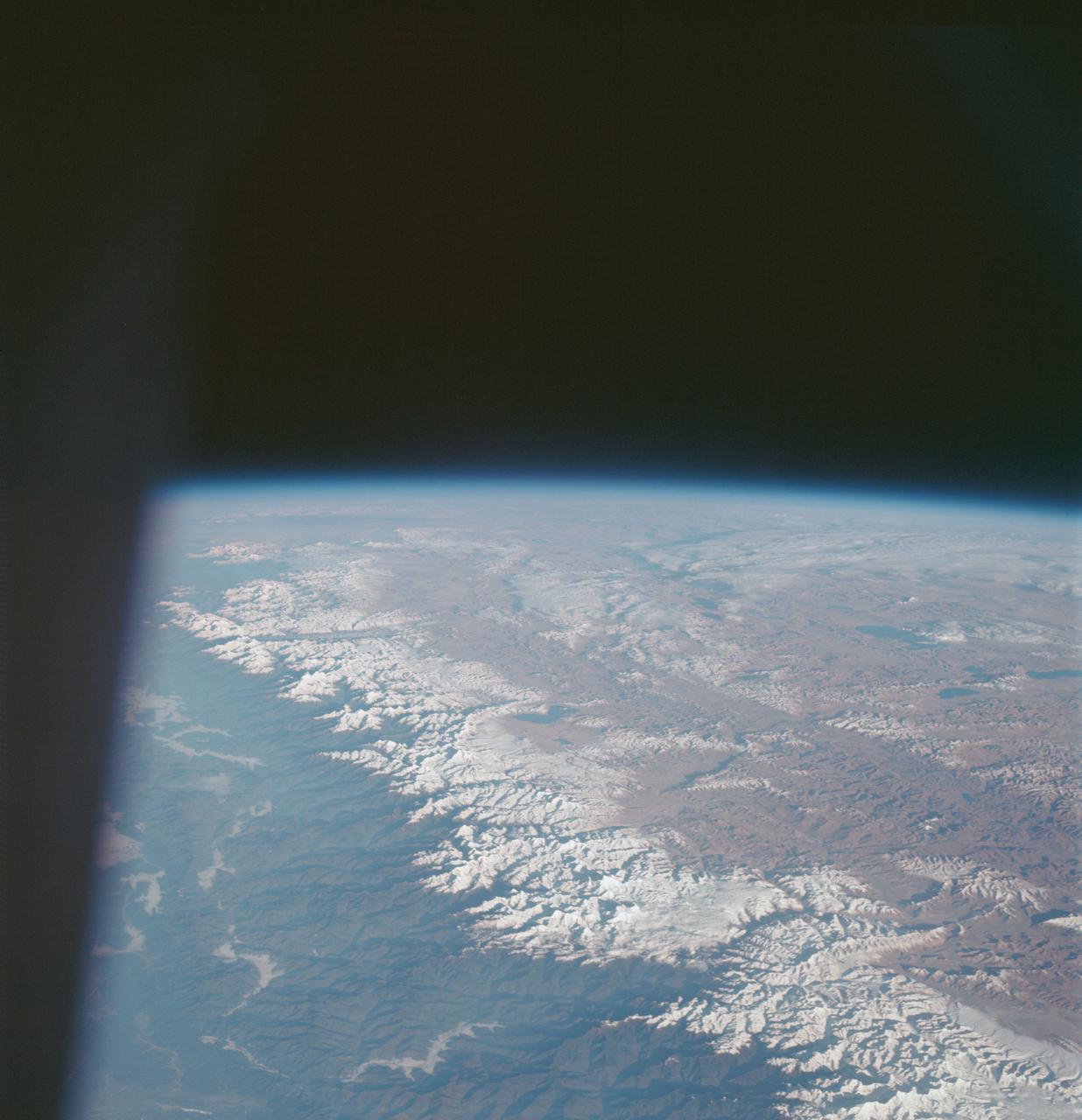
AS7-07-1748 (15 Oct. 1968) --- The world's dozen peaks which reach a height of greater than five miles above sea level are seen in this photograph from the Apollo 7 spacecraft at an altitude of approximately 130 nautical miles. The 29,028 ft. high Mount Everest is at lower center. On the central horizon can be seen the 28,250 ft. high Mount Godwin-Austen (K-2) some 800 miles northwest of Mount Everest. In the lower right, Mount Kanchenjunga rises 28,208 ft. to separate Nepal from Sikkim. The snow line on the peaks was at 17,500 ft. In the upper right the lake-studded highlands of Tibet are visible.
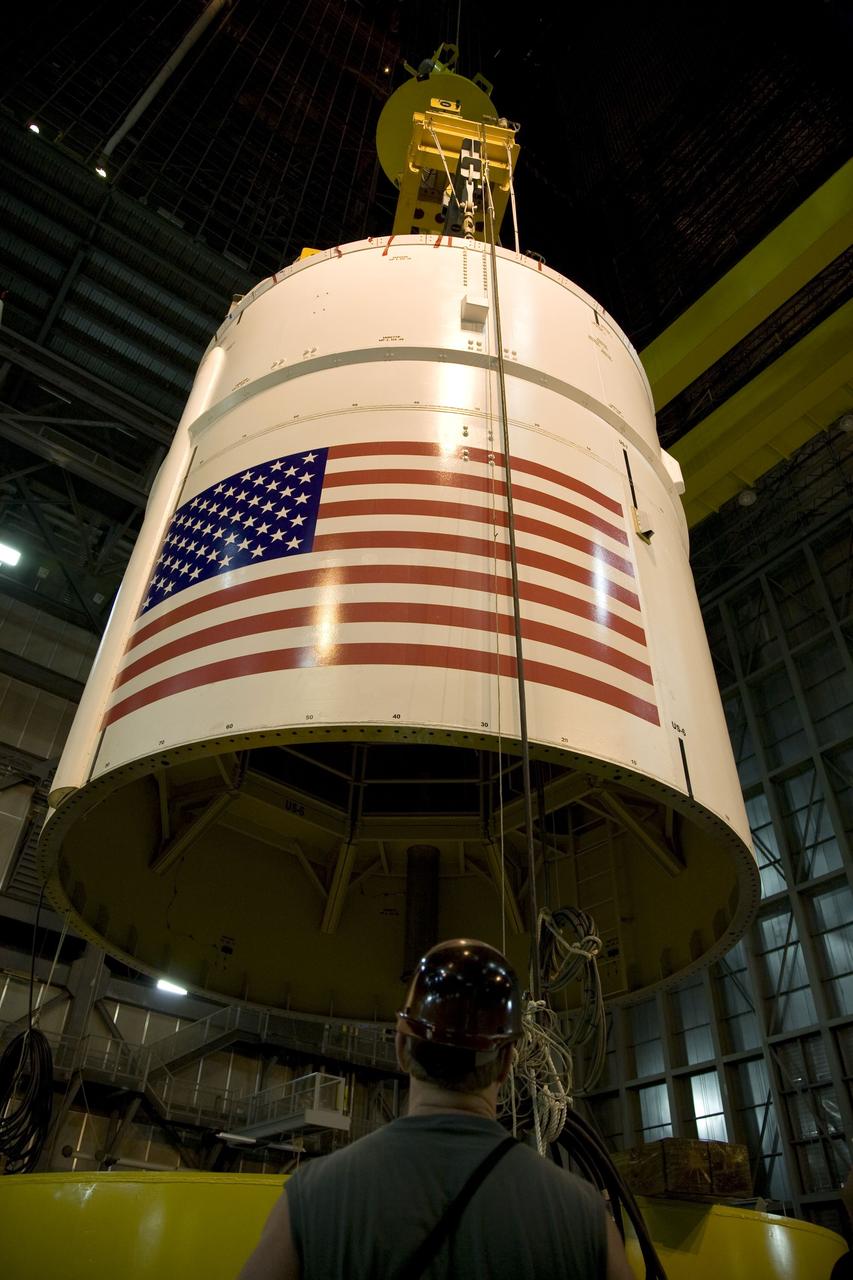
CAPE CANAVERAL, Fla. – In the Vehicle Assembly Building's High Bay 4 at NASA's Kennedy Space Center in Florida, a crane lifts the Ares I-X Super Stack 4. The stack will be moved to High Bay 3 for integration with Super Stack 3. Five super stacks make up the upper stage that will be integrated with the four-segment solid rocket booster first stage on the mobile launch platform. Ares I-X is the test vehicle for the Ares I, which is part of the Constellation Program to return men to the moon and beyond. The Ares I-X flight test is targeted for Oct. 31, pending formal NASA Headquarters approval. Photo credit: NASA/Dimitri Gerondidakis
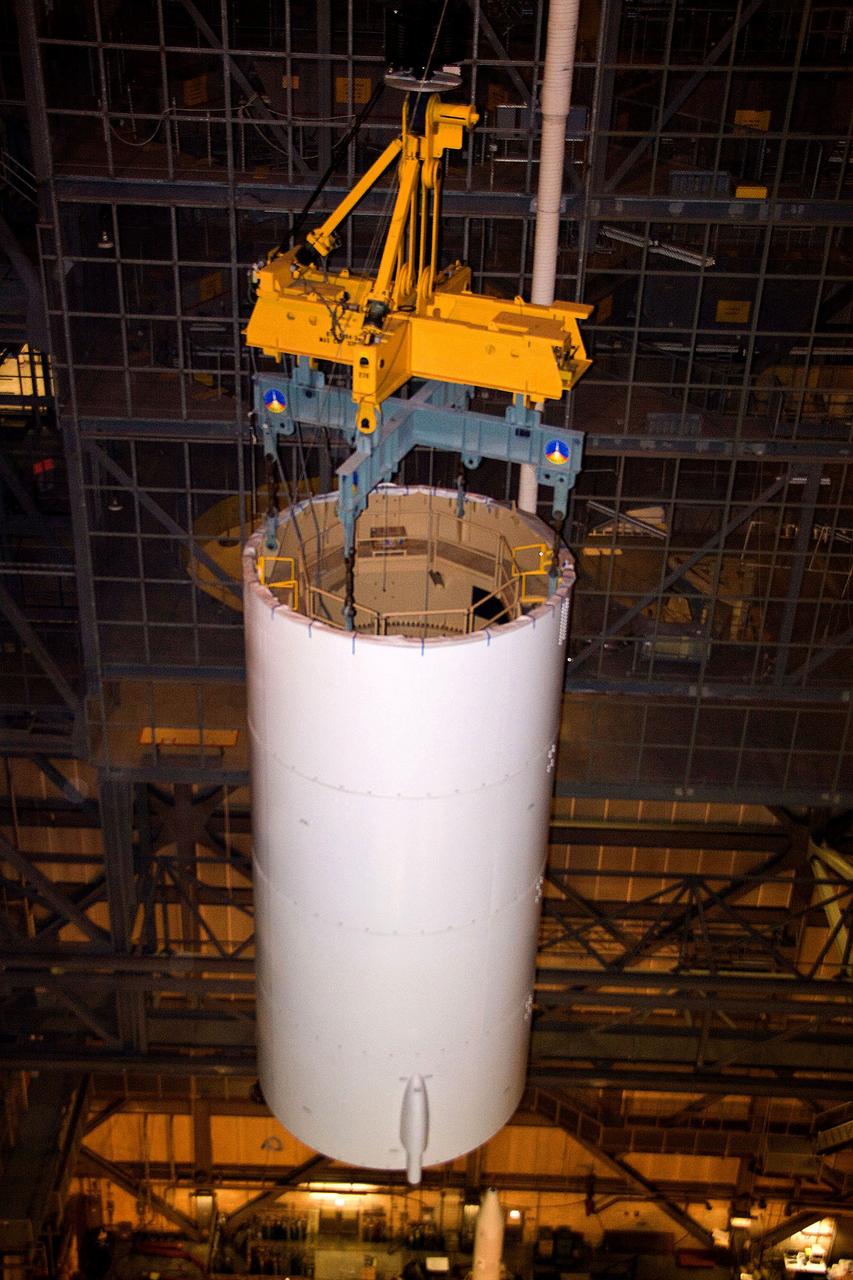
CAPE CANAVERAL, Fla. – In NASA Kennedy Space Center's Vehicle Assembly Building High Bay 3, a crane moves the Ares I-X Super Stack 3 across the transfer aisle to High Bay 4. There it will be integrated with Super Stack 2. The upper stage comprises five super stacks, which are integrated with the four-segment solid rocket booster first stage on the mobile launch platform. Ares I-X is the test vehicle for the Ares I, which is part of the Constellation Program to return men to the moon and beyond. The Ares I-X flight test is targeted for Oct. 31, pending formal NASA Headquarters approval. Photo credit: NASA/Jack Pfaller
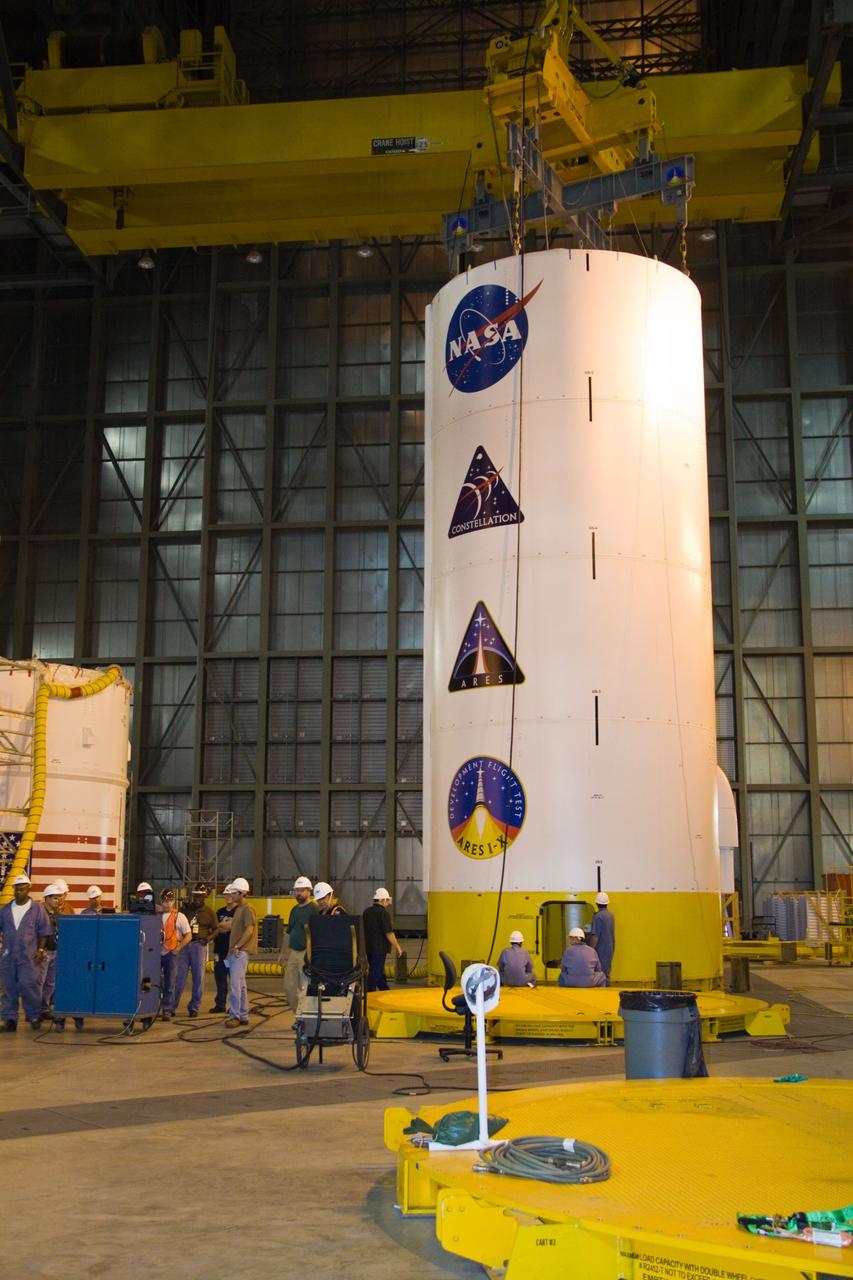
CAPE CANAVERAL, Fla. – In NASA Kennedy Space Center's Vehicle Assembly Building, a crane is attached to the Ares I-X Super Stack 3 in High Bay 3. The stack is being moved to High Bay 4 for integration with Super Stack 2. The upper stage comprises five super stacks, which are integrated with the four-segment solid rocket booster first stage on the mobile launch platform. Ares I-X is the test vehicle for the Ares I, which is part of the Constellation Program to return men to the moon and beyond. The Ares I-X flight test is targeted for Oct. 31, pending formal NASA Headquarters approval. Photo credit: NASA/Jack Pfaller
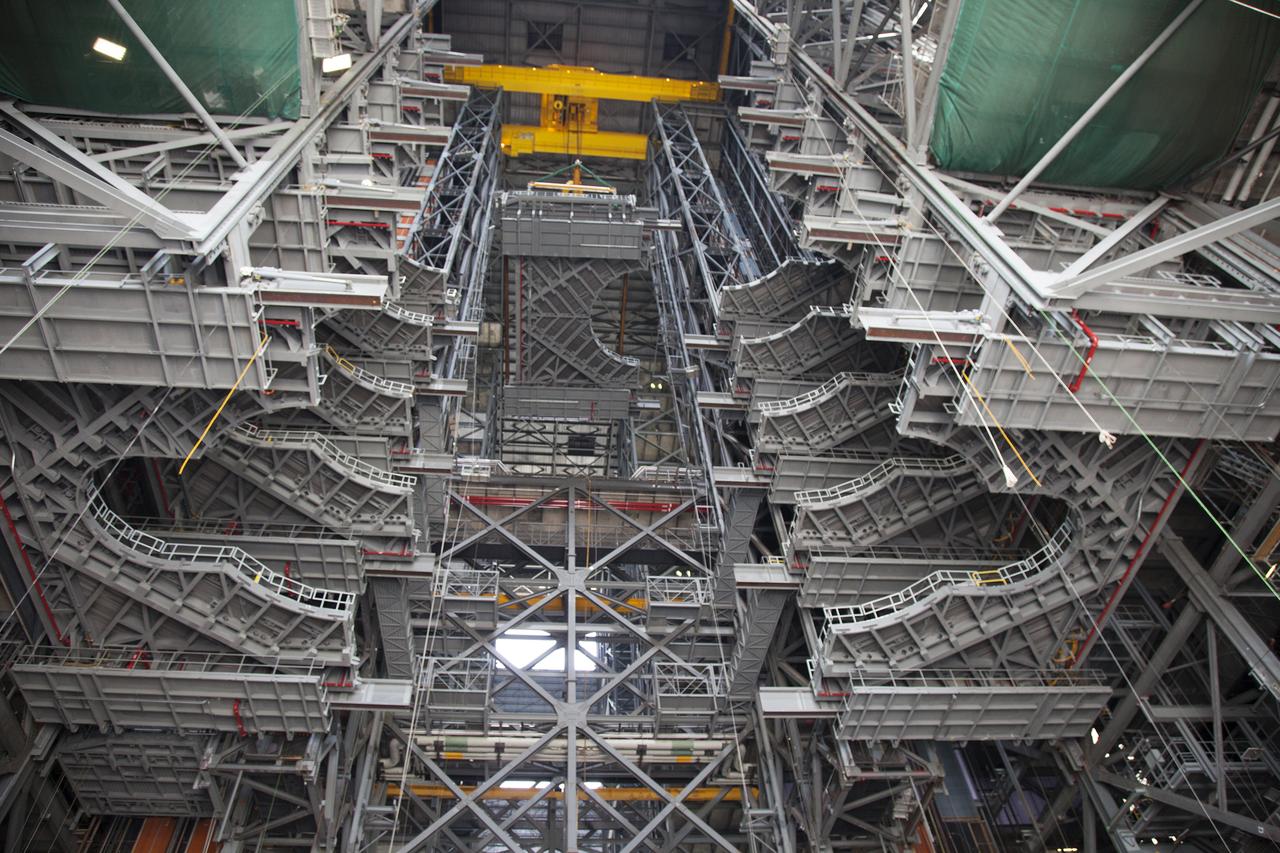
A heavy-lift crane lowers the first half of the E-level work platforms, E south, for NASA’s Space Launch System (SLS) rocket, into High Bay 3 in the Vehicle Assembly Building (VAB) at NASA’s Kennedy Space Center in Florida. In view are five levels of platforms previously installed. The E platform will be installed on the south side of High Bay 3, about 246 feet above the floor. The E platforms are the sixth of 10 levels of work platforms that will surround and provide access to the SLS rocket and Orion spacecraft for Exploration Mission 1. The Ground Systems Development and Operations Program is overseeing upgrades and modifications to VAB High Bay 3, including installation of the new work platforms, to prepare for NASA’s journey to Mars.
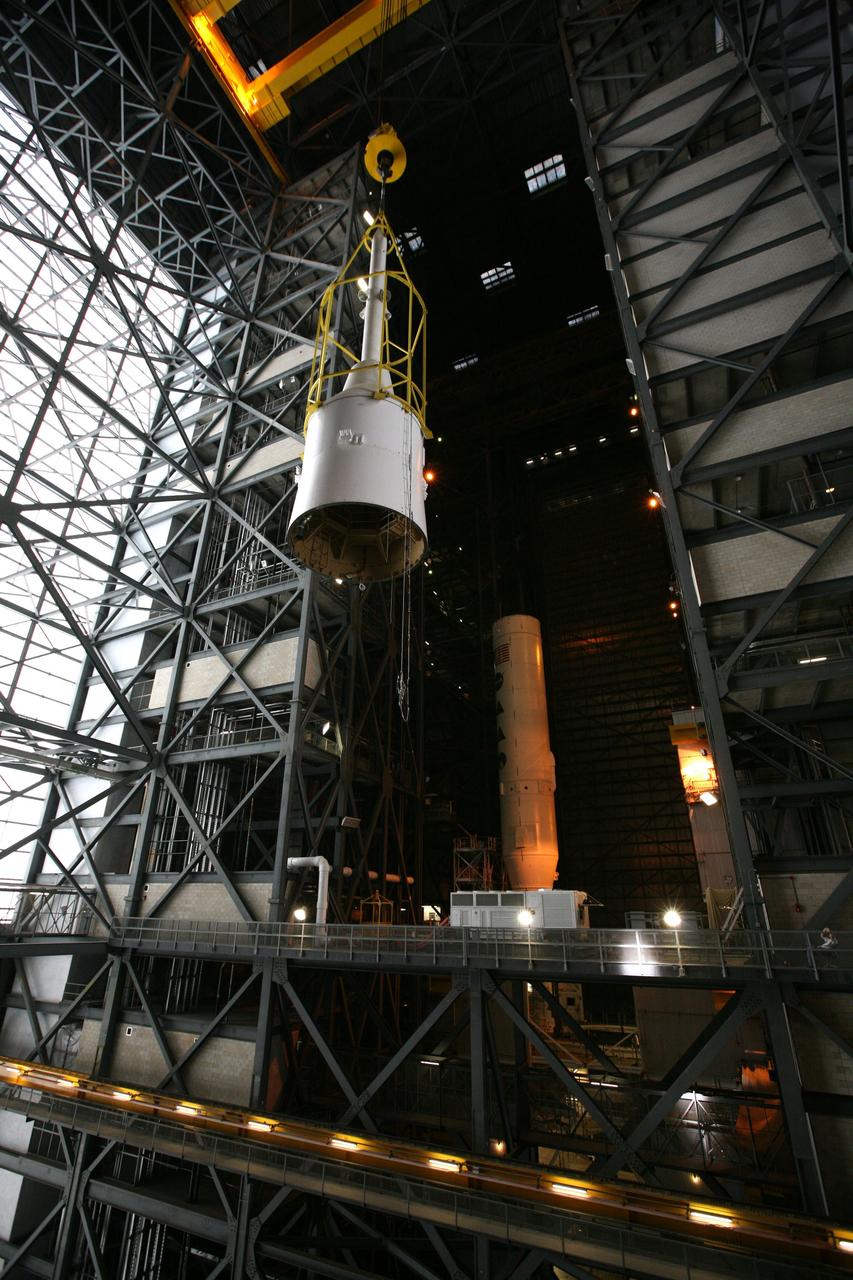
CAPE CANAVERAL, Fla. – In the Vehicle Assembly Building's transfer aisle, assembly of the Ares I-X rocket nears completion. The yellow framework, nicknamed the "birdcage," moves Super Stack 5 from High Bay 4 over the transfer aisle toward an opening at the 16th floor crossover in High Bay 3. The stack will be positioned on top of the segments already in place on the mobile launcher platform in High Bay 3, in the background, completing assembly of the 327-foot-tall rocket. Five super stacks make up the rocket's upper stage that is integrated with the four-segment solid rocket booster first stage. Ares I-X is the test vehicle for the Ares I, which is part of the Constellation Program to return men to the moon and beyond. The Ares I-X flight test is targeted for Oct. 31, pending formal NASA Headquarters approval. Photo credit: NASA/Dimitri Gerondidakis
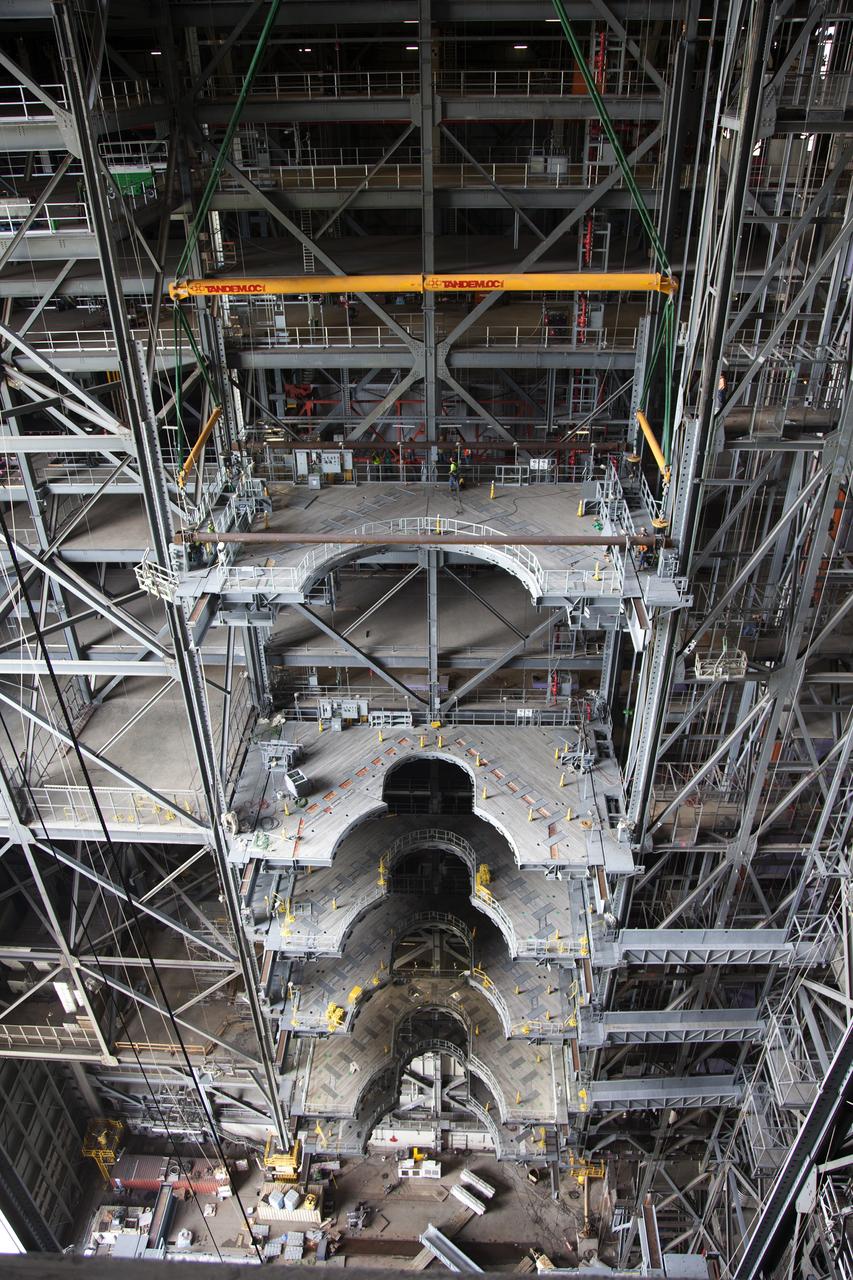
A heavy-lift crane lowers the first half of the E-level work platforms, E south, for NASA’s Space Launch System (SLS) rocket, into position for installation in High Bay 3 in the Vehicle Assembly Building (VAB) at NASA’s Kennedy Space Center in Florida. Large Tandemloc bars have been attached to the platform to keep it level during lifting and installation. In view are five levels of platforms previously installed. The E platform will be installed on the south side of High Bay 3, about 246 feet above the floor. The E platforms are the sixth of 10 levels of work platforms that will surround and provide access to the SLS rocket and Orion spacecraft for Exploration Mission 1. The Ground Systems Development and Operations Program is overseeing upgrades and modifications to VAB High Bay 3, including installation of the new work platforms, to prepare for NASA’s journey to Mars.
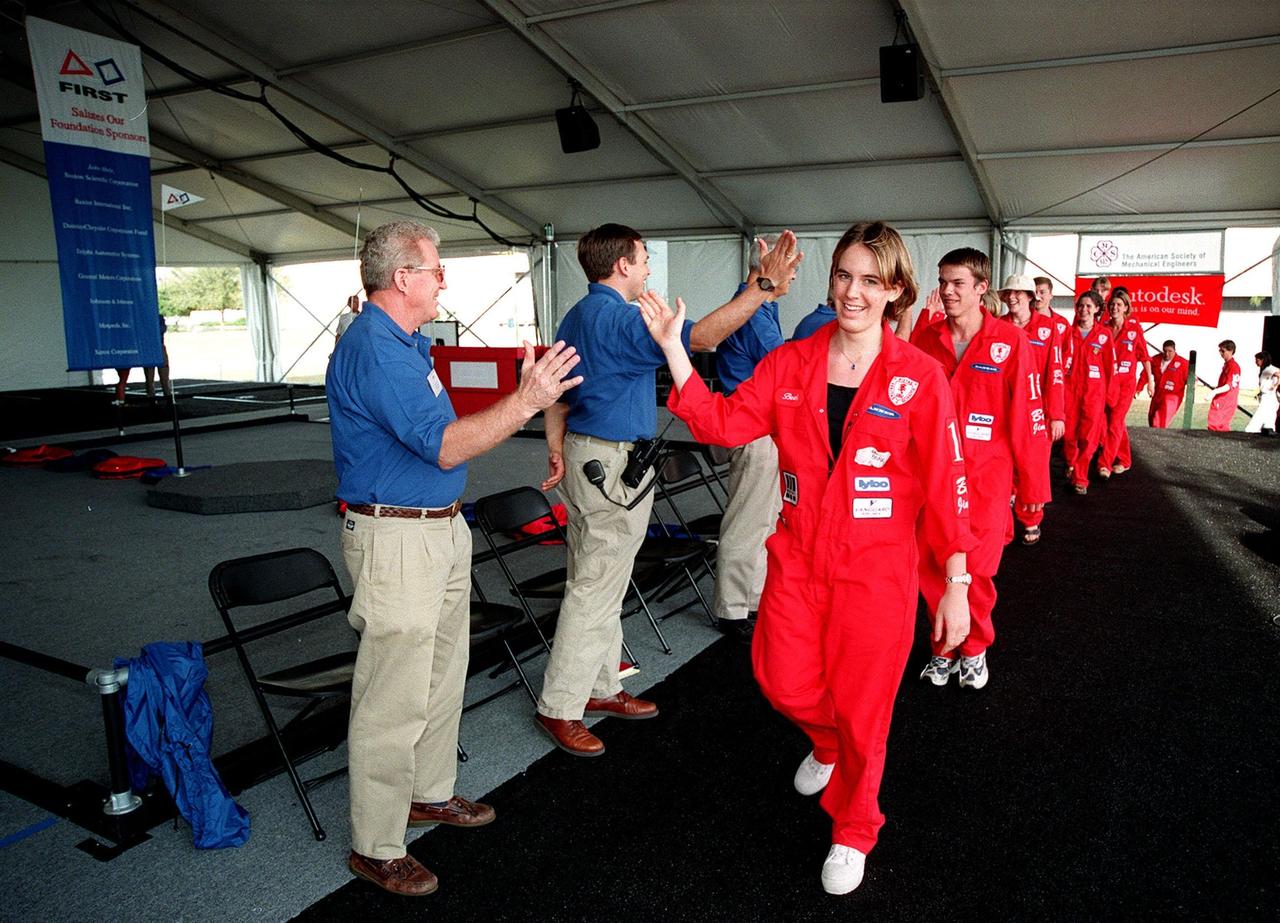
At the start of the award ceremony at the 1999 FIRST Southeastern Regional robotic competition held at KSC, judges, including Deputy Director for Launch and Payload Processing Loren Shriver (left), give "high fives" to a winning team from Minnesota as they enter. FIRST is a nonprofit organization, For Inspiration and Recognition of Science and Technology, that sponsors the event pitting gladiator robots against each other in an athletic-style competition. The FIRST robotics competition is designed to provide students with a hands-on, inside look at engineering and other professional careers, pairing high school students with engineer mentors and corporations. The regional event comprised 27 teams. Along with the championship award, which went to high school teams in Miami and San German, Puerto Rico, 15 other awards were presented
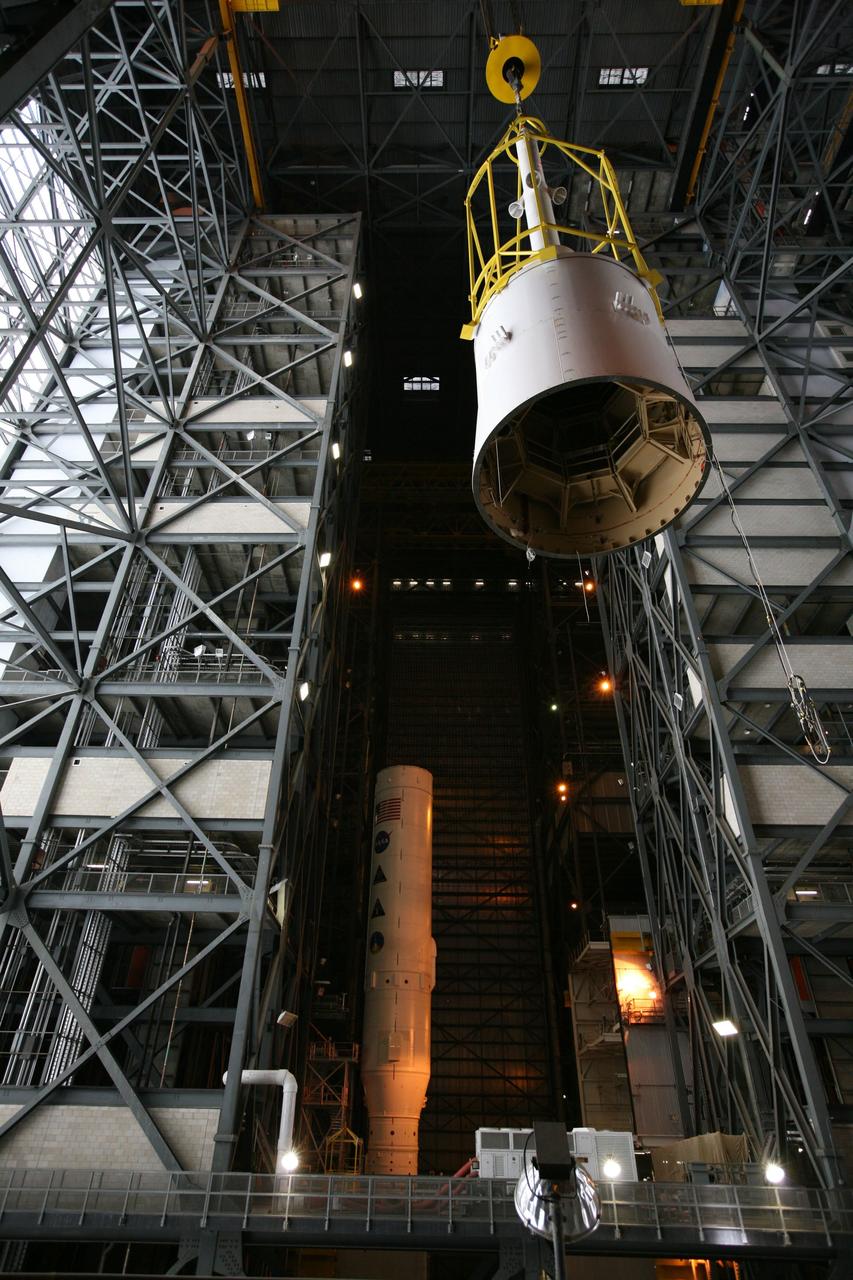
CAPE CANAVERAL, Fla. – In the Vehicle Assembly Building's transfer aisle, assembly of the Ares I-X rocket nears completion. The yellow framework, nicknamed the "birdcage," moves Super Stack 5 from High Bay 4 over the transfer aisle toward an opening at the 16th floor crossover in High Bay 3. The stack will be positioned on top of the segments already in place on the mobile launcher platform in High Bay 3, in the background, completing assembly of the 327-foot-tall rocket. Five super stacks make up the rocket's upper stage that is integrated with the four-segment solid rocket booster first stage. Ares I-X is the test vehicle for the Ares I, which is part of the Constellation Program to return men to the moon and beyond. The Ares I-X flight test is targeted for Oct. 31, pending formal NASA Headquarters approval. Photo credit: NASA/Dimitri Gerondidakis
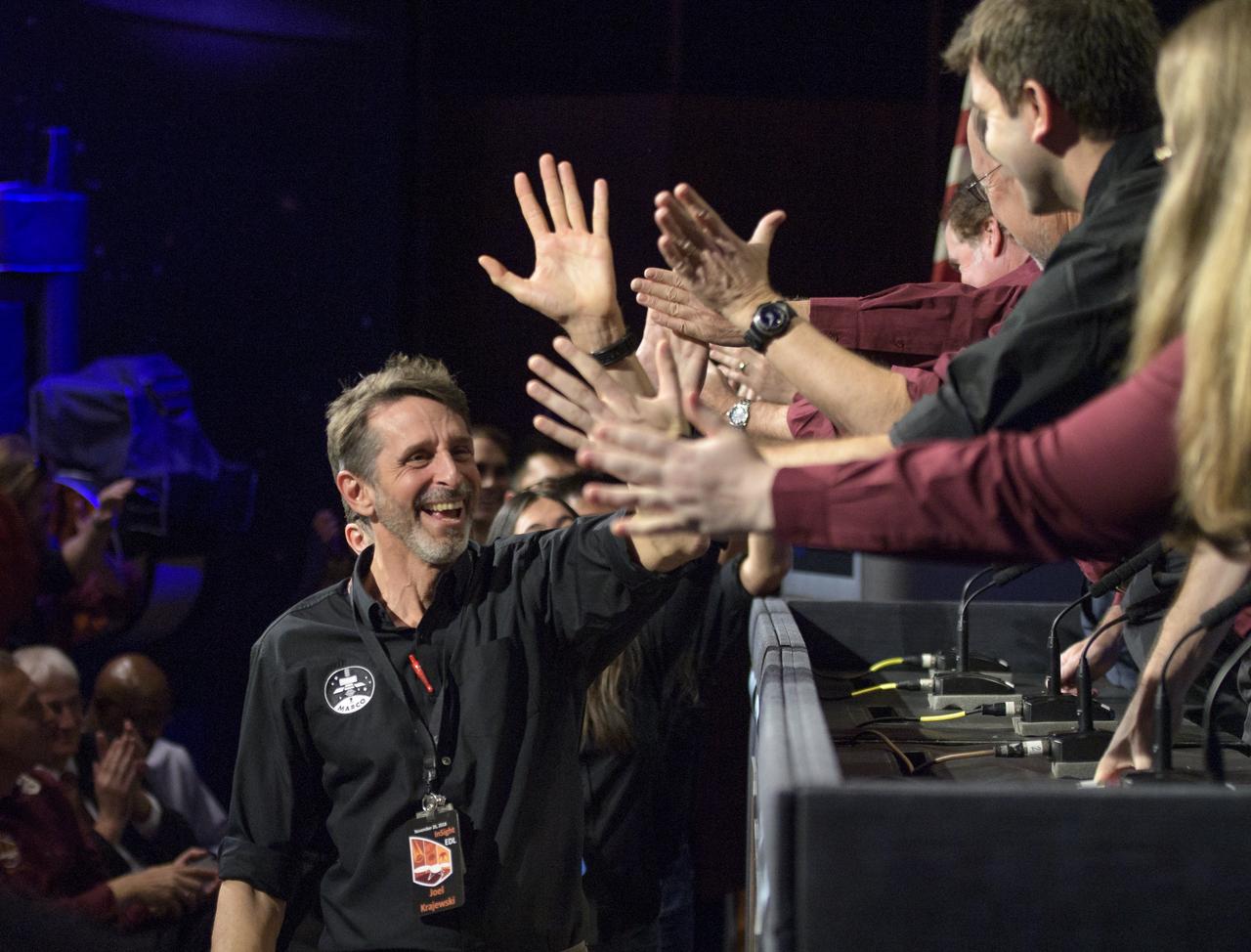
Mars Cube One and Mars InSight team members give each other high fives at the conclusion of a Mars InSight post-landing press conference, Monday, Nov. 26, 2018 at NASA's Jet Propulsion Laboratory in Pasadena, California. InSight, short for Interior Exploration using Seismic Investigations, Geodesy and Heat Transport, is a Mars lander designed to study the "inner space" of Mars: its crust, mantle, and core. Photo Credit: (NASA/Bill Ingalls)
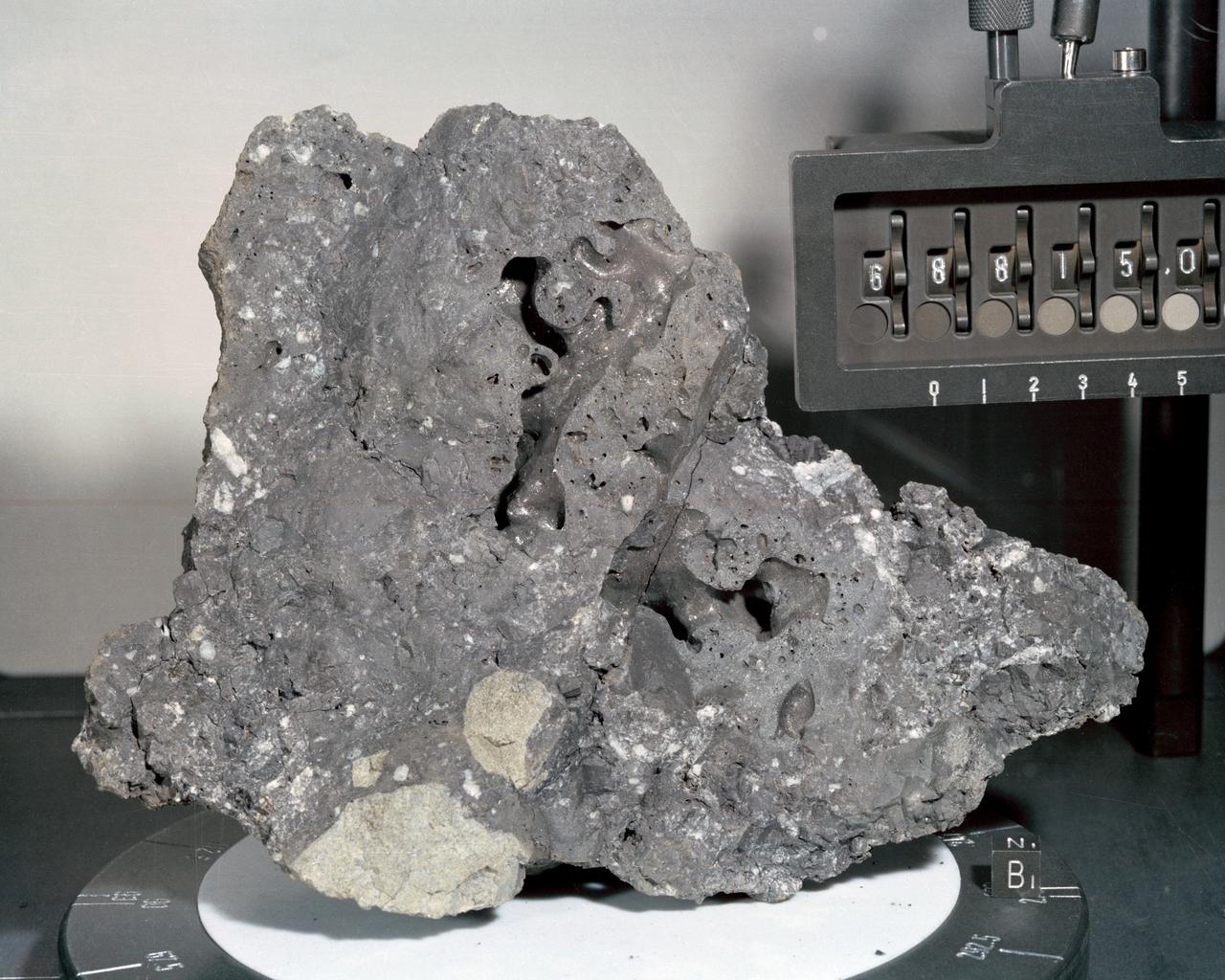
A closeup view or "mug shot" of Apollo 16 lunar sample no. 68815, a dislodged fragment from a parent boulder roughly four feet high and five feet long encountered at Station 8. The crew tried in vain to overturn the parent boulder. A fillet-soil sample was taken close to the boulder, allowing for study of the type and rate of erosion acting on lunar rocks. The fragment itself is very hard, has many veticles and a variety of inclusions. In addition, numerous metallic particles were observed in the black matrix.

jsc2023e010182 (2/28/2023) --- The High school students United with NASA to Create Hardware (HUNCH) Ball Clamp Monopod (HUNCH Ball Clamp Monopod) investigation aims to test a temporary but stable platform for holding cameras, making camera operations easier and faster for the International Space Station crew. This prefllight image shows the five units that were assembled and certified by HUNCH team members. Image courtesy of HUNCH.
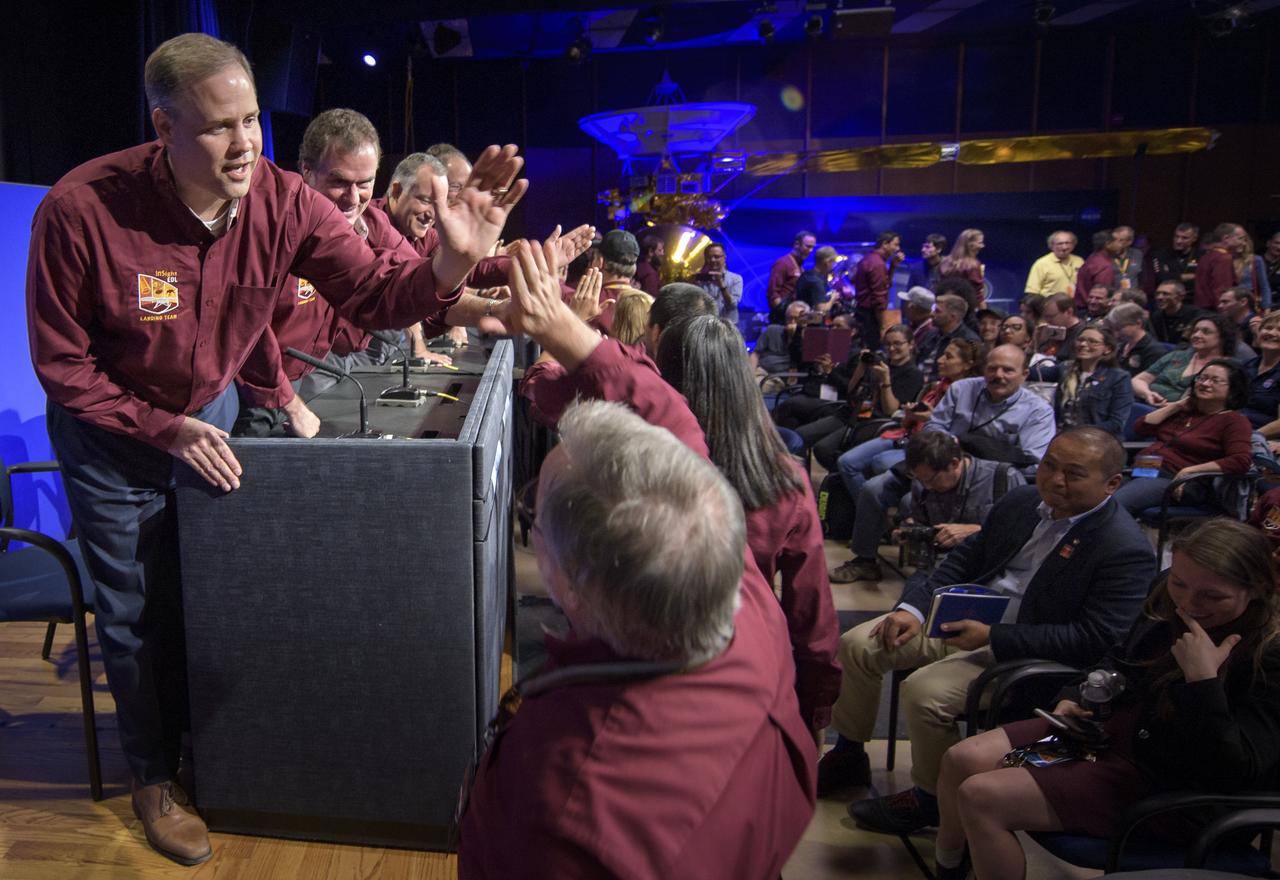
NASA Administrator Jim Bridenstine, left, Mars Cube One, and Mars InSight team members, give each other high fives at the conclusion of a Mars InSight post-landing press conference, Monday, Nov. 26, 2018 at NASA's Jet Propulsion Laboratory in Pasadena, California. InSight, short for Interior Exploration using Seismic Investigations, Geodesy and Heat Transport, is a Mars lander designed to study the "inner space" of Mars: its crust, mantle, and core. Photo Credit: (NASA/Bill Ingalls)
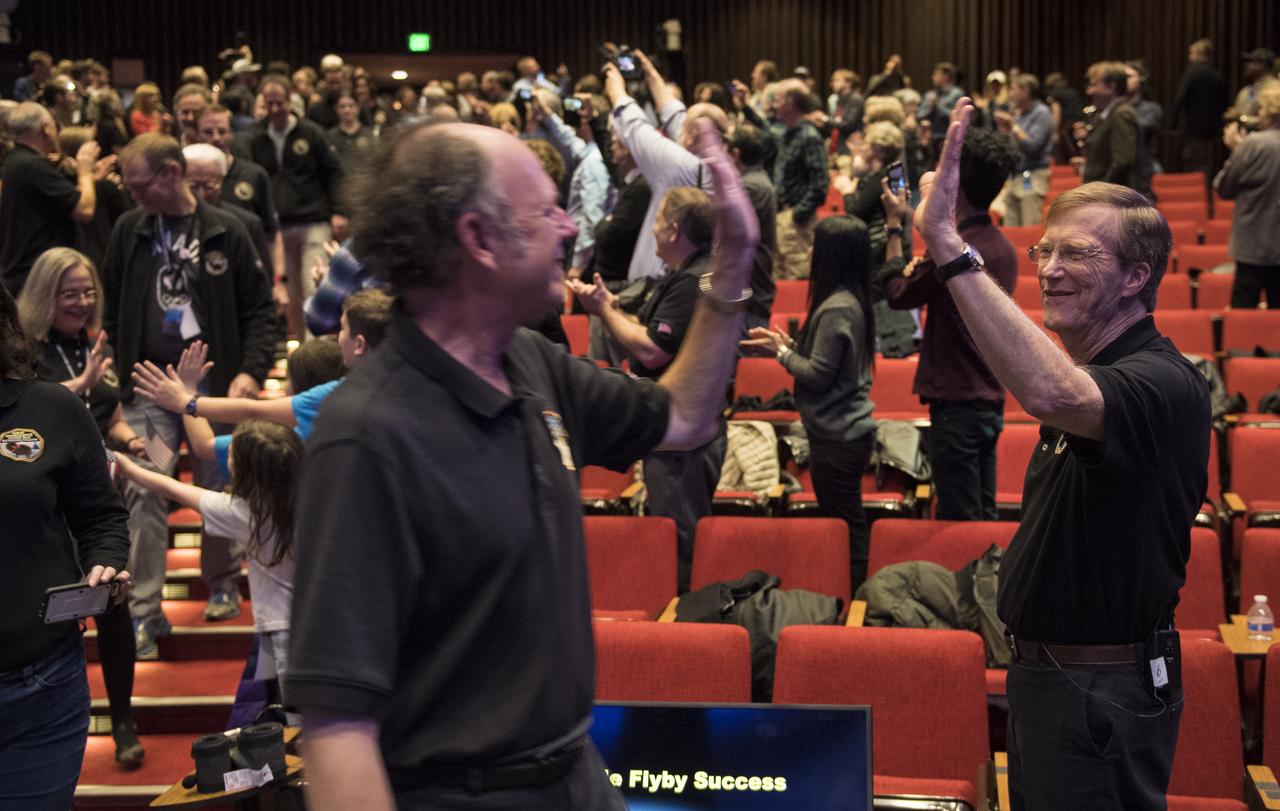
New Horizons project scientist Hal Weaver of the Johns Hopkins University Applied Physics Laboratory high-fives a New Horizons team member after the team received confirmation from the New Horizons spacecraft that it has completed the flyby of Ultima Thule, Tuesday, Jan. 1, 2019 at Johns Hopkins University Applied Physics Laboratory (APL) in Laurel, Maryland. Photo Credit: (NASA/Joel Kowsky)
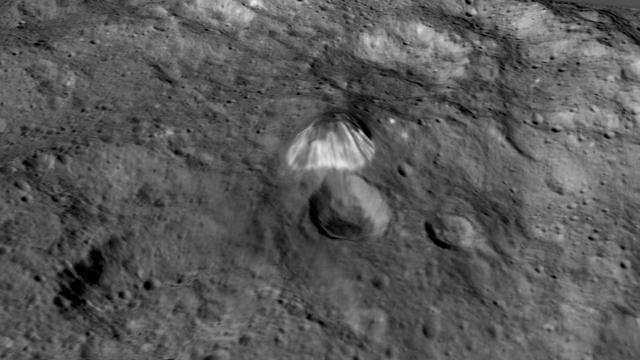
Among the highest features seen on Ceres so far is a mountain about 4 miles (6 kilometers) high, which is roughly the elevation of Mount McKinley in Alaska's Denali National Park. This image comes from an animation, shown in PIA19619, generated using data from NASA's Dawn spacecraft. Vertical relief has been exaggerated by a factor of five. Exaggerating the relief helps scientists understand and visualize the topography much more easily, and highlights features that are sometimes subtle. http://photojournal.jpl.nasa.gov/catalog/PIA19618
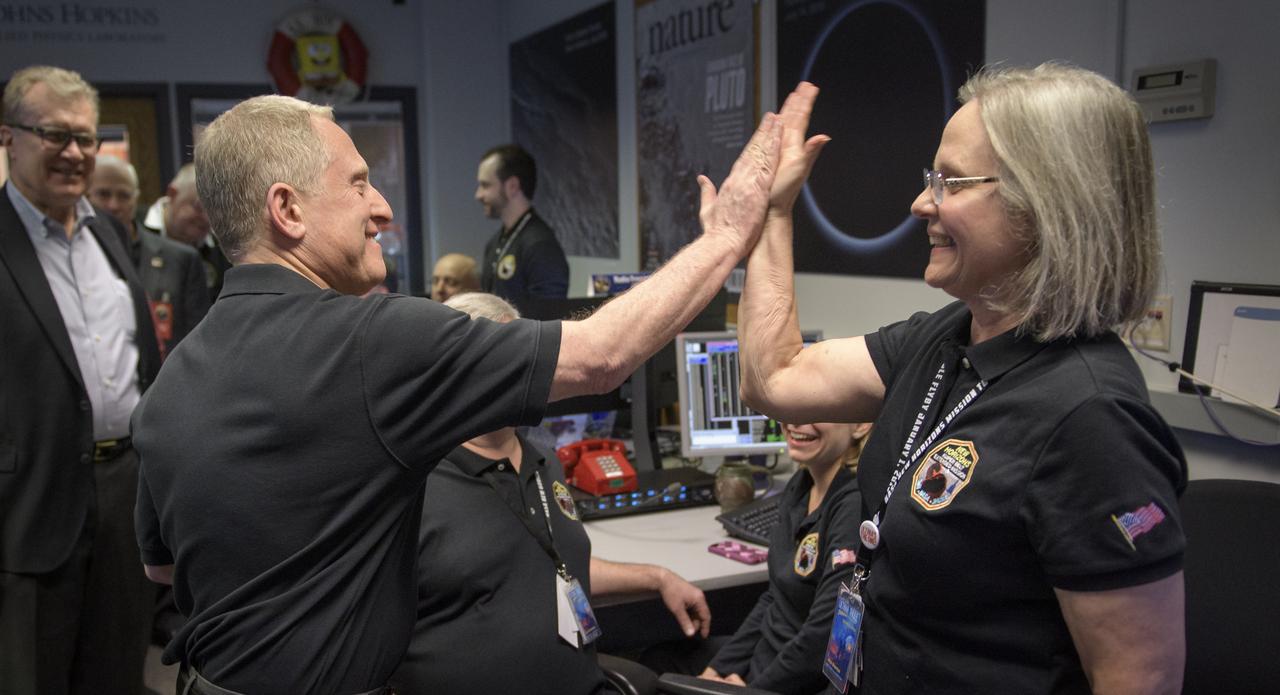
New Horizons principal investigator Alan Stern of the Southwest Research Institute (SwRI), Boulder, CO, left gives a high five to New Horizons Mission Operations Manager Alice Bowman of the Johns Hopkins University Applied Physics Laboratory after the team received signals from the spacecraft that it is healthy and collected data during the flyby of Ultima Thule, Tuesday, Jan. 1, 2019 at the Mission Operations Center of the Johns Hopkins University Applied Physics Laboratory (APL) in Laurel, Maryland. Photo Credit: (NASA/Bill Ingalls)
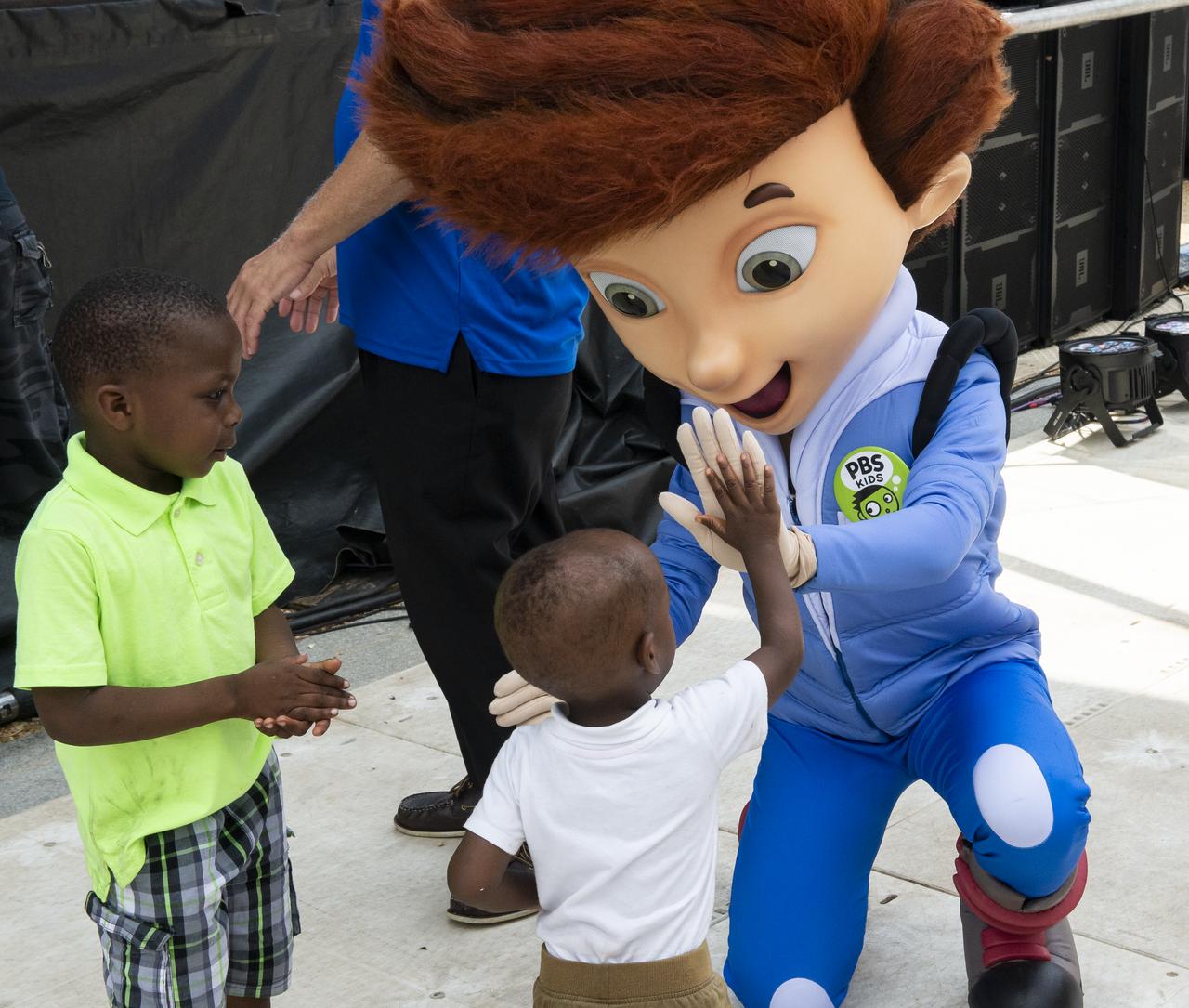
A visitor high fives Ready Jet Go's Jet Propulsion at the Apollo 11 50th Anniversary celebration on the National Mall, Thursday, July 18, 2019 in Washington. Apollo 11 was the first mission to land astronauts on the Moon and launched on July 16, 1969 with astronauts Neil Armstrong, Michael Collins, and Buzz Aldrin. Photo Credit: (NASA/Connie Moore)
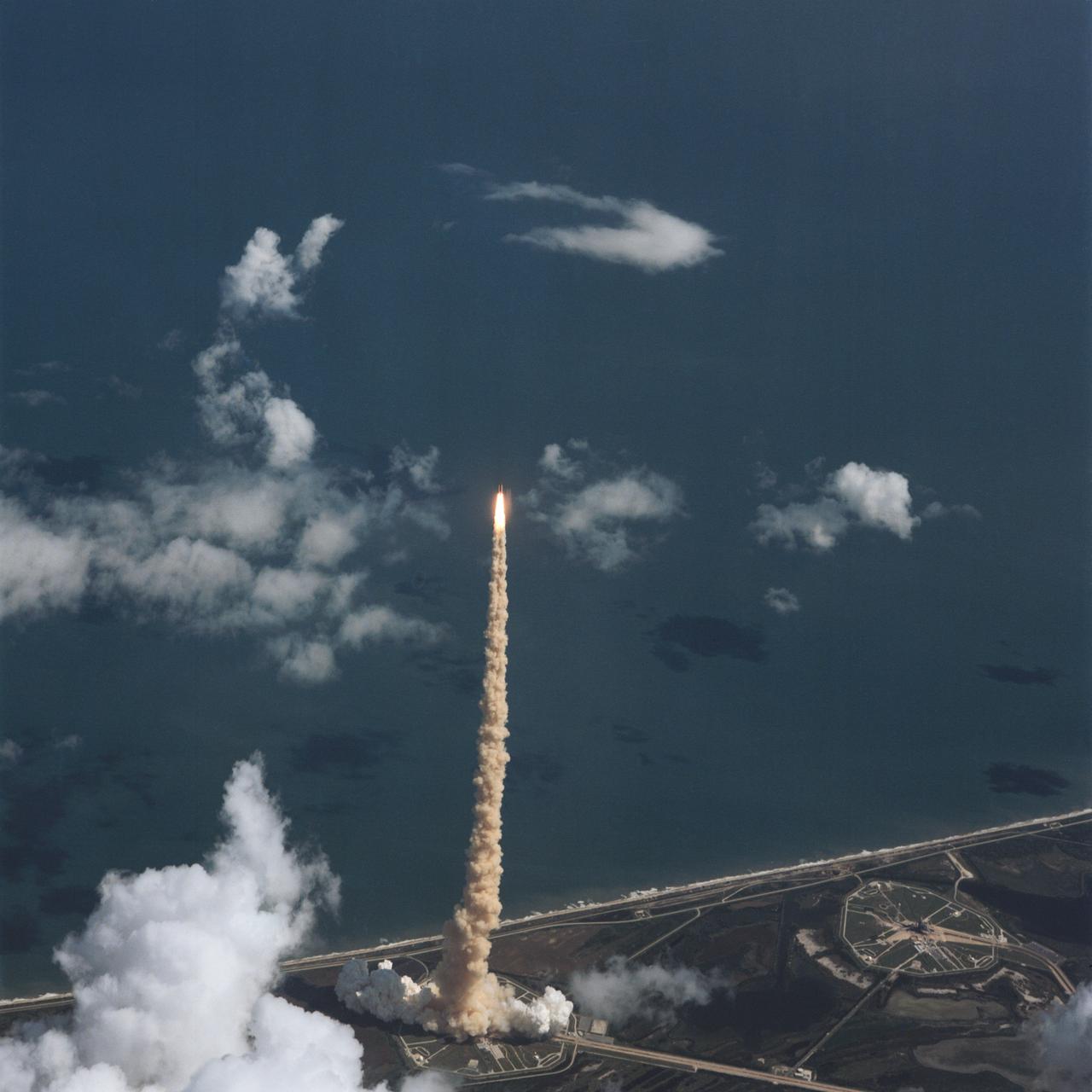
STS-34 Atlantis, Orbiter Vehicle (OV) 104, lifts off from Kennedy Space Center (KSC) Launch Complex (LC) Pad 39B at 12:53:39:983 pm Eastern Daylight Time (EDT). This aerial view shows OV-104, its external tank (ET), and two solid rocket boosters (SRBs) rising high above LC Pad 39B atop a plume of exhaust smoke. Atlantic Ocean is visible in the background. The liftoff marks the beginning of a five-day mission in space.

NASA astronauts Loral O’Hara and Jasmin Moghbeli, seen in blue flight suits, high five a student during an engagement event at Catherine Watkins Elementary School Monday, Dec. 2, 2024 in Washington. O’Hara and Moghbeli spent six months in space as part of Expedition 70 aboard the International Space Station. Photo Credit: (NASA/Keegan Barber)
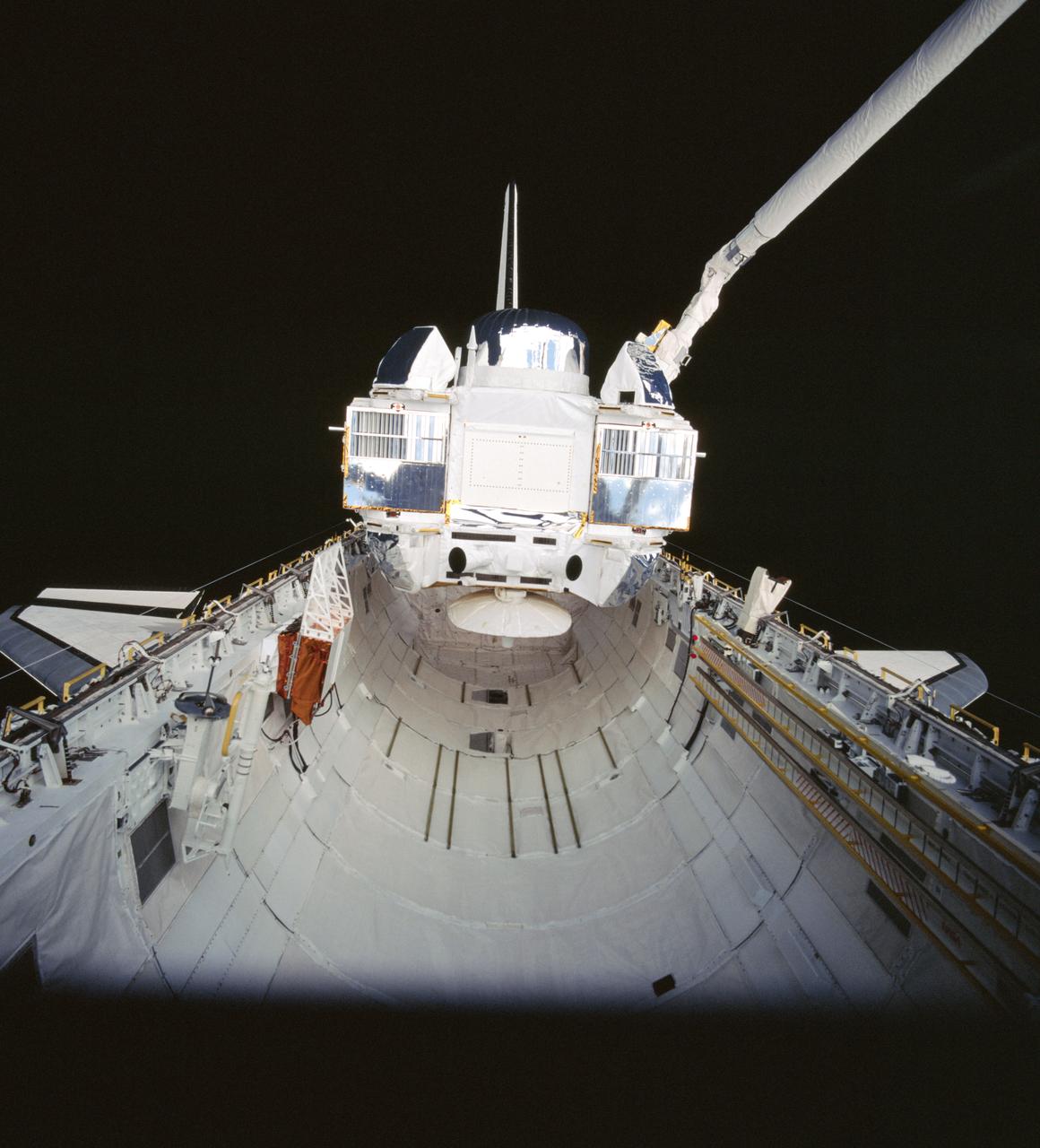
STS037-99-031 (7 April 1991) --- The Gamma Ray Observatory (GRO) is still in the grasp of Atlantis' remote manipulator system (RMS) in this 70mm scene, photographed from inside the crew cabin. A special extravehicular activity (EVA) was required by astronauts Jerry L. Ross and Jerome (Jay) Apt to manually extend the high-gain antenna on GRO. The solar array panels are not yet deployed in this scene. The five-member crew capped off a busy Flight Day 3 by releasing the heavy payload.
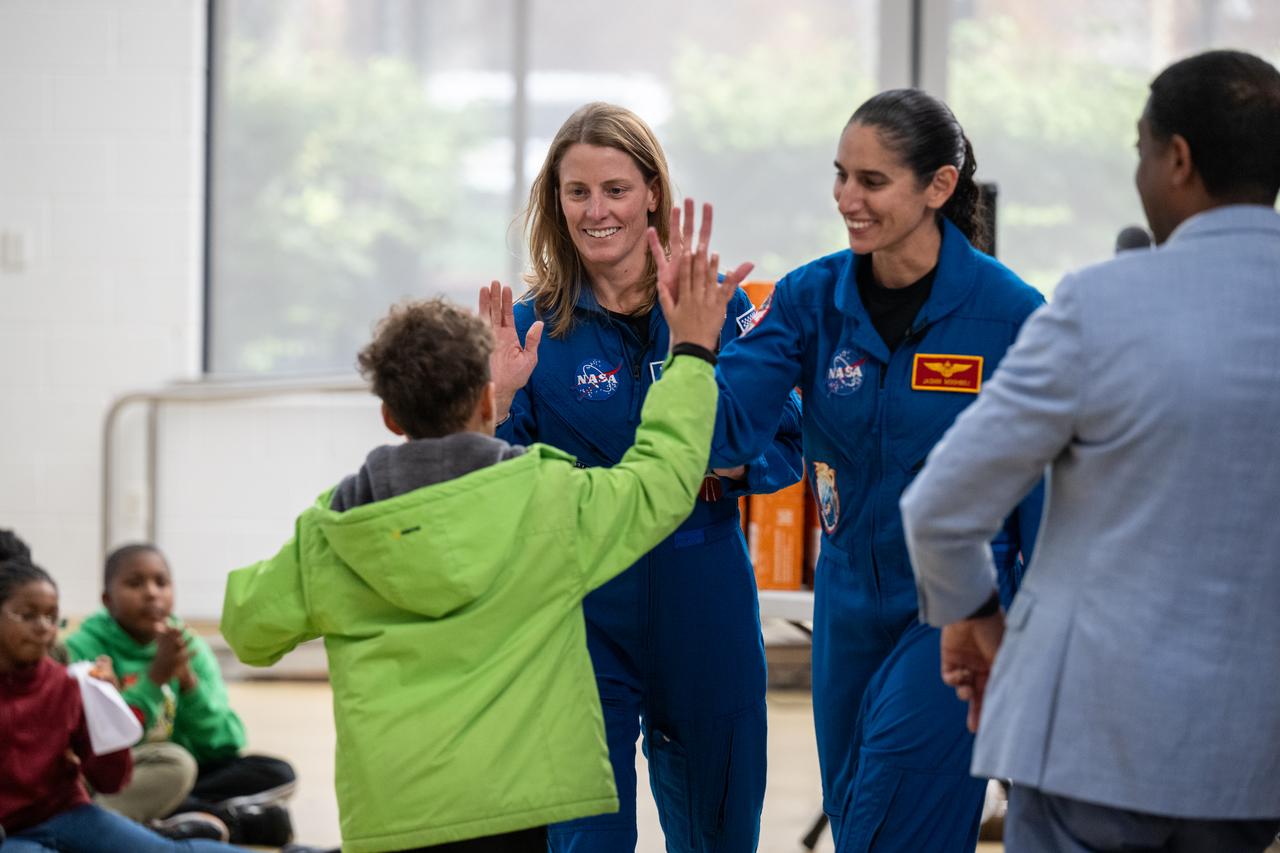
NASA astronauts Loral O’Hara and Jasmin Moghbeli, seen in blue flight suits, high five a student during an engagement event at Catherine Watkins Elementary School Monday, Dec. 2, 2024 in Washington. O’Hara and Moghbeli spent six months in space as part of Expedition 70 aboard the International Space Station. Photo Credit: (NASA/Keegan Barber)
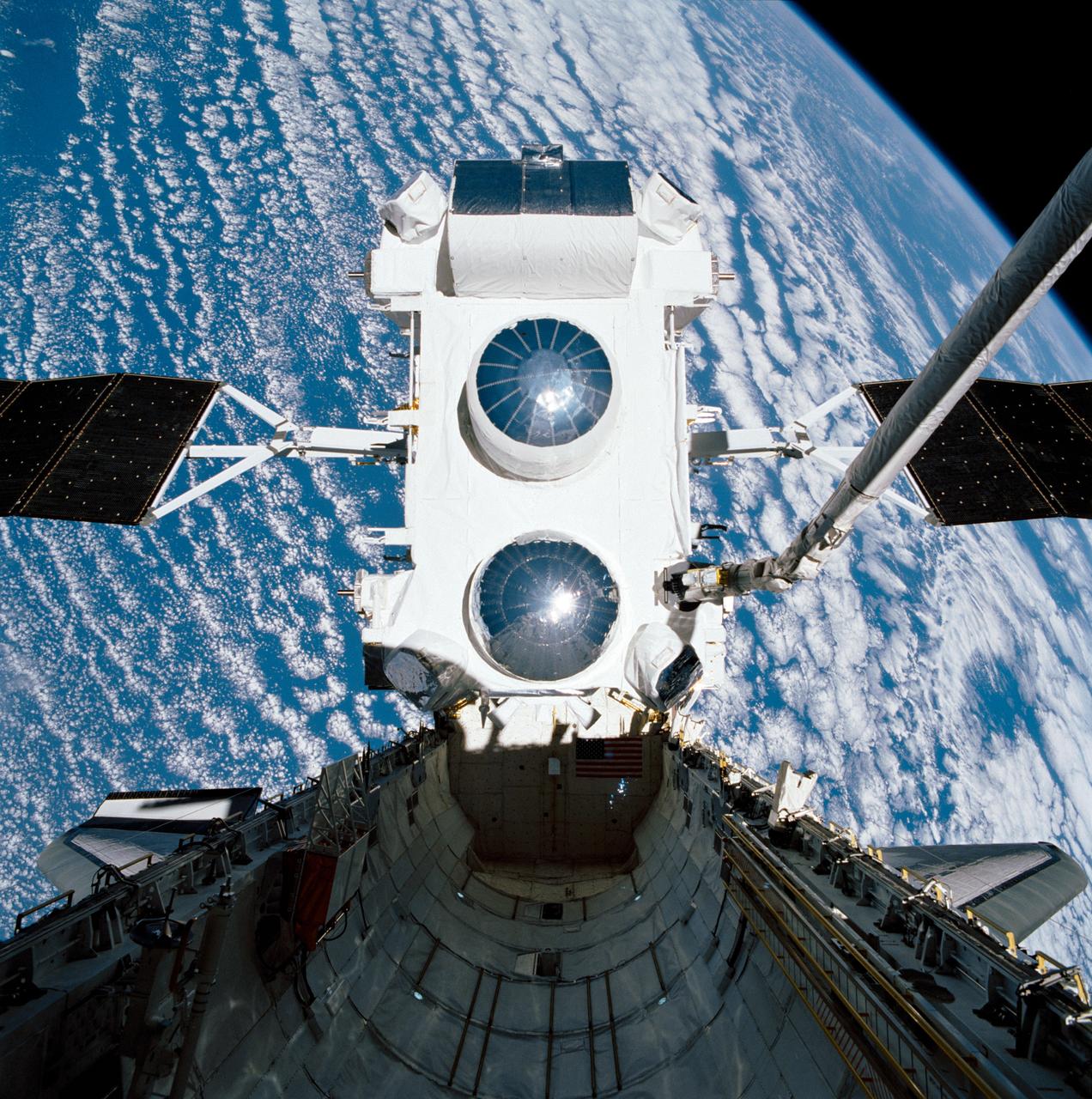
STS037-99-098 (7 April 1991) --- Backdropped against clouds over water, the Gamma Ray Observatory (GRO) is still in the grasp of the Space Shuttle Atlantis' Remote Manipulator System (RMS) in this 70mm scene. A special Extravehicular Activity (EVA) was required by astronauts Jerry L. Ross and Jerome (Jay) Apt to manually extend the high-gain antenna on GRO. The five-member crew capped off a busy Flight Day 3 by releasing the heavy payload.

Shivanjli Sharma, Air Traffic Management and Safety (ATMS) project manager, and pilot Wayne “Ringo” Ringelberg high-five ahead of an employee incentive flight from NASA’s Armstrong Research Center in Edwards, California. The flight offered a firsthand look at the aircraft and flight operations that help advance NASA’s aeronautics research. NASA Administrator Jared Isaacman established the ride‑along program to recognize and reward workforce members for their dedication to advancing the agency’s priorities. Credit: NASA
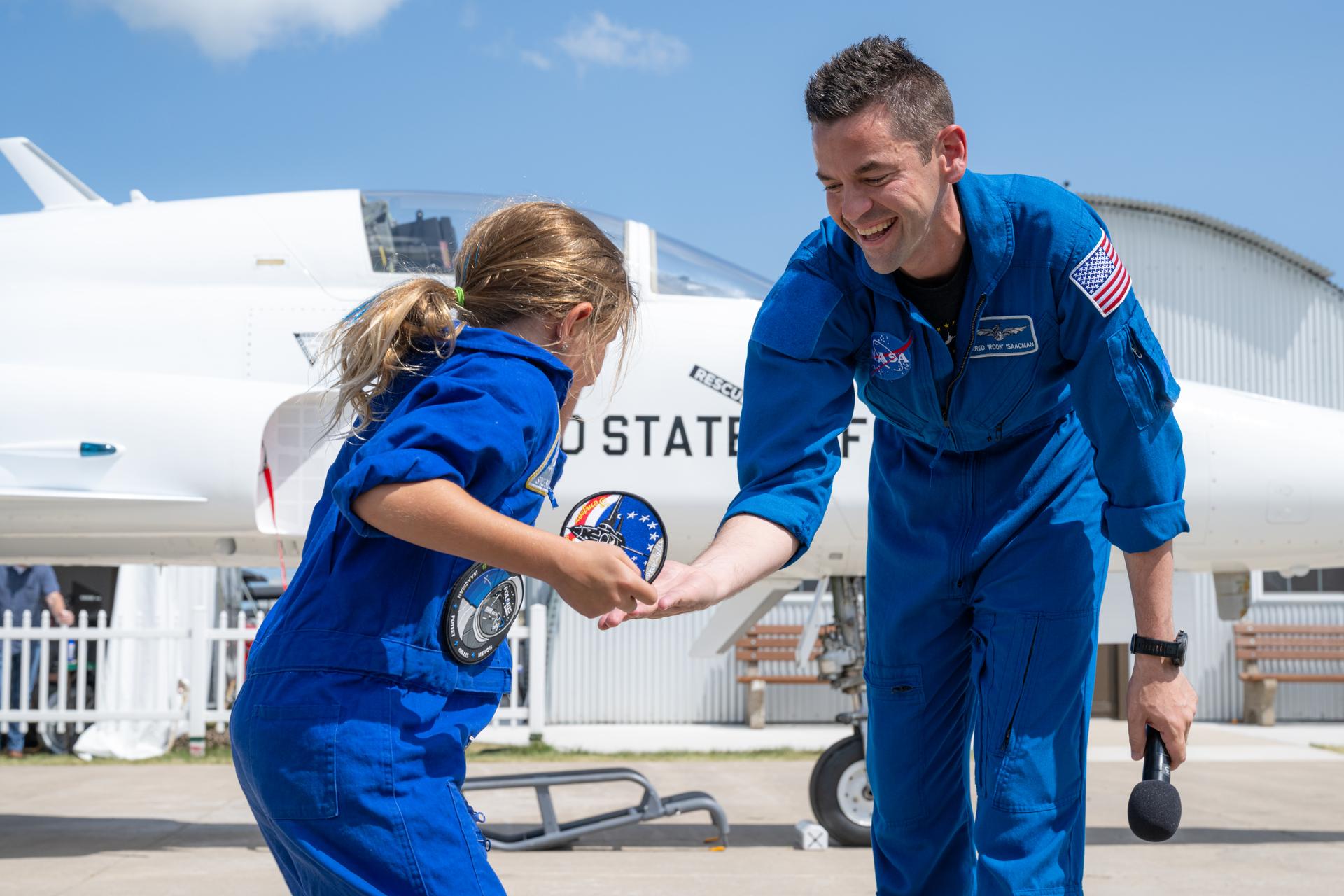
NASA Administrator Jared Isaacman gives a patch from his flight suit and offers a high five to a young aviation enthusiast during a “Warbirds in Review” presentation, Thursday, July 23, 2026, at EAA AirVenture Oshkosh at Wittman Regional Airport in Oshkosh, Wis. Isaacman discussed NASA’s efforts in air and space, his aviation experience, and more. Photo Credit: (NASA/John Kraus)
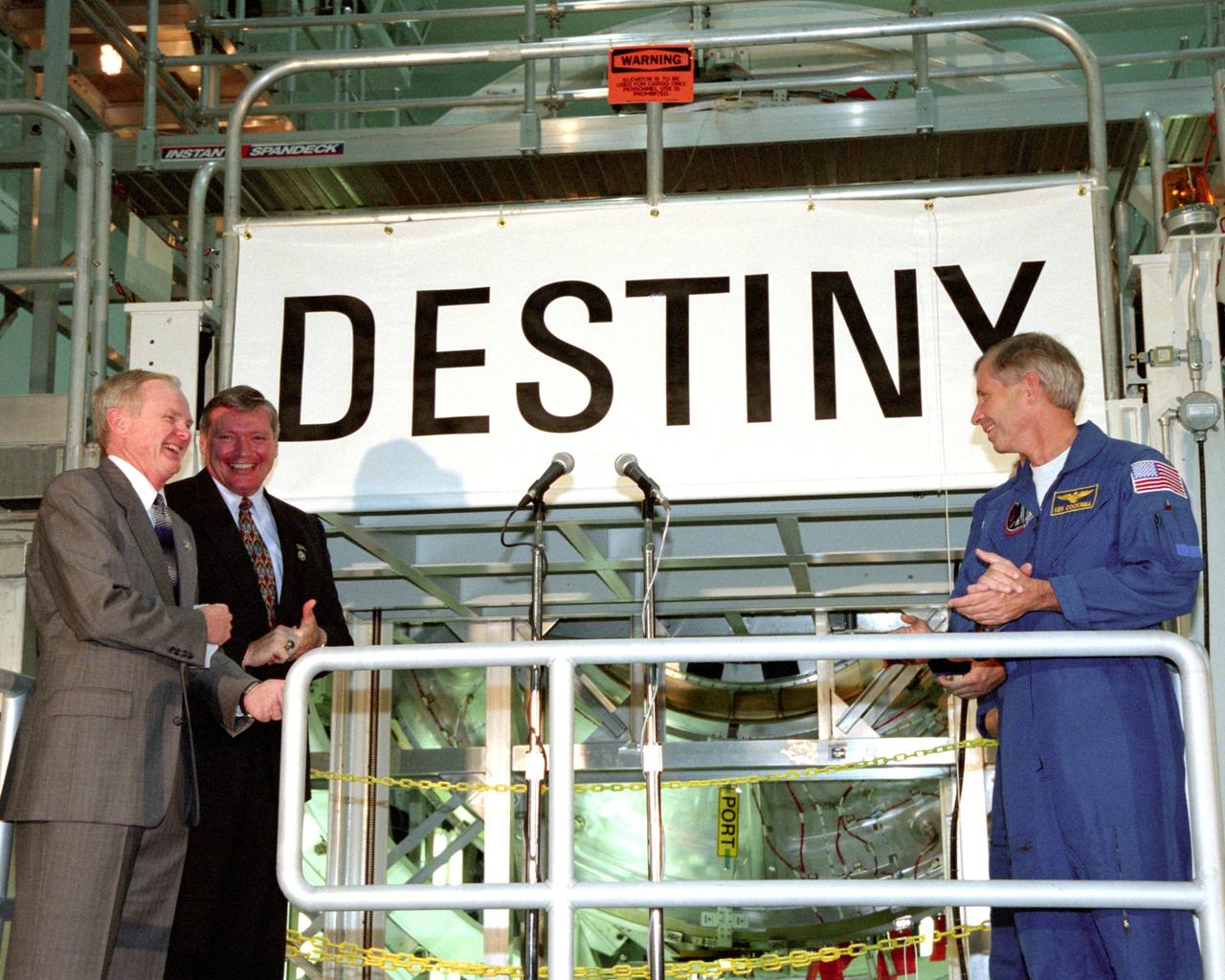
KENNEDY SPACE CENTER, FLA. - In the Space Station Processing Facility, Center Director Roy Bridges (left), Program Manager of the International Space Station (ISS) Randy Brinkley (second from left) and STS-98 Commander Ken Cockrell (right) applaud the unveiling of the name "Destiny" for the U.S. Laboratory module. The lab, which is behnd them on a workstand, is scheduled to be launched on STS-98 on Space Shuttle Endeavour in early 2000. It will become the centerpiece of scientific research on the ISS. The Shuttle will spend six days docked to the Station while the laboratory is attached and three spacewalks are conducted to compete its assembly. The laboratory will be launched with five equipment racks aboard, which will provide essential functions for Station systems, including high data-rate communications, and maintain the Station's orientation using control gyroscopes launched earlier. Additional equipment and research racks will be installed in the laboratory on subsequent Shuttle flights.
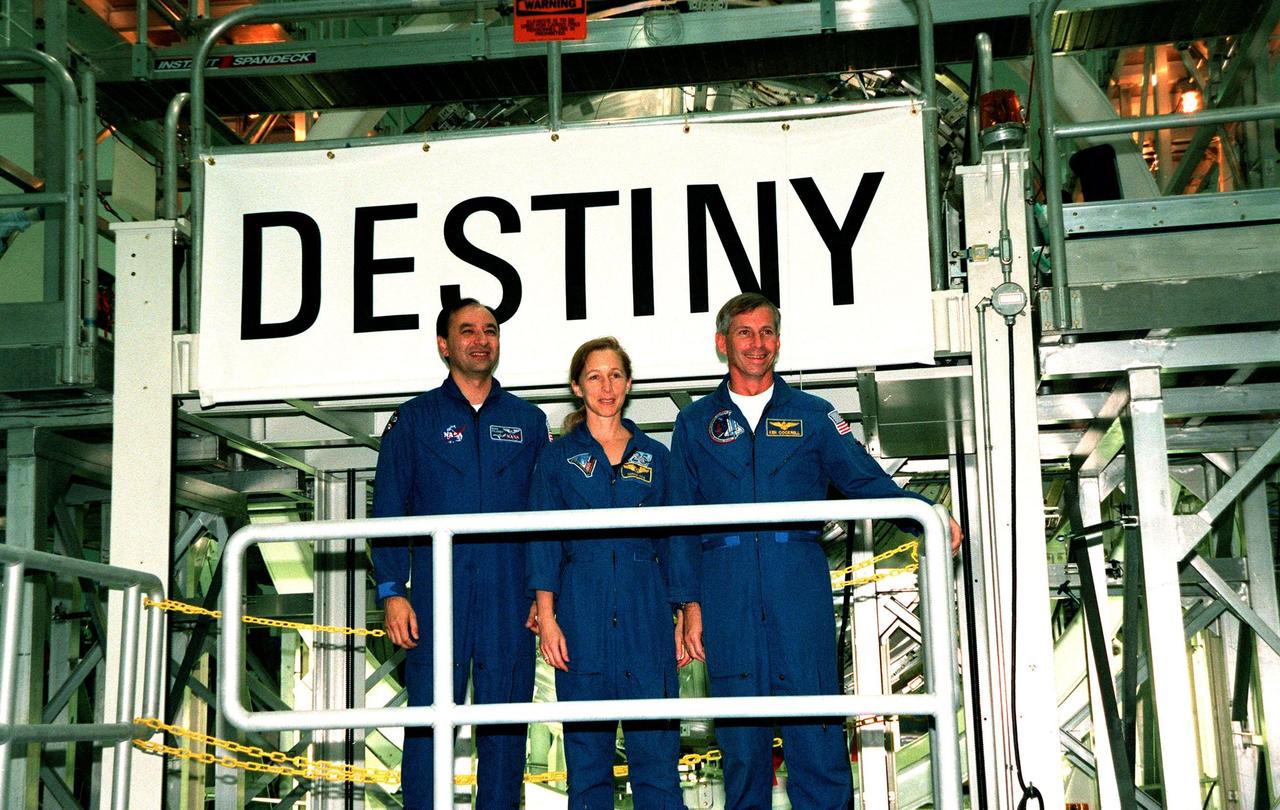
KENNEDY SPACE CENTER, FLA. -- In the Space Station Processing Facility, STS-98 crew members Pilot Mark Polansky, Mission Specialist Marsha Ivins and Commander Ken Cockrell pose underneath the banner revealing the name Destiny given to the U.S. Lab module. They are part of the five-member crew scheduled to carry the lab into space aboard Space Shuttle Endeavour early in the year 2000 where it will become the centerpiece of scientific research on the International Space Station. The Shuttle will spend six days docked to the station while the laboratory is attached and three space walks are conducted to complete its assembly. The laboratory will be launched with five equipment racks aboard, which will provide essential functions for station systems, including high data-rate communications, and maintain the station's orientation using control gyroscopes launched earlier. Additional equipment and research racks will be installed in the laboratory on subsequent Shuttle flights
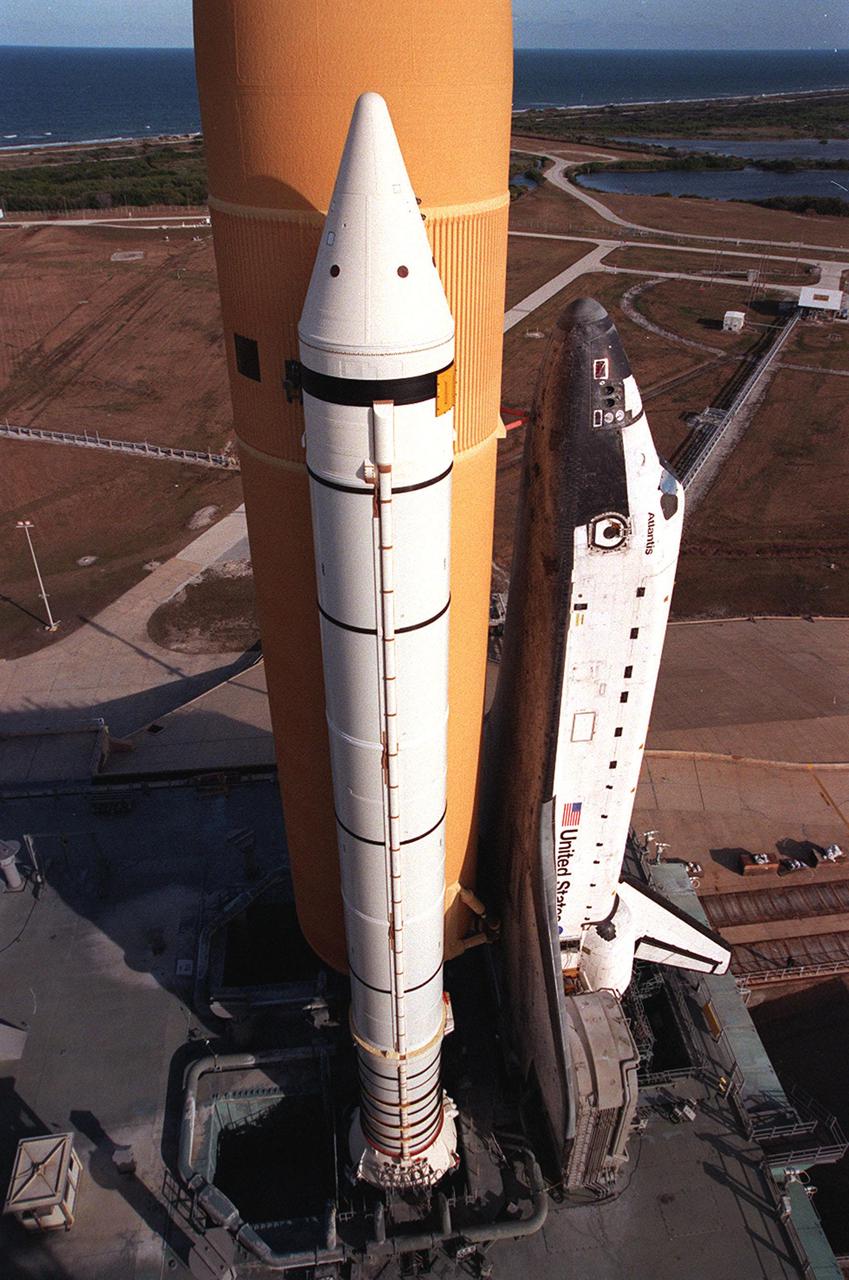
KENNEDY SPACE CENTER, Fla. -- Resting atop the Mobile Launcher Platform, Space Shuttle Atlantis is viewed from a high level on the Fixed Service Structure. Seen is one of its solid rocket boosters and the external tank. Next to the wing of the orbiter is one of two tail service masts, which support the fluid, gas and electrical requirements of the orbiter’s liquid oxygen and liquid hydrogen aft T-0 umbilicals. On the horizon is the Atlantic Ocean. Atlantis will fly on mission STS-98, the seventh construction flight to the International Space Station, carrying the U.S. Laboratory, named Destiny. The lab has five system racks already installed inside the module. After delivery of electronics in the lab, electrically powered attitude control for Control Moment Gyroscopes will be activated. Atlantis is scheduled for launch no earlier than Jan. 19, 2001, with a crew of five
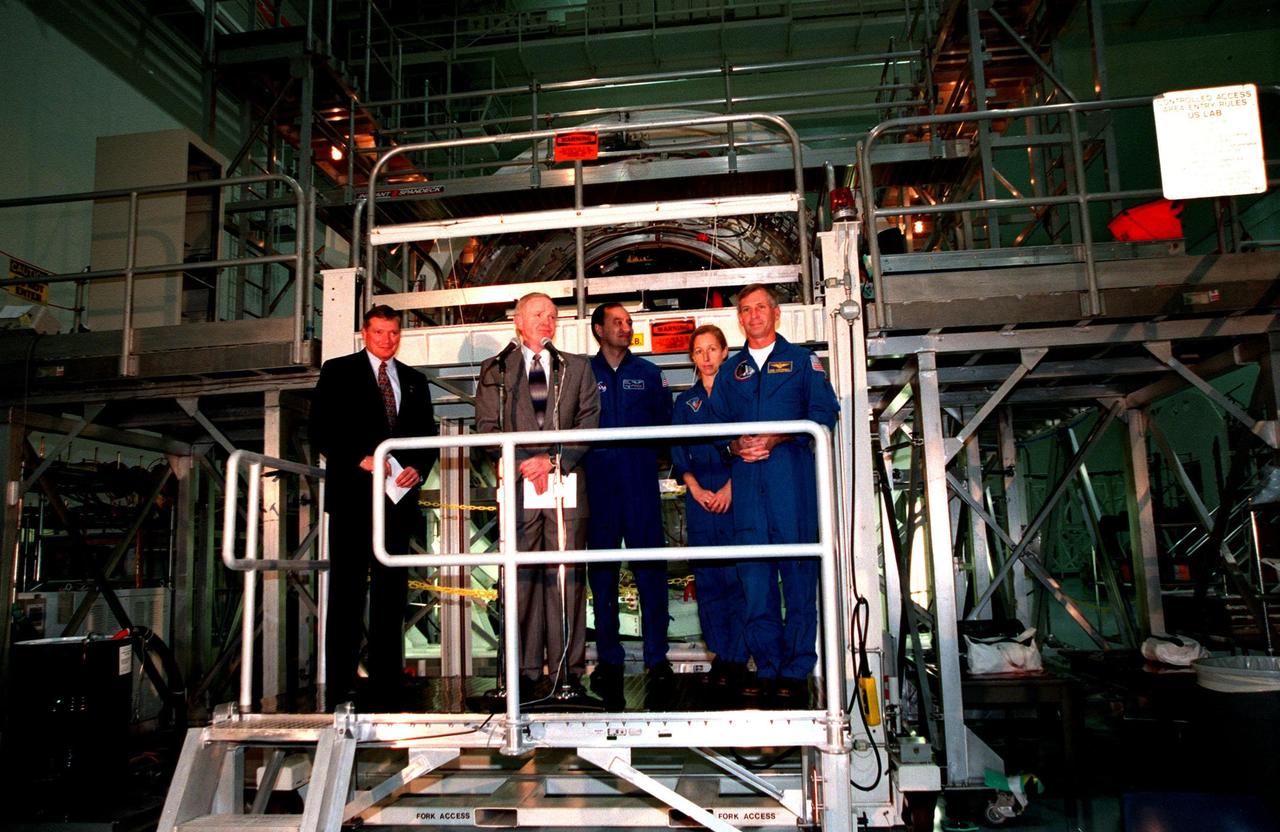
KENNEDY SPACE CENTER, FLA. -- In the Space Station Processing Facility, Center Director Roy Bridges (left), Program Manager of the International Space Station (ISS) Randy Brinkley (second from left) and (right) STS-98 Commander Ken Cockrell applaud the unveiling of the name Destiny given the U.S. Lab module. The lab, which is behind them on a workstand, is scheduled to be launched on Space Shuttle Endeavour in early 2000. It will become the centerpiece of scientific research on the ISS. Cockrell is part of the five-member crew expected to be aboard. The Shuttle will spend six days docked to the station while the laboratory is attached and three space walks are conducted to complete its assembly. The laboratory will be launched with five equipment racks aboard, which will provide essential functions for station systems, including high data-rate communications, and maintain the station's orientation using control gyroscopes launched earlier. Additional equipment and research racks will be installed in the laboratory on subsequent Shuttle flights
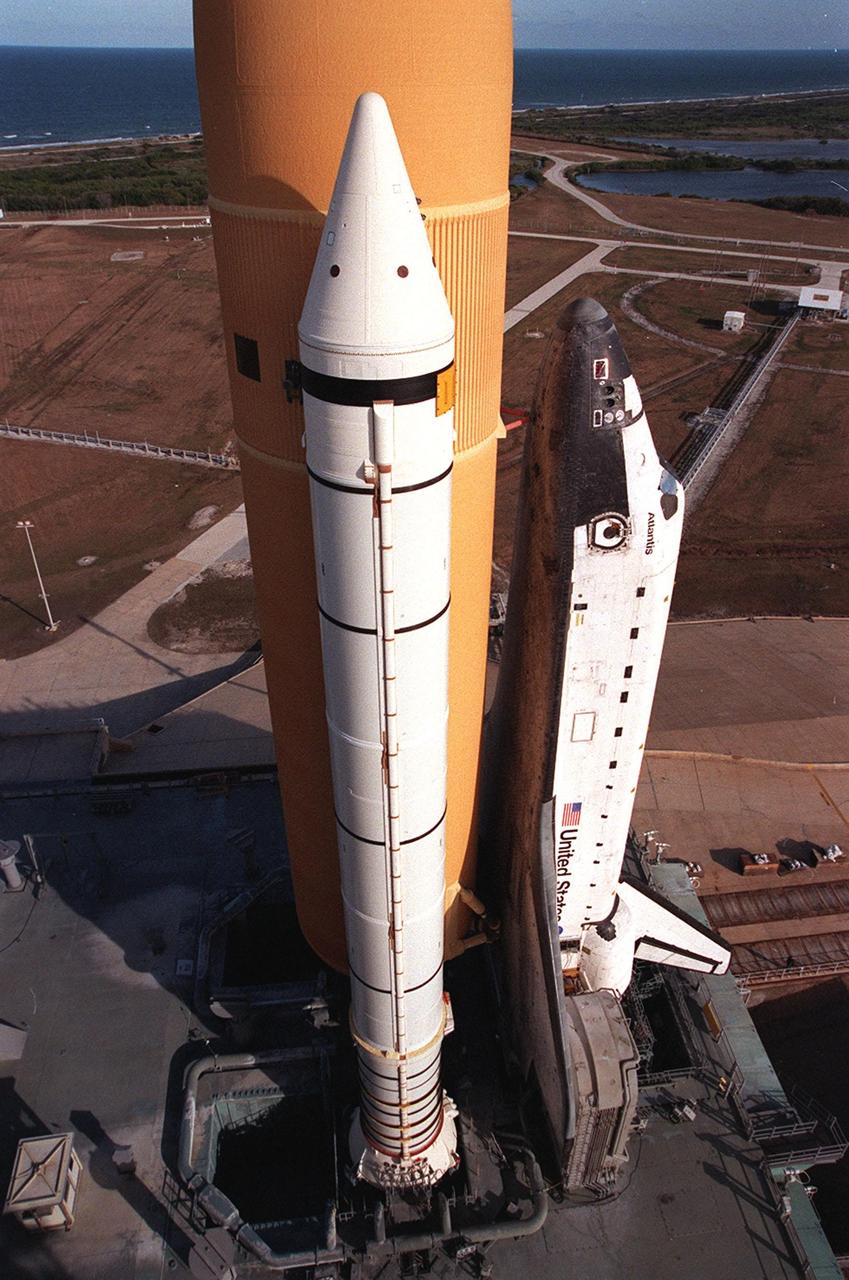
KENNEDY SPACE CENTER, Fla. -- Resting atop the Mobile Launcher Platform, Space Shuttle Atlantis is viewed from a high level on the Fixed Service Structure. Seen is one of its solid rocket boosters and the external tank. Next to the wing of the orbiter is one of two tail service masts, which support the fluid, gas and electrical requirements of the orbiter’s liquid oxygen and liquid hydrogen aft T-0 umbilicals. On the horizon is the Atlantic Ocean. Atlantis will fly on mission STS-98, the seventh construction flight to the International Space Station, carrying the U.S. Laboratory, named Destiny. The lab has five system racks already installed inside the module. After delivery of electronics in the lab, electrically powered attitude control for Control Moment Gyroscopes will be activated. Atlantis is scheduled for launch no earlier than Jan. 19, 2001, with a crew of five
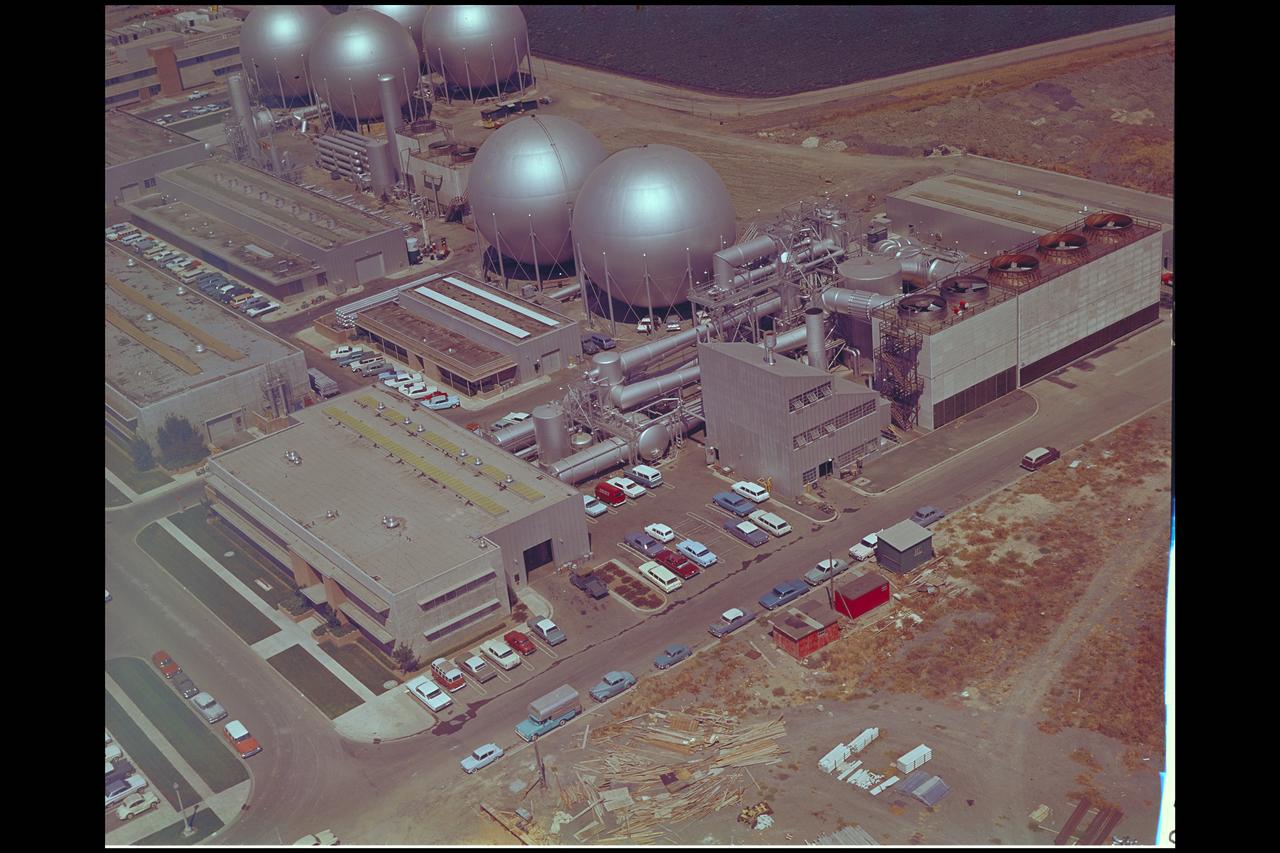
Aerial view of Gasdynamics facility in 1964 and the 20 inch helium tunnel Part of the Thermal Protection Laboratory used to research materials for heat shield applications and for aerodynamic heating and materials studies of vehicles in planetary atmospheres. This laboratory is comprised of five separate facilities: an Aerodynamic Heating Tunnel, a Heat Transfer Tunnel, two Supersonic Turbulent Ducts, and a High-Power CO2 Gasdynamic Laser. All these facilities are driven by arc-heaters, with the exception of the large, combustion-type laser. The arc-heated facilities are powered by a 20 Megawatt DC power supply. Their effluent gas stream (test gases; Air, N2, He, CO2 and mixtures; flow rates from 0.05 to 5.0 lbs/sec) discharges into a five-stage stream-ejector-driven vacuum system. The vacuum system and power supply are common to the test faciities in building N-238. All of the facilities have high pressure water available at flow rates up to 4, 000 gals/min. The data obtained from these facilities are recorded on magnetic tape or oscillographs. All forms of data can be handled whether from thermo-couples, pressure cells, pyrometers, or radiometers, etc. in addition, closed circuit T. V. monitors and various film cameras are available. (operational since 1962)
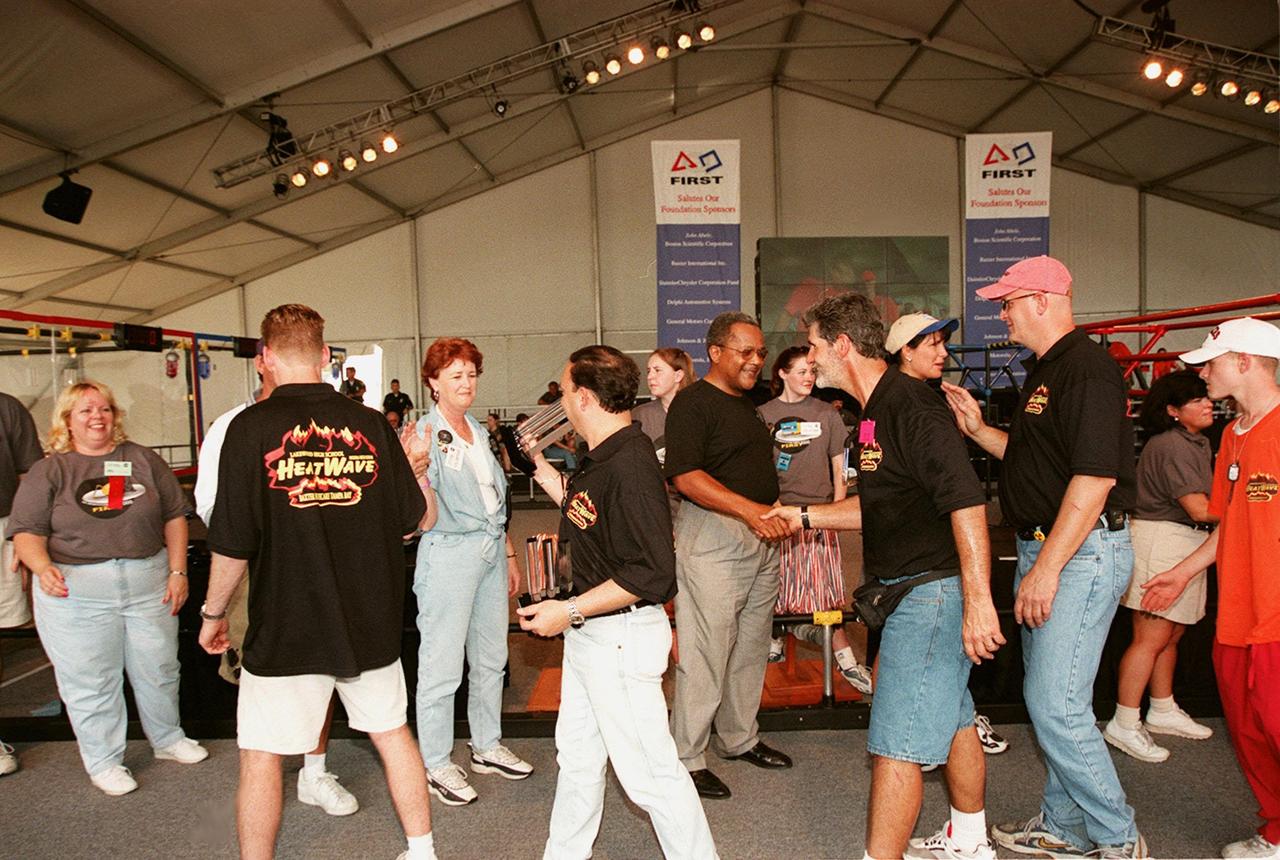
Adult members of the team known as Heatwave, from St. Petersburg, Fla., get "high fives" from Nap Carroll (center), chief financial officer, Kennedy Space Center, and other officials of the FIRST (For Inspiration and Recognition of Science and Technology) Southeast Regional competition held at the KSC Visitor Complex. Heatwave came in second for the final competition, plus received awards for Number One Seed, Best Offensive round, and the DaimlerChrysler Team Spirit. Teams of high school students from all over the country tested the limits of their imagination using robots they designed, with the support of business and engineering professionals and corporate sponsors, to compete in a technological battle against other schools' robots. Of the 30 high school teams competing at the Southeast Regional event, 16 were Florida teams co-sponsored by NASA and KSC contractors. Local high schools participating are Astronaut, Bayside, Cocoa Beach, Eau Gallie, Melbourne, Melbourne Central Catholic, Palm Bay, Rockledge, Satellite, and Titusvill
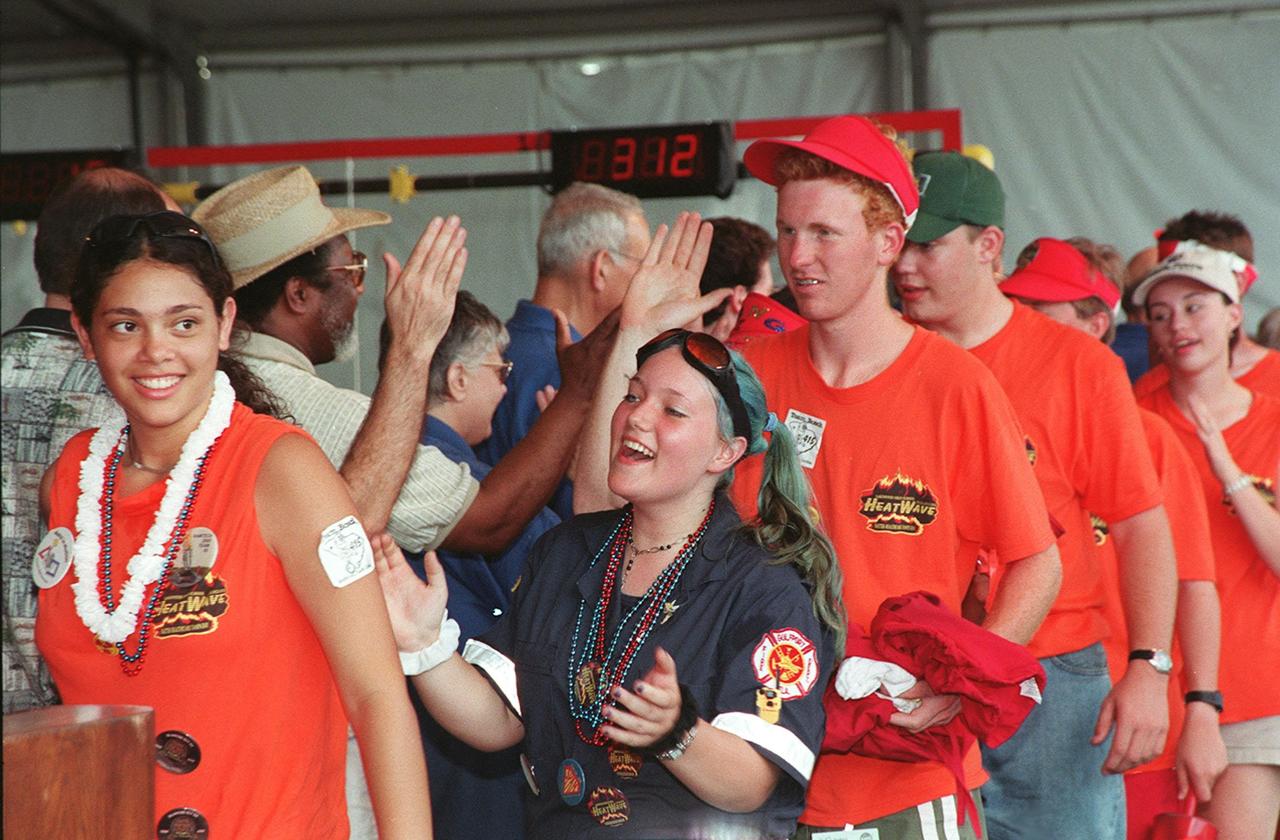
Members of the team known as Heatwave, from St. Petersburg, Fla., get "high fives" from Jim Jennings (wearing a straw hat), KSC's deputy director for Business Operations, during closing ceremonies for the FIRST (For Inspiration and Recognition of Science and Technology) Southeast Regional competition held at the KSC Visitor Complex. Heatwave came in second for the final competition, plus received awards for Number One Seed, Best Offensive round, and the DaimlerChrysler Team Spirit. Teams of high school students from all over the country tested the limits of their imagination using robots they designed, with the support of business and engineering professionals and corporate sponsors, to compete in a technological battle against other schools' robots. Of the 30 high school teams competing at the Southeast Regional event, 16 were Florida teams co-sponsored by NASA and KSC contractors. Local high schools participating are Astronaut, Bayside, Cocoa Beach, Eau Gallie, Melbourne, Melbourne Central Catholic, Palm Bay, Rockledge, Satellite, and Titusville
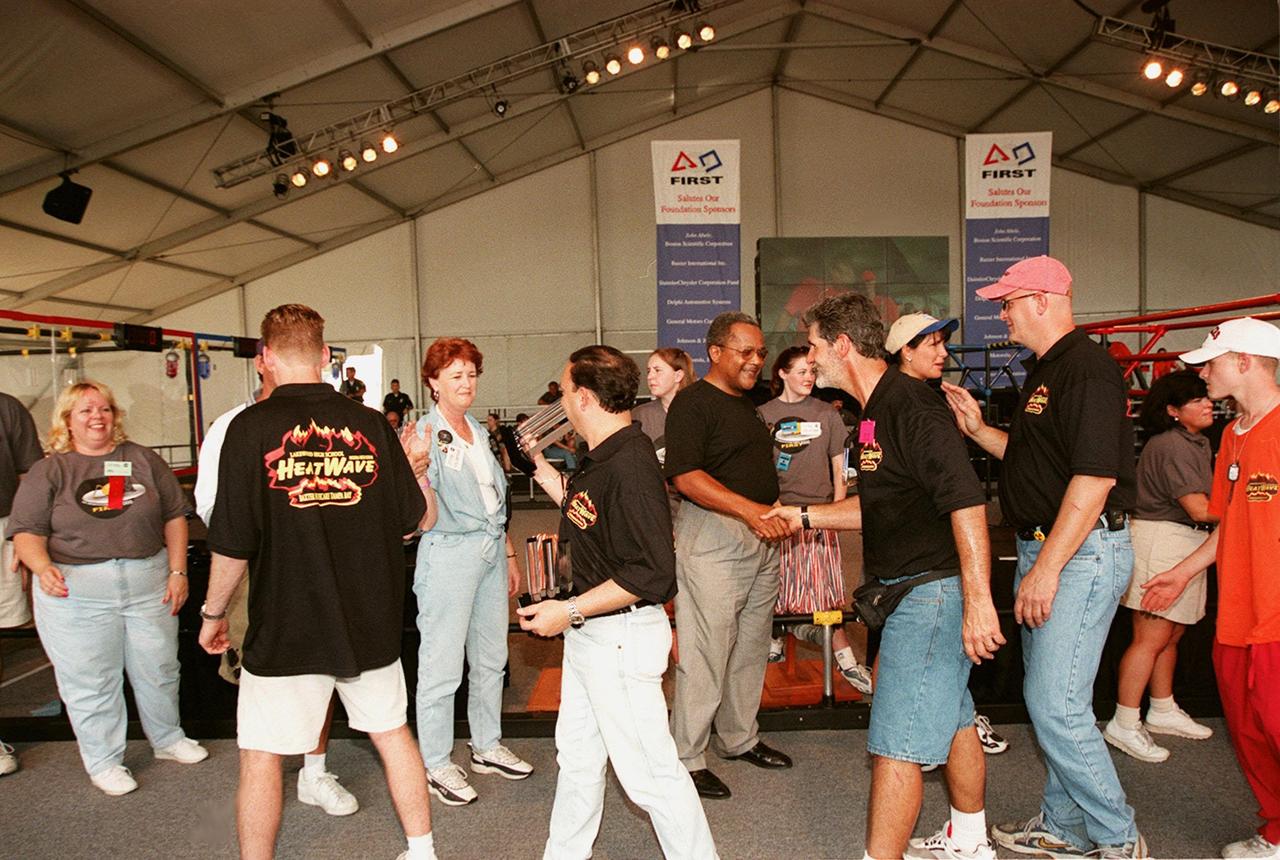
Adult members of the team known as Heatwave, from St. Petersburg, Fla., get "high fives" from Nap Carroll (center), chief financial officer, Kennedy Space Center, and other officials of the FIRST (For Inspiration and Recognition of Science and Technology) Southeast Regional competition held at the KSC Visitor Complex. Heatwave came in second for the final competition, plus received awards for Number One Seed, Best Offensive round, and the DaimlerChrysler Team Spirit. Teams of high school students from all over the country tested the limits of their imagination using robots they designed, with the support of business and engineering professionals and corporate sponsors, to compete in a technological battle against other schools' robots. Of the 30 high school teams competing at the Southeast Regional event, 16 were Florida teams co-sponsored by NASA and KSC contractors. Local high schools participating are Astronaut, Bayside, Cocoa Beach, Eau Gallie, Melbourne, Melbourne Central Catholic, Palm Bay, Rockledge, Satellite, and Titusvill
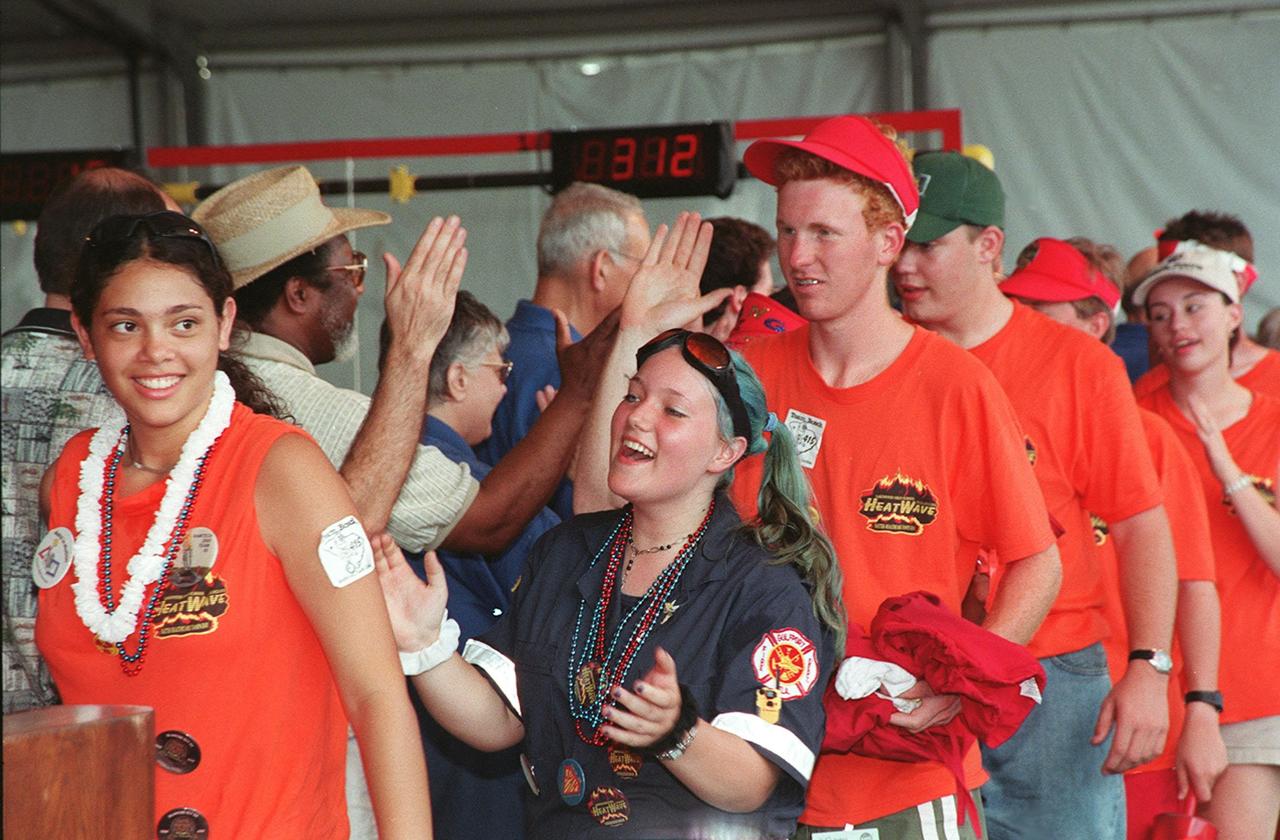
Members of the team known as Heatwave, from St. Petersburg, Fla., get "high fives" from Jim Jennings (wearing a straw hat), KSC's deputy director for Business Operations, during closing ceremonies for the FIRST (For Inspiration and Recognition of Science and Technology) Southeast Regional competition held at the KSC Visitor Complex. Heatwave came in second for the final competition, plus received awards for Number One Seed, Best Offensive round, and the DaimlerChrysler Team Spirit. Teams of high school students from all over the country tested the limits of their imagination using robots they designed, with the support of business and engineering professionals and corporate sponsors, to compete in a technological battle against other schools' robots. Of the 30 high school teams competing at the Southeast Regional event, 16 were Florida teams co-sponsored by NASA and KSC contractors. Local high schools participating are Astronaut, Bayside, Cocoa Beach, Eau Gallie, Melbourne, Melbourne Central Catholic, Palm Bay, Rockledge, Satellite, and Titusville

In this image, the NASA/ESA Hubble Space Telescope has captured the smoking gun of a newborn star, the Herbig–Haro objects numbered 7 to 11 (HH 7–11). These five objects, visible in blue in the top center of the image, lie within NGC 1333, a reflection nebula full of gas and dust found about a thousand light-years away from Earth. Bright patches of nebulosity near newborn stars, Herbig-Haro objects like HH 7–11 are transient phenomena. Traveling away from the star that created them at a speed of up to about 150,000 miles per hour, they disappear into nothingness within a few tens of thousands of years. The young star that is the source of HH 7–11 is called SVS 13, and all five objects are moving away from SVS 13 toward the upper left. The current distance between HH 7 and SVS 13 is about 20,000 times the distance between Earth and the Sun. Herbig–Haro objects are formed when jets of ionized gas ejected by a young star collide with nearby clouds of gas and dust at high speeds. The Herbig-Haro objects visible in this image are no exception to this and were formed when the jets from the newborn star SVS 13 collided with the surrounding clouds. These collisions created the five brilliant clumps of light within the reflection nebula.
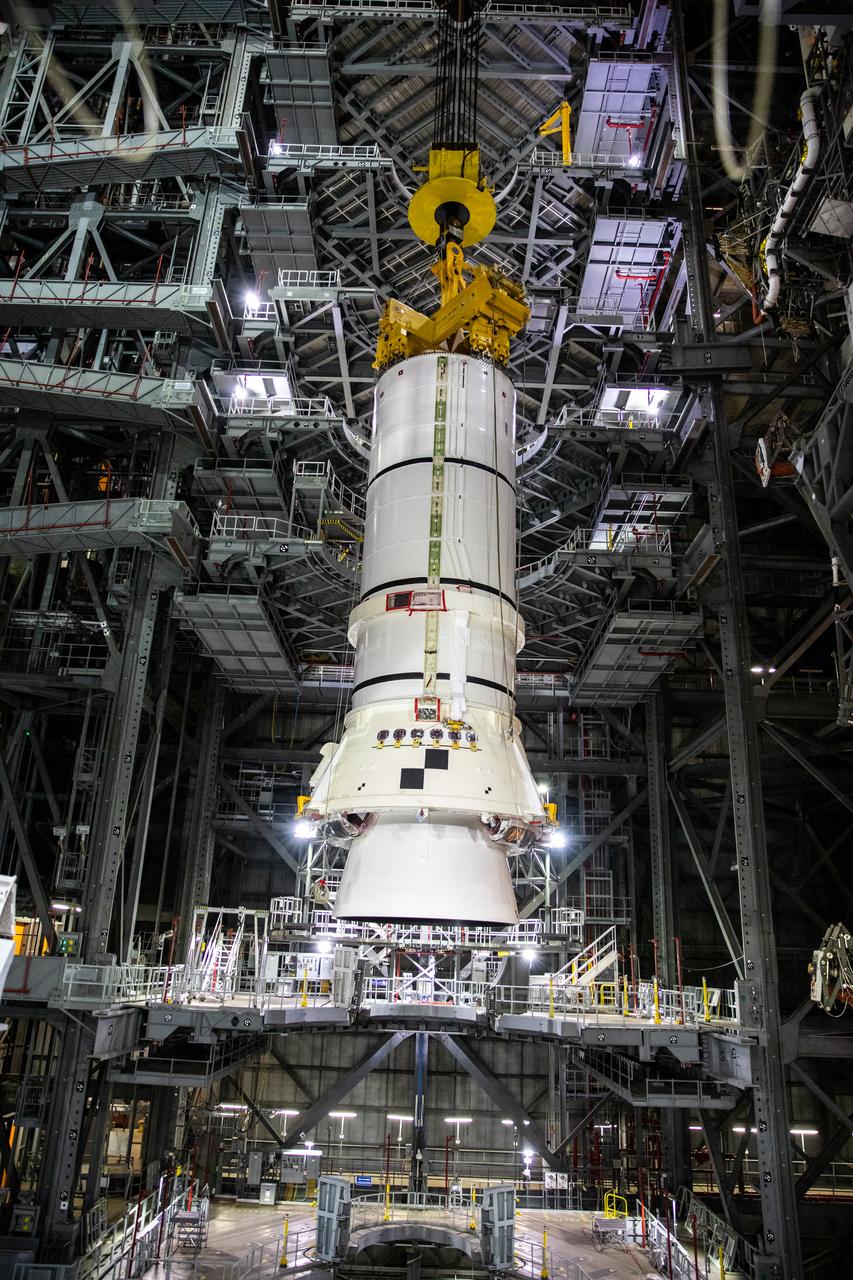
In the Vehicle Assembly Building (VAB) at NASA’s Kennedy Space Center in Florida, the second of two Artemis I aft booster segments for the Space Launch System is lowered by crane into High Bay 3 on Nov. 24, 2020. Workers with Exploration Ground Systems and contractor Jacobs teams will stack the twin five-segment boosters on the mobile launcher in High Bay 3 over a number of weeks. When the core stage arrives, it will join the boosters on the mobile launcher, followed by the interim cryogenic propulsion stage and Orion spacecraft. Manufactured by Northrop Grumman in Utah, the twin boosters provide more than 75 percent of the total SLS thrust at launch. The SLS is managed by Marshall Space Flight Center in Huntsville, Alabama. Under the Artemis program, NASA will land the first woman and the next man on the Moon by 2024. The first in a series of increasingly complex missions, Artemis I will test the Orion spacecraft and SLS as an integrated system ahead of crewed flights to the Moon.
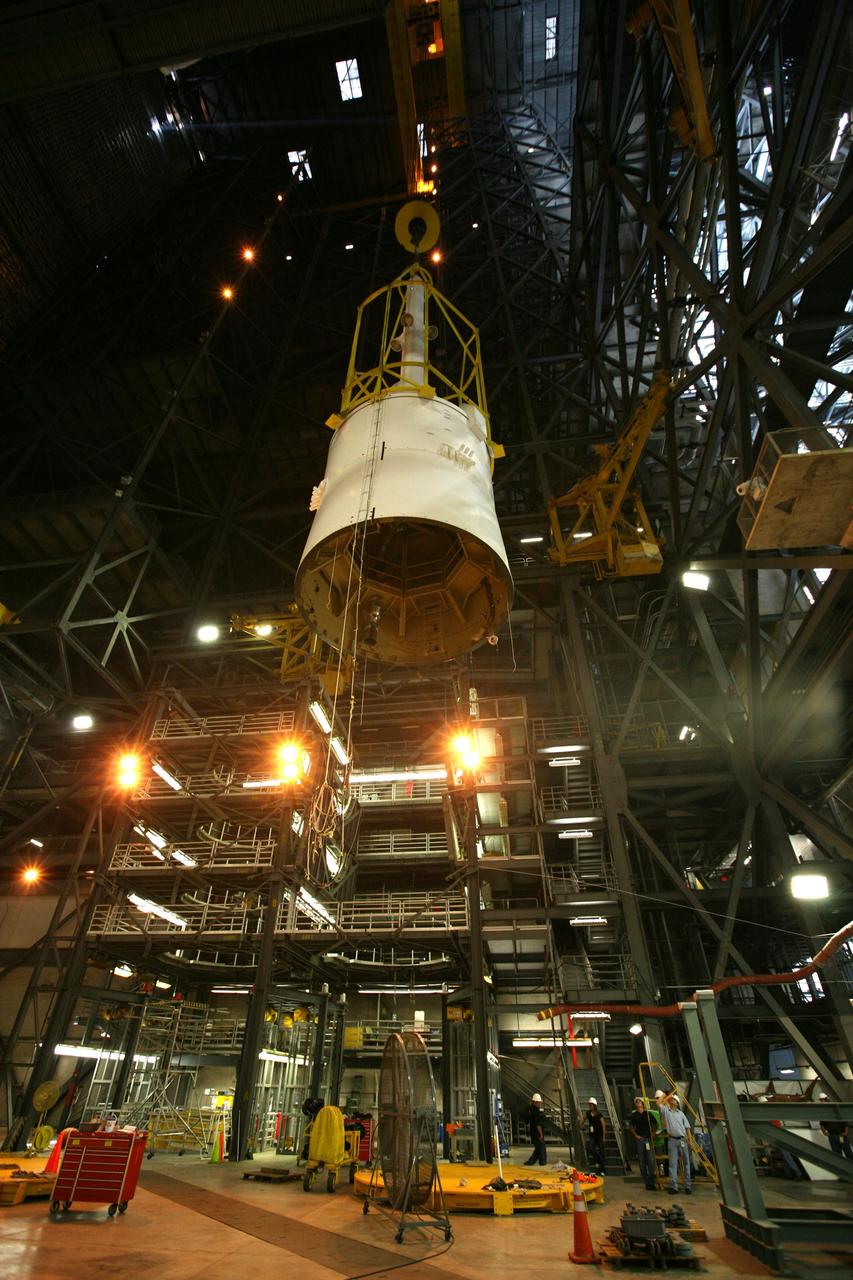
CAPE CANAVERAL, Fla. – In the Vehicle Assembly Building's High Bay 4, assembly of the Ares I-X rocket nears completion. The yellow framework, nicknamed the "birdcage," lifts Super Stack 5. The stack will be positioned on top of the segments already in place on the mobile launcher platform in High Bay 3, completing assembly of the 327-foot-tall rocket. Five super stacks make up the rocket's upper stage that is integrated with the four-segment solid rocket booster first stage. Ares I-X is the test vehicle for the Ares I, which is part of the Constellation Program to return men to the moon and beyond. The Ares I-X flight test is targeted for Oct. 31, pending formal NASA Headquarters approval. Photo credit: NASA/Dimitri Gerondidakis
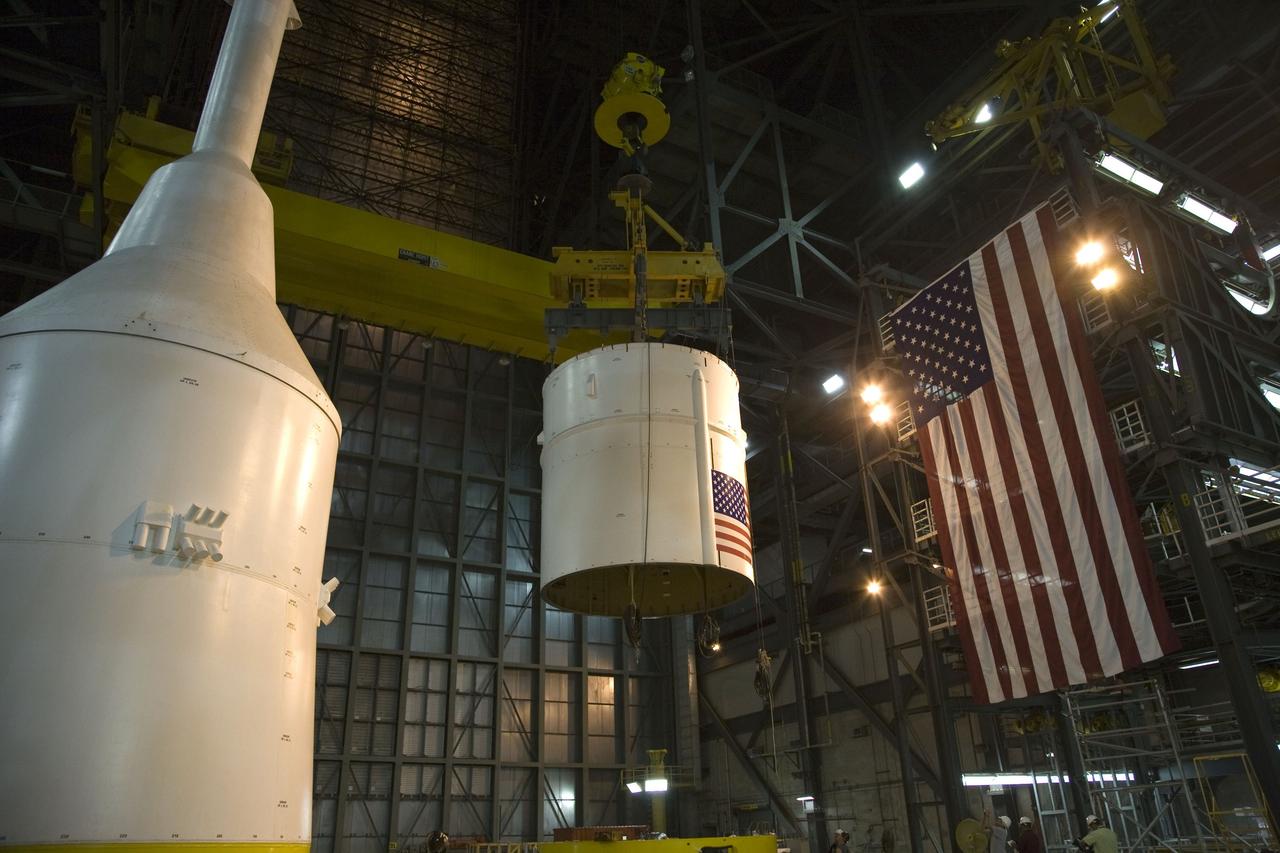
CAPE CANAVERAL, Fla. – In the Vehicle Assembly Building's High Bay 4 at NASA's Kennedy Space Center in Florida, a crane lifts the Ares I-X Super Stack 4. The stack will be moved to High Bay 3 for integration with Super Stack 3. At left is the crew module-launch abort system and simulator service module-service adapter stack. Five super stacks make up the upper stage that will be integrated with the four-segment solid rocket booster first stage on the mobile launch platform. Ares I-X is the test vehicle for the Ares I, which is part of the Constellation Program to return men to the moon and beyond. The Ares I-X flight test is targeted for Oct. 31, pending formal NASA Headquarters approval. Photo credit: NASA/Dimitri Gerondidakis
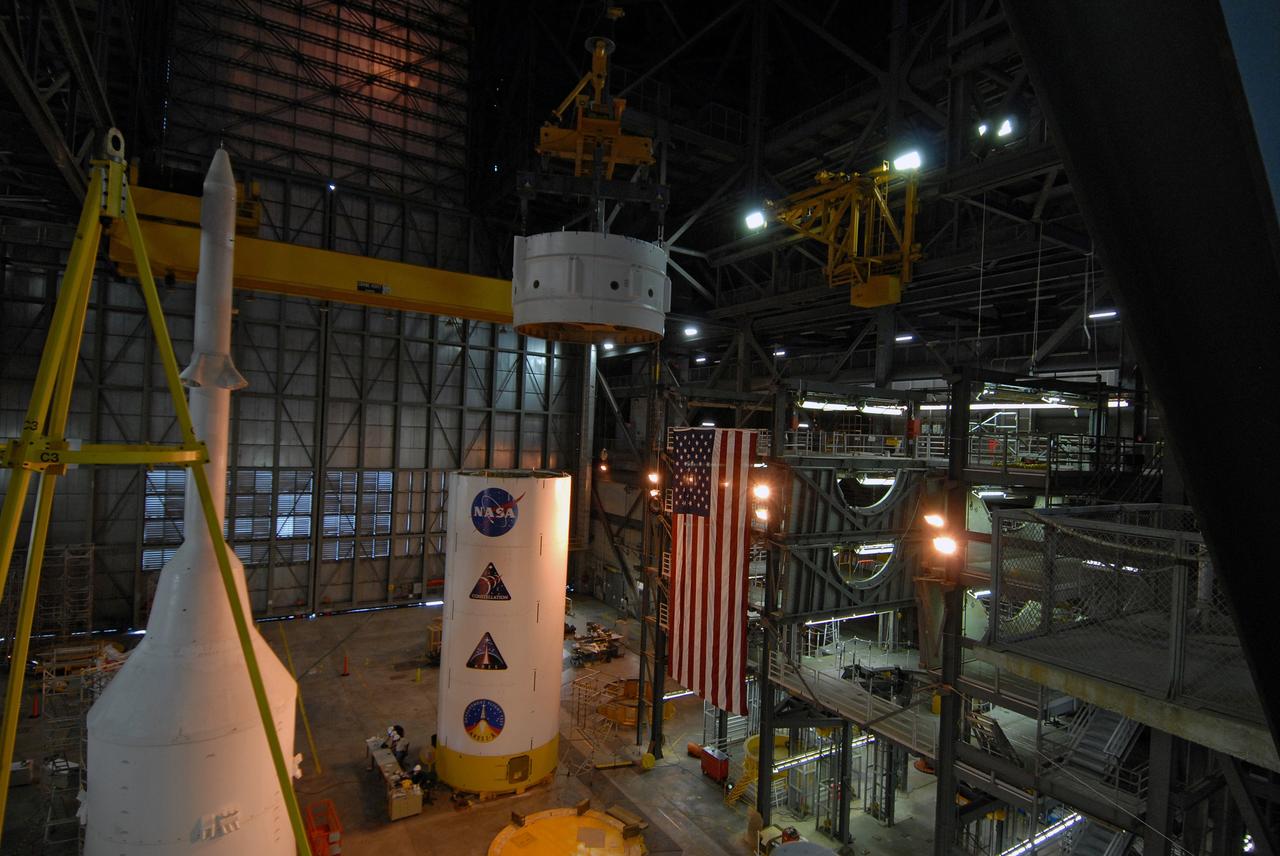
CAPE CANAVERAL, Fla. – In the Vehicle Assembly Building's High Bay 4 at NASA's Kennedy Space Center in Florida, a crane lifts Super Stack 2, part of the Ares I-X upper stage. The stack is being moved across the transfer aisle for attachment to Super Stack 1 in High Bay 3. Beneath is seen Super Stack 3 and at left is the crew module-launch abort system, or CM-LAS, and simulator service module-service adapter stack. The upper stage comprises five super stacks, which are integrated with the four-segment solid rocket booster first stage on the mobile launch platform. Ares I-X is the test vehicle for the Ares I, which is part of the Constellation Program to return men to the moon and beyond. The Ares I-X flight test is targeted for Oct. 31, pending formal NASA Headquarters approval. Photo credit: NASA/Tim Jacobs
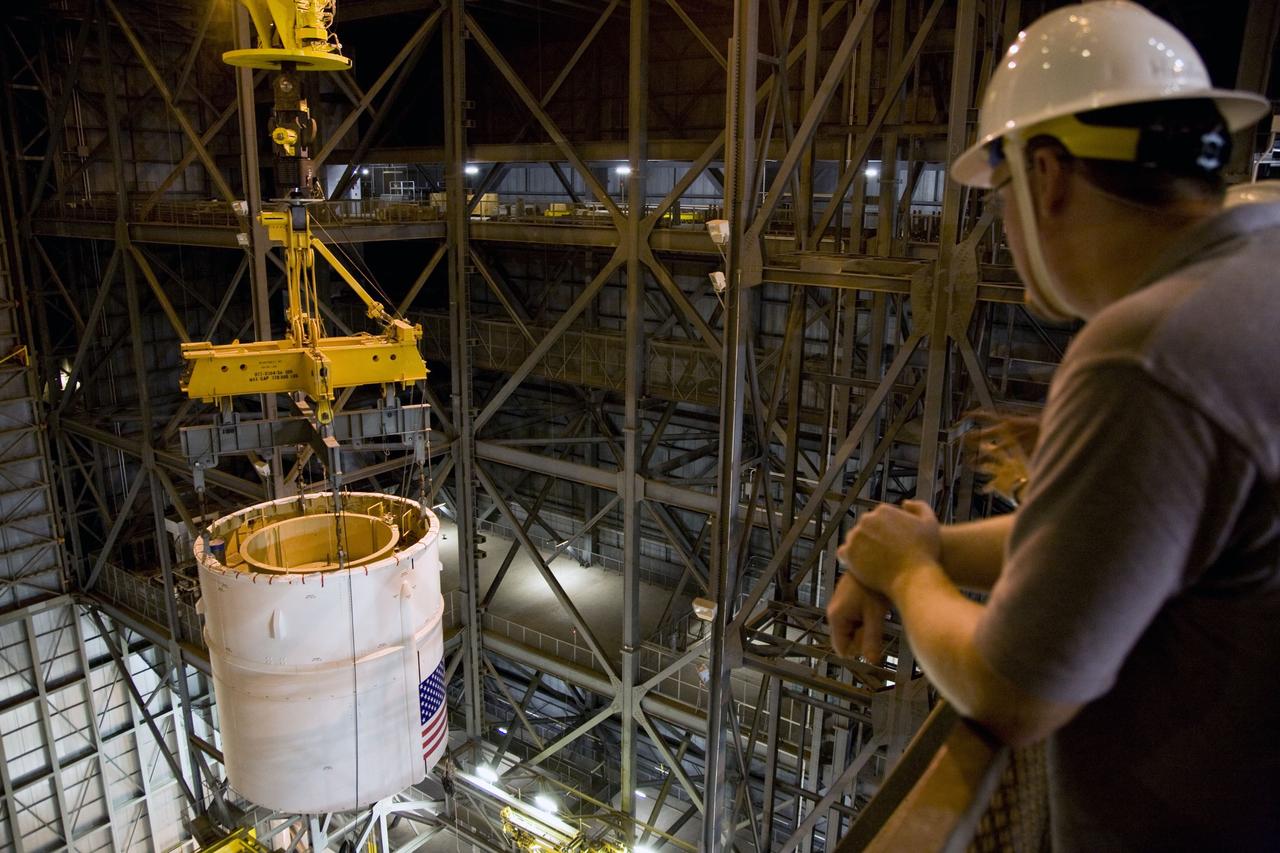
CAPE CANAVERAL, Fla. – In the Vehicle Assembly Building's High Bay 4 at NASA's Kennedy Space Center in Florida, workers at right watch as a crane lifts the Ares I-X Super Stack 4 into the upper levels for transfer to High Bay 3. There it will be integrated with Super Stack 3. Five super stacks make up the upper stage that will be integrated with the four-segment solid rocket booster first stage on the mobile launch platform. Ares I-X is the test vehicle for the Ares I, which is part of the Constellation Program to return men to the moon and beyond. The Ares I-X flight test is targeted for Oct. 31, pending formal NASA Headquarters approval. Photo credit: NASA/Dimitri Gerondidakis
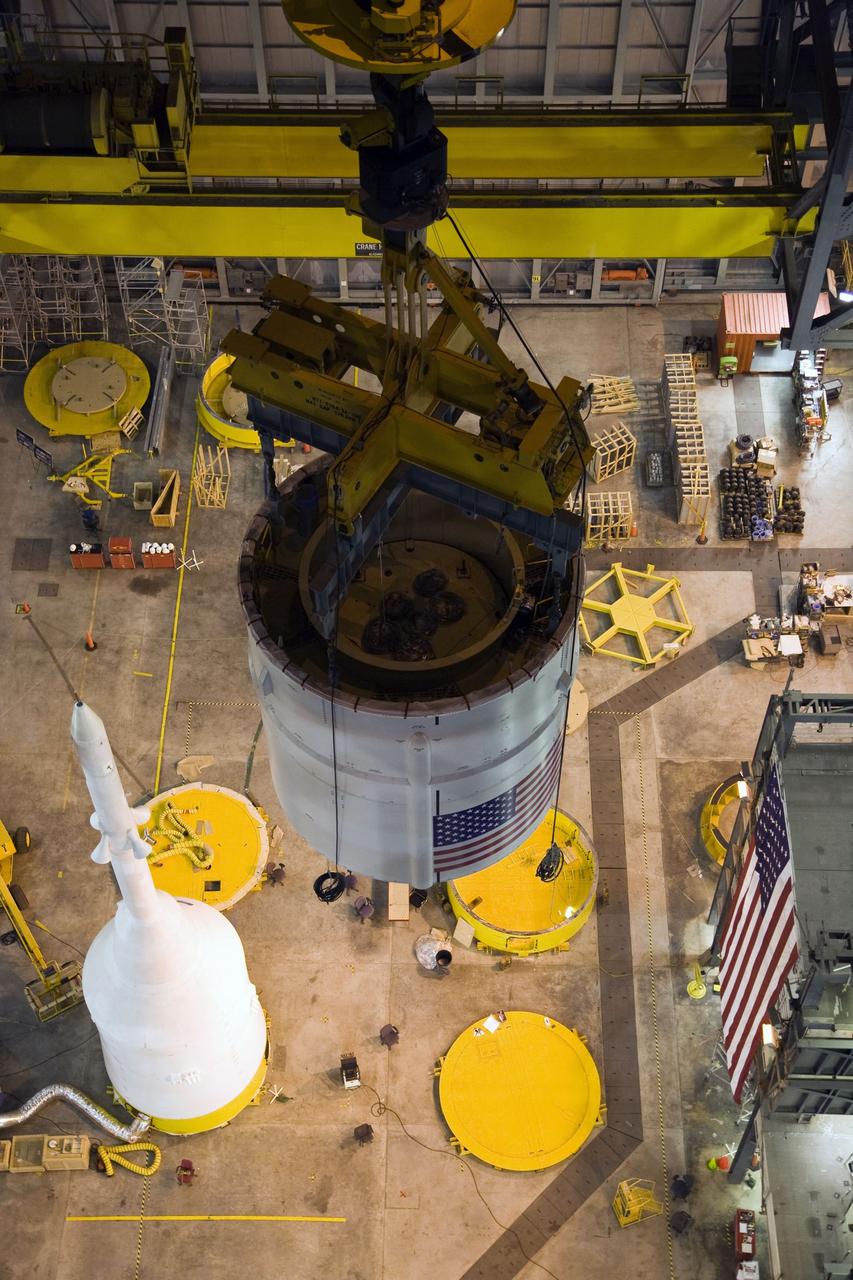
CAPE CANAVERAL, Fla. – In the Vehicle Assembly Building's High Bay 4 at NASA's Kennedy Space Center in Florida, a crane moves the Ares I-X Super Stack 4 across the floor to High Bay 3 for integration with Super Stack 3. Below left is the crew module-launch abort system and simulator service module-service adapter stack. Five super stacks make up the upper stage that will be integrated with the four-segment solid rocket booster first stage on the mobile launch platform. Ares I-X is the test vehicle for the Ares I, which is part of the Constellation Program to return men to the moon and beyond. The Ares I-X flight test is targeted for Oct. 31, pending formal NASA Headquarters approval. Photo credit: NASA/Dimitri Gerondidakis
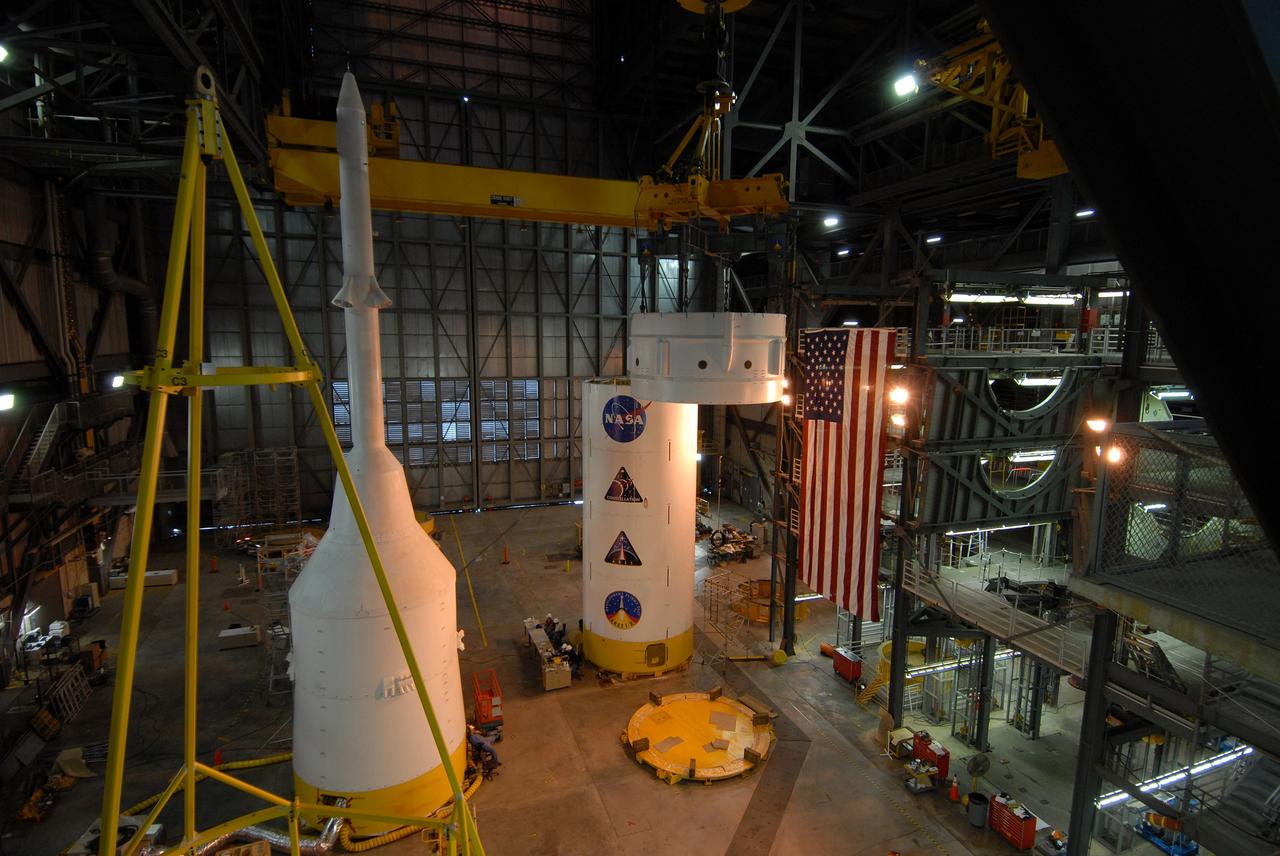
CAPE CANAVERAL, Fla. – In the Vehicle Assembly Building's High Bay 4 at NASA's Kennedy Space Center in Florida, a crane lifts Super Stack 2, part of the Ares I-X upper stage. The stack is being moved across the transfer aisle for attachment to Super Stack 1 in High Bay 3. Beneath can be seen Super Stack 3 and at left is the crew module-launch abort system, or CM-LAS, and simulator service module-service adapter stack. The upper stage comprises five super stacks, which are integrated with the four-segment solid rocket booster first stage on the mobile launch platform. Ares I-X is the test vehicle for the Ares I, which is part of the Constellation Program to return men to the moon and beyond. The Ares I-X flight test is targeted for Oct. 31, pending formal NASA Headquarters approval. Photo credit: NASA/Tim Jacobs
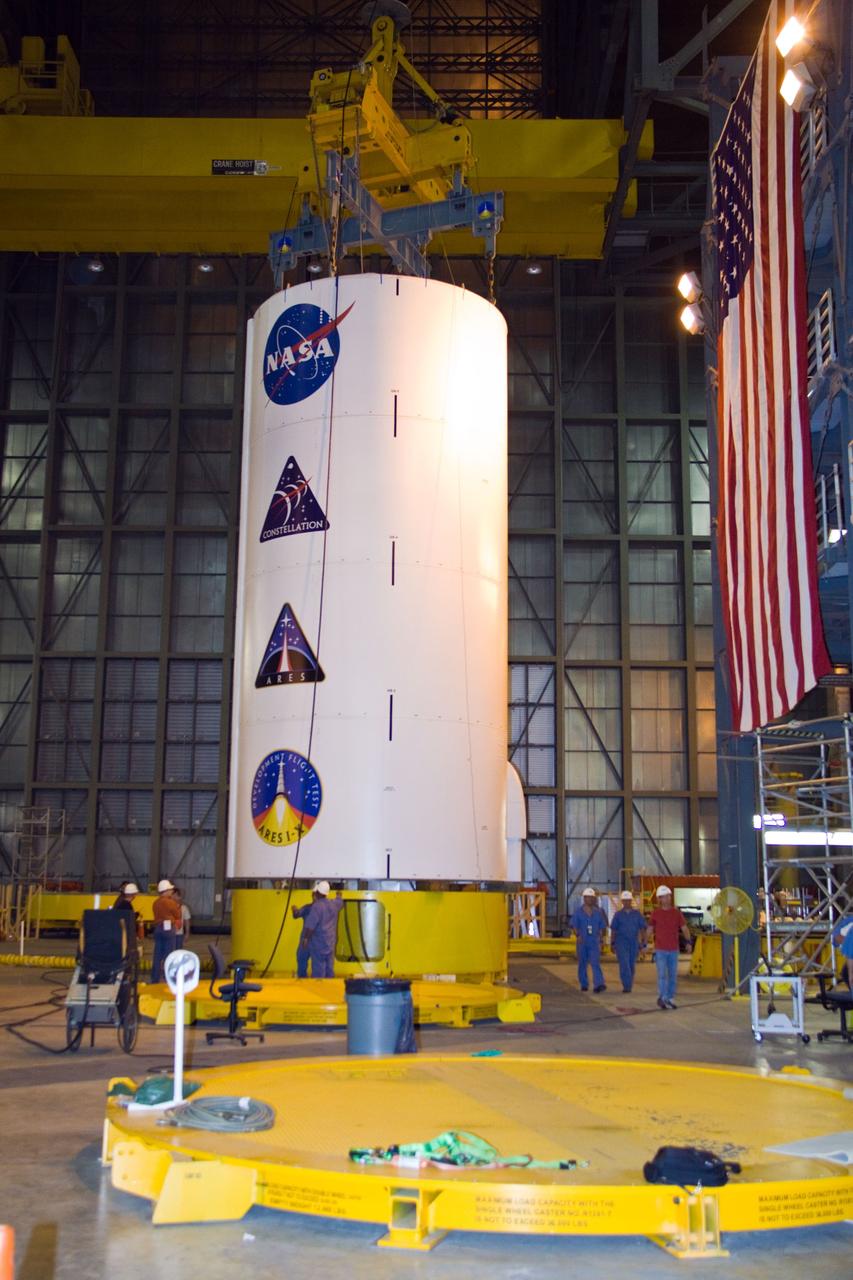
CAPE CANAVERAL, Fla. – In NASA Kennedy Space Center's Vehicle Assembly Building High Bay 3, a crane lifts the Ares I-X Super Stack 3 from its stand. The stack is being moved to High Bay 4 for integration with Super Stack 2. The upper stage comprises five super stacks, which are integrated with the four-segment solid rocket booster first stage on the mobile launch platform. Ares I-X is the test vehicle for the Ares I, which is part of the Constellation Program to return men to the moon and beyond. The Ares I-X flight test is targeted for Oct. 31, pending formal NASA Headquarters approval. Photo credit: NASA/Jack Pfaller
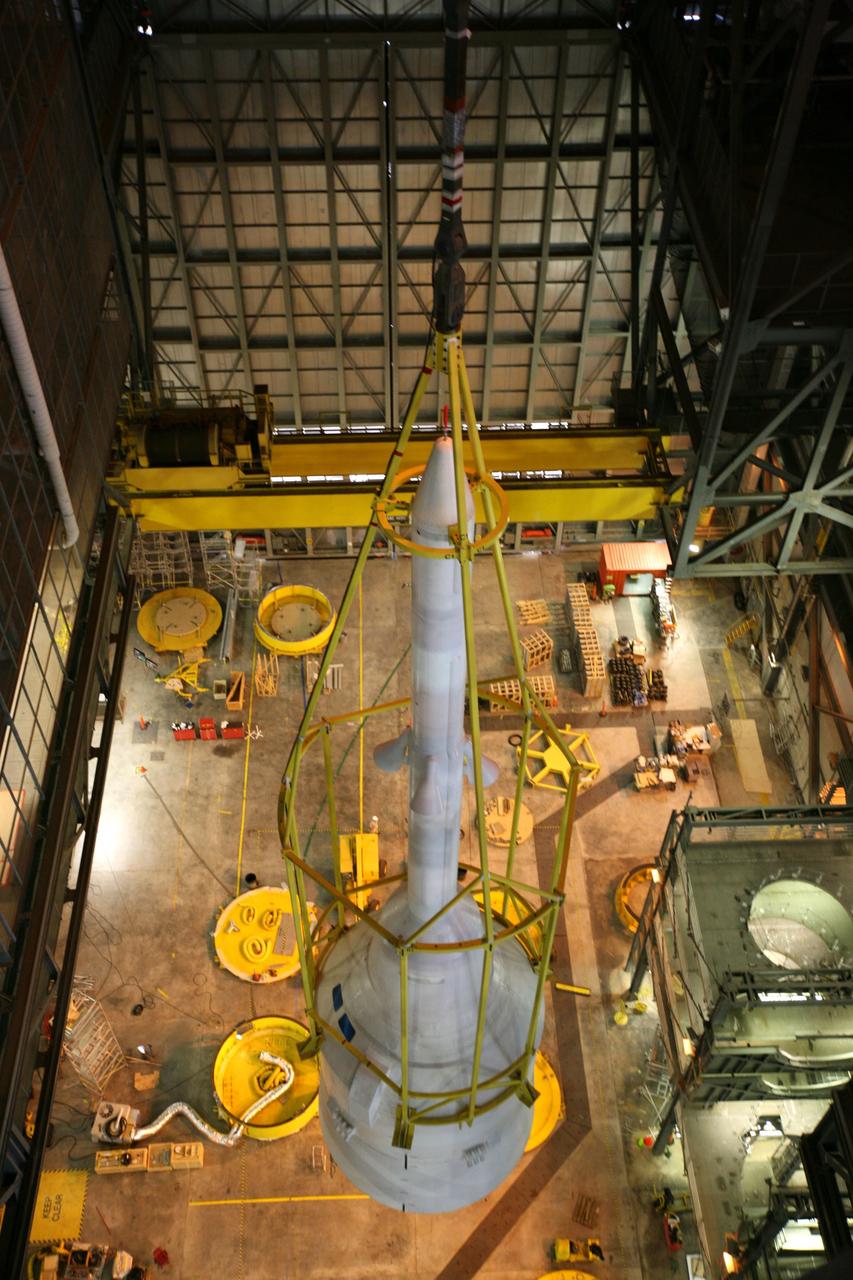
CAPE CANAVERAL, Fla. – In the Vehicle Assembly Building's High Bay 4, assembly of the Ares I-X rocket nears completion. The yellow framework, nicknamed the "birdcage," lifts Super Stack 5. The stack will be positioned on top of the segments already in place on the mobile launcher platform in High Bay 3, completing assembly of the 327-foot-tall rocket. Five super stacks make up the rocket's upper stage that is integrated with the four-segment solid rocket booster first stage. Ares I-X is the test vehicle for the Ares I, which is part of the Constellation Program to return men to the moon and beyond. The Ares I-X flight test is targeted for Oct. 31, pending formal NASA Headquarters approval. Photo credit: NASA/Dimitri Gerondidakis
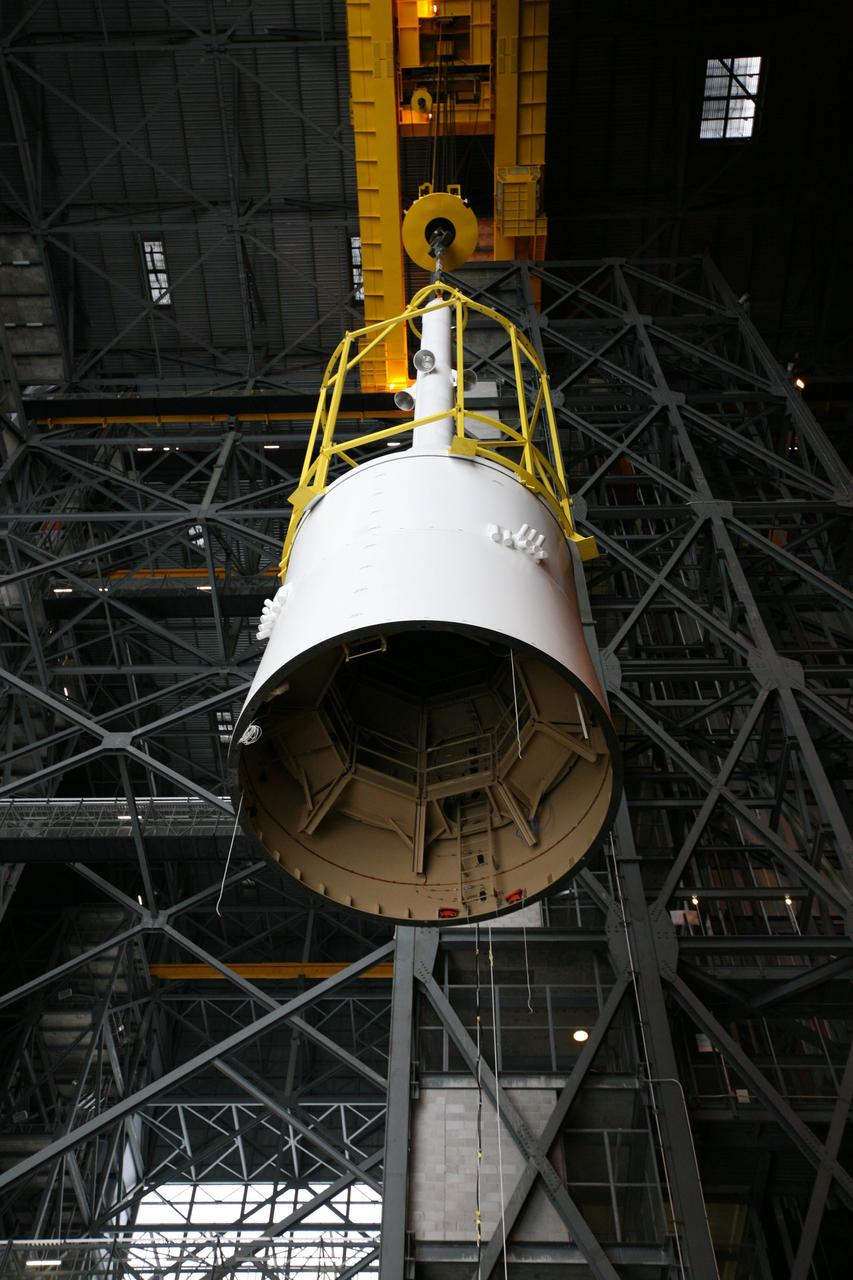
CAPE CANAVERAL, Fla. – In the Vehicle Assembly Building's transfer aisle, assembly of the Ares I-X rocket nears completion. The yellow framework, nicknamed the "birdcage," moves Super Stack 5 from High Bay 4 over the transfer aisle. The stack will be positioned on top of the segments already in place on the mobile launcher platform in High Bay 3, completing assembly of the 327-foot-tall rocket. Five super stacks make up the rocket's upper stage that is integrated with the four-segment solid rocket booster first stage. Ares I-X is the test vehicle for the Ares I, which is part of the Constellation Program to return men to the moon and beyond. The Ares I-X flight test is targeted for Oct. 31, pending formal NASA Headquarters approval. Photo credit: NASA/Dimitri Gerondidakis
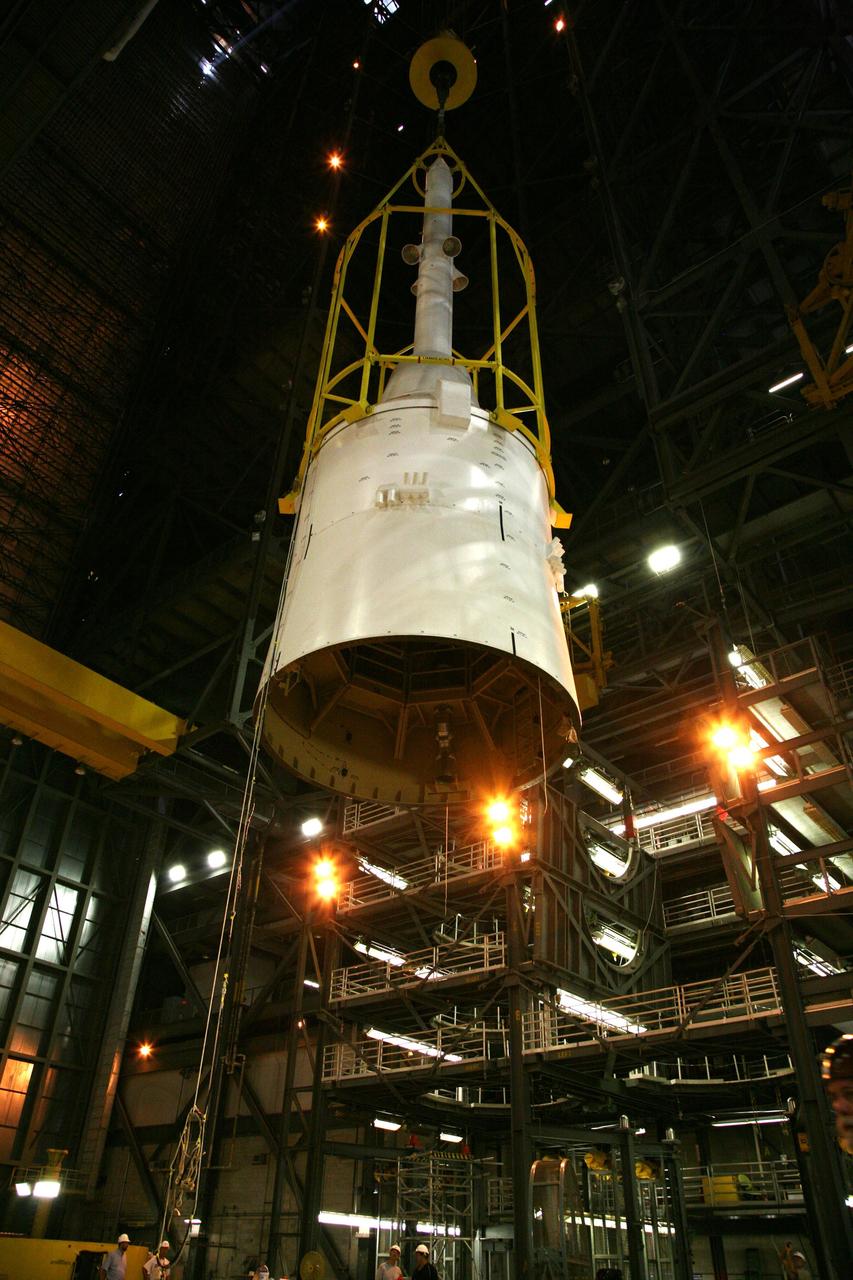
CAPE CANAVERAL, Fla. – In the Vehicle Assembly Building's High Bay 4, assembly of the Ares I-X rocket nears completion. The yellow framework, nicknamed the "birdcage," lifts Super Stack 5. The stack will be positioned on top of the segments already in place on the mobile launcher platform in High Bay 3, completing assembly of the 327-foot-tall rocket. Five super stacks make up the rocket's upper stage that is integrated with the four-segment solid rocket booster first stage. Ares I-X is the test vehicle for the Ares I, which is part of the Constellation Program to return men to the moon and beyond. The Ares I-X flight test is targeted for Oct. 31, pending formal NASA Headquarters approval. Photo credit: NASA/Dimitri Gerondidakis
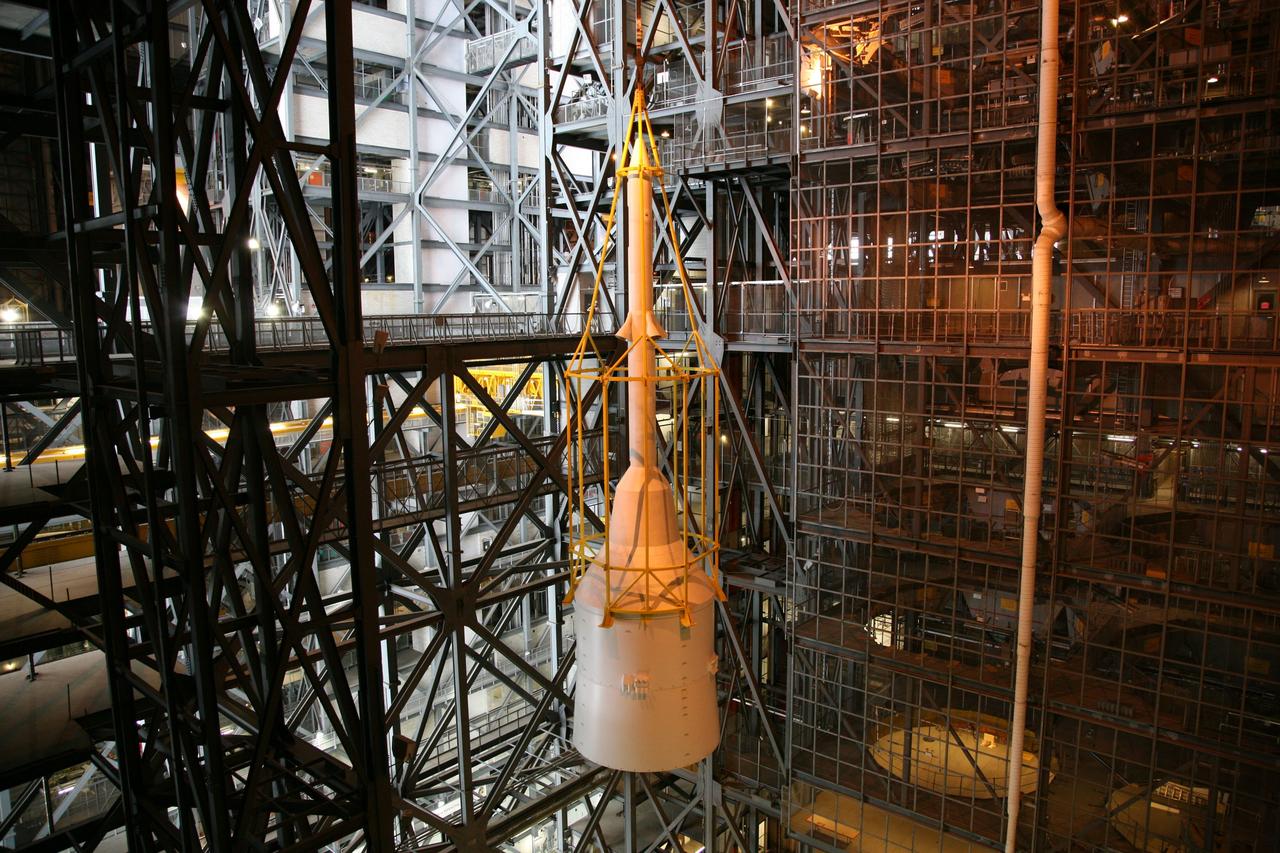
CAPE CANAVERAL, Fla. – In the Vehicle Assembly Building's High Bay 4, assembly of the Ares I-X rocket nears completion. The yellow framework, nicknamed the "birdcage," lifts Super Stack 5 toward an opening at the 16th floor crossover into the transfer aisle. The stack will be positioned on top of the segments already in place on the mobile launcher platform in High Bay 3, completing assembly of the 327-foot-tall rocket. Five super stacks make up the rocket's upper stage that is integrated with the four-segment solid rocket booster first stage. Ares I-X is the test vehicle for the Ares I, which is part of the Constellation Program to return men to the moon and beyond. The Ares I-X flight test is targeted for Oct. 31, pending formal NASA Headquarters approval. Photo credit: NASA/Dimitri Gerondidakis
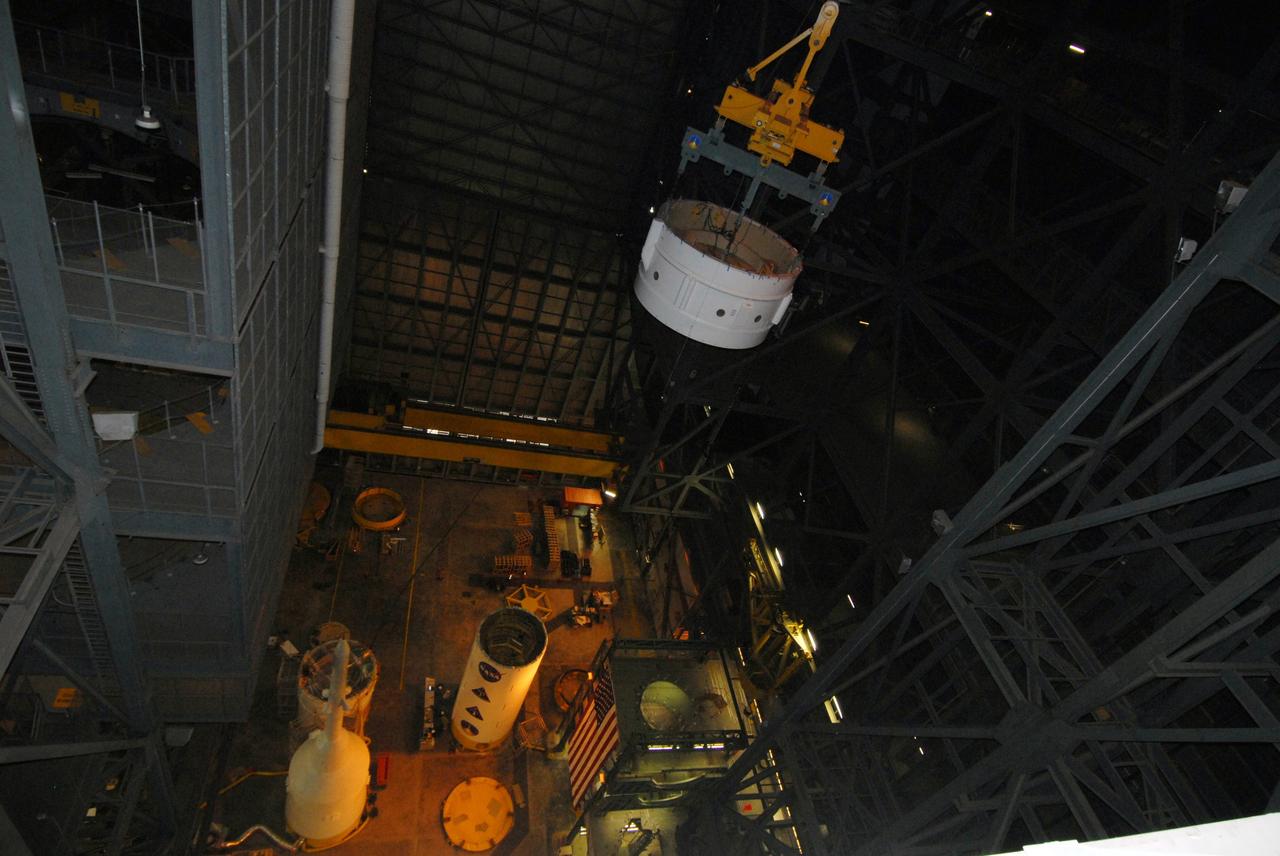
CAPE CANAVERAL, Fla. – In the Vehicle Assembly Building's High Bay 4 at NASA's Kennedy Space Center in Florida, a crane lifts Super Stack 2, part of the Ares I-X upper stage. The stack is being moved across the transfer aisle for attachment to Super Stack 1 in High Bay 3. Beneath is seen Super Stack 3 and at left is the crew module-launch abort system, or CM-LAS, and simulator service module-service adapter stack. The upper stage comprises five super stacks, which are integrated with the four-segment solid rocket booster first stage on the mobile launch platform. Ares I-X is the test vehicle for the Ares I, which is part of the Constellation Program to return men to the moon and beyond. The Ares I-X flight test is targeted for Oct. 31, pending formal NASA Headquarters approval. Photo credit: NASA/Tim Jacobs
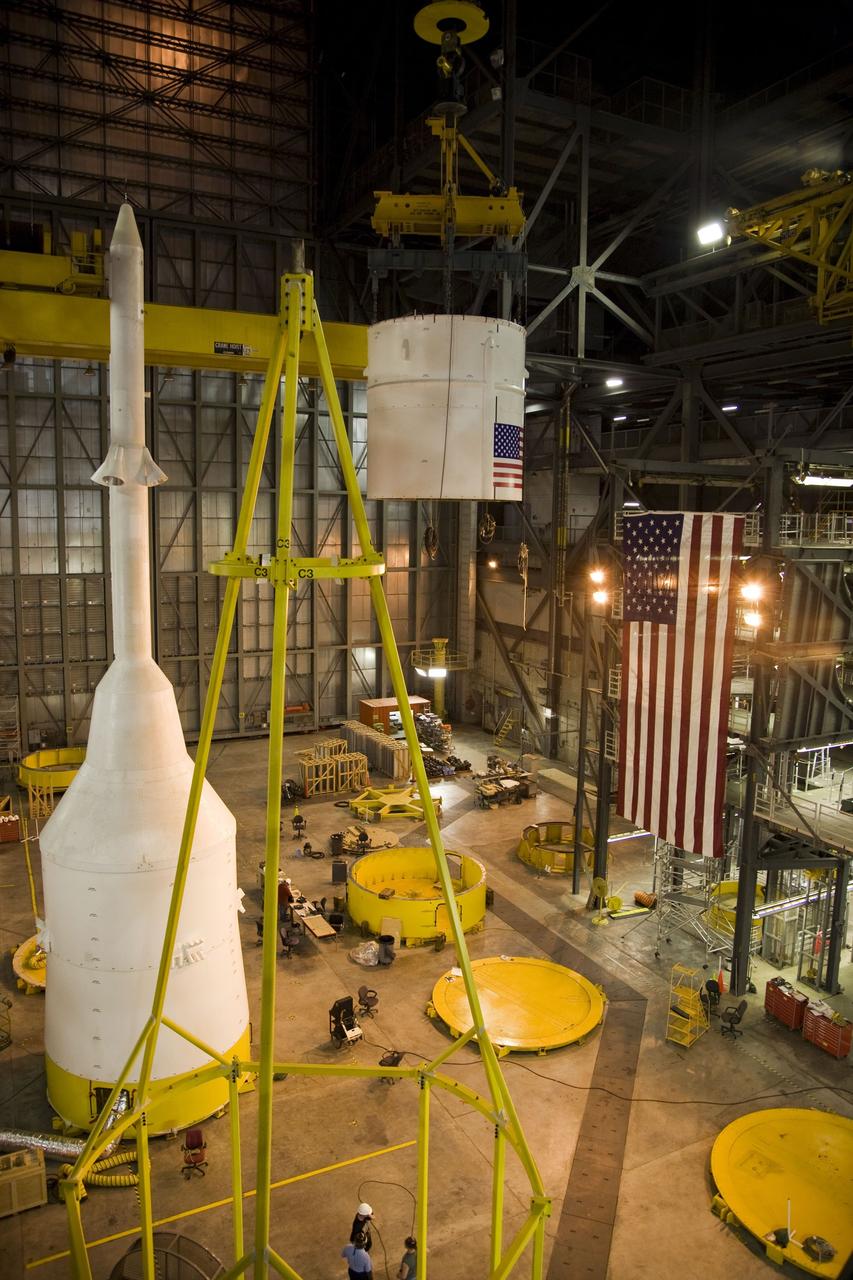
CAPE CANAVERAL, Fla. – In the Vehicle Assembly Building's High Bay 4 at NASA's Kennedy Space Center in Florida, a crane begins moving the Ares I-X Super Stack 4 to High Bay 3 for integration with Super Stack 3. At left are the crew module-launch abort system and simulator service module-service adapter stack and the "birdcage," the special crane that will lift the stack. Five super stacks make up the upper stage that will be integrated with the four-segment solid rocket booster first stage on the mobile launch platform. Ares I-X is the test vehicle for the Ares I, which is part of the Constellation Program to return men to the moon and beyond. The Ares I-X flight test is targeted for Oct. 31, pending formal NASA Headquarters approval. Photo credit: NASA/Dimitri Gerondidakis
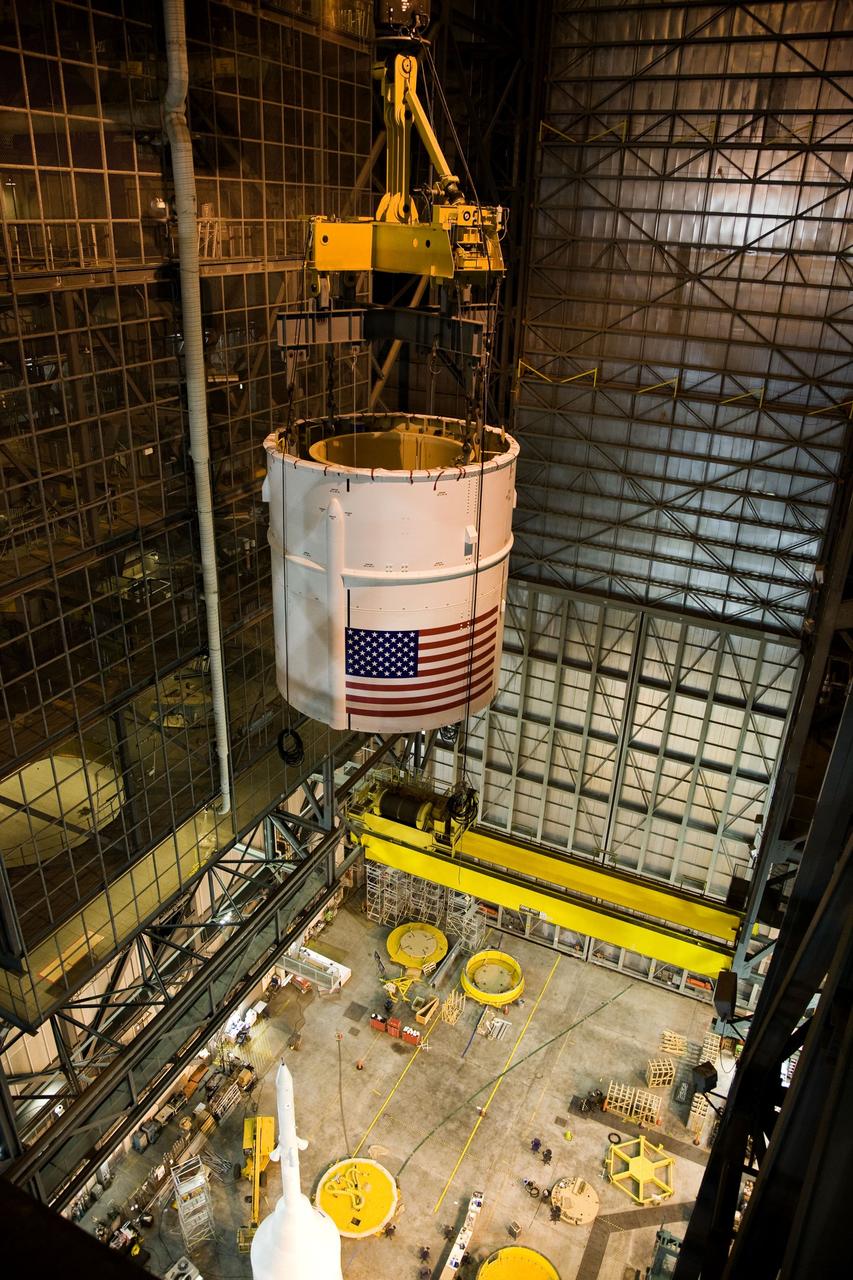
CAPE CANAVERAL, Fla. – In the Vehicle Assembly Building's High Bay 4 at NASA's Kennedy Space Center in Florida, a crane lifts the Ares I-X Super Stack 4 into the upper levels for transfer to High Bay 3 where it will be integrated with Super Stack 3. On the floor below, at left, can be seen the crew module-launch abort system and simulator service module-service adapter stack. Five super stacks make up the upper stage that will be integrated with the four-segment solid rocket booster first stage on the mobile launch platform. Ares I-X is the test vehicle for the Ares I, which is part of the Constellation Program to return men to the moon and beyond. The Ares I-X flight test is targeted for Oct. 31, pending formal NASA Headquarters approval. Photo credit: NASA/Dimitri Gerondidakis

CAPE CANAVERAL, Fla. – In the Vehicle Assembly Building's High Bay 4 at NASA's Kennedy Space Center in Florida, a crane lifts Super Stack 2, part of the Ares I-X upper stage. The stack will be attached to Super Stack 1 across the transfer aisle in High Bay 3. At left is Super Stack 3. The upper stage comprises five super stacks, which are integrated with the four-segment solid rocket booster first stage on the mobile launch platform. Ares I-X is the test vehicle for the Ares I, which is part of the Constellation Program to return men to the moon and beyond. The Ares I-X flight test is targeted for Oct. 31, pending formal NASA Headquarters approval. Photo credit: NASA/Tim Jacobs
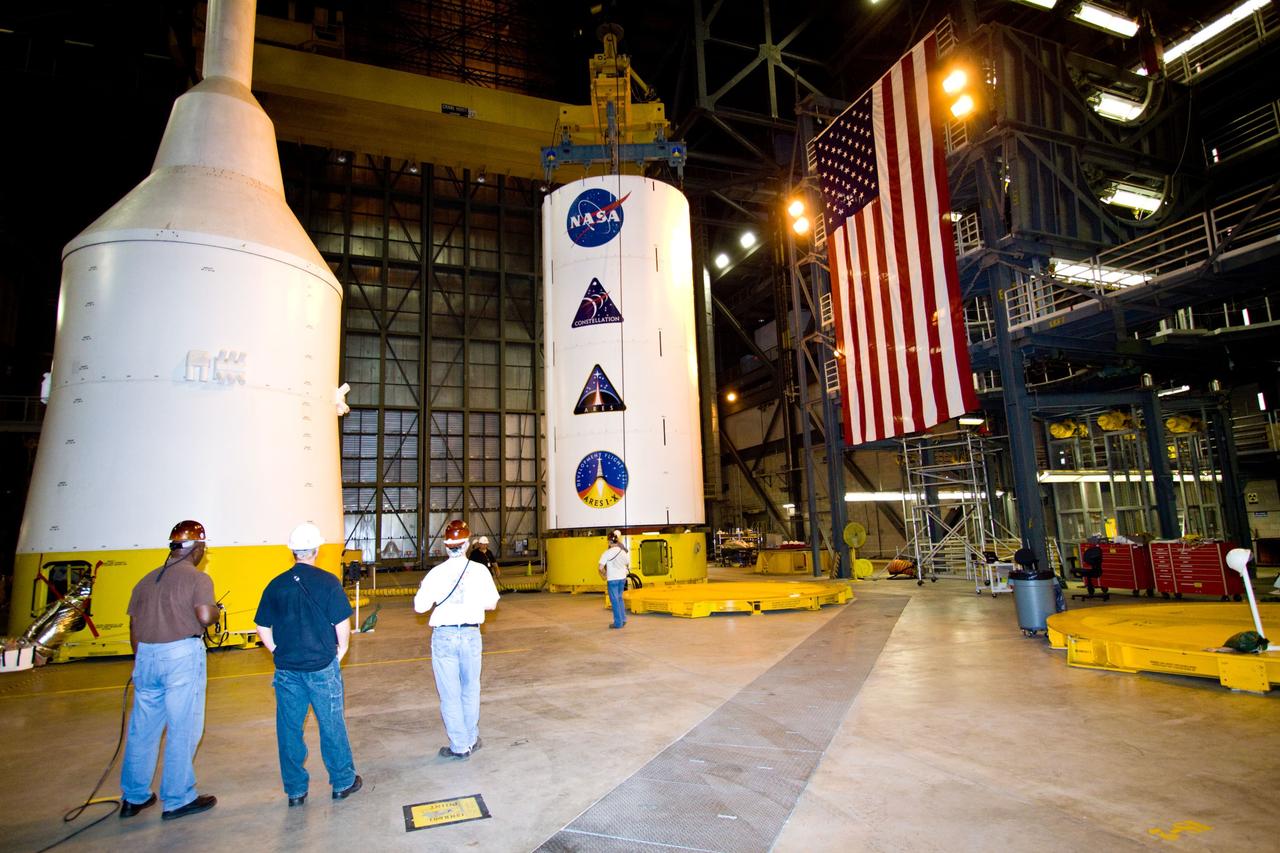
CAPE CANAVERAL, Fla. – In NASA Kennedy Space Center's Vehicle Assembly Building High Bay 3, a crane lifts the Ares I-X Super Stack 3 from its stand. The stack is being moved to High Bay 4 for integration with Super Stack 2. The upper stage comprises five super stacks, which are integrated with the four-segment solid rocket booster first stage on the mobile launch platform. Ares I-X is the test vehicle for the Ares I, which is part of the Constellation Program to return men to the moon and beyond. The Ares I-X flight test is targeted for Oct. 31, pending formal NASA Headquarters approval. Photo credit: NASA/Jack Pfaller
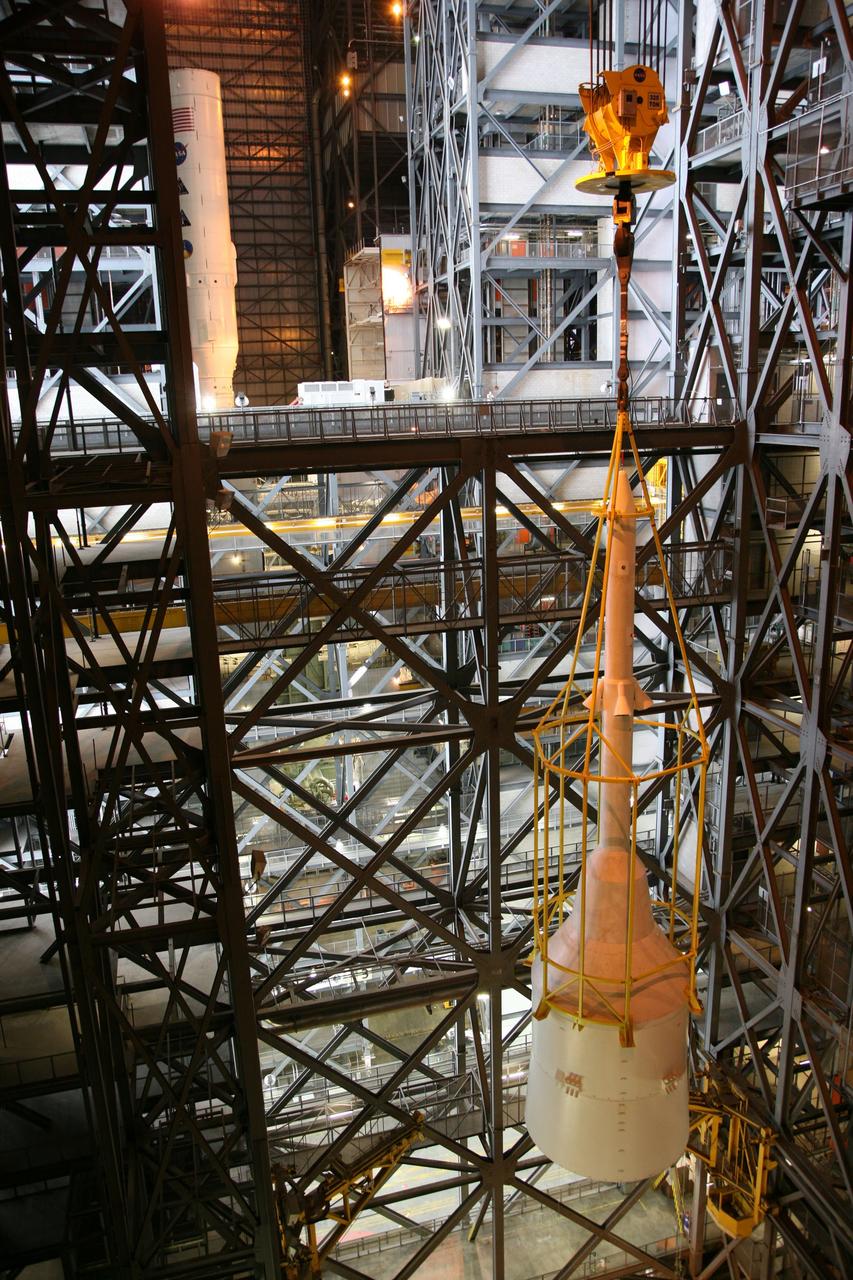
CAPE CANAVERAL, Fla. – In the Vehicle Assembly Building's High Bay 4, assembly of the Ares I-X rocket nears completion. The yellow framework, nicknamed the "birdcage," lifts Super Stack 5 toward an opening at the 16th floor crossover into the transfer aisle. The stack will be positioned on top of the segments already in place on the mobile launcher platform in High Bay 3, completing assembly of the 327-foot-tall rocket. Five super stacks make up the rocket's upper stage that is integrated with the four-segment solid rocket booster first stage. Ares I-X is the test vehicle for the Ares I, which is part of the Constellation Program to return men to the moon and beyond. The Ares I-X flight test is targeted for Oct. 31, pending formal NASA Headquarters approval. Photo credit: NASA/Dimitri Gerondidakis
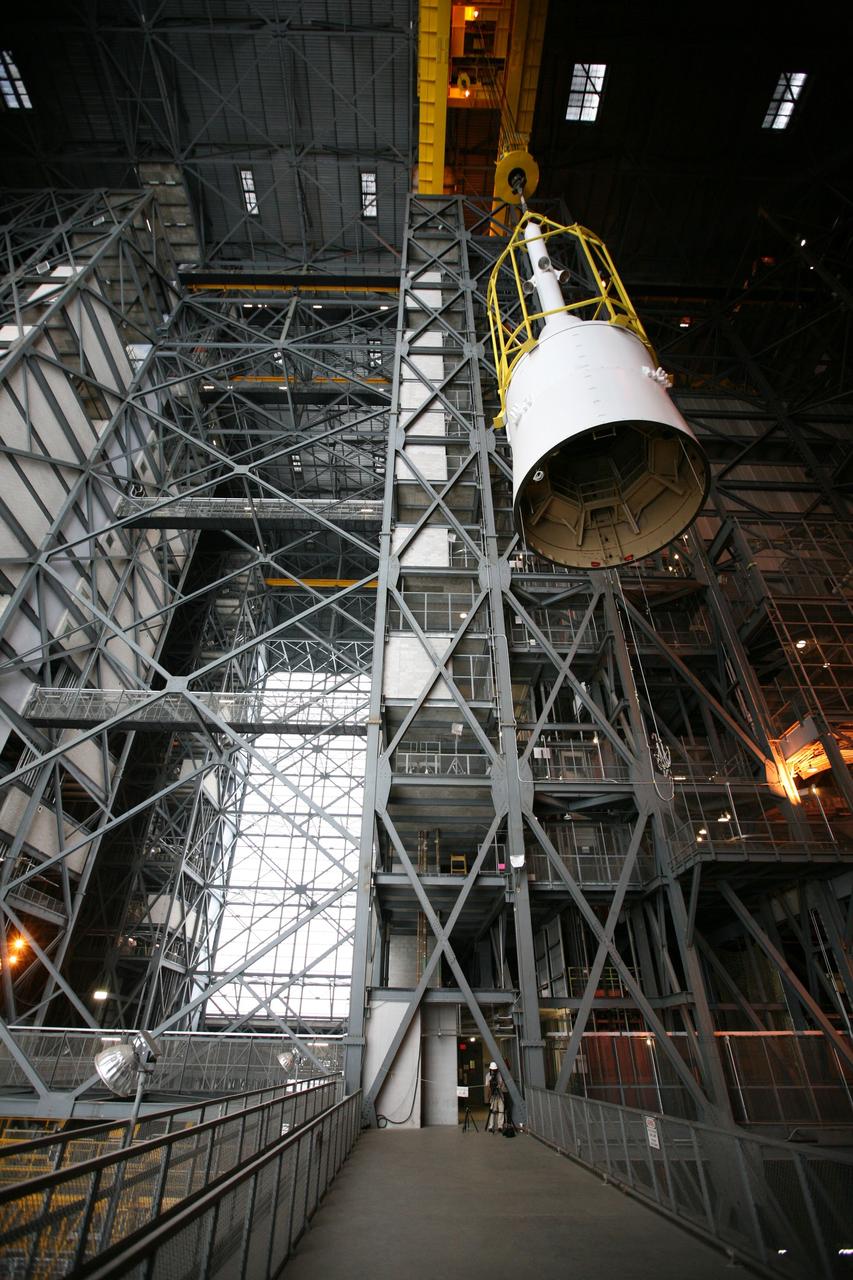
CAPE CANAVERAL, Fla. – In the Vehicle Assembly Building's High Bay 4, assembly of the Ares I-X rocket nears completion. The yellow framework, nicknamed the "birdcage," lifts Super Stack 5 through an opening at the 16th floor crossover into the transfer aisle. The stack will be positioned on top of the segments already in place on the mobile launcher platform in High Bay 3, completing assembly of the 327-foot-tall rocket. Five super stacks make up the rocket's upper stage that is integrated with the four-segment solid rocket booster first stage. Ares I-X is the test vehicle for the Ares I, which is part of the Constellation Program to return men to the moon and beyond. The Ares I-X flight test is targeted for Oct. 31, pending formal NASA Headquarters approval. Photo credit: NASA/Dimitri Gerondidakis
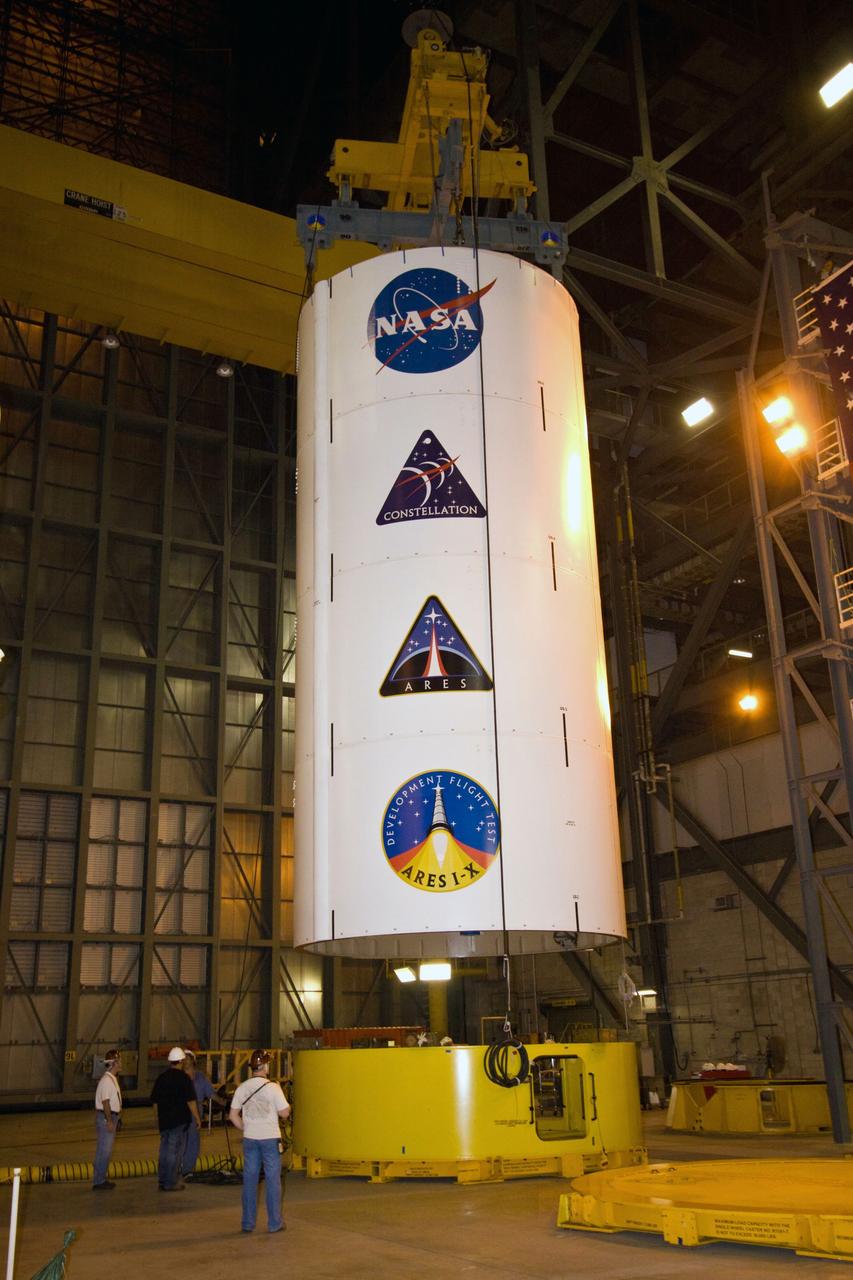
CAPE CANAVERAL, Fla. – In NASA Kennedy Space Center's Vehicle Assembly Building High Bay 3, a crane lifts the Ares I-X Super Stack 3 from its stand. The stack is being moved across the transfer aisle to High Bay 4 for integration with Super Stack 2. The upper stage comprises five super stacks, which are integrated with the four-segment solid rocket booster first stage on the mobile launch platform. Ares I-X is the test vehicle for the Ares I, which is part of the Constellation Program to return men to the moon and beyond. The Ares I-X flight test is targeted for Oct. 31, pending formal NASA Headquarters approval. Photo credit: NASA/Jack Pfaller
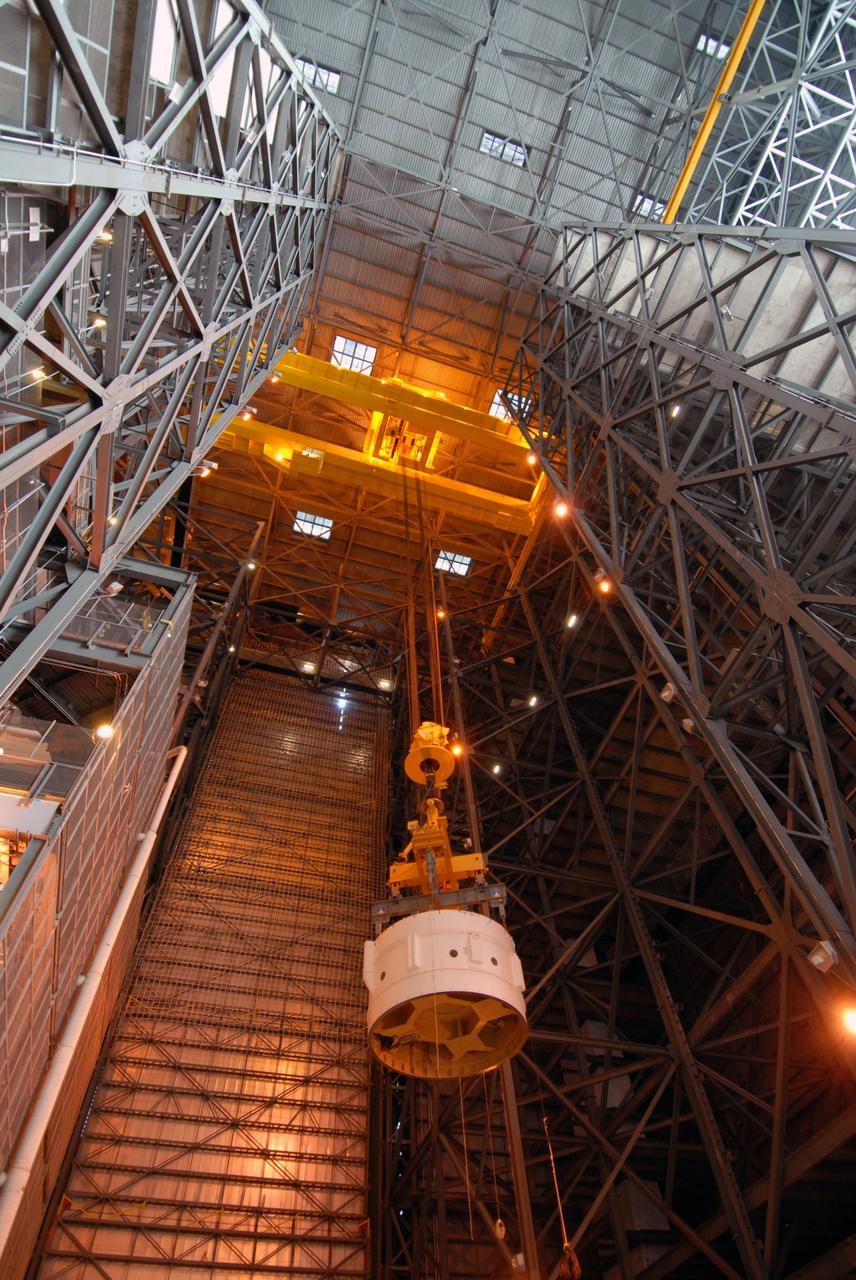
CAPE CANAVERAL, Fla. – In the Vehicle Assembly Building's High Bay 4 at NASA's Kennedy Space Center in Florida, a crane lifts Super Stack 2, part of the Ares I-X upper stage, into the upper levels. The stack is being moved across the transfer aisle for attachment to Super Stack 1 in High Bay 3. The upper stage comprises five super stacks, which are integrated with the four-segment solid rocket booster first stage on the mobile launch platform. Ares I-X is the test vehicle for the Ares I, which is part of the Constellation Program to return men to the moon and beyond. The Ares I-X flight test is targeted for Oct. 31, pending formal NASA Headquarters approval. Photo credit: NASA/Tim Jacobs
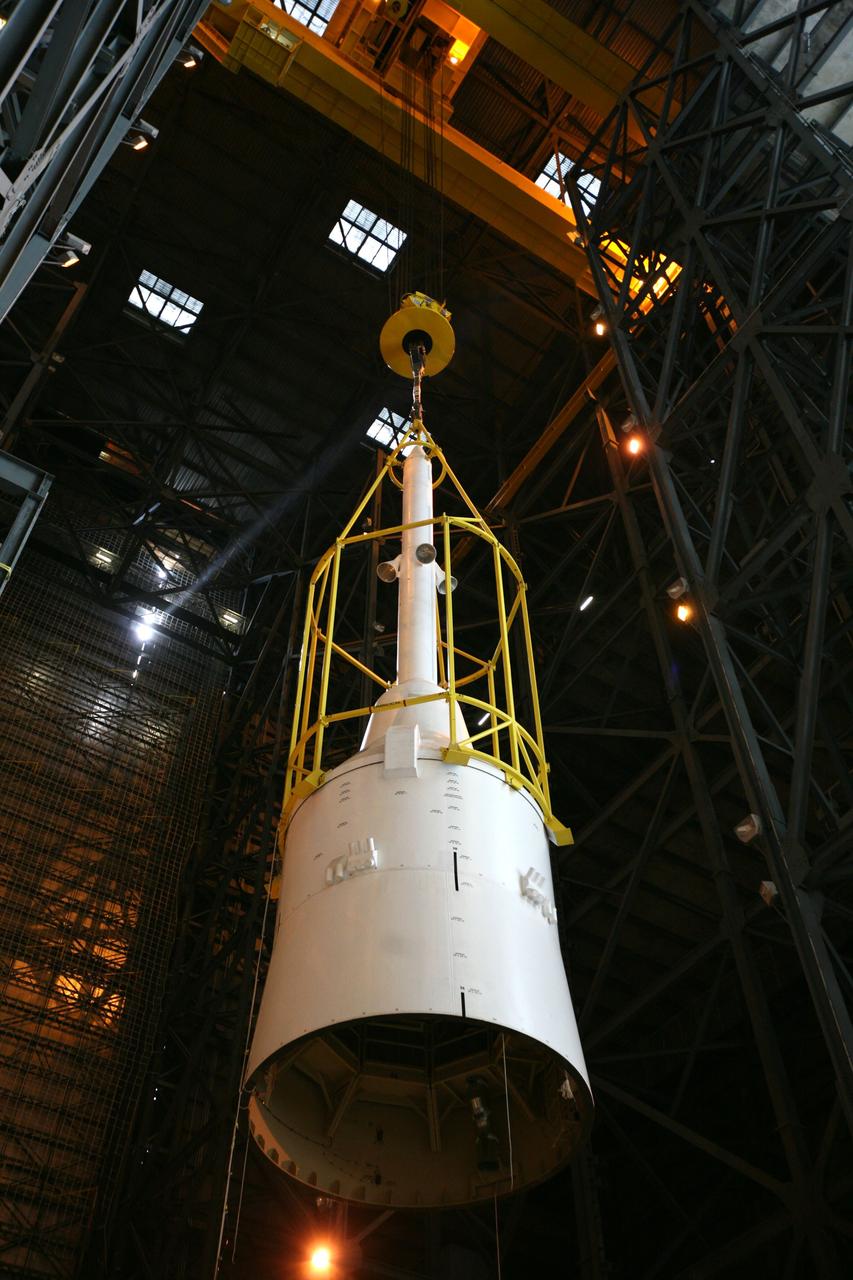
CAPE CANAVERAL, Fla. – In the Vehicle Assembly Building's High Bay 4, assembly of the Ares I-X rocket nears completion. The yellow framework, nicknamed the "birdcage," lifts Super Stack 5 toward an opening at the 16th floor crossover into the transfer aisle. The stack will be positioned on top of the segments already in place on the mobile launcher platform in High Bay 3, completing assembly of the 327-foot-tall rocket. Five super stacks make up the rocket's upper stage that is integrated with the four-segment solid rocket booster first stage. Ares I-X is the test vehicle for the Ares I, which is part of the Constellation Program to return men to the moon and beyond. The Ares I-X flight test is targeted for Oct. 31, pending formal NASA Headquarters approval. Photo credit: NASA/Dimitri Gerondidakis
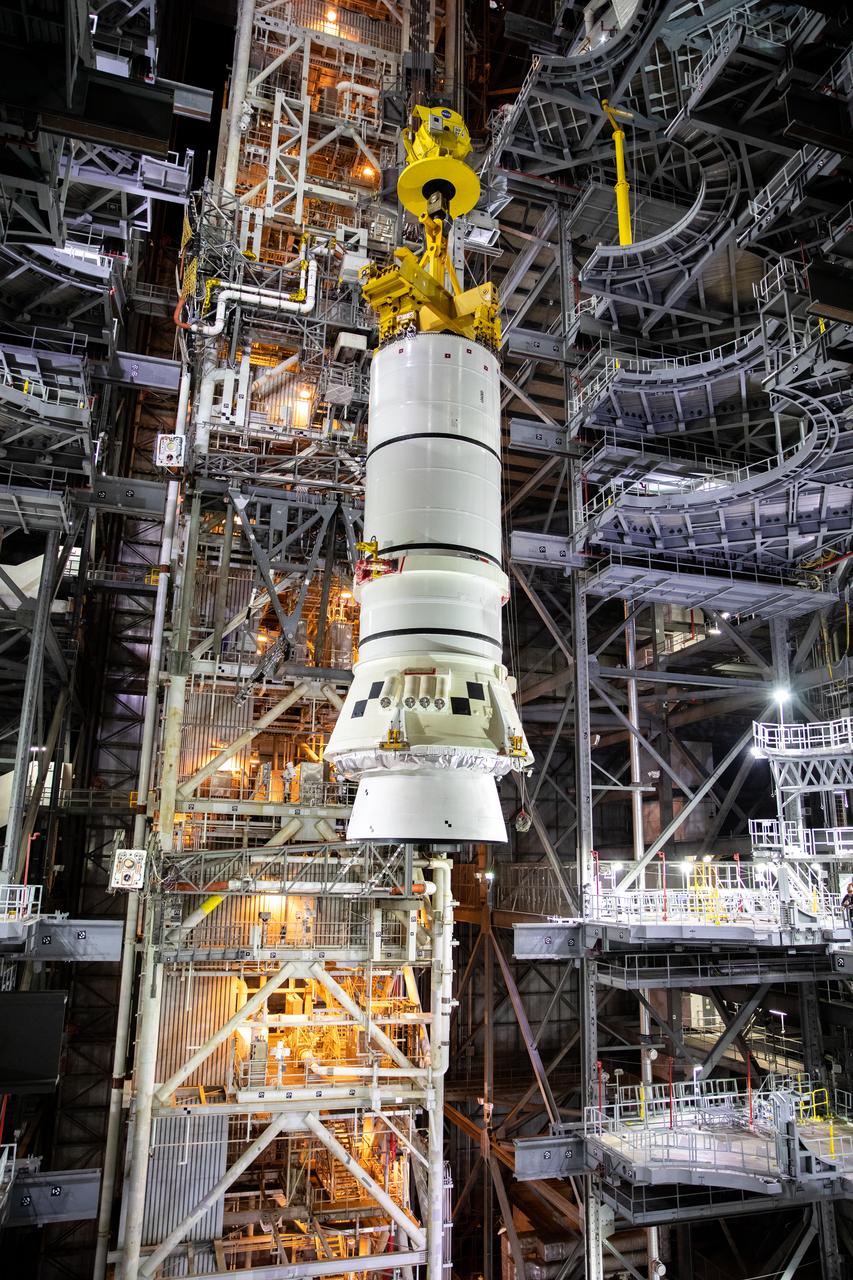
In the Vehicle Assembly Building (VAB) at NASA’s Kennedy Space Center in Florida, the second of two Artemis I aft booster segments for the Space Launch System is lowered by crane into High Bay 3 on Nov. 24, 2020. Workers with Exploration Ground Systems and contractor Jacobs teams will stack the twin five-segment boosters on the mobile launcher in High Bay 3 over a number of weeks. When the core stage arrives, it will join the boosters on the mobile launcher, followed by the interim cryogenic propulsion stage and Orion spacecraft. Manufactured by Northrop Grumman in Utah, the twin boosters provide more than 75 percent of the total SLS thrust at launch. The SLS is managed by Marshall Space Flight Center in Huntsville, Alabama. Under the Artemis program, NASA will land the first woman and the next man on the Moon by 2024. The first in a series of increasingly complex missions, Artemis I will test the Orion spacecraft and SLS as an integrated system ahead of crewed flights to the Moon.
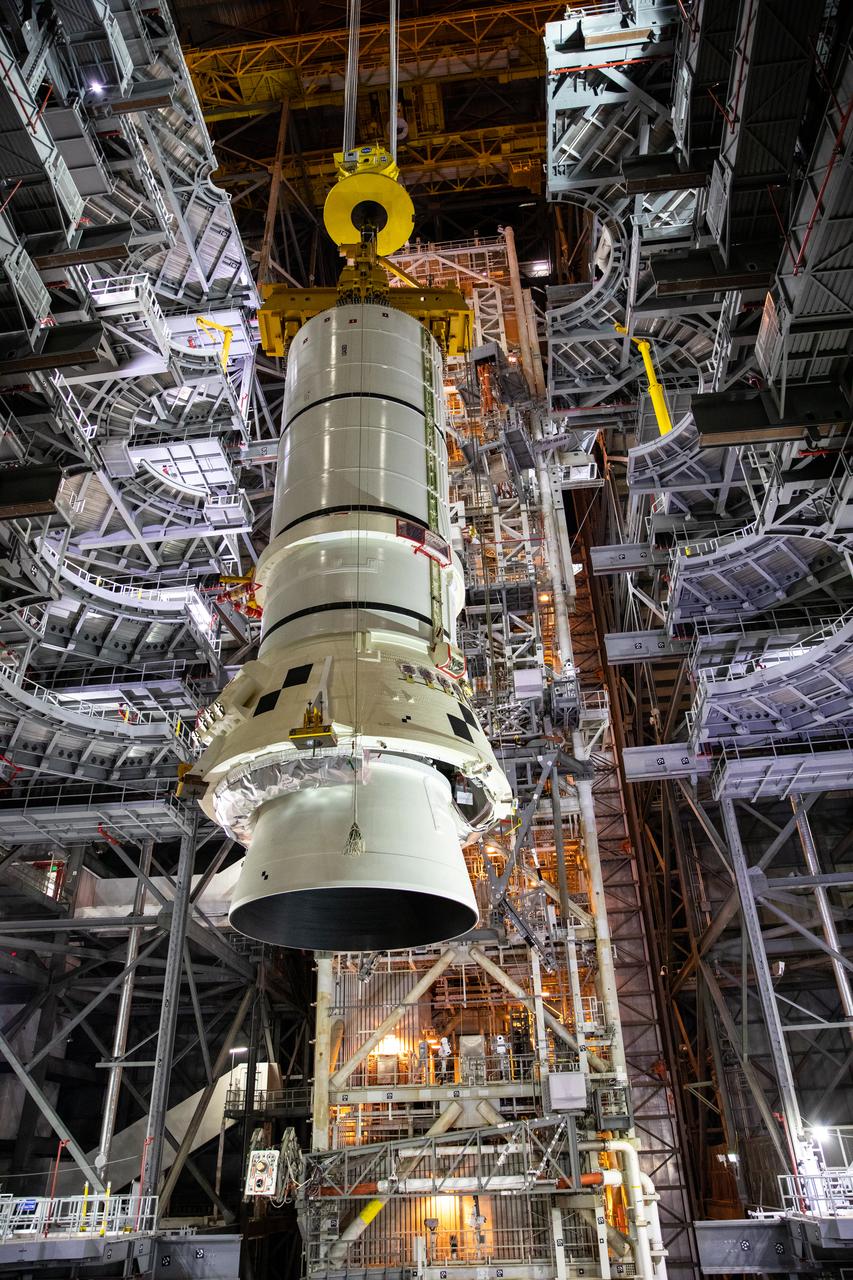
In the Vehicle Assembly Building (VAB) at NASA’s Kennedy Space Center in Florida, the second of two Artemis I aft booster segments for the Space Launch System is lowered by crane into High Bay 3 on Nov. 24, 2020. Workers with Exploration Ground Systems and contractor Jacobs teams will stack the twin five-segment boosters on the mobile launcher in High Bay 3 over a number of weeks. When the core stage arrives, it will join the boosters on the mobile launcher, followed by the interim cryogenic propulsion stage and Orion spacecraft. Manufactured by Northrop Grumman in Utah, the twin boosters provide more than 75 percent of the total SLS thrust at launch. The SLS is managed by Marshall Space Flight Center in Huntsville, Alabama. Under the Artemis program, NASA will land the first woman and the next man on the Moon by 2024. The first in a series of increasingly complex missions, Artemis I will test the Orion spacecraft and SLS as an integrated system ahead of crewed flights to the Moon.
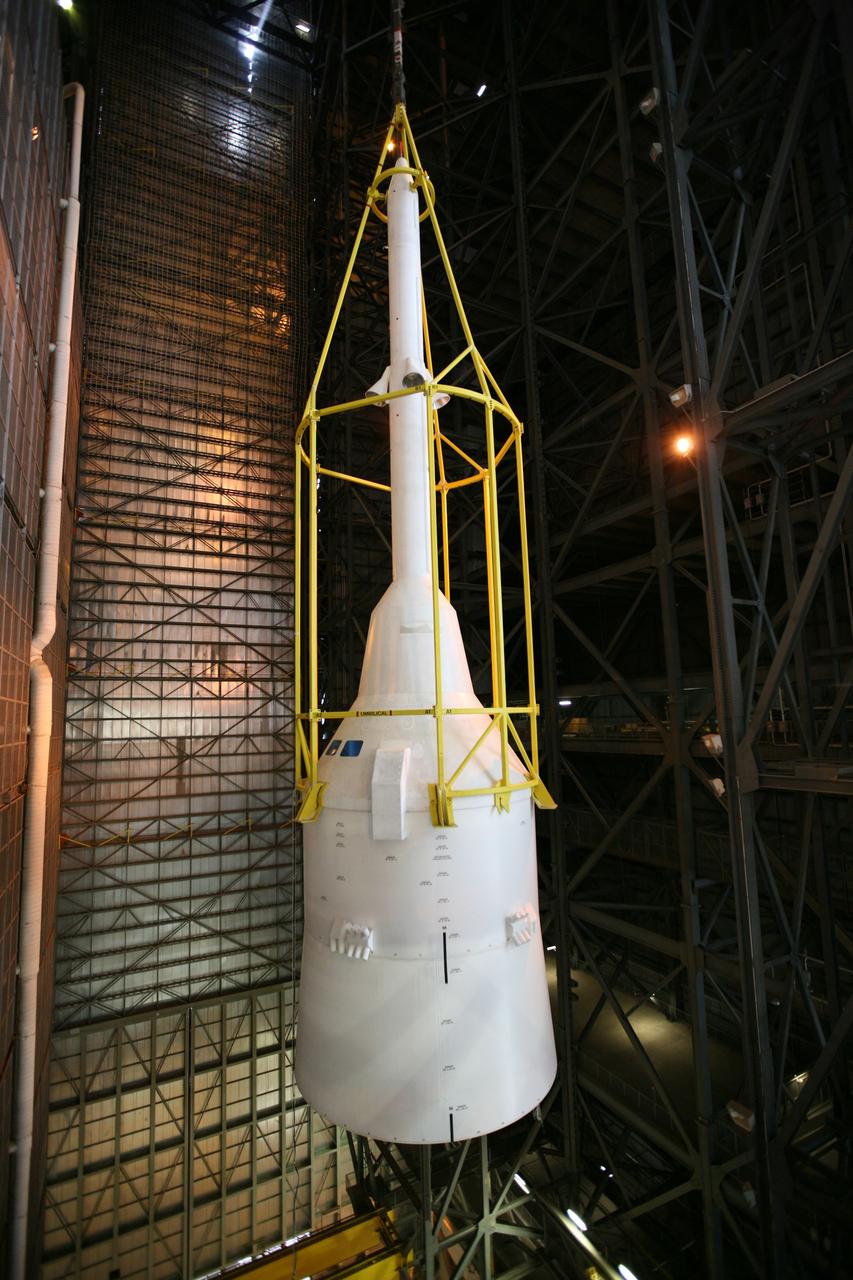
CAPE CANAVERAL, Fla. – In the Vehicle Assembly Building's High Bay 4, assembly of the Ares I-X rocket nears completion. The yellow framework, nicknamed the "birdcage," lifts Super Stack 5 toward an opening at the 16th floor crossover into the transfer aisle. The stack will be positioned on top of the segments already in place on the mobile launcher platform in High Bay 3, completing assembly of the 327-foot-tall rocket. Five super stacks make up the rocket's upper stage that is integrated with the four-segment solid rocket booster first stage. Ares I-X is the test vehicle for the Ares I, which is part of the Constellation Program to return men to the moon and beyond. The Ares I-X flight test is targeted for Oct. 31, pending formal NASA Headquarters approval. Photo credit: NASA/Dimitri Gerondidakis
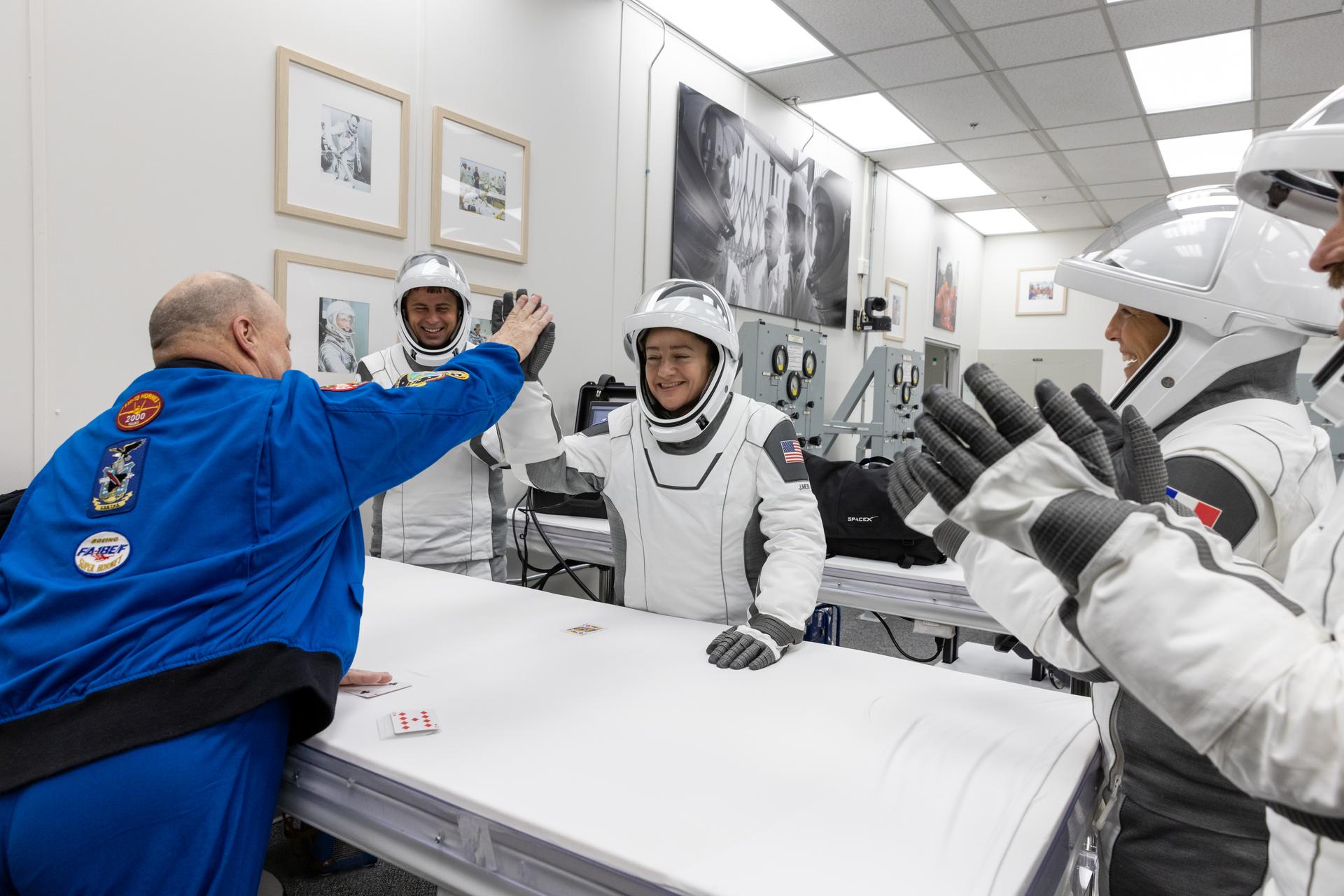
NASA astronaut Jessica Meir, commander of NASA’s SpaceX Crew-12 mission, high fives NASA astronaut Scott Tingle during the traditional prelaunch card game inside the Neil A. Armstrong Operations and Checkout Building at the agency’s Kennedy Space Center in Florida ahead of launch to the International Space Station on Friday, Feb. 13, 2026. Meir, NASA astronaut Jack Hathaway, ESA (European Space Agency) astronaut Sophie Adenot, and Roscosmos cosmonaut Andrey Fedyaev are scheduled to lift off aboard SpaceX’s Dragon spacecraft and Falcon 9 rocket at 5:15 a.m. EST, from Space Launch Complex 40 at Cape Canaveral Space Force Station in Florida.
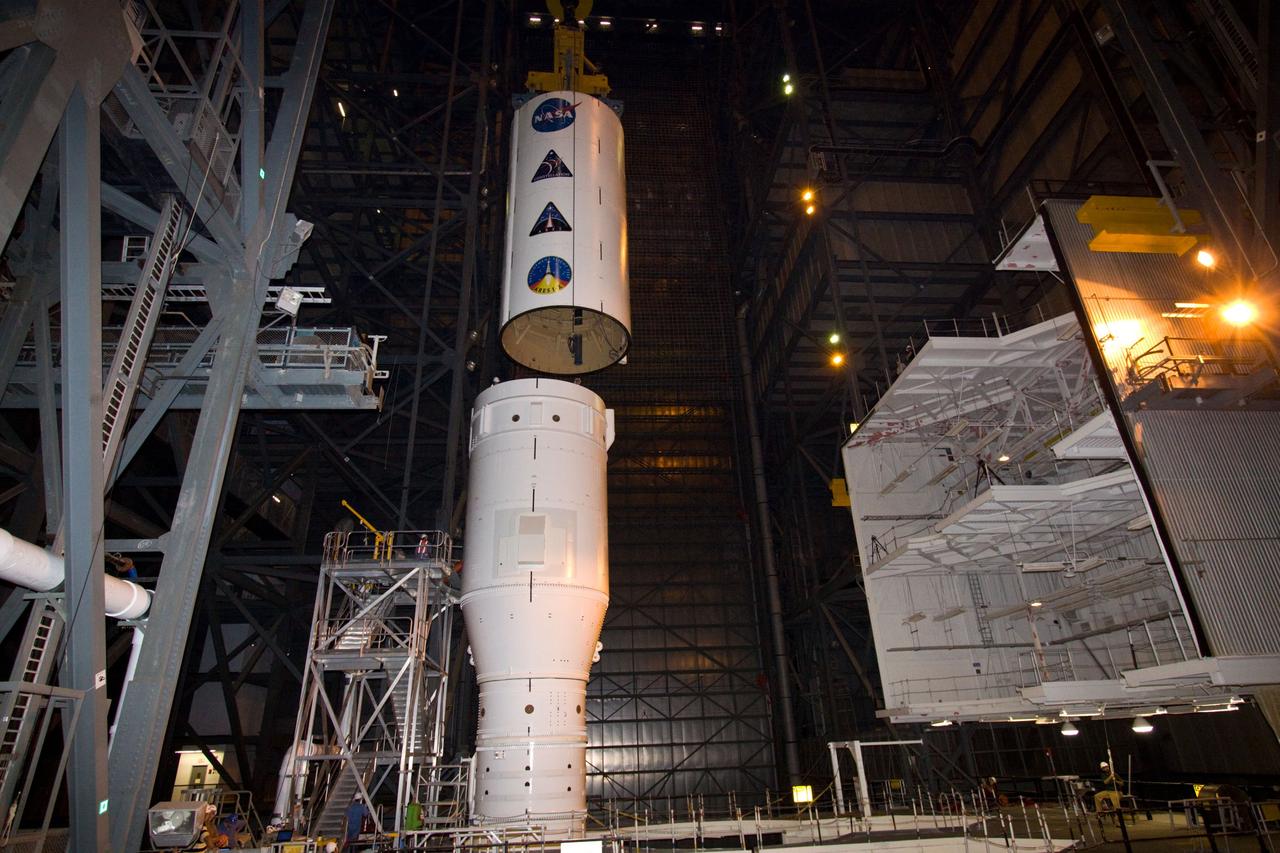
CAPE CANAVERAL, Fla. – In NASA Kennedy Space Center's Vehicle Assembly Building High Bay 4, a crane lowers the Ares I-X Super Stack 3 toward Super Stack 2 for integration. The upper stage comprises five super stacks, which are integrated with the four-segment solid rocket booster first stage on the mobile launch platform. Ares I-X is the test vehicle for the Ares I, which is part of the Constellation Program to return men to the moon and beyond. The Ares I-X flight test is targeted for Oct. 31, pending formal NASA Headquarters approval. Photo credit: NASA/Jack Pfaller
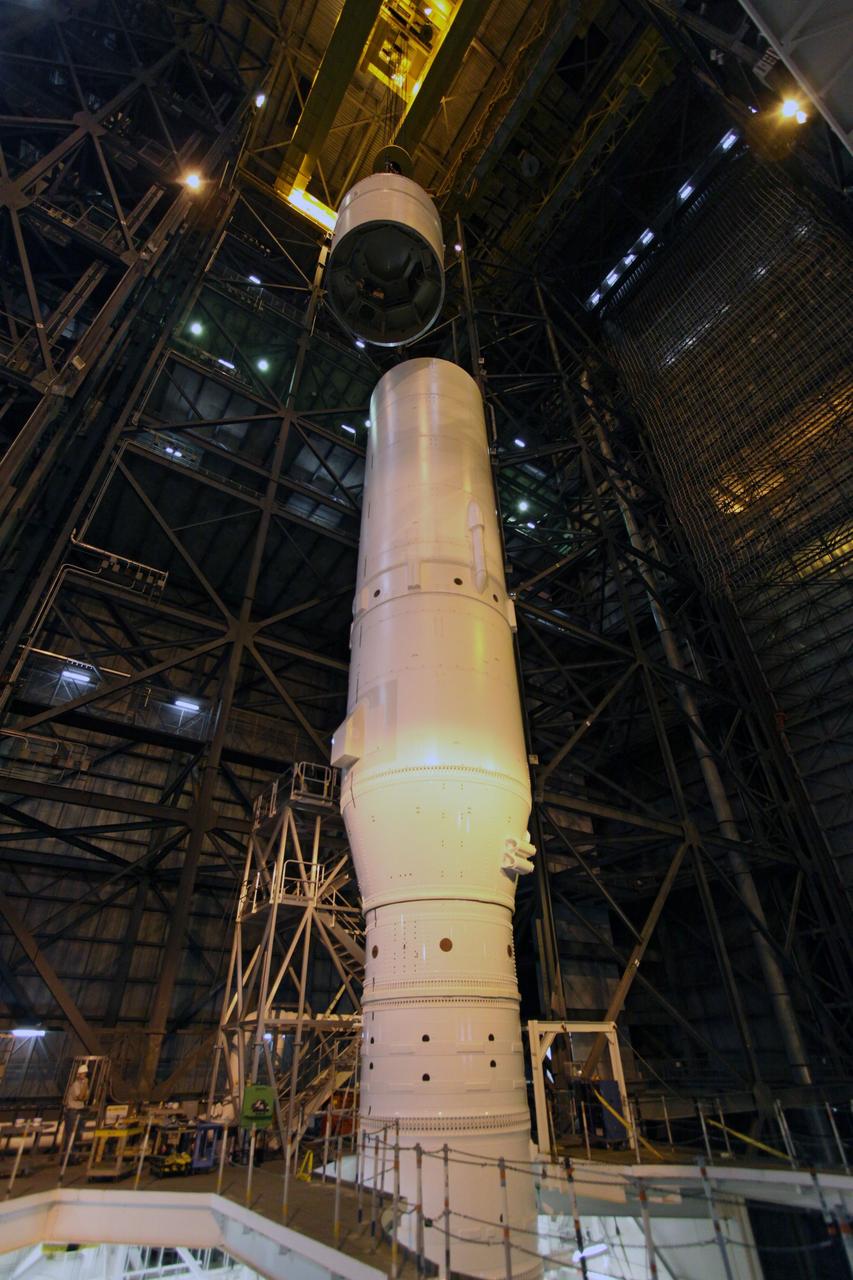
CAPE CANAVERAL, Fla. –In the Vehicle Assembly Building's High Bay 3, a crane lowers the Ares I-X Super Stack 4 toward Super Stack 3 for integration. Five super stacks make up the upper stage that will be integrated with the four-segment solid rocket booster first stage on the mobile launch platform. Ares I-X is the test vehicle for the Ares I, which is part of the Constellation Program to return men to the moon and beyond. The Ares I-X flight test is targeted for Oct. 31, pending formal NASA Headquarters approval. Photo credit: NASA/Jack Pfaller
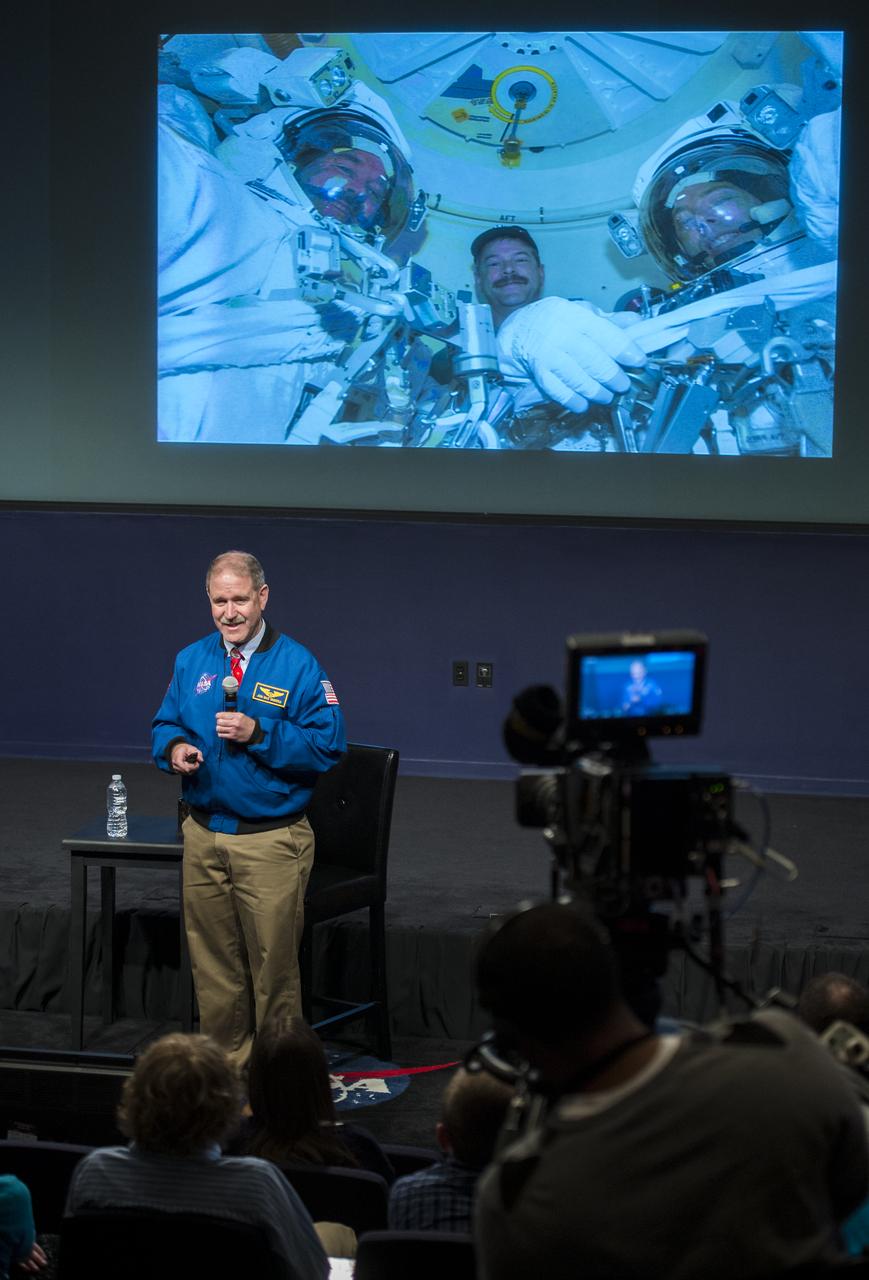
John Grunsfeld, NASA Associate Administrator for the Science Mission Directorate, speaks to students from Mapletown Jr/Sr High School and Margaret Bell Middle School about his experiences on the final space shuttle servicing mission to the Hubble Space Telescope during the NASA Hubble Space Telescope (HST) Research Project Capstone Event in the James E. Webb Auditorium at NASA Headquarters on Monday, May 5, 2014. Grunsfeld flew on three of the five servicing missions to the Hubble Space Telescope. Photo Credit: (NASA/Joel Kowsky)
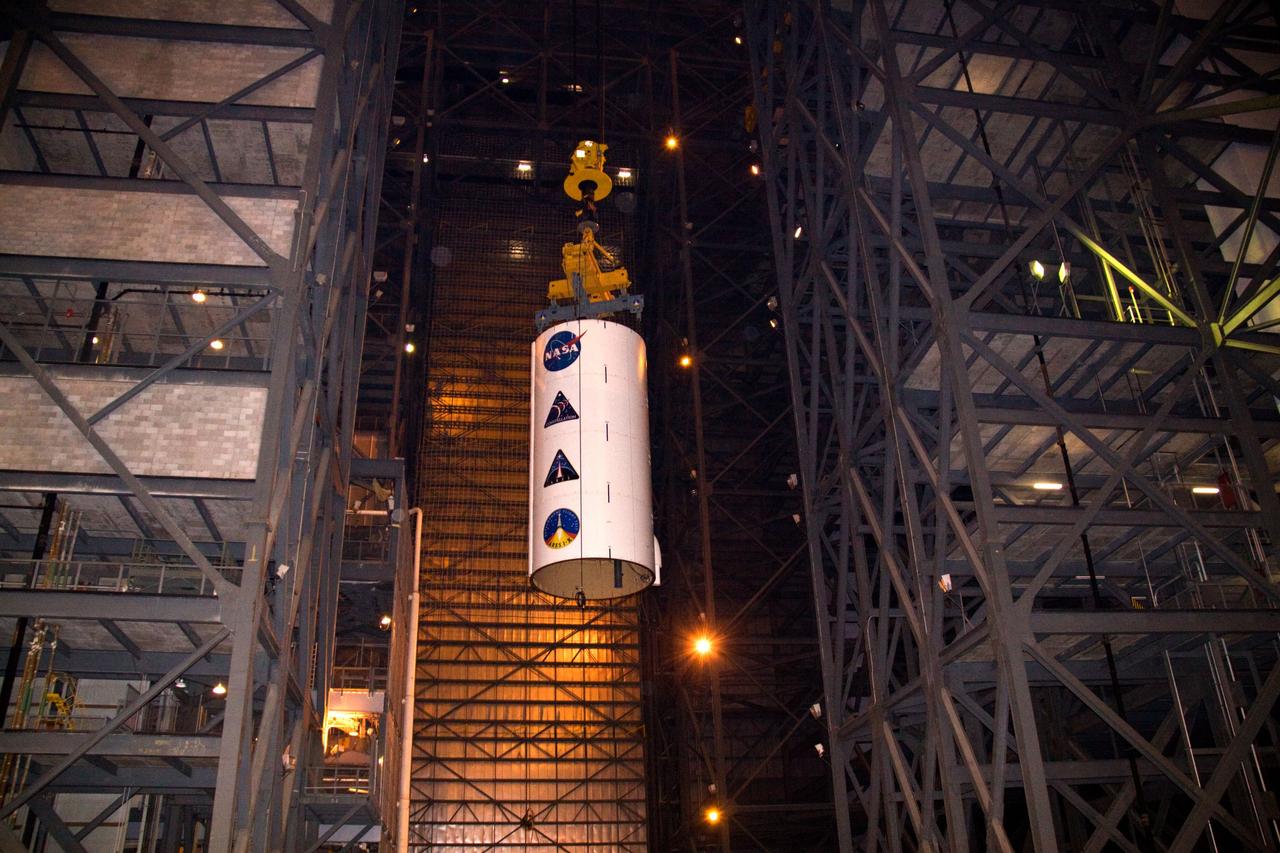
CAPE CANAVERAL, Fla. – In NASA Kennedy Space Center's Vehicle Assembly Building, a crane lowers the Ares I-X Super Stack 3 into High Bay 4. There it will be integrated with Super Stack 2. The upper stage comprises five super stacks, which are integrated with the four-segment solid rocket booster first stage on the mobile launch platform. Ares I-X is the test vehicle for the Ares I, which is part of the Constellation Program to return men to the moon and beyond. The Ares I-X flight test is targeted for Oct. 31, pending formal NASA Headquarters approval. Photo credit: NASA/Jack Pfaller
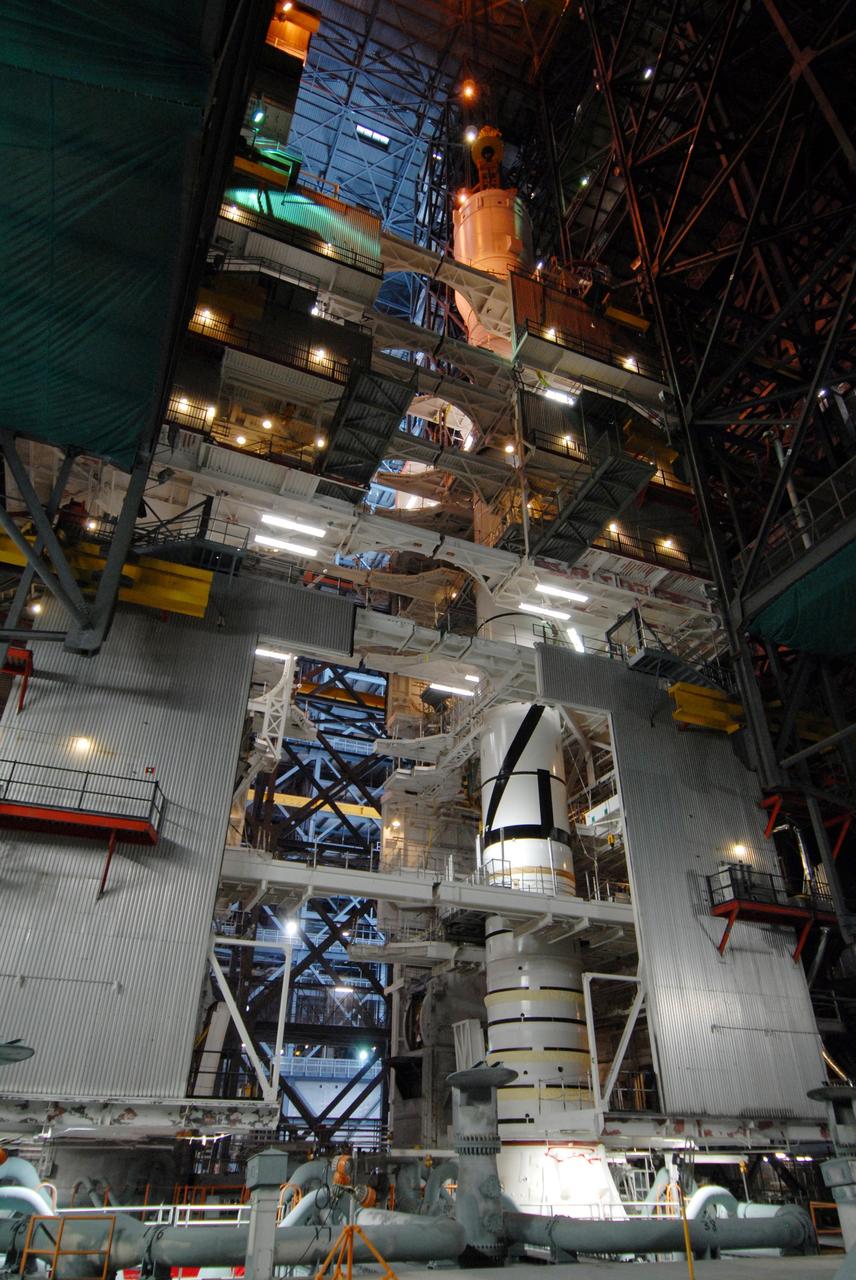
CAPE CANAVERAL, Fla. – In the Vehicle Assembly Building's High Bay 3 at NASA's Kennedy Space Center in Florida, a crane has lowered Super Stack 2, part of the Ares I-X upper stage, onto Super Stack 1 for assembly. The upper stage comprises five super stacks, which are integrated with the four-segment solid rocket booster first stage on the mobile launch platform. Ares I-X is the test vehicle for the Ares I, which is part of the Constellation Program to return men to the moon and beyond. The Ares I-X flight test is targeted for Oct. 31, pending formal NASA Headquarters approval. Photo credit: NASA/Tim Jacobs
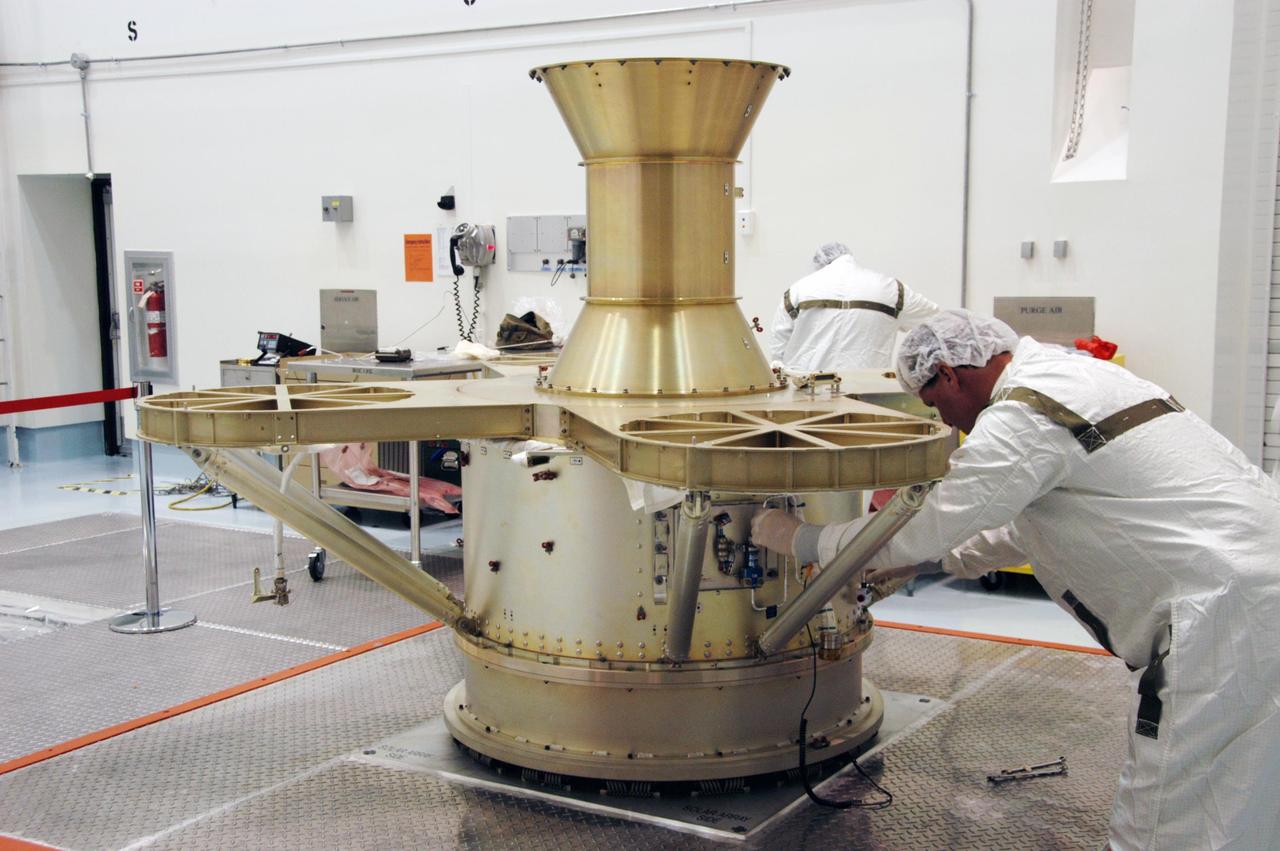
KENNEDY SPACE CENTER, FLA. -- At Astrotech Space Operations in Titusville, Fla., a worker attaches a high pressure line on the THEMIS spacecraft in preparation for fueling, which is scheduled for Jan. 3-5. THEMIS consists of five identical probes, the largest number of scientific satellites ever launched into orbit aboard a single rocket. This unique constellation of satellites will resolve the tantalizing mystery of what causes the spectacular sudden brightening of the aurora borealis and aurora australis - the fiery skies over the Earth's northern and southern polar regions. THEMIS is scheduled to launch Feb. 15 from Cape Canaveral Air Force Station. Photo credit: NASA/George Shelton
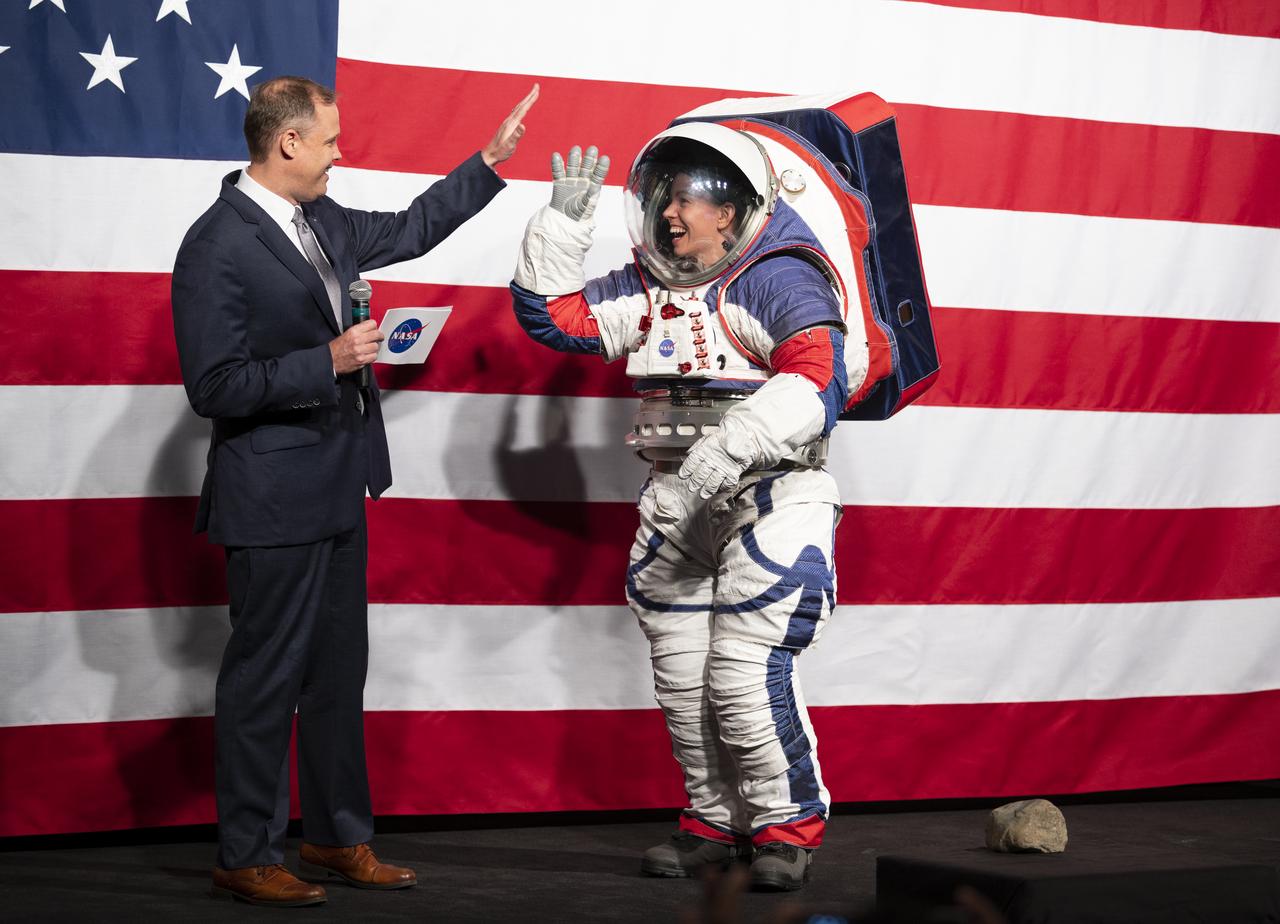
NASA Administrator Jim Bridenstine, left, high fives Kristine Davis, a spacesuit engineer at NASA’s Johnson Space Center, wearing a ground prototype of NASA’s new Exploration Extravehicular Mobility Unit (xEMU), during a demonstration of the suit, Tuesday, Oct. 15, 2019 at NASA Headquarters in Washington. The xEMU suit improves on the suits previous worn on the Moon during the Apollo era and those currently in use for spacewalks outside the International Space Station and will be worn by first woman and next man as they explore the Moon as part of the agency’s Artemis program. Photo Credit: (NASA/Joel Kowsky)
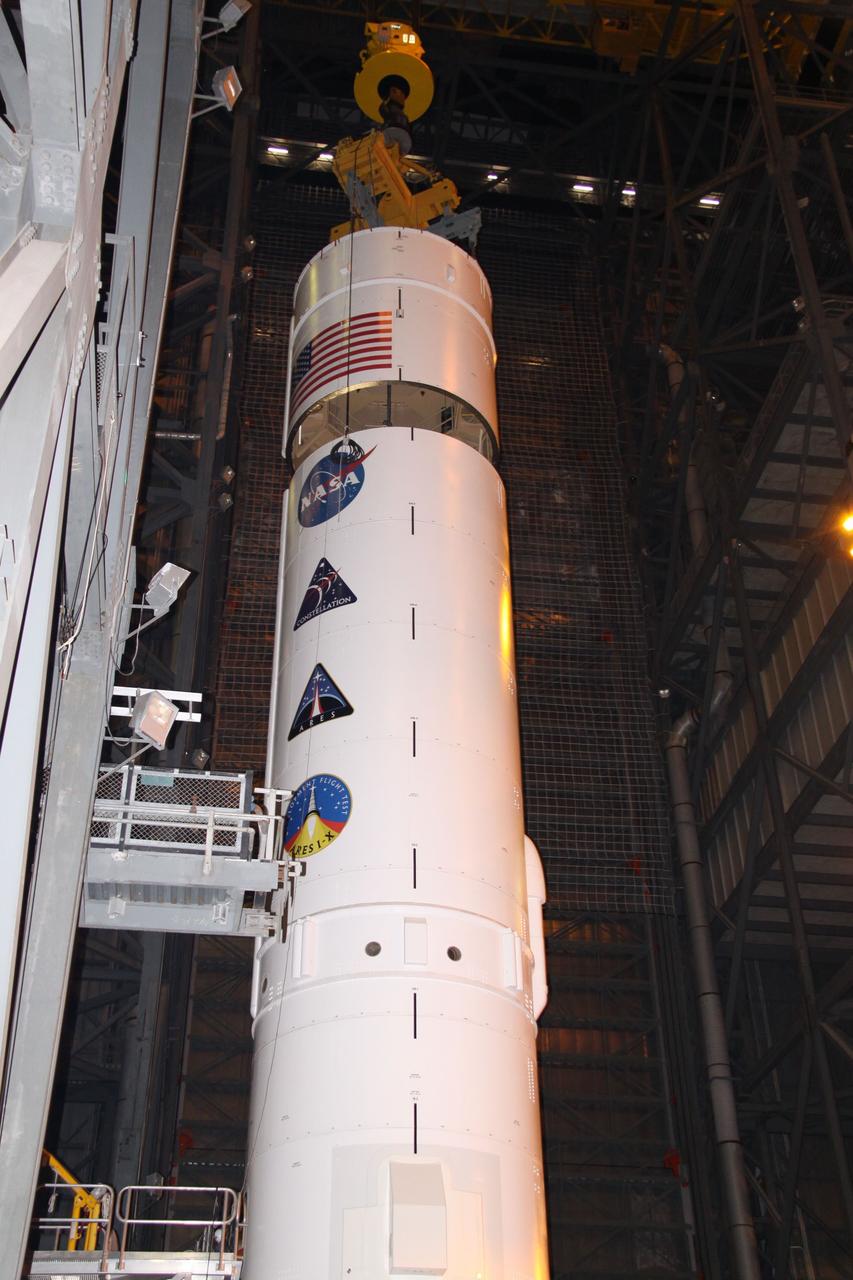
CAPE CANAVERAL, Fla. – In the Vehicle Assembly Building's High Bay 3, a crane lowers the Ares I-X Super Stack 4 toward Super Stack 3 for integration. Five super stacks make up the upper stage that will be integrated with the four-segment solid rocket booster first stage on the mobile launch platform. Ares I-X is the test vehicle for the Ares I, which is part of the Constellation Program to return men to the moon and beyond. The Ares I-X flight test is targeted for Oct. 31, pending formal NASA Headquarters approval. Photo credit: NASA/Jack Pfaller