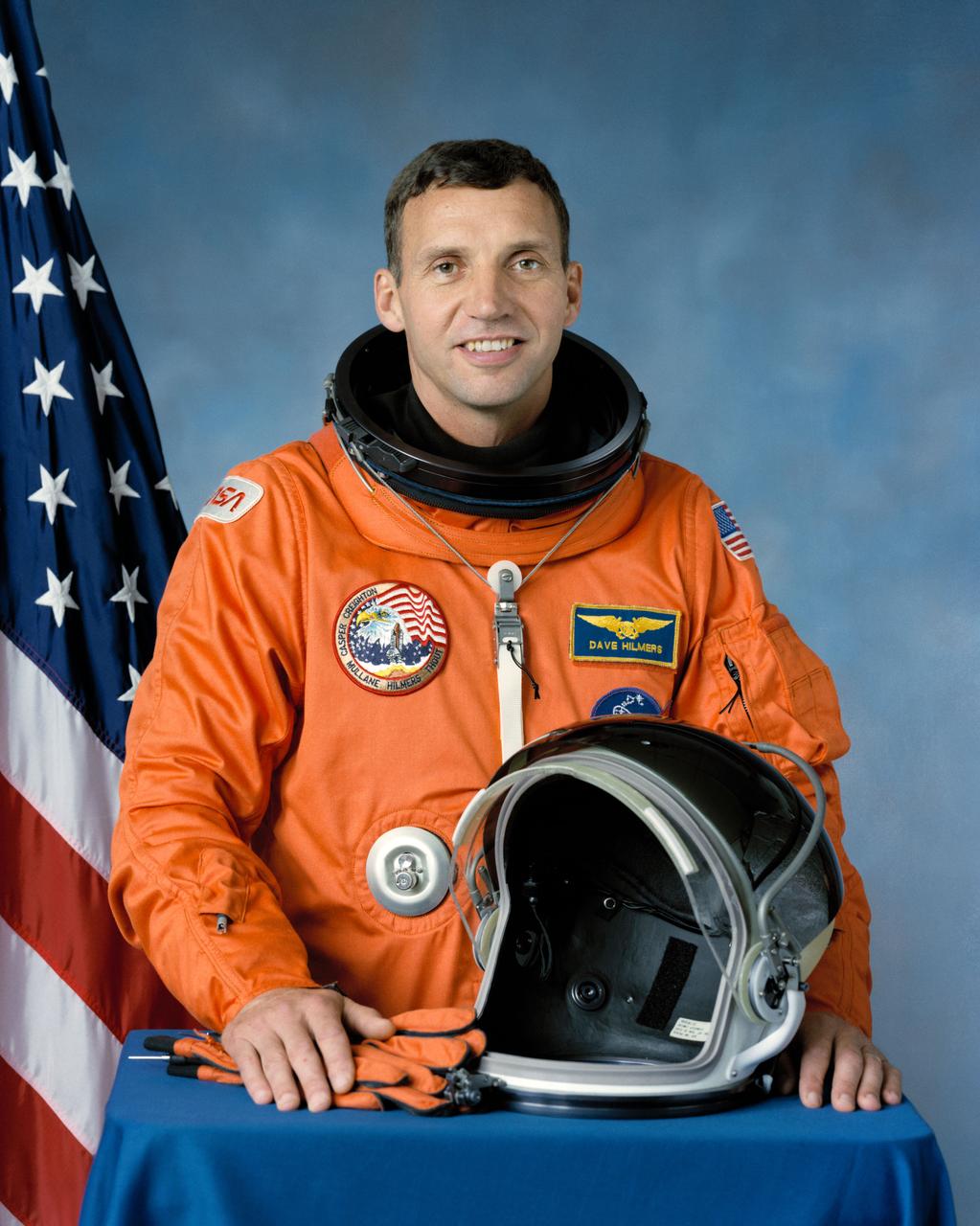
S90-38883 (April 1990) --- Astronaut David C. Hilmers.
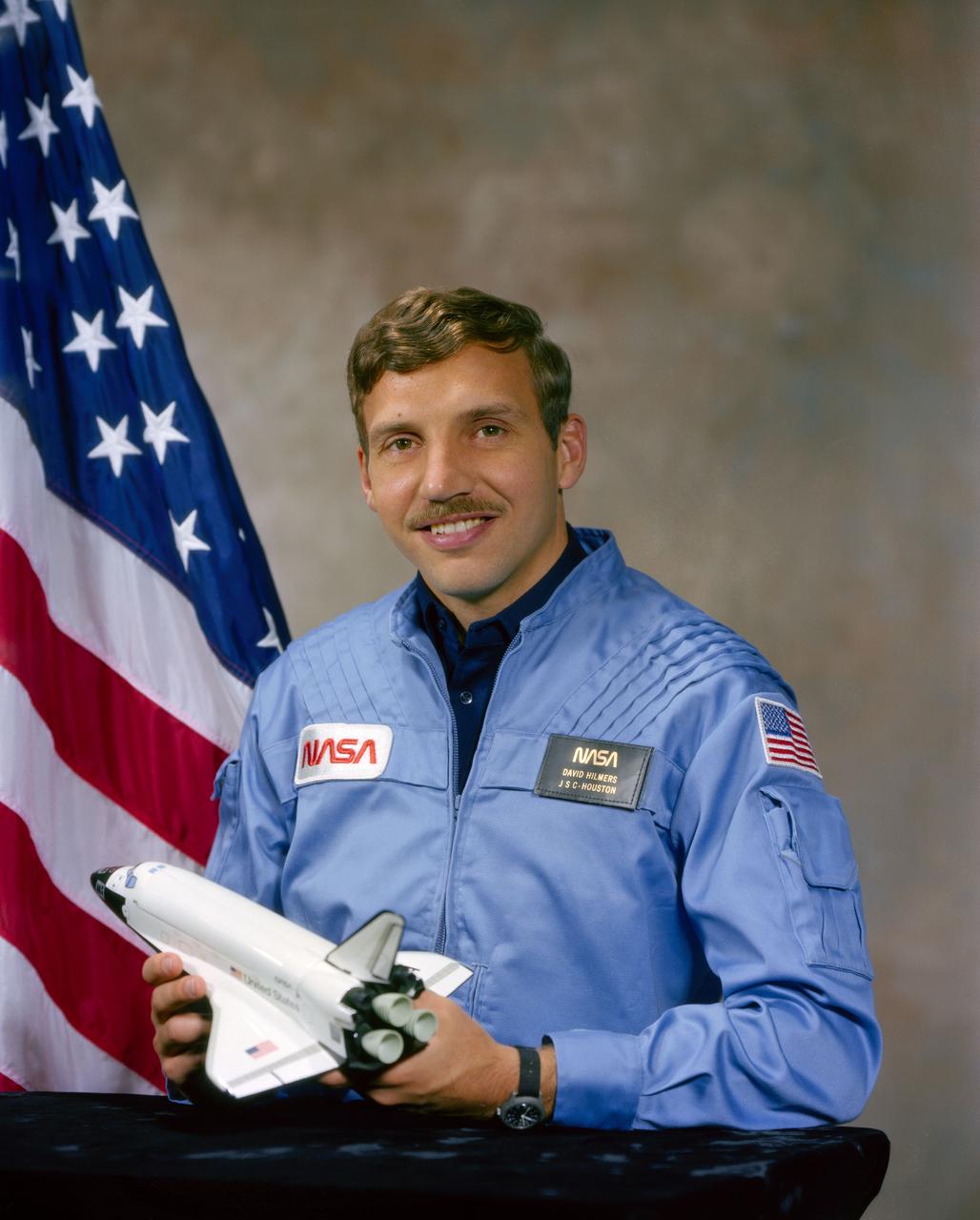
S80-42909 (December 1980) --- Astronaut David C. Hilmers
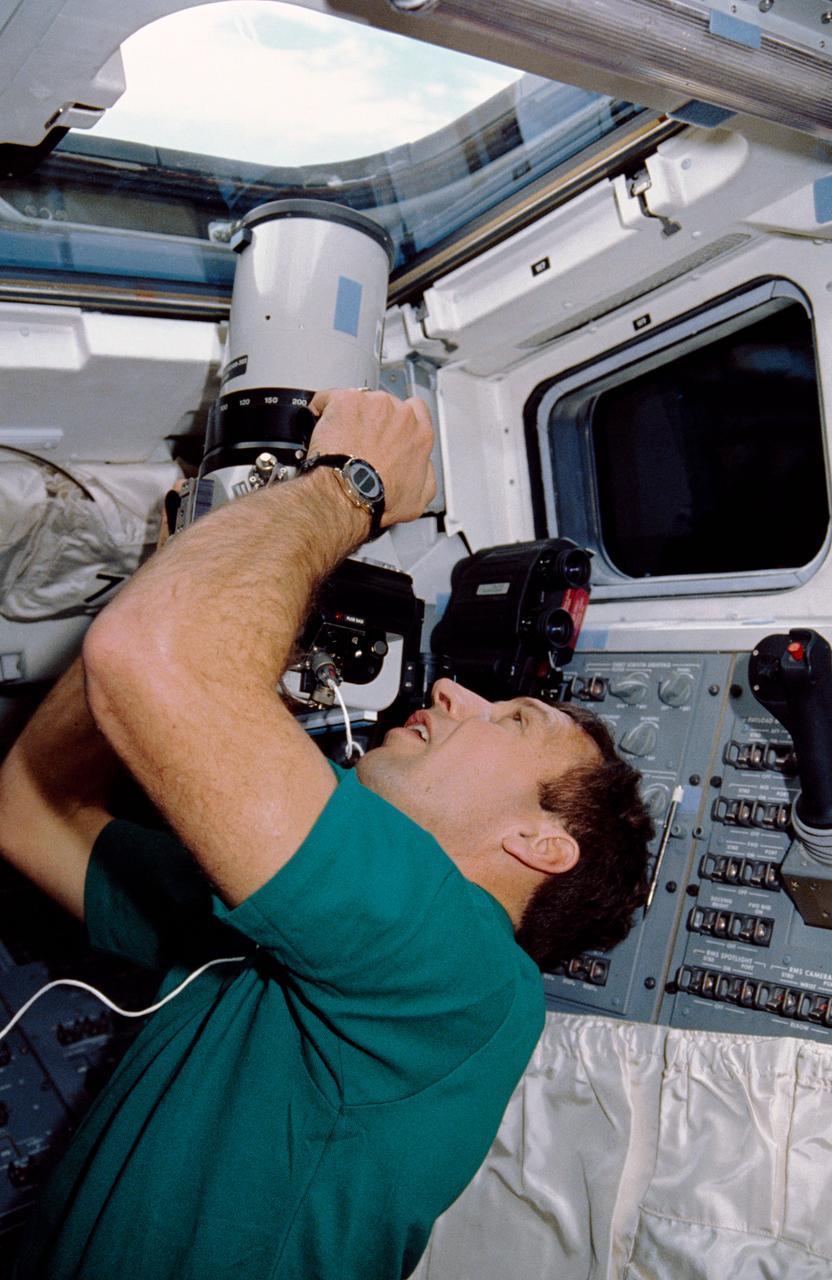
STS-36 Mission Specialist (MS) David C. Hilmers points the large-format AEROLINHOF camera out overhead window W7 on the aft flight deck of Atlantis, Orbiter Vehicle (OV) 104. Hilmers records Earth imagery using the camera. Hilmers and four other astronauts spent four days, 10 hours and 19 minutes aboard OV-104 for the Department of Defense (DOD) devoted mission.
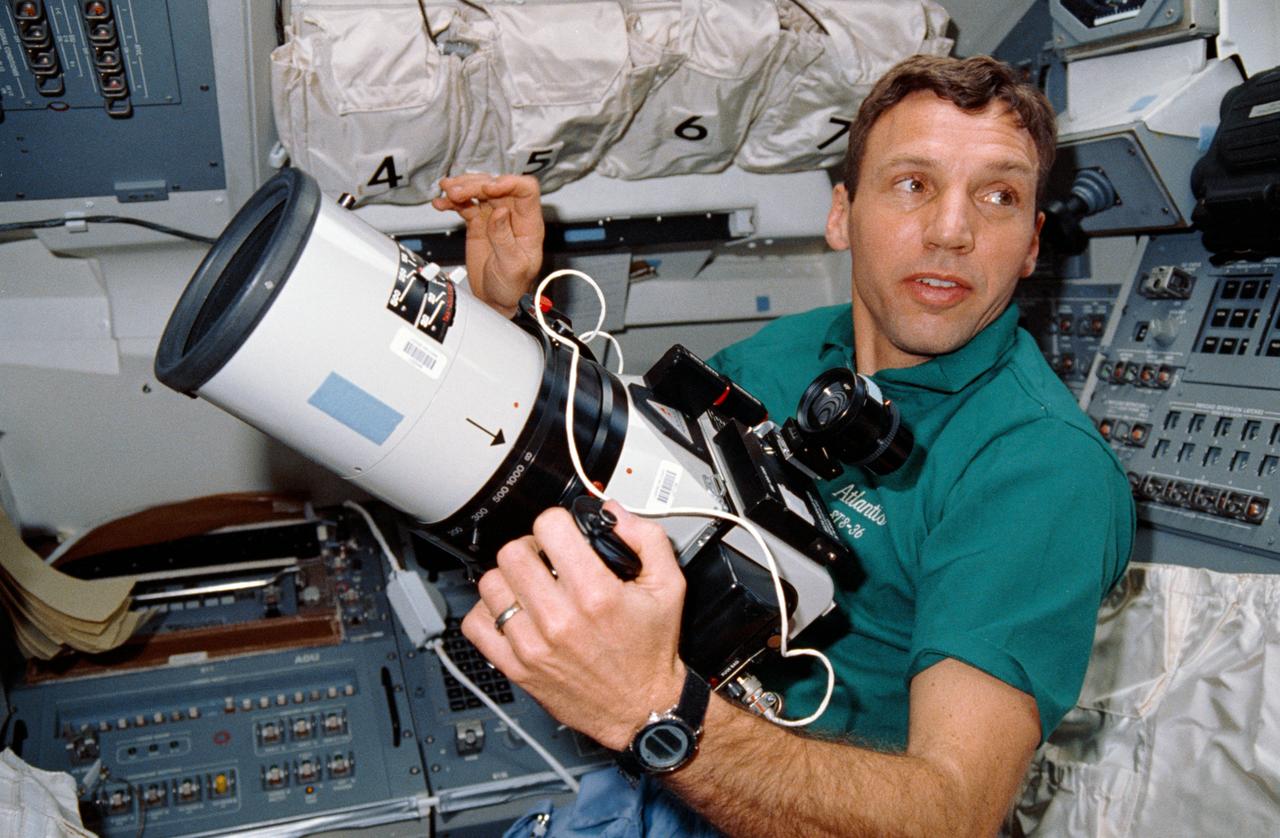
STS036-03-014 (28 Feb-3 March 1990) --- Astronaut David C. Hilmers, on the aft flight deck of the Earth-orbiting Atlantis, prepares to use the large-format Aero Linhof camera used for recording of Earth imagery. Hilmers and four other NASA astronauts spent four days, 10 hours and 19 minutes aboard the spacecraft for the DOD-devoted mission.

The crew assigned to the STS-51J mission included (seated left to right) Robert L. Stewart, mission specialist; Karol J. Bobko, commander; and Ronald J. Grabe, pilot. On the back row, left to right, are mission specialists David C. Hilmers, and Major Willliam A, Pailles (USAF). Launched aboard the Space Shuttle Atlantis on October 3, 1985 at 11:15:30 am (EDT), the STS-51J mission was the second mission dedicated to the Department of Defense (DOD).

The STS-36 crew portrait features 5 astronauts who served in the 6th Department of Defense (DOD) mission. Posed near the Space Shuttle Orbiter Discovery are (left to right) Pierre J. Thuot, mission specialist 3; John H. Caster, pilot; John H. Creighton, commander; Richard M. (Mike) Mullane, mission specialist 1; and David. C. Hilmers, mission specialist 2. The crew launched aboard Atlantis on February 28, 1990 at 2:50:22am (EST).
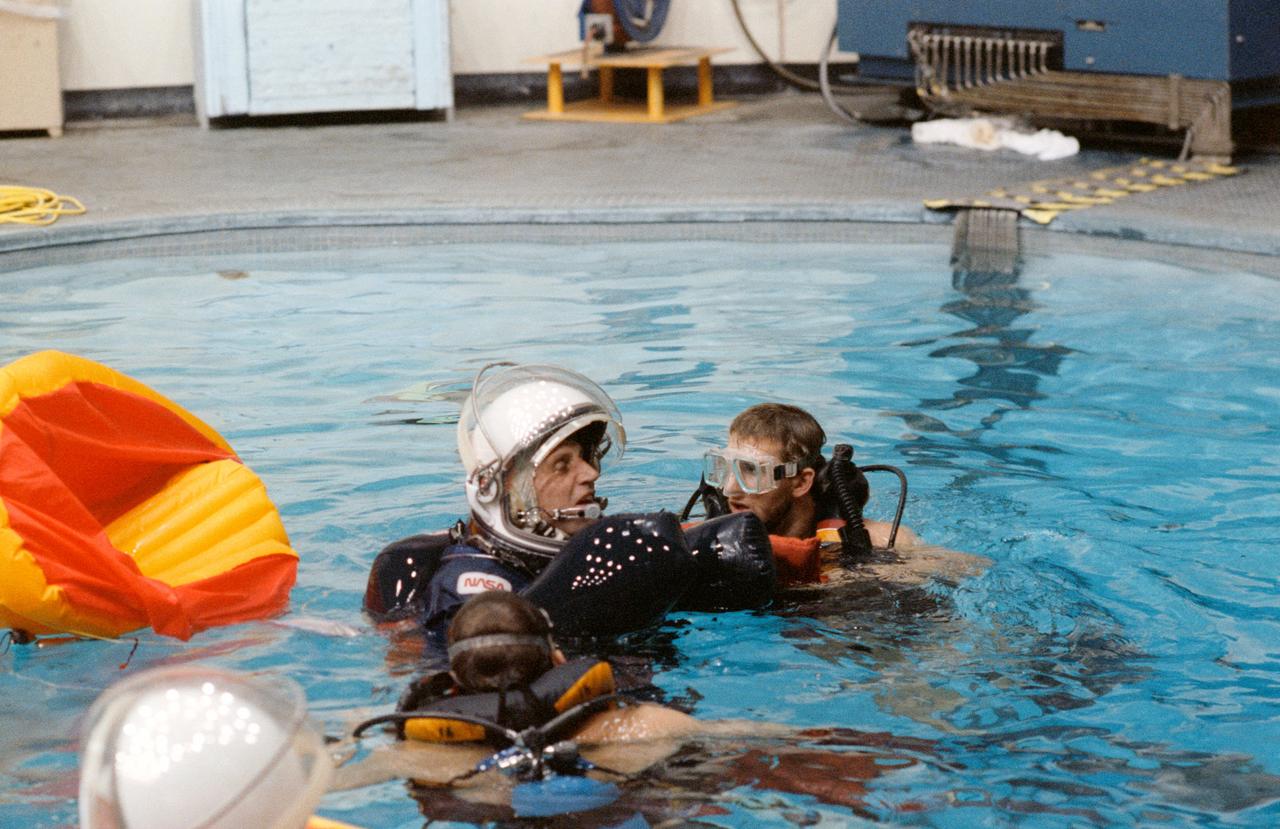
S91-51995 (26 Nov 1991) --- Astronaut David C. Hilmers, STS-42 mission specialist, wearing launch and entry suit (LES) and launch and entry helmet (LEH), floats in the water with the aid of an underarm flotation device as SCUBA-equipped divers look on. Behind Hilmers is his yellow and orange single person life raft. Hilmers is rehearsing launch emergency egress (bailout) procedures in the Johnson Space Center?s (JSC) Weightless Environment Training Facility (WETF) Bldg 29. The crewmembers would use this equipment in the event of an emergency bailout over water. The WETF's 25 ft deep pool is used to simulate the ocean.
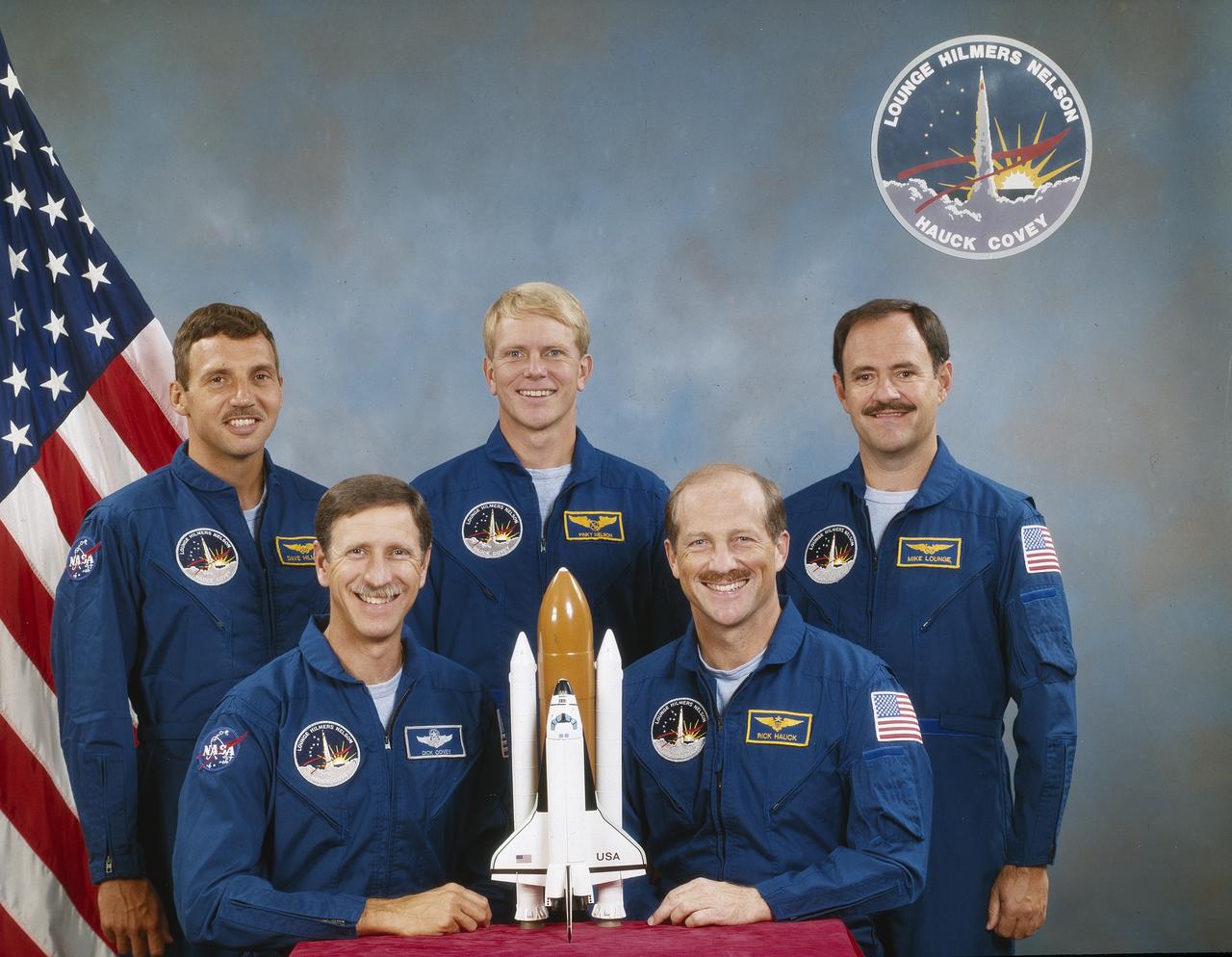
Five astronauts composed the crew of the STS-26 mission. Pictured in the portrait (left to right) are David C. Hilmer, mission specialist; Richard O. Covey, pilot; George D. Nelson, mission specialist; Frederick H. Hauck, Jr., commander; and John, M. Lounge, mission specialist. Launched aboard the Space Shuttle Orbiter Discovery, liftoff occurred on September 29, 1988 at 11:37am (EDT). This was the 7th flight of the Orbiter Discovery, and the return to flight after the STS-51L mission accident. The primary payload was the NASA Tracking and Data Relay Satellite-3 (TDRS-3).
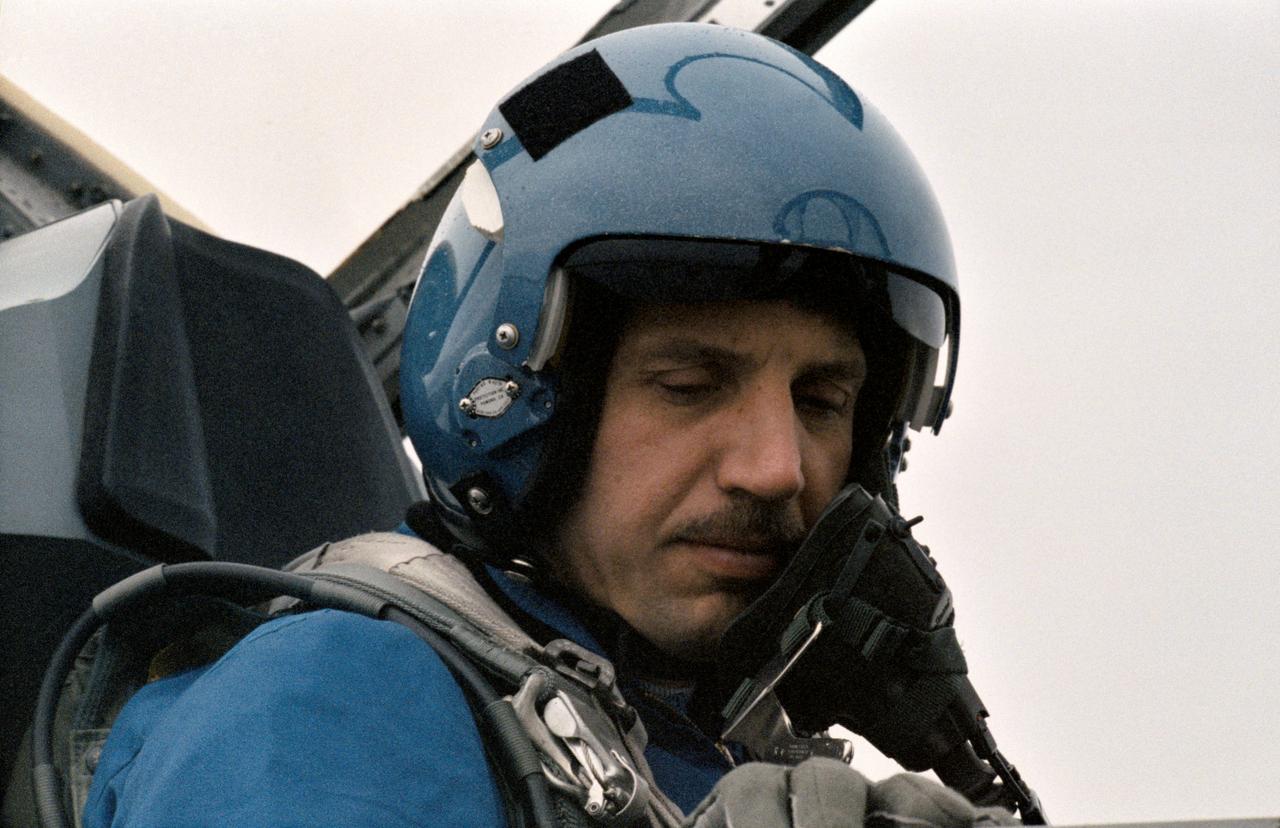
S87-28147 (26 Feb 1987) --- Astronaut David C. Hilmers sits in the rear station of a NASA T-38 jet aircraft prior to departure of the STS 26 crew from Ellington Field, destination Kennedy Space Center for interfacing with flight hardware which is undergoing preparations. Hilmers is one of three mission specialists for the flight.
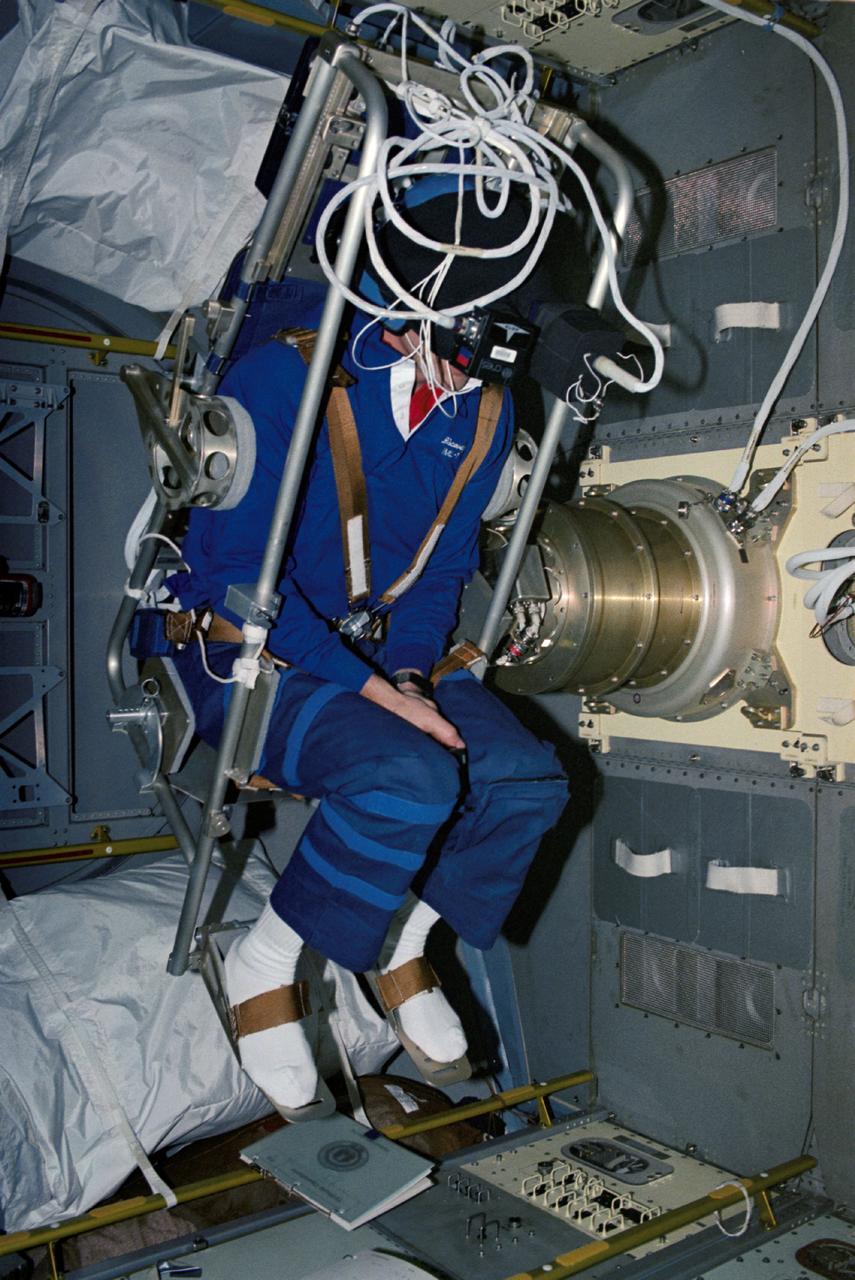
STS042-27-037 (22-30 Jan. 1992) --- Astronaut David C. Hilmers, STS-42 mission specialist, wearing a helmet assembly, sits in the Microgravity Vestibular Investigation (MVI) rotating chair. The scene is in the International Microgravity Laboratory (IML-1) science module aboard Discovery. Hilmers, a mission specialist, and six other crewmembers spent more than eight days in Earth-orbit conducting experiments. Hilmer's helmet assembly is outfitted with accelerometers to measure head movements and visors that fit over each eye independently to provide visual stimuli. The chair system has three movement patterns: "sinusoidal" or traveling predictably back and forth over the same distance at a constant speed; "pseudorandom" or moving back and forth over the varying distances; and "stepped" or varying speeds beginning and stopping suddenly.
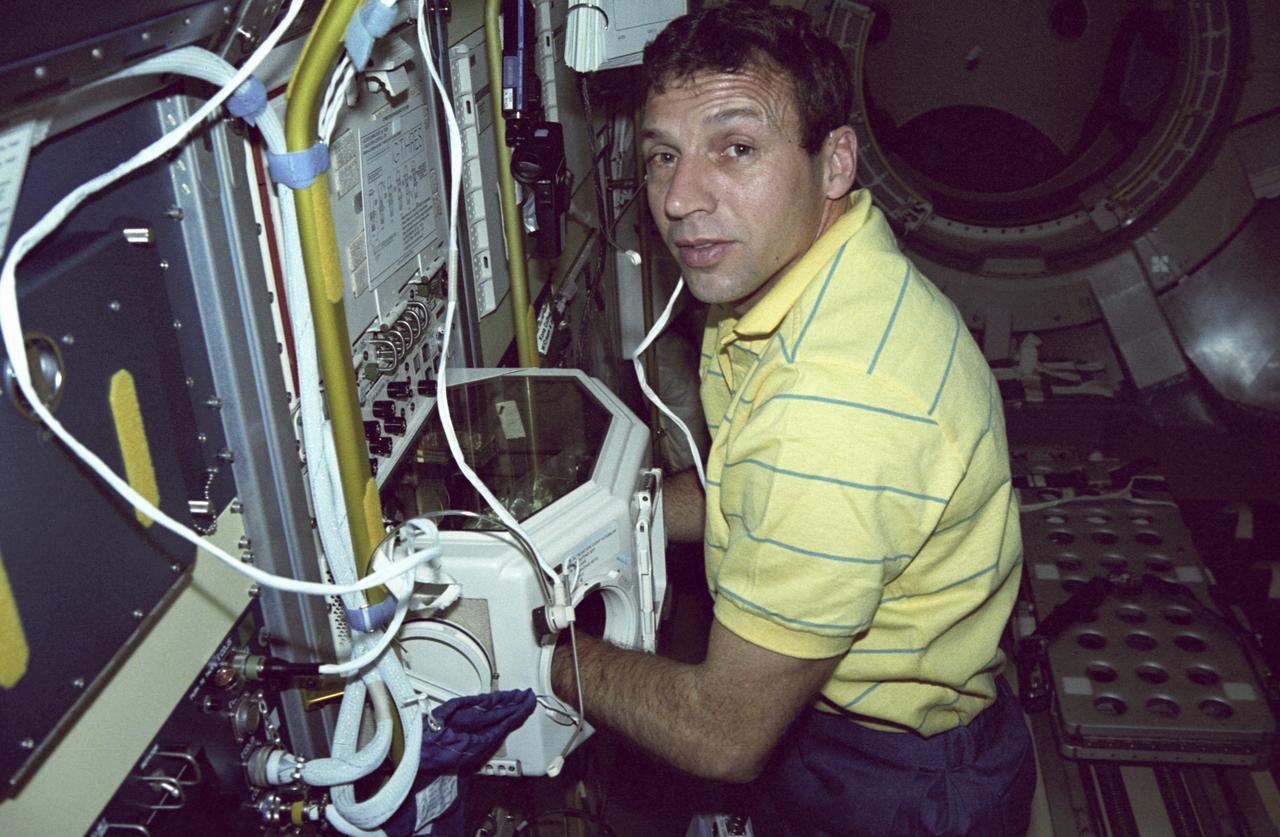
In this photograph, astronaut David Hilmers conducts a life science experiment by using the Biorack Glovebox (GBX) during the International Microgravity Laboratory-1 (IML-1) mission. The Biorack was a large multipurpose facility designed for studying the effects of microgravity and cosmic radiation on numerous small life forms such as cells, tissues, small organisms, and plants. Located at the Biorack, the GBX was an enclosed environment that protected samples from contamination and prevented liquid from escaping. Crewmembers handled the specimens with their hands inside gloves that extended into the sealed work area. A microscope and video camera mounted on the GBX door were used to observe and document experiments. Managed by the Marshall Space Flight Center, the IML-1 mission was the first in a series of Shuttle flights dedicated to fundamental materials and life sciences research and was launched aboard the Shuttle Orbiter Discovery (STS-42) on January 22, 1992.
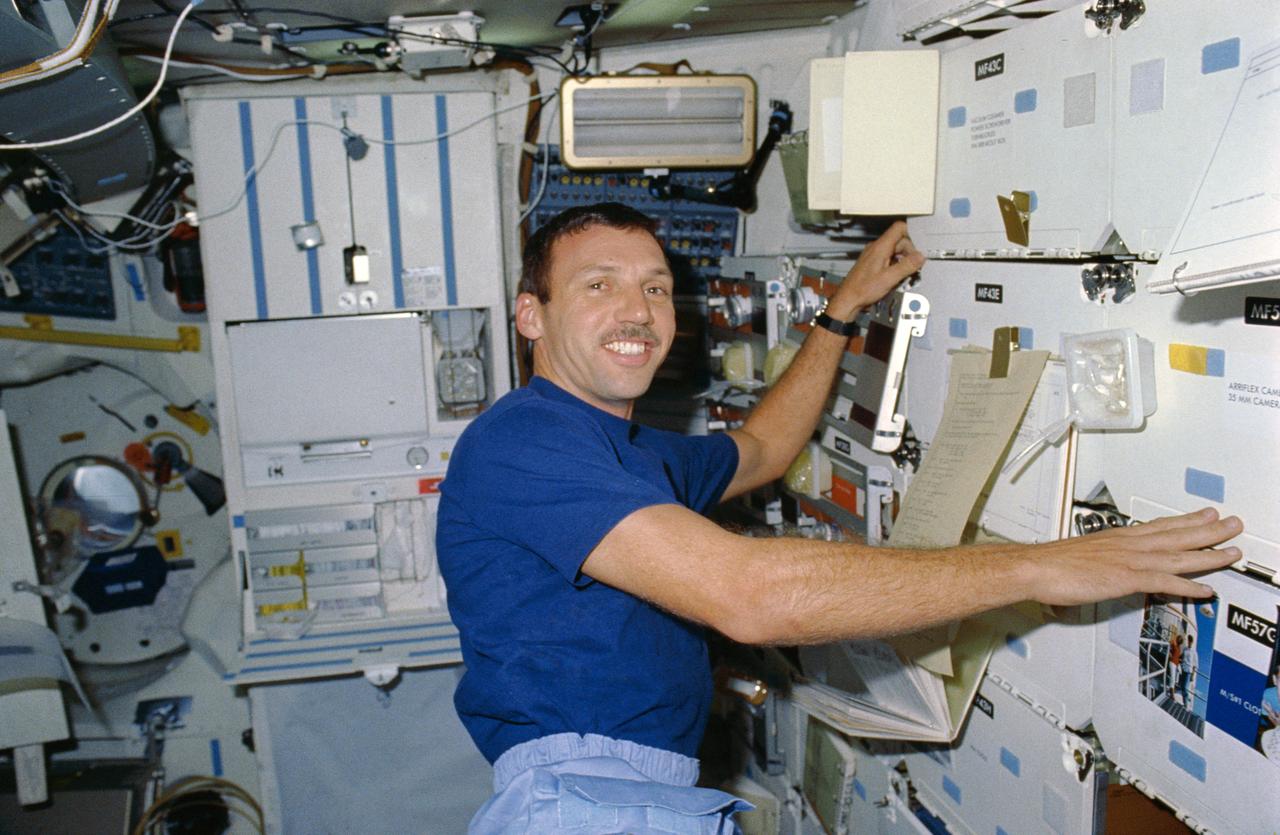
STS026-06-033 (5 Oct 1988) --- Astronaut David C. Hilmers, STS-26 mission specialist, reads teleprinted message which has been clipped to stowage locker doors on the middeck. Food, a galley and various experiments surround the mission specialist.
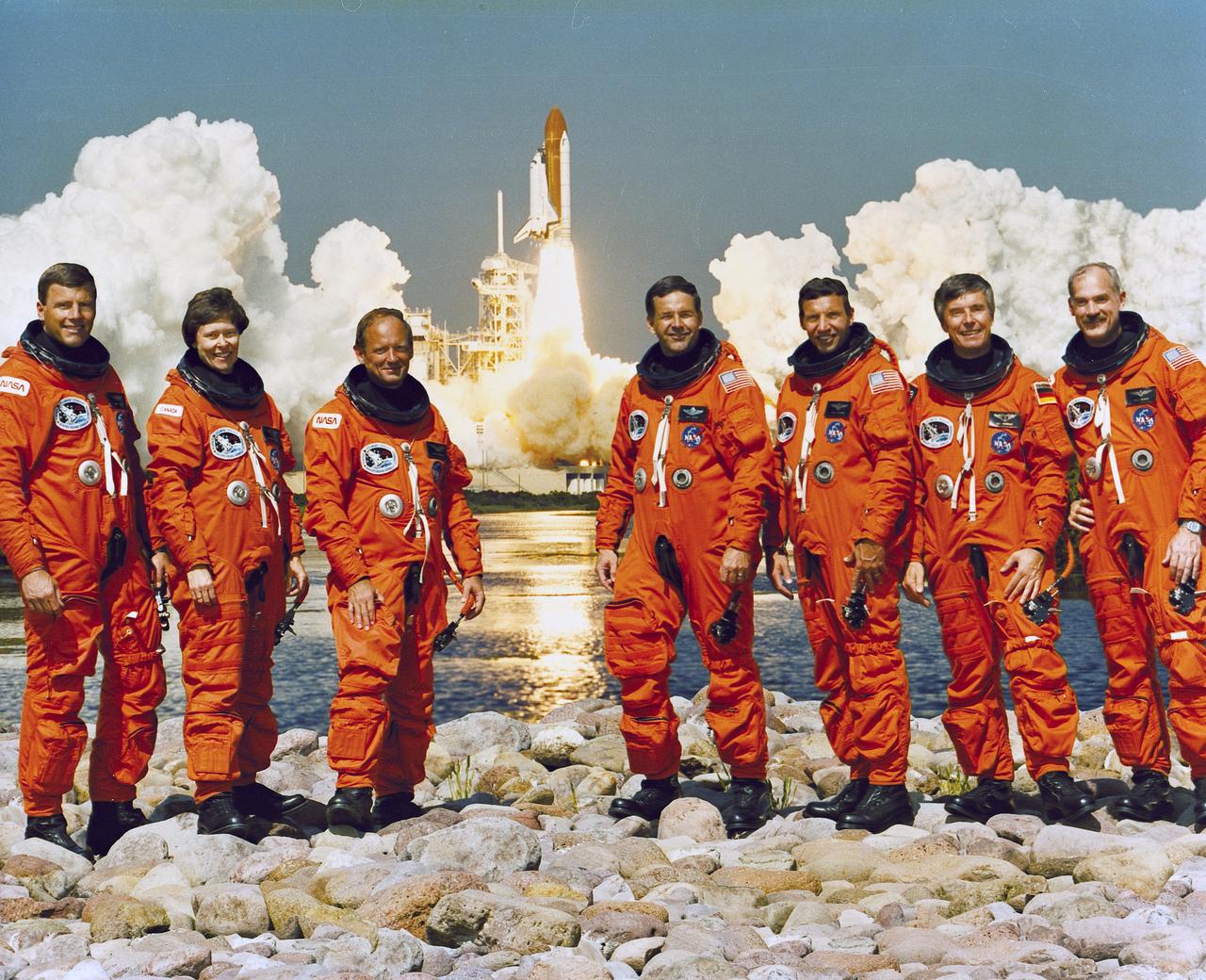
The STS-42 crew portrait includes from left to right: Stephen S. Oswald, pilot; Roberta L. Bondar, payload specialist 1; Norman E. Thagard, mission specialist 1; Ronald J. Grabe, commander; David C. Hilmers, mission specialist 2; Ulf D. Merbold, payload specialist 2; and William F. Readdy, mission specialist 3. Launched aboard the Space Shuttle Discovery on January 22, 1992 at 9:52:33 am (EST), the STS-42 served as the International Microgravity Laboratory-1 (ML-1 ) mission.
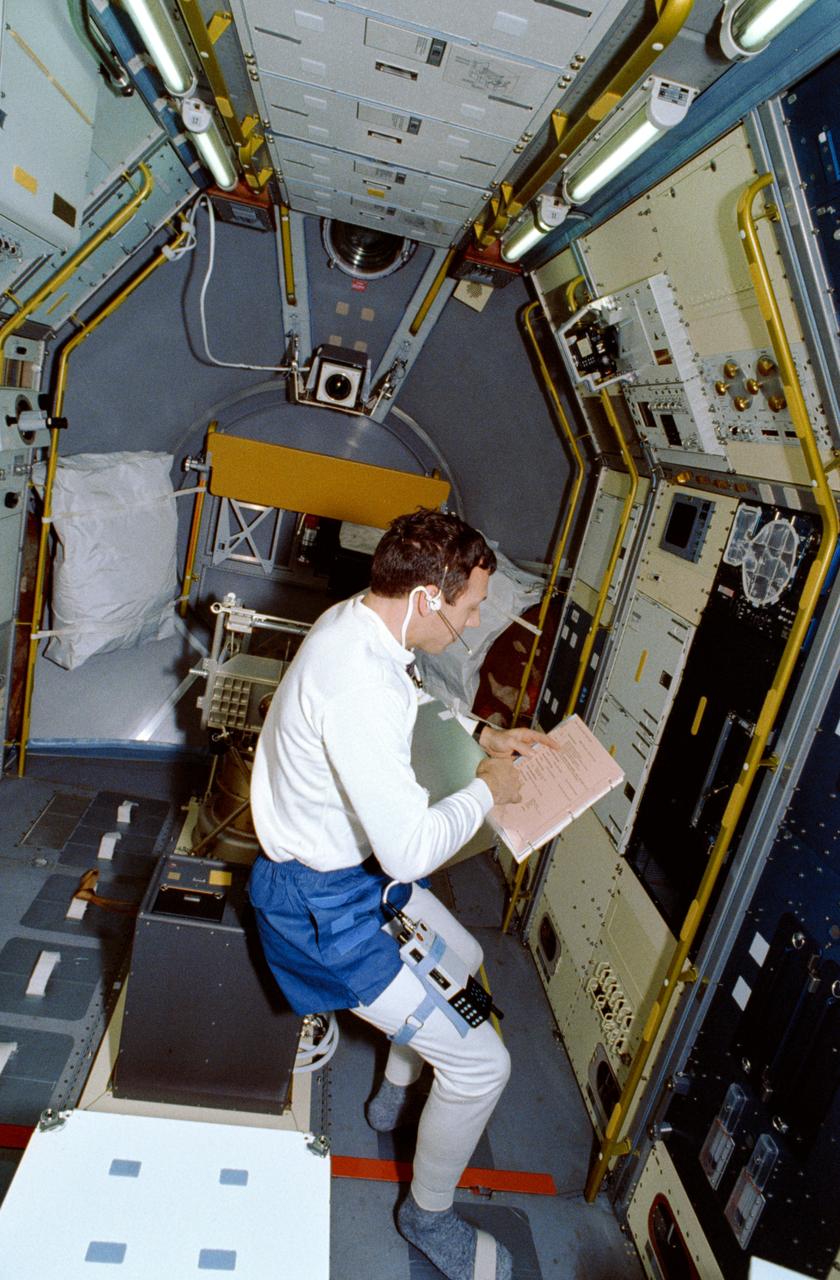
STS042-17-001 (22 Jan 1992) --- Astronaut David C. Hilmers, mission specialist, looks over a checklist at the Johnson Space Center refrigerator/freezer, in which perishable samples are stowed. The view gives an overall perspective of the science module -- heavily utilized for eight-days of scientific research supporting the International Microgravity Laboratory (IML-1) -- in Discovery's cargo bay.
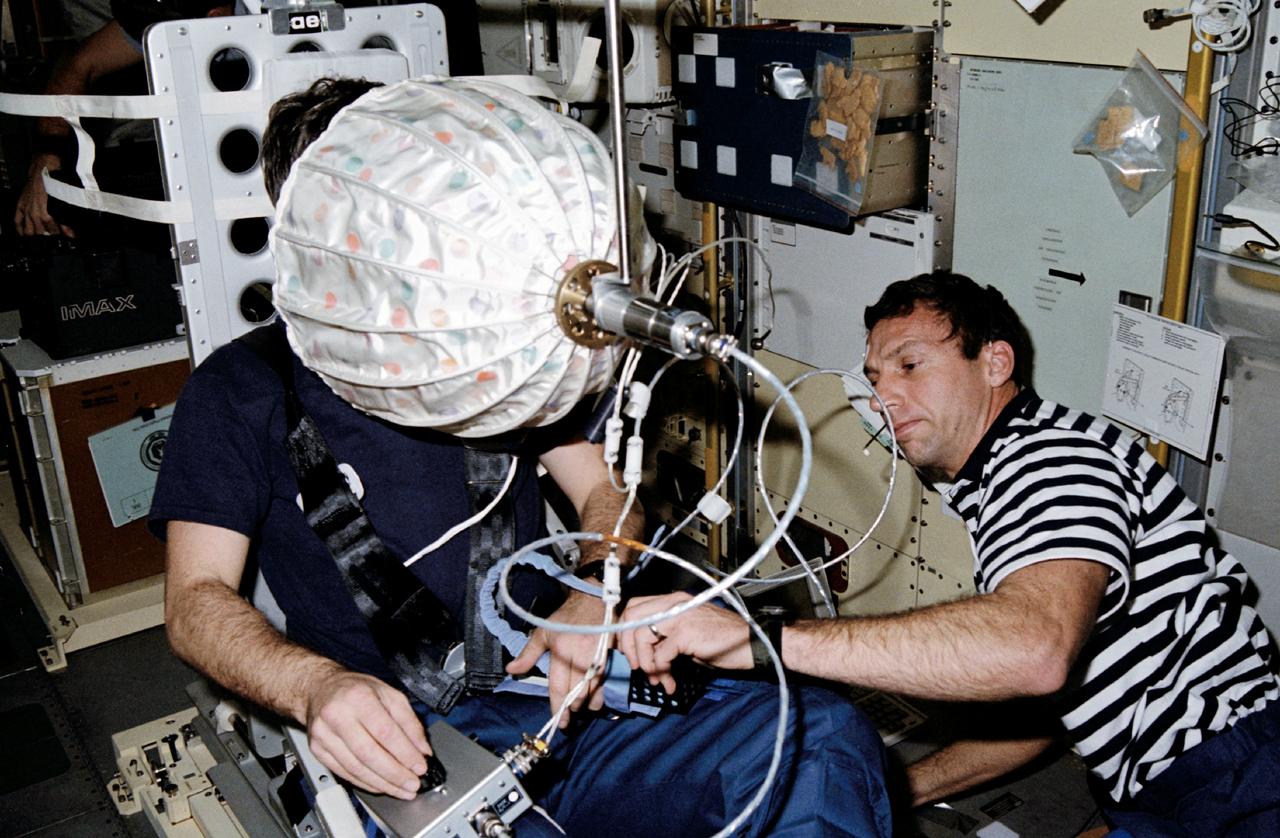
STS042-203-024 (22-30 Jan. 1992) --- Astronaut David C. Hilmers (right), STS-42 mission specialist, assists European Space Agency (ESA) payload specialist Ulf Merbold with the visual stimulator experiment on the Space Shuttle Discovery's middeck. This particular test is part of an ongoing study of the Space Adaptation Syndrome (SAS). Seated in a stationary mini-sled, Merbold (or any other subject for this test) stares at an umbrella-shaped rotating dome with a pattern of colored dots on its interior. While observing the rotating dome, the subject turns a knob to indicate his perception of body rotation. The strength of circular vection is calculated by comparing the signals from the dome and the knob. The greater the false sense of circular vection, the more the subject is relying on visual information instead of otolith information.
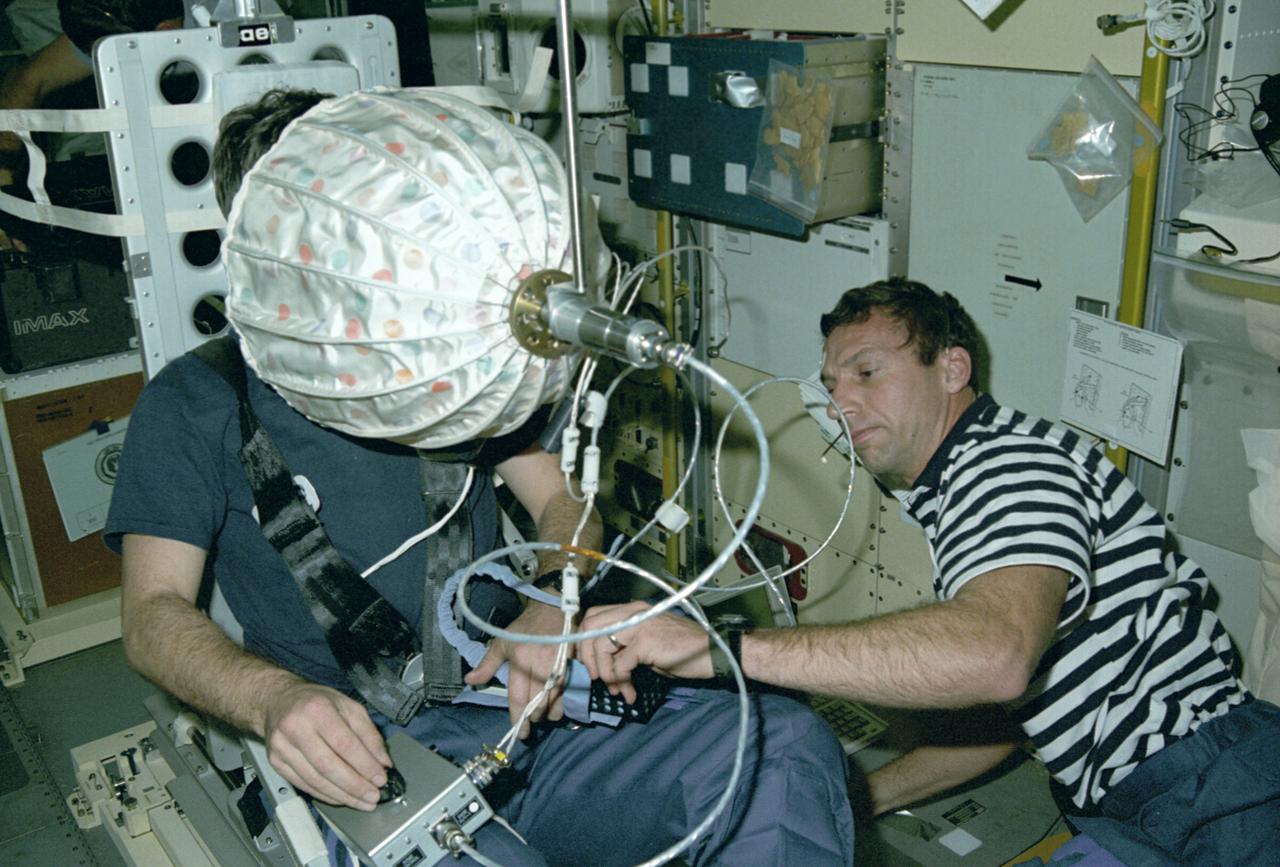
Astronaut Ulf Merbold on the stationary seat of the mini-sled, stares into an umbrella-shaped rotating dome with colored dots. Astronaut Merbold, assisted by astronaut David Hilmer, are conducting the Visual Simulator Experiment, a space physiology experiment. The Visual Stimulator Experiment measures the relative importance of visual and vestibular information in determining body orientation. When a person looks at a rotating visual field, a false sensation of self-rotation, called circularvection, results. In weightlessness, circularvection should increase immediately and may continue to increase as the nervous system comes to rely more on visual than vestibular cues. As Astronaut Merbold stares into the rotating dome with a pattern of colored dots and its interior, he turns a knob to indicate his perception of body rotation. The strength of circularvection is calculated by comparing signals from the dome and the knob. The greater the false sense of circularvection, the more the subject is relying on visual information instead of otolith information. The IML-1 mission was the first in a series of Shuttle flights dedicated to fundamental materials and life sciences research with the international partners. The participating space agencies included: NASA, the 14-nation European Space Agency (ESA), the Canadian Space Agency (CSA), the French National Center of Space Studies (CNES), the German Space Agency and the German Aerospace Research Establishment (DAR/DLR), and the National Space Development Agency of Japan (NASDA). Managed by the Marshall Space Flight Center, IML-1 was launched on January 22, 1992 aboard the Space Shuttle Orbiter Discovery (STS-42 mission).
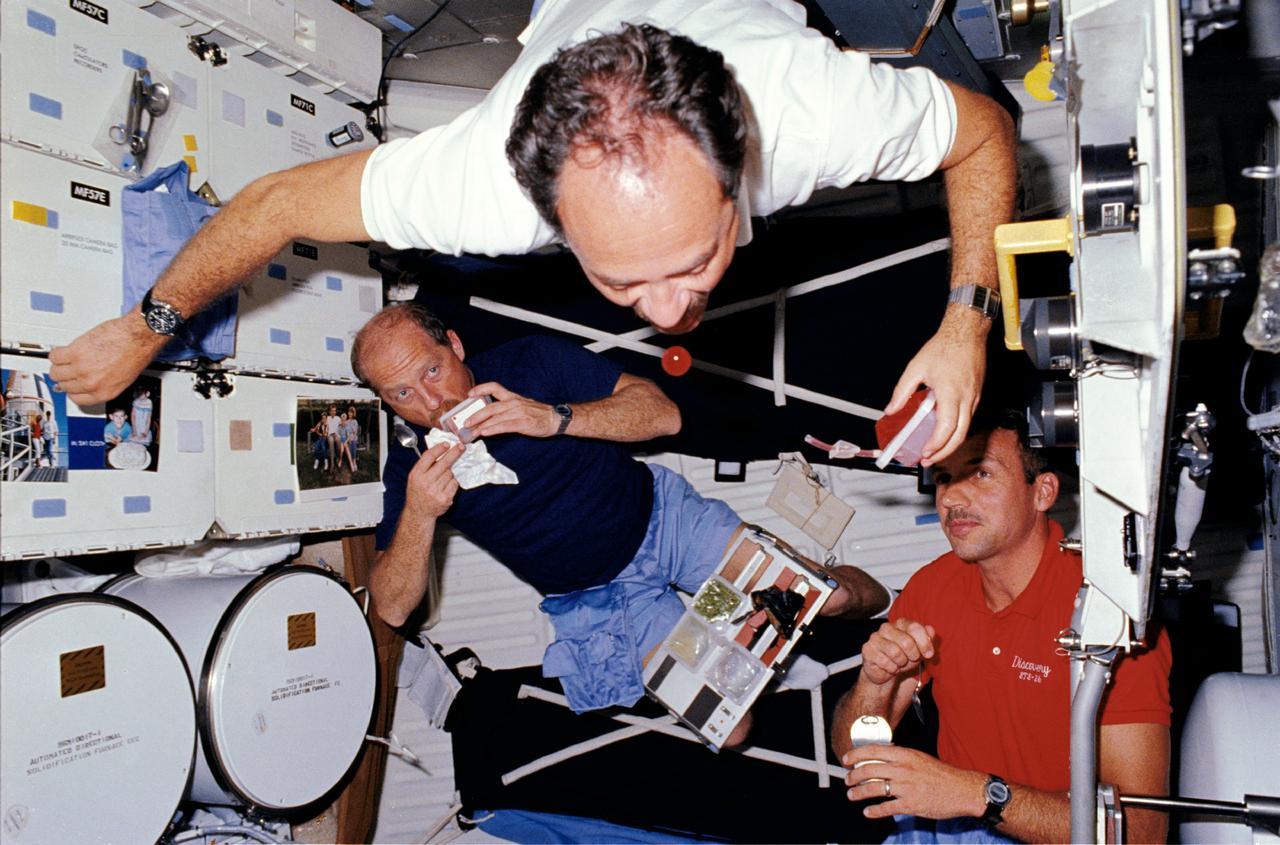
STS026-06-018 (29 Sept. - 3 Oct. 1988) --- Astronaut John M. Lounge, STS-26 mission specialist (MS), using a beverage container, experiments with microgravity as Commander Frederick H. Hauck (left) and MS David C. Hilmers (right) look on. Lounge freefloats as he closes in on a sphere of the red liquid drifting in front of his mouth. Hauck holds a spoon while sipping from a beverage container as he balances a meal tray assembly on his thighs. Hilmers, partially blocked by the open airlock hatch and holding a spoon and a can of food, pauses to watch the experiment. Automated Directional Solidification Furnace (ADSF) and forward middeck lockers appear on Lounge's right.

STS036-S-018 (3 March 1990) --- The Space Shuttle Atlantis touches down at Edwards Air Force Base in California to complete the STS-36 mission. Onboard were Astronauts John O. Creighton, John H. Casper, David C. Hilmers, Richard M. (Mike) Mullane and Pierre J. Thuot.
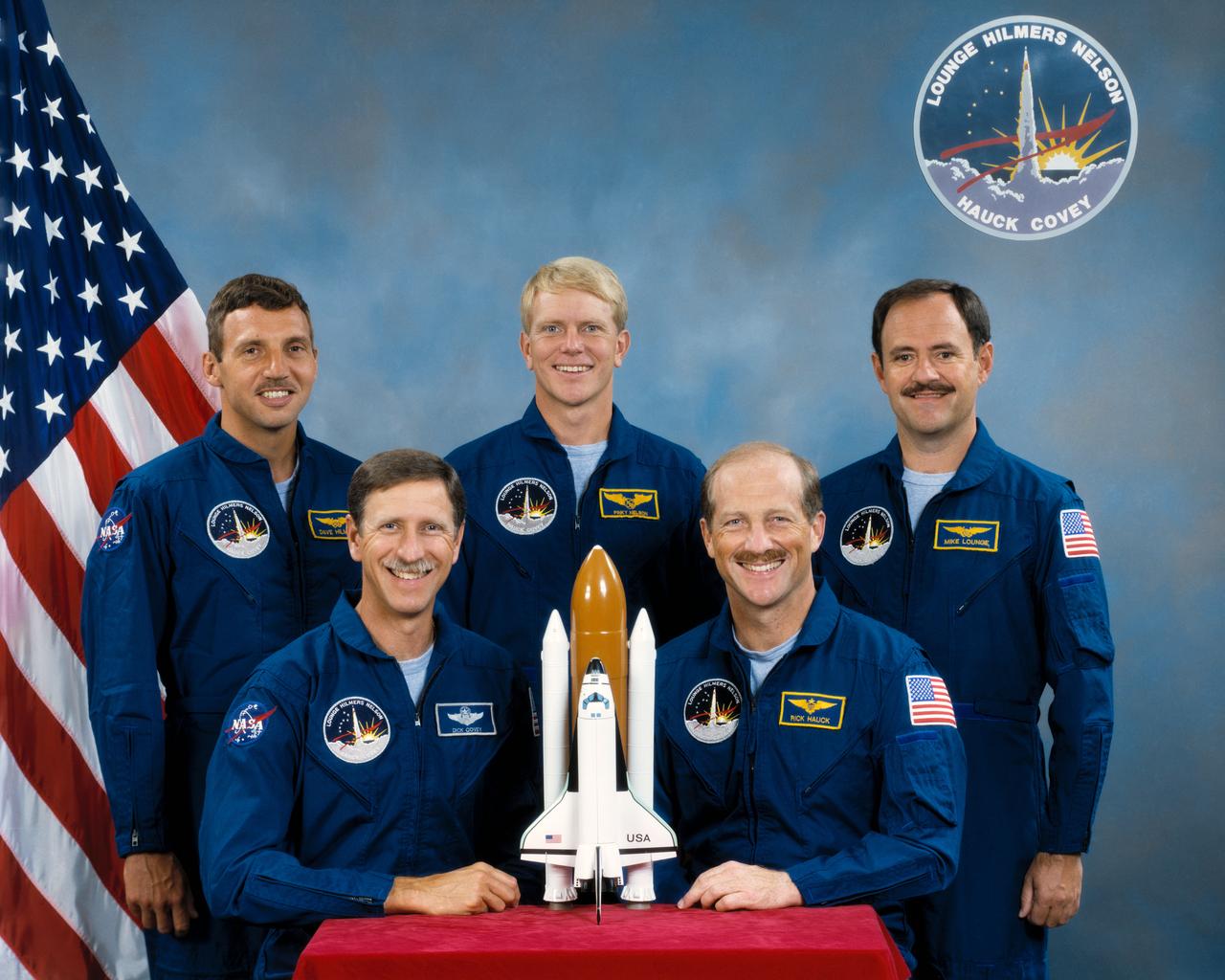
S87-40673 (September 1987) --- Astronauts Frederick H. (Rick) Hauck (right front), mission commander, and Richard O. Covey (left front), pilot, are flanked by NASA's STS-26 mission specialists (l.-r.) David C. Hilmers, George D. (Pinky) Nelson and John M. (Mike) Lounge.
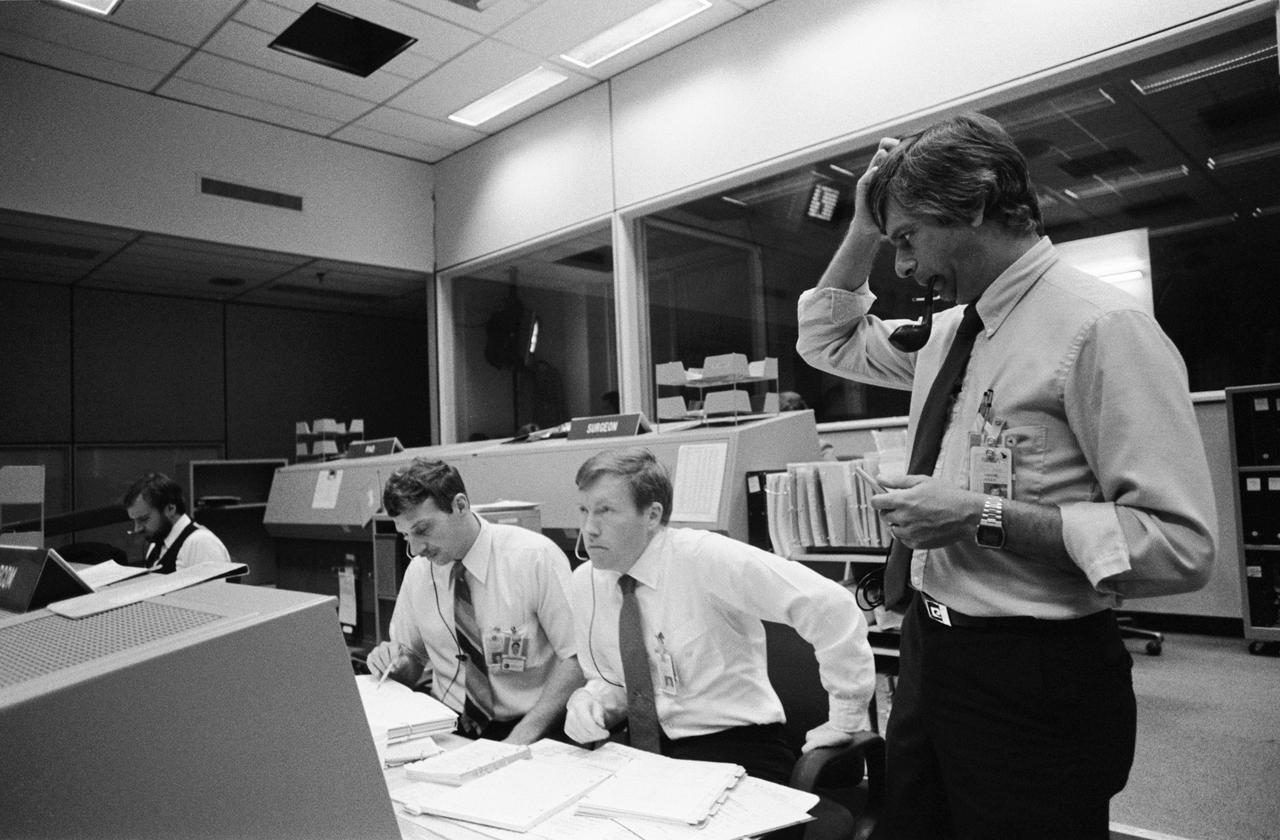
Jay H. Greene, right, ascent flight director for STS 51-A, monitors pre-launch activity at the Kennedy Space Center (KSC) via a screen at the spacecraft communicators console in the second floor flight control room (FCR) of JSC's mission control center. Astronauts David C. Hilmers, left, and Richard N. Richards are the on-duty spacecraft communicators.

STS036-S-008 (3 March 1990) --- The crewmembers for STS-36 egress the Shuttle Atlantis following touchdown at Edwards Air Force Base in California. NASA officials stand nearby awaiting to greet (from bottom to top of the steps) Astronauts John O. Creighton, John H. Casper, Pierre J. Thuot, David C. Hilmers and Richard M. (Mike) Mullane. At right are Dr. William B. Lenoir (left) acting associate administrator for space flight; and Donald R. Puddy, director of flight crew operations.
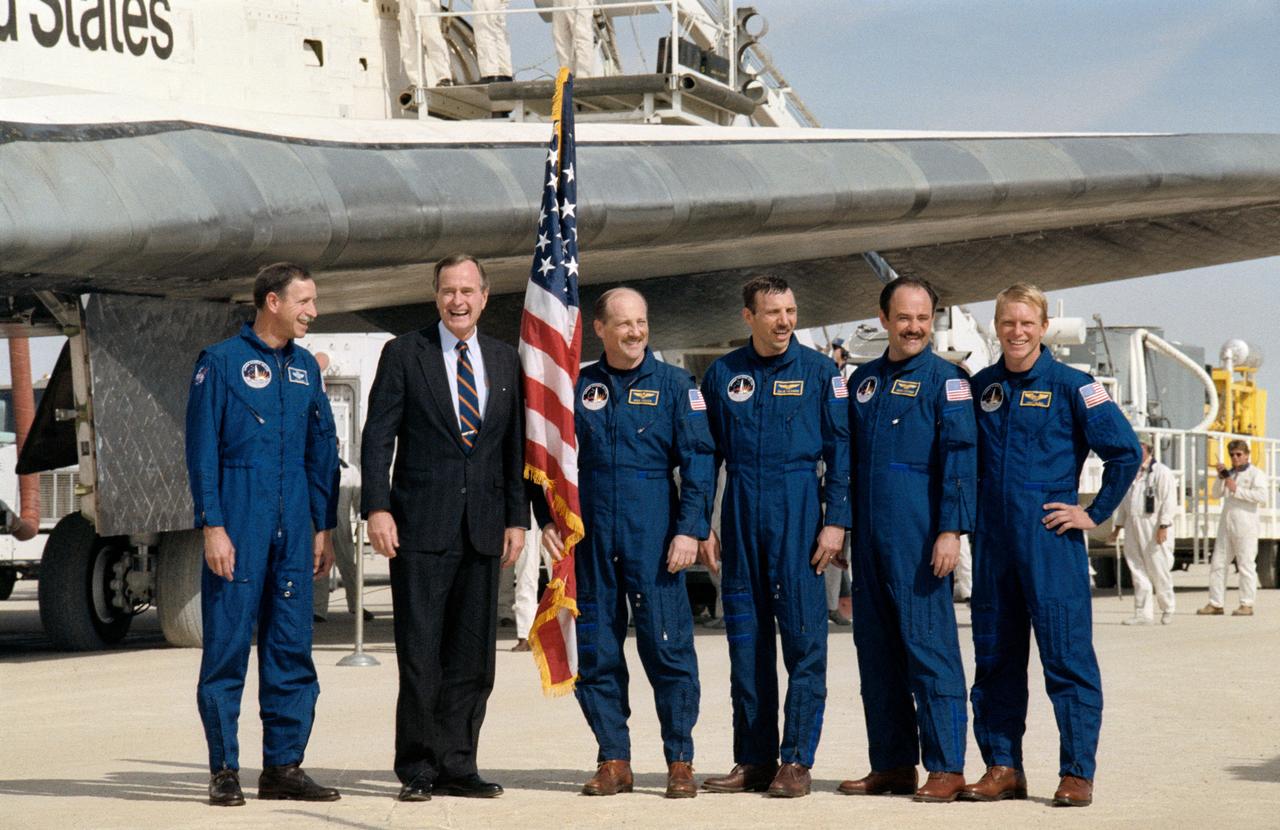
STS026-S-169 (3 Oct 1988) --- The five STS 26 crewmembers pose with Vice President George Bush after completing a successful four-day mission aboard the Space Shuttle Discovery (background). Pictured, from left to right, are astronaut Richard O. Covey, pilot; Vice President Bush; and astronauts Frederick H. (Rick) Hauck, mission commander; and David C. Hilmers, John M. (Mike) Lounge, and George D. Nelson, all mission specialists.
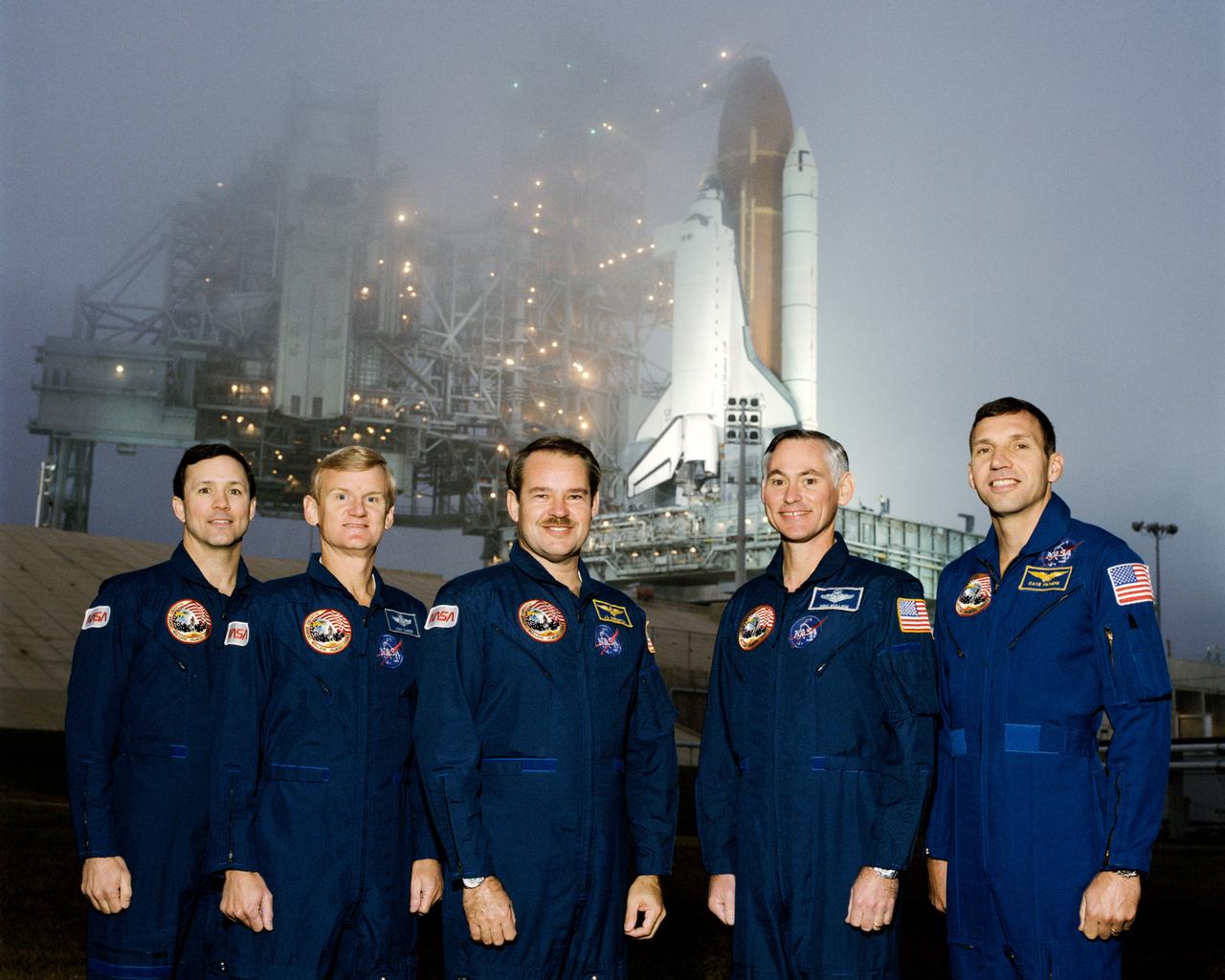
STS036-S-002 (21 Nov. 1989) --- The five astronauts in training for STS-36 pose near the Space Shuttle Discovery on Launch Pad 39B. Astronaut John O. Creighton (center) is mission commander. Others pictured are (left to right) astronauts Pierre J. Thuot, John H. Casper, Richard M. (Mike) Mullane and David C. Hilmers. Casper is pilot and the other three are mission specialists for the DOD-devoted mission.
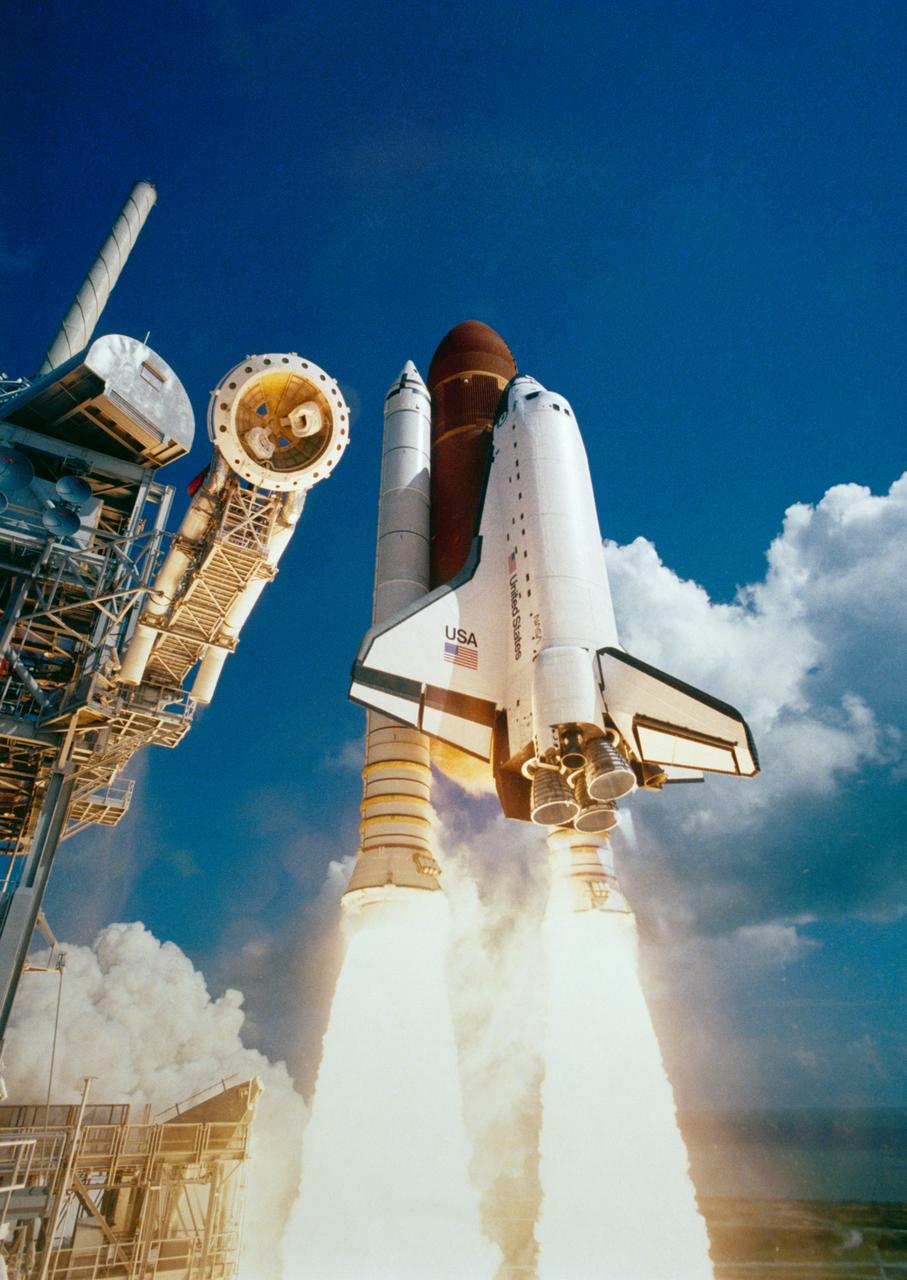
S85-44776 (3 Oct 1985) --- Space Shuttle Atlantis soars toward Florida blue skies to mark the maiden mission of NASA's fourth and newest orbiter vehicle. Launch occurred at 11:15 a.m. (EDT), October 3, 1985. A five member crew mans the orbiter for the DOD flight. They are Karol J. Bobko, Ronald J. Grabe, Robert L. Stewart, David C. Hilmers-- all of NASA-- and William A. Pailes of the USAF.
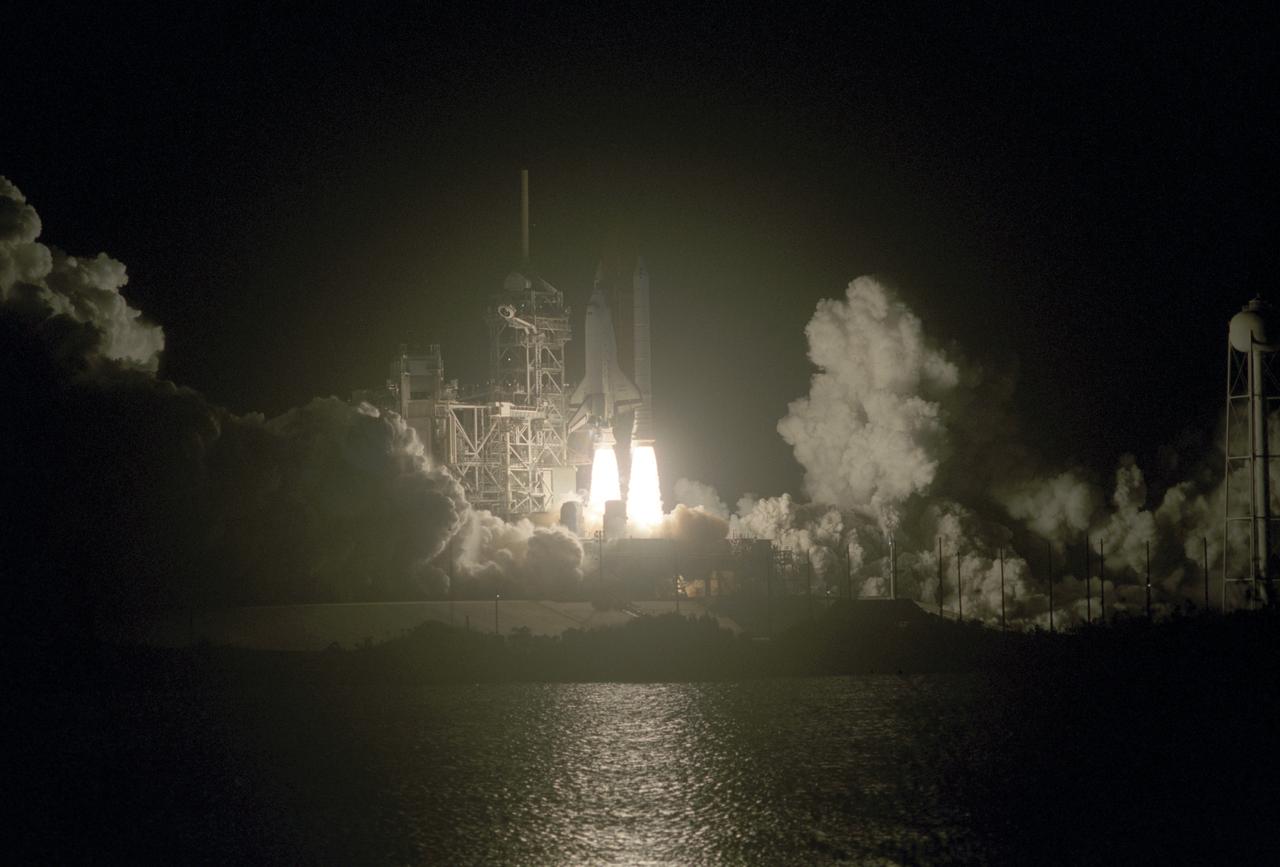
The STS-36 mission launch aboard the Space Shuttle Orbiter Atlantis on February 28, 1990 at 2:50:22am (EST). The crew featured five astronauts who served in the 6th Department of Defense (DOD) mission: John H. Creighton, commander; John H. Caster, pilot; and mission specialists Pierre J. Thuot, Richard M. (Mike) Mullane, and David. C. Hilmers.

S85-41802 (7 Sept 1985) --- Wheels of the Space Shuttle Atlantis touch down on the dry lakebed at Edwards Air Force Base to mark successful completion of the STS 51-J mission. Crewmembers onboard for the flight were Astronauts Karol J. Bobko, Ronald J. Grabe, David C. Hilmers, and Robert L. Stewart; and USAF Maj. William A. Pailes.
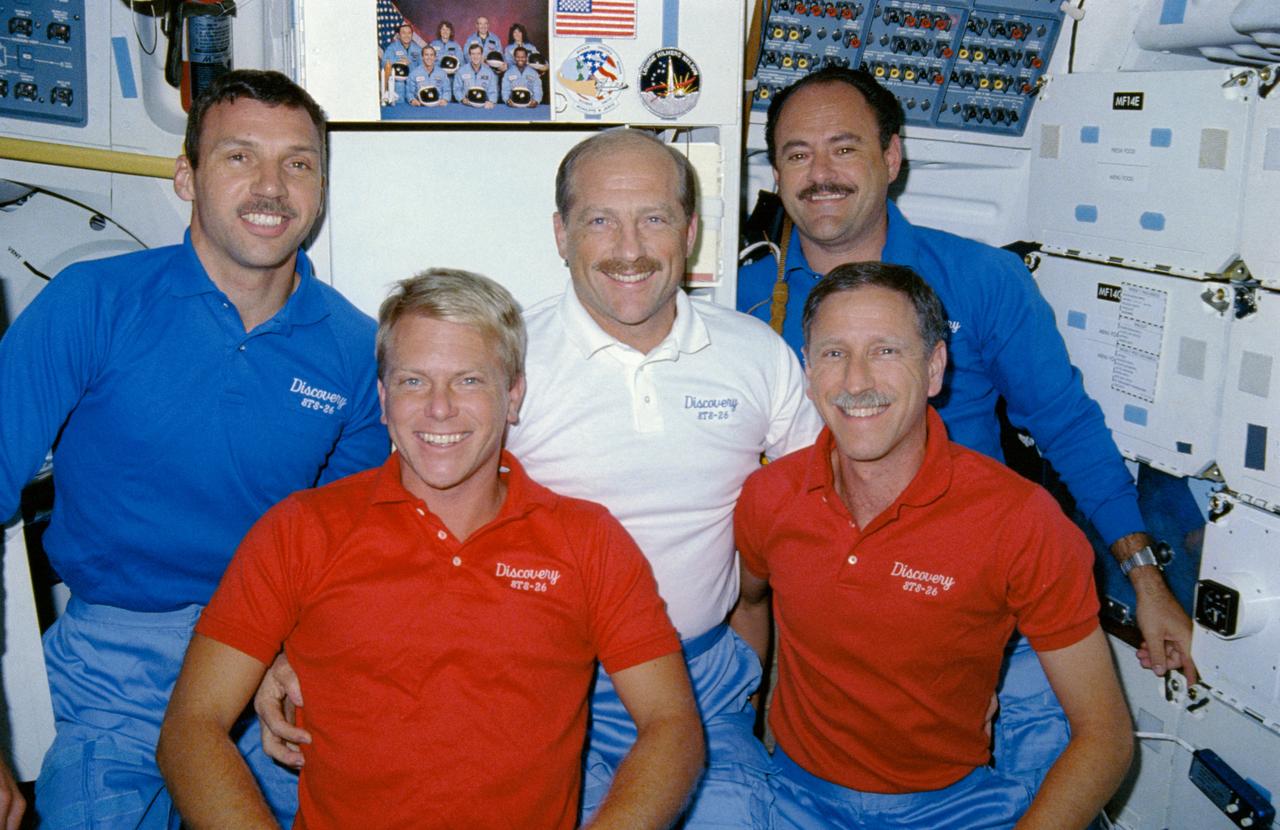
STS026-08-007 (29 Sept-3 Oct 1988) --- An in-space crew portrait on the middeck of Discovery. Left to right are Astronauts David C. Hilmers, George D. Nelson, Frederick H. (Rick) Hauck, John M. (Mike) Lounge and Richard O. Covey (front). The crew portrait for STS 51-L, its flight insignia and the STS 26 flight insignia are at top edge of the frame. This photo was shown by the STS 26 astronaut crew during its Oct. 11, l988 post-flight press conference.
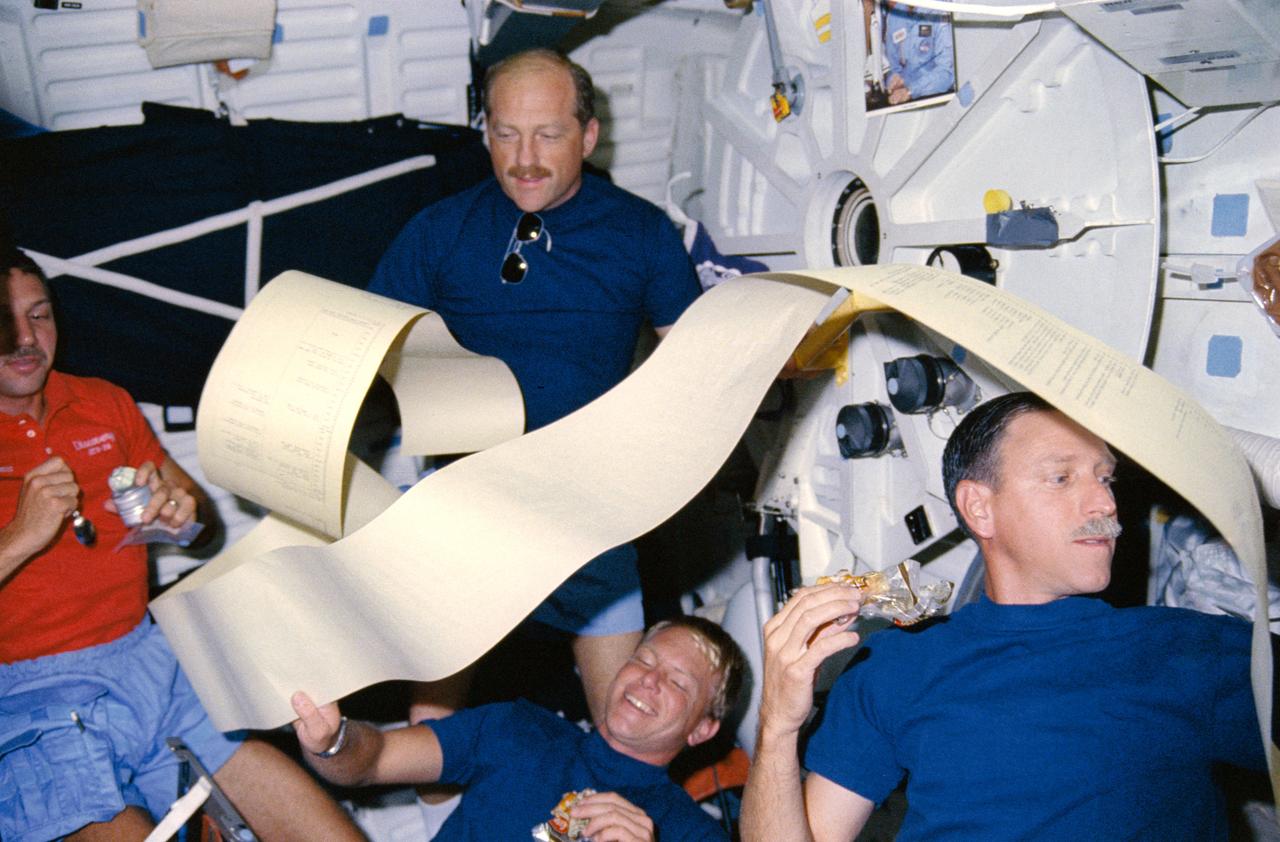
STS026-03-019 (3 Oct 1988) --- STS-26 Commander Frederick H. Hauck (center) reviews lengthy text and graphics system (TAGS) printout as it drifts across the middeck while his fellow crewmembers (left to right) Mission Specialist (MS) David C. Hilmers, MS George D. Nelson, and Pilot Richard O. Covey eat various snack items. The open airlock hatch and the sleep restraints on the starboard wall are visible in the background.
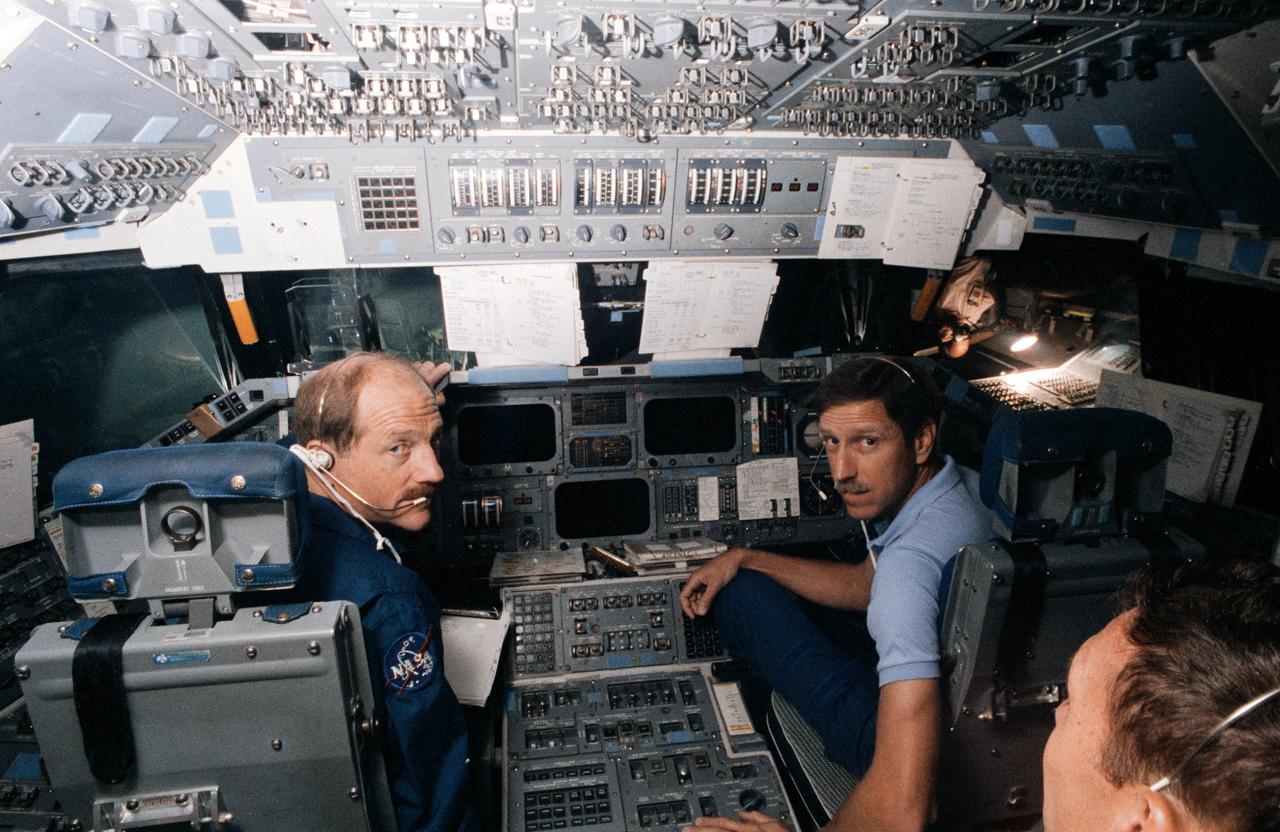
S87-46304 (20 Oct 1987) --- Astronauts Frederick H. (Rick) Hauck, left, STS-26 commander, and Richard O. Covey, pilot, man their respective stations in the Shuttle mission simulator (fixed base) at the Johnson Space Center. A simulation for their anticipated June 1988 flight aboard the space shuttle Discovery began Oct. 20. Astronaut David C. Hilmers, one of three mission specialists for the flight, is partially visible in the foreground.
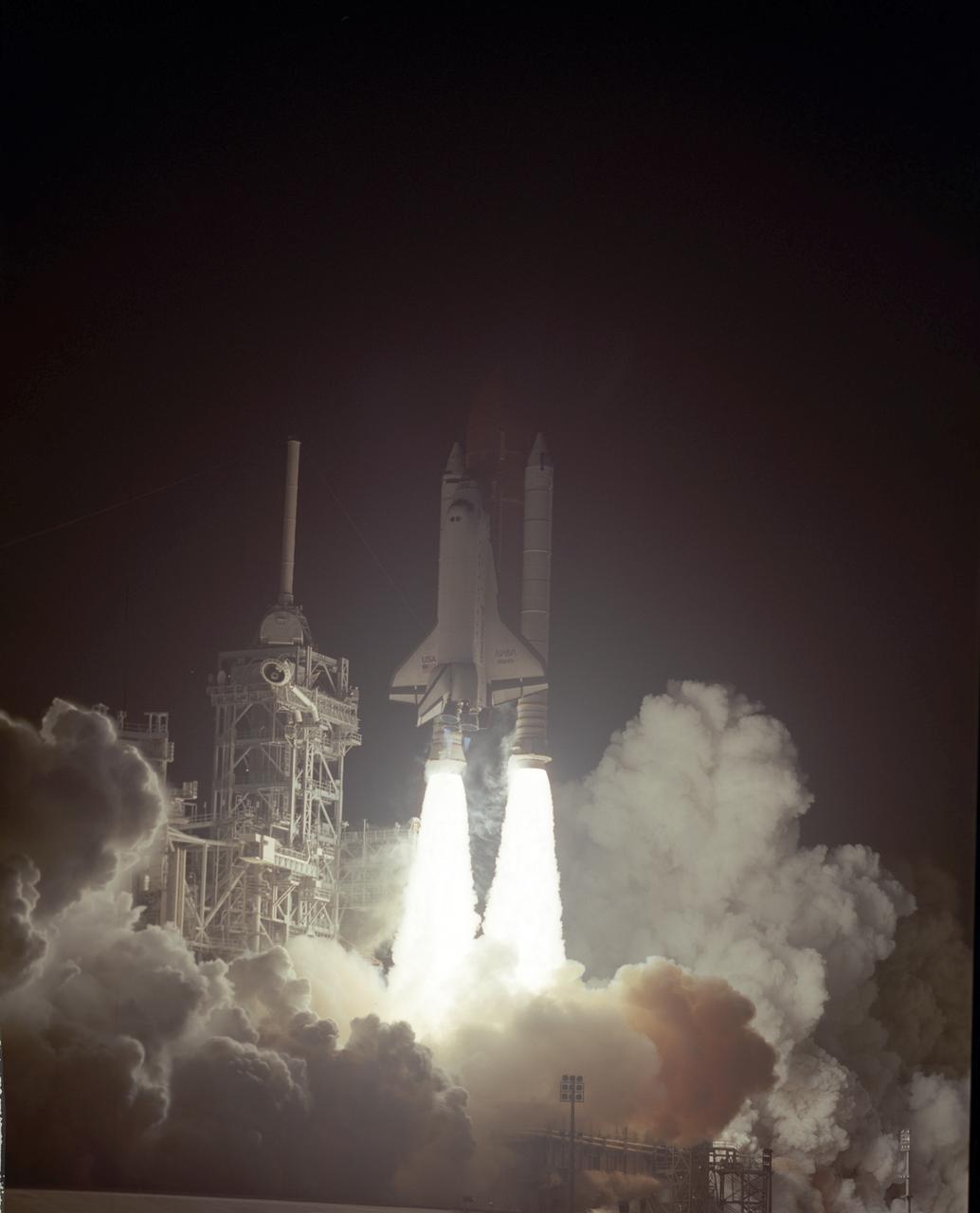
The STS-36 mission launch aboard the Space Shuttle Orbiter Atlantis on February 28, 1990 at 2:50:22am (EST). The crew featured five astronauts who served in the 6th Department of Defense (DOD) mission: John H. Creighton, commander; John H. Caster, pilot; and mission specialists Pierre J. Thuot, Richard M. (Mike) Mullane, and David. C. Hilmers.

51J-S-001 (3 Oct 1985) --- This 35mm frame was taken moments after the Space Shuttle Atlantis cleared the launch tower to begin its first mission in space. Onboard, ready to carry out STS-51J mission were astronauts Karol J. Bobko, commander; Ronald J. Grabe, pilot; Robert L. Stewart and David C. Hilmers, mission specialist; and United States Air Force Major William A. Pailes, payload specialist.
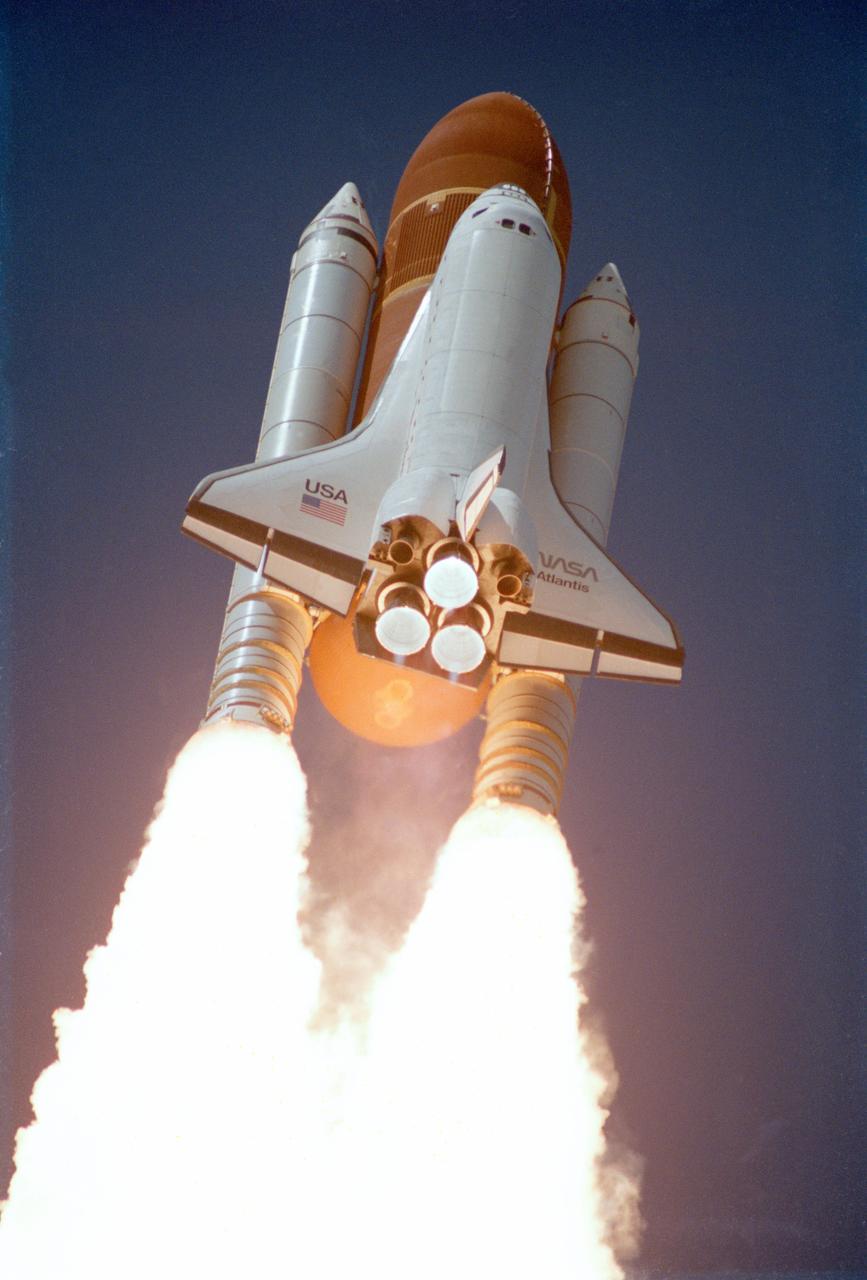
51J-S-003 (3 Oct 1985) --- This 35mm frame was taken moments after the Space Shuttle Atlantis cleared the launch tower to begin its first mission in space. Onboard, ready to carry out STS-51J mission were astronauts Karol J. Bobko, commander; Ronald J. Grabe, pilot; Robert L. Stewart and David C. Hilmers, mission specialist; and U.S.A.F. Major William A. Pailes, payload specialist.
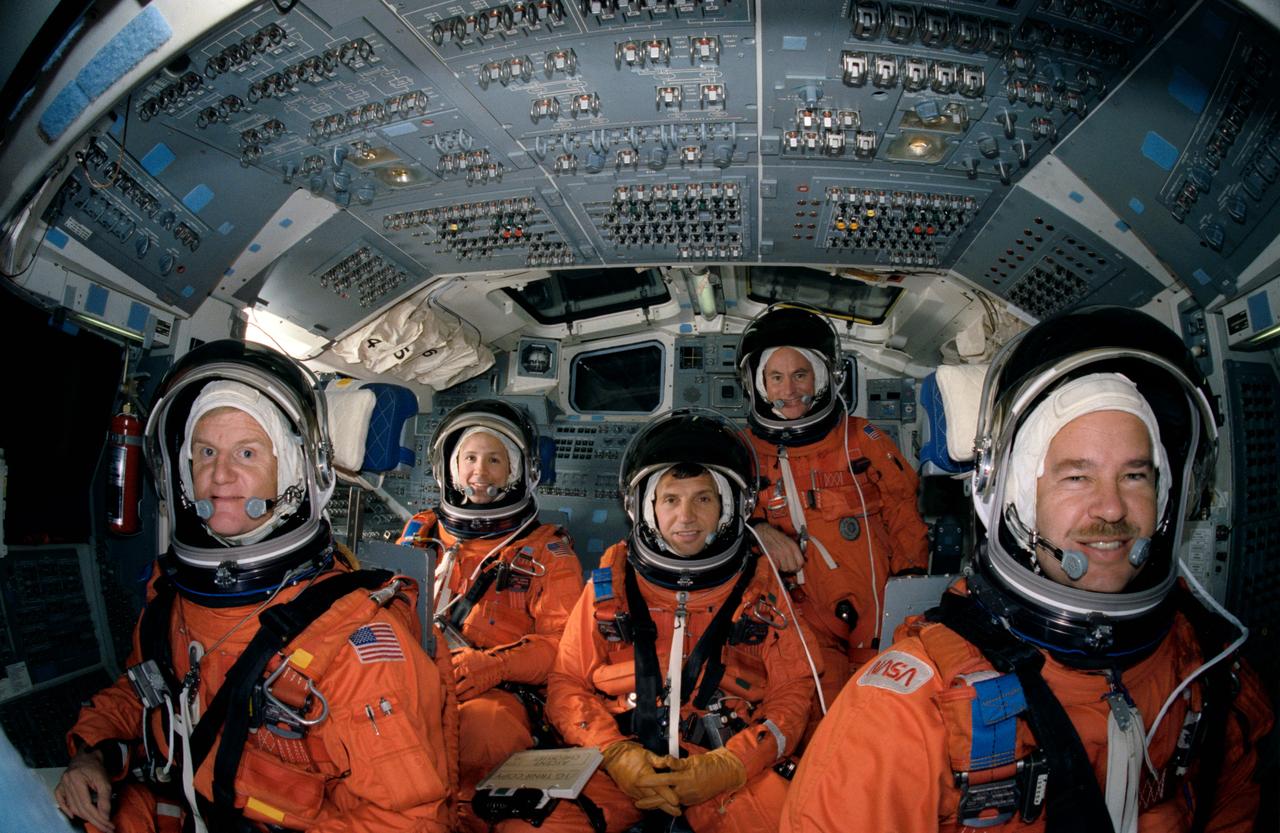
S89-51626 (18 Dec 1989) --- The astronaut crewmembers of the STS-36 mission occupy the flight deck of the crew compartment trainer in the Johnson Space Center's Space Shuttle mockup and integration laboratory. They are, left to right, Astronauts John H. Casper, pilot; Pierre J. Thuot, David C. Hilmers and Richard M. (Mike) Mullane, mission specialists; and John O. Creighton, mission commander. Mullane will be stationed on the mid deck for launch, while Thuot will man that position during entry. The photograph was made by William H. Bowers, crew photo instructor.
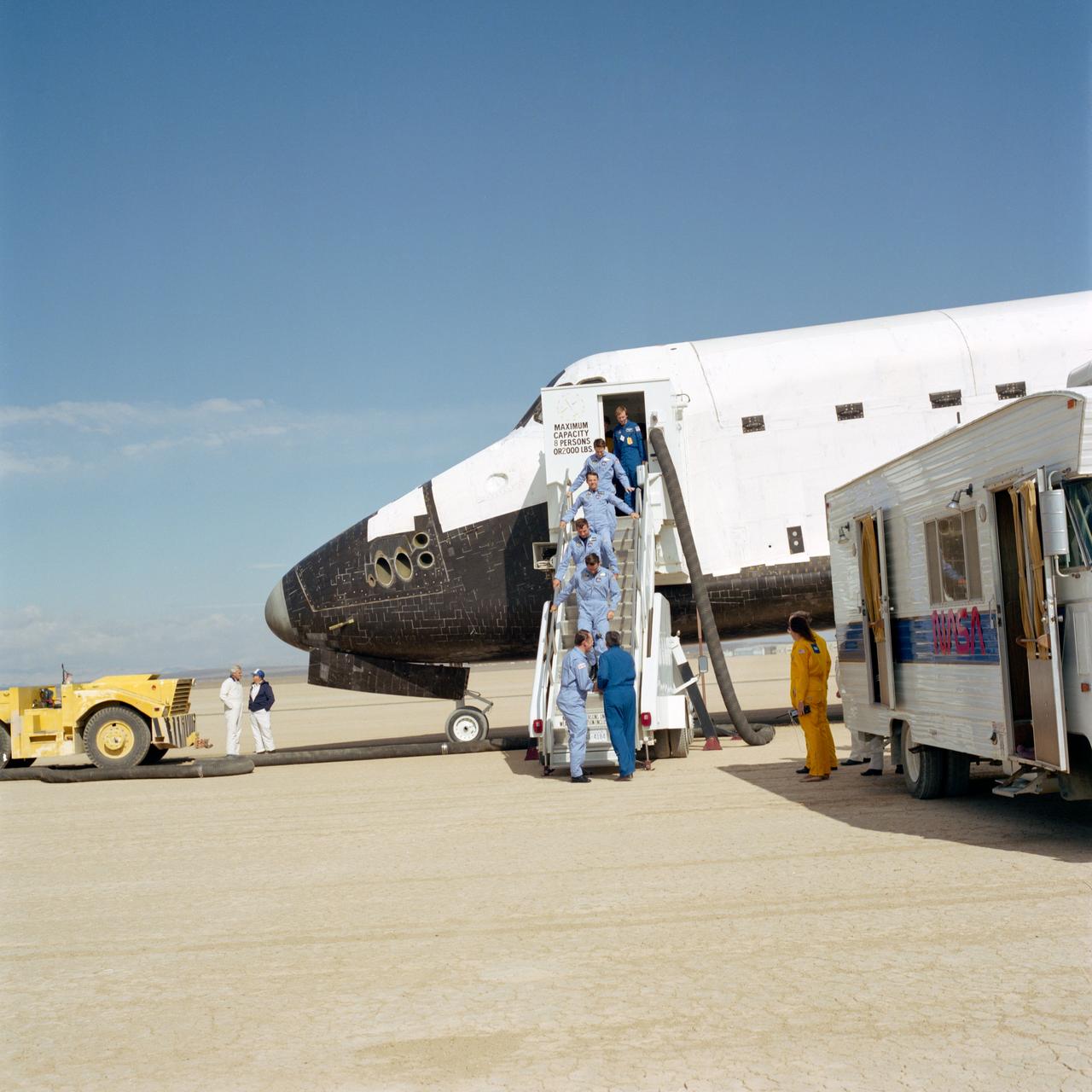
S85-41803 (7 Sept 1985) --- George W.S. Abbey, bottom right, greets the five members of the STS 51-J crew as they egress the Atlantis following the successful completion of a mission in Earth orbit. Astronaut Karol J. Bobko, who led the five down the steps, shakes hands with the JSC director of flight crew operations. He is followed (bottom to top) By Astronauts Ronald J. Grabe, pilot; David C. Hilmers and Robert L. Stewart, both mission specialists; and USAF Maj. William A. Pailes, payload specialist.
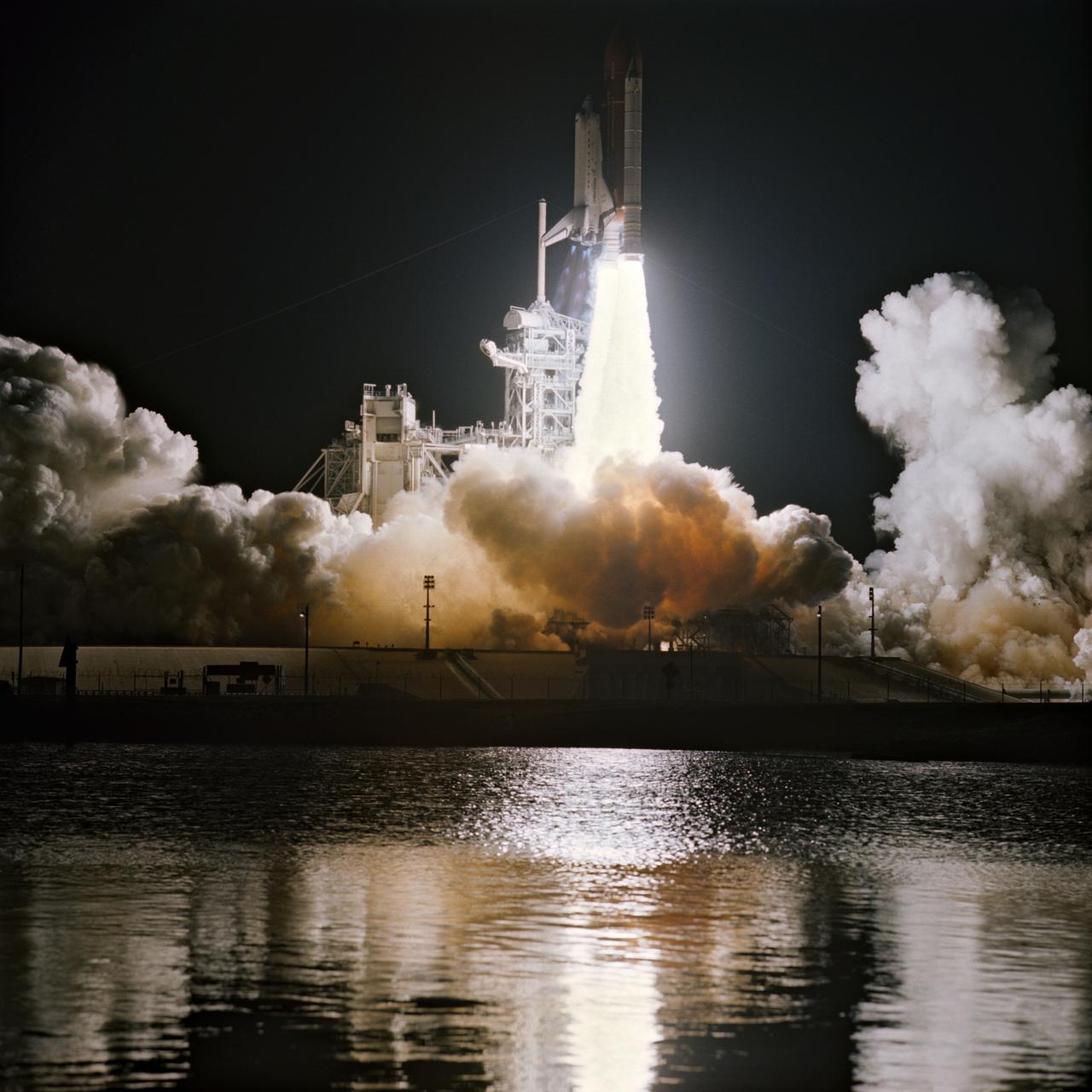
STS036-S-006 (28 Feb 1990) --- The Space Shuttle Atlantis sets off a spectacular light display with the launching of STS-36. Liftoff from KSC's Pad 39A occurred at 2:50 a.m. (EST), February 28, 1990. The launch, actually the 34th STS liftoff, begins another in a series of Department of Defense flights. Onboard the spacecraft are Astronauts John O. Creighton, commander; John H. Casper, pilot; and Richard M. (Mike) Mullane, David C. Hilmers and Pierre J. Thuot, all mission specialists.
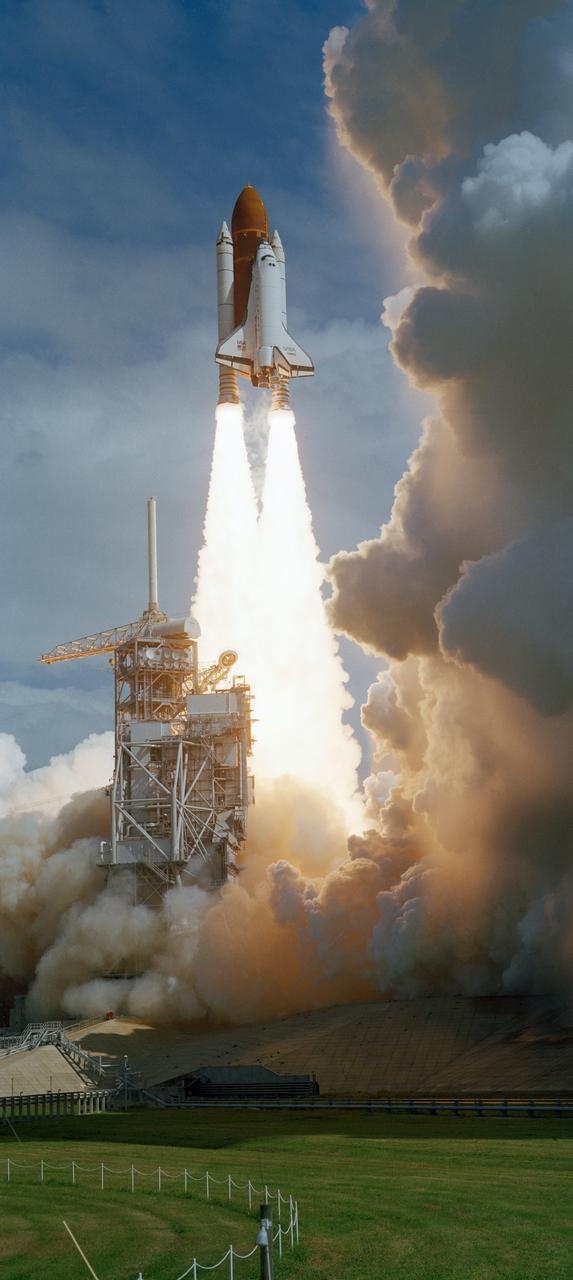
S26-S-032 (29 Sept. 1988) --- The STS-26 launch of space shuttle Discovery begins the first flight to be flown after the Challenger accident. The flight crew included astronauts Rick Hauck, commander; Dick Covey, pilot; and three mission specialists, Dave Hilmers, Mike Lounge, and George (Pinky) Nelson. During the four-day mission, the crew deployed the Tracking and Data Relay Satellite (TDRS-C) and operated eleven mid-deck experiments. Discovery completed 64 orbits of the earth before landing at Edwards Air Force Base, California, on October 3, 1988. Photo credit: NASA or National Aeronautics and Space Administration

STS036-21-032 (3 March 1990) --- The five astronaut crewmembers for STS-36 pose for an inflight group portrait on the forward flight deck of Atlantis, Orbiter Vehicle (OV) 104. They are (left to right) Commander John O. Creighton, Mission Specialist (MS) David C. Hilmers, MS Richard M. Mullane, MS Pierre J. Thuot, and Pilot John H. Casper. Creighton is positioned in the commanders seat and Casper in the pilot?s seat. Overhead control panels appear above the astronauts. The astronauts spent four days, 10 hours and 19 minutes aboard OV-104 for the Department of Defense (DOD) dedicated mission.
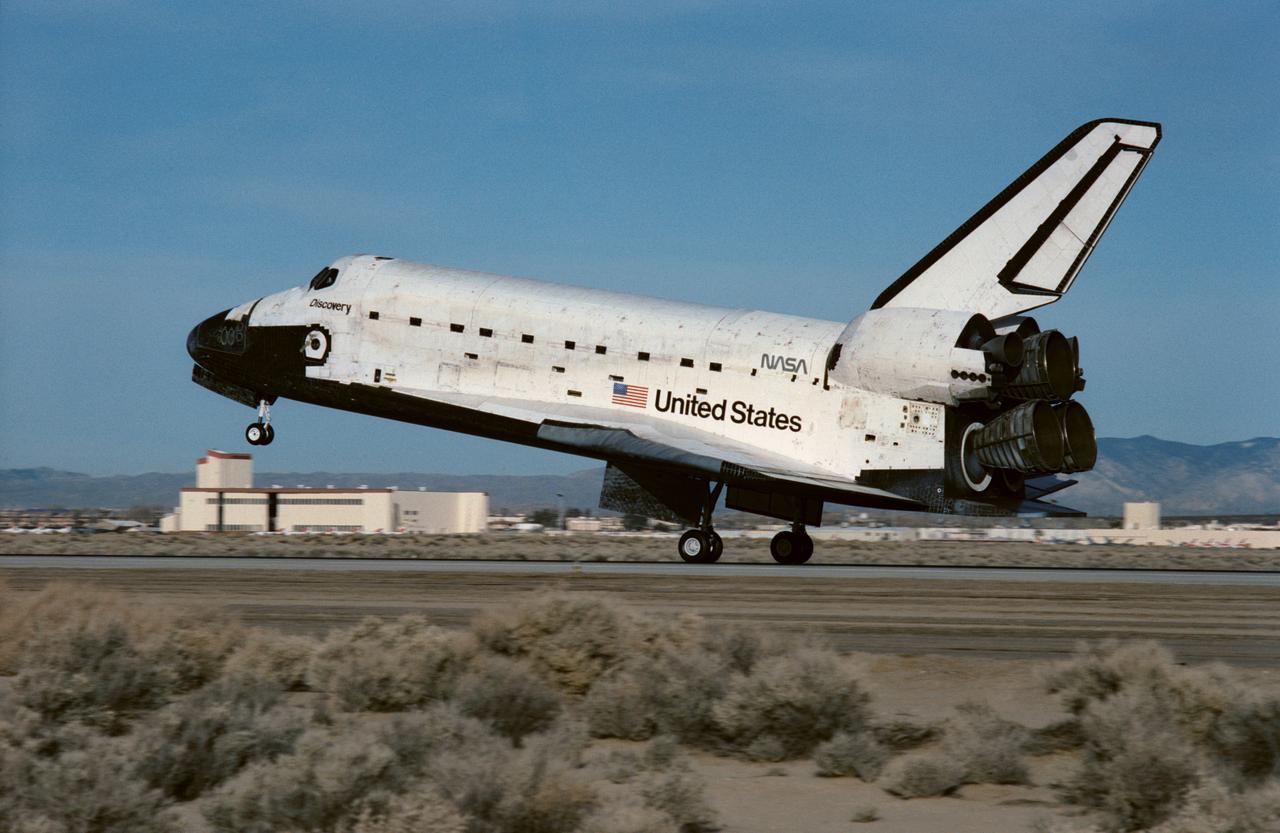
STS042-S-094 (30 Jan 1992) --- Space Shuttle Discovery lands on Runway 22 at Edwards Air Force Base in southern California to complete an eight-day mission. Main gear touchdown occurred at 8:07:18 a.m. (PST), Jan. 30, 1992. The crewmembers aboard Discovery for the first International Microgravity Laboratory (IML-1) mission were astronauts Ronald J. Grabe, mission commander; Stephen S. Oswald, pilot; Norman E. Thagard, payload commander; and David C. Hilmers and William F. Readdy, both mission specialists; and payload specialists Roberta L. Bondar of Canada and Ulf Merbold, representing the European Space Agency (ESA).
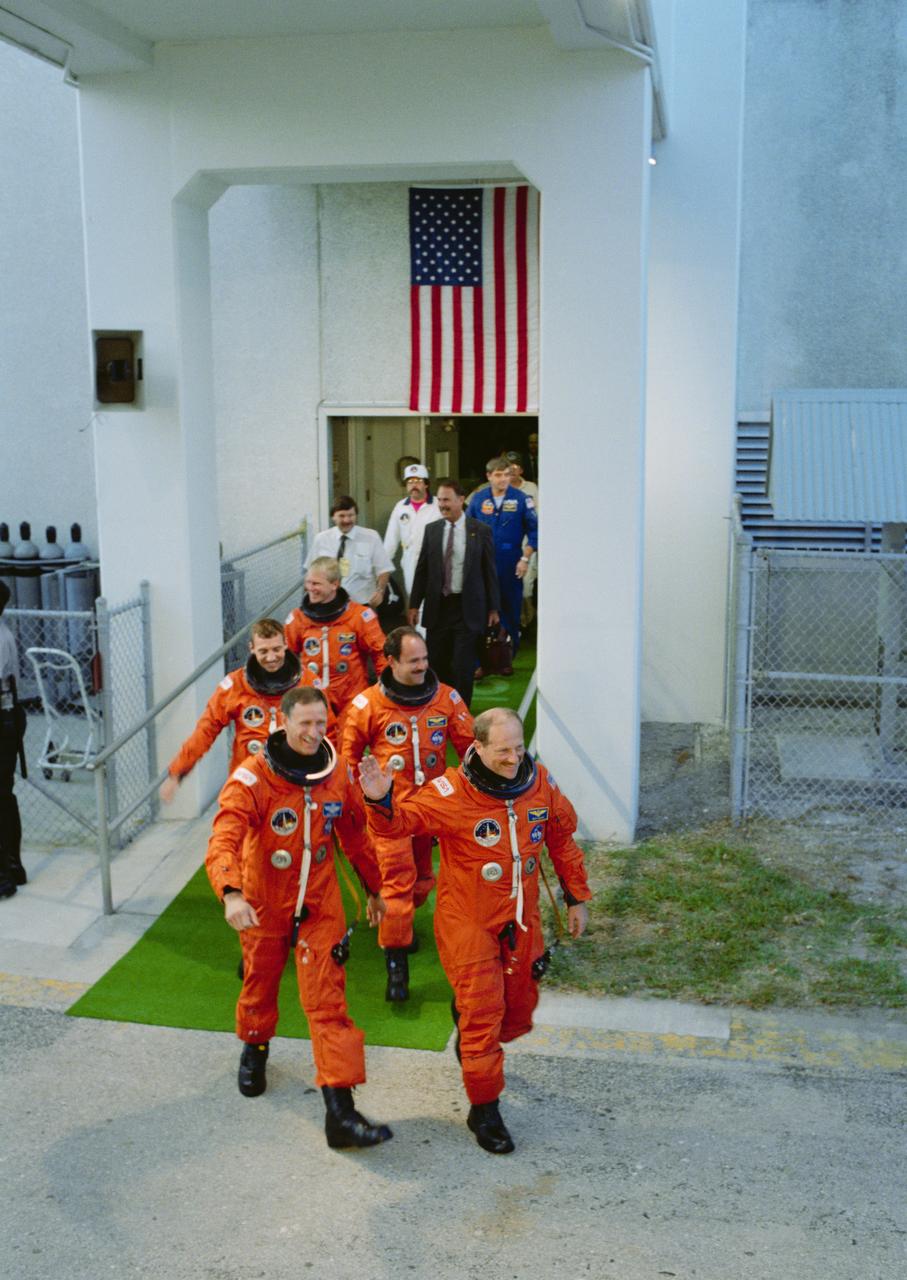
STS-26 crewmembers, suited in launch and entry suits (LESs), leave the Kennedy Space Center (KSC) Operations and Checkout (O&C) Building on their way to the launch complex (LC) pad 39B where they will board Discovery, Orbiter Vehicle (OV) 103. Commander Frederick H. Hauck, waving to spectators, is followed by Pilot Richard O. Covey, Mission Specialist (MS) John M. Lounge, MS David C. Hilmers, and MS George D. Nelson. Others accompanying the crew are JSC Flight Crew Operations Directorate (FCOD) Director Donald R. Puddy, Astronaut Office Chief Daniel C. Brandenstein, and a Crew Training Officer Richard W. Nygren.
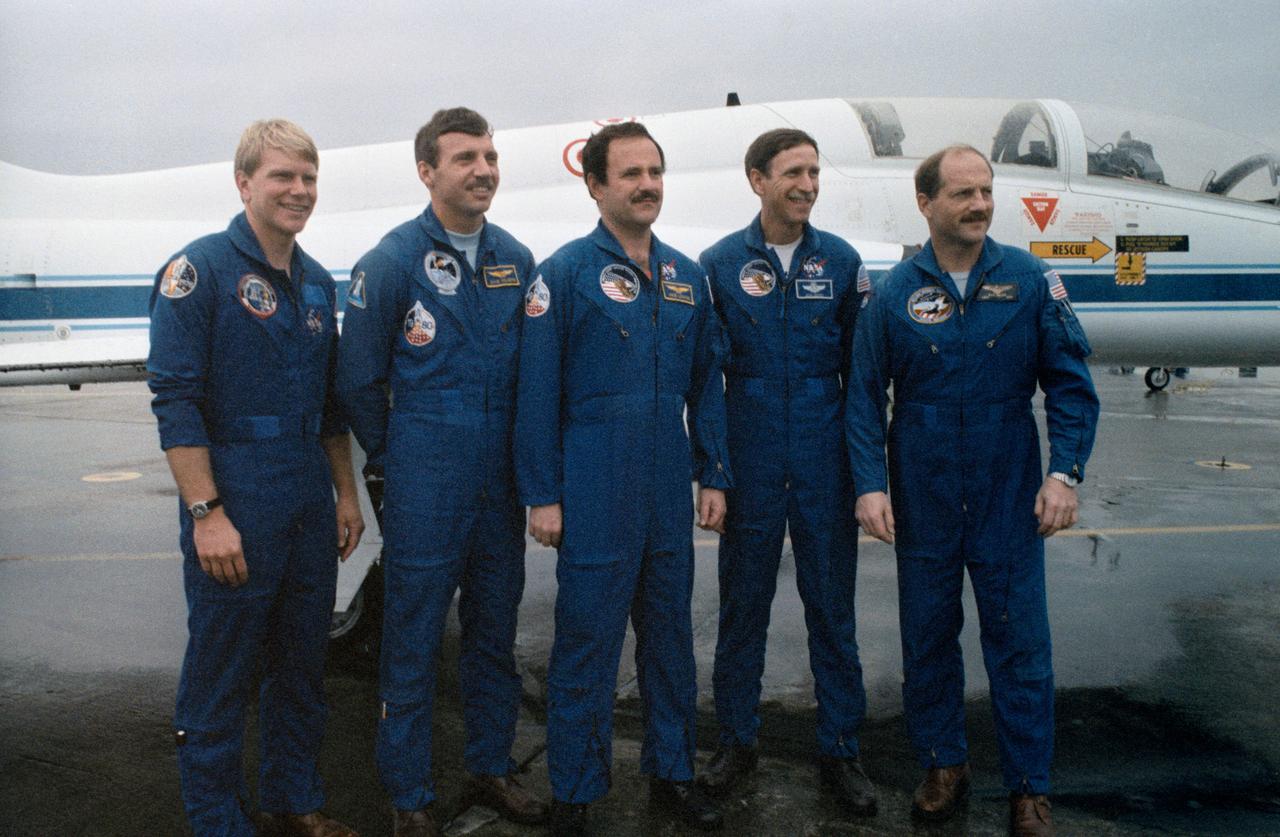
S87-28139 (26 Feb 1987) --- The five veteran astronauts recently assigned to the STS 26 space mission pose for photographers prior to departure from Ellington Field in T-38 jets (parked in background). Astronaut Frederick H. (Rick) Hauck (right) is mission commander. Astronaut Richard O. Covey, second right, is pilot; and (l.-r.) Astronauts George D. Nelson, David C. Hilmers and John M. (Mike) Lounge are mission specialists. The five were headed for KSC in Florida where they were to interface with flight hardware. The Discovery has been assigned as the STS 26 Shuttle vehicle.
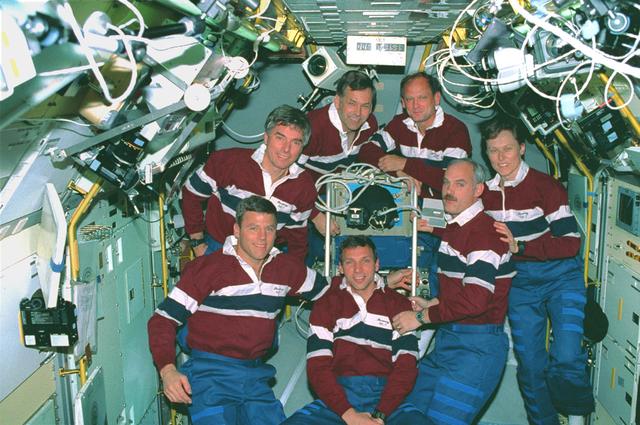
Onboard Space Shuttle Discovery (STS-42) the seven crewmembers pose for a traditional in-space portrait in the shirt-sleeve environment of the International Microgravity Laboratory (IML-1) science module in the Shuttle's cargo bay. Pictured are (clockwise from top),Commander Ronald J. Grabe, payload commander Norman E. Thagard, payload specialist Roberta L. Bondar; mission specialists William F. Readdy and David C. Hilmers; pilot Stephen S. Oswald and payload specialist Ulf Merbold. The rotating chair, used often in biomedical tests on the eight-day flight, is in center frame.
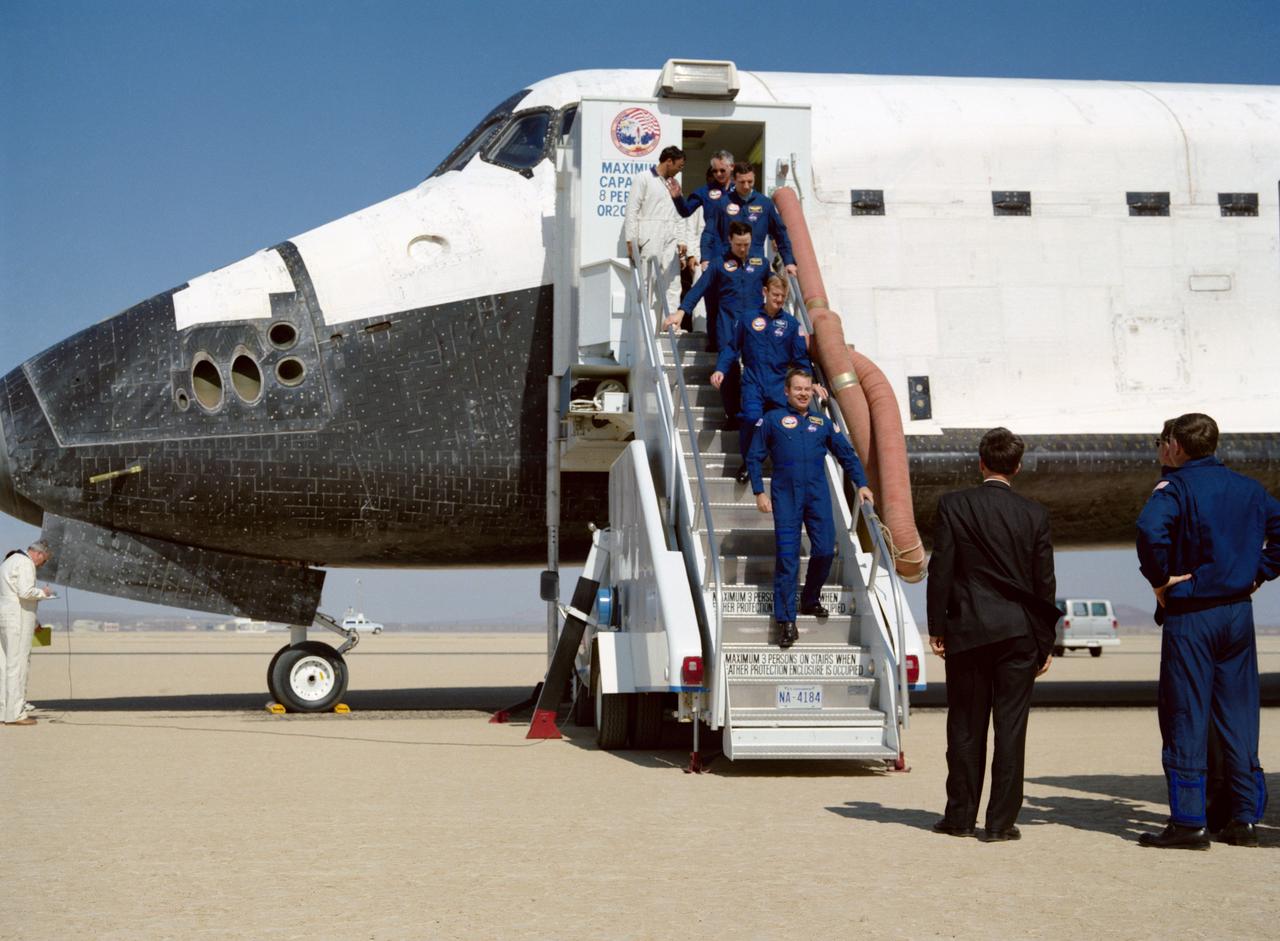
STS-36 crewmembers egress Atlantis, Orbiter Vehicle (OV) 104, via mobile stairway following touchdown on Runway 23 drylake bed at Edwards Air Force Base (EAFB), California. Commander John O. Creighton, leading crewmembers down the stairway, is followed by Pilot John H. Casper, Mission Specialist (MS) Pierre J. Thuot, MS David C. Hilmers, and MS Richard M. Mullane. On the runway, Acting NASA Associate Administrator for Space Flight Dr. William B. Lenoir, JSC Flight Crew Operations Directorate Director Donald R. Puddy, and JSC Astronaut Office Acting Chief Michael L. Coats wait to greet crewmembers.
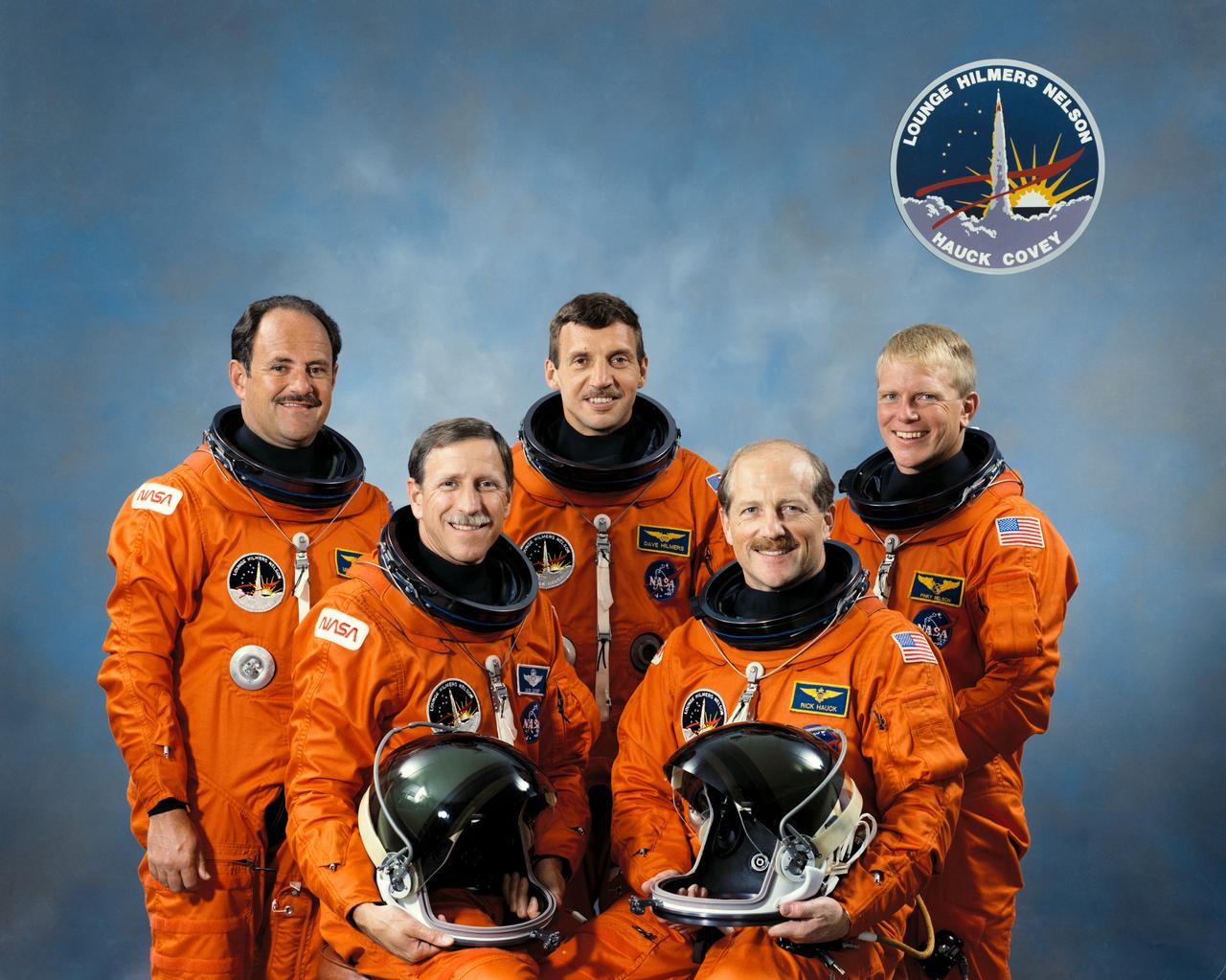
S88-47522 (10 Sept 1988) --- These five veteran astronauts have been training for over a year to serve as NASA's crew aboard the Space Shuttle Discovery for STS-26. On the front row are Astronauts Frederick H. (Rick) Hauck (right), commander; and Richard O. Covey, pilot. On the back row are Astronauts John M. (Mike) Lounge, David C. Hilmers and George D. Nelson -- all mission specialists. The crewmembers are wearing the orange partial pressure garments that they will be wearing on the launch and entry phases of the flight, scheduled for launch later this month.
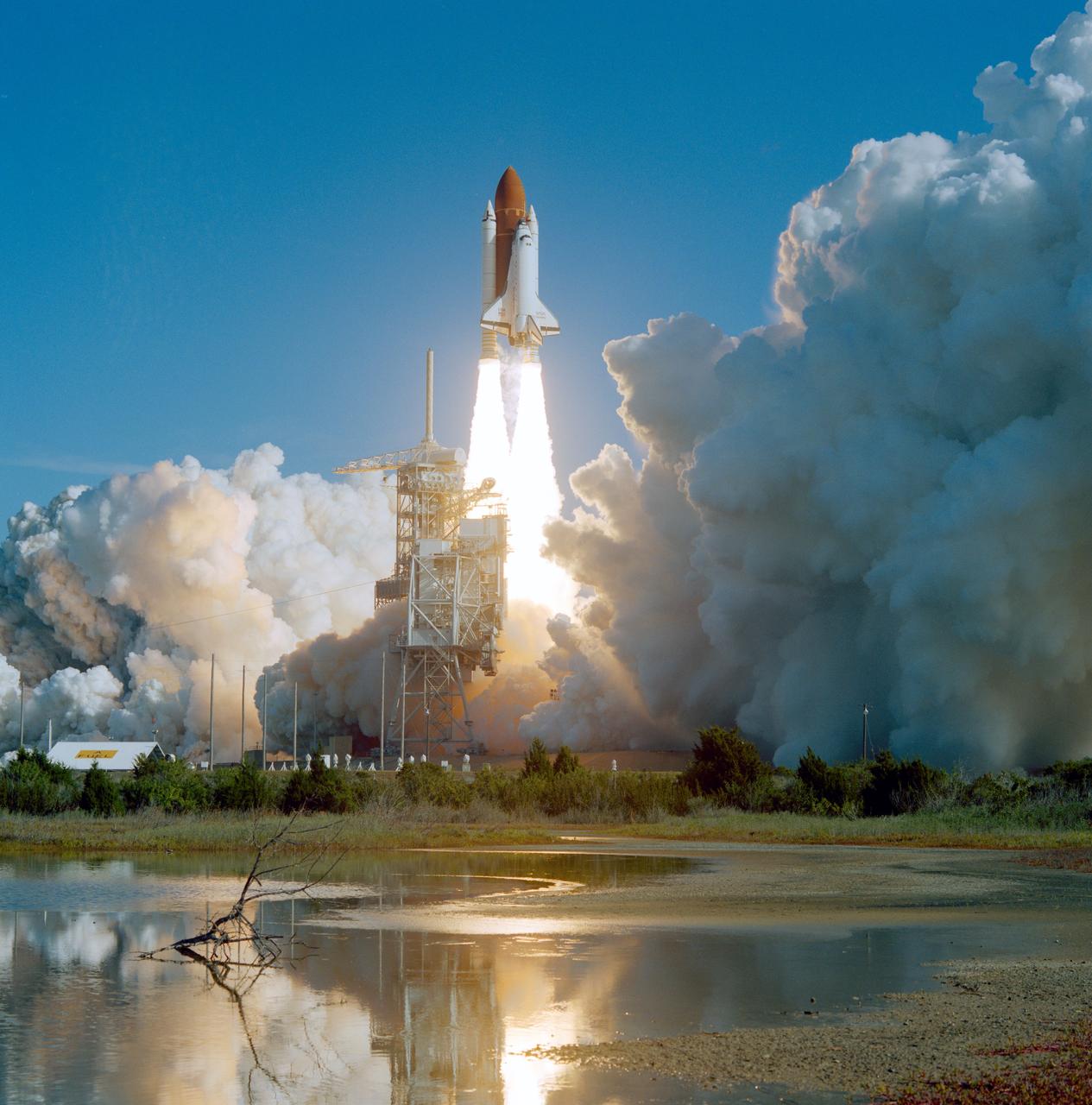
STS042-S-064 (22 Jan 1992) --- A horizontal image of liftoff of STS-42, with a crew of seven and the International Microgravity Laboratory (IML-1) onboard. Crewmembers are astronauts Ronald J. Grabe, mission commander; Stephen S. Oswald, pilot; Norman E. Thagard, payload commander; David C. Hilmers and William F. Readdy, both mission specialists; and payload specialists Roberta L. Bondar of Canada and Ulf Merbold, representing the European Space Agency (ESA). Liftoff occurred at 9:52:33 a.m. (EST), Jan. 22, 1992.
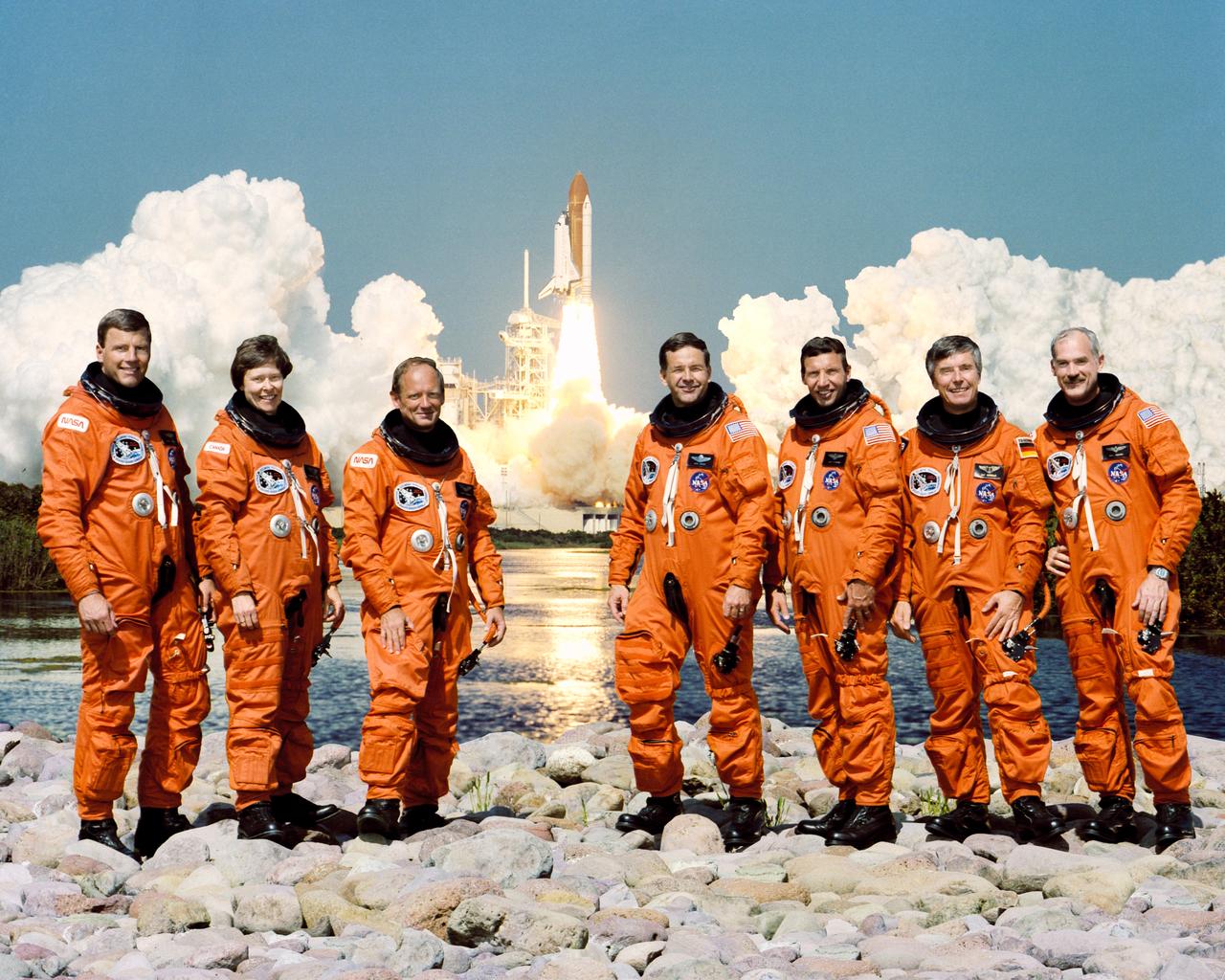
STS042-S-002 (November 1991) --- Payload specialists representing Canada and the European Space Agency (CSA - ESA) join five NASA astronauts for the January 1992 scheduled STS-42 mission. Left to right are astronauts Stephen S. Oswald, pilot; Roberta L. Bondar, payload specialist; Norman E. Thagard, payload commander; Ronald J. Grabe, mission commander; David C. Hilmers, mission specialist; Ulf Merbold, payload specialist; and William F. Readdy, mission specialist. The STS-42 mission will utilize the Space Shuttle Discovery to carry out experiments for the International Microgravity Laboratory (IML-1).
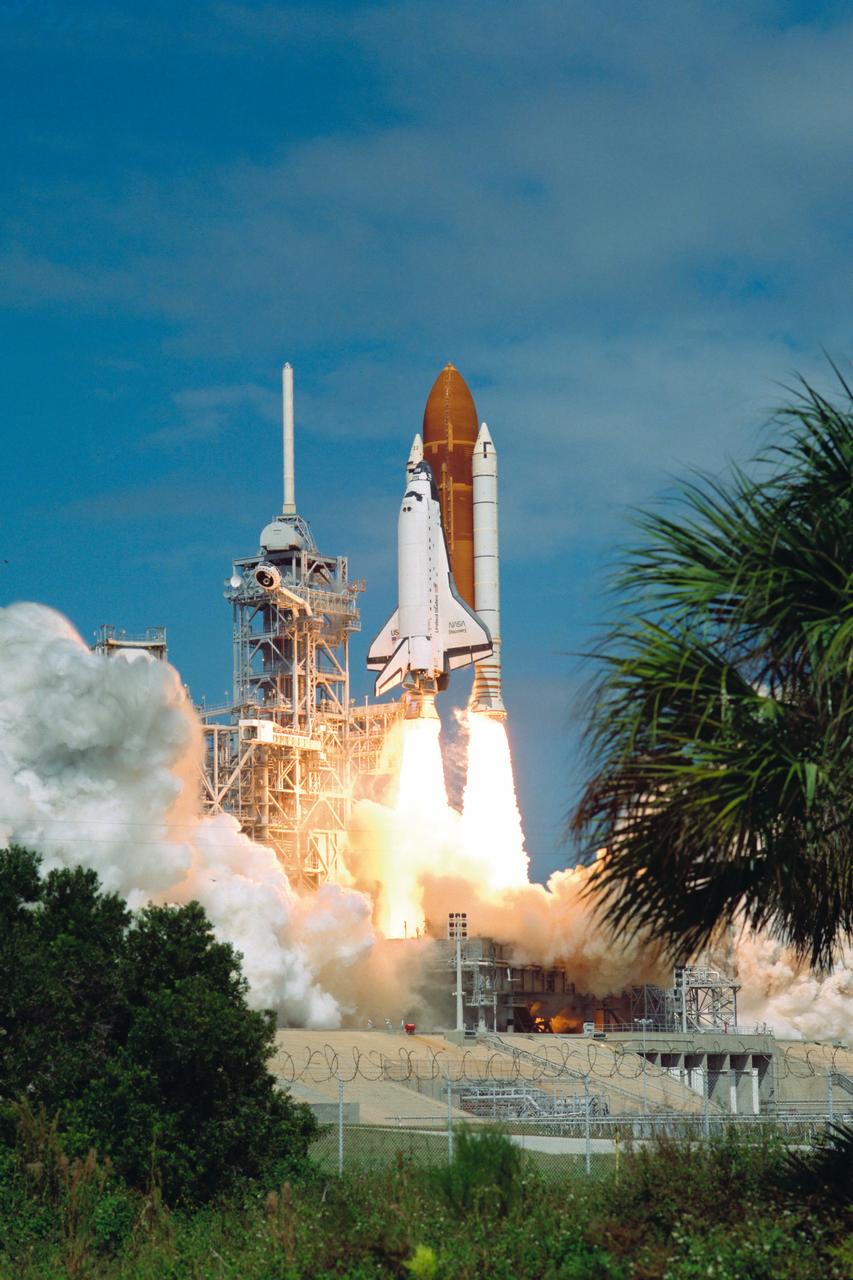
S26-S-187 (29 Sept. 1988) --- The STS-26 launch of space shuttle Discovery begins the first flight to be flown after the Challenger accident. The flight crew included astronauts Rick Hauck, commander; Dick Covey, pilot; and three mission specialists, Dave Hilmers, Mike Lounge, and George (Pinky) Nelson. During the four-day mission, the crew deployed the Tracking and Data Relay Satellite (TDRS-C) and operated eleven mid-deck experiments. Discovery completed 64 orbits of the earth before landing at Edwards Air Force Base, California, on October 3, 1988. Photo credit: NASA or National Aeronautics and Space Administration
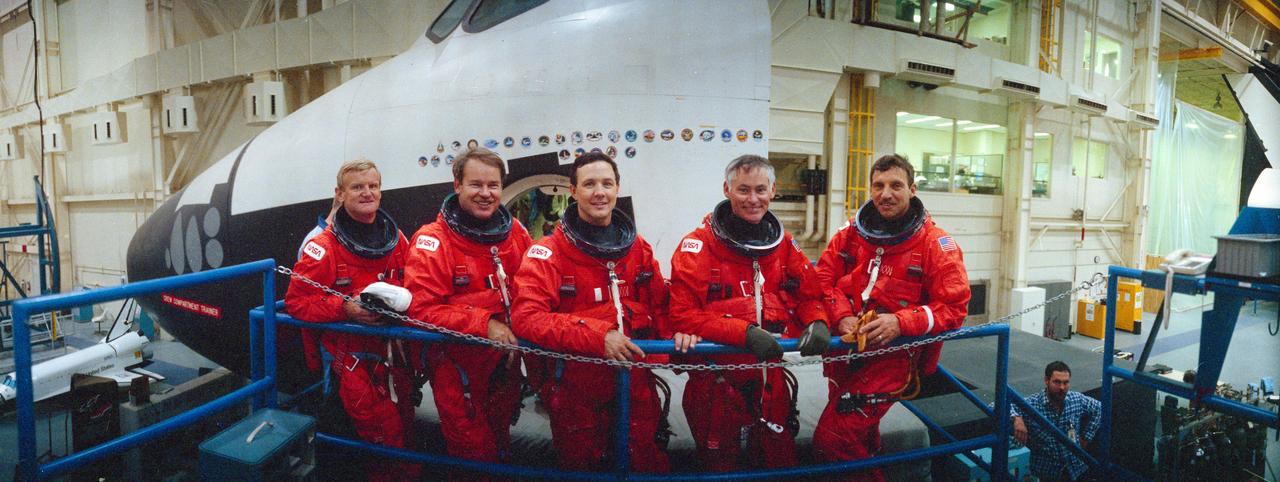
S89-47966 (23 Oct. 1989) --- STS-36 crew members, wearing launch and entry suits, take a break from their emergency egress training to pose for an informal crew portrait in front of the Crew Compartment Trainer (CCT) at the Johnson Space Center. Left to right are Pilot John H. Casper, Commander John O. Creighton, Mission Specialists Pierre J. Thuot, Richard M. Mullane and David C. Hilmers. The crew members were practicing egress procedures necessary in the event of an emergency aboard the space shuttle. The CCT is located in JSC's Space Vehicle Mock-up Facility. Photo credit: NASA
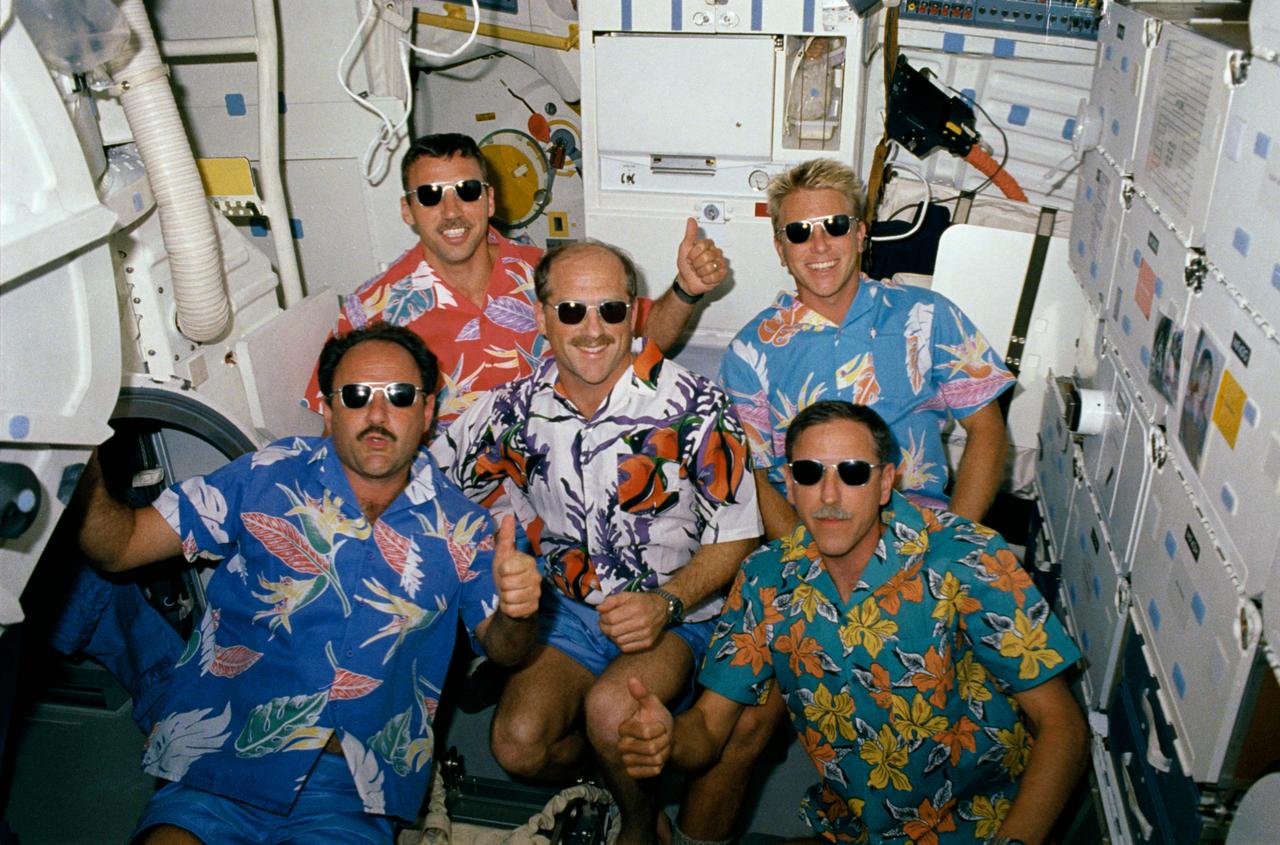
STS026-09-008 (3 Oct 1988) --- STS-26 crewmembers wear Hawaiian attire (brightly colored shirts with bold prints) and sunglasses while giving the "thumbs up" signal as they pay tribute to the Hawaii tracking station during an unscheduled television (TV) downlink. On Discovery's, Orbiter Vehicle (OV) 103's, middeck are (left to right) Mission Specialist (MS) John M. Lounge, holding onto open airlock hatch, MS David C. Hilmers, wearing red shirt, Commander Frederick H. Hauck, wearing white shirt and positioned in center of crew, MS George D. Nelson, and Pilot Richard O. Covey (lower right corner of the frame). The shirts were given to the crewmembers by the Kennedy Space Center (KSC) Loud and Proud Team.
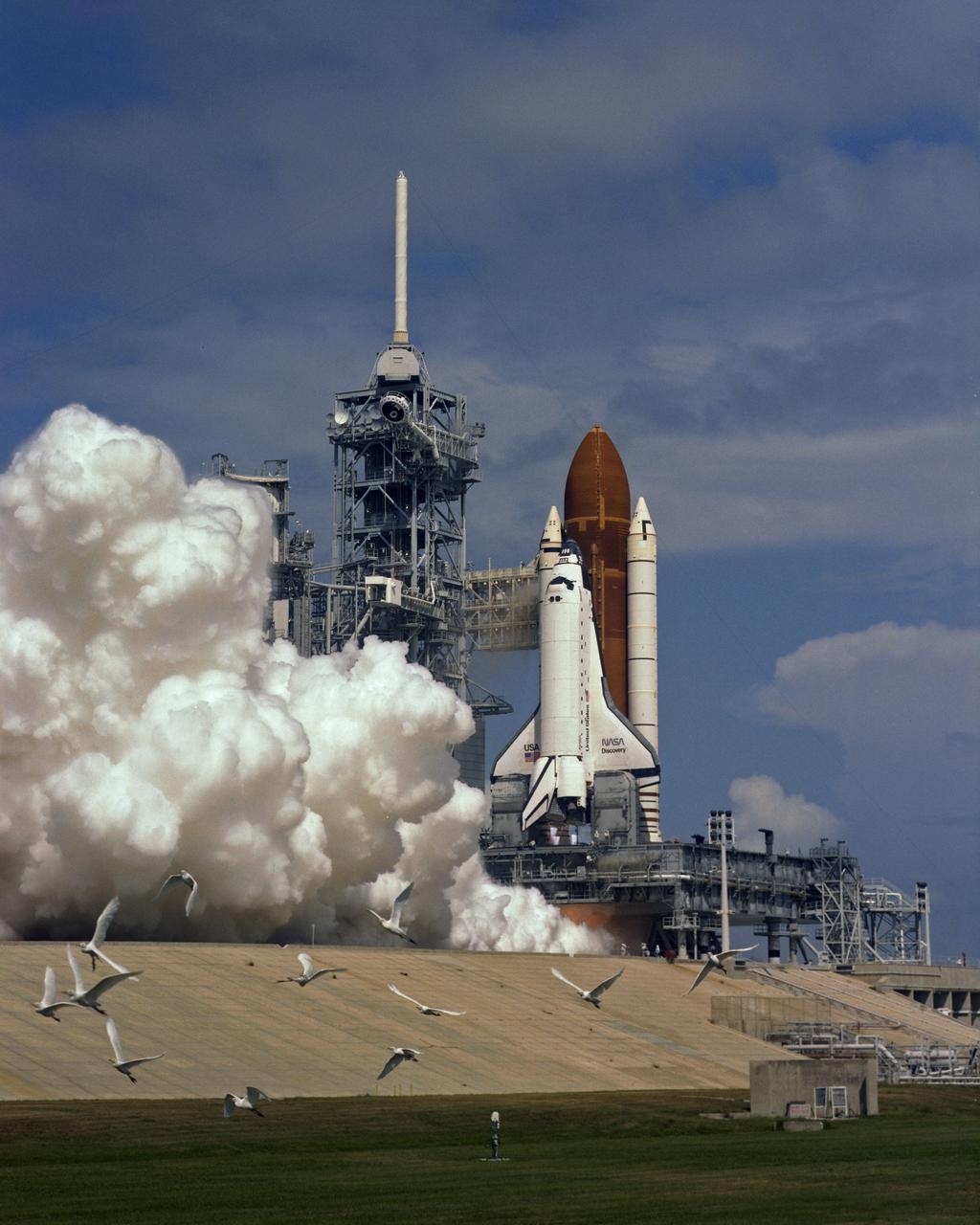
CAPE CANAVERAL, Fla. - The space shuttle Discovery and its five-man crew is launched from pad 39B at 11:37 a.m. as STS-26 embarks on a four-day mission marking America's return to space. On the first day of orbit, the crew will deploy from the orbiter's payload bay the primary payload, the Tracking and Date Relay Satellite, or TDRS-C. The inertial upper stage, or IUS, will boost the satellite to a geosynchronous altitude from low Earth orbit. When it place, TDRS-C will relay date from low Earth orbiting spacecraft and air-to-ground voice communications sand television from shape shuttle orbiters during missions. The crew members of STST-26 are Commander Rick Hauck, Pilot Richard Covey, and Mission Specialists Dave Hilmers, Mike Lounge and George "Pinky" Nelson. Photo Credit: NASA
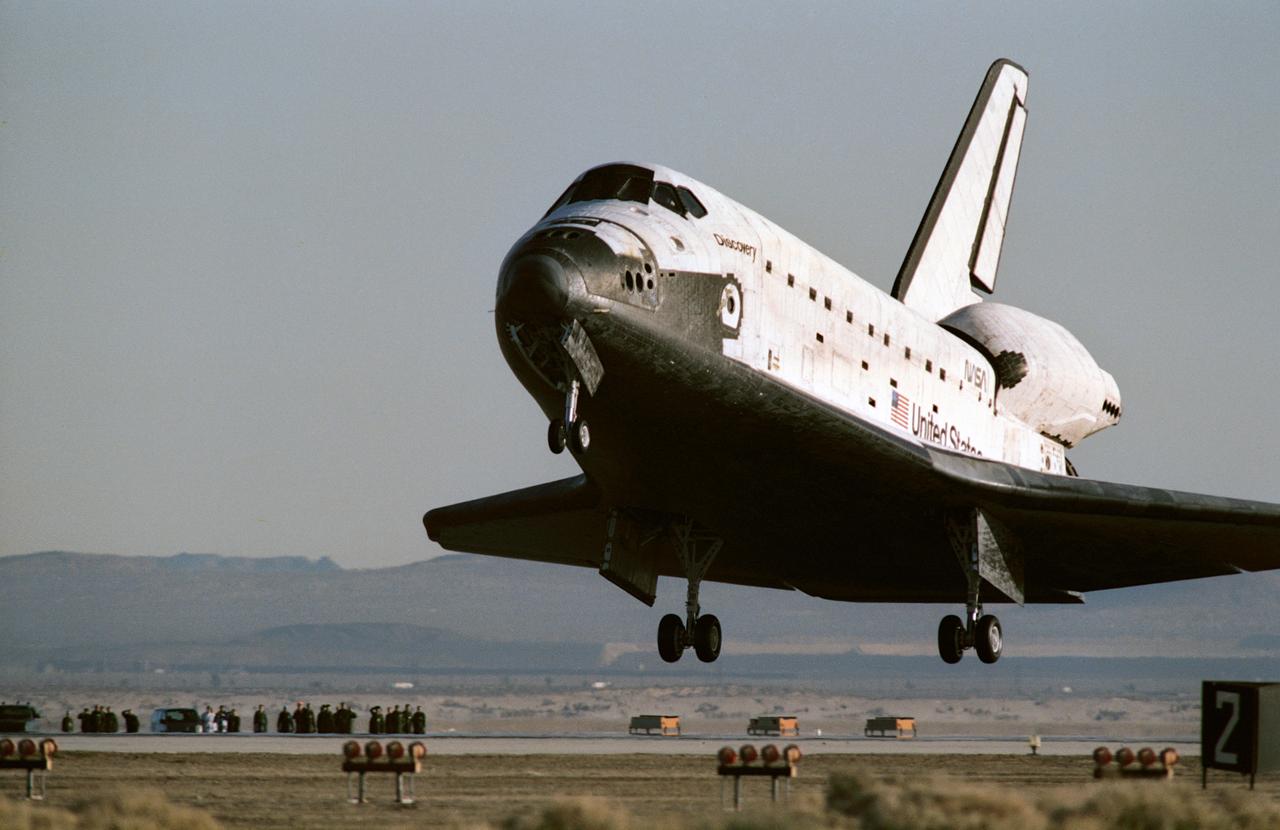
STS042-S-093 (30 Jan 1992) --- Space Shuttle Discovery is just about to ease down its main gear on Runway 22 at Edwards Air Force Base in southern California. Main gear touchdown occurred at 8:07:18 a.m. (PST), Jan. 30, 1992. The successful landing completed an eight-day mission for five NASA astronauts and two payload specialists supporting the first International Microgravity Laboratory (IML-1) mission. Onboard were astronauts Ronald J. Grabe, mission commander; Stephen S. Oswald, pilot; Norman E. Thagard, payload commander; David C. Hilmers and William F. Readdy, both mission specialists; and payload specialists Roberta L. Bondar of Canada and Ulf Merbold, representing the European Space Agency (ESA).
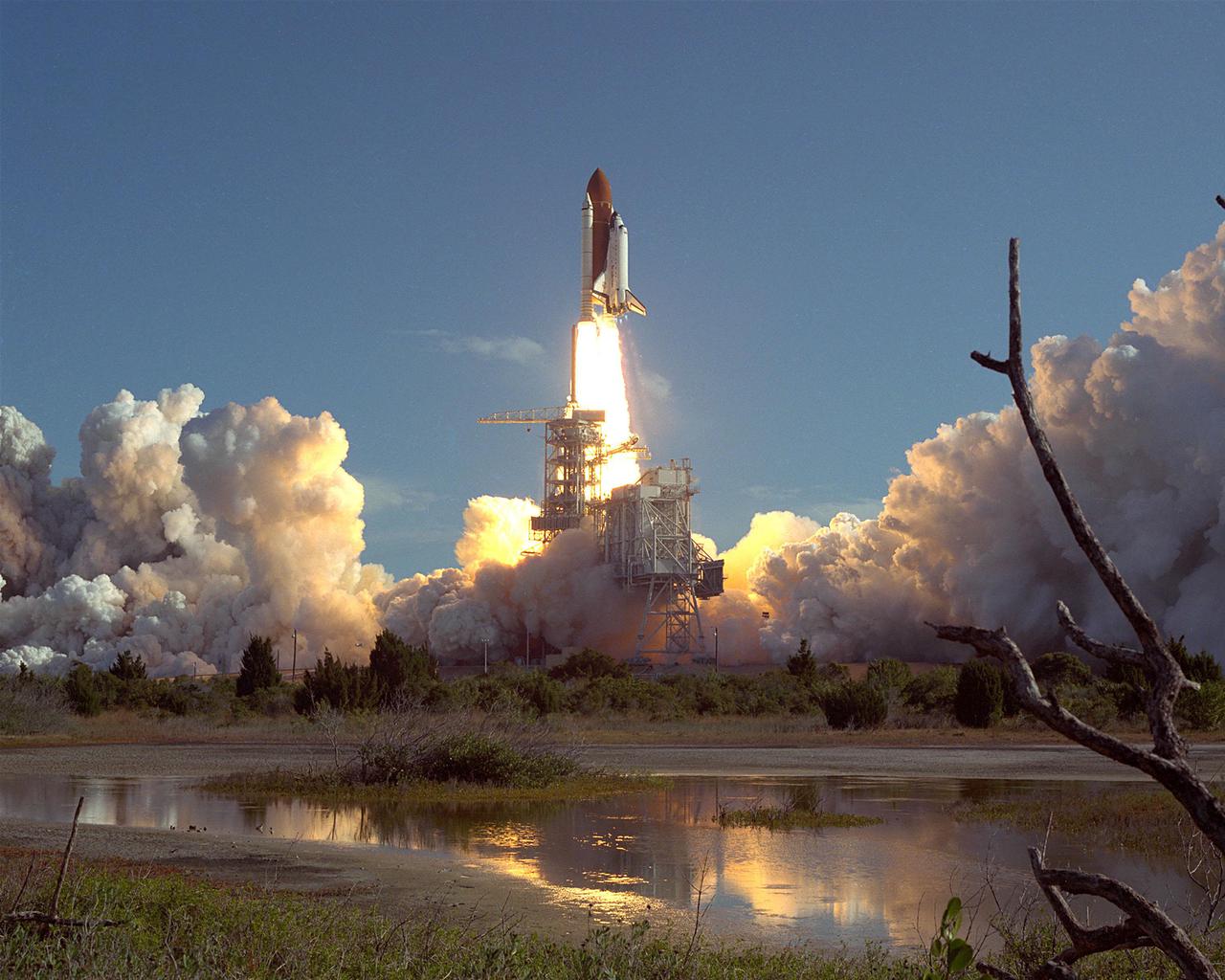
KENNEDY SPACE CENTER, FLA. -- The mid-morning liftoff of the Space Shuttle Discovery on mission STS-42 was even prettier than a picture at the start of the first Shuttle mission of 1992. The seven-member crew is scheduled to spend seven days in space, mostly to conduct a variety of experiments in the International Microgravity Laboratory-1. The experiments will explore the effects of weightlessness on living organisms and materials processing. Liftoff was at 9:52 a.m. EST. The seven crew members are Commander Ronald J. Grabe, Pilot Stephen S. Oswald, Payload Commander and Mission Specialist Dr. Norman E. Thagard, Mission Specialists David C. Hilmers and William F. Readdy, and Payload Specialists Dr. Roberta L. Bondar of the Canadian Space Agency and Ulf D. Merbold of the European Space Agency
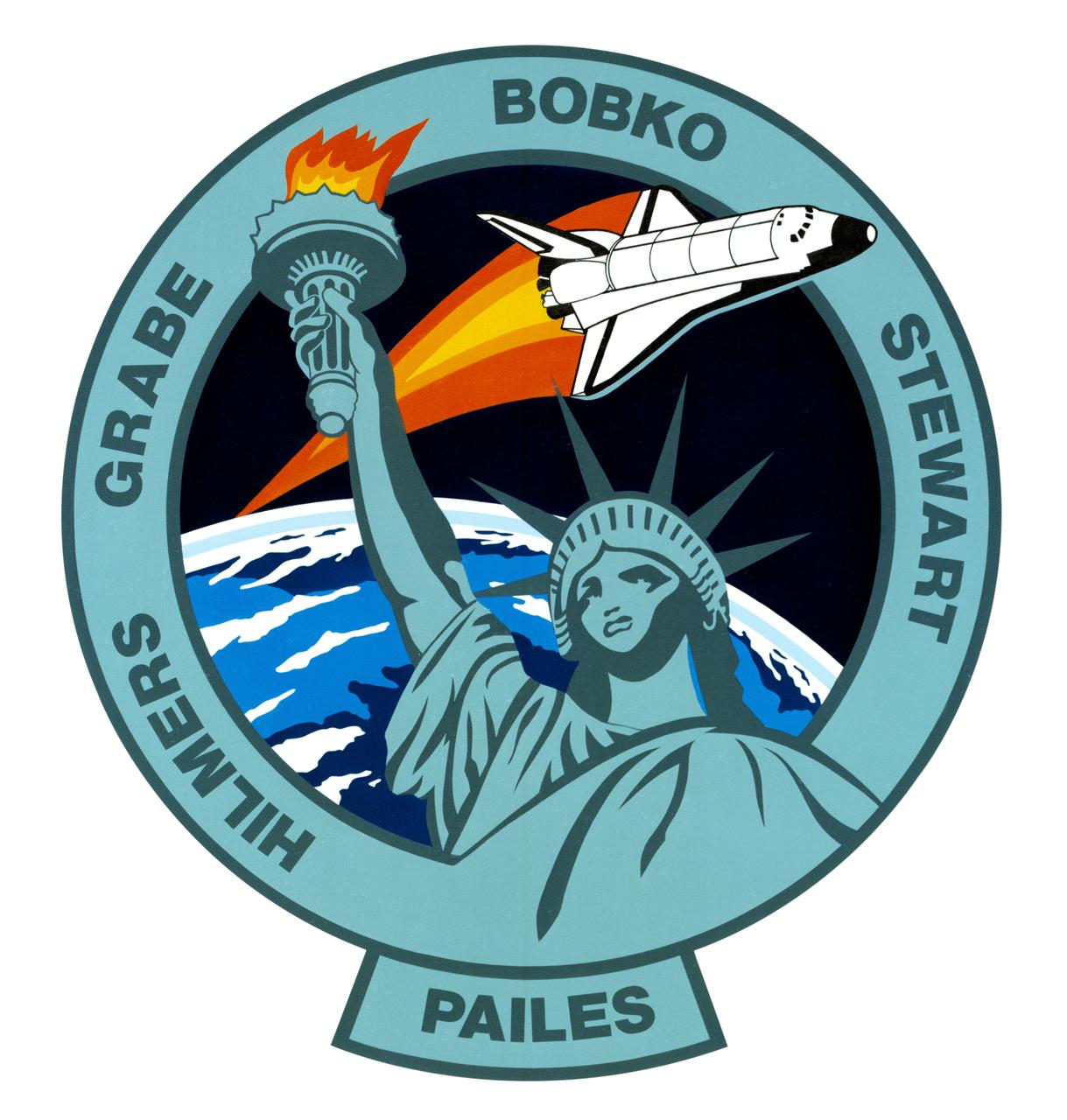
S85-39862 (1 Sept. 1985) --- The 51-J mission insignia, designed by Atlantis's first crew, pays tribute to the Statue of Liberty and the ideas it symbolizes. The historical gateway figure bears additional significance for astronauts Karol J. Bobko, mission commander; and Ronald J. Grabe, pilot, both New York natives. Other members of the five-man crew, whose surnames encircle the artwork, are Robert L. Stewart and David C. Hilmers, mission specialists; and William A. Pailes, payload specialist. The NASA insignia design for space shuttle flights is reserved for use by the astronauts and for other official use as the NASA Administrator may authorize. Public availability has been approved only in the forms of illustrations by the various news media. When and if there is any change in this policy, which is not anticipated, the change will be publicly announced. Photo credit: NASA
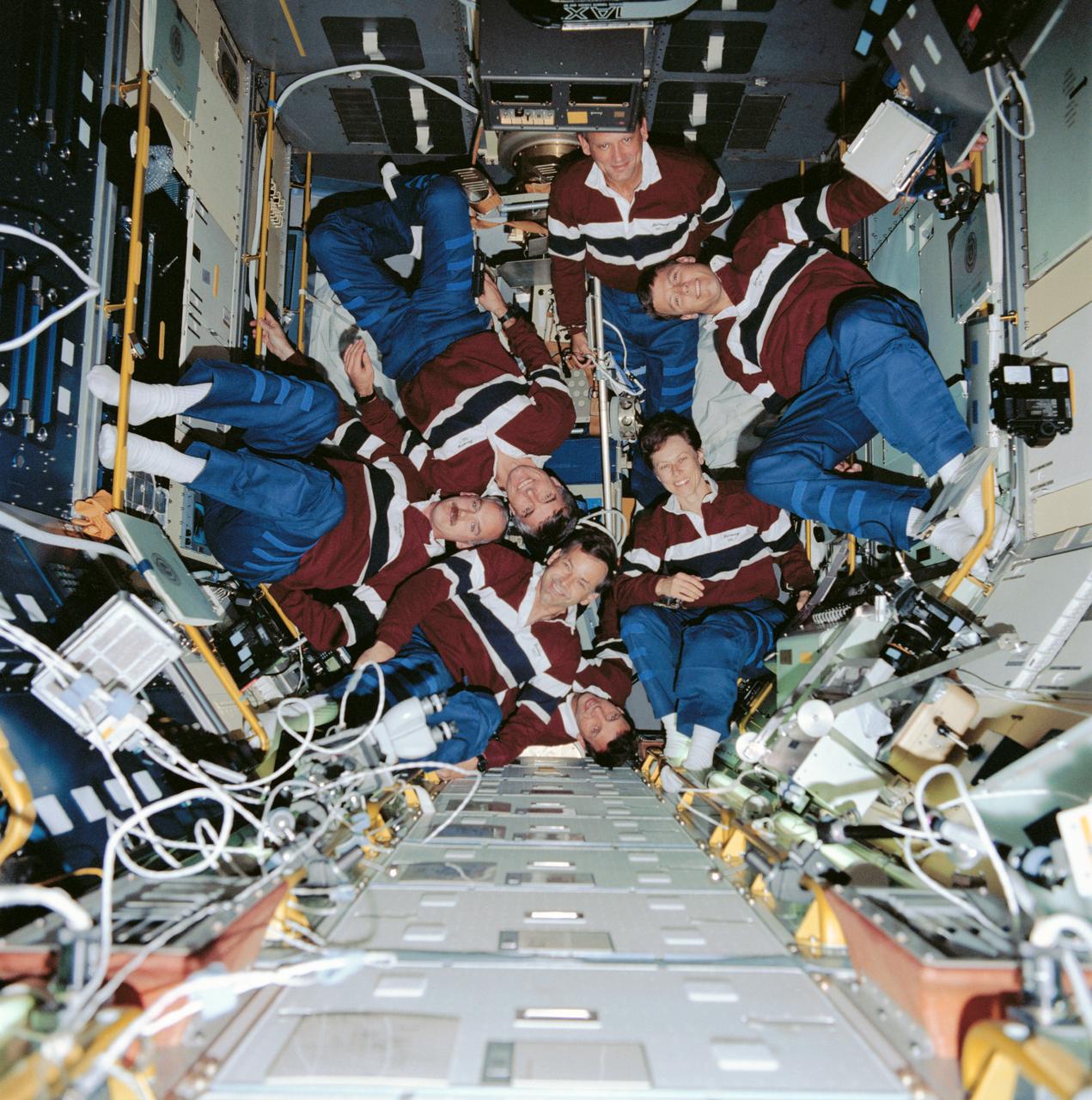
STS042-78-061 (22-30 Jan. 1992) --- The seven STS-42 crewmembers pose for a traditional in-space portrait in the shirt-sleeve environment of the International Microgravity Laboratory (IML-1) science module in the shuttle's cargo bay. (Hold picture with index numbers at top.) David C. Hilmers, mission specialist, is at top center of the 70mm image. Others pictured are (clockwise) Ronald J. Grabe, mission commander; William F. Readdy; mission specialist; Ulf Merbold, European Space Agency (ESA) payload specialist; Norman E. Thagard, payload commander; Stephen S. Oswald, pilot; and Roberta L. Bondar, Canadian payload specialist. The rotating chair, used often in biomedical tests on the eight-day flight, is (partially obscured) in center frame.
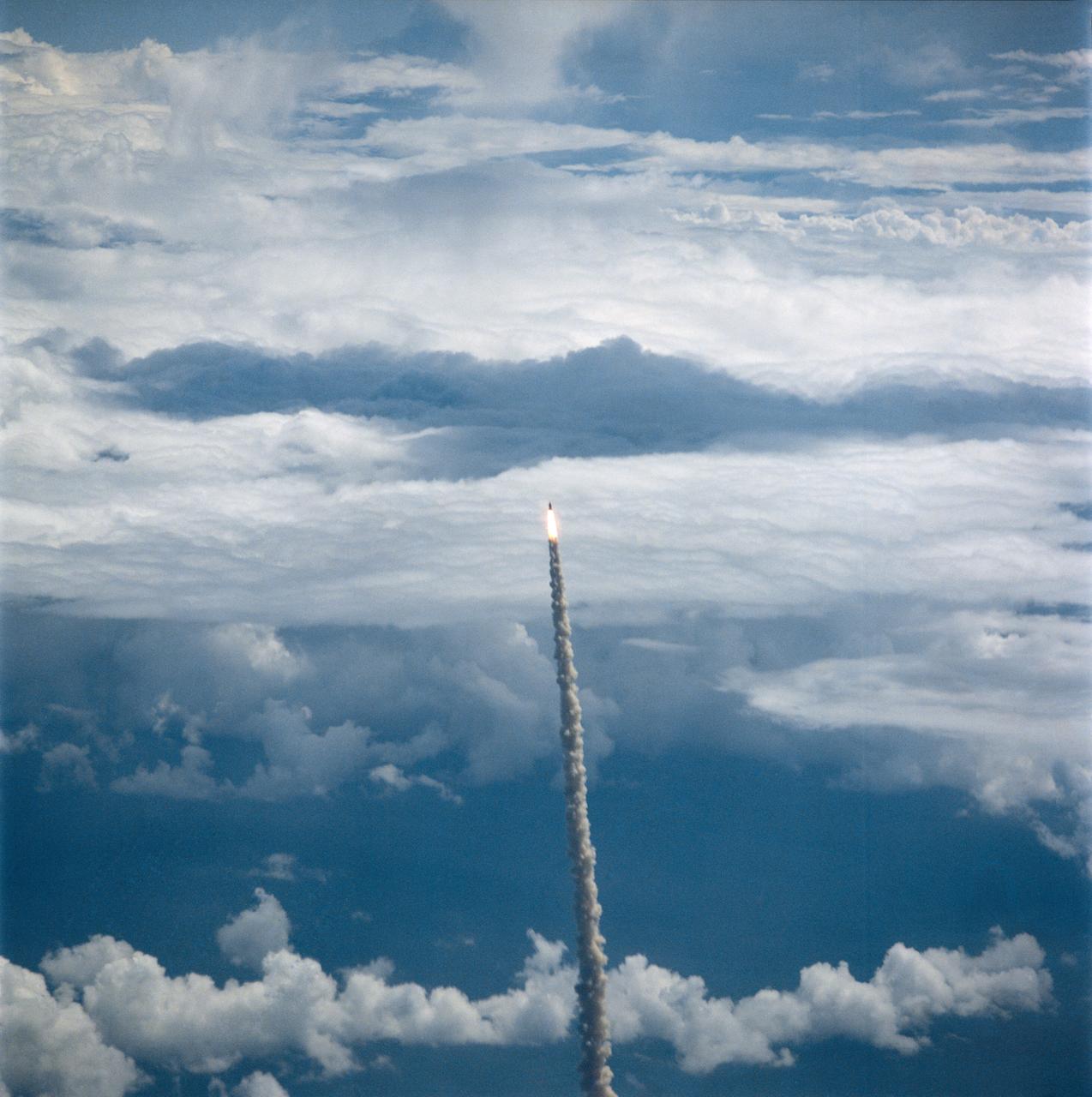
S26-S-026 (29 Sept. 1988) --- The STS-26 launch was captured on film from the NASA Shuttle Training Aircraft, piloted by astronaut Daniel C. Brandenstein, chief of JSC's Astronaut Office. Discovery?s mission was the first flight to be flown after the Challenger accident. The flight crew included astronauts Rick Hauck, commander; Dick Covey, pilot; and three mission specialists, Dave Hilmers, Mike Lounge, and George (Pinky) Nelson. During the four-day mission, the crew deployed the Tracking and Data Relay Satellite (TDRS-C) and operated eleven mid-deck experiments. Discovery completed 64 orbits of the earth before landing at Edwards Air Force Base, California, on October 3, 1988. Photo credit: NASA or National Aeronautics and Space Administration
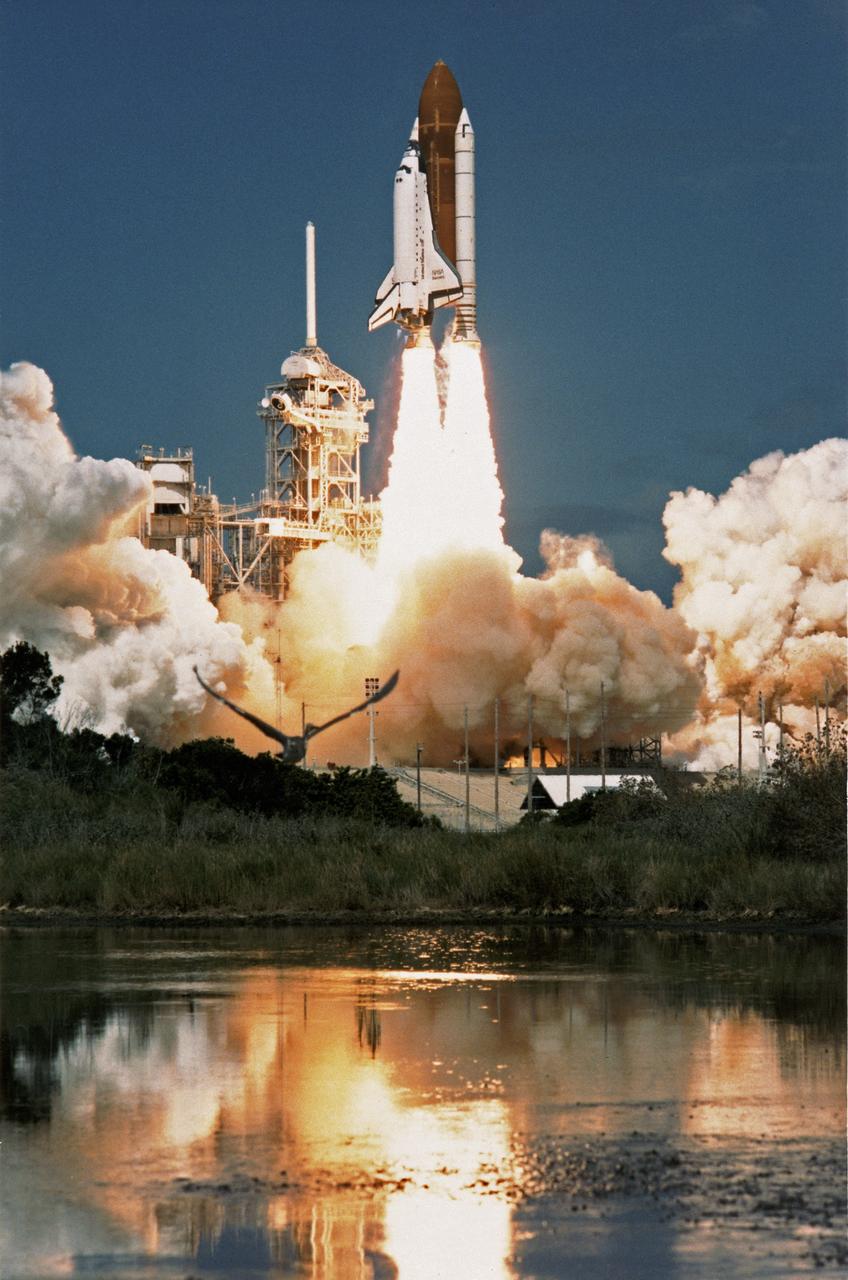
CAPE CANAVERAL, Fla. - The space shuttle Discovery and its five-man crew is launched from pad 39B at 11:37 a.m. as STS-26 embarks on a four-day mission marking America's return to space. On the first day of orbit, the crew will deploy from the orbiter's payload bay the primary payload, the Tracking and Data Relay Satellite, or TDRS-C. The inertial upper stage, or IUS, will boost the satellite to a geosynchronous altitude from low Earth orbit. When it place, TDRS-C will relay date from low Earth orbiting spacecraft and air-to-ground voice communications sand television from shape shuttle orbiters during missions. The crew members of STST-26 are Commander Rick Hauck, Pilot Richard Covey, and mission specialists Dave Hilmers, Mike Lounge and George "Pinky" Nelson. Photo Credit: NASA
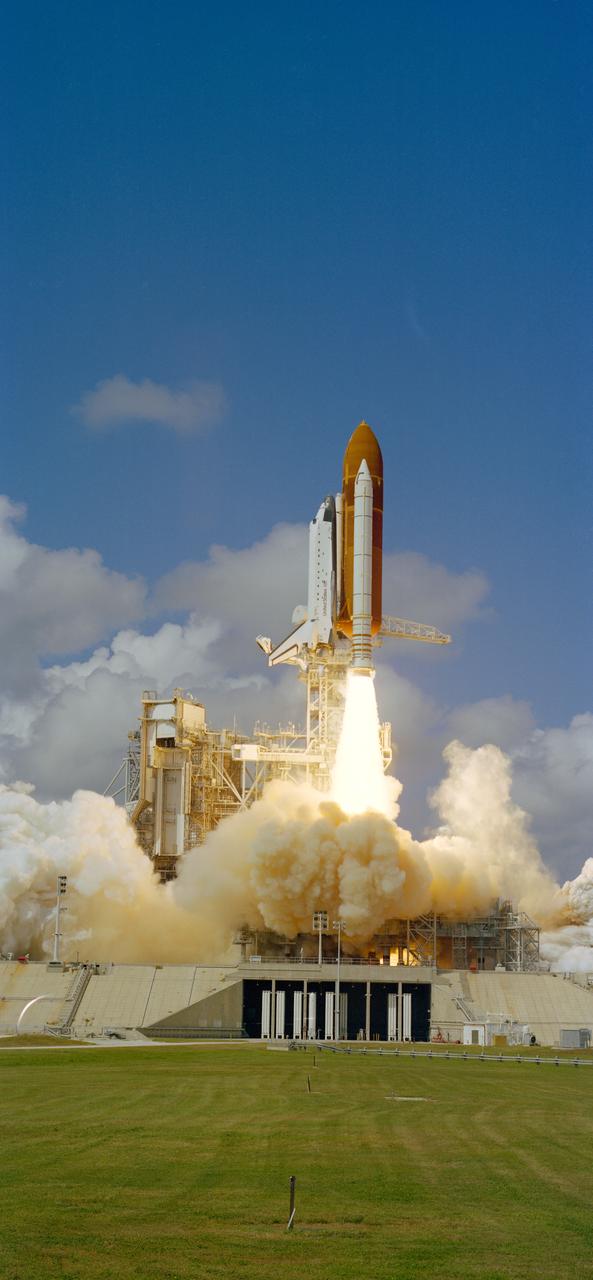
STS026-S-031 (29 Sept 1988) --- Just moments after ignition, the Space Shuttle Discovery, mated to two solid rocket boosters and an external fuel tank, heads, toward Earth orbit. The mission marks Discovery?s first flight since September of 1985 and NASA?s first manned mission since September of 1985 and NASA?s first manned mission since the 51L Challenger accident of January 28, 1986. Onboard the spacecraft are Astronauts Frederick H. (Rick) Hauck, commander; Richard O. Covey, pilot; and George D. Nelson, John M. (Mike) Lounge and David C. Hilmers, mission specialists. Discovery?s dry weight is 171,419 pounds. The tracking and data relay satellite and its inertial upper stage total about 37,000 pounds.
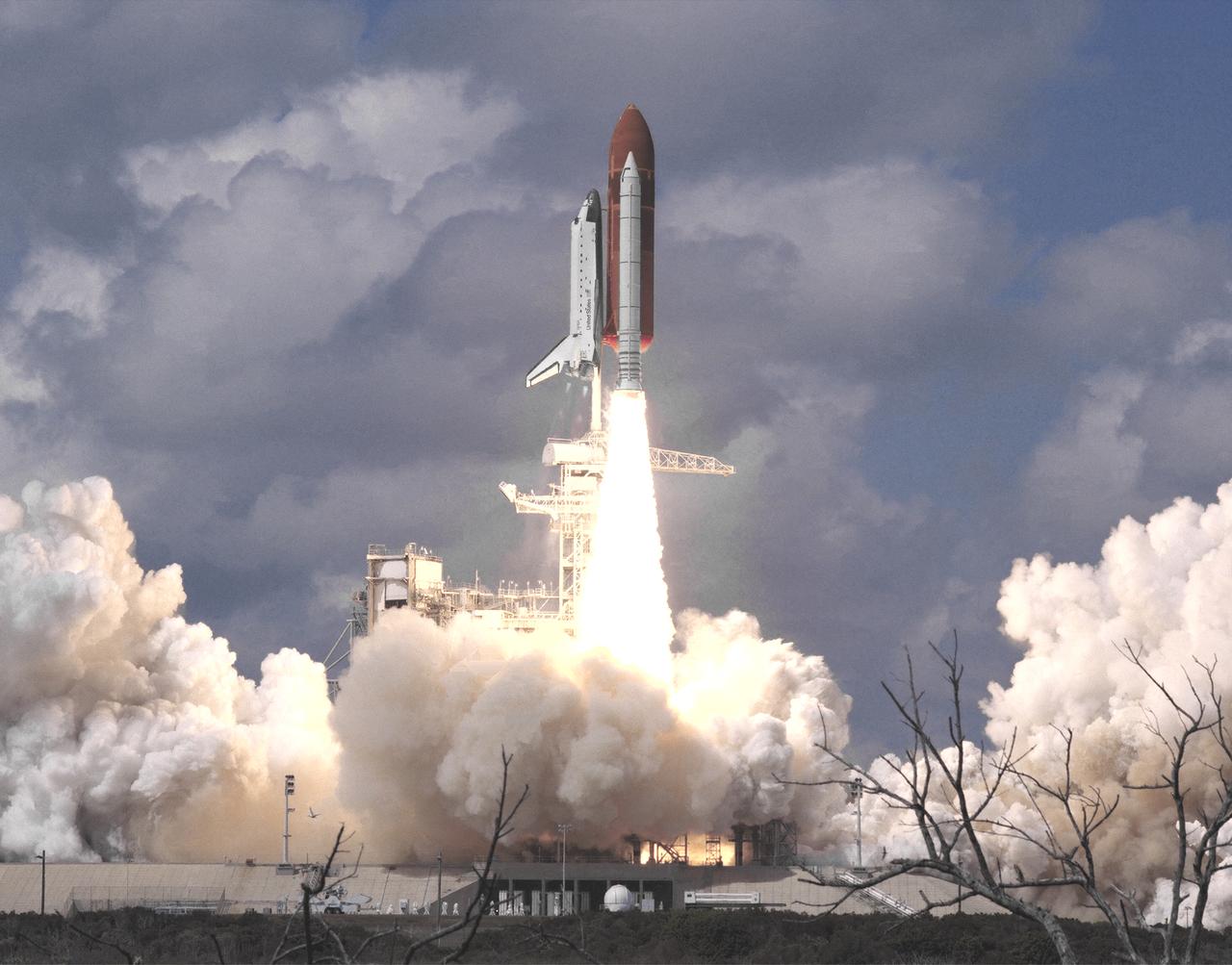
The Space Shuttle Discovery takes off from Launch Pad 39B at the Kennedy Space Center, Florida, to being Mission STS-26 on 29 September 1988,11:37:00 a.m. EDT. The 26th shuttle mission lasted four days, one hour, zero minutes, and 11 seconds. Discovery landed 3 October 1988, 9:37:11 a.m. PDT, on Runway 17 at Edwards Air Force Base, California. Its primary payload, NASA Tracking and Data Relay Satellite-3 (TDRS-3) attached to an Inertial Upper Stage (IUS), became the second TDRS deployed. After deployment, IUS propelled the satellite to a geosynchronous orbit. The crew consisted of Frederick H. Hauck, Commander; Richard O. Covey, Pilot; John M. Lounge, Mission Specialist 1; George D. Nelson, Mission Specialist 2; and David C. Hilmers, Mission Specialist 3.
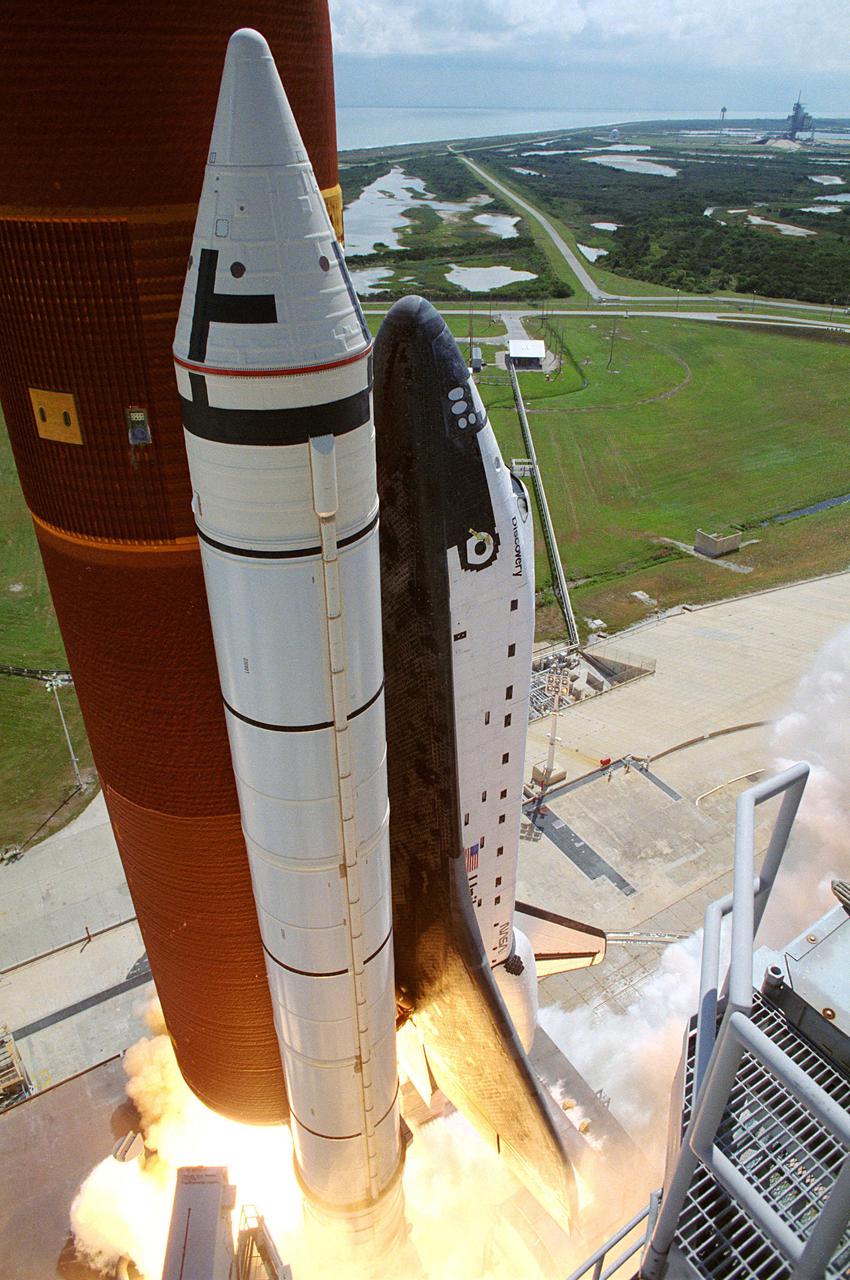
KENNEDY SPACE CENTER, FLA. -- The Space Shuttle Discovery and its five-man crew is launched from pad 39B at 11:37 a.m. as STS-26 embarks on a four-day mission, marking America's return to space. On the first day of orbit, the crew will deploy from the orbiter's payload bay the primary payload, the Tracking and Data Relay Satellite (TDRS-C). The Inertial Upper Stage (IUS) will boost the satellite to a geosynchronous altitude from low-Earth orbit. When in place, TDRS-C will relay data from low-Earth orbiting spacecraft, and air-to-ground voice communications and television from Space Shuttle orbiters during missions. The crew members of STS-26 are Commander Rick Hauck, Pilot Richard Covey, and Mission Specialists Dave Hilmers, Mike Lounge, and George 'Pinky' Nelson.
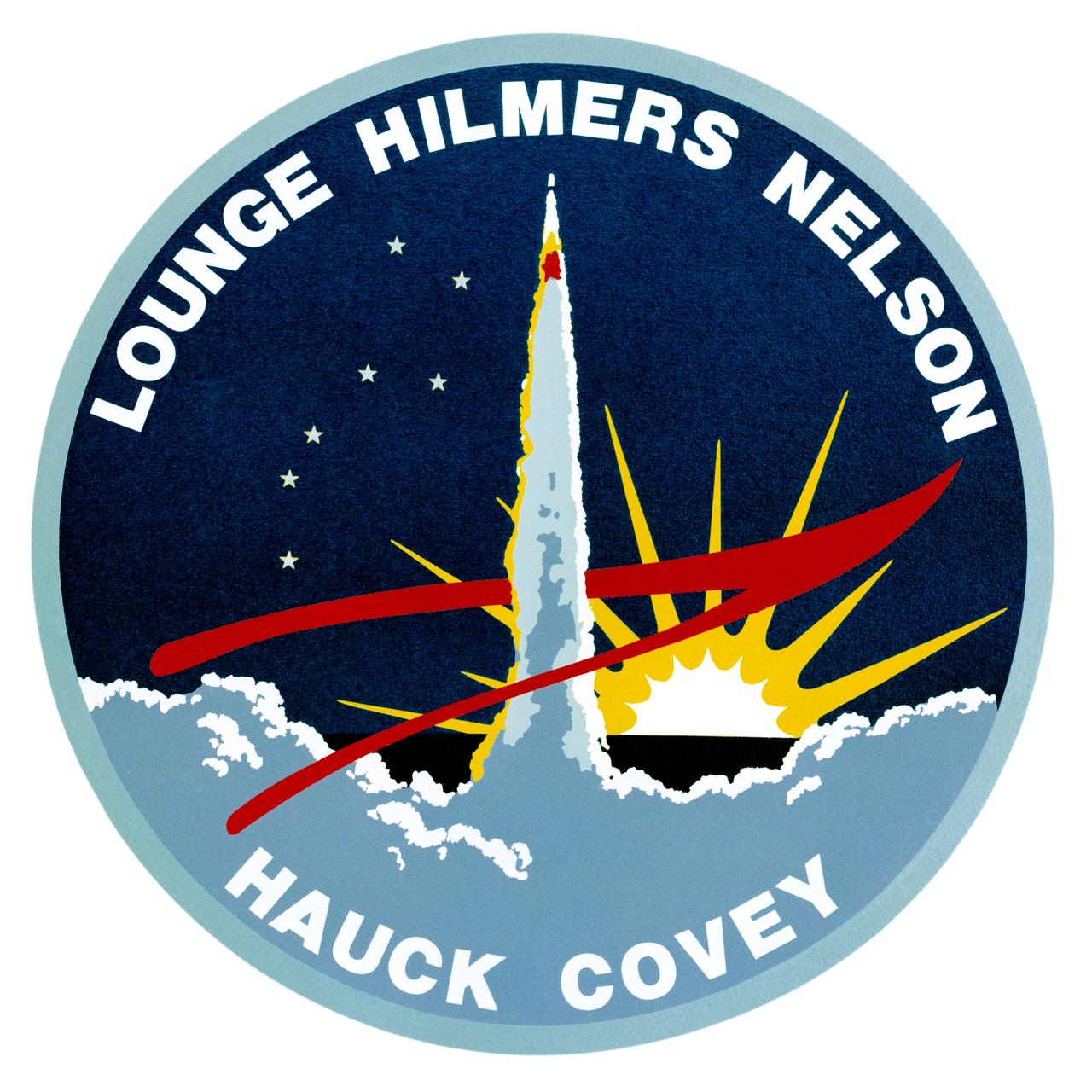
S87-39136 (4 Aug. 1987) --- This is the STS-26 crew patch. The predominant themes are: a new beginning (sunrise), a safe mission (stylized launch and plume), the building upon the traditional strengths of NASA (the red vector which symbolizes aeronautics on the original NASA insignia), and a remembrance of their seven colleagues who died aboard Challenger (the seven-starred Big Dipper). The patch was designed by artist Stephen R. Hustvedt of Annapolis, MD. STS-26 crew members are astronauts Frederick H. (Rick) Hauck, commander; Richard O. Covey, pilot; and George D. (Pinky) Nelson, John M. (Mike) Lounge and David C. Hilmers, mission specialists. The NASA insignia design for space shuttle flights is reserved for use by the astronauts and for other official use as the NASA Administrator may authorize. Public availability has been approved only in the forms of illustrations by the various news media. When and if there is any change in this policy, which is not anticipated, the change will be publicly announced. Photo credit: NASA
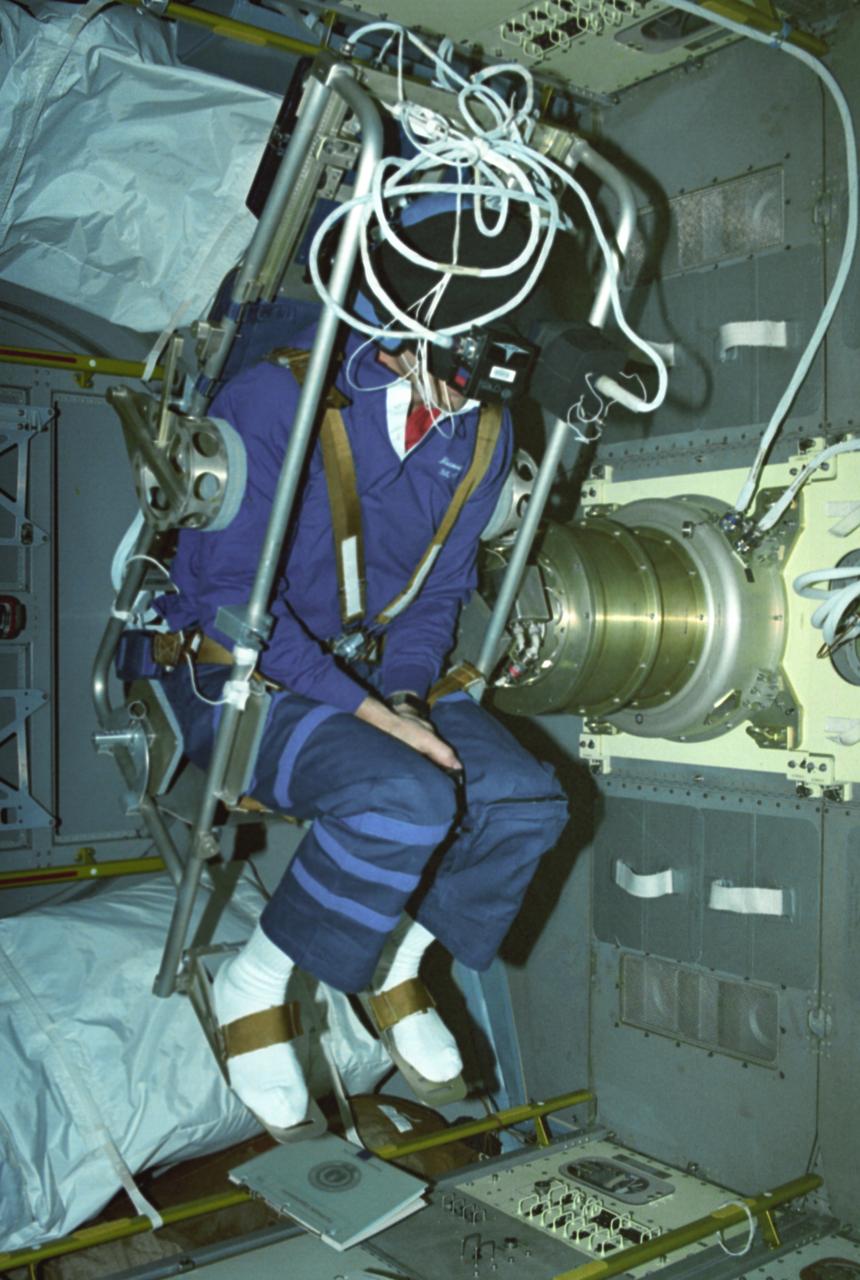
Astronaut David C. Hilmers conducts the Microgravity Vestibular Investigations (MVI) sitting in its rotator chair inside the IML-1 science module. When environmental conditions change so that the body receives new stimuli, the nervous system responds by interpreting the incoming sensory information differently. In space, the free-fall environment of an orbiting spacecraft requires that the body adapts to the virtual absence of gravity. Early in flights, crewmembers may feel disoriented or experience space motion sickness. MVI examined the effects of orbital flight on the human orientation system to obtain a better understanding of the mechanisms of adaptation to weightlessness. By provoking interactions among the vestibular, visual, and proprioceptive systems and then measuring the perceptual and sensorimotor reactions, scientists can study changes that are integral to the adaptive process. The IML-1 mission was the first in a series of Shuttle flights dedicated to fundamental materials and life sciences research with the international partners. The participating space agencies included: NASA, the 14-nation European Space Agency (ESA), the Canadian Space Agency (CSA), the French National Center of Space Studies (CNES), the German Space Agency and the German Aerospace Research Establishment (DAR/DLR), and the National Space Development Agency of Japan (NASDA). Both life and materials sciences benefited from the extended periods of microgravity available inside the Spacelab science module in the cargo bay of the Space Shuttle Orbiter. Managed by the Marshall Space Flight Center, IML-1 was launched on January 22, 1992 aboard the Space Shuttle Orbiter Discovery (STS-42 mission).