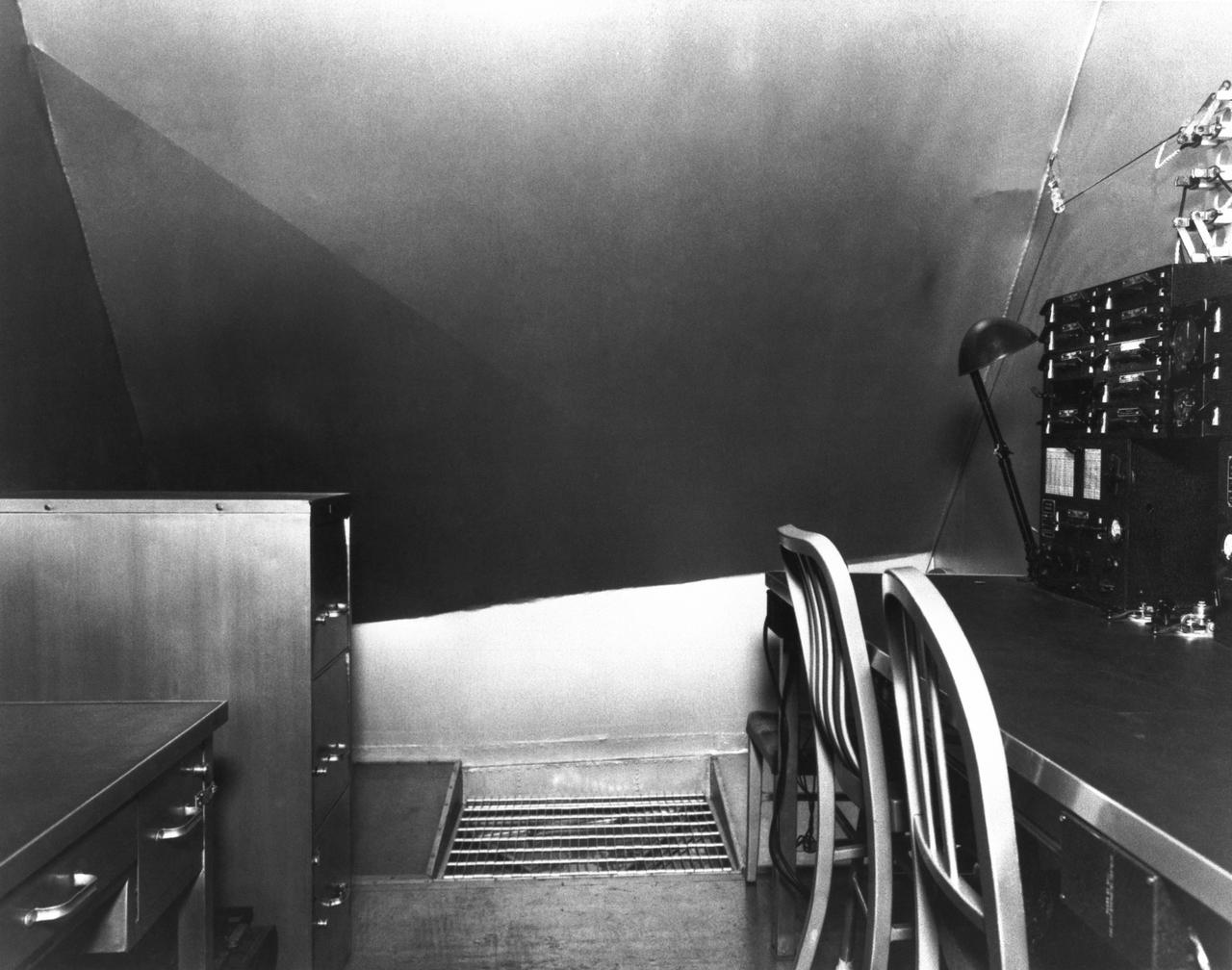
History of Cockpits - interior of control room of a Dirigible (@1935)
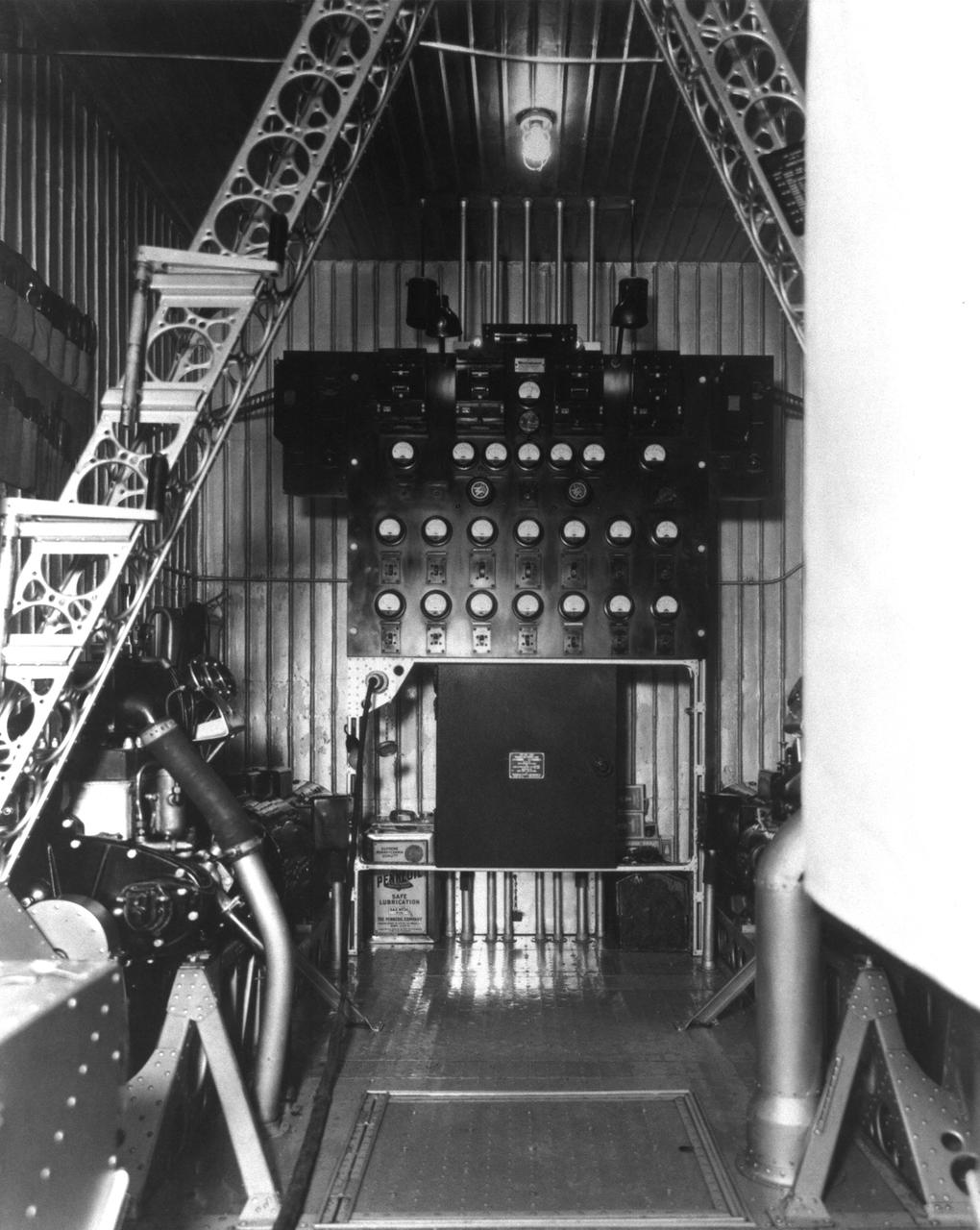
History of Cockpits - interior of control room showing pressure gages (@1935)

History of Cockpits - interior of control room onboard Dirigible (@1935)

History of Cockpits - control room navigation station onboard a Dirigible (@1935)

History of Cockpits: Airship Macon - Engine Control Station (1934 - 1935)
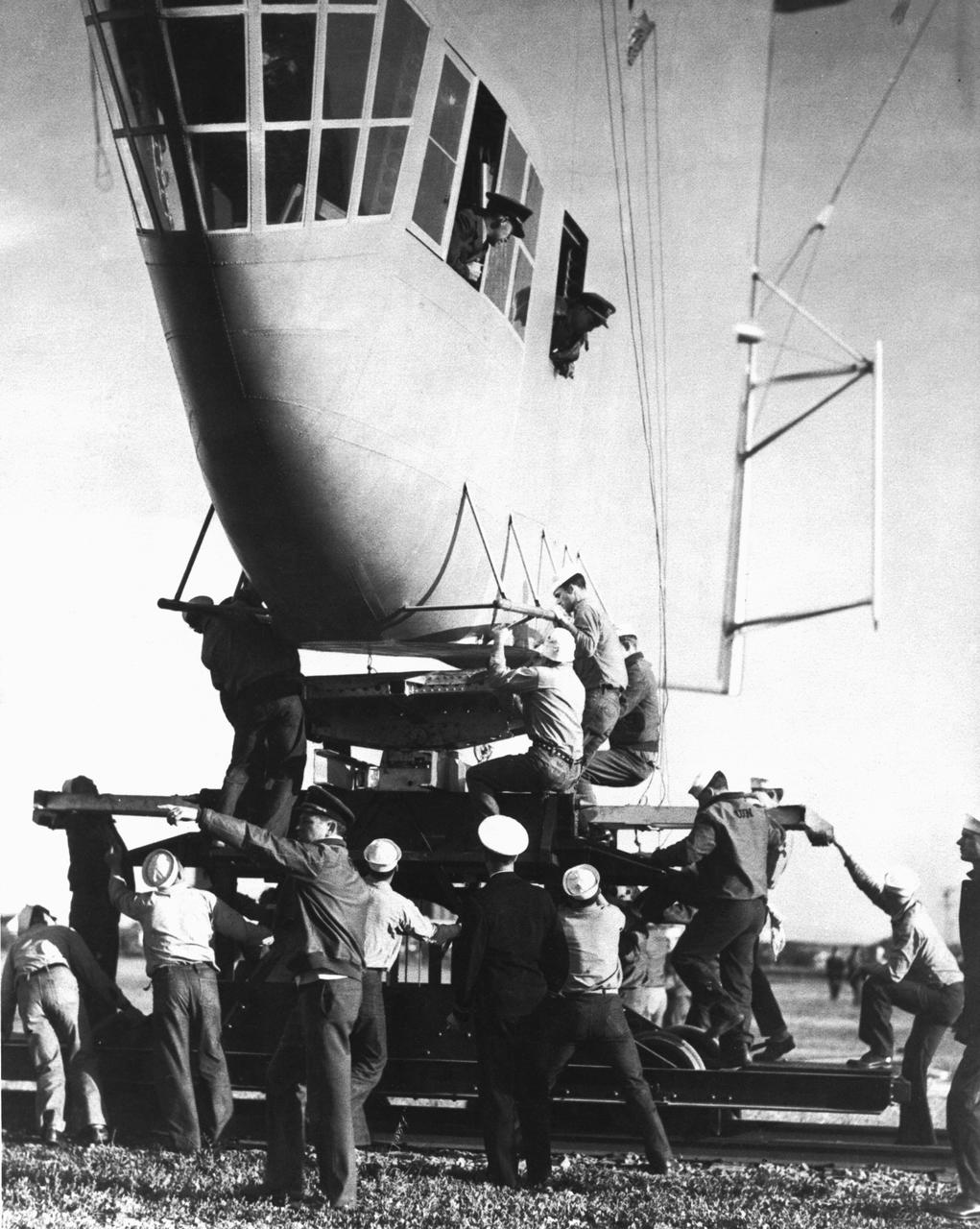
Circa 1935 History of Cockpits - Macon Dirigible cabin housing viewed as sailors moor the blimp at Moffett Field (@ 1935)
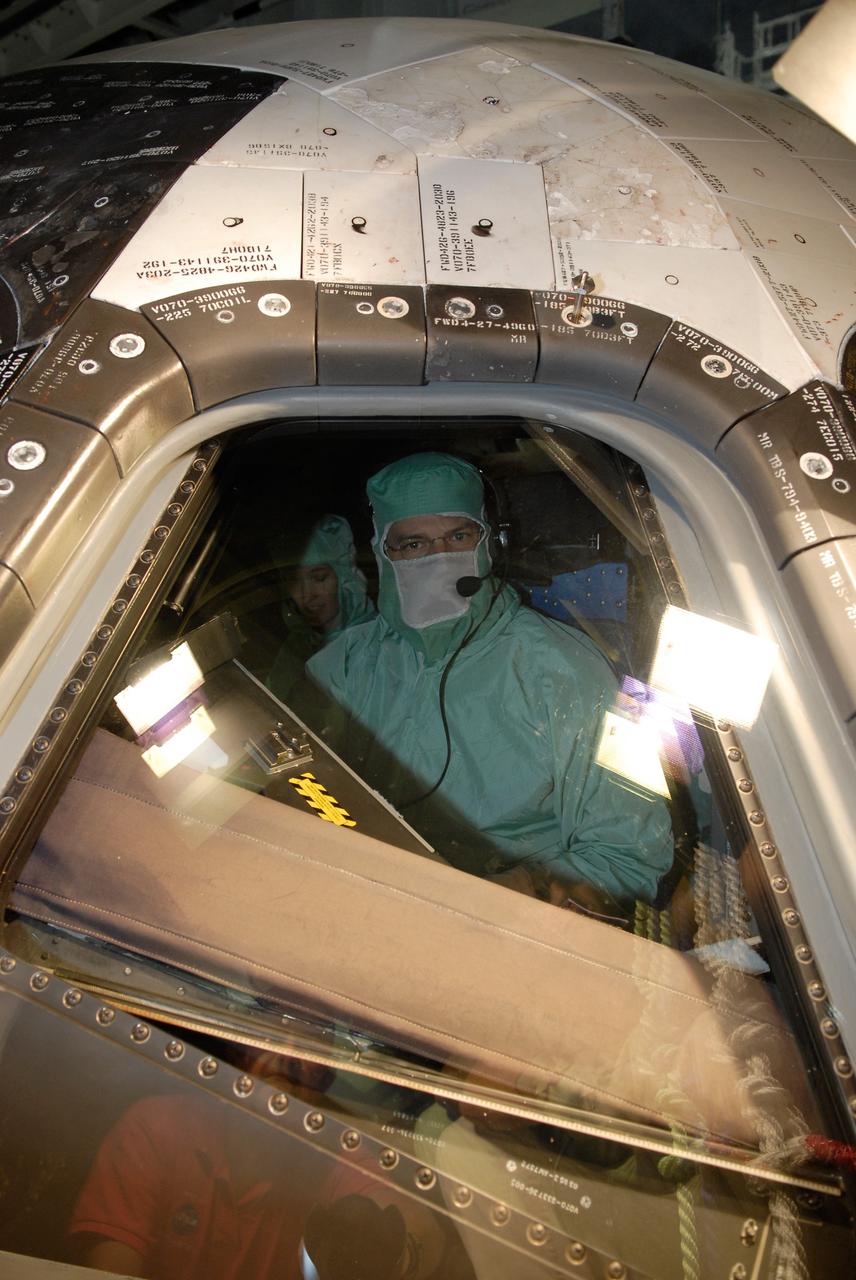
CAPE CANAVERAL, Fla. – In the Orbiter Processing Facility at NASA's Kennedy Space Center, STS-125 Commander Scott Altman examines the cockpit window on space shuttle Atlantis, checking for sharp edges. The inspection is part of the crew equipment interface test, which provides hands-on experience with hardware and equipment for the mission. Atlantis is targeted to launch Oct. 8 on the STS-125 mission to service the Hubble Space Telescope. The mission crew will perform history-making, on-orbit “surgery” on two important science instruments aboard the telescope. After capturing the telescope, two teams of spacewalking astronauts will perform the repairs during five planned spacewalks. Photo credit: NASA/Kim Shiflett
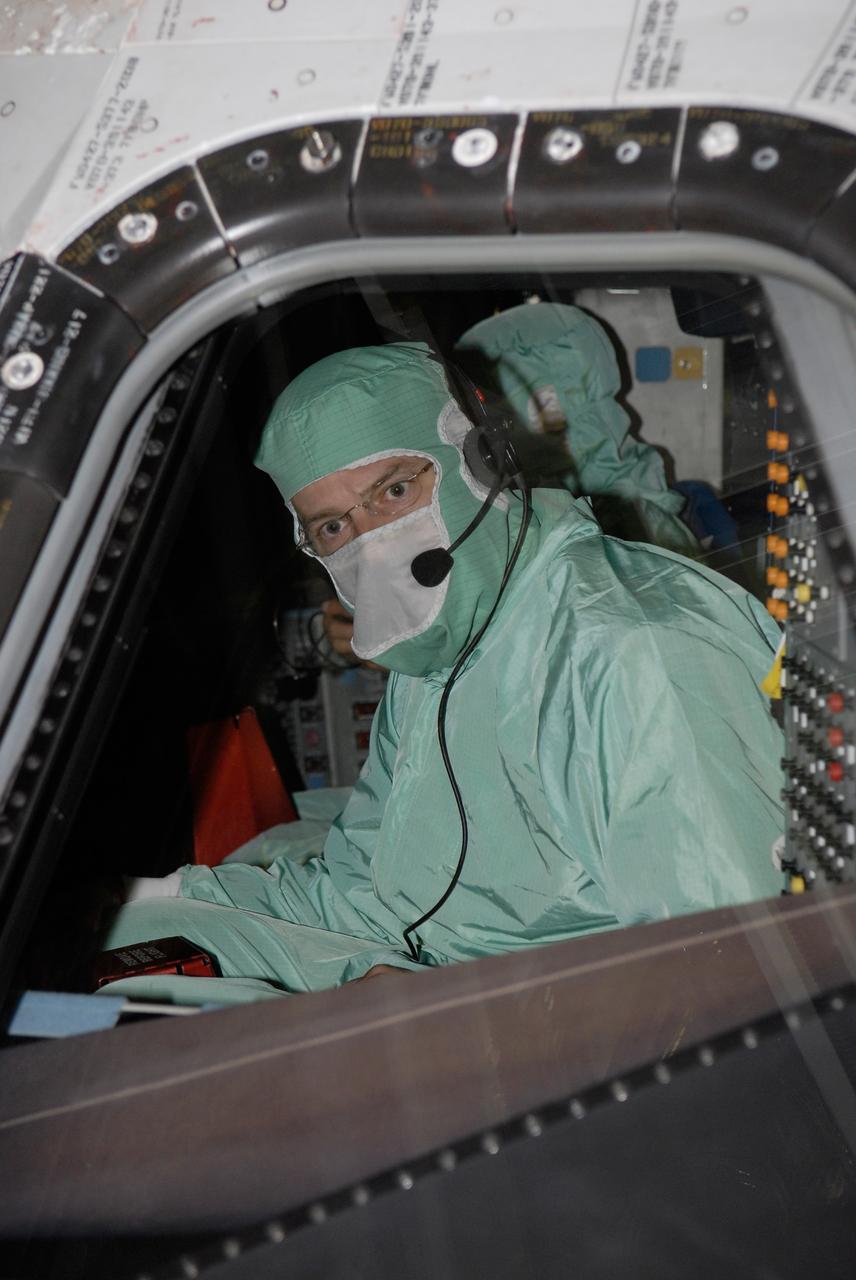
CAPE CANAVERAL, Fla. – In the Orbiter Processing Facility at NASA's Kennedy Space Center, STS-125 Commander Scott Altman examines the cockpit window on space shuttle Atlantis. The inspection is part of the crew equipment interface test, which provides hands-on experience with hardware and equipment for the mission. Atlantis is targeted to launch Oct. 8 on the STS-125 mission to service the Hubble Space Telescope. The mission crew will perform history-making, on-orbit “surgery” on two important science instruments aboard the telescope. After capturing the telescope, two teams of spacewalking astronauts will perform the repairs during five planned spacewalks. Photo credit: NASA/Kim Shiflett
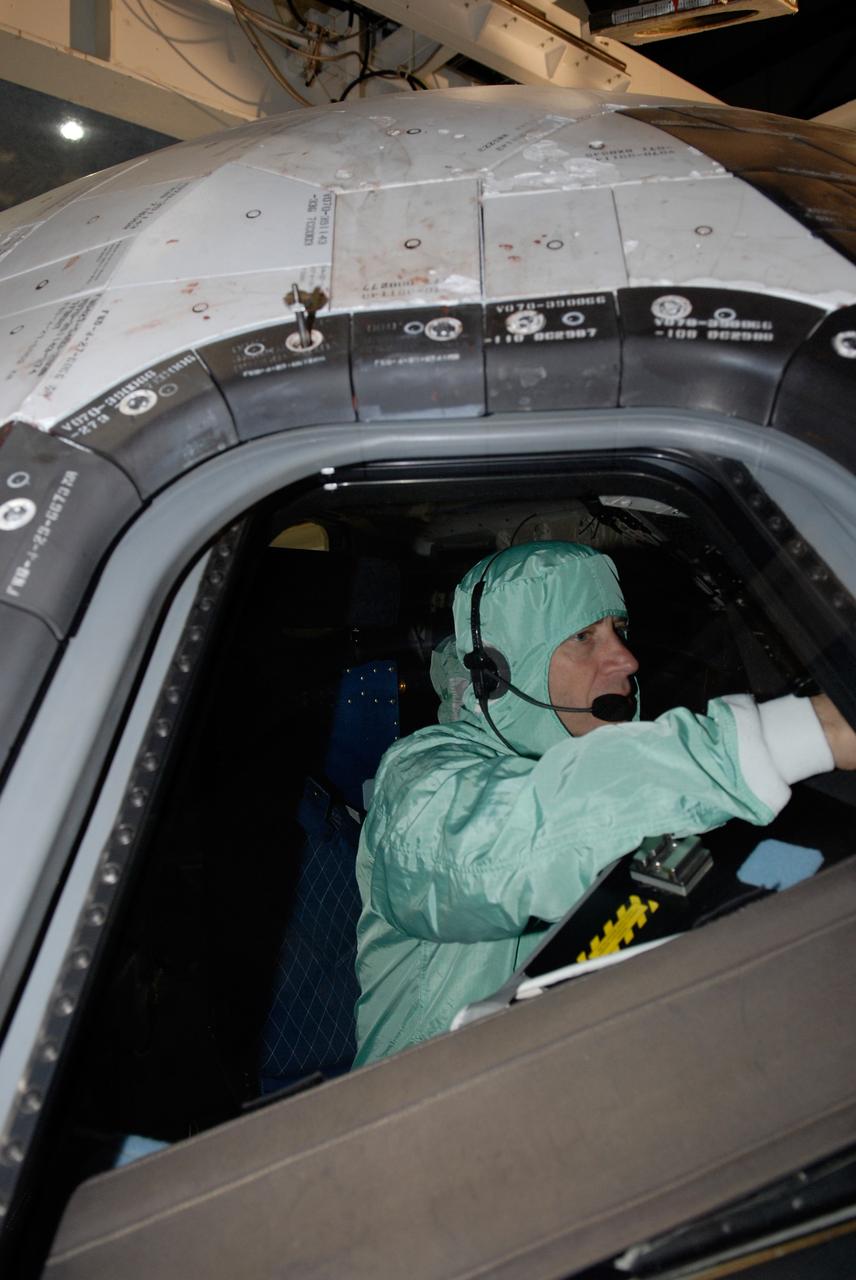
CAPE CANAVERAL, Fla. – In the Orbiter Processing Facility at NASA's Kennedy Space Center, STS-125 Pilot Gregory C. Johnson examines the cockpit window on space shuttle Atlantis, checking for sharp edges. The inspection is part of the crew equipment interface test, which provides hands-on experience with hardware and equipment for the mission. Atlantis is targeted to launch Oct. 8 on the STS-125 mission to service the Hubble Space Telescope. The mission crew will perform history-making, on-orbit “surgery” on two important science instruments aboard the telescope. After capturing the telescope, two teams of spacewalking astronauts will perform the repairs during five planned spacewalks. Photo credit: NASA/Kim Shiflett
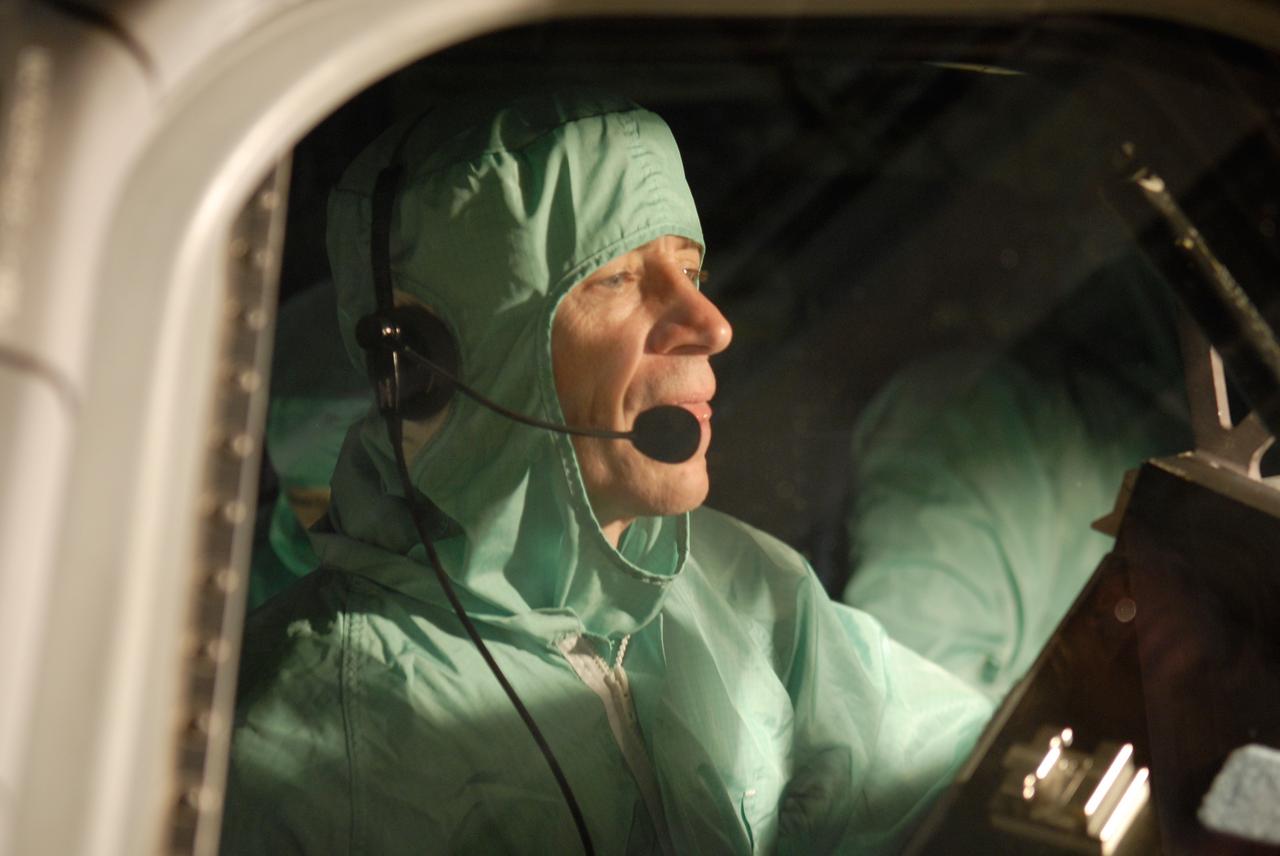
CAPE CANAVERAL, Fla. – In the Orbiter Processing Facility at NASA's Kennedy Space Center, STS-125 Pilot Gregory C. Johnson examines the cockpit window on space shuttle Atlantis, checking for sharp edges. The inspection is part of the crew equipment interface test, which provides hands-on experience with hardware and equipment for the mission. Atlantis is targeted to launch Oct. 8 on the STS-125 mission to service the Hubble Space Telescope. The mission crew will perform history-making, on-orbit “surgery” on two important science instruments aboard the telescope. After capturing the telescope, two teams of spacewalking astronauts will perform the repairs during five planned spacewalks. Photo credit: NASA/Kim Shiflett
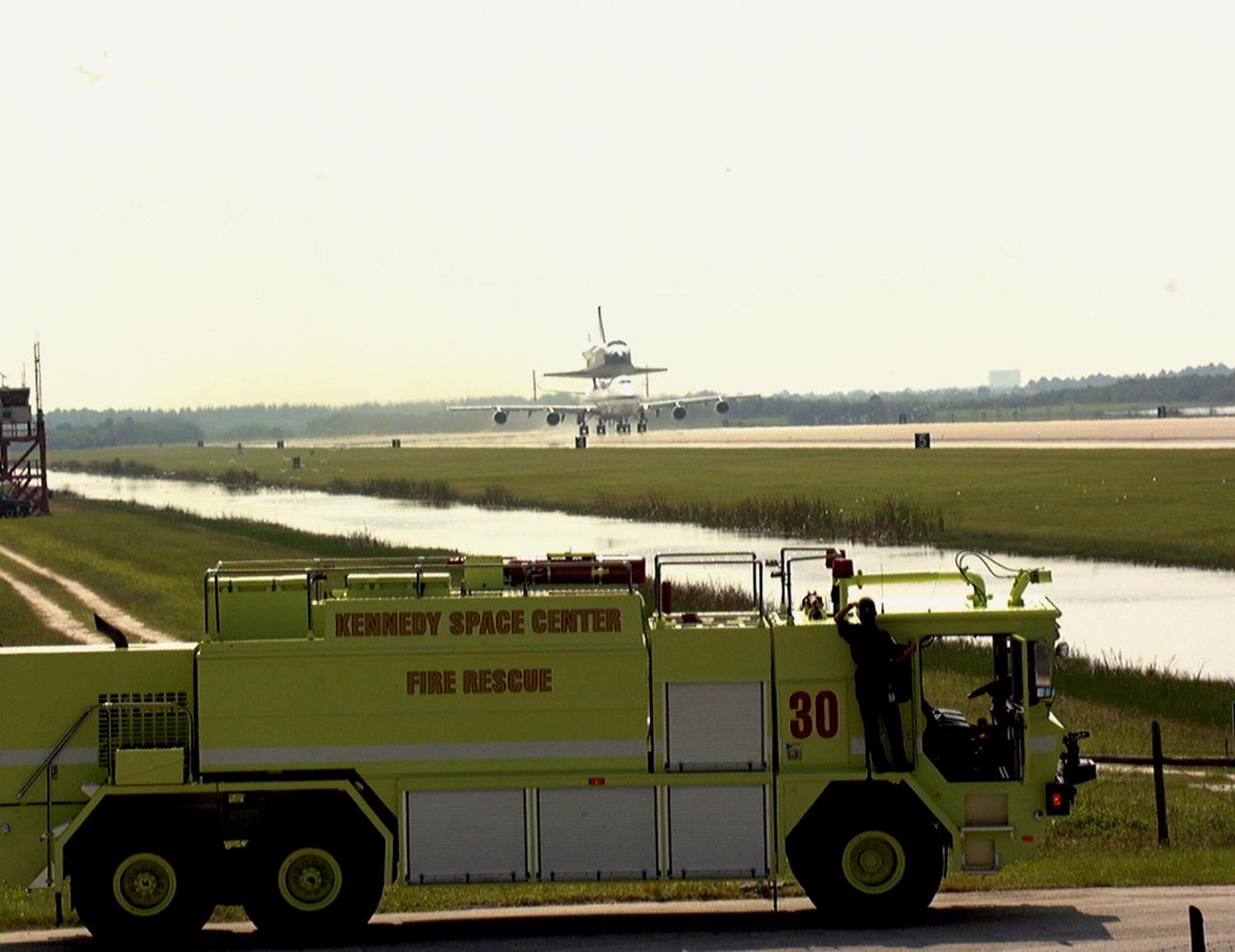
KENNEDY SPACE CENTER, FLA. -- From the Shuttle Landing Facility, the orbiter Columbia leaves Kennedy Space Center on the back of a Boeing 747 Shuttle Carrier Aircraft on a ferry flight to Palmdale, Calif. Columbia, the oldest of four orbiters in NASA's fleet, will undergo extensive inspections and modifications in Boeing's Orbiter Assembly Facility during a nine-month orbiter maintenance down period (OMDP), the second in its history. Orbiters are periodically removed from flight operations for an OMDP. Columbia's first was in 1994. Along with more than 100 modifications on the vehicle, Columbia will be the second orbiter to be outfitted with the multifunctional electronic display system, or "glass cockpit." Columbia is expected to return to KSC in July 2000
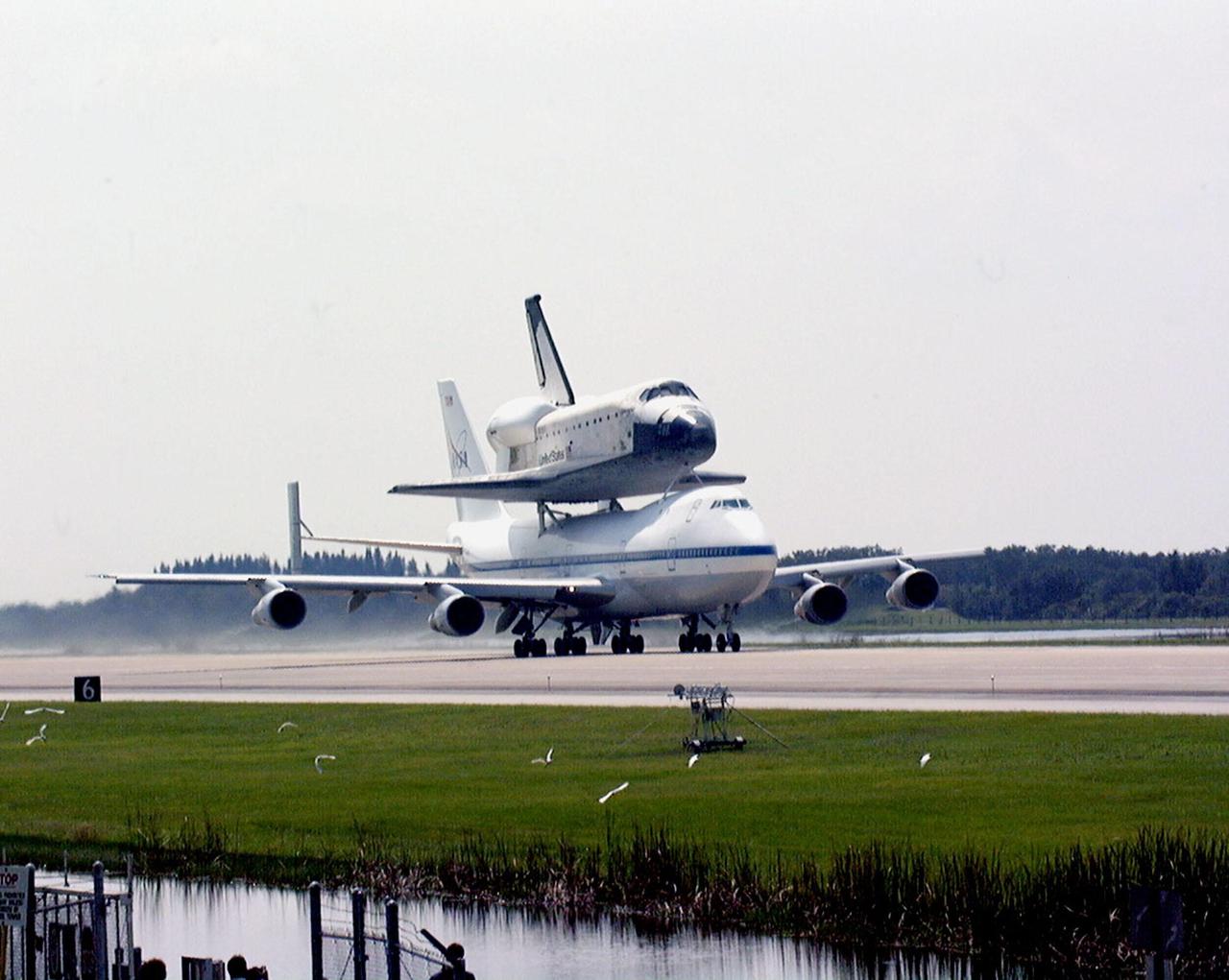
KENNEDY SPACE CENTER, FLA. -- At the Shuttle Landing Facility, egrets along the runway take flight as the orbiter Columbia leaves Kennedy Space Center on the back of a Boeing 747 Shuttle Carrier Aircraft on a ferry flight to Palmdale, Calif. Columbia, the oldest of four orbiters in NASA's fleet, will undergo extensive inspections and modifications in Boeing's Orbiter Assembly Facility during a nine-month orbiter maintenance down period (OMDP), the second in its history. Orbiters are periodically removed from flight operations for an OMDP. Columbia's first was in 1994. Along with more than 100 modifications on the vehicle, Columbia will be the second orbiter to be outfitted with the multifunctional electronic display system, or "glass cockpit." Columbia is expected to return to KSC in July 2000

KENNEDY SPACE CENTER, FLA. -- The Boeing 747 Shuttle Carrier Aircraft is cast in morning shadows as it backs away from the Mate/Demate Device with the orbiter Columbia strapped to its back. The oldest of four orbiters in NASA's fleet, Columbia is being ferried to Palmdale, Calif., where it will undergo extensive inspections and modifications in Boeing's Orbiter Assembly Facility. The nine-month orbiter maintenance down period (OMDP) is the second in Columbia's history. Orbiters are periodically removed from flight operations for an OMDP. Columbia's first was in 1994. Along with more than 100 modifications on the vehicle, Columbia will be the second orbiter to be outfitted with the multifunctional electronic display system, or "glass cockpit." Columbia is expected to return to KSC in July 2000
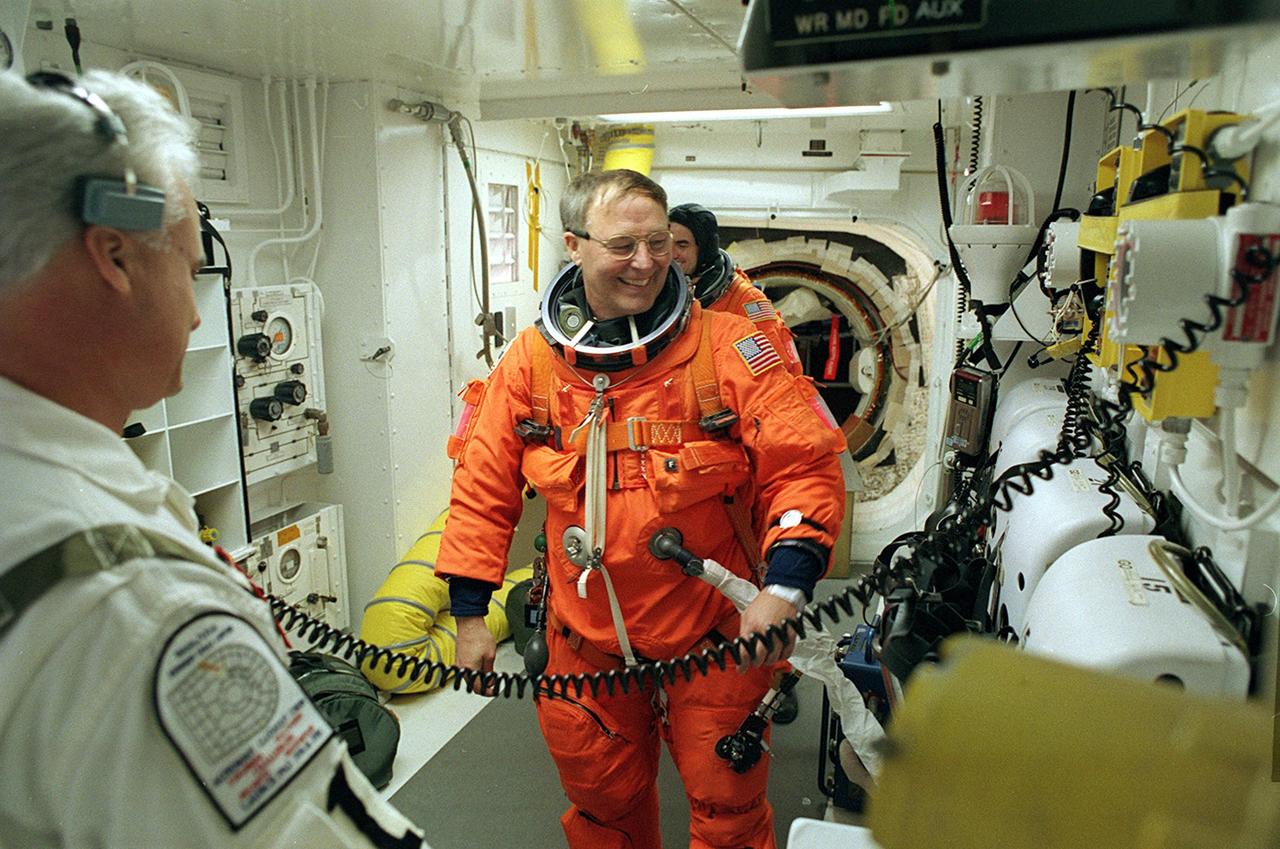
KENNEDY SPACE CENTER, FLA. - Jerry Ross jokes with the Closeout Crew in the White Room as he prepares to enter Space Shuttle Atlantis for launch. The White Room provides entry into the cockpit area of the orbiter. The 13th assembly flight to the International Space Station, STS-110 is carrying the S0 Integrated Truss Structure and Mobile Transporter (MT). On the 11-day mission, astronauts, including Ross, will make four spacewalks to attach the S0 truss, which will become the backbone of the Space Station, to the U.S. Lab, "Destiny." The MT, a space "railcar," is attached to the truss segment and will make its debut run during the flight. Ross is making his seventh Shuttle flight, a new record in the history of the Shuttle program, and will complete his ninth spacewalk, also a record. Launch is scheduled for 4:40 p.m. EDT (20:40 GMT)
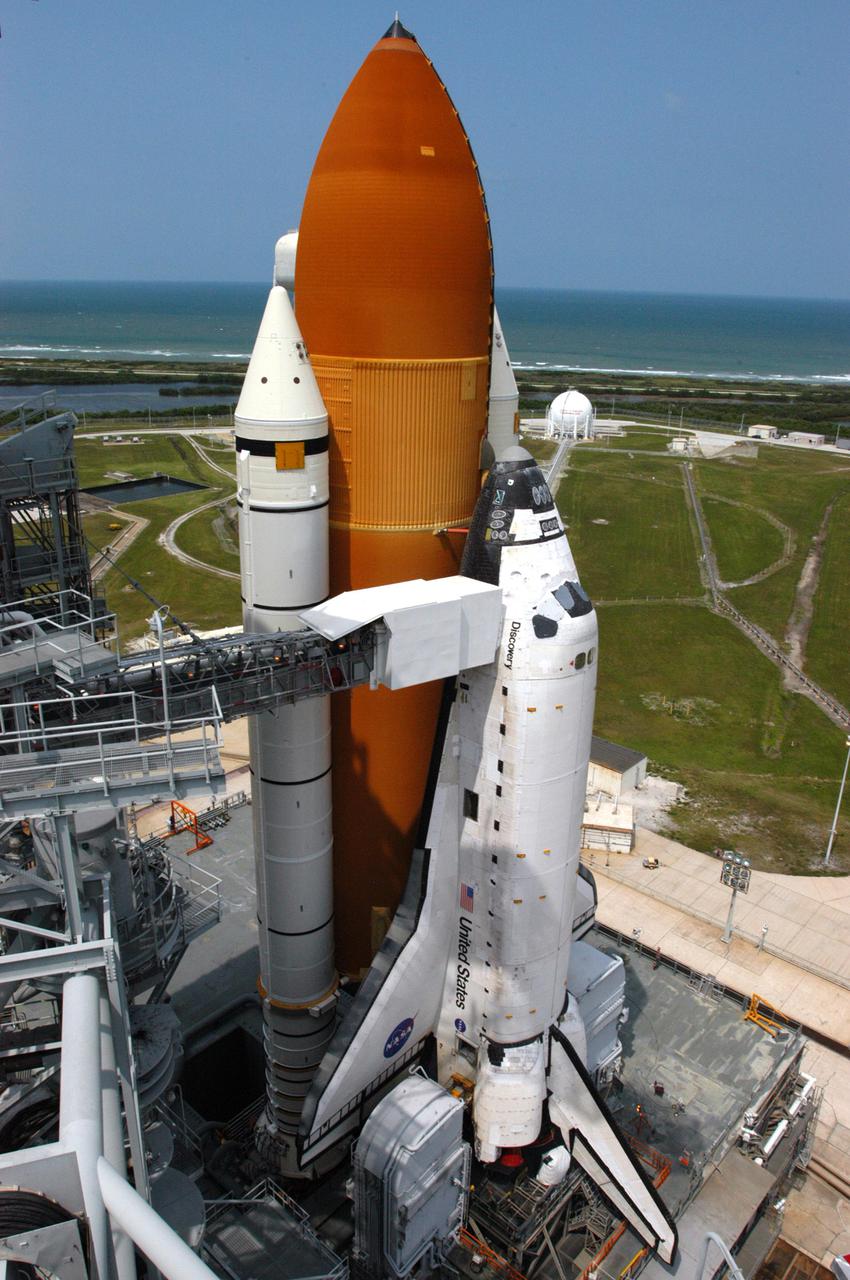
KENNEDY SPACE CENTER, FLA. - On Launch Pad 39B, Space Shuttle Discovery is revealed after rollback of the Rotating Service Structure. The Orbiter Access Arm can be seen extended to the cockpit. Discovery will be rolled back to the Vehicle Assembly Building. Once inside the VAB, Discovery will be demated from its External Tank and lifted into the transfer aisle. On or about June 7, Discovery will be lifted and attached to its new tank and Solid Rocket Boosters, which are already in the VAB. Only the 15th rollback in Space Shuttle Program history, the 4.2-mile journey allows additional modifications to be made to the External Tank prior to a safe Return to Flight. Discovery is expected to be rolled back to the launch pad in mid-June for Return to Flight mission STS-114. The launch window extends from July 13 to July 31.
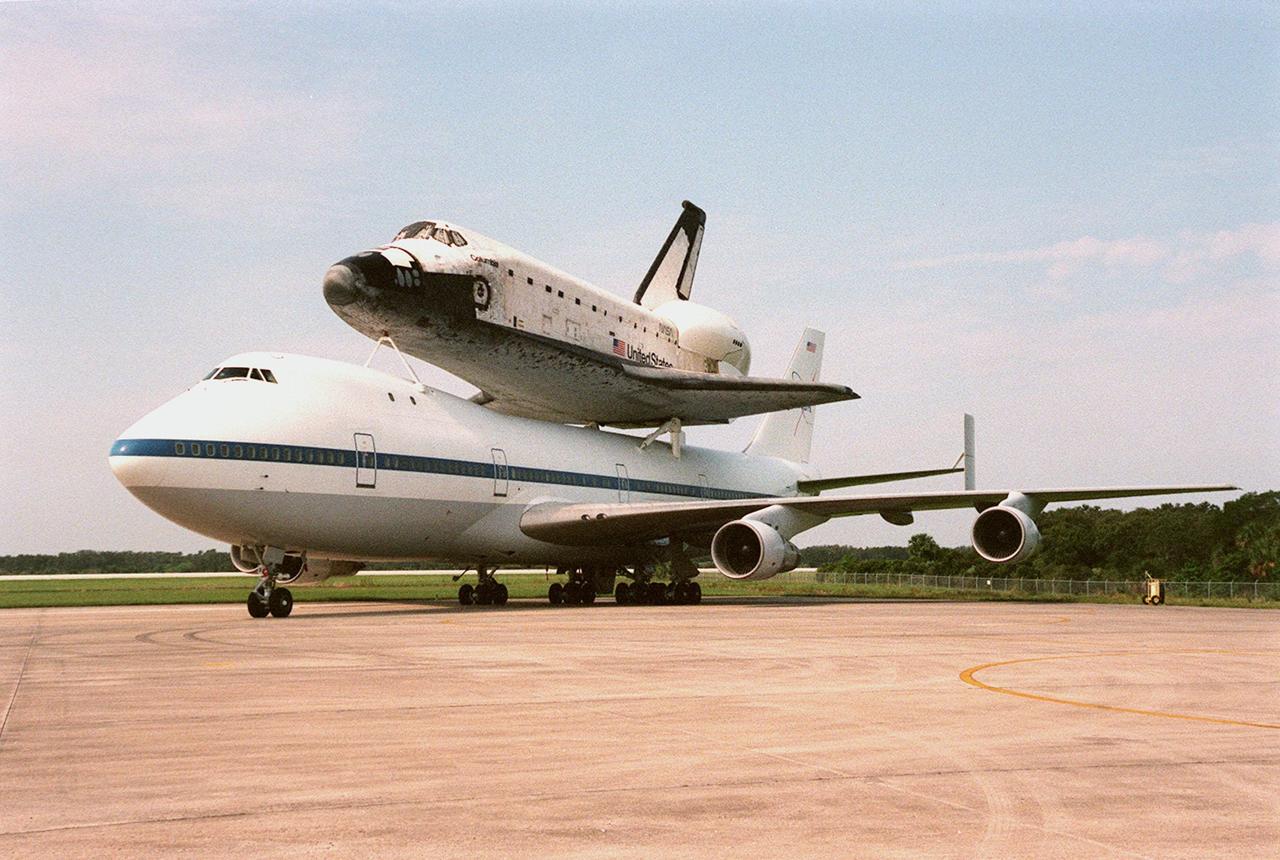
KENNEDY SPACE CENTER, FLA. -- The Boeing 747 Shuttle Carrier Aircraft, with the orbiter Columbia strapped to its back, waits at the Shuttle Landing Facility for clear weather to take off for its final destination, Palmdale, Calif. The oldest of four orbiters in NASA's fleet, Columbia is being ferried to Palmdale to undergo extensive inspections and modifications in Boeing's Orbiter Assembly Facility. The nine-month orbiter maintenance down period (OMDP) is the second in Columbia's history. Orbiters are periodically removed from flight operations for an OMDP. Columbia's first was in 1994. Along with more than 100 modifications on the vehicle, Columbia will be the second orbiter to be outfitted with the multifunctional electronic display system, or "glass cockpit." Columbia is expected to return to KSC in July 2000
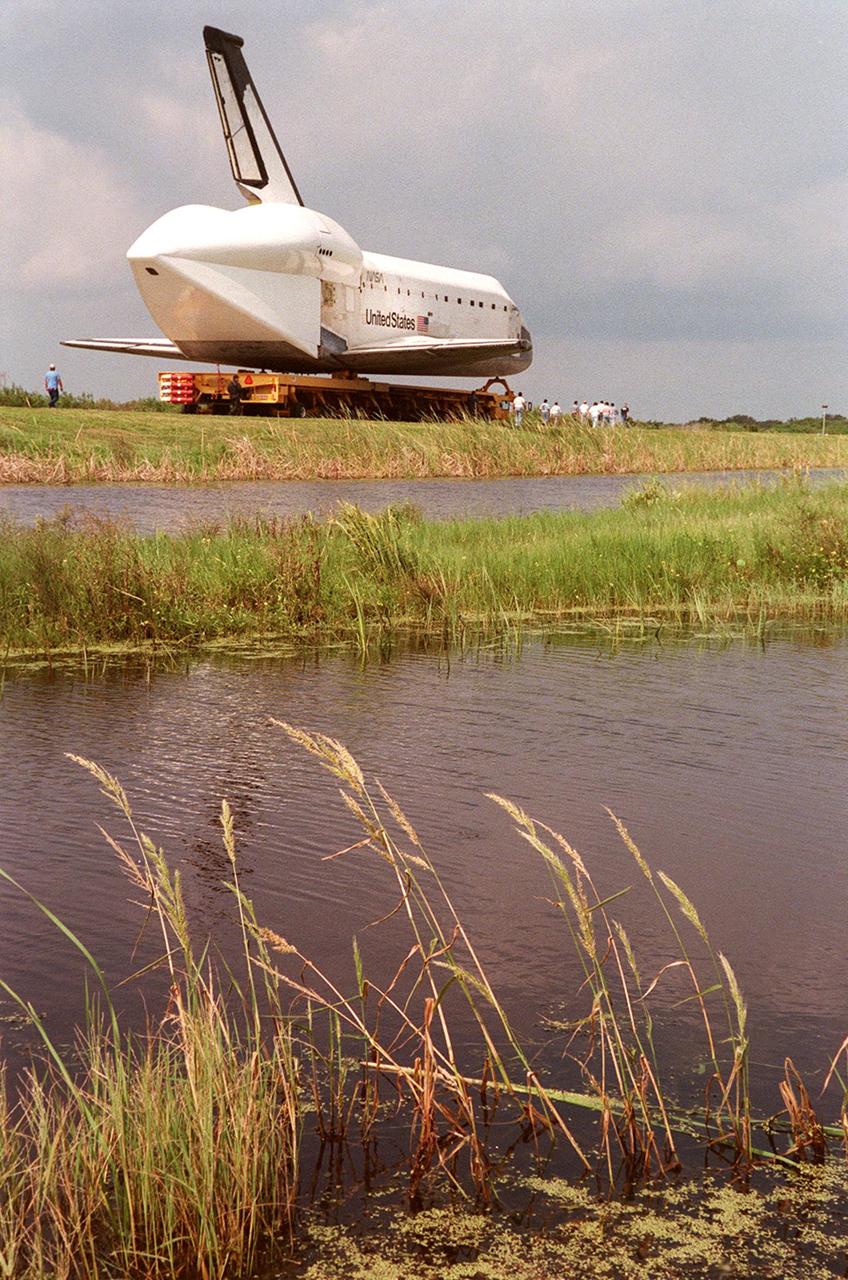
KENNEDY SPACE CENTER, FLA. -- Aboard a transporter, the orbiter Columbia is moved on the tow-way along the Banana Creek. Columbia is heading to the Shuttle Landing Facility's (SLF) Mate-Demate Device where it will be mated to the Boeing 747 Shuttle Carrier Aircraft for a ferry flight to Palmdale, Calif. On the rear of the orbiter can be seen the tail cone, a fairing that is installed over the aft fuselage of the orbiter to decrease aerodynamic drag and buffet when the Shuttle Carrier Aircraft is transporting the orbiter cross-country. It is 36 feet long, 25 feet wide, and 22 feet high. Columbia, the oldest of four orbiters in NASA's fleet, will undergo extensive inspections and modifications in Boeing's Orbiter Assembly Facility during a nine-month orbiter maintenance down period (OMDP), the second in its history. Orbiters are periodically removed from flight operations for an OMDP. Columbia's first was in 1994. Along with more than 100 modifications on the vehicle, Columbia will be the second orbiter to be outfitted with the multifunctional electronic display system, or "glass cockpit." Columbia is expected to return to KSC in July 2000
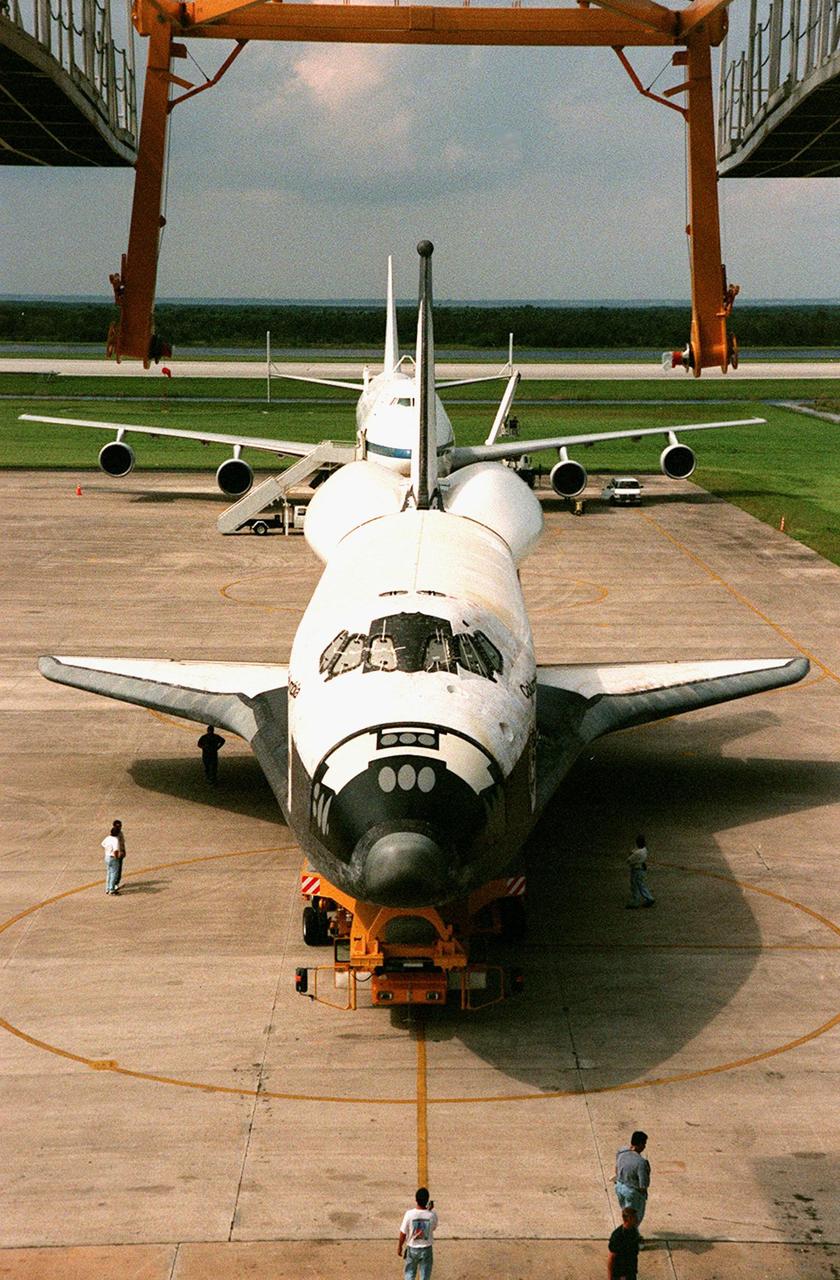
KENNEDY SPACE CENTER, FLA. -- The orbiter Columbia (foreground) moves under the Mate-Demate Device at KSC's Shuttle Landing Facility (SLF). The crane seen above it will lift the orbiter so that the Boeing 747 Shuttle Carrier Aircraft (SCA) in the background can move underneath Columbia, which will then be attached to the back of the SCA for a ferry flight to Palmdale, Calif. On the rear of the orbiter is the tail cone, a fairing that is installed over the aft fuselage of the orbiter to decrease aerodynamic drag and buffet when the Shuttle Carrier Aircraft is transporting the orbiter cross-country. It is 36 feet long, 25 feet wide, and 22 feet high. Columbia, the oldest of four orbiters in NASA's fleet, will undergo extensive inspections and modifications in Boeing's Orbiter Assembly Facility during a nine-month orbiter maintenance down period (OMDP), the second in its history. Orbiters are periodically removed from flight operations for an OMDP. Columbia's first was in 1994. Along with more than 100 modifications on the vehicle, Columbia will be the second orbiter to be outfitted with the multifunctional electronic display system, or "glass cockpit." Columbia is expected to return to KSC in July 2000
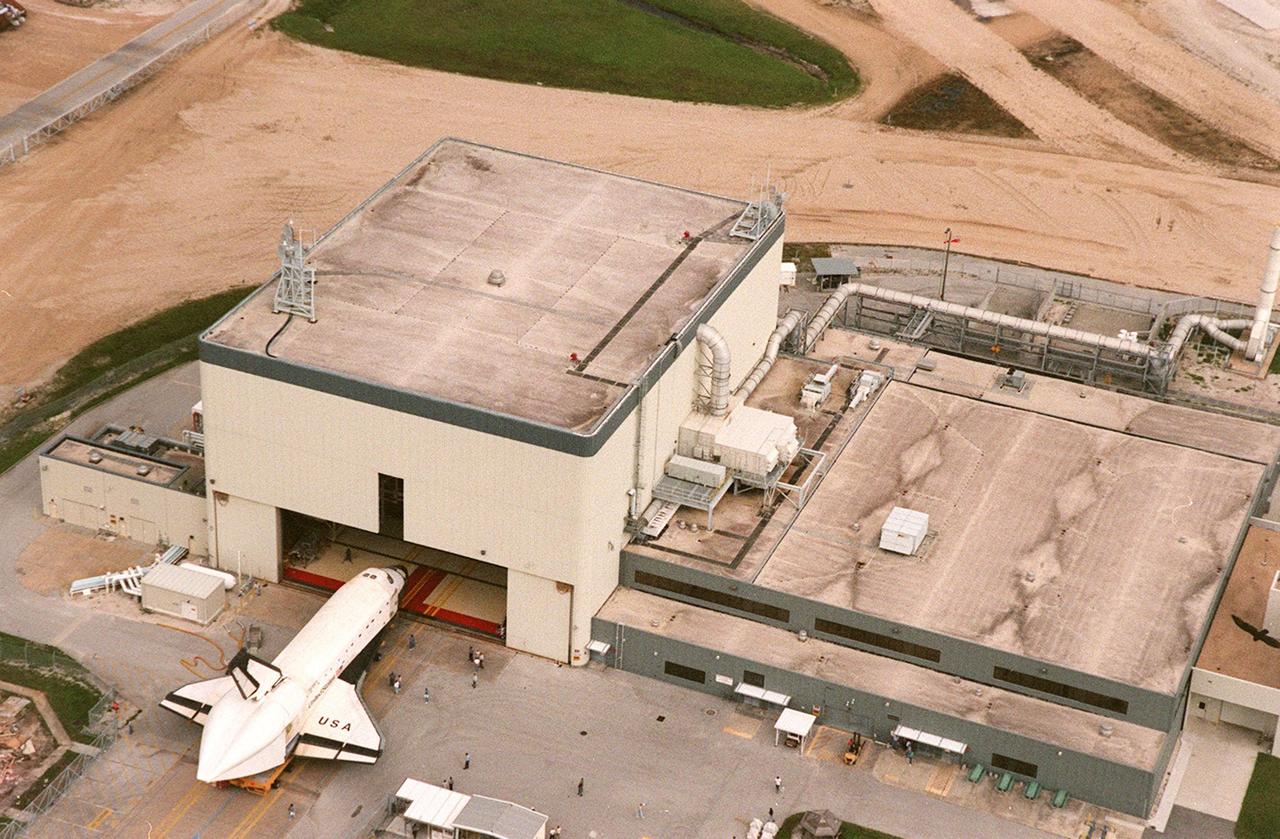
KENNEDY SPACE CENTER, FLA. -- The orbiter Columbia rolls out of KSC's Orbiter Processing Facility bay 3, bound for the Shuttle Landing Facility's (SLF) Mate-Demate Device. At the SLF the orbiter is to be mated to the Boeing 747 Shuttle Carrier Aircraft for a ferry flight to Palmdale, Calif. On the rear of the orbiter can be seen the tail cone, a fairing that is installed over the aft fuselage of the orbiter to decrease aerodynamic drag and buffet when the Shuttle Carrier Aircraft is transporting the orbiter cross-country. It is 36 feet long, 25 feet wide, and 22 feet high. Columbia, the oldest of four orbiters in NASA's fleet, will undergo extensive inspections and modifications in Boeing's Orbiter Assembly Facility during a nine-month orbiter maintenance down period (OMDP), the second in its history. Orbiters are periodically removed from flight operations for an OMDP. Columbia's first was in 1994. Along with more than 100 modifications on the vehicle, Columbia will be the second orbiter to be outfitted with the multifunctional electronic display system, or "glass cockpit." Columbia is expected to return to KSC in July 2000

KENNEDY SPACE CENTER, FLA. -- At the Shuttle Landing Facility at Kennedy Space Center, the orbiter Columbia takes to the sky on the back of a Boeing 747 Shuttle Carrier Aircraft on a ferry flight to Palmdale, Calif. On the rear of the orbiter can be seen the tail cone, a fairing that is installed over the aft fuselage of the orbiter to decrease aerodynamic drag and buffet when the Shuttle Carrier Aircraft is transporting the orbiter cross-country. It is 36 feet long, 25 feet wide, and 22 feet high. Columbia, the oldest of four orbiters in NASA's fleet, will undergo extensive inspections and modifications in Boeing's Orbiter Assembly Facility during a nine-month orbiter maintenance down period (OMDP), the second in its history. Orbiters are periodically removed from flight operations for an OMDP. Columbia's first was in 1994. Along with more than 100 modifications on the vehicle, Columbia will be the second orbiter to be outfitted with the multifunctional electronic display system, or "glass cockpit." Columbia is expected to return to KSC in July 2000
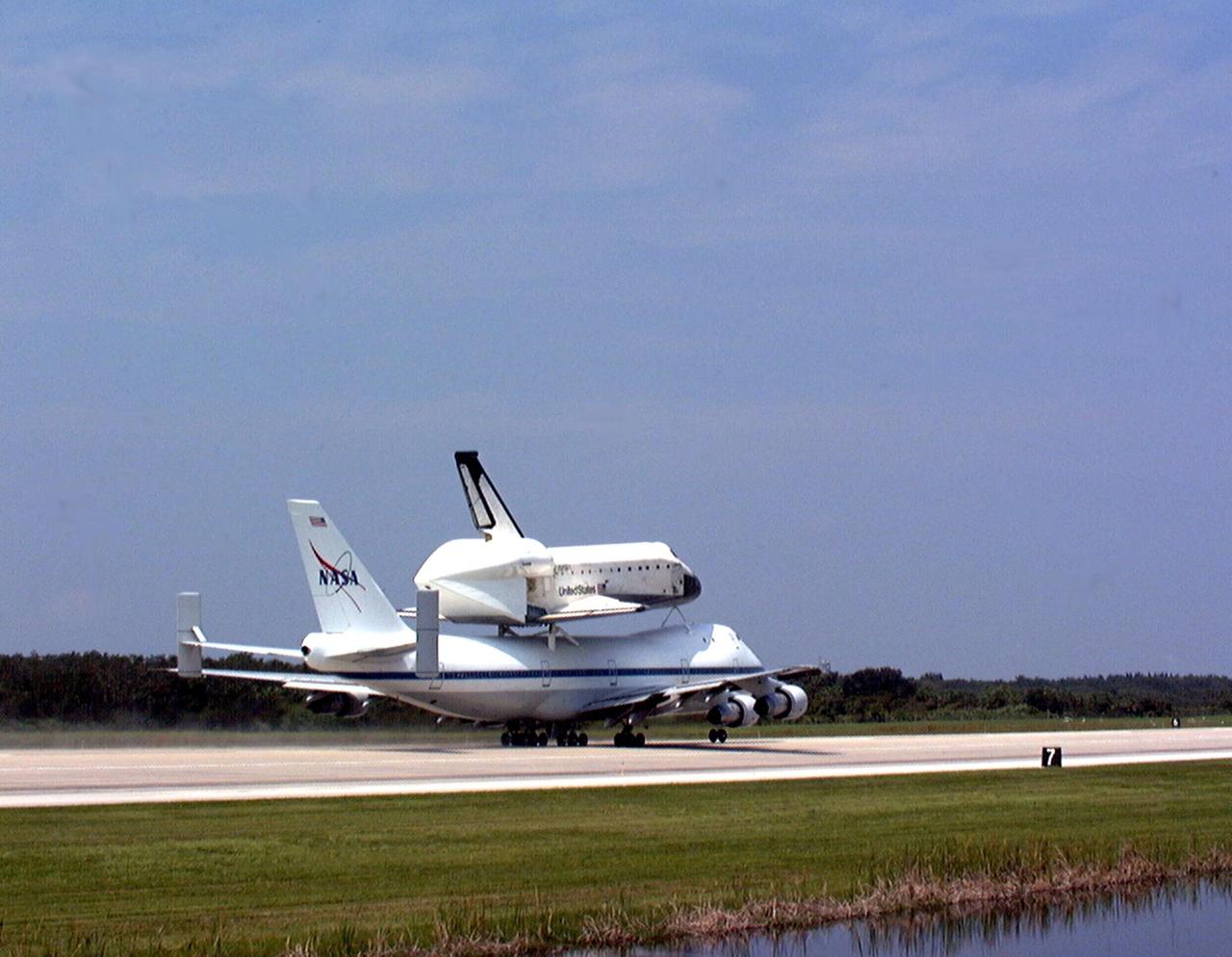
KENNEDY SPACE CENTER, FLA. -- From the Shuttle Landing Facility at Kennedy Space Center, the orbiter Columbia moves down the runway on the back of a Boeing 747 Shuttle Carrier Aircraft on a ferry flight to Palmdale, Calif. On the rear of the orbiter can be seen the tail cone, a fairing that is installed over the aft fuselage of the orbiter to decrease aerodynamic drag and buffet when the Shuttle Carrier Aircraft is transporting the orbiter cross-country. It is 36 feet long, 25 feet wide, and 22 feet high. Columbia, the oldest of four orbiters in NASA's fleet, will undergo extensive inspections and modifications in Boeing's Orbiter Assembly Facility during a nine-month orbiter maintenance down period (OMDP), the second in its history. Orbiters are periodically removed from flight operations for an OMDP. Columbia's first was in 1994. Along with more than 100 modifications on the vehicle, Columbia will be the second orbiter to be outfitted with the multifunctional electronic display system, or "glass cockpit." Columbia is expected to return to KSC in July 2000
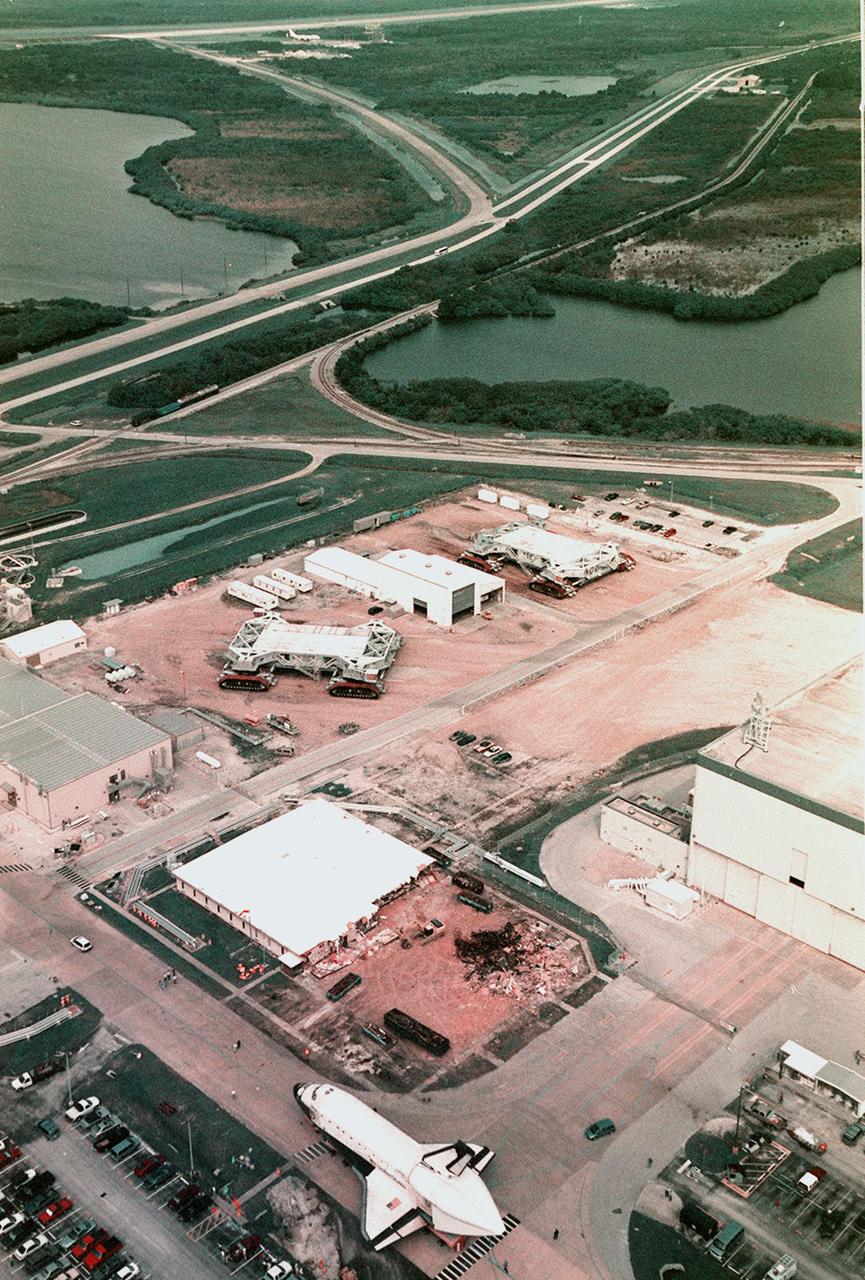
On an orbiter transporter, Columbia is ready for its move to the Shuttle Landing Facility's (SLF) Mate-Demate Device (MDD), in the distance at the top of the photo. Seen next to the MDD is the Boeing 747 Shuttle Carrier Aircraft which will carry the orbiter piggyback in a ferry flight to Palmdale, Calif. On the rear of the orbiter can be seen the tail cone, a fairing that is installed over the aft fuselage of the orbiter to decrease aerodynamic drag and buffet when the Shuttle Carrier Aircraft is transporting the orbiter cross-country. It is 36 feet long, 25 feet wide, and 22 feet high. Columbia, the oldest of four orbiters in NASA's fleet, will undergo extensive inspections and modifications in Boeing's Orbiter Assembly Facility during a nine-month orbiter maintenance down period (OMDP), the second in its history. Orbiters are periodically removed from flight operations for an OMDP. Columbia's first was in 1994. Along with more than 100 modifications on the vehicle, Columbia will be the second orbiter to be outfitted with the multifunctional electronic display system, or 'glass cockpit.' Columbia is expected to return to KSC in July 2000.
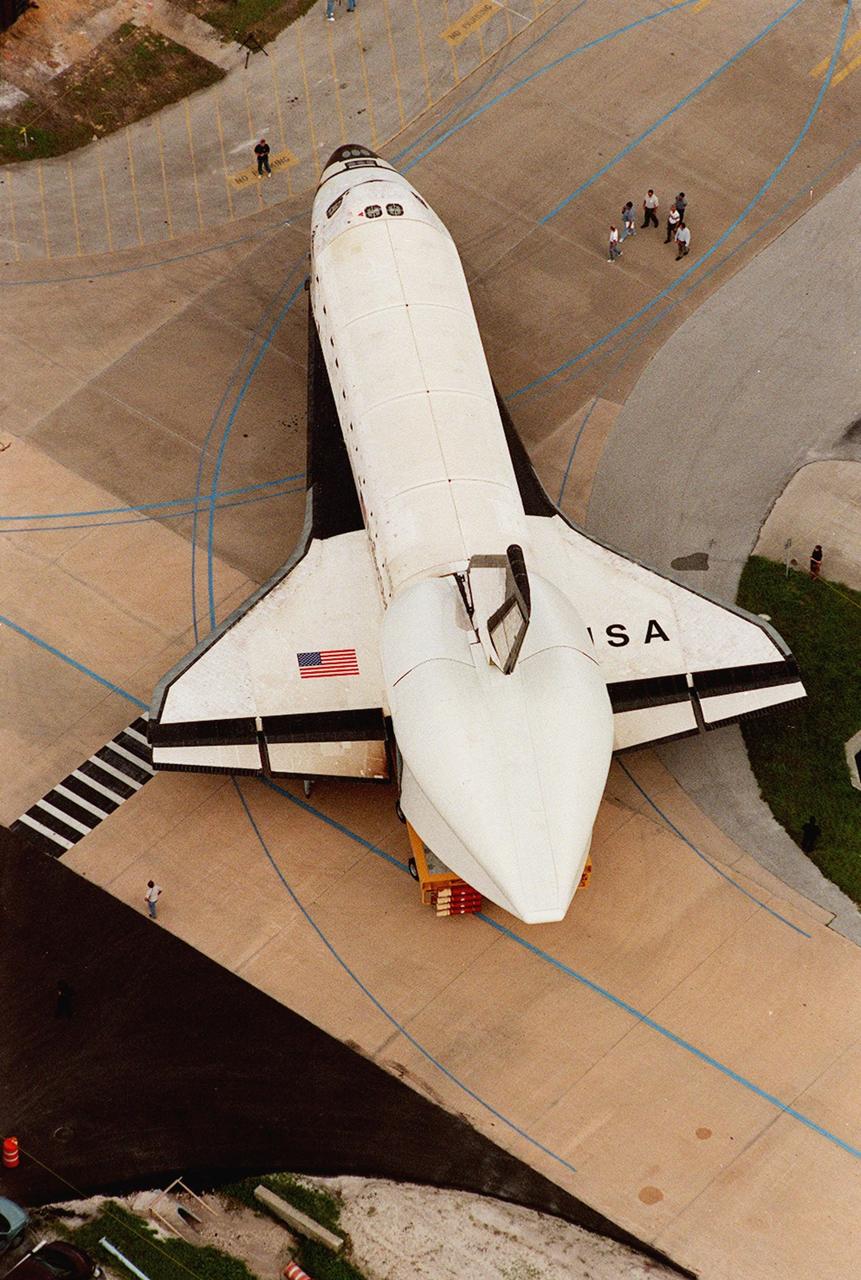
KENNEDY SPACE CENTER, FLA. -- Photographed from overhead, the orbiter Columbia begins to turn after rolling out of KSC's Orbiter Processing Facility bay 3, bound for the Shuttle Landing Facility's (SLF) Mate-Demate Device. At the SLF the orbiter is to be mated to the Boeing 747 Shuttle Carrier Aircraft for a ferry flight to Palmdale, Calif. On the rear of the orbiter can be seen the tail cone, a fairing that is installed over the aft fuselage of the orbiter to decrease aerodynamic drag and buffet when the Shuttle Carrier Aircraft is transporting the orbiter cross-country. It is 36 feet long, 25 feet wide, and 22 feet high. Columbia, the oldest of four orbiters in NASA's fleet, will undergo extensive inspections and modifications in Boeing's Orbiter Assembly Facility during a nine-month orbiter maintenance down period (OMDP), the second in its history. Orbiters are periodically removed from flight operations for an OMDP. Columbia's first was in 1994. Along with more than 100 modifications on the vehicle, Columbia will be the second orbiter to be outfitted with the multifunctional electronic display system, or "glass cockpit." Columbia is expected to return to KSC in July 2000
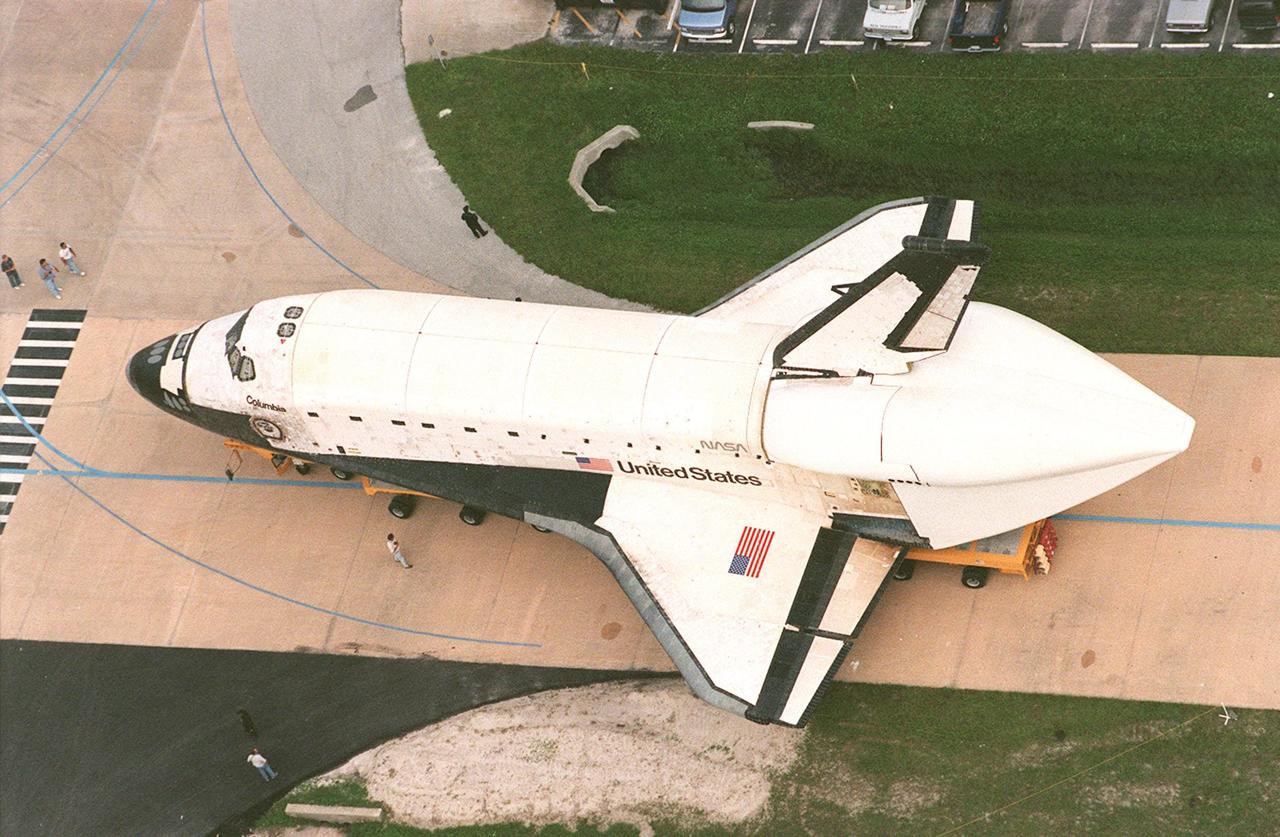
KENNEDY SPACE CENTER, FLA. -- On an orbiter transporter, Columbia is turned, after rolling out of KSC's Orbiter Processing Facility bay 3, for its move to the Shuttle Landing Facility's (SLF) Mate-Demate Device. At the SLF the orbiter is to be mated to the Boeing 747 Shuttle Carrier Aircraft for a ferry flight to Palmdale, Calif. On the rear of the orbiter can be seen the tail cone, a fairing that is installed over the aft fuselage of the orbiter to decrease aerodynamic drag and buffet when the Shuttle Carrier Aircraft is transporting the orbiter cross-country. It is 36 feet long, 25 feet wide, and 22 feet high. Columbia, the oldest of four orbiters in NASA's fleet, will undergo extensive inspections and modifications in Boeing's Orbiter Assembly Facility during a nine-month orbiter maintenance down period (OMDP), the second in its history. Orbiters are periodically removed from flight operations for an OMDP. Columbia's first was in 1994. Along with more than 100 modifications on the vehicle, Columbia will be the second orbiter to be outfitted with the multifunctional electronic display system, or "glass cockpit." Columbia is expected to return to KSC in July 2000

KENNEDY SPACE CENTER, FLA. -- Aboard a transporter, the orbiter Columbia moves past the Boeing 747 Shuttle Carrier Aircraft (SCA) at the Shuttle Landing Facility. There the orbiter will be mated to the SCA, with the help of a Mate-Demate Device, for a ferry flight to Palmdale, Calif. On the rear of the orbiter is the tail cone, a fairing that is installed over the aft fuselage of the orbiter to decrease aerodynamic drag and buffet when the Shuttle Carrier Aircraft is transporting the orbiter cross-country. It is 36 feet long, 25 feet wide, and 22 feet high. Columbia, the oldest of four orbiters in NASA's fleet, will undergo extensive inspections and modifications in Boeing's Orbiter Assembly Facility during a nine-month orbiter maintenance down period (OMDP), the second in its history. Orbiters are periodically removed from flight operations for an OMDP. Columbia's first was in 1994. Along with more than 100 modifications on the vehicle, Columbia will be the second orbiter to be outfitted with the multifunctional electronic display system, or "glass cockpit." Columbia is expected to return to KSC in July 2000
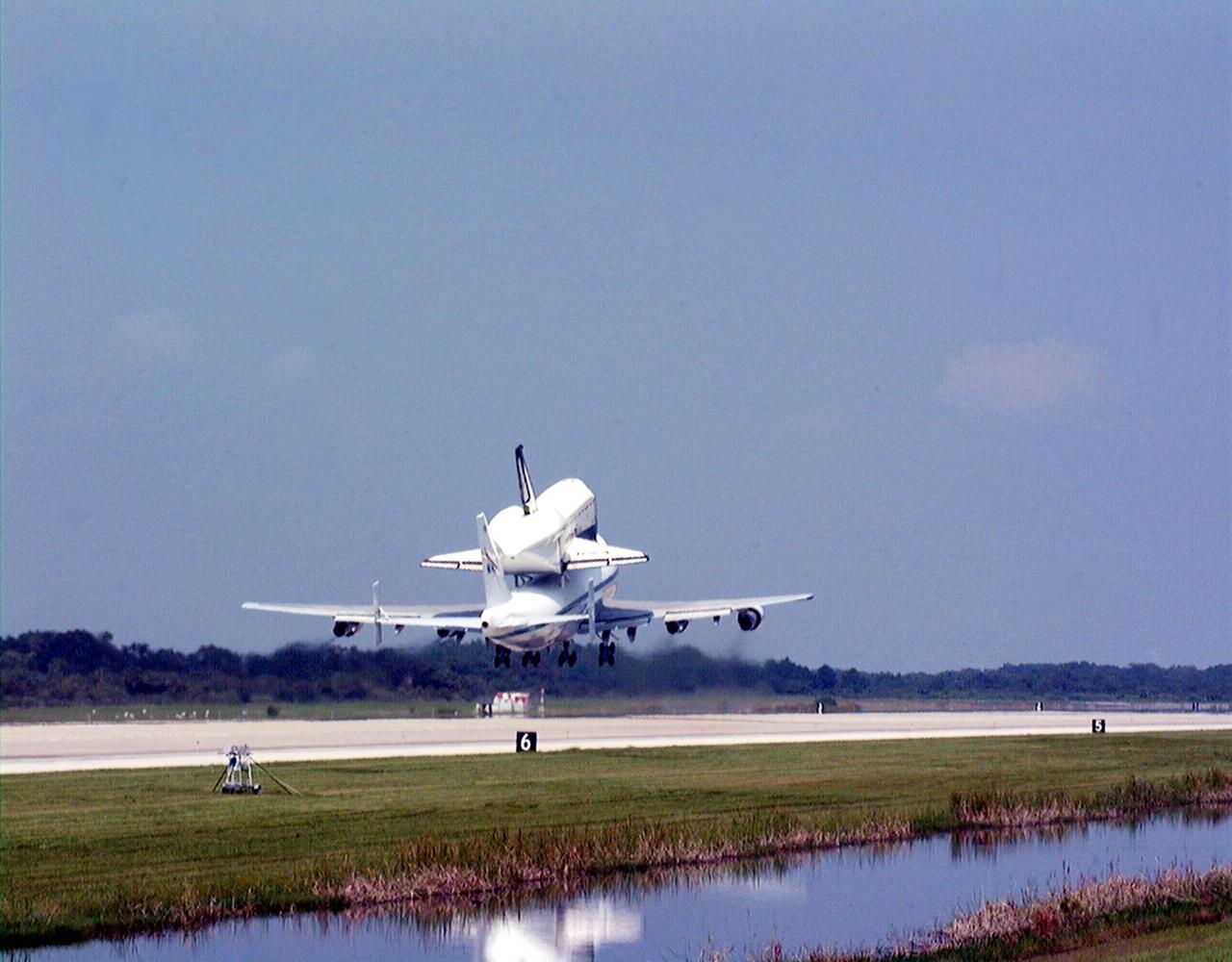
KENNEDY SPACE CENTER, FLA. -- At the Shuttle Landing Facility at Kennedy Space Center, the orbiter Columbia takes off into a clear sky on the back of a Boeing 747 Shuttle Carrier Aircraft on a ferry flight to Palmdale, Calif. On the rear of the orbiter can be seen the tail cone, a fairing that is installed over the aft fuselage of the orbiter to decrease aerodynamic drag and buffet when the Shuttle Carrier Aircraft is transporting the orbiter cross-country. It is 36 feet long, 25 feet wide, and 22 feet high. Columbia, the oldest of four orbiters in NASA's fleet, will undergo extensive inspections and modifications in Boeing's Orbiter Assembly Facility during a nine-month orbiter maintenance down period (OMDP), the second in its history. Orbiters are periodically removed from flight operations for an OMDP. Columbia's first was in 1994. Along with more than 100 modifications on the vehicle, Columbia will be the second orbiter to be outfitted with the multifunctional electronic display system, or "glass cockpit." Columbia is expected to return to KSC in July 2000