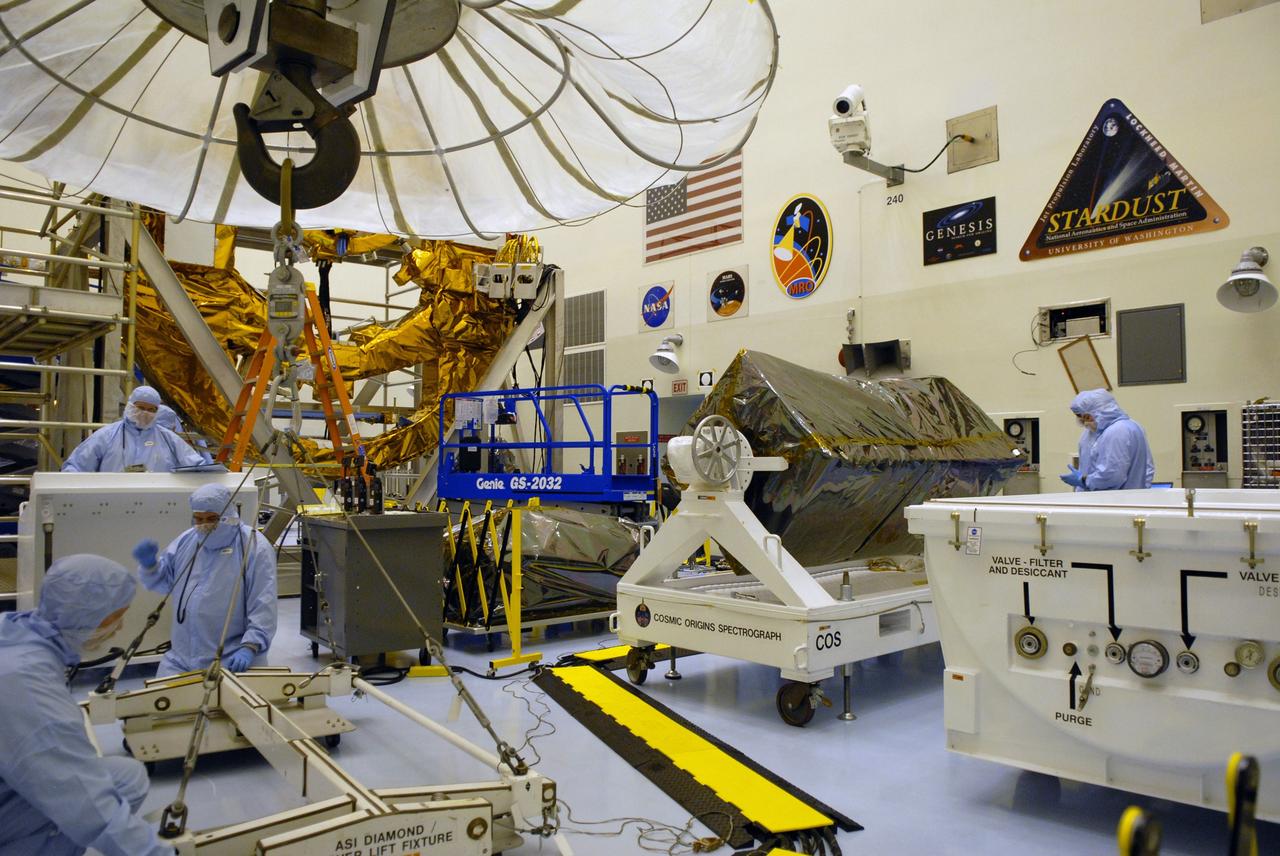
CAPE CANAVERAL, Fla. – In the Payload Hazardous Servicing Facility at NASA's Kennedy Space Center in Florida, the crane has been removed from the Cosmic Origins Spectrograph, or COS, after placing the COS on a test stand. The COS is part of the payload on space shuttle Atlantis for the Hubble servicing mission, targeted to launch in mid-May. Installing the COS during the mission will effectively restore spectroscopy to Hubble’s scientific arsenal, and at the same time provide the telescope with unique capabilities. COS is designed to study the large-scale structure of the universe and how galaxies, stars and planets formed and evolved. It will help determine how elements needed for life such as carbon and iron first formed and how their abundances have increased over the lifetime of the universe. Photo credit: NASA/Jack Pfaller
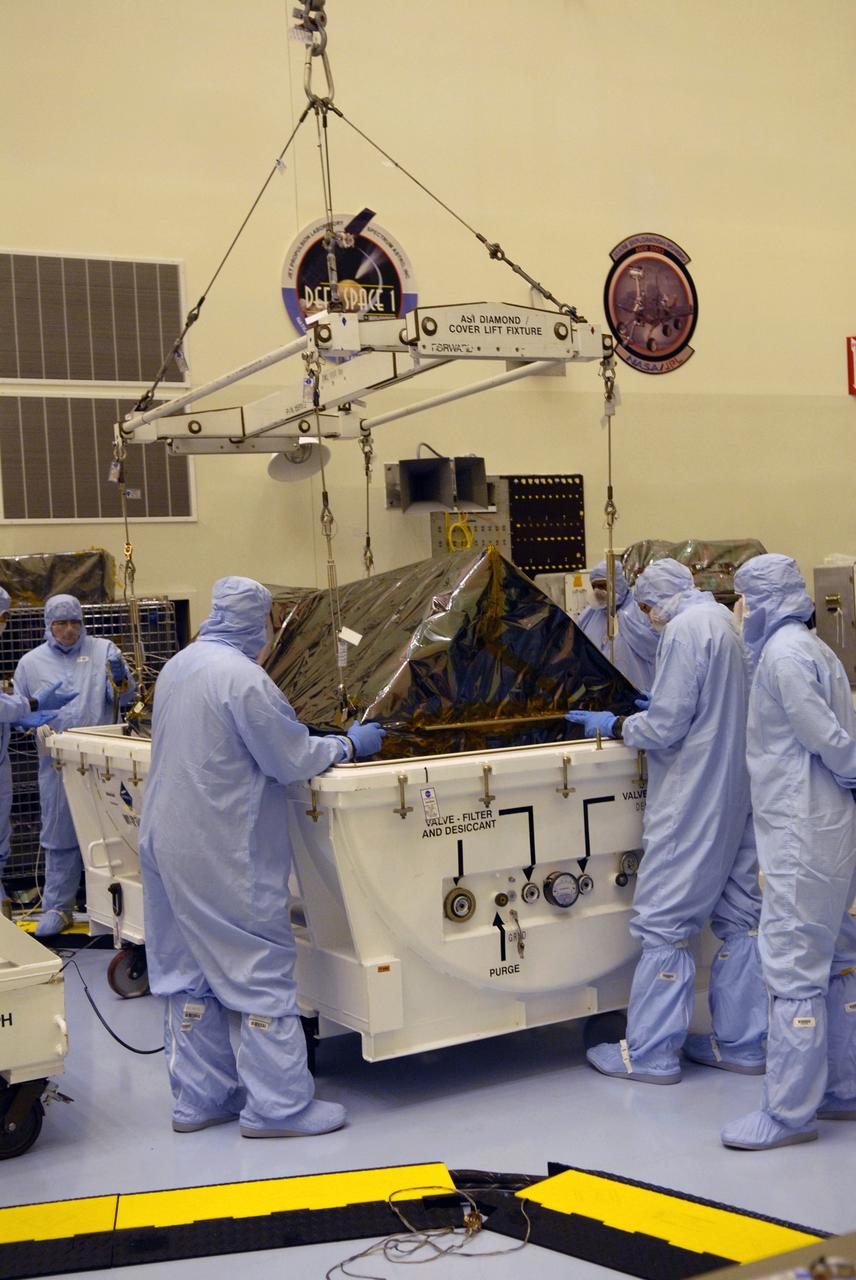
CAPE CANAVERAL, Fla. – In the Payload Hazardous Servicing Facility at NASA's Kennedy Space Center in Florida, a crane is attached to the Cosmic Origins Spectrograph, or COS, still in its shipping container. The crane will remove the COS and place it on a test stand. The COS is part of the payload on space shuttle Atlantis for the Hubble servicing mission, targeted to launch in mid-May. Installing the COS during the mission will effectively restore spectroscopy to Hubble’s scientific arsenal, and at the same time provide the telescope with unique capabilities. COS is designed to study the large-scale structure of the universe and how galaxies, stars and planets formed and evolved. It will help determine how elements needed for life such as carbon and iron first formed and how their abundances have increased over the lifetime of the universe. Photo credit: NASA/Jack Pfaller
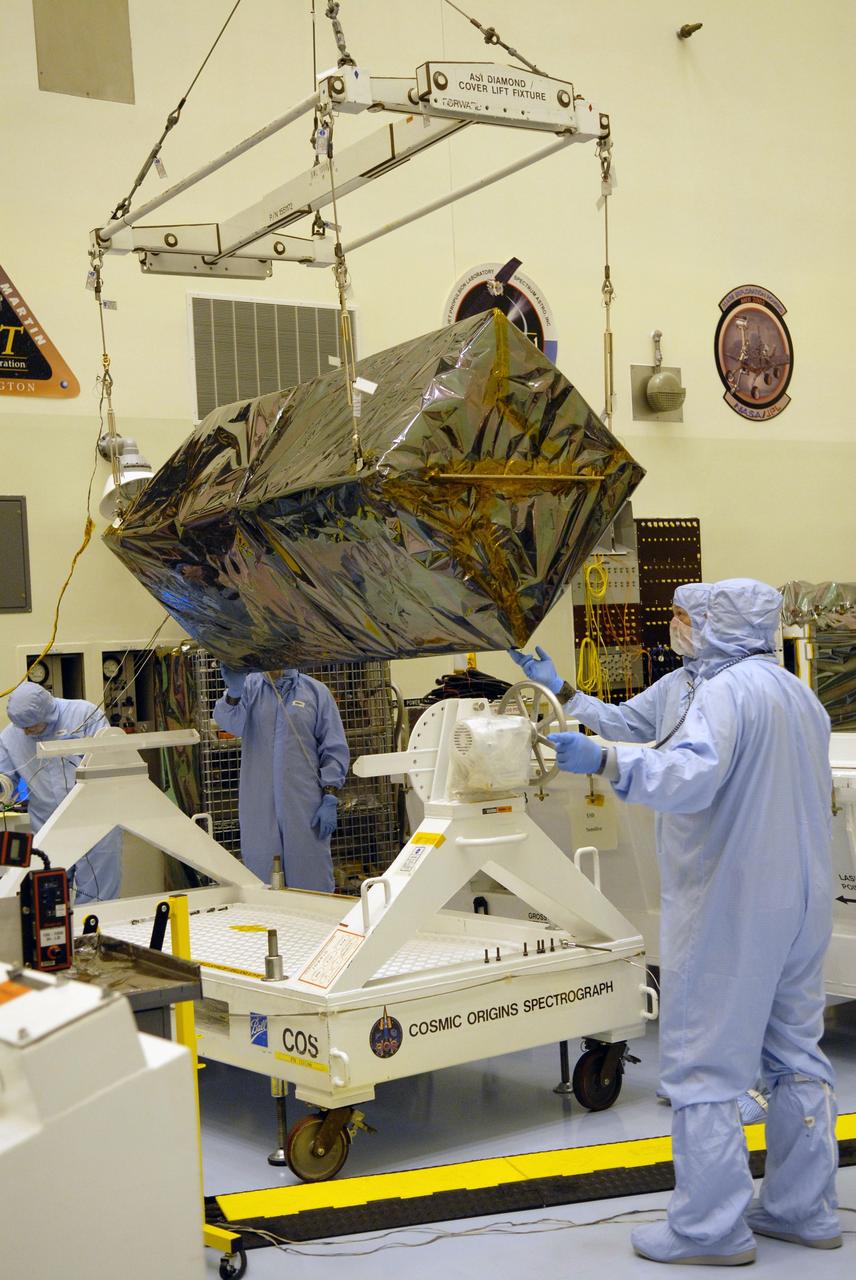
CAPE CANAVERAL, Fla. – In the Payload Hazardous Servicing Facility at NASA's Kennedy Space Center in Florida, under the guidance of the technicians, a crane lowers the Cosmic Origins Spectrograph, or COS, onto a test stand. The COS is part of the payload on space shuttle Atlantis for the Hubble servicing mission, targeted to launch in mid-May. Installing the COS during the mission will effectively restore spectroscopy to Hubble’s scientific arsenal, and at the same time provide the telescope with unique capabilities. COS is designed to study the large-scale structure of the universe and how galaxies, stars and planets formed and evolved. It will help determine how elements needed for life such as carbon and iron first formed and how their abundances have increased over the lifetime of the universe. Photo credit: NASA/Jack Pfaller
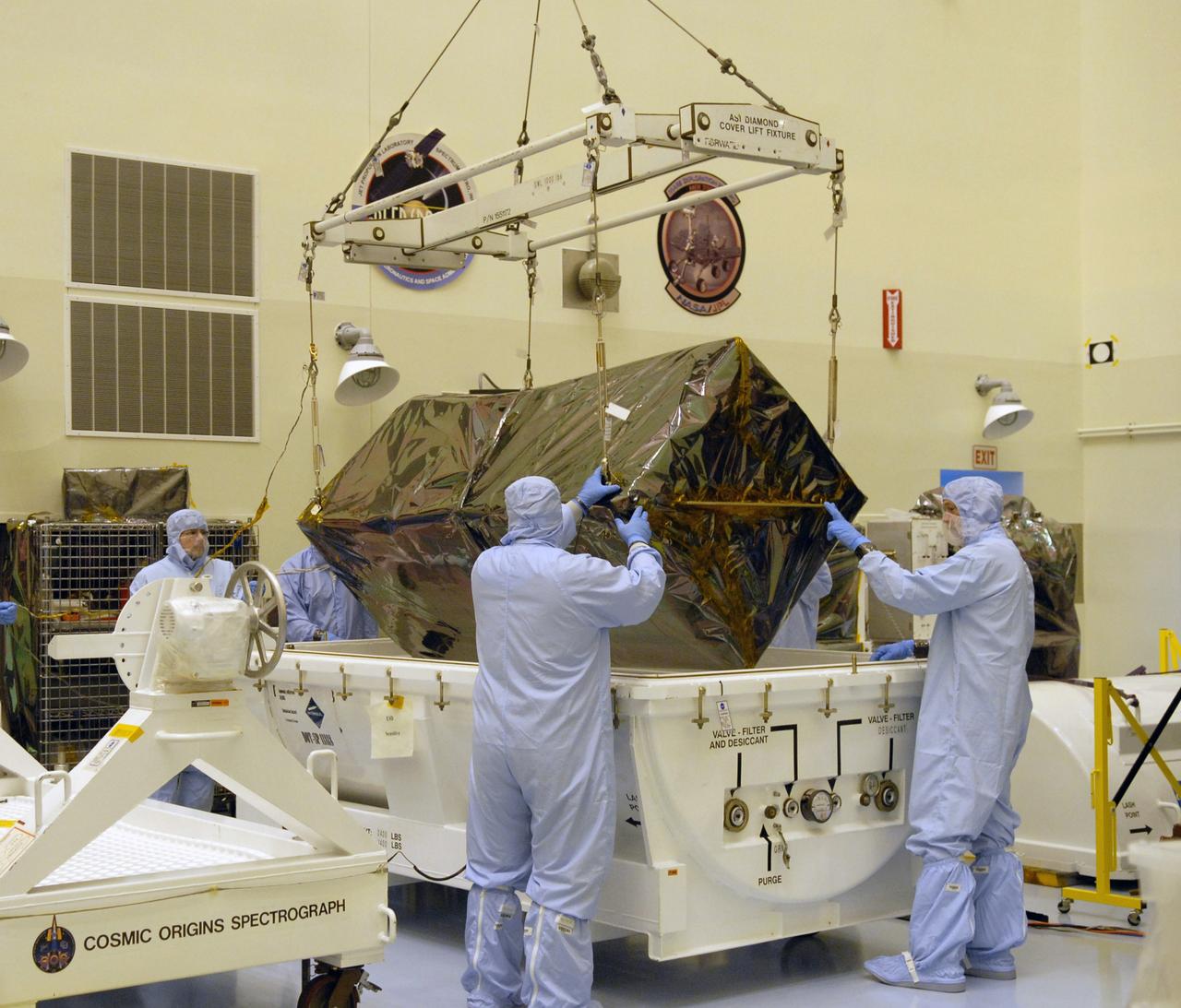
CAPE CANAVERAL, Fla. – In the Payload Hazardous Servicing Facility at NASA's Kennedy Space Center in Florida, under the guidance of the technicians, a crane lifts the Cosmic Origins Spectrograph, or COS, from the shipping container. The COS, part of the payload on space shuttle Atlantis for the Hubble servicing mission, targeted to launch in mid-May, is being moved to a test stand. Installing the COS during the mission will effectively restore spectroscopy to Hubble’s scientific arsenal, and at the same time provide the telescope with unique capabilities. COS is designed to study the large-scale structure of the universe and how galaxies, stars and planets formed and evolved. It will help determine how elements needed for life such as carbon and iron first formed and how their abundances have increased over the lifetime of the universe. Photo credit: NASA/Jack Pfaller
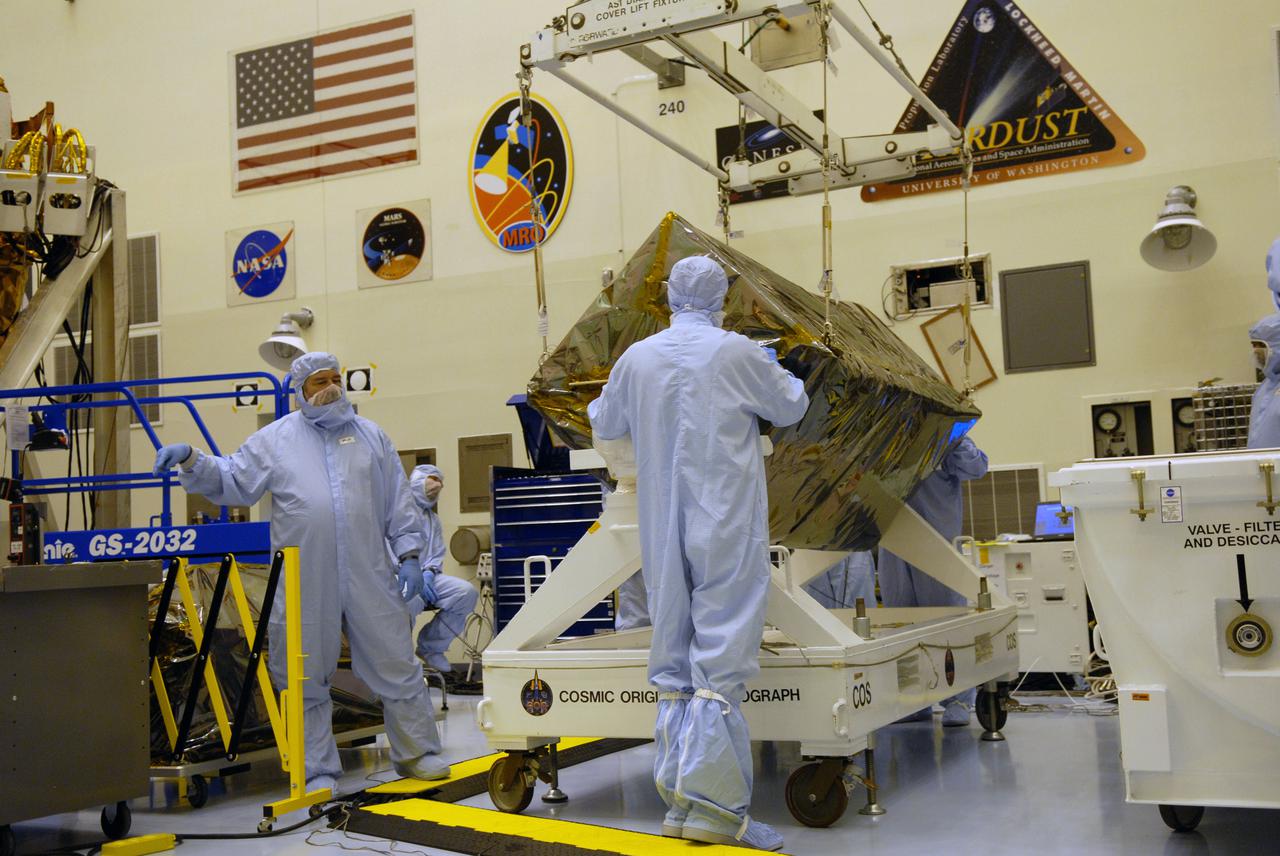
CAPE CANAVERAL, Fla. – In the Payload Hazardous Servicing Facility at NASA's Kennedy Space Center in Florida, under the guidance of the technicians, a crane lowers the Cosmic Origins Spectrograph, or COS, onto a test stand. The COS is part of the payload on space shuttle Atlantis for the Hubble servicing mission, targeted to launch in mid-May. Installing the COS during the mission will effectively restore spectroscopy to Hubble’s scientific arsenal, and at the same time provide the telescope with unique capabilities. COS is designed to study the large-scale structure of the universe and how galaxies, stars and planets formed and evolved. It will help determine how elements needed for life such as carbon and iron first formed and how their abundances have increased over the lifetime of the universe. Photo credit: NASA_Jack Pfaller
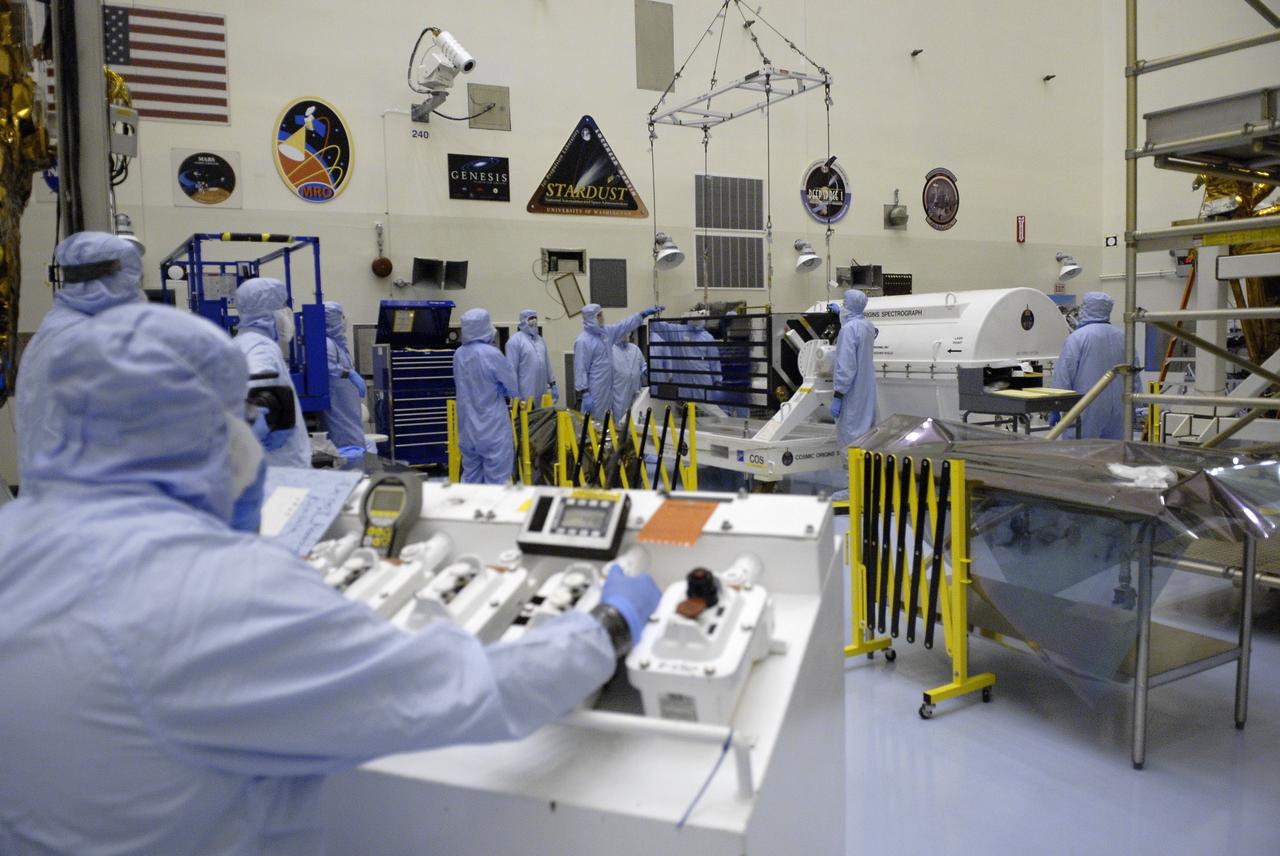
CAPE CANAVERAL, Fla. – In the Payload Hazardous Servicing Facility at NASA's Kennedy Space Center in Florida, technicians oversee the lifting of the Cosmic Origins Spectrograph, or COS, from a stand. The COS will be moved to and placed on the Orbital Replacement Unit Carrier that will be installed in space shuttle Atlantis' payload bay. The COS is part of the payload for the Hubble servicing mission, STS-125, targeted to launch in mid-May. Installing the COS during the mission will effectively restore spectroscopy to Hubble’s scientific arsenal, and at the same time provide the telescope with unique capabilities. COS is designed to study the large-scale structure of the universe and how galaxies, stars and planets formed and evolved. It will help determine how elements needed for life such as carbon and iron first formed and how their abundances have increased over the lifetime of the universe. Photo credit: NASA/Kim Shiflett
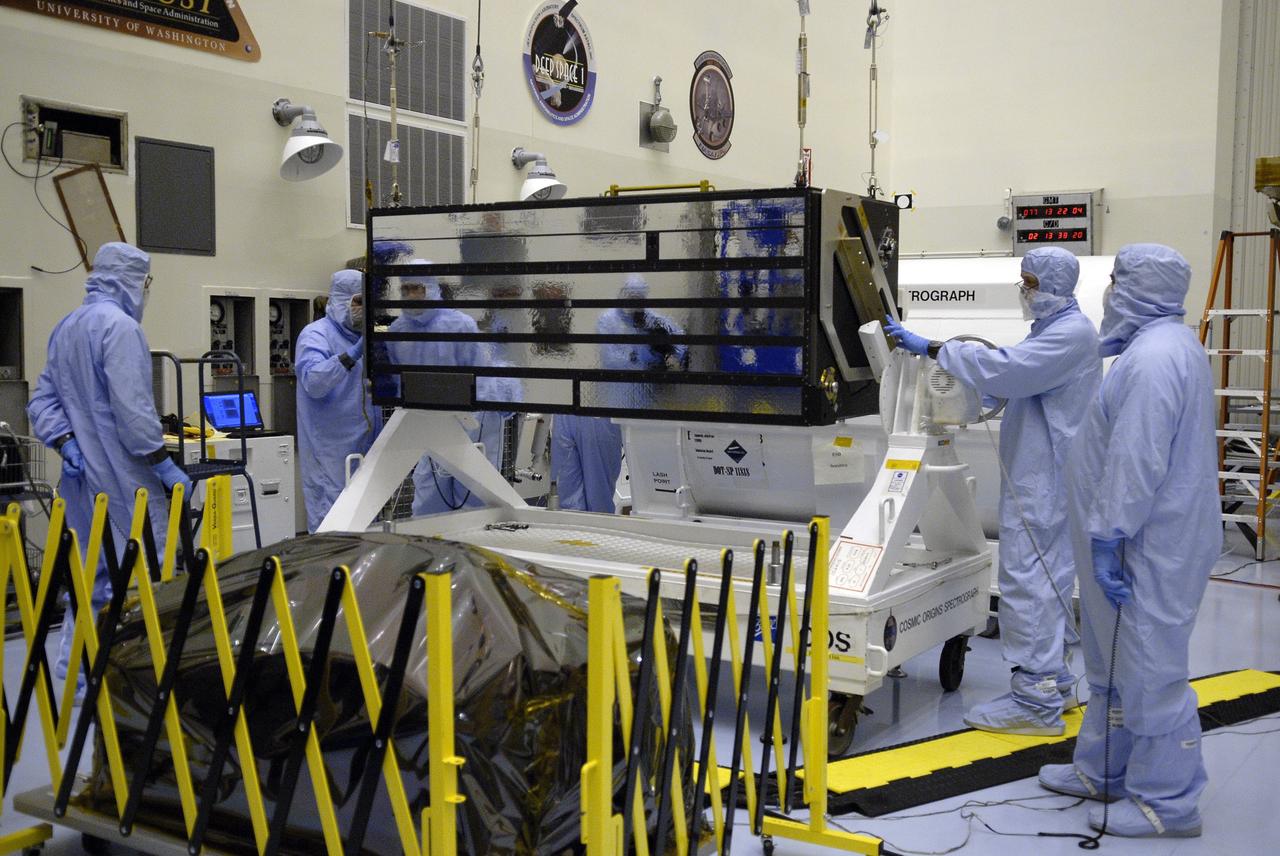
CAPE CANAVERAL, Fla. – In the Payload Hazardous Servicing Facility at NASA's Kennedy Space Center in Florida, technicians help with the lifting of the Cosmic Origins Spectrograph, or COS, from a stand. The COS will be moved to and placed on the Orbital Replacement Unit Carrier that will be installed in space shuttle Atlantis' payload bay. The COS is part of the payload for the Hubble servicing mission, STS-125, targeted to launch in mid-May. Installing the COS during the mission will effectively restore spectroscopy to Hubble’s scientific arsenal, and at the same time provide the telescope with unique capabilities. COS is designed to study the large-scale structure of the universe and how galaxies, stars and planets formed and evolved. It will help determine how elements needed for life such as carbon and iron first formed and how their abundances have increased over the lifetime of the universe. Photo credit: NASA/Kim Shiflett
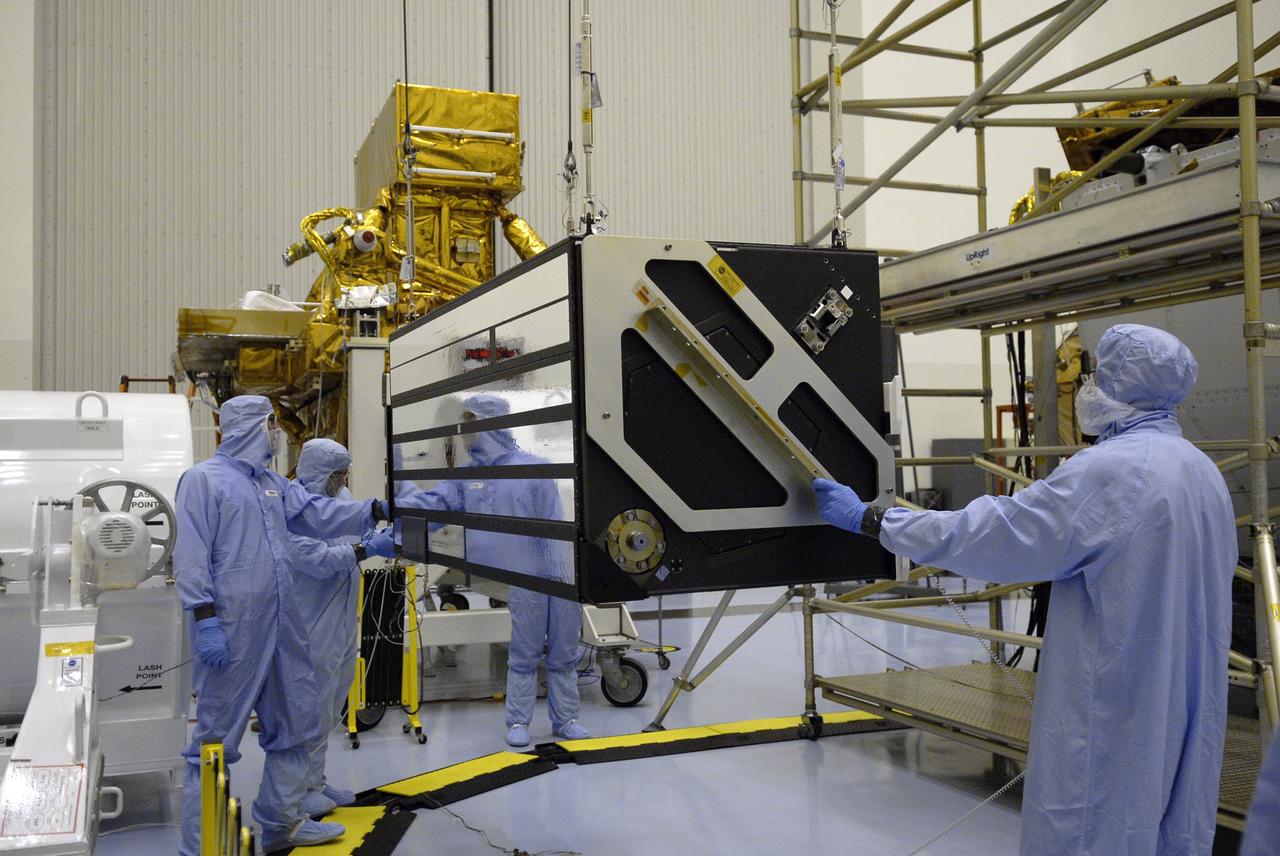
CAPE CANAVERAL, Fla. – In the Payload Hazardous Servicing Facility at NASA's Kennedy Space Center in Florida, technicians help guide the Cosmic Origins Spectrograph, or COS, as it is lifted from a stand. The COS will be moved to and placed on the Orbital Replacement Unit Carrier that will be installed in space shuttle Atlantis' payload bay. The COS is part of the payload for the Hubble servicing mission, STS-125, targeted to launch in mid-May. Installing the COS during the mission will effectively restore spectroscopy to Hubble’s scientific arsenal, and at the same time provide the telescope with unique capabilities. COS is designed to study the large-scale structure of the universe and how galaxies, stars and planets formed and evolved. It will help determine how elements needed for life such as carbon and iron first formed and how their abundances have increased over the lifetime of the universe. Photo credit: NASA/Kim Shiflett
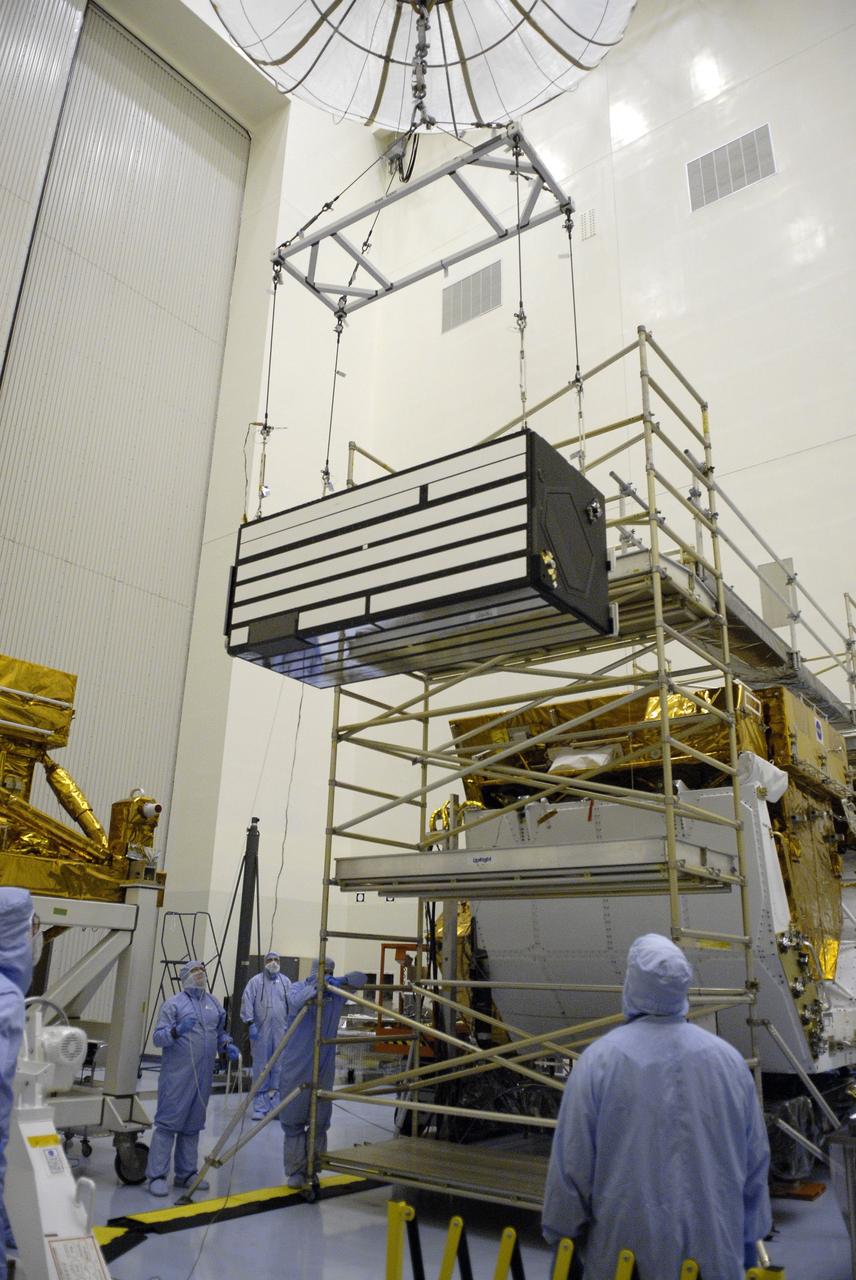
CAPE CANAVERAL, Fla. – In the Payload Hazardous Servicing Facility at NASA's Kennedy Space Center in Florida, a crane moves the Cosmic Origins Spectrograph, or COS, toward the Orbital Replacement Unit Carrier where it will be installed. The carrier will be placed in space shuttle Atlantis' payload bay for the Hubble servicing mission, STS-125, targeted to launch in mid-May. Installing the COS during the mission will effectively restore spectroscopy to Hubble’s scientific arsenal, and at the same time provide the telescope with unique capabilities. COS is designed to study the large-scale structure of the universe and how galaxies, stars and planets formed and evolved. It will help determine how elements needed for life such as carbon and iron first formed and how their abundances have increased over the lifetime of the universe. Photo credit: NASA/Kim Shiflett
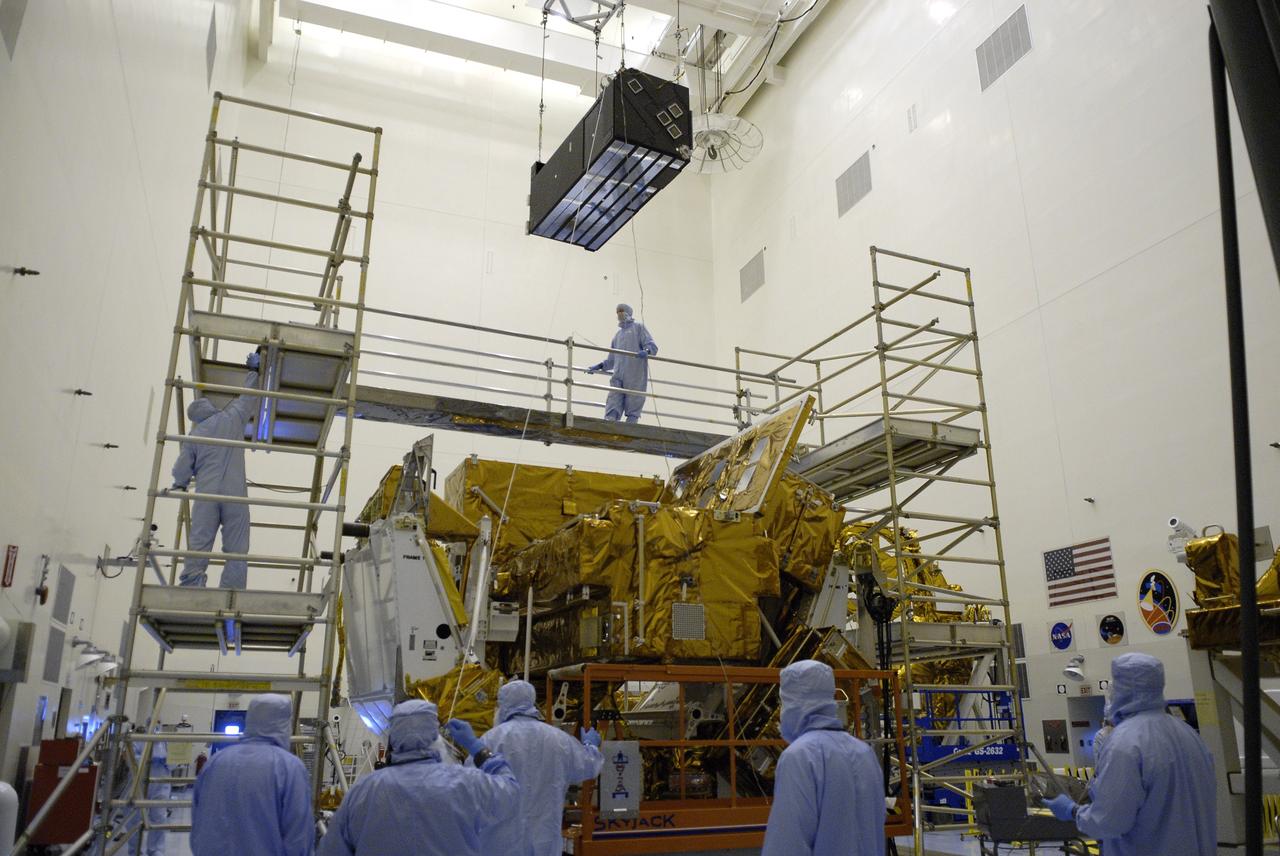
CAPE CANAVERAL, Fla. – In the Payload Hazardous Servicing Facility at NASA's Kennedy Space Center in Florida, a crane lowers the Cosmic Origins Spectrograph, or COS, toward the Orbital Replacement Unit Carrier where it will be installed. The carrier will be placed in space shuttle Atlantis' payload bay for the Hubble servicing mission, STS-125, targeted to launch in mid-May. Installing the COS during the mission will effectively restore spectroscopy to Hubble’s scientific arsenal, and at the same time provide the telescope with unique capabilities. COS is designed to study the large-scale structure of the universe and how galaxies, stars and planets formed and evolved. It will help determine how elements needed for life such as carbon and iron first formed and how their abundances have increased over the lifetime of the universe. Photo credit: NASA/Kim Shiflett
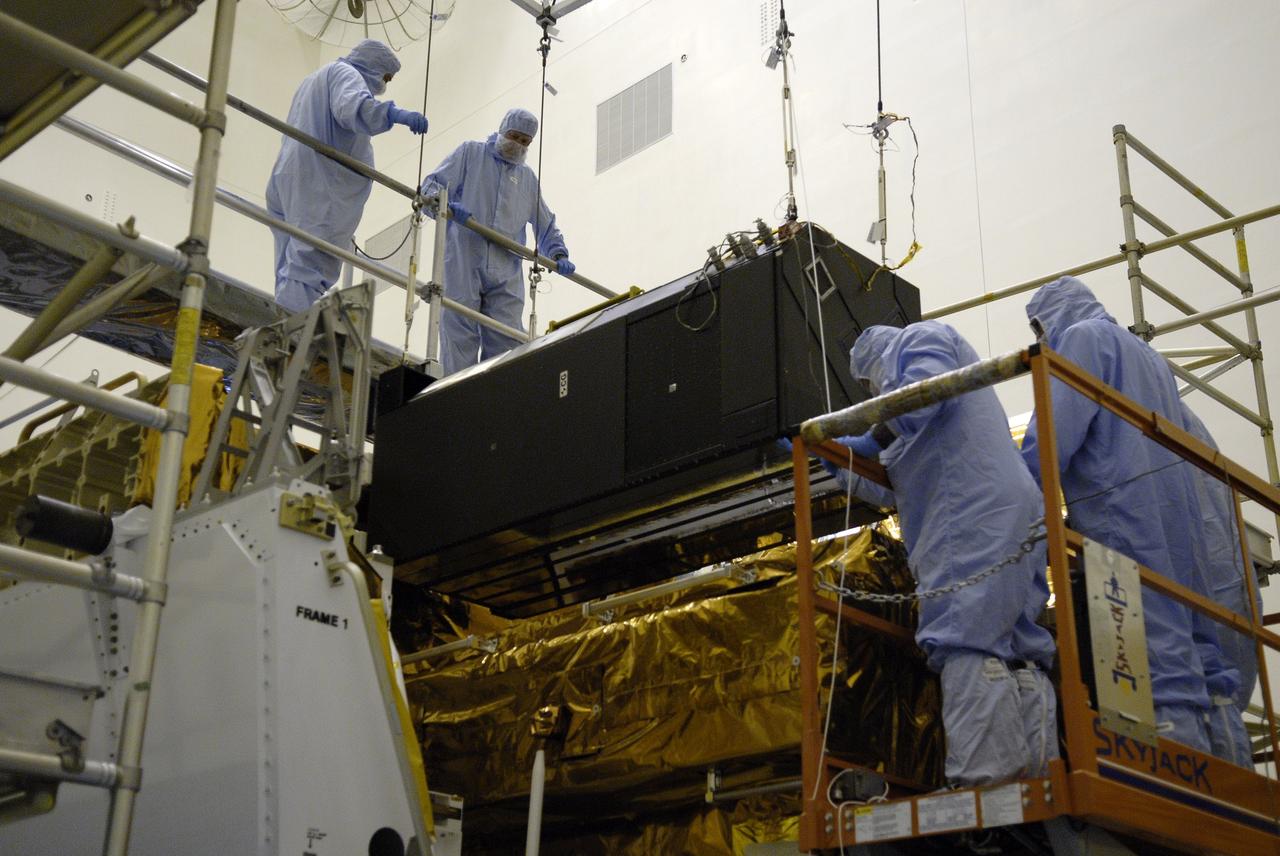
CAPE CANAVERAL, Fla. – In the Payload Hazardous Servicing Facility at NASA's Kennedy Space Center in Florida, a crane places the Cosmic Origins Spectrograph, or COS, on the Orbital Replacement Unit Carrier where it will be installed. The carrier will be placed in space shuttle Atlantis' payload bay for the Hubble servicing mission, STS-125, targeted to launch in mid-May. Installing the COS during the mission will effectively restore spectroscopy to Hubble’s scientific arsenal, and at the same time provide the telescope with unique capabilities. COS is designed to study the large-scale structure of the universe and how galaxies, stars and planets formed and evolved. It will help determine how elements needed for life such as carbon and iron first formed and how their abundances have increased over the lifetime of the universe. Photo credit: NASA/Kim Shiflett
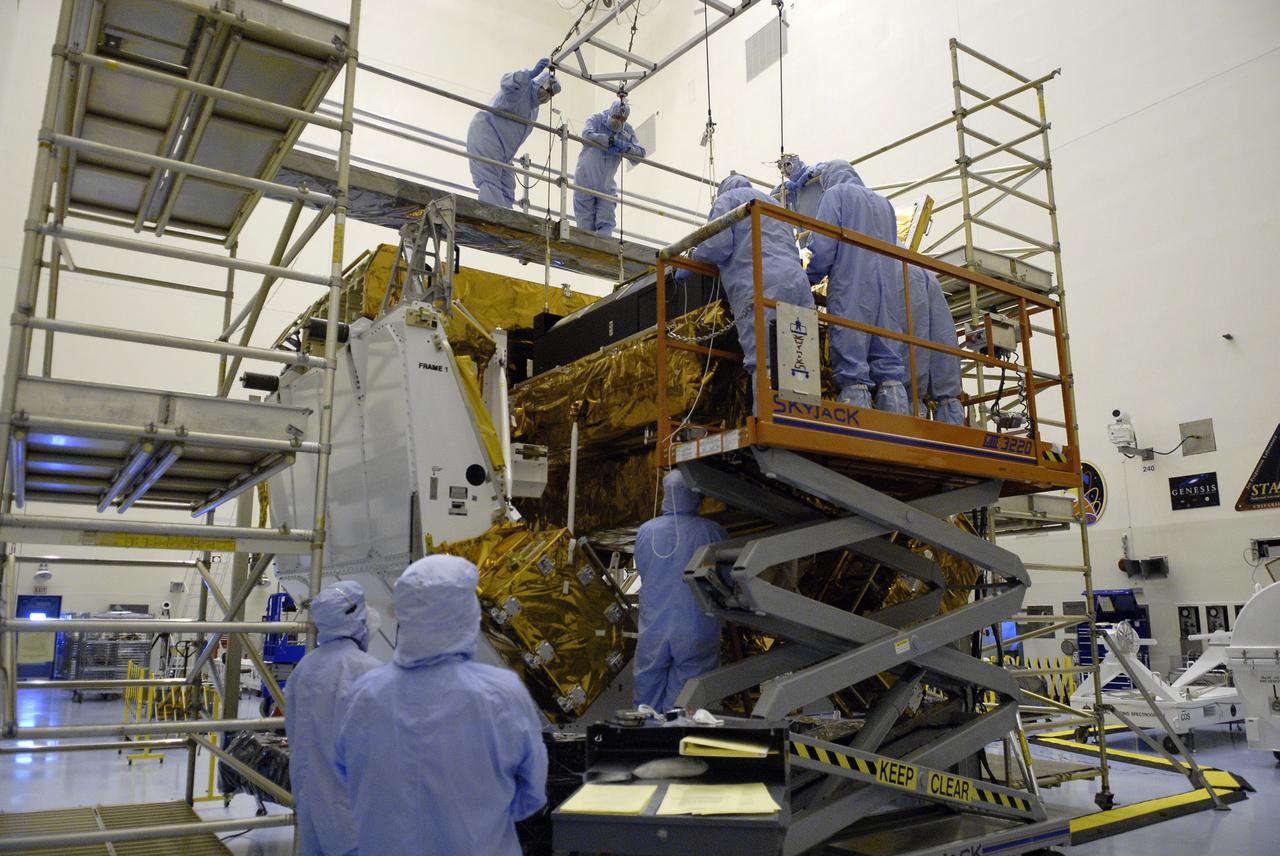
CAPE CANAVERAL, Fla. – In the Payload Hazardous Servicing Facility at NASA's Kennedy Space Center in Florida, technicians secure the Cosmic Origins Spectrograph, or COS, on the Orbital Replacement Unit Carrier. The carrier will be placed in space shuttle Atlantis' payload bay for the Hubble servicing mission, STS-125, targeted to launch in mid-May. Installing the COS during the mission will effectively restore spectroscopy to Hubble’s scientific arsenal, and at the same time provide the telescope with unique capabilities. COS is designed to study the large-scale structure of the universe and how galaxies, stars and planets formed and evolved. It will help determine how elements needed for life such as carbon and iron first formed and how their abundances have increased over the lifetime of the universe. Photo credit: NASA/Kim Shiflett
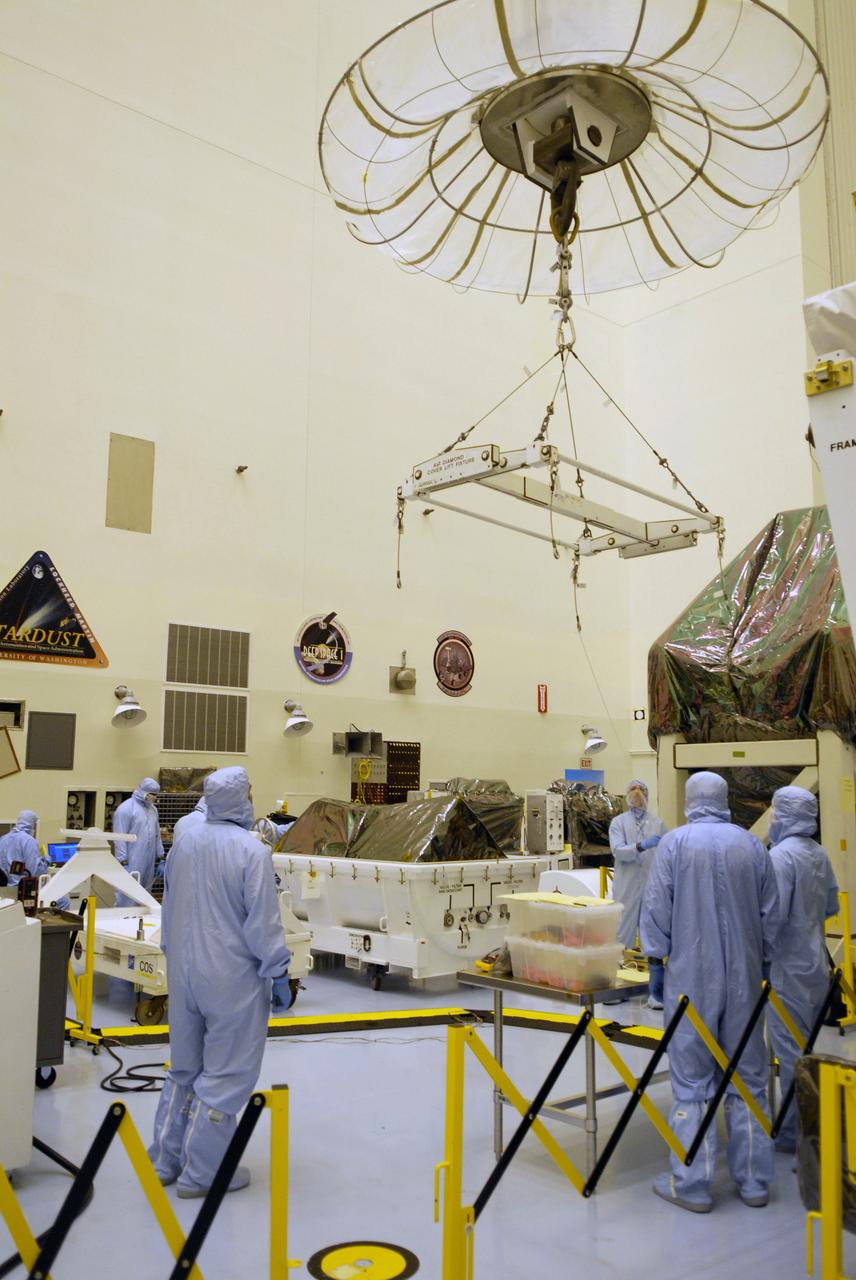
CAPE CANAVERAL, Fla. – In the Payload Hazardous Servicing Facility at NASA's Kennedy Space Center in Florida, a crane is moved to the shipping container with the Cosmic Origins Spectrograph, or COS, inside. The crane will remove the COS and place it on a test stand. The COS is part of the payload on space shuttle Atlantis for the Hubble servicing mission, targeted to launch in mid-May. Installing the COS during the mission will effectively restore spectroscopy to Hubble’s scientific arsenal, and at the same time provide the telescope with unique capabilities. COS is designed to study the large-scale structure of the universe and how galaxies, stars and planets formed and evolved. It will help determine how elements needed for life such as carbon and iron first formed and how their abundances have increased over the lifetime of the universe. Photo credit: NASA/Jack Pfaller
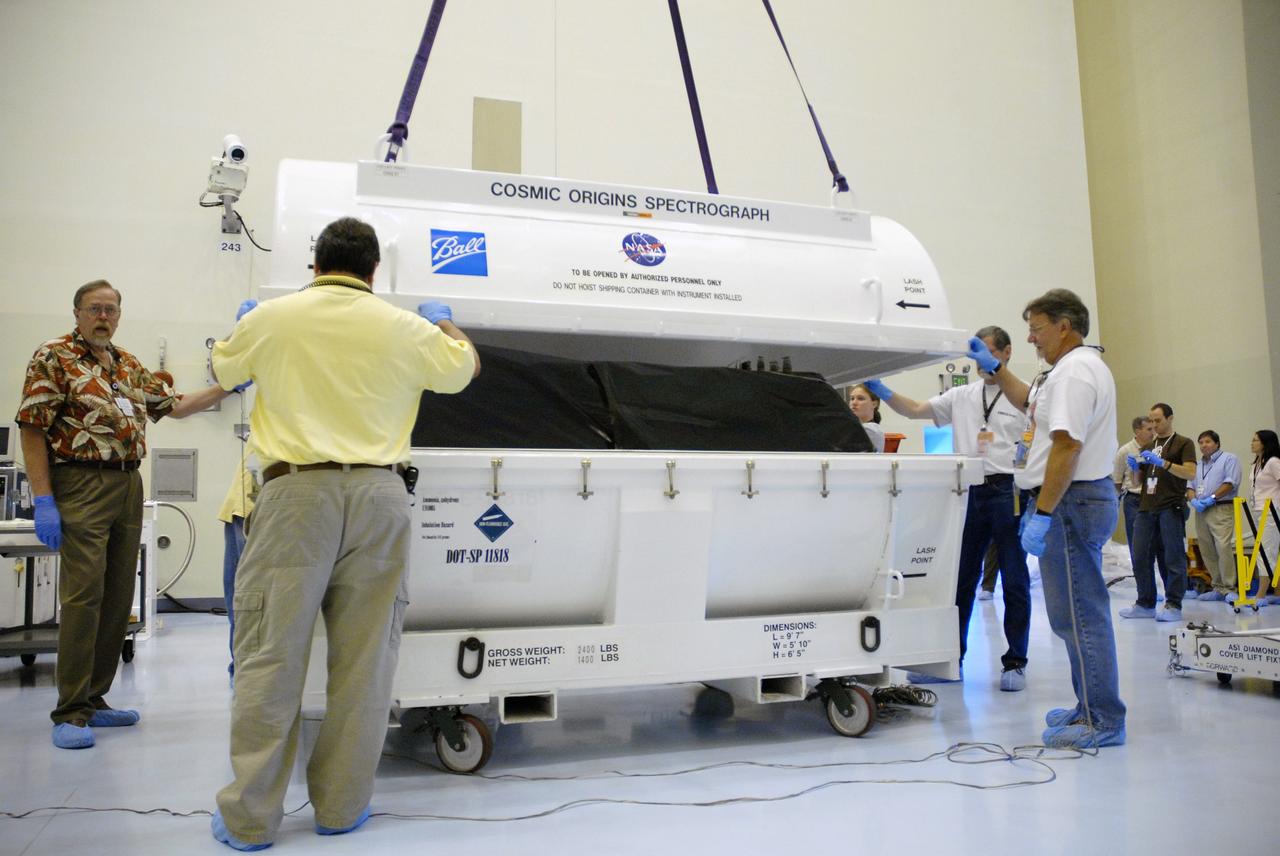
CAPE CANAVERAL, Fla. – In the airlock of the Payload Hazardous Servicing Facility at NASA's Kennedy Space Center, workers from NASA's Goddard Space Flight Center open the transportation canister in which the Cosmic Origins Spectrograph, or COS, is protected. The COS will be installed on the Hubble Space Telescope on space shuttle Atlantis' STS-125 mission. COS will be the most sensitive ultraviolet spectrograph ever flown on Hubble and will probe the "cosmic web" - the large-scale structure of the universe whose form is determined by the gravity of dark matter and is traced by galaxies and intergalactic gas. COS's far-ultraviolet channel has a sensitivity 30 times greater than that of previous spectroscopic instruments for the detection of extremely low light levels. Launch of STS-125 is targeted for Oct. 8. Photo credit: NASA/Jack Pfaller

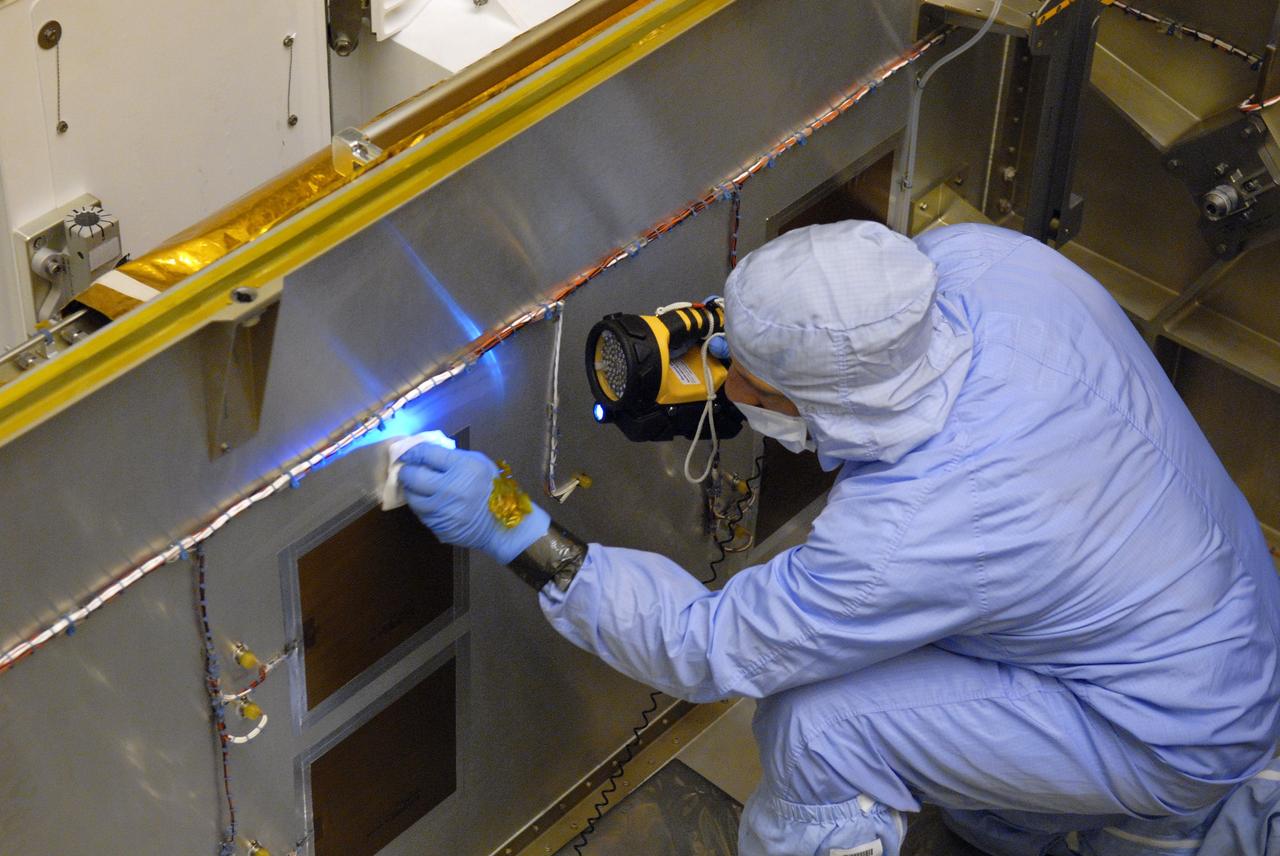
CAPE CANAVERAL, Fla. – In the clean room of the Payload Hazardous Processing Facility at NASA's Kennedy Space Center, a worker from NASA's Goddard Space Flight Center uses black light inspection for a thorough cleaning of the Cosmic Origins Spectrograph, or COS. Black light inspection uses UVA fluorescence to detect possible particulate microcontamination, minute cracks or fluid leaks. The COS will be installed on the Hubble Space Telescope on space shuttle Atlantis' STS-125 mission. COS will be the most sensitive ultraviolet spectrograph ever flown on Hubble and will probe the "cosmic web" - the large-scale structure of the universe whose form is determined by the gravity of dark matter and is traced by galaxies and intergalactic gas. The COS far-ultraviolet channel has a sensitivity 30 times greater than that of previous spectroscopic instruments for the detection of extremely low light levels. Launch of Atlantis on the STS-125 mission is targeted for Oct. 8. Photo credit: NASA/Kim Shiflett
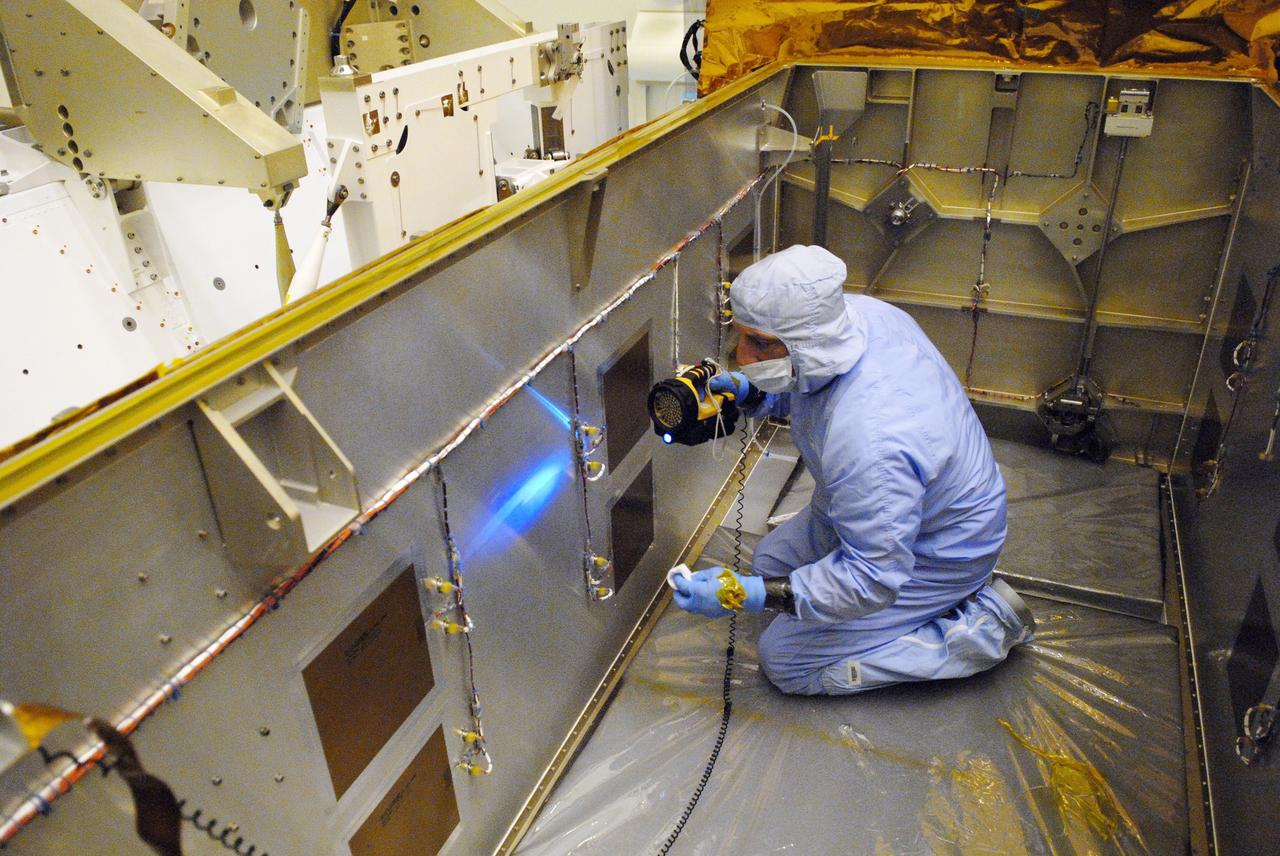
CAPE CANAVERAL, Fla. – In the clean room of the Payload Hazardous Processing Facility at NASA's Kennedy Space Center, workers from NASA's Goddard Space Flight Center use black light inspection for a thorough cleaning of the protective carrier for the Cosmic Origins Spectrograph, or COS. Black light inspection uses UVA fluorescence to detect possible particulate microcontamination, minute cracks or fluid leaks. The COS will be installed on the Hubble Space Telescope on space shuttle Atlantis' STS-125 mission. COS will be the most sensitive ultraviolet spectrograph ever flown on Hubble and will probe the "cosmic web" - the large-scale structure of the universe whose form is determined by the gravity of dark matter and is traced by galaxies and intergalactic gas. The COS far-ultraviolet channel has a sensitivity 30 times greater than that of previous spectroscopic instruments for the detection of extremely low light levels. Launch of Atlantis on the STS-125 mission is targeted for Oct. 8. Photo credit: NASA/Kim Shiflett
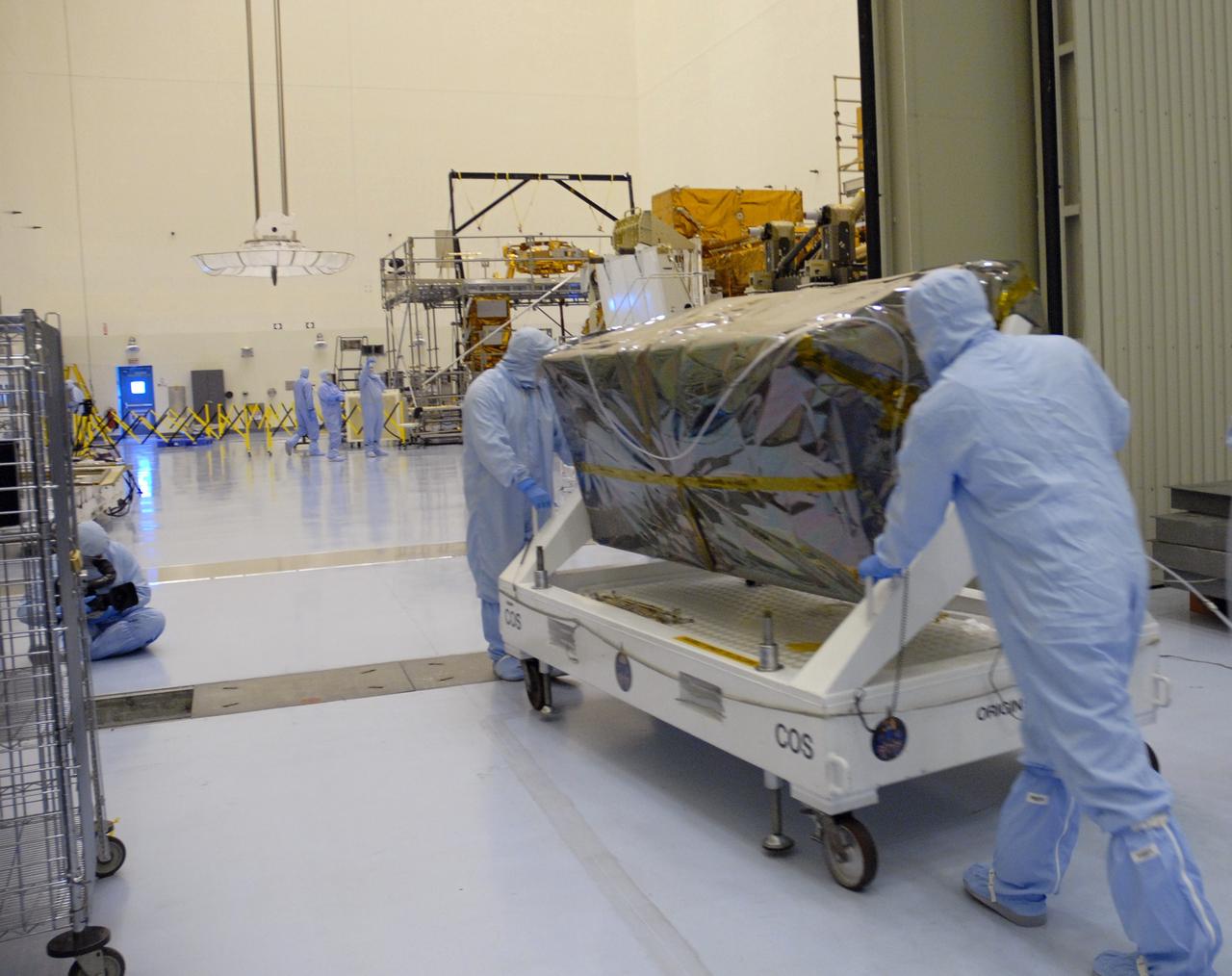
CAPE CANAVERAL, Fla. – At NASA's Kennedy Space Center, workers from NASA's Goddard Space Flight Center roll the Cosmic Origins Spectrograph, or COS, into the clean room of the Payload Hazardous Servicing Facility. The COS will be installed on the Hubble Space Telescope on space shuttle Atlantis' STS-125 mission. COS will be the most sensitive ultraviolet spectrograph ever flown on Hubble and will probe the "cosmic web" - the large-scale structure of the universe whose form is determined by the gravity of dark matter and is traced by galaxies and intergalactic gas. COS's far-ultraviolet channel has a sensitivity 30 times greater than that of previous spectroscopic instruments for the detection of extremely low light levels. Launch of STS-125 is targeted for Oct. 8. Photo credit: NASA/Jack Pfaller
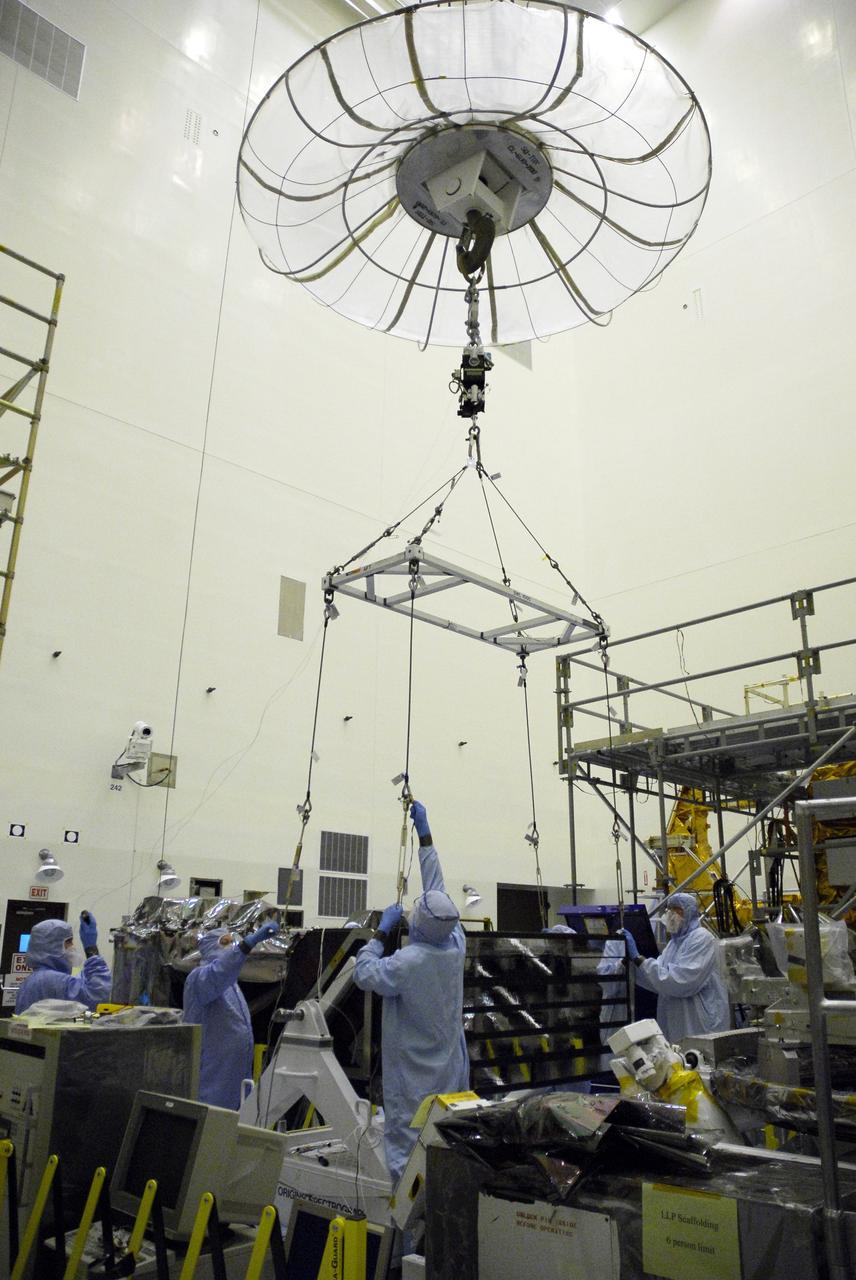
CAPE CANAVERAL, Fla. – In the clean room of the Payload Hazardous Processing Facility at NASA's Kennedy Space Center, workers prepare to attach an overhead crane to the Cosmic Origins Spectrograph, or COS. The COS will be lifted and moved to a protective enclosure on the Orbital Replacement Unit Carrier, part of the payload for the fifth and final Hubble servicing mission, STS-125. Other payloads include the Flight Support System, the Super Lightweight Interchangeable Carrier and the Multi-Use Lightweight Equipment, or MULE, carrier. COS will be the most sensitive ultraviolet spectrograph ever flown on Hubble and will probe the "cosmic web" - the large-scale structure of the universe whose form is determined by the gravity of dark matter and is traced by galaxies and intergalactic gas. The COS far-ultraviolet channel has a sensitivity 30 times greater than that of previous spectroscopic instruments for the detection of extremely low light levels. Launch of Atlantis on the STS-125 mission is targeted for Oct. 8. Photo credit: NASA/Kim Shiflett
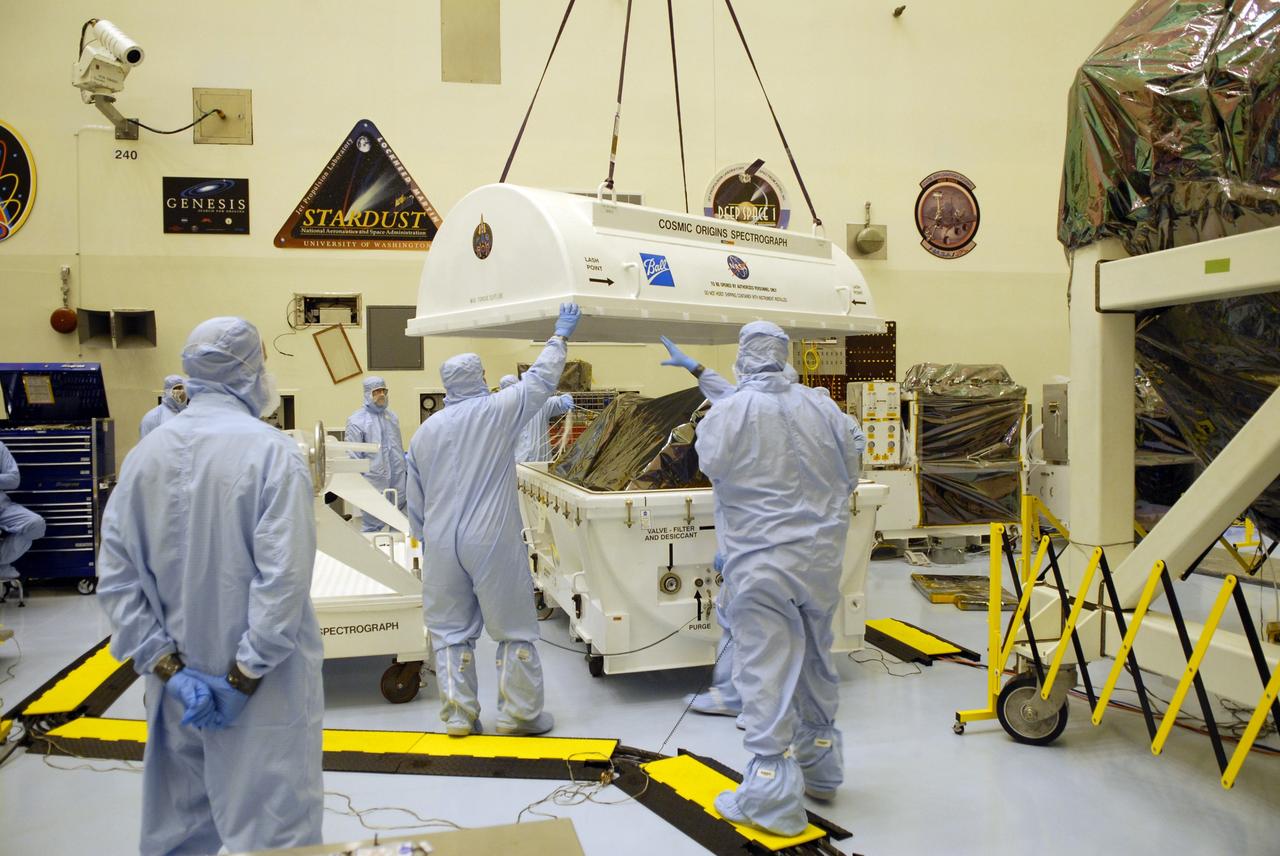
CAPE CANAVERAL, Fla. – In the Payload Hazardous Servicing Facility at NASA's Kennedy Space Center in Florida, the lid of the shipping container for the Cosmic Origins Spectrograph, or COS, is removed. The COS is part of the payload on space shuttle Atlantis for the Hubble servicing mission, targeted to launch in mid-May. Installing the COS during the mission will effectively restore spectroscopy to Hubble’s scientific arsenal, and at the same time provide the telescope with unique capabilities. COS is designed to study the large-scale structure of the universe and how galaxies, stars and planets formed and evolved. It will help determine how elements needed for life such as carbon and iron first formed and how their abundances have increased over the lifetime of the universe. Photo credit: NASA/Jack Pfaller
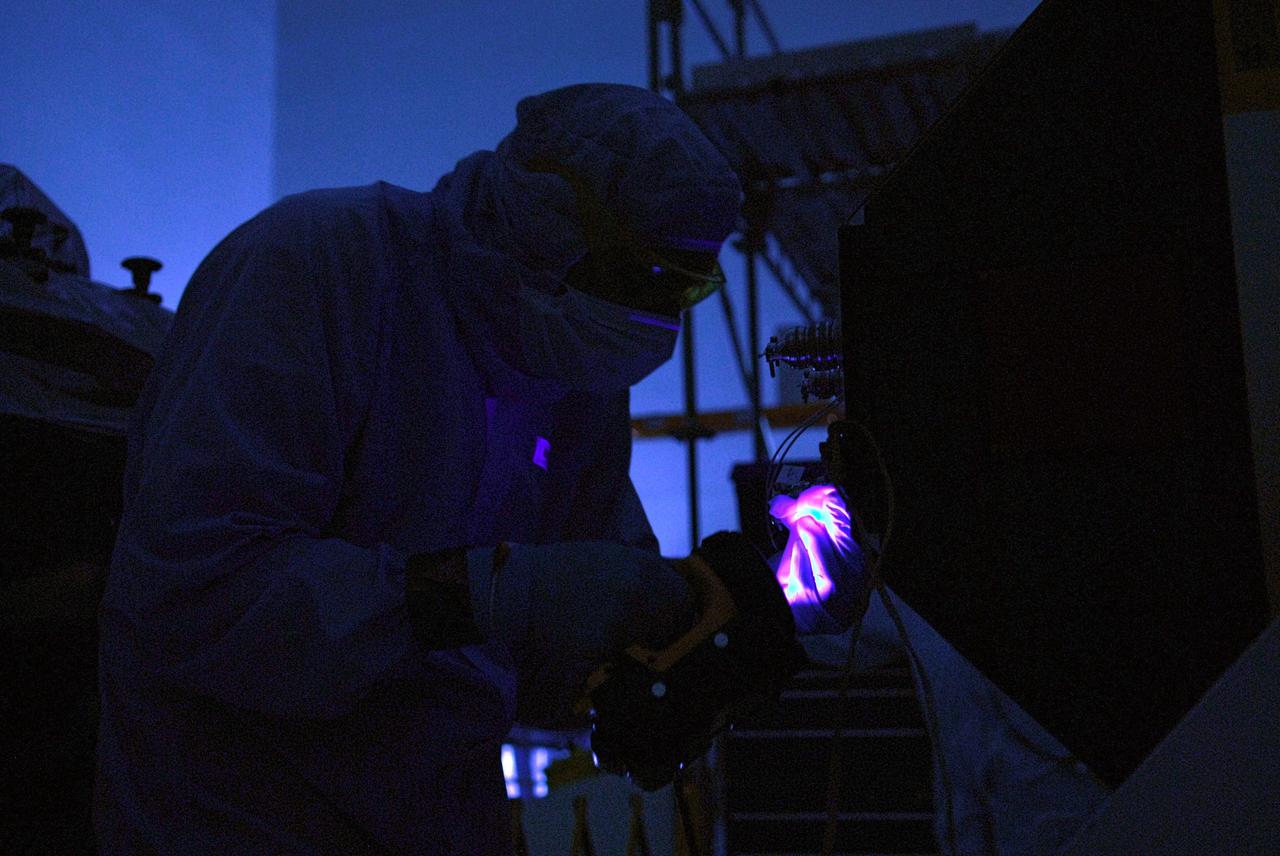
CAPE CANAVERAL, Fla. – In the clean room of the Payload Hazardous Processing Facility at NASA's Kennedy Space Center, a worker from NASA's Goddard Space Flight Center uses black light inspection for a thorough cleaning of the Cosmic Origins Spectrograph, or COS. Black light inspection uses UVA fluorescence to detect possible particulate microcontamination, minute cracks or fluid leaks. The COS will be installed on the Hubble Space Telescope on space shuttle Atlantis' STS-125 mission. COS will be the most sensitive ultraviolet spectrograph ever flown on Hubble and will probe the "cosmic web" - the large-scale structure of the universe whose form is determined by the gravity of dark matter and is traced by galaxies and intergalactic gas. The COS far-ultraviolet channel has a sensitivity 30 times greater than that of previous spectroscopic instruments for the detection of extremely low light levels. Launch of Atlantis on the STS-125 mission is targeted for Oct. 8. Photo credit: NASA/Kim Shiflett
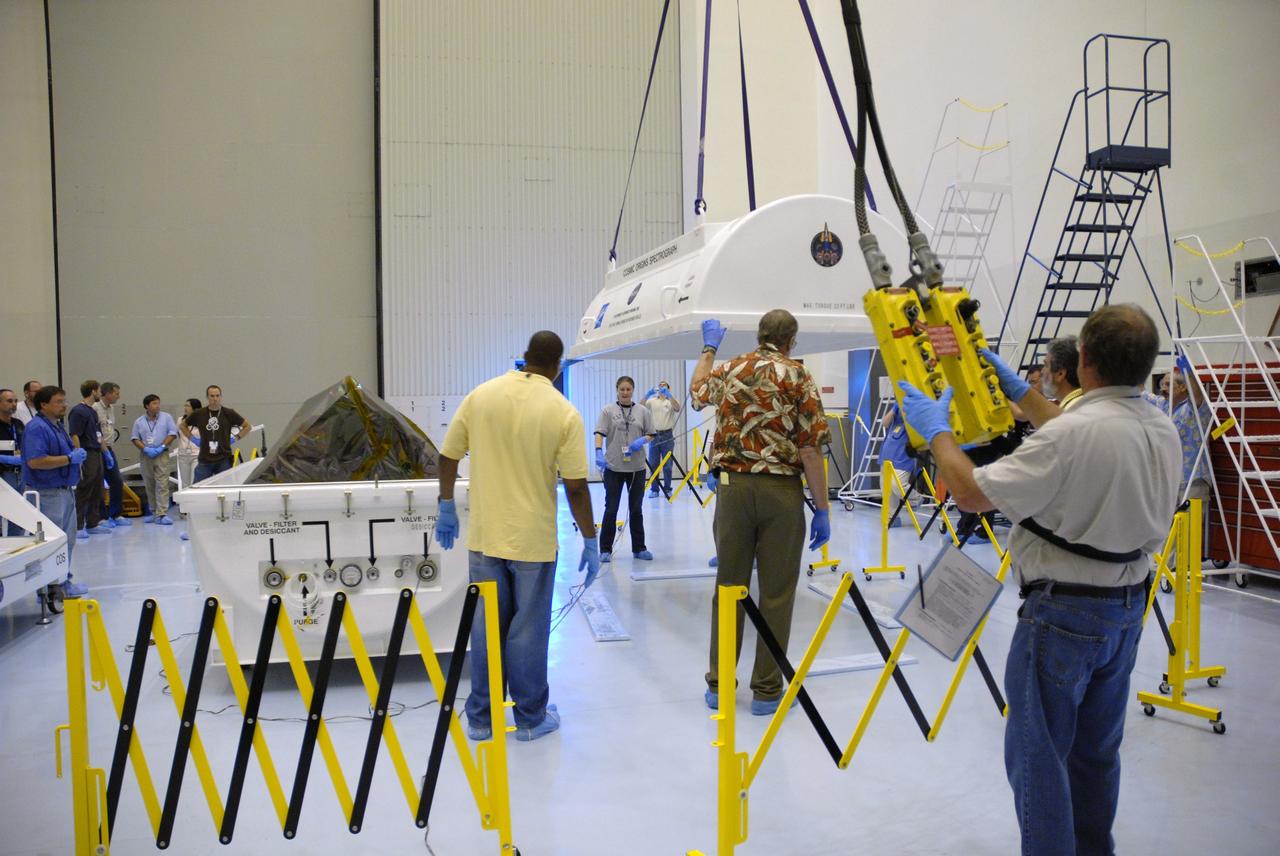
CAPE CANAVERAL, Fla. – In the airlock of the Payload Hazardous Servicing Facility at NASA's Kennedy Space Center, workers from NASA's Goddard Space Flight Center remove the top from the transportation canister in which the Cosmic Origins Spectrograph, or COS, arrived. The COS will be installed on the Hubble Space Telescope on space shuttle Atlantis' STS-125 mission. COS will be the most sensitive ultraviolet spectrograph ever flown on Hubble and will probe the "cosmic web" - the large-scale structure of the universe whose form is determined by the gravity of dark matter and is traced by galaxies and intergalactic gas. COS's far-ultraviolet channel has a sensitivity 30 times greater than that of previous spectroscopic instruments for the detection of extremely low light levels. Launch of STS-125 is targeted for Oct. 8. Photo credit: NASA/Jack Pfaller
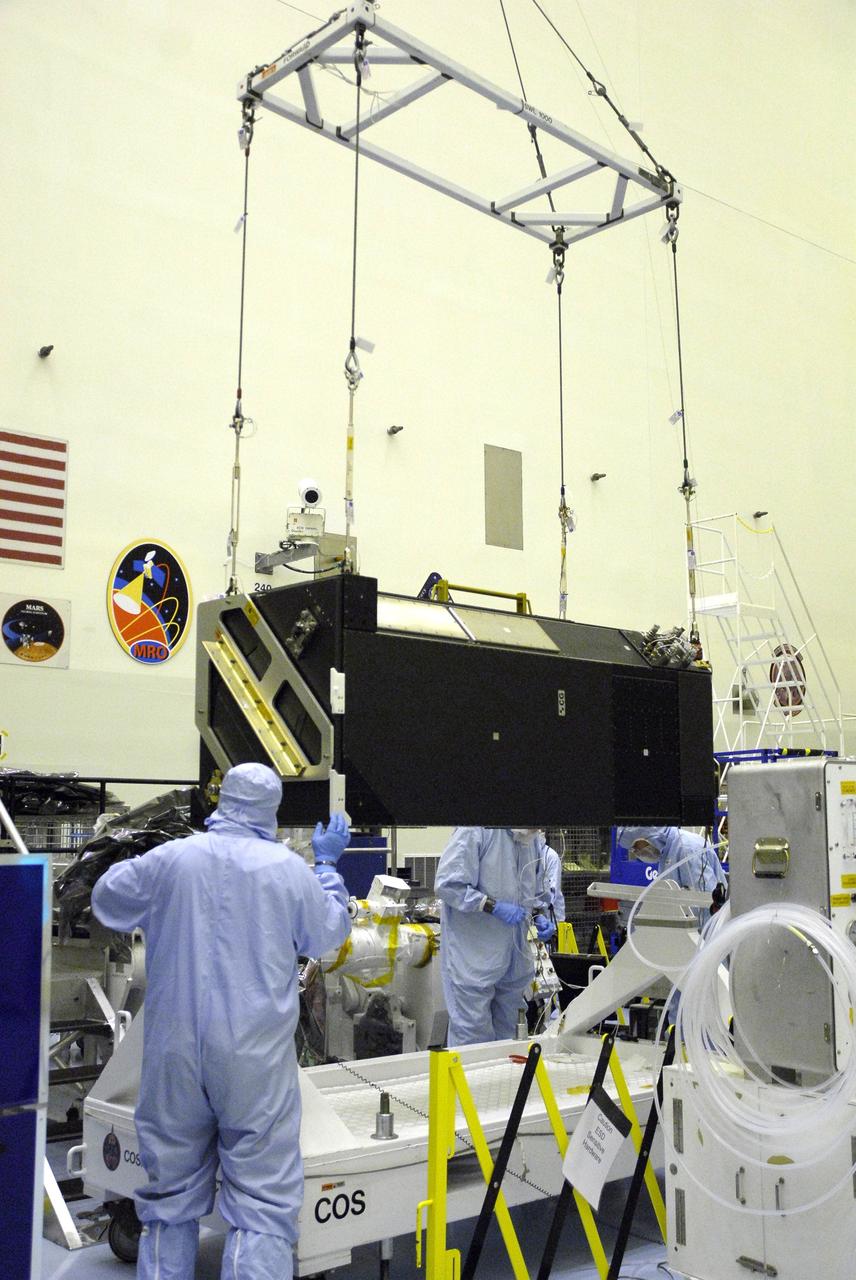
CAPE CANAVERAL, Fla. – In the clean room of the Payload Hazardous Processing Facility at NASA's Kennedy Space Center, an overhead crane lifts the Cosmic Origins Spectrograph, or COS. The COS is being lifted and moved to a protective enclosure on the Orbital Replacement Unit Carrier, part of the payload for the fifth and final Hubble servicing mission, STS-125. Other payloads include the Flight Support System, the Super Lightweight Interchangeable Carrier and the Multi-Use Lightweight Equipment, or MULE, carrier. COS will be the most sensitive ultraviolet spectrograph ever flown on Hubble and will probe the "cosmic web" - the large-scale structure of the universe whose form is determined by the gravity of dark matter and is traced by galaxies and intergalactic gas. The COS far-ultraviolet channel has a sensitivity 30 times greater than that of previous spectroscopic instruments for the detection of extremely low light levels. Launch of Atlantis on the STS-125 mission is targeted for Oct. 8. Photo credit: NASA/Kim Shiflett
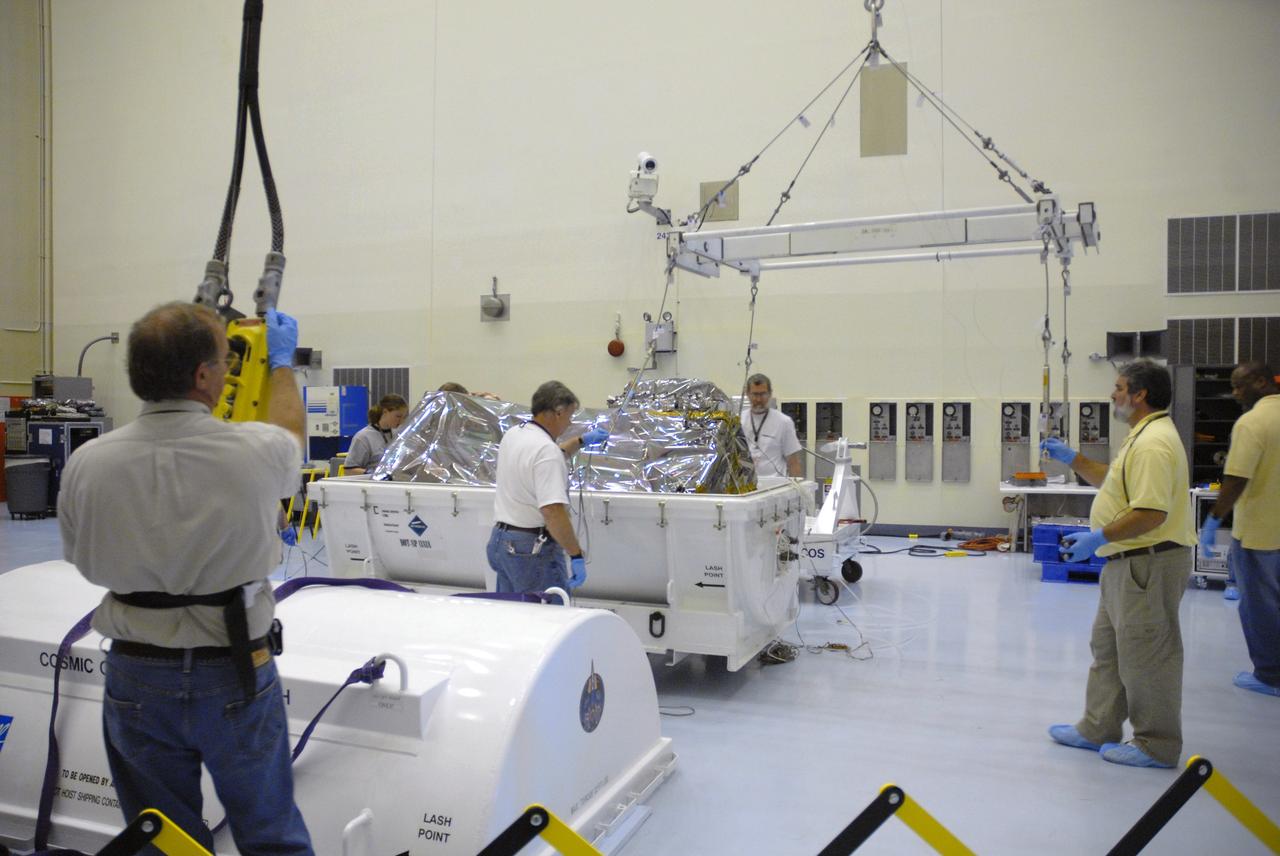
CAPE CANAVERAL, Fla. – In the airlock of the Payload Hazardous Servicing Facility at NASA's Kennedy Space Center, workers from NASA's Goddard Space Flight Center examine the Cosmic Origins Spectrograph, or COS, after the top from its transportation canister is removed. The COS will be installed on the Hubble Space Telescope on space shuttle Atlantis' STS-125 mission. COS will be the most sensitive ultraviolet spectrograph ever flown on Hubble and will probe the "cosmic web" - the large-scale structure of the universe whose form is determined by the gravity of dark matter and is traced by galaxies and intergalactic gas. COS's far-ultraviolet channel has a sensitivity 30 times greater than that of previous spectroscopic instruments for the detection of extremely low light levels. Launch of STS-125 is targeted for Oct. 8. Photo credit: NASA/Jack Pfaller
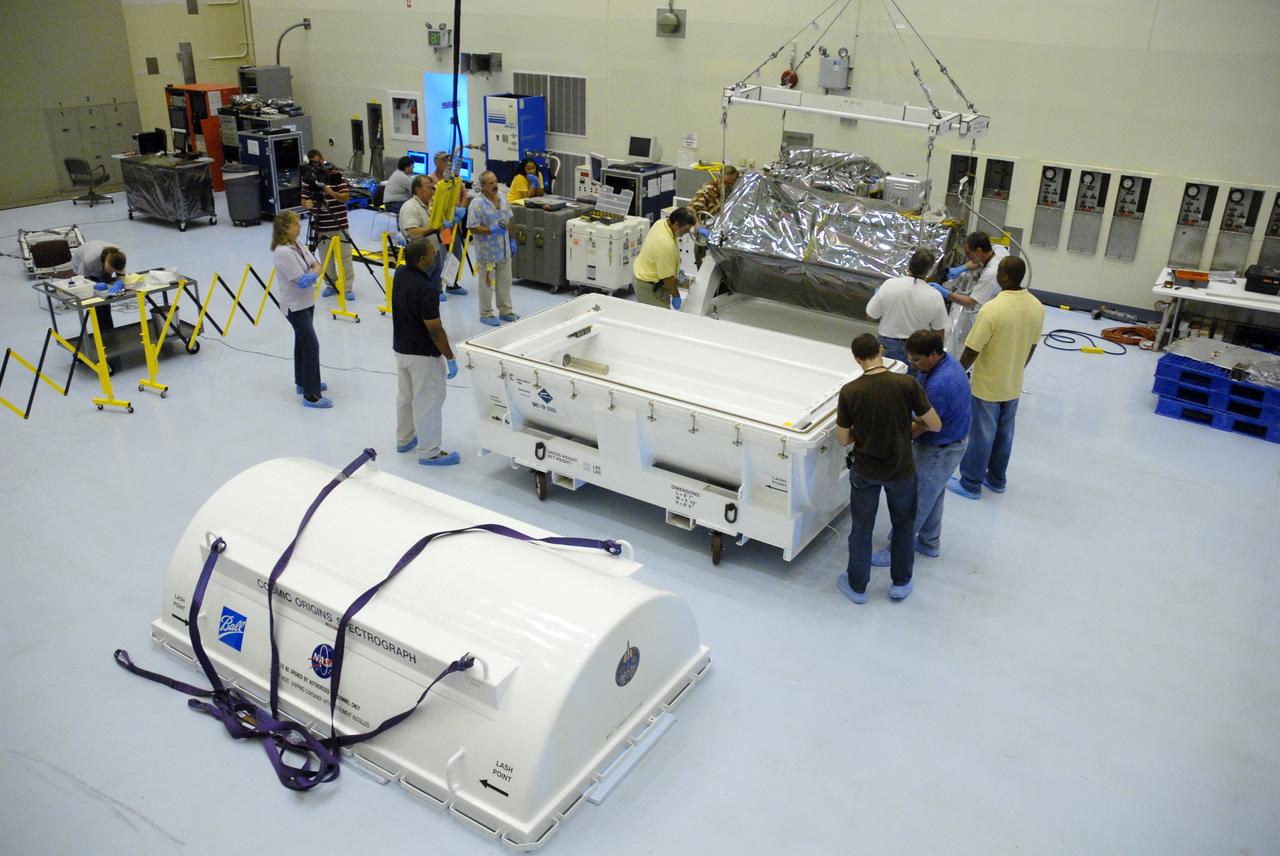
CAPE CANAVERAL, Fla. – In the airlock of the Payload Hazardous Servicing Facility at NASA's Kennedy Space Center, workers from NASA's Goddard Space Flight Center lower the Cosmic Origins Spectrograph, or COS, onto a dolly for its move into the clean room. The COS will be installed on the Hubble Space Telescope on space shuttle Atlantis' STS-125 mission. COS will be the most sensitive ultraviolet spectrograph ever flown on Hubble and will probe the "cosmic web" - the large-scale structure of the universe whose form is determined by the gravity of dark matter and is traced by galaxies and intergalactic gas. COS's far-ultraviolet channel has a sensitivity 30 times greater than that of previous spectroscopic instruments for the detection of extremely low light levels. Launch of STS-125 is targeted for Oct. 8. Photo credit: NASA/Jack Pfaller

CAPE CANAVERAL, Fla. –The outside of the Cosmic Origins Spectrograph, or COS, is seen before black light inspection in the clean room of the Payload Hazardous Processing Facility at NASA's Kennedy Space Center. Black light inspection uses UVA fluorescence to detect possible particulate microcontamination, minute cracks or fluid leaks. The COS will be installed on the Hubble Space Telescope on space shuttle Atlantis' STS-125 mission. COS will be the most sensitive ultraviolet spectrograph ever flown on Hubble and will probe the "cosmic web" - the large-scale structure of the universe whose form is determined by the gravity of dark matter and is traced by galaxies and intergalactic gas. The COS far-ultraviolet channel has a sensitivity 30 times greater than that of previous spectroscopic instruments for the detection of extremely low light levels. Launch of Atlantis on the STS-125 mission is targeted for Oct. 8. Photo credit: NASA/Kim Shiflett
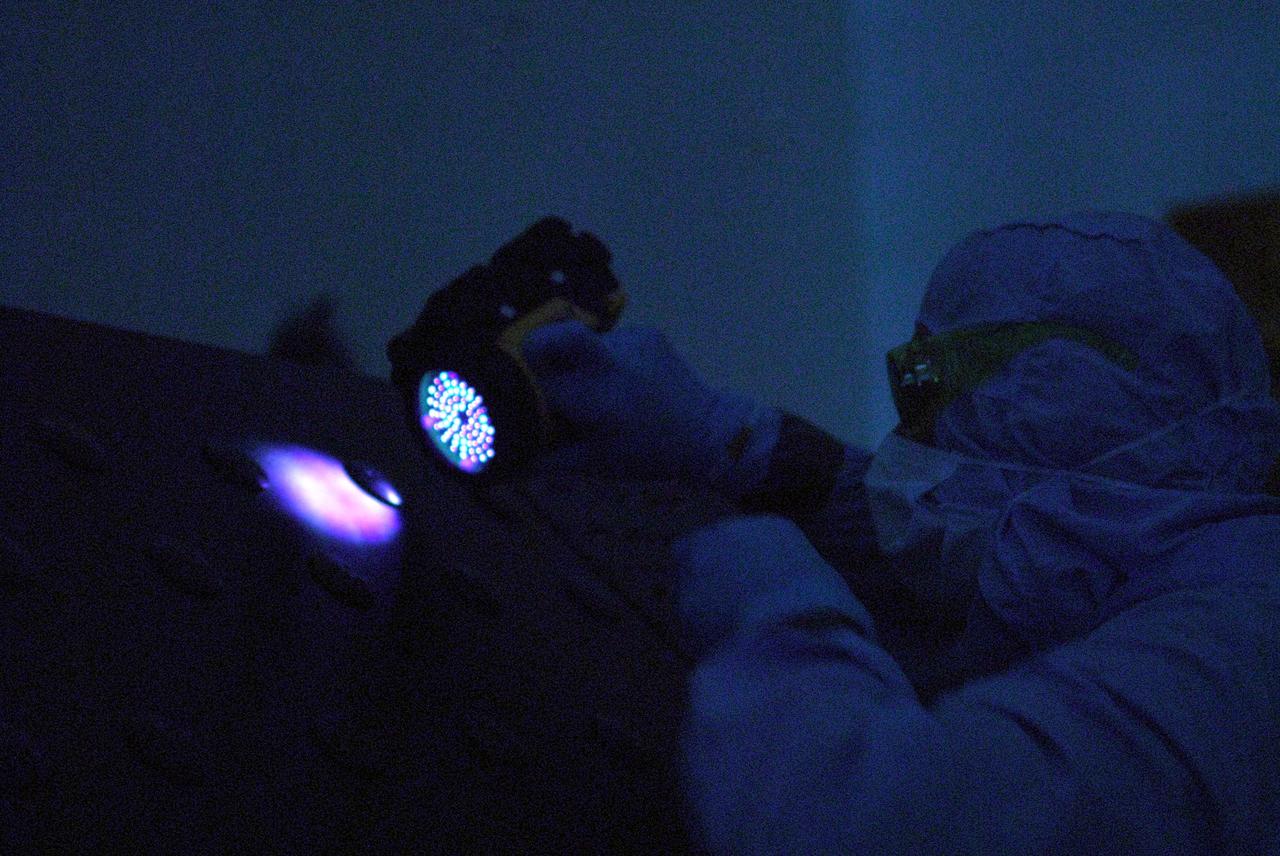
CAPE CANAVERAL, Fla. –In the clean room of the Payload Hazardous Processing Facility at NASA's Kennedy Space Center, a worker from NASA's Goddard Space Flight Center uses black light inspection for a thorough cleaning of the Cosmic Origins Spectrograph, or COS. Black light inspection uses UVA fluorescence to detect possible particulate microcontamination, minute cracks or fluid leaks. The COS will be installed on the Hubble Space Telescope on space shuttle Atlantis' STS-125 mission. COS will be the most sensitive ultraviolet spectrograph ever flown on Hubble and will probe the "cosmic web" - the large-scale structure of the universe whose form is determined by the gravity of dark matter and is traced by galaxies and intergalactic gas. The COS far-ultraviolet channel has a sensitivity 30 times greater than that of previous spectroscopic instruments for the detection of extremely low light levels. Launch of Atlantis on the STS-125 mission is targeted for Oct. 8. Photo credit: NASA/Kim Shiflett

CAPE CANAVERAL, Fla. – At NASA's Kennedy Space Center, workers from NASA's Goddard Space Flight Center roll the Cosmic Origins Spectrograph, or COS, into position in the clean room of the Payload Hazardous Servicing Facility for instrument testing. The COS will be installed on the Hubble Space Telescope on space shuttle Atlantis' STS-125 mission. COS will be the most sensitive ultraviolet spectrograph ever flown on Hubble and will probe the "cosmic web" - the large-scale structure of the universe whose form is determined by the gravity of dark matter and is traced by galaxies and intergalactic gas. COS's far-ultraviolet channel has a sensitivity 30 times greater than that of previous spectroscopic instruments for the detection of extremely low light levels. Launch of STS-125 is targeted for Oct. 8. Photo credit: NASA/Jack Pfaller
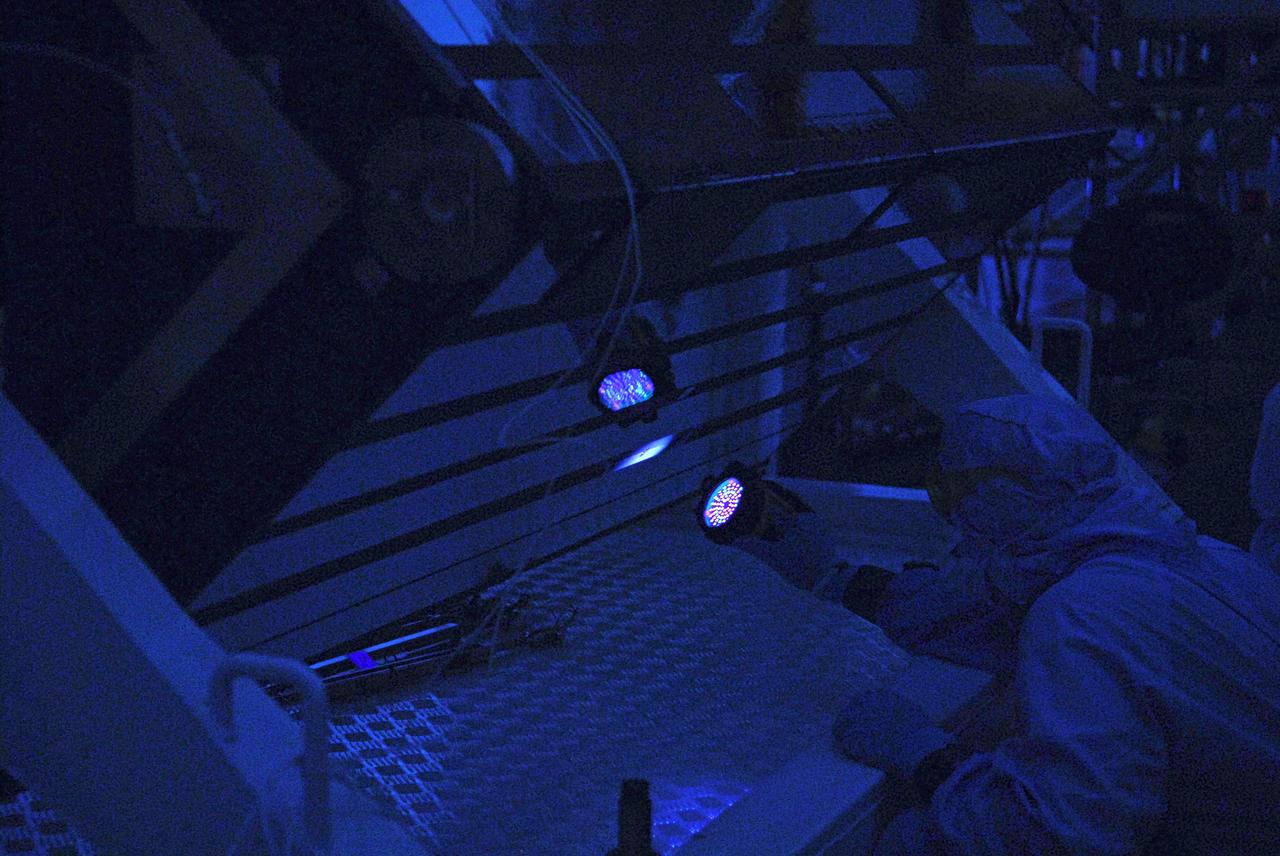
CAPE CANAVERAL, Fla. – In the clean room of the Payload Hazardous Processing Facility at NASA's Kennedy Space Center, a worker from NASA's Goddard Space Flight Center uses black light inspection for a thorough cleaning of the Cosmic Origins Spectrograph, or COS. Black light inspection uses UVA fluorescence to detect possible particulate microcontamination, minute cracks or fluid leaks. The COS will be installed on the Hubble Space Telescope on space shuttle Atlantis' STS-125 mission. COS will be the most sensitive ultraviolet spectrograph ever flown on Hubble and will probe the "cosmic web" - the large-scale structure of the universe whose form is determined by the gravity of dark matter and is traced by galaxies and intergalactic gas. The COS far-ultraviolet channel has a sensitivity 30 times greater than that of previous spectroscopic instruments for the detection of extremely low light levels. Launch of Atlantis on the STS-125 mission is targeted for Oct. 8. Photo credit: NASA/Kim Shiflett
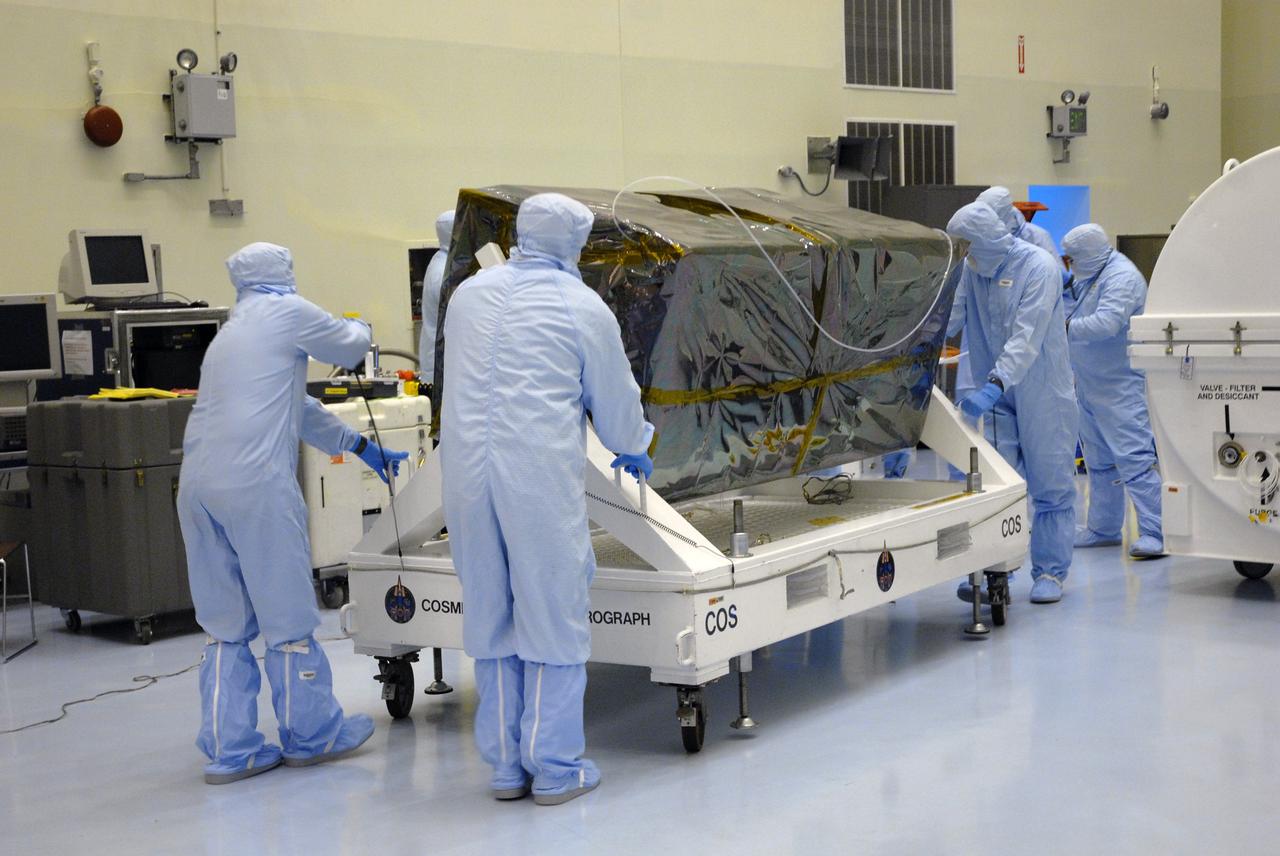
CAPE CANAVERAL, Fla. – At NASA's Kennedy Space Center, workers from NASA's Goddard Space Flight Center roll the Cosmic Origins Spectrograph, or COS, from the airlock, where it was removed from the shipping container, to the clean room of the Payload Hazardous Servicing Facility. The COS will be installed on the Hubble Space Telescope on space shuttle Atlantis' STS-125 mission. COS will be the most sensitive ultraviolet spectrograph ever flown on Hubble and will probe the "cosmic web" - the large-scale structure of the universe whose form is determined by the gravity of dark matter and is traced by galaxies and intergalactic gas. COS's far-ultraviolet channel has a sensitivity 30 times greater than that of previous spectroscopic instruments for the detection of extremely low light levels. Launch of STS-125 is targeted for Oct. 8. Photo credit: NASA/Jack Pfaller
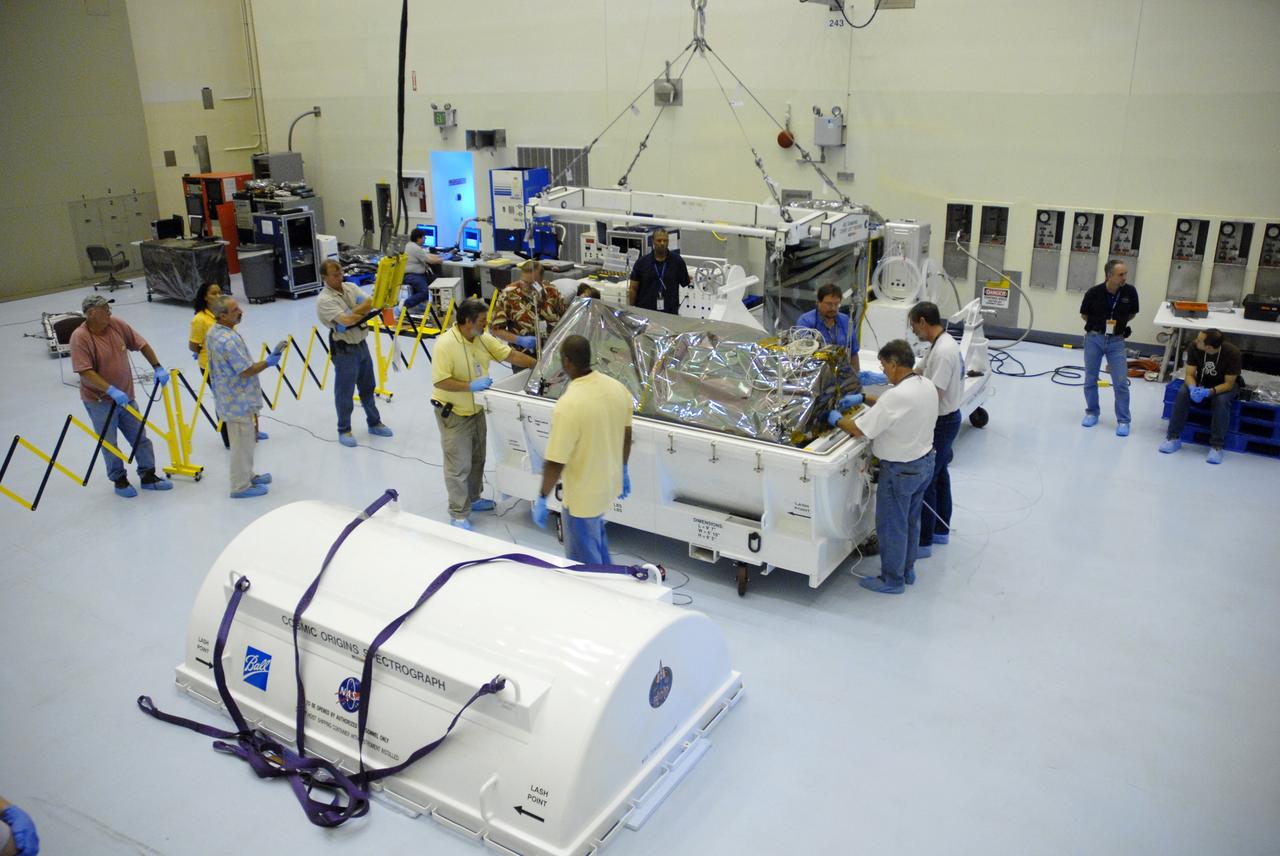
CAPE CANAVERAL, Fla. – In the airlock of the Payload Hazardous Servicing Facility at NASA's Kennedy Space Center, workers from NASA's Goddard Space Flight Center prepare to remove the Cosmic Origins Spectrograph, or COS, from its transportation canister. The COS will be installed on the Hubble Space Telescope on space shuttle Atlantis' STS-125 mission. COS will be the most sensitive ultraviolet spectrograph ever flown on Hubble and will probe the "cosmic web" - the large-scale structure of the universe whose form is determined by the gravity of dark matter and is traced by galaxies and intergalactic gas. COS's far-ultraviolet channel has a sensitivity 30 times greater than that of previous spectroscopic instruments for the detection of extremely low light levels. Launch of STS-125 is targeted for Oct. 8. Photo credit: NASA/Jack Pfaller
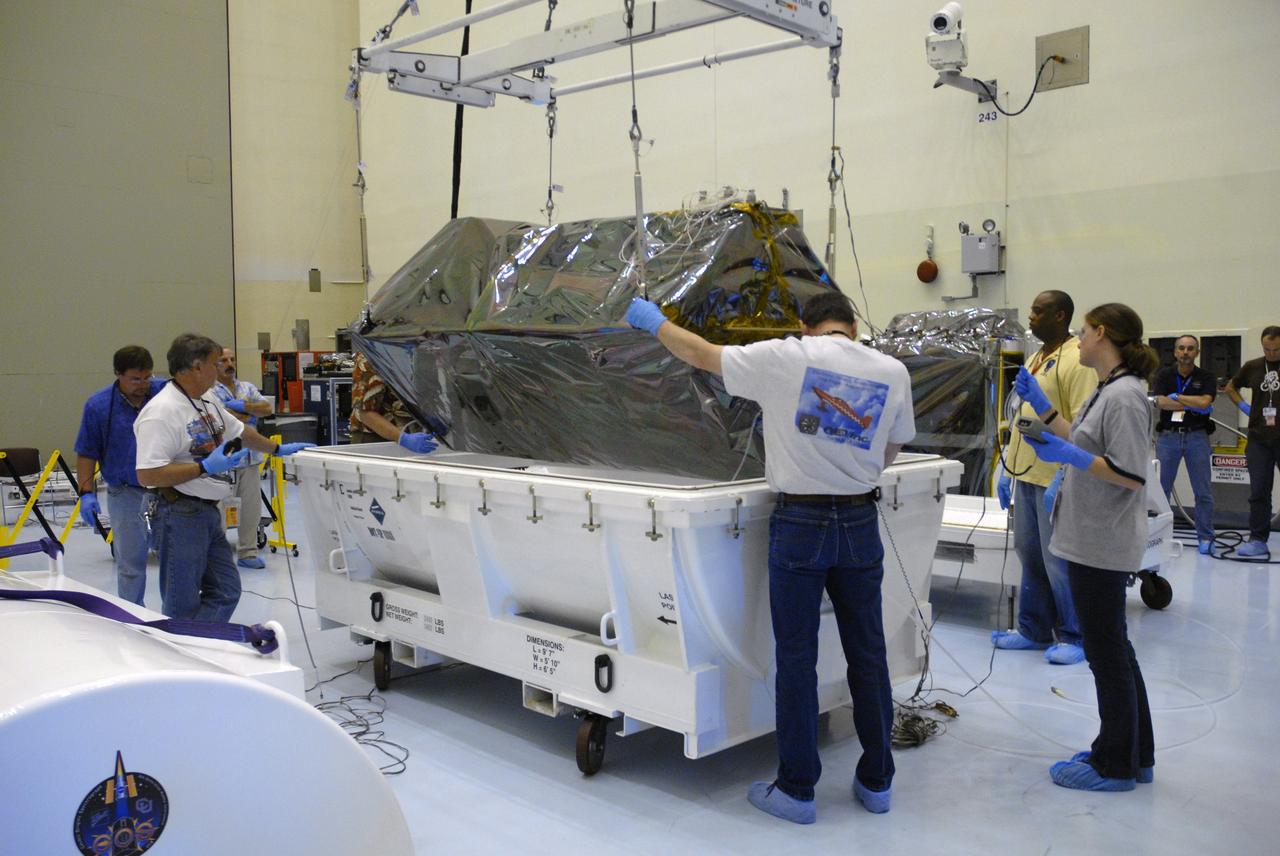
CAPE CANAVERAL, Fla. – In the airlock of the Payload Hazardous Servicing Facility at NASA's Kennedy Space Center, workers from NASA's Goddard Space Flight Center prepare to lift the Cosmic Origins Spectrograph, or COS, from its transportation canister. The COS will be installed on the Hubble Space Telescope on space shuttle Atlantis' STS-125 mission. COS will be the most sensitive ultraviolet spectrograph ever flown on Hubble and will probe the "cosmic web" - the large-scale structure of the universe whose form is determined by the gravity of dark matter and is traced by galaxies and intergalactic gas. COS's far-ultraviolet channel has a sensitivity 30 times greater than that of previous spectroscopic instruments for the detection of extremely low light levels. Launch of STS-125 is targeted for Oct. 8. Photo credit: NASA/Jack Pfaller
CAPE CANAVERAL, Fla. – In the clean room of the Payload Hazardous Processing Facility at NASA's Kennedy Space Center, workers from NASA's Goddard Space Flight Center use black light inspection for a thorough cleaning of the protective carrier for the Cosmic Origins Spectrograph, or COS. Black light inspection uses UVA fluorescence to detect possible particulate microcontamination, minute cracks or fluid leaks. The COS will be installed on the Hubble Space Telescope on space shuttle Atlantis' STS-125 mission. COS will be the most sensitive ultraviolet spectrograph ever flown on Hubble and will probe the "cosmic web" - the large-scale structure of the universe whose form is determined by the gravity of dark matter and is traced by galaxies and intergalactic gas. The COS far-ultraviolet channel has a sensitivity 30 times greater than that of previous spectroscopic instruments for the detection of extremely low light levels. Launch of Atlantis on the STS-125 mission is targeted for Oct. 8. Photo credit: NASA/Kim Shiflett
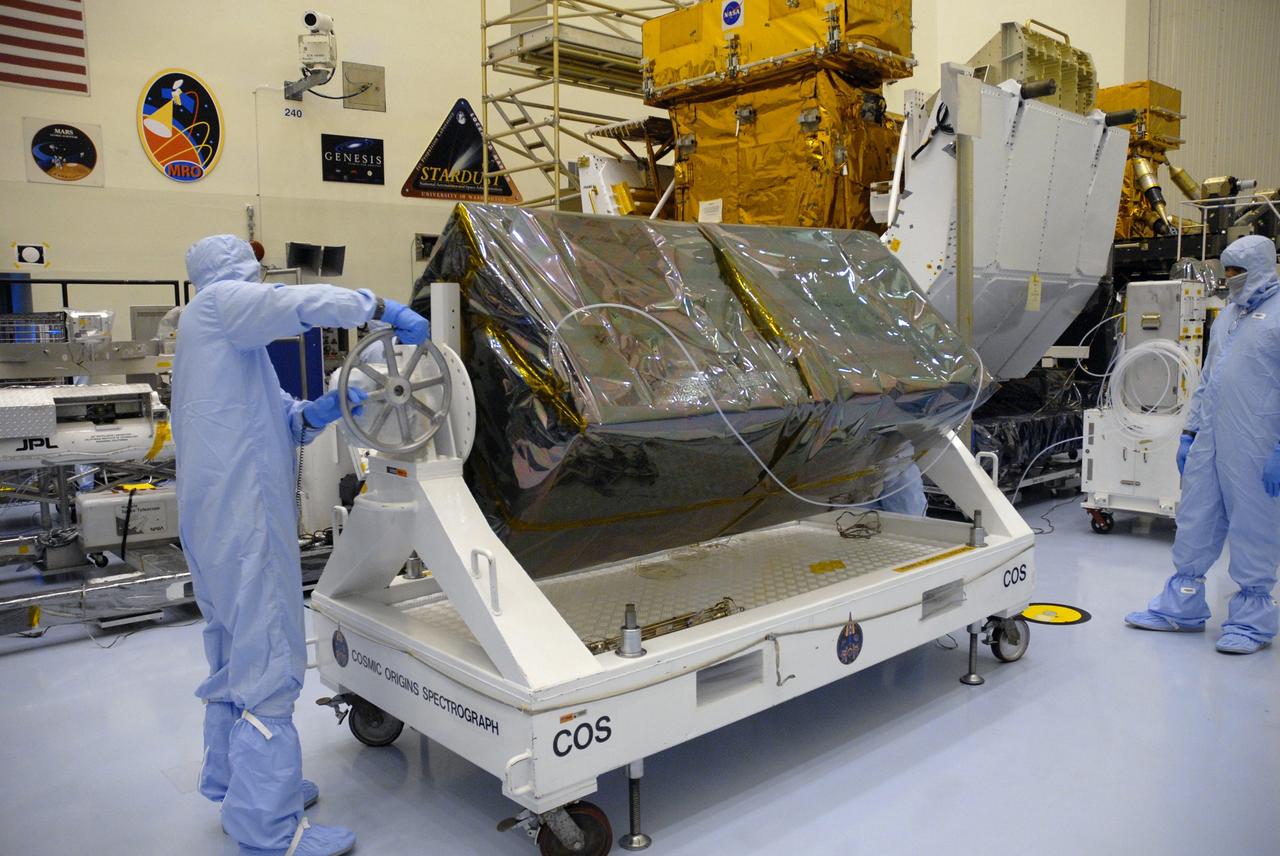
CAPE CANAVERAL, Fla. – At NASA's Kennedy Space Center, workers from NASA's Goddard Space Flight Center prepare the Cosmic Origins Spectrograph, or COS, for instrument testing and integration with the Flight Support System carrier in the clean room of the Payload Hazardous Servicing Facility. The COS will be installed on the Hubble Space Telescope on space shuttle Atlantis' STS-125 mission. COS will be the most sensitive ultraviolet spectrograph ever flown on Hubble and will probe the "cosmic web" - the large-scale structure of the universe whose form is determined by the gravity of dark matter and is traced by galaxies and intergalactic gas. COS's far-ultraviolet channel has a sensitivity 30 times greater than that of previous spectroscopic instruments for the detection of extremely low light levels. Launch of STS-125 is targeted for Oct. 8. Photo credit: NASA/Jack Pfaller
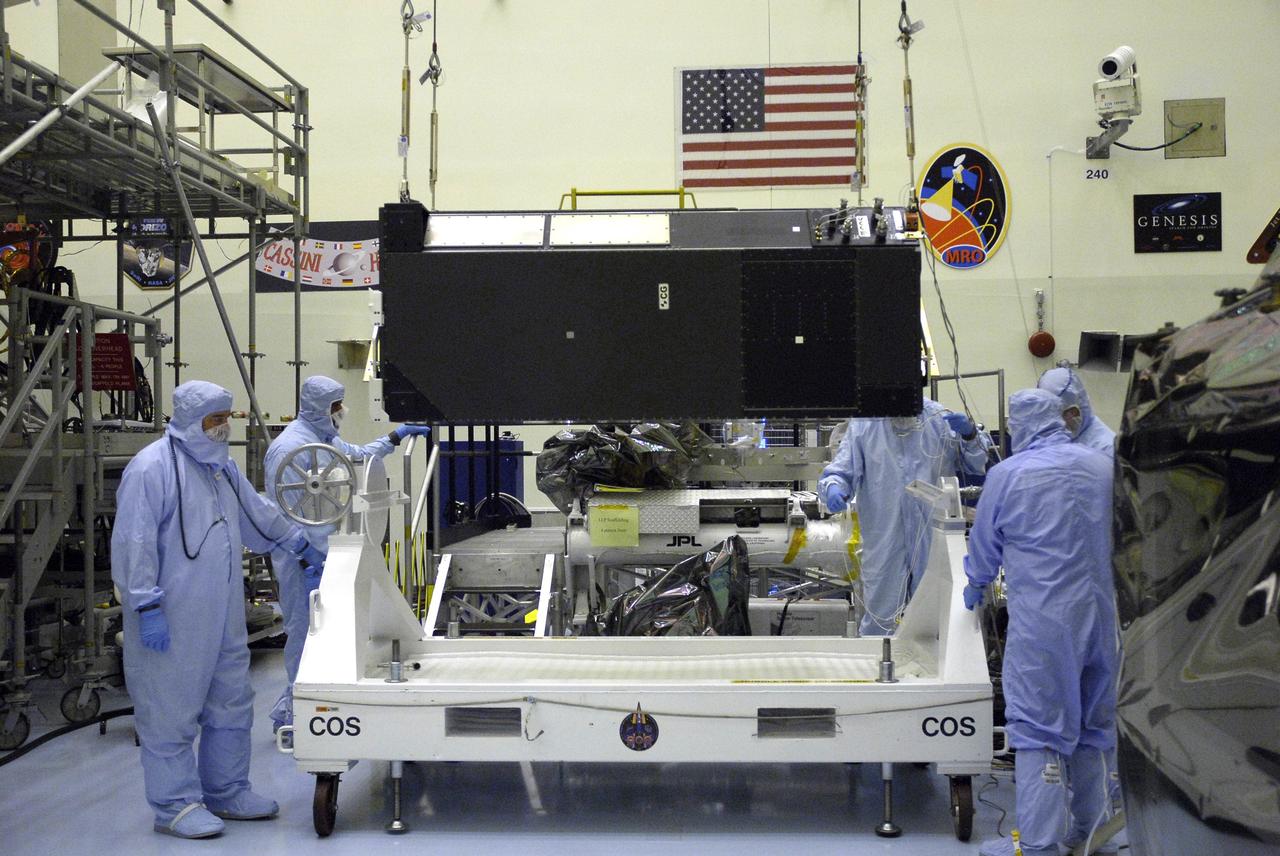
CAPE CANAVERAL, Fla. – In the clean room of the Payload Hazardous Processing Facility at NASA's Kennedy Space Center, an overhead crane lifts the Cosmic Origins Spectrograph, or COS. The COS is being lifted and moved to a protective enclosure on the Orbital Replacement Unit Carrier, part of the payload for the fifth and final Hubble servicing mission, STS-125. Other payloads include the Flight Support System, the Super Lightweight Interchangeable Carrier and the Multi-Use Lightweight Equipment, or MULE, carrier. COS will be the most sensitive ultraviolet spectrograph ever flown on Hubble and will probe the "cosmic web" - the large-scale structure of the universe whose form is determined by the gravity of dark matter and is traced by galaxies and intergalactic gas. The COS far-ultraviolet channel has a sensitivity 30 times greater than that of previous spectroscopic instruments for the detection of extremely low light levels. Launch of Atlantis on the STS-125 mission is targeted for Oct. 8. Photo credit: NASA/Kim Shiflett
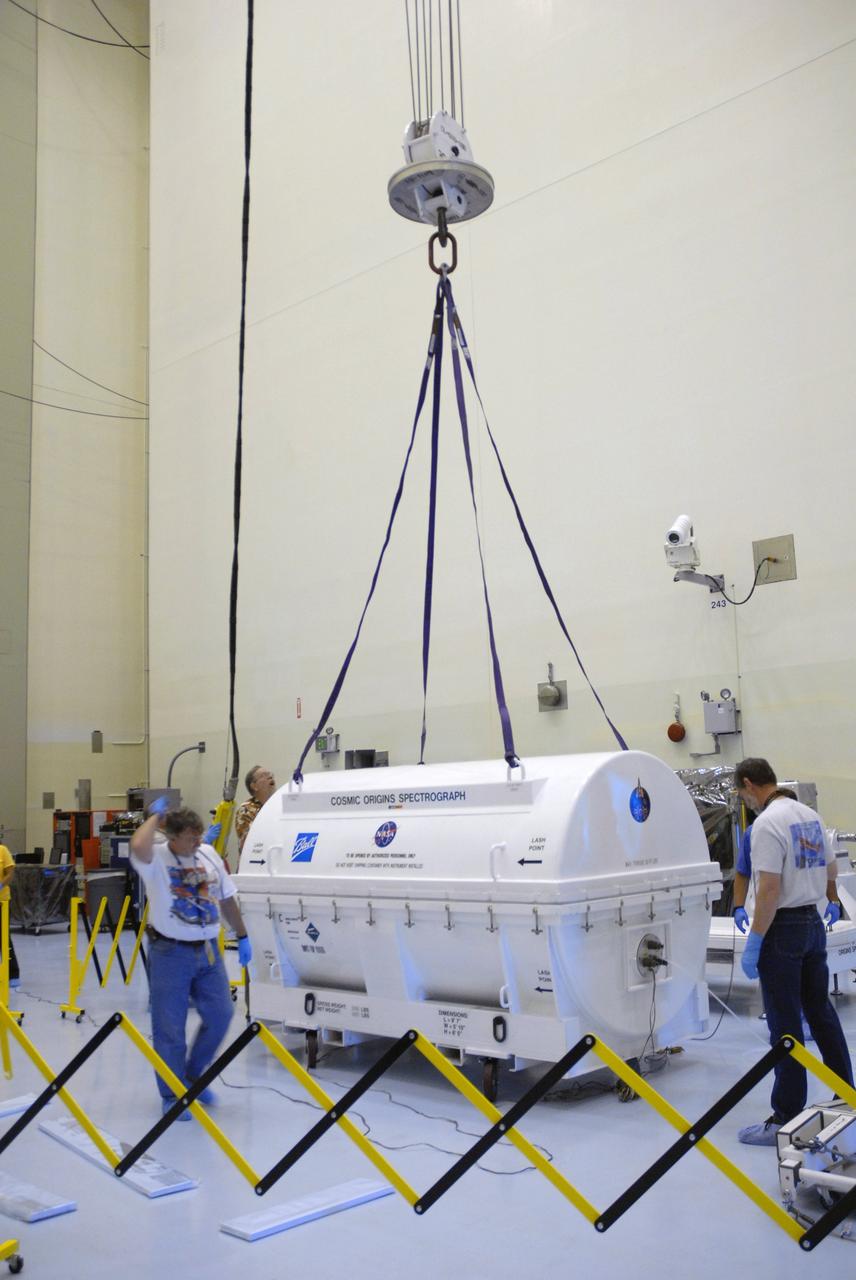
CAPE CANAVERAL, Fla. – At NASA's Kennedy Space Center, workers from NASA's Goddard Space Flight Center receive the Cosmic Origins Spectrograph, or COS, secured in its transportation canister, in the airlock of the Payload Hazardous Servicing Facility. The COS will be installed on the Hubble Space Telescope on space shuttle Atlantis' STS-125 mission. COS will be the most sensitive ultraviolet spectrograph ever flown on Hubble and will probe the "cosmic web" - the large-scale structure of the universe whose form is determined by the gravity of dark matter and is traced by galaxies and intergalactic gas. COS's far-ultraviolet channel has a sensitivity 30 times greater than that of previous spectroscopic instruments for the detection of extremely low light levels. Launch of STS-125 is targeted for Oct. 8. Photo credit: NASA/Jack Pfaller

CAPE CANAVERAL, Fla. – In the clean room of the Payload Hazardous Processing Facility at NASA's Kennedy Space Center, an overhead crane lifts the Cosmic Origins Spectrograph, or COS. The COS is being lifted and moved to a protective enclosure on the Orbital Replacement Unit Carrier, part of the payload for the fifth and final Hubble servicing mission, STS-125. Other payloads include the Flight Support System, the Super Lightweight Interchangeable Carrier and the Multi-Use Lightweight Equipment, or MULE, carrier. COS will be the most sensitive ultraviolet spectrograph ever flown on Hubble and will probe the "cosmic web" - the large-scale structure of the universe whose form is determined by the gravity of dark matter and is traced by galaxies and intergalactic gas. The COS far-ultraviolet channel has a sensitivity 30 times greater than that of previous spectroscopic instruments for the detection of extremely low light levels. Launch of Atlantis on the STS-125 mission is targeted for Oct. 8. Photo credit: NASA/Kim Shiflett
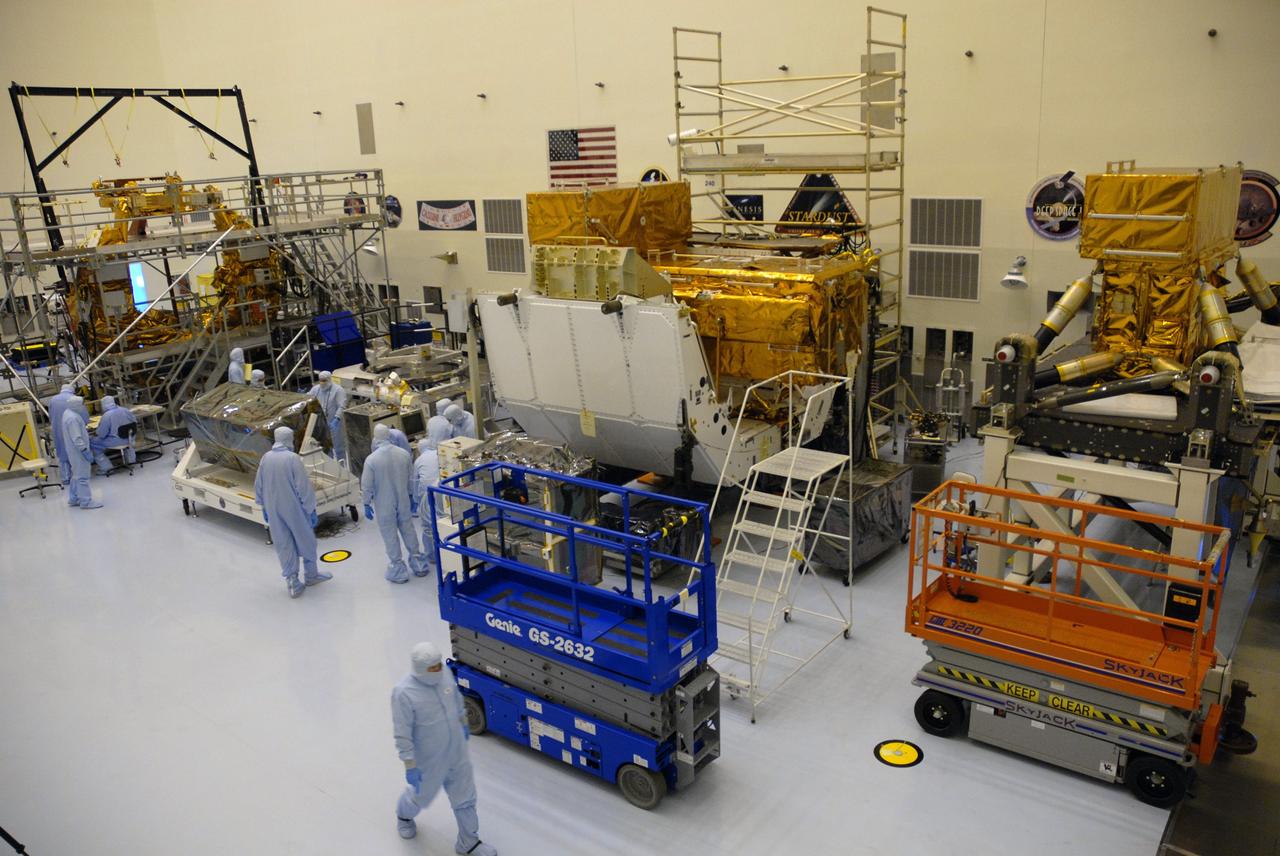
CAPE CANAVERAL, Fla. – At NASA's Kennedy Space Center, workers from NASA's Goddard Space Flight Center roll the Cosmic Origins Spectrograph, or COS, into position in the clean room of the Payload Hazardous Servicing Facility for instrument testing and integration with the Flight Support System carrier. The COS will be installed on the Hubble Space Telescope on space shuttle Atlantis' STS-125 mission. COS will be the most sensitive ultraviolet spectrograph ever flown on Hubble and will probe the "cosmic web" - the large-scale structure of the universe whose form is determined by the gravity of dark matter and is traced by galaxies and intergalactic gas. COS's far-ultraviolet channel has a sensitivity 30 times greater than that of previous spectroscopic instruments for the detection of extremely low light levels. Launch of STS-125 is targeted for Oct. 8. Photo credit: NASA/Jack Pfaller

CAPE CANAVERAL, Fla. – In the clean room of the Payload Hazardous Processing Facility at NASA's Kennedy Space Center, workers attach an overhead crane to the Cosmic Origins Spectrograph, or COS. The COS is being lifted and moved to a protective enclosure on the Orbital Replacement Unit Carrier, part of the payload for the fifth and final Hubble servicing mission, STS-125. Other payloads include the Flight Support System, the Super Lightweight Interchangeable Carrier and the Multi-Use Lightweight Equipment, or MULE, carrier. COS will be the most sensitive ultraviolet spectrograph ever flown on Hubble and will probe the "cosmic web" - the large-scale structure of the universe whose form is determined by the gravity of dark matter and is traced by galaxies and intergalactic gas. The COS far-ultraviolet channel has a sensitivity 30 times greater than that of previous spectroscopic instruments for the detection of extremely low light levels. Launch of Atlantis on the STS-125 mission is targeted for Oct. 8. Photo credit: NASA/Kim Shiflett
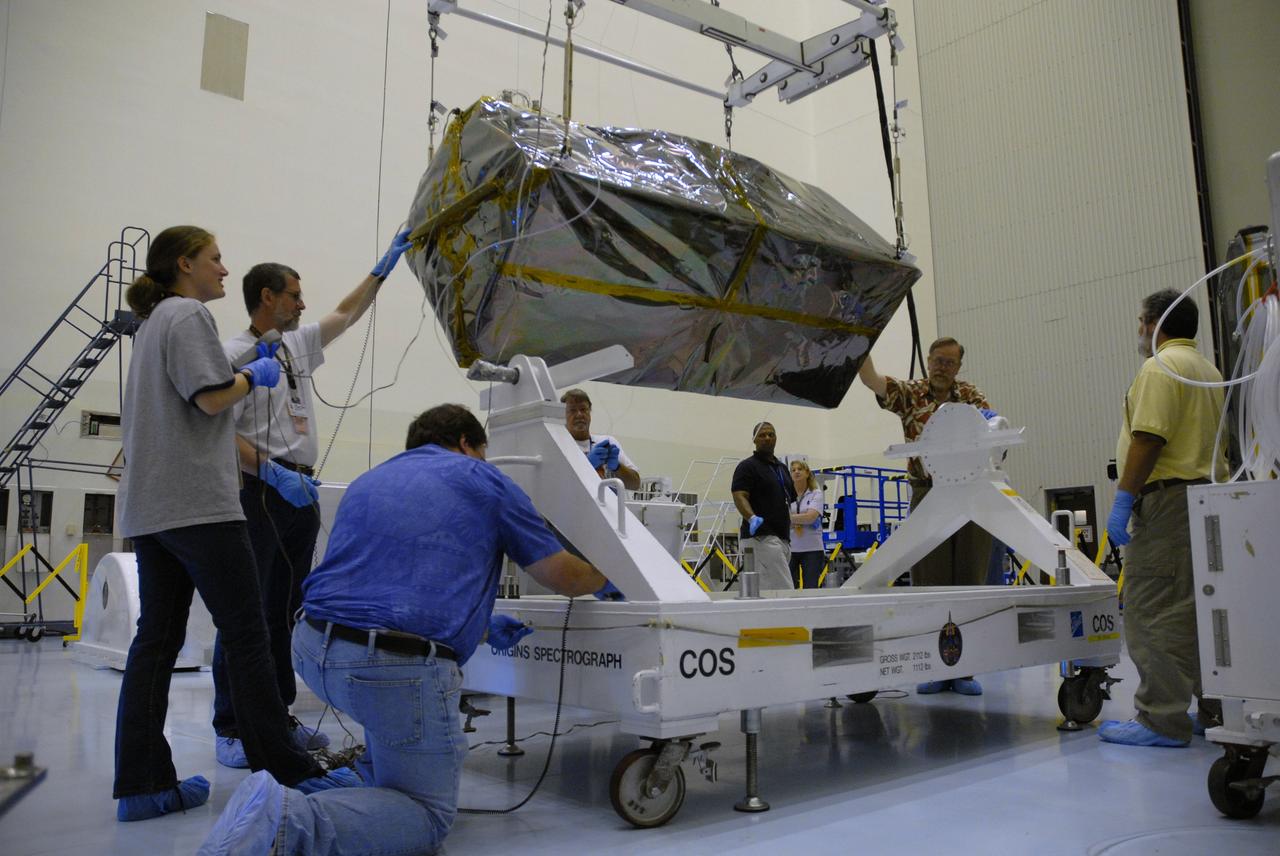
CAPE CANAVERAL, Fla. – In the airlock of the Payload Hazardous Servicing Facility at NASA's Kennedy Space Center, workers from NASA's Goddard Space Flight Center lift the Cosmic Origins Spectrograph, or COS, from its transportation canister onto a dolly for its move into the clean room. The COS will be installed on the Hubble Space Telescope on space shuttle Atlantis' STS-125 mission. COS will be the most sensitive ultraviolet spectrograph ever flown on Hubble and will probe the "cosmic web" - the large-scale structure of the universe whose form is determined by the gravity of dark matter and is traced by galaxies and intergalactic gas. COS's far-ultraviolet channel has a sensitivity 30 times greater than that of previous spectroscopic instruments for the detection of extremely low light levels. Launch of STS-125 is targeted for Oct. 8. Photo credit: NASA/Jack Pfaller
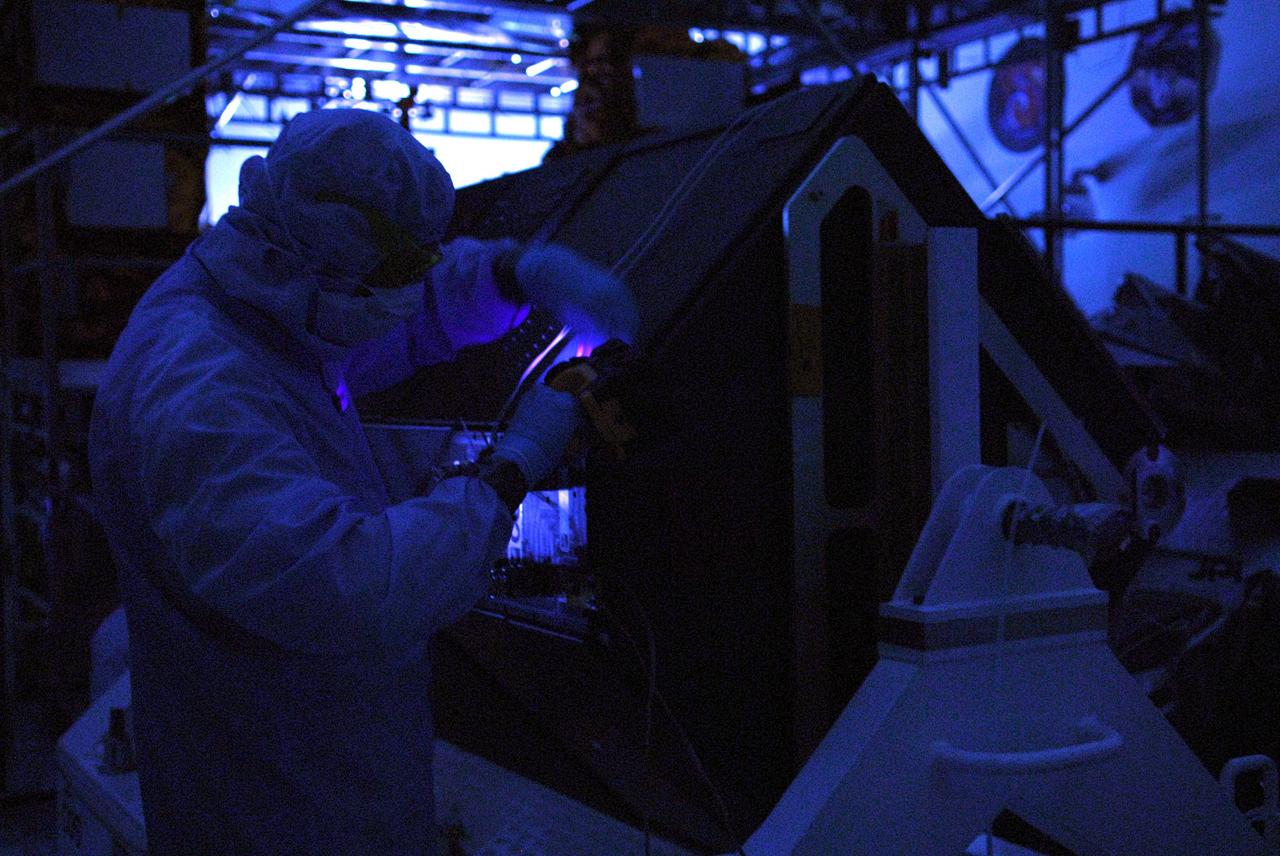
CAPE CANAVERAL, Fla. – In the clean room of the Payload Hazardous Processing Facility at NASA's Kennedy Space Center, a worker from NASA's Goddard Space Flight Center uses black light inspection for a thorough cleaning of the Cosmic Origins Spectrograph, or COS. Black light inspection uses UVA fluorescence to detect possible particulate microcontamination, minute cracks or fluid leaks. The COS will be installed on the Hubble Space Telescope on space shuttle Atlantis' STS-125 mission. COS will be the most sensitive ultraviolet spectrograph ever flown on Hubble and will probe the "cosmic web" - the large-scale structure of the universe whose form is determined by the gravity of dark matter and is traced by galaxies and intergalactic gas. The COS far-ultraviolet channel has a sensitivity 30 times greater than that of previous spectroscopic instruments for the detection of extremely low light levels. Launch of Atlantis on the STS-125 mission is targeted for Oct. 8. Photo credit: NASA/Kim Shiflett
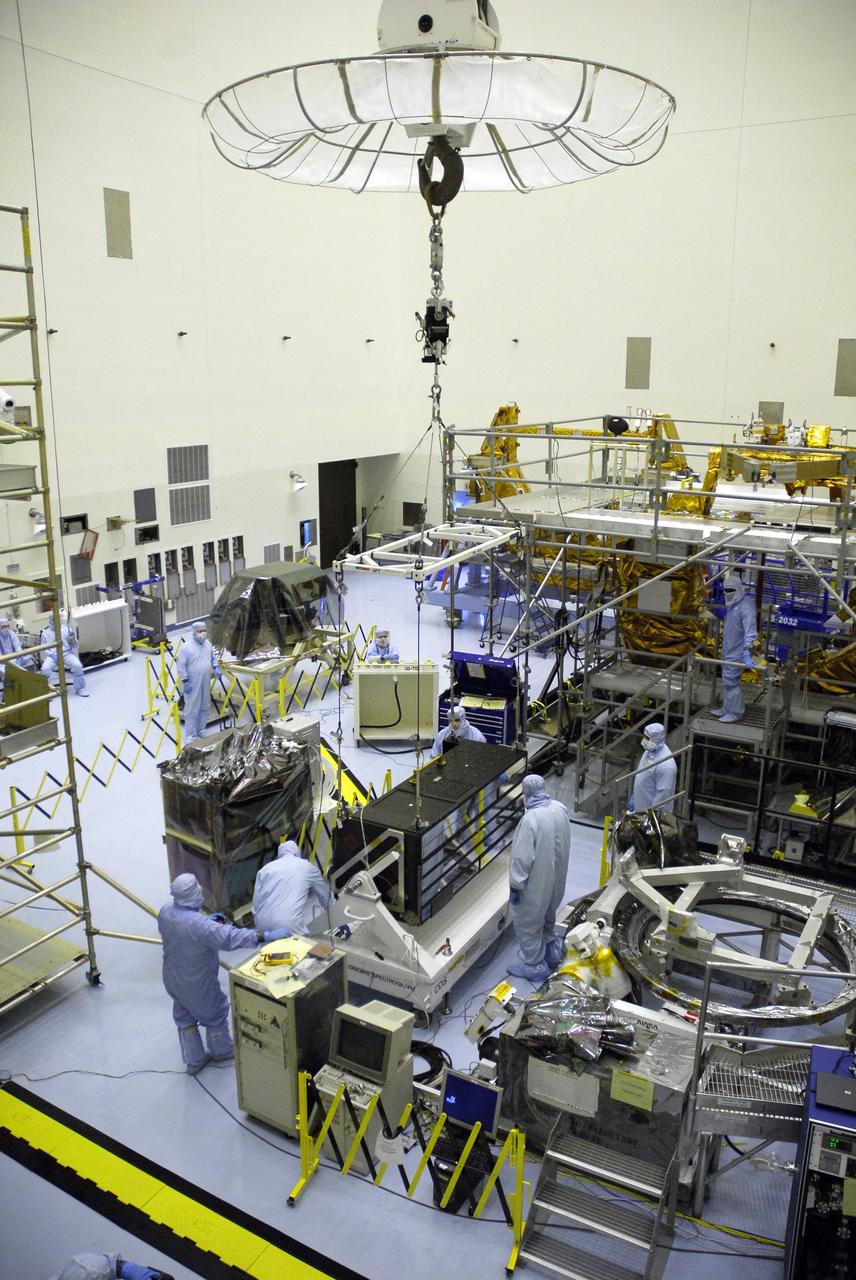
CAPE CANAVERAL, Fla. – In the clean room of the Payload Hazardous Processing Facility at NASA's Kennedy Space Center, an overhead crane lifts the Cosmic Origins Spectrograph, or COS. The COS is being lifted and moved to a protective enclosure on the Orbital Replacement Unit Carrier, part of the payload for the fifth and final Hubble servicing mission, STS-125. Other payloads include the Flight Support System, the Super Lightweight Interchangeable Carrier and the Multi-Use Lightweight Equipment, or MULE, carrier. COS will be the most sensitive ultraviolet spectrograph ever flown on Hubble and will probe the "cosmic web" - the large-scale structure of the universe whose form is determined by the gravity of dark matter and is traced by galaxies and intergalactic gas. The COS far-ultraviolet channel has a sensitivity 30 times greater than that of previous spectroscopic instruments for the detection of extremely low light levels. Launch of Atlantis on the STS-125 mission is targeted for Oct. 8. Photo credit: NASA/Kim Shiflett
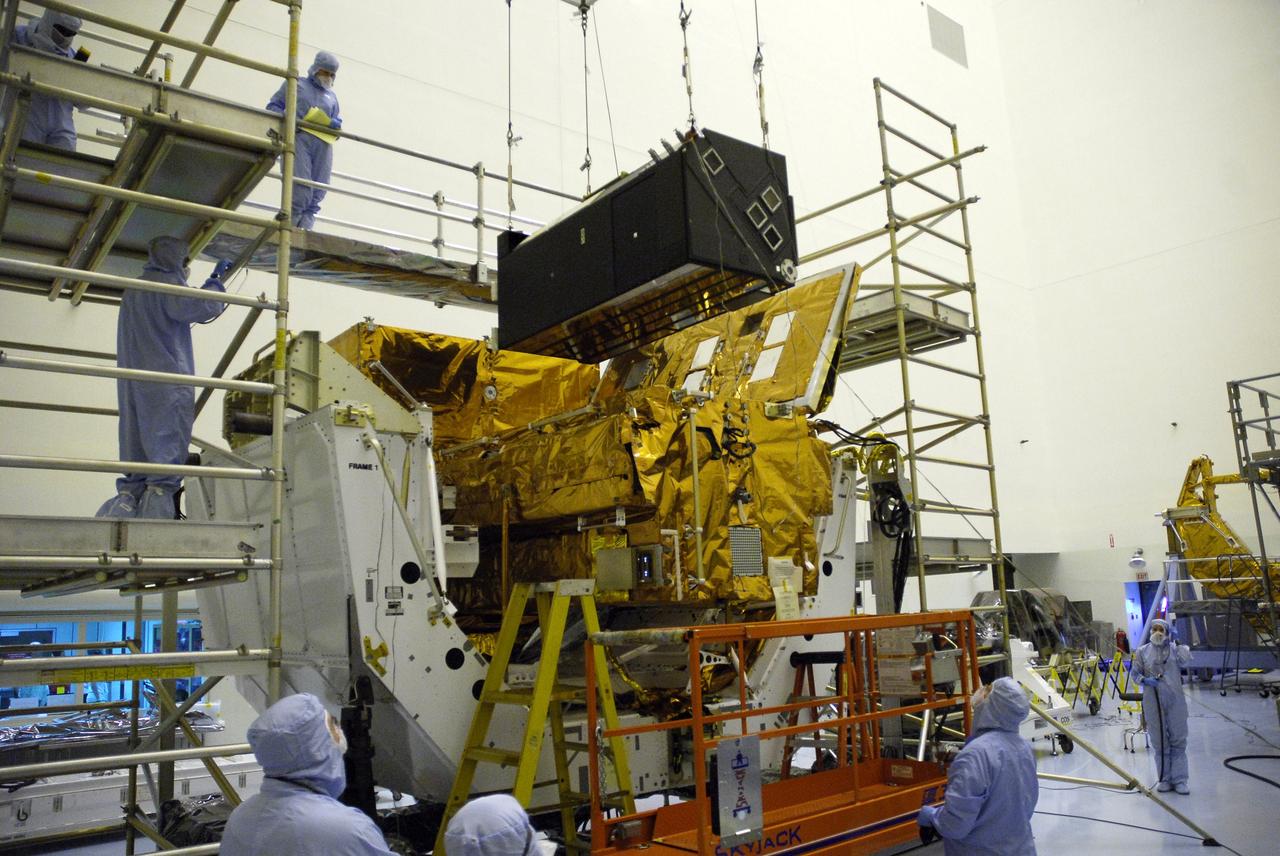
CAPE CANAVERAL, Fla. – In the clean room of the Payload Hazardous Processing Facility at NASA's Kennedy Space Center, an overhead crane lowers the Cosmic Origins Spectrograph, or COS, toward a protective enclosure on the Orbital Replacement Unit Carrier, part of the payload for the fifth and final Hubble servicing mission, STS-125. Other payloads include the Flight Support System, the Super Lightweight Interchangeable Carrier and the Multi-Use Lightweight Equipment, or MULE, carrier. COS will be the most sensitive ultraviolet spectrograph ever flown on Hubble and will probe the "cosmic web" - the large-scale structure of the universe whose form is determined by the gravity of dark matter and is traced by galaxies and intergalactic gas. The COS far-ultraviolet channel has a sensitivity 30 times greater than that of previous spectroscopic instruments for the detection of extremely low light levels. Launch of Atlantis on the STS-125 mission is targeted for Oct. 8. Photo credit: NASA/Kim Shiflett
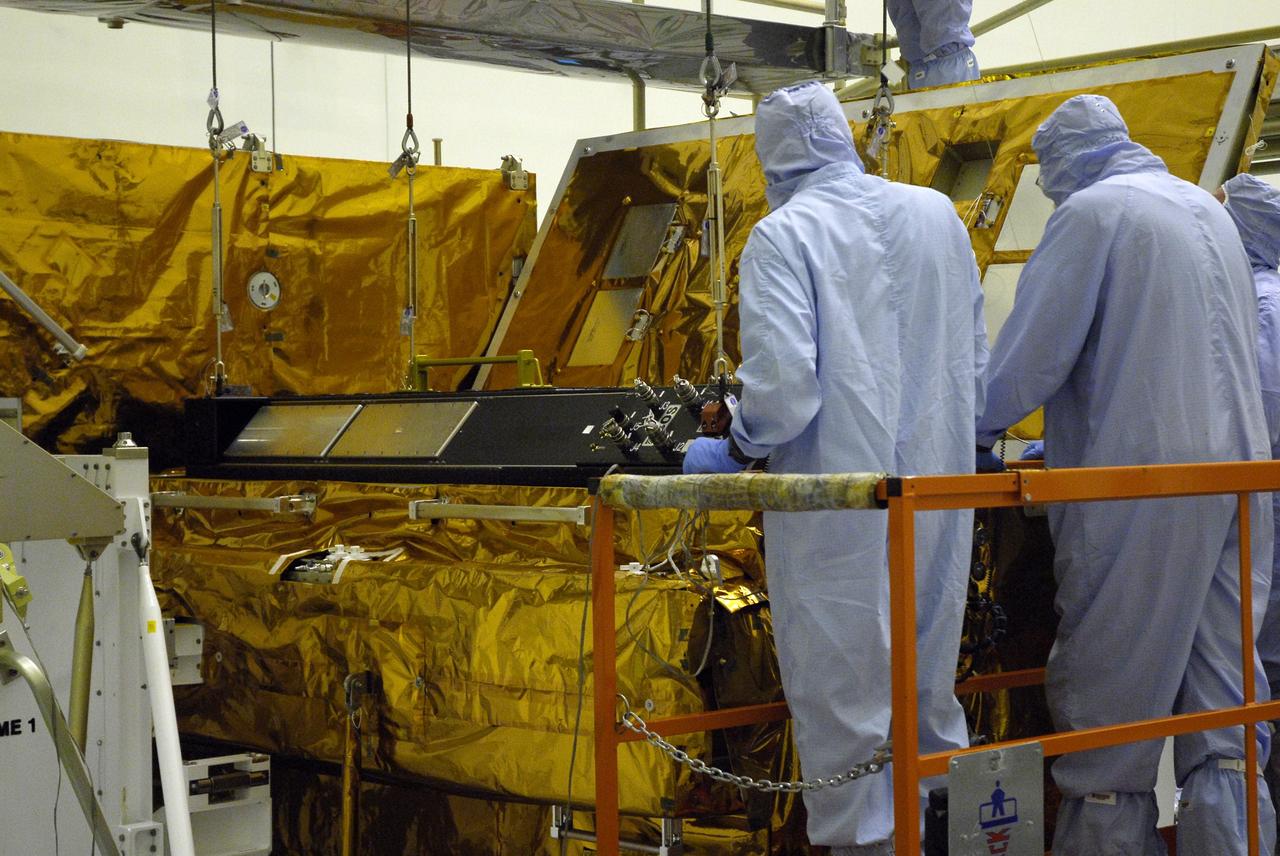
CAPE CANAVERAL, Fla. – In the clean room of the Payload Hazardous Processing Facility at NASA's Kennedy Space Center, an overhead crane settles the Cosmic Origins Spectrograph, or COS, in a protective enclosure on the Orbital Replacement Unit Carrier, part of the payload for the fifth and final Hubble servicing mission, STS-125. Other payloads include the Flight Support System, the Super Lightweight Interchangeable Carrier and the Multi-Use Lightweight Equipment, or MULE, carrier. COS will be the most sensitive ultraviolet spectrograph ever flown on Hubble and will probe the "cosmic web" - the large-scale structure of the universe whose form is determined by the gravity of dark matter and is traced by galaxies and intergalactic gas. The COS far-ultraviolet channel has a sensitivity 30 times greater than that of previous spectroscopic instruments for the detection of extremely low light levels. Launch of Atlantis on the STS-125 mission is targeted for Oct. 8. Photo credit: NASA/Kim Shiflett

CAPE CANAVERAL, Fla. – In the clean room of the Payload Hazardous Processing Facility at NASA's Kennedy Space Center, an overhead crane moves the Cosmic Origins Spectrograph, or COS, toward a protective enclosure on the Orbital Replacement Unit Carrier, part of the payload for the fifth and final Hubble servicing mission, STS-125. Other payloads include the Flight Support System, the Super Lightweight Interchangeable Carrier and the Multi-Use Lightweight Equipment, or MULE, carrier. COS will be the most sensitive ultraviolet spectrograph ever flown on Hubble and will probe the "cosmic web" - the large-scale structure of the universe whose form is determined by the gravity of dark matter and is traced by galaxies and intergalactic gas. The COS far-ultraviolet channel has a sensitivity 30 times greater than that of previous spectroscopic instruments for the detection of extremely low light levels. Launch of Atlantis on the STS-125 mission is targeted for Oct. 8. Photo credit: NASA/Kim Shiflett
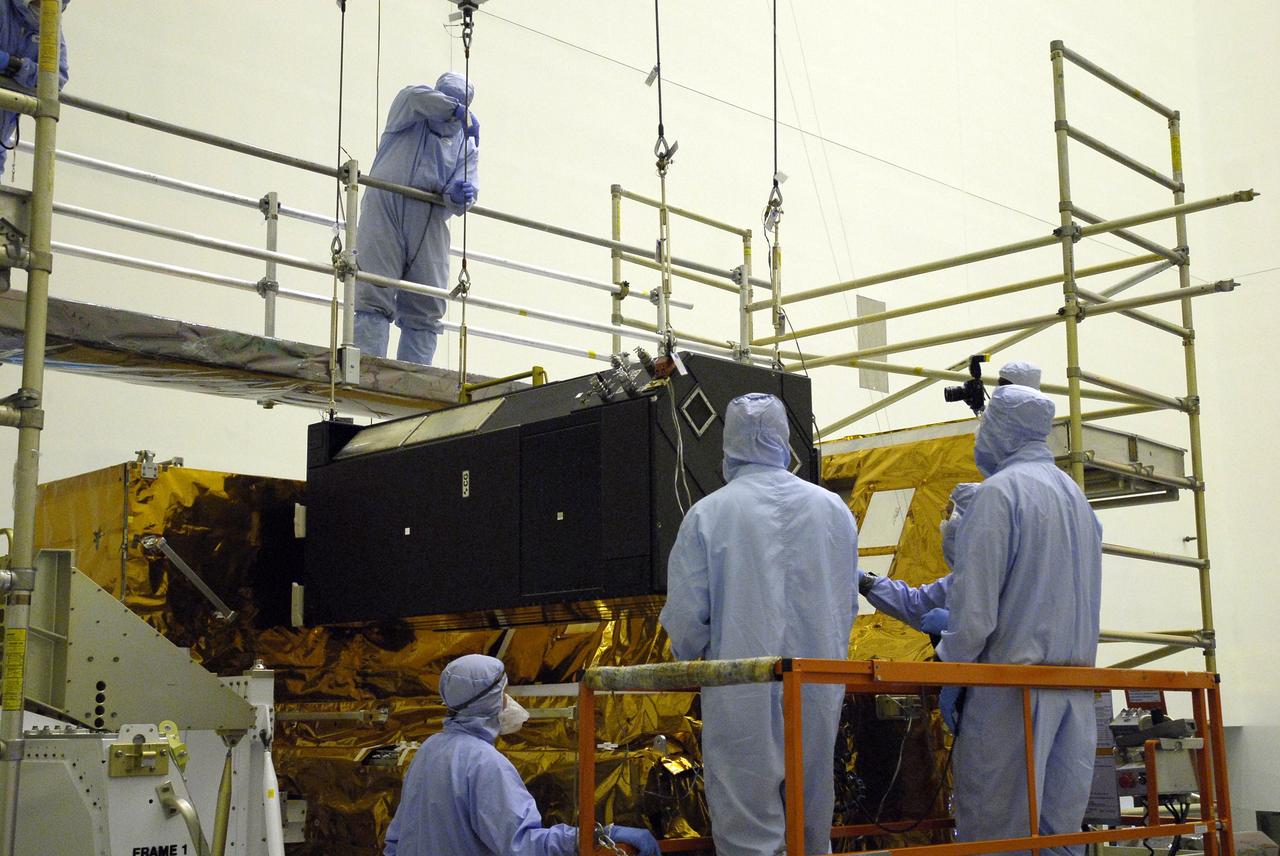
CAPE CANAVERAL, Fla. – In the clean room of the Payload Hazardous Processing Facility at NASA's Kennedy Space Center, an overhead crane lowers the Cosmic Origins Spectrograph, or COS, into a protective enclosure on the Orbital Replacement Unit Carrier, part of the payload for the fifth and final Hubble servicing mission, STS-125. Other payloads include the Flight Support System, the Super Lightweight Interchangeable Carrier and the Multi-Use Lightweight Equipment, or MULE, carrier. COS will be the most sensitive ultraviolet spectrograph ever flown on Hubble and will probe the "cosmic web" - the large-scale structure of the universe whose form is determined by the gravity of dark matter and is traced by galaxies and intergalactic gas. The COS far-ultraviolet channel has a sensitivity 30 times greater than that of previous spectroscopic instruments for the detection of extremely low light levels. Launch of Atlantis on the STS-125 mission is targeted for Oct. 8. Photo credit: NASA/Kim Shiflett
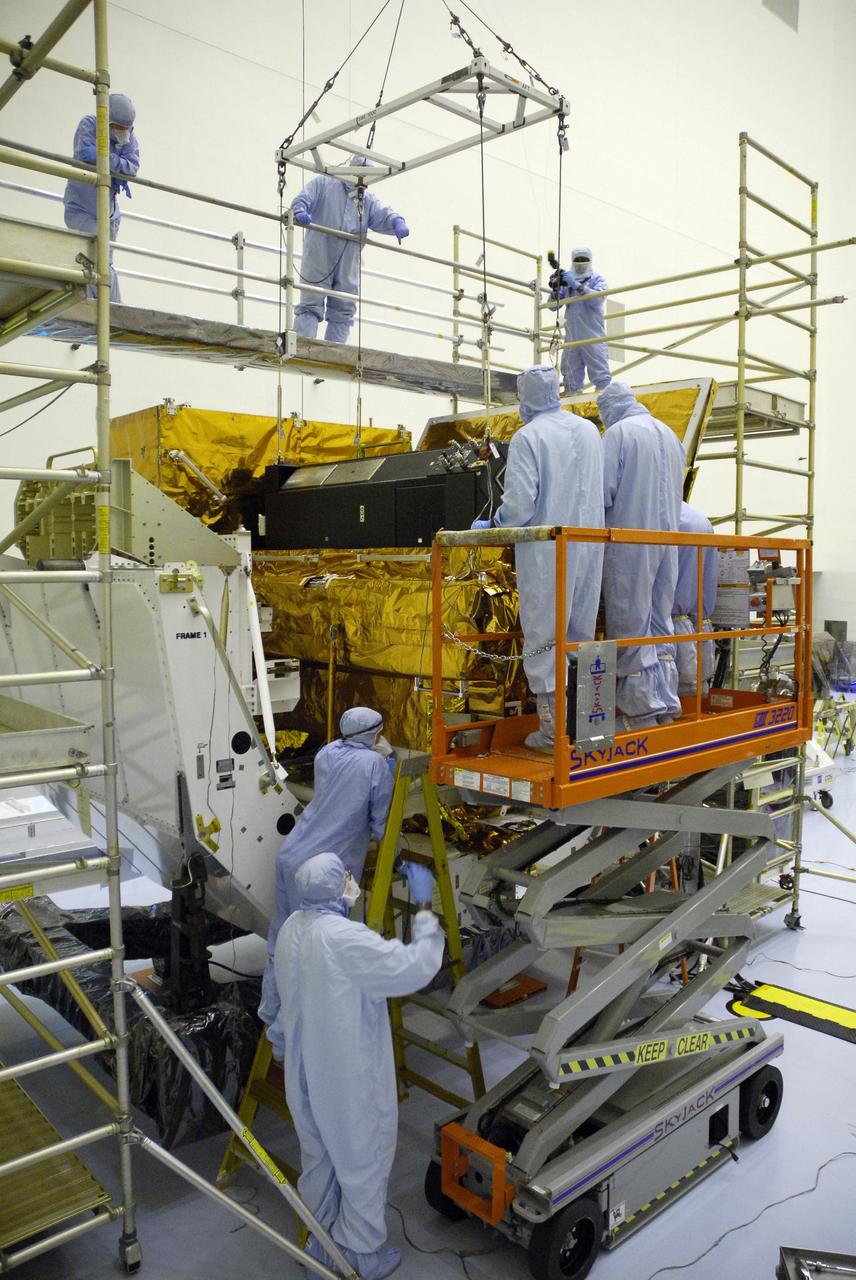
CAPE CANAVERAL, Fla. – In the clean room of the Payload Hazardous Processing Facility at NASA's Kennedy Space Center, an overhead crane lowers the Cosmic Origins Spectrograph, or COS, into a protective enclosure on the Orbital Replacement Unit Carrier, part of the payload for the fifth and final Hubble servicing mission, STS-125. Other payloads include the Flight Support System, the Super Lightweight Interchangeable Carrier and the Multi-Use Lightweight Equipment, or MULE, carrier. COS will be the most sensitive ultraviolet spectrograph ever flown on Hubble and will probe the "cosmic web" - the large-scale structure of the universe whose form is determined by the gravity of dark matter and is traced by galaxies and intergalactic gas. The COS far-ultraviolet channel has a sensitivity 30 times greater than that of previous spectroscopic instruments for the detection of extremely low light levels. Launch of Atlantis on the STS-125 mission is targeted for Oct. 8. Photo credit: NASA/Kim Shiflett
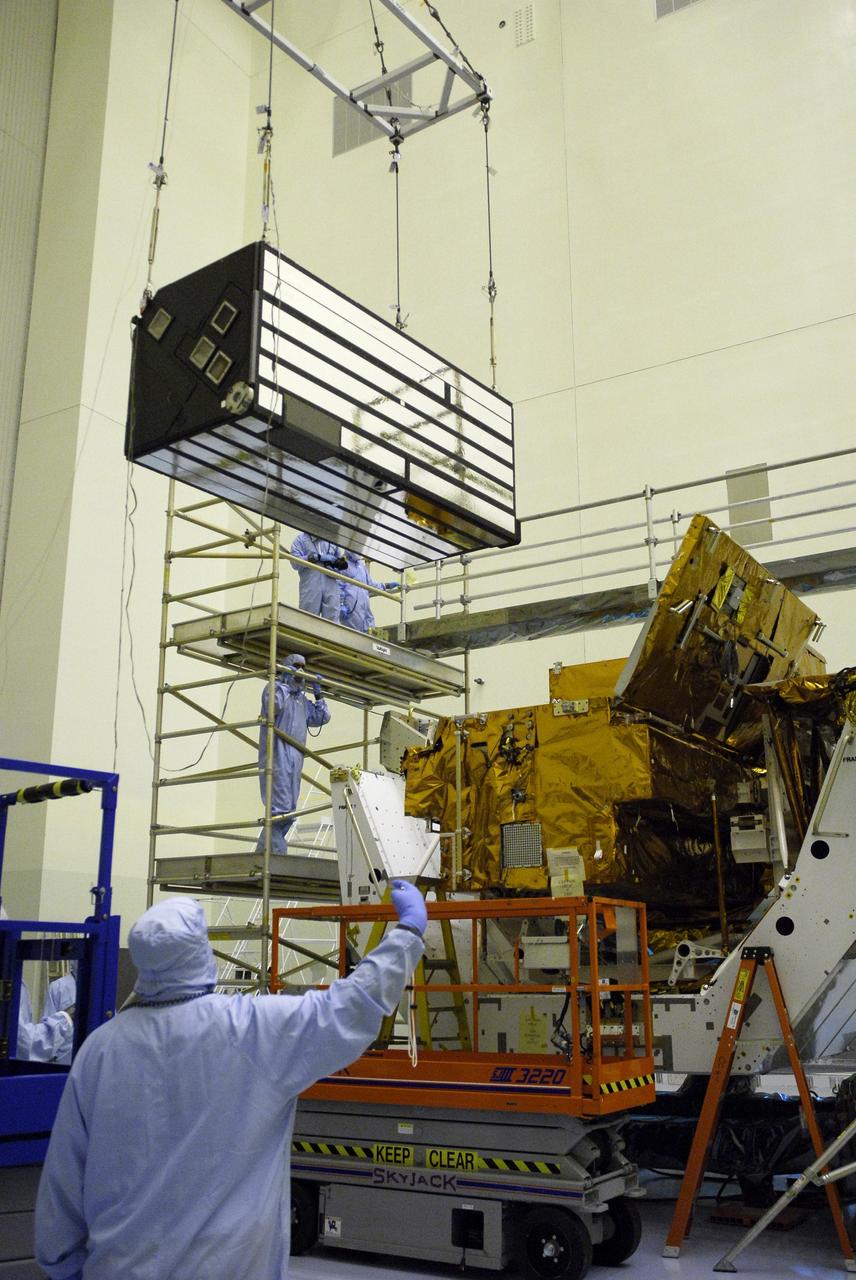
CAPE CANAVERAL, Fla. – In the clean room of the Payload Hazardous Processing Facility at NASA's Kennedy Space Center, an overhead crane lowers the Cosmic Origins Spectrograph, or COS, toward a protective enclosure on the Orbital Replacement Unit Carrier, part of the payload for the fifth and final Hubble servicing mission, STS-125. Other payloads include the Flight Support System, the Super Lightweight Interchangeable Carrier and the Multi-Use Lightweight Equipment, or MULE, carrier. COS will be the most sensitive ultraviolet spectrograph ever flown on Hubble and will probe the "cosmic web" - the large-scale structure of the universe whose form is determined by the gravity of dark matter and is traced by galaxies and intergalactic gas. The COS far-ultraviolet channel has a sensitivity 30 times greater than that of previous spectroscopic instruments for the detection of extremely low light levels. Launch of Atlantis on the STS-125 mission is targeted for Oct. 8. Photo credit: NASA/Kim Shiflett
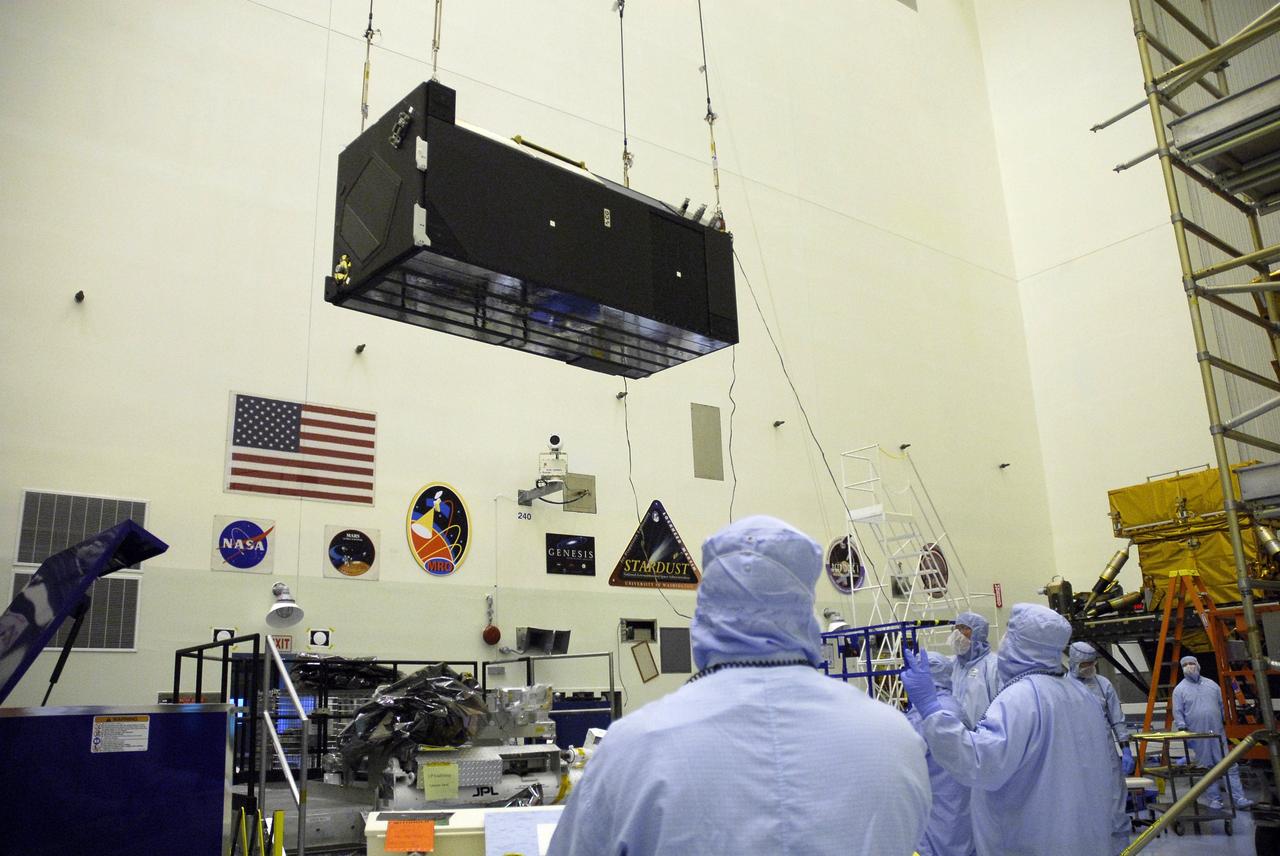
CAPE CANAVERAL, Fla. – In the clean room of the Payload Hazardous Processing Facility at NASA's Kennedy Space Center, an overhead crane moves the Cosmic Origins Spectrograph, or COS, toward a protective enclosure on the Orbital Replacement Unit Carrier, part of the payload for the fifth and final Hubble servicing mission, STS-125. Other payloads include the Flight Support System, the Super Lightweight Interchangeable Carrier and the Multi-Use Lightweight Equipment, or MULE, carrier. COS will be the most sensitive ultraviolet spectrograph ever flown on Hubble and will probe the "cosmic web" - the large-scale structure of the universe whose form is determined by the gravity of dark matter and is traced by galaxies and intergalactic gas. The COS far-ultraviolet channel has a sensitivity 30 times greater than that of previous spectroscopic instruments for the detection of extremely low light levels. Launch of Atlantis on the STS-125 mission is targeted for Oct. 8. Photo credit: NASA/Kim Shiflett
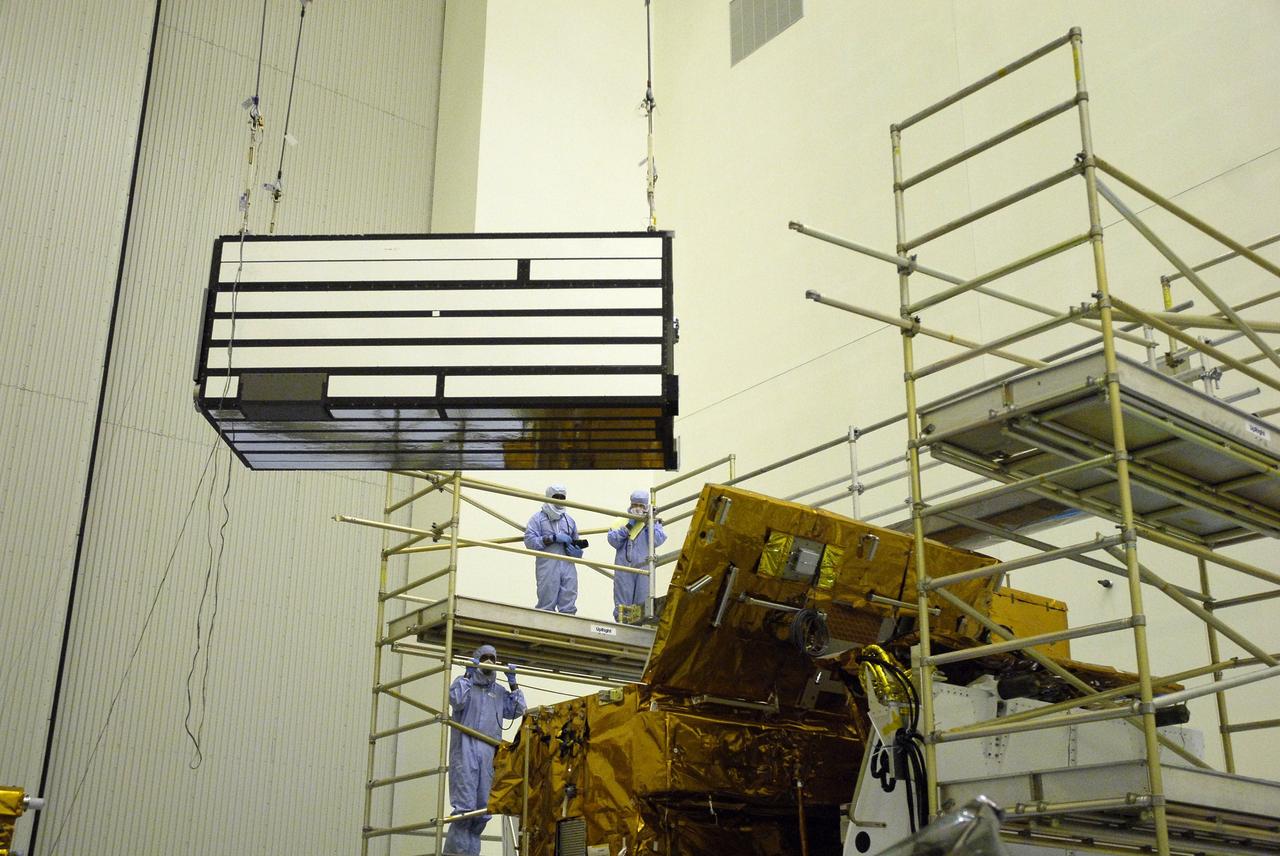
CAPE CANAVERAL, Fla. – In the clean room of the Payload Hazardous Processing Facility at NASA's Kennedy Space Center, an overhead crane lowers the Cosmic Origins Spectrograph, or COS, toward a protective enclosure on the Orbital Replacement Unit Carrier, part of the payload for the fifth and final Hubble servicing mission, STS-125. Other payloads include the Flight Support System, the Super Lightweight Interchangeable Carrier and the Multi-Use Lightweight Equipment, or MULE, carrier. COS will be the most sensitive ultraviolet spectrograph ever flown on Hubble and will probe the "cosmic web" - the large-scale structure of the universe whose form is determined by the gravity of dark matter and is traced by galaxies and intergalactic gas. The COS far-ultraviolet channel has a sensitivity 30 times greater than that of previous spectroscopic instruments for the detection of extremely low light levels. Launch of Atlantis on the STS-125 mission is targeted for Oct. 8. Photo credit: NASA/Kim Shiflett
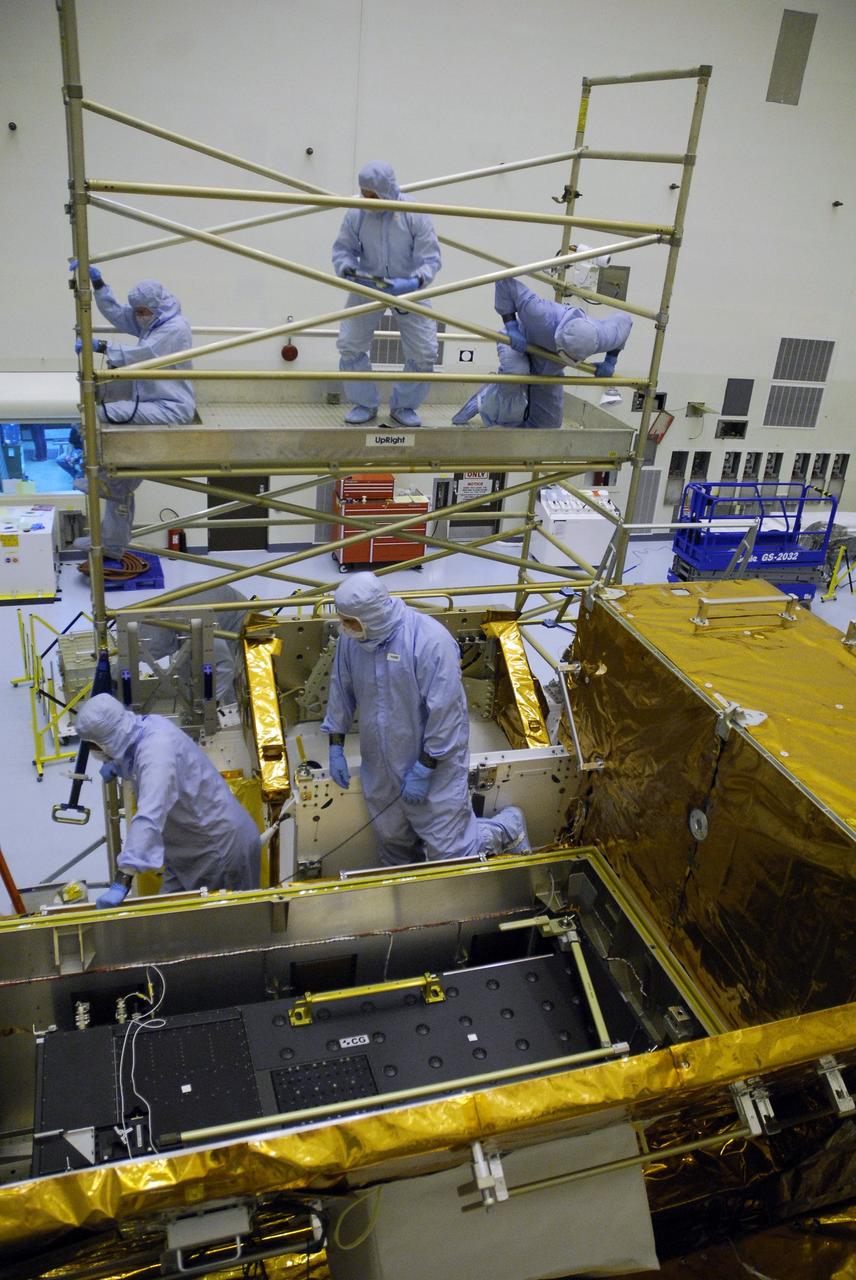
CAPE CANAVERAL, Fla. – In the Payload Hazardous Servicing Facility at NASA’s Kennedy Space Center, crew members with the STS-125 mission get a close look at some of the equipment associated with their mission to service NASA’s Hubble Space Telescope. Looking at the box containing the Cosmic Origins Spectrograph, or COS, on the orbital replacement unit carrier are Mission Specialist Michael Good (upper right, on stand) and HST inspectors. COS will be the most sensitive ultraviolet spectrograph ever flown on Hubble and will probe the "cosmic web" - the large-scale structure of the universe whose form is determined by the gravity of dark matter and is traced by galaxies and intergalactic gas. The STS-125 crew is taking part in a crew equipment interface test, which provides experience handling tools, equipment and hardware they will use on their mission. Space shuttle Atlantis is targeted to launch on the STS-125 mission Oct. 10. Photo credit: NASA/Kim Shiflett
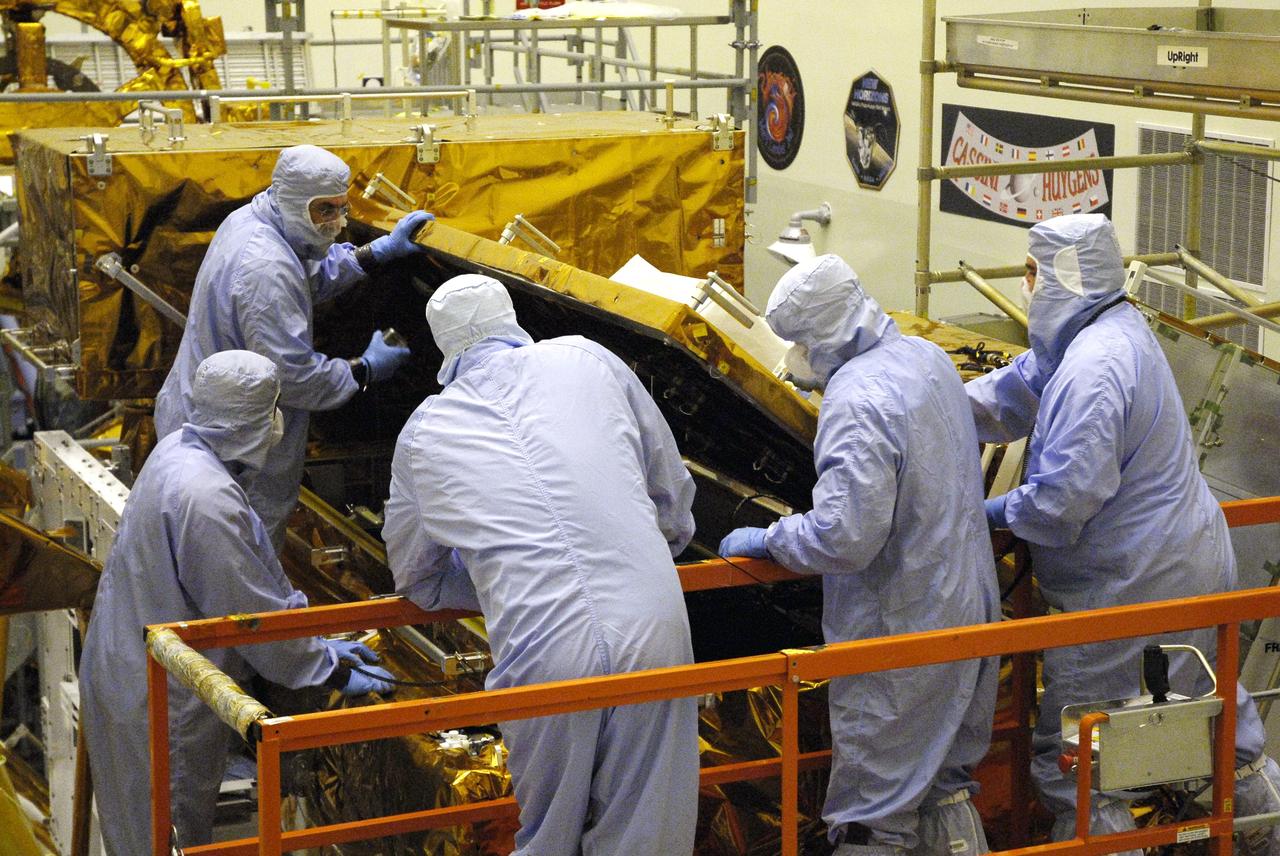
CAPE CANAVERAL, Fla. – In the Payload Hazardous Servicing Facility at NASA’s Kennedy Space Center, crew members with the STS-125 mission get a close look at some of the equipment associated with their mission to service NASA’s Hubble Space Telescope. In the foreground, center, are Mission Specialists Mike Massimino and Michael Good, looking at the box containing the Cosmic Origins Spectrograph, or COS, on the orbital replacement unit carrier. COS will be the most sensitive ultraviolet spectrograph ever flown on Hubble and will probe the "cosmic web" - the large-scale structure of the universe whose form is determined by the gravity of dark matter and is traced by galaxies and intergalactic gas. The STS-125 crew is taking part in a crew equipment interface test, which provides experience handling tools, equipment and hardware they will use on their mission. Space shuttle Atlantis is targeted to launch on the STS-125 mission Oct. 10. Photo credit: NASA/Kim Shiflett
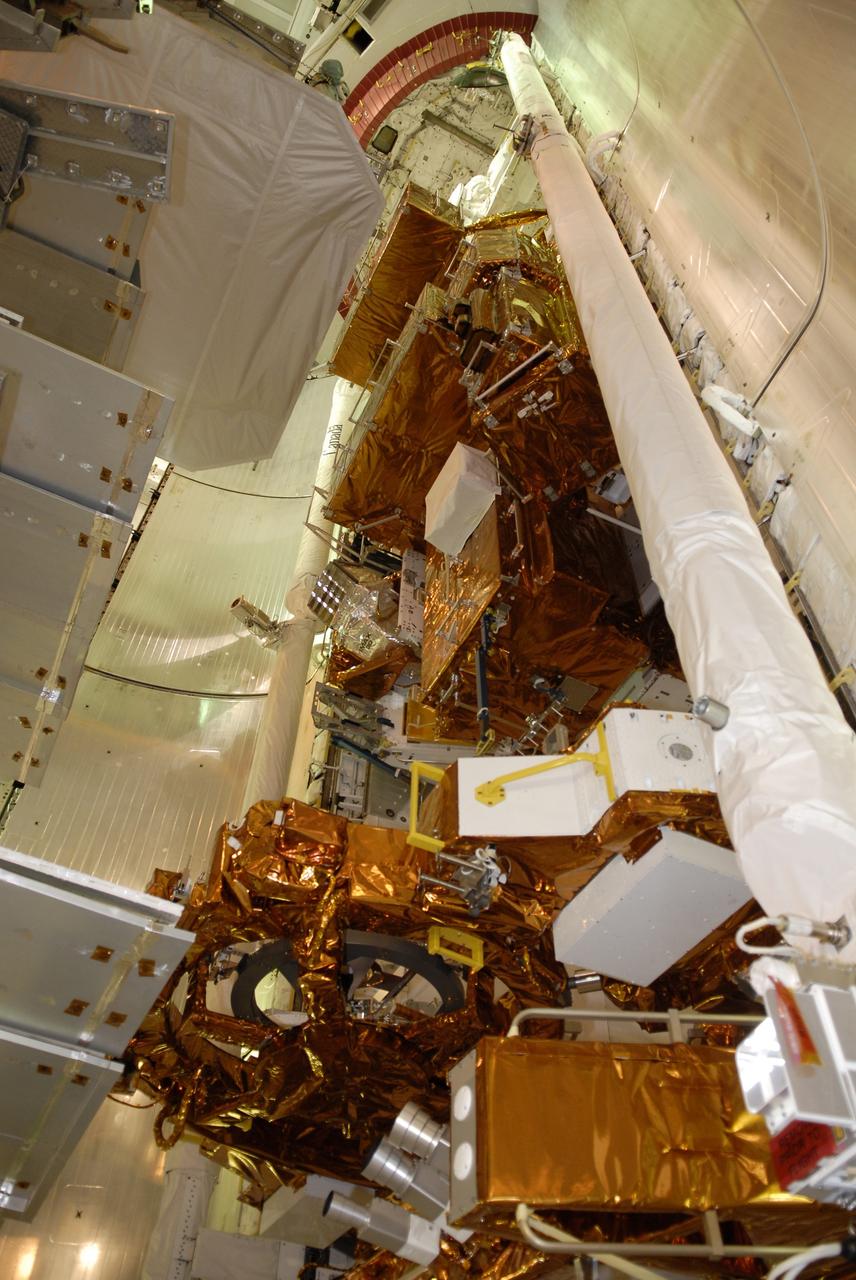
CAPE CANAVERAL, Fla. – On Launch Pad 39A at NASA's Kennedy Space Center in Florida, space shuttle Atlantis' payload bay is filled with hardware for the STS-125 mission to service NASA's Hubble Space Telescope. From the bottom are the Flight Support System with the Soft Capture mechanism and Multi-Use Lightweight Equipment Carrier with the Science Instrument Command and Data Handling Unit, or SIC&DH. At center is the Orbital Replacement Unit Carrier with the Cosmic Origins Spectrograph, or COS, and an IMAX 3D camera. At top is the Super Lightweight Interchangeable Carrier with the Wide Field Camera 3. Atlantis' crew will service NASA's Hubble Space Telescope for the fifth and final time. The flight will include five spacewalks during which astronauts will refurbish and upgrade the telescope with state-of-the-art science instruments. As a result, Hubble's capabilities will be expanded and its operational lifespan extended through at least 2014. Photo credit: NASA/Kim Shiflett
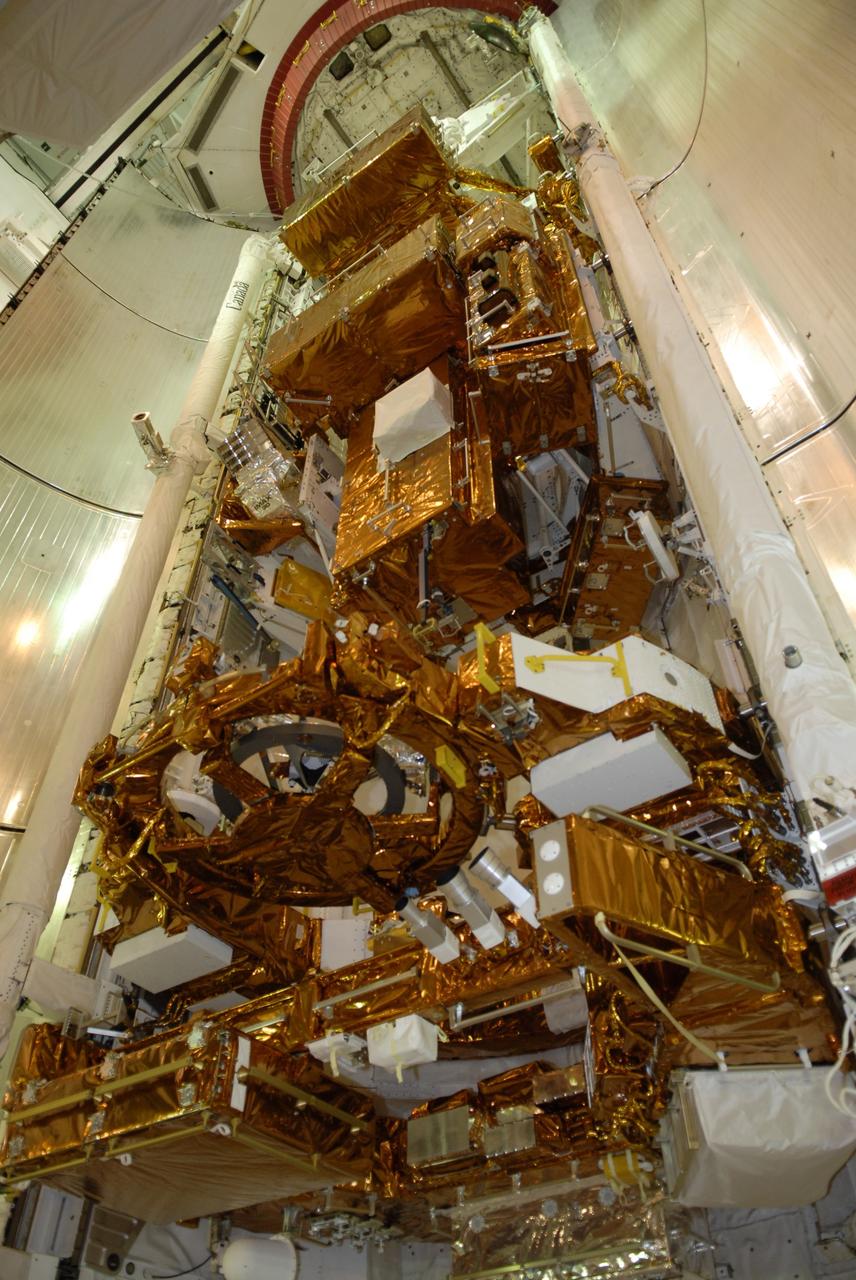
CAPE CANAVERAL, Fla. – On Launch Pad 39A at NASA's Kennedy Space Center in Florida, space shuttle Atlantis' payload bay is filled with hardware for the STS-125 mission to service NASA's Hubble Space Telescope. At the bottom are the Flight Support System with the Soft Capture mechanism and Multi-Use Lightweight Equipment Carrier with the Science Instrument Command and Data Handling Unit, or SIC&DH. At center is the Orbital Replacement Unit Carrier with the Cosmic Origins Spectrograph, or COS, and an IMAX 3D camera. At top is the Super Lightweight Interchangeable Carrier with the Wide Field Camera 3. Atlantis' crew will service NASA's Hubble Space Telescope for the fifth and final time. The flight will include five spacewalks during which astronauts will refurbish and upgrade the telescope with state-of-the-art science instruments. As a result, Hubble's capabilities will be expanded and its operational lifespan extended through at least 2014. Photo credit: NASA/Kim Shiflett

CAPE CANAVERAL, Fla. – On Launch Pad 39A at NASA's Kennedy Space Center in Florida, space shuttle Atlantis' payload bay is filled with hardware for the STS-125 mission to service NASA's Hubble Space Telescope. From the bottom are the Flight Support System with the Soft Capture mechanism and Multi-Use Lightweight Equipment Carrier with the Science Instrument Command and Data Handling Unit, or SIC&DH; the Orbital Replacement Unit Carrier with the Cosmic Origins Spectrograph, or COS, and an IMAX 3D camera; and the Super Lightweight Interchangeable Carrier with the Wide Field Camera 3. Atlantis' crew will service NASA's Hubble Space Telescope for the fifth and final time. The flight will include five spacewalks during which astronauts will refurbish and upgrade the telescope with state-of-the-art science instruments. As a result, Hubble's capabilities will be expanded and its operational lifespan extended through at least 2014. Photo credit: NASA/Kim Shiflett
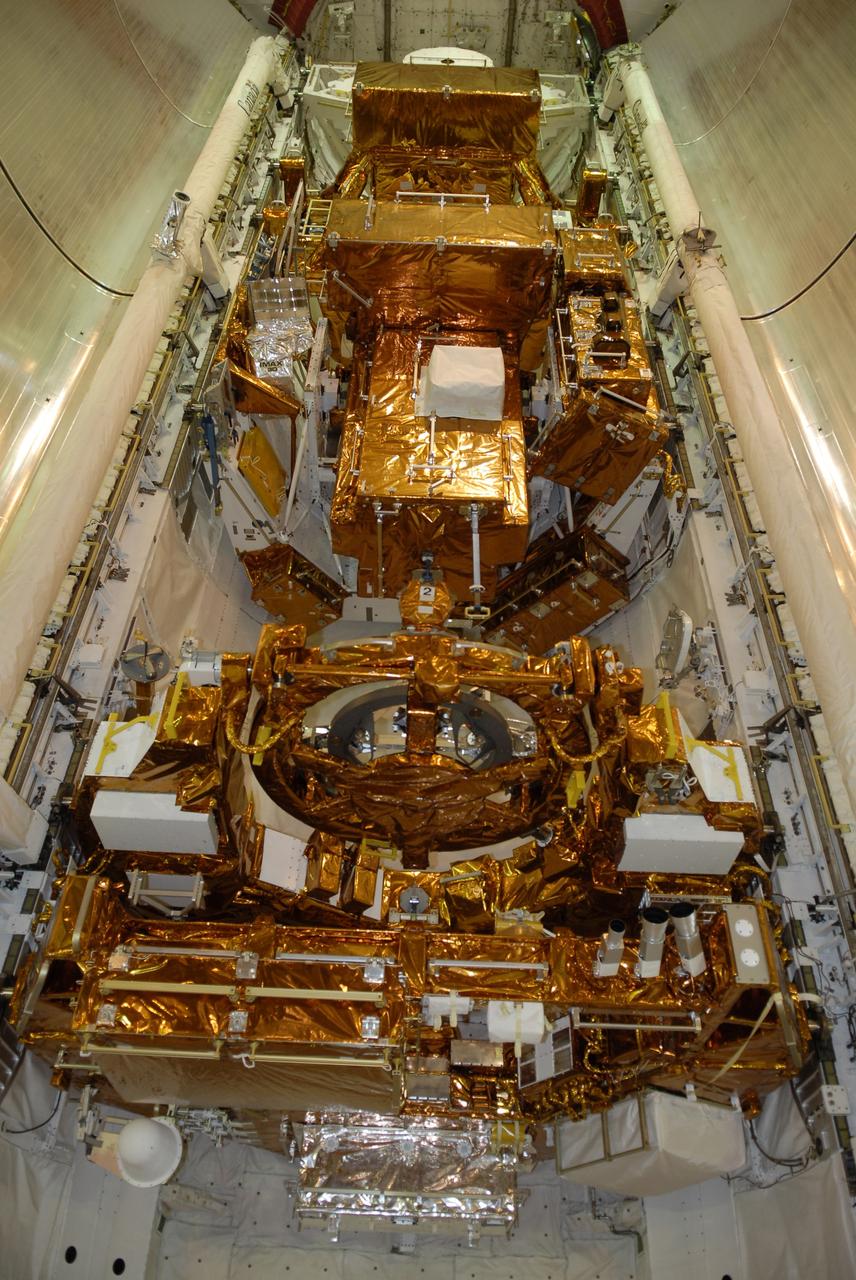
CAPE CANAVERAL, Fla. – On Launch Pad 39A at NASA's Kennedy Space Center in Florida, space shuttle Atlantis' payload bay is filled with hardware for the STS-125 mission to service NASA's Hubble Space Telescope. At the bottom is the Flight Support System with the Soft Capture mechanism. At center is the Orbital Replacement Unit Carrier with the Cosmic Origins Spectrograph, or COS, and an IMAX 3D camera. At top is the Super Lightweight Interchangeable Carrier with the Wide Field Camera 3. Atlantis' crew will service NASA's Hubble Space Telescope for the fifth and final time. The flight will include five spacewalks during which astronauts will refurbish and upgrade the telescope with state-of-the-art science instruments. As a result, Hubble's capabilities will be expanded and its operational lifespan extended through at least 2014. Photo credit: NASA/Kim Shiflett
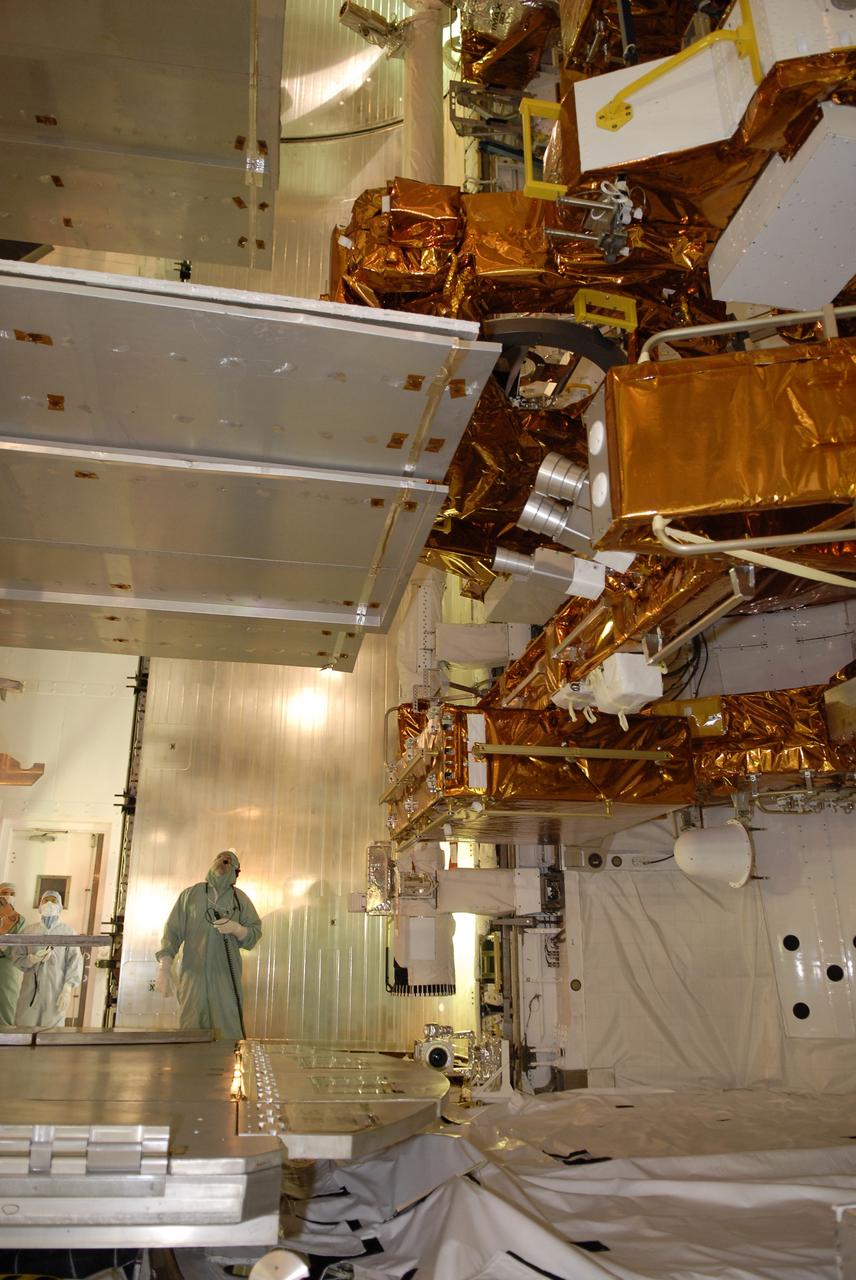
CAPE CANAVERAL, Fla. – On Launch Pad 39A at NASA's Kennedy Space Center in Florida, the payload ground-handling mechanism, known as the PGHM, is retracted after installing the payloads in space shuttle Atlantis' payload bay, at right, for the STS-125 mission. The payload includes the Flight Support System, or FSS, carrier with the Soft Capture Mechanism; the Multi-Use Lightweight Equipment, or MULE, carrier with the Science Instrument Command and Data Handling Unit, or SIC&DH; the Orbital Replacement Unit Carrier, or ORUC, with the Cosmic Origins Spectrograph, or COS, and an IMAX 3D camera. Atlantis' crew will service NASA's Hubble Space Telescope for the fifth and final time. The flight will include five spacewalks during which astronauts will refurbish and upgrade the telescope with state-of-the-art science instruments. As a result, Hubble's capabilities will be expanded and its operational lifespan extended through at least 2014. Photo credit: NASA/Kim Shiflett
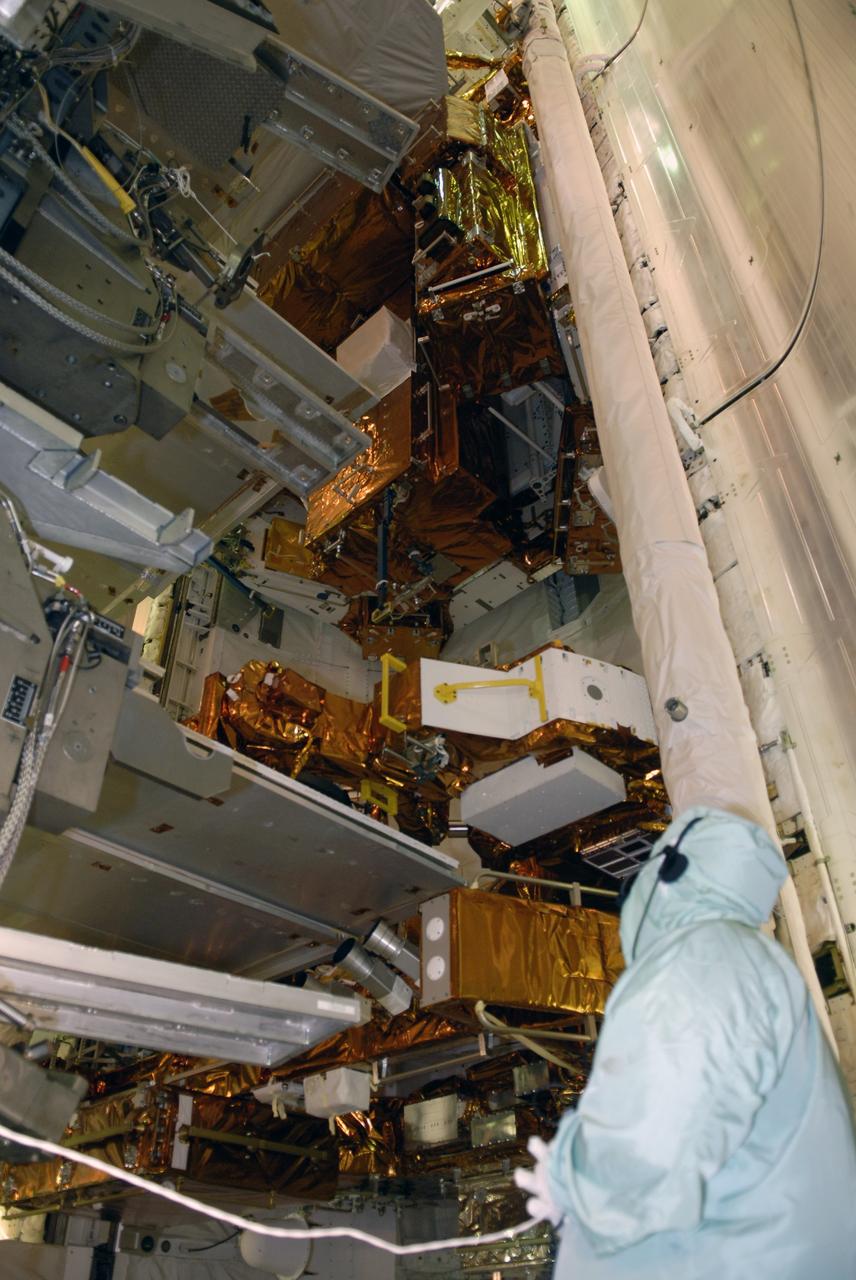
CAPE CANAVERAL, Fla. – On Launch Pad 39A at NASA's Kennedy Space Center in Florida, the payload ground-handling mechanism, known as the PGHM, is retracted after installing the payloads in space shuttle Atlantis' payload bay for the STS-125 mission. Seen here are the service platforms of the PGHM. The payload includes the Flight Support System, or FSS, carrier with the Soft Capture Mechanism; the Multi-Use Lightweight Equipment, or MULE, carrier with the Science Instrument Command and Data Handling Unit, or SIC&DH; the Orbital Replacement Unit Carrier, or ORUC, with the Cosmic Origins Spectrograph, or COS, and an IMAX 3D camera. Atlantis' crew will service NASA's Hubble Space Telescope for the fifth and final time. The flight will include five spacewalks during which astronauts will refurbish and upgrade the telescope with state-of-the-art science instruments. As a result, Hubble's capabilities will be expanded and its operational lifespan extended through at least 2014. Photo credit: NASA/Kim Shiflett
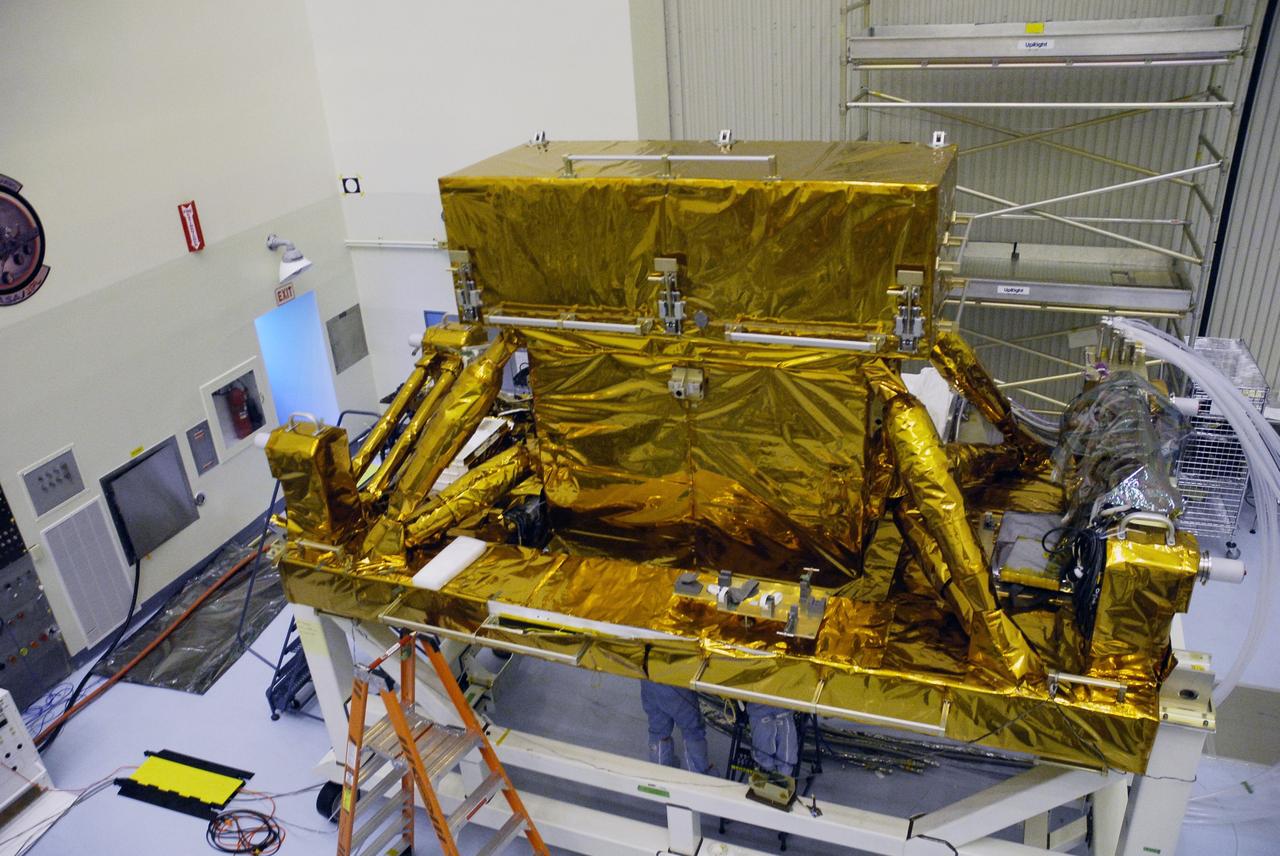
CAPE CANAVERAL, Fla. – Components comprising the payload for space shuttle Atlantis on the STS-125 mission to service the Hubble Space Telescope are on display in the Payload Hazardous Servicing Facility at NASA's Kennedy Space Center. Seen here is the box containing the Cosmic Origins Spectrograph, or COS, on the orbital replacement unit carrier. Over 11 days and five spacewalks, Atlantis’ crew will make repairs and upgrades to the telescope, leaving it better than ever and ready for at least another five years – or more – of research. Launch of Atlantis is targeted for Oct. 10. Photo credit: NASA/Troy Cryder
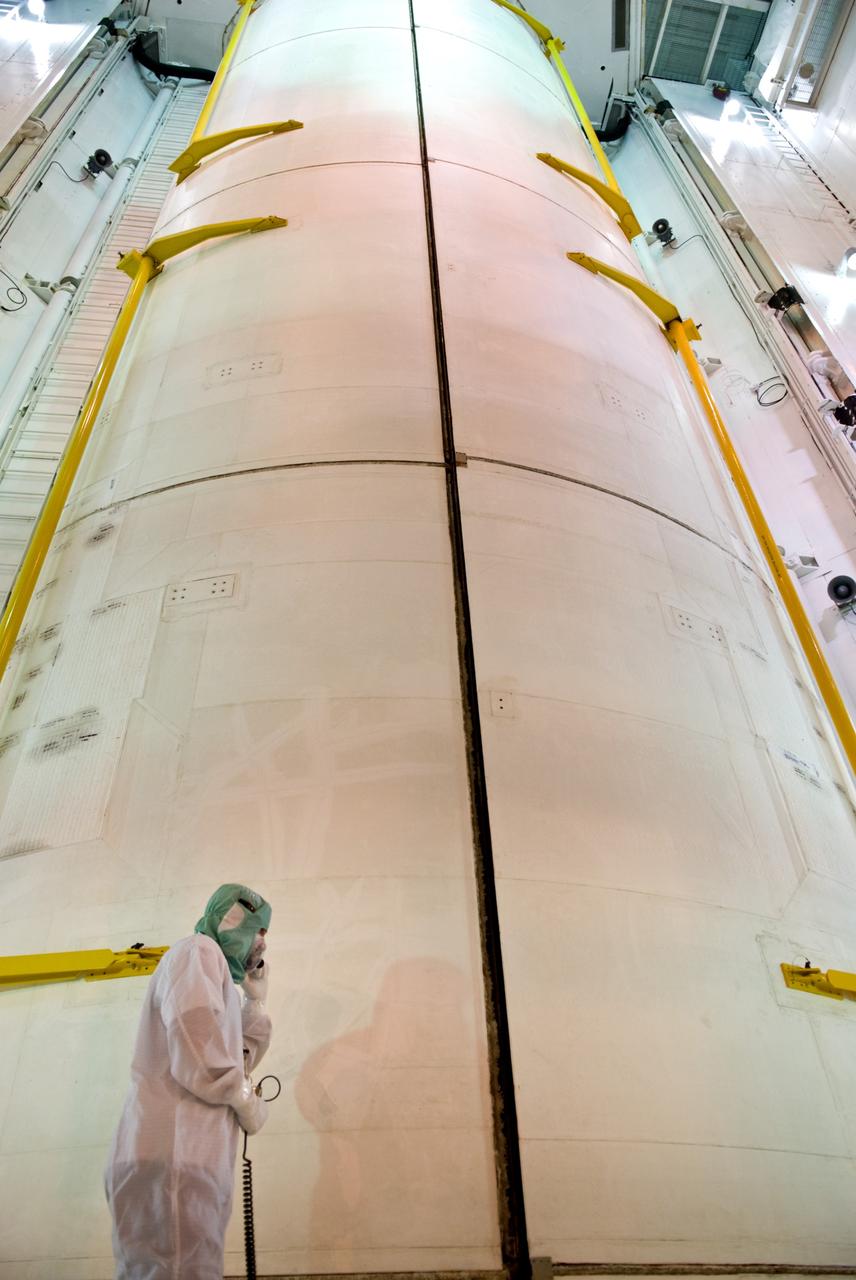
CAPE CANAVERAL, Fla. – On Launch Pad 39A at NASA's Kennedy Space Center in Florida, space shuttle Atlantis' payload bay doors are closed around the hardware for the STS-125 mission to service NASA's Hubble Space Telescope. The hardware includes the Flight Support System with the Soft Capture mechanism and Multi-Use Lightweight Equipment Carrier with the Science Instrument Command and Data Handling Unit, or SIC&DH; the Orbital Replacement Unit Carrier with the Cosmic Origins Spectrograph, or COS; an IMAX 3D camera; and the Super Lightweight Interchangeable Carrier with the Wide Field Camera 3. Atlantis' crew will service NASA's Hubble Space Telescope for the fifth and final time. The flight will include five spacewalks during which astronauts will refurbish and upgrade the telescope with state-of-the-art science instruments. As a result, Hubble's capabilities will be expanded and its operational lifespan extended through at least 2014. Launch is scheduled for 2:01 p.m. EDT on May 11. Photo credit: NASA/Kim Shiflett
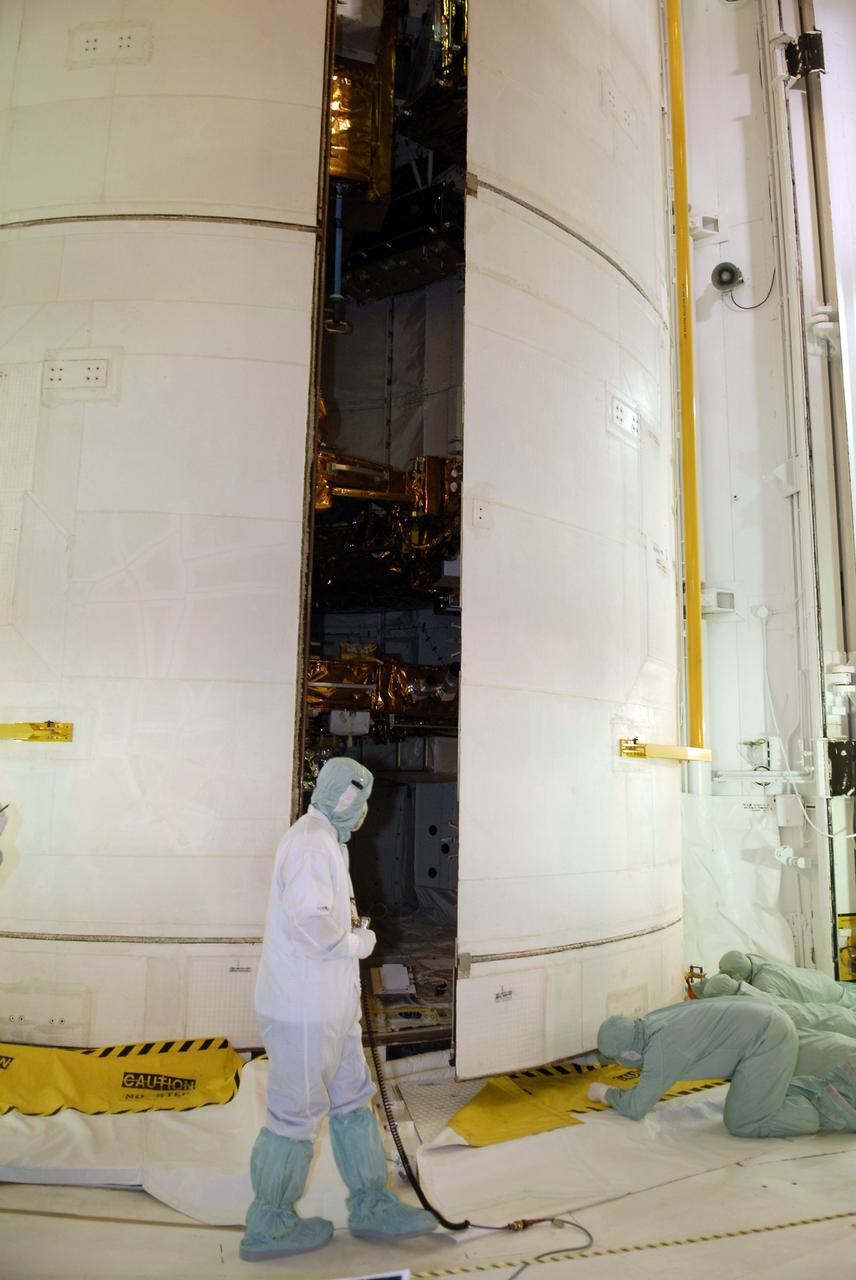
CAPE CANAVERAL, Fla. – On Launch Pad 39A at NASA's Kennedy Space Center in Florida, workers close space shuttle Atlantis' payload bay doors around the hardware for the STS-125 mission to service NASA's Hubble Space Telescope. The hardware includes the Flight Support System with the Soft Capture mechanism and Multi-Use Lightweight Equipment Carrier with the Science Instrument Command and Data Handling Unit, or SIC&DH; the Orbital Replacement Unit Carrier with the Cosmic Origins Spectrograph, or COS; an IMAX 3D camera; and the Super Lightweight Interchangeable Carrier with the Wide Field Camera 3. Atlantis' crew will service NASA's Hubble Space Telescope for the fifth and final time. The flight will include five spacewalks during which astronauts will refurbish and upgrade the telescope with state-of-the-art science instruments. As a result, Hubble's capabilities will be expanded and its operational lifespan extended through at least 2014. Launch is scheduled for 2:01 p.m. EDT on May 11. Photo credit: NASA/Kim Shiflett
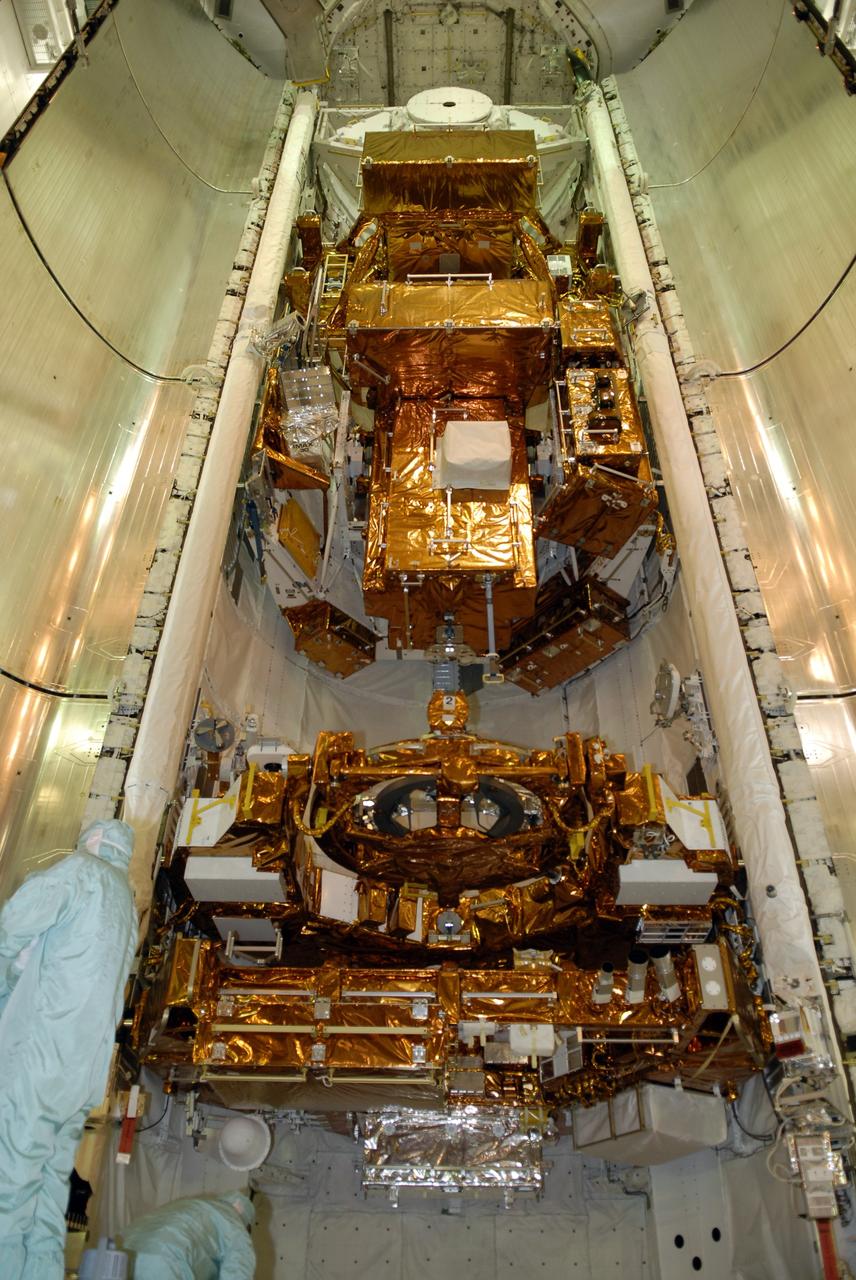
CAPE CANAVERAL, Fla. – On Launch Pad 39A at NASA's Kennedy Space Center in Florida, workers prepare to close the doors of space shuttle Atlantis' payload bay that is filled with hardware for the STS-125 mission to service NASA's Hubble Space Telescope. At the bottom are the Flight Support System with the Soft Capture mechanism and Multi-Use Lightweight Equipment Carrier with the Science Instrument Command and Data Handling Unit, or SIC&DH. At center is the Orbital Replacement Unit Carrier with the Cosmic Origins Spectrograph, or COS, and an IMAX 3D camera. At top is the Super Lightweight Interchangeable Carrier with the Wide Field Camera 3. Atlantis' crew will service NASA's Hubble Space Telescope for the fifth and final time. The flight will include five spacewalks during which astronauts will refurbish and upgrade the telescope with state-of-the-art science instruments. As a result, Hubble's capabilities will be expanded and its operational lifespan extended through at least 2014. Launch is scheduled for 2:01 p.m. EDT on May 11. Photo credit: NASA/Kim Shiflett
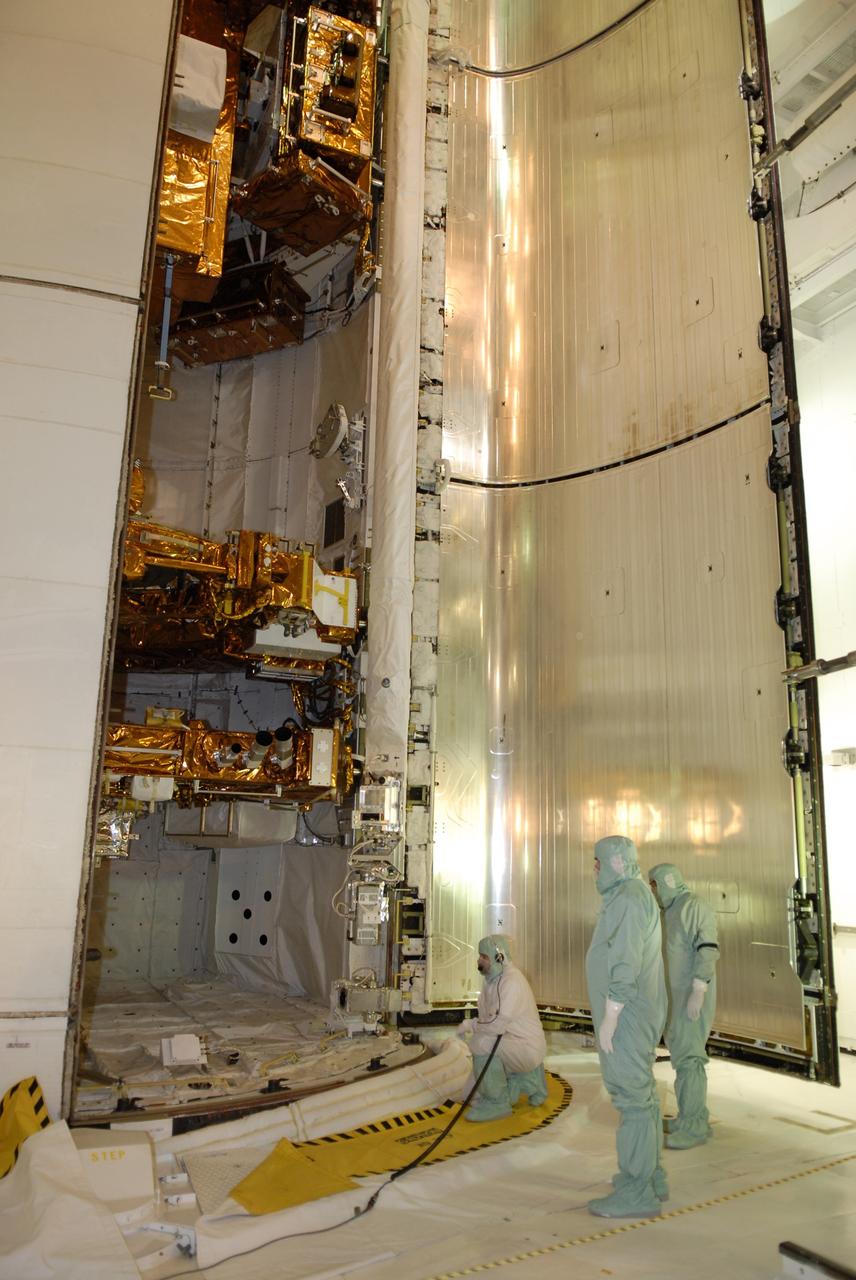
CAPE CANAVERAL, Fla. – On Launch Pad 39A at NASA's Kennedy Space Center in Florida, workers close one of space shuttle Atlantis' payload bay doors around the hardware for the STS-125 mission to service NASA's Hubble Space Telescope. Partially concealed from view at the bottom are the Flight Support System with the Soft Capture mechanism and Multi-Use Lightweight Equipment Carrier with the Science Instrument Command and Data Handling Unit, or SIC&DH. At center is the Orbital Replacement Unit Carrier with the Cosmic Origins Spectrograph, or COS, and an IMAX 3D camera. At top is the Super Lightweight Interchangeable Carrier with the Wide Field Camera 3. Atlantis' crew will service NASA's Hubble Space Telescope for the fifth and final time. The flight will include five spacewalks during which astronauts will refurbish and upgrade the telescope with state-of-the-art science instruments. As a result, Hubble's capabilities will be expanded and its operational lifespan extended through at least 2014. Launch is scheduled for 2:01 p.m. EDT on May 11. Photo credit: NASA/Kim Shiflett
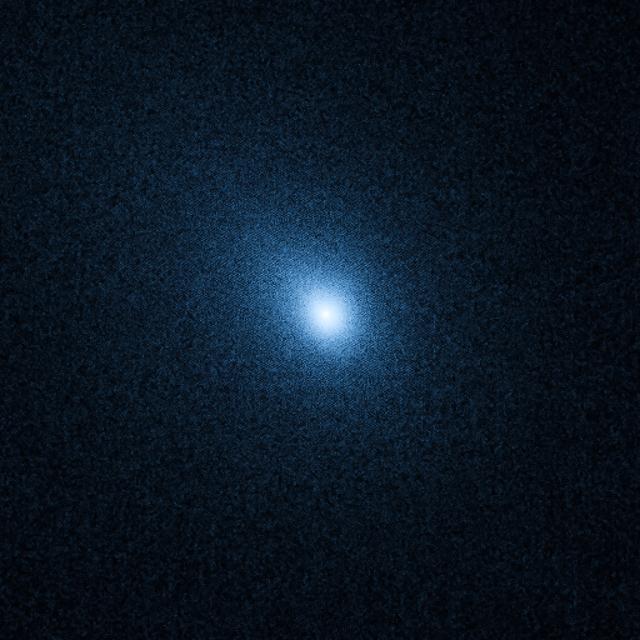
NASA image release October 5, 2010 Hubble Space Telescope observations of comet 103P/Hartley 2, taken on September 25, are helping in the planning for a November 4 flyby of the comet by NASA's Deep Impact eXtended Investigation (DIXI) spacecraft. Analysis of the new Hubble data shows that the nucleus has a diameter of approximately 0.93 miles (1.5 km), which is consistent with previous estimates. The comet is in a highly active state, as it approaches the Sun. The Hubble data show that the coma is remarkably uniform, with no evidence for the types of outgassing jets seen from most "Jupiter Family" comets, of which Hartley 2 is a member. Jets can be produced when the dust emanates from a few specific icy regions, while most of the surface is covered with relatively inert, meteoritic-like material. In stark contrast, the activity from Hartley 2's nucleus appears to be more uniformly distributed over its entire surface, perhaps indicating a relatively "young" surface that hasn't yet been crusted over. Hubble's spectrographs - the Cosmic Origins Spectrograph (COS) and the Space Telescope Imaging Spectrograph (STIS) -- are expected to provide unique information about the comet's chemical composition that might not be obtainable any other way, including measurements by DIXI. The Hubble team is specifically searching for emissions from carbon monoxide (CO) and diatomic sulfur (S2). These molecules have been seen in other comets but have not yet been detected in 103P/Hartley 2. 103P/Hartley has an orbital period of 6.46 years. It was discovered by Malcolm Hartley in 1986 at the Schmidt Telescope Unit in Siding Spring, Australia. The comet will pass within 11 million miles of Earth (about 45 times the distance to the Moon) on October 20. During that time the comet may be visible to the naked eye as a 5th magnitude "fuzzy star" in the constellation Auriga. Credit: NASA, ESA, and H. Weaver (The Johns Hopkins University/Applied Physics Lab) The Hubble Space Telescope is a project of international cooperation between NASA and the European Space Agency. NASA's Goddard Space Flight Center manages the telescope. The Space Telescope Science Institute (STScI) conducts Hubble science operations. STScI is operated for NASA by the Association of Universities for Research in Astronomy, Inc., in Washington, D.C. <b><a href="http://www.nasa.gov/centers/goddard/home/index.html" rel="nofollow">NASA Goddard Space Flight Center</a></b> enables NASA’s mission through four scientific endeavors: Earth Science, Heliophysics, Solar System Exploration, and Astrophysics. Goddard plays a leading role in NASA’s accomplishments by contributing compelling scientific knowledge to advance the Agency’s mission. <b>Follow us on <a href="http://twitter.com/NASA_GoddardPix" rel="nofollow">Twitter</a></b> <b>Join us on <a href="http://www.facebook.com/pages/Greenbelt-MD/NASA-Goddard/395013845897?ref=tsd" rel="nofollow">Facebook</a></b>
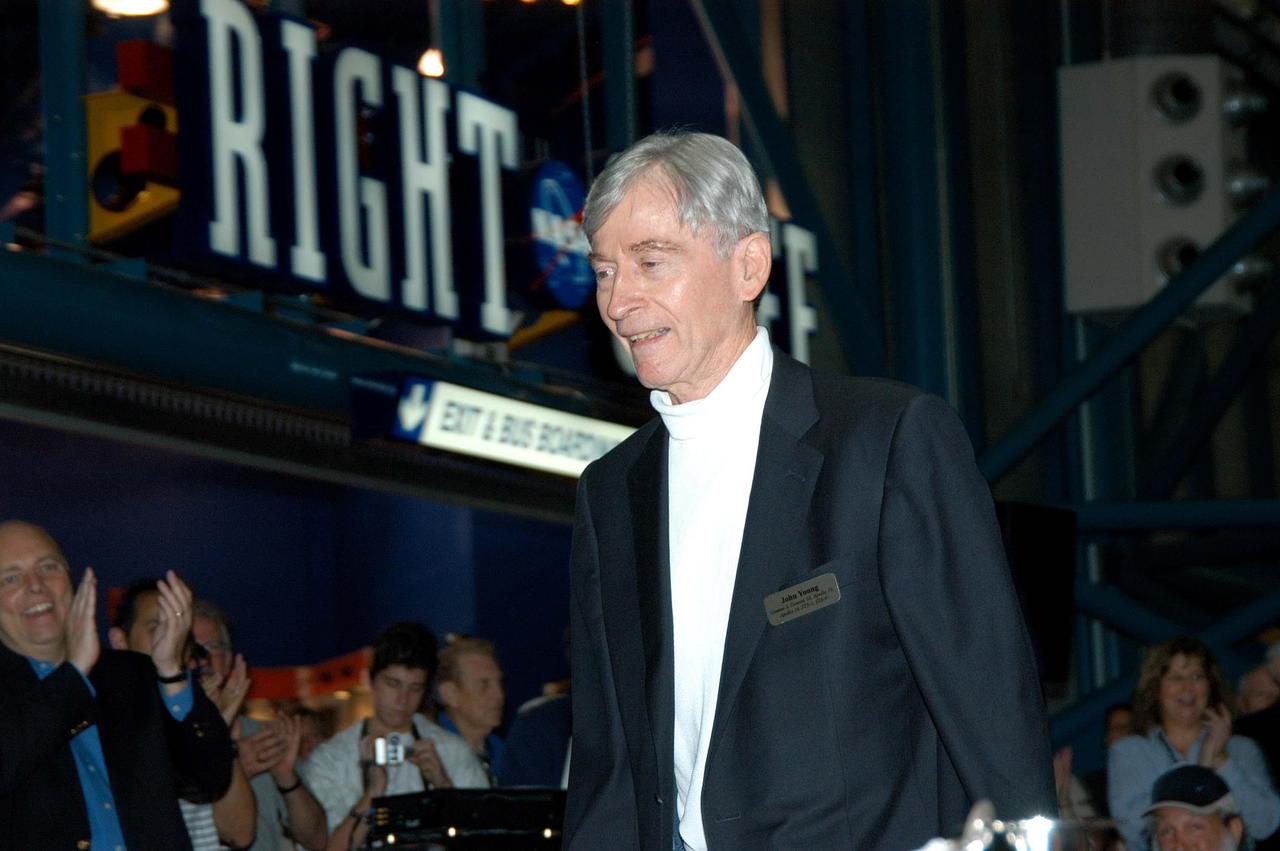
KENNEDY SPACE CENTER, FLA. -- Before the induction ceremony of five space program heroes into the U.S. Astronaut Hall of Fame, astronaut John Young is warmly greeted as he is introduced as a previous inductee. Co-holder of a record for the most space flights, six, he flew on Gemini 3 and 10, orbited the Moon on Apollo 10, walked on the Moon on Apollo 16, and commanded two space shuttle missions, STS-1 and STS-9. Young currently serves as associate director, technical, at Johnson Space Center. The induction ceremony was held at the Apollo/Saturn V Center at KSC. New inductees are Richard O. Covey, commander of the Hubble Space Telescope repair mission; Norman E. Thagard, the first American to occupy Russia’s Mir space station; the late Francis R. "Dick" Scobee, commander of the ill-fated 1986 Challenger mission; Kathryn D. Sullivan, the first American woman to walk in space; and Frederick D. Gregory, the first African-American to command a space mission and the current NASA deputy administrator. The U.S. Astronaut Hall of Fame opened in 1990 to provide a place where space travelers could be remembered for their participation and accomplishments in the U.S. space program. The five inductees join 52 previously honored astronauts from the ranks of the Gemini, Apollo, Skylab, Apollo-Soyuz, and Space Shuttle programs.