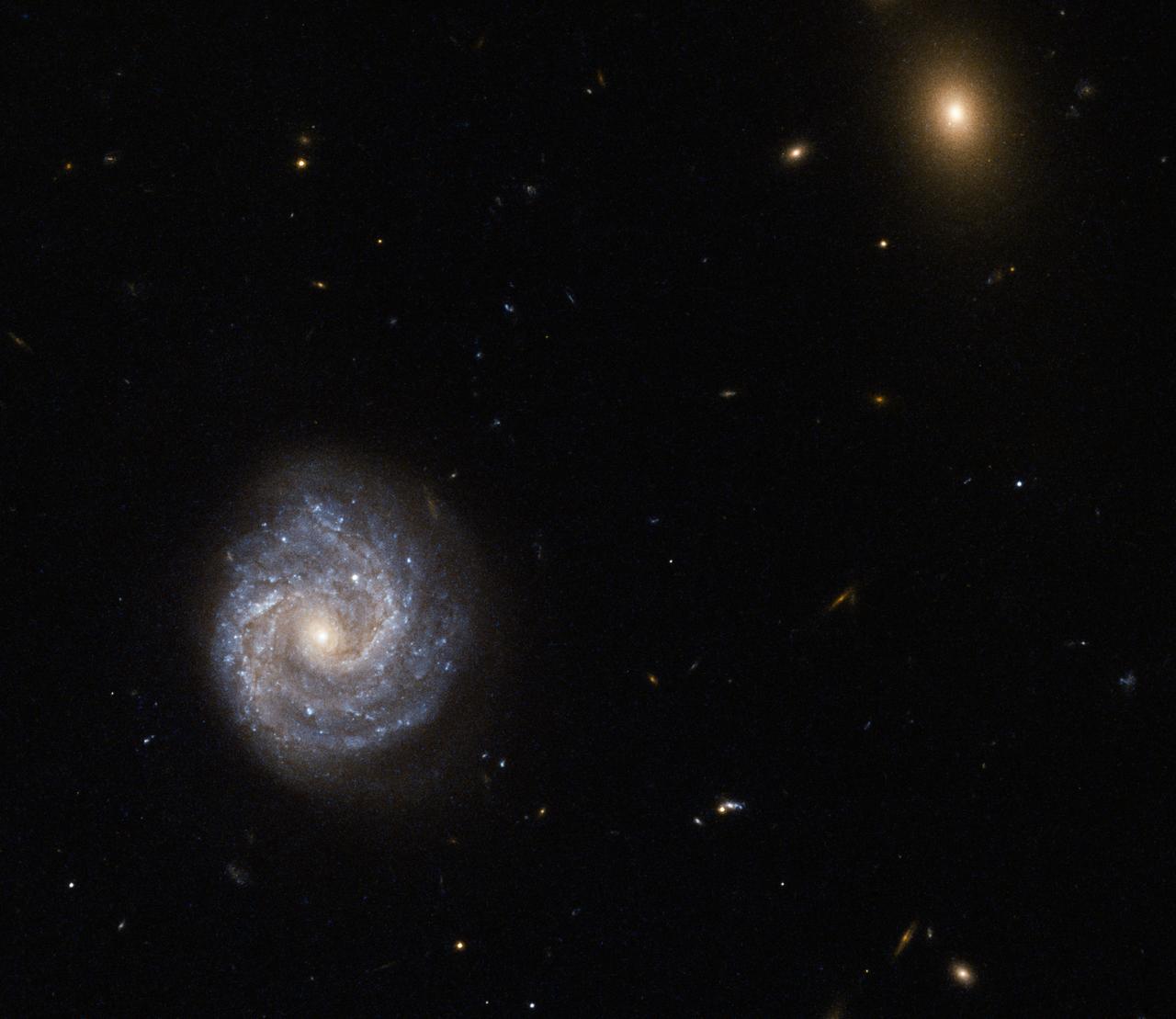
Not all galaxies have the luxury of possessing a simple moniker or quirky nickname. This impressive galaxy imaged by the NASA/ESA Hubble Space Telescope is one of the unlucky ones, and goes by a name that looks more like a password for a computer: 2XMM J143450.5+033843. Such a name may seem like a random jumble of numbers and letters, but like all galactic epithets it has a distinct meaning. This galaxy, for example, was detected and observed as part of the second X-ray sky survey performed by ESA’s XMM-Newton Observatory. Its celestial coordinates form the rest of the bulky name, following the “J”: a right ascension value of 14h (hours) 34m (minutes) 50.5s (seconds). This can be likened to terrestrial longitude. It also has a declination of +03d (degrees) 38m (minutes) 43s (seconds). Declination can be likened to terrestrial latitude. The other fuzzy object in the frame was named in the same way — it is a bright galaxy named 2XMM J143448.3+033749. 2XMM J143450.5+033843 lies nearly 400 million light-years away from Earth. It is a Seyfert galaxy that is dominated by something known as an Active Galactic Nucleus — its core is thought to contain a supermassive black hole that is emitting huge amounts of radiation, pouring energetic X-rays out into the Universe. Photo credit: ESA/Hubble & NASA <b><a href="http://www.nasa.gov/audience/formedia/features/MP_Photo_Guidelines.html" rel="nofollow">NASA image use policy.</a></b> <b><a href="http://www.nasa.gov/centers/goddard/home/index.html" rel="nofollow">NASA Goddard Space Flight Center</a></b> enables NASA’s mission through four scientific endeavors: Earth Science, Heliophysics, Solar System Exploration, and Astrophysics. Goddard plays a leading role in NASA’s accomplishments by contributing compelling scientific knowledge to advance the Agency’s mission. <b>Follow us on <a href="http://twitter.com/NASAGoddardPix" rel="nofollow">Twitter</a></b> <b>Like us on <a href="http://www.facebook.com/pages/Greenbelt-MD/NASA-Goddard/395013845897?ref=tsd" rel="nofollow">Facebook</a></b> <b>Find us on <a href="http://instagrid.me/nasagoddard/?vm=grid" rel="nofollow">Instagram</a></b>

In the center of this image, taken with the NASA/ESA Hubble Space Telescope, is the galaxy cluster SDSS J1038+4849 — and it seems to be smiling. You can make out its two orange eyes and white button nose. In the case of this “happy face”, the two eyes are very bright galaxies and the misleading smile lines are actually arcs caused by an effect known as strong gravitational lensing. Galaxy clusters are the most massive structures in the Universe and exert such a powerful gravitational pull that they warp the spacetime around them and act as cosmic lenses which can magnify, distort and bend the light behind them. This phenomenon, crucial to many of Hubble’s discoveries, can be explained by Einstein’s theory of general relativity. In this special case of gravitational lensing, a ring — known as an Einstein Ring — is produced from this bending of light, a consequence of the exact and symmetrical alignment of the source, lens and observer and resulting in the ring-like structure we see here. Hubble has provided astronomers with the tools to probe these massive galaxies and model their lensing effects, allowing us to peer further into the early Universe than ever before. This object was studied by Hubble’s Wide Field and Planetary Camera 2 (WFPC2) and Wide Field Camera 3 (WFC3) as part of a survey of strong lenses. A version of this image was entered into the Hubble’s Hidden Treasures image processing competition by contestant Judy Schmidt. Image Credit: NASA/ESA
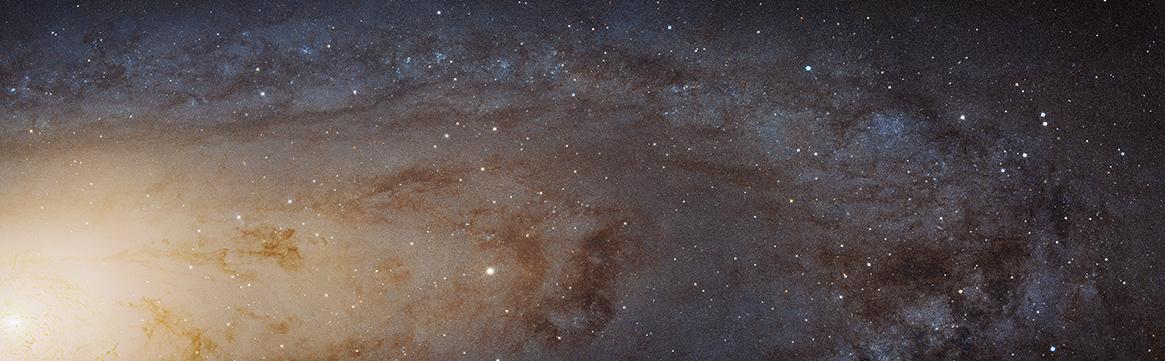
The largest NASA Hubble Space Telescope image ever assembled, this sweeping bird’s-eye view of a portion of the Andromeda galaxy (M31) is the sharpest large composite image ever taken of our galactic next-door neighbor. Though the galaxy is over 2 million light-years away, The Hubble Space Telescope is powerful enough to resolve individual stars in a 61,000-light-year-long stretch of the galaxy’s pancake-shaped disk. It's like photographing a beach and resolving individual grains of sand. And there are lots of stars in this sweeping view -- over 100 million, with some of them in thousands of star clusters seen embedded in the disk. This ambitious photographic cartography of the Andromeda galaxy represents a new benchmark for precision studies of large spiral galaxies that dominate the universe's population of over 100 billion galaxies. Never before have astronomers been able to see individual stars inside an external spiral galaxy over such a large contiguous area. Most of the stars in the universe live inside such majestic star cities, and this is the first data that reveal populations of stars in context to their home galaxy. Hubble traces densely packed stars extending from the innermost hub of the galaxy seen at the left. Moving out from this central galactic bulge, the panorama sweeps from the galaxy's central bulge across lanes of stars and dust to the sparser outer disk. Large groups of young blue stars indicate the locations of star clusters and star-forming regions. The stars bunch up in the blue ring-like feature toward the right side of the image. The dark silhouettes trace out complex dust structures. Underlying the entire galaxy is a smooth distribution of cooler red stars that trace Andromeda’s evolution over billions of years. Because the galaxy is only 2.5 million light-years from Earth, it is a much bigger target in the sky than the myriad galaxies Hubble routinely photographs that are billions of light-years away. This means that the Hubble survey is assembled together into a mosaic image using 7,398 exposures taken over 411 individual pointings. Read more: <a href="http://1.usa.gov/1y0i3H8" rel="nofollow">1.usa.gov/1y0i3H8</a> Credit: NASA, ESA, J. Dalcanton, B.F. Williams, and L.C. Johnson (University of Washington), the PHAT team, and R. Gendler <b><a href="http://www.nasa.gov/audience/formedia/features/MP_Photo_Guidelines.html" rel="nofollow">NASA image use policy.</a></b> <b><a href="http://www.nasa.gov/centers/goddard/home/index.html" rel="nofollow">NASA Goddard Space Flight Center</a></b> enables NASA’s mission through four scientific endeavors: Earth Science, Heliophysics, Solar System Exploration, and Astrophysics. Goddard plays a leading role in NASA’s accomplishments by contributing compelling scientific knowledge to advance the Agency’s mission. <b>Follow us on <a href="http://twitter.com/NASAGoddardPix" rel="nofollow">Twitter</a></b> <b>Like us on <a href="http://www.facebook.com/pages/Greenbelt-MD/NASA-Goddard/395013845897?ref=tsd" rel="nofollow">Facebook</a></b> <b>Find us on <a href="http://instagram.com/nasagoddard?vm=grid" rel="nofollow">Instagram</a></b>

Astronomers using the Hubble Space Telescope (HST) have identified what may be the most luminous star known; a celestial mammoth that releases up to 10-million times the power of the Sun and is big enough to fill the diameter of Earth's orbit. The star unleashes as much energy in six seconds as our Sun does in one year. The image, taken by a UCLA-led team with the recently installed Near-Infrared Camera and Multi-Object Spectrometer (NICMOS) aboard the HST, also reveals a bright nebula, created by extremely massive stellar eruptions. The UCLA astronomers estimate that the star, called the Pistol Star, (for the pistol shaped nebula surrounding it), is approximately 25,000 light-years from Earth, near the center of our Milky Way galaxy. The Pistol Star is not visible to the eye, but is located in the direction of the constellation Sagittarius, hidden behind the great dust clouds along the Milky Way
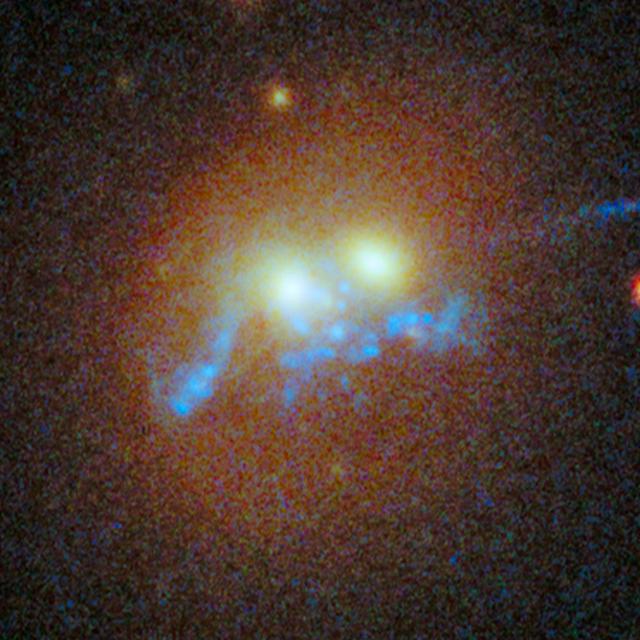
NASA's Hubble Space Telescope has photographed the dense galaxy cluster SDSS J1531+3414 in the northern constellation Corona Borealis. Made up primarily of giant elliptical galaxies with a few spirals and irregular galaxies thrown in for good measure, the cluster's powerful gravity warps the image of background galaxies into blue streaks and arcs. At the center of the bull's-eye of blue, gravitationally lensed filaments lies a pair of elliptical galaxies that are also exhibiting some interesting features. A 100,000-light-year-long structure that looks like a string of pearls twisted into a corkscrew shape winds around the cores of the two massive galaxies. The "pearls" are superclusters of blazing, blue-white, newly born stars. These super star clusters are evenly spaced along the chain at separations of 3,000 light-years from one another. Read more: <a href="http://1.usa.gov/1ztQvL9" rel="nofollow">1.usa.gov/1ztQvL9</a> Credit: NASA/ESA <b><a href="http://www.nasa.gov/audience/formedia/features/MP_Photo_Guidelines.html" rel="nofollow">NASA image use policy.</a></b> <b><a href="http://www.nasa.gov/centers/goddard/home/index.html" rel="nofollow">NASA Goddard Space Flight Center</a></b> enables NASA’s mission through four scientific endeavors: Earth Science, Heliophysics, Solar System Exploration, and Astrophysics. Goddard plays a leading role in NASA’s accomplishments by contributing compelling scientific knowledge to advance the Agency’s mission. <b>Follow us on <a href="http://twitter.com/NASAGoddardPix" rel="nofollow">Twitter</a></b> <b>Like us on <a href="http://www.facebook.com/pages/Greenbelt-MD/NASA-Goddard/395013845897?ref=tsd" rel="nofollow">Facebook</a></b> <b>Find us on <a href="http://instagram.com/nasagoddard?vm=grid" rel="nofollow">Instagram</a></b>

NASA's Hubble Space Telescope has photographed the dense galaxy cluster SDSS J1531+3414 in the northern constellation Corona Borealis. Made up primarily of giant elliptical galaxies with a few spirals and irregular galaxies thrown in for good measure, the cluster's powerful gravity warps the image of background galaxies into blue streaks and arcs. At the center of the bull's-eye of blue, gravitationally lensed filaments lies a pair of elliptical galaxies that are also exhibiting some interesting features. A 100,000-light-year-long structure that looks like a string of pearls twisted into a corkscrew shape winds around the cores of the two massive galaxies. The "pearls" are superclusters of blazing, blue-white, newly born stars. These super star clusters are evenly spaced along the chain at separations of 3,000 light-years from one another. Read more: <a href="http://1.usa.gov/1ztQvL9" rel="nofollow">1.usa.gov/1ztQvL9</a> Credit: NASA/ESA <b><a href="http://www.nasa.gov/audience/formedia/features/MP_Photo_Guidelines.html" rel="nofollow">NASA image use policy.</a></b> <b><a href="http://www.nasa.gov/centers/goddard/home/index.html" rel="nofollow">NASA Goddard Space Flight Center</a></b> enables NASA’s mission through four scientific endeavors: Earth Science, Heliophysics, Solar System Exploration, and Astrophysics. Goddard plays a leading role in NASA’s accomplishments by contributing compelling scientific knowledge to advance the Agency’s mission. <b>Follow us on <a href="http://twitter.com/NASAGoddardPix" rel="nofollow">Twitter</a></b> <b>Like us on <a href="http://www.facebook.com/pages/Greenbelt-MD/NASA-Goddard/395013845897?ref=tsd" rel="nofollow">Facebook</a></b> <b>Find us on <a href="http://instagram.com/nasagoddard?vm=grid" rel="nofollow">Instagram</a></b>

NASA image release December 14, 2010 A delicate sphere of gas, photographed by NASA's Hubble Space Telescope, floats serenely in the depths of space. The pristine shell, or bubble, is the result of gas that is being shocked by the expanding blast wave from a supernova. Called SNR 0509-67.5 (or SNR 0509 for short), the bubble is the visible remnant of a powerful stellar explosion in the Large Magellanic Cloud (LMC), a small galaxy about 160,000 light-years from Earth. Ripples in the shell's surface may be caused by either subtle variations in the density of the ambient interstellar gas, or possibly driven from the interior by pieces of the ejecta. The bubble-shaped shroud of gas is 23 light-years across and is expanding at more than 11 million miles per hour (5,000 kilometers per second). Astronomers have concluded that the explosion was one of an especially energetic and bright variety of supernovae. Known as Type Ia, such supernova events are thought to result from a white dwarf star in a binary system that robs its partner of material, takes on much more mass than it is able to handle, and eventually explodes. Hubble's Advanced Camera for Surveys observed the supernova remnant on Oct. 28, 2006 with a filter that isolates light from glowing hydrogen seen in the expanding shell. These observations were then combined with visible-light images of the surrounding star field that were imaged with Hubble's Wide Field Camera 3 on Nov. 4, 2010. With an age of about 400 years as seen from Earth, the supernova might have been visible to southern hemisphere observers around the year 1600, however, there are no known records of a "new star" in the direction of the LMC near that time. A more recent supernova in the LMC, SN 1987A, did catch the eye of Earth viewers and continues to be studied with ground- and space-based telescopes, including Hubble. For images and more information about SNR 0509, visit: <a href="http://hubblesite.org/news/2010/27" rel="nofollow">hubblesite.org/news/2010/27</a> <a href="http://heritage.stsci.edu/2010/27" rel="nofollow">heritage.stsci.edu/2010/27</a> <a href="http://www.nasa.gov/hubble" rel="nofollow">www.nasa.gov/hubble</a> The Hubble Space Telescope is a project of international cooperation between NASA and the European Space Agency. NASA's Goddard Space Flight Center manages the telescope. The Space Telescope Science Institute (STScI) conducts Hubble science operations. STScI is operated for NASA by the Association of Universities for Research in Astronomy, Inc., in Washington, D.C. <b>Credit: NASA, ESA, and the Hubble Heritage Team (STScI/AURA) Acknowledgment: J. Hughes (Rutgers University)</b> <b><a href="http://www.nasa.gov/centers/goddard/home/index.html" rel="nofollow">NASA Goddard Space Flight Center</a></b> enables NASA’s mission through four scientific endeavors: Earth Science, Heliophysics, Solar System Exploration, and Astrophysics. Goddard plays a leading role in NASA’s accomplishments by contributing compelling scientific knowledge to advance the Agency’s mission. <b>Follow us on <a href="http://twitter.com/NASA_GoddardPix" rel="nofollow">Twitter</a></b> <b>Join us on <a href="http://www.facebook.com/pages/Greenbelt-MD/NASA-Goddard/395013845897?ref=tsd" rel="nofollow">Facebook</a></b>

Supernova Supernovae can occur one of two ways. The first occurs when a white dwarf—the vestigial ember of a dead star—passes so close to a living star that its matter leaks into the white dwarf. This causes a catastrophic explosion. However most people understand supernovae as the death of a massive star. When the star runs out of fuel toward the end of its life, the gravity at its heart sucks the surrounding mass into its center. At temperatures rocketing above 100 billion degrees Fahrenheit, all the layers of the star abruptly explode outward. The explosions produced by supernovae are so brilliant that astronomers use their luminosity to measure the distance between galaxies, the scale of the universe and the effects of dark energy. For a short period of time, one dying star can appear to shine as brightly as an entire galaxy. Supernovae are relatively common events, one occurring in our own galaxy once every 100 years. In 2014, a person could see the supernova M82 with a pair of binoculars. The cosmologist Tycho Brahe’s observation of a supernova in 1572 allowed him to disprove Aristotle’s theory that the heavens never changed. After a supernova, material expelled in the explosion can form a nebula—an interstellar pile of gas and dust. Over millions of years, gravity pulls the nebula’s materials into a dense orb called a protostar, which will become a new star. Within a few million years, this new star could go supernova as well. ------------------------------ Original Caption: NASA image release Feb. 24, 2012 At the turn of the 19th century, the binary star system Eta Carinae was faint and undistinguished. In the first decades of the century, it became brighter and brighter, until, by April 1843, it was the second brightest star in the sky, outshone only by Sirius (which is almost a thousand times closer to Earth). In the years that followed, it gradually dimmed again and by the 20th century was totally invisible to the naked eye. The star has continued to vary in brightness ever since, and while it is once again visible to the naked eye on a dark night, it has never again come close to its peak of 1843. NASA's Hubble Telescope captured an image of Eta Carinae. This image consists of ultraviolet and visible light images from the High Resolution Channel of Hubble's Advanced Camera for Surveys. The field of view is approximately 30 arcseconds across. The larger of the two stars in the Eta Carinae system is a huge and unstable star that is nearing the end of its life, and the event that the 19th century astronomers observed was a stellar near-death experience. Scientists call these outbursts supernova impostor events, because they appear similar to supernovae but stop just short of destroying their star. Although 19th century astronomers did not have telescopes powerful enough to see the 1843 outburst in detail, its effects can be studied today. The huge clouds of matter thrown out a century and a half ago, known as the Homunculus Nebula, have been a regular target for Hubble since its launch in 1990. This image, taken with the Advanced Camera for Surveys High Resolution Channel, is the most detailed yet, and shows how the material from the star was not thrown out in a uniform manner, but forms a huge dumbbell shape. Eta Carinae is not only interesting because of its past, but also because of its future. It is one of the closest stars to Earth that is likely to explode in a supernova in the relatively near future (though in astronomical timescales the "near future" could still be a million years away). When it does, expect an impressive view from Earth, far brighter still than its last outburst: SN 2006gy, the brightest supernova ever observed, came from a star of the same type, though from a galaxy over 200 million light-years away. Credit: ESA/NASA More information: <a href="http://www.spacetelescope.org/images/potw1208a/" rel="nofollow">www.spacetelescope.org/images/potw1208a/</a> <b><a href="http://www.nasa.gov/audience/formedia/features/MP_Photo_Guidelines.html" rel="nofollow">NASA image use policy.</a></b> <b><a href="http://www.nasa.gov/centers/goddard/home/index.html" rel="nofollow">NASA Goddard Space Flight Center</a></b> enables NASA’s mission through four scientific endeavors: Earth Science, Heliophysics, Solar System Exploration, and Astrophysics. Goddard plays a leading role in NASA’s accomplishments by contributing compelling scientific knowledge to advance the Agency’s mission. <b>Follow us on <a href="http://twitter.com/NASAGoddardPix" rel="nofollow">Twitter</a></b> <b>Like us on <a href="http://www.facebook.com/pages/Greenbelt-MD/NASA-Goddard/395013845897?ref=tsd" rel="nofollow">Facebook</a></b> <b>Find us on <a href="http://instagrid.me/nasagoddard/?vm=grid" rel="nofollow">Instagram</a></b>