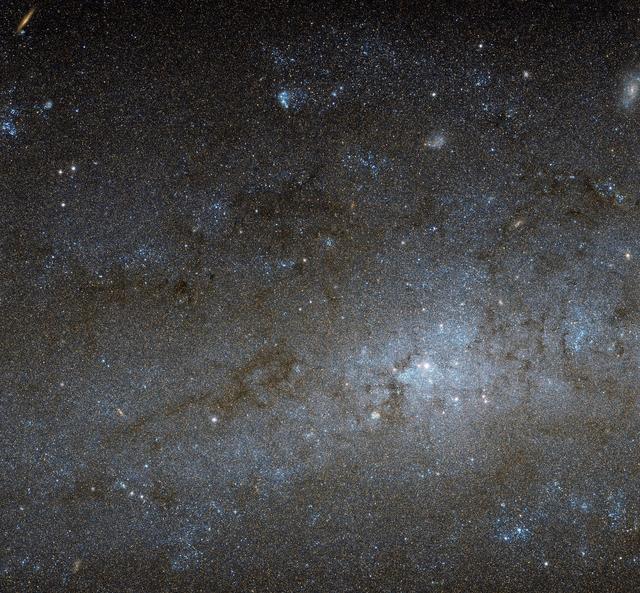
This Hubble image shows the central region of a spiral galaxy known as NGC 247. NGC 247 is a relatively small spiral galaxy in the southern constellation of Cetus (The Whale). Lying at a distance of around 11 million light-years from us, it forms part of the Sculptor Group, a loose collection of galaxies that also contains the more famous NGC 253 (otherwise known as the Sculptor Galaxy). NGC 247’s nucleus is visible here as a bright, whitish patch, surrounded by a mixture of stars, gas and dust. The dust forms dark patches and filaments that are silhouetted against the background of stars, while the gas has formed into bright knots known as H II regions, mostly scattered throughout the galaxy’s arms and outer areas. This galaxy displays one particularly unusual and mysterious feature — it is not visible in this image, but can be seen clearly in wider views of the galaxy, such as a picture from ESO’s MPG/ESO 2.2-meter telescope. The northern part of NGC 247’s disc hosts an apparent void, a gap in the usual swarm of stars and H II regions that spans almost a third of the galaxy’s total length. There are stars within this void, but they are quite different from those around it. They are significantly older, and as a result much fainter and redder. This indicates that the star formation taking place across most of the galaxy’s disk has somehow been arrested in the void region, and has not taken place for around one billion years. Although astronomers are still unsure how the void formed, recent studies suggest it might have been caused by gravitational interactions with part of another galaxy. Image Credit: NASA/ESA
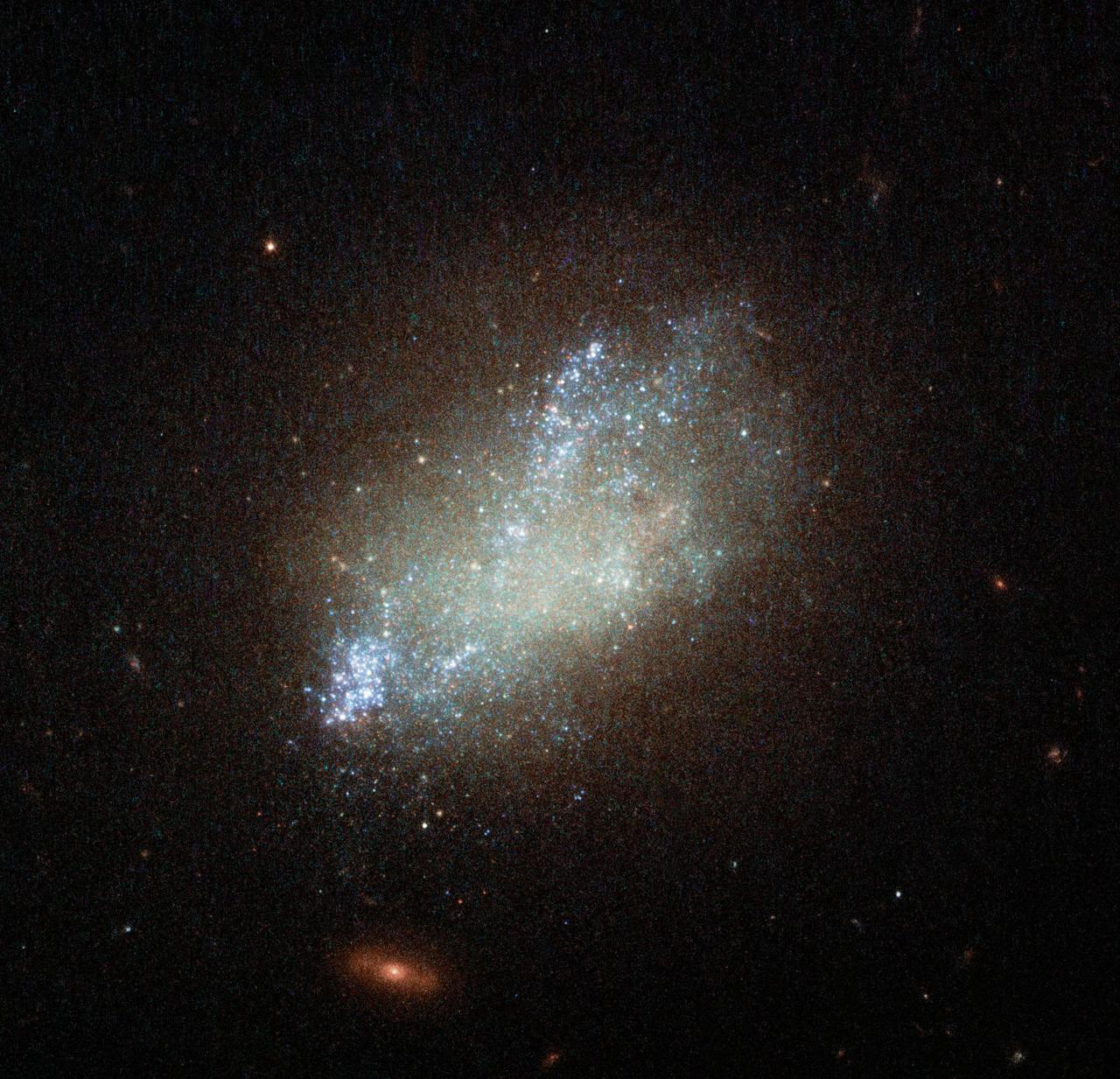
Far beyond the stars in the constellation of Leo (The Lion) is irregular galaxy IC 559. IC 559 is not your everyday galaxy. With its irregular shape and bright blue spattering of stars, it is a fascinating galactic anomaly. It may look like sparse cloud, but it is in fact full of gas and dust which is spawning new stars. Discovered in 1893, IC 559 lacks the symmetrical spiral appearance of some of its galactic peers and not does not conform to a regular shape. It is actually classified as a “type Sm” galaxy — an irregular galaxy with some evidence for a spiral structure. Irregular galaxies make up about a quarter of all known galaxies and do not fall into any of the regular classes of the Hubble sequence. Most of these uniquely shaped galaxies were not always so — IC 559 may have once been a conventional spiral galaxy that was then distorted and twisted by the gravity of a nearby cosmic companion. This image, captured by the NASA/ESA Hubble Space Telescope’s Wide Field Camera 3, combines a wide range of wavelengths spanning the ultraviolet, optical, and infrared parts of the spectrum. Image credit: ESA/Hubble, NASA, D. Calzetti (UMass) and the LEGUS Team <b><a href="http://www.nasa.gov/audience/formedia/features/MP_Photo_Guidelines.html" rel="nofollow">NASA image use policy.</a></b> <b><a href="http://www.nasa.gov/centers/goddard/home/index.html" rel="nofollow">NASA Goddard Space Flight Center</a></b> enables NASA’s mission through four scientific endeavors: Earth Science, Heliophysics, Solar System Exploration, and Astrophysics. Goddard plays a leading role in NASA’s accomplishments by contributing compelling scientific knowledge to advance the Agency’s mission. <b>Follow us on <a href="http://twitter.com/NASAGoddardPix" rel="nofollow">Twitter</a></b> <b>Like us on <a href="http://www.facebook.com/pages/Greenbelt-MD/NASA-Goddard/395013845897?ref=tsd" rel="nofollow">Facebook</a></b> <b>Find us on <a href="http://instagram.com/nasagoddard?vm=grid" rel="nofollow">Instagram</a></b>
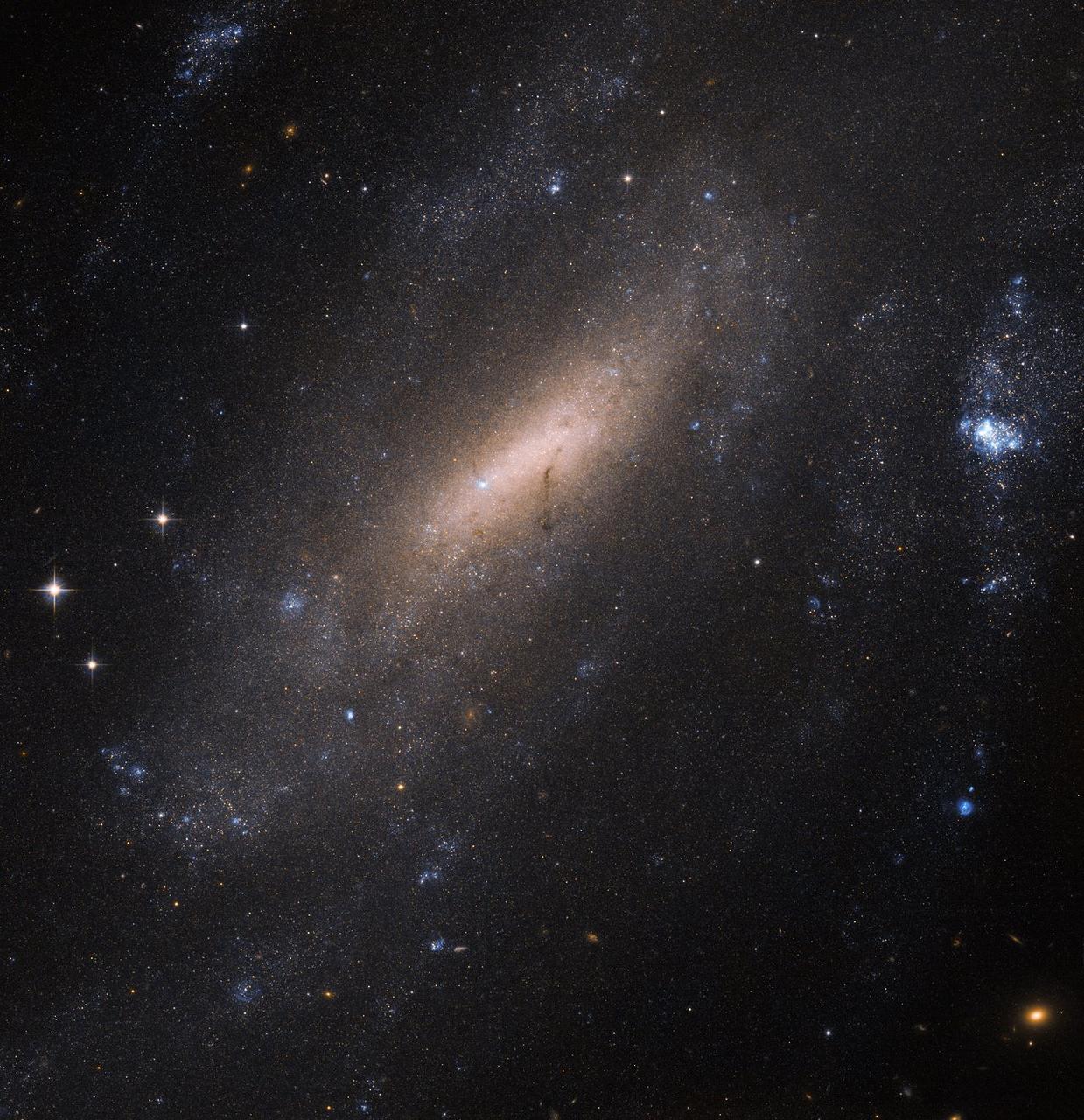
In 1900, astronomer Joseph Lunt made a discovery: Peering through a telescope at Cape Town Observatory, the British–South African scientist spotted this beautiful sight in the southern constellation of Grus (The Crane): a barred spiral galaxy now named IC 5201. Over a century later, the galaxy is still of interest to astronomers. For this image, the NASA/ESA Hubble Space Telescope used its Advanced Camera for Surveys (ACS) to produce a beautiful and intricate image of the galaxy. Hubble’s ACS can resolve individual stars within other galaxies, making it an invaluable tool to explore how various populations of stars sprang to life, evolved, and died throughout the cosmos. IC 5201 sits over 40 million light-years away from us. As with two thirds of all the spirals we see in the Universe — including the Milky Way — the galaxy has a bar of stars slicing through its center. Credit: ESA/Hubble & NASA <b><a href="http://www.nasa.gov/audience/formedia/features/MP_Photo_Guidelines.html" rel="nofollow">NASA image use policy.</a></b> <b><a href="http://www.nasa.gov/centers/goddard/home/index.html" rel="nofollow">NASA Goddard Space Flight Center</a></b> enables NASA’s mission through four scientific endeavors: Earth Science, Heliophysics, Solar System Exploration, and Astrophysics. Goddard plays a leading role in NASA’s accomplishments by contributing compelling scientific knowledge to advance the Agency’s mission. <b>Follow us on <a href="http://twitter.com/NASAGoddardPix" rel="nofollow">Twitter</a></b> <b>Like us on <a href="http://www.facebook.com/pages/Greenbelt-MD/NASA-Goddard/395013845897?ref=tsd" rel="nofollow">Facebook</a></b> <b>Find us on <a href="http://instagrid.me/nasagoddard/?vm=grid" rel="nofollow">Instagram</a></b>

This galaxy, known as NGC 2337, resides 25 million light-years away in the constellation of Lynx. NGC 2337 is an irregular galaxy, meaning that it — along with a quarter of all galaxies in the Universe — lacks a distinct, regular appearance. The galaxy was discovered in 1877 by the French astronomer Édouard Stephan who, in the same year, discovered the galactic group Stephan’s Quintet (heic0910i). Although irregular galaxies may never win a beauty prize when competing with their more symmetrical spiral and elliptical peers, astronomers consider them to be very important. Some irregular galaxies may have once fallen into one of the regular classes of the Hubble sequence, but were warped and deformed by a passing cosmic companion. As such, irregular galaxies provide astronomers with a valuable opportunity to learn more about galactic evolution and interaction. Despite the disruption, gravitational interactions between galaxies can kickstart star formation activity within the affected galaxies, which may explain the pockets of blue light scattered throughout NGC 2337. These patches and knots of blue signal the presence of young, newly formed, hot stars. Image credit: ESA/Hubble & NASA Text credit: European Space Agency <b><a href="http://www.nasa.gov/audience/formedia/features/MP_Photo_Guidelines.html" rel="nofollow">NASA image use policy.</a></b> <b><a href="http://www.nasa.gov/centers/goddard/home/index.html" rel="nofollow">NASA Goddard Space Flight Center</a></b> enables NASA’s mission through four scientific endeavors: Earth Science, Heliophysics, Solar System Exploration, and Astrophysics. Goddard plays a leading role in NASA’s accomplishments by contributing compelling scientific knowledge to advance the Agency’s mission. <b>Follow us on <a href="http://twitter.com/NASAGoddardPix" rel="nofollow">Twitter</a></b> <b>Like us on <a href="http://www.facebook.com/pages/Greenbelt-MD/NASA-Goddard/395013845897?ref=tsd" rel="nofollow">Facebook</a></b> <b>Find us on <a href="http://instagrid.me/nasagoddard/?vm=grid" rel="nofollow">Instagram</a></b>

Peering deep into the core of the Crab Nebula, this close-up image reveals the beating heart of one of the most historic and intensively studied remnants of a supernova, an exploding star. The inner region sends out clock-like pulses of radiation and tsunamis of charged particles embedded in magnetic fields. The neutron star at the very center of the Crab Nebula has about the same mass as the sun but compressed into an incredibly dense sphere that is only a few miles across. Spinning 30 times a second, the neutron star shoots out detectable beams of energy that make it look like it's pulsating. The NASA Hubble Space Telescope snapshot is centered on the region around the neutron star (the rightmost of the two bright stars near the center of this image) and the expanding, tattered, filamentary debris surrounding it. Hubble's sharp view captures the intricate details of glowing gas, shown in red, that forms a swirling medley of cavities and filaments. Inside this shell is a ghostly blue glow that is radiation given off by electrons spiraling at nearly the speed of light in the powerful magnetic field around the crushed stellar core. The neutron star is a showcase for extreme physical processes and unimaginable cosmic violence. Bright wisps are moving outward from the neutron star at half the speed of light to form an expanding ring. It is thought that these wisps originate from a shock wave that turns the high-speed wind from the neutron star into extremely energetic particles. When this "heartbeat" radiation signature was first discovered in 1968, astronomers realized they had discovered a new type of astronomical object. Now astronomers know it's the archetype of a class of supernova remnants called pulsars - or rapidly spinning neutron stars. These interstellar "lighthouse beacons" are invaluable for doing observational experiments on a variety of astronomical phenomena, including measuring gravity waves. Observations of the Crab supernova were recorded by Chinese astronomers in 1054 A.D. The nebula, bright enough to be visible in amateur telescopes, is located 6,500 light-years away in the constellation Taurus. Credits: NASA and ESA, Acknowledgment: J. Hester (ASU) and M. Weisskopf (NASA/MSFC) <b><a href="http://www.nasa.gov/audience/formedia/features/MP_Photo_Guidelines.html" rel="nofollow">NASA image use policy.</a></b> <b><a href="http://www.nasa.gov/centers/goddard/home/index.html" rel="nofollow">NASA Goddard Space Flight Center</a></b> enables NASA’s mission through four scientific endeavors: Earth Science, Heliophysics, Solar System Exploration, and Astrophysics. Goddard plays a leading role in NASA’s accomplishments by contributing compelling scientific knowledge to advance the Agency’s mission. <b>Follow us on <a href="http://twitter.com/NASAGoddardPix" rel="nofollow">Twitter</a></b> <b>Like us on <a href="http://www.facebook.com/pages/Greenbelt-MD/NASA-Goddard/395013845897?ref=tsd" rel="nofollow">Facebook</a></b> <b>Find us on <a href="http://instagrid.me/nasagoddard/?vm=grid" rel="nofollow">Instagram</a></b>
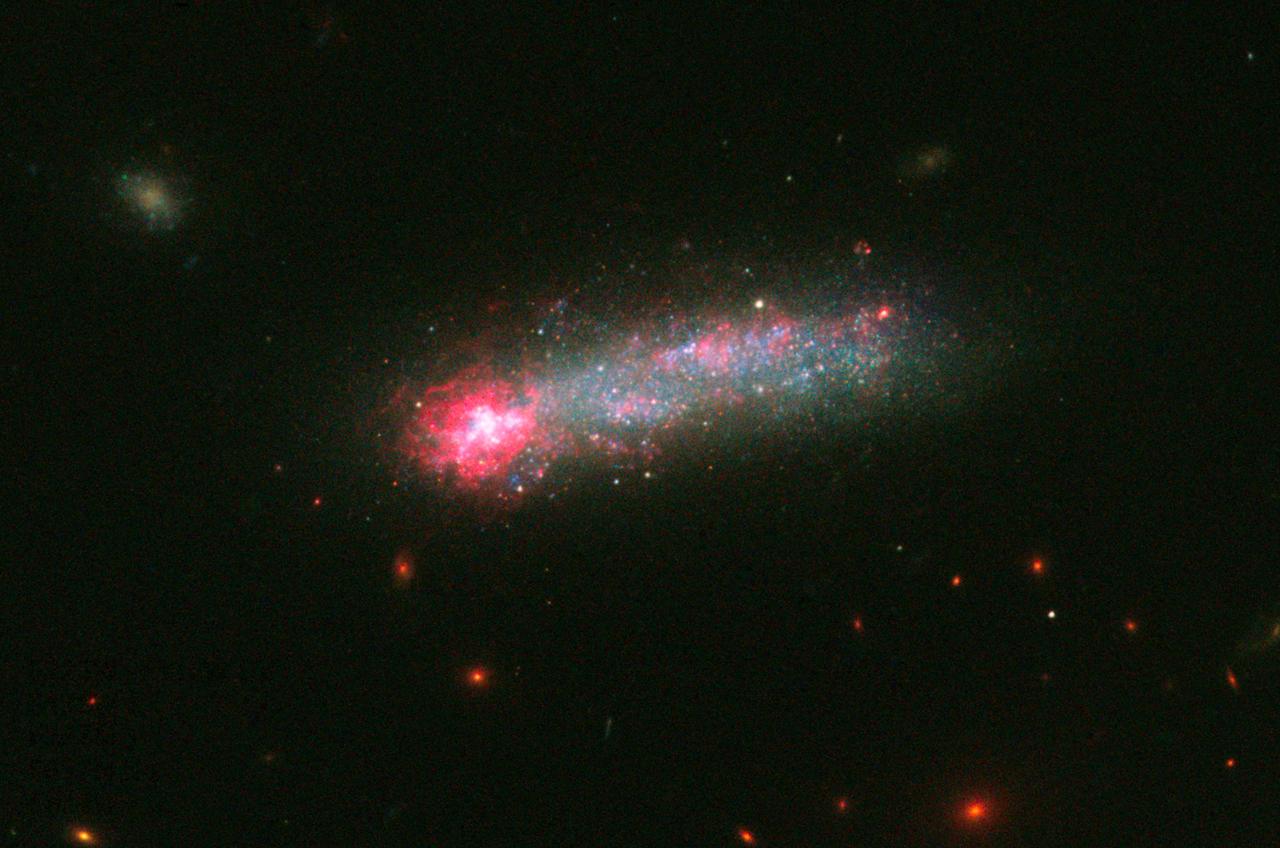
Fireworks shows are not just confined to Earth’s skies. NASA’s Hubble Space Telescope has captured a spectacular fireworks display in a small, nearby galaxy, which resembles a July 4th skyrocket. A firestorm of star birth is lighting up one end of the diminutive galaxy Kiso 5639. The dwarf galaxy is shaped like a flattened pancake, but because it is tilted edge-on, it resembles a skyrocket, with a brilliant blazing head and a long, star-studded tail. Kiso 5639 is a rare, nearby example of elongated galaxies that occur in abundance at larger distances, where we observe the universe during earlier epochs. Astronomers suggest that the frenzied star birth is sparked by intergalactic gas raining on one end of the galaxy as it drifts through space. “I think Kiso 5639 is a beautiful, up-close example of what must have been common long ago,” said lead researcher Debra Elmegreen of Vassar College, in Poughkeepsie, New York. “The current thinking is that galaxies in the early universe grow from accreting gas from the surrounding neighborhood. It’s a stage that galaxies, including our Milky Way, must go through as they are growing up.” Observations of the early universe, such as Hubble’s Ultra-Deep Field, reveal that about 10 percent of all galaxies have these elongated shapes, and are collectively called “tadpoles.” But studies of the nearby universe have turned up only a few of these unusual galaxies, including Kiso 5639. The development of the nearby star-making tadpole galaxies, however, has lagged behind that of their peers, which have spent billions of years building themselves up into many of the spiral galaxies seen today. Elmegreen used Hubble’s Wide Field Camera 3 to conduct a detailed imaging study of Kiso 5639. The images in different filters reveal information about an object by dissecting its light into its component colors. Hubble’s crisp resolution helped Elmegreen and her team analyze the giant star-forming clumps in Kiso 5639 and determine the masses and ages of the star clusters. The international team of researchers selected Kiso 5639 from a spectroscopic survey of 10 nearby tadpole galaxies, observed with the Grand Canary Telescope in La Palma, Spain, by Jorge Sanchez Almeida and collaborators at the Instituto de Astrofisica de Canarias. The observations revealed that in most of those galaxies, including Kiso 5639, the gas composition is not uniform. The bright gas in the galaxy’s head contains fewer heavier elements (collectively called “metals”), such as carbon and oxygen, than the rest of the galaxy. Stars consist mainly of hydrogen and helium, but cook up other “heavier” elements. When the stars die, they release their heavy elements and enrich the surrounding gas. “The metallicity suggests that there has to be rather pure gas, composed mostly of hydrogen, coming into the star-forming part of the galaxy, because intergalactic space contains more pristine hydrogen-rich gas,” Elmegreen explained. “Otherwise, the starburst region should be as rich in heavy elements as the rest of the galaxy.” Hubble offers a detailed view of the galaxy’s star-making frenzy. The telescope uncovered several dozen clusters of stars in the galaxy’s star-forming head, which spans 2,700 light-years across. These clusters have an average age of less than 1 million years and masses that are three to six times larger than those in the rest of the galaxy. Other star formation is taking place throughout the galaxy but on a much smaller scale. Star clusters in the rest of the galaxy are between several million to a few billion years old. “There is much more star formation going on in the head than what you would expect in such a tiny galaxy,” said team member Bruce Elmegreen of IBM’s Thomas J. Watson’s Research Center, in Yorktown Heights, New York. “And we think the star formation is triggered by the ongoing accretion of metal-poor gas onto a part of an otherwise quiescent dwarf galaxy.” Hubble also revealed giant holes peppered throughout the galaxy’s starburst head. These cavities give the galaxy’s head a Swiss-cheese appearance because numerous supernova detonations – like firework aerial bursts – have carved out holes of rarified superheated gas. The galaxy, located 82 million light-years away, has taken billions of years to develop because it has been drifting through an isolated “desert” in the universe, devoid of much gas. What triggered the starburst in such a backwater galaxy? Based on simulations by Daniel Ceverino of the Center for Astronomy at Heidelberg University in Germany, and other team members, the observations suggest that less than 1 million years ago, Kiso 5639’s leading edge encountered a filament of gas. The filament dropped a large clump of matter onto the galaxy, stoking the vigorous star birth. Debra Elmegreen expects that in the future other parts of the galaxy will join in the star-making fireworks show. “Galaxies rotate, and as Kiso 5639 continues to spin, another part of the galaxy may receive an infusion of new gas from this filament, instigating another round of star birth,” she said. The team’s results have been accepted for publication in The Astrophysical Journal. Other team members include Casiana Munoz-Tunon and Mercedes Filho (Instituto de Astrofísica de Canarias, Canary Islands), Jairo Mendez-Abreu (University of St. Andrews, United Kingdom), John Gallagher (University of Wisconsin-Madison), and Marc Rafelski (NASA's Goddard Space Flight Center, Greenbelt, Maryland). The Hubble Space Telescope is a project of international cooperation between NASA and the European Space Agency. NASA's Goddard Space Flight Center in Greenbelt, Maryland, manages the telescope. The Space Telescope Science Institute (STScI) in Baltimore, Maryland, conducts Hubble science operations. STScI is operated for NASA by the Association of Universities for Research in Astronomy in Washington, D.C. For images and more information about Kiso 5639 and Hubble, visit: <a href="http://hubblesite.org/news/2016/23" rel="nofollow">hubblesite.org/news/2016/23</a> <a href="http://www.nasa.gov/hubble" rel="nofollow">www.nasa.gov/hubble</a> Image credit: NASA, ESA, and D. Elmegreen (Vassar College) <b><a href="http://www.nasa.gov/audience/formedia/features/MP_Photo_Guidelines.html" rel="nofollow">NASA image use policy.</a></b> <b><a href="http://www.nasa.gov/centers/goddard/home/index.html" rel="nofollow">NASA Goddard Space Flight Center</a></b> enables NASA’s mission through four scientific endeavors: Earth Science, Heliophysics, Solar System Exploration, and Astrophysics. Goddard plays a leading role in NASA’s accomplishments by contributing compelling scientific knowledge to advance the Agency’s mission. <b>Follow us on <a href="http://twitter.com/NASAGoddardPix" rel="nofollow">Twitter</a></b> <b>Like us on <a href="http://www.facebook.com/pages/Greenbelt-MD/NASA-Goddard/395013845897?ref=tsd" rel="nofollow">Facebook</a></b> <b>Find us on <a href="http://instagrid.me/nasagoddard/?vm=grid" rel="nofollow">Instagram</a></b>

Fireworks shows are not just confined to Earth’s skies. NASA’s Hubble Space Telescope has captured a spectacular fireworks display in a small, nearby galaxy, which resembles a July 4th skyrocket. A firestorm of star birth is lighting up one end of the diminutive galaxy Kiso 5639. The dwarf galaxy is shaped like a flattened pancake, but because it is tilted edge-on, it resembles a skyrocket, with a brilliant blazing head and a long, star-studded tail. Kiso 5639 is a rare, nearby example of elongated galaxies that occur in abundance at larger distances, where we observe the universe during earlier epochs. Astronomers suggest that the frenzied star birth is sparked by intergalactic gas raining on one end of the galaxy as it drifts through space. “I think Kiso 5639 is a beautiful, up-close example of what must have been common long ago,” said lead researcher Debra Elmegreen of Vassar College, in Poughkeepsie, New York. “The current thinking is that galaxies in the early universe grow from accreting gas from the surrounding neighborhood. It’s a stage that galaxies, including our Milky Way, must go through as they are growing up.” Observations of the early universe, such as Hubble’s Ultra-Deep Field, reveal that about 10 percent of all galaxies have these elongated shapes, and are collectively called “tadpoles.” But studies of the nearby universe have turned up only a few of these unusual galaxies, including Kiso 5639. The development of the nearby star-making tadpole galaxies, however, has lagged behind that of their peers, which have spent billions of years building themselves up into many of the spiral galaxies seen today. Elmegreen used Hubble’s Wide Field Camera 3 to conduct a detailed imaging study of Kiso 5639. The images in different filters reveal information about an object by dissecting its light into its component colors. Hubble’s crisp resolution helped Elmegreen and her team analyze the giant star-forming clumps in Kiso 5639 and determine the masses and ages of the star clusters. The international team of researchers selected Kiso 5639 from a spectroscopic survey of 10 nearby tadpole galaxies, observed with the Grand Canary Telescope in La Palma, Spain, by Jorge Sanchez Almeida and collaborators at the Instituto de Astrofisica de Canarias. The observations revealed that in most of those galaxies, including Kiso 5639, the gas composition is not uniform. The bright gas in the galaxy’s head contains fewer heavier elements (collectively called “metals”), such as carbon and oxygen, than the rest of the galaxy. Stars consist mainly of hydrogen and helium, but cook up other “heavier” elements. When the stars die, they release their heavy elements and enrich the surrounding gas. “The metallicity suggests that there has to be rather pure gas, composed mostly of hydrogen, coming into the star-forming part of the galaxy, because intergalactic space contains more pristine hydrogen-rich gas,” Elmegreen explained. “Otherwise, the starburst region should be as rich in heavy elements as the rest of the galaxy.” Hubble offers a detailed view of the galaxy’s star-making frenzy. The telescope uncovered several dozen clusters of stars in the galaxy’s star-forming head, which spans 2,700 light-years across. These clusters have an average age of less than 1 million years and masses that are three to six times larger than those in the rest of the galaxy. Other star formation is taking place throughout the galaxy but on a much smaller scale. Star clusters in the rest of the galaxy are between several million to a few billion years old. “There is much more star formation going on in the head than what you would expect in such a tiny galaxy,” said team member Bruce Elmegreen of IBM’s Thomas J. Watson’s Research Center, in Yorktown Heights, New York. “And we think the star formation is triggered by the ongoing accretion of metal-poor gas onto a part of an otherwise quiescent dwarf galaxy.” Hubble also revealed giant holes peppered throughout the galaxy’s starburst head. These cavities give the galaxy’s head a Swiss-cheese appearance because numerous supernova detonations – like firework aerial bursts – have carved out holes of rarified superheated gas. The galaxy, located 82 million light-years away, has taken billions of years to develop because it has been drifting through an isolated “desert” in the universe, devoid of much gas. What triggered the starburst in such a backwater galaxy? Based on simulations by Daniel Ceverino of the Center for Astronomy at Heidelberg University in Germany, and other team members, the observations suggest that less than 1 million years ago, Kiso 5639’s leading edge encountered a filament of gas. The filament dropped a large clump of matter onto the galaxy, stoking the vigorous star birth. Debra Elmegreen expects that in the future other parts of the galaxy will join in the star-making fireworks show. “Galaxies rotate, and as Kiso 5639 continues to spin, another part of the galaxy may receive an infusion of new gas from this filament, instigating another round of star birth,” she said. The team’s results have been accepted for publication in The Astrophysical Journal. Other team members include Casiana Munoz-Tunon and Mercedes Filho (Instituto de Astrofísica de Canarias, Canary Islands), Jairo Mendez-Abreu (University of St. Andrews, United Kingdom), John Gallagher (University of Wisconsin-Madison), and Marc Rafelski (NASA's Goddard Space Flight Center, Greenbelt, Maryland). The Hubble Space Telescope is a project of international cooperation between NASA and the European Space Agency. NASA's Goddard Space Flight Center in Greenbelt, Maryland, manages the telescope. The Space Telescope Science Institute (STScI) in Baltimore, Maryland, conducts Hubble science operations. STScI is operated for NASA by the Association of Universities for Research in Astronomy in Washington, D.C.