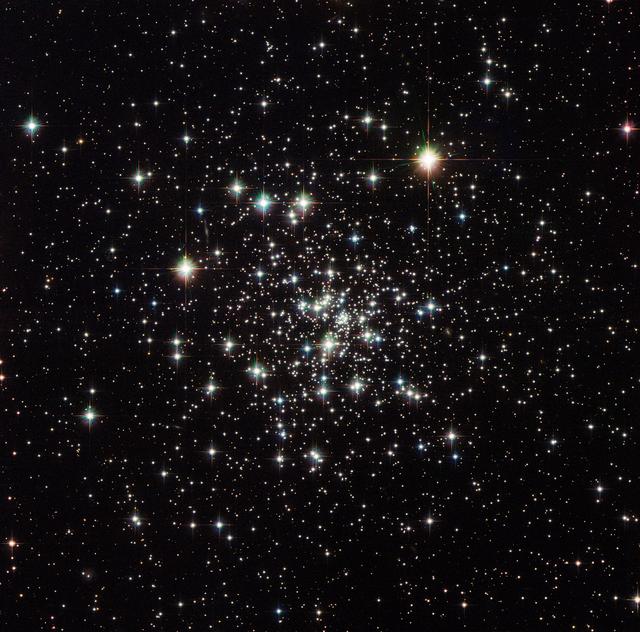
This image captures the stunning NGC 6535, a globular cluster 22,000 light-years away in the constellation of Serpens (The Serpent) that measures one light-year across. Globular clusters are tightly bound groups of stars which orbit galaxies. The large mass in the rich stellar centre of the globular cluster pulls the stars inward to form a ball of stars. The word globulus, from which these clusters take their name, is Latin for small sphere. Globular clusters are generally very ancient objects formed around the same time as their host galaxy. To date, no new star formation has been observed within a globular cluster, which explains the abundance of aging yellow stars in this image, most of them containing very few heavy elements. NGC 6535 was first discovered in 1852 by English astronomer John Russell Hind. The cluster would have appeared to Hind as a small, faint smudge through his telescope. Now, over 160 years later, instruments like the Advanced Camera for Surveys (ACS) and Wide Field Camera 3 (WFC3) on the NASA/ European Space Agency (ESA) Hubble Space Telescope allow us to marvel at the cluster and its contents in greater detail. Credit: ESA/Hubble & NASA, Acknowledgement: Gilles Chapdelaine <b><a href="http://www.nasa.gov/audience/formedia/features/MP_Photo_Guidelines.html" rel="nofollow">NASA image use policy.</a></b> <b><a href="http://www.nasa.gov/centers/goddard/home/index.html" rel="nofollow">NASA Goddard Space Flight Center</a></b> enables NASA’s mission through four scientific endeavors: Earth Science, Heliophysics, Solar System Exploration, and Astrophysics. Goddard plays a leading role in NASA’s accomplishments by contributing compelling scientific knowledge to advance the Agency’s mission. <b>Follow us on <a href="http://twitter.com/NASAGoddardPix" rel="nofollow">Twitter</a></b> <b>Like us on <a href="http://www.facebook.com/pages/Greenbelt-MD/NASA-Goddard/395013845897?ref=tsd" rel="nofollow">Facebook</a></b> <b>Find us on <a href="http://instagrid.me/nasagoddard/?vm=grid" rel="nofollow">Instagram</a></b>
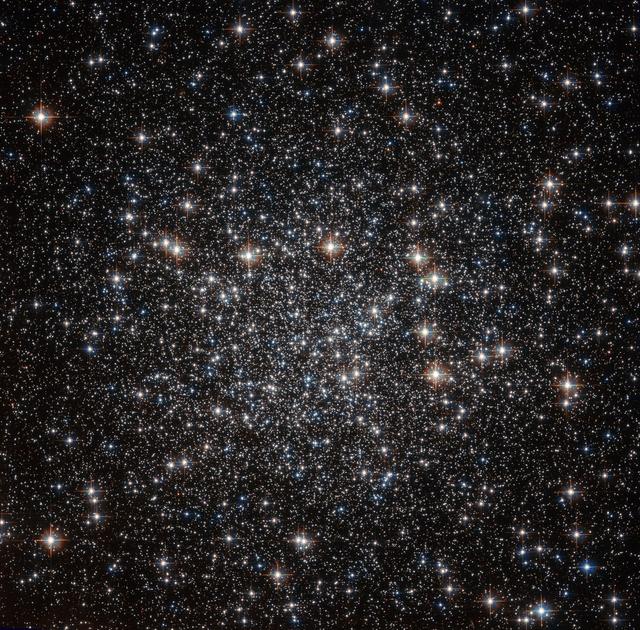
So Coldplay isn't the only one to see a sky full of stars, these are 22K light-years away Located approximately 22,000 light-years away in the constellation of Musca (The Fly), this tightly packed collection of stars — known as a globular cluster — goes by the name of NGC 4833. This NASA/ESA Hubble Space Telescope image shows the dazzling stellar group in all its glory. NGC 4833 is one of the over 150 globular clusters known to reside within the Milky Way. These objects are thought to contain some of the oldest stars in our galaxy. Studying these ancient cosmic clusters can help astronomers to unravel how a galaxy formed and evolved, and give an idea of the galaxy’s age. Globular clusters are responsible for some of the most striking sights in the cosmos, with hundreds of thousands of stars congregating in the same region of space. Hubble has observed many of these clusters during its time in orbit around our planet, each as breathtaking as the last. bit.ly/2b85p36 Image credit: ESA/Hubble and NASA <b><a href="http://www.nasa.gov/audience/formedia/features/MP_Photo_Guidelines.html" rel="nofollow">NASA image use policy.</a></b> <b><a href="http://www.nasa.gov/centers/goddard/home/index.html" rel="nofollow">NASA Goddard Space Flight Center</a></b> enables NASA’s mission through four scientific endeavors: Earth Science, Heliophysics, Solar System Exploration, and Astrophysics. Goddard plays a leading role in NASA’s accomplishments by contributing compelling scientific knowledge to advance the Agency’s mission. <b>Follow us on <a href="http://twitter.com/NASAGoddardPix" rel="nofollow">Twitter</a></b> <b>Like us on <a href="http://www.facebook.com/pages/Greenbelt-MD/NASA-Goddard/395013845897?ref=tsd" rel="nofollow">Facebook</a></b> <b>Find us on <a href="http://instagrid.me/nasagoddard/?vm=grid" rel="nofollow">Instagram</a></b>