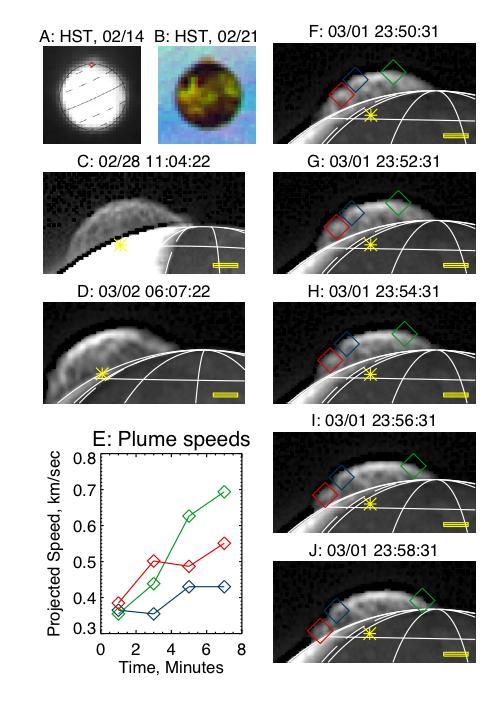
The Tvashtar plume on Io, seen by the Hubble Space Telescope HST and by New Horizons.
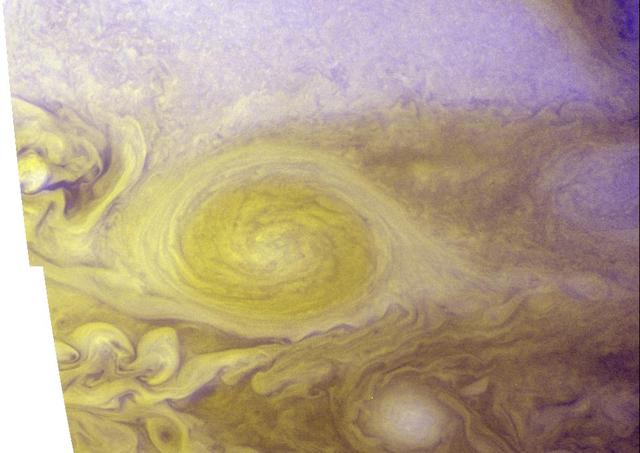
Best Color Image of Jupiter Little Red Spot
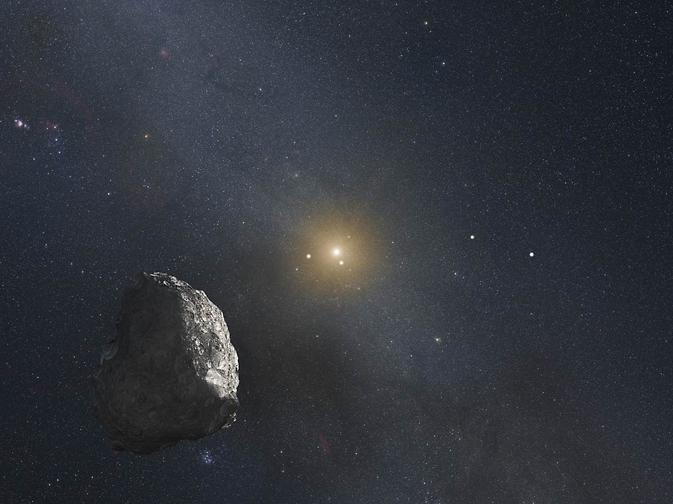
This is an artist’s impression of a Kuiper Belt object (KBO), located on the outer rim of our solar system at a staggering distance of 4 billion miles from the Sun. A HST survey uncovered three KBOs that are potentially reachable by NASA’s New Horizons spacecraft after it passes by Pluto in mid-2015. Credit: NASA, ESA, and G. Bacon (STScI) --- Peering out to the dim, outer reaches of our solar system, NASA’s Hubble Space Telescope has uncovered three Kuiper Belt objects (KBOs) the agency’s New Horizons spacecraft could potentially visit after it flies by Pluto in July 2015. The KBOs were detected through a dedicated Hubble observing program by a New Horizons search team that was awarded telescope time for this purpose. “This has been a very challenging search and it’s great that in the end Hubble could accomplish a detection – one NASA mission helping another,” said Alan Stern of the Southwest Research Institute (SwRI) in Boulder, Colorado, principal investigator of the New Horizons mission. The Kuiper Belt is a vast rim of primordial debris encircling our solar system. KBOs belong to a unique class of solar system objects that has never been visited by spacecraft and which contain clues to the origin of our solar system. The KBOs Hubble found are each about 10 times larger than typical comets, but only about 1-2 percent of the size of Pluto. Unlike asteroids, KBOs have not been heated by the sun and are thought to represent a pristine, well preserved deep-freeze sample of what the outer solar system was like following its birth 4.6 billion years ago. The KBOs found in the Hubble data are thought to be the building blocks of dwarf planets such as Pluto. Read more: <a href="http://1.usa.gov/1vzUcyK" rel="nofollow">1.usa.gov/1vzUcyK</a> <b><a href="http://www.nasa.gov/audience/formedia/features/MP_Photo_Guidelines.html" rel="nofollow">NASA image use policy.</a></b> <b><a href="http://www.nasa.gov/centers/goddard/home/index.html" rel="nofollow">NASA Goddard Space Flight Center</a></b> enables NASA’s mission through four scientific endeavors: Earth Science, Heliophysics, Solar System Exploration, and Astrophysics. Goddard plays a leading role in NASA’s accomplishments by contributing compelling scientific knowledge to advance the Agency’s mission. <b>Follow us on <a href="http://twitter.com/NASAGoddardPix" rel="nofollow">Twitter</a></b> <b>Like us on <a href="http://www.facebook.com/pages/Greenbelt-MD/NASA-Goddard/395013845897?ref=tsd" rel="nofollow">Facebook</a></b> <b>Find us on <a href="http://instagram.com/nasagoddard?vm=grid" rel="nofollow">Instagram</a></b>
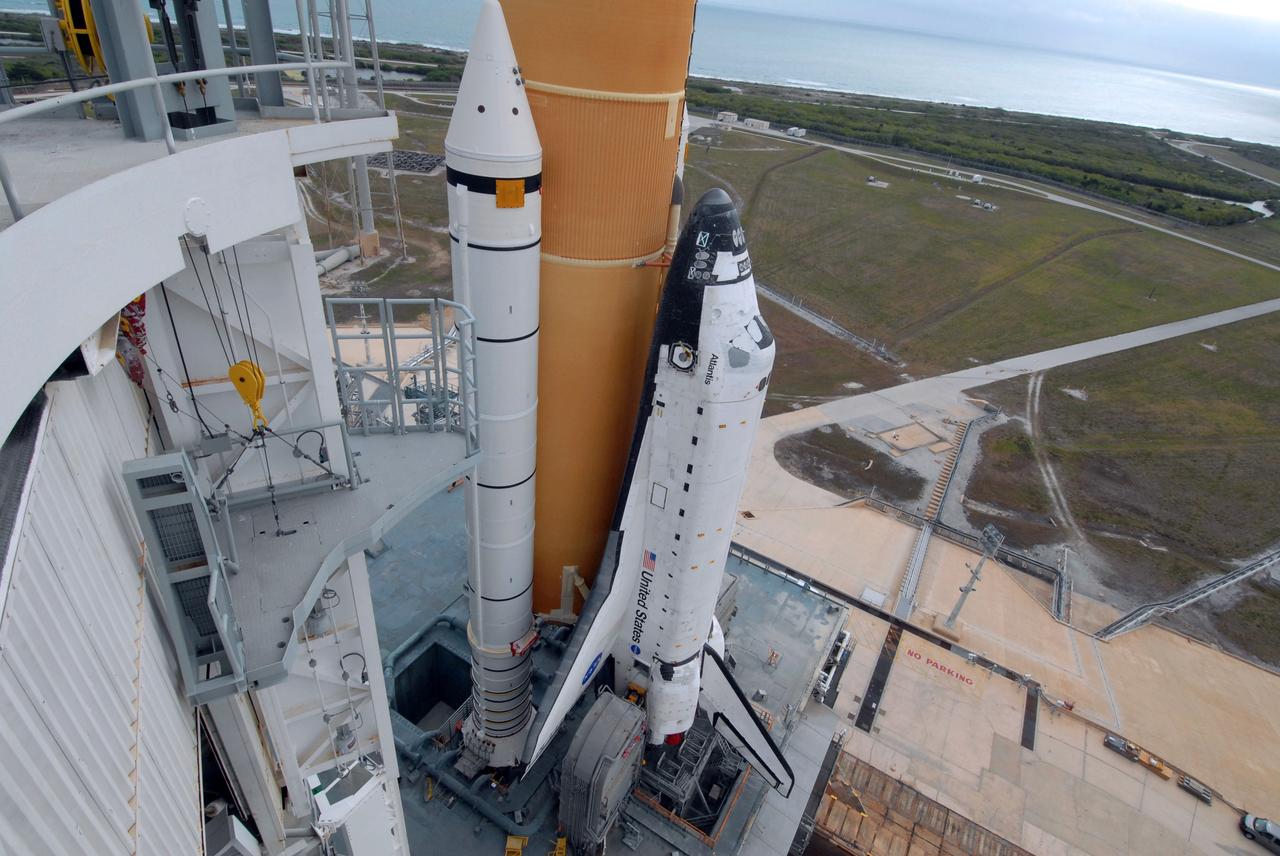
CAPE CANAVERAL, Fla. – Space shuttle Atlantis slowly reaches the top of Launch Pad 39A at NASA's Kennedy Space Center in Florida after rollout from the Vehicle Assembly Building. The shuttle sits atop the mobile launcher platform, which is carried by the crawler-transporter beneath. Beyond the shuttle on the horizon is the Atlantic Ocean. First motion was at 3:54 a.m. EDT and Atlantis was secured on the pad at 11:17 a.m. The 3.4-mile trip took about seven-and-a-half hours. Atlantis is targeted to lift off May 12 to service NASA's Hubble Space Telescope. During Atlantis' 11-day mission, the crew of seven astronauts will make the final shuttle flight to Hubble. During five spacewalks, they will install two new instruments, repair two inactive ones and replace components. The result will be six working, complementary science instruments with capabilities beyond what is now available, and an extended operational lifespan for the telescope through at least 2014. Photo credit: NASA/Jack Pfaller
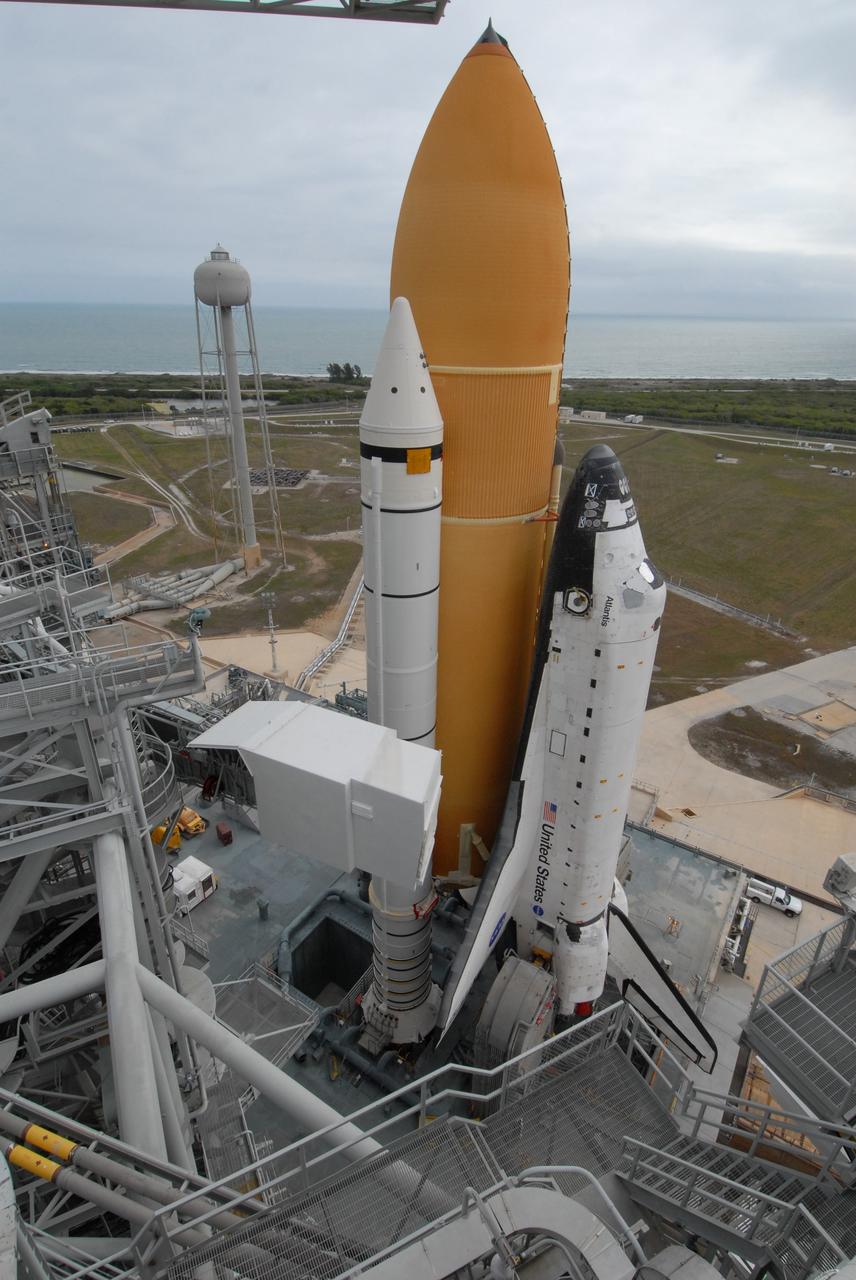
CAPE CANAVERAL, Fla. – Space shuttle Atlantis sits on Launch Pad 39A at NASA's Kennedy Space Center in Florida after rollout from the Vehicle Assembly Building. The shuttle sits atop the mobile launcher platform, which is carried by the crawler-transporter beneath. Beyond the shuttle on the horizon is the Atlantic Ocean. At left, behind the shuttle, is the 300,000-gallon water tower which releases water over the pad for sound suppression during liftoff. First motion was at 3:54 a.m. EDT and Atlantis was secured on the pad at 11:17 a.m. The 3.4-mile trip took about seven-and-a-half hours. Atlantis is targeted to lift off May 12 to service NASA's Hubble Space Telescope. During Atlantis' 11-day mission, the crew of seven astronauts will make the final shuttle flight to Hubble. During five spacewalks, they will install two new instruments, repair two inactive ones and replace components. The result will be six working, complementary science instruments with capabilities beyond what is now available, and an extended operational lifespan for the telescope through at least 2014. Photo credit: NASA/Jack Pfaller
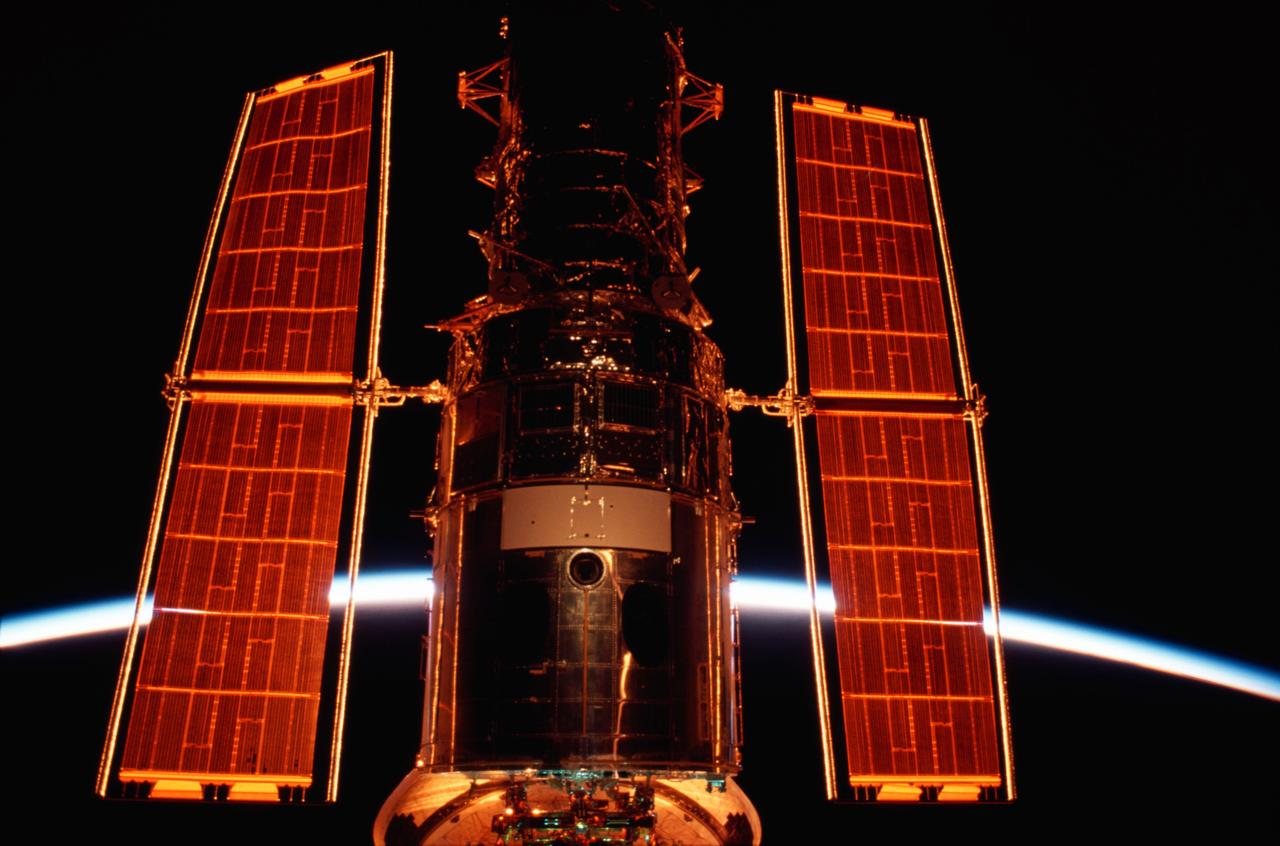
This is a photo of the Hubble Space Telescope (HST),in its origianl configuration, berthed in the cargo bay of the Space Shuttle Columbia during the STS-109 mission silhouetted against the airglow of the Earth's horizon. The telescope was captured and secured on a work stand in Columbia's payload bay using Columbia's robotic arm, where 4 of the 7-member crew performed 5 spacewalks completing system upgrades to the HST. Included in those upgrades were: replacement of the solar array panels; replacement of the power control unit (PCU); replacement of the Faint Object Camera (FOC) with a new advanced camera for Surveys (ACS); and installation of the experimental cooling system for the Hubble's Near-Infrared Camera and Multi-object Spectrometer (NICMOS), which had been dormant since January 1999 when its original coolant ran out. The Marshall Space Flight Center had the responsibility for the design, development, and construction of the the HST, which is the most complex and sensitive optical telescope ever made, to study the cosmos from a low-Earth orbit. The HST detects objects 25 times fainter than the dimmest objects seen from Earth and provides astronomers with an observable universe 250 times larger than is visible from ground-based telescopes, perhaps as far away as 14 billion light-years. The HST views galaxies, stars, planets, comets, possibly other solar systems, and even unusual phenomena such as quasars, with 10 times the clarity of ground-based telescopes. Launched March 1, 2002 the STS-109 HST servicing mission lasted 10 days, 22 hours, and 11 minutes. It was the 108th flight overall in NASA's Space Shuttle Program.
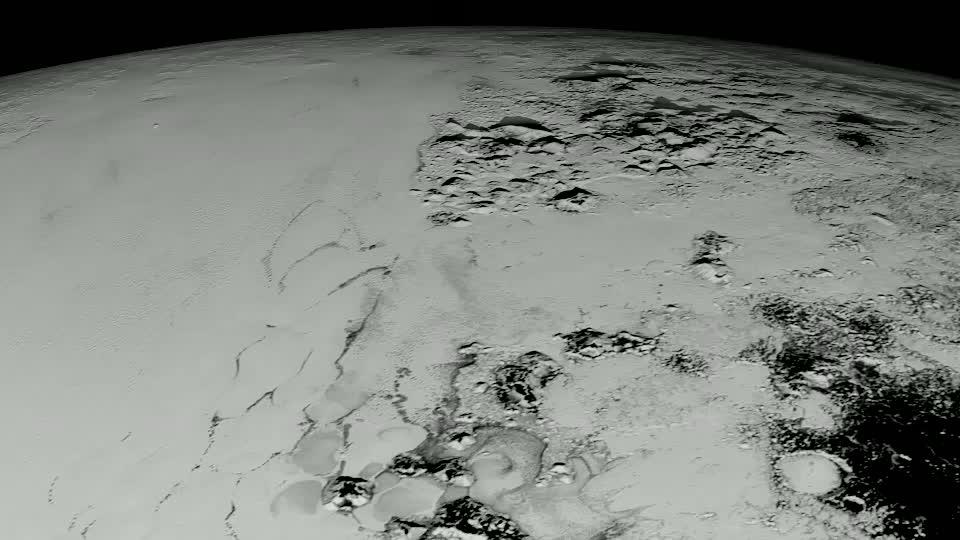
Pluto has long been a mystery, a dot at our solar system’s margins. The best images, even with NASA’s Hubble Space Telescope, were fuzzy and pixelated. In July 2015, NASA’s New Horizons spacecraft flew past Pluto and captured the sharpest views of the dwarf planet to date. One of the most striking areas, informally named "Sputnik Planum," is a sweeping, frozen plain the size of Texas and ringed by mountains of ice. Its smooth deposits are unmarred by impact craters, a stark contrast to the rest of Pluto’s battered surface. As a result, scientists believe the region formed recently, within the last few hundred million years. This contradicts past depictions of Pluto as an unchanging world. By analyzing images taken during the flyby, scientists hope to unravel more of the dwarf planet’s history. Watch the video for an up-close look at Pluto. Credit: NASA's Goddard Space Flight Center Video courtesy of NASA/Johns Hopkins University Applied Physics Laboratory/Southwest Research Institute/S. Robbins
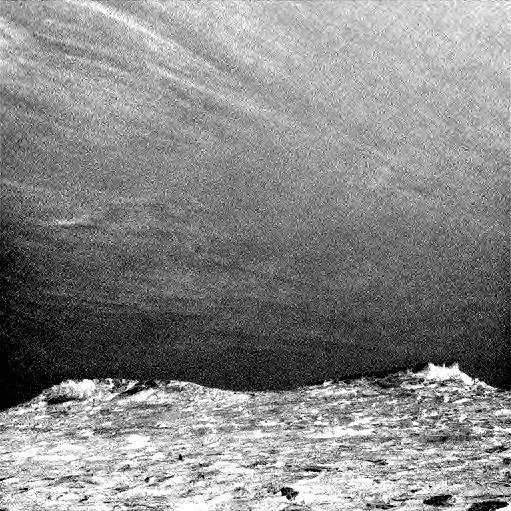
Clouds drift across the sky above a Martian horizon in this accelerated sequence of enhanced images from NASA's Curiosity Mars rover. The rover's Navigation Camera (Navcam) took these eight images over a span of four minutes early in the morning of the mission's 1,758th Martian day, or sol (July 17, 2017), aiming toward the south horizon. They have been processed by first making a "flat field' adjustment for known differences in sensitivity among pixels and correcting for camera artifacts due to light reflecting within the camera, and then generating an "average" of all the frames and subtracting that average from each frame. This subtraction emphasizes changes whether due to movement -- such as the clouds' motion -- or due to lighting -- such as changing shadows on the ground as the morning sunlight angle changed. On the same Martian morning, Curiosity also observed clouds nearly straight overhead. The clouds resemble Earth's cirrus clouds, which are ice crystals at high altitudes. These Martian clouds are likely composed of crystals of water ice that condense onto dust grains in the cold Martian atmosphere. Cirrus wisps appear as ice crystals fall and evaporate in patterns known as "fall streaks" or "mare's tails." Such patterns have been seen before at high latitudes on Mars, for instance by the Phoenix Mars Lander in 2008, and seasonally nearer the equator, for instance by the Opportunity rover. However, Curiosity has not previously observed such clouds so clearly visible from the rover's study area about five degrees south of the equator. The Hubble Space Telescope and spacecraft orbiting Mars have observed a band of clouds to appear near the Martian equator around the time of the Martian year when the planet is farthest from the Sun. With a more elliptical orbit than Earth's, Mars experiences more annual variation than Earth in its distance from the Sun. The most distant point in an orbit around the Sun is called the aphelion. The near-equatorial Martian cloud pattern observed at that time of year is called the "aphelion cloud belt." These new images from Curiosity were taken about two months before aphelion, but the morning clouds observed may be an early stage of the aphelion cloud belt. An animation is available at https://photojournal.jpl.nasa.gov/catalog/PIA21840
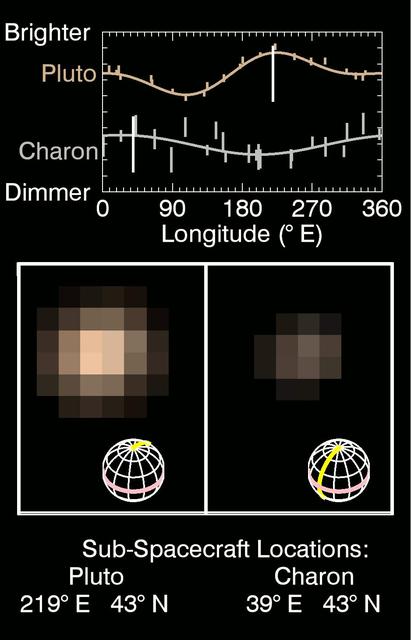
This series of images taken by NASA's New Horizons' Multispectral Visible Imaging Camera (MVIC) shows how Pluto and Charon change in brightness as they rotate over 6.4 Earth days.The central panel shows the true color of Pluto (left) and Charon (right) during nine epochs between May 29 May and June 3 2015, as the spacecraft approached the Pluto system from a range of 55 to 48 million km.The grids beneath the images show the orientations of Pluto and Charon, with 0° E longitude and the equator highlighted by the yellow and pink lines respectively.Sub-spacecraft locations on Pluto and Charon are listed at the bottom.The spatial resolution, at around 1000 km/pixel, is not yet sufficient in these images to reveal distinct surface features on either body. The top panel shows in graphical form how the brightness in MVIC's red channel (540-700 nm) varies with the sub-spacecraft longitude, including data from more distant images dating back to May 1.The moving white vertical lines indicate the observed central longitudes on Pluto and Charon as the images below rotate.These results are consistent with earlier Hubble Space Telescope observations of the lightcurves of Pluto and Charon.Pluto appears dimmest when the dark region on its trailing hemisphere (around 90° E) is oriented toward the observer and brighter when the dark area has rotated off the visible hemisphere and a bright region on the anti-Charon hemisphere is seen.A different, lower amplitude lightcurve variation is seen on Charon, where the Pluto-facing hemisphere (around 0° E) appears brighter than the anti-Pluto hemisphere. http://photojournal.jpl.nasa.gov/catalog/PIA19692
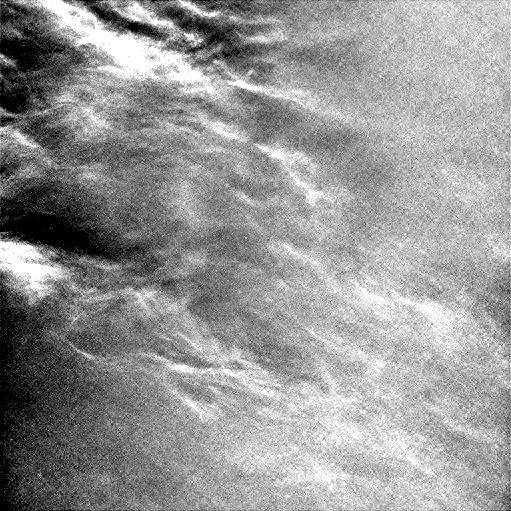
Wispy clouds float across the Martian sky in this accelerated sequence of enhanced images from NASA's Curiosity Mars rover. The rover's Navigation Camera (Navcam) took these eight images over a span of four minutes early in the morning of the mission's 1,758th Martian day, or sol (July 17, 2017), aiming nearly straight overhead. They have been processed by first making a "flat field' adjustment for known differences in sensitivity among pixels and correcting for camera artifacts due to light reflecting within the camera, and then generating an "average" of all the frames and subtracting that average from each frame. This subtraction results in emphasizing any changes due to movement or lighting. The clouds are also visible, though fainter, in a raw image sequence from these same observations. On the same Martian morning, Curiosity also observed clouds near the southern horizon. The clouds resemble Earth's cirrus clouds, which are ice crystals at high altitudes. These Martian clouds are likely composed of crystals of water ice that condense onto dust grains in the cold Martian atmosphere. Cirrus wisps appear as ice crystals fall and evaporate in patterns known as "fall streaks" or "mare's tails." Such patterns have been seen before at high latitudes on Mars, for instance by the Phoenix Mars Lander in 2008, and seasonally nearer the equator, for instance by the Opportunity rover. However, Curiosity has not previously observed such clouds so clearly visible from the rover's study area about five degrees south of the equator. The Hubble Space Telescope and spacecraft orbiting Mars have observed a band of clouds to appear near the Martian equator around the time of the Martian year when the planet is farthest from the Sun. With a more elliptical orbit than Earth's, Mars experiences more annual variation than Earth in its distance from the Sun. The most distant point in an orbit around the Sun is called the aphelion. The near-equatorial Martian cloud pattern observed at that time of year is called the "aphelion cloud belt." These new images from Curiosity were taken about two months before aphelion, but the morning clouds observed may be an early stage of the aphelion cloud belt. An animation is available at https://photojournal.jpl.nasa.gov/catalog/PIA21841