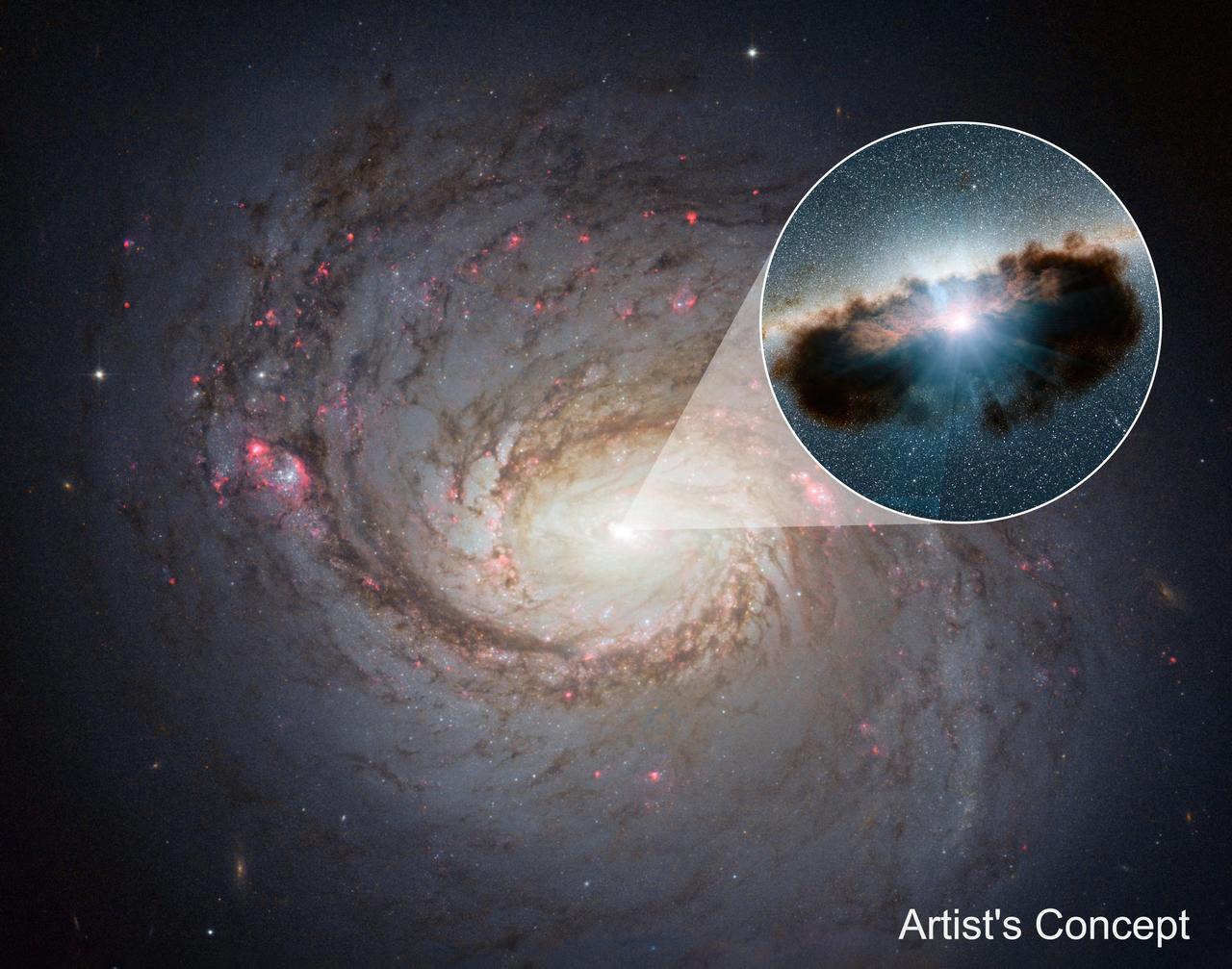
Galaxy NGC 1068 can be seen in close-up in this view from NASA's Hubble Space Telescope. NuSTAR's high-energy X-rays eyes were able to obtain the best view yet into the hidden lair of the galaxy's central, supermassive black hole. This active black hole -- shown as an illustration in the zoomed-in inset -- is one of the most obscured known, meaning that it is surrounded by extremely thick clouds of gas and dust. The NuSTAR data revealed that the torus of gas and dust surrounding the black hole, also referred to as a doughnut, is more clumpy than previously thought. doughnuts around active, supermassive black holes were originally proposed in the mid-1980s to be smooth entities. More recently, researchers have been finding that doughnuts are not so smooth but have lumps. NuSTAR's latest finding shows that this is true for even the thickest of doughnuts. http://photojournal.jpl.nasa.gov/catalog/PIA20058
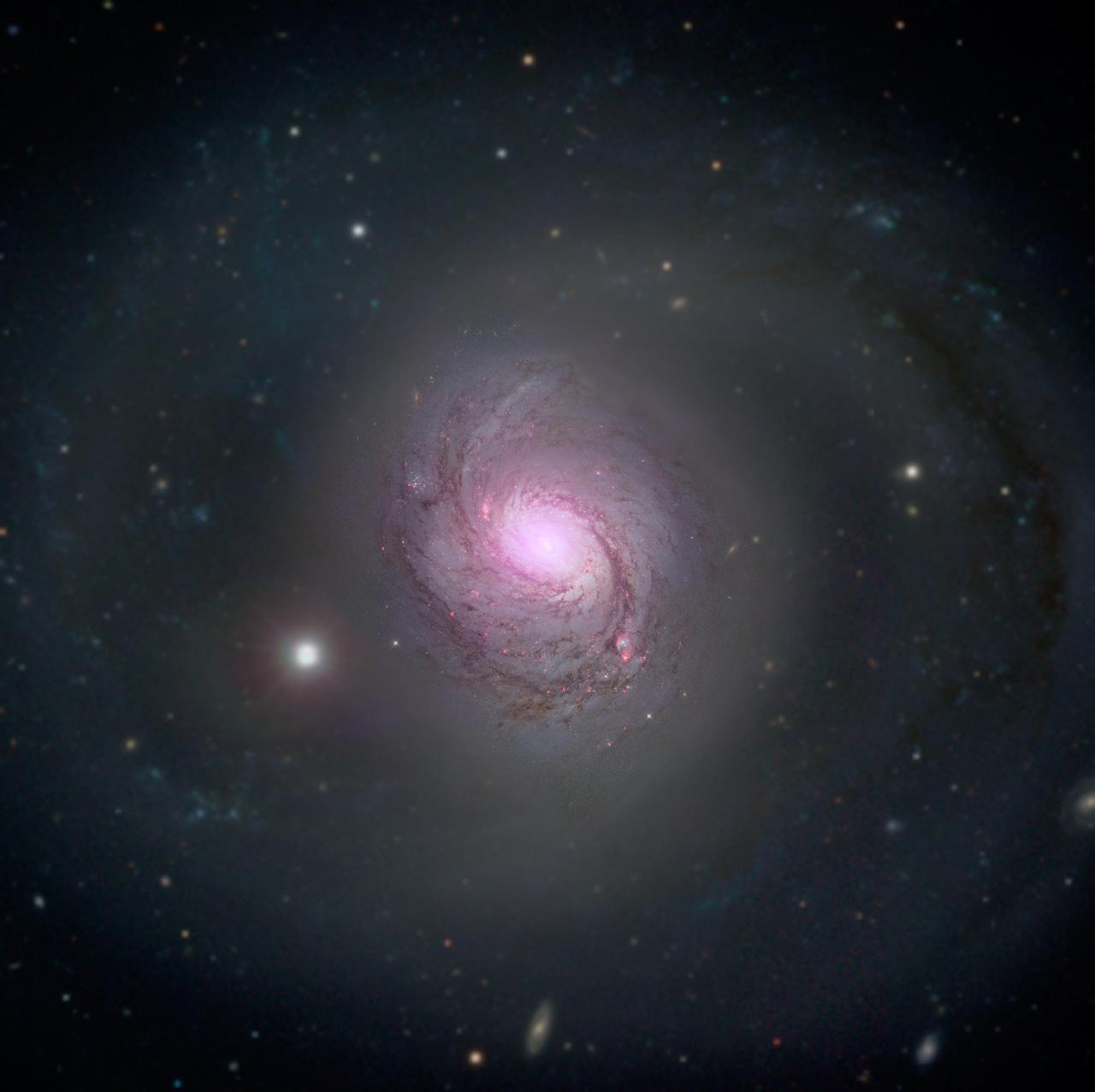
Galaxy NGC 1068 is shown in visible light and X-rays in this composite image. High-energy X-rays (magenta) captured by NASA's Nuclear Spectroscopic Telescope Array, or NuSTAR, are overlaid on visible-light images from both NASA's Hubble Space Telescope and the Sloan Digital Sky Survey. The X-ray light is coming from an active supermassive black hole, also known as a quasar, in the center of the galaxy. This supermassive black hole has been extensively studied due to its relatively close proximity to our galaxy. NGC 1068 is about 47 million light-years away in the constellation Cetus. The supermassive black hole is also one of the most obscured known, blanketed by thick clouds of gas and dust. NuSTAR's high-energy X-ray view is the first to penetrate the walls of this black hole's hidden lair. http://photojournal.jpl.nasa.gov/catalog/PIA20057

The real monster black hole is revealed in this image from NASA Nuclear Spectroscopic Telescope Array of colliding galaxies Arp 299.

Top: An illustration of NASA's Nuclear Spectroscopic Telescope Array, or NuSTAR, in orbit. The unique school bus-long mast allows NuSTAR to focus high energy X-rays. Lower-left: A color image from NASA's Hubble Space Telescope of one of the nine galaxies targeted by NuSTAR in search of hidden black holes. Bottom-right: An artist's illustration of a supermassive black hole, actively feasting on its surroundings. The central black hole is hidden from direct view by a thick layer of encircling gas and dust. http://photojournal.jpl.nasa.gov/catalog/PIA19348
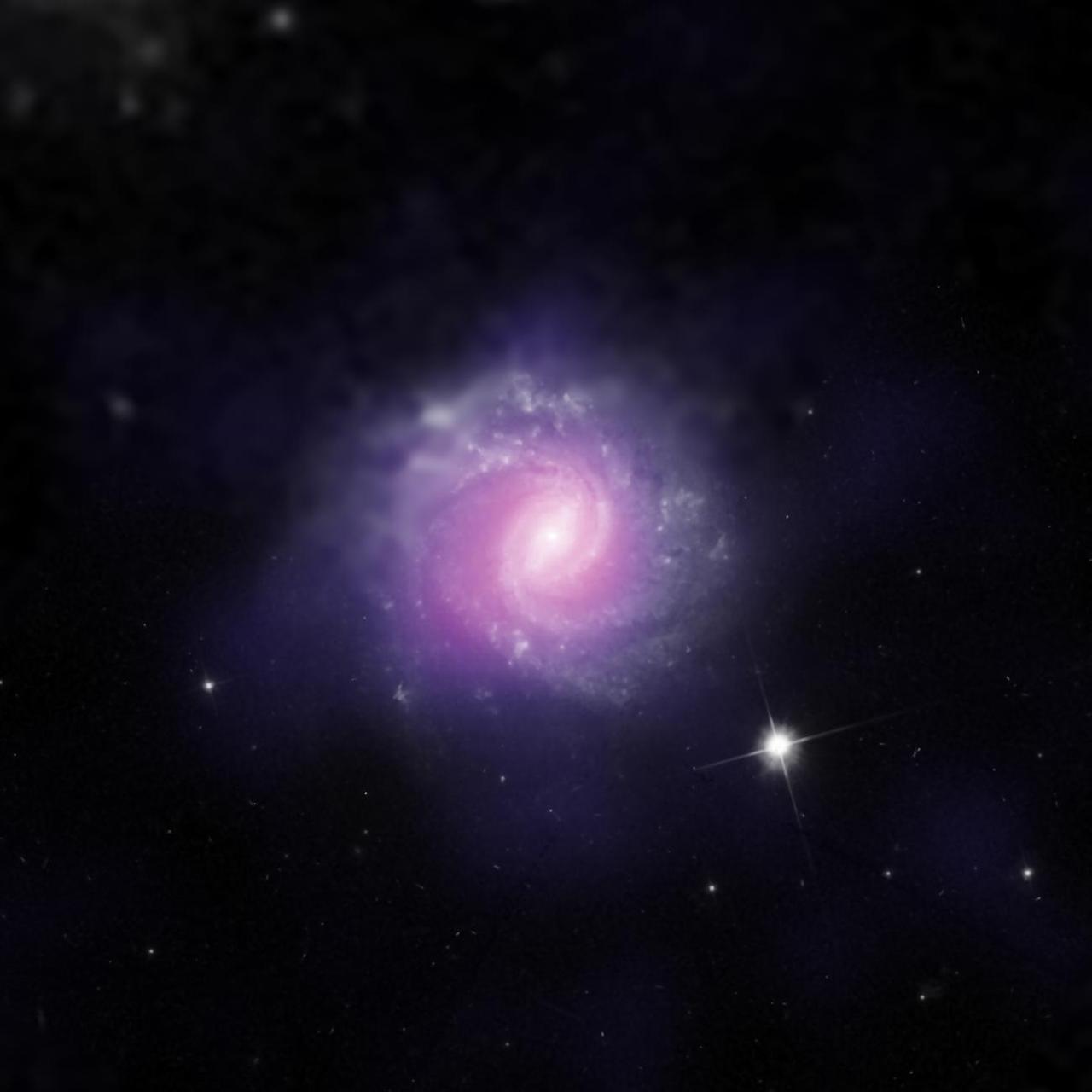
IC 3639, a galaxy with an active galactic nucleus, is seen in this image combining data from the Hubble Space Telescope and the European Southern Observatory. This galaxy contains an example of a supermassive black hole hidden by gas and dust. Researchers analyzed NuSTAR data from this object and compared them with previous observations from NASA's Chandra X-Ray Observatory and the Japanese-led Suzaku satellite. The findings from NuSTAR, which is more sensitive to higher energy X-rays than these observatories, confirm the nature of IC 3639 as an active galactic nucleus that is heavily obscured, and intrinsically much brighter than observed. http://photojournal.jpl.nasa.gov/catalog/PIA21087

This is a Hubble Space Telescope composite image of a supernova explosion designated SN 2014J in the galaxy M82. At a distance of approximately 11.5 million light-years from Earth it is the closest supernova of its type discovered in the past few decades. The explosion is categorized as a Type Ia supernova, which is theorized to be triggered in binary systems consisting of a white dwarf and another star — which could be a second white dwarf, a star like our sun, or a giant star. Astronomers using a ground-based telescope discovered the explosion on January 21, 2014. This Hubble photograph was taken on January 31, as the supernova approached its peak brightness. The Hubble data are expected to help astronomers refine distance measurements to Type Ia supernovae. In addition, the observations could yield insights into what kind of stars were involved in the explosion. Hubble’s ultraviolet-light sensitivity will allow astronomers to probe the environment around the site of the supernova explosion and in the interstellar medium of the host galaxy. Because of their consistent peak brightness, Type Ia supernovae are among the best tools to measure distances in the universe. They were fundamental to the 1998 discovery of the mysterious acceleration of the expanding universe. A hypothesized repulsive force, called dark energy, is thought to cause the acceleration. Among the other major NASA space-based observatories used in the M82 viewing campaign are Spitzer Space Telescope, Chandra X-ray Observatory, Nuclear Spectroscopic Telescope Array (NuSTAR), Fermi Gamma-ray Space Telescope, Swift Gamma Ray Burst Explorer, and the Stratospheric Observatory for Infrared Astronomy (SOFIA). Image Credit: NASA, ESA, A. Goobar (Stockholm University), and the Hubble Heritage Team (STScI/AURA) <b><a href="http://www.nasa.gov/audience/formedia/features/MP_Photo_Guidelines.html" rel="nofollow">NASA image use policy.</a></b> <b><a href="http://www.nasa.gov/centers/goddard/home/index.html" rel="nofollow">NASA Goddard Space Flight Center</a></b> enables NASA’s mission through four scientific endeavors: Earth Science, Heliophysics, Solar System Exploration, and Astrophysics. Goddard plays a leading role in NASA’s accomplishments by contributing compelling scientific knowledge to advance the Agency’s mission. <b>Follow us on <a href="http://twitter.com/NASAGoddardPix" rel="nofollow">Twitter</a></b> <b>Like us on <a href="http://www.facebook.com/pages/Greenbelt-MD/NASA-Goddard/395013845897?ref=tsd" rel="nofollow">Facebook</a></b> <b>Find us on <a href="http://instagram.com/nasagoddard?vm=grid" rel="nofollow">Instagram</a></b>
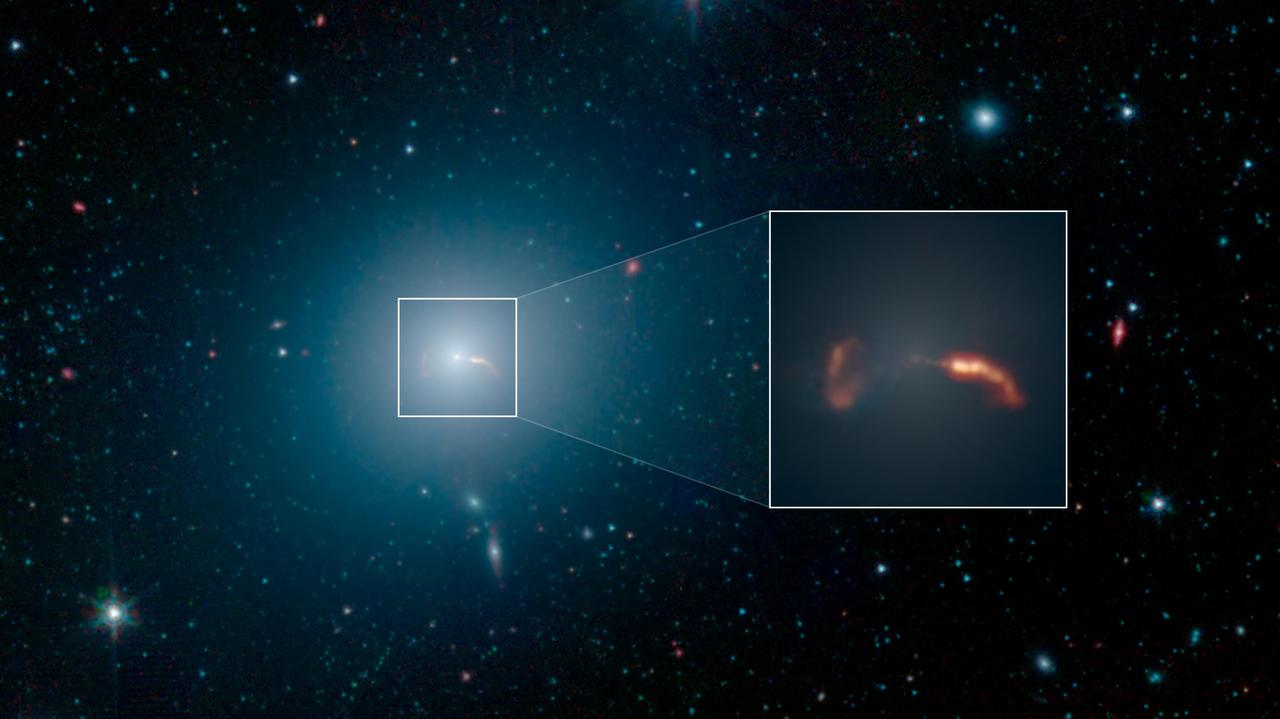
This image from NASA's Spitzer Space Telescope shows the elliptical galaxy Messier 87 (M87), the home galaxy of the supermassive black hole recently imaged by the Event Horizon Telescope (EHT). Spitzer's infrared view shows a faint trace of a jet of material spewing to the right of the galaxy - a feature that was previously one key indicator that a supermassive black hole lived at the galaxy's center. More prominent in the image is the shockwave created by that jet. The inset in the image below shows a close-up view of the shockwave on the right side of the galaxy, as well as the shockwave from a second jet traveling to the left of the galaxy. Located about 55 million light-years from Earth, M87 has been a subject of astronomical study for more than 100 years and has been imaged by many NASA observatories, including the Hubble Space Telescope, the Chandra X-ray Observatory and NuSTAR. In 1918, astronomer Heber Curtis first noticed "a curious straight ray" extending from the galaxy's center. This bright jet (which appears to extend to the right of the galaxy) is visible in multiple wavelengths of light, from radio waves through X-rays. The jet is produced by a disk of material spinning rapidly around the black hole, and spewing in opposite directions away from the galaxy. When the particles in the jet impact the interstellar medium (the sparse material filling the space between stars in M87), they create a shockwave that radiates in infrared and radio wavelengths of light, but not visible light. The jet on the right is traveling almost directly toward Earth, and its brightness is amplified due to its high speed in our direction. But the jet's trajectory is just slightly offset from our line of sight with the galaxy, so we can still see some of the length of the jet. The shockwave begins around the point where the jet appears to curve down, highlighting the regions where the fast-moving particles are colliding with gas in the galaxy and slowing down. There is also a second jet on the left that is moving so rapidly away from us it is rendered invisible at all wavelengths. But the shockwave it creates in the interstellar medium can still be seen here. In the Spitzer image, the shockwave is on the left side of the galaxy and looks like an inverted letter "C." Scientists are still striving for a solid theoretical understanding of how inflowing gas around black holes creates outflowing jets. Infrared light at wavelengths of 3.6 and 4.5 microns are rendered in blue and green, showing the distribution of stars, while dust features that glow brightly at 8.0 microns are shown in red. The image was taken during Spitzer's initial "cold" mission. https://photojournal.jpl.nasa.gov/catalog/PIA23122