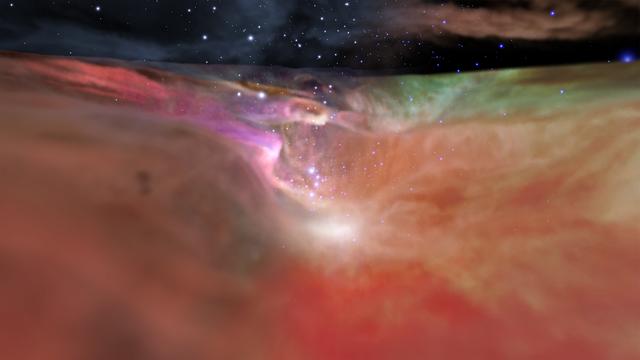
This image showcases both the visible and infrared visualizations of the Orion Nebula. This view from a movie sequence looks down the 'valley' leading to the star cluster at the far end. The left side of the image shows the visible-light visualization, which fades to the infrared-light visualization on the right. These two contrasting models derive from observations by the Hubble and Spitzer space telescopes. An animation is available at https://photojournal.jpl.nasa.gov/catalog/PIA22089
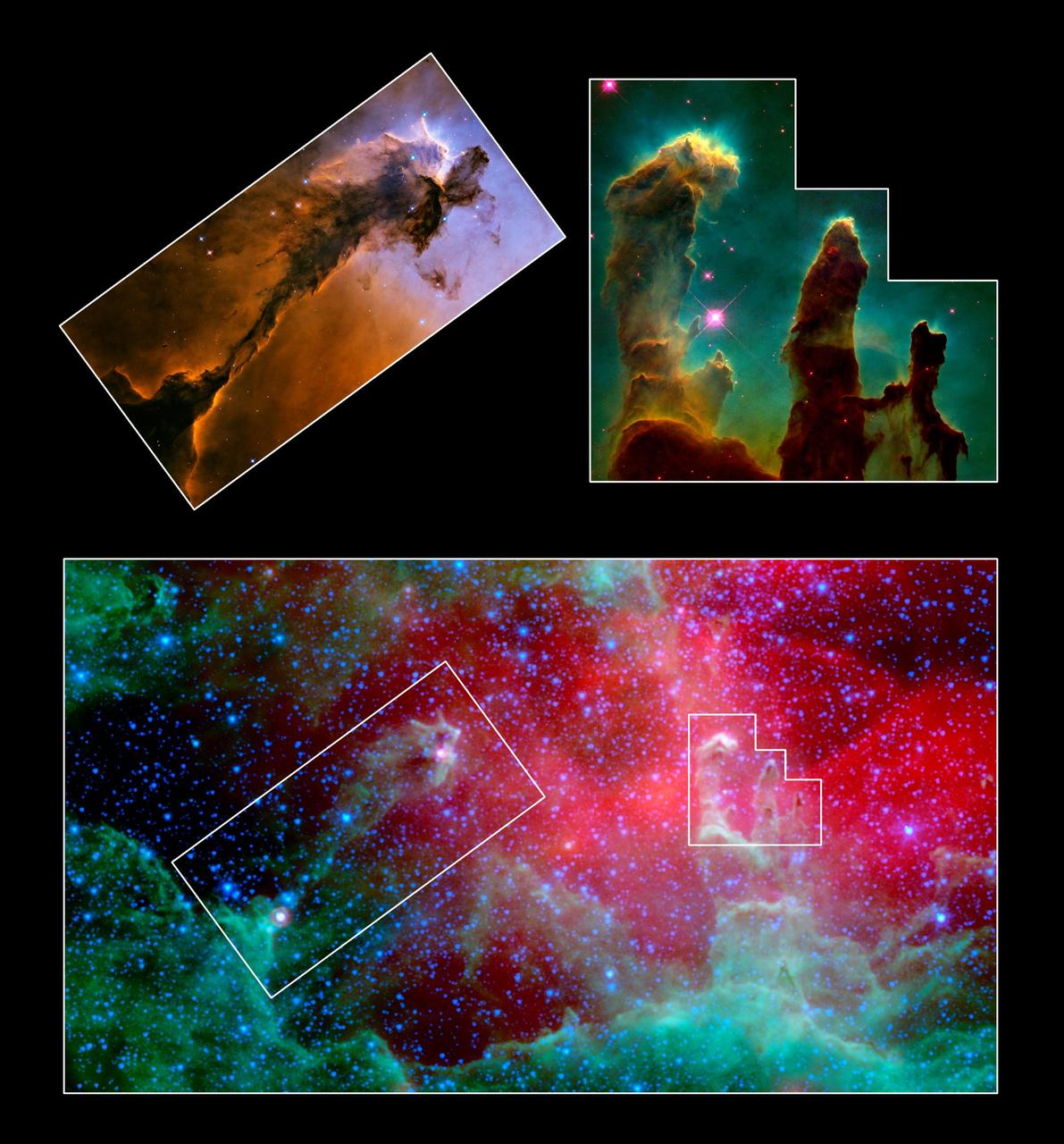
This image composite highlights the pillars of the Eagle nebula, as seen in infrared light by NASA Spitzer Space Telescope bottom and visible light by NASA Hubble Space Telescope top insets.

This deep-field view of the sky, taken by NASA's Spitzer Space Telescope, is dominated by galaxies - including some very faint, very distant ones - circled in red. The bottom right inset shows one of those distant galaxies, made visible thanks to a long-duration observation by Spitzer. The wide-field view also includes data from NASA's Hubble Space Telescope. The Spitzer observations came from the GREATS survey, short for GOODS Re-ionization Era wide-Area Treasury from Spitzer. GOODS is itself an acronym: Great Observatories Origins Deep Survey. https://photojournal.jpl.nasa.gov/catalog/PIA23123
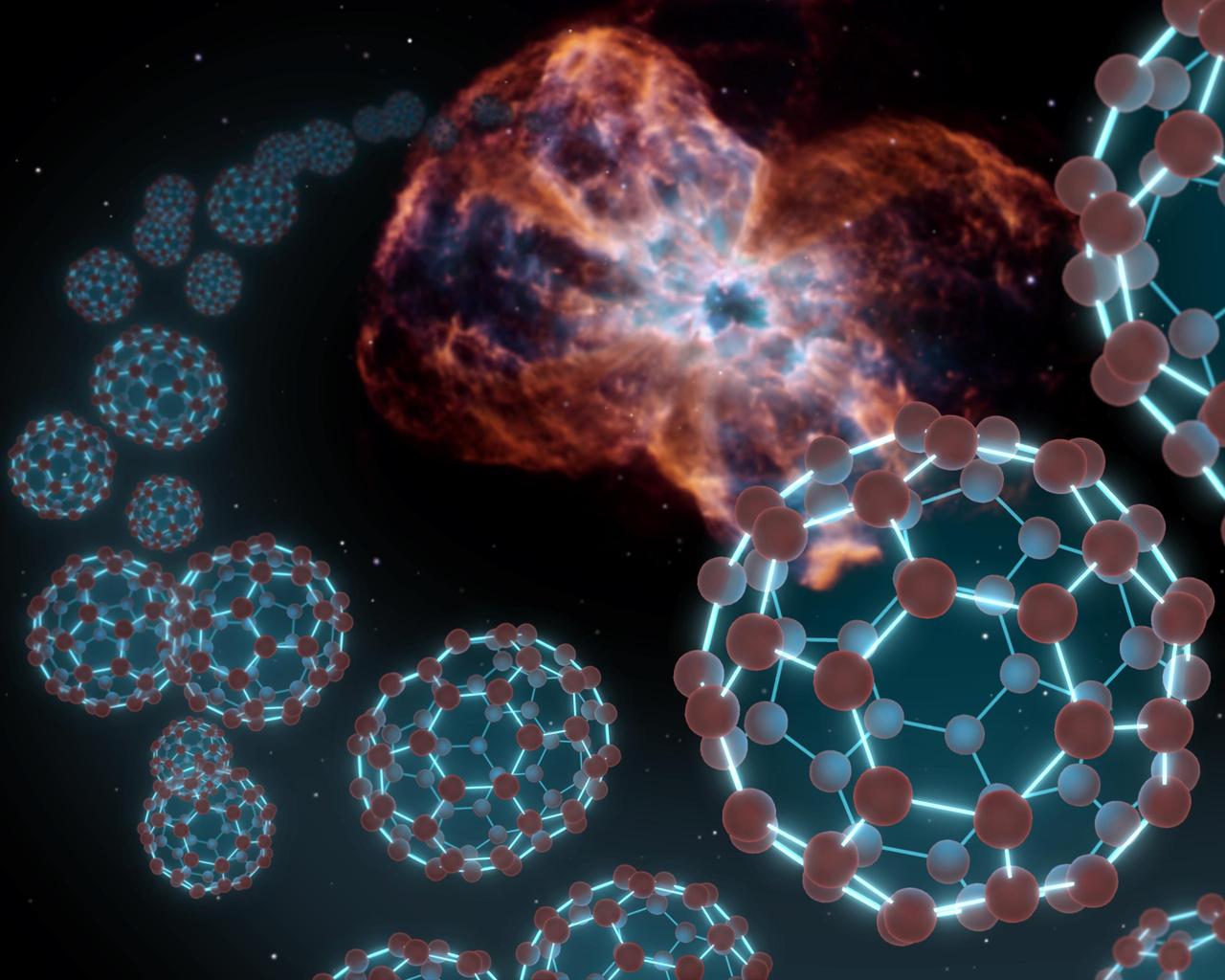
NASA Spitzer Space Telescope has at last found buckyballs resembling soccer balls in space shown in this artist concept using Hubble picture of the NGC 2440 nebula. Hubble image cred: NASA, ESA, STScI

This graph shows the brightness variations of the brown dwarf named 2MASSJ22282889-431026 measured simultaneously by both NASA Hubble and Spitzer space telescopes.
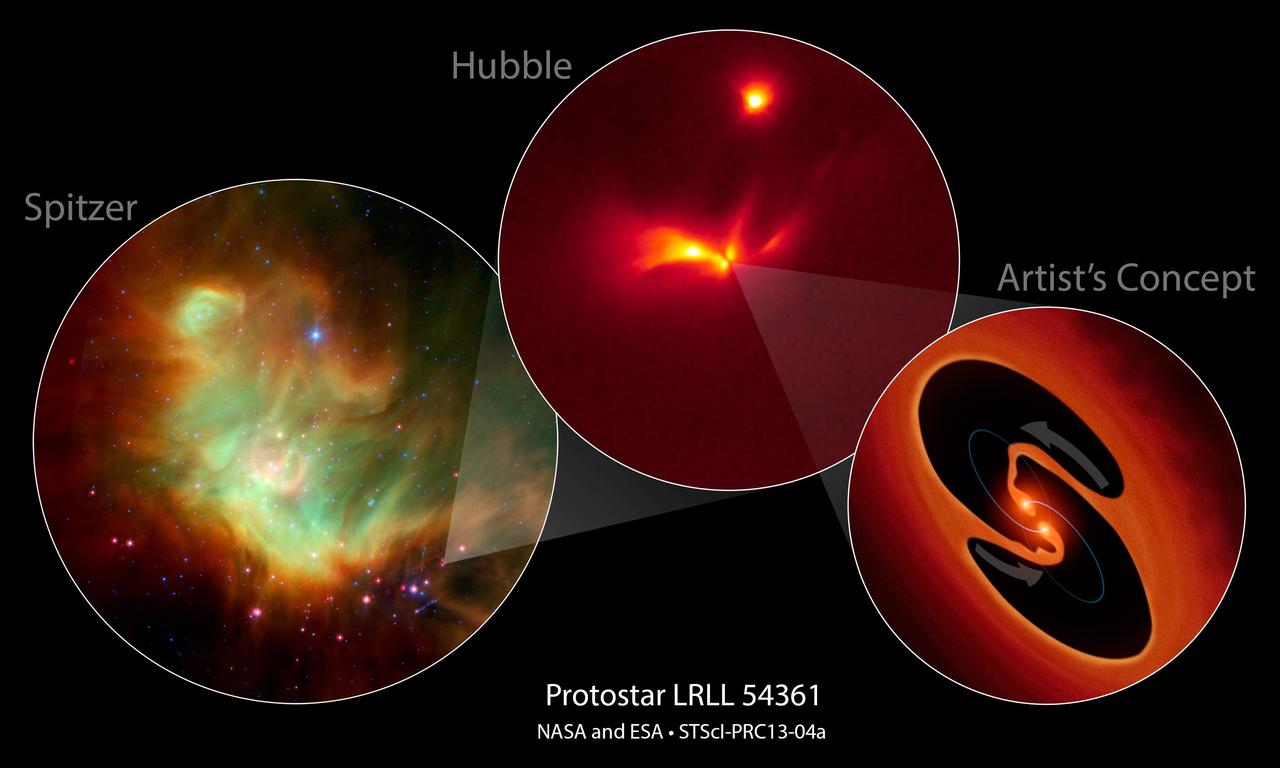
NASA Spitzer and Hubble space telescopes have teamed up to uncover a mysterious infant star that behaves like a police strobe light.
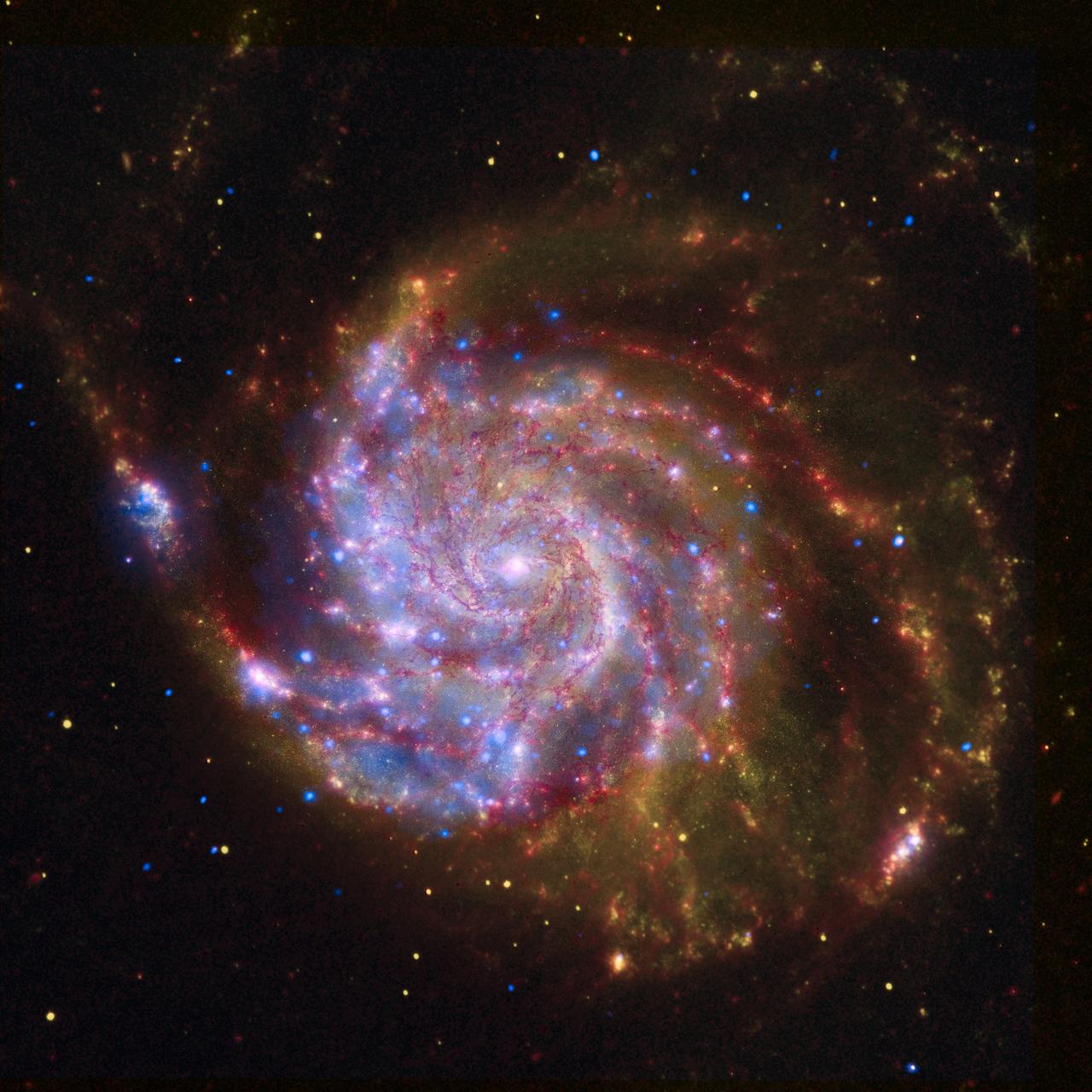
NASA Great Observatories continue Galileo legacy with stunning images and breakthrough science from the Hubble Space Telescope, the Spitzer Space Telescope, and the Chandra X-ray Observatory.
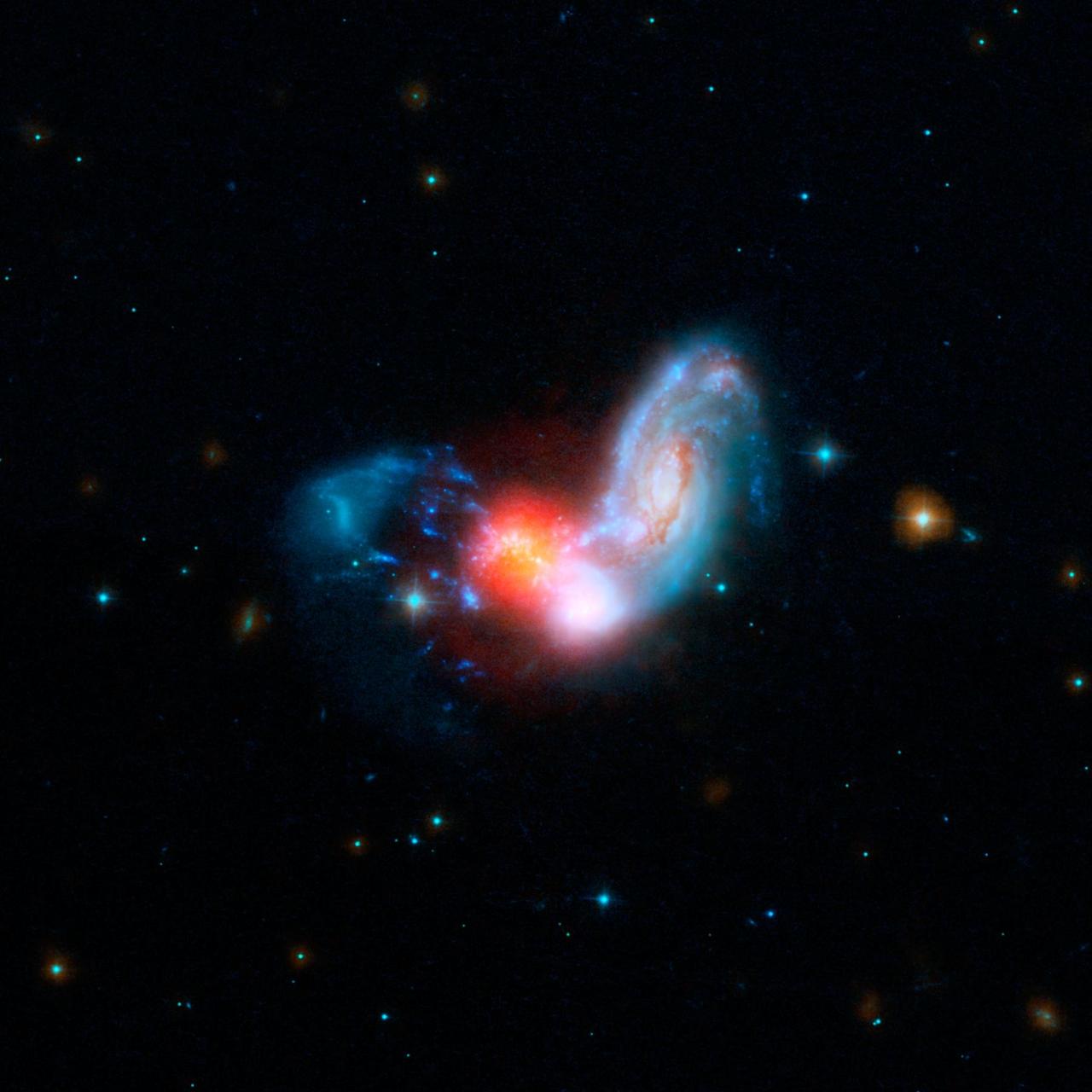
A brilliant burst of star formation is revealed in this image combining observations from NASA Spitzer and Hubble Space Telescopes. The collision of two spiral galaxies has triggered this luminous starburst.
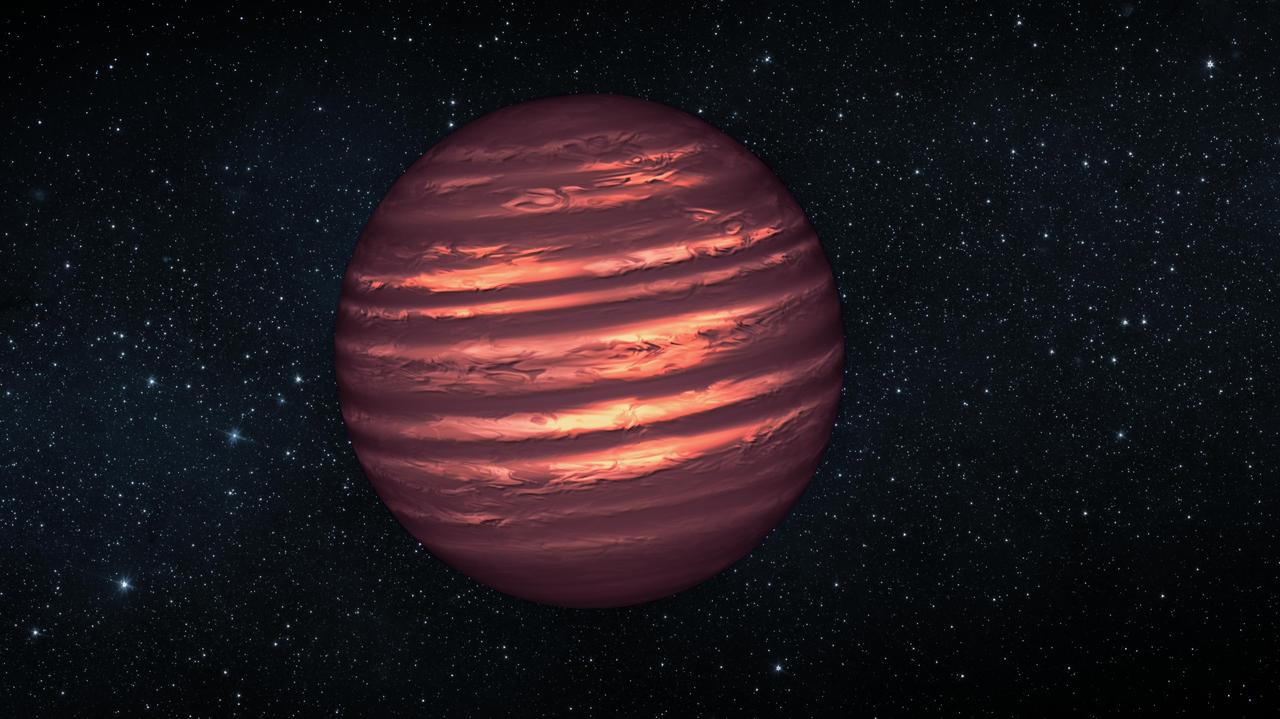
This artist conception illustrates the brown dwarf named 2MASSJ22282889-431026. NASA Hubble and Spitzer space telescopes observed the object to learn more about its turbulent atmosphere.

This new false-colored image from NASA Hubble, Chandra and Spitzer space telescopes shows a giant jet of particles that has been shot out from the vicinity of a type of supermassive black hole called a quasar.

This artist illustration shows the atmosphere of a brown dwarf called 2MASSJ22282889-431026, which was observed simultaneously by NASA Spitzer and Hubble space telescopes. The results were unexpected, revealing offset layers of material.

Scientists were excited to discover clear skies on a relatively small planet, about the size of Neptune, using the combined power of NASA Hubble, Spitzer and Kepler space telescopes.
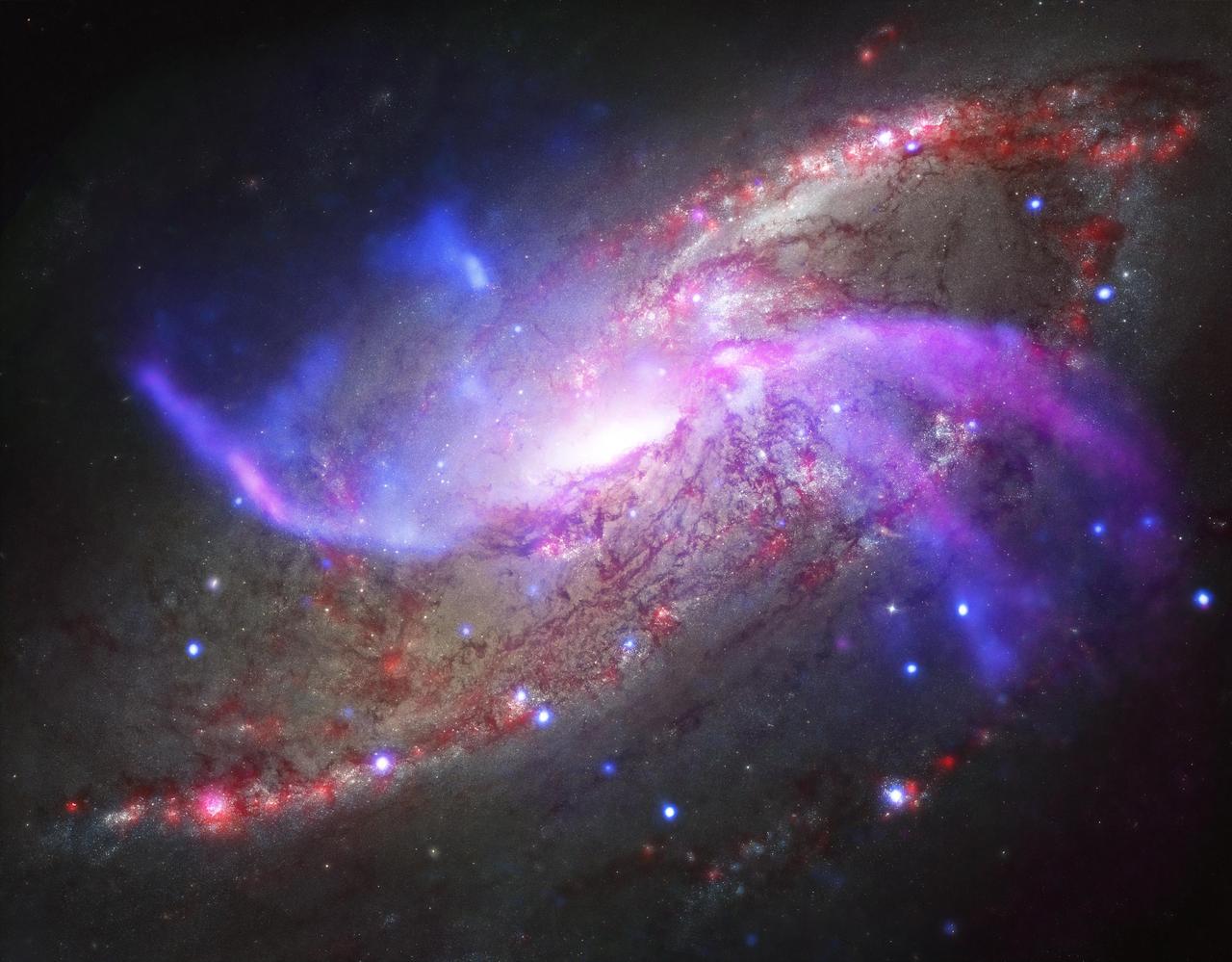
Anomalous arms are seen in this composite image of NGC 4258 from NASA Chandra X-ray Observator, NSF Karl Jansky Very Large Array, NASA Hubble Space Telescope and Spitzer Space Telescope.
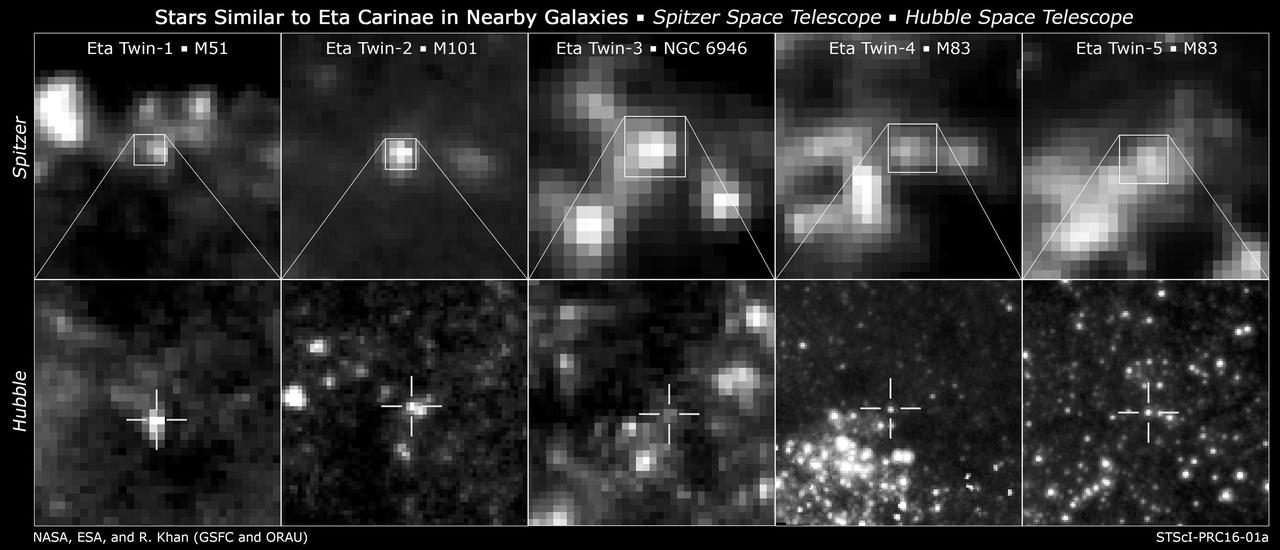
Researchers found likely twins of the giant, erupting star Eta Carinae by comparing infrared images from NASA Spitzer Space Telescope (top) and NASA Hubble Space Telescope (bottom). Astronomers cannot yet explain what caused the titanic eruption of star Eta Carinae in the 1840s. The discovery of likely Eta Carinae "twins" in other galaxies will help scientists better understand this brief phase in the life of a massive star. http://photojournal.jpl.nasa.gov/catalog/PIA20018

Six hundred and fifty light-years away in the constellation Aquarius, a dead star about the size of Earth, is refusing to fade away peacefully. NASA Hubble and Spitzer Space Telescopes have captured the complex structure of the Helix nebula.
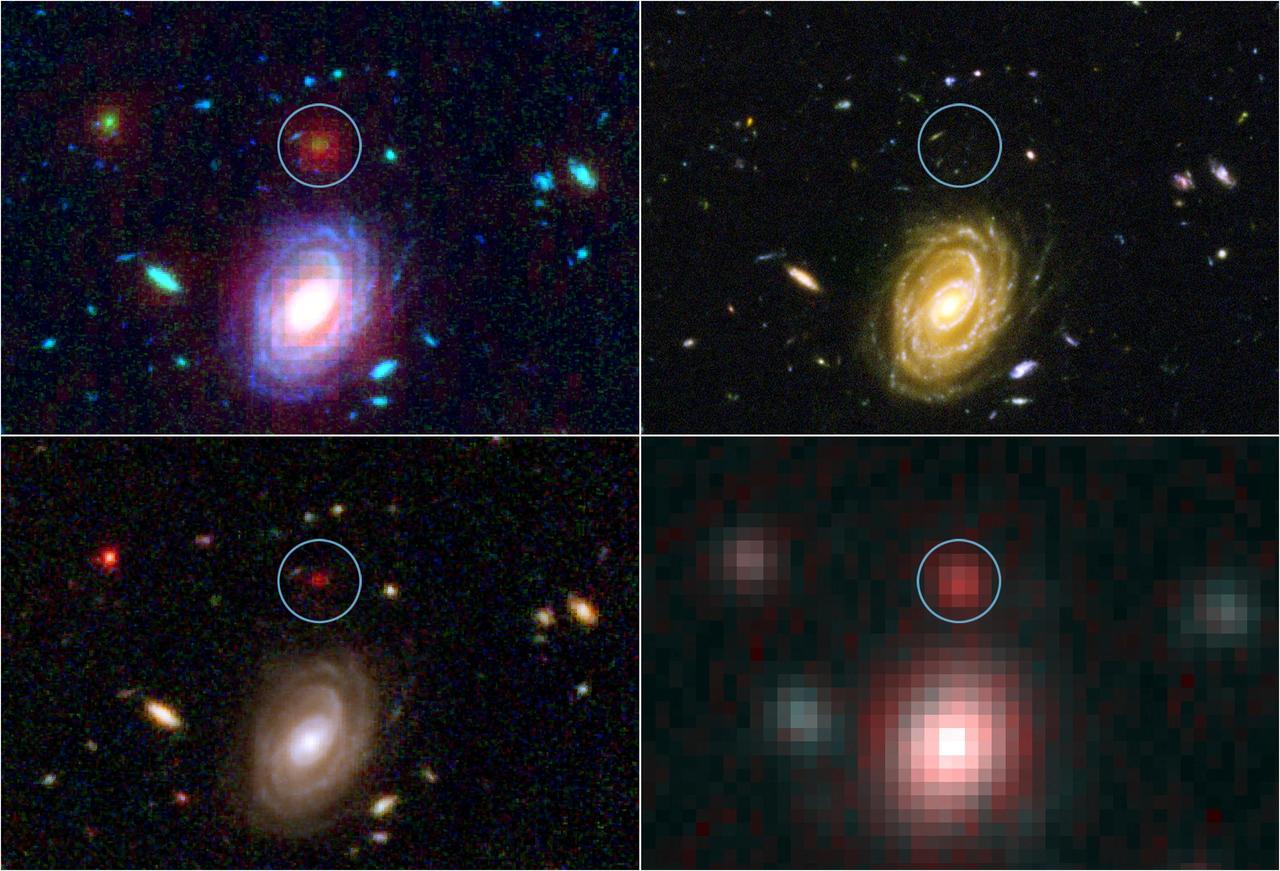
This image demonstrates how data from two of NASA Great Observatories, the Spitzer and Hubble Space Telescopes, are used to identify one of the most distant galaxies ever seen. This galaxy is named named HUDF-JD2.

A massive cluster of galaxies, called SpARCS1049+56, can be seen in this multi-wavelength view from NASA Hubble and Spitzer space telescopes. At the middle of the picture is the largest, central member of the family of galaxies (upper right red dot of central pair). Unlike other central galaxies in clusters, this one is bursting with the birth of new stars. Scientists say this star birth was triggered by a collision between a smaller galaxy and the giant, central galaxy. The smaller galaxy's wispy, shredded parts, called a tidal tail, can be seen coming out below the larger galaxy. Throughout this region are features called "beads on a string," which are areas where gas has clumped to form new stars. This type of "feeding" mechanism for galaxy clusters -- where gas from the merging of galaxies is converted to new stars -- is rare. The Hubble data in this image show infrared light with a wavelength of 1 micron in blue, and 1.6 microns in green. The Spitzer data show infrared light of 3.6 microns in red. http://photojournal.jpl.nasa.gov/catalog/PIA19837
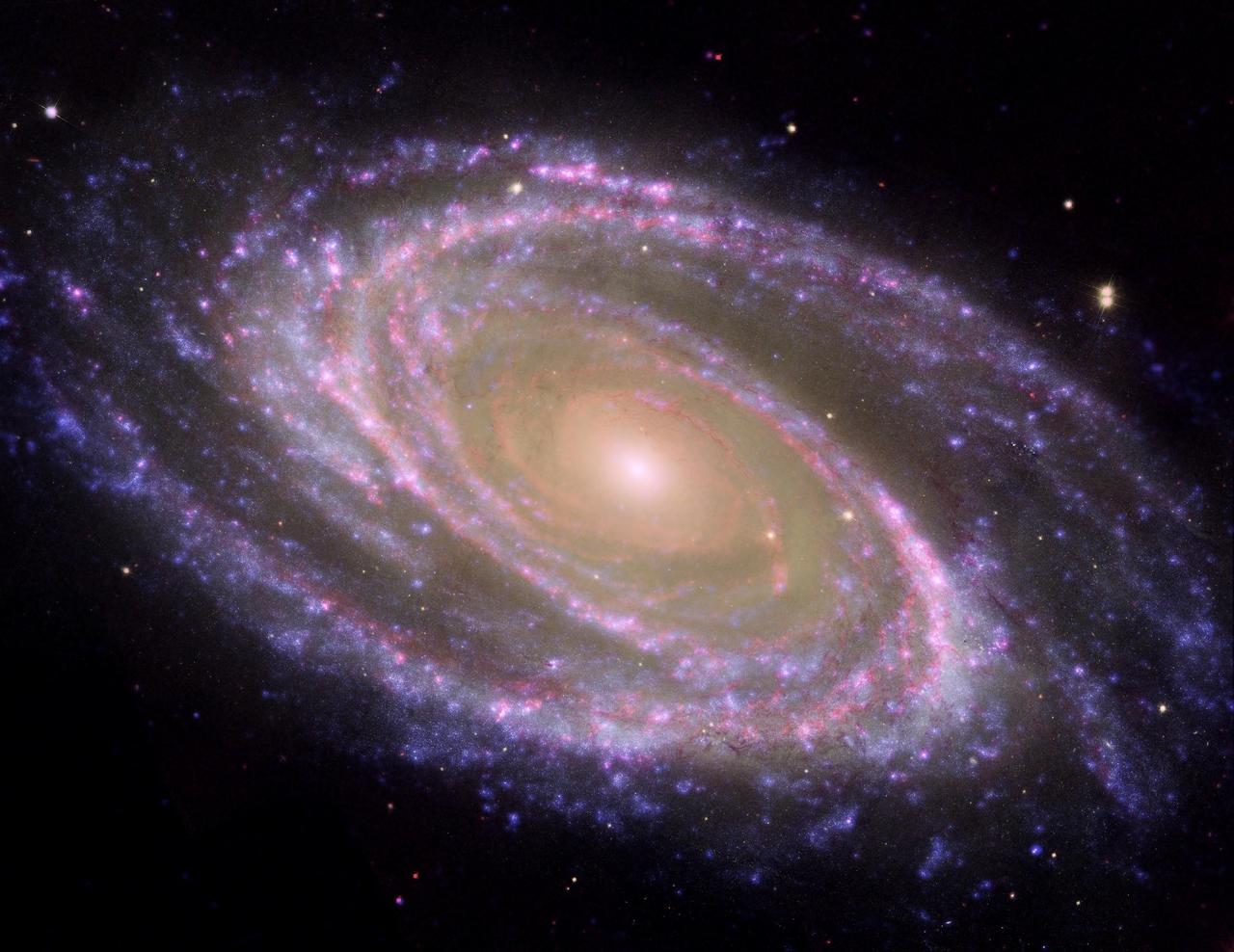
The perfectly picturesque spiral galaxy known as Messier 81, or M81, looks sharp in this new composite from NASA Spitzer and Hubble space telescopes and NASA Galaxy Evolution Explorer.
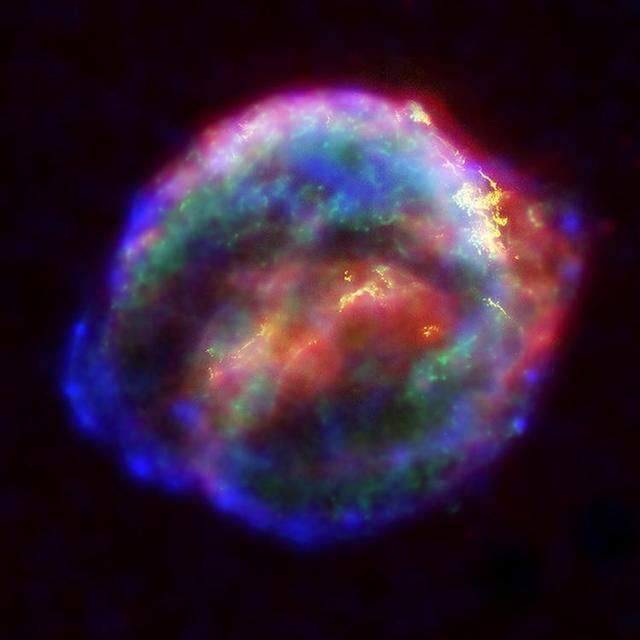
NASA's three Great Observatories -- the Hubble Space Telescope, the SpitzerSpace Telescope, and the Chandra X-ray Observatory -- joined forces to probe theexpanding remains of a supernova, called Kepler's supernova remnant, first seen 400 years ago by sky watchers, including astronomer Johannes Kepler. The combined image unveils a bubble-shaped shroud of gas and dust that is 14light-years wide and is expanding at 4 million miles per hour (2,000 kilometersper second). Observations from each telescope highlight distinct features of thesupernova remnant, a fast-moving shell of iron-rich material from the explodedstar, surrounded by an expanding shock wave that is sweeping up interstellar gasand dust. Each color in this image represents a different region of the electromagneticspectrum, from X-rays to infrared light. These diverse colors are shown in thepanel of photographs below the composite image. The X-ray and infrared datacannot be seen with the human eye. By color-coding those data and combining themwith Hubble's visible-light view, astronomers are presenting a more completepicture of the supernova remnant. Visible-light images from the Hubble telescope (colored yellow) reveal where the supernova shock wave is slamming into the densest regions of surrounding gas.The bright glowing knots are dense clumps from instabilities that form behindthe shock wave. The Hubble data also show thin filaments of gas that look likerippled sheets seen edge-on. These filaments reveal where the shock wave isencountering lower-density, more uniform interstellar material. The Spitzer telescope shows microscopic dust particles (colored red) that havebeen heated by the supernova shock wave. The dust re-radiates the shock wave'senergy as infrared light. The Spitzer data are brightest in the regionssurrounding those seen in detail by the Hubble telescope. The Chandra X-ray data show regions of very hot gas, and extremely high-energyparticles. The hottest gas (higher-energy X-rays, colored blue) is locatedprimarily in the regions directly behind the shock front. These regions alsoshow up in the Hubble observations, and also align with the faint rim of glowingmaterial seen in the Spitzer data. The X-rays from the region on the lower left(colored blue) may be dominated by extremely high-energy electrons that wereproduced by the shock wave and are radiating at radio through X-ray wavelengthsas they spiral in the intensified magnetic field behind the shock front. CoolerX-ray gas (lower-energy X-rays, colored green) resides in a thick interior shelland marks the location of heated material expelled from the exploded star. Kepler's supernova, the last such object seen to explode in our Milky Waygalaxy, resides about 13,000 light-years away in the constellation Ophiuchus. The Chandra observations were taken in June 2000, the Hubble in August 2003;and the Spitzer in August 2004. http://photojournal.jpl.nasa.gov/catalog/PIA06907
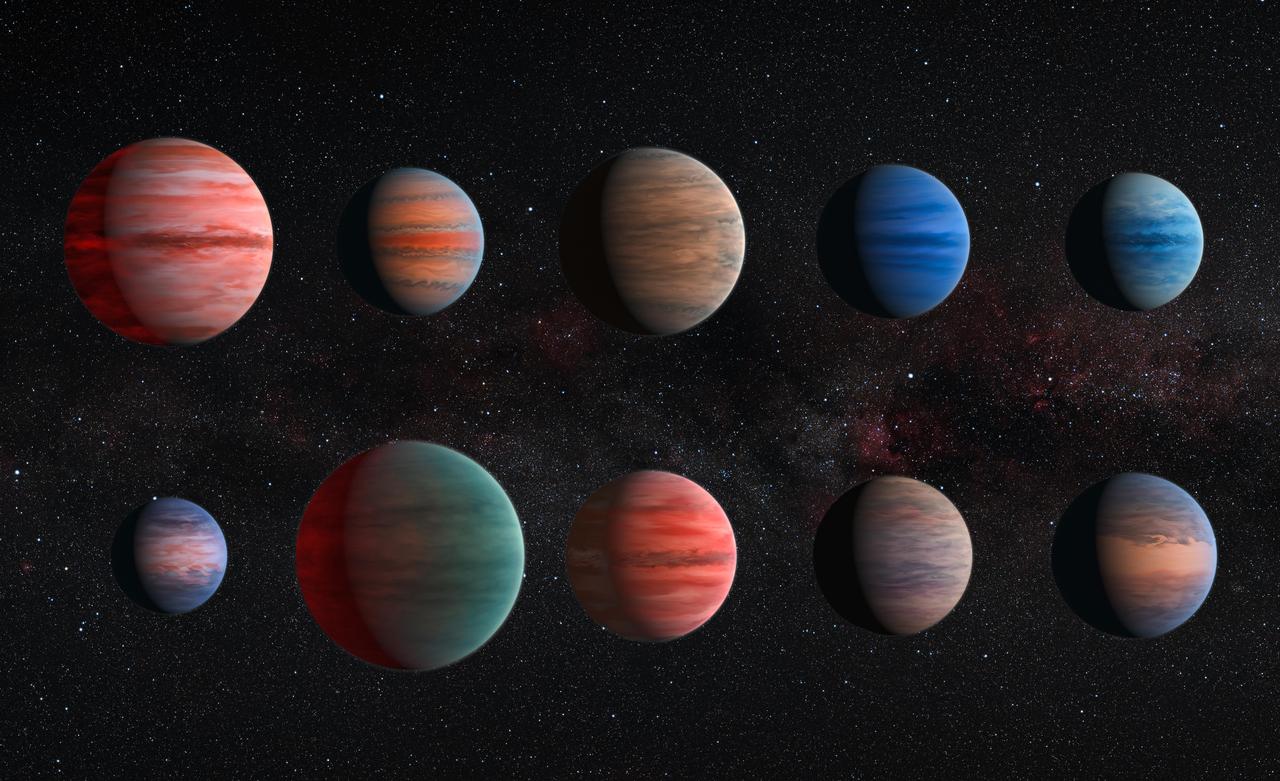
This image shows an artist's impression of the 10 hot Jupiter exoplanets studied using the Hubble and Spitzer space telescopes. From top left to lower left, these planets are WASP-12b, WASP-6b, WASP-31b, WASP-39b, HD 189733b, HAT-P-12b, WASP-17b, WASP-19b, HAT-P-1b and HD 209458b. The colors of the planets are for illustration purposes only. There is little scientific data on color with the exception of HD 189733b, which became known as the "blue planet." The planets are also depicted with a variety of different cloud properties. The wind patterns shown on these 10 planets, which resemble the visible structures on Jupiter, are based on theoretical models. The illustrations are to scale with each other. HAT-P-12b, the smallest of these planets, is approximately the size of Jupiter, while WASP-17b, the largest one in the sample, is almost twice the size. The hottest planets within the sample are portrayed with a glowing night side. This effect is strongest on WASP-12b, the hottest exoplanet in the sample, but also visible on WASP-19b and WASP-17b. It is also known that several of the planets exhibit strong Rayleigh scattering. This effect causes the blue hue of the daytime sky and the reddening of the sun at sunset on Earth. It is also visible as a blue edge on the planets WASP-6b, HD 189733b, HAT-P-12b and HD 209458b. http://photojournal.jpl.nasa.gov/catalog/PIA20056
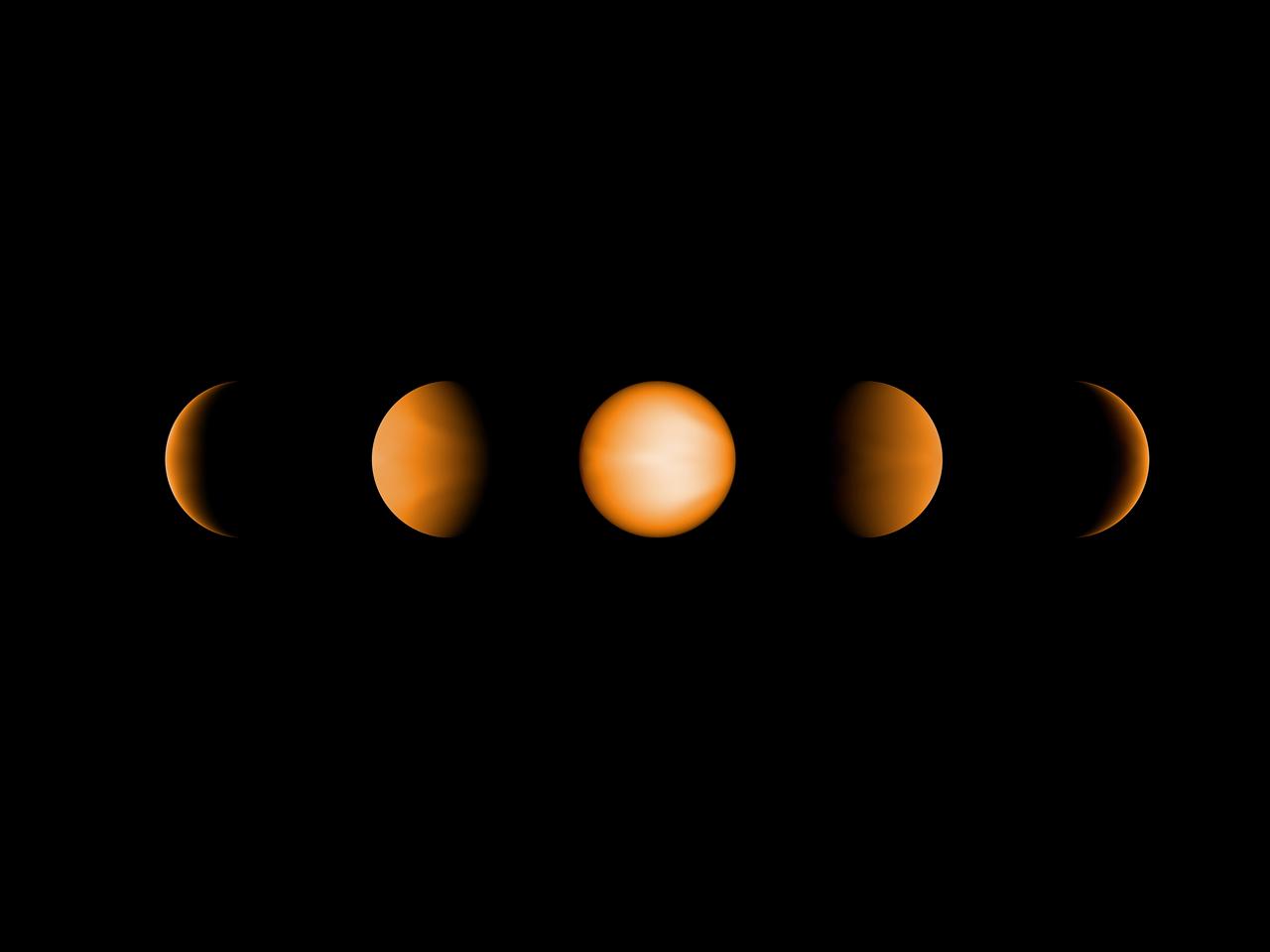
These simulated views of the ultrahot Jupiter WASP-121b show what the planet might look like to the human eye from five different vantage points, illuminated to different degrees by its parent star. The images were created using a computer simulation being used to help scientists understand the atmospheres of these ultra-hot planets. Ultrahot Jupiters reflect almost no light, rather like charcoal. However, the daysides of ultrahot Jupiters have temperatures of between 3600°F and 5400°F (2000°C and 3000°C), so the planets produce their own glow, like a hot ember. The orange color in this simulated image is thus from the planet's own heat. The computer model was based on observations of WASP-121b conducted using NASA's Spitzer and Hubble space telescopes. https://photojournal.jpl.nasa.gov/catalog/PIA22565
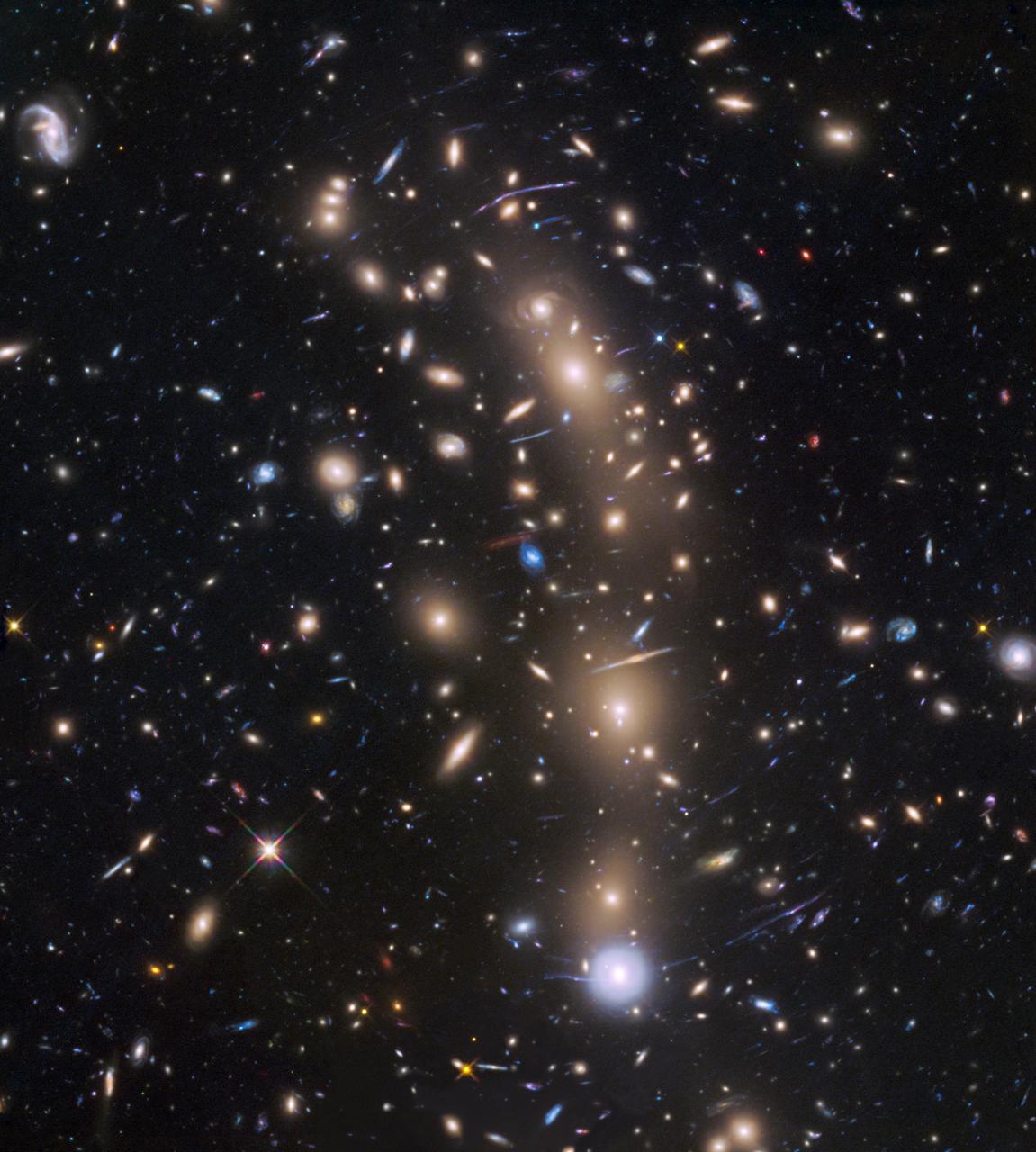
This is a Hubble Space Telescope view of a very massive cluster of galaxies, MACS J0416.1-2403, located roughly 4 billion light-years away and weighing as much as a million billion suns. The cluster's immense gravitational field magnifies the image of galaxies far behind it, in a phenomenon called gravitational lensing. The inset is an image of an extremely faint and distant galaxy that existed only 400 million years after the big bang. It was discovered by Hubble and NASA's Spitzer Space Telescope. The gravitational lens makes the galaxy appear 20 times brighter than normal. The galaxy is comparable in size to the Large Magellanic Cloud (LMC), a diminutive satellite galaxy of our Milky Way. It is rapidly making stars at a rate ten times faster than the LMC. This might be the growing core of what was to eventually evolve into a full-sized galaxy. The research team has nicknamed the object Tayna, which means "first-born" in Aymara, a language spoken in the Andes and Altiplano regions of South America. http://photojournal.jpl.nasa.gov/catalog/PIA20054
![In celebration of the International Year of Astronomy 2009, NASA's Great Observatories -- the Hubble Space Telescope, the Spitzer Space Telescope, and the Chandra X-ray Observatory -- have produced a matched trio of images of the central region of our Milky Way galaxy. Each image shows the telescope's different wavelength view of the galactic center region, illustrating the unique science each observatory conducts. In this spectacular image, observations using infrared light and X-ray light see through the obscuring dust and reveal the intense activity near the galactic core. Note that the center of the galaxy is located within the bright white region to the right of and just below the middle of the image. The entire image width covers about one-half a degree, about the same angular width as the full moon. Spitzer's infrared-light observations provide a detailed and spectacular view of the galactic center region [Figure 1 (top frame of poster)]. The swirling core of our galaxy harbors hundreds of thousands of stars that cannot be seen in visible light. These stars heat the nearby gas and dust. These dusty clouds glow in infrared light and reveal their often dramatic shapes. Some of these clouds harbor stellar nurseries that are forming new generations of stars. Like the downtown of a large city, the center of our galaxy is a crowded, active, and vibrant place. Although best known for its visible-light images, Hubble also observes over a limited range of infrared light [Figure 2 (middle frame of poster)]. The galactic center is marked by the bright patch in the lower right. Along the left side are large arcs of warm gas that have been heated by clusters of bright massive stars. In addition, Hubble uncovered many more massive stars across the region. Winds and radiation from these stars create the complex structures seen in the gas throughout the image.This sweeping panorama is one of the sharpest infrared pictures ever made of the galactic center region. X-rays detected by Chandra expose a wealth of exotic objects and high-energy features [Figure 3 (bottom frame of poster)]. In this image, pink represents lower energy X-rays and blue indicates higher energy. Hundreds of small dots show emission from material around black holes and other dense stellar objects. A supermassive black hole -- some four million times more massive than the Sun -- resides within the bright region in the lower right. The diffuse X-ray light comes from gas heated to millions of degrees by outflows from the supermassive black hole, winds from giant stars, and stellar explosions. This central region is the most energetic place in our galaxy. http://photojournal.jpl.nasa.gov/catalog/PIA12348](https://images-assets.nasa.gov/image/PIA12348/PIA12348~medium.jpg)
In celebration of the International Year of Astronomy 2009, NASA's Great Observatories -- the Hubble Space Telescope, the Spitzer Space Telescope, and the Chandra X-ray Observatory -- have produced a matched trio of images of the central region of our Milky Way galaxy. Each image shows the telescope's different wavelength view of the galactic center region, illustrating the unique science each observatory conducts. In this spectacular image, observations using infrared light and X-ray light see through the obscuring dust and reveal the intense activity near the galactic core. Note that the center of the galaxy is located within the bright white region to the right of and just below the middle of the image. The entire image width covers about one-half a degree, about the same angular width as the full moon. Spitzer's infrared-light observations provide a detailed and spectacular view of the galactic center region [Figure 1 (top frame of poster)]. The swirling core of our galaxy harbors hundreds of thousands of stars that cannot be seen in visible light. These stars heat the nearby gas and dust. These dusty clouds glow in infrared light and reveal their often dramatic shapes. Some of these clouds harbor stellar nurseries that are forming new generations of stars. Like the downtown of a large city, the center of our galaxy is a crowded, active, and vibrant place. Although best known for its visible-light images, Hubble also observes over a limited range of infrared light [Figure 2 (middle frame of poster)]. The galactic center is marked by the bright patch in the lower right. Along the left side are large arcs of warm gas that have been heated by clusters of bright massive stars. In addition, Hubble uncovered many more massive stars across the region. Winds and radiation from these stars create the complex structures seen in the gas throughout the image.This sweeping panorama is one of the sharpest infrared pictures ever made of the galactic center region. X-rays detected by Chandra expose a wealth of exotic objects and high-energy features [Figure 3 (bottom frame of poster)]. In this image, pink represents lower energy X-rays and blue indicates higher energy. Hundreds of small dots show emission from material around black holes and other dense stellar objects. A supermassive black hole -- some four million times more massive than the Sun -- resides within the bright region in the lower right. The diffuse X-ray light comes from gas heated to millions of degrees by outflows from the supermassive black hole, winds from giant stars, and stellar explosions. This central region is the most energetic place in our galaxy. http://photojournal.jpl.nasa.gov/catalog/PIA12348

Every second a star somewhere out in the universe explodes as a supernova. But some extremely massive stars go out with a whimper instead of a bang. When they do, they can collapse under the crushing tug of gravity and vanish out of sight, only to leave behind a black hole. The doomed star N6946-BH1 was 25 times as massive as our sun. It began to brighten weakly in 2009. But, by 2015, it appeared to have winked out of existence. By a careful process of elimination, based on observations by the Large Binocular Telescope and NASA's Hubble and Spitzer space telescopes, researchers eventually concluded that the star must have become a black hole. This may be the fate for extremely massive stars in the universe. This illustration shows the final stages in the life of a supermassive star that fails to explode as a supernova, but instead implodes to form a black hole. https://photojournal.jpl.nasa.gov/catalog/PIA21466

In the summer of the year 1054 AD, Chinese astronomers saw a new "guest star," that appeared six times brighter than Venus. So bright in fact, it could be seen during the daytime for several months. This "guest star" was forgotten about until 700 years later with the advent of telescopes. Astronomers saw a tentacle-like nebula in the place of the vanished star and called it the Crab Nebula. Today we know it as the expanding gaseous remnant from a star that self-detonated as a supernova, briefly shining as brightly as 400 million suns. The explosion took place 6,500 light-years away. If the blast had instead happened 50 light-years away it would have irradiated Earth, wiping out most life forms. In the late 1960s astronomers discovered the crushed heart of the doomed star, an ultra-dense neutron star that is a dynamo of intense magnetic field and radiation energizing the nebula. Astronomers therefore need to study the Crab Nebula across a broad range of electromagnetic radiation, from X-rays to radio waves. This image combines data from five different telescopes: the VLA (radio) in red; Spitzer Space Telescope (infrared) in yellow; Hubble Space Telescope (visible) in green; XMM-Newton (ultraviolet) in blue; and Chandra X-ray Observatory (X-ray) in purple. More images and an animation are available at https://photojournal.jpl.nasa.gov/catalog/PIA21474
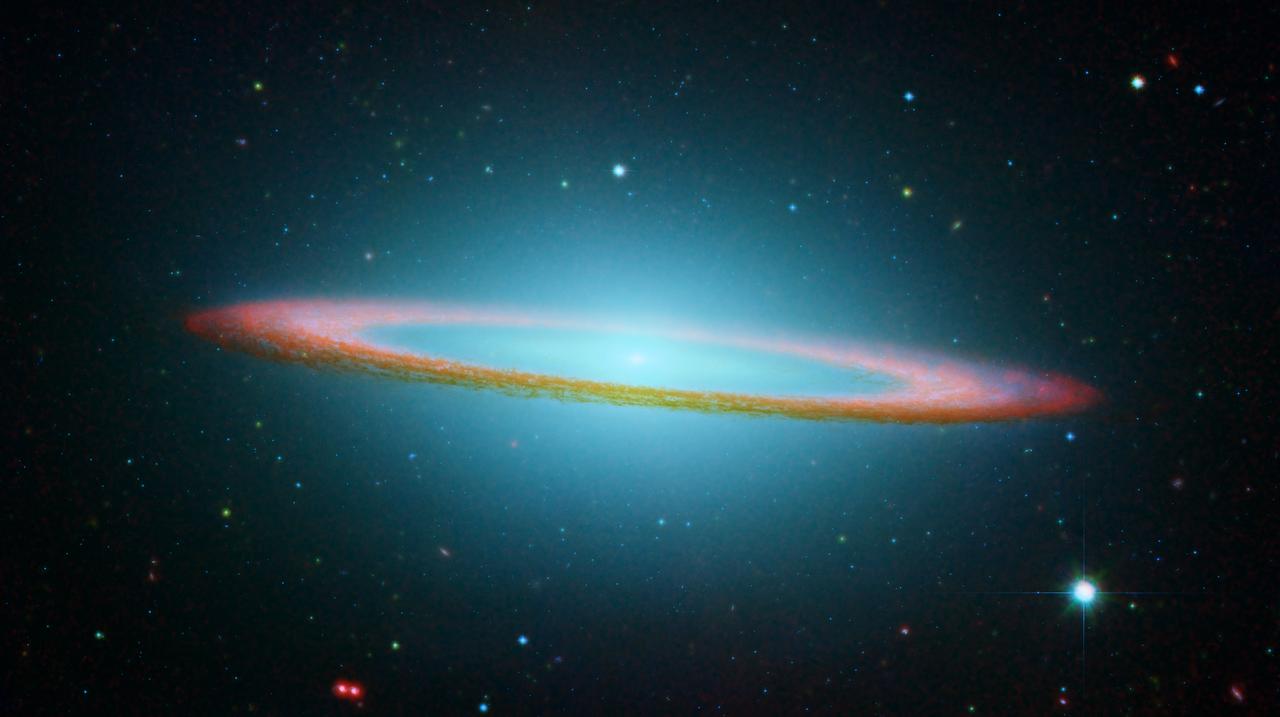
The razor sharp eye of the Hubble Space Telescope (HST) easily resolves the Sombrero galaxy, Messier 104 (M104). 50,000 light-years across, the galaxy is located 28 million light-years from Earth at the southern edge of the rich Virgo cluster of galaxies. Equivalent to 800 billion suns, Sombrero is one of the most massive objects in that group. The hallmark of Sombrero is a brilliant white, bulbous core encircled by the thick dust lanes comprising the spiral structure of the galaxy. As seen from Earth, the galaxy is tilted nearly edge-on. We view it from just six degrees north of its equatorial plane. This rich system of globular clusters is estimated to be nearly 2,000 in number which is 10 times as many as in our Milky Way galaxy. Similar to the clusters in the Milky Way, the ages range from 10-13 billion years old. Embedded in the bright core of M104 is a smaller disk, which is tilted relative to the large disk. The HST paired with the Spitzer infrared telescope, offers this striking composite capturing the magnificence of the Sombrero galaxy. In the Hubble view, the galaxy resembles a broad-rimmed Mexican hat, whereas in the Spitzer striking infrared view, the galaxy looks more like a bulls eye. The full view provided by Spitzer shows the disk is warped, which is often the result of a gravitational encounter with another galaxy, and clumpy areas spotted in the far edges of the ring indicate young star forming regions. Spitzer detected infrared emission not only from the ring, but from the center of the galaxy as well, where there is a huge black hole believed to be a billion times more massive than our Sun. The Marshall Space Flight Center (MSFC) had responsibility for design, development, and construction of the HST.
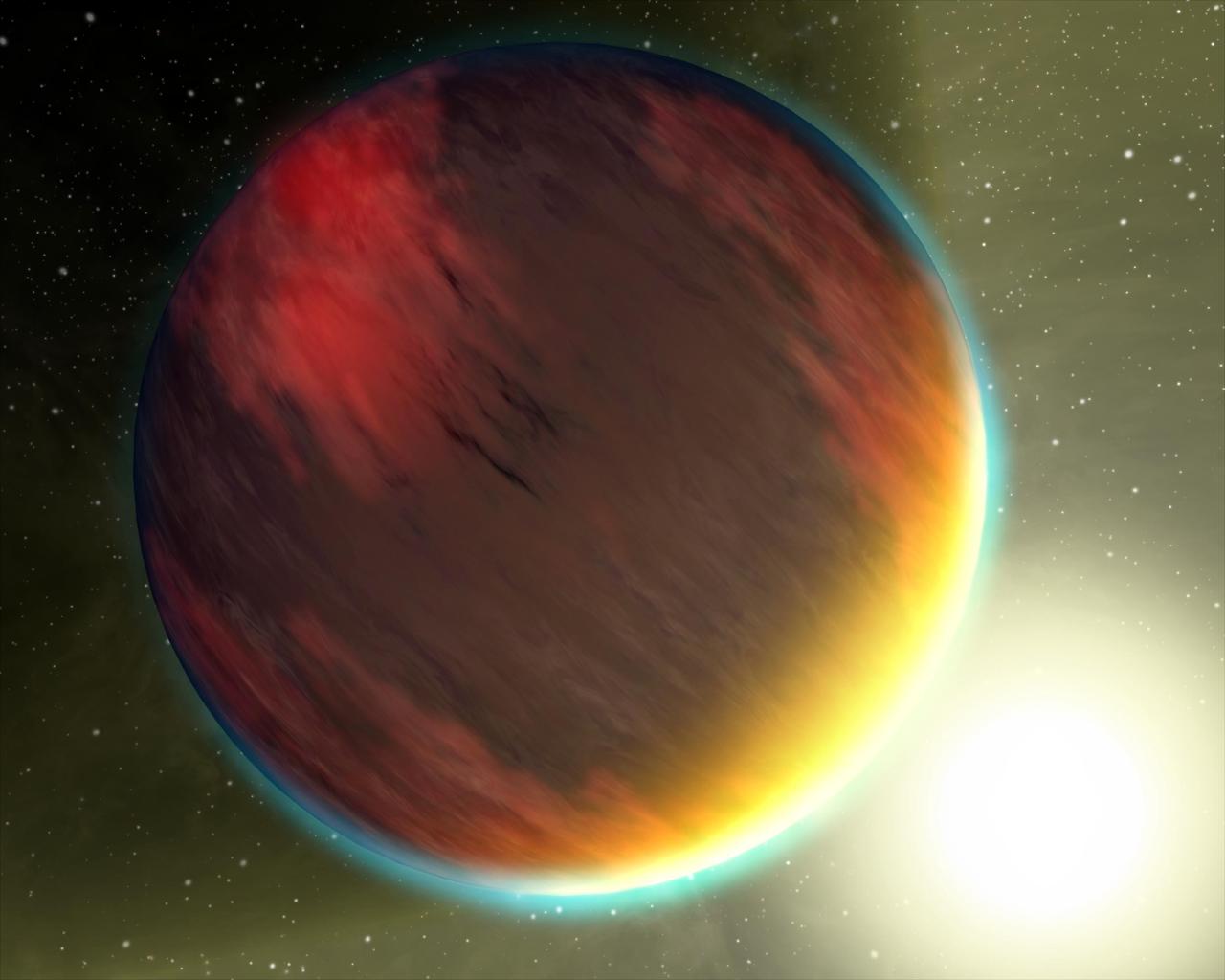
This artist concept, based on spectral observations from NASA Hubble Space Telescope and Spitzer Space Telescope, shows a cloudy Jupiter-like planet that orbits very close to its fiery hot star.
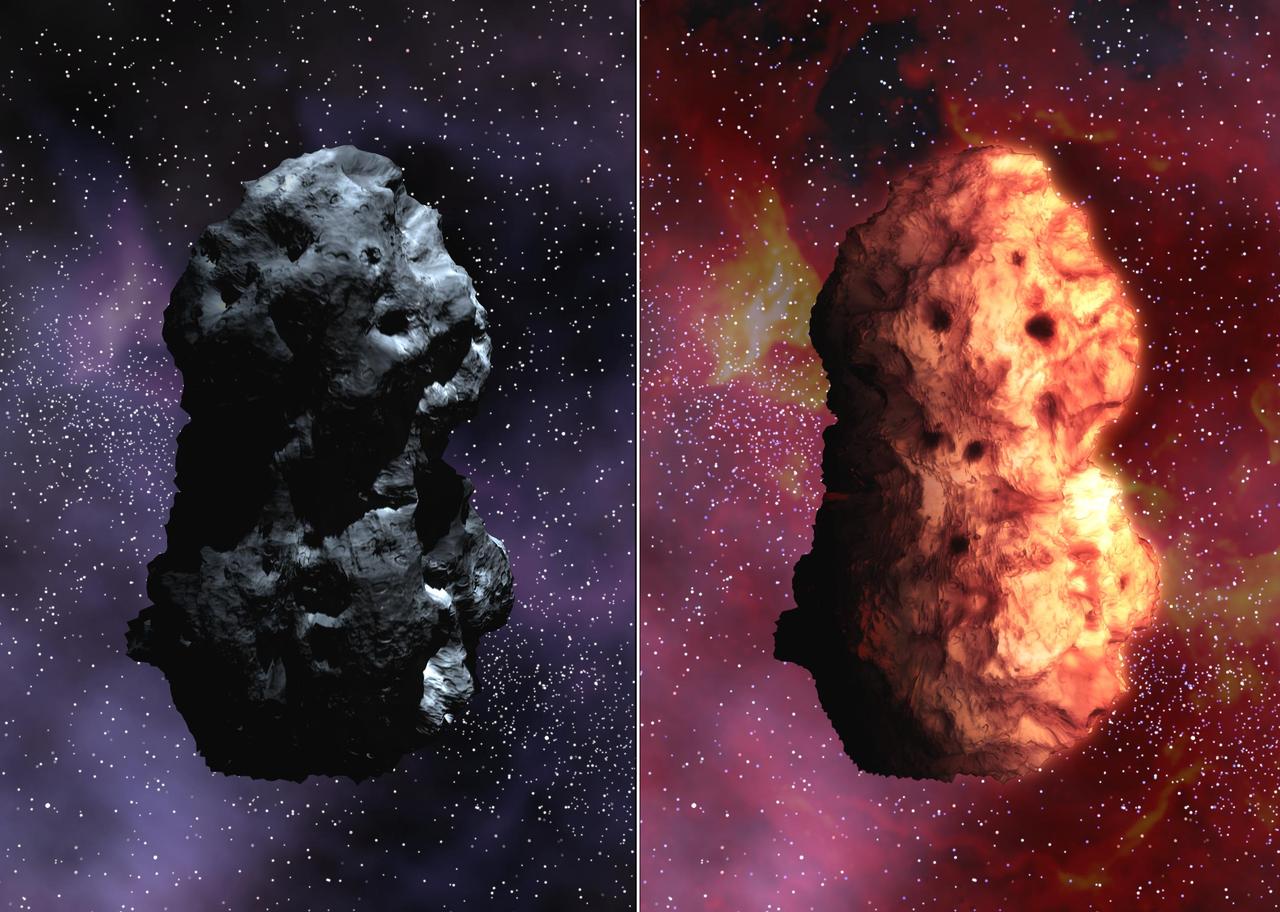
These artist concepts illustrate Tempel 1 shape, reflectivity, rotation rate and surface temperature, based on information from NASA Hubble Space Telescope and Spitzer Space Telescope.
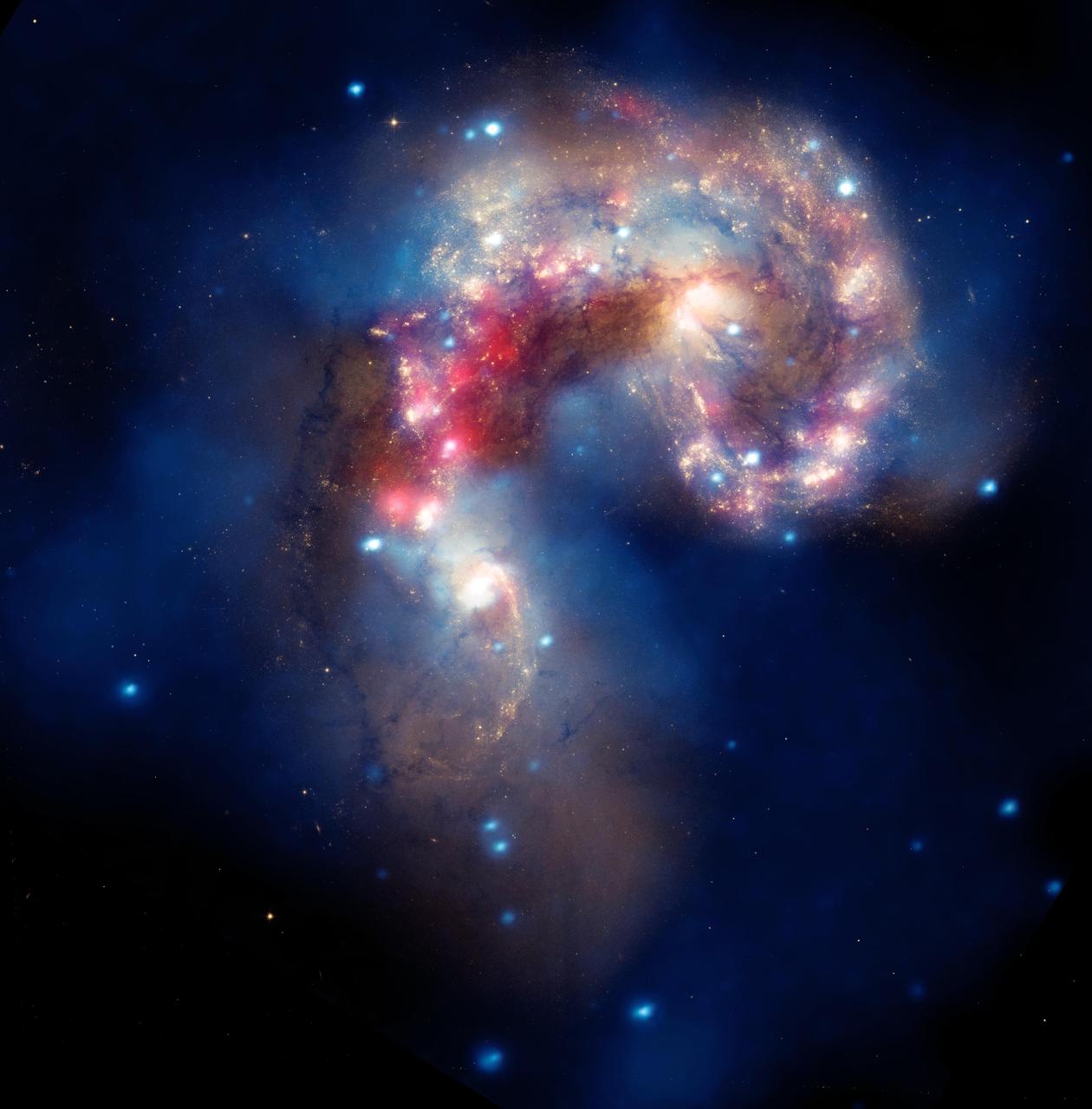
This image of two tangled galaxies has been released by NASA Great Observatories. The Antennae galaxies are shown in this composite image from the Chandra X-ray Observatory, the Hubble Space Telescope, and the Spitzer Space Telescope.
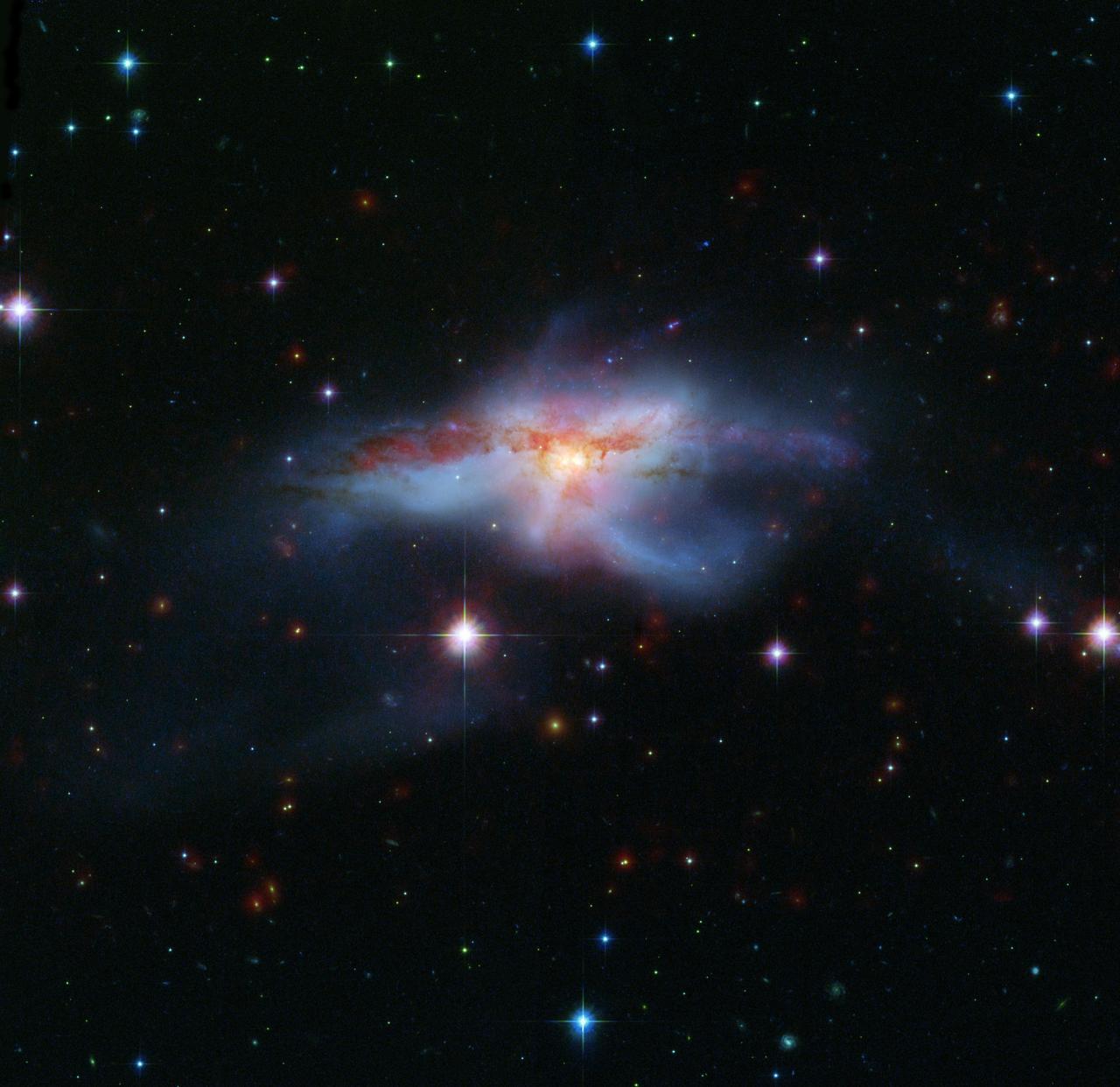
NASA Spitzer Space Telescope and Hubble Space Telescope combined to make this image of a pair of colliding galaxies called NGC 6240 shows them in a rare, short-lived phase of their evolution just before they merge into a single, larger galaxy.
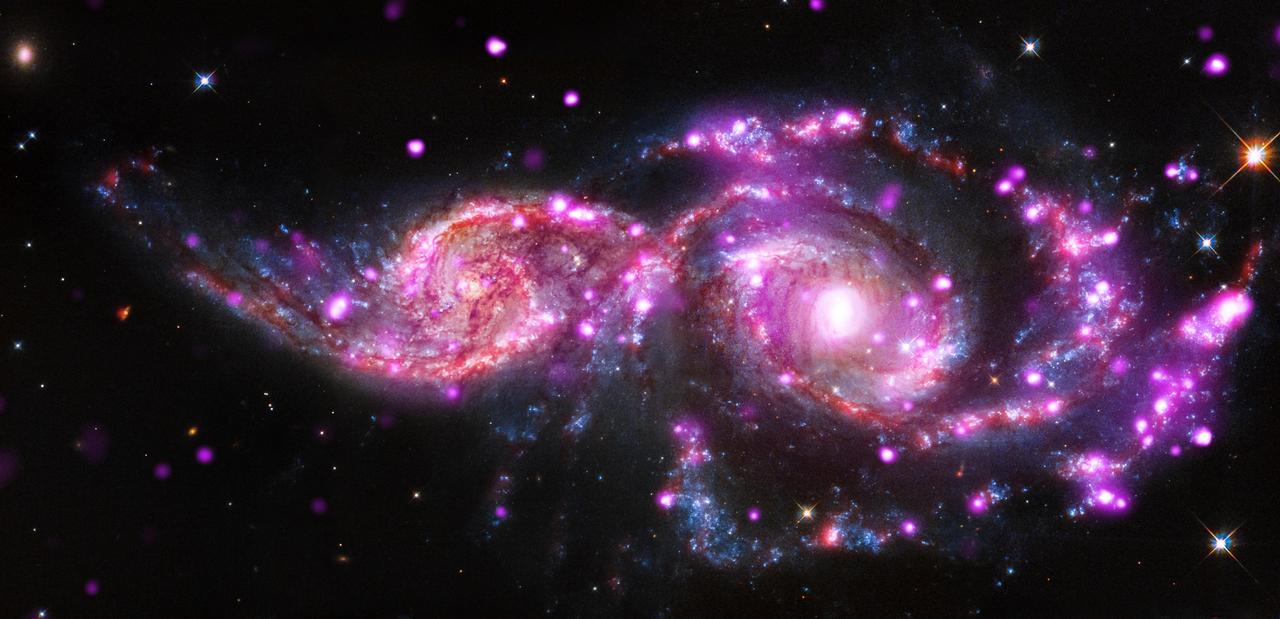
This composite image of NGC 2207 and IC 2163 contains Chandra data in pink, optical-light data from NASA Hubble Space Telescope in red, green, and blue appearing as blue, white, orange, and brown, and infrared data from Spitzer Space Telescope in red.
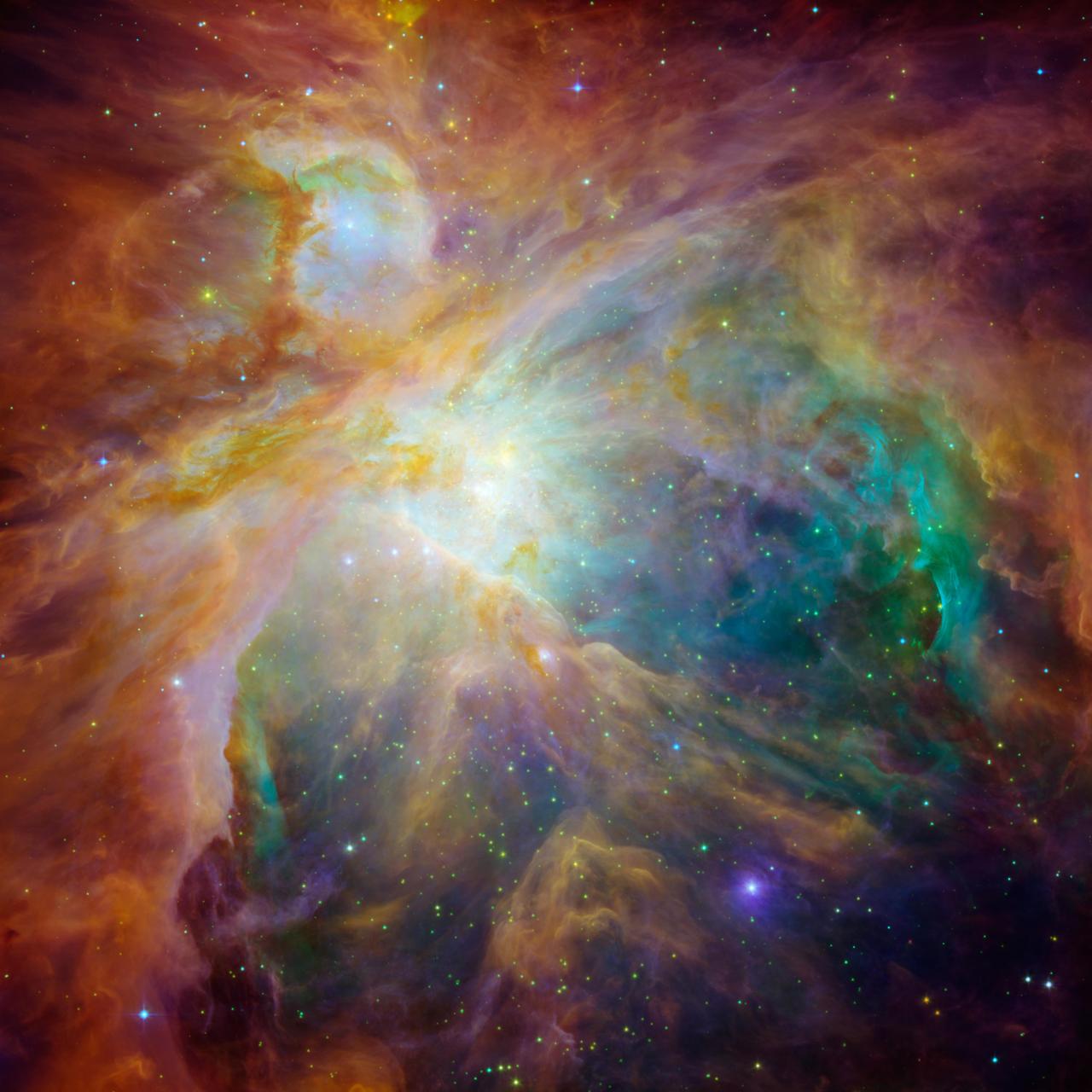
NASA Spitzer and Hubble Space Telescopes have teamed up to expose the chaos that baby stars are creating 1,500 light-years away in a cosmic cloud called the Orion nebula.
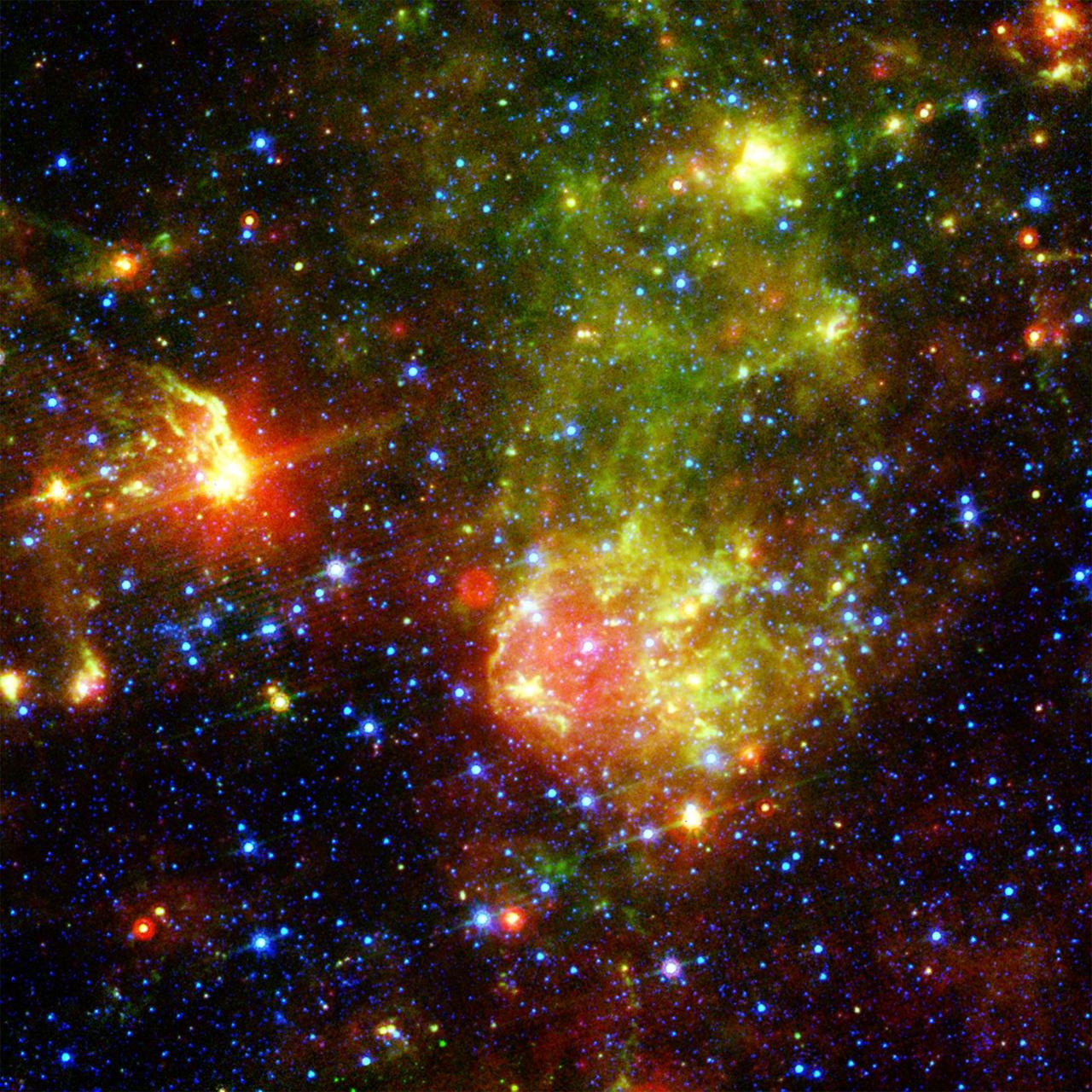
NASA Spitzer Space Telescope shows the supernova remnant 1E0102.2-7219 sits next to the nebula N76 in a bright, star-forming region of the Small Magellanic Cloud, a satellite galaxy to our Milky Way galaxy.
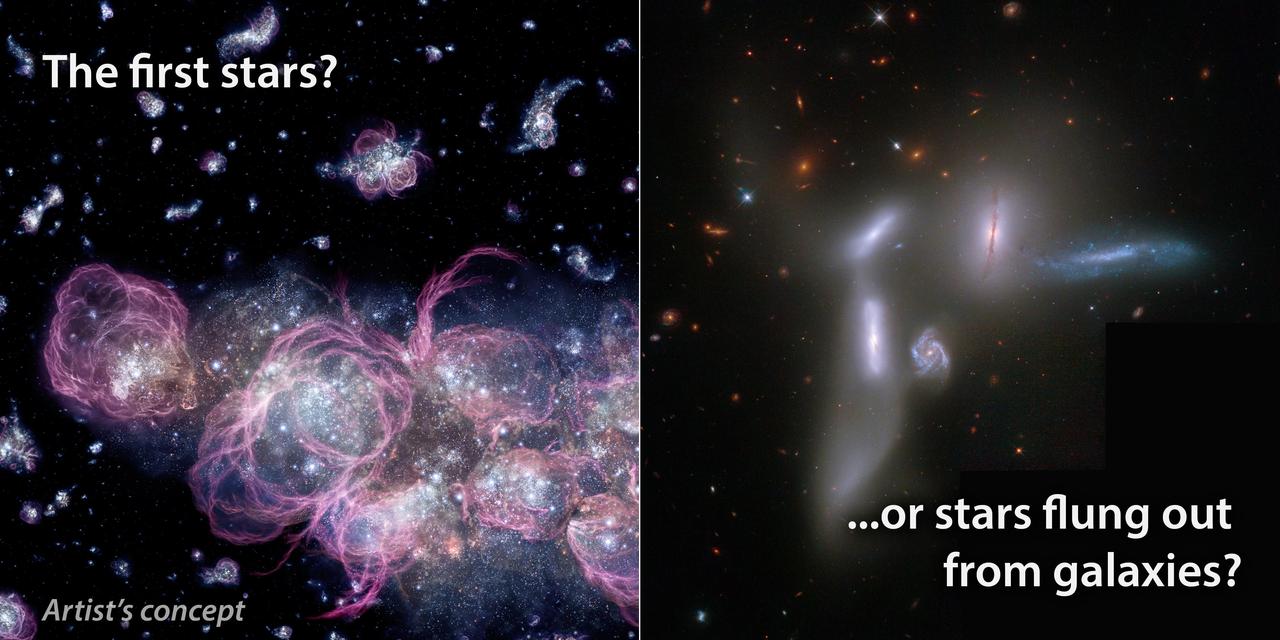
Our sky is filled with a diffuse background glow, known as the cosmic infrared background. Much of the light is from galaxies we know about, but previous Spitzer measurements have shown an extra component of unknown origin.
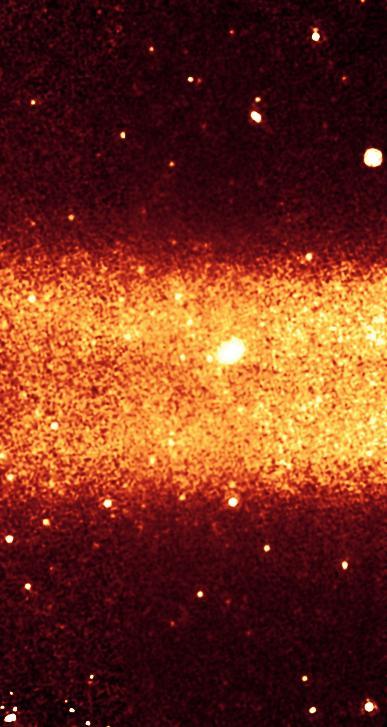
This picture highlights a slice of Saturn largest ring. The ring red band was discovered by NASA Spitzer Space Telescope, which detected infrared light, or heat, from the dusty ring material.
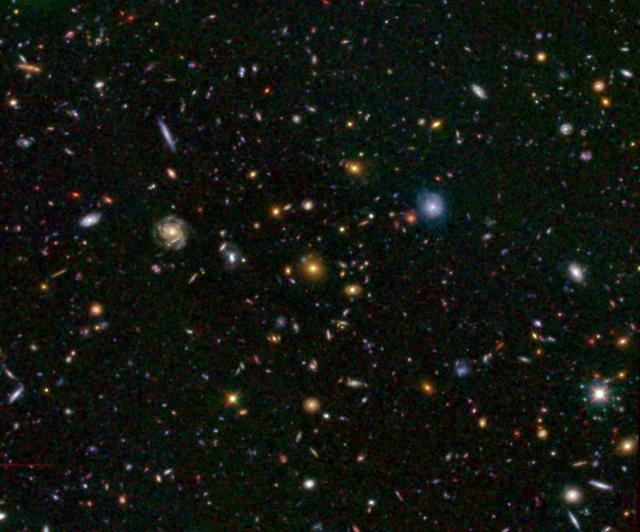
This image from NASA Hubble telescope shows one of the most distant galaxies known, called GN-108036, dating back to 750 million years after the Big Bang that created our universe. The galaxy light took 12.9 billion years to reach us.
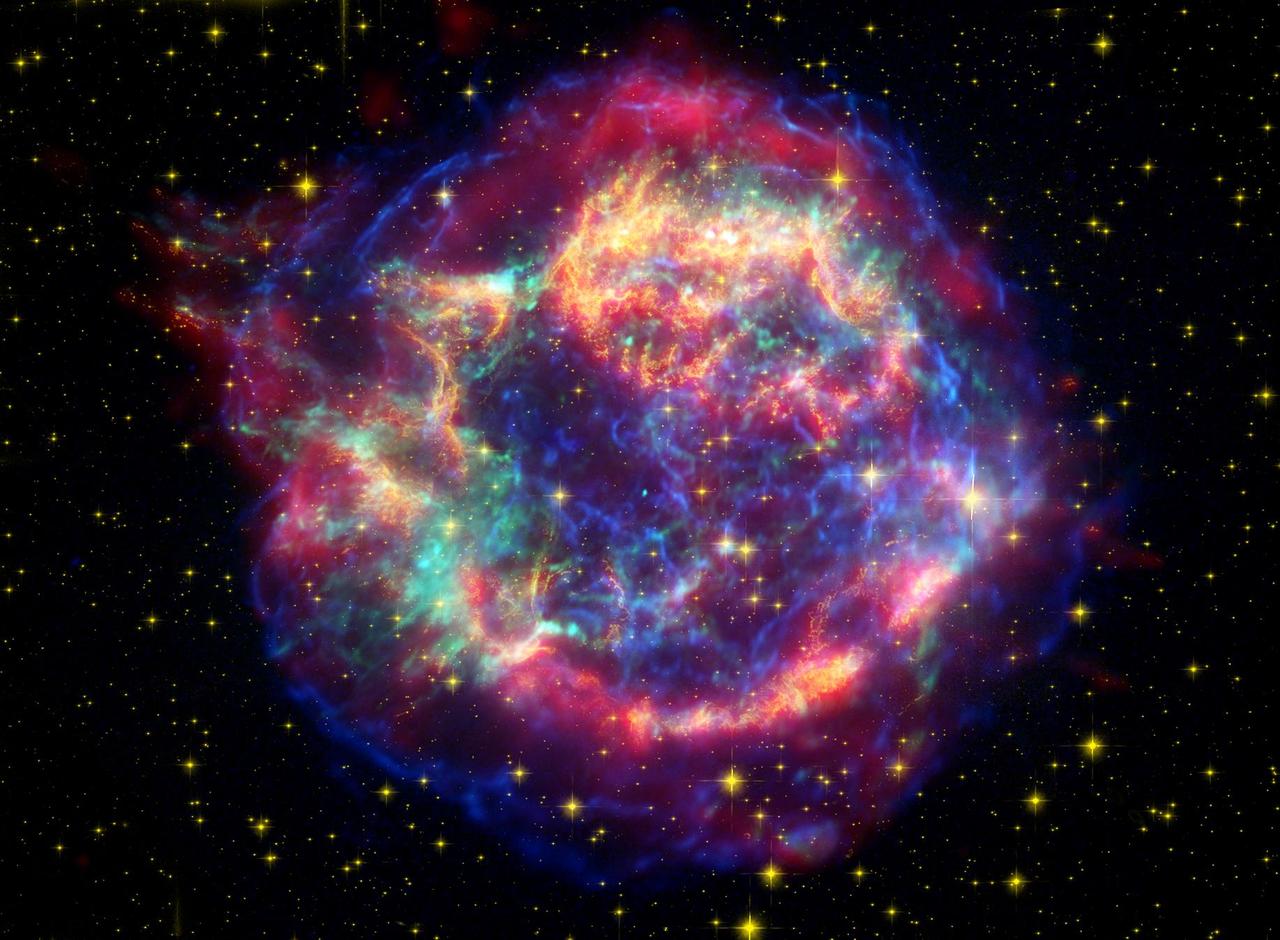
This false-color image from three of NASA Great Observatories provides one example of a star that died in a fiery supernova blast. Called Cassiopeia A, this supernova remnant is located 10,000 light-years away in the constellation Cassiopeia.
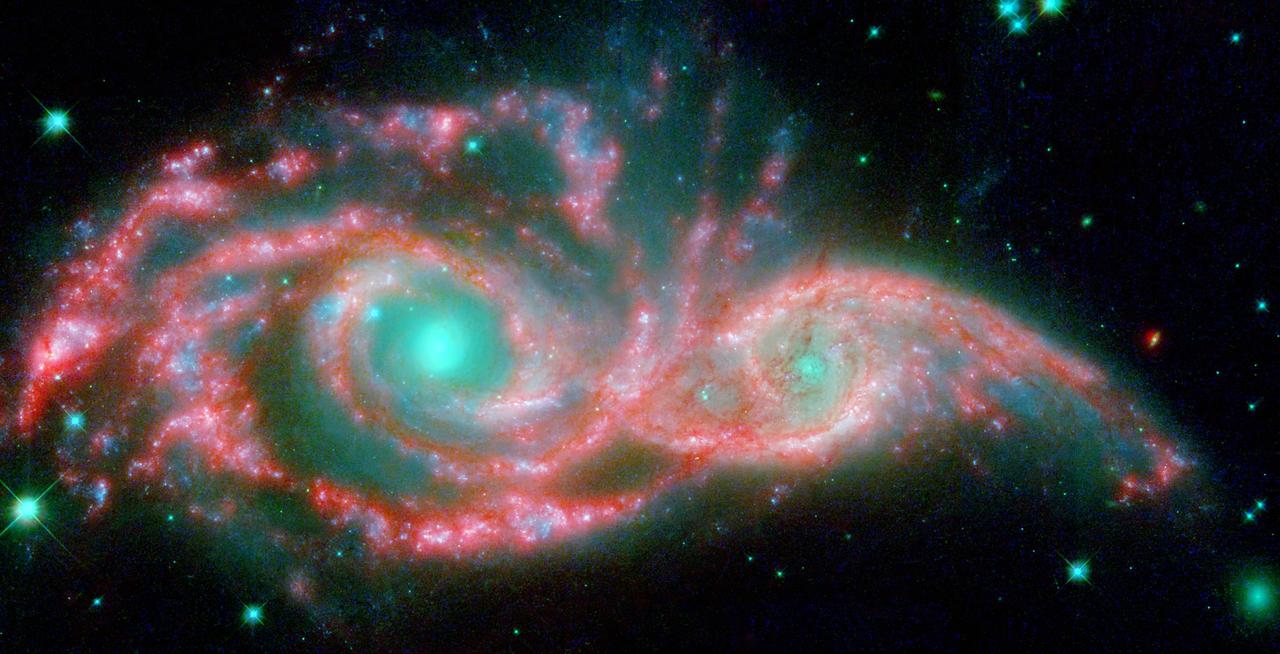
NASA Hubble and Spitzer telescopes combined to make these shape-shifting galaxies taking on the form of a giant mask. The icy blue eyes are actually the cores of two merging galaxies, called NGC 2207 and IC 2163, and the mask is their spiral arms.
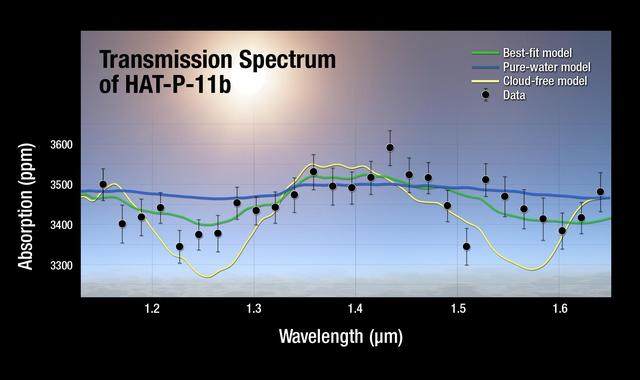
A plot of the transmission spectrum for exoplanet HAT-P-11b, with data from NASA Kepler, Hubble and Spitzer observatories combined. The results show a robust detection of water absorption in the Hubble data.
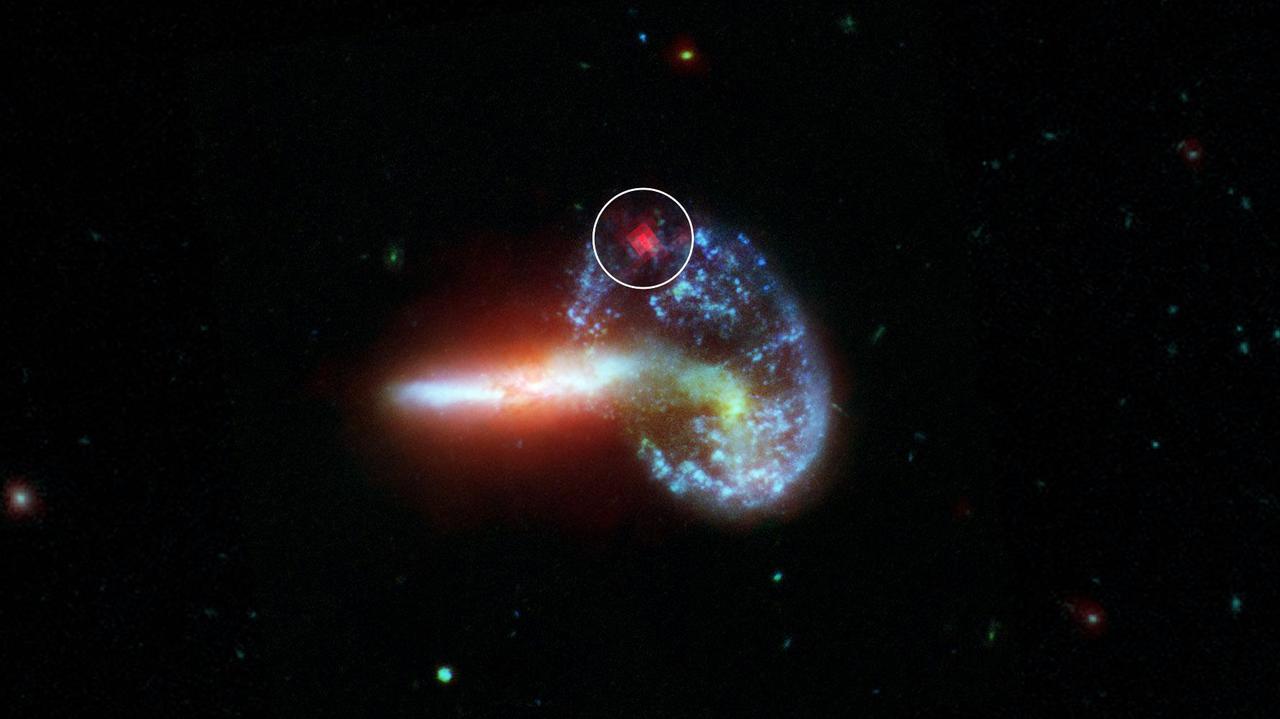
This image shows galaxy Arp 148, captured by NASA's Spitzer and Hubble telescopes. Inside the white circle is specially-processed Spitzer data, which reveals infrared light from a supernova that is hidden by dust. Supernovae are massive stars that have exploded after running out of fuel. They radiate most brightly in visible light (the kind the human eye can detect), but these wavelengths are obscured by dust. Infrared light, however, can pass through dust. The analysis of Arp 148 was part of an effort to find hidden supernovae in 40 dust-choked galaxies that also emit high levels of infrared light. These galaxies are known as luminous and ultra-luminous infrared galaxies (LIRGs and ULIRGs, respectively). The dust in LIRGs and ULIRGs absorbs optical light from objects like supernovae but allows infrared light from these same objects to pass through unobstructed for telescopes like Spitzer to detect. https://photojournal.jpl.nasa.gov/catalog/PIA24575
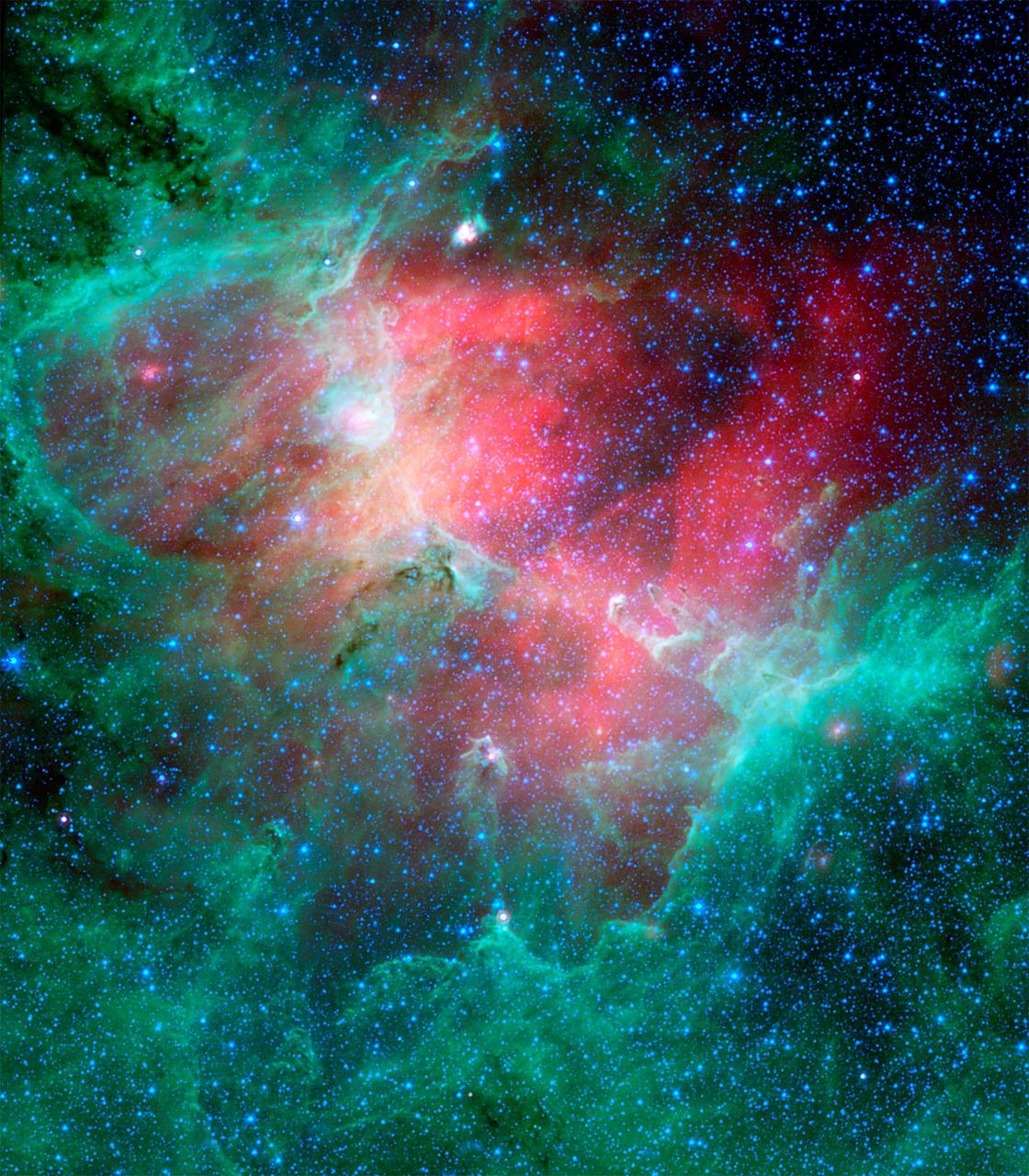
This majestic view taken by NASA Spitzer Space Telescope tells an untold story of life and death in the Eagle nebula, an industrious star-making factory located 7,000 light-years away in the Serpens constellation.

A Neptune-size planet with a clear atmosphere is shown crossing in front of its star in this artist depiction. Such crossings, or transits, are observed by telescopes like NASA Hubble and Spitzer to glean information about planets atmospheres.
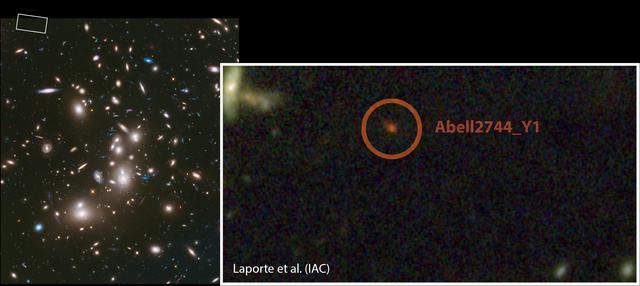
This image of the galaxy cluster Abell 2744 was obtained with NASA Hubble Space Telescope. The zoomed image shows the region around the galaxy Abell2744_Y1, one of the most distant galaxy candidates known.

Artist impression of a firestorm of star birth deep inside core of young, growing elliptical galaxy.
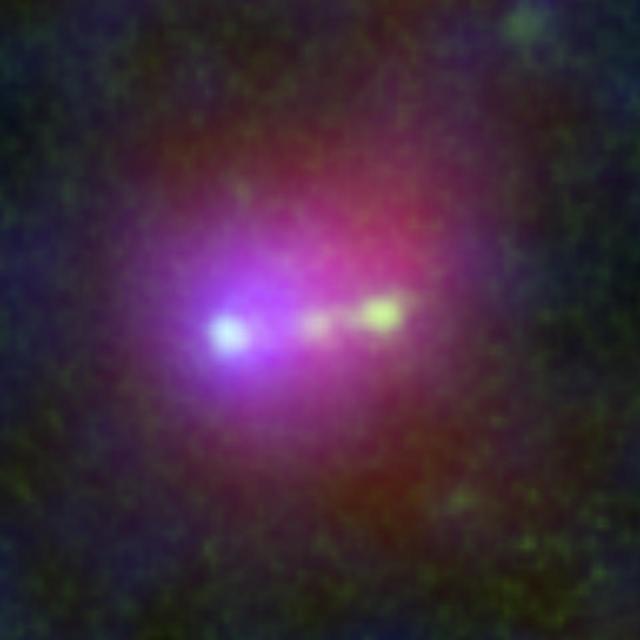
The big blob-like structure shown here, named Himiko after the legendary ancient queen of Japan, turns out to be three galaxies thought to be in the process of merging into one.
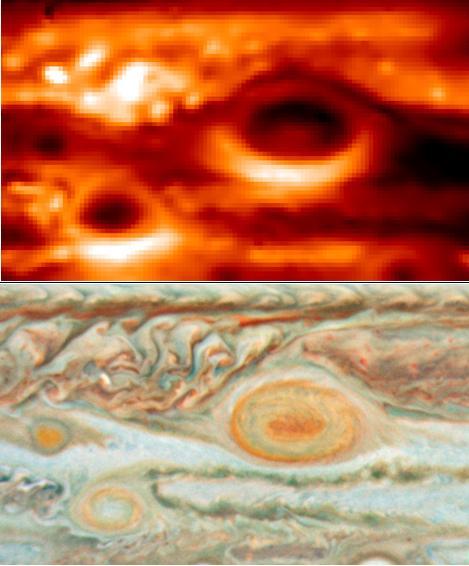
New thermal images from powerful ground-based telescopes show swirls of warmer air and cooler regions never seen before within Jupiter Great Red Spot.
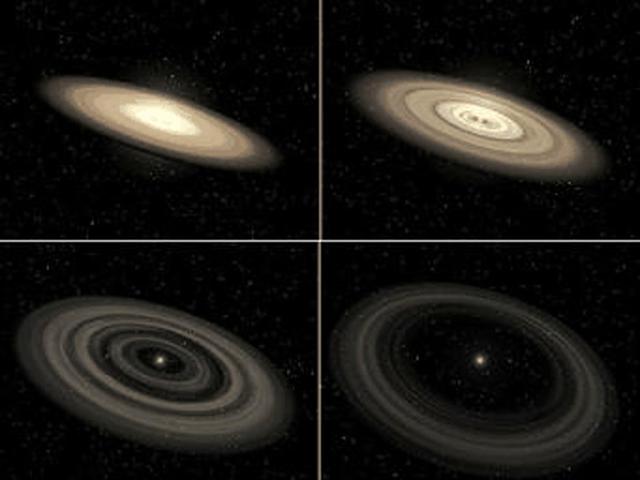
This frame from an animation shows the evolution of a planet-forming disk around a star. Initially, the young disk is bright and thick with dust, providing raw materials for building planets. In the first 10 million years or so, gaps appear within the disk as newborn planets coalesce out of the dust, clearing out a path. In time, this planetary "debris disk" thins out as gravitational interactions with numerous planets slowly sweep away the dust. Steady pressure from the starlight and solar winds also blows out the dust. After a few billion years, only a thin ring remains in the outermost reaches of the system, a faint echo of the once-brilliant disk. Our own solar system has a similar debris disk -- a ring of comets called the Kuiper Belt. Leftover dust in the inner portion of the solar system is known as "zodiacal dust." Bright, young disks can be imaged directly by visible-light telescopes, such as NASA's Hubble Space Telescope. Older, fainter debris disks can be detected only by infrared telescopes like NASA's Spitzer Space Telescope, which sense the disks' dim heat. http://photojournal.jpl.nasa.gov/catalog/PIA07099
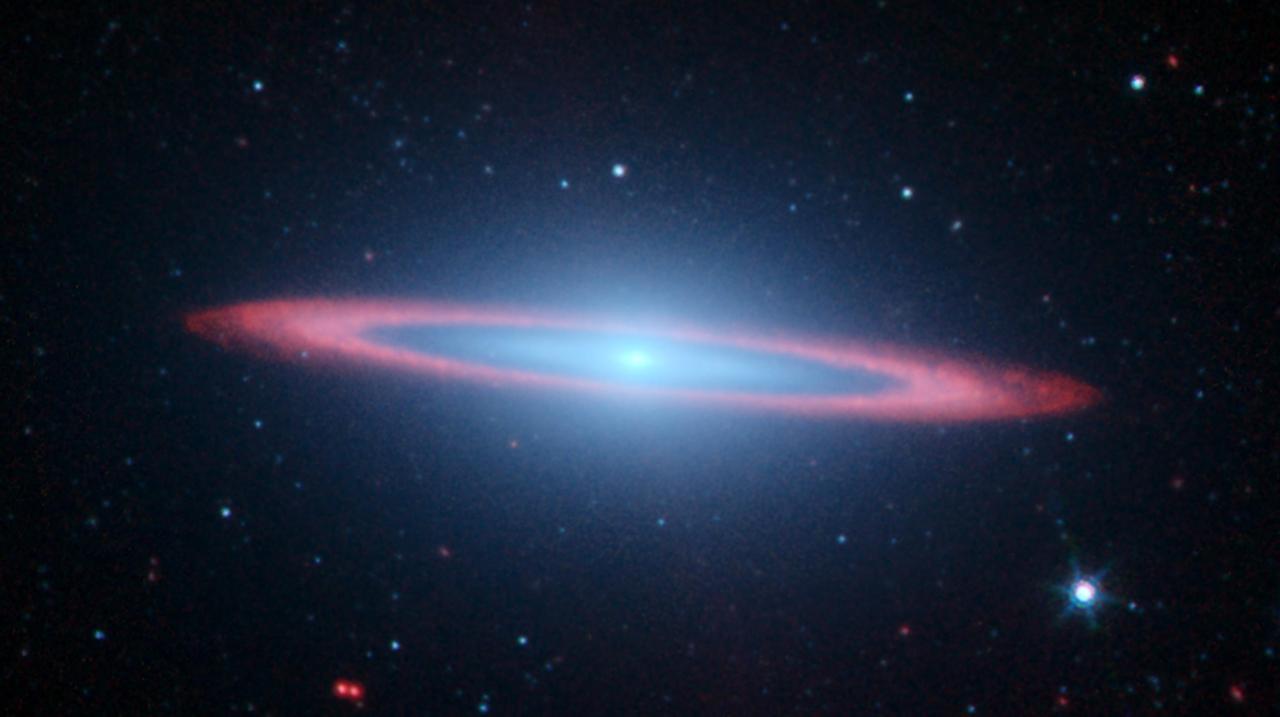
NASA's Spitzer Space Telescope set its infrared eyes on one of the most famous objects in the sky, Messier 104, also called the Sombrero galaxy. In this striking infrared picture, Spitzer sees an exciting new view of a galaxy that in visible light has been likened to a "sombrero," but here looks more like a "bulls-eye." Recent observations using Spitzer's infrared array camera uncovered the bright, smooth ring of dust circling the galaxy, seen in red. In visible light, because this galaxy is seen nearly edge-on, only the near rim of dust can be clearly seen in silhouette. Spitzer's full view shows the disk is warped, which is often the result of a gravitational encounter with another galaxy, and clumpy areas spotted in the far edges of the ring indicate young star-forming regions. Spitzer's infrared view of the starlight from this galaxy, seen in blue, can pierce through obscuring murky dust that dominates in visible light. As a result, the full extent of the bulge of stars and an otherwise hidden disk of stars within the dust ring are easily seen. The Sombrero galaxy is located some 28 million light years away. Viewed from Earth, it is just six degrees south of its equatorial plane. Spitzer detected infrared emission not only from the ring, but from the center of the galaxy too, where there is a huge black hole, believed to be a billion times more massive than our Sun. This picture is composed of four images taken at 3.6 (blue), 4.5 (green), 5.8 (orange), and 8.0 (red) microns. The contribution from starlight (measured at 3.6 microns) has been subtracted from the 5.8 and 8-micron images to enhance the visibility of the dust features. http://photojournal.jpl.nasa.gov/catalog/PIA07899
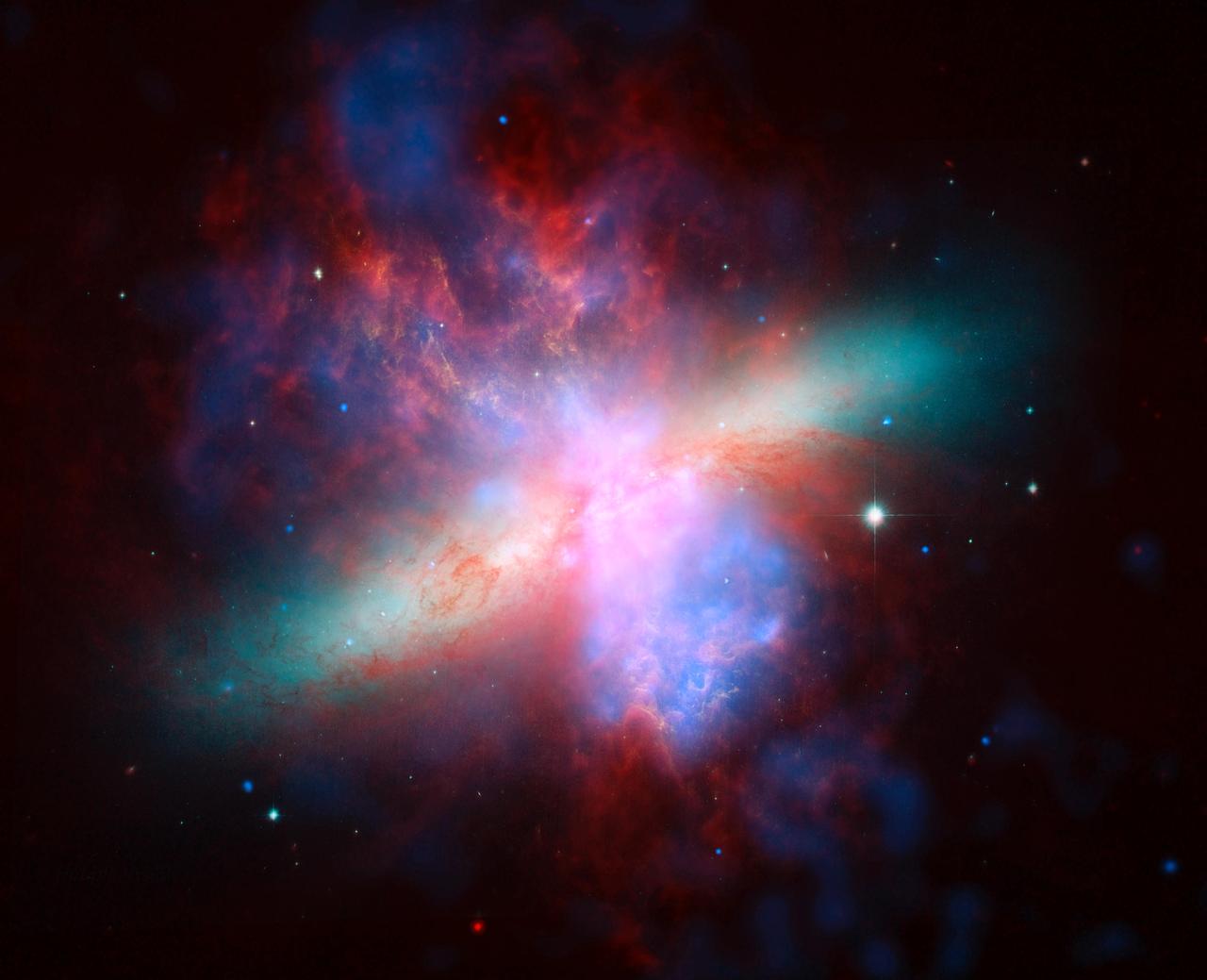
NASA Spitzer, Hubble and Chandra space observatories teamed up to create this multi-wavelength, false-colored view of the M82 galaxy. The lively portrait celebrates Hubble weet sixteen birthday.
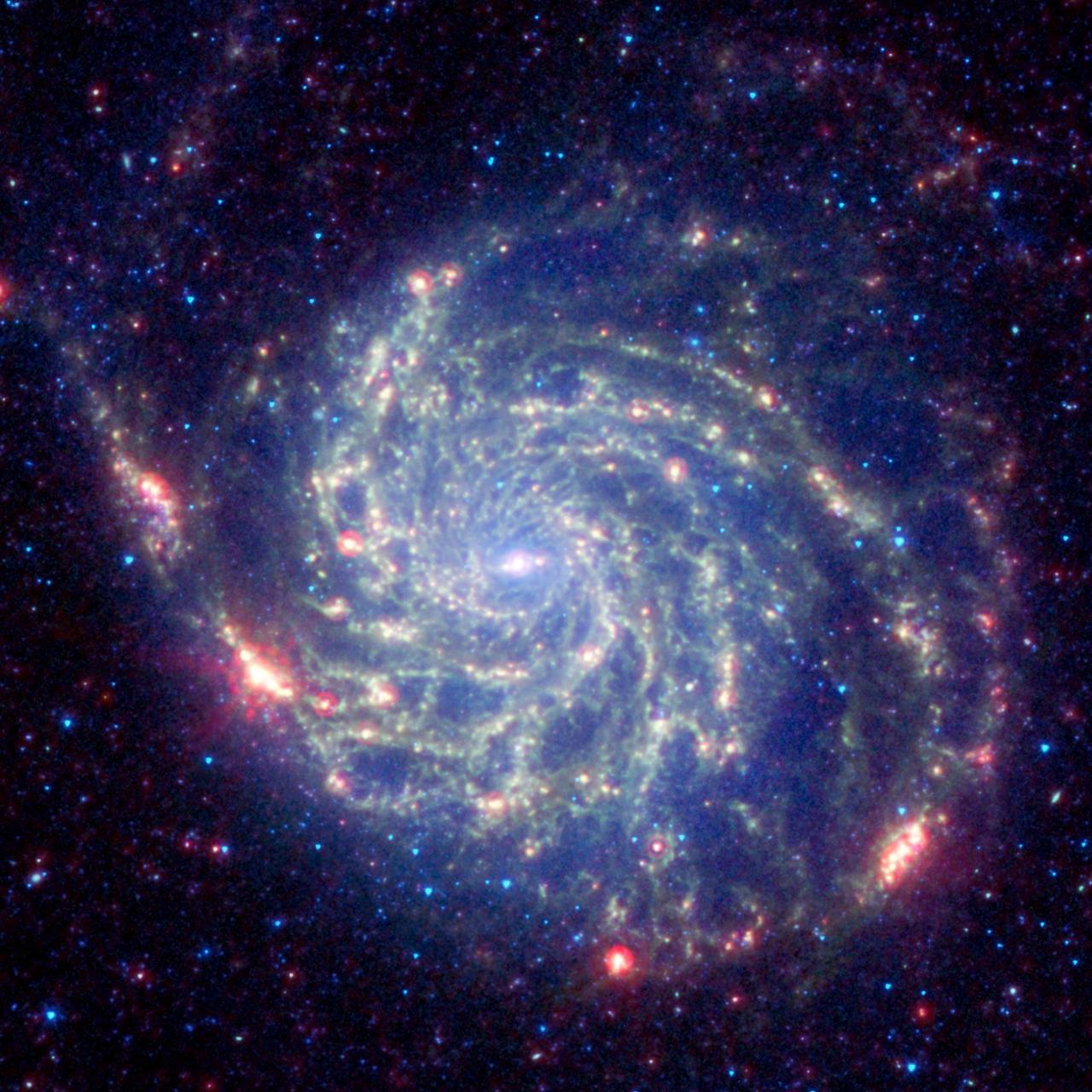
The galaxy Messier 101 is a swirling spiral of stars, gas, and dust. Messier 101 is nearly twice as wide as our Milky Way galaxy in this image as seen by NASA Spitzer Space Telescope.
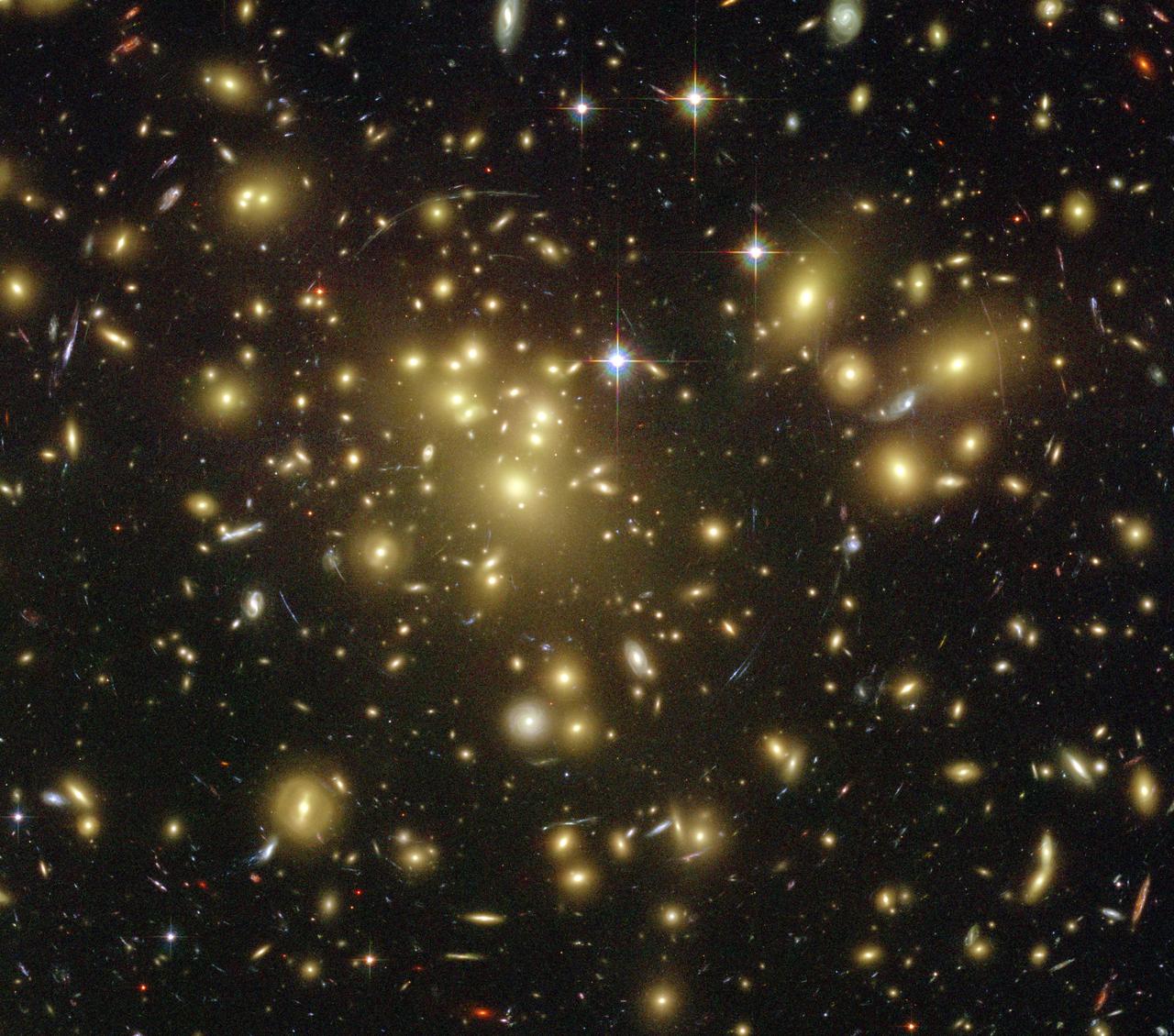
A massive cluster of yellowish galaxies is seemingly caught in a spider web of eerily distorted background galaxies in the left-hand image, taken with the Advanced Camera for Surveys ACS aboard NASA Hubble Space Telescope.

Astronomers have produced a highly detailed image of the Crab Nebula, by combining data from telescopes spanning nearly the entire breadth of the electromagnetic spectrum, from radio waves seen by the Karl G. Jansky Very Large Array (VLA) to the powerful X-ray glow as seen by the orbiting Chandra X-ray Observatory. And, in between that range of wavelengths, the Hubble Space Telescope's crisp visible-light view, and the infrared perspective of the Spitzer Space Telescope. This composite image of the Crab Nebula, a supernova remnant, was assembled by combining data from five telescopes spanning nearly the entire breadth of the electromagnetic spectrum: the Very Large Array, the Spitzer Space Telescope, the Hubble Space Telescope, the XMM-Newton Observatory, and the Chandra X-ray Observatory. Credits: NASA, ESA, NRAO/AUI/NSF and G. Dubner (University of Buenos Aires) #nasagoddard #space #science
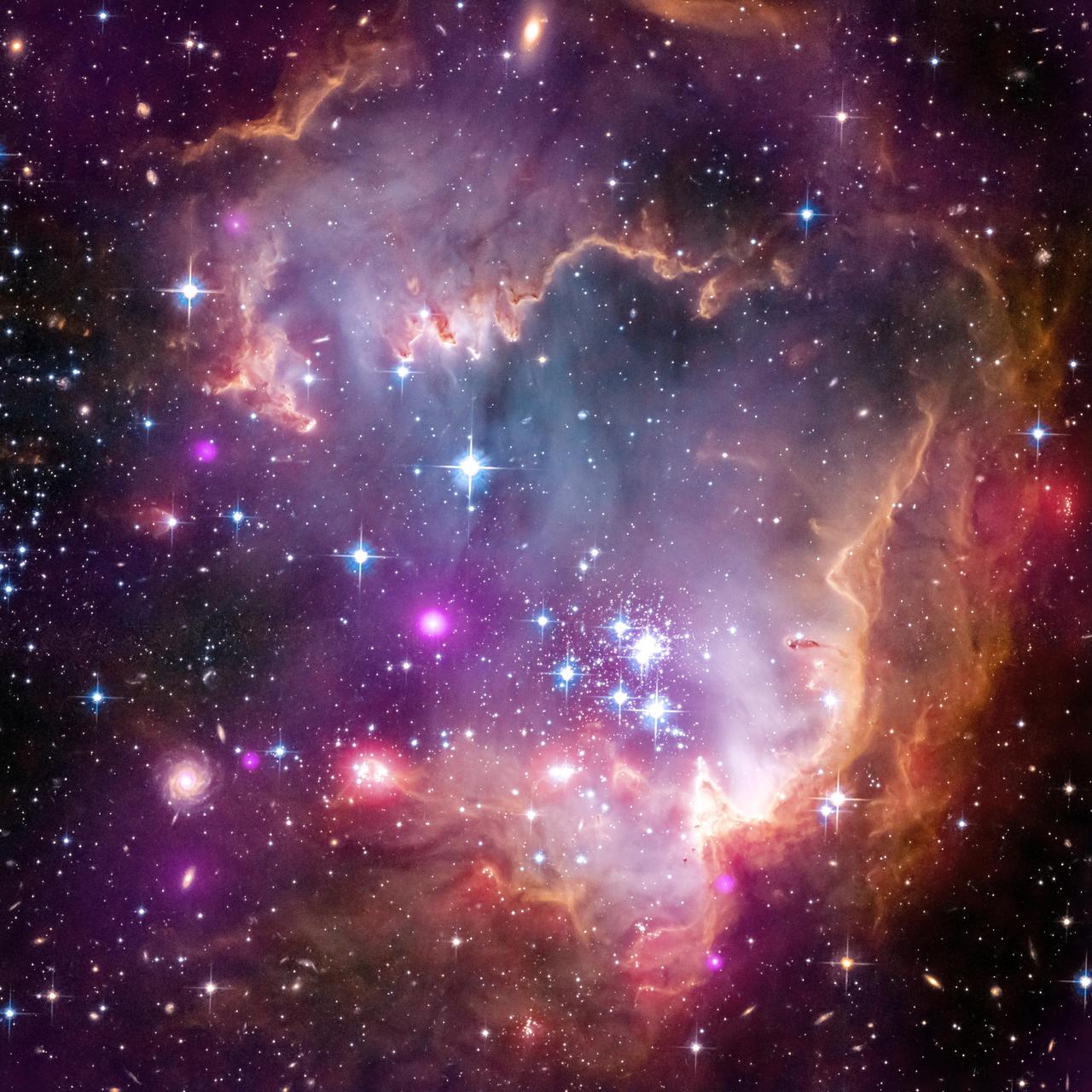
The tip of the wing of the Small Magellanic Cloud galaxy is dazzling in this new view from NASA Great Observatories. The SMC, is a small galaxy about 200,000 light-years way that orbits our own Milky Way spiral galaxy.

This composite of 30 Doradus, the Tarantula Nebula, contains data from Chandra blue, Hubble green, and Spitzer red. Located in the Large Magellanic Cloud, the Tarantula Nebula is one of the largest star-forming regions close to the Milky Way.

The spiral galaxy NGC 3627, located about 30 million light years from Earth as seen by four NASA telescopes; inset shows the central region, which contains a bright X-ray source that is likely powered by material falling onto a supermassive black hole.

A star's spectacular death in the constellation Taurus was observed on Earth as the supernova of 1054 A.D. Now, almost a thousand years later, a superdense neutron star left behind by the stellar death is spewing out a blizzard of extremely high-energy particles into the expanding debris field known as the Crab Nebula. This composite image uses data from three of NASA's Great Observatories. The Chandra X-ray image is shown in light blue, the Hubble Space Telescope optical images are in green and dark blue, and the Spitzer Space Telescope's infrared image is in red. The size of the X-ray image is smaller than the others because ultrahigh-energy X-ray emitting electrons radiate away their energy more quickly than the lower-energy electrons emitting optical and infrared light. The neutron star, which has the mass equivalent to the sun crammed into a rapidly spinning ball of neutrons twelve miles across, is the bright white dot in the center of the image. http://photojournal.jpl.nasa.gov/catalog/PIA01320

This false-color composite image shows the Cartwheel galaxy as seen by NASA Galaxy Evolution Explorer, where the first ripple appears as an ultraviolet-bright blue outer ring.
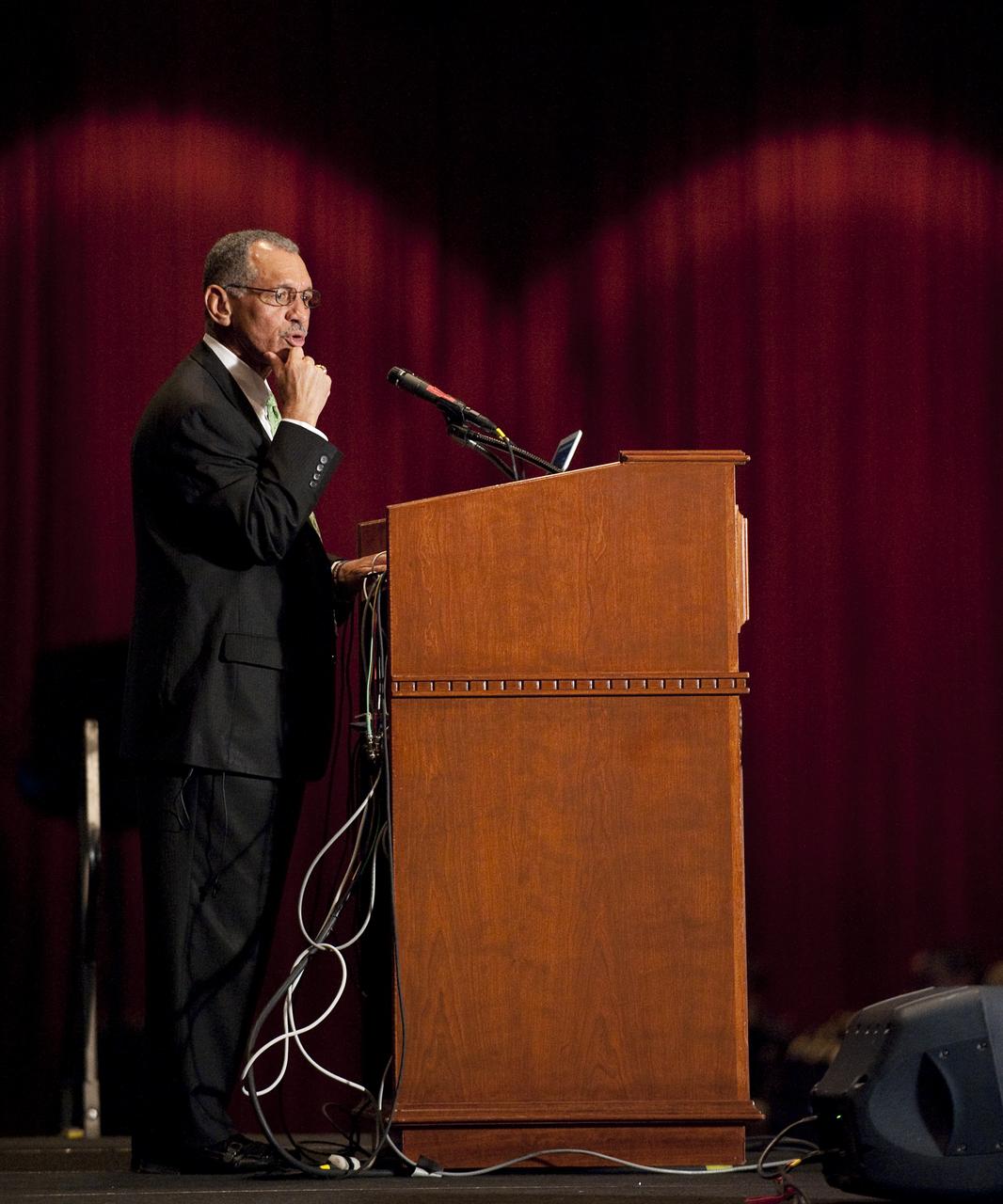
NASA Administrator Charles Bolden speaks at the 215th meeting of the American Astronomical Society (AAS) in Washington on Tuesday, Jan. 5, 2009. Throughout the meeting, NASA research and mission highlights will be presented from missions that include Kepler, the Spitzer Space Telescope, the Hubble Space Telescope, and the newly launched Wide-field Infrared Survey Explorer, or WISE. Photo Credit: (NASA/Bill Ingalls)
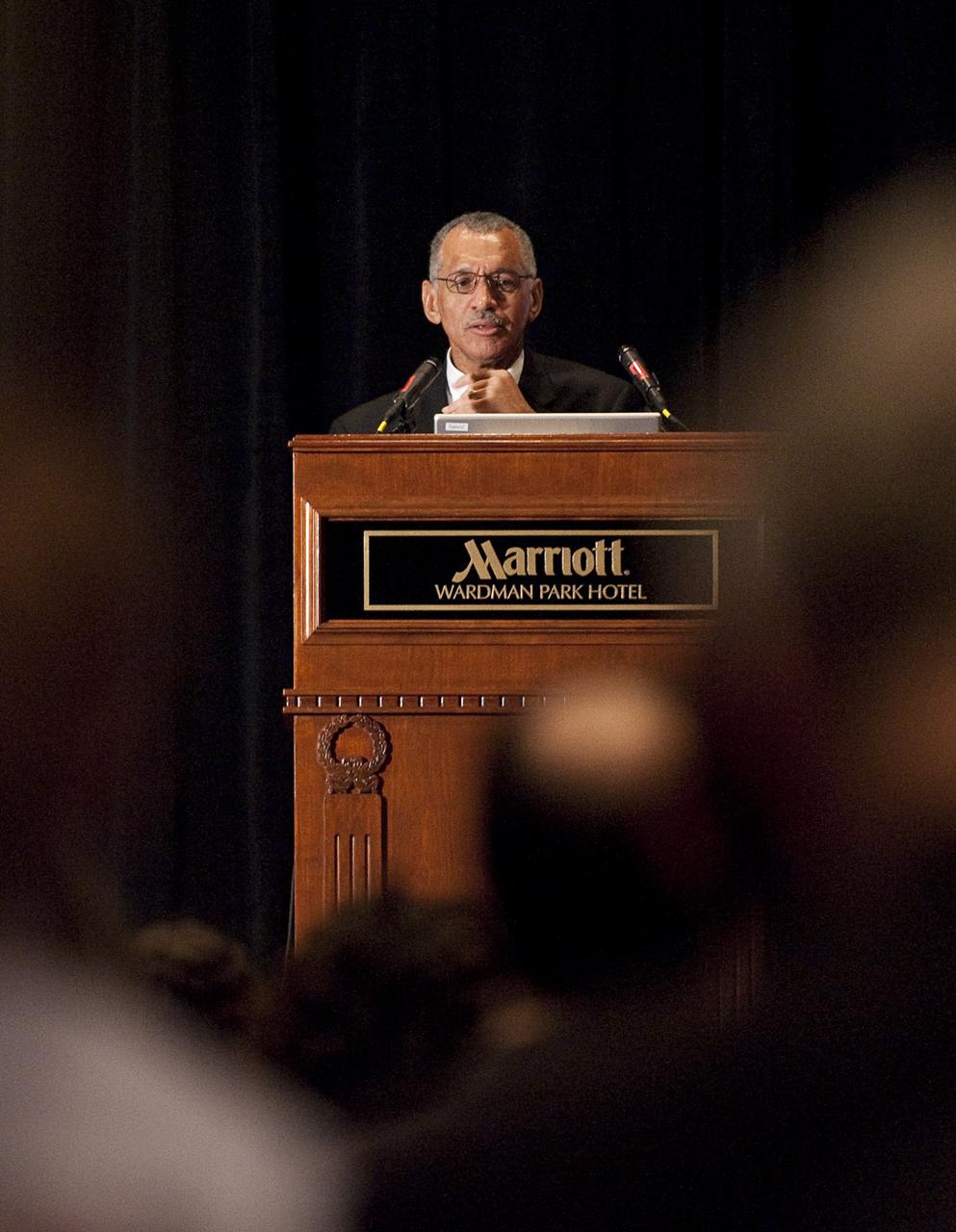
NASA Administrator Charles Bolden speaks at the 215th meeting of the American Astronomical Society (AAS) in Washington on Tuesday, Jan. 5, 2009. Throughout the meeting, NASA research and mission highlights will be presented from missions that include Kepler, the Spitzer Space Telescope, the Hubble Space Telescope, and the newly launched Wide-field Infrared Survey Explorer, or WISE. Photo Credit: (NASA/Bill Ingalls)

NASA Administrator Charles Bolden speaks at the 215th meeting of the American Astronomical Society (AAS) in Washington on Tuesday, Jan. 5, 2009. Throughout the meeting, NASA research and mission highlights will be presented from missions that include Kepler, the Spitzer Space Telescope, the Hubble Space Telescope, and the newly launched Wide-field Infrared Survey Explorer, or WISE. Photo Credit: (NASA/Bill Ingalls)

This image composite compares visible-light and infrared views from NASA's Spitzer Space Telescope of the glowing Trifid Nebula, a giant star-forming cloud of gas and dust located 5,400 light-years away in the constellation Sagittarius. Visible-light images of the Trifid taken with NASA's Hubble Space Telescope, Baltimore, Md. (inside left, figure 1) and the National Optical Astronomy Observatory, Tucson, Ariz., (outside left, figure 1) show a murky cloud lined with dark trails of dust. Data of this same region from the Institute for Radioastronomy millimeter telescope in Spain revealed four dense knots, or cores, of dust (outlined by yellow circles), which are "incubators" for embryonic stars. Astronomers thought these cores were not yet ripe for stars, until Spitzer spotted the warmth of rapidly growing massive embryos tucked inside. http://photojournal.jpl.nasa.gov/catalog/PIA07226
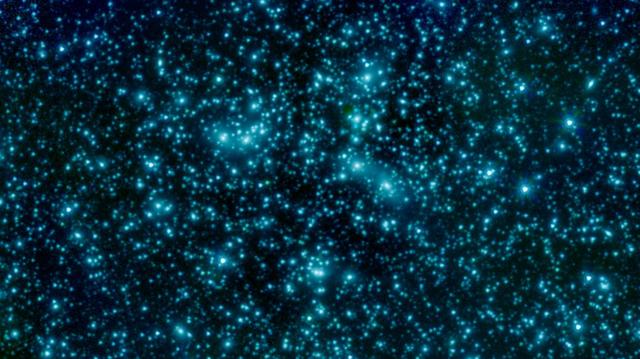
This image of galaxy cluster Abell 2744, also called Pandora's Cluster, was taken by the Spitzer Space Telescope. The gravity of this galaxy cluster is strong enough that it acts as a lens to magnify images of more distant background galaxies. This technique is called gravitational lensing. The fuzzy blobs in this Spitzer image are the massive galaxies at the core of this cluster, but astronomers will be poring over the images in search of the faint streaks of light created where the cluster magnifies a distant background galaxy. The cluster is also being studied by NASA's Hubble Space Telescope and Chandra X-Ray Observatory in a collaboration called the Frontier Fields project. In this image, light from Spitzer's infrared channels is colored blue at 3.6 microns and green at 4.5 microns. http://photojournal.jpl.nasa.gov/catalog/PIA20920

Astronomers have produced a highly detailed image of the Crab Nebula, by combining data from telescopes spanning nearly the entire breadth of the electromagnetic spectrum, from radio waves seen by the Karl G. Jansky Very Large Array (VLA) to the powerful X-ray glow as seen by the orbiting Chandra X-ray Observatory. And, in between that range of wavelengths, the Hubble Space Telescope's crisp visible-light view, and the infrared perspective of the Spitzer Space Telescope. This video starts with a composite image of the Crab Nebula, a supernova remnant that was assembled by combining data from five telescopes spanning nearly the entire breadth of the electromagnetic spectrum: the Very Large Array, the Spitzer Space Telescope, the Hubble Space Telescope, the XMM-Newton Observatory, and the Chandra X-ray Observatory. The video dissolves to the red-colored radio-light view that shows how a neutron star’s fierce “wind” of charged particles from the central neutron star energized the nebula, causing it to emit the radio waves. The yellow-colored infrared image includes the glow of dust particles absorbing ultraviolet and visible light. The green-colored Hubble visible-light image offers a very sharp view of hot filamentary structures that permeate this nebula. The blue-colored ultraviolet image and the purple-colored X-ray image shows the effect of an energetic cloud of electrons driven by a rapidly rotating neutron star at the center of the nebula. Read more: <a href="https://go.nasa.gov/2r0s8VC" rel="nofollow">go.nasa.gov/2r0s8VC</a> Credits: NASA, ESA, J. DePasquale (STScI)

WASP-18b is an exoplanet located 325 light-years from Earth. The planet's mass is 10 times that of Jupiter, and it orbits its star once every 23 hours. A 2017 study found that this planet has a stratosphere that's loaded with carbon dioxide, but has no signs of water. A stratosphere is a layer of atmosphere in which temperature increases with higher altitudes. The study used NASA's Spitzer and Hubble space telescopes. https://photojournal.jpl.nasa.gov/catalog/PIA22087
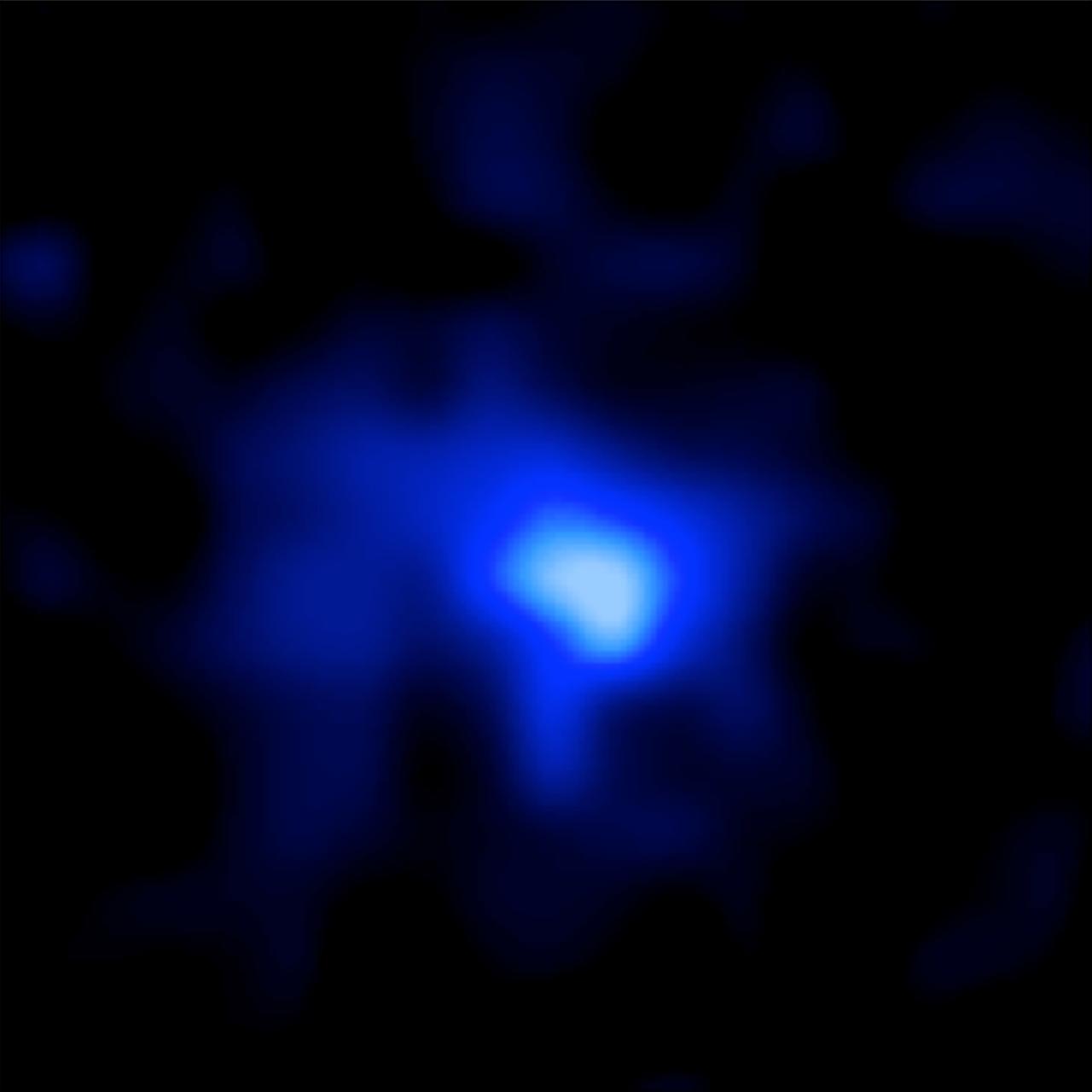
This is a Hubble Space Telescope image of the farthest spectroscopically confirmed galaxy observed to date (inset). It was identified in this Hubble image of a field of galaxies in the CANDELS survey (Cosmic Assembly Near-infrared Deep Extragalactic Legacy Survey). NASA’s Spitzer Space Telescope also observed the unique galaxy. The W. M. Keck Observatory was used to obtain a spectroscopic redshift (z=7.7), extending the previous redshift record. Measurements of the stretching of light, or redshift, give the most reliable distances to other galaxies. This source is thus currently the most distant confirmed galaxy known, and it appears to also be one of the brightest and most massive sources at that time. The galaxy existed over 13 billion years ago. The near-infrared light image of the galaxy (inset) has been colored blue as suggestive of its young, and hence very blue, stars. The CANDELS field is a combination of visible-light and near-infrared exposures. Credits: NASA, ESA, P. Oesch (Yale U.)
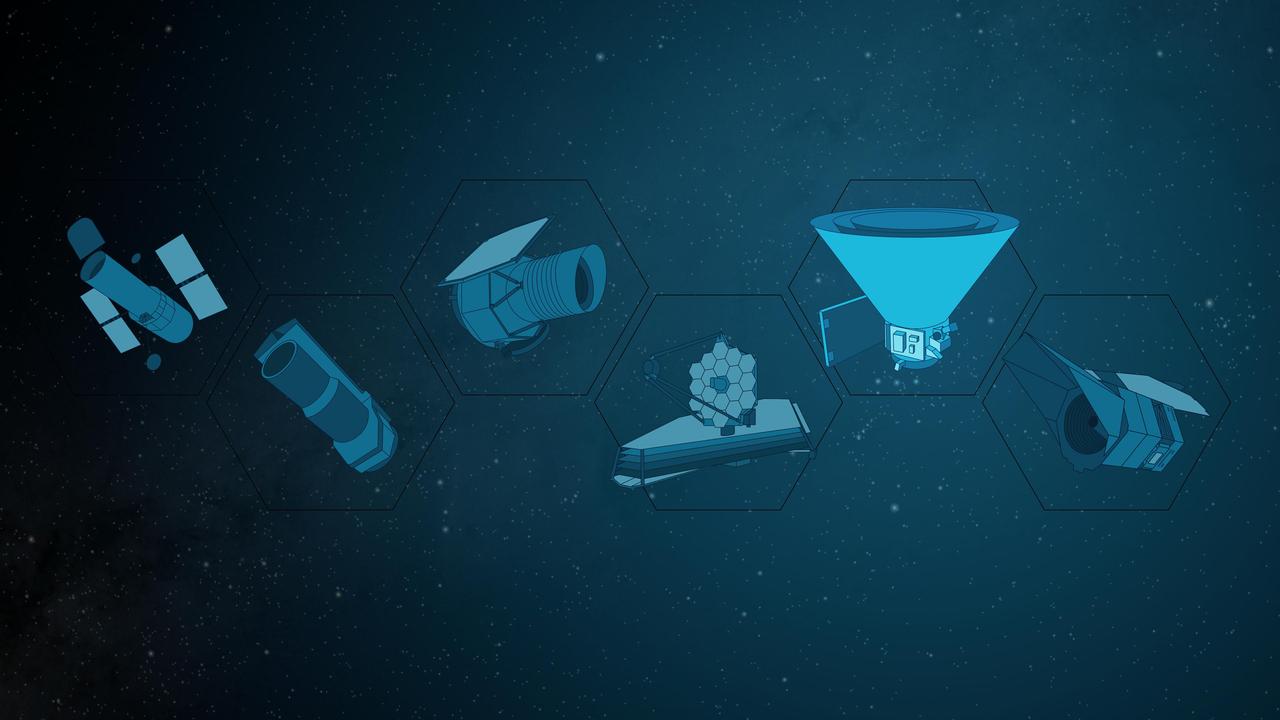
In this illustration, NASA's SPHEREx mission is highlighted among a line of other NASA space telescopes. The mission will survey the entire sky using spectroscopy, detecting hundreds of millions of stars and galaxies and generating a valuable data set that will complement the work of other NASA observatories such as those depicted here. Shown from left to right (and not to scale) are: Hubble Space Telescope, launched in April 1990 Spitzer Space Telescope, launch in August 2003 WISE (Wide-Field Infrared Survey Explorer), launched in December 2009 James Webb Space Telescope, launched in December 2021 SPHEREx (Spectro-Photometer for the History of the Universe, Epoch of Reionization and Ices Explorer), targeted for launch in February 2025 Nancy Grace Roman Space Telescope, targeted for launch by May 2027 The SPHEREx observatory will image the entire sky in 102 colors (each an individual wavelength of light) to help scientists answer big-picture questions about the origins of our universe, galaxies, and key ingredients for life in our galaxy, such as water. https://photojournal.jpl.nasa.gov/catalog/PIA26535
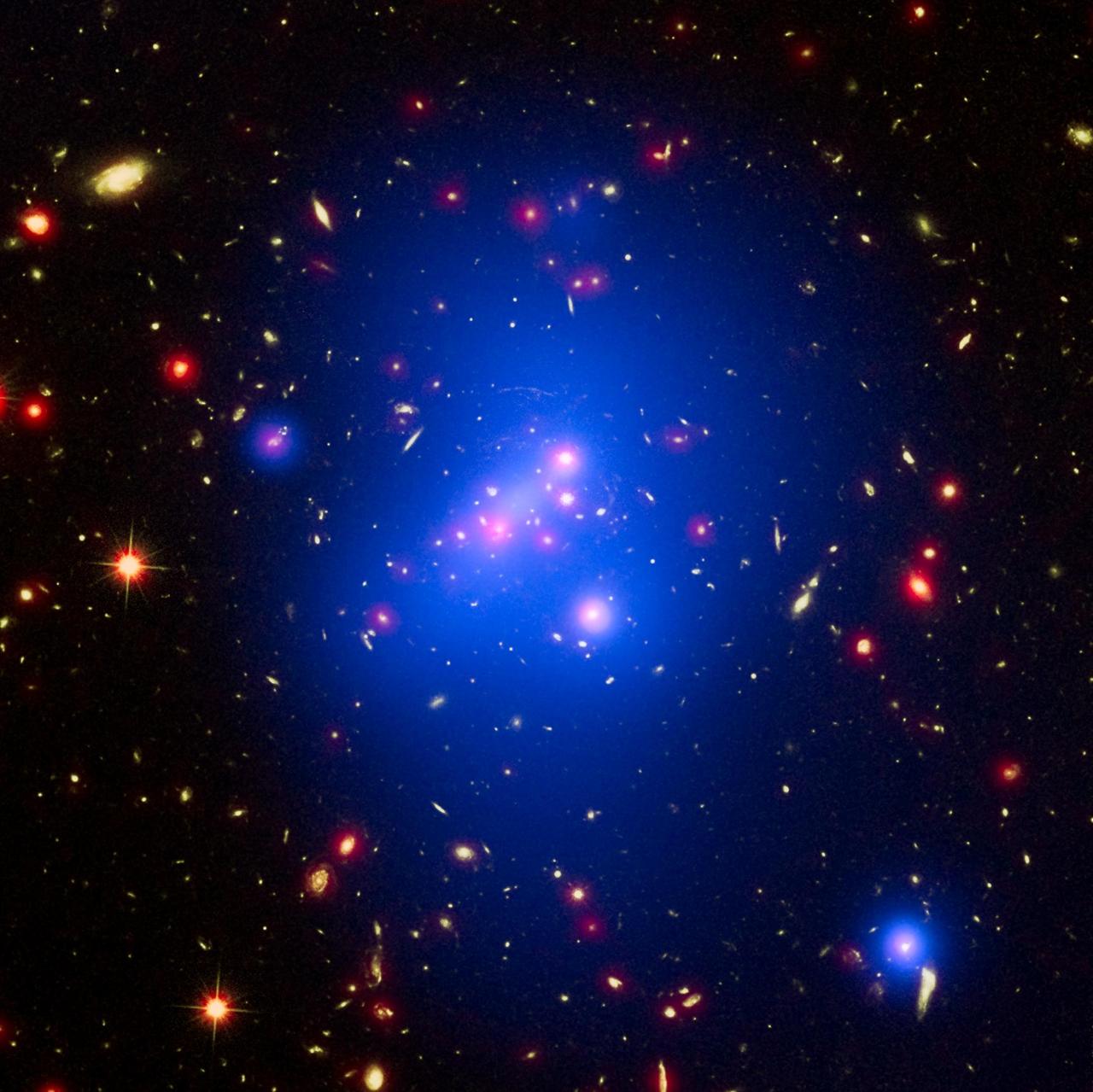
Astronomers have made the most detailed study yet of an extremely massive young galaxy cluster using three of NASA's Great Observatories. This multi-wavelength image shows this galaxy cluster, called IDCS J1426.5+3508 (IDCS 1426 for short), in X-rays recorded by the Chandra X-ray Observatory in blue, visible light observed by the Hubble Space Telescope in green, and infrared light detected by the Spitzer Space Telescope in red. This rare galaxy cluster, which is located 10 billion light-years from Earth, is almost as massive as 500 trillion suns. This object has important implications for understanding how such megastructures formed and evolved early in the universe. The light astronomers observed from IDCS 1426 began its journey to Earth when the universe was less than a third of its current age. It is the most massive galaxy cluster detected at such an early time. First discovered by the Spitzer Space Telescope in 2012, IDCS 1426 was then observed using the Hubble Space Telescope and the Keck Observatory to determine its distance. Observations from the Combined Array for Millimeter-wave Astronomy indicated it was extremely massive. New data from the Chandra X-ray Observatory confirm the galaxy cluster's mass and show that about 90 percent of this mass is in the form of dark matter -- the mysterious substance that has so far been detected only through its gravitational pull on normal matter composed of atoms. http://photojournal.jpl.nasa.gov/catalog/PIA20063
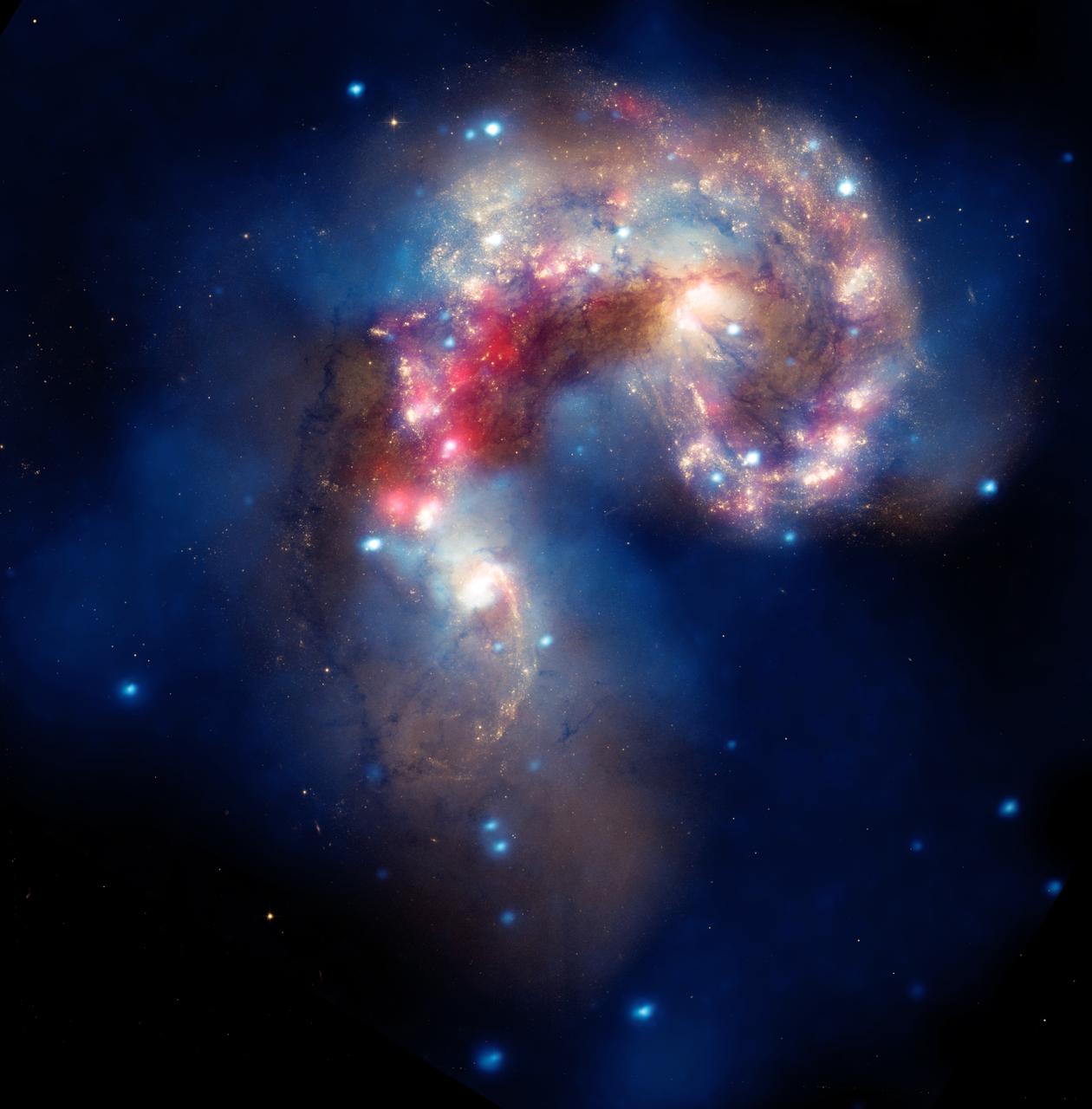
NASA image release August 5, 2010 A beautiful new image of two colliding galaxies has been released by NASA's Great Observatories. The Antennae galaxies, located about 62 million light-years from Earth, are shown in this composite image from the Chandra X-ray Observatory (blue), the Hubble Space Telescope (gold and brown), and the Spitzer Space Telescope (red). The Antennae galaxies take their name from the long antenna-like "arms," seen in wide-angle views of the system. These features were produced by tidal forces generated in the collision. The collision, which began more than 100 million years ago and is still occurring, has triggered the formation of millions of stars in clouds of dusts and gas in the galaxies. The most massive of these young stars have already sped through their evolution in a few million years and exploded as supernovas. The X-ray image from Chandra shows huge clouds of hot, interstellar gas that have been injected with rich deposits of elements from supernova explosions. This enriched gas, which includes elements such as oxygen, iron, magnesium, and silicon, will be incorporated into new generations of stars and planets. The bright, point-like sources in the image are produced by material falling onto black holes and neutron stars that are remnants of the massive stars. Some of these black holes may have masses that are almost one hundred times that of the Sun. The Spitzer data show infrared light from warm dust clouds that have been heated by newborn stars, with the brightest clouds lying in the overlapping region between the two galaxies. The Hubble data reveal old stars and star-forming regions in gold and white, while filaments of dust appear in brown. Many of the fainter objects in the optical image are clusters containing thousands of stars. The Chandra image was taken in December 1999. The Spitzer image was taken in December 2003. The Hubble image was taken in July 2004, and February 2005. Credit: NASA, ESA, SAO, CXC, JPL-Caltech, and STScI Acknowledgment: G. Fabbiano and Z. Wang (Harvard-Smithsonian CfA), and B. Whitmore (STScI)
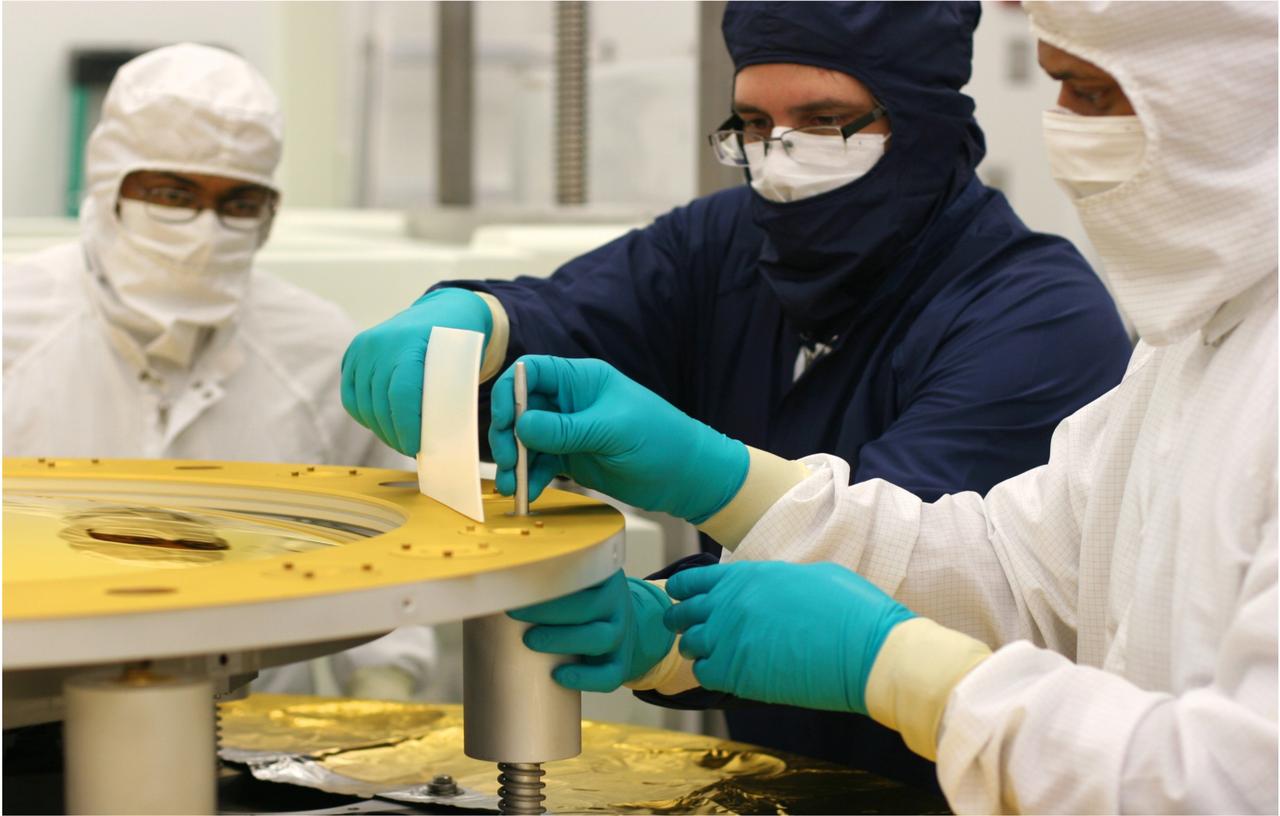
NASA release July 19, 2011 <b>Click here to learn about the <a href="http://www.jwst.nasa.gov/" rel="nofollow"> James Webb Space Telescope</a></b> The secondary mirror (shown here) was polished at the L3 Integrated Optical Systems - Tinsley in Richmond, Calif. to accuracies of less than one millionth of an inch. That accuracy is important for forming the sharpest images when the mirrors cool to -400°F (-240°C) in the cold of space. The Webb's secondary mirror was recently completed, following polishing and gold-coating. "Secondary" may not sound as important as "primary" but when it comes to the next-generation James Webb Space Telescope a secondary mirror plays a critical role in ensuring the telescope gathers information from the cosmos. The Webb's secondary mirror was recently completed, following polishing and gold-coating. There are four different types of mirrors that will fly on the James Webb Space Telescope, and all are made of a light metal called beryllium. It is very strong for its weight and holds its shape across a range of temperatures. There are primary mirror segments (18 total that combined make the large primary mirror providing a collecting area of 25 meters squared/269.1 square feet), the secondary mirror, tertiary mirror and the fine steering mirror. Unlike the primary mirror, which is molded into the shape of a hexagon, the secondary mirror is perfectly rounded. The mirror is also convex, so the reflective surface bulges toward a light source. It looks much like a curved mirror that you'll see on the wall near the exit of a parking garage that lets motorists see around a corner. This mirror is coated with a microscopic layer of gold to enable it to efficiently reflect infrared light (which is what the Webb telescope's cameras see). The quality of the secondary mirror surface is so good that the final convex surface at cold temperatures does not deviate from the design by more than a few millionths of a millimeter - or about one ten thousandth the diameter of a human hair. "As the only convex mirror on the Webb telescope, the secondary mirror has always been recognized to be the hardest of all of the mirrors to polish and test, so we are delighted that its performance meets all specifications," said Lee Feinberg, Webb Optical Telescope manager at NASA's Goddard Space Flight Center in Greenbelt, Md. Convex mirrors are particularly hard to test because light that strikes them diverges away from the mirror. Feinberg noted, "The Webb telescope convex secondary mirror is approximately the size of the Spitzer Space Telescope's primary mirror and is by far the largest convex cryogenic mirror ever built for a NASA program." It was data from the Spitzer's mirrors that helped make the decision to use beryllium for the Webb telescope mirrors. Spitzer's mirrors were also made of beryllium. So why is this mirror so critical? Because the secondary mirror captures light from the 18 primary mirror segments and relays those distant images of the cosmos to the telescope's science cameras. The secondary mirror is mounted on folding "arms" that position it in front of the 18 primary mirror segments. The secondary mirror will soon come to NASA's Goddard Space Flight Center in Greenbelt, Md. where it will be installed on the telescope structure. Then, as a complete unit, the telescope structure and mirrors will undergo acoustic and vibration testing. The secondary mirror was developed at Ball Aerospace & Technology Corp. of Boulder, Colo. and the mirror recently completed polishing at the L3–IOS-Tinsley facility in Richmond, Calif. Northrop Grumman space Systems is the prime contractor on the Webb telescope program. The James Webb Space Telescope is the world’s next-generation space observatory and successor to the Hubble Space Telescope. The most powerful space telescope ever built, Webb will observe the most distant objects in the universe, provide images of the very first galaxies ever formed and see unexplored planets around distant stars. The Webb Telescope is a joint project of NASA, the European Space Agency and the Canadian Space Agency. Credit:NASA/Ball Aerospace/Tinsley <b><a href="http://www.nasa.gov/centers/goddard/home/index.html" rel="nofollow">NASA Goddard Space Flight Center</a></b> enables NASA’s mission through four scientific endeavors: Earth Science, Heliophysics, Solar System Exploration, and Astrophysics. Goddard plays a leading role in NASA’s accomplishments by contributing compelling scientific knowledge to advance the Agency’s mission. <b>Follow us on <a href="http://twitter.com/NASA_GoddardPix" rel="nofollow">Twitter</a></b> <b>Like us on <a href="http://www.facebook.com/pages/Greenbelt-MD/NASA-Goddard/395013845897?ref=tsd" rel="nofollow">Facebook</a></b> <b>Find us on <a href="http://web.stagram.com/n/nasagoddard/?vm=grid" rel="nofollow">Instagram</a></b>
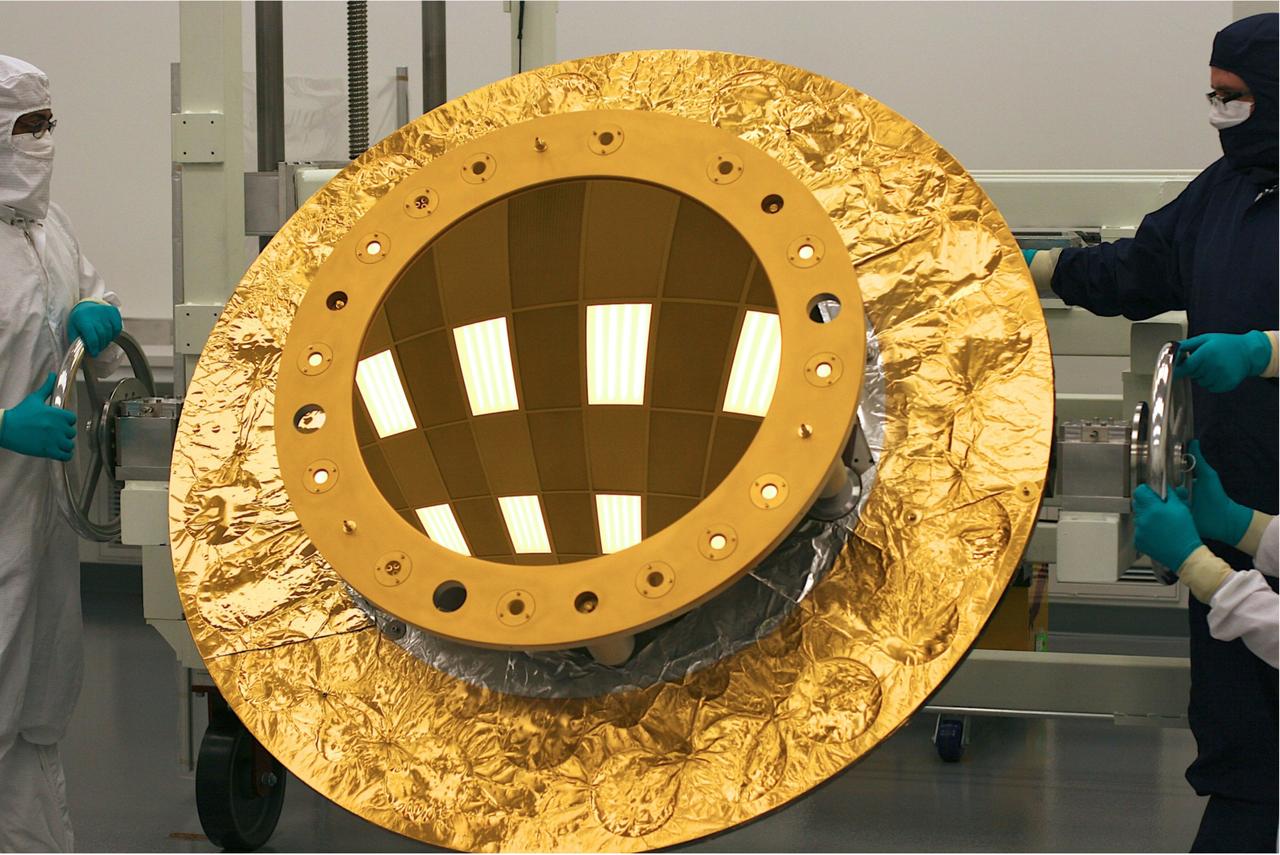
NASA release July 19, 2011 <b>Click here to learn about the <a href="http://www.jwst.nasa.gov/" rel="nofollow"> James Webb Space Telescope</a></b> The secondary mirror (shown here) was polished at the L3 Integrated Optical Systems - Tinsley in Richmond, Calif. to accuracies of less than one millionth of an inch. That accuracy is important for forming the sharpest images when the mirrors cool to -400°F (-240°C) in the cold of space. The Webb's secondary mirror was recently completed, following polishing and gold-coating. "Secondary" may not sound as important as "primary" but when it comes to the next-generation James Webb Space Telescope a secondary mirror plays a critical role in ensuring the telescope gathers information from the cosmos. The Webb's secondary mirror was recently completed, following polishing and gold-coating. There are four different types of mirrors that will fly on the James Webb Space Telescope, and all are made of a light metal called beryllium. It is very strong for its weight and holds its shape across a range of temperatures. There are primary mirror segments (18 total that combined make the large primary mirror providing a collecting area of 25 meters squared/269.1 square feet), the secondary mirror, tertiary mirror and the fine steering mirror. Unlike the primary mirror, which is molded into the shape of a hexagon, the secondary mirror is perfectly rounded. The mirror is also convex, so the reflective surface bulges toward a light source. It looks much like a curved mirror that you'll see on the wall near the exit of a parking garage that lets motorists see around a corner. This mirror is coated with a microscopic layer of gold to enable it to efficiently reflect infrared light (which is what the Webb telescope's cameras see). The quality of the secondary mirror surface is so good that the final convex surface at cold temperatures does not deviate from the design by more than a few millionths of a millimeter - or about one ten thousandth the diameter of a human hair. "As the only convex mirror on the Webb telescope, the secondary mirror has always been recognized to be the hardest of all of the mirrors to polish and test, so we are delighted that its performance meets all specifications," said Lee Feinberg, Webb Optical Telescope manager at NASA's Goddard Space Flight Center in Greenbelt, Md. Convex mirrors are particularly hard to test because light that strikes them diverges away from the mirror. Feinberg noted, "The Webb telescope convex secondary mirror is approximately the size of the Spitzer Space Telescope's primary mirror and is by far the largest convex cryogenic mirror ever built for a NASA program." It was data from the Spitzer's mirrors that helped make the decision to use beryllium for the Webb telescope mirrors. Spitzer's mirrors were also made of beryllium. So why is this mirror so critical? Because the secondary mirror captures light from the 18 primary mirror segments and relays those distant images of the cosmos to the telescope's science cameras. The secondary mirror is mounted on folding "arms" that position it in front of the 18 primary mirror segments. The secondary mirror will soon come to NASA's Goddard Space Flight Center in Greenbelt, Md. where it will be installed on the telescope structure. Then, as a complete unit, the telescope structure and mirrors will undergo acoustic and vibration testing. The secondary mirror was developed at Ball Aerospace & Technology Corp. of Boulder, Colo. and the mirror recently completed polishing at the L3–IOS-Tinsley facility in Richmond, Calif. Northrop Grumman space Systems is the prime contractor on the Webb telescope program. The James Webb Space Telescope is the world’s next-generation space observatory and successor to the Hubble Space Telescope. The most powerful space telescope ever built, Webb will observe the most distant objects in the universe, provide images of the very first galaxies ever formed and see unexplored planets around distant stars. The Webb Telescope is a joint project of NASA, the European Space Agency and the Canadian Space Agency. Credit:NASA/Ball Aerospace/Tinsley <b><a href="http://www.nasa.gov/centers/goddard/home/index.html" rel="nofollow">NASA Goddard Space Flight Center</a></b> enables NASA’s mission through four scientific endeavors: Earth Science, Heliophysics, Solar System Exploration, and Astrophysics. Goddard plays a leading role in NASA’s accomplishments by contributing compelling scientific knowledge to advance the Agency’s mission. <b>Follow us on <a href="http://twitter.com/NASA_GoddardPix" rel="nofollow">Twitter</a></b> <b>Like us on <a href="http://www.facebook.com/pages/Greenbelt-MD/NASA-Goddard/395013845897?ref=tsd" rel="nofollow">Facebook</a></b> <b>Find us on <a href="http://web.stagram.com/n/nasagoddard/?vm=grid" rel="nofollow">Instagram</a></b>

This is a Hubble Space Telescope composite image of a supernova explosion designated SN 2014J in the galaxy M82. At a distance of approximately 11.5 million light-years from Earth it is the closest supernova of its type discovered in the past few decades. The explosion is categorized as a Type Ia supernova, which is theorized to be triggered in binary systems consisting of a white dwarf and another star — which could be a second white dwarf, a star like our sun, or a giant star. Astronomers using a ground-based telescope discovered the explosion on January 21, 2014. This Hubble photograph was taken on January 31, as the supernova approached its peak brightness. The Hubble data are expected to help astronomers refine distance measurements to Type Ia supernovae. In addition, the observations could yield insights into what kind of stars were involved in the explosion. Hubble’s ultraviolet-light sensitivity will allow astronomers to probe the environment around the site of the supernova explosion and in the interstellar medium of the host galaxy. Because of their consistent peak brightness, Type Ia supernovae are among the best tools to measure distances in the universe. They were fundamental to the 1998 discovery of the mysterious acceleration of the expanding universe. A hypothesized repulsive force, called dark energy, is thought to cause the acceleration. Among the other major NASA space-based observatories used in the M82 viewing campaign are Spitzer Space Telescope, Chandra X-ray Observatory, Nuclear Spectroscopic Telescope Array (NuSTAR), Fermi Gamma-ray Space Telescope, Swift Gamma Ray Burst Explorer, and the Stratospheric Observatory for Infrared Astronomy (SOFIA). Image Credit: NASA, ESA, A. Goobar (Stockholm University), and the Hubble Heritage Team (STScI/AURA) <b><a href="http://www.nasa.gov/audience/formedia/features/MP_Photo_Guidelines.html" rel="nofollow">NASA image use policy.</a></b> <b><a href="http://www.nasa.gov/centers/goddard/home/index.html" rel="nofollow">NASA Goddard Space Flight Center</a></b> enables NASA’s mission through four scientific endeavors: Earth Science, Heliophysics, Solar System Exploration, and Astrophysics. Goddard plays a leading role in NASA’s accomplishments by contributing compelling scientific knowledge to advance the Agency’s mission. <b>Follow us on <a href="http://twitter.com/NASAGoddardPix" rel="nofollow">Twitter</a></b> <b>Like us on <a href="http://www.facebook.com/pages/Greenbelt-MD/NASA-Goddard/395013845897?ref=tsd" rel="nofollow">Facebook</a></b> <b>Find us on <a href="http://instagram.com/nasagoddard?vm=grid" rel="nofollow">Instagram</a></b>
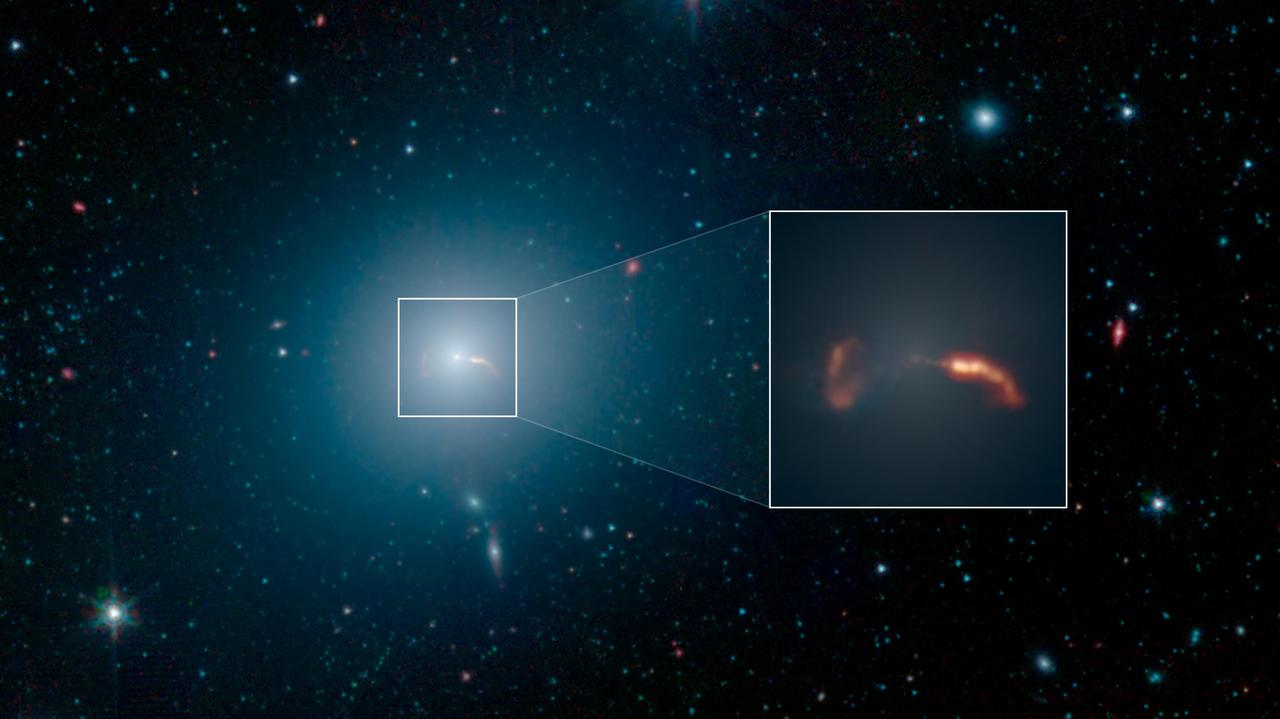
This image from NASA's Spitzer Space Telescope shows the elliptical galaxy Messier 87 (M87), the home galaxy of the supermassive black hole recently imaged by the Event Horizon Telescope (EHT). Spitzer's infrared view shows a faint trace of a jet of material spewing to the right of the galaxy - a feature that was previously one key indicator that a supermassive black hole lived at the galaxy's center. More prominent in the image is the shockwave created by that jet. The inset in the image below shows a close-up view of the shockwave on the right side of the galaxy, as well as the shockwave from a second jet traveling to the left of the galaxy. Located about 55 million light-years from Earth, M87 has been a subject of astronomical study for more than 100 years and has been imaged by many NASA observatories, including the Hubble Space Telescope, the Chandra X-ray Observatory and NuSTAR. In 1918, astronomer Heber Curtis first noticed "a curious straight ray" extending from the galaxy's center. This bright jet (which appears to extend to the right of the galaxy) is visible in multiple wavelengths of light, from radio waves through X-rays. The jet is produced by a disk of material spinning rapidly around the black hole, and spewing in opposite directions away from the galaxy. When the particles in the jet impact the interstellar medium (the sparse material filling the space between stars in M87), they create a shockwave that radiates in infrared and radio wavelengths of light, but not visible light. The jet on the right is traveling almost directly toward Earth, and its brightness is amplified due to its high speed in our direction. But the jet's trajectory is just slightly offset from our line of sight with the galaxy, so we can still see some of the length of the jet. The shockwave begins around the point where the jet appears to curve down, highlighting the regions where the fast-moving particles are colliding with gas in the galaxy and slowing down. There is also a second jet on the left that is moving so rapidly away from us it is rendered invisible at all wavelengths. But the shockwave it creates in the interstellar medium can still be seen here. In the Spitzer image, the shockwave is on the left side of the galaxy and looks like an inverted letter "C." Scientists are still striving for a solid theoretical understanding of how inflowing gas around black holes creates outflowing jets. Infrared light at wavelengths of 3.6 and 4.5 microns are rendered in blue and green, showing the distribution of stars, while dust features that glow brightly at 8.0 microns are shown in red. The image was taken during Spitzer's initial "cold" mission. https://photojournal.jpl.nasa.gov/catalog/PIA23122

This majestic false-color image from NASA's Spitzer Space Telescope shows the "mountains" where stars are born. Dubbed "Mountains of Creation" by Spitzer scientists, these towering pillars of cool gas and dust are illuminated at their tips with light from warm embryonic stars. The new infrared picture is reminiscent of Hubble's iconic visible-light image of the Eagle Nebula, which also features a star-forming region, or nebula, that is being sculpted into pillars by radiation and winds from hot, massive stars. The pillars in the Spitzer image are part of a region called W5, in the Cassiopeia constellation 7,000 light-years away and 50 light-years across. They are more than 10 times in the size of those in the Eagle Nebula (shown to scale here). The Spitzer's view differs from Hubble's because infrared light penetrates dust, whereas visible light is blocked by it. In the Spitzer image, hundreds of forming stars (white/yellow) can seen for the first time inside the central pillar, and dozens inside the tall pillar to the left. Scientists believe these star clusters were triggered into existence by radiation and winds from an "initiator" star more than 10 times the mass of our Sun. This star is not pictured, but the finger-like pillars "point" toward its location above the image frame. The Spitzer picture also reveals stars (blue) a bit older than the ones in the pillar tips in the evacuated areas between the clouds. Scientists believe these stars were born around the same time as the massive initiator star not pictured. A third group of young stars occupies the bright area below the central pillar. It is not known whether these stars formed in a related or separate event. Some of the blue dots are foreground stars that are not members of this nebula. The red color in the Spitzer image represents organic molecules known as polycyclic aromatic hydrocarbons. These building blocks of life are often found in star-forming clouds of gas and dust. Like small dust grains, they are heated by the light from the young stars, then emit energy in infrared wavelengths. This image was taken by the infrared array camera on Spitzer. It is a 4-color composite of infrared light, showing emissions from wavelengths of 3.6 microns (blue), 4.5 microns (green), 5.8 microns (orange), and 8.0 microns (red). http://photojournal.jpl.nasa.gov/catalog/PIA03096
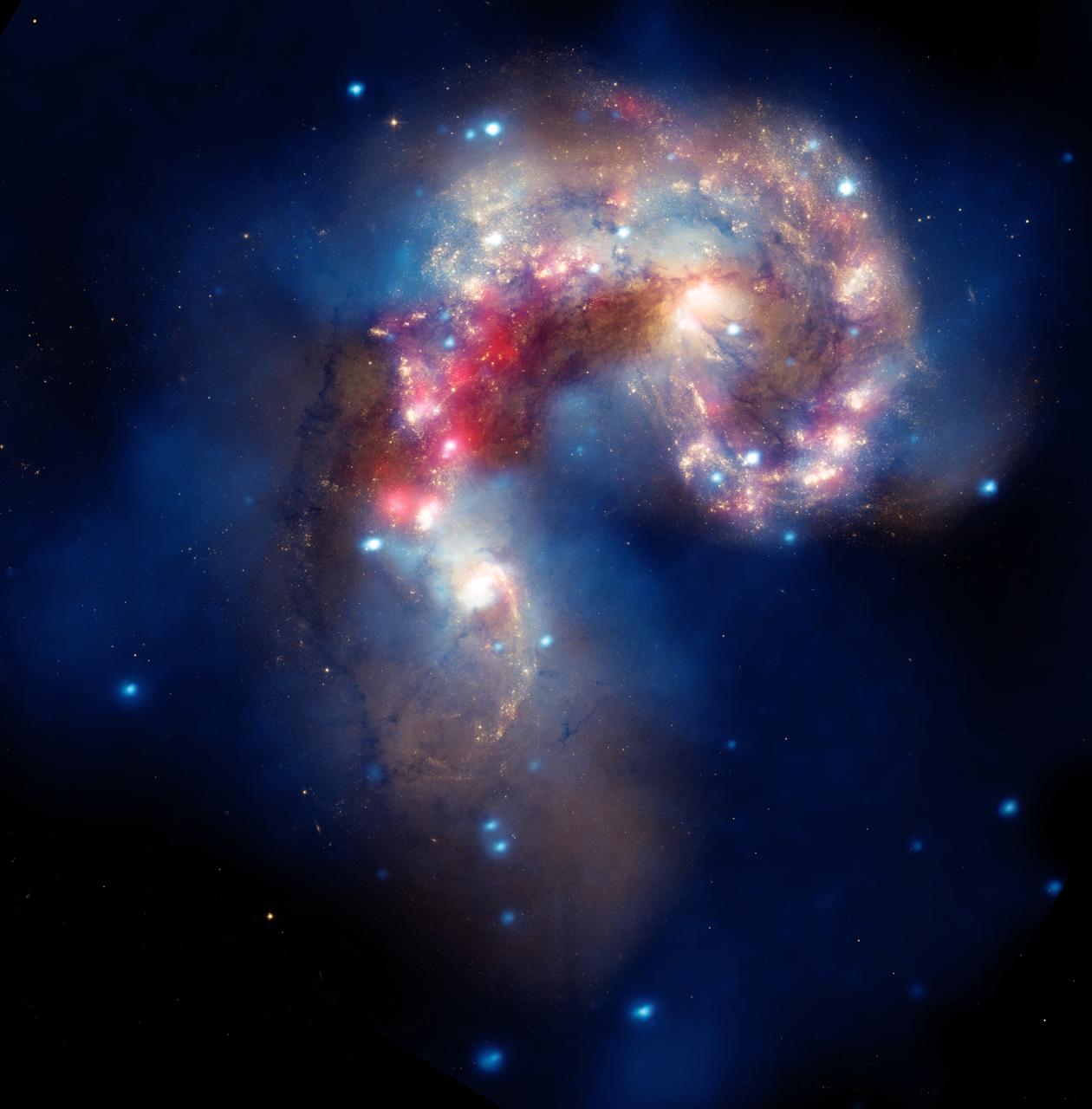
NASA image release August 5, 2010 A beautiful new image of two colliding galaxies has been released by NASA's Great Observatories. The Antennae galaxies, located about 62 million light-years from Earth, are shown in this composite image from the Chandra X-ray Observatory (blue), the Hubble Space Telescope (gold and brown), and the Spitzer Space Telescope (red). The Antennae galaxies take their name from the long antenna-like "arms," seen in wide-angle views of the system. These features were produced by tidal forces generated in the collision. The collision, which began more than 100 million years ago and is still occurring, has triggered the formation of millions of stars in clouds of dusts and gas in the galaxies. The most massive of these young stars have already sped through their evolution in a few million years and exploded as supernovas. The X-ray image from Chandra shows huge clouds of hot, interstellar gas that have been injected with rich deposits of elements from supernova explosions. This enriched gas, which includes elements such as oxygen, iron, magnesium, and silicon, will be incorporated into new generations of stars and planets. The bright, point-like sources in the image are produced by material falling onto black holes and neutron stars that are remnants of the massive stars. Some of these black holes may have masses that are almost one hundred times that of the Sun. The Spitzer data show infrared light from warm dust clouds that have been heated by newborn stars, with the brightest clouds lying in the overlapping region between the two galaxies. The Hubble data reveal old stars and star-forming regions in gold and white, while filaments of dust appear in brown. Many of the fainter objects in the optical image are clusters containing thousands of stars. The Chandra image was taken in December 1999. The Spitzer image was taken in December 2003. The Hubble image was taken in July 2004, and February 2005. To read more go to: <a href="http://www.nasa.gov/mission_pages/chandra/multimedia/antennae.html" rel="nofollow">www.nasa.gov/mission_pages/chandra/multimedia/antennae.html</a> <b><a href="http://www.nasa.gov/centers/goddard/home/index.html" rel="nofollow">NASA Goddard Space Flight Center</a></b> is home to the nation's largest organization of combined scientists, engineers and technologists that build spacecraft, instruments and new technology to study the Earth, the sun, our solar system, and the universe. <b>Follow us on <a href="http://twitter.com/NASA_GoddardPix" rel="nofollow">Twitter</a></b> <b>Join us on <a href="http://www.facebook.com/pages/Greenbelt-MD/NASA-Goddard/395013845897?ref=tsd" rel="nofollow">Facebook</a><b></b></b> Credit: NASA, ESA, SAO, CXC, JPL-Caltech, and STScI Acknowledgment: G. Fabbiano and Z. Wang (Harvard-Smithsonian CfA), and B. Whitmore (STScI)
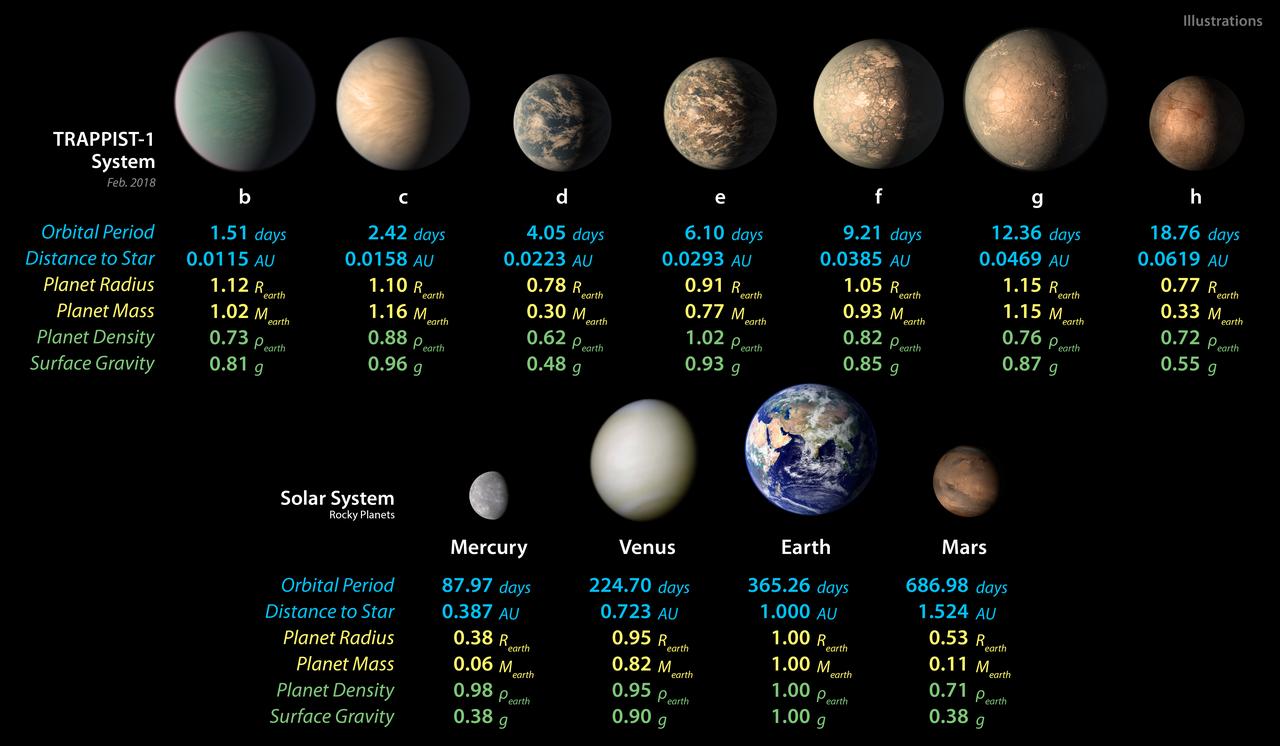
This chart shows, on the top row, artist concepts of the seven planets of TRAPPIST-1 with their orbital periods, distances from their star, radii, masses, densities and surface gravity as compared to those of Earth. These numbers are current as of February 2018. On the bottom row, the same numbers are displayed for the bodies of our inner solar system: Mercury, Venus, Earth and Mars. The TRAPPIST-1 planets orbit their star extremely closely, with periods ranging from 1.5 to only about 20 days. This is much shorter than the period of Mercury, which orbits our sun in about 88 days. The masses and densities of the TRAPPIST-1 planets were determined by careful measurements of slight variations in the timings of their orbits using extensive observations made by NASA's Spitzer and Kepler space telescopes, in combination with data from Hubble and a number of ground-based telescopes. These measurements are the most precise to date for any system of exoplanets. In this illustration, the relative sizes of the planets are all shown to scale. https://photojournal.jpl.nasa.gov/catalog/PIA22094
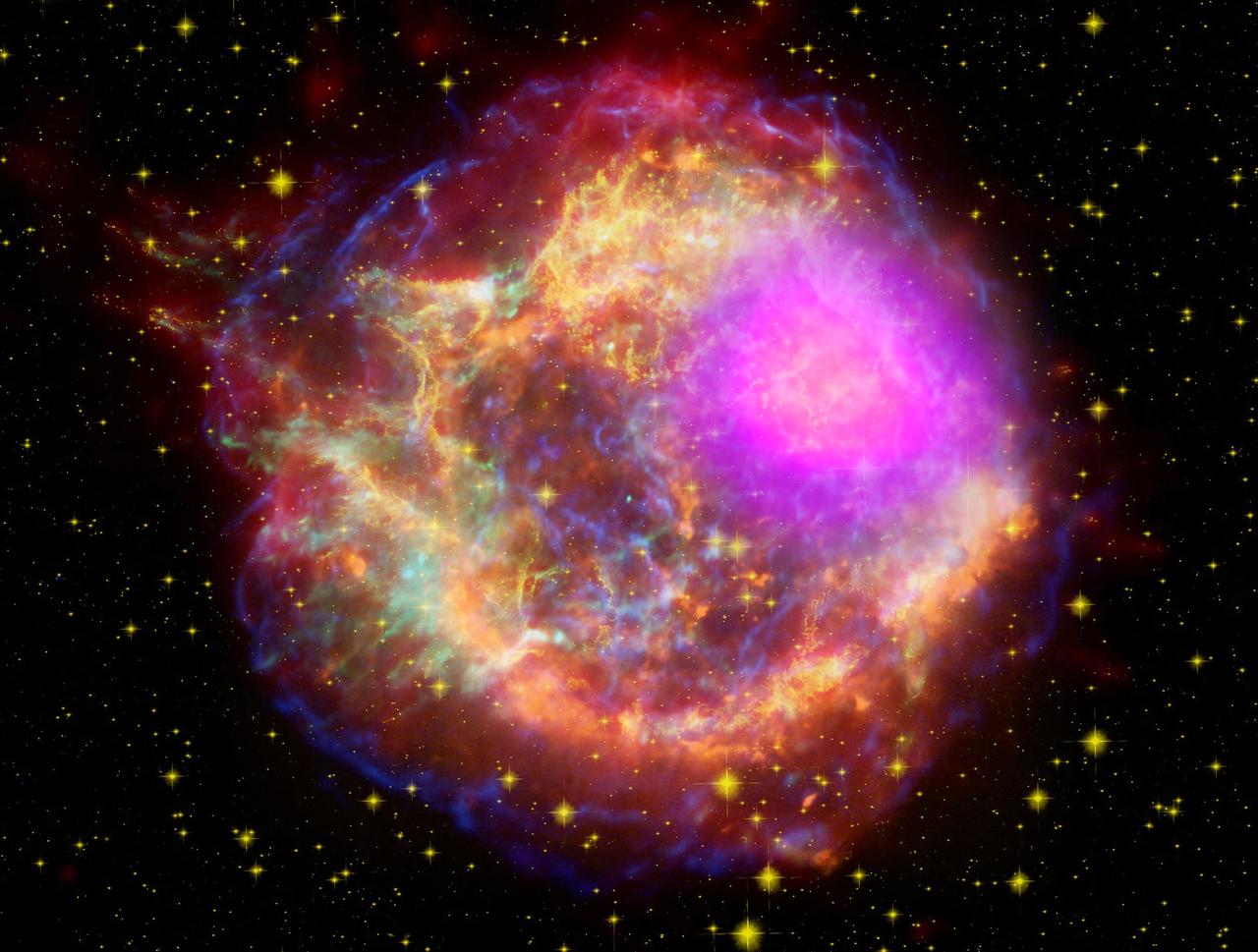
NASA's Fermi Closes on Source of Cosmic Rays New images from NASA's Fermi Gamma-ray Space Telescope show where supernova remnants emit radiation a billion times more energetic than visible light. The images bring astronomers a step closer to understanding the source of some of the universe's most energetic particles -- cosmic rays. This composite shows the Cassiopeia A supernova remnant across the spectrum: Gamma rays (magenta) from NASA's Fermi Gamma-ray Space Telescope; X-rays (blue, green) from NASA's Chandra X-ray Observatory; visible light (yellow) from the Hubble Space Telescope; infrared (red) from NASA's Spitzer Space Telescope; and radio (orange) from the Very Large Array near Socorro, N.M. Credit: NASA/DOE/Fermi LAT Collaboration, CXC/SAO/JPL-Caltech/Steward/O. Krause et al., and NRAO/AUI For more information: <a href="http://www.nasa.gov/mission_pages/GLAST/news/cosmic-rays-source.html" rel="nofollow">www.nasa.gov/mission_pages/GLAST/news/cosmic-rays-source....</a> <b><a href="http://www.nasa.gov/centers/goddard/home/index.html" rel="nofollow">NASA Goddard Space Flight Center</a></b> is home to the nation's largest organization of combined scientists, engineers and technologists that build spacecraft, instruments and new technology to study the Earth, the sun, our solar system, and the universe. <b>Follow us on <a href="http://twitter.com/NASA_GoddardPix" rel="nofollow">Twitter</a></b> <b>Join us on <a href="http://www.facebook.com/pages/Greenbelt-MD/NASA-Goddard/395013845897?ref=tsd" rel="nofollow">Facebook</a><b> </b></b>

JANUARY 8, 2013: Astronomers using NASA's Hubble and Spitzer space telescopes have probed the stormy atmosphere of a brown dwarf named 2MASSJ22282889-431026, creating the most detailed "weather map" yet for this class of cool, star-like orbs. The forecast shows wind-driven, planet-sized clouds enshrouding these strange worlds. Brown dwarfs form out of condensing gas, as stars do, but lack the mass to fuse atoms and produce energy. Instead, these objects, which some call failed stars, are more similar to gas planets with their complex, varied atmospheres. The new research is a stepping stone toward a better understanding not only brown dwarfs, but also of the atmospheres of planets beyond our solar system. Hubble and Spitzer simultaneously watched the brown dwarf as its light varied in time, brightening and dimming about every 90 minutes as the body rotated. Astronomers found the timing of this change in brightness depended on whether they looked using different wavelengths of infrared light. The variations are the result of different layers or patches of material swirling around in the brown dwarf in windy storms as large as Earth itself. Spitzer and Hubble see different atmospheric layers because certain infrared wavelengths are blocked by vapors of water and methane high up, while other infrared wavelengths emerge from much deeper layers. Daniel Apai, the principal investigator of the research from the University of Arizona, Tucson, presented the results at the American Astronomical Society meeting on January 8 in Long Beach, Calif. A study describing the results, led by Esther Buenzli, also of the University of Arizona, is published in the Astrophysical Journal Letters. For more information about this study, visit <a href="http://www.nasa.gov/spitzer" rel="nofollow">www.nasa.gov/spitzer</a> . <b><a href="http://www.nasa.gov/audience/formedia/features/MP_Photo_Guidelines.html" rel="nofollow">NASA image use policy.</a></b> <b><a href="http://www.nasa.gov/centers/goddard/home/index.html" rel="nofollow">NASA Goddard Space Flight Center</a></b> enables NASA’s mission through four scientific endeavors: Earth Science, Heliophysics, Solar System Exploration, and Astrophysics. Goddard plays a leading role in NASA’s accomplishments by contributing compelling scientific knowledge to advance the Agency’s mission. <b>Follow us on <a href="http://twitter.com/NASA_GoddardPix" rel="nofollow">Twitter</a></b> <b>Like us on <a href="http://www.facebook.com/pages/Greenbelt-MD/NASA-Goddard/395013845897?ref=tsd" rel="nofollow">Facebook</a></b> <b>Find us on <a href="http://instagram.com/nasagoddard?vm=grid" rel="nofollow">Instagram</a></b>

NASA image release April 12, 2011 Astronomers have uncovered one of the youngest galaxies in the distant universe, with stars that formed 13.5 billion years ago, a mere 200 million years after the Big Bang. The finding addresses questions about when the first galaxies arose, and how the early universe evolved. NASA's Hubble Space Telescope was the first to spot the newfound galaxy. Detailed observations from the W.M. Keck Observatory on Mauna Kea in Hawaii revealed the observed light dates to when the universe was only 950 million years old; the universe formed about 13.7 billion years ago. Infrared data from both Hubble and NASA's Spitzer Space Telescope revealed the galaxy's stars are quite mature, having formed when the universe was just a toddler at 200 million years old. The galaxy's image is being magnified by the gravity of a massive cluster of galaxies (Abell 383) parked in front of it, making it appear 11 times brighter. This phenomenon is called gravitational lensing. Hubble imaged the lensing galaxy Abell 383 with the Wide Field Camera 3 and the Advanced Camera for Surveys in November 2010 through March 2011. Credit: NASA, ESA, J. Richard (Center for Astronomical Research/Observatory of Lyon, France), and J.-P. Kneib (Astrophysical Laboratory of Marseille, France) <b><a href="http://www.nasa.gov/centers/goddard/home/index.html" rel="nofollow">NASA Goddard Space Flight Center</a></b> enables NASA’s mission through four scientific endeavors: Earth Science, Heliophysics, Solar System Exploration, and Astrophysics. Goddard plays a leading role in NASA’s accomplishments by contributing compelling scientific knowledge to advance the Agency’s mission. <b>Follow us on <a href="http://twitter.com/NASA_GoddardPix" rel="nofollow">Twitter</a></b> <b>Join us on <a href="http://www.facebook.com/pages/Greenbelt-MD/NASA-Goddard/395013845897?ref=tsd" rel="nofollow">Facebook</a></b>
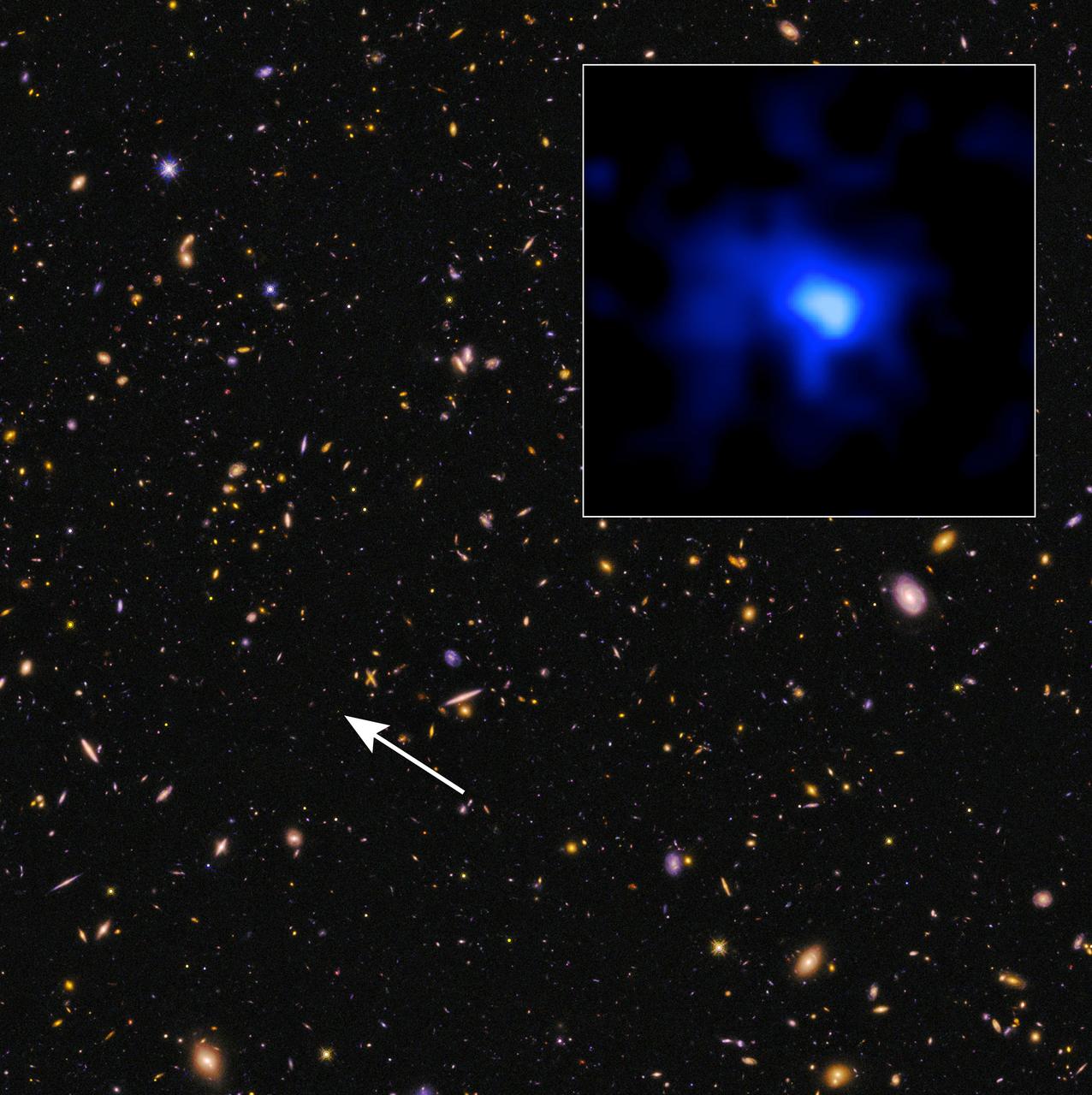
This is a Hubble Space Telescope image of the farthest spectroscopically confirmed galaxy observed to date (inset). It was identified in this Hubble image of a field of galaxies in the CANDELS survey (Cosmic Assembly Near-infrared Deep Extragalactic Legacy Survey). NASA’s Spitzer Space Telescope also observed the unique galaxy. The W. M. Keck Observatory was used to obtain a spectroscopic redshift (z=7.7), extending the previous redshift record. Measurements of the stretching of light, or redshift, give the most reliable distances to other galaxies. This source is thus currently the most distant confirmed galaxy known, and it appears to also be one of the brightest and most massive sources at that time. The galaxy existed over 13 billion years ago. The near-infrared light image of the galaxy (inset) has been colored blue as suggestive of its young, and hence very blue, stars. The CANDELS field is a combination of visible-light and near-infrared exposures. Read more: <a href="http://www.nasa.gov/feature/goddard/astronomers-set-a-new-galaxy-distance-record" rel="nofollow">www.nasa.gov/feature/goddard/astronomers-set-a-new-galaxy...</a> Credits: NASA, ESA, P. Oesch (Yale U.) <b><a href="http://www.nasa.gov/audience/formedia/features/MP_Photo_Guidelines.html" rel="nofollow">NASA image use policy.</a></b> <b><a href="http://www.nasa.gov/centers/goddard/home/index.html" rel="nofollow">NASA Goddard Space Flight Center</a></b> enables NASA’s mission through four scientific endeavors: Earth Science, Heliophysics, Solar System Exploration, and Astrophysics. Goddard plays a leading role in NASA’s accomplishments by contributing compelling scientific knowledge to advance the Agency’s mission. <b>Follow us on <a href="http://twitter.com/NASAGoddardPix" rel="nofollow">Twitter</a></b> <b>Like us on <a href="http://www.facebook.com/pages/Greenbelt-MD/NASA-Goddard/395013845897?ref=tsd" rel="nofollow">Facebook</a></b> <b>Find us on <a href="http://instagrid.me/nasagoddard/?vm=grid" rel="nofollow">Instagram</a></b>
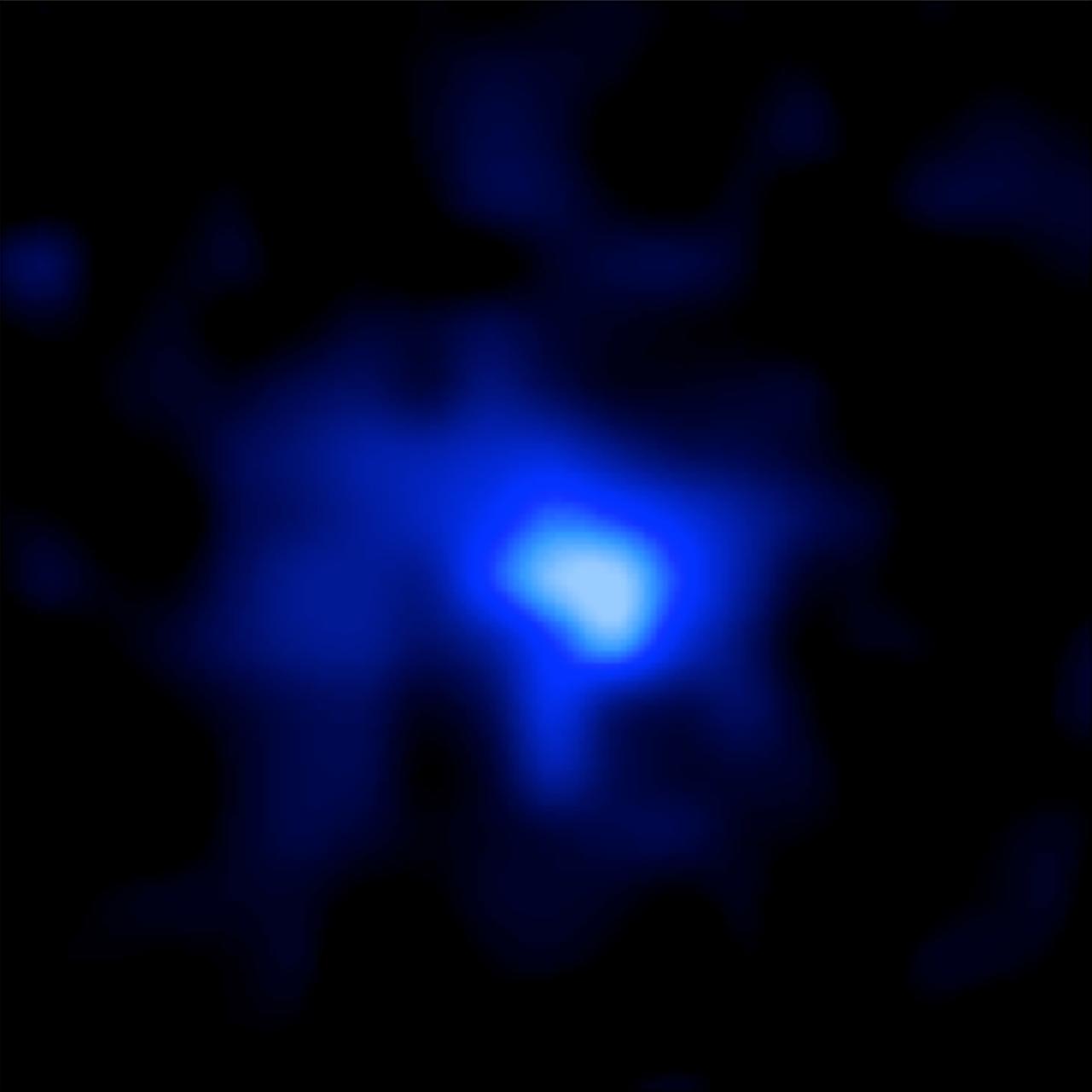
This is a Hubble Space Telescope image of the farthest spectroscopically confirmed galaxy observed to date (inset). It was identified in this Hubble image of a field of galaxies in the CANDELS survey (Cosmic Assembly Near-infrared Deep Extragalactic Legacy Survey). NASA’s Spitzer Space Telescope also observed the unique galaxy. The W. M. Keck Observatory was used to obtain a spectroscopic redshift (z=7.7), extending the previous redshift record. Measurements of the stretching of light, or redshift, give the most reliable distances to other galaxies. This source is thus currently the most distant confirmed galaxy known, and it appears to also be one of the brightest and most massive sources at that time. The galaxy existed over 13 billion years ago. The near-infrared light image of the galaxy (inset) has been colored blue as suggestive of its young, and hence very blue, stars. The CANDELS field is a combination of visible-light and near-infrared exposures. Read more: <a href="http://www.nasa.gov/feature/goddard/astronomers-set-a-new-galaxy-distance-record" rel="nofollow">www.nasa.gov/feature/goddard/astronomers-set-a-new-galaxy...</a> Credits: NASA, ESA, P. Oesch (Yale U.) <b><a href="http://www.nasa.gov/audience/formedia/features/MP_Photo_Guidelines.html" rel="nofollow">NASA image use policy.</a></b> <b><a href="http://www.nasa.gov/centers/goddard/home/index.html" rel="nofollow">NASA Goddard Space Flight Center</a></b> enables NASA’s mission through four scientific endeavors: Earth Science, Heliophysics, Solar System Exploration, and Astrophysics. Goddard plays a leading role in NASA’s accomplishments by contributing compelling scientific knowledge to advance the Agency’s mission. <b>Follow us on <a href="http://twitter.com/NASAGoddardPix" rel="nofollow">Twitter</a></b> <b>Like us on <a href="http://www.facebook.com/pages/Greenbelt-MD/NASA-Goddard/395013845897?ref=tsd" rel="nofollow">Facebook</a></b> <b>Find us on <a href="http://instagrid.me/nasagoddard/?vm=grid" rel="nofollow">Instagram</a></b>

This image depicts a vast canyon of dust and gas in the Orion Nebula from a 3-D computer model based on observations by NASA's Hubble Space Telescope and created by science visualization specialists at the Space Telescope Science Institute (STScI) in Baltimore, Md. A 3-D visualization of this model takes viewers on an amazing four-minute voyage through the 15-light-year-wide canyon. Credit: NASA, G. Bacon, L. Frattare, Z. Levay, and F. Summers (STScI/AURA) Go here to learn more about Hubble 3D: <a href="http://www.nasa.gov/topics/universe/features/hubble_imax_premiere.html" rel="nofollow">www.nasa.gov/topics/universe/features/hubble_imax_premier...</a> or <a href="http://www.imax.com/hubble/" rel="nofollow">www.imax.com/hubble/</a> Take an exhilarating ride through the Orion Nebula, a vast star-making factory 1,500 light-years away. Swoop through Orion's giant canyon of gas and dust. Fly past behemoth stars whose brilliant light illuminates and energizes the entire cloudy region. Zoom by dusty tadpole-shaped objects that are fledgling solar systems. This virtual space journey isn't the latest video game but one of several groundbreaking astronomy visualizations created by specialists at the Space Telescope Science Institute (STScI) in Baltimore, the science operations center for NASA's Hubble Space Telescope. The cinematic space odysseys are part of the new Imax film "Hubble 3D," which opens today at select Imax theaters worldwide. The 43-minute movie chronicles the 20-year life of Hubble and includes highlights from the May 2009 servicing mission to the Earth-orbiting observatory, with footage taken by the astronauts. The giant-screen film showcases some of Hubble's breathtaking iconic pictures, such as the Eagle Nebula's "Pillars of Creation," as well as stunning views taken by the newly installed Wide Field Camera 3. While Hubble pictures of celestial objects are awe-inspiring, they are flat 2-D photographs. For this film, those 2-D images have been converted into 3-D environments, giving the audience the impression they are space travelers taking a tour of Hubble's most popular targets. "A large-format movie is a truly immersive experience," says Frank Summers, an STScI astronomer and science visualization specialist who led the team that developed the movie visualizations. The team labored for nine months, working on four visualization sequences that comprise about 12 minutes of the movie. "Seeing these Hubble images in 3-D, you feel like you are flying through space and not just looking at picture postcards," Summers continued. "The spacescapes are all based on Hubble images and data, though some artistic license is necessary to produce the full depth of field needed for 3-D." The most ambitious sequence is a four-minute voyage through the Orion Nebula's gas-and-dust canyon, about 15 light-years across. During the ride, viewers will see bright and dark, gaseous clouds; thousands of stars, including a grouping of bright, hefty stars called the Trapezium; and embryonic planetary systems. The tour ends with a detailed look at a young circumstellar disk, which is much like the structure from which our solar system formed 4.5 billion years ago. Based on a Hubble image of Orion released in 2006, the visualization was a collaborative effort between science visualization specialists at STScI, including Greg Bacon, who sculpted the Orion Nebula digital model, with input from STScI astronomer Massimo Roberto; the National Center for Supercomputing Applications at the University of Illinois at Urbana-Champaign; and the Spitzer Science Center at the California Institute of Technology in Pasadena. For some of the sequences, STScI imaging specialists developed new techniques for transforming the 2-D Hubble images into 3-D. STScI image processing specialists Lisa Frattare and Zolt Levay, for example, created methods of splitting a giant gaseous pillar in the Carina Nebula into multiple layers to produce a 3-D effect, giving the structure depth. The Carina Nebula is a nursery for baby stars. Frattare painstakingly removed the thousands of stars in the image so that Levay could separate the gaseous layers on the isolated Carina pillar. Frattare then replaced the stars into both foreground and background layers to complete the 3-D model. For added effect, the same separation was done for both visible and infrared Hubble images, allowing the film to cross-fade between wavelength views in 3-D. In another sequence viewers fly into a field of 170,000 stars in the giant star cluster Omega Centauri. STScI astronomer Jay Anderson used his stellar database to create a synthetic star field in 3-D that matches recent razor-sharp Hubble photos. The film's final four-minute sequence takes viewers on a voyage from our Milky Way Galaxy past many of Hubble's best galaxy shots and deep into space. Some 15,000 galaxies from Hubble's deepest surveys stretch billions of light-years across the universe in a 3-D sequence created by STScI astronomers and visualizers. The view dissolves into a cobweb that traces the universe's large-scale structure, the backbone from which galaxies were born. In addition to creating visualizations, STScI's education group also provided guidance on the "Hubble 3D" Educator Guide, which includes standards-based lesson plans and activities about Hubble and its mission. Students will use the guide before or after seeing the movie. "The guide will enhance the movie experience for students and extend the movie into classrooms," says Bonnie Eisenhamer, STScI's Hubble Formal Education manager. The Hubble Space Telescope is a project of international cooperation between NASA and the European Space Agency (ESA) and is managed by NASA’s Goddard Space Flight Center (GSFC) in Greenbelt, Md. The Space Telescope Science Institute (STScI) conducts Hubble science operations. The institute is operated for NASA by the Association of Universities for Research in Astronomy, Inc., Washington, D.C.
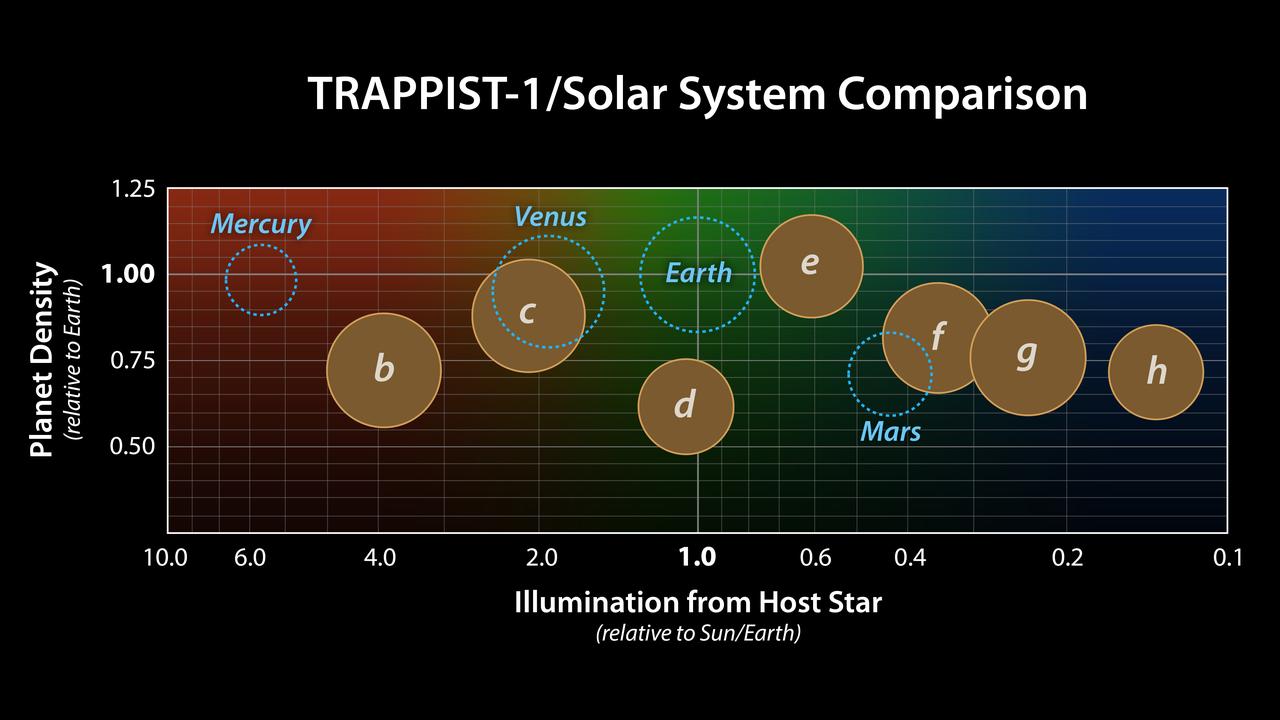
This graph presents known properties of the seven TRAPPIST-1 exoplanets (labeled b through h), showing how they stack up to the inner rocky worlds in our own solar system. The horizontal axis shows the level of illumination that each planet receives from its host star. TRAPPIST-1 is a mere 9 percent the mass of our Sun, and its temperature is much cooler. But because the TRAPPIST-1 planets orbit so closely to their star, they receive comparable levels of light and heat to Earth and its neighboring planets. The vertical axis shows the densities of the planets. Density, calculated based on a planet's mass and volume, is the first important step in understanding a planet's composition. The plot shows that the TRAPPIST-1 planet densities range from being similar to Earth and Venus at the upper end, down to values comparable to Mars at the lower end. The relative sizes of the planets are indicated by the circles. The masses and densities of the TRAPPIST-1 planets were determined by careful measurements of slight variations in the timings of their orbits using extensive observations made by NASA's Spitzer and Kepler space telescopes, in combination with data from Hubble and a number of ground-based telescopes. These measurements are the most precise to date for any system of exoplanets. By comparing these measurements with theoretical models of how planets form and evolve, researchers have determined that they are all rocky in overall composition. Estimates suggest the lower-density planets could have large quantities of water -- as much as 5 percent by mass for TRAPPIST-1d. Earth, in comparison, has only about 0.02 percent of its mass in the form of water. https://photojournal.jpl.nasa.gov/catalog/PIA22095

This graph presents measured properties of the seven TRAPPIST-1 exoplanets (labeled b through h), showing how they stack up with one another as well as with Earth and the other inner rocky worlds in our own solar system. The relative sizes of the planets are indicated by the circles. All of the known TRAPPIST-1 planets are larger than Mars, with five of them within 15% of the diameter of Earth. The vertical axis shows the uncompressed densities of the planets. Density, calculated from a planet's mass and volume, is the first important step in understanding its composition. Uncompressed density takes into account that the larger a planet is, the more its own gravity will pack the planet's material together and increase its density. Uncompressed density, therefore, usually provides a better means of comparing the composition of planets. The plot shows that the uncompressed densities of the TRAPPIST-1 planets are similar to one another, suggesting they may have all have a similar composition. The four rocky planets in our own solar system show more variation in density compared to the seven TRAPPIST-1 planets. Mercury, for example, contains a much higher percentage of iron than the other three rocky planets and thus has a much higher uncompressed density. The horizontal axis shows the level of illumination that each planet receives from its host star. The TRAPPIST-1 star is a mere 9% the mass of our Sun, and its temperature is much cooler. But because the TRAPPIST-1 planets orbit so closely to their star, they receive comparable levels of light and heat to Earth and its neighboring planets. The corresponding "habitable zones" — regions where an Earth-like planet could potentially support liquid water on its surface — of the two planetary systems are indicated near the top of the plot. The the two zones do not line up exactly because the cooler TRAPPIST-1 star emitting more of its light in the form of infrared radiation that is more efficiently absorbed by an Earth-like atmosphere. Since it takes less illumination to reach the same temperatures, the habitable zone shifts farther away from the star. The masses and densities of the TRAPPIST-1 planets were determined by measurements of slight variations in the timings of their orbits using extensive observations made by NASA's Spitzer and Kepler space telescopes, in combination with data from Hubble and a number of ground-based telescopes. The latest analysis, which includes Spitzer's complete record of over 1,000 hours of TRAPPIST-1 observations, has reduced the uncertainties of the mass measurements to a mere 3-6%. These are among the most accurate measurements of planetary masses anywhere outside of our solar system. https://photojournal.jpl.nasa.gov/catalog/PIA24371
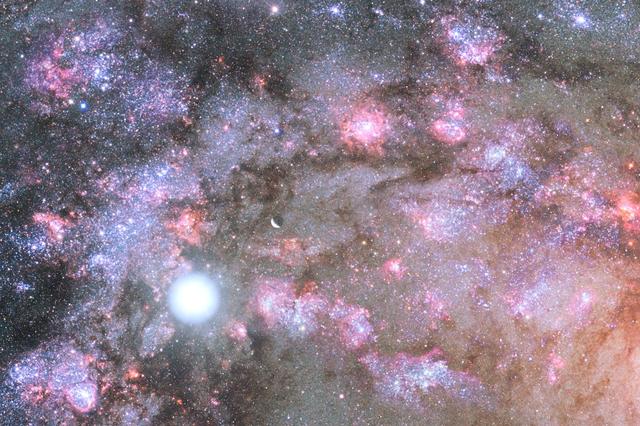
Astronomers have for the first time caught a glimpse of the earliest stages of massive galaxy construction. The building site, dubbed “Sparky,” is a dense galactic core blazing with the light of millions of newborn stars that are forming at a ferocious rate. The discovery was made possible through combined observations from NASA’s Hubble and Spitzer space telescopes, the W.M. Keck Observatory in Mauna Kea, Hawaii, and the European Space Agency's Herschel space observatory, in which NASA plays an important role. A fully developed elliptical galaxy is a gas-deficient gathering of ancient stars theorized to develop from the inside out, with a compact core marking its beginnings. Because the galactic core is so far away, the light of the forming galaxy that is observable from Earth was actually created 11 billion years ago, just 3 billion years after the Big Bang. Read more: <a href="http://1.usa.gov/1rAMSSr" rel="nofollow">1.usa.gov/1rAMSSr</a> Credit: NASA, Z. Levay, G. Bacon (STScI) <b><a href="http://www.nasa.gov/audience/formedia/features/MP_Photo_Guidelines.html" rel="nofollow">NASA image use policy.</a></b> <b><a href="http://www.nasa.gov/centers/goddard/home/index.html" rel="nofollow">NASA Goddard Space Flight Center</a></b> enables NASA’s mission through four scientific endeavors: Earth Science, Heliophysics, Solar System Exploration, and Astrophysics. Goddard plays a leading role in NASA’s accomplishments by contributing compelling scientific knowledge to advance the Agency’s mission. <b>Follow us on <a href="http://twitter.com/NASAGoddardPix" rel="nofollow">Twitter</a></b> <b>Like us on <a href="http://www.facebook.com/pages/Greenbelt-MD/NASA-Goddard/395013845897?ref=tsd" rel="nofollow">Facebook</a></b> <b>Find us on <a href="http://instagram.com/nasagoddard?vm=grid" rel="nofollow">Instagram</a></b>
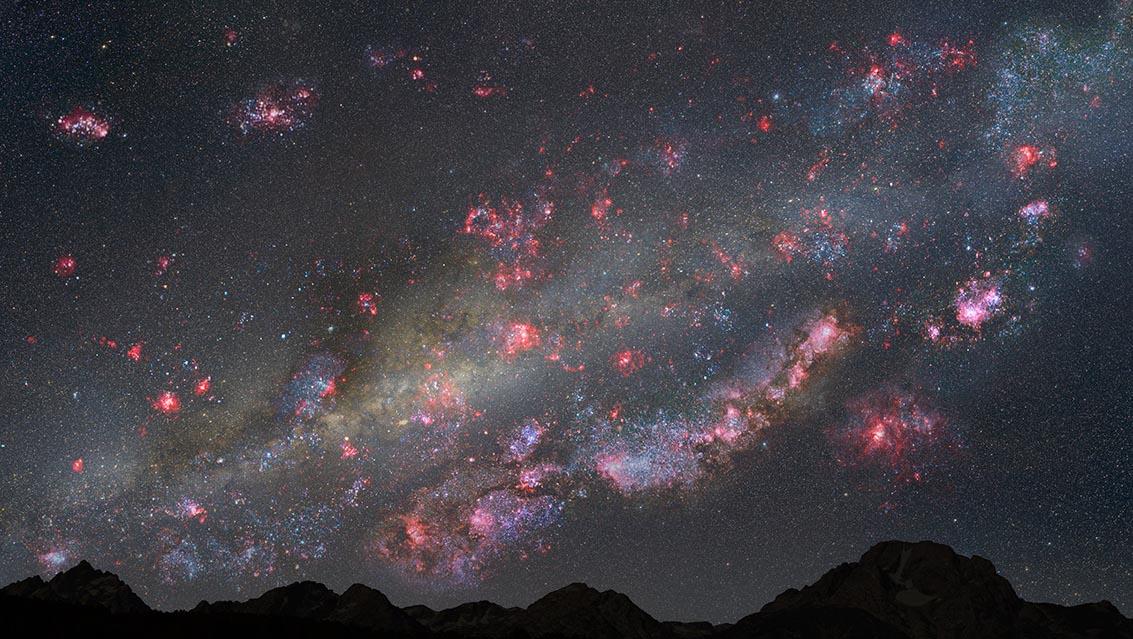
Caption: Artist's view of night sky from a hypothetical planet within a young Milky Way-like galaxy 10 billion years ago, the sky are ablaze with star birth. Pink clouds of gas harbor newborn stars, and bluish-white, young star clusters litter the landscape. Image Credit: NASA/ESA/Z. Levay (STScI) More info: In one of the most comprehensive multi-observatory galaxy surveys yet, astronomers find that galaxies like our Milky Way underwent a stellar “baby boom,” churning out stars at a prodigious rate, about 30 times faster than today. Our sun, however, is a late “boomer.” The Milky Way’s star-birthing frenzy peaked 10 billion years ago, but our sun was late for the party, not forming until roughly 5 billion years ago. By that time the star formation rate in our galaxy had plunged to a trickle. Missing the party, however, may not have been so bad. The sun’s late appearance may actually have fostered the growth of our solar system’s planets. Elements heavier than hydrogen and helium were more abundant later in the star-forming boom as more massive stars ended their lives early and enriched the galaxy with material that served as the building blocks of planets and even life on Earth. Astronomers don’t have baby pictures of our Milky Way’s formative years to trace the history of stellar growth so they studied galaxies similar in mass to our Milky Way, found in deep surveys of the universe. The farther into the universe astronomers look, the further back in time they are seeing, because starlight from long ago is just arriving at Earth now. From those surveys, stretching back in time more than 10 billion years, researchers assembled an album of images containing nearly 2,000 snapshots of Milky Way-like galaxies. The new census provides the most complete picture yet of how galaxies like the Milky Way grew over the past 10 billion years into today’s majestic spiral galaxies. The multi-wavelength study spans ultraviolet to far-infrared light, combining observations from NASA’s Hubble and Spitzer space telescopes, the European Space Agency’s Herschel Space Observatory, and ground-based telescopes, including the Magellan Baade Telescope at the Las Campanas Observatory in Chile. Read more: <a href="http://www.nasa.gov/content/goddard/our-sun-came-late-to-the-milky-way-s-star-birth-party/" rel="nofollow">www.nasa.gov/content/goddard/our-sun-came-late-to-the-mil...</a> <b><a href="http://www.nasa.gov/audience/formedia/features/MP_Photo_Guidelines.html" rel="nofollow">NASA image use policy.</a></b> <b><a href="http://www.nasa.gov/centers/goddard/home/index.html" rel="nofollow">NASA Goddard Space Flight Center</a></b> enables NASA’s mission through four scientific endeavors: Earth Science, Heliophysics, Solar System Exploration, and Astrophysics. Goddard plays a leading role in NASA’s accomplishments by contributing compelling scientific knowledge to advance the Agency’s mission. <b>Follow us on <a href="http://twitter.com/NASAGoddardPix" rel="nofollow">Twitter</a></b> <b>Like us on <a href="http://www.facebook.com/pages/Greenbelt-MD/NASA-Goddard/395013845897?ref=tsd" rel="nofollow">Facebook</a></b> <b>Find us on <a href="http://instagrid.me/nasagoddard/?vm=grid" rel="nofollow">Instagram</a></b>
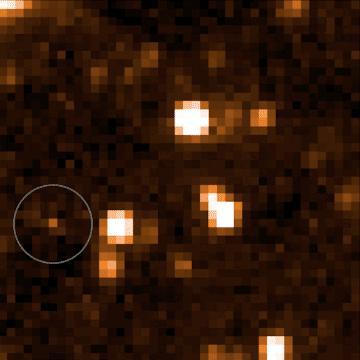
This image shows data from NASA's Near-Earth Object Wide-Field Infrared Survey Explorer (NEOWISE), launched in 2009 under the moniker WISE. The object in the bottom left corner is a brown dwarf officially named WISEA J153429.75-104303.3 and nicknamed “The Accident.” The Accident was discovered by citizen scientist Dan Caselden, who was using an online program he built to find brown dwarfs in NEOWISE data. Caselden's program attempted to remove the stationary objects emitting infrared light (like distant stars) from the NEOWISE maps and highlight moving objects that had characteristics similar to those of known brown dwarfs. He was looking at one such brown dwarf candidate when he spotted WISEA J153429.75-104303.3, which hadn't been highlighted by the program because it did not match the program's profile of a brown dwarf. The Accident confused scientists because it was faint in some key wavelengths, suggesting it was very cold (and old), but bright in others, indicating a higher temperature. A study in the Astrophysical Journal Letters posits that The Accident might be 10 billion to 13 billion years old – at least double the median age of other known brown dwarfs. That means it would have formed when our galaxy was much younger and had a different chemical makeup. The paper's authors think The Accident's brightness in certain wavelengths is an indicator that it contains very little methane, meaning it probably formed when the Milky Way was still young and carbon-poor. (Methane is composed of hydrogen and carbon). The study relies on additional observations using the W. M. Keck Observatory in Hawaii and NASA's Hubble and Spitzer Space Telescopes. Movie available at https://photojournal.jpl.nasa.gov/catalog/PIA24578