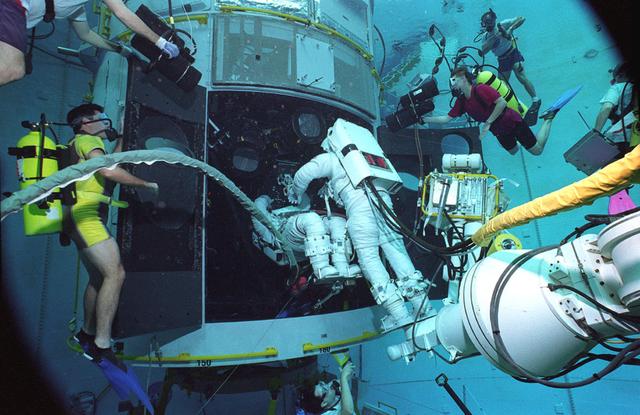
Astronauts Greg Harbaugh and Steve Smith conduct Hubble Space Telescope (HST) training in Marshall's Neutral Buoyancy Simulator (NBS).
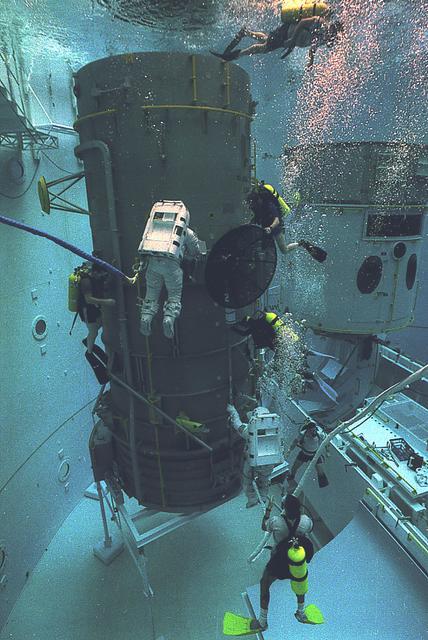
Underwater training is conducted in Marshall's Neutral Buoyancy Simulator (NBS) in preparation for on-orbit Hubble Space Telescope operations.
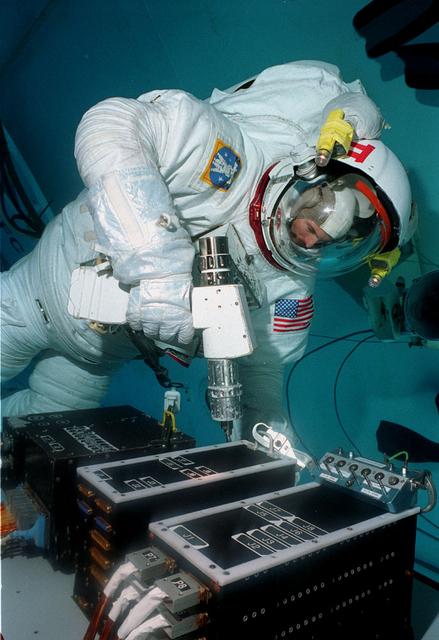
Astronaut Mark Lee conducts Hubble Space Telescope training in Marshall's Neutral Buoyancy Simulator (NBS)
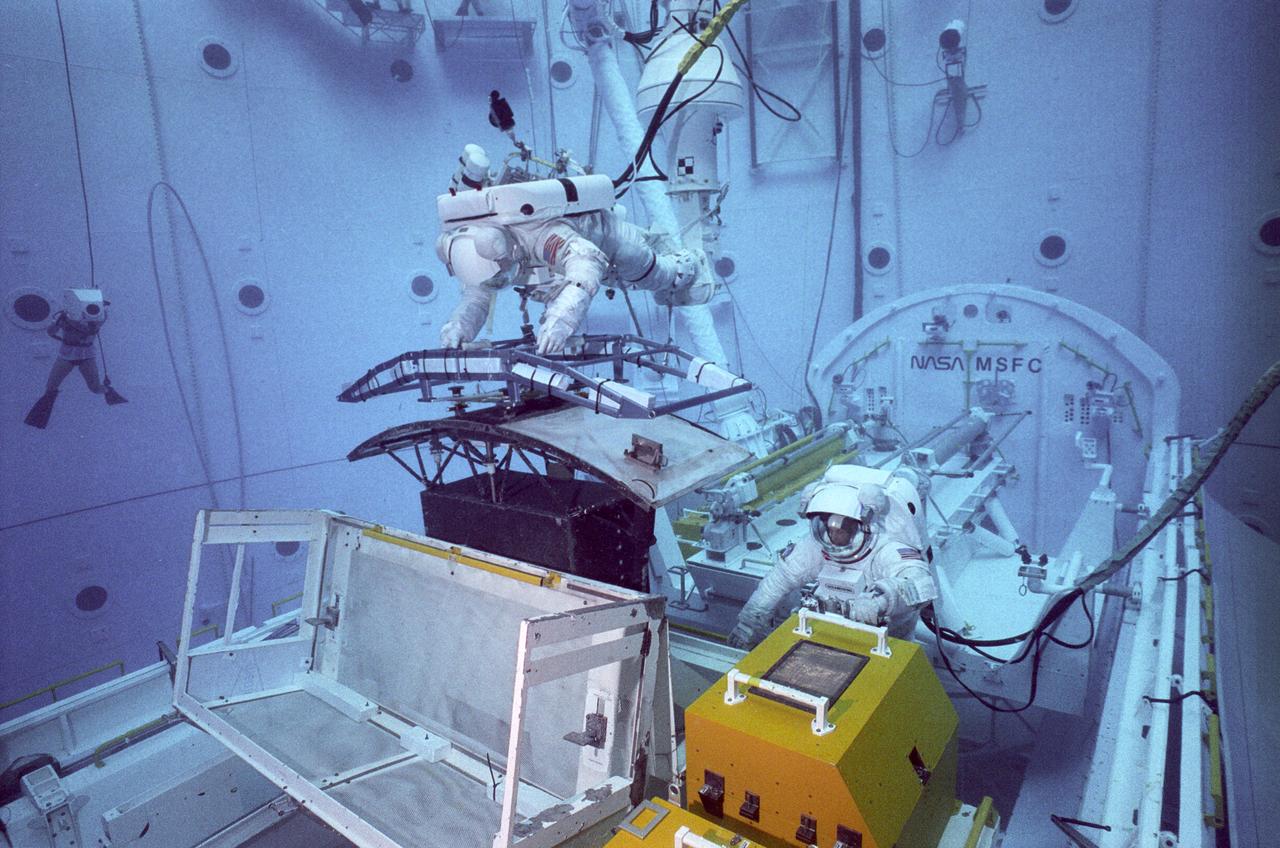
Underwater crew training is conducted in Marshall's Neutral Buoyancy Simulator (NBS) in preparation for on-orbit Hubble Space Telescope (HST) operations.
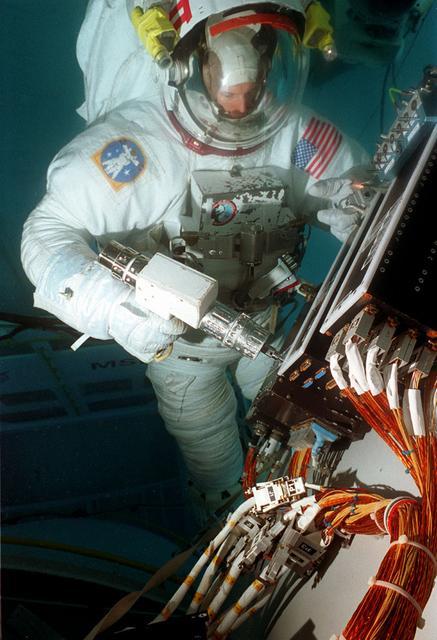
Astronaut Mark Lee conducts Hubble Space Telescope training in Marshall's Neutral Buoyancy Simulator (NBS)
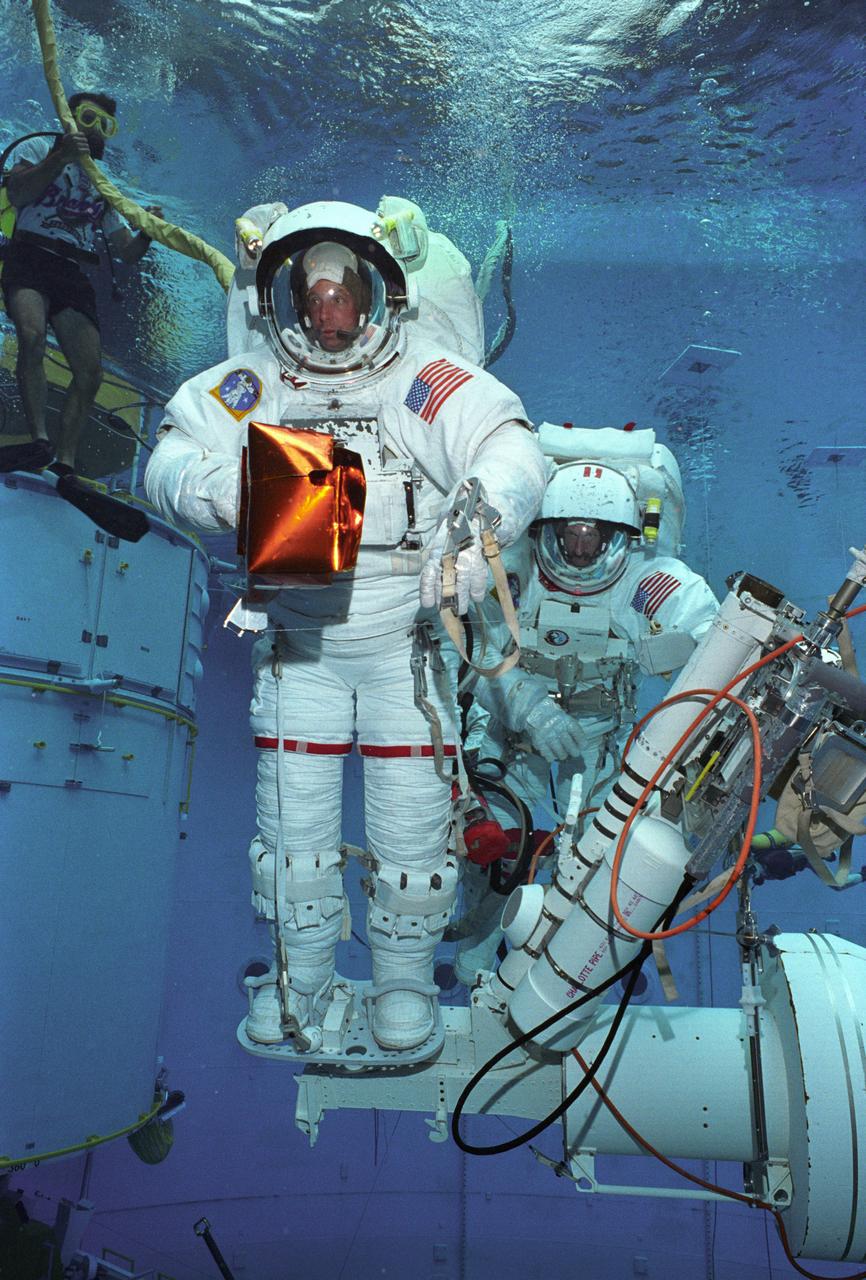
Astronauts Greg Harbaugh and Joe Tarner conduct Hubble Space Telescope training in Marshall's Neutral Buoyancy Simulator (NBS).
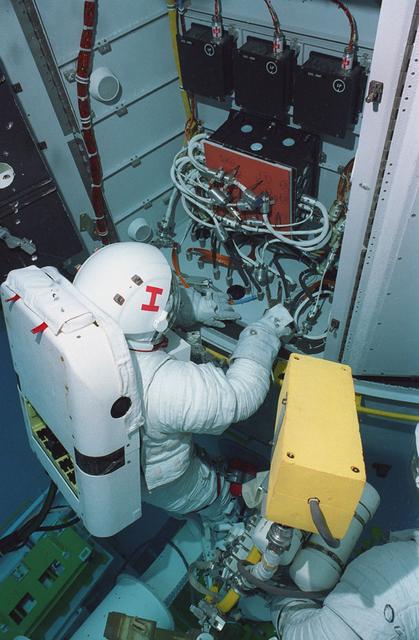
Astronauts Mark Lee and Joe Tarner conduct Hubble Space Telescope training in Marshall's Neutral Buoyancy Simulator (NBS).
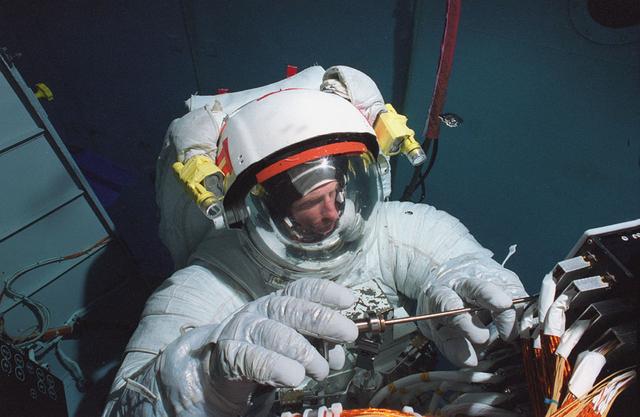
Astronauts Greg Harbaugh and Joe Tarner conduct Hubble Space Telescope training in Marshall's Neutral Buoyancy Simulator (NBS).
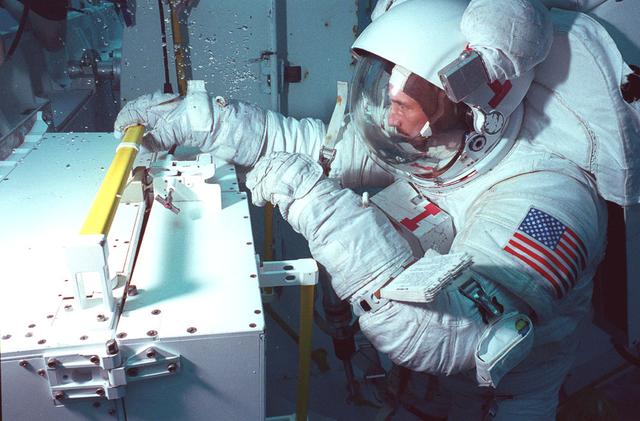
Underwater crew training is conducted in Marshall's Neutral Buoyancy Simulator (NBS) in preparation for on-orbit Hubble Space Telescope (HST) operations.
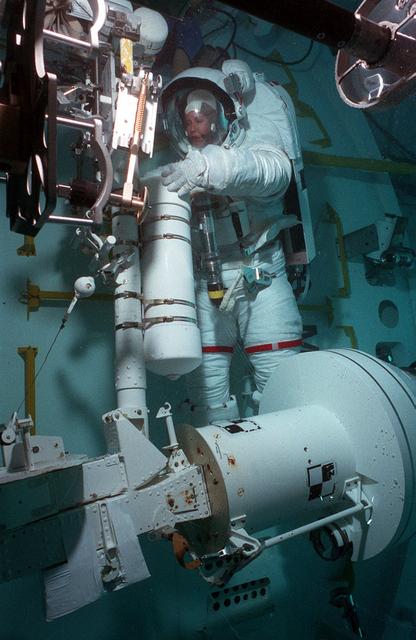
Astronaut Kathy Thornton conducts Hubble Space Telescope training in Marshall's Neutral Buoyancy Simulator (NBS).
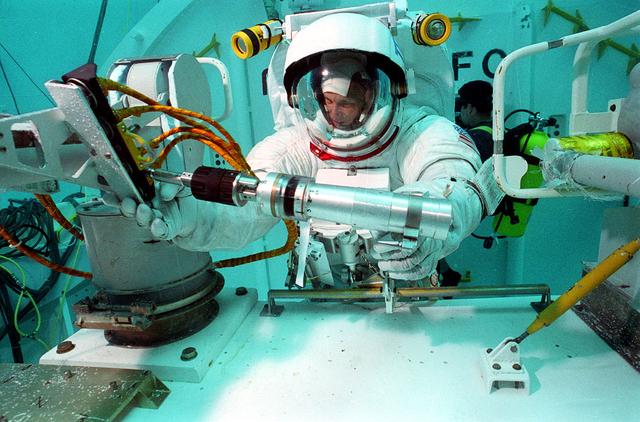
Astronaut Storey Musgrave conducts Hubble Space Telescope (HST) training in Marshall's Neutral Buoyancy Simulator (NBS).
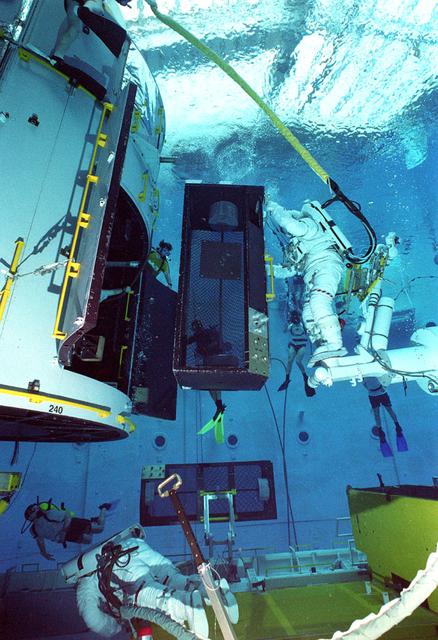
Astronauts Greg Harbaugh and Joe Tarner conduct Hubble Space Telescope training in Marshall's Neutral Buoyancy Simulator (NBS).
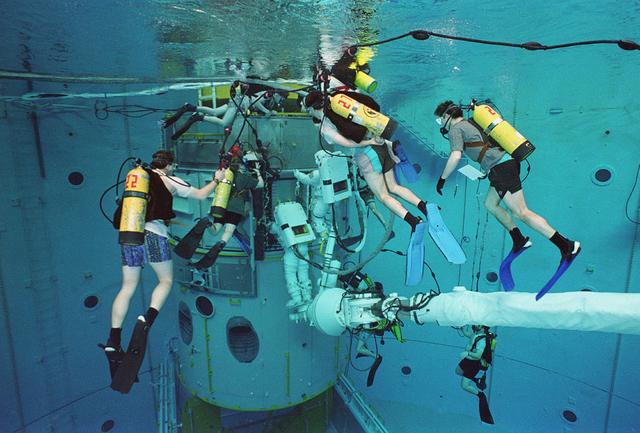
Underwater training is conducted in Marshall's Neutral Buoyancy Simulator (NBS) in preparation for on-orbit Hubble Space Telescope operations.
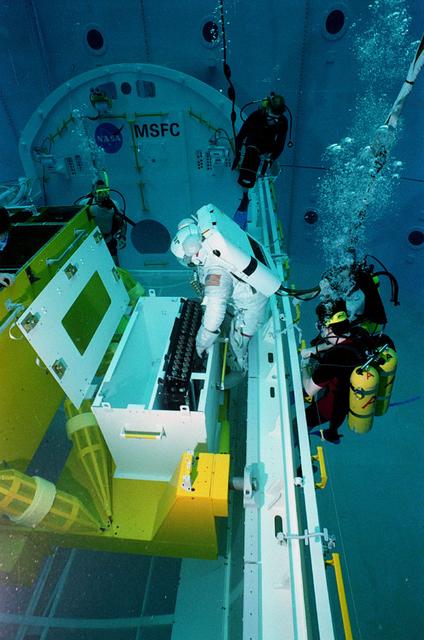
Astronaut Jeff Hoffman conducts Hubble Space Telescope training in Marshall's Neutral Buoyancy Simulator (NBS)
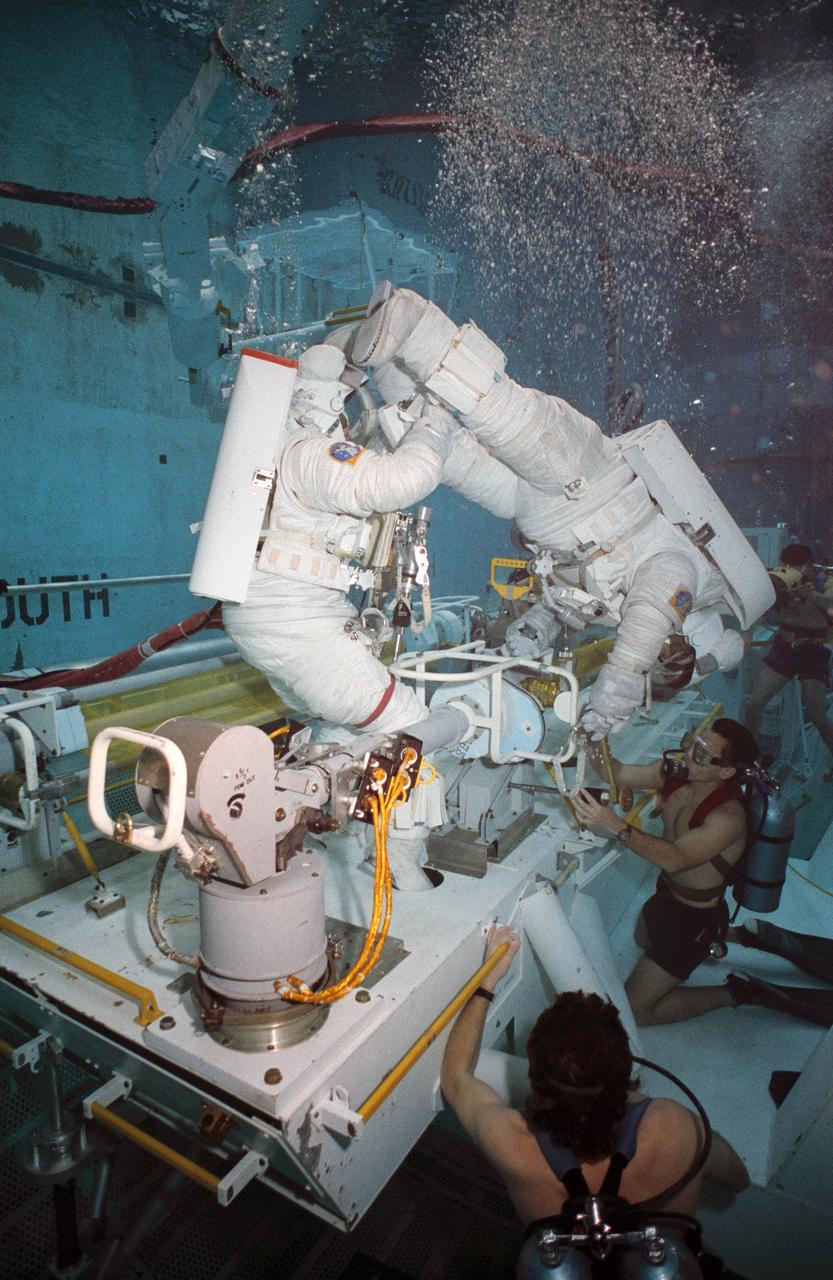
S93-30238 (5 Mar 1993) --- Wearing training versions of Space Shuttle Extravehicular Mobility Units (EMU), astronauts Thomas D. Akers (red stripe) and Kathryn C. Thornton use the spacious pool of the Johnson Space Center's (JSC) Weightless Environment Training Facility (WET-F) to rehearse for the Hubble Space Telescope (HST) repair mission. They are working with a full scale mockup of a solar array fixture.
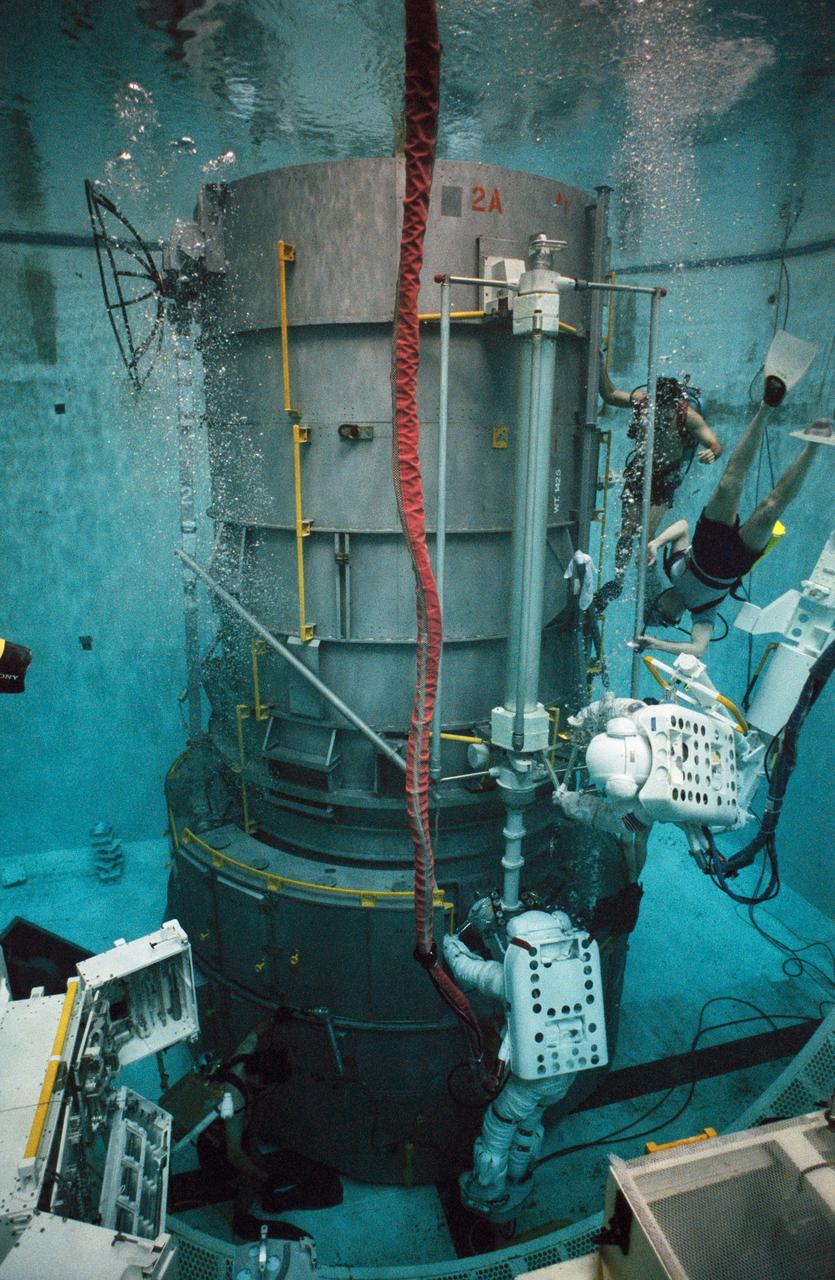
S93-30237 (5 Mar 1993) --- Wearing training versions of Space Shuttle Extravehicular Mobility Units (EMU), astronauts Thomas D. Akers (red stripe) and Kathryn C. Thornton use the spacious pool of the Johnson Space Center's (JSC) Weightless Environment Training Facility (WET-F) to rehearse for the Hubble Space Telescope (HST) servicing mission. They are working with part of a full-scale mockup of HST.
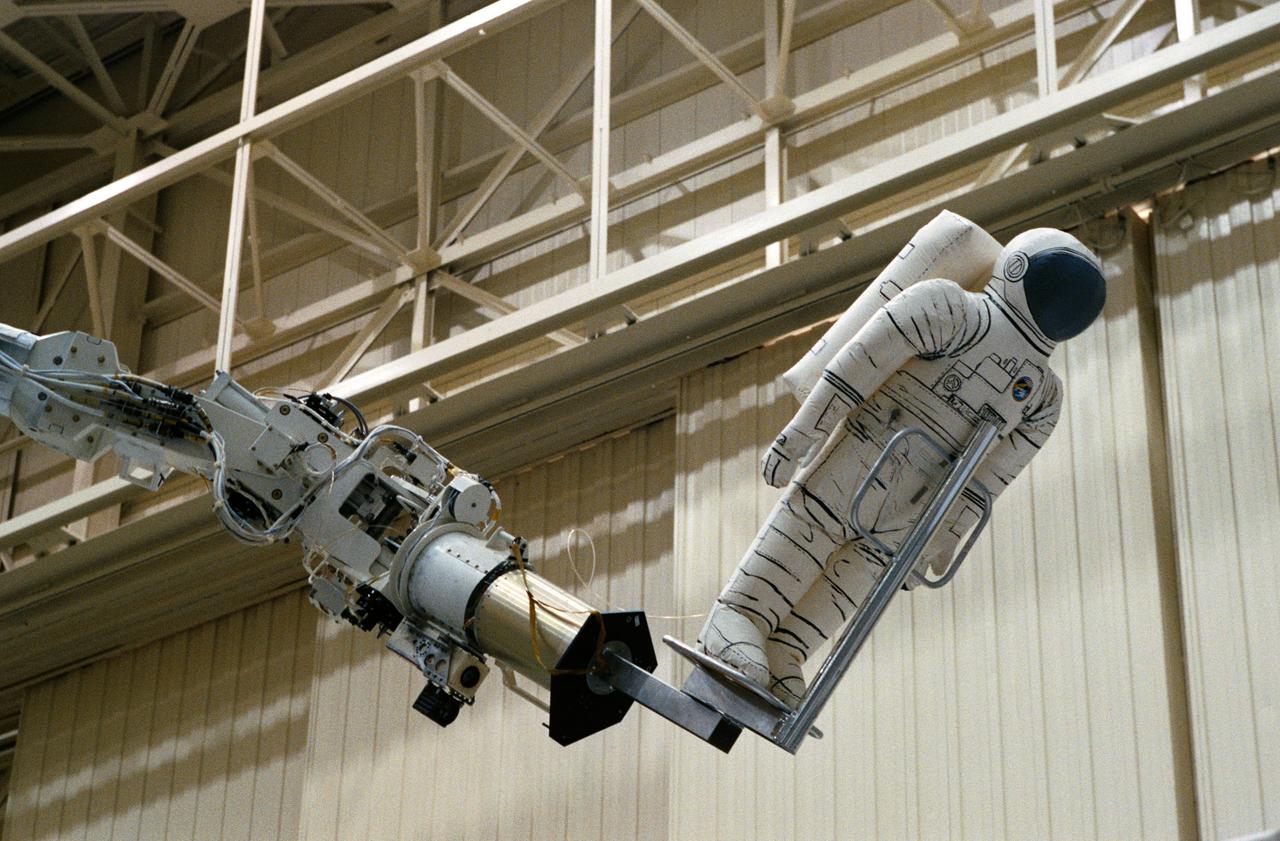
The Remote Manipulator System (RMS) eases a mannequin representing an astronaut into position for an STS-61 Hubble Space Telescope (HST) servicing task in the Space Shuttle mockup and integration laboratory at JSC (35699, 35703); Wide-angle view of the RMS easing a mannequin into position for work on the HST mock-up in bldg 9N (35700-1); Swiss scientist Claude Nicollier, mission specialist, works the control of the RMS during a training session in the manipulator development facility (MDF) in JSC's Shuttle mock-up and integration laboratory. Astronaut Kenneth D. Bowersox (left), pilot, is among the other crewmembers in training for the STS-61 HST servicing mission (35702).
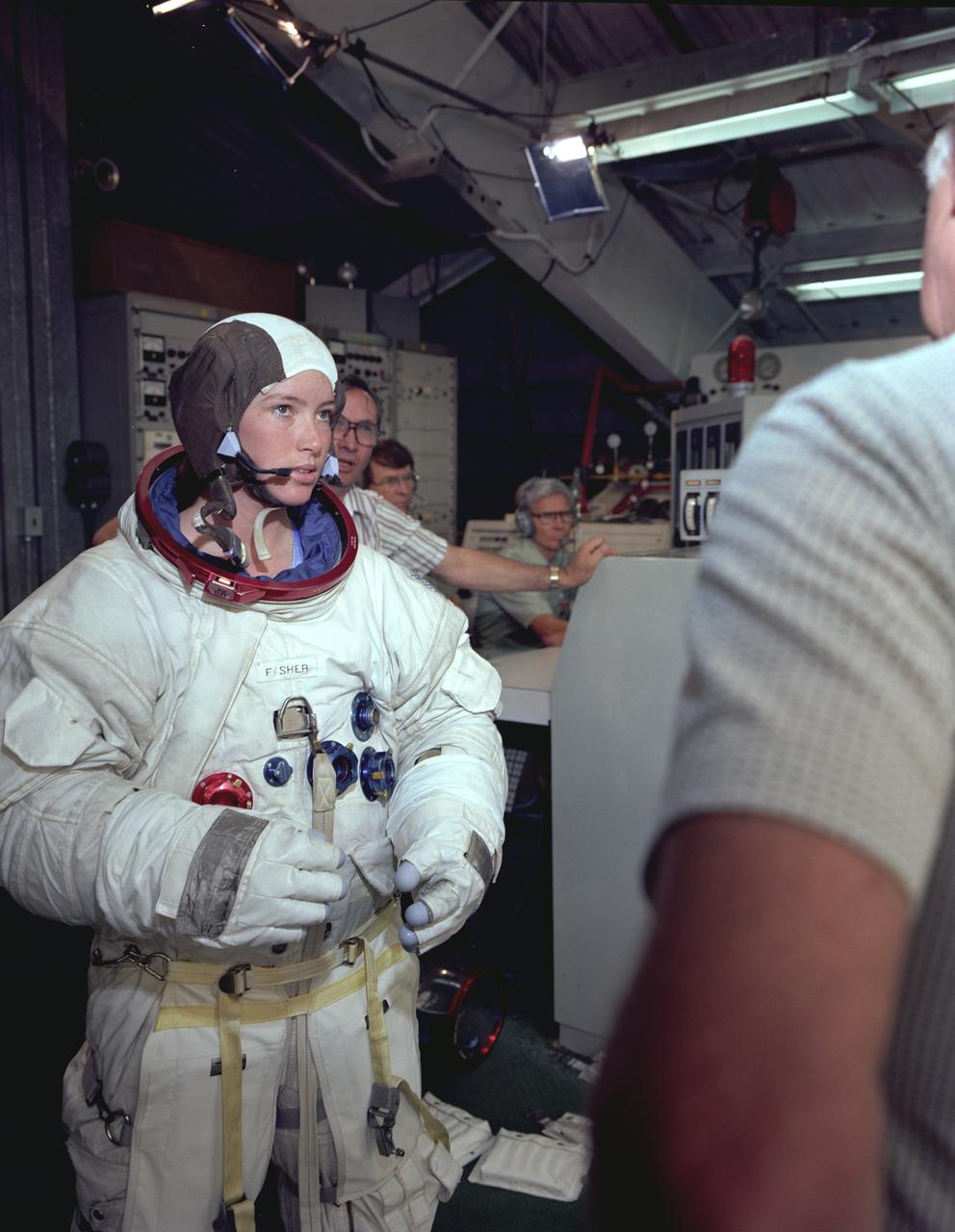
The Hubble Space Telescope (HST) is a cooperative program of the European Space Agency (ESA) and the National Aeronautical and Space Administration (NASA) to operate a long-lived space-based observatory. It was the flagship mission of NASA's Great Observatories program. The HST program began as an astronomical dream in the 1940s. During the 1970s and 1980s, the HST was finally designed and built becoming operational in the 1990s. The HST was deployed into a low-Earth orbit on April 25, 1990 from the cargo bay of the Space Shuttle Discovery (STS-31). The design of the HST took into consideration its length of service and the necessity of repairs and equipment replacement by making the body modular. In doing so, subsequent shuttle missions could recover the HST, replace faulty or obsolete parts and be re-released. Marshall SPace Flight Center’s (MSFC's) Neutral Buoyancy Simulator (NBS) served as the test center for shuttle astronauts training for Hubble related missions. Shown is astronaut Anna Fisher suited up for training on a mockup of a modular section of the HST for an axial scientific instrument change out.
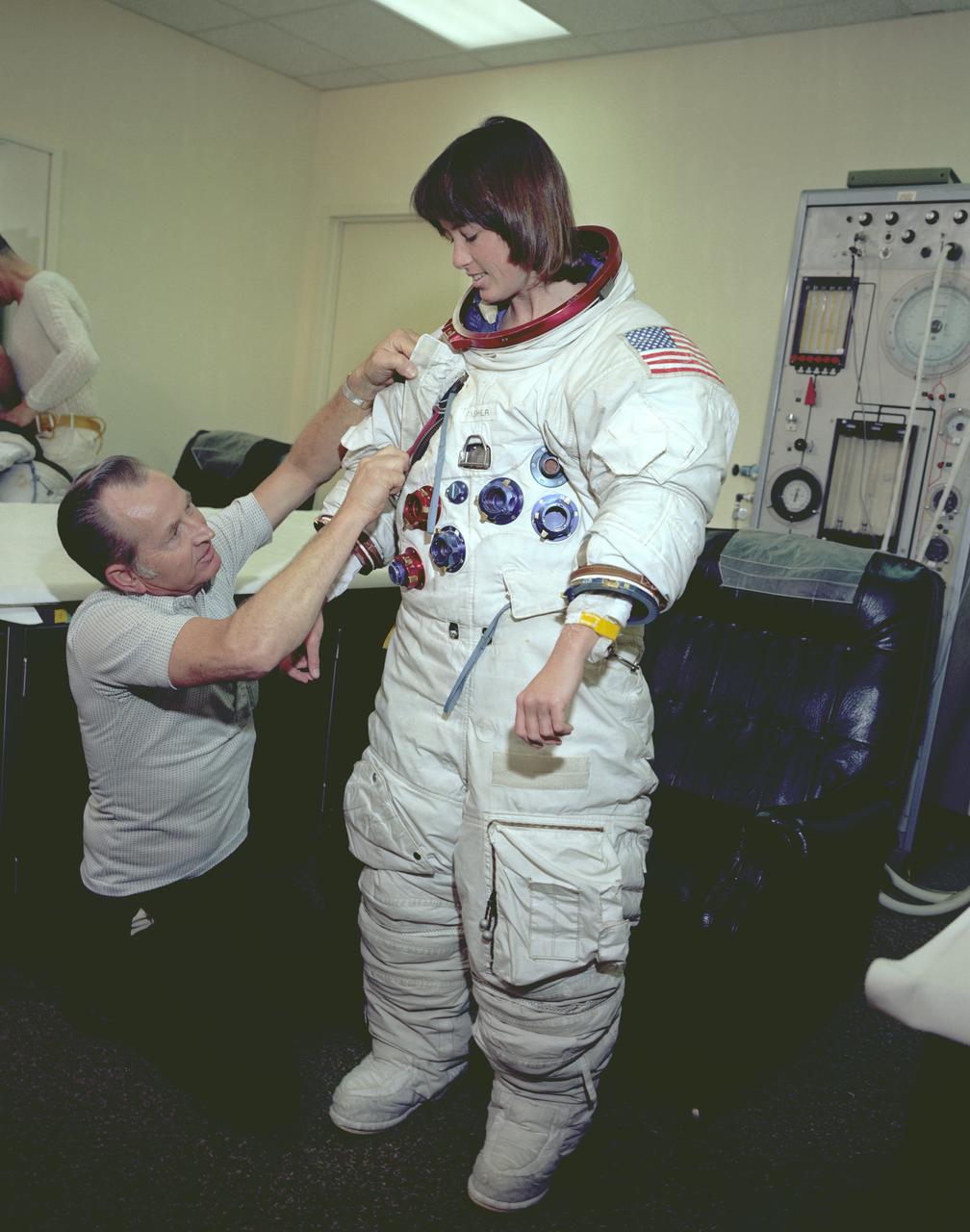
The Hubble Space Telescope (HST) is a cooperative program of the European Space Agency (ESA) and the National Aeronautical and Space Administration (NASA) to operate a long-lived space-based observatory. It was the flagship mission of NASA's Great Observatories program. The HST program began as an astronomical dream in the 1940s. During the 1970s and 1980s, the HST was finally designed and built becoming operational in the 1990s. The HST was deployed into a low-Earth orbit on April 25, 1990 from the cargo bay of the Space Shuttle Discovery (STS-31). The design of the HST took into consideration its length of service and the necessity of repairs and equipment replacement by making the body modular. In doing so, subsequent shuttle missions could recover the HST, replace faulty or obsolete parts and be re-released. Marshall Space Flight Center’s (MSFC's) Neutral Buoyancy Simulator (NBS) served as the test center for shuttle astronauts training for Hubble related missions. Shown is astronaut Anna Fisher suiting up for training on a mockup of a modular section of the HST for an axial scientific instrument change out.
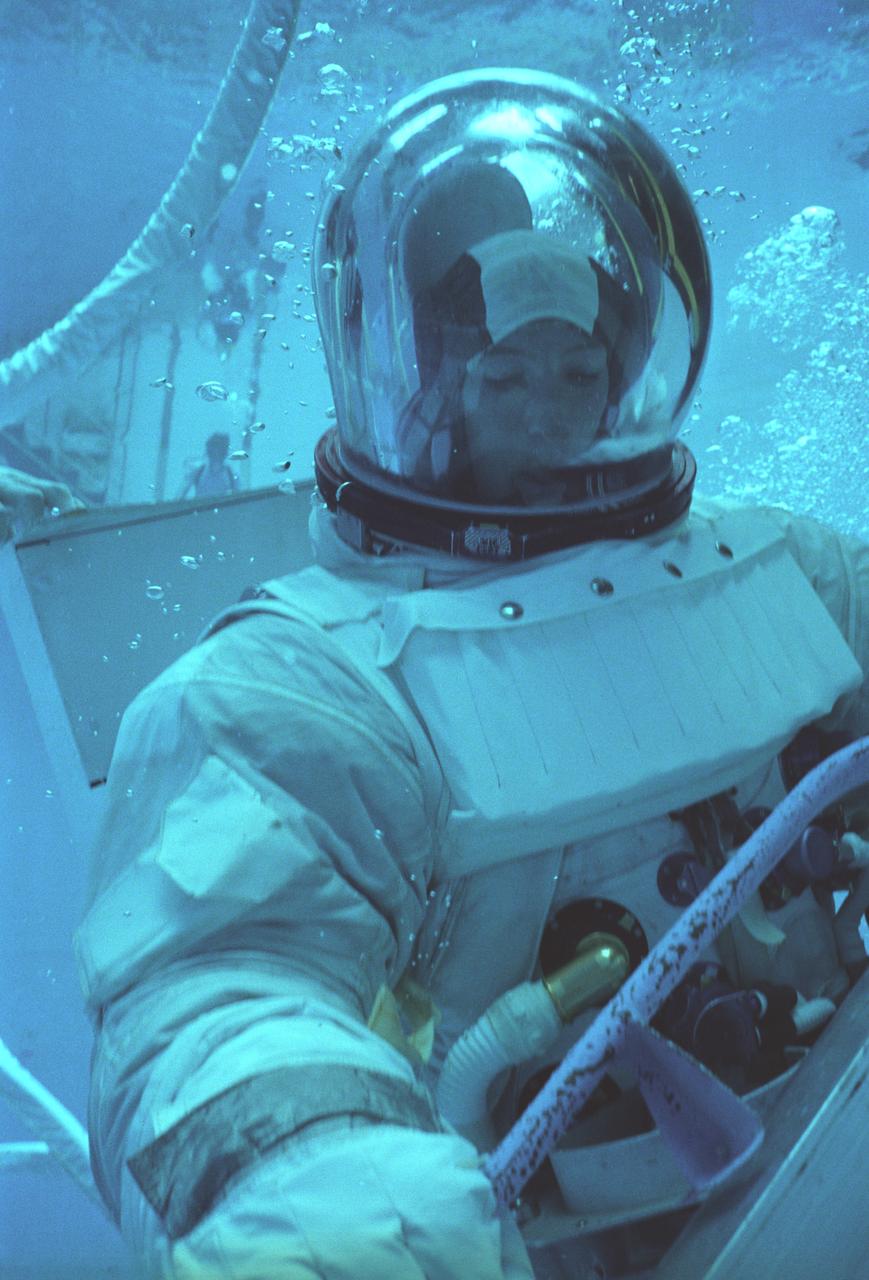
The Hubble Space Telescope (HST) is a cooperative program of the European Space Agency (ESA) and the National Aeronautical and Space Administration (NASA) to operate a long-lived space-based observatory. It was the flagship mission of NASA's Great Observatories program. The HST program began as an astronomical dream in the 1940s. During the 1970s and 1980s, the HST was finally designed and built becoming operational in the 1990s. The HST was deployed into a low-Earth orbit on April 25, 1990 from the cargo bay of the Space Shuttle Discovery (STS-31). The design of the HST took into consideration its length of service and the necessity of repairs and equipment replacement by making the body modular. In doing so, subsequent shuttle missions could recover the HST, replace faulty or obsolete parts and be re-released. Marshall Space Flight Center’s (MSFC's) Neutral Buoyancy Simulator (NBS) served as the test center for shuttle astronauts training for Hubble related missions. Shown is astronaut Anna Fisher training on a mock-up of a modular section of the HST for an axial scientific instrument change out.
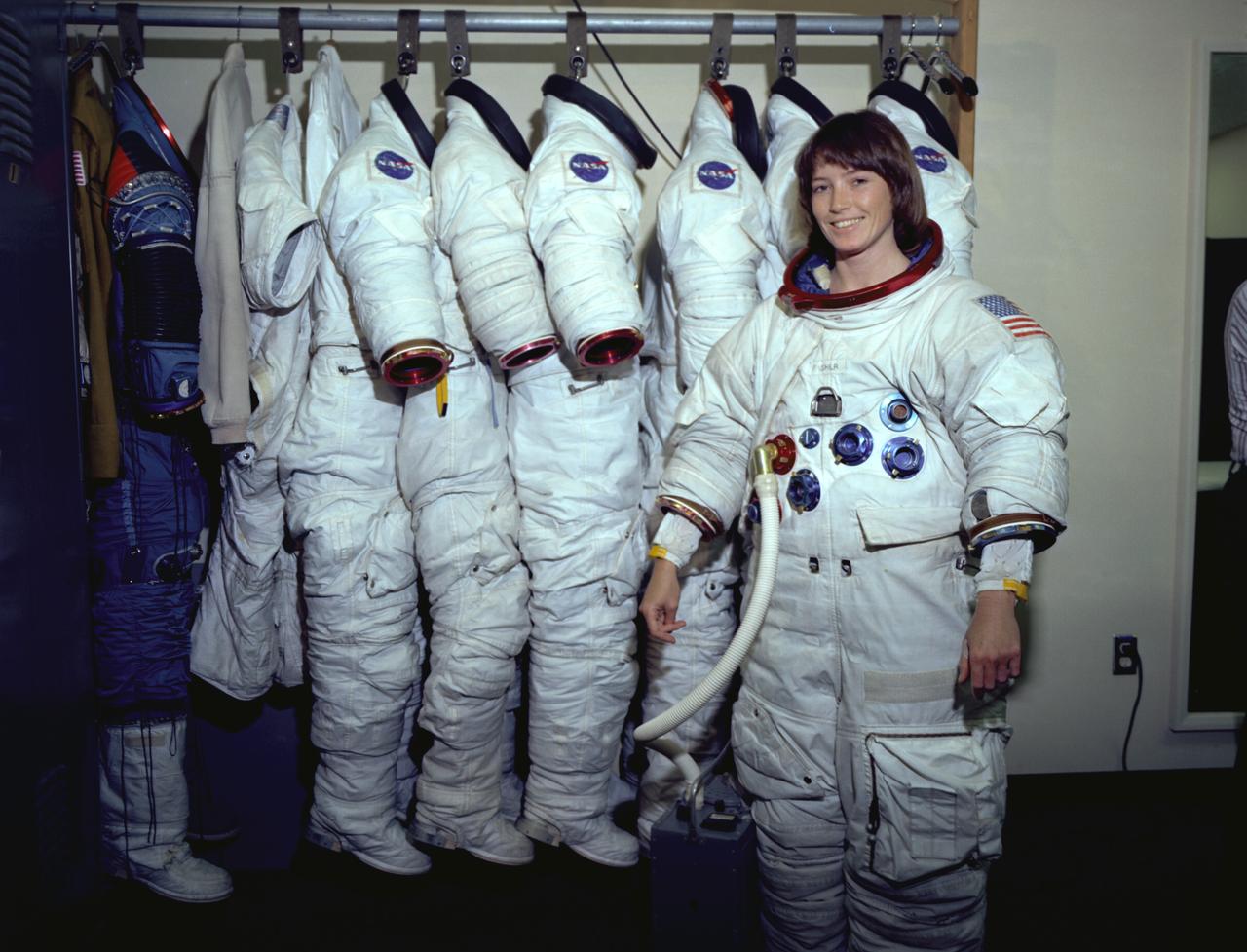
The Hubble Space Telescope (HST) is a cooperative program of the European Space Agency (ESA) and the National Aeronautical and Space Administration (NASA) to operate a long-lived space-based observatory. It was the flagship mission of NASA's Great Observatories program. The HST program began as an astronomical dream in the 1940s. During the 1970s and 1980s, the HST was finally designed and built becoming operational in the 1990s. The HST was deployed into a low-Earth orbit on April 25, 1990 from the cargo bay of the Space Shuttle Discovery (STS-31). The design of the HST took into consideration its length of service and the necessity of repairs and equipment replacement by making the body modular. In doing so, subsequent shuttle missions could recover the HST, replace faulty or obsolete parts and be re-released. Marshall Space Flight Center’s (MSFC's) Neutral Buoyancy Simulator (NBS) served as the test center for shuttle astronauts training for Hubble related missions. Shown is astronaut Anna Fisher suited up for training on a mockup of a modular section of the HST for an axial scientific instrument change out.
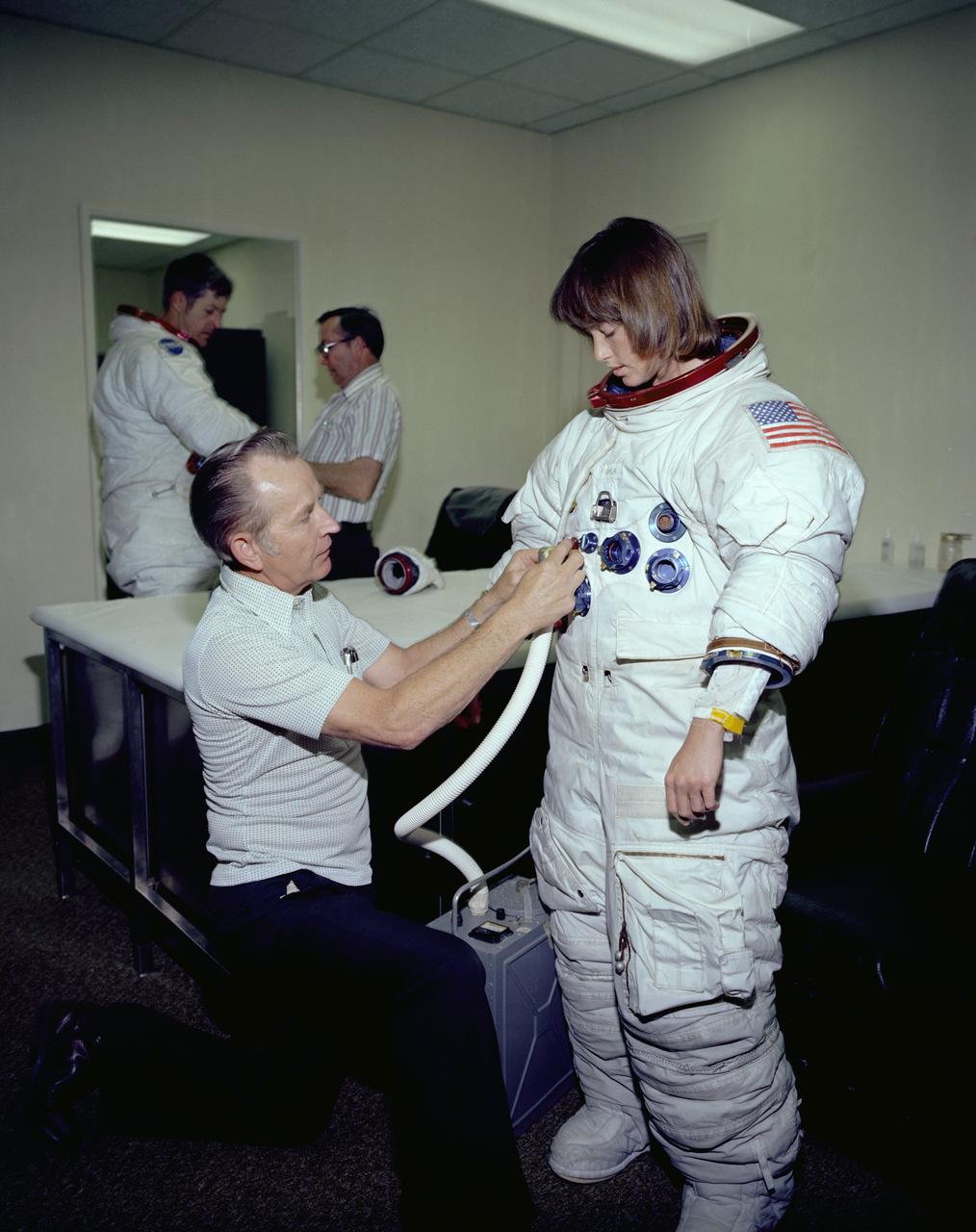
The Hubble Space Telescope (HST) is a cooperative program of the European Space Agency (ESA) and the National Aeronautical and Space Administration (NASA) to operate a long-lived space-based observatory. It was the flagship mission of NASA's Great Observatories program. The HST program began as an astronomical dream in the 1940s. During the 1970s and 1980s, the HST was finally designed and built becoming operational in the 1990s. The HST was deployed into a low-Earth orbit on April 25, 1990 from the cargo bay of the Space Shuttle Discovery (STS-31). The design of the HST took into consideration its length of service and the necessity of repairs and equipment replacement by making the body modular. In doing so, subsequent shuttle missions could recover the HST, replace faulty or obsolete parts and be re-released. Marshall Space Flight Center’s (MSFC's) Neutral Buoyancy Simulator (NBS) served as the test center for shuttle astronauts training for Hubble related missions. Shown is astronaut Anna Fisher suiting up for training on a mockup of a modular section of the HST for an axial scientific instrument change out.
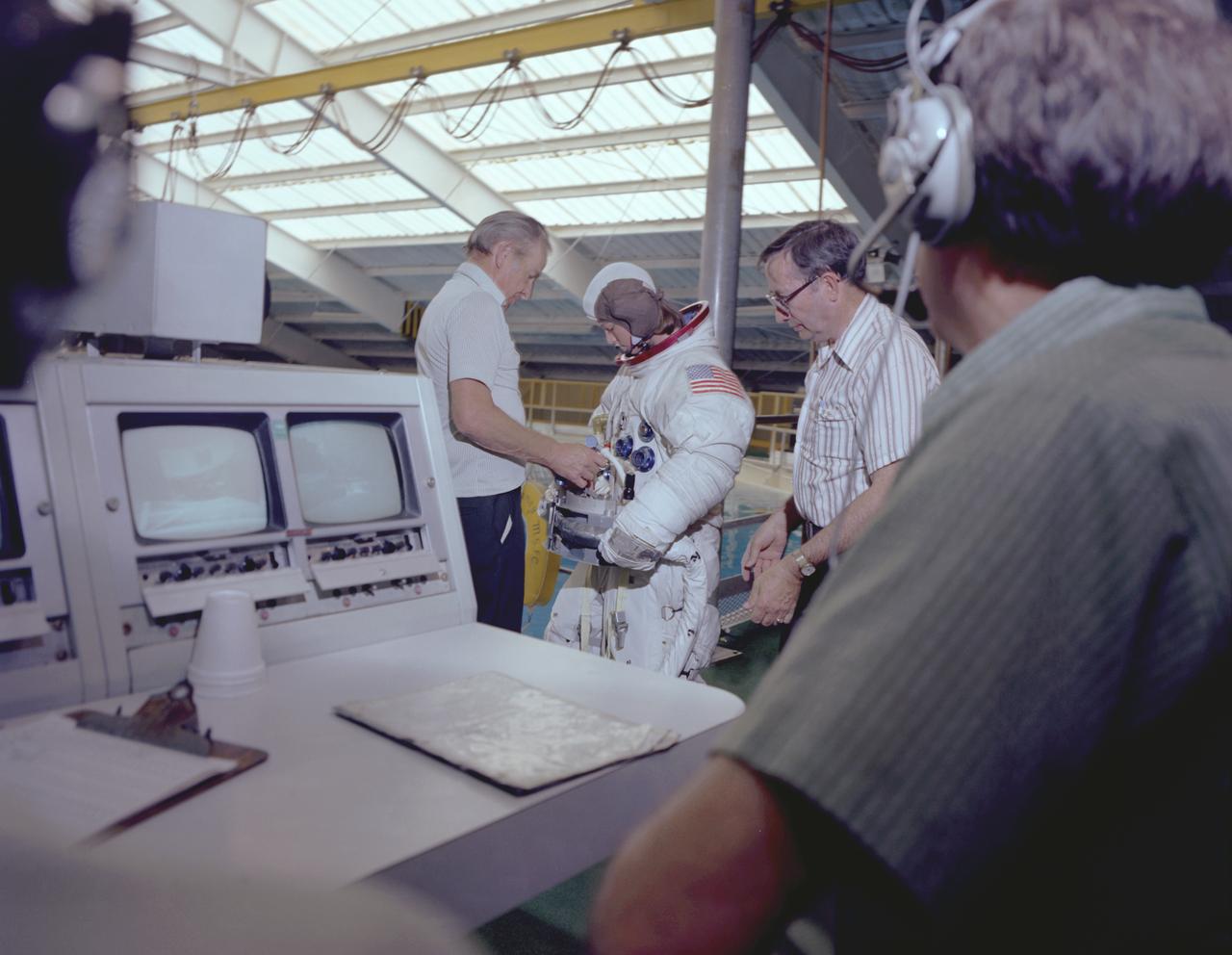
The Hubble Space Telescope (HST) is a cooperative program of the European Space Agency (ESA) and the National Aeronautical and Space Administration (NASA) to operate a long-lived space-based observatory. It was the flagship mission of NASA's Great Observatories program. The HST program began as an astronomical dream in the 1940s. During the 1970s and 1980s, the HST was finally designed and built becoming operational in the 1990s. The HST was deployed into a low-Earth orbit on April 25, 1990 from the cargo bay of the Space Shuttle Discovery (STS-31). The design of the HST took into consideration its length of service and the necessity of repairs and equipment replacement by making the body modular. In doing so, subsequent shuttle missions could recover the HST, replace faulty or obsolete parts and be re-released. MSFC's Neutral Buoyancy Simulator (NBS) served as the test center for shuttle astronauts training for Hubble related missions. Shown is astronaut Anna Fisher suiting up for training on a mockup of a modular section of the HST for an axial scientific instrument change out.
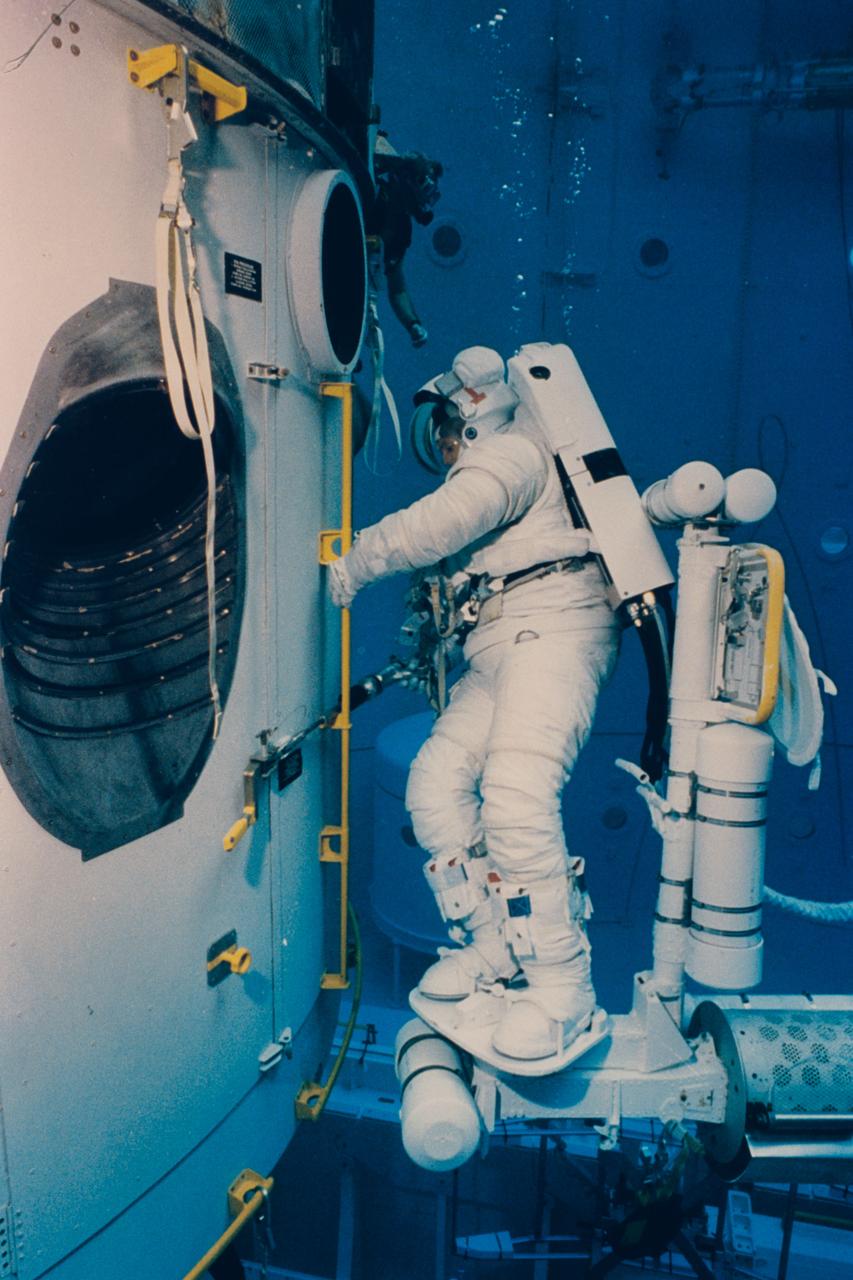
Astronaut Thomas D. Akers uses a power wrench to deploy one of the tools on the Hubble Space Telescope (HST) during a training session in the Neutral Buoyancy Simulator at Marshall Space Flight Center.
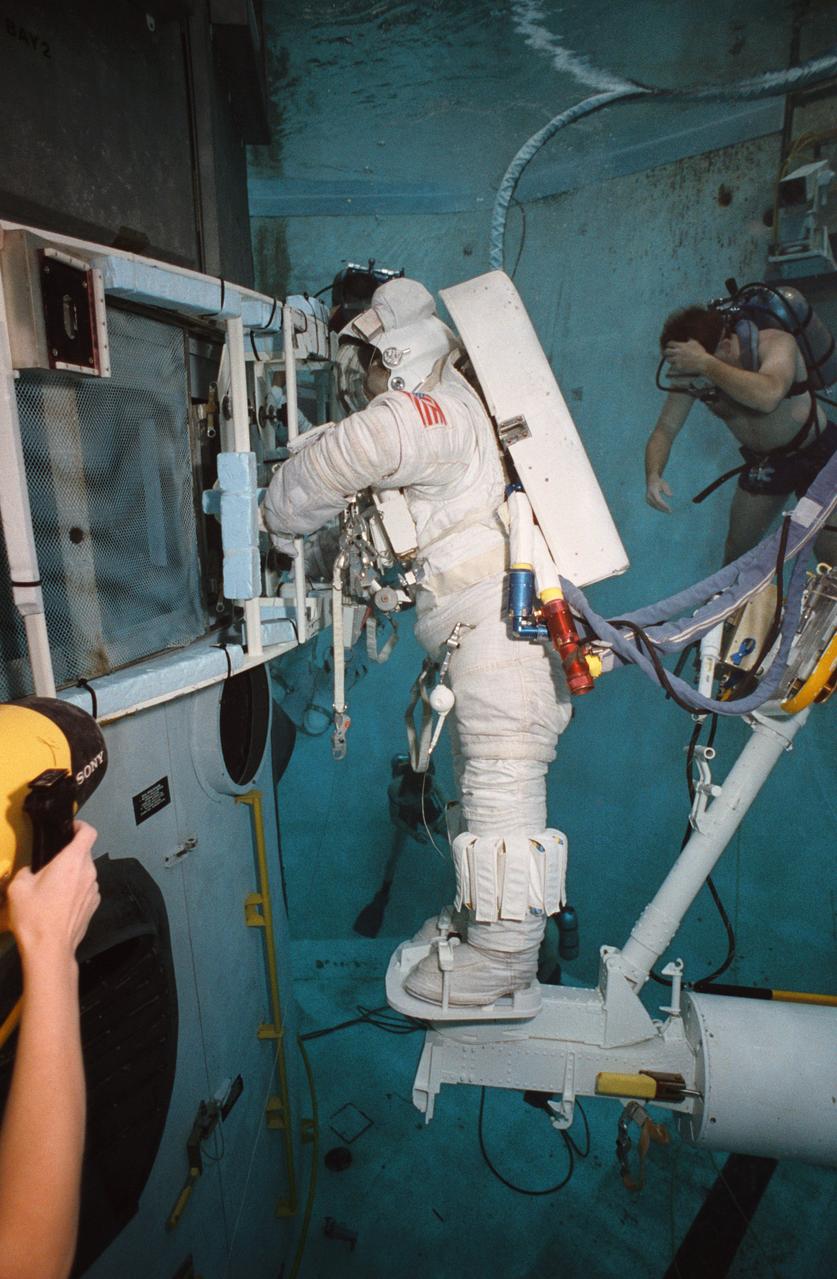
S93-33101 (5 Apr 1993) --- Wearing a training version of Space Shuttle Extravehicular Mobility Unit (EMU), astronaut Kathryn C. Thornton uses the giant pool of the Johnson Space Center's (JSC) Weightless Environment Training Facility (WET-F) to rehearse for the Hubble Space Telescope (HST) repair mission. Standing on a mobile foot restraint connected to the Shuttle's robot arm, Thornton grasps a large structure which attaches to the Wide Field/Planetary Camera (WF/PC). The current WF/PC on the HST will be replaced with WF/PC-2. Out of frame is astronaut Thomas D. Akers, who will join Thornton in STS-61 EVA. A SCUBA-equipped diver can be seen in the background. A number of divers are on hand for all training sessions in the WET-F. A total of five extravehicular activity (EVA) sessions will be conducted during the scheduled December mission of the Endeavour.
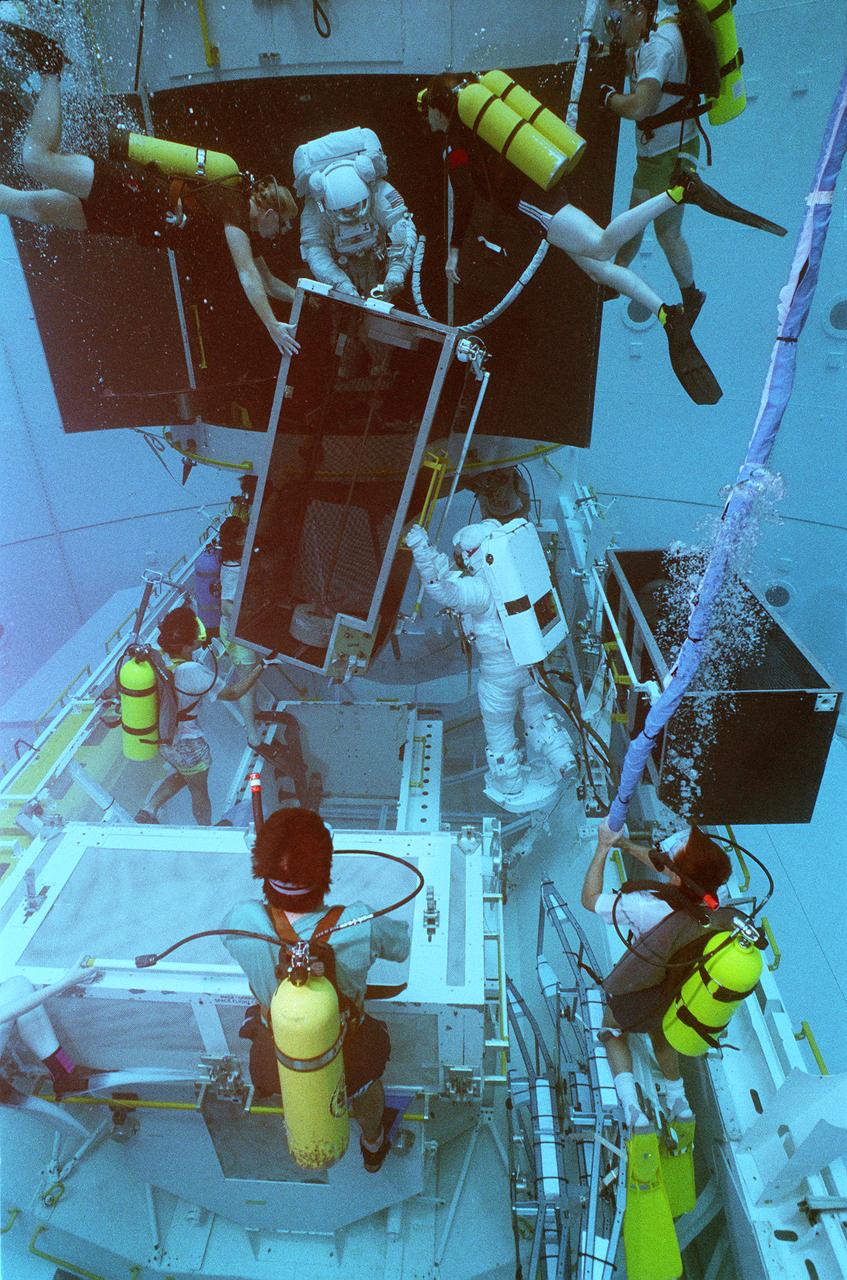
This photograph shows STS-61 crewmemmbers training for the Hubble Space Telescope (HST) servicing mission in the Marshall Space Flight Center's (MSFC's) Neutral Buoyancy Simulator (NBS). Two months after its deployment in space, scientists detected a 2-micron spherical aberration in the primary mirror of the HST that affected the telescope's ability to focus faint light sources into a precise point. This imperfection was very slight, one-fiftieth of the width of a human hair. A scheduled Space Service servicing mission (STS-61) in 1993 permitted scientists to correct the problem. The MSFC NBS provided an excellent environment for testing hardware to examine how it would operate in space and for evaluating techniques for space construction and spacecraft servicing.
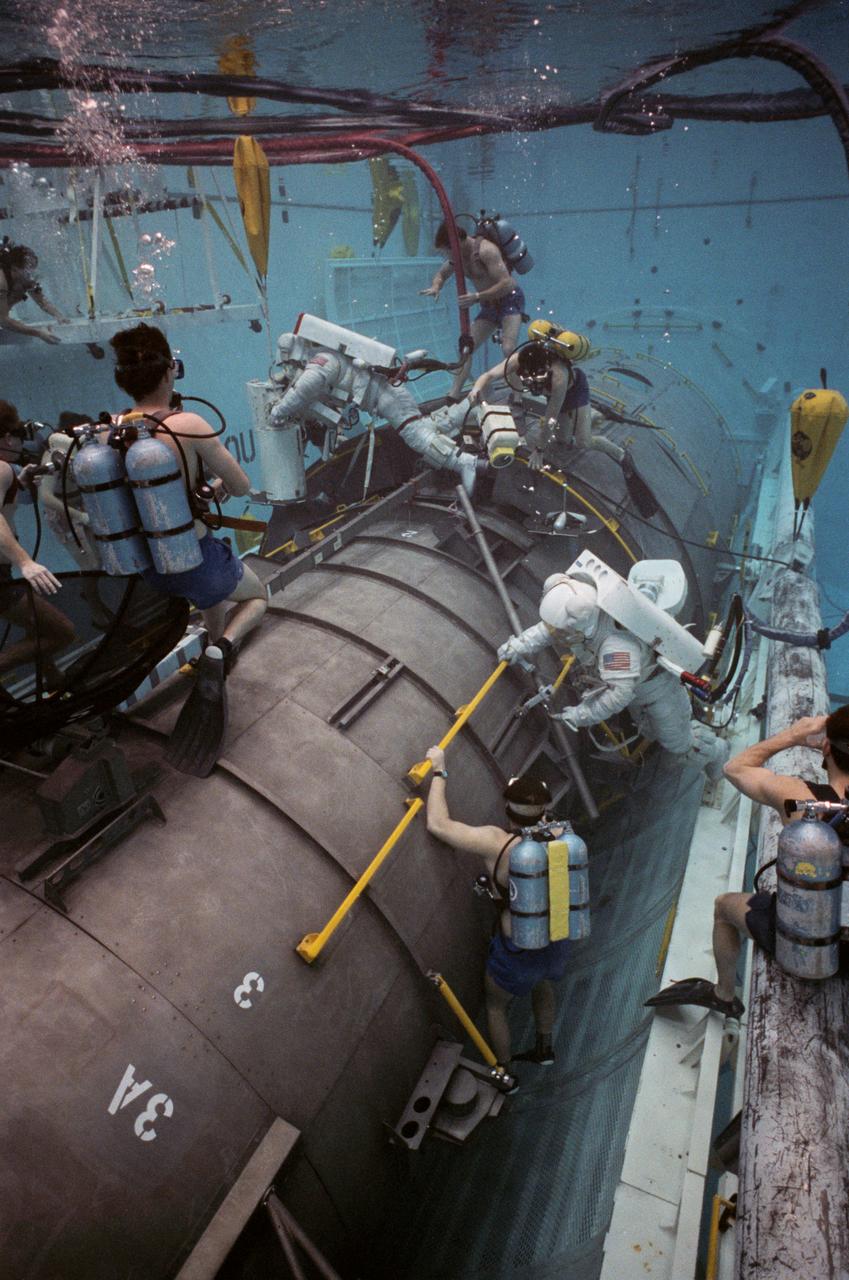
This overall view shows STS-31 Mission Specialist (MS) Bruce McCandless II (left) and MS Kathryn D. Sullivan making a practice space walk in JSC's Weightless Environment Training Facility (WETF) Bldg 29 pool. McCandless works with a mockup of the remote manipulator system (RMS) end effector which is attached to a grapple fixture on the Hubble Space Telescope (HST) mockup. Sullivan manipulates HST hardware on the Support System Module (SSM) forward shell. SCUBA-equipped divers monitor the extravehicular mobility unit (EMU) suited crewmembers during this simulated extravehicular activity (EVA). No EVA is planned for the Hubble Space Telescope (HST) deployment, but the duo has trained for contingencies which might arise during the STS-31 mission aboard Discovery, Orbiter Vehicle (OV) 103. Photo taken by NASA JSC photographer Sheri Dunnette.
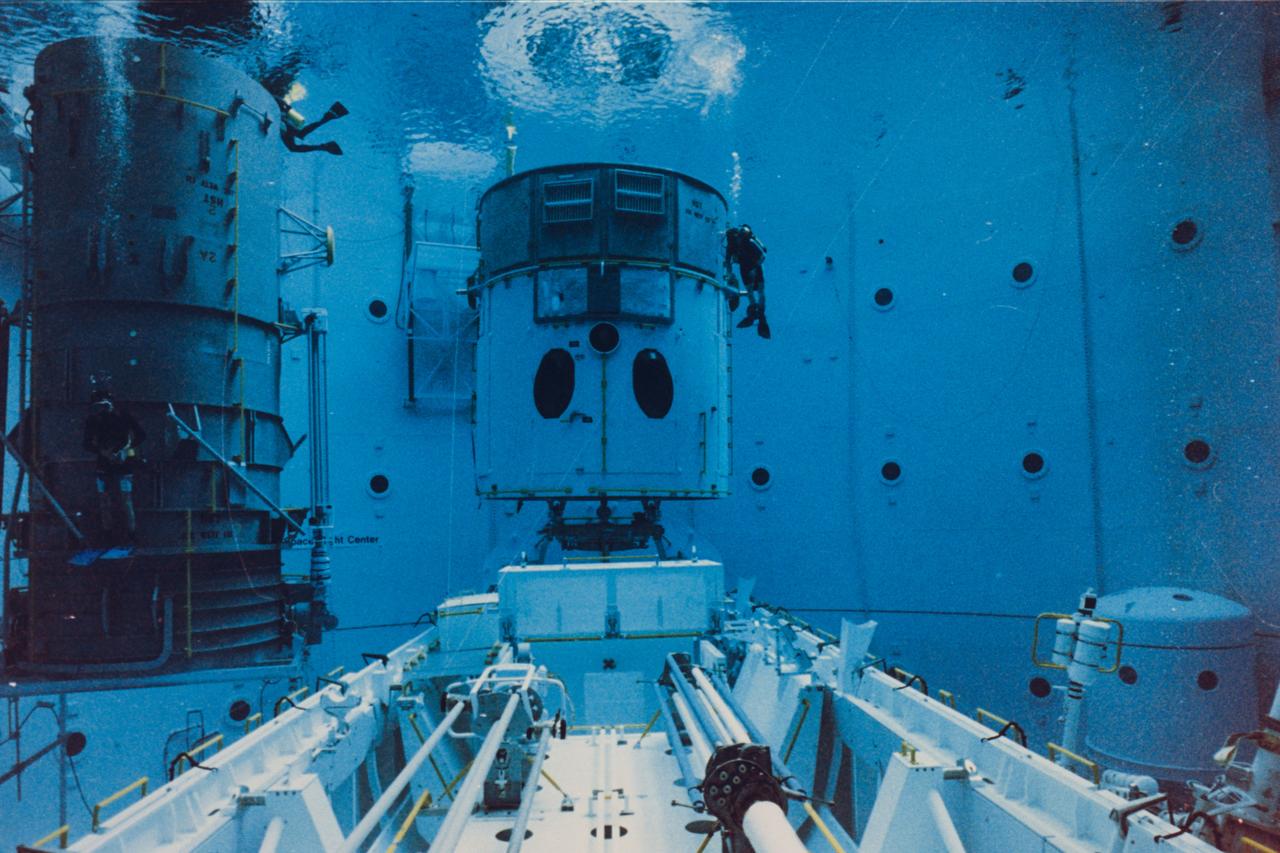
Safety divers in the Neutral Buoyancy Simulator (NBS) at the Marshall Space Flight Center (MSFC) prepare a mockup of the Hubble Space Telescope (HST) for one of 32 separate training sessions conducted by four of the STS-61 crew members in June. The three-week process allowed mission trainers to refine the timelines for the five separate spacewalks scheduled to be conducted on the actual mission scheduled for December 1993. The HST is separated into two pieces since the water tank depth cannot support the entire structure in one piece. The full length payload bay mockup shows the Solar Array Carrier in the foreground and the various containers that will house replacement hardware that will be carried on the mission.
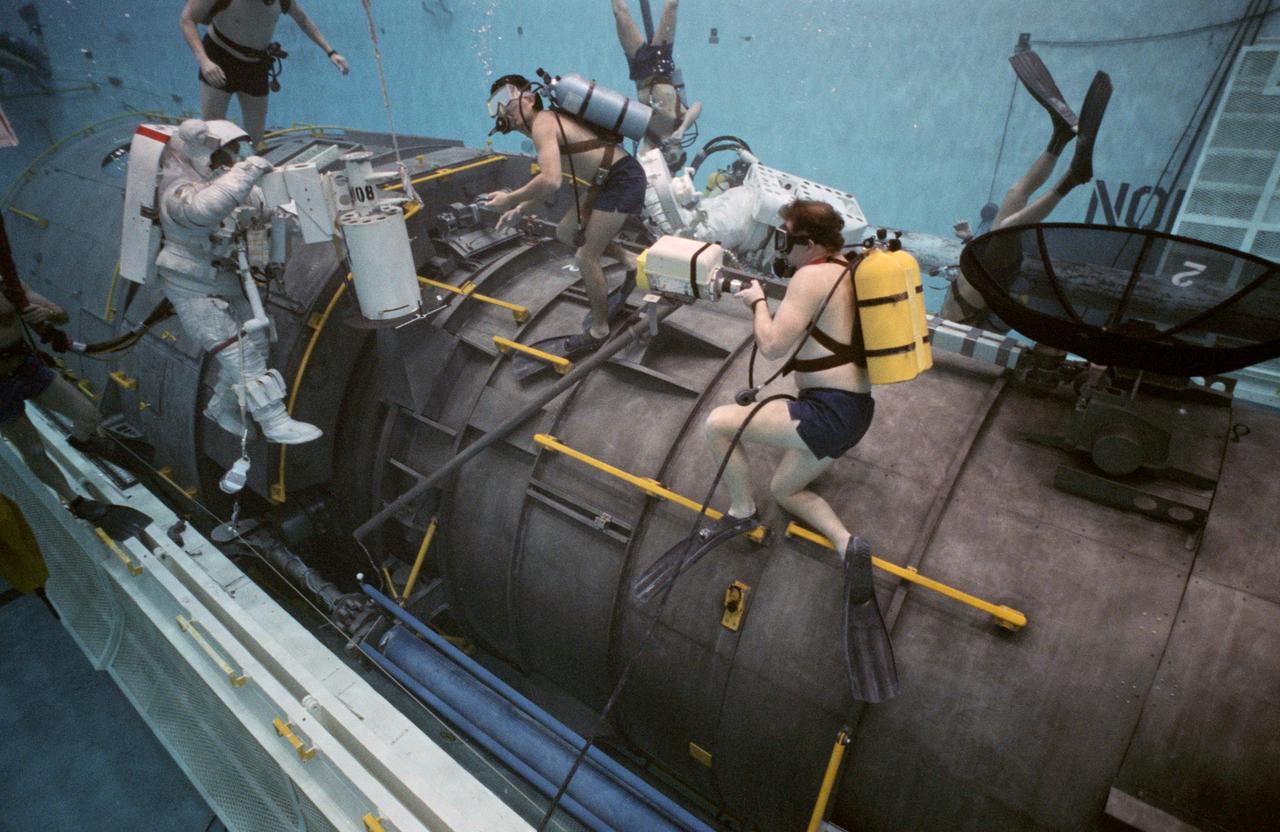
STS-31 Mission Specialist (MS) Bruce McCandless II (left), wearing an extravehicular mobility unit (EMU), maneuvers his way around a mockup of the remote manipulator system (RMS) end effector during an underwater simulation in JSC's Weightless Environment Training Facility (WETF) Bldg 29 pool. The end effector is attached to a grapple fixture on the Hubble Space Telescope (HST) mockup. As McCandless performs contingency extravehicular activity (EVA) procedures, fellow crewmember MS Kathryn D. Sullivan, in EMU, works on the opposite side of the HST mockup, and SCUBA-equipped divers monitor the activity. Though no EVA is planned for STS-31, the two crewmembers train for contingencies that would necessitate leaving the shirt sleeve environment of Discovery's, Orbiter Vehicle (OV) 103's, crew cabin and performing chores with the HST payload or related hardware in the payload bay (PLB).
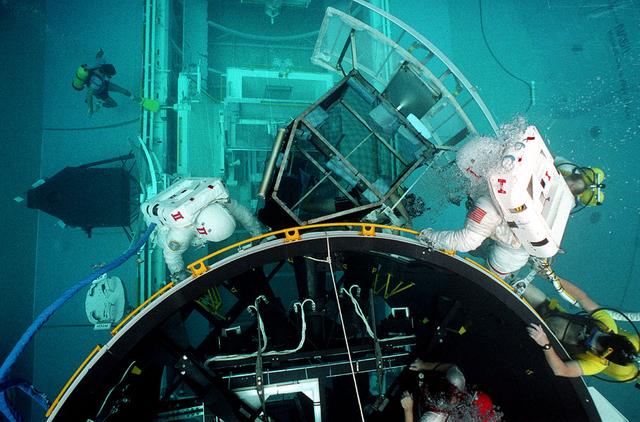
Astronauts Jim Voss and Jay Apt perform check-out procedures on a Hubble Space Telescope mock-up while working in the Marshall Space Flight Center's Neutral Buoyancy Simulator (NBS).
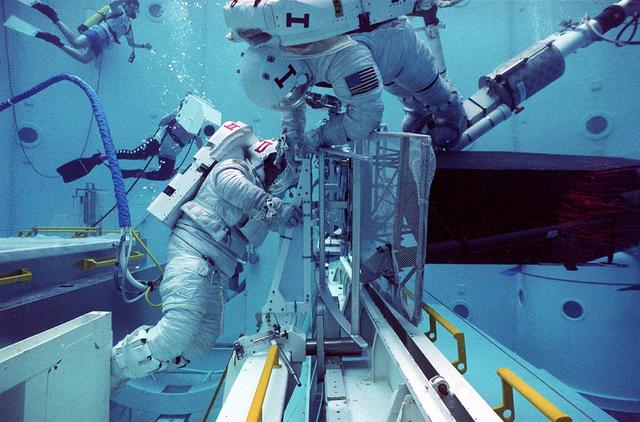
Astronauts Mark Lee and Rich Clifford perform test check-out procedures on the Hubble Space Telescope in the Marshall Space Flight Center's Neutral Buoyancy Simulator (NBS).
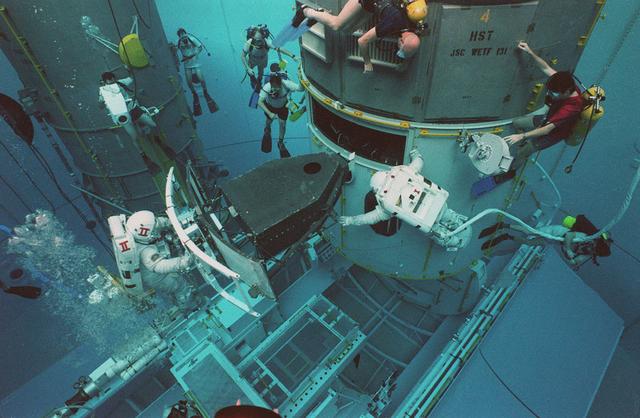
Astronauts Kathy Thornton and Tom Akers practice installing the Wide Field Planetary camera into the Hubble Space Telescope at Marshall's Neutral Buoyancy Simulator (NBS).
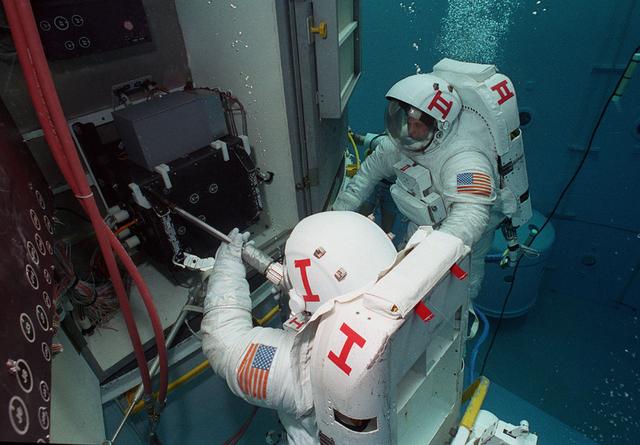
Astronauts Kathy Thornton and Tom Akers practice installing the Wide Field Planetary camera into the Hubble Space Telescope at Marshall's Neutral Buoyancy Simulator (NBS).
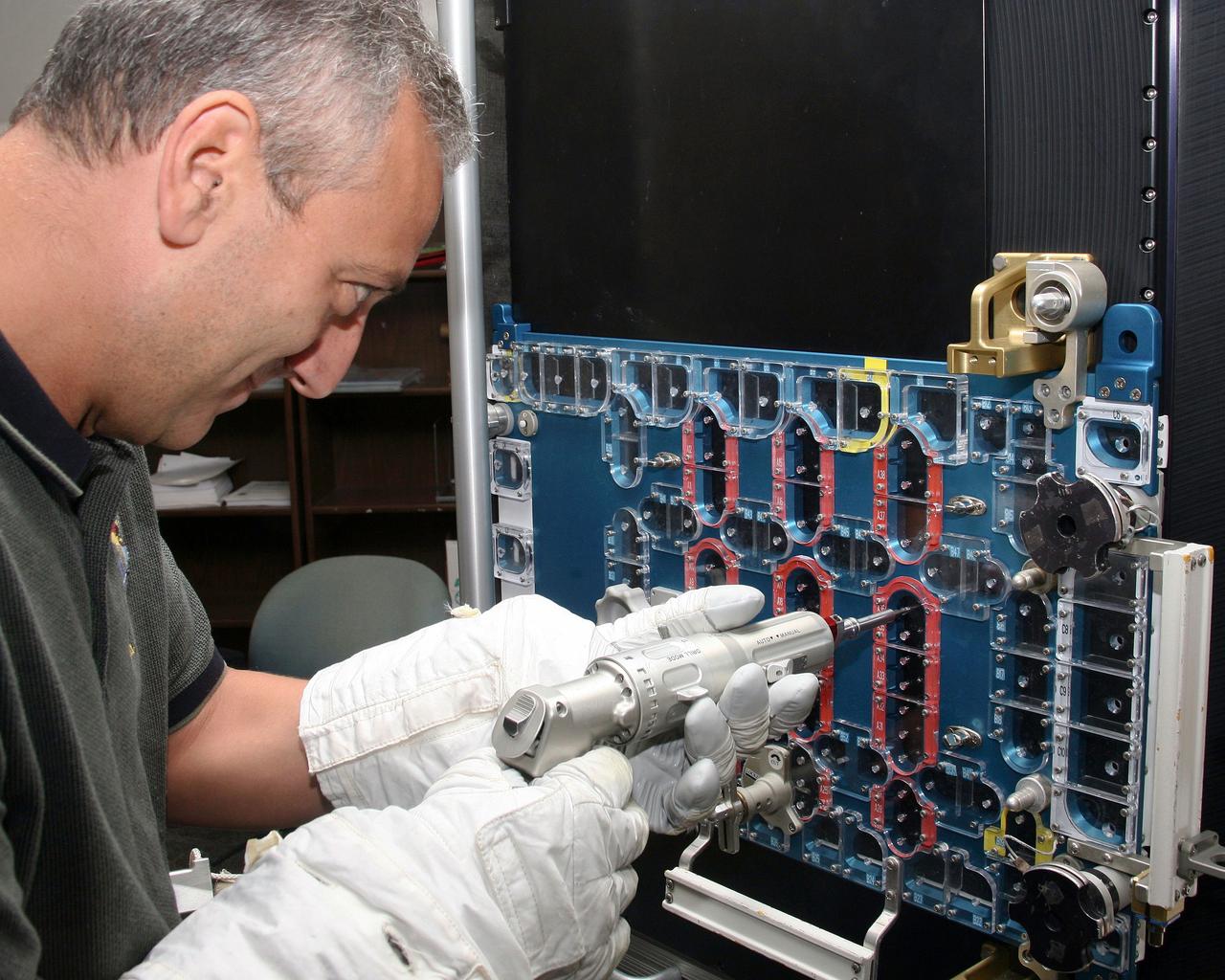
JSC2008-E-097094 (1 Aug. 2008) --- Astronaut Mike Massimino, STS-125 mission specialist, practices repairing Hubble Space Telescope hardware during a training session at NASA's Johnson Space Center.
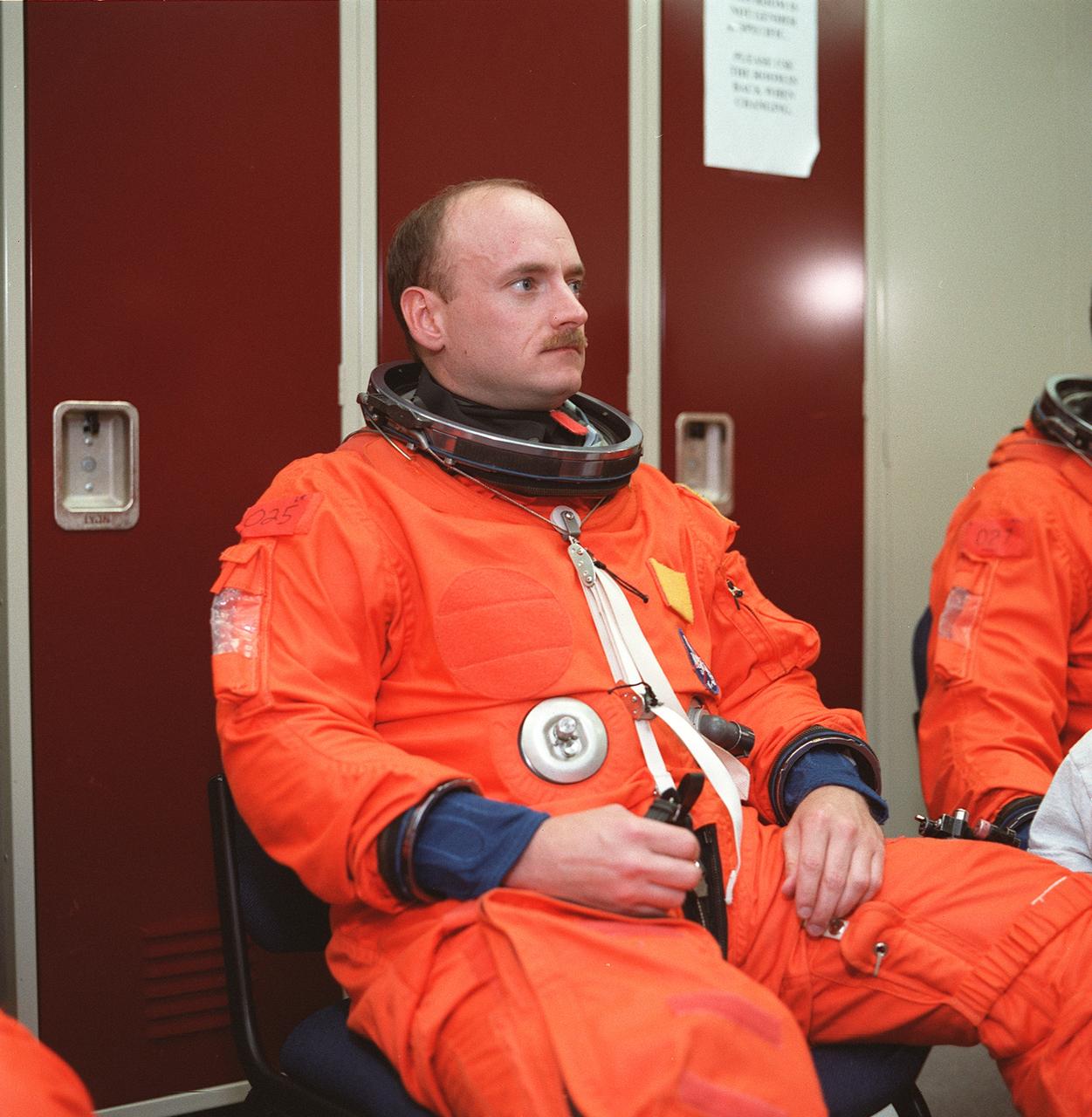
S99-08646 (24 May 1999) --- Astronaut Scott J. Kelly, pilot, listens to a briefing by a member of the crew training staff during a session of emergency bailout training in the Systems Integration Facility at the Johnson Space Center (JSC). Kelly, wearing a training version of the partial-pressure launch and entry garment, and his six STS-103 crew mates are currently in training for the third servicing visit to the Hubble Space Telescope (HST) since its 1990 deployment.
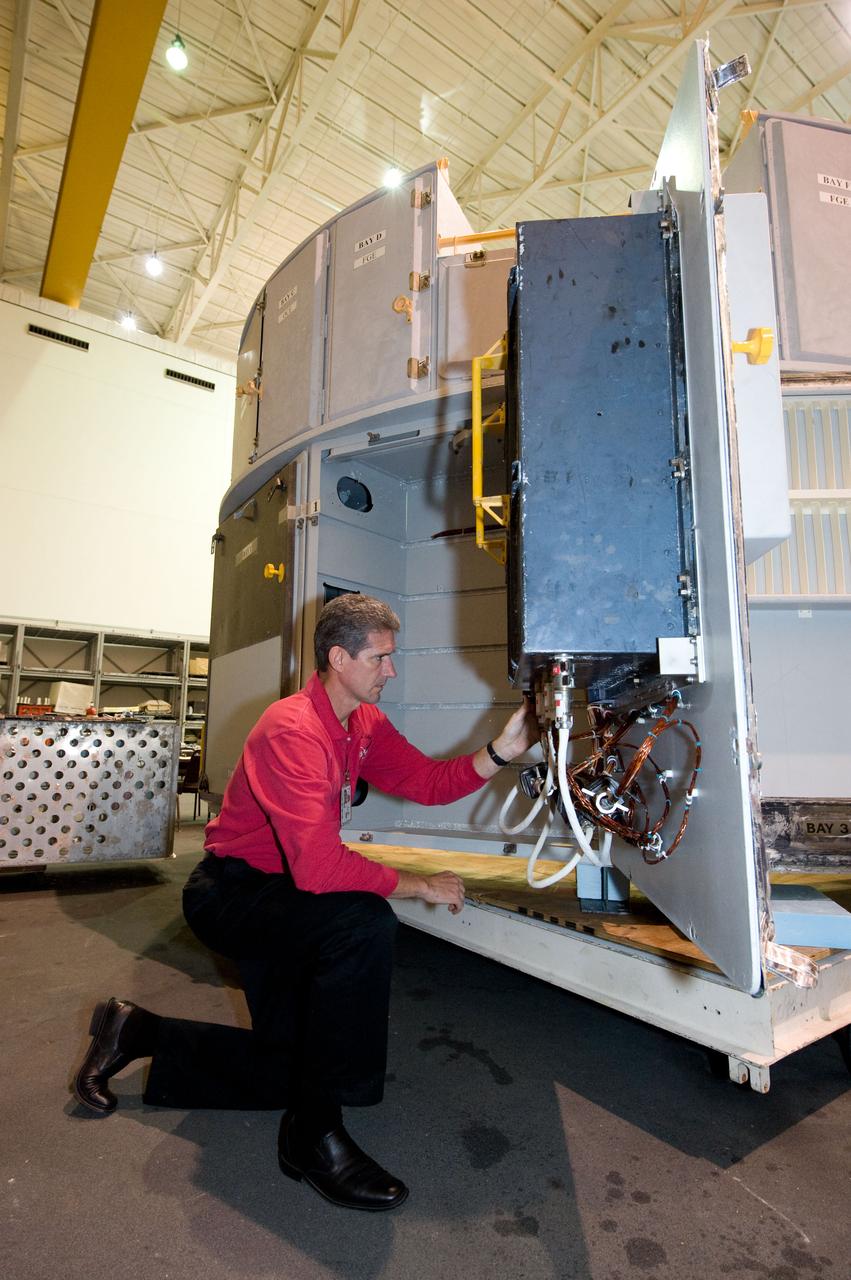
JSC2009-E-072674 (9 April 2009) --- Astronaut Michael Good, STS-125 mission specialist, works with a Hubble Space Telescope mock-up during a spacewalk training session in the Neutral Buoyancy Laboratory (NBL) near NASA's Johnson Space Center.
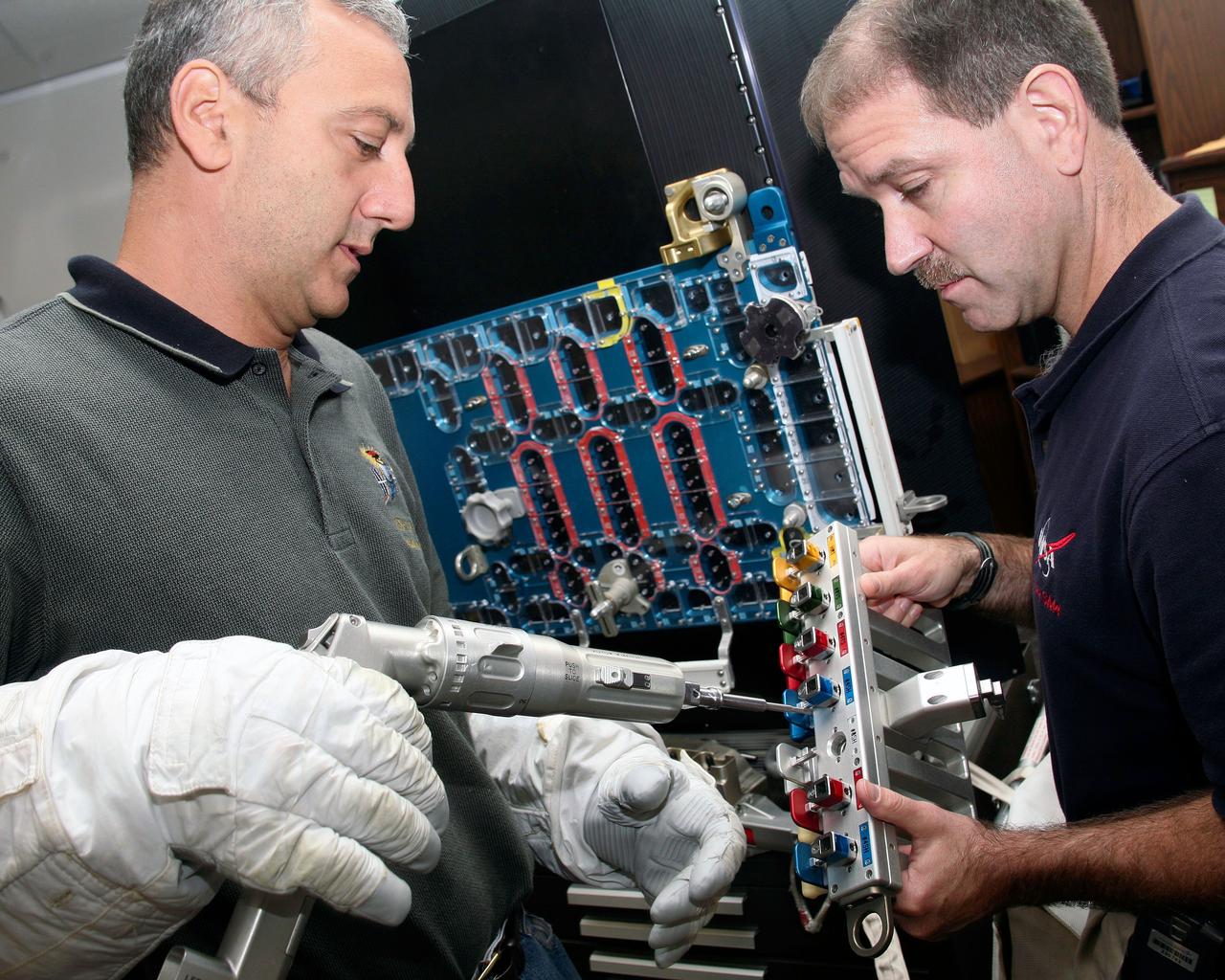
JSC2008-E-097093 (1 Aug. 2008) --- Astronauts Mike Massimino (left) and John Grunsfeld, both STS-125 mission specialists, practice repairing Hubble Space Telescope hardware during a training session at NASA's Johnson Space Center.
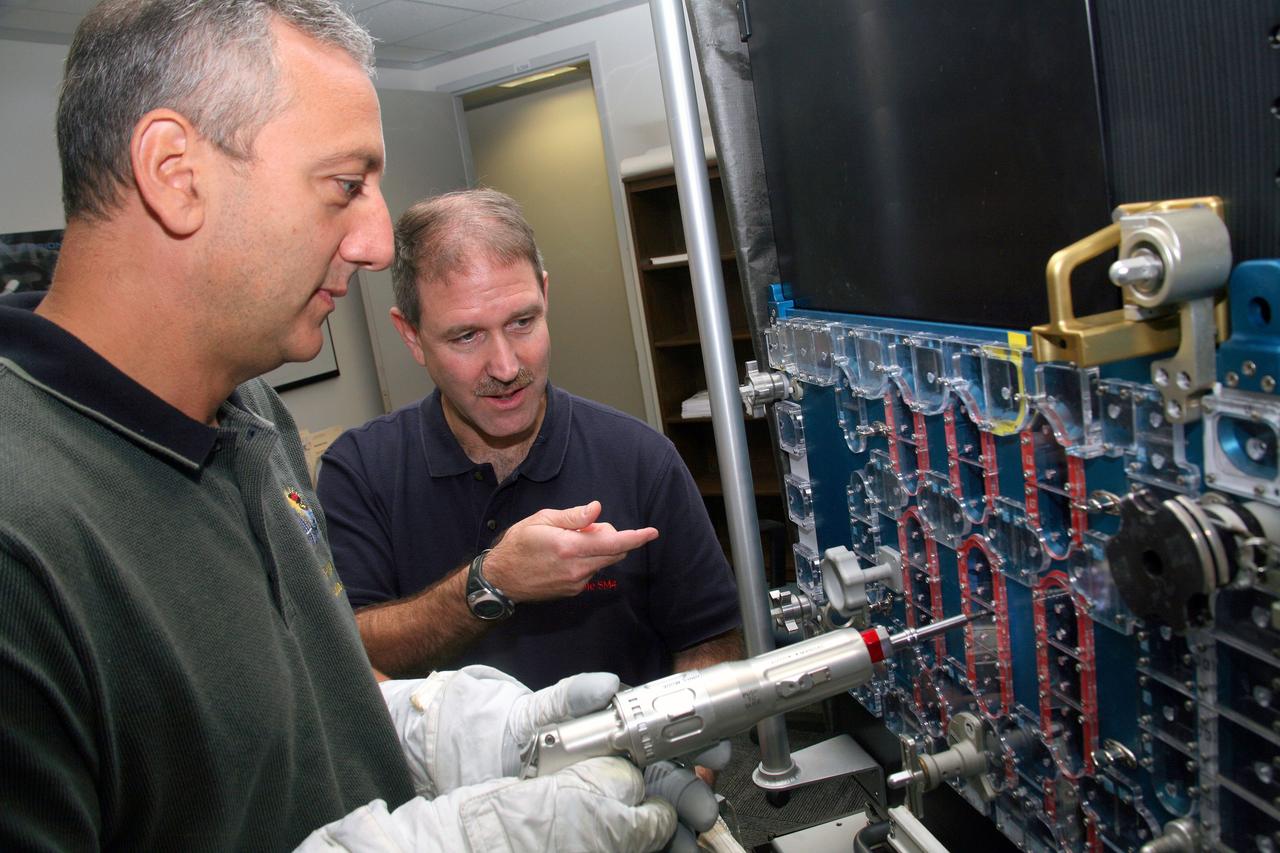
JSC2008-E-097091 (1 Aug. 2008) --- Astronauts Mike Massimino (foreground) and John Grunsfeld, both STS-125 mission specialists, practice repairing Hubble Space Telescope hardware during a training session at NASA's Johnson Space Center.
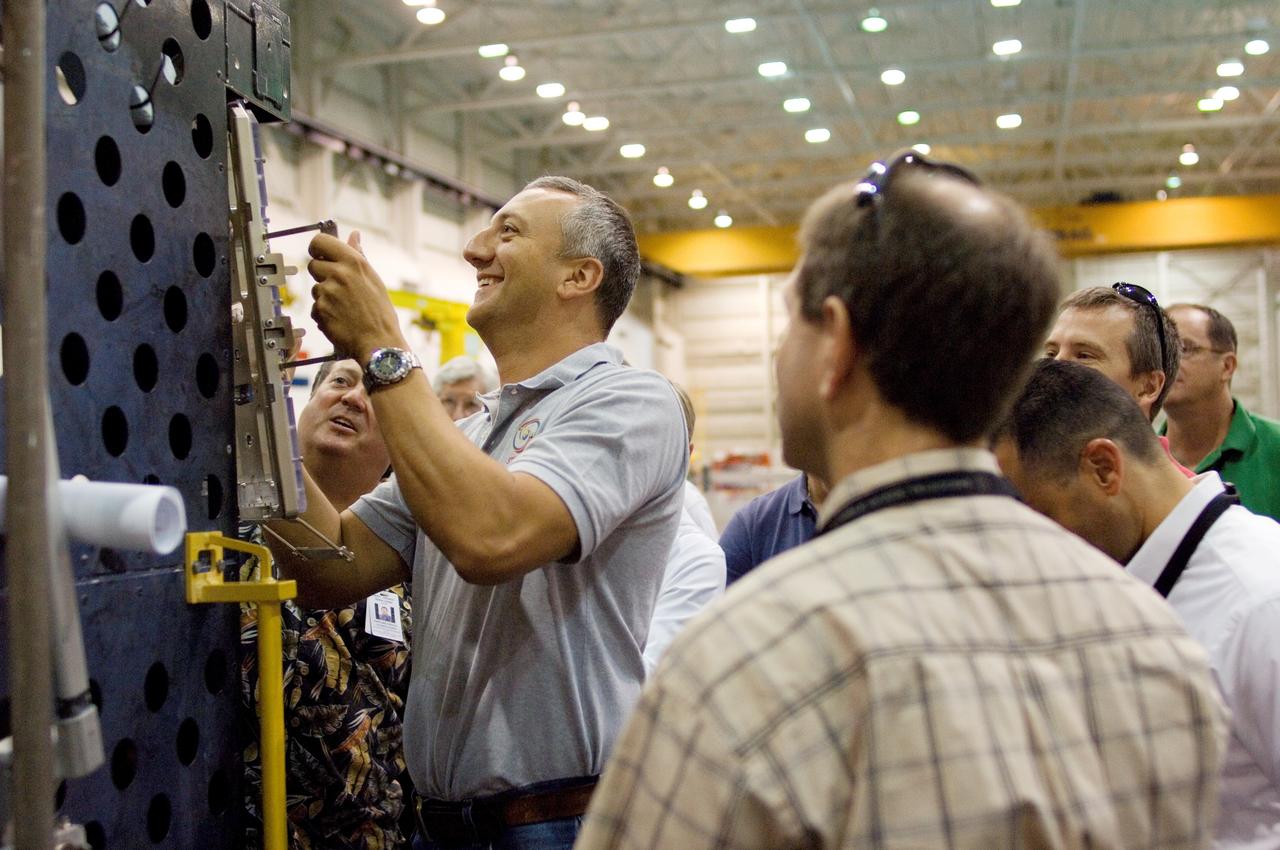
JSC2007-E-27769 (6 June 2007) --- Astronauts Michael J. Massimino (left), Andrew J. Feustel (right, partially obscured) and John M. Grunsfeld (foreground), STS-125 mission specialists, participate in a training session with a Hubble Space Telescope mockup in the Neutral Buoyancy Laboratory (NBL) near Johnson Space Center.
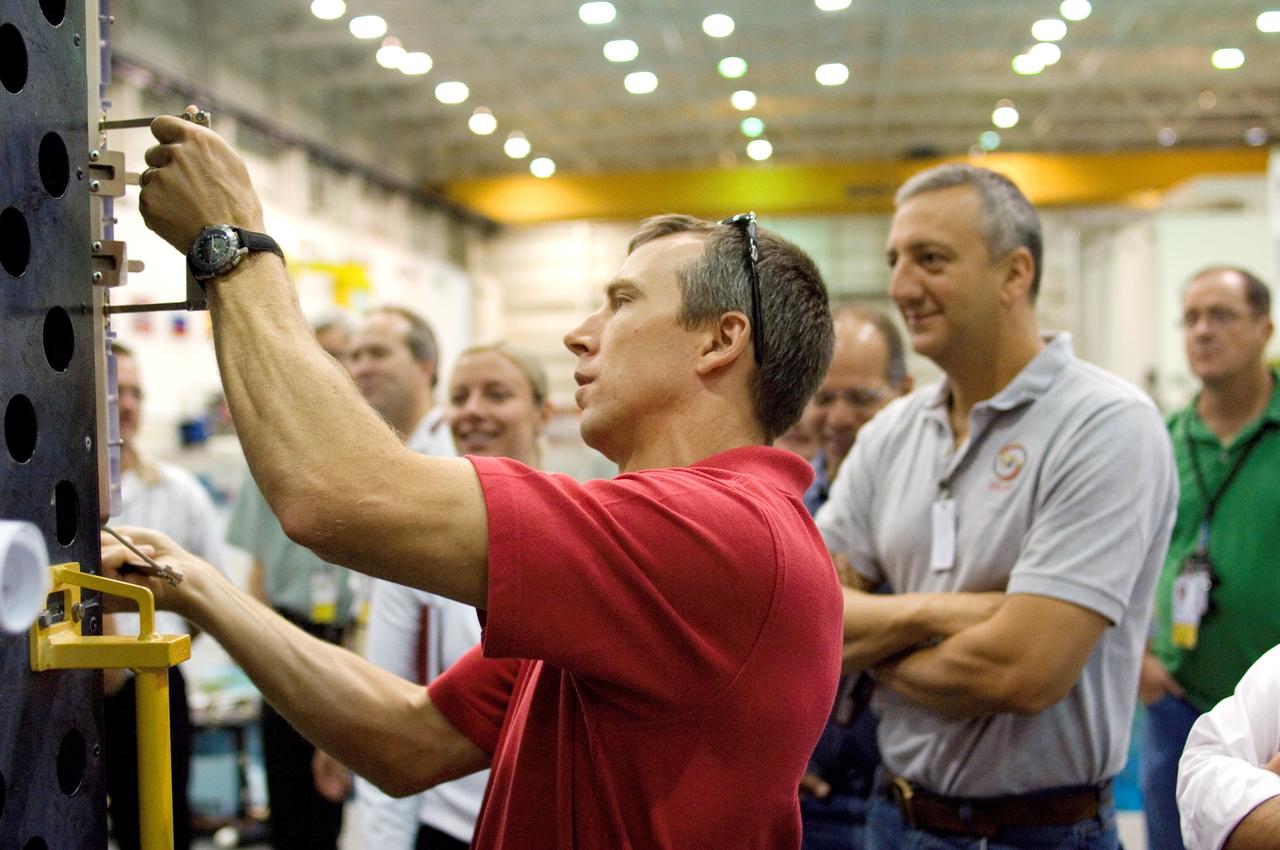
JSC2007-E-27768 (6 June 2007) --- Astronauts Andrew J. Feustel (foreground), Michael J. Massimino (right) and John M. Grunsfeld (out of frame), STS-125 mission specialists, participate in a training session with a Hubble Space Telescope mockup in the Neutral Buoyancy Laboratory (NBL) near Johnson Space Center.

CAPE CANAVERAL, Fla. – On the Shuttle Landing Facility at NASA's Kennedy Space Center in Florida, STS-125 Commander Scott Altman, wearing his launch-and-entry suit, heads for the Shuttle Training Aircraft to practice shuttle landings in preparation for launch of space shuttle Atlantis, scheduled for 2:01 p.m. EDT on May 11. On Atlantis’ STS-125 mission, NASA's Hubble Space Telescope will be serviced for the fifth and final time. The flight will include five spacewalks during which astronauts will refurbish and upgrade the telescope with state-of-the-art science instruments. As a result, Hubble's capabilities will be expanded and its operational lifespan extended through at least 2014. Photo credit: NASA/Kim Shiflett
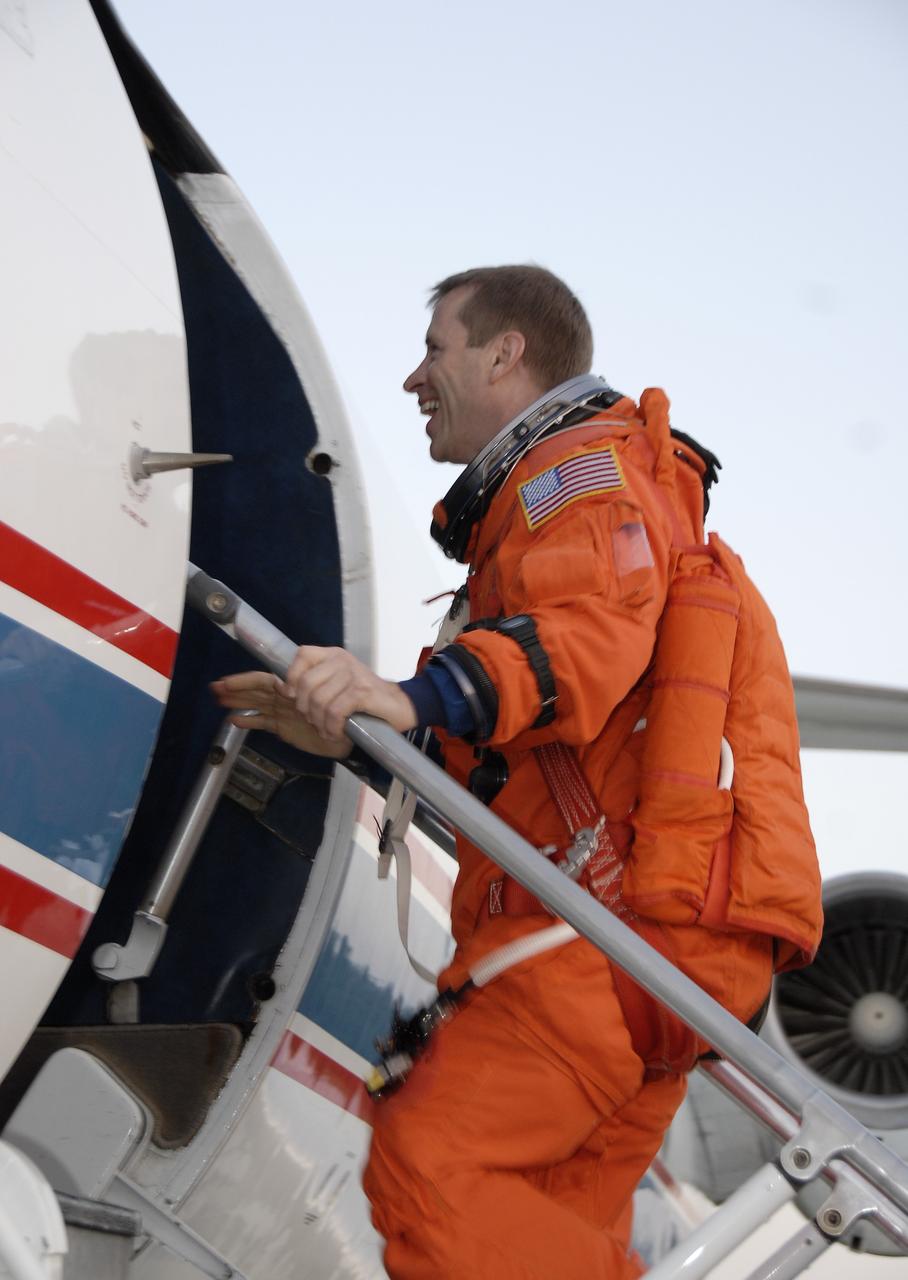
CAPE CANAVERAL, Fla. – On the Shuttle Landing Facility at NASA's Kennedy Space Center in Florida, STS-125 Pilot Gregory C. Johnson, wearing his launch-and-entry suit, heads into the Shuttle Training Aircraft to practice shuttle landings in preparation for launch of space shuttle Atlantis, scheduled for 2:01 p.m. EDT on May 11. On Atlantis’ STS-125 mission, NASA's Hubble Space Telescope will be serviced for the fifth and final time. The flight will include five spacewalks during which astronauts will refurbish and upgrade the telescope with state-of-the-art science instruments. As a result, Hubble's capabilities will be expanded and its operational lifespan extended through at least 2014. Photo credit: NASA/Kim Shiflett
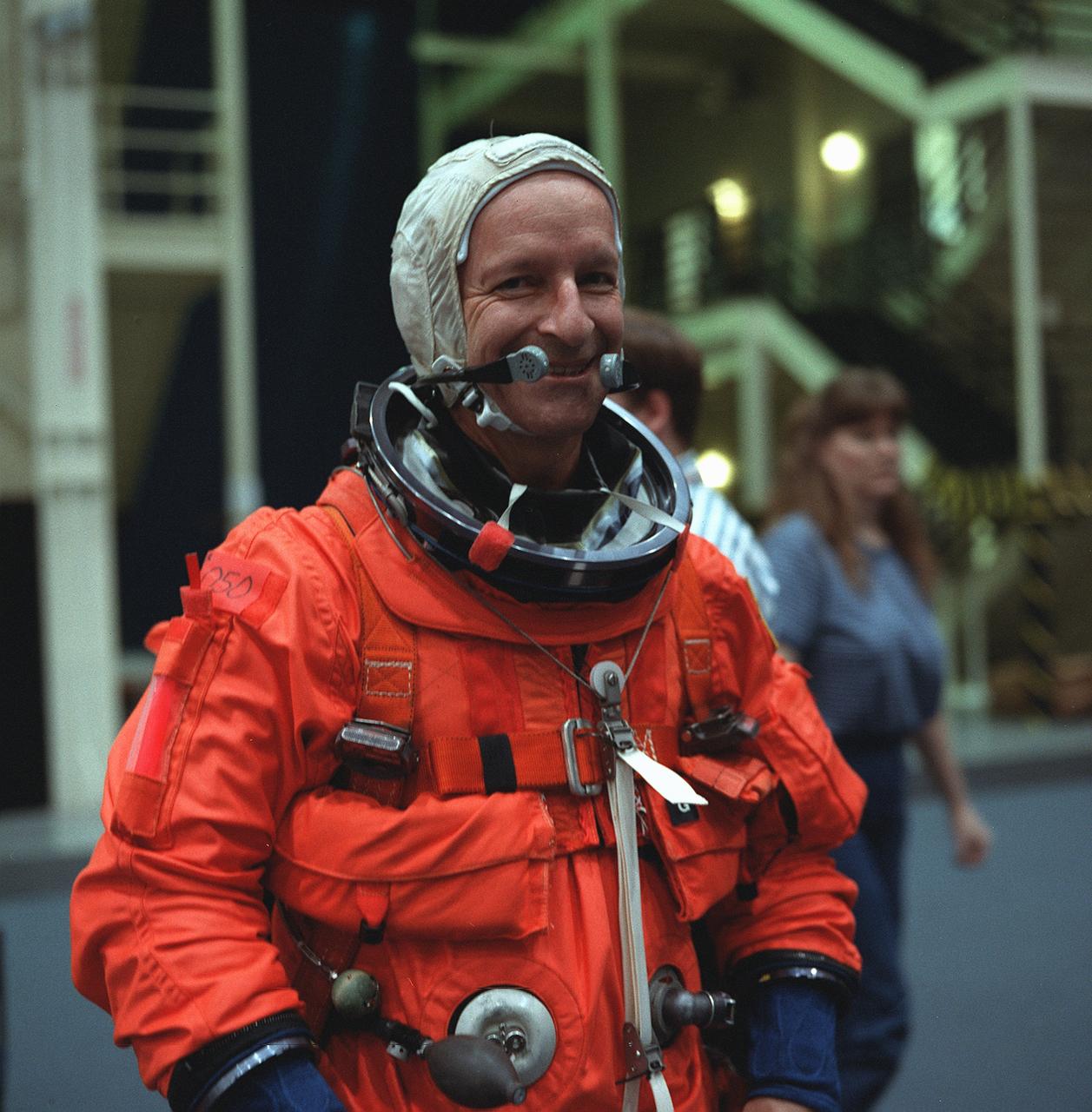
S99-08660 (24 May 1999)--- Astronaut Claude Nicollier, mission specialist representing the European Space Agency (ESA), checks his communications gear prior to a session of emergency bailout training in the Systems Integration Facility at the Johnson Space Center (JSC). Nicollier, wearing a training version of the partial-pressure launch and entry garment, and his six STS-103 crew mates are currently in training for the third servicing visit to the Hubble Space Telescope (HST) since its 1990 deployment.
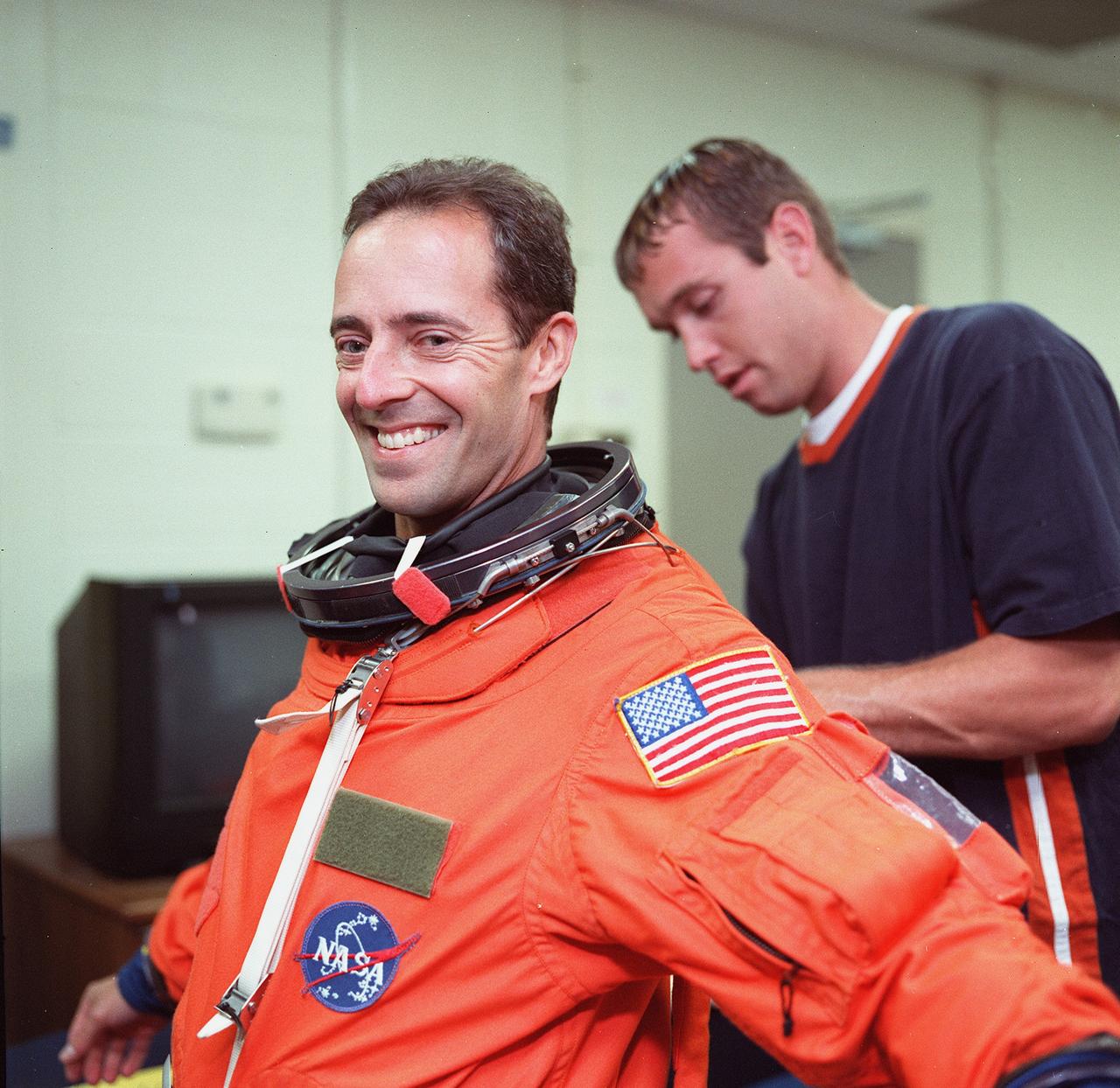
S99-08650 (24 May 1999) --- A suit technician assists astronaut Jean-Francois Clervoy, mission specialist representing the European Space Agency (ESA), in readying for a session of emergency bailout training in the Systems Integration Facility at the Johnson Space Center (JSC). Clervoy, wearing a training version of the partial-pressure launch and entry garment, and his six STS-103 crew mates are currently in training for the third visit to the Hubble Space Telescope (HST) since its 1990 deployment.
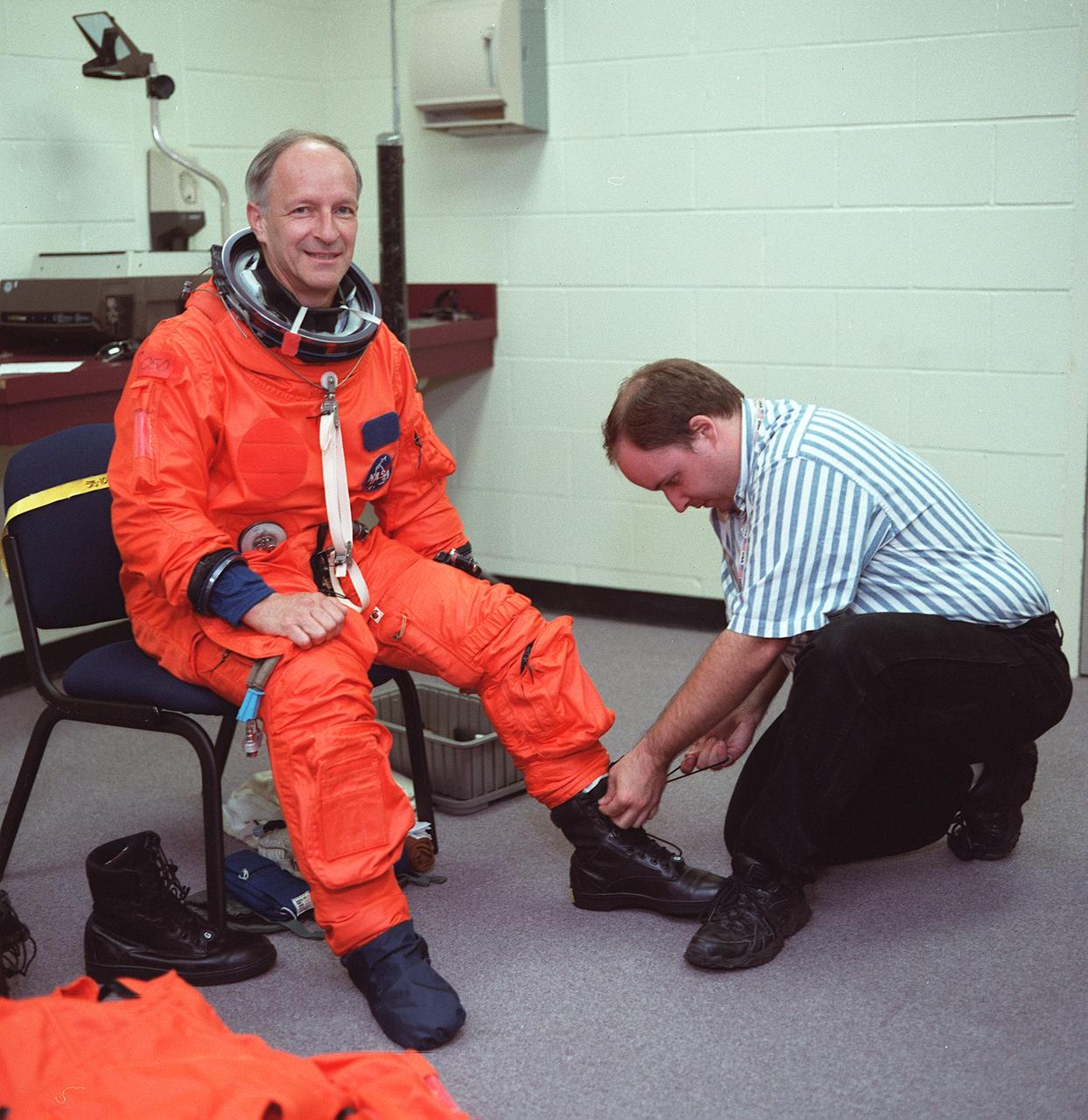
S99-08654 (24 May 1999) --- A suit technician assists astronaut Claude Nicollier, mission specialist representing the European Space Agency (ESA), in readying for a session of emergency bailout training in the Systems Integration Facility at the Johnson Space Center (JSC). Nicollier, wearing a training version of the partial-pressure launch and entry garment, and his six STS-103 crew mates are currently in training for the third visit to the Hubble Space Telescope (HST) since its 1990 deployment.
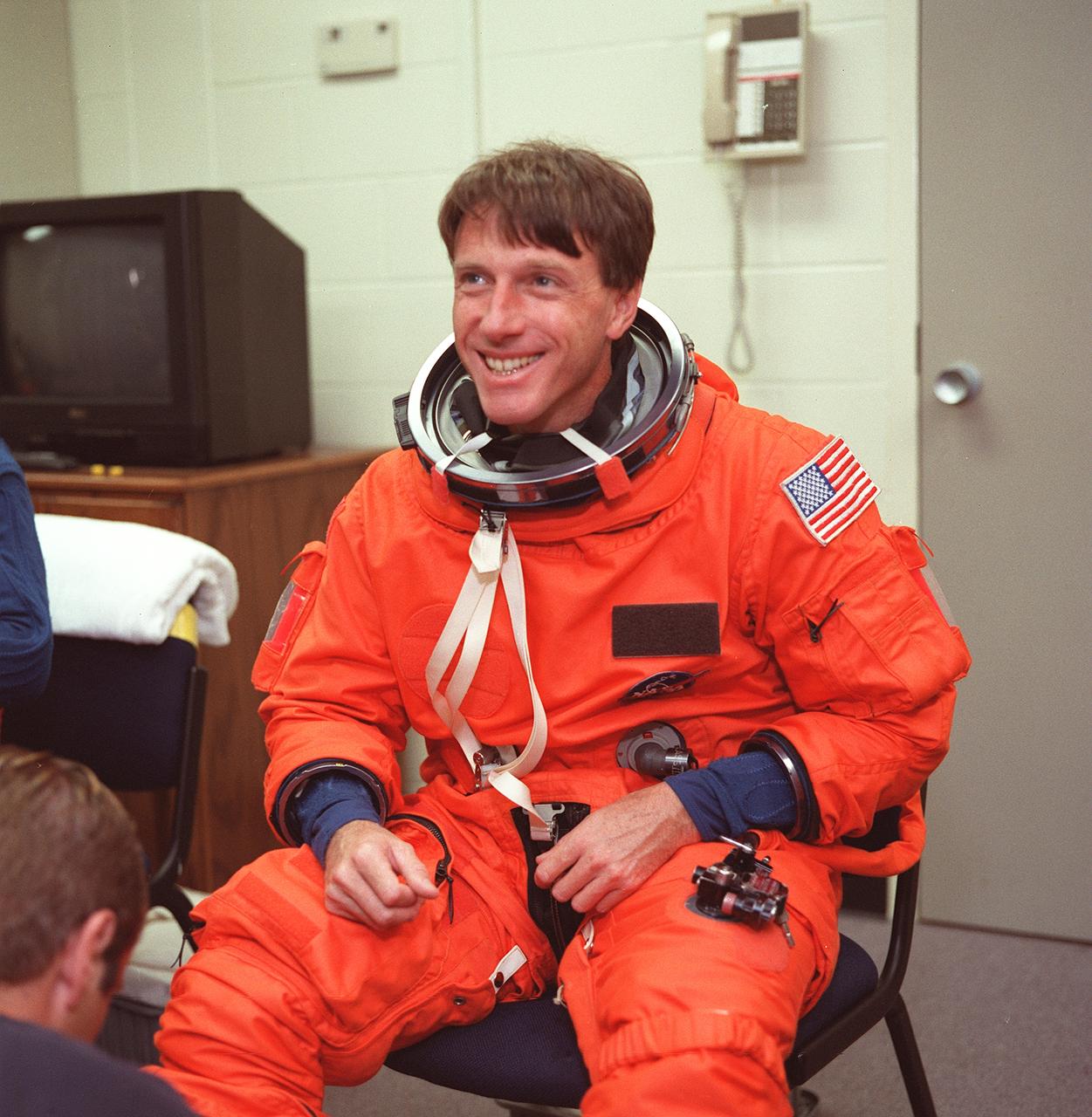
S99-08648 (24 May 1999) --- Suit technicians assist astronaut C. Michael Foale, mission specialist, in readying for a session of emergency bailout training in the Systems Integration Facility at the Johnson Space Center (JSC). Foale, wearing a training version of the partial-pressure launch and entry garment, and his six STS-103 crew mates are currently in training for the third servicing visit to the Hubble Space Telescope (HST) since its 1990 deployment.
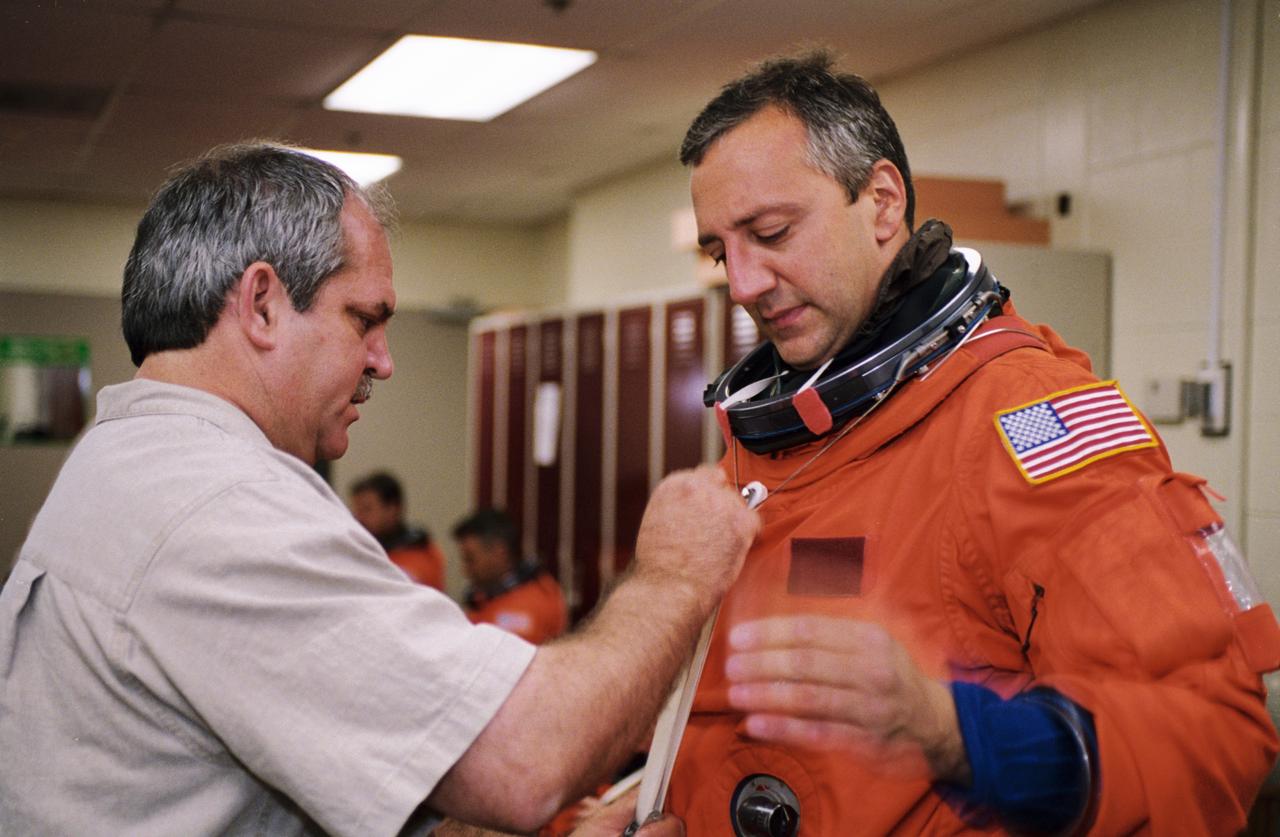
JSC2001-01889 (22 June 2001) --- Astronaut Michael J. Massimino, STS-109 mission specialist, dons a training version of the full-pressure launch and entry suit prior to a training session in one of the trainer/mockups (out of frame) in the Space Vehicle Mockup Facility at the Johnson Space Center (JSC). Massimino is assisted by United Space Alliance (USA) suit technician Lloyd Armintor. STS-109 will be the 108th shuttle flight and the fourth Hubble Space Telescope (HST) servicing mission.
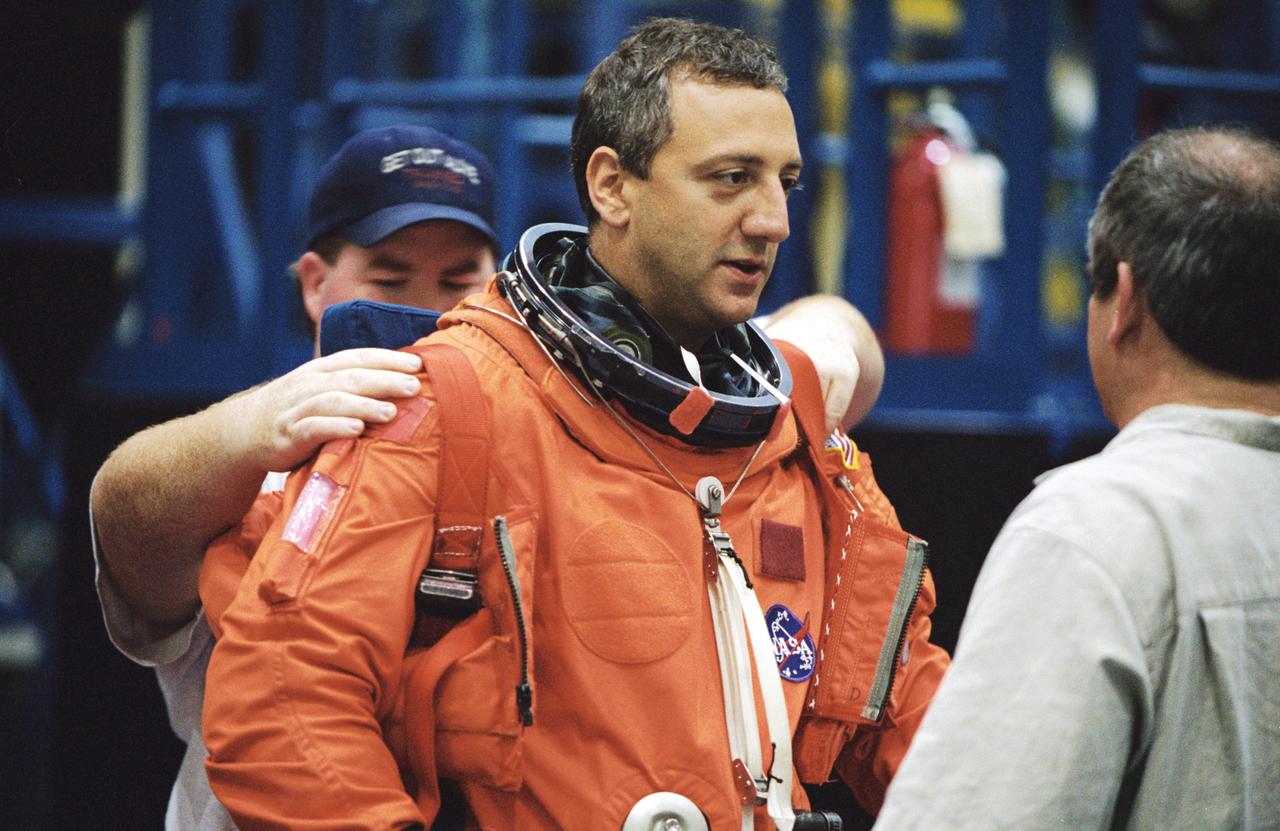
JSC2001-01875 (22 June 2001) --- Astronaut Michael J. Massimino, STS-109 mission specialist, dons a training version of the full-pressure launch and entry suit prior to a training session in one of the trainer/mockups (out of frame) in the Space Vehicle Mockup Facility at the Johnson Space Center (JSC). Massimino is assisted by Tommy McDonald and Lloyd Armintor both United Space Alliance (USA) suit technicians. STS-109 will be the 108th shuttle flight and the fourth Hubble Space Telescope (HST) servicing mission.
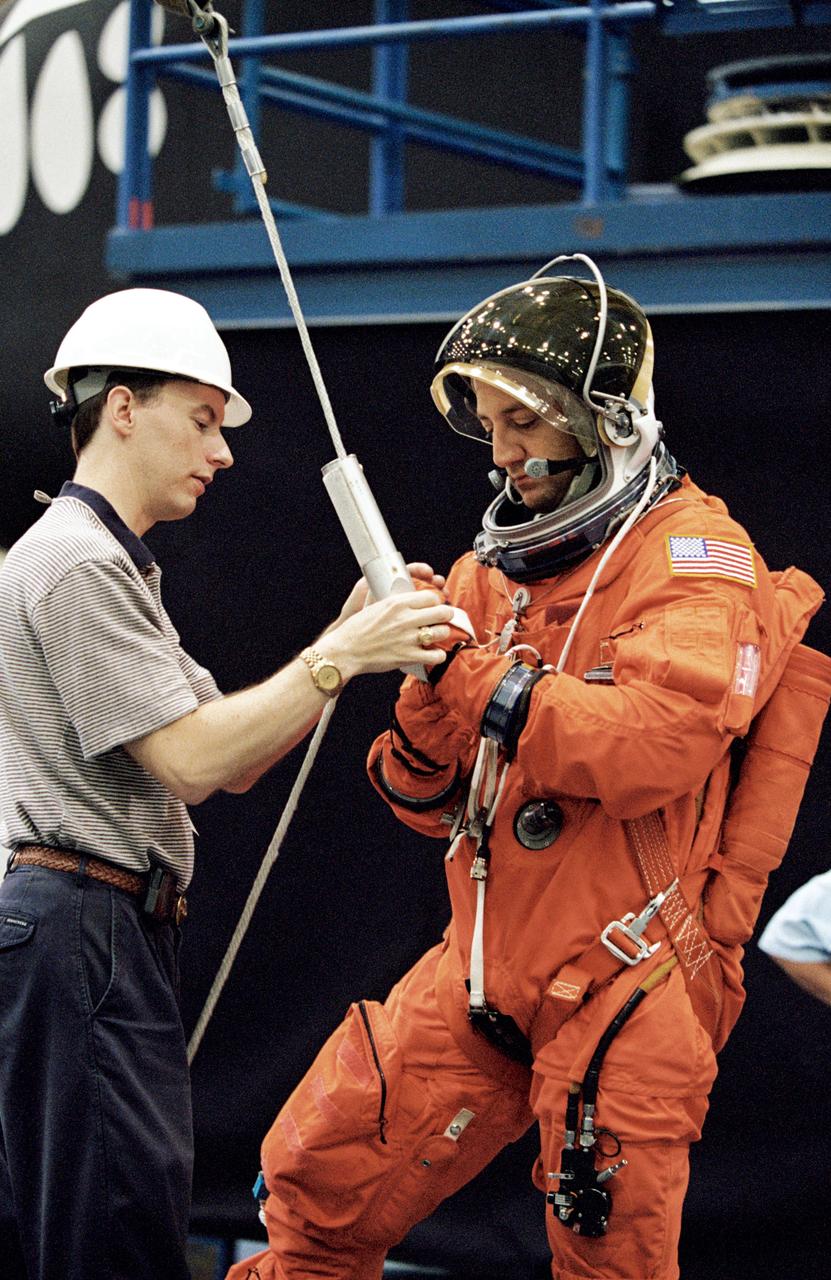
JSC2001-01543 (24 May 2001) --- Astronaut Michael J. Massimino, STS-109 mission specialist, is briefed by United Space Alliance (USA) crew trainer David Pogue on the usage of the Sky-genie device, used to lower oneself from a troubled shuttle, in a training session in the Space Vehicle Mockup Facility at the Johnson Space Center (JSC). Massimino is wearing a training version of the full-pressure launch and entry suit. STS-109 will be the 108th shuttle flight and the fourth Hubble Space Telescope (HST) servicing mission.
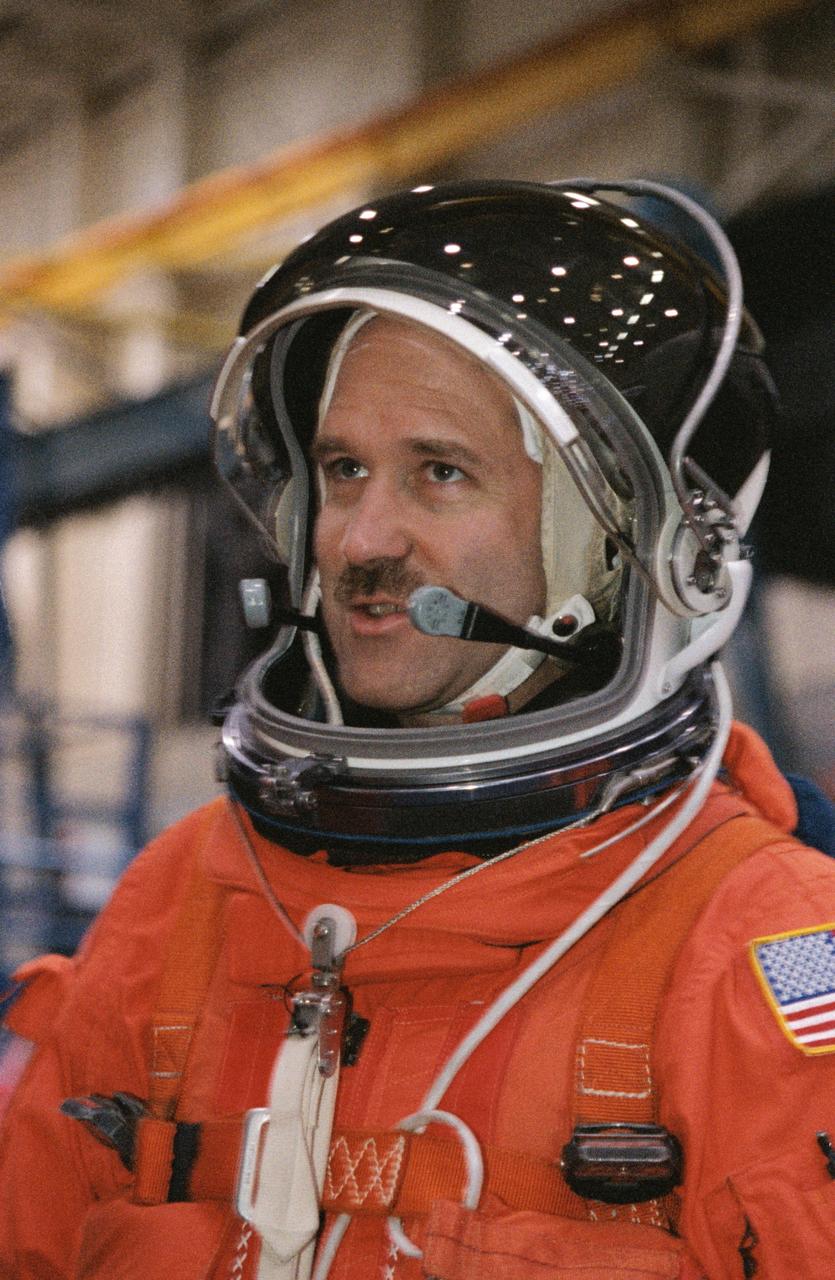
JSC2001-02194 (9 August 2001) --- Suited in a training version of the full-pressure launch and entry suit, astronaut John M. Grunsfeld, STS-109 mission specialist, awaits a training session in one of the trainer/mockups (out of frame) in the Space Vehicle Mockup Facility at the Johnson Space Center (JSC). STS-109 will be the 108th shuttle flight and the fourth Hubble Space Telescope (HST) servicing mission.
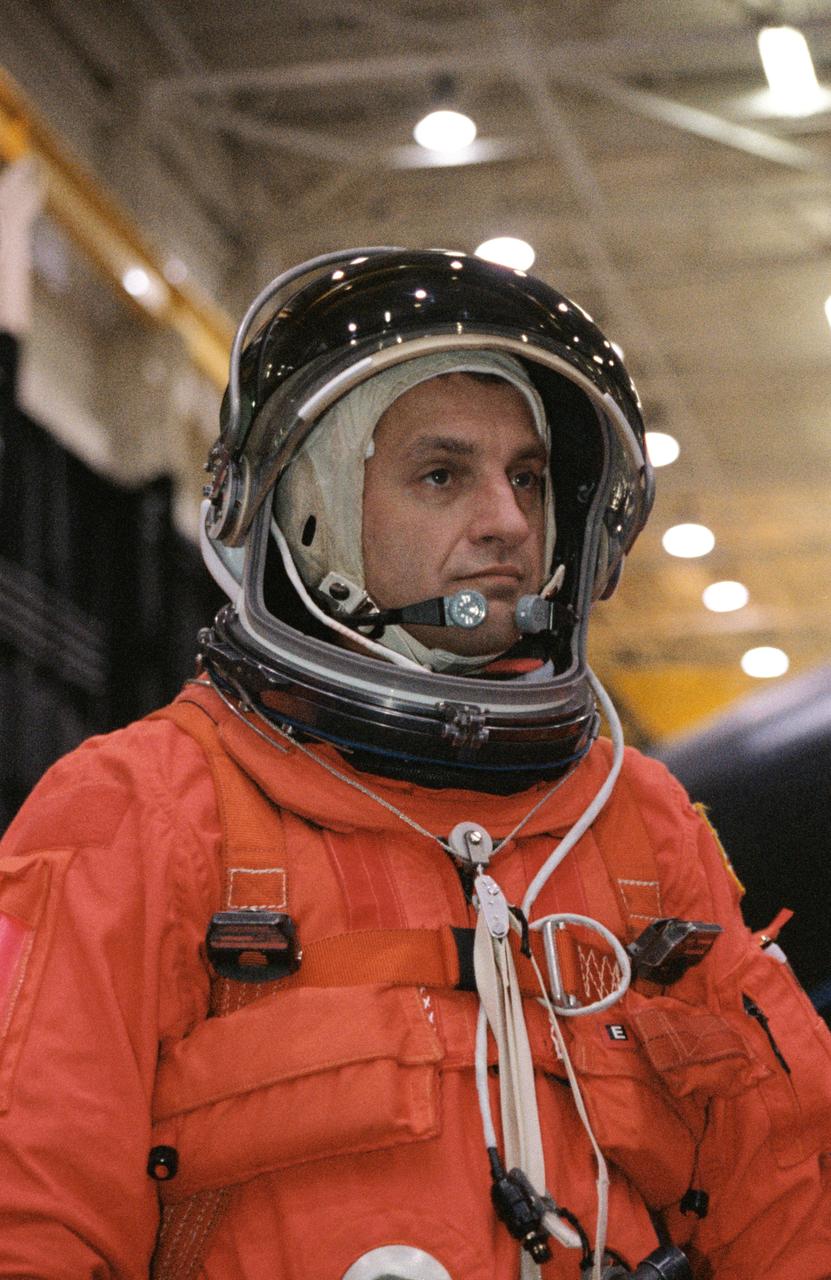
JSC2001-02197 (9 August 2001) --- Suited in a training version of the full-pressure launch and entry suit, astronaut Richard M. Linnehan, STS-109 mission specialist, awaits a training session in one of the trainer/mockups (out of frame) in the Space Vehicle Mockup Facility at the Johnson Space Center (JSC). STS-109 will be the 108th shuttle flight and the fourth Hubble Space Telescope (HST) servicing mission.

JSC2001-02191 (9 August 2001) --- Suited in a training version of the full-pressure launch and entry suit, astronaut Scott D. Altman, STS-109 mission commander, awaits a training session in one of the trainer/mockups (out of frame) in the Space Vehicle Mockup Facility at the Johnson Space Center (JSC). STS-109 will be the 108th shuttle flight and the fourth Hubble Space Telescope (HST) servicing mission.
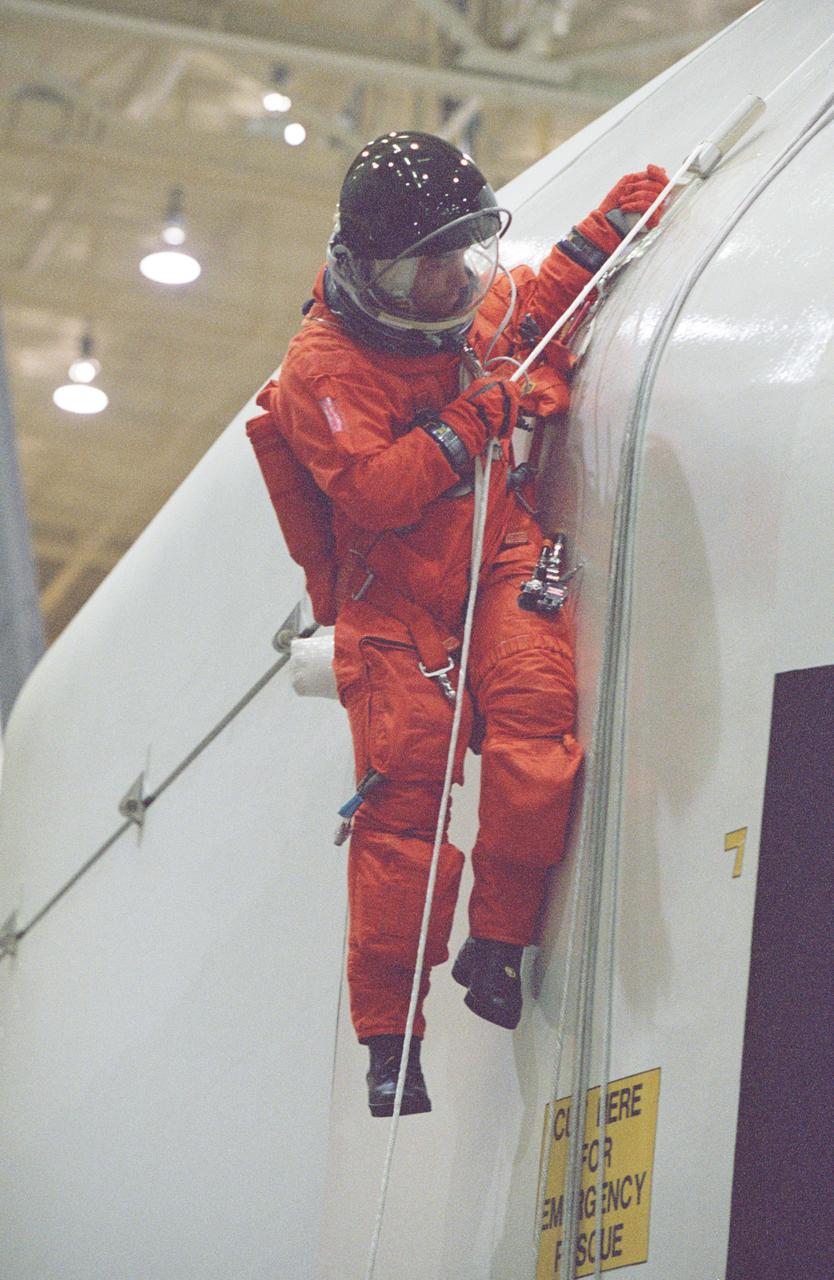
JSC2001-01552 (24 May 2001) --- An unidentified member of the STS-109 crew uses a device called a Sky genie to simulate rappelling from a troubled shuttle in a training session in the Space Vehicle Mockup Facility at the Johnson Space Center (JSC). The mockup is called the Full Fuselage Trainer (FFT). This exercise trains the crewmembers for procedures to follow in egressing a troubled shuttle on the ground. STS-109 will be the 108th shuttle flight and the fourth Hubble Space Telescope (HST) servicing mission.
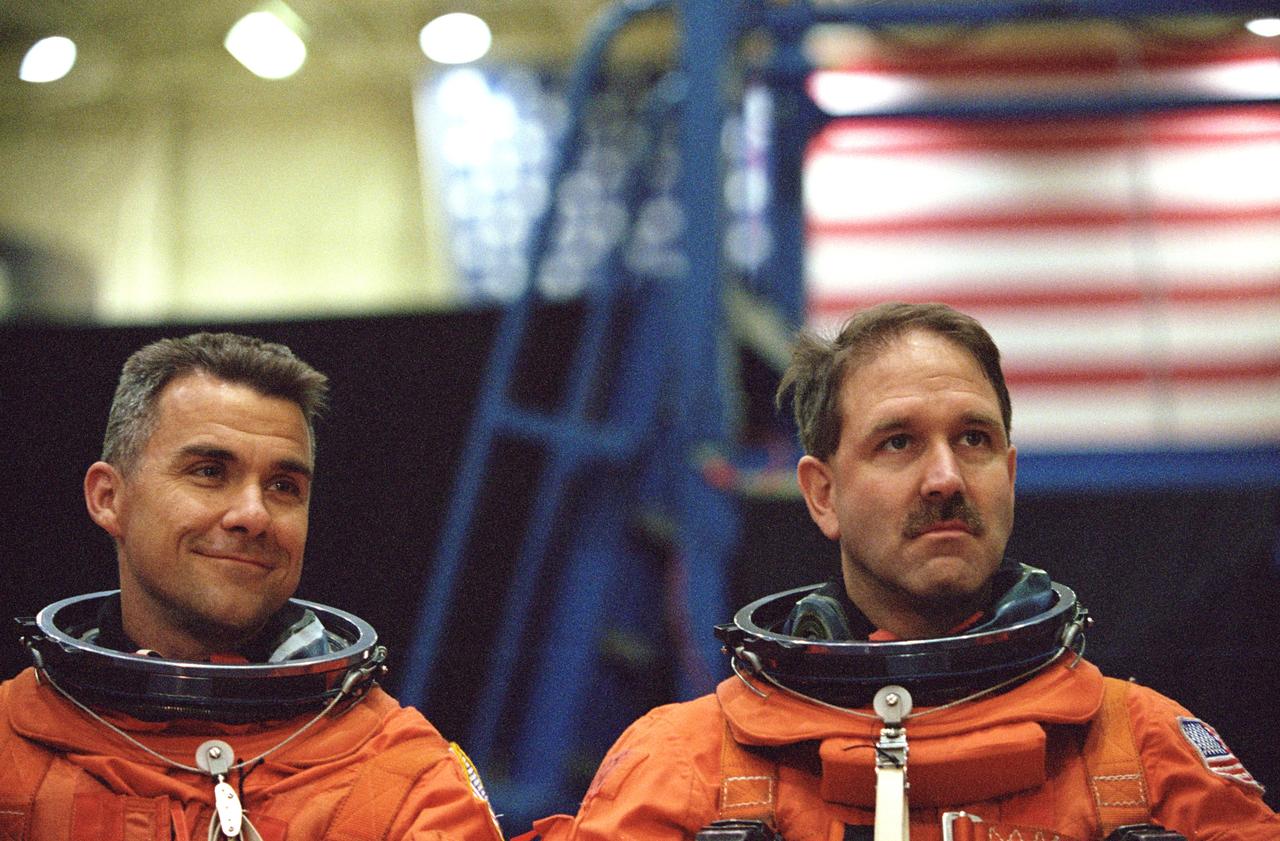
JSC2001-01549 (24 May 2001) --- Suited in training versions of the full-pressure launch and entry suit, astronauts Duane G. Carey (left), STS-109 pilot, and John M. Grunsfeld, mission specialist, await the start of a training session in one of the trainer/mockups (out of frame) in the Space Vehicle Mockup Facility at the Johnson Space Center (JSC). STS-109 will be the 108th shuttle flight and the fourth Hubble Space Telescope (HST) servicing mission.
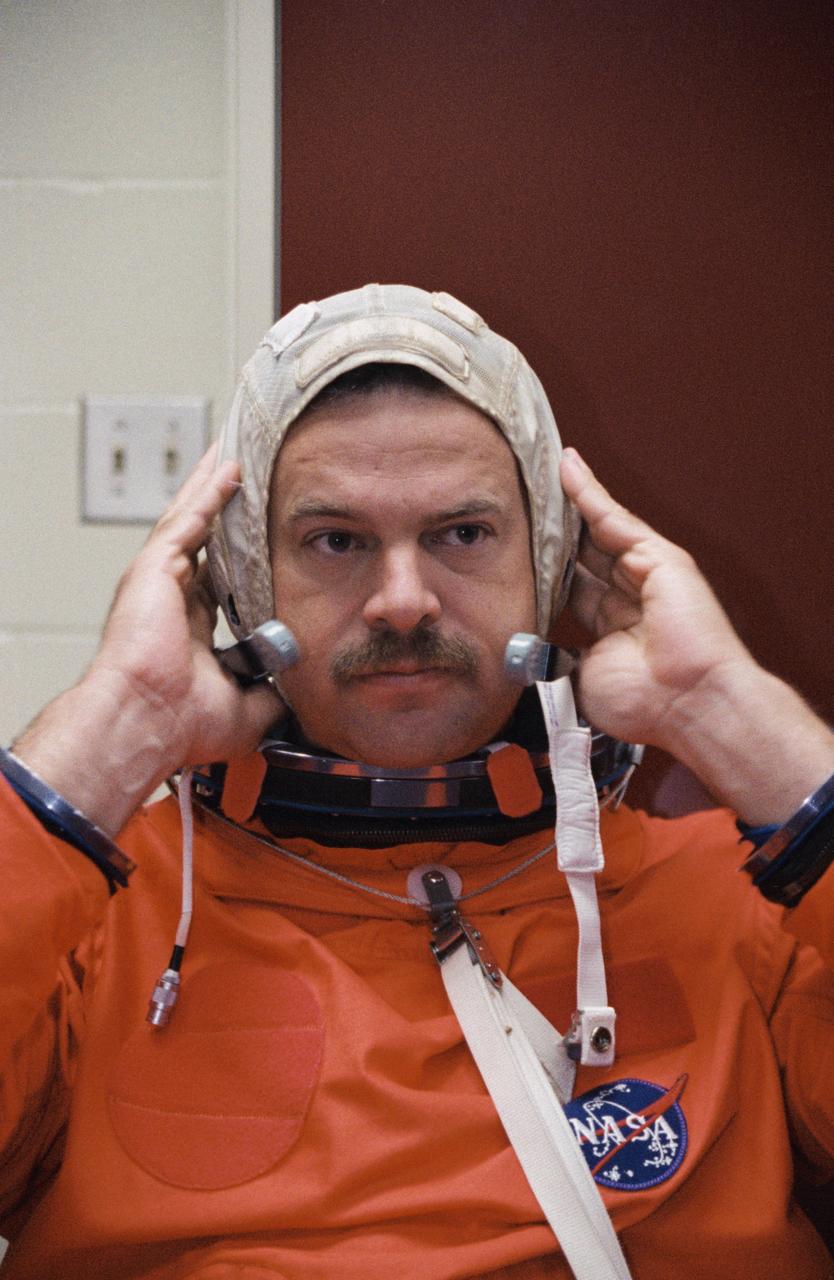
JSC2001-02199 (9 August 2001) --- Astronaut Scott D. Altman, STS-109 mission commander, dons a training version of the full-pressure launch and entry suit prior to a training session in one of the trainer/mockups (out of frame) in the Space Vehicle Mockup Facility at the Johnson Space Center (JSC). STS-109 will be the 108th shuttle flight and the fourth Hubble Space Telescope (HST) servicing mission.

JSC2001-02185 (9 August 2001) --- Astronaut Duane G. Carey, STS-109 pilot, occupies the pilot’s station during a mission training session in the Space Vehicle Mockup Facility at the Johnson Space Center (JSC). Carey is attired in a training version of the shuttle launch and entry garment. STS-109 will be the 108th shuttle flight and the fourth Hubble Space Telescope (HST) servicing mission.

JSC2001-E-24459 (8 August 2001) --- Astronaut Nancy J. Currie, STS-109 mission specialist, uses the virtual reality lab at the Johnson Space Center (JSC) to train for some of her duties aboard the Space Shuttle Columbia. This type of computer interface paired with virtual reality training hardware and software helps to prepare the entire team to perform their duties during the fourth Hubble Space Telescope (HST) servicing mission.

JSC2001-E-24452 (8 August 2001) --- Astronauts John M. Grunsfeld (left), STS-109 payload commander, and Nancy J. Currie, mission specialist, use the virtual reality lab at the Johnson Space Center (JSC) to train for some of their duties aboard the Space Shuttle Columbia. This type of computer interface paired with virtual reality training hardware and software helps to prepare the entire team to perform its duties during the fourth Hubble Space Telescope (HST) servicing mission.
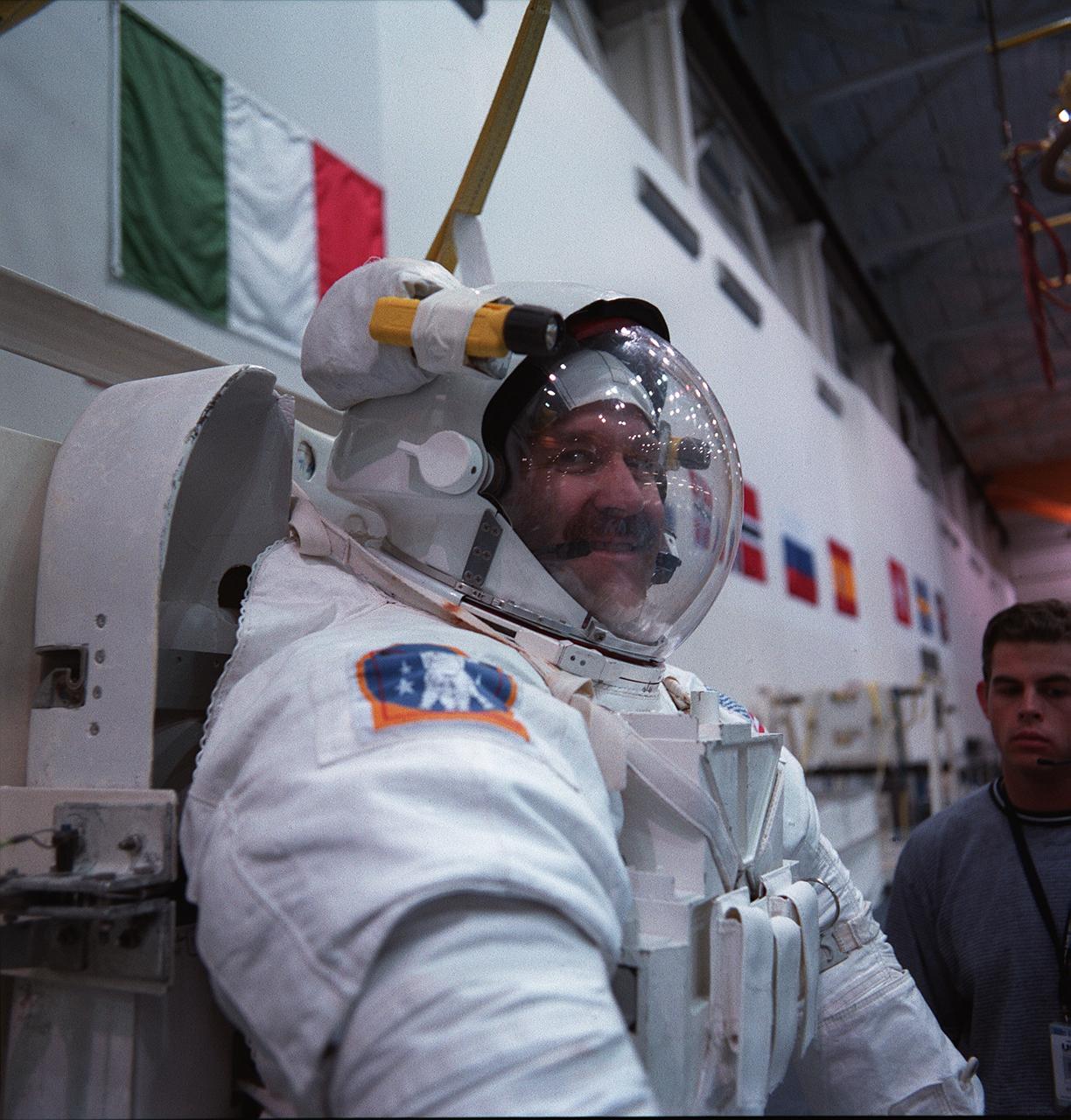
S99-06191 (21 June 1999) --- Astronaut John M. Grunsfeld, mission specialist, wearing an underwater-adapted training version of the Shuttle extravehicular mobility unit (EMU), prepares to go below the water in the Neutral Buoyancy Laboratory (NBL). Grunsfeld and other astronauts assigned to STS-103 space walk duty are in training for EVA chores they will handle when they make the third servicing visit to the Earth-orbiting Hubble Space Telescope (HST) since its deployment in April of 1990.
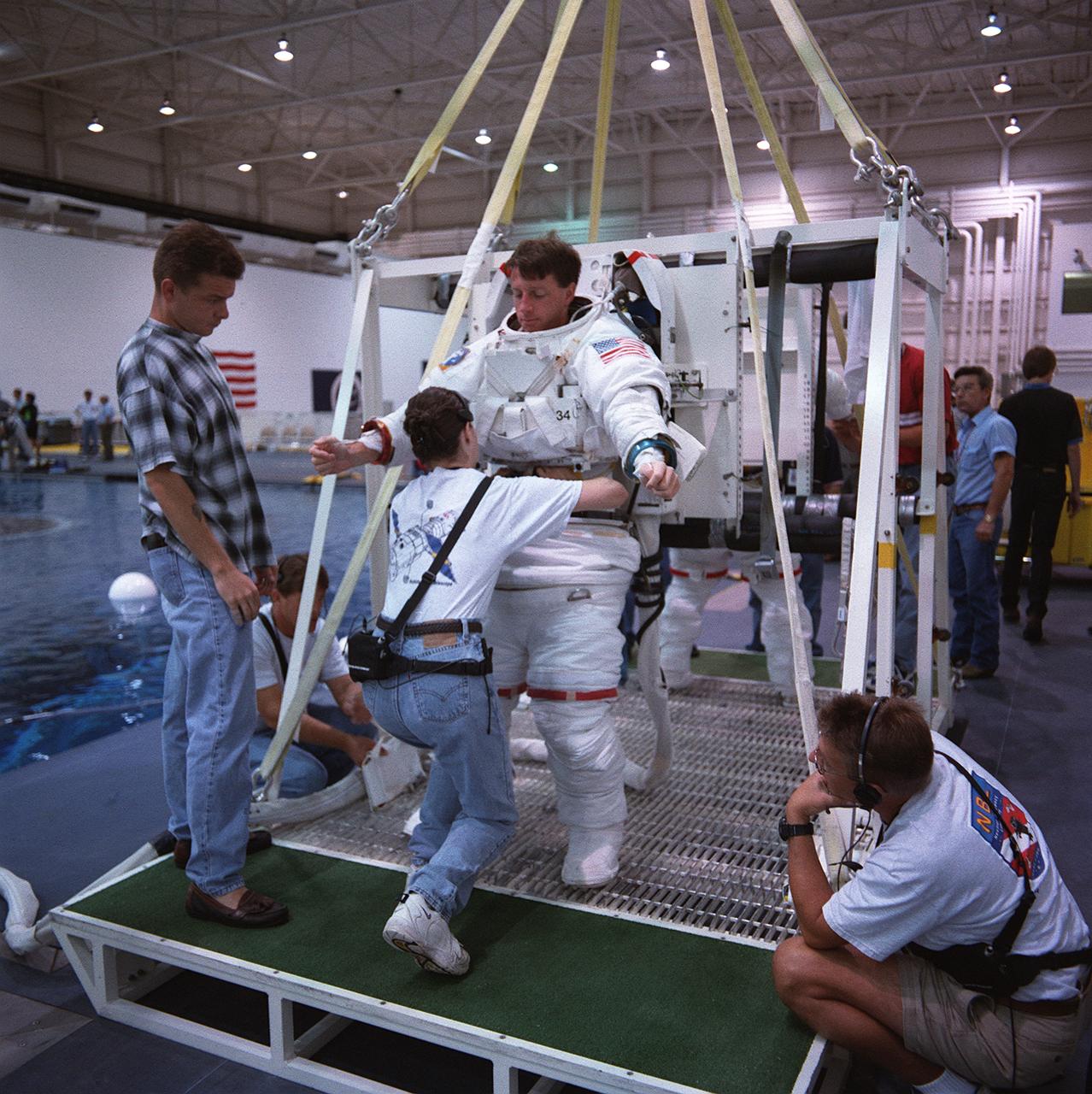
S99-06192 (21 June 1999) --- Astronaut C. Michael Foale, mission specialist, wearing an underwater-adapted training version of the Shuttle extravehicular mobility unit (EMU), prepares to go below the water in the Neutral Buoyancy Laboratory (NBL). Foale and other astronauts assigned to STS-103 space walk duty are in training for EVA chores they will handle when they make the third servicing visit to the Earth-orbiting Hubble Space Telescope (HST) since its deployment in April 1990.
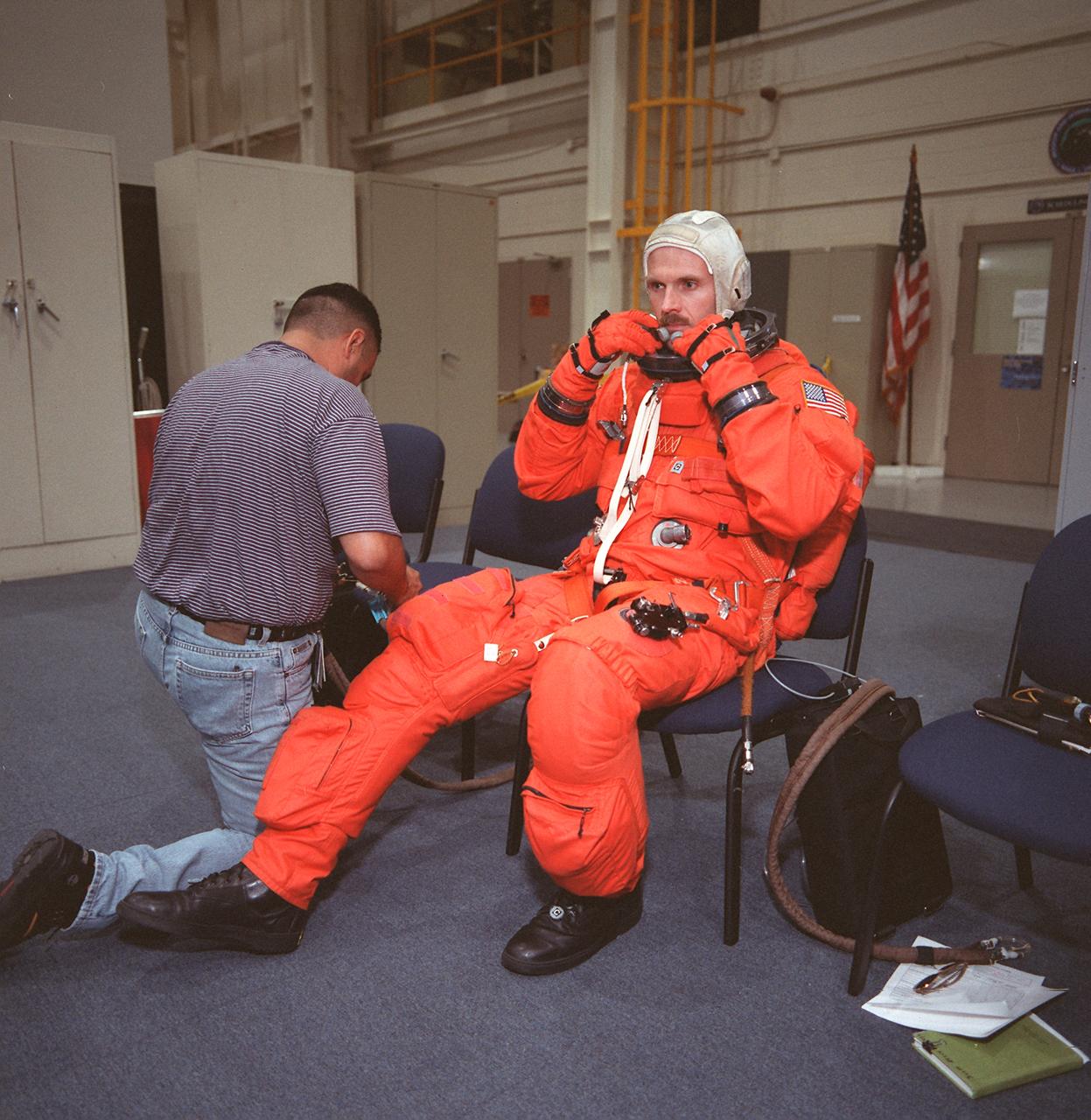
S99-08665 (24 May 1999) --- A suit technician assists astronaut Steven L. Smith with his launch and entry suit prior to an emergency bailout training session at the Johnson Space Center's Systems Integration Facility. The STS-103 mission specialists was joined on this session by the majority of the seven-man crew, in training for the third servicing mission to the Earth-orbiting Hubble Space Telescope (HST).
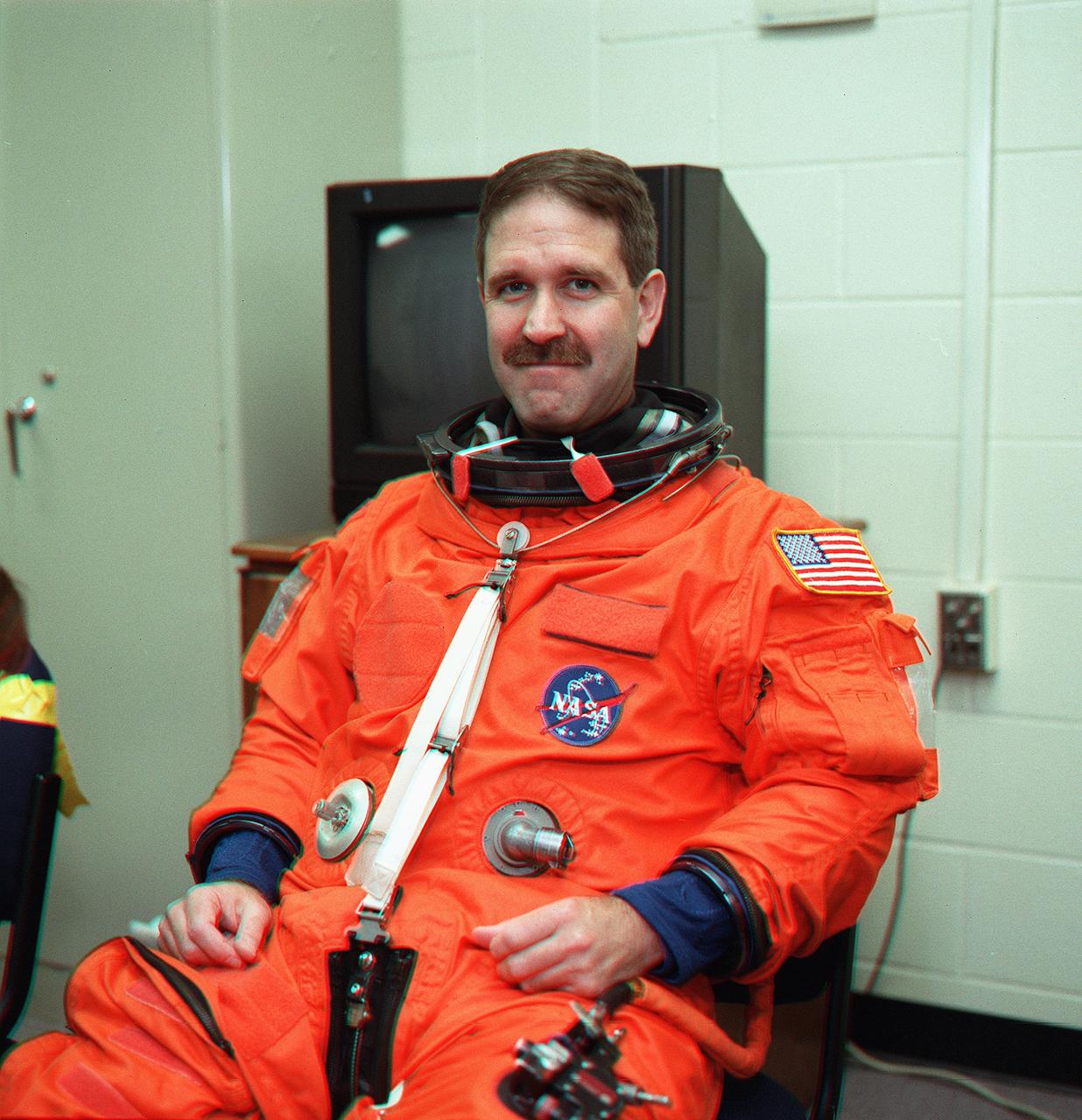
S99-08659 (24 May 1999) --- Astronaut John M. Grunsfeld, STS-103 mission specialist, has just donned a training version of the shuttle launch and entry garment prior to an emergency bailout training session at the Johnson Space Cetner (JSC). Grunsfeld will join six other astronauts for the autumn visit to the Hubble Space Telescope (HST) to participate in NASA third servicing mission on the orbiting observatory.
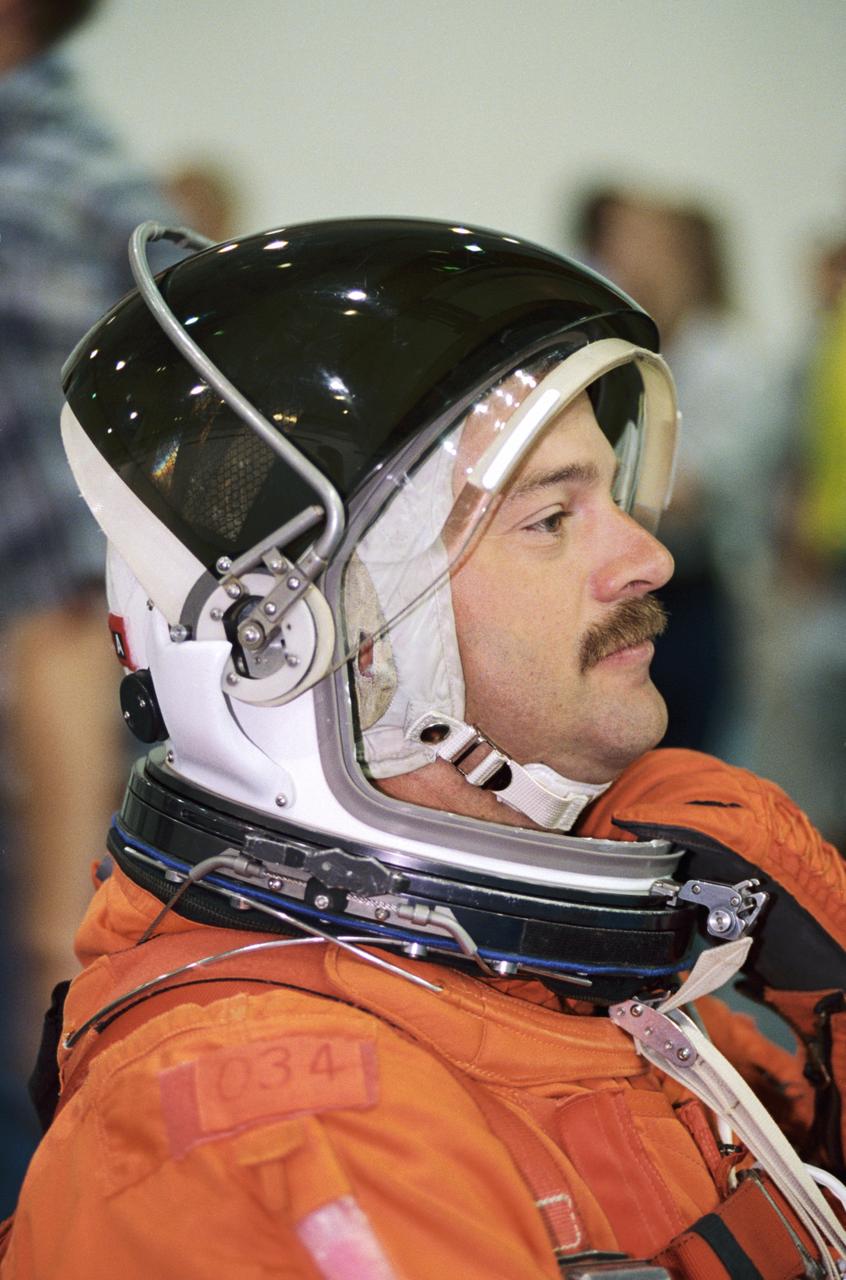
JSC2001-01918 (12 July 2001) --- Astronaut Scott D. Altman, STS-109 mission commander, attired in a training version of the shuttle launch and entry garment, awaits the start of an emergency bailout training session at the Neutral Buoyancy Laboratory (NBL) near the Johnson Space Center (JSC). STS-109 will be the 108th shuttle flight and the fourth Hubble Space Telescope (HST) servicing mission.
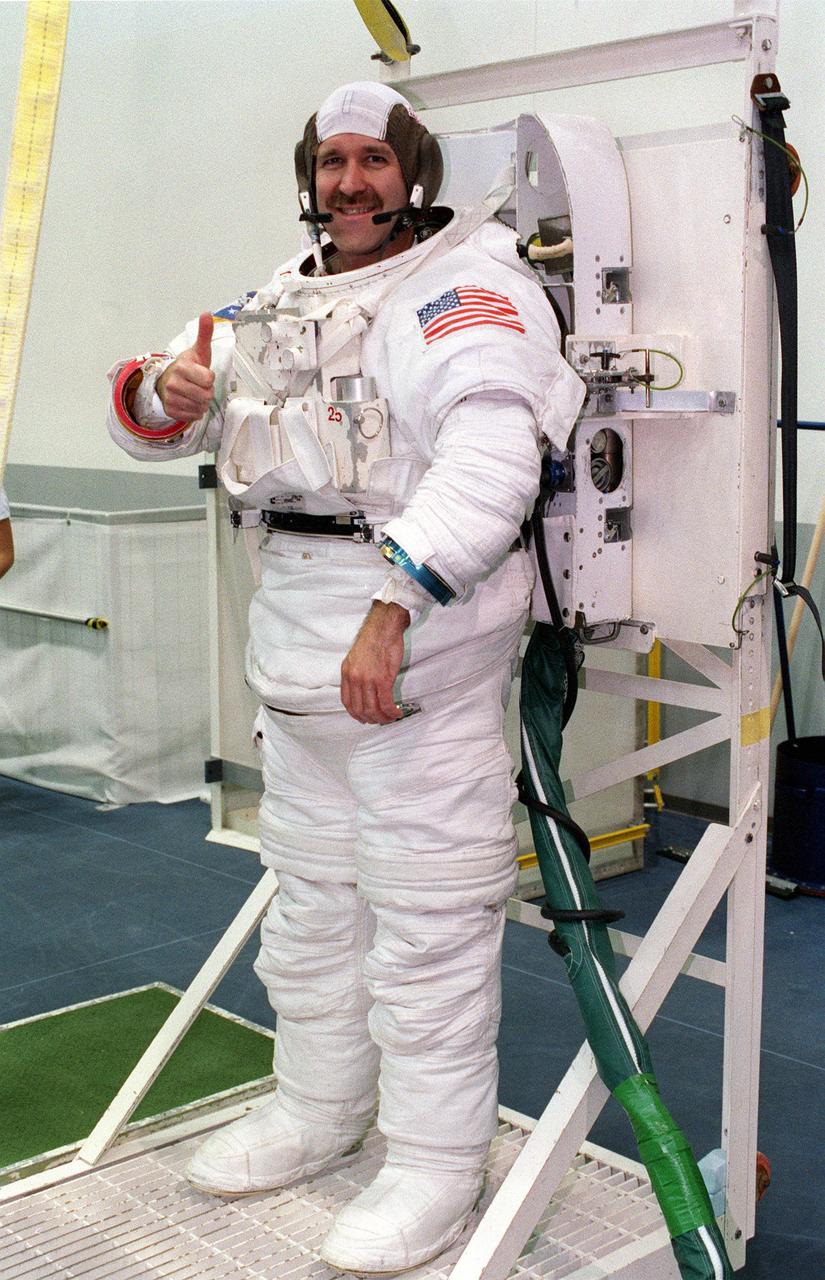
S99-08359 (26 July 1999) --- Astronaut John M. Grunsfeld, mission specialist, wearing an underwater-adapted training version of the Shuttle extravehicular mobility unit (EMU), signals "all's well" prior to going into the water in the Neutral Buoyancy Laboratory (NBL). Grunsfeld and other astronauts assigned to STS-103 space walk duty are in training for EVA chores they will handle when they make the third servicing visit to the Earth-orbiting Hubble Space Telescope (HST) since its deployment in April 1990.
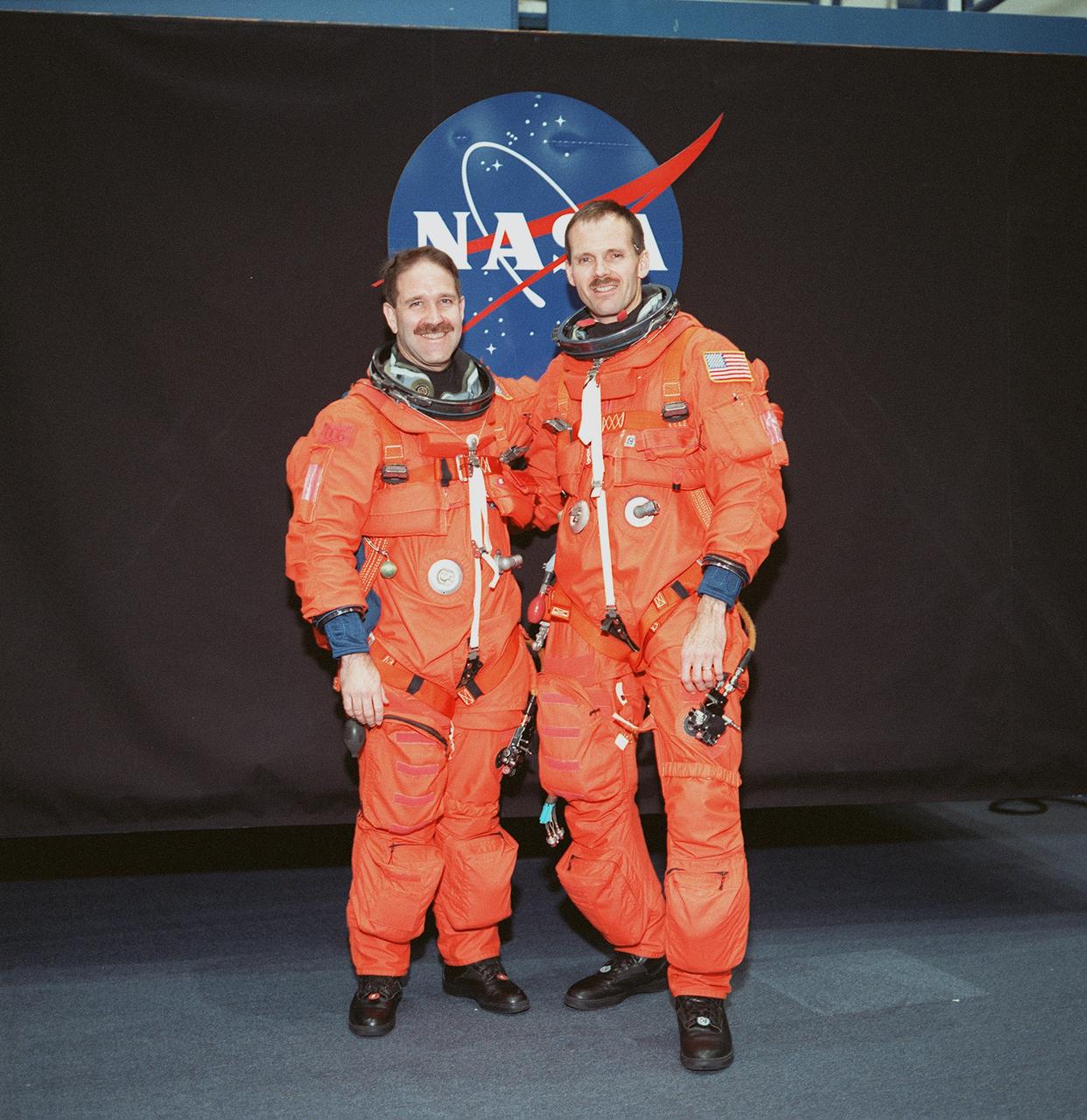
S99-08671 (24 May 1999) --- Astronauts John M. Grunsfeld (left) and Steven L. Smith, wearing training versions of the shuttle launch and entry garment, pose for an informal portrait prior to an emergency bailout training session in the Systems Integration Facility. The two mission specialists will join five other astronauts for the third servicing mission to the Earth-orbiting Hubble Space Telescope in the autumn of this year.
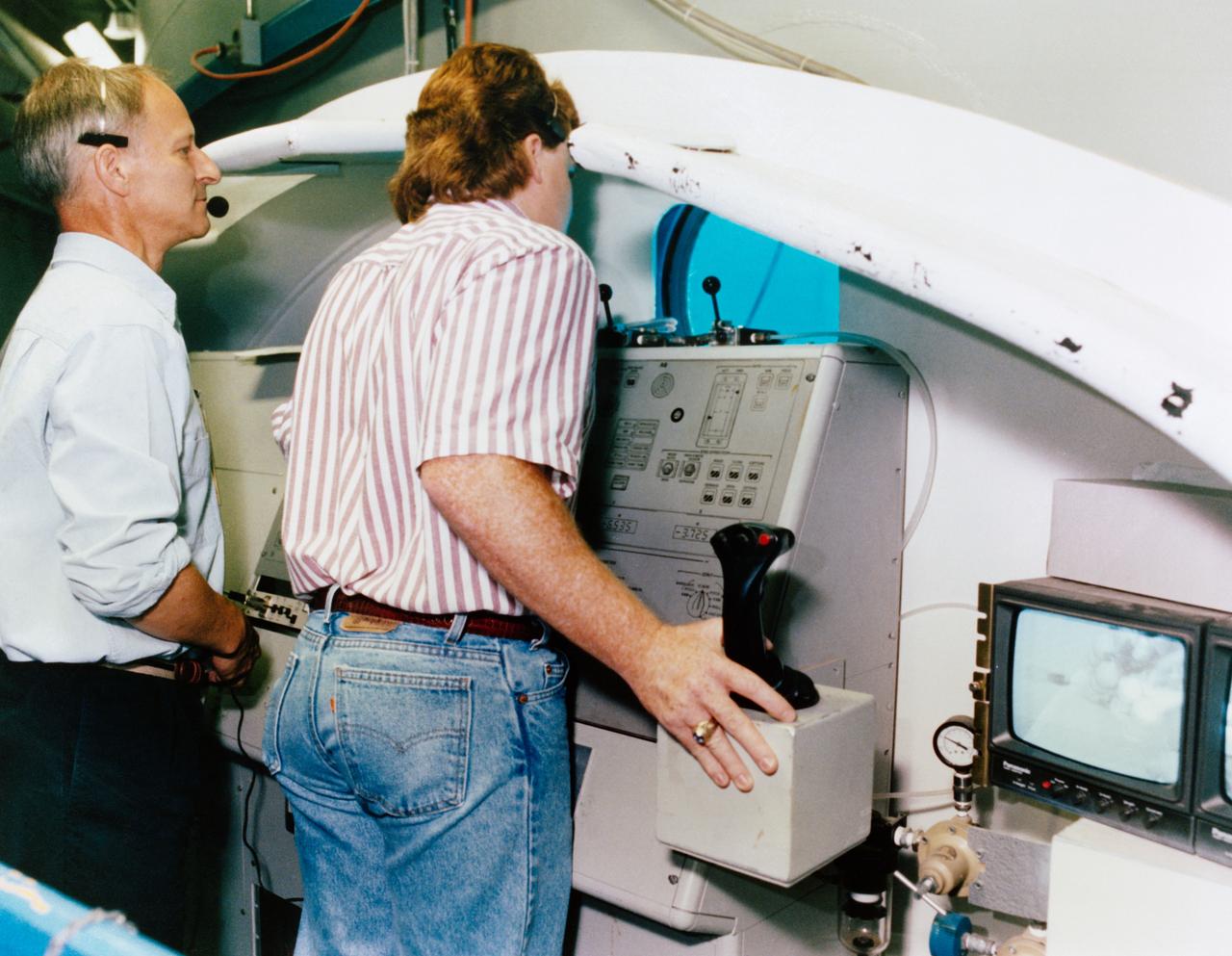
Swiss scientits Claude Nicollier (left), STS-61 mission specialist, waits his turn at the controls for the remote manipulator system (RMS) during a training session in the Neutral Buoyancy Simulator at Marshall Space Flight Center (MSFC). Mark Norman of MSFC has control of the RMS in this frame.
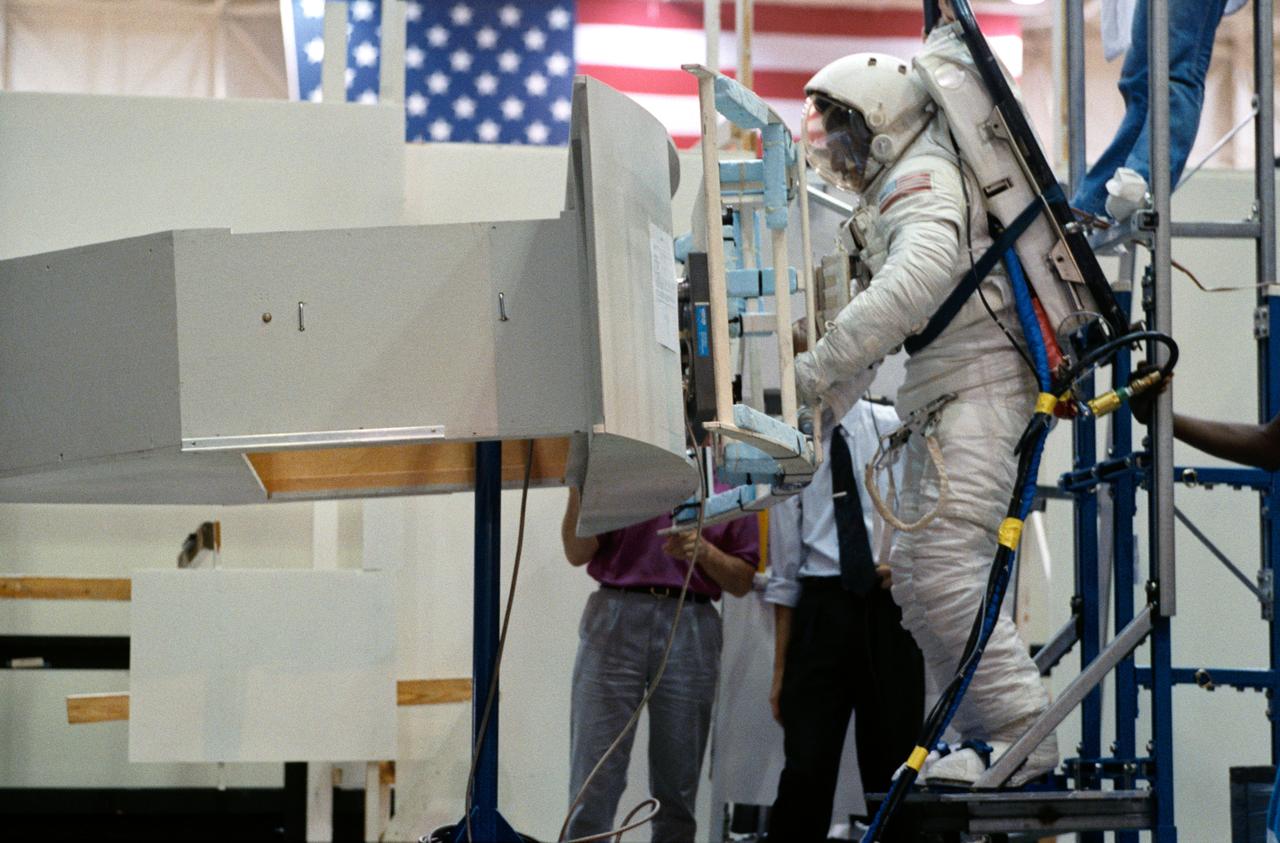
S93-35696 (7 June 1993) --- Making use of the air-bearing floor in Johnson Space Center's (JSC) Shuttle Mockup and Integration Laboratory, astronaut Jeffrey A. Hoffman practices working with the Hubble Space Telescope's (HST) Wide Field/Planetary Camera (WF/PC). Hoffman is one of four mission specialists who will participate in HST servicing on the scheduled December mission. Changing out the large camera is one of several chores to be performed by the four. Photo credit: NASA
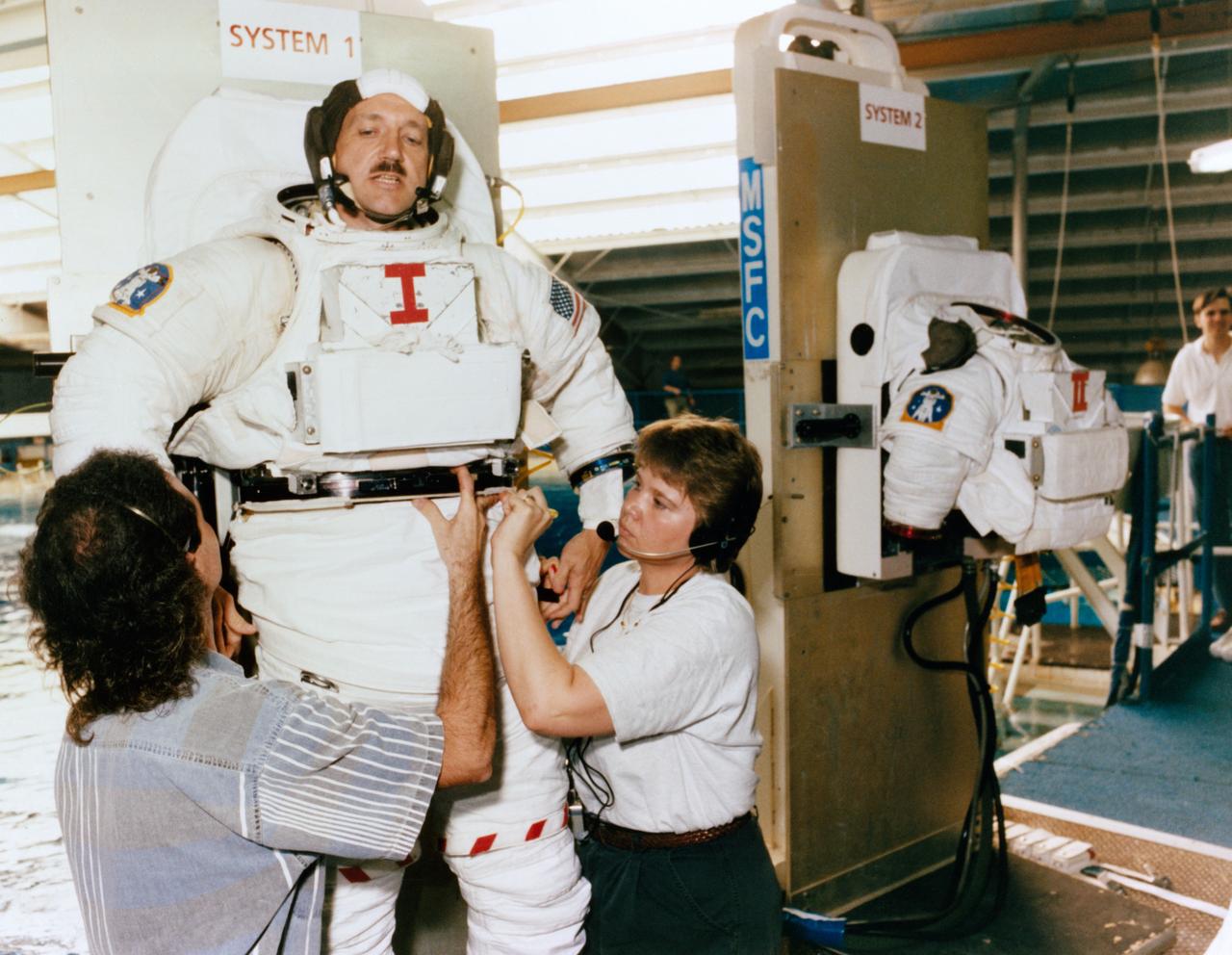
Astronaut Thomas D. Akers gets assistance in donning a training version of the Shuttle extravehicular mobility unit (EMU) space suit prior to a training session in the Neutral Buoyancy Simulator at Marshall Space Flight Center (MSFC) (39735); Astronaut Kathryn C. Thornton (foreground) and Thomas Akers, STS-61 mission specialists scheduled for extravehicular activity (EVA) duty, prepare for an underwater rehearsal session. Thornton recieves assistance from a technician in donning her EMU gloves (39736).
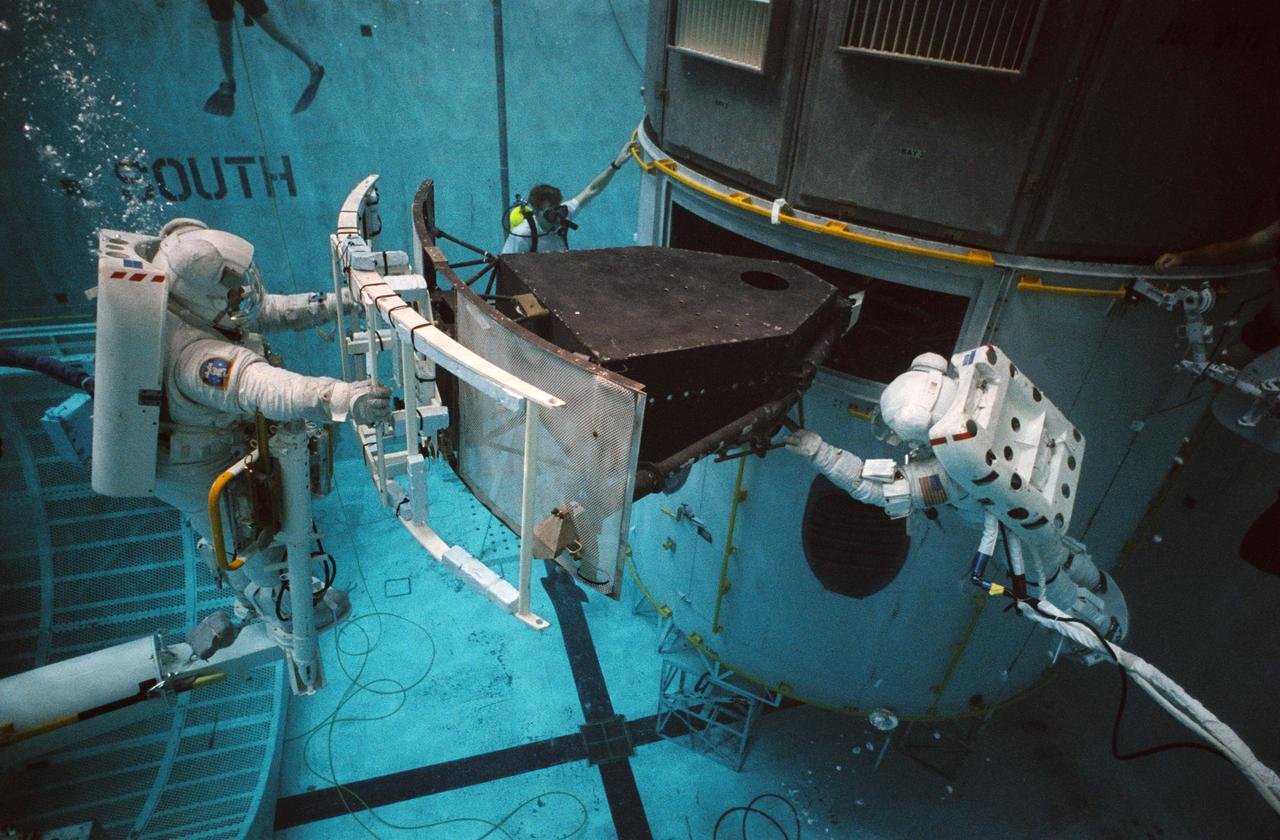
S93-33103 (2 Apr 1993) --- Wearing training versions of Space Shuttle Extravehicular Mobility Units (EMU), astronauts F. Story Musgrave and Jeffrey A. Hoffman use the giant pool of the Johnson Space Center's (JSC) Weightless Environment Training Facility (WET-F) to rehearse for the Hubble Space Telescope (HST) repair mission. The two are working with a full-scale training version of the Wide Field/Planetary Camera (WF/PC). The current WF/PC will be replaced with WF/PC-2. A total of five extravehicular activity (EVA) sessions will be conducted during the scheduled December mission of the Endeavour.
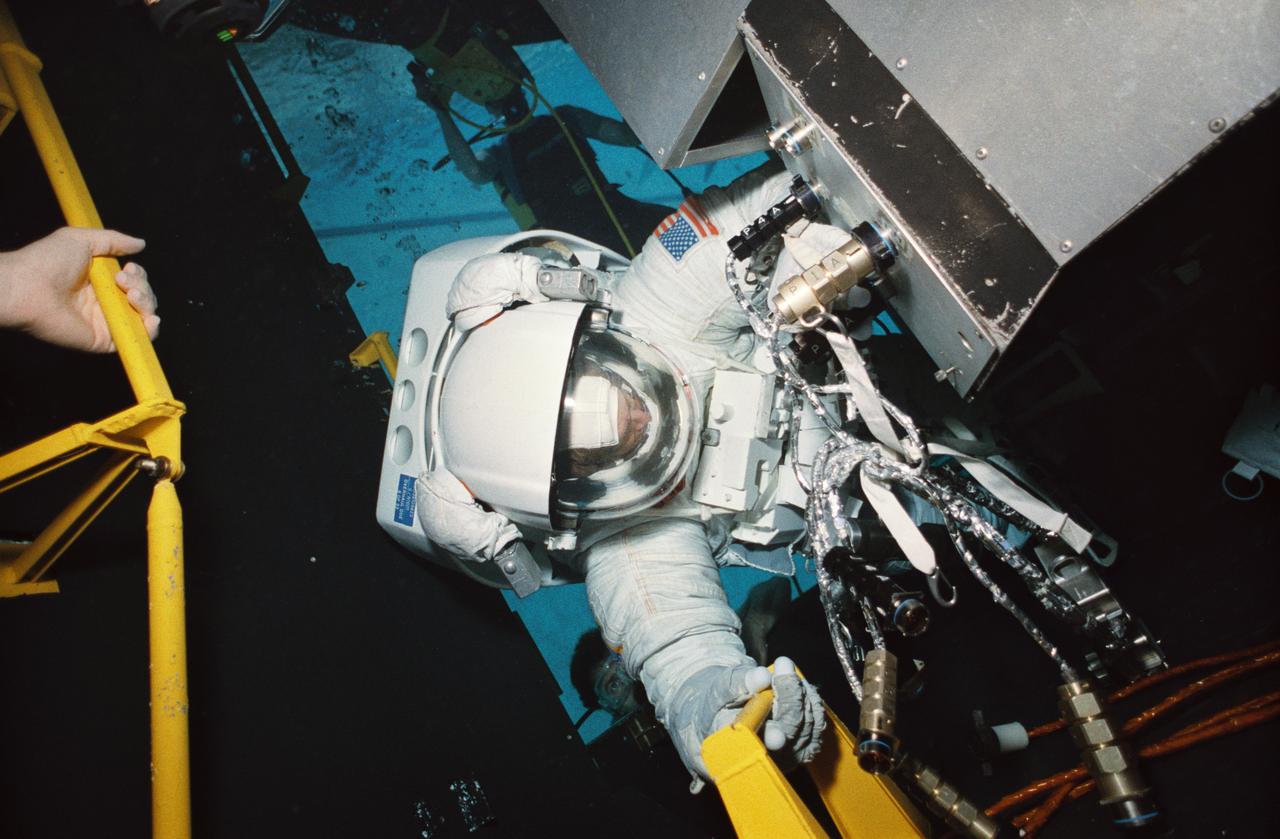
S93-33104 (7 Apr 1993) --- Wearing a training version of Space Shuttle Extravehicular Mobility Unit (EMU), astronaut Jeffrey A. Hoffman uses the giant pool of the Johnson Space Center's (JSC) Weightless Environment Training Facility (WET-F) to rehearse for the Hubble Space Telescope (HST) repair mission. Out of frame is astronaut F. Story Musgrave, who will join Hoffman in STS-61 EVA. The hand at top frame belongs to a SCUBA-equipped diver. A number of divers are on hand for all training sessions in the WET-F. A total of five extravehicular activity (EVA) sessions will be conducted during the scheduled December mission of the Endeavour.
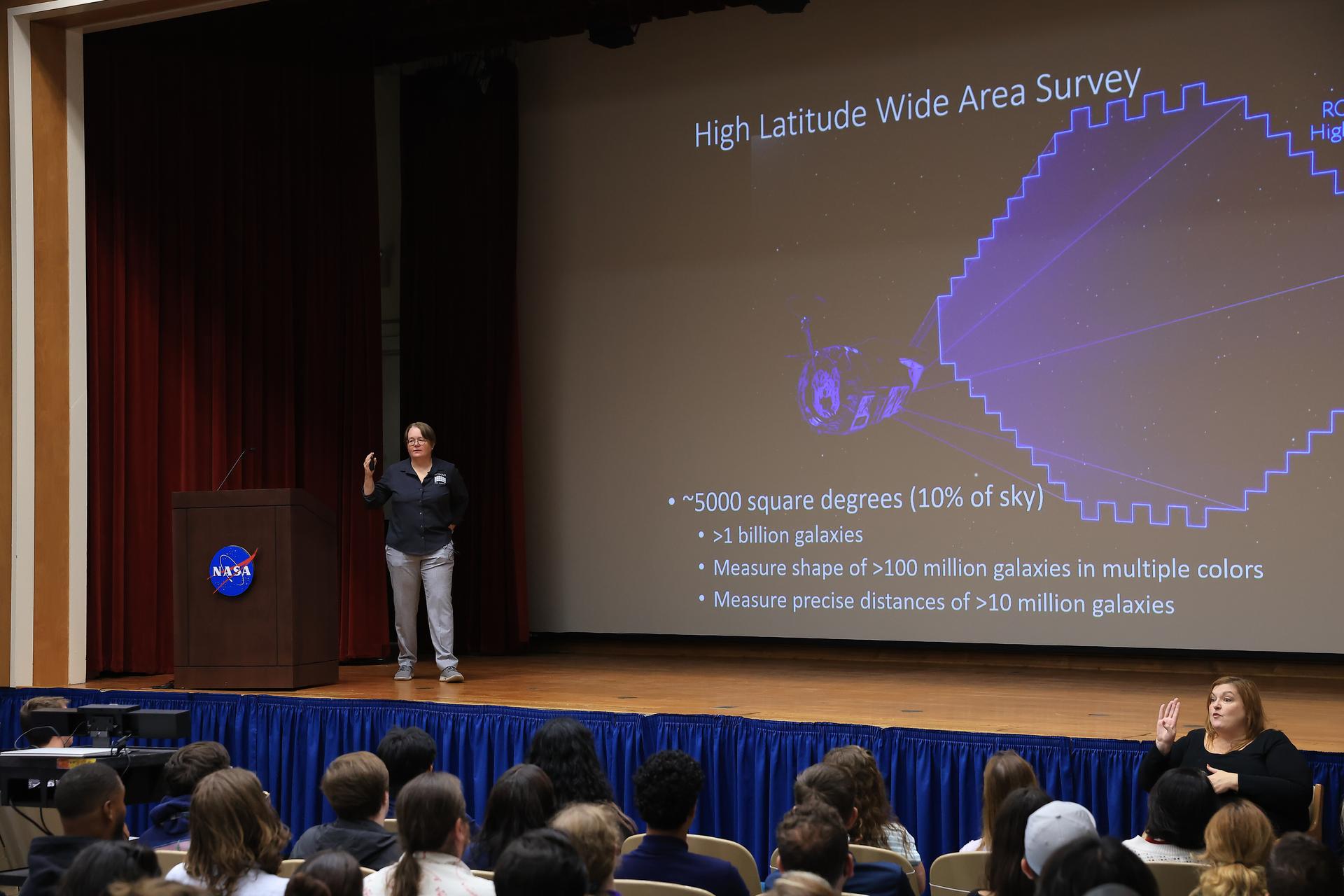
Dr. Julie McEnery, senior project scientist for NASA’s Nancy Grace Roman Space Telescope mission, discusses the upcoming Roman mission in the Training Auditorium at NASA’s Kennedy Space Center in Florida on Tuesday, July 21, 2026. McEnery is a leading astrophysicist at NASA's Goddard Space Flight Center in Greenbelt, Maryland, where she specializes in the study of high energy astrophysics and her work is expanding our understanding of the universe’s creation and behavior. Named for NASA’s first chief astronomer and “mother of the Hubble Space Telescope,” Roman will offer a field of view over 100 times larger than Hubble’s to study up to a billion galaxies, directly image exoplanets and planet forming disks, and address fundamental questions about dark energy, exoplanets, and infrared astrophysics.
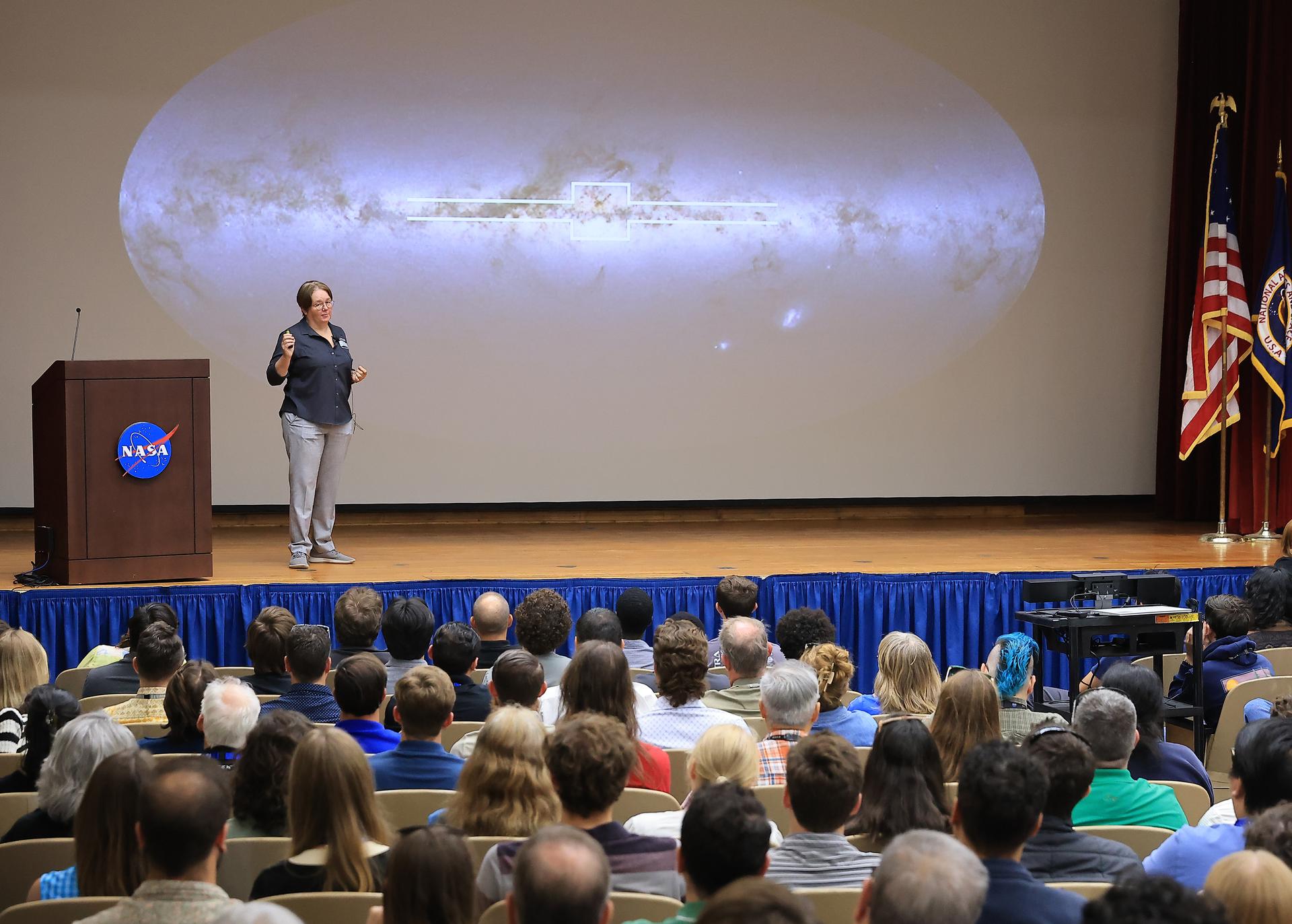
Dr. Julie McEnery, senior project scientist for NASA’s Nancy Grace Roman Space Telescope mission, discusses the upcoming Roman mission in the Training Auditorium at NASA’s Kennedy Space Center in Florida on Tuesday, July 21, 2026. McEnery is a leading astrophysicist at NASA's Goddard Space Flight Center in Greenbelt, Maryland, where she specializes in the study of high energy astrophysics and her work is expanding our understanding of the universe’s creation and behavior. Named for NASA’s first chief astronomer and “mother of the Hubble Space Telescope,” Roman will offer a field of view over 100 times larger than Hubble’s to study up to a billion galaxies, directly image exoplanets and planet forming disks, and address fundamental questions about dark energy, exoplanets, and infrared astrophysics.
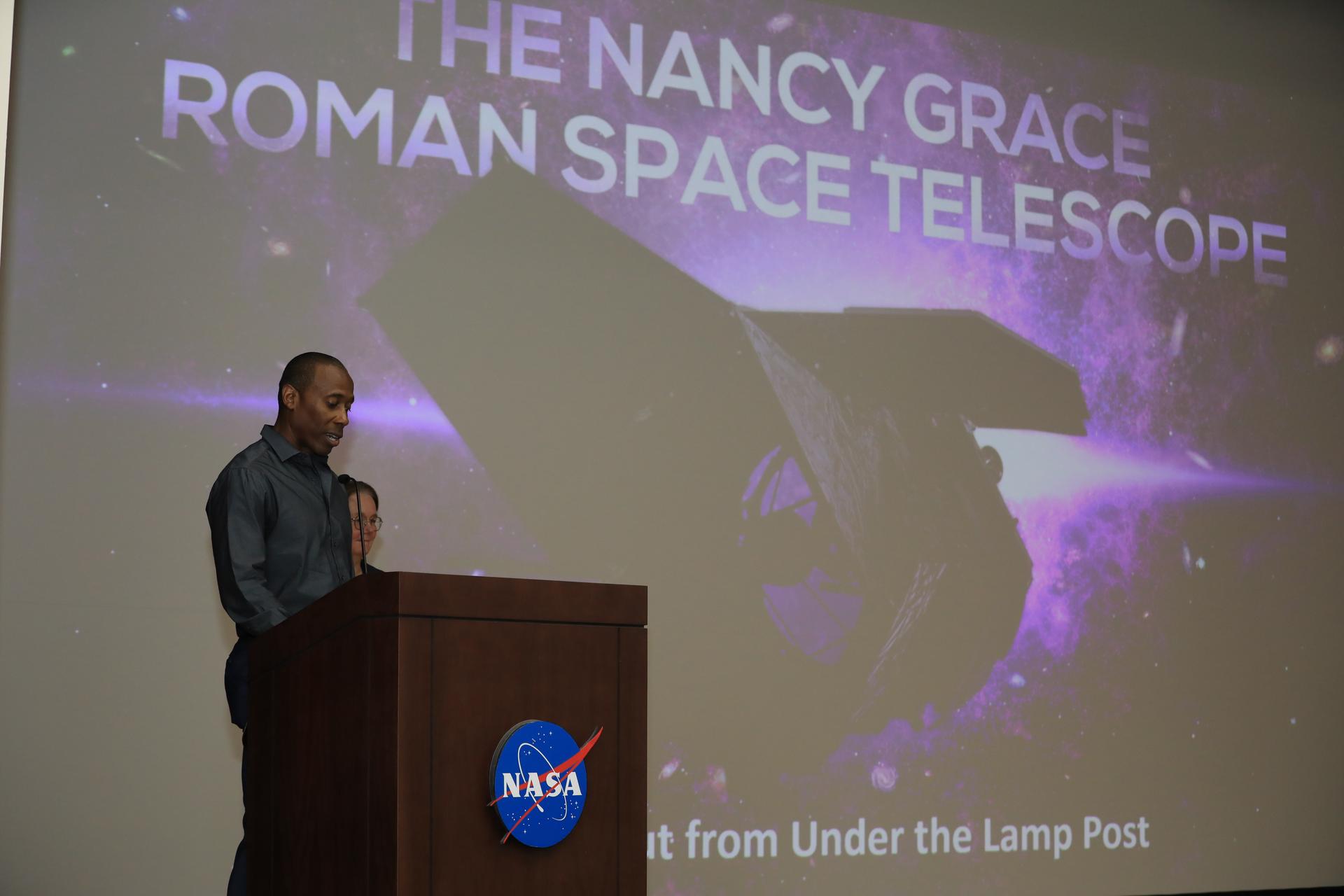
Denton Gibson, launch director of the Launch Services Program, introduces Dr. Julie McEnery, senior project scientist for NASA’s Nancy Grace Roman Space Telescope mission, in the Training Auditorium at NASA’s Kennedy Space Center in Florida on Tuesday, July 21, 2026. McEnery is a leading astrophysicist at NASA's Goddard Space Flight Center in Greenbelt, Maryland, where she specializes in the study of high energy astrophysics and her work is expanding our understanding of the universe’s creation and behavior. Named for NASA’s first chief astronomer and “mother of the Hubble Space Telescope,” Roman will offer a field of view over 100 times larger than Hubble’s to study up to a billion galaxies, directly image exoplanets and planet forming disks, and address fundamental questions about dark energy, exoplanets, and infrared astrophysics.
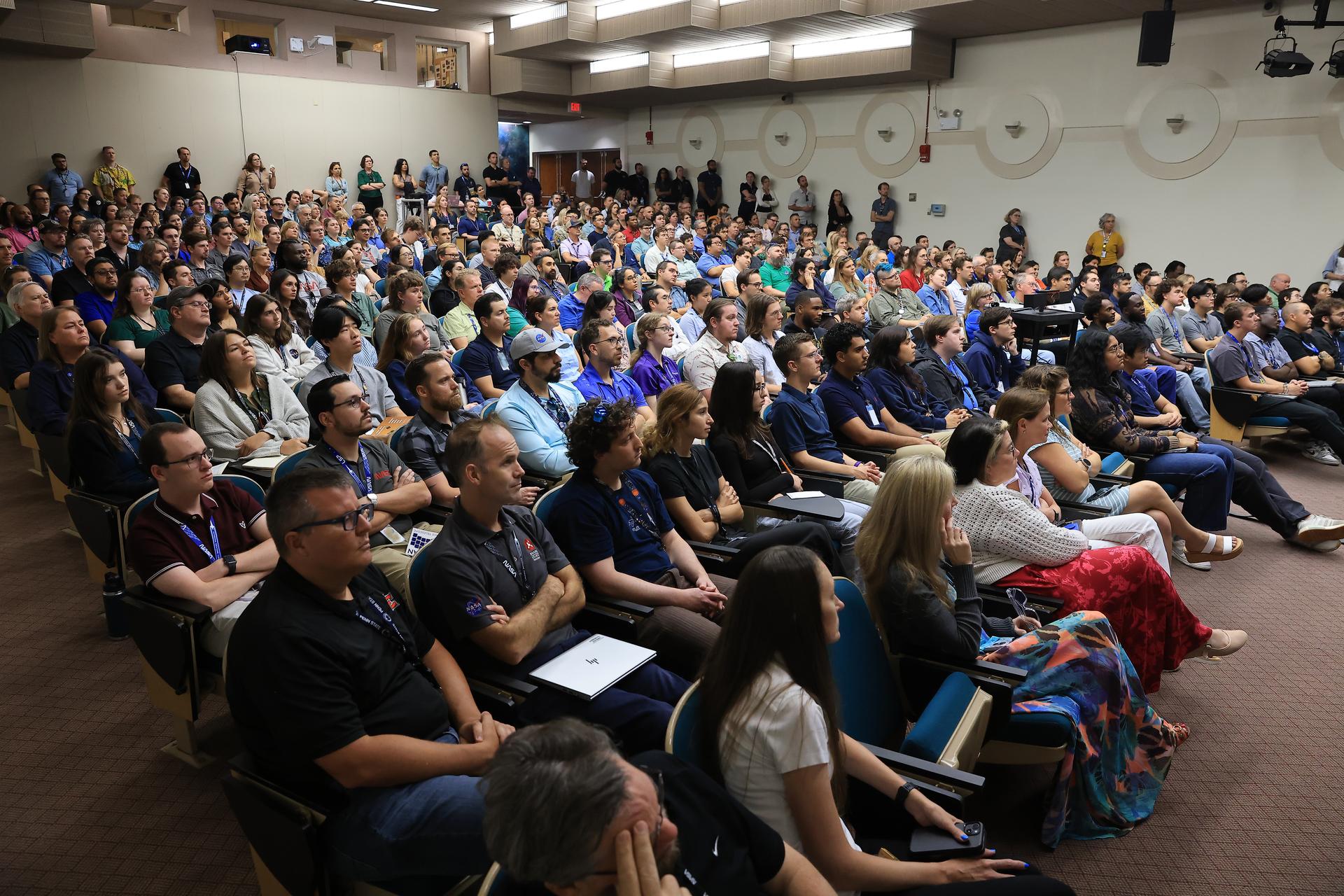
Dr. Julie McEnery, senior project scientist for NASA’s Nancy Grace Roman Space Telescope mission, discusses the upcoming Roman mission in the Training Auditorium at NASA’s Kennedy Space Center in Florida on Tuesday, July 21, 2026. McEnery is a leading astrophysicist at NASA's Goddard Space Flight Center in Greenbelt, Maryland, where she specializes in the study of high energy astrophysics and her work is expanding our understanding of the universe’s creation and behavior. Named for NASA’s first chief astronomer and “mother of the Hubble Space Telescope,” Roman will offer a field of view over 100 times larger than Hubble’s to study up to a billion galaxies, directly image exoplanets and planet forming disks, and address fundamental questions about dark energy, exoplanets, and infrared astrophysics.
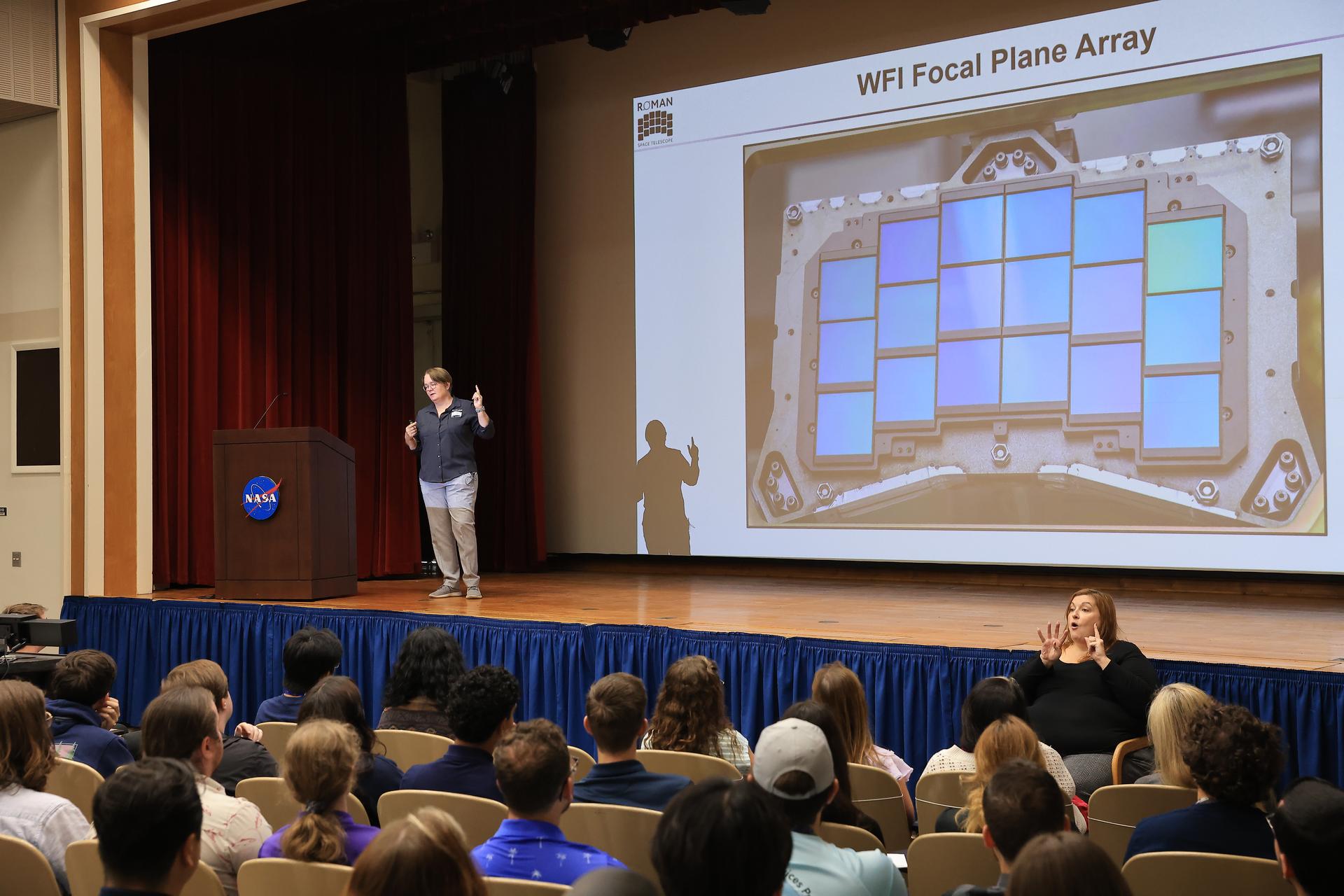
Dr. Julie McEnery, senior project scientist for NASA’s Nancy Grace Roman Space Telescope mission, discusses the upcoming Roman mission in the Training Auditorium at NASA’s Kennedy Space Center in Florida on Tuesday, July 21, 2026. McEnery is a leading astrophysicist at NASA's Goddard Space Flight Center in Greenbelt, Maryland, where she specializes in the study of high energy astrophysics and her work is expanding our understanding of the universe’s creation and behavior. Named for NASA’s first chief astronomer and “mother of the Hubble Space Telescope,” Roman will offer a field of view over 100 times larger than Hubble’s to study up to a billion galaxies, directly image exoplanets and planet forming disks, and address fundamental questions about dark energy, exoplanets, and infrared astrophysics.
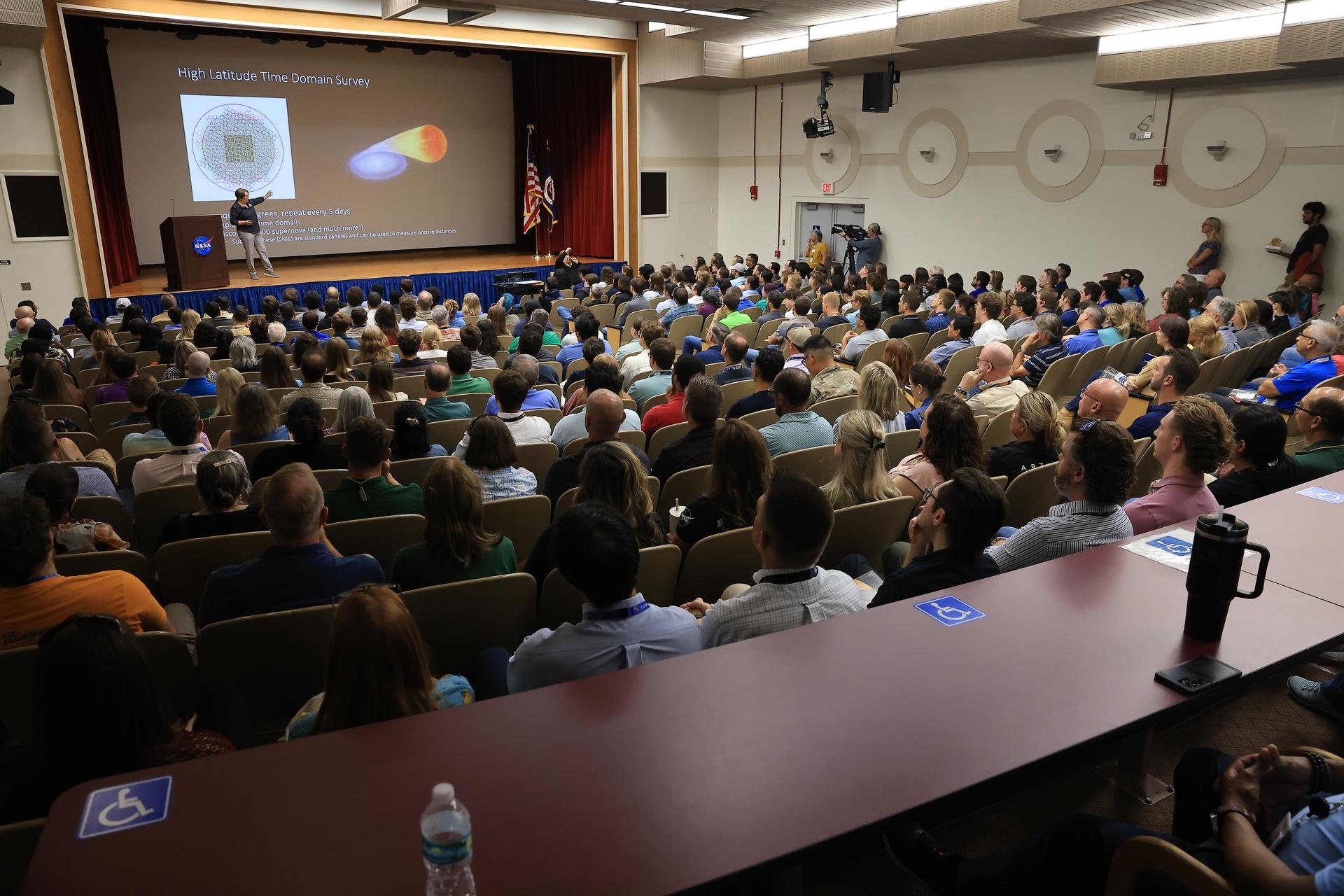
Dr. Julie McEnery, senior project scientist for NASA’s Nancy Grace Roman Space Telescope mission, discusses the upcoming Roman mission in the Training Auditorium at NASA’s Kennedy Space Center in Florida on Tuesday, July 21, 2026. McEnery is a leading astrophysicist at NASA's Goddard Space Flight Center in Greenbelt, Maryland, where she specializes in the study of high energy astrophysics and her work is expanding our understanding of the universe’s creation and behavior. Named for NASA’s first chief astronomer and “mother of the Hubble Space Telescope,” Roman will offer a field of view over 100 times larger than Hubble’s to study up to a billion galaxies, directly image exoplanets and planet forming disks, and address fundamental questions about dark energy, exoplanets, and infrared astrophysics.
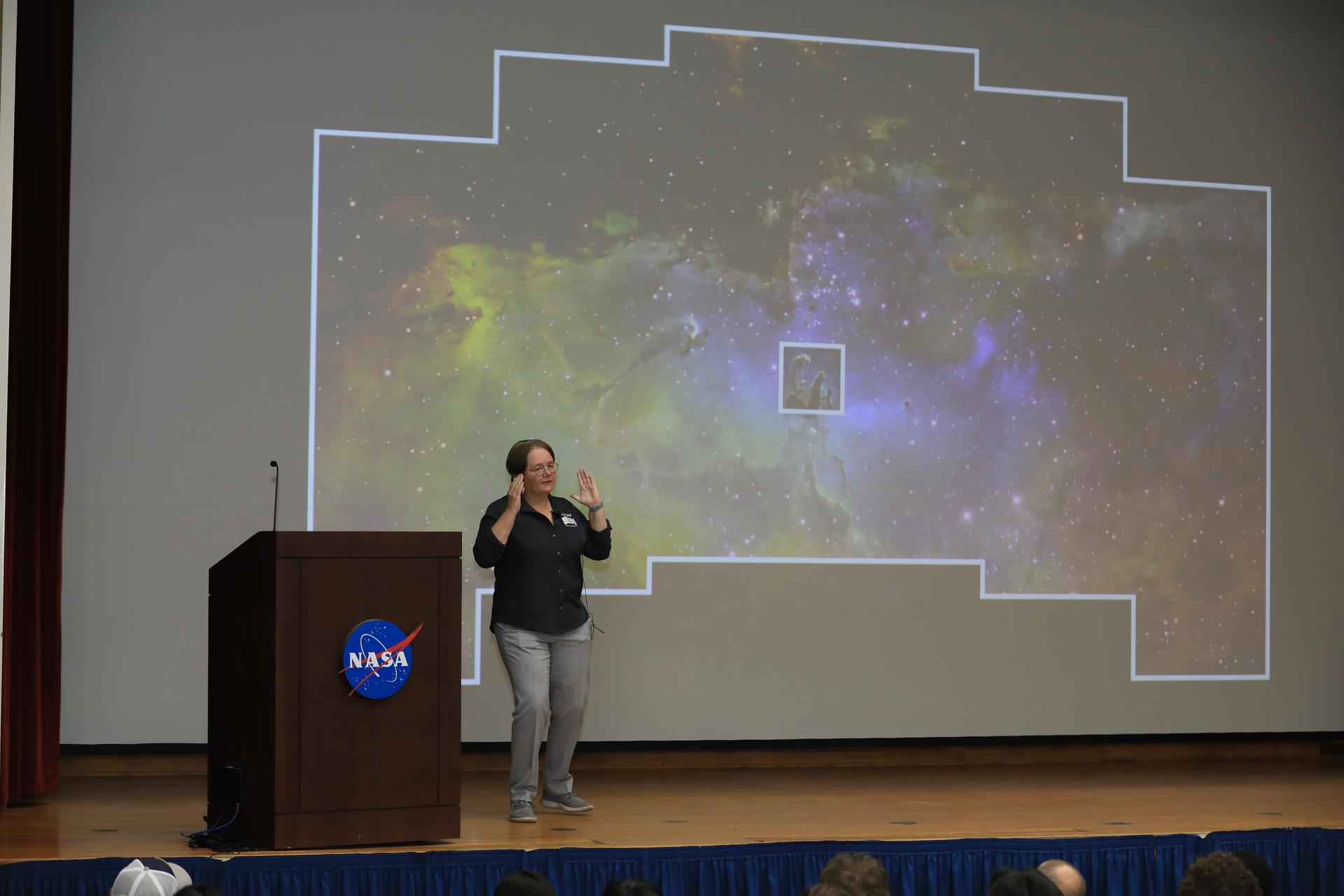
Dr. Julie McEnery, senior project scientist for NASA’s Nancy Grace Roman Space Telescope mission, discusses the upcoming Roman mission in the Training Auditorium at NASA’s Kennedy Space Center in Florida on Tuesday, July 21, 2026. McEnery is a leading astrophysicist at NASA's Goddard Space Flight Center in Greenbelt, Maryland, where she specializes in the study of high energy astrophysics and her work is expanding our understanding of the universe’s creation and behavior. Named for NASA’s first chief astronomer and “mother of the Hubble Space Telescope,” Roman will offer a field of view over 100 times larger than Hubble’s to study up to a billion galaxies, directly image exoplanets and planet forming disks, and address fundamental questions about dark energy, exoplanets, and infrared astrophysics.
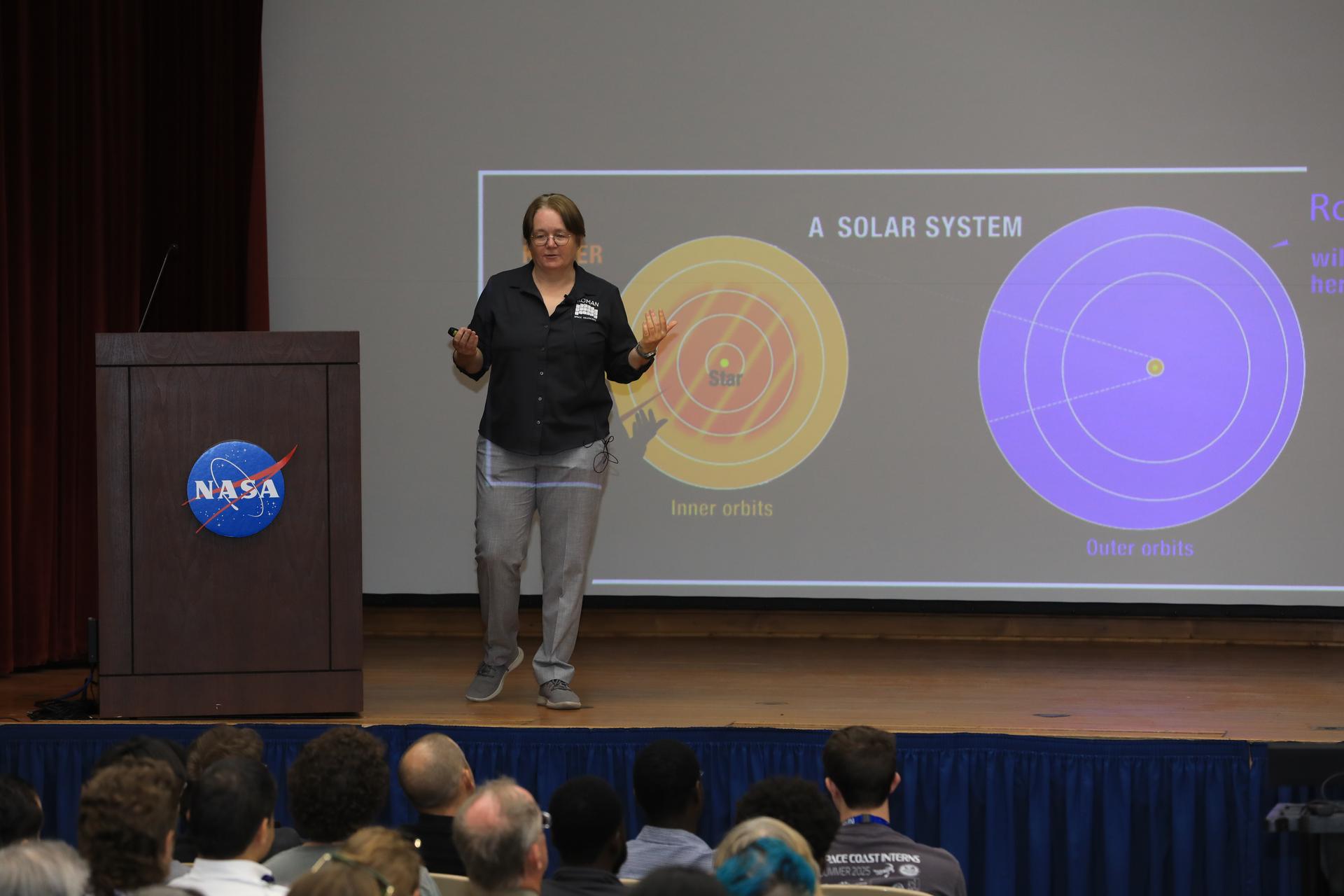
Dr. Julie McEnery, senior project scientist for NASA’s Nancy Grace Roman Space Telescope mission, discusses the upcoming Roman mission in the Training Auditorium at NASA’s Kennedy Space Center in Florida on Tuesday, July 21, 2026. McEnery is a leading astrophysicist at NASA's Goddard Space Flight Center in Greenbelt, Maryland, where she specializes in the study of high energy astrophysics and her work is expanding our understanding of the universe’s creation and behavior. Named for NASA’s first chief astronomer and “mother of the Hubble Space Telescope,” Roman will offer a field of view over 100 times larger than Hubble’s to study up to a billion galaxies, directly image exoplanets and planet forming disks, and address fundamental questions about dark energy, exoplanets, and infrared astrophysics.
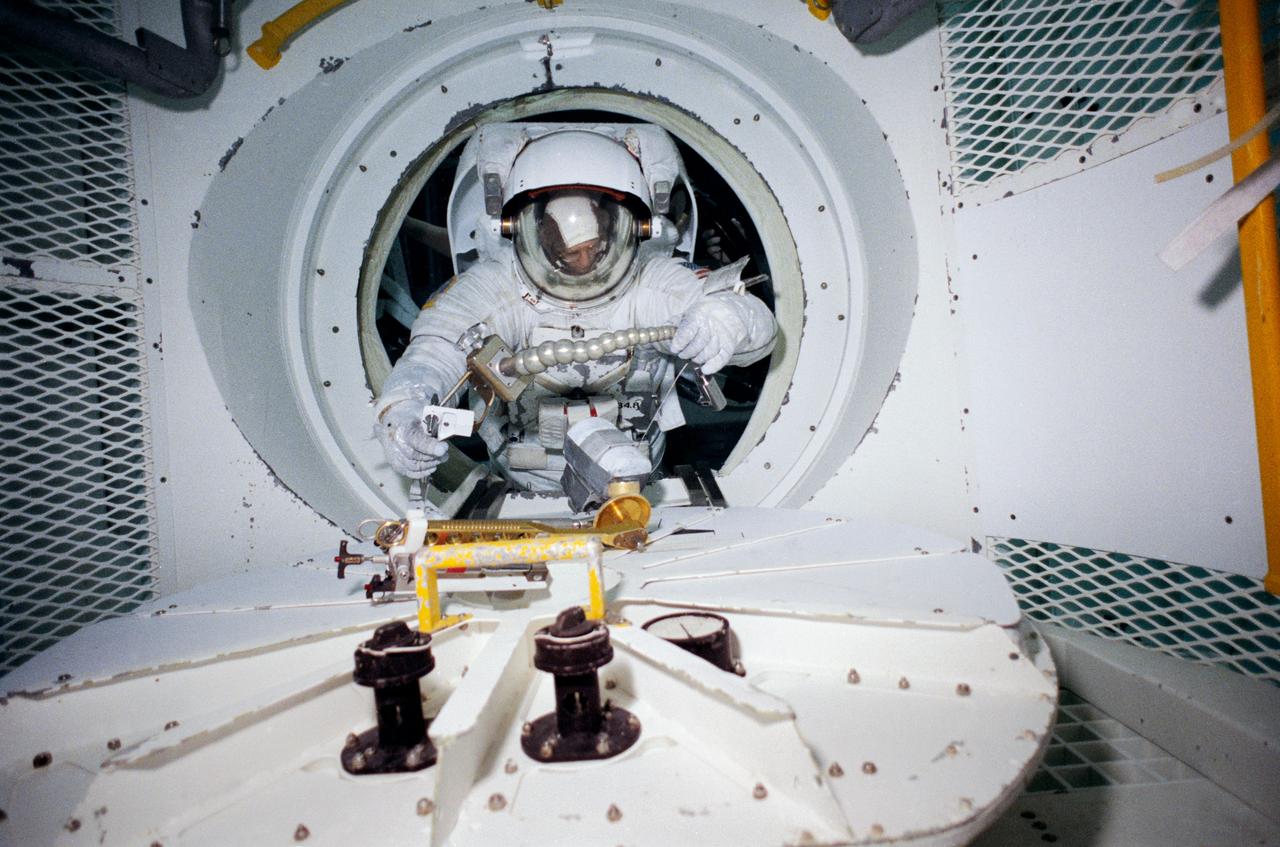
S90-30521 (20 Feb 1990) --- Though no extravehicular activity is planned for STS-31, two crewmembers train for contingencies that would necessitate leaving their shirt sleeve environment of Discovery's cabin and performing chores with their Hubble Space Telescope payload or related hardware. Astronaut Kathryn D. Sullivan, mission specialist, is seen egressing the hatchway of the airlock of a full scale mockup of a Shuttle cabin to interface with an HST mockup in JSC's 25.-ft. deep pool in the weightless environment training facility (WET-F). Two SCUBA-equipped divers who assisted in the training session are also seen. Astronaut Bruce McCandless II, mission specialist, is out of frame.
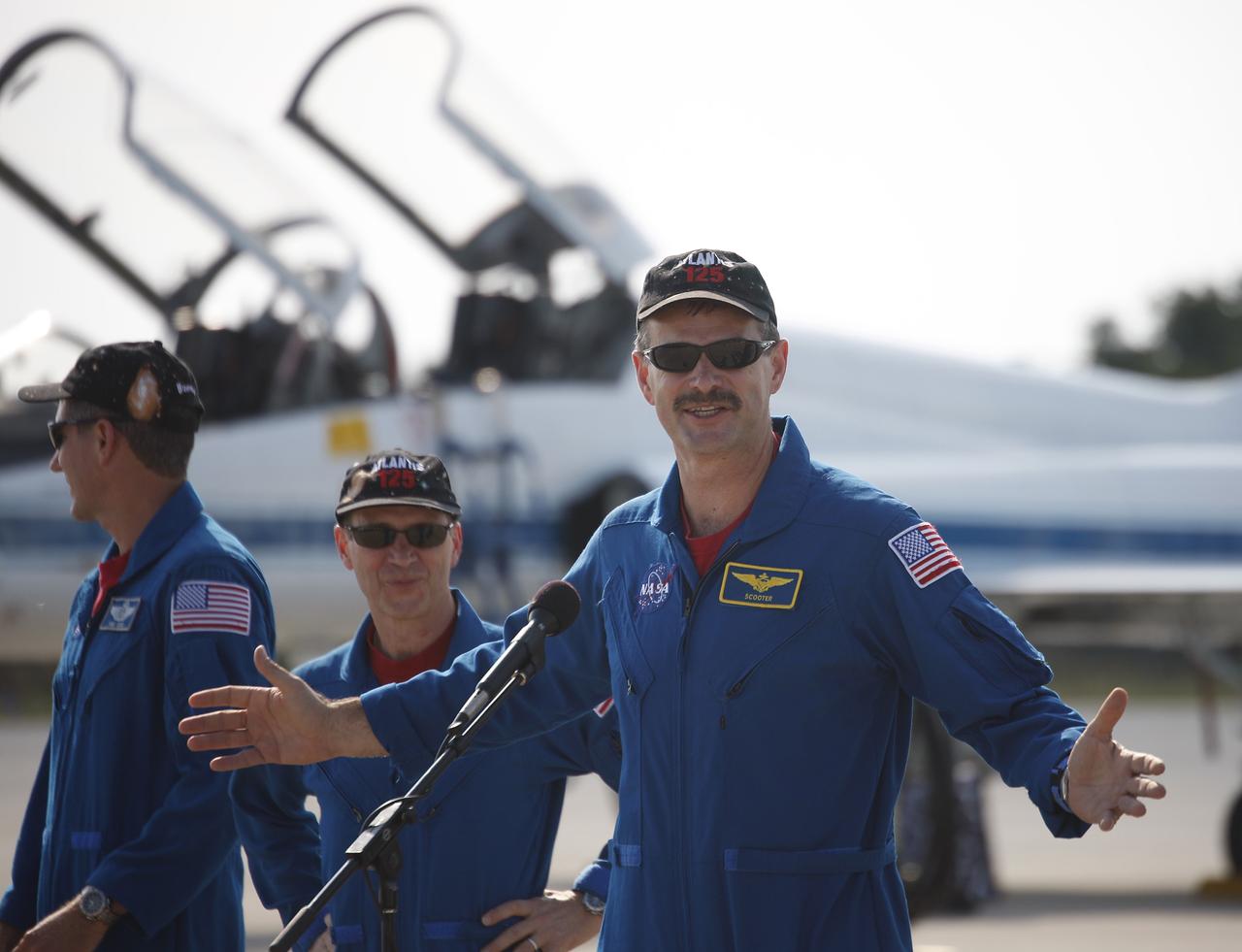
CAPE CANAVERAL, Fla. – At the Shuttle Landing Facility at NASA's Kennedy Space Center in Florida, STS-125 Commander Scott Altman (at microphone) addresses the media on hand to welcome the STS-125 crew to Florida. The crew arrived aboard T-38 training jets to get ready for launch aboard space shuttle Atlantis on May 11. From left are also Mission Specialist Michael Good and Pilot Gregory C. Johnson. Atlantis' crew will service NASA's Hubble Space Telescope for the fifth and final time. The flight will include five spacewalks during which astronauts will refurbish and upgrade the telescope with state-of-the-art science instruments. As a result, Hubble's capabilities will be expanded and its operational lifespan extended through at least 2014. Photo credit: NASA/Jim Grossmann

CAPE CANAVERAL, Fla. – At the Shuttle Landing Facility at NASA's Kennedy Space Center in Florida, the STS-125 crew poses for a group portrait. The crew arrived aboard T-38 training jets to get ready for launch aboard space shuttle Atlantis on May 11. From left are Mission Specialists Megan McArthur and Michael Good, Pilot Gregory C. Johnson, Commander Scott Altman, and Mission Specialists John Grunsfeld, Mike Massimino and Andrew Feustel. Atlantis' crew will service NASA's Hubble Space Telescope for the fifth and final time. The flight will include five spacewalks during which astronauts will refurbish and upgrade the telescope with state-of-the-art science instruments. As a result, Hubble's capabilities will be expanded and its operational lifespan extended through at least 2014. Photo credit: NASA/Jim Grossmann
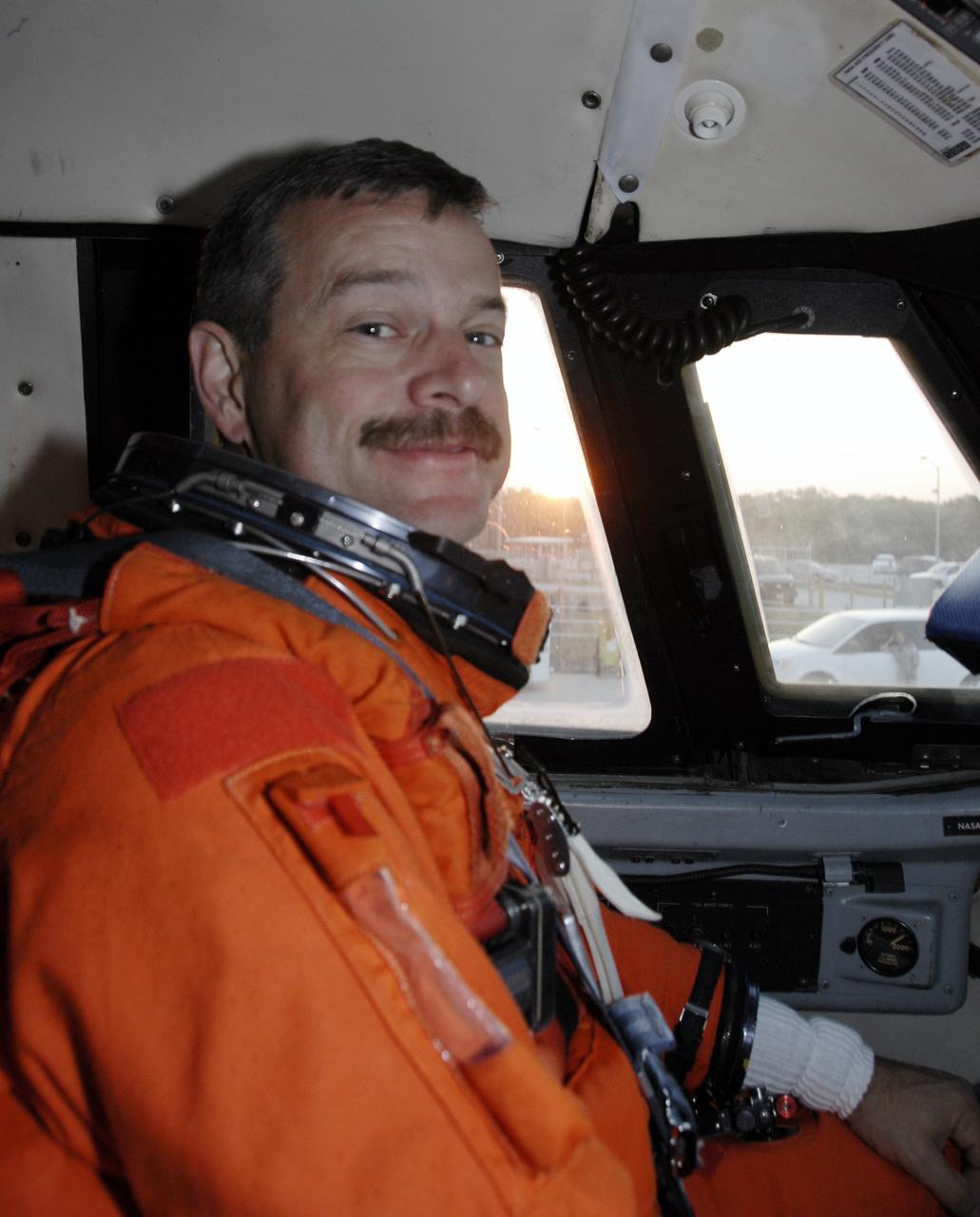
CAPE CANAVERAL, Fla. – On the Shuttle Landing Facility at NASA's Kennedy Space Center in Florida, STS-125 Commander Scott Altman, wearing his launch-and-entry suit, sits in the cockpit of the Shuttle Training Aircraft before taking off to practice shuttle landings. He is preparing for launch of space shuttle Atlantis, scheduled for 2:01 p.m. EDT on May 11. On Atlantis’ STS-125 mission, NASA's Hubble Space Telescope will be serviced for the fifth and final time. The flight will include five spacewalks during which astronauts will refurbish and upgrade the telescope with state-of-the-art science instruments. As a result, Hubble's capabilities will be expanded and its operational lifespan extended through at least 2014. Photo credit: NASA/Kim Shiflett
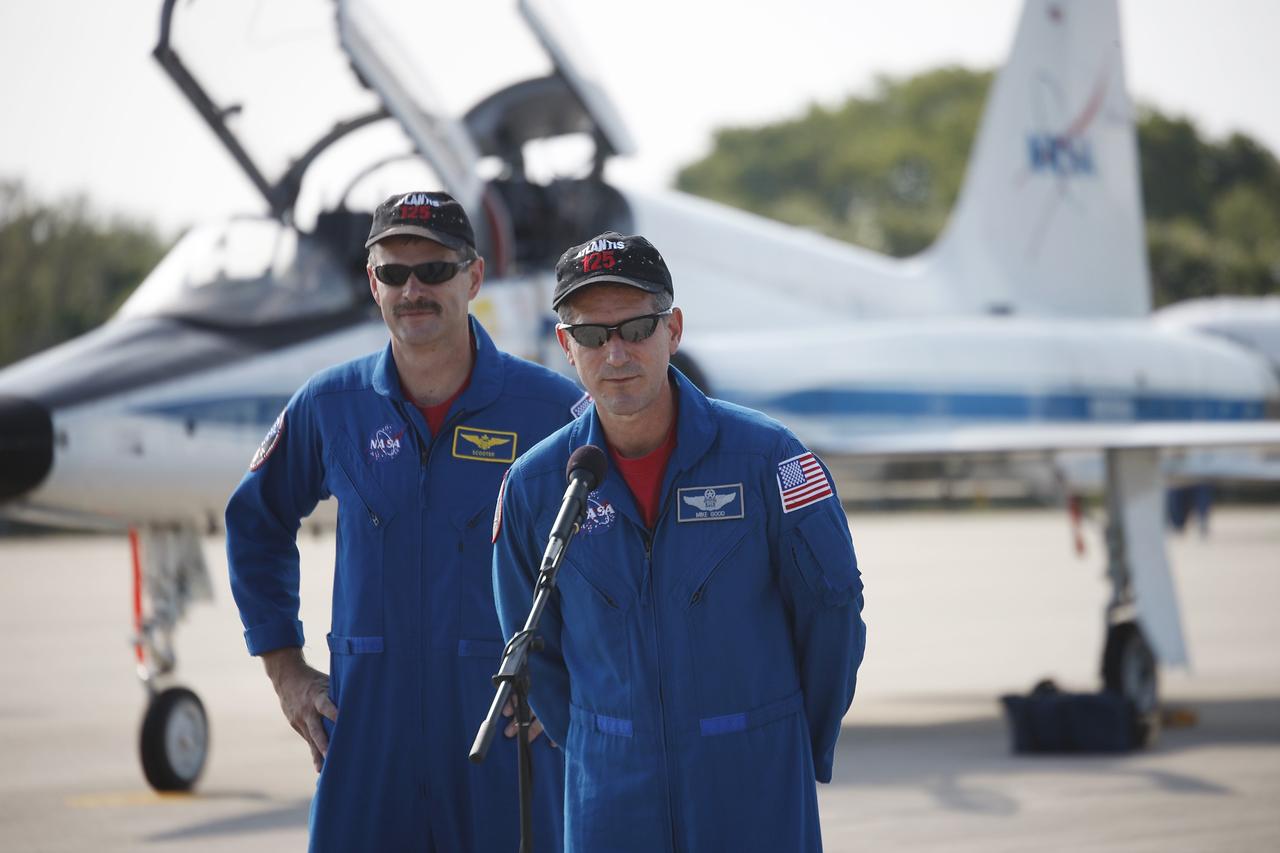
CAPE CANAVERAL, Fla. – At the Shuttle Landing Facility at NASA's Kennedy Space Center in Florida, STS-125 Mission Specialist Michael Good (at microphone) addresses the media on hand to welcome the STS-125 crew to Florida as Commander Scott Altman looks on. The crew arrived aboard T-38 training jets to get ready for launch aboard space shuttle Atlantis on May 11. Atlantis' crew will service NASA's Hubble Space Telescope for the fifth and final time. The flight will include five spacewalks during which astronauts will refurbish and upgrade the telescope with state-of-the-art science instruments. As a result, Hubble's capabilities will be expanded and its operational lifespan extended through at least 2014. Photo credit: NASA/Jim Grossmann

CAPE CANAVERAL, Fla. – At the Shuttle Landing Facility at NASA's Kennedy Space Center in Florida, STS-125 Mission Specialist Megan McArthur (at microphone) addresses the media on hand to welcome the STS-125 crew to Florida as Commander Scott Altman looks on. The crew arrived aboard T-38 training jets to get ready for launch aboard space shuttle Atlantis on May 11. Atlantis' crew will service NASA's Hubble Space Telescope for the fifth and final time. The flight will include five spacewalks during which astronauts will refurbish and upgrade the telescope with state-of-the-art science instruments. As a result, Hubble's capabilities will be expanded and its operational lifespan extended through at least 2014. Photo credit: NASA/Jim Grossmann
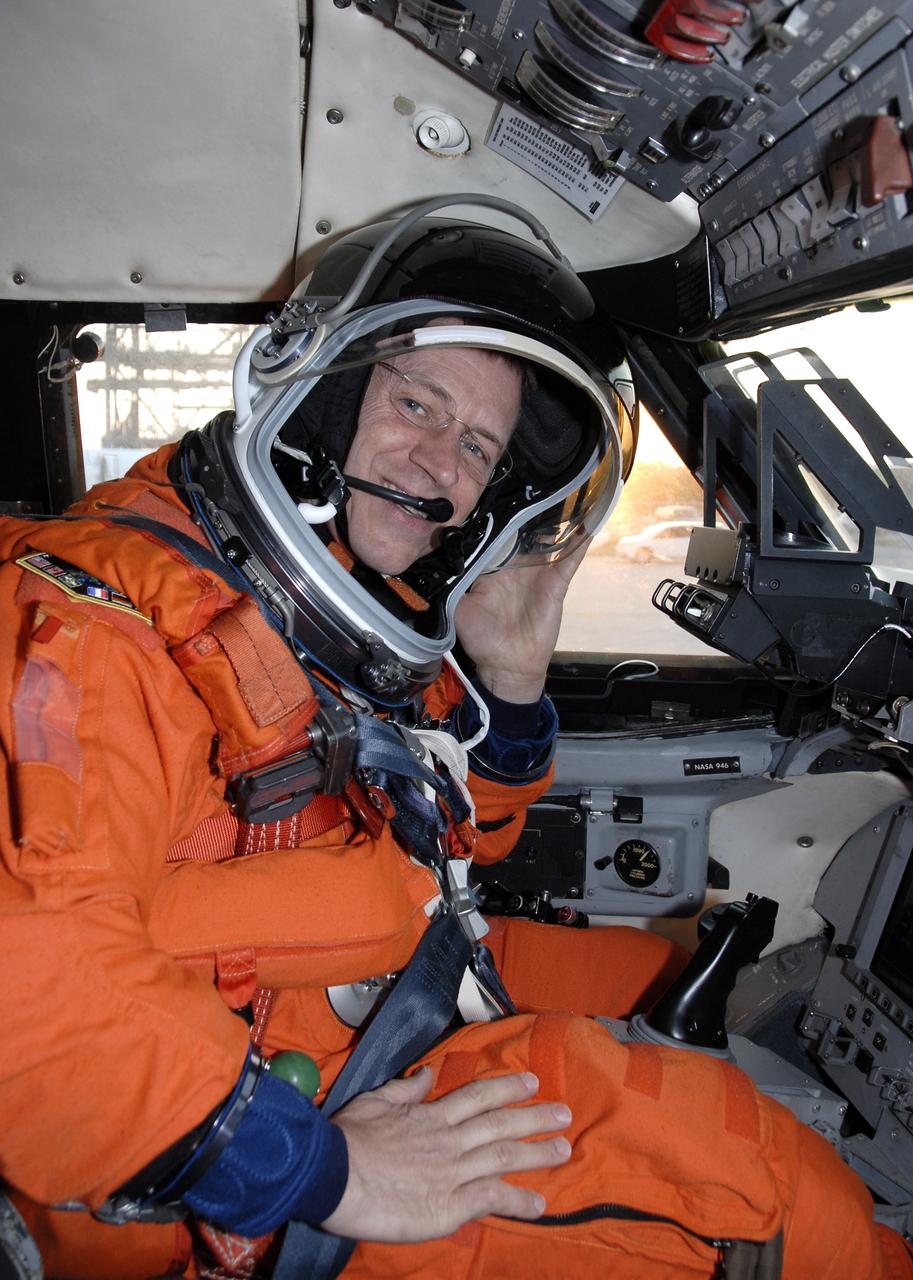
CAPE CANAVERAL, Fla. – On the Shuttle Landing Facility at NASA's Kennedy Space Center in Florida, STS-125 Pilot Gregory C. Johnson, puts on the helmet of his launch-and-entry suit while sitting in the cockpit of the Shuttle Training Aircraft. He is preparing to practice shuttle landings in preparation for launch of space shuttle Atlantis, scheduled for 2:01 p.m. EDT on May 11. On Atlantis’ STS-125 mission, NASA's Hubble Space Telescope will be serviced for the fifth and final time. The flight will include five spacewalks during which astronauts will refurbish and upgrade the telescope with state-of-the-art science instruments. As a result, Hubble's capabilities will be expanded and its operational lifespan extended through at least 2014. Photo credit: NASA/Kim Shiflett
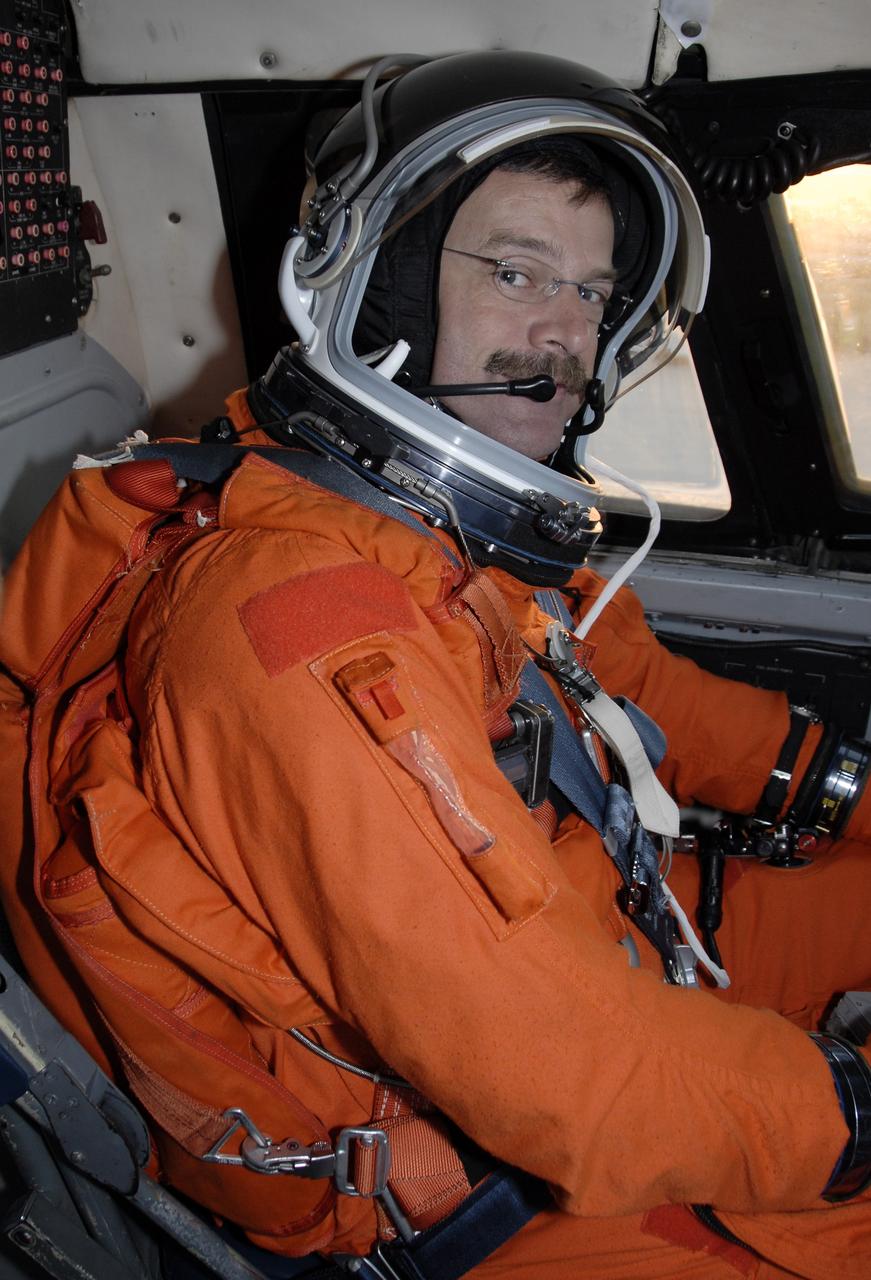
CAPE CANAVERAL, Fla. – On the Shuttle Landing Facility at NASA's Kennedy Space Center in Florida, STS-125 Commander Scott Altman is wearing his complete launch-and-entry suit in the cockpit of the Shuttle Training Aircraft. He is preparing to practice shuttle landings in preparation for launch of space shuttle Atlantis, scheduled for 2:01 p.m. EDT on May 11. On Atlantis’ STS-125 mission, NASA's Hubble Space Telescope will be serviced for the fifth and final time. The flight will include five spacewalks during which astronauts will refurbish and upgrade the telescope with state-of-the-art science instruments. As a result, Hubble's capabilities will be expanded and its operational lifespan extended through at least 2014. Photo credit: NASA/Kim Shiflett
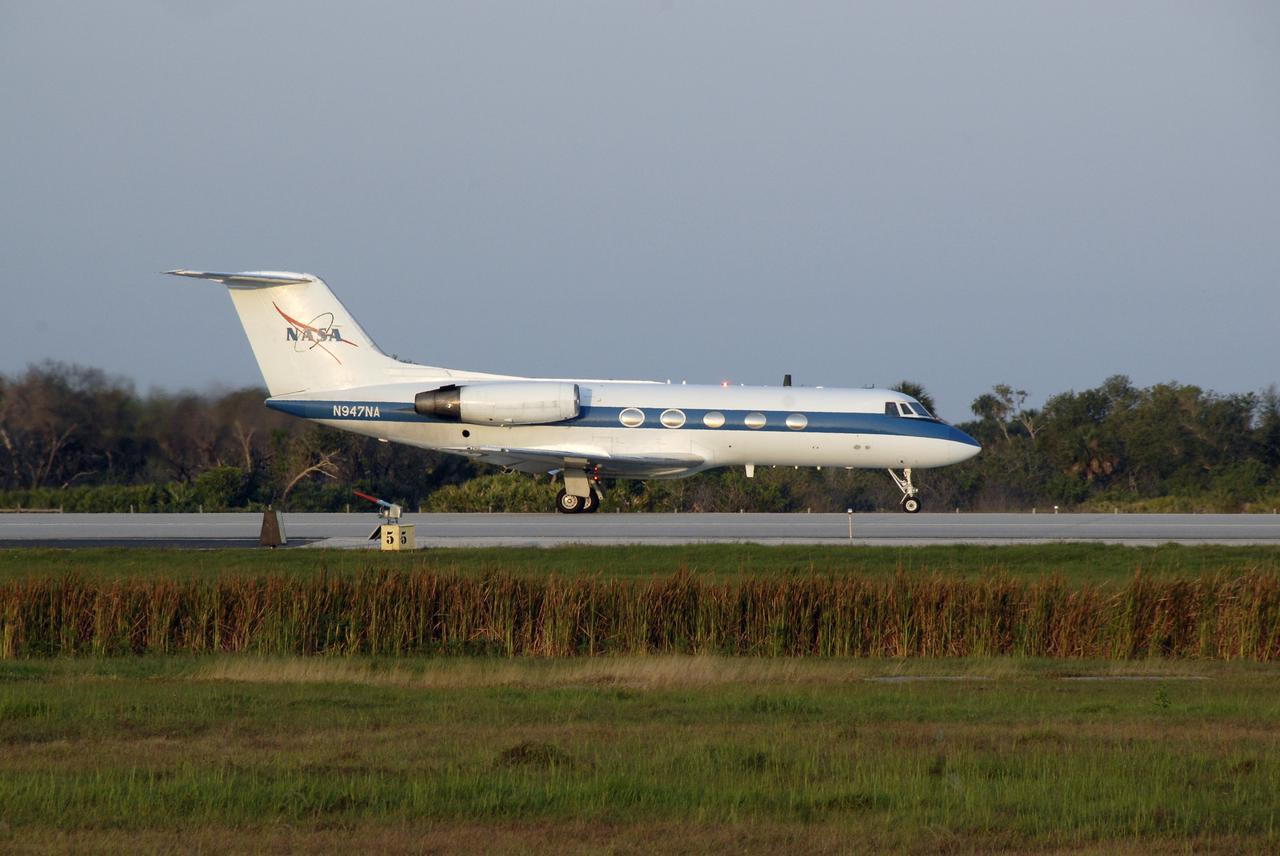
CAPE CANAVERAL, Fla. – On the runway at the Shuttle Landing Facility, or SLF, at NASA's Kennedy Space Center in Florida, the Shuttle Training Aircraft is ready for takeoff. STS-125 Commander Scott Altman and Pilot Gregory C. Johnson are practicing shuttle landings on the SLF runway in preparation for their launch on space shuttle Atlantis, scheduled for 2:01 p.m. EDT on May 11. On Atlantis’ STS-125 mission, NASA's Hubble Space Telescope will be serviced for the fifth and final time. The flight will include five spacewalks during which astronauts will refurbish and upgrade the telescope with state-of-the-art science instruments. As a result, Hubble's capabilities will be expanded and its operational lifespan extended through at least 2014. Photo credit: NASA/Kim Shiflett
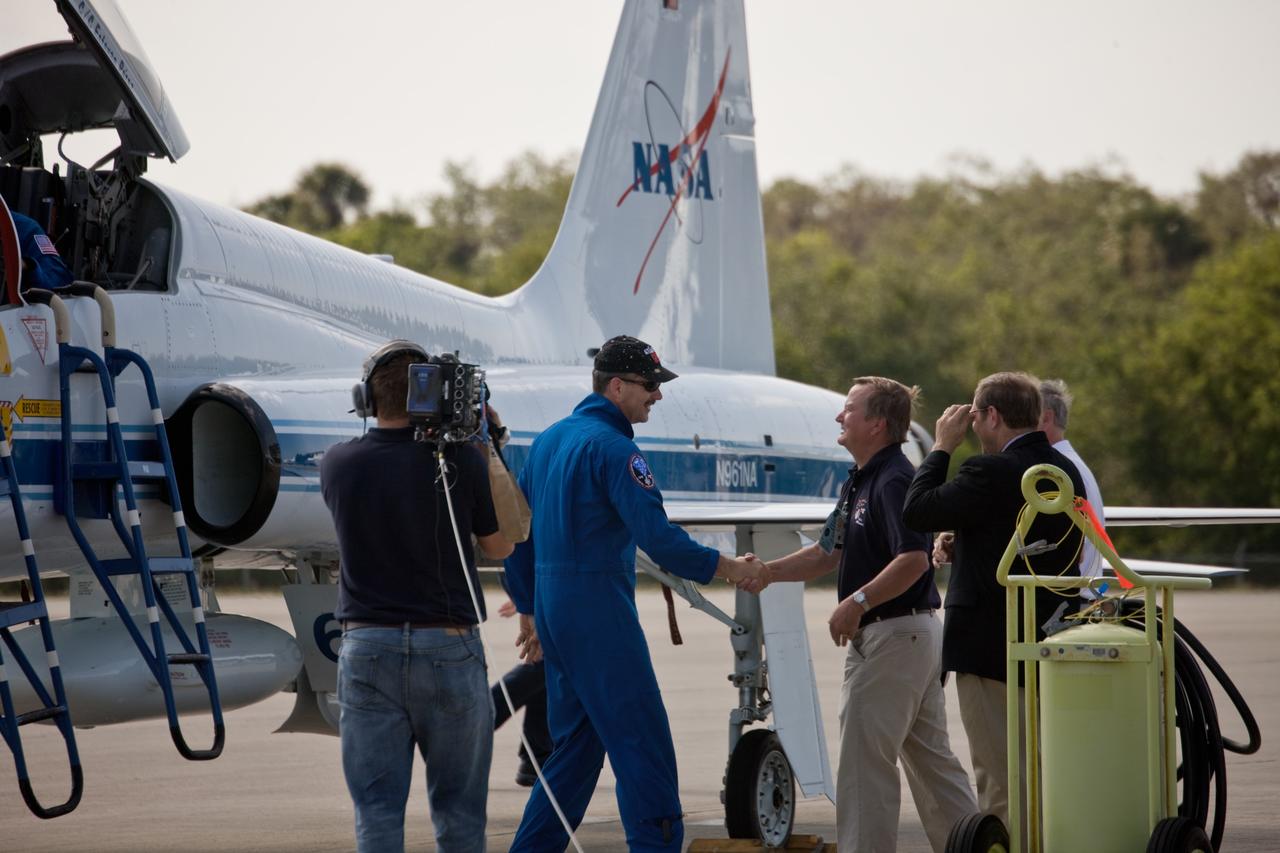
CAPE CANAVERAL, Fla. – STS-125 Commander Scott Altman (wearing cap) is greeted by Shuttle Launch Director Mike Leinbach at the Shuttle Landing Facility at NASA's Kennedy Space Center in Florida. Altman and the other members of the STS-125 crew arrived aboard T-38 training jets to get ready for launch aboard space shuttle Atlantis on May 11. Altman will be making his fourth shuttle flight. Atlantis' crew will service NASA's Hubble Space Telescope for the fifth and final time. The flight will include five spacewalks during which astronauts will refurbish and upgrade the telescope with state-of-the-art science instruments. As a result, Hubble's capabilities will be expanded and its operational lifespan extended through at least 2014. Photo credit: NASA/Jim Grossmann
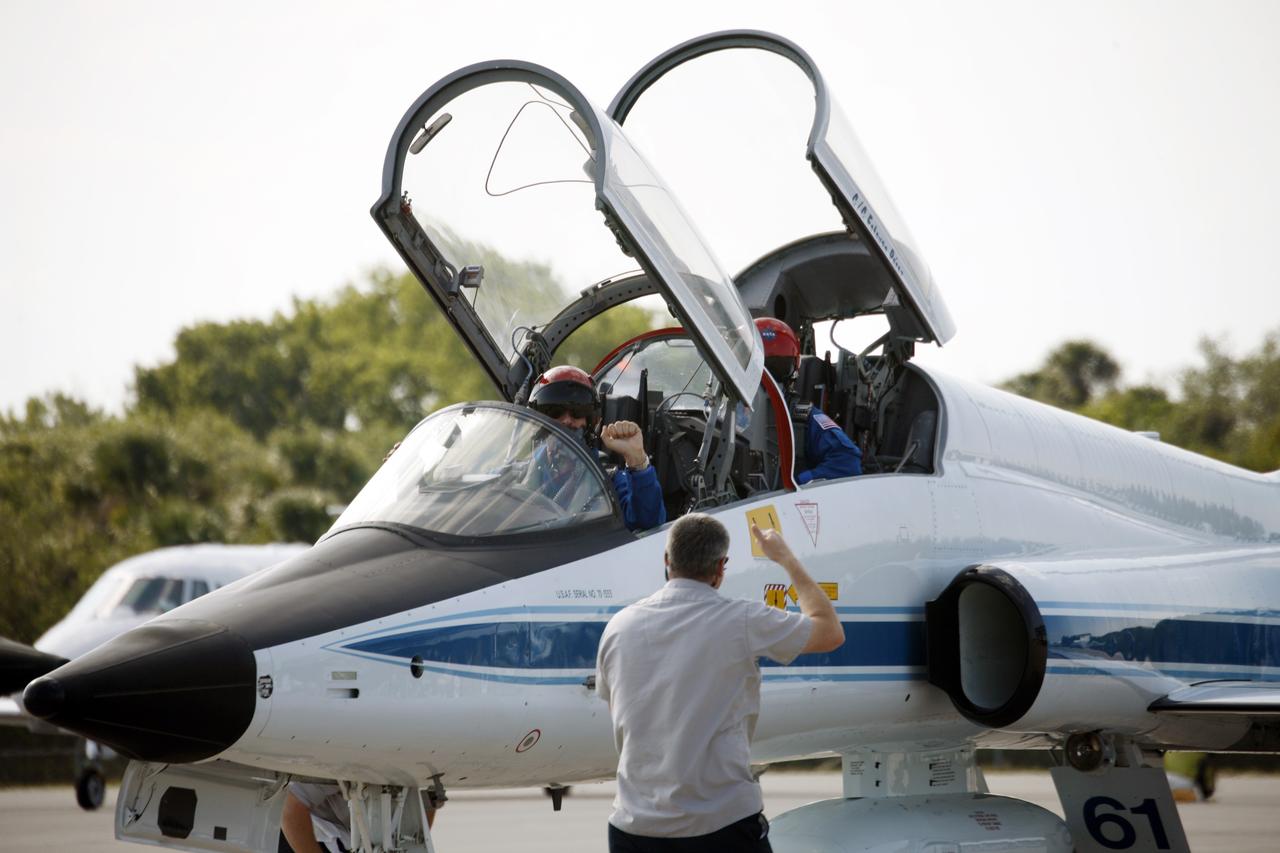
CAPE CANAVERAL, Fla. – STS-125 Commander Scott Altman (in front) and Mission Specialist John Grunsfeld arrive at the Shuttle Landing Facility at NASA's Kennedy Space Center in Florida aboard a T-38 training jet to get ready for launch aboard space shuttle Atlantis on May 11. Altman will be making his fourth shuttle flight; Grunsfeld, his fifth. Atlantis' crew will service NASA's Hubble Space Telescope for the fifth and final time. The flight will include five spacewalks during which astronauts will refurbish and upgrade the telescope with state-of-the-art science instruments. As a result, Hubble's capabilities will be expanded and its operational lifespan extended through at least 2014. Photo credit: NASA/Jim Grossmann
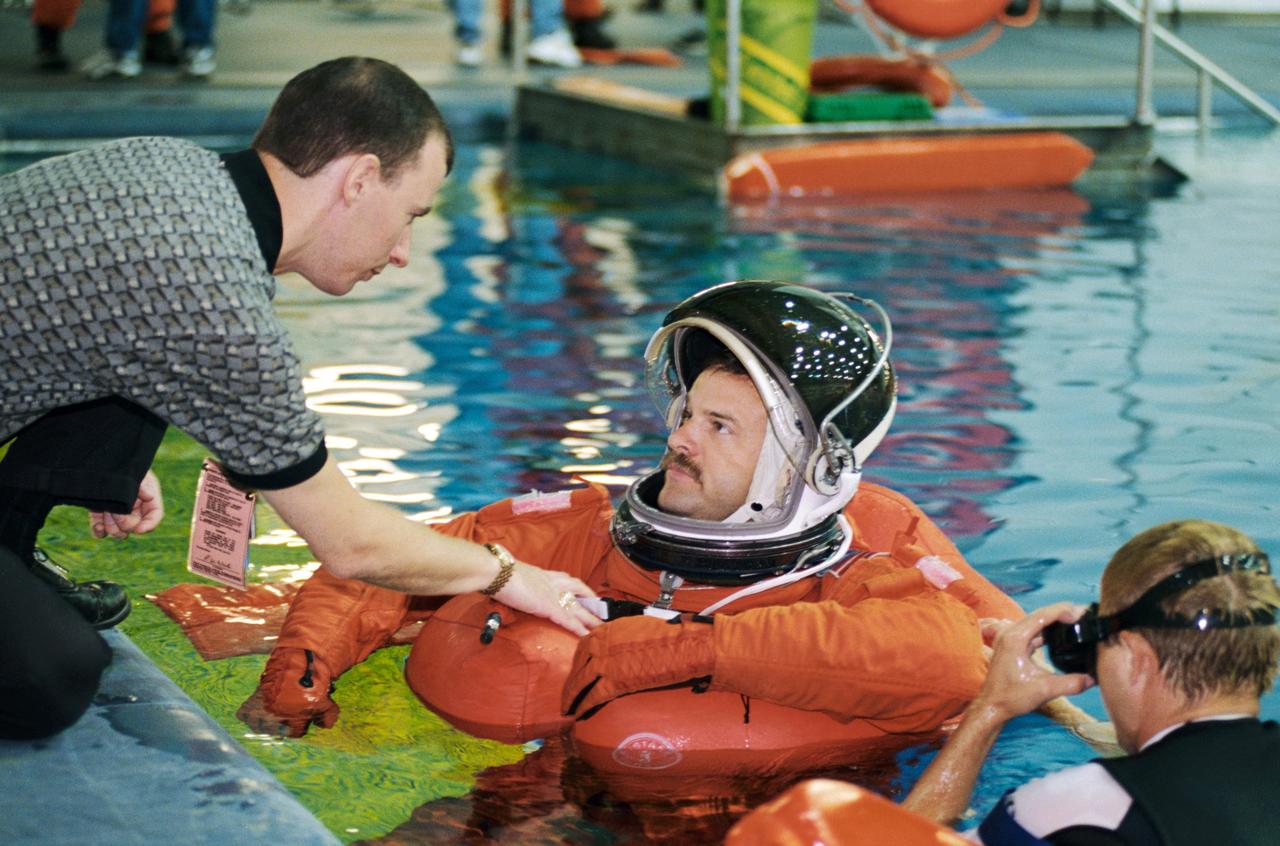
JSC2001-01921 (12 July 2001) --- Astronaut Scott D. Altman, STS-109 mission commander, is assisted by United Space Alliance (USA) crew trainer David Pogue and a diver during an emergency bailout training session in the Neutral Buoyancy Laboratory (NBL) near the Johnson Space Center (JSC). STS-109 will be the 108th shuttle flight and the fourth Hubble Space Telescope (HST) servicing mission.
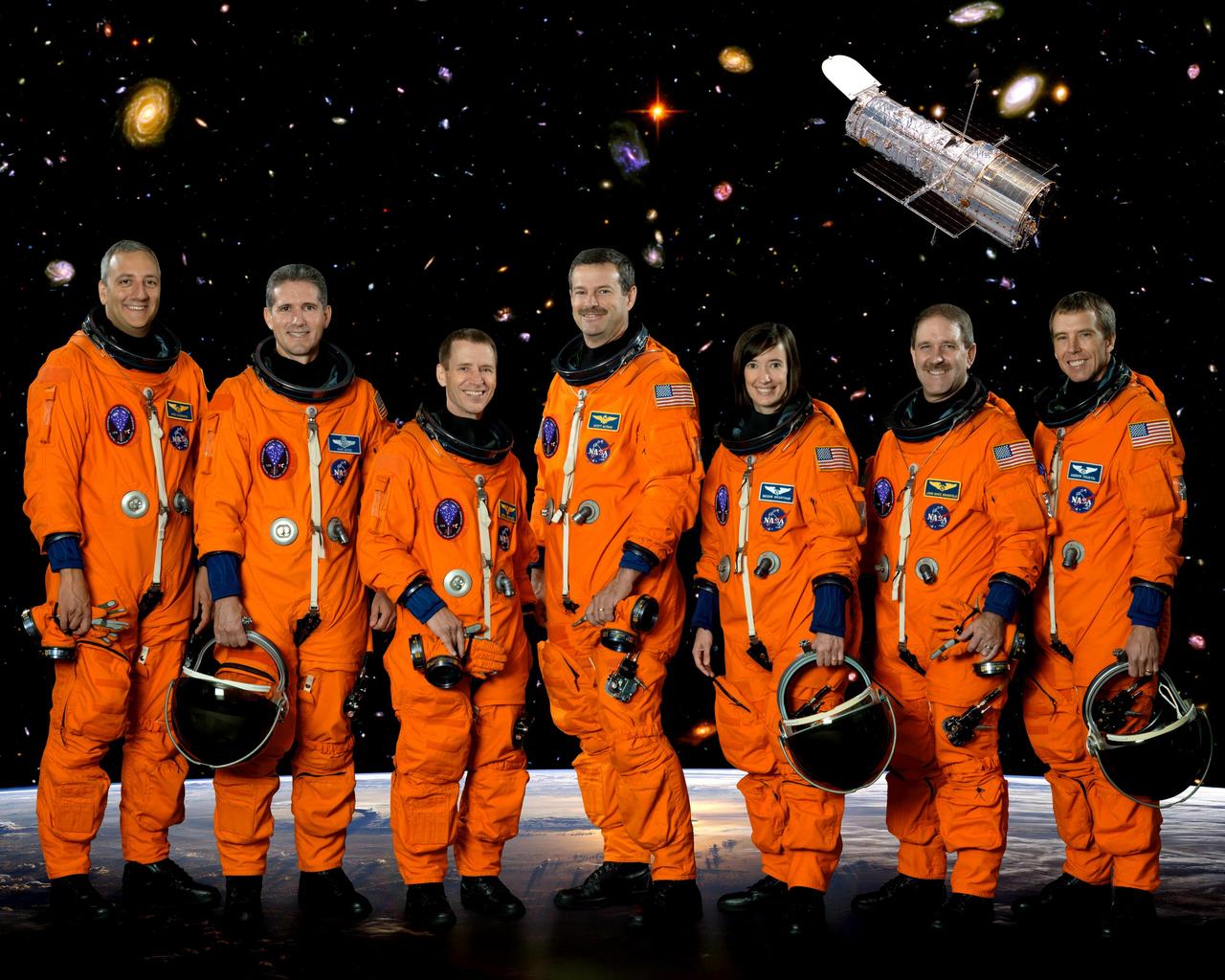
JOHNSON SPACE CENTER, Houston, Texas --- STS125-S-002 (9 Oct. 2007) --- These seven astronauts take a break from training to pose for the STS-125 crew portrait. From the left are astronauts Michael J. Massimino and Michael T. Good, both mission specialists; Gregory C. Johnson, pilot; Scott D. Altman, commander; and K. Megan McArthur, John M. Grunsfeld and Andrew J. Feustel, all mission specialists. The STS-125 mission will be the final space shuttle mission to the Hubble Space Telescope.
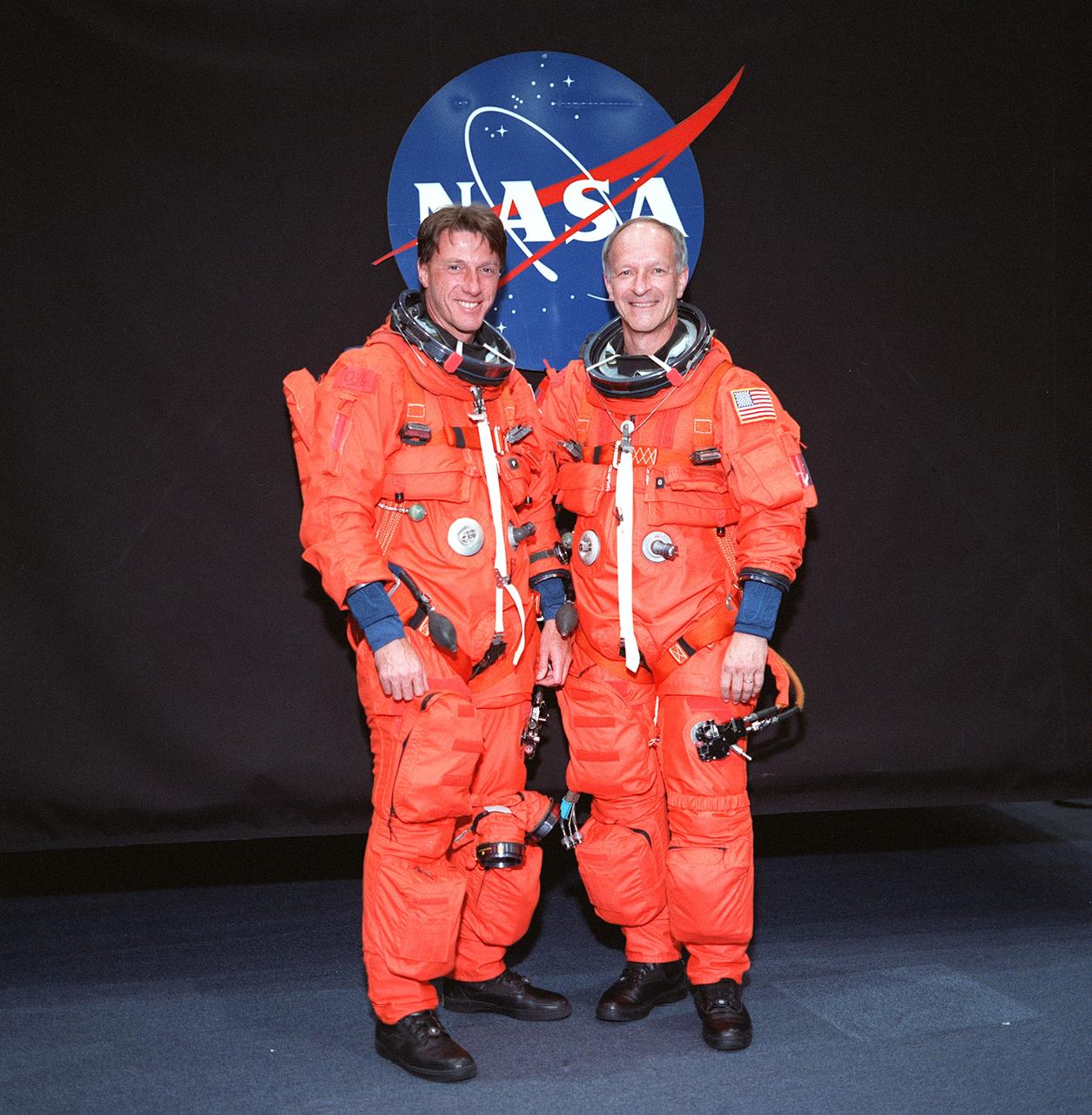
S99-8656 (24 May 1999) --- Astronauts C. Michael Foale, left, and Claude Nicollier, both assigned to EVA duty on the STS-103 crew's upcoming servicing visit to the Hubble Space Telescope (HST), pose for an informal portrait in training versions of the launch and entry space garment. Nicollier is one of two astronauts on this crew who represent the European Space Agency (ESA).
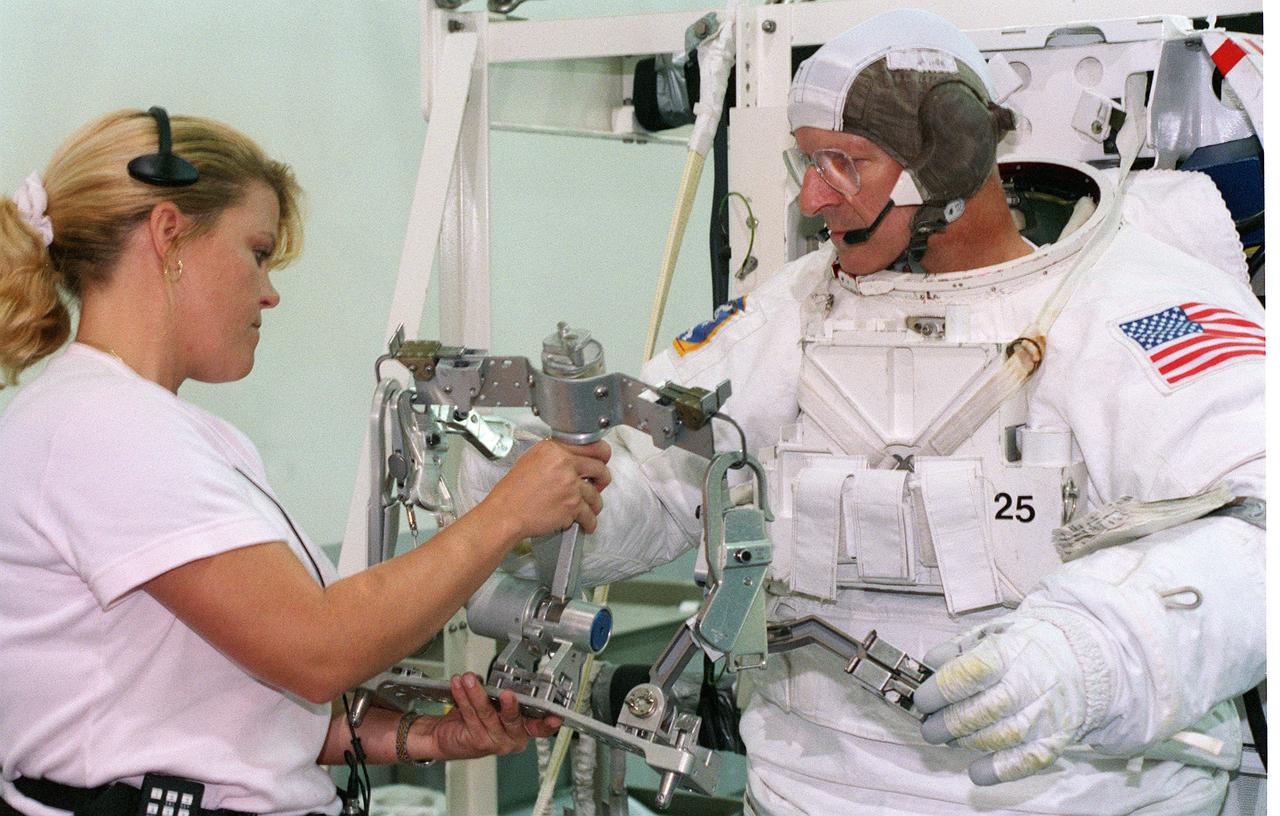
S99-08361 (26 July 1999) --- Astronaut Claude Nicollier, mission specialist representing the European Space Agency (ESA), readies gear for an underwater rehearsal of STS-103 exctravehicular activity (EVA). Nicollier and other astronauts assigned to space walk duty are in training for EVA chores they will handle when they make the third servicing visit to the Earth-orbiting Hubble Space Telescope (HST) since its deployment in April 1990.
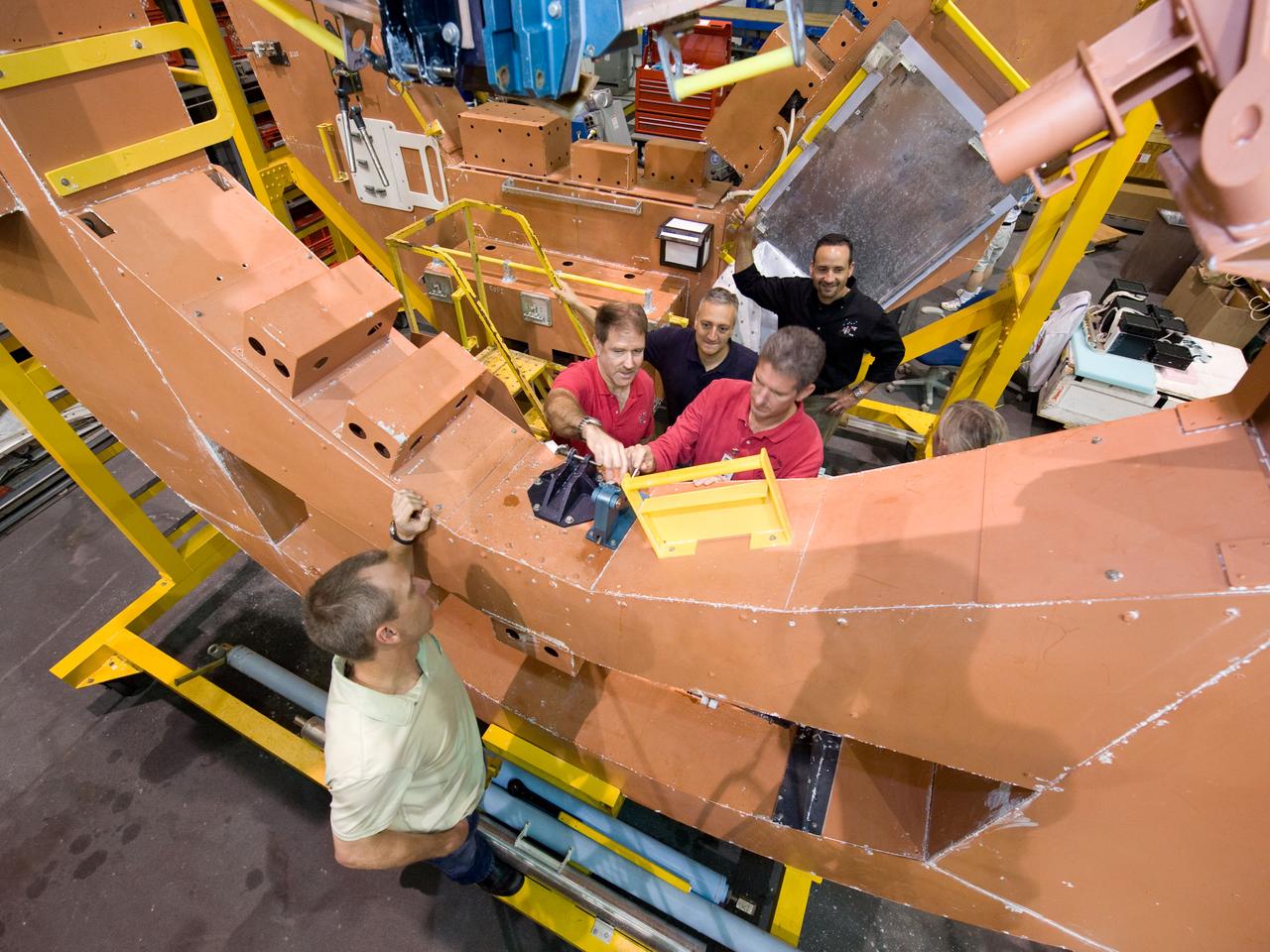
JSC2009-E-072670 (9 April 2009) --- Astronauts Andrew Feustel (bottom), John Grunsfeld (center left), Mike Massimino and Michael Good (center, right), all STS-125 mission specialists, work with a Hubble Space Telescope mock-up during a spacewalk training session in the Neutral Buoyancy Laboratory (NBL) near NASA's Johnson Space Center. Tomas Gonzalez-Torres, STS-125 lead spacewalk officer, and United Space Alliance instructor Christy Hansen (mostly obscured) assisted the crewmembers.
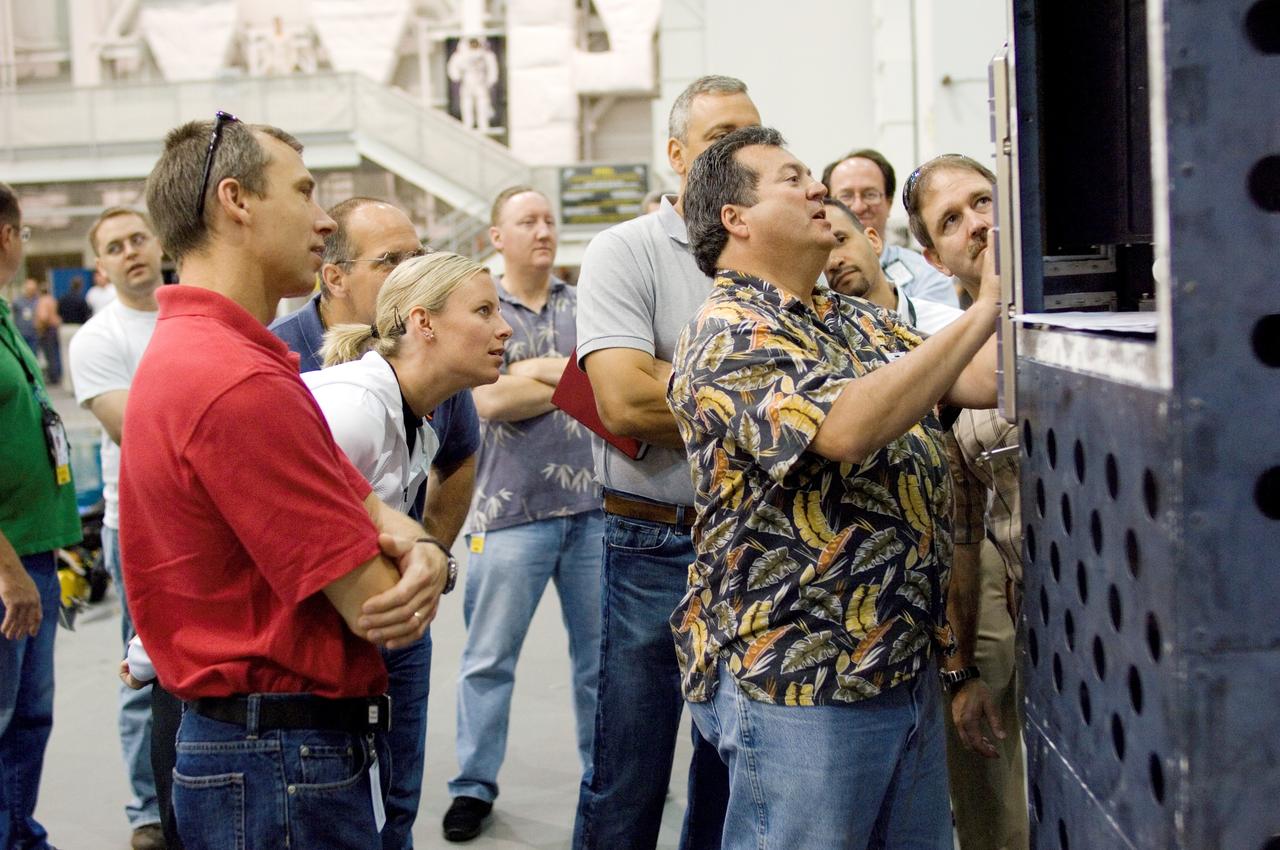
JSC2007-E-27765 (6 June 2007) --- Astronauts John M. Grunsfeld (right, partially obscured), Michael J. Massimino (third right, partially obscured) and Andrew J. Feustel (left foreground), STS-125 mission specialists, participate in a training session with a Hubble Space Telescope mockup in the Neutral Buoyancy Laboratory (NBL) near Johnson Space Center.
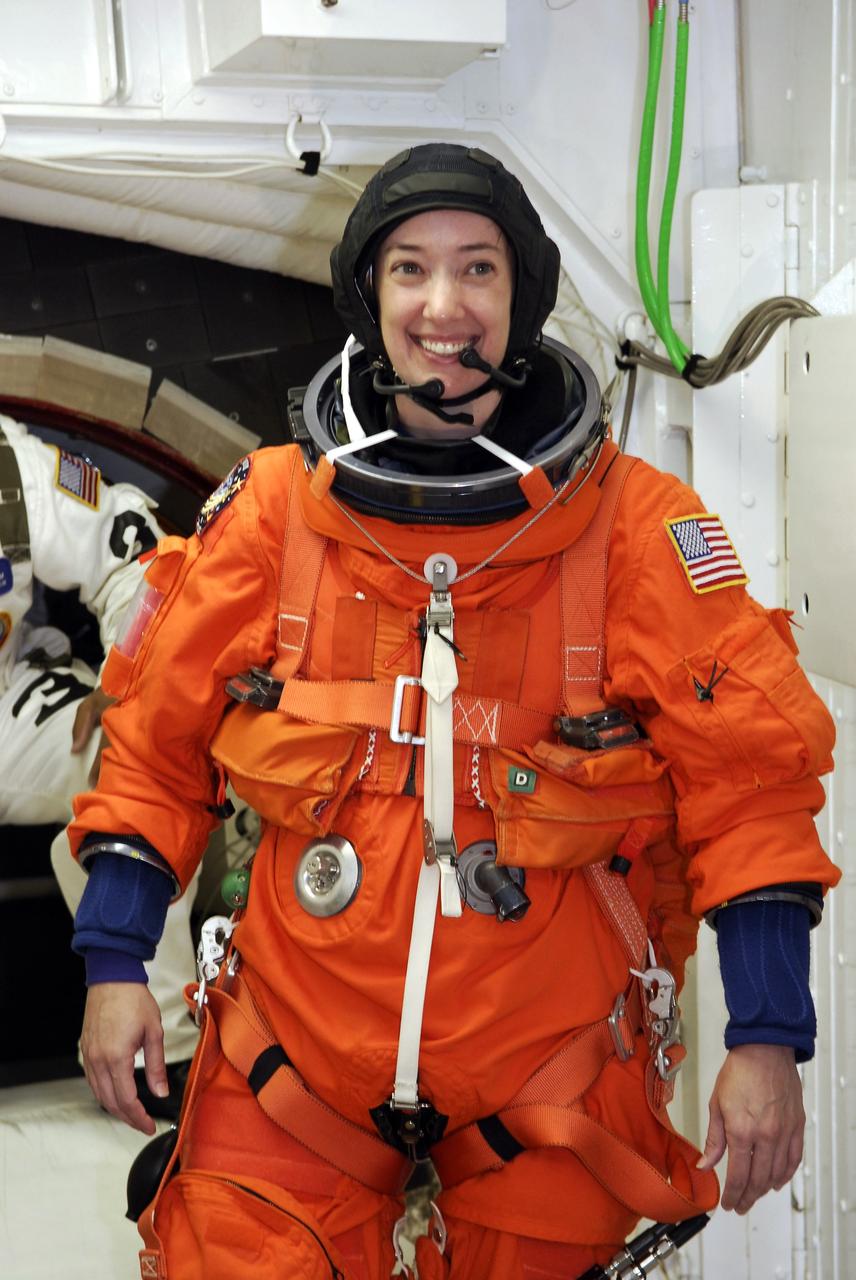
CAPE CANAVERAL, Fla. - STS-125 Mission Specialist Megan McArthur is ready to enter the hatch into space shuttle Atlantis for a simulated launch countdown. The countdown is the culmination of terminal countdown demonstration test, or TCDT, activities as preparation before launch. TCDT provides astronauts and ground crews with an opportunity to participate in various launch activities, including equipment familiarization, emergency training and the countdown. Atlantis’ STS-125 mission to service NASA’s Hubble Space Telescope is targeted for launch Oct. 14. Photo credit: NASA/Amanda Diller
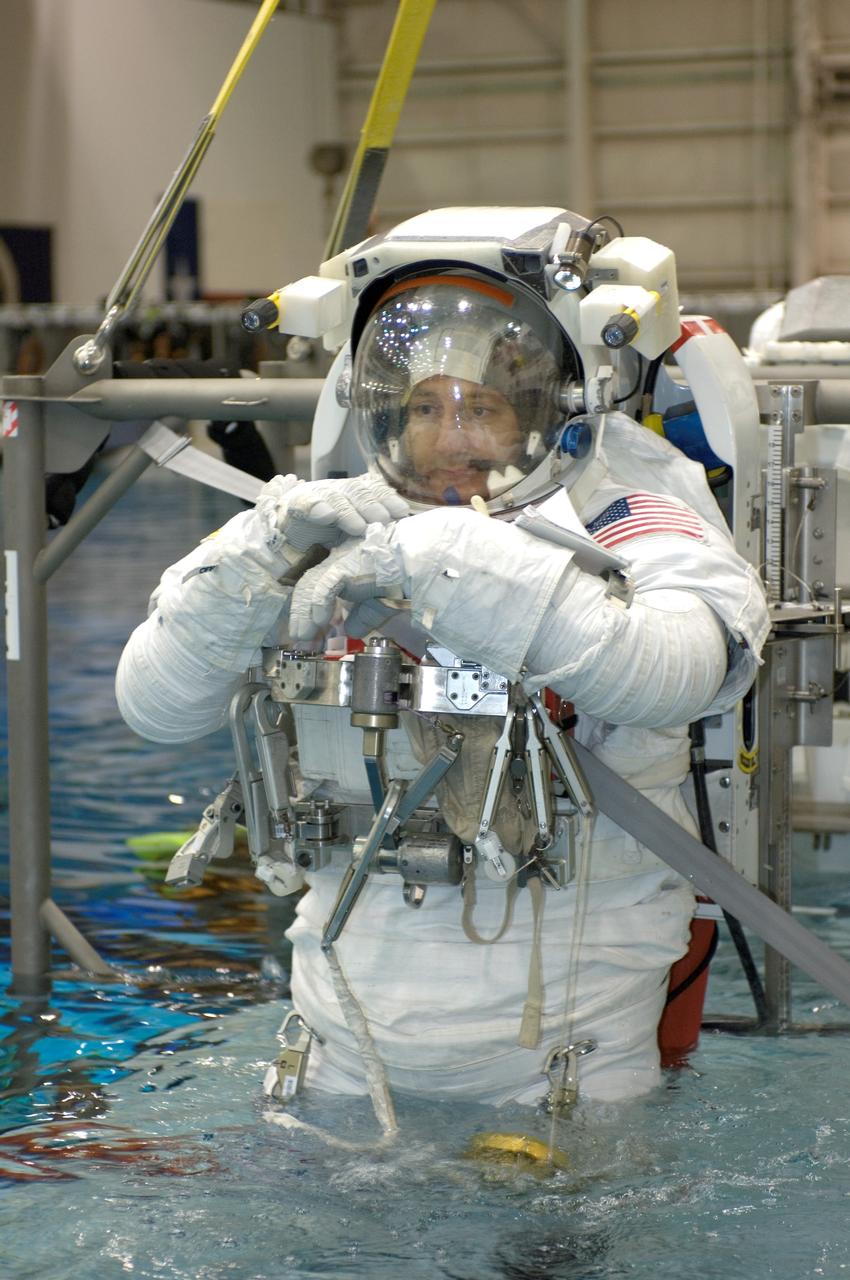
JSC2007-E-113611 (18 Dec. 2007) --- Astronauts Michael J. Massimino and Michael T. Good (partially obscured), both STS-125 mission specialists, are about to be submerged in the waters of the Neutral Buoyancy Laboratory (NBL) near Johnson Space Center. Massimino and Good are attired in training versions of the Extravehicular Mobility Unit (EMU) spacesuit. SCUBA-equipped divers (out of frame) are in the water to assist the crewmembers in their rehearsal, intended to help prepare them for work on the Hubble Space Telescope.
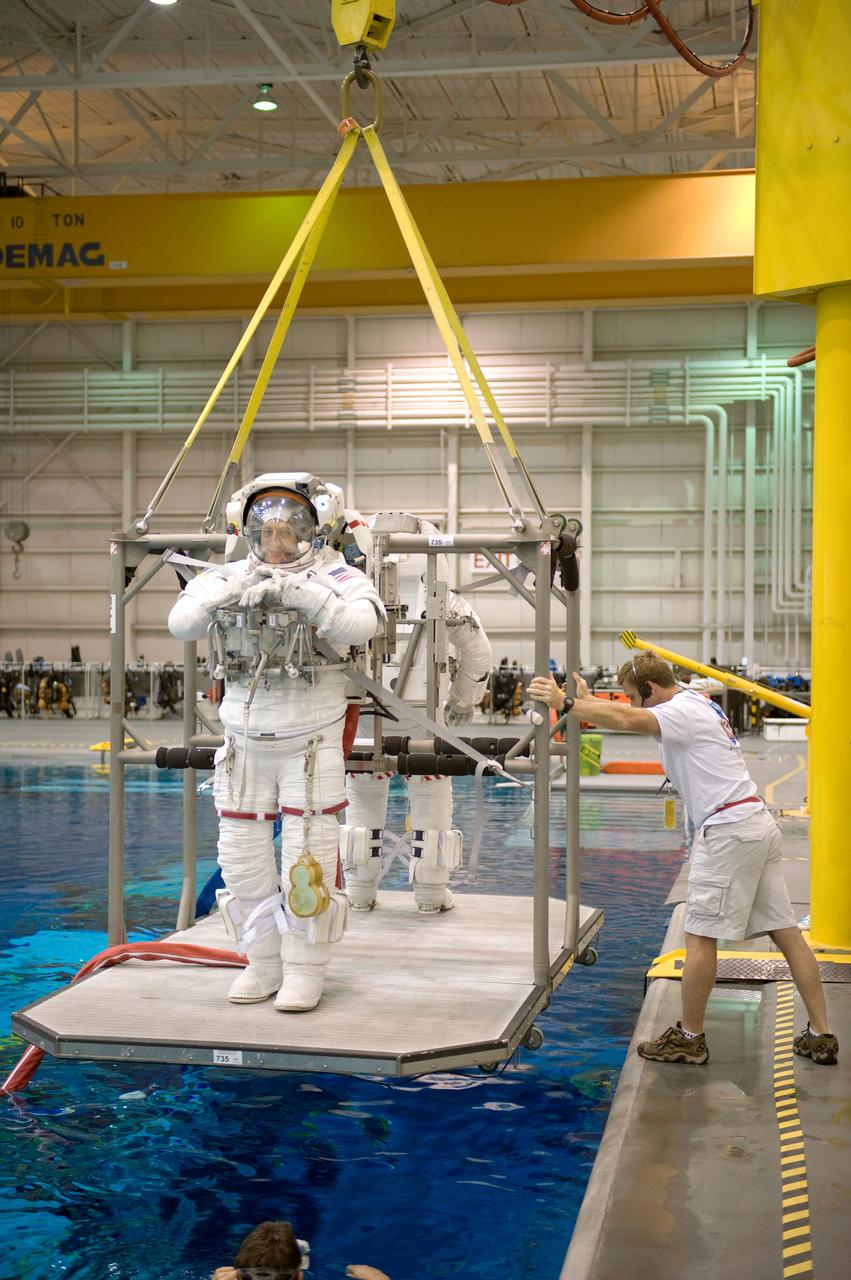
JSC2008-E-118378 (25 Sept. 2008) --- Astronauts Mike Massimino and Michael Good (partially obscured), both STS-125 mission specialists, are about to be submerged in the waters of the Neutral Buoyancy Laboratory (NBL) near NASA's Johnson Space Center. Massimino and Good are attired in training versions of their Extravehicular Mobility Unit (EMU) spacesuit. SCUBA-equipped divers (out of frame) are in the water to assist the crewmembers in their rehearsal, intended to help prepare them for work on the Hubble Space Telescope.
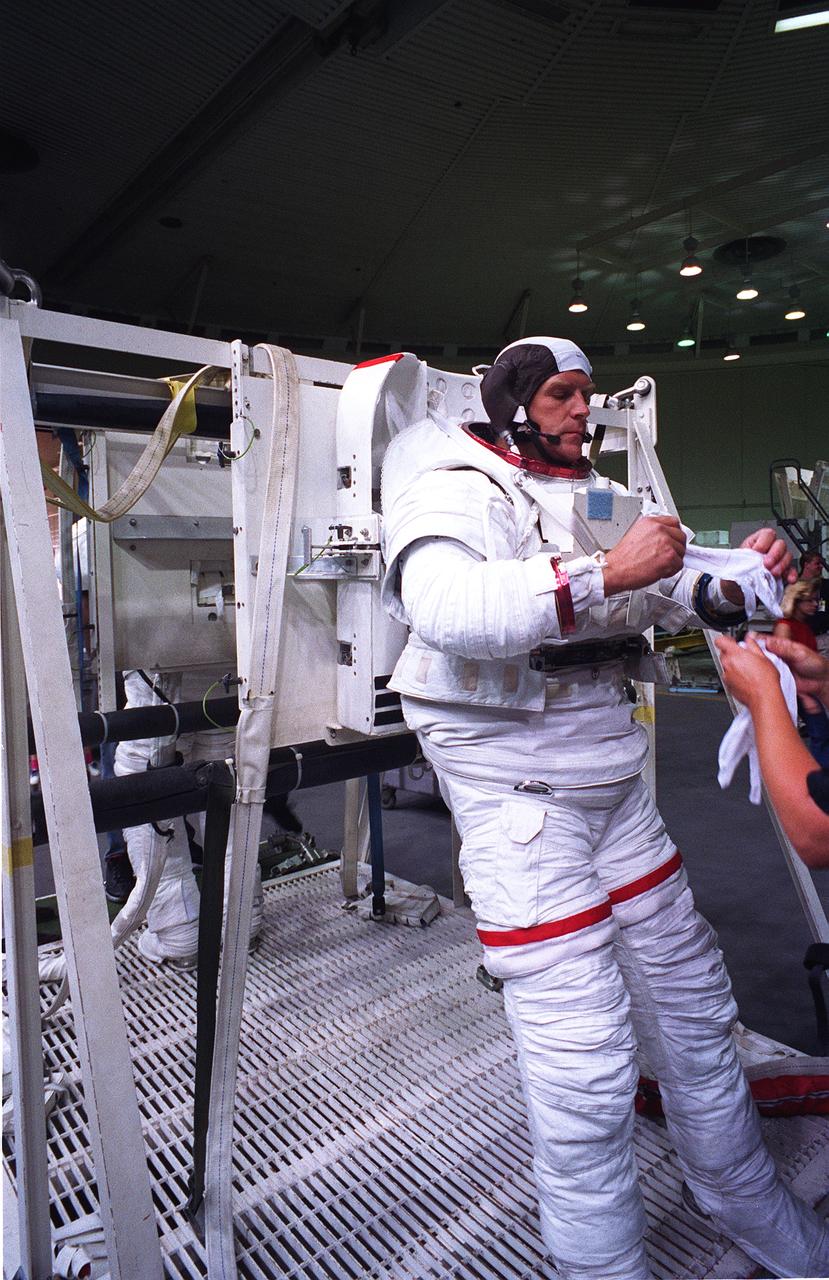
S96-11811 (10 June 1996) --- Astronaut Mark C. Lee, STS-82 payload commander training for extravehicular activity (EVA) involved with the servicing of the Hubble Space Telescope (HST), prepares to enter a water tank at the Johnson Space Center (JSC). Moments later, Lee was neutrally buoyant, rehearsing some of the HST servicing chores with a crewmate.
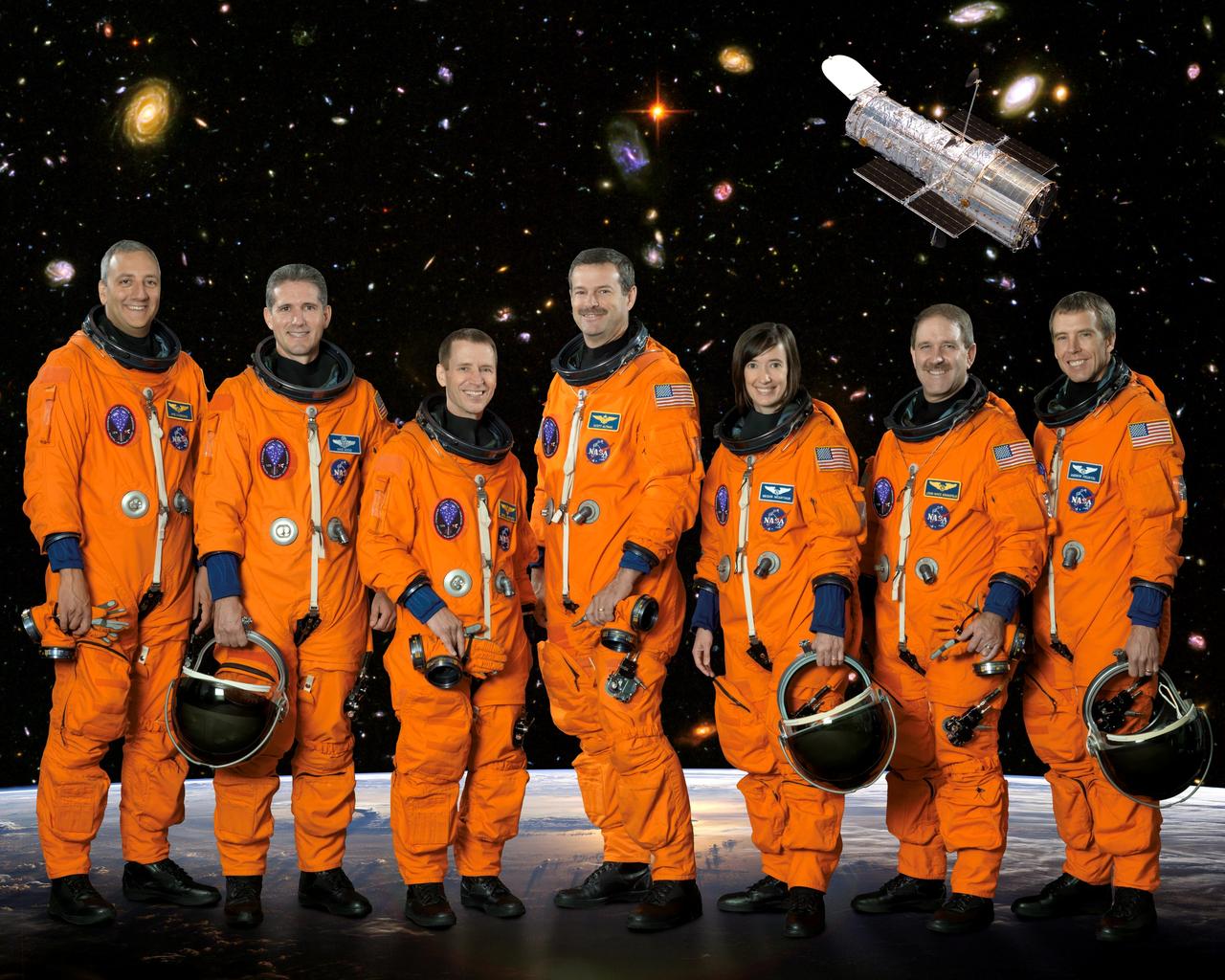
STS125-S-002 (9 Oct. 2007) --- These seven astronauts take a break from training to pose for the STS-125 crew portrait. From the left are astronauts Michael J. Massimino, Michael T. Good, both mission specialists; Gregory C. Johnson, pilot; Scott D. Altman, commander; K. Megan McArthur, John M. Grunsfeld and Andrew J. Feustel, all mission specialists. The STS-125 mission will be the final space shuttle mission to the Hubble Space Telescope.