
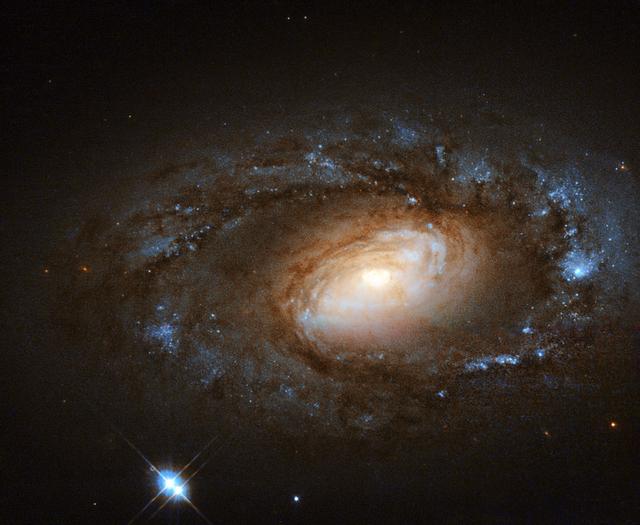
Spiral galaxy NGC 3274 is a relatively faint galaxy located over 20 million light-years away in the constellation of Leo (The Lion). This NASA/ESA Hubble Space Telescope image comes courtesy of Hubble's Wide Field Camera 3 (WFC3), whose multi-color vision allows astronomers to study a wide range of targets, from nearby star formation to galaxies in the most remote regions of the cosmos. This image combines observations gathered in five different filters, bringing together ultraviolet, visible and infrared light to show off NGC 3274 in all its glory. NGC 3274 was discovered by Wilhelm Herschel in 1783. The galaxy PGC 213714 is also visible on the upper right of the frame, located much farther away from Earth. Image Credit: ESA/Hubble & NASA, D. Calzetti <b><a href="http://www.nasa.gov/audience/formedia/features/MP_Photo_Guidelines.html" rel="nofollow">NASA image use policy.</a></b> <b><a href="http://www.nasa.gov/centers/goddard/home/index.html" rel="nofollow">NASA Goddard Space Flight Center</a></b> enables NASA’s mission through four scientific endeavors: Earth Science, Heliophysics, Solar System Exploration, and Astrophysics. Goddard plays a leading role in NASA’s accomplishments by contributing compelling scientific knowledge to advance the Agency’s mission. <b>Follow us on <a href="http://twitter.com/NASAGoddardPix" rel="nofollow">Twitter</a></b> <b>Like us on <a href="http://www.facebook.com/pages/Greenbelt-MD/NASA-Goddard/395013845897?ref=tsd" rel="nofollow">Facebook</a></b> <b>Find us on <a href="http://instagrid.me/nasagoddard/?vm=grid" rel="nofollow">Instagram</a></b>
The NASA/ESA Hubble Space Telescope observes some of the most beautiful galaxies in our skies — spirals sparkling with bright stellar nurseries, violent duos ripping gas and stars away from one another as they tangle together, and ethereal irregular galaxies that hang like flocks of birds suspended in the blackness of space. However, galaxies, like humans, are not all supermodels. This little spiral, known as NGC 4102, has a different kind of appeal, with its tightly-wound spiral arms and understated, but charming, appearance. NGC 4102 lies in the northern constellation of Ursa Major (The Great Bear). It contains what is known as a LINER, or low-ionization nuclear emission-line region, meaning that its nucleus emits particular types of radiation — specifically, emission from weakly-ionized or neutral atoms of certain elements. Even in this sense, NGC 4102 is not special; around one third of all nearby galaxies are thought to be LINER galaxies. Many LINER galaxies also contain intense regions of star formation. This is thought to be intrinsically linked to their centers but just why, is still a mystery for astronomers — either the starbursts pour fuel inwards to fuel the LINERs, or this active central region triggers the starbursts. NGC 4102 does indeed contain a starburst region towards its center, where stars are being created at a rate much more furious than in a normal galaxy. This star formation is taking place within a small rotating disk, around 1000 light-years in diameter and with a mass some three billion times the mass of the sun. This image uses infrared and visible observations taken using Hubble’s Wide Field Planetary Camera 2. Credit: ESA/Hubble, NASA and S. Smartt (Queen's University Belfast) Acknowledgement: Renaud Houdinet <b><a href="http://www.nasa.gov/audience/formedia/features/MP_Photo_Guidelines.html" rel="nofollow">NASA image use policy.</a></b> <b><a href="http://www.nasa.gov/centers/goddard/home/index.html" rel="nofollow">NASA Goddard Space Flight Center</a></b> enables NASA’s mission through four scientific endeavors: Earth Science, Heliophysics, Solar System Exploration, and Astrophysics. Goddard plays a leading role in NASA’s accomplishments by contributing compelling scientific knowledge to advance the Agency’s mission. <b>Follow us on <a href="http://twitter.com/NASAGoddardPix" rel="nofollow">Twitter</a></b> <b>Like us on <a href="http://www.facebook.com/pages/Greenbelt-MD/NASA-Goddard/395013845897?ref=tsd" rel="nofollow">Facebook</a></b> <b>Find us on <a href="http://instagram.com/nasagoddard?vm=grid" rel="nofollow">Instagram</a></b>