
Saturn from Far and Near Hubble Space Telescope

Hubble Space Telescope Resolves Volcanoes on Io

Jupiter Upper Atmospheric Winds Revealed in Ultraviolet Images by Hubble Telescope

The Hubble Space Telescope in a picture snapped by a Servicing Mission 4 crewmember just after the Space Shuttle Atlantis captured Hubble with its robotic arm on May 13, 2009, beginning the mission to upgrade and repair the telescope. The Hubble Space Telescope is a project of international cooperation between NASA and the European Space Agency. NASA's Goddard Space Flight Center manages the telescope. The Space Telescope Science Institute conducts Hubble science operations. Goddard is responsible for HST project management, including mission and science operations, servicing missions, and all associated development activities. To learn more about the Hubble Space Telescope go here: <a href="http://www.nasa.gov/mission_pages/hubble/main/index.html" rel="nofollow">www.nasa.gov/mission_pages/hubble/main/index.html</a>

What look like giant twisters are spotted by the Hubble Space Telescope (HST). These images are, in actuality, pillars of gases that are in the process of the formation of a new star. These pillars can be billions of miles in length and may have been forming for millions of years. This one formation is located in the Lagoon Nebula and was captured by the Hubble's wide field planetary camera-2 (WFPC-2).
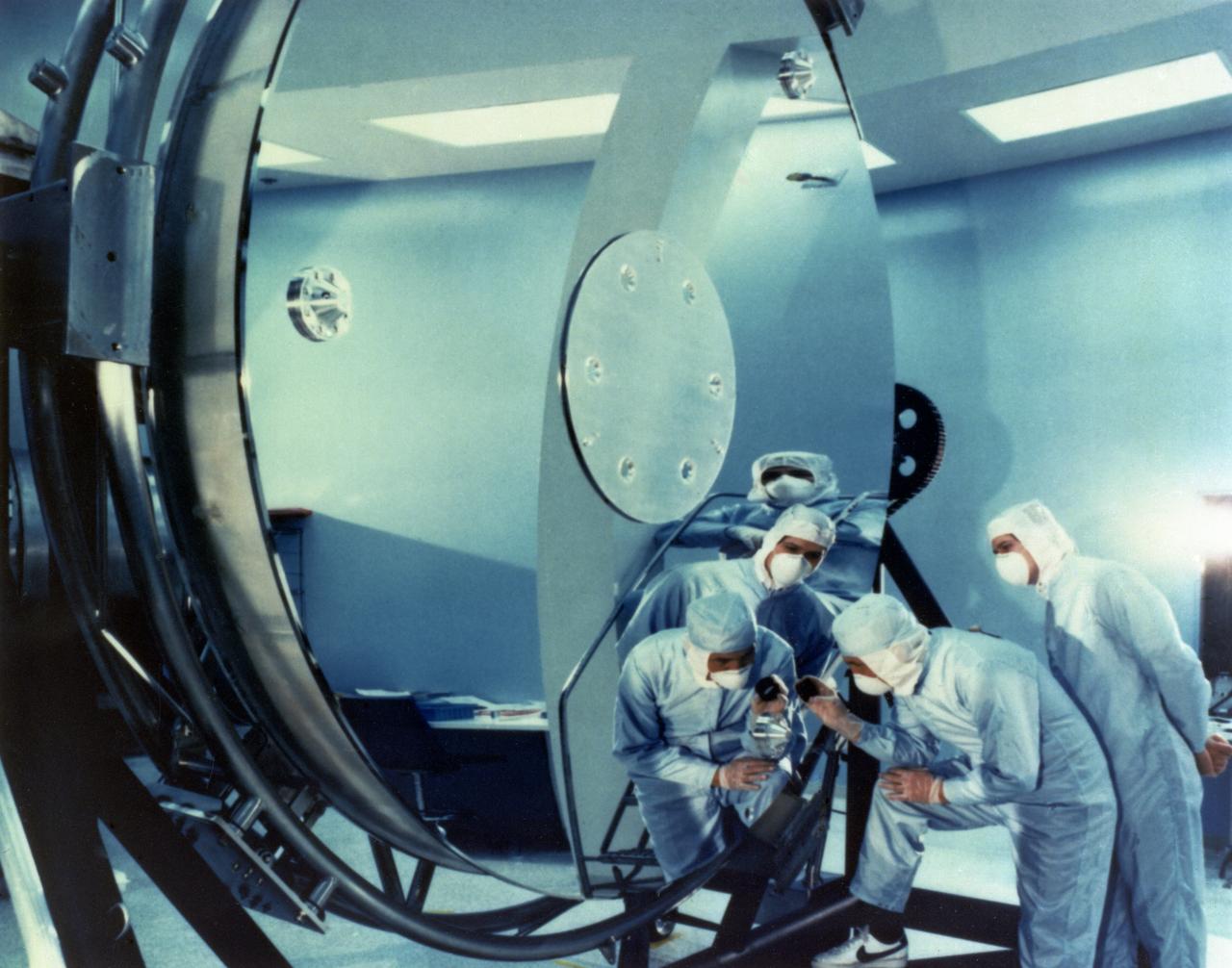
Prior to installation, technicians inspect the primary mirror of the Hubble Space Telescope (HST). The first in a series of great observatories launched by NASA, the HST was designed to last approximately 15 years. The Marshall Space Flight Center had management responsibility for the development of the HST and played a major role in ground tests and orbital checkout of the telescope. The HST was launched April 24, 1990 aboard Space Shuttle Discovery's STS-31 mission.

This photograph is a Hubble Space Telescope (HST) image of a sky full of glittering jewels. The HST peered into the Sagittarius star cloud, a narrow dust free region, providing this spectacular glimpse of a treasure chest full of stars.
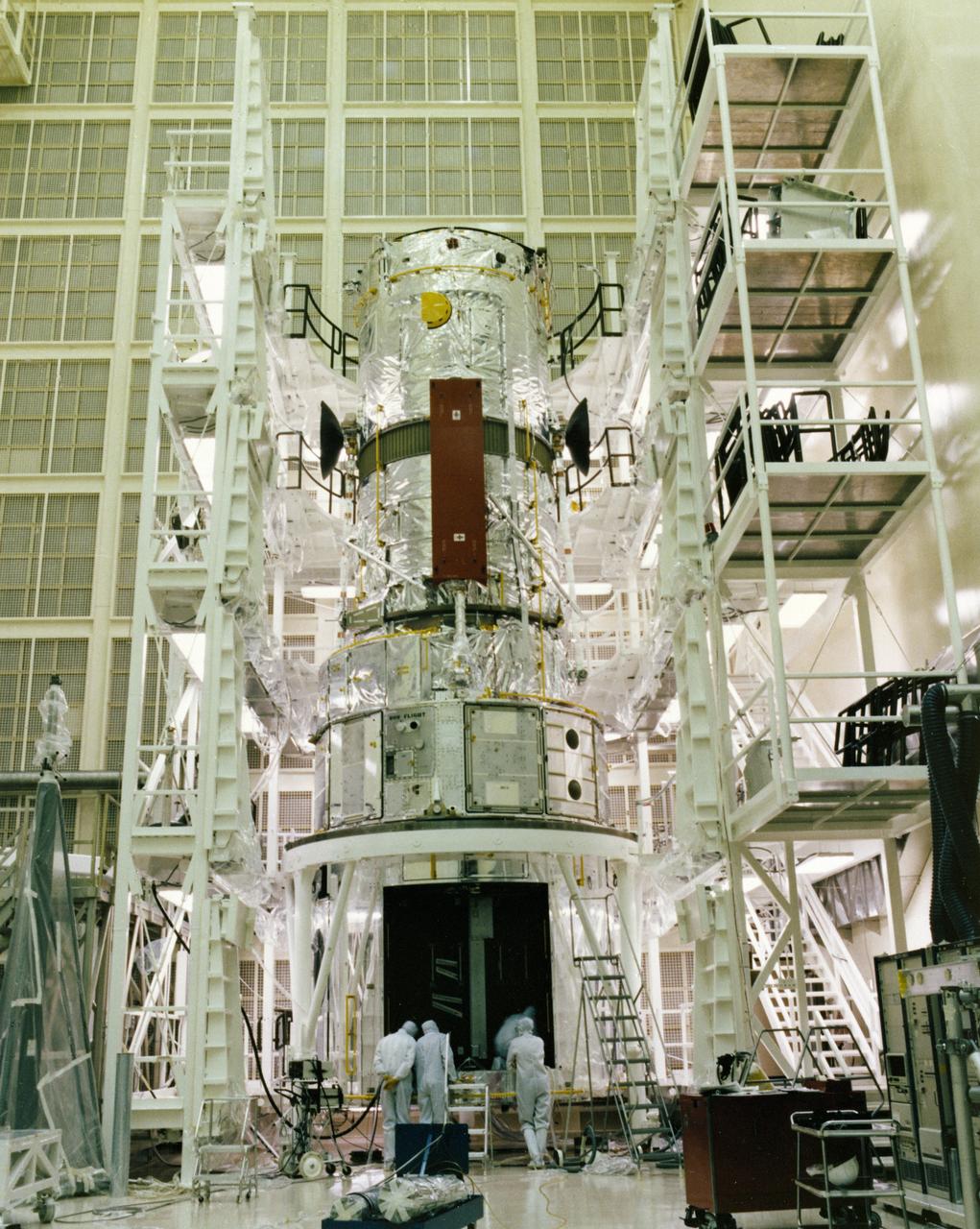
This photograph shows the Hubble Space Telescope (HST) flight article assembly with multilayer insulation, high gain anterna, and solar arrays in a clean room of the Lockheed Missile and Space Company. The HST is the first of NASA's great observatories and the most complex and sensitive optical telescope ever made. The purpose of the HST is to study the cosmos from a low-Earth orbit by placing the telescope in space, enabling astronomers to collect data that is free of the Earth's atmosphere. The HST was deployed from the Space Shuttle Discovery (STS-31 mission) into Earth orbit in April 1990. The Marshall Space Flight Center had overall responsibility for design, development, and construction of the HST. The Perkin-Elmer Corporation, in Danbury, Connecticut, developed the optical system and guidance sensors. The Lockheed Missile and Space Company, Sunnyvale, California, produced the protective outer shroud and spacecraft systems, and assembled and tested the finished telescope.
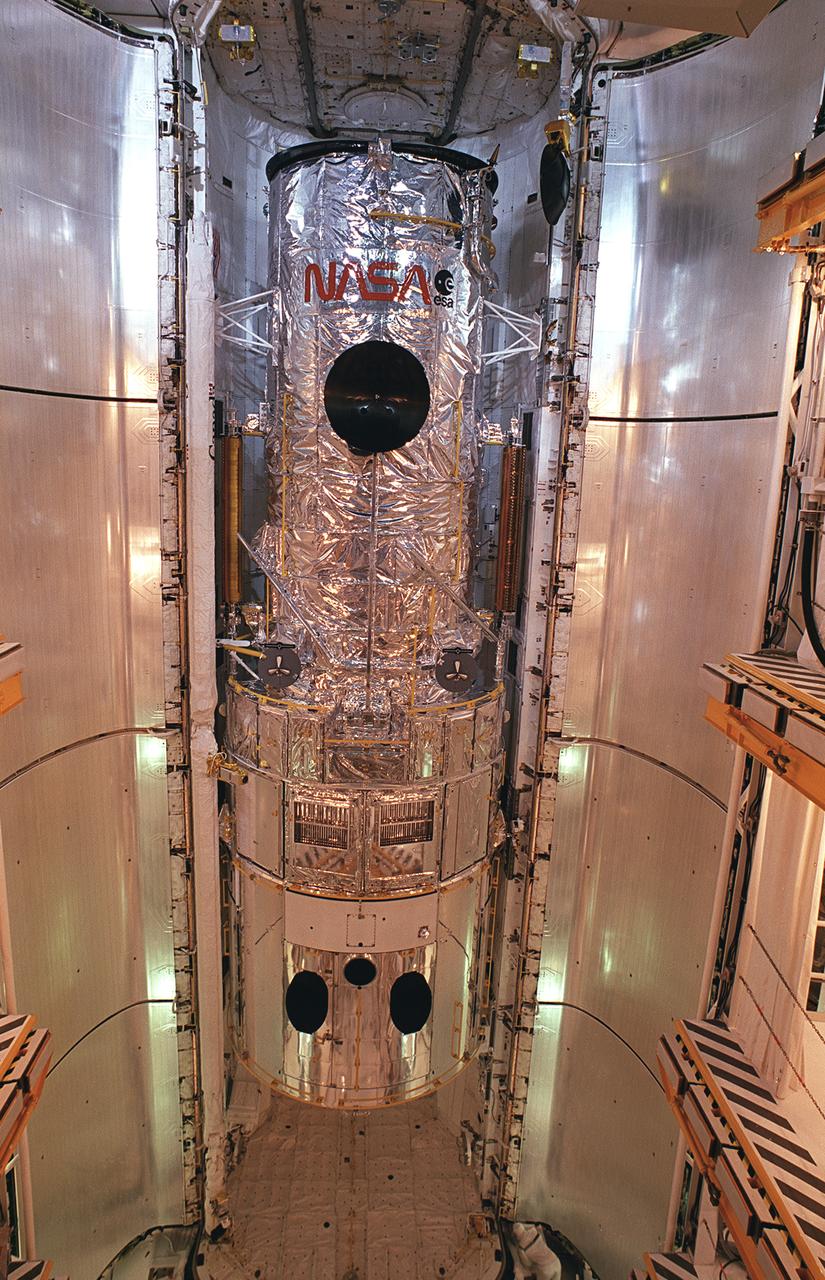
This photograph shows the Hubble Space Telescope (HST) installed in the cargo bay of the Space Shuttle Orbiter Discovery for the STS-31 Mission at The Kennedy Space Center prior to launch on April 24, 1990. The HST is the first of NASA's great observatories and the most complex and sensitive optical telescope ever made. The purpose of the HST is to study the cosmos from a low-Earth orbit by placing the telescope in space, enabling astronomers to collect data that is free of the Earth's atmosphere. The Marshall Space Flight Center had overall responsibility for design, development, and construction of the HST. The Perkin-Elmer Corporation, in Danbury, Connecticut, developed the optical system and guidance sensors. The Lockheed Missile and Space Company, Sunnyvale, California, produced the protective outer shroud and spacecraft systems, and assembled and tested the finished telescope.
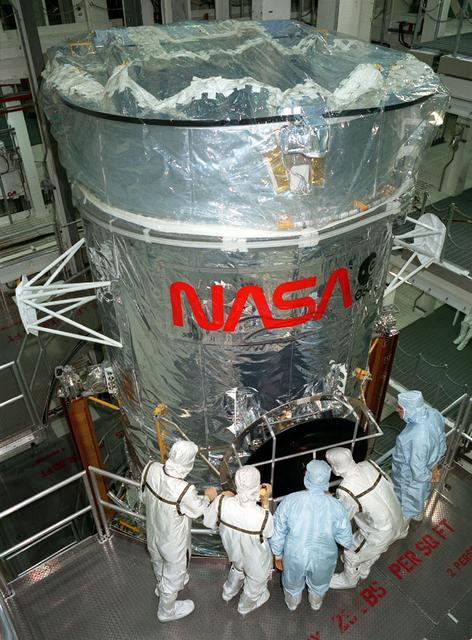
The Hubble Space Telescope (HST) pictured in the Vertical Processing Facility (VPF) support fixture during final testing and verification at the Lockheed assembly plant.
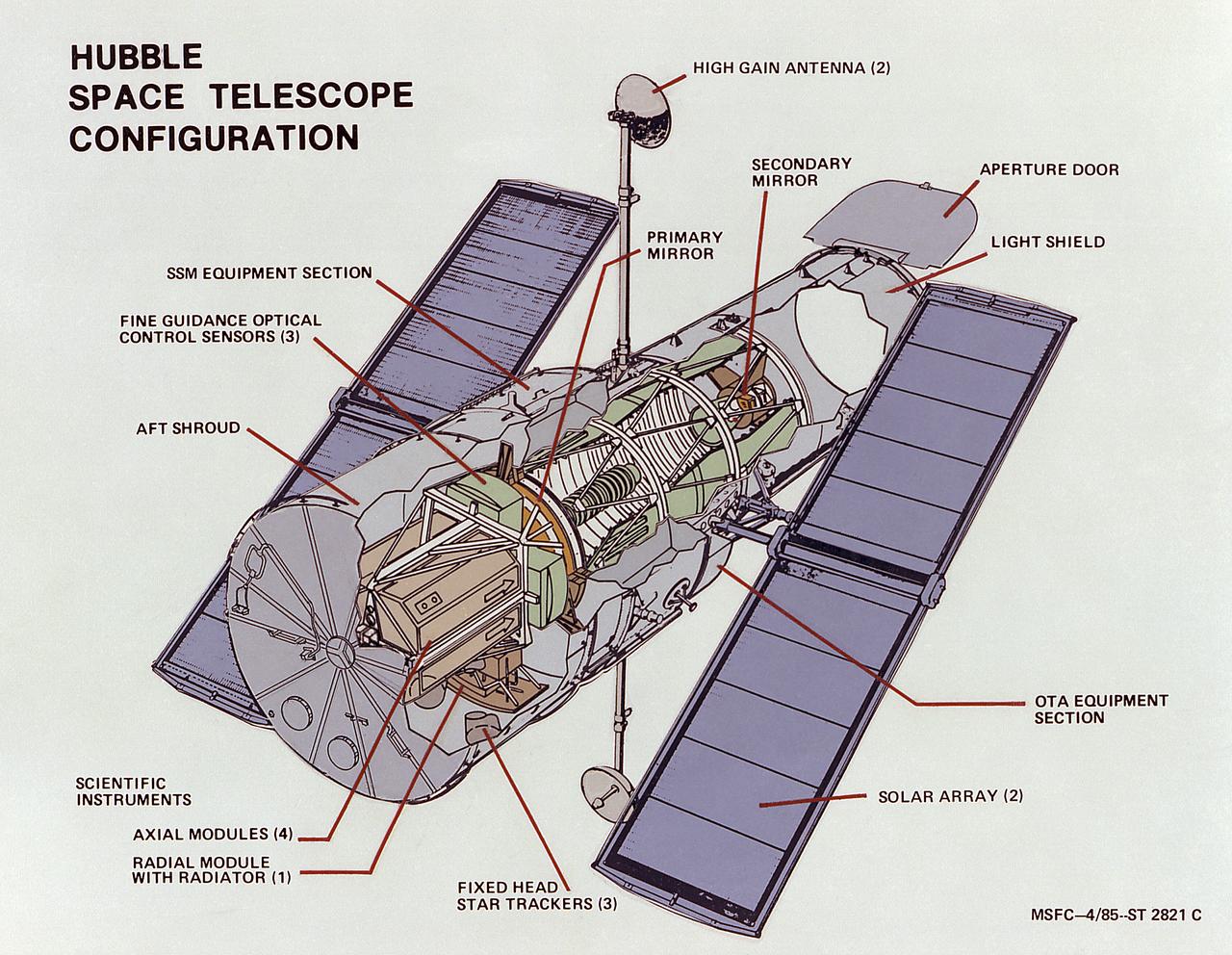
This image illustrates the overall Hubble Space Telescope (HST) configuration. The HST is the product of a partnership between NASA, European Space Agency Contractors, and the international community of astronomers. It is named after Edwin P. Hubble, an American Astronomer who discovered the expanding nature of the universe and was the first to realize the true nature of galaxies. The purpose of the HST, the most complex and sensitive optical telescope ever made, is to study the cosmos from a low-Earth orbit. By placing the telescope in space, astronomers are able to collect data that is free of the Earth's atmosphere. The HST detects objects 25 times fainter than the dimmest objects seen from Earth and provides astronomers with an observable universe 250 times larger than visible from ground-based telescopes, perhaps as far away as 14 billion light-years. The HST views galaxies, stars, planets, comets, possibly other solar systems, and even unusual phenomena such as quasars, with 10 times the clarity of ground-based telescopes. The major elements of the HST are the Optical Telescope Assembly (OTA), the Support System Module (SSM), and the Scientific Instruments (SI). The HST is approximately the size of a railroad car, with two cylinders joined together and wrapped in a silvery reflective heat shield blanket. Wing-like solar arrays extend horizontally from each side of these cylinders, and dish-shaped anternas extend above and below the body of the telescope. The HST was deployed from the Space Shuttle Discovery (STS-31 mission) into Earth orbit in April 1990. The Marshall Space Flight Center had responsibility for design, development, and construction of the HST. The Perkin-Elmer Corporation, in Danbury, Connecticut, developed the optical system and guidance sensors. The Lockheed Missile and Space Company of Sunnyvale, California produced the protective outer shroud and spacecraft systems, and assembled and tested the finished telescope.
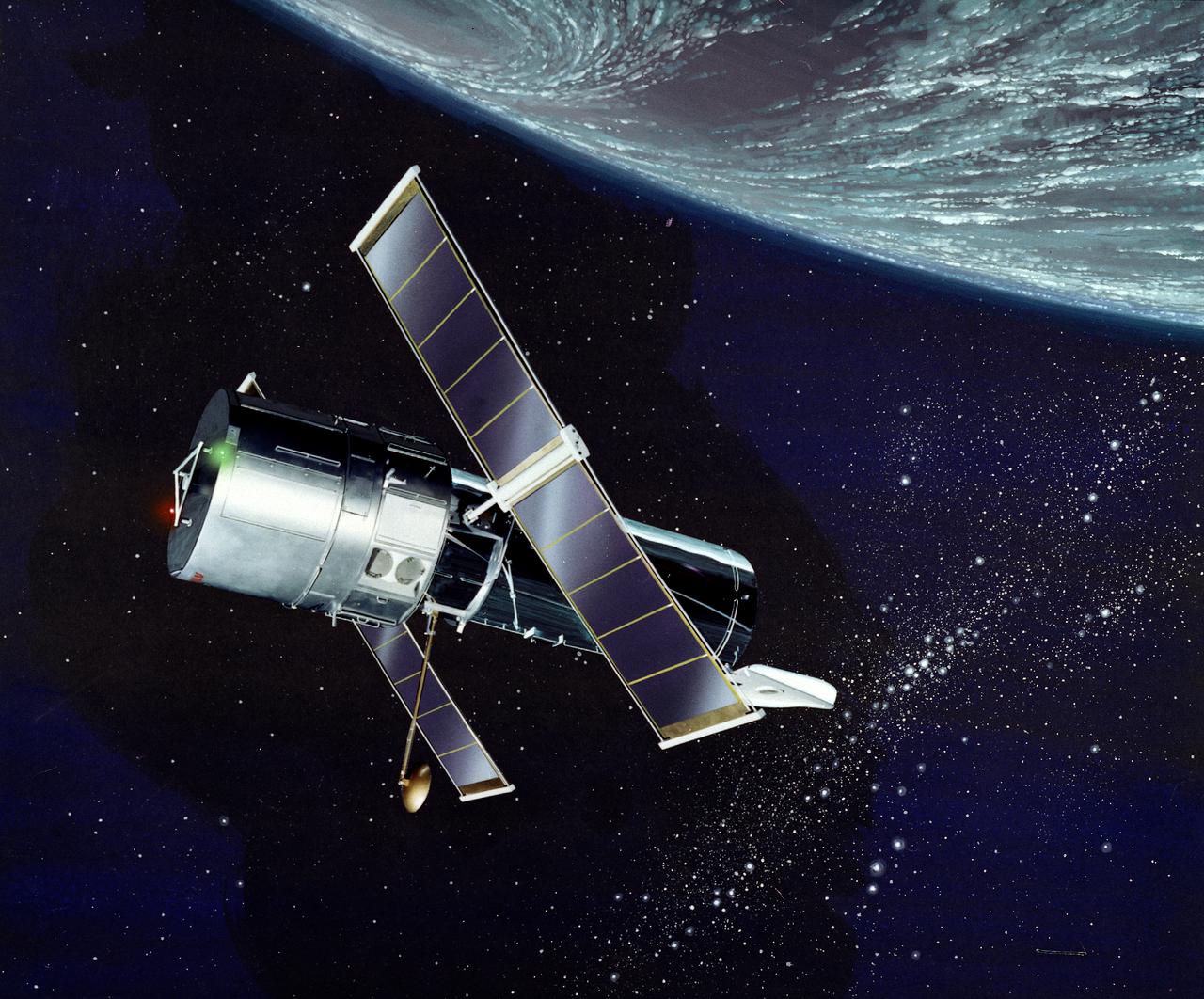
This illustration depicts a side view of the Hubble Space Telescope (HST). The HST is the product of a partnership between NASA, European Space Agency Contractors, and the international community of astronomers. It is named after Edwin P. Hubble, an American Astronomer who discovered the expanding nature of the universe and was the first to realize the true nature of galaxies. The purpose of the HST, the most complex and sensitive optical telescope ever made, is to study the cosmos from a low-Earth orbit. By placing the telescope in space, astronomers are able to collect data that is free of the Earth's atmosphere. The HST detects objects 25 times fainter than the dimmest objects seen from Earth and provides astronomers with an observable universe 250 times larger than visible from ground-based telescopes, perhaps as far away as 14 billion light-years. The HST views galaxies, stars, planets, comets, possibly other solar systems, and even unusual phenomena such as quasars, with 10 times the clarity of ground-based telescopes. The major elements of the HST are the Optical Telescope Assembly (OTA), the Support System Module (SSM), and the Scientific Instruments (SI). The HST is approximately the size of a railroad car, with two cylinders joined together and wrapped in a silvery reflective heat shield blanket. Wing-like solar arrays extend horizontally from each side of these cylinders, and dish-shaped anternas extend above and below the body of the telescope. The HST was deployed from the Space Shuttle Discovery (STS-31 mission) into Earth orbit in April 1990. The Marshall Space Flight Center had responsibility for design, development, and construction of the HST. The Perkin-Elmer Corporation, in Danbury, Connecticut, developed the optical system and guidance sensors. The Lockheed Missile and Space Company of Sunnyvale, California produced the protective outer shroud and spacecraft systems, and assembled and tested the finished telescope.
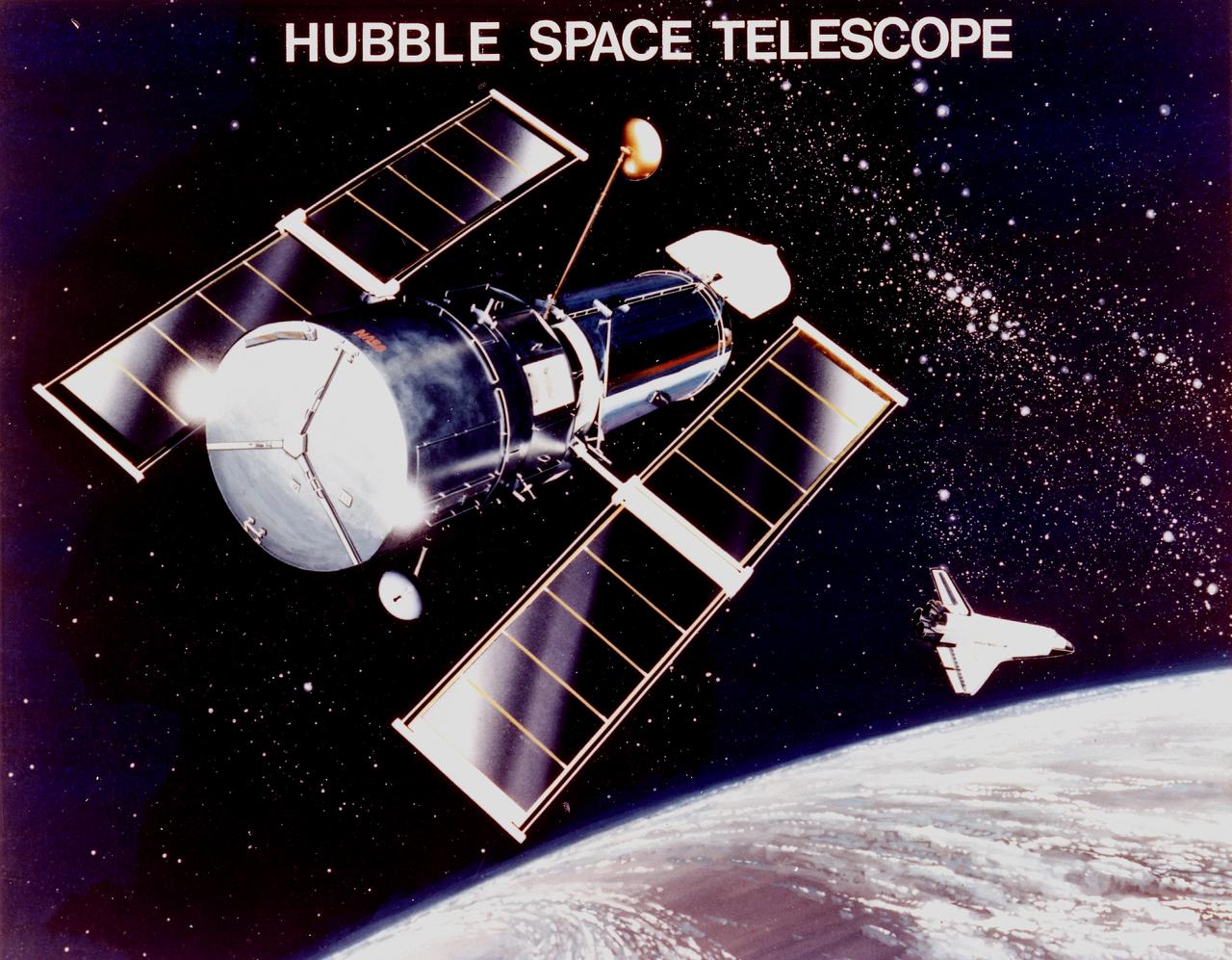
This is an artist's concept of the Hubble Space Telescope (HST). The HST is the product of a partnership between NASA, European Space Agency Contractors, and the international community of astronomers. It is named after Edwin P. Hubble, an American Astronomer who discovered the expanding nature of the universe and was the first to realize the true nature of galaxies. The purpose of the HST, the most complex and sensitive optical telescope ever made, is to study the cosmos from a low-Earth orbit. By placing the telescope in space, astronomers are able to collect data that is free of the Earth's atmosphere. The HST detects objects 25 times fainter than the dimmest objects seen from Earth and provides astronomers with an observable universe 250 times larger than is visible from ground-based telescopes, perhaps as far away as 14 billion light-years. The HST views galaxies, stars, planets, comets, possibly other solar systems, and even unusual phenomena such as quasars, with 10 times the clarity of ground-based telescopes. The major elements of the HST are the Optical Telescope Assembly (OTA), the Support System Module (SSM), and the Scientific Instruments (SI). The HST is approximately the size of a railroad car, with two cylinders joined together and wrapped in a silvery reflective heat shield blanket. Wing-like solar arrays extend horizontally from each side of these cylinders, and dish-shaped anternas extend above and below the body of the telescope. The HST was deployed from the Space Shuttle Discovery (STS-31 mission) into Earth orbit in April 1990. The Marshall Space Flight Center had responsibility for design, development, and construction of the HST. The Perkin-Elmer Corporation, in Danbury, Connecticut, developed the optical system and guidance sensors. The Lockheed Missile and Space Company of Sunnyvale, California produced the protective outer shroud and spacecraft systems, and assembled and tested the finished telescope.
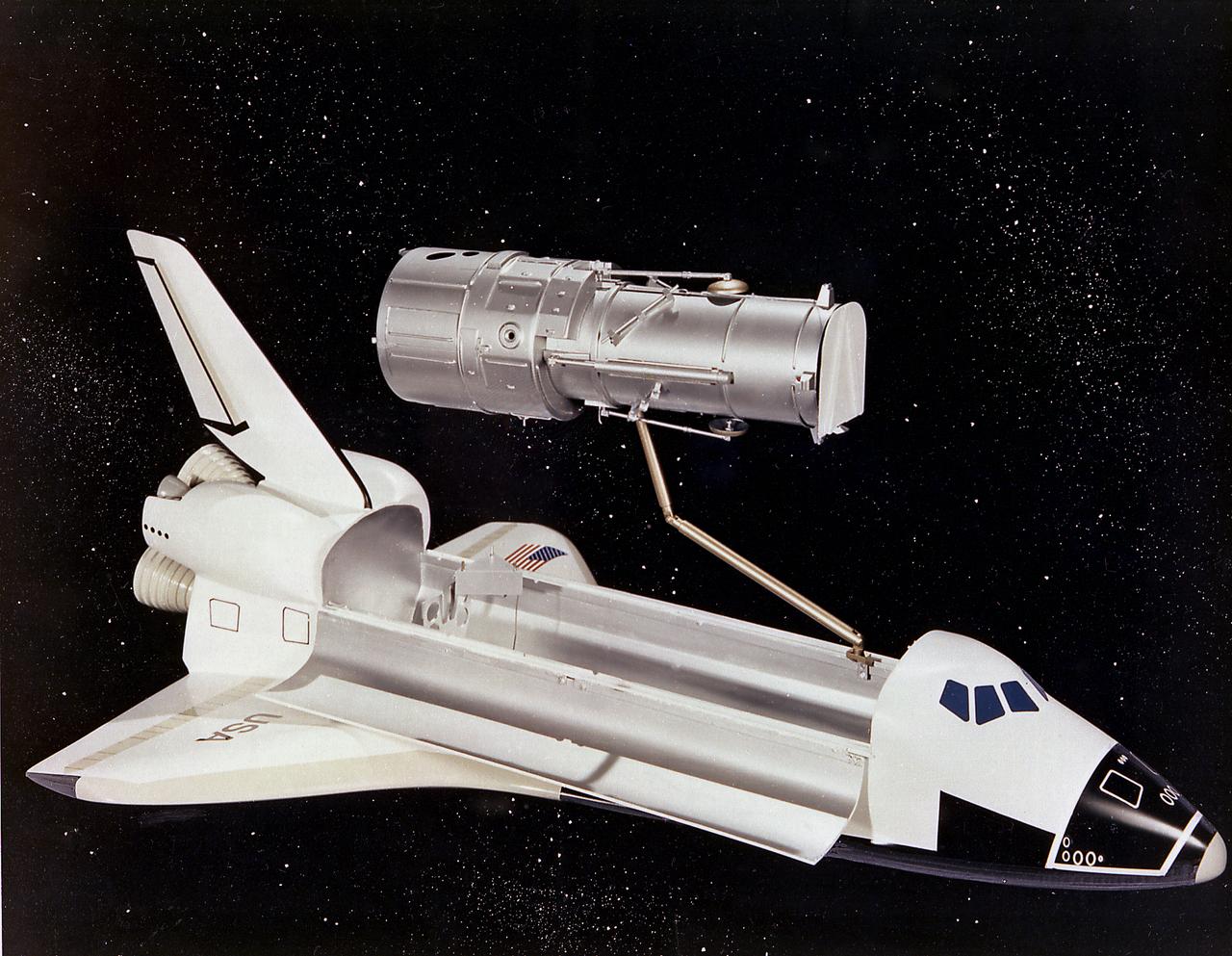
This artist's concept depicts the Hubble Space Telescope (HST) being positioned for release from the Space Shuttle orbiter by the Remote Manipulator System (RMS). The HST is the product of a partnership between NASA, European Space Agency Contractors, and the international community of astronomers. It is named after Edwin P. Hubble, an American Astronomer who discovered the expanding nature of the universe and was the first to realize the true nature of galaxies. The purpose of the HST, the most complex and sensitive optical telescope ever made, is to study the cosmos from a low-Earth orbit. By placing the telescope in space, astronomers are able to collect data that is free of the Earth's atmosphere. The HST detects objects 25 times fainter than the dimmest objects seen from Earth and provides astronomers with an observable universe 250 times larger than visible from ground-based telescopes, perhaps as far away as 14 billion light-years. The HST views galaxies, stars, planets, comets, possibly other solar systems, and even unusual phenomena such as quasars, with 10 times the clarity of ground-based telescopes. The major elements of the HST are the Optical Telescope Assembly (OTA), the Support System Module (SSM), and the Scientific Instruments (SI). The HST is 42.5-feet (13- meters) long and weighs about 25,000 pounds (11,600 kilograms). The HST was deployed from the Space Shuttle Discovery (STS-31 mission) into Earth orbit in April 1990. The Marshall Space Flight Center had responsibility for design, development, and construction of the HST. The Perkin-Elmer Corporation, in Danbury, Cornecticut, developed the optical system and guidance sensors. The Lockheed Missile and Space Company of Sunnyvale, California produced the protective outer shroud and spacecraft systems, and assembled and tested the finished telescope.
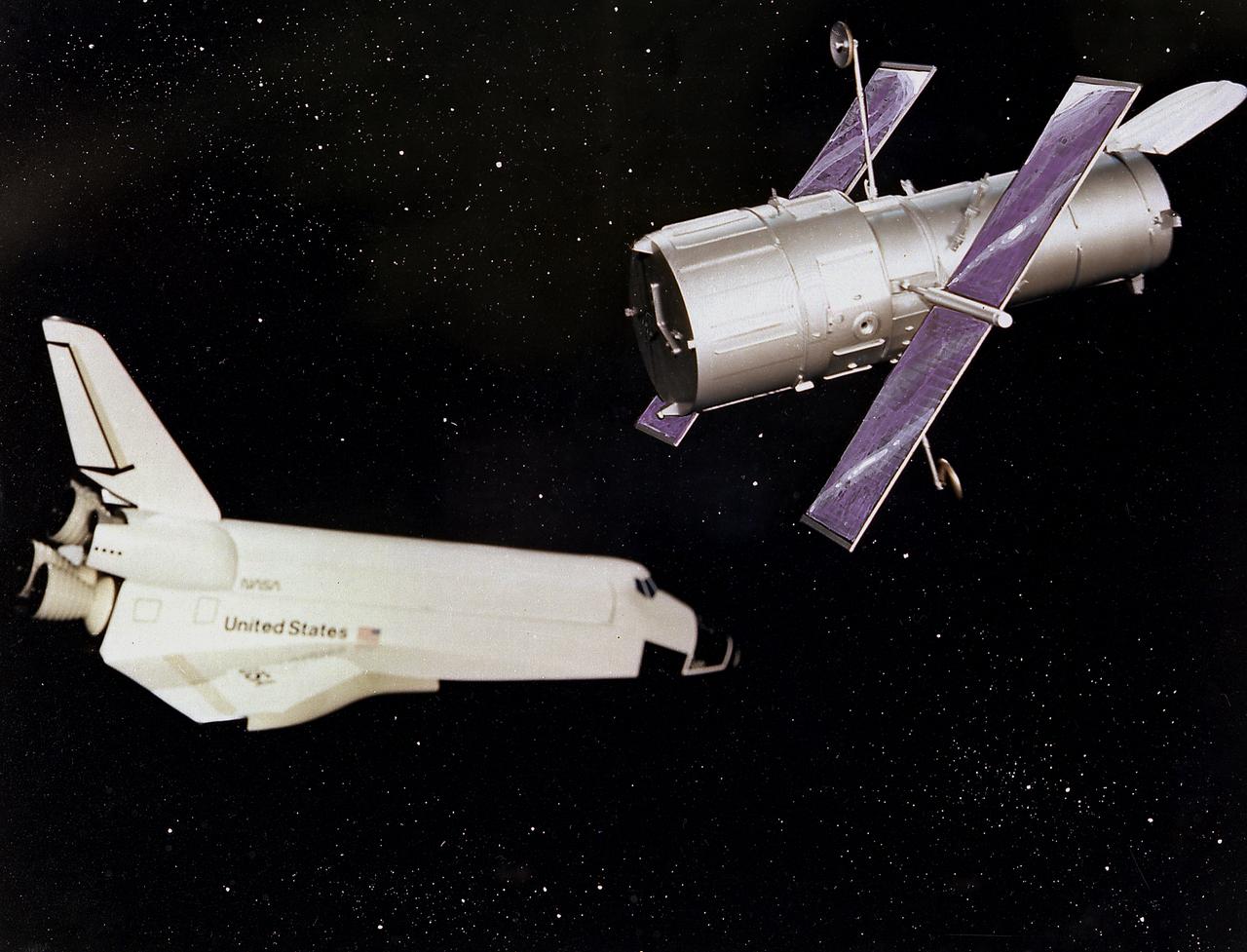
This artist's concept depicts the Hubble Space Telescope after being released into orbit, with the high gain anternas and solar arrays deployed and the aperture doors opened. The HST is the product of a partnership between NASA, European Space Agency Contractors, and the international community of astronomers. It is named after Edwin P. Hubble, an American Astronomer who discovered the expanding nature of the universe and was the first to realize the true nature of galaxies. The purpose of the HST, the most complex and sensitive optical telescope ever made, is to study the cosmos from a low-Earth orbit. By placing the telescope in space, astronomers are able to collect data that is free of the Earth's atmosphere. The HST detects objects 25 times fainter than the dimmest objects seen from Earth and provides astronomers with an observable universe 250 times larger than visible from ground-based telescopes, perhaps as far away as 14 billion light-years. The HST views galaxies, stars, planets, comets, possibly other solar systems, and even unusual phenomena such as quasars, with 10 times the clarity of ground-based telescopes. The major elements of the HST are the Optical Telescope Assembly (OTA), the Support System Module (SSM), and the Scientific Instruments (SI). The HST is 42.5-feet (13-meters) long and weighs about 25,000 pounds (11,600 kilograms). The HST was deployed from the Space Shuttle Discovery (STS-31 mission) into Earth orbit in April 1990. The Marshall Space Flight Center had responsibility for design, development, and construction of the HST. The Perkin-Elmer Corporation, in Danbury, Connecticut, developed the optical system and guidance sensors. The Lockheed Missile and Space Company of Sunnyvale, California produced the protective outer shroud and spacecraft systems, and assembled and tested the finished telescope.
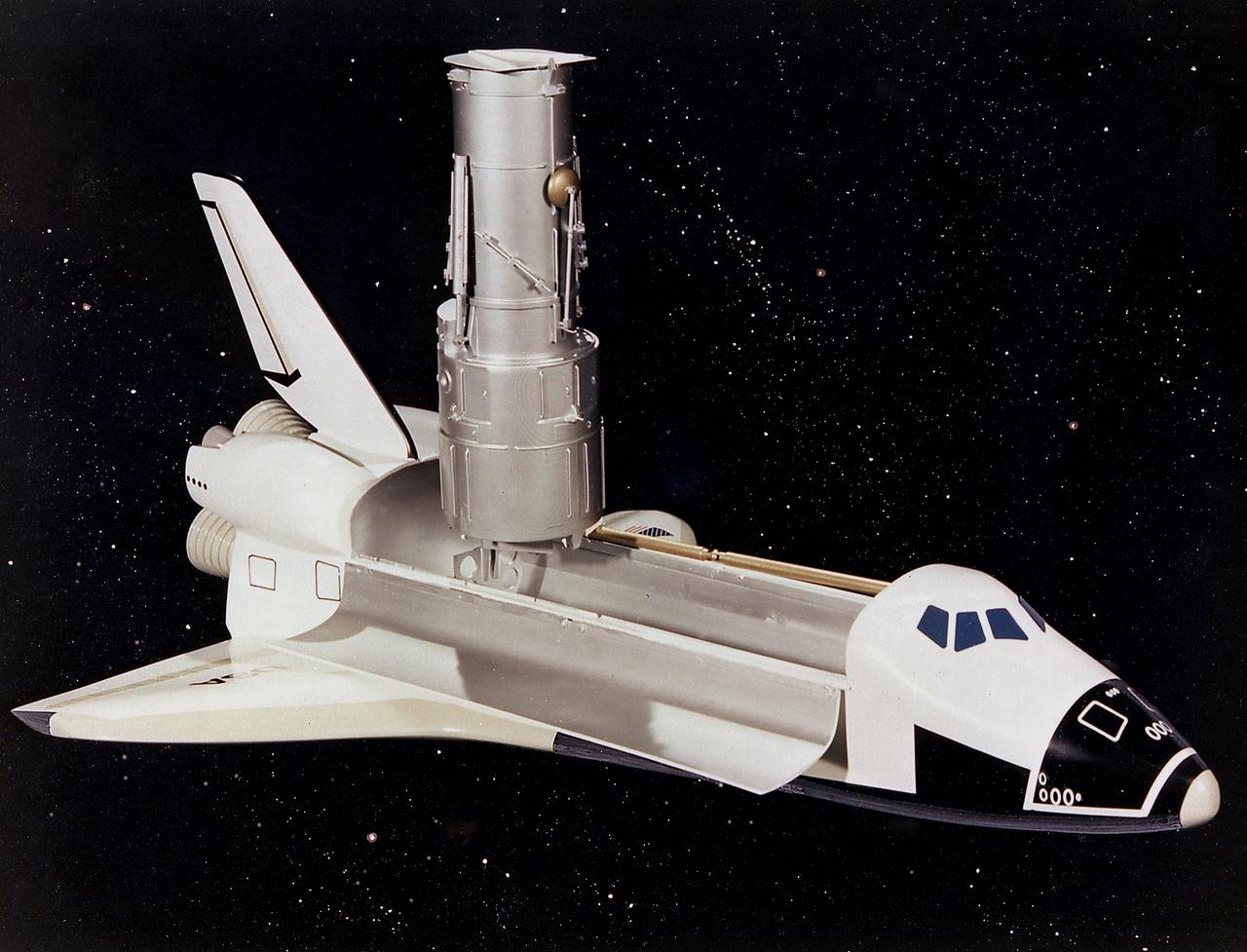
This artist's concept depicts the Hubble Space Telescope (HST) being raised to a vertical position in the cargo bay of the Space Shuttle orbiter. The HST is the product of a partnership between NASA, European Space Agency Contractors, and the international community of astronomers. It is named after Edwin P. Hubble, an American Astronomer who discovered the expanding nature of the universe and was the first to realize the true nature of galaxies. The purpose of the HST, the most complex and sensitive optical telescope ever made, is to study the cosmos from a low-Earth orbit. By placing the telescope in space, astronomers are able to collect data that is free of the Earth's atmosphere. The HST detects objects 25 times fainter than the dimmest objects seen from Earth and provides astronomers with an observable universe 250 times larger than visible from ground-based telescopes, perhaps as far away as 14 billion light-years. The HST views galaxies, stars, planets, comets, possibly other solar systems, and even unusual phenomena such as quasars, with 10 times the clarity of ground-based telescopes. The major elements of the HST are the Optical Telescope Assembly (OTA), the Support System Module (SSM), and the Scientific Instruments (SI). The HST is 42.5-feet (13-meters) long and weighs about 25,000 pounds (11,600 kilograms). The HST was deployed from the Space Shuttle Discovery (STS-31 mission) into Earth orbit in April 1990. The Marshall Space Flight Center had responsibility for design, development, and construction of the HST. The Perkin-Elmer Corporation, in Danbury, Cornecticut, developed the optical system and guidance sensors. The Lockheed Missile and Space Company of Sunnyvale, California produced the protective outer shroud and spacecraft systems, and assembled and tested the finished telescope.
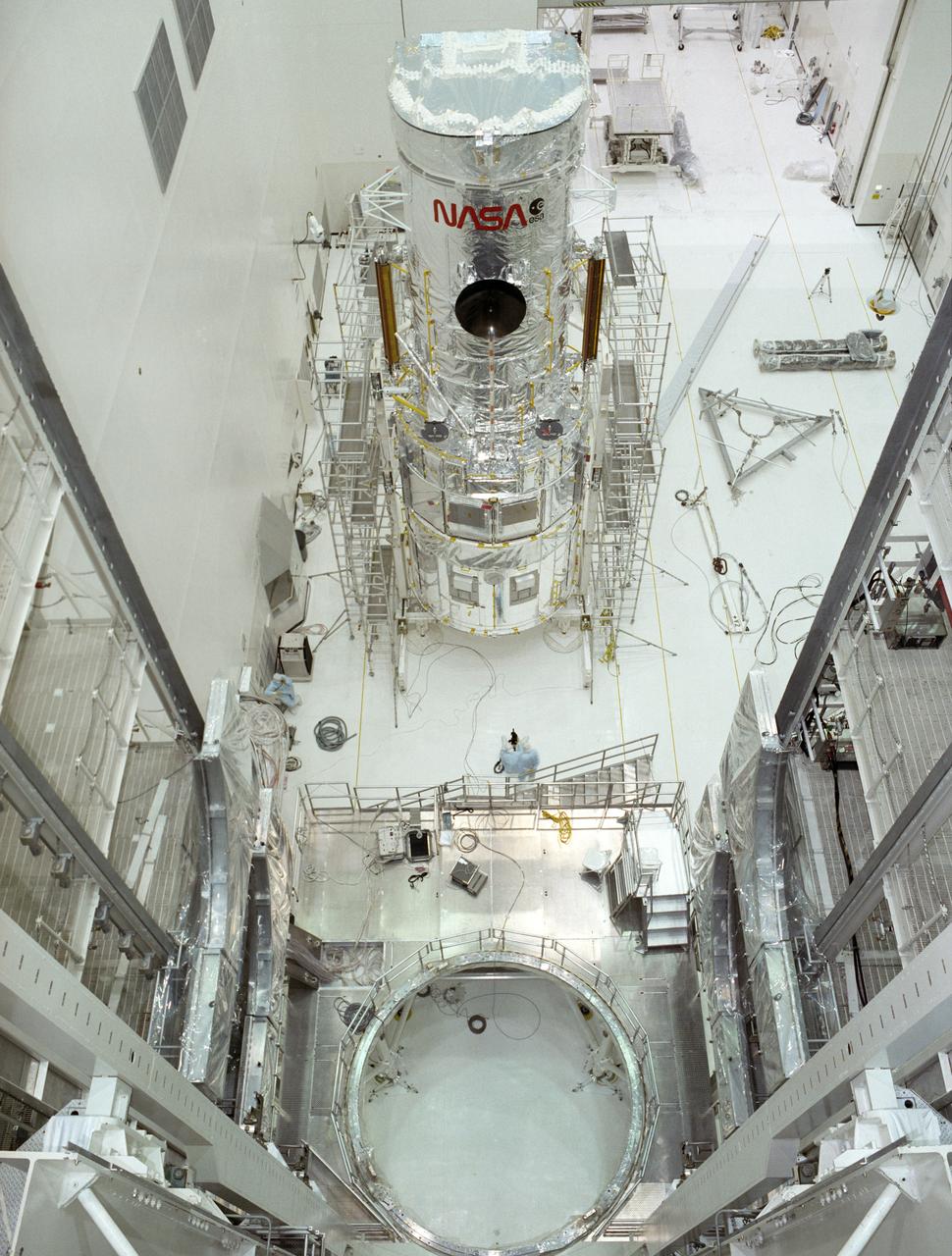
Ready for transportation to the Kennedy Space Center, the Hubble Space Telescope (HST) is pictured onboard the strongback dolly at the Vertical Processing Facility (VPF) at the Lockheed assembly plant upon completion of final testing and verification.
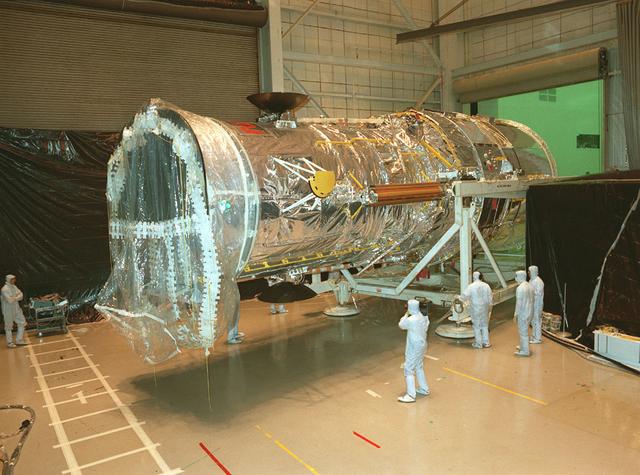
The Hubble Space Telescope (HST) being transferred from the Vertical Assembly Test Area (VATA) to the High Bay at the Lockheed assembly plant in preparation for transport to the Kennedy Space Center (KSC) after final testing and verification.
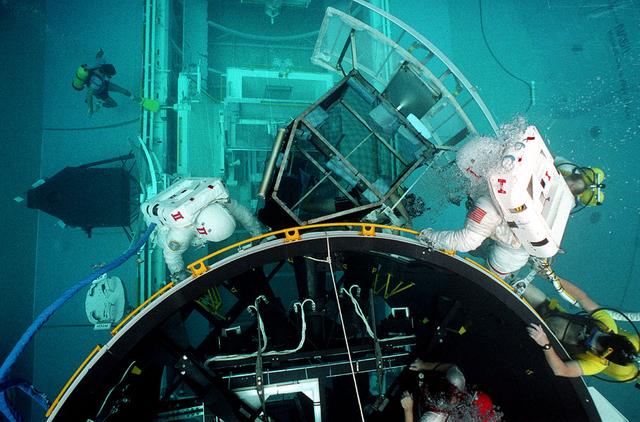
Astronauts Jim Voss and Jay Apt perform check-out procedures on a Hubble Space Telescope mock-up while working in the Marshall Space Flight Center's Neutral Buoyancy Simulator (NBS).
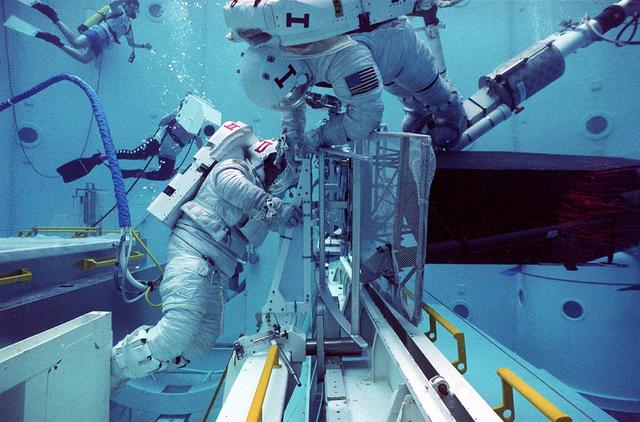
Astronauts Mark Lee and Rich Clifford perform test check-out procedures on the Hubble Space Telescope in the Marshall Space Flight Center's Neutral Buoyancy Simulator (NBS).
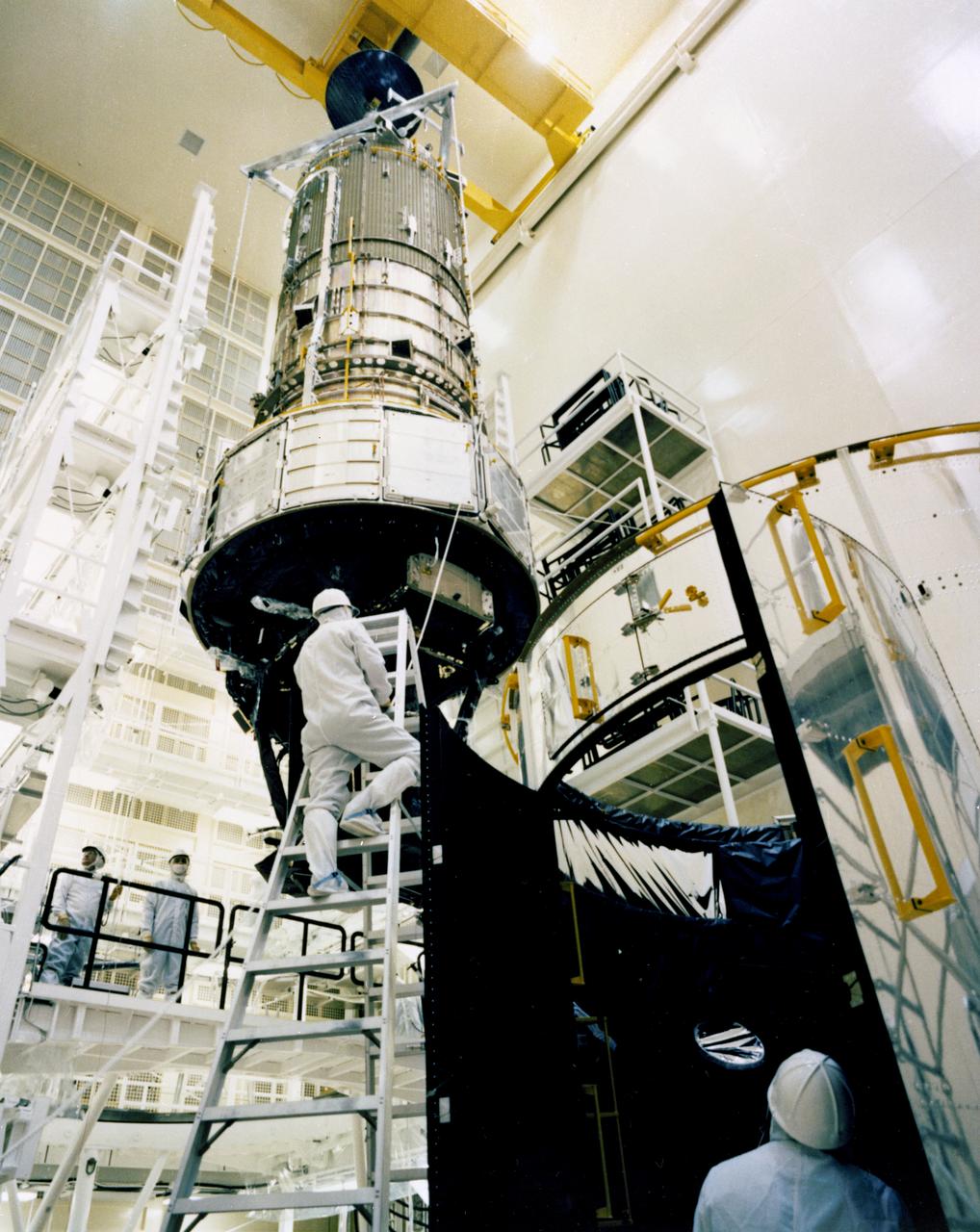
This photograph shows the Hubble Space Telescope (HST) being assembled in the clean room of the Lockheed Missile Space Company. The Optical Telescope Assembly (OTA) is being readied for the installation of the AFT shroud. The OTA contains two mirrors, primary and secondary, to collect and focus light from selected celestial objects. The HST is the first of NASA's great observatories and the most complex and sensitive optical telescope ever made. The purpose of the HST is to study the cosmos from a low-Earth orbit by placing the telescope in space, enabling astronomers to collect data that is free of the Earth's atmosphere. The HST was deployed from the Space Shuttle Discovery (STS-31 mission) into Earth orbit in April 1990. The Marshall Space Flight Center had overall responsibility for design, development, and construction of the HST. The Perkin-Elmer Corporation, in Danbury, Cornecticut, developed the optical system and guidance sensors. The Lockheed Missile and Space Company, Sunnyvale, California, produced the protective outer shroud and spacecraft systems, and assembled and tested the finished telescope.
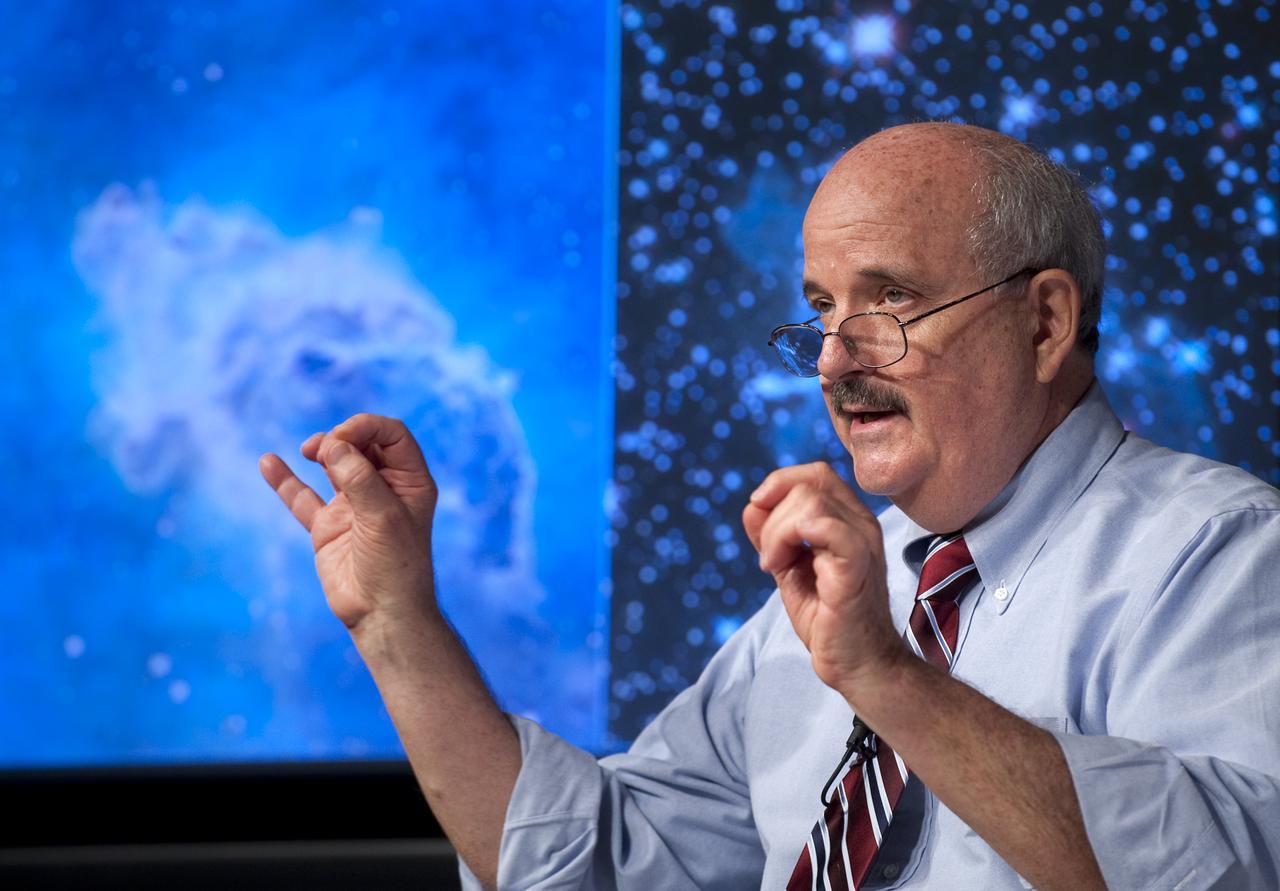
Bob O'Connell, chair of the science oversight committee for the NASA Hubble Space Telescope Wide Field Camera 3 at the University of Virginia discusses newly released images from NASA's Hubble Space Telescope Wednesday, Sept. 9, 2009 at NASA Headquarters in Washington. The images were from four of the telescopes' six operating science instruments. Photo Credit: (NASA/Bill Ingalls)
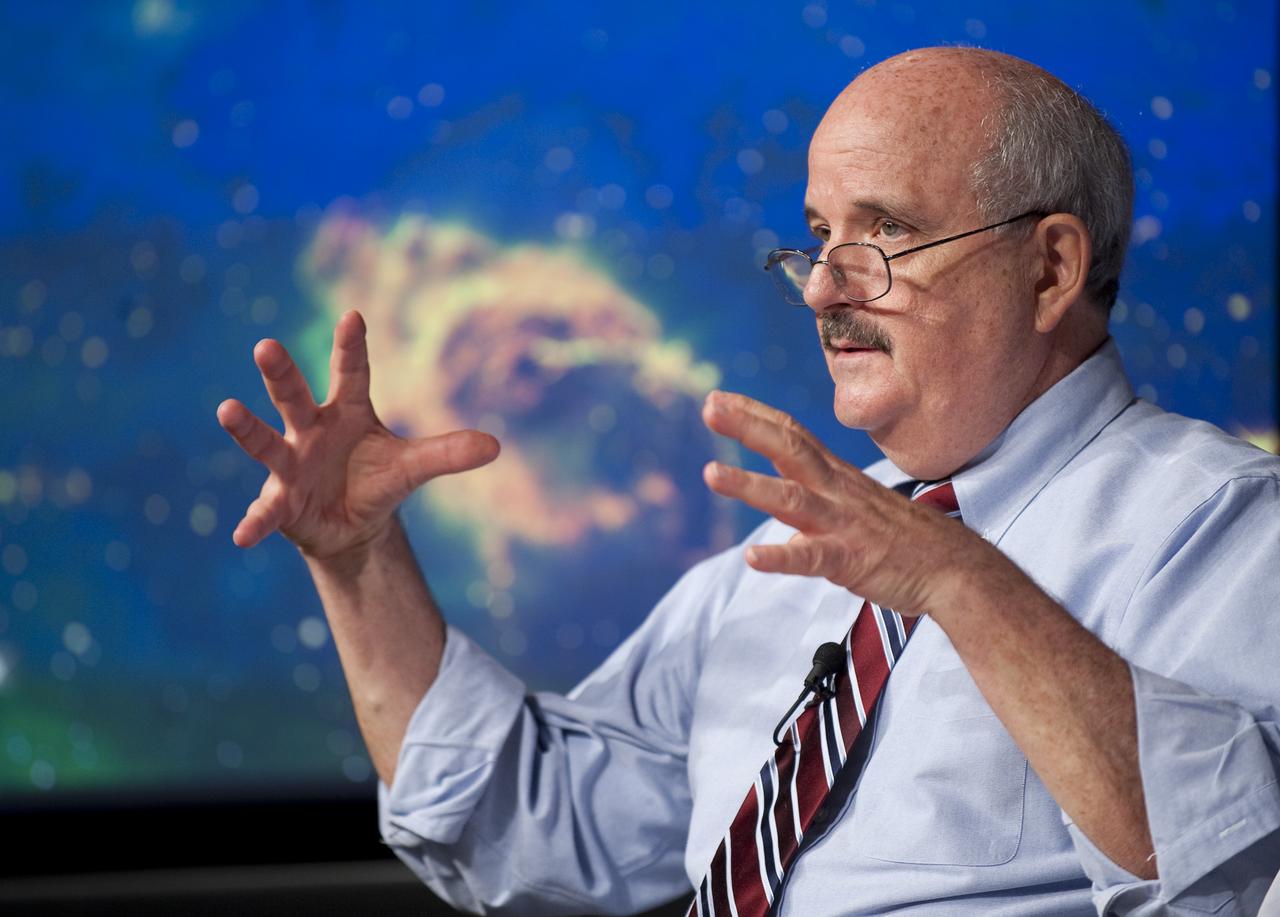
Bob O'Connell, chair of the science oversight committee for the NASA Hubble Space Telescope Wide Field Camera 3 at the University of Virginia discusses newly released images from NASA's Hubble Space Telescope Wednesday, Sept. 9, 2009 at NASA Headquarters in Washington. The images were from four of the telescopes' six operating science instruments. Photo Credit: (NASA/Bill Ingalls)
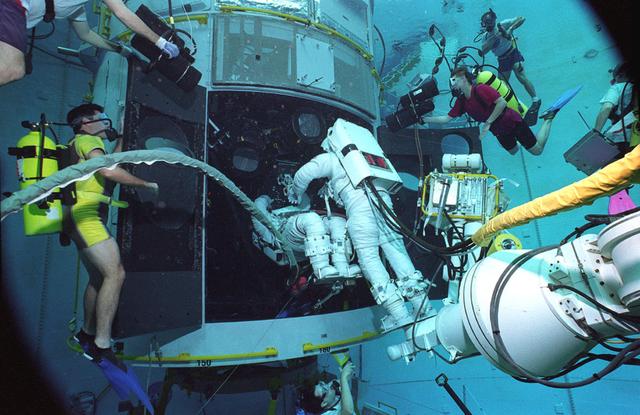
Astronauts Greg Harbaugh and Steve Smith conduct Hubble Space Telescope (HST) training in Marshall's Neutral Buoyancy Simulator (NBS).
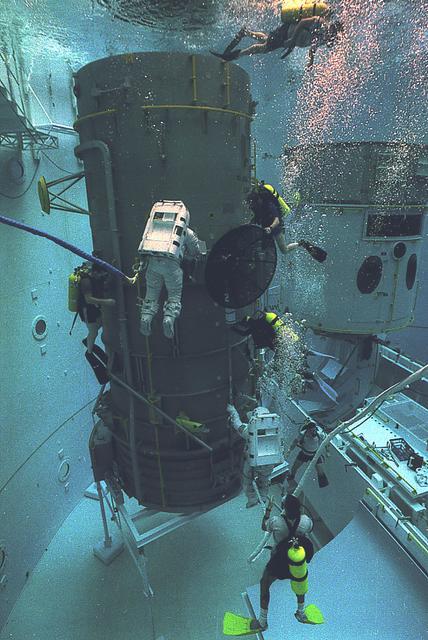
Underwater training is conducted in Marshall's Neutral Buoyancy Simulator (NBS) in preparation for on-orbit Hubble Space Telescope operations.
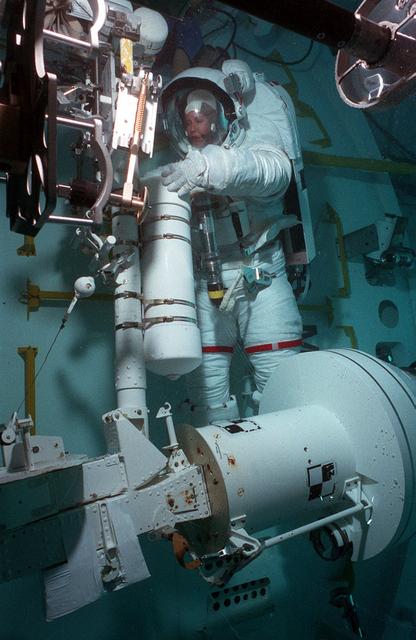
Astronaut Kathy Thornton conducts Hubble Space Telescope training in Marshall's Neutral Buoyancy Simulator (NBS).
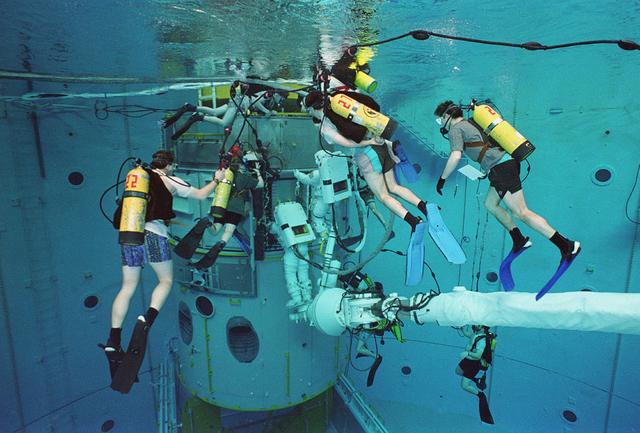
Underwater training is conducted in Marshall's Neutral Buoyancy Simulator (NBS) in preparation for on-orbit Hubble Space Telescope operations.
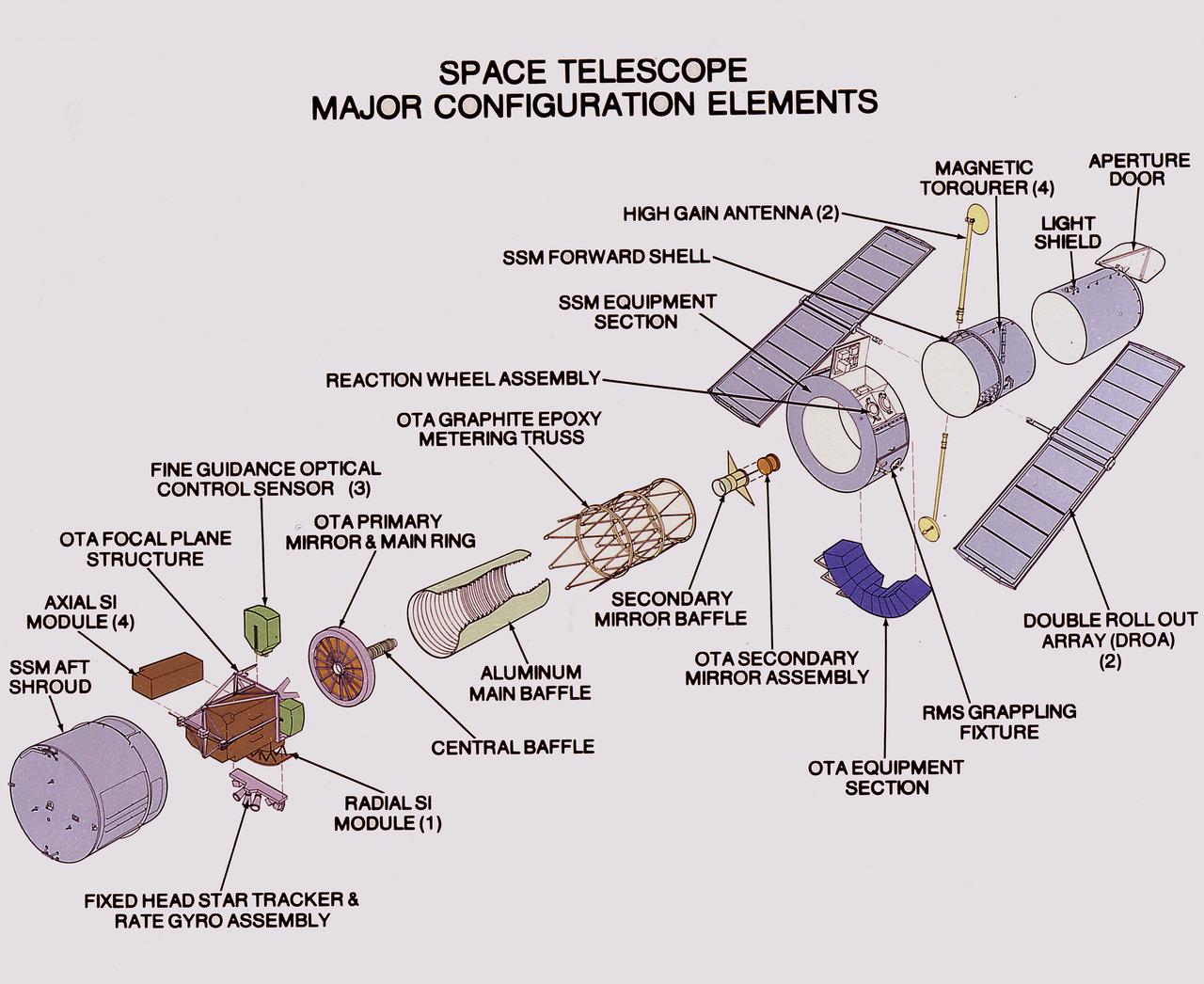
This illustration shows the Hubble Space Telescope's (HST's) major configuration elements. The spacecraft has three interacting systems: The Support System Module (SSM), an outer structure that houses the other systems and provides services such as power, communication, and control; The Optical Telescope Assembly (OTA), which collects and concentrates the incoming light in the focal plane for use by the Scientific Instruments (SI); and five SIs. The SI Control and Data Handling (CDH) unit controls the five SI's, four that are housed in an aft section focal plane structure and one that is placed along the circumference of the spacecraft. The purpose of the HST, the most complex and sensitive optical telescope ever made, is to study the cosmos from a low-Earth orbit. By placing the telescope in space, astronomers are able to collect data that is free of the Earth's atmosphere. The HST detects objects 25 times fainter than the dimmest objects seen from Earth and provides astronomers with an observable universe 250 times larger than visible from ground-based telescopes, perhaps as far away as 14 billion light-years. The HST views galaxies, stars, planets, comets, possibly other solar systems, and even unusual phenomena such as quasars, with 10 times the clarity of ground-based telescopes. The HST was deployed from the Space Shuttle Discovery (STS-31 mission) into Earth orbit in April 1990. The Marshall Space Flight Center had responsibility for design, development, and construction of the HST. The Perkin-Elmer Corporation, in Danbury, Cornecticut, developed the optical system and guidance sensors. The Lockheed Missile and Space Company of Sunnyvale, California produced the protective outer shroud and spacecraft systems, and assembled and tested the finished telescope.

David Leckrone, senior project scientist for Hubble at NASA's Goddard Space Flight Center in Greenbelt, Md. discusses newly released images from NASA's Hubble Space Telescope Wednesday, Sept. 9, 2009 at NASA Headquarters in Washington. The images were from four of the telescopes' six operating science instruments. Photo Credit: (NASA/Bill Ingalls)
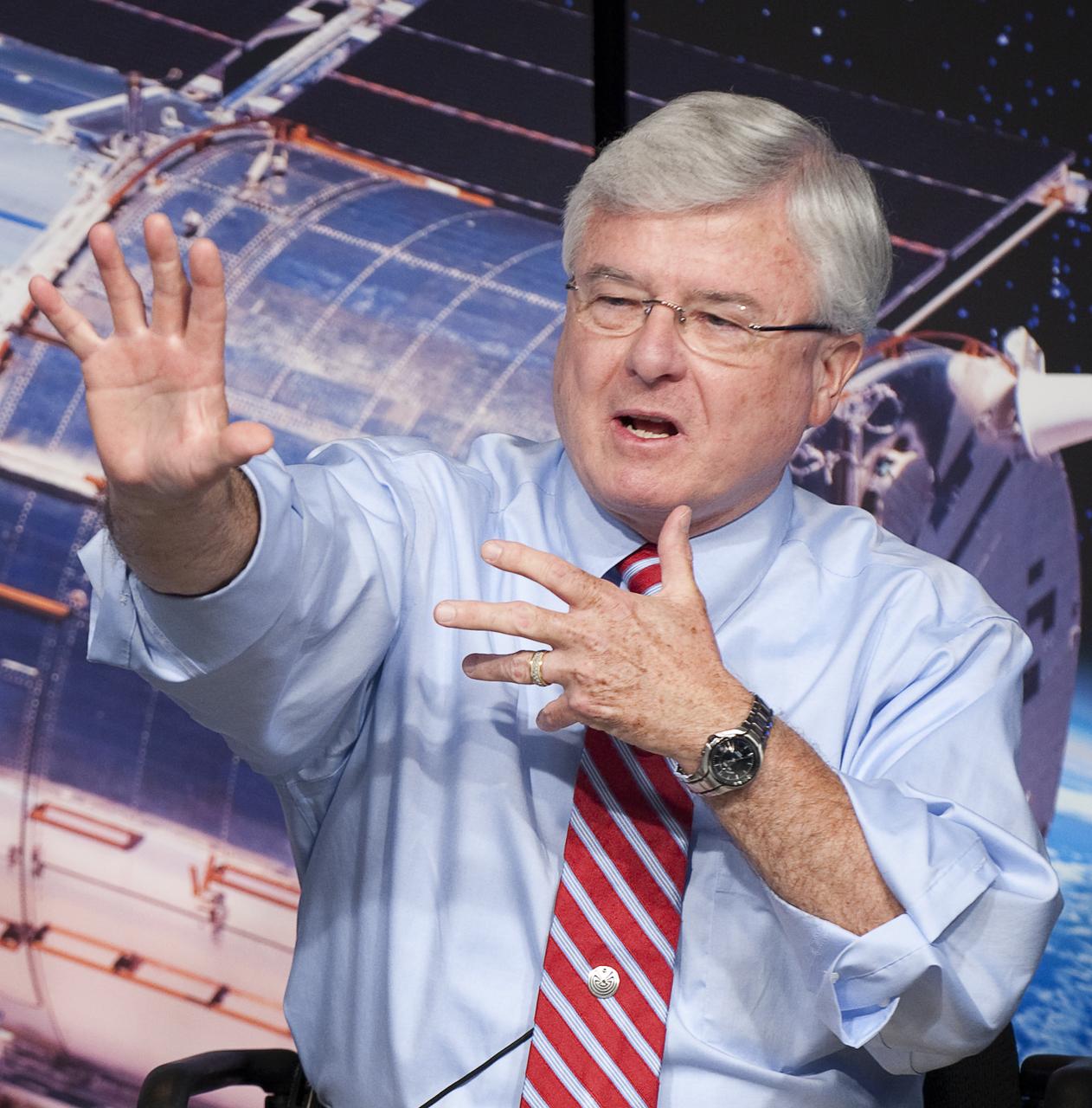
David Leckrone, senior project scientist for Hubble at NASA's Goddard Space Flight Center in Greenbelt, Md. discusses newly released images from NASA's Hubble Space Telescope Wednesday, Sept. 9, 2009 at NASA Headquarters in Washington. The images were from four of the telescopes' six operating science instruments. Photo Credit: (NASA/Bill Ingalls)

Heidi Hammel, senior research scientist at the Space Science Institute in Boulder, Colorado discusses newly released images from NASA's Hubble Space Telescope Wednesday, Sept. 9, 2009 at NASA Headquarters in Washington. The images were from four of the telescopes' six operating science instruments. Photo Credit: (NASA/Bill Ingalls)
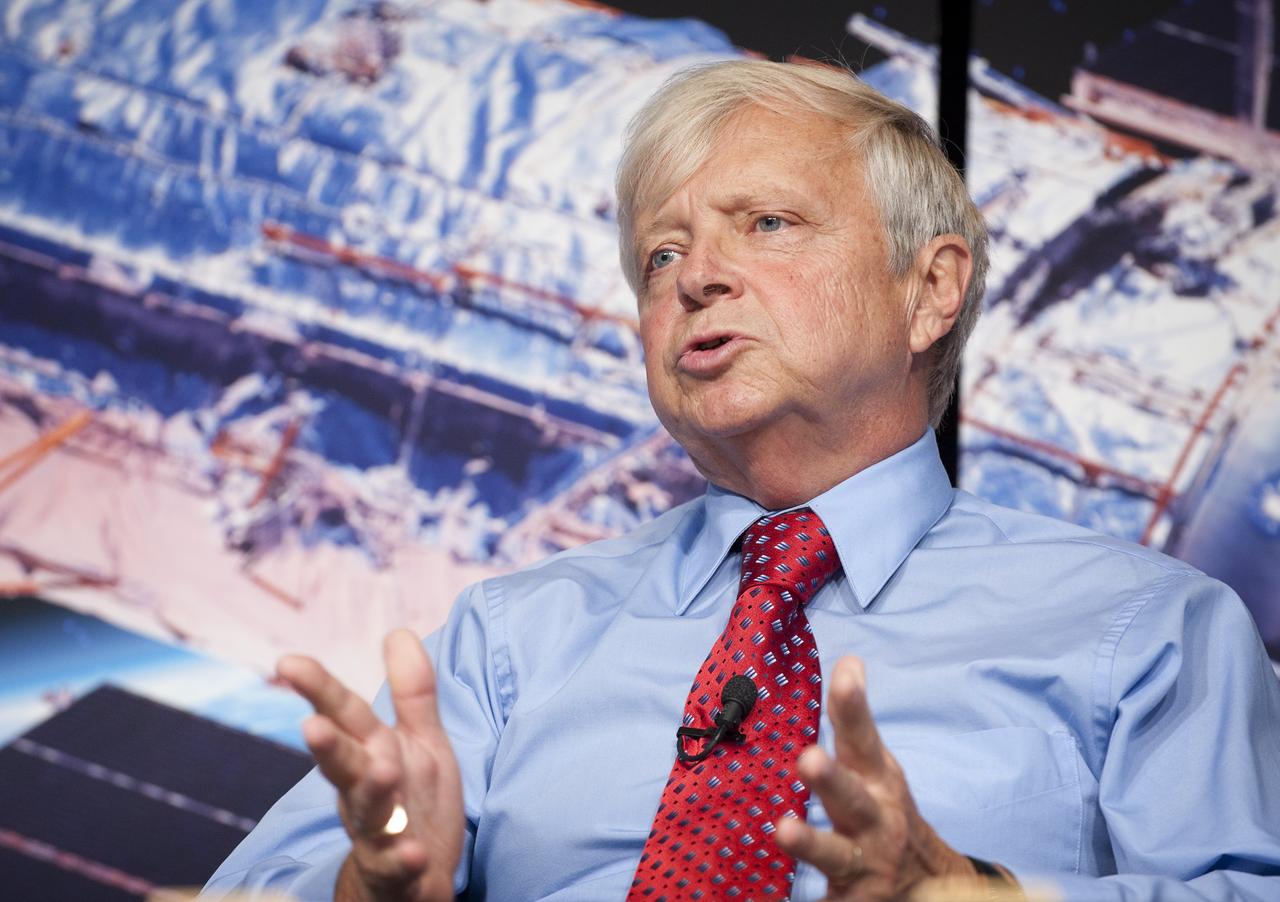
NASA Associate Administrator of the Science Mission Directorate Dr. Edward J. Weiler discusses newly released images from NASA's Hubble Space Telescope Wednesday, Sept. 9, 2009 at NASA Headquarters in Washington. The images were from four of the telescopes' six operating science instruments. Photo Credit: (NASA/Bill Ingalls)
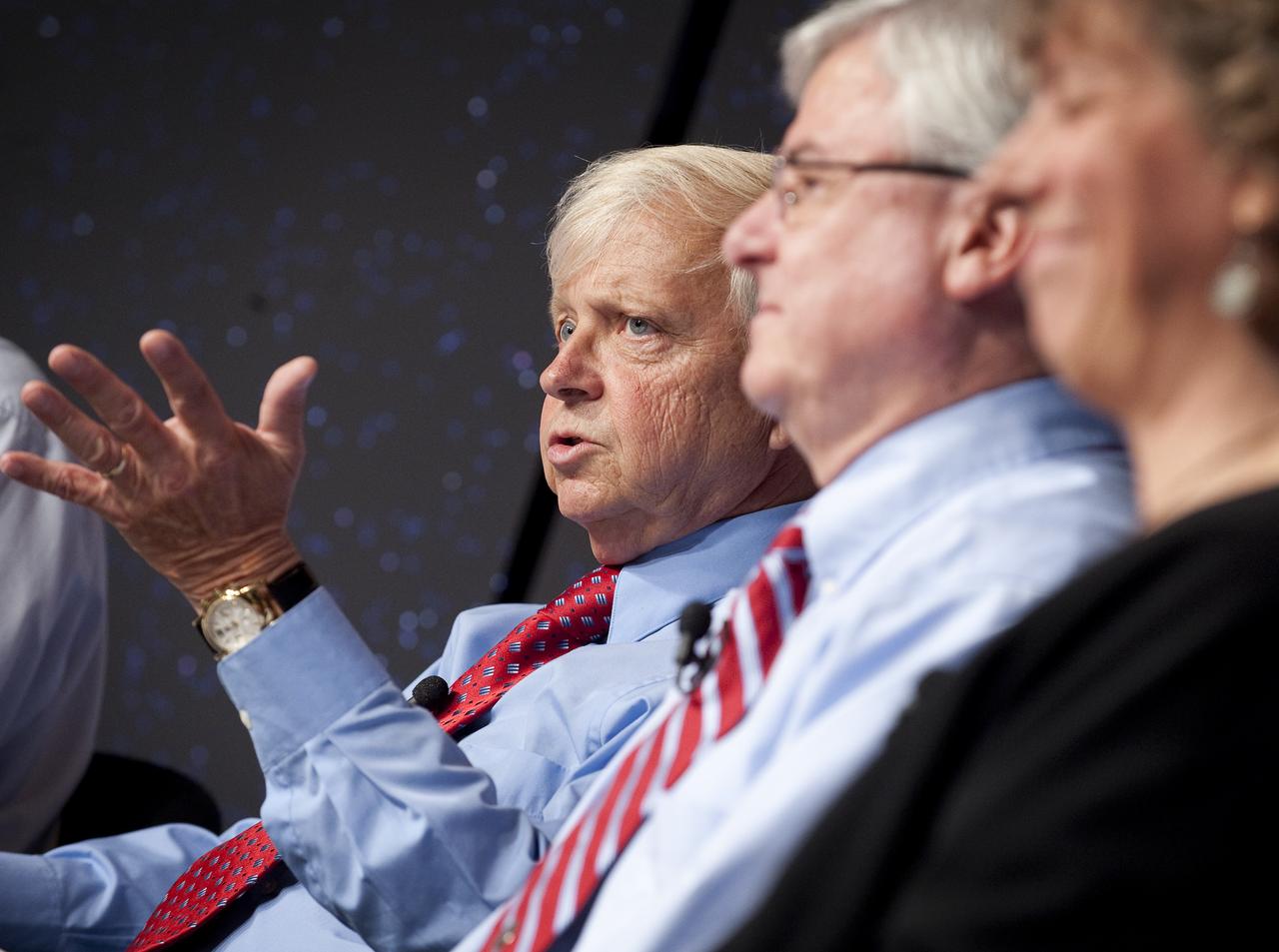
NASA Associate Administrator of the Science Mission Directorate Dr. Edward J. Weiler discusses newly released images from NASA's Hubble Space Telescope Wednesday, Sept. 9, 2009 at NASA Headquarters in Washington. The images were from four of the telescopes' six operating science instruments. Photo Credit: (NASA/Bill Ingalls)

NASA Associate Administrator of the Science Mission Directorate Dr. Edward J. Weiler discusses newly released images from NASA's Hubble Space Telescope Wednesday, Sept. 9, 2009 at NASA Headquarters in Washington. The images were from four of the telescopes' six operating science instruments. Photo Credit: (NASA/Bill Ingalls)
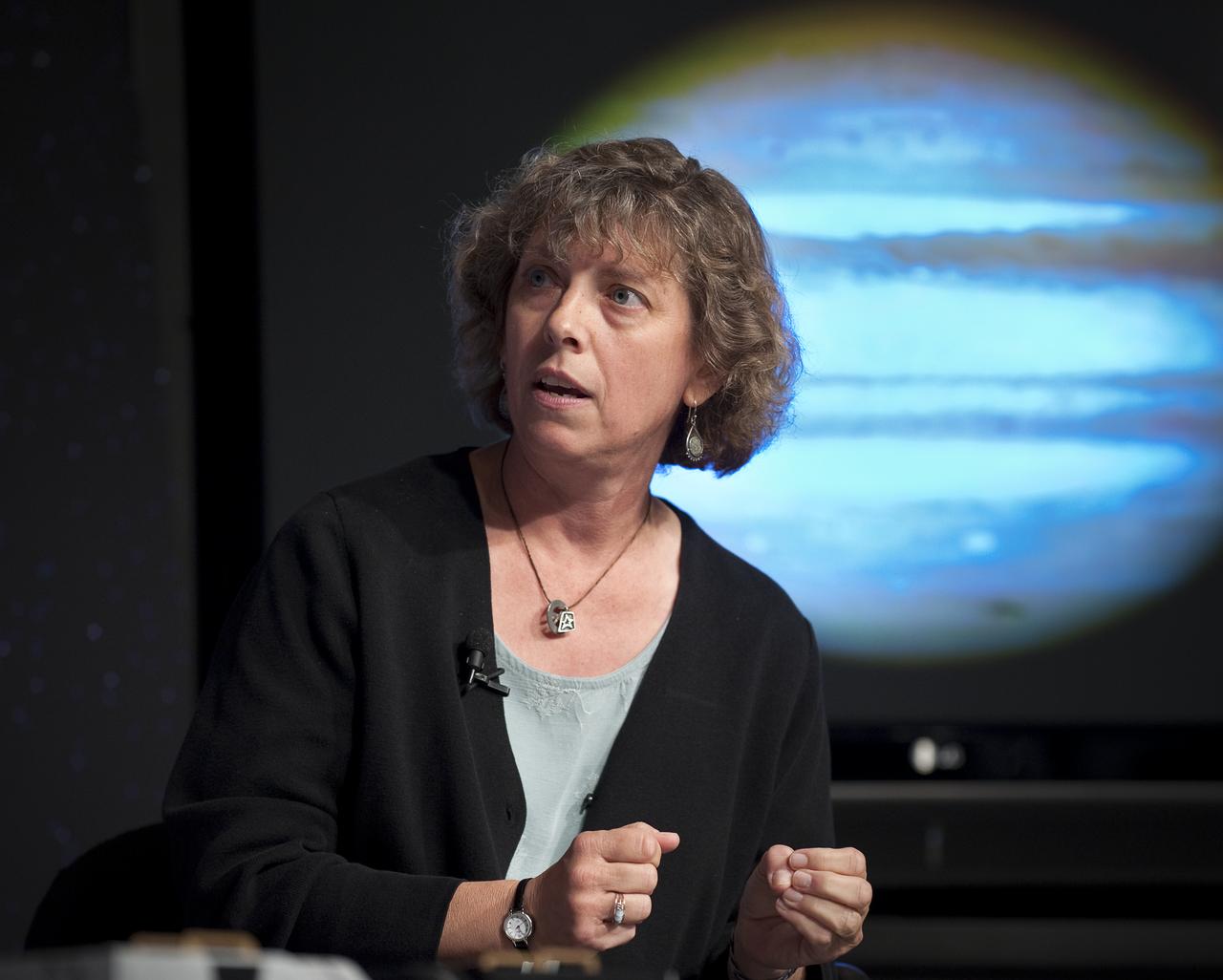
Heidi Hammel, senior research scientist at the Space Science Institute in Boulder, Colorado discusses newly released images from NASA's Hubble Space Telescope Wednesday, Sept. 9, 2009 at NASA Headquarters in Washington. The images were from four of the telescopes' six operating science instruments. Photo Credit: (NASA/Bill Ingalls)
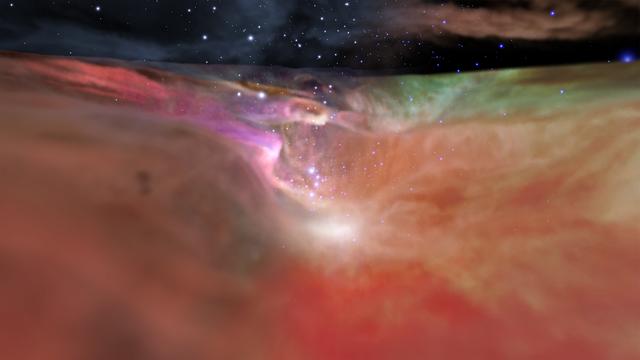
This image showcases both the visible and infrared visualizations of the Orion Nebula. This view from a movie sequence looks down the 'valley' leading to the star cluster at the far end. The left side of the image shows the visible-light visualization, which fades to the infrared-light visualization on the right. These two contrasting models derive from observations by the Hubble and Spitzer space telescopes. An animation is available at https://photojournal.jpl.nasa.gov/catalog/PIA22089
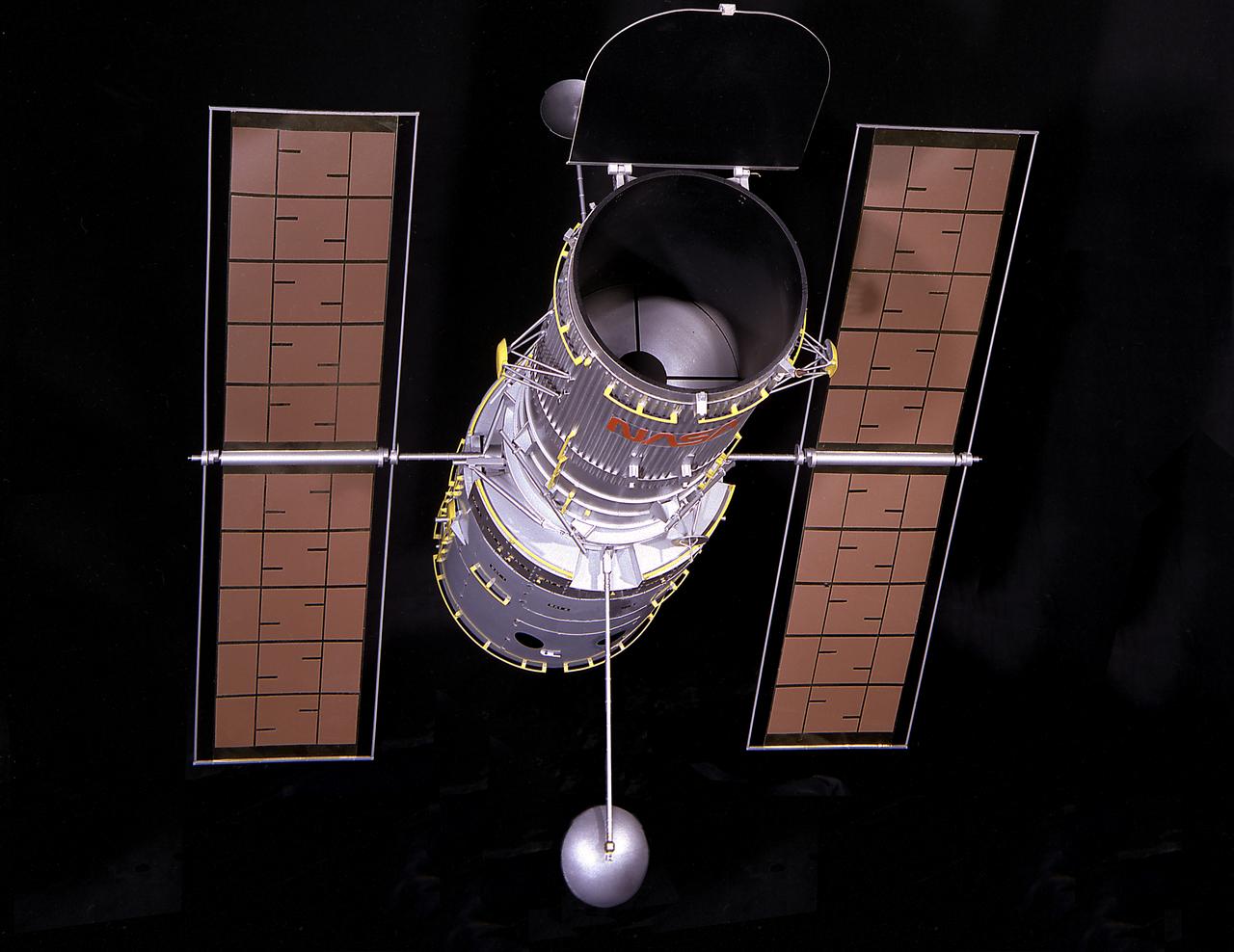
This is a photograph of a 1/15 scale model of the Hubble Space Telescope (HST). The HST is the product of a partnership between NASA, European Space Agency Contractors, and the international community of astronomers. It is named after Edwin P. Hubble, an American Astronomer who discovered the expanding nature of the universe and was the first to realize the true nature of galaxies. The purpose of the HST, the most complex and sensitive optical telescope ever made, is to study the cosmos from a low-Earth orbit. By placing the telescope in space, astronomers are able to collect data that is free of the Earth's atmosphere. The HST detects objects 25 times fainter than the dimmest objects seen from Earth and provides astronomers with an observable universe 250 times larger than visible from ground-based telescopes, perhaps as far away as 14 billion light-years. The HST views galaxies, stars, planets, comets, possibly other solar systems, and even unusual phenomena such as quasars, with 10 times the clarity of ground-based telescopes. The major elements of the HST are the Optical Telescope Assembly (OTA), the Support System Module (SSM), and the Scientific Instruments (SI). The HST is 42.5-feet (13- meters) long and weighs about 25,000 pounds (11,600 kilograms). The HST was deployed from the Space Shuttle Discovery (STS-31 mission) into Earth orbit in April 1990. The Marshall Space Flight Center had responsibility for design, development, and construction of the HST. The Perkin-Elmer Corporation, in Danbury, Cornecticut, developed the optical system and guidance sensors. The Lockheed Missile and Space Company of Sunnyvale, California produced the protective outer shroud and spacecraft systems, and assembled and tested the finished telescope.
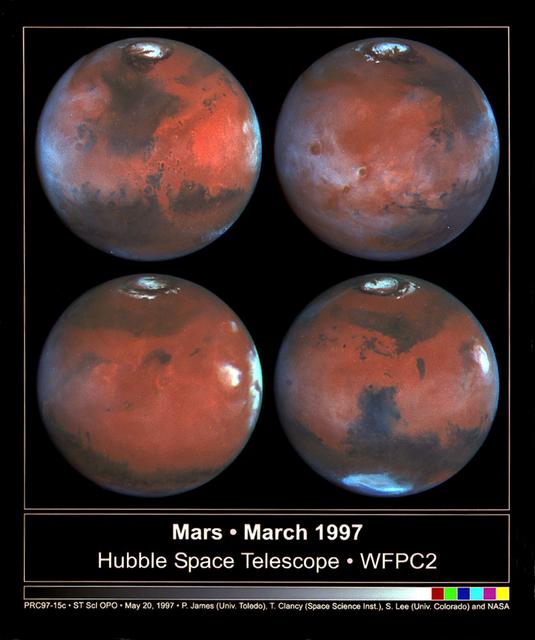
This photograph depicts four Mars views in northern summer provided by the Hubble Space Telescope (HST). The upper left view is centered on Ares Valles where Pathfinder landed in July 1997. Upper right is the Tharsis volcanic region and its associated cloud in the western half of the view. Olympus Mons lies near the western limb, Arsi Mons, Pavonis Mons Ascraeus Mons are to the west of the the center, and Valles Marineris is to the east. The lower Left view shows the Elysium volcanic region in the west, the Tharsis volcanos in East, and Cerberus is left of the center. In the lower right view, the Dark Syrtis Major region, Eysium Mons and Hellas are featured.
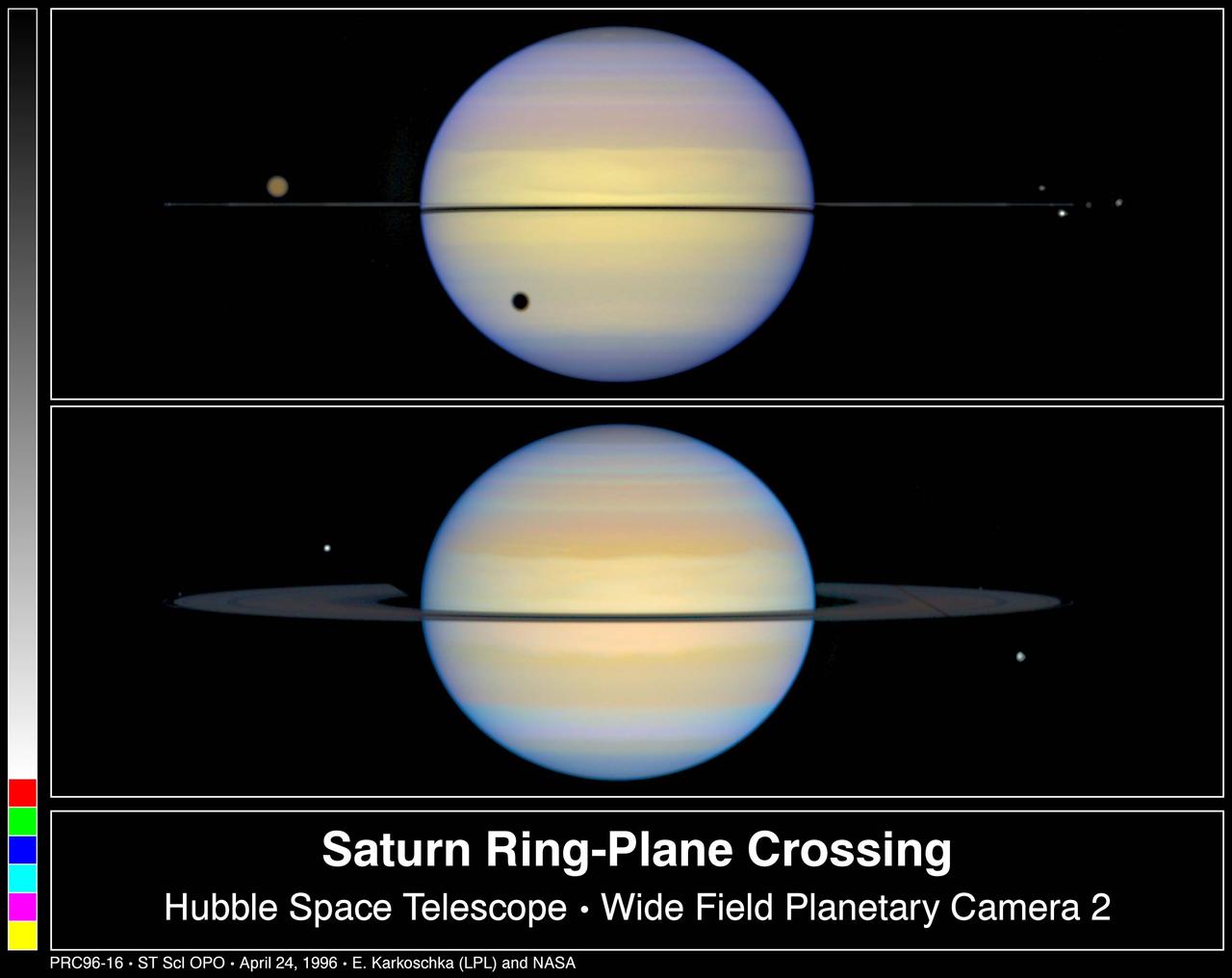
Astronomers are studying the unusual appearance of Saturn's rings. The top portion of this Hubble Space Telescope snapshot shows Saturn with its rings barely visible. Normally, astronomers see Saturn with its rings tilted, but because the Earth was almost in the plane of Saturn's rings, they appear edge-on. Positioned above the ring plane, the Sun is causing the rings to cast a shadow on Saturn. The bottom photograph shows Saturn with its rings slightly tilted, and displays a faint narrow ring, the F-ring, just outside the main ring, which is normally invisible from Earth. The moon called Dion, on the lower right, is casting a long, thin shadow across the whole ring system due to the setting of the sun on the ring plane.
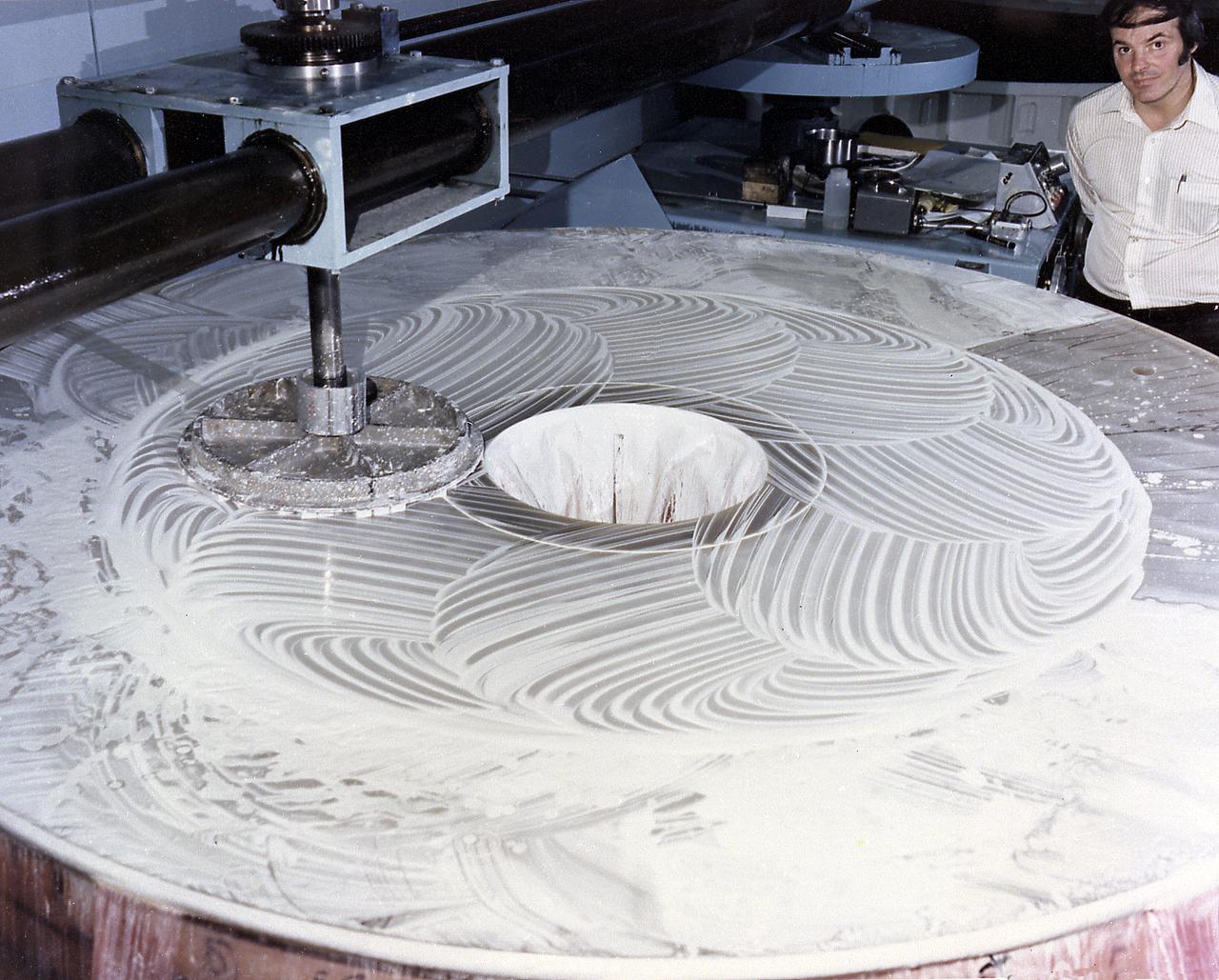
This photograph shows the Hubble Space Telescope's (HST's) Primary Mirror being polished at the the Perkin-Elmer Corporation's large optics fabrication facility. After the 8-foot diameter mirror was ground to shape and polished, the glass surface was coated with a reflective layer of aluminum and a protective layer of magnesium fluoride, 0.1- and 0.025-micrometers thick, respectively. The purpose of the HST, the most complex and sensitive optical telescope ever made, is to study the cosmos from a low-Earth orbit. By placing the telescope in space, astronomers are able to collect data that is free of the Earth's atmosphere. The Marshall Space Flight Center had responsibility for design, development, and construction of the HST and the Perkin-Elmer Corporation, in Danbury, Cornecticut, developed the optical system and guidance sensors.
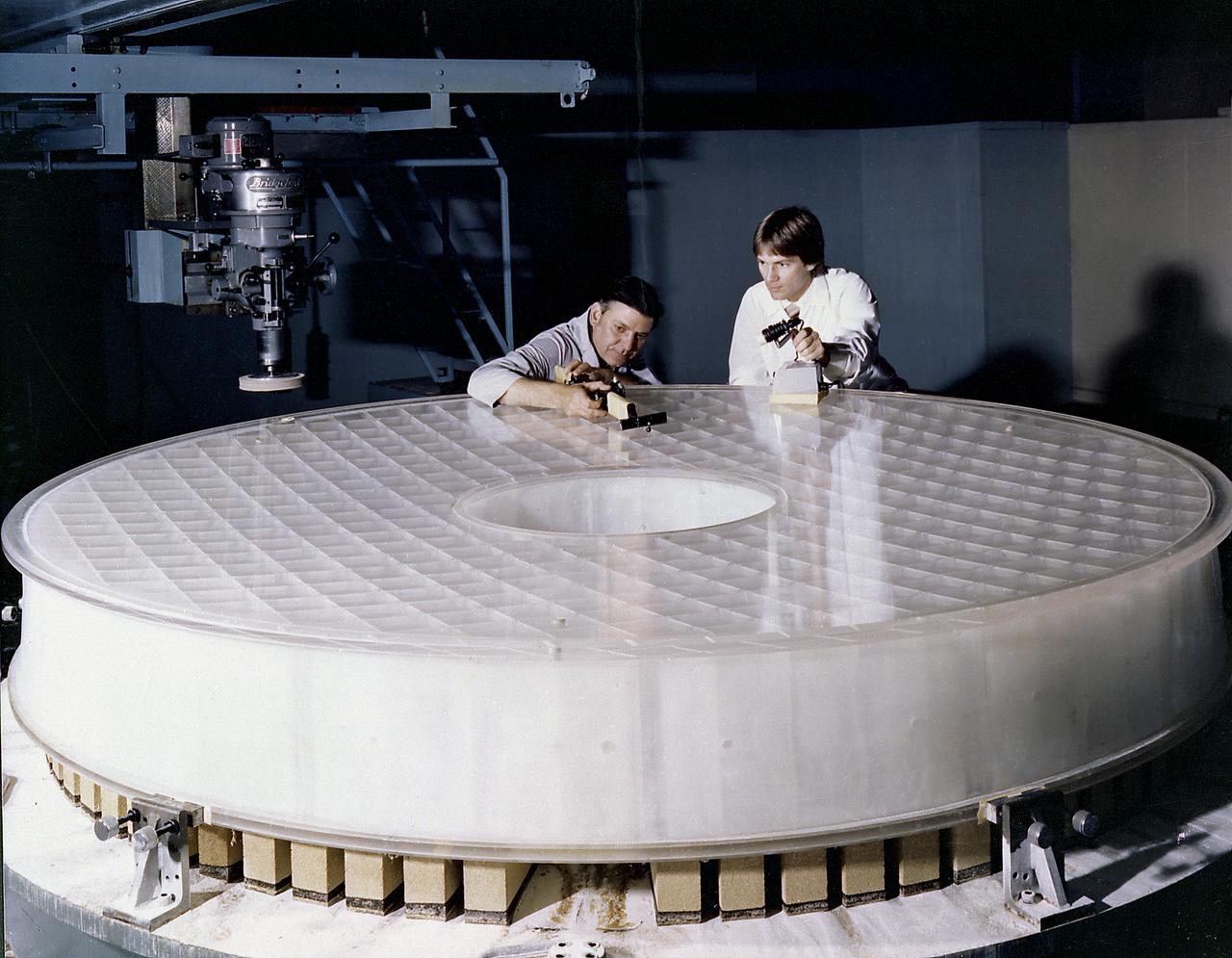
This photograph shows engineers inspecting the Hubble Space Telescope's (HST's) Primary Mirror at the Perkin-Elmer Corporation's large optics fabrication facility. After the 8-foot diameter mirror was ground to shape and polished, the glass surface was coated with a reflective layer of aluminum and a protective layer of magnesium fluoride, 0.1- and 0.025- micrometers thick, respectively. The purpose of the HST, the most complex and sensitive optical telescope ever made, is to study the cosmos from a low-Earth orbit. By placing the telescope in space, astronomers are able to collect data that is free of the Earth's atmosphere. The Marshall Space Flight Center had responsibility for design, development, and construction of the HST and the Perkin-Elmer Corporation, in Danbury, Cornecticut, developed the optical system and guidance sensors.
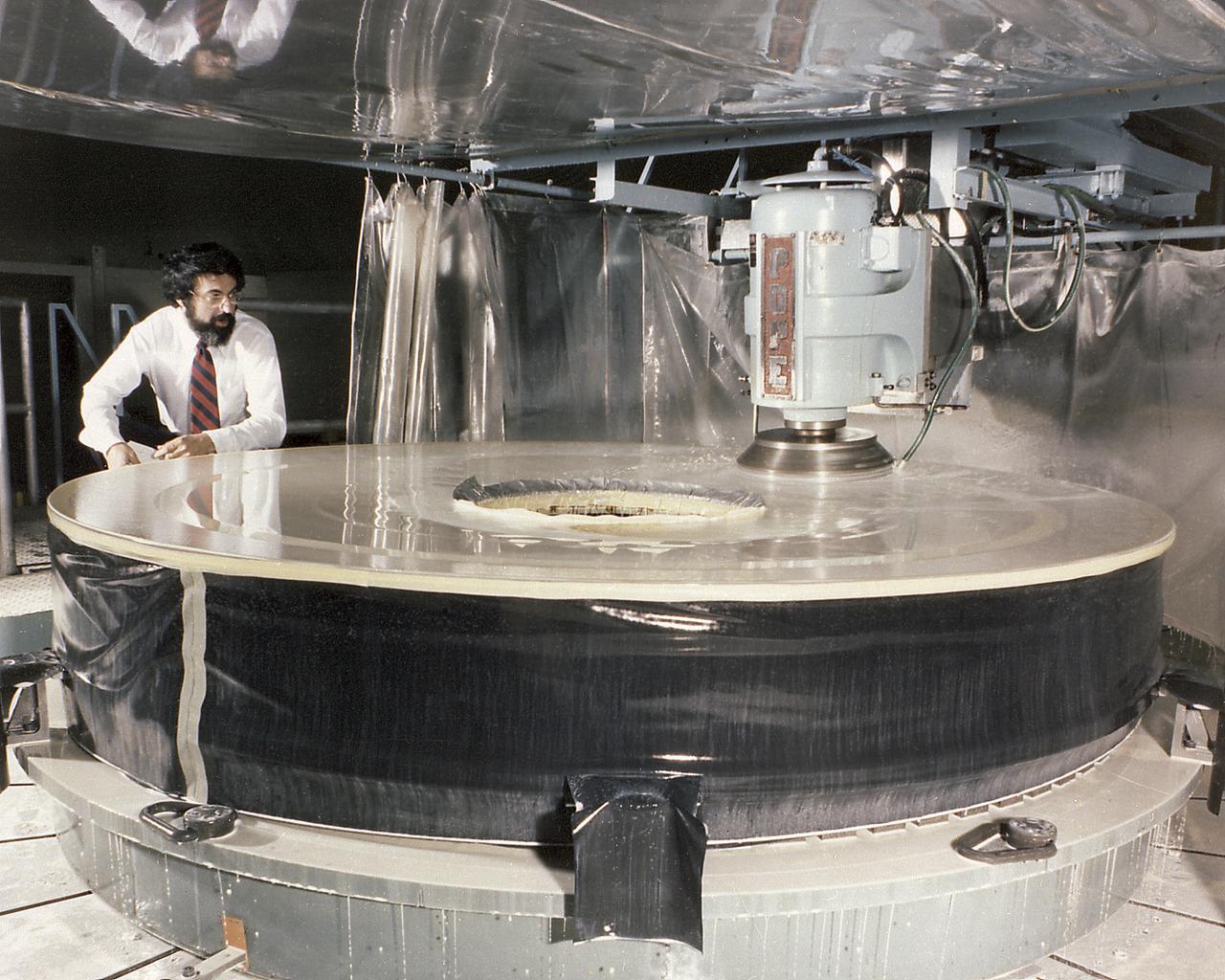
This photograph shows the Hubble Space Telescope's (HST's) Primary Mirror being ground at the Perkin-Elmer Corporation's large optics fabrication facility. After the 8-foot diameter mirror was ground to shape and polished, the glass surface was coated with a reflective layer of aluminum and a protective layer of magnesium fluoride, 0.1- and 0.025-micrometers thick, respectively. The purpose of the HST, the most complex and sensitive optical telescope ever made, is to study the cosmos from a low-Earth orbit. By placing the telescope in space, astronomers are able to collect data that is free of the Earth's atmosphere. The Marshall Space Flight Center had responsibility for design, development, and construction of the HST and the Perkin-Elmer Corporation, in Danbury, Cornecticut, developed the optical system and guidance sensors.

Composite image of the planet Mars taken by Hubble Space Telescope (HST) Wide Field and Planetary Camera (WFPC).

The Hubble Space Telescope hovers at the boundary of Earth and space in this picture, taken after Hubble second servicing mission in 1997. Hubble drifts 353 miles (569 km) above the Earth's surface, where it can avoid the atmosphere and clearly see objects in space. http://photojournal.jpl.nasa.gov/catalog/PIA18165
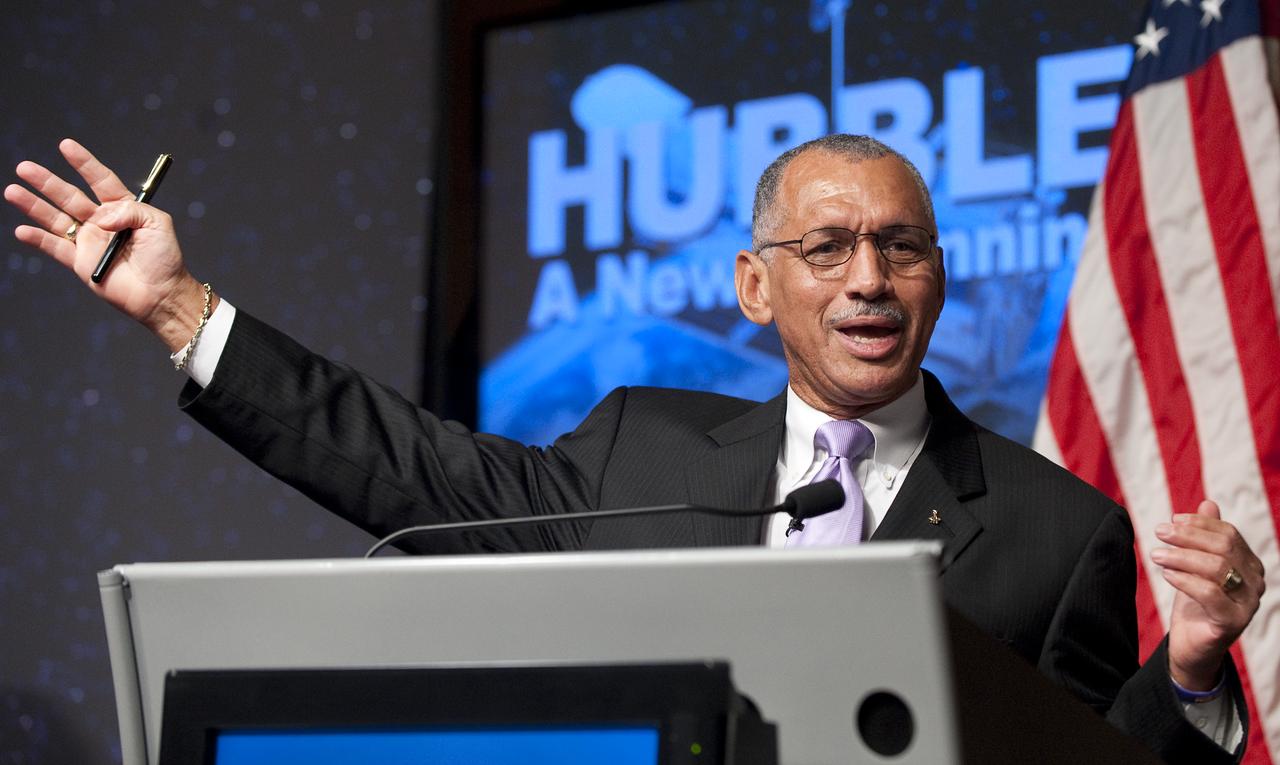
NASA Administrator Charles F. Bolden delivers his remarks during a press conference where NASA unveiled new images from the Hubble Space Telescope Wednesday, Sept. 9, 2009 at NASA Headquarters in Washington. The unveiled images were from four of the telescopes' six operating science instruments. Photo Credit: (NASA/Bill Ingalls)
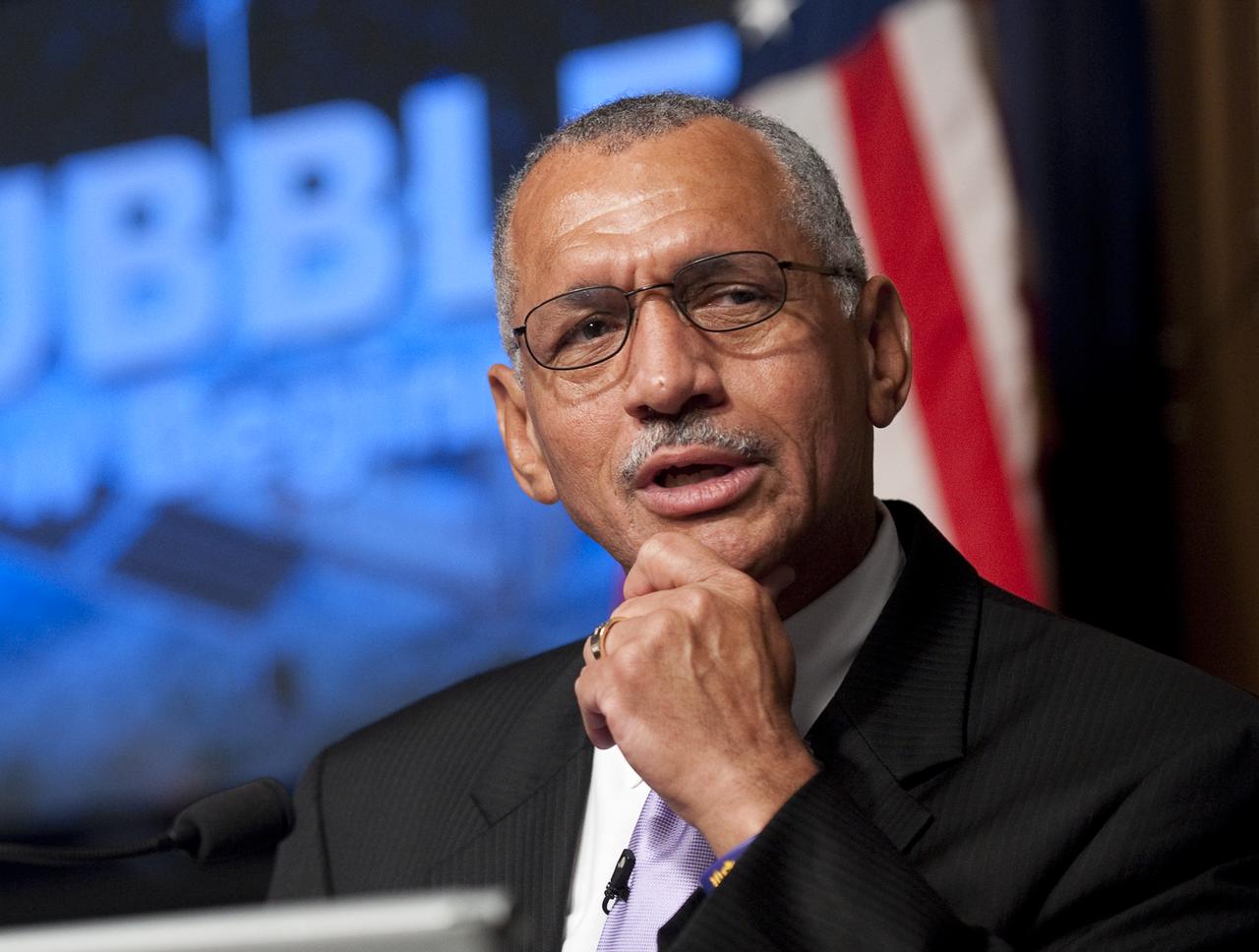
NASA Administrator Charles F. Bolden delivers his remarks during a press conference where NASA unveiled new images from the Hubble Space Telescope Wednesday, Sept. 9, 2009 at NASA Headquarters in Washington. The unveiled images were from four of the telescopes' six operating science instruments. Photo Credit: (NASA/Bill Ingalls)
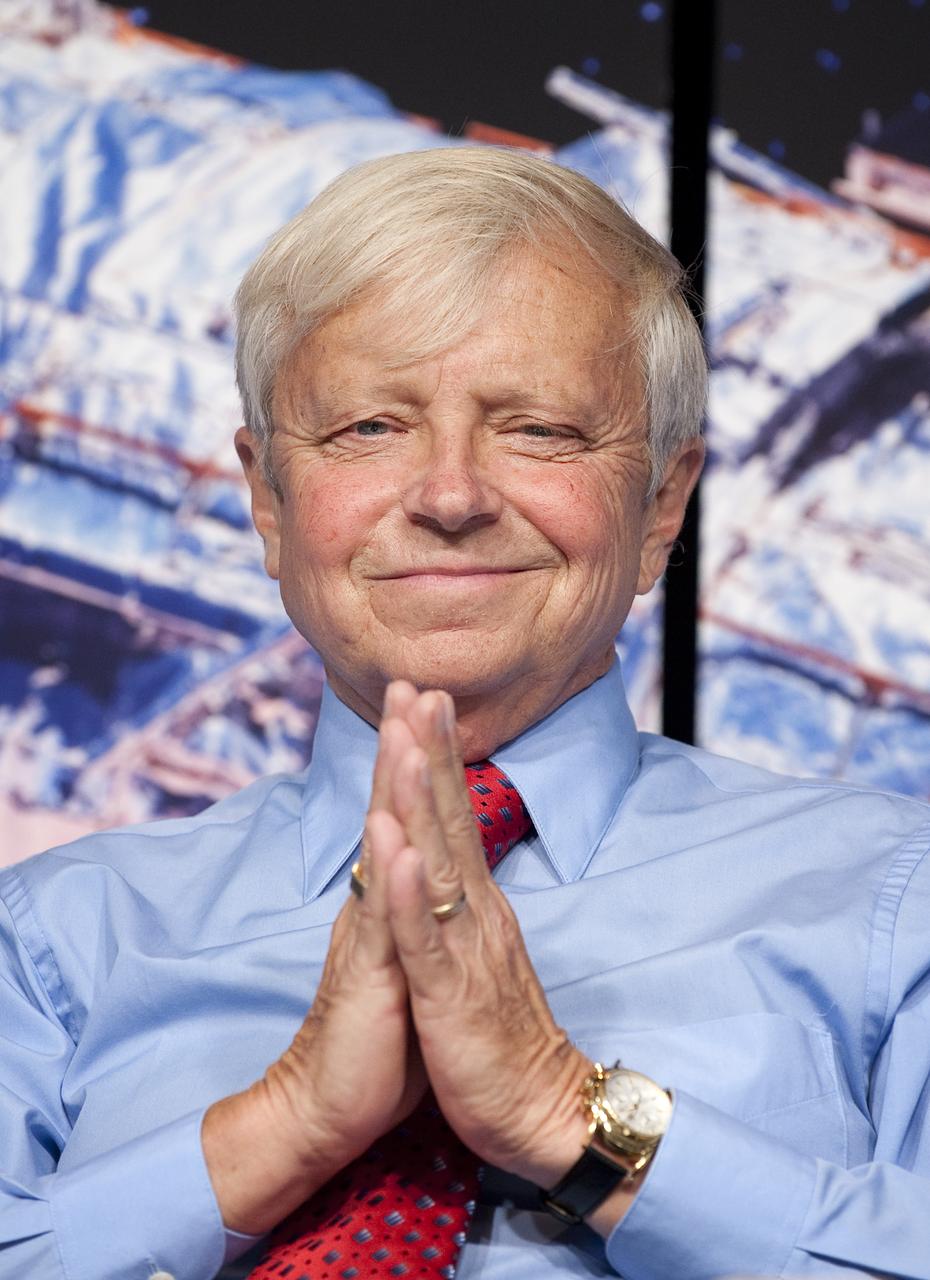
NASA Associate Administrator of the Science Mission Directorate Dr. Edward J. Weiler listens to a reporters question during a press conference where NASA released images from NASA's Hubble Space Telescope Wednesday, Sept. 9, 2009 at NASA Headquarters in Washington. The images were from four of the telescopes' six operating science instruments. Photo Credit: (NASA/Bill Ingalls)
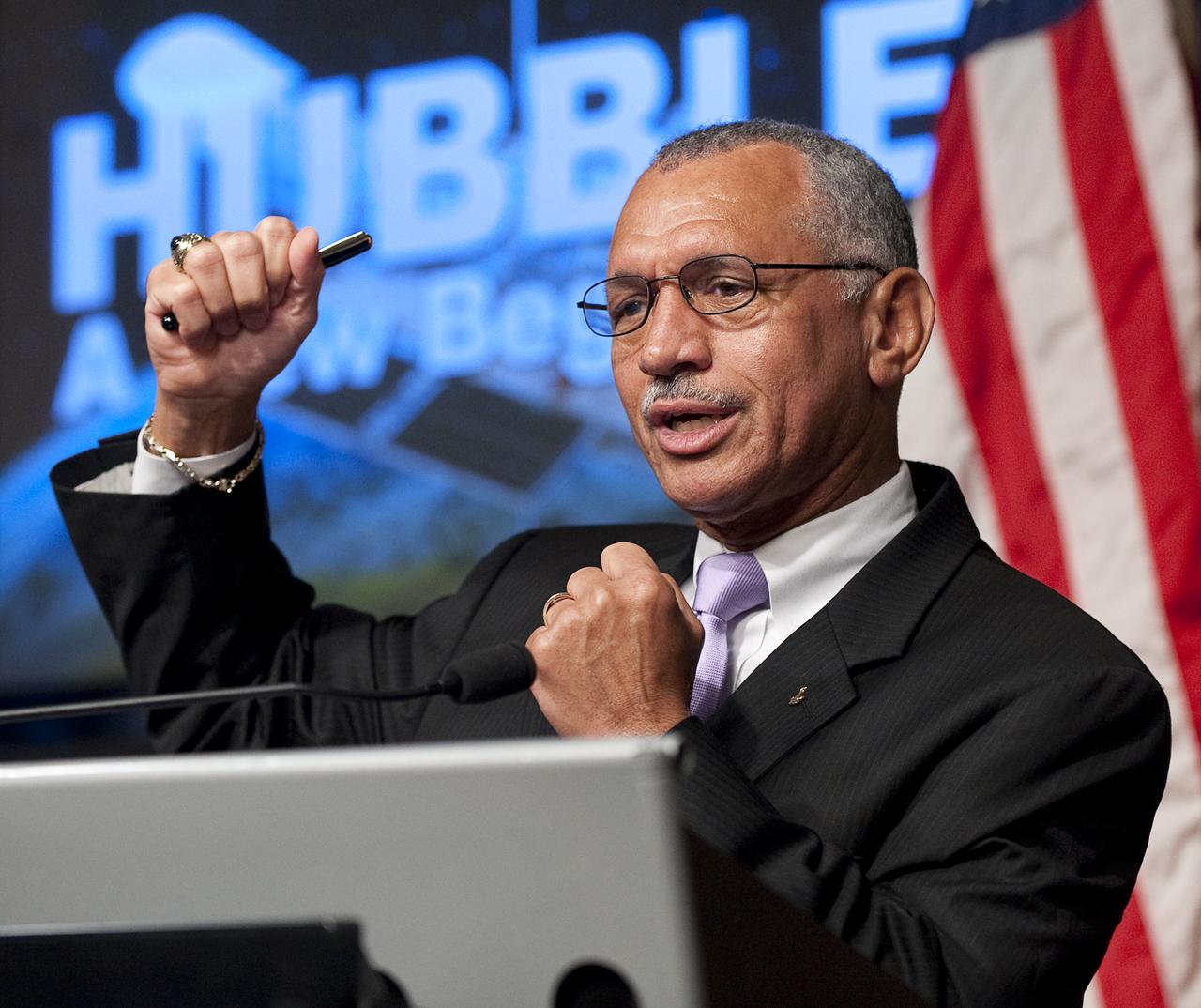
NASA Administrator Charles F. Bolden delivers his remarks during a press conference where NASA unveiled new images from the Hubble Space Telescope Wednesday, Sept. 9, 2009 at NASA Headquarters in Washington. The unveiled images were from four of the telescopes' six operating science instruments. Photo Credit: (NASA/Bill Ingalls)
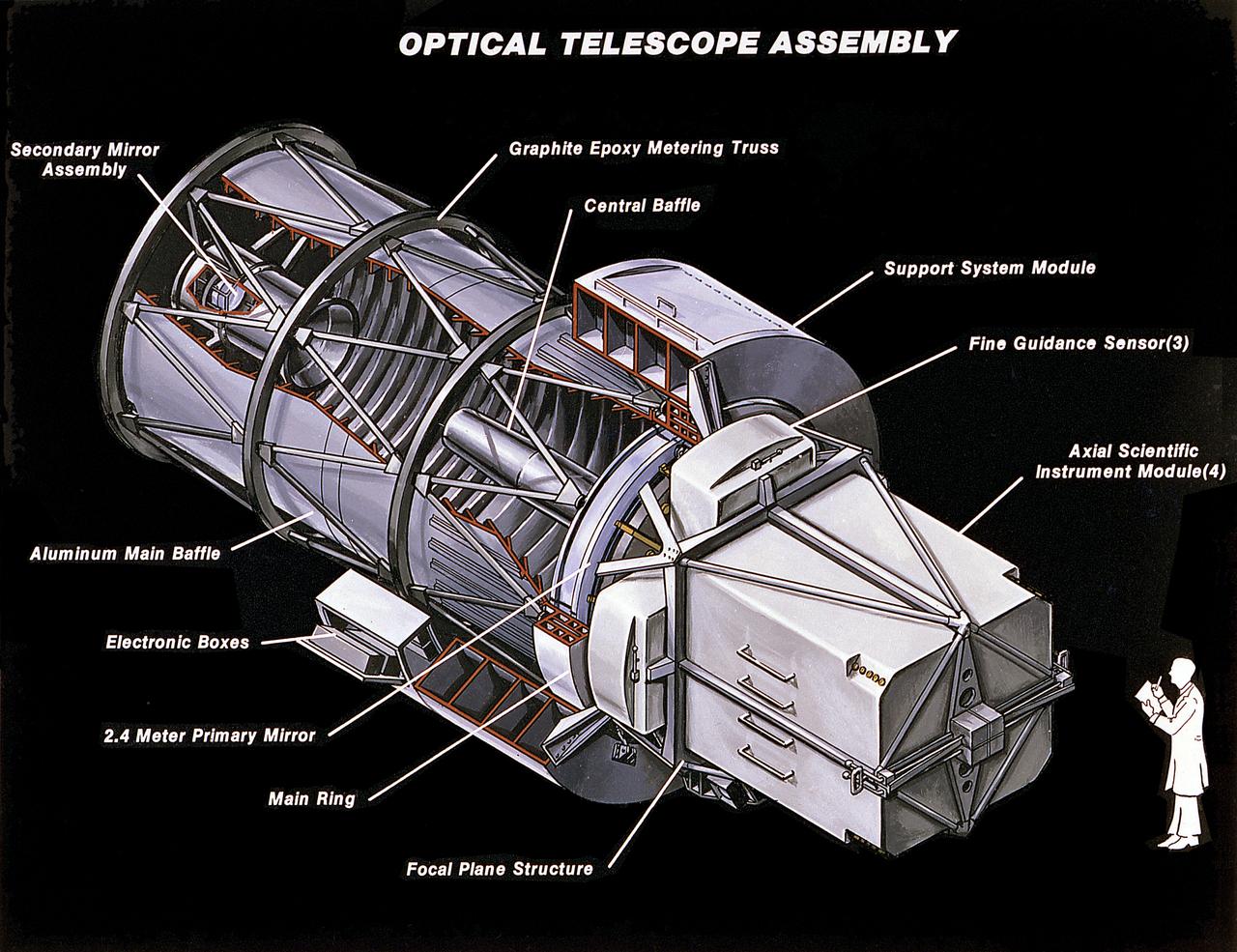
This image illustrates the Hubble Space Telescope's (HST's) Optical Telescope Assembly (OTA). One of the three major elements of the HST, the OTA consists of two mirrors (a primary mirror and a secondary mirror), support trusses, and the focal plane structure. The mirrors collect and focus light from selected celestial objects and are housed near the center of the telescope. The primary mirror captures light from objects in space and focuses it toward the secondary mirror. The secondary mirror redirects the light to a focal plane where the Scientific Instruments are located. The primary mirror is 94.5 inches (2.4 meters) in diameter and the secondary mirror is 12.2 inches (0.3 meters) in diameter. The purpose of the HST, the most complex and sensitive optical telescope ever made, is to study the cosmos from a low-Earth Orbit. By placing the telescope in space, astronomers are able to collect data that is free of the Earth's atmosphere. The HST detects objects 25 times fainter than the dimmest objects seen from the Earth and provides astronomers with an observable universe 250 times larger than visible from ground-based telescopes, perhaps as far away as 14 billion light-years. The HST views galaxies, stars, planets, comets, possibly other solar systems, and even unusual phenomena such as quasars, with 10 times the clarity of ground-based telescopes. The spacecraft is 42.5 feet (13 meters) long and weighs 25,000 pounds (11,600 kilograms). The HST was deployed from the Space Shuttle Discovery (STS-31 mission) into Earth orbit in April 1990. The Marshall Space Flight Center had responsibility for design, development, and construction of the HST. The Perkin-Elmer Corporation, in Danbury, Cornecticut, developed the optical system and guidance sensors. The Lockheed Missile and Space Company of Sunnyvale, California produced the protective outer shroud and spacecraft systems, and assembled and tested the finished telescope.
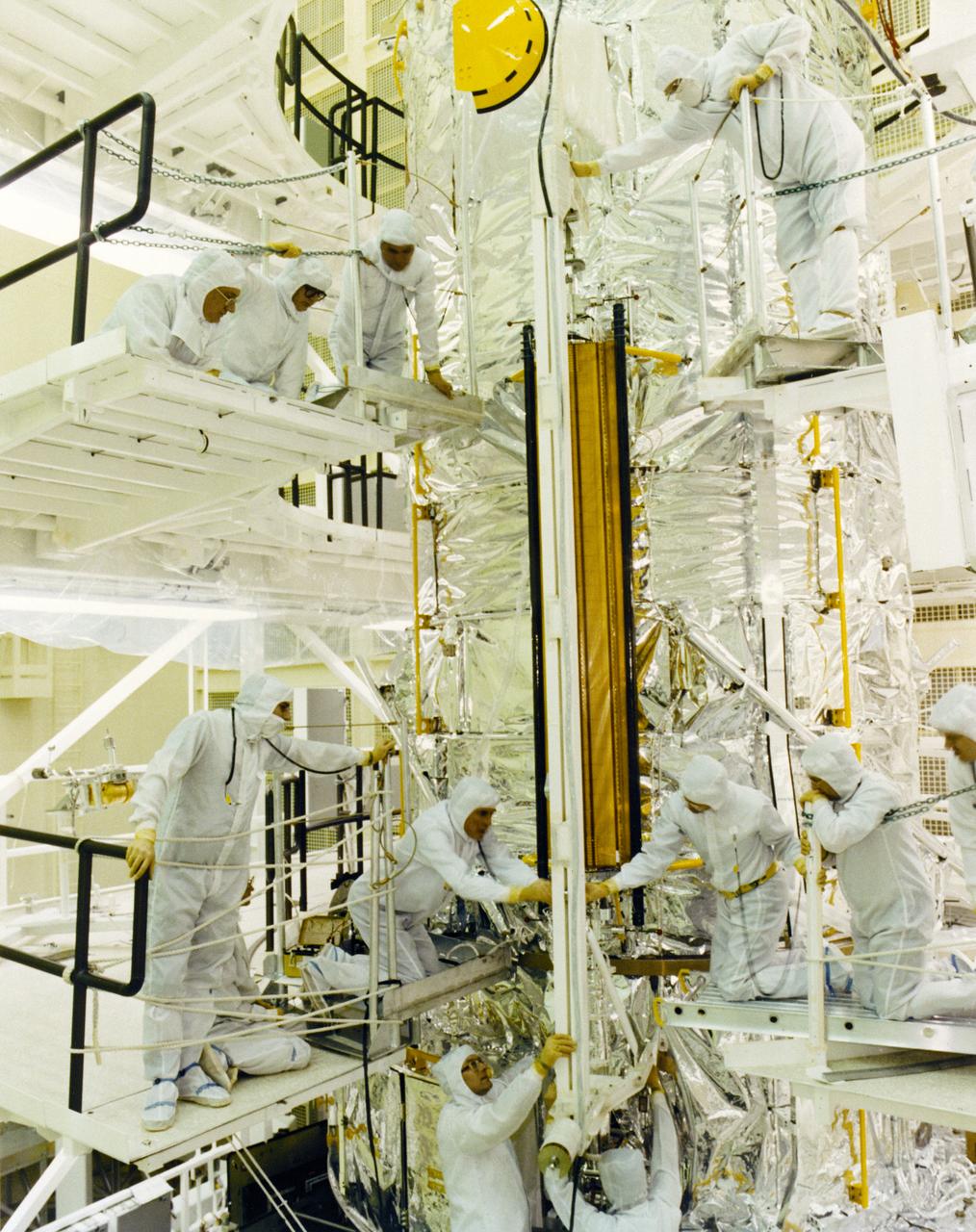
Engineers and technicians conduct a fit check of the Hubble Space Telescope (HST) Solar Array flight article in a clean room of the Lockheed Missile and Space Company. The Solar Array is 40- feet (12.1-meters) long and 8.2-feet (2.5-meters) wide, and provides power to the spacecraft. The HST is the first of NASA's great observatories and the most complex and sensitive optical telescope ever made. The purpose of the HST is to study the cosmos from a low-Earth orbit by placing the telescope in space, enabling astronomers to collect data that is free of the Earth's atmosphere. The HST was deployed from the Space Shuttle Discovery (STS-31 mission) into Earth orbit in April 1990. The Marshall Space Flight Center had overall responsibility for design, development, and construction of the HST. The Perkin-Elmer Corporation, in Danbury, Cornecticut, developed the optical system and guidance sensors. The Lockheed Missile and Space Company, Sunnyvale, California, produced the protective outer shroud and spacecraft systems, and assembled and tested the finished telescope.
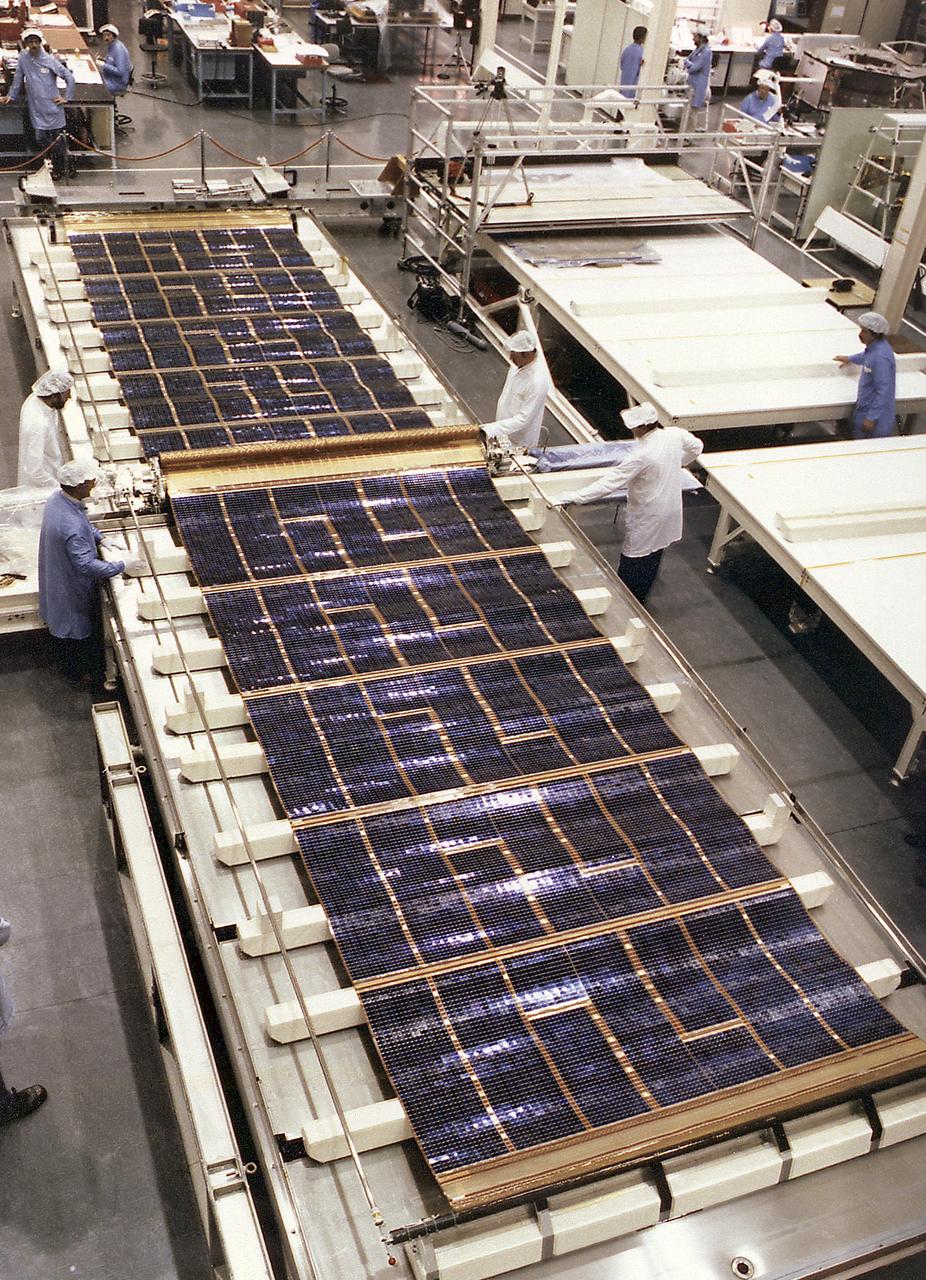
This is a view of a solar cell blanket deployed on a water table during the Solar Array deployment test. The Hubble Space Telescope (HST) Solar Arrays provide power to the spacecraft. The arrays are mounted on opposite sides of the HST, on the forward shell of the Support Systems Module. Each array stands on a 4-foot mast that supports a retractable wing of solar panels 40-feet (12.1-meters) long and 8.2-feet (2.5-meters) wide, in full extension. The arrays rotate so that the solar cells face the Sun as much as possible to harness the Sun's energy. The Space Telescope Operations Control Center at the Goddard Space Center operates the array, extending the panels and maneuvering the spacecraft to focus maximum sunlight on the arrays. The purpose of the HST, the most complex and sensitive optical telescope ever made, is to study the cosmos from a low-Earth orbit. By placing the telescope in space, astronomers are able to collect data that is free of the Earth's atmosphere. The HST Solar Array was designed by the European Space Agency and built by British Aerospace. The Marshall Space Flight Center had overall responsibility for design, development, and construction of the HST.
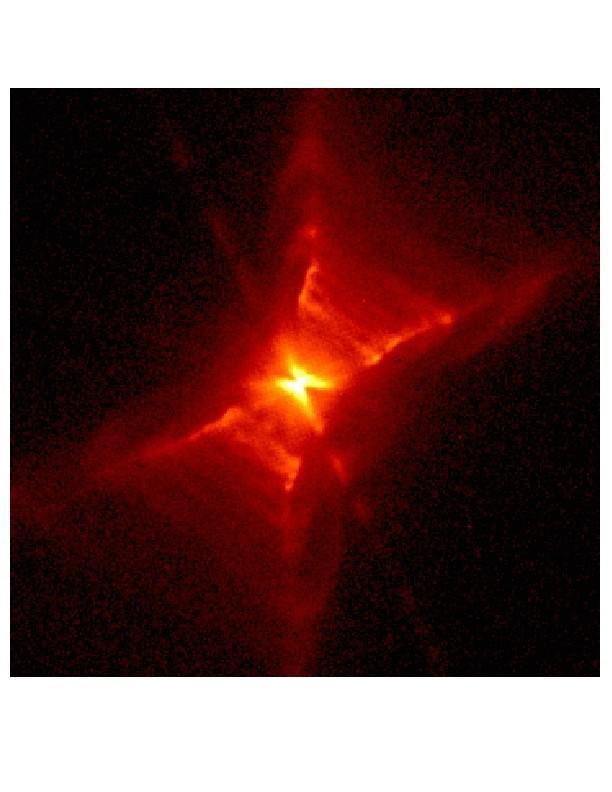
An archival image of the Red Rectangle, or HD44179, taken with the Wide Field Planetary Camera 2 onboard NASA Hubble Space Telescope.
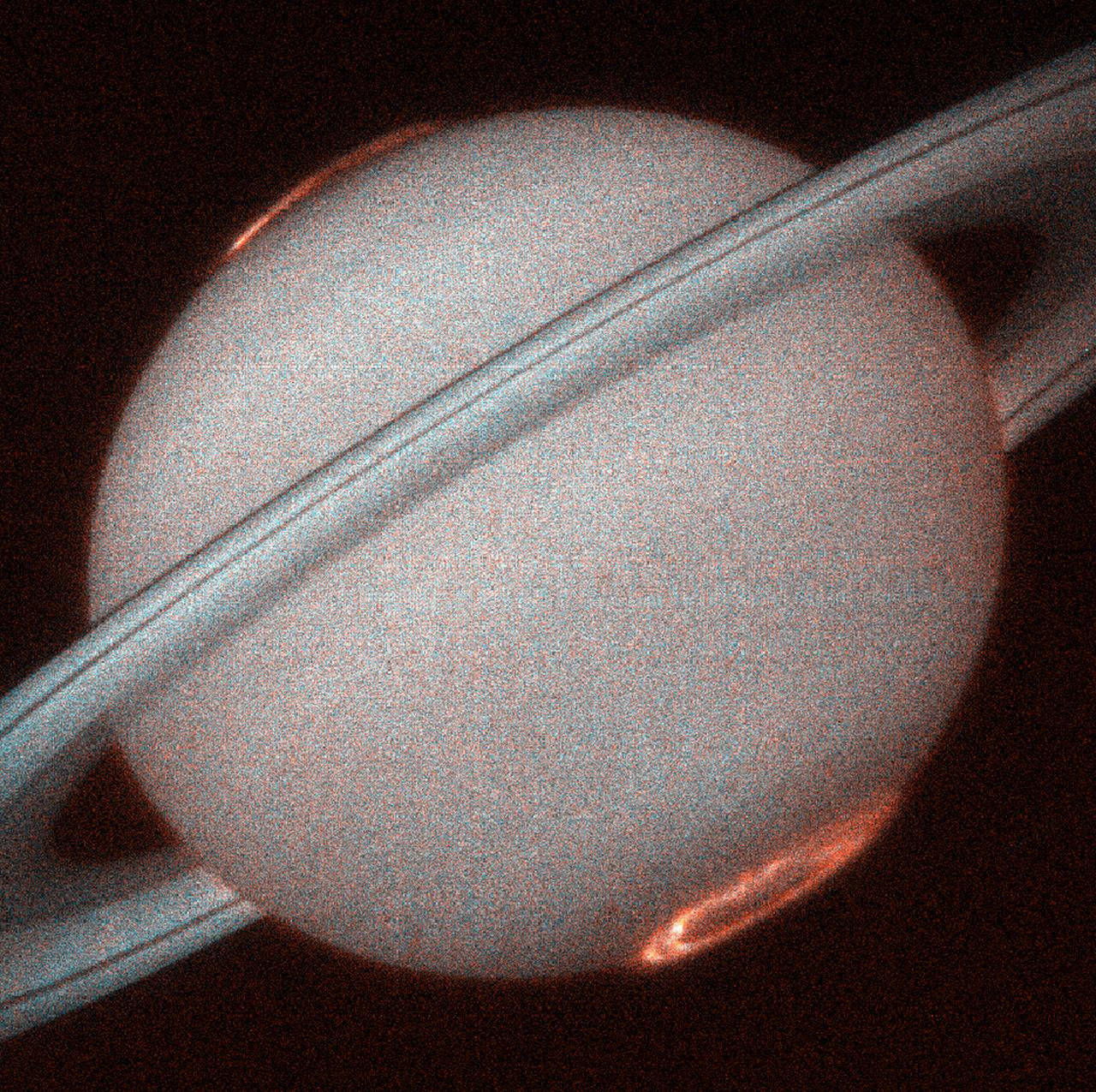
This is the first image of Saturn's ultraviolet aurora taken by the Space Telescope Imaging Spectrograph (STIS) on board the Hubble Space Telescope (HST) in October 1998, when Saturn was a distance of 810 million miles (1.3 billion kilometers) from Earth. The new instrument, used as a camera, provides more than 10 times the sensitivity of the previous HST instruments in the ultraviolet. STIS images reveal exquisite detail never before seen in the spectacular auroral curtains of light that encircle Saturn's north and south poles which rise more than a thousand miles above the cloud tops. Saturn's auroral displays are caused by an energetic wind from the Sun that sweeps over the planet, much like the Earth's aurora that is occasionally seen in the nighttime sky. Unlike the Earth, Saturn's aurora is only seen in ultraviolet light that is invisible from the Earth's surface, hence can only be observed from space.

This is a photograph of giant twisters and star wisps in the Lagoon Nebula. This superb Hubble Space Telescope (HST) image reveals a pair of one-half light-year long interstellar twisters, eerie furnels and twisted rope structures (upper left), in the heart of the Lagoon Nebula (Messier 8) that lies 5,000 light-years away in the direction of the constellation Sagittarius. This image was taken by the Hubble Space Telescope Wide Field/Planetary Camera 2 (WF/PC2).
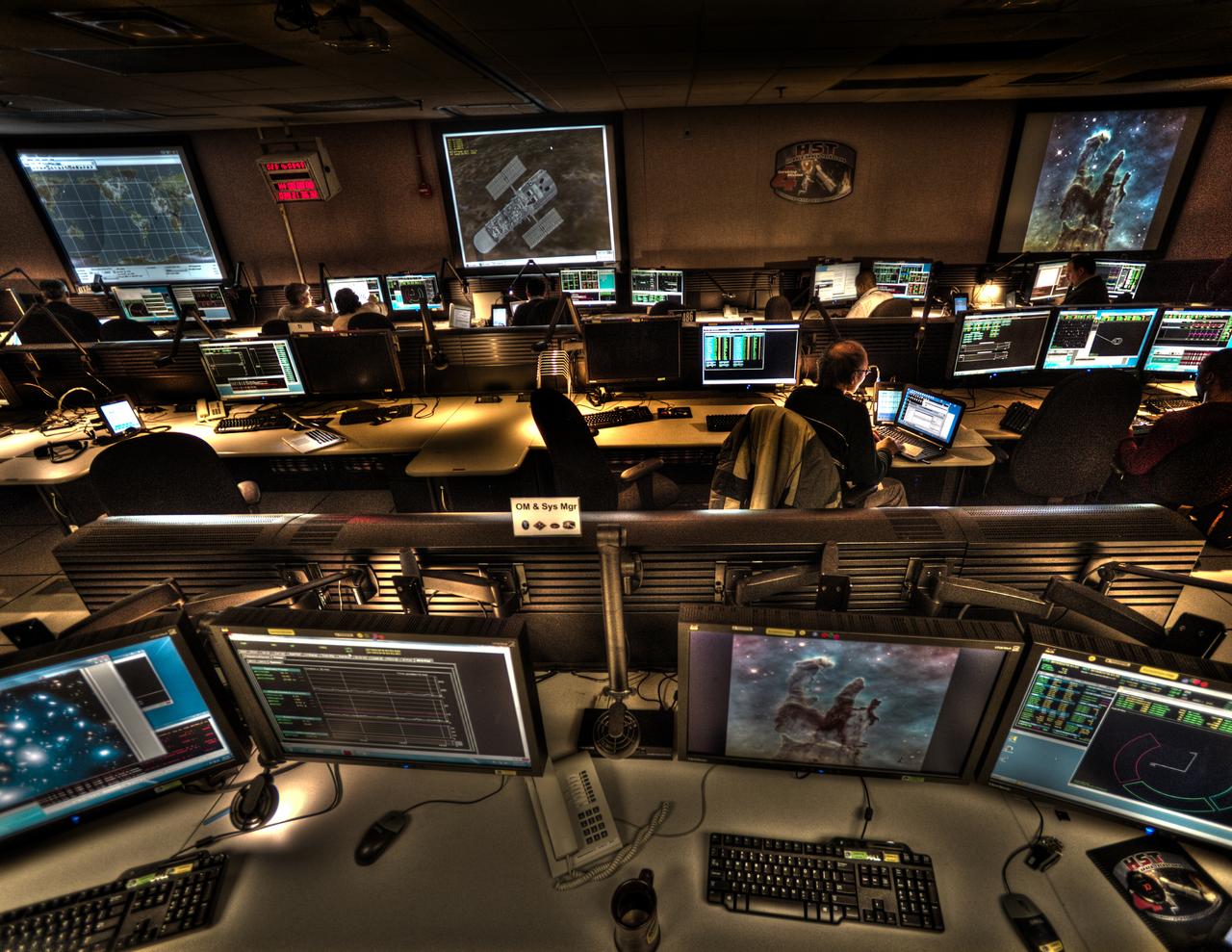
Hubble Space Telescope Control Room Goddard Space Flight Center
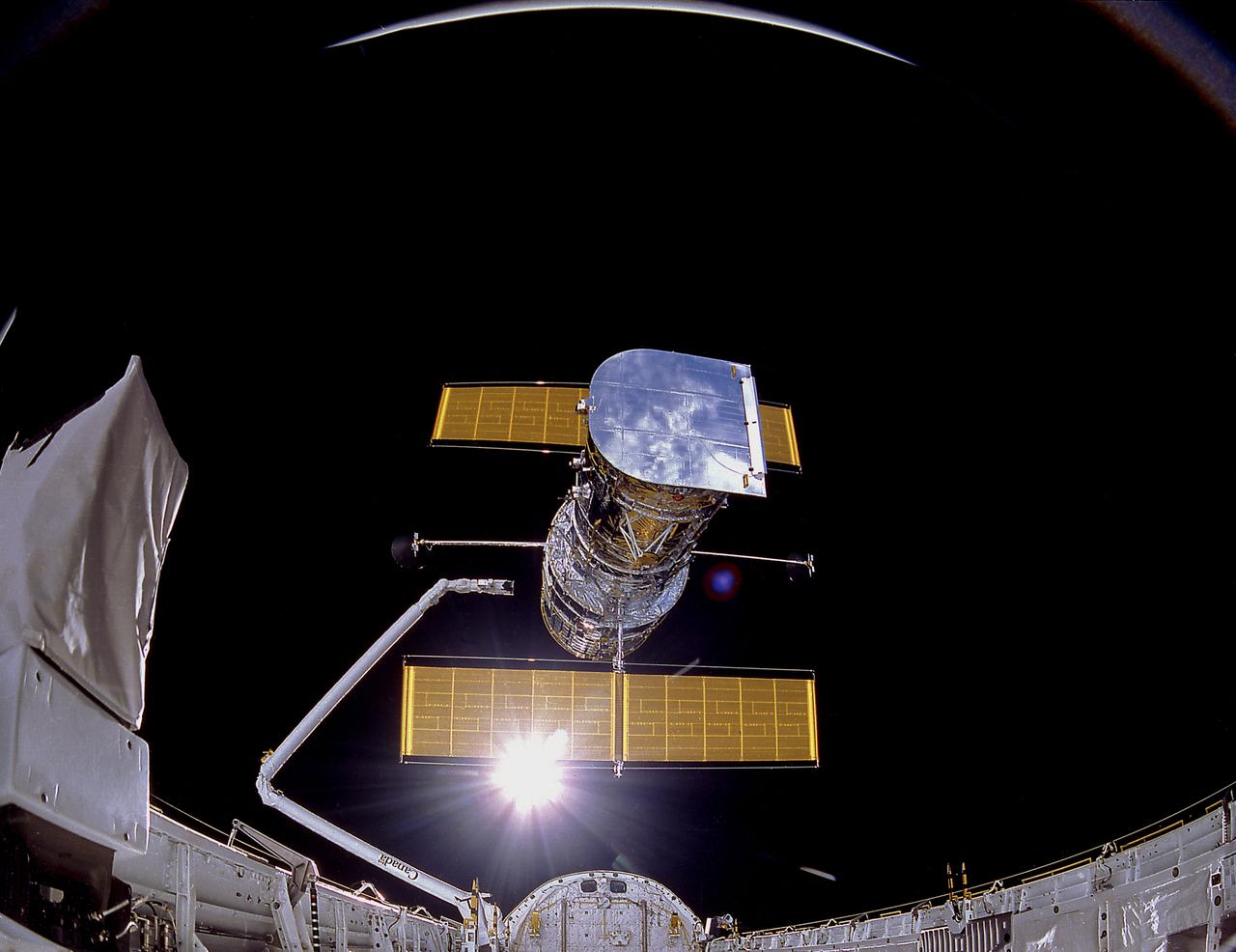
In this photograph, the Hubble Space Telescope (HST) was being deployed on April 25, 1990. The photograph was taken by the IMAX Cargo Bay Camera (ICBC) mounted in a container on the port side of the Space Shuttle orbiter Discovery (STS-31 mission). The purpose of the HST, the most complex and sensitive optical telescope ever made, is to study the cosmos from a low-Earth orbit for 15 years or more. The HST provides fine detail imaging, produces ultraviolet images and spectra, and detects very faint objects. Two months after its deployment in space, scientists detected a 2-micron spherical aberration in the primary mirror of the HST that affected the telescope's ability to focus faint light sources into a precise point. This imperfection was very slight, one-fiftieth of the width of a human hair. A scheduled Space Service servicing mission (STS-61) in 1993 permitted scientists to correct the problem. During four spacewalks, new instruments were installed into the HST that had optical corrections. The Marshall Space Flight Center had responsibility for design, development, and construction of the HST. The Perkin-Elmer Corporation, in Danbury, Cornecticut, developed the optical system and guidance sensors. Photo Credit: NASA/Smithsonian Institution/Lockheed Corporation.

Taken in 1997, NASA Hubble Space Telescope, using visible light, detected clouds in the northern hemisphere of Uranus.
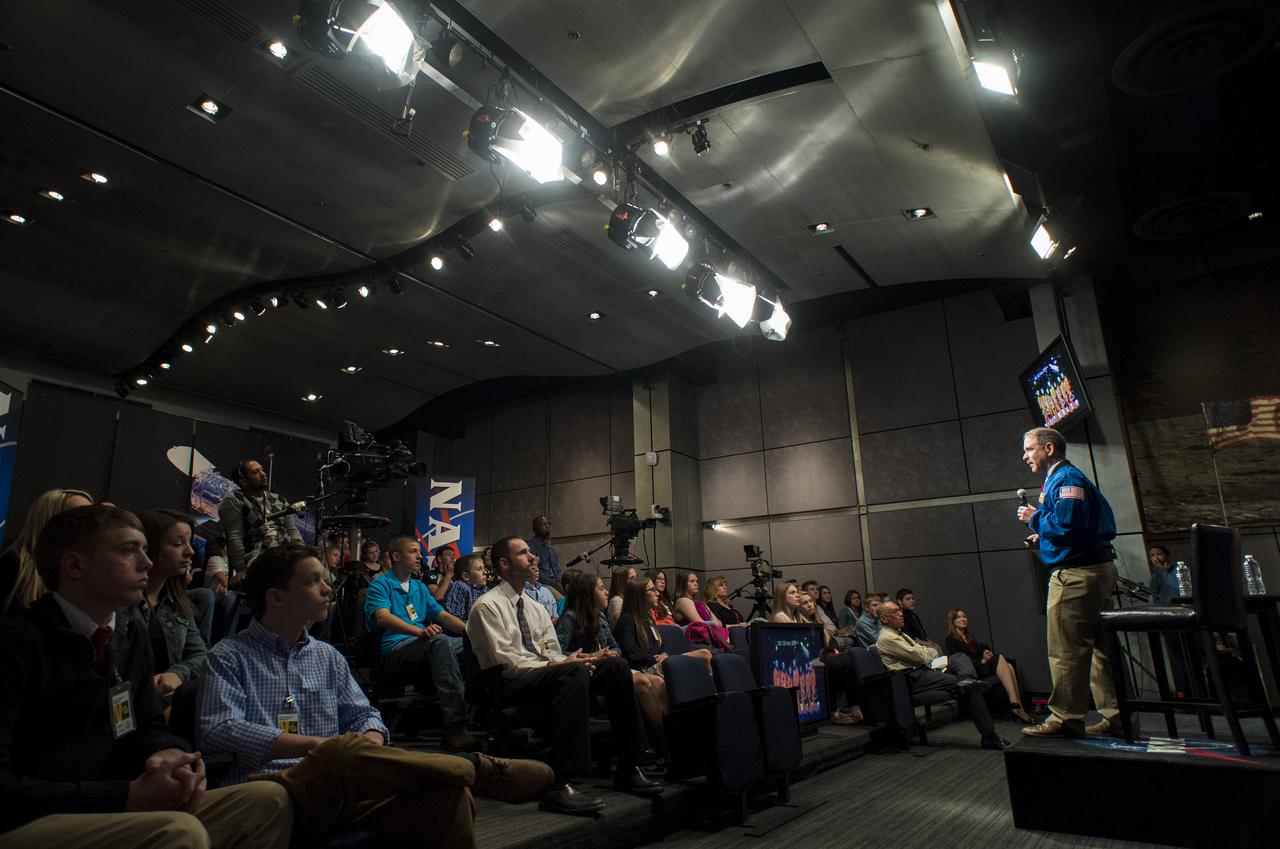
John Grunsfeld, NASA Associate Administrator for the Science Mission Directorate, speaks to students from Mapletown Jr/Sr High School and Margaret Bell Middle School about his experiences on the final space shuttle servicing mission to the Hubble Space Telescope during the NASA Hubble Space Telescope (HST) Research Project Capstone Event in the James E. Webb Auditorium at NASA Headquarters on Monday, May 5, 2014. Grunsfeld flew on three of the five servicing missions to the Hubble Space Telescope. Photo Credit: (NASA/Joel Kowsky)
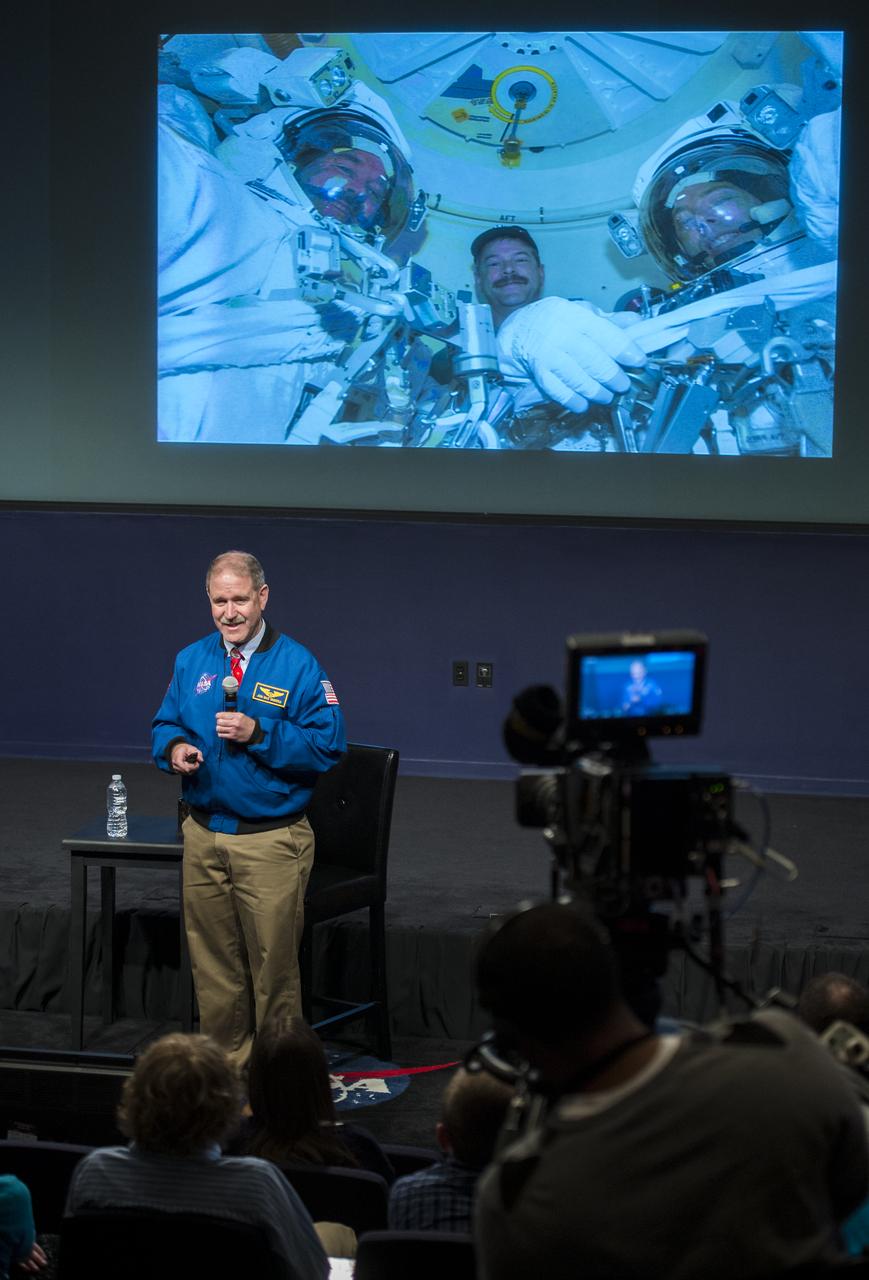
John Grunsfeld, NASA Associate Administrator for the Science Mission Directorate, speaks to students from Mapletown Jr/Sr High School and Margaret Bell Middle School about his experiences on the final space shuttle servicing mission to the Hubble Space Telescope during the NASA Hubble Space Telescope (HST) Research Project Capstone Event in the James E. Webb Auditorium at NASA Headquarters on Monday, May 5, 2014. Grunsfeld flew on three of the five servicing missions to the Hubble Space Telescope. Photo Credit: (NASA/Joel Kowsky)
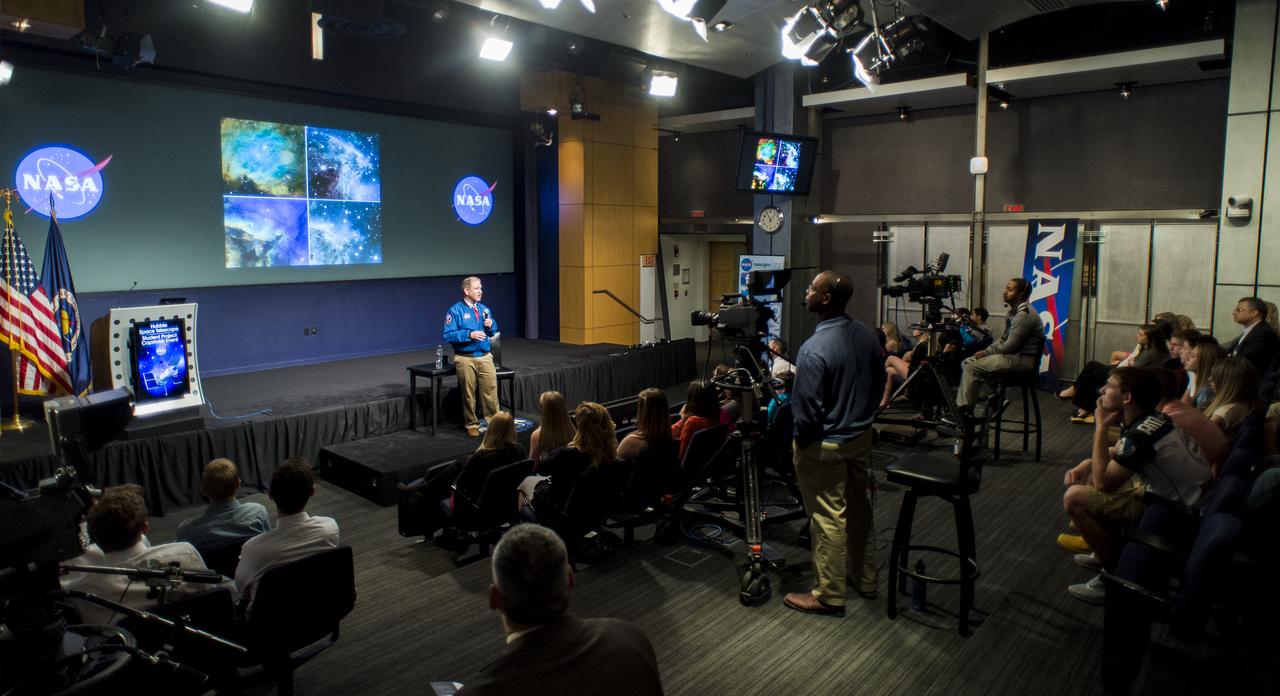
John Grunsfeld, NASA Associate Administrator for the Science Mission Directorate, speaks to students from Mapletown Jr/Sr High School and Margaret Bell Middle School about his experiences on the final space shuttle servicing mission to the Hubble Space Telescope during the NASA Hubble Space Telescope (HST) Research Project Capstone Event in the James E. Webb Auditorium at NASA Headquarters on Monday, May 5, 2014. Grunsfeld flew on three of the five servicing missions to the Hubble Space Telescope. Photo Credit: (NASA/Joel Kowsky)

NASA Hubble Space Telescope peered deep into Uranus atmosphere to see clear and hazy layers created by a mixture of gases. Using infrared filters, Hubble captured detailed features of three layers of Uranus atmosphere.
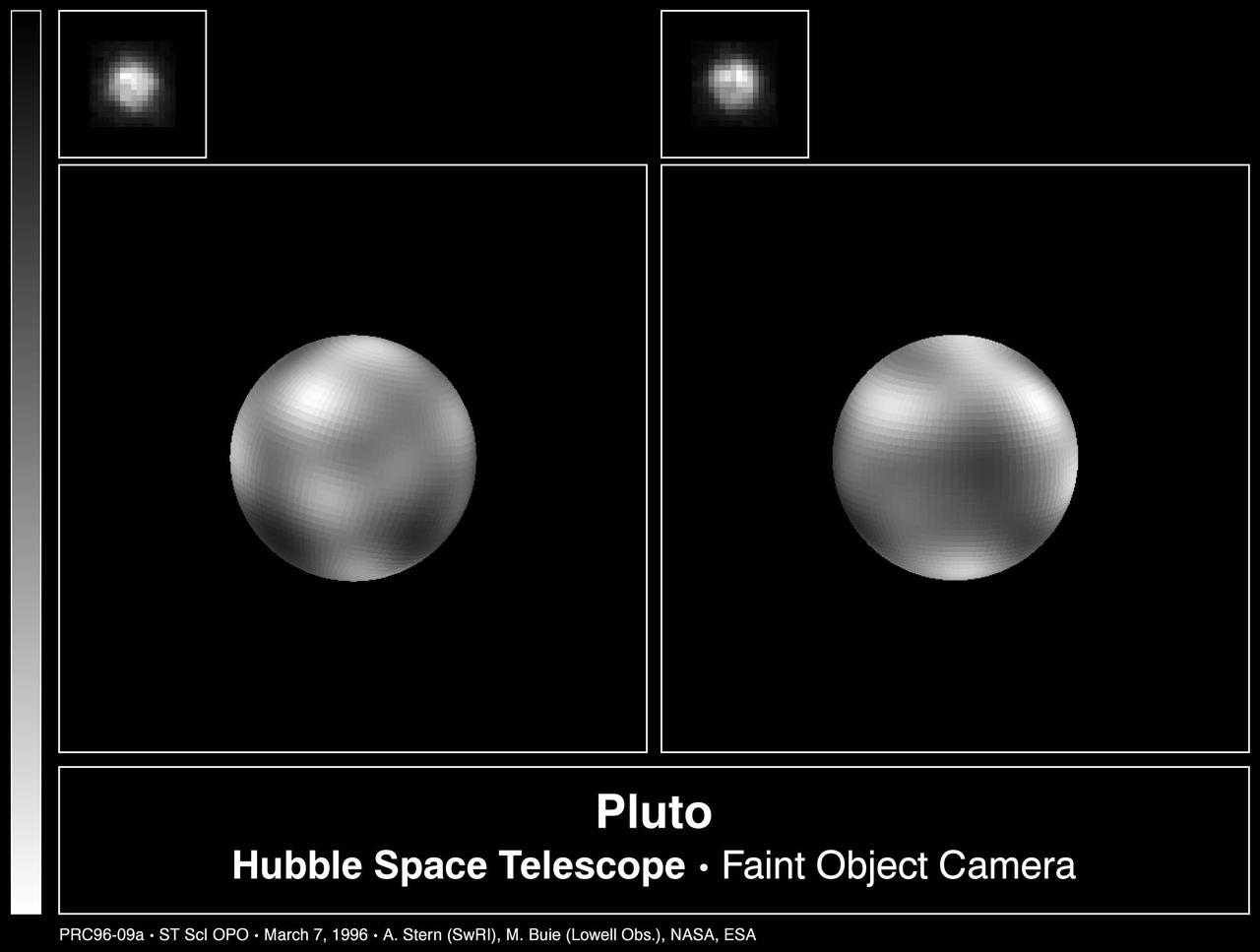
The never-before-seen surface of the distant planet Pluto is resolved in these NASA Hubble Space Telescope pictures, taken with the European Space Agency Faint Object Camera FOC aboard Hubble.
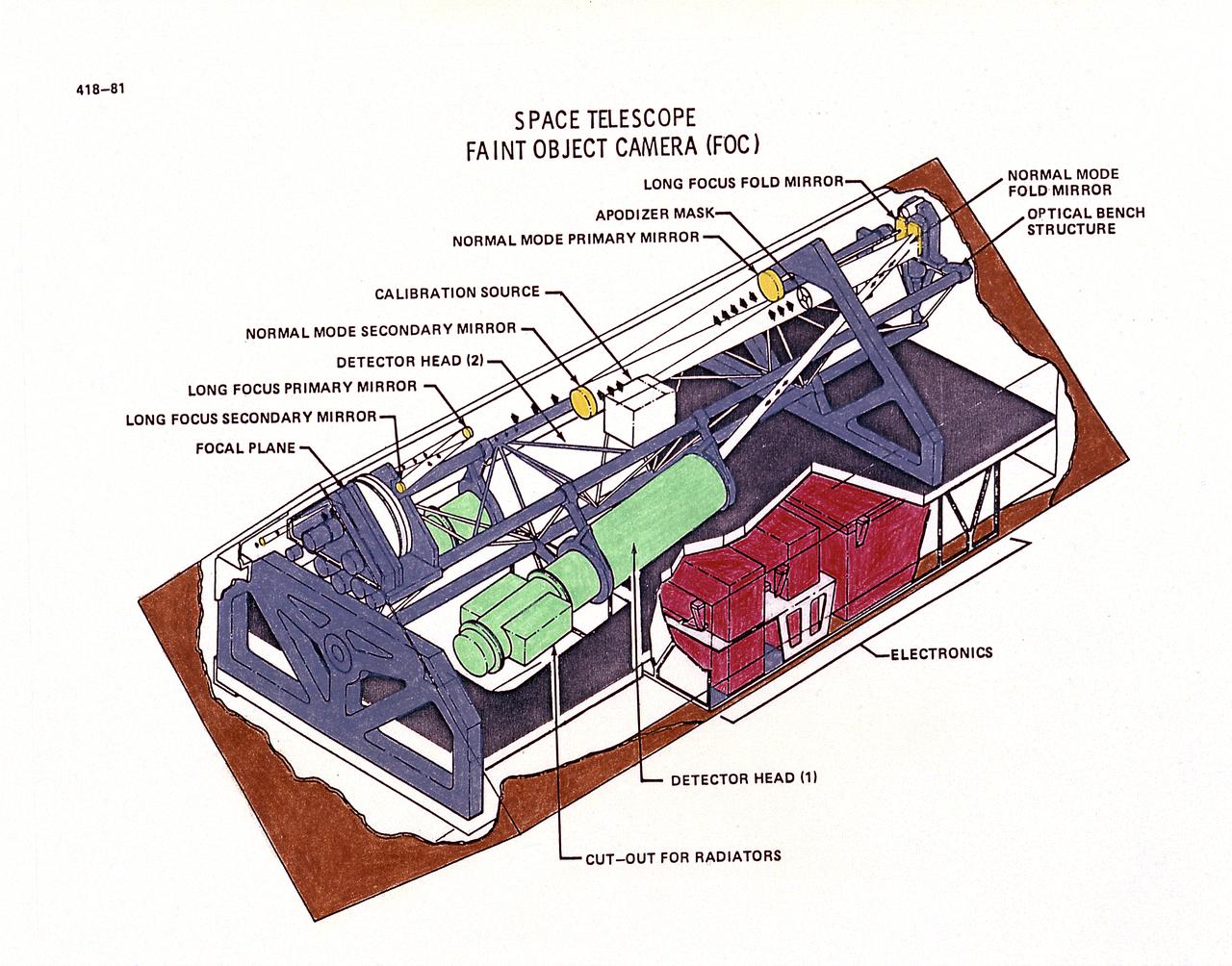
This drawing illustrates Hubble Space Telescope's (HST's), Faint Object Camera (FOC). The FOC reflects light down one of two optical pathways. The light enters a detector after passing through filters or through devices that can block out light from bright objects. Light from bright objects is blocked out to enable the FOC to see background images. The detector intensifies the image, then records it much like a television camera. For faint objects, images can be built up over long exposure times. The total image is translated into digital data, transmitted to Earth, and then reconstructed. The purpose of the HST, the most complex and sensitive optical telescope ever made, is to study the cosmos from a low-Earth orbit. By placing the telescope in space, astronomers are able to collect data that is free of the Earth's atmosphere. The HST detects objects 25 times fainter than the dimmest objects seen from Earth and provides astronomers with an observable universe 250 times larger than visible from ground-based telescopes, perhaps as far away as 14 billion light-years. The HST views galaxies, stars, planets, comets, possibly other solar systems, and even unusual phenomena such as quasars, with 10 times the clarity of ground-based telescopes. The HST was deployed from the Space Shuttle Discovery (STS-31 mission) into Earth orbit in April 1990. The Marshall Space Flight Center had responsibility for design, development, and construction of the HST. The Perkin-Elmer Corporation, in Danbury, Cornecticut, developed the optical system and guidance sensors.

This is a Hubble Space Telescope image of a concentration of stars within the globular cluster NGC 6752. Hidden among the stars is an image of a background galaxy that is much farther away. The diminutive galaxy, named by its discoverers as Bedin 1, measures only around 3,000 light-years at its greatest extent — a fraction of the size of the Milky Way. Not only is it tiny, but it is also incredibly faint. These properties led astronomers to classify it as a dwarf spheroidal galaxy that is as old as the universe. More info: https://go.nasa.gov/2tCaxGS Credits: NASA, ESA and L. Bedin (Astronomical Observatory of Padua, Italy)

Astronauts Jeffrey Hoffman and Story Musgrave install the Wide Field and Planetary Camera 2 (WFPC2) on the Hubble Space Telescope, during SM1 in December, 1993. https://photojournal.jpl.nasa.gov/catalog/PIA22911
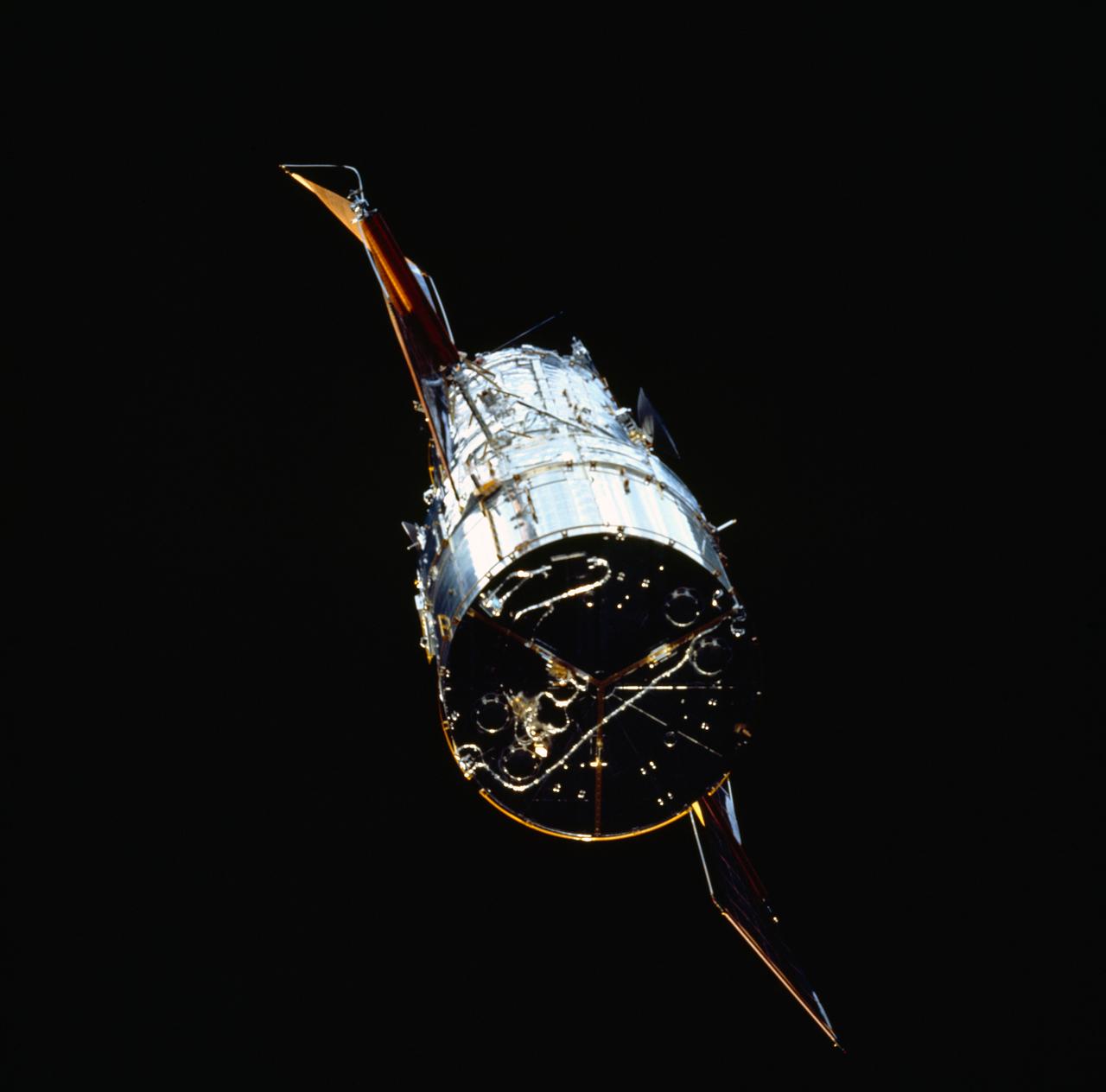
STS061-73-040 (4 Dec 1993) --- Backdropped against the blackness of space, the Hubble Space Telescope (HST) nears the Space Shuttle Endeavour. With the aid of the Remote Manipulator System (RMS), the STS-61 crew members later grappled the spacecraft and berthed it in the cargo bay for five-days of servicing chores by four space walkers.
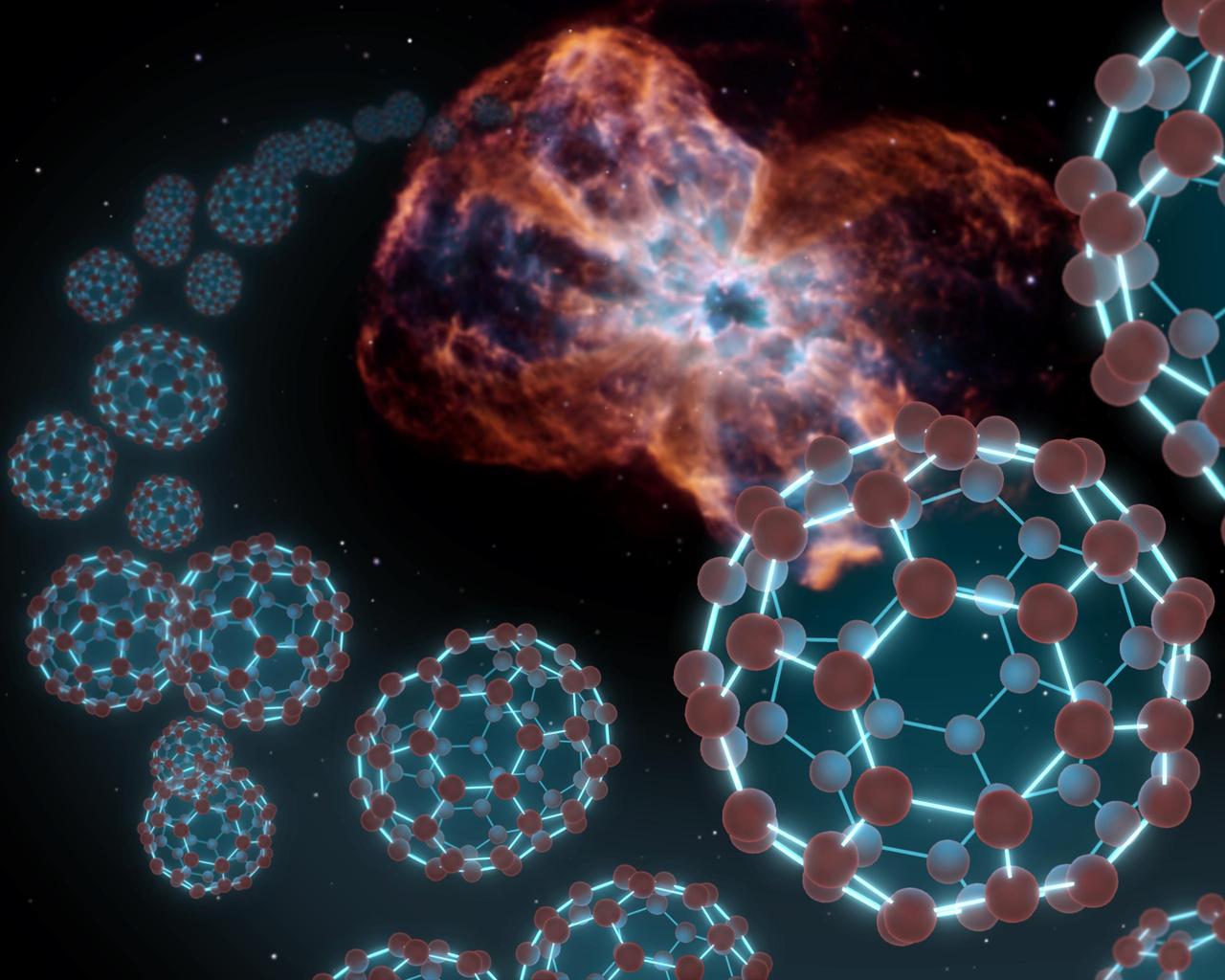
NASA Spitzer Space Telescope has at last found buckyballs resembling soccer balls in space shown in this artist concept using Hubble picture of the NGC 2440 nebula. Hubble image cred: NASA, ESA, STScI
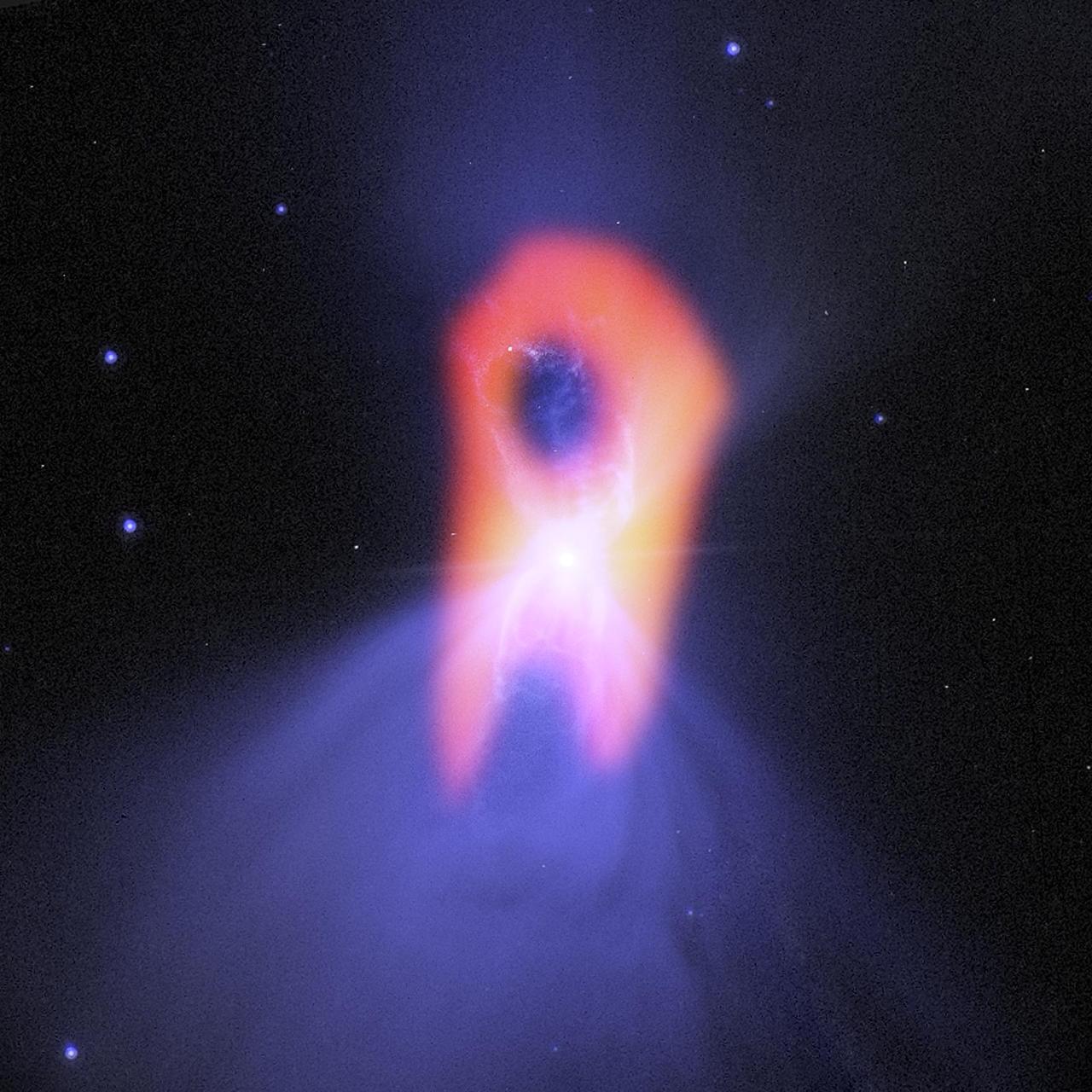
The Boomerang nebula, called the coldest place in the universe, reveals its true shape to the Atacama Large Millimeter/submillimeter Array ALMA telescope. The background blue structure, is seen in visible light by NASA Hubble Space Telescope.
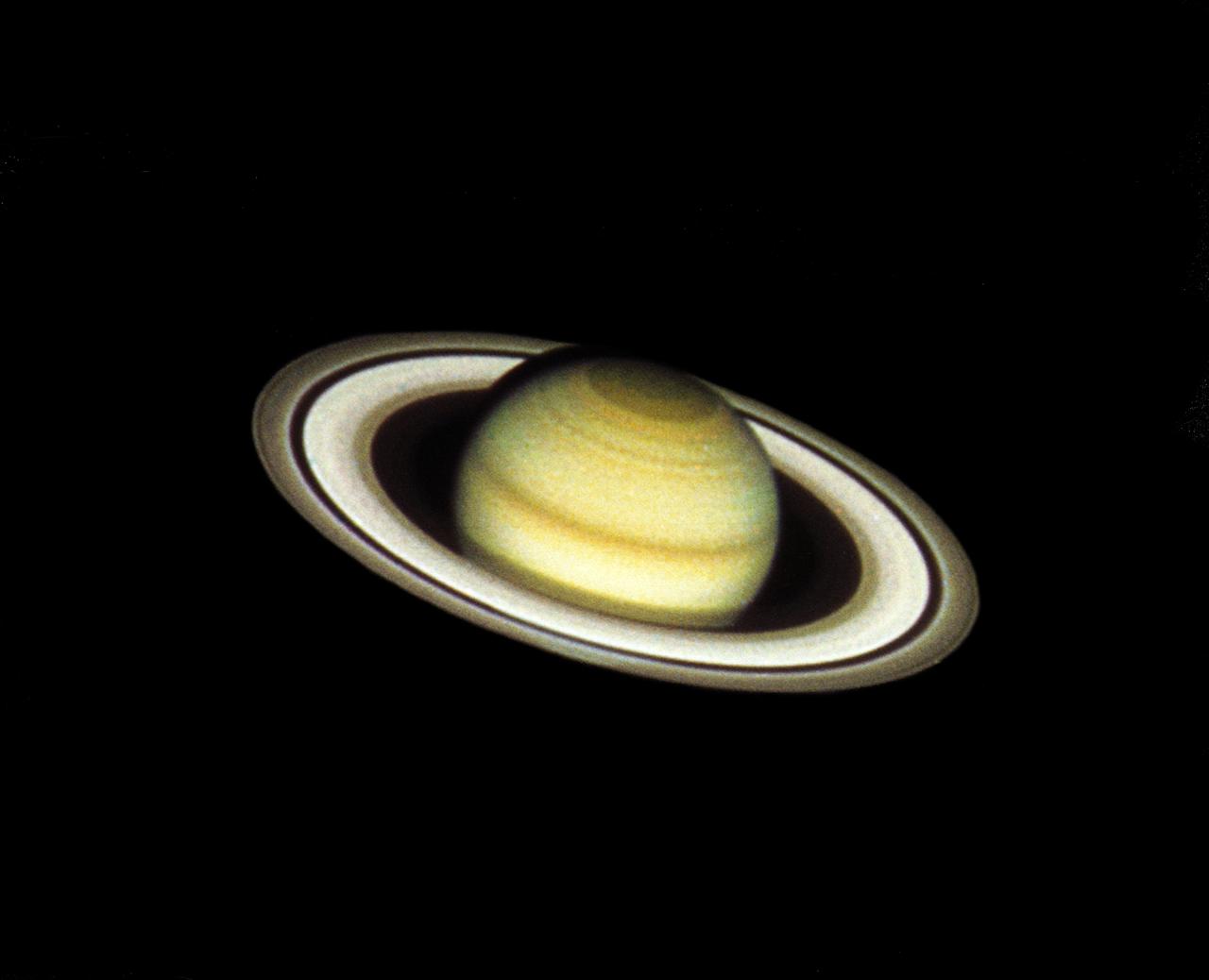
This color image of Saturn was taken with the Hubble Space Telescope's (HST's) Wide Field Camera (WFC) at 3:25 am EDT, August 26, 1990, when the planet was at a distance of 2.39 million km (360 million miles) from Earth. The color in the image is reconstructed by combining three different pictures, taken in blue, green and red light (4390, 5470 and 7180 angstroms). Because Saturn's north pole is currently tilted toward Earth (24 degrees), the HST image reveals unprecedented detail in atmospheric features at the northern polar hood, a region not extensively imaged by the Voyager space probes. The classic features of Saturn's vast ring system are also clearly seen from outer to irner edge; the bright A and B rings, divided by the Cassini division, and the very faint inner C ring. The Enche division, a dark gap near the outer edge of the A ring, has never before been photographed from Earth.
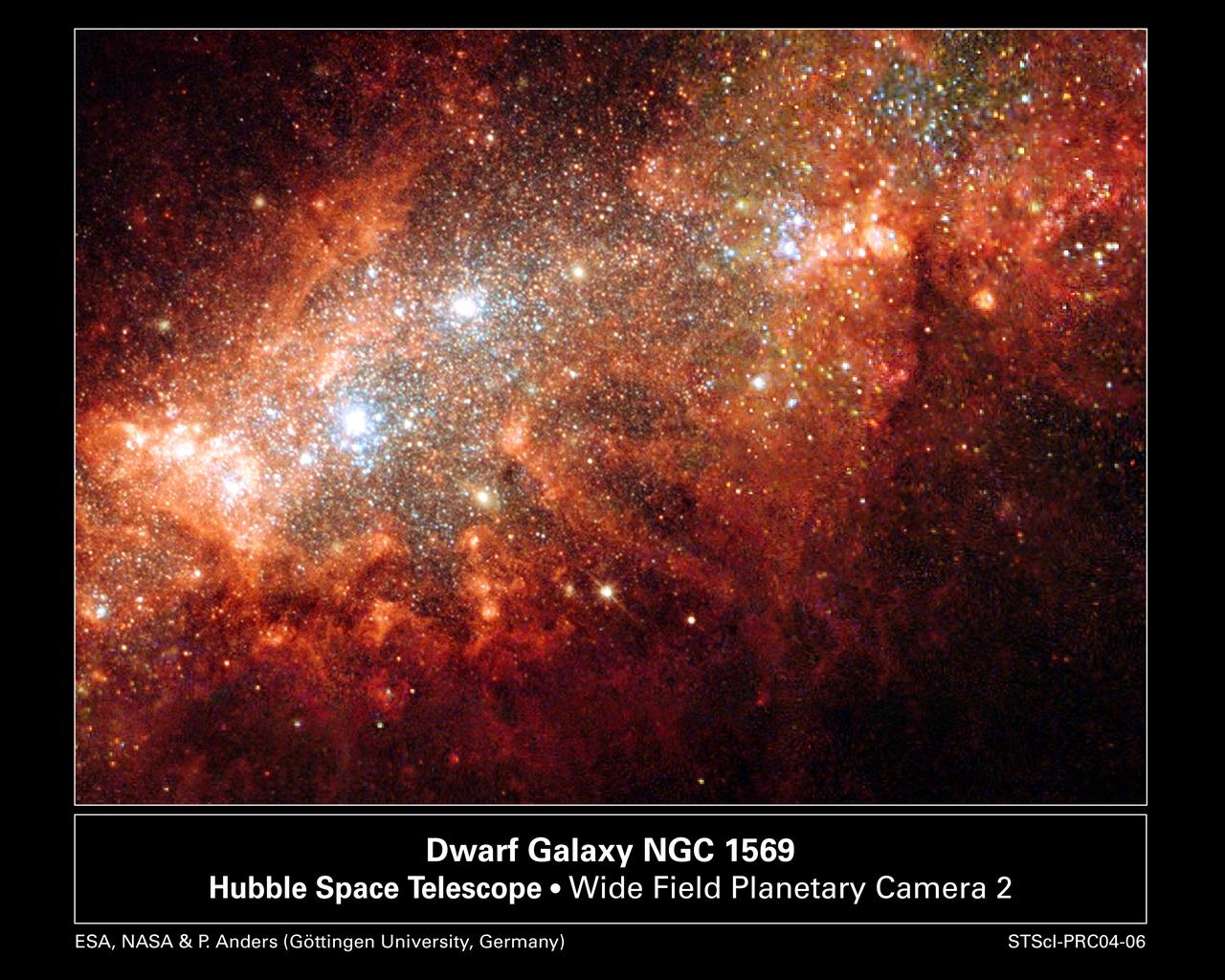
This new image taken with NASA's Hubble Space Telescope (HST) is of the nearby dwarf galaxy NGC 1569. This galaxy is a hotbed of vigorous star birth activity which blows huge bubbles that riddle its main body. The bubble structure is sculpted by the galactic super-winds and outflows caused by a colossal input of energy from collective supernova explosions that are linked with a massive episode of star birth. The bubbles seen in this image are made of hydrogen gas that glows when hit by the fierce wind and radiation from hot young stars and is racked by supernova shocks. Its "star factories" are also manufacturing brilliant blue star clusters. NGC 1569 had a sudden onset of star birth about 25 million years ago, which subsided about the time the very earliest human ancestors appeared on Earth. The Marshall Space Flight Center had responsibility for the design, development, and construction of the HST.
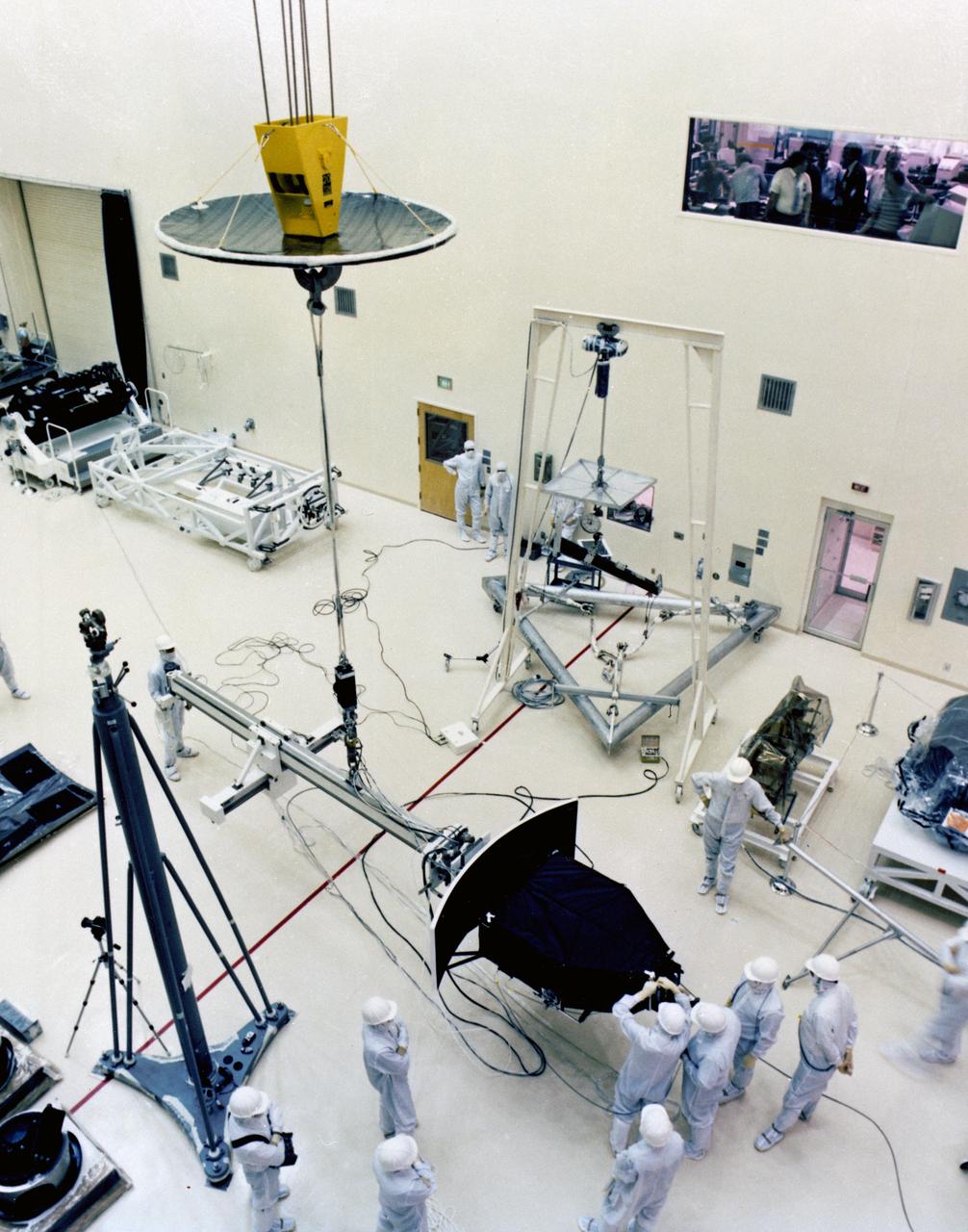
In this photograph, engineers and technicians prepare the Hubble Space Telescope's (HST's) Wide Field and Planetary Camera (WF/PC) for installation at the Lockheed Missile and Space Company. The WF/PC is designed to investigate the age of the universe and to search for new planetary systems around young stars. It takes pictures of large numbers of galaxies and close-ups of planets in our solar system. The HST is the first of NASA's great observatories and the most complex and sensitive optical telescope ever made. The purpose of the HST is to study the cosmos from a low-Earth orbit by placing the telescope in space, enabling astronomers to collect data that is free of the Earth's atmosphere. The HST was deployed from the Space Shuttle Discovery (STS-31 mission) into Earth orbit in April 1990. The Marshall Space Flight Center had overall responsibility for design, development, and construction of the HST. The Perkin-Elmer Corporation, in Danbury, Cornecticut, developed the optical system and guidance sensors. The Lockheed Missile and Space Company, Sunnyvale, California, produced the protective outer shroud and spacecraft systems, and assembled and tested the finished telescope.
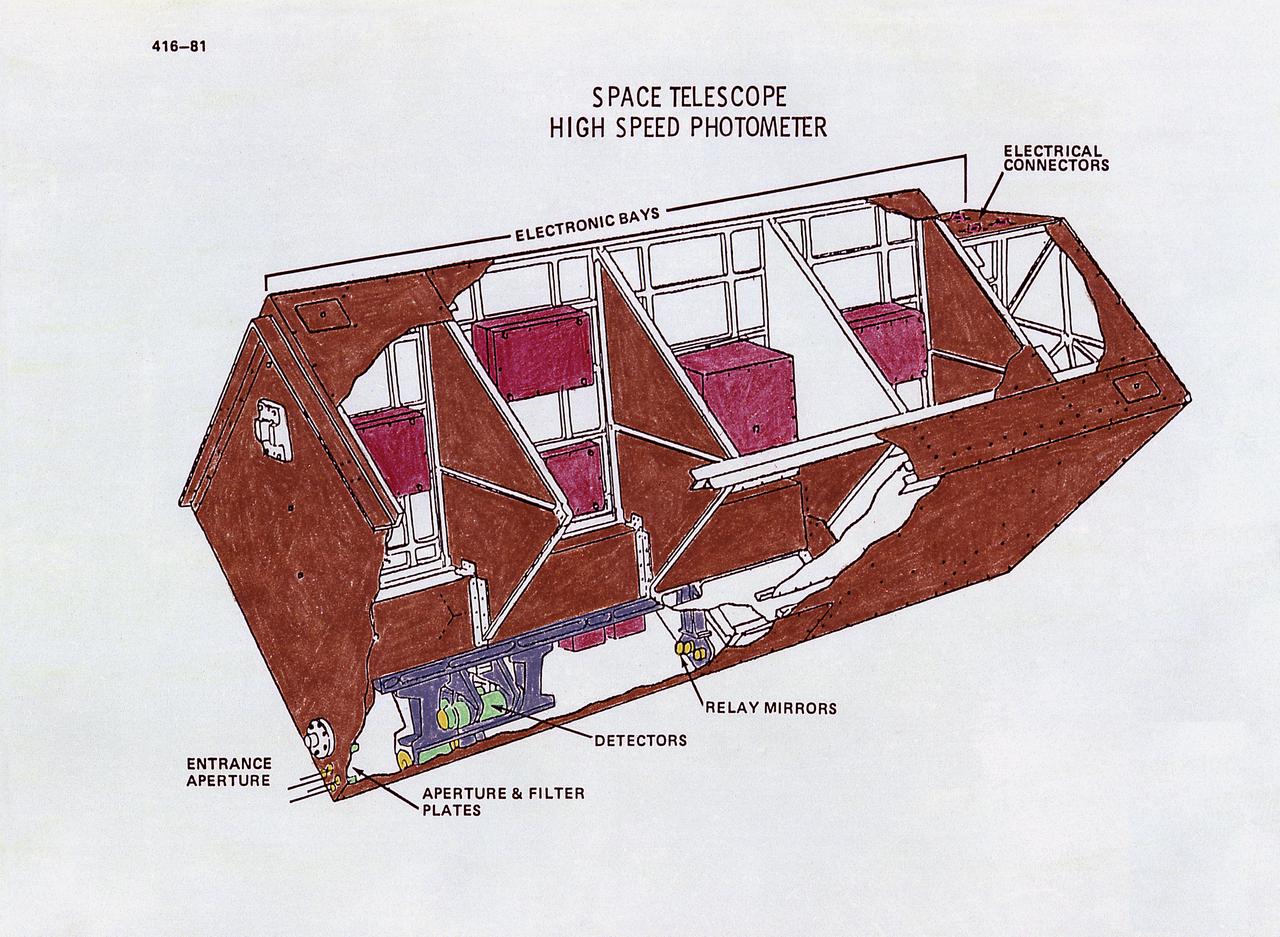
This drawing illustrates the Hubble Space Telescope's (HST's) High Speed Photometer (HSP). The HSP measures the intensity of starlight (brightness), which will help determine astronomical distances. Its principal use will be to measure extremely-rapid variations or pulses in light from celestial objects, such as pulsating stars. The HSP produces brightness readings. Light passes into one of four special signal-multiplying tubes that record the data. The HSP can measure energy fluctuations from objects that pulsate as rapidly as once every 10 microseconds. From HSP data, astronomers expect to learn much about such mysterious objects as pulsars, black holes, and quasars. The purpose of the HST, the most complex and sensitive optical telescope ever made, is to study the cosmos from a low-Earth orbit. By placing the telescope in space, astronomers are able to collect data that is free of the Earth's atmosphere. The HST views galaxies, stars, planets, comets, possibly other solar systems, and even unusual phenomena such as quasars, with 10 times the clarity of ground-based telescopes. The HST was deployed from the Space Shuttle Discovery (STS-31 mission) into Earth orbit in April 1990. The Marshall Space Flight Center had responsibility for design, development, and construction of the HST. The Perkin-Elmer Corporation, in Danbury, Cornecticut, developed the optical system and guidance sensors.
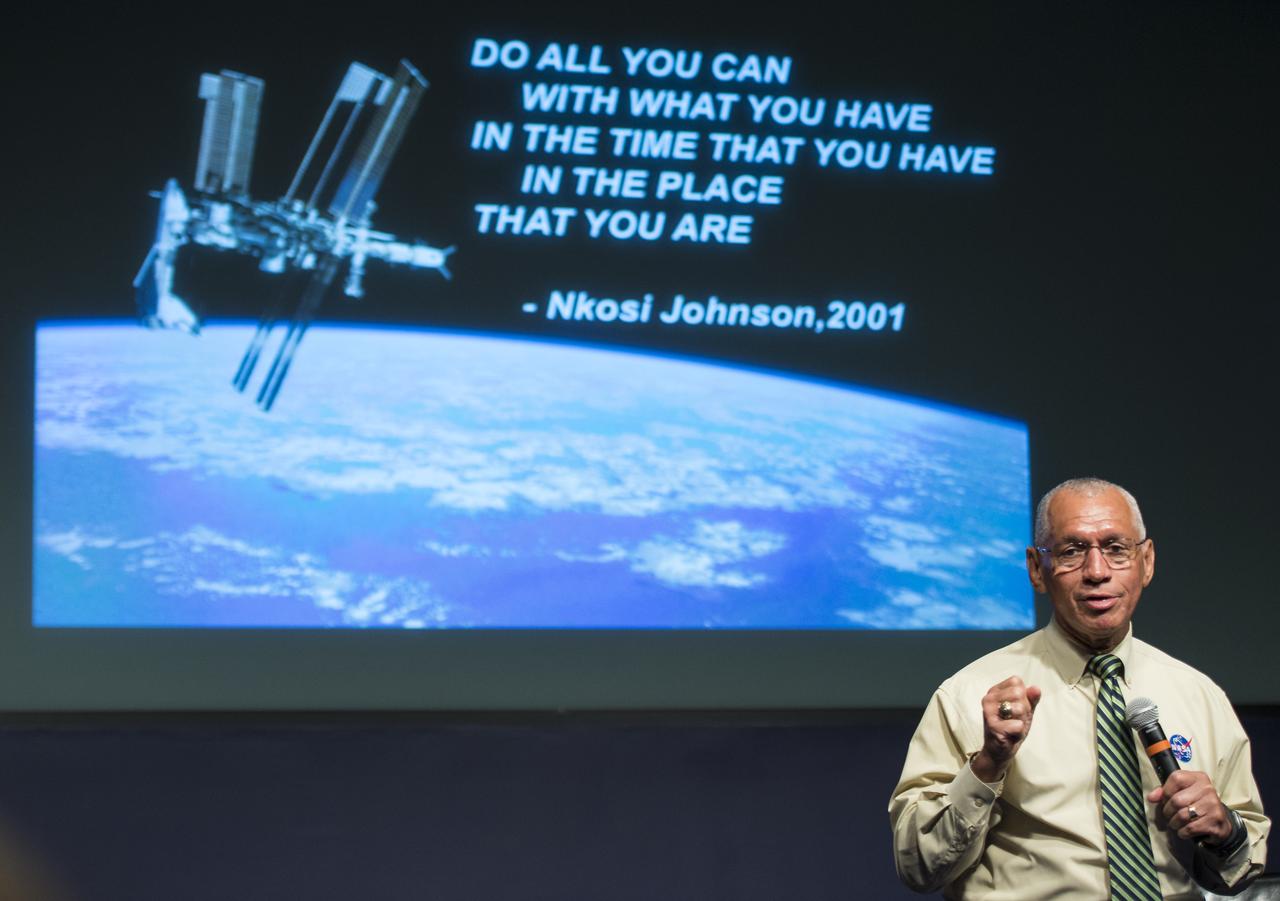
NASA Administrator Charles Bolden speaks to students from Mapletown Jr/Sr High School and Margaret Bell Middle School during the NASA Hubble Space Telescope (HST) Research Project Capstone Event in the James E. Webb Auditorium at NASA Headquarters on Monday, May 5, 2014. Administrator Bolden spoke about his involvement with the Hubble Space Telescope and took questions from the students. Photo Credit: (NASA/Joel Kowsky)
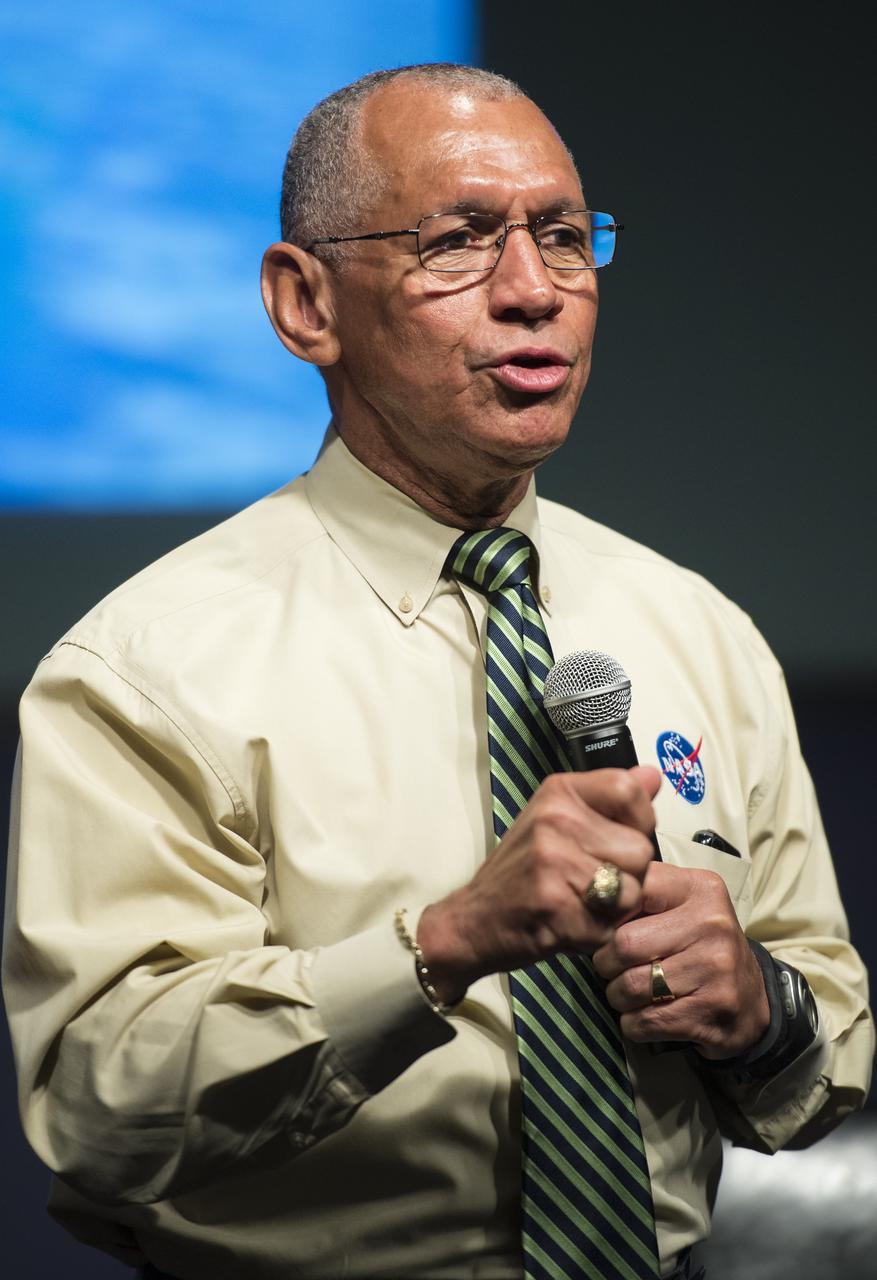
NASA Administrator Charles Bolden speaks to students from Mapletown Jr/Sr High School and Margaret Bell Middle School during the NASA Hubble Space Telescope (HST) Research Project Capstone Event in the James E. Webb Auditorium at NASA Headquarters on Monday, May 5, 2014. Administrator Bolden spoke about his involvement with the Hubble Space Telescope and took questions from the students. Photo Credit: (NASA/Joel Kowsky)
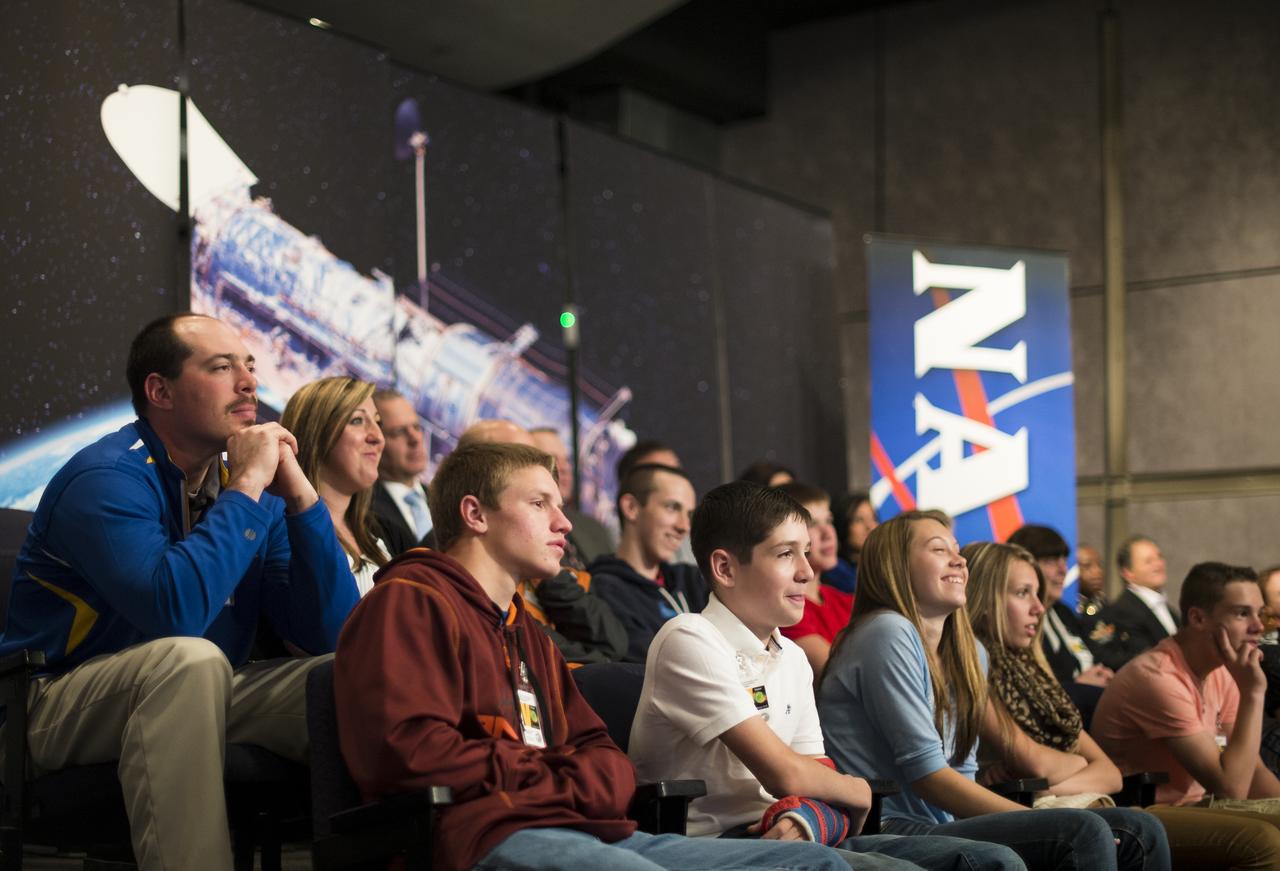
Students and faculty from Mapletown Jr/Sr High School and Margaret Bell Middle School listen as John Grunsfeld, NASA Associate Administrator for the Science Mission Directorate, speaks about his experiences on the final space shuttle servicing mission to the Hubble Space Telescope during the NASA Hubble Space Telescope (HST) Research Project Capstone Event in the James E. Webb Auditorium at NASA Headquarters on Monday, May 5, 2014. Photo Credit: (NASA/Joel Kowsky)
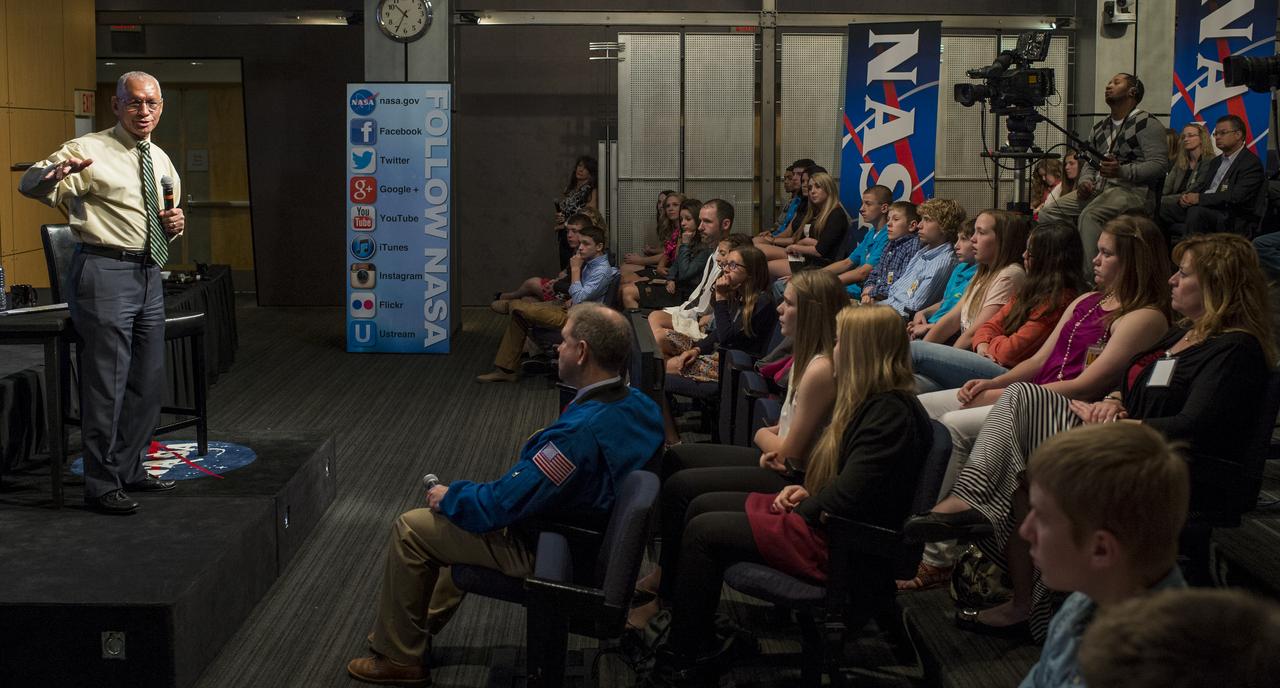
NASA Administrator Charles Bolden speaks to students from Mapletown Jr/Sr High School and Margaret Bell Middle School during the NASA Hubble Space Telescope (HST) Research Project Capstone Event in the James E. Webb Auditorium at NASA Headquarters on Monday, May 5, 2014. Administrator Bolden spoke about his involvement with the Hubble Space Telescope and took questions from the students. Photo Credit: (NASA/Joel Kowsky)
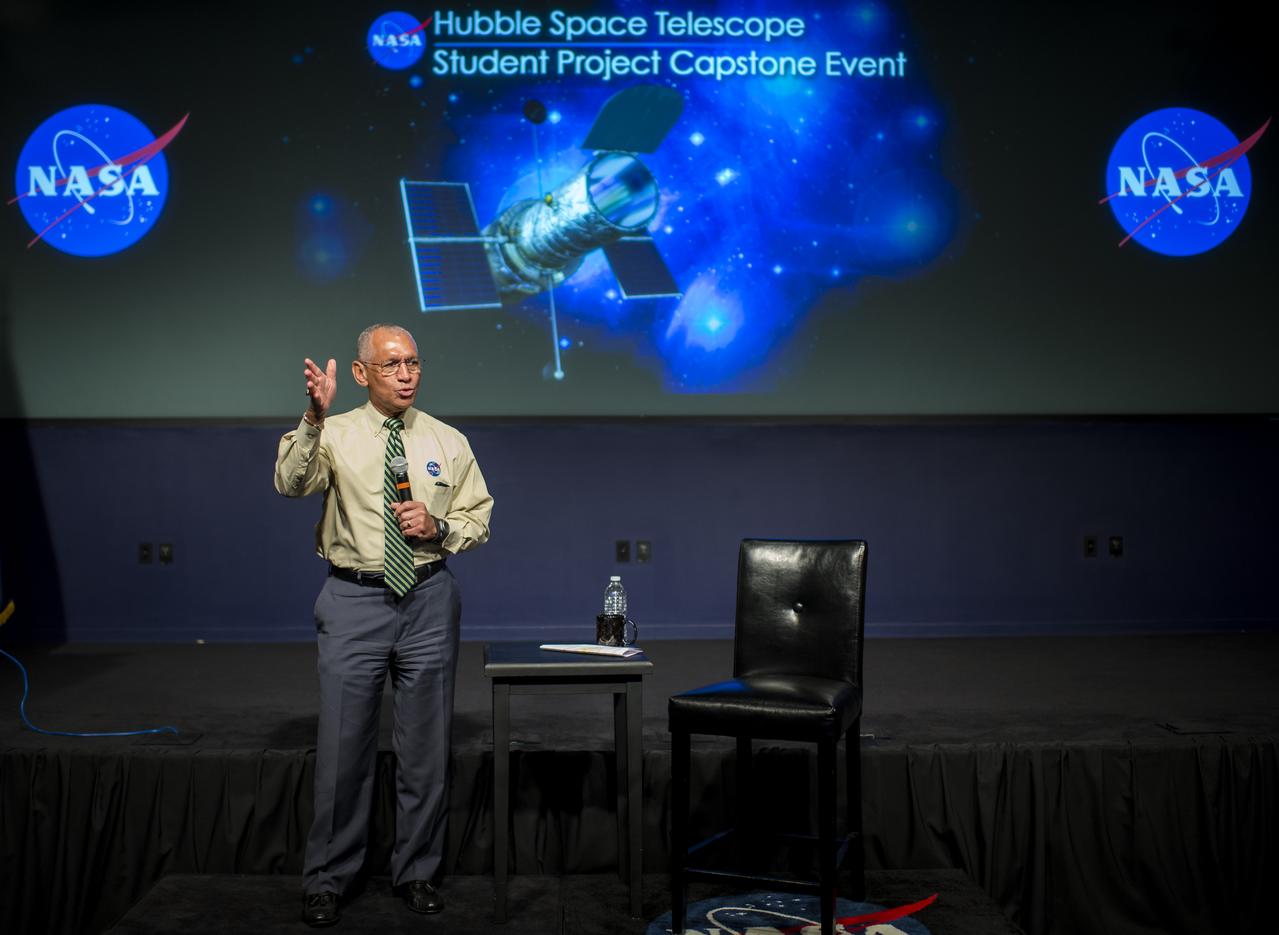
NASA Administrator Charles Bolden speaks to students from Mapletown Jr/Sr High School and Margaret Bell Middle School during the NASA Hubble Space Telescope (HST) Research Project Capstone Event in the James E. Webb Auditorium at NASA Headquarters on Monday, May 5, 2014. Administrator Bolden spoke about his involvement with the Hubble Space Telescope and took questions from the students. Photo Credit: (NASA/Joel Kowsky)
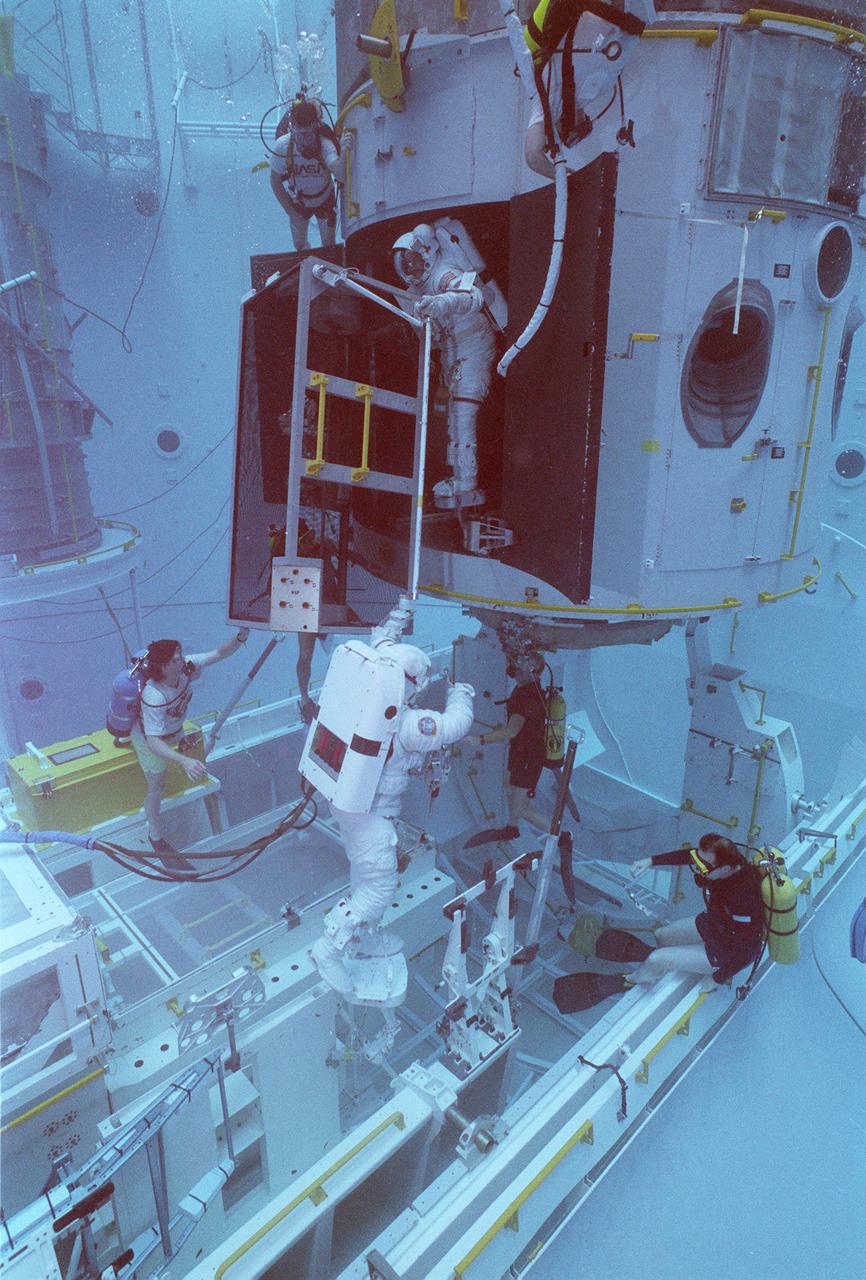
This photograph shows an STS-61 astronaut training for the Hubble Space Telescope (HST) servicing mission (STS-61) in the Marshall Space Flight Center's (MSFC's) Neutral Buoyancy Simulator (NBS). Two months after its deployment in space, scientists detected a 2-micron spherical aberration in the primary mirror of the HST that affected the telescope's ability to focus faint light sources into a precise point. This imperfection was very slight, one-fiftieth of the width of a human hair. A scheduled Space Service servicing mission (STS-61) in 1993 permitted scientists to correct the problem. The MSFC NBS provided an excellent environment for testing hardware to examine how it would operate in space and for evaluating techniques for space construction and spacecraft servicing.
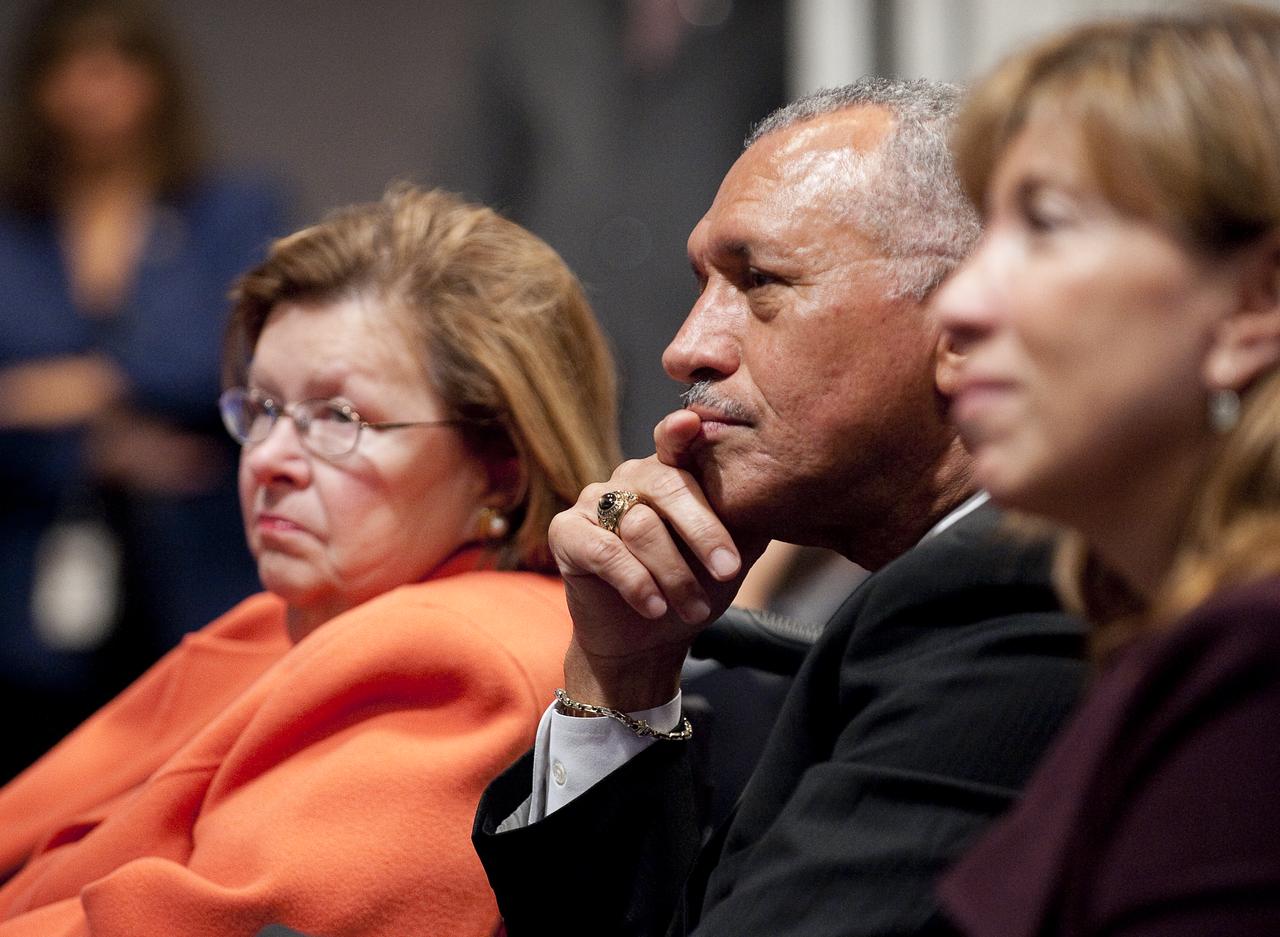
U.S. Senator Barbara A. Mikulski, D-Md., left, NASA Administrator Charles F. Bolden, center, and NASA Deputy Administrator Lori Garver listen during a press conference where NASA unveiled new images from the Hubble Space Telescope Wednesday, Sept. 9, 2009 at NASA Headquarters in Washington. The unveiled images were from four of the telescopes' six operating science instruments. Photo Credit: (NASA/Bill Ingalls)
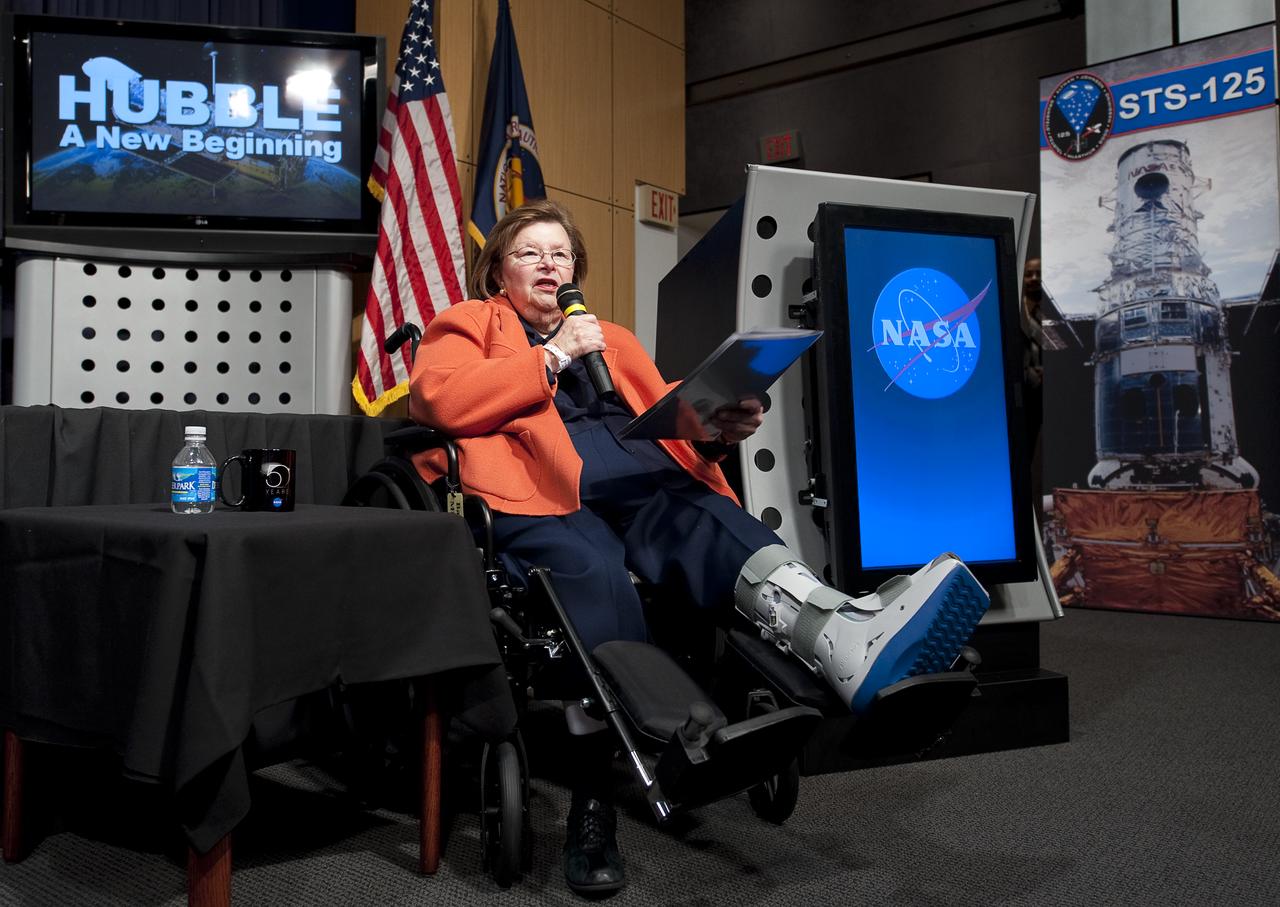
U.S. Senator Barbara A. Mikulski, D-Md. delivers her remarks during a press conference where NASA unveiled new images from the Hubble Space Telescope Wednesday, Sept. 9, 2009 at NASA Headquarters in Washington. The unveiled images were from four of the telescopes' six operating science instruments. Photo Credit: (NASA/Bill Ingalls)

U.S. Senator Barbara A. Mikulski, D-Md. delivers her remarks during a press conference where NASA unveiled new images from the Hubble Space Telescope Wednesday, Sept. 9, 2009 at NASA Headquarters in Washington. The unveiled images were from four of the telescopes' six operating science instruments. Photo Credit: (NASA/Bill Ingalls)
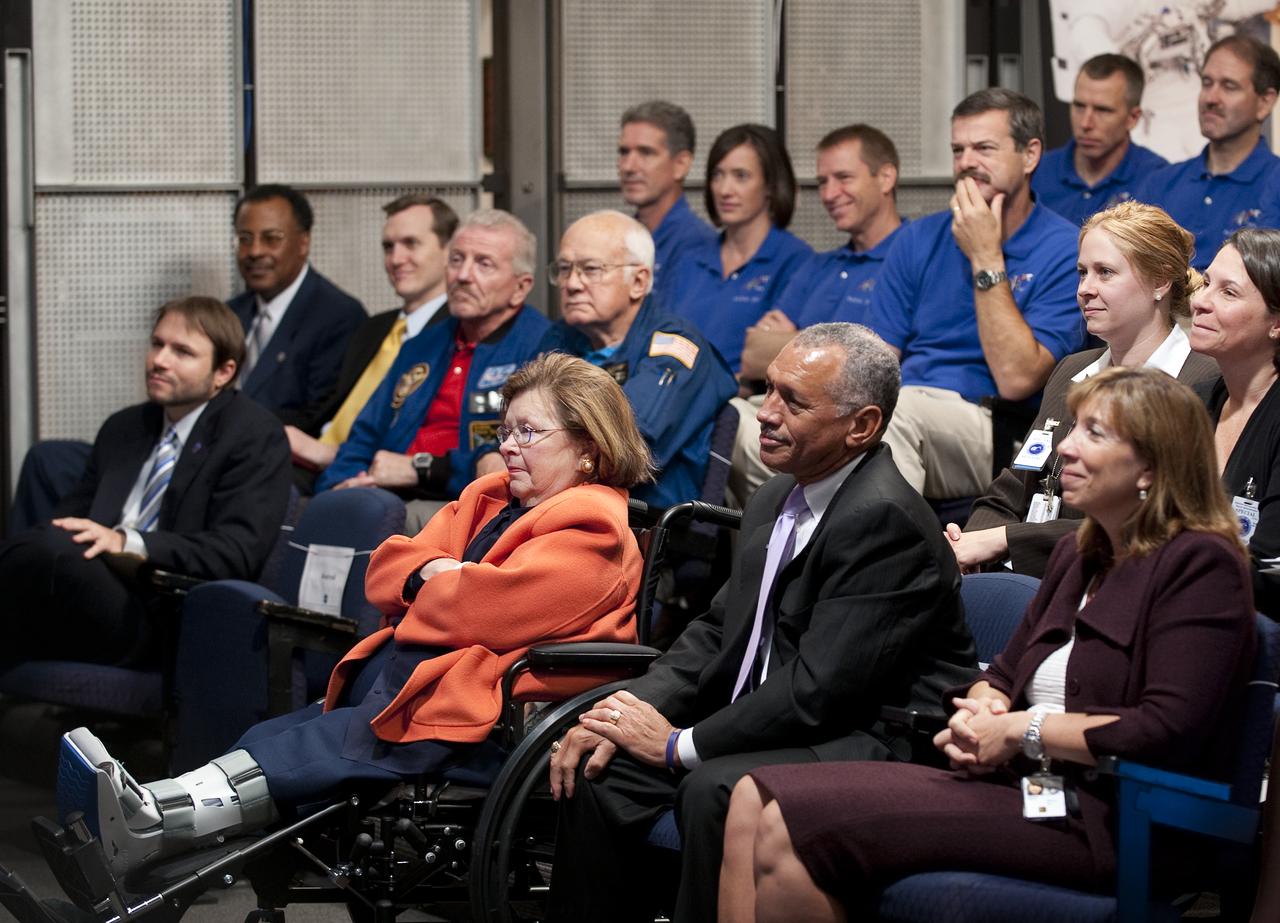
U.S. Senator Barbara A. Mikulski, D-Md., left foreground, NASA Administrator Charles F. Bolden, center, and NASA Deputy Administrator Lori Garver, right, along with members of the STS-125 and STS-31 space shuttle crews listen during a press conference where NASA unveiled new images from the Hubble Space Telescope Wednesday, Sept. 9, 2009 at NASA Headquarters in Washington. The unveiled images were from four of the telescopes' six operating science instruments. Photo Credit: (NASA/Bill Ingalls)
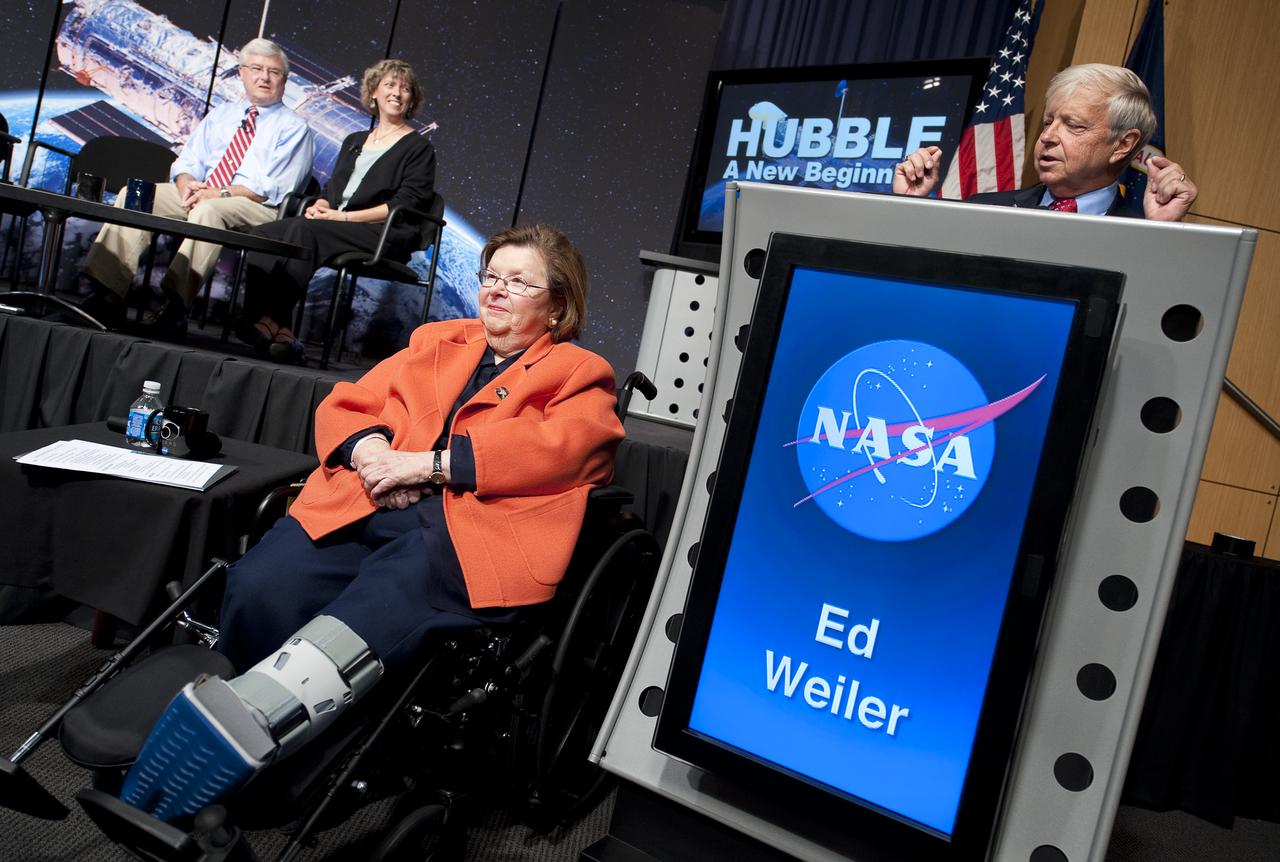
NASA Associate Administrator of the Science Mission Directorate Dr. Edward J. Weiler speaks at the podium as Sen. Barbara A. Mikulski, D-Md., left, listens during a press conference where NASA unveiled new images from NASA's Hubble Space Telescope Wednesday, Sept. 9, 2009 at NASA Headquarters in Washington. The images were from four of the telescopes' six operating science instruments. Photo Credit: (NASA/Bill Ingalls)
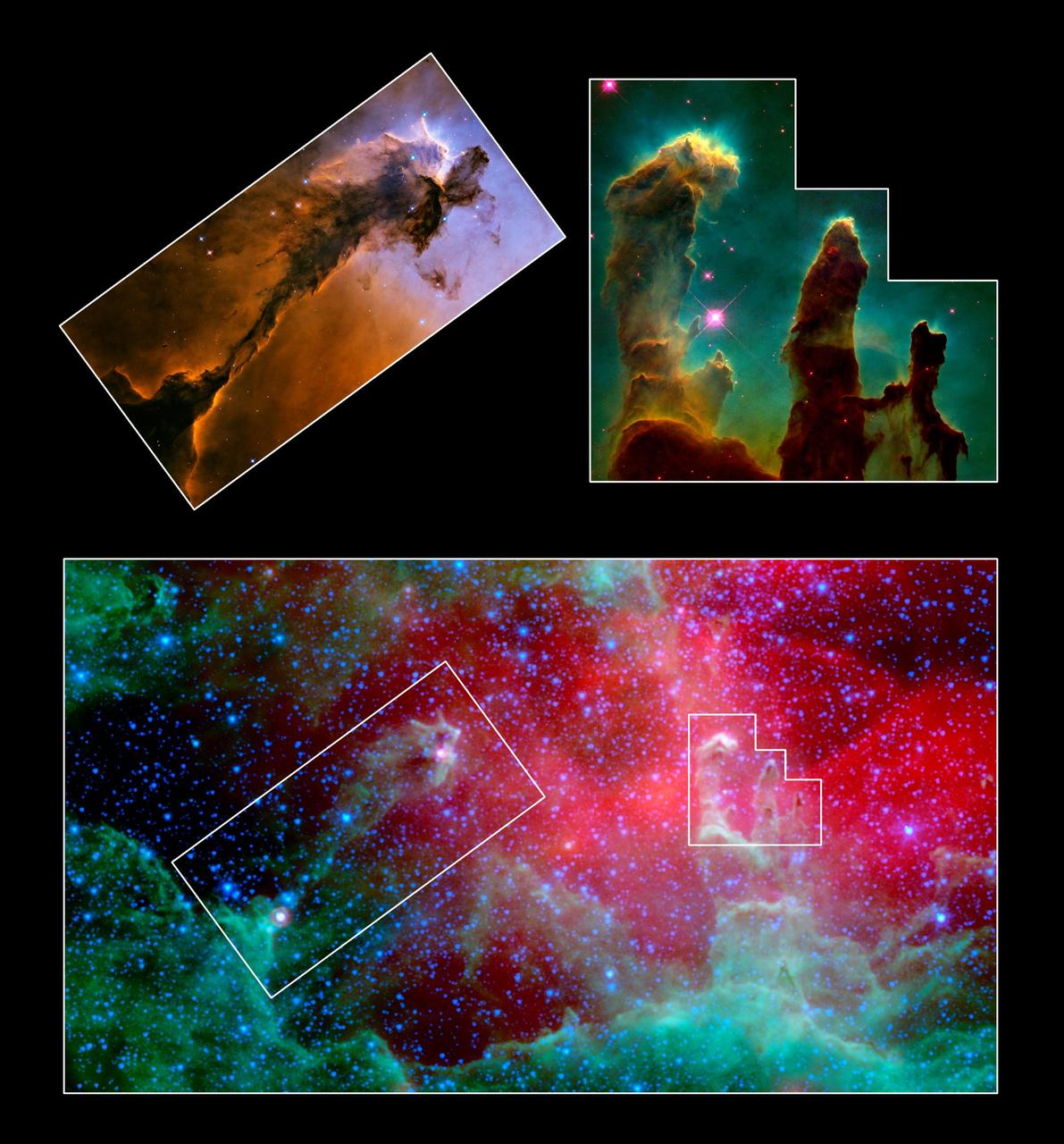
This image composite highlights the pillars of the Eagle nebula, as seen in infrared light by NASA Spitzer Space Telescope bottom and visible light by NASA Hubble Space Telescope top insets.

The Crab Nebula is one of the most intricately structured and highly dynamical objects ever observed. The new Hubble image of the Crab was assembled from 24 individual exposures taken with the NASA/ESA Hubble Space Telescope

This illustration depicts the design features of the Hubble Space Telescope's (HST's) Support Systems Module (SSM). The SSM is one of the three major elements of the HST and encloses the other two elements, the Optical Telescope Assembly (OTA) and the Scientific Instruments (SI's). The purpose of the HST, the most complex and sensitive optical telescope ever made, is to study the cosmos from a low-Earth orbit. By placing the telescope in space, astronomers are able to collect data that is free of the Earth's atmosphere. The HST detects objects 25 times fainter than the dimmest objects seen from Earth and provides astronomers with an observable universe 250 times larger than visible from ground-based telescopes, perhaps as far away as 14 billion light-years. The HST views galaxies, stars, planets, comets, possibly other solar systems, and even unusual phenomena such as quasars, with 10 times the clarity of ground-based telescopes. The spacecraft is 42.5-feet (13-meters) long and weighs 25,000 pounds (11,600 kilograms). Two communication anternas, two solar array panels that collect energy for the HST, and storage bays for electronic gear are on the outside. The HST was deployed from the Space Shuttle Discovery (STS-31 mission) into Earth orbit in April 1990. The Marshall Space Flight Center had responsibility for design, development, and construction of the HST. The Perkin-Elmer Corporation, in Danbury, Connecticut, developed the optical system and guidance sensors. The Lockheed Missile and Space Company of Sunnyvale, California produced the protective outer shroud and spacecraft systems, and assembled and tested the finished telescope.
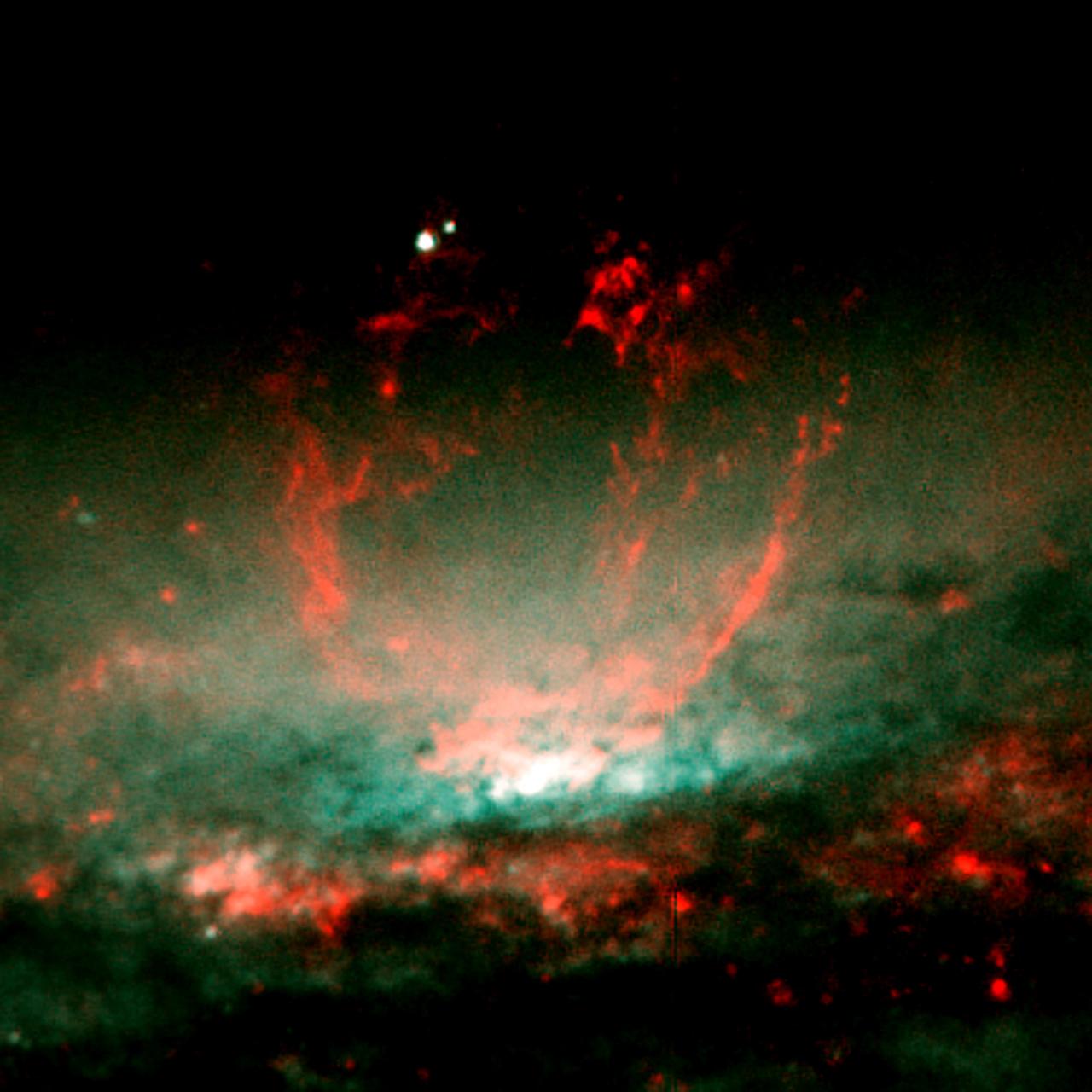
NASA's Hubble Space Telescope (HST) captures a lumpy bubble of hot gas rising from a cauldron of glowing matter in Galaxy NGC 3079, located 50 million light-years from Earth in the constellation Ursa Major. Astronomers suspect the bubble is being blown by "winds" or high speed streams of particles, released during a burst of star formation. The bubble's lumpy surface has four columns of gaseous filaments towering above the galaxy's disc that whirl around in a vortex and are expelled into space. Eventually, this gas will rain down on the disc and may collide with gas clouds, compress them, and form a new generation of stars.
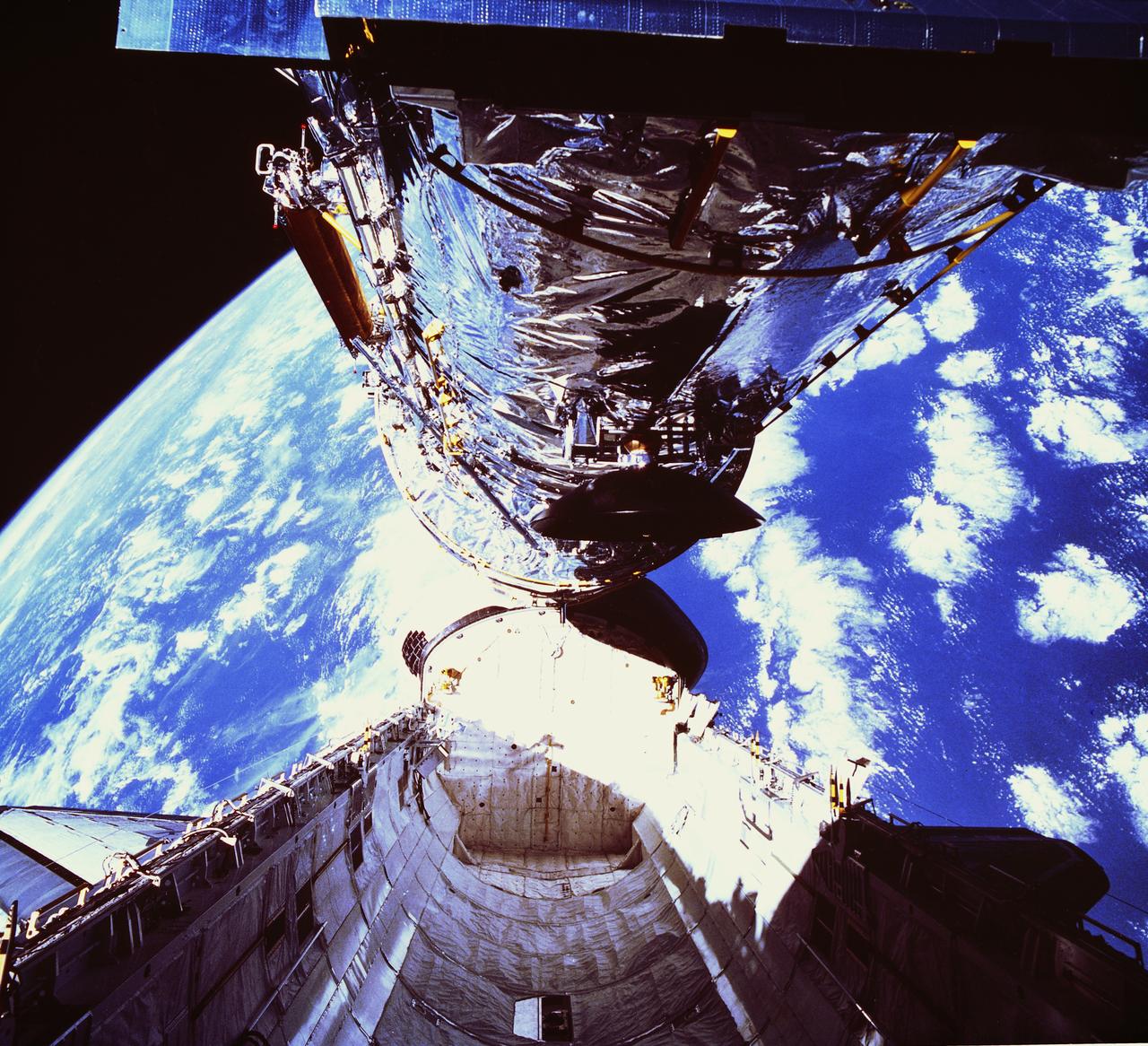
In this photograph, the Hubble Space Telescope (HST) is clearing the cargo bay during its deployment on April 25, 1990. The photograph was taken by the IMAX Cargo Bay Camera (ICBC) mounted in a container on the port side of the Space Shuttle orbiter Discovery STS-31 mission. The purpose of the HST, the most complex and sensitive optical telescope ever made, is to study the cosmos from a low-Earth orbit for 15 years or more. The HST provides fine detail imaging, produces ultraviolet images and spectra, and detects very faint objects. Two months after its deployment in space, scientists detected a 2-micron spherical aberration in the primary mirror of the HST that affected the telescope's ability to focus faint light sources into a precise point. This imperfection was very slight, one-fiftieth of the width of a human hair. A scheduled Space servicing mission (STS-61) in 1993 permitted scientists to correct the problem. During four space walks, new instruments were installed into the HST that had optical corrections. A total of four HST servicing missions have taken place since its deployment: STS-61 in December 1993, STS-82 in February 1997, STS-103 in December 1999, and STS-109 in March 2002. The Marshall Space Flight Center had responsibility for design, development, and construction of the HST. The Perkin-Elmer Corporation, in Danbury, Cornecticut, developed the optical system and guidance sensors.
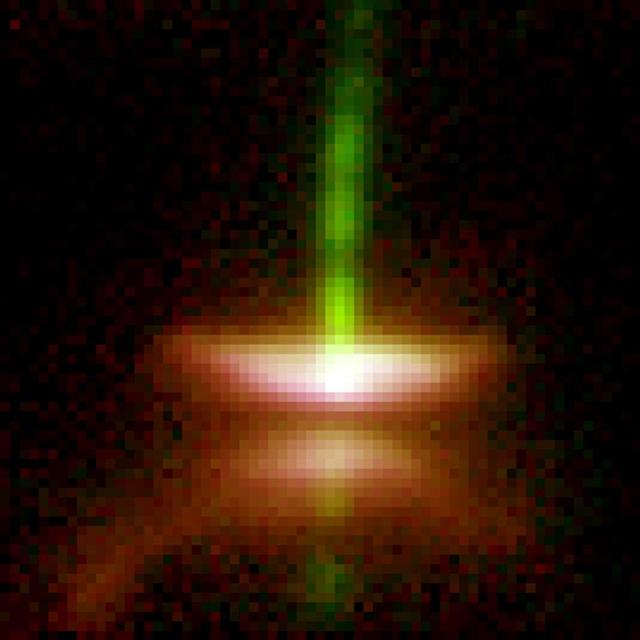
This image from NASA Hubble Space Telescope shows Herbig-Haro 30, the prototype of a gas-rich young stellar object disk around a star.
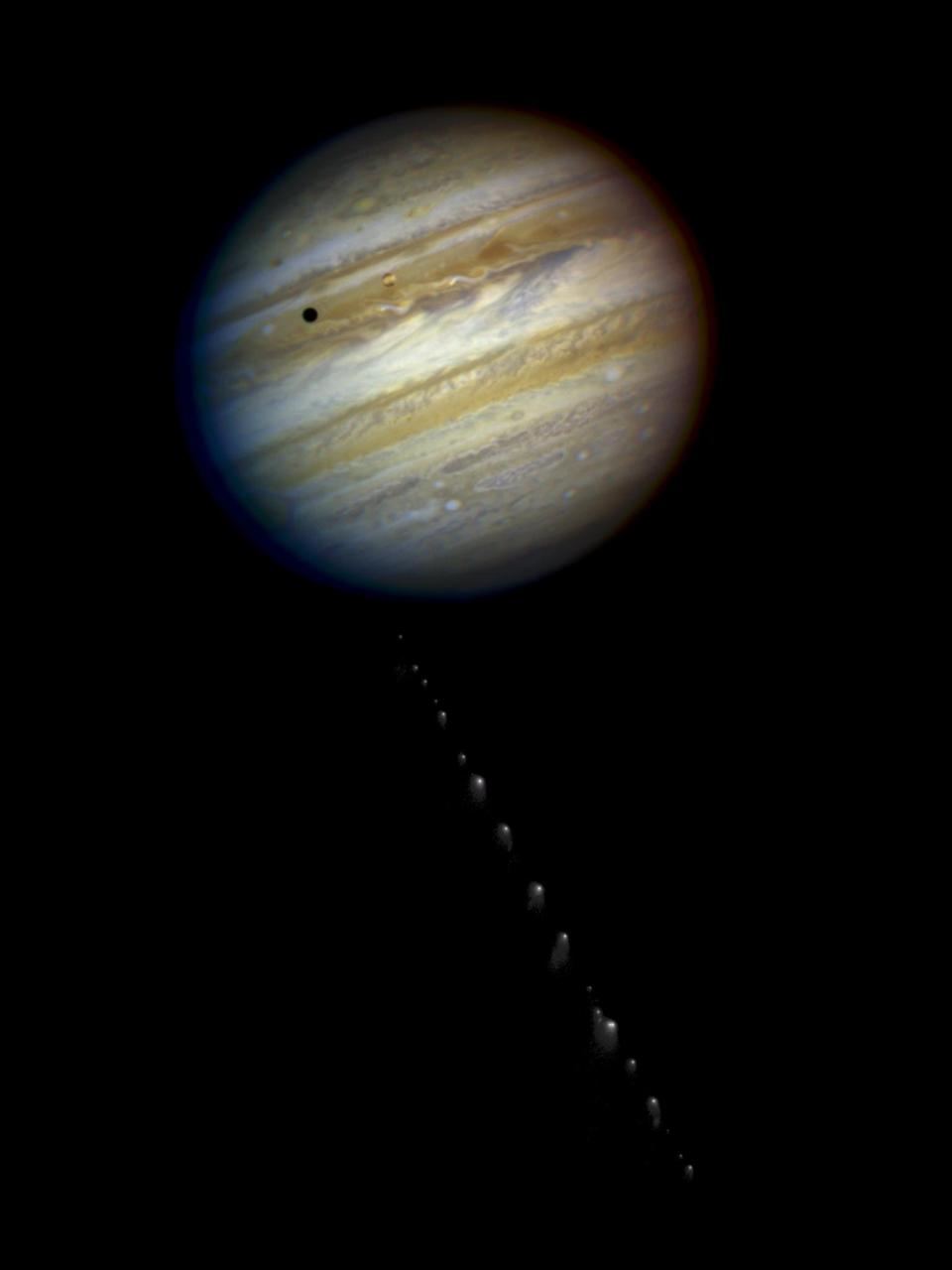
This is a composite photo, assembled from separate images of Jupiter and comet Shoemaker-Levy 9, as imaged by the NASA/ESA Hubble Space Telescope in 1994.
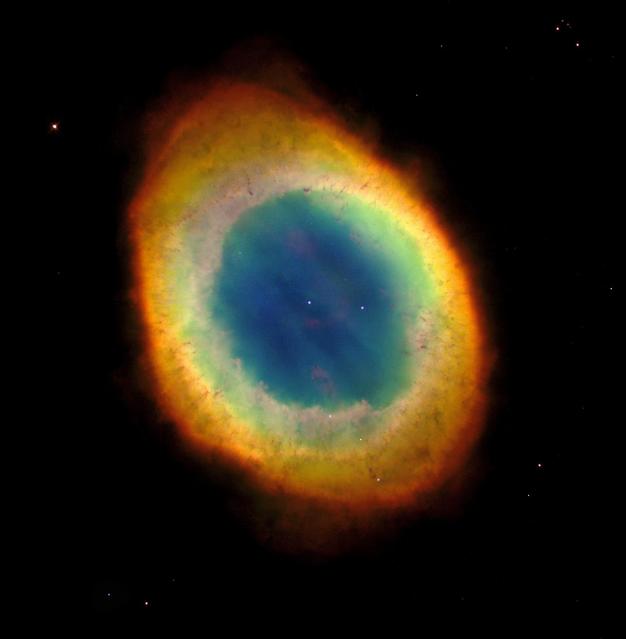
NASA Hubble Space Telescope captured this sharpest view yet of the most famous of all planetary nebulae: the Ring Nebula M57. The colors are approximately true colors.

This NASA Hubble Space Telescope image of the planet Uranus reveals the planet rings and bright clouds and a high altitude haze above the planet south pole.
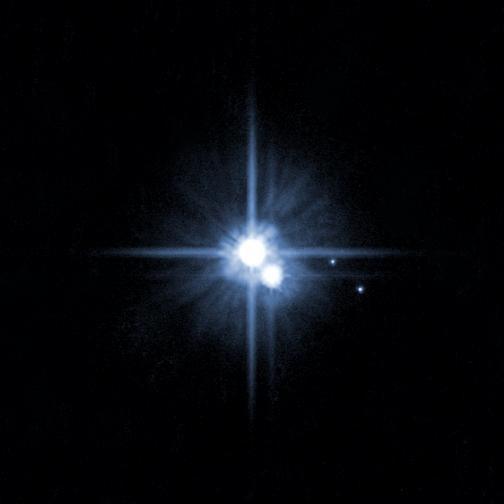
A pair of small moons photographed by NASA Hubble Space Telescope discovered orbiting Pluto in 2005 now have official names: Nix and Hydra.

This NASA Hubble Space Telescope image of the planet Uranus reveals the planet rings, at least five of the inner moons, and bright clouds in the planet southern hemisphere.
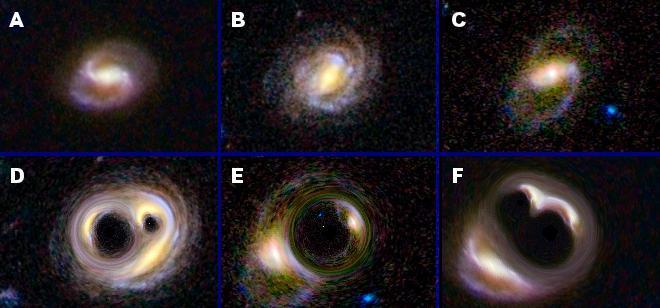
Warping occurs naturally in nature in a phenomenon called strong gravitational lensing as shown in this image simulated from original images from NASA Hubble Space Telescope.

This is a NASA Hubble Space Telescope series of 24 images showing the full 5.34-hour rotation of the 325-mile diameter 525 kilometer asteroid Vesta.

A recent NASA Hubble Space Telescope view reveals Uranus surrounded by its four major rings and by 10 of its 17 known satellites.
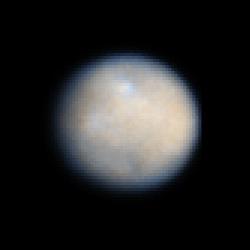
This is a NASA Hubble Space Telescope color image of dwarf planet Ceres, the largest object in the asteroid belt. The contrast has been enhanced to reveal surface details.
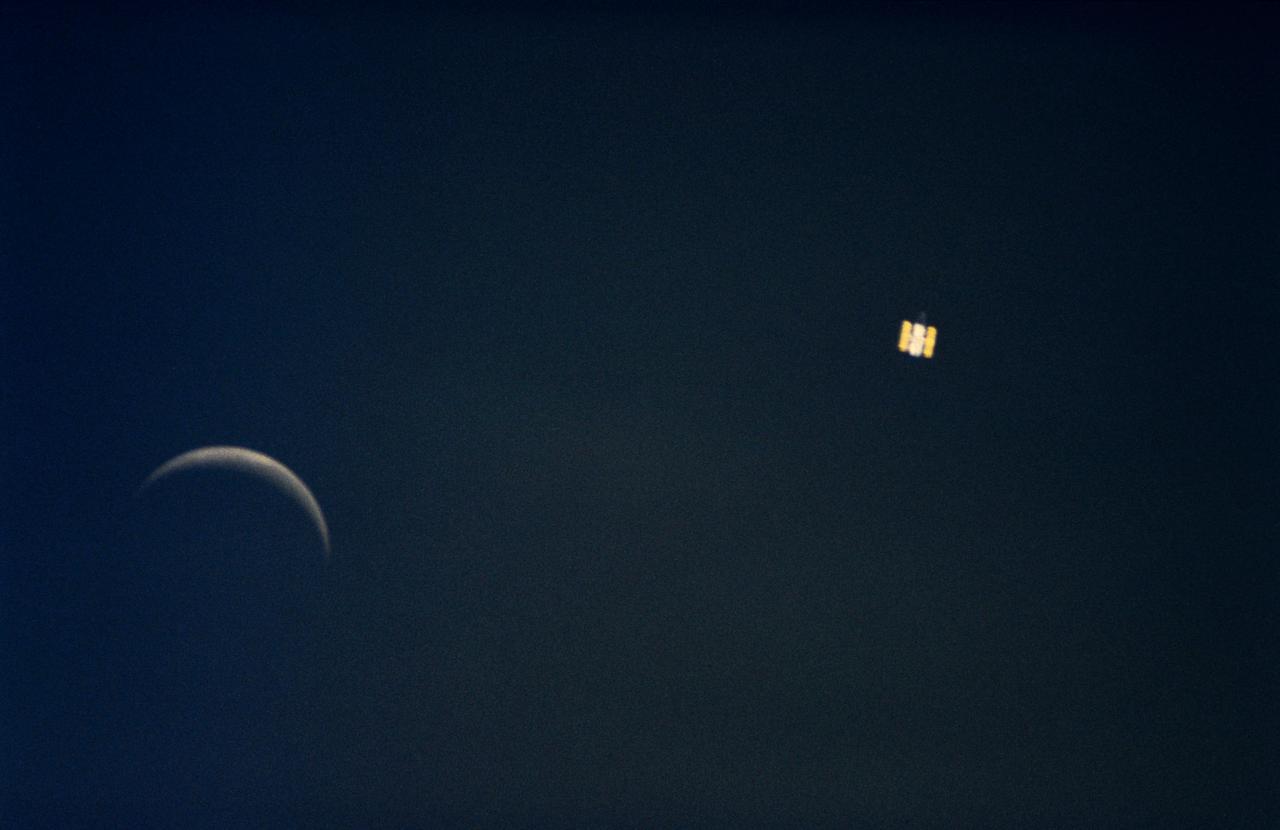
STS061-57-021 (2-12 Dec 1993) --- This scene, captured with a 35mm camera from inside the Space Shuttle Endeavour, shows the Earth-orbiting Hubble Space Telescope (HST) and the Moon together.
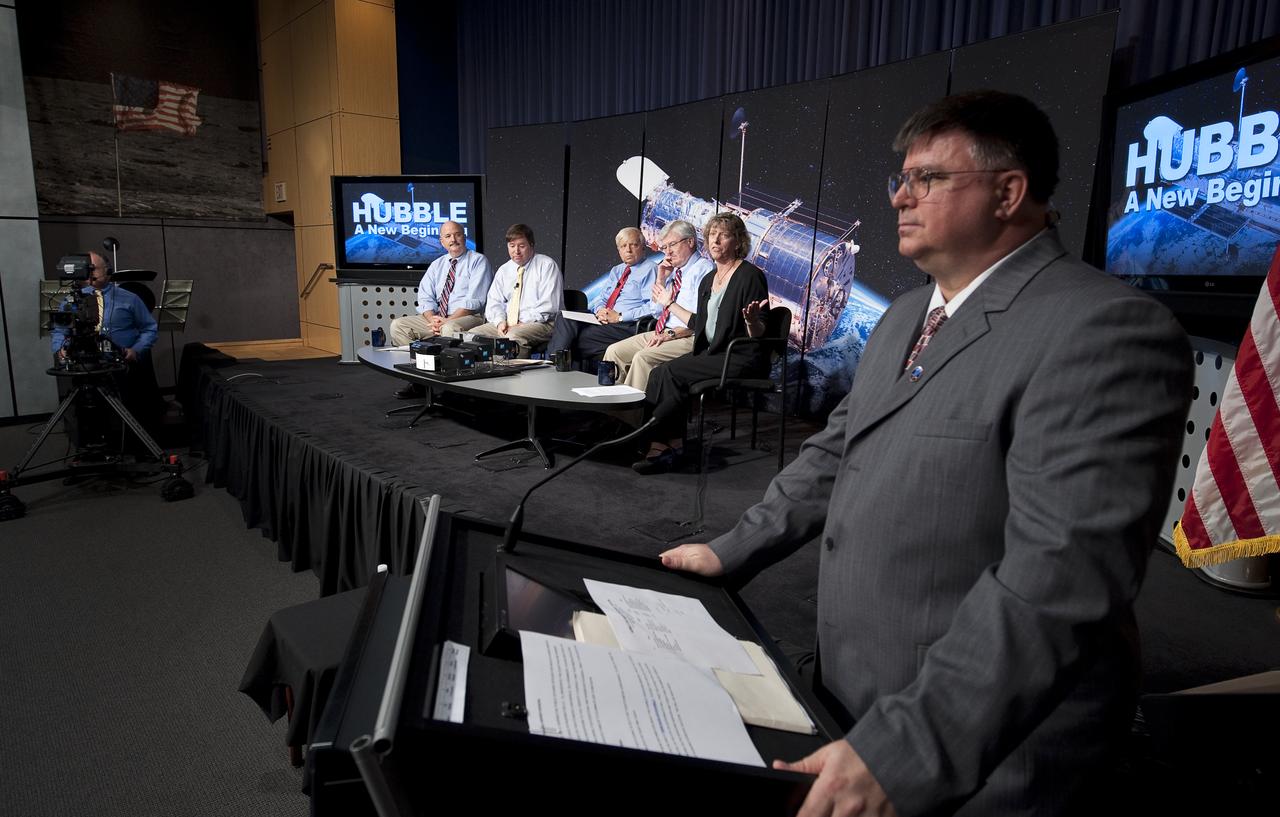
NASA Public Affairs Officer J.D. Harrington, left, monitors a press conference where NASA released images from NASA's Hubble Space Telescope Wednesday, Sept. 9, 2009 at NASA Headquarters in Washington. Participants on stage from left, Bob O'Connell, chair of the science oversight committee for the NASA Hubble Space Telescope Wide Field Camera 3, James Green, the Cosmic Origins Spectrograph principal investigator, NASA Associate Administrator of the Science Mission Directorate Dr. Edward J. Weiler, David Leckrone, senior project scientist, and Heidi Hammel, senior research scientist at the Space Science Institute in Boulder. The images were from four of the telescopes' six operating science instruments. Photo Credit: (NASA/Bill Ingalls)