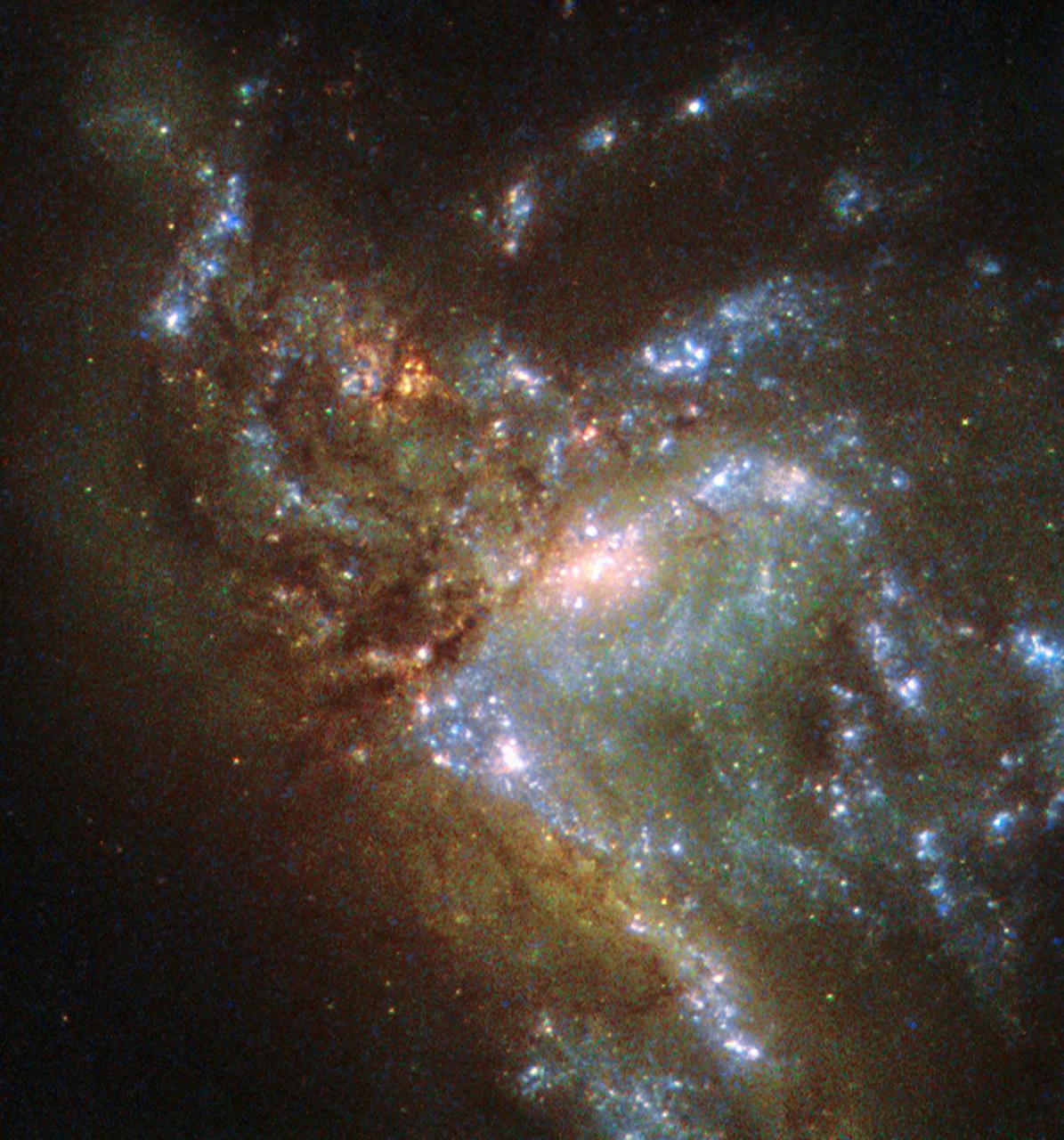
This image, taken with the Wide Field Planetary Camera 2 on board the NASA/ESA Hubble Space Telescope, shows the galaxy NGC 6052, located around 230 million light-years away in the constellation of Hercules. It would be reasonable to think of this as a single abnormal galaxy, and it was originally classified as such. However, it is in fact a “new” galaxy in the process of forming. Two separate galaxies have been gradually drawn together, attracted by gravity, and have collided. We now see them merging into a single structure. As the merging process continues, individual stars are thrown out of their original orbits and placed onto entirely new paths, some very distant from the region of the collision itself. Since the stars produce the light we see, the “galaxy” now appears to have a highly chaotic shape. Eventually, this new galaxy will settle down into a stable shape, which may not resemble either of the two original galaxies. Image credit: ESA/Hubble & NASA, Acknowledgement: Judy Schmidt
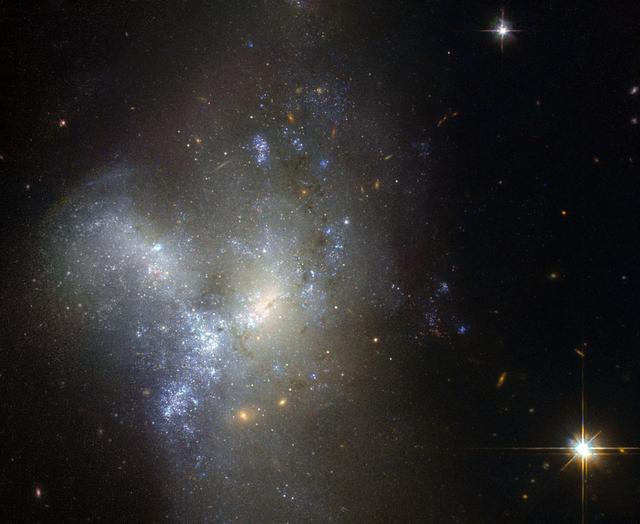
This image, taken by the NASA/ESA Hubble Space Telescope, shows a peculiar galaxy known as NGC 1487, lying about 30 million light-years away in the southern constellation of Eridanus. Rather than viewing a celestial object, it is actually better to think of this as an event. Here, we are witnessing two or more galaxies in the act of merging together to form a single new galaxy. Each progenitor has lost almost all traces of its original appearance, as stars and gas have been thrown hither and thither by gravity in an elaborate cosmic whirl. Unless one is very much bigger than the other, galaxies are always disrupted by the violence of the merging process. As a result, it is very difficult to determine precisely what the original galaxies looked like and, indeed, how many of them there were. In this case, it is possible that we are seeing the merger of several dwarf galaxies that were previously clumped together in a small group. Although older yellow and red stars can be seen in the outer regions of the new galaxy, its appearance is dominated by large areas of bright blue stars, illuminating the patches of gas that gave them life. This burst of star formation may well have been triggered by the merger.
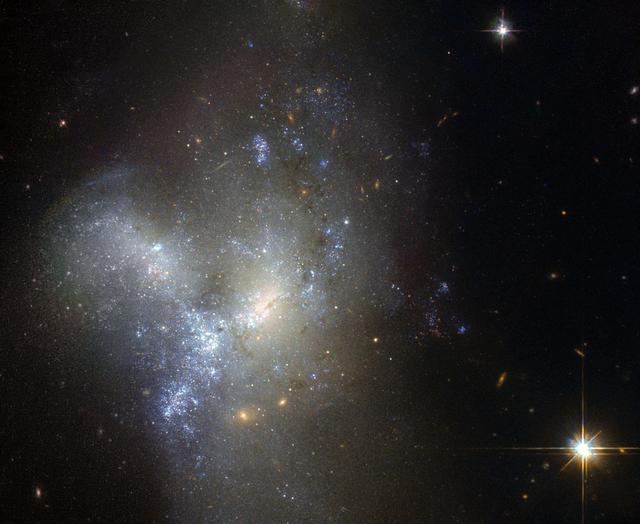
This image, taken by the NASA/ESA Hubble Space Telescope, shows a peculiar galaxy known as NGC 1487, lying about 30 million light-years away in the southern constellation of Eridanus. Rather than viewing it as a celestial object, it is actually better to think of this as an event. Here, we are witnessing two or more galaxies in the act of merging together to form a single new galaxy. Each galaxy has lost almost all traces of its original appearance, as stars and gas have been thrown by gravity in an elaborate cosmic whirl. Unless one is very much bigger than the other, galaxies are always disrupted by the violence of the merging process. As a result, it is very difficult to determine precisely what the original galaxies looked like and, indeed, how many of them there were. In this case, it is possible that we are seeing the merger of several dwarf galaxies that were previously clumped together in a small group. Although older yellow and red stars can be seen in the outer regions of the new galaxy, its appearance is dominated by large areas of bright blue stars, illuminating the patches of gas that gave them life. This burst of star formation may well have been triggered by the merger. Image credit: ESA/Hubble & NASA, Acknowledgement: Judy Schmidt <b><a href="http://www.nasa.gov/audience/formedia/features/MP_Photo_Guidelines.html" rel="nofollow">NASA image use policy.</a></b> <b><a href="http://www.nasa.gov/centers/goddard/home/index.html" rel="nofollow">NASA Goddard Space Flight Center</a></b> enables NASA’s mission through four scientific endeavors: Earth Science, Heliophysics, Solar System Exploration, and Astrophysics. Goddard plays a leading role in NASA’s accomplishments by contributing compelling scientific knowledge to advance the Agency’s mission. <b>Follow us on <a href="http://twitter.com/NASAGoddardPix" rel="nofollow">Twitter</a></b> <b>Like us on <a href="http://www.facebook.com/pages/Greenbelt-MD/NASA-Goddard/395013845897?ref=tsd" rel="nofollow">Facebook</a></b> <b>Find us on <a href="http://instagrid.me/nasagoddard/?vm=grid" rel="nofollow">Instagram</a></b>
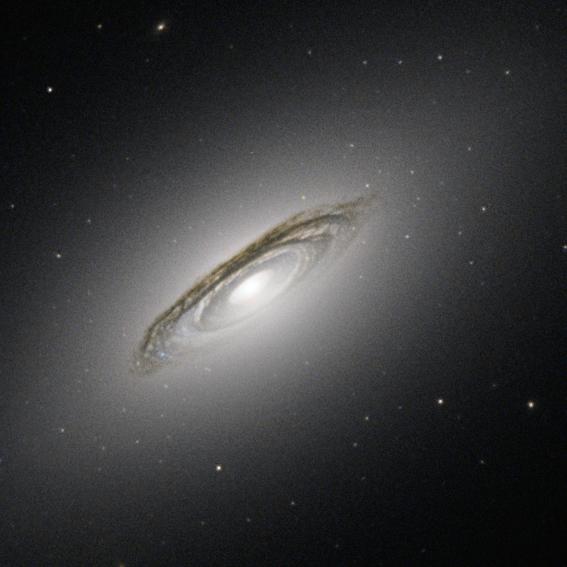
The subject of this image is NGC 6861, a galaxy discovered in 1826 by the Scottish astronomer James Dunlop. Almost two centuries later we now know that NGC 6861 is the second brightest member of a group of at least a dozen galaxies called the Telescopium Group — otherwise known as the NGC 6868 Group — in the small constellation of Telescopium (The Telescope). This NASA/ESA Hubble Space Telescope view shows some important details of NGC 6861. One of the most prominent features is the disk of dark bands circling the centre of the galaxy. These dust lanes are a result of large clouds of dust particles obscuring the light emitted by the stars behind them. Dust lanes are very useful for working out whether we are seeing the galaxy disk edge-on, face-on or, as is the case for NGC 6861, somewhat in the middle. Dust lanes like these are typical of a spiral galaxy. The dust lanes are embedded in a white oval shape, which is made up of huge numbers of stars orbiting the center of the galaxy. This oval is, rather puzzlingly, typical of an elliptical galaxy. So which is it — spiral or elliptical? The answer is neither! NGC 6861 does not belong to either the spiral or the elliptical family of galaxies. It is a lenticular galaxy, a family which has features of both spirals and ellipticals. The relationships between these three kinds of galaxies are not yet well understood. A lenticular galaxy could be a faded spiral that has run out of gas and lost its arms, or the result of two galaxies merging. Being part of a group increases the chances for galactic mergers, so this could be the case for NGC 6861. Credit: ESA/Hubble & NASA; acknowledgement: J. Barrington <b><a href="http://www.nasa.gov/audience/formedia/features/MP_Photo_Guidelines.html" rel="nofollow">NASA image use policy.</a></b> <b><a href="http://www.nasa.gov/centers/goddard/home/index.html" rel="nofollow">NASA Goddard Space Flight Center</a></b> enables NASA’s mission through four scientific endeavors: Earth Science, Heliophysics, Solar System Exploration, and Astrophysics. Goddard plays a leading role in NASA’s accomplishments by contributing compelling scientific knowledge to advance the Agency’s mission. <b>Follow us on <a href="http://twitter.com/NASAGoddardPix" rel="nofollow">Twitter</a></b> <b>Like us on <a href="http://www.facebook.com/pages/Greenbelt-MD/NASA-Goddard/395013845897?ref=tsd" rel="nofollow">Facebook</a></b> <b>Find us on <a href="http://instagram.com/nasagoddard?vm=grid" rel="nofollow">Instagram</a></b>
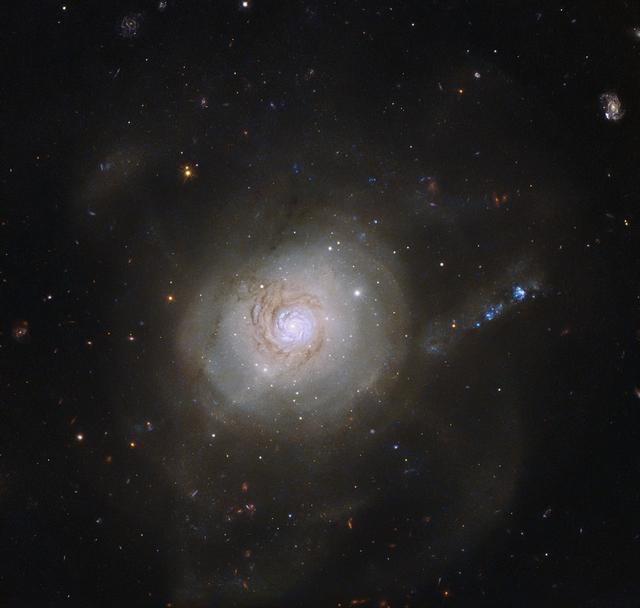
Only rarely does an astronomical object have a political association. However, the spiral galaxy NGC 7252 acquired exactly that when it was given an unusual nickname. In December 1953, the US President Dwight D. Eisenhower gave a speech advocating the use of nuclear power for peaceful purposes. This “Atoms for Peace” speech was significant for the scientific community, as it brought nuclear research into the public domain, and NGC 7252, which has a superficial resemblance to an atomic nucleus surrounded by the loops of electronic orbits, was dubbed the Atoms for Peace galaxy in honour of this. These loops are well visible in a wider field of view image. This nickname is quite ironic, as the galaxy’s past was anything but peaceful. Its peculiar appearance is the result of a collision between two galaxies that took place about a billion years ago, which ripped both galaxies apart. The loop-like outer structures, likely made up of dust and stars flung outwards by the crash, but recalling orbiting electrons in an atom, are partly responsible for the galaxy’s nickname. This NASA/ESA Hubble Space Telescope image shows the inner parts of the galaxy, revealing a pinwheel-shaped disc that is rotating in a direction opposite to the rest of the galaxy. This disc resembles a spiral galaxy like our own galaxy, the Milky Way, but is only about 10 000 light-years across — about a tenth of the size of the Milky Way. It is believed that this whirling structure is a remnant of the galactic collision. It will most likely have vanished in a few billion years’ time, when NGC 7252 will have completed its merging process.
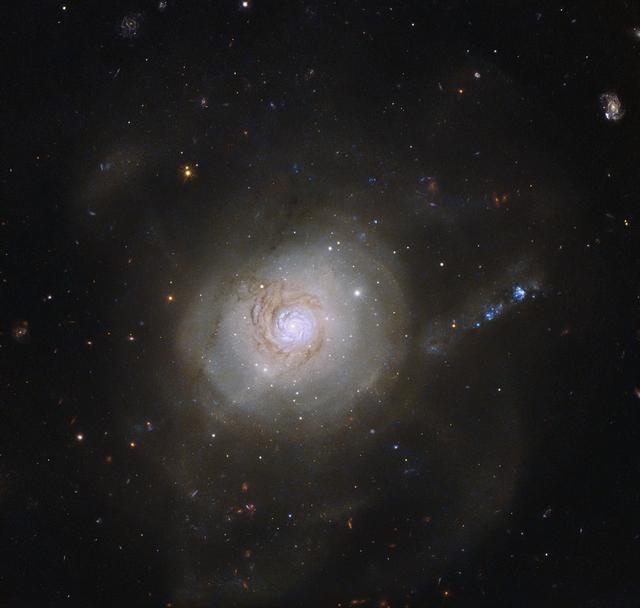
The spiral galaxy NGC 7252 has a superficial resemblance to an atomic nucleus surrounded by the loops of electronic orbits, and was informally dubbed the "Atoms for Peace" galaxy. These loops are well visible in a wider field of view image. This nickname is quite ironic, as the galaxy’s past was anything but peaceful. Its peculiar appearance is the result of a collision between two galaxies that took place about a billion years ago, which ripped both galaxies apart. The loop-like outer structures, likely made up of dust and stars flung outwards by the crash, but recalling orbiting electrons in an atom, are partly responsible for the galaxy’s nickname. This NASA/ESA Hubble Space Telescope image shows the inner parts of the galaxy, revealing a pinwheel-shaped disk that is rotating in a direction opposite to the rest of the galaxy. This disk resembles a spiral galaxy like our own galaxy, the Milky Way, but is only about 10,000 light-years across — about a tenth of the size of the Milky Way. It is believed that this whirling structure is a remnant of the galactic collision. It will most likely have vanished in a few billion years’ time, when NGC 7252 will have completed its merging process. Image credit: NASA & ESA, Acknowledgements: Judy Schmidt <b><a href="http://www.nasa.gov/audience/formedia/features/MP_Photo_Guidelines.html" rel="nofollow">NASA image use policy.</a></b> <b><a href="http://www.nasa.gov/centers/goddard/home/index.html" rel="nofollow">NASA Goddard Space Flight Center</a></b> enables NASA’s mission through four scientific endeavors: Earth Science, Heliophysics, Solar System Exploration, and Astrophysics. Goddard plays a leading role in NASA’s accomplishments by contributing compelling scientific knowledge to advance the Agency’s mission. <b>Follow us on <a href="http://twitter.com/NASAGoddardPix" rel="nofollow">Twitter</a></b> <b>Like us on <a href="http://www.facebook.com/pages/Greenbelt-MD/NASA-Goddard/395013845897?ref=tsd" rel="nofollow">Facebook</a></b> <b>Find us on <a href="http://instagrid.me/nasagoddard/?vm=grid" rel="nofollow">Instagram</a></b>
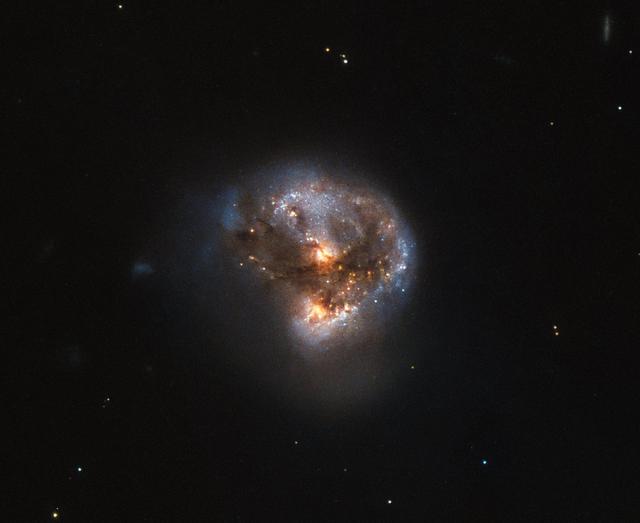
This galaxy has a far more exciting and futuristic classification than most — it hosts a megamaser. Megamasers are intensely bright, around 100 million times brighter than the masers found in galaxies like the Milky Way. The entire galaxy essentially acts as an astronomical laser that beams out microwave emission rather than visible light (hence the ‘m’ replacing the ‘l’). A megamaser is a process that involves some components within the galaxy (like gas) that is in the right physical condition to cause the amplification of light (in this case, microwaves). But there are other parts of the galaxy (like stars for example) that aren’t part of the maser process. This megamaser galaxy is named IRAS 16399-0937 and is located over 370 million light-years from Earth. This NASA/ESA Hubble Space Telescope image belies the galaxy’s energetic nature, instead painting it as a beautiful and serene cosmic rosebud. The image comprises observations captured across various wavelengths by two of Hubble’s instruments: the Advanced Camera for Surveys (ACS), and the Near Infrared Camera and Multi-Object Spectrometer (NICMOS). NICMOS’s superb sensitivity, resolution, and field of view gave astronomers the unique opportunity to observe the structure of IRAS 16399-0937 in detail. They found it hosts a double nucleus — the galaxy’s core is thought to be formed of two separate cores in the process of merging. The two components, named IRAS 16399N and IRAS 16399S for the northern and southern parts respectively, sit over 11,000 light-years apart. However, they are both buried deep within the same swirl of cosmic gas and dust and are interacting, giving the galaxy its peculiar structure. The nuclei are very different. IRAS 16399S appears to be a starburst region, where new stars are forming at an incredible rate. IRAS 16399N, however, is something known as a LINER nucleus (Low Ionization Nuclear Emission Region), which is a region whose emission mostly stems from weakly-ionized or neutral atoms of particular gases. The northern nucleus also hosts a black hole with some 100 million times the mass of the sun! Image credit: ESA/Hubble & NASA, Acknowledgement: Judy Schmidt (geckzilla) <b><a href="http://www.nasa.gov/audience/formedia/features/MP_Photo_Guidelines.html" rel="nofollow">NASA image use policy.</a></b> <b><a href="http://www.nasa.gov/centers/goddard/home/index.html" rel="nofollow">NASA Goddard Space Flight Center</a></b> enables NASA’s mission through four scientific endeavors: Earth Science, Heliophysics, Solar System Exploration, and Astrophysics. Goddard plays a leading role in NASA’s accomplishments by contributing compelling scientific knowledge to advance the Agency’s mission. <b>Follow us on <a href="http://twitter.com/NASAGoddardPix" rel="nofollow">Twitter</a></b> <b>Like us on <a href="http://www.facebook.com/pages/Greenbelt-MD/NASA-Goddard/395013845897?ref=tsd" rel="nofollow">Facebook</a></b> <b>Find us on <a href="http://instagrid.me/nasagoddard/?vm=grid" rel="nofollow">Instagram</a></b>