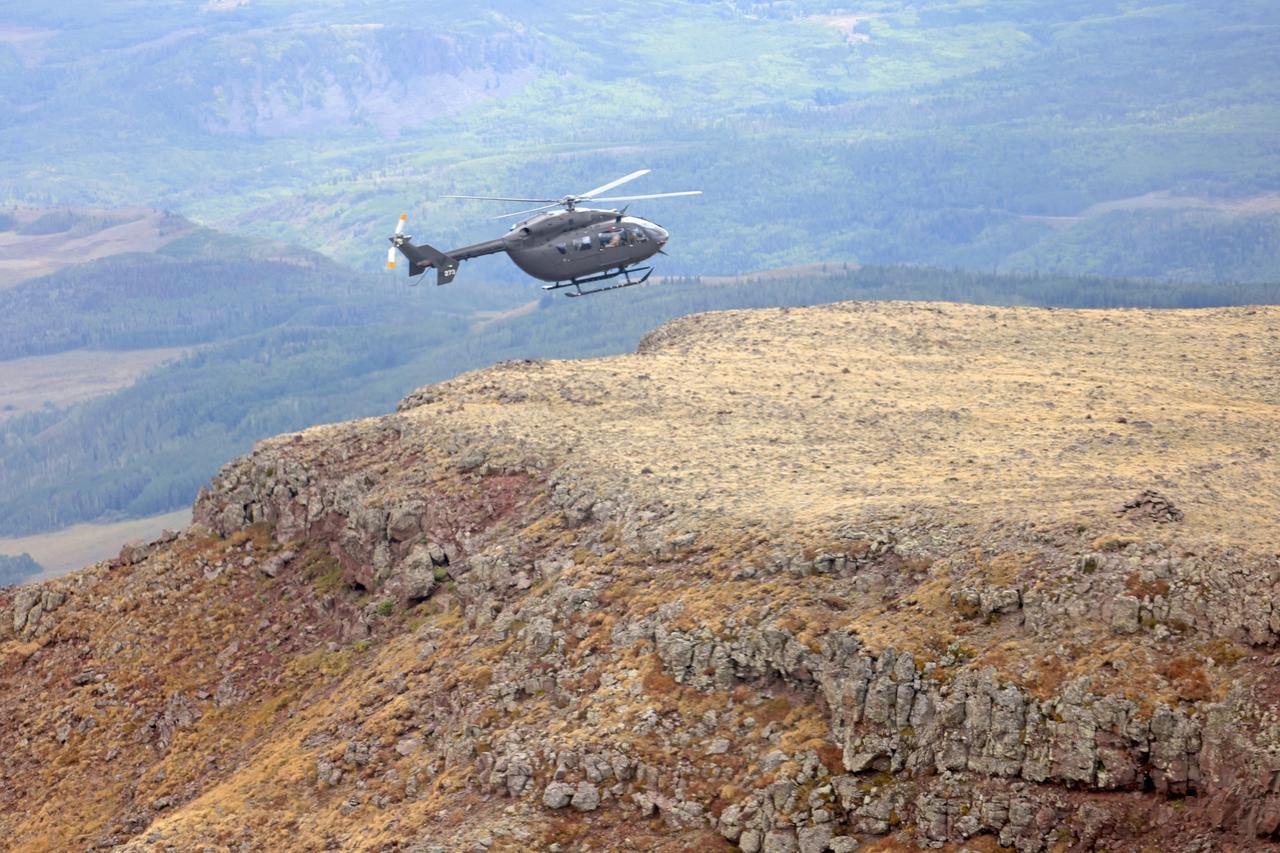
These photos and videos show how NASA certified a new lander flight training course using helicopters in the mountains of northern Colorado. NASA is partnering with the Colorado Army National Guard at its High-Altitude Army National Guard Aviation Training Site near Gypsum, Colorado, to develop the foundational flight training course that will help astronauts practice flight and landing procedures for the Moon. The certification marks an important milestone in crew training for Artemis missions to the Moon, when astronauts will use a commercial human landing system to land on the lunar surface. During the two-week certification run in late August 2025, NASA astronauts Matthew Dominick and Mark Vande Hei participated in flight and landing training to help certify the course. The pair, along with trained instructor pilots with the Army National Guard, took turns flying a helicopter and navigating to landing zones. Artemis flight crew trainers, mission control leads, and lunar lander operational experts from NASA Johnson joined them on each helicopter flight to assess the instruction, training environment, and technical applications for crewed lunar missions. For more information, contact NASA Marshall’s Office of Communications at 256-544
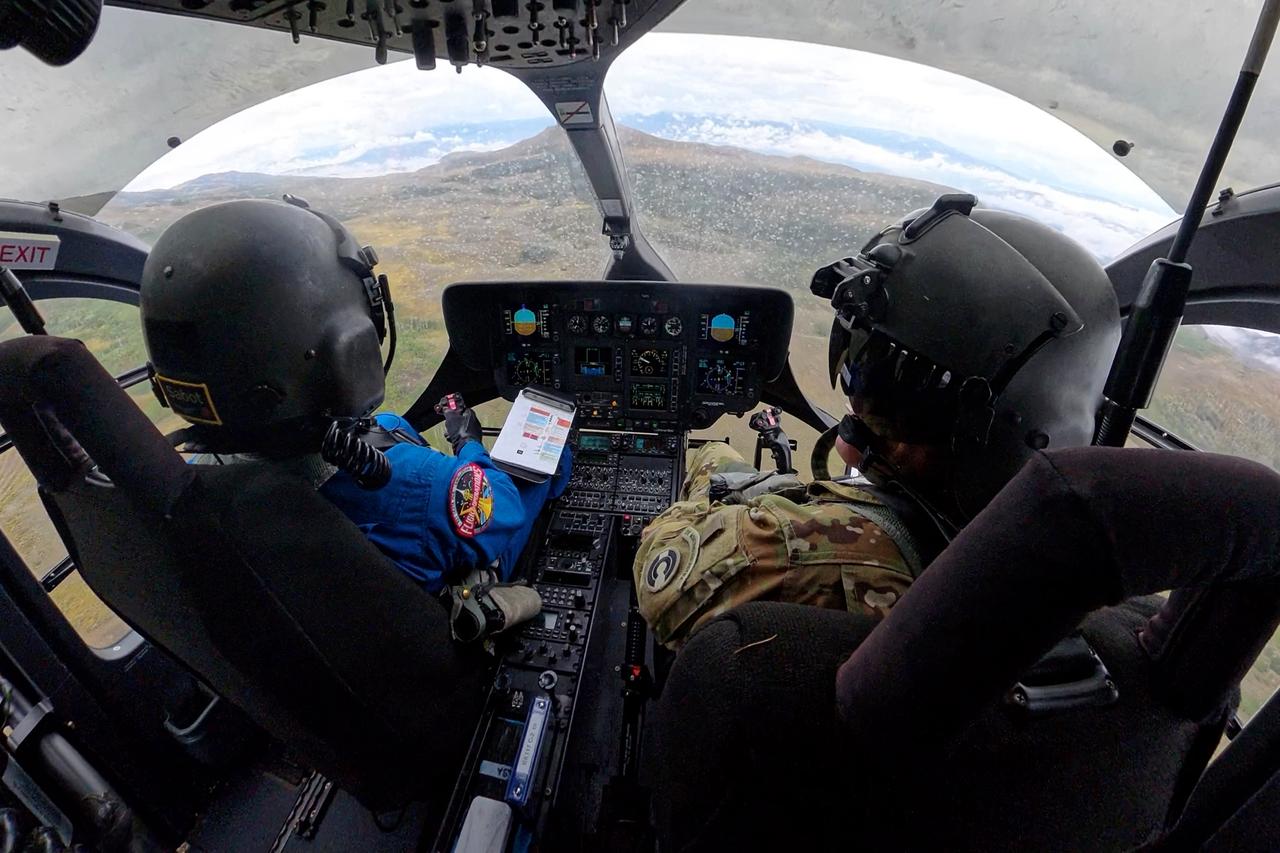
These photos and videos show how NASA certified a new lander flight training course using helicopters in the mountains of northern Colorado. NASA is partnering with the Colorado Army National Guard at its High-Altitude Army National Guard Aviation Training Site near Gypsum, Colorado, to develop the foundational flight training course that will help astronauts practice flight and landing procedures for the Moon. The certification marks an important milestone in crew training for Artemis missions to the Moon, when astronauts will use a commercial human landing system to land on the lunar surface. During the two-week certification run in late August 2025, NASA astronauts Matthew Dominick and Mark Vande Hei participated in flight and landing training to help certify the course. The pair, along with trained instructor pilots with the Army National Guard, took turns flying a helicopter and navigating to landing zones. Artemis flight crew trainers, mission control leads, and lunar lander operational experts from NASA Johnson joined them on each helicopter flight to assess the instruction, training environment, and technical applications for crewed lunar missions. For more information, contact NASA Marshall’s Office of Communications at 256-544
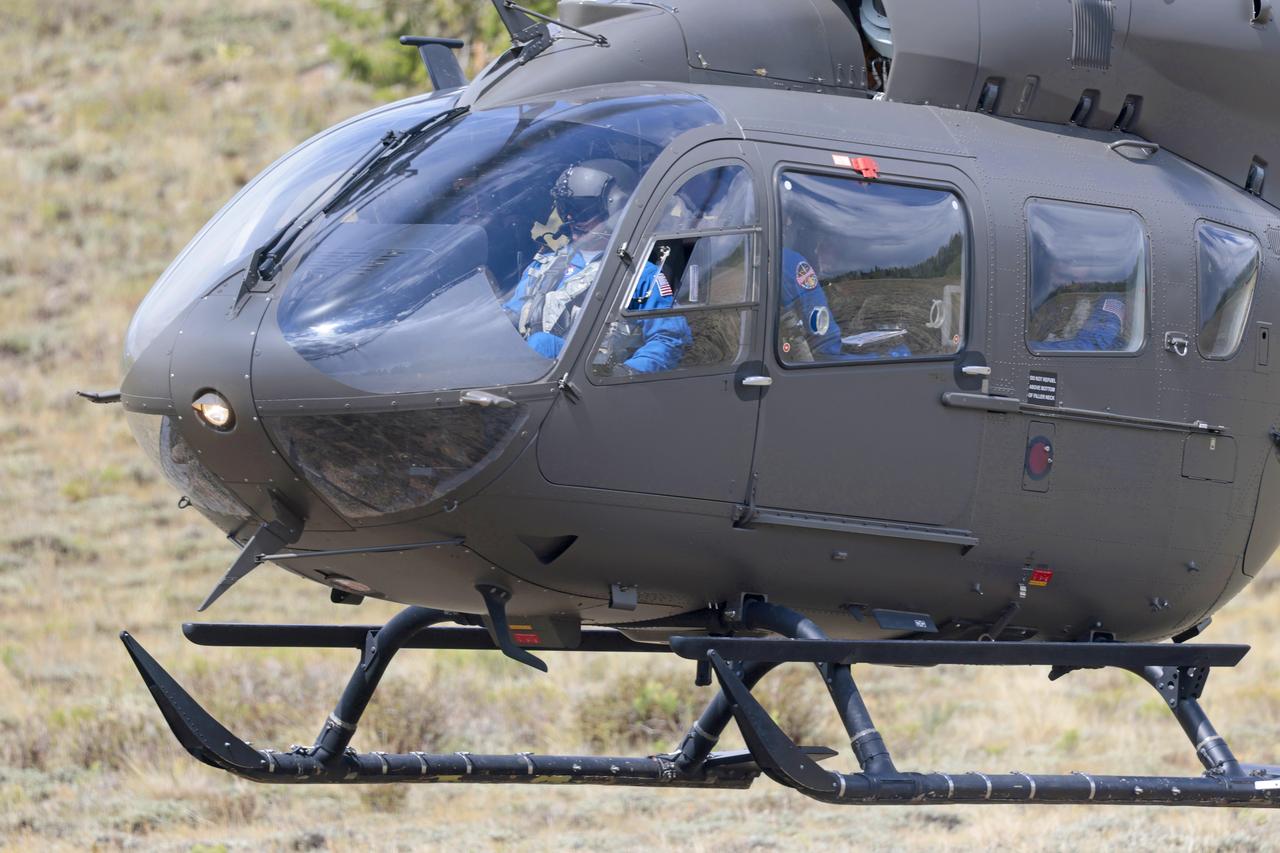
These photos and videos show how NASA certified a new lander flight training course using helicopters in the mountains of northern Colorado. NASA is partnering with the Colorado Army National Guard at its High-Altitude Army National Guard Aviation Training Site near Gypsum, Colorado, to develop the foundational flight training course that will help astronauts practice flight and landing procedures for the Moon. The certification marks an important milestone in crew training for Artemis missions to the Moon, when astronauts will use a commercial human landing system to land on the lunar surface. During the two-week certification run in late August 2025, NASA astronauts Matthew Dominick and Mark Vande Hei participated in flight and landing training to help certify the course. The pair, along with trained instructor pilots with the Army National Guard, took turns flying a helicopter and navigating to landing zones. Artemis flight crew trainers, mission control leads, and lunar lander operational experts from NASA Johnson joined them on each helicopter flight to assess the instruction, training environment, and technical applications for crewed lunar missions. For more information, contact NASA Marshall’s Office of Communications at 256-544
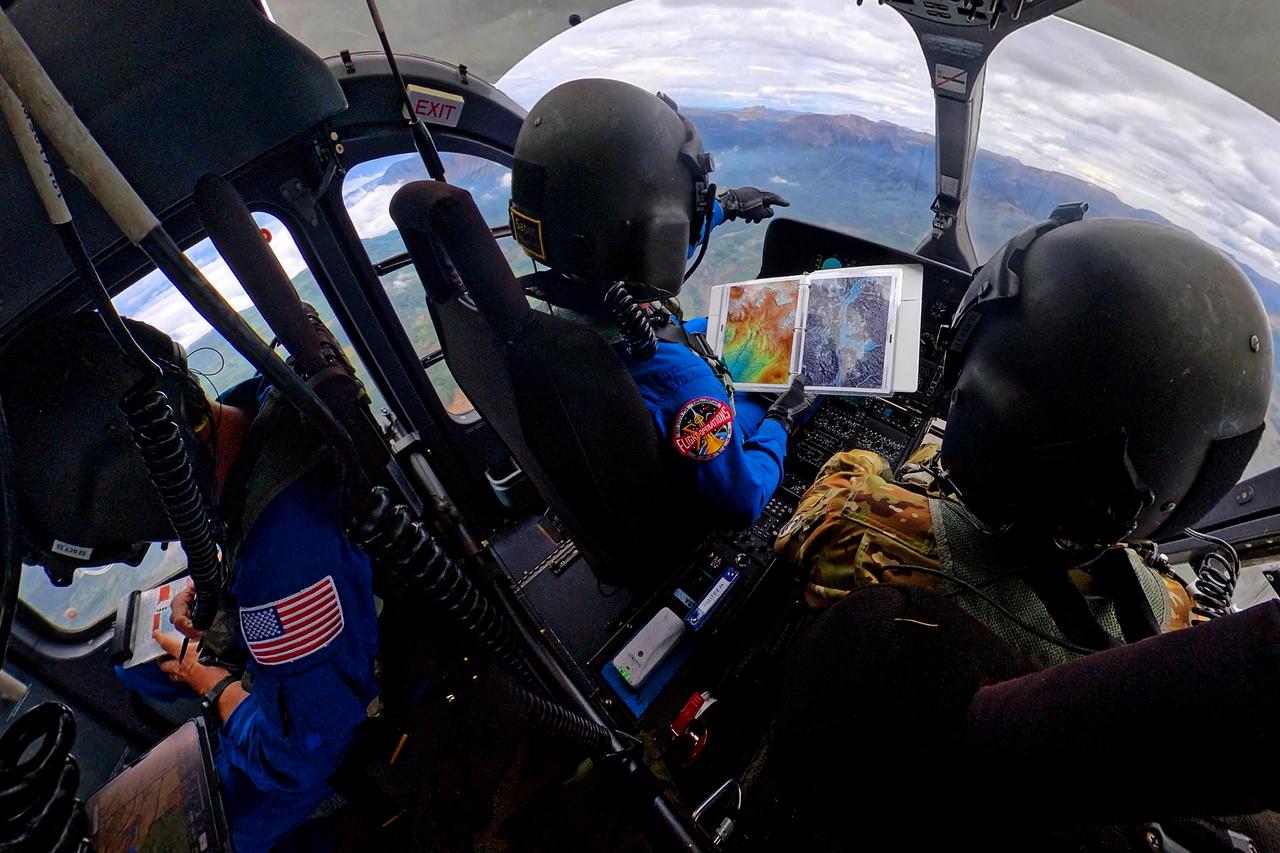
These photos and videos show how NASA certified a new lander flight training course using helicopters in the mountains of northern Colorado. NASA is partnering with the Colorado Army National Guard at its High-Altitude Army National Guard Aviation Training Site near Gypsum, Colorado, to develop the foundational flight training course that will help astronauts practice flight and landing procedures for the Moon. The certification marks an important milestone in crew training for Artemis missions to the Moon, when astronauts will use a commercial human landing system to land on the lunar surface. During the two-week certification run in late August 2025, NASA astronauts Matthew Dominick and Mark Vande Hei participated in flight and landing training to help certify the course. The pair, along with trained instructor pilots with the Army National Guard, took turns flying a helicopter and navigating to landing zones. Artemis flight crew trainers, mission control leads, and lunar lander operational experts from NASA Johnson joined them on each helicopter flight to assess the instruction, training environment, and technical applications for crewed lunar missions. For more information, contact NASA Marshall’s Office of Communications at 256-544
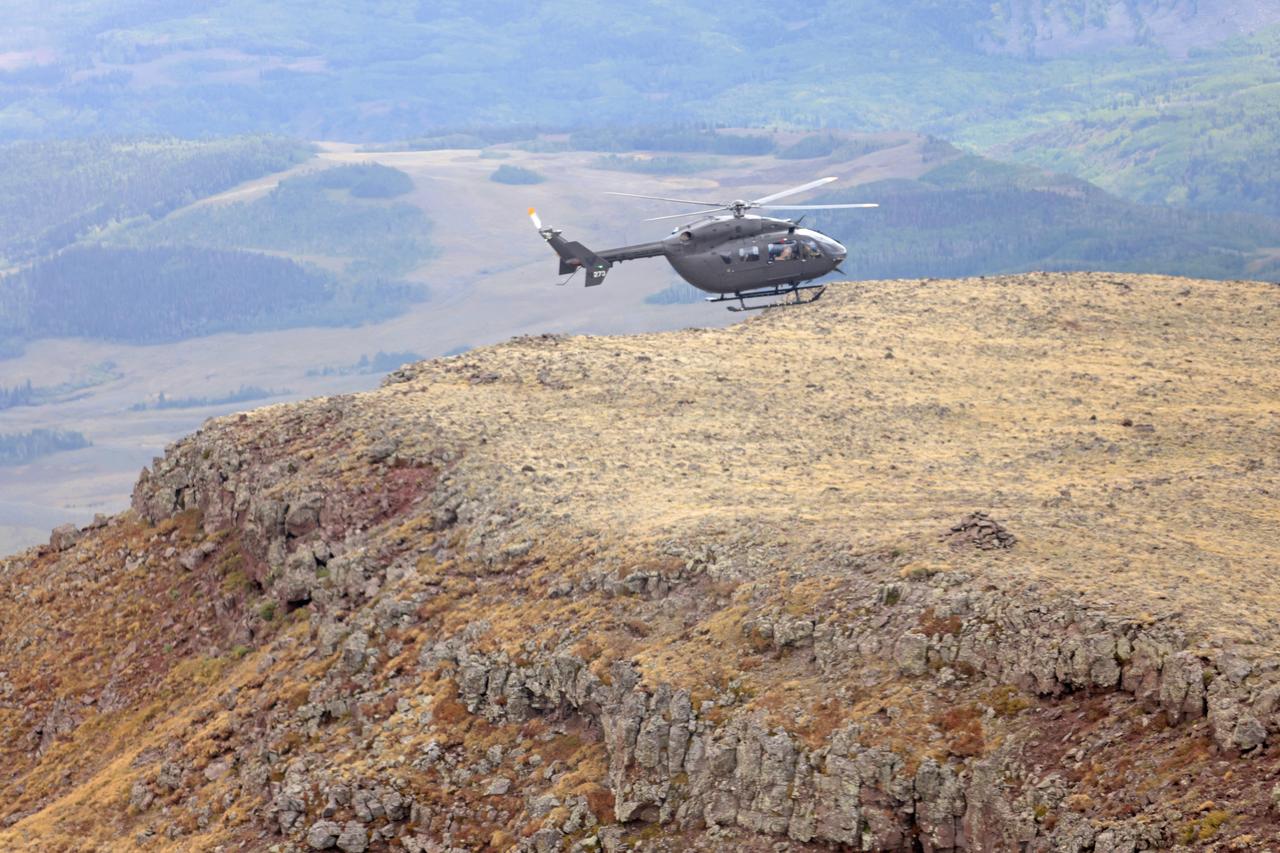
These photos and videos show how NASA certified a new lander flight training course using helicopters in the mountains of northern Colorado. NASA is partnering with the Colorado Army National Guard at its High-Altitude Army National Guard Aviation Training Site near Gypsum, Colorado, to develop the foundational flight training course that will help astronauts practice flight and landing procedures for the Moon. The certification marks an important milestone in crew training for Artemis missions to the Moon, when astronauts will use a commercial human landing system to land on the lunar surface. During the two-week certification run in late August 2025, NASA astronauts Matthew Dominick and Mark Vande Hei participated in flight and landing training to help certify the course. The pair, along with trained instructor pilots with the Army National Guard, took turns flying a helicopter and navigating to landing zones. Artemis flight crew trainers, mission control leads, and lunar lander operational experts from NASA Johnson joined them on each helicopter flight to assess the instruction, training environment, and technical applications for crewed lunar missions. For more information, contact NASA Marshall’s Office of Communications at 256-544
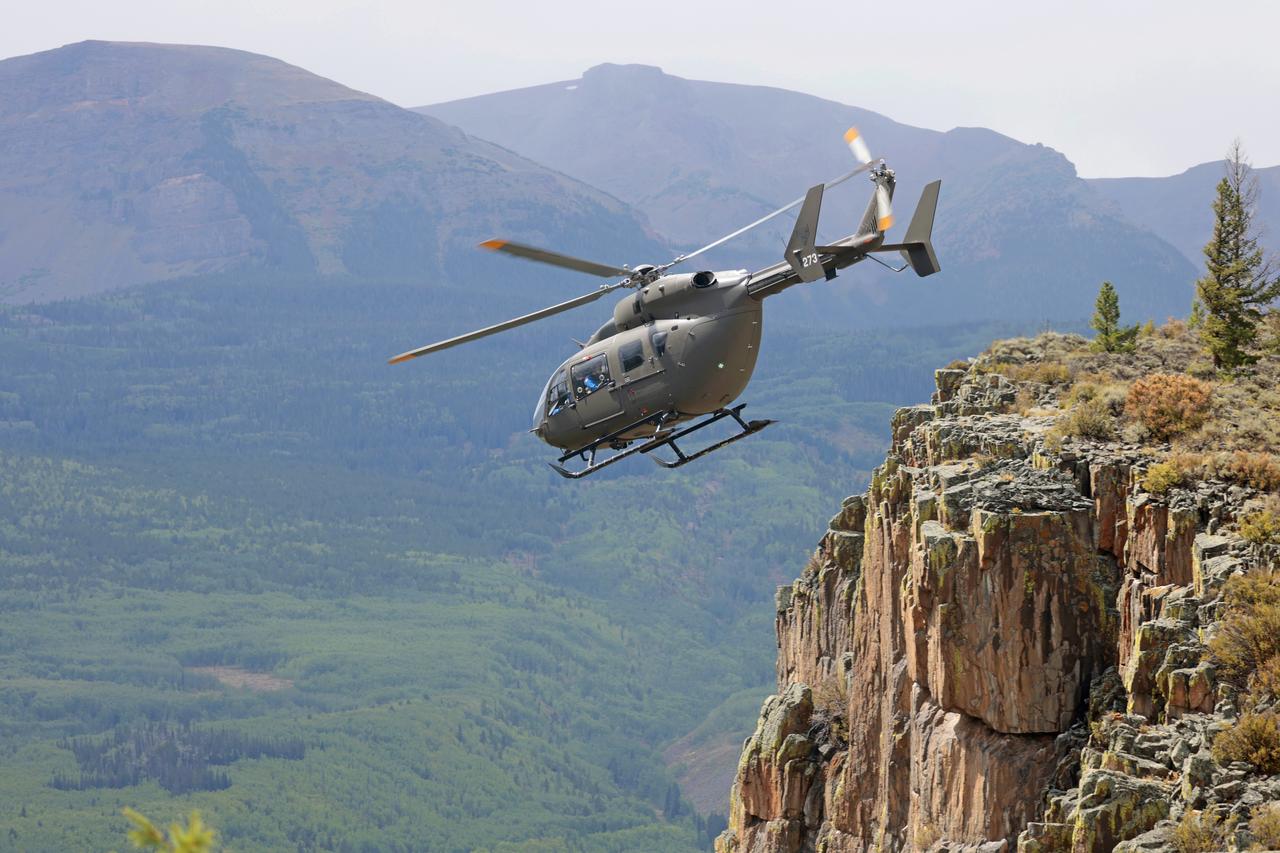
These photos and videos show how NASA certified a new lander flight training course using helicopters in the mountains of northern Colorado. NASA is partnering with the Colorado Army National Guard at its High-Altitude Army National Guard Aviation Training Site near Gypsum, Colorado, to develop the foundational flight training course that will help astronauts practice flight and landing procedures for the Moon. The certification marks an important milestone in crew training for Artemis missions to the Moon, when astronauts will use a commercial human landing system to land on the lunar surface. During the two-week certification run in late August 2025, NASA astronauts Matthew Dominick and Mark Vande Hei participated in flight and landing training to help certify the course. The pair, along with trained instructor pilots with the Army National Guard, took turns flying a helicopter and navigating to landing zones. Artemis flight crew trainers, mission control leads, and lunar lander operational experts from NASA Johnson joined them on each helicopter flight to assess the instruction, training environment, and technical applications for crewed lunar missions. For more information, contact NASA Marshall’s Office of Communications at 256-544
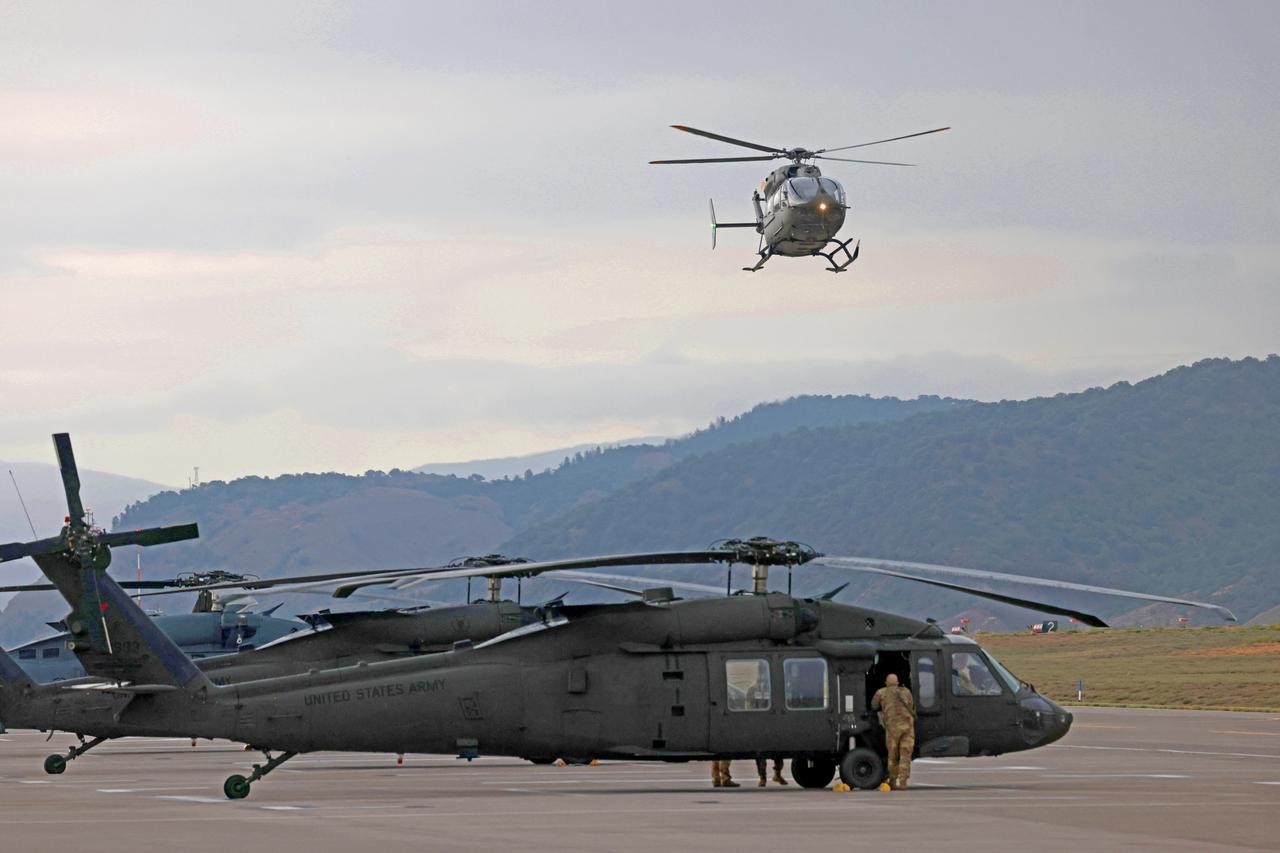
These photos and videos show how NASA certified a new lander flight training course using helicopters in the mountains of northern Colorado. NASA is partnering with the Colorado Army National Guard at its High-Altitude Army National Guard Aviation Training Site near Gypsum, Colorado, to develop the foundational flight training course that will help astronauts practice flight and landing procedures for the Moon. The certification marks an important milestone in crew training for Artemis missions to the Moon, when astronauts will use a commercial human landing system to land on the lunar surface. During the two-week certification run in late August 2025, NASA astronauts Matthew Dominick and Mark Vande Hei participated in flight and landing training to help certify the course. The pair, along with trained instructor pilots with the Army National Guard, took turns flying a helicopter and navigating to landing zones. Artemis flight crew trainers, mission control leads, and lunar lander operational experts from NASA Johnson joined them on each helicopter flight to assess the instruction, training environment, and technical applications for crewed lunar missions. For more information, contact NASA Marshall’s Office of Communications at 256-544

These photos and videos show how NASA certified a new lander flight training course using helicopters in the mountains of northern Colorado. NASA is partnering with the Colorado Army National Guard at its High-Altitude Army National Guard Aviation Training Site near Gypsum, Colorado, to develop the foundational flight training course that will help astronauts practice flight and landing procedures for the Moon. The certification marks an important milestone in crew training for Artemis missions to the Moon, when astronauts will use a commercial human landing system to land on the lunar surface. During the two-week certification run in late August 2025, NASA astronauts Matthew Dominick and Mark Vande Hei participated in flight and landing training to help certify the course. The pair, along with trained instructor pilots with the Army National Guard, took turns flying a helicopter and navigating to landing zones. Artemis flight crew trainers, mission control leads, and lunar lander operational experts from NASA Johnson joined them on each helicopter flight to assess the instruction, training environment, and technical applications for crewed lunar missions. For more information, contact NASA Marshall’s Office of Communications at 256-544
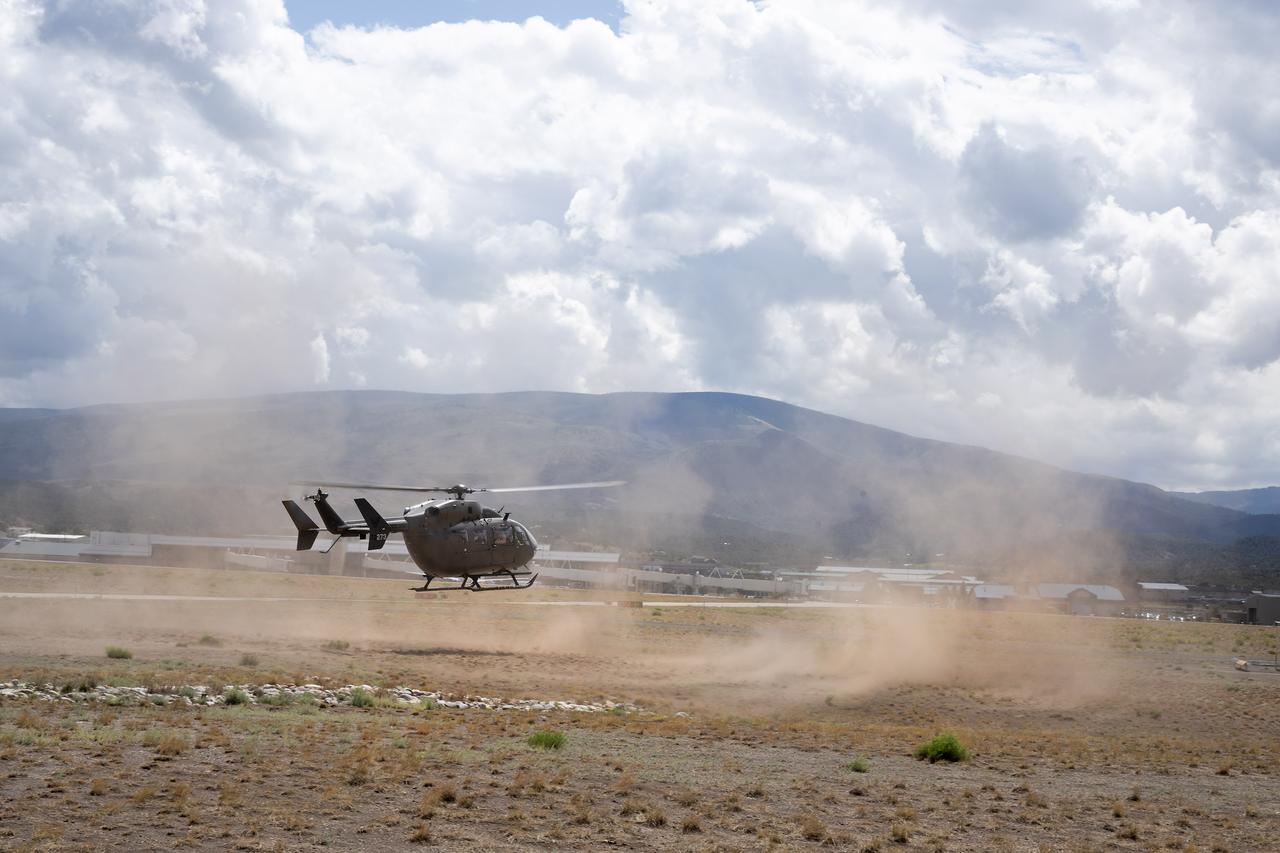
These photos and videos show how NASA certified a new lander flight training course using helicopters in the mountains of northern Colorado. NASA is partnering with the Colorado Army National Guard at its High-Altitude Army National Guard Aviation Training Site near Gypsum, Colorado, to develop the foundational flight training course that will help astronauts practice flight and landing procedures for the Moon. The certification marks an important milestone in crew training for Artemis missions to the Moon, when astronauts will use a commercial human landing system to land on the lunar surface. During the two-week certification run in late August 2025, NASA astronauts Matthew Dominick and Mark Vande Hei participated in flight and landing training to help certify the course. The pair, along with trained instructor pilots with the Army National Guard, took turns flying a helicopter and navigating to landing zones. Artemis flight crew trainers, mission control leads, and lunar lander operational experts from NASA Johnson joined them on each helicopter flight to assess the instruction, training environment, and technical applications for crewed lunar missions. For more information, contact NASA Marshall’s Office of Communications at 256-544
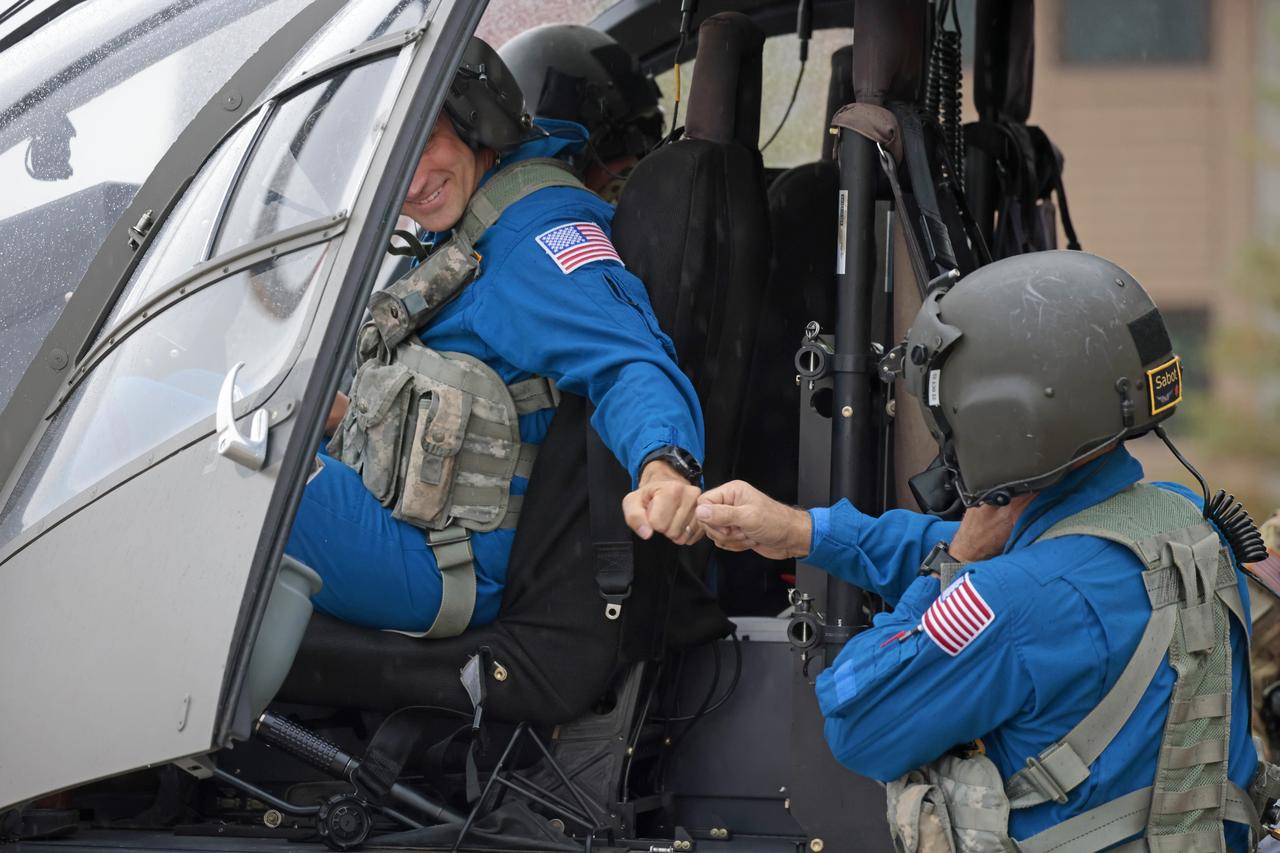
These photos and videos show how NASA certified a new lander flight training course using helicopters in the mountains of northern Colorado. NASA is partnering with the Colorado Army National Guard at its High-Altitude Army National Guard Aviation Training Site near Gypsum, Colorado, to develop the foundational flight training course that will help astronauts practice flight and landing procedures for the Moon. The certification marks an important milestone in crew training for Artemis missions to the Moon, when astronauts will use a commercial human landing system to land on the lunar surface. During the two-week certification run in late August 2025, NASA astronauts Matthew Dominick and Mark Vande Hei participated in flight and landing training to help certify the course. The pair, along with trained instructor pilots with the Army National Guard, took turns flying a helicopter and navigating to landing zones. Artemis flight crew trainers, mission control leads, and lunar lander operational experts from NASA Johnson joined them on each helicopter flight to assess the instruction, training environment, and technical applications for crewed lunar missions. For more information, contact NASA Marshall’s Office of Communications at 256-544
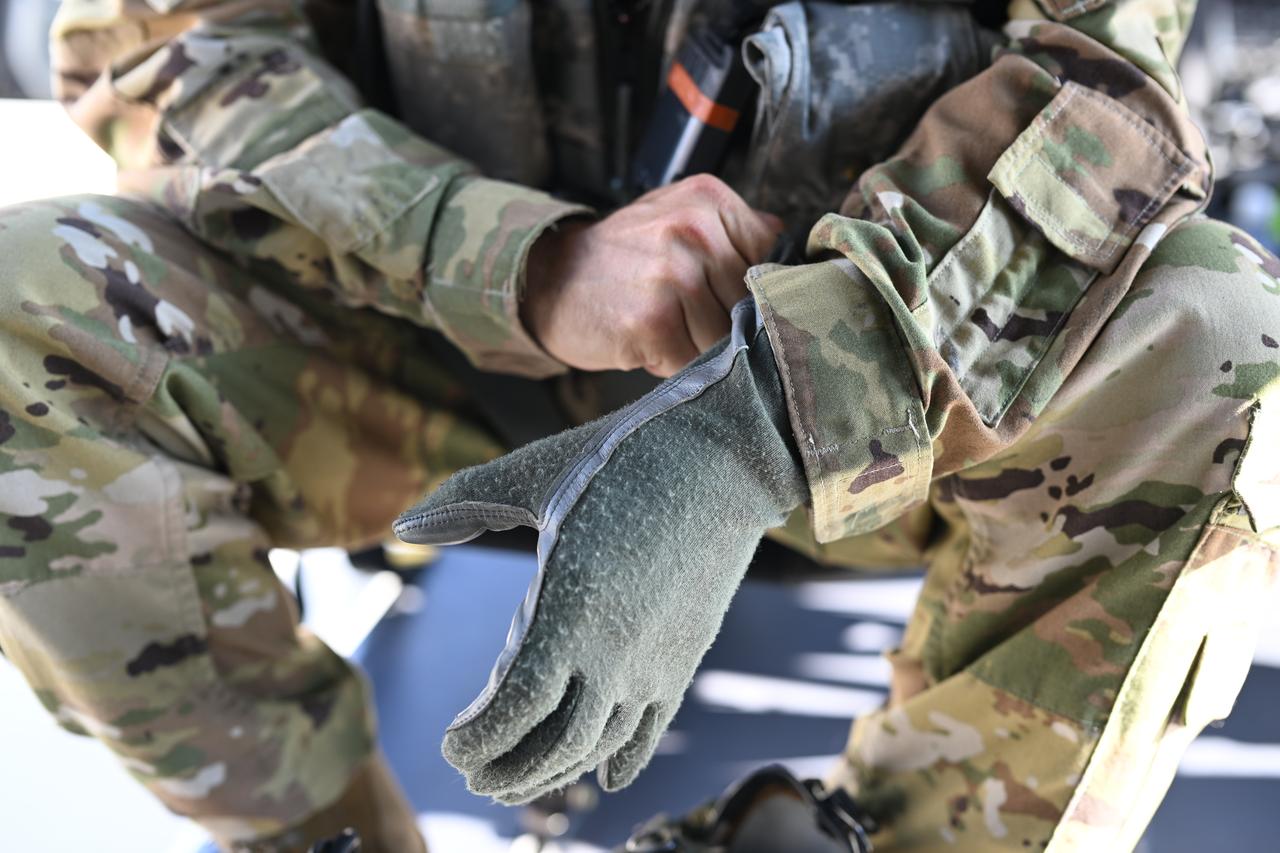
These photos and videos show how NASA certified a new lander flight training course using helicopters in the mountains of northern Colorado. NASA is partnering with the Colorado Army National Guard at its High-Altitude Army National Guard Aviation Training Site near Gypsum, Colorado, to develop the foundational flight training course that will help astronauts practice flight and landing procedures for the Moon. The certification marks an important milestone in crew training for Artemis missions to the Moon, when astronauts will use a commercial human landing system to land on the lunar surface. During the two-week certification run in late August 2025, NASA astronauts Matthew Dominick and Mark Vande Hei participated in flight and landing training to help certify the course. The pair, along with trained instructor pilots with the Army National Guard, took turns flying a helicopter and navigating to landing zones. Artemis flight crew trainers, mission control leads, and lunar lander operational experts from NASA Johnson joined them on each helicopter flight to assess the instruction, training environment, and technical applications for crewed lunar missions. For more information, contact NASA Marshall’s Office of Communications at 256-544
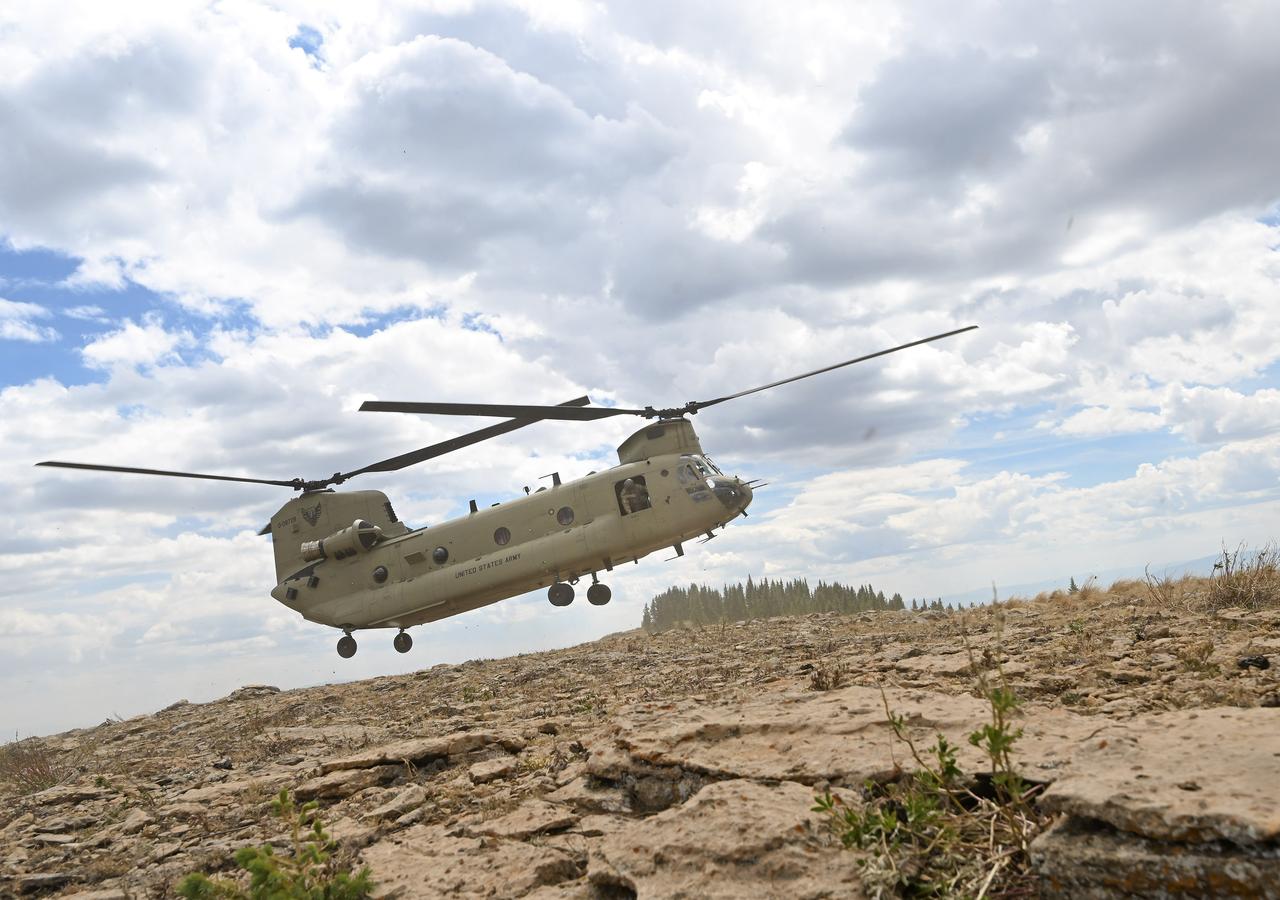
These photos and videos show how NASA certified a new lander flight training course using helicopters in the mountains of northern Colorado. NASA is partnering with the Colorado Army National Guard at its High-Altitude Army National Guard Aviation Training Site near Gypsum, Colorado, to develop the foundational flight training course that will help astronauts practice flight and landing procedures for the Moon. The certification marks an important milestone in crew training for Artemis missions to the Moon, when astronauts will use a commercial human landing system to land on the lunar surface. During the two-week certification run in late August 2025, NASA astronauts Matthew Dominick and Mark Vande Hei participated in flight and landing training to help certify the course. The pair, along with trained instructor pilots with the Army National Guard, took turns flying a helicopter and navigating to landing zones. Artemis flight crew trainers, mission control leads, and lunar lander operational experts from NASA Johnson joined them on each helicopter flight to assess the instruction, training environment, and technical applications for crewed lunar missions. For more information, contact NASA Marshall’s Office of Communications at 256-544
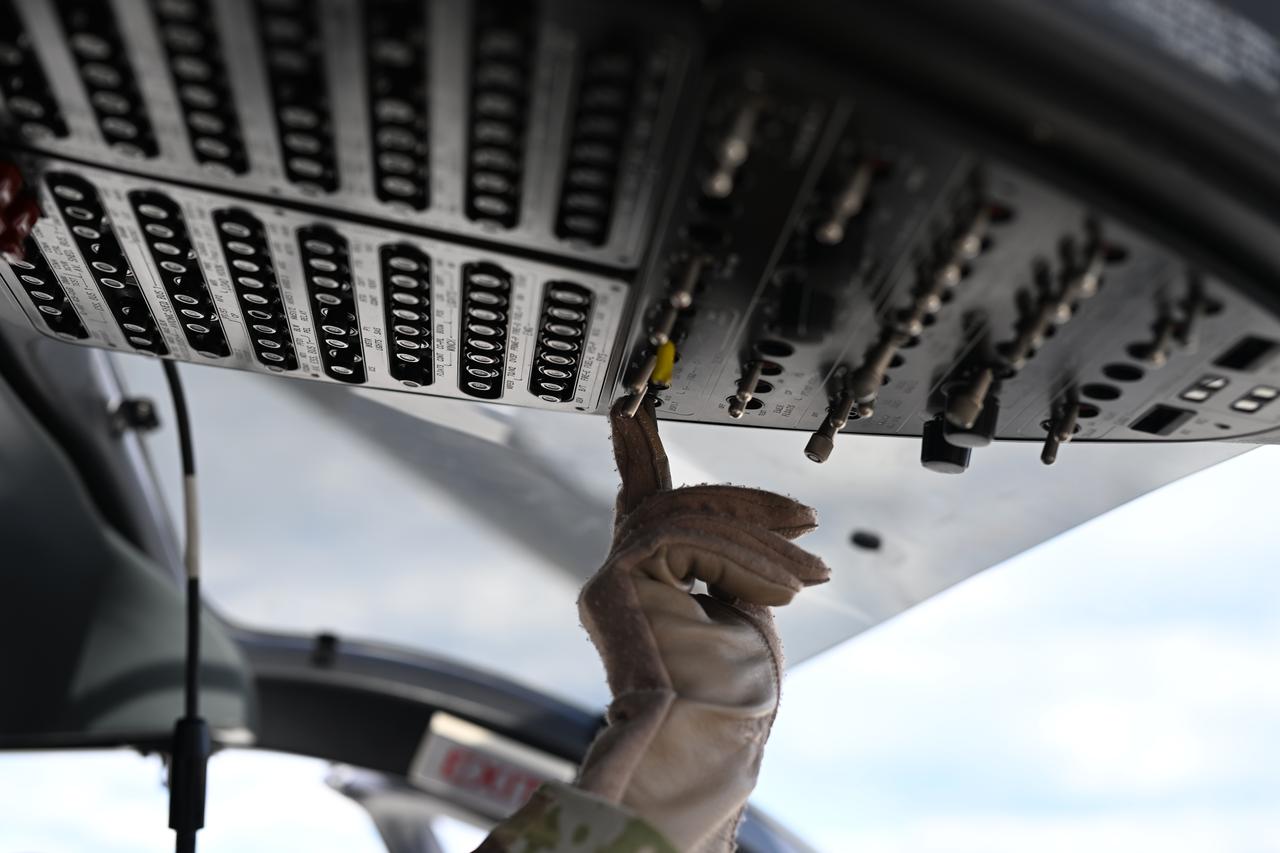
These photos and videos show how NASA certified a new lander flight training course using helicopters in the mountains of northern Colorado. NASA is partnering with the Colorado Army National Guard at its High-Altitude Army National Guard Aviation Training Site near Gypsum, Colorado, to develop the foundational flight training course that will help astronauts practice flight and landing procedures for the Moon. The certification marks an important milestone in crew training for Artemis missions to the Moon, when astronauts will use a commercial human landing system to land on the lunar surface. During the two-week certification run in late August 2025, NASA astronauts Matthew Dominick and Mark Vande Hei participated in flight and landing training to help certify the course. The pair, along with trained instructor pilots with the Army National Guard, took turns flying a helicopter and navigating to landing zones. Artemis flight crew trainers, mission control leads, and lunar lander operational experts from NASA Johnson joined them on each helicopter flight to assess the instruction, training environment, and technical applications for crewed lunar missions. For more information, contact NASA Marshall’s Office of Communications at 256-544
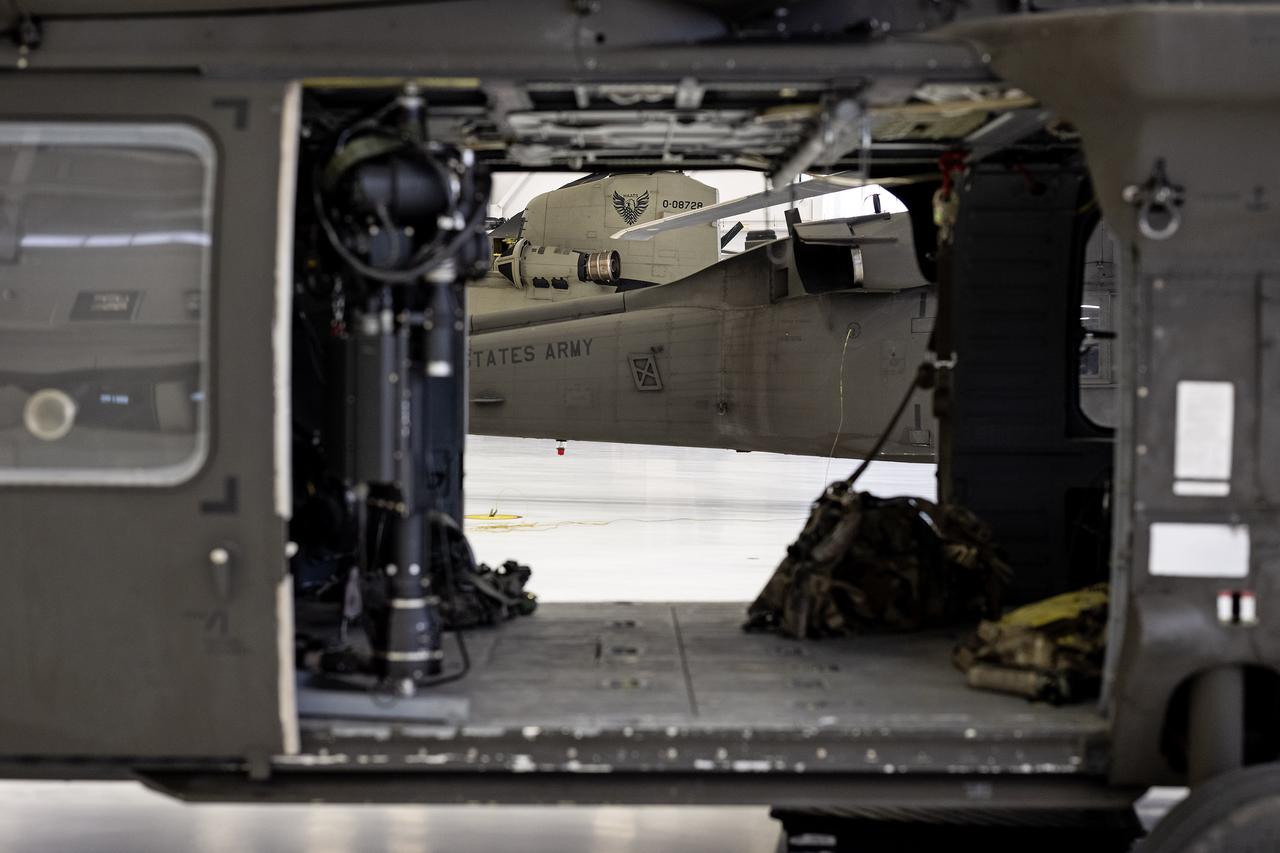
These photos and videos show how NASA certified a new lander flight training course using helicopters in the mountains of northern Colorado. NASA is partnering with the Colorado Army National Guard at its High-Altitude Army National Guard Aviation Training Site near Gypsum, Colorado, to develop the foundational flight training course that will help astronauts practice flight and landing procedures for the Moon. The certification marks an important milestone in crew training for Artemis missions to the Moon, when astronauts will use a commercial human landing system to land on the lunar surface. During the two-week certification run in late August 2025, NASA astronauts Matthew Dominick and Mark Vande Hei participated in flight and landing training to help certify the course. The pair, along with trained instructor pilots with the Army National Guard, took turns flying a helicopter and navigating to landing zones. Artemis flight crew trainers, mission control leads, and lunar lander operational experts from NASA Johnson joined them on each helicopter flight to assess the instruction, training environment, and technical applications for crewed lunar missions. For more information, contact NASA Marshall’s Office of Communications at 256-544
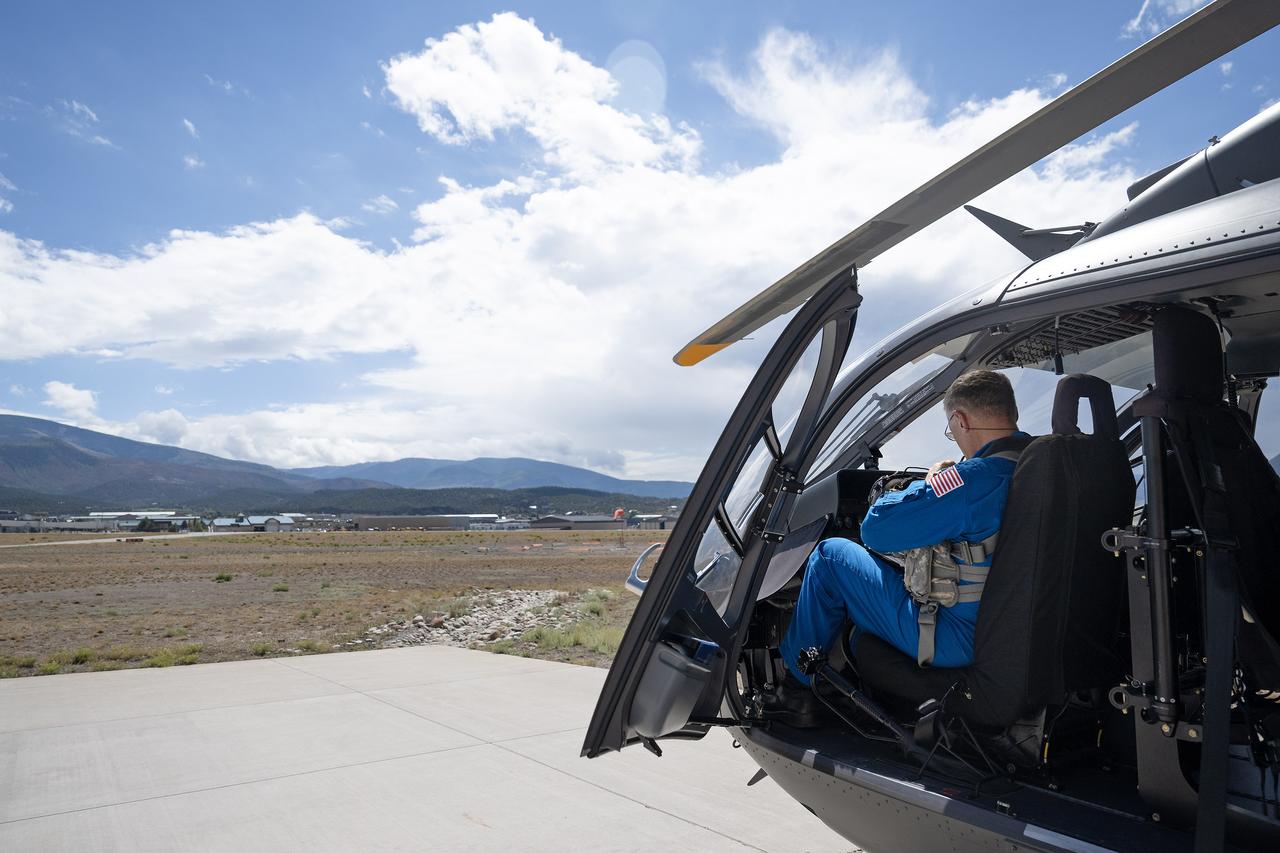
These photos and videos show how NASA certified a new lander flight training course using helicopters in the mountains of northern Colorado. NASA is partnering with the Colorado Army National Guard at its High-Altitude Army National Guard Aviation Training Site near Gypsum, Colorado, to develop the foundational flight training course that will help astronauts practice flight and landing procedures for the Moon. The certification marks an important milestone in crew training for Artemis missions to the Moon, when astronauts will use a commercial human landing system to land on the lunar surface. During the two-week certification run in late August 2025, NASA astronauts Matthew Dominick and Mark Vande Hei participated in flight and landing training to help certify the course. The pair, along with trained instructor pilots with the Army National Guard, took turns flying a helicopter and navigating to landing zones. Artemis flight crew trainers, mission control leads, and lunar lander operational experts from NASA Johnson joined them on each helicopter flight to assess the instruction, training environment, and technical applications for crewed lunar missions. For more information, contact NASA Marshall’s Office of Communications at 256-544
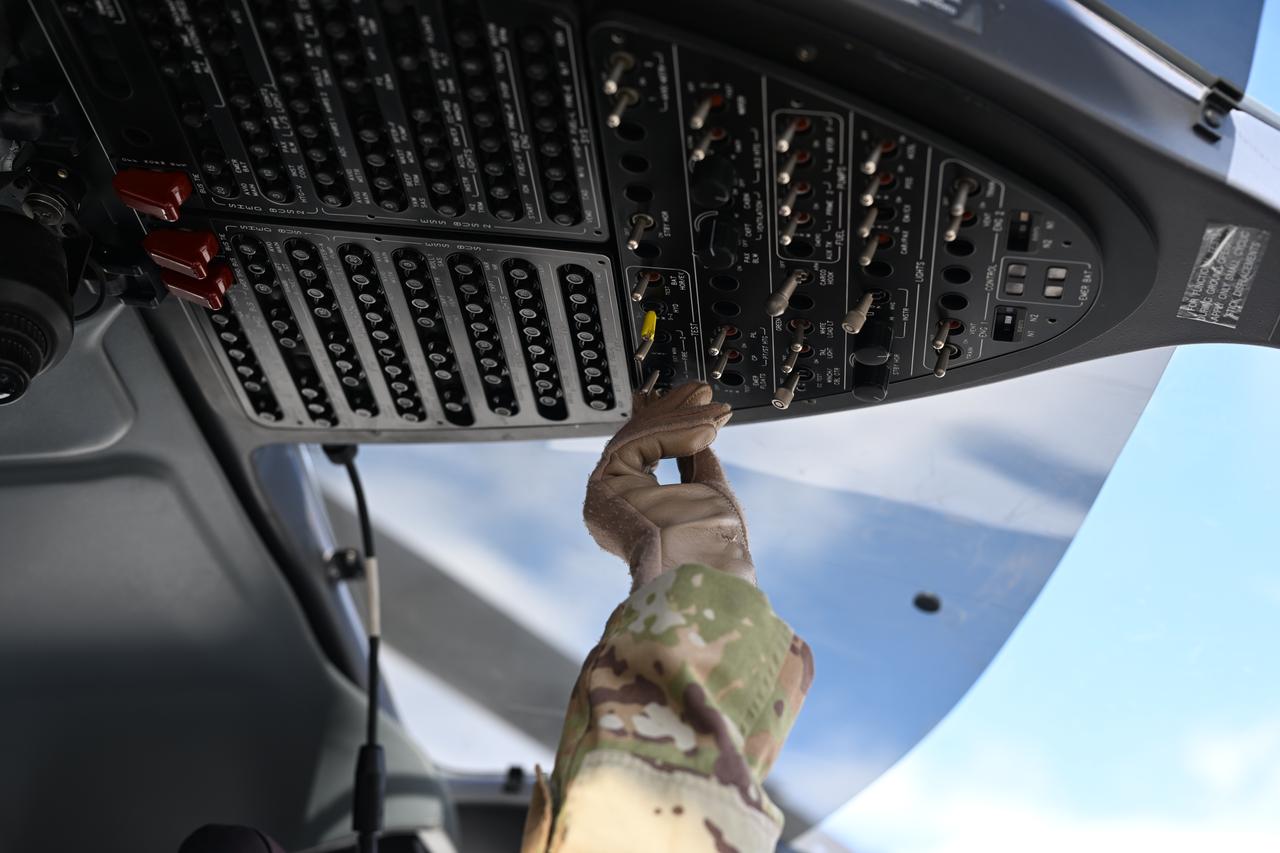
These photos and videos show how NASA certified a new lander flight training course using helicopters in the mountains of northern Colorado. NASA is partnering with the Colorado Army National Guard at its High-Altitude Army National Guard Aviation Training Site near Gypsum, Colorado, to develop the foundational flight training course that will help astronauts practice flight and landing procedures for the Moon. The certification marks an important milestone in crew training for Artemis missions to the Moon, when astronauts will use a commercial human landing system to land on the lunar surface. During the two-week certification run in late August 2025, NASA astronauts Matthew Dominick and Mark Vande Hei participated in flight and landing training to help certify the course. The pair, along with trained instructor pilots with the Army National Guard, took turns flying a helicopter and navigating to landing zones. Artemis flight crew trainers, mission control leads, and lunar lander operational experts from NASA Johnson joined them on each helicopter flight to assess the instruction, training environment, and technical applications for crewed lunar missions. For more information, contact NASA Marshall’s Office of Communications at 256-544
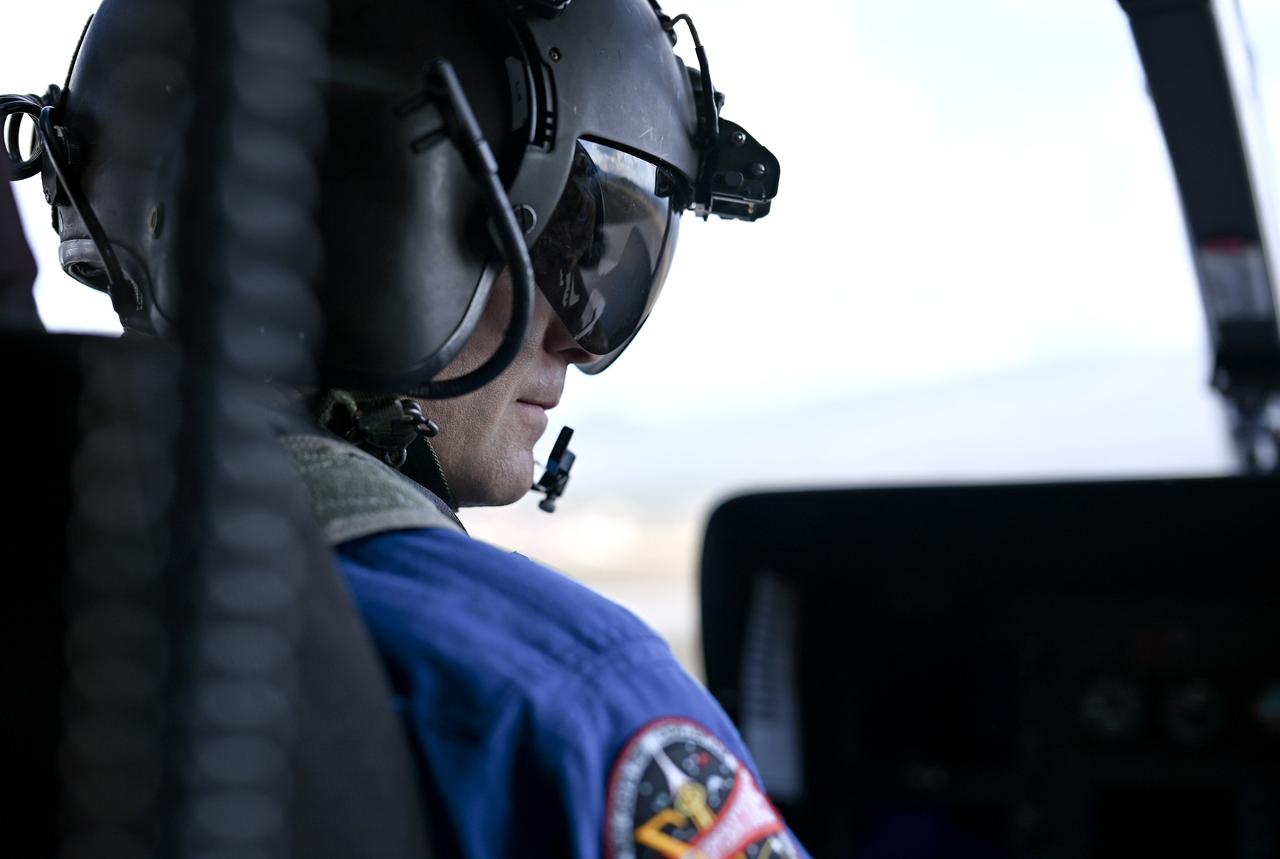
These photos and videos show how NASA certified a new lander flight training course using helicopters in the mountains of northern Colorado. NASA is partnering with the Colorado Army National Guard at its High-Altitude Army National Guard Aviation Training Site near Gypsum, Colorado, to develop the foundational flight training course that will help astronauts practice flight and landing procedures for the Moon. The certification marks an important milestone in crew training for Artemis missions to the Moon, when astronauts will use a commercial human landing system to land on the lunar surface. During the two-week certification run in late August 2025, NASA astronauts Matthew Dominick and Mark Vande Hei participated in flight and landing training to help certify the course. The pair, along with trained instructor pilots with the Army National Guard, took turns flying a helicopter and navigating to landing zones. Artemis flight crew trainers, mission control leads, and lunar lander operational experts from NASA Johnson joined them on each helicopter flight to assess the instruction, training environment, and technical applications for crewed lunar missions. For more information, contact NASA Marshall’s Office of Communications at 256-544
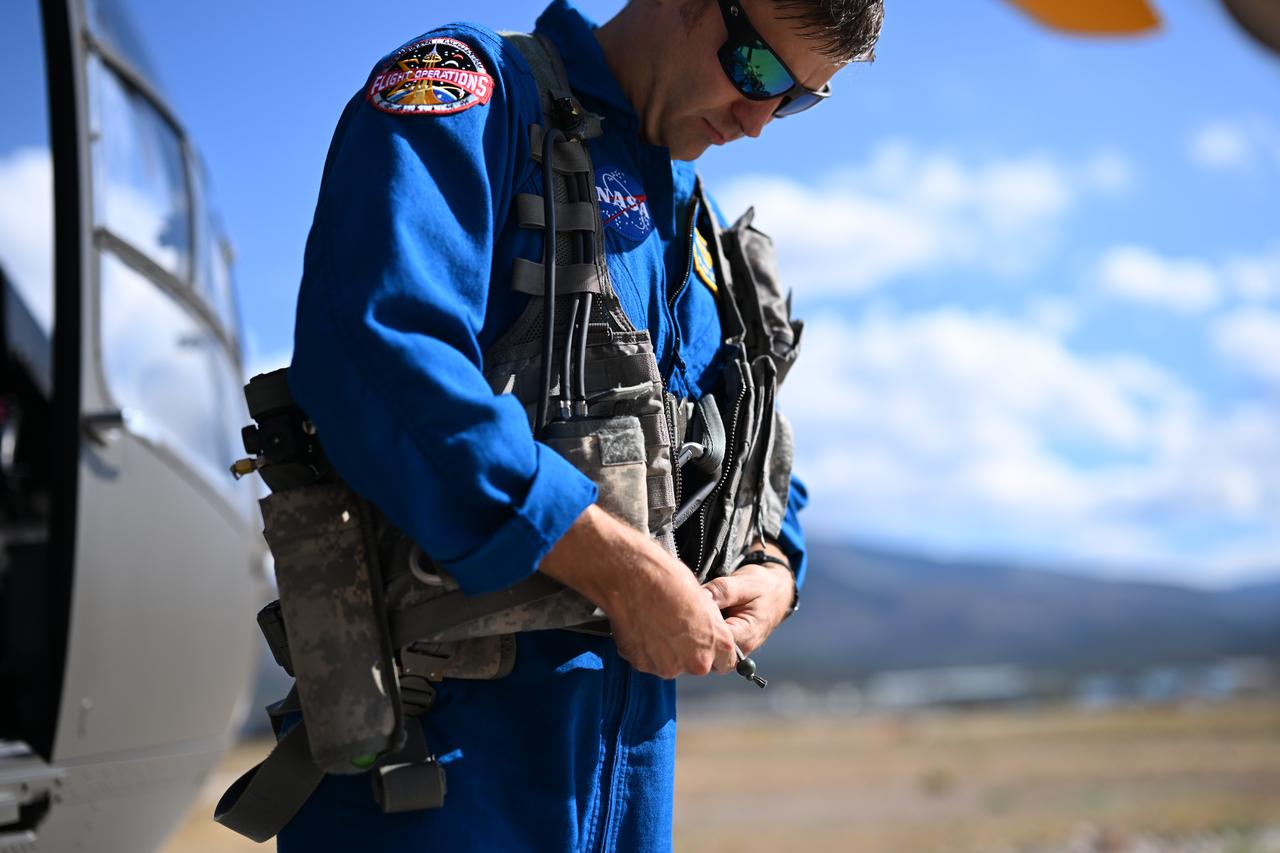
These photos and videos show how NASA certified a new lander flight training course using helicopters in the mountains of northern Colorado. NASA is partnering with the Colorado Army National Guard at its High-Altitude Army National Guard Aviation Training Site near Gypsum, Colorado, to develop the foundational flight training course that will help astronauts practice flight and landing procedures for the Moon. The certification marks an important milestone in crew training for Artemis missions to the Moon, when astronauts will use a commercial human landing system to land on the lunar surface. During the two-week certification run in late August 2025, NASA astronauts Matthew Dominick and Mark Vande Hei participated in flight and landing training to help certify the course. The pair, along with trained instructor pilots with the Army National Guard, took turns flying a helicopter and navigating to landing zones. Artemis flight crew trainers, mission control leads, and lunar lander operational experts from NASA Johnson joined them on each helicopter flight to assess the instruction, training environment, and technical applications for crewed lunar missions. For more information, contact NASA Marshall’s Office of Communications at 256-544
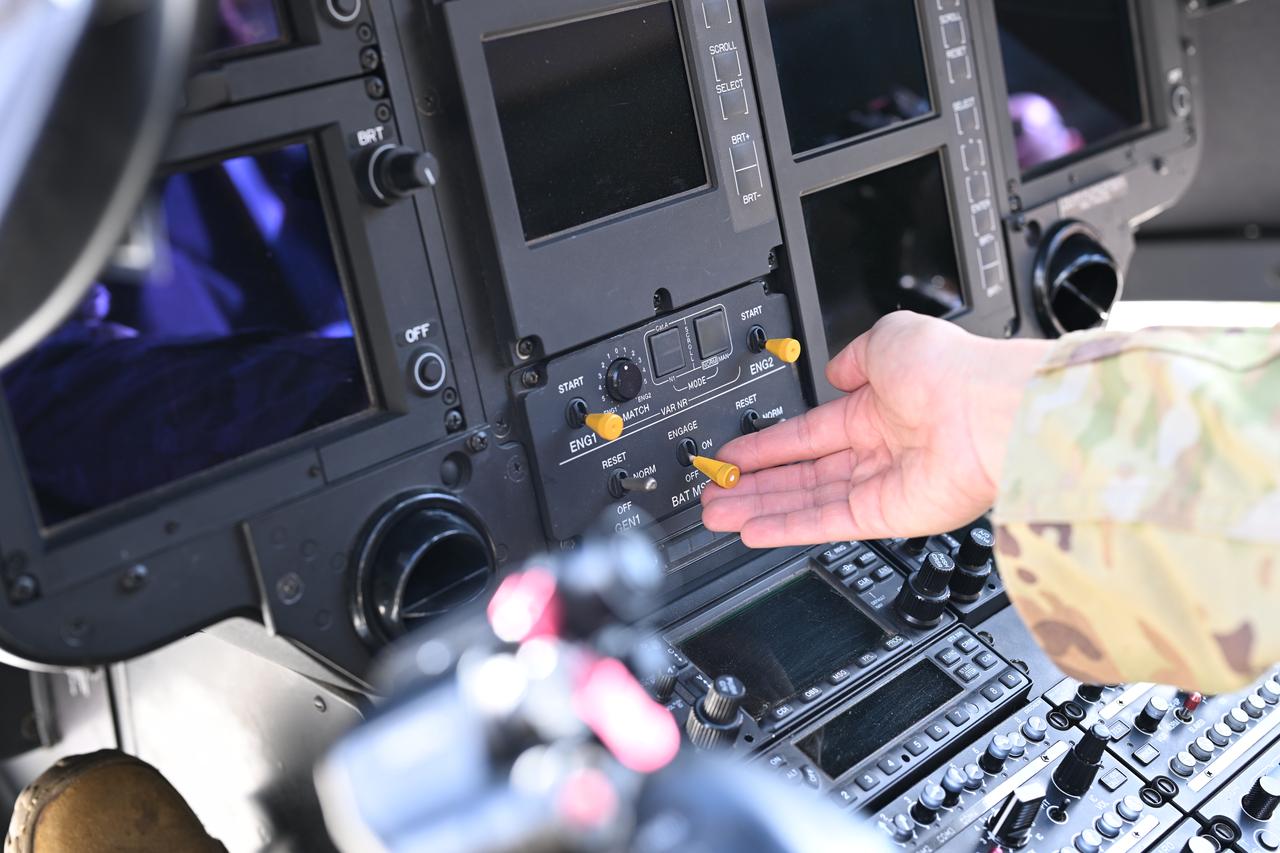
These photos and videos show how NASA certified a new lander flight training course using helicopters in the mountains of northern Colorado. NASA is partnering with the Colorado Army National Guard at its High-Altitude Army National Guard Aviation Training Site near Gypsum, Colorado, to develop the foundational flight training course that will help astronauts practice flight and landing procedures for the Moon. The certification marks an important milestone in crew training for Artemis missions to the Moon, when astronauts will use a commercial human landing system to land on the lunar surface. During the two-week certification run in late August 2025, NASA astronauts Matthew Dominick and Mark Vande Hei participated in flight and landing training to help certify the course. The pair, along with trained instructor pilots with the Army National Guard, took turns flying a helicopter and navigating to landing zones. Artemis flight crew trainers, mission control leads, and lunar lander operational experts from NASA Johnson joined them on each helicopter flight to assess the instruction, training environment, and technical applications for crewed lunar missions. For more information, contact NASA Marshall’s Office of Communications at 256-544
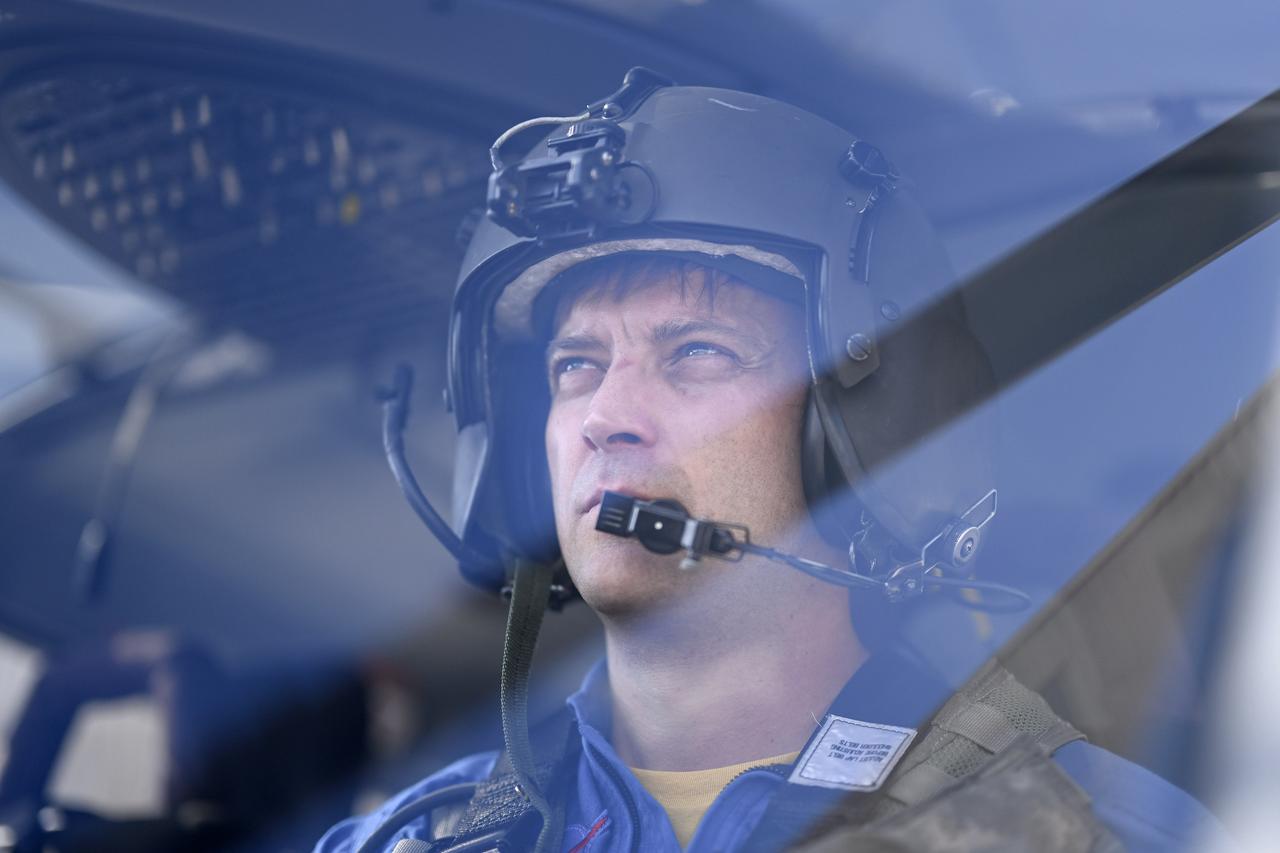
These photos and videos show how NASA certified a new lander flight training course using helicopters in the mountains of northern Colorado. NASA is partnering with the Colorado Army National Guard at its High-Altitude Army National Guard Aviation Training Site near Gypsum, Colorado, to develop the foundational flight training course that will help astronauts practice flight and landing procedures for the Moon. The certification marks an important milestone in crew training for Artemis missions to the Moon, when astronauts will use a commercial human landing system to land on the lunar surface. During the two-week certification run in late August 2025, NASA astronauts Matthew Dominick and Mark Vande Hei participated in flight and landing training to help certify the course. The pair, along with trained instructor pilots with the Army National Guard, took turns flying a helicopter and navigating to landing zones. Artemis flight crew trainers, mission control leads, and lunar lander operational experts from NASA Johnson joined them on each helicopter flight to assess the instruction, training environment, and technical applications for crewed lunar missions. For more information, contact NASA Marshall’s Office of Communications at 256-544
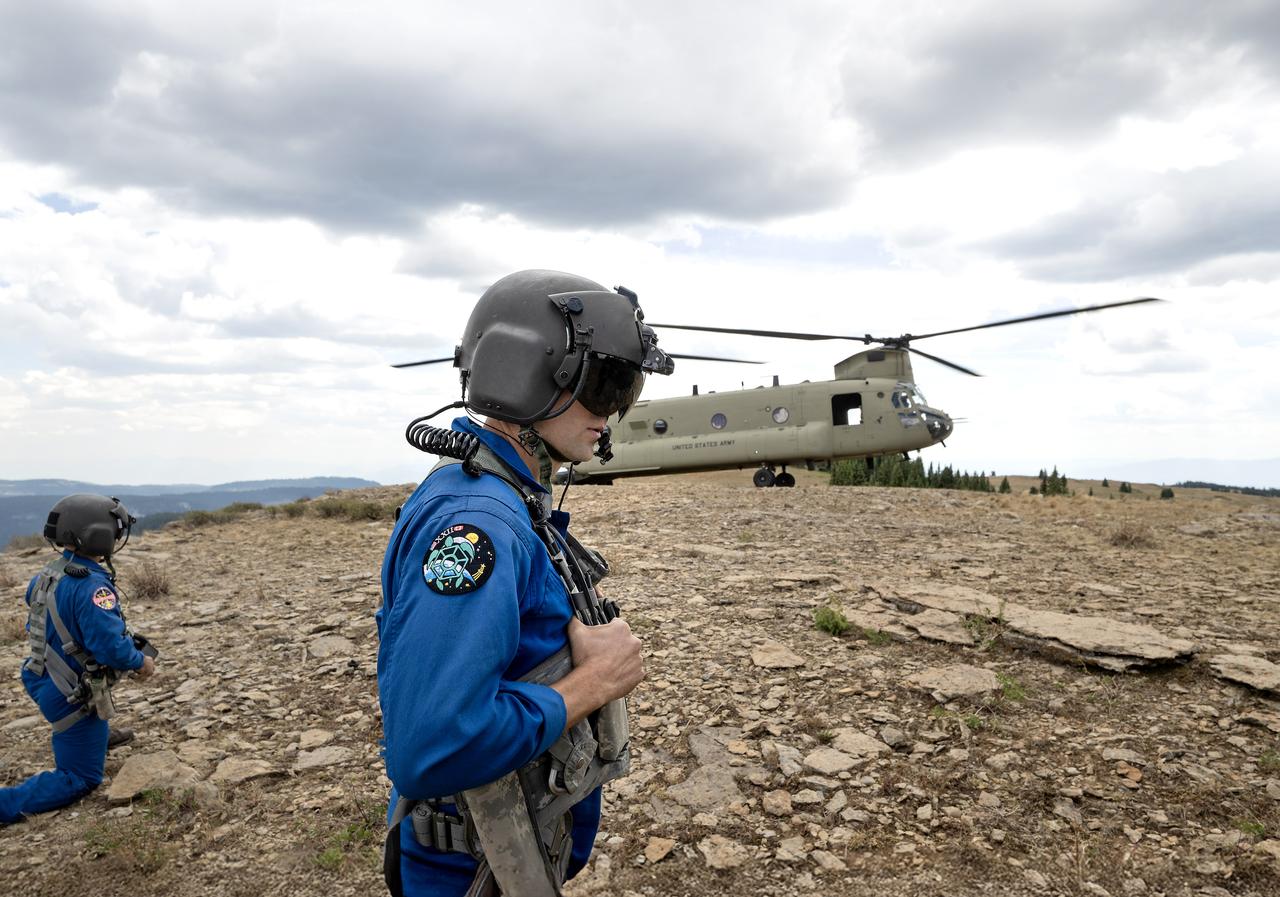
These photos and videos show how NASA certified a new lander flight training course using helicopters in the mountains of northern Colorado. NASA is partnering with the Colorado Army National Guard at its High-Altitude Army National Guard Aviation Training Site near Gypsum, Colorado, to develop the foundational flight training course that will help astronauts practice flight and landing procedures for the Moon. The certification marks an important milestone in crew training for Artemis missions to the Moon, when astronauts will use a commercial human landing system to land on the lunar surface. During the two-week certification run in late August 2025, NASA astronauts Matthew Dominick and Mark Vande Hei participated in flight and landing training to help certify the course. The pair, along with trained instructor pilots with the Army National Guard, took turns flying a helicopter and navigating to landing zones. Artemis flight crew trainers, mission control leads, and lunar lander operational experts from NASA Johnson joined them on each helicopter flight to assess the instruction, training environment, and technical applications for crewed lunar missions. For more information, contact NASA Marshall’s Office of Communications at 256-544
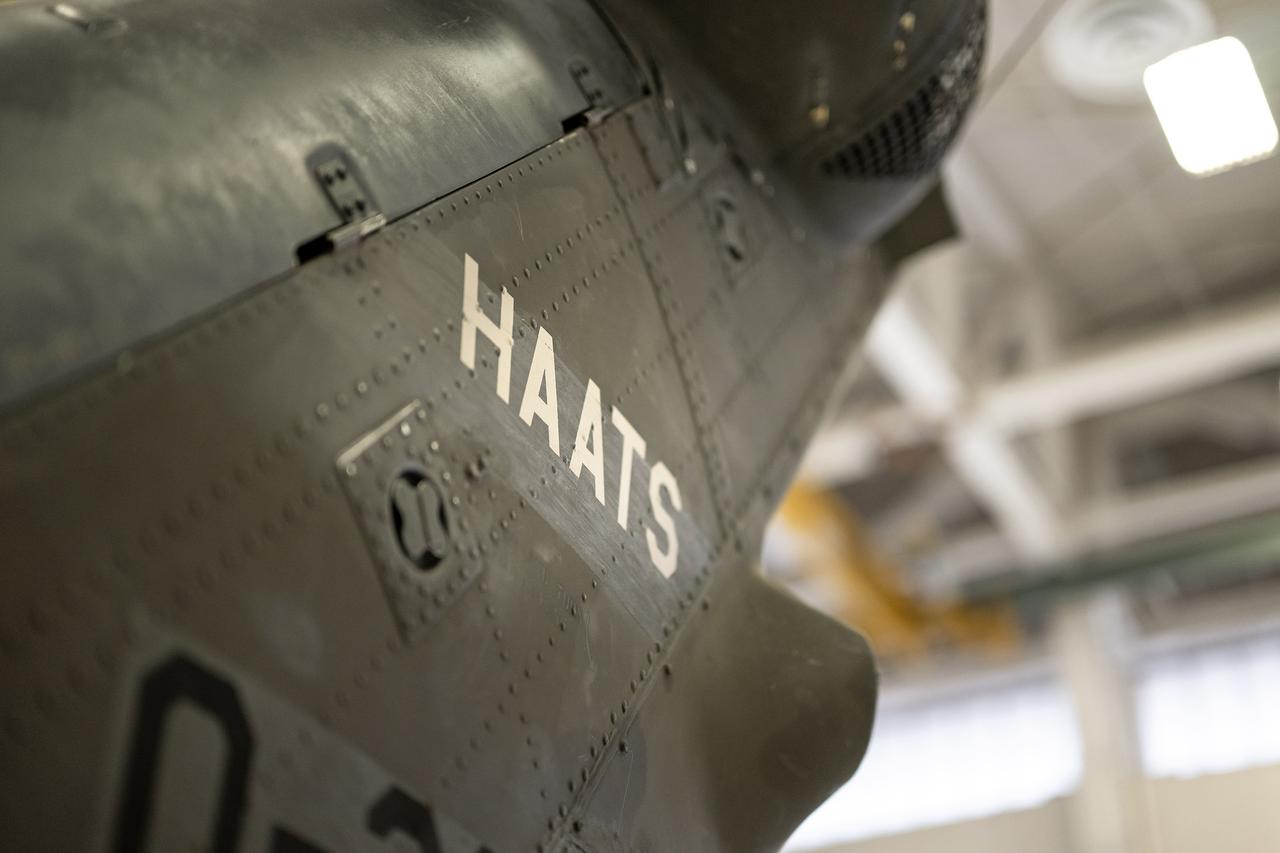
These photos and videos show how NASA certified a new lander flight training course using helicopters in the mountains of northern Colorado. NASA is partnering with the Colorado Army National Guard at its High-Altitude Army National Guard Aviation Training Site near Gypsum, Colorado, to develop the foundational flight training course that will help astronauts practice flight and landing procedures for the Moon. The certification marks an important milestone in crew training for Artemis missions to the Moon, when astronauts will use a commercial human landing system to land on the lunar surface. During the two-week certification run in late August 2025, NASA astronauts Matthew Dominick and Mark Vande Hei participated in flight and landing training to help certify the course. The pair, along with trained instructor pilots with the Army National Guard, took turns flying a helicopter and navigating to landing zones. Artemis flight crew trainers, mission control leads, and lunar lander operational experts from NASA Johnson joined them on each helicopter flight to assess the instruction, training environment, and technical applications for crewed lunar missions. For more information, contact NASA Marshall’s Office of Communications at 256-544
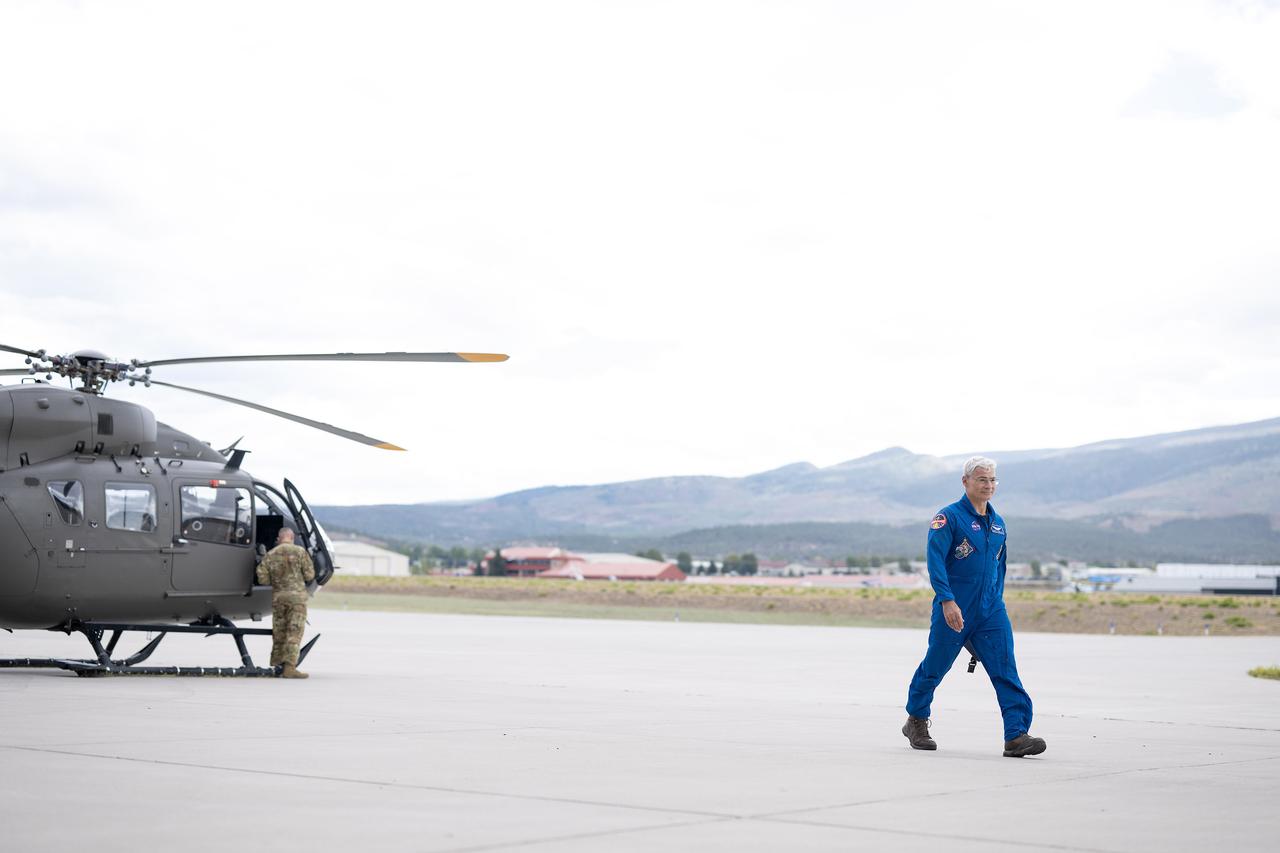
These photos and videos show how NASA certified a new lander flight training course using helicopters in the mountains of northern Colorado. NASA is partnering with the Colorado Army National Guard at its High-Altitude Army National Guard Aviation Training Site near Gypsum, Colorado, to develop the foundational flight training course that will help astronauts practice flight and landing procedures for the Moon. The certification marks an important milestone in crew training for Artemis missions to the Moon, when astronauts will use a commercial human landing system to land on the lunar surface. During the two-week certification run in late August 2025, NASA astronauts Matthew Dominick and Mark Vande Hei participated in flight and landing training to help certify the course. The pair, along with trained instructor pilots with the Army National Guard, took turns flying a helicopter and navigating to landing zones. Artemis flight crew trainers, mission control leads, and lunar lander operational experts from NASA Johnson joined them on each helicopter flight to assess the instruction, training environment, and technical applications for crewed lunar missions. For more information, contact NASA Marshall’s Office of Communications at 256-544
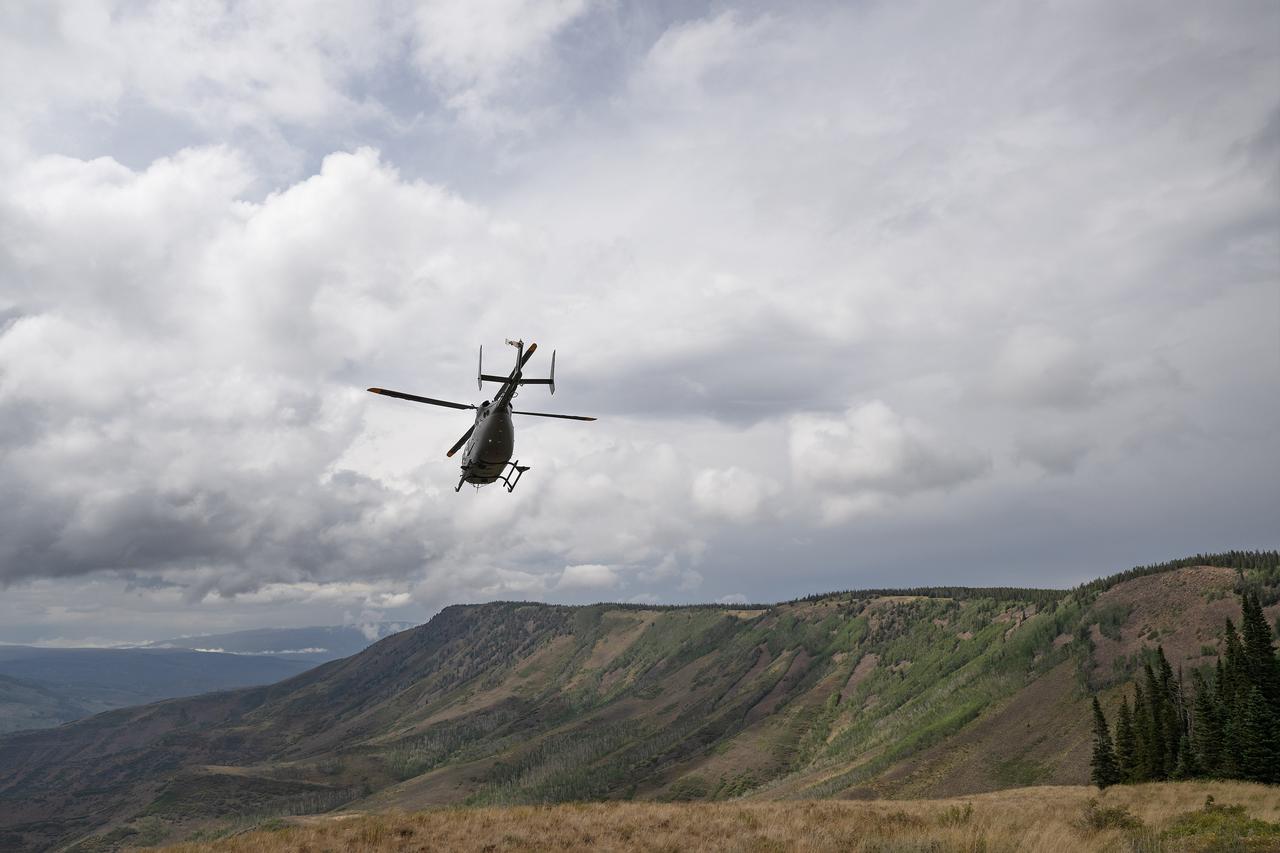
These photos and videos show how NASA certified a new lander flight training course using helicopters in the mountains of northern Colorado. NASA is partnering with the Colorado Army National Guard at its High-Altitude Army National Guard Aviation Training Site near Gypsum, Colorado, to develop the foundational flight training course that will help astronauts practice flight and landing procedures for the Moon. The certification marks an important milestone in crew training for Artemis missions to the Moon, when astronauts will use a commercial human landing system to land on the lunar surface. During the two-week certification run in late August 2025, NASA astronauts Matthew Dominick and Mark Vande Hei participated in flight and landing training to help certify the course. The pair, along with trained instructor pilots with the Army National Guard, took turns flying a helicopter and navigating to landing zones. Artemis flight crew trainers, mission control leads, and lunar lander operational experts from NASA Johnson joined them on each helicopter flight to assess the instruction, training environment, and technical applications for crewed lunar missions. For more information, contact NASA Marshall’s Office of Communications at 256-544
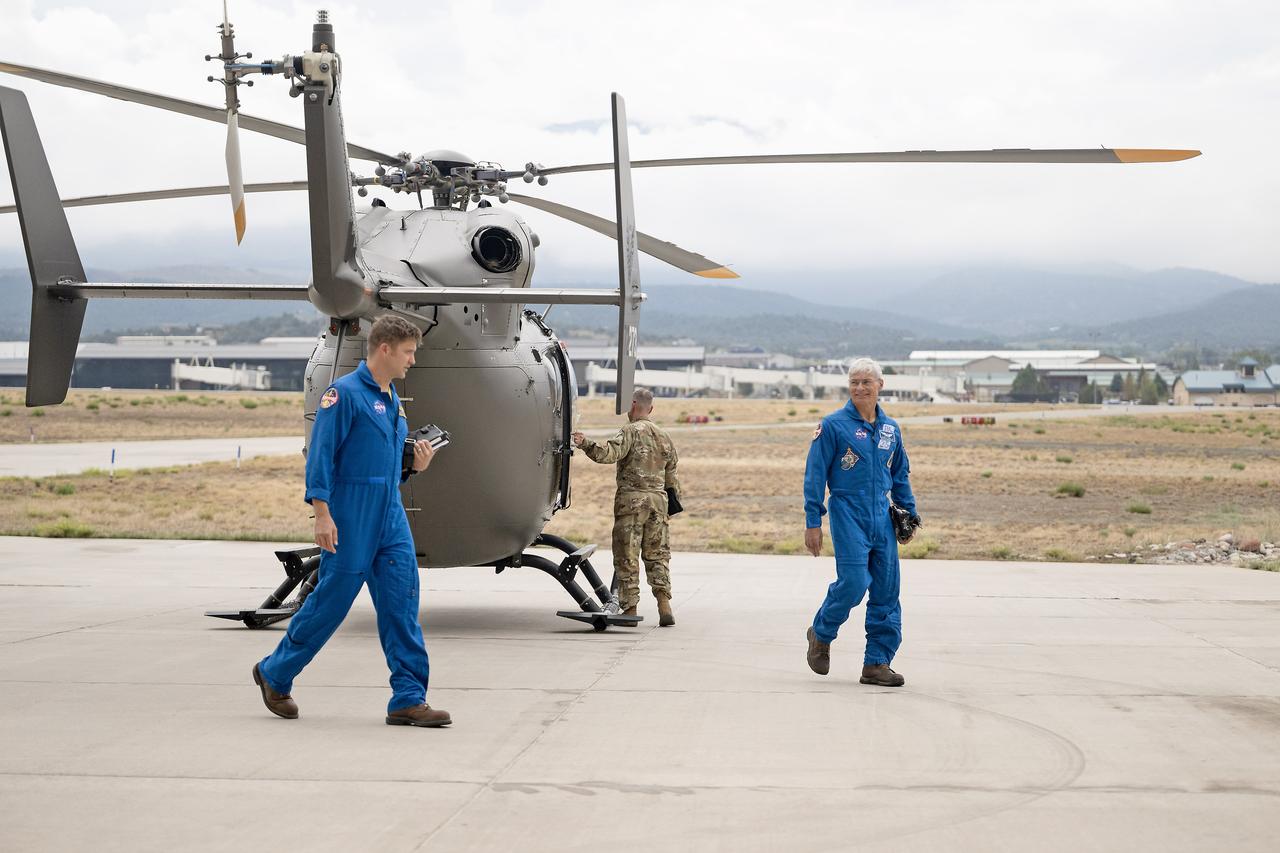
These photos and videos show how NASA certified a new lander flight training course using helicopters in the mountains of northern Colorado. NASA is partnering with the Colorado Army National Guard at its High-Altitude Army National Guard Aviation Training Site near Gypsum, Colorado, to develop the foundational flight training course that will help astronauts practice flight and landing procedures for the Moon. The certification marks an important milestone in crew training for Artemis missions to the Moon, when astronauts will use a commercial human landing system to land on the lunar surface. During the two-week certification run in late August 2025, NASA astronauts Matthew Dominick and Mark Vande Hei participated in flight and landing training to help certify the course. The pair, along with trained instructor pilots with the Army National Guard, took turns flying a helicopter and navigating to landing zones. Artemis flight crew trainers, mission control leads, and lunar lander operational experts from NASA Johnson joined them on each helicopter flight to assess the instruction, training environment, and technical applications for crewed lunar missions. For more information, contact NASA Marshall’s Office of Communications at 256-544
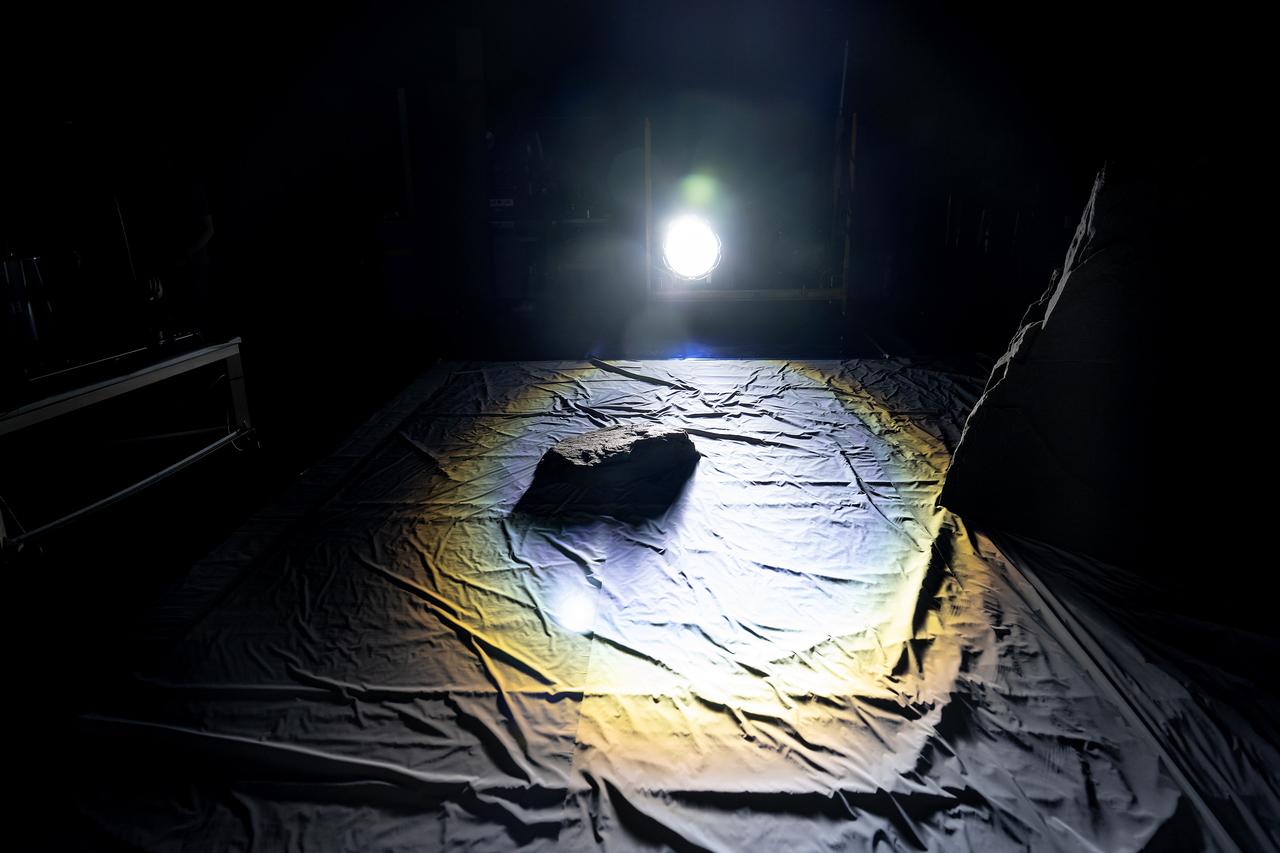
These photos show how teams at NASA’s Marshall Space Flight Center in Huntsville, Alabama, are using the Flat Floor Facility (Building 4619) to understand the lunar lighting environment in preparation for the Artemis III crewed lunar landing mission, slated for 2027. The Flat Floor Facility is an air-bearing floor, providing full-scale simulation capabilities for lunar surface systems by simulating zero gravity in two dimensions. Wearing low-fidelity materials, test engineers can understand how the extreme lighting of the Moon’s South Pole could affect surface operations during Artemis III. High-intensity lights are positioned at a low angle to replicate the strong shadows that are cast across the lunar South Pole by the Sun. Data and analysis from testing at NASA Marshall are improving models Artemis astronauts will use in preparation for lander and surface operations on the Moon during Artemis III. Testing in the facility is also helping cross-agency teams evaluate various tools astronauts may use. NASA Marshall manages the Human Landing System (HLS) Program. For more information, contact NASA Marshall’s Office of Communications at 256-544-0034.
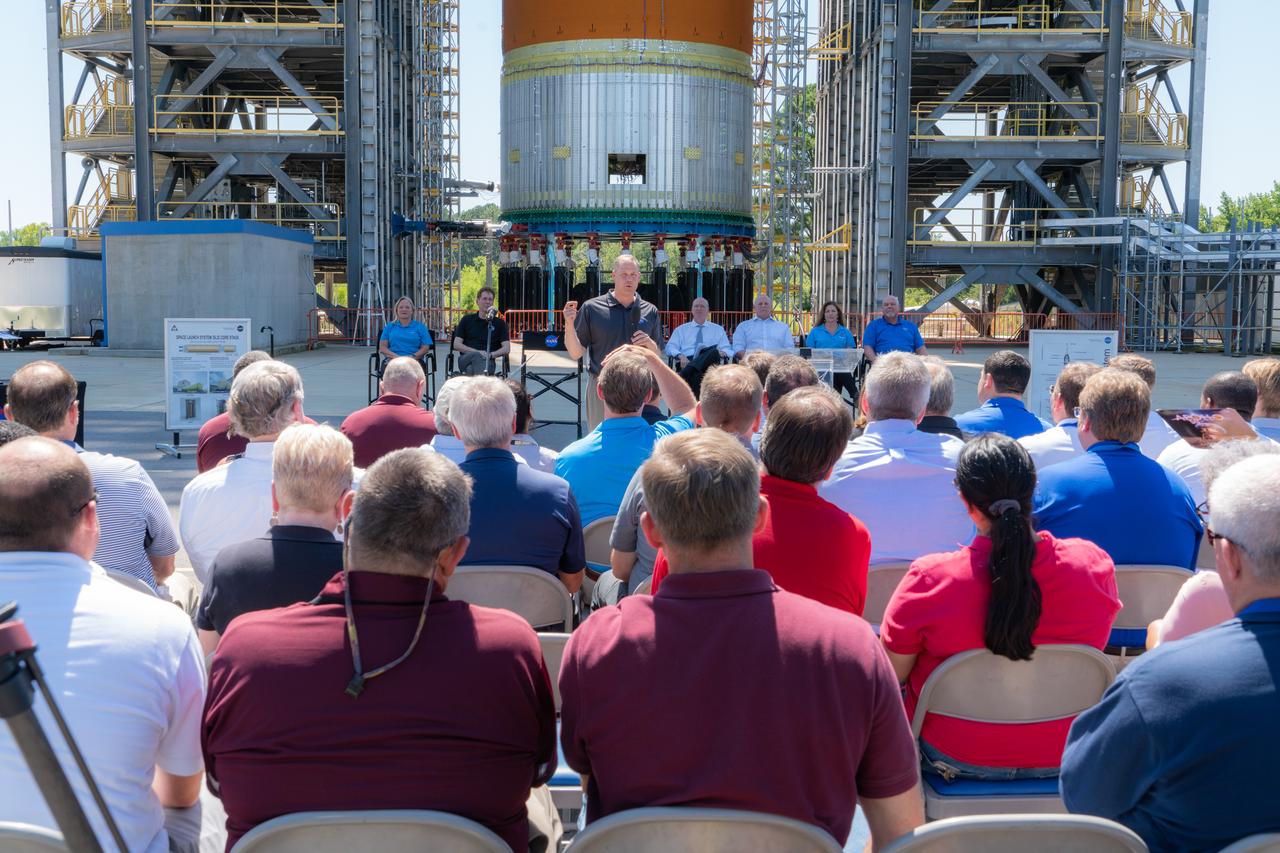
On Aug. 16, 2019, NASA Administrator Jim Bridenstine announced the agency’s Marshall Space Flight Center in Huntsville, Alabama, will lead the Human Landing System Program. Bridenstine was joined by Representatives Mo Brooks and Robert Aderholt of Alabama and Representative Scott DesJarlais of Tennessee. NASA will rapidly develop the lander for safely carrying the first woman and the next man to the Moon’s surface in 2024. The Artemis missions will start with launch by the world’s most powerful rocket, NASA’s Space Launch System, also managed by Marshall. Bridenstine made the announcement in front of the 149-foot-tall SLS liquid hydrogen structural test article, currently being tested to help ensure the structure can safely launch astronauts on the Artemis lunar missions. (NASA/Fred Deaton) For more information: https://www.nasa.gov/artemis-1
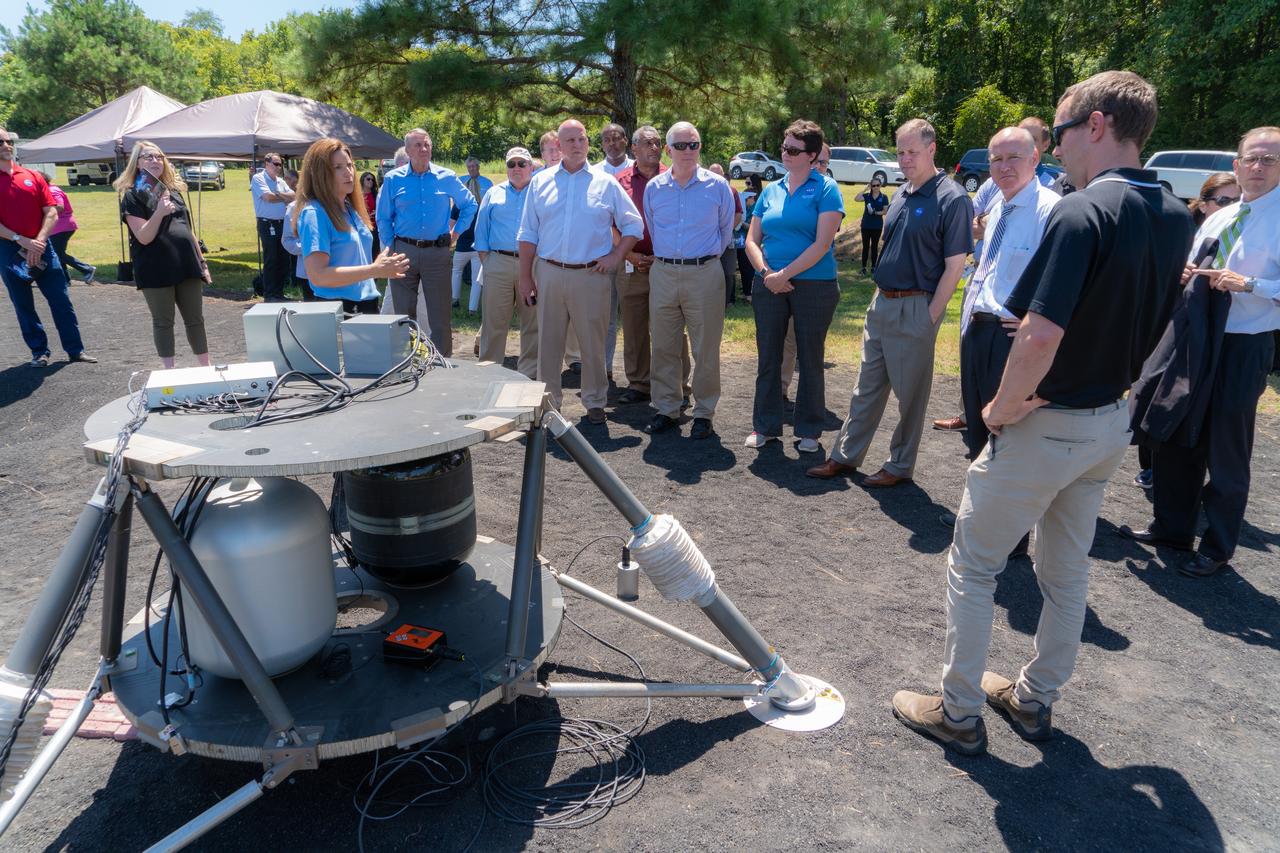
Lisa Watson-Morgan, center left, program manager of NASA’s Human Landing System Program at NASA’s Marshall Space Flight Center in Huntsville, Alabama, shows NASA Administrator Jim Bridenstine equipment used to test seismic sensors on a lunar lander platform on a simulated lunar surface at the center Aug. 16, 2019. Bridenstine was joined by Representatives Mo Brooks and Robert Aderholt of Alabama and Representative Scott DesJarlais of Tennessee. Planetary scientists performed the experiment to learn how these waves travel through simulated regolith, which is material similar to the Moon’s surface. The experiment will help guide instrument deployment scenarios for NASA’s Commercial Lunar Payload Service (CLPS) Program, delivering small science and technology payloads for Artemis. That same day, Bridenstine announced Marshall will lead the agency’s Human Landing System Program. (NASA/Fred Deaton) For more information: https://www.nasa.gov/artemis-1
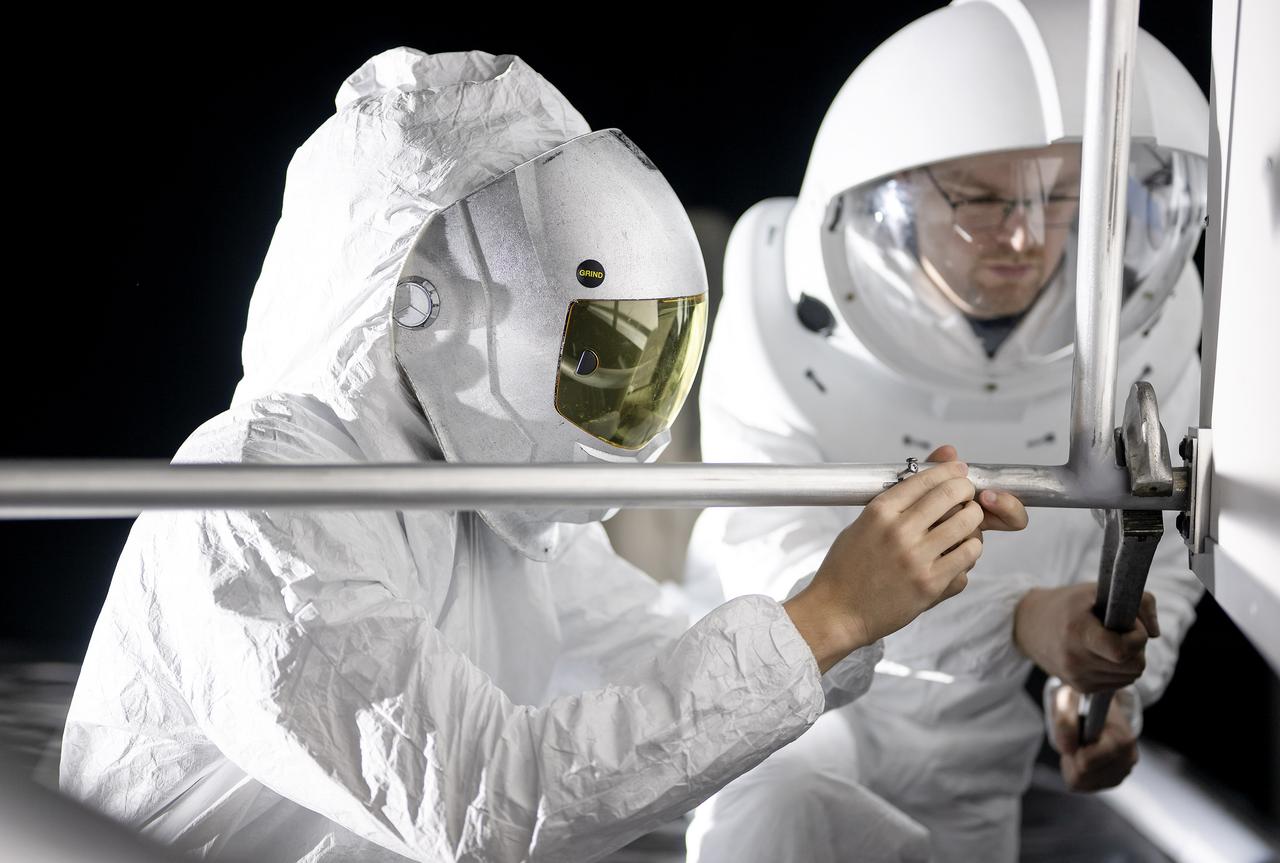
These photos show how teams at NASA’s Marshall Space Flight Center in Huntsville, Alabama, are using the Flat Floor Facility (Building 4619) to understand the lunar lighting environment in preparation for the Artemis III crewed lunar landing mission, slated for 2027. The Flat Floor Facility is an air-bearing floor, providing full-scale simulation capabilities for lunar surface systems by simulating zero gravity in two dimensions. Wearing low-fidelity materials, test engineers can understand how the extreme lighting of the Moon’s South Pole could affect surface operations during Artemis III. High-intensity lights are positioned at a low angle to replicate the strong shadows that are cast across the lunar South Pole by the Sun. Data and analysis from testing at NASA Marshall are improving models Artemis astronauts will use in preparation for lander and surface operations on the Moon during Artemis III. Testing in the facility is also helping cross-agency teams evaluate various tools astronauts may use. NASA Marshall manages the Human Landing System (HLS) Program. For more information, contact NASA Marshall’s Office of Communications at 256-544-0034.
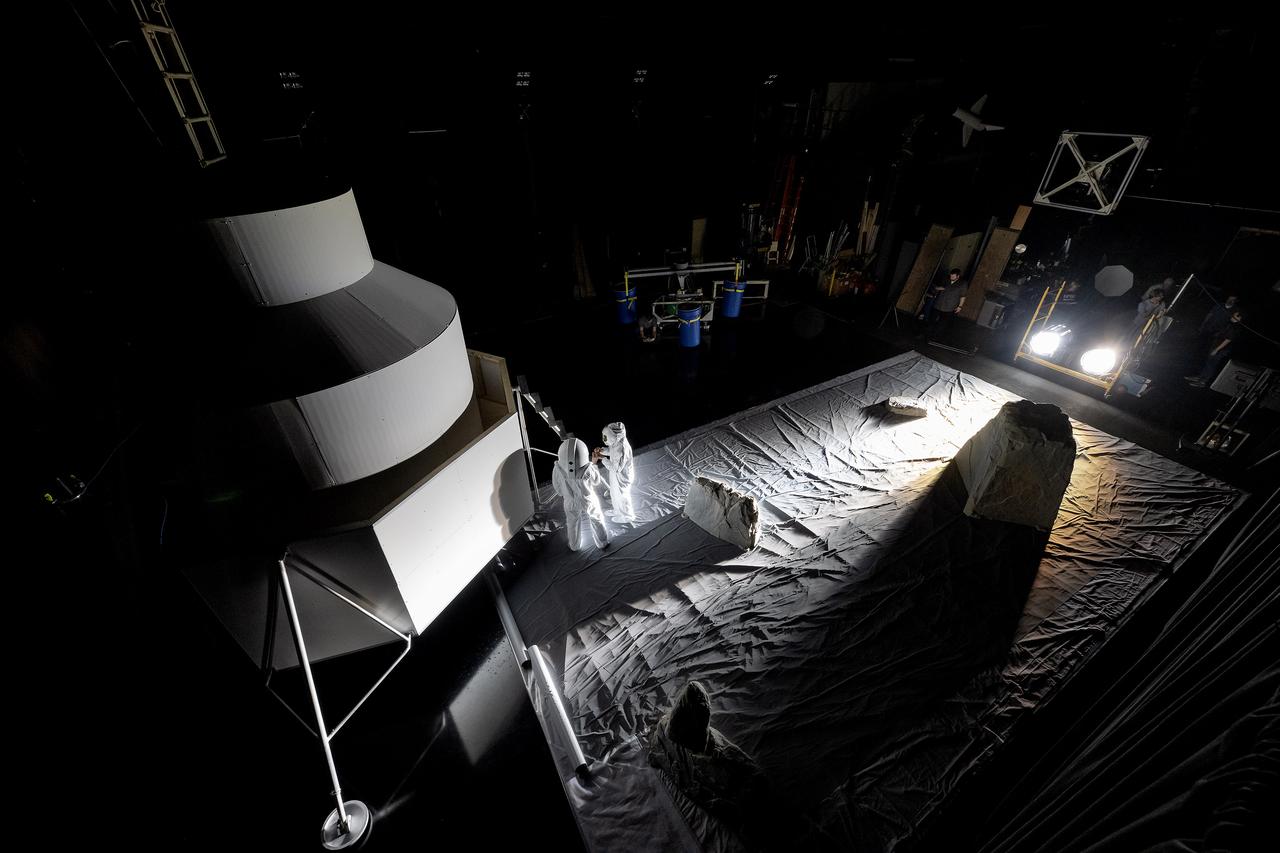
These photos show how teams at NASA’s Marshall Space Flight Center in Huntsville, Alabama, are using the Flat Floor Facility (Building 4619) to understand the lunar lighting environment in preparation for the Artemis III crewed lunar landing mission, slated for 2027. The Flat Floor Facility is an air-bearing floor, providing full-scale simulation capabilities for lunar surface systems by simulating zero gravity in two dimensions. Wearing low-fidelity materials, test engineers can understand how the extreme lighting of the Moon’s South Pole could affect surface operations during Artemis III. High-intensity lights are positioned at a low angle to replicate the strong shadows that are cast across the lunar South Pole by the Sun. Data and analysis from testing at NASA Marshall are improving models Artemis astronauts will use in preparation for lander and surface operations on the Moon during Artemis III. Testing in the facility is also helping cross-agency teams evaluate various tools astronauts may use. NASA Marshall manages the Human Landing System (HLS) Program. For more information, contact NASA Marshall’s Office of Communications at 256-544-0034.
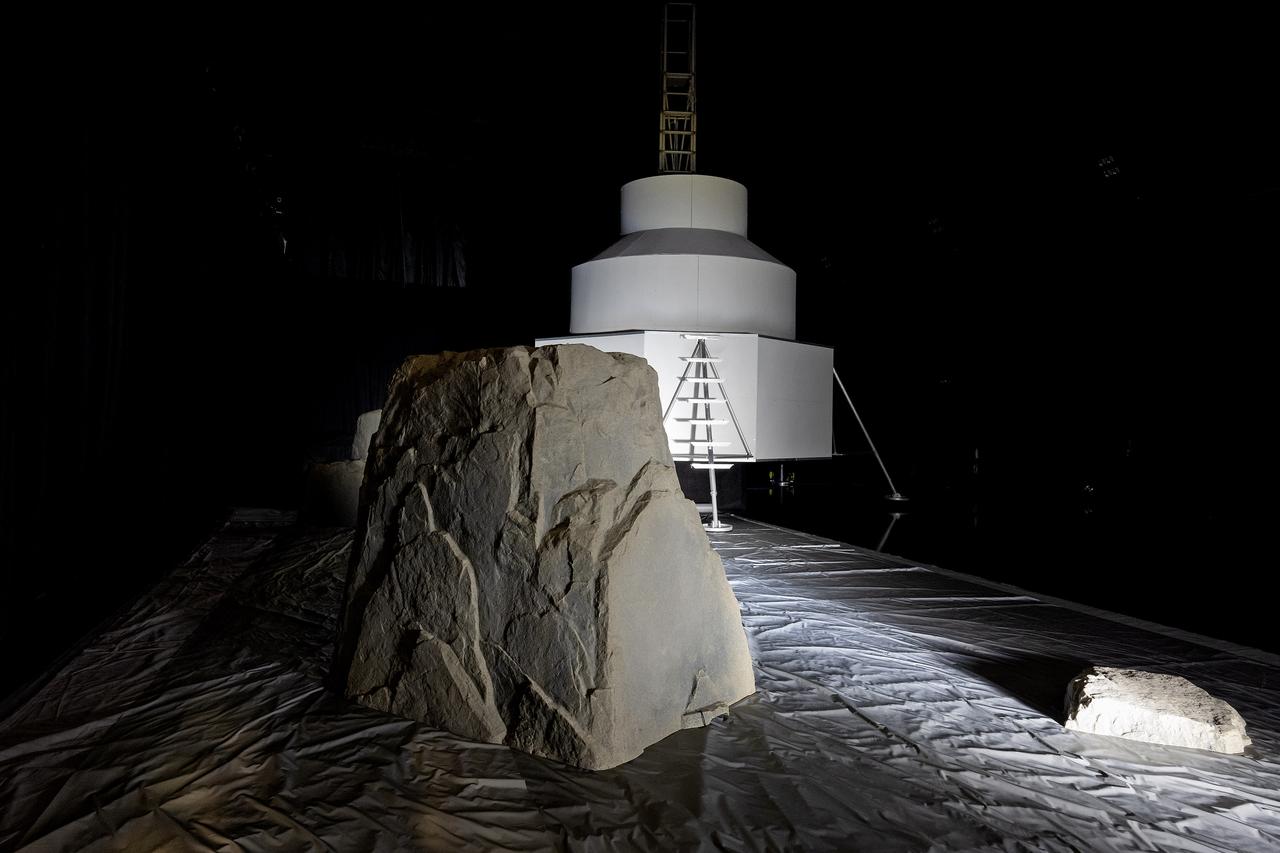
These photos show how teams at NASA’s Marshall Space Flight Center in Huntsville, Alabama, are using the Flat Floor Facility (Building 4619) to understand the lunar lighting environment in preparation for the Artemis III crewed lunar landing mission, slated for 2027. The Flat Floor Facility is an air-bearing floor, providing full-scale simulation capabilities for lunar surface systems by simulating zero gravity in two dimensions. Wearing low-fidelity materials, test engineers can understand how the extreme lighting of the Moon’s South Pole could affect surface operations during Artemis III. High-intensity lights are positioned at a low angle to replicate the strong shadows that are cast across the lunar South Pole by the Sun. Data and analysis from testing at NASA Marshall are improving models Artemis astronauts will use in preparation for lander and surface operations on the Moon during Artemis III. Testing in the facility is also helping cross-agency teams evaluate various tools astronauts may use. NASA Marshall manages the Human Landing System (HLS) Program. For more information, contact NASA Marshall’s Office of Communications at 256-544-0034.
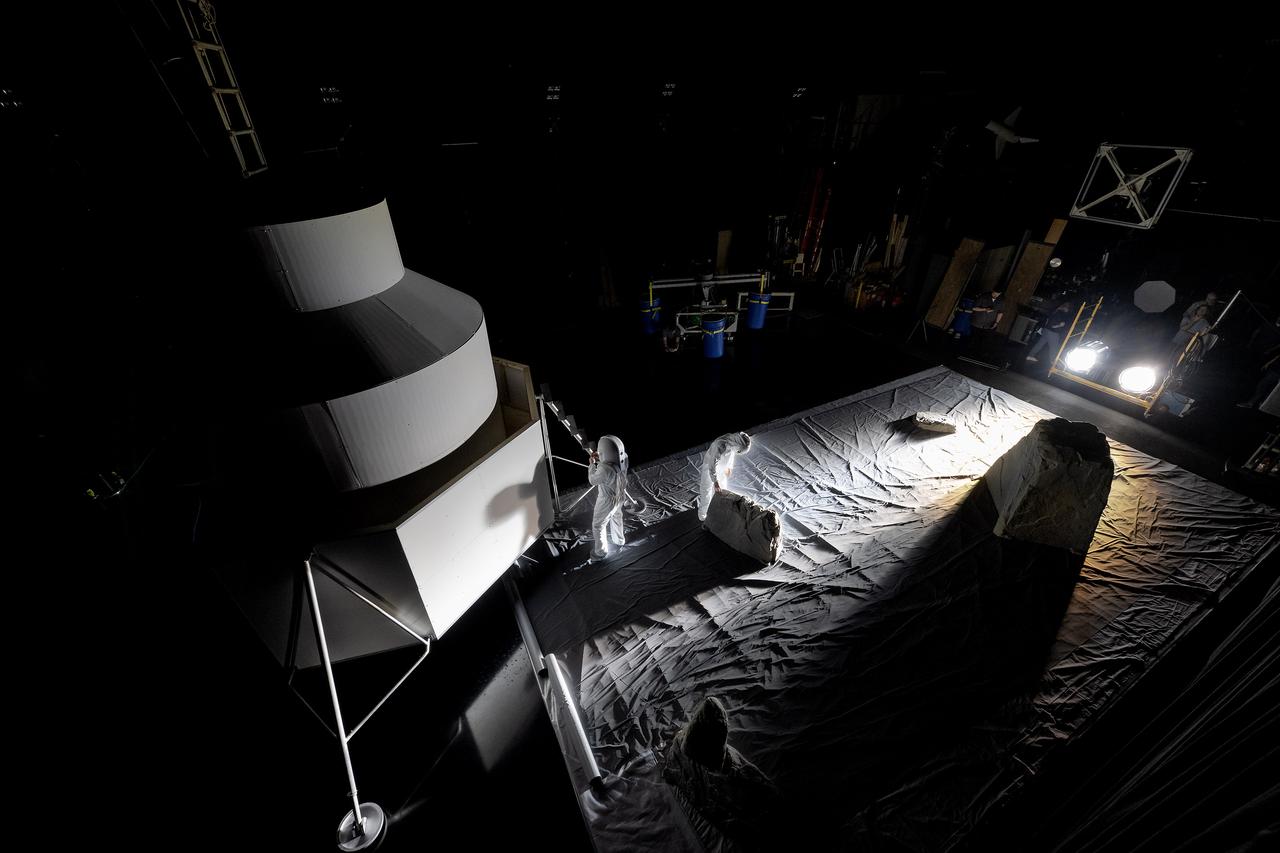
These photos show how teams at NASA’s Marshall Space Flight Center in Huntsville, Alabama, are using the Flat Floor Facility (Building 4619) to understand the lunar lighting environment in preparation for the Artemis III crewed lunar landing mission, slated for 2027. The Flat Floor Facility is an air-bearing floor, providing full-scale simulation capabilities for lunar surface systems by simulating zero gravity in two dimensions. Wearing low-fidelity materials, test engineers can understand how the extreme lighting of the Moon’s South Pole could affect surface operations during Artemis III. High-intensity lights are positioned at a low angle to replicate the strong shadows that are cast across the lunar South Pole by the Sun. Data and analysis from testing at NASA Marshall are improving models Artemis astronauts will use in preparation for lander and surface operations on the Moon during Artemis III. Testing in the facility is also helping cross-agency teams evaluate various tools astronauts may use. NASA Marshall manages the Human Landing System (HLS) Program. For more information, contact NASA Marshall’s Office of Communications at 256-544-0034.

These photos show how teams at NASA’s Marshall Space Flight Center in Huntsville, Alabama, are using the Flat Floor Facility (Building 4619) to understand the lunar lighting environment in preparation for the Artemis III crewed lunar landing mission, slated for 2027. The Flat Floor Facility is an air-bearing floor, providing full-scale simulation capabilities for lunar surface systems by simulating zero gravity in two dimensions. Wearing low-fidelity materials, test engineers can understand how the extreme lighting of the Moon’s South Pole could affect surface operations during Artemis III. High-intensity lights are positioned at a low angle to replicate the strong shadows that are cast across the lunar South Pole by the Sun. Data and analysis from testing at NASA Marshall are improving models Artemis astronauts will use in preparation for lander and surface operations on the Moon during Artemis III. Testing in the facility is also helping cross-agency teams evaluate various tools astronauts may use. NASA Marshall manages the Human Landing System (HLS) Program. For more information, contact NASA Marshall’s Office of Communications at 256-544-0034.
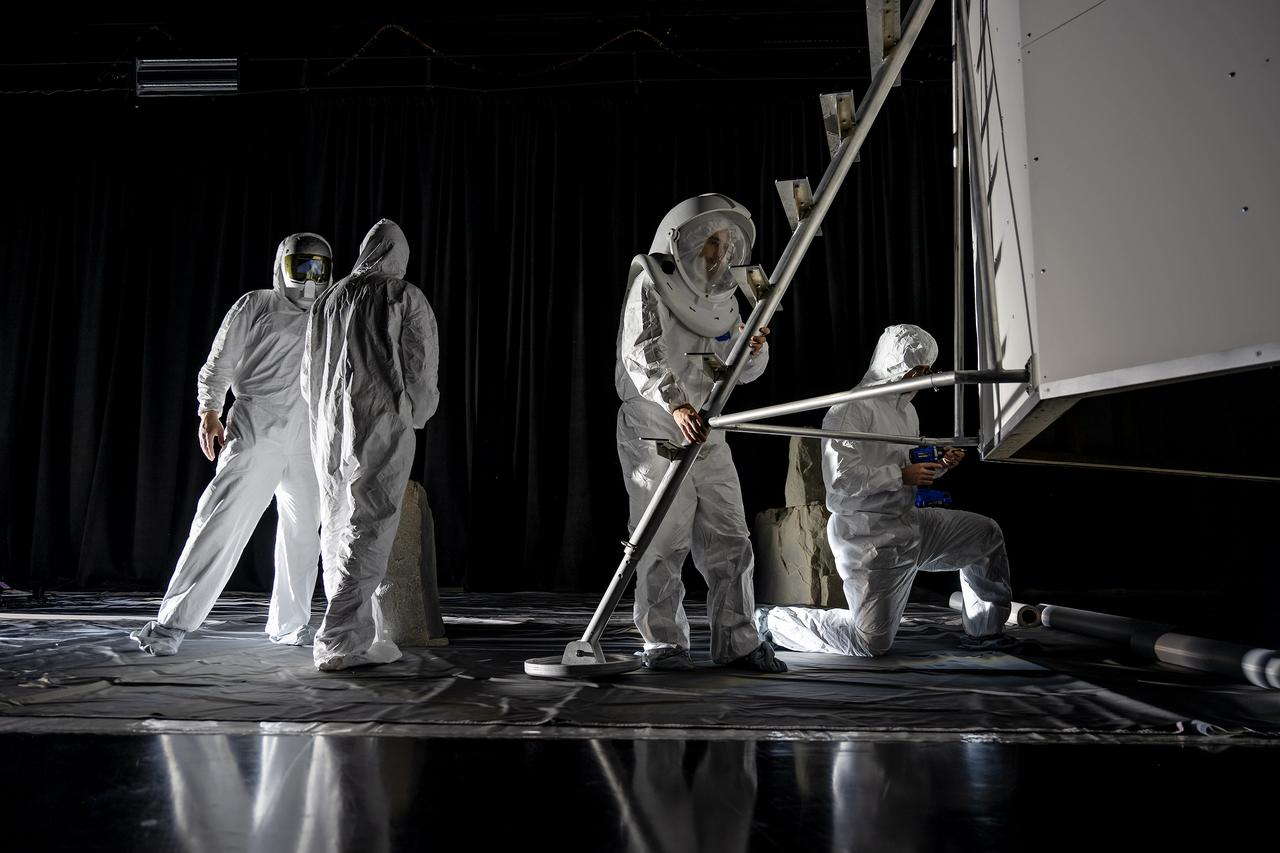
These photos show how teams at NASA’s Marshall Space Flight Center in Huntsville, Alabama, are using the Flat Floor Facility (Building 4619) to understand the lunar lighting environment in preparation for the Artemis III crewed lunar landing mission, slated for 2027. The Flat Floor Facility is an air-bearing floor, providing full-scale simulation capabilities for lunar surface systems by simulating zero gravity in two dimensions. Wearing low-fidelity materials, test engineers can understand how the extreme lighting of the Moon’s South Pole could affect surface operations during Artemis III. High-intensity lights are positioned at a low angle to replicate the strong shadows that are cast across the lunar South Pole by the Sun. Data and analysis from testing at NASA Marshall are improving models Artemis astronauts will use in preparation for lander and surface operations on the Moon during Artemis III. Testing in the facility is also helping cross-agency teams evaluate various tools astronauts may use. NASA Marshall manages the Human Landing System (HLS) Program. For more information, contact NASA Marshall’s Office of Communications at 256-544-0034.
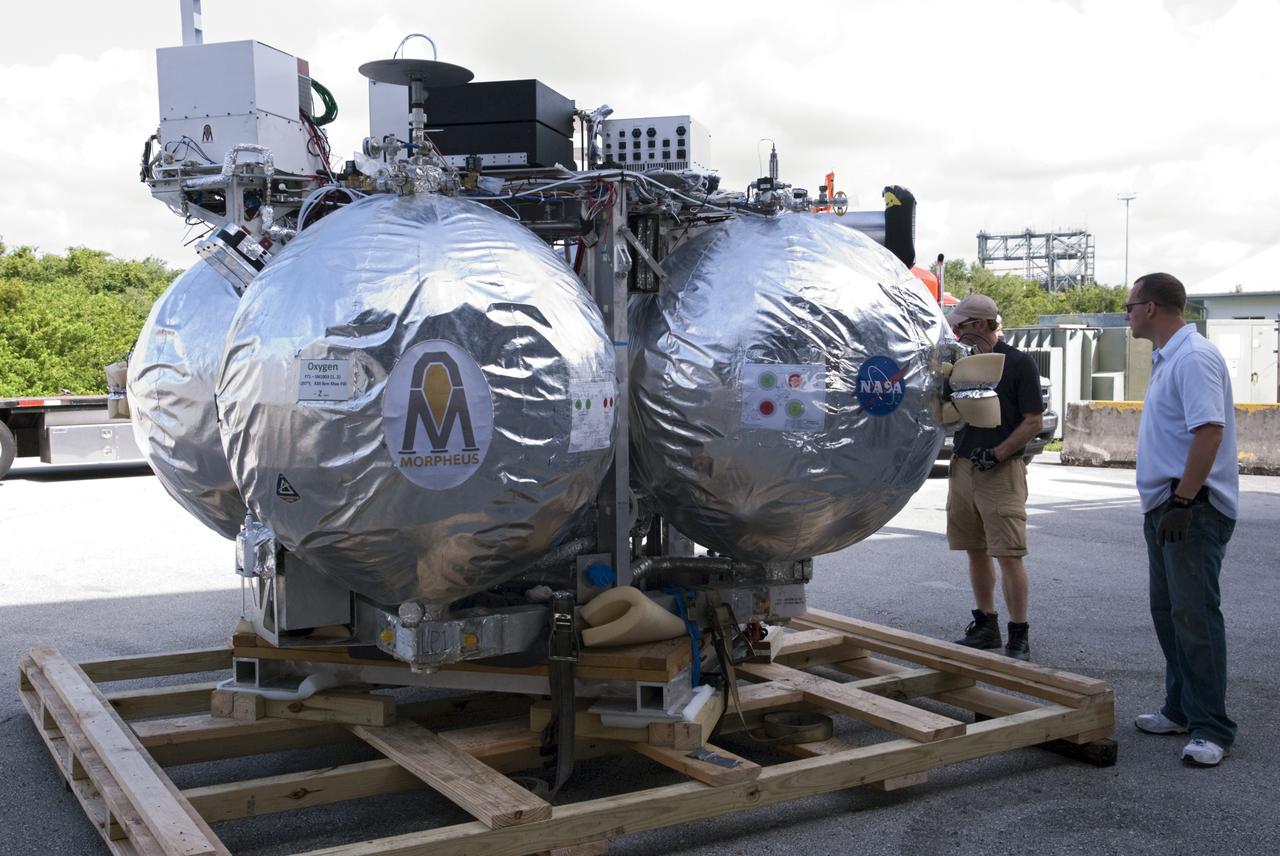
CAPE CANAVERAL, Fla. - NASA's Morpheus lander, a vertical test bed vehicle, is unloaded at the Kennedy Space Center in Florida. Morpheus is designed to demonstrate new green propellant propulsion systems and autonomous landing and an Autonomous Landing and Hazard Avoidance Technology, or ALHAT, system. Checkout of the prototype lander has been ongoing at NASA’s Johnson Space Center in Houston in preparation for its first free flight. The SLF site will provide the lander with the kind of field necessary for realistic testing. Project Morpheus is one of 20 small projects comprising the Advanced Exploration Systems, or AES, program in NASA’s Human Exploration and Operations Mission Directorate. AES projects pioneer new approaches for rapidly developing prototype systems, demonstrating key capabilities and validating operational concepts for future human missions beyond Earth orbit. For more information on Project Morpheus, visit http://www.nasa.gov/centers/johnson/exploration/morpheus/index.html Photo credit: NASA/ Charisse Nahser
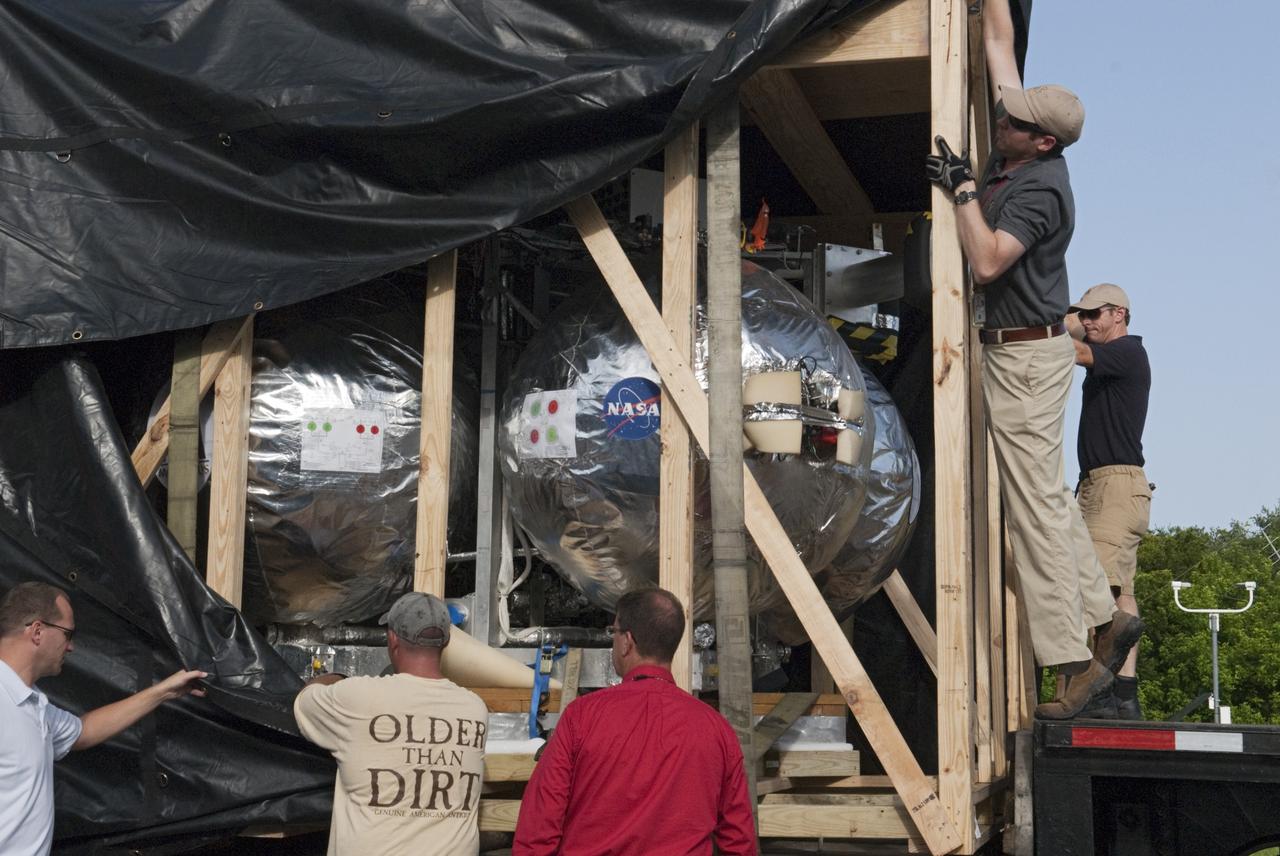
CAPE CANAVERAL, Fla. - NASA's Morpheus lander, a vertical test bed vehicle, is unloaded at the Kennedy Space Center in Florida. Morpheus is designed to demonstrate new green propellant propulsion systems and autonomous landing and an Autonomous Landing and Hazard Avoidance Technology, or ALHAT, system. Checkout of the prototype lander has been ongoing at NASA’s Johnson Space Center in Houston in preparation for its first free flight. The SLF site will provide the lander with the kind of field necessary for realistic testing. Project Morpheus is one of 20 small projects comprising the Advanced Exploration Systems, or AES, program in NASA’s Human Exploration and Operations Mission Directorate. AES projects pioneer new approaches for rapidly developing prototype systems, demonstrating key capabilities and validating operational concepts for future human missions beyond Earth orbit. For more information on Project Morpheus, visit http://www.nasa.gov/centers/johnson/exploration/morpheus/index.html Photo credit: NASA/ Charisse Nahser

CAPE CANAVERAL, Fla. - NASA's Morpheus lander, a vertical test bed vehicle, is unloaded at the Kennedy Space Center in Florida. Morpheus is designed to demonstrate new green propellant propulsion systems and autonomous landing and an Autonomous Landing and Hazard Avoidance Technology, or ALHAT, system. Checkout of the prototype lander has been ongoing at NASA’s Johnson Space Center in Houston in preparation for its first free flight. The SLF site will provide the lander with the kind of field necessary for realistic testing. Project Morpheus is one of 20 small projects comprising the Advanced Exploration Systems, or AES, program in NASA’s Human Exploration and Operations Mission Directorate. AES projects pioneer new approaches for rapidly developing prototype systems, demonstrating key capabilities and validating operational concepts for future human missions beyond Earth orbit. For more information on Project Morpheus, visit http://www.nasa.gov/centers/johnson/exploration/morpheus/index.html Photo credit: NASA/ Charisse Nahser
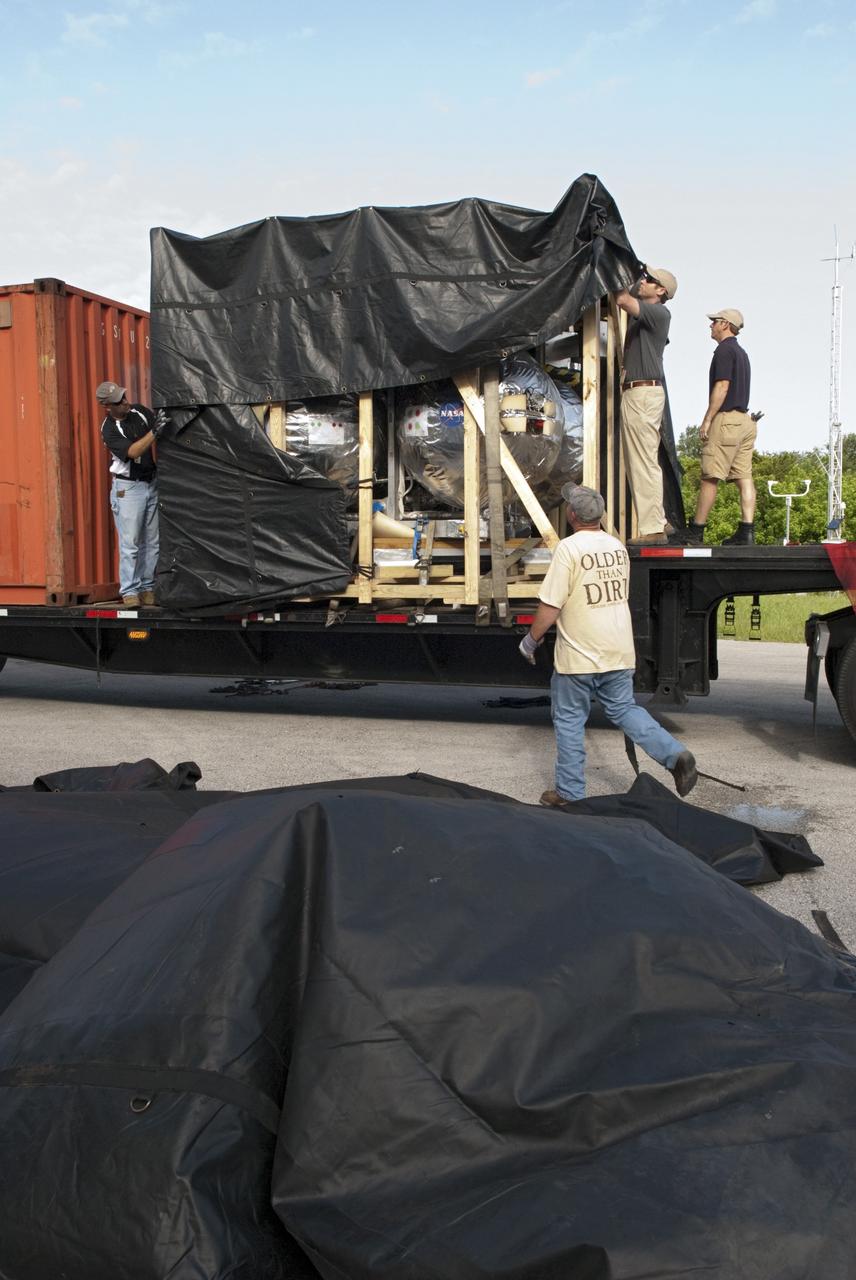
CAPE CANAVERAL, Fla. - NASA's Morpheus lander, a vertical test bed vehicle, is unloaded at the Kennedy Space Center in Florida. Morpheus is designed to demonstrate new green propellant propulsion systems and autonomous landing and an Autonomous Landing and Hazard Avoidance Technology, or ALHAT, system. Checkout of the prototype lander has been ongoing at NASA’s Johnson Space Center in Houston in preparation for its first free flight. The SLF site will provide the lander with the kind of field necessary for realistic testing. Project Morpheus is one of 20 small projects comprising the Advanced Exploration Systems, or AES, program in NASA’s Human Exploration and Operations Mission Directorate. AES projects pioneer new approaches for rapidly developing prototype systems, demonstrating key capabilities and validating operational concepts for future human missions beyond Earth orbit. For more information on Project Morpheus, visit http://www.nasa.gov/centers/johnson/exploration/morpheus/index.html Photo credit: NASA/ Charisse Nahser
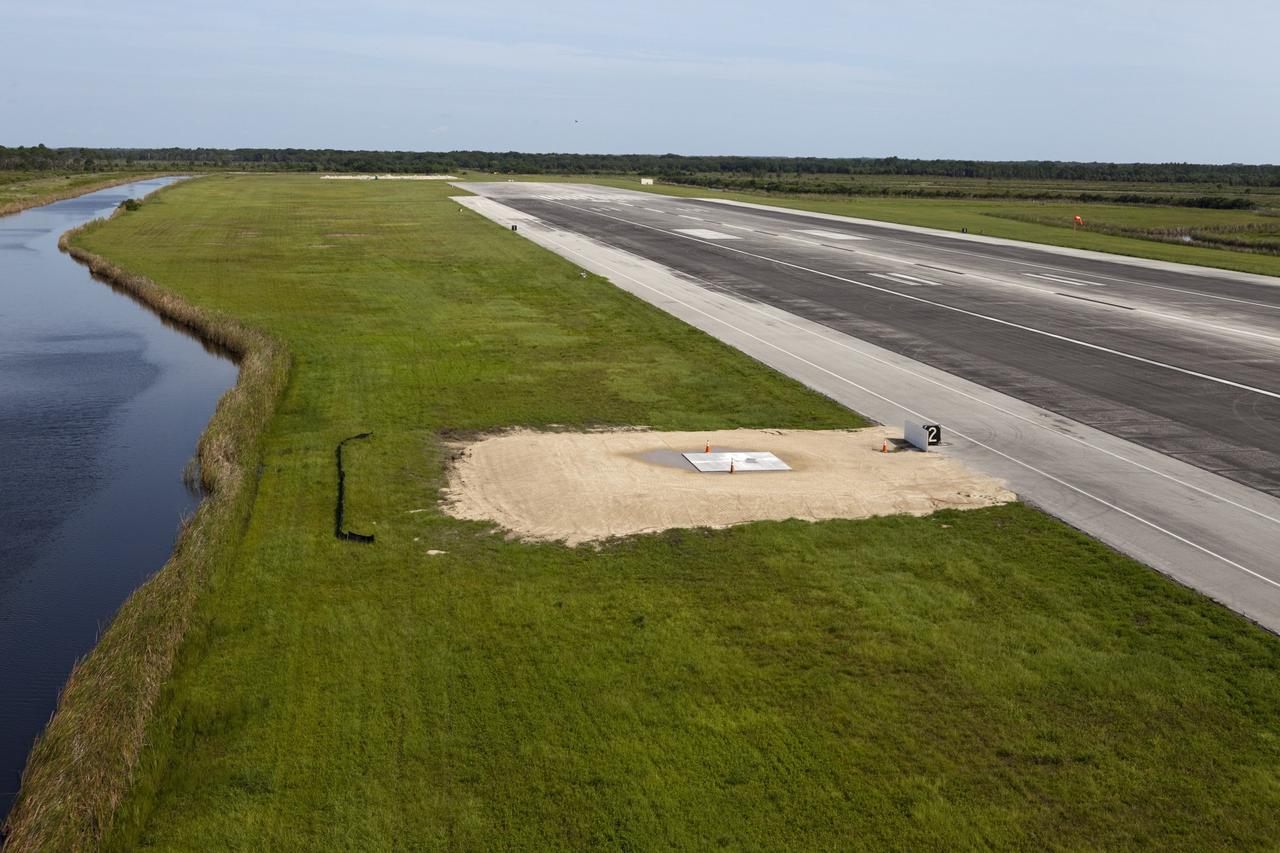
CAPE CANAVERAL, Fla. – This aerial view shows the launch platform for the Project Morpheus lander at the midfield point of the Shuttle Landing Facility, or SLF, at NASA’s Kennedy Space Center in Florida. At the north end of the runway is a rock and crater-filled planetary scape built so engineers can test the Autonomous Landing and Hazard Avoidance Technology, or ALHAT system on the Morpheus lander. Testing will demonstrate ALHAT’s ability to provide required navigation data negotiating the Morpheus lander away from risks during descent. Checkout of the prototype lander has been ongoing at NASA’s Johnson Space Center in Houston in preparation for its first free flight. The SLF site will provide the lander with the kind of field necessary for realistic testing. Project Morpheus is one of 20 small projects comprising the Advanced Exploration Systems, or AES, program in NASA’s Human Exploration and Operations Mission Directorate. AES projects pioneer new approaches for rapidly developing prototype systems, demonstrating key capabilities and validating operational concepts for future human missions beyond Earth orbit. For more information on Project Morpheus, visit http://www.nasa.gov/centers/johnson/exploration/morpheus/index.html Photo credit: NASA/Kim Shiflett
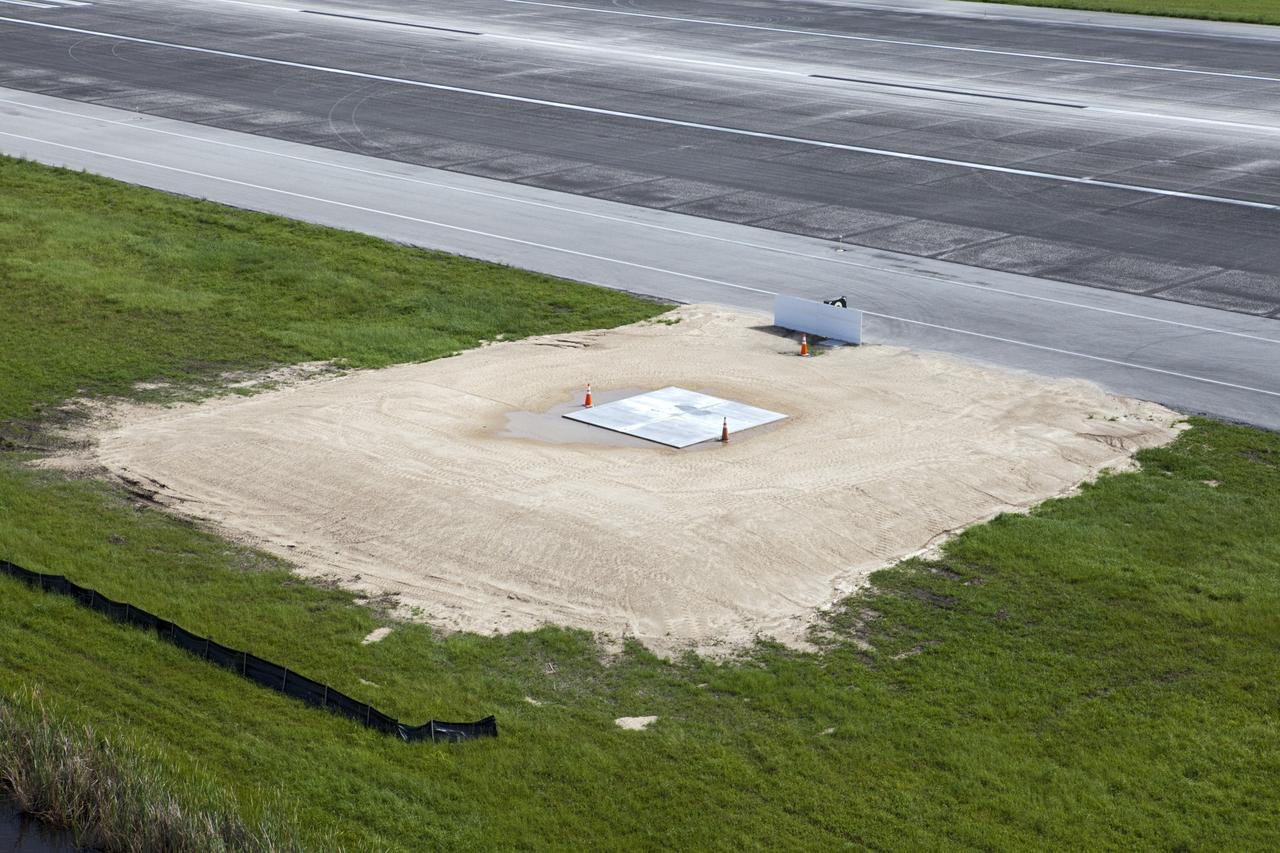
CAPE CANAVERAL, Fla. – This aerial view shows the launch platform for the Project Morpheus lander at the midfield point of the Shuttle Landing Facility, or SLF, at NASA’s Kennedy Space Center in Florida. At the north end of the runway is a rock and crater-filled planetary scape built so engineers can test the Autonomous Landing and Hazard Avoidance Technology, or ALHAT system on the Morpheus lander. Testing will demonstrate ALHAT’s ability to provide required navigation data negotiating the Morpheus lander away from risks during descent. Checkout of the prototype lander has been ongoing at NASA’s Johnson Space Center in Houston in preparation for its first free flight. The SLF site will provide the lander with the kind of field necessary for realistic testing. Project Morpheus is one of 20 small projects comprising the Advanced Exploration Systems, or AES, program in NASA’s Human Exploration and Operations Mission Directorate. AES projects pioneer new approaches for rapidly developing prototype systems, demonstrating key capabilities and validating operational concepts for future human missions beyond Earth orbit. For more information on Project Morpheus, visit http://www.nasa.gov/centers/johnson/exploration/morpheus/index.html Photo credit: NASA/Kim Shiflett
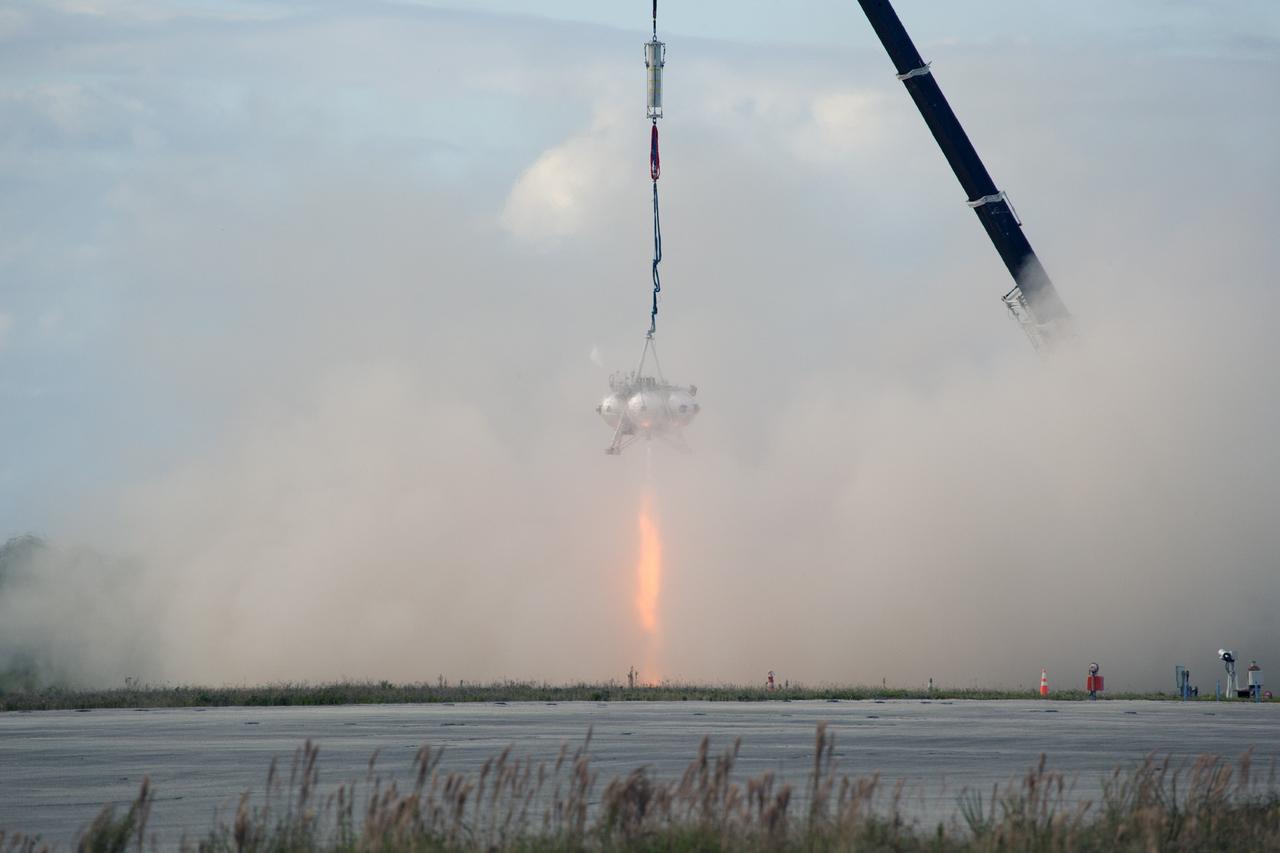
CAPE CANAVERAL, Fla. – At NASA’s Kennedy Space Center in Florida, smoke fills the air as the Project Morpheus prototype lander’s engine fires during a tether test at the north end of the Shuttle Landing Facility. During the test, the lander was lifted 20 feet by crane, and then ascended another 10 feet. The lander will maneuver backwards 10 feet, and then fly forward and descend to its original position, landing at the end of the tether onto a transportable launch platform. Testing of the prototype lander was performed at NASA’s Johnson Space Center in Houston in preparation for tethered and free flight testing at Kennedy. The landing facility will provide the lander with the kind of field necessary for realistic testing, complete with rocks, craters and hazards to avoid. Morpheus utilizes an autonomous landing and hazard avoidance technology, or ALHAT, payload that will allow it to navigate to clear landing sites amidst rocks, craters and other hazards during its descent. Project Morpheus is being managed under the Advanced Exploration Systems, or AES, Division in NASA’s Human Exploration and Operations Mission Directorate. The efforts in AES pioneer new approaches for rapidly developing prototype systems, demonstrating key capabilities and validating operational concepts for future human missions beyond Earth orbit. For more information on Project Morpheus, visit http://morpheuslander.jsc.nasa.gov. Photo credit: NASA/Daniel Casper
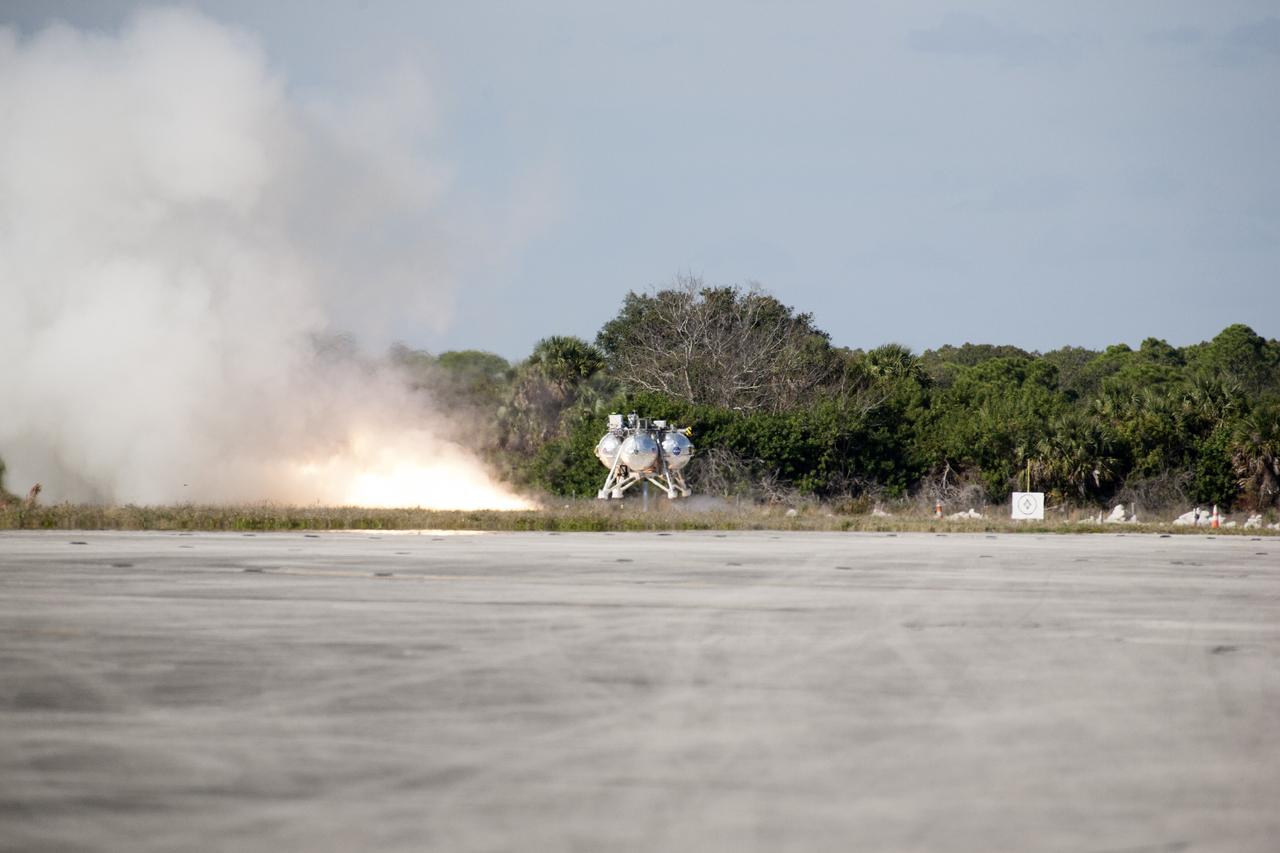
CAPE CANAVERAL, Fla. – The first free flight of the Project Morpheus prototype lander begins as the lander’s engine fires at the north of the Shuttle Landing Facility at NASA’s Kennedy Space Center in Florida. Testing of the prototype lander was performed at NASA’s Johnson Space Center in Houston in preparation for tethered and free flight testing at Kennedy. Project Morpheus integrates NASA’s automated landing and hazard avoidance technology, or ALHAT, with an engine that runs on liquid oxygen and methane, or green propellants, into a fully-operational lander that could deliver cargo to asteroids and other planetary surfaces. The landing facility will provide the lander with the kind of field necessary for realistic testing, complete with rocks, craters and hazards to avoid. Morpheus’ ALHAT payload allows it to navigate to clear landing sites amidst rocks, craters and other hazards during its descent. Project Morpheus is being managed under the Advanced Exploration Systems, or AES, Division in NASA’s Human Exploration and Operations Mission Directorate. The efforts in AES pioneer new approaches for rapidly developing prototype systems, demonstrating key capabilities and validating operational concepts for future human missions beyond Earth orbit. For more information on Project Morpheus, visit http://morpheuslander.jsc.nasa.gov. Photo credit: NASA/Kim Shiflett
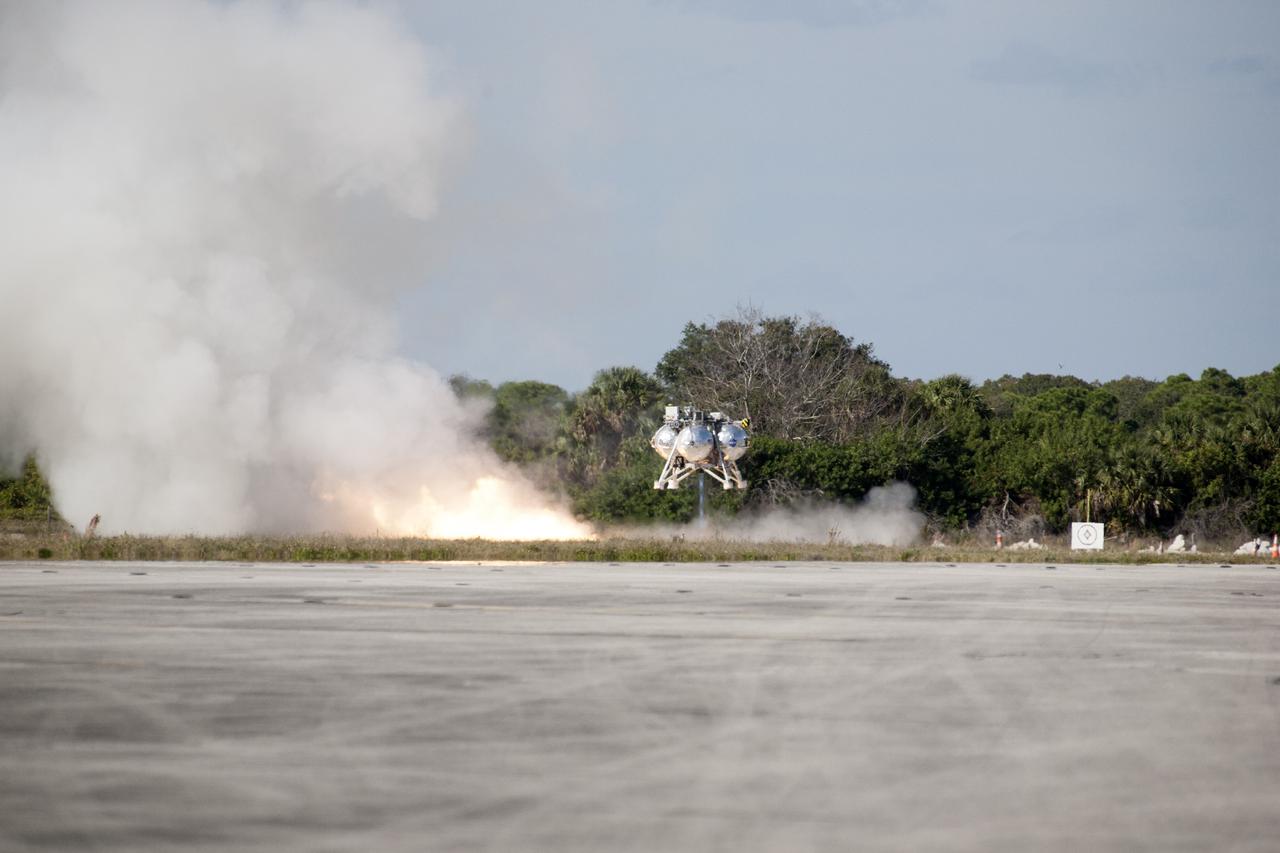
CAPE CANAVERAL, Fla. – The first free flight of the Project Morpheus prototype lander begins as the engine fires and the lander begins to lift off at the north of the Shuttle Landing Facility at NASA’s Kennedy Space Center in Florida. Testing of the prototype lander was performed at NASA’s Johnson Space Center in Houston in preparation for tethered and free flight testing at Kennedy. Project Morpheus integrates NASA’s automated landing and hazard avoidance technology, or ALHAT, with an engine that runs on liquid oxygen and methane, or green propellants, into a fully-operational lander that could deliver cargo to asteroids and other planetary surfaces. The landing facility will provide the lander with the kind of field necessary for realistic testing, complete with rocks, craters and hazards to avoid. Morpheus’ ALHAT payload allows it to navigate to clear landing sites amidst rocks, craters and other hazards during its descent. Project Morpheus is being managed under the Advanced Exploration Systems, or AES, Division in NASA’s Human Exploration and Operations Mission Directorate. The efforts in AES pioneer new approaches for rapidly developing prototype systems, demonstrating key capabilities and validating operational concepts for future human missions beyond Earth orbit. For more information on Project Morpheus, visit http://morpheuslander.jsc.nasa.gov. Photo credit: NASA/Kim Shiflett
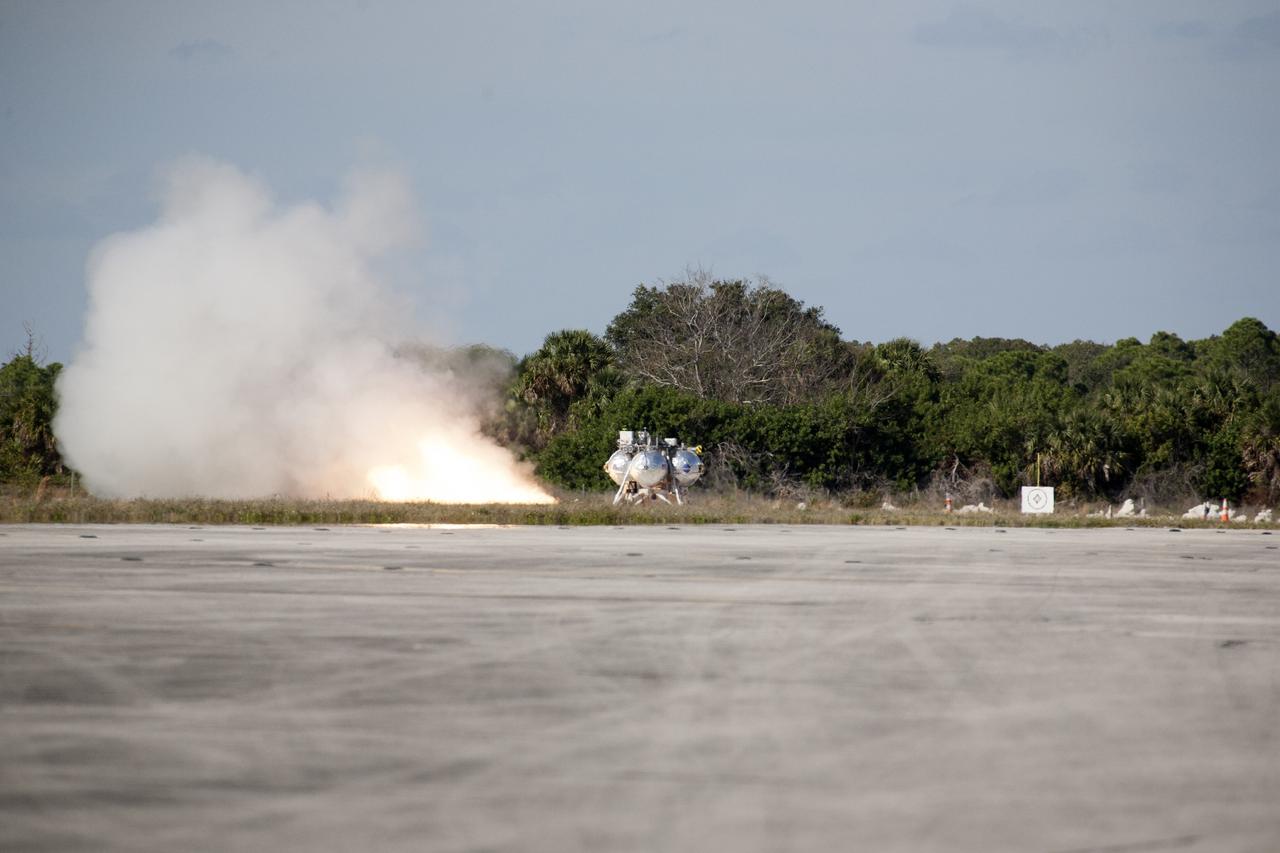
CAPE CANAVERAL, Fla. – The first free flight of the Project Morpheus prototype lander begins as the lander’s engine fires at the north of the Shuttle Landing Facility at NASA’s Kennedy Space Center in Florida. Testing of the prototype lander was performed at NASA’s Johnson Space Center in Houston in preparation for tethered and free flight testing at Kennedy. Project Morpheus integrates NASA’s automated landing and hazard avoidance technology, or ALHAT, with an engine that runs on liquid oxygen and methane, or green propellants, into a fully-operational lander that could deliver cargo to asteroids and other planetary surfaces. The landing facility will provide the lander with the kind of field necessary for realistic testing, complete with rocks, craters and hazards to avoid. Morpheus’ ALHAT payload allows it to navigate to clear landing sites amidst rocks, craters and other hazards during its descent. Project Morpheus is being managed under the Advanced Exploration Systems, or AES, Division in NASA’s Human Exploration and Operations Mission Directorate. The efforts in AES pioneer new approaches for rapidly developing prototype systems, demonstrating key capabilities and validating operational concepts for future human missions beyond Earth orbit. For more information on Project Morpheus, visit http://morpheuslander.jsc.nasa.gov. Photo credit: NASA/Kim Shiflett
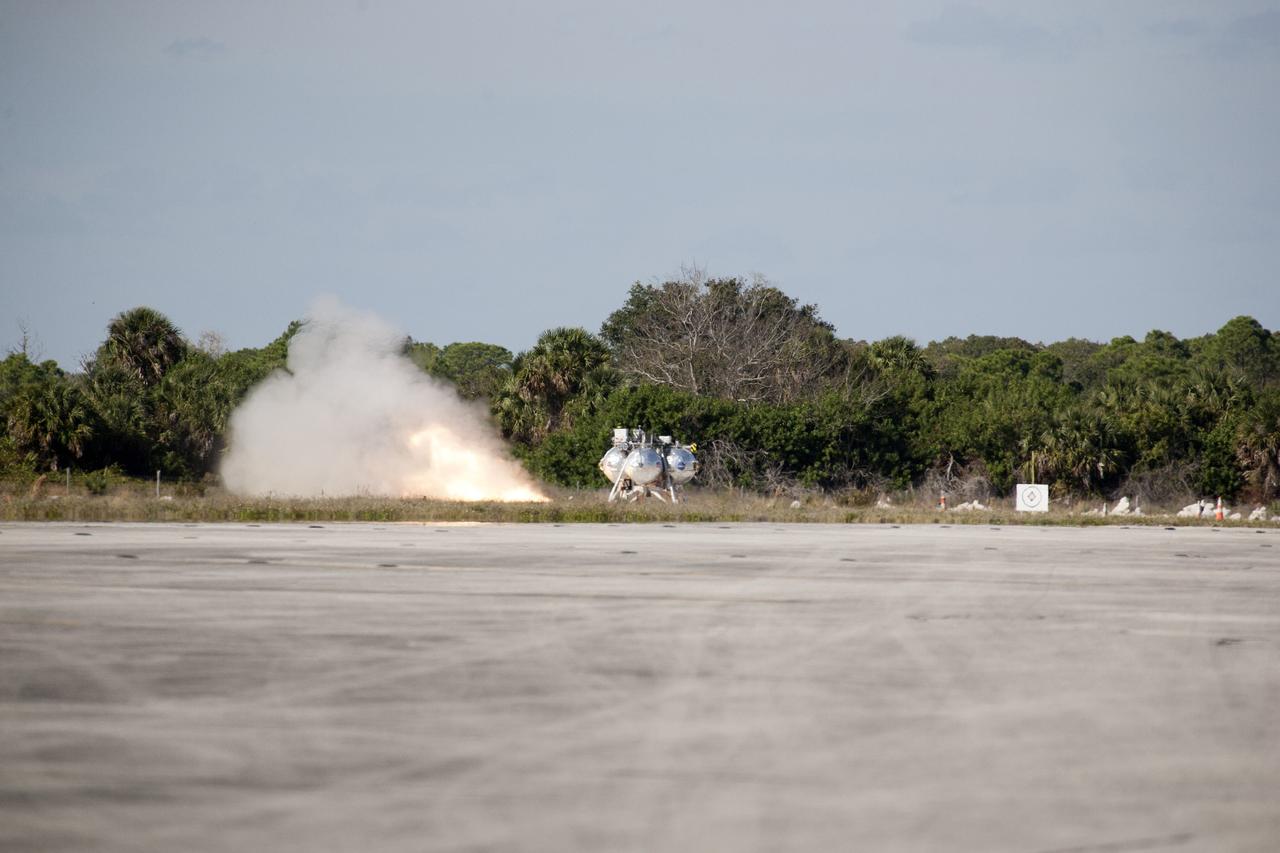
CAPE CANAVERAL, Fla. – The first free flight of the Project Morpheus prototype lander begins as the lander’s engine fires at the north of the Shuttle Landing Facility at NASA’s Kennedy Space Center in Florida. Testing of the prototype lander was performed at NASA’s Johnson Space Center in Houston in preparation for tethered and free flight testing at Kennedy. Project Morpheus integrates NASA’s automated landing and hazard avoidance technology, or ALHAT, with an engine that runs on liquid oxygen and methane, or green propellants, into a fully-operational lander that could deliver cargo to asteroids and other planetary surfaces. The landing facility will provide the lander with the kind of field necessary for realistic testing, complete with rocks, craters and hazards to avoid. Morpheus’ ALHAT payload allows it to navigate to clear landing sites amidst rocks, craters and other hazards during its descent. Project Morpheus is being managed under the Advanced Exploration Systems, or AES, Division in NASA’s Human Exploration and Operations Mission Directorate. The efforts in AES pioneer new approaches for rapidly developing prototype systems, demonstrating key capabilities and validating operational concepts for future human missions beyond Earth orbit. For more information on Project Morpheus, visit http://morpheuslander.jsc.nasa.gov. Photo credit: NASA/Kim Shiflett

These artist’s concepts show SpaceX’s Starship Human Landing System (HLS) on the Moon. NASA is working with SpaceX to develop Starship HLS to carry astronauts from lunar orbit to the Moon’s surface and back for Artemis III and Artemis IV as part of the agency’s Artemis campaign. At about 165 feet (50 m), Starship HLS will be about the same height as a 15-story building. An elevator on Starship HLS will be used to transport crew and cargo between the lander and the Moon’s surface.
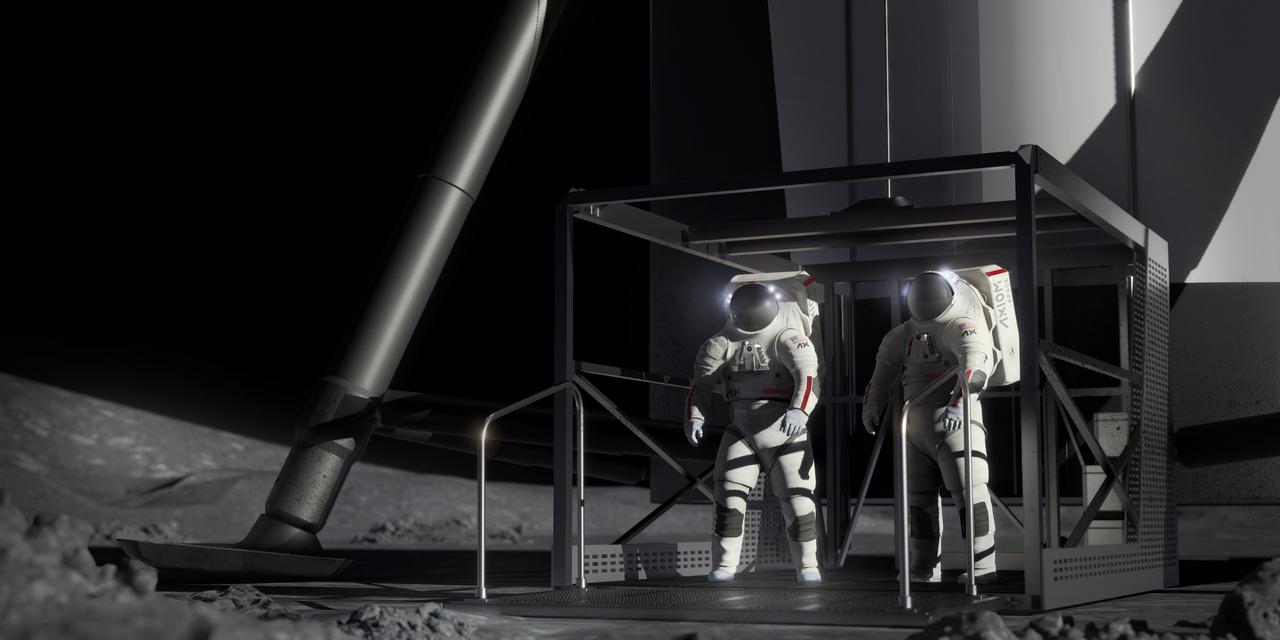
These artist’s concepts show SpaceX’s Starship Human Landing System (HLS) on the Moon. NASA is working with SpaceX to develop Starship HLS to carry astronauts from lunar orbit to the Moon’s surface and back for Artemis III and Artemis IV as part of the agency’s Artemis campaign. At about 165 feet (50 m), Starship HLS will be about the same height as a 15-story building. An elevator on Starship HLS will be used to transport crew and cargo between the lander and the Moon’s surface.
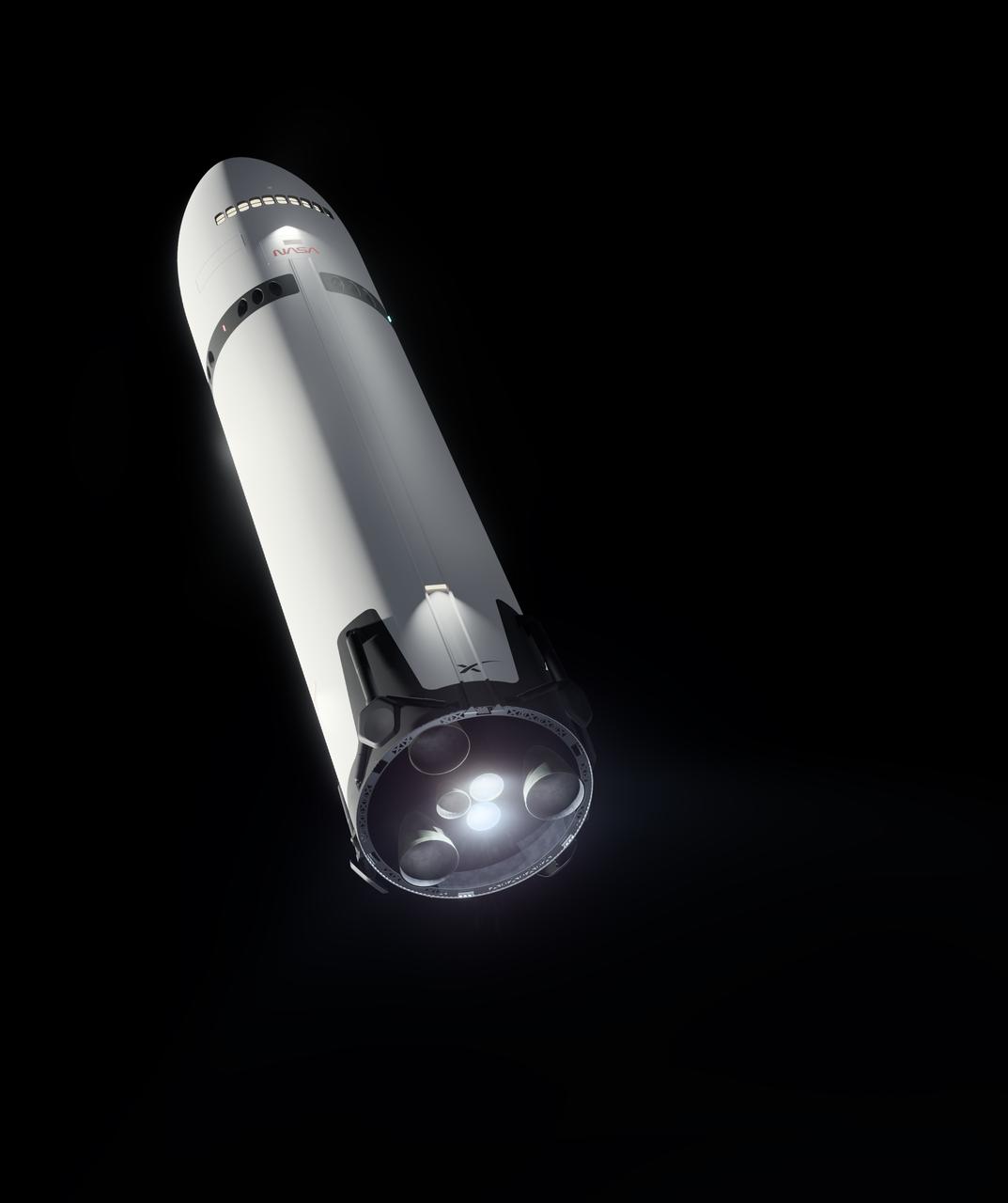
This artist’s concept portrays SpaceX’s Starship Human Landing System (HLS) with two Raptor engines lit, performing a braking burn prior to its Moon landing. The burn will occur after Starship HLS departs low lunar orbit to reduce the lander’s velocity prior to final descent to the lunar surface. NASA is working with SpaceX to develop Starship HLS to carry astronauts from lunar orbit to the Moon’s surface and back for Artemis III and Artemis IV as part of the agency’s Artemis campaign.
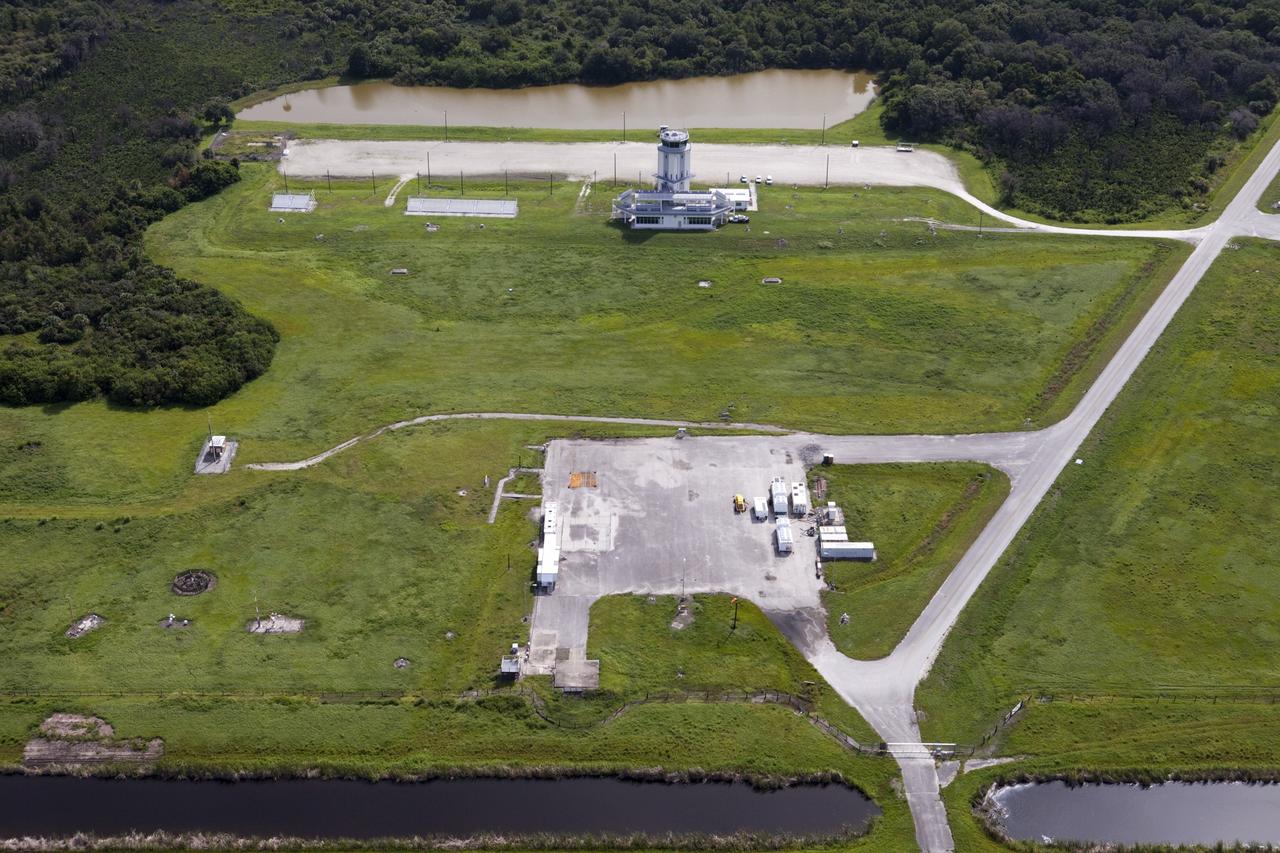
CAPE CANAVERAL, Fla. – This aerial view shows the Shuttle Landing Facility’s air traffic control tower at the Kennedy Space Center in Florida. Just below the tower is the mid-field park site used for runway support vehicles. At the north end of the runway, a rock and crater-filled planetary scape has been built so engineers can test the Autonomous Landing and Hazard Avoidance Technology, or ALHAT system on the Project Morpheus lander. Testing will demonstrate ALHAT’s ability to provide required navigation data negotiating the Morpheus lander away from risks during descent. Checkout of the prototype lander has been ongoing at NASA’s Johnson Space Center in Houston in preparation for its first free flight. The SLF site will provide the lander with the kind of field necessary for realistic testing. Project Morpheus is one of 20 small projects comprising the Advanced Exploration Systems, or AES, program in NASA’s Human Exploration and Operations Mission Directorate. AES projects pioneer new approaches for rapidly developing prototype systems, demonstrating key capabilities and validating operational concepts for future human missions beyond Earth orbit. For more information on Project Morpheus, visit http://www.nasa.gov/centers/johnson/exploration/morpheus/index.html Photo credit: NASA/Kim Shiflett

CAPE CANAVERAL, Fla. - At the north end of the Shuttle Landing Facility, or SLF, at the Kennedy Space Center in Florida, NASA's Morpheus lander, a vertical test bed vehicle, is being fueled. A rock and crater-filled planetary scape, seen in the foreground, has been built so engineers can test the Autonomous Landing and Hazard Avoidance Technology, or ALHAT, system on the Project Morpheus lander. Checkout of the prototype lander has been ongoing at NASA’s Johnson Space Center in Houston in preparation for its first free flight. The SLF site will provide the lander with the kind of field necessary for realistic testing. Project Morpheus is one of 20 small projects comprising the Advanced Exploration Systems, or AES, program in NASA’s Human Exploration and Operations Mission Directorate. AES projects pioneer new approaches for rapidly developing prototype systems, demonstrating key capabilities and validating operational concepts for future human missions beyond Earth orbit. For more information on Project Morpheus, visit http://www.nasa.gov/centers/johnson/exploration/morpheus/index.html Photo credit: NASA/Kim Shiflett
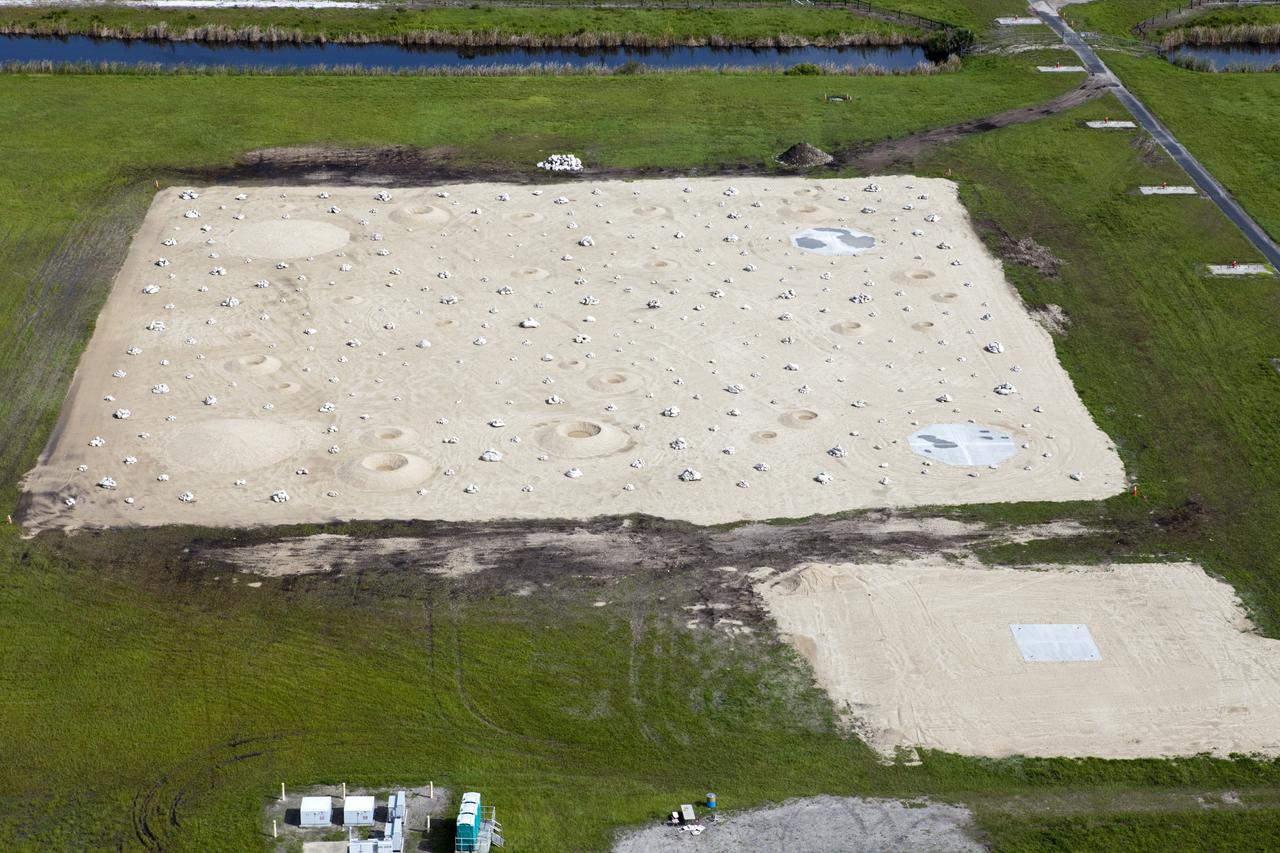
CAPE CANAVERAL, Fla. – This aerial view shows a rock and crater-filled planetary scape that has been built at the north end of the Kennedy Space Center’s Shuttle Landing Facility. The site will allow engineers to test the Autonomous Landing and Hazard Avoidance Technology, or ALHAT system on the Project Morpheus lander. Testing will demonstrate ALHAT’s ability to provide required navigation data negotiating the Morpheus lander away from risks during descent. Checkout of the prototype lander has been ongoing at NASA’s Johnson Space Center in Houston in preparation for its first free flight. The SLF site will provide the lander with the kind of field necessary for realistic testing. Project Morpheus is one of 20 small projects comprising the Advanced Exploration Systems, or AES, program in NASA’s Human Exploration and Operations Mission Directorate. AES projects pioneer new approaches for rapidly developing prototype systems, demonstrating key capabilities and validating operational concepts for future human missions beyond Earth orbit. For more information on Project Morpheus, visit http://www.nasa.gov/centers/johnson/exploration/morpheus/index.html Photo credit: NASA/Kim Shiflett
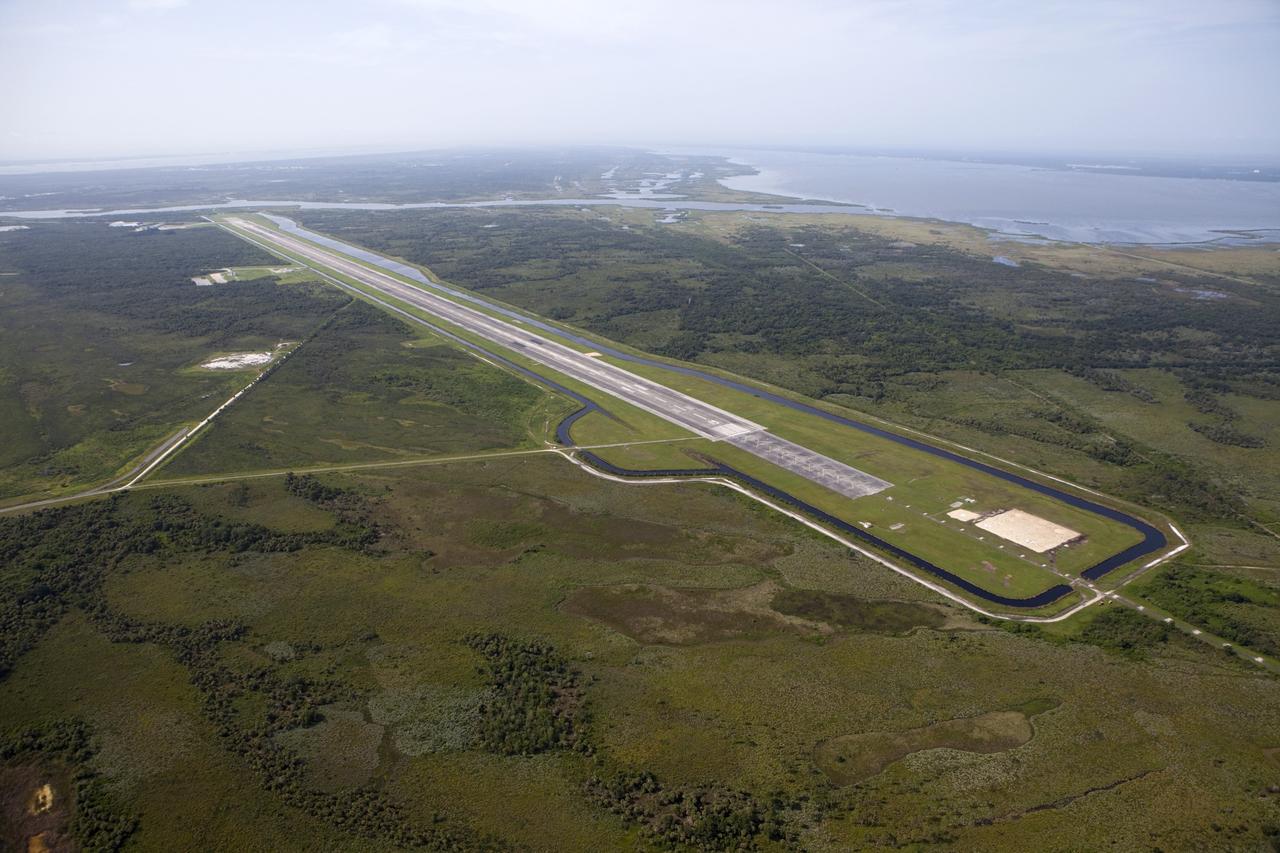
CAPE CANAVERAL, Fla. – This aerial view shows the 15,000-foot long Shuttle Landing Facility at the Kennedy Space Center, Fla. At the north end of the runway, to the right, is a rock and crater-filled planetary scape has been built so engineers can test the Autonomous Landing and Hazard Avoidance Technology, or ALHAT system on the Project Morpheus lander. Testing will demonstrate ALHAT’s ability to provide required navigation data negotiating the Morpheus lander away from risks during descent. Checkout of the prototype lander has been ongoing at NASA’s Johnson Space Center in Houston in preparation for its first free flight. The SLF site will provide the lander with the kind of field necessary for realistic testing. Project Morpheus is one of 20 small projects comprising the Advanced Exploration Systems, or AES, program in NASA’s Human Exploration and Operations Mission Directorate. AES projects pioneer new approaches for rapidly developing prototype systems, demonstrating key capabilities and validating operational concepts for future human missions beyond Earth orbit. For more information on Project Morpheus, visit http://www.nasa.gov/centers/johnson/exploration/morpheus/index.html Photo credit: NASA/Kim Shiflett

CAPE CANAVERAL, Fla. –This panoramic view shows a rock and crater-filled planetary scape has been built so engineers can test the Autonomous Landing and Hazard Avoidance Technology, or ALHAT system on the Project Morpheus lander. Testing will demonstrate ALHAT’s ability to provide required navigation data negotiating the Morpheus lander away from risks during descent. Checkout of the prot otype lander has been ongoing at NASA’s Johnson Space Center in Houston in preparation for its first free flight. The SLF site will provide the lander with the kind of field necessary for realistic testing. Project Morpheus is one of 20 small projects comprising the Advanced Exploration Systems, or AES, program in NASA’s Human Exploration and Operations Mission Directorate. AES projects pioneer new approaches for rapidly developing prototype systems, demonstrating key capabilities and validating operational concepts for future human missions beyond Earth orbit. For more information on Project Morpheus, visit http://www.nasa.gov/centers/johnson/exploration/morpheus/index.html Photo credit: NASA/Kim Shiflett
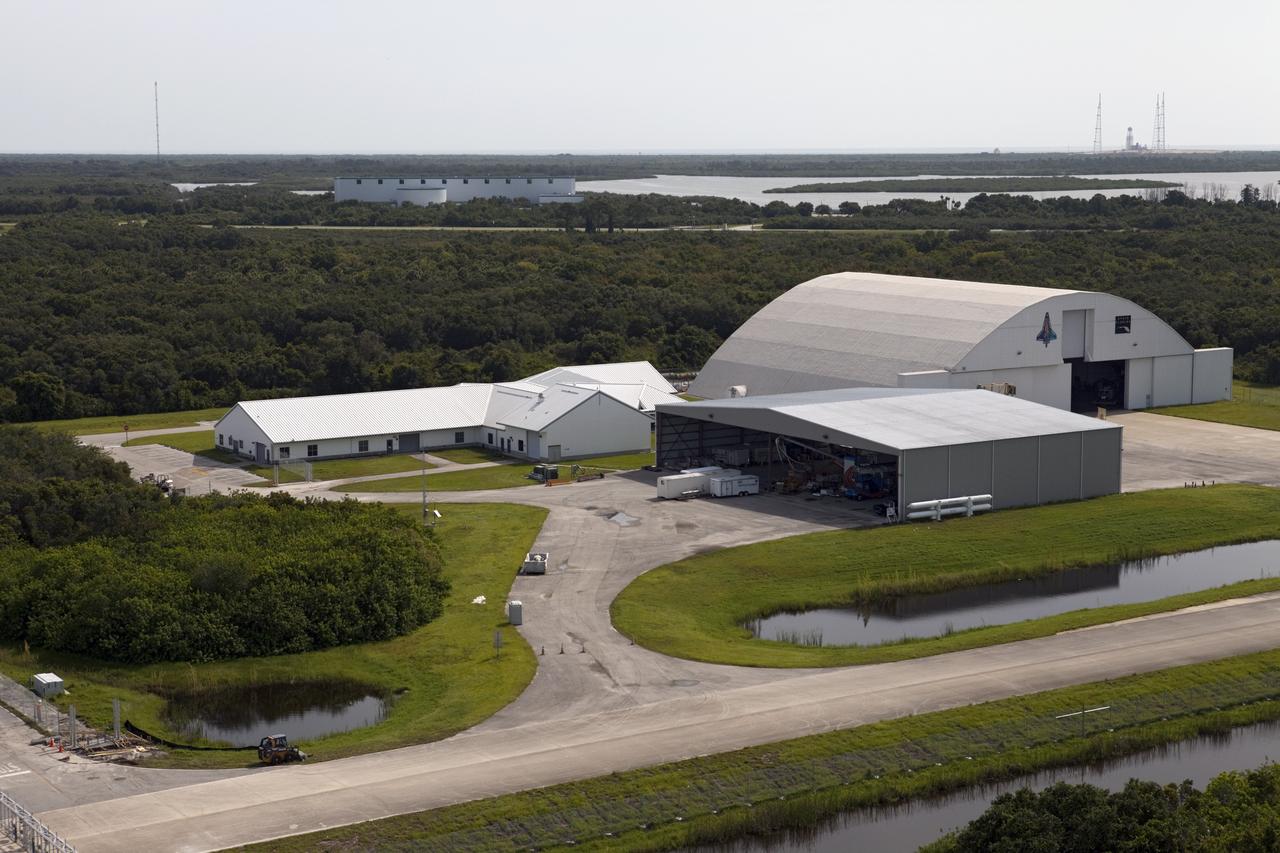
CAPE CANAVERAL, Fla. – This aerial view shows a 50,000-square-foot hangar located on the Shuttle Landing Facility at the Kennedy Space Center, Fla., providing shelter and storage for NASA and non-NASA aircraft and maintenance operations. Adjacent to the hangar is an operations building housing personnel who support operations at the 15,000-foot long concrete runway. At the north end of the runway, a rock and crater-filled planetary scape has been built so engineers can test the Autonomous Landing and Hazard Avoidance Technology, or ALHAT system on the Project Morpheus lander. Testing will demonstrate ALHAT’s ability to provide required navigation data negotiating the Morpheus lander away from risks during descent. Checkout of the prototype lander has been ongoing at NASA’s Johnson Space Center in Houston in preparation for its first free flight. The SLF site will provide the lander with the kind of field necessary for realistic testing. Project Morpheus is one of 20 small projects comprising the Advanced Exploration Systems, or AES, program in NASA’s Human Exploration and Operations Mission Directorate. AES projects pioneer new approaches for rapidly developing prototype systems, demonstrating key capabilities and validating operational concepts for future human missions beyond Earth orbit. For more information on Project Morpheus, visit http://www.nasa.gov/centers/johnson/exploration/morpheus/index.html Photo credit: NASA/Kim Shiflett
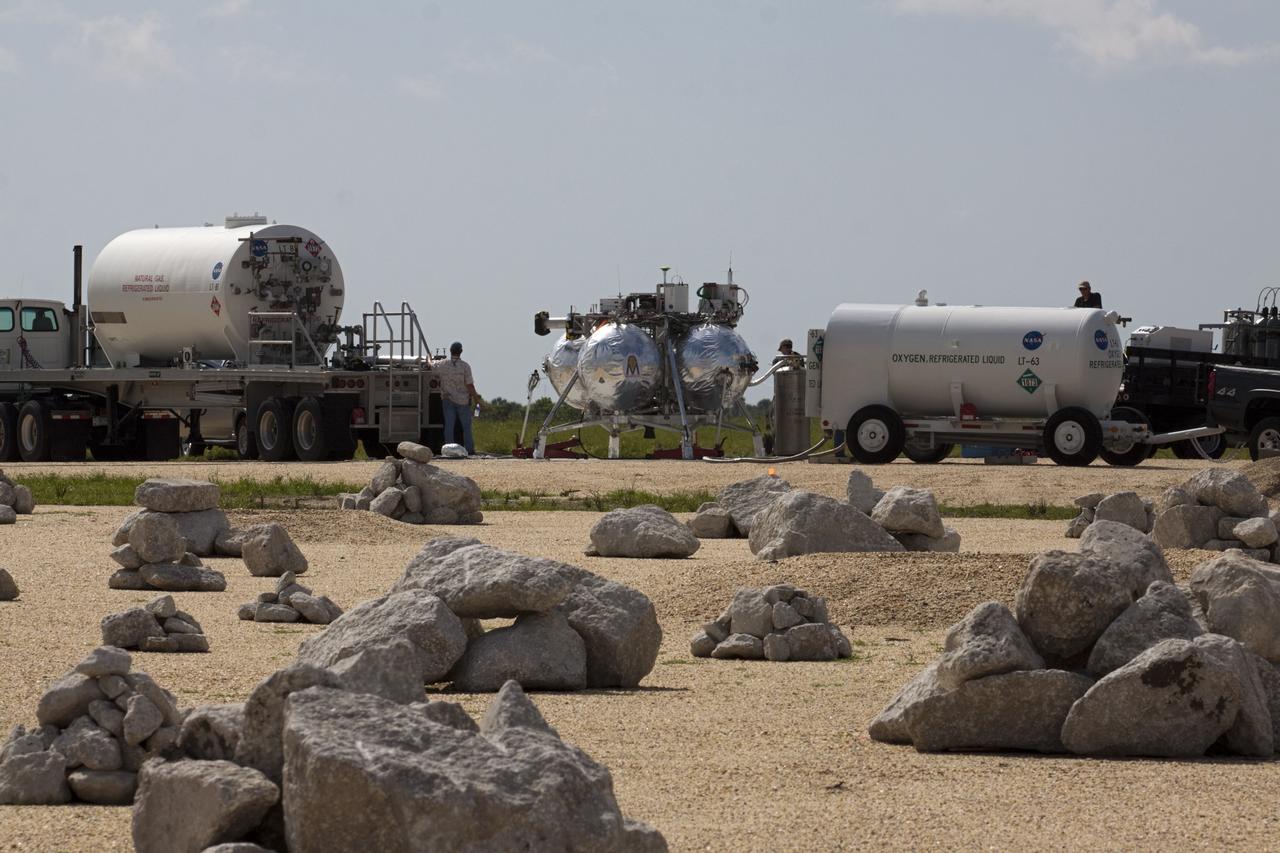
CAPE CANAVERAL, Fla. - At the north end of the Shuttle Landing Facility, or SLF, at the Kennedy Space Center in Florida, NASA's Morpheus lander, a vertical test bed vehicle, is being fueled. A rock and crater-filled planetary scape, seen in the foreground, has been built so engineers can test the Autonomous Landing and Hazard Avoidance Technology, or ALHAT, system on the Project Morpheus lander. Checkout of the prototype lander has been ongoing at NASA’s Johnson Space Center in Houston in preparation for its first free flight. The SLF site will provide the lander with the kind of field necessary for realistic testing. Project Morpheus is one of 20 small projects comprising the Advanced Exploration Systems, or AES, program in NASA’s Human Exploration and Operations Mission Directorate. AES projects pioneer new approaches for rapidly developing prototype systems, demonstrating key capabilities and validating operational concepts for future human missions beyond Earth orbit. For more information on Project Morpheus, visit http://www.nasa.gov/centers/johnson/exploration/morpheus/index.html Photo credit: NASA/Kim Shiflett
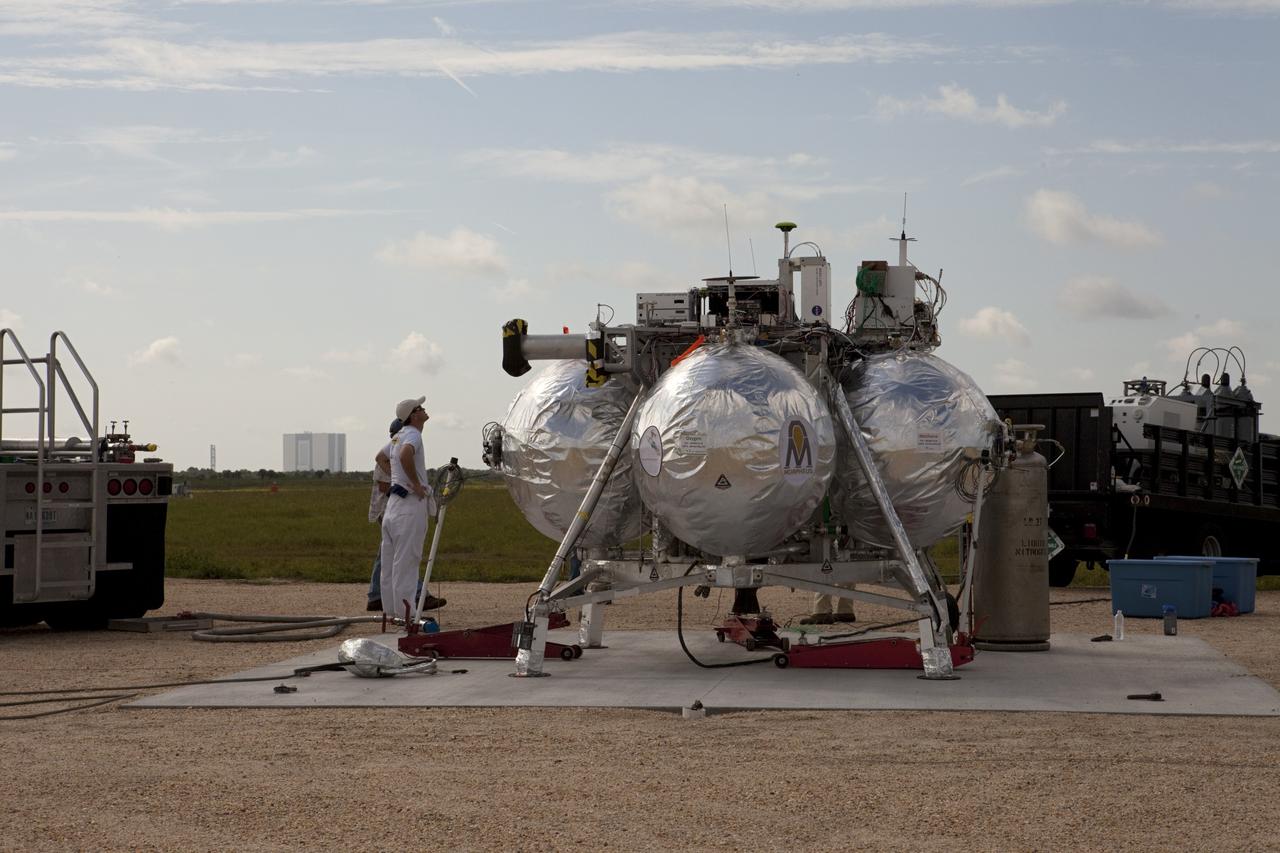
CAPE CANAVERAL, Fla. - At the north end of the Shuttle Landing Facility, or SLF, at the Kennedy Space Center in Florida, technicians check out NASA's Morpheus lander, a vertical test bed vehicle. A rock and crater-filled planetary scape, has been built so engineers can test the Autonomous Landing and Hazard Avoidance Technology, or ALHAT, system on the Project Morpheus lander. Checkout of the prototype lander has been ongoing at NASA’s Johnson Space Center in Houston in preparation for its first free flight. The SLF site will provide the lander with the kind of field necessary for realistic testing. Project Morpheus is one of 20 small projects comprising the Advanced Exploration Systems, or AES, program in NASA’s Human Exploration and Operations Mission Directorate. AES projects pioneer new approaches for rapidly developing prototype systems, demonstrating key capabilities and validating operational concepts for future human missions beyond Earth orbit. For more information on Project Morpheus, visit http://www.nasa.gov/centers/johnson/exploration/morpheus/index.html Photo credit: NASA/Kim Shiflett
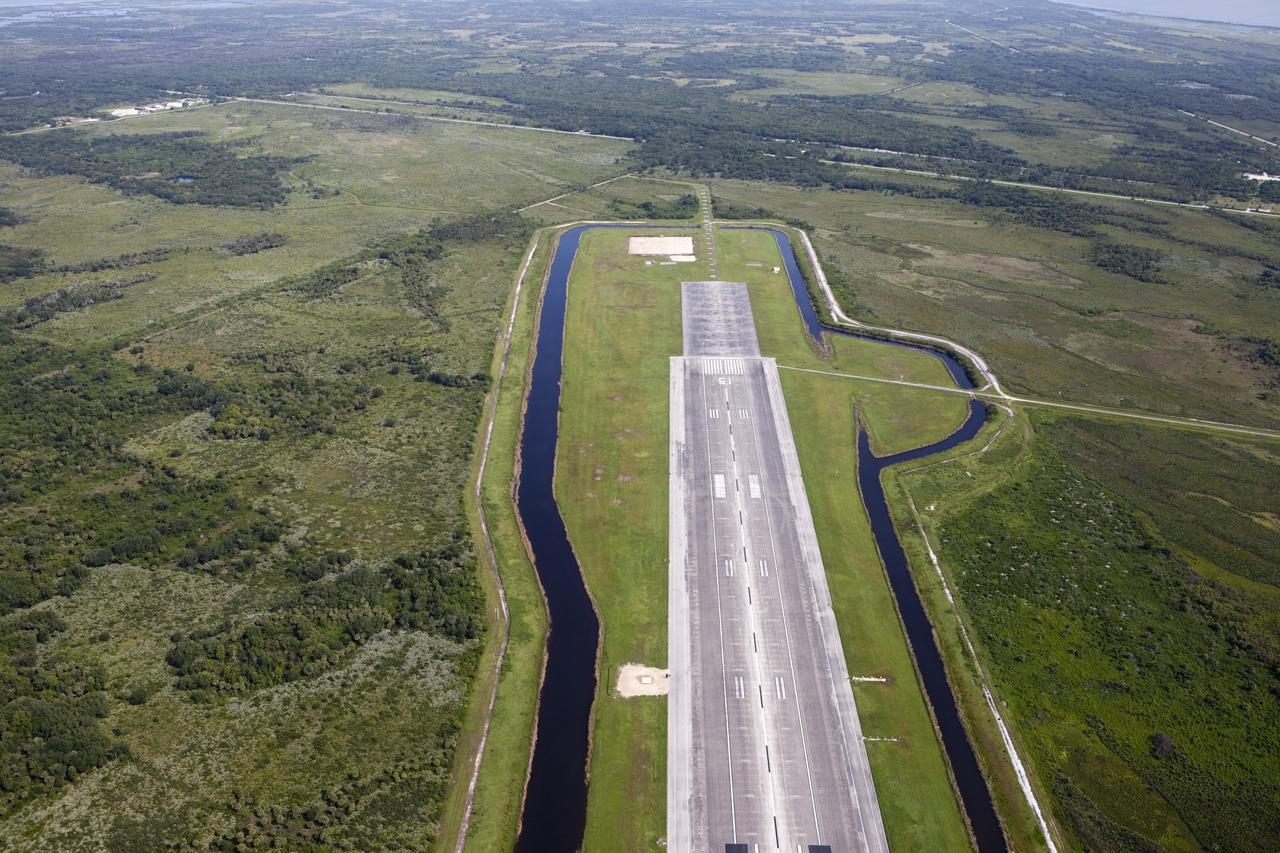
CAPE CANAVERAL, Fla. – This aerial view shows the north end of the Kennedy Space Center’s Shuttle Landing Facility. At the end of the runway is a rock and crater-filled planetary scape has been built so engineers can test the Autonomous Landing and Hazard Avoidance Technology, or ALHAT system on the Project Morpheus lander. Testing will demonstrate ALHAT’s ability to provide required navigation data negotiating the Morpheus lander away from risks during descent. Checkout of the prototype lander has been ongoing at NASA’s Johnson Space Center in Houston in preparation for its first free flight. The SLF site will provide the lander with the kind of field necessary for realistic testing. Project Morpheus is one of 20 small projects comprising the Advanced Exploration Systems, or AES, program in NASA’s Human Exploration and Operations Mission Directorate. AES projects pioneer new approaches for rapidly developing prototype systems, demonstrating key capabilities and validating operational concepts for future human missions beyond Earth orbit. For more information on Project Morpheus, visit http://www.nasa.gov/centers/johnson/exploration/morpheus/index.html Photo credit: NASA/Kim Shiflett
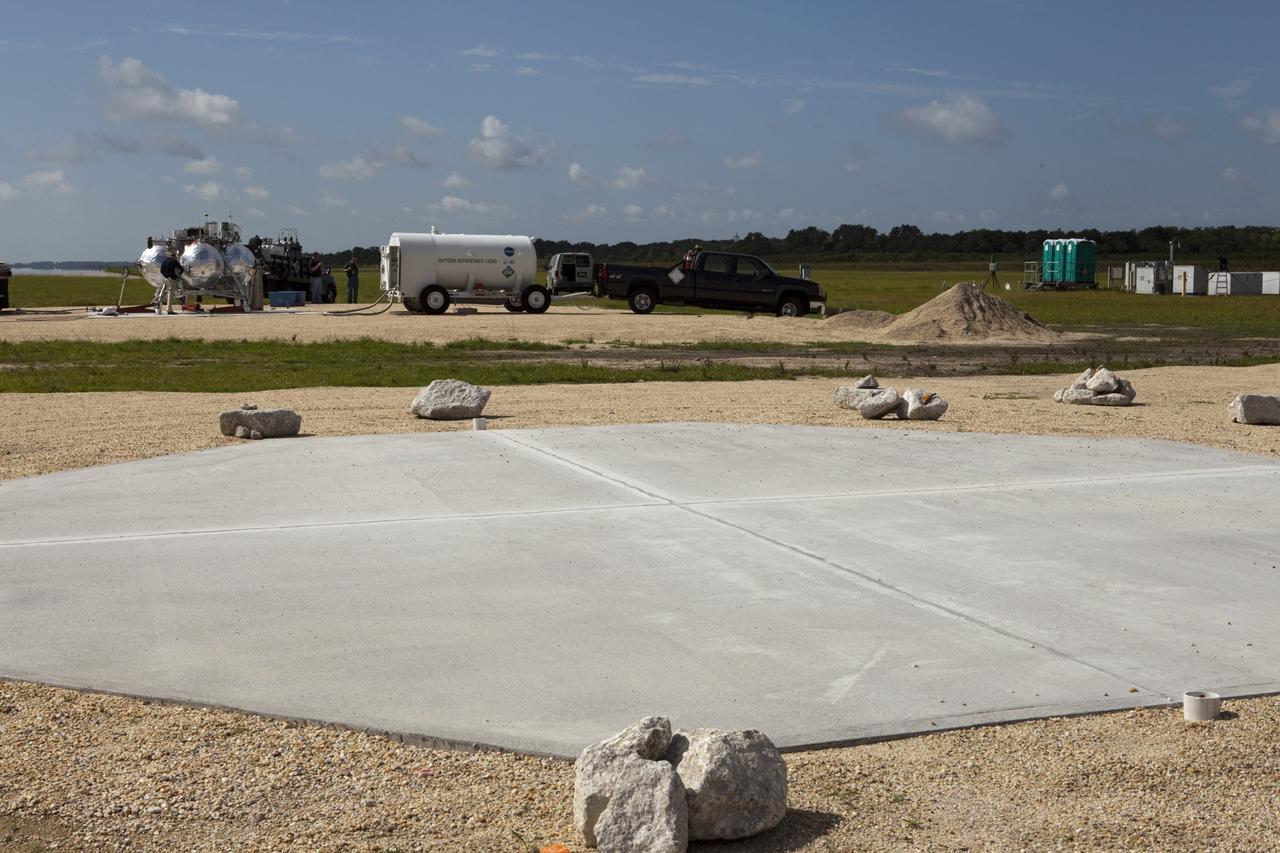
CAPE CANAVERAL, Fla. - At the north end of the Shuttle Landing Facility, or SLF, at the Kennedy Space Center in Florida, NASA's Morpheus lander, a vertical test bed vehicle, is being prepared for further assessment. A rock and crater-filled planetary scape, seen in the foreground, has been built so engineers can test the Autonomous Landing and Hazard Avoidance Technology, or ALHAT, system on the Project Morpheus lander. Checkout of the prototype lander has been ongoing at NASA’s Johnson Space Center in Houston in preparation for its first free flight. The SLF site will provide the lander with the kind of field necessary for realistic testing. Project Morpheus is one of 20 small projects comprising the Advanced Exploration Systems, or AES, program in NASA’s Human Exploration and Operations Mission Directorate. AES projects pioneer new approaches for rapidly developing prototype systems, demonstrating key capabilities and validating operational concepts for future human missions beyond Earth orbit. For more information on Project Morpheus, visit http://www.nasa.gov/centers/johnson/exploration/morpheus/index.html Photo credit: NASA/Kim Shiflett

CAPE CANAVERAL, Fla. – This aerial view shows the 15,000-foot long Shuttle Landing Facility at the Kennedy Space Center, Fla. At the north end of the runway, to the bottom, is a rock and crater-filled planetary scape has been built so engineers can test the Autonomous Landing and Hazard Avoidance Technology, or ALHAT system on the Project Morpheus lander. Testing will demonstrate ALHAT’s ability to provide required navigation data negotiating the Morpheus lander away from risks during descent. Checkout of the prototype lander has been ongoing at NASA’s Johnson Space Center in Houston in preparation for its first free flight. The SLF site will provide the lander with the kind of field necessary for realistic testing. Project Morpheus is one of 20 small projects comprising the Advanced Exploration Systems, or AES, program in NASA’s Human Exploration and Operations Mission Directorate. AES projects pioneer new approaches for rapidly developing prototype systems, demonstrating key capabilities and validating operational concepts for future human missions beyond Earth orbit. For more information on Project Morpheus, visit http://www.nasa.gov/centers/johnson/exploration/morpheus/index.html Photo credit: NASA/Kim Shiflett
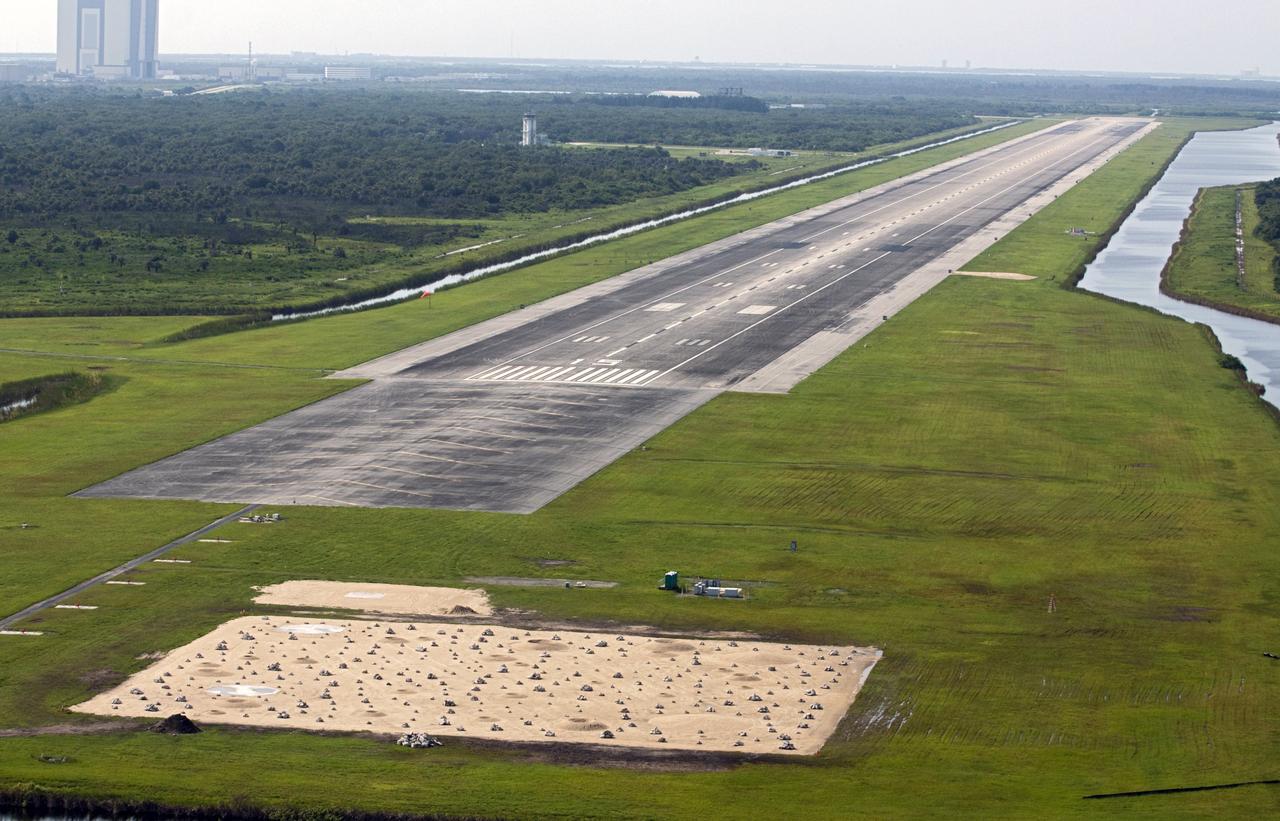
CAPE CANAVERAL, Fla. - Just north of the Kennedy Space Center’s Shuttle Landing Facility, or SLF, a rock and crater-filled planetary scape has been built so engineers can test the Autonomous Landing and Hazard Avoidance Technology, or ALHAT, system on the Project Morpheus lander. Testing will demonstrate ALHAT’s ability to provide required navigation data negotiating the Morpheus lander away from risks during descent. Checkout of the prototype lander has been ongoing at NASA’s Johnson Space Center in Houston in preparation for its first free flight. The SLF site will provide the lander with the kind of field necessary for realistic testing. Project Morpheus is one of 20 small projects comprising the Advanced Exploration Systems, or AES, program in NASA’s Human Exploration and Operations Mission Directorate. AES projects pioneer new approaches for rapidly developing prototype systems, demonstrating key capabilities and validating operational concepts for future human missions beyond Earth orbit. For more information on Project Morpheus, visit http://www.nasa.gov/centers/johnson/exploration/morpheus/index.html Photo credit: NASA/Kim Shiflett
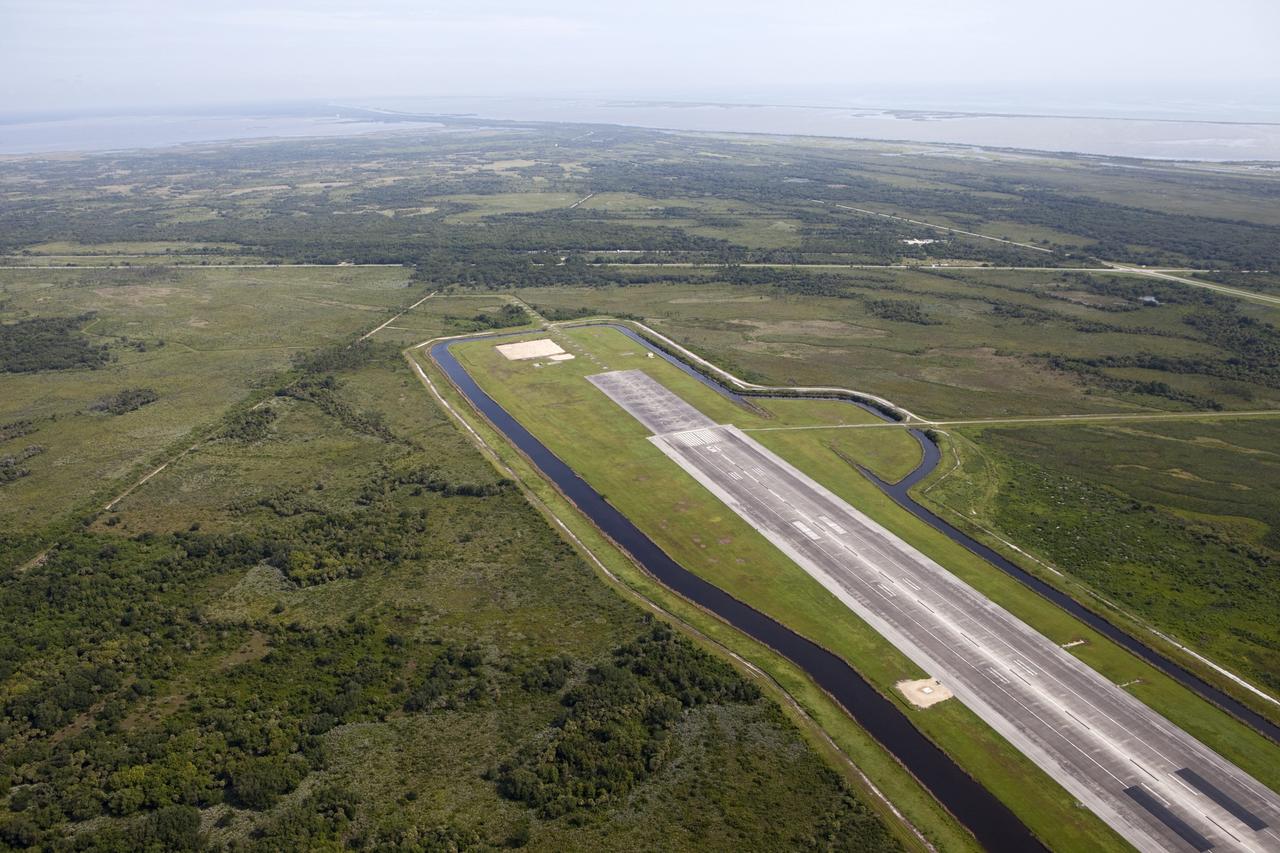
CAPE CANAVERAL, Fla. – This aerial view shows the north end of the Kennedy Space Center’s Shuttle Landing Facility. At the end of the runway is a rock and crater-filled planetary scape has been built so engineers can test the Autonomous Landing and Hazard Avoidance Technology, or ALHAT system on the Project Morpheus lander. Testing will demonstrate ALHAT’s ability to provide required navigation data negotiating the Morpheus lander away from risks during descent. Checkout of the prototype lander has been ongoing at NASA’s Johnson Space Center in Houston in preparation for its first free flight. The SLF site will provide the lander with the kind of field necessary for realistic testing. Project Morpheus is one of 20 small projects comprising the Advanced Exploration Systems, or AES, program in NASA’s Human Exploration and Operations Mission Directorate. AES projects pioneer new approaches for rapidly developing prototype systems, demonstrating key capabilities and validating operational concepts for future human missions beyond Earth orbit. For more information on Project Morpheus, visit http://www.nasa.gov/centers/johnson/exploration/morpheus/index.html Photo credit: NASA/Kim Shiflett
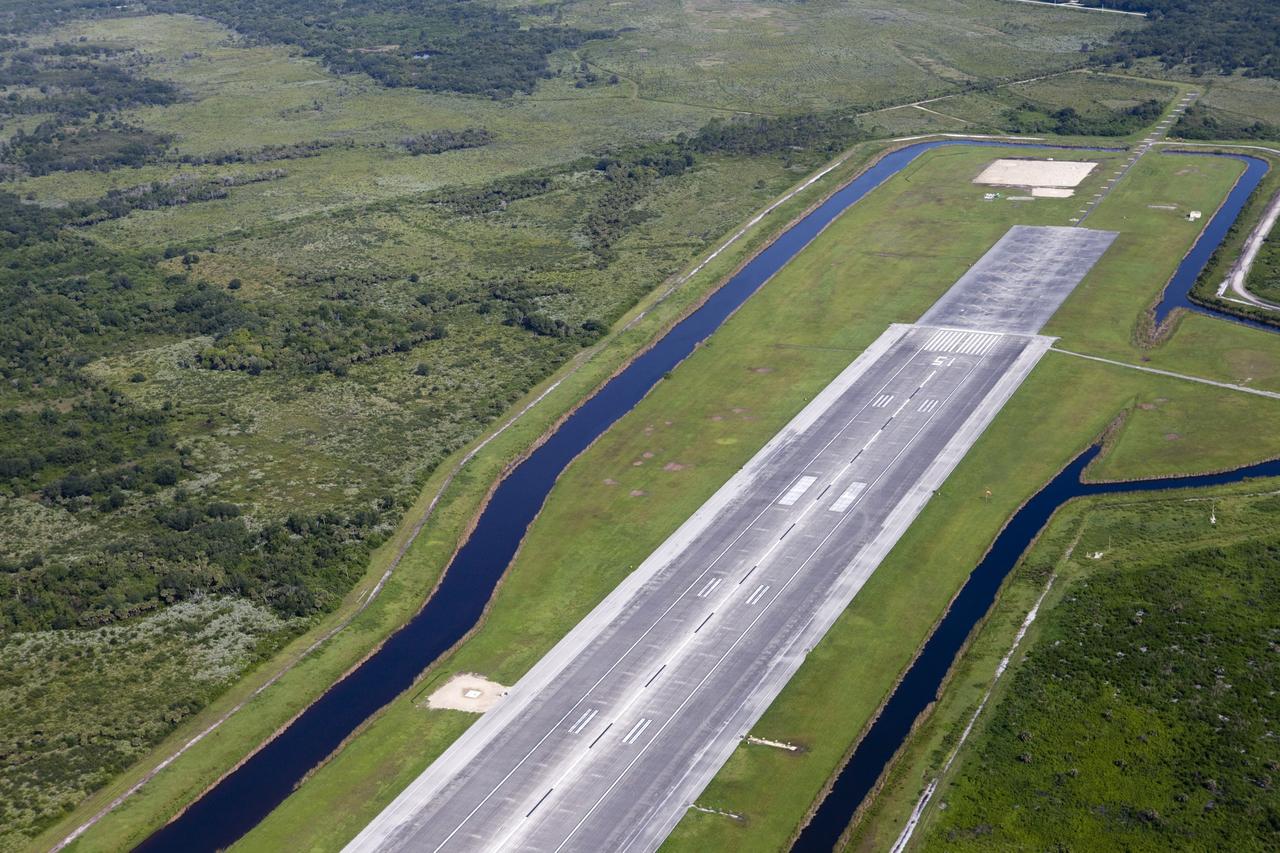
CAPE CANAVERAL, Fla. – This aerial view shows the north end of the Kennedy Space Center’s Shuttle Landing Facility. At the end of the runway, in the upper right, a rock and crater-filled planetary scape has been built so engineers can test the Autonomous Landing and Hazard Avoidance Technology, or ALHAT system on the Project Morpheus lander. Testing will demonstrate ALHAT’s ability to provide required navigation data negotiating the Morpheus lander away from risks during descent. Checkout of the prototype lander has been ongoing at NASA’s Johnson Space Center in Houston in preparation for its first free flight. The SLF site will provide the lander with the kind of field necessary for realistic testing. Project Morpheus is one of 20 small projects comprising the Advanced Exploration Systems, or AES, program in NASA’s Human Exploration and Operations Mission Directorate. AES projects pioneer new approaches for rapidly developing prototype systems, demonstrating key capabilities and validating operational concepts for future human missions beyond Earth orbit. For more information on Project Morpheus, visit http://www.nasa.gov/centers/johnson/exploration/morpheus/index.html Photo credit: NASA/Kim Shiflett
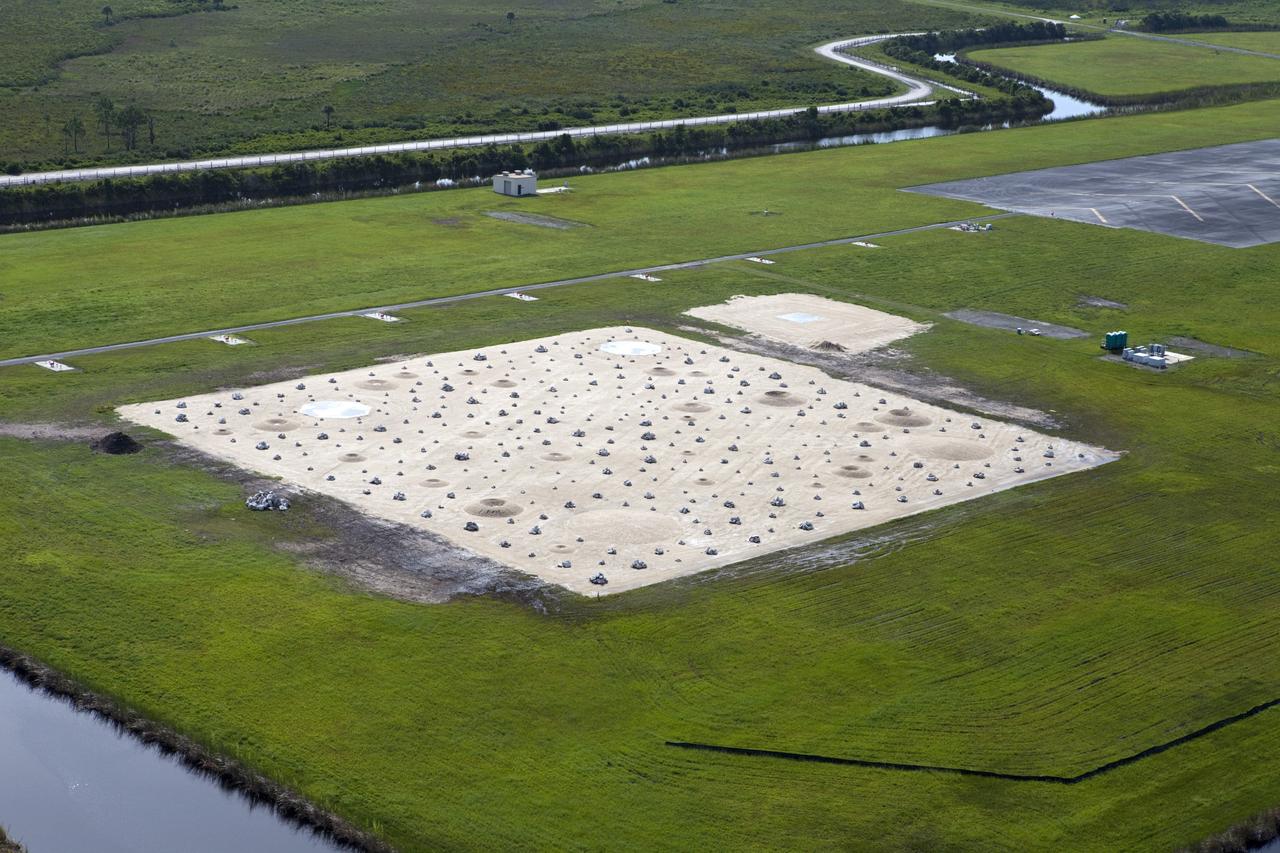
CAPE CANAVERAL, Fla. –This aerial view shows a rock and crater-filled planetary scape that has been built at the north end of the Kennedy Space Center’s Shuttle Landing Facility. The site will allow engineers to test the Autonomous Landing and Hazard Avoidance Technology, or ALHAT system on the Project Morpheus lander. Testing will demonstrate ALHAT’s ability to provide required navigation data negotiating the Morpheus lander away from risks during descent. Checkout of the prototype lander has been ongoing at NASA’s Johnson Space Center in Houston in preparation for its first free flight. The SLF site will provide the lander with the kind of field necessary for realistic testing. Project Morpheus is one of 20 small projects comprising the Advanced Exploration Systems, or AES, program in NASA’s Human Exploration and Operations Mission Directorate. AES projects pioneer new approaches for rapidly developing prototype systems, demonstrating key capabilities and validating operational concepts for future human missions beyond Earth orbit. For more information on Project Morpheus, visit http://www.nasa.gov/centers/johnson/exploration/morpheus/index.html Photo credit: NASA/Kim Shiflett
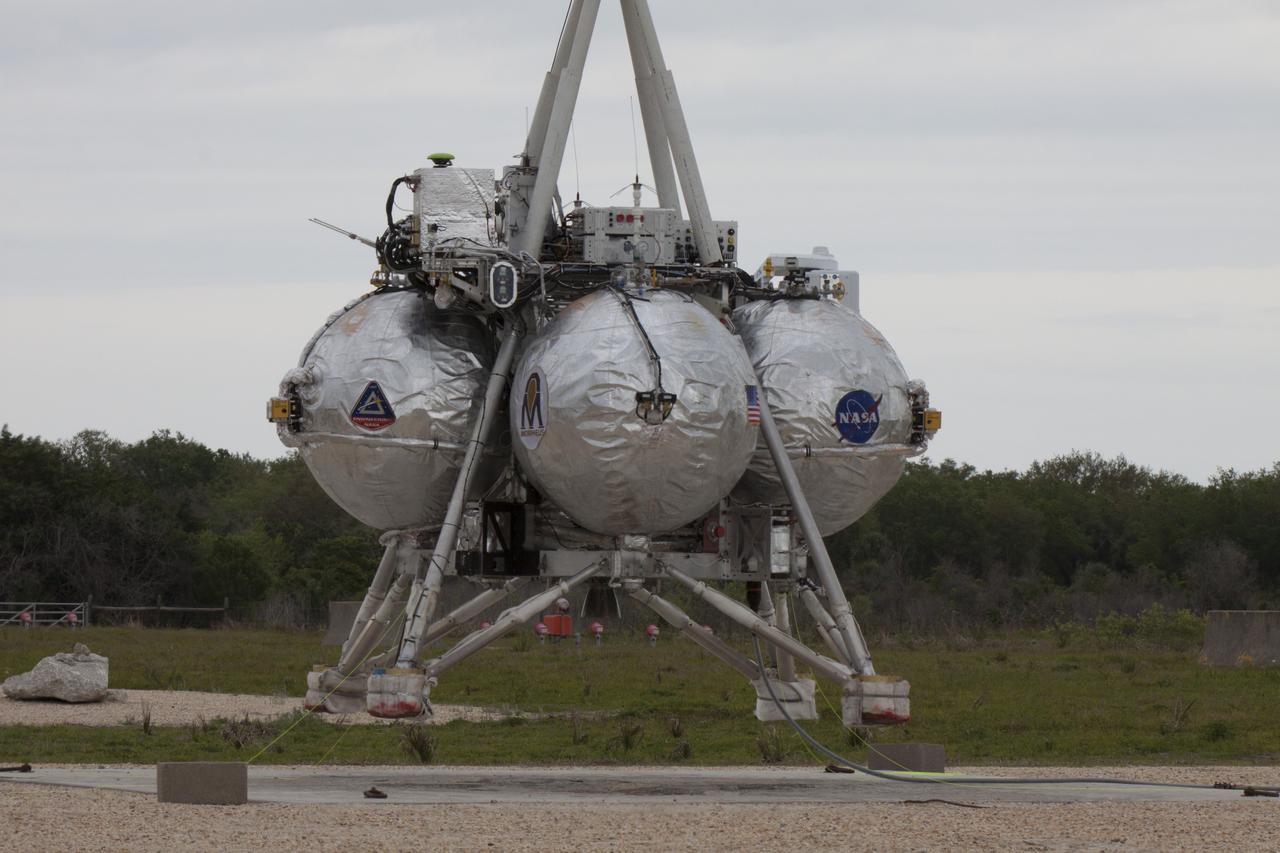
CAPE CANAVERAL, Fla. – NASA's Project Morpheus prototype lander is positioned near a new launch site at the north end of the Shuttle Landing Facility at NASA’s Kennedy Space Center in Florida for a tethered test. The test will be performed to verify the lander's recently installed autonomous landing and hazard avoidance technology, or ALHAT, sensors and integration system. The launch pad was moved to a different location at the landing facility to support the next phase of flight testing. Project Morpheus tests NASA’s ALHAT, and an engine that runs on liquid oxygen and methane, or green propellants, into a fully-operational lander that could deliver cargo to other planetary surfaces. The landing facility provides the lander with the kind of field necessary for realistic testing, complete with rocks, craters and hazards to avoid. Morpheus’ ALHAT payload allows it to navigate to clear landing sites amidst rocks, craters and other hazards during its descent. Project Morpheus is being managed under the Advanced Exploration Systems, or AES, Division in NASA’s Human Exploration and Operations Mission Directorate. The efforts in AES pioneer new approaches for rapidly developing prototype systems, demonstrating key capabilities and validating operational concepts for future human missions beyond Earth orbit. For more information on Project Morpheus, visit http://morpheuslander.jsc.nasa.gov/. Photo credit: NASA/Glenn Benson
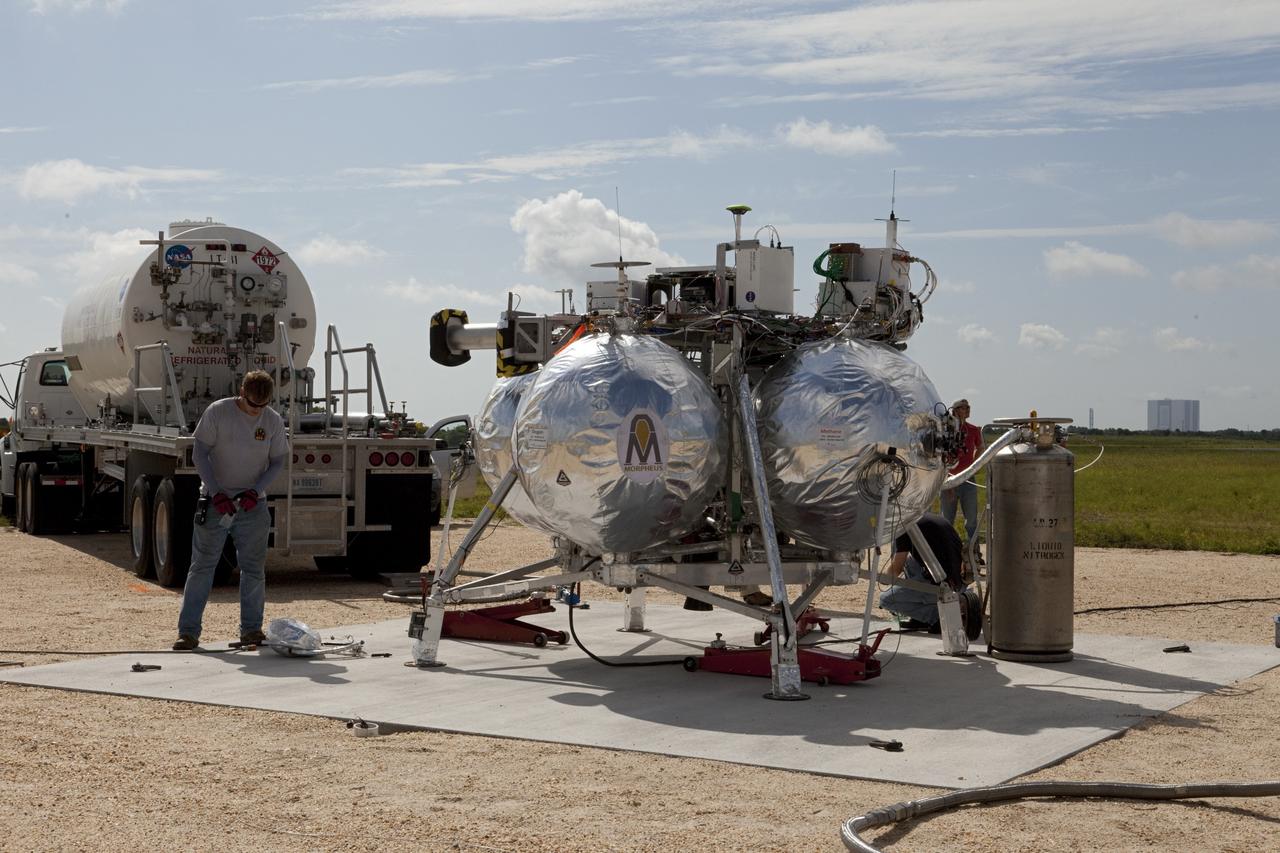
CAPE CANAVERAL, Fla. - At the north end of the Shuttle Landing Facility, or SLF, at the Kennedy Space Center in Florida, NASA's Morpheus lander, a vertical test bed vehicle is being checked out. A rock and crater-filled planetary scape, has been built so engineers can test the Autonomous Landing and Hazard Avoidance Technology, or ALHAT, system on the Project Morpheus lander. Checkout of the prototype lander has been ongoing at NASA’s Johnson Space Center in Houston in preparation for its first free flight. The SLF site will provide the lander with the kind of field necessary for realistic testing. Project Morpheus is one of 20 small projects comprising the Advanced Exploration Systems, or AES, program in NASA’s Human Exploration and Operations Mission Directorate. AES projects pioneer new approaches for rapidly developing prototype systems, demonstrating key capabilities and validating operational concepts for future human missions beyond Earth orbit. For more information on Project Morpheus, visit http://www.nasa.gov/centers/johnson/exploration/morpheus/index.html Photo credit: NASA/Kim Shiflett
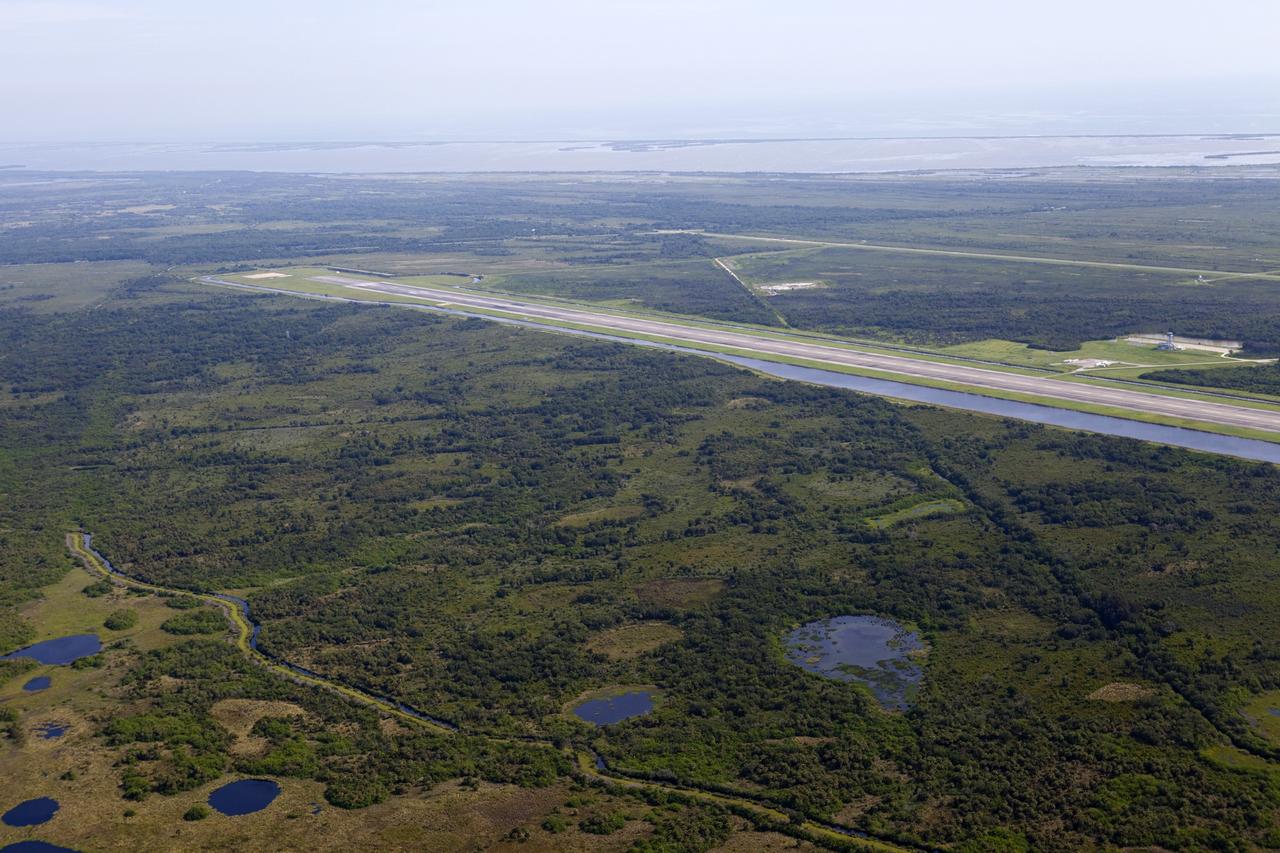
CAPE CANAVERAL, Fla. – This aerial view shows the north end of the Kennedy Space Center’s 15,000-foot long Shuttle Landing Facility. On the far left at the end of the runway, a rock and crater-filled planetary scape has been built so engineers can test the Autonomous Landing and Hazard Avoidance Technology, or ALHAT system on the Project Morpheus lander. Testing will demonstrate ALHAT’s ability to provide required navigation data negotiating the Morpheus lander away from risks during descent. Checkout of the prototype lander has been ongoing at NASA’s Johnson Space Center in Houston in preparation for its first free flight. The SLF site will provide the lander with the kind of field necessary for realistic testing. Project Morpheus is one of 20 small projects comprising the Advanced Exploration Systems, or AES, program in NASA’s Human Exploration and Operations Mission Directorate. AES projects pioneer new approaches for rapidly developing prototype systems, demonstrating key capabilities and validating operational concepts for future human missions beyond Earth orbit. For more information on Project Morpheus, visit http://www.nasa.gov/centers/johnson/exploration/morpheus/index.html Photo credit: NASA/Kim Shiflett
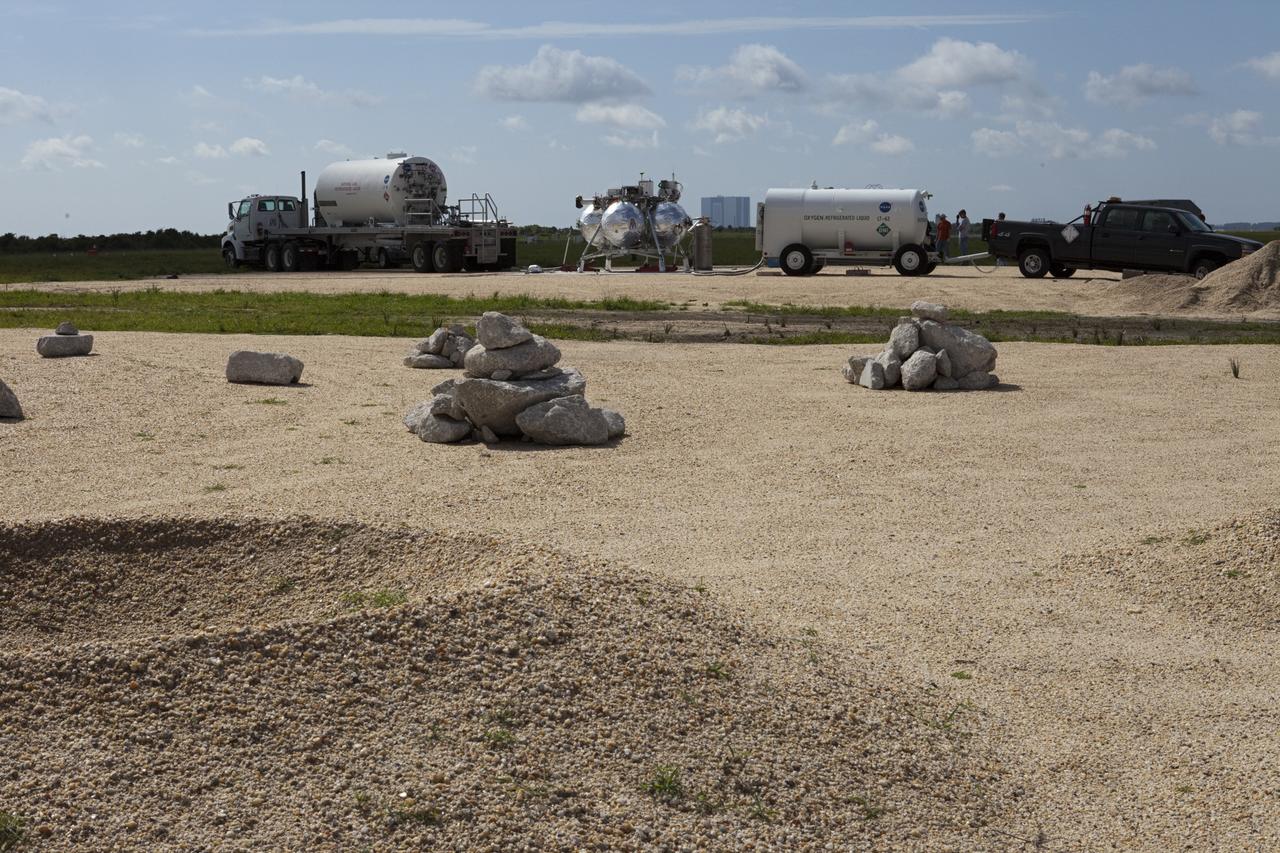
CAPE CANAVERAL, Fla. - At the north end of the Shuttle Landing Facility, or SLF, at the Kennedy Space Center in Florida, NASA's Morpheus lander, a vertical test bed vehicle, is being prepared for further assessment. A rock and crater-filled planetary scape, seen in the foreground, has been built so engineers can test the Autonomous Landing and Hazard Avoidance Technology, or ALHAT, system on the Project Morpheus lander. Checkout of the prototype lander has been ongoing at NASA’s Johnson Space Center in Houston in preparation for its first free flight. The SLF site will provide the lander with the kind of field necessary for realistic testing. Project Morpheus is one of 20 small projects comprising the Advanced Exploration Systems, or AES, program in NASA’s Human Exploration and Operations Mission Directorate. AES projects pioneer new approaches for rapidly developing prototype systems, demonstrating key capabilities and validating operational concepts for future human missions beyond Earth orbit. For more information on Project Morpheus, visit http://www.nasa.gov/centers/johnson/exploration/morpheus/index.html Photo credit: NASA/Kim Shiflett
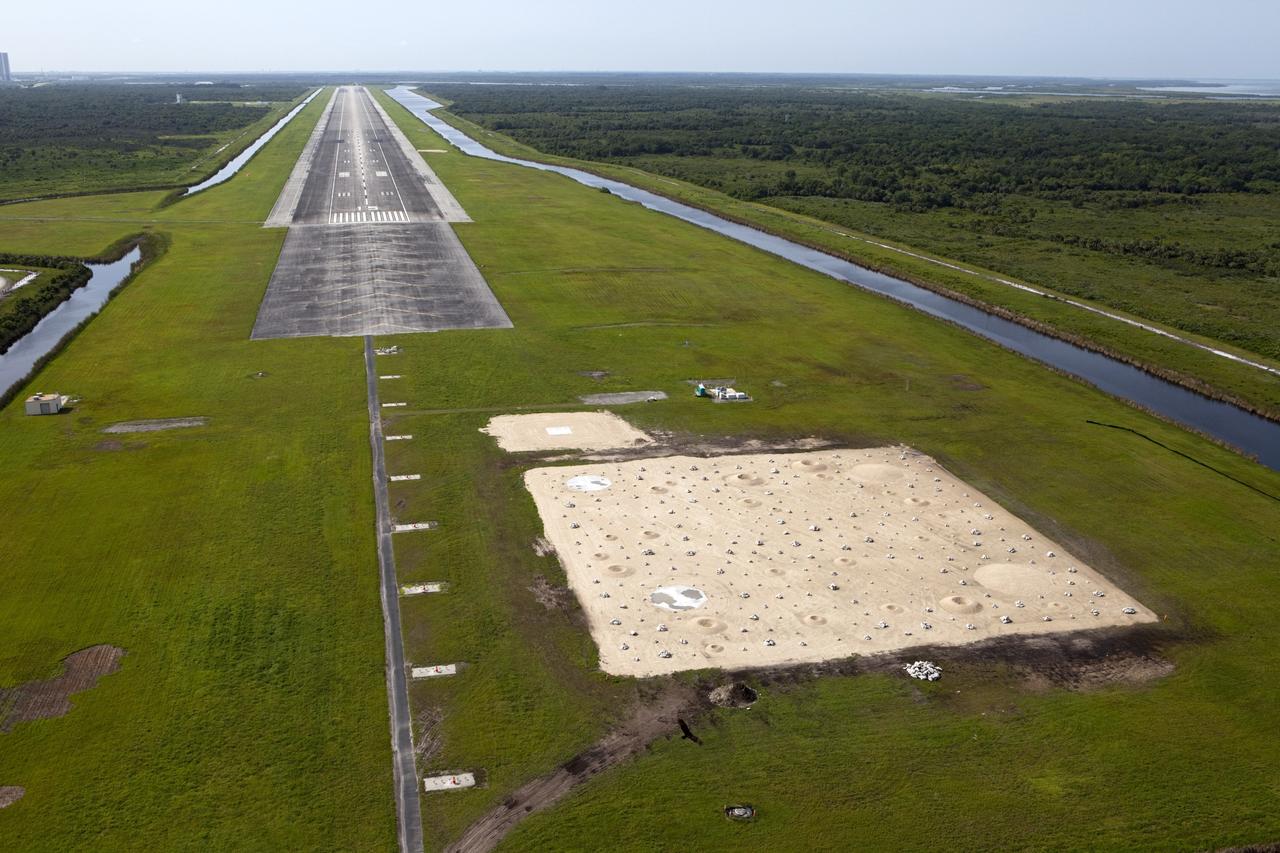
CAPE CANAVERAL, Fla. – This aerial view shows the north end of the Kennedy Space Center’s Shuttle Landing Facility. At the end of the runway is a rock and crater-filled planetary scape has been built so engineers can test the Autonomous Landing and Hazard Avoidance Technology, or ALHAT system on the Project Morpheus lander. Testing will demonstrate ALHAT’s ability to provide required navigation data negotiating the Morpheus lander away from risks during descent. Checkout of the prototype lander has been ongoing at NASA’s Johnson Space Center in Houston in preparation for its first free flight. The SLF site will provide the lander with the kind of field necessary for realistic testing. Project Morpheus is one of 20 small projects comprising the Advanced Exploration Systems, or AES, program in NASA’s Human Exploration and Operations Mission Directorate. AES projects pioneer new approaches for rapidly developing prototype systems, demonstrating key capabilities and validating operational concepts for future human missions beyond Earth orbit. For more information on Project Morpheus, visit http://www.nasa.gov/centers/johnson/exploration/morpheus/index.html Photo credit: NASA/Kim Shiflett

CAPE CANAVERAL, Fla. – This aerial view shows the north end of the Kennedy Space Center’s Shuttle Landing Facility. At the end of the runway, to the right, is a rock and crater-filled planetary scape has been built so engineers can test the Autonomous Landing and Hazard Avoidance Technology, or ALHAT system on the Project Morpheus lander. Testing will demonstrate ALHAT’s ability to provide required navigation data negotiating the Morpheus lander away from risks during descent. Checkout of the prototype lander has been ongoing at NASA’s Johnson Space Center in Houston in preparation for its first free flight. The SLF site will provide the lander with the kind of field necessary for realistic testing. Project Morpheus is one of 20 small projects comprising the Advanced Exploration Systems, or AES, program in NASA’s Human Exploration and Operations Mission Directorate. AES projects pioneer new approaches for rapidly developing prototype systems, demonstrating key capabilities and validating operational concepts for future human missions beyond Earth orbit. For more information on Project Morpheus, visit http://www.nasa.gov/centers/johnson/exploration/morpheus/index.html Photo credit: NASA/Kim Shiflett

CAPE CANAVERAL, Fla. - Just north of the Kennedy Space Center’s Shuttle Landing Facility runway, a rock and crater-filled planetary scape has been built so engineers can test the Autonomous Landing and Hazard Avoidance Technology, or ALHAT system on the Project Morpheus lander. Testing will demonstrate ALHAT’s ability to provide required navigation data negotiating the Morpheus lander away from risks during descent. Checkout of the prototype lander has been ongoing at NASA’s Johnson Space Center in Houston in preparation for its first free flight. The SLF site will provide the lander with the kind of field necessary for realistic testing. Project Morpheus is one of 20 small projects comprising the Advanced Exploration Systems, or AES, program in NASA’s Human Exploration and Operations Mission Directorate. AES projects pioneer new approaches for rapidly developing prototype systems, demonstrating key capabilities and validating operational concepts for future human missions beyond Earth orbit. For more information on Project Morpheus, visit http://www.nasa.gov/centers/johnson/exploration/morpheus/index.html Photo credit: NASA/Kim Shiflett

CAPE CANAVERAL, Fla. – At NASA’s Kennedy Space Center in Florida, technicians and engineers monitor the progress as the Project Morpheus prototype lander is attached to a tether and raised from a transportable launch platform positioned at the north end of the Shuttle Landing Facility. The lander will undergo a tethered test that includes lifting it 20 feet by crane, ascending another 10 feet, maneuvering backwards 10 feet, and then flying forward and descending to its original position, landing at the end of the tether. Testing of the prototype lander was performed at NASA’s Johnson Space Center in Houston in preparation for tethered and free flight testing at Kennedy. The landing facility will provide the lander with the kind of field necessary for realistic testing, complete with rocks, craters and hazards to avoid. Morpheus utilizes an autonomous landing and hazard avoidance technology, or ALHAT, payload that will allow it to navigate to clear landing sites amidst rocks, craters and other hazards during its descent. Project Morpheus is being managed under the Advanced Exploration Systems, or AES, Division in NASA’s Human Exploration and Operations Mission Directorate. The efforts in AES pioneer new approaches for rapidly developing prototype systems, demonstrating key capabilities and validating operational concepts for future human missions beyond Earth orbit. For more information on Project Morpheus, visit http://morpheuslander.jsc.nasa.gov. Photo credit: NASA/Daniel Casper

CAPE CANAVERAL, Fla. – At NASA’s Kennedy Space Center in Florida, the Project Morpheus prototype lander has been attached to a tether and is being lowered onto a transportable launch platform positioned at the north end of the Shuttle Landing Facility. The lander will be prepared for a tethered test that includes lifting it 20 feet by crane, ascending another 10 feet, maneuvering backwards 10 feet, and then flying forward and descending to its original position, landing at the end of the tether. Testing of the prototype lander was performed at NASA’s Johnson Space Center in Houston in preparation for tethered and free flight testing at Kennedy. The landing facility will provide the lander with the kind of field necessary for realistic testing, complete with rocks, craters and hazards to avoid. Morpheus utilizes an autonomous landing and hazard avoidance technology, or ALHAT, payload that will allow it to navigate to clear landing sites amidst rocks, craters and other hazards during its descent. Project Morpheus is being managed under the Advanced Exploration Systems, or AES, Division in NASA’s Human Exploration and Operations Mission Directorate. The efforts in AES pioneer new approaches for rapidly developing prototype systems, demonstrating key capabilities and validating operational concepts for future human missions beyond Earth orbit. For more information on Project Morpheus, visit http://morpheuslander.jsc.nasa.gov. Photo credit: NASA/Kim Shiflett
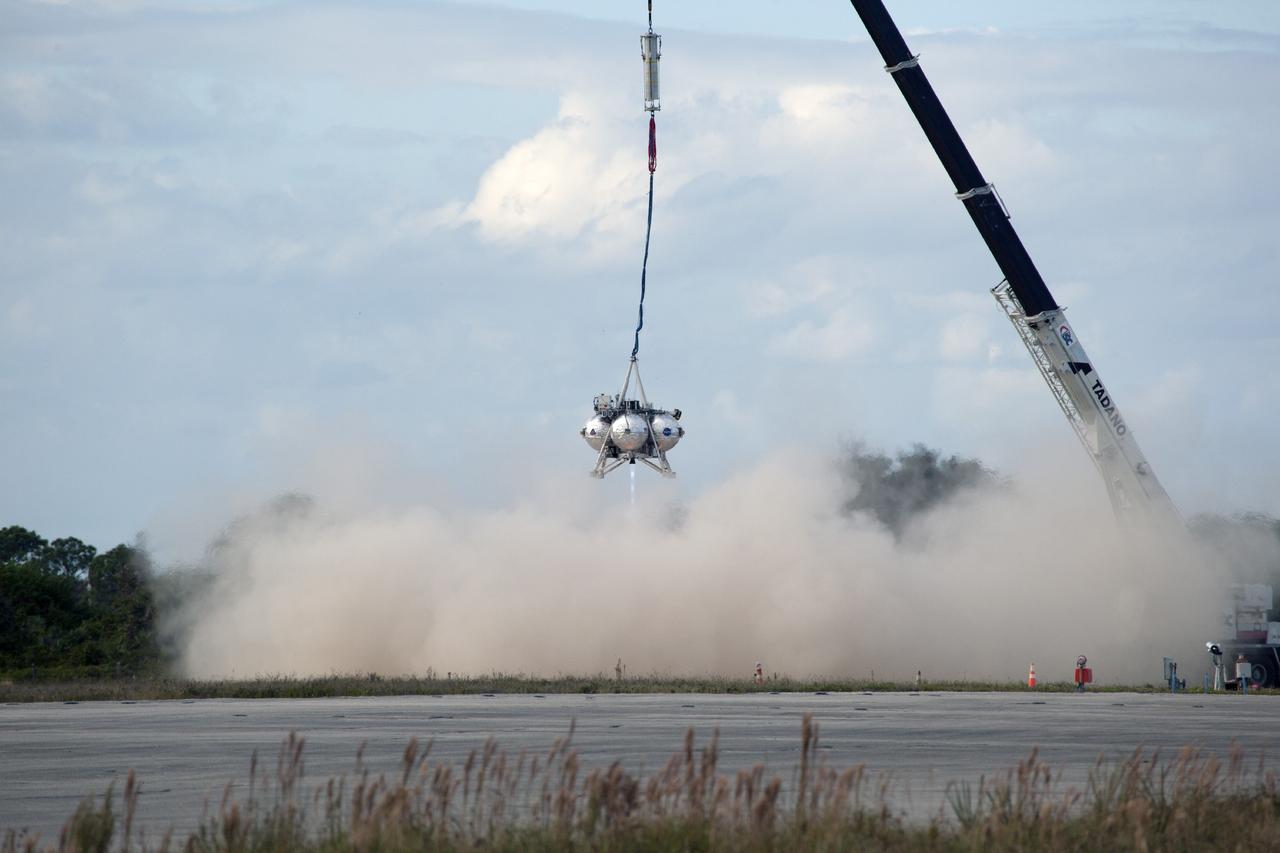
CAPE CANAVERAL, Fla. – At NASA’s Kennedy Space Center in Florida, smoke fills the air as the Project Morpheus prototype lander’s engine fires during a tether test at the north end of the Shuttle Landing Facility. During the test, the lander is lifted 20 feet by crane, and will ascend another 10 feet, maneuver backwards 10 feet, and then fly forward and descend to its original position, landing at the end of the tether onto a transportable launch platform. Testing of the prototype lander was performed at NASA’s Johnson Space Center in Houston in preparation for tethered and free flight testing at Kennedy. The landing facility will provide the lander with the kind of field necessary for realistic testing, complete with rocks, craters and hazards to avoid. Morpheus utilizes an autonomous landing and hazard avoidance technology, or ALHAT, payload that will allow it to navigate to clear landing sites amidst rocks, craters and other hazards during its descent. Project Morpheus is being managed under the Advanced Exploration Systems, or AES, Division in NASA’s Human Exploration and Operations Mission Directorate. The efforts in AES pioneer new approaches for rapidly developing prototype systems, demonstrating key capabilities and validating operational concepts for future human missions beyond Earth orbit. For more information on Project Morpheus, visit http://morpheuslander.jsc.nasa.gov. Photo credit: NASA/Daniel Casper

CAPE CANAVERAL, Fla. - At NASA’s Kennedy Space Center in Florida, workers prepare to load the movable launch platform for the Project Morpheus lander onto a flatbed truck for its move from the midfield to the north end of the Shuttle Landing Facility, or SLF. Testing of the prototype lander has been ongoing at NASA’s Johnson Space Center in Houston in preparation for free flight. The lander is scheduled for delivery to Kennedy in October. The SLF will provide the lander with the kind of field necessary for realistic testing, complete with rocks, craters and hazards to avoid. Morpheus utilizes an autonomous landing and hazard avoidance technology, or ALHAT, payload that will allow it to navigate to clear landing sites amidst obstacles during its descent. Project Morpheus is one of 20 small projects comprising the Advanced Exploration Systems, or AES, program in NASA’s Human Exploration and Operations Mission Directorate. AES projects pioneer new approaches for rapidly developing prototype systems, demonstrating key capabilities and validating operational concepts for future human missions beyond Earth orbit. For more information on Project Morpheus, visit http://www.nasa.gov/centers/johnson/exploration/morpheus/index.html. Photo credit: NASA/Kim Shiflett

CAPE CANAVERAL, Fla. – At NASA’s Kennedy Space Center in Florida, the Project Morpheus prototype lander’s engine begins to fire during a tether test at the north end of the Shuttle Landing Facility. During the test, the lander is lifted 20 feet by crane, and will ascend another 10 feet, maneuver backwards 10 feet, and then fly forward and descend to its original position, landing at the end of the tether onto a transportable launch platform. Testing of the prototype lander was performed at NASA’s Johnson Space Center in Houston in preparation for tethered and free flight testing at Kennedy. The landing facility will provide the lander with the kind of field necessary for realistic testing, complete with rocks, craters and hazards to avoid. Morpheus utilizes an autonomous landing and hazard avoidance technology, or ALHAT, payload that will allow it to navigate to clear landing sites amidst rocks, craters and other hazards during its descent. Project Morpheus is being managed under the Advanced Exploration Systems, or AES, Division in NASA’s Human Exploration and Operations Mission Directorate. The efforts in AES pioneer new approaches for rapidly developing prototype systems, demonstrating key capabilities and validating operational concepts for future human missions beyond Earth orbit. For more information on Project Morpheus, visit http://morpheuslander.jsc.nasa.gov. Photo credit: NASA/Daniel Casper
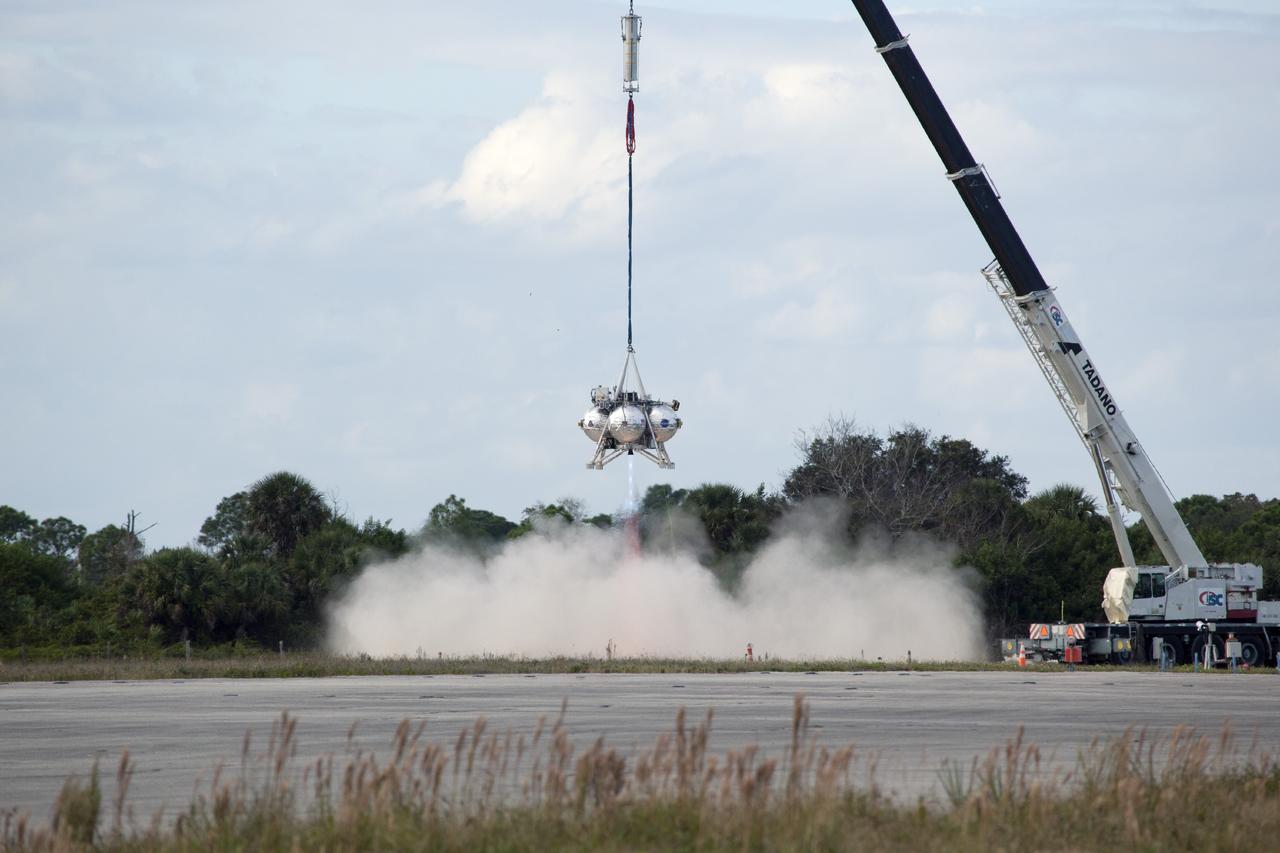
CAPE CANAVERAL, Fla. – At NASA’s Kennedy Space Center in Florida, the Project Morpheus prototype lander’s engine begins to fire during a tether test at the north end of the Shuttle Landing Facility. During the test, the lander is lifted 20 feet by crane, and will ascend another 10 feet, maneuver backwards 10 feet, and then fly forward and descend to its original position, landing at the end of the tether onto a transportable launch platform. Testing of the prototype lander was performed at NASA’s Johnson Space Center in Houston in preparation for tethered and free flight testing at Kennedy. The landing facility will provide the lander with the kind of field necessary for realistic testing, complete with rocks, craters and hazards to avoid. Morpheus utilizes an autonomous landing and hazard avoidance technology, or ALHAT, payload that will allow it to navigate to clear landing sites amidst rocks, craters and other hazards during its descent. Project Morpheus is being managed under the Advanced Exploration Systems, or AES, Division in NASA’s Human Exploration and Operations Mission Directorate. The efforts in AES pioneer new approaches for rapidly developing prototype systems, demonstrating key capabilities and validating operational concepts for future human missions beyond Earth orbit. For more information on Project Morpheus, visit http://morpheuslander.jsc.nasa.gov. Photo credit: NASA/Daniel Casper
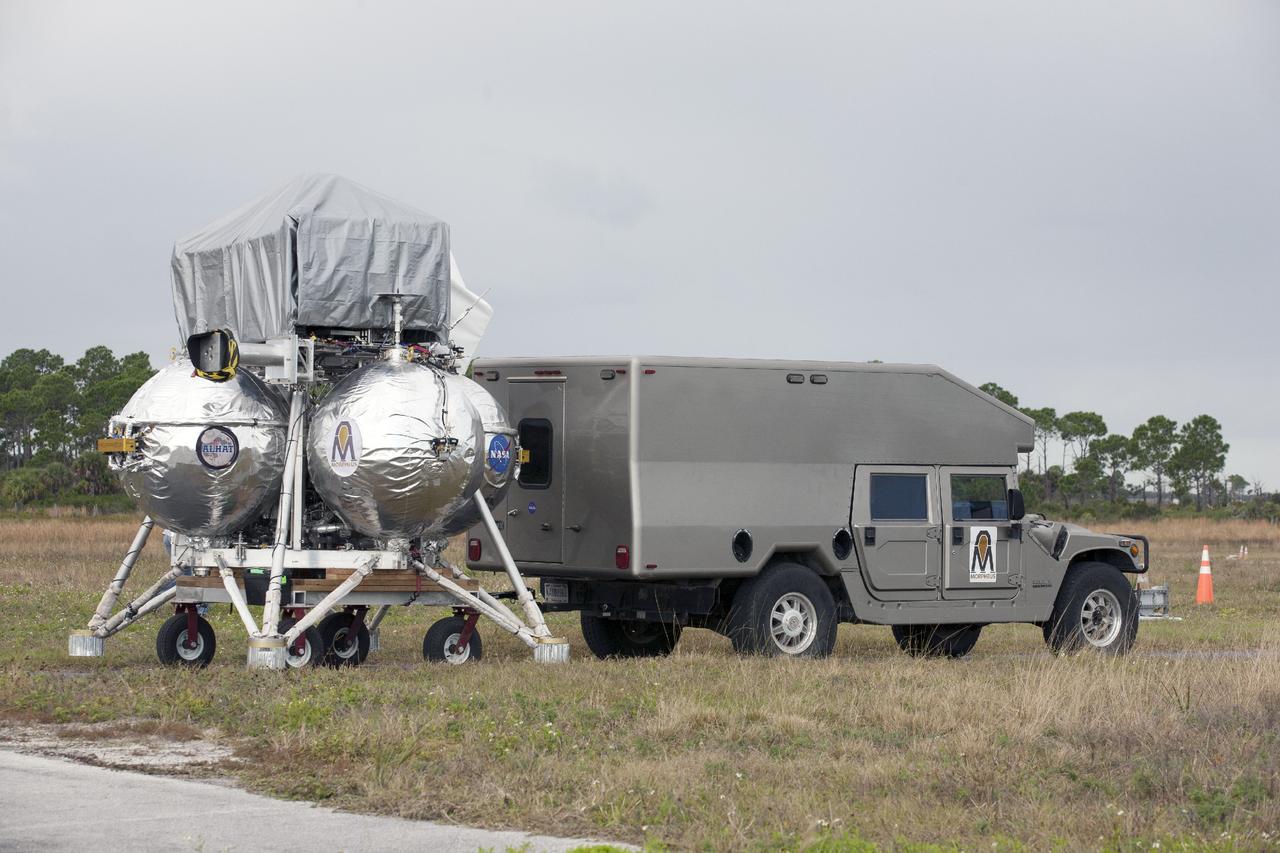
CAPE CANAVERAL, Fla. – At NASA’s Kennedy Space Center in Florida, the Project Morpheus prototype lander is being prepared for placement on a transportable launch platform positioned at the north end of the Shuttle Landing Facility. The lander will be prepared for a tethered test that includes lifting it 20 feet by crane, ascending another 10 feet, maneuvering backwards 10 feet, and then flying forward and descending to its original position, landing at the end of the tether. Testing of the prototype lander was performed at NASA’s Johnson Space Center in Houston in preparation for tethered and free flight testing at Kennedy. The landing facility will provide the lander with the kind of field necessary for realistic testing, complete with rocks, craters and hazards to avoid. Morpheus utilizes an autonomous landing and hazard avoidance technology, or ALHAT, payload that will allow it to navigate to clear landing sites amidst rocks, craters and other hazards during its descent. Project Morpheus is being managed under the Advanced Exploration Systems, or AES, Division in NASA’s Human Exploration and Operations Mission Directorate. The efforts in AES pioneer new approaches for rapidly developing prototype systems, demonstrating key capabilities and validating operational concepts for future human missions beyond Earth orbit. For more information on Project Morpheus, visit http://morpheuslander.jsc.nasa.gov. Photo credit: NASA/Kim Shiflett
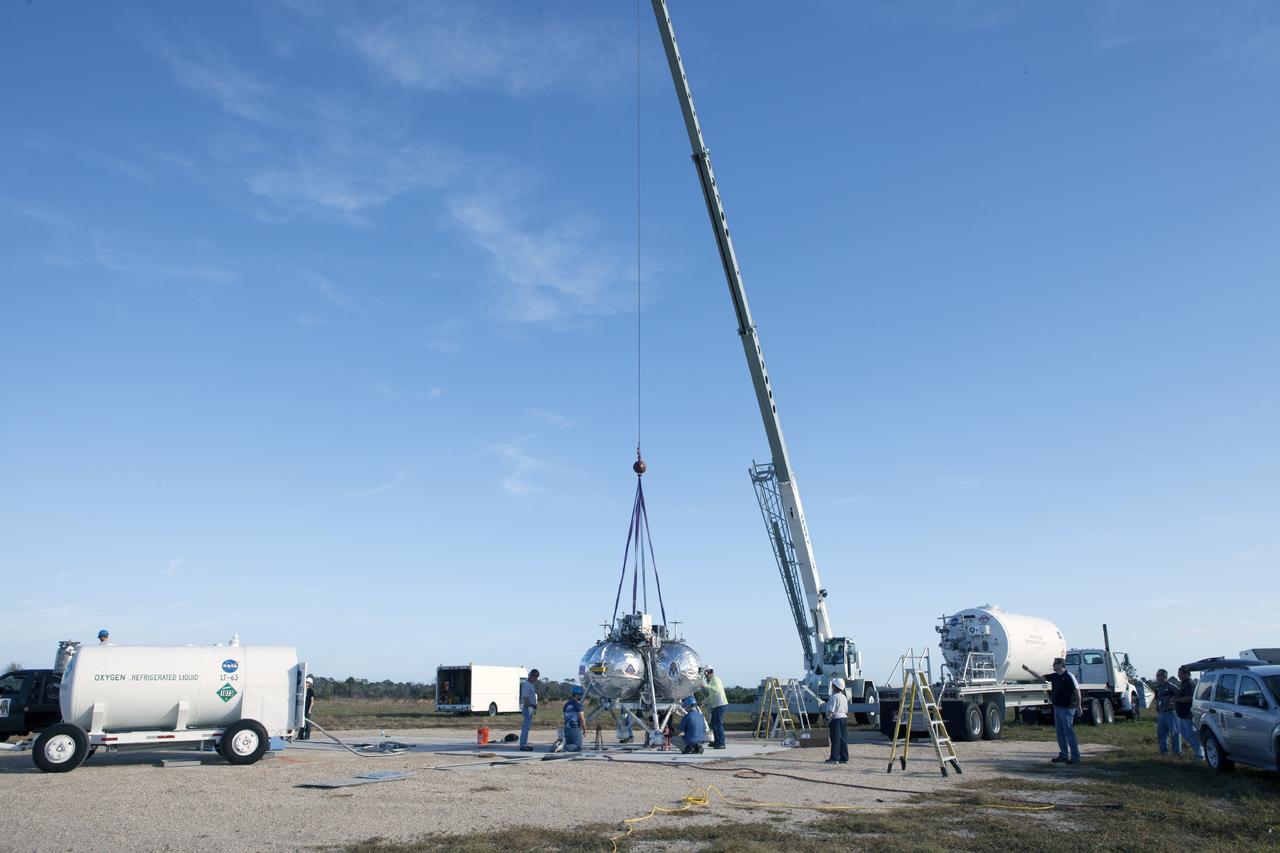
CAPE CANAVERAL, Fla. – Preparations are underway to prepare the Project Morpheus prototype lander for its first free flight test at the north end of the Shuttle Landing Facility at NASA’s Kennedy Space Center in Florida. Testing of the prototype lander was performed at NASA’s Johnson Space Center in Houston in preparation for tethered and free flight testing at Kennedy. Project Morpheus integrates NASA’s automated landing and hazard avoidance technology, or ALHAT, with an engine that runs on liquid oxygen and methane, or green propellants, into a fully-operational lander that could deliver cargo to asteroids and other planetary surfaces. The landing facility will provide the lander with the kind of field necessary for realistic testing, complete with rocks, craters and hazards to avoid. Morpheus’ ALHAT payload allows it to navigate to clear landing sites amidst rocks, craters and other hazards during its descent. Project Morpheus is being managed under the Advanced Exploration Systems, or AES, Division in NASA’s Human Exploration and Operations Mission Directorate. The efforts in AES pioneer new approaches for rapidly developing prototype systems, demonstrating key capabilities and validating operational concepts for future human missions beyond Earth orbit. For more information on Project Morpheus, visit http://morpheuslander.jsc.nasa.gov. Photo credit: NASA/Kim Shiflett
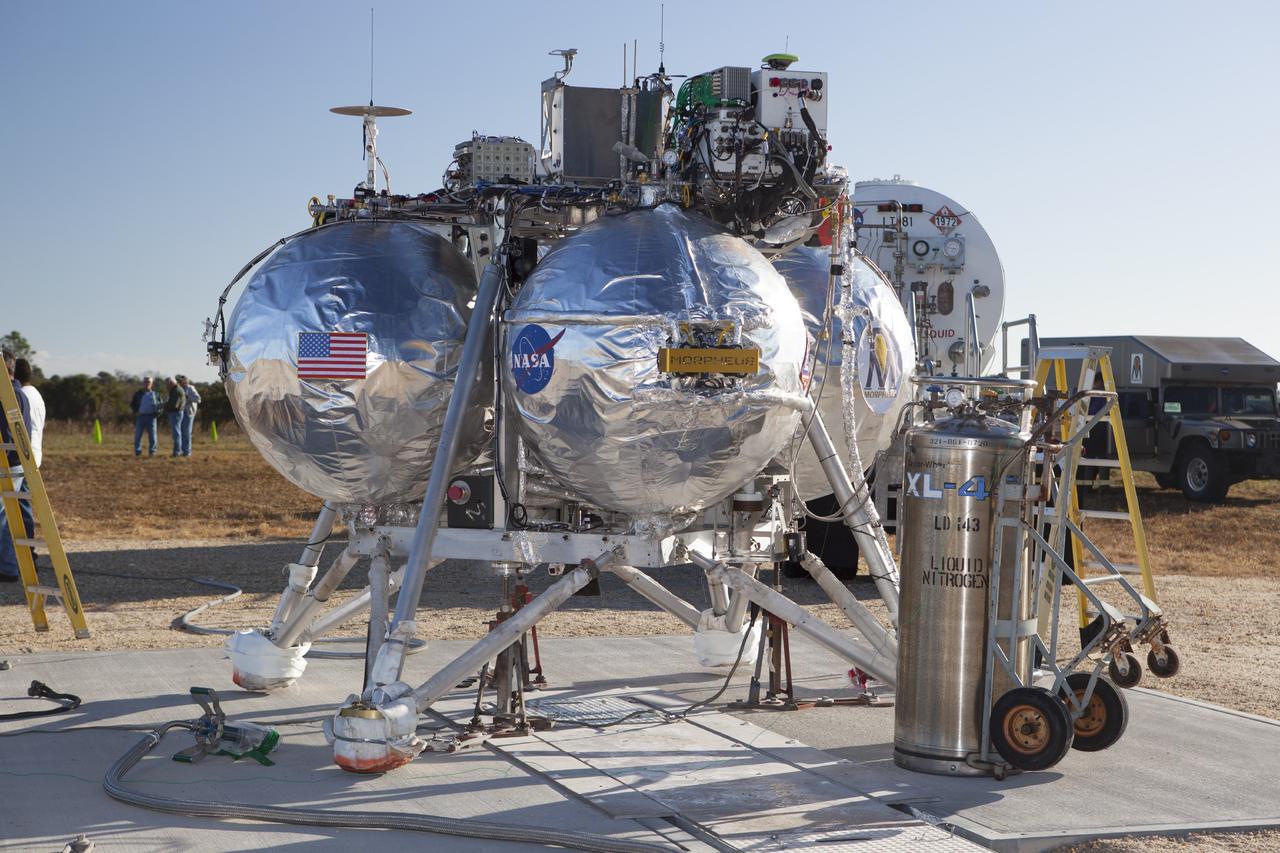
CAPE CANAVERAL, Fla. -- Preparations are underway to prepare the Project Morpheus prototype lander for a second free flight test at the north end of the Shuttle Landing Facility at NASA’s Kennedy Space Center in Florida. Testing of the prototype lander was performed at NASA’s Johnson Space Center in Houston in preparation for tethered and free flight testing at Kennedy. Project Morpheus integrates NASA’s automated landing and hazard avoidance technology, or ALHAT, with an engine that runs on liquid oxygen and methane, or green propellants, into a fully-operational lander that could deliver cargo to other planetary surfaces. The landing facility will provide the lander with the kind of field necessary for realistic testing, complete with rocks, craters and hazards to avoid. Morpheus’ ALHAT payload allows it to navigate to clear landing sites amidst rocks, craters and other hazards during its descent. Project Morpheus is being managed under the Advanced Exploration Systems, or AES, Division in NASA’s Human Exploration and Operations Mission Directorate. The efforts in AES pioneer new approaches for rapidly developing prototype systems, demonstrating key capabilities and validating operational concepts for future human missions beyond Earth orbit. For more information on Project Morpheus, visit http://morpheuslander.jsc.nasa.gov. Photo credit: NASA/Dimitri Gerondidakis

CAPE CANAVERAL, Fla. – At NASA’s Kennedy Space Center in Florida, technicians and engineers assist as the Project Morpheus prototype lander is attached to a tether and lowered onto a transportable launch platform positioned at the north end of the Shuttle Landing Facility. The lander will be prepared for a tethered test that includes lifting it 20 feet by crane, ascending another 10 feet, maneuvering backwards 10 feet, and then flying forward and descending to its original position, landing at the end of the tether. Testing of the prototype lander was performed at NASA’s Johnson Space Center in Houston in preparation for tethered and free flight testing at Kennedy. The landing facility will provide the lander with the kind of field necessary for realistic testing, complete with rocks, craters and hazards to avoid. Morpheus utilizes an autonomous landing and hazard avoidance technology, or ALHAT, payload that will allow it to navigate to clear landing sites amidst rocks, craters and other hazards during its descent. Project Morpheus is being managed under the Advanced Exploration Systems, or AES, Division in NASA’s Human Exploration and Operations Mission Directorate. The efforts in AES pioneer new approaches for rapidly developing prototype systems, demonstrating key capabilities and validating operational concepts for future human missions beyond Earth orbit. For more information on Project Morpheus, visit http://morpheuslander.jsc.nasa.gov. Photo credit: NASA/Kim Shiflett
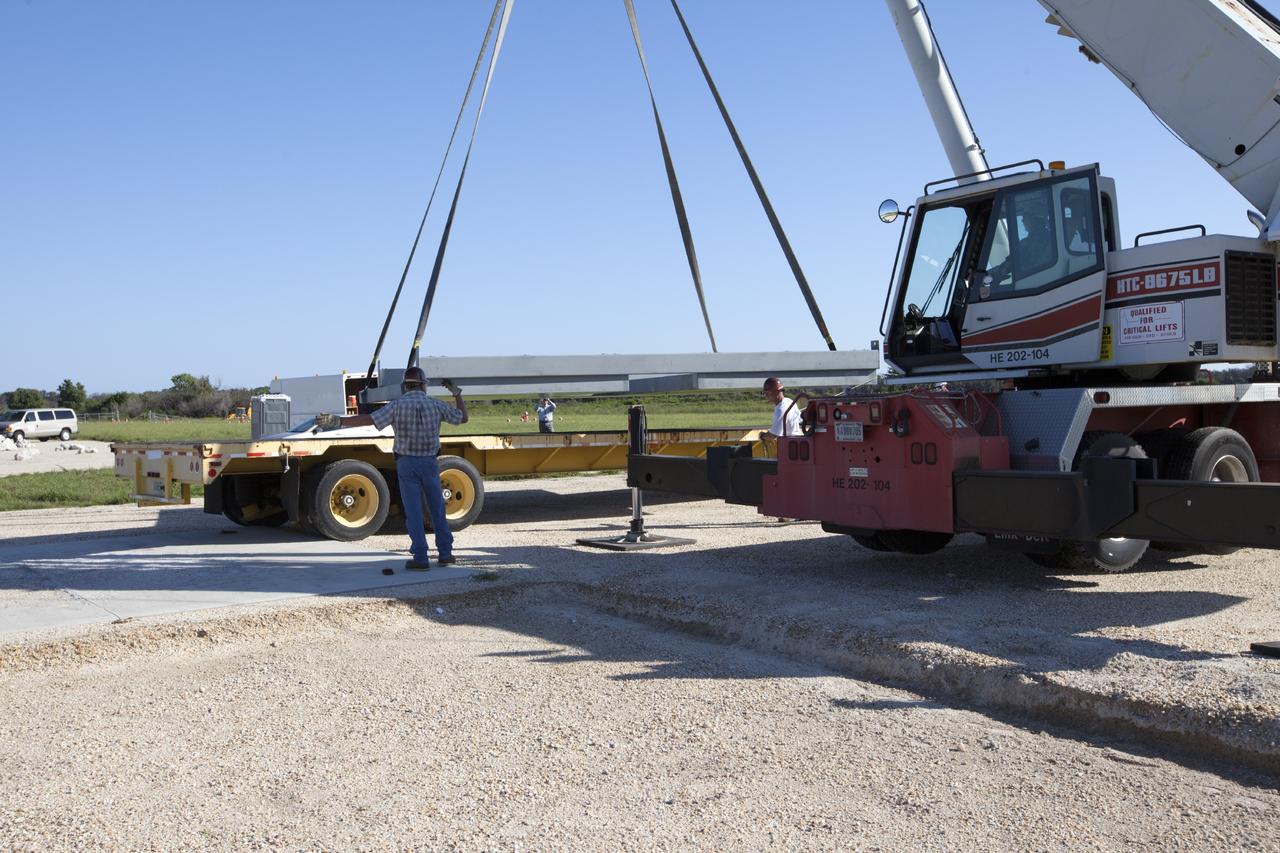
CAPE CANAVERAL, Fla. - At NASA’s Kennedy Space Center in Florida, workers enlist a crane to lift the movable launch platform for the Project Morpheus lander onto a flatbed truck for its move from the midfield to the north end of the Shuttle Landing Facility, or SLF. Testing of the prototype lander has been ongoing at NASA’s Johnson Space Center in Houston in preparation for free flight. The lander is scheduled for delivery to Kennedy in October. The SLF will provide the lander with the kind of field necessary for realistic testing, complete with rocks, craters and hazards to avoid. Morpheus utilizes an autonomous landing and hazard avoidance technology, or ALHAT, payload that will allow it to navigate to clear landing sites amidst obstacles during its descent. Project Morpheus is one of 20 small projects comprising the Advanced Exploration Systems, or AES, program in NASA’s Human Exploration and Operations Mission Directorate. AES projects pioneer new approaches for rapidly developing prototype systems, demonstrating key capabilities and validating operational concepts for future human missions beyond Earth orbit. For more information on Project Morpheus, visit http://www.nasa.gov/centers/johnson/exploration/morpheus/index.html. Photo credit: NASA/Kim Shiflett
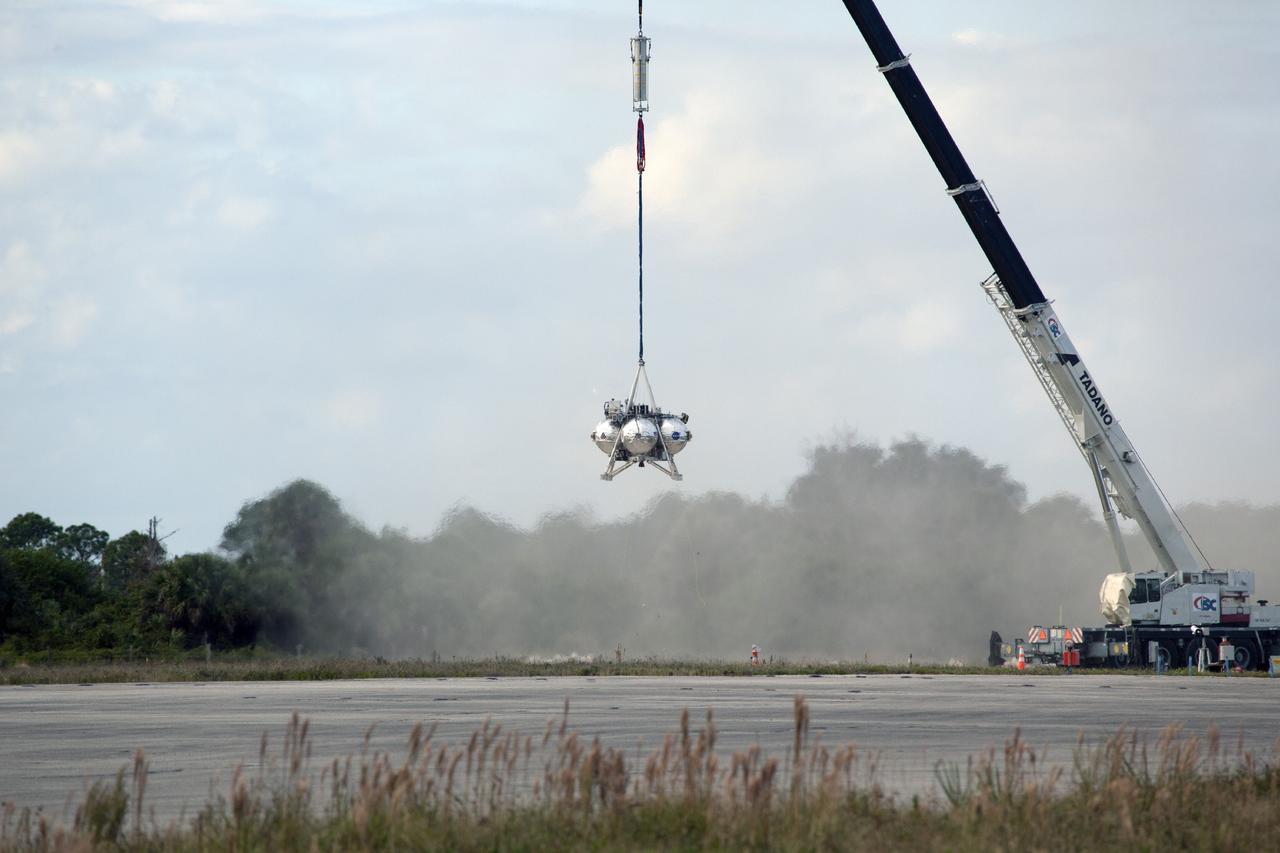
CAPE CANAVERAL, Fla. – At NASA’s Kennedy Space Center in Florida, the Project Morpheus prototype lander’s engine has completed its firing during a tether test at the north end of the Shuttle Landing Facility. During the test, the lander was lifted 20 feet by crane, and then ascended another 10 feet, maneuvered backwards 10 feet, and then flew forward. It will descend to its original position, landing at the end of the tether onto a transportable launch platform. Testing of the prototype lander was performed at NASA’s Johnson Space Center in Houston in preparation for tethered and free flight testing at Kennedy. The landing facility will provide the lander with the kind of field necessary for realistic testing, complete with rocks, craters and hazards to avoid. Morpheus utilizes an autonomous landing and hazard avoidance technology, or ALHAT, payload that will allow it to navigate to clear landing sites amidst rocks, craters and other hazards during its descent. Project Morpheus is being managed under the Advanced Exploration Systems, or AES, Division in NASA’s Human Exploration and Operations Mission Directorate. The efforts in AES pioneer new approaches for rapidly developing prototype systems, demonstrating key capabilities and validating operational concepts for future human missions beyond Earth orbit. For more information on Project Morpheus, visit http://morpheuslander.jsc.nasa.gov. Photo credit: NASA/Daniel Casper
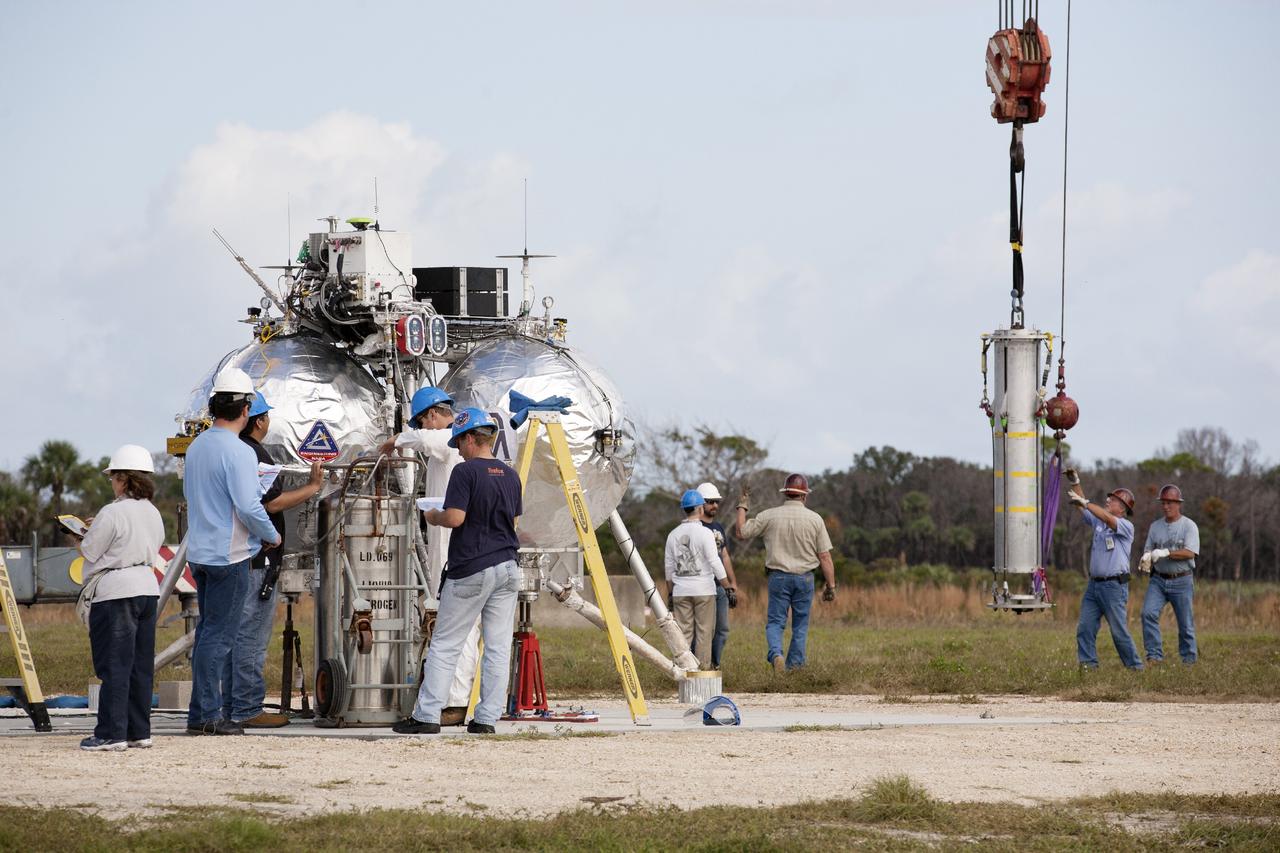
CAPE CANAVERAL, Fla. – At NASA’s Kennedy Space Center in Florida, technicians and engineers check the Project Morpheus prototype lander which has been positioned on a transportable launch platform at the north end of the Shuttle Landing Facility. The lander will be prepared for a tethered test that includes lifting it 20 feet by crane, ascending another 10 feet, maneuvering backwards 10 feet, and then flying forward and descending to its original position, landing at the end of the tether. Testing of the prototype lander was performed at NASA’s Johnson Space Center in Houston in preparation for tethered and free flight testing at Kennedy. The landing facility will provide the lander with the kind of field necessary for realistic testing, complete with rocks, craters and hazards to avoid. Morpheus utilizes an autonomous landing and hazard avoidance technology, or ALHAT, payload that will allow it to navigate to clear landing sites amidst rocks, craters and other hazards during its descent. Project Morpheus is being managed under the Advanced Exploration Systems, or AES, Division in NASA’s Human Exploration and Operations Mission Directorate. The efforts in AES pioneer new approaches for rapidly developing prototype systems, demonstrating key capabilities and validating operational concepts for future human missions beyond Earth orbit. For more information on Project Morpheus, visit http://morpheuslander.jsc.nasa.gov. Photo credit: NASA/Kim Shiflett
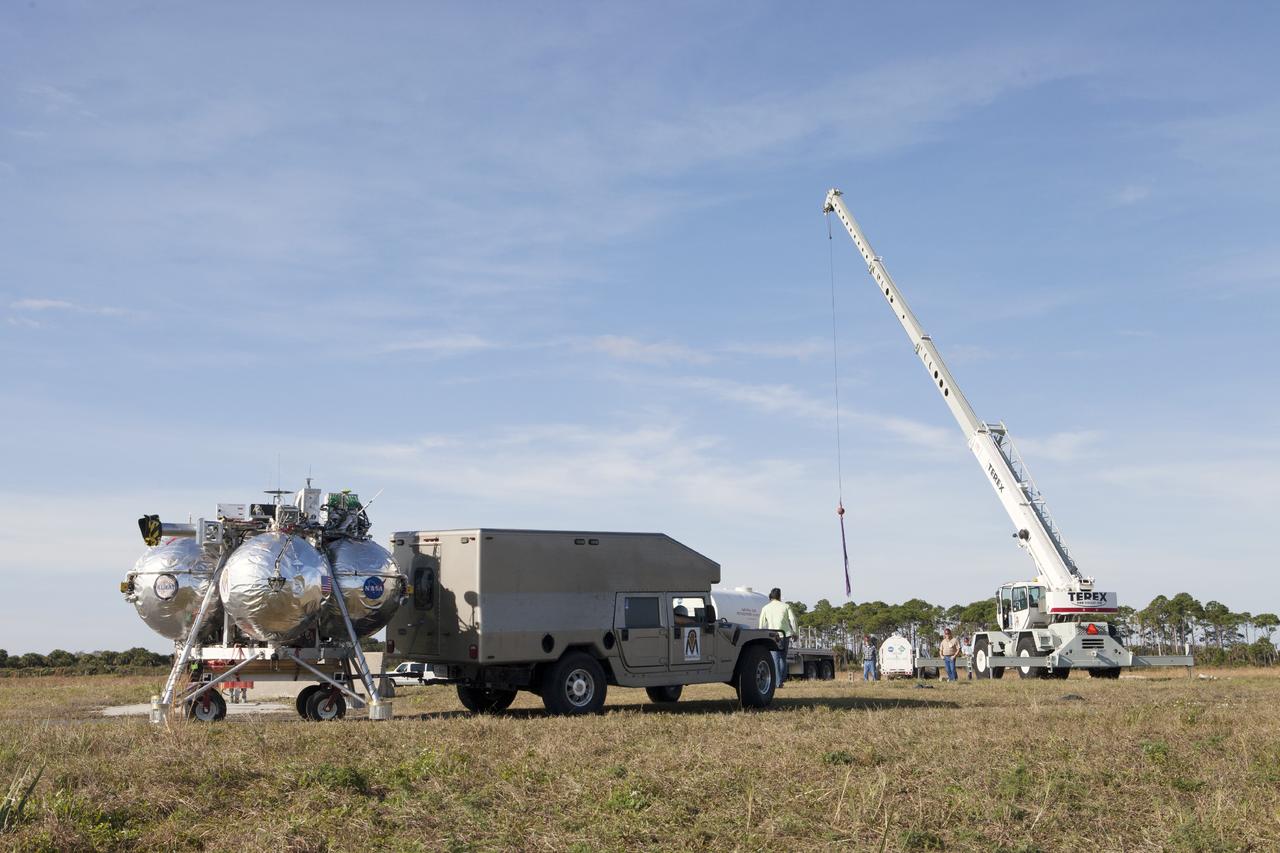
CAPE CANAVERAL, Fla. – The Project Morpheus prototype lander is positioned at the midfield of the Shuttle Landing Facility at NASA’s Kennedy Space Center in Florida to prepare it for a dress rehearsal of a tethered flight test. The lander will be transported to a launch platform at the north end of the landing facility. Testing of the prototype lander was performed at NASA’s Johnson Space Center in Houston in preparation for tethered and free flight testing at Kennedy. The landing facility will provide the lander with the kind of field necessary for realistic testing, complete with rocks, craters and hazards to avoid. Morpheus utilizes an autonomous landing and hazard avoidance technology, or ALHAT, payload that will allow it to navigate to clear landing sites amidst rocks, craters and other hazards during its descent. Project Morpheus is being managed under the Advanced Exploration Systems, or AES, Division in NASA’s Human Exploration and Operations Mission Directorate. The efforts in AES pioneer new approaches for rapidly developing prototype systems, demonstrating key capabilities and validating operational concepts for future human missions beyond Earth orbit. For more information on Project Morpheus, visit http://morpheuslander.jsc.nasa.gov. Photo credit: NASA/Kim Shiflett
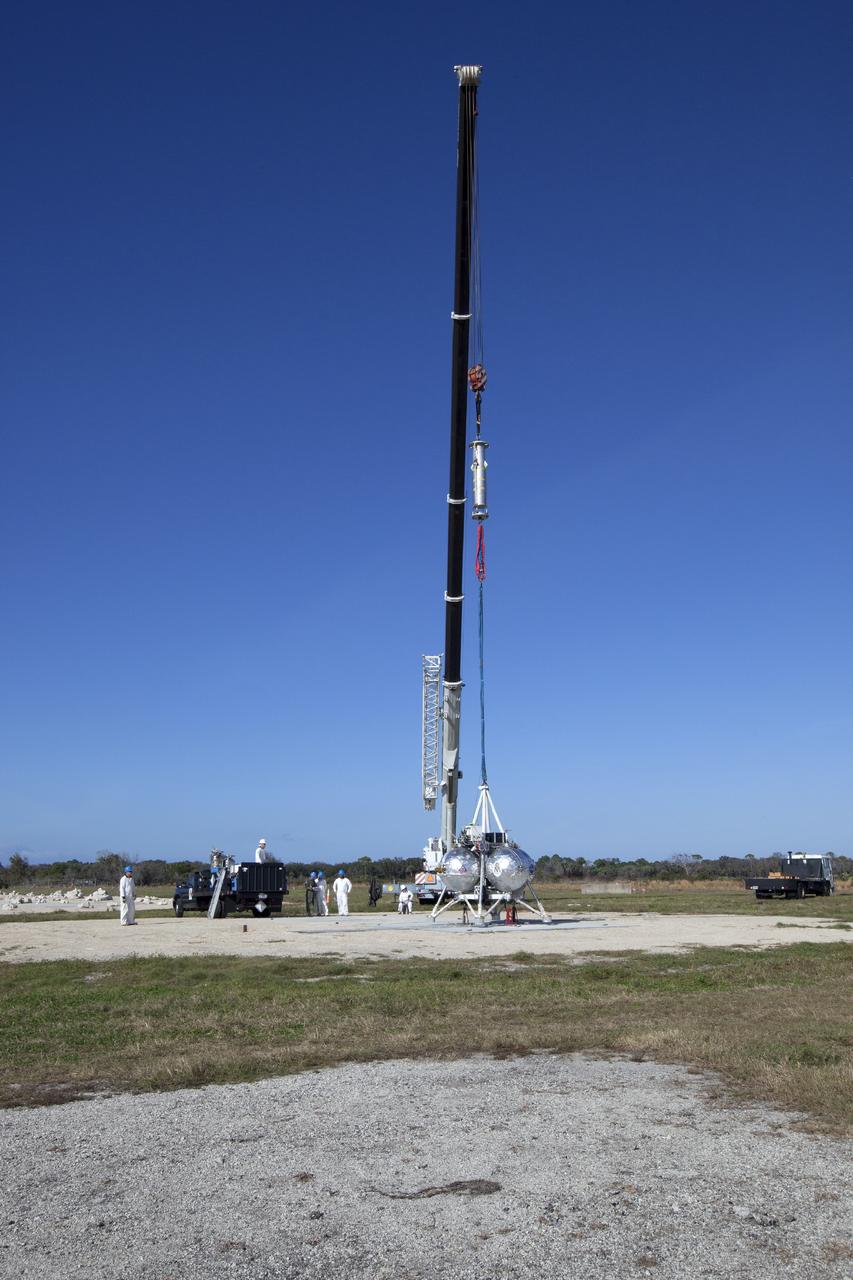
CAPE CANAVERAL, Fla. – At NASA’s Kennedy Space Center in Florida, the Project Morpheus prototype lander has been attached to a tether and is being prepared for a tether test on a transportable launch platform positioned at the north end of the Shuttle Landing Facility. The tether test includes lifting the lander 20 feet by crane, ascending another 10 feet, maneuvering backwards 10 feet, and then flying forward and descending to its original position, landing at the end of the tether. Testing of the prototype lander was performed at NASA’s Johnson Space Center in Houston in preparation for tethered and free flight testing at Kennedy. The landing facility will provide the lander with the kind of field necessary for realistic testing, complete with rocks, craters and hazards to avoid. Morpheus utilizes an autonomous landing and hazard avoidance technology, or ALHAT, payload that will allow it to navigate to clear landing sites amidst rocks, craters and other hazards during its descent. Project Morpheus is being managed under the Advanced Exploration Systems, or AES, Division in NASA’s Human Exploration and Operations Mission Directorate. The efforts in AES pioneer new approaches for rapidly developing prototype systems, demonstrating key capabilities and validating operational concepts for future human missions beyond Earth orbit. For more information on Project Morpheus, visit http://morpheuslander.jsc.nasa.gov. Photo credit: NASA/Daniel Casper
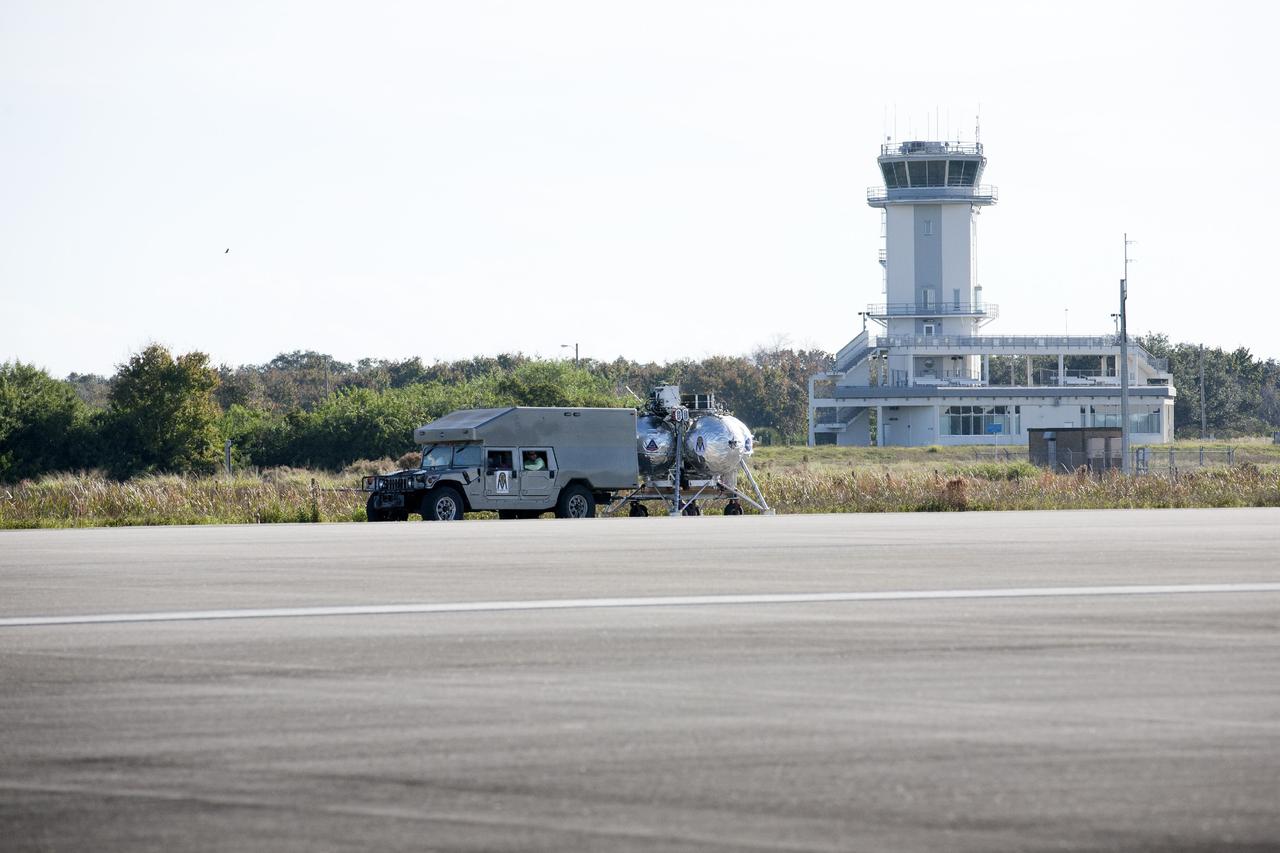
CAPE CANAVERAL, Fla. – The Project Morpheus prototype lander is positioned at the midfield of the Shuttle Landing Facility at NASA’s Kennedy Space Center in Florida to prepare it for a dress rehearsal of a tethered flight test. The lander will be transported to a launch platform at the north end of the landing facility. Testing of the prototype lander was performed at NASA’s Johnson Space Center in Houston in preparation for tethered and free flight testing at Kennedy. The landing facility will provide the lander with the kind of field necessary for realistic testing, complete with rocks, craters and hazards to avoid. Morpheus utilizes an autonomous landing and hazard avoidance technology, or ALHAT, payload that will allow it to navigate to clear landing sites amidst rocks, craters and other hazards during its descent. Project Morpheus is being managed under the Advanced Exploration Systems, or AES, Division in NASA’s Human Exploration and Operations Mission Directorate. The efforts in AES pioneer new approaches for rapidly developing prototype systems, demonstrating key capabilities and validating operational concepts for future human missions beyond Earth orbit. For more information on Project Morpheus, visit http://morpheuslander.jsc.nasa.gov. Photo credit: NASA/Kim Shiflett
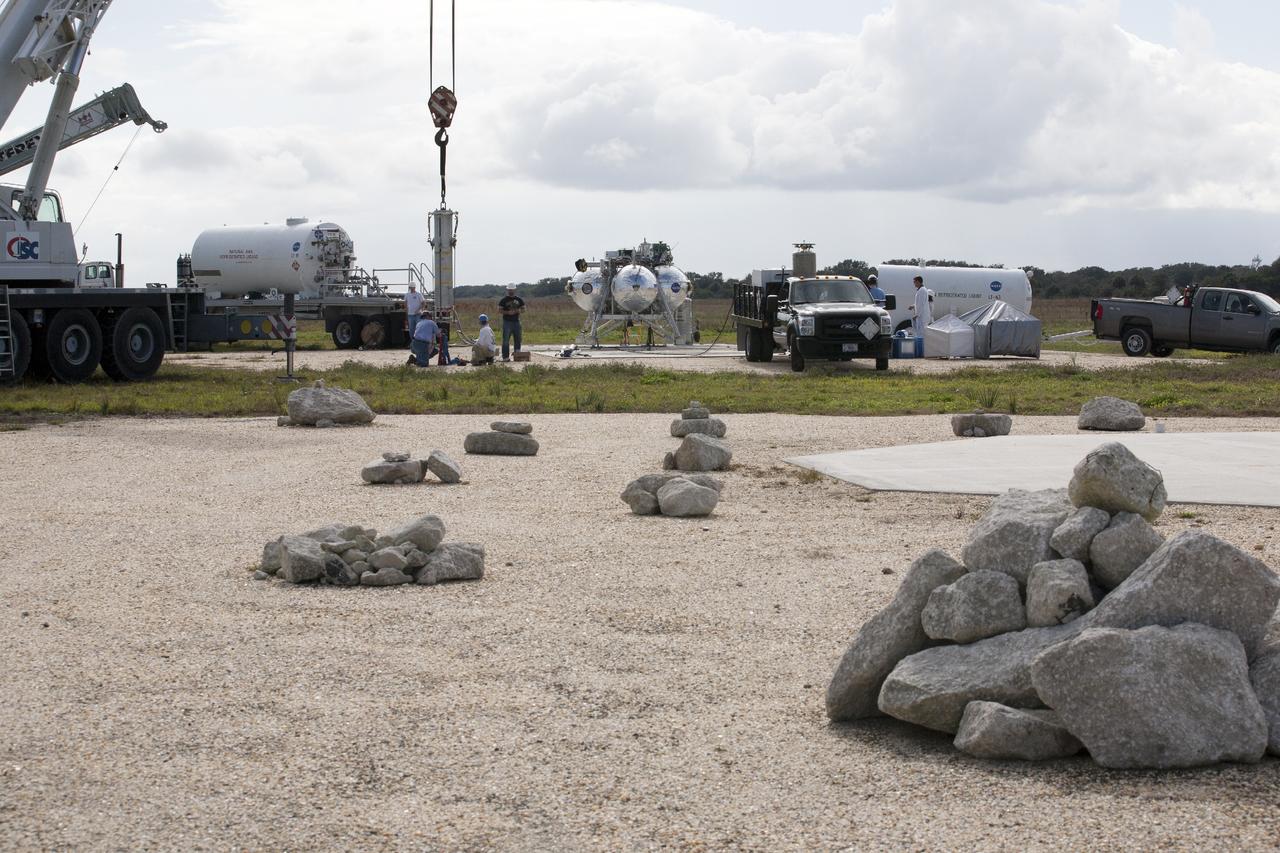
CAPE CANAVERAL, Fla. – At NASA’s Kennedy Space Center in Florida, the Project Morpheus prototype lander has been positioned on a transportable launch platform at the north end of the Shuttle Landing Facility. A portion of the hazard field is in the foreground. The lander will be prepared for a tethered test that includes lifting it 20 feet by crane, ascending another 10 feet, maneuvering backwards 10 feet, and then flying forward and descending to its original position, landing at the end of the tether. Testing of the prototype lander was performed at NASA’s Johnson Space Center in Houston in preparation for tethered and free flight testing at Kennedy. The landing facility will provide the lander with the kind of field necessary for realistic testing, complete with rocks, craters and hazards to avoid. Morpheus utilizes an autonomous landing and hazard avoidance technology, or ALHAT, payload that will allow it to navigate to clear landing sites amidst rocks, craters and other hazards during its descent. Project Morpheus is being managed under the Advanced Exploration Systems, or AES, Division in NASA’s Human Exploration and Operations Mission Directorate. The efforts in AES pioneer new approaches for rapidly developing prototype systems, demonstrating key capabilities and validating operational concepts for future human missions beyond Earth orbit. For more information on Project Morpheus, visit http://morpheuslander.jsc.nasa.gov. Photo credit: NASA/Kim Shiflett
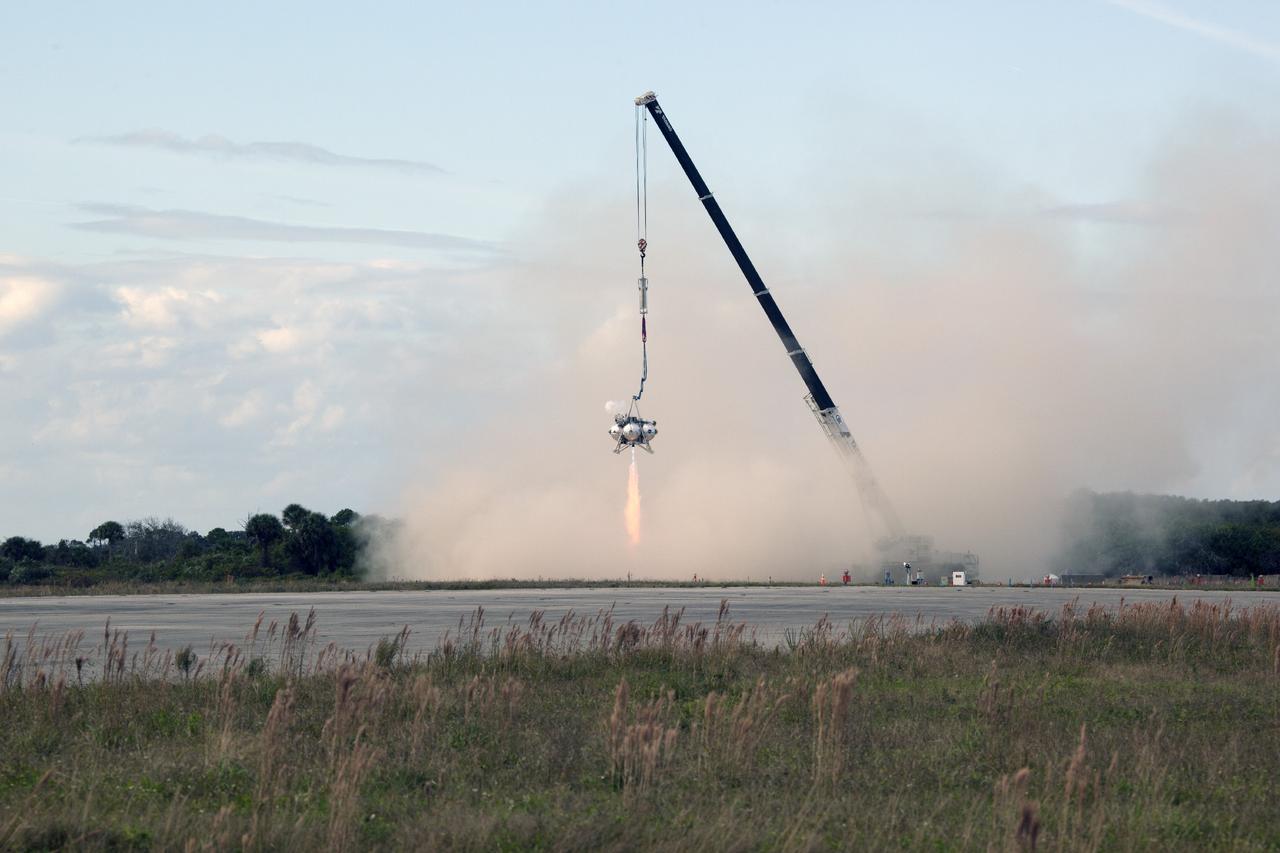
CAPE CANAVERAL, Fla. – At NASA’s Kennedy Space Center in Florida, smoke fills the air as the Project Morpheus prototype lander’s engine fires during a tether test at the north end of the Shuttle Landing Facility. During the test, the lander was lifted 20 feet by crane, and then ascended another 10 feet, maneuvered backwards 10 feet, and then flew forward. It will descend to its original position, landing at the end of the tether onto a transportable launch platform. Testing of the prototype lander was performed at NASA’s Johnson Space Center in Houston in preparation for tethered and free flight testing at Kennedy. The landing facility will provide the lander with the kind of field necessary for realistic testing, complete with rocks, craters and hazards to avoid. Morpheus utilizes an autonomous landing and hazard avoidance technology, or ALHAT, payload that will allow it to navigate to clear landing sites amidst rocks, craters and other hazards during its descent. Project Morpheus is being managed under the Advanced Exploration Systems, or AES, Division in NASA’s Human Exploration and Operations Mission Directorate. The efforts in AES pioneer new approaches for rapidly developing prototype systems, demonstrating key capabilities and validating operational concepts for future human missions beyond Earth orbit. For more information on Project Morpheus, visit http://morpheuslander.jsc.nasa.gov. Photo credit: NASA/Daniel Casper
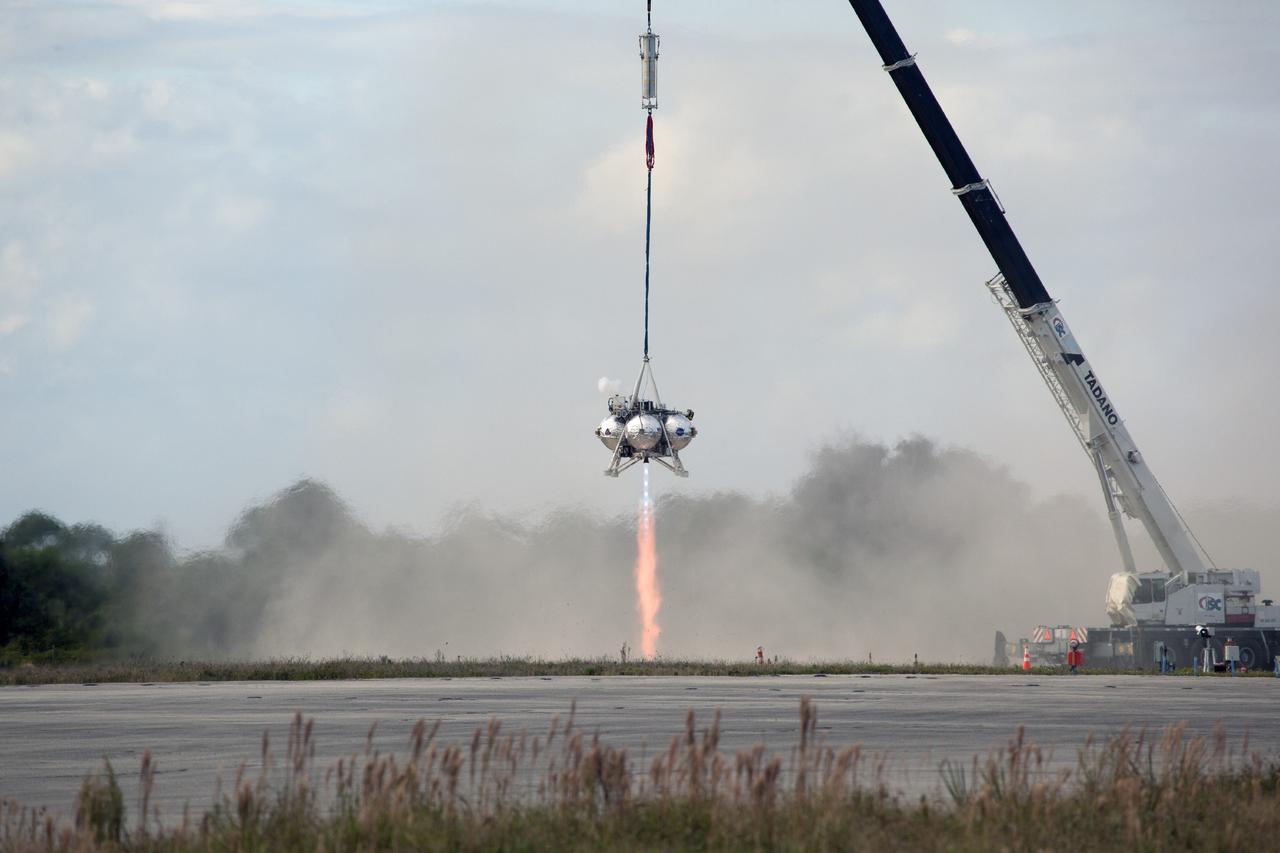
CAPE CANAVERAL, Fla. – At NASA’s Kennedy Space Center in Florida, smoke fills the air as the Project Morpheus prototype lander’s engine fires during a tether test at the north end of the Shuttle Landing Facility. During the test, the lander was lifted 20 feet by crane, and then ascended another 10 feet, maneuvered backwards 10 feet, and then flew forward. It will descend to its original position, landing at the end of the tether onto a transportable launch platform. Testing of the prototype lander was performed at NASA’s Johnson Space Center in Houston in preparation for tethered and free flight testing at Kennedy. The landing facility will provide the lander with the kind of field necessary for realistic testing, complete with rocks, craters and hazards to avoid. Morpheus utilizes an autonomous landing and hazard avoidance technology, or ALHAT, payload that will allow it to navigate to clear landing sites amidst rocks, craters and other hazards during its descent. Project Morpheus is being managed under the Advanced Exploration Systems, or AES, Division in NASA’s Human Exploration and Operations Mission Directorate. The efforts in AES pioneer new approaches for rapidly developing prototype systems, demonstrating key capabilities and validating operational concepts for future human missions beyond Earth orbit. For more information on Project Morpheus, visit http://morpheuslander.jsc.nasa.gov. Photo credit: NASA/Daniel Casper
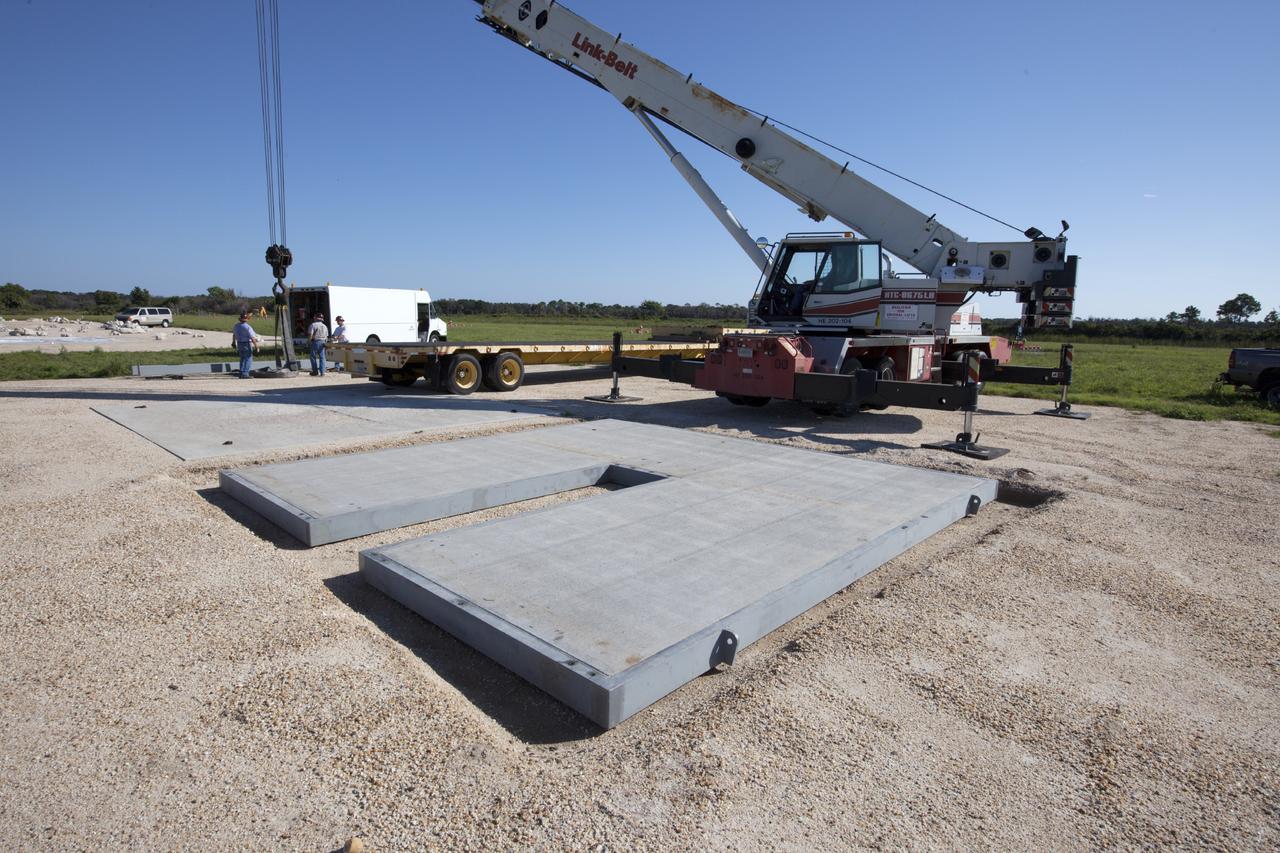
CAPE CANAVERAL, Fla. - At NASA’s Kennedy Space Center in Florida, the movable launch platform for the Project Morpheus lander is positioned on its new site adjacent to a hazard field created to support the project at the north end of the Shuttle Landing Facility, or SLF. Testing of the prototype lander has been ongoing at NASA’s Johnson Space Center in Houston in preparation for free flight. The lander is scheduled for delivery to Kennedy in October. The SLF will provide the lander with the kind of field necessary for realistic testing, complete with rocks, craters and hazards to avoid. Morpheus utilizes an autonomous landing and hazard avoidance technology, or ALHAT, payload that will allow it to navigate to clear landing sites amidst obstacles during its descent. Project Morpheus is one of 20 small projects comprising the Advanced Exploration Systems, or AES, program in NASA’s Human Exploration and Operations Mission Directorate. AES projects pioneer new approaches for rapidly developing prototype systems, demonstrating key capabilities and validating operational concepts for future human missions beyond Earth orbit. For more information on Project Morpheus, visit http://www.nasa.gov/centers/johnson/exploration/morpheus/index.html. Photo credit: NASA/Kim Shiflett
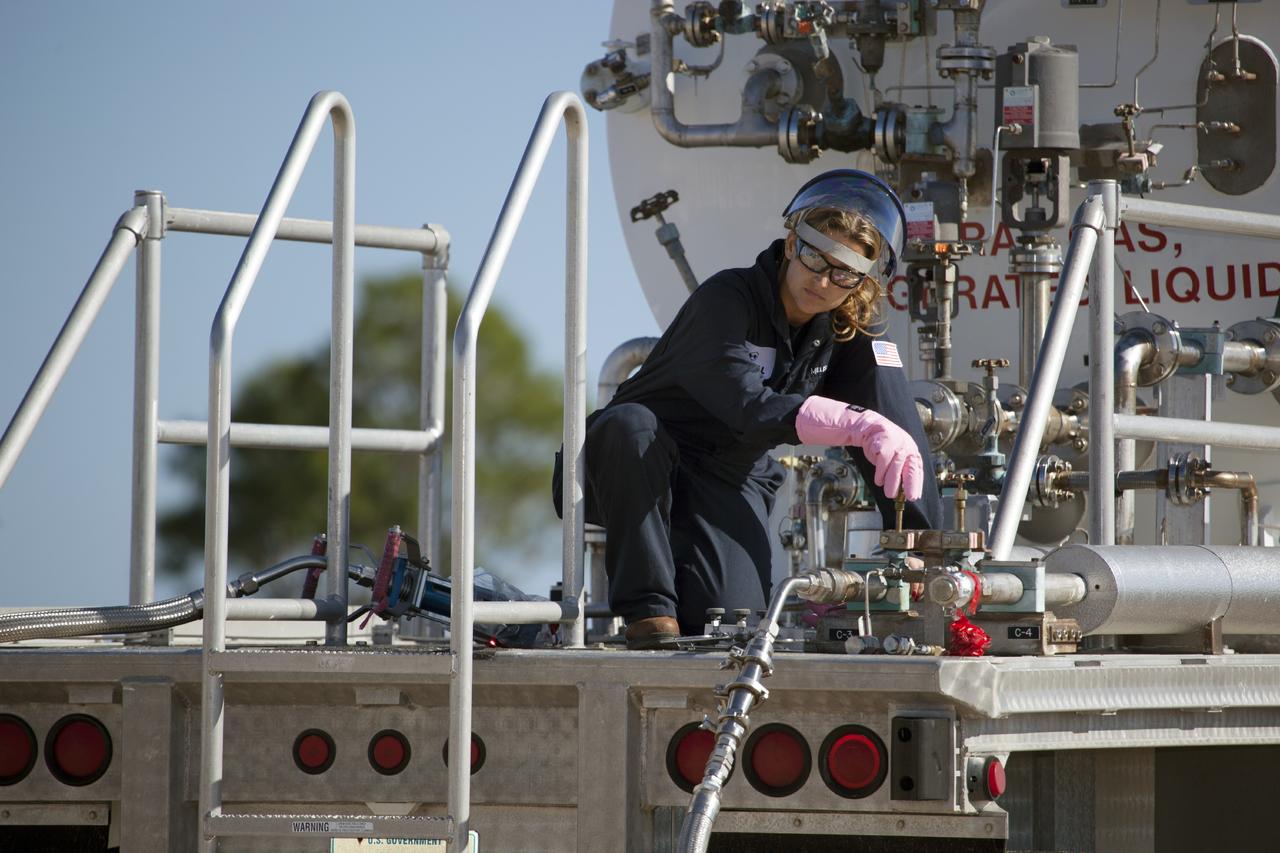
CAPE CANAVERAL, Fla. -- A technician prepares the Project Morpheus prototype lander for a second free flight test at the north end of the Shuttle Landing Facility at NASA’s Kennedy Space Center in Florida. Testing of the prototype lander was performed at NASA’s Johnson Space Center in Houston in preparation for tethered and free flight testing at Kennedy. Project Morpheus integrates NASA’s automated landing and hazard avoidance technology, or ALHAT, with an engine that runs on liquid oxygen and methane, or green propellants, into a fully-operational lander that could deliver cargo to other planetary surfaces. The landing facility will provide the lander with the kind of field necessary for realistic testing, complete with rocks, craters and hazards to avoid. Morpheus’ ALHAT payload allows it to navigate to clear landing sites amidst rocks, craters and other hazards during its descent. Project Morpheus is being managed under the Advanced Exploration Systems, or AES, Division in NASA’s Human Exploration and Operations Mission Directorate. The efforts in AES pioneer new approaches for rapidly developing prototype systems, demonstrating key capabilities and validating operational concepts for future human missions beyond Earth orbit. For more information on Project Morpheus, visit http://morpheuslander.jsc.nasa.gov. Photo credit: NASA/Dimitri Gerondidakis
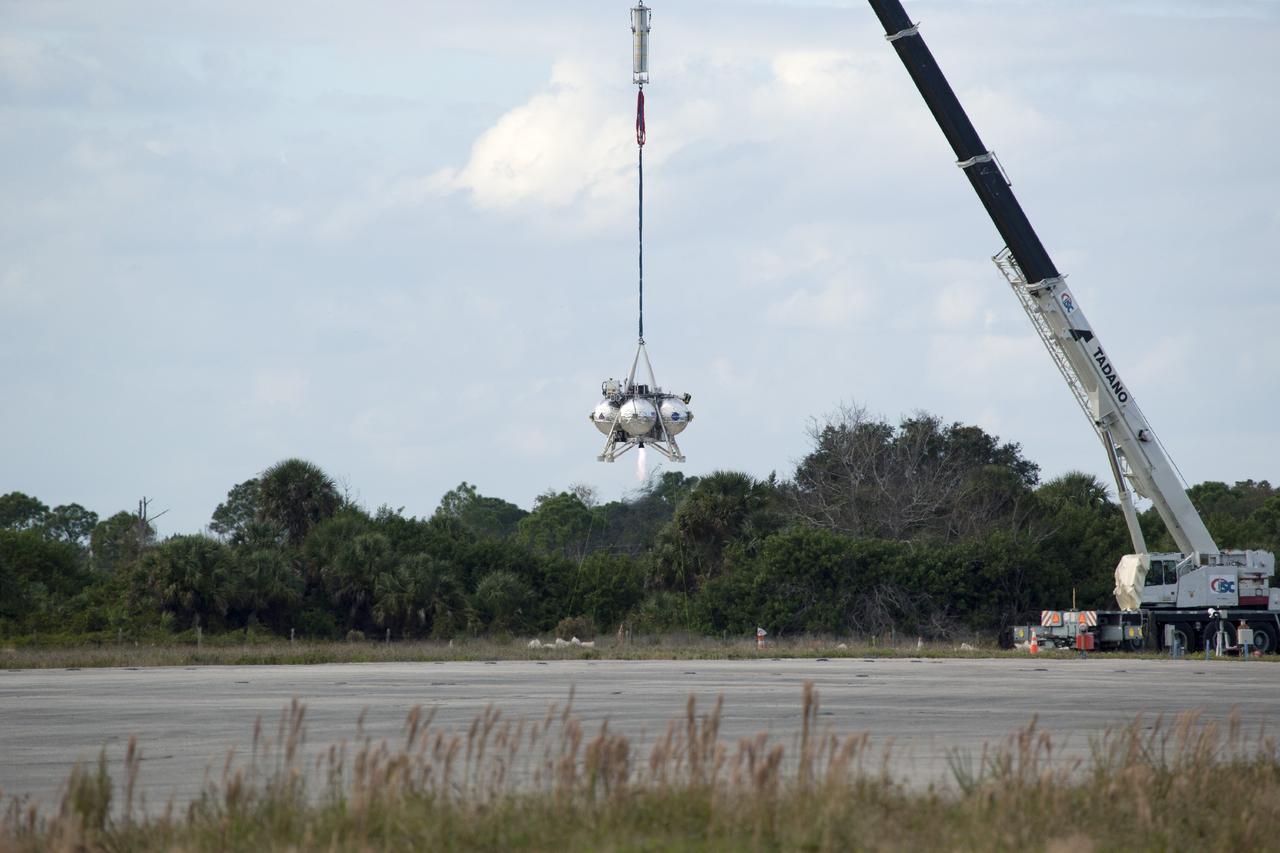
CAPE CANAVERAL, Fla. – At NASA’s Kennedy Space Center in Florida, the Project Morpheus prototype lander has been lifted by a tether and hovers above a transportable launch platform positioned at the north end of the Shuttle Landing Facility. The lander’s engine begins firing for a tethered test that includes lifting it 20 feet by crane, ascending another 10 feet, maneuvering backwards 10 feet, and then flying forward and descending to its original position, landing at the end of the tether. Testing of the prototype lander was performed at NASA’s Johnson Space Center in Houston in preparation for tethered and free flight testing at Kennedy. The landing facility will provide the lander with the kind of field necessary for realistic testing, complete with rocks, craters and hazards to avoid. Morpheus utilizes an autonomous landing and hazard avoidance technology, or ALHAT, payload that will allow it to navigate to clear landing sites amidst rocks, craters and other hazards during its descent. Project Morpheus is being managed under the Advanced Exploration Systems, or AES, Division in NASA’s Human Exploration and Operations Mission Directorate. The efforts in AES pioneer new approaches for rapidly developing prototype systems, demonstrating key capabilities and validating operational concepts for future human missions beyond Earth orbit. For more information on Project Morpheus, visit http://morpheuslander.jsc.nasa.gov. Photo credit: NASA/Daniel Casper
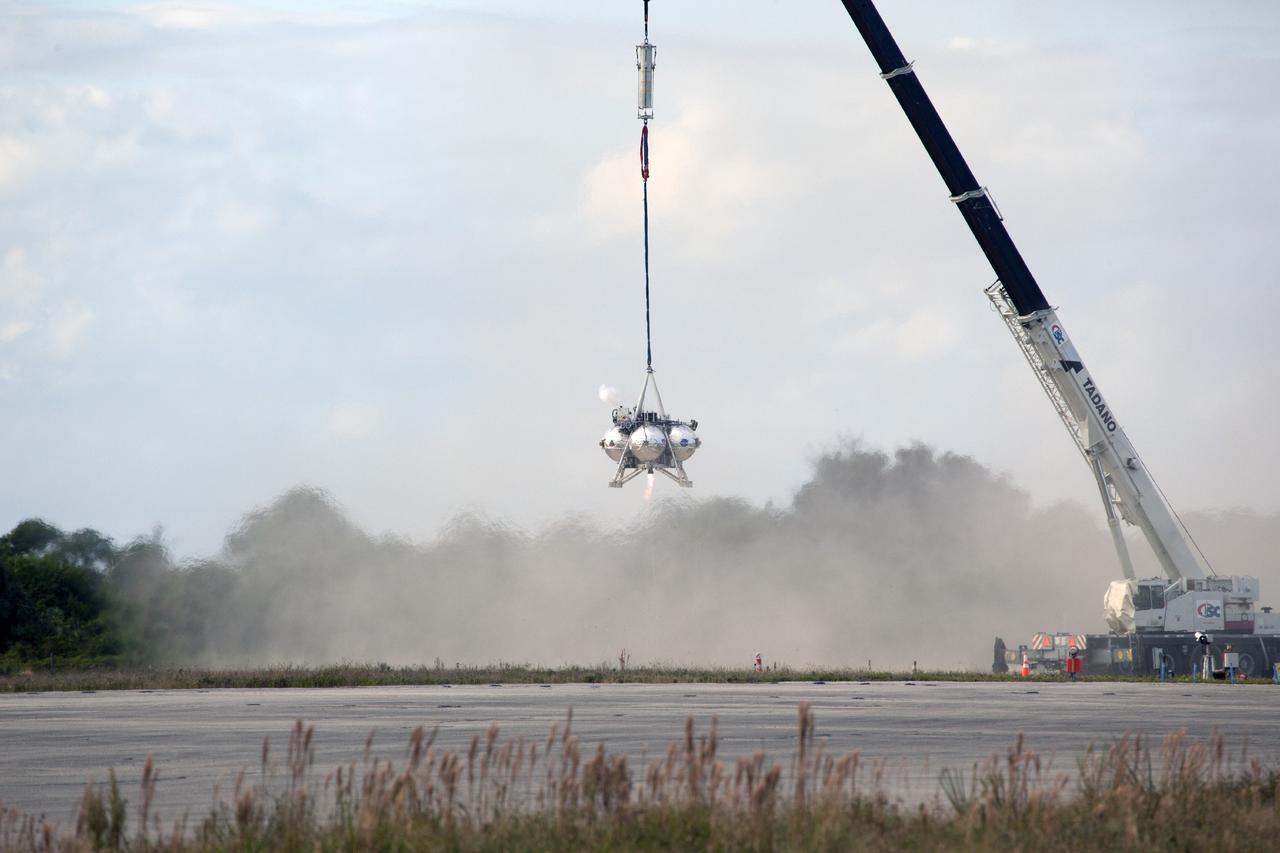
CAPE CANAVERAL, Fla. – At NASA’s Kennedy Space Center in Florida, smoke fills the air as the Project Morpheus prototype lander’s engine fires during a tether test at the north end of the Shuttle Landing Facility. During the test, the lander was lifted 20 feet by crane, and then ascended another 10 feet, maneuvered backwards 10 feet, and then flew forward. It will descend to its original position, landing at the end of the tether onto a transportable launch platform. Testing of the prototype lander was performed at NASA’s Johnson Space Center in Houston in preparation for tethered and free flight testing at Kennedy. The landing facility will provide the lander with the kind of field necessary for realistic testing, complete with rocks, craters and hazards to avoid. Morpheus utilizes an autonomous landing and hazard avoidance technology, or ALHAT, payload that will allow it to navigate to clear landing sites amidst rocks, craters and other hazards during its descent. Project Morpheus is being managed under the Advanced Exploration Systems, or AES, Division in NASA’s Human Exploration and Operations Mission Directorate. The efforts in AES pioneer new approaches for rapidly developing prototype systems, demonstrating key capabilities and validating operational concepts for future human missions beyond Earth orbit. For more information on Project Morpheus, visit http://morpheuslander.jsc.nasa.gov. Photo credit: NASA/Daniel Casper
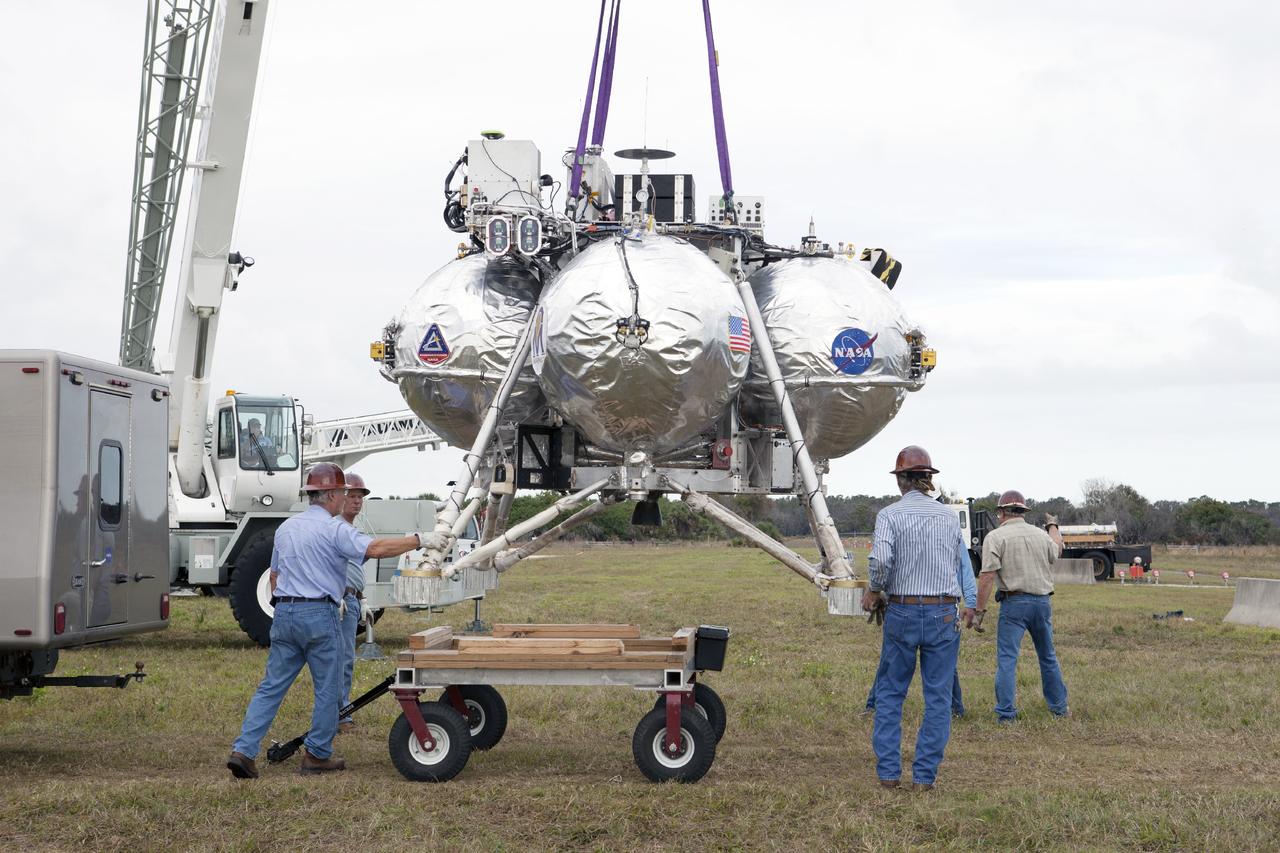
CAPE CANAVERAL, Fla. – At NASA’s Kennedy Space Center in Florida, the Project Morpheus prototype lander has been attached to a tether and is being prepared for placement on a transportable launch platform positioned at the north end of the Shuttle Landing Facility. The lander will be prepared for a tethered test that includes lifting it 20 feet by crane, ascending another 10 feet, maneuvering backwards 10 feet, and then flying forward and descending to its original position, landing at the end of the tether. Testing of the prototype lander was performed at NASA’s Johnson Space Center in Houston in preparation for tethered and free flight testing at Kennedy. The landing facility will provide the lander with the kind of field necessary for realistic testing, complete with rocks, craters and hazards to avoid. Morpheus utilizes an autonomous landing and hazard avoidance technology, or ALHAT, payload that will allow it to navigate to clear landing sites amidst rocks, craters and other hazards during its descent. Project Morpheus is being managed under the Advanced Exploration Systems, or AES, Division in NASA’s Human Exploration and Operations Mission Directorate. The efforts in AES pioneer new approaches for rapidly developing prototype systems, demonstrating key capabilities and validating operational concepts for future human missions beyond Earth orbit. For more information on Project Morpheus, visit http://morpheuslander.jsc.nasa.gov. Photo credit: NASA/Kim Shiflett
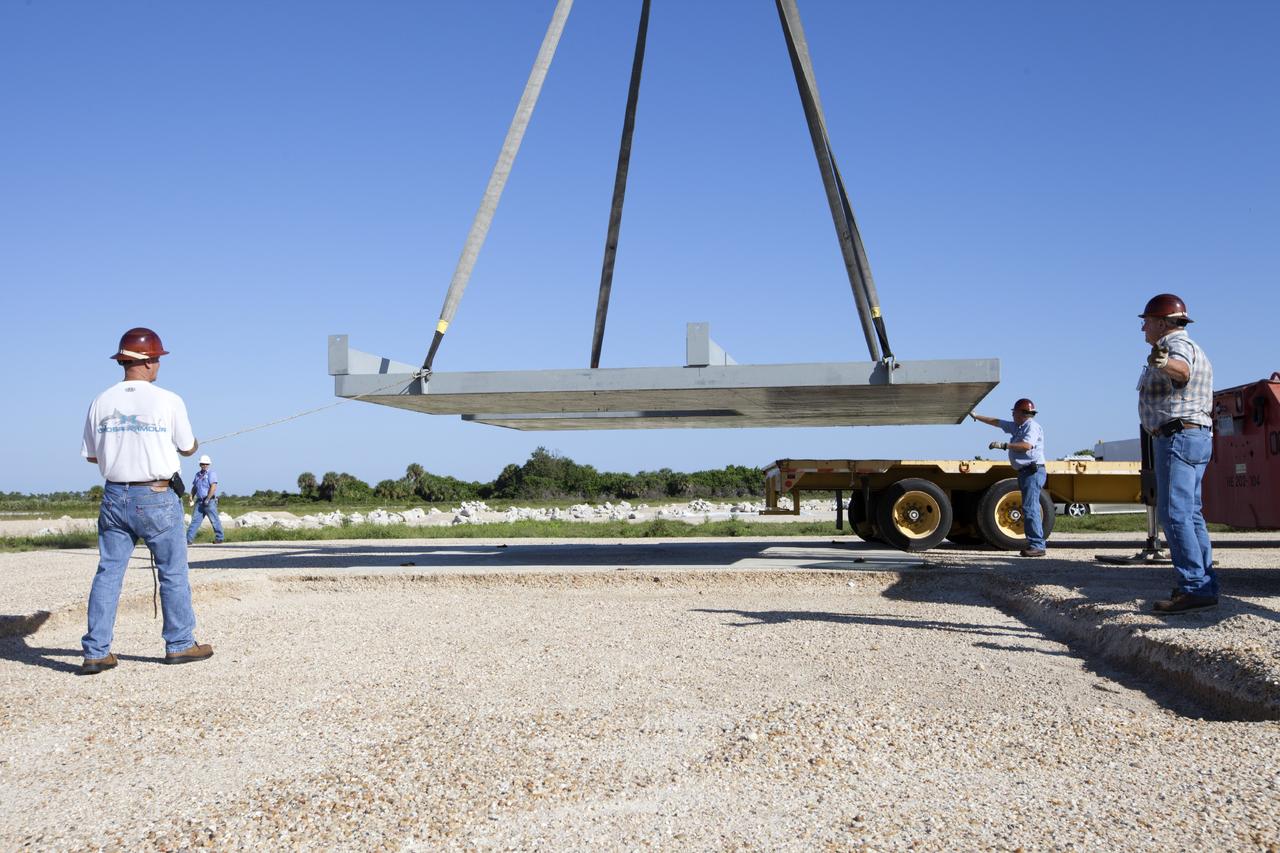
CAPE CANAVERAL, Fla. - At NASA’s Kennedy Space Center in Florida, workers enlist a crane to lift the movable launch platform for the Project Morpheus lander onto a flatbed truck for its move from the midfield to the north end of the Shuttle Landing Facility, or SLF. Testing of the prototype lander has been ongoing at NASA’s Johnson Space Center in Houston in preparation for free flight. The lander is scheduled for delivery to Kennedy in October. The SLF will provide the lander with the kind of field necessary for realistic testing, complete with rocks, craters and hazards to avoid. Morpheus utilizes an autonomous landing and hazard avoidance technology, or ALHAT, payload that will allow it to navigate to clear landing sites amidst obstacles during its descent. Project Morpheus is one of 20 small projects comprising the Advanced Exploration Systems, or AES, program in NASA’s Human Exploration and Operations Mission Directorate. AES projects pioneer new approaches for rapidly developing prototype systems, demonstrating key capabilities and validating operational concepts for future human missions beyond Earth orbit. For more information on Project Morpheus, visit http://www.nasa.gov/centers/johnson/exploration/morpheus/index.html. Photo credit: NASA/Kim Shiflett
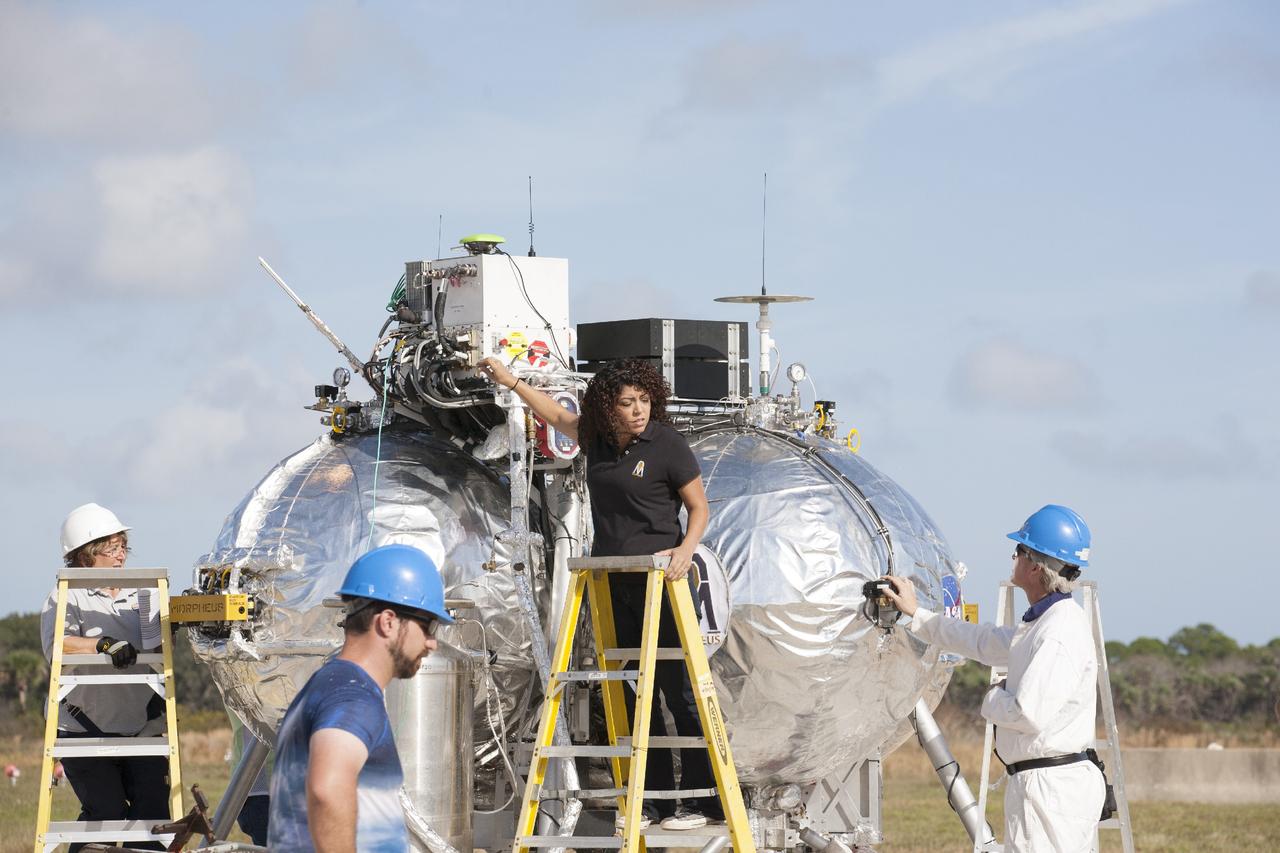
CAPE CANAVERAL, Fla. – Technicians and engineers prepare the Project Morpheus prototype lander for its first free flight test at the north end of the Shuttle Landing Facility at NASA’s Kennedy Space Center in Florida. Testing of the prototype lander was performed at NASA’s Johnson Space Center in Houston in preparation for tethered and free flight testing at Kennedy. Project Morpheus integrates NASA’s automated landing and hazard avoidance technology, or ALHAT, with an engine that runs on liquid oxygen and methane, or green propellants, into a fully-operational lander that could deliver cargo to asteroids and other planetary surfaces. The landing facility will provide the lander with the kind of field necessary for realistic testing, complete with rocks, craters and hazards to avoid. Morpheus’ ALHAT payload allows it to navigate to clear landing sites amidst rocks, craters and other hazards during its descent. Project Morpheus is being managed under the Advanced Exploration Systems, or AES, Division in NASA’s Human Exploration and Operations Mission Directorate. The efforts in AES pioneer new approaches for rapidly developing prototype systems, demonstrating key capabilities and validating operational concepts for future human missions beyond Earth orbit. For more information on Project Morpheus, visit http://morpheuslander.jsc.nasa.gov. Photo credit: NASA/Kim Shiflett
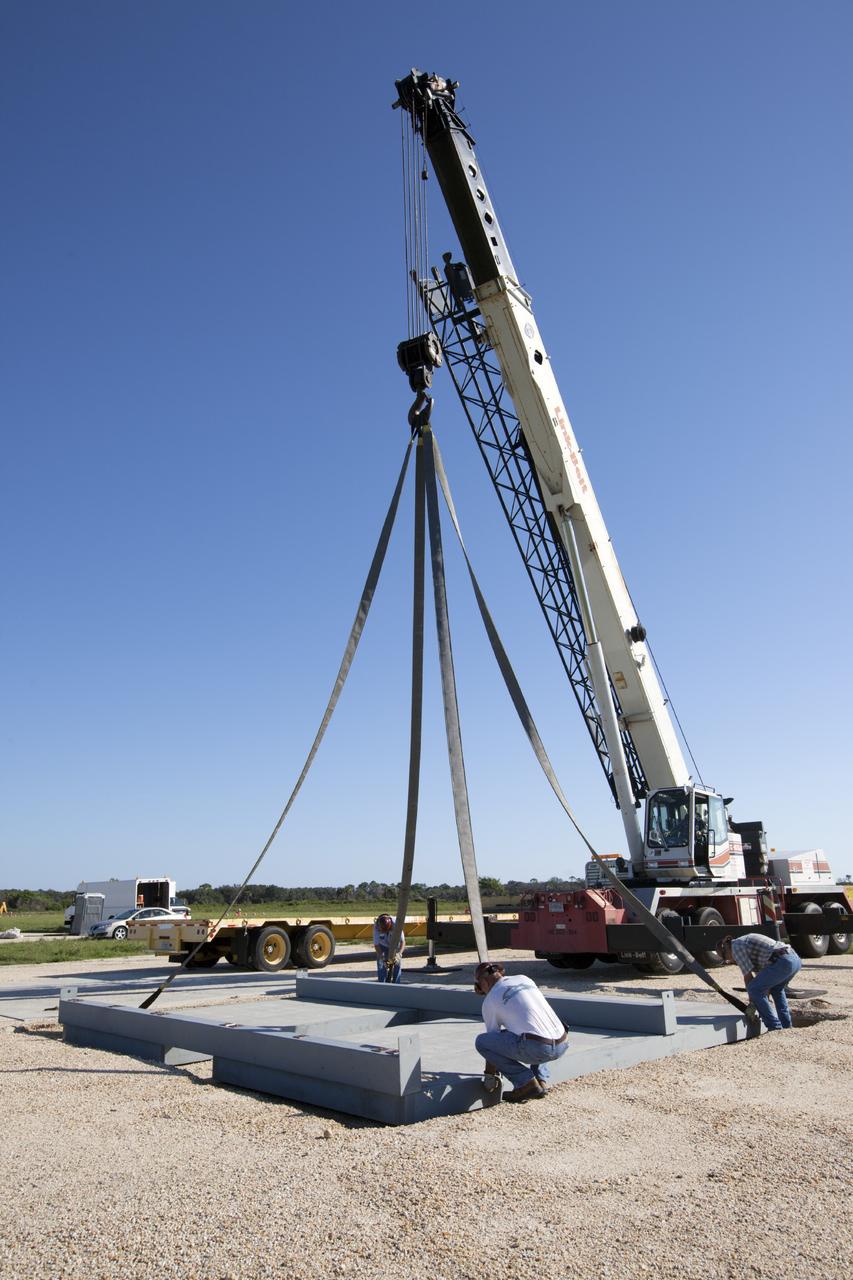
CAPE CANAVERAL, Fla. - At NASA’s Kennedy Space Center in Florida, workers release the movable launch platform for the Project Morpheus lander from the crane used to position it on its new site adjacent to a hazard field created to support the project at the north end of the Shuttle Landing Facility, or SLF. Testing of the prototype lander has been ongoing at NASA’s Johnson Space Center in Houston in preparation for free flight. The lander is scheduled for delivery to Kennedy in October. The SLF will provide the lander with the kind of field necessary for realistic testing, complete with rocks, craters and hazards to avoid. Morpheus utilizes an autonomous landing and hazard avoidance technology, or ALHAT, payload that will allow it to navigate to clear landing sites amidst obstacles during its descent. Project Morpheus is one of 20 small projects comprising the Advanced Exploration Systems, or AES, program in NASA’s Human Exploration and Operations Mission Directorate. AES projects pioneer new approaches for rapidly developing prototype systems, demonstrating key capabilities and validating operational concepts for future human missions beyond Earth orbit. For more information on Project Morpheus, visit http://www.nasa.gov/centers/johnson/exploration/morpheus/index.html. Photo credit: NASA/Kim Shiflett
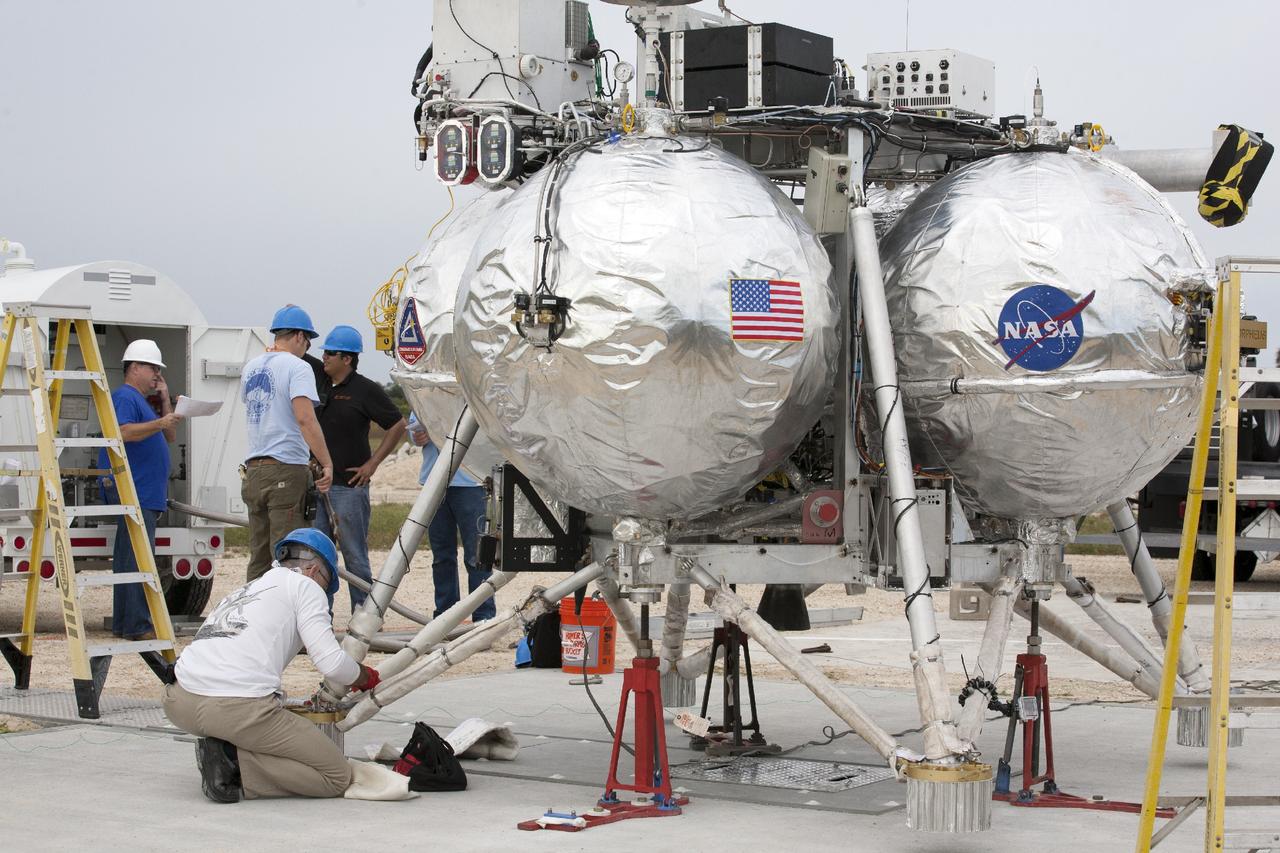
CAPE CANAVERAL, Fla. – At NASA’s Kennedy Space Center in Florida, technicians and engineers assist as the Project Morpheus prototype lander is attached to a tether and lowered onto a transportable launch platform positioned at the north end of the Shuttle Landing Facility. The lander will be prepared for a tethered test that includes lifting it 20 feet by crane, ascending another 10 feet, maneuvering backwards 10 feet, and then flying forward and descending to its original position, landing at the end of the tether. Testing of the prototype lander was performed at NASA’s Johnson Space Center in Houston in preparation for tethered and free flight testing at Kennedy. The landing facility will provide the lander with the kind of field necessary for realistic testing, complete with rocks, craters and hazards to avoid. Morpheus utilizes an autonomous landing and hazard avoidance technology, or ALHAT, payload that will allow it to navigate to clear landing sites amidst rocks, craters and other hazards during its descent. Project Morpheus is being managed under the Advanced Exploration Systems, or AES, Division in NASA’s Human Exploration and Operations Mission Directorate. The efforts in AES pioneer new approaches for rapidly developing prototype systems, demonstrating key capabilities and validating operational concepts for future human missions beyond Earth orbit. For more information on Project Morpheus, visit http://morpheuslander.jsc.nasa.gov. Photo credit: NASA/Kim Shiflett
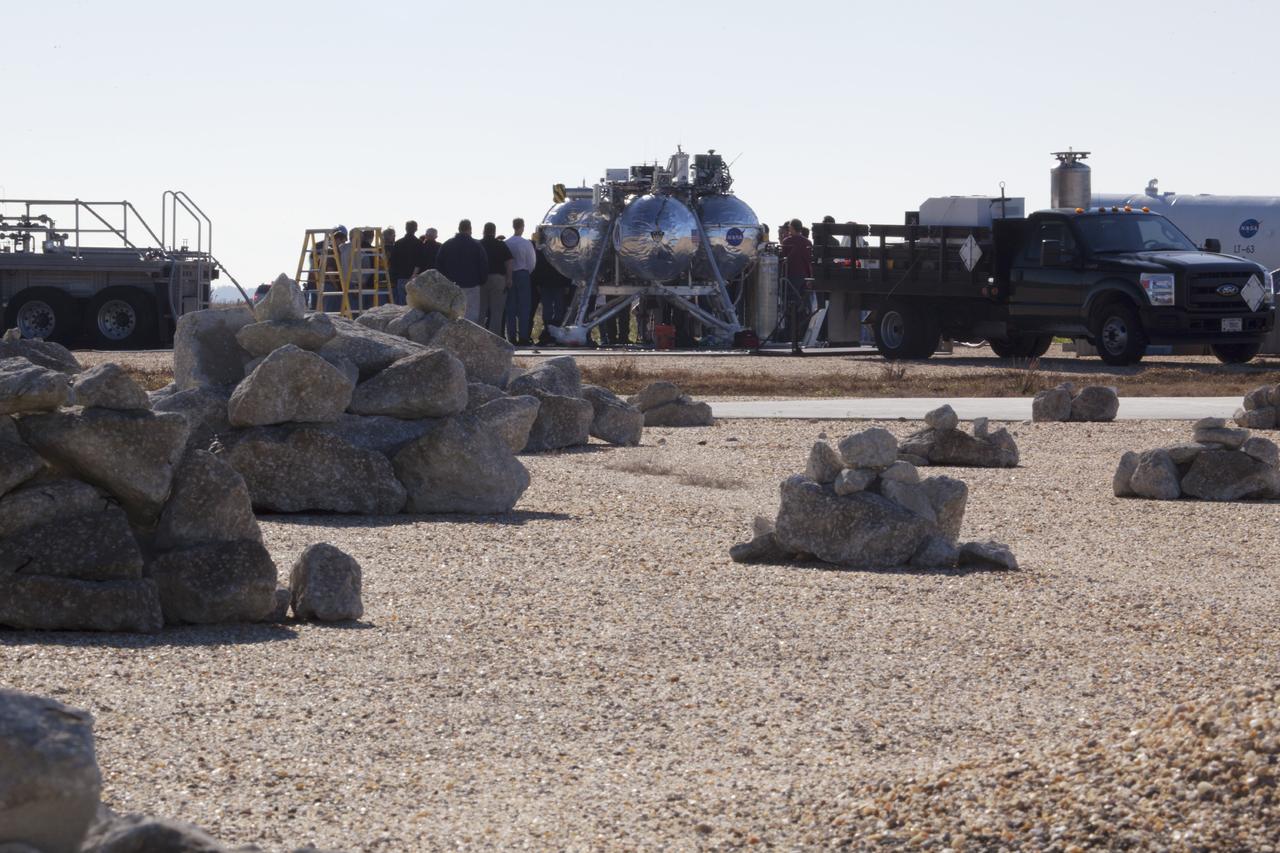
CAPE CANAVERAL, Fla. -- Preparations are underway to prepare the Project Morpheus prototype lander for a second free flight test at the north end of the Shuttle Landing Facility at NASA’s Kennedy Space Center in Florida. Testing of the prototype lander was performed at NASA’s Johnson Space Center in Houston in preparation for tethered and free flight testing at Kennedy. Project Morpheus integrates NASA’s automated landing and hazard avoidance technology, or ALHAT, with an engine that runs on liquid oxygen and methane, or green propellants, into a fully-operational lander that could deliver cargo to other planetary surfaces. The landing facility will provide the lander with the kind of field necessary for realistic testing, complete with rocks, craters and hazards to avoid. Morpheus’ ALHAT payload allows it to navigate to clear landing sites amidst rocks, craters and other hazards during its descent. Project Morpheus is being managed under the Advanced Exploration Systems, or AES, Division in NASA’s Human Exploration and Operations Mission Directorate. The efforts in AES pioneer new approaches for rapidly developing prototype systems, demonstrating key capabilities and validating operational concepts for future human missions beyond Earth orbit. For more information on Project Morpheus, visit http://morpheuslander.jsc.nasa.gov. Photo credit: NASA/Dimitri Gerondidakis
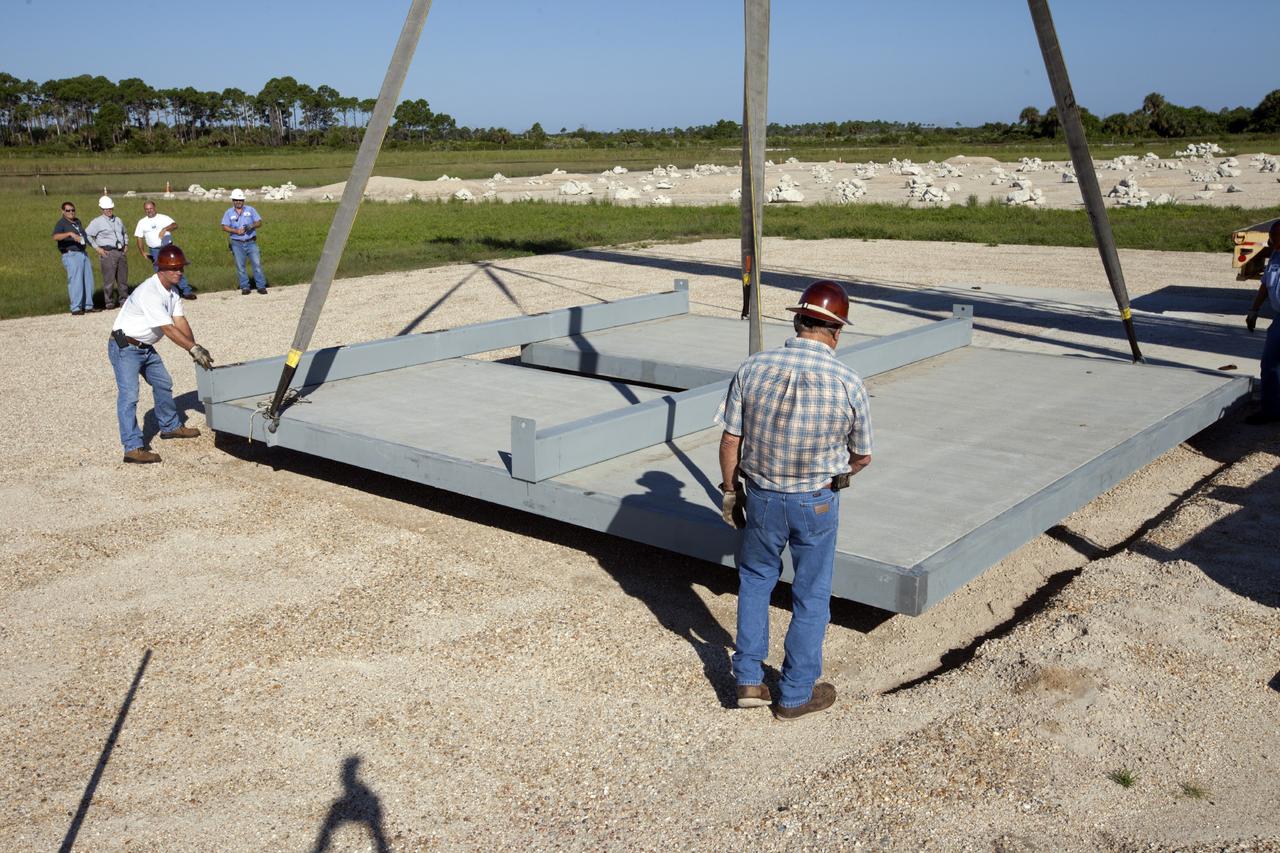
CAPE CANAVERAL, Fla. - At NASA’s Kennedy Space Center in Florida, workers lower the movable launch platform for the Project Morpheus lander onto its new site adjacent to a hazard field created to support the project at the north end of the Shuttle Landing Facility, or SLF. Testing of the prototype lander has been ongoing at NASA’s Johnson Space Center in Houston in preparation for free flight. The lander is scheduled for delivery to Kennedy in October. The SLF will provide the lander with the kind of field necessary for realistic testing, complete with rocks, craters and hazards to avoid. Morpheus utilizes an autonomous landing and hazard avoidance technology, or ALHAT, payload that will allow it to navigate to clear landing sites amidst obstacles during its descent. Project Morpheus is one of 20 small projects comprising the Advanced Exploration Systems, or AES, program in NASA’s Human Exploration and Operations Mission Directorate. AES projects pioneer new approaches for rapidly developing prototype systems, demonstrating key capabilities and validating operational concepts for future human missions beyond Earth orbit. For more information on Project Morpheus, visit http://www.nasa.gov/centers/johnson/exploration/morpheus/index.html. Photo credit: NASA/Kim Shiflett