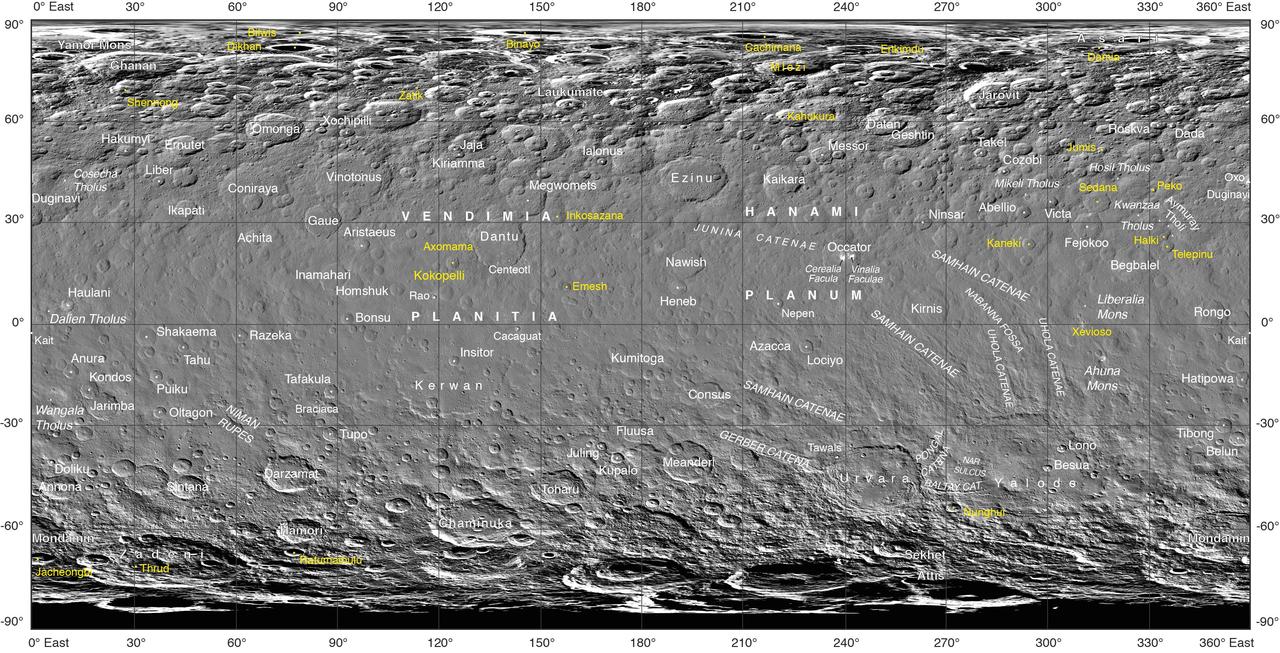
Often, the names of features on planetary bodies are connected through a specific theme -- for example, many features on the Moon have been named after famous scientists. NASA's Dawn mission, together with the International Astronomical Union, established that craters on Ceres would be named for agricultural deities from all over the world, and other features would be named for agricultural festivals. Ceres itself was named after the Roman goddess of corn and harvests by its discoverer, Giuseppe Piazzi, who spotted it with his telescope in 1801. Since March 2015, Dawn has been orbiting Ceres and sending back many intriguing images and other data about its features. Using suggestions from the Dawn team, the IAU recently approved 25 new Ceres feature names tied to theme of agricultural deities, marked in yellow on the map. Emesh Crater, for example, is named for the Sumerian god of vegetation and agriculture. Jumi is the Latvian god of fertility of the field. The newly named surface features vary in size. Thrud, for example, is a crater with a diameter of 4.8 miles (7.8 kilometers) within the larger crater Zadeni, while Mlezi has a diameter of 28 miles (42 kilometers). For more information, the characteristics of these and other features on Ceres can be found in the IAU's Gazetteer of Planetary Nomenclature. https://photojournal.jpl.nasa.gov/catalog/PIA21755
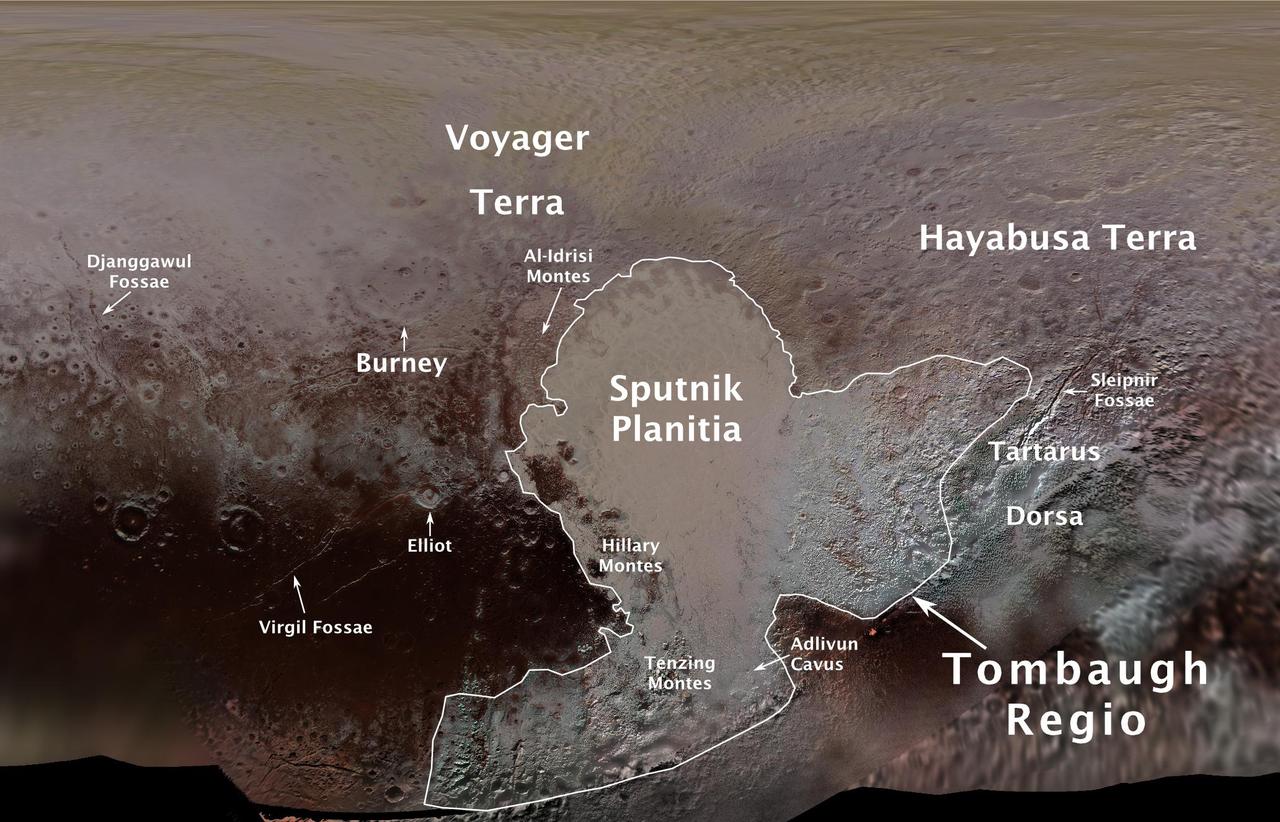
The International Astronomical Union (IAU), the internationally recognized authority for naming celestial bodies and their surface features, approved names of 14 surface features on Pluto in August 2017. The names were proposed by NASA's New Horizons team following the first reconnaissance of Pluto and its moons by the New Horizons spacecraft in 2015. The names, listed below, pay homage to the underworld mythology, pioneering space missions, historic pioneers who crossed new horizons in exploration, and scientists and engineers associated with Pluto and the Kuiper Belt. Tombaugh Regio honors Clyde Tombaugh (1906-1997), the U.S. astronomer who discovered Pluto in 1930 from Lowell Observatory in Arizona. Burney crater honors Venetia Burney (1918-2009), who as an 11-year-old schoolgirl suggested the name "Pluto" for Clyde Tombaugh's newly discovered planet. Later in life she taught mathematics and economics. Sputnik Planitia is a large plain named for Sputnik 1, the first space satellite, launched by the Soviet Union in 1957. Tenzing Montes and Hillary Montes are mountain ranges honoring Tenzing Norgay (1914-1986) and Sir Edmund Hillary (1919-2008), the Indian/Nepali Sherpa and New Zealand mountaineer were the first to reach the summit of Mount Everest and return safely. Al-Idrisi Montes honors Ash-Sharif al-Idrisi (1100-1165/66), a noted Arab mapmaker and geographer whose landmark work of medieval geography is sometimes translated as "The Pleasure of Him Who Longs to Cross the Horizons.†Djanggawul Fossae defines a network of long, narrow depressions named for the Djanggawuls, three ancestral beings in indigenous Australian mythology who traveled between the island of the dead and Australia, creating the landscape and filling it with vegetation. Sleipnir Fossa is named for the powerful, eight-legged horse of Norse mythology that carried the god Odin into the underworld. Virgil Fossae honors Virgil, one of the greatest Roman poets and Dante's fictional guide through hell and purgatory in the Divine Comedy. Adlivun Cavus is a deep depression named for Adlivun, the underworld in Inuit mythology. Hayabusa Terra is a large land mass saluting the Japanese spacecraft and mission (2003-2010) that performed the first asteroid sample return. Voyager Terra honors the pair of NASA spacecraft, launched in 1977, that performed the first "grand tour" of all four giant planets. The Voyager spacecraft are now probing the boundary between the Sun and interstellar space. Tartarus Dorsa is a ridge named for Tartarus, the deepest, darkest pit of the underworld in Greek mythology. Elliot crater recognizes James Elliot (1943-2011), an MIT researcher who pioneered the use of stellar occultations to study the solar system -- leading to discoveries such as the rings of Uranus and the first detection of Pluto's thin atmosphere. https://photojournal.jpl.nasa.gov/catalog/PIA21944
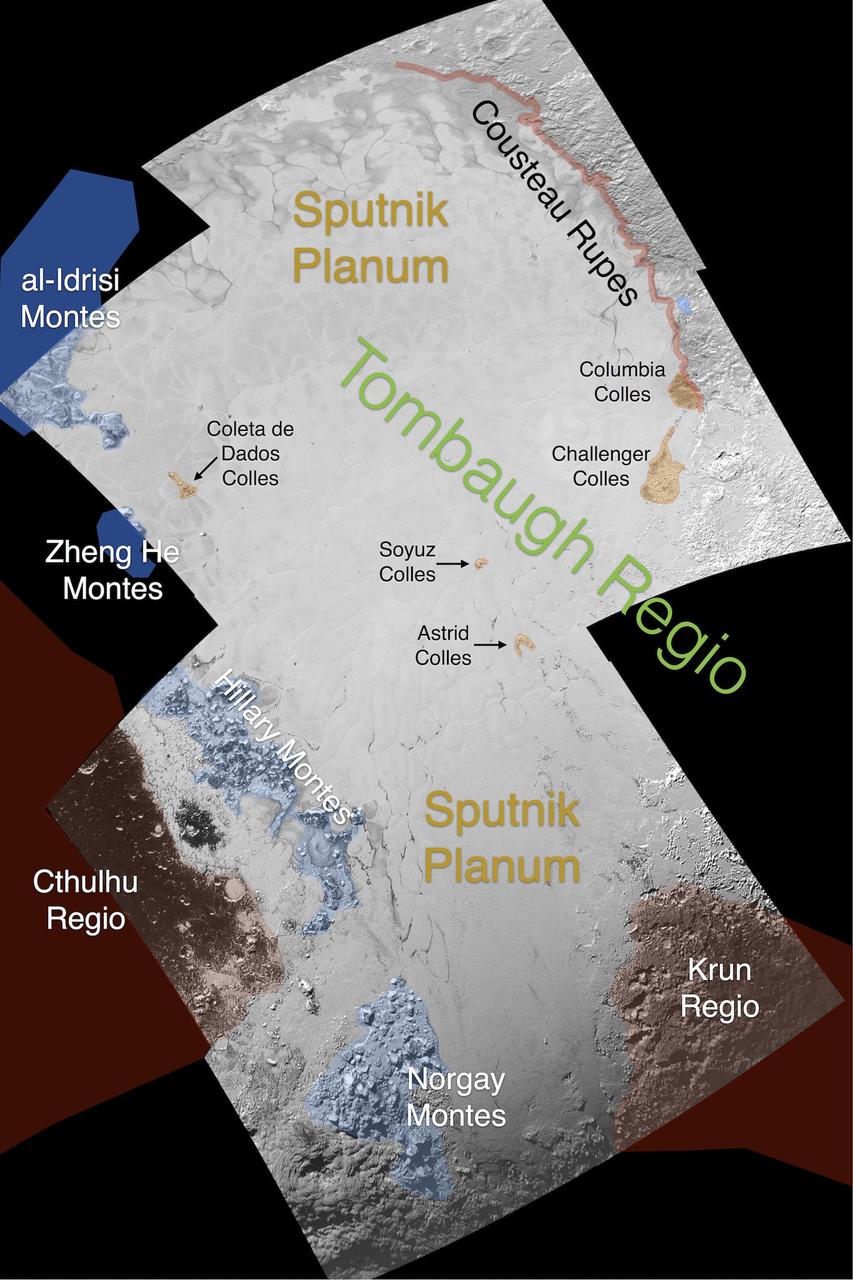
This image contains the initial, informal names being used by NASA's New Horizons team for the features on Pluto's Sputnik Planum (plain). Names were selected based on the input the team received from the Our Pluto naming campaign. Names have not yet been approved by the International Astronomical Union (IAU). For more information on the maps and feature naming, visit http://www.ourpluto.org/maps. http://photojournal.jpl.nasa.gov/catalog/PIA19865
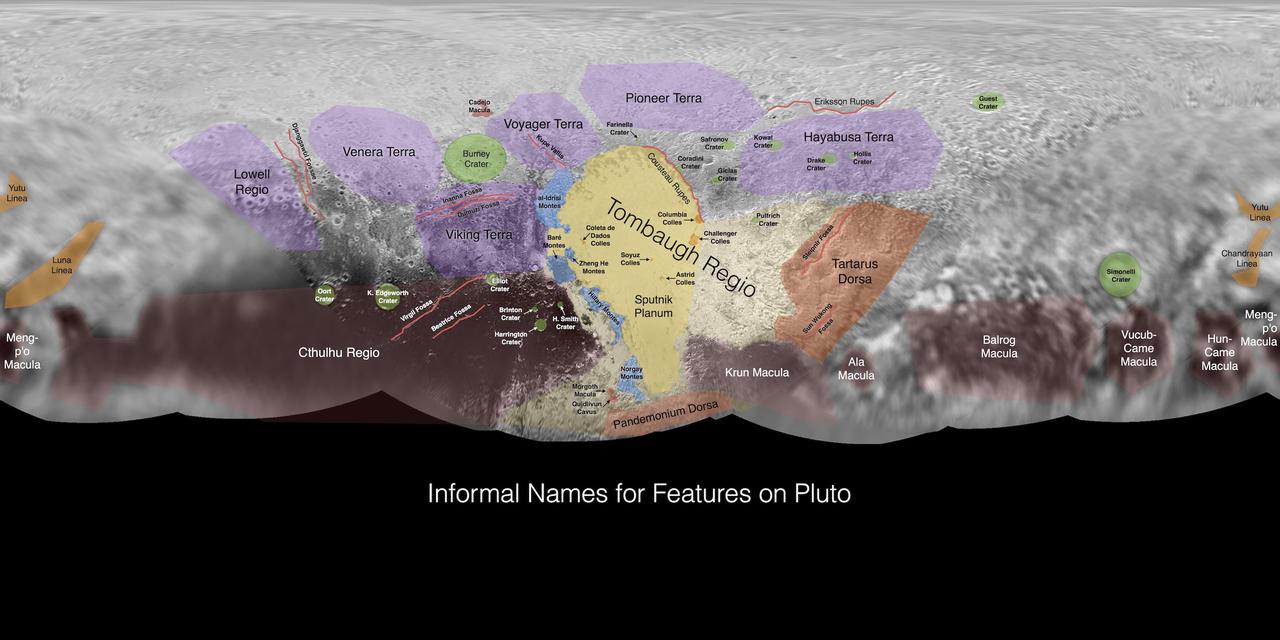
This image contains the initial, informal names being used by NASA's New Horizons team for the features and regions on the surface of Pluto. Names were selected based on the input the team received from the Our Pluto naming campaign. Names have not yet been approved by the International Astronomical Union (IAU). For more information on the maps and feature naming, visit http://www.ourpluto.org/maps. http://photojournal.jpl.nasa.gov/catalog/PIA19863
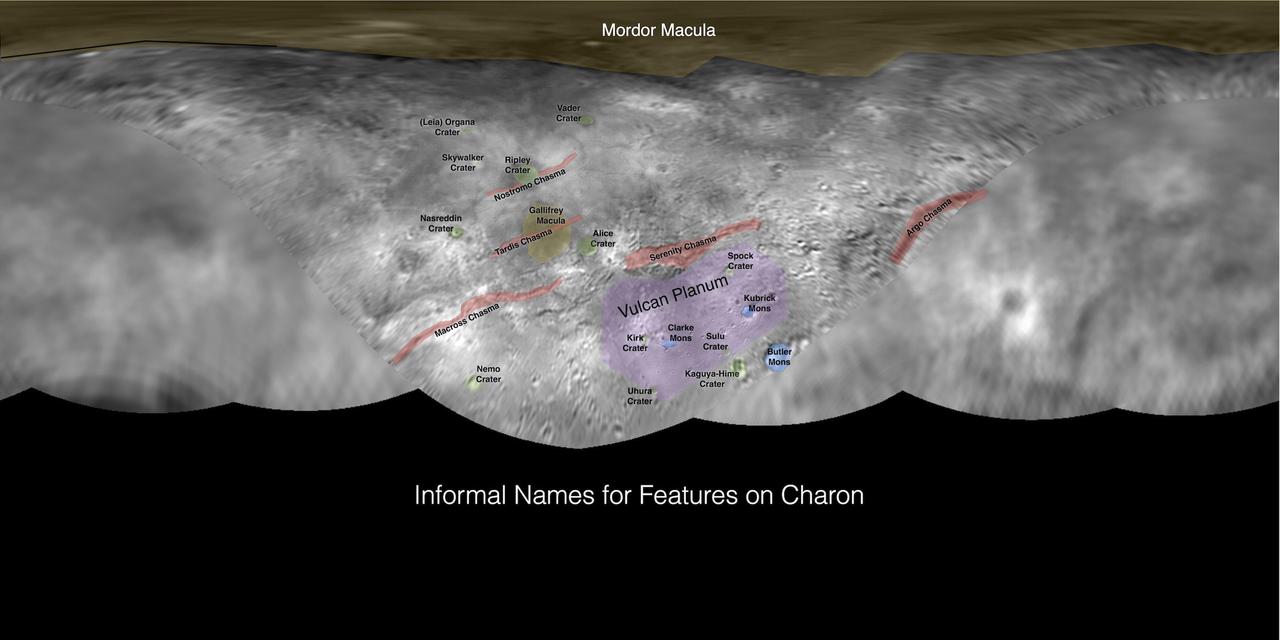
This image contains the initial, informal names being used by NASA's New Horizons team for the features on Pluto's largest moon, Charon. Names were selected based on the input the team received from the Our Pluto naming campaign. Names have not yet been approved by the International Astronomical Union (IAU). For more information on the maps and feature naming, visit http://www.ourpluto.org/maps. http://photojournal.jpl.nasa.gov/catalog/PIA19864
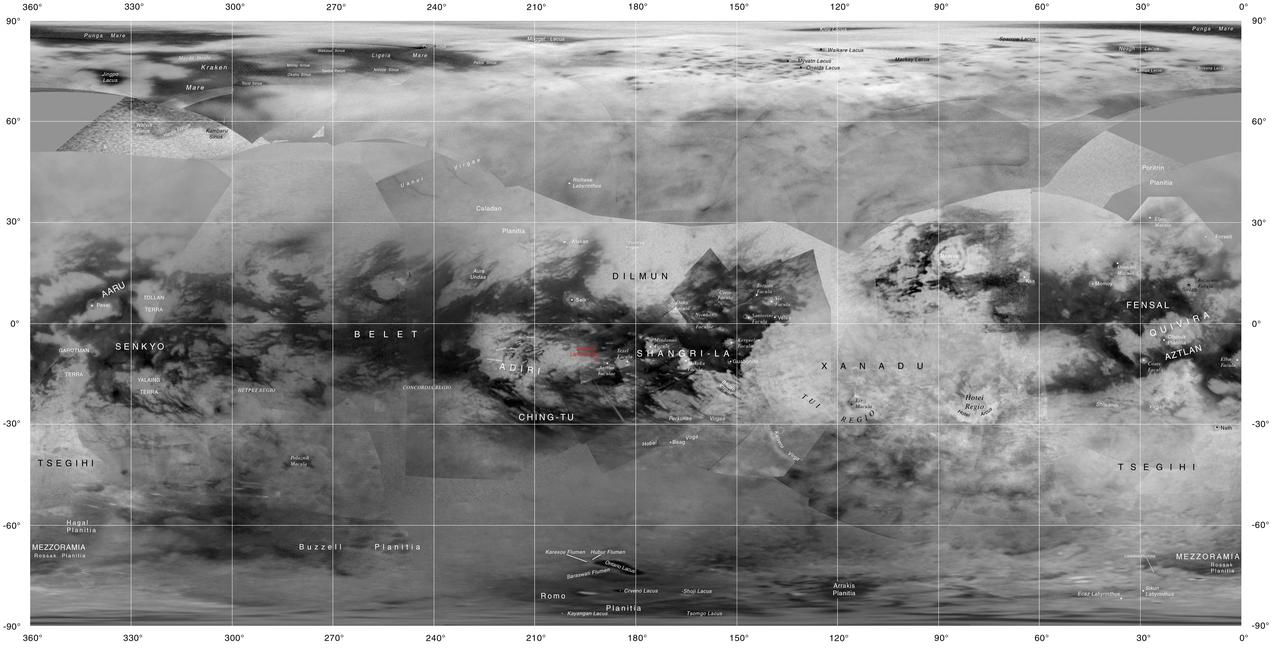
This map of Titan shows the names of many (but not all) features on the Saturnian moon that have been approved by the International Astronomical Union. This map was produced by the USGS Astrogeology Science Center for the International Astronomical Union (IAU) Working Group for Planetary System Nomenclature. http://photojournal.jpl.nasa.gov/catalog/PIA20713
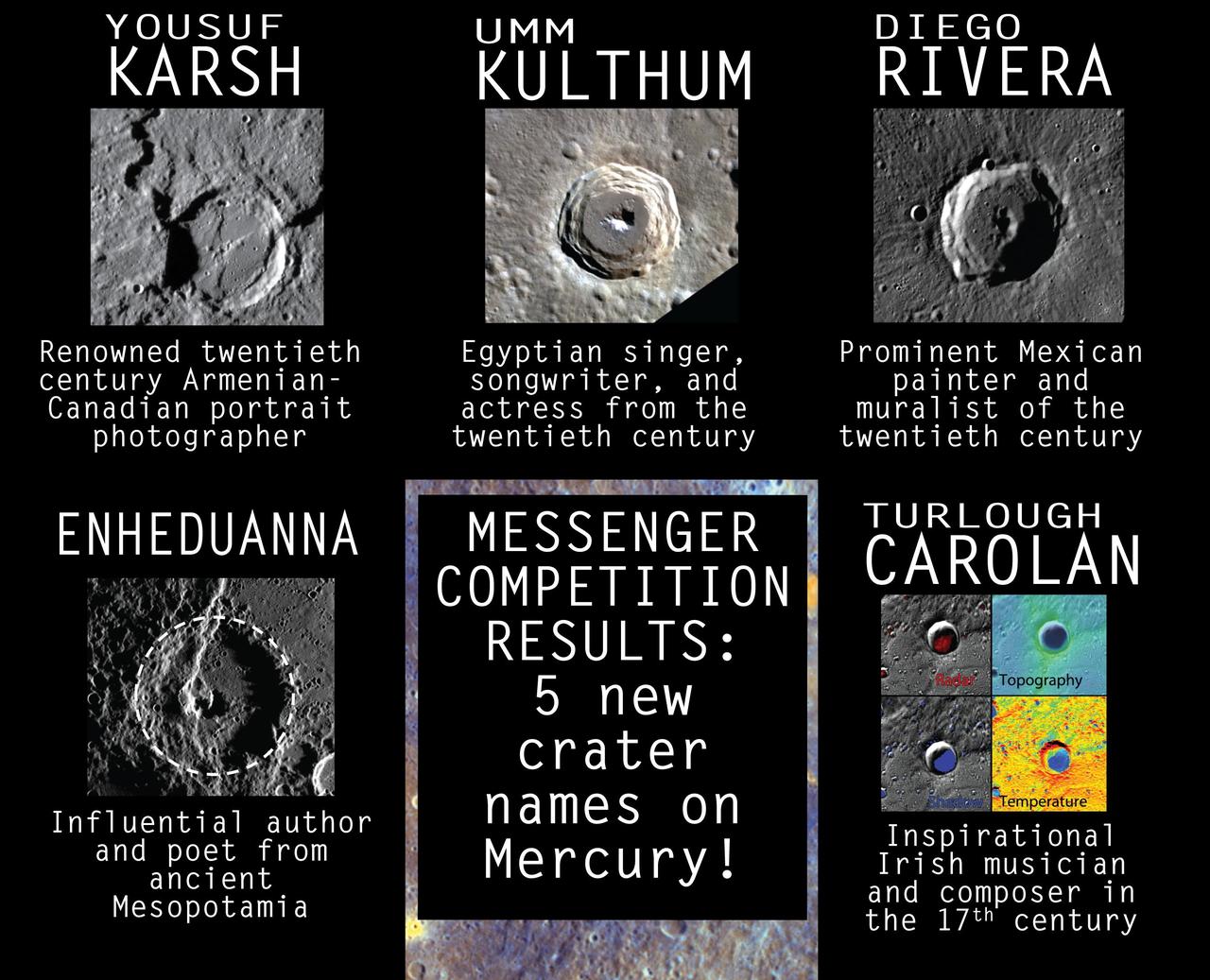
Five previously unnamed craters on Mercury now have names. MESSENGER's Education and Public Outreach (EPO) team led a contest that solicited naming suggestions from the public via a competition website. In total, 3,600 contest entries were received and a semi-final list of 17 names were submitted to the International Astronomical Union (IAU) for consideration. The IAU selected the final five crater names, keeping with the convention that Mercury's craters are named after those who have made significant contributions to the humanities. And the winners are: Carolan: (83.8° N, 31.7° E) Named for Turlough O'Carolan, the Irish musician and composer (1670-1738) Enheduanna: (48.3° N, 326.2° E) Named for the author and poet from ancient Mesopotamia Karsh (35.6° S, 78.9° E) Named for Yousuf Karsh, twentieth century Armenian-Canadian portrait photographer Kulthum (50.7° N, 93.5° E) Named for Umm Kulthum, twentieth century Egyptian singer, songwriter, and actress Rivera: (69.3° N, 32.4° E) Named for Diego Rivera, twentieth century Mexican painter and muralist http://photojournal.jpl.nasa.gov/catalog/PIA19439
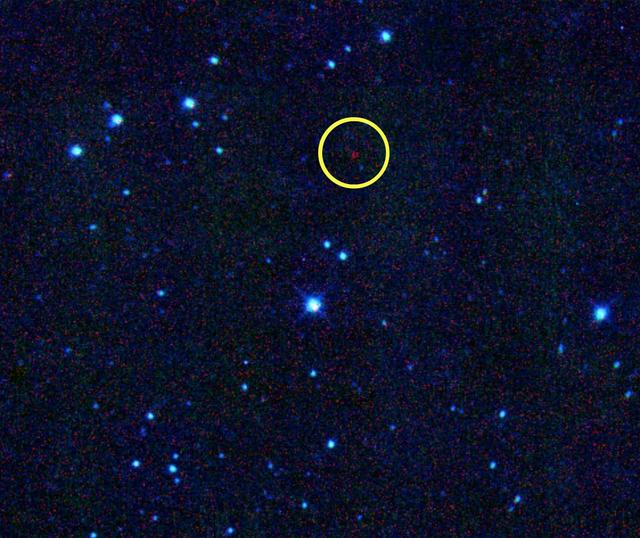
An asteroid discovered by NASA NEOWISE spacecraft has been given the formal designation 316201 Malala, in honor of Malala Yousafzai of Pakistan, who received the Nobel Peace Prize in 2014. The asteroid previous appellation was 2010 ML48. The International Astronomical Union (IAU) renamed the asteroid as the request of Amy Mainzer of NASA's Jet Propulsion Laboratory, Pasadena, California. Mainzer is the principal investigator of NASA's NEOWISE space telescope. The IAU is the sole worldwide organization recognized by astronomers everywhere to designate names for astronomical bodies. So far, Mainzer and the NEOWISE team have focused on pioneers in civil rights, science and the arts for the astronomical honor. Among the strong women of history who have already had NEOWISE-discovered asteroids named for them are civil rights activist Rosa Parks, conservationist Wangari Maathai, abolitionists Sojourner Truth and Harriet Tubman, and singer Aretha Franklin. Asteroid Malala is in the main belt between Mars and Jupiter and orbits the sun every five-and-a-half years. It is about two-and-a-half miles (four kilometers) in diameter, and its surface is very dark, the color of printer toner. http://photojournal.jpl.nasa.gov/catalog/PIA19362
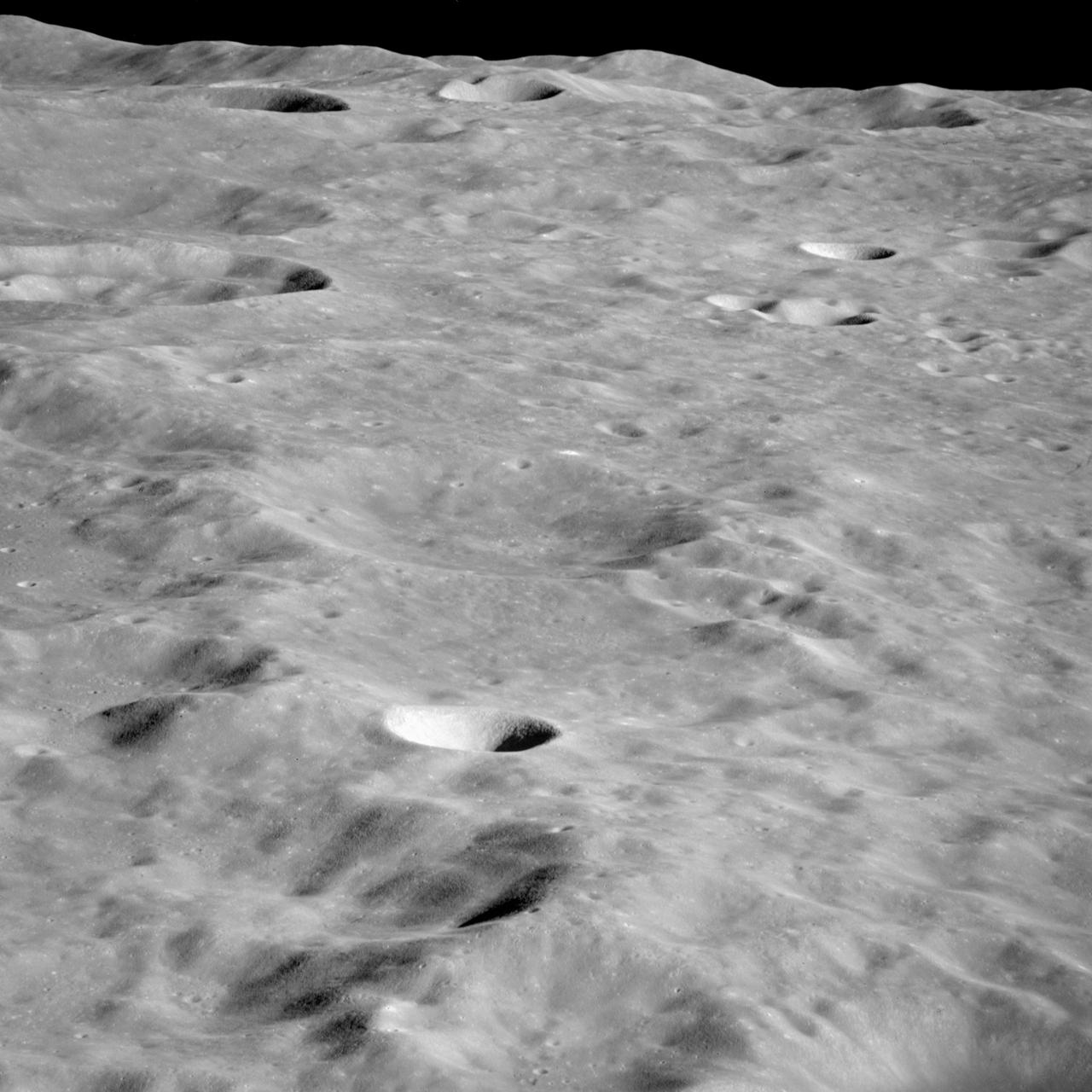
AS10-34-5173 (18-26 May 1969) --- An Apollo 10 photograph of the lunar farside showing an area in the vicinity of International Astronomical Union (I.A.U.) crater No. 300, taken from the Command and Service Modules. This view is looking south over typical rugged lunar terrain. I.A.U. crater No. 300 is located at 155 degrees east longitude and 10 degrees south latitude.
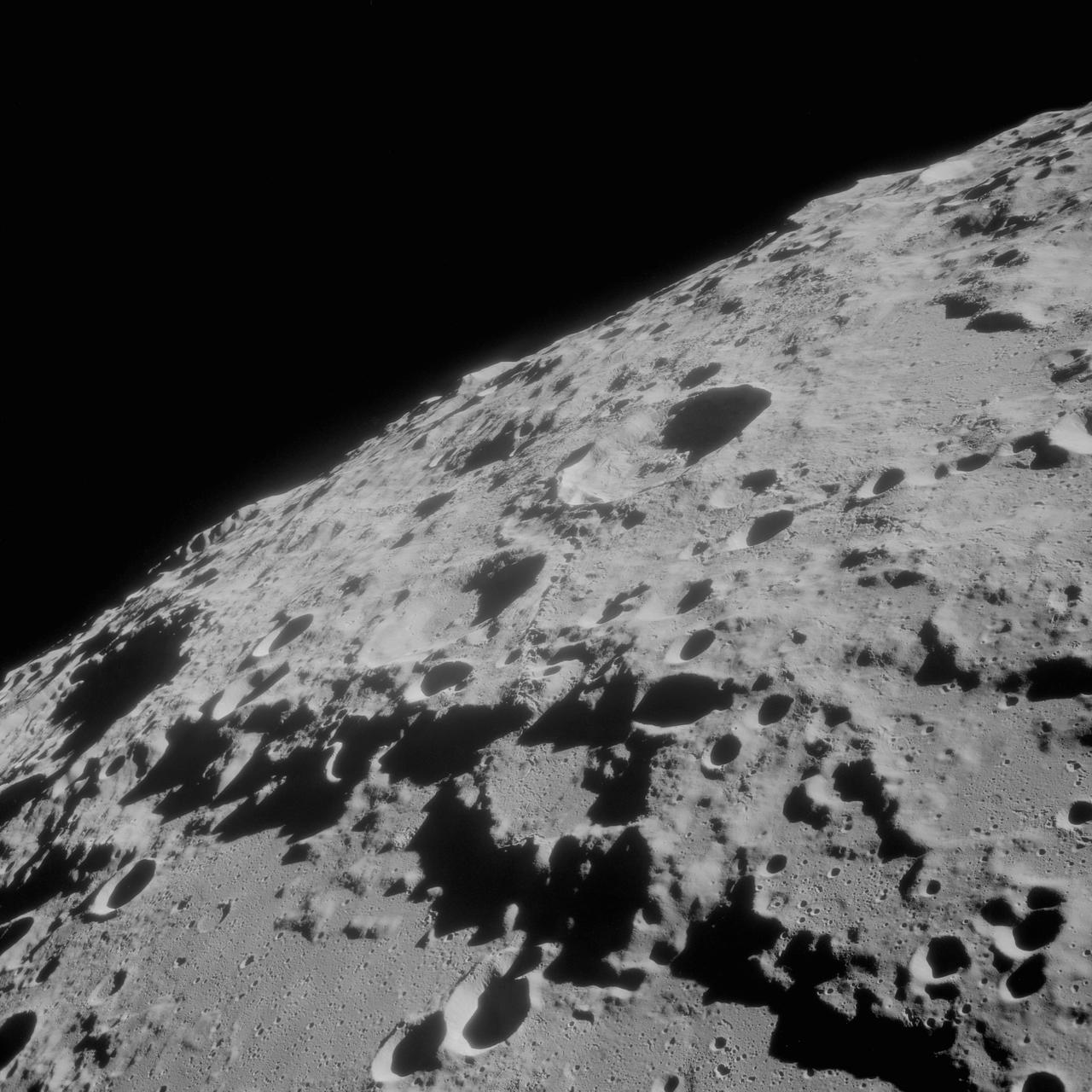
AS11-42-6248 (July 1969) --- An Apollo 11 oblique view of the lunar farside in the area of International Astronomical Union crater No. 312, which is about 30 statute miles in diameter. The center of the photograph is located at 164 degrees west longitude and 8 degrees south latitude. The sharp shadows indicate that the picture was taken at a low sun angle.