
Looking like a spider web swirled into a spiral, galaxy IC 342 presents its delicate pattern of dust in this infrared light image from NASA Spitzer Space Telescope. The very center glows especially brightly in the infrared.
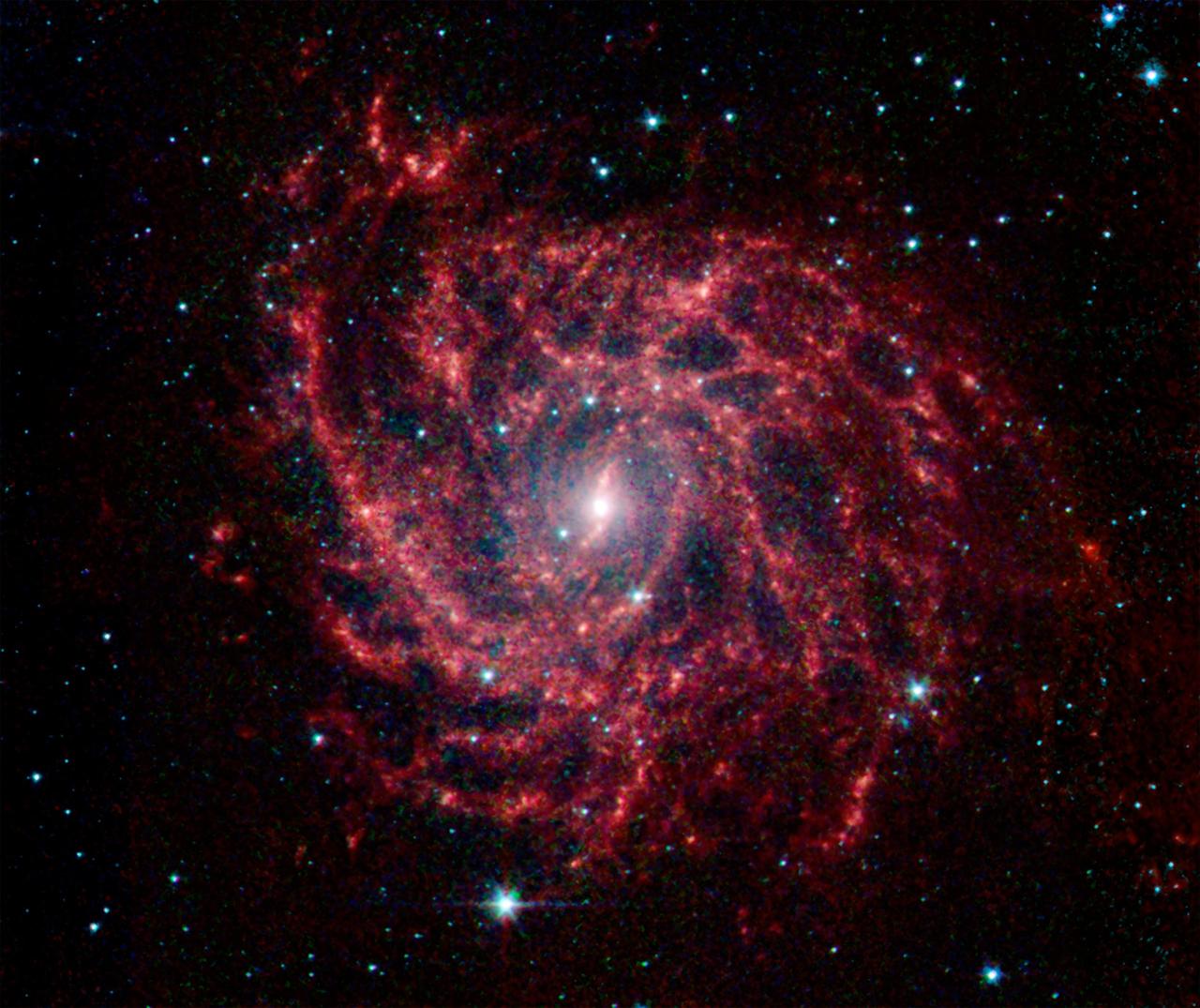
Looking like a spider web swirled into a spiral, galaxy IC 342 presents its delicate pattern of dust in this infrared light image from NASA Spitzer Space Telescope.
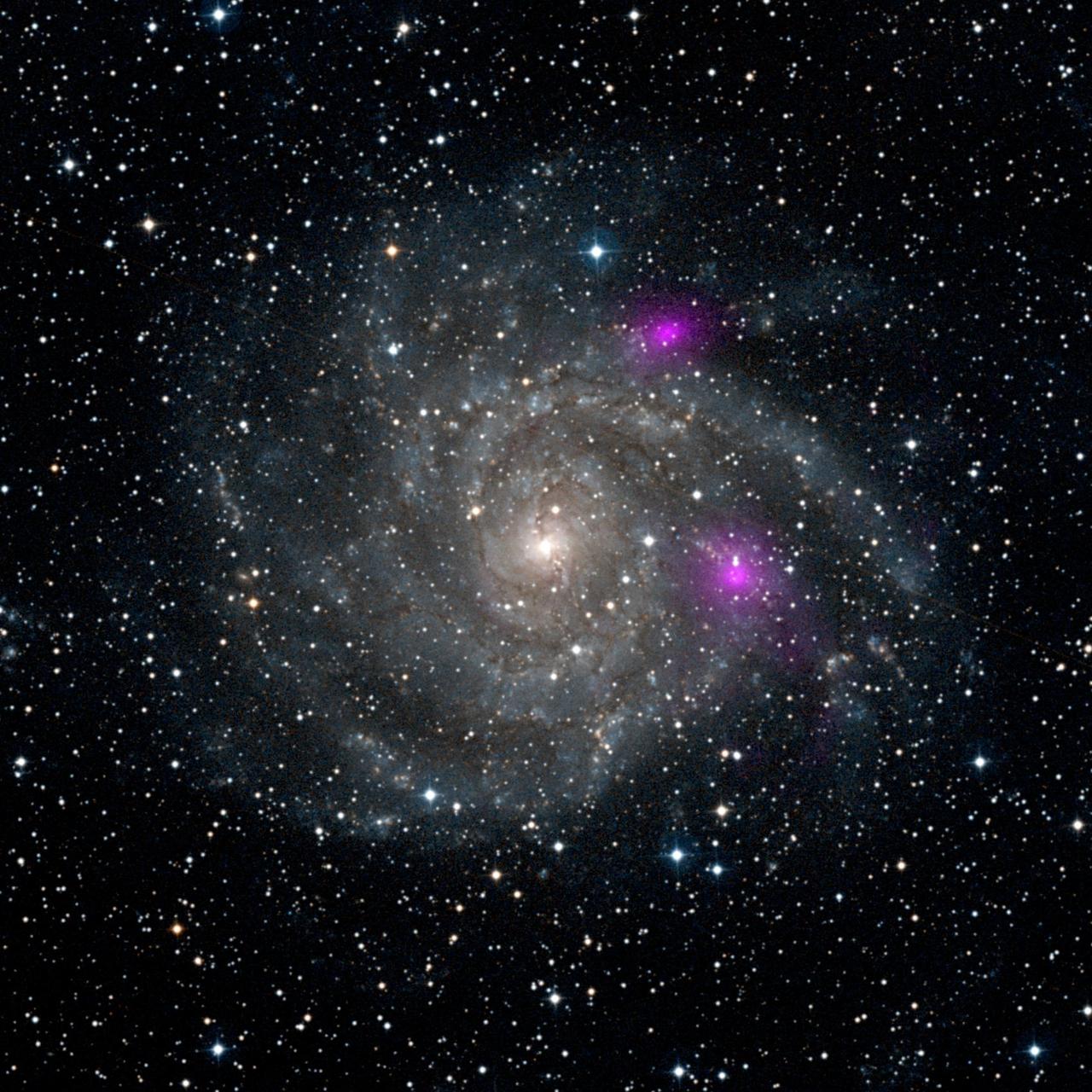
This new view of spiral galaxy IC 342, also known as Caldwell 5, includes data from NASA Nuclear Spectroscopic Telescope Array, or NuSTAR. IC 342 lies 7 million light-years away in the Camelopardalis constellation.
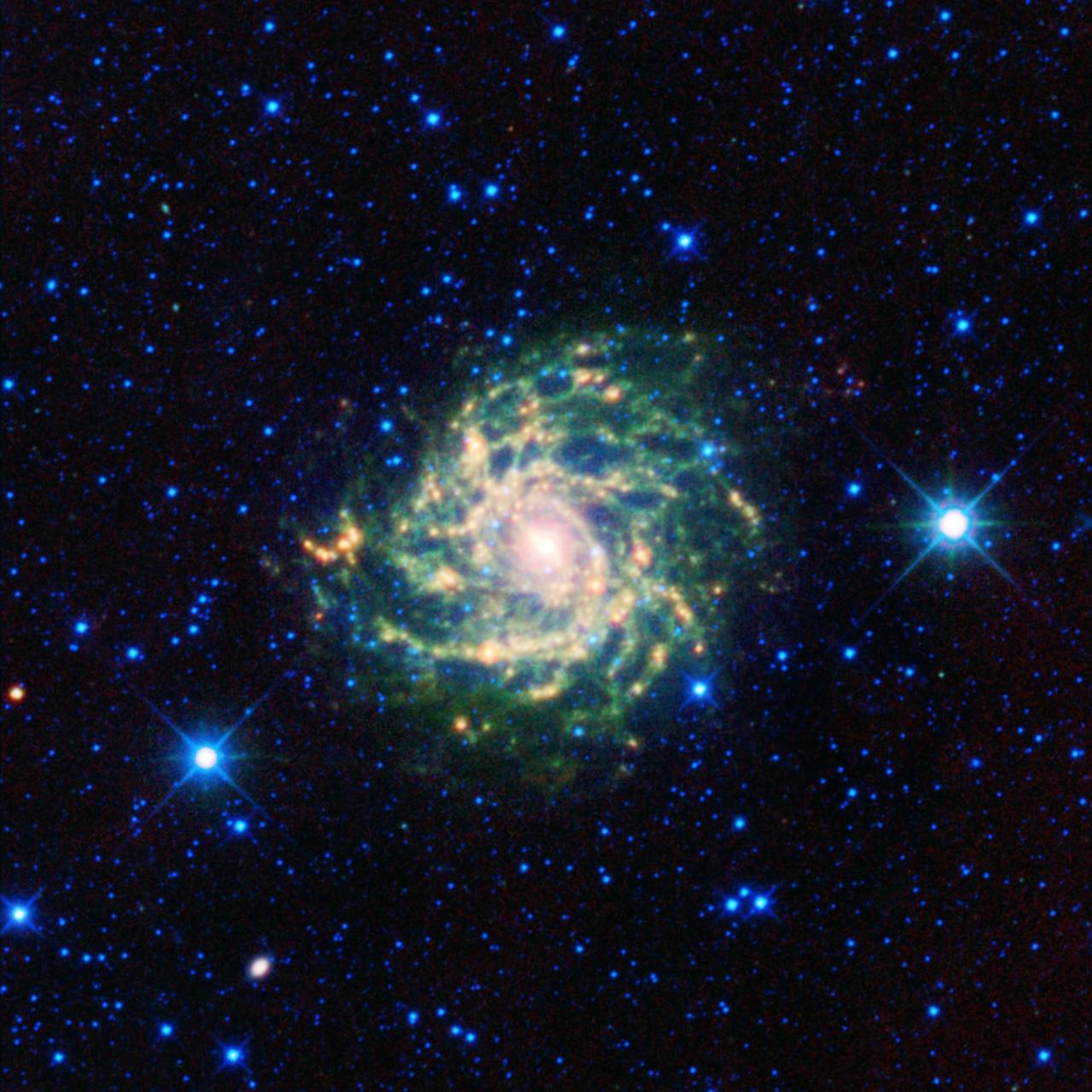
A leggy cosmic creature comes out of hiding in this new infrared view from NASA Wide-field Infrared Survey Explorer. The spiral beauty, called IC 342 and sometimes the hidden galaxy, is shrouded behind our own galaxy, the Milky Way.
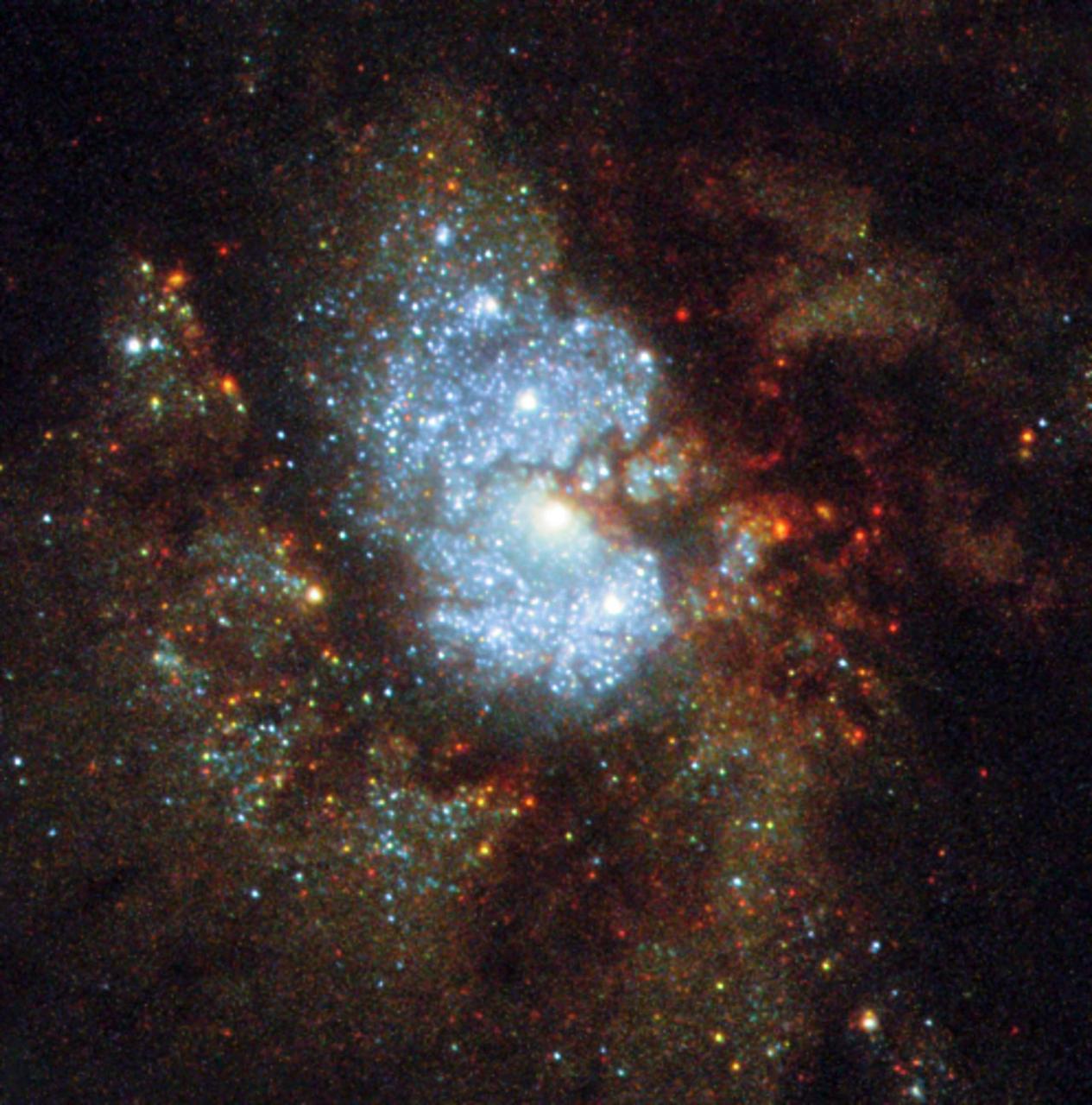
IC 342 is a challenging cosmic target. Although it is bright, the galaxy sits near the equator of the Milky Way’s galactic disk, where the sky is thick with glowing cosmic gas, bright stars, and dark, obscuring dust. In order for astronomers to see the intricate spiral structure of IC 342, they must gaze through a large amount of material contained within our own galaxy — no easy feat! As a result IC 342 is relatively difficult to spot and image, giving rise to its intriguing nickname: the “Hidden Galaxy.” Located very close (in astronomical terms) to the Milky Way, this sweeping spiral galaxy would be among the brightest in the sky were it not for its dust-obscured location. The galaxy is very active, as indicated by the range of colors visible in this NASA/ESA Hubble Space Telescope image, depicting the very central region of the galaxy. A beautiful mixture of hot, blue star-forming regions, redder, cooler regions of gas, and dark lanes of opaque dust can be seen, all swirling together around a bright core. In 2003, astronomers confirmed this core to be a specific type of central region known as an HII nucleus — a name that indicates the presence of ionized hydrogen — that is likely to be creating many hot new stars. Credit: ESA/Hubble & NASA <b><a href="http://www.nasa.gov/audience/formedia/features/MP_Photo_Guidelines.html" rel="nofollow">NASA image use policy.</a></b> <b><a href="http://www.nasa.gov/centers/goddard/home/index.html" rel="nofollow">NASA Goddard Space Flight Center</a></b> enables NASA’s mission through four scientific endeavors: Earth Science, Heliophysics, Solar System Exploration, and Astrophysics. Goddard plays a leading role in NASA’s accomplishments by contributing compelling scientific knowledge to advance the Agency’s mission. <b>Follow us on <a href="http://twitter.com/NASAGoddardPix" rel="nofollow">Twitter</a></b> <b>Like us on <a href="http://www.facebook.com/pages/Greenbelt-MD/NASA-Goddard/395013845897?ref=tsd" rel="nofollow">Facebook</a></b> <b>Find us on <a href="http://instagrid.me/nasagoddard/?vm=grid" rel="nofollow">Instagram</a></b>
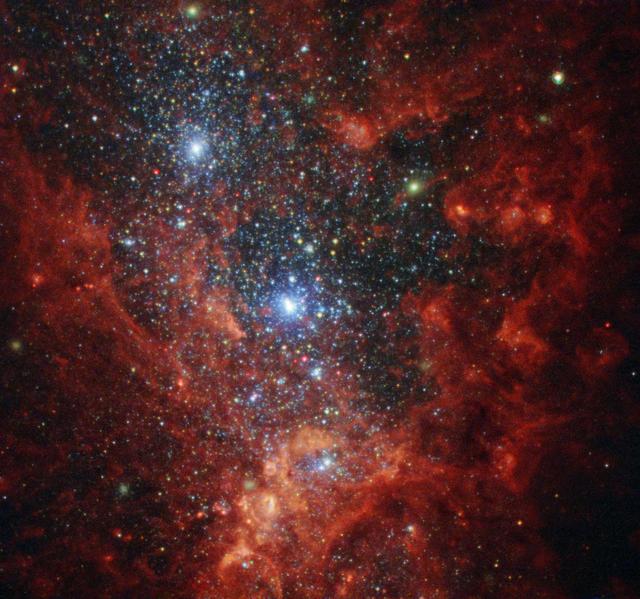
This NASA/ESA Hubble Space Telescope image reveals the iridescent interior of one of the most active galaxies in our local neighbourhood — NGC 1569, a small galaxy located about eleven million light-years away in the constellation of Camelopardalis (The Giraffe). This galaxy is currently a hotbed of vigorous star formation. NGC 1569 is a starburst galaxy, meaning that — as the name suggests — it is bursting at the seams with stars, and is currently producing them at a rate far higher than that observed in most other galaxies. For almost 100 million years, NGC 1569 has pumped out stars over 100 times faster than the Milky Way! As a result, this glittering galaxy is home to super star clusters, three of which are visible in this image — one of the two bright clusters is actually the superposition of two massive clusters. Each containing more than a million stars, these brilliant blue clusters reside within a large cavity of gas carved out by multiple supernovae, the energetic remnants of massive stars. In 2008, Hubble observed the galaxy's cluttered core and sparsely populated outer fringes. By pinpointing individual red giant stars, Hubble’s Advanced Camera for Surveys enabled astronomers to calculate a new — and much more precise — estimate for NGC 1569’s distance. This revealed that the galaxy is actually one and a half times further away than previously thought, and a member of the IC 342 galaxy group. Astronomers suspect that the IC 342 cosmic congregation is responsible for the star-forming frenzy observed in NGC 1569. Gravitational interactions between this galactic group are believed to be compressing the gas within NGC 1569. As it is compressed, the gas collapses, heats up and forms new stars.
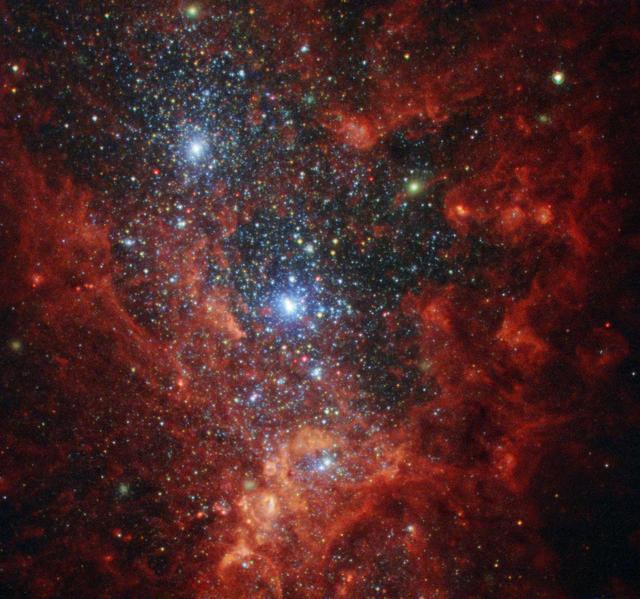
This galaxy is currently a hotbed of vigorous star formation. NGC 1569 is a starburst galaxy, meaning that — as the name suggests — it is bursting at the seams with stars, and is currently producing them at a rate far higher than that observed in most other galaxies. For almost 100 million years, NGC 1569 has pumped out stars more than 100 times faster than the Milky Way! As a result, this glittering galaxy is home to super star clusters, three of which are visible in this image — one of the two bright clusters is actually the superposition of two massive clusters. Each containing more than a million stars, these brilliant blue clusters reside within a large cavity of gas carved out by multiple supernovae, the energetic remnants of massive stars. In 2008, Hubble observed the galaxy's cluttered core and sparsely populated outer fringes. By pinpointing individual red giant stars, Hubble’s Advanced Camera for Surveys enabled astronomers to calculate a new — and much more precise — estimate for NGC 1569’s distance. This revealed that the galaxy is actually one and a half times farther away than previously thought, and a member of the IC 342 galaxy group. Astronomers suspect that the IC 342 cosmic congregation is responsible for the star-forming frenzy observed in NGC 1569. Gravitational interactions between this galactic group are believed to be compressing the gas within NGC 1569. As it is compressed, the gas collapses, heats up and forms new stars. Image credit: ESA/Hubble & NASA, Aloisi, Ford; Acknowledgement: Judy Schmidt