
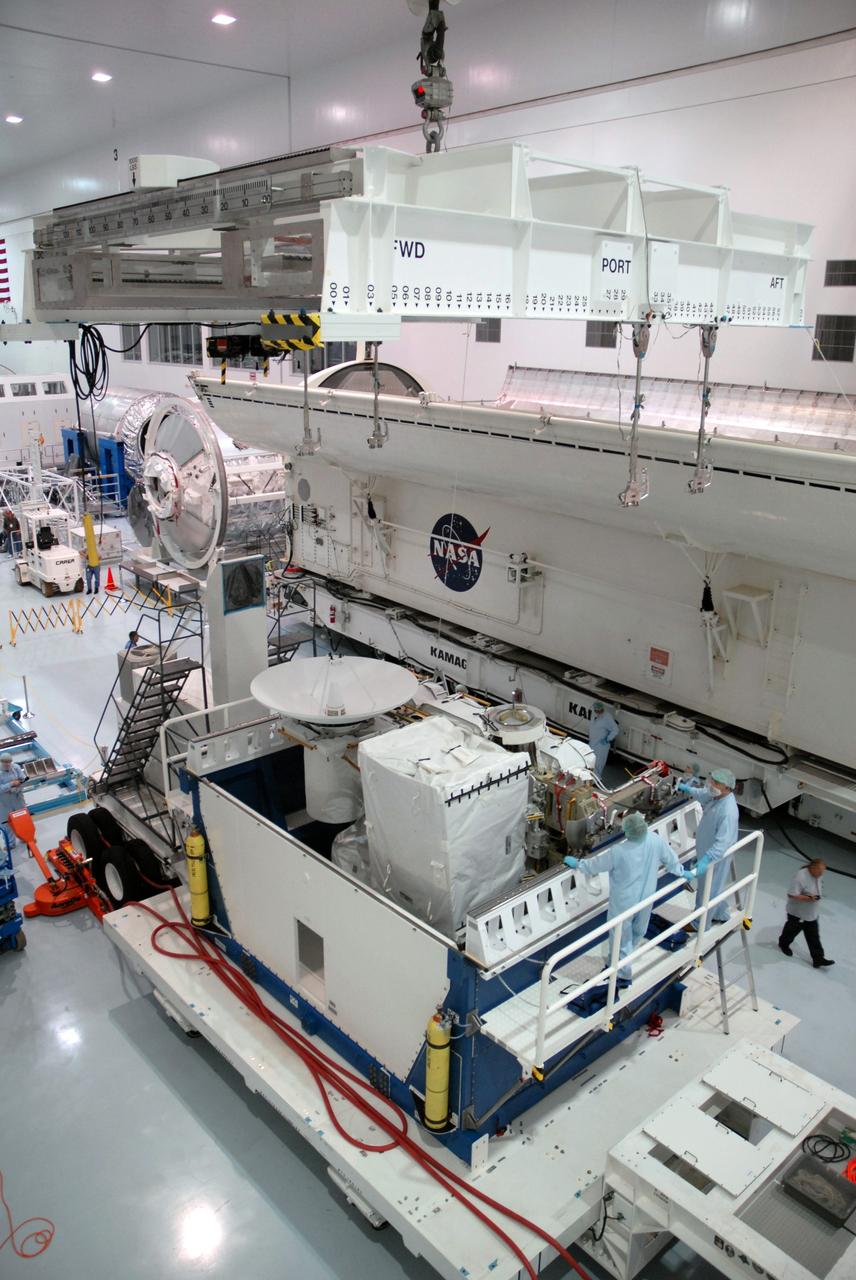
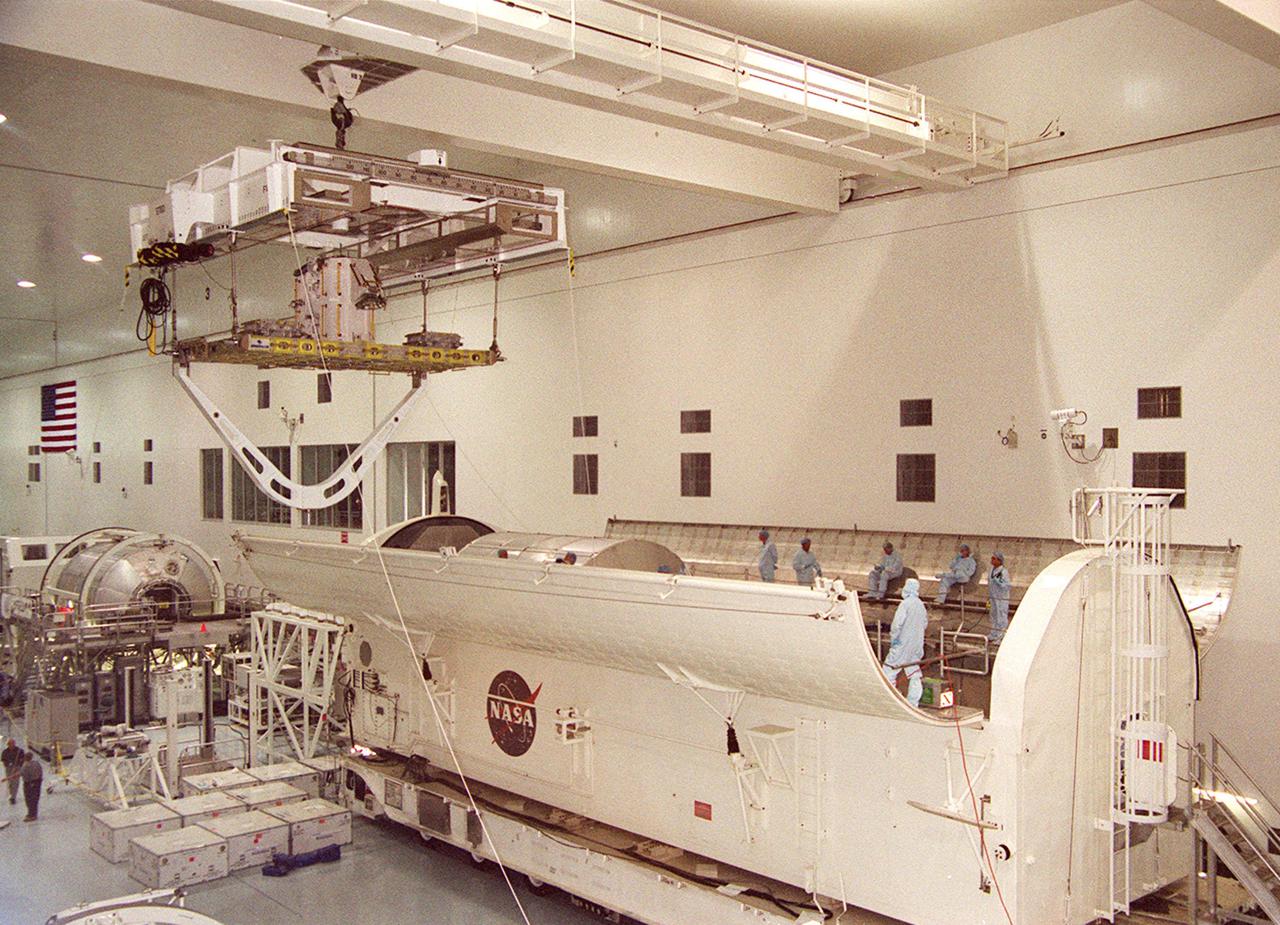
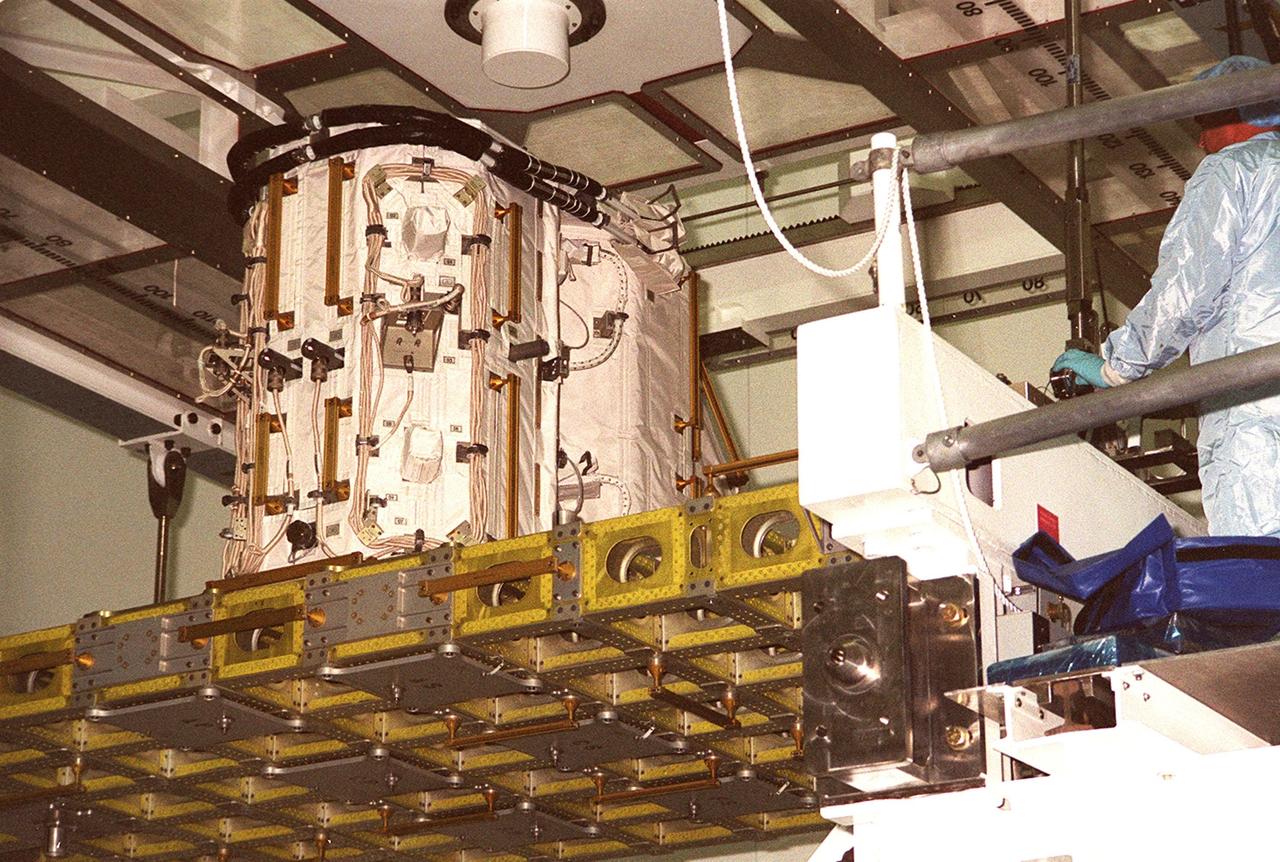
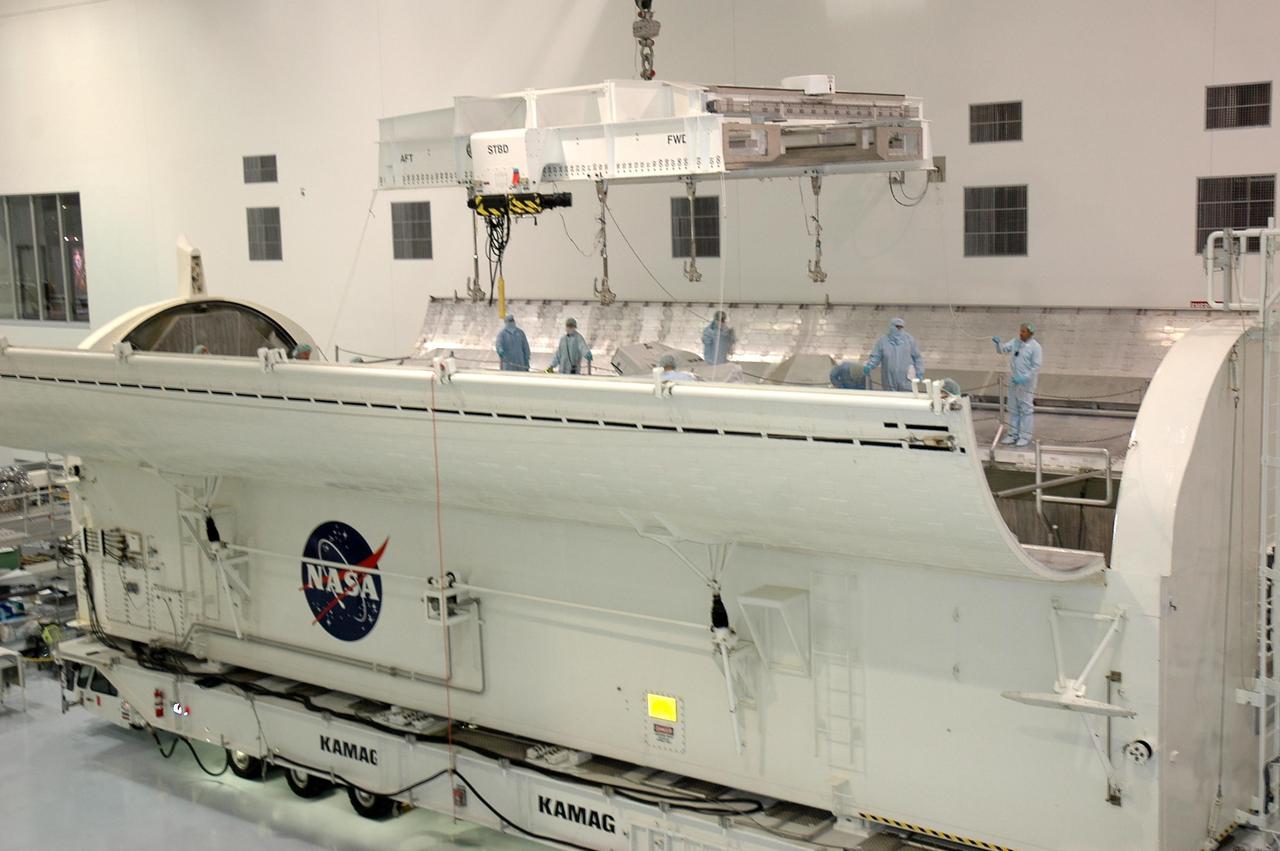
CAPE CANAVERAL, Fla. – In the Space Station Processing Facility at NASA's Kennedy Space Center in Florida, an overhead crane lifts the Integrated Cargo Carrier-VLD (Vertical Light Deployment), part of the payload for the STS-127 mission. The ICC-VLD is being transferred to the payload canister, seen at right. The canister will deliver the ICC-VLD and other elements to Launch Pad 39A for installation in space shuttle Endeavour's payload bay. Launch is targeted for June 13. Photo credit: NASA/Troy Cryder
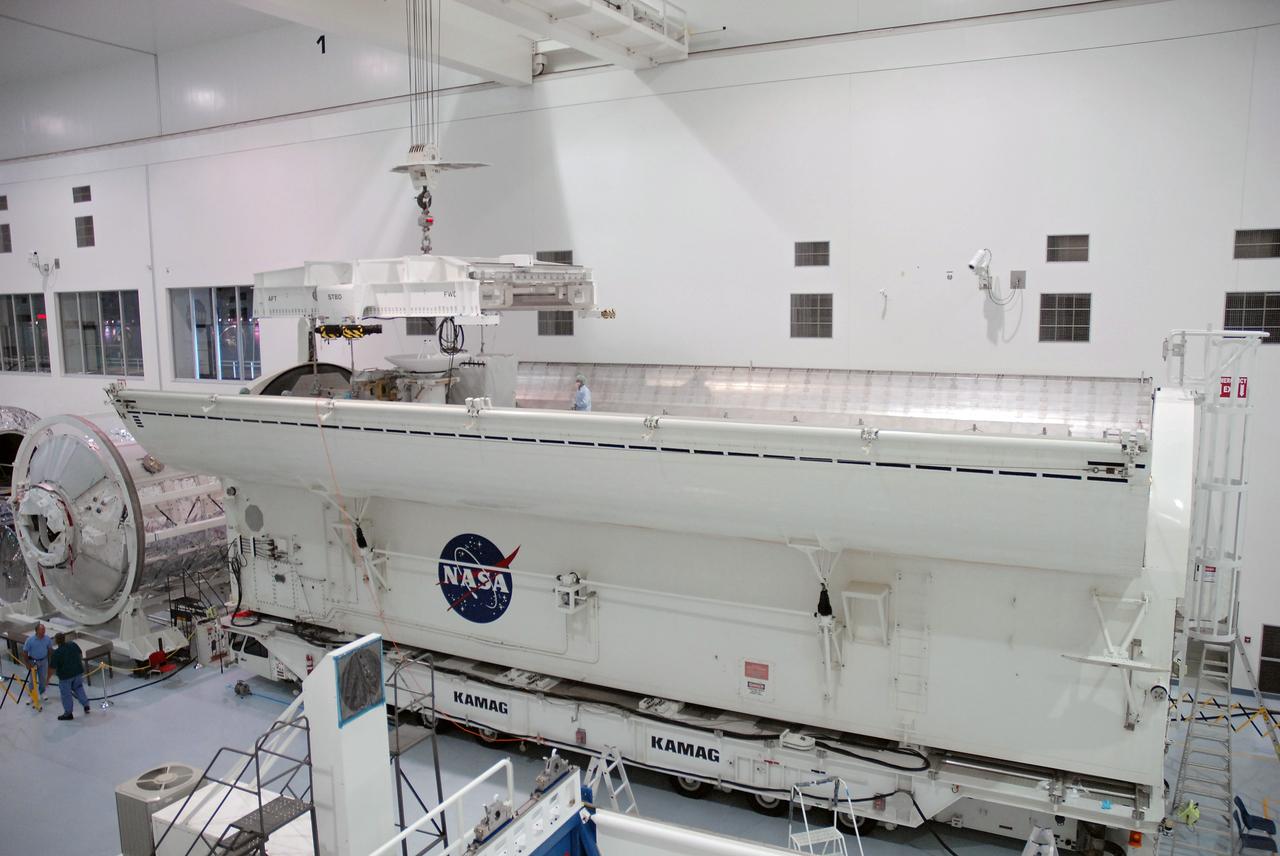
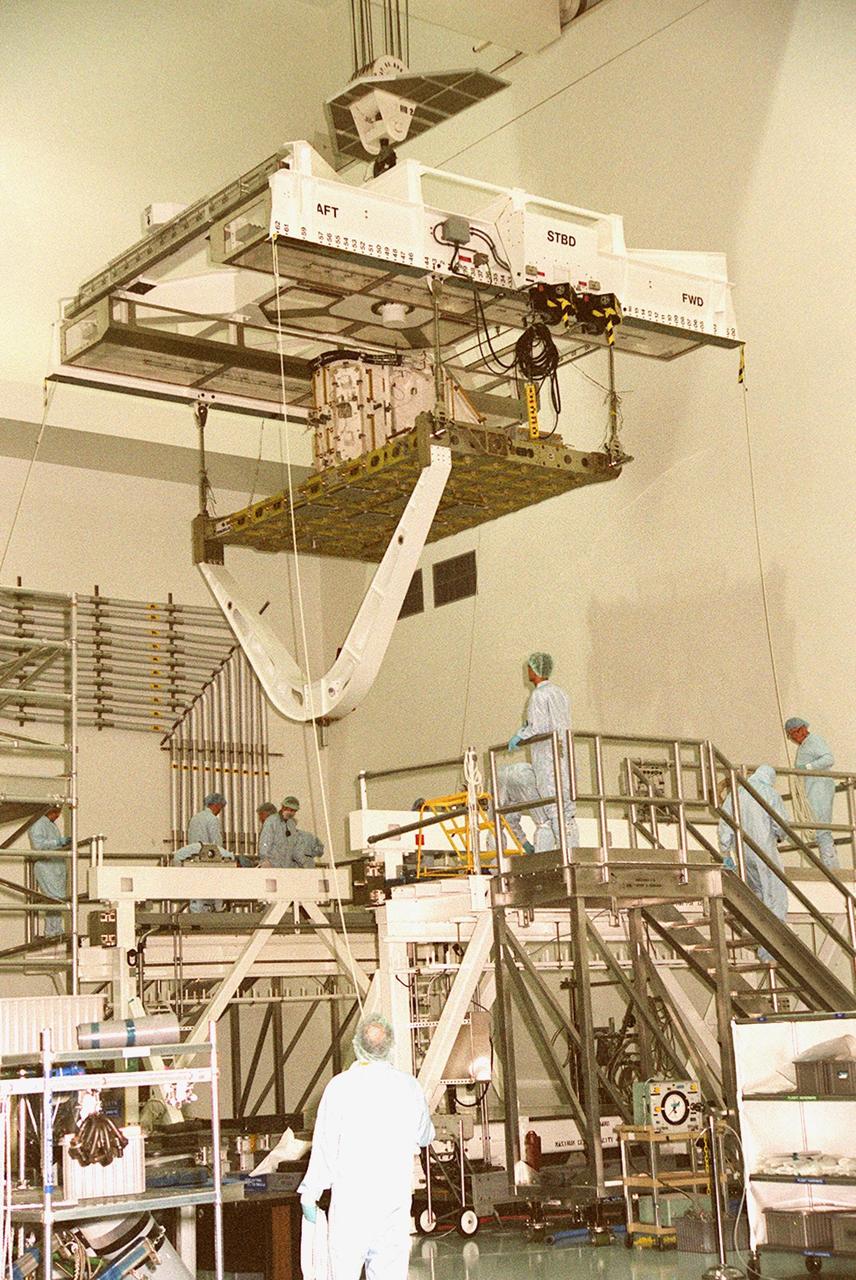
CAPE CANAVERAL, Fla. – In the Space Station Processing Facility at NASA's Kennedy Space Center in Florida, an overhead crane is moved into position above the Integrated Cargo Carrier-VLD (Vertical Light Deployment), part of the payload for the STS-127 mission. The ICC-VLD will be transferred to the payload canister, behind it. The canister will deliver the ICC-VLD and other elements to Launch Pad 39A for installation in space shuttle Endeavour's payload bay. Launch is targeted for June 13. Photo credit: NASA/Troy Cryder

CAPE CANAVERAL, Fla. – In the Space Station Processing Facility at NASA's Kennedy Space Center in Florida, an overhead crane moves into position above the Integrated Cargo Carrier-VLD (Vertical Light Deployment), part of the payload for the STS-127 mission. The ICC-VLD will be transferred to the payload canister. The canister will deliver the ICC-VLD and other elements to Launch Pad 39A for installation in space shuttle Endeavour's payload bay. Launch is targeted for June 13. Photo credit: NASA/Troy Cryder

CAPE CANAVERAL, Fla. – In the Space Station Processing Facility at NASA's Kennedy Space Center in Florida, an overhead crane lifts the Integrated Cargo Carrier-VLD (Vertical Light Deployment), part of the payload for the STS-127 mission. The ICC-VLD is being transferred to the payload canister, seen at left. The canister will deliver the ICC-VLD and other elements to Launch Pad 39A for installation in space shuttle Endeavour's payload bay. Launch is targeted for June 13. Photo credit: NASA/Troy Cryder
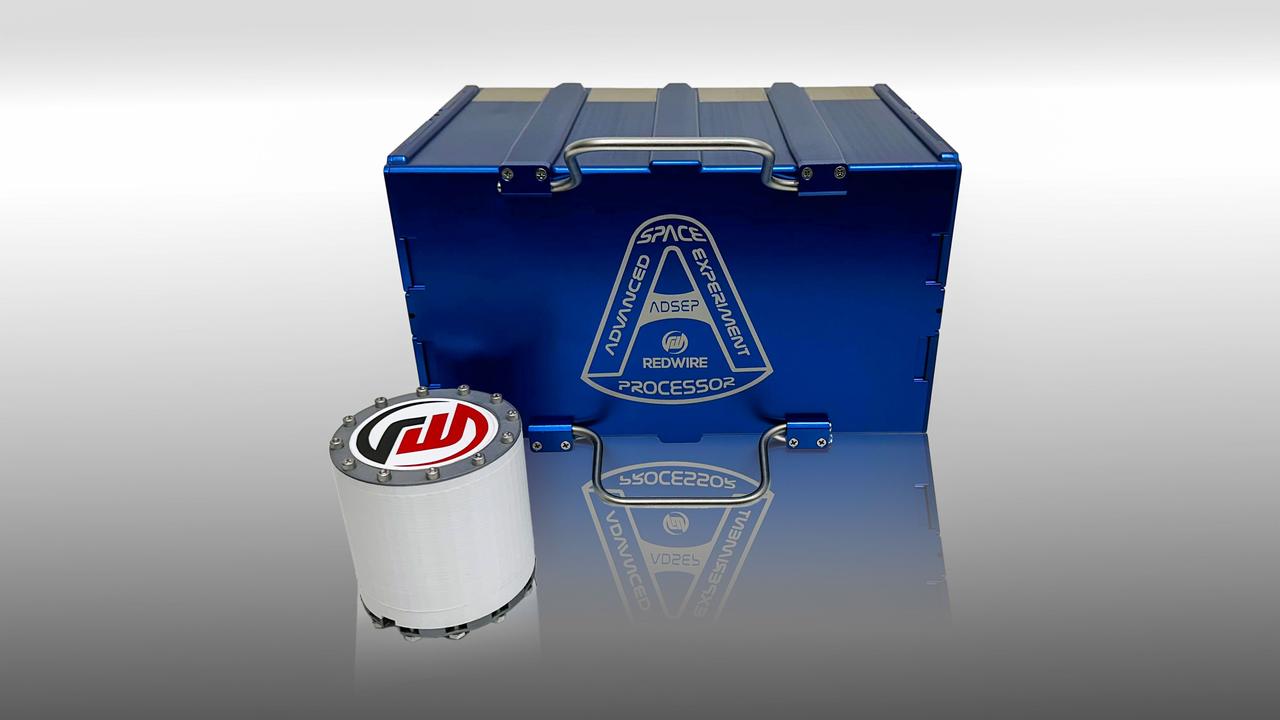
jsc2025e036383 (4/4/2025) --- The blue box is The Redwire Industrial Crystallization Cassette (ICC), a facility capable of large quantities of crystal growth. The white cylindrical growth chamber below the ICC is capable of holding 200mL in volume, compared to <1mL held by the PIL-BOX cassettes. The ADSEP Industrial Crystallization Cassette Technology Demonstration (ADSEP-ICC) investigation validates the ICC’s capability to grow large quantities of crystals in its high-volume crystal growth chambers aboard the International Space Station. Image courtesy of Redwire.

CAPE CANAVERAL, Fla. – In the Space Station Processing Facility at NASA's Kennedy Space Center in Florida, an overhead crane carries the Integrated Cargo Carrier-VLD (Vertical Light Deployment), part of the payload for the STS-127 mission, across the floor to the waiting payload canister. The canister will deliver the ICC-VLD and other elements to Launch Pad 39A for installation in space shuttle Endeavour's payload bay. Launch is targeted for June 13. Photo credit: NASA/Troy Cryder
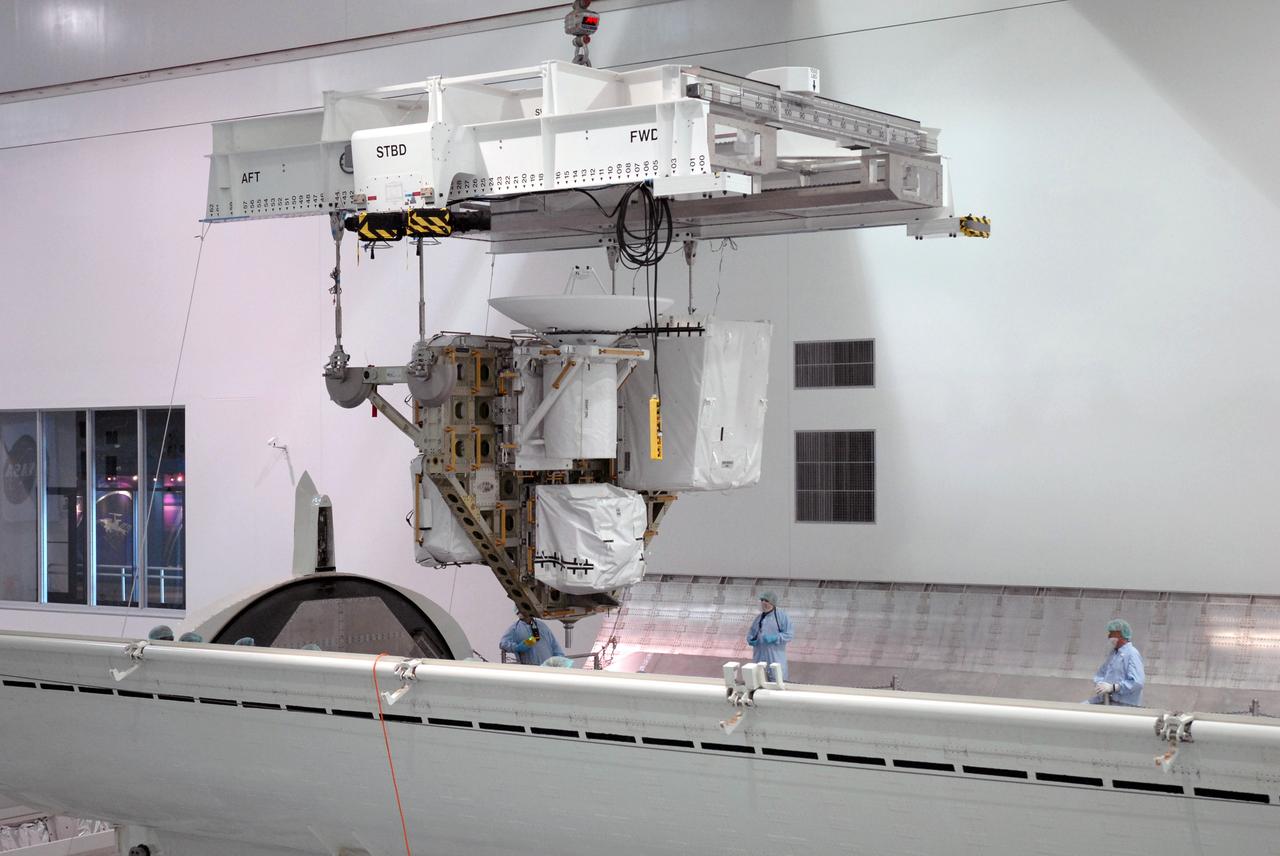
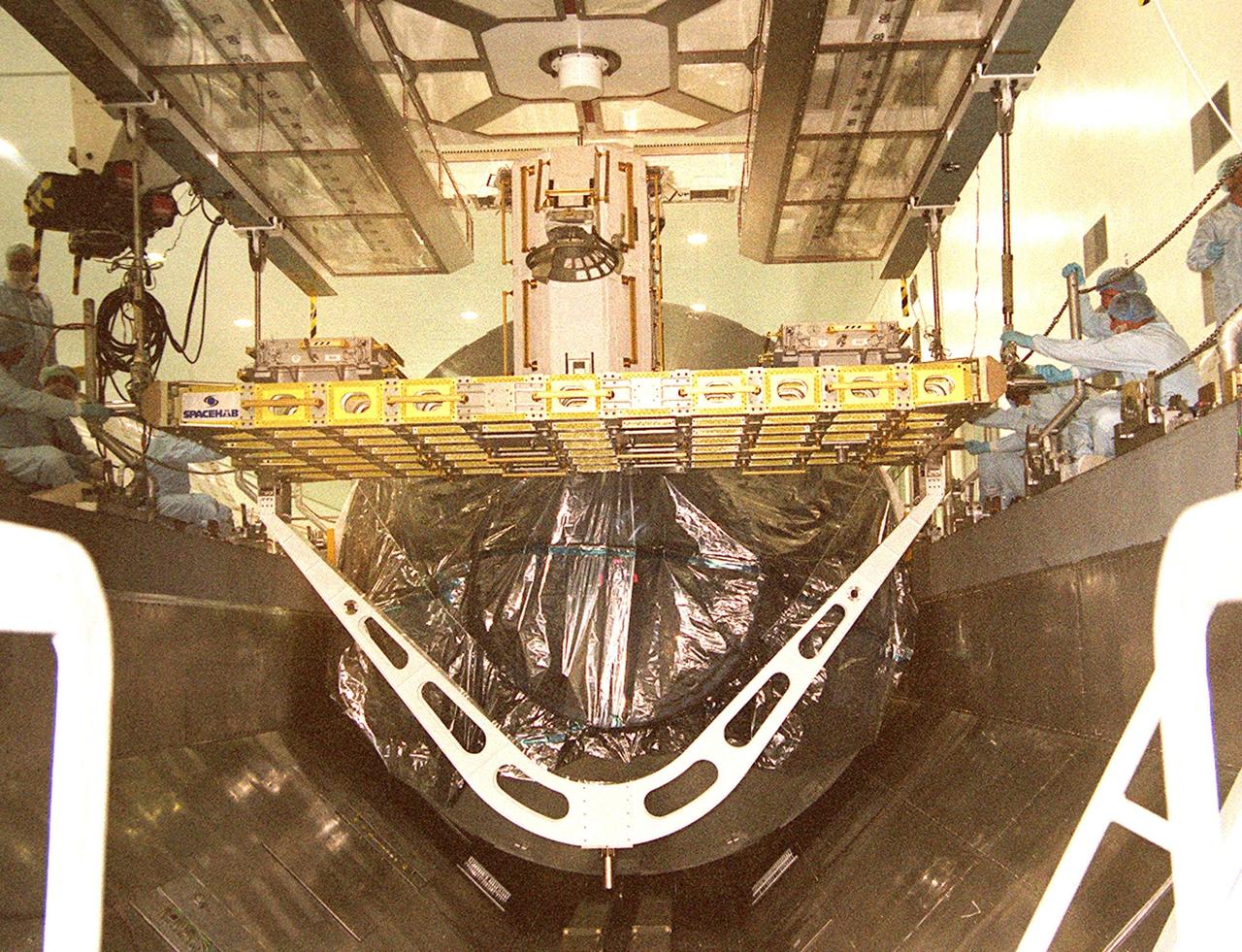
CAPE CANAVERAL, Fla. – – In the Space Station Processing Facility at NASA's Kennedy Space Center in Florida, an overhead crane lowers the Integrated Cargo Carrier-VLD (Vertical Light Deployment), part of the payload for the STS-127 mission, toward the payload canister. The canister will deliver the ICC-VLD and other elements to Launch Pad 39A for installation in space shuttle Endeavour's payload bay. Launch is targeted for June 13. Photo credit: NASA/Troy Cryder
CAPE CANAVERAL, Fla. – – -- In the Space Station Processing Facility at NASA's Kennedy Space Center in Florida, an overhead crane lowers the Integrated Cargo Carrier-VLD (Vertical Light Deployment), part of the payload for the STS-127 mission, into the payload canister. The canister will deliver the ICC-VLD and other elements to Launch Pad 39A for installation in space shuttle Endeavour's payload bay. Launch is targeted for June 13. Photo credit: NASA/Troy Cryder
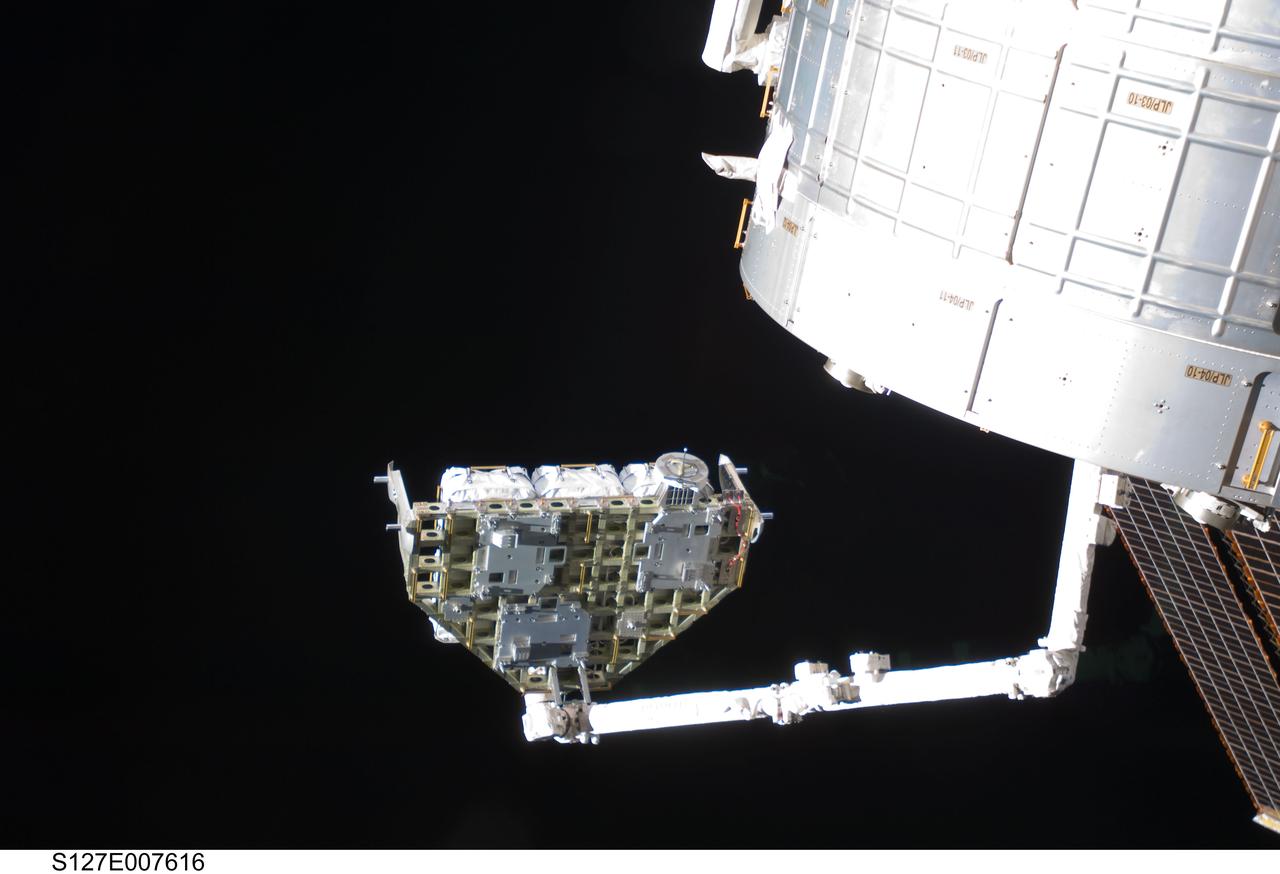
S127-E-007616 (21 July 2009)--- The Space Shuttle Endeavour's remote manipulator system holds the Integrated Cargo Carrier-Vertical Light Deployable (ICC-VLD) during Mobile Translator relocate operations from worksite 7 to worksite 8 on the International Space Station. The flight day seven robotics exercises, controlled from inside the two docked vehicles, were sandwiched in between two days of extravehicular activity, part of the overall five scheduled spacewalks.
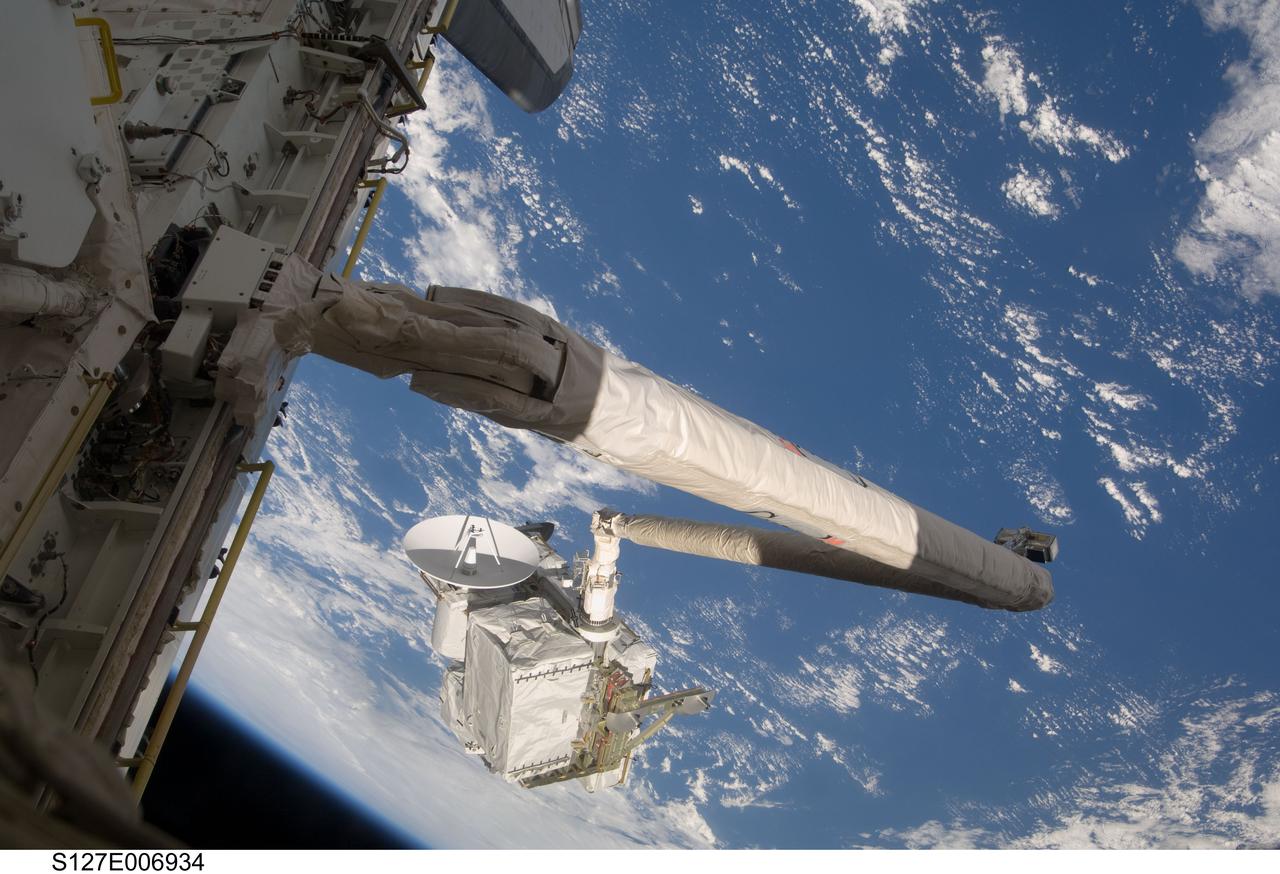
S127-E-006934 (19 July 2009) --- Backdropped by a blue and white Earth, the remote manipulator system (RMS) arm of the Space Shuttle Endeavour, is about to hand off the Integrated Cargo Carrier (ICC) to the International Space Station (out of frame). The ICC is an unpressurized flat bed pallet and keel yoke assembly that was carried into space in the shuttle's payload bay.
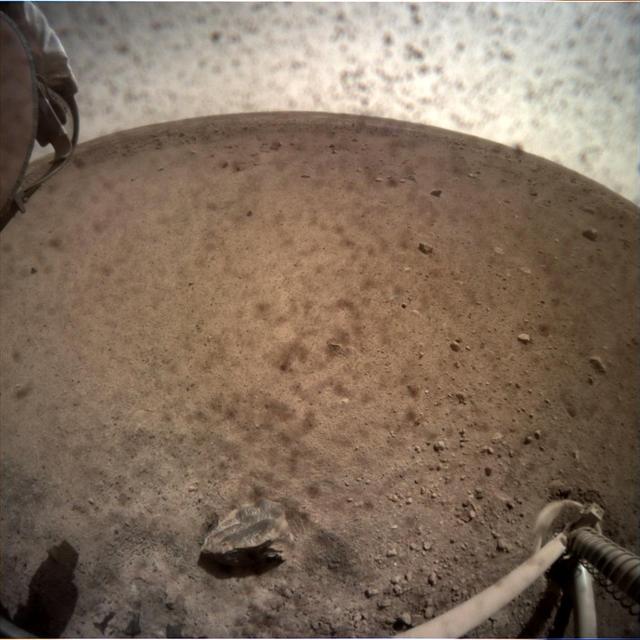
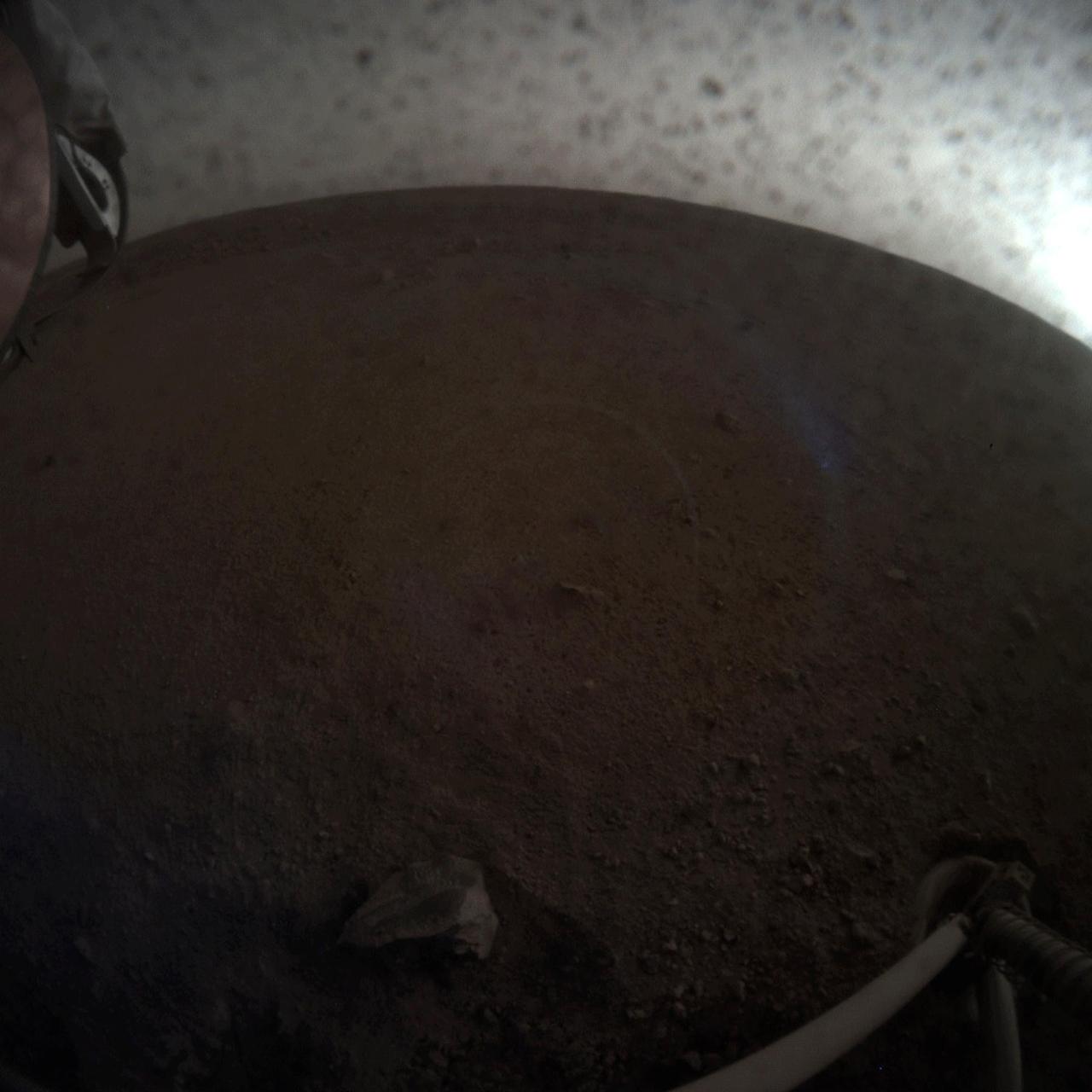
NASA's InSight spacecraft flipped open the lens cover on its Instrument Context Camera (ICC) on Nov. 30, 2018, and captured this view of Mars. Located below the deck of the InSight lander, the ICC has a fisheye view, creating a curved horizon. Some clumps of dust are still visible on the camera's lens. One of the spacecraft's footpads can be seen in the lower right corner. The seismometer's tether box is in the upper left corner. https://photojournal.jpl.nasa.gov/catalog/PIA22893
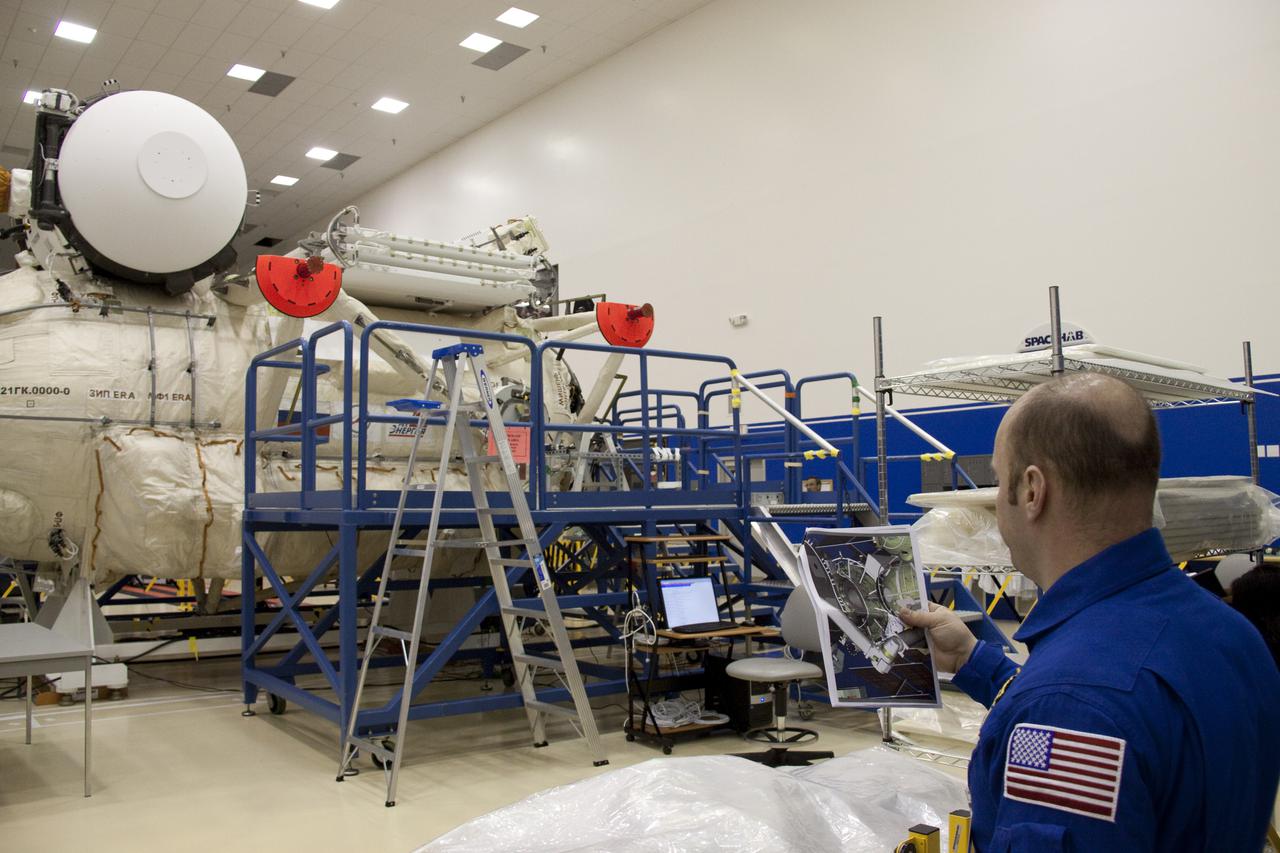
CAPE CANAVERAL, Fla. – At the Astrotech payload processing facility at Port Canaveral in Florida, STS-132 Mission Specialist Garrett Reisman compares the actual Mini-Research Module to a picture of the module during the crew equipment interface test, or CEIT. CEIT provides the crew with hands-on training and observation of shuttle and flight hardware. The six-member crew of space shuttle Atlantis' STS-132 mission will deliver an Integrated Cargo Carrier and a Russian-built Mini-Research Module to the International Space Station. The second in a series of new pressurized components for Russia, the module will be permanently attached to the bottom port of the Zarya module and also will carry U.S. pressurized cargo. STS-132 is the 34th mission to the station and the 132nd space shuttle mission in the program. Launch is targeted for May 14. For information on the STS-132 mission, visit http:__www.nasa.gov_mission_pages_shuttle_shuttlemissions_sts132_index.html. Photo credit: NASA_Troy Cryder
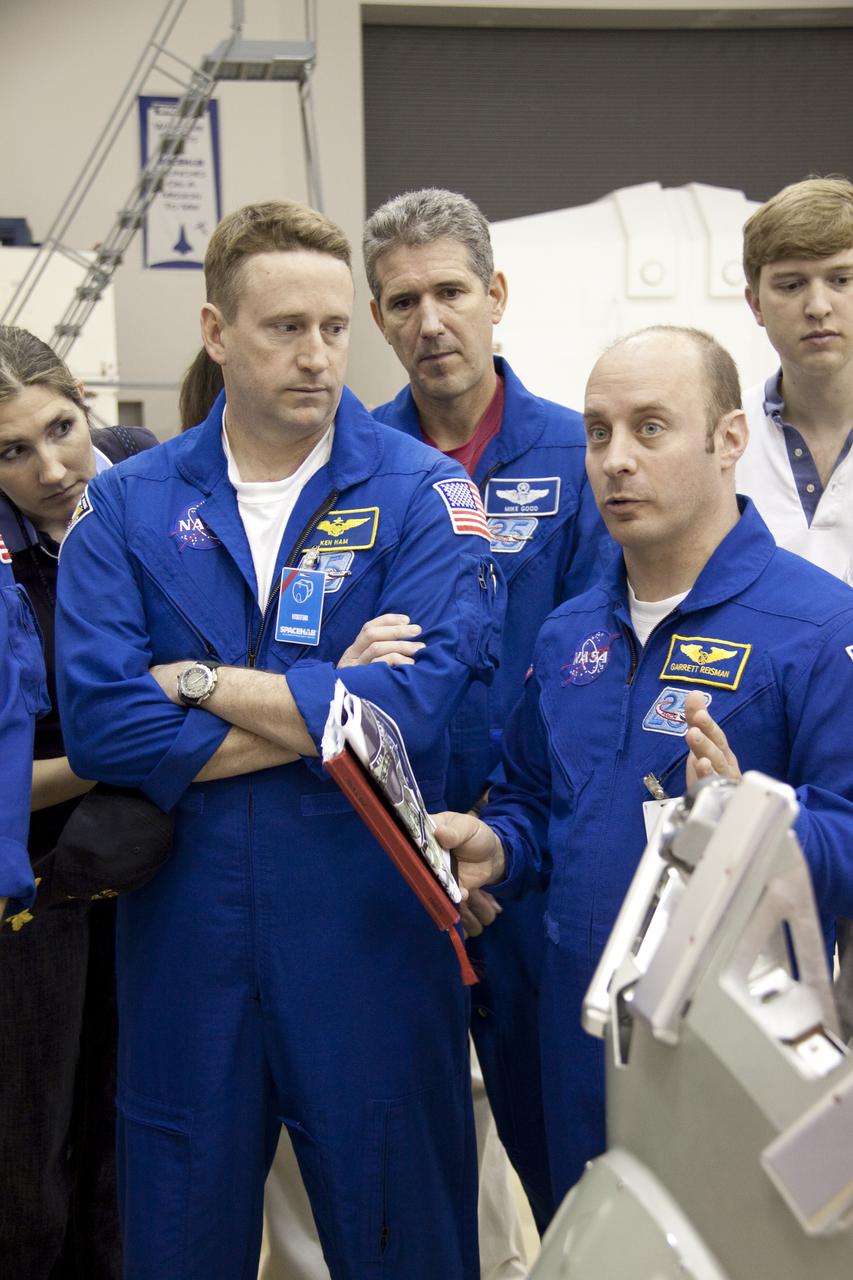
CAPE CANAVERAL, Fla. – At the Astrotech payload processing facility at Port Canaveral in Florida, members of the STS-132 crew receive instruction on the design and operation of the docking mechanism for the Mini-Research Module during their crew equipment interface test, or CEIT. Mission Specialist Garrett Reisman, right, asks a question of his instructor as Commander Ken Ham, left, and Mission Specialist Michael Good look on. CEIT provides the crew with hands-on training and observation of shuttle and flight hardware. The six-member crew of space shuttle Atlantis' STS-132 mission will deliver an Integrated Cargo Carrier and a Russian-built Mini-Research Module to the International Space Station. The second in a series of new pressurized components for Russia, the module will be permanently attached to the bottom port of the Zarya module and also will carry U.S. pressurized cargo. STS-132 is the 34th mission to the station and the 132nd space shuttle mission in the program. Launch is targeted for May 14. For information on the STS-132 mission, visit http:__www.nasa.gov_mission_pages_shuttle_shuttlemissions_sts132_index.html. Photo credit: NASA_Troy Cryder
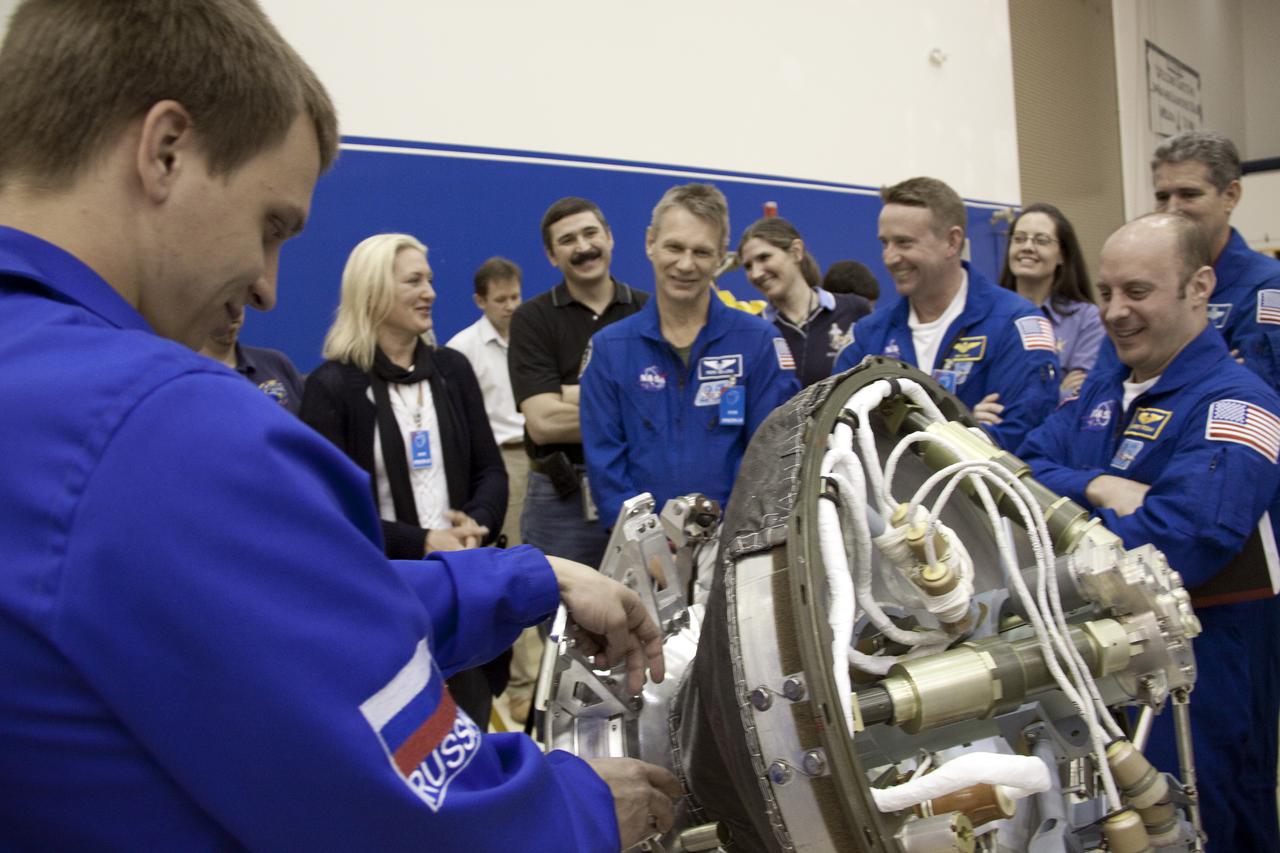
CAPE CANAVERAL, Fla. – At the Astrotech payload processing facility at Port Canaveral in Florida, members of the STS-132 crew receive instruction on the design and operation of the docking mechanism for the Mini-Research Module during their crew equipment interface test, or CEIT. At left is the instructor. From center in the blue flight suits are Mission Specialist Piers Sellers, Commander Ken Ham, and Mission Specialist Garrett Reisman. Mission Specialist Michael Good looks on behind them. CEIT provides the crew with hands-on training and observation of shuttle and flight hardware. The six-member crew of space shuttle Atlantis' STS-132 mission will deliver an Integrated Cargo Carrier and a Russian-built Mini-Research Module to the International Space Station. The second in a series of new pressurized components for Russia, the module will be permanently attached to the bottom port of the Zarya module and also will carry U.S. pressurized cargo. STS-132 is the 34th mission to the station and the 132nd space shuttle mission in the program. Launch is targeted for May 14. For information on the STS-132 mission, visit http:__www.nasa.gov_mission_pages_shuttle_shuttlemissions_sts132_index.html. Photo credit: NASA_Troy Cryder
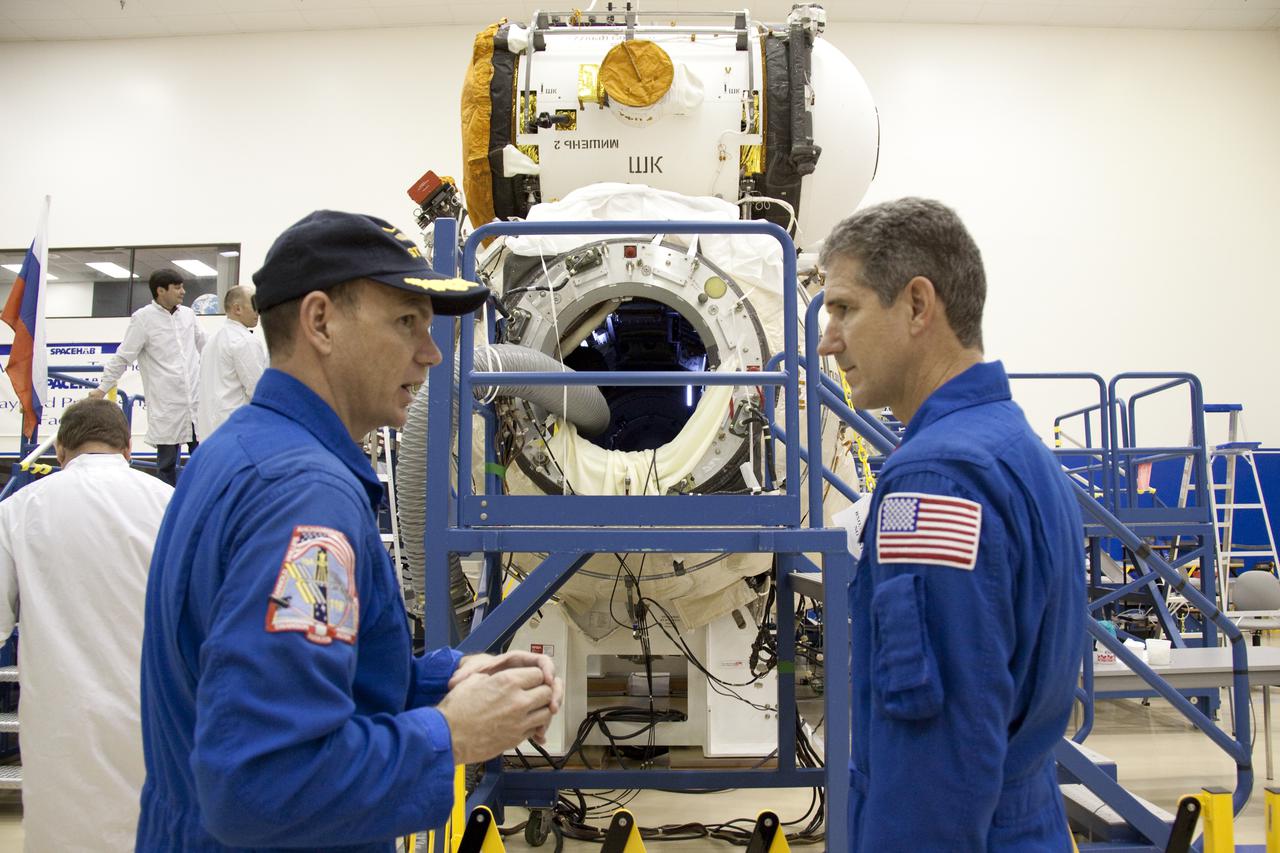
CAPE CANAVERAL, Fla. – At the Astrotech payload processing facility at Port Canaveral in Florida, STS-132 Pilot Tony Antonelli, left, and Mission Specialist Michael Good discuss the Mini-Research Module behind them during their crew equipment interface test, or CEIT. CEIT provides the crew with hands-on training and observation of shuttle and flight hardware. The six-member crew of space shuttle Atlantis' STS-132 mission will deliver an Integrated Cargo Carrier and a Russian-built Mini-Research Module to the International Space Station. The second in a series of new pressurized components for Russia, the module will be permanently attached to the bottom port of the Zarya module and also will carry U.S. pressurized cargo. STS-132 is the 34th mission to the station and the 132nd space shuttle mission in the program. Launch is targeted for May 14. For information on the STS-132 mission, visit http:__www.nasa.gov_mission_pages_shuttle_shuttlemissions_sts132_index.html. Photo credit: NASA_Troy Cryder
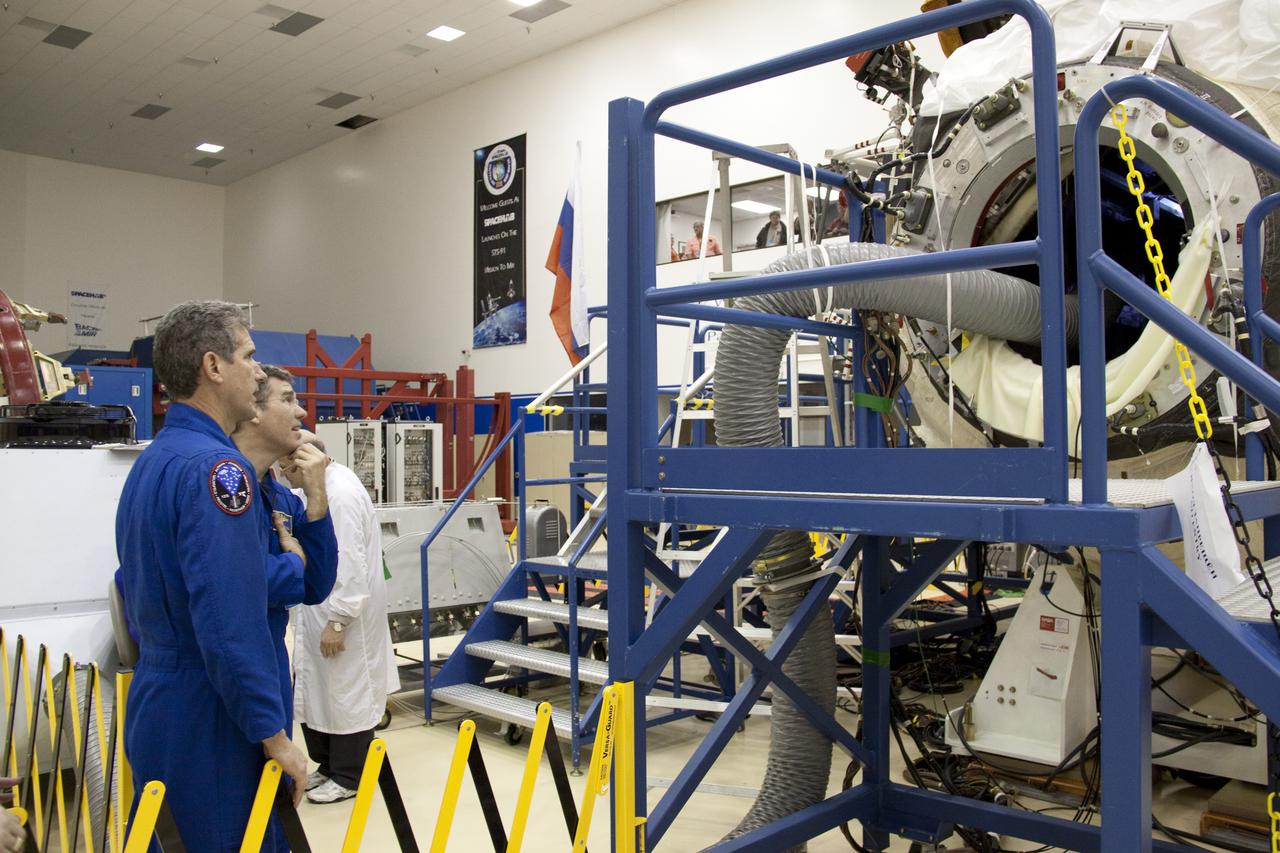
CAPE CANAVERAL, Fla. – At the Astrotech payload processing facility at Port Canaveral in Florida, STS-132 Mission Specialists Michael Good, left, and Steve Bowen get a close-up view of the Mini-Research Module during their crew equipment interface test, or CEIT. CEIT provides the crew with hands-on training and observation of shuttle and flight hardware. The six-member crew of space shuttle Atlantis' STS-132 mission will deliver an Integrated Cargo Carrier and a Russian-built Mini-Research Module to the International Space Station. The second in a series of new pressurized components for Russia, the module will be permanently attached to the bottom port of the Zarya module and also will carry U.S. pressurized cargo. STS-132 is the 34th mission to the station and the 132nd space shuttle mission in the program. Launch is targeted for May 14. For information on the STS-132 mission, visit http:__www.nasa.gov_mission_pages_shuttle_shuttlemissions_sts132_index.html. Photo credit: NASA_Troy Cryder
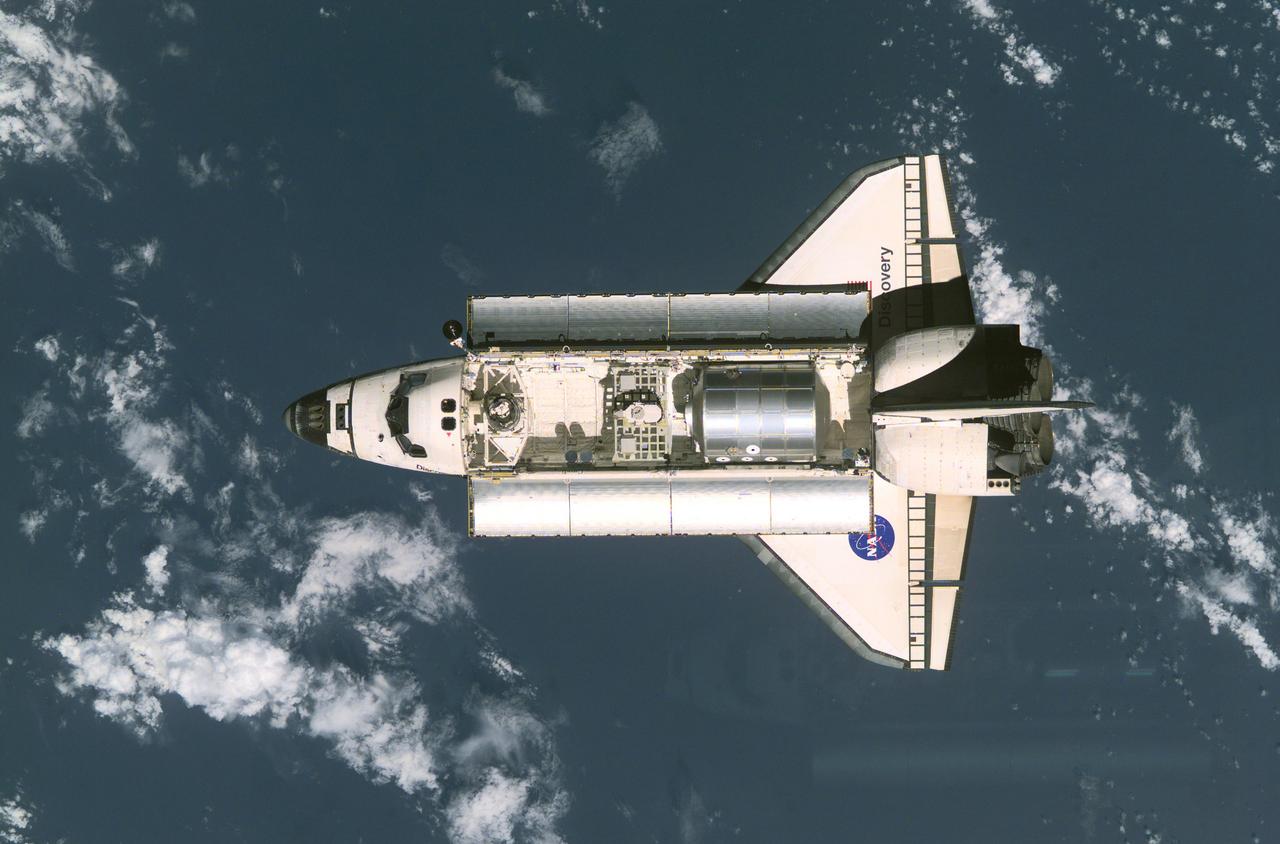
This is a view of the Space Shuttle Discovery as it approaches the International Space Station (ISS) during the STS-105 mission. Visible in the payload bay of Discovery are the Multipurpose Logistics Module (MPLM) Leonardo at right, which stores various supplies and experiments to be transferred into the ISS; at center, the Integrated Cargo Carrier (ICC) which carries the Early Ammonia Servicer (EAS); and two Materials International Space Station Experiment (MISSE) containers at left. Aboard Discovery were the ISS Expedition Three crew, who were to replace the Expedition Two crew that had been living on the ISS for the past five months.
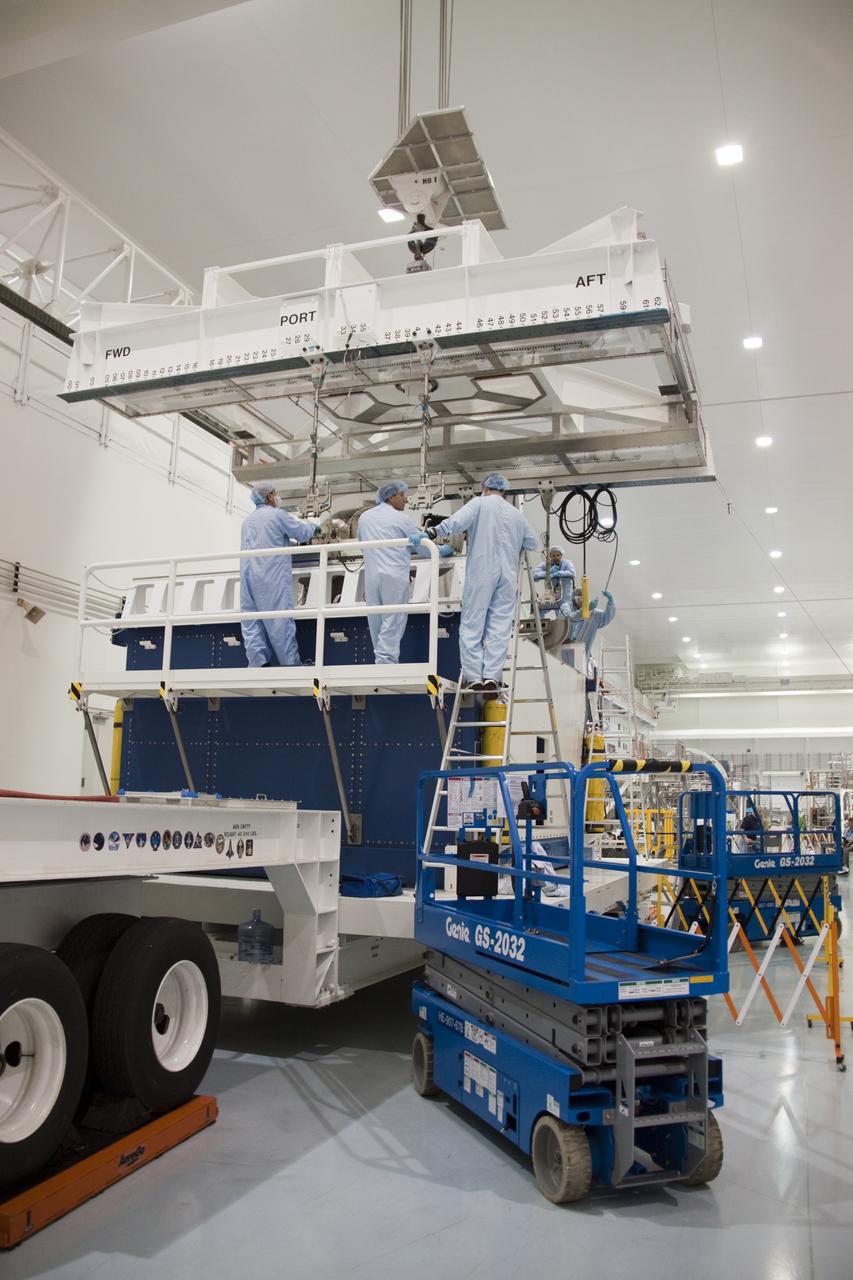
STS-132 ICC TO CANISTER

STS-132 ICC TO CANISTER

STS-132 ICC TO CANISTER
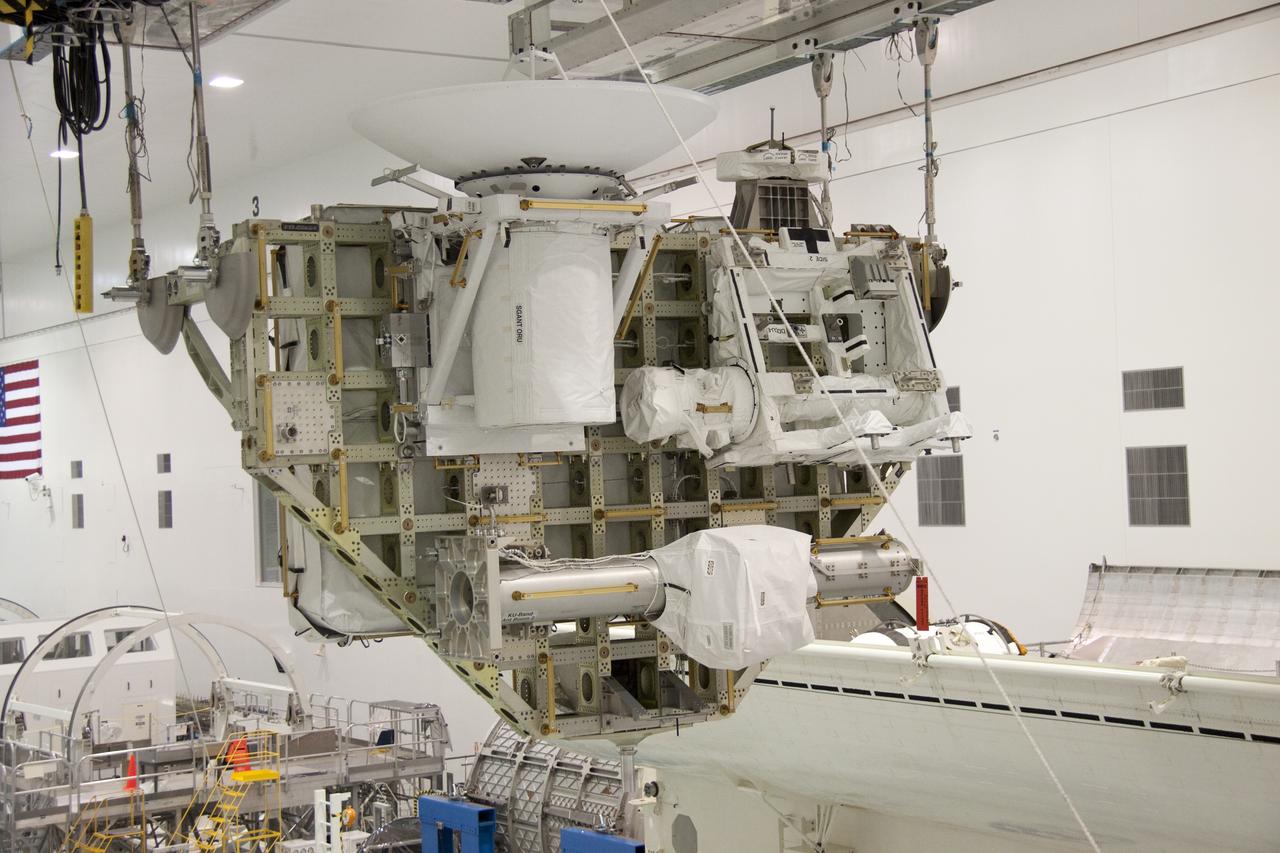
STS-132 ICC TO CANISTER

STS-132 ICC TO CANISTER
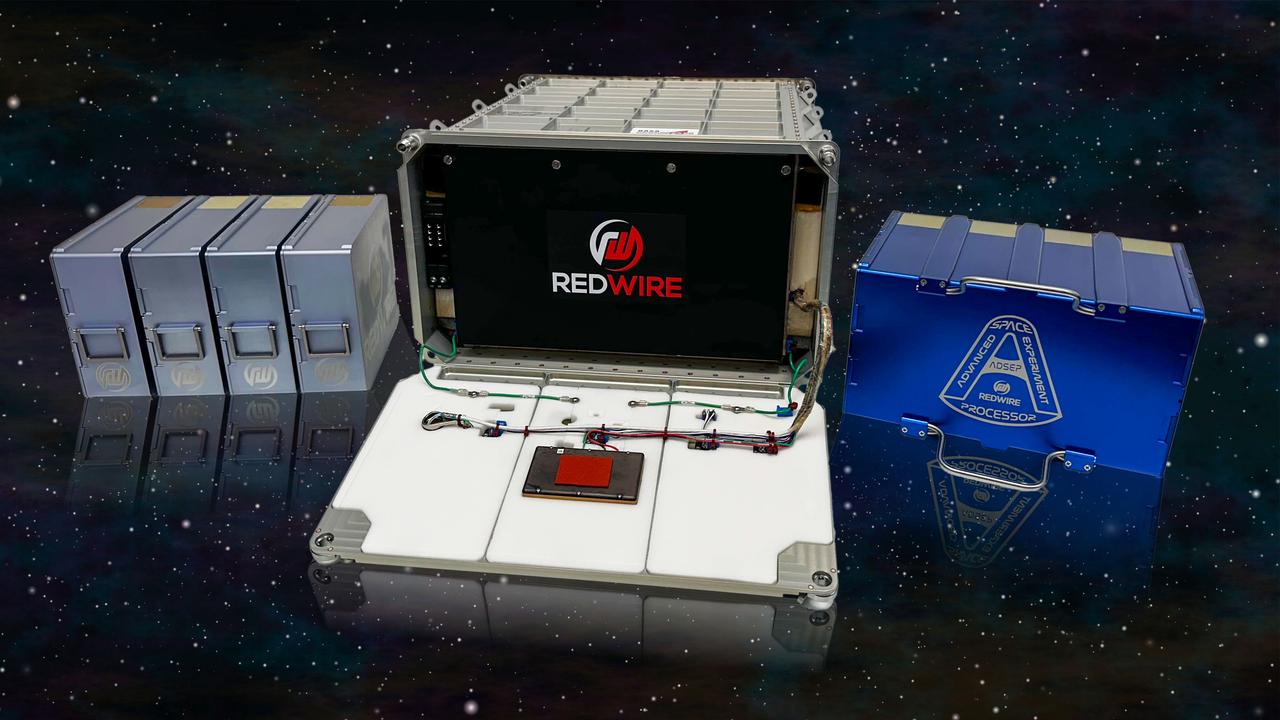
jsc2025e036384 (4/4/2025) --- A lineup of Redwire hardware. Left: Redwire’s in-space pharmaceutical manufacturing system (PIL-BOX) system are chambers that allow crystal growth in small batches. Middle: The Redwire Advanced Space Experiment Processor (ADSEP) in a close configuration onto which either the PIL-BOX or ICC can be installed. Right: The Redwire Industrial Crystallization Cassette (ICC), a facility capable of larger quantities of crystal growth than the PIL-BOX. The ADSEP Industrial Crystallization Cassette Technology Demonstration (ADSEP-ICC) investigation validates the ICC’s capability to grow large quantities of crystals in its high-volume crystal growth chambers aboard the International Space Station. Image courtesy of Redwire.
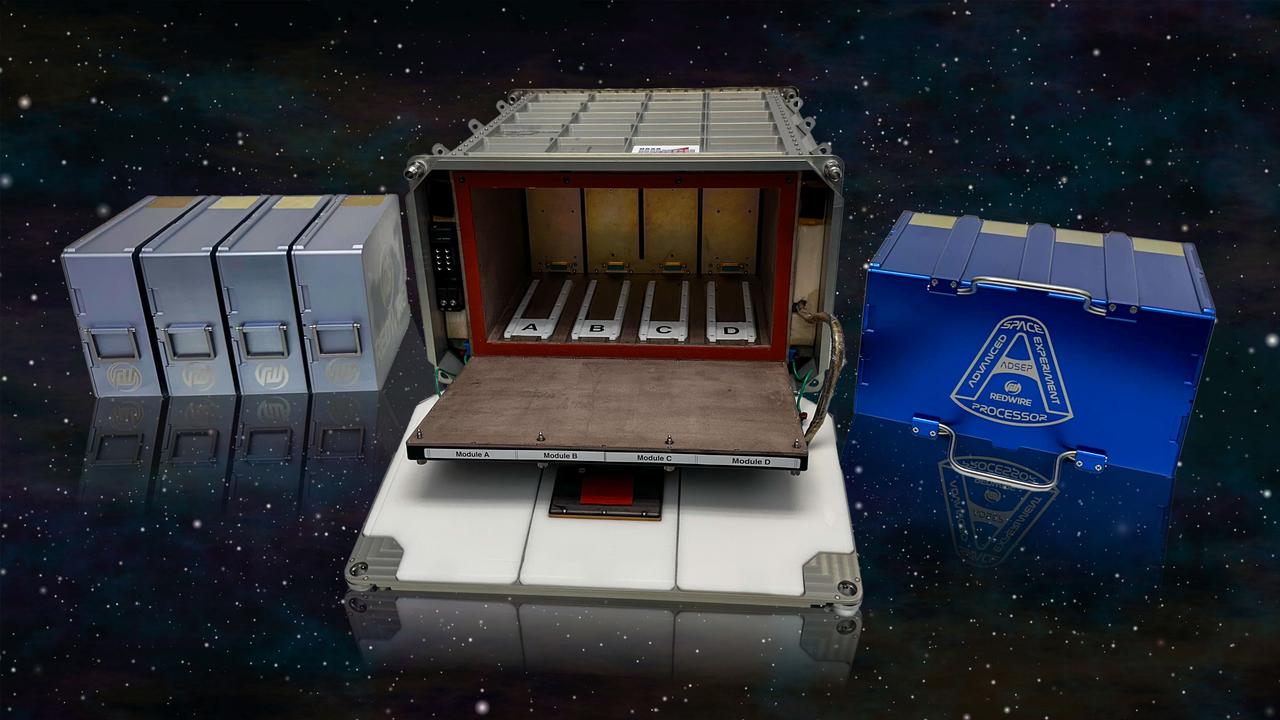
jsc2025e036385 (4/4/2025) --- A lineup of Redwire hardware. Left: Redwire’s in-space pharmaceutical manufacturing system (PIL-BOX) system are chambers that allow crystal growth in small batches. Middle: The Redwire Advanced Space Experiment Processor (ADSEP) in an open configuration onto which either the PIL-BOX or ICC can be installed. Right: The Redwire Industrial Crystallization Cassette (ICC), a facility capable of larger quantities of crystal growth than the PIL-BOX. The ADSEP Industrial Crystallization Cassette Technology Demonstration (ADSEP-ICC) investigation validates the ICC’s capability to grow large quantities of crystals in its high-volume crystal growth chambers aboard the International Space Station. Image courtesy of Redwire.
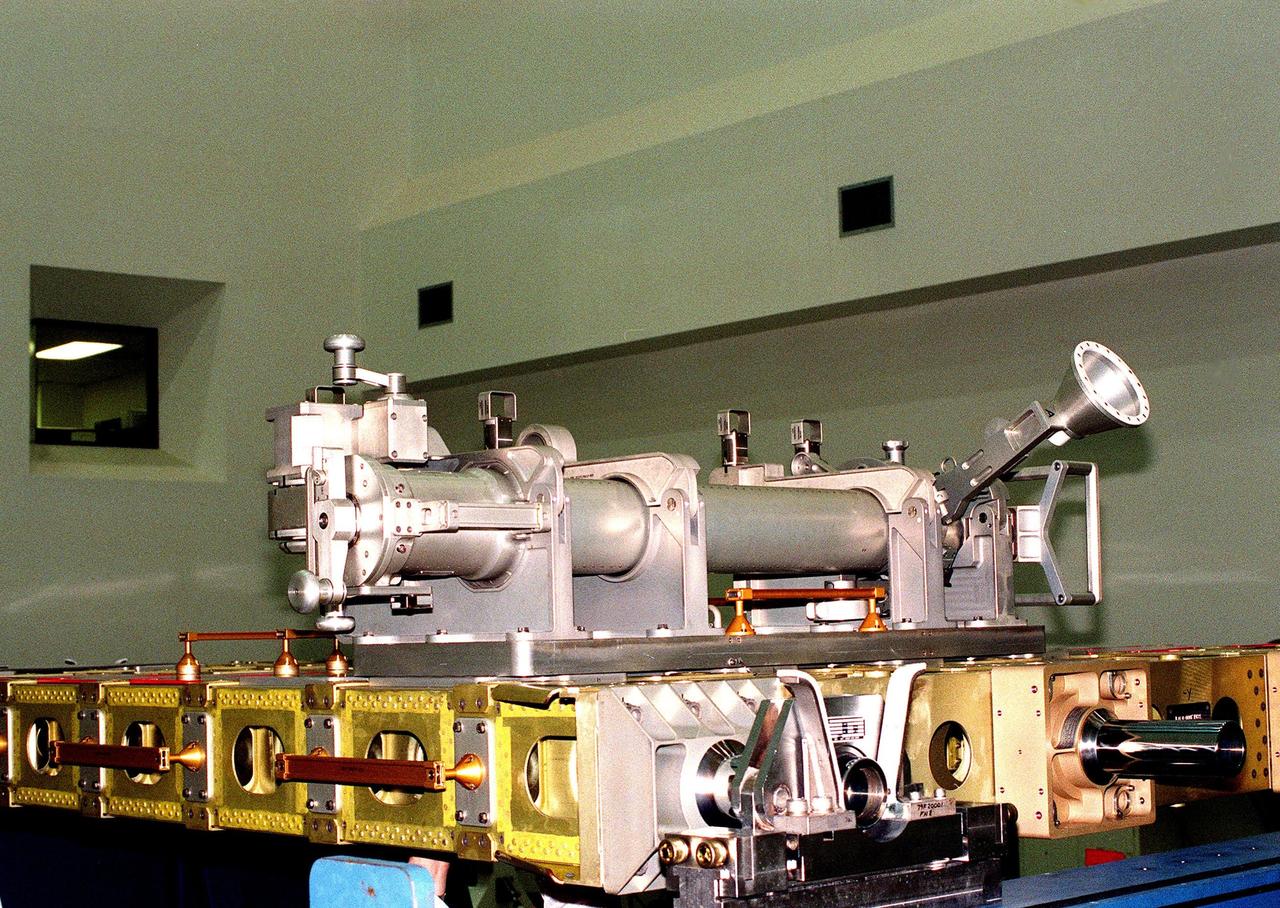
An ORU Transfer Device (OTD) sits secured on top of the International Cargo Carrier (ICC). The OTD is a U.S.-built crane that will be stowed on the International Space Station's Unity module for use during future ISS assembly missions. The nonpressurized ICC fits inside the payload bay of the orbiter. The ICC will also carry the SPACEHAB Oceaneering Space System Box (SHOSS), a logistics items carrier. SHOSS can hold a maximum of 400 pounds of equipment and will carry items to be used during STS-96 and future ISS assembly flights. The ICC will fly on mission STS-96, targeted for launch on May 20
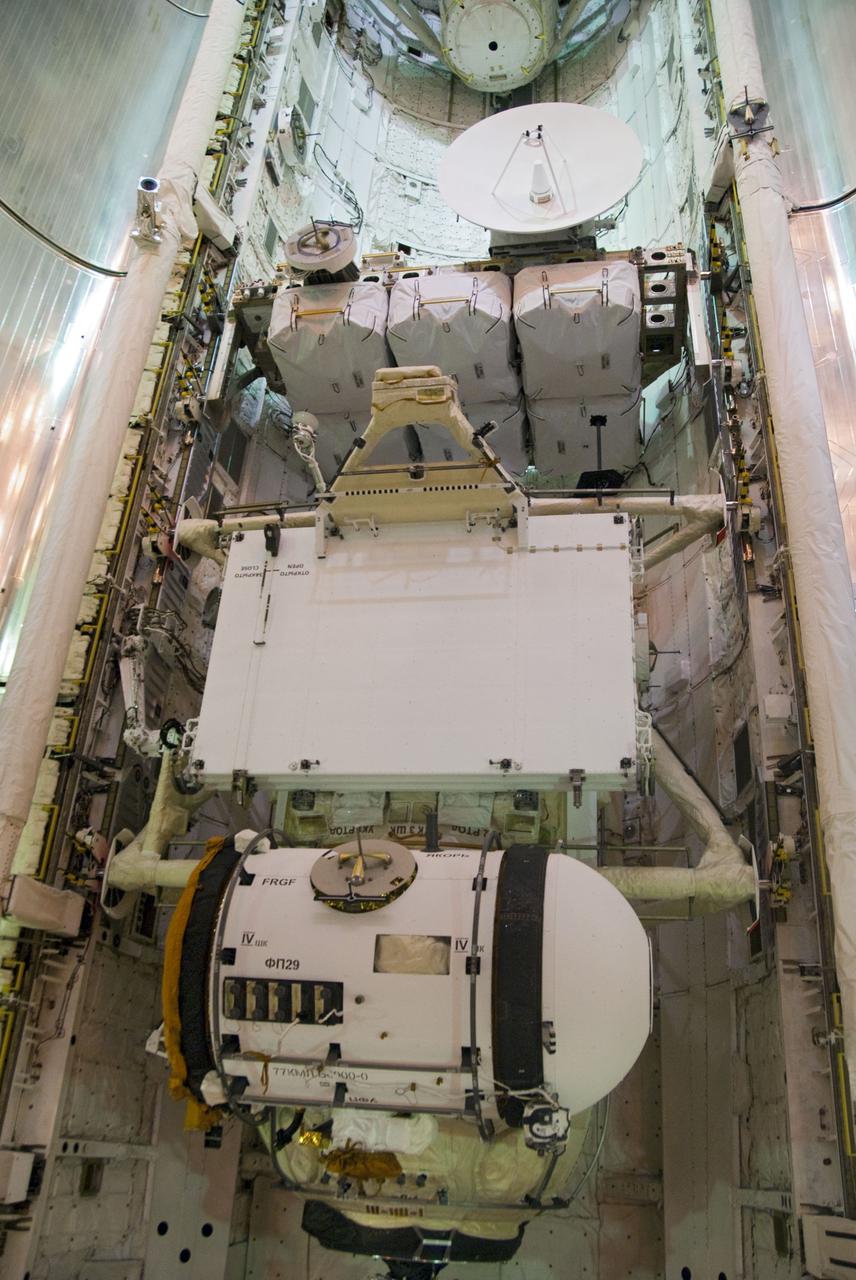
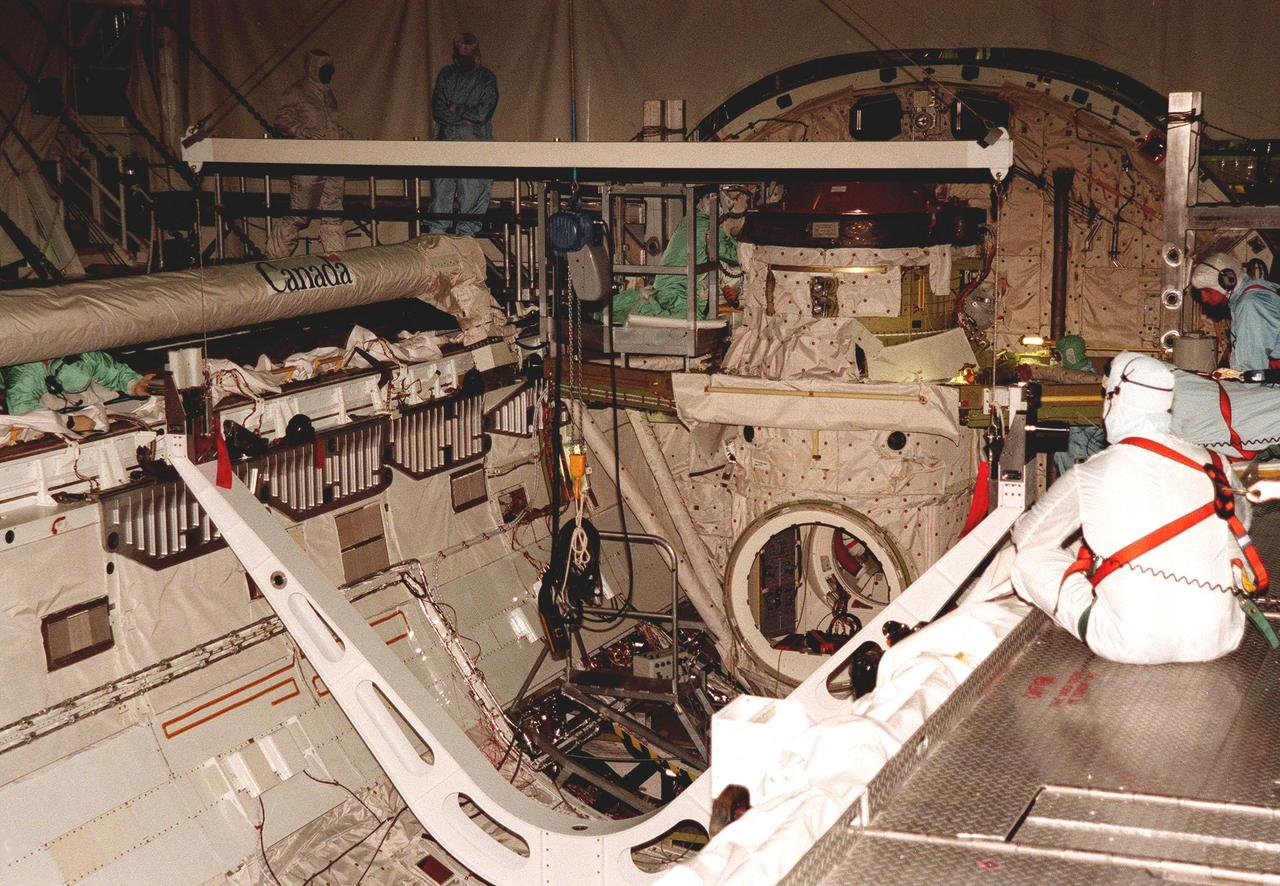
CAPE CANAVERAL, Fla. - At Launch Pad 39A at NASA's Kennedy Space Center in Florida, preparations are under way to close space shuttle Atlantis' payload bay doors for launch to the International Space Station. Secured in the bay is the primary payload for Atlantis' STS-132 mission, the Russian-built Mini Research Module-1. A set of batteries for the station's truss and space-to-ground antenna, along with other replacement parts are installed on the Integrated Cargo Carrier. Atlantis' launch is targeted for May 14 at 2:20 p.m. EDT. For more information on the STS-132 mission objectives, payload and crew, visit www.nasa.gov_mission_pages_shuttle_shuttlemissions_sts132_index.html. Photo Credit: NASA_Cory Huston
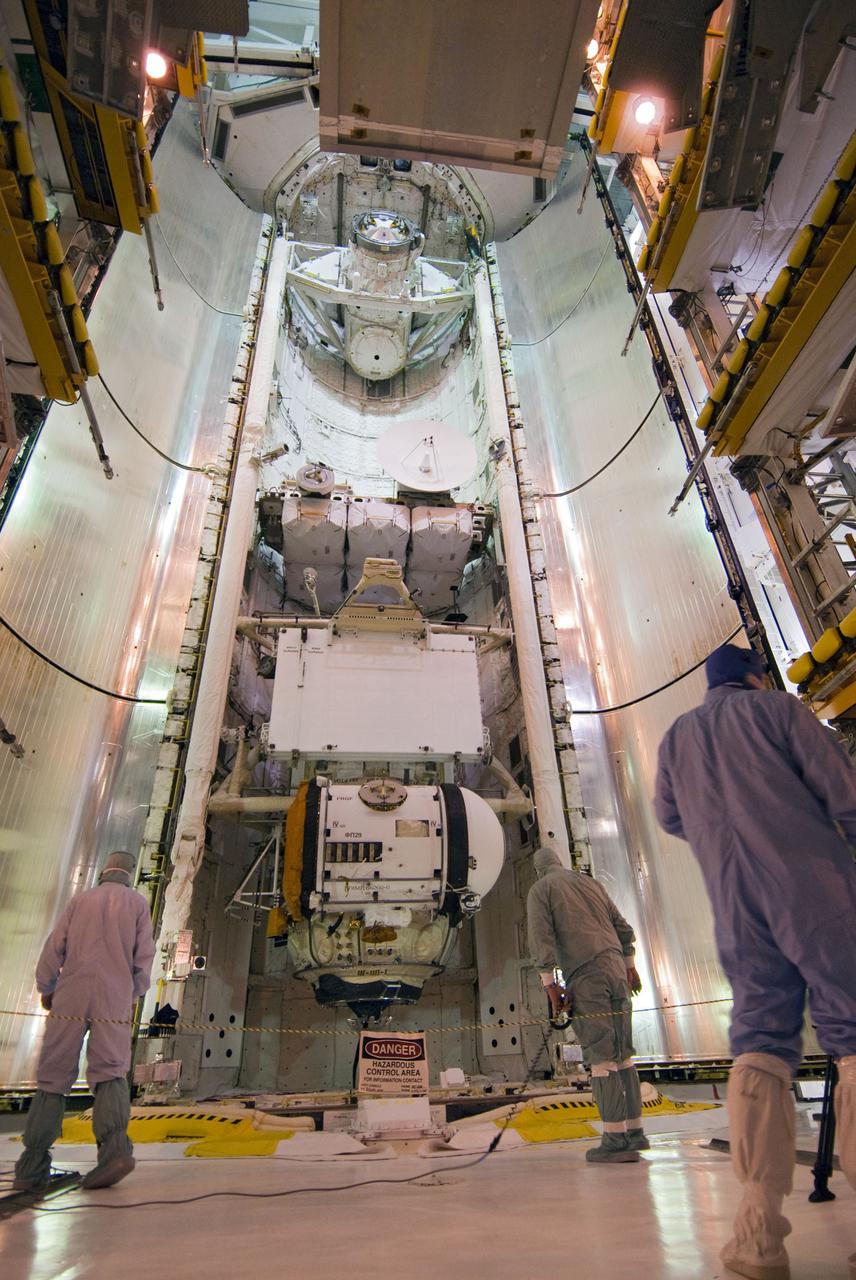
CAPE CANAVERAL, Fla. - At Launch Pad 39A at NASA's Kennedy Space Center in Florida, technicians prepare to close space shuttle Atlantis' payload bay doors for launch to the International Space Station. Secured in the bay is the primary payload for Atlantis' STS-132 mission, the Russian-built Mini Research Module-1. A set of batteries for the station's truss and space-to-ground antenna, along with other replacement parts are installed on the Integrated Cargo Carrier. Atlantis' launch is targeted for May 14 at 2:20 p.m. EDT. For more information on the STS-132 mission objectives, payload and crew, visit www.nasa.gov_mission_pages_shuttle_shuttlemissions_sts132_index.html. Photo Credit: NASA_Cory Huston
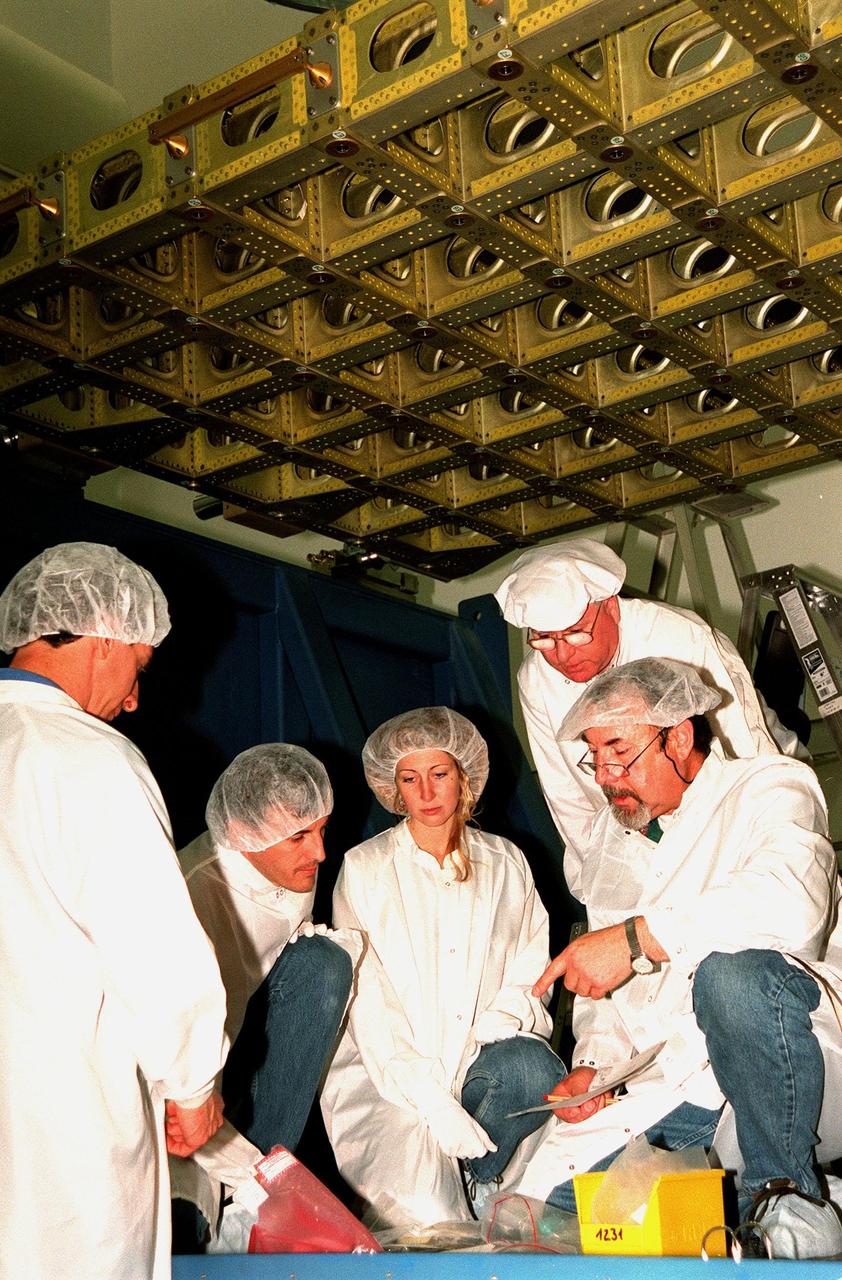
At Astrotech, Titusville, Fla., discussing the International Cargo Carrier (ICC) overhead are Charles Franca, with Johnson Space Center (JSC); Robert Wilkes, with Lockheed Martin; Lora Lawrence, with JSC; Carl Figiel and Harald Schnier, with Daimler-Chrysler Aerospace (DASA). The nonpressurized ICC fits inside the payload bay of the orbiter. The ICC will carry the SPACEHAB Oceaneering Space System Box (SHOSS), a logistics items carrier. SHOSS can hold a maximum of 400 pounds of equipment and will carry items to be used during STS-96 and future ISS assembly flights. Also aboard the ICC will be the ORU Transfer Device (OTD), a U.S.-built crane that will be stowed on Unity for use during future ISS assembly missions. The ICC will fly on mission STS-96, targeted for launch on May 20
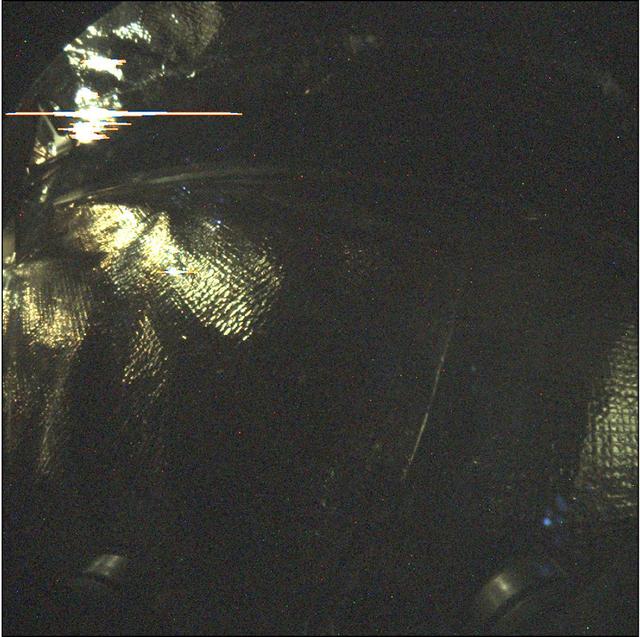
This long-exposure image (24 seconds) was taken by Instrument Context Camera (ICC) of NASA's InSight Mars lander. The image shows some of the interior features of the backshell that encapsulates the spacecraft. The backshell carries the parachute and several components used during later stages of entry, descent, and landing. Along with the heatshield, the backshell protects NASA's InSight Mars lander during its commute to and entry into the Martian atmosphere. The annotations in this image call out discernable components in the backshell -- the heatshield blanket, harness tie-downs, and cover bolts for the ICC. The heat shield blanket provides thermal protection from the hot and cold temperature swings encountered during cruise, and the high heat that will occur during Mars atmospheric entry. The tie-downs are used to secure harnesses (or other objects) so they do not move around inside the aeroshell while in flight. The ICC cover bolts secure a protective transparent window to the camera during cruise and entry, descent and landing. The cover is opened after landing and is not visible during surface operations. This image has been stretched to bring out details in the dimly lit scene. The illumination of the components on the inside of the backshell comes from sunlight entering around the edges of cutouts in the backshell to accommodate steering thrusters. An annotated image is available at https://photojournal.jpl.nasa.gov/catalog/PIA22647
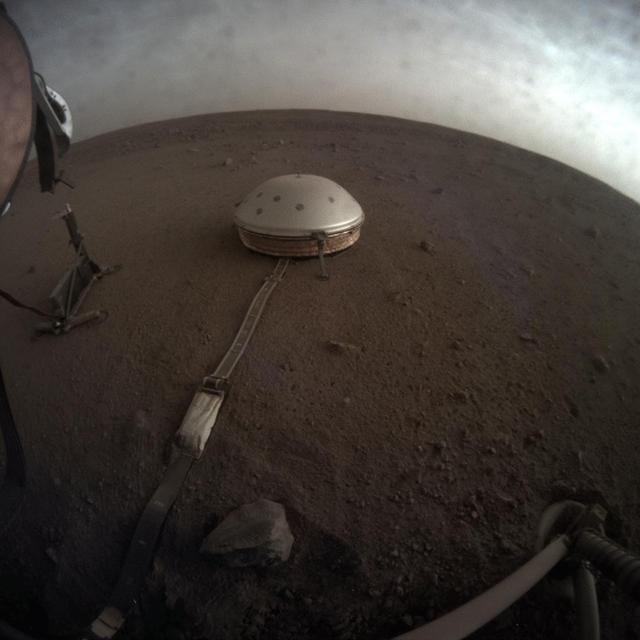
NASA's InSight used its Instrument Context Camera (ICC) beneath the lander's deck to image these drifting clouds at sunset. This series of images was taken on April 25, 2019, the 145th Martian day, or sol, of the mission, starting at around 6:30 p.m. Mars local time. Movies available at https://photojournal.jpl.nasa.gov/catalog/PIA23180
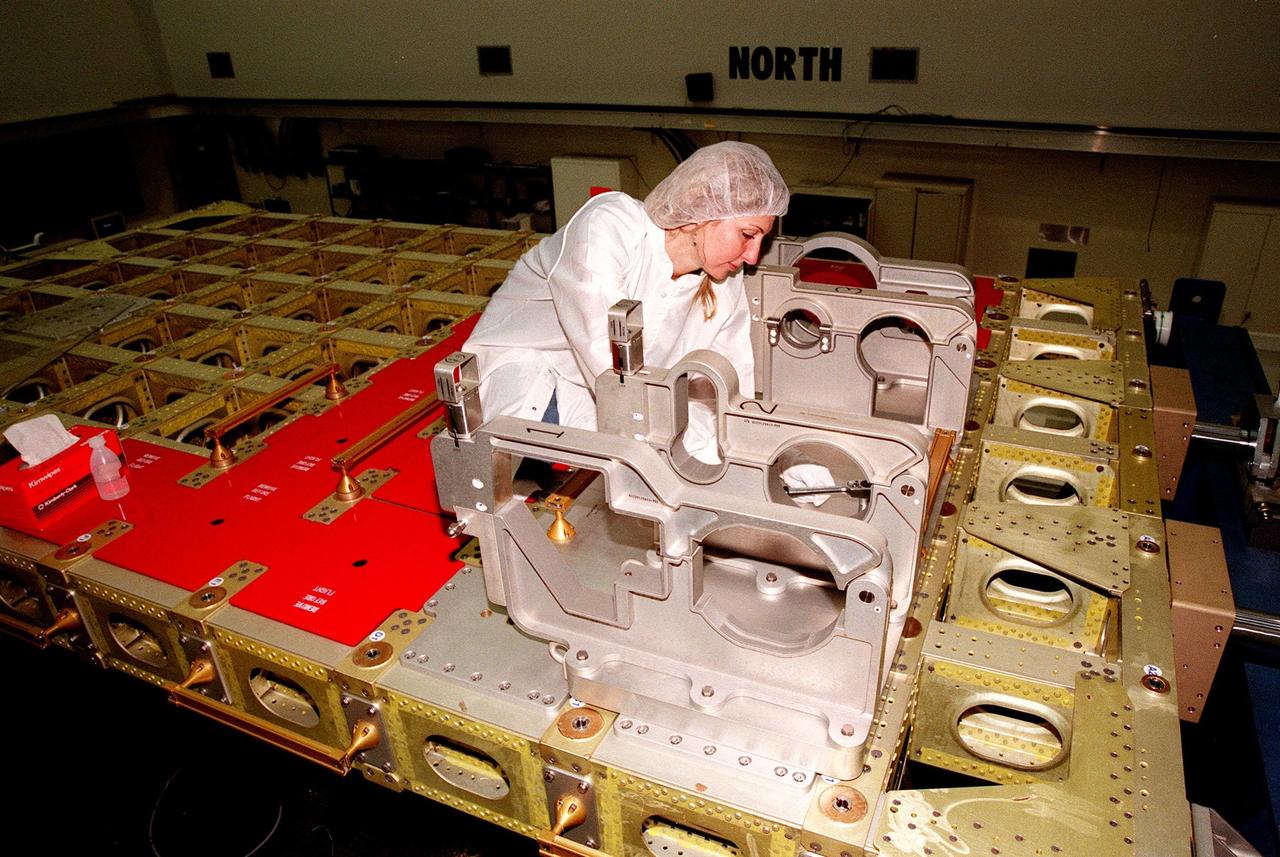
At Astrotech, Titusville, Fla., Lora Lawrence, with Johnson Space Center, makes a bonding check on the International Cargo Carrier that will be used during future International Space Station (ISS) assembly missions. The nonpressurized ICC fits inside the payload bay of the orbiter. The ICC will carry the SPACEHAB Oceaneering Space System Box (SHOSS), a logistics items carrier. SHOSS can hold a maximum of 400 pounds of equipment and will carry items to be used during STS-96 and future ISS assembly flights. Also aboard the ICC will be the ORU Transfer Device (OTD), a U.S.-built crane that will be stowed on Unity for use during future ISS assembly missions. The ICC will fly on mission STS-96, targeted for launch on May 20
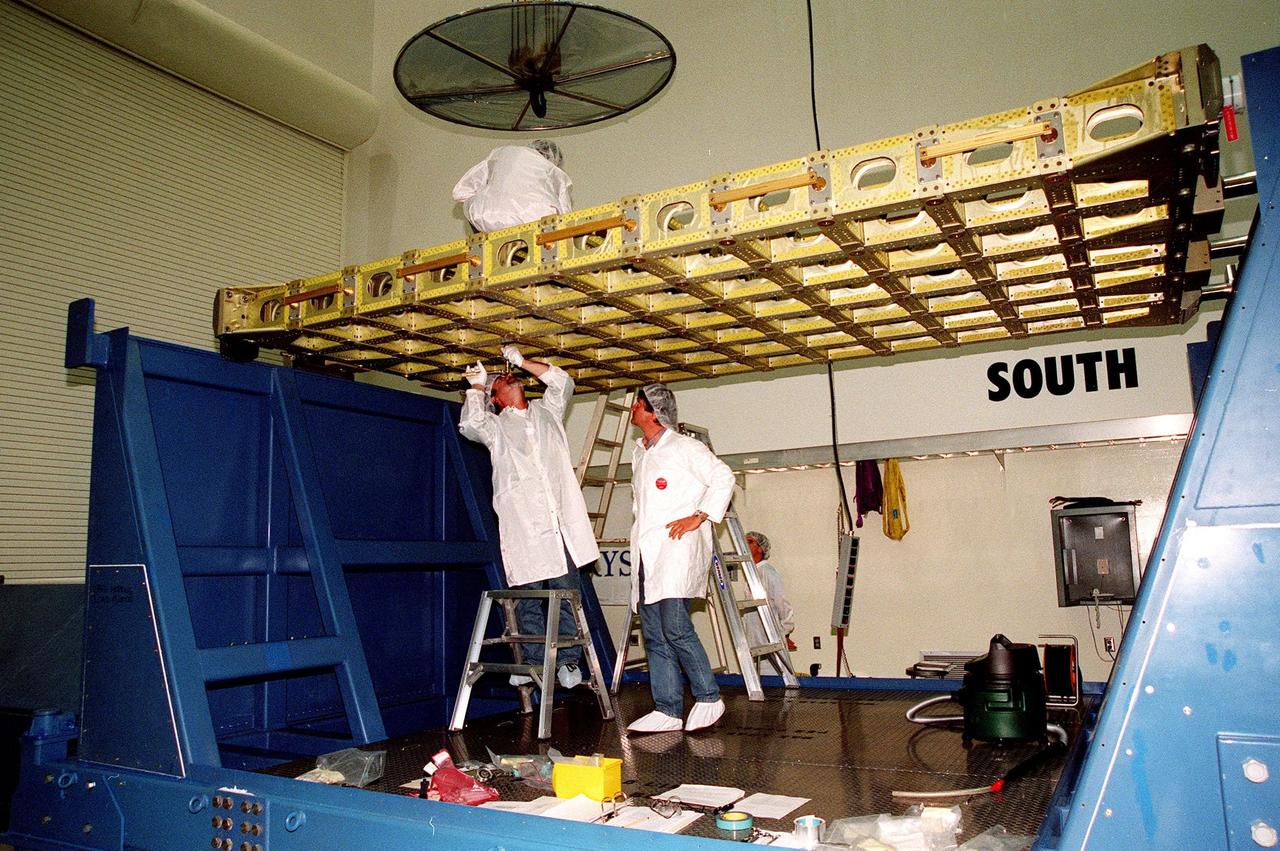
At Astrotech, Titusville, Fla., Harald Schnier and Manfred Nordhoff, with Daimler-Chrysler Aerospace (DASA), look over the International Cargo Carrier that will be used during future International Space Station (ISS) assembly missions. On top is Robert Wilkes, with Lockheed Martin. Behind the ladder in the background is Ben Greene, with Lockheed Martin. The nonpressurized ICC fits inside the payload bay of the orbiter. The ICC will carry the SPACEHAB Oceaneering Space System Box (SHOSS), a logistics items carrier. SHOSS can hold a maximum of 400 pounds of equipment and will carry items to be used during STS-96 and future ISS assembly flights. Also aboard the ICC will be the ORU Transfer Device (OTD), a U.S.-built crane that will be stowed on Unity for use during future ISS assembly missions. The ICC will fly on mission STS-96, targeted for launch on May 20
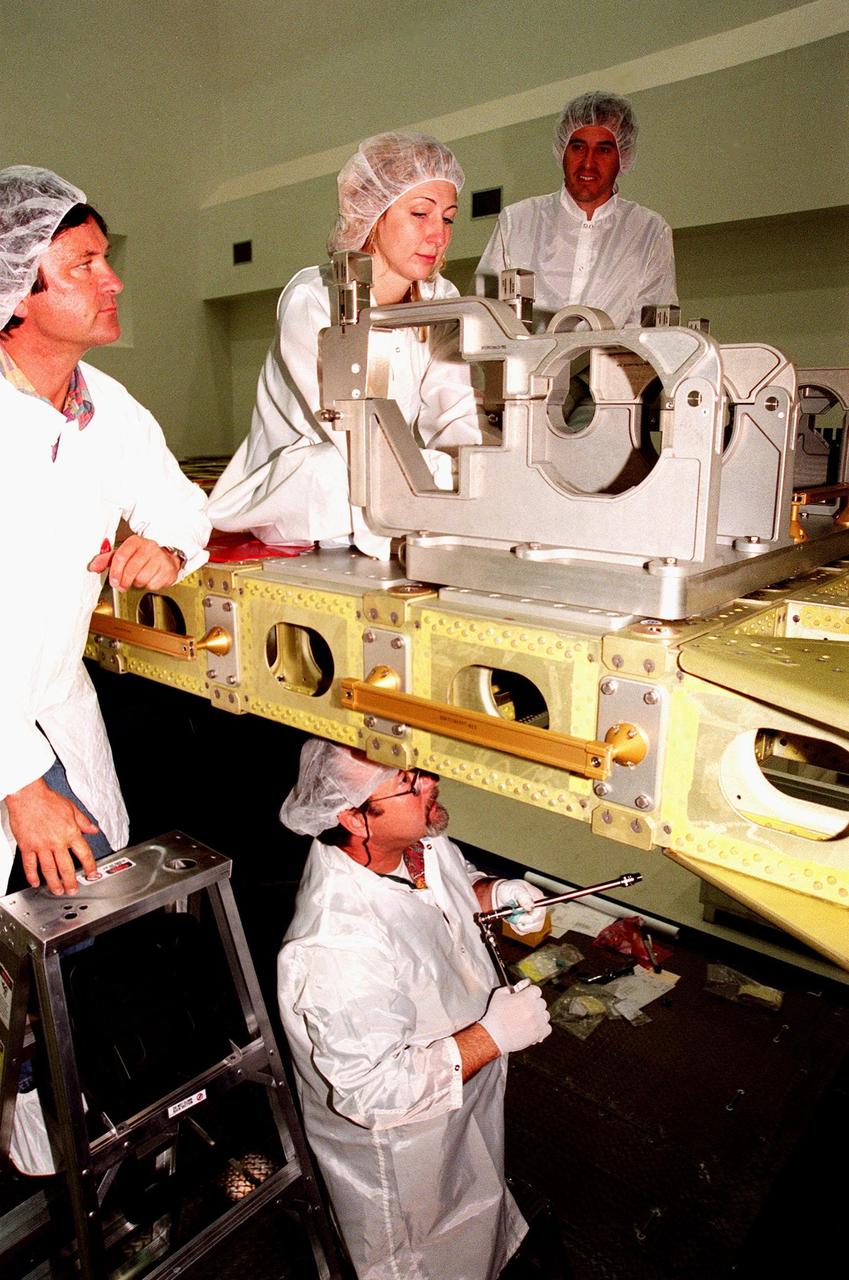
At Astrotech, Titusville, Fla., checking the International Cargo Carrier that will be used during future International Space Station (ISS) assembly missions are (left to right) Manfred Nordhoff, with Daimler-Chrysler Aerospace (DASA); Lora Lawrence, with Johnson Space Center; Robert Wilkes, with Lockheed Martin; and (below) Harald Schnier, with DASA. The ICC fits inside the payload bay of the orbiter. The ICC will carry the SPACEHAB Oceaneering Space System Box (SHOSS), a logistics items carrier. SHOSS can hold a maximum of 400 pounds of equipment and will carry items to be used during STS-96 and future ISS assembly flights. Also aboard the ICC will be the ORU Transfer Device (OTD), a U.S.-built crane that will be stowed on Unity for use during future ISS assembly missions. The ICC will fly on mission STS-96, targeted for launch on May 20
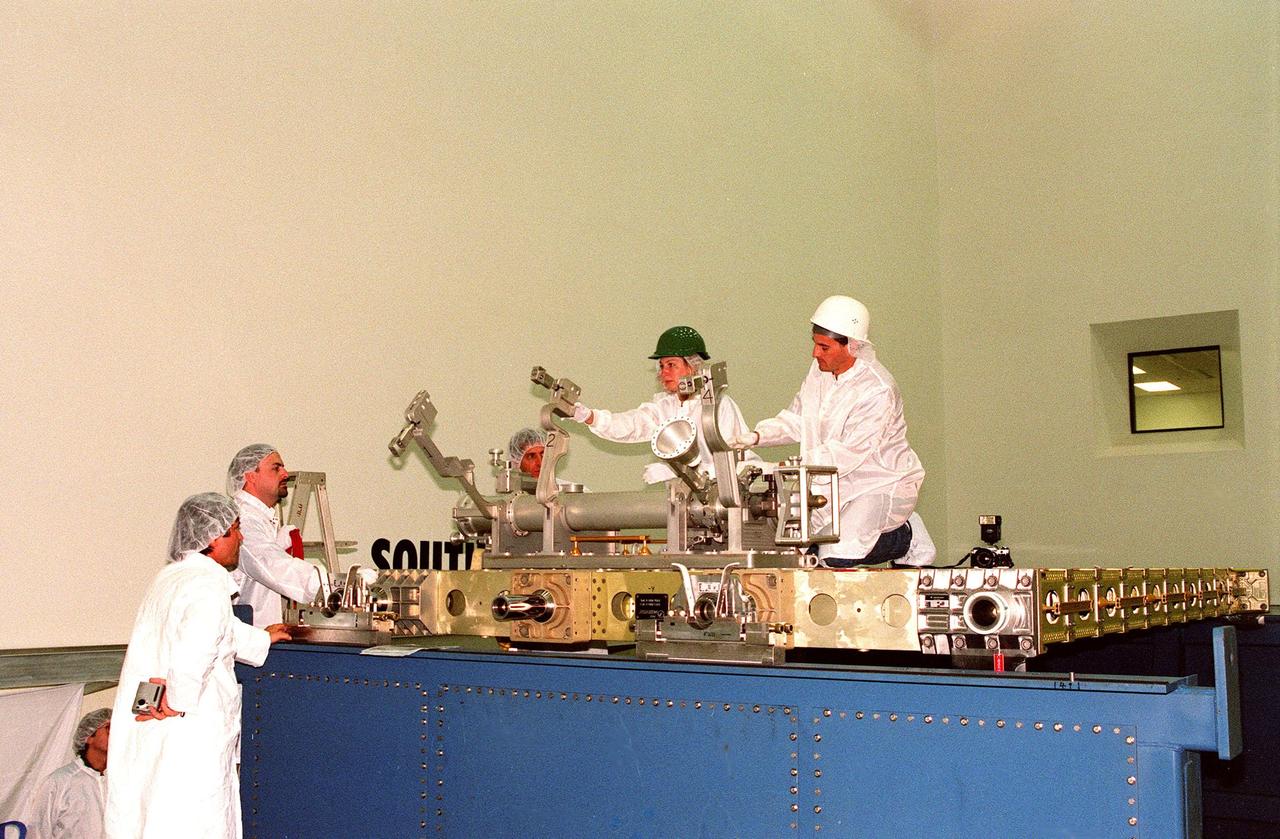
An ORU Transfer Device (OTD) on top of the International Cargo Carrier (ICC) is checked by Manfred Nordhoff, with Daimler-Chrysler Aerospace (DASA); Ben Greene, with Lockheed Martin; Robert Wilkes (behind arm number two), with Lockheed Martin; Lora Laurence and Charles Franca, with Johnson Space Center. The OTD is a U.S.-built crane that will be stowed on the International Space Station's Unity module for use during future ISS assembly missions. The nonpressurized ICC fits inside the payload bay of the orbiter. The ICC will also carry the SPACEHAB Oceaneering Space System Box (SHOSS), a logistics items carrier. SHOSS can hold a maximum of 400 pounds of equipment and will carry items to be used during STS-96 and future ISS assembly flights. The ICC will fly on mission STS-96, targeted for launch on May 20
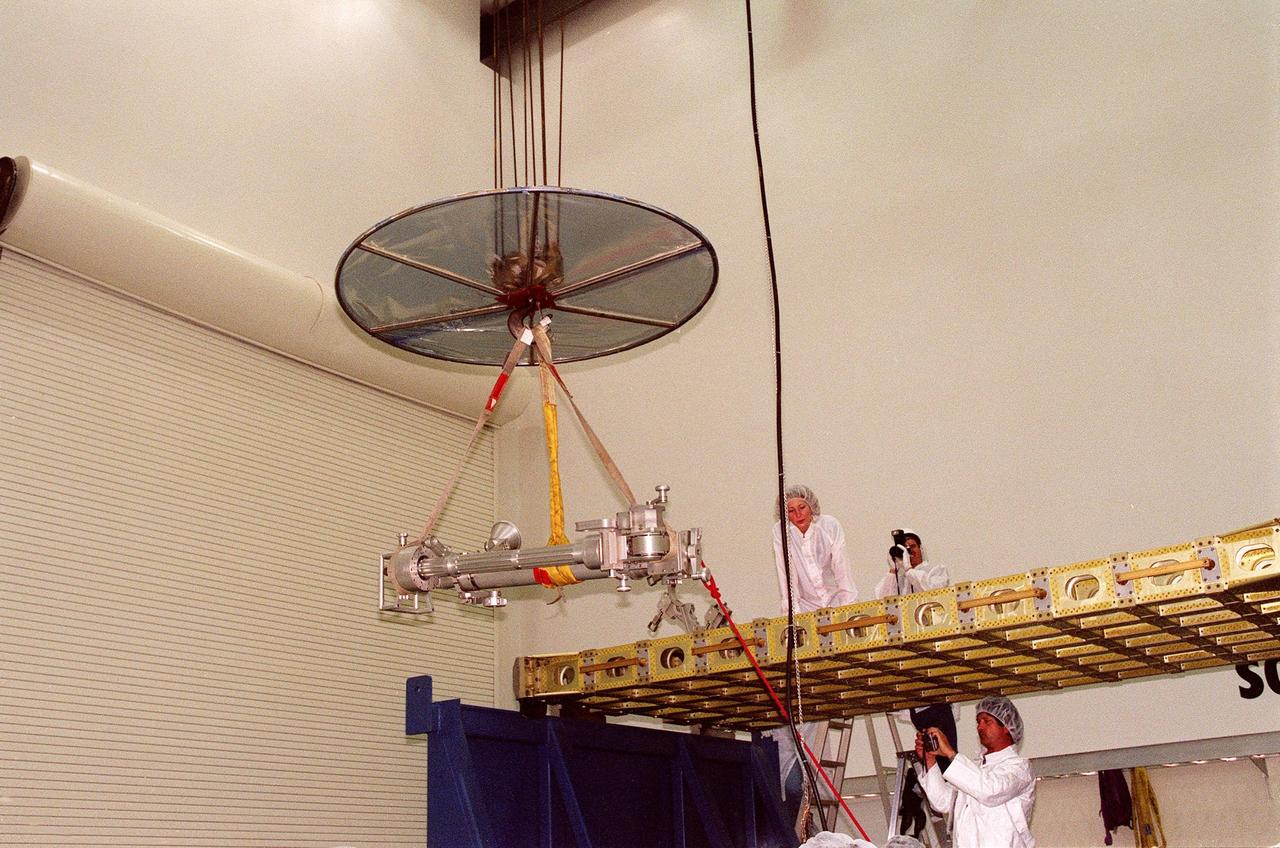
At Astrotech, Titusville, Fla., three workers watch as the overhead crane lifts and moves the ORU Transfer Device (OTD) to the top of the International Cargo Carrier (ICC). From left are Lora Laurence, with Johnson Space Center; Robert Wilkes, with Lockheed Martin; and Manfred Nordhoff, with Daimler-Chrysler Aerospace (DASA). The OTD is a U.S.-built crane that will be stowed on the International Space Station's Unity module for use during future ISS assembly missions. The nonpressurized ICC fits inside the payload bay of the orbiter. The ICC will also carry the SPACEHAB Oceaneering Space System Box (SHOSS), a logistics items carrier. SHOSS can hold a maximum of 400 pounds of equipment and will carry items to be used during STS-96 and future ISS assembly flights. The ICC will fly on mission STS-96, targeted for launch on May 20
KENNEDY SPACE CENTER, Fla. -- An overhead crane in the Space Station Processing Facility moves the Integrated Cargo Carrier toward the payload canister (right). The ICC holds several payloads for mission STS-105, the Early Ammonia Servicer and two experiment containers. The ICC will join the Multi-Purpose Logistics Module Leonardo already in the payload canister for transport to Launch Pad 39A where they will be placed in the payload bay of Space Shuttle Discovery. Launch of STS-105 is scheduled for 5:38 p.m. EDT Aug. 9
KENNEDY SPACE CENTER, Fla. -- A crane is attached to the Integrated Cargo Carrier in the Space Station Processing Facility in order to move it to the payload canister. The ICC holds several payloads for mission STS-105, the Early Ammonia Servicer and two experiment containers. The ICC will join the Multi-Purpose Logistics Module Leonardo in the payload canister for transport to Launch Pad 39A where they will be placed in the payload bay of Space Shuttle Discovery. Launch of STS-105 is scheduled for 5:38 p.m. EDT Aug. 9
KENNEDY SPACE CENTER, Fla. -- An overhead crane in the Space Station Processing Facility lifts the Integrated Cargo Carrier from its workstand to move it to the payload canister. The ICC holds several payloads for mission STS-105, the Early Ammonia Servicer and two experiment containers. The ICC will join the Multi-Purpose Logistics Module Leonardo in the payload canister for transport to Launch Pad 39A where they will be placed in the payload bay of Space Shuttle Discovery. Launch of STS-105 is scheduled for 5:38 p.m. EDT Aug. 9
KENNEDY SPACE CENTER, Fla. -- The Integrated Cargo Carrier is lowered into the payload canister in front of the Multi-Purpose Logistics Module Leonardo. The ICC holds several payloads for mission STS-105, the Early Ammonia Servicer and two experiment containers. The canister will transport the MPLM and ICC transport to Launch Pad 39A where they will be placed in the payload bay of Space Shuttle Discovery. Launch of STS-105 is scheduled for 5:38 p.m. EDT Aug. 9
A fish-eye view of NASA's InSight lander deploying its first instrument onto the surface of Mars. InSight's robotic arm placed the seismometer on Dec. 19, 2018, around the time of dusk on Mars. These images were taken by the Instrument Context Camera (ICC), a fish-eye camera under the spacecraft's deck. Animation available at https://photojournal.jpl.nasa.gov/catalog/PIA22978

KENNEDY SPACE CENTER, FLA. --In the Space Station Processing Facility at NASA's Kennedy Space Center, workers inside the payload canister remove an overhead crane from the integrated cargo carrier-lite, or ICC-L. The ICC-L is an unpressurized cross-bay carrier providing launch and return transportation with the space shuttle. It rests on a keel yoke assembly, seen underneath. The ICC-L carries three elements: a nitrogen tank assembly that is part of the external active thermal control system on the International Space Station, the European technology Exposure Facility composed of nine science instruments and an autonomous temperature measurement unit, and the SOLAR payload designed for sun observation. The SOLAR will be transferred and stowed on the Columbus module during the third spacewalk of the mission. STS-122 is targeted for launch on Dec. 6 on space shuttle Atlantis. Photo credit: NASA/Amanda Diller

KENNEDY SPACE CENTER, FLA. -- In the Space Station Processing Facility at NASA's Kennedy Space Center, an overhead crane moves the integrated cargo carrier-lite, or ICC-L, toward the payload canister at right. The ICC-L is an unpressurized cross-bay carrier providing launch and return transportation with the space shuttle. It rests on a keel yoke assembly, seen underneath. The ICC-L carries three elements: a nitrogen tank assembly that is part of the external active thermal control system on the International Space Station, the European technology Exposure Facility composed of nine science instruments and an autonomous temperature measurement unit, and the SOLAR payload designed for sun observation. The SOLAR will be transferred and stowed on the Columbus module during the third spacewalk of the mission. STS-122 is targeted for launch on Dec. 6 on space shuttle Atlantis. Photo credit: NASA/Amanda Diller

KENNEDY SPACE CENTER, FLA. --In the Space Station Processing Facility at NASA's Kennedy Space Center, an overhead crane moves the integrated cargo carrier-lite, or ICC-L, toward the payload canister at right. The ICC-L is an unpressurized cross-bay carrier providing launch and return transportation with the space shuttle. It rests on a keel yoke assembly, seen underneath. The ICC-L carries three elements: a nitrogen tank assembly that is part of the external active thermal control system on the International Space Station, the European technology Exposure Facility composed of nine science instruments and an autonomous temperature measurement unit, and the SOLAR payload designed for sun observation. The SOLAR will be transferred and stowed on the Columbus module during the third spacewalk of the mission. STS-122 is targeted for launch on Dec. 6 on space shuttle Atlantis. Photo credit: NASA/Amanda Diller

KENNEDY SPACE CENTER, FLA. -- In the Space Station Processing Facility at NASA's Kennedy Space Center, workers maneuver a crane into place above the integrated cargo carrier-lite, or ICC-L. The carrier will be lifted and placed in the payload canister for mission STS-122. Joining the primary payload, the Columbus module, the ICC-L is an unpressurized cross-bay carrier providing launch and return transportation with the space shuttle. The ICC-L carries three elements: a nitrogen tank assembly that is part of the external active thermal control system on the International Space Station, the European technology Exposure Facility composed of nine science instruments and an autonomous temperature measurement unit, and the SOLAR payload designed for sun observation. The SOLAR will be transferred and stowed on the Columbus module during the third spacewalk of the mission. STS-122 is targeted for launch on Dec. 6 on space shuttle Atlantis. Photo credit: NASA/Amanda Diller
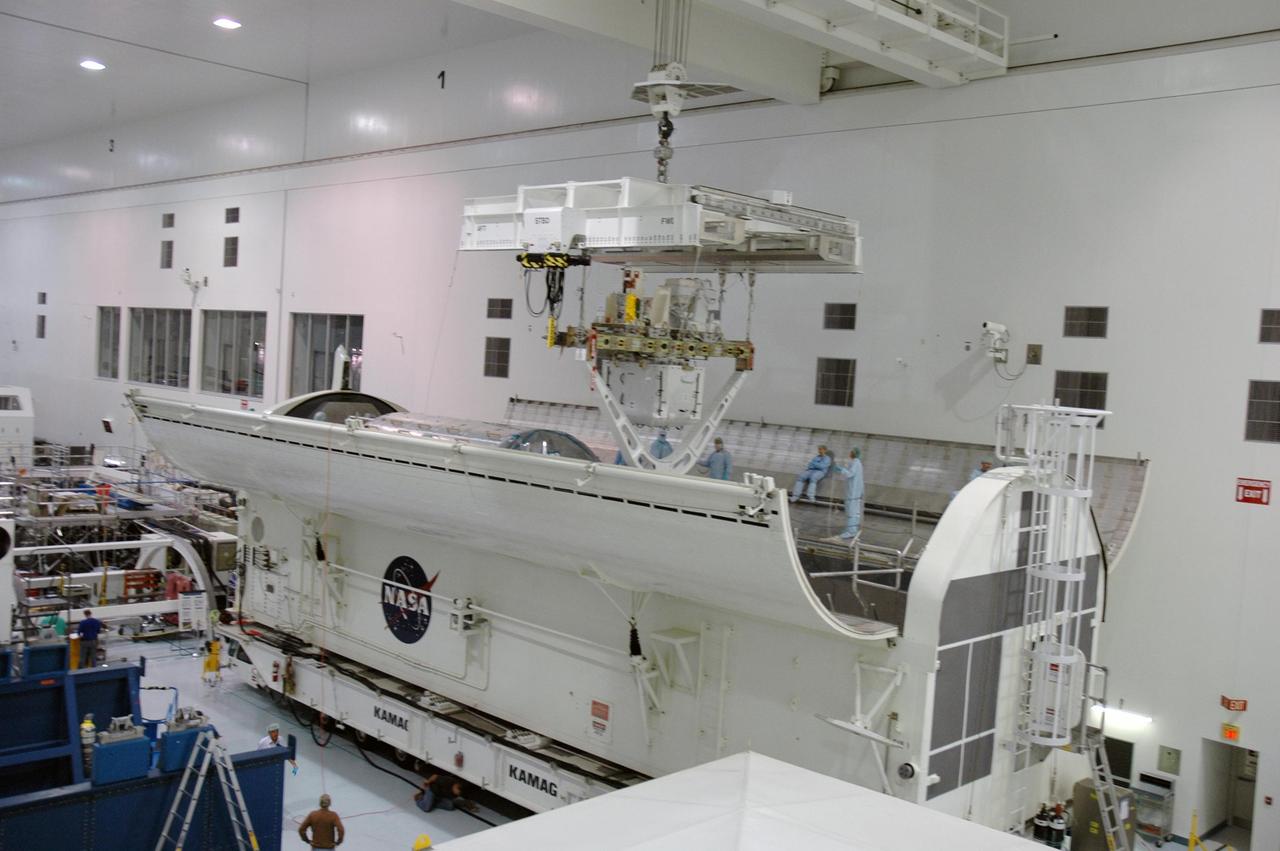
KENNEDY SPACE CENTER, FLA. -- In the Space Station Processing Facility at NASA's Kennedy Space Center, an overhead crane moves the integrated cargo carrier-lite, or ICC-L, into the payload canister below. The ICC-L is an unpressurized cross-bay carrier providing launch and return transportation with the space shuttle. It rests on a keel yoke assembly, seen underneath. The ICC-L carries three elements: a nitrogen tank assembly that is part of the external active thermal control system on the International Space Station, the European technology Exposure Facility composed of nine science instruments and an autonomous temperature measurement unit, and the SOLAR payload designed for sun observation. The nitrogen tank assembly is mounted underneath. The exposure facility is seen at left on top, and the SOLAR is on the right. The SOLAR will be transferred and stowed on the Columbus module during the third spacewalk of the mission. STS-122 is targeted for launch on Dec. 6 on space shuttle Atlantis. Photo credit: NASA/Amanda Diller

At Astrotech, Titusville, Fla., an umbrella-topped crane is secured to an ORU Transfer Device (OTD), a U.S.-built crane that will be stowed on the International Space Station's Unity module for use during future ISS assembly missions. Gathered around the OTD and crane are (left to right) Ben Greene (kneeling), with Lockheed Martin; Michael Slataper, with Ratheon; Charles Franca, with Johnson Space Center; Robert Wilkes, with Lockheed Martin; Manfred Nordhoff (back to camera), with Daimler-Chrysler Aerospace (DASA); and Carl Figiel and Harald Schnier (far right), both with (DASA). The OTD will be attached to the nonpressurized International Cargo Carrier (ICC) in the background. The ICC fits inside the payload bay of the orbiter. The ICC will also carry the SPACEHAB Oceaneering Space System Box (SHOSS), a logistics items carrier. SHOSS can hold a maximum of 400 pounds of equipment and will carry items to be used during STS-96 and future ISS assembly flights. The ICC will fly on mission STS-96, targeted for launch on May 20

S127-E-007978 (22 July 2009) Astronauts Christopher Cassidy (left) and Dave Wolf work with the Integrated Cargo Carrier-VLD, as they remove and replace batteries on the P6 truss during STS-127's third session of extravehicular activity.
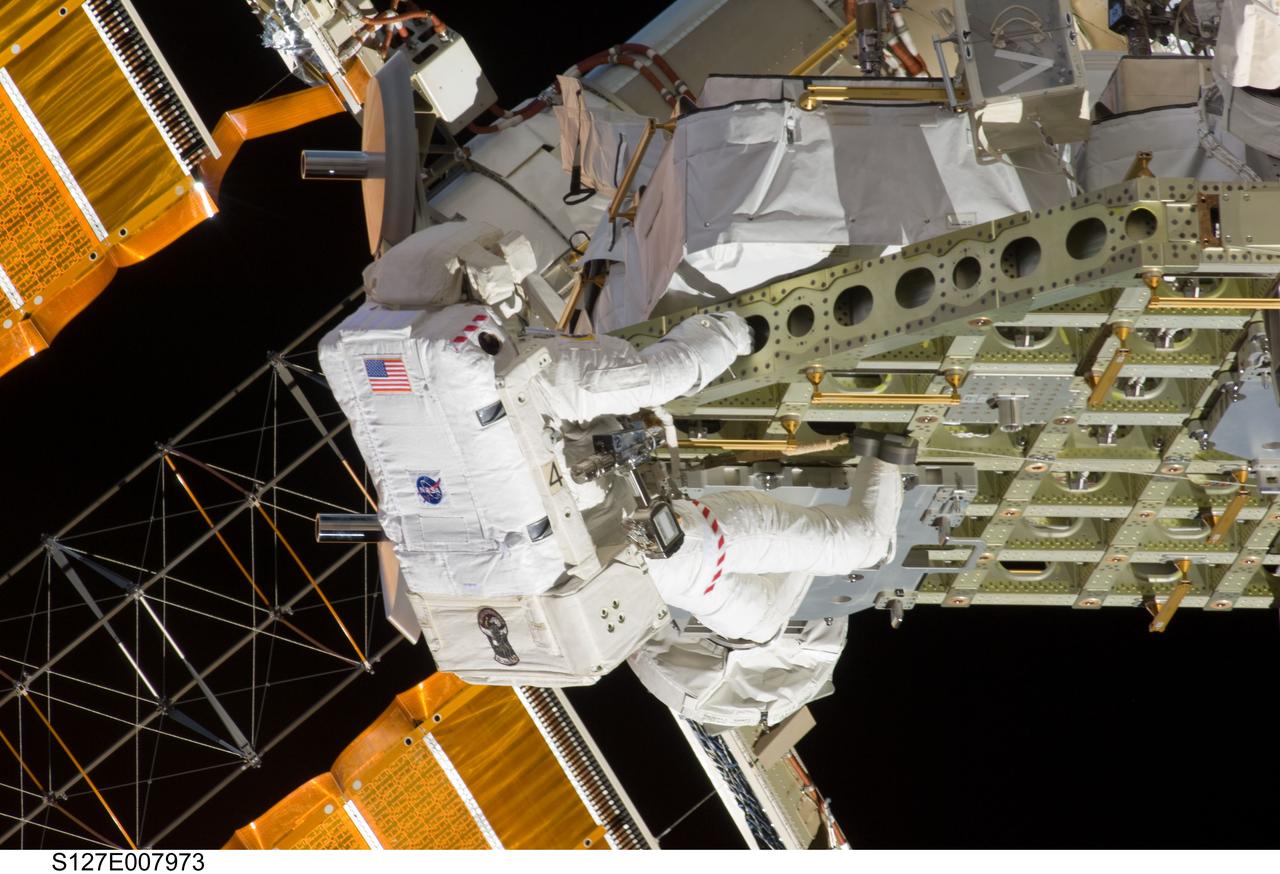
S127-E-007973 (22 July 2009) --- Astronaut Christopher Cassidy, STS-127 mission specialist, participates in Endeavour's third space walk of a scheduled five overall for this flight. Cassidy is working with the Integrated Cargo Carrier. This was Cassidy's first of a scheduled three sessions for him. Astronaut Dave Wolf, Cassidy's EVA colleague, is out of frame.
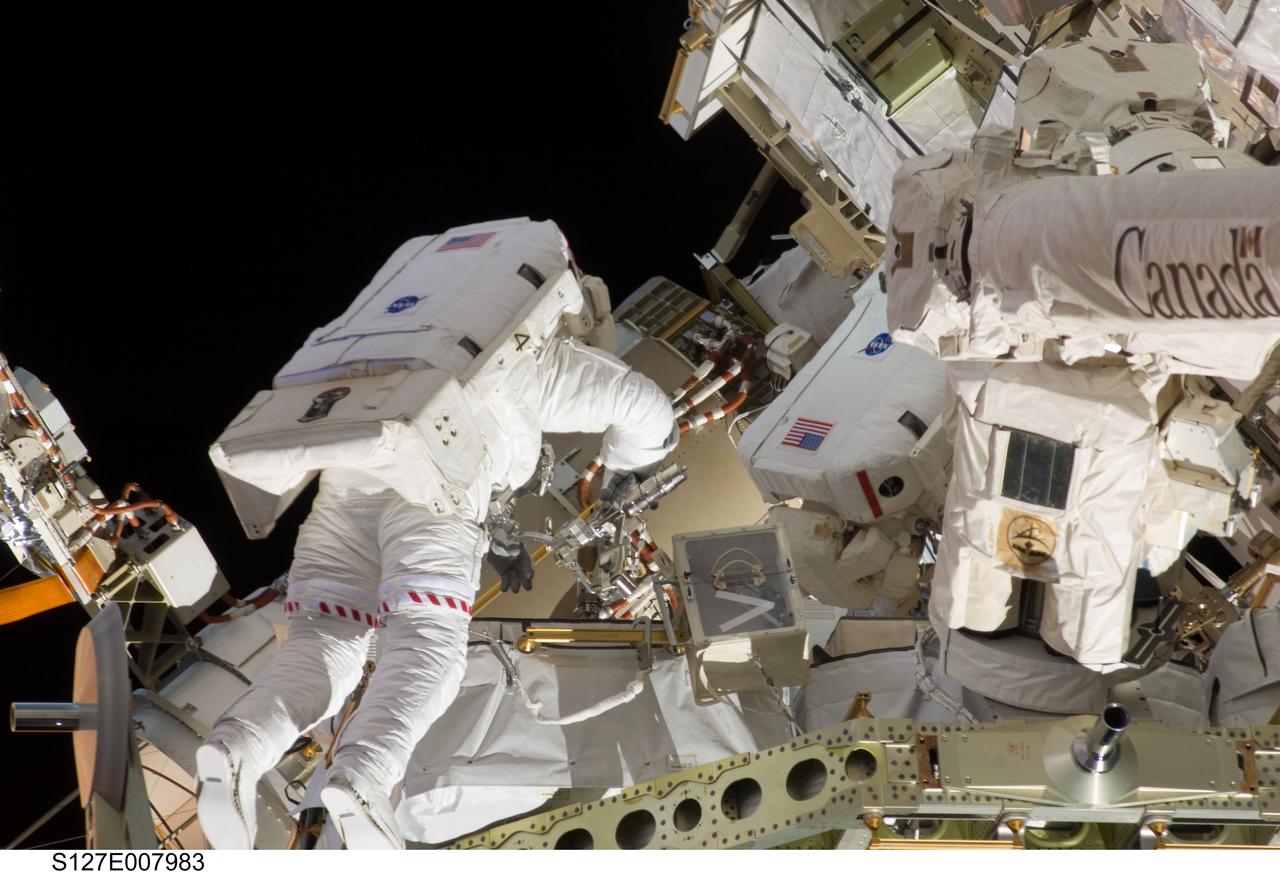
S127-E-007983 (22 July 2009) --- Astronaut Christopher Cassidy, STS-127 mission specialist, participates in Endeavour's third space walk of a scheduled five overall for this flight. This was Cassidy's first of a scheduled three sessions for him. Astronaut Dave Wolf, Cassidy's EVA colleague, partially visible at right.
KENNEDY SPACE CENTER, FLA. - In NASA's Space Station Processing Facility, the Integrated Cargo Carrier (ICC) is seen inside the payload canister. The ICC is part of the payload on mission STS-121 to the International Space Station. The carrier holds the mobile transporter reel assembly that the astronauts will replace on the station and a spare pump module. The carrier and its cargo will be placed in Space Shuttle Discovery's payload bay at the pad. Discovery is scheduled to launch on mission STS-121 from Launch Pad 39B in a window that opens July 1 and extends to July 19. Photo credit: NASA/Cory Husten
KENNEDY SPACE CENTER, FLA. - In NASA's Space Station Processing Facility, an overhead crane has placed the Integrated Cargo Carrier (ICC) inside the payload canister. The ICC is part of the payload on mission STS-121 to the International Space Station. The carrier holds the mobile transporter reel assembly that the astronauts will replace on the station and a spare pump module. The carrier and its cargo will be placed in Space Shuttle Discovery's payload bay at the pad. Discovery is scheduled to launch on mission STS-121 from Launch Pad 39B in a window that opens July 1 and extends to July 19. Photo credit: NASA/Cory Husten
KENNEDY SPACE CENTER, FLA. - At Launch Pad 39B, the payloads for mission STS-121 are being moved from the payload changeout room into Space Shuttle Discovery's payload bay. Here, the multi-purpose logistics module Leonardo is being transferred. Other payloads include the integrated cargo carrier that holds the mobile transporter reel assembly the astronauts will replace on the station and a spare pump module. Discovery is scheduled to launch at 3:48 p.m. July 1 carrying a crew of seven on the 12-day mission to the International Space Station. Photo credit: NASA/Charisse Nahser

KENNEDY SPACE CENTER, FLA. - At Launch Pad 39B, the payloads for mission STS-121 are being moved from the payload changeout room into Space Shuttle Discovery's payload bay. At lower right is the multi-purpose logistics module Leonardo. Above it is the integrated cargo carrier that holds the mobile transporter reel assembly the astronauts will replace on the station and a spare pump module. Discovery is scheduled to launch at 3:48 p.m. July 1 carrying a crew of seven on the 12-day mission to the International Space Station. Photo credit: NASA/Charisse Nahser
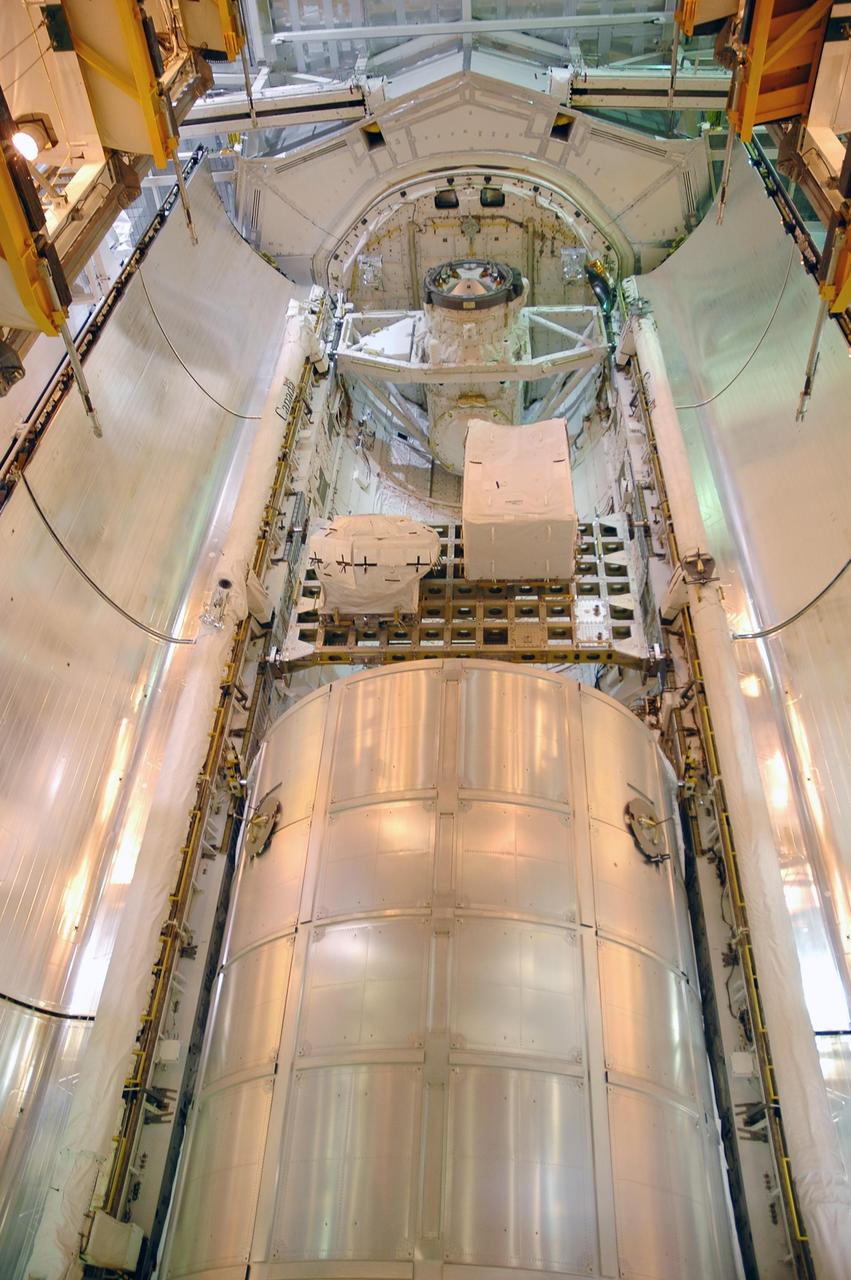
KENNEDY SPACE CENTER, FLA. - At Launch Pad 39B, the open doors of Space Shuttle Discovery's payload bay show the cargo the orbiter will carry into orbit. At the lower end is multi-purpose logistics module Leonardo. Above it is the integrated cargo carrier that holds the mobile transporter reel assembly the astronauts will replace on the station and a spare pump module. Discovery is scheduled to launch at 3:48 p.m. July 1 carrying a crew of seven on the 12-day mission to the International Space Station. Photo credit: NASA/Charisse Nahser

KENNEDY SPACE CENTER, FLA. - At Launch Pad 39B, the payloads for mission STS-121 are being moved from the payload changeout room into Space Shuttle Discovery's payload bay. Seen in the background is the multi-purpose logistics module Leonardo. Other payloads include the integrated cargo carrier that holds the mobile transporter reel assembly the astronauts will replace on the station and a spare pump module. Discovery is scheduled to launch at 3:48 p.m. July 1 carrying a crew of seven on the 12-day mission to the International Space Station. Photo credit: NASA/Charisse Nahser
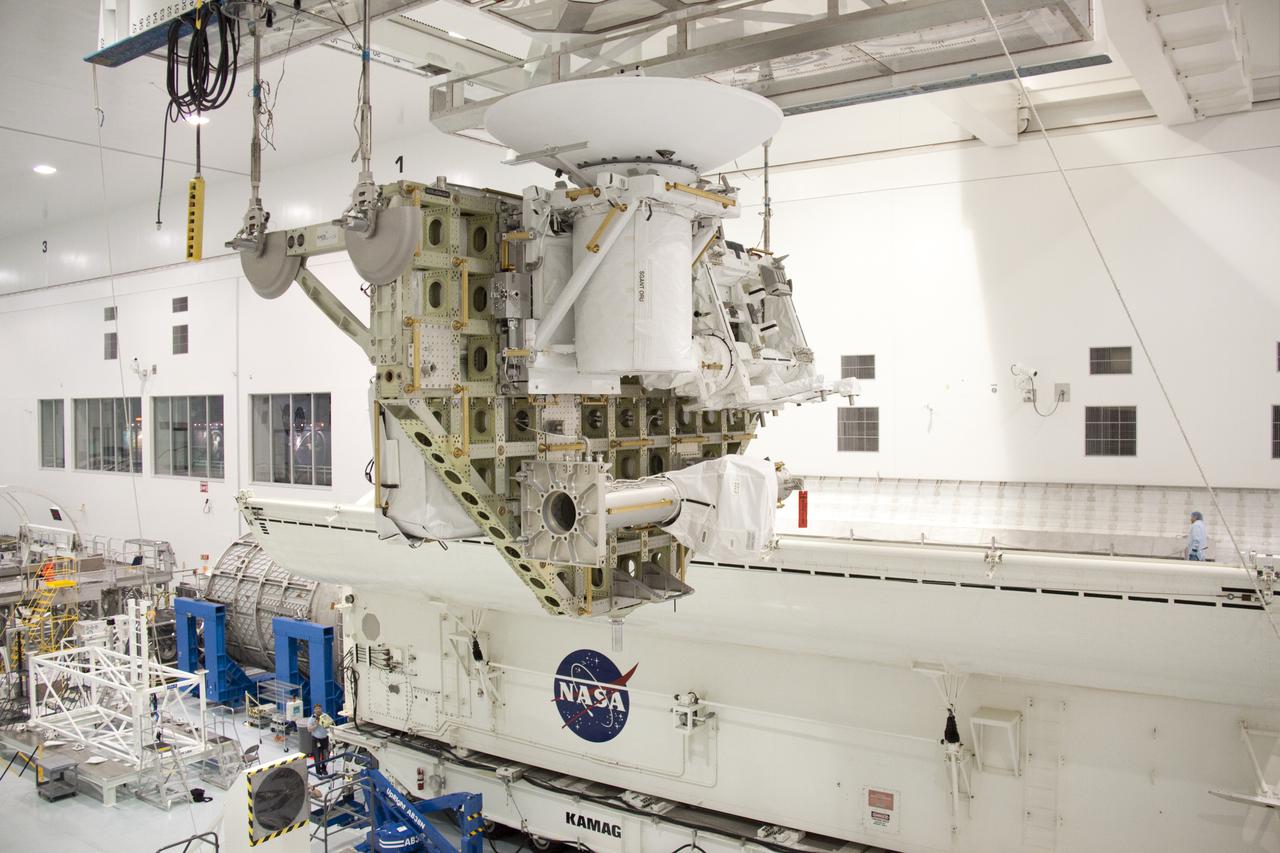
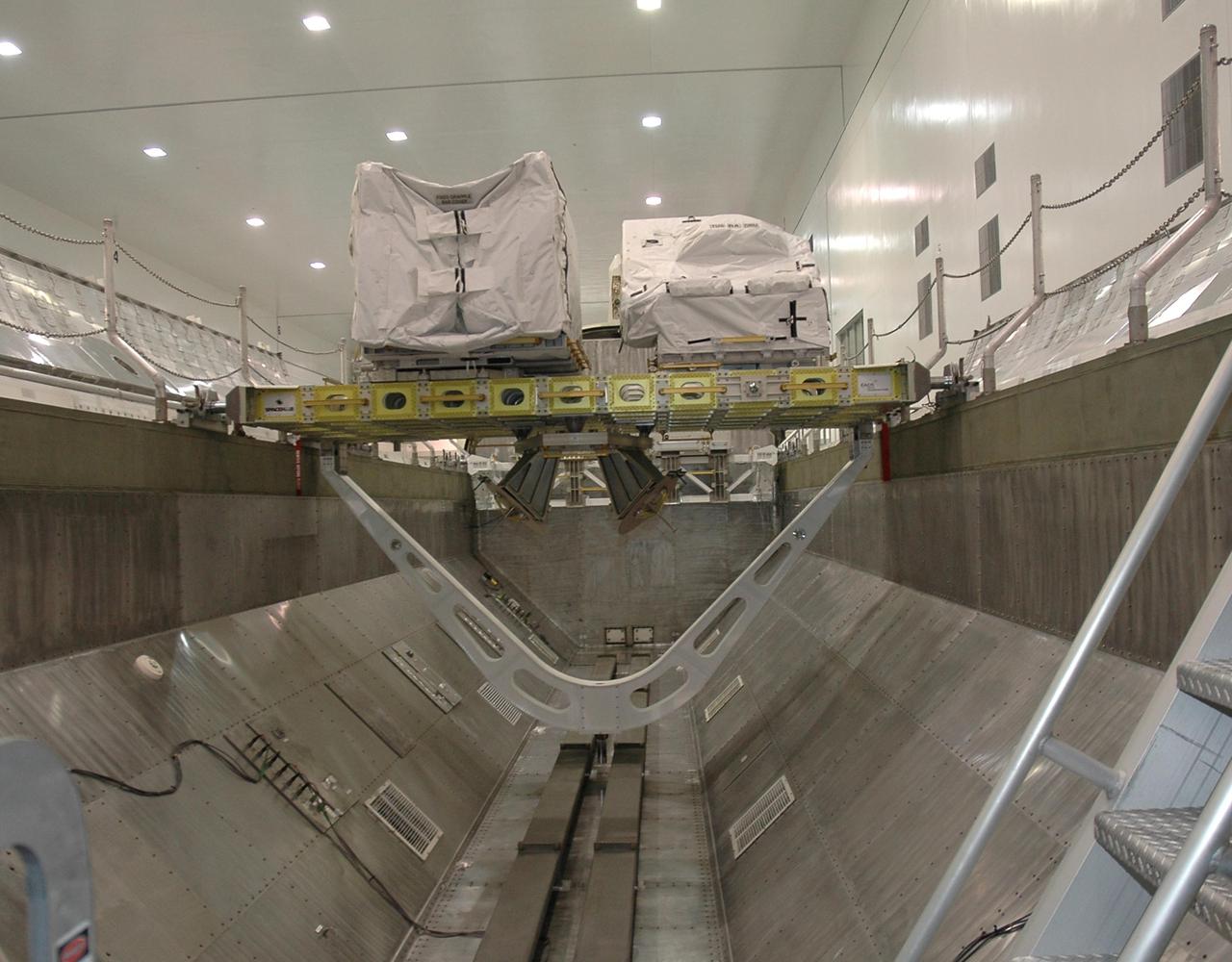
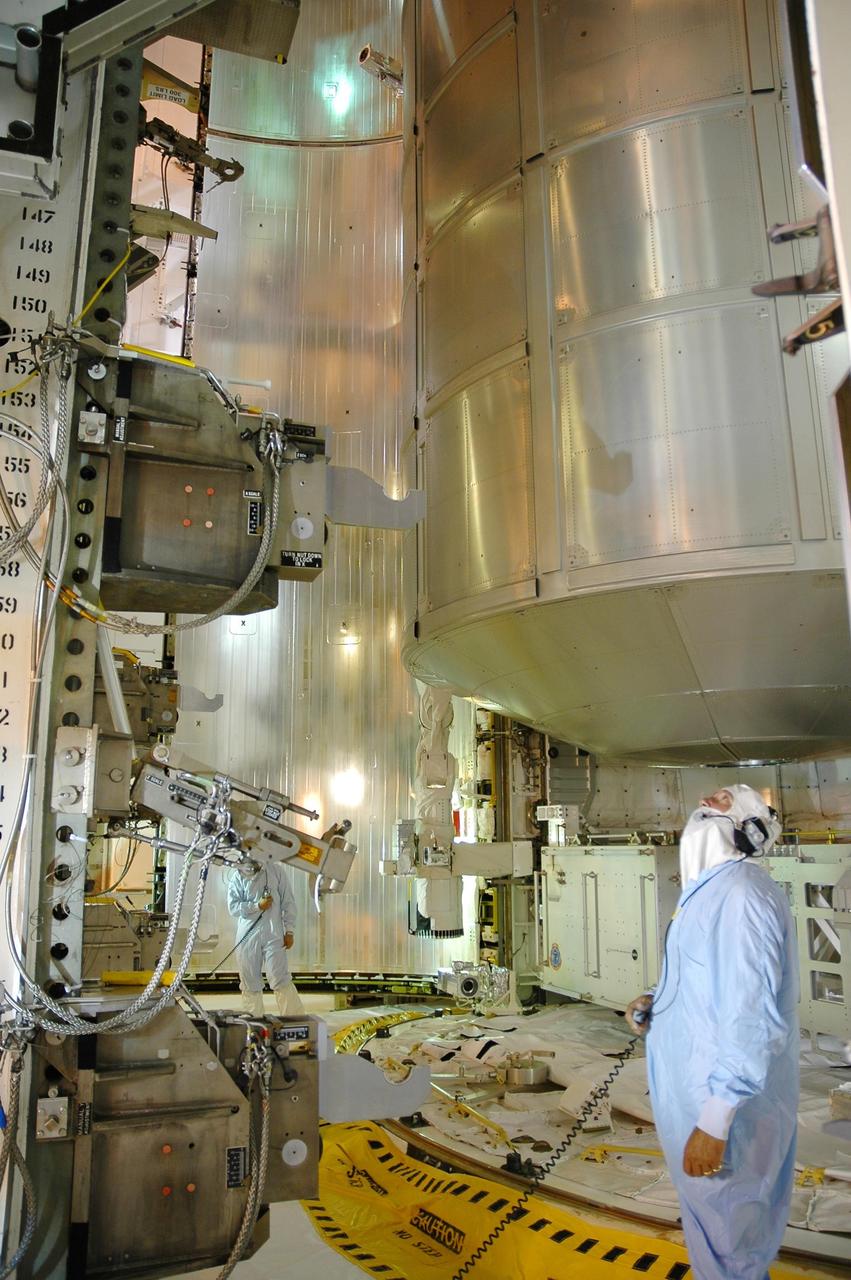
CAPE CANAVERAL, Fla. – In the Space Station Processing Facility at NASA's Kennedy Space Center in Florida, the Integrated Cargo Carrier, or ICC, is lifted toward the payload canister in which it will be transported to Launch Pad 39A. The six-member crew of space shuttle Atlantis' STS-132 mission will deliver the ICC and the Russian-built Mini-Research Module-1, or MRM-1, to the International Space Station. The ICC is an unpressurized flat bed pallet and keel yoke assembly used to support the transfer of exterior cargo from the shuttle to the space station. The MRM-1, known as Rassvet, is the second in a series of new pressurized components for Russia and will be permanently attached to the Earth-facing port of the Zarya control module. Rassvet, which translates to 'dawn,' will be used for cargo storage and will provide an additional docking port to the station. STS-132 is the 34th mission to the station and the 132nd shuttle mission overall. Launch is targeted for May 14. For information on the STS-132 mission, visit http:__www.nasa.gov_mission_pages_shuttle_shuttlemissions_sts132_index.html. Photo credit: NASA_Gianni Woods

CAPE CANAVERAL, Fla. – In the Space Station Processing Facility at NASA's Kennedy Space Center in Florida, the Integrated Cargo Carrier, or ICC, is secured in the payload canister in which it will be transported to Launch Pad 39A. The six-member crew of space shuttle Atlantis' STS-132 mission will deliver the ICC and the Russian-built Mini-Research Module-1, or MRM-1, to the International Space Station. The ICC is an unpressurized flat bed pallet and keel yoke assembly used to support the transfer of exterior cargo from the shuttle to the space station. The MRM-1, known as Rassvet, is the second in a series of new pressurized components for Russia and will be permanently attached to the Earth-facing port of the Zarya control module. Rassvet, which translates to 'dawn,' will be used for cargo storage and will provide an additional docking port to the station. STS-132 is the 34th mission to the station and the 132nd shuttle mission overall. Launch is targeted for May 14. For information on the STS-132 mission, visit http:__www.nasa.gov_mission_pages_shuttle_shuttlemissions_sts132_index.html. Photo credit: NASA_Jack Pfaller
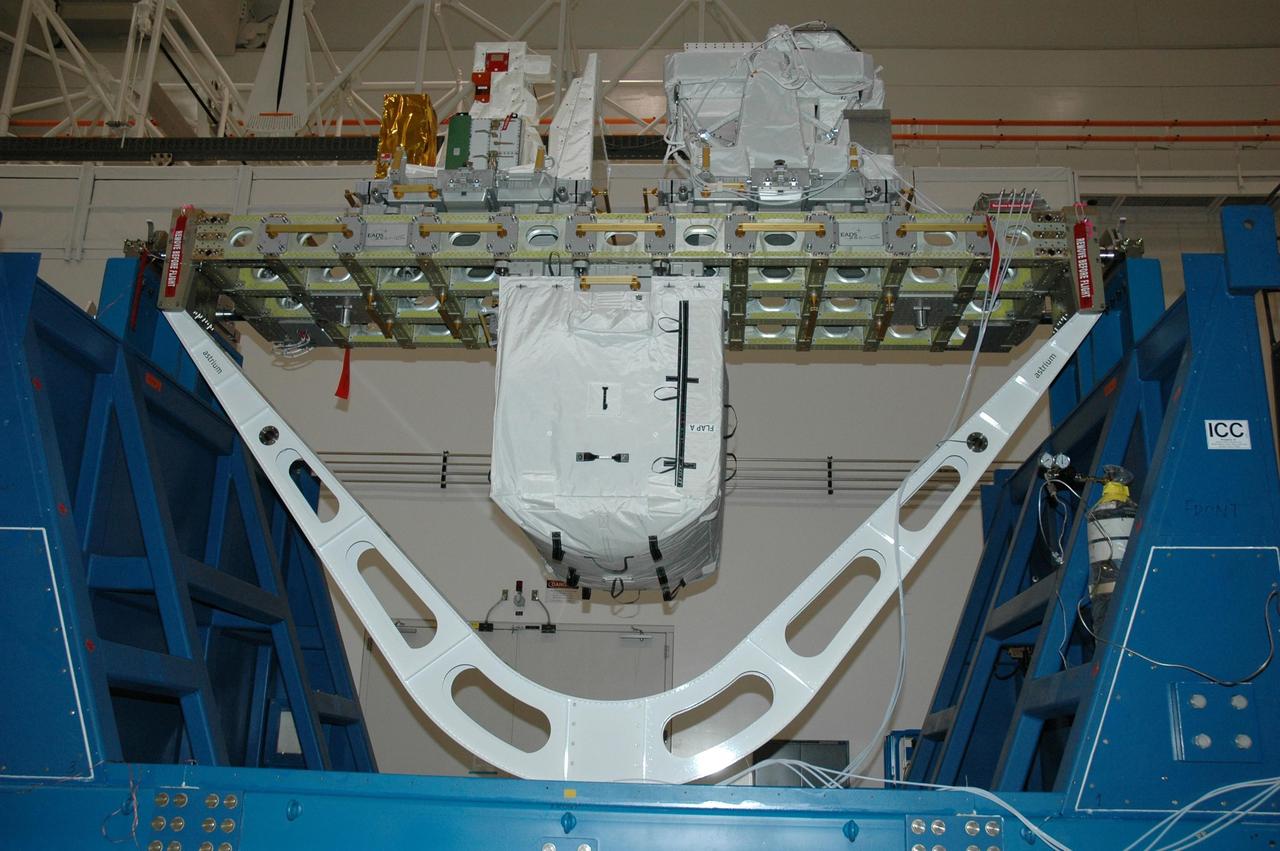
KENNEDY SPACE CENTER, FLA. -- In the Space Station Processing Facility at NASA's Kennedy Space Center, the integrated cargo carrier-lite, or ICC-L, is ready to be lifted and placed in the payload canister for mission STS-122. Joining the primary payload, the Columbus module, the ICC-L is an unpressurized cross-bay carrier providing launch and return transportation with the space shuttle. It rests on a keel yoke assembly, seen underneath. The ICC-L carries three elements: a nitrogen tank assembly that is part of the external active thermal control system on the International Space Station, the European technology Exposure Facility composed of nine science instruments and an autonomous temperature measurement unit, and the SOLAR payload designed for sun observation. The nitrogen tank assembly is mounted underneath. The exposure facility is seen at left on top, and the SOLAR is on the right. The SOLAR will be transferred and stowed on the Columbus module during the third spacewalk of the mission. STS-122 is targeted for launch on Dec. 6 on space shuttle Atlantis. Photo credit: NASA/Amanda Diller
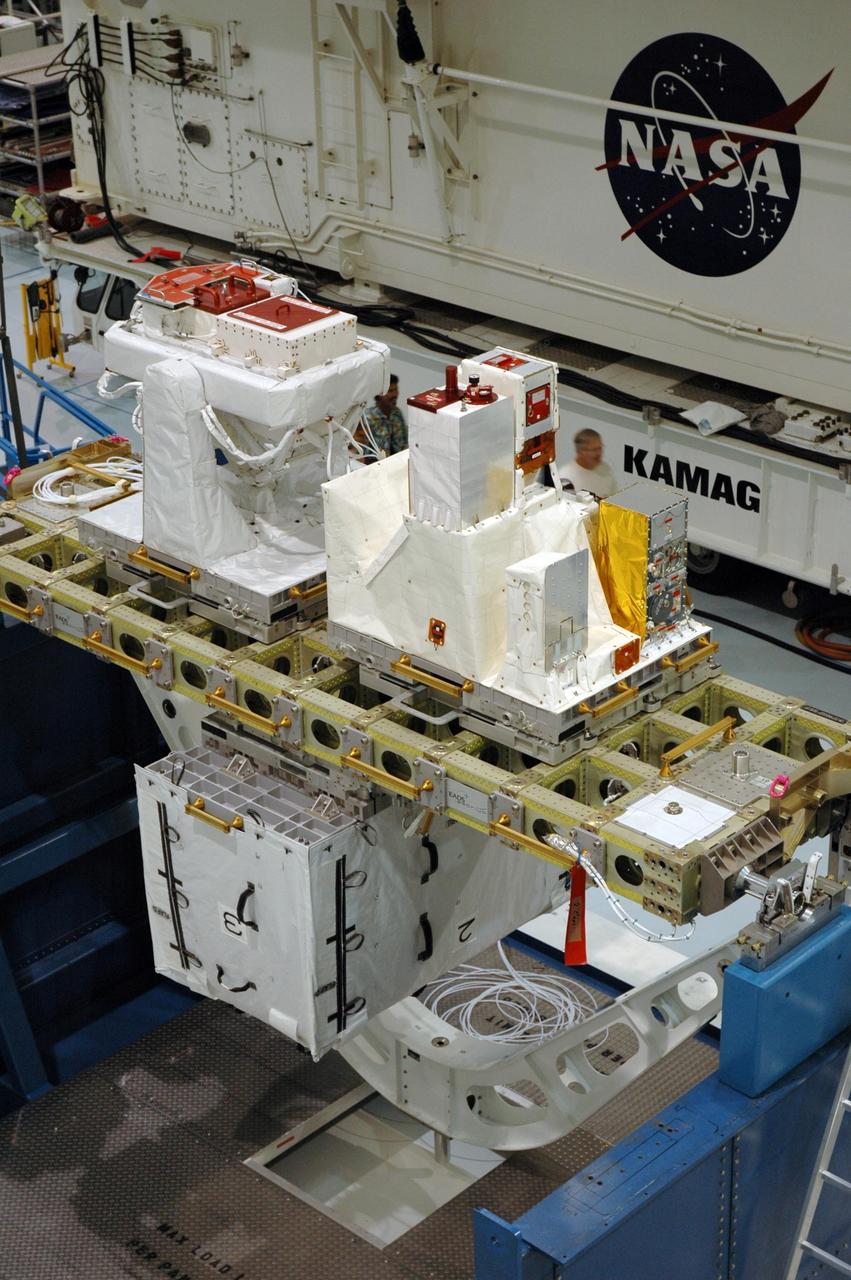
KENNEDY SPACE CENTER, FLA. --In the Space Station Processing Facility at NASA's Kennedy Space Center, the integrated cargo carrier-lite, or ICC-L, is ready to be lifted and placed in the payload canister for mission STS-122. Joining the primary payload, the Columbus module, the ICC-L is an unpressurized cross-bay carrier providing launch and return transportation with the space shuttle. It rests on a keel yoke assembly, seen underneath. The ICC-L carries three elements: a nitrogen tank assembly that is part of the external active thermal control system on the International Space Station, the European technology Exposure Facility composed of nine science instruments and an autonomous temperature measurement unit, and the SOLAR payload designed for sun observation. The nitrogen tank assembly is mounted underneath. The exposure facility is seen at left on top, and the SOLAR is on the right. The SOLAR will be transferred and stowed on the Columbus module during the third spacewalk of the mission. STS-122 is targeted for launch on Dec. 6 on space shuttle Atlantis. Photo credit: NASA/Amanda Diller
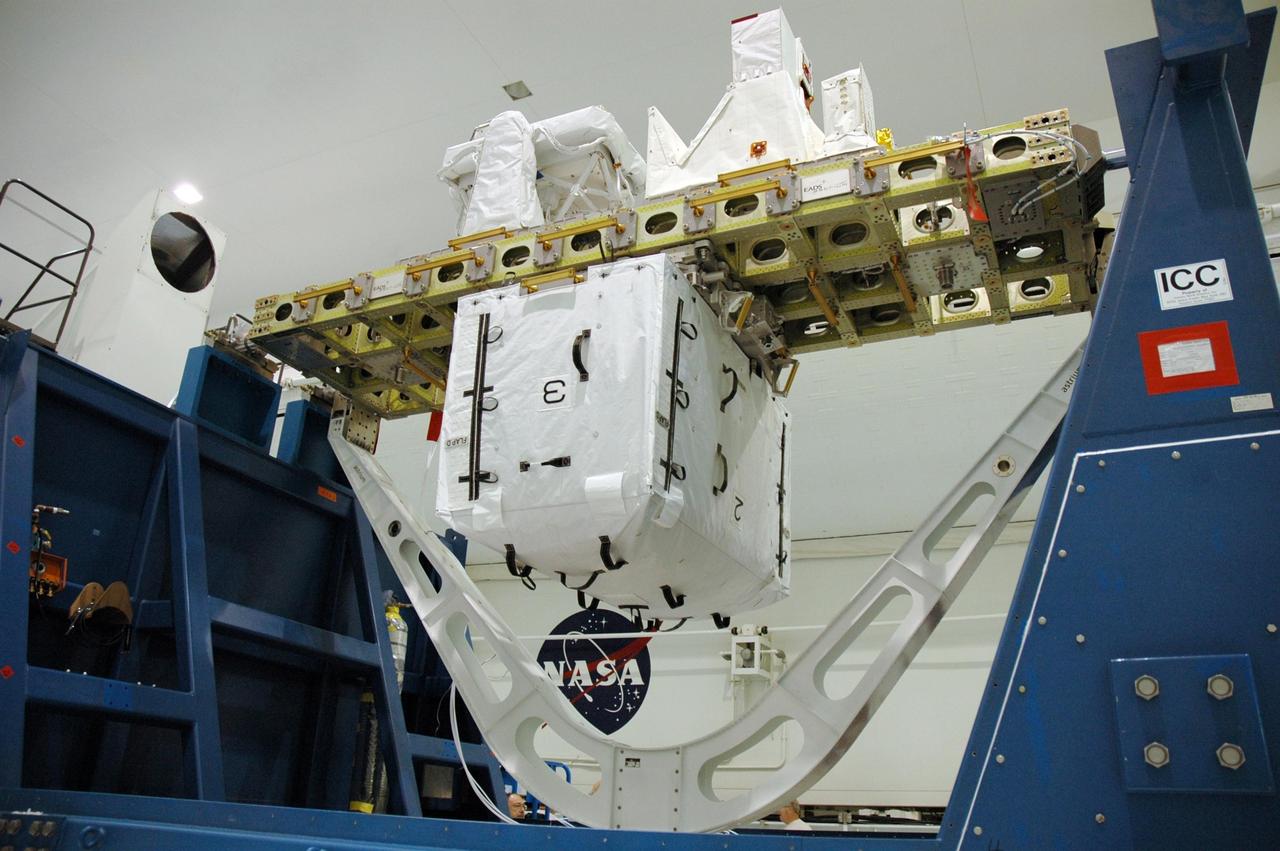
KENNEDY SPACE CENTER, FLA. -- In the Space Station Processing Facility at NASA's Kennedy Space Center, the integrated cargo carrier-lite, or ICC-L, is ready to be lifted and placed in the payload canister for mission STS-122. Joining the primary payload, the Columbus module, the ICC-L is an unpressurized cross-bay carrier providing launch and return transportation with the space shuttle. It rests on a keel yoke assembly, seen underneath. The ICC-L carries three elements: a nitrogen tank assembly that is part of the external active thermal control system on the International Space Station, the European technology Exposure Facility composed of nine science instruments and an autonomous temperature measurement unit, and the SOLAR payload designed for sun observation. The nitrogen tank assembly is mounted underneath. The exposure facility is seen at left on top, and the SOLAR is on the right. The SOLAR will be transferred and stowed on the Columbus module during the third spacewalk of the mission. STS-122 is targeted for launch on Dec. 6 on space shuttle Atlantis. Photo credit: NASA/Amanda Diller
KENNEDY SPACE CENTER, FLA. -- Workers in the Orbiter Processing Facility (OPF) Bay 1 check the Keel Yoke Device (KYD) installed in the orbiter Discovery. The KYD will support the International Cargo Carrier (ICC) to be fitted in the orbiter for mission STS-96. The ICC will carry unpressurized cargo such as the external Russian cargo crane known as STRELA, the SPACEHAB Oceaneering Space System Box (SHOSS), which is a logistics items carrier, and an ORU Transfer Device (OTD), a U.S.-built crane that will be stowed on the station for use during future ISS assembly missions. The primary payload of STS-96 is the SPACEHAB Double Module, an element of the International Space Station. STS-96 is targeted for launch on May 20 at 9:32 a.m. from Launch Pad 39B
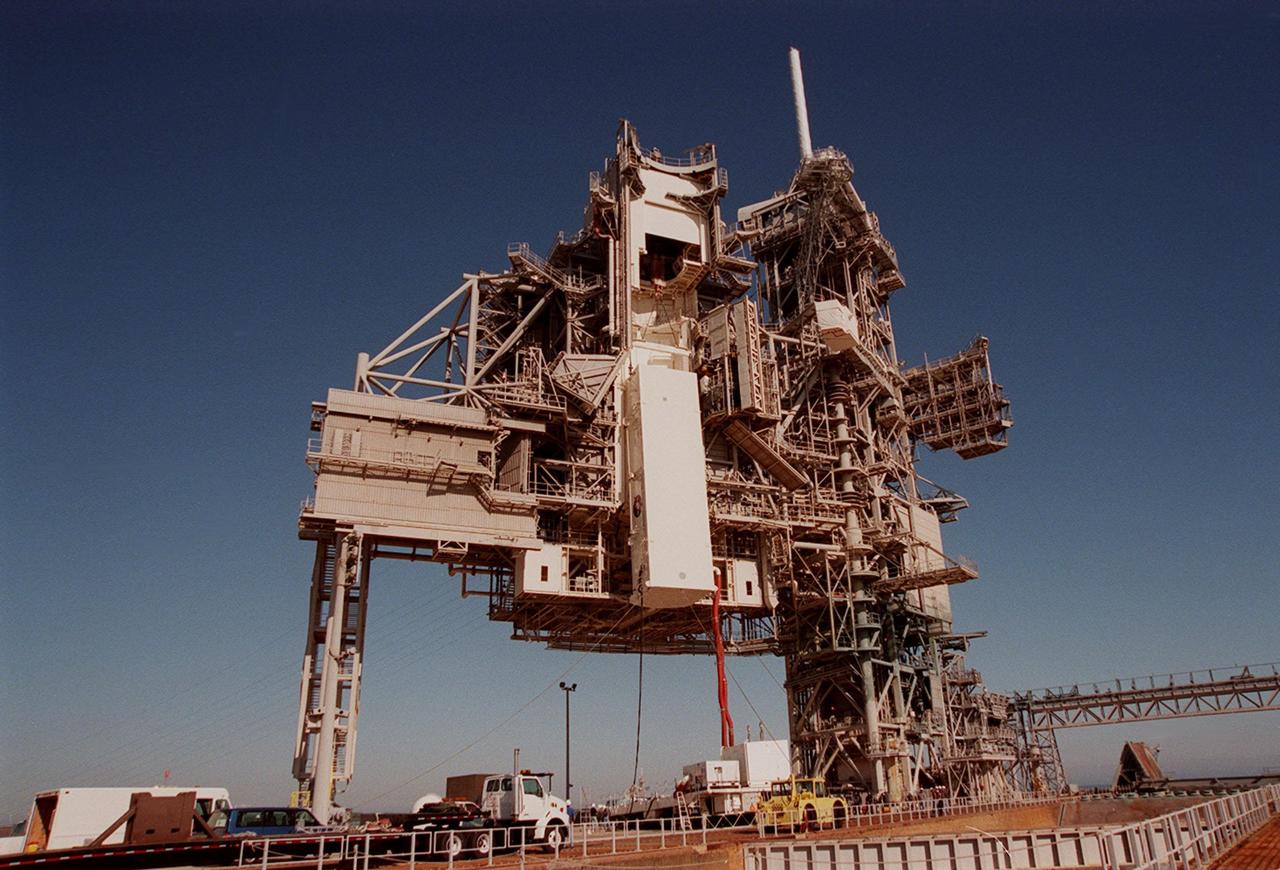
KENNEDY SPACE CENTER, FLA. -- At Launch Pad 39A, the payload canister with the SPACEHAB Double Module and Integrated Cargo Carrier (ICC) inside is lifted up the Rotating Service Structure (RSS) toward the Payload Changeout Room, an environmentally controlled facility supporting cargo delivery to the pad and vertical installation in the orbiter cargo bay. At right of the RSS is the Fixed Service Structure, topped by the 80-foot-tall fiberglass lightning mast. The primary payload on mission STS-101, the module and ICC contain internal logistics and resupply cargo for restoring full redundancy to the International Space Station power system in preparation for the arrival of the next pressurized module, the Russian-built Zvezda. The payloads will be transferred to Space Shuttle Atlantis after Atlantis rolls out to the pad. Launch of Atlantis on mission STS-101 is scheduled no earlier than April 17, 2000
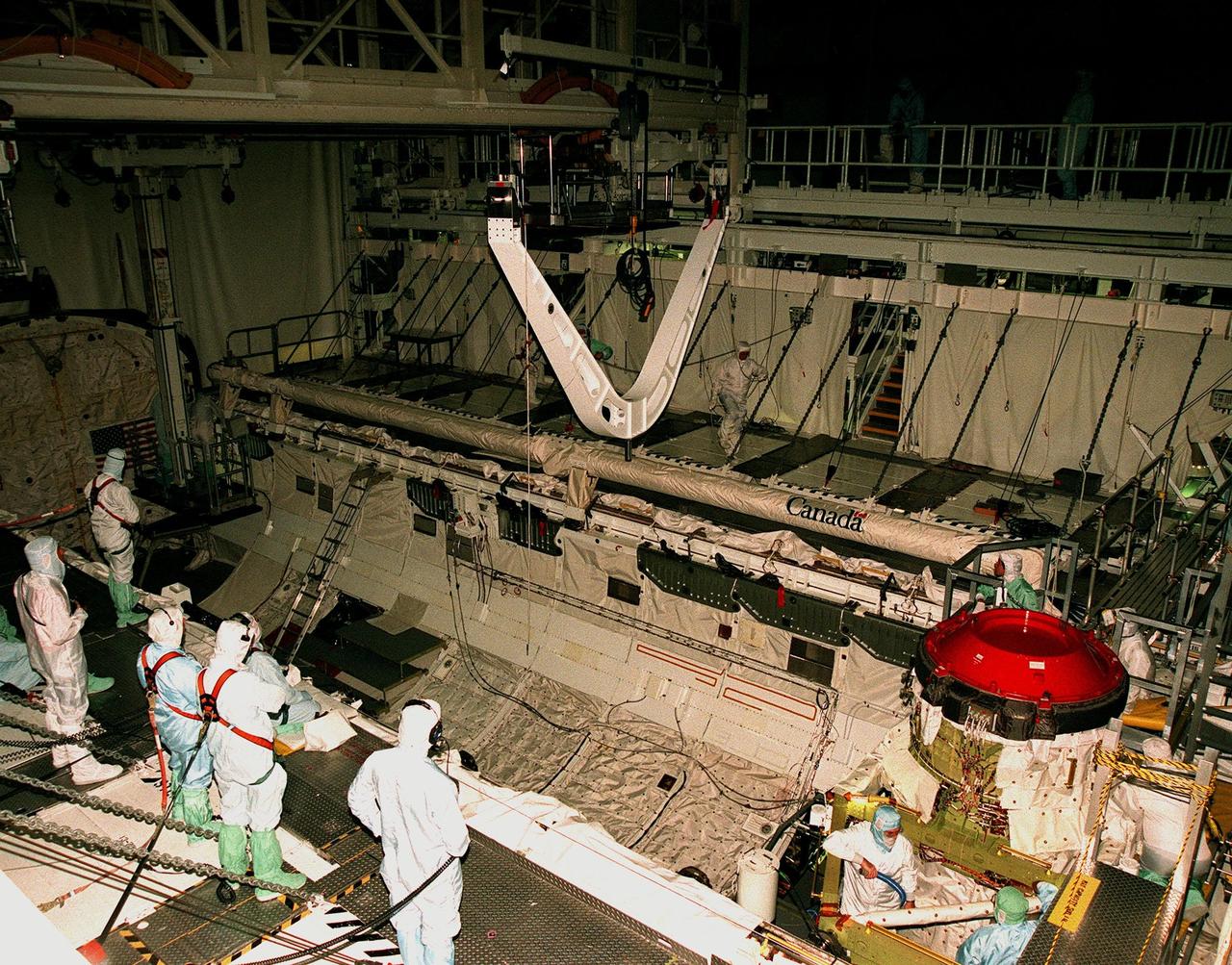
KENNEDY SPACE CENTER, FLA. -- Workers in the Orbiter Processing Facility (OPF) Bay 1 watch as the Keel Yoke Device (KYD) is lowered by crane into the open payload bay of the orbiter Discovery. The KYD will support the International Cargo Carrier (ICC) to be installed in the orbiter for mission STS-96. The ICC will carry unpressurized cargo such as the external Russian cargo crane known as STRELA, the SPACEHAB Oceaneering Space System Box (SHOSS), which is a logistics items carrier, and an ORU Transfer Device (OTD), a U.S.-built crane that will be stowed on the station for use during future ISS assembly missions. The primary payload of STS-96 is the SPACEHAB Double Module, an element of the International Space Station. . STS-96 is targeted for launch on May 20 at 9:32 a.m. from Launch Pad 39B
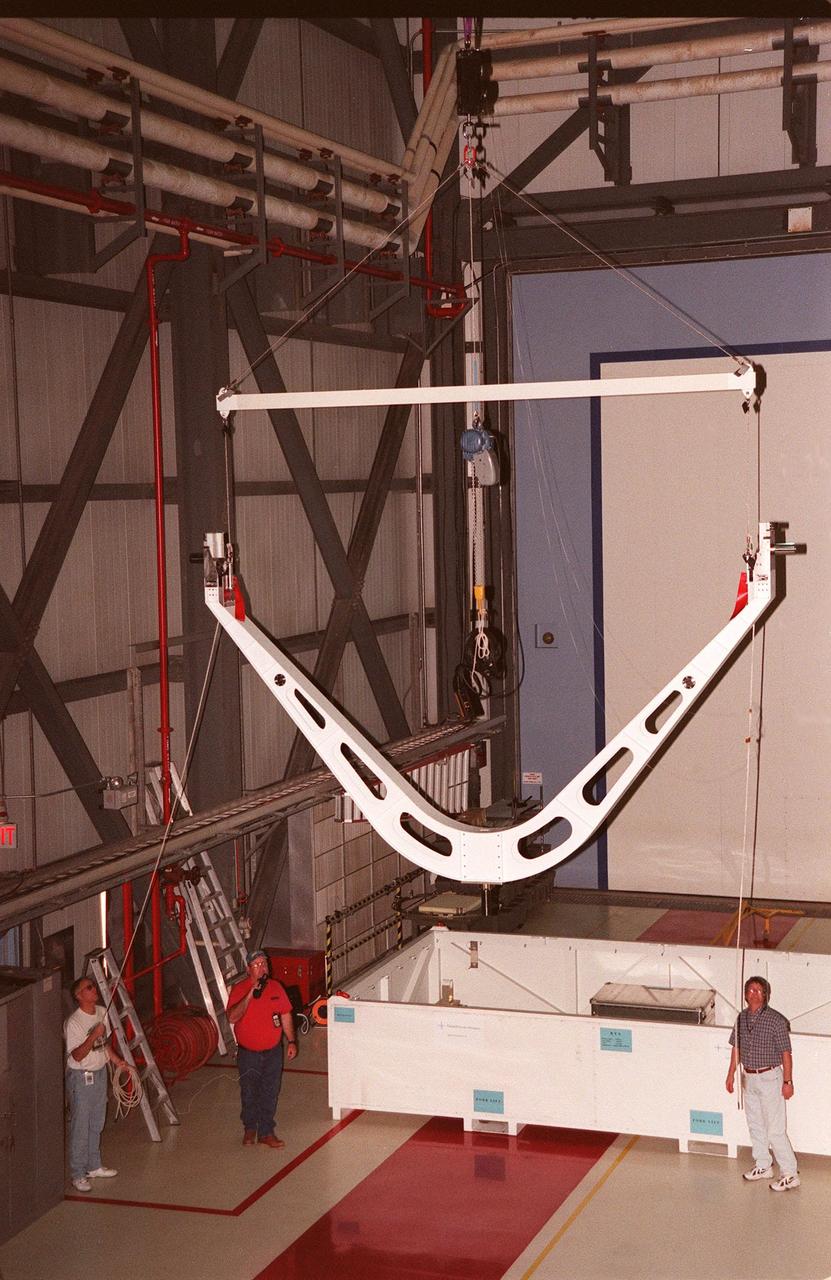
KENNEDY SPACE CENTER, FLA. -- In the Orbiter Processing Facility (OPF) Bay 1, workers lift the Keel Yoke Device (KYD) that will be fitted inside the payload bay of orbiter Discovery. The KYD will support the International Cargo Carrier (ICC) to be installed in the orbiter for mission STS-96. The ICC will carry unpressurized cargo such as the external Russian cargo crane known as STRELA, the SPACEHAB Oceaneering Space System Box (SHOSS), which is a logistics items carrier, and an ORU Transfer Device (OTD), a U.S.-built crane that will be stowed on the station for use during future ISS assembly missions. The primary payload of STS-96 is the SPACEHAB Double Module, an element of the International Space Station. STS-96 is targeted for launch on May 20 at 9:32 a.m. from Launch Pad 39B
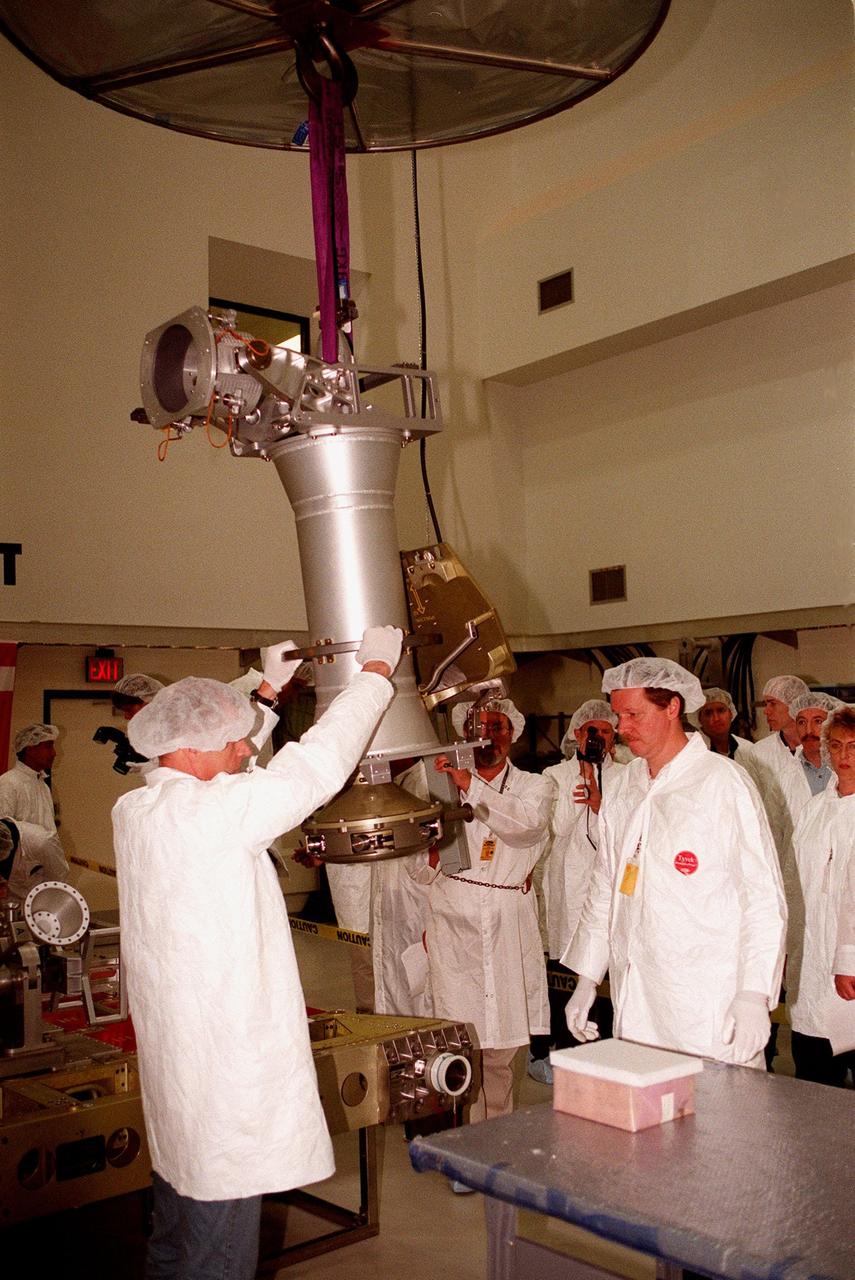
At Astrotech in Titusville, Fla., technicians with DaimlerChrysler Aerospace and RSC Energia of Korolev, Russia, maneuver a Russian cargo crane, the Strela, which is to be mounted to the exterior of the Russian station segment on the International Space Station (ISS). The Strehla has been the focus for two Shuttle crews, STS-96 who are at KSC for a Crew Equipment Interface Test, and STS-101, for payload familiarization. For the first time, STS-96 will include an Integrated Cargo Carrier (ICC) that will carry the Russian cargo crane; the SPACEHAB Oceaneering Space System Box (SHOSS), which is a logistics items carrier; and a U.S.-built crane (ORU Transfer Device, or OTD) that will be stowed on the station for use during future ISS assembly missions. The ICC can carry up to 6,000 lb of unpressurized payload. It was built for SPACEHAB by DaimlerChrysler Aerospace and RSC Energia. STS-96 is targeted for launch on May 24 from Launch Pad 39B. STS-101 is scheduled to launch in early December 1999
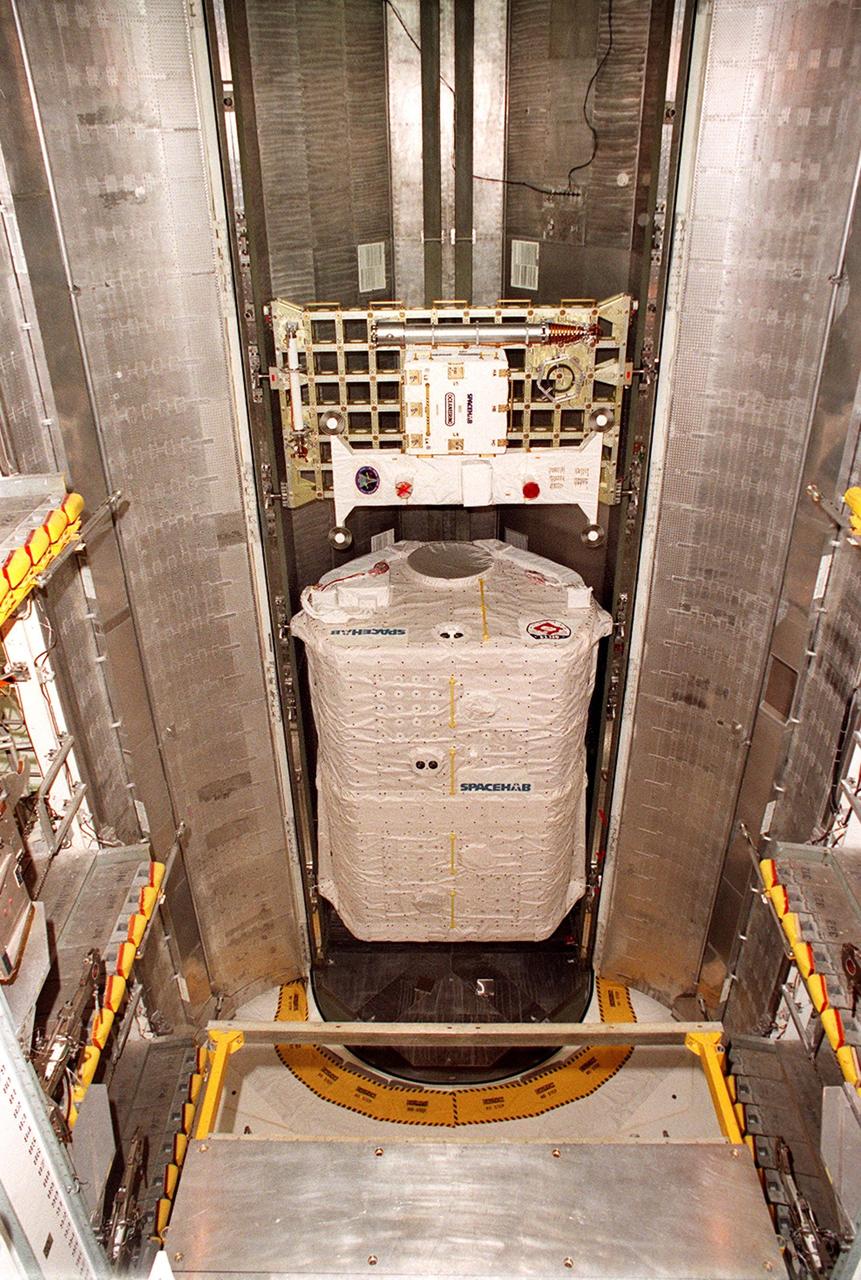
KENNEDY SPACE CENTER, FLA. -- The doors of the payload canister open in the Payload Changeout Room (PCR) at Launch Pad 39A to reveal the SPACEHAB Double Module (bottom) and Integrated Cargo Carrier (ICC). Part of the Rotating Service Structure, the PCR is an environmentally controlled facility supporting cargo delivery to the pad and vertical installation in the orbiter cargo bay. The primary payloads on mission STS-101, the module and ICC contain internal logistics and resupply cargo for restoring full redundancy to the International Space Station power system in preparation for the arrival of the next pressurized module, the Russian-built Zvezda. The payloads will be transferred to Space Shuttle Atlantis after Atlantis rolls out to the pad. Launch of Atlantis on mission STS-101 is scheduled no earlier than April 17, 2000
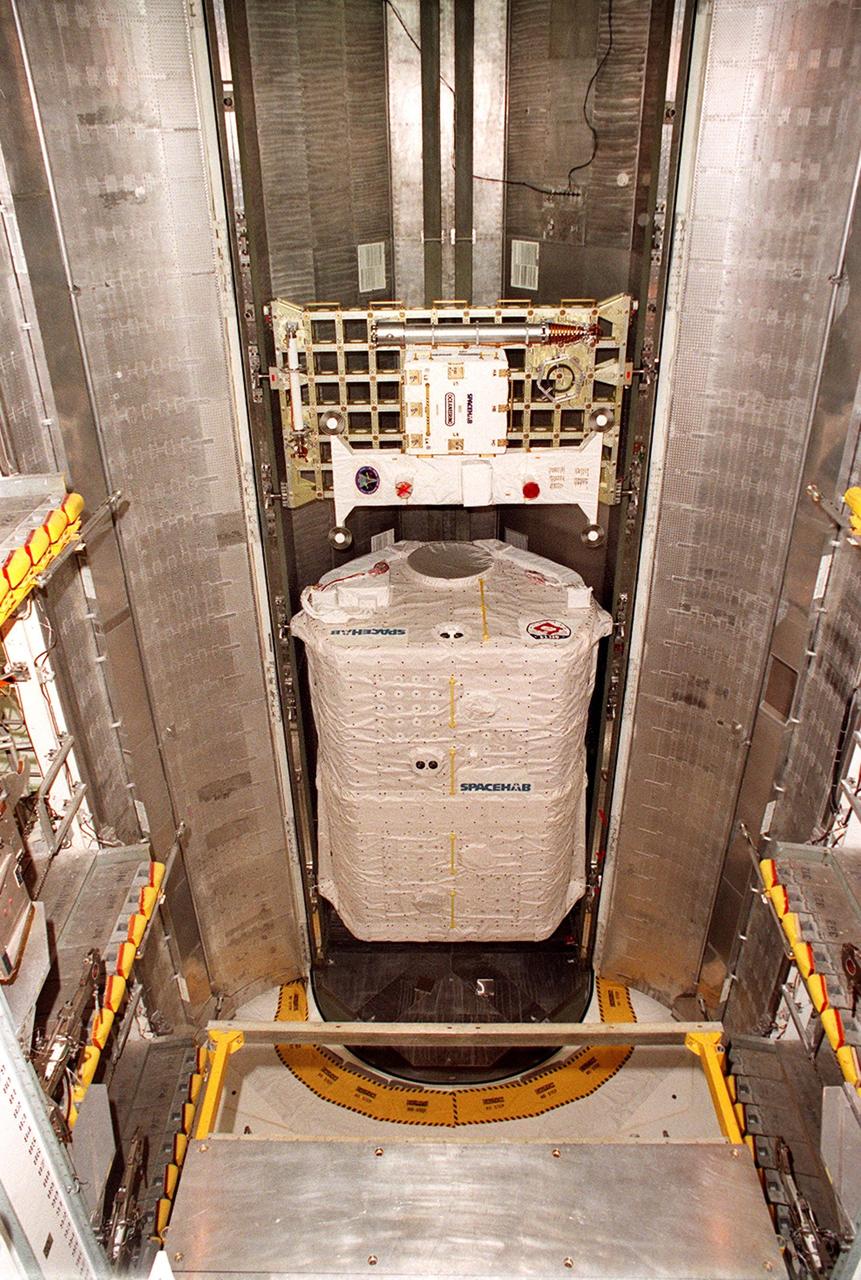
KENNEDY SPACE CENTER, FLA. -- The doors of the payload canister open in the Payload Changeout Room (PCR) at Launch Pad 39A to reveal the SPACEHAB Double Module (bottom) and Integrated Cargo Carrier (ICC). Part of the Rotating Service Structure, the PCR is an environmentally controlled facility supporting cargo delivery to the pad and vertical installation in the orbiter cargo bay. The primary payloads on mission STS-101, the module and ICC contain internal logistics and resupply cargo for restoring full redundancy to the International Space Station power system in preparation for the arrival of the next pressurized module, the Russian-built Zvezda. The payloads will be transferred to Space Shuttle Atlantis after Atlantis rolls out to the pad. Launch of Atlantis on mission STS-101 is scheduled no earlier than April 17, 2000
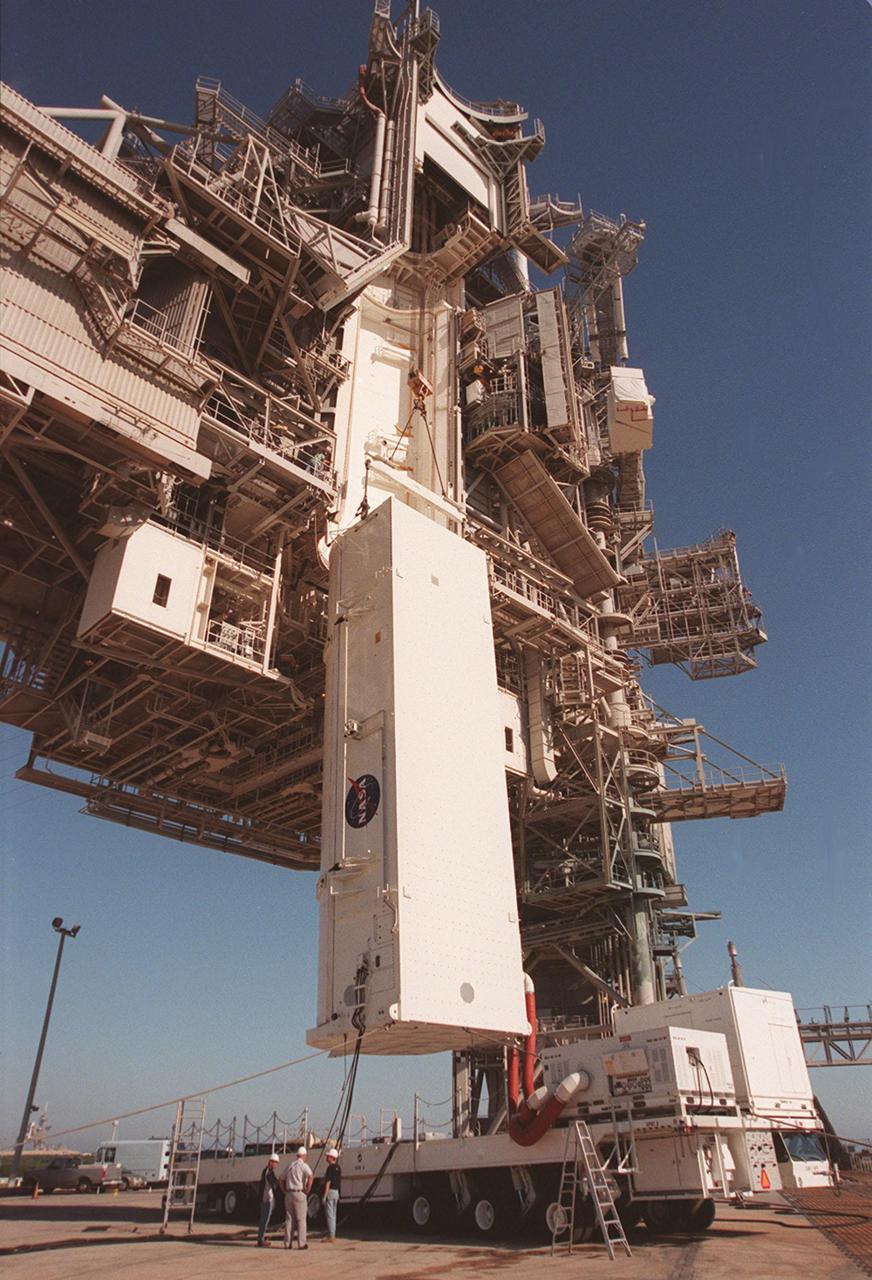
KENNEDY SPACE CENTER, FLA. -- At Launch Pad 39A, the payload canister with the SPACEHAB Double Module and the Integrated Cargo Carrier (ICC) inside is lifted off the payload transporter toward the Payload Changeout Room (PCR) on the Rotating Service Structure (RSS). The PCR is an environmentally controlled facility supporting cargo delivery to the pad and vertical installation in the orbiter cargo bay. At right of the RSS is the Fixed Service Structure. The primary payloads on mission STS-101, the module and ICC contain internal logistics and resupply cargo for restoring full redundancy to the International Space Station power system in preparation for the arrival of the next pressurized module, the Russian-built Zvezda. The payloads will be transferred to Space Shuttle Atlantis after Atlantis rolls out to the pad. Launch of Atlantis on mission STS-101 is scheduled no earlier than April 17, 2000

KENNEDY SPACE CENTER, FLA. -- Workers in the Orbiter Processing Facility (OPF) Bay 1 make final adjustments to the Keel Yoke Device (KYD) being installed in the orbiter Discovery. The KYD will support the International Cargo Carrier (ICC) to be fitted in the orbiter for mission STS-96. The ICC will carry unpressurized cargo such as the external Russian cargo crane known as STRELA, the SPACEHAB Oceaneering Space System Box (SHOSS), which is a logistics items carrier, and an ORU Transfer Device (OTD), a U.S.-built crane that will be stowed on the station for use during future ISS assembly missions. The primary payload of STS-96 is the SPACEHAB Double Module, an element of the International Space Station. STS-96 is targeted for launch on May 20 at 9:32 a.m. from Launch Pad 39B
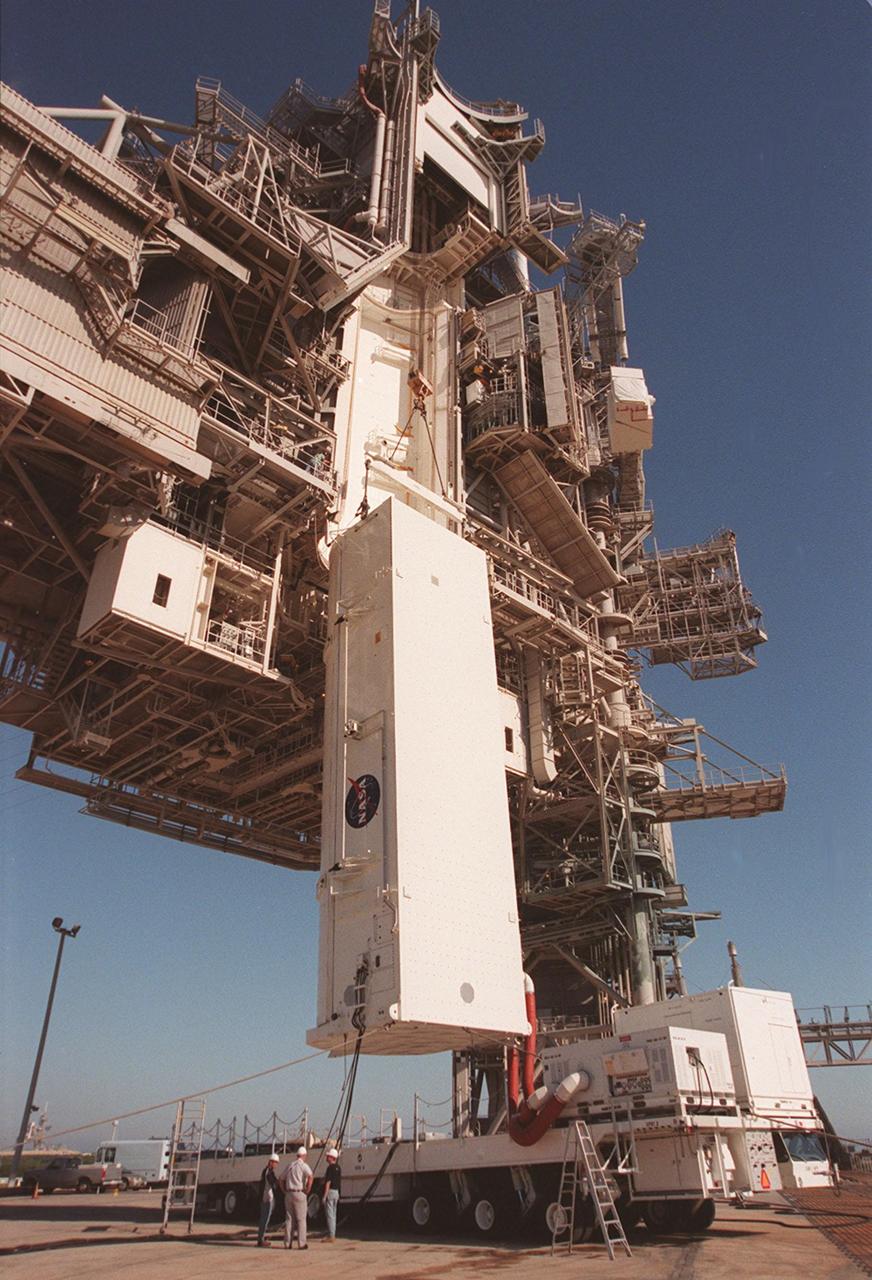
KENNEDY SPACE CENTER, FLA. -- At Launch Pad 39A, the payload canister with the SPACEHAB Double Module and the Integrated Cargo Carrier (ICC) inside is lifted off the payload transporter toward the Payload Changeout Room (PCR) on the Rotating Service Structure (RSS). The PCR is an environmentally controlled facility supporting cargo delivery to the pad and vertical installation in the orbiter cargo bay. At right of the RSS is the Fixed Service Structure. The primary payloads on mission STS-101, the module and ICC contain internal logistics and resupply cargo for restoring full redundancy to the International Space Station power system in preparation for the arrival of the next pressurized module, the Russian-built Zvezda. The payloads will be transferred to Space Shuttle Atlantis after Atlantis rolls out to the pad. Launch of Atlantis on mission STS-101 is scheduled no earlier than April 17, 2000
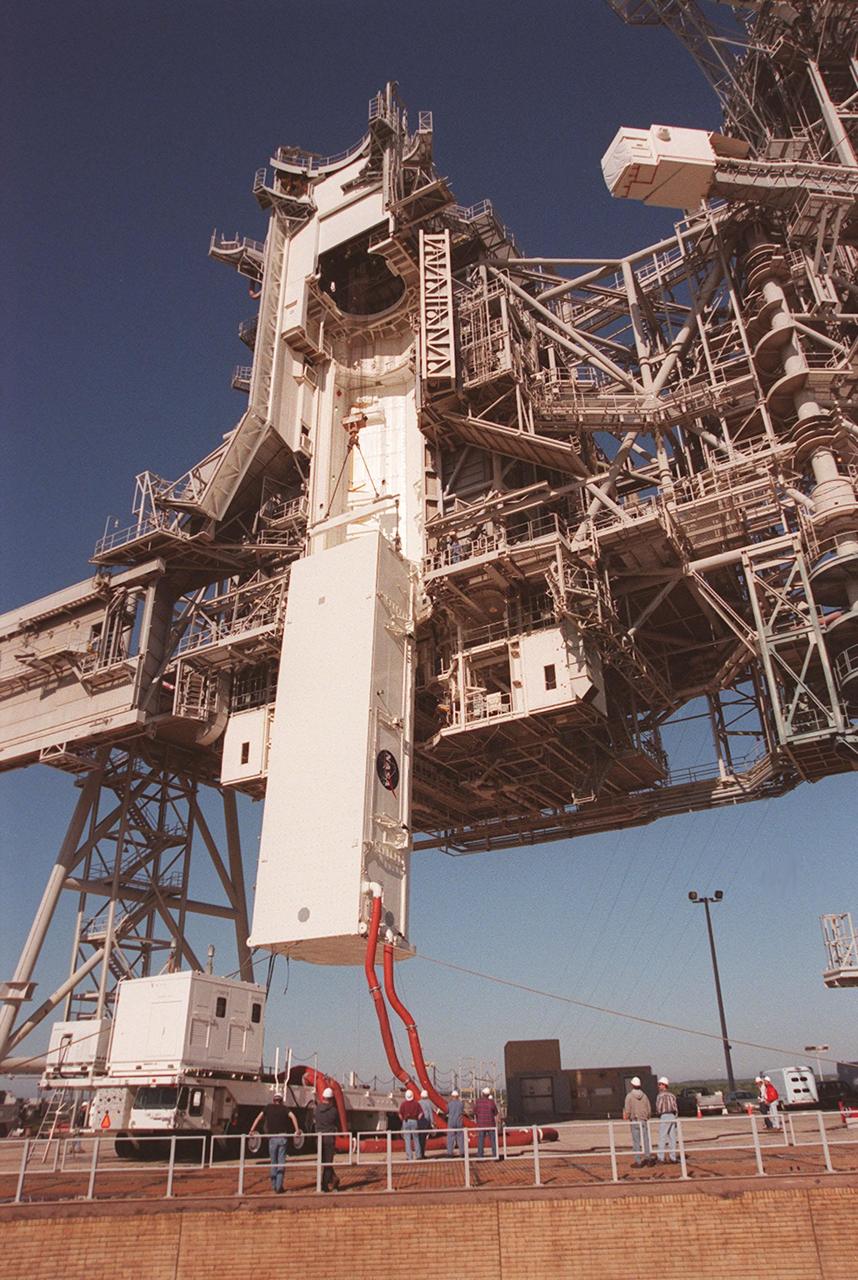
KENNEDY SPACE CENTER, FLA. -- At Launch Pad 39A, the payload canister with the SPACEHAB Double Module and Integrated Cargo Carrier (ICC) inside is lifted up the Rotating Service Structure toward the Payload Changeout Room, an environmentally controlled facility supporting cargo delivery to the pad and vertical installation in the orbiter cargo bay. The primary payloads on mission STS-101, the module and ICC contain internal logistics and resupply cargo for restoring full redundancy to the International Space Station power system in preparation for the arrival of the next pressurized module, the Russian-built Zvezda. The payloads will be transferred to Space Shuttle Atlantis after Atlantis rolls out to the pad. Launch of Atlantis on mission STS-101 is scheduled no earlier than April 17, 2000
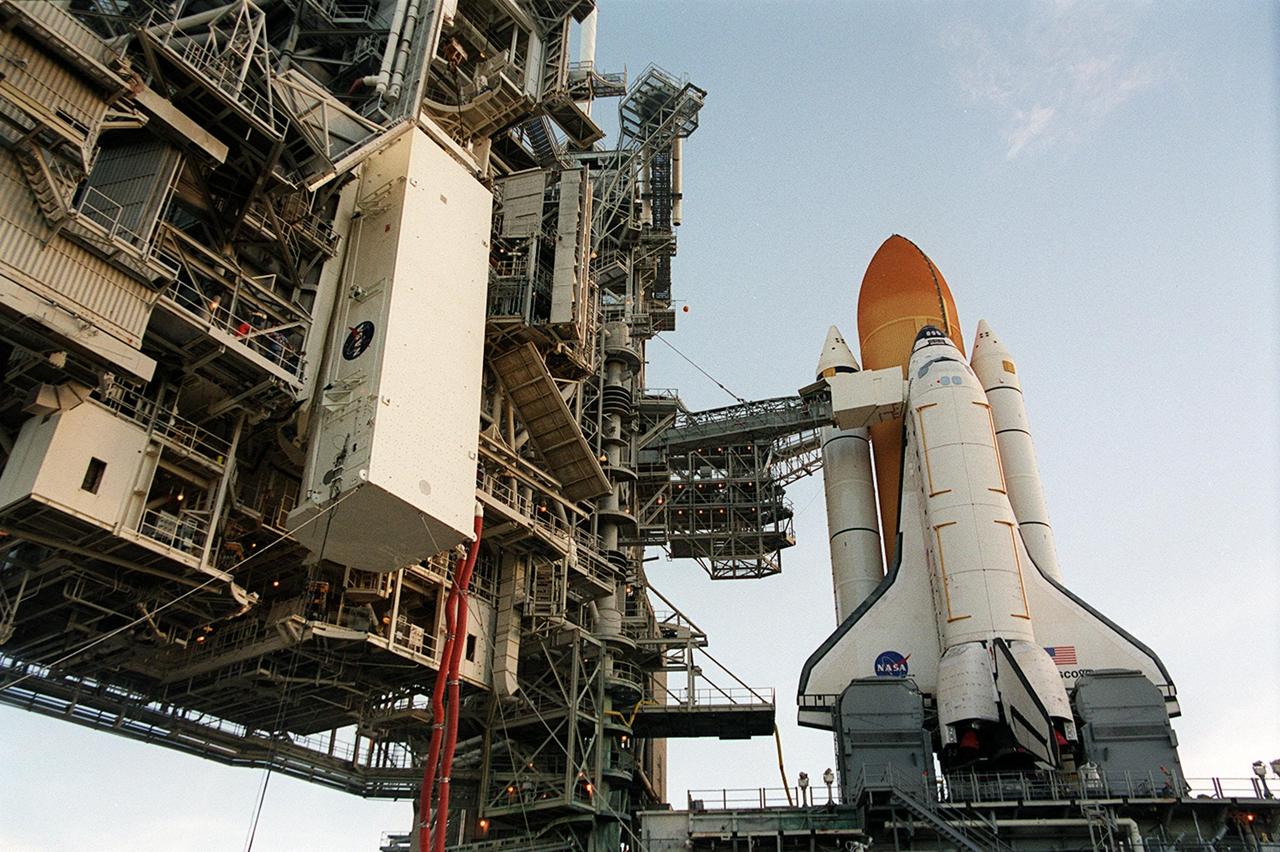
KENNEDY SPACE CENTER, Fla. -- The payload canister is lifted up the Rotating Service Structure on Launch Pad 39A. At right is Space Shuttle Discovery. Inside the canister are the primary payloads on mission STS-105, the Multi-Purpose Logistics Module Leonardo and the Integrated Cargo Carrier. The ICC holds several smaller payloads, the Early Ammonia Servicer and two experiment containers. The Early Ammonia Servicer consists of two nitrogen tanks that provide compressed gaseous nitrogen to pressurize the ammonia tank and replenish it in the thermal control subsystems of the Space Station. The ICC and MPLM will be lifted into the payload changeout room and then moved into the Discovery’s payload bay. The STS-105 mission includes a crew changeover on the International Space Station. Expedition Three will be traveling on Discovery to replace Expedition Two, who will return to Earth on board Discovery. Launch of STS-105 is scheduled for Aug. 9
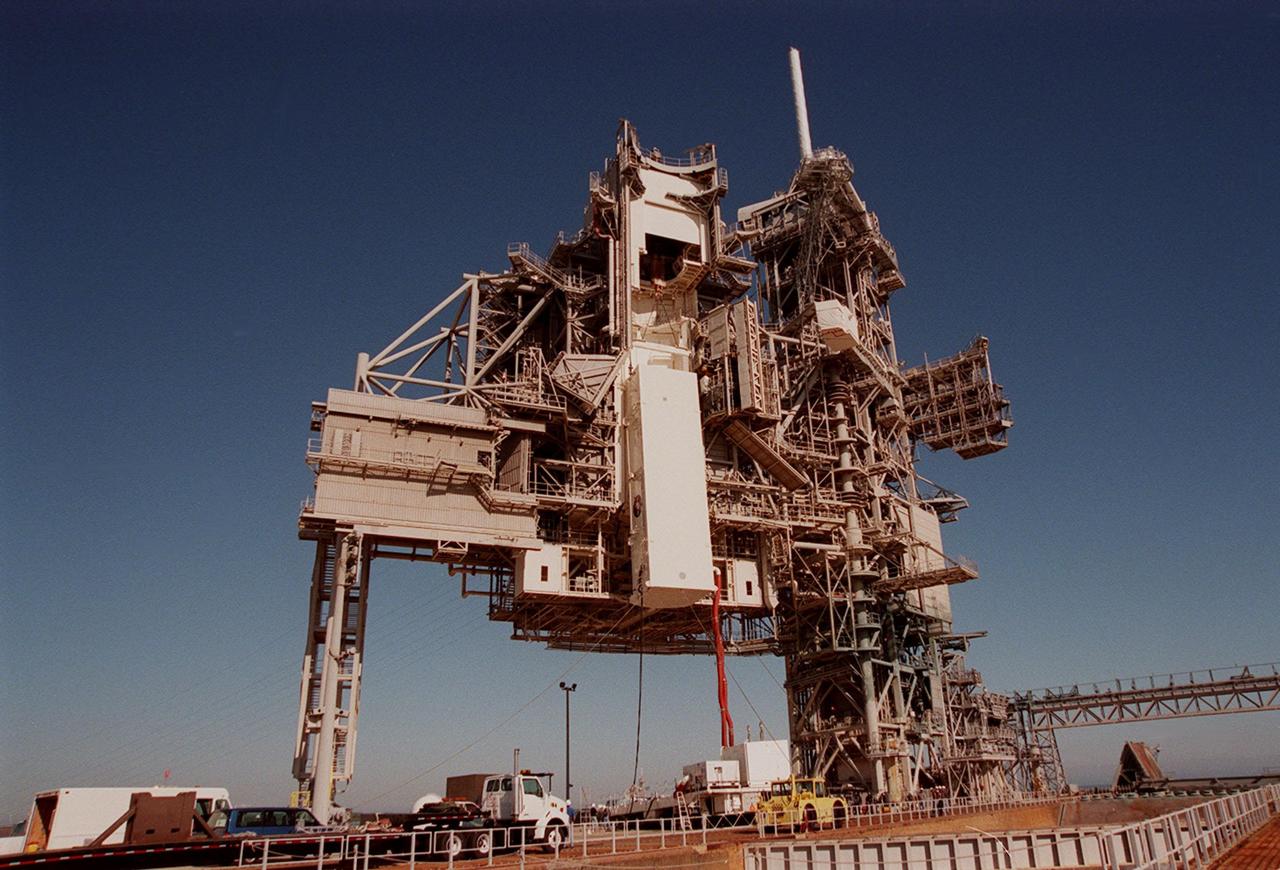
KENNEDY SPACE CENTER, FLA. -- At Launch Pad 39A, the payload canister with the SPACEHAB Double Module and Integrated Cargo Carrier (ICC) inside is lifted up the Rotating Service Structure (RSS) toward the Payload Changeout Room, an environmentally controlled facility supporting cargo delivery to the pad and vertical installation in the orbiter cargo bay. At right of the RSS is the Fixed Service Structure, topped by the 80-foot-tall fiberglass lightning mast. The primary payload on mission STS-101, the module and ICC contain internal logistics and resupply cargo for restoring full redundancy to the International Space Station power system in preparation for the arrival of the next pressurized module, the Russian-built Zvezda. The payloads will be transferred to Space Shuttle Atlantis after Atlantis rolls out to the pad. Launch of Atlantis on mission STS-101 is scheduled no earlier than April 17, 2000
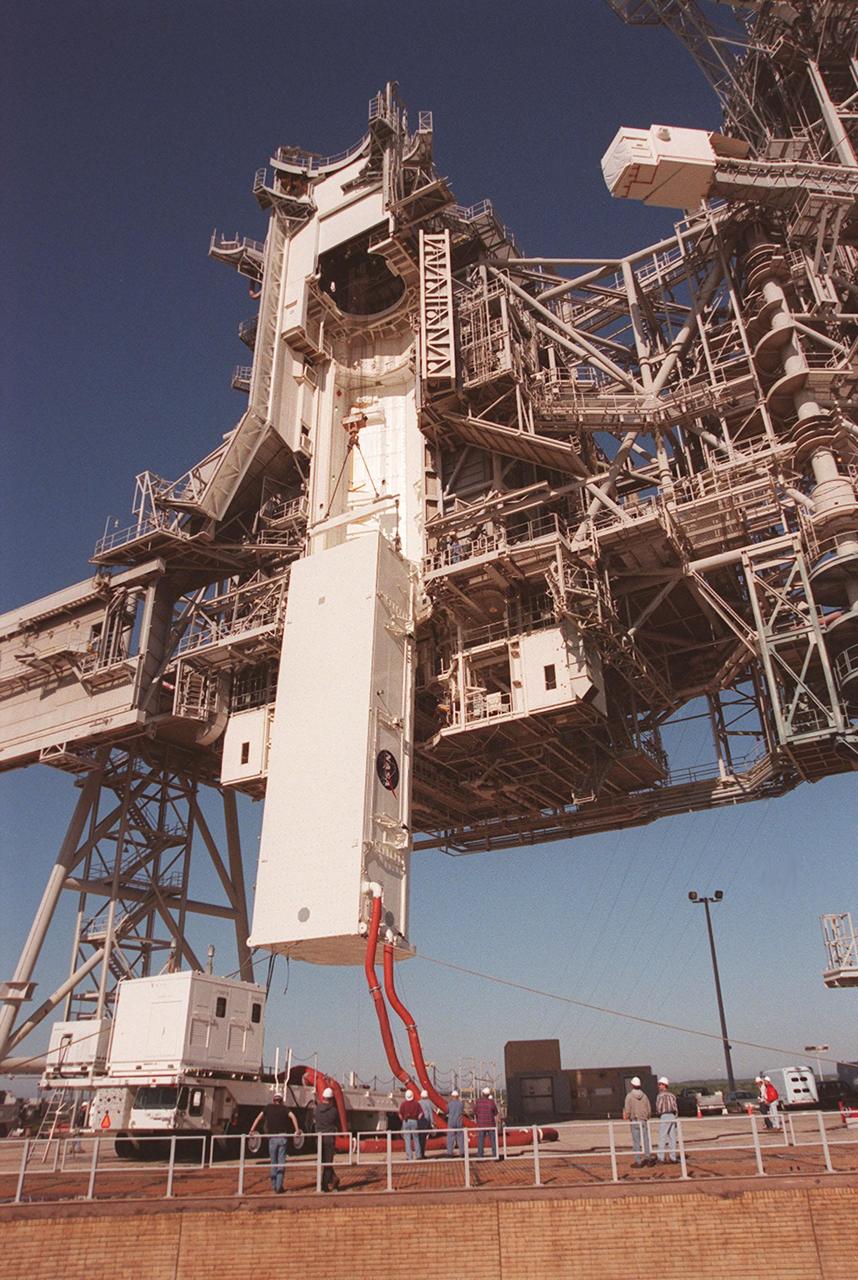
KENNEDY SPACE CENTER, FLA. -- At Launch Pad 39A, the payload canister with the SPACEHAB Double Module and Integrated Cargo Carrier (ICC) inside is lifted up the Rotating Service Structure toward the Payload Changeout Room, an environmentally controlled facility supporting cargo delivery to the pad and vertical installation in the orbiter cargo bay. The primary payloads on mission STS-101, the module and ICC contain internal logistics and resupply cargo for restoring full redundancy to the International Space Station power system in preparation for the arrival of the next pressurized module, the Russian-built Zvezda. The payloads will be transferred to Space Shuttle Atlantis after Atlantis rolls out to the pad. Launch of Atlantis on mission STS-101 is scheduled no earlier than April 17, 2000
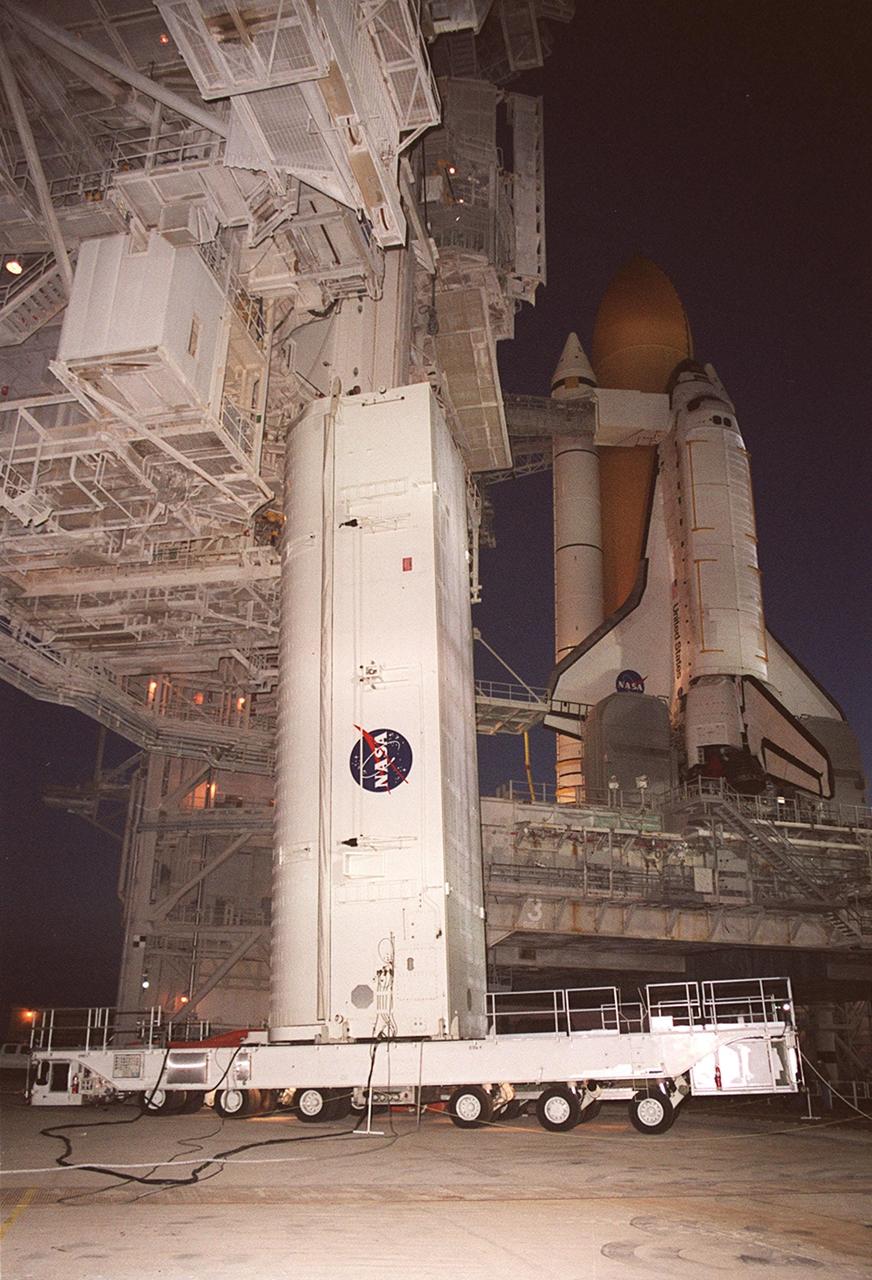
KENNEDY SPACE CENTER, Fla. -- Just before sunrise the payload canister arrives at Launch Pad 39A. In the background is Space Shuttle Discovery, waiting to launch on mission STS-105. Inside the canister are the primary payloads on the mission, the Multi-Purpose Logistics Module Leonardo and the Integrated Cargo Carrier. The ICC holds several smaller payloads, the Early Ammonia Servicer and two experiment containers. The Early Ammonia Servicer consists of two nitrogen tanks that provide compressed gaseous nitrogen to pressurize the ammonia tank and replenish it in the thermal control subsystems of the Space Station. The ICC and MPLM will be lifted into the payload changeout room on the Rotation Service Structure where they will be moved into the Discovery’s payload bay. The STS-105 mission includes a crew changeover on the International Space Station. Expedition Three will be traveling on Discovery to replace Expedition Two, who will return to Earth on board Discovery. Launch of STS-105 is scheduled for Aug. 9
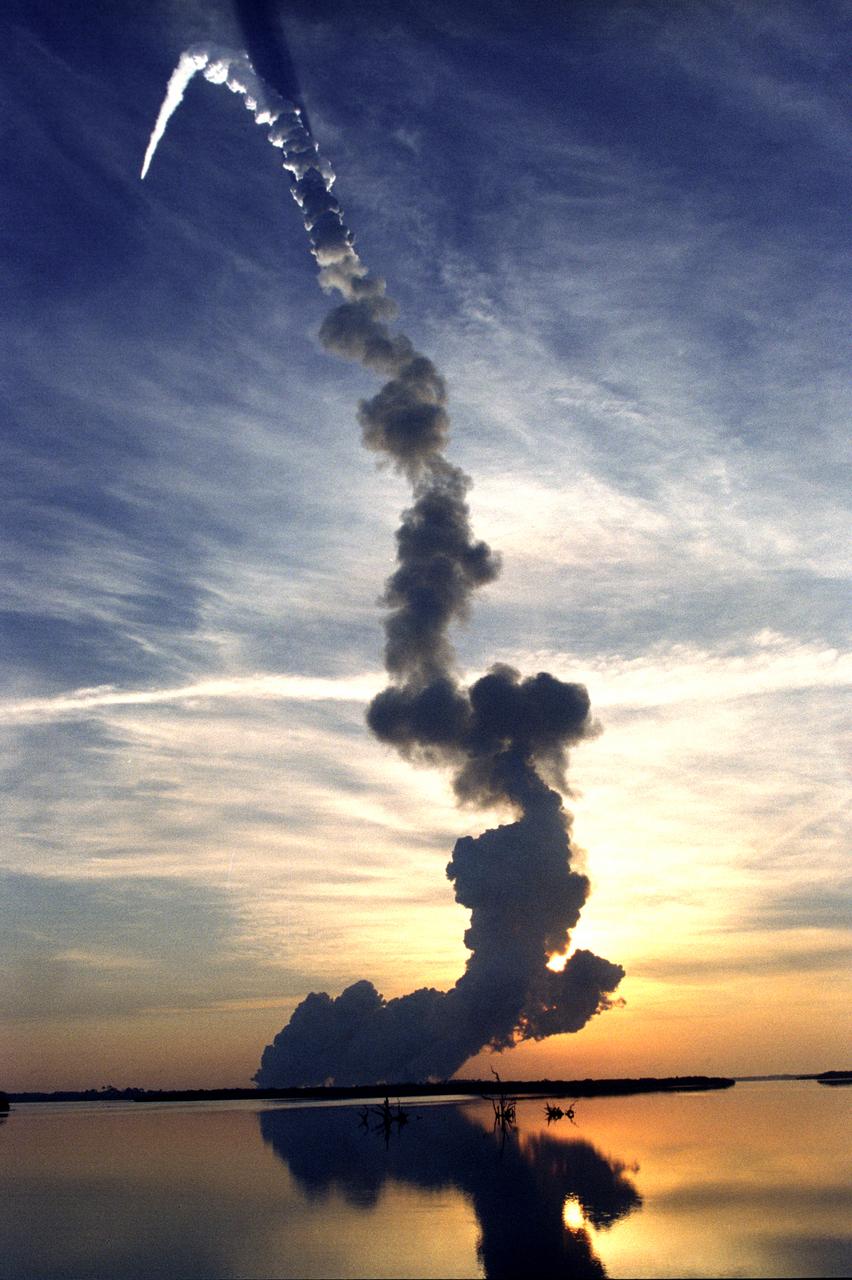
This spectacular photo is of the May 27, 1999 liftoff of the Orbiter Discovery (STS-96). The STS-96 mission, of almost 10 days, was the second International Space Station (ISS) assembly and resupply flight and the first flight to dock with the station. The crew installed foot restraints and the Russian built crane, STRELA. The Shuttle's SPACEHAB double module carried internal and resupply cargo for station outfitting and the Russian cargo crane was carried aboard the shuttle in the integrated Cargo Carrier (ICC).
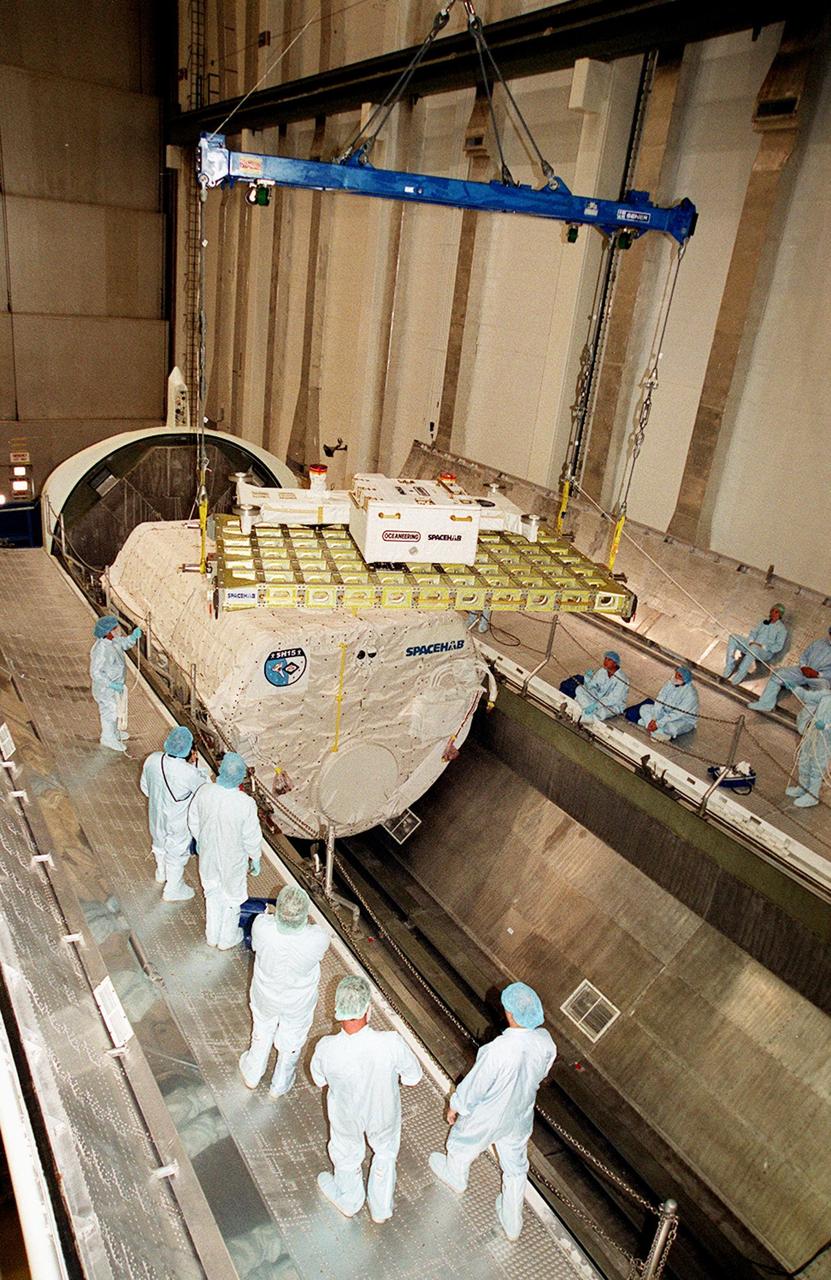
KENNEDY SPACE CENTER, FLA. -- In the Space Station Processing Facility, workers maneuver the Integrated Cargo Carrier (ICC) toward the opening in the payload canister. The canister already has the SPACEHAB module stowed. The canister will transport its cargo to Launch Pad 39B in preparation for mission STS-106, scheduled to launch Sept. 8 at 8:31 a.m. EDT. During the mission to the International Space Station, the crew will complete service module support tasks on orbit, transfer supplies and outfit the Space Station for the first long-duration crew
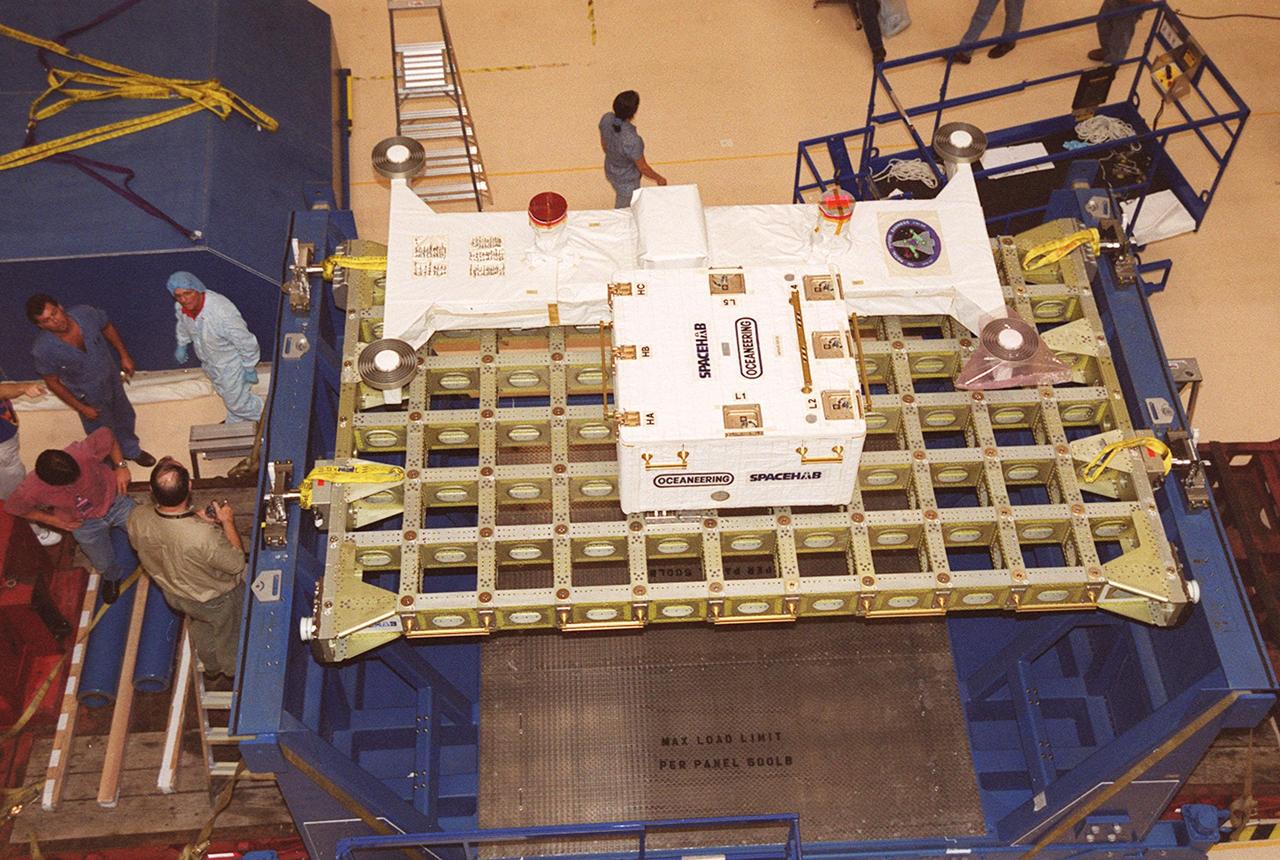
KENNEDY SPACE CENTER, FLA. -- The Integrated Cargo Carrier (ICC), with equipment on top, sits in a workstand in the Space Station Processing Facility. It will be moved into the payload canister for transport to Launch Pad 39B in preparation for mission STS-106, scheduled to launch Sept. 8 at 8:31 a.m. EDT. During the mission to the International Space Station, the crew will complete service module support tasks on orbit, transfer supplies and outfit the Space Station for the first long-duration crew

KENNEDY SPACE CENTER, FLA. -- An overhead crane lifts the Integrated Cargo Carrier (ICC), with equipment on top, toward the payload canister (right) where the SPACEHAB module is already stowed. The canister will transport its cargo to Launch Pad 39B in preparation for mission STS-106, scheduled to launch Sept. 8 at 8:31 a.m. EDT. During the mission to the International Space Station, the crew will complete service module support tasks on orbit, transfer supplies and outfit the Space Station for the first long-duration crew

KENNEDY SPACE CENTER, FLA. -- An overhead crane lifts the Integrated Cargo Carrier (ICC), with equipment on top, toward the payload canister (right) where the SPACEHAB module is already stowed. The canister will transport its cargo to Launch Pad 39B in preparation for mission STS-106, scheduled to launch Sept. 8 at 8:31 a.m. EDT. During the mission to the International Space Station, the crew will complete service module support tasks on orbit, transfer supplies and outfit the Space Station for the first long-duration crew
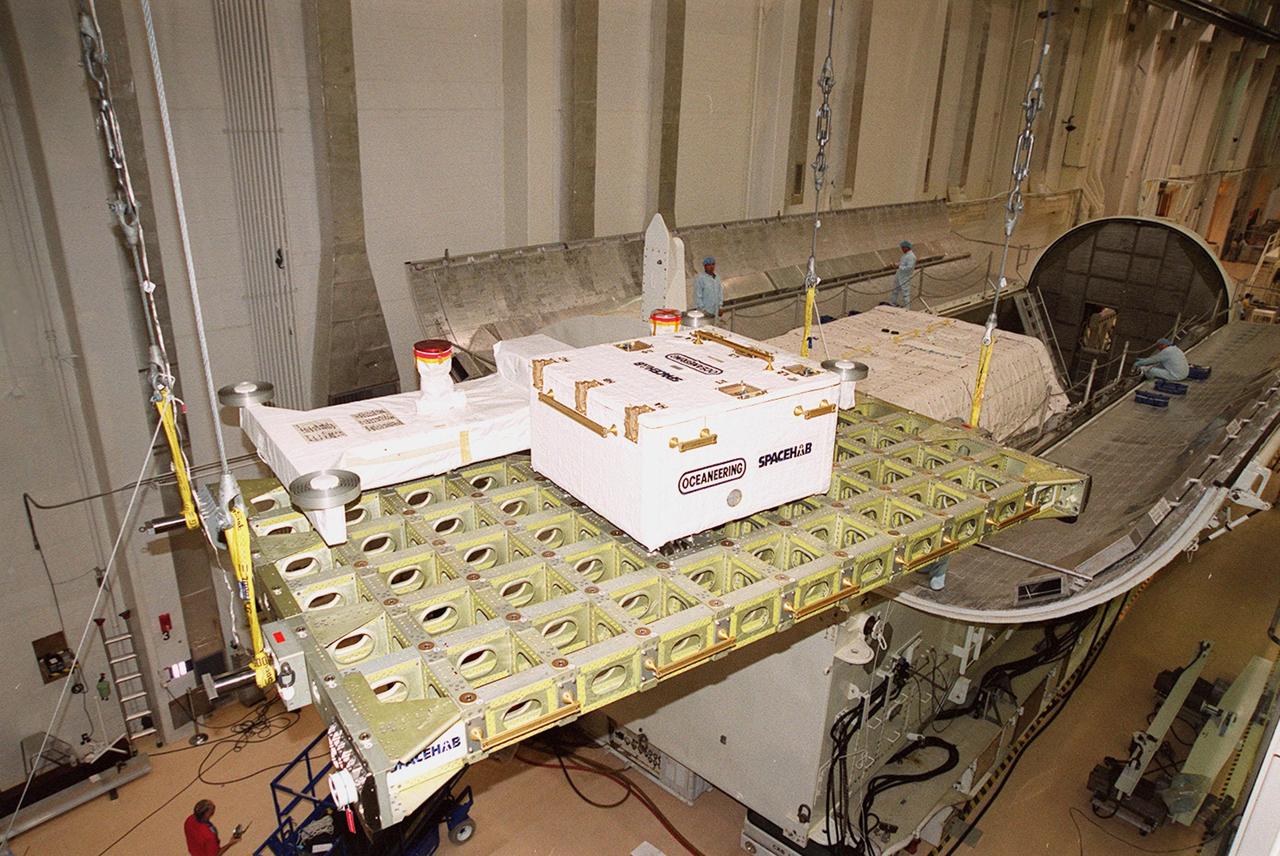
KENNEDY SPACE CENTER, FLA. -- Workers in the Space Station Processing Facility guide the Integrated Cargo Carrier (ICC) into place inside the payload canister. The canister already has the SPACEHAB module stowed. The canister will transport its cargo to Launch Pad 39B in preparation for mission STS-106, scheduled to launch Sept. 8 at 8:31 a.m. EDT. During the mission to the International Space Station, the crew will complete service module support tasks on orbit, transfer supplies and outfit the Space Station for the first long-duration crew
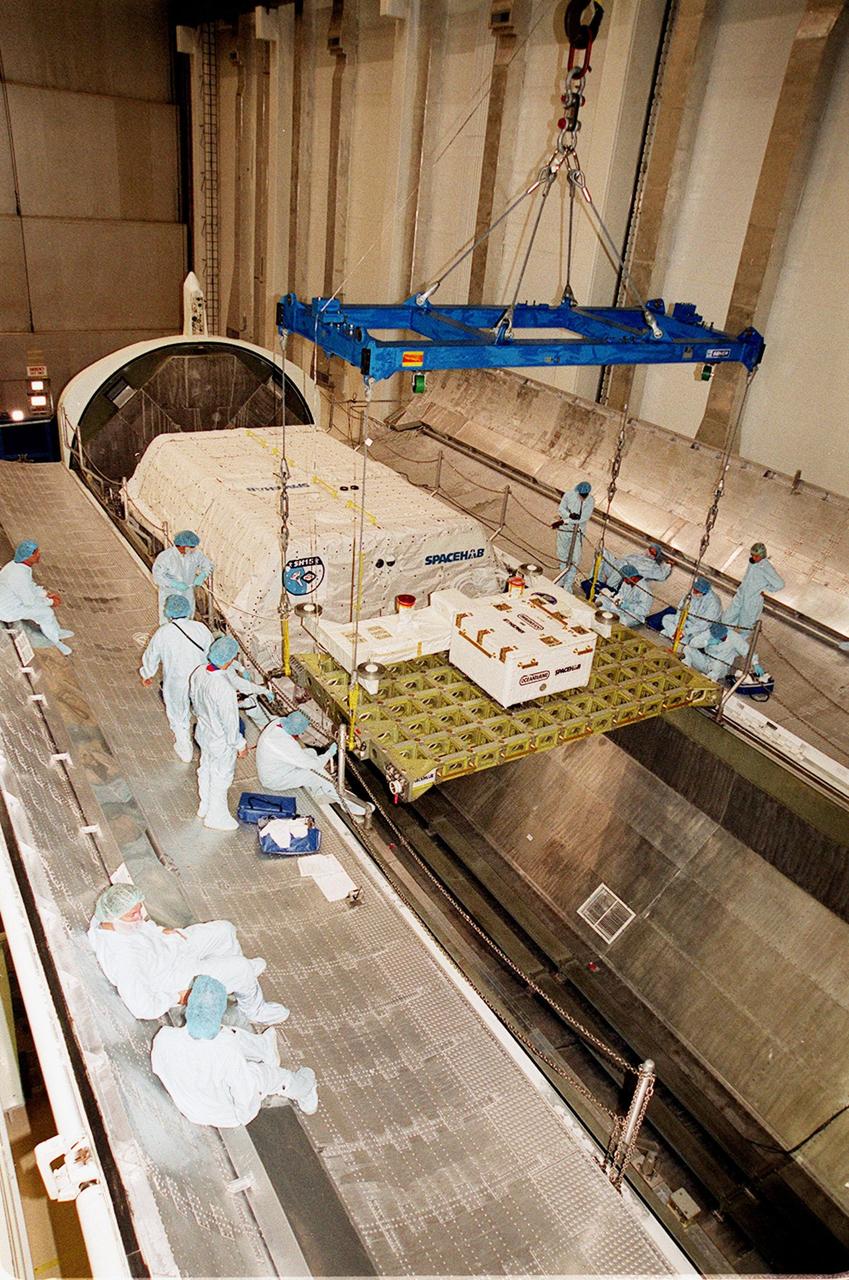
KENNEDY SPACE CENTER, FLA. -- Workers in the Space Station Processing Facility guide the Integrated Cargo Carrier (ICC) into place inside the payload canister. The canister already has the SPACEHAB module stowed. The canister will transport its cargo to Launch Pad 39B in preparation for mission STS-106, scheduled to launch Sept. 8 at 8:31 a.m. EDT. During the mission to the International Space Station, the crew will complete service module support tasks on orbit, transfer supplies and outfit the Space Station for the first long-duration crew
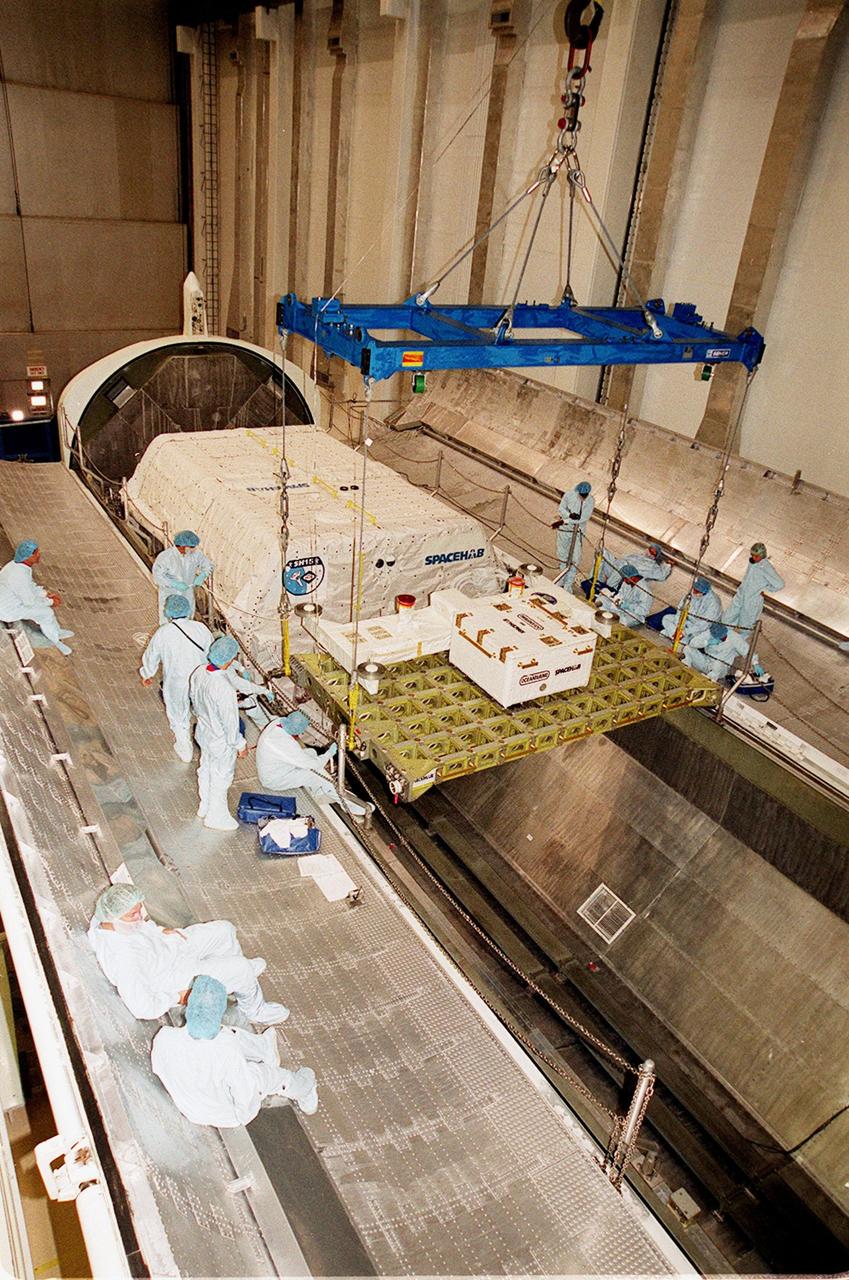
KENNEDY SPACE CENTER, FLA. -- An overhead crane moves the Integrated Cargo Carrier (ICC), with equipment on top, toward the payload canister below where the SPACEHAB module is already stowed. The canister will transport its cargo to Launch Pad 39B in preparation for mission STS-106, scheduled to launch Sept. 8 at 8:31 a.m. EDT. During the mission to the International Space Station, the crew will complete service module support tasks on orbit, transfer supplies and outfit the Space Station for the first long-duration crew

KENNEDY SPACE CENTER, FLA. -- The Integrated Cargo Carrier (ICC), with equipment on top, sits in a workstand in the Space Station Processing Facility. It will be moved into the payload canister for transport to Launch Pad 39B in preparation for mission STS-106, scheduled to launch Sept. 8 at 8:31 a.m. EDT. During the mission to the International Space Station, the crew will complete service module support tasks on orbit, transfer supplies and outfit the Space Station for the first long-duration crew
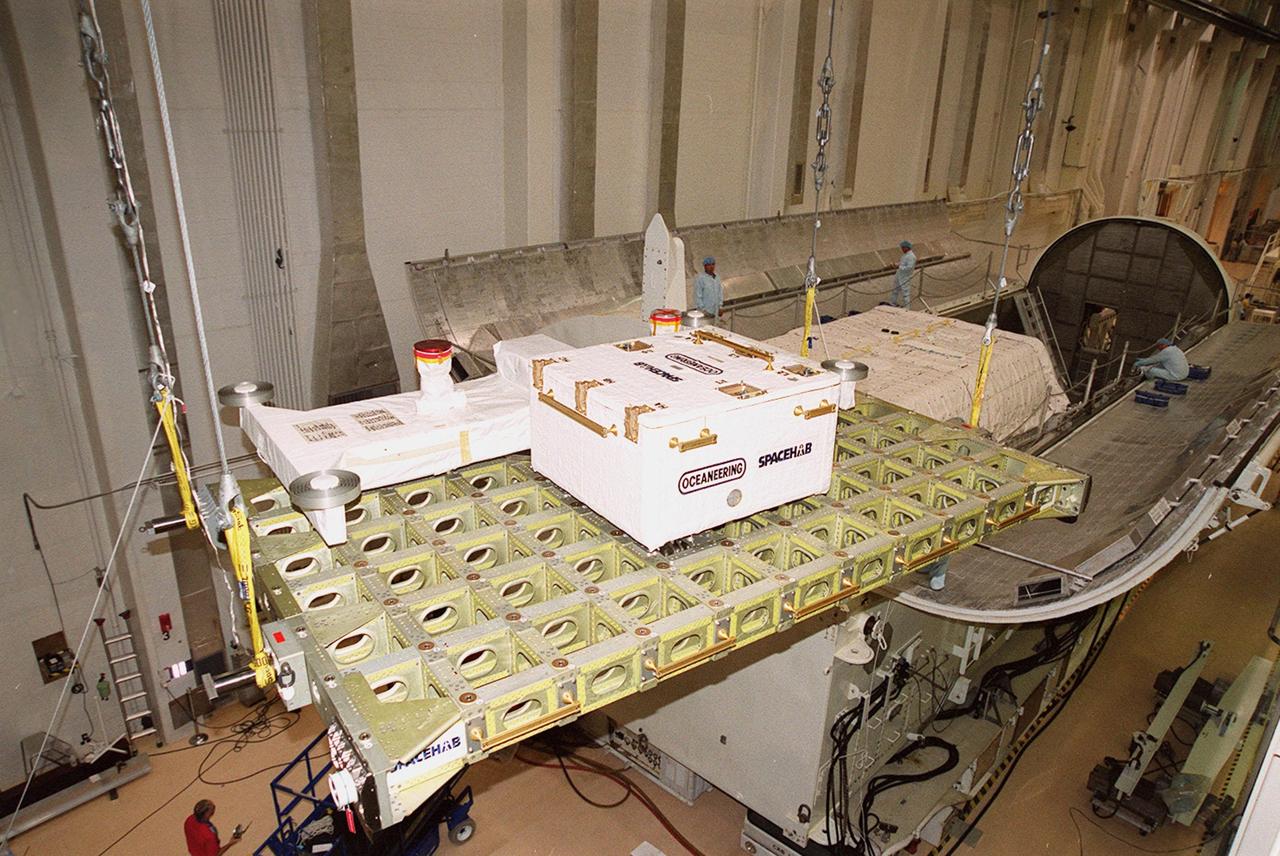
KENNEDY SPACE CENTER, FLA. -- In the Space Station Processing Facility, workers maneuver the Integrated Cargo Carrier (ICC) toward the opening in the payload canister. The canister already has the SPACEHAB module stowed. The canister will transport its cargo to Launch Pad 39B in preparation for mission STS-106, scheduled to launch Sept. 8 at 8:31 a.m. EDT. During the mission to the International Space Station, the crew will complete service module support tasks on orbit, transfer supplies and outfit the Space Station for the first long-duration crew
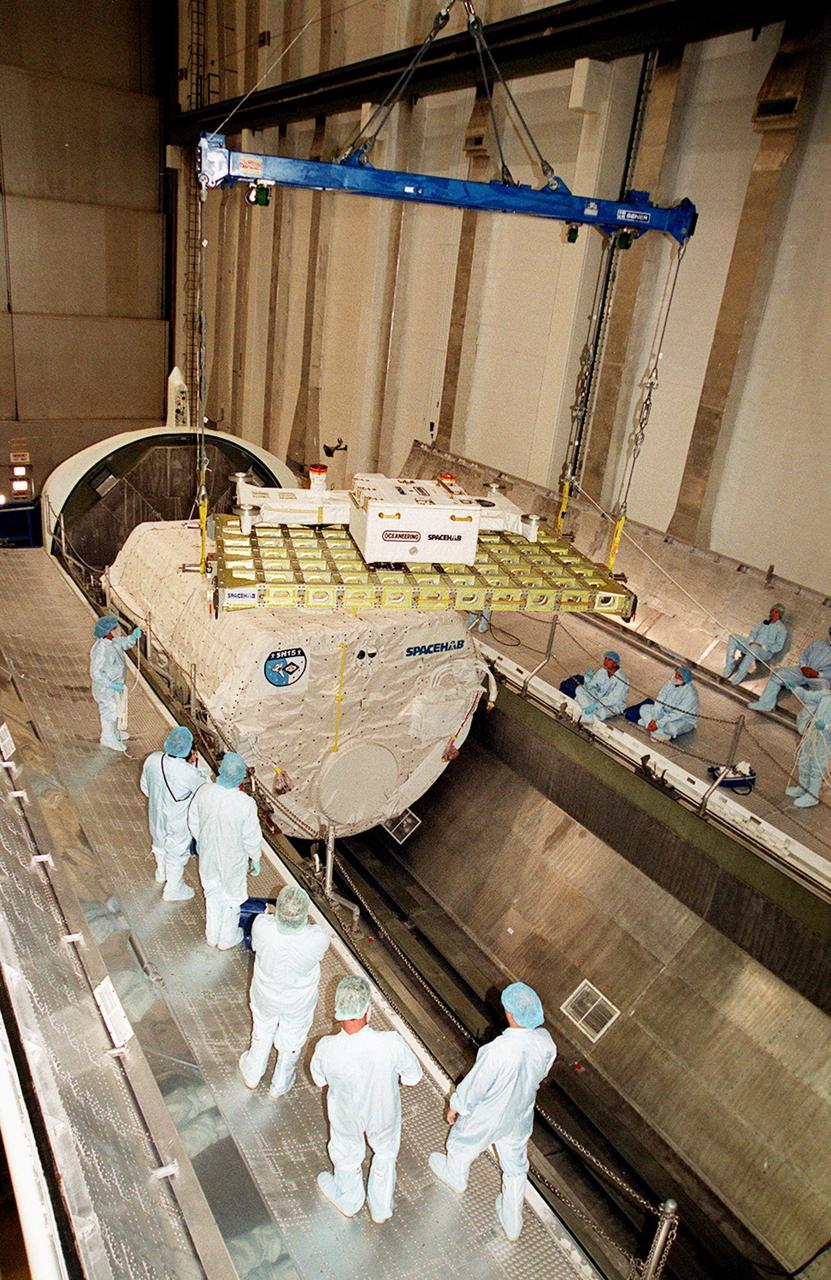
KENNEDY SPACE CENTER, FLA. -- An overhead crane moves the Integrated Cargo Carrier (ICC), with equipment on top, toward the payload canister below where the SPACEHAB module is already stowed. The canister will transport its cargo to Launch Pad 39B in preparation for mission STS-106, scheduled to launch Sept. 8 at 8:31 a.m. EDT. During the mission to the International Space Station, the crew will complete service module support tasks on orbit, transfer supplies and outfit the Space Station for the first long-duration crew
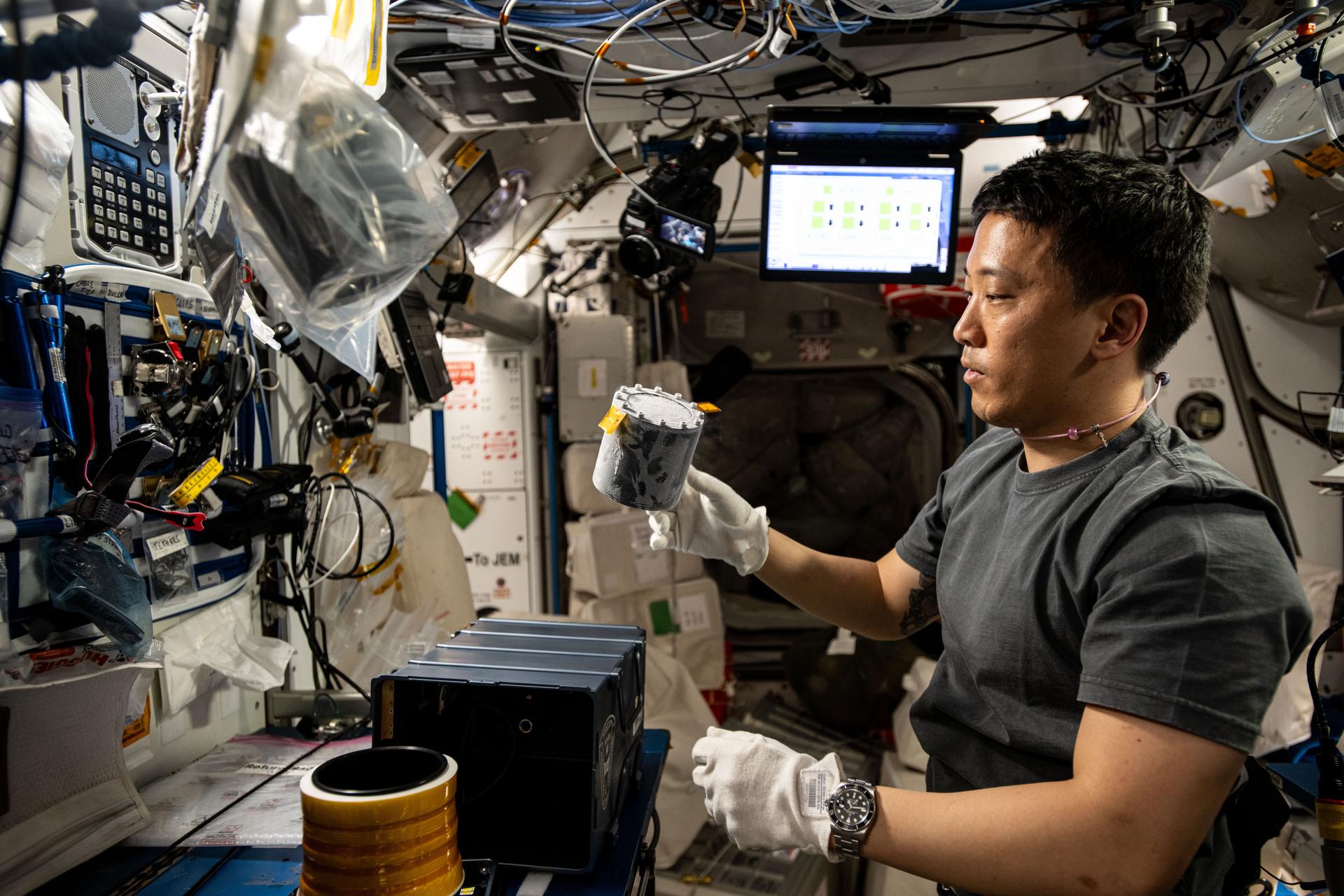
iss073e0028436 (May 12, 2025) --- NASA astronaut Jonny Kim conducts research activities for the ADvanced Space Experiment Processor - Industrial Crystallization Cassette (ADSEP-ICC) technology demonstration. This research expands existing space station facilities to hold new types of substances and scale up production of crystals and other commercially relevant materials, such as golden nanospheres. These tiny spherical gold particles have optical and electronic applications that could be used to detect cancer and other diseases.
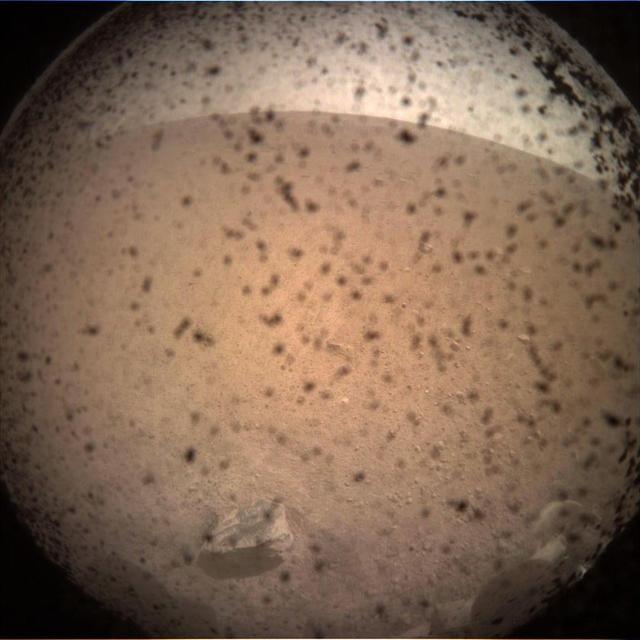
This is the first image taken by NASA's InSight lander on the surface of Mars. The instrument context camera (ICC) mounted below the lander deck obtained this image on Nov. 26, 2018, shortly after landing. The transparent lens cover was still in place to protect the lens from any dust kicked up during landing. https://photojournal.jpl.nasa.gov/catalog/PIA22829
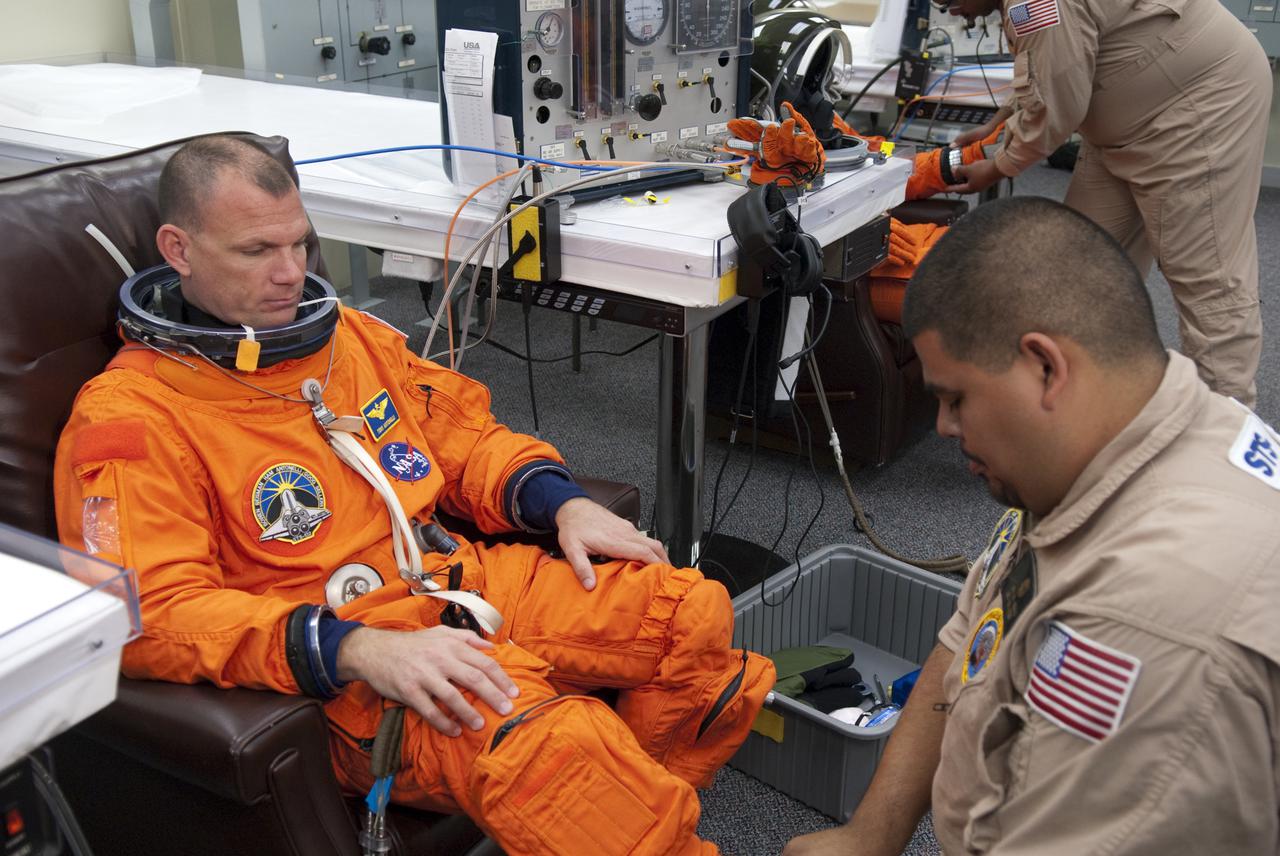
CAPE CANAVERAL, Fla. - In the Operations and Checkout Building at NASA's Kennedy Space Center in Florida, a United Launch Alliance space suit technician helps STS-132 Pilot Tony Antonelli dress for his second practice countdown. The six-member STS-132 crew is at Kennedy for their Terminal Countdown Demonstration Test, or TCDT, a dress rehearsal for launch. Following this practice 'suit-up,' the astronauts will ride in the Astrovan to Launch Pad 39A where they will participate in a simulated launch countdown from their seats inside space shuttle Atlantis. Launch is targeted for 2:19 p.m. EDT on May 14. On the STS-132 mission, the crew will deliver an Integrated Cargo Carrier, or ICC, and the Russian-built Mini-Research Module-1, or MRM-1, to the International Space Station. The ICC is an unpressurized flat bed pallet and keel yoke assembly used to support the transfer of exterior cargo from the shuttle to the space station. The MRM-1, known as Rassvet, is the second in a series of new pressurized components for Russia and will be permanently attached to the Earth-facing port of the Zarya control module. Rassvet, which translates to 'dawn,' will be used for cargo storage and provide an additional docking port to the station. STS-132 is the 34th mission to the station and the 132nd shuttle mission overall. For information on the STS-132 mission, visit http:__www.nasa.gov_mission_pages_shuttle_shuttlemissions_sts132_index.html. Photo credit: NASA_Cory Huston
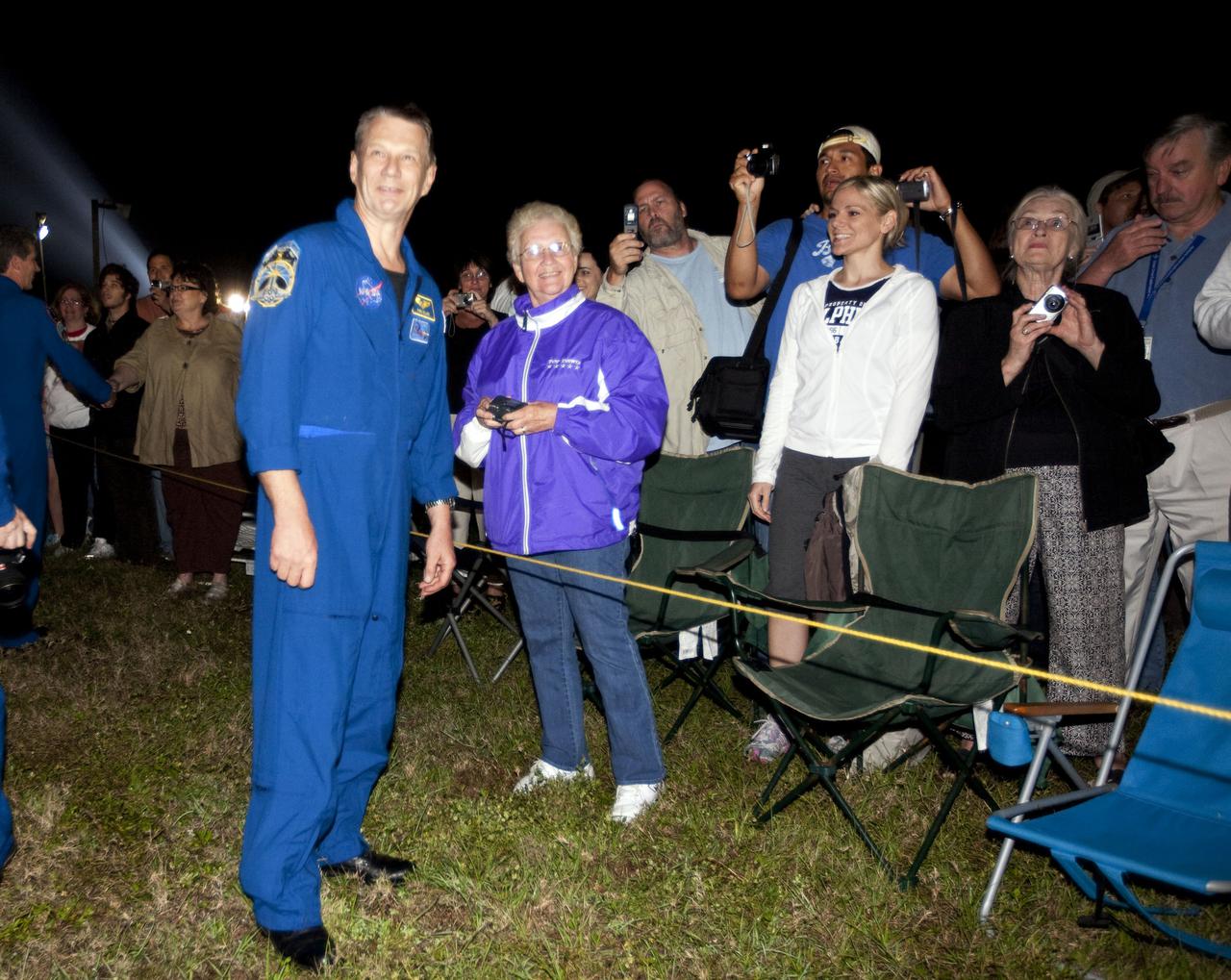
CAPE CANAVERAL, Fla. – Outside the Vehicle Assembly Building at NASA's Kennedy Space Center in Florida, STS-132 Mission Specialist Piers Sellers joins Kennedy employees and their families who turned out to watch space shuttle Atlantis begin its move to Launch Pad 39A. Atlantis' first motion on its 3.4-mile trip from the Vehicle Assembly Building was at 11:31 p.m. EDT April 21. The shuttle was secured on the pad at 6:03 a.m. April 22. Rollout is a significant milestone in launch processing activities. On the STS-132 mission, the six-member crew will deliver an Integrated Cargo Carrier, or ICC, and the Russian-built Mini-Research Module-1, or MRM-1, to the International Space Station. The ICC is an unpressurized flat bed pallet and keel yoke assembly used to support the transfer of exterior cargo from the shuttle to the space station. The MRM-1, known as Rassvet, is the second in a series of new pressurized components for Russia and will be permanently attached to the Earth-facing port of the Zarya control module. Rassvet, which translates to 'dawn,' will be used for cargo storage and will provide an additional docking port to the station. STS-132 is the 34th mission to the station and the 132nd shuttle mission overall. Atlantis is targeted to launch on May 14 at 2:19 p.m. For information on the STS-132 mission, visit http:__www.nasa.gov_mission_pages_shuttle_shuttlemissions_sts132_index.html. Photo credit: NASA_Amanda Diller

CAPE CANAVERAL, Fla. - At NASA's Kennedy Space Center in Florida, water stands on the crawlerway outside Launch Pad 39A, awaiting the arrival of space shuttle Atlantis. Thunderstorms that passed over the center around 4 a.m. made the crawlerway too wet for the massive crawler-transporter to carry Atlantis the 3.4 miles from the Vehicle Assembly Building to the pad. Atlantis and a six-member crew will deliver an Integrated Cargo Carrier, or ICC, and the Russian-built Mini-Research Module-1, or MRM-1, to the International Space Station on the STS-132 mission. The ICC is an unpressurized flat bed pallet and keel yoke assembly used to support the transfer of exterior cargo from the shuttle to the space station. The MRM-1, known as Rassvet, is the second in a series of new pressurized components for Russia and will be permanently attached to the Earth-facing port of the Zarya control module. Rassvet, which translates to 'dawn,' will be used for cargo storage and will provide an additional docking port to the station. STS-132 is the 34th mission to the station and the 132nd shuttle mission overall. Atlantis is targeted to launch on May 14 at 2:19 p.m. For information on the STS-132 mission, visit http:__www.nasa.gov_mission_pages_shuttle_shuttlemissions_sts132_index.html. Photo credit: NASA_Kim Shiflett
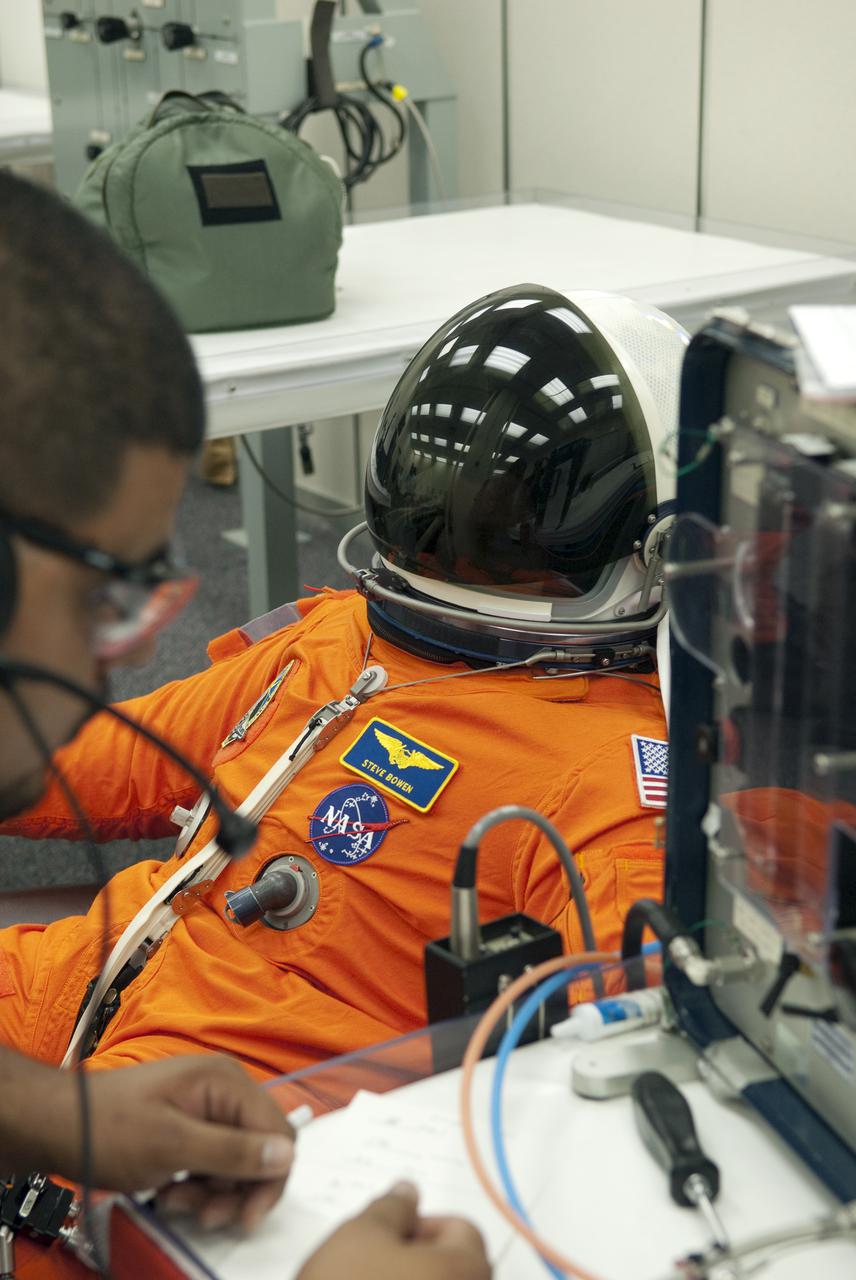
CAPE CANAVERAL, Fla. - In the Operations and Checkout Building at NASA's Kennedy Space Center in Florida, STS-132 Mission Specialist Steve Bowen verifies that his space suit's helmet is functioning properly. STS-132 is Bowen's second spaceflight. The six-member STS-132 crew is at Kennedy for their Terminal Countdown Demonstration Test, or TCDT, a dress rehearsal for launch. Following this practice 'suit-up,' the astronauts will ride in the Astrovan to Launch Pad 39A where they will participate in a simulated launch countdown from their seats inside space shuttle Atlantis. Launch is targeted for 2:19 p.m. EDT on May 14. On the STS-132 mission, the crew will deliver an Integrated Cargo Carrier, or ICC, and the Russian-built Mini-Research Module-1, or MRM-1, to the International Space Station. The ICC is an unpressurized flat bed pallet and keel yoke assembly used to support the transfer of exterior cargo from the shuttle to the space station. The MRM-1, known as Rassvet, is the second in a series of new pressurized components for Russia and will be permanently attached to the Earth-facing port of the Zarya control module. Rassvet, which translates to 'dawn,' will be used for cargo storage and provide an additional docking port to the station. STS-132 is the 34th mission to the station and the 132nd shuttle mission overall. For information on the STS-132 mission, visit http:__www.nasa.gov_mission_pages_shuttle_shuttlemissions_sts132_index.html. Photo credit: NASA_Cory Huston

CAPE CANAVERAL, Fla. – On Launch Pad 39A at NASA's Kennedy Space Center in Florida, the mobile launcher platform supporting space shuttle Atlantis has been secured over the flame trench on the pad's pedestals. The pad has six stationary and four extensible pedestals. Atlantis' first motion on its 3.4-mile trip from the Vehicle Assembly Building was at 11:31 p.m. EDT April 21. The shuttle was secured, or 'hard down,' on the pad at 6:03 a.m. April 22. Rollout is a significant milestone in launch processing activities. On the STS-132 mission, the six-member crew will deliver an Integrated Cargo Carrier, or ICC, and the Russian-built Mini-Research Module-1, or MRM-1, to the International Space Station. The ICC is an unpressurized flat bed pallet and keel yoke assembly used to support the transfer of exterior cargo from the shuttle to the space station. The MRM-1, known as Rassvet, is the second in a series of new pressurized components for Russia and will be permanently attached to the Earth-facing port of the Zarya control module. Rassvet, which translates to 'dawn,' will be used for cargo storage and will provide an additional docking port to the station. STS-132 is the 34th mission to the station and the 132nd shuttle mission overall. Atlantis is targeted to launch on May 14 at 2:19 p.m. For information on the STS-132 mission, visit http:__www.nasa.gov_mission_pages_shuttle_shuttlemissions_sts132_index.html. Photo credit: NASA_Jack Pfaller
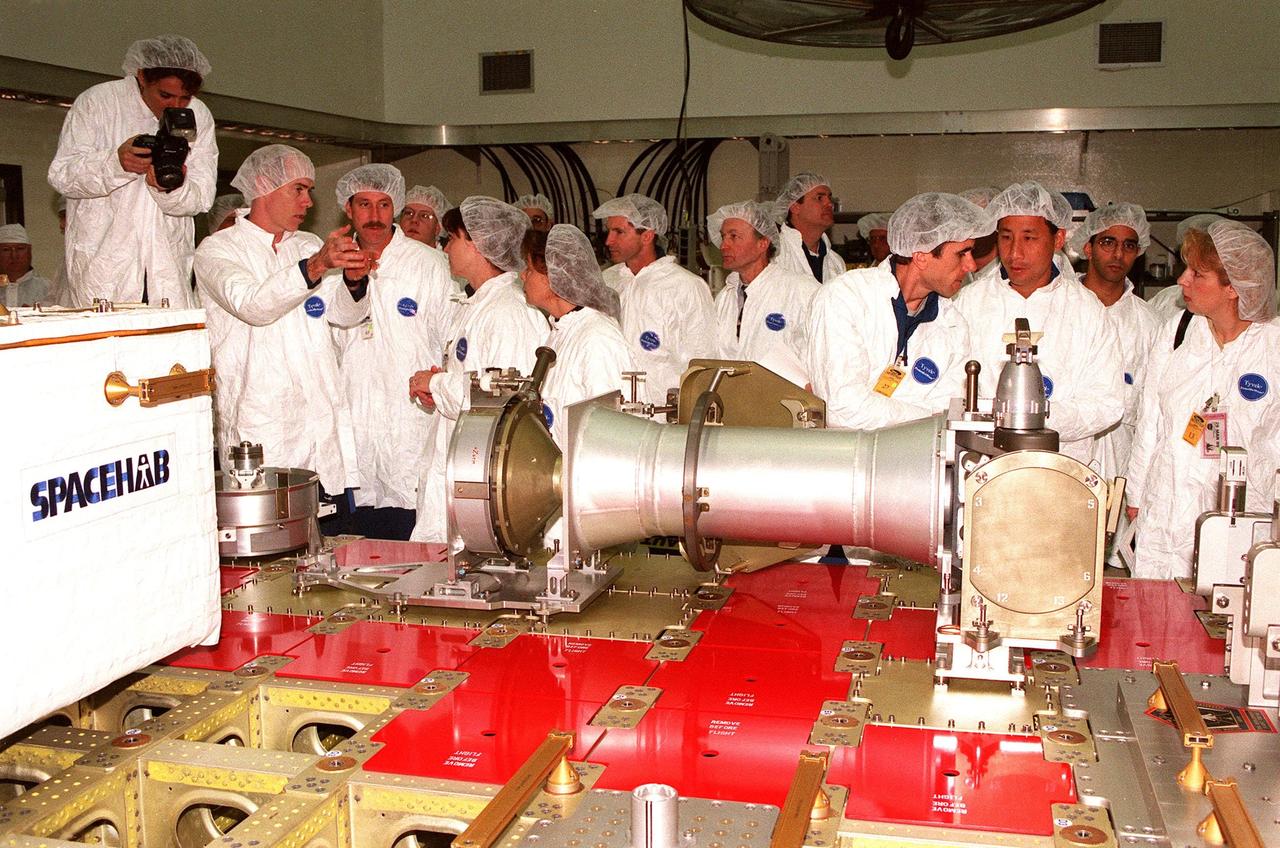
At Astrotech in Titusville, Fla., members of two Shuttle crews look at components of a Russian cargo crane, the Strela, to be mounted to the exterior of the Russian station segment on the International Space Station (ISS). From left are STS-96 Mission Specialist Julie Payette and Daniel T. Barry, Commander Kent V. Rominger and Mission Specialist Tamara E. Jernigan; three technicians from DaimlerChrysler Aerospace; (in the background, facing right) STS-101 Commander James Donald Halsell Jr.; STS-101 Mission Specialists Yuri Ivanovich Malenchenko, with the Russian Space Agency, and Edward Tsang Lu; and two more technicians from DaimlerChrysler. Both missions include the SPACEHAB Double Module, carrying internal and resupply cargo for Station outfitting. For the first time, STS-96 will include an Integrated Cargo Carrier (ICC) that will carry the Strela; the SPACEHAB Oceaneering Space System Box (SHOSS), which is a logistics items carrier; and a U.S.-built crane (ORU Transfer Device, or OTD) that will be stowed on the station for use during future ISS assembly missions. The ICC can carry up to 6,000 lb of unpressurized payload. It was built for SPACEHAB by DaimlerChrysler and RSC Energia of Korolev, Russia. STS-96 is targeted for launch on May 24 from Launch Pad 39B. STS-101 is scheduled to launch in early December 1999
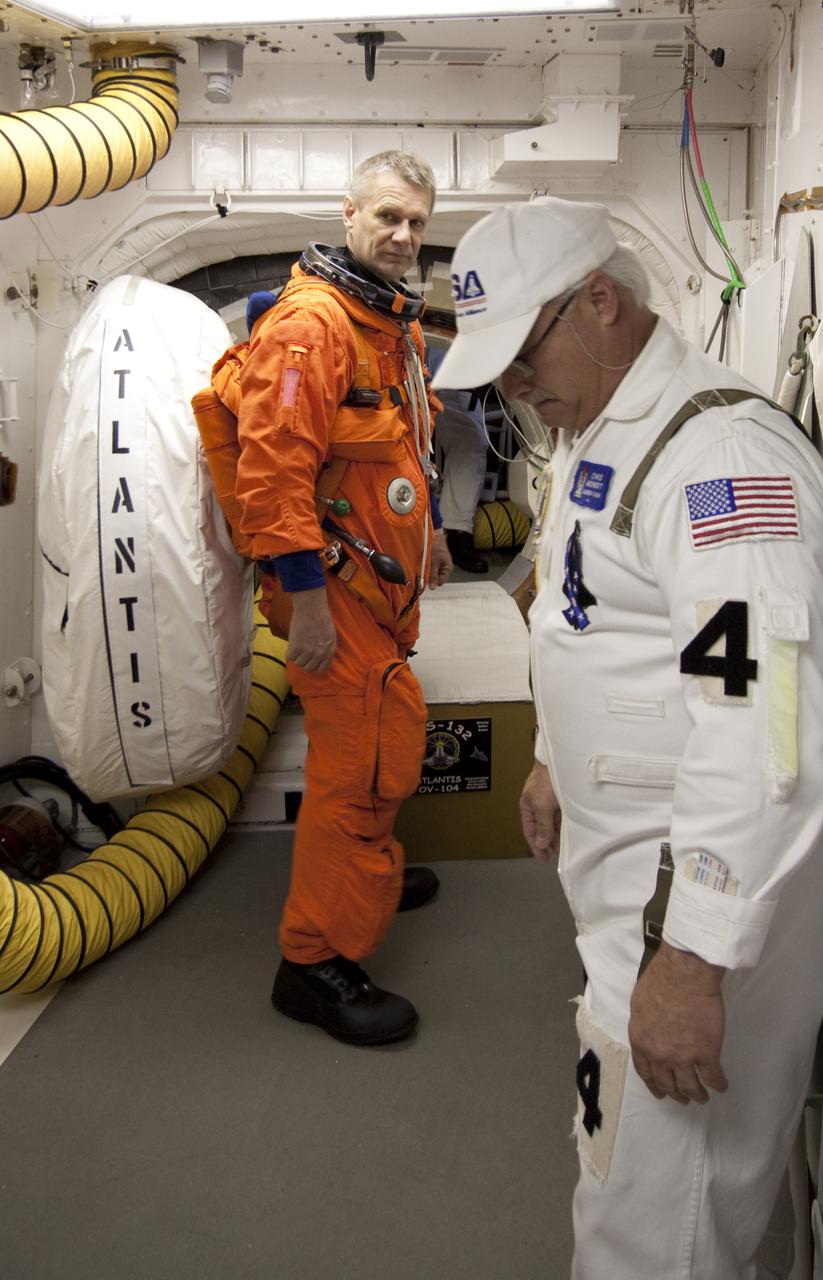
CAPE CANAVERAL, Fla. - At Launch Pad 39A at NASA's Kennedy Space Center in Florida, STS-132 Mission Specialist Piers Sellers prepares to enter space shuttle Atlantis from the pad's White Room. STS-132 is Seller's third spaceflight. The six-member STS-132 crew is participating in a dress rehearsal for launch, known as the Terminal Countdown Demonstration Test, from their seats in the crew compartment of space shuttle Atlantis. Launch is targeted for 2:19 p.m. EDT on May 14. On the STS-132 mission, the crew will deliver an Integrated Cargo Carrier, or ICC, and the Russian-built Mini-Research Module-1, or MRM-1, to the International Space Station. The ICC is an unpressurized flat bed pallet and keel yoke assembly used to support the transfer of exterior cargo from the shuttle to the space station. The MRM-1, known as Rassvet, is the second in a series of new pressurized components for Russia and will be permanently attached to the Earth-facing port of the Zarya control module. Rassvet, which translates to 'dawn,' will be used for cargo storage and provide an additional docking port to the station. STS-132 is the 34th mission to the station and the 132nd shuttle mission overall. For information on the STS-132 mission, visit http:__www.nasa.gov_mission_pages_shuttle_shuttlemissions_sts132_index.html. Photo credit: NASA_Jack Pfaller
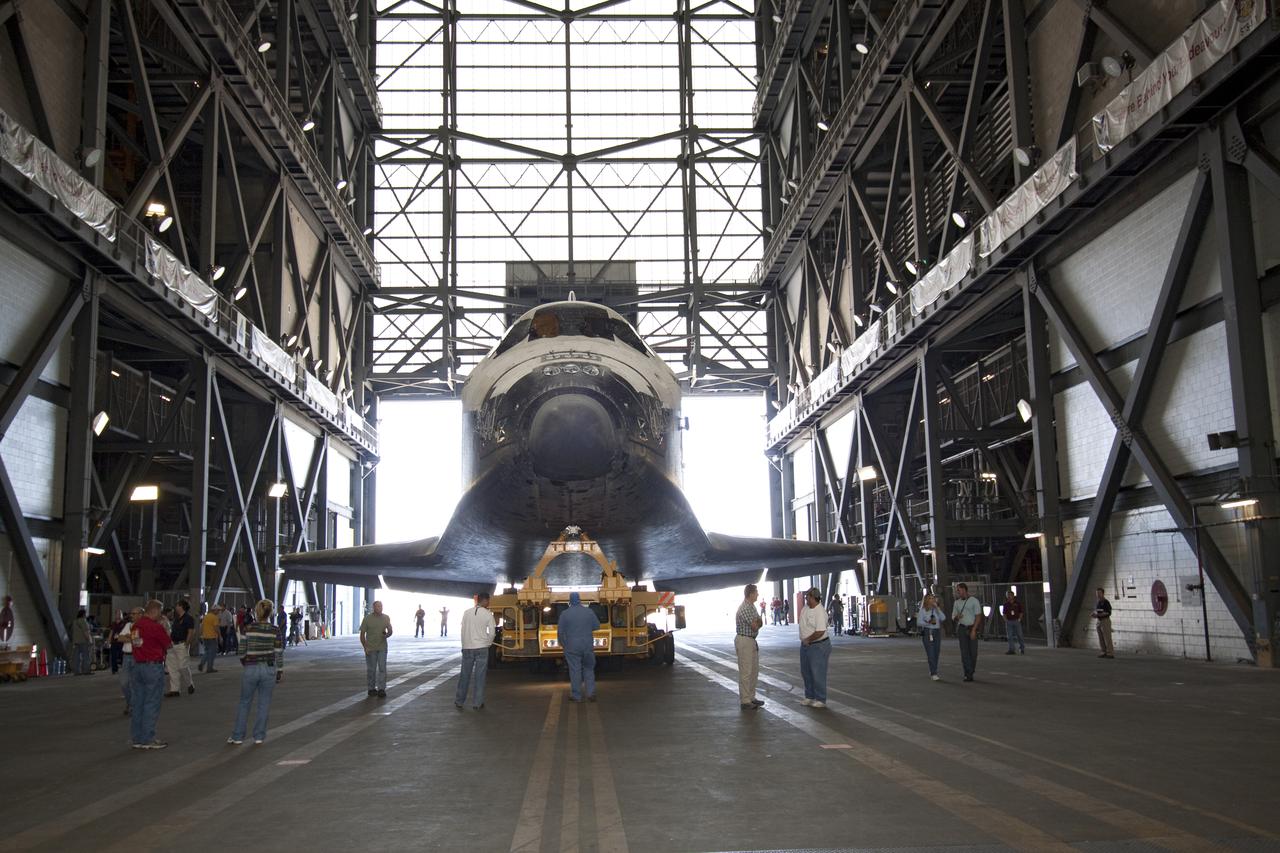
CAPE CANAVERAL, Fla. – At NASA's Kennedy Space Center in Florida, space shuttle Atlantis arrives in the transfer aisle of the Vehicle Assembly Building, or VAB. The shuttle was moved from Orbiter Processing Facility-1 where it was processed for its upcoming STS-132 mission. In the VAB, Atlantis will be lifted into a high bay where it will be mated to its external fuel tank and solid rocket boosters. The six-member STS-132 crew will deliver an Integrated Cargo Carrier, or ICC, and the Russian-built Mini-Research Module-1, or MRM-1, to the International Space Station. The ICC is an unpressurized flat bed pallet and keel yoke assembly used to support the transfer of exterior cargo from the shuttle to the space station. The MRM-1, known as Rassvet, is the second in a series of new pressurized components for Russia and will be permanently attached to the Earth-facing port of the Zarya control module. Rassvet, which translates to 'dawn,' will be used for cargo storage and will provide an additional docking port to the station. STS-132 is the 34th mission to the station and the 132nd shuttle mission overall. Launch is targeted for May 14. For information on the STS-132 mission, visit http:__www.nasa.gov_mission_pages_shuttle_shuttlemissions_sts132_index.html. Photo credit: NASA_Jack Pfaller
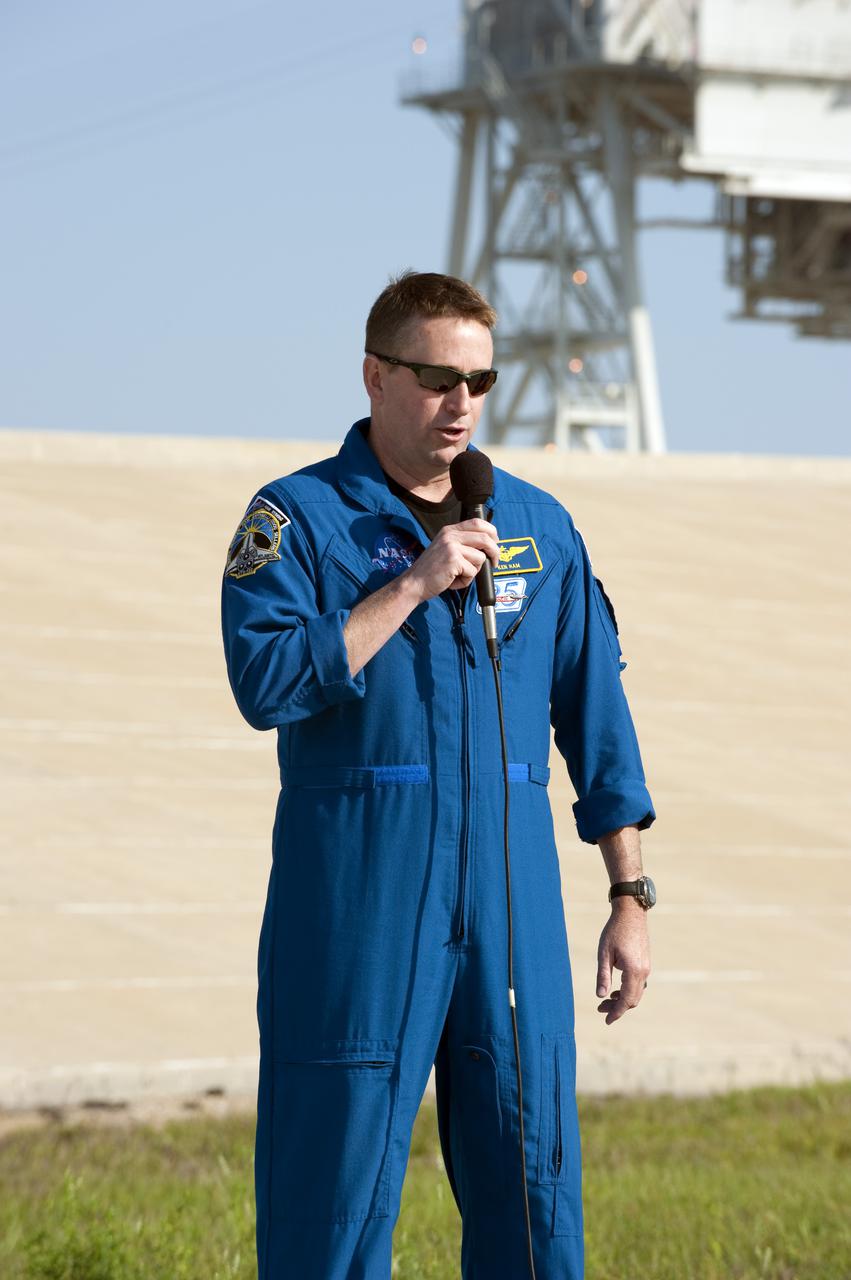
CAPE CANAVERAL, Fla. - At Launch Pad 39A at NASA's Kennedy Space Center in Florida, STS-132 Commander Ken Ham addresses media representatives during a question-and-answer session. The crew is at Kennedy for their Terminal Countdown Demonstration Test, or TCDT, a dress rehearsal for launch. TCDT provides each shuttle crew and launch team the opportunity to participate in various simulated countdown activities, including equipment familiarization and emergency training. On the STS-132 mission, the six-member crew will deliver an Integrated Cargo Carrier, or ICC, and the Russian-built Mini-Research Module-1, or MRM-1, to the International Space Station aboard space shuttle Atlantis. The ICC is an unpressurized flat bed pallet and keel yoke assembly used to support the transfer of exterior cargo from the shuttle to the space station. The MRM-1, known as Rassvet, is the second in a series of new pressurized components for Russia and will be permanently attached to the Earth-facing port of the Zarya control module. Rassvet, which translates to 'dawn,' will be used for cargo storage and will provide an additional docking port to the station. STS-132 is the 34th mission to the station and the 132nd shuttle mission overall. Atlantis is targeted to launch on May 14 at 2:19 p.m. For information on the STS-132 mission, visit http:__www.nasa.gov_mission_pages_shuttle_shuttlemissions_sts132_index.html. Photo credit: NASA_Kim Shiflett
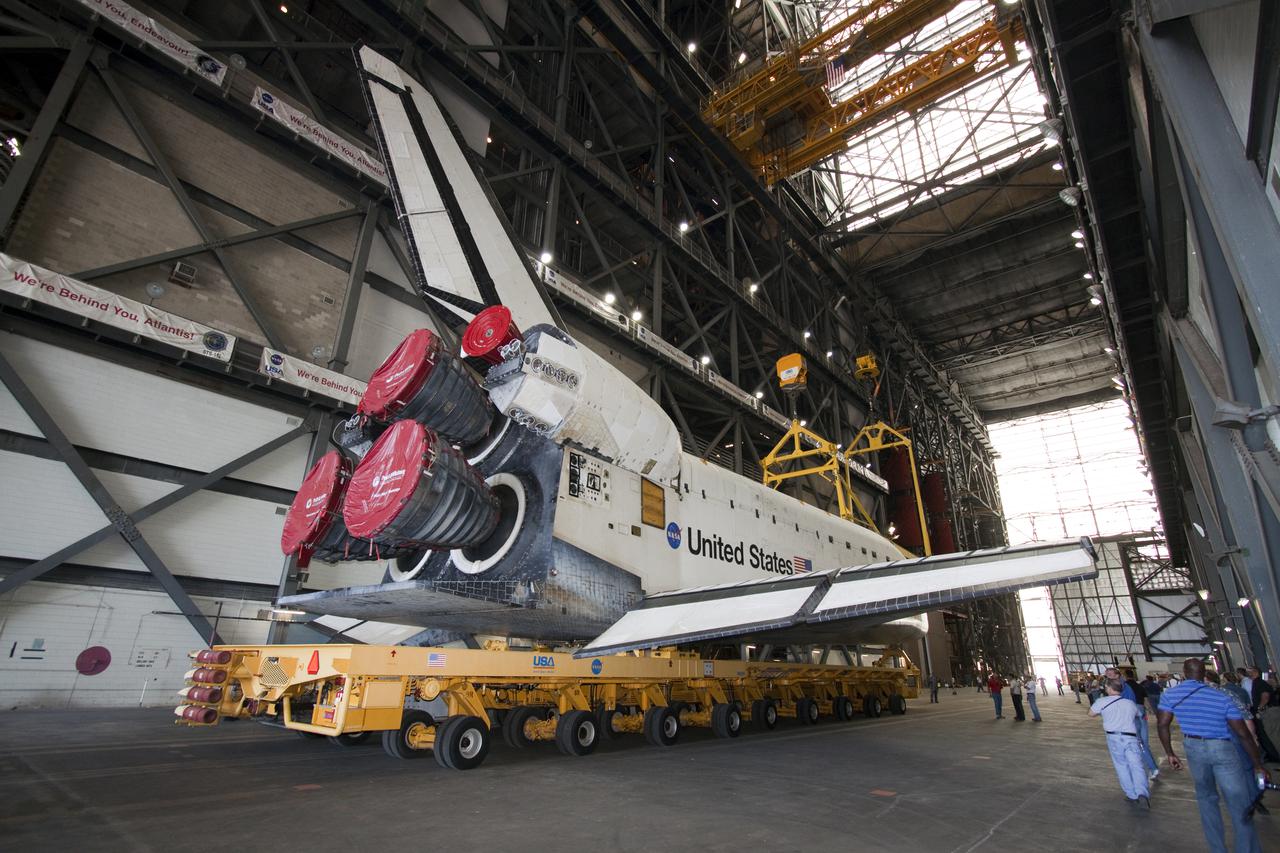
CAPE CANAVERAL, Fla. – At NASA's Kennedy Space Center in Florida, space shuttle Atlantis has arrived in the transfer aisle of the Vehicle Assembly Building, or VAB, and is ready to be lifted into a high bay. The shuttle was moved from Orbiter Processing Facility-1 where it was processed for its upcoming STS-132 mission. In the VAB, Atlantis will be lifted into a high bay where it will be mated to its external fuel tank and solid rocket boosters. The six-member STS-132 crew will deliver an Integrated Cargo Carrier, or ICC, and the Russian-built Mini-Research Module-1, or MRM-1, to the International Space Station. The ICC is an unpressurized flat bed pallet and keel yoke assembly used to support the transfer of exterior cargo from the shuttle to the space station. The MRM-1, known as Rassvet, is the second in a series of new pressurized components for Russia and will be permanently attached to the Earth-facing port of the Zarya control module. Rassvet, which translates to 'dawn,' will be used for cargo storage and will provide an additional docking port to the station. STS-132 is the 34th mission to the station and the 132nd shuttle mission overall. Launch is targeted for May 14. For information on the STS-132 mission, visit http:__www.nasa.gov_mission_pages_shuttle_shuttlemissions_sts132_index.html. Photo credit: NASA_Jack Pfaller
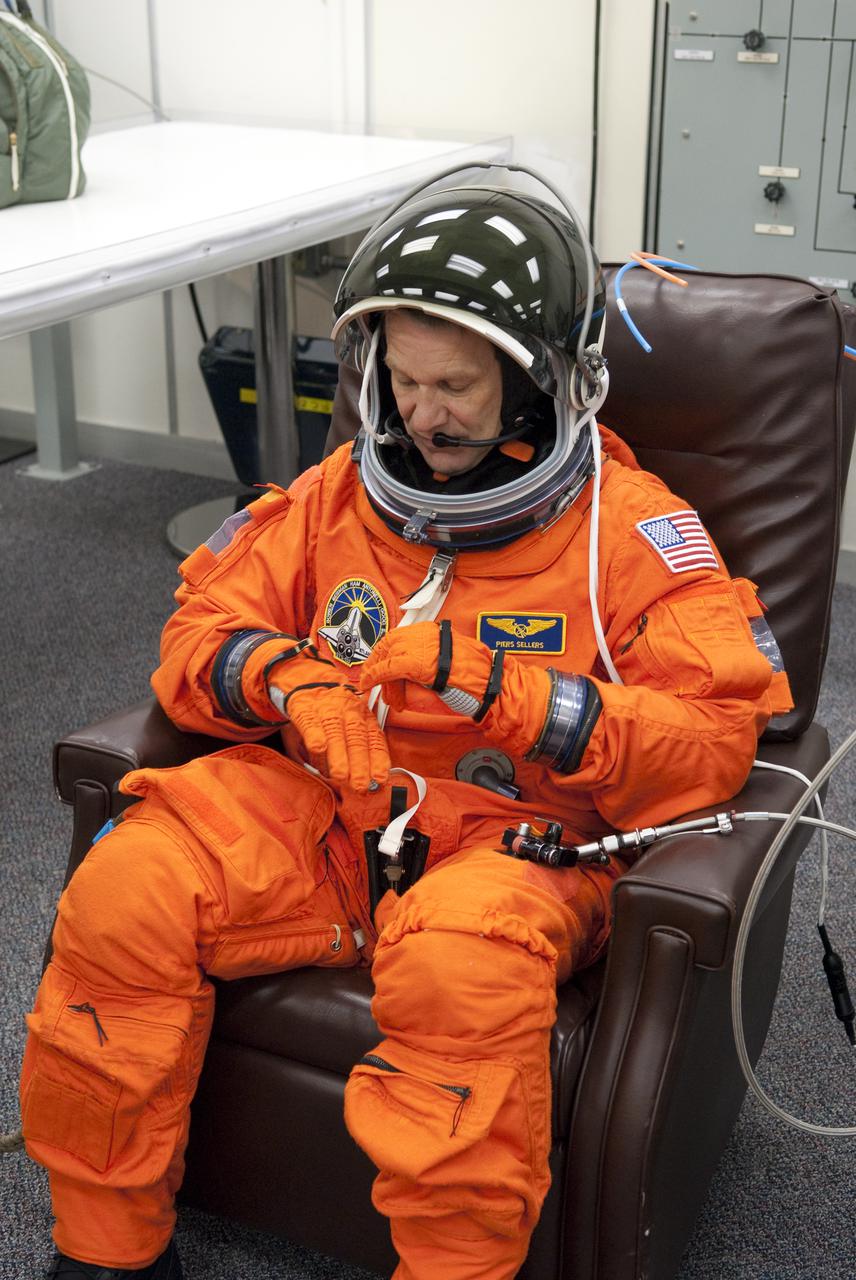
CAPE CANAVERAL, Fla. - In the Operations and Checkout Building at NASA's Kennedy Space Center in Florida, STS-132 Mission Specialist Piers Sellers puts on his space suit's gloves. STS-132 is Sellers third spaceflight. The six-member STS-132 crew is at Kennedy for their Terminal Countdown Demonstration Test, or TCDT, a dress rehearsal for launch. Following this practice 'suit-up,' the astronauts will ride in the Astrovan to Launch Pad 39A where they will participate in a simulated launch countdown from their seats inside space shuttle Atlantis. Launch is targeted for 2:19 p.m. EDT on May 14. On the STS-132 mission, the crew will deliver an Integrated Cargo Carrier, or ICC, and the Russian-built Mini-Research Module-1, or MRM-1, to the International Space Station. The ICC is an unpressurized flat bed pallet and keel yoke assembly used to support the transfer of exterior cargo from the shuttle to the space station. The MRM-1, known as Rassvet, is the second in a series of new pressurized components for Russia and will be permanently attached to the Earth-facing port of the Zarya control module. Rassvet, which translates to 'dawn,' will be used for cargo storage and provide an additional docking port to the station. STS-132 is the 34th mission to the station and the 132nd shuttle mission overall. For information on the STS-132 mission, visit http:__www.nasa.gov_mission_pages_shuttle_shuttlemissions_sts132_index.html. Photo credit: NASA_Cory Huston
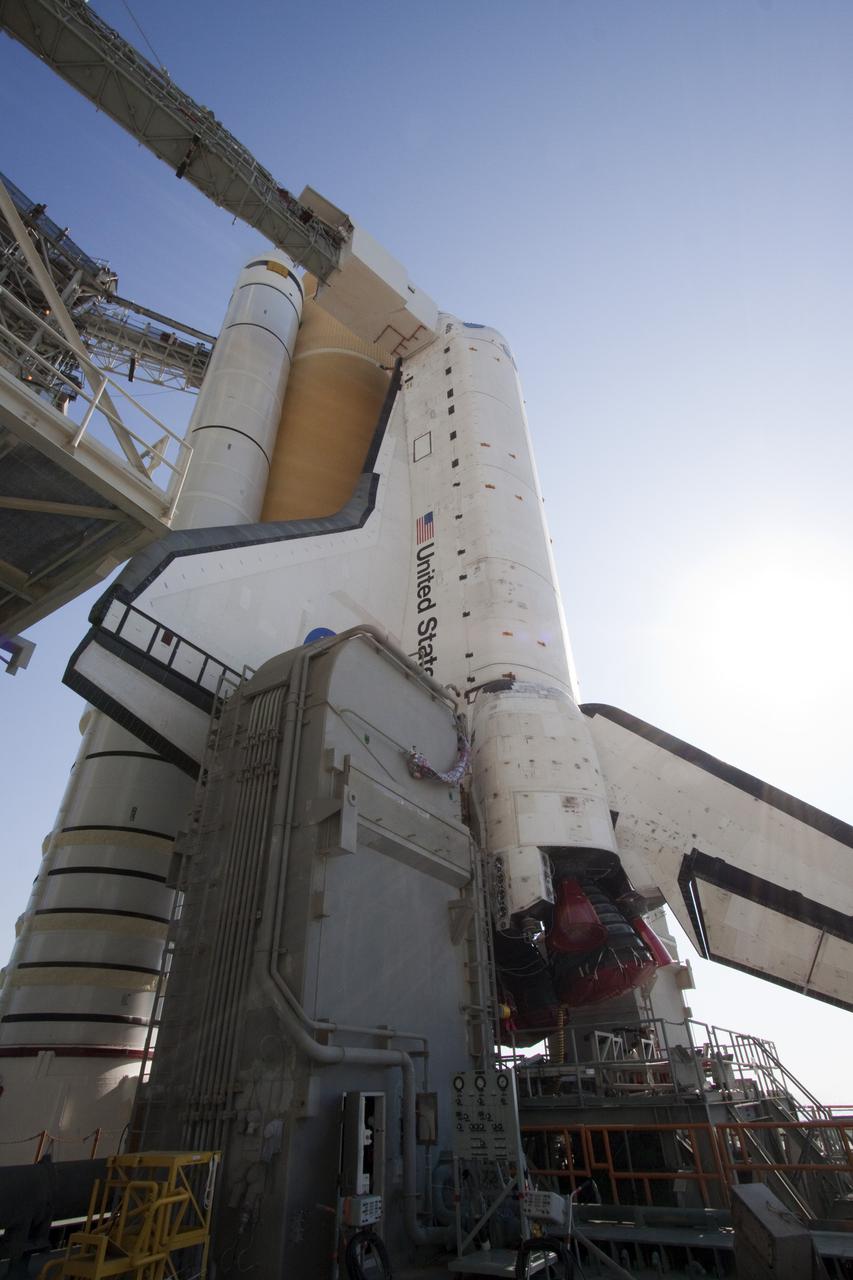
CAPE CANAVERAL, Fla. – On Launch Pad 39A at NASA's Kennedy Space Center in Florida, the access arm supporting the pad's White Room is moved into place against space shuttle Atlantis. The room provides workers and astronauts an entry point to the shuttle's crew compartment. Atlantis' first motion on its 3.4-mile trip from the Vehicle Assembly Building was at 11:31 p.m. EDT April 21. The shuttle was secured, or 'hard down,' on the pad at 6:03 a.m. April 22. Rollout is a significant milestone in launch processing activities. On the STS-132 mission, the six-member crew will deliver an Integrated Cargo Carrier, or ICC, and the Russian-built Mini-Research Module-1, or MRM-1, to the International Space Station. The ICC is an unpressurized flat bed pallet and keel yoke assembly used to support the transfer of exterior cargo from the shuttle to the space station. The MRM-1, known as Rassvet, is the second in a series of new pressurized components for Russia and will be permanently attached to the Earth-facing port of the Zarya control module. Rassvet, which translates to 'dawn,' will be used for cargo storage and will provide an additional docking port to the station. STS-132 is the 34th mission to the station and the 132nd shuttle mission overall. Atlantis is targeted to launch on May 14 at 2:19 p.m. For information on the STS-132 mission, visit http:__www.nasa.gov_mission_pages_shuttle_shuttlemissions_sts132_index.html. Photo credit: NASA_Jack Pfaller