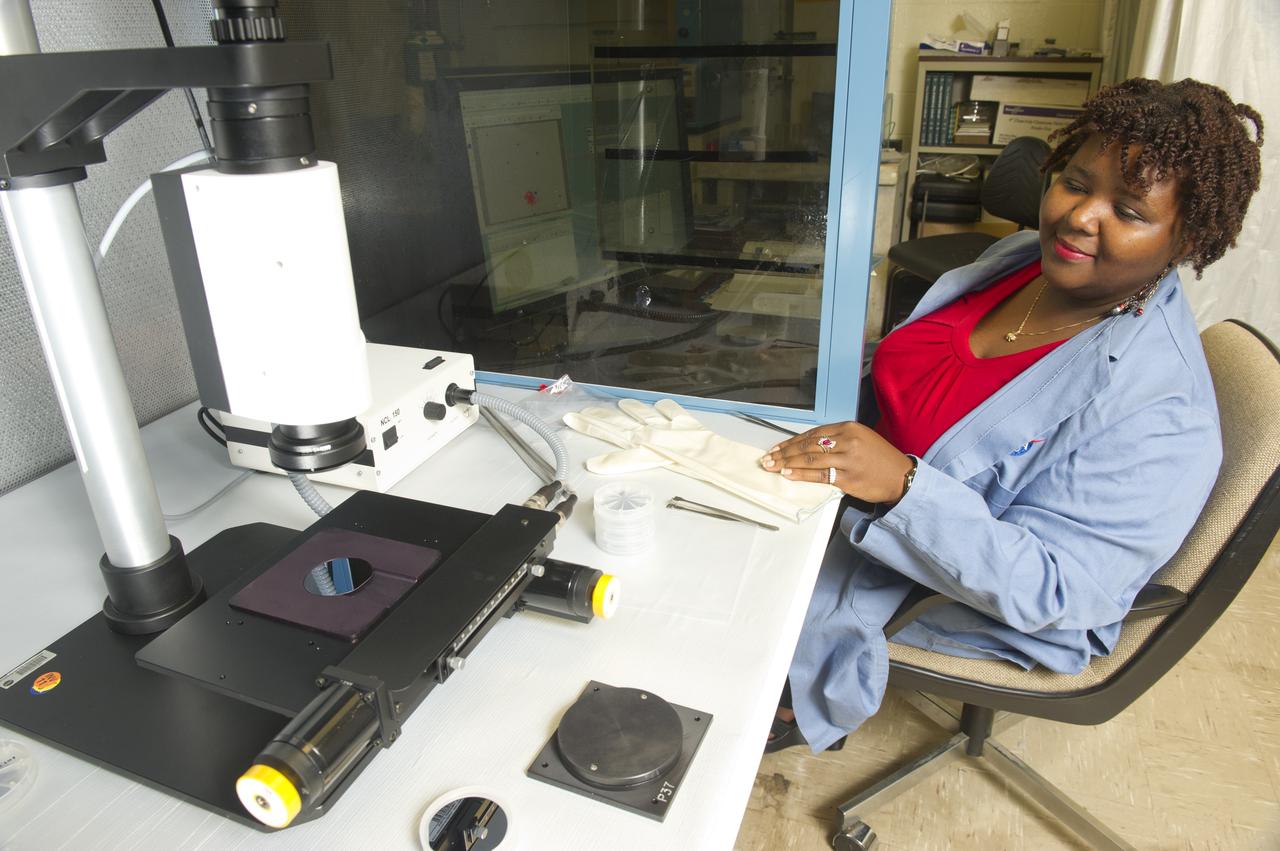
LAQUIETA HUEY WITH IMAGE ANALYSIS SYSTEM FOR AUTOMATED PARTICLE COUNTING.
![KENNEDY SPACE CENTER, FLA. - These towers are part of one of the world’s highest performing visual film analysis systems, developed to review and analyze previous shuttle flight data in preparation for the shuttle fleet’s return to flight. The system is being used today for another purpose. NASA has permitted its use in helping to analyze a film that shows a recent kidnapping in progress in Florida. Developed by NASA, United Space Alliance (USA) and Silicon Graphics Inc., the system allows multiple-person collaboration, highly detailed manipulation and evaluation of specific imagery. The system is housed in the Image Analysis Facility inside the Vehicle Assembly Building. [Photo taken Aug. 15, 2003, courtesy of Terry Wallace, SGI ]](https://images-assets.nasa.gov/image/KSC-04pd0152/KSC-04pd0152~medium.jpg)
KENNEDY SPACE CENTER, FLA. - These towers are part of one of the world’s highest performing visual film analysis systems, developed to review and analyze previous shuttle flight data in preparation for the shuttle fleet’s return to flight. The system is being used today for another purpose. NASA has permitted its use in helping to analyze a film that shows a recent kidnapping in progress in Florida. Developed by NASA, United Space Alliance (USA) and Silicon Graphics Inc., the system allows multiple-person collaboration, highly detailed manipulation and evaluation of specific imagery. The system is housed in the Image Analysis Facility inside the Vehicle Assembly Building. [Photo taken Aug. 15, 2003, courtesy of Terry Wallace, SGI ]
![KENNEDY SPACE CENTER, FLA. - One of the world’s highest performing visual film analysis systems, developed to review and analyze previous shuttle flight data (shown here) in preparation for the shuttle fleet’s return to flight, is being used today for another purpose. NASA has permitted its use in helping to analyze a film that shows a recent kidnapping in progress in Florida. The system, developed by NASA, United Space Alliance (USA) and Silicon Graphics Inc., allows multiple-person collaboration, highly detailed manipulation and evaluation of specific imagery. The system is housed in the Image Analysis Facility inside the Vehicle Assembly Building. [Photo taken Aug. 15, 2003, courtesy of Terry Wallace, SGI ]](https://images-assets.nasa.gov/image/KSC-04pd0150/KSC-04pd0150~medium.jpg)
KENNEDY SPACE CENTER, FLA. - One of the world’s highest performing visual film analysis systems, developed to review and analyze previous shuttle flight data (shown here) in preparation for the shuttle fleet’s return to flight, is being used today for another purpose. NASA has permitted its use in helping to analyze a film that shows a recent kidnapping in progress in Florida. The system, developed by NASA, United Space Alliance (USA) and Silicon Graphics Inc., allows multiple-person collaboration, highly detailed manipulation and evaluation of specific imagery. The system is housed in the Image Analysis Facility inside the Vehicle Assembly Building. [Photo taken Aug. 15, 2003, courtesy of Terry Wallace, SGI ]
![KENNEDY SPACE CENTER, FLA. - One of the world’s highest performing visual film analysis systems, developed to review and analyze previous shuttle flight data (shown here) in preparation for the shuttle fleet’s return to flight, is being used today for another purpose. NASA has permitted its use in helping to analyze a film that shows a recent kidnapping in progress in Florida. The system, developed by NASA, United Space Alliance (USA) and Silicon Graphics Inc., allows multiple-person collaboration, highly detailed manipulation and evaluation of specific imagery. The system is housed in the Image Analysis Facility inside the Vehicle Assembly Building. [Photo taken Aug. 15, 2003, courtesy of Terry Wallace, SGI ]](https://images-assets.nasa.gov/image/KSC-04pd0154/KSC-04pd0154~medium.jpg)
KENNEDY SPACE CENTER, FLA. - One of the world’s highest performing visual film analysis systems, developed to review and analyze previous shuttle flight data (shown here) in preparation for the shuttle fleet’s return to flight, is being used today for another purpose. NASA has permitted its use in helping to analyze a film that shows a recent kidnapping in progress in Florida. The system, developed by NASA, United Space Alliance (USA) and Silicon Graphics Inc., allows multiple-person collaboration, highly detailed manipulation and evaluation of specific imagery. The system is housed in the Image Analysis Facility inside the Vehicle Assembly Building. [Photo taken Aug. 15, 2003, courtesy of Terry Wallace, SGI ]
![KENNEDY SPACE CENTER, FLA. - One of the world’s highest performing visual film analysis systems, developed to review and analyze previous shuttle flight data (shown here) in preparation for the shuttle fleet’s return to flight, is being used today for another purpose. NASA has permitted its use in helping to analyze a film that shows a recent kidnapping in progress in Florida. The system, developed by NASA, United Space Alliance (USA) and Silicon Graphics Inc., allows multiple-person collaboration, highly detailed manipulation and evaluation of specific imagery. The system is housed in the Image Analysis Facility inside the Vehicle Assembly Building. [Photo taken Aug. 15, 2003, courtesy of Terry Wallace, SGI ]](https://images-assets.nasa.gov/image/KSC-04pd0151/KSC-04pd0151~medium.jpg)
KENNEDY SPACE CENTER, FLA. - One of the world’s highest performing visual film analysis systems, developed to review and analyze previous shuttle flight data (shown here) in preparation for the shuttle fleet’s return to flight, is being used today for another purpose. NASA has permitted its use in helping to analyze a film that shows a recent kidnapping in progress in Florida. The system, developed by NASA, United Space Alliance (USA) and Silicon Graphics Inc., allows multiple-person collaboration, highly detailed manipulation and evaluation of specific imagery. The system is housed in the Image Analysis Facility inside the Vehicle Assembly Building. [Photo taken Aug. 15, 2003, courtesy of Terry Wallace, SGI ]
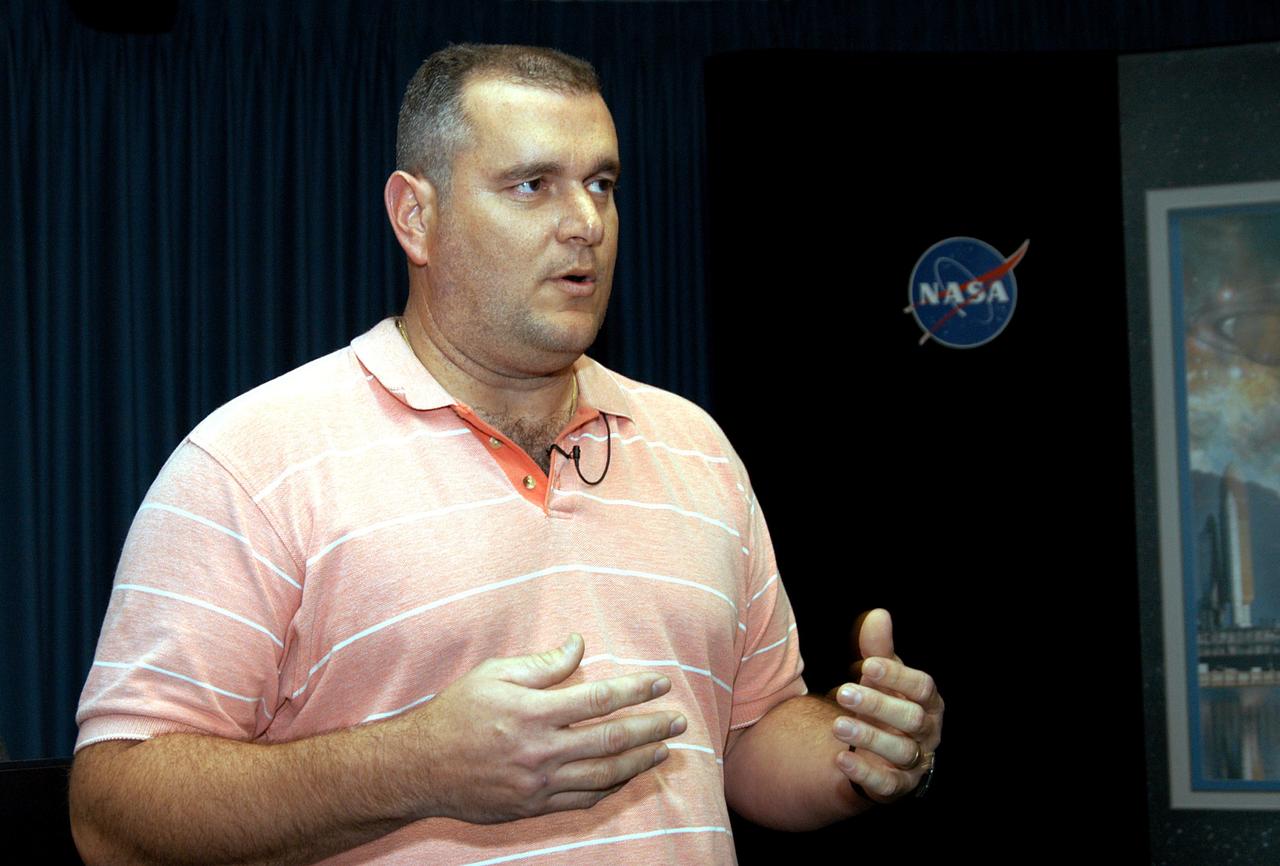
KENNEDY SPACE CENTER, FLA. - Armando Oliu, Final Inspection Team lead for the Shuttle program, speaks to reporters about the aid the Image Analysis Lab is giving the FBI in a kidnapping case. Oliu oversees the image lab that is using an advanced SGI® TP9500 data management system to review the tape of the kidnapping in progress in Sarasota, Fla. KSC installed the new $3.2 million system in preparation for Return to Flight of the Space Shuttle fleet. The lab is studying the Sarasota kidnapping video to provide any new information possible to law enforcement officers. KSC is joining NASA’s Marshall Space Flight Center in Alabama in reviewing the tape.
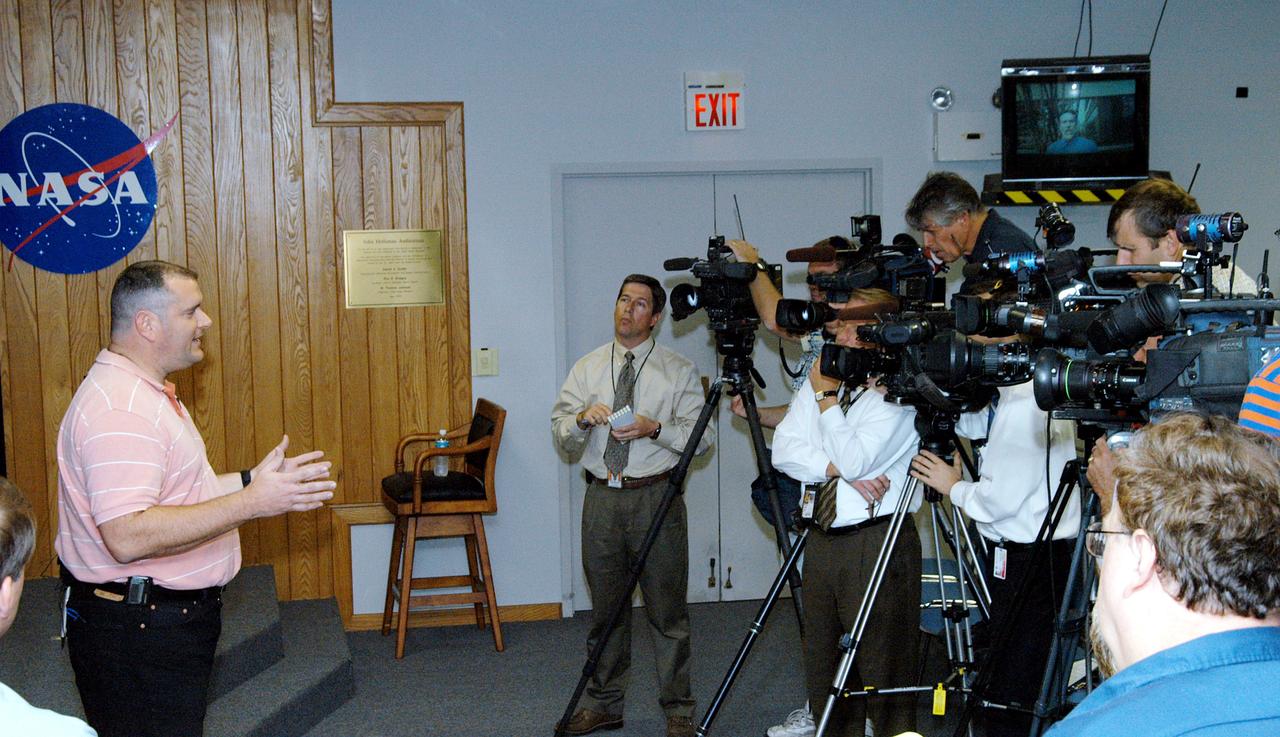
KENNEDY SPACE CENTER, FLA. - Armando Oliu, Final Inspection Team lead for the Shuttle program, speaks to reporters about the aid the Image Analysis Lab is giving the FBI in a kidnapping case. Oliu oversees the image lab that is using an advanced SGI® TP9500 data management system to review the tape of the kidnapping in progress in Sarasota, Fla. KSC installed the new $3.2 million system in preparation for Return to Flight of the Space Shuttle fleet. The lab is studying the Sarasota kidnapping video to provide any new information possible to law enforcement officers. KSC is joining NASA’s Marshall Space Flight Center in Alabama in reviewing the tape.

KENNEDY SPACE CENTER, FLA. - Reporters are eager to hear from Armando Oliu about the aid the Image Analysis Lab is giving the FBI in a kidnapping case. Oliu, Final Inspection Team lead for the Shuttle program, oversees the lab that is using an advanced SGI® TP9500 data management system to review the tape of the kidnapping in progress in Sarasota, Fla. KSC installed the new $3.2 million system in preparation for Return to Flight of the Space Shuttle fleet. The lab is studying the Sarasota kidnapping video to provide any new information possible to law enforcement officers. KSC is joining NASA’s Marshall Space Flight Center in Alabama in reviewing the tape.
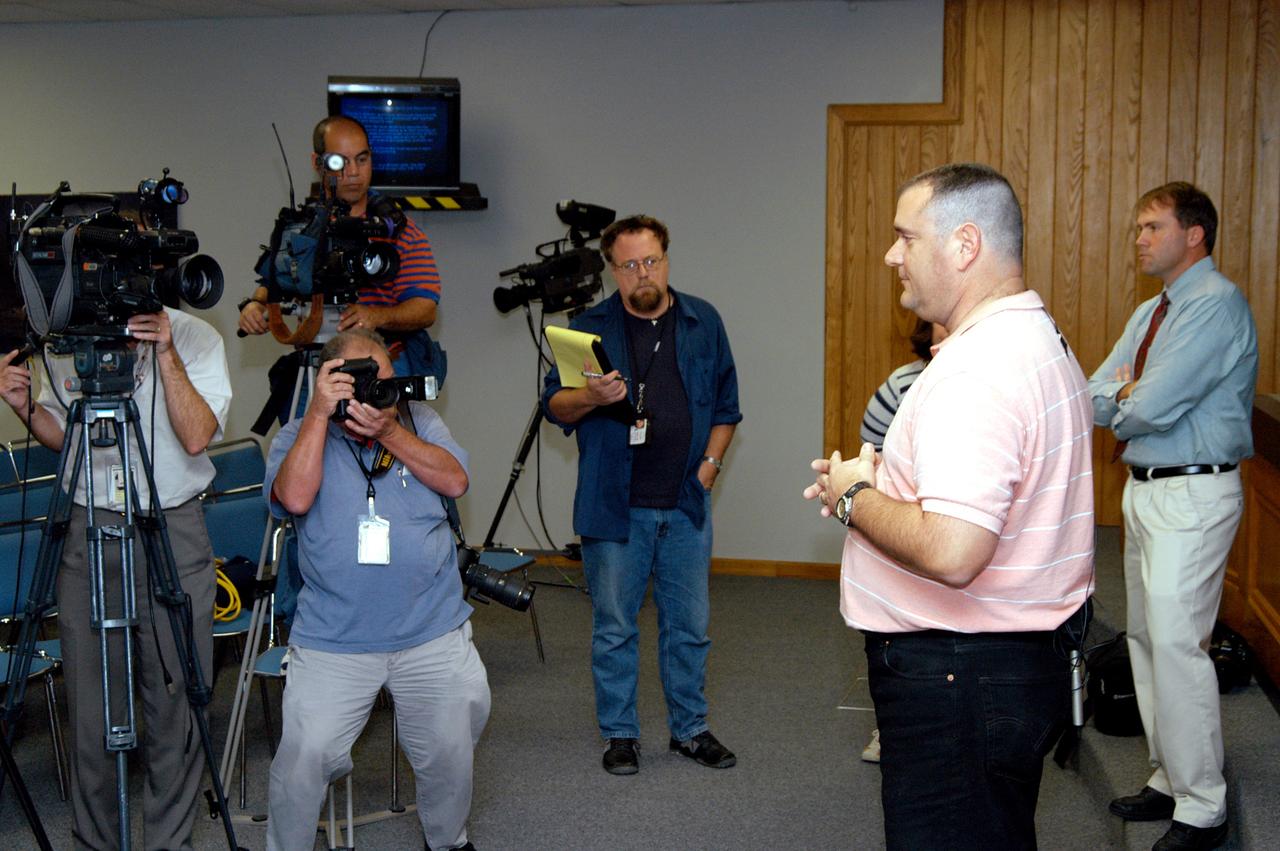
KENNEDY SPACE CENTER, FLA. - Armando Oliu, Final Inspection Team lead for the Shuttle program, speaks to reporters about the aid the Image Analysis Lab is giving the FBI in a kidnapping case. Behind him at right is Mike Rein, External Affairs division chief. Oliu oversees the image lab that is using an advanced SGI® TP9500 data management system to review the tape of the kidnapping in progress in Sarasota, Fla. KSC installed the new $3.2 million system in preparation for Return to Flight of the Space Shuttle fleet. The lab is studying the Sarasota kidnapping video to provide any new information possible to law enforcement officers. KSC is joining NASA’s Marshall Space Flight Center in Alabama in reviewing the tape.
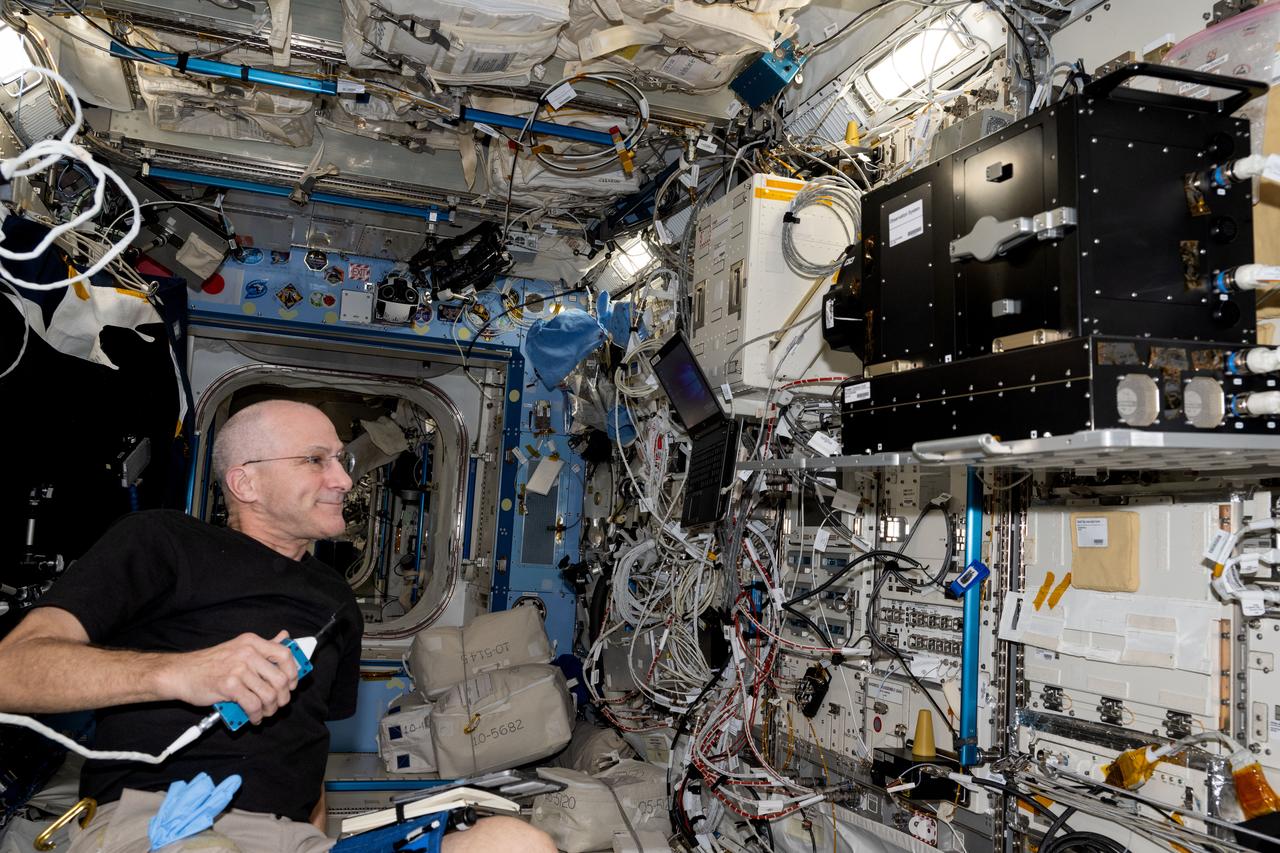
iss072e033530 (Oct. 10, 2024) --- NASA astronaut and Expedition 72 Flight Engineer Don Pettit works inside the Kibo laboratory module checking out biology imaging hardware, the Tele-Luminescence Analysis System (TELLAS), that can detect space-caused inflammatory changes to tissues and genes in organisms.

The NASA imaging processing technology, an advanced computer technique to enhance images sent to Earth in digital form by distant spacecraft, helped develop a new vision screening process. The Ocular Vision Screening system, an important step in preventing vision impairment, is a portable device designed especially to detect eye problems in children through the analysis of retinal reflexes.
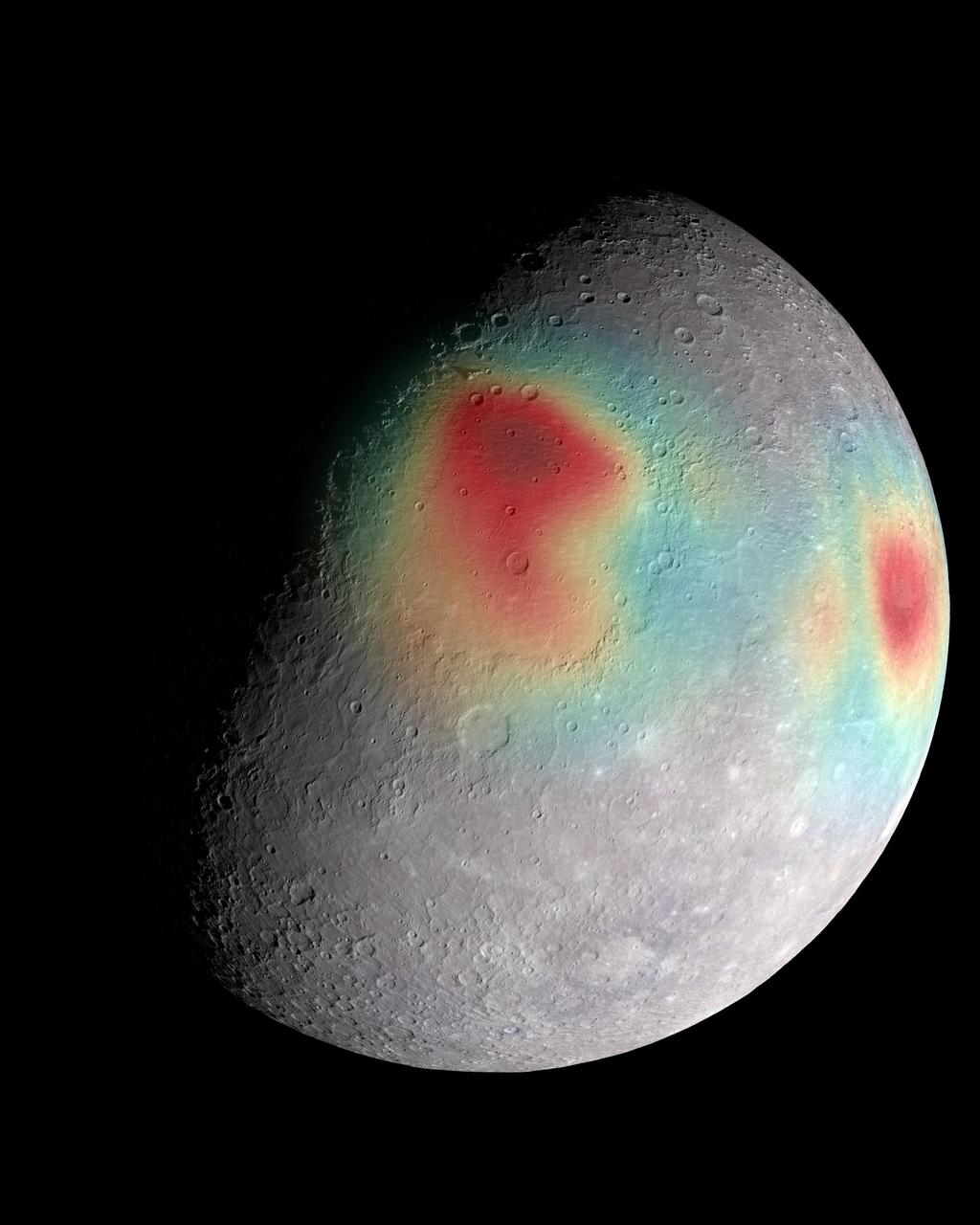
Analysis of radio tracking data have enabled maps of the gravity field of Mercury to be derived. In this image, overlain on a mosaic obtained by MESSENGER's Mercury Dual Imaging System and illuminated with a shape model determined from stereo-photoclinometry, Mercury's gravity anomalies are depicted in colors. Red tones indicate mass concentrations, centered on the Caloris basin (center) and the Sobkou region (right limb). Such large-scale gravitational anomalies are signatures of subsurface structure and evolution. The north pole is near the top of the sunlit area in this view. http://photojournal.jpl.nasa.gov/catalog/PIA19285
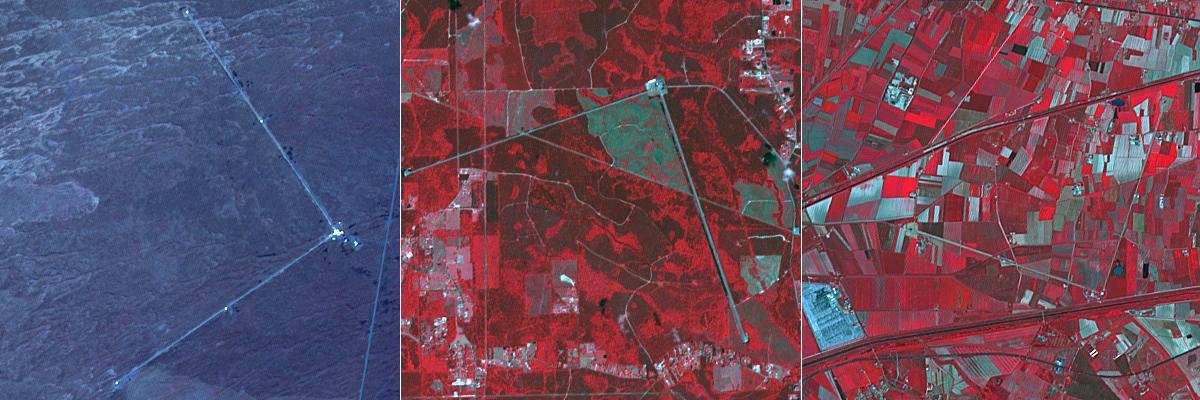
The biggest merger yet between two black holes produced gravity waves that were detected by gravitational wave detection systems. This analysis is the latest to come out of the international LIGO-VIRGO collaboration, which operates three super-sensitive gravitational wave-detection systems in America and Europe (Information from BBC News, September 2). The systems consist of two interferometers at right angles to each other. The two American LIGO systems are located near Livingston, LA (left image) and near Hanford, WA (center image); the European VIRGO system is located near Pisa, Italy (right image). The three ASTER cutouts each cover an area of 6 by 6 km. https://photojournal.jpl.nasa.gov/catalog/PIA24129
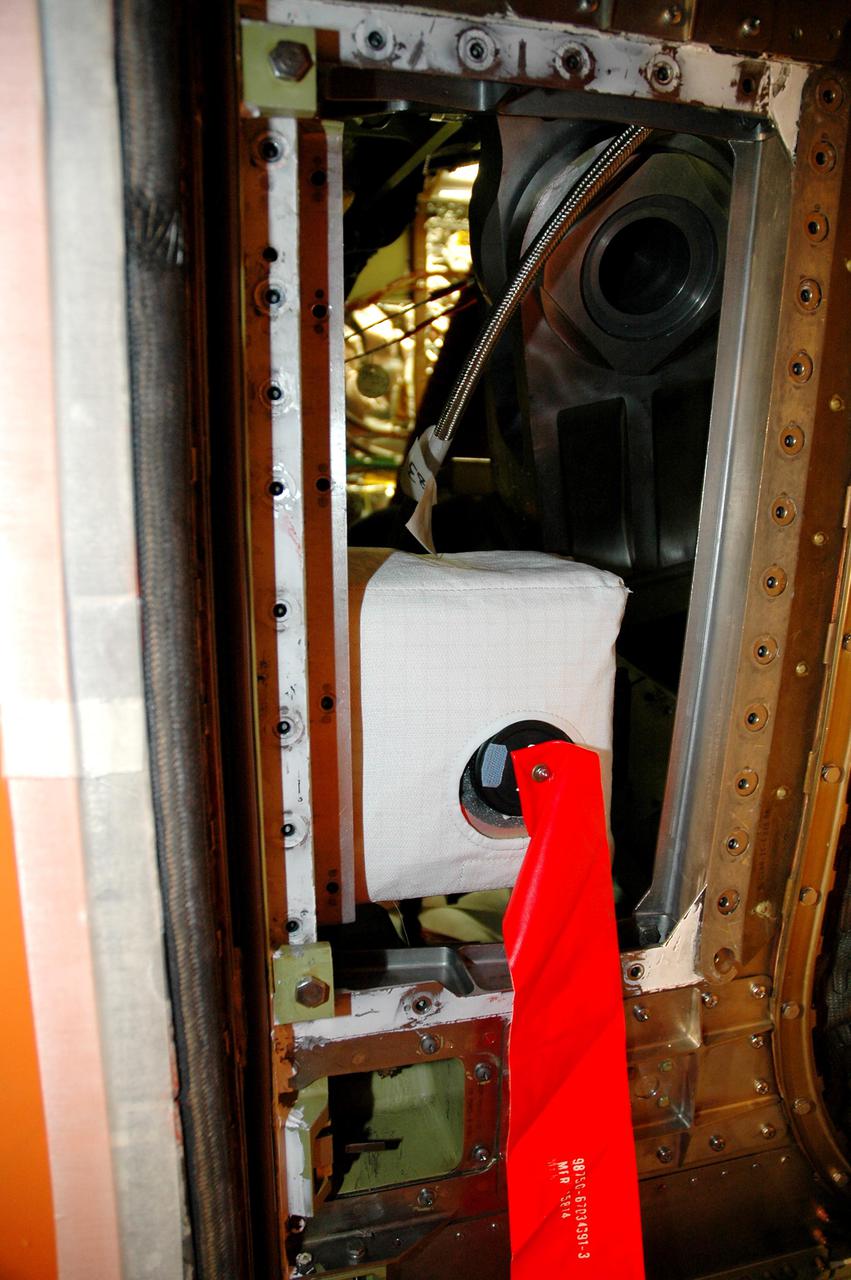
KENNEDY SPACE CENTER, FLA. - In the Vehicle Assembly Building at NASA’s Kennedy Space Center, a digital still camera has been mounted in the External Tank (ET) umbilical well on the aft end of Space Shuttle Discovery. The camera is being used to obtain and downlink high-resolution images of the disconnect point on the ET following ET separation from the orbiter after launch. The Kodak camera will record 24 images, at one frame per 1.5 seconds, on a flash memory card. After orbital insertion, the crew will transfer the images from the memory card to a laptop computer. The files will then be downloaded through the Ku-band system to the Mission Control Center in Houston for analysis.
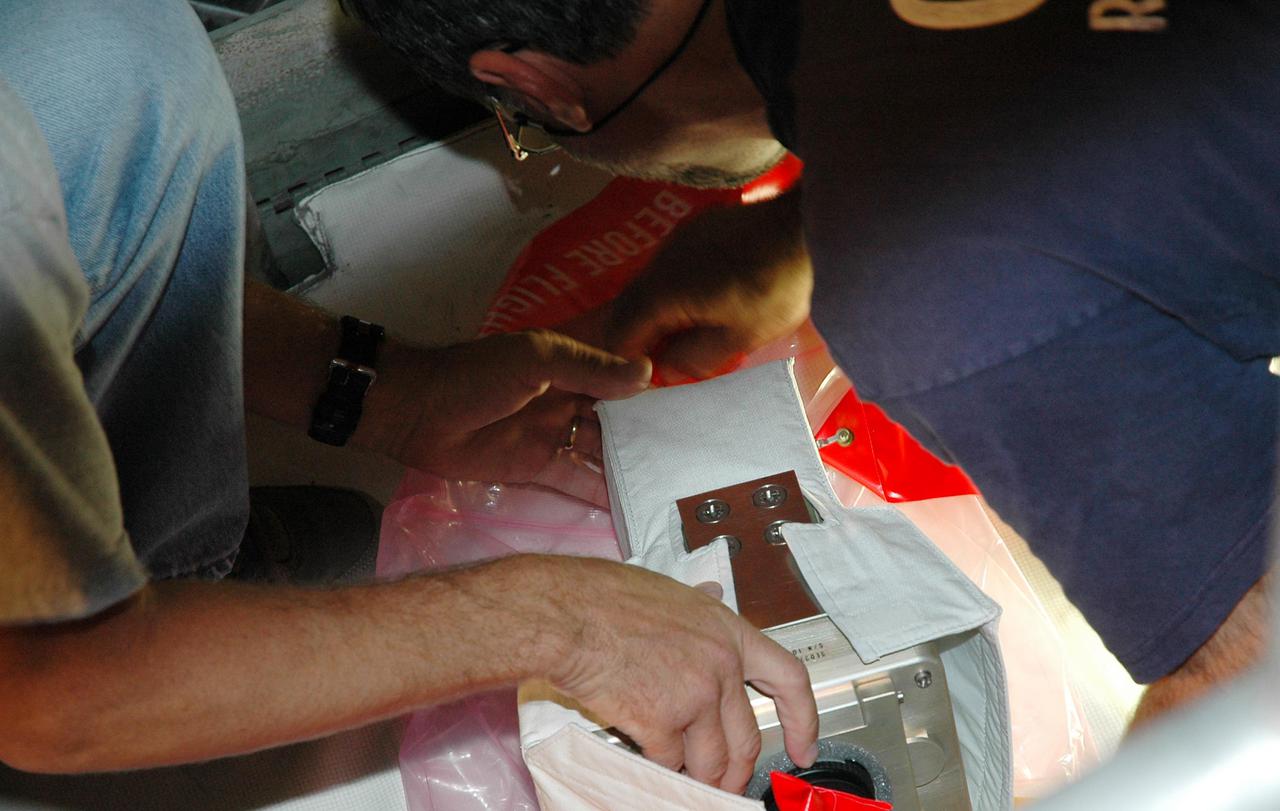
KENNEDY SPACE CENTER, FLA. - In the Vehicle Assembly Building at NASA’s Kennedy Space Center, workers check the digital still camera they will mount in the External Tank (ET) umbilical well on the aft end of Space Shuttle Discovery. The camera is being used to obtain and downlink high-resolution images of the disconnect point on the ET following the tank's separation from the orbiter after launch. The Kodak camera will record 24 images, at one frame per 1.5 seconds, on a flash memory card. After orbital insertion, the crew will transfer the images from the memory card to a laptop computer. The files will then be downloaded through the Ku-band system to the Mission Control Center in Houston for analysis.
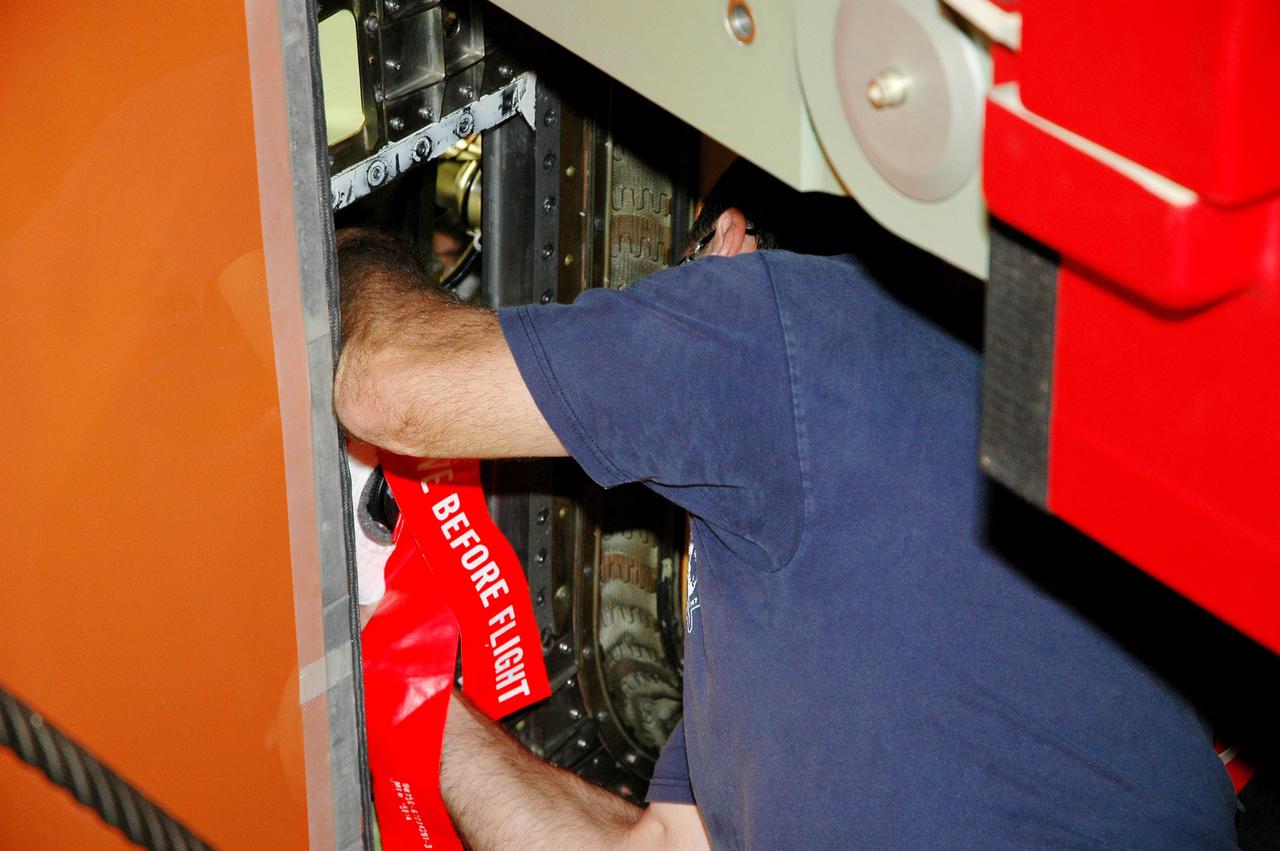
KENNEDY SPACE CENTER, FLA. - In the Vehicle Assembly Building at NASA’s Kennedy Space Center, a worker mounts a digital still camera in the External Tank (ET) umbilical well on the aft end of Space Shuttle Discovery. The camera is being used to obtain and downlink high-resolution images of the disconnect point on the ET following the ET separation from the orbiter after launch. The Kodak camera will record 24 images, at one frame per 1.5 seconds, on a flash memory card. After orbital insertion, the crew will transfer the images from the memory card to a laptop computer. The files will then be downloaded through the Ku-band system to the Mission Control Center in Houston for analysis.
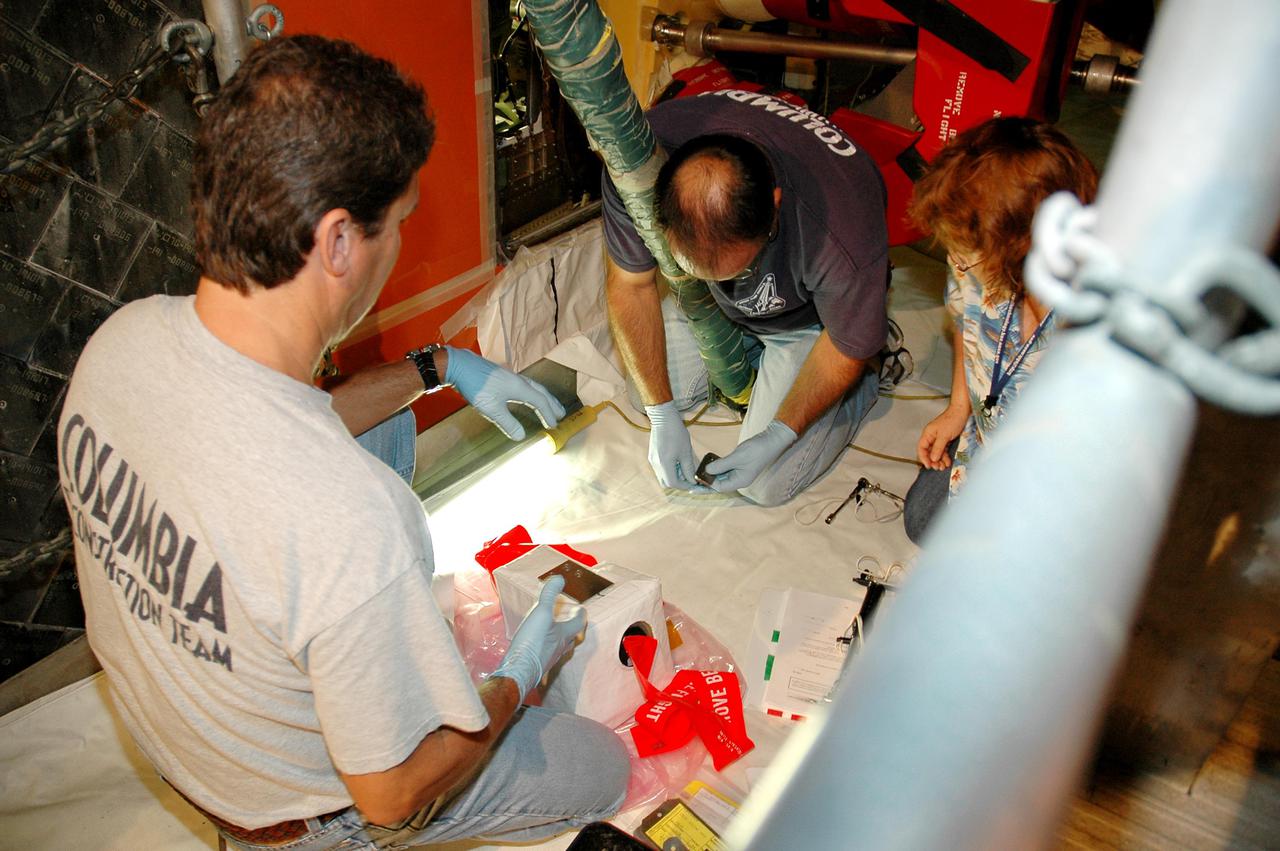
KENNEDY SPACE CENTER, FLA. - In the Vehicle Assembly Building at NASA’s Kennedy Space Center, workers prepare a digital still camera they will mount in the External Tank (ET) umbilical well on the aft end of Space Shuttle Discovery. The camera is being used to obtain and downlink high-resolution images of the disconnect point on the ET following the ET separation from the orbiter after launch. The Kodak camera will record 24 images, at one frame per 1.5 seconds, on a flash memory card. After orbital insertion, the crew will transfer the images from the memory card to a laptop computer. The files will then be downloaded through the Ku-band system to the Mission Control Center in Houston for analysis.
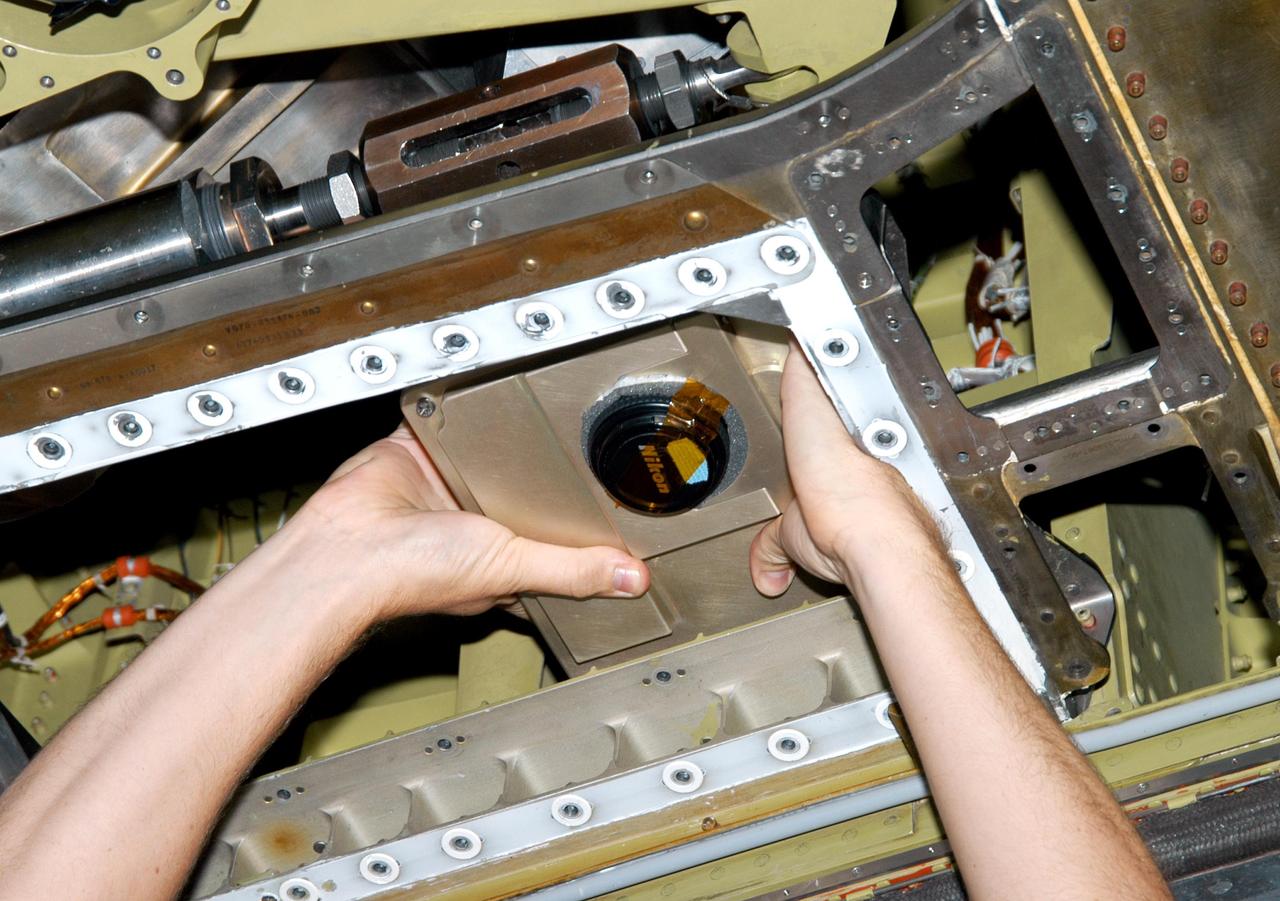
KENNEDY SPACE CENTER, FLA. - In the Orbiter Processing Facility, an External Tank (ET) digital still camera is positioned into the right-hand liquid oxygen umbilical well on Space Shuttle Atlantis to determine if it fits properly. NASA is pursuing use of the camera, beginning with the Shuttle’s Return To Flight, to obtain and downlink high-resolution images of the ET following separation of the ET from the orbiter after launch. The Kodak camera will record 24 images, at one frame per 1.5 seconds, on a flash memory card. After orbital insertion, the crew will transfer the images from the memory card to a laptop computer. The files will then be downloaded through the Ku-band system to the Mission Control Center in Houston for analysis.

KENNEDY SPACE CENTER, FLA. - In the Vehicle Assembly Building at NASA’s Kennedy Space Center, workers prepare a digital still camera they will mount in the External Tank (ET) umbilical well on the aft end of Space Shuttle Discovery. The camera is being used to obtain and downlink high-resolution images of the disconnect point on the ET following its separation from the orbiter after launch. The Kodak camera will record 24 images, at one frame per 1.5 seconds, on a flash memory card. After orbital insertion, the crew will transfer the images from the memory card to a laptop computer. The files will then be downloaded through the Ku-band system to the Mission Control Center in Houston for analysis.
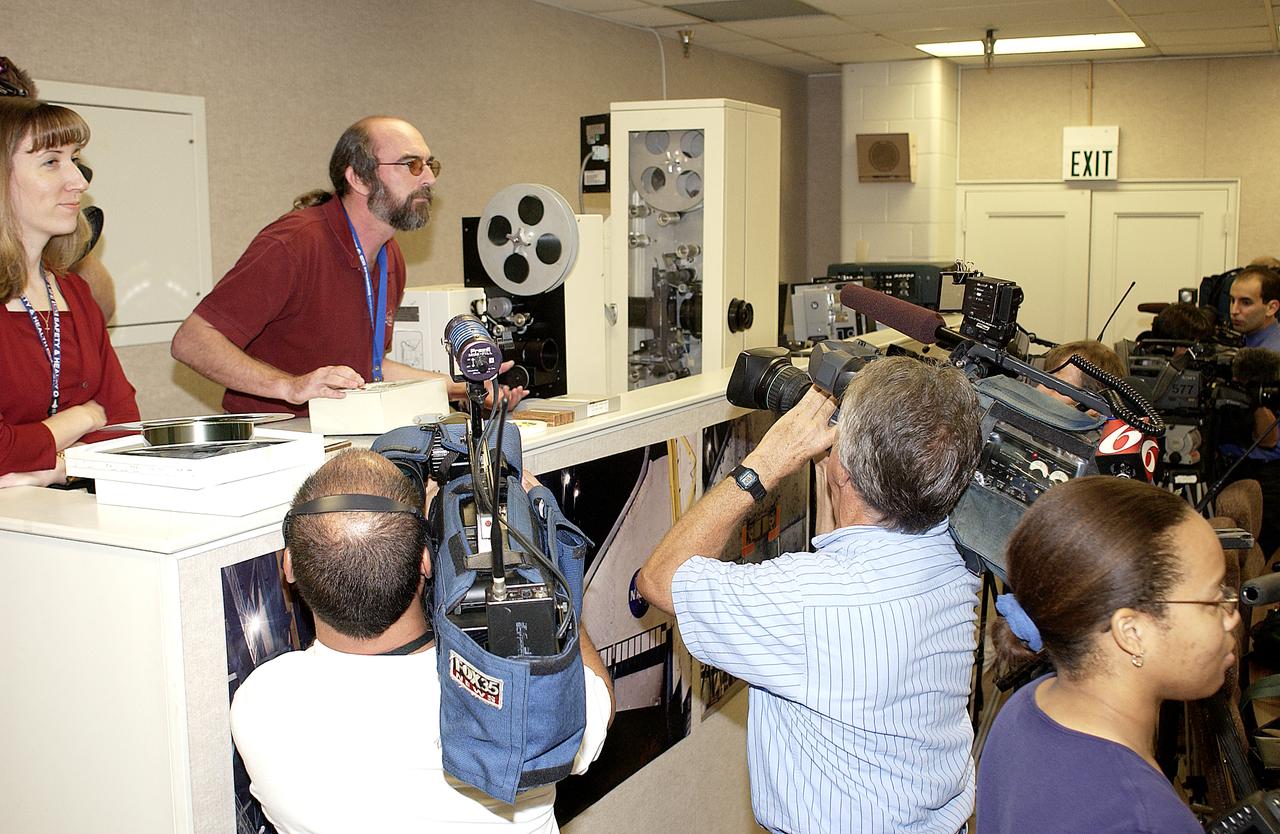
In the Image Analysis Facility in the Vehicle Assembly Building, Brad Lawrence (second from left, standing) participates in a presentation to news media representatives on the improved tracking cameras and long-range optical tracking systems that will be used to capture ascent imagery during the return to flight of the Space Shuttle. The press opportunity also includes tours of the launch pad perimeter camera site at Launch Complex 39B and two Playalinda Beach optical tracking sites at the Cape Canaveral National Seashore and the Merritt Island National Refuge.
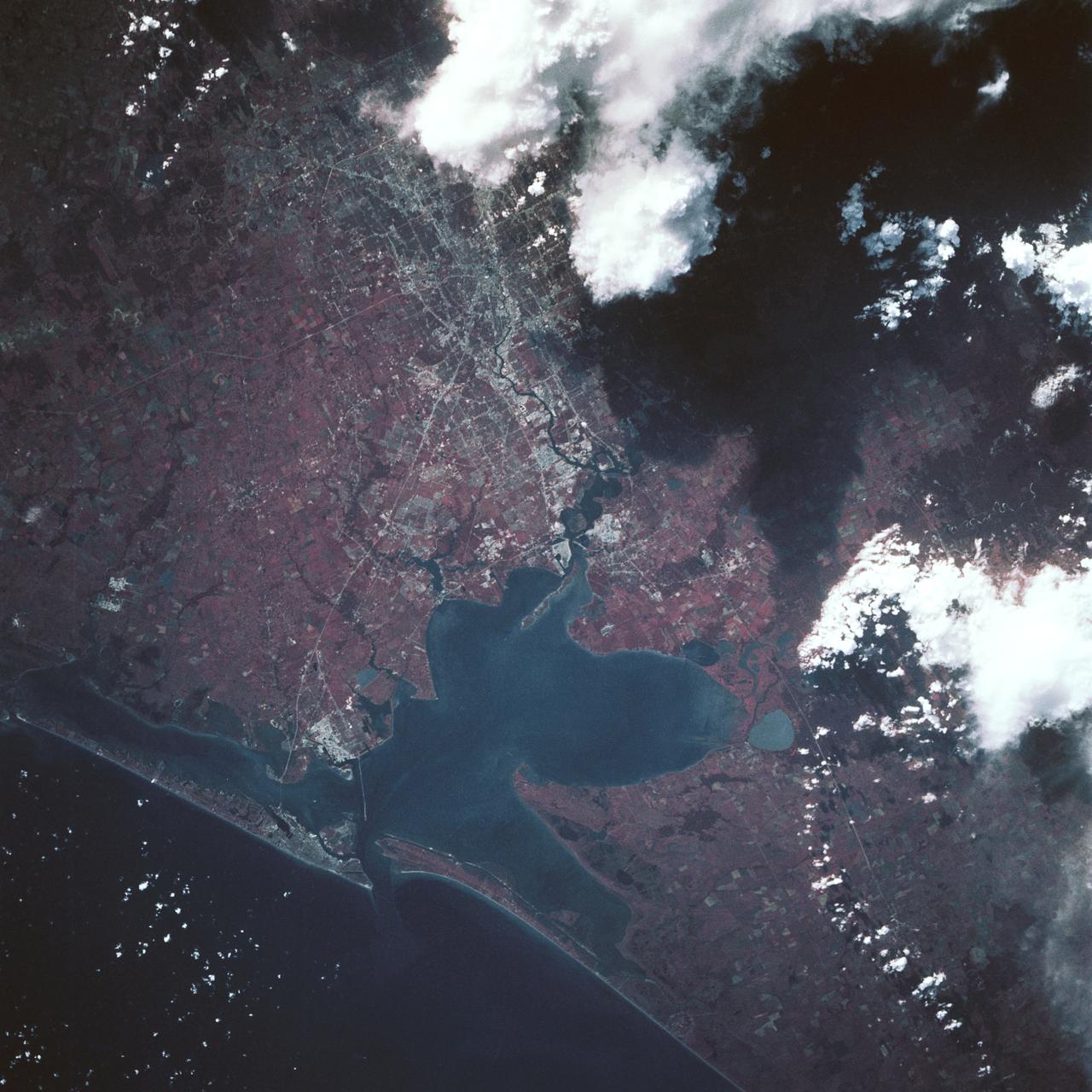
This color infrared view of Houston (29.5N, 95.0W) was taken with a dual camera mount. Compare this scene with STS048-78-034 for an analysis of the unique properties of each film type. Comparative tests such as this aids in determining the kinds of information unique to each film system and evaluates and compares photography taken through hazy atmospheres. Infrared film is best at penetrating haze, vegetation detection and producing a sharp image.
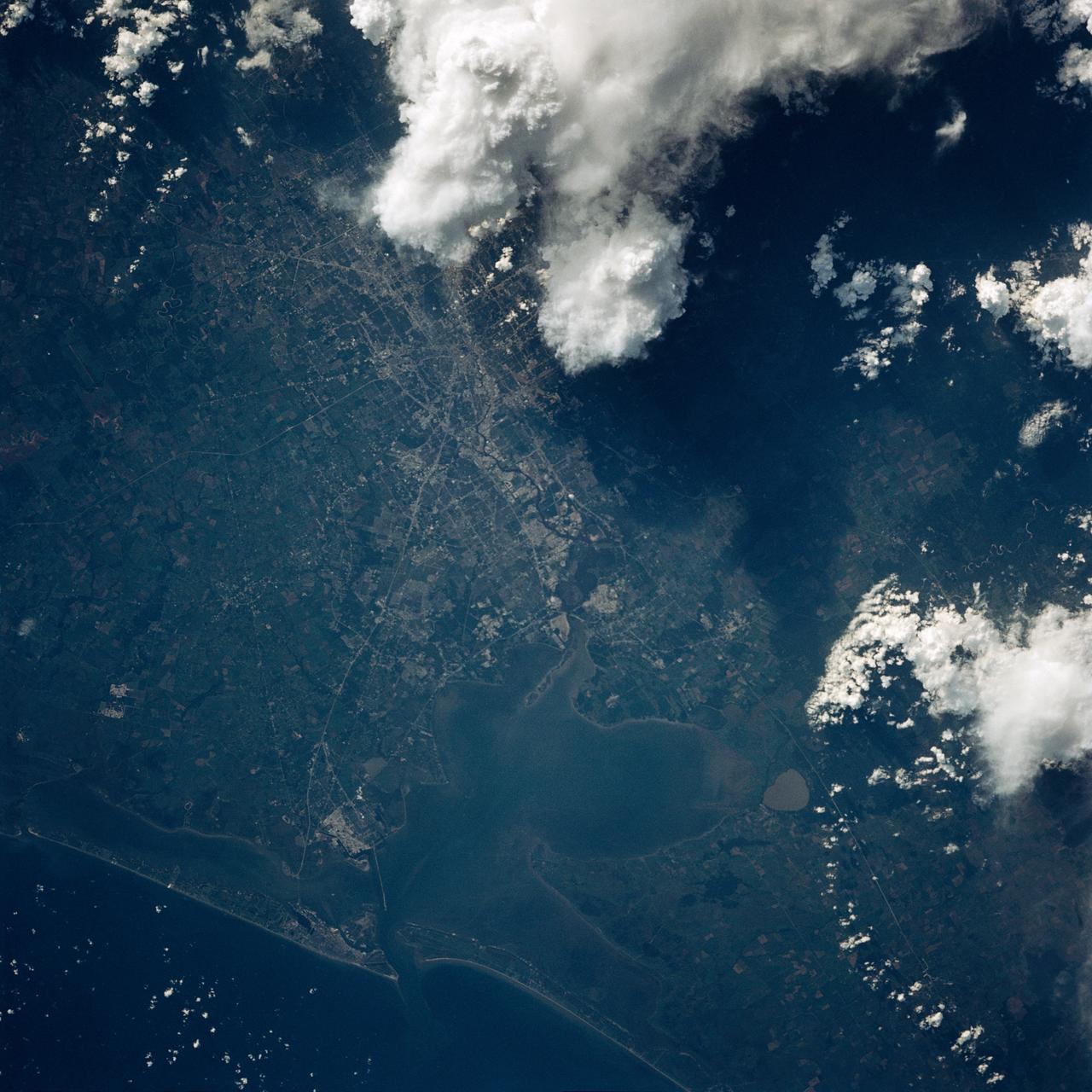
This color photo view of Houston (29.5N, 95.0W) was taken with a dual camera mount for comparitive film type testing. Compare this scene with STS048-106- 034 for an analysis of the unique properties of each type. Comparitive tests such as this aids in determining the kinds of information unique to each film system and evaluates and compares photography taken through hazy atmospheres. Color film is best at presenting the image as it appears to the human eye.
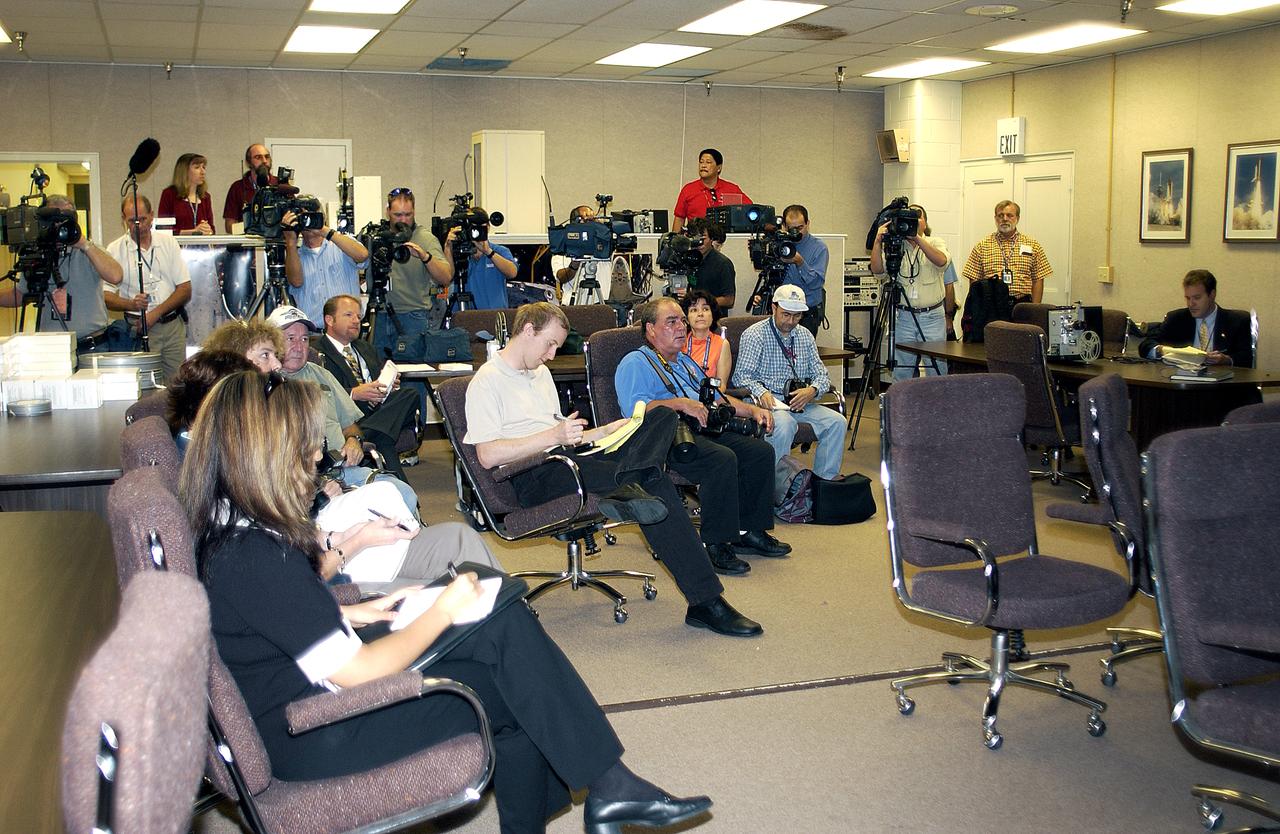
In the Image Analysis Facility in the Vehicle Assembly Building, news media representatives are briefed on the improved tracking cameras and long-range optical tracking systems that will be used to capture ascent imagery during the return to flight of the Space Shuttle. The press opportunity also includes tours of the launch pad perimeter camera site at Launch Complex 39B and two Playalinda Beach optical tracking sites at the Cape Canaveral National Seashore and the Merritt Island National Refuge.

jsc2024e005976 (10/32023) --- Pictured is the Gas Supply Module for the Manufacturing of Semiconductors and Thin-film Integrated Coating (MSTIC) investigation. The MSTIC facility uses advanced vapor deposition systems that enable precise control over material production. This program is designed to produce samples for comparative analysis between Earth-produced and space-produced thin films. Image courtesy of Redwire.
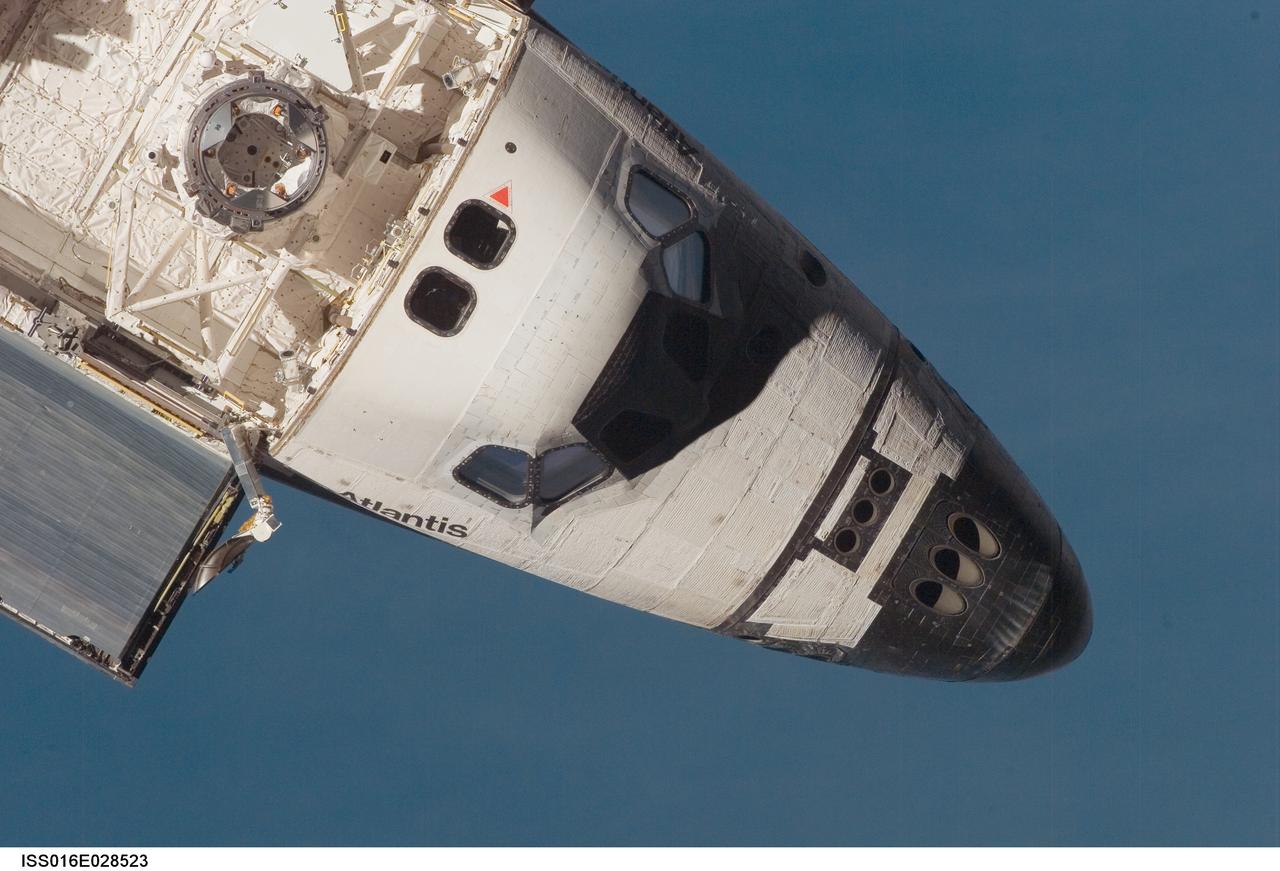
ISS016-E-028523 (9 Feb. 2008) --- An overhead view of the exterior of the Space Shuttle Atlantis' crew cabin and docking system was provided by Expedition 16 crewmembers. Before docking with the International Space Station, astronaut Steve Frick, STS-122 commander, flew the shuttle through a roll pitch maneuver or basically a backflip to allow the space station crew a good view of Atlantis' heat shield. Using digital still cameras equipped with both 400 and 800 millimeter lenses, the ISS crewmembers took a number of photos of the shuttle's thermal protection system and sent them down to teams on the ground for analysis. A 400 millimeter lens was used for this image.
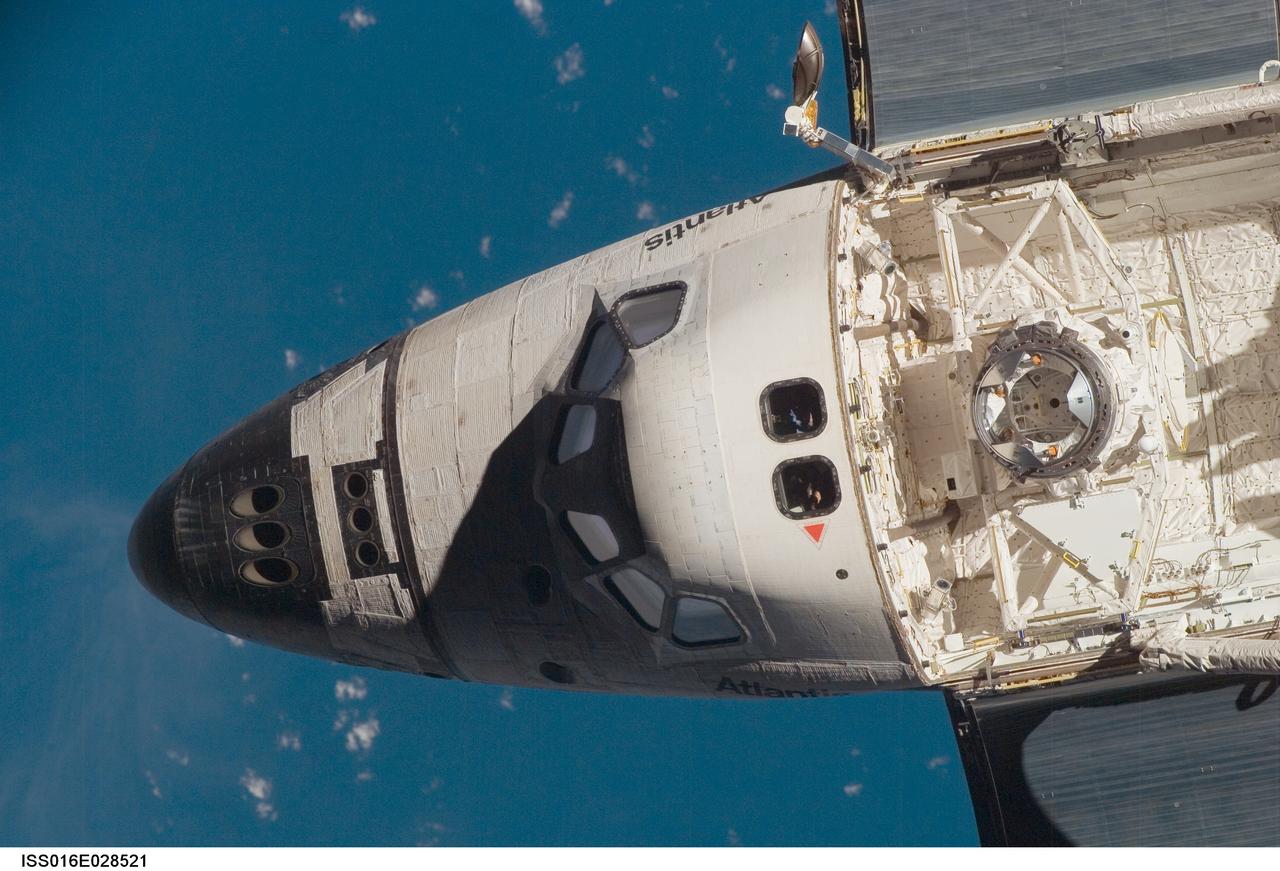
ISS016-E-028521 (9 Feb. 2008) --- An overhead view of the exterior of the Space Shuttle Atlantis' crew cabin and docking system was provided by Expedition 16 crewmembers. Before docking with the International Space Station, astronaut Steve Frick, STS-122 commander, flew the shuttle through a roll pitch maneuver or basically a backflip to allow the space station crew a good view of Atlantis' heat shield. Using digital still cameras equipped with both 400 and 800 millimeter lenses, the ISS crewmembers took a number of photos of the shuttle's thermal protection system and sent them down to teams on the ground for analysis. A 400 millimeter lens was used for this image.
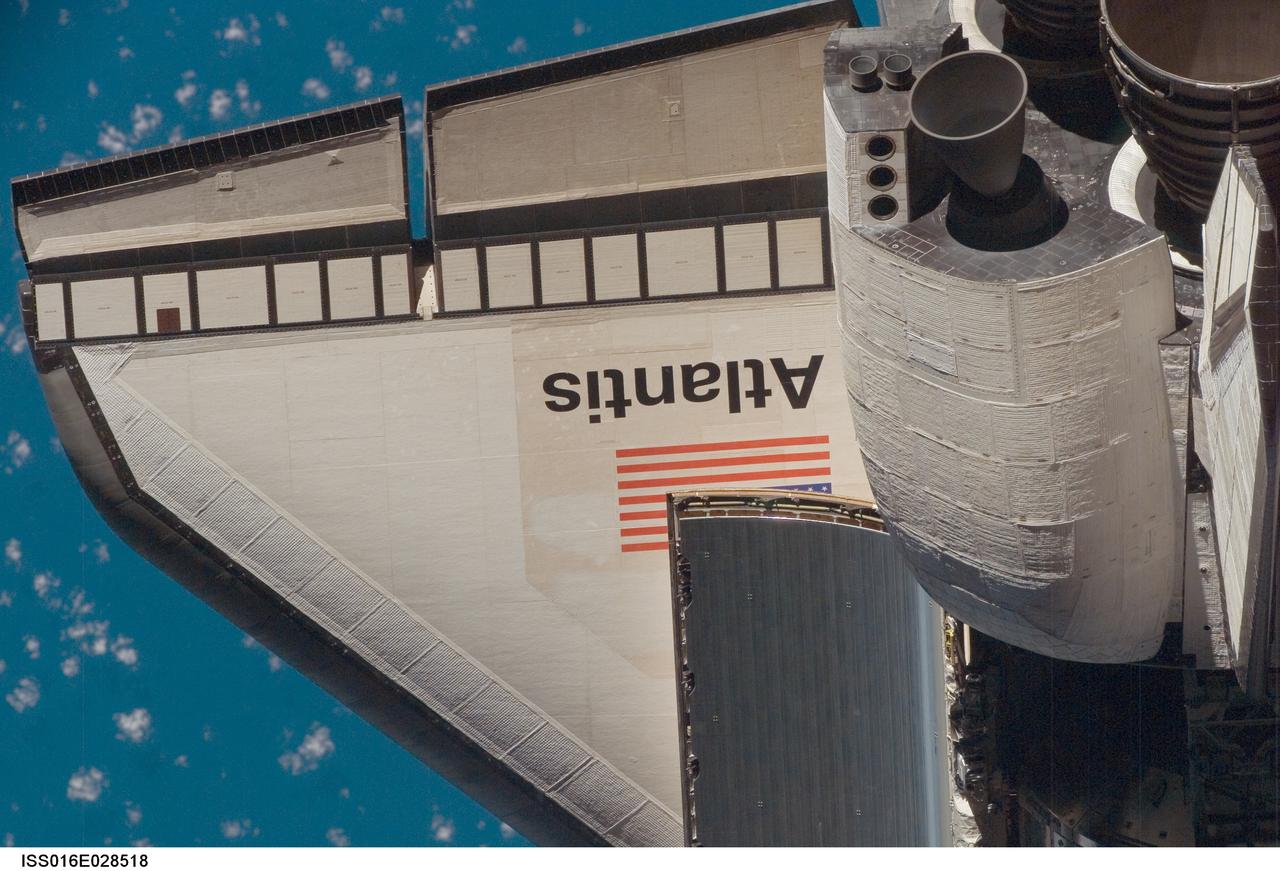
ISS016-E-028518 (9 Feb. 2008) --- An overhead view of part of the Space Shuttle Atlantis' starboard wing and part of its orbital maneuvering system pods was provided by Expedition 16 crewmembers. Before docking with the International Space Station, astronaut Steve Frick, STS-122 commander, flew the shuttle through a roll pitch maneuver or basically a backflip to allow the space station crew a good view of Atlantis' heat shield. Using digital still cameras equipped with both 400 and 800 millimeter lenses, the ISS crewmembers took a number of photos of the shuttle's thermal protection system and sent them down to teams on the ground for analysis. A 400 millimeter lens was used for this image.
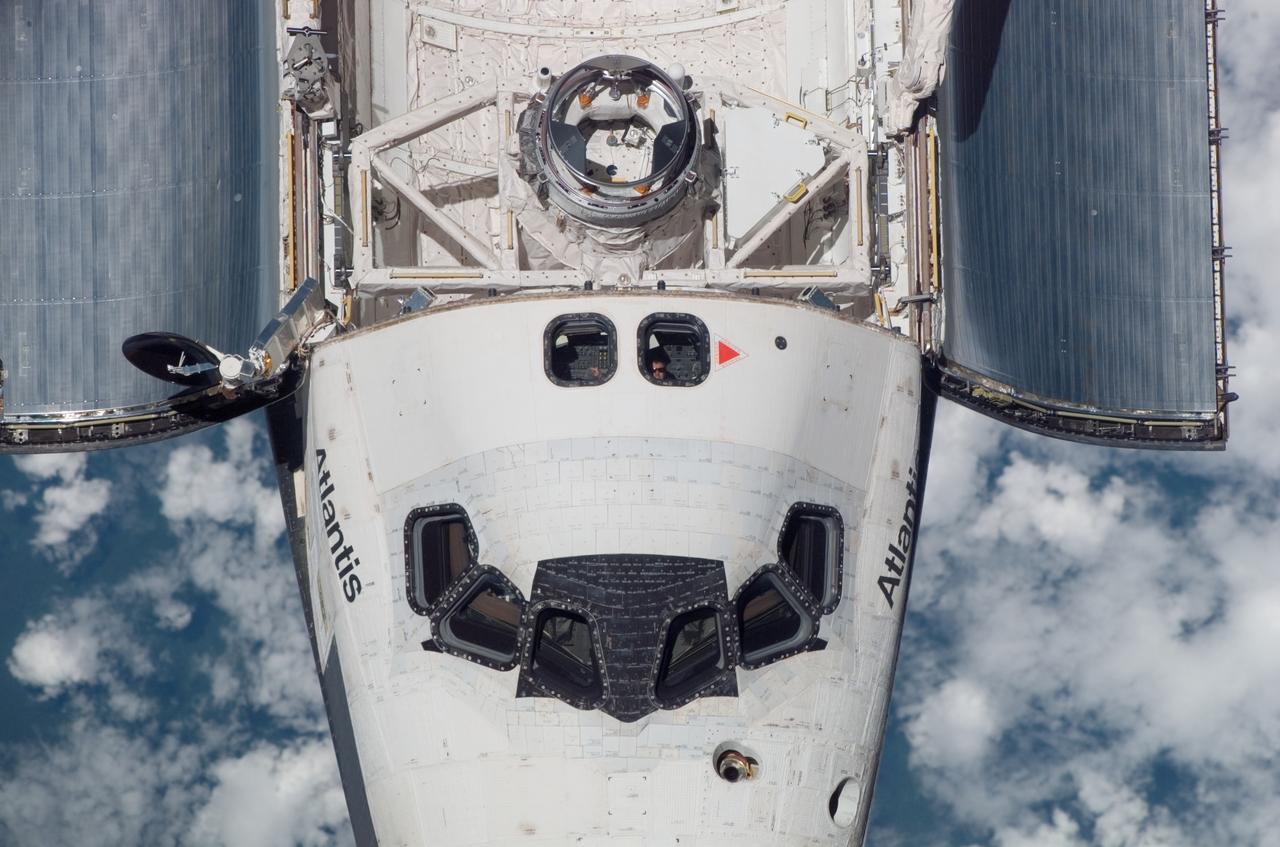
ISS016-E-028388 (9 Feb. 2008) --- An overhead view of the exterior of the Space Shuttle Atlantis' crew cabin, part of its payload bay doors and docking system was provided by Expedition 16 crewmembers. Before docking with the International Space Station, astronaut Steve Frick, STS-122 commander, flew the shuttle through a roll pitch maneuver or basically a backflip to allow the space station crew a good view of Atlantis' heat shield. Using digital still cameras equipped with both 400 and 800 millimeter lenses, the ISS crewmembers took a number of photos of the shuttle's thermal protection system and sent them down to teams on the ground for analysis. A 400 millimeter lens was used for this image.
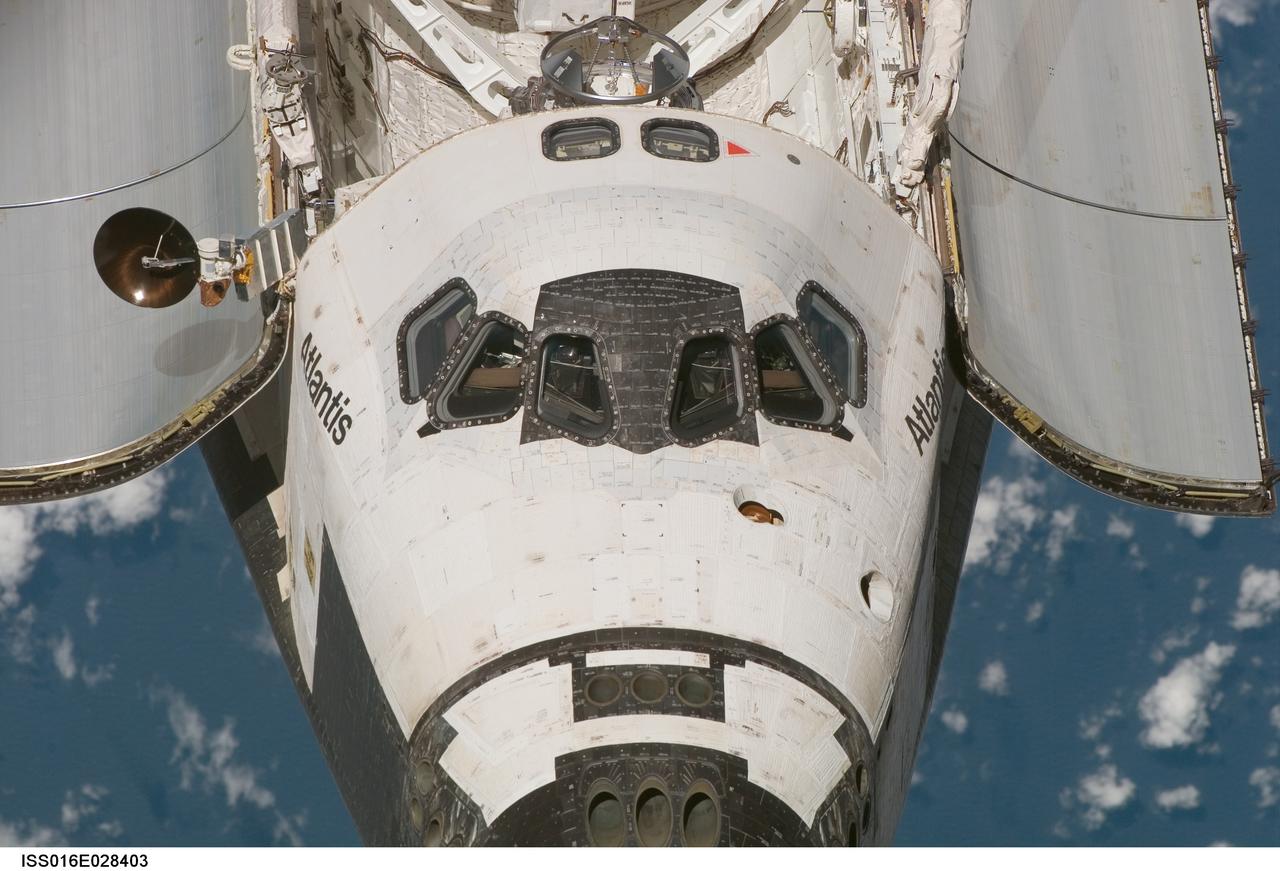
ISS016-E-028403 (9 Feb. 2008) --- An overhead view of the exterior of the Space Shuttle Atlantis' crew cabin, part of its payload bay doors and docking system was provided by Expedition 16 crewmembers. Before docking with the International Space Station, astronaut Steve Frick, STS-122 commander, flew the shuttle through a roll pitch maneuver or basically a backflip to allow the space station crew a good view of Atlantis' heat shield. Using digital still cameras equipped with both 400 and 800 millimeter lenses, the ISS crewmembers took a number of photos of the shuttle's thermal protection system and sent them down to teams on the ground for analysis. A 400 millimeter lens was used for this image.

ISS018-E-040602 (17 March 2009) --- An overhead view of the exterior of Space Shuttle Discovery's crew cabin, part of its payload bay and docking system was provided by Expedition 18 crewmembers on the International Space Station. Before docking with the station, astronaut Lee Archambault, STS-119 commander, flew the shuttle through a Rendezvous Pitch Maneuver or basically a backflip to allow the space station crew a good view of Discovery's heat shield. Using digital still cameras equipped with both 400 and 800 millimeter lenses, the ISS crewmembers took a number of photos of the shuttle's thermal protection system and sent them down to teams on the ground for analysis. A 800 millimeter lens was used for this image.
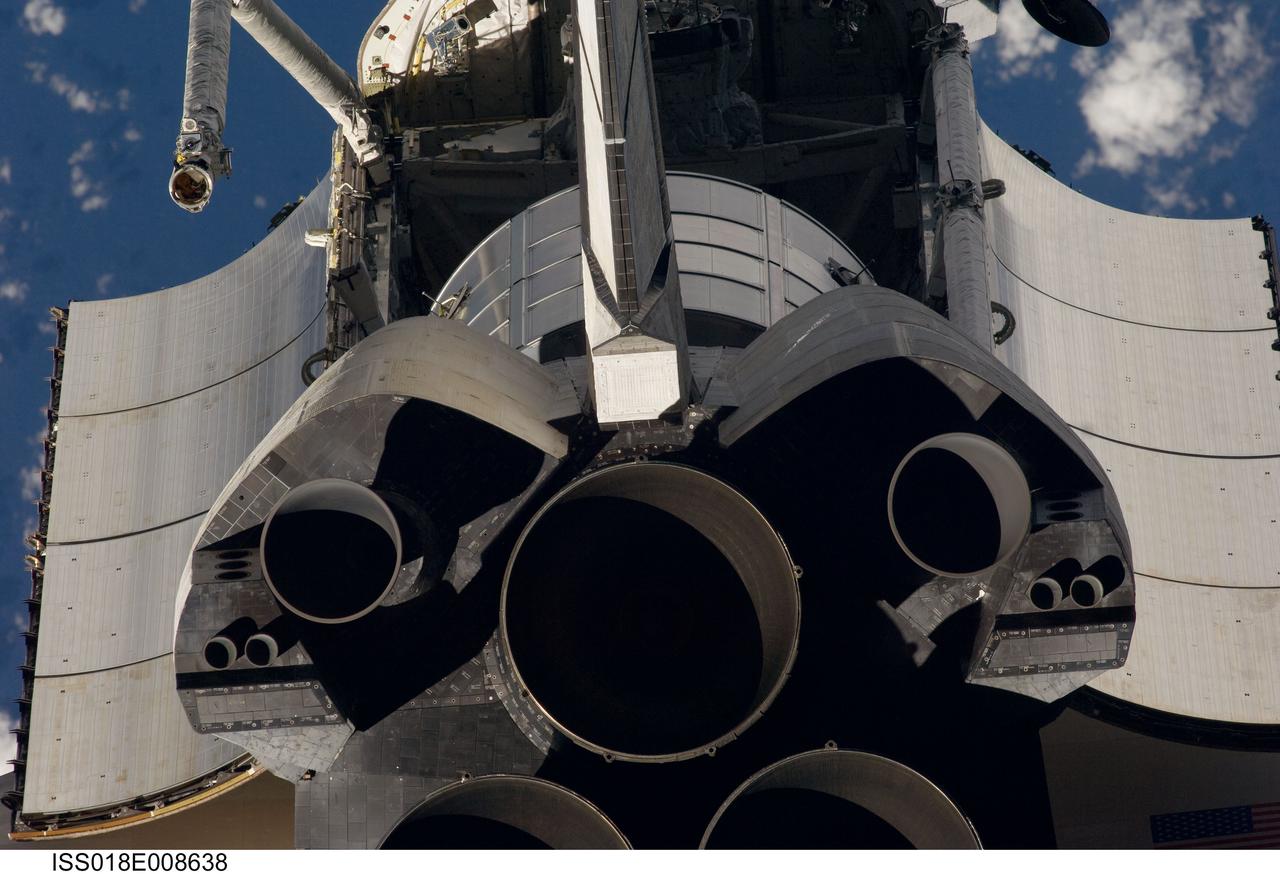
ISS018-E-008638 (16 Nov. 2008) --- A close-up view of Space Shuttle Endeavour's tail section was provided by Expedition 18 crewmembers on the International Space Station. The image provides partial views of the shuttle's main engines, orbital maneuvering system (OMS) pods, vertical stabilizer, the payload bay door panels and the Leonard Multi-Purpose Logistics Module located in the cargo bay. Before docking with the station, astronaut Chris Ferguson, STS-126 commander, flew the shuttle through a roll pitch maneuver or basically a backflip to allow the space station crew a good view of Endeavour's heat shield. Using digital still cameras equipped with both 400 and 800 millimeter lenses, the ISS crewmembers took a number of photos of the shuttle's thermal protection system and sent them down to teams on the ground for analysis. A 400 millimeter lens was used for this image.
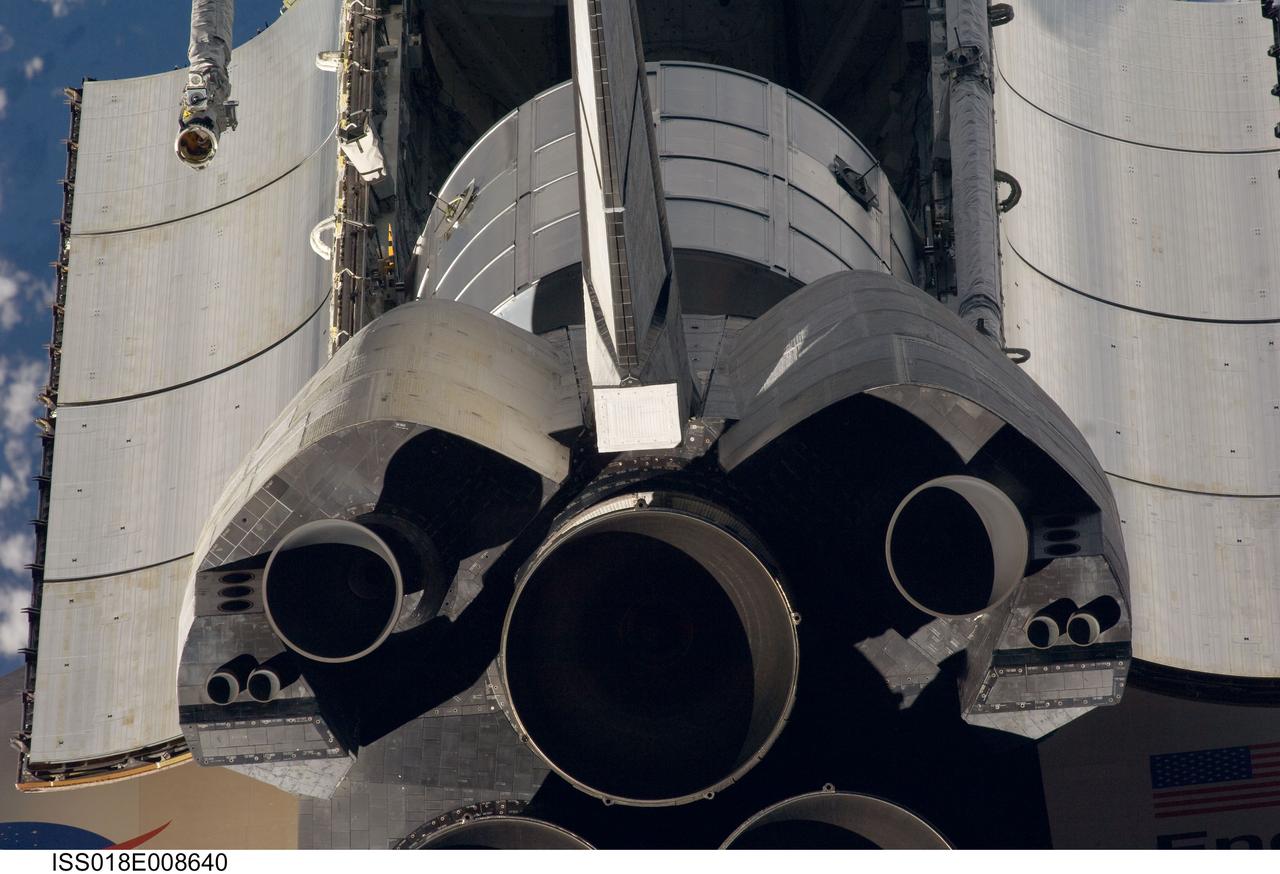
ISS018-E-008640 (16 Nov. 2008) --- A close-up view of Space Shuttle Endeavour's tail section was provided by Expedition 18 crewmembers on the International Space Station. The image provides partial views of the shuttle's main engines, orbital maneuvering system (OMS) pods, vertical stabilizer, the payload bay door panels and the Leonard Multi-Purpose Logistics Module located in the cargo bay. Before docking with the station, astronaut Chris Ferguson, STS-126 commander, flew the shuttle through a roll pitch maneuver or basically a backflip to allow the space station crew a good view of Endeavour's heat shield. Using digital still cameras equipped with both 400 and 800 millimeter lenses, the ISS crewmembers took a number of photos of the shuttle's thermal protection system and sent them down to teams on the ground for analysis. A 400 millimeter lens was used for this image.
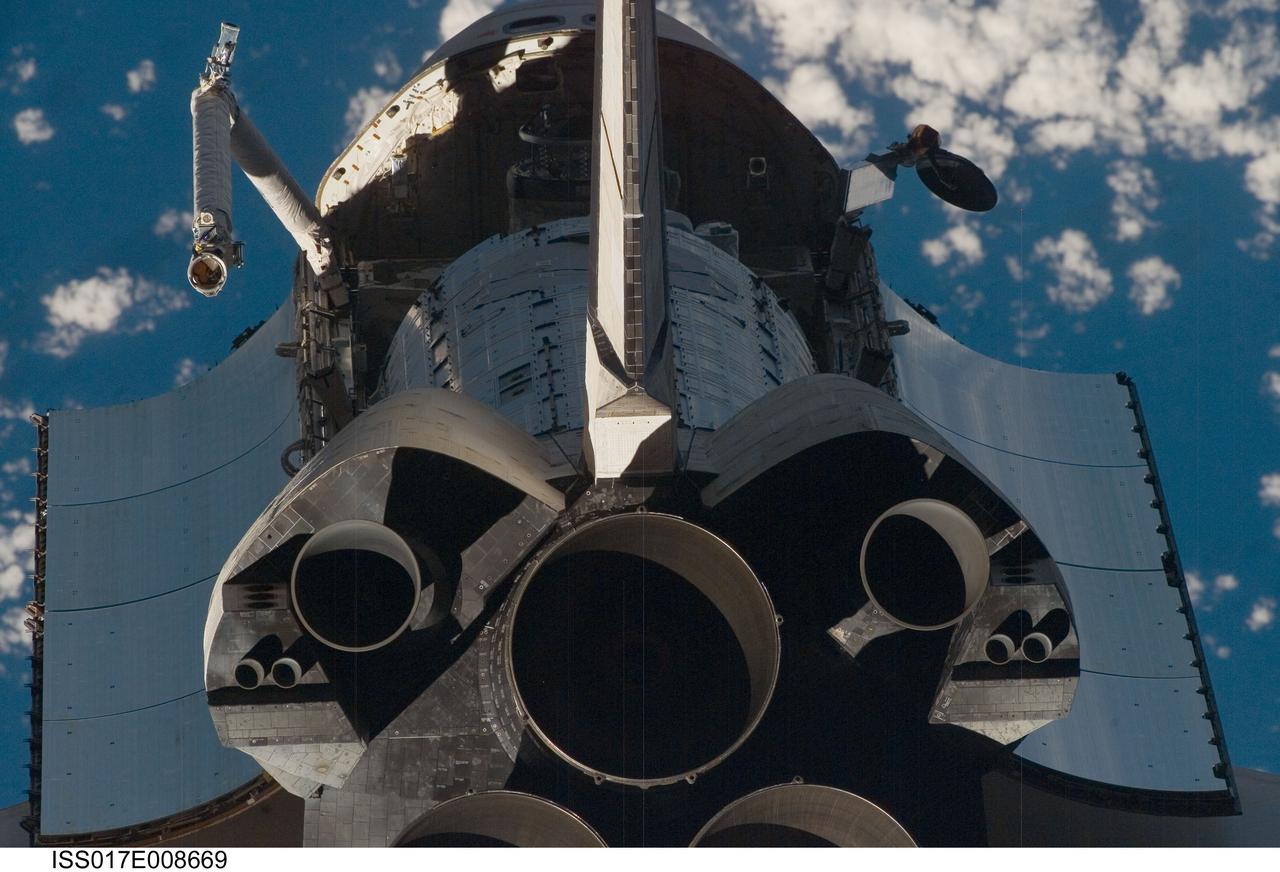
ISS017-E-008669 (2 June 2008) --- A close-up view of Space Shuttle Discovery's tail section was provided by Expedition 17 crewmembers on the International Space Station (ISS). The image provides partial views of the shuttle's main engines, orbital maneuvering system (OMS) pods, vertical stabilizer, the payload bay door panels and the second component of the Japan Aerospace Exploration Agency's Kibo laboratory, the Japanese Pressurized Module (JPM) located in the cargo bay. Before docking with the station, astronaut Mark Kelly, STS-124 commander, flew the shuttle through a roll pitch maneuver or basically a backflip to allow the space station crew a good view of Discovery's heat shield. Using digital still cameras equipped with both 400 and 800 millimeter lenses, the ISS crewmembers took a number of photos of the shuttle's thermal protection system and sent them down to teams on the ground for analysis. A 400 millimeter lens was used for this image.
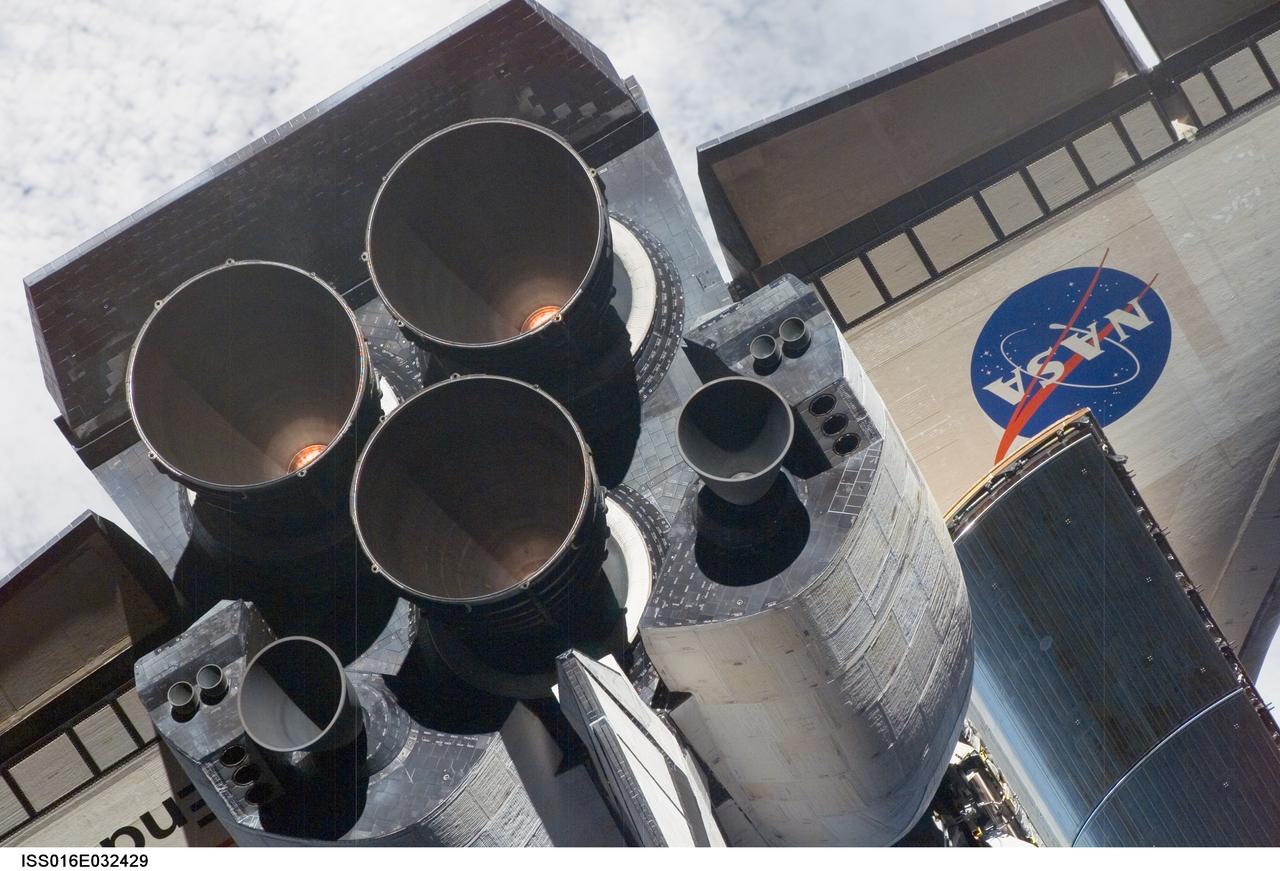
ISS016-E-032429 (12 March 2008) --- A close-up view of Space Shuttle Endeavour's tail section was provided by Expedition 16 crewmembers on the International Space Station (ISS). The image provides partial views of the shuttle's main engines, orbital maneuvering system (OMS) pods, a portion of the payload bay door panels and the shuttle's wings. Before docking with the station, astronaut Dominic Gorie, STS-123 commander, flew the shuttle through a roll pitch maneuver or basically a backflip to allow the space station crew a good view of Endeavour's heat shield. Using digital still cameras equipped with both 400 and 800 millimeter lenses, the ISS crewmembers took a number of photos of the shuttle's thermal protection system and sent them down to teams on the ground for analysis. A 400 millimeter lens was used for this image.
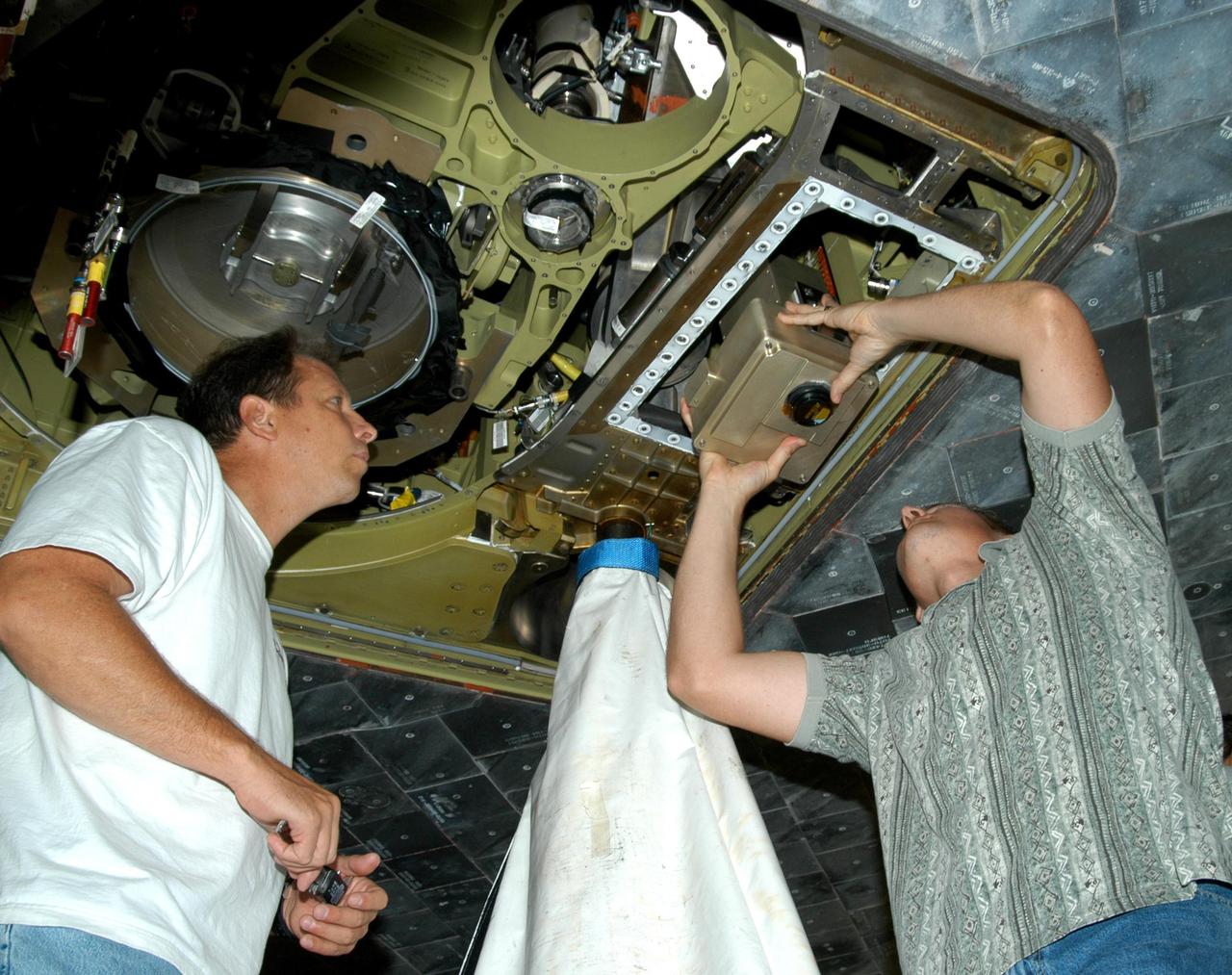
KENNEDY SPACE CENTER, FLA. - In the Orbiter Processing Facility, from left, United Space Alliance workers Loyd Turner, Craig Meyer and Erik Visser conduct a fit check of an External Tank (ET) digital still camera in the right-hand liquid oxygen umbilical well on Space Shuttle Atlantis. NASA is pursuing use of the camera, beginning with the Shuttle’s Return To Flight, to obtain and downlink high-resolution images of the ET following separation of the ET from the orbiter after launch. The Kodak camera will record 24 images, at one frame per 1.5 seconds, on a flash memory card. After orbital insertion, the crew will transfer the images from the memory card to a laptop computer. The files will then be downloaded through the Ku-band system to the Mission Control Center in Houston for analysis.
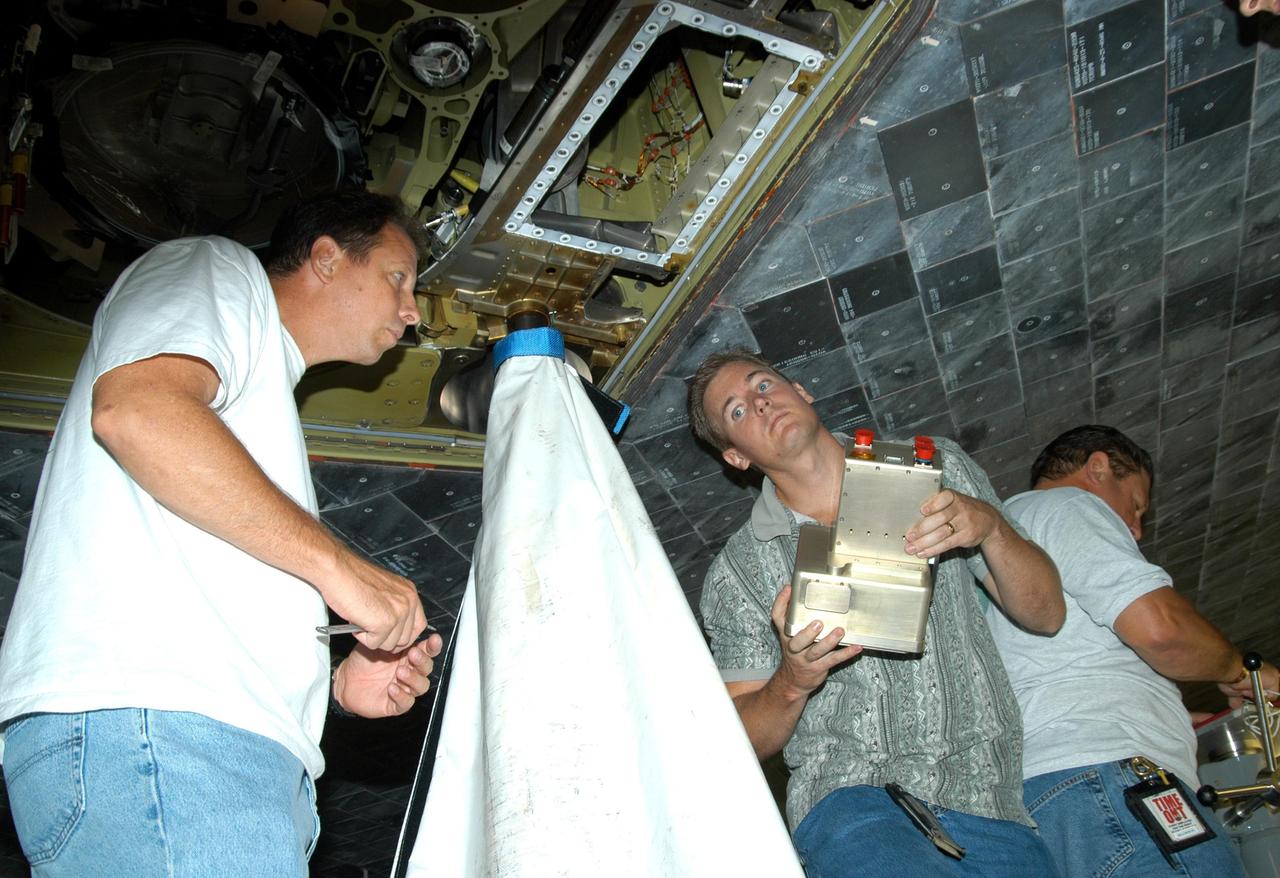
KENNEDY SPACE CENTER, FLA. - In the Orbiter Processing Facility, from left, United Space Alliance workers Loyd Turner, Craig Meyer and Erik Visser prepare to conduct a fit check of an External Tank (ET) digital still camera in the right-hand liquid oxygen umbilical well on Space Shuttle Atlantis. NASA is pursuing use of the camera, beginning with the Shuttle’s Return To Flight, to obtain and downlink high-resolution images of the ET following separation of the ET from the orbiter after launch. The Kodak camera will record 24 images, at one frame per 1.5 seconds, on a flash memory card. After orbital insertion, the crew will transfer the images from the memory card to a laptop computer. The files will then be downloaded through the Ku-band system to the Mission Control Center in Houston for analysis.

KENNEDY SPACE CENTER, FLA. - In the Orbiter Processing Facility, United Space Alliance worker Craig Meyer fits an External Tank (ET) digital still camera in the right-hand liquid oxygen umbilical well on Space Shuttle Atlantis. NASA is pursuing use of the camera, beginning with the Shuttle’s Return To Flight, to obtain and downlink high-resolution images of the ET following separation of the ET from the orbiter after launch. The Kodak camera will record 24 images, at one frame per 1.5 seconds, on a flash memory card. After orbital insertion, the crew will transfer the images from the memory card to a laptop computer. The files will then be downloaded through the Ku-band system to the Mission Control Center in Houston for analysis.
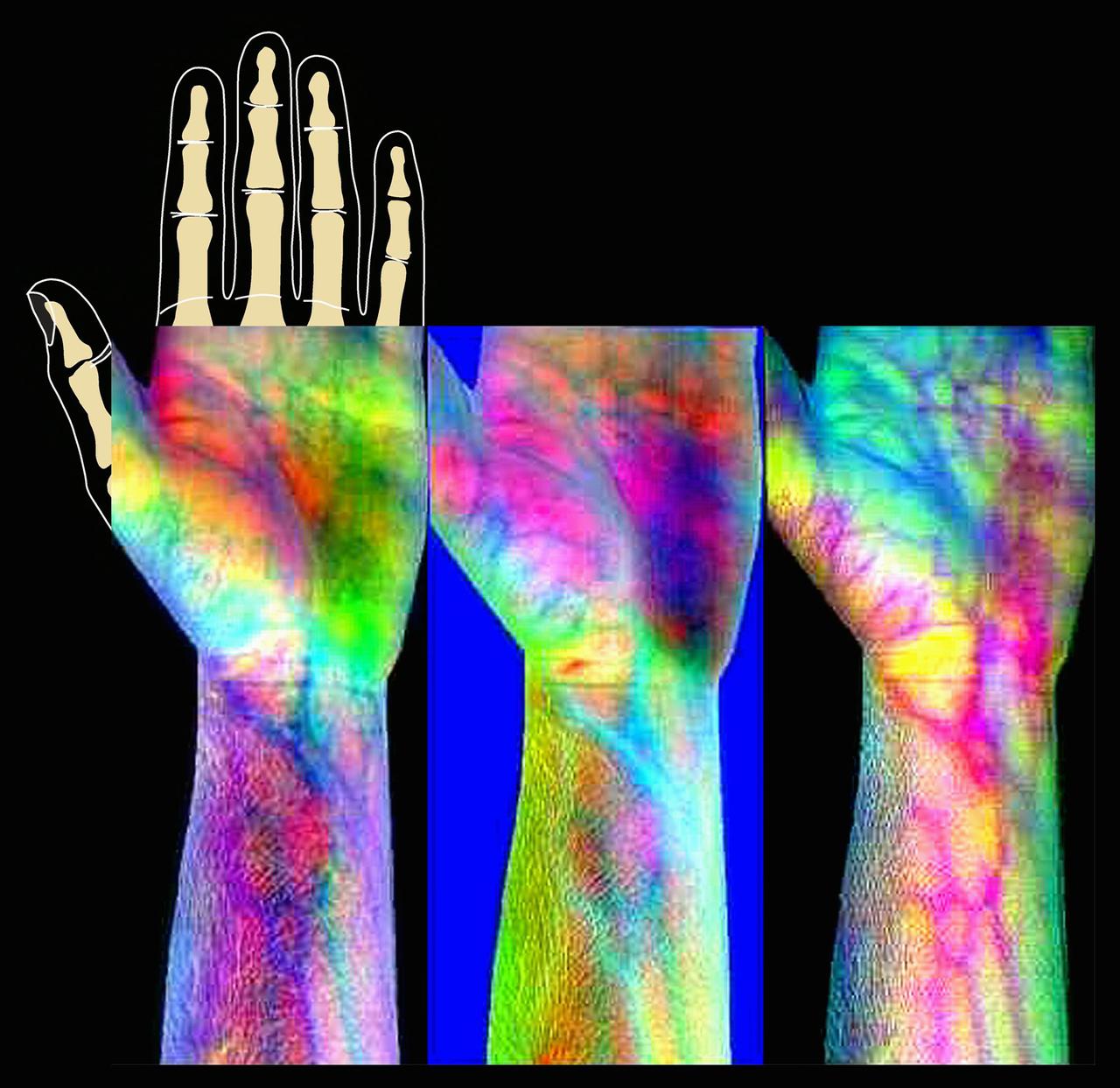
ProVision Technologies, a NASA research partnership center at Sternis Space Center in Mississippi, has developed a new hyperspectral imaging (HSI) system that is much smaller than the original large units used aboard remote sensing aircraft and satellites. The new apparatus is about the size of a breadbox. Health-related applications of HSI include non-invasive analysis of human skin to characterize wounds and wound healing rates (especially important for space travelers who heal more slowly), determining if burns are first-, second-, or third degree (rather than painful punch biopsies). The work is sponsored under NASA's Space Product Development (SPD) program.
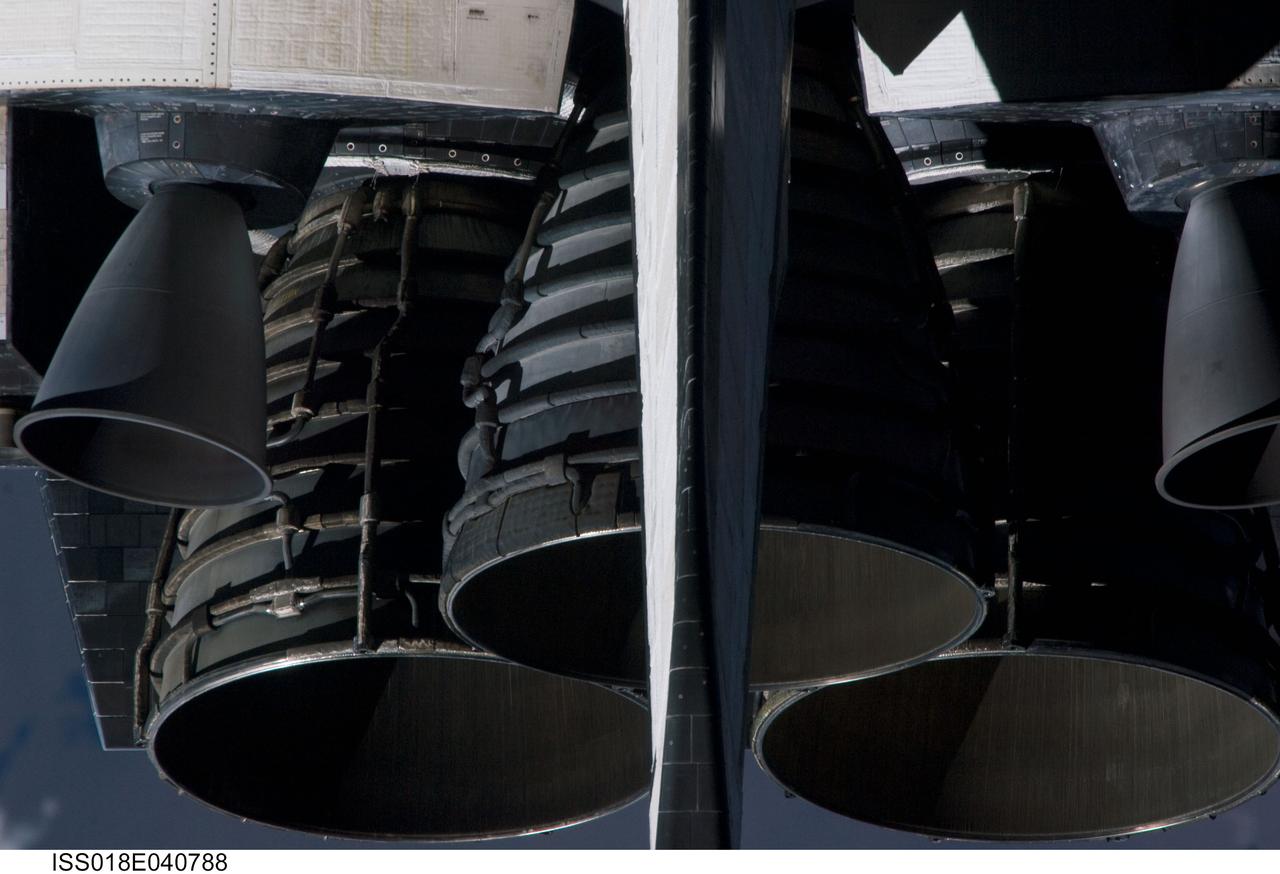
ISS018-E-040788 (17 March 2009) --- A close-up view of Space Shuttle Discovery?s main engines was provided by Expedition 18 crewmembers on the International Space Station. Before docking with the station, astronaut Lee Archambault, STS-119 commander, flew the shuttle through a Rendezvous Pitch Maneuver or basically a backflip to allow the space station crew a good view of Discovery's heat shield. Using digital still cameras equipped with both 400 and 800 millimeter lenses, the ISS crewmembers took a number of photos of the shuttle's thermal protection system and sent them down to teams on the ground for analysis. A 800 millimeter lens was used for this image.

ISS018-E-040837 (17 March 2009) --- A close-up view of the exterior of Space Shuttle Discovery's nose and underside was provided by Expedition 18 crewmembers on the International Space Station. Before docking with the station, astronaut Lee Archambault, STS-119 commander, flew the shuttle through a Rendezvous Pitch Maneuver or basically a backflip to allow the space station crew a good view of Discovery's heat shield. Using digital still cameras equipped with both 400 and 800 millimeter lenses, the ISS crewmembers took a number of photos of the shuttle's thermal protection system and sent them down to teams on the ground for analysis. A 400 millimeter lens was used for this image.
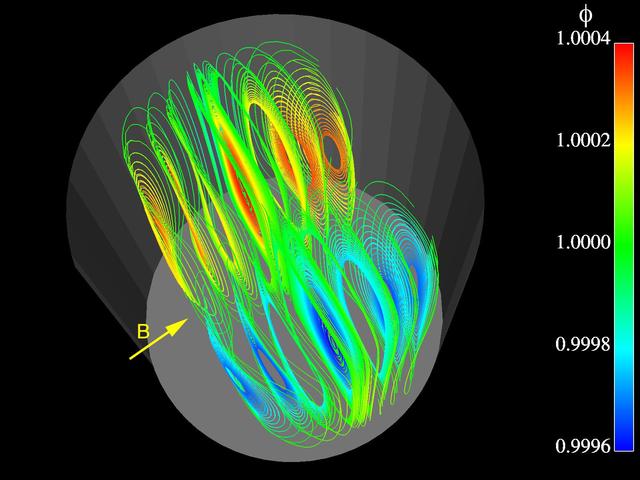
Advanced finite element models are used to study three-dimensional, time-dependent flow and segregation in crystal growth systems. In this image of a prototypical model for melt and crystal growth, pathlines at one instant in time are shown for the flow of heated liquid silicon in a cylindrical container. The container is subjected to g-jitter disturbances along the vertical axis. A transverse magnetic field is applied to control them. Such computations are extremely powerful for understanding melt growth in microgravity where g-jitter drives buoyant flows. The simulation is part of the Theoretical Analysis of 3D, Transient Convection and Segregation in Microgravity Bridgman Crystal Growth investigation by Dr. Jeffrey J. Derby of the University of Mirnesota, Minneapolis.
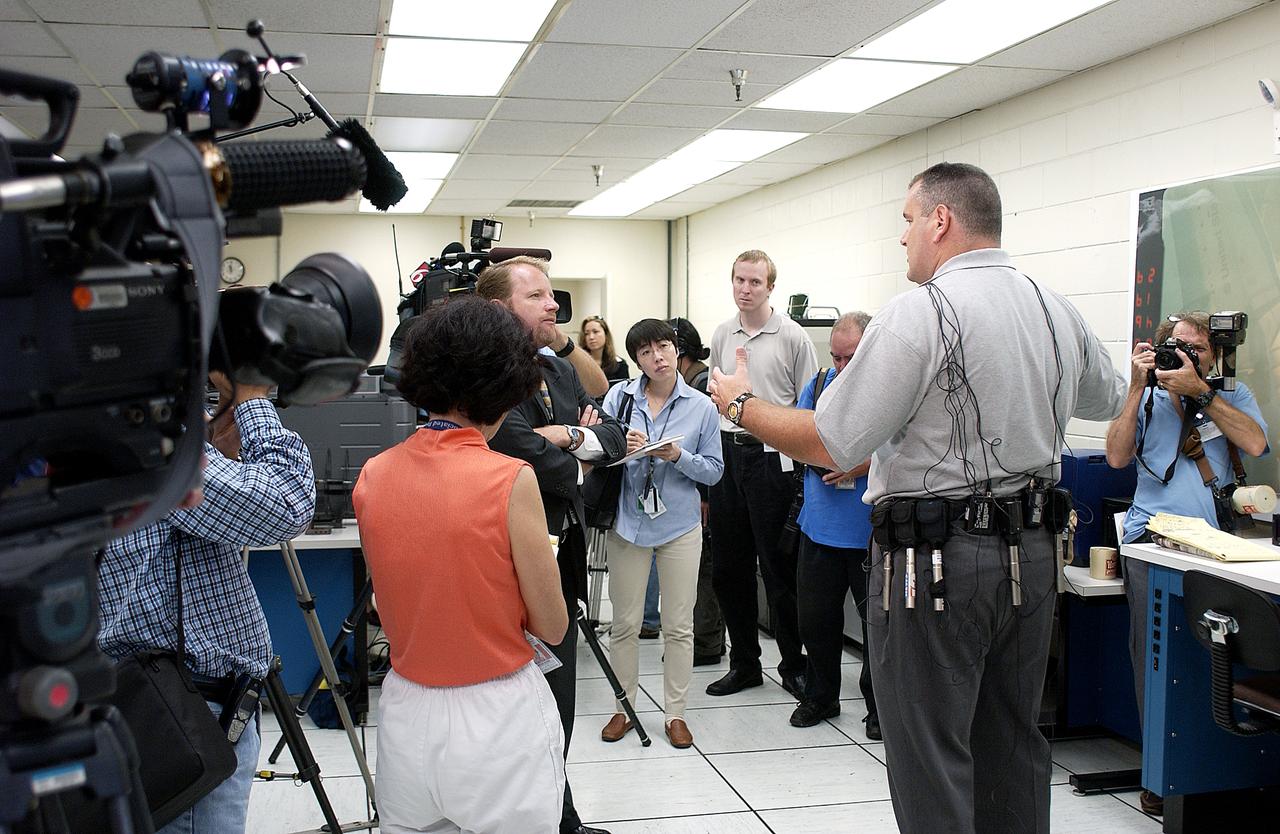
In the Image Analysis Facility in the Vehicle Assembly Building, Armando Oliu (second from right), lead of the KSC Ice and Debris Team, answers questions from news media representatives on the improved tracking cameras and long-range optical tracking systems that will be used to capture ascent imagery during the return to flight of the Space Shuttle. The press opportunity also includes tours of the launch pad perimeter camera site at Launch Complex 39B and two Playalinda Beach optical tracking sites at the Cape Canaveral National Seashore and the Merritt Island National Refuge.
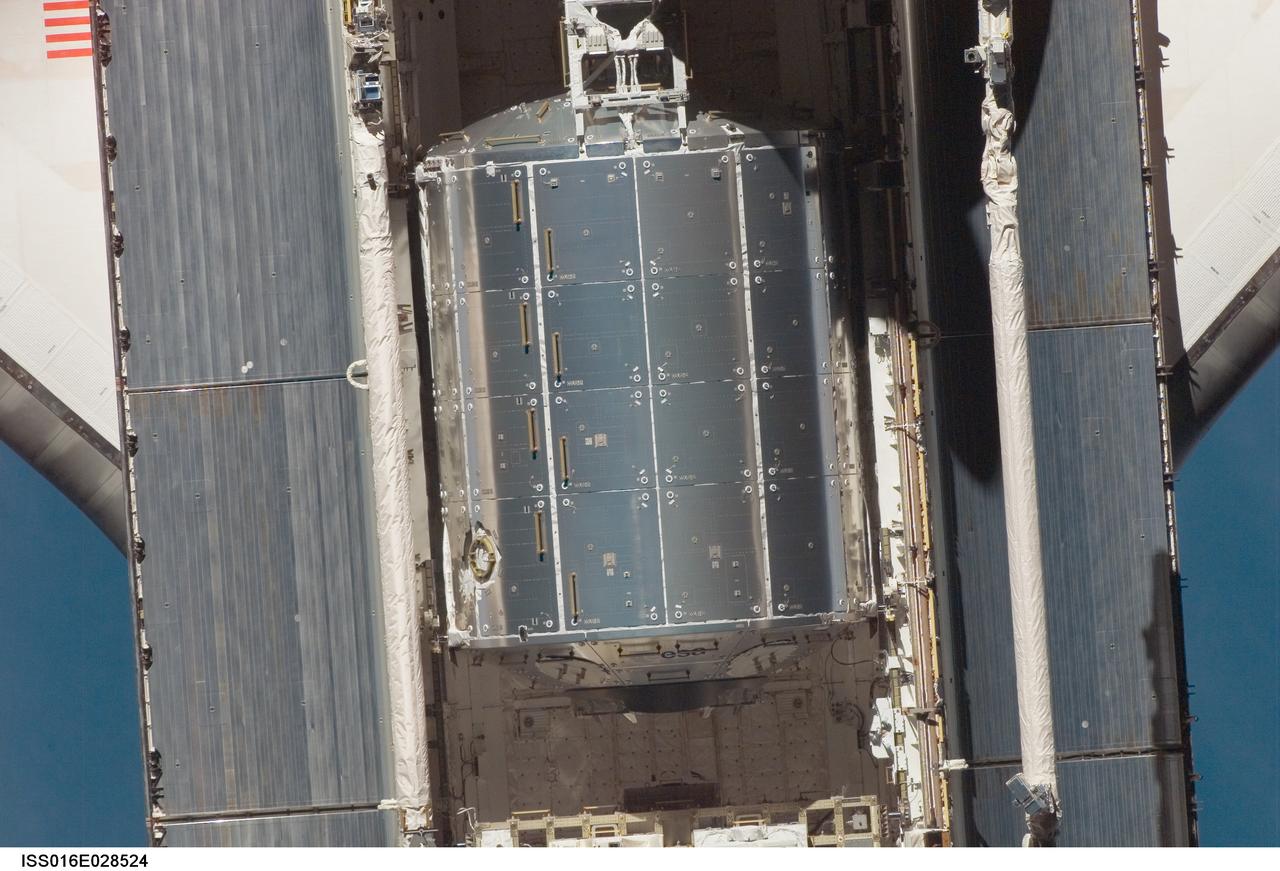
ISS016-E-028524 (9 Feb. 2008) --- An overhead view of the European Space Agency's Columbus laboratory in Space Shuttle Atlantis' cargo bay was provided by Expedition 16 crewmembers. Before docking with the International Space Station, astronaut Steve Frick, STS-122 commander, flew the shuttle through a roll pitch maneuver or basically a backflip to allow the space station crew a good view of Atlantis' heat shield. Using digital still cameras equipped with both 400 and 800 millimeter lenses, the ISS crewmembers took a number of photos of the shuttle's thermal protection system and sent them down to teams on the ground for analysis. A 400 millimeter lens was used for this image.
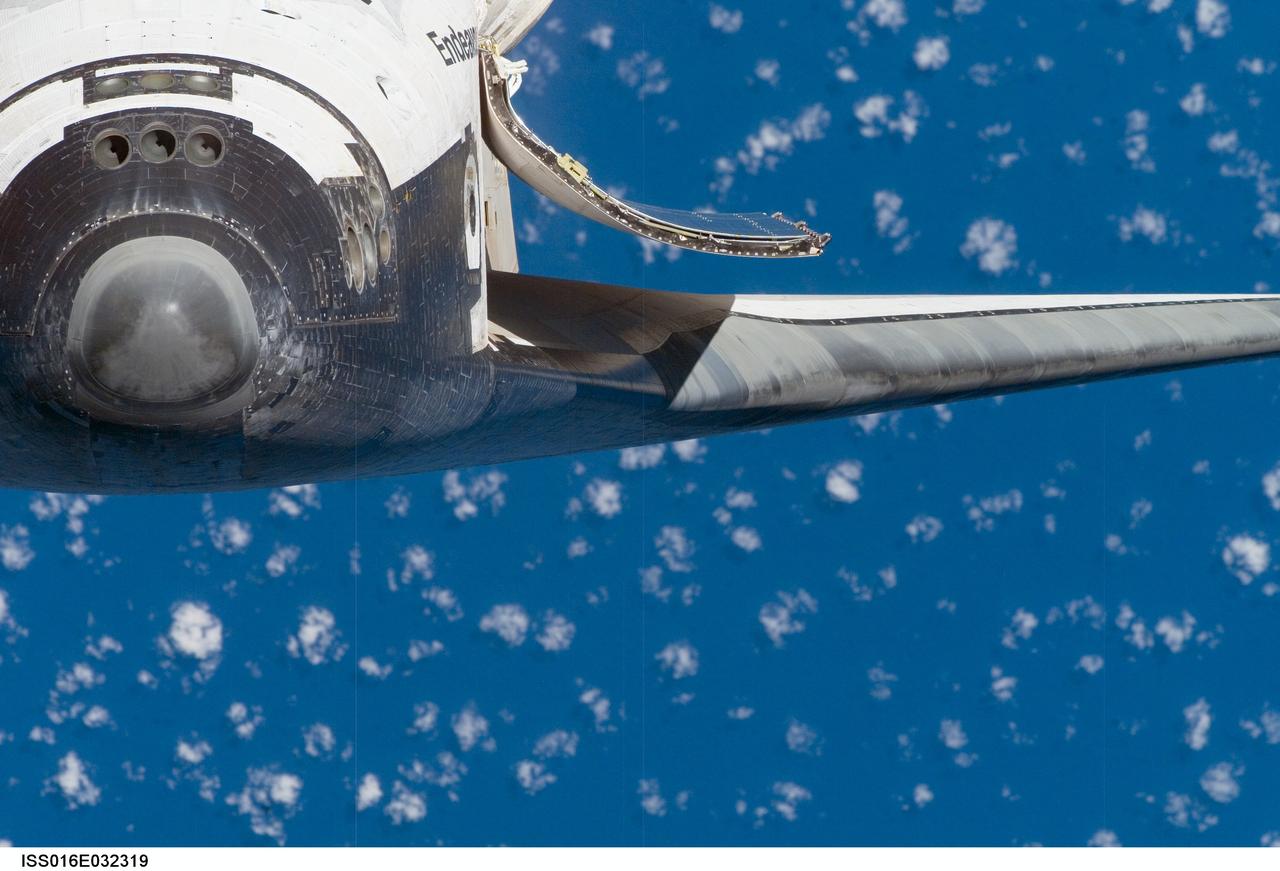
ISS016-E-032319 (12 March 2008) --- A close-up view of the exterior of Space Shuttle Endeavour's nose, port wing and payload bay door was provided by Expedition 16 crewmembers on the International Space Station (ISS). Before docking with the station, astronaut Dominic Gorie, STS-123 commander, flew the shuttle through a roll pitch maneuver or basically a backflip to allow the space station crew a good view of Endeavour's heat shield. Using digital still cameras equipped with both 400 and 800 millimeter lenses, the ISS crewmembers took a number of photos of the shuttle's thermal protection system and sent them down to teams on the ground for analysis. A 400 millimeter lens was used for this image.
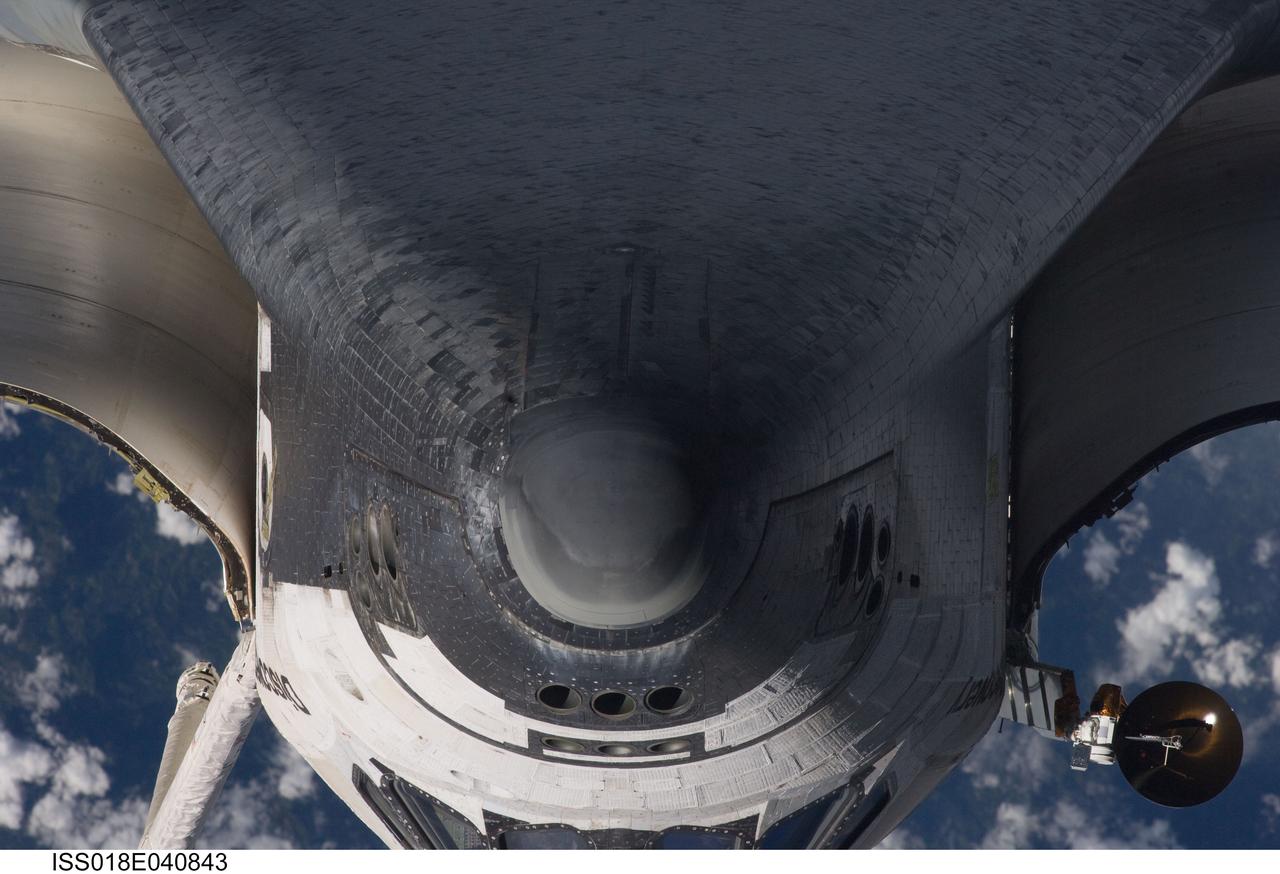
ISS018-E-040843 (17 March 2009) --- A close-up view of the exterior of Space Shuttle Discovery's nose and underside was provided by Expedition 18 crewmembers on the International Space Station. Before docking with the station, astronaut Lee Archambault, STS-119 commander, flew the shuttle through a Rendezvous Pitch Maneuver or basically a backflip to allow the space station crew a good view of Discovery's heat shield. Using digital still cameras equipped with both 400 and 800 millimeter lenses, the ISS crewmembers took a number of photos of the shuttle's thermal protection system and sent them down to teams on the ground for analysis. A 400 millimeter lens was used for this image.
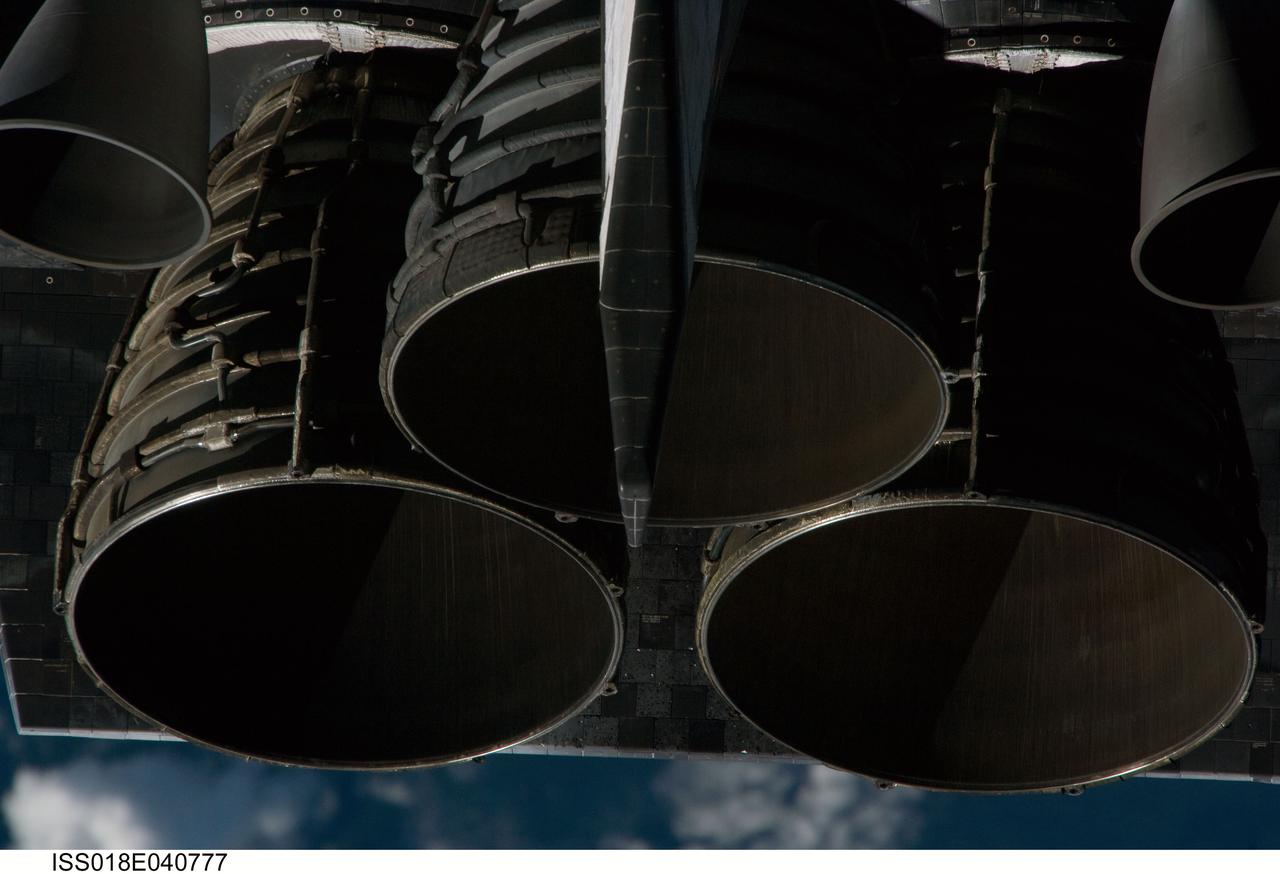
ISS018-E-040777 (17 March 2009) --- A close-up view of Space Shuttle Discovery?s main engines was provided by Expedition 18 crewmembers on the International Space Station. Before docking with the station, astronaut Lee Archambault, STS-119 commander, flew the shuttle through a Rendezvous Pitch Maneuver or basically a backflip to allow the space station crew a good view of Discovery's heat shield. Using digital still cameras equipped with both 400 and 800 millimeter lenses, the ISS crewmembers took a number of photos of the shuttle's thermal protection system and sent them down to teams on the ground for analysis. A 800 millimeter lens was used for this image.
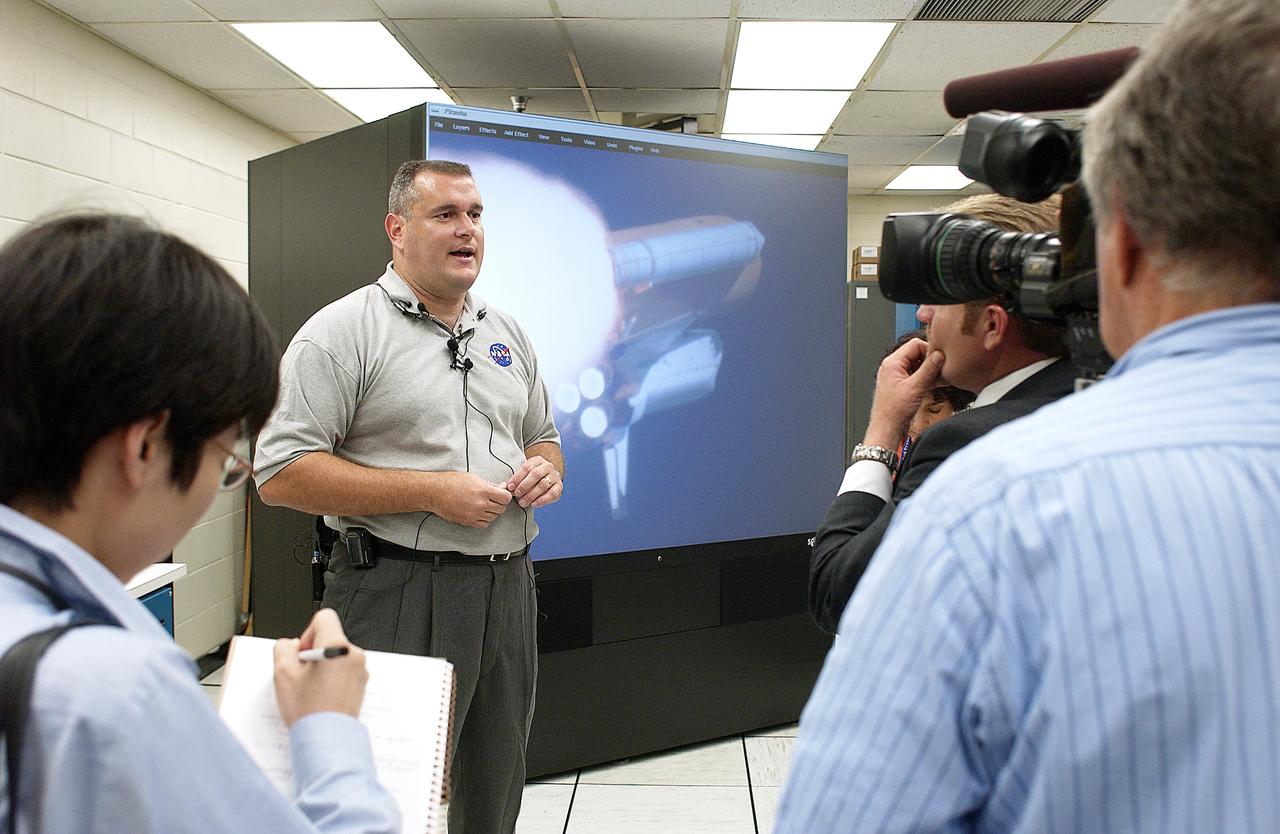
In the Image Analysis Facility in the Vehicle Assembly Building, Armando Oliu (second from left), lead of the KSC Ice and Debris Team, answers questions from news media representatives on the improved tracking cameras and long-range optical tracking systems that will be used to capture ascent imagery during the return to flight of the Space Shuttle. The press opportunity also includes tours of the launch pad perimeter camera site at Launch Complex 39B and two Playalinda Beach optical tracking sites at the Cape Canaveral National Seashore and the Merritt Island National Refuge.
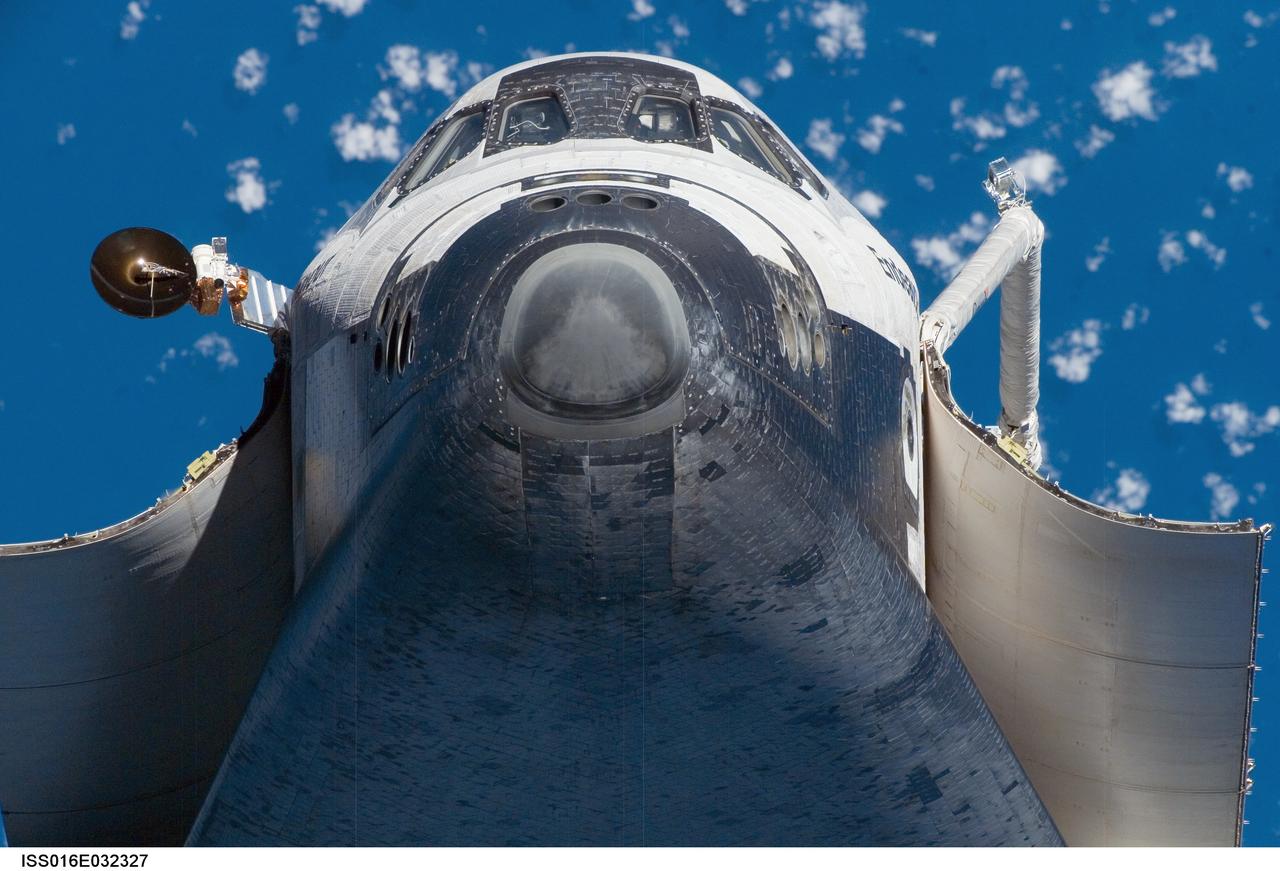
ISS016-E-032327 (12 March 2008) --- A low angle view of the nose and underside of Space Shuttle Endeavour's crew cabin was provided by Expedition 16 crewmembers on the International Space Station (ISS). Before docking with the station, astronaut Dominic Gorie, STS-123 commander, flew the shuttle through a roll pitch maneuver or basically a backflip to allow the space station crew a good view of Endeavour's heat shield. Using digital still cameras equipped with both 400 and 800 millimeter lenses, the ISS crewmembers took a number of photos of the shuttle's thermal protection system and sent them down to teams on the ground for analysis. A 400 millimeter lens was used for this image.
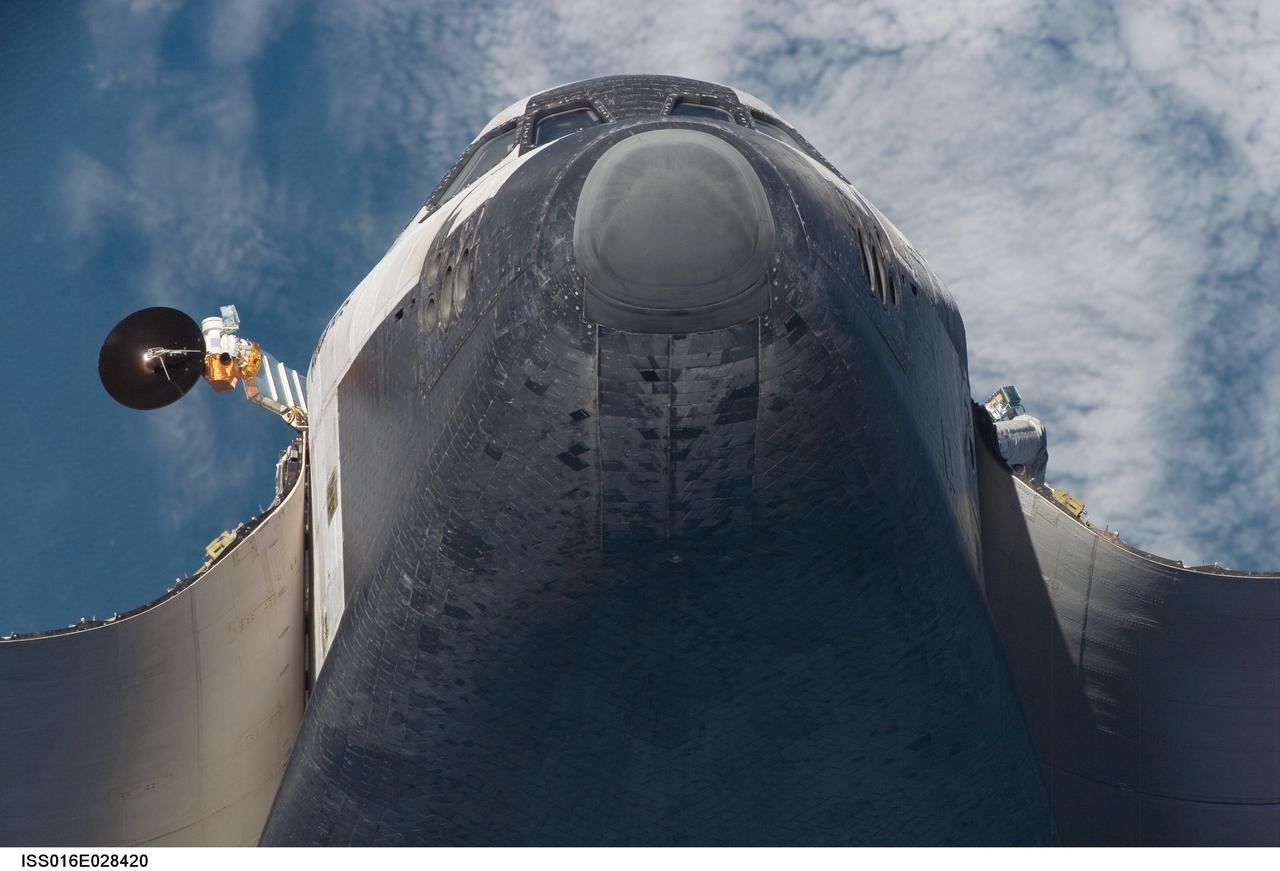
ISS016-E-028420 (9 Feb. 2008) --- A low angle view of the nose and underside of the Space Shuttle Atlantis' crew cabin was provided by Expedition 16 crewmembers. Before docking with the International Space Station, astronaut Steve Frick, STS-122 commander, flew the shuttle through a roll pitch maneuver or basically a backflip to allow the space station crew a good view of Atlantis' heat shield. Using digital still cameras equipped with both 400 and 800 millimeter lenses, the ISS crewmembers took a number of photos of the shuttle's thermal protection system and sent them down to teams on the ground for analysis. A 400 millimeter lens was used for this image.
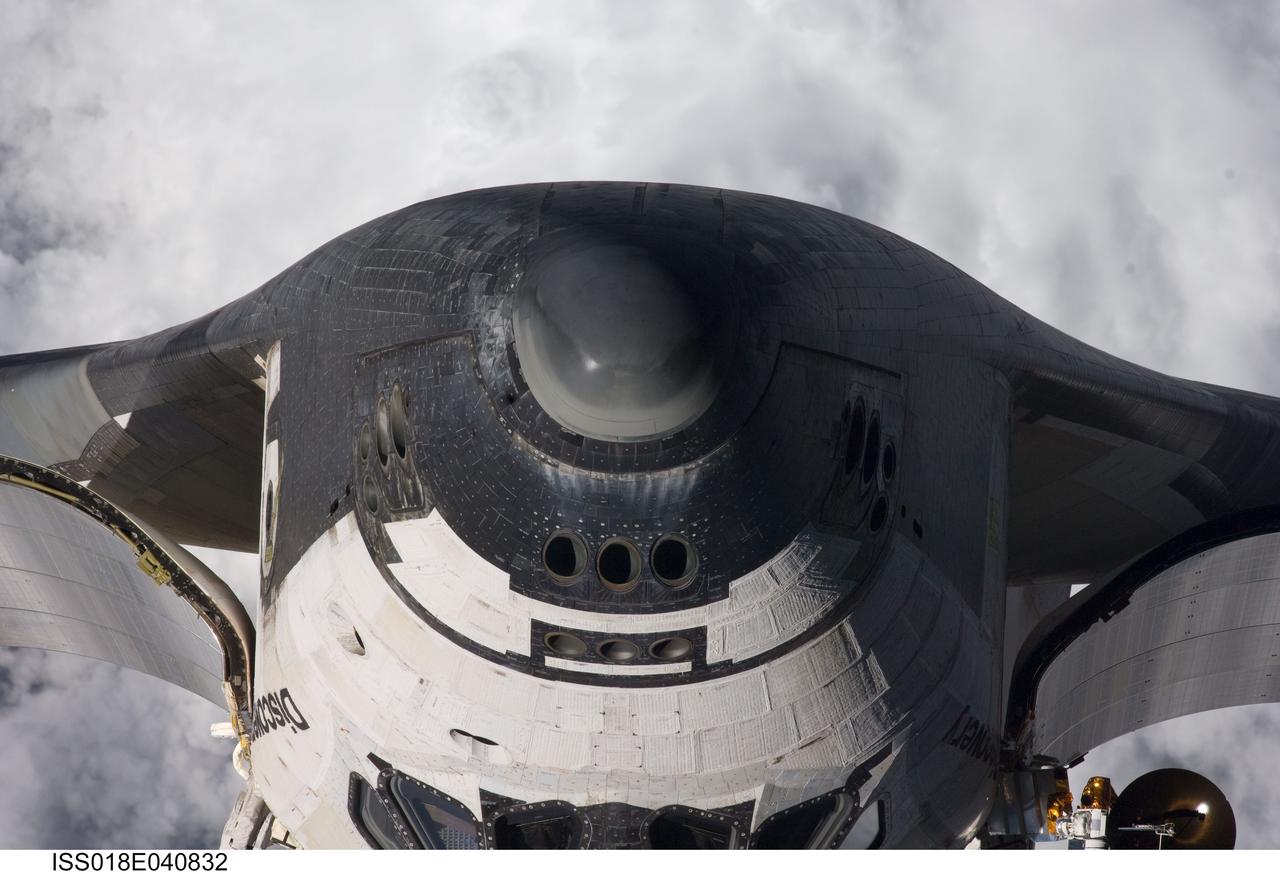
ISS018-E-040832 (17 March 2009) --- A close-up view of the exterior of Space Shuttle Discovery's nose was provided by Expedition 18 crewmembers on the International Space Station. Before docking with the station, astronaut Lee Archambault, STS-119 commander, flew the shuttle through a Rendezvous Pitch Maneuver or basically a backflip to allow the space station crew a good view of Discovery's heat shield. Using digital still cameras equipped with both 400 and 800 millimeter lenses, the ISS crewmembers took a number of photos of the shuttle's thermal protection system and sent them down to teams on the ground for analysis. A 400 millimeter lens was used for this image.
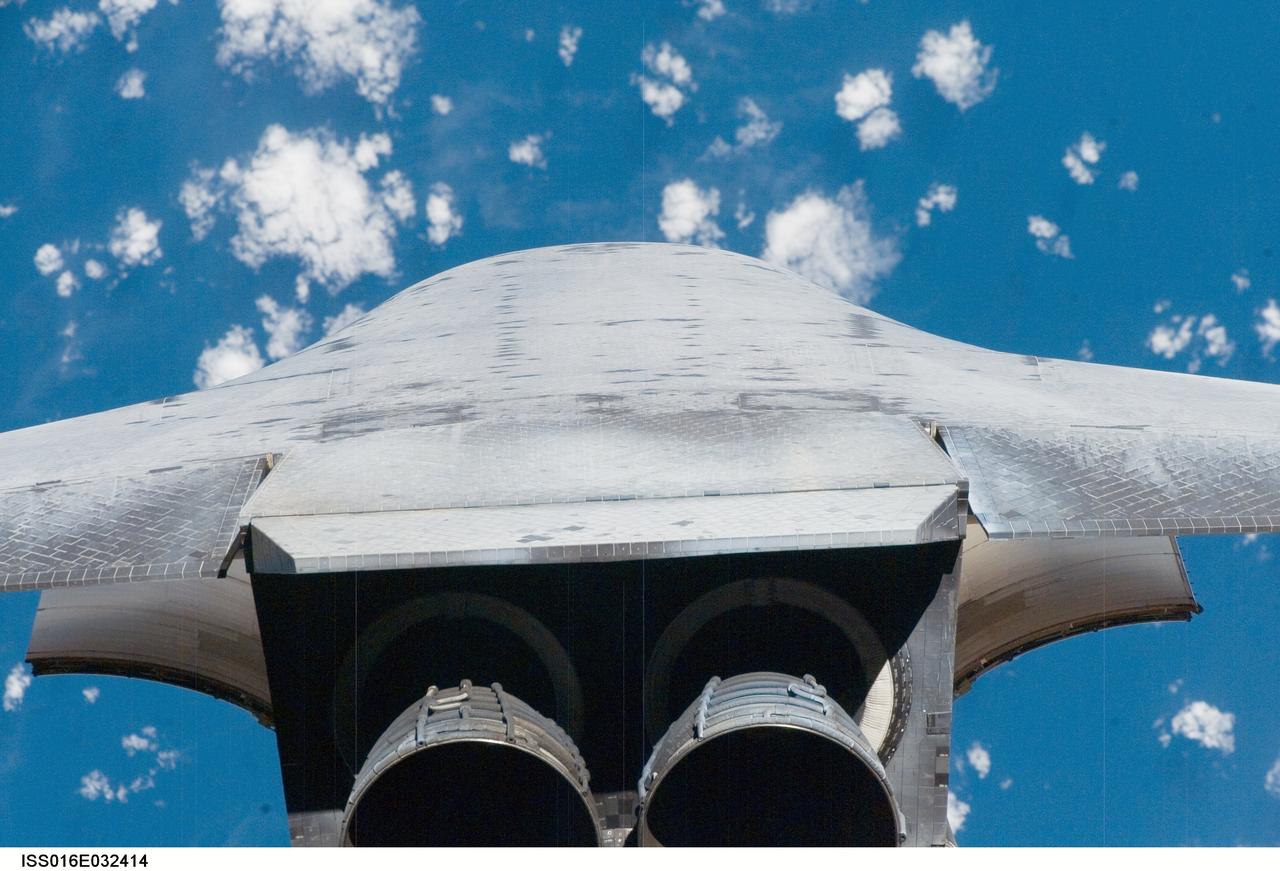
ISS016-E-032414 (12 March 2008) --- An underside view of the Space Shuttle Endeavour was provided by Expedition 16 crewmembers on the International Space Station (ISS). Before docking with the station, astronaut Dominic Gorie, STS-123 commander, flew the shuttle through a roll pitch maneuver or basically a backflip to allow the space station crew a good view of Endeavour's heat shield. Using digital still cameras equipped with both 400 and 800 millimeter lenses, the ISS crewmembers took a number of photos of the shuttle's thermal protection system and sent them down to teams on the ground for analysis. A 400 millimeter lens was used for this image.

ISS016-E-032323 (12 March 2008) --- A low angle view of the nose and underside of Space Shuttle Endeavour's crew cabin was provided by Expedition 16 crewmembers on the International Space Station (ISS). Before docking with the station, astronaut Dominic Gorie, STS-123 commander, flew the shuttle through a roll pitch maneuver or basically a backflip to allow the space station crew a good view of Endeavour's heat shield. Using digital still cameras equipped with both 400 and 800 millimeter lenses, the ISS crewmembers took a number of photos of the shuttle's thermal protection system and sent them down to teams on the ground for analysis. A 400 millimeter lens was used for this image.
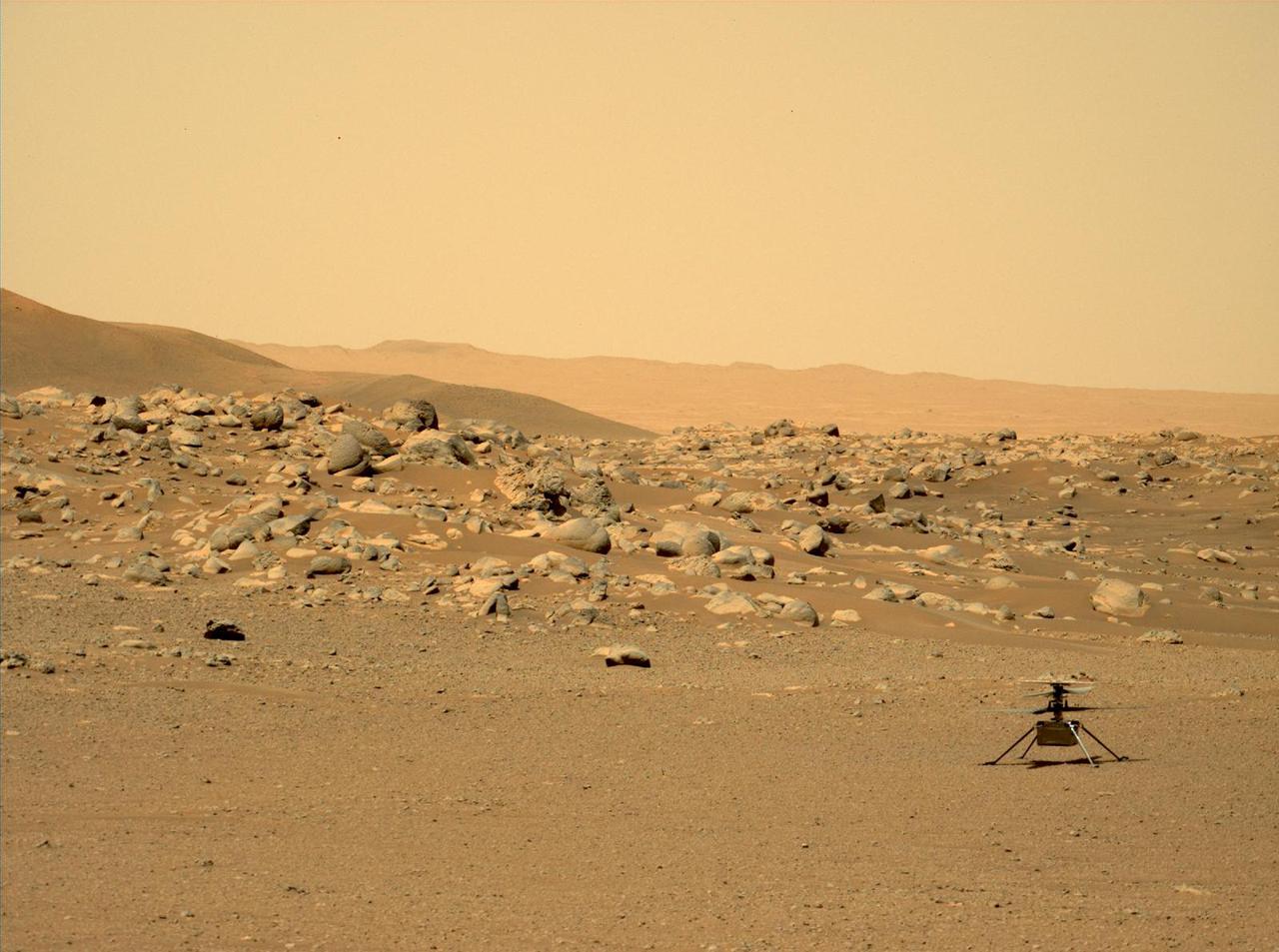
This image of NASA's Ingenuity Mars Helicopter was taken by the Mastcam-Z instrument of the Perseverance rover on June 15, 2021, the 114th Martian day, or sol, of the mission. The location, "Airfield D" (the fourth airfield), is just east of the "Séítah" geologic unit. The image has been processed from the original version. Ingenuity was built by NASA's Jet Propulsion Laboratory in Southern California, which also manages the project for NASA Headquarters. It is supported by NASA's Science Mission Directorate. NASA's Ames Research Center in California's Silicon Valley, and NASA's Langley Research Center in Hampton, Virginia, provided significant flight performance analysis and technical assistance during Ingenuity's development. AeroVironment Inc., Qualcomm, and SolAero also provided design assistance and major vehicle components. Lockheed Martin Space designed and manufactured the Mars Helicopter Delivery System. A key objective for Perseverance's mission on Mars is astrobiology, including the search for signs of ancient microbial life. The rover will characterize the planet's geology and past climate, pave the way for human exploration of the Red Planet, and be the first mission to collect and cache Martian rock and regolith (broken rock and dust). Subsequent NASA missions, in cooperation with ESA (European Space Agency), would send spacecraft to Mars to collect these sealed samples from the surface and return them to Earth for in-depth analysis. https://photojournal.jpl.nasa.gov/catalog/PIA25213
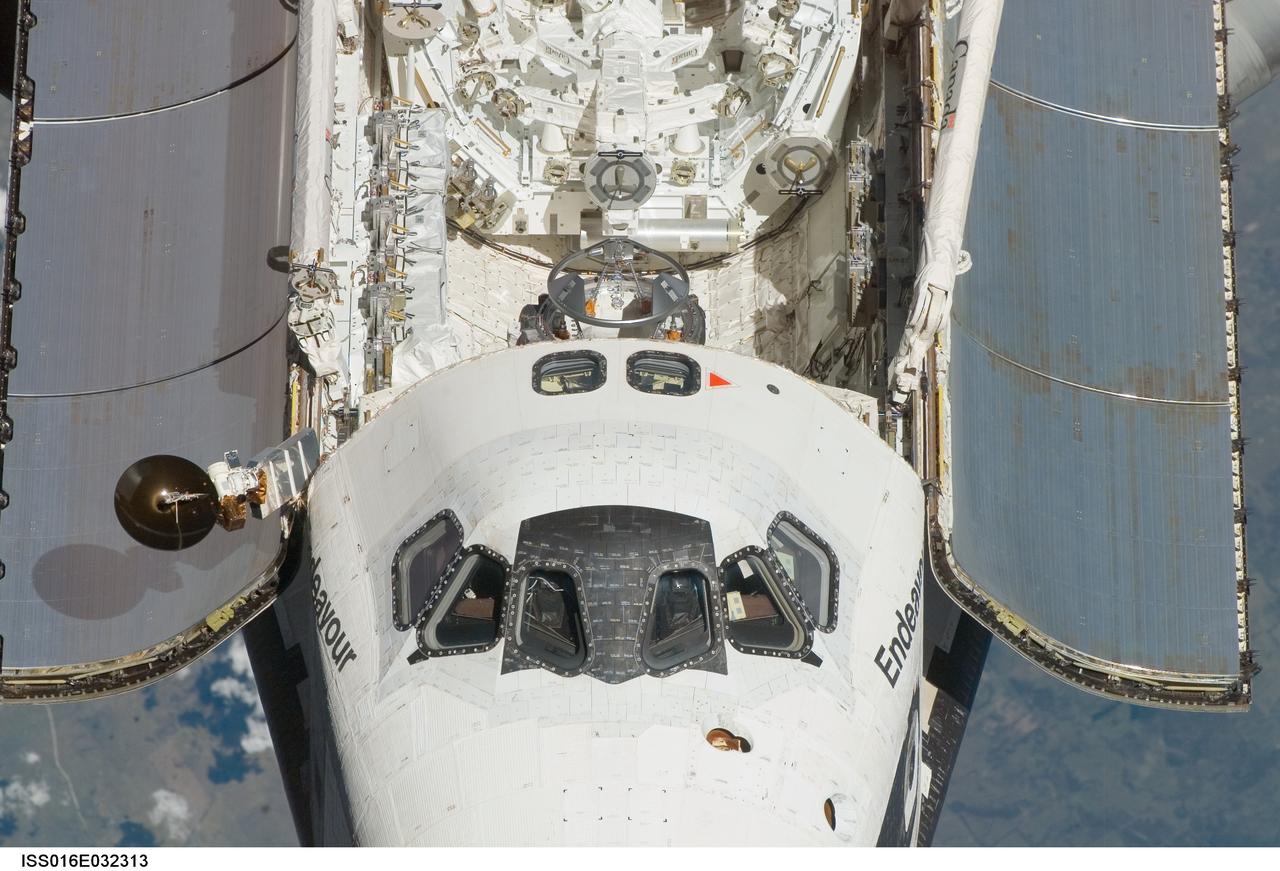
ISS016-E-032313 (12 March 2008) --- An overhead view of the exterior of Space Shuttle Endeavour's crew cabin, part of its payload bay doors, docking system and part of the Dextre robotic system was provided by Expedition 16 crewmembers on the International Space Station (ISS). Before docking with the station, astronaut Dominic Gorie, STS-123 commander, flew the shuttle through a roll pitch maneuver or basically a backflip to allow the space station crew a good view of Endeavour's heat shield. Using digital still cameras equipped with both 400 and 800 millimeter lenses, the ISS crewmembers took a number of photos of the shuttle's thermal protection system and sent them down to teams on the ground for analysis. A 400 millimeter lens was used for this image.
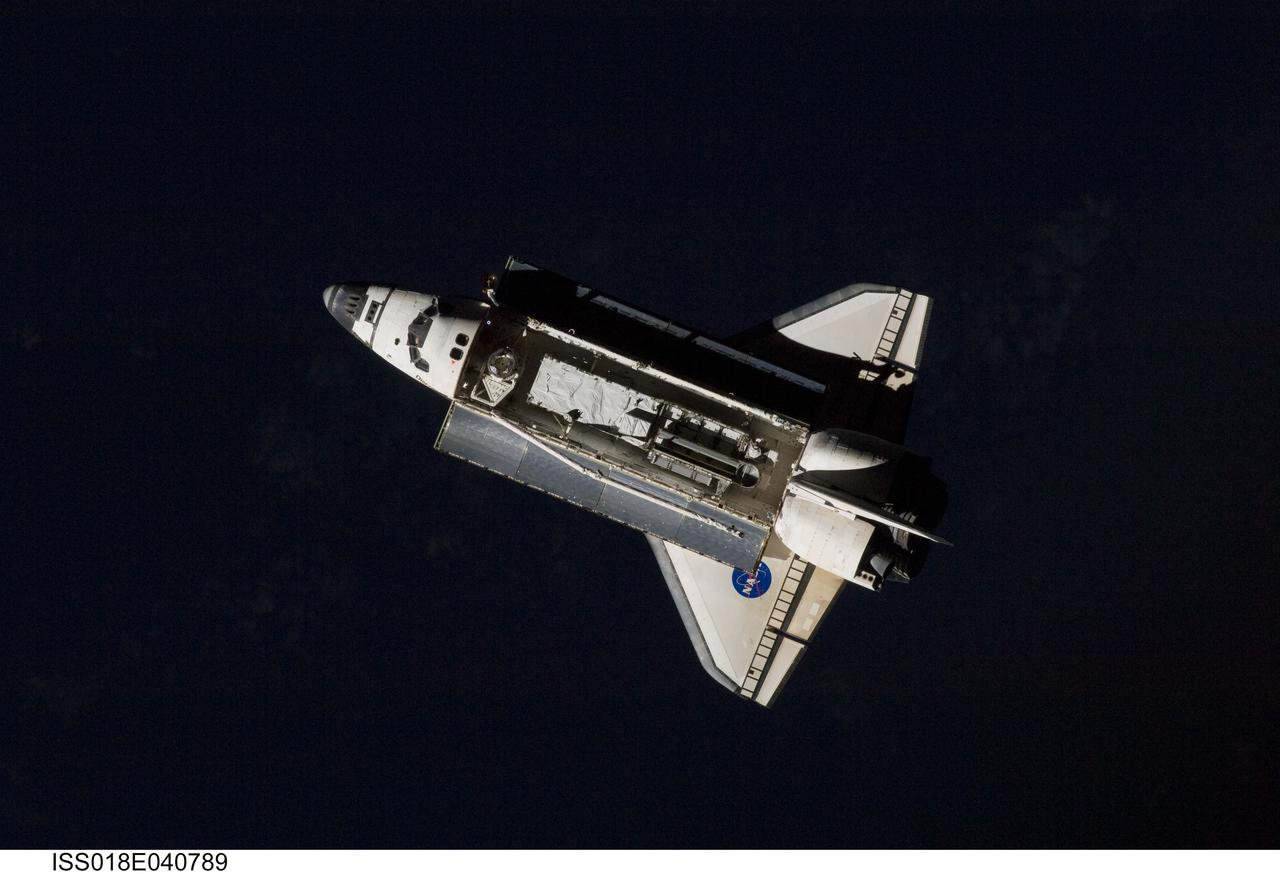
ISS018-E-040789 (17 March 2009) --- Backdropped by the blackness of space, Space Shuttle Discovery is featured in this image photographed by an Expedition 18 crewmember on the International Space Station during rendezvous and docking operations. Before docking with the station, astronaut Lee Archambault, STS-119 commander, flew the shuttle through a Rendezvous Pitch Maneuver or basically a backflip to allow the space station crew a good view of Discovery's heat shield. Using digital still cameras equipped with both 400 and 800 millimeter lenses, the ISS crewmembers took a number of photos of the shuttle's thermal protection system and sent them down to teams on the ground for analysis. A 400 millimeter lens was used for this image. Docking occurred at 4:20 p.m. (CDT) on March 17, 2009. The final pair of power-generating solar array wings and the S6 truss segment are visible in Discovery’s cargo bay.
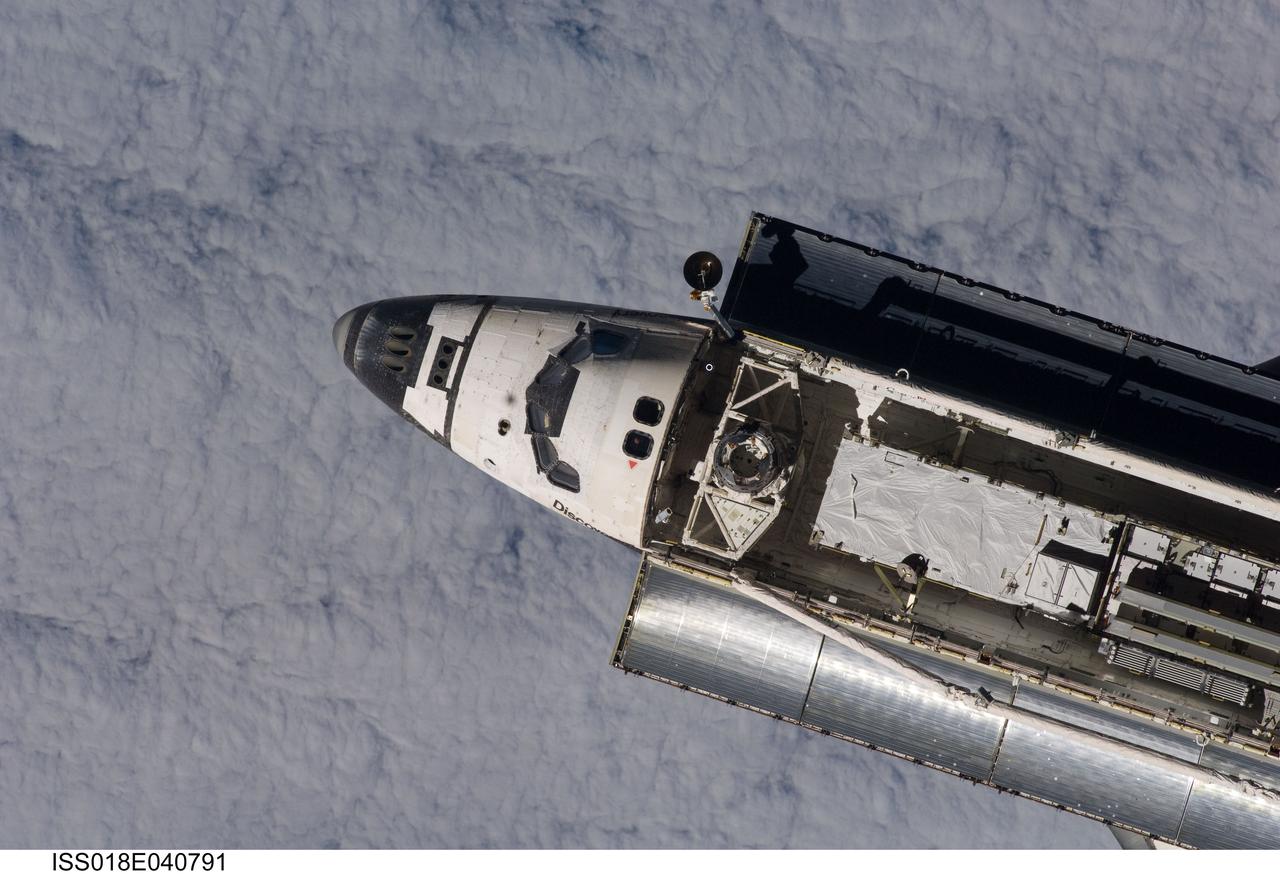
ISS018-E-040791 (17 March 2009) --- Backdropped by a blanket of clouds, Space Shuttle Discovery is featured in this image photographed by an Expedition 18 crewmember on the International Space Station during rendezvous and docking operations. Before docking with the station, astronaut Lee Archambault, STS-119 commander, flew the shuttle through a Rendezvous Pitch Maneuver or basically a backflip to allow the space station crew a good view of Discovery's heat shield. Using digital still cameras equipped with both 400 and 800 millimeter lenses, the ISS crewmembers took a number of photos of the shuttle's thermal protection system and sent them down to teams on the ground for analysis. A 400 millimeter lens was used for this image. Docking occurred at 4:20 p.m. (CDT) on March 17, 2009. The final pair of power-generating solar array wings and the S6 truss segment are visible in Discovery?s cargo bay.
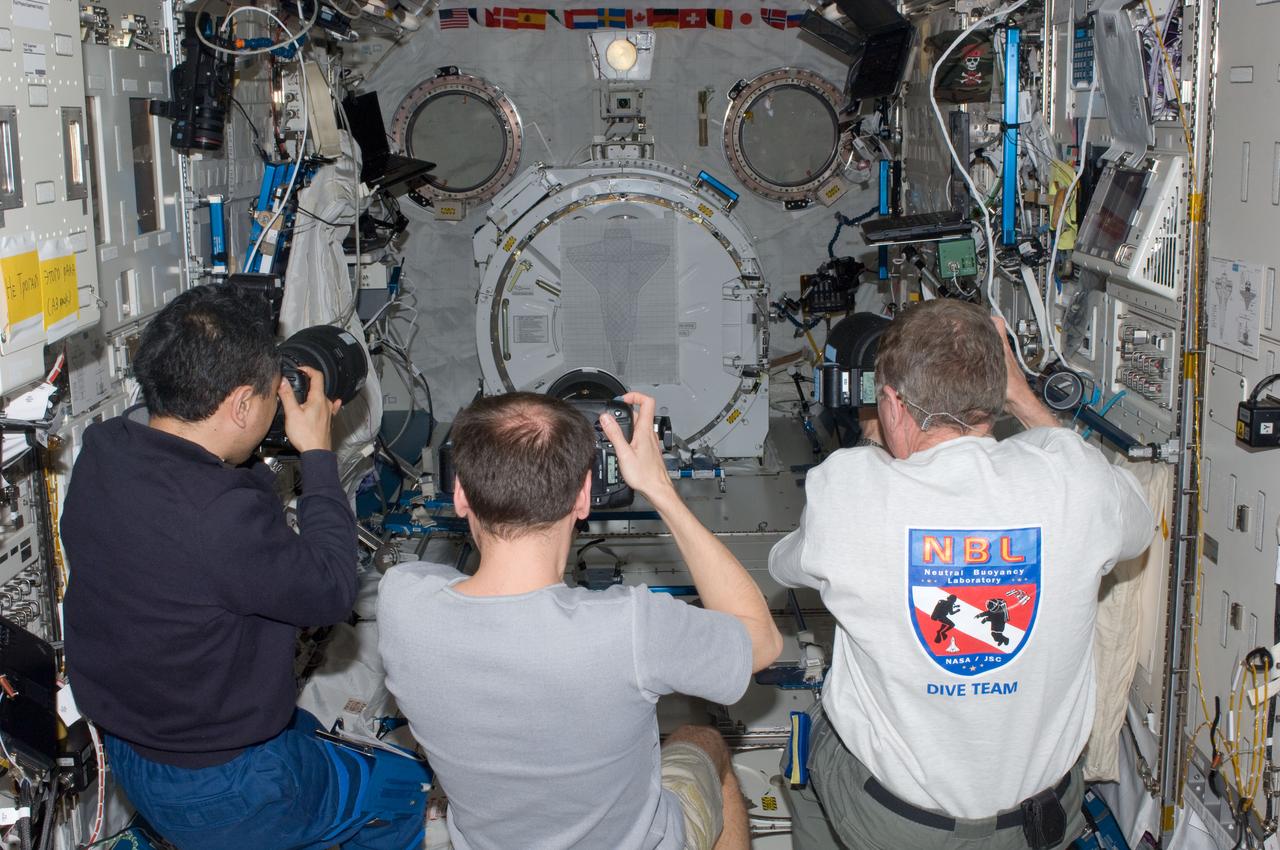
ISS028-E-015033 (9 July 2011) --- Japan Aerospace Exploration Agency astronaut Satoshi Furukawa (left), Russian cosmonaut Sergei Volkov (center) and NASA astronaut Mike Fossum, all Expedition 28 flight engineers, use still cameras in the International Space Station’s Kibo laboratory to photograph a detailed outline of the orbiter’s underbelly. The space shuttle “pattern” was traditionally used as a training tool by the station crew members preparing for the R-Bar Pitch Maneuver performed by each arriving shuttle. The image size represents the orbiter at a distance of about 600 feet on approach. During an RPM, typically more than 300 images are taken using cameras outfitted with 400, 800 and 1000 mm lenses and downlinked to the ground for analysis to clear the Thermal Protection System for entry.
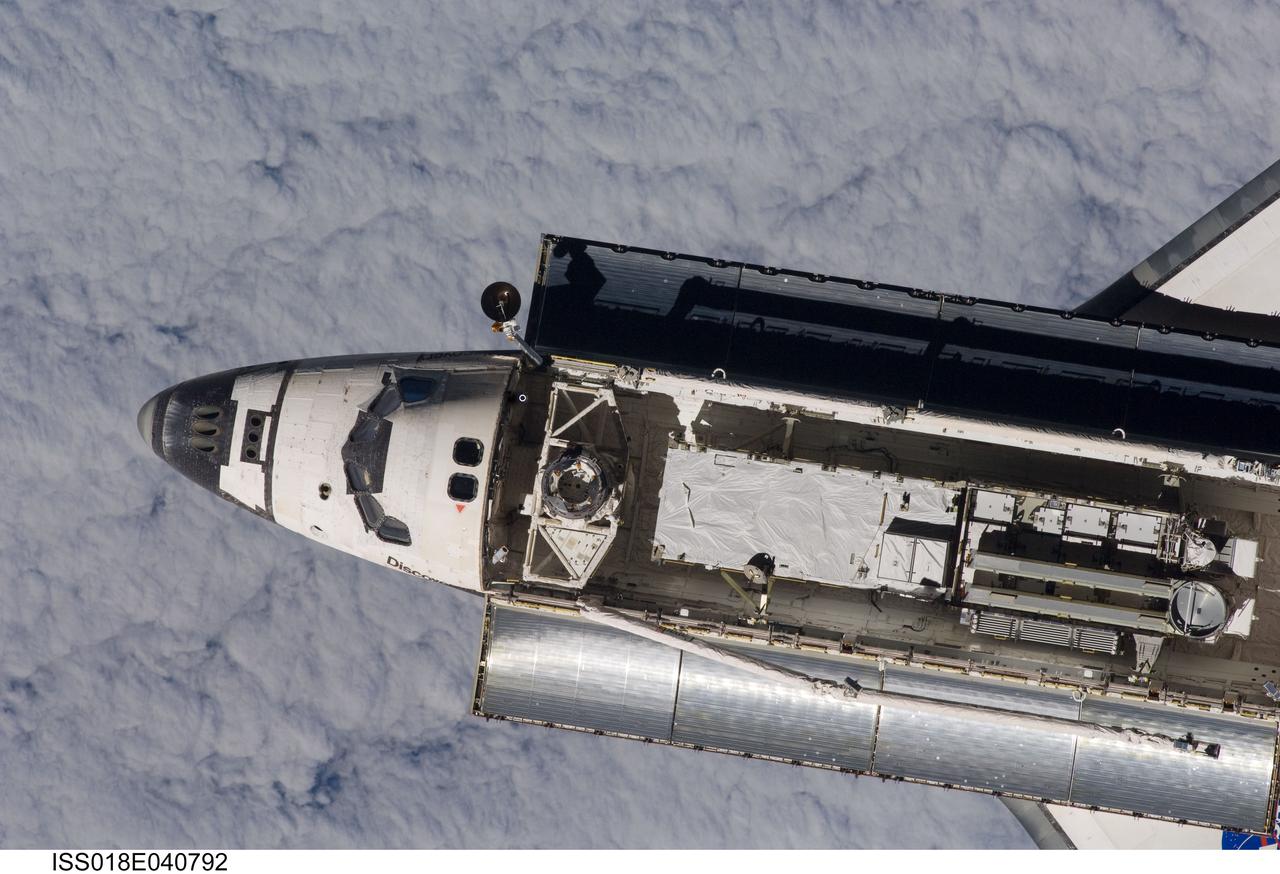
ISS018-E-040792 (17 March 2009) --- Backdropped by a blanket of clouds, Space Shuttle Discovery is featured in this image photographed by an Expedition 18 crewmember on the International Space Station during rendezvous and docking operations. Before docking with the station, astronaut Lee Archambault, STS-119 commander, flew the shuttle through a Rendezvous Pitch Maneuver or basically a backflip to allow the space station crew a good view of Discovery's heat shield. Using digital still cameras equipped with both 400 and 800 millimeter lenses, the ISS crewmembers took a number of photos of the shuttle's thermal protection system and sent them down to teams on the ground for analysis. A 400 millimeter lens was used for this image. Docking occurred at 4:20 p.m. (CDT) on March 17, 2009. The final pair of power-generating solar array wings and the S6 truss segment are visible in Discovery?s cargo bay.
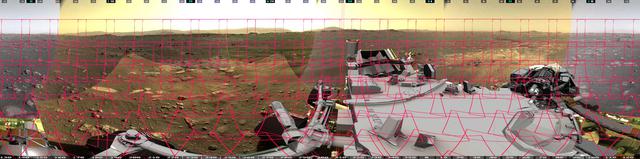
This image shows the 142 images that make up Mastcam-Z's first 360-degree panorama. Mastcam-Z is a pair of zoomable cameras on the mast, or "head," of NASA's Perseverance Mars rover. Arizona State University in Tempe leads the operations of the Mastcam-Z instrument, working in collaboration with Malin Space Science Systems in San Diego. A key objective for Perseverance's mission on Mars is astrobiology, including the search for signs of ancient microbial life. The rover will characterize the planet's geology and past climate, pave the way for human exploration of the Red Planet, and be the first mission to collect and cache Martian rock and regolith (broken rock and dust). Subsequent NASA missions, in cooperation with ESA (European Space Agency), would send spacecraft to Mars to collect these sealed samples from the surface and return them to Earth for in-depth analysis. https://photojournal.jpl.nasa.gov/catalog/PIA24445

ISS018-E-040790 (17 March 2009) --- Backdropped by the blackness of space, Space Shuttle Discovery is featured in this image photographed by an Expedition 18 crewmember on the International Space Station during rendezvous and docking operations. Before docking with the station, astronaut Lee Archambault, STS-119 commander, flew the shuttle through a Rendezvous Pitch Maneuver or basically a backflip to allow the space station crew a good view of Discovery's heat shield. Using digital still cameras equipped with both 400 and 800 millimeter lenses, the ISS crewmembers took a number of photos of the shuttle's thermal protection system and sent them down to teams on the ground for analysis. A 400 millimeter lens was used for this image. Docking occurred at 4:20 p.m. (CDT) on March 17, 2009. The final pair of power-generating solar array wings and the S6 truss segment are visible in Discovery?s cargo bay.
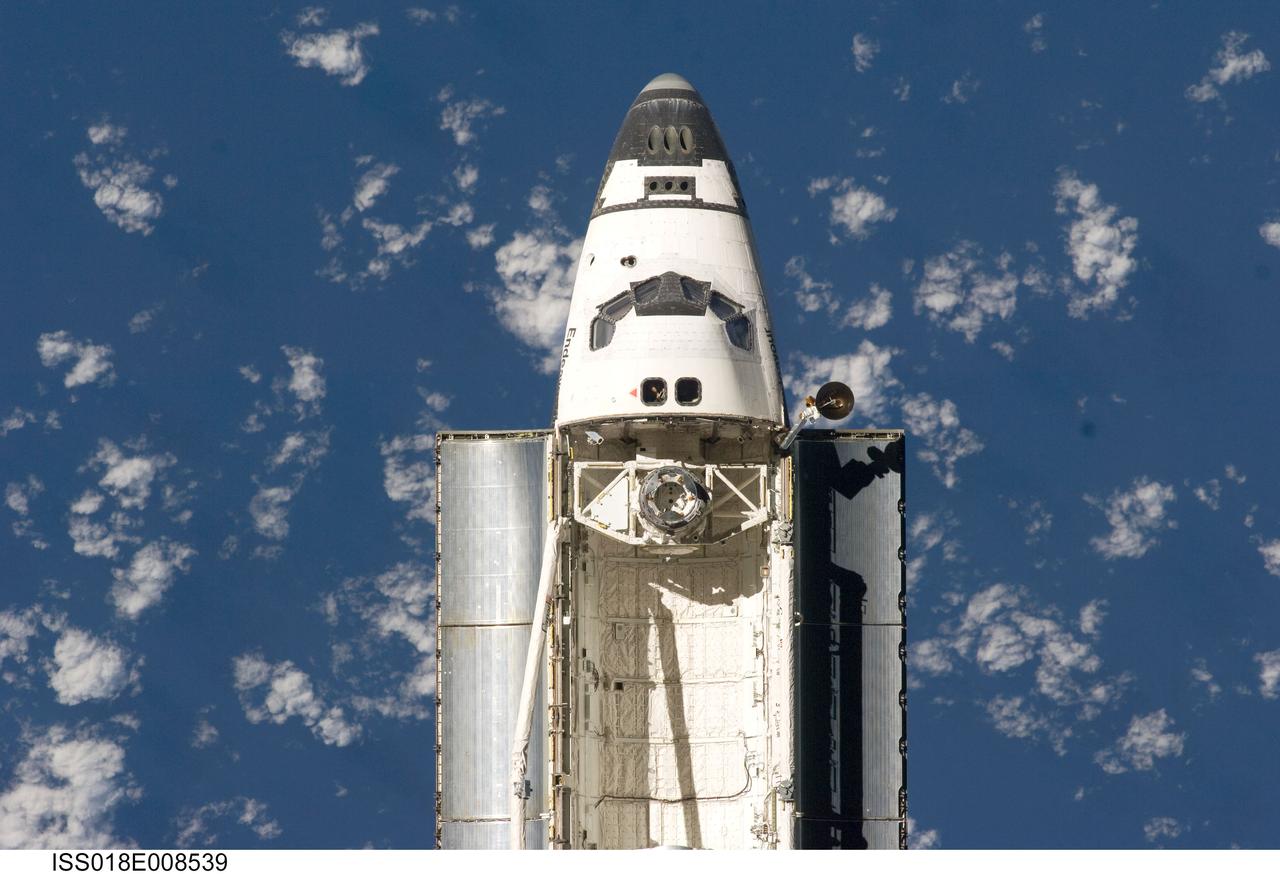
ISS018-E-008539 (16 Nov. 2008) --- An overhead view of the exterior of Space Shuttle Endeavour's crew cabin, part of its payload bay doors and docking system was provided by Expedition 18 crewmembers on the International Space Station. Before docking with the station, astronaut Chris Ferguson, STS-126 commander, flew the shuttle through a roll pitch maneuver or basically a backflip to allow the space station crew a good view of Endeavour's heat shield. Using digital still cameras equipped with both 400 and 800 millimeter lenses, the ISS crewmembers took a number of photos of the shuttle's thermal protection system and sent them down to teams on the ground for analysis. A 400 millimeter lens was used for this image.
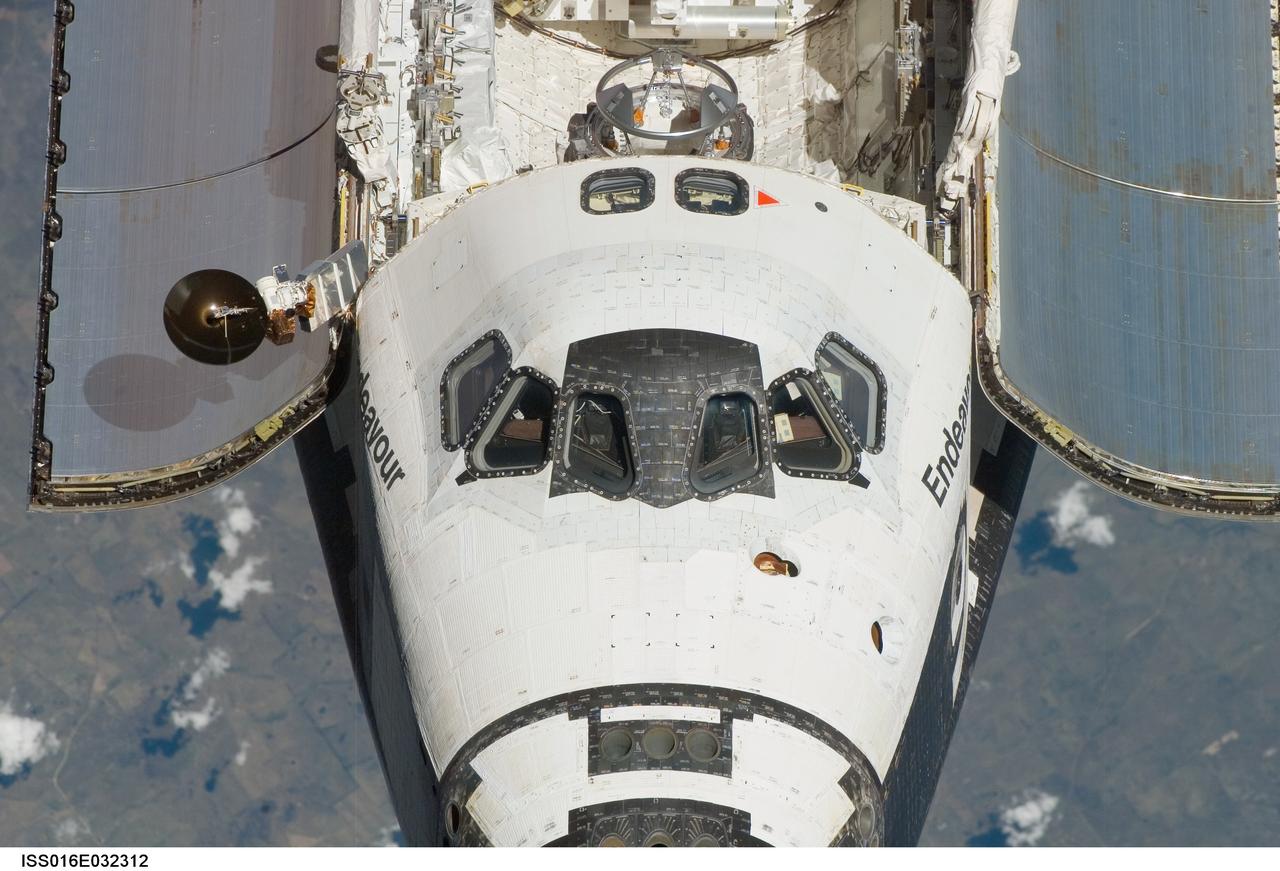
ISS016-E-032312 (12 March 2008) --- An overhead view of the exterior of Space Shuttle Endeavour's crew cabin, part of its payload bay doors and docking system was provided by Expedition 16 crewmembers on the International Space Station (ISS). Before docking with the station, astronaut Dominic Gorie, STS-123 commander, flew the shuttle through a roll pitch maneuver or basically a backflip to allow the space station crew a good view of Endeavour's heat shield. Using digital still cameras equipped with both 400 and 800 millimeter lenses, the ISS crewmembers took a number of photos of the shuttle's thermal protection system and sent them down to teams on the ground for analysis. A 400 millimeter lens was used for this image.
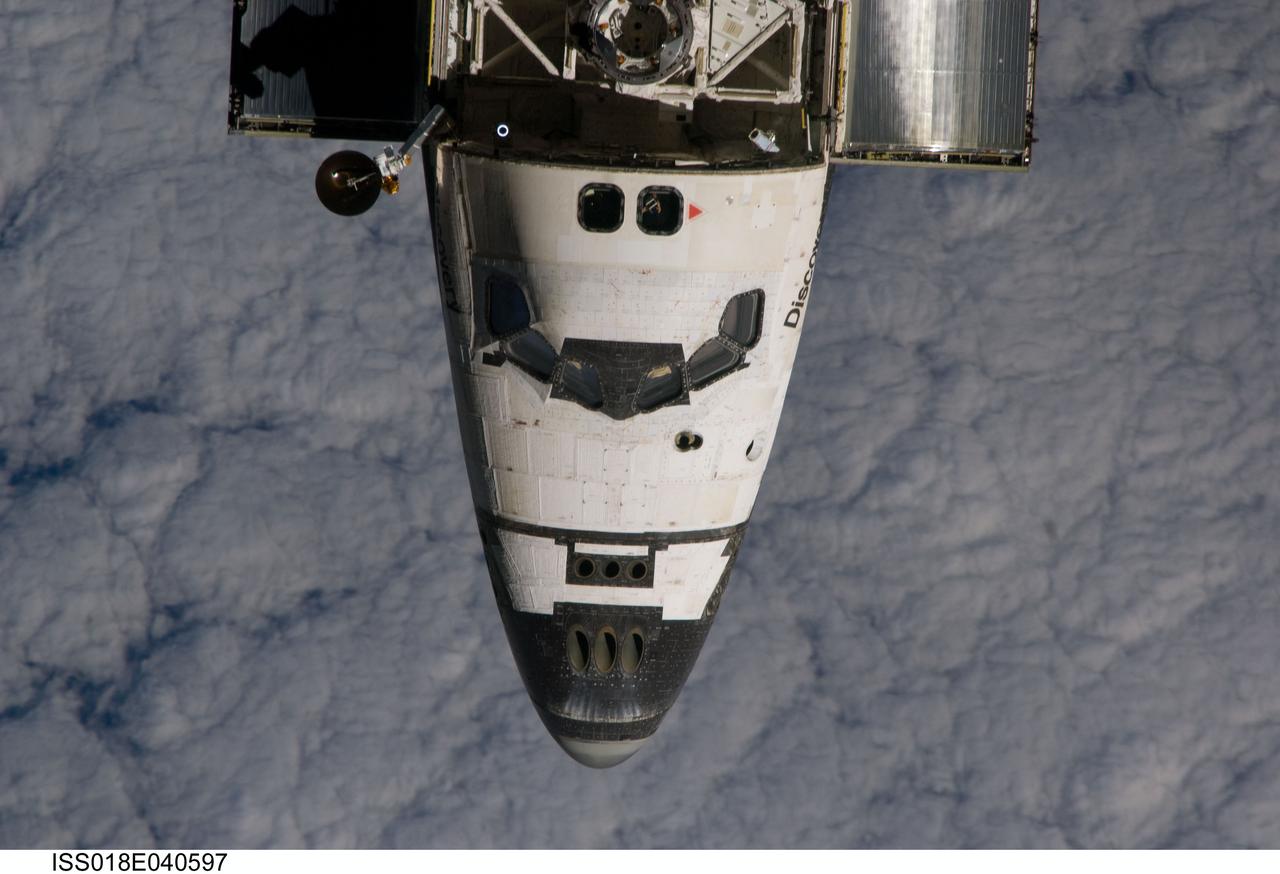
ISS018-E-040597 (17 March 2009) --- An overhead view of the exterior of Space Shuttle Discovery's crew cabin, part of its payload bay doors and docking system was provided by Expedition 18 crewmembers on the International Space Station. Before docking with the station, astronaut Lee Archambault, STS-119 commander, flew the shuttle through a Rendezvous Pitch Maneuver or basically a backflip to allow the space station crew a good view of Discovery's heat shield. Using digital still cameras equipped with both 400 and 800 millimeter lenses, the ISS crewmembers took a number of photos of the shuttle's thermal protection system and sent them down to teams on the ground for analysis. A 800 millimeter lens was used for this image.
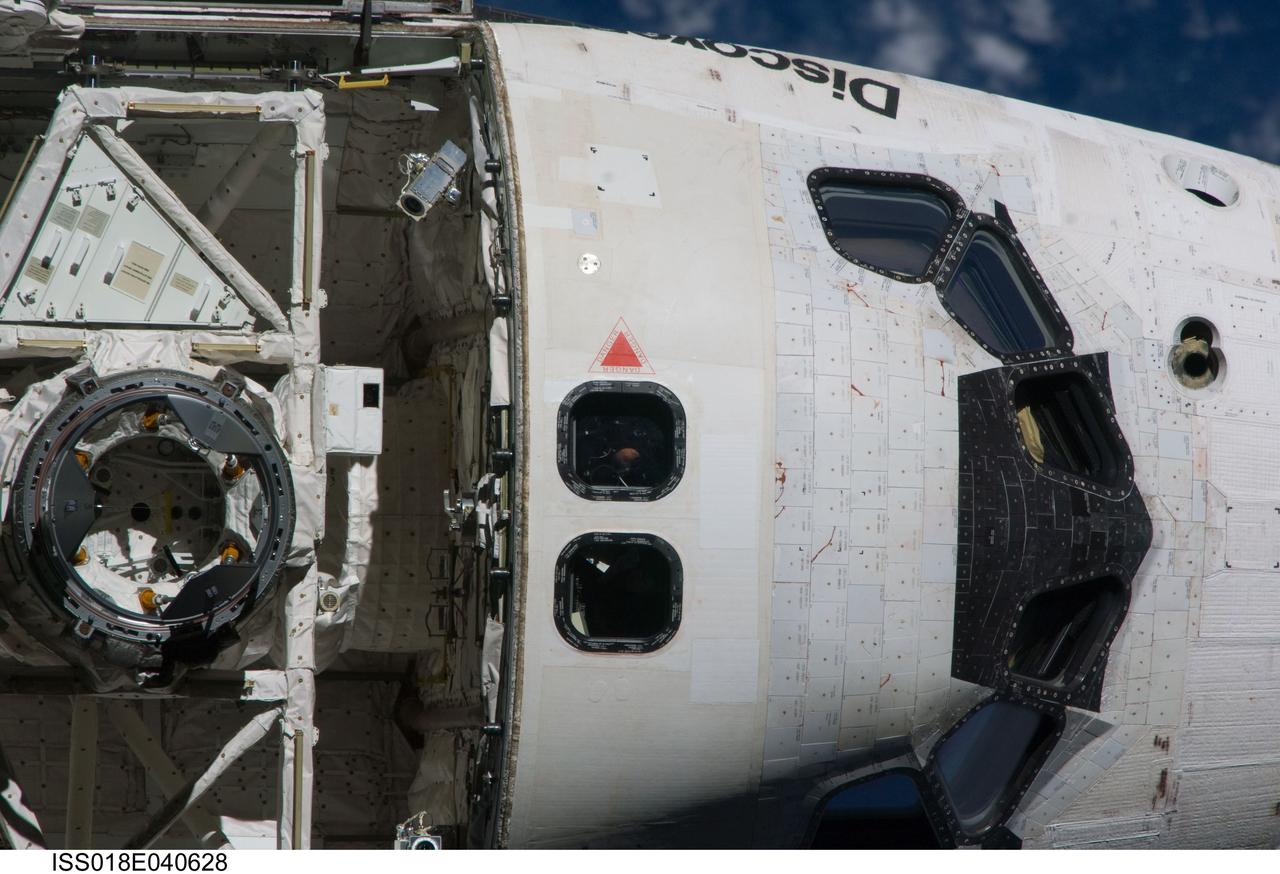
ISS018-E-040628 (17 March 2009) --- An overhead close-up view of the exterior of Space Shuttle Discovery's crew cabin, part of its payload bay and docking system was provided by Expedition 18 crewmembers on the International Space Station. Before docking with the station, astronaut Lee Archambault, STS-119 commander, flew the shuttle through a Rendezvous Pitch Maneuver or basically a backflip to allow the space station crew a good view of Discovery's heat shield. Using digital still cameras equipped with both 400 and 800 millimeter lenses, the ISS crewmembers took a number of photos of the shuttle's thermal protection system and sent them down to teams on the ground for analysis. A 800 millimeter lens was used for this image.
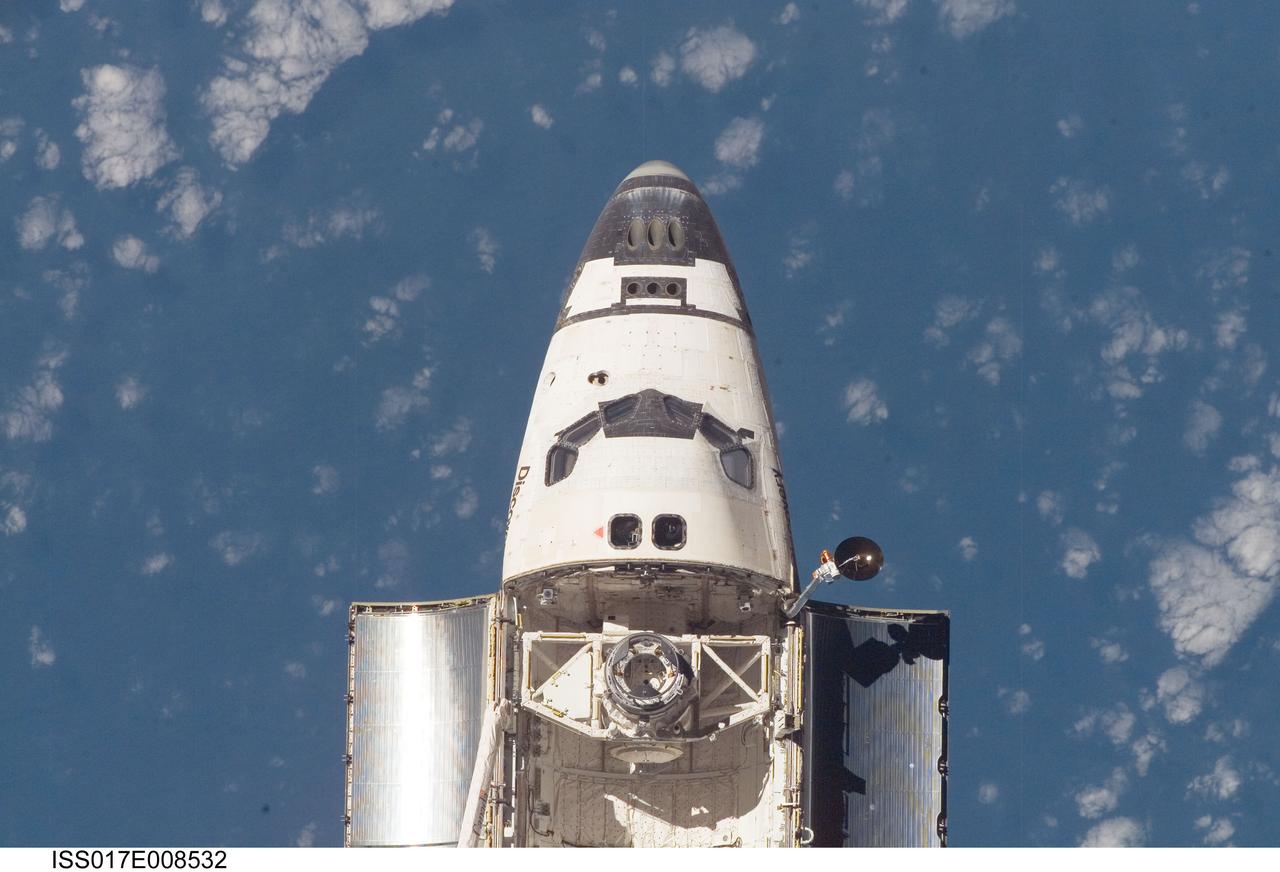
ISS017-E-008532 (2 June 2008) --- An overhead view of the exterior of Space Shuttle Discovery's crew cabin, part of its payload bay doors and docking system was provided by Expedition 17 crewmembers on the International Space Station (ISS). Before docking with the station, astronaut Mark Kelly, STS-124 commander, flew the shuttle through a roll pitch maneuver or basically a backflip to allow the space station crew a good view of Discovery's heat shield. Using digital still cameras equipped with both 400 and 800 millimeter lenses, the ISS crewmembers took a number of photos of the shuttle's thermal protection system and sent them down to teams on the ground for analysis. A 400 millimeter lens was used for this image.
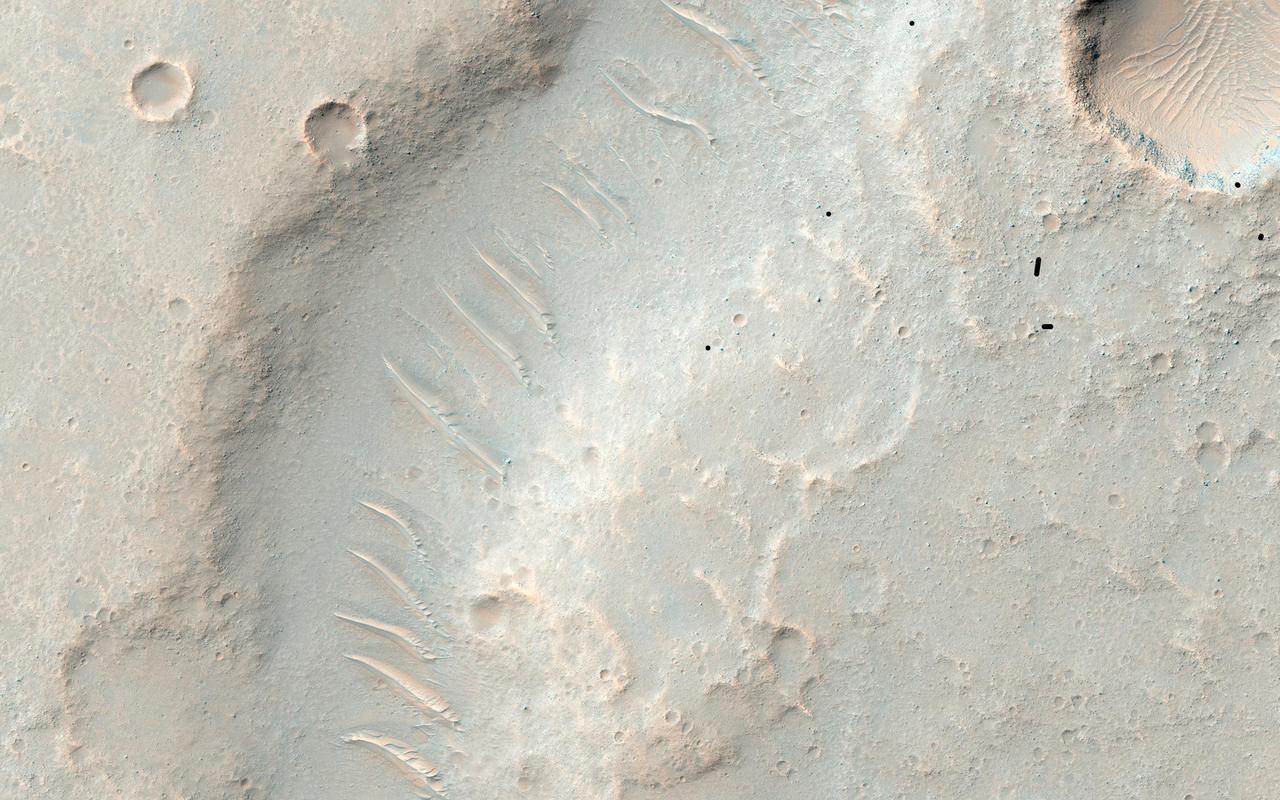
This image from NASA Mars Reconnaissance Orbiter spacecraft shows a channel system flowing to the southwest toward the huge Hellas impact basin. We're not sure if this channel-inside-a-channel was carved by flowing water or lava. Flowing water erodes channels, and flowing lava both erodes and melts surrounding rock to form channels. It's not clear whether a huge surge of water or lava first formed the wide channel and then subsided into a trickle to form this narrow, inner channel, or if a trickle formed the inner channel and a subsequent surge formed the wider one. Detailed analysis of the shape could reveal which scenario is most likely, as well as whether water or lava is responsible. Relevant observations for such a determination would include, for example, the facts that the channels lack levees (ridges along the banks) and that the inner channel diverts around a mound, which at one time was an island. This channel system flowed to the southwest toward the huge Hellas impact basin.
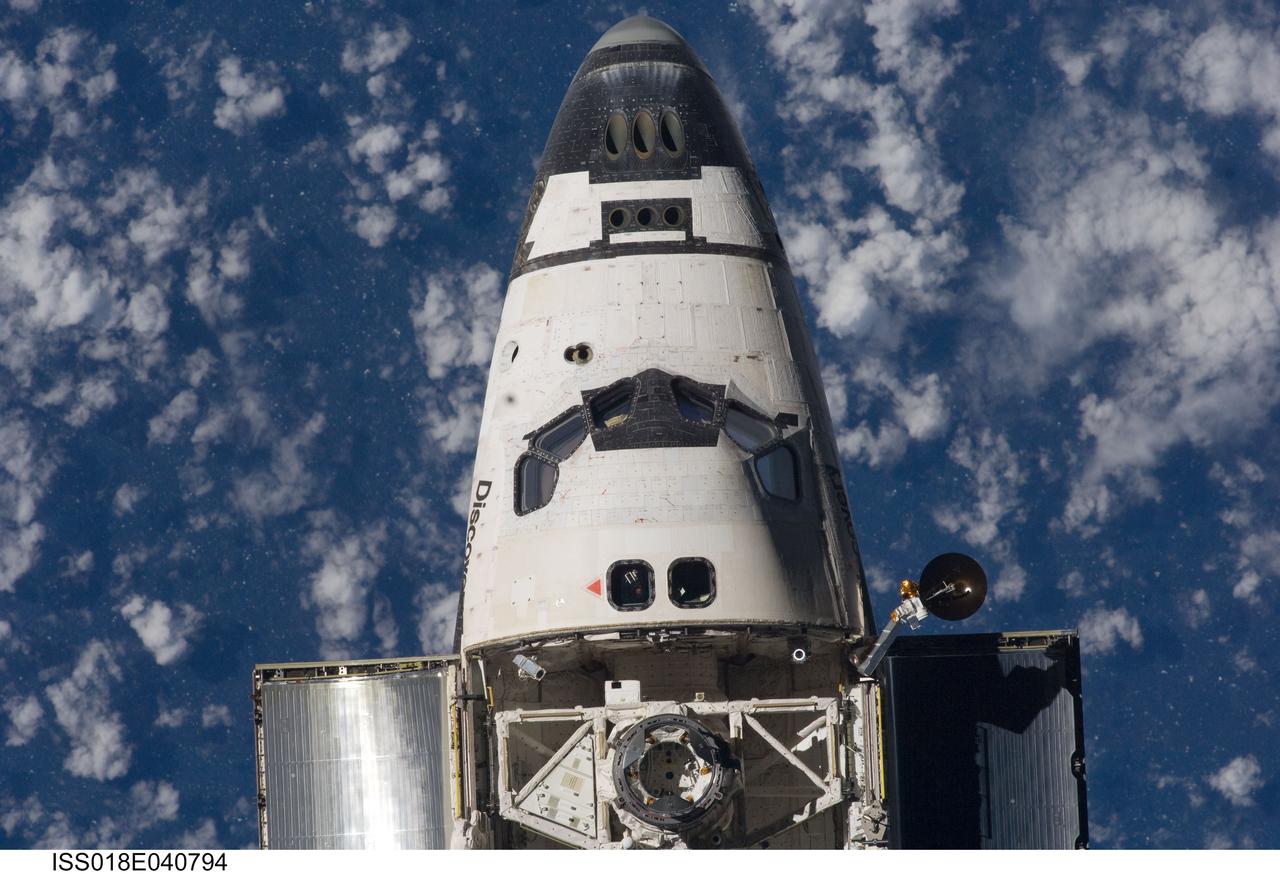
ISS018-E-040794 (17 March 2009) --- An overhead close-up view of the exterior of Space Shuttle Discovery's crew cabin, part of its payload bay and docking system was provided by Expedition 18 crewmembers on the International Space Station. Before docking with the station, astronaut Lee Archambault, STS-119 commander, flew the shuttle through a Rendezvous Pitch Maneuver or basically a backflip to allow the space station crew a good view of Discovery's heat shield. Using digital still cameras equipped with both 400 and 800 millimeter lenses, the ISS crewmembers took a number of photos of the shuttle's thermal protection system and sent them down to teams on the ground for analysis. A 400 millimeter lens was used for this image.
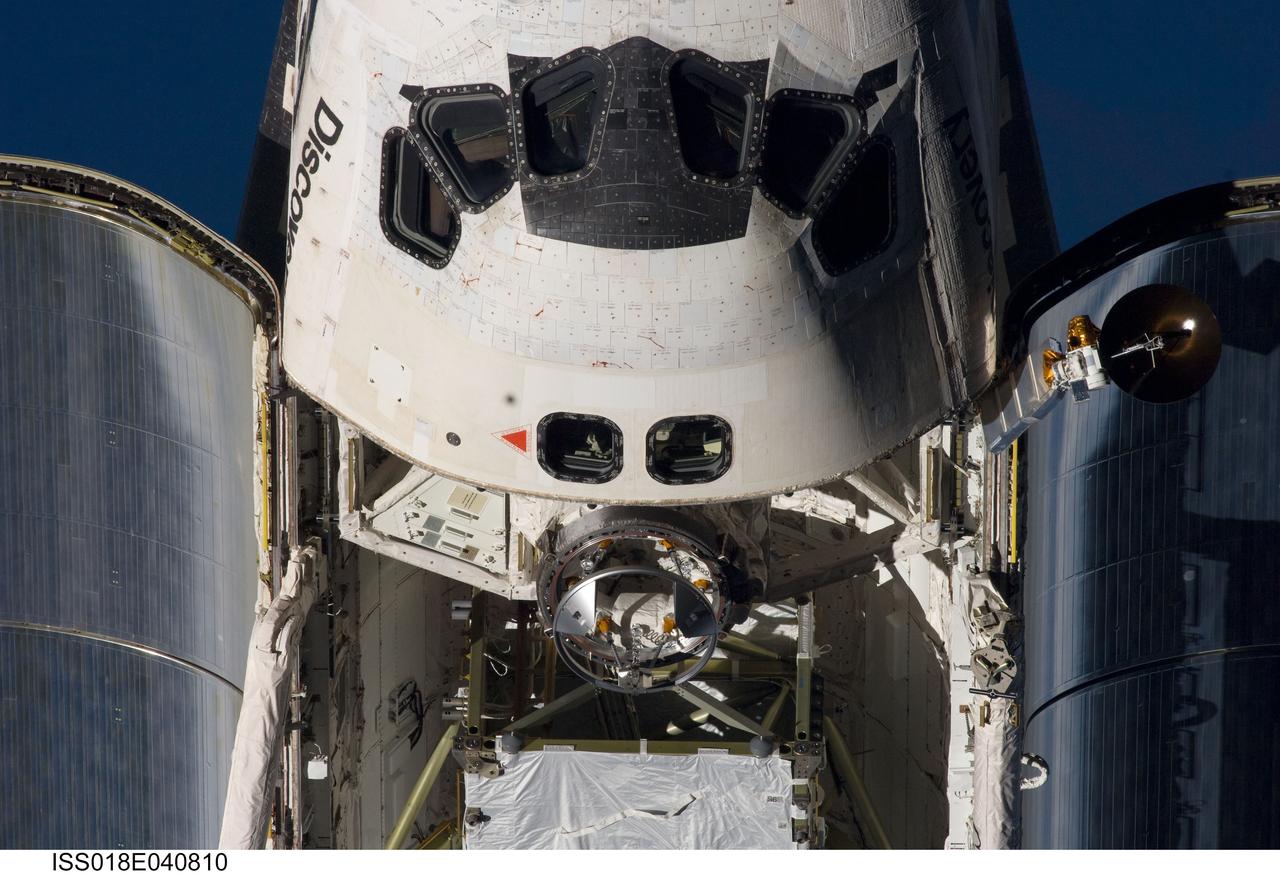
ISS018-E-040810 (17 March 2009) --- An overhead close-up view of the exterior of Space Shuttle Discovery's crew cabin, part of its payload bay and docking system was provided by Expedition 18 crewmembers on the International Space Station. Before docking with the station, astronaut Lee Archambault, STS-119 commander, flew the shuttle through a Rendezvous Pitch Maneuver or basically a backflip to allow the space station crew a good view of Discovery's heat shield. Using digital still cameras equipped with both 400 and 800 millimeter lenses, the ISS crewmembers took a number of photos of the shuttle's thermal protection system and sent them down to teams on the ground for analysis. A 400 millimeter lens was used for this image.
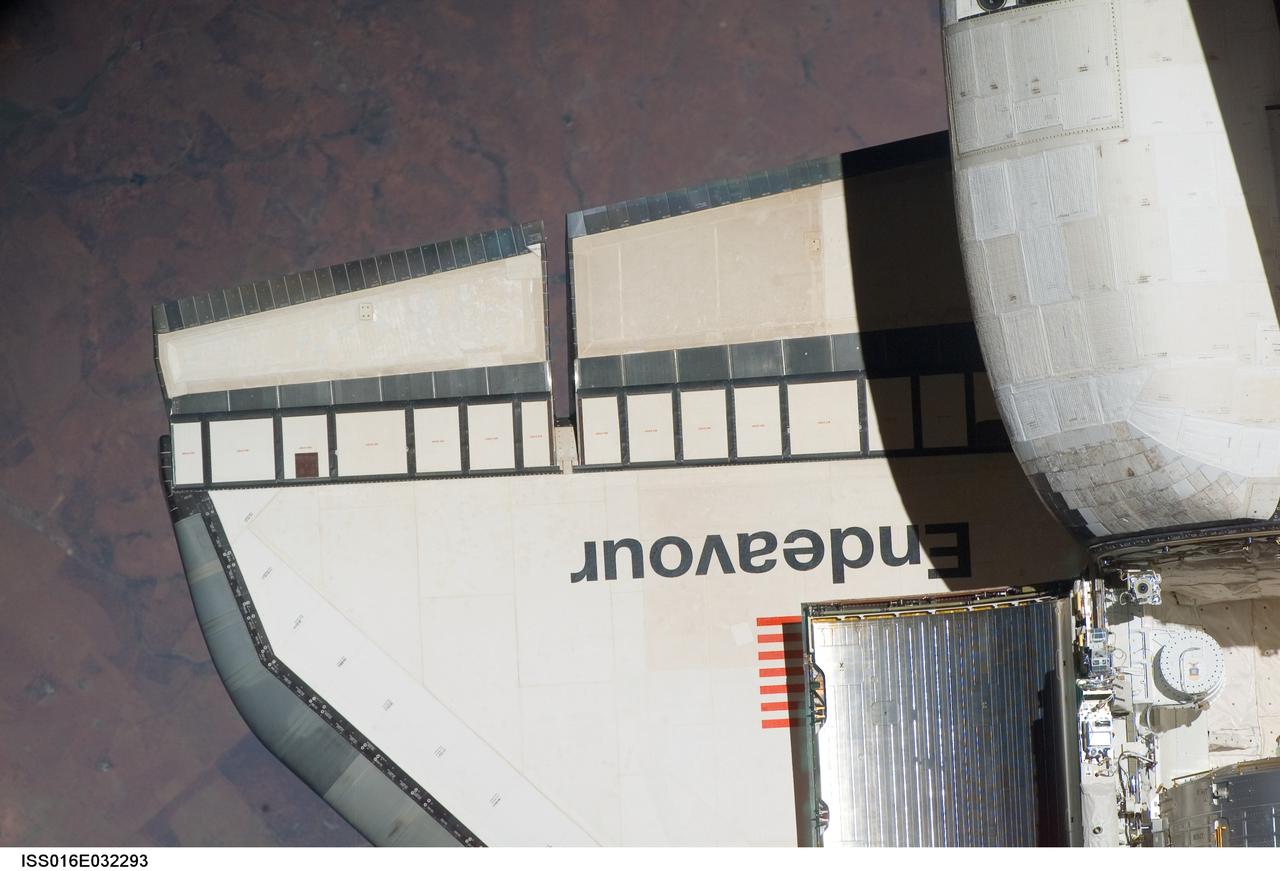
ISS016-E-032293 (12 March 2008) --- An overhead view of part of Space Shuttle Endeavour's starboard wing and part of its orbital maneuvering system (OMS) pods was provided by Expedition 16 crewmembers on the International Space Station (ISS). Before docking with the station, astronaut Dominic Gorie, STS-123 commander, flew the shuttle through a roll pitch maneuver or basically a backflip to allow the space station crew a good view of Endeavour's heat shield. Using digital still cameras equipped with both 400 and 800 millimeter lenses, the ISS crewmembers took a number of photos of the shuttle's thermal protection system and sent them down to teams on the ground for analysis. A 400 millimeter lens was used for this image.
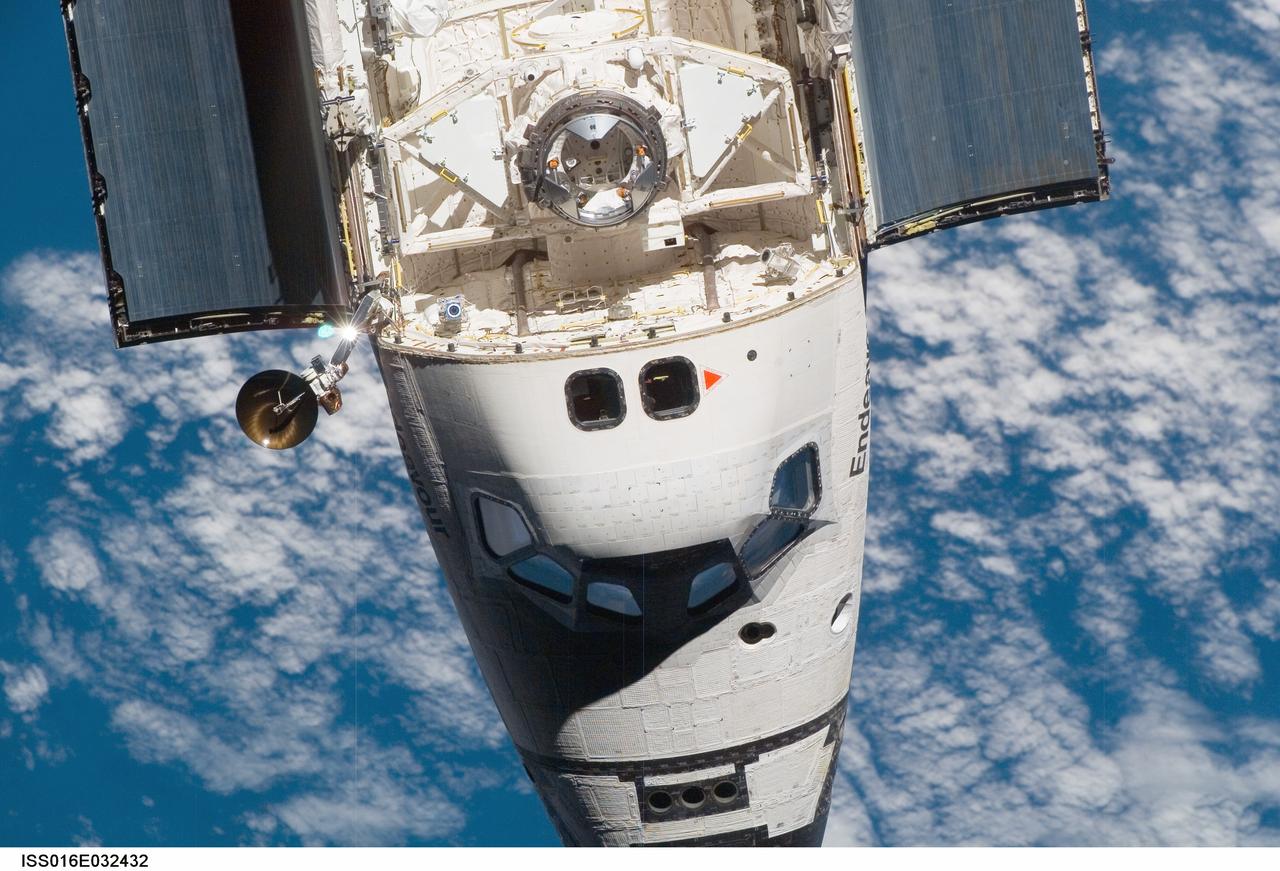
ISS016-E-032432 (12 March 2008) --- An overhead view of the exterior of Space Shuttle Endeavour's crew cabin, part of its payload bay doors and docking system was provided by Expedition 16 crewmembers on the International Space Station (ISS). Before docking with the station, astronaut Dominic Gorie, STS-123 commander, flew the shuttle through a roll pitch maneuver or basically a backflip to allow the space station crew a good view of Endeavour's heat shield. Using digital still cameras equipped with both 400 and 800 millimeter lenses, the ISS crewmembers took a number of photos of the shuttle's thermal protection system and sent them down to teams on the ground for analysis. A 400 millimeter lens was used for this image.
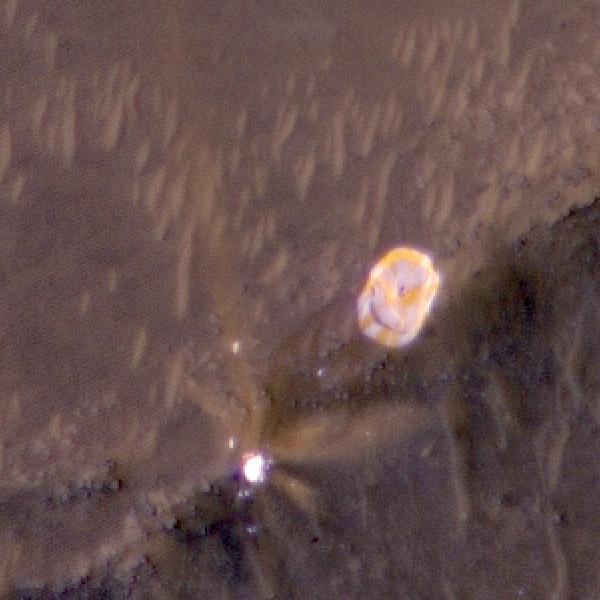
The High Resolution Imaging Experiment (HiRISE) camera aboard NASA's Mars Reconnaissance Orbiter (MRO) was able to capture this image of the final location of the parachute that helped slow down NASA's Perseverance rover during its landing on the surface of Mars. It is a close-up version of a larger image showing several parts of the Mars 2020 mission landing system that got the rover safely on the ground. The image was taken on Feb. 19, 2021. These close-ups were processed to make them easier to see. The insets showing the descent stage and parachute have had color added and include data from the infrared band of light. A key objective for Perseverance's mission on Mars is astrobiology, including the search for signs of ancient microbial life. The rover will characterize the planet's geology and past climate, pave the way for human exploration of the Red Planet, and be the first mission to collect and cache Martian rock and regolith (broken rock and dust). Subsequent NASA missions, in cooperation with ESA (European Space Agency), would send spacecraft to Mars to collect these sealed samples from the surface and return them to Earth for in-depth analysis. The Mars 2020 Perseverance mission is part of NASA's Moon to Mars exploration approach, which includes Artemis missions to the Moon that will help prepare for human exploration of the Red Planet. https://photojournal.jpl.nasa.gov/catalog/PIA24336
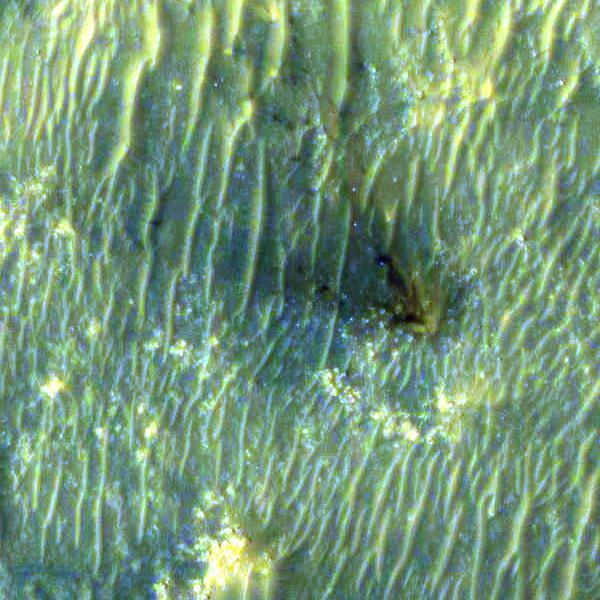
The High Resolution Imaging Experiment (HiRISE) camera aboard NASA's Mars Reconnaissance Orbiter (MRO) was able to capture this image of the final location of the descent stage that helped fly NASA's Perseverance rover down to the surface of Mars. The image was taken on Feb. 19, 2021. It is a close-up version of a larger image showing several parts of the Mars 2020 mission landing system that got the rover safely on the ground. These close-ups of Mars 2020 hardware were processed to make them easier to see. The insets showing the descent stage and parachute have had color added and include data from the infrared band of light. A key objective for Perseverance's mission on Mars is astrobiology, including the search for signs of ancient microbial life. The rover will characterize the planet's geology and past climate, pave the way for human exploration of the Red Planet, and be the first mission to collect and cache Martian rock and regolith (broken rock and dust). Subsequent NASA missions, in cooperation with ESA (European Space Agency), would send spacecraft to Mars to collect these sealed samples from the surface and return them to Earth for in-depth analysis. The Mars 2020 Perseverance mission is part of NASA's Moon to Mars exploration approach, which includes Artemis missions to the Moon that will help prepare for human exploration of the Red Planet. https://photojournal.jpl.nasa.gov/catalog/PIA24335
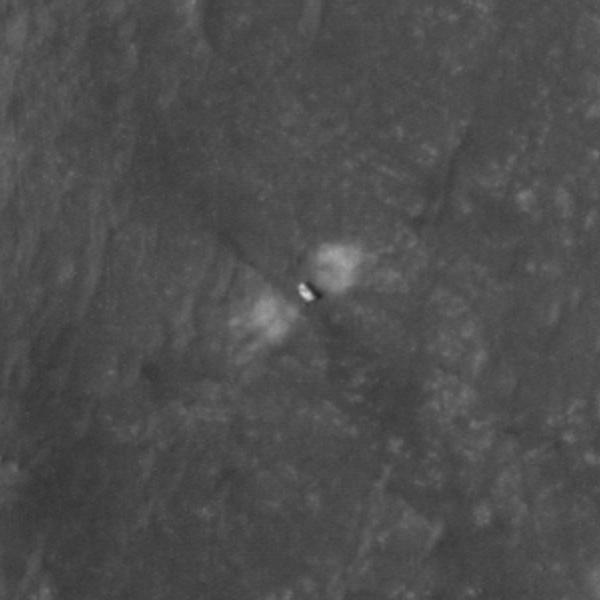
The High Resolution Imaging Experiment (HiRISE) camera aboard NASA's Mars Reconnaissance Orbiter (MRO) was able to capture this image of NASA's Perseverance rover on the surface of Mars. The image was taken on Feb. 19, 2021. It is a close-up version of a larger image showing several parts of the Mars 2020 mission landing system that got the rover safely on the ground. These close-ups of Mars 2020 hardware were processed to make them easier to see. A key objective for Perseverance's mission on Mars is astrobiology, including the search for signs of ancient microbial life. The rover will characterize the planet's geology and past climate, pave the way for human exploration of the Red Planet, and be the first mission to collect and cache Martian rock and regolith (broken rock and dust). Subsequent NASA missions, in cooperation with ESA (European Space Agency), would send spacecraft to Mars to collect these sealed samples from the surface and return them to Earth for in-depth analysis. The Mars 2020 Perseverance mission is part of NASA's Moon to Mars exploration approach, which includes Artemis missions to the Moon that will help prepare for human exploration of the Red Planet. https://photojournal.jpl.nasa.gov/catalog/PIA24334
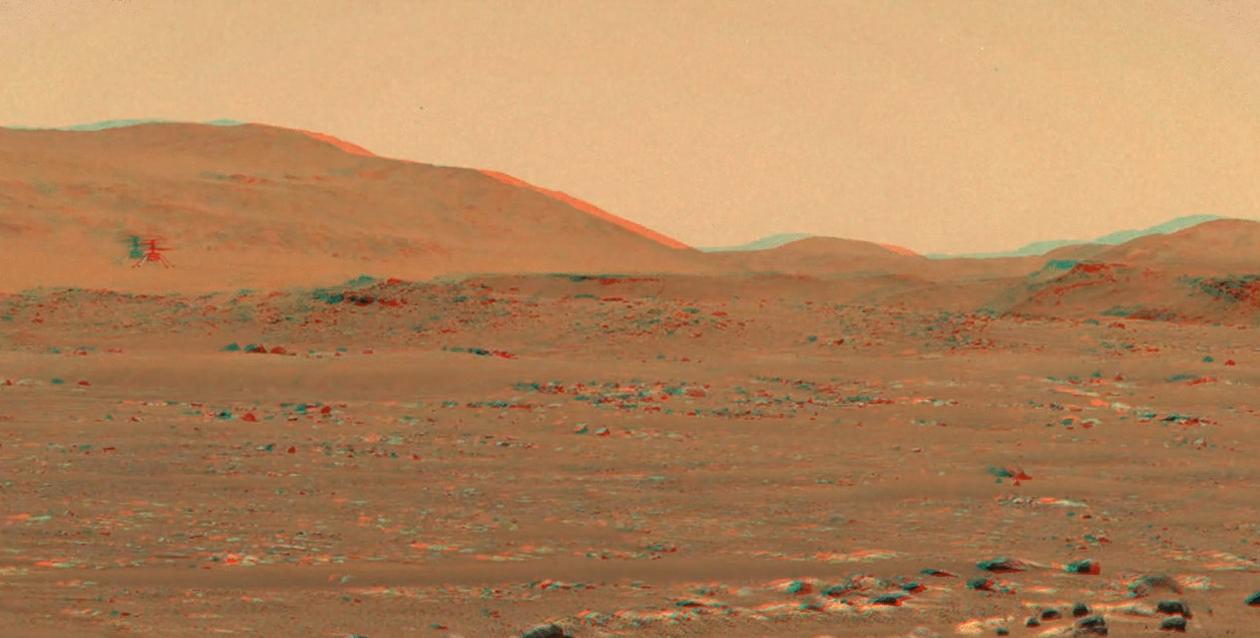
After the zoomable dual-camera Mastcam-Z imager aboard NASA's Perseverance rover captured the third flight of the agency's Ingenuity Mars helicopter on April 25, 2021, Justin Maki, an imaging scientist at NASA's Jet Propulsion Laboratory in Southern California, led the team that stitched the images into a video. The frames of the video were then reprojected to optimize viewing in an anaglyph, or an image seen in 3D when viewed with color-filtered glasses. Arizona State University in Tempe leads the operations of the Mastcam-Z instrument, working in collaboration with Malin Space Science Systems in San Diego. A key objective for Perseverance's mission on Mars is astrobiology, including the search for signs of ancient microbial life. The rover will characterize the planet's geology and past climate, pave the way for human exploration of the Red Planet, and be the first mission to collect and cache Martian rock and regolith (broken rock and dust). Subsequent NASA missions, in cooperation with ESA (European Space Agency), would send spacecraft to Mars to collect these sealed samples from the surface and return them to Earth for in-depth analysis. The Mars 2020 Perseverance mission is part of NASA's Moon to Mars exploration approach, which includes Artemis missions to the Moon that will help prepare for human exploration of the Red Planet. Movie available at https://photojournal.jpl.nasa.gov/catalog/PIA24522
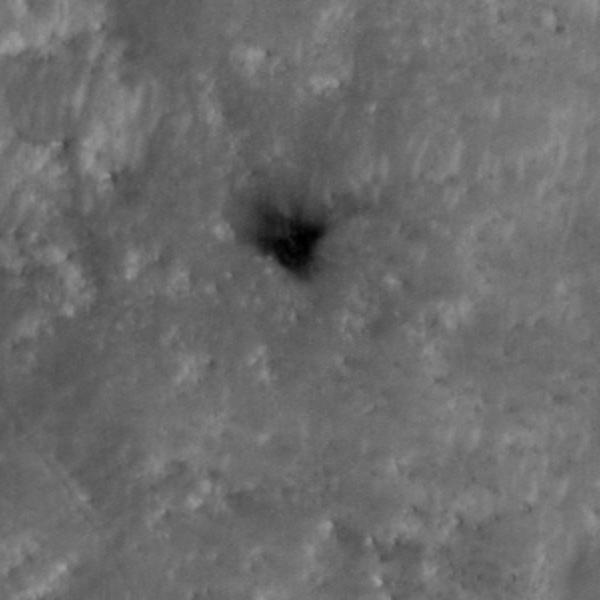
The High Resolution Imaging Experiment (HiRISE) camera aboard NASA's Mars Reconnaissance Orbiter (MRO) was able to capture this image of the final location of the heat shield that helped protect NASA's Perseverance rover during its landing on the surface of Mars. The image was taken on Feb. 19, 2021. It is a close-up version of a larger image showing several parts of the Mars 2020 mission landing system that got the rover safely on the ground. These close-ups of Mars 2020 hardware were processed to make them easier to see. A key objective for Perseverance's mission on Mars is astrobiology, including the search for signs of ancient microbial life. The rover will characterize the planet's geology and past climate, pave the way for human exploration of the Red Planet, and be the first mission to collect and cache Martian rock and regolith (broken rock and dust). Subsequent NASA missions, in cooperation with ESA (European Space Agency), would send spacecraft to Mars to collect these sealed samples from the surface and return them to Earth for in-depth analysis. The Mars 2020 Perseverance mission is part of NASA's Moon to Mars exploration approach, which includes Artemis missions to the Moon that will help prepare for human exploration of the Red Planet. https://photojournal.jpl.nasa.gov/catalog/PIA24337
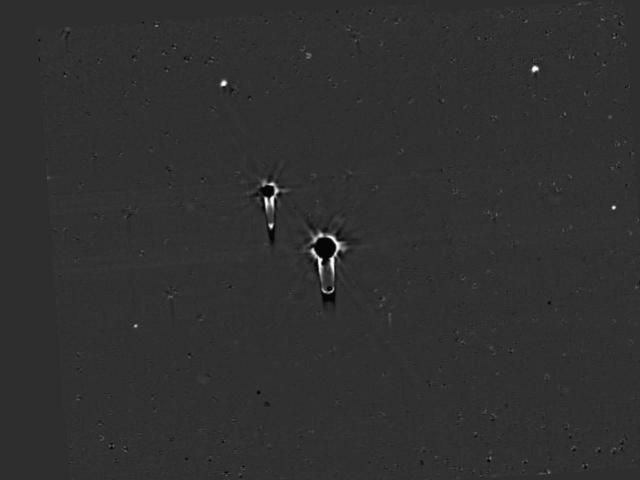
This single frame from a four-frame movie shows New Horizons' final deep search for hazardous material around Pluto, obtained on July 1, 2015. These data allow a highly sensitive search for any new moons. The images were taken with the spacecraft's Long Range Reconnaissance Imager (LORRI) over a 100-minute period, and were the final observations in the series of dedicated searches for hazards in the Pluto system which began on May 11. The images show all five known satellites of Pluto moving in their orbits around the dwarf planet, but analysis of these data has so far not revealed the existence of any additional moons. This means that any undiscovered Plutonian moons further than a few thousand miles from Pluto must be smaller than about 1 mile (1.6 kilometers) in diameter, if their surfaces have similar brightness to Pluto's big moon Charon. For comparison, Pluto's faintest known moon, Styx, which is conspicuous in the lower left quadrant of these images, is about 4 miles (7 kilometers) across, assuming the same surface brightness. The absence of additional moons, and also the absence of detectable rings in the hazard search data, imply that the spacecraft is very unlikely to be damaged by collisions with rings, or dust particles ejected from moons, during its high-speed passage through the Pluto system. The four movie frames were taken at 16:28, 16:38, 17:52, and 18:04 UTC on July 1, from a range of 9.4 million miles (15.2 million kilometers). Each frame is a mosaic of four sets of overlapping images, with a total exposure time of 120 seconds. The images have been heavily processed to remove the glare of Pluto and Charon, and the dense background of stars, though blemishes remain at the locations of many of the brighter stars. The "tails" extending to the right or downward from Pluto and Charon are camera artifacts caused by the extreme overexposure of both objects. Pluto and its five moons Charon, Styx, Nix, Kerberos and Hydra are identified by their initials, and their orbits around the center of gravity of the system (which is located just outside Pluto itself) are also shown. http://photojournal.jpl.nasa.gov/catalog/PIA19701

California, reveals the devastating effect of California's ongoing drought on Sierra Nevada conifer forests. The map will be used to help the U.S. Forest Service assess and respond to the impacts of increased tree mortality caused by the drought, particularly where wildlands meet urban areas within the Sierra National Forest. After several years of extreme drought, the highly stressed conifers (trees or bushes that produce cones and are usually green year-round) of the Sierra Nevada are now more susceptible to bark beetles (Dendroctonus spp.). While bark beetles killing trees in the Sierra Nevada is a natural phenomenon, the scale of mortality in the last couple of years is far greater than previously observed. The U.S. Forest Service is using recent airborne spectroscopic measurements from NASA's Airborne Visible/Infrared Imaging Spectrometer (AVIRIS) instrument aboard NASA's ER-2 aircraft, together with new advanced algorithms, to quantify this impact over this large region of rugged terrain. The high-altitude ER-2 aircraft is based at NASA's Armstrong Flight Research Center, Edwards, California. The image was created by scientists at the USFS's Pacific Southwest Region Remote Sensing Lab, McClellan, California, by performing a time series analysis of AVIRIS images. Scientists evaluated baseline tree mortality on public lands in the summer of 2015 using a machine learning algorithm called "random forest." This algorithm classifies the AVIRIS measurements as dominated by either shrubs, healthy trees or newly dead conifer trees. To quantify how much the amount of dead vegetation increased during the fall of 2015, the Forest Service scientists conducted an advanced spectral mixture analysis. This analysis evaluates each spectrum to determine the fraction of green vegetation, dead vegetation and soil. The full spectral range of AVIRIS is important to separate the signatures of soil and dead vegetation. To produce this comprehensive Sierra National Forest tree mortality map, the result from the summer of 2015 was evaluated to look for increases of more than 10 percent in dead vegetation during the fall of 2015. AVIRIS measures spectra of the Earth system to conduct advanced science research. These western U.S. AVIRIS measurements were acquired as part of NASA's Hyperspectral Infrared Imager (HyspIRI) preparatory airborne campaign. HyspIRI was one of the space missions suggested to NASA by the National Academy of Sciences in its 2007 decadal survey for Earth Science. In the future, HyspIRI could provide spectral and thermal measurements of this type globally for ecosystem research and additional science objectives. http://photojournal.jpl.nasa.gov/catalog/PIA20717
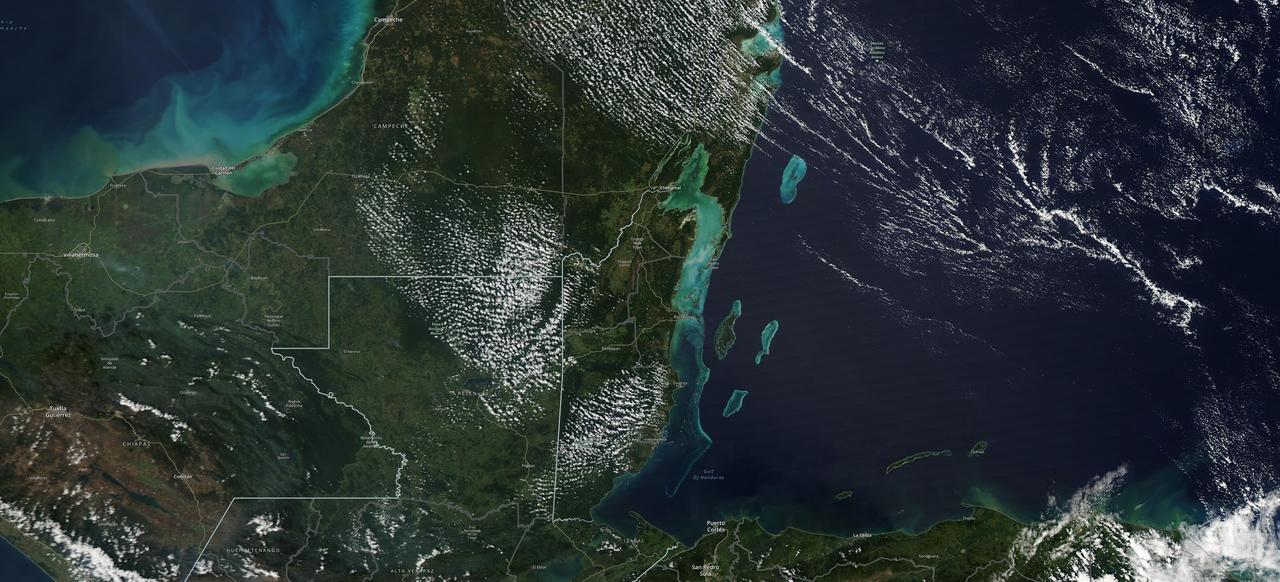
The Moderate Resolution Imaging Spectroradiometer (MODIS) instrument aboard NASA's Aqua satellite captured this image of the Yucatán Peninsula on Feb. 3, 2022. At the center is Belize, a country whose Caribbean coast is home to the Belize Barrier Reef Reserve System, which encompasses a vibrant network of marine environments that supports thousands of animal and plant species and drives Belize's largest industry, tourism. The barrier reef system is among about 1,200 UNESCO World Heritage sites around the world. In a paper published in November 2022 in Frontiers in Remote Sensing, researchers used data from Aqua MODIS to rank 24 protected marine areas off the Belizean coast based on the risks coral face from murky water and rising temperatures. The research also outlined how researchers at NASA's Jet Propulsion Laboratory in Southern California and counterparts in Belize used free, cloud-based data on Google Earth Engine in their analysis. Analyzing imagery from 2002 to 2022, researchers developed a coral vulnerability index – a score between 2 and 12 that characterizes the risk to coral, with higher scores signifying greater risk. Their findings could help management authorities protect the reefs from human impacts such as development, overfishing, pollution, and climate change. https://photojournal.jpl.nasa.gov/catalog/PIA25861
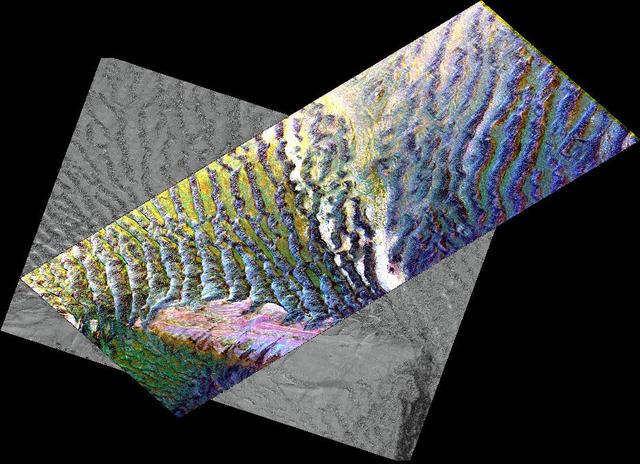
This composite image is of an area thought to contain the ruins of the ancient settlement of Niya. It is located in the southwest corner of the Taklamakan Desert in China Sinjiang Province. This region was part of some of China's earliest dynasties and from the third century BC on was traversed by the famous Silk Road. The Silk Road, passing east-west through this image, was an ancient trade route that led across Central Asia's desert to Persia, Byzantium and Rome. The multi-frequency, multi-polarized radar imagery was acquired on orbit 106 of the space shuttle Endeavour on April 16, 1994 by the Spaceborne Imaging Radar-C/X-band Synthetic Aperture Radar. The image is centered at 37.78 degrees north latitude and 82.41 degrees east longitude. The area shown is approximately 35 kilometers by 83 kilometers (22 miles by 51 miles). The image is a composite of an image from an Earth-orbiting satellite called Systeme Probatoire d'Observation de la Terre (SPOT) and a SIR-C multi-frequency, multi-polarized radar image. The false-color radar image was created by displaying the C-band (horizontally transmitted and received) return in red, the L-band (horizontally transmitted and received) return in green, and the L-band (horizontally transmitted and vertically received) return in blue. The prominent east/west pink formation at the bottom of the image is most likely a ridge of loosely consolidated sedimentary rock. The Niya River -- the black feature in the lower right of the French satellite image -- meanders north-northeast until it clears the sedimentary ridge, at which point it abruptly turns northwest. Sediment and evaporite deposits left by the river over millennia dominate the center and upper right of the radar image (in light pink). High ground, ridges and dunes are seen among the riverbed meanderings as mottled blue. Through image enhancement and analysis, a new feature probably representing a man-made canal has been discovered and mapped. http://photojournal.jpl.nasa.gov/catalog/PIA01726
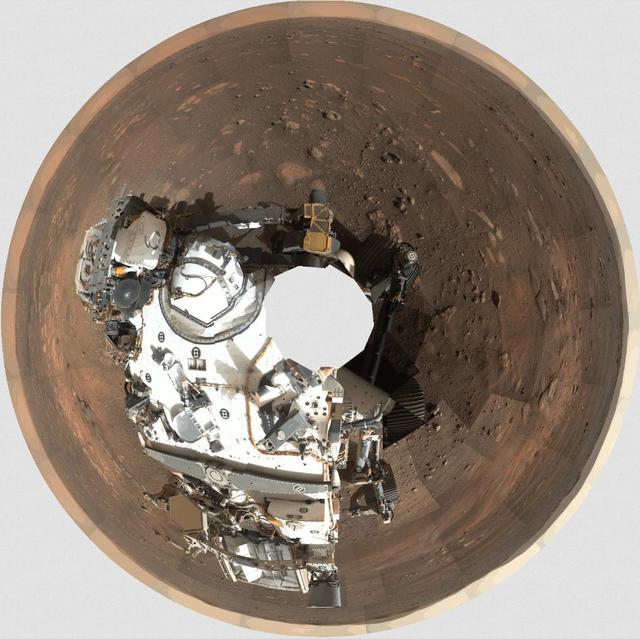
This animation shows the order in which the 142 images that make up Mastcam-Z's first 360-degree panorama were taken. Mastcam-Z is a pair of zoomable cameras on the mast, or "head," of NASA's Perseverance Mars rover. Arizona State University in Tempe leads the operations of the Mastcam-Z instrument, working in collaboration with Malin Space Science Systems in San Diego. A key objective for Perseverance's mission on Mars is astrobiology, including the search for signs of ancient microbial life. The rover will characterize the planet's geology and past climate, pave the way for human exploration of the Red Planet, and be the first mission to collect and cache Martian rock and regolith (broken rock and dust). Subsequent NASA missions, in cooperation with ESA (European Space Agency), would send spacecraft to Mars to collect these sealed samples from the surface and return them to Earth for in-depth analysis. Animation available at https://photojournal.jpl.nasa.gov/catalog/PIA24444
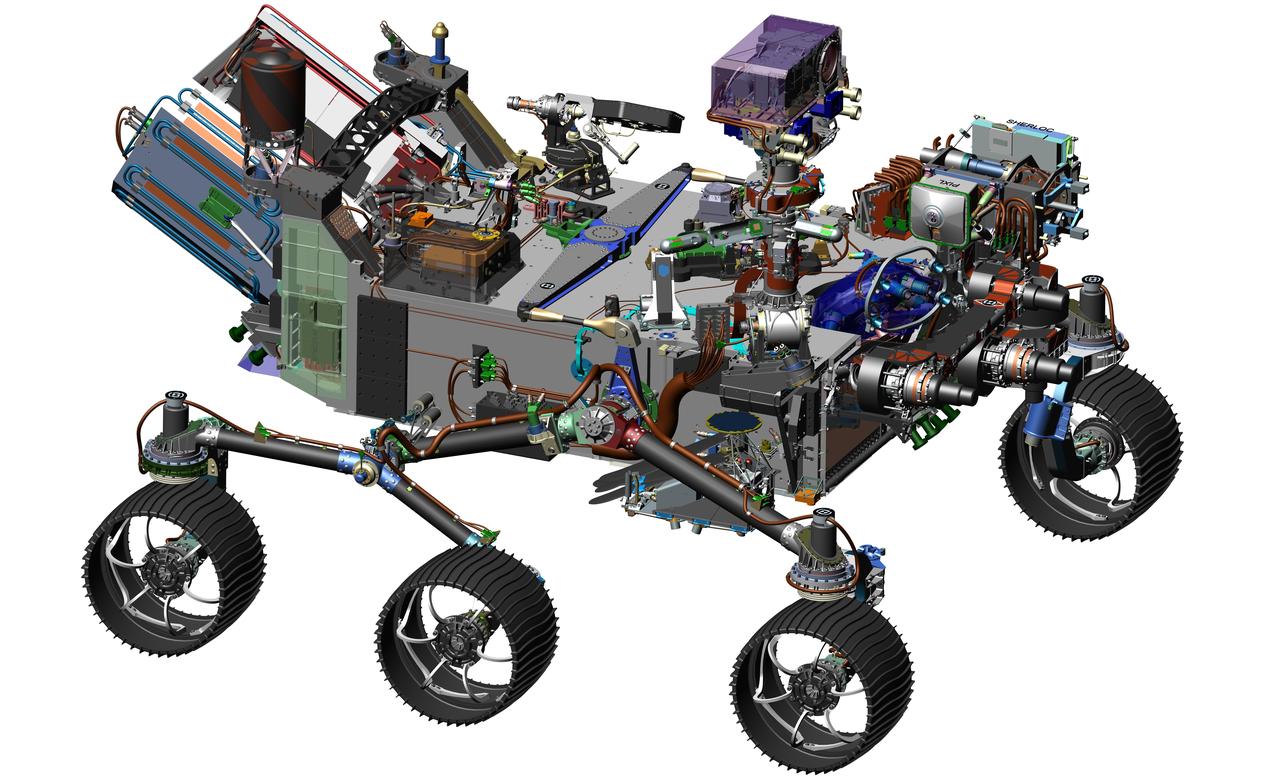
NASA's 2020 Mars rover mission will go to a region of Mars thought to have offered favorable conditions long ago for microbial life, and the rover will search for signs of past life there. It will also collect and cache samples for potential return to Earth, for many types of laboratory analysis. As a pioneering step toward how humans on Mars will use the Red Planet's natural resources, the rover will extract oxygen from the Martian atmosphere. This 2016 image comes from computer-assisted-design work on the 2020 rover. The design leverages many successful features of NASA's Curiosity rover, which landed on Mars in 2012, but it adds new science instruments and a sampling system to carry out the new goals for the mission. http://photojournal.jpl.nasa.gov/catalog/PIA20759
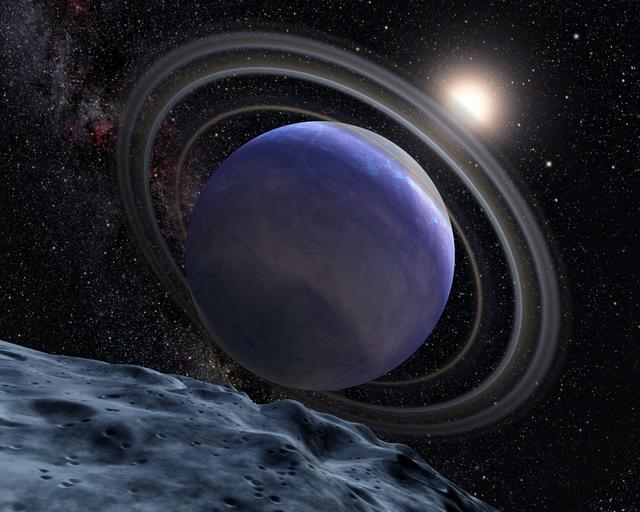
Release Date April 1, 2009 This is an artistic illustration of the giant planet HR 8799b. The planet was first discovered in 2007 at the Gemini North observatory. It was identified in the NICMOS archival data in a follow-up search of NICMOS archival data to see if Hubble had also serendipitously imaged it. The planet is young and hot, at a temperature of 1500 degrees Fahrenheit. It is slightly larger than Jupiter and may be at least seven times more massive. Analysis of the NICMOS data suggests the planet has water vapor in its atmosphere and is only partially cloud covered. It is not known if the planet has rings or moons, but circumplanetary debris is common among the outer planets of our solar system. Credit: NASA/Goddard Space Flight Center/ESA/G. Bacon (STScI) To learn more about the Hubble Space Telescope go here: <a href="http://www.nasa.gov/mission_pages/hubble/main/index.html" rel="nofollow">www.nasa.gov/mission_pages/hubble/main/index.html</a>
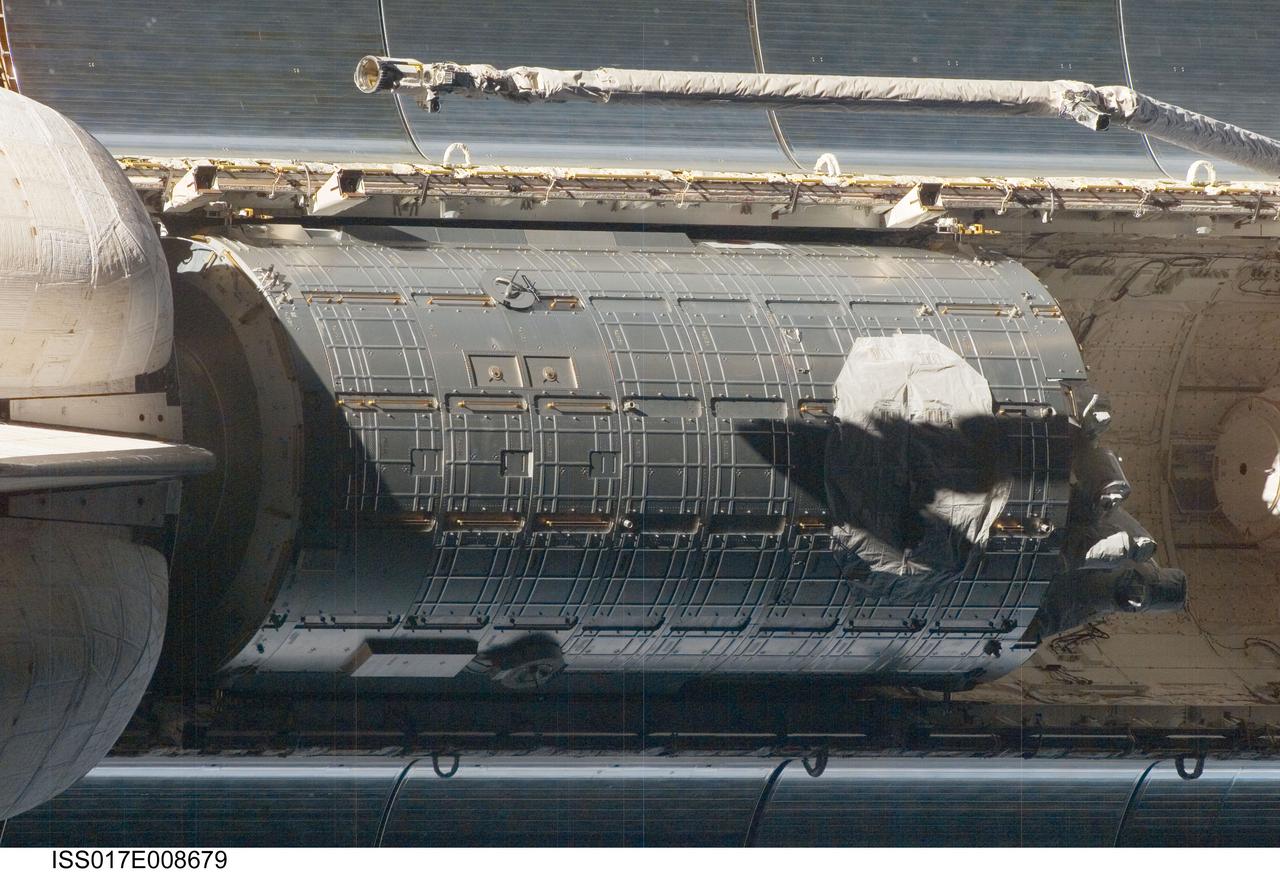
ISS017-E-008679 (2 June 2008) --- An overhead view of the second component of the Japan Aerospace Exploration Agency's Kibo laboratory, the Japanese Pressurized Module (JPM) in Space Shuttle Discovery's cargo bay was provided by Expedition 17 crewmembers. Before docking with the station, astronaut Mark Kelly, STS-124 commander, flew the shuttle through a roll pitch maneuver or basically a backflip to allow the space station crew a good view of Discovery's heat shield. Using digital still cameras equipped with both 400 and 800 millimeter lenses, the ISS crewmembers took a number of photos of the shuttle's thermal protection system and sent them down to teams on the ground for analysis. A 400 millimeter lens was used for this image.
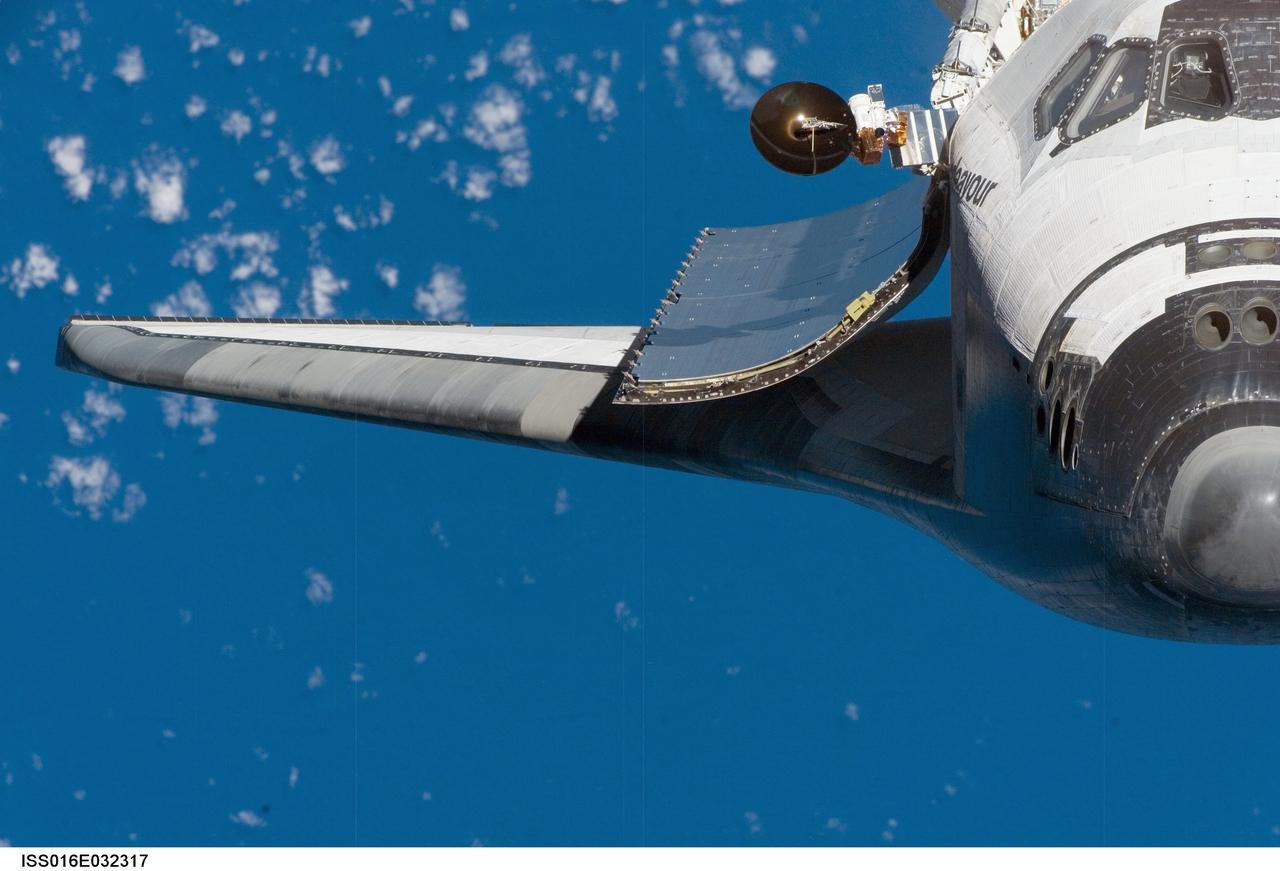
ISS016-E-032317 (12 March 2008) --- A close-up view of the exterior of Space Shuttle Endeavour's crew cabin, starboard wing and payload bay door was provided by Expedition 16 crewmembers on the International Space Station (ISS). Before docking with the station, astronaut Dominic Gorie, STS-123 commander, flew the shuttle through a roll pitch maneuver or basically a backflip to allow the space station crew a good view of Endeavour's heat shield. Using digital still cameras equipped with both 400 and 800 millimeter lenses, the ISS crewmembers took a number of photos of the shuttle's thermal protection system and sent them down to teams on the ground for analysis. A 400 millimeter lens was used for this image.
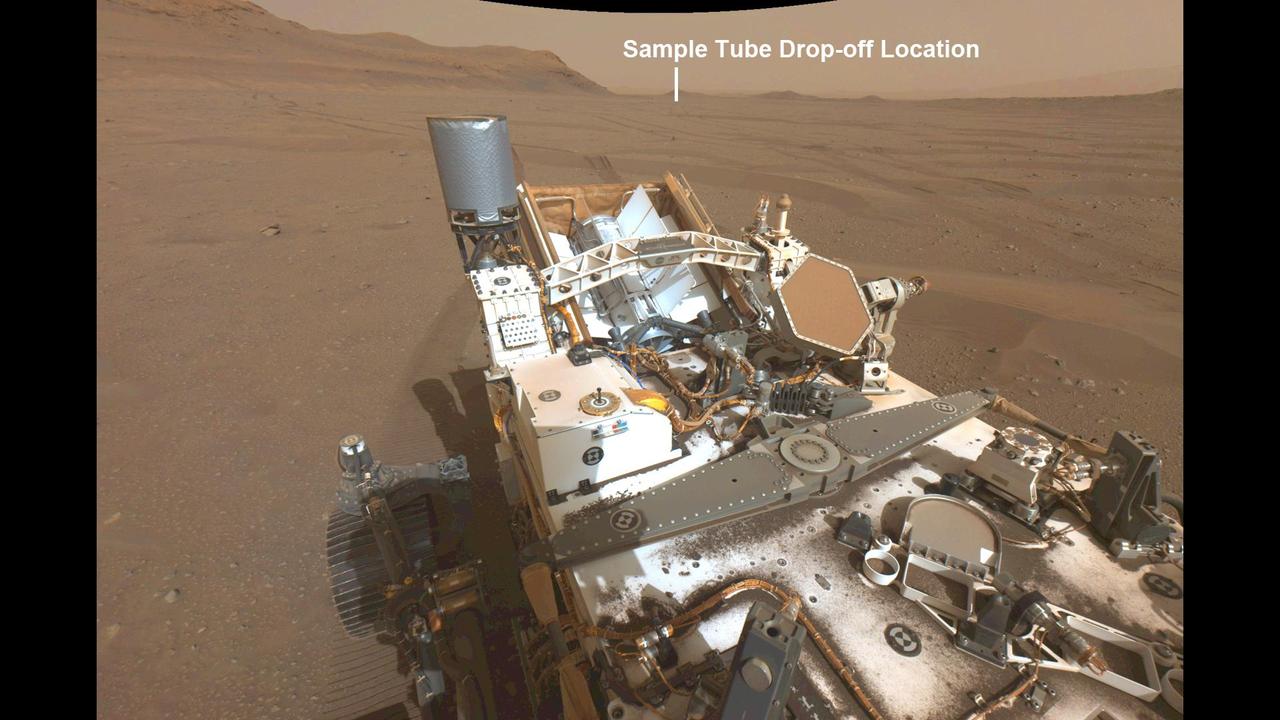
This annotated image from NASA's Perseverance Mars rover shows its wheel tracks in Jezero Crater and a distant view of the first potential location it could deposit a group of sample tubes for possible future return to Earth. The image was taken on Aug. 29, 2022, the 542nd Martian day, or sol, of the rover's mission, by Perseverance's navigation camera. Sample tubes already filled with rock are currently stored in the rover's Sampling and Caching System. Perseverance will deposit select samples in designated locations. Subsequent NASA missions, in cooperation with ESA (European Space Agency), would collect these sealed samples from the surface and return them to Earth for in-depth analysis as part of the Mars Sample Return campaign. This image has been linearized to remove optical lens distortion effects. A key objective for Perseverance's mission on Mars is astrobiology, including the search for signs of ancient microbial life. The rover will characterize the planet's geology and past climate, pave the way for human exploration of the Red Planet, and be the first mission to collect and cache Martian rock and regolith (broken rock and dust). The Mars 2020 Perseverance mission is part of NASA's Moon to Mars exploration approach, which includes Artemis missions to the Moon that will help prepare for human exploration of the Red Planet. https://photojournal.jpl.nasa.gov/catalog/PIA25243
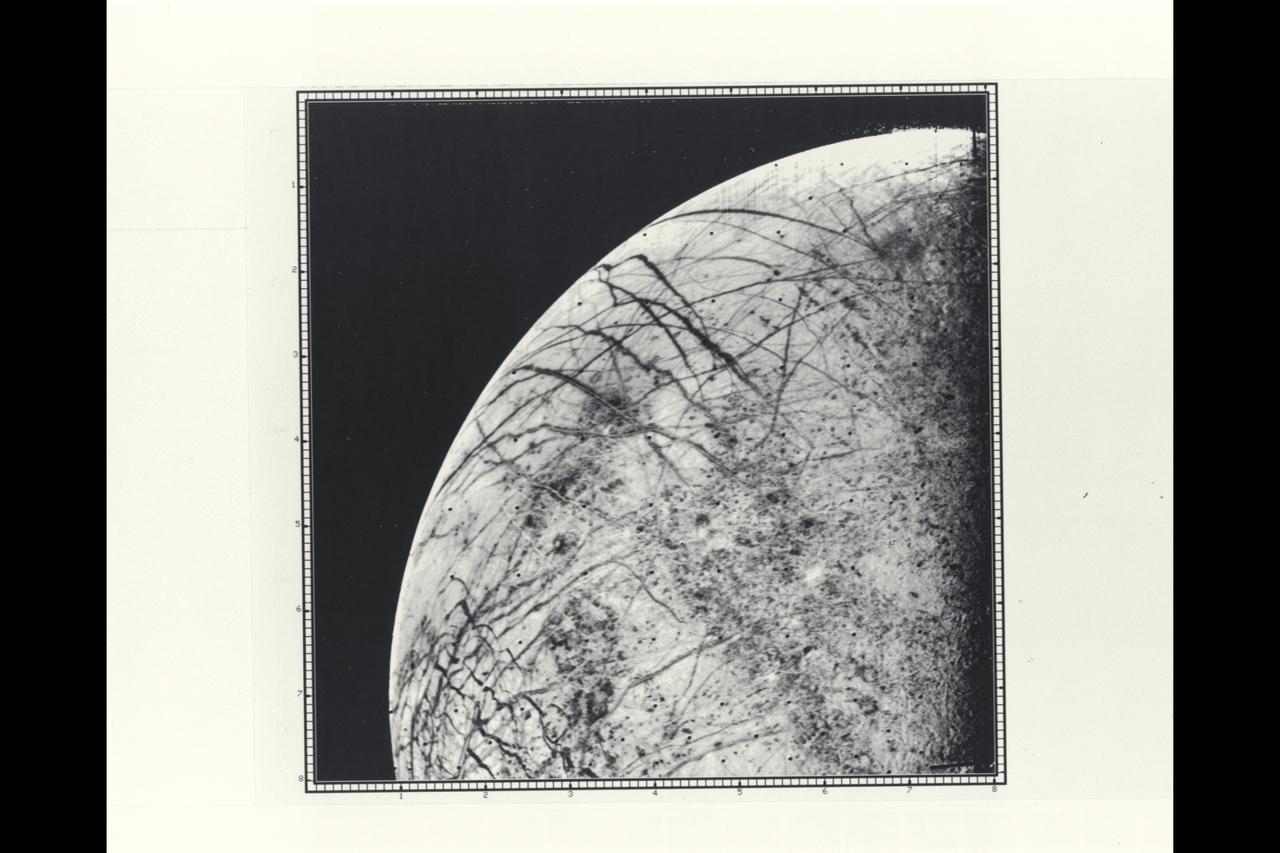
P-21758 BW Range: 246,000 kilometers (152,000 miles) This picture by Voyager 2 is the first close look ever obtained of Jupiter's satellite, Europa. The linear crack-like features had been seen from a much greater distance by Voyager 1 but this image provides a resolution of about four kilometers (2.5 miles). The complicated linear features appear even more like cracks or huge fractures in these images. Also seen are somewhat darker mottled regions which appear to have a slightly pitted appearance, perhaps due to small scale craters. No large craters (more than five kilometers in diameter) are easily identifiable in the Europa photographs to date, suggesting that this satellite has a young surface relative to Ganymede and Callisto, although not perhaps as young as Io's. Various models for Europa's structure will be tested during analysis of these images, including the possibility that the surface is a thin ice crust overlying water or softer ice and that the fracture systems seen are breaks in that crust. Resurfacing mechanisms such as production of fresh ice or snow along the cracks and cold glacier-like flows are being considered as possibilities for removing evidence of impact events. Europa thus appears to truly be a satellite with many properties intermediate between Ganymede and Io.
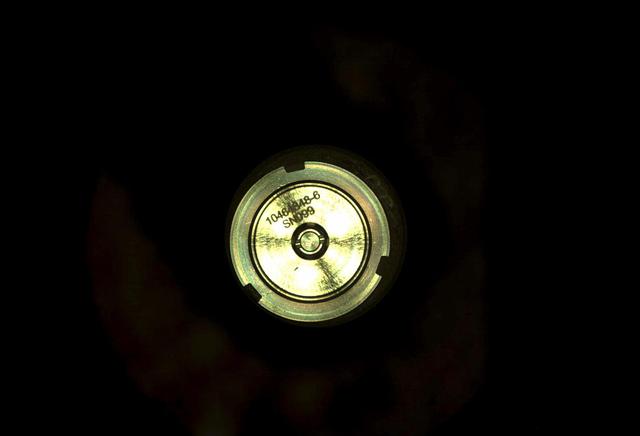
The first cored sample of Mars rock acquired by NASA's Perseverance rover is sealed inside its titanium container tube in this image taken by rover's Sampling and Caching System Camera (known as CacheCam). The image was taken on Sept. 6, 2021 (the 194th sol, or Martian day, of the mission), after the seal was attached and hermetically fixed in place onto the tube. The seal's item and serial numbers can be seen near the center of the disk. An additional set of images shows the tube before and after sealing. Perseverance engineers designed a visual check to confirm the hermetic seal. The distance between the two rings outside the item and serial numbers increases. A key objective for Perseverance's mission on Mars is astrobiology, including the search for signs of ancient microbial life. The rover will characterize the planet's geology and past climate, pave the way for human exploration of the Red Planet, and be the first mission to collect and cache Martian rock and regolith (broken rock and dust). Subsequent NASA missions, in cooperation with ESA (European Space Agency), would send spacecraft to Mars to collect these sealed samples from the surface and return them to Earth for in-depth analysis. The Mars 2020 Perseverance mission is part of NASA's Moon to Mars exploration approach, which includes Artemis missions to the Moon that will help prepare for human exploration of the Red Planet. Animation available at https://photojournal.jpl.nasa.gov/catalog/PIA24807
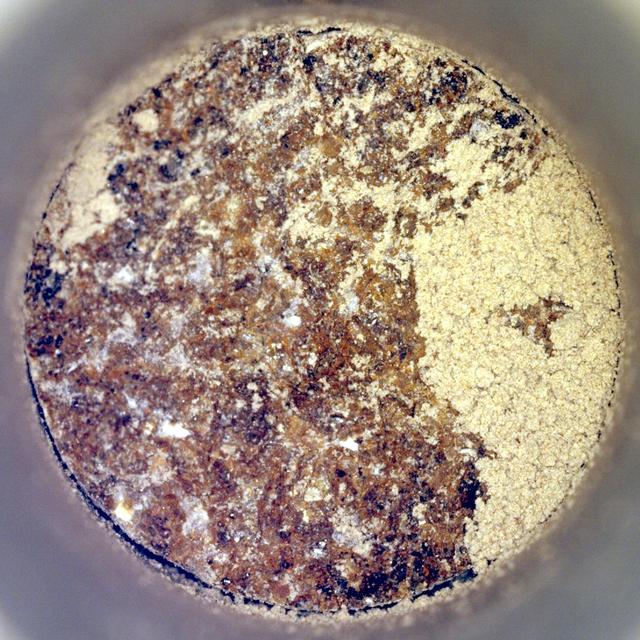
NASA's Perseverance Mars rover captured this image of a sample cored from a rock called "Bunsen Peak" on March 12, 2024, the 1,088th Martian day, or sol, of the rover's mission. The image shows the bottom of the core. The image was taken by Perseverance's Sampling and Caching System Camera, or CacheCam, located inside the rover's underbelly. The camera looks down into the top of sample tubes to take close-up pictures of the sampled material and the tubes as they are prepared for sealing and storage. A key objective for Perseverance's mission on Mars is astrobiology, including the search for signs of ancient microbial life. The rover will characterize the planet's geology and past climate, pave the way for human exploration of the Red Planet, and be the first mission to collect and cache Martian rock and regolith. Subsequent NASA missions, in cooperation with ESA (European Space Agency), would send spacecraft to Mars to collect these sealed samples from the surface and return them to Earth for in-depth analysis. The Mars 2020 Perseverance mission is part of NASA's Moon to Mars exploration approach, which includes Artemis missions to the Moon that will help prepare for human exploration of the Red Planet. https://photojournal.jpl.nasa.gov/catalog/PIA26313
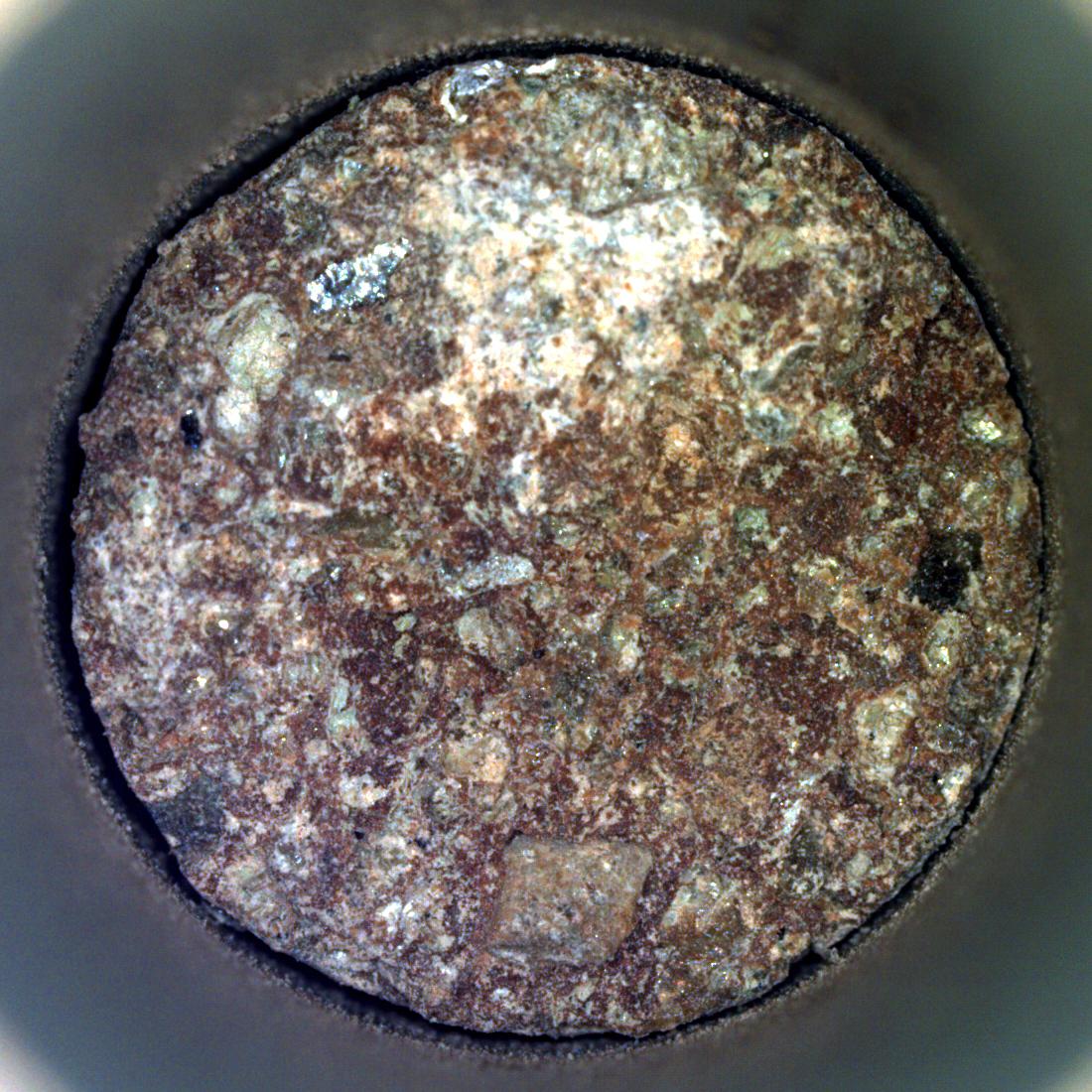
NASA's Perseverance Mars rover captured this image of a rock core nicknamed "Otis Peak" on June 12, 2023, the 822nd day, or sol, of the mission. The image shows the bottom of the Otis Peak core, which was collected from a conglomerate rock called "Emerald Lake." The distinctly colored areas are individual minerals (or rock fragments) transported by the river that once flowed into Mars' Jezero Crater. The image was taken by Perseverance's Sampling and Caching System Camera, or CacheCam, located inside the rover underbelly. The camera looks down into the top of a sample tube to take close-up pictures of the sampled material and the tube as it's prepared for sealing and storage. A key objective for Perseverance's mission on Mars is astrobiology, including the search for signs of ancient microbial life. The rover will characterize the planet's geology and past climate, pave the way for human exploration of the Red Planet, and be the first mission to collect and cache Martian rock and regolith (broken rock and dust). Subsequent NASA missions, in cooperation with ESA (European Space Agency), would send spacecraft to Mars to collect these sealed samples from the surface and return them to Earth for in-depth analysis. The Mars 2020 Perseverance mission is part of NASA's Moon to Mars exploration approach, which includes Artemis missions to the Moon that will help prepare for human exploration of the Red Planet. https://photojournal.jpl.nasa.gov/catalog/PIA25962
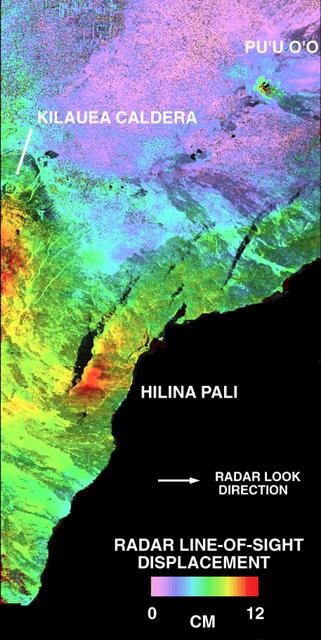
This is a deformation map of the south flank of Kilauea volcano on the big island of Hawaii, centered at 19.5 degrees north latitude and 155.25 degrees west longitude. The map was created by combining interferometric radar data -- that is data acquired on different passes of the space shuttle which are then overlayed to obtain elevation information -- acquired by the Spaceborne Imaging Radar-C/X-band Synthetic Aperture Radar during its first flight in April 1994 and its second flight in October 1994. The area shown is approximately 40 kilometers by 80 kilometers (25 miles by 50 miles). North is toward the upper left of the image. The colors indicate the displacement of the surface in the direction that the radar instrument was pointed (toward the right of the image) in the six months between images. The analysis of ground movement is preliminary, but appears consistent with the motions detected by the Global Positioning System ground receivers that have been used over the past five years. The south flank of the Kilauea volcano is among the most rapidly deforming terrains on Earth. Several regions show motions over the six-month time period. Most obvious is at the base of Hilina Pali, where 10 centimeters (4 inches) or more of crustal deformation can be seen in a concentrated area near the coastline. On a more localized scale, the currently active Pu'u O'o summit also shows about 10 centimeters (4 inches) of change near the vent area. Finally, there are indications of additional movement along the upper southwest rift zone, just below the Kilauea caldera in the image. Deformation of the south flank is believed to be the result of movements along faults deep beneath the surface of the volcano, as well as injections of magma, or molten rock, into the volcano's "plumbing" system. Detection of ground motions from space has proven to be a unique capability of imaging radar technology. Scientists hope to use deformation data acquired by SIR-C/X-SAR and future imaging radar missions to help in better understanding the processes responsible for volcanic eruptions and earthquakes. http://photojournal.jpl.nasa.gov/catalog/PIA01758
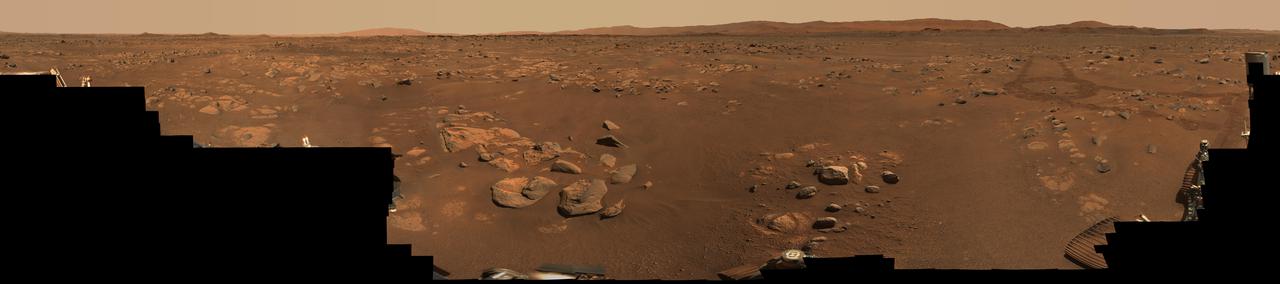
NASA's Perseverance Mars rover used its Mastcam-Z stereo imaging system to capture this 360-degree panorama of "Van Zyl Overlook," where the rover was parked for 13 days as the Ingenuity helicopter performed its first flights. The 2.4 billion-pixel panorama is made up of 992 individual right-eye Mastcam-Z images stitched together. The images were taken between April 15 and 26, 2021, or the 53rd and 64th Martian days, or sols, of the mission. A few small patches of near-field sand had been covered by parts of Perseverance when the right-eye Mastcam-Z images were taken; those gaps were filled with images of the same sandy patches taken by the Mastcam-Z left-eye camera at the same time, or from the earlier navigation camera images. Imaging coverage of the sky has also been digitally smoothed and expanded based on the actual sky color observed as the panorama was being acquired on Mars. Arizona State University in Tempe leads the operations of the Mastcam-Z instrument, working in collaboration with Malin Space Science Systems in San Diego. A key objective for Perseverance's mission on Mars is astrobiology, including the search for signs of ancient microbial life. The rover will characterize the planet's geology and past climate, pave the way for human exploration of the Red Planet, and be the first mission to collect and cache Martian rock and regolith (broken rock and dust). Subsequent NASA missions, in cooperation with ESA (European Space Agency), would send spacecraft to Mars to collect these sealed samples from the surface and return them to Earth for in-depth analysis. The Mars 2020 Perseverance mission is part of NASA's Moon to Mars exploration approach, which includes Artemis missions to the Moon that will help prepare for human exploration of the Red Planet. https://photojournal.jpl.nasa.gov/catalog/PIA24663
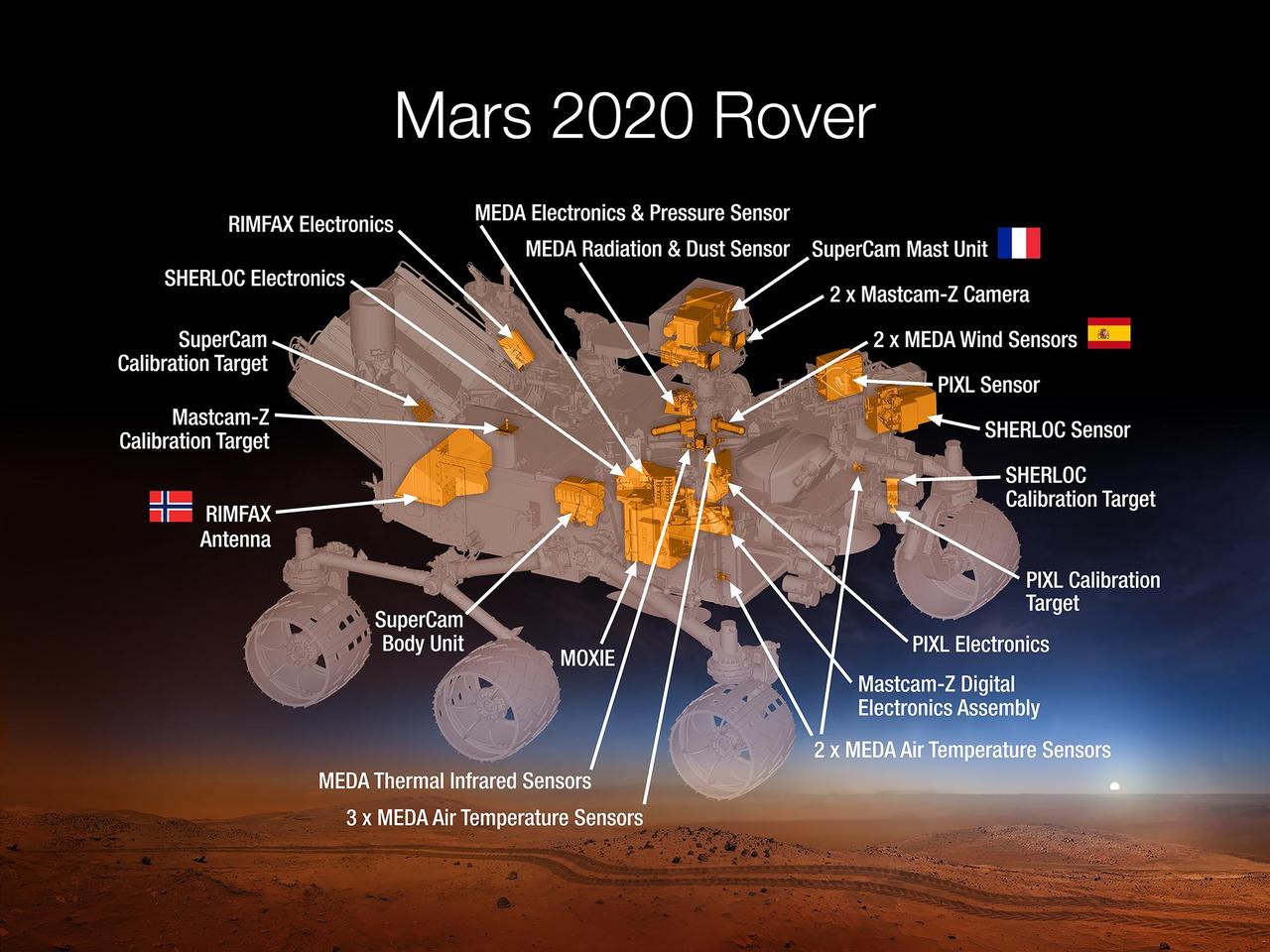
This 2015 diagram shows components of the investigations payload for NASA's Mars 2020 rover mission. Mars 2020 will re-use the basic engineering of NASA's Mars Science Laboratory to send a different rover to Mars, with new objectives and instruments, launching in 2020. The rover will carry seven instruments to conduct its science and exploration technology investigations. They are: Mastcam-Z, an advanced camera system with panoramic and stereoscopic imaging capability and the ability to zoom. The instrument also will determine mineralogy of the Martian surface and assist with rover operations. The principal investigator is James Bell, Arizona State University in Tempe. SuperCam, an instrument that can provide imaging, chemical composition analysis, and mineralogy. The instrument will also be able to detect the presence of organic compounds in rocks and regolith from a distance. The principal investigator is Roger Wiens, Los Alamos National Laboratory, Los Alamos, New Mexico. This instrument also has a significant contribution from the Centre National d'Etudes Spatiales, Institut de Recherche en Astrophysique et Planétologie (CNES/IRAP) France. Planetary Instrument for X-ray Lithochemistry (PIXL), an X-ray fluorescence spectrometer that will also contain an imager with high resolution to determine the fine-scale elemental composition of Martian surface materials. PIXL will provide capabilities that permit more detailed detection and analysis of chemical elements than ever before. The principal investigator is Abigail Allwood, NASA's Jet Propulsion Laboratory, Pasadena, California. Scanning Habitable Environments with Raman & Luminescence for Organics and Chemicals (SHERLOC), a spectrometer that will provide fine-scale imaging and uses an ultraviolet (UV) laser to determine fine-scale mineralogy and detect organic compounds. SHERLOC will be the first UV Raman spectrometer to fly to the surface of Mars and will provide complementary measurements with other instruments in the payload. SHERLOC includes a high-resolution color camera for microscopic imaging of Mars' surface. The principal investigator is Luther Beegle, JPL. The Mars Oxygen ISRU Experiment (MOXIE), an exploration technology investigation that will produce oxygen from Martian atmospheric carbon dioxide. The principal investigator is Michael Hecht, Massachusetts Institute of Technology, Cambridge, Massachusetts. Mars Environmental Dynamics Analyzer (MEDA), a set of sensors that will provide measurements of temperature, wind speed and direction, pressure, relative humidity and dust size and shape. The principal investigator is Jose Rodriguez-Manfredi, Centro de Astrobiologia, Instituto Nacional de Tecnica Aeroespacial, Spain. The Radar Imager for Mars' Subsurface Experiment (RIMFAX), a ground-penetrating radar that will provide centimeter-scale resolution of the geologic structure of the subsurface. The principal investigator is Svein-Erik Hamran, the Norwegian Defence Research Establishment, Norway. http://photojournal.jpl.nasa.gov/catalog/PIA19672

This color image of the sun, Earth and Venus was taken by the Voyager 1 spacecraft Feb. 14, 1990, when it was approximately 32 degrees above the plane of the ecliptic and at a slant-range distance of approximately 4 billion miles. It is the first -- and may be the only -- time that we will ever see our solar system from such a vantage point. The image is a portion of a wide-angle image containing the sun and the region of space where the Earth and Venus were at the time with two narrow-angle pictures centered on each planet. The wide-angle was taken with the camera's darkest filter (a methane absorption band), and the shortest possible exposure (5 thousandths of a second) to avoid saturating the camera's vidicon tube with scattered sunlight. The sun is not large in the sky as seen from Voyager's perspective at the edge of the solar system but is still eight million times brighter than the brightest star in Earth's sky, Sirius. The image of the sun you see is far larger than the actual dimension of the solar disk. The result of the brightness is a bright burned out image with multiple reflections from the optics in the camera. The "rays" around the sun are a diffraction pattern of the calibration lamp which is mounted in front of the wide angle lens. The two narrow-angle frames containing the images of the Earth and Venus have been digitally mosaiced into the wide-angle image at the appropriate scale. These images were taken through three color filters and recombined to produce a color image. The violet, green and blue filters were used; exposure times were, for the Earth image, 0.72, 0.48 and 0.72 seconds, and for the Venus frame, 0.36, 0.24 and 0.36, respectively. Although the planetary pictures were taken with the narrow-angle camera (1500 mm focal length) and were not pointed directly at the sun, they show the effects of the glare from the nearby sun, in the form of long linear streaks resulting from the scattering of sunlight off parts of the camera and its sun shade. From Voyager's great distance both Earth and Venus are mere points of light, less than the size of a picture element even in the narrow-angle camera. Earth was a crescent only 0.12 pixel in size. Coincidentally, Earth lies right in the center of one of the scattered light rays resulting from taking the image so close to the sun. Detailed analysis also suggests that Voyager detected the moon as well, but it is too faint to be seen without special processing. Venus was only 0.11 pixel in diameter. The faint colored structure in both planetary frames results from sunlight scattered in the optics. http://photojournal.jpl.nasa.gov/catalog/PIA00450

P/2013 P5 on September 23, 2013. --- This NASA Hubble Space Telescope set of images reveals a never-before-seen set of six comet-like tails radiating from a body in the asteroid belt, designated P/2013 P5. The asteroid was discovered as an unusually fuzzy-looking object with the Panoramic Survey Telescope and Rapid Response System (Pan-STARRS) survey telescope in Hawaii. The multiple tails were discovered in Hubble images taken on Sept. 10, 2013. When Hubble returned to the asteroid on Sept. 23, the asteroid's appearance had totally changed. It looked as if the entire structure had swung around. One interpretation is that the asteroid's rotation rate has been increased to the point where dust is falling off the surface and escaping into space where the pressure of sunlight sweeps out fingerlike tails. According to this theory, the asteroid's spin has been accelerated by the gentle push of sunlight. The object, estimated to be no more than 1,400 feet across, has ejected dust for at least five months, based on analysis of the tail structure. These visible-light, false-color images were taken with Hubble's Wide Field Camera 3. Object Name: P/2013 P5 Image Type: Astronomical/Annotated Credit: NASA, ESA, and D. Jewitt (UCLA) <b><a href="http://www.nasa.gov/audience/formedia/features/MP_Photo_Guidelines.html" rel="nofollow">NASA image use policy.</a></b> <b><a href="http://www.nasa.gov/centers/goddard/home/index.html" rel="nofollow">NASA Goddard Space Flight Center</a></b> enables NASA’s mission through four scientific endeavors: Earth Science, Heliophysics, Solar System Exploration, and Astrophysics. Goddard plays a leading role in NASA’s accomplishments by contributing compelling scientific knowledge to advance the Agency’s mission. <b>Follow us on <a href="http://twitter.com/NASA_GoddardPix" rel="nofollow">Twitter</a></b> <b>Like us on <a href="http://www.facebook.com/pages/Greenbelt-MD/NASA-Goddard/395013845897?ref=tsd" rel="nofollow">Facebook</a></b> <b>Find us on <a href="http://instagram.com/nasagoddard?vm=grid" rel="nofollow">Instagram</a></b>
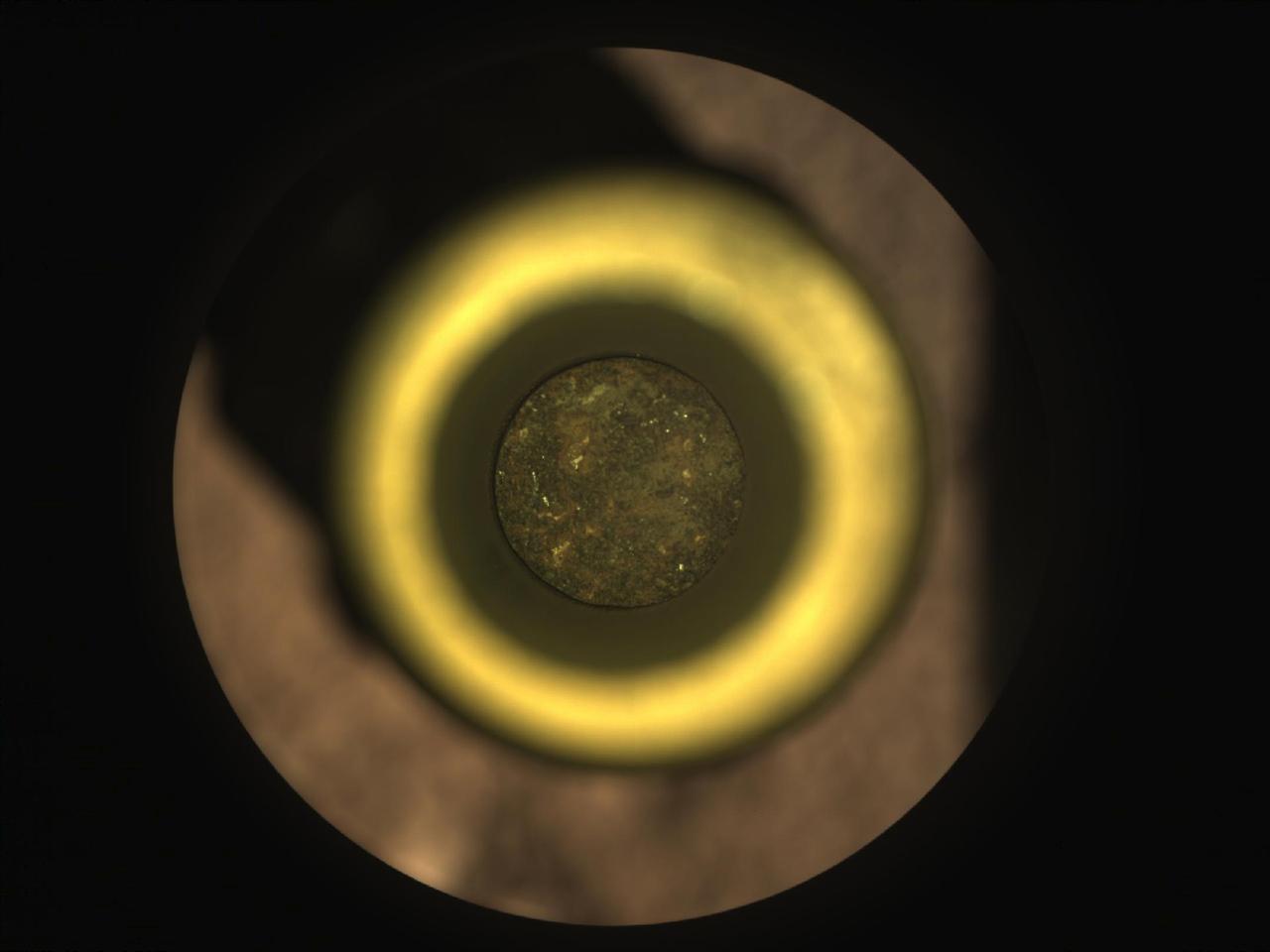
The first cored sample of Mars rock is visible (at center) inside a titanium sample collection tube in this from the Sampling and Caching System Camera (known as CacheCam) of NASA's Perseverance rover. The image was taken on Sept. 6, 2021 (the 194th sol, or Martian day, of the mission), prior to the system attaching and sealing a metal cap onto the tube. The image was taken so the cored-rock sample would be in focus. The seemingly dark ring surrounding the sample is a portion of the sample tube's inner wall. The bright gold-colored ring surrounding the tube and sample is the "bearing race," an asymmetrical flange that assists in shearing off a sample once the coring drill has bored into a rock. The outermost, mottled-brown disc in this image is a portion of the sample handling arm inside the rover's adaptive caching assembly. An additional set of images shows the tube and its cored sample during CacheCam imaging inspection. A key objective for Perseverance's mission on Mars is astrobiology, including the search for signs of ancient microbial life. The rover will characterize the planet's geology and past climate, pave the way for human exploration of the Red Planet, and be the first mission to collect and cache Martian rock and regolith (broken rock and dust). Subsequent NASA missions, in cooperation with ESA (European Space Agency), would send spacecraft to Mars to collect these sealed samples from the surface and return them to Earth for in-depth analysis. The Mars 2020 Perseverance mission is part of NASA's Moon to Mars exploration approach, which includes Artemis missions to the Moon that will help prepare for human exploration of the Red Planet. Movie available at https://photojournal.jpl.nasa.gov/catalog/PIA24806
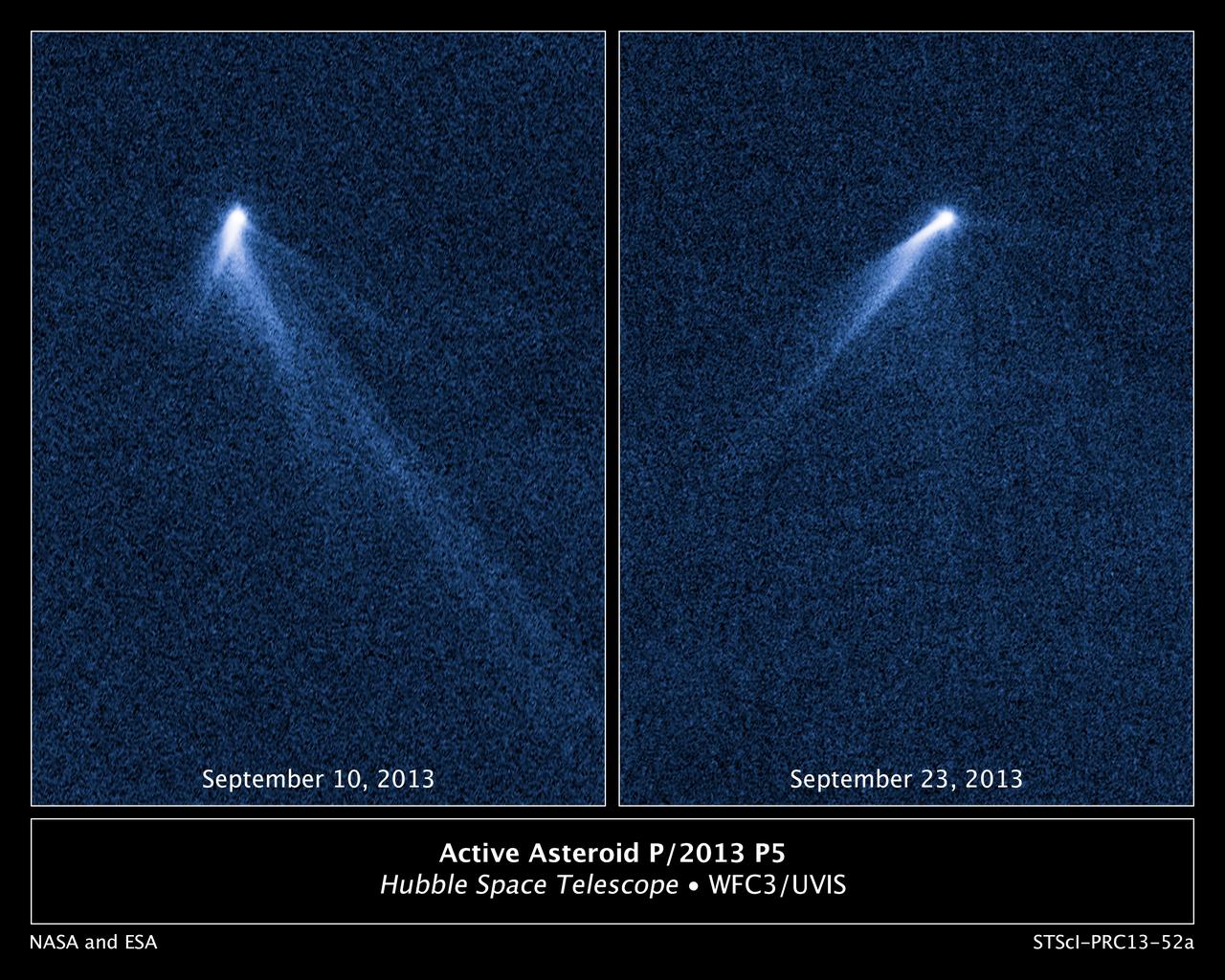
This NASA Hubble Space Telescope set of images reveals a never-before-seen set of six comet-like tails radiating from a body in the asteroid belt, designated P/2013 P5. The asteroid was discovered as an unusually fuzzy-looking object with the Panoramic Survey Telescope and Rapid Response System (Pan-STARRS) survey telescope in Hawaii. The multiple tails were discovered in Hubble images taken on Sept. 10, 2013. When Hubble returned to the asteroid on Sept. 23, the asteroid's appearance had totally changed. It looked as if the entire structure had swung around. One interpretation is that the asteroid's rotation rate has been increased to the point where dust is falling off the surface and escaping into space where the pressure of sunlight sweeps out fingerlike tails. According to this theory, the asteroid's spin has been accelerated by the gentle push of sunlight. The object, estimated to be no more than 1,400 feet across, has ejected dust for at least five months, based on analysis of the tail structure. These visible-light, false-color images were taken with Hubble's Wide Field Camera 3. Object Name: P/2013 P5 Image Type: Astronomical/Annotated Credit: NASA, ESA, and D. Jewitt (UCLA) <b><a href="http://www.nasa.gov/audience/formedia/features/MP_Photo_Guidelines.html" rel="nofollow">NASA image use policy.</a></b> <b><a href="http://www.nasa.gov/centers/goddard/home/index.html" rel="nofollow">NASA Goddard Space Flight Center</a></b> enables NASA’s mission through four scientific endeavors: Earth Science, Heliophysics, Solar System Exploration, and Astrophysics. Goddard plays a leading role in NASA’s accomplishments by contributing compelling scientific knowledge to advance the Agency’s mission. <b>Follow us on <a href="http://twitter.com/NASA_GoddardPix" rel="nofollow">Twitter</a></b> <b>Like us on <a href="http://www.facebook.com/pages/Greenbelt-MD/NASA-Goddard/395013845897?ref=tsd" rel="nofollow">Facebook</a></b> <b>Find us on <a href="http://instagram.com/nasagoddard?vm=grid" rel="nofollow">Instagram</a></b>

P/2013 P5 on September 10, 2013. --- This NASA Hubble Space Telescope set of images reveals a never-before-seen set of six comet-like tails radiating from a body in the asteroid belt, designated P/2013 P5. The asteroid was discovered as an unusually fuzzy-looking object with the Panoramic Survey Telescope and Rapid Response System (Pan-STARRS) survey telescope in Hawaii. The multiple tails were discovered in Hubble images taken on Sept. 10, 2013. When Hubble returned to the asteroid on Sept. 23, the asteroid's appearance had totally changed. It looked as if the entire structure had swung around. One interpretation is that the asteroid's rotation rate has been increased to the point where dust is falling off the surface and escaping into space where the pressure of sunlight sweeps out fingerlike tails. According to this theory, the asteroid's spin has been accelerated by the gentle push of sunlight. The object, estimated to be no more than 1,400 feet across, has ejected dust for at least five months, based on analysis of the tail structure. These visible-light, false-color images were taken with Hubble's Wide Field Camera 3. Object Name: P/2013 P5 Image Type: Astronomical/Annotated Credit: NASA, ESA, and D. Jewitt (UCLA) <b><a href="http://www.nasa.gov/audience/formedia/features/MP_Photo_Guidelines.html" rel="nofollow">NASA image use policy.</a></b> <b><a href="http://www.nasa.gov/centers/goddard/home/index.html" rel="nofollow">NASA Goddard Space Flight Center</a></b> enables NASA’s mission through four scientific endeavors: Earth Science, Heliophysics, Solar System Exploration, and Astrophysics. Goddard plays a leading role in NASA’s accomplishments by contributing compelling scientific knowledge to advance the Agency’s mission. <b>Follow us on <a href="http://twitter.com/NASA_GoddardPix" rel="nofollow">Twitter</a></b> <b>Like us on <a href="http://www.facebook.com/pages/Greenbelt-MD/NASA-Goddard/395013845897?ref=tsd" rel="nofollow">Facebook</a></b> <b>Find us on <a href="http://instagram.com/nasagoddard?vm=grid" rel="nofollow">Instagram</a></b>

These sets of images were taken between March 13 and 15, 2021 (the 22nd and 24th Martian days, or sols, of NASA's Mars 2020 Perseverance mission) show doors opening and closing on parts of the Sample Caching System aboard the rover. Perseverance's Sample Caching System consists of three robotic components that will work in concert to collect samples of rock and regolith (broken rock and dust), seal them in tubes, and deposit those tubes on the surface of Mars for retrieval by a future mission. Perseverance is the first rover to bring a sample caching system to Mars. The first set of images, taken by Perseverance's Navigation Cameras, shows a door opening on the upper part of the bit carousel, a flying-saucer-like component that stores drill bits for the system's coring tool. It transfers bits with empty sample tubes onto the rover's robotic arm and also collects bits containing filled sample tubes from the coring tool. The second set of images shows a door opening on the lower part of the bit carousel, as seen under the rover's belly. They were taken by the WATSON camera, a part of the SHERLOC (Scanning Habitable Environments with Raman and Luminescence for Organics and Chemicals) instrument. The Ingenuity Mars Helicopter technology demonstration activity is supported by NASA's Science Mission Directorate, the NASA Aeronautics Research Mission Directorate, and the NASA Space Technology Mission Directorate. NASA's Jet Propulsion Laboratory built and manages operations of Perseverance and Ingenuity for the agency. Caltech in Pasadena, California, manages JPL for NASA. A key objective for Perseverance's mission on Mars is astrobiology, including the search for signs of ancient microbial life. The rover will characterize the planet's geology and past climate, pave the way for human exploration of the Red Planet, and be the first mission to collect and cache Martian rock and regolith (broken rock and dust). Subsequent NASA missions, in cooperation with ESA (European Space Agency), would send spacecraft to Mars to collect these sealed samples from the surface and return them to Earth for in-depth analysis. The Mars 2020 Perseverance mission is part of NASA's Moon to Mars exploration approach, which includes Artemis missions to the Moon that will help prepare for human exploration of the Red Planet. Animations available at https://photojournal.jpl.nasa.gov/catalog/PIA24497

NASA's Perseverance Mars rover looks out at an expanse of boulders on the landscape in front of a location nicknamed "Santa Cruz" on Feb. 16, 2022, the 353rd Martian day, or sol, of the mission. This panorama is made up 24 individual images from the rover's Mastcam-Z camera system stitched together after they were sent back from Mars. Figure 1 shows a cropped version of the same image. A key objective for Perseverance's mission on Mars is astrobiology, including the search for signs of ancient microbial life. The rover will characterize the planet's geology and past climate, pave the way for human exploration of the Red Planet, and be the first mission to collect and cache Martian rock and regolith (broken rock and dust). Subsequent NASA missions, in cooperation with ESA (European Space Agency), would send spacecraft to Mars to collect these sealed samples from the surface and return them to Earth for in-depth analysis. The Mars 2020 Perseverance mission is part of NASA's Moon to Mars exploration approach, which includes Artemis missions to the Moon that will help prepare for human exploration of the Red Planet. https://photojournal.jpl.nasa.gov/catalog/PIA25172
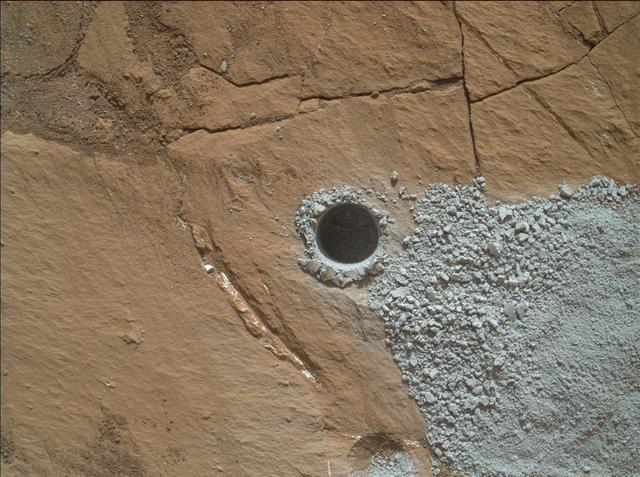
NASA's Curiosity Mars Rover drilled this hole to collect sample material from a rock target called "Buckskin" on July 30, 2015, during the 1060th Martian day, or sol, of the rover's work on Mars. The diameter is slightly smaller than a U.S. dime. Curiosity landed on Mars on Aug. 6, 2012, Universal Time (evening of Aug. 5, PDT). The rover took this image with the Mars Hand Lens Imager (MAHLI) camera, which is mounted on the same robotic arm as the sample-collecting drill. Rock powder from the collected sample was subsequently delivered to a laboratory inside the rover for analysis. The rover's drill did not experience any sign during this sample collection of an intermittent short-circuiting issue that was detected earlier in 2015. The Buckskin target is in an area near "Marias Pass" on lower Mount Sharp where Curiosity had detected unusually high levels of silica and hydrogen. MAHLI was built by Malin Space Science Systems, San Diego. NASA's Jet Propulsion Laboratory, a division of the California Institute of Technology in Pasadena, manages the Mars Science Laboratory Project for the NASA Science Mission Directorate, Washington. JPL designed and built the project's Curiosity rover. http://photojournal.jpl.nasa.gov/catalog/PIA19804