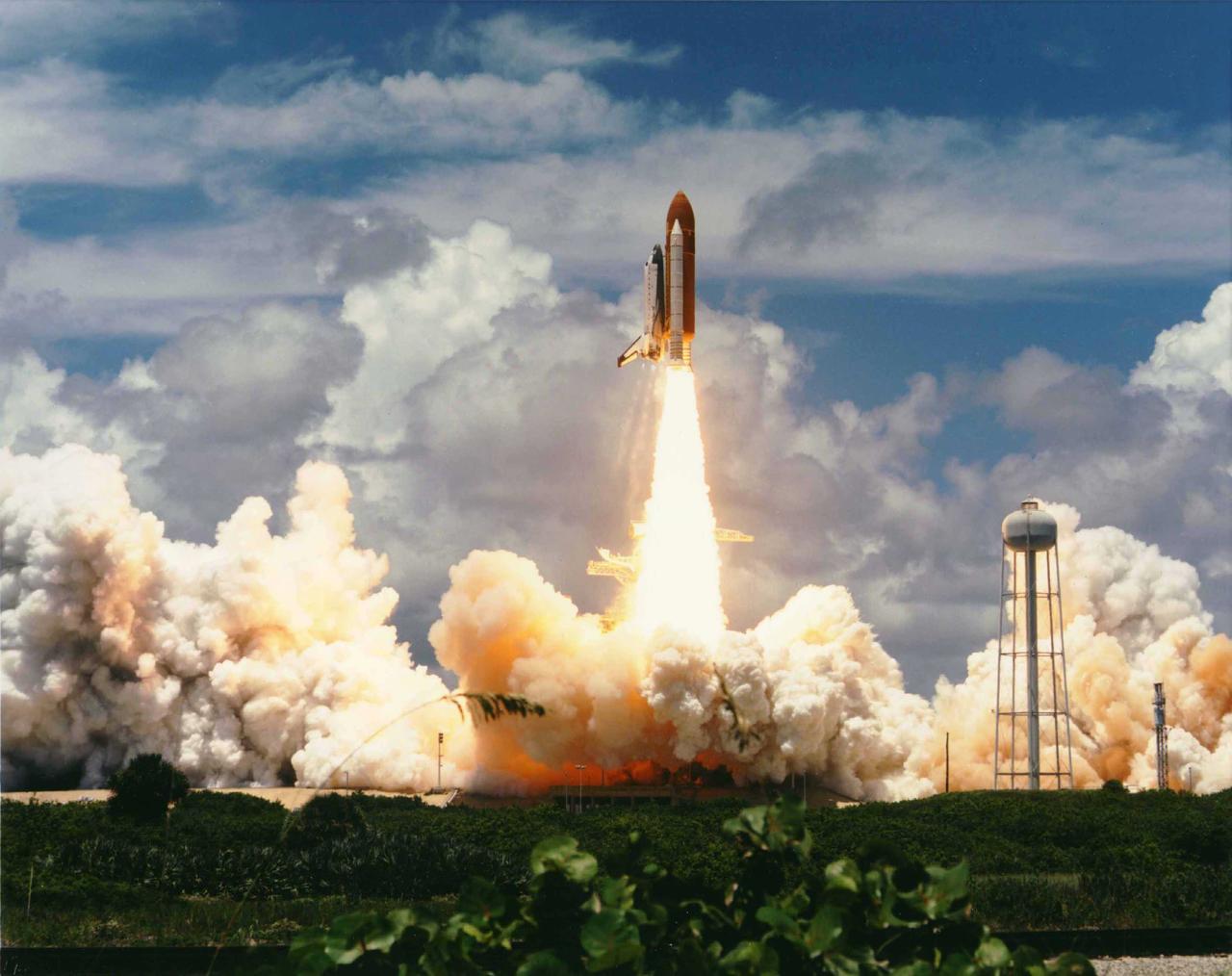
KENNEDY SPACE CENTER, FLA. - The second International Microgravity Laboratory-2 (IML-2) is off to an ontime start as the Space Shuttle Columbia lifts off from Launch Pad 39A at 12:43:00 p.m. EDT. On board are a crew of seven and more than 80 investigations developed by more than 200 scientists from 13 countries. The IML-2 complement includes materials science, bioprocessing, space and radiation biology, and human physiology experiments that will be carried out over the course of the 14-day flight. The commander of Space Shuttle Mission STS-65 is Robert D. Cabana. James D. Halsell Jr. is the pilot; the payload commander is Richard J. Hieb; the three mission specialists are Carl E. Walz, Leroy Chiao and Donald A. Thomas. Dr. Chiaki Mukai, representing NASDA, the National Space Development Agency of Japan, is the payload specialist. Mukai becomes the first Japanese woman to fly into space.
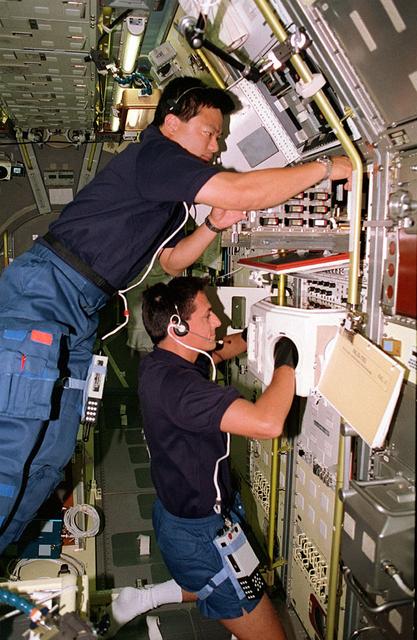
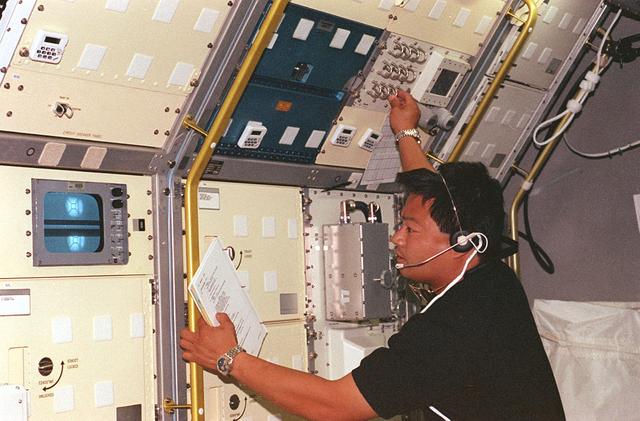
Onboard Space Shuttle Columbia (STS-65) Mission Specialist Leroy Chiao (top) and Mission Specialist Donald A. Thomas are seen at work in the International Microgravity Laboratory 2 (IML-2) spacelab science module. The two crewmembers are conducting experiments at the IML-2 Rack 5 Biorack (BR). Chiao places a sample in the BR incubator as Thomas handles another sample inside the BR glovebox. The glovebox is used to prepare samples for BR and slow rotating centrifuge microscope (NIZEMI) experiments.
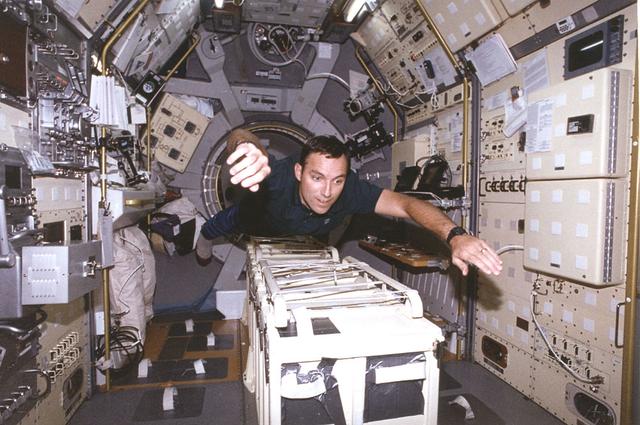
Astronaut Carl E. Walz, mission specialist, flies through the second International Microgravity Laboratory (IML-2) science module, STS-65 mission. IML was dedicated to study fundamental materials and life sciences in a microgravity environment inside Spacelab, a laboratory carried aloft by the Shuttle. The mission explored how life forms adapt to weightlessness and investigated how materials behave when processed in space. The IML program gave a team of scientists from around the world access to a unique environment, one that is free from most of Earth's gravity. Managed by the NASA Marshall Space Flight Center, the 14-nation European Space Agency (ESA), the Canadian Space Agency (SCA), the French National Center for Space Studies (CNES), the German Space Agency and the German Aerospace Research Establishment (DARA/DLR), and the National Space Development Agency of Japan (NASDA) participated in developing hardware and experiments for the IML missions. The missions were managed by NASA's Marshall Space Flight Center. The Orbiter Columbia was launched on July 8, 1994 for the IML-2 mission.
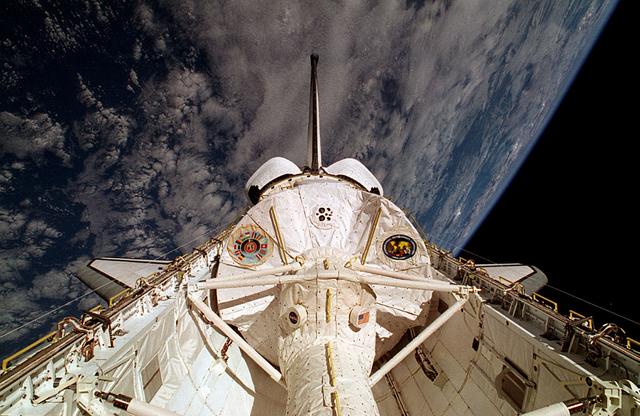
This is a Space Shuttle Columbia (STS-65) onboard photo of the second International Microgravity Laboratory (IML-2) in the cargo bay with Earth in the background. Mission objectives of IML-2 were to conduct science and technology investigations that required the low-gravity environment of space, with emphasis on experiments that studied the effects of microgravity on materials processes and living organisms. Materials science and life sciences are two of the most exciting areas of microgravity research because discoveries in these fields could greatly enhance the quality of life on Earth. If the structure of certain proteins can be determined by examining high-quality protein crystals grown in microgravity, advances can be made to improve the treatment of many human diseases. Electronic materials research in space may help us refine processes and make better products, such as computers, lasers, and other high-tech devices. The 14-nation European Space Agency (ESA), the Canadian Space Agency (SCA), the French National Center for Space Studies (CNES), the German Space Agency and the German Aerospace Research Establishment (DARA/DLR), and the National Space Development Agency of Japan (NASDA) participated in developing hardware and experiments for the IML missions. The missions were managed by NASA's Marshall Space Flight Center. The Orbiter Columbia was launched from the Kennedy Space Center on July 8, 1994 for the IML-2 mission.
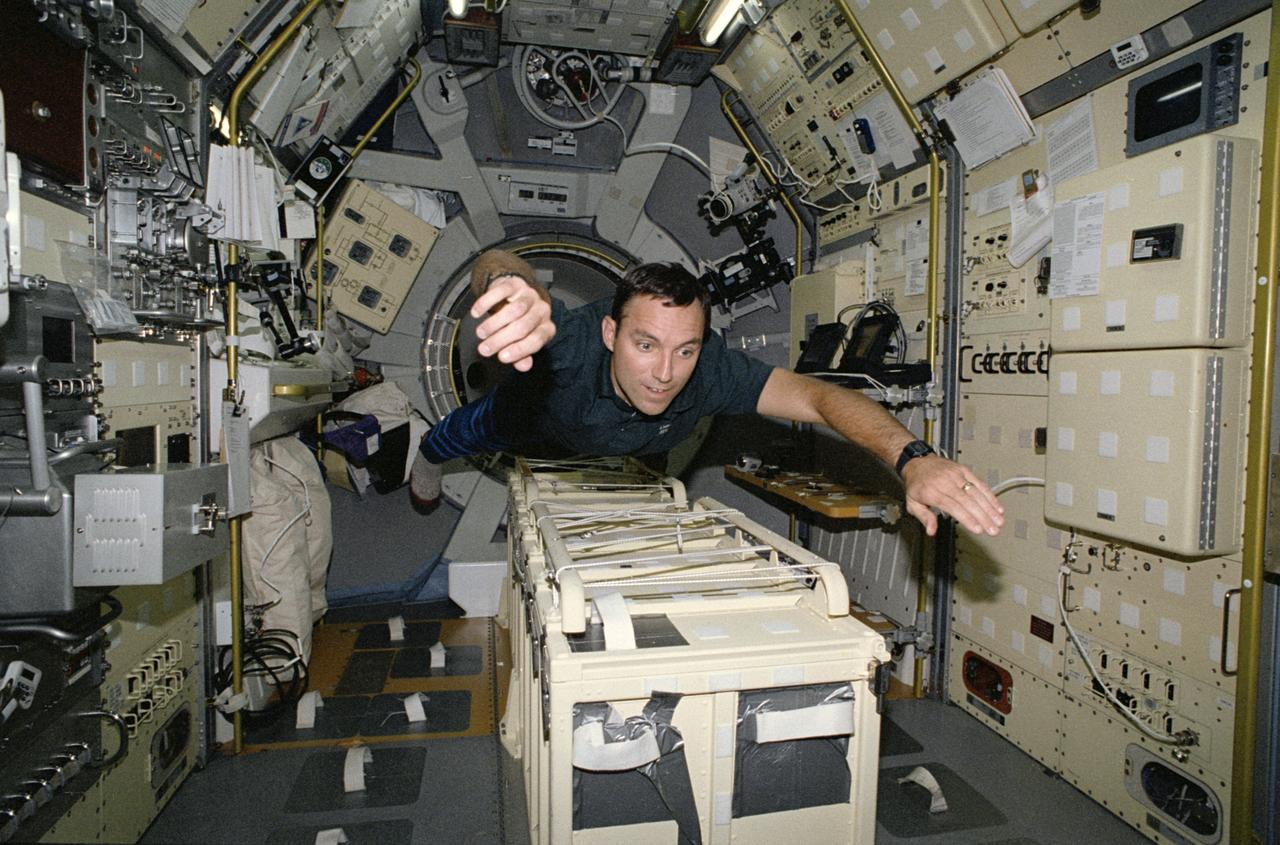
STS-65 Mission Specialist Carl E. Walz floats above center aisle equipment in the International Microgravity Laboratory 2 (IML-2) spacelab science module. Walz has just entered the IML-2 module via the spacelab tunnel (note hatch opening behind him). The tunnel connects the IML-2 module with Columbia's, Orbiter Vehicle (OV) 102's, crew compartment. Walz along with five other NASA astronauts and a Japanese payload specialist spent more than two weeks in Earth orbit conducting IML-2 experiments. This photo was among the first released by NASA following IML-2.
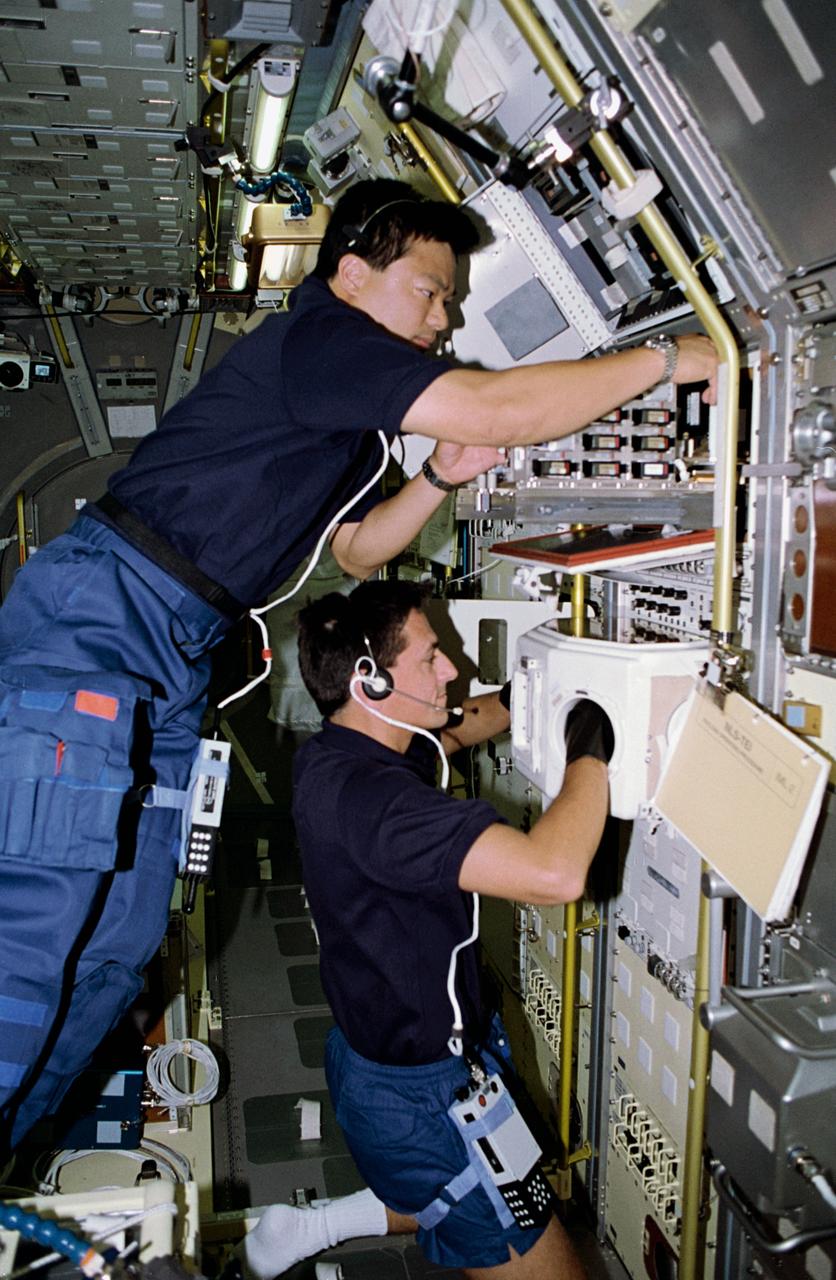
STS-65 Mission Specialist (MS) Leroy Chiao (top) and MS Donald A. Thomas are seen at work in the International Microgravity Laboratory 2 (IML-2) spacelab science module aboard the Space Shuttle Columbia, Orbiter Vehicle (OV) 102. The two crewmembers are conducting experiments at the IML-2 Rack 5 Biorack (BR). Chiao places a sample in the BR incubator as Thomas handles another sample inside the BR glovebox. The glovebox is used to prepare samples for BR and slow rotating centrifuge microscope (NIZEMI) experiments.
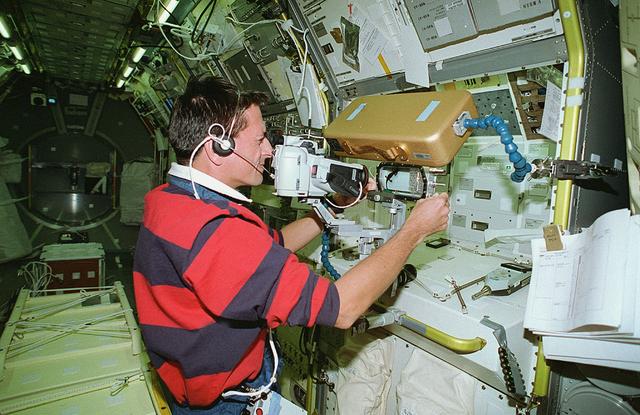
Astronaut Donald Thomas conducts the Fertilization and Embryonic Development of Japanese Newt in Space (AstroNewt) experiment at the Aquatic Animal Experiment Unit (AAEU) inside the International Microgravity Laboratory-2 (IML-2) science module. The AstroNewt experiment aims to know the effects of gravity on the early developmental process of fertilized eggs using a unique aquatic animal, the Japanese red-bellied newt. The newt egg is a large single cell at the begirning of development. The Japanese newt mates in spring and autumn. In late autumn, female newts enter hibernation with sperm in their body cavity and in spring lay eggs and fertilize them with the stored sperm. The experiment takes advantage of this feature of the newt. Groups of newts were sent to the Kennedy Space Center and kept in hibernation until the mission. The AAEU cassettes carried four newts aboard the Space Shuttle. Two newts in one cassette are treated by hormone injection on the ground to simulate egg laying. The other two newts are treated on orbit by the crew. The former group started maturization of eggs before launch. The effects of gravity on that early process were differentiated by comparison of the two groups. The IML-2 was the second in a series of Spacelab flights designed to conduct research by the international science community in a microgravity environment. Managed by the Marshall Space Flight Center, the IML-2 was launched on July 8, 1994 aboard the STS-65 Space Shuttle mission, Orbiter Columbia.
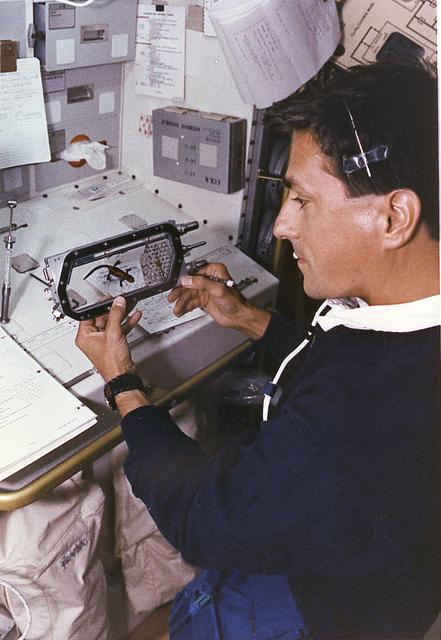
Astronaut Donald Thomas conducts the Fertilization and Embryonic Development of Japanese Newt in Space (AstroNewt) experiment at the Aquatic Animal Experiment Unit (AAEU) inside the International Microgravity Laboratory-2 (IML-2) science module. The AstroNewt experiment aims to know the effects of gravity on the early developmental process of fertilized eggs using a unique aquatic animal, the Japanese red-bellied newt. The newt egg is a large single cell at the begirning of development. The Japanese newt mates in spring and autumn. In late autumn, female newts enter hibernation with sperm in their body cavity and in spring lay eggs and fertilized them with the stored sperm. The experiment takes advantage of this feature of the newt. Groups of newts were sent to the Kennedy Space Center and kept in hibernation until the mission. The AAEU cassettes carried four newts aboard the Space Shuttle. Two newts in one cassette are treated by hormone injection on the ground to simulate egg laying. The other two newts are treated on orbit by the crew. The former group started maturization of eggs before launch. The effects of gravity on that early process were differentiated by comparison of the two groups. The IML-2 was the second in a series of Spacelab flights designed to conduct research by the international science community in a microgravity environment. Managed by the Marshall Space Flight Center, the IML-2 was launch on July 8, 1994 aboard the STS-65 Space Shuttle Orbiter Columbia mission.
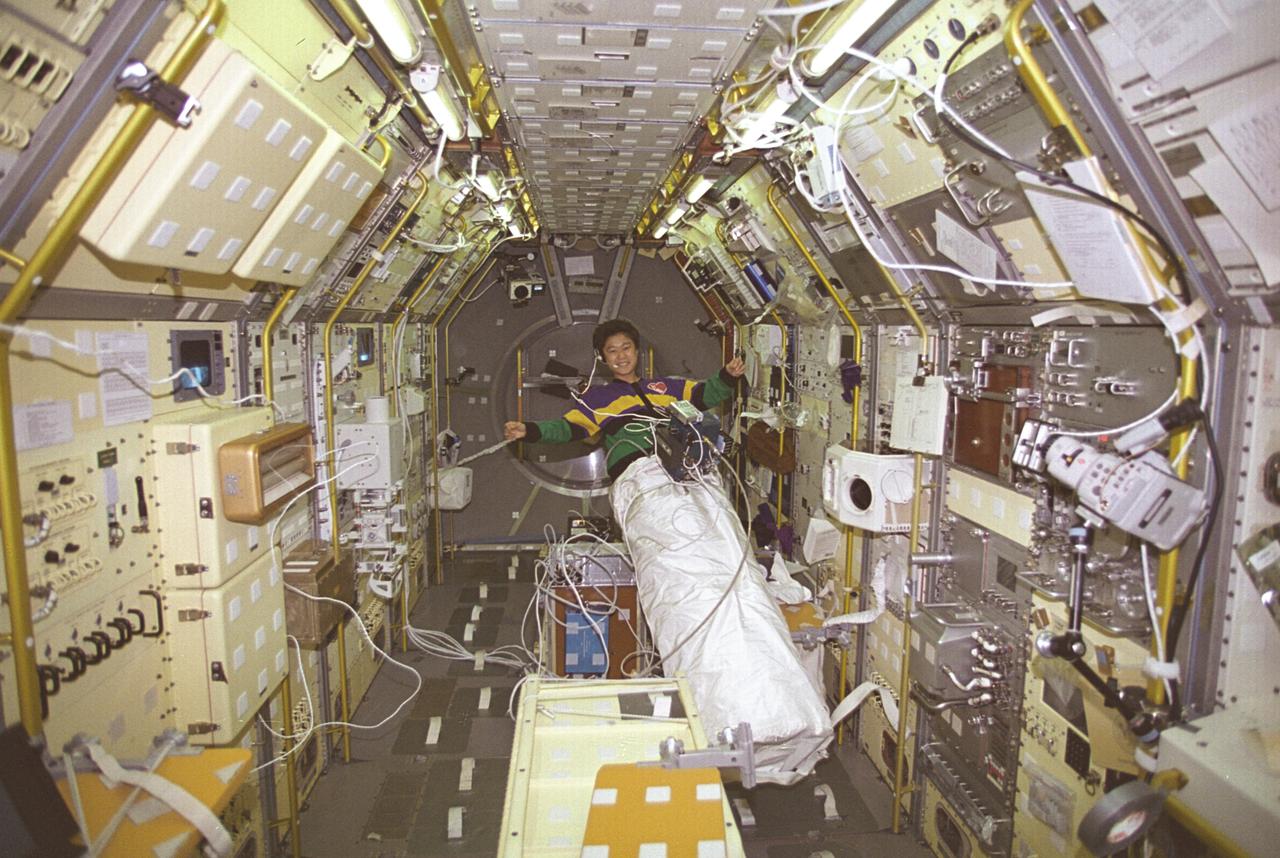
Astronaut Chiaki Mukai conducts the Lower Body Negative Pressure (LBNP) experiment inside the International Microgravity Laboratory-2 (IML-2) mission science module. Dr. Chiaki Mukai is one of the National Space Development Agency of Japan (NASDA) astronauts chosen by NASA as a payload specialist (PS). She was the second NASDA PS who flew aboard the Space Shuttle, and was the first female astronaut in Asia. When humans go into space, the lack of gravity causes many changes in the body. One change is that fluids normally kept in the lower body by gravity shift upward to the head and chest. This is why astronauts' faces appear chubby or puffy. The change in fluid volume also affects the heart. The reduced fluid volume means that there is less blood to circulate through the body. Crewmembers may experience reduced blood flow to the brain when returning to Earth. This leads to fainting or near-fainting episodes. With the use of the LBNP to simulate the pull of gravity in conjunction with fluids, salt tablets can recondition the cardiovascular system. This treatment, called "soak," is effective up to 24 hours. The LBNP uses a three-layer collapsible cylinder that seals around the crewmember's waist which simulates the effects of gravity and helps pull fluids into the lower body. The data collected will be analyzed to determine physiological changes in the crewmembers and effectiveness of the treatment. The IML-2 was the second in a series of Spacelab flights designed by the international science community to conduct research in a microgravity environment Managed by the Marshall Space Flight Center, the IML-2 was launched on July 8, 1994 aboard the STS-65 Space Shuttle Orbiter Columbia mission.
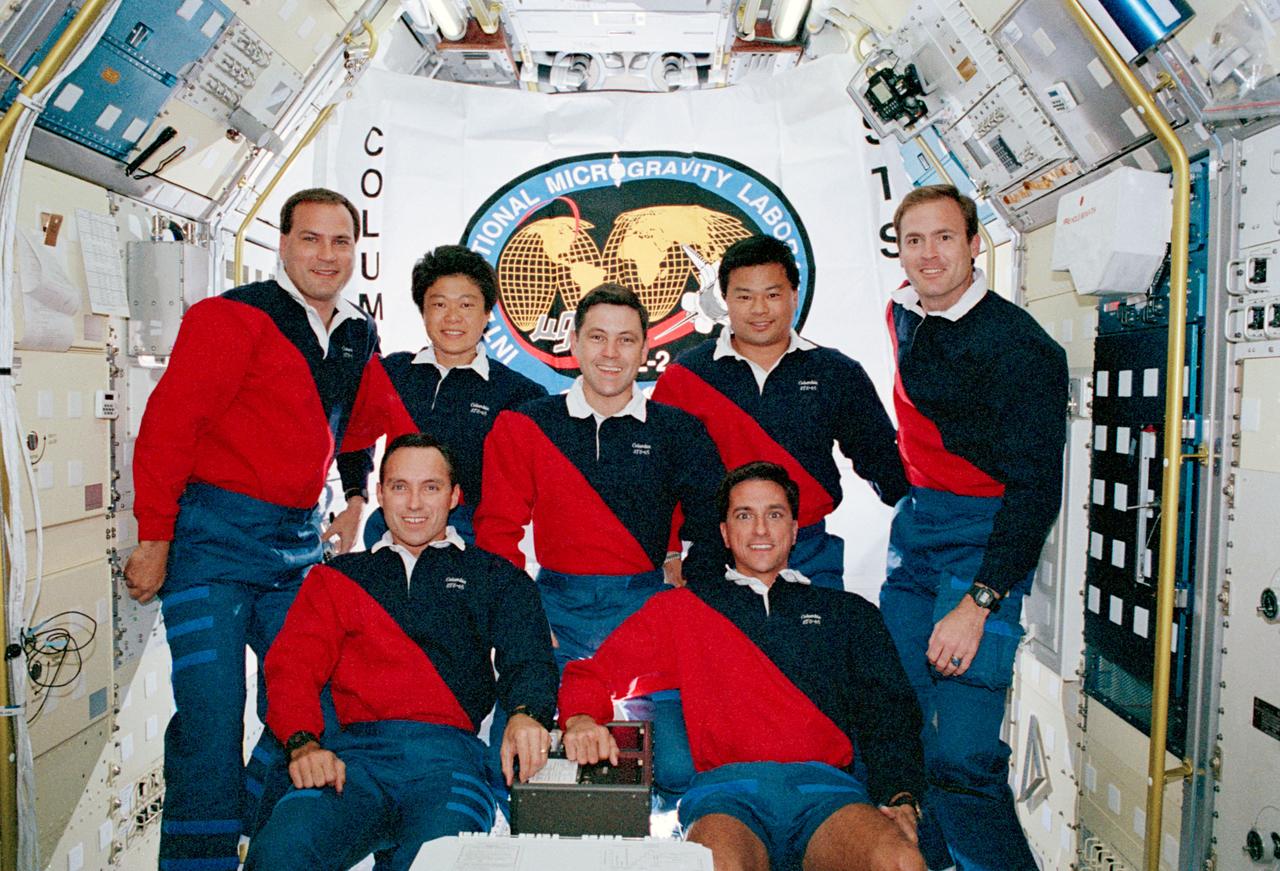
In the spacelab science module aboard the Space Shuttle Columbia, Orbiter Vehicle (OV) 102, the seven crewmembers pose for the traditional onboard (inflight) crew portrait. Displayed in the background is a flag with the International Microgravity Laboratory 2 (IML-2) insignia and Columbia inscribed along the edge. In the front row (left to right) are Mission Specialist (MS) Carl E. Walz and MS Donald A. Thomas. Behind them (left to right) are Payload Commander (PLC) Richard J. Hieb, Payload Specialist Chiaki Mukai, Commander Robert D. Cabana, MS Leroy Chiao, and Pilot James D. Halsell, Jr. Mukai represents the National Space Development Agency (NASDA) of Japan. Crewmembers are wearing their mission polo shirts for the portrait. Inside this module, the crew conducted experiments in support of the IML-2 mission.

STS065-214-037 (8-23 July 1994) --- Ready to begin one of her busy twelve hour shifts, payload specialist Dr. Chiaki Naito-Mukai enters the International Microgravity Laboratory (IML-2) science module in the cargo bay via the tunnel connecting it to the Space Shuttle Columbia's cabin. Dr. Mukai joined six NASA astronauts for more than two weeks of experimenting in Earth orbit. This photo was among the first released by NASA following IML-2. Also onboard were NASA astronauts Robert D. Cabana, James D. Halsell, Jr., Richard J. Hieb, Carl E. Walz, Donald A. Thomas and Leroy Chiao. Dr. Mukai represented the National Space Development Agency (NASDA) of Japan.
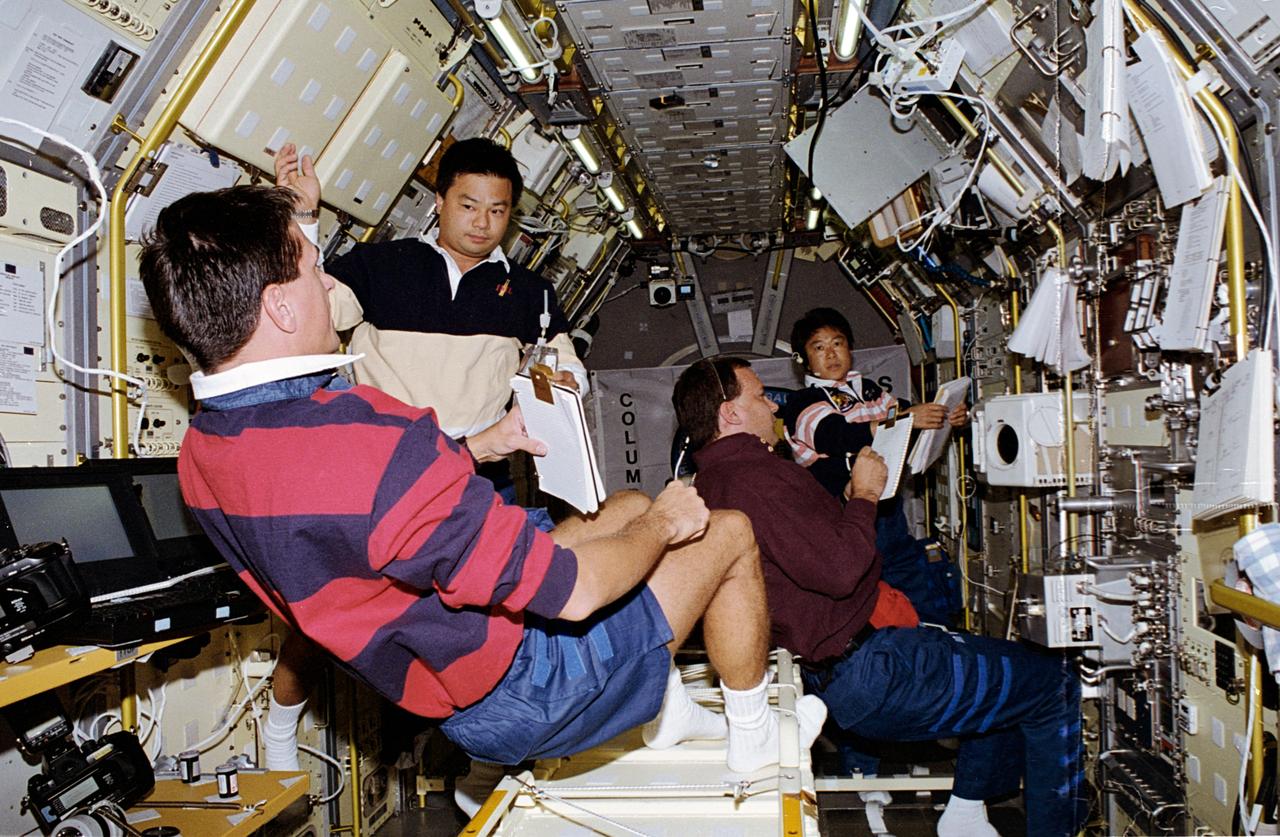
STS065-05-037 (8-23 July 1994) --- In the science module aboard the Space Shuttle Columbia, four members of the crew busy themselves with experiments in support of the second International Microgravity Laboratory (IML-2) mission. Left to right are Donald A. Thomas and Leroy Chiao, both mission specialists; Richard J. Hieb, payload commander, and Dr. Chiaki Mukai of NASDA, payload specialist.
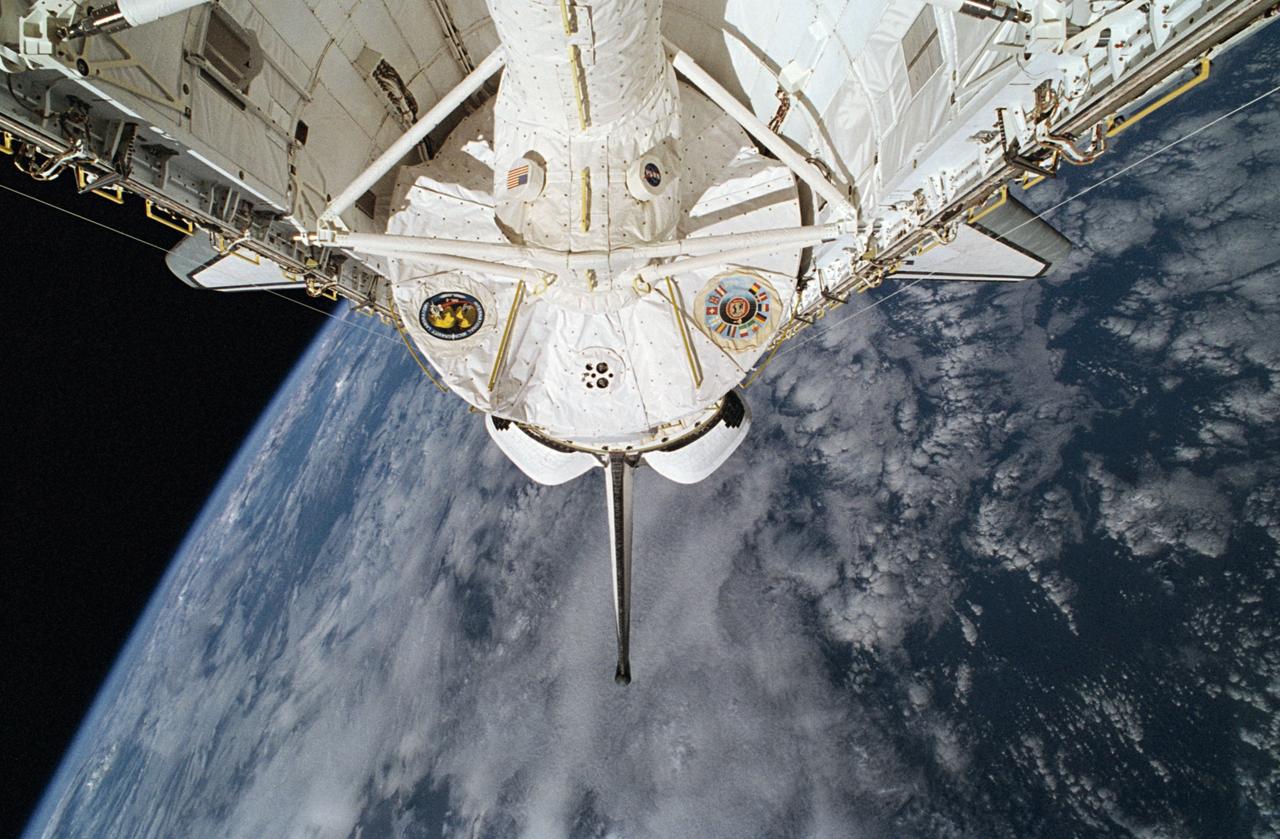
STS065-34-016 (8-23 July 1994) --- Clouds over the ocean form the backdrop for this scene of the International Microgravity Laboratory (IML-2) science module in the Space Shuttle Columbia's cargo bay during the two-week mission. Part of the tunnel that served as passageway for the seven crew members to and from the lab is seen in center foreground. Onboard Columbia were astronauts Robert D. Cabana, James D. Halsell, Jr., Richard J. Hieb, Carl E. Walz, Donald A. Thomas and Leroy Chiao, along with (NASDA) Japanese payload specialist Dr. Chiaki Naito-Mukai.
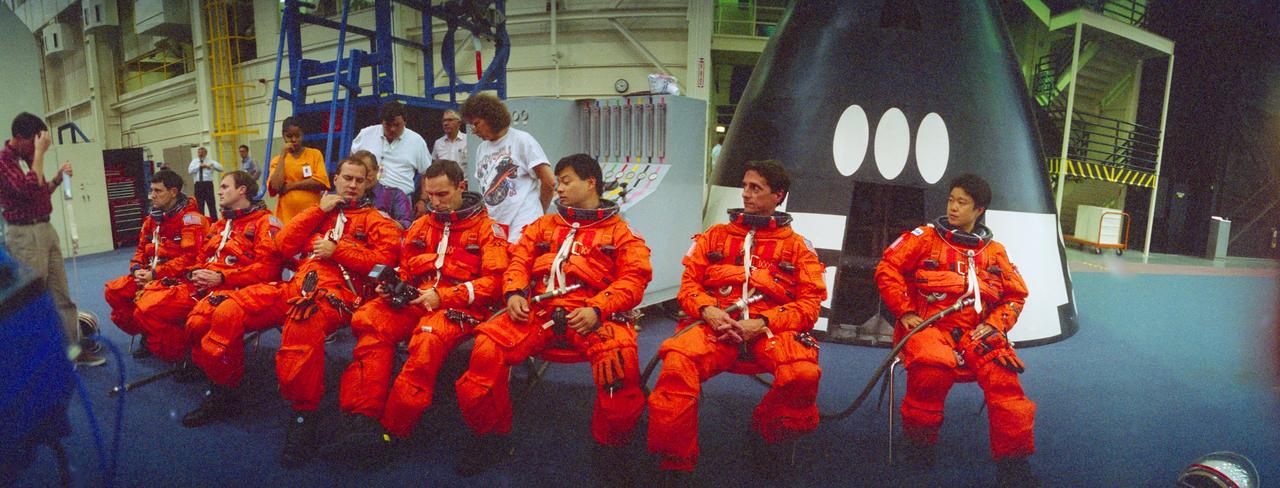
S94-31388 (25 Mar 1994) --- Six NASA astronauts and a Japanese payload specialist listen to a briefing by a crew training staffer. From the left are astronauts Robert D. Cabana, mission commander; James D. Halsell Jr., pilot; Richard J. Hieb, payload commander; and Carl E. Walz, Leroy Chiao and Donald A. Thomas, all mission specialists; along with Dr. Chiaki Mukai, payload specialist. Dr. Mukai represents the National Space Development Agency (NASDA) of Japan. The STS-65 crew was in the Johnson Space Center's (JSC) Shuttle mockup and integration laboratory for crew egress training. The full fuselage trainer, used for the rehearsals, is just out of frame. The seven-member crew will support the International Microgravity Laboratory (IML-2) mission aboard the Space Shuttle Columbia later this year.
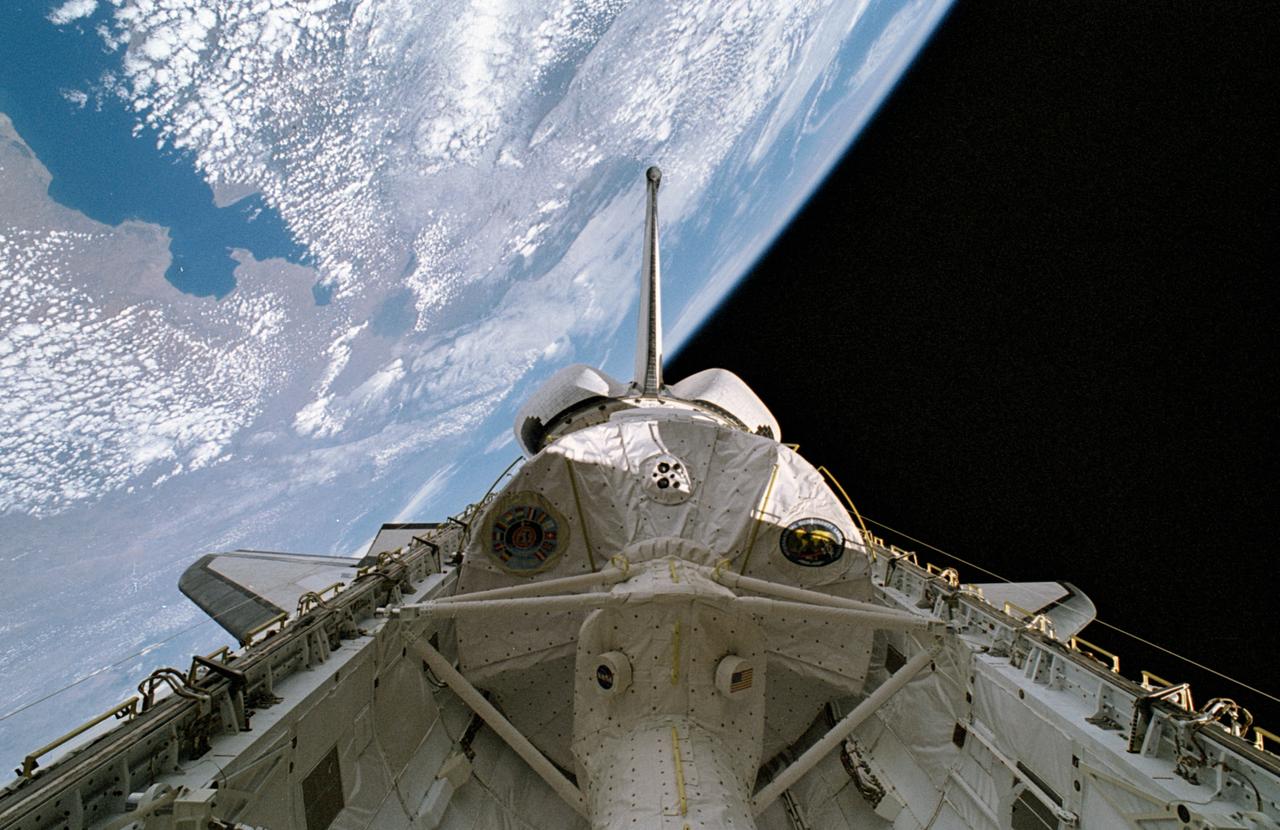
STS065-42-017 (8-23 July 1994) --- This 35mm panorama shows the science module, for the second International Microgravity Laboratory (IML-2) and the Space Shuttle Columbia's cargo bay, backdropped against the darkness of space over part of Africa, on Earth's horizon. Lake Nyasa in Malawi can easily be delineated. Also visible are part of the country of Mozambique and the Indian Ocean. Six NASA astronauts and a Japanese payload specialist spent more than two weeks of experimenting in Earth-orbit. Onboard were NASA astronauts Robert D. Cabana, James D. Halsell, Jr., Richard J. Hieb, Carl E. Walz, Donald A. Thomas and Leroy Chiao along with payload specialist Dr. Chiaki Mukai, representing the National Space Development Agency (NASDA) of Japan.
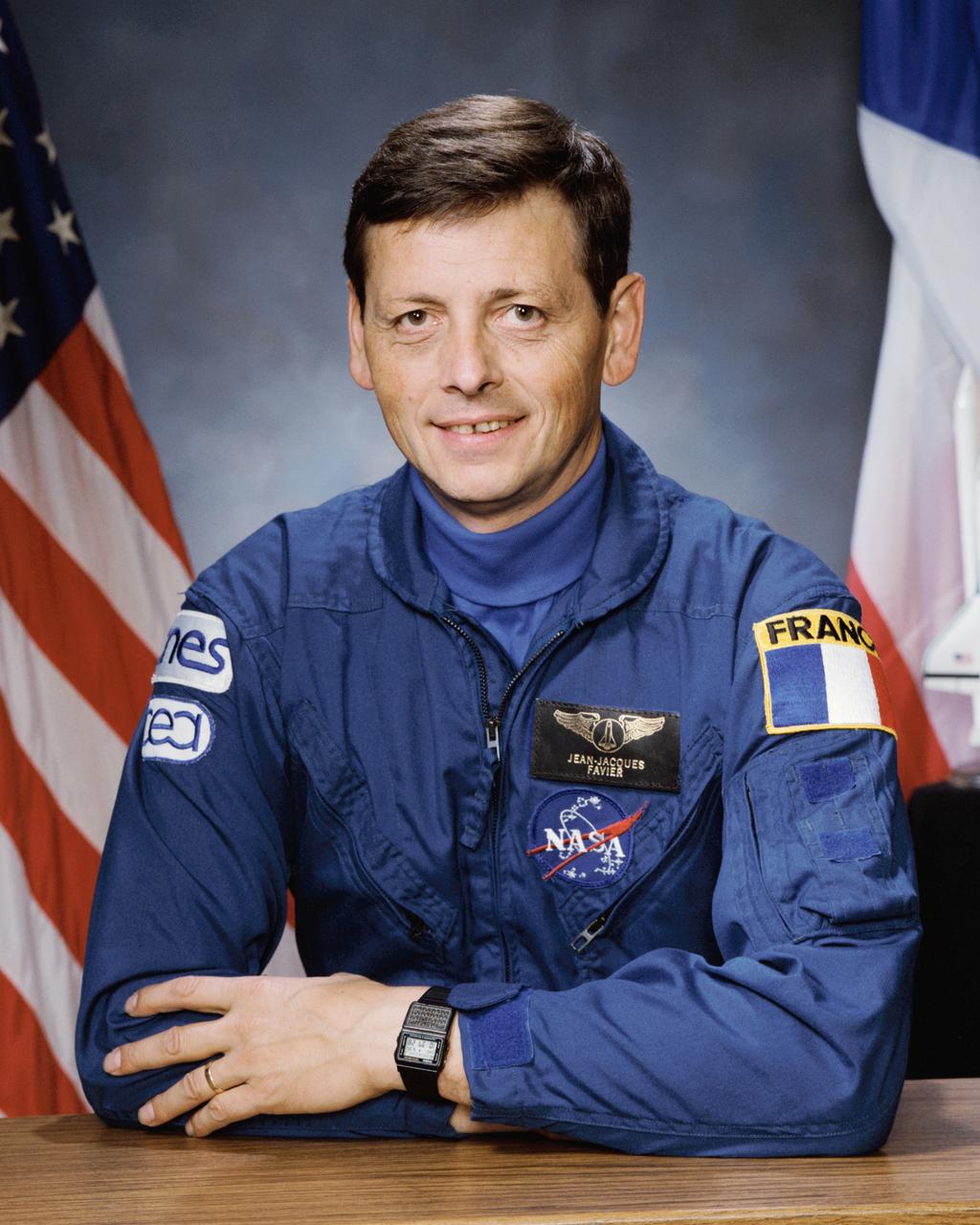
Official portrait of STS-65 International Microgravity Laboratory 2 (IML-2) backup Payload Specialist Jean-Jacques Favier. Favier is a member of the Centre National D'Etudes Spatiales (CNES), the French space agency.
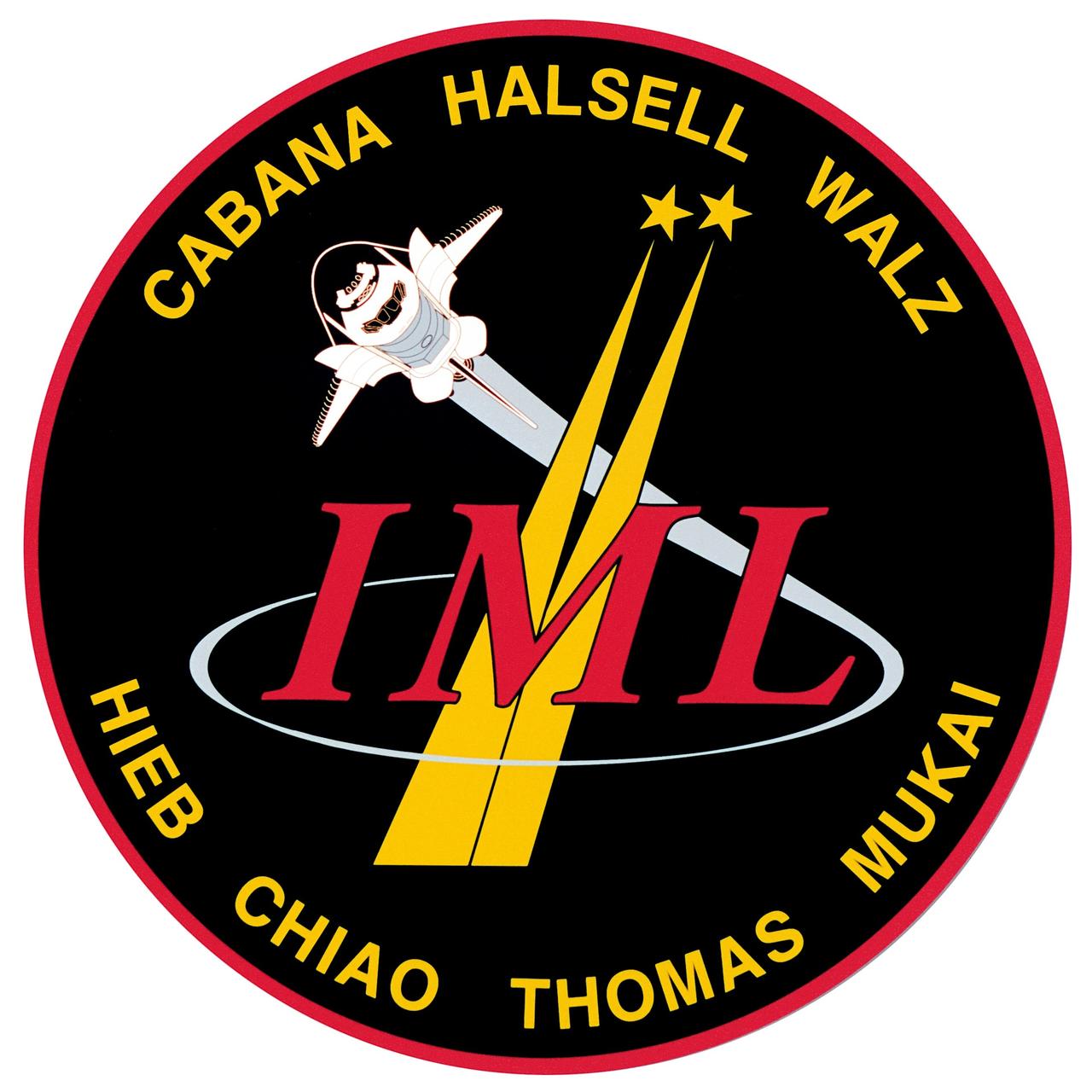
STS065-S-001 (March 1994) --- Designed by the crew members, the STS-65 insignia features the International Microgravity Laboratory (IML-2) mission and its Spacehab module which will fly aboard the space shuttle Columbia. IML-2 is reflected in the emblem by two gold stars shooting toward the heavens behind the IML lettering. The space shuttle Columbia is depicted orbiting the logo and reaching into space, with Spacehab on an international quest for a better understanding of the effects of spaceflight on materials processing and life sciences. The NASA insignia design for space shuttle flights is reserved for use by the astronauts and for other official use as the NASA Administrator may authorize. Public availability has been approved only in the forms of illustrations by the various news media. When and if there is any change in this policy, which is not anticipated, the change will be publicly announced. Photo credit: NASA
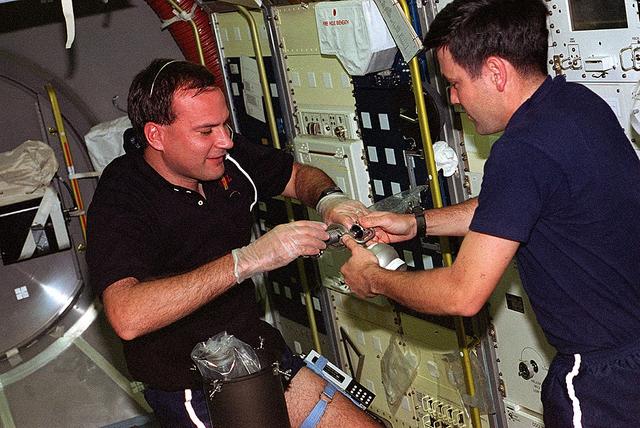
Space Shuttle Columbia (STS-65) onboard photo of Payload specialist Richard J. Hieb (right) and Shuttle Pilot James D. Halsell Jr. working on experiments in the Spacelab in the International Microgravity Laboratory (IML-2).
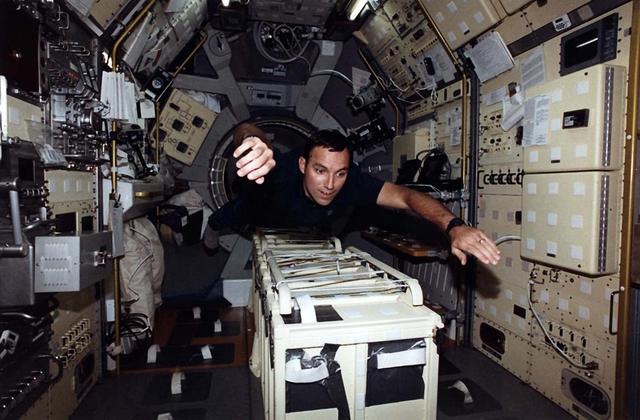
Astronaut Carl E. Walz, mission specialist, enters the International Microgravity Laboratory (IML-2) science module in the cargo bay via the turnel connecting it to Columbia's cabin. Walz joined five other NASA astronauts and a Japanese payload specialist for more than two weeks of experimenting in Earth orbit.

Dr. Chiaki Mukai of Japan's National Space Development Agency (NASDA) speaks to students at the California Science Center during the outreach session of the Pan Pacific Microgravity Conference on May 2, 2001. She flew as a payload specialist on two NASA Space Shuttle missions, STS-65 carrying the second International Microgravity Laboratory (IML-2, 1994) and STS-95 (1998).
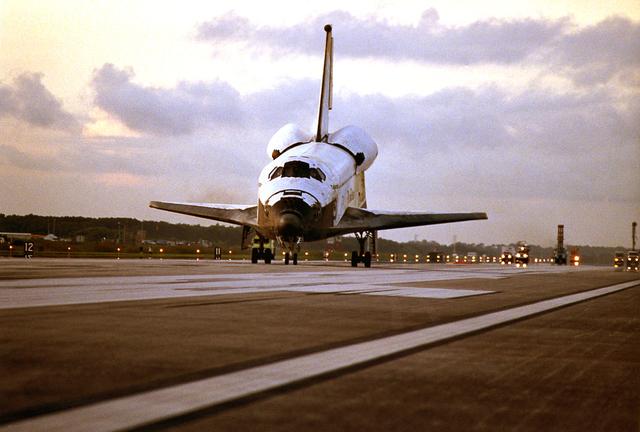
The Space Shuttle Columbia (STS-65) came to a stop at Kennedy Space Center's (KSC) Shuttle Landing Facility to complete the International Microgravity Laboratory 2 (IML-2) mission. During the record-setting spaceflight of 14 days, 17 hours, and 56 minutes, the seven-person crew conducted more than 80 materials and life sciences experiments,
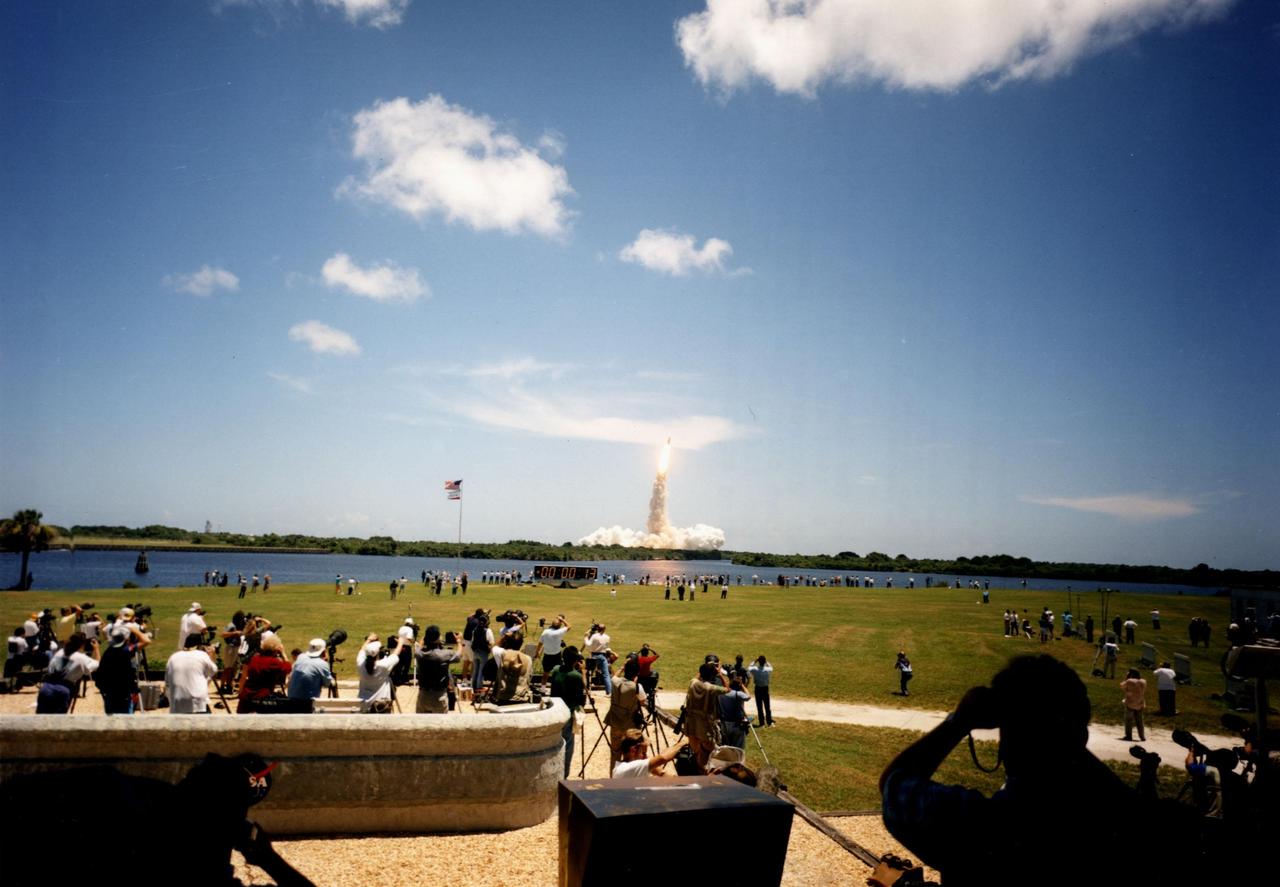
KENNEDY SPACE CENTER, FLA. -- The Space Shuttle Columbia lifts off from Launch Pad 39A on July 8, 1994 at 12:43 p.m. EDT to begin the 14-day STS-65/Internatinal Microgravity Laboratory-2 (IML-2) mission. The mission countdown clock also can be seen, giving the time into the mission after liftoff. The STS-65 mission is scheduled to end with a landing at KSC's Shuttle Landing Facility
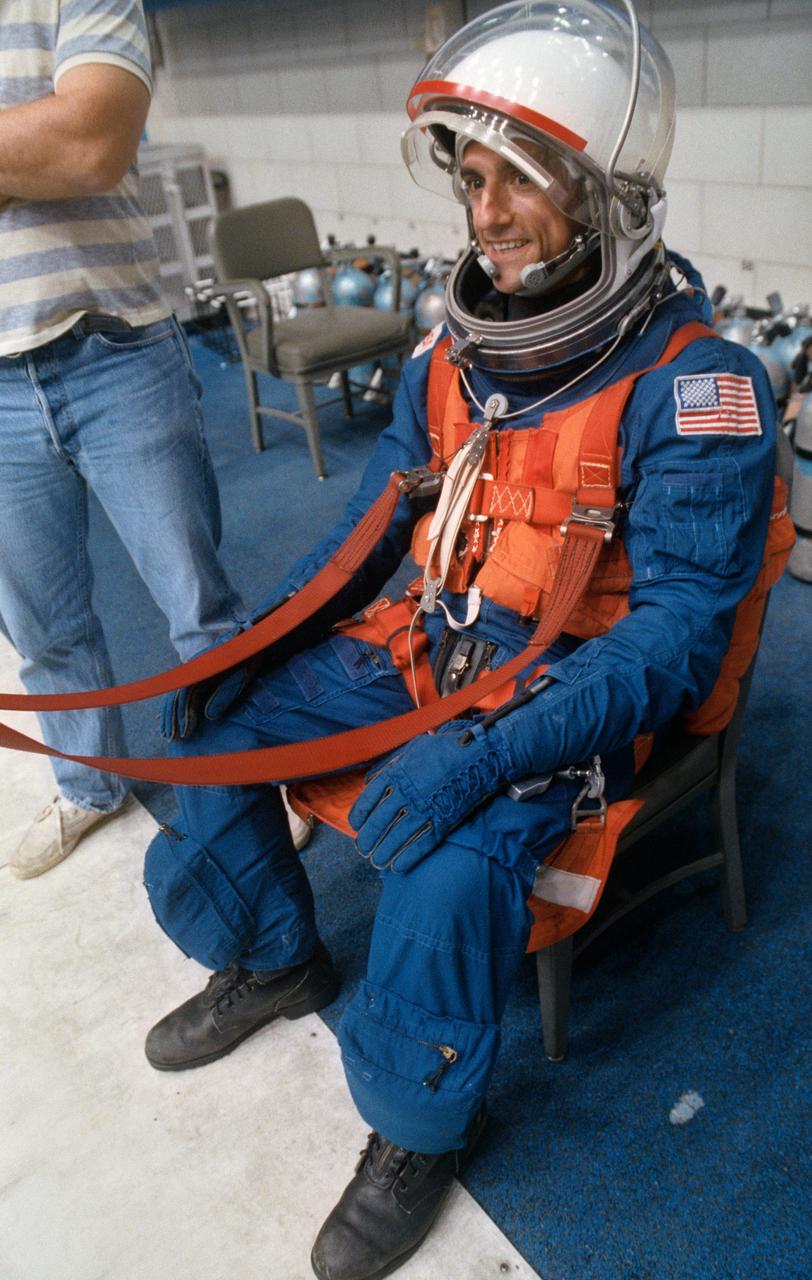
S93-43113 (Nov 1993) --- Astronaut Donald A. Thomas, mission specialist, is pictured during a bailout training session at the Johnson Space Center's (JSC) Weightless Environment Test Facility (WET-F). Thomas was joined by five other NASA astronauts and a Japanese payload specialist for the training session. The crew will spend approximately two weeks aboard the Space Shuttle Columbia next year in support of the second International Microgravity Laboratory (IML-2) mission.
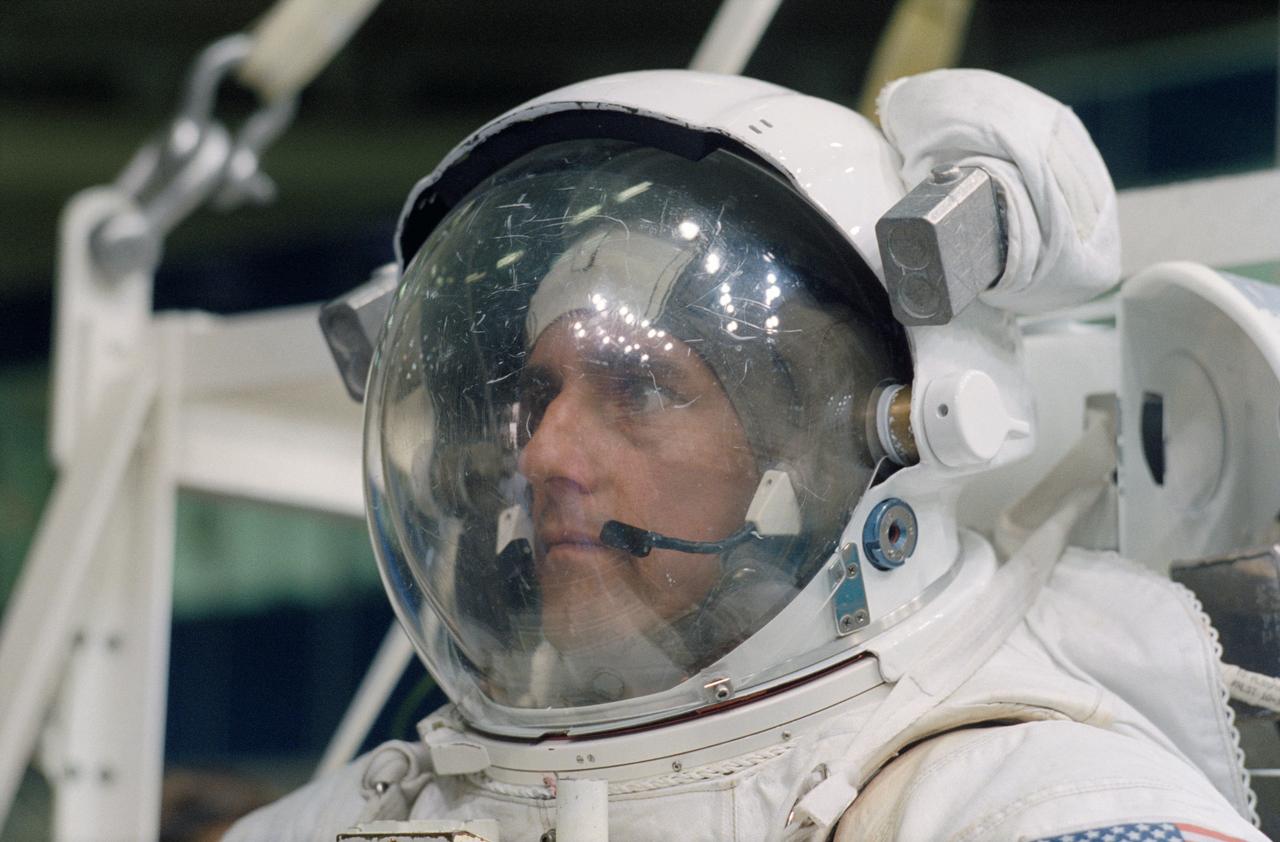
S94-29978 (8 March 1994) --- Astronaut Donald A. Thomas, mission specialist, prepares to be lowered into a 25-feet deep pool at the Johnson Space Center's (JSC) Weightless Environment Training Facility (WET-F). Astronauts Thomas and Leroy Chiao were about to be submerged and made to be neutrally buoyant in order to rehearse several contingency tasks that would require a spacewalk. No spacewalks are scheduled for the International Microgravity Laboratory (IML-2).
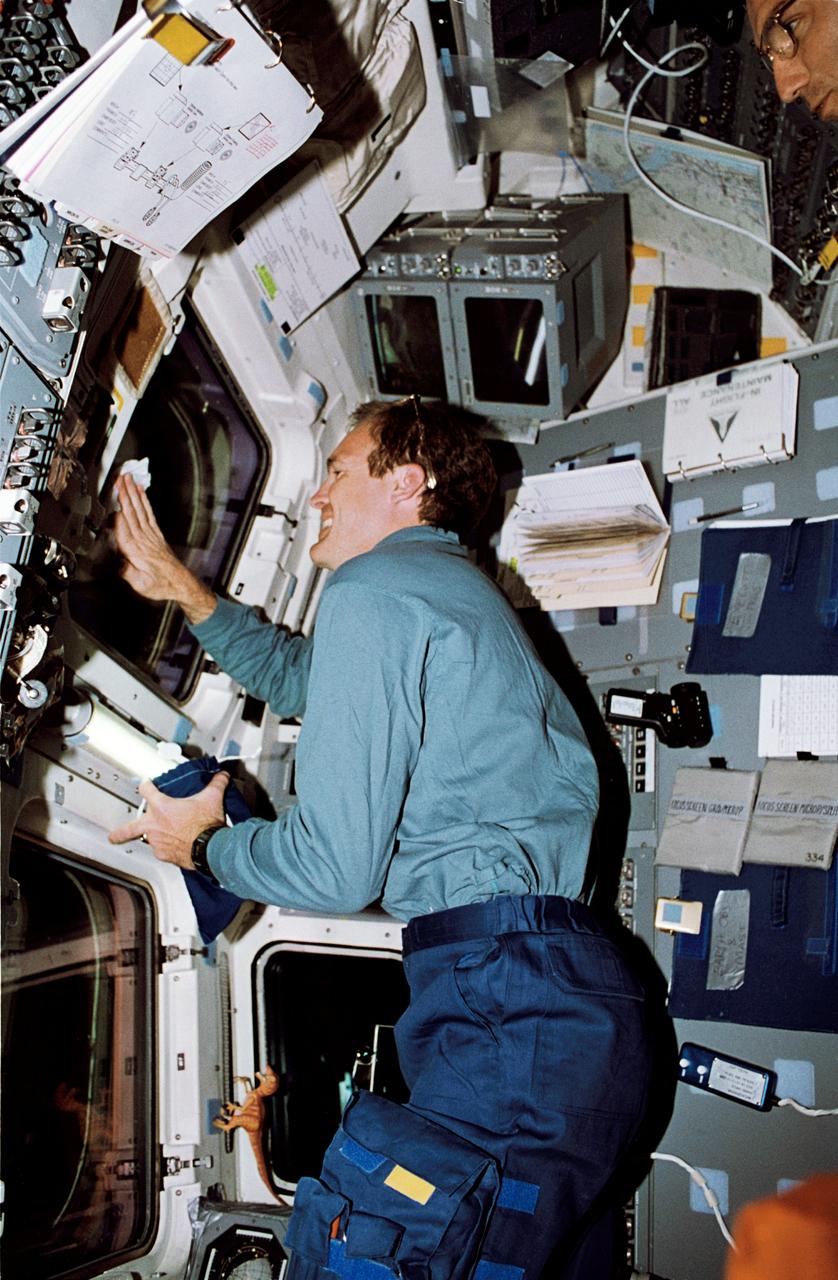
STS065-52-034 (8-23 July 1994) --- On the Space Shuttle Columbia's aft flight deck, astronaut James D. Halsel,l Jr., pilot, cleans off one of the overhead windows. Astronaut Carl E. Walz, mission specialist, looks on (photo's edge). The two shared over fourteen days in Earth-orbit with four other NASA astronauts and a Japanese payload specialist in support of the second International Microgravity Laboratory (IML-2) mission.
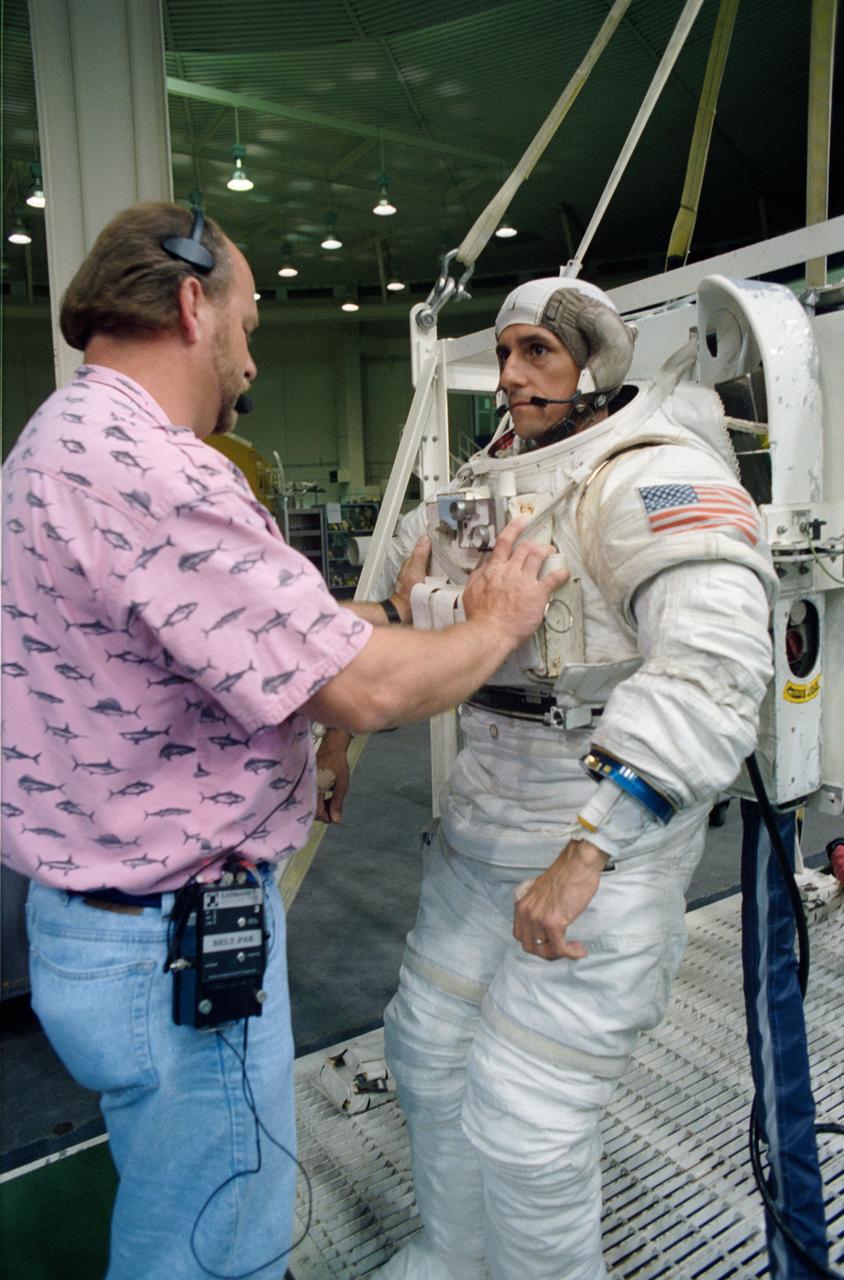
S94-29981 (8 March 1994) --- Astronaut Donald A. Thomas, mission specialist, awaits his helmet as he prepares to be lowered into a 25-feet deep pool at the Johnson Space Center's (JSC) Weightless Environment Training Facility (WET-F). Astronauts Thomas and Leroy Chiao were about to be submerged and made to be neutrally buoyant in order to rehearse several contingency tasks that would require a spacewalk. No spacewalks are scheduled for the International Microgravity Laboratory (IML-2).
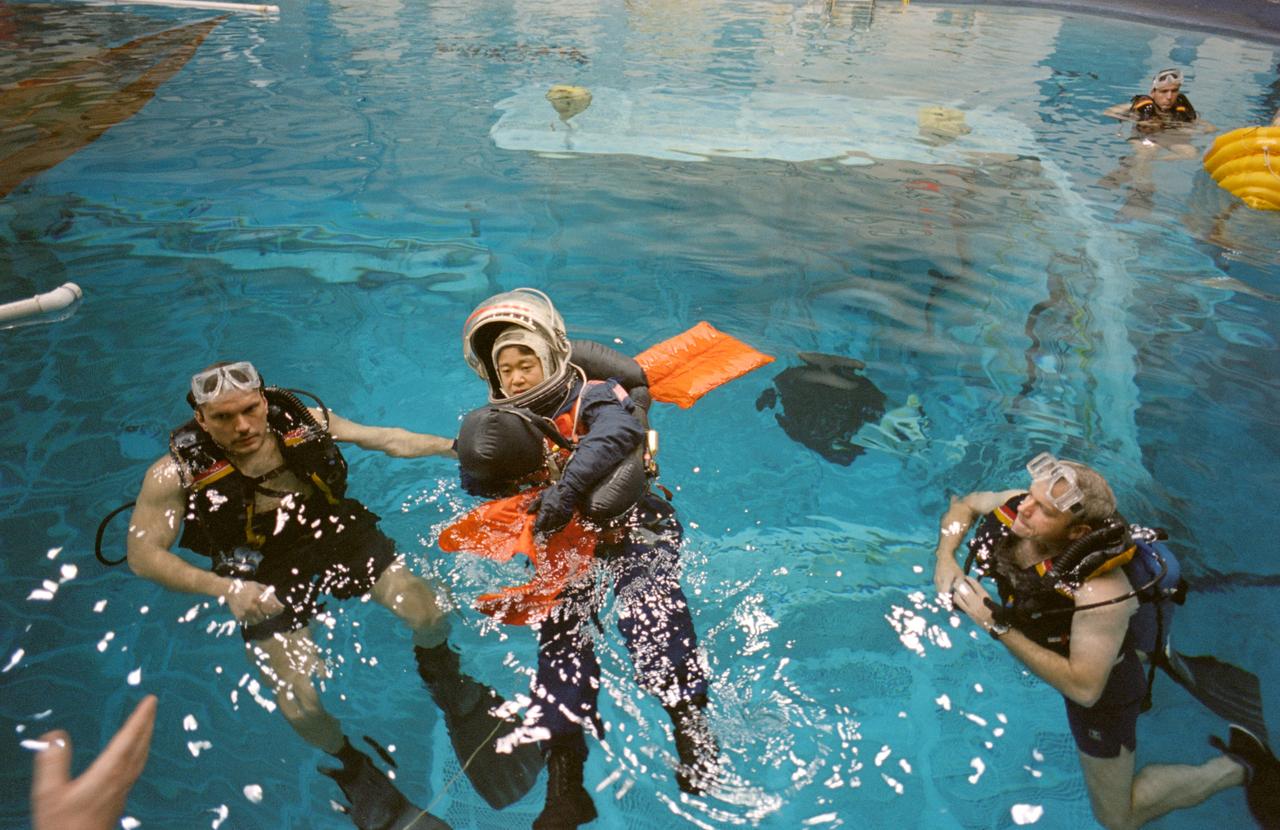
S94-29355 (28 Feb 1994) --- Dr. Chiaki Mukai, payload specialist, is assisted by a team of SCUBA-equipped divers during emergency egress training. The STS-65 crew was in the Weightless Environment Training Facility (WET-F) for the bailout training exercise. Dr. Mukai, representing the National Space Development Agency (NASDA), will join six NASA astronauts for the International Microgravity Laboratory (IML-2) mission aboard the Space Shuttle Columbia later this year.
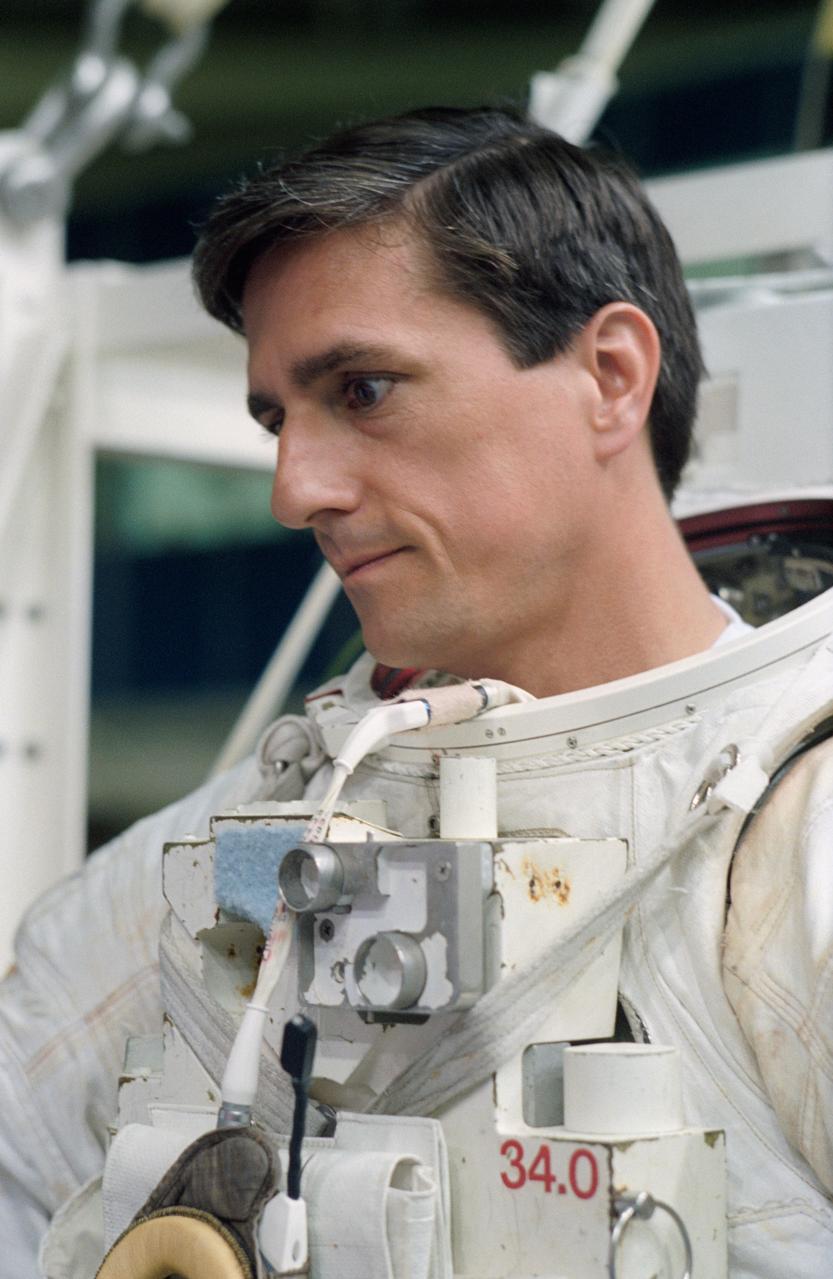
S94-29976 (8 March 1994) --- Astronaut Donald A. Thomas, mission specialist, awaits his helmet as he prepares to be lowered into a 25-feet deep pool at the Johnson Space Center's (JSC) Weightless Environment Training Facility (WET-F). Astronauts Thomas and Leroy Chiao were about to be submerged and made to be neutrally buoyant in order to rehearse several contingency tasks that would require a spacewalk. No spacewalks are scheduled for the International Microgravity Laboratory (IML-2).
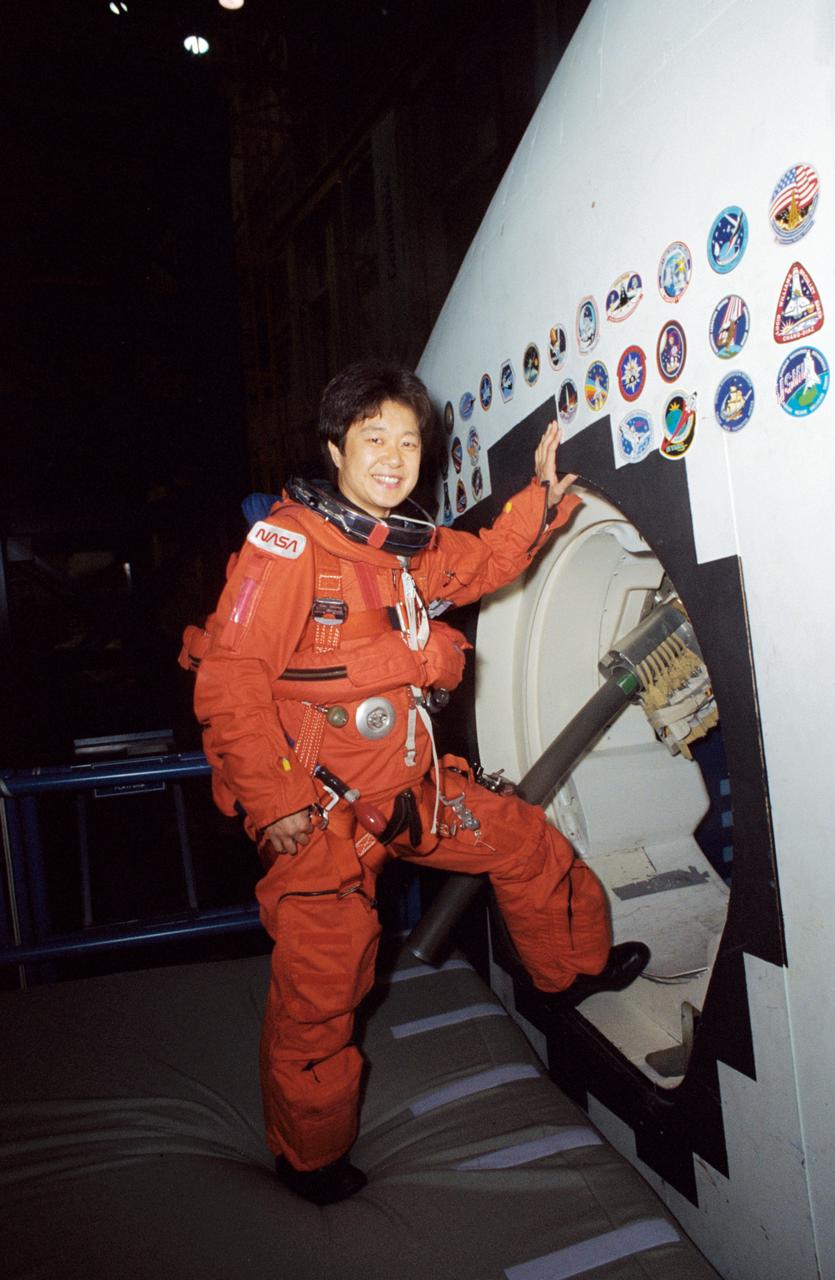
STS-65 Japanese Payload Specialist Chiaki Mukai takes a break from training at the Johnson Space Center (JSC). Wearing a training version of the orange launch and entry suit (LES), Mukai stands at the crew compartment trainer (CCT) side hatch in the Mockup and Integration Laboratory (MAIL) Bldg 9NE. Note the crew escape system (CES) pole device extending out the side hatch which would accommodate crewmembers in bailout from a troubled spacecraft. Mukai represents the National Space Development Agency (NASDA) of Japan and will serve as a payload specialist aboard Columbia, Orbiter Vehicle (OV) 102, during the STS-65 International Microgravity Laboratory 2 (IML-2) mission.
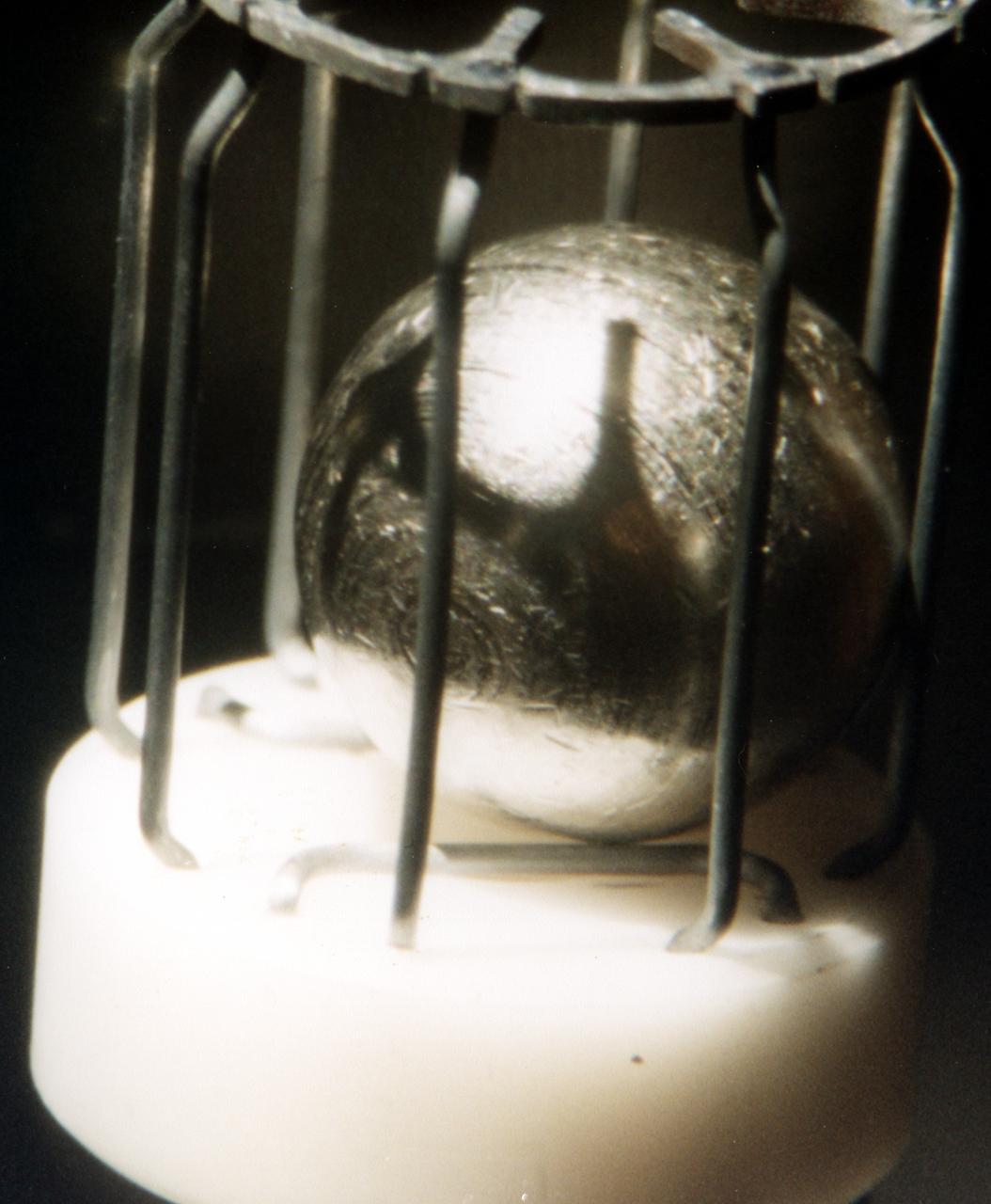
Typical metal sample that was processed by TEMPUS (Tiegelfreies Elektromagnetisches Prozessieren Unter Schwerelosigkeit), an electromagnetic levitation facility developed by German researchers and flown on the IML-2 and MSL-1 and 1R Spacelab missions. Electromagnetic levitation is used commonly in ground-based experiments to melt and then cool metallic melts below their freezing points without solidification occurring. Sample size is limited in ground-based experiments. Research with TEMPUS aboard Spacelab allowed scientists to study the viscosity, surface tension, and other properties of several metals and alloys while undercooled (i.e., cooled below their normal solidification points). The sample is about 1 cm (2/5 inch) in diameter.
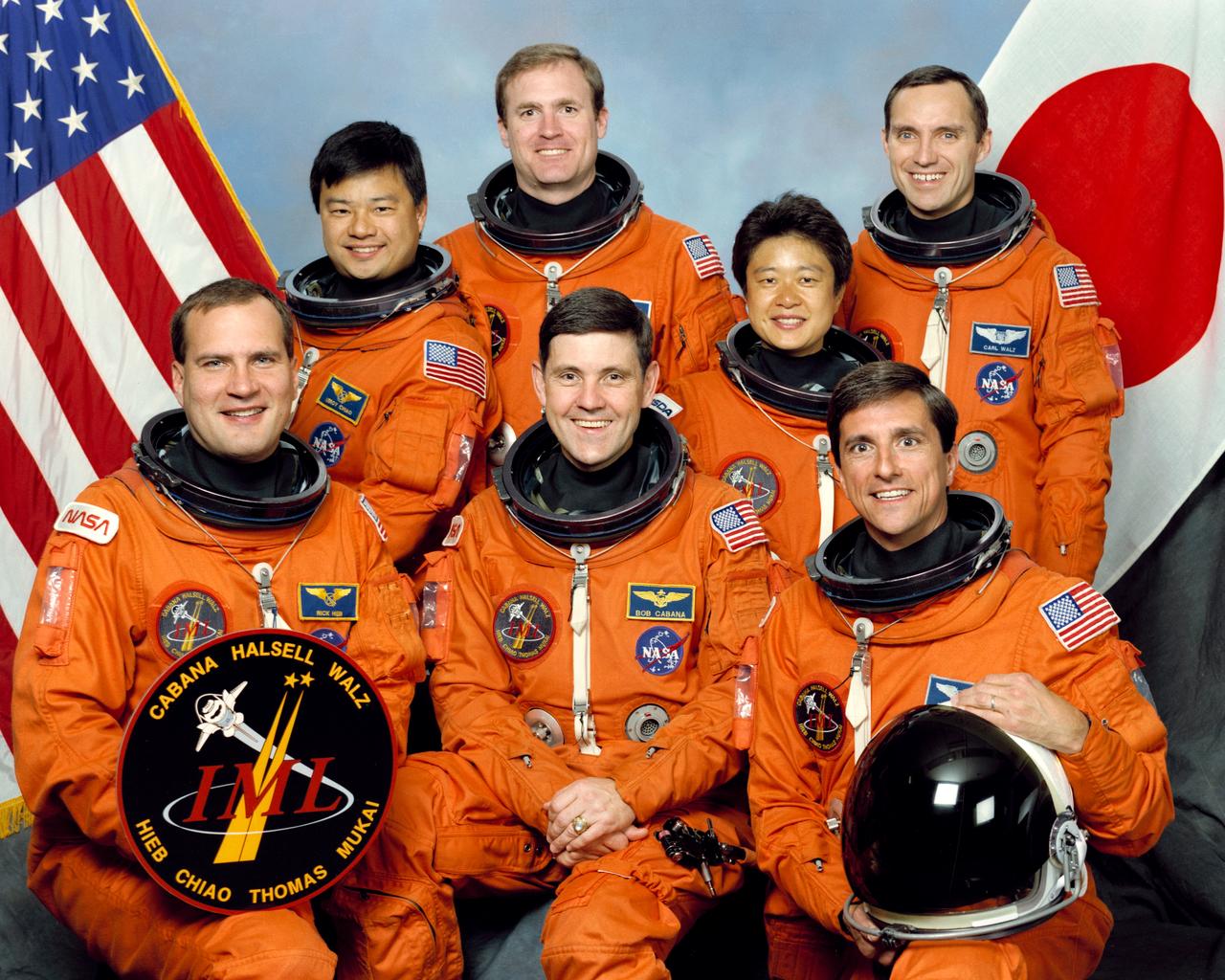
STS065-S-002 (April 1994) --- Six NASA astronauts and a Japanese payload specialist take a break from training to pose for their crew portrait. Left to right are Richard J. Hieb, Leroy Chiao, James D. Halsell Jr., Robert D. Cabana, Dr. Chiaki Mukai, Donald A. Thomas and Carl E. Walz. Cabana is mission commander, and Halsell has been assigned as pilot. Hieb is payload commander, with Walz, Thomas and Chiao serving as mission specialist. Dr. Mukai represents the National Space Development Agency (NASDA) of Japan as payload specialist on the International Microgravity Laboratory (IML) mission.
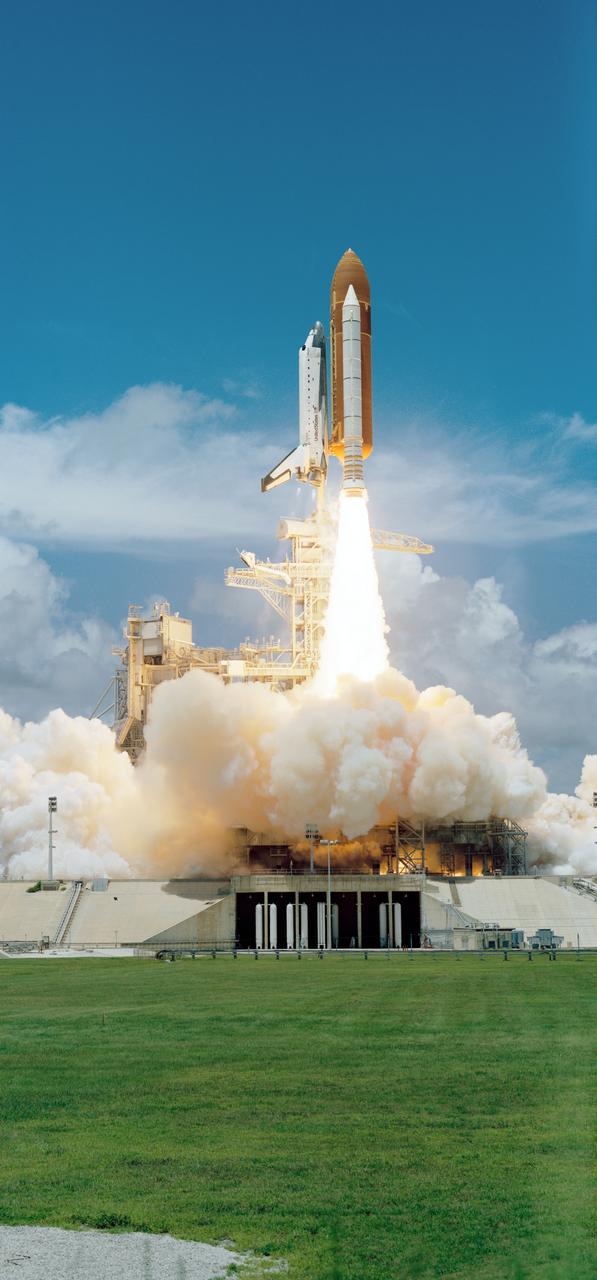
STS065-S-048 (8 July 1994) --- The Space Shuttle Columbia, with six NASA astronauts and a Japanese payload specialist aboard, heads toward Earth-orbit. A short time later, the crew began setting up the science module for two weeks of experimentation in support of the second International Microgravity Laboratory (IML-2). Launch occurred at 12:43 p.m. (EDT), July 8, 1994. Onboard were astronauts Robert D. Cabana, James D. Halsell, Jr., Richard J. Hieb, Carl E. Walz, Leroy Chiao, and Donald A. Thomas along with NASDA payload specialist Dr. Chiaki Mukai.
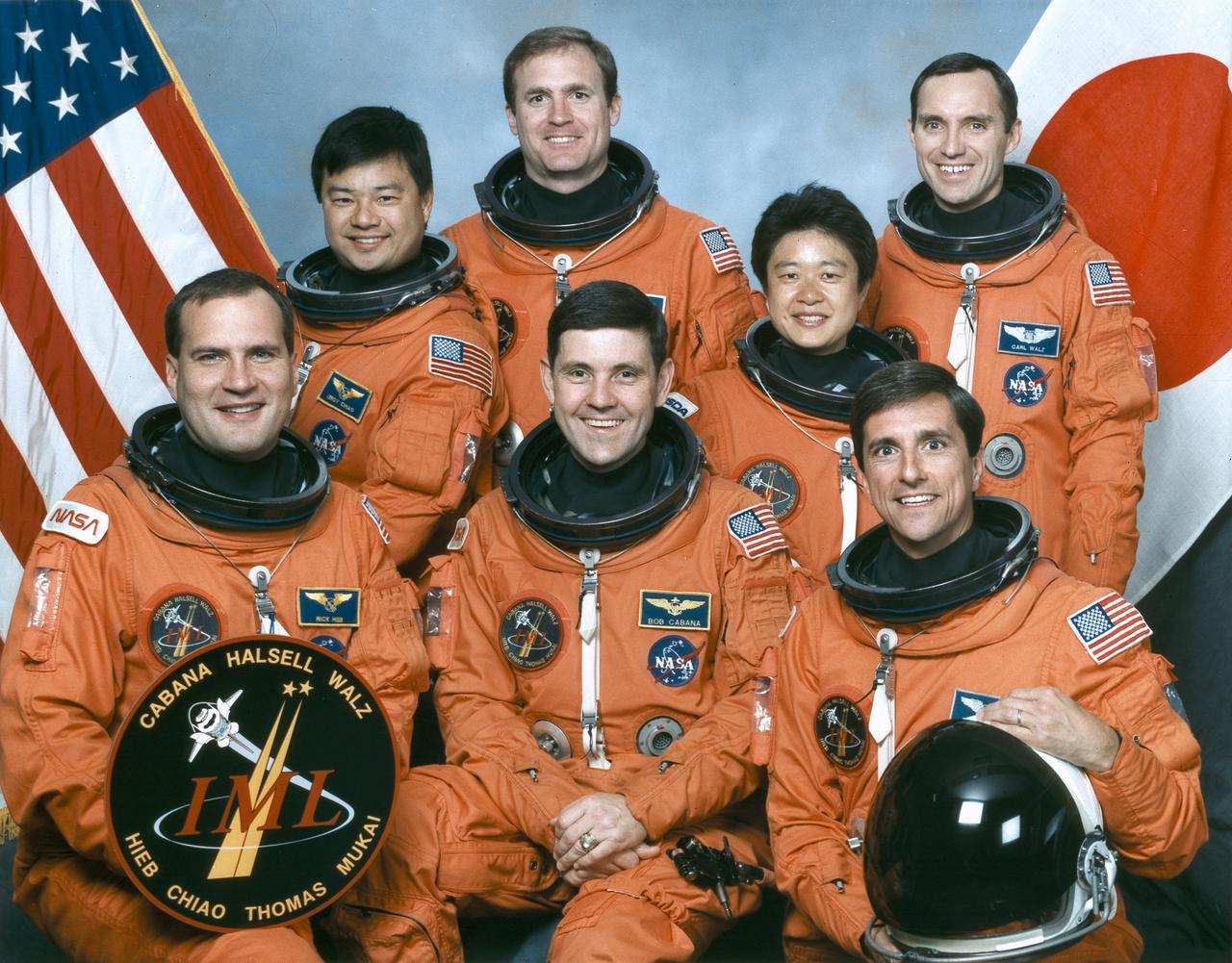
The crew assigned to the STS-65 mission included (seated left to right) Richard J. (Rick) Hieb, payload commander; Robert D. (Bob) Cabana, commander; and Donald A. Thomas, mission specialist. Standing, from left to right, are Leroy Chiao, mission specialist; James D. Halsell, pilot; Chiaki Naito-Mukai, payload specialist; and Carl E. Walz, mission specialist. Launched aboard the Space Shuttle Columbia on July 8, 1994 at 12:43:00 pm (EDT), the STS-64 mission marked the second flight of the International Microgravity Laboratory (IML-2) and the first flight of a female Japanese crew member.
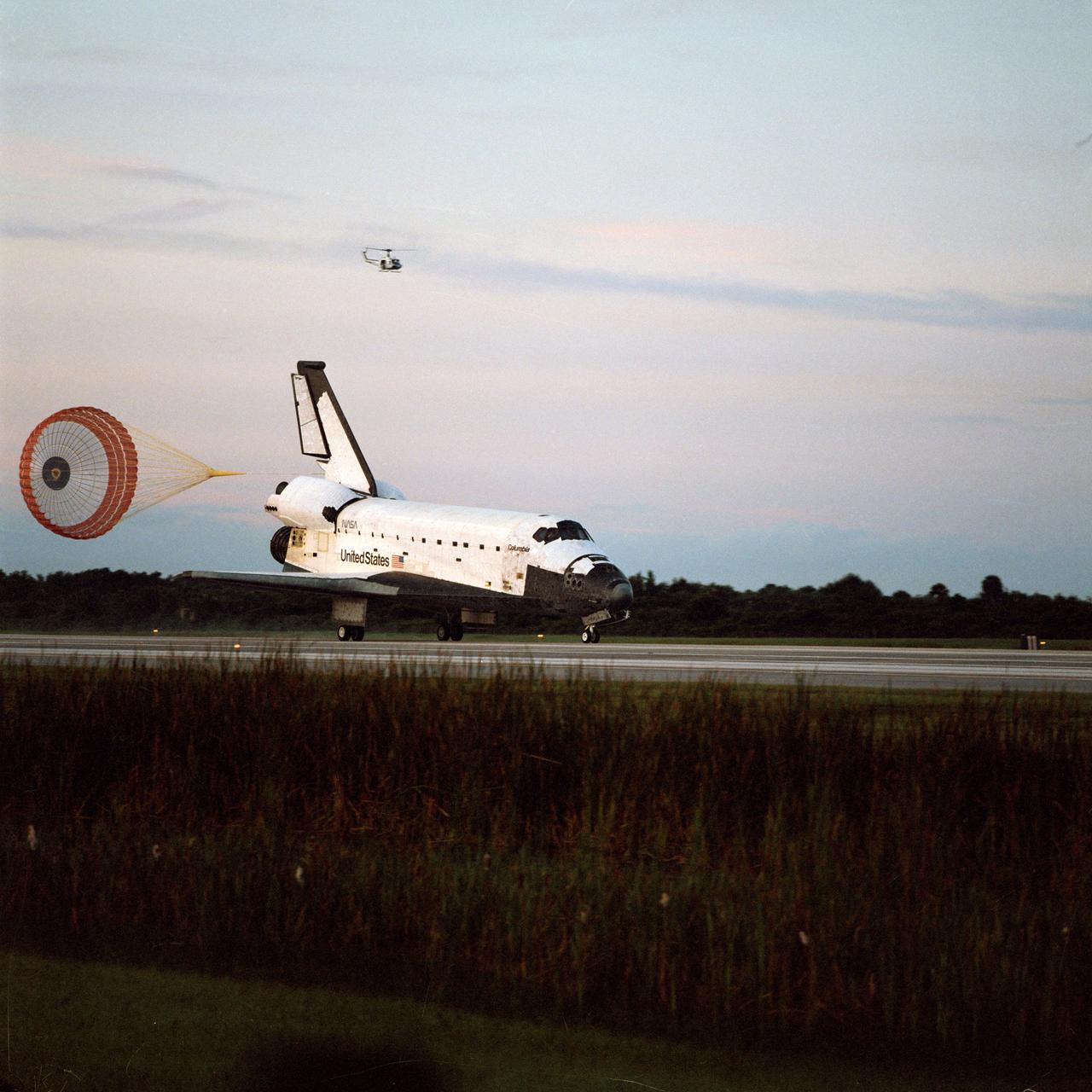
The Space Shuttle Columbia, Orbiter Vehicle (OV) 102, its drag chute fully deployed, completes a record duration mission as it lands on Runway 33 at the Kennedy Space Center (KSC) Shuttle Landing Facility (SLF). A helicopter flying overhead observes as OV-102's nose landing gear (NLG) and main landing gear (MLG) roll along the runway. Landing occurred at 6:38 am (Eastern Daylight Time (EDT)). STS-65 mission duration was 14 days 17 hours and 56 minutes. Onboard were six NASA astronauts and a Japanese payload specialist who conducted experiments in support of the International Microgravity Laboratory 2 (IML-2) during the mission.
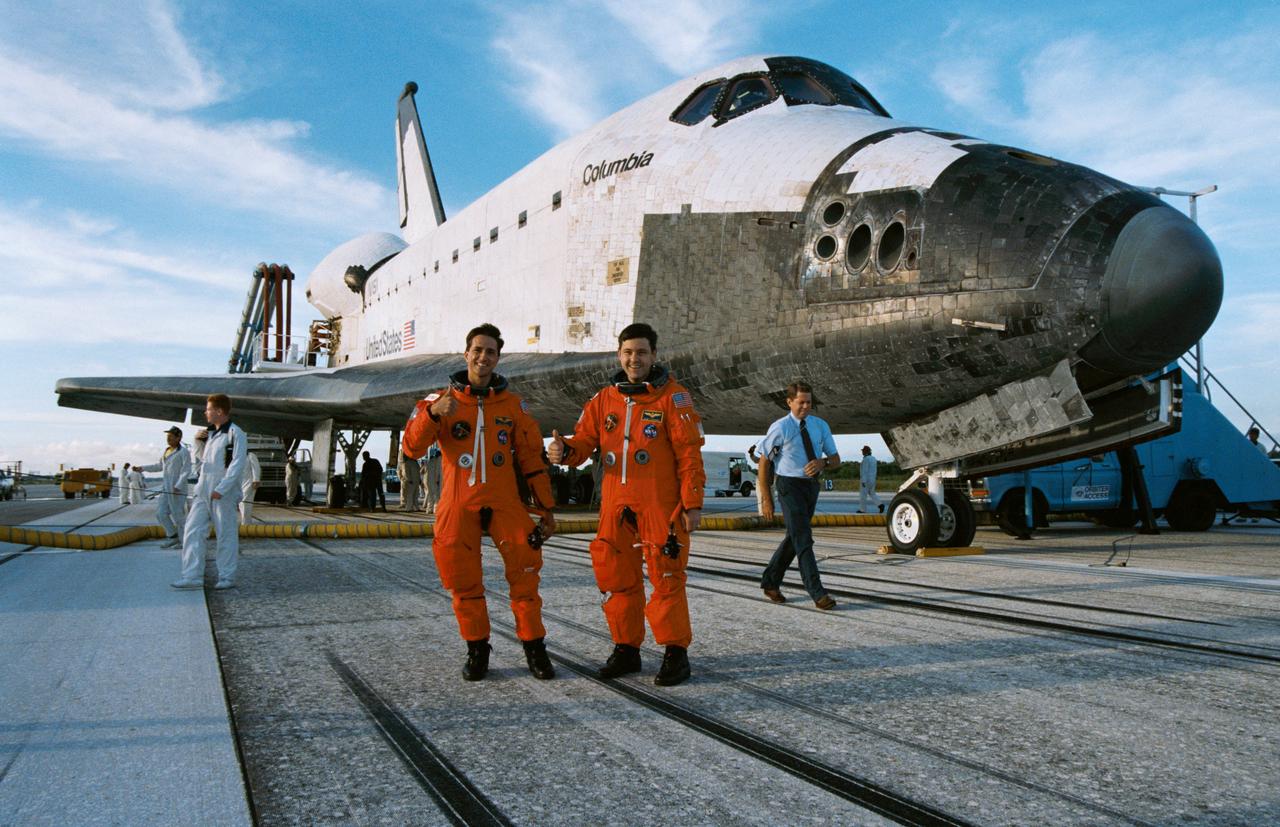
STS-65 Commander Robert D. Cabana (right) and Mission Specialist Donald A. Thomas, wearing launch and entry suits (LESs), signal mission success with a "thumbs up" gesture as they stand in front of Columbia, Orbiter Vehicle (OV) 102. The two crewmembers are all smiles after OV-102's landing at the Kennedy Space Center (KSC) Shuttle Landing Facility (SLF). The two, along with four other NASA astronauts and a Japanese payload specialist, had just broken a Shuttle duration record as they ran almost 18 hours over two weeks in space in support of the International Microgravity Laboratory 2 (IML-2) mission. Landing occurred at 6:38 am (Eastern Daylight Time (EDT)). Mission duration was 14 days, 17 hours and 56 minutes. In the background, KSC personnel conduct postflight servicing of the vehicle.
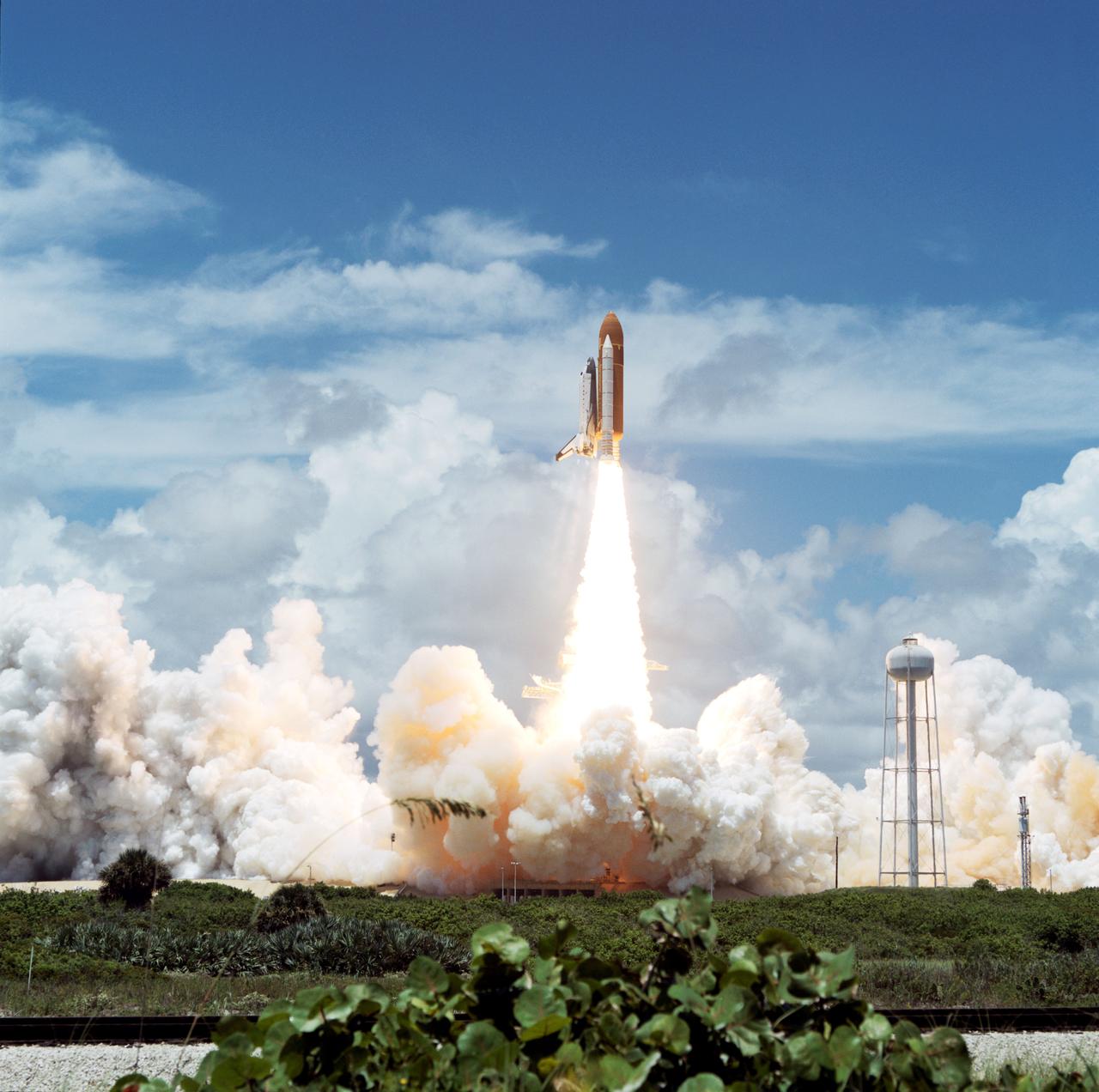
Columbia, Orbiter Vehicle (OV) 102, heads skyward after clearing the fixed service structure (FSS) tower at Kennedy Space Center (KSC) Launch Complex (LC) Pad 39A. Florida plant life appears in the foreground. The exhaust cloud produced by OV-102's solid rocket boosters (SRBs) covers the launch pad area with the exception of the sound suppression water system tower. OV-102's starboard side and the right SRB are visible from this angle. Launch occurred at 12:43 pm Eastern Daylight Time (EDT). Once in Earth orbit, STS-65's six NASA astronauts and a Japanese Payload Specialist aboard OV-102 will begin two weeks of experimentation in support of the second International Microgravity Laboratory (IML-2).
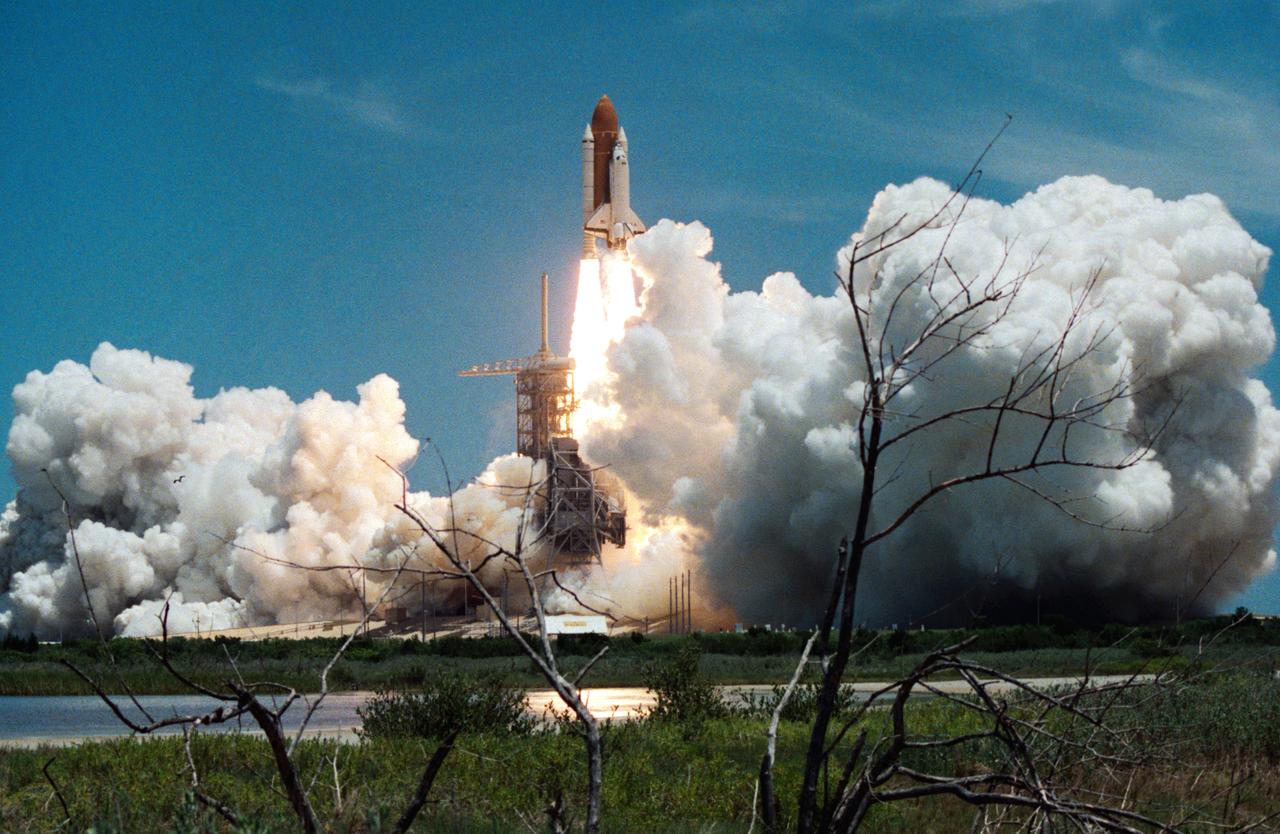
Columbia, Orbiter Vehicle (OV) 102, begins its roll maneuver after clearing the fixed service structure (FSS) tower as it rises above Kennedy Space Center (KSC) Launch Complex (LC) Pad 39A. In the foreground of this horizontal scene is Florida brush and a waterway. Beyond the brush, the shuttle's exhaust cloud envelops the immediate launch pad area. Launch occurred at 12:43 pm Eastern Daylight Time (EDT). The glow of the space shuttle main engine (SSME) and solid rocket booster (SRB) firings is reflected in the nearby waterway. Once in Earth orbit, STS-65's six NASA astronauts and a Japanese Payload Specialist aboard OV-102 will begin two weeks of experimentation in support of the second International Microgravity Laboratory (IML-2).
TEMPUS, an electromagnetic levitation facility that allows containerless processing of metallic samples in microgravity, first flew on the IML-2 Spacelab mission. The principle of electromagnetic levitation is used commonly in ground-based experiments to melt and then cool metallic melts below their freezing points without solidification occurring. The TEMPUS operation is controlled by its own microprocessor system; although commands may be sent remotely from the ground and real time adjustments may be made by the crew. Two video cameras, a two-color pyrometer for measuring sample temperatures, and a fast infrared detector for monitoring solidification spikes, will be mounted to the process chamber to facilitate observation and analysis. In addition, a dedicated high-resolution video camera can be attached to the TEMPUS to measure the sample volume precisely.
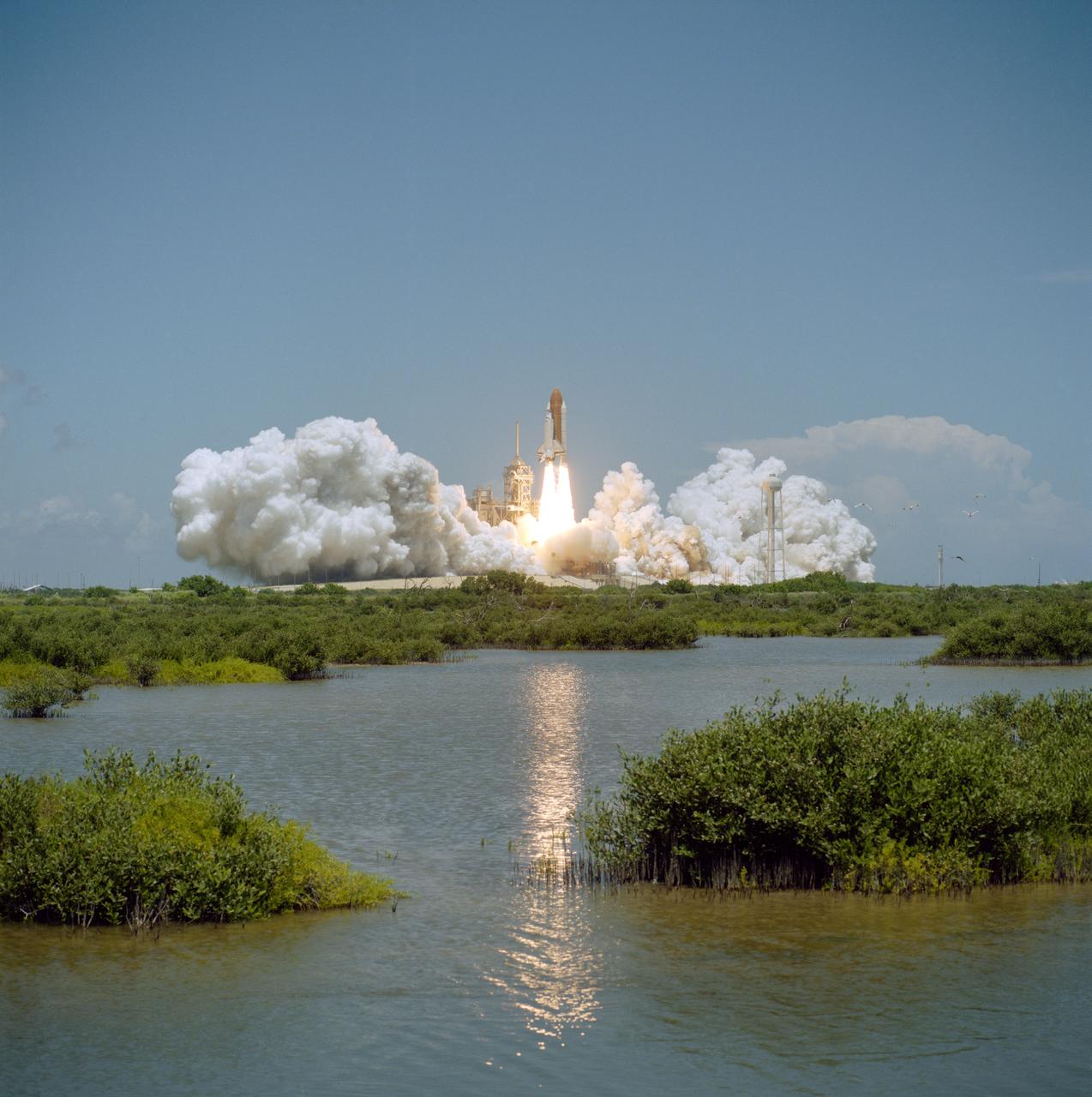
Columbia, Orbiter Vehicle (OV) 102, rises above Kennedy Space Center (KSC) Launch Complex (LC) Pad 39A after liftoff at 12:43 pm Eastern Daylight Time (EDT). An exhaust cloud covers the launch pad area and the glow of the space shuttle main engine (SSME) and solid rocket booster (SRB) firings is reflected in a nearby marsh as OV-102 atop its external tank (ET) heads toward Earth orbit. A small flock of birds is visible at the right. Once in Earth's orbit, STS-65's six NASA astronauts and a Japanese Payload Specialist aboard OV-102 will begin two weeks of experimentation in support of the second International Microgravity Laboratory (IML-2) mission.