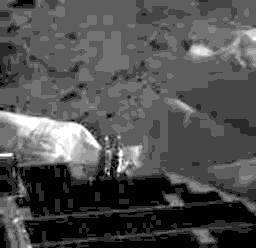
First IMP Image
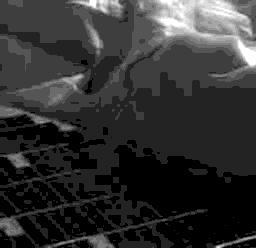
The First IMP Image from Mars
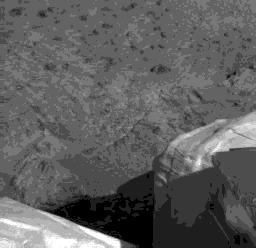
First IMP Image Showing Something That Looks Like Mars
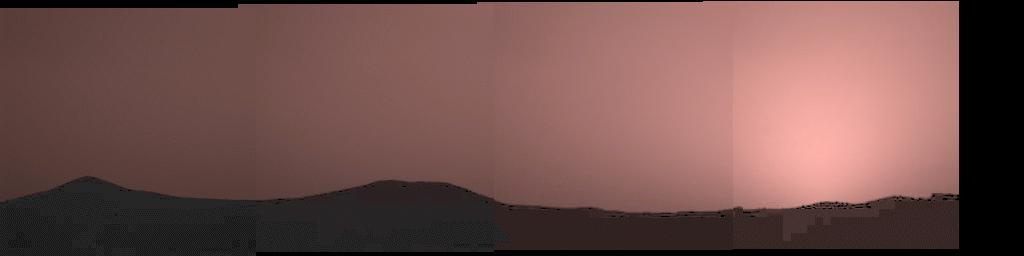
This image was taken by the Imager for Mars Pathfinder (IMP) about one minute after sunset on Mars on Sol 21. The prominent hills dubbed "Twin Peaks" form a dark silhouette at the horizon, while the setting sun casts a pink glow over the darkening sky. The image was taken as part of a twilight study which indicates how the brightness of the sky fades with time after sunset. Scientists found that the sky stays bright for up to two hours after sunset, indicating that Martian dust extends very high into the atmosphere. http://photojournal.jpl.nasa.gov/catalog/PIA00783
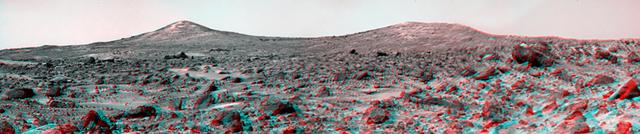
Twin Peaks are modest-size hills to the southwest of NASA Mars Pathfinder landing site. They were discovered on the first panoramas taken by the IMP camera on the 4th of July, 1997. 3D glasses are necessary to identify surface detail.
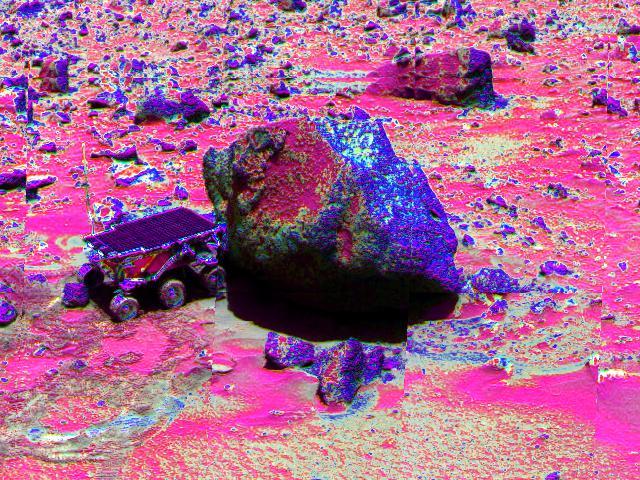
NASA Mars Pathfinder Lander, Sojourner, made contact with the rock Yogi in this false-color image from 1997, taken with the Imager for Mars Pathfinder IMP.
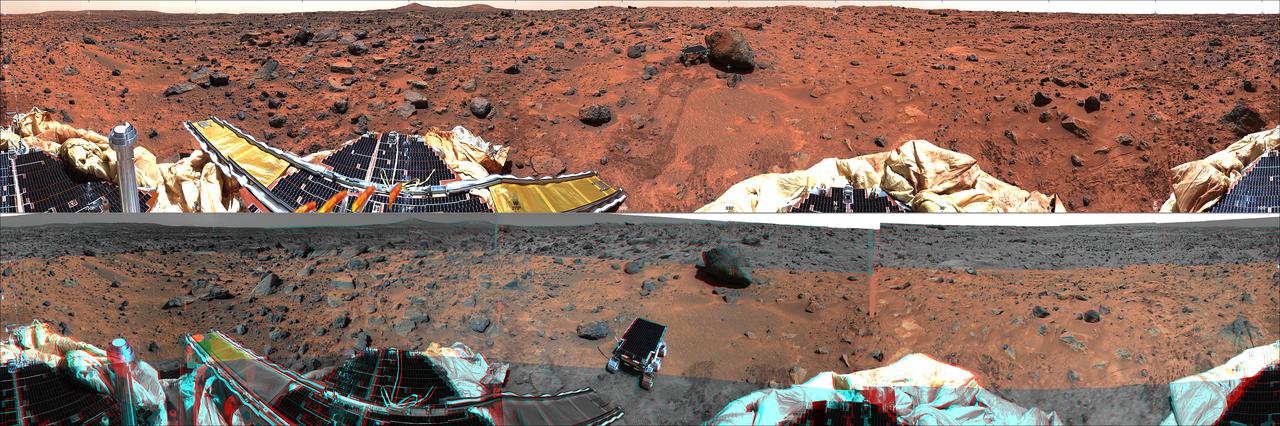
This panoramic view taken by NASA Mars Pathfinder is a controlled mosaic of approximately 300 IMP images. 3D glasses are necessary to identify surface detail.

This 360 degree "monster" panorama was taken by the deployed Imager for Mars Pathfinder (IMP) on Sol 3. All three petals, the perimeter of the deflated airbags, deployed rover Sojourner, forward and backward ramps and prominent surface features are visible. The IMP stands 1.8 meters over the Martian surface. The curvature and misalignment of several sections are due to image parallax. http://photojournal.jpl.nasa.gov/catalog/PIA00662
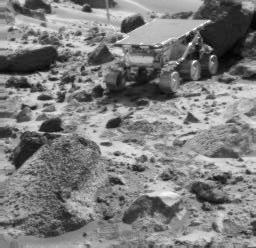
NASA's Sojourner rover is seen next to the rock "Shark," in this image taken by the Imager for Mars Pathfinder (IMP) near the end of daytime operations on Sol 52. The rover's Alpha Proton X-Ray Spectrometer is deployed against the rock. The rock "Wedge" is in the foreground. The Sojourner rover is seen next to the rock "Shark," in this image taken by the Imager for Mars Pathfinder (IMP) near the end of daytime operations on Sol 52. The rover's Alpha Proton X-Ray Spectrometer is deployed against the rock. The rock "Wedge" is in the foreground.

This is a more recent geometrically improved, color enhanced version of the 360-degree Gallery Pan, the first contiguous, uniform panorama taken by the Imager for Mars IMP over the course of Sols 8, 9, and 10.
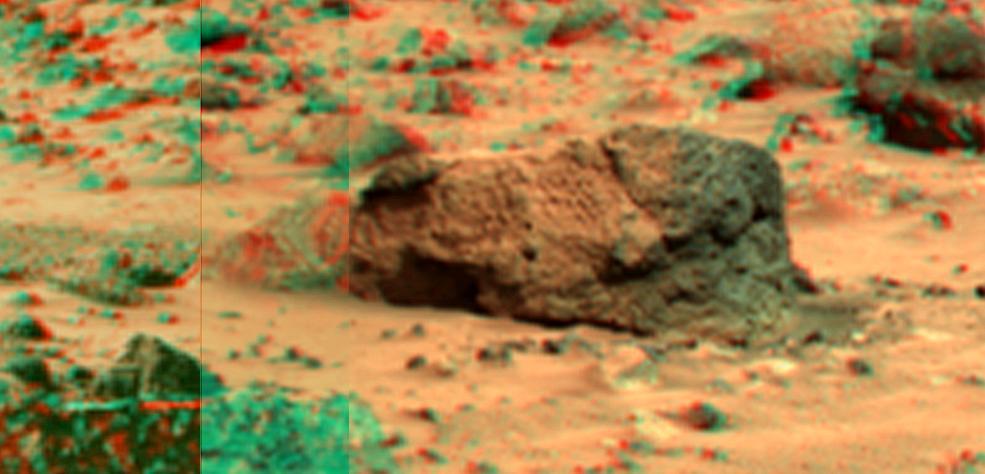
This view of Boo Boo was produced by combining the Super Panorama frames from the IMP camera from NASA Mars Pathfinder lander. 3D glasses are necessary to identify surface detail.
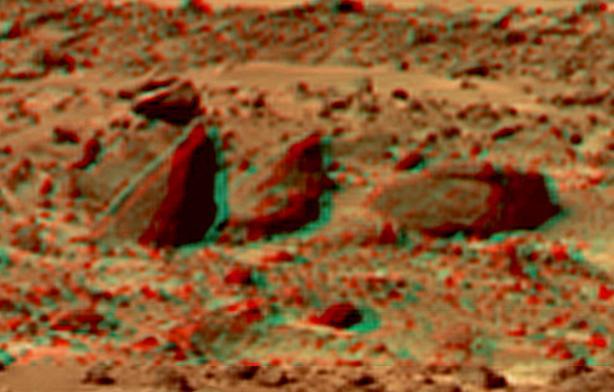
This view of Bookshelf Two was produced by combining the Super Panorama frames from the IMP camera from NASA Mars Pathfinder lander. 3D glasses are necessary to identify surface detail.
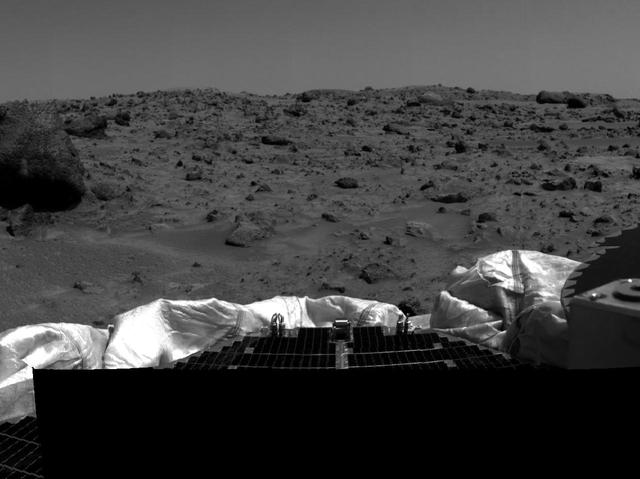
The left portion of this image, taken by the Imager for Mars Pathfinder (IMP) on July 5, 1997 (Sol 2), shows a portion of the large rock nicknamed "Yogi." Portions of a petal and deflated airbag are in the foreground. The dark circular object at right is a portion of the lander's high-gain antenna. http://photojournal.jpl.nasa.gov/catalog/PIA00630
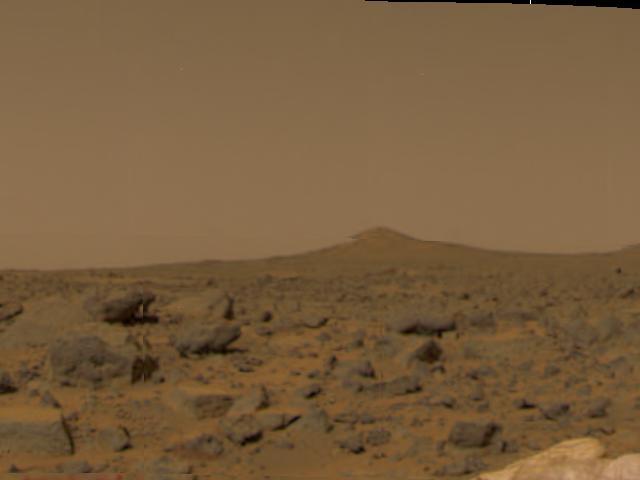
This image of the Martian surface was taken in the afternoon of Mars Pathfinder's first day on Mars. Taken by the Imager for Mars Pathfinder (IMP camera), the image shows a diversity of rocks strewn in the foreground. A hill is visible in the distance (the notch within the hill is an image artifact). Airbags are seen at the lower right. http://photojournal.jpl.nasa.gov/catalog/PIA00612
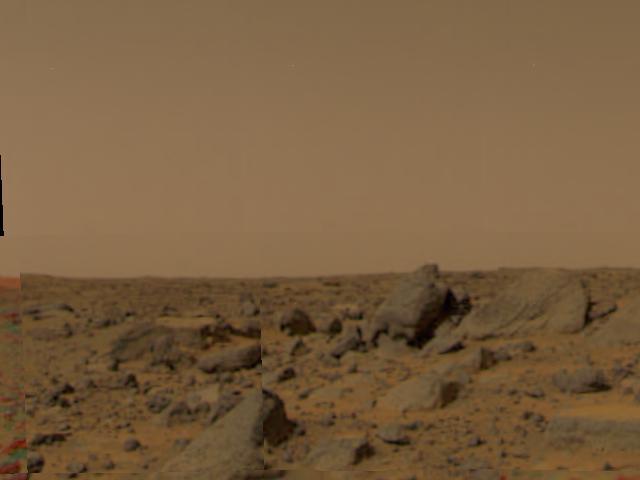
Large boulders are visible in this enlargement of pictures taken by the Imager for Mars Pathfinder (IMP) lander camera on July 4, 1997. The landing site is in the dry flood channel named Ares Valles. The boulders probably represent deposits from one of the catastrophic floods that carved the ancient channel. Between the rocks is brownish windblown soil. The gray-tan sky results from dust particles in the atmosphere. http://photojournal.jpl.nasa.gov/catalog/PIA00609
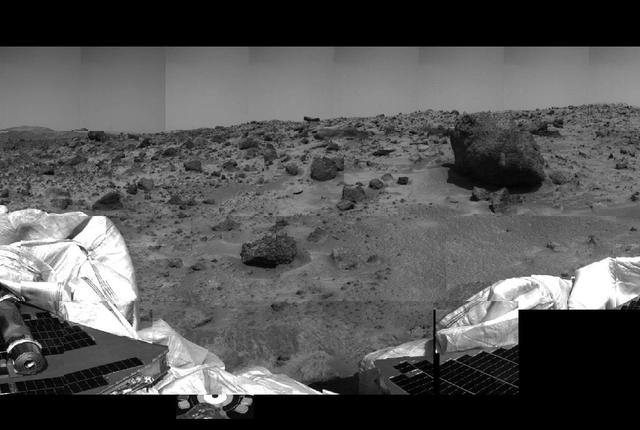
This image of the Martian surface was taken by the Imager for Mars Pathfinder (IMP) before sunset on July 4, 1997 (Sol 1), the spacecraft's first day on Mars. The airbags have been partially retracted, and portions the petal holding the undeployed rover Sojourner can be seen at lower left. The rock in the center of the image may be a future target for chemical analysis. The soil in the foreground has been disturbed by the movement of the airbags as they retracted. http://photojournal.jpl.nasa.gov/catalog/PIA00619
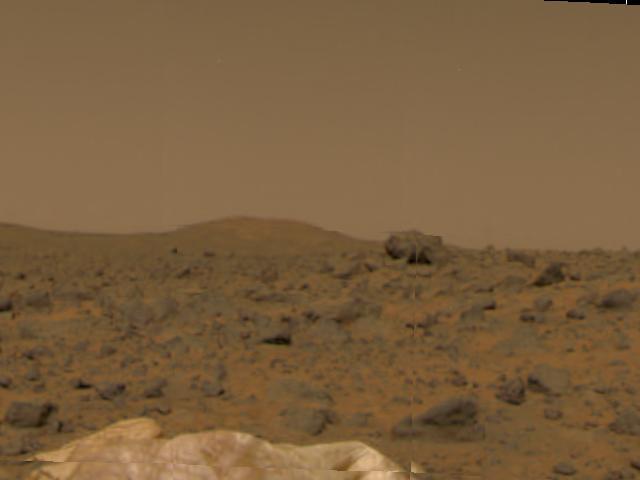
Portions of Mars Pathfinder's deflated airbags (seen in the foreground), a large rock in mid-field, and a hill in the background were taken by the Imager for Mars Pathfinder (IMP) aboard Mars Pathfinder during the spacecraft's first day on the Red Planet. Pathfinder successfully landed on Mars at 10:07 a.m. PDT earlier today. The IMP is a stereo imaging system with color capability provided by 24 selectable filters -- twelve filters per "eye." It stands 1.8 meters above the Martian surface, and has a resolution of two millimeters at a range of two meters. http://photojournal.jpl.nasa.gov/catalog/PIA00615
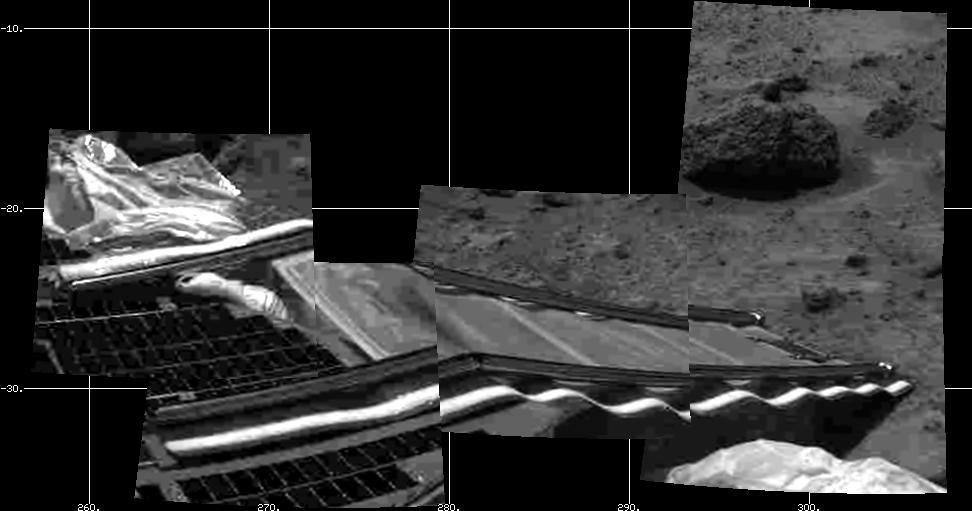
NASA's Mars Pathfinder's rear rover ramp can be seen successfully unfurled in this image, taken at the end of Sol 2 by the Imager for Mars Pathfinder (IMP). This ramp was later used for the deployment of the microrover Sojourner, which occurred at the end of Sol 2. Areas of a lander petal and deflated airbag are visible at left. The image helped Pathfinder scientists determine that the rear ramp was the one to use for rover deployment. At upper right is the rock dubbed "Barnacle Bill," which Sojourner will later study. http://photojournal.jpl.nasa.gov/catalog/PIA00627
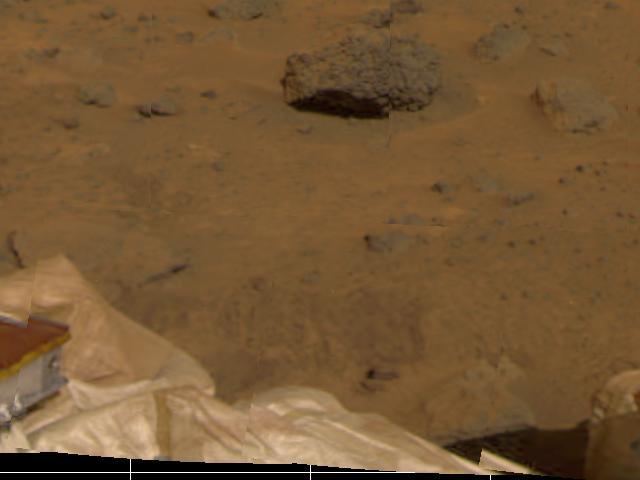
Several objects have been imaged by the Imager for Mars Pathfinder (IMP) during the spacecraft's first day on Mars. Portions of the deflated airbags, part of one the lander's petals, soil, and several rocks are visible. The furrows in the soil were artificially produced by the retraction of the airbags after landing, which occurred at 10:07 a.m. PDT. http://photojournal.jpl.nasa.gov/catalog/PIA00616
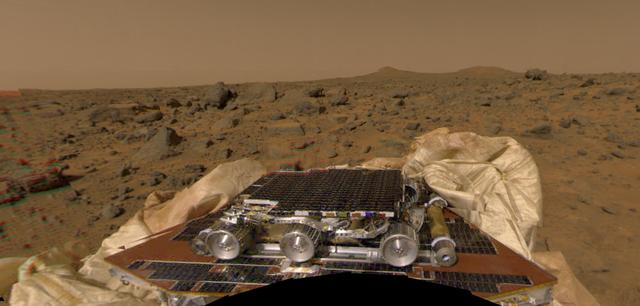
NASA's Sojourner rover and undeployed ramps onboard the Mars Pathfinder spacecraft can be seen in this image, by the Imager for Mars Pathfinder (IMP) on July 4 (Sol 1). This image has been corrected for the curvature created by parallax. The microrover Sojourner is latched to the petal, and has not yet been deployed. The ramps are a pair of deployable metal reels which will provide a track for the rover as it slowly rolls off the lander, over the spacecraft's deflated airbags, and onto the surface of Mars. Pathfinder scientists will use this image to determine whether it is safe to deploy the ramps. One or both of the ramps will be unfurled, and then scientists will decide whether the rover will use either the forward or backward ramp for its descent. http://photojournal.jpl.nasa.gov/catalog/PIA00621
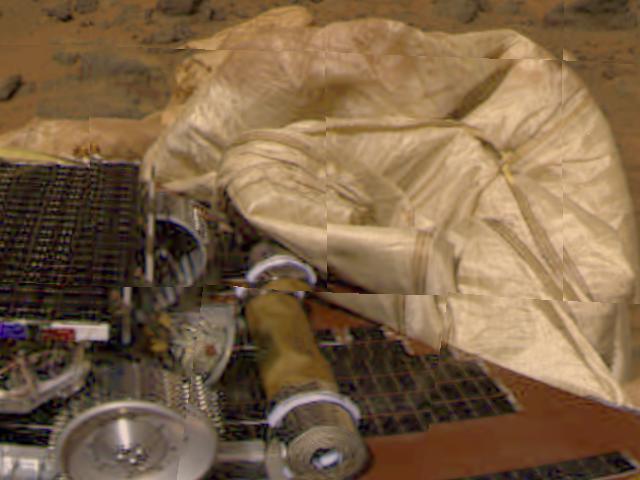
This image from the Imager for Mars Pathfinder (IMP) camera shows the rear part of the Sojourner rover, the rolled-up rear ramp, and portions of the partially deflated airbags. The Alpha Proton X-ray Spectrometer instrument is protruding from the rear (right side) of the rover. The airbags behind the rover are presently blocking the ramp from being safely unfurled. The ramps are a pair of deployable metal reels that will provide a track for the rover as it slowly rolls off the lander, and onto the surface of Mars, once Pathfinder scientists determine it is safe to do so. http://photojournal.jpl.nasa.gov/catalog/PIA00614
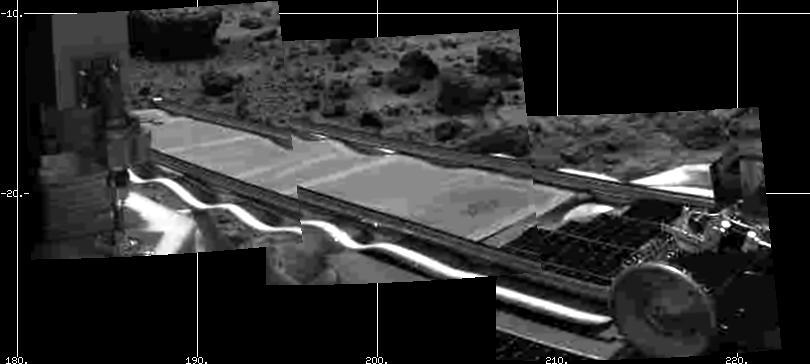
Mars Pathfinder's forward rover ramp can be seen successfully unfurled in this image, taken at the end of Sol 2 by the Imager for Mars Pathfinder (IMP). This ramp was not used for the deployment of the microrover Sojourner, which occurred at the end of Sol 2. Sojourner can be seen still latched to one of the lander's petals, waiting for the command sequence that would execute its descent off of the lander's petal. The imager helped Pathfinder scientists determine whether to deploy the rover using the forward or backward ramps and the nature of the first rover traverse. http://photojournal.jpl.nasa.gov/catalog/PIA00628
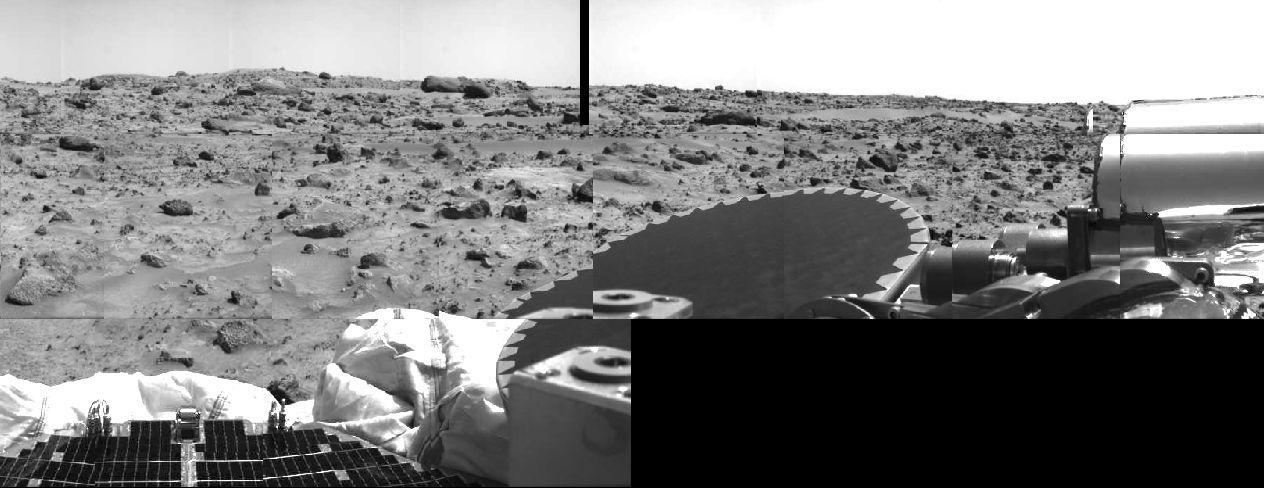
Areas of rocky Martian terrain are seen in this image, taken by the Imager for Mars Pathfinder (IMP) on Sol 2. Portions of a lander petal and deflated airbag are at lower left. The dark disk at center is the high-gain antenna, and the silver cylindrical objects at upper right are part of the antenna's mechanism. An area of relatively smooth terrain is seen at upper right, which may offer clues to how this area was formed, and may be a future target for Sojourner's studies. The black area at lower right and small strip at top center is missing data. http://photojournal.jpl.nasa.gov/catalog/PIA00625
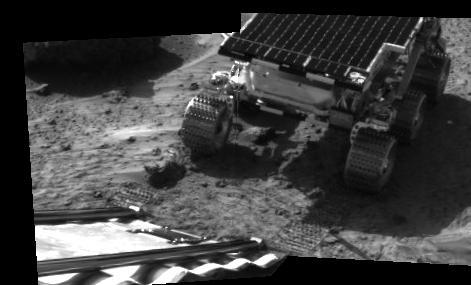
This picture taken by the IMP (Imager for Mars Pathfinder) aboard the Mars Pathfinder spacecraft depicts the rover Sojourner's position after driving onto the Martian surface. Sojourner has become the first autonomous robot ever to traverse the surface of Mars. This image reflects the success of Pathfinder's principle objective -- to place a payload on Mars in a safe, operational configuration. The primary mission of Sojourner, scheduled to last seven days, will be to use its Alpha Proton X-ray Spectrometer (APXS) instrument to determine the elements that make up the rocks and soil on Mars. A full study using the APXS takes approximately ten hours, and can measure all elements except hydrogen at any time of the Martian day or night. The APXS will conduct its studies by bombarding rocks and soil samples with alpha particle radiation -- charged particles equivalent to the nucleus of a helium atom, consisting of two protons and two neutrons. http://photojournal.jpl.nasa.gov/catalog/PIA00623
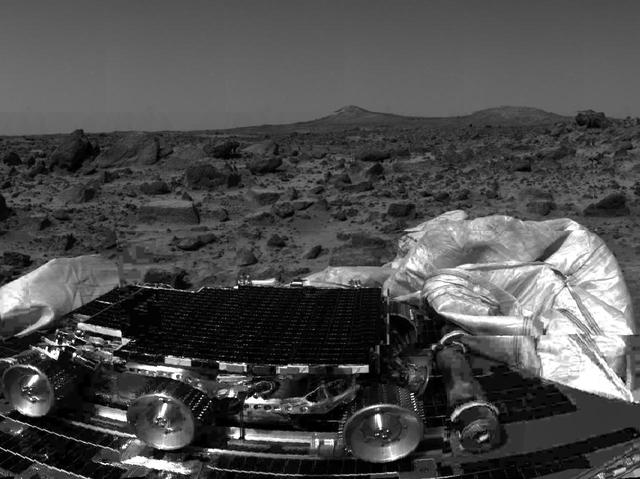
The undeployed Sojourner rover is seen still latched to a lander petal in this image, taken by the Imager for Mars Pathfinder (IMP) on Sol 1, the lander's first day on Mars. Portions of a petal and deflated airbag are in the foreground. The rectangular rock at right has been dubbed "Flat top," and may be a possible object of study for Sojourner's Alpha Proton X-Ray Spectrometer (APXS) instrument. The mismatched portion of image at left is a misregistered section of data. http://photojournal.jpl.nasa.gov/catalog/PIA00631
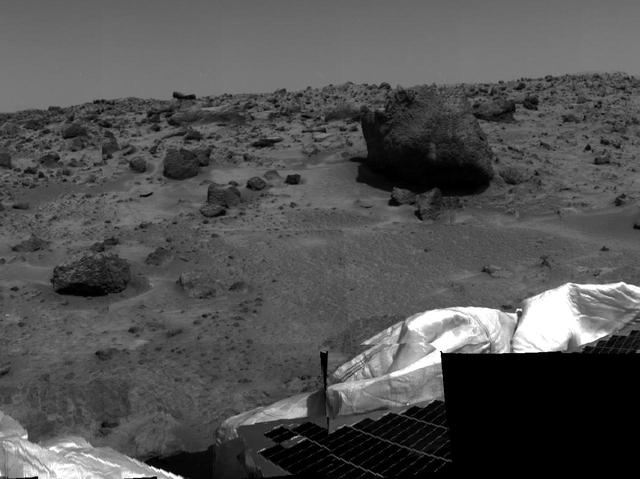
Several possible targets of study for rover Sojourner's Alpha Proton X-Ray Spectrometer (APXS) instrument are seen in this image, taken by the Imager for Mars Pathfinder (IMP) on Sol 2. The smaller rock at left has been dubbed "Barnacle Bill," while the larger rock at right, approximately 3-4 meters from the lander, is now nicknamed "Yogi." Barnacle Bill is scheduled to be the first object of study for the APXS. Portions of a petal and deflated airbag are also visible at lower right. http://photojournal.jpl.nasa.gov/catalog/PIA00629
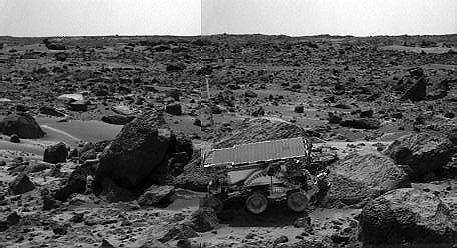
The Sojourner rover's Alpha Proton X-ray Spectrometer (APXS) is shown deployed against the rock "Moe" on the afternoon of Sol 64 (September 7). The rocks to the left of Moe are "Shark" (left of Sojourner) and "Half Dome" (behind Sojourner). They were previously measured by the APXS. The image was taken by the Imager for Mars Pathfinder (IMP). http://photojournal.jpl.nasa.gov/catalog/PIA00966
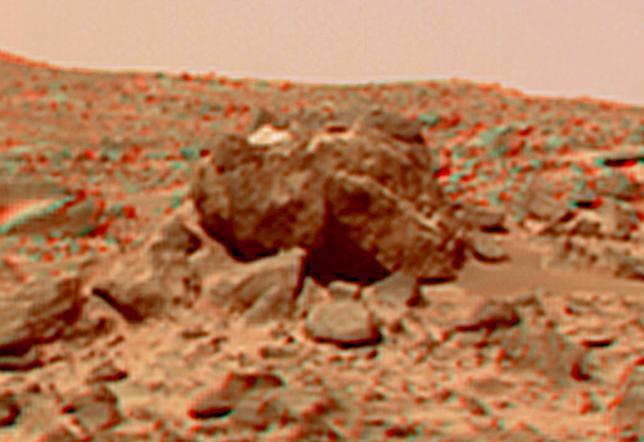
This view of the "Hippo," 25 meters to the west of the lander, was produced by combining the "Super Panorama" frames from the IMP camera. Super resolution was applied to help to address questions about the texture of this rock and what it might tell us about its mode of origin. The composite color frames that make up this anaglyph were produced for both the right and left eye of the IMP. These composites consist of more than 15 frames per eye (because multiple sequences covered the same area), taken with different color filters that were enlarged by 500% and then co-added using Adobe Photoshop to produce, in effect, a super-resolution panchromatic frame that is sharper than an individual frame would be. These panchromatic frames were then colorized with the red, green, and blue filtered images from the same sequence. The color balance was adjusted to approximate the true color of Mars. The anaglyph view was produced by combining the left with the right eye color composite frames by assigning the left eye composite view to the red color plane and the right eye composite view to the green and blue color planes (cyan), to produce a stereo anaglyph mosaic. This mosaic can be viewed in 3-D on your computer monitor or in color print form by wearing red-blue 3-D glasses. http://photojournal.jpl.nasa.gov/catalog/PIA01421
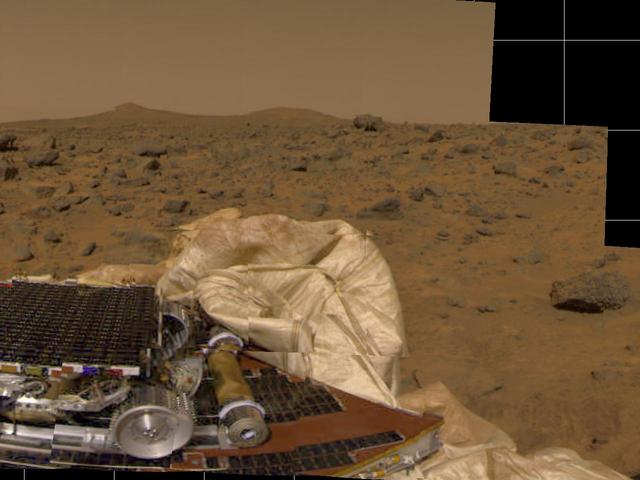
The Imager for Mars Pathfinder (IMP) took this image of surrounding terrain in the mid-morning on Mars (2:30 PM Pacific Daylight Time) earlier today. Part of the small rover, Sojourner, is visible on the left side of the picture. The tan cylinder to the right of the rover is one of two rolled-up ramps by which the rover will descend to the ground. The white, billowy material in the center of the picture is part of the airbag system. Many rocks of different shapes and sizes are visible between the lander and the horizon. Two hills are visible on the horizon. The notch on the left side of the leftmost conical hill is an artifact of the processing of this picture. http://photojournal.jpl.nasa.gov/catalog/PIA00613
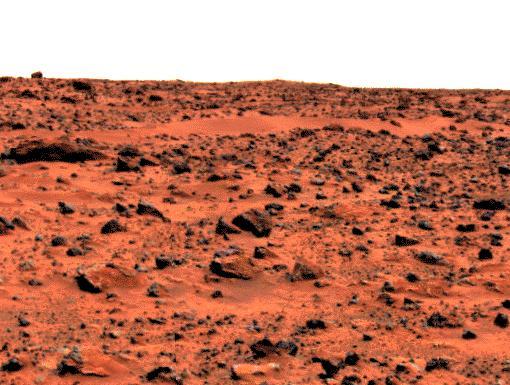
This enhanced color image of the Pathfinder landing site shows the eastern horizon. The elongated, reddish, low contrast region in the distance is "Roadrunner Flats." This image was taken by the Imager for Mars Pathfinder (IMP). Sojourner spent 83 days of a planned seven-day mission exploring the Martian terrain, acquiring images, and taking chemical, atmospheric and other measurements. The final data transmission received from Pathfinder was at 10:23 UTC on September 27, 1997. Although mission managers tried to restore full communications during the following five months, the successful mission was terminated on March 10, 1998. http://photojournal.jpl.nasa.gov/catalog/PIA00979
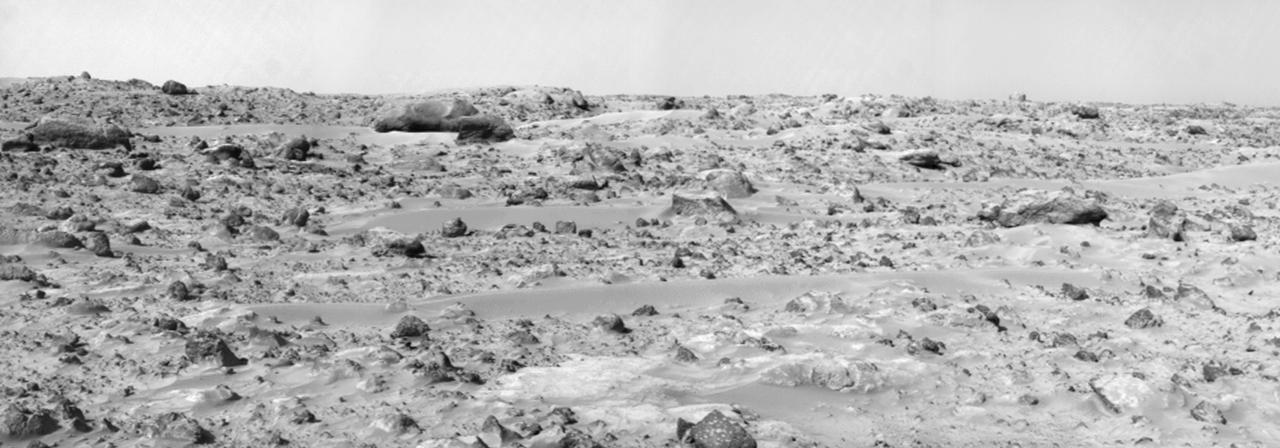
This panorama of the region to the northeast of the lander was constructed to support the Sojourner Rover Team's plans to conduct an "autonomous traverse" to explore the terrain away from the lander after science objectives in the lander vicinity had been met. The large, relatively bright surface in the foreground, about 10 meters (33 feet) from the spacecraft, in this scene is "Baker's Bench." The large, elongated rock left of center in the middle distance is "Zaphod." This view was produced by combining 8 individual "Superpan" scenes from the left and right eyes of the IMP camera. Each frame consists of 8 individual frames (left eye) and 7 frames (right eye) taken with different color filters that were enlarged by 500% and then co-added using Adobe Photoshop to produce, in effect, a super-resolution panchromatic frame that is sharper than an individual frame would be. http://photojournal.jpl.nasa.gov/catalog/PIA01000
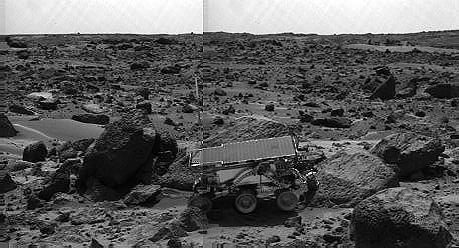
The Sojourner rover's Alpha Proton X-ray Spectrometer (APXS) is shown deployed against the rock "Moe" on the afternoon of Sol 64 (September 7). The rocks to the left of Moe are "Shark" (left of Sojourner) and "Half Dome" (behind Sojourner). They were previously measured by the APXS. The image was taken by the Imager for Mars Pathfinder (IMP). Sojourner spent 83 days of a planned seven-day mission exploring the Martian terrain, acquiring images, and taking chemical, atmospheric and other measurements. The final data transmission received from Pathfinder was at 10:23 UTC on September 27, 1997. Although mission managers tried to restore full communications during the following five months, the successful mission was terminated on March 10, 1998. http://photojournal.jpl.nasa.gov/catalog/PIA01560

"Barnacle Bill" is a small rock immediately west-northwest of the Mars Pathfinder lander and was the first rock visited by the Sojourner Rover's alpha proton X-ray spectrometer (APXS) instrument. This image shows super resolution techniques applied to the first APXS target rock, which was never imaged with the rover's forward cameras. Super resolution was applied to help to address questions about the texture of this rock and what it might tell us about its mode of origin. This view of Barnacle Bill was produced by combining the "Super Panorama" frames from the IMP camera. Super resolution was applied to help to address questions about the texture of these rocks and what it might tell us about their mode of origin. The composite color frames that make up this anaglyph were produced for both the right and left eye of the IMP. The composites consist of 7 frames in the right eye and 8 frames in the left eye, taken with different color filters that were enlarged by 500% and then co-added using Adobe Photoshop to produce, in effect, a super-resolution panchromatic frame that is sharper than an individual frame would be. These panchromatic frames were then colorized with the red, green, and blue filtered images from the same sequence. The color balance was adjusted to approximate the true color of Mars. The anaglyph view was produced by combining the left with the right eye color composite frames by assigning the left eye composite view to the red color plane and the right eye composite view to the green and blue color planes (cyan), to produce a stereo anaglyph mosaic. This mosaic can be viewed in 3-D on your computer monitor or in color print form by wearing red-blue 3-D glasses. http://photojournal.jpl.nasa.gov/catalog/PIA01409

This is the first color image ever taken from the surface of Mars of an overcast sky. Featured are pink stratus clouds coming from the northeast at about 15 miles per hour (6.7 meters/second) at an approximate height of ten miles (16 kilometers) above the surface. The clouds consist of water ice condensed on reddish dust particles suspended in the atmosphere. Clouds on Mars are sometimes localized and can sometimes cover entire regions, but have not yet been observed to cover the entire planet. The image was taken about an hour and forty minutes before sunrise by the Imager for Mars Pathfinder (IMP) on Sol 16 at about ten degrees up from the eastern Martian horizon. Sojourner spent 83 days of a planned seven-day mission exploring the Martian terrain, acquiring images, and taking chemical, atmospheric and other measurements. The final data transmission received from Pathfinder was at 10:23 UTC on September 27, 1997. Although mission managers tried to restore full communications during the following five months, the successful mission was terminated on March 10, 1998. http://photojournal.jpl.nasa.gov/catalog/PIA00796