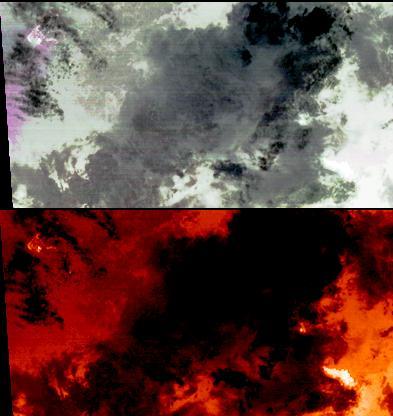
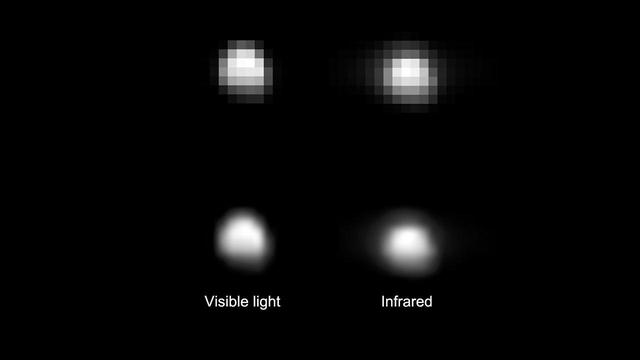
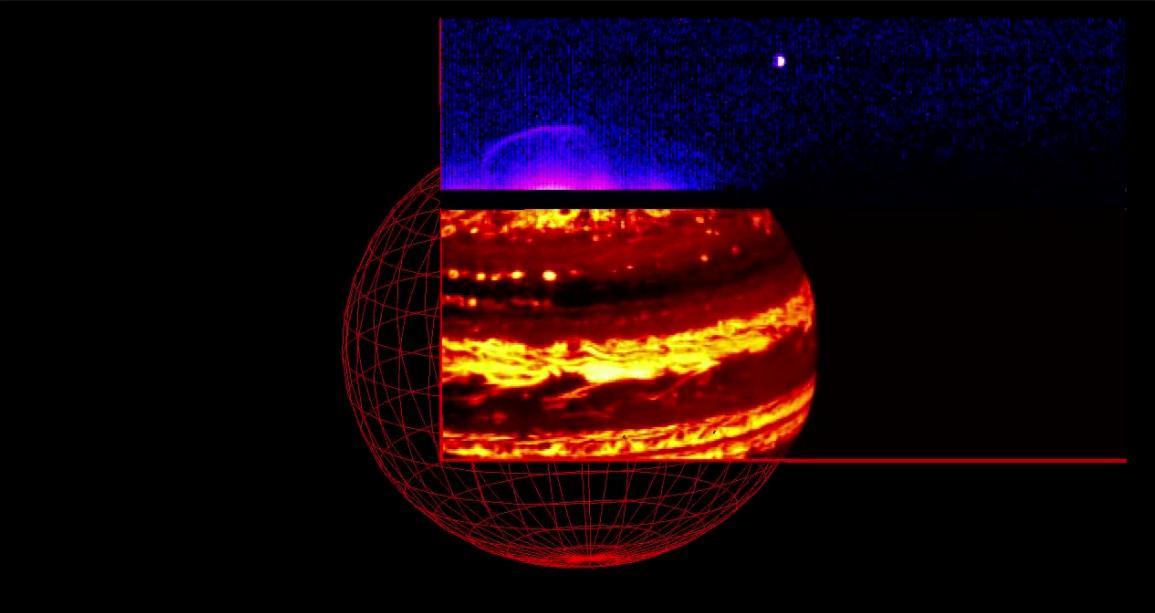
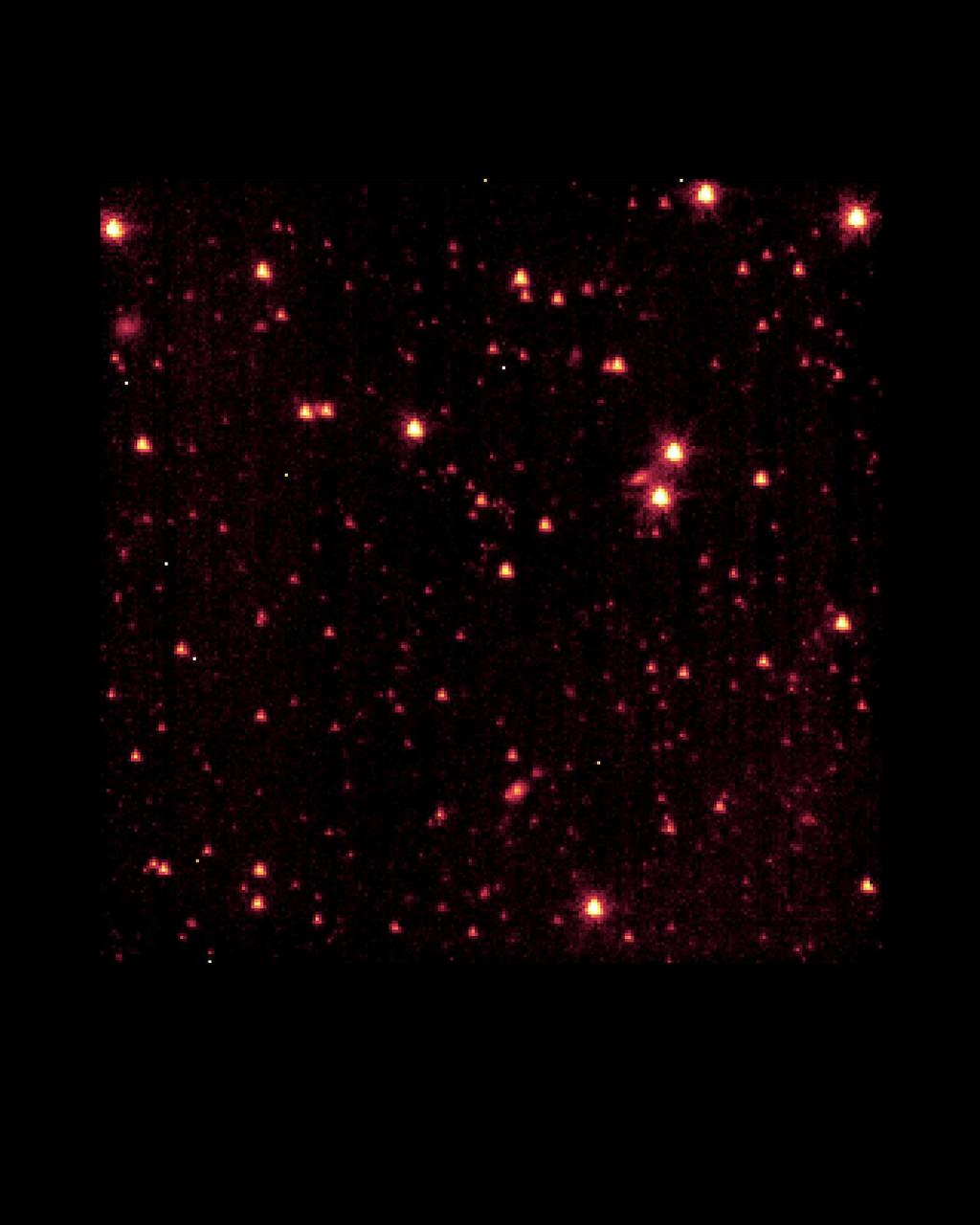
These observations of Jupiter equator in thermal heat emission were made by NASA Infrared Telescope Facility top panel within hours of the Near-Infrared Mapping Spectrometer NIMS instrument image middle inset and the spectra bottom.
Observations of Jupiter thermal emission made by the Infrared Telescope Facility and the Galileo NIMS instrument
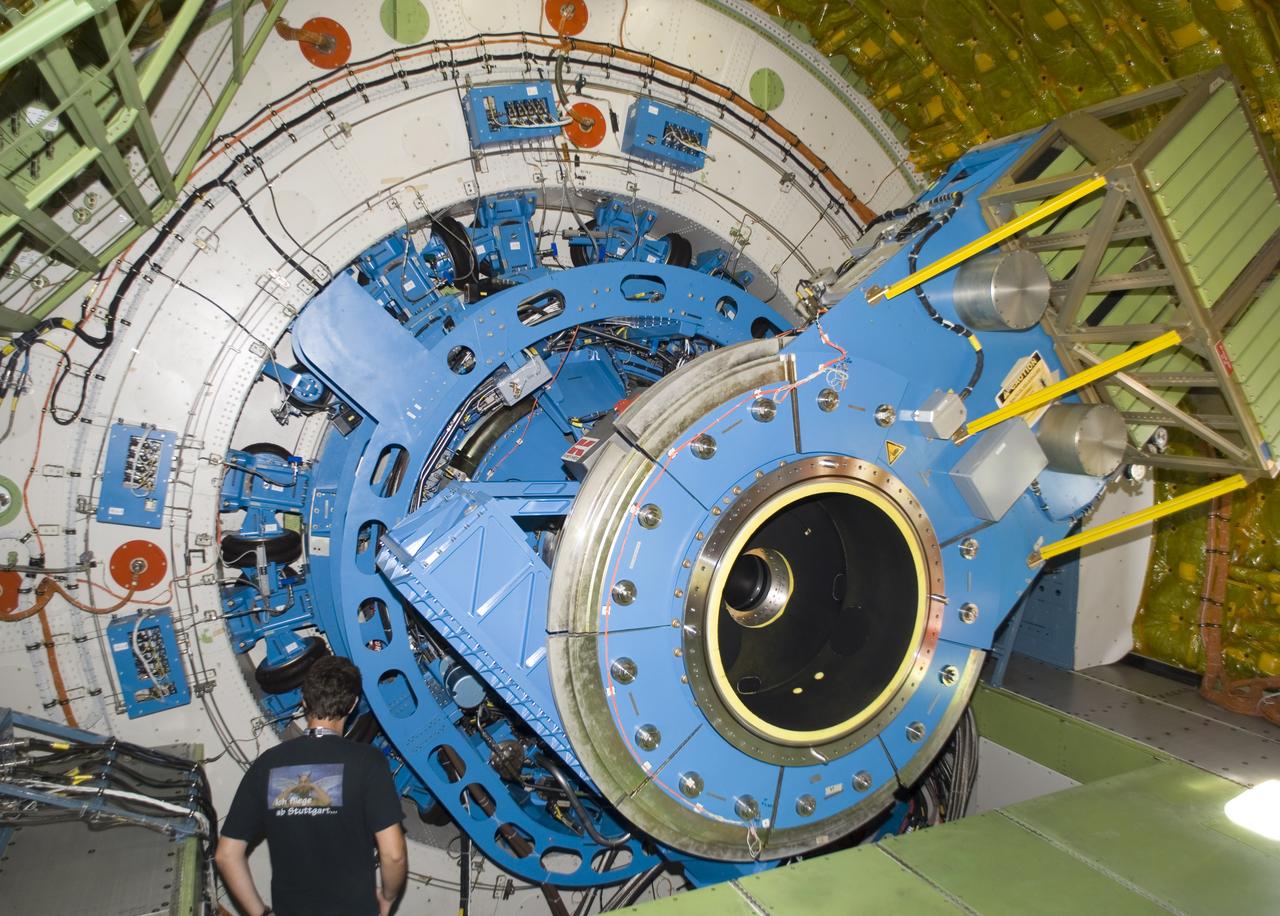
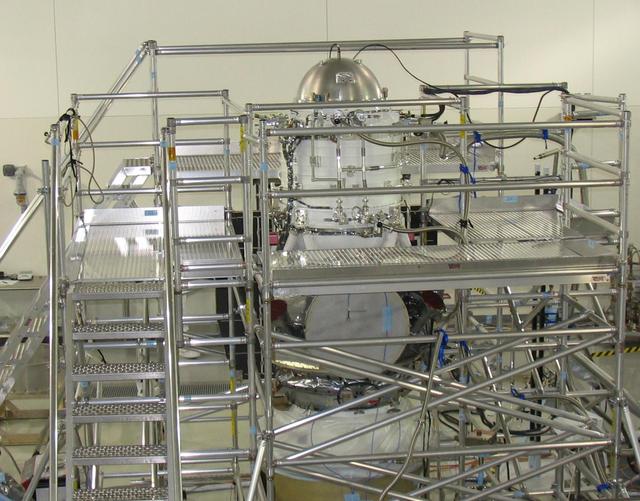
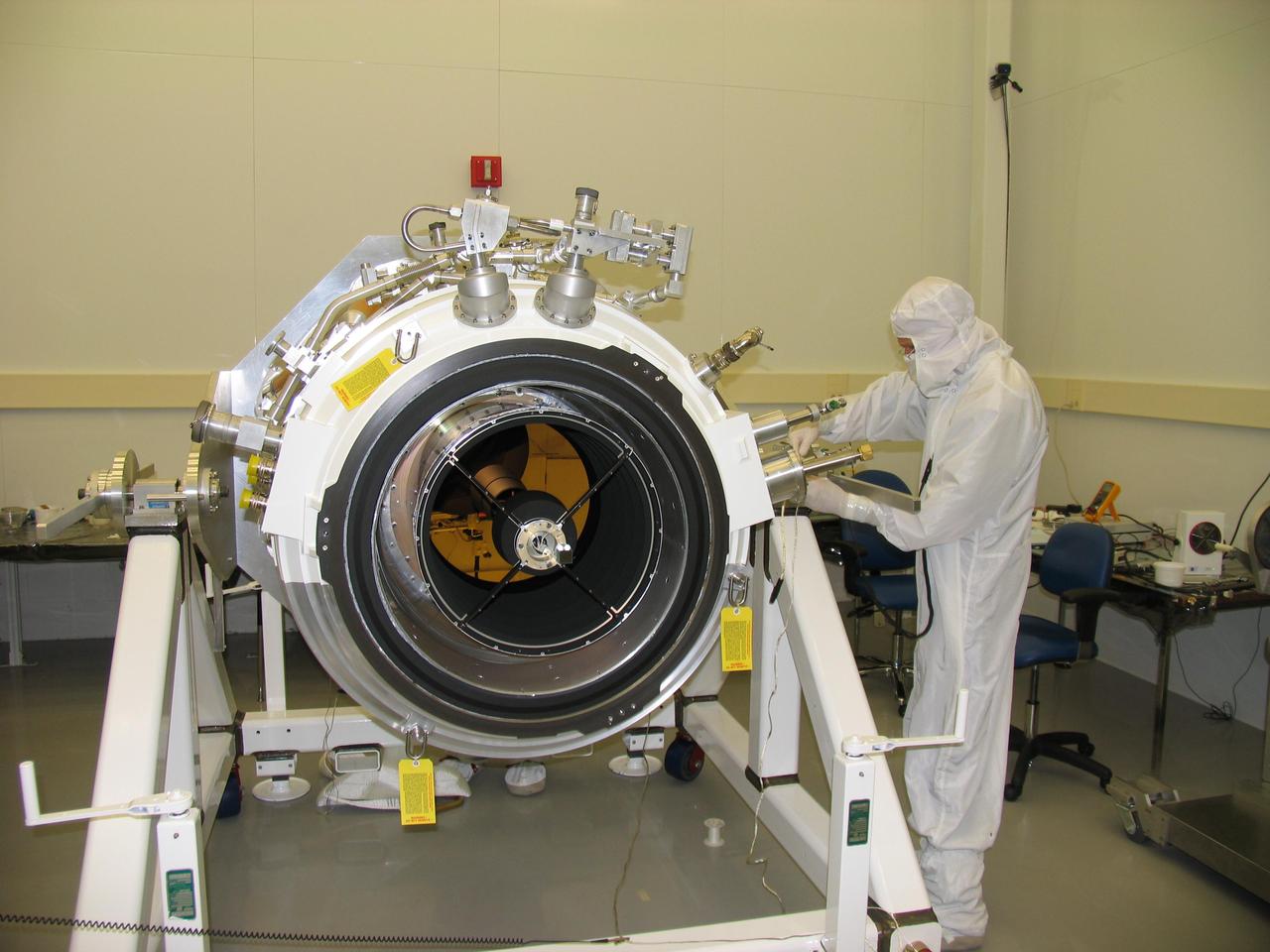
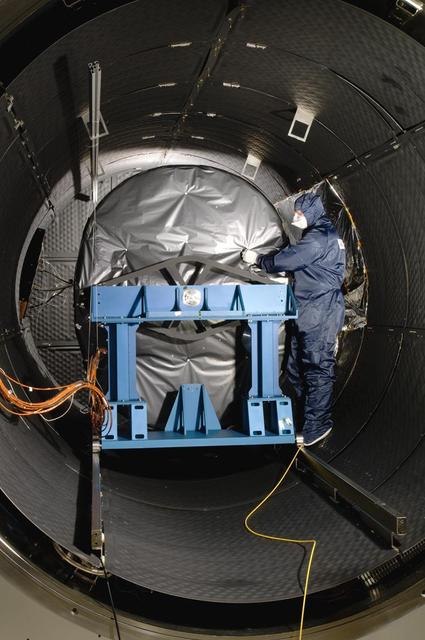
A technician examines the instrument mounting structure and bulkhead of the German-built infrared telescope installed in NASA's SOFIA airborne observatory.
A technician examines the instrument mounting structure and bulkhead of the German-built infrared telescope installed in NASA's SOFIA airborne observatory
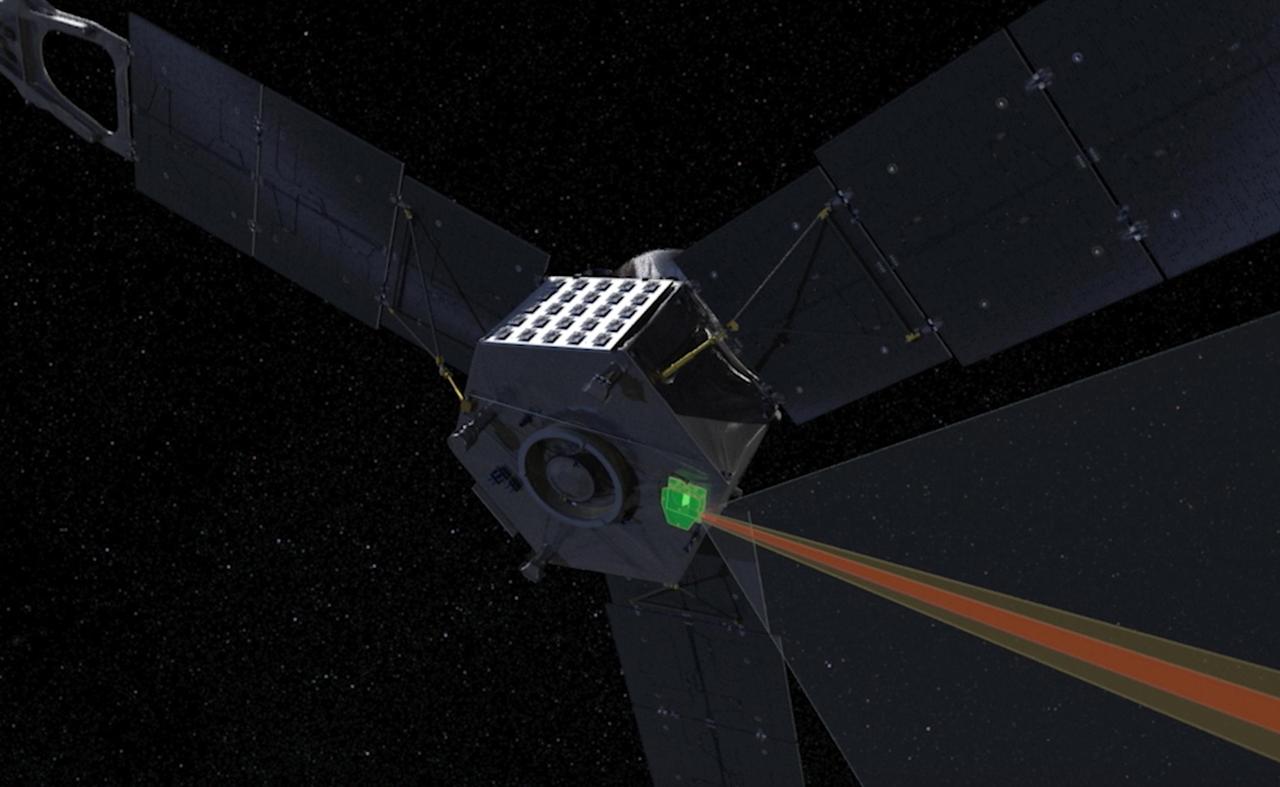
This computer-generated image depicts the Jovian Infrared Auroral Mapper (JIRAM) instrument aboard NASA's Juno spacecraft. The JIRAM instrument measures heat radiated from the planet at an infrared wavelength of around 5 microns.  https://photojournal.jpl.nasa.gov/catalog/PIA23594
Juno's JIRAM Instrument
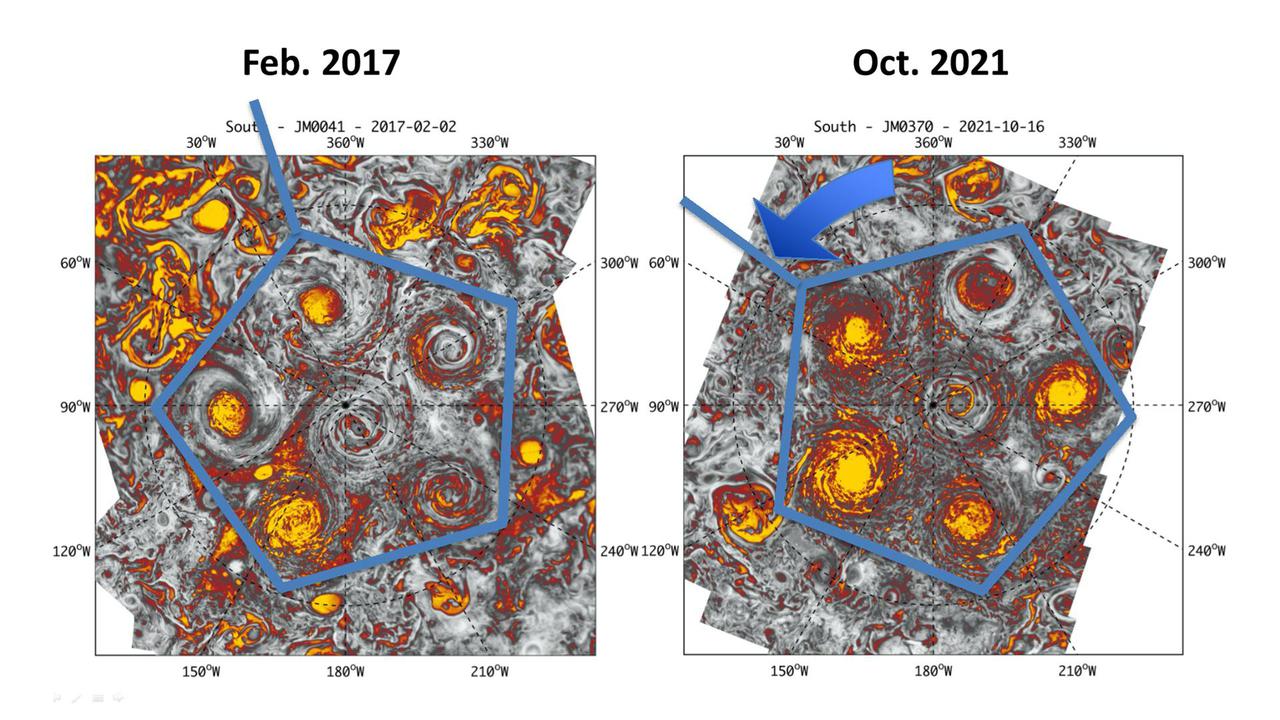
In this annotated infrared image, the five cyclones surrounding a sixth directly over Jupiter's south pole form a pentagonal pattern. The image was taken on Feb. 2, 2017, by the Jovian Infrared Auroral Mapper (JIRAM) instrument aboard NASA's Juno spacecraft. The JIRAM instrument measures heat radiated from the planet at an infrared wavelength of around 5 microns.  https://photojournal.jpl.nasa.gov/catalog/PIA23557
A Pentagon of Jovian Cyclones
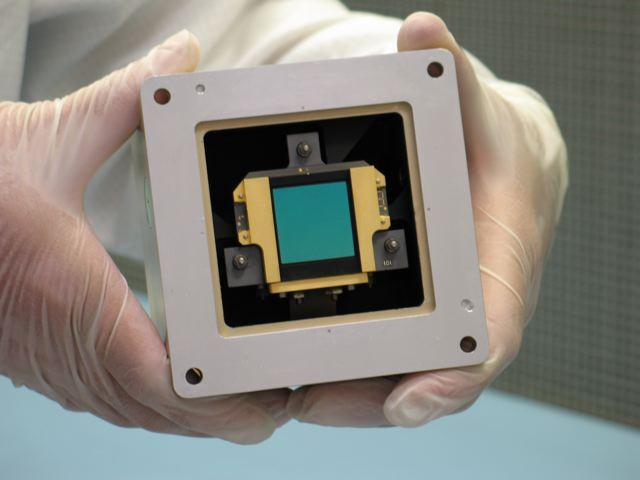
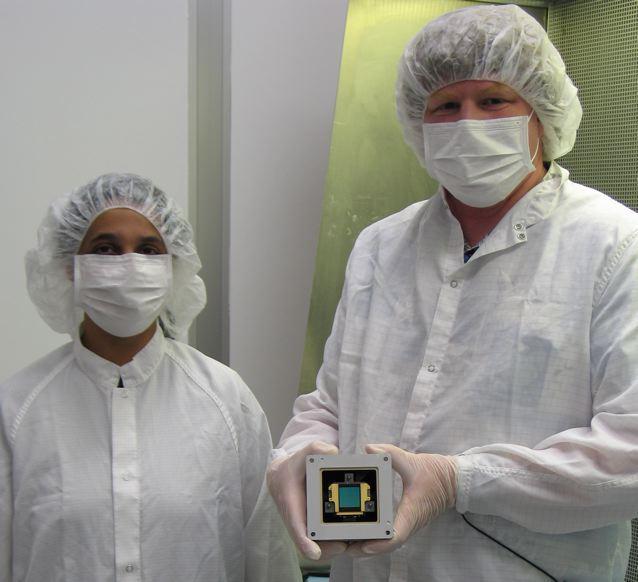
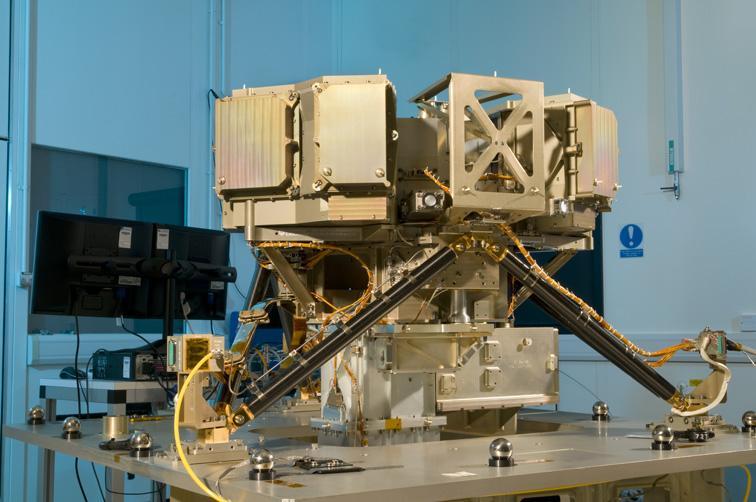
This image shows a model of one of three detectors for the Mid-Infrared Instrument on NASA James Webb Space Telescope.
Shake, Rattle and Roll: James Webb Telescope Components Pass Tests
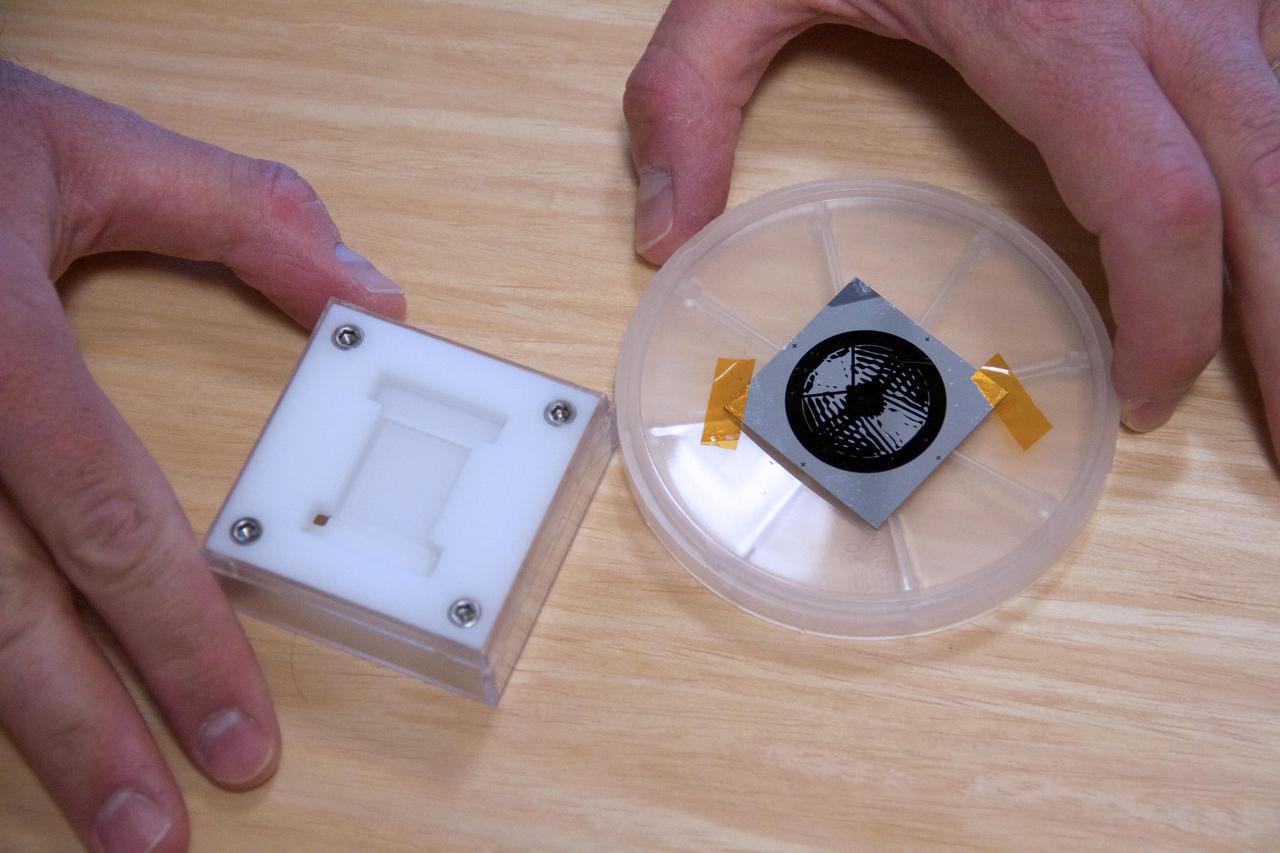
Two different types of masks to be used in NASA upcoming Wide-Field Infrared Survey Telescope, or WFIRST, coronagraph instrument, are pictured.
Tiny Masks for Seeing Planets
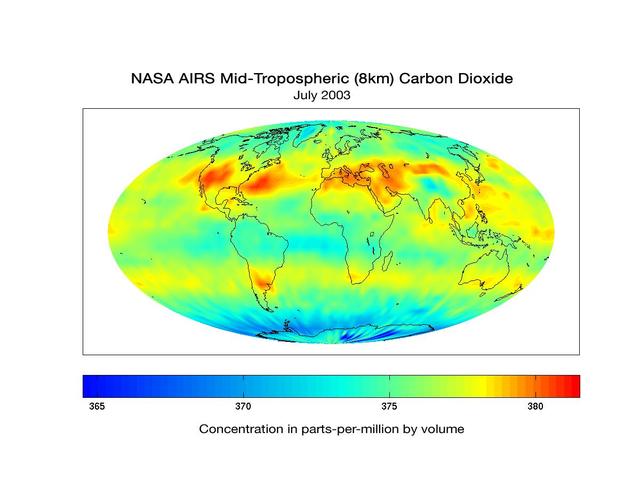
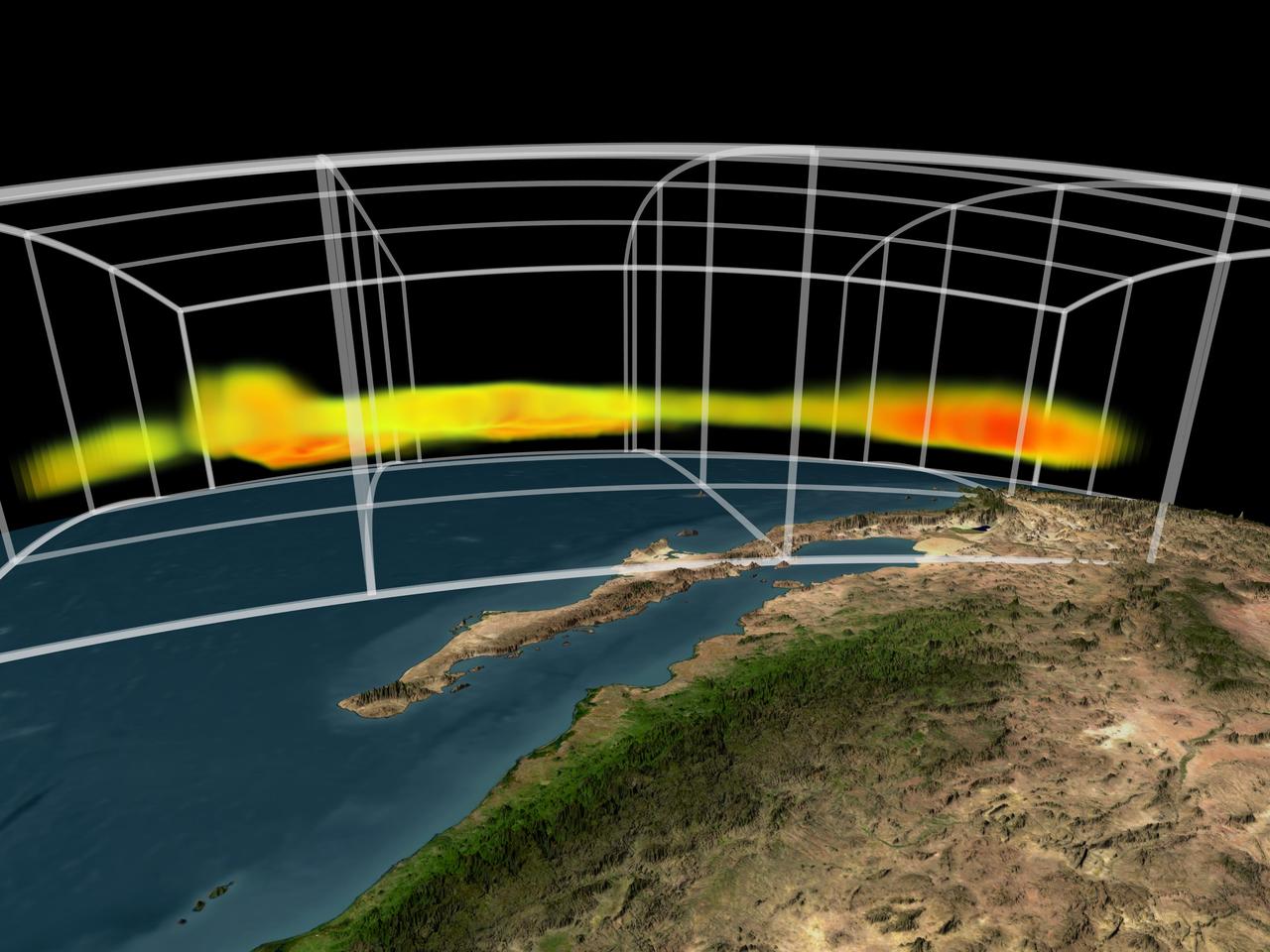
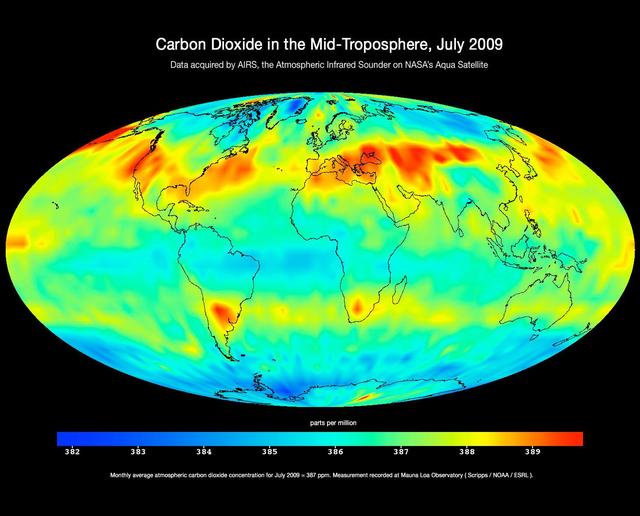
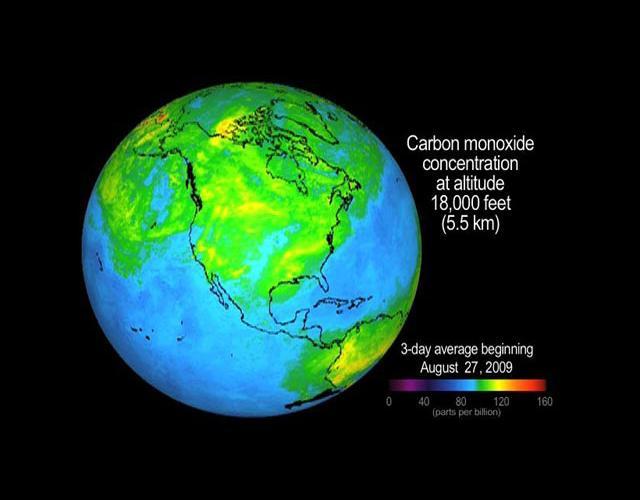
The Atmospheric Infrared Sounder AIRS instrument on NASA Aqua spacecraft is also being used by scientists to observe atmospheric carbon dioxide.
AIRS Global Map of Carbon Dioxide from Space
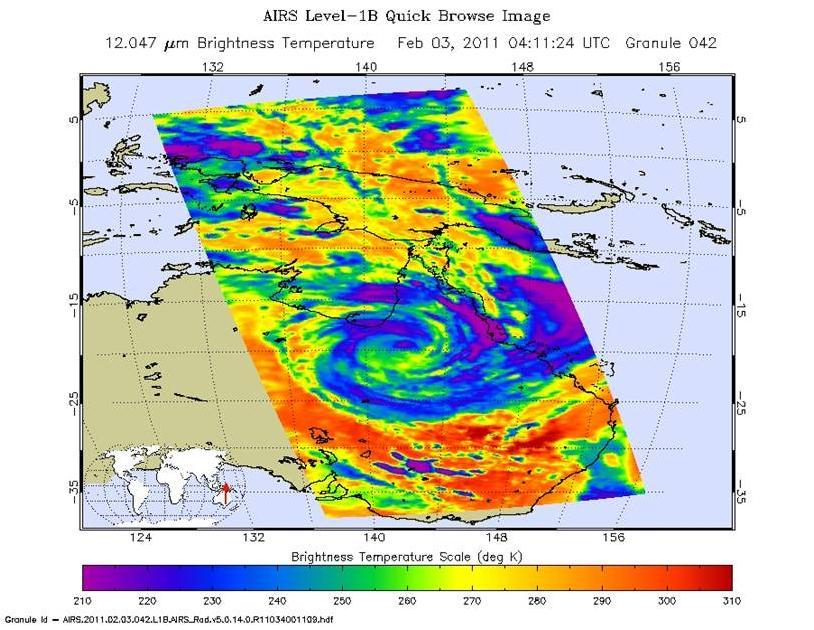
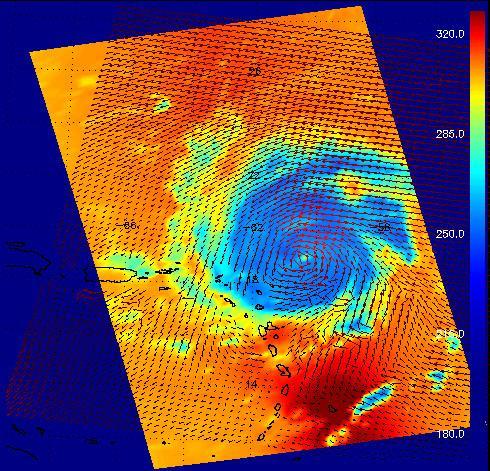
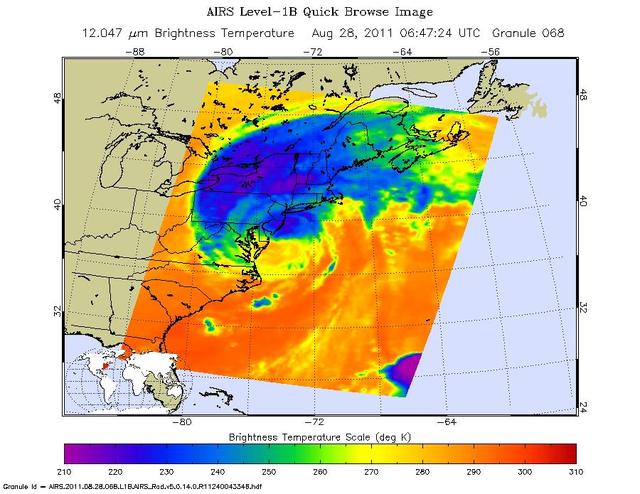
The Atmospheric Infrared Sounder AIRS instrument onboard NASA Aqua spacecraft captured this infrared image of Tropical Cyclone Yasi on Feb. 2, 2011 as the storm passed over Australia Great Dividing Range.
Tropical Cyclone Yasi Spins Through Australia Interior
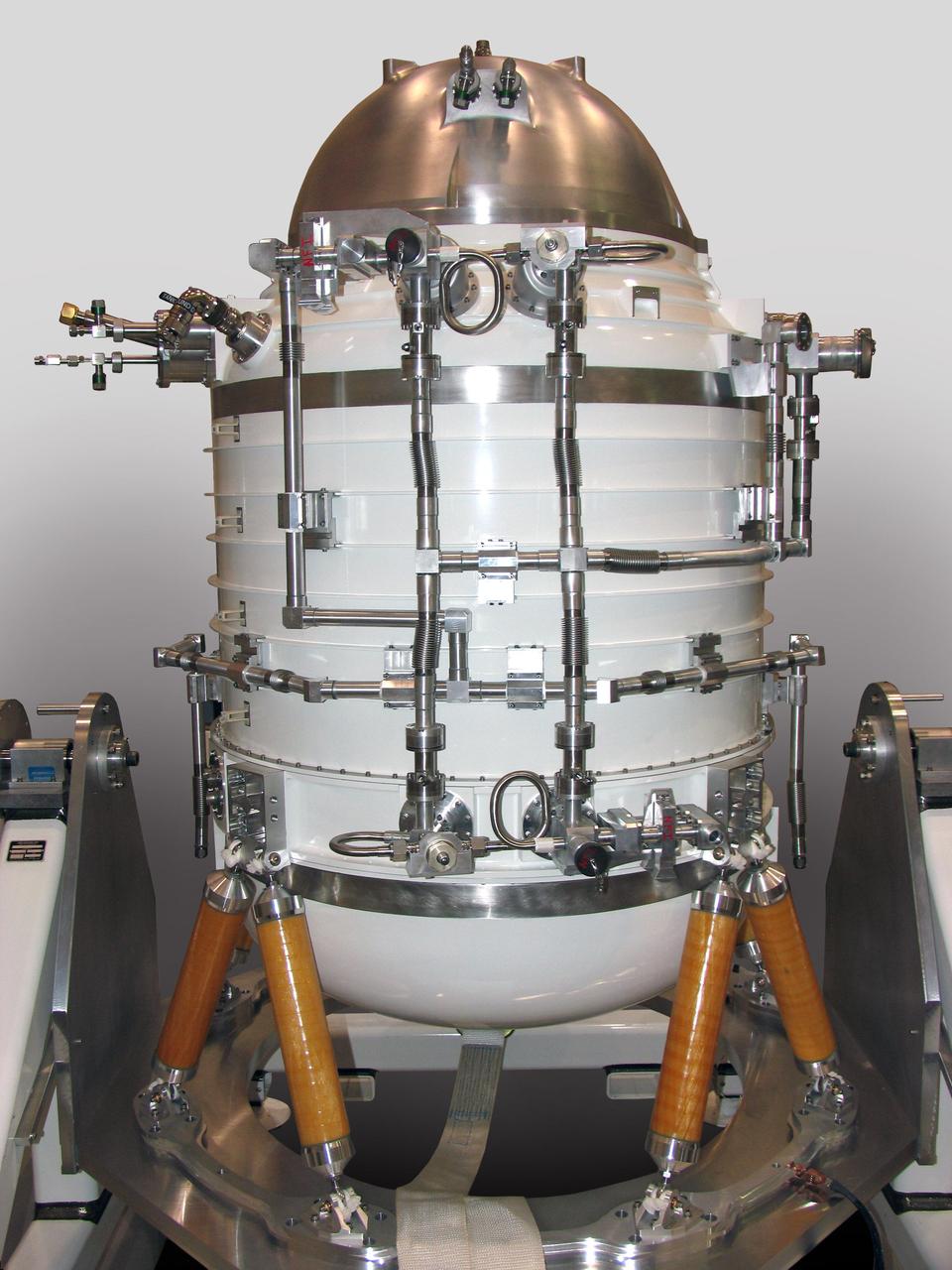
Some say the science instrument on NASA Wide-field Infrared Survey Explorer mission resembles the Star Wars robot R2-D2. The instrument is enclosed in a solid-hydrogen cryostat, which cools the WISE telescope and detectors.
A Robot or a Science Instrument?
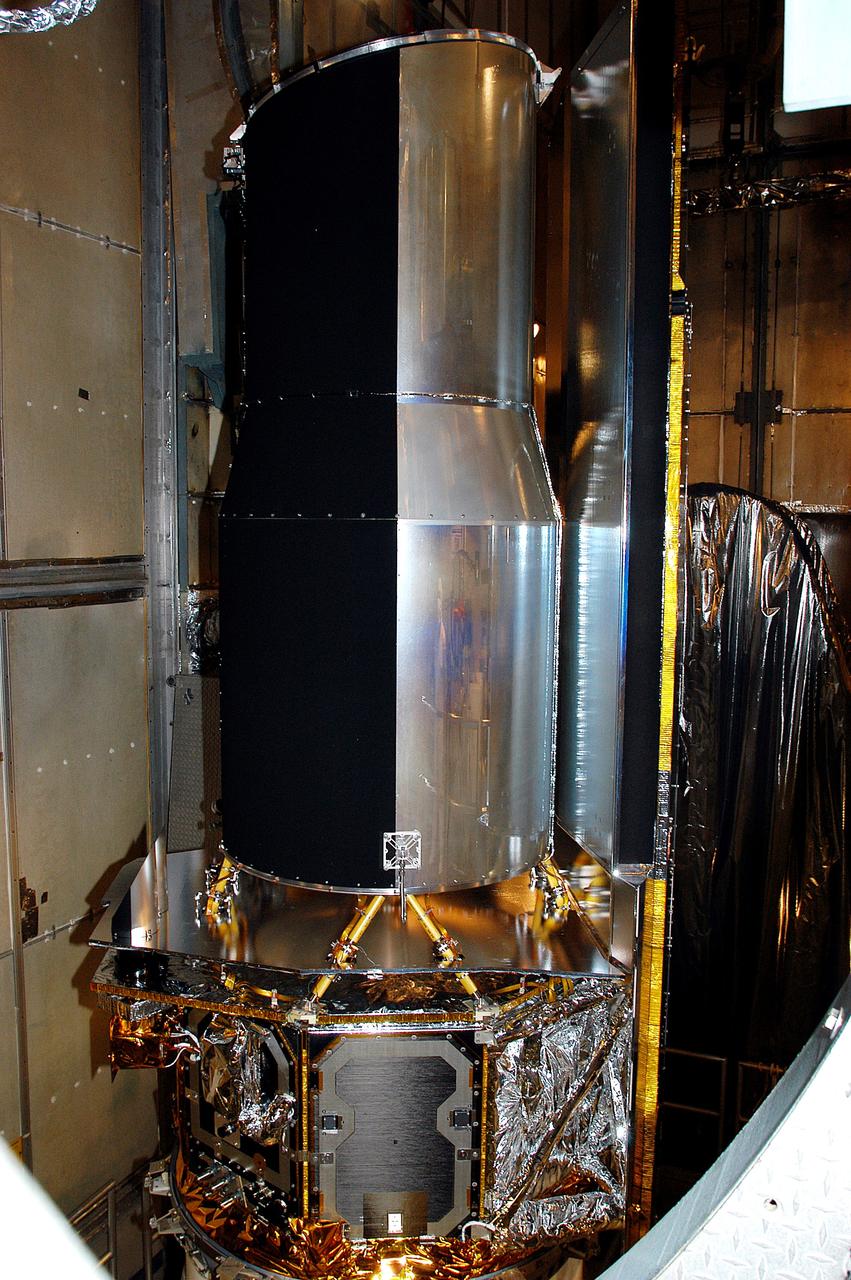
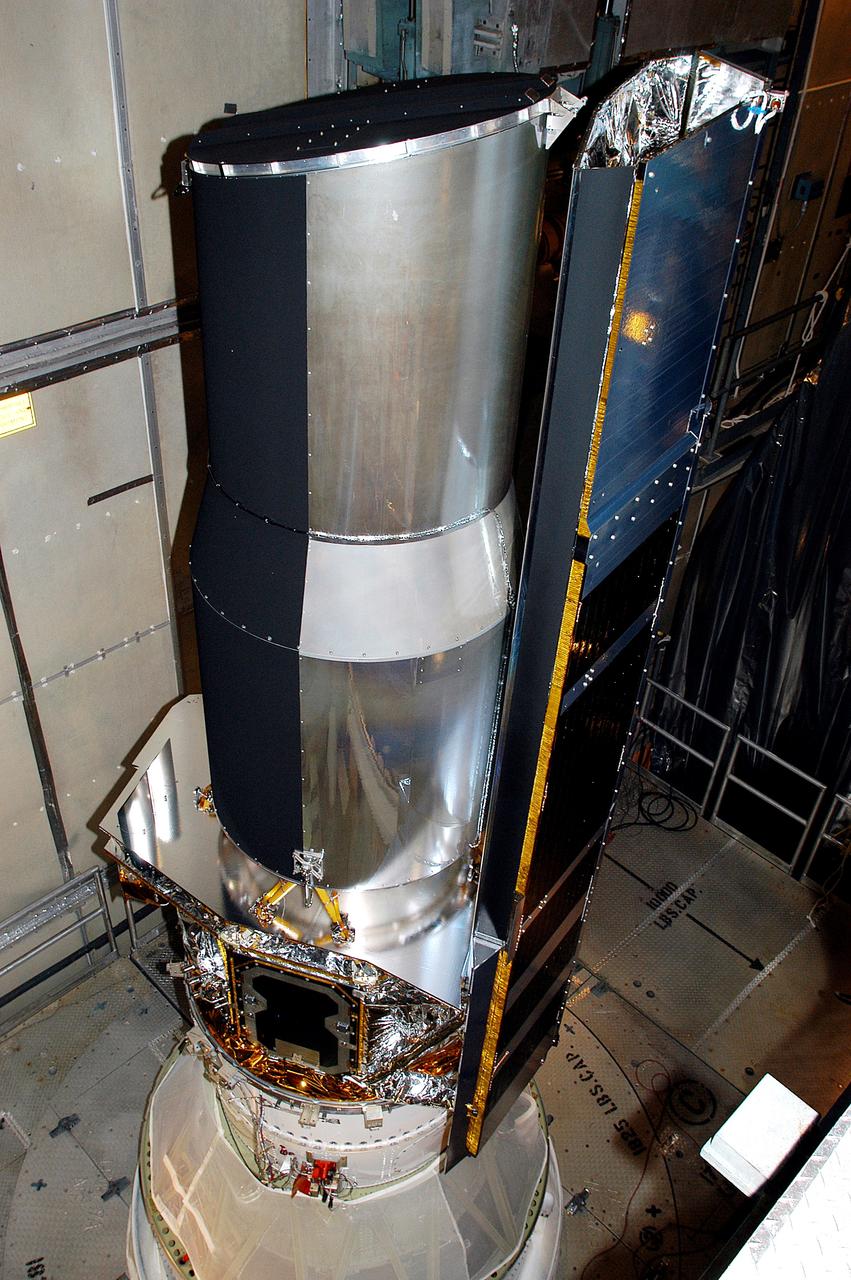
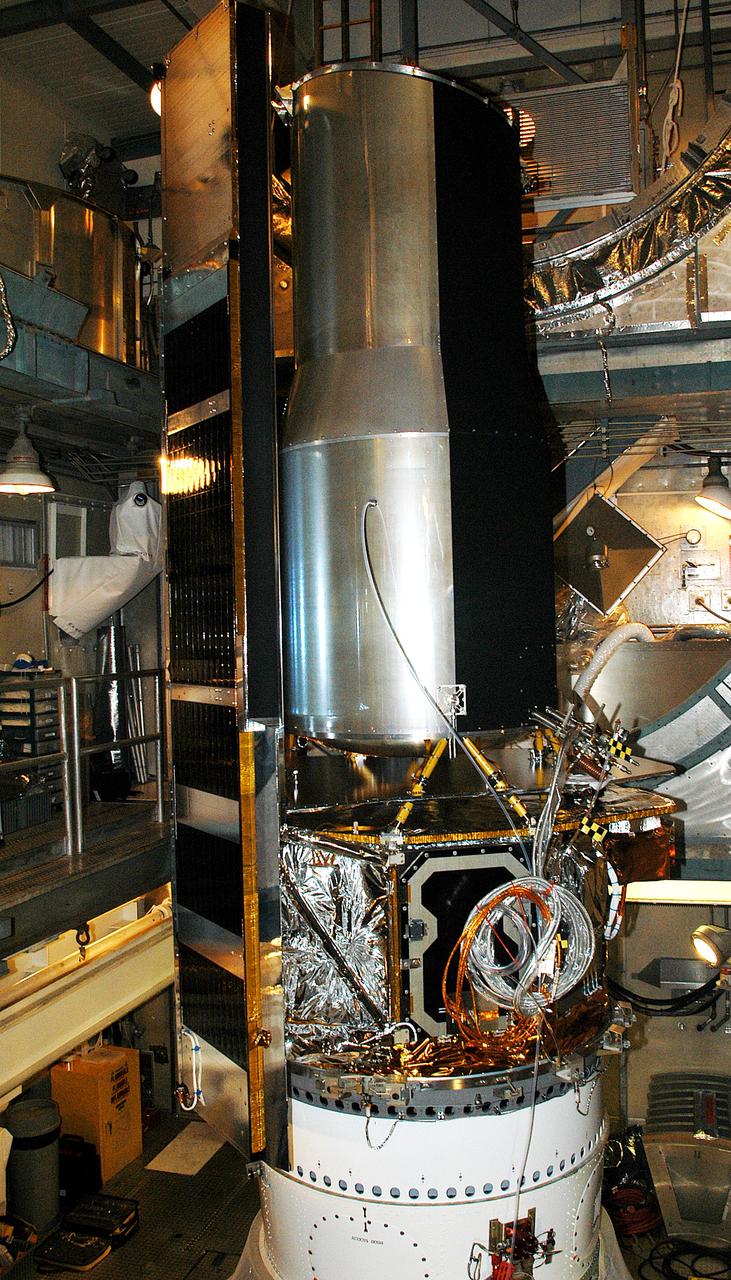
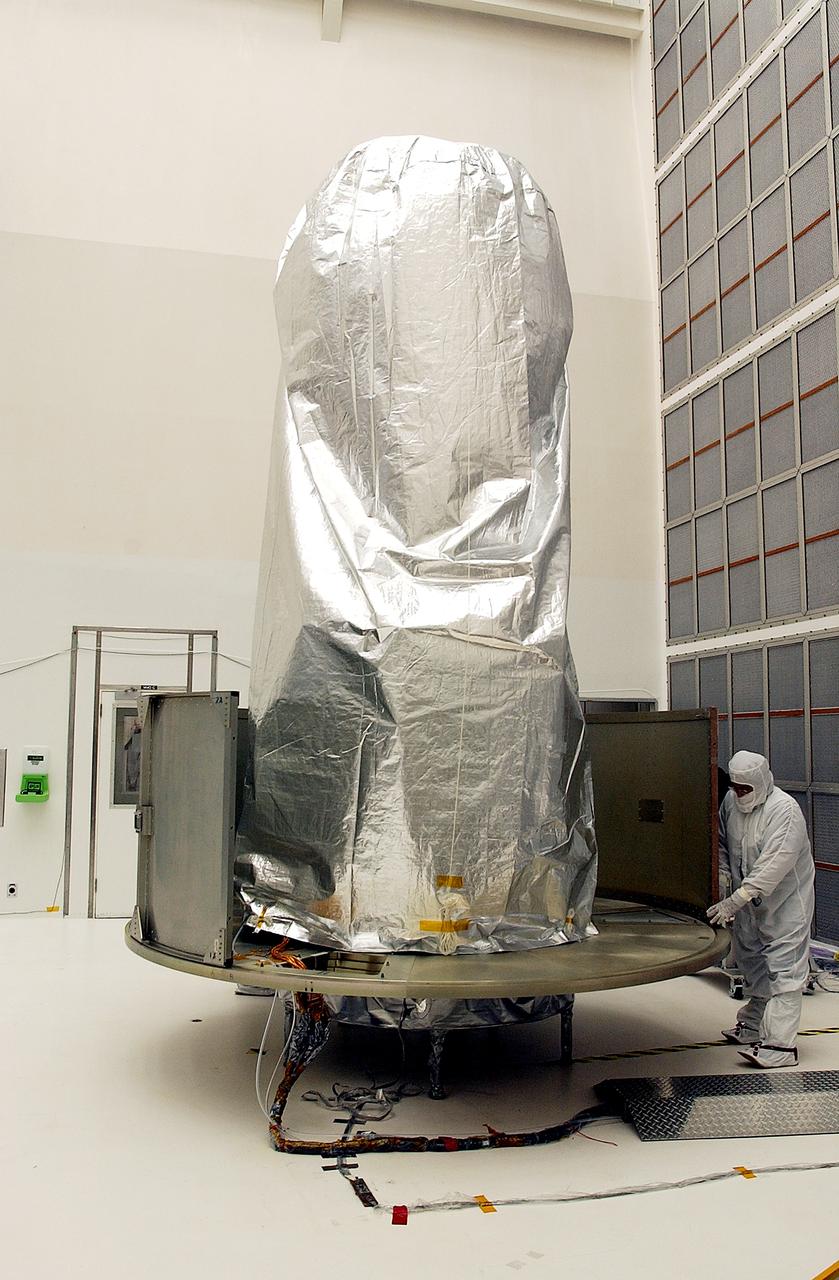
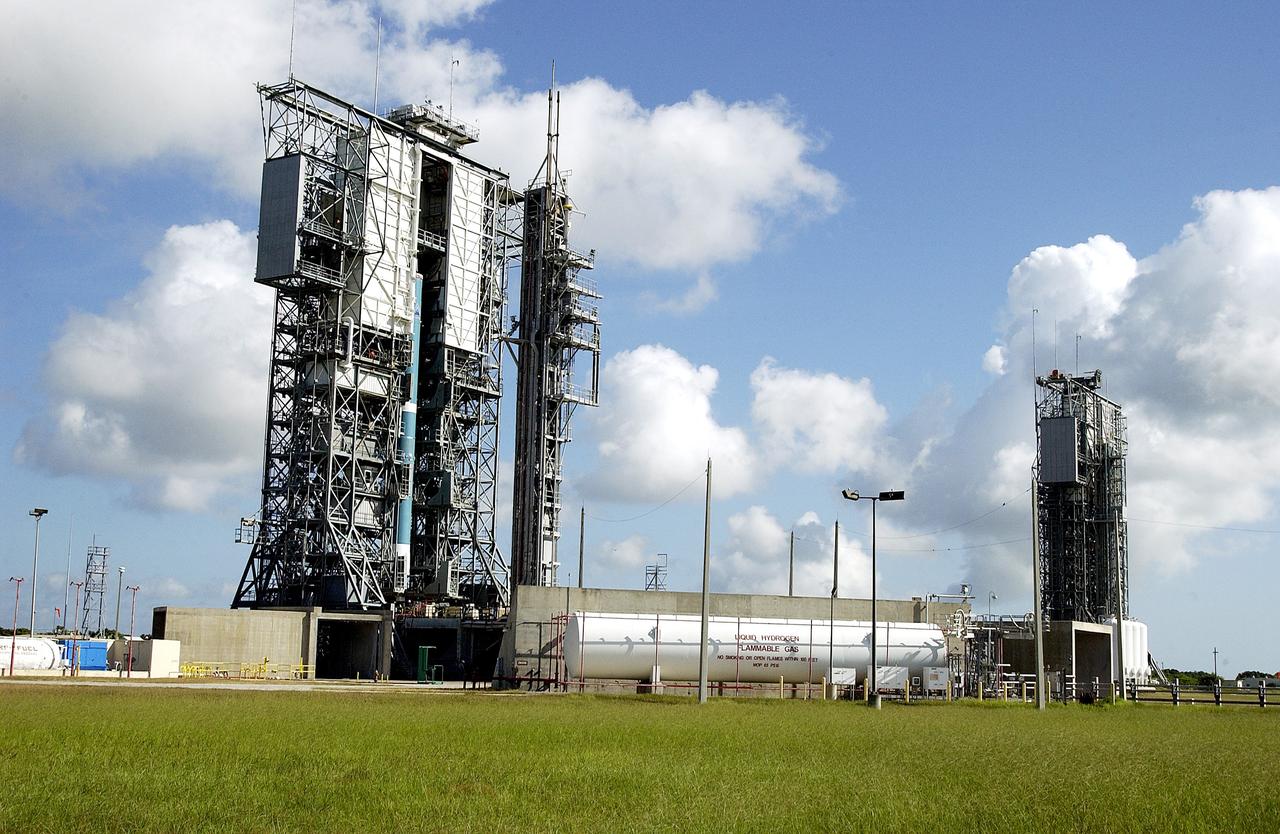
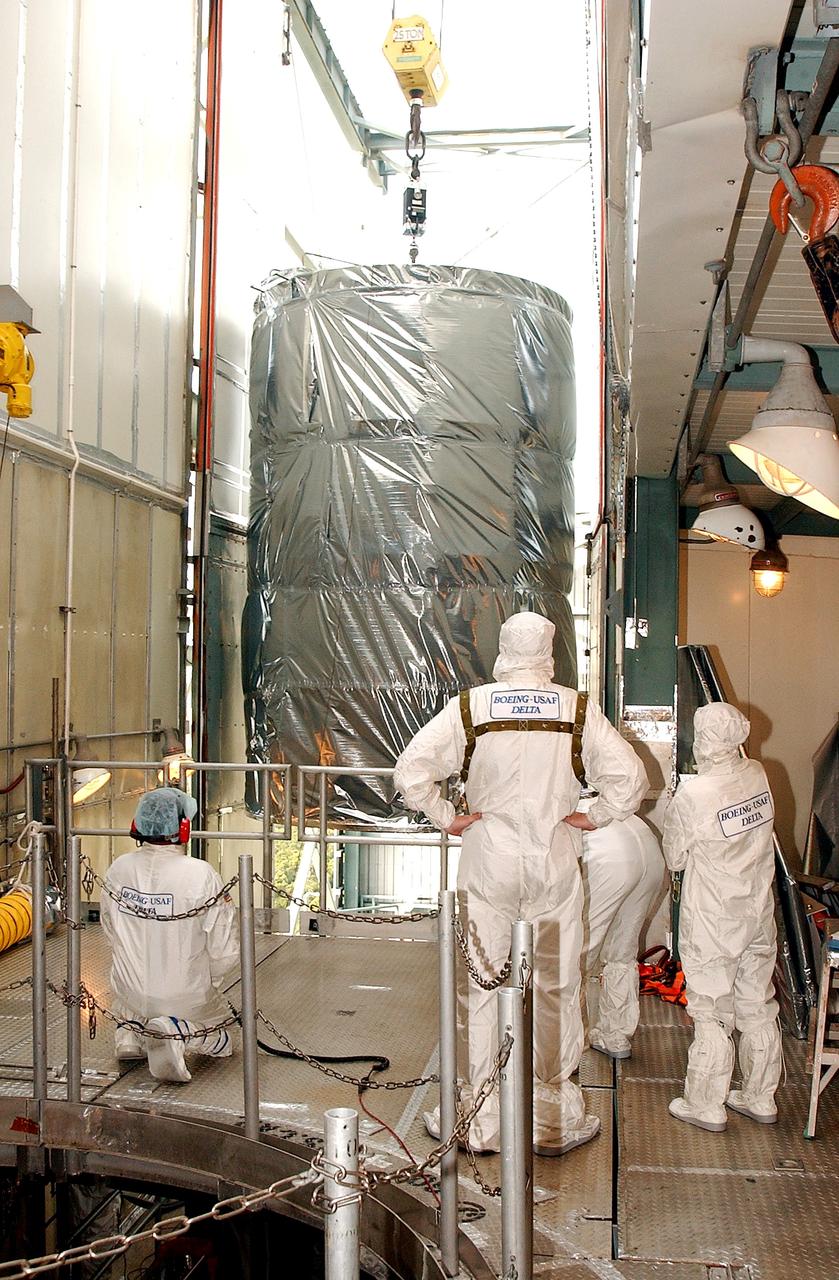
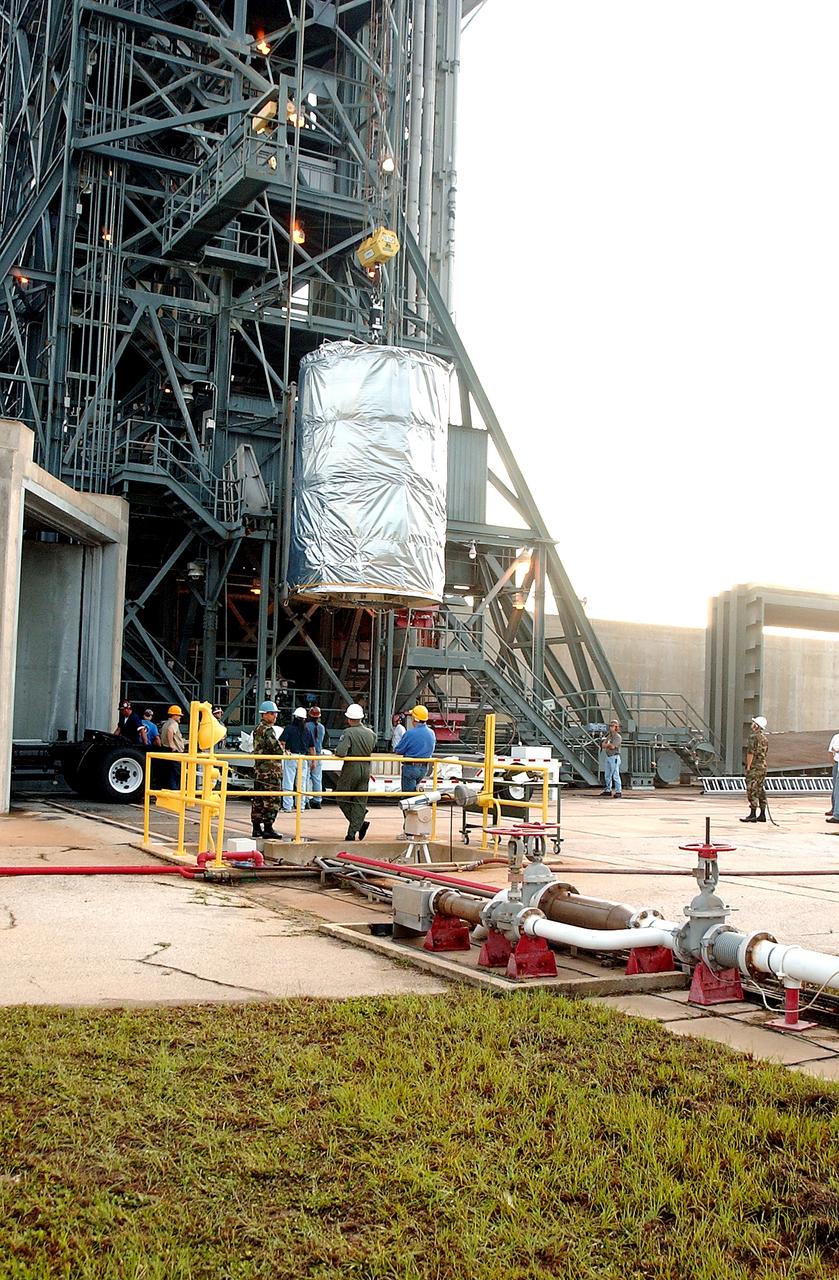
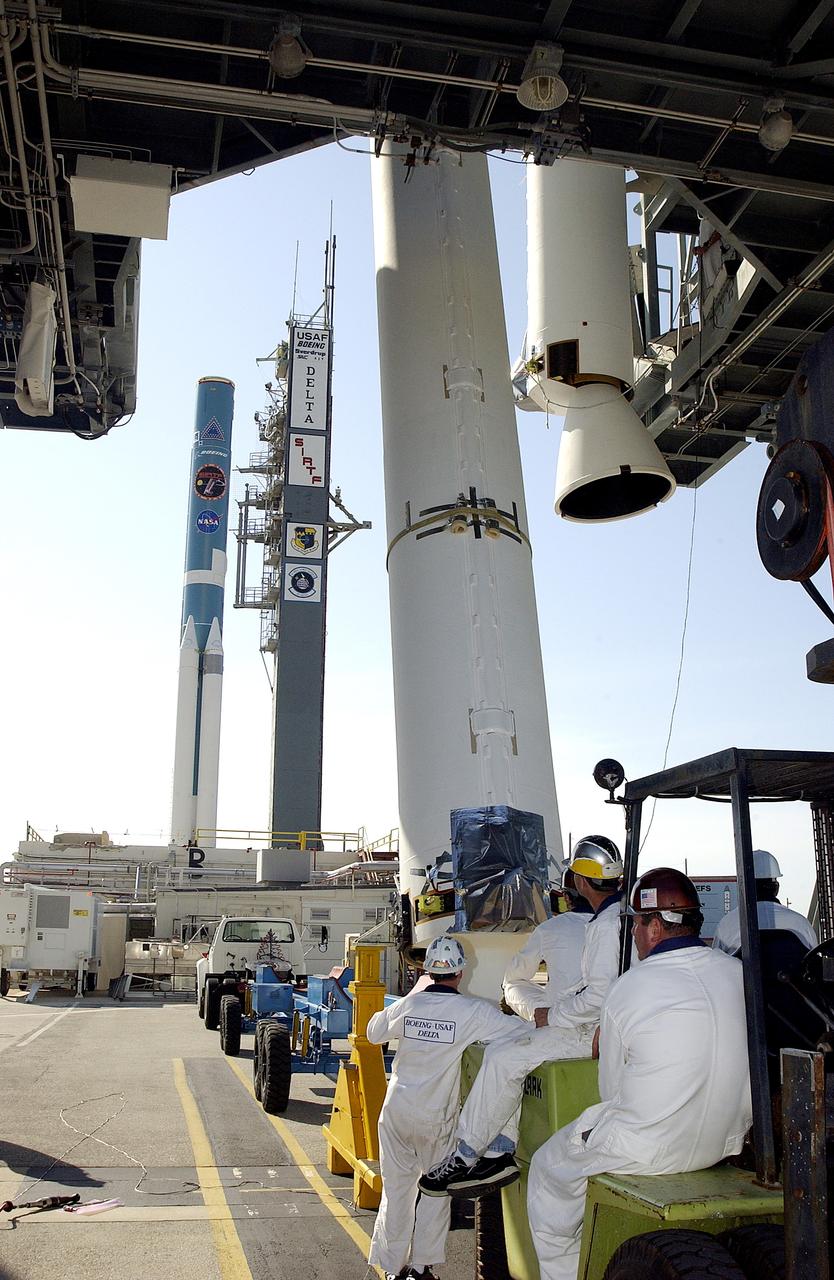
KENNEDY SPACE CENTER, FLA.  - In the mobile service tower on Launch Pad 17-B, Cape Canaveral Air Force Station, the Space Infrared Telescope Facility (SIRTF) waits for encapsulation. SIRTF will obtain images and spectra by detecting the infrared energy, or heat, radiated by objects in space. Consisting of a 0.85-meter telescope and three cryogenically cooled science instruments, SIRTF will be the largest infrared telescope ever launched into space. It is the fourth and final element in NASA’s family of orbiting “Great Observatories.” Its highly sensitive instruments will give a unique view of the Universe and peer into regions of space that are hidden from optical telescopes.
KENNEDY SPACE CENTER, FLA. - In the mobile service tower on Launch Pad 17-B, Cape Canaveral Air Force Station, the Space Infrared Telescope Facility (SIRTF) waits for encapsulation. SIRTF will obtain images and spectra by detecting the infrared energy, or heat, radiated by objects in space. Consisting of a 0.85-meter telescope and three cryogenically cooled science instruments, SIRTF will be the largest infrared telescope ever launched into space. It is the fourth and final element in NASA’s family of orbiting “Great Observatories.” Its highly sensitive instruments will give a unique view of the Universe and peer into regions of space that are hidden from optical telescopes.
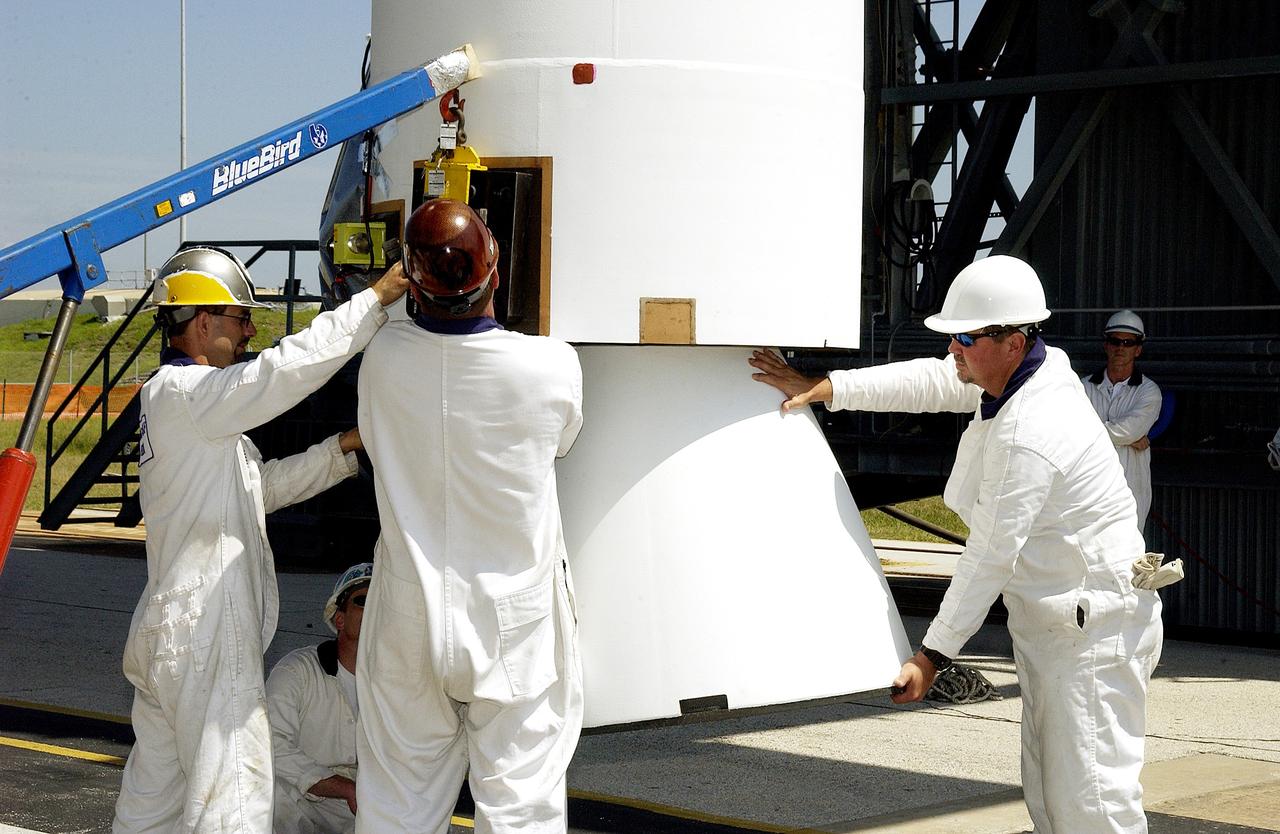
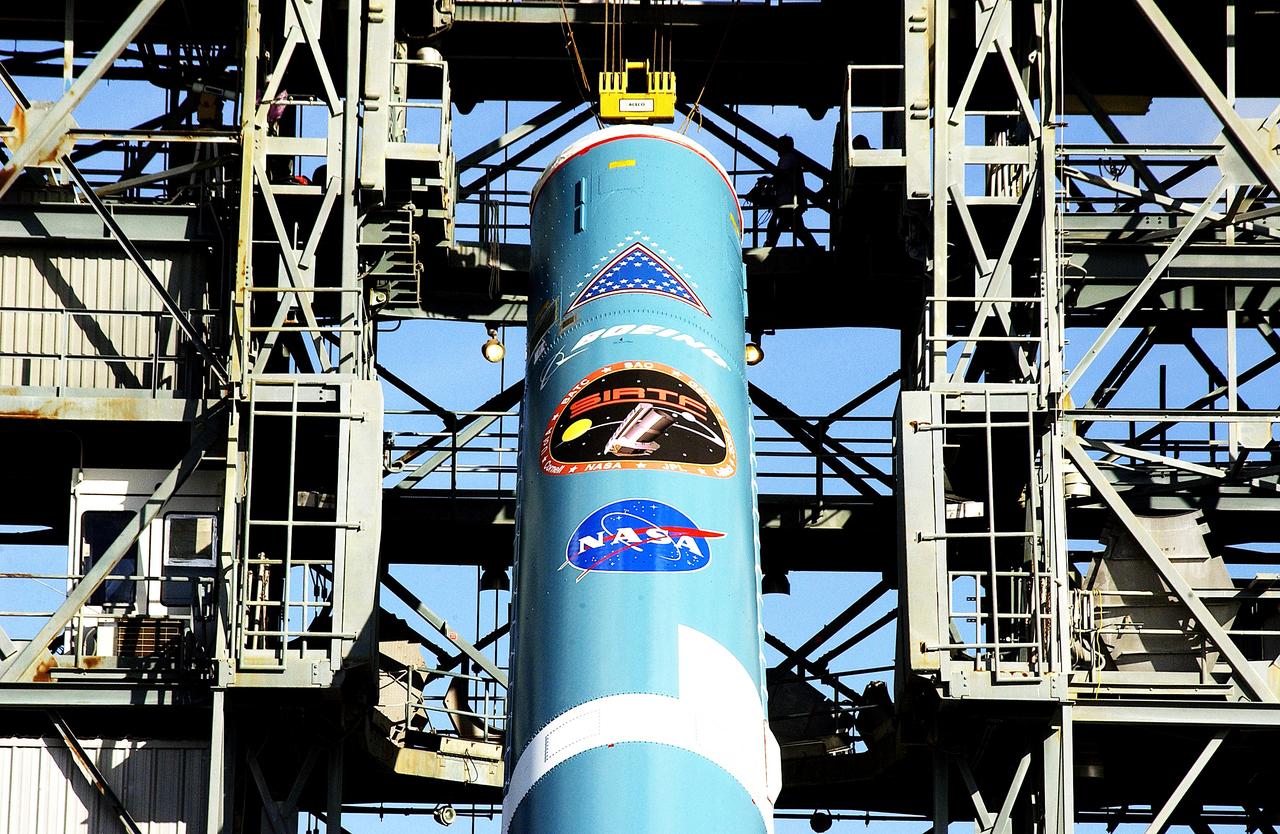
KENNEDY SPACE CENTER, FLA.  - In the mobile service tower on Launch Pad 17-B, Cape Canaveral Air Force Station, the first half of the fairing is moved around the Space Infrared Telescope Facility (SIRTF). SIRTF will obtain images and spectra by detecting the infrared energy, or heat, radiated by objects in space. Consisting of a 0.85-meter telescope and three cryogenically cooled science instruments, SIRTF will be the largest infrared telescope ever launched into space. It is the fourth and final element in NASA’s family of orbiting “Great Observatories.” Its highly sensitive instruments will give a unique view of the Universe and peer into regions of space that are hidden from optical telescopes.
KENNEDY SPACE CENTER, FLA. - In the mobile service tower on Launch Pad 17-B, Cape Canaveral Air Force Station, the first half of the fairing is moved around the Space Infrared Telescope Facility (SIRTF). SIRTF will obtain images and spectra by detecting the infrared energy, or heat, radiated by objects in space. Consisting of a 0.85-meter telescope and three cryogenically cooled science instruments, SIRTF will be the largest infrared telescope ever launched into space. It is the fourth and final element in NASA’s family of orbiting “Great Observatories.” Its highly sensitive instruments will give a unique view of the Universe and peer into regions of space that are hidden from optical telescopes.
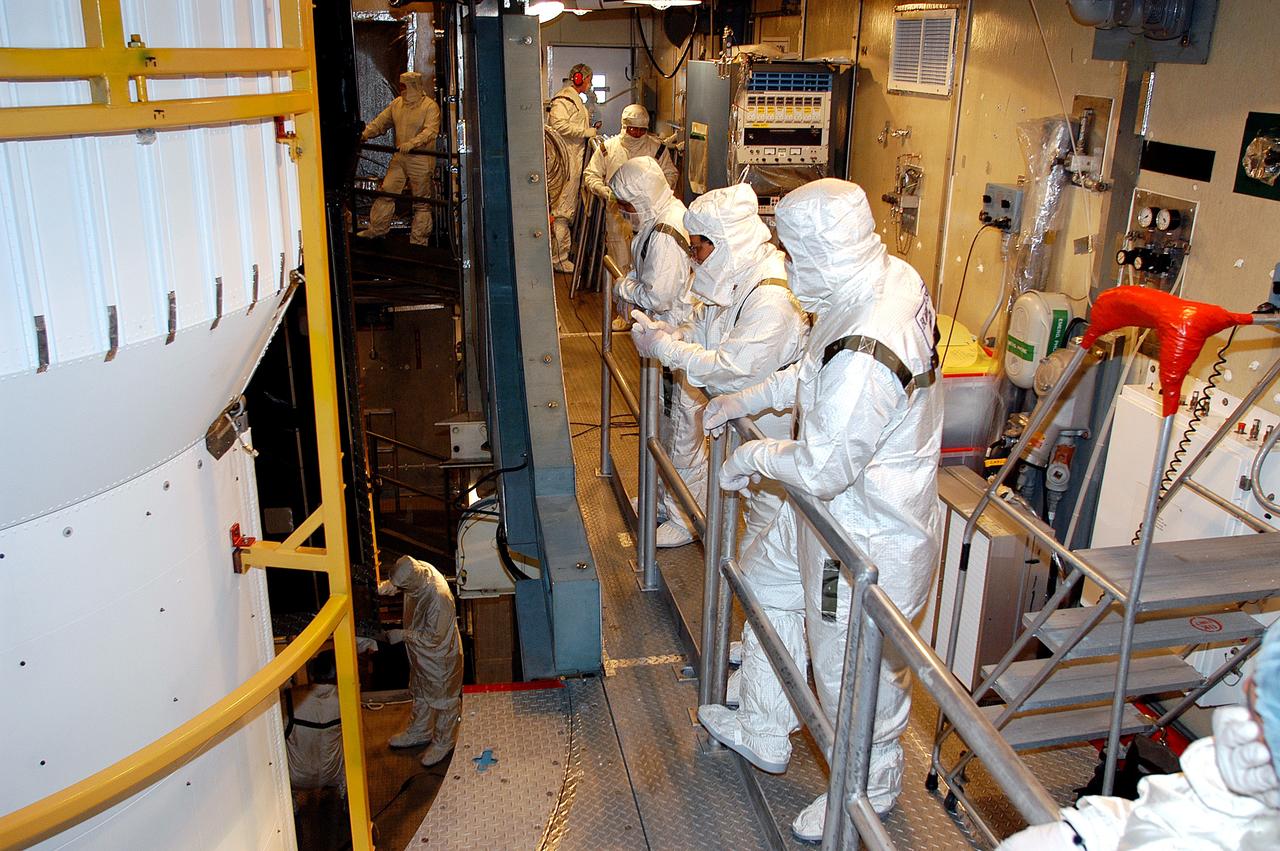
KENNEDY SPACE CENTER, FLA.  - In the mobile service tower on Launch Pad 17-B, Cape Canaveral Air Force Station, workers watch as the first half of the fairing moves closer around the Space Infrared Telescope Facility (SIRTF). SIRTF will obtain images and spectra by detecting the infrared energy, or heat, radiated by objects in space. Consisting of a 0.85-meter telescope and three cryogenically cooled science instruments, SIRTF will be the largest infrared telescope ever launched into space. It is the fourth and final element in NASA’s family of orbiting “Great Observatories.” Its highly sensitive instruments will give a unique view of the Universe and peer into regions of space that are hidden from optical telescopes.
KENNEDY SPACE CENTER, FLA. - In the mobile service tower on Launch Pad 17-B, Cape Canaveral Air Force Station, workers watch as the first half of the fairing moves closer around the Space Infrared Telescope Facility (SIRTF). SIRTF will obtain images and spectra by detecting the infrared energy, or heat, radiated by objects in space. Consisting of a 0.85-meter telescope and three cryogenically cooled science instruments, SIRTF will be the largest infrared telescope ever launched into space. It is the fourth and final element in NASA’s family of orbiting “Great Observatories.” Its highly sensitive instruments will give a unique view of the Universe and peer into regions of space that are hidden from optical telescopes.
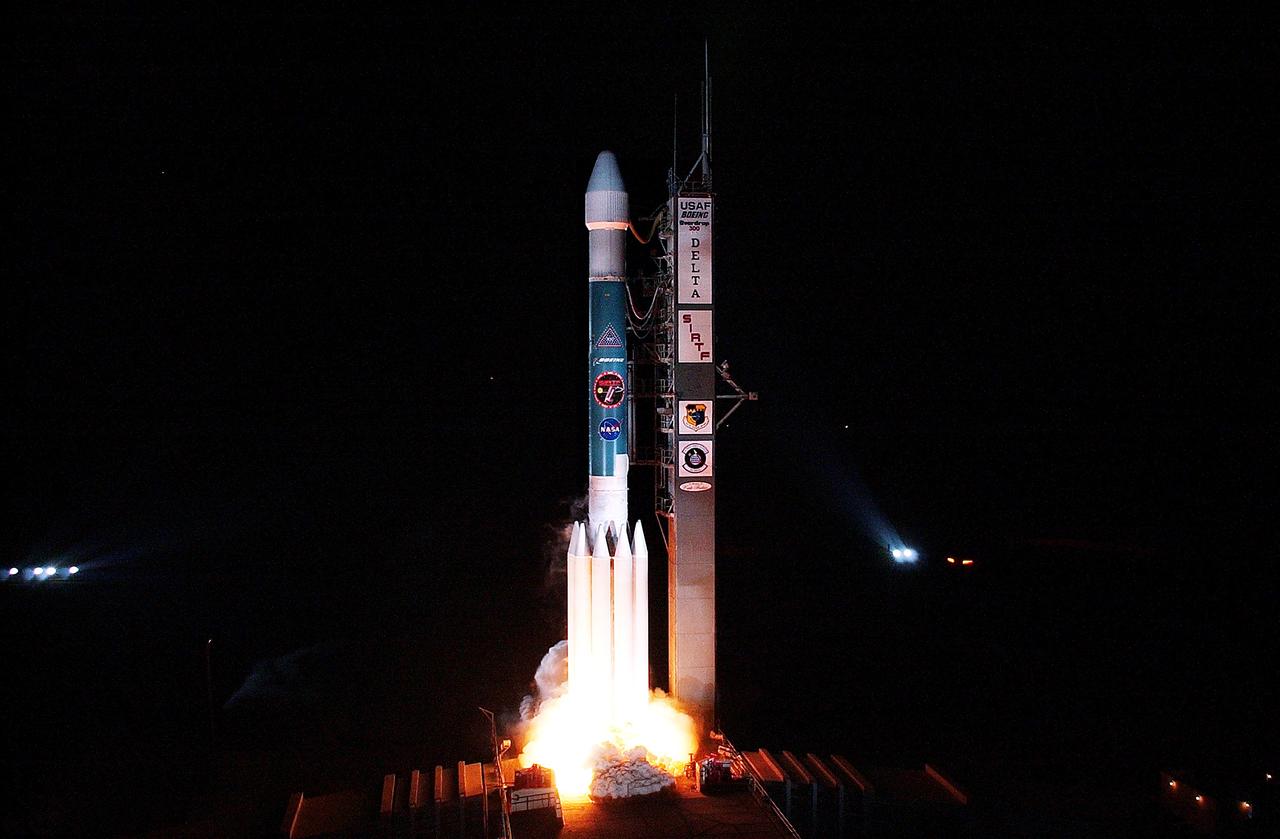
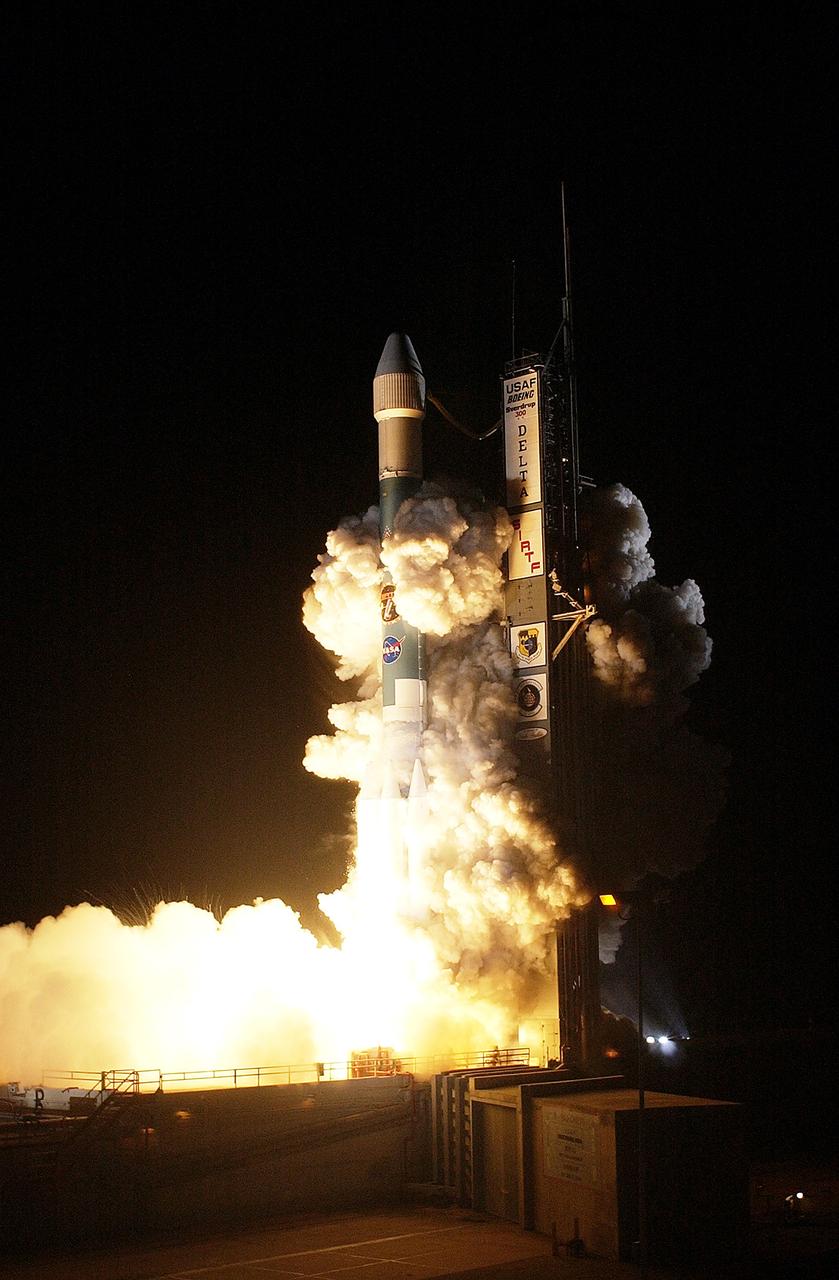
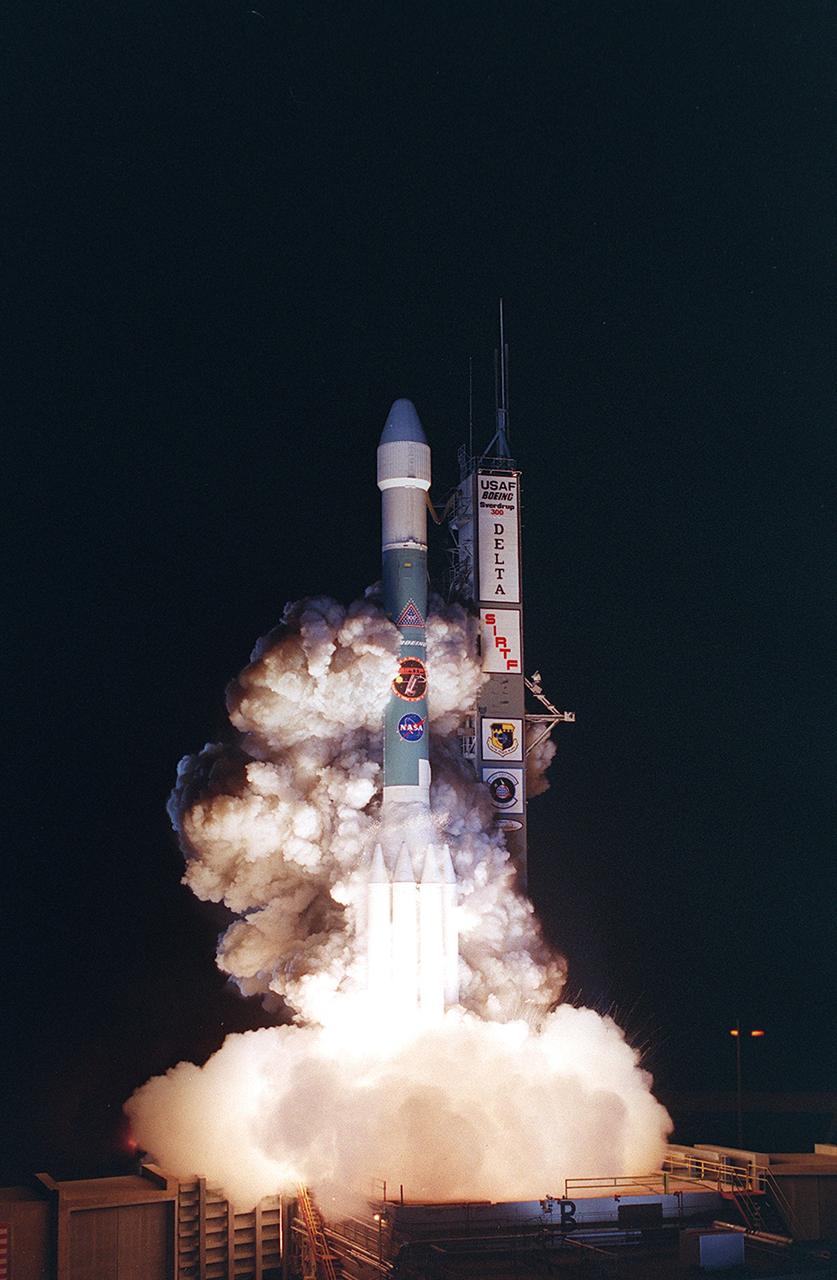
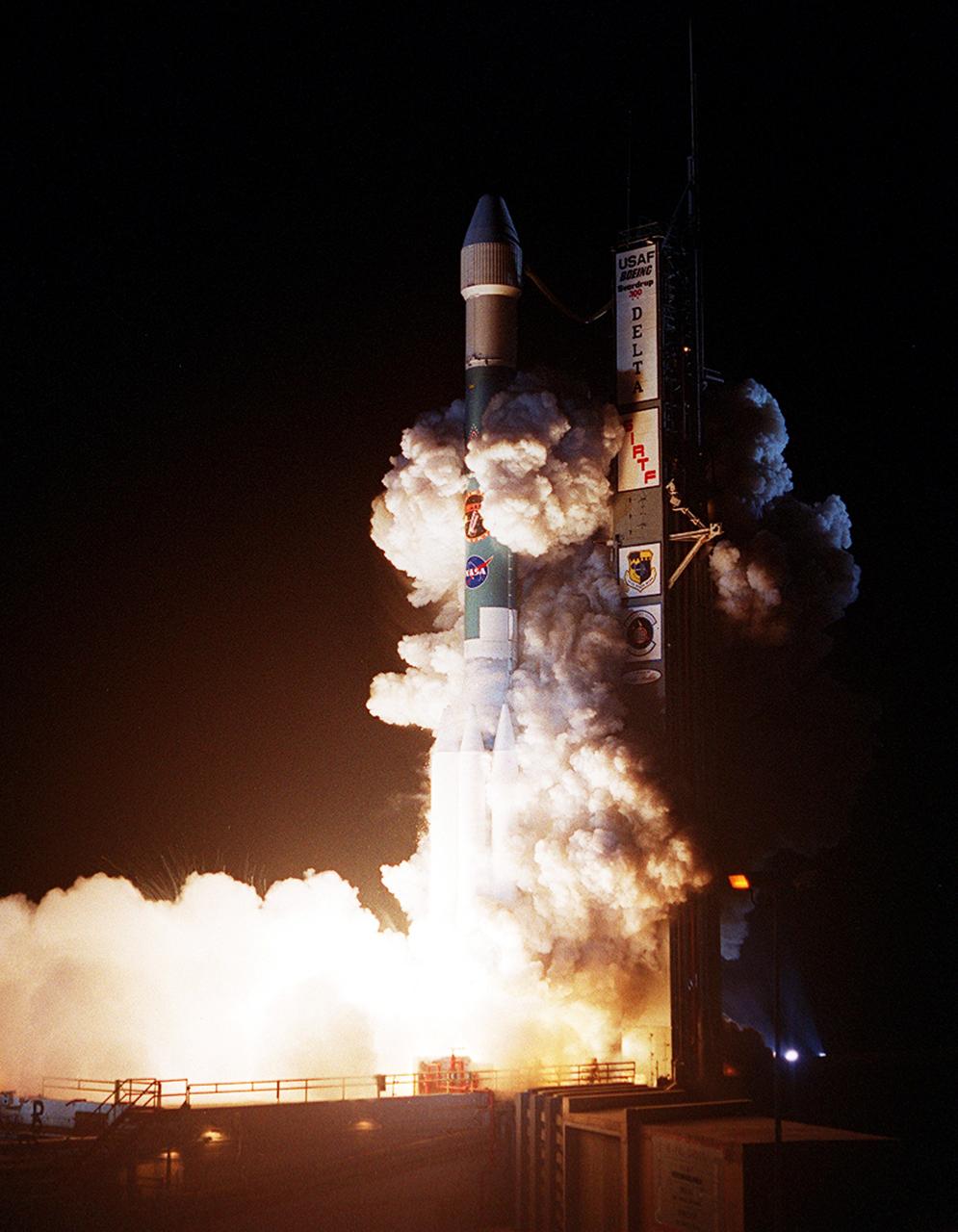
KENNEDY SPACE CENTER, FLA.  -  NASA's Space Infrared Telescope Facility (SIRTF) lifts off from Launch Pad 17-B, Cape Canaveral Air Force Station, on Aug. 25 at 1:35:39 a.m. EDT. SIRTF will obtain images and spectra by detecting the infrared energy, or heat, radiated by objects in space. Consisting of a 0.85-meter telescope and three cryogenically cooled science instruments, SIRTF will be the largest infrared telescope ever launched into space. It is the fourth and final element in NASA’s family of orbiting “Great Observatories.” Its highly sensitive instruments will give a unique view of the Universe and peer into regions of space that are hidden from optical telescopes.
KENNEDY SPACE CENTER, FLA. - NASA's Space Infrared Telescope Facility (SIRTF) lifts off from Launch Pad 17-B, Cape Canaveral Air Force Station, on Aug. 25 at 1:35:39 a.m. EDT. SIRTF will obtain images and spectra by detecting the infrared energy, or heat, radiated by objects in space. Consisting of a 0.85-meter telescope and three cryogenically cooled science instruments, SIRTF will be the largest infrared telescope ever launched into space. It is the fourth and final element in NASA’s family of orbiting “Great Observatories.” Its highly sensitive instruments will give a unique view of the Universe and peer into regions of space that are hidden from optical telescopes.
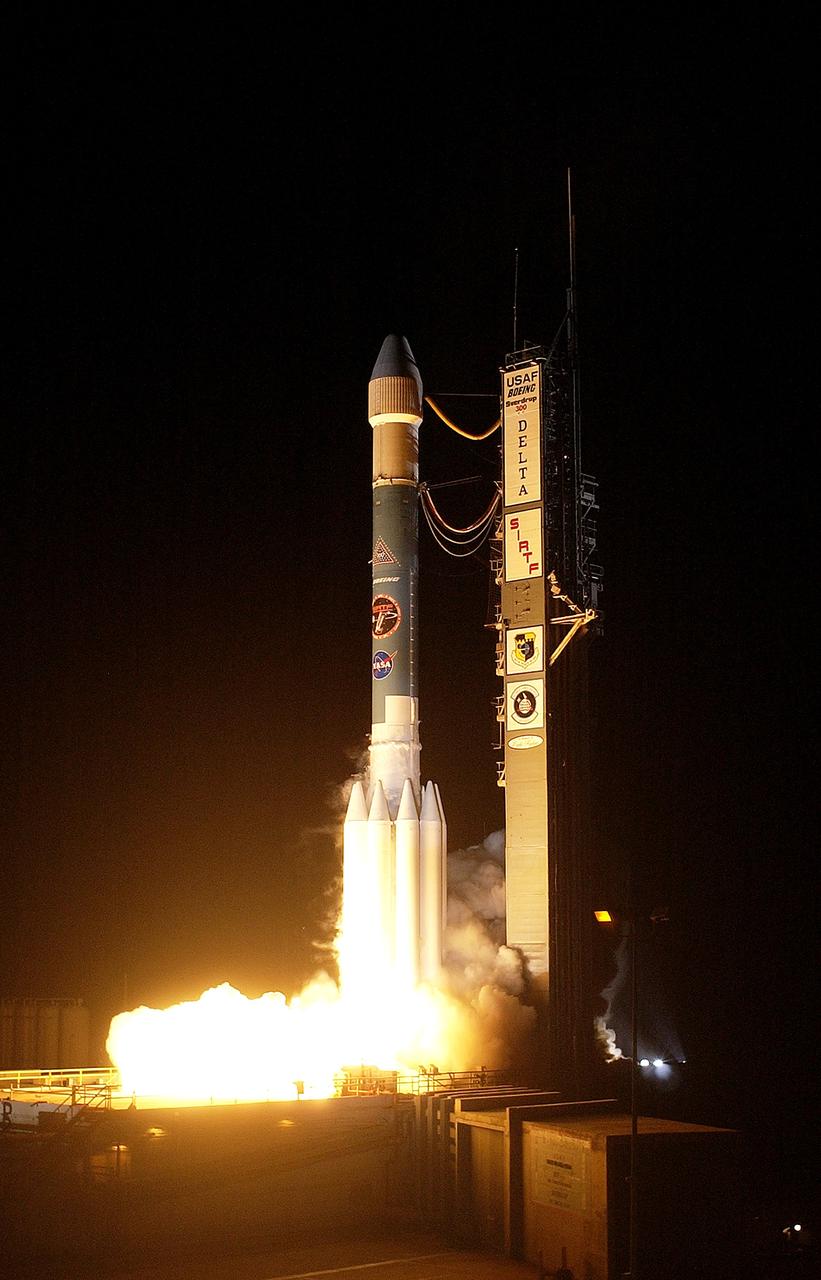
KENNEDY SPACE CENTER, FLA.  -  NASA's Space Infrared Telescope Facility (SIRTF) lifts off from Launch Pad 17-B, Cape Canaveral Air Force Station, on Aug. 25 at 1:35:39 a.m. EDT. SIRTF will obtain images and spectra by detecting the infrared energy, or heat, radiated by objects in space. Consisting of a 0.85-meter telescope and three cryogenically cooled science instruments, SIRTF will be the largest infrared telescope ever launched into space. It is the fourth and final element in NASA’s family of orbiting “Great Observatories.” Its highly sensitive instruments will give a unique view of the Universe and peer into regions of space that are hidden from optical telescopes.
KENNEDY SPACE CENTER, FLA. - NASA's Space Infrared Telescope Facility (SIRTF) lifts off from Launch Pad 17-B, Cape Canaveral Air Force Station, on Aug. 25 at 1:35:39 a.m. EDT. SIRTF will obtain images and spectra by detecting the infrared energy, or heat, radiated by objects in space. Consisting of a 0.85-meter telescope and three cryogenically cooled science instruments, SIRTF will be the largest infrared telescope ever launched into space. It is the fourth and final element in NASA’s family of orbiting “Great Observatories.” Its highly sensitive instruments will give a unique view of the Universe and peer into regions of space that are hidden from optical telescopes.
KENNEDY SPACE CENTER, FLA.  - In the mobile service tower on Launch Pad 17-B, Cape Canaveral Air Force Station, the Space Infrared Telescope Facility (SIRTF) waits for encapsulation. SIRTF will obtain images and spectra by detecting the infrared energy, or heat, radiated by objects in space. Consisting of a 0.85-meter telescope and three cryogenically cooled science instruments, SIRTF will be the largest infrared telescope ever launched into space. It is the fourth and final element in NASA’s family of orbiting “Great Observatories.” Its highly sensitive instruments will give a unique view of the Universe and peer into regions of space that are hidden from optical telescopes.
KENNEDY SPACE CENTER, FLA. - In the mobile service tower on Launch Pad 17-B, Cape Canaveral Air Force Station, the Space Infrared Telescope Facility (SIRTF) waits for encapsulation. SIRTF will obtain images and spectra by detecting the infrared energy, or heat, radiated by objects in space. Consisting of a 0.85-meter telescope and three cryogenically cooled science instruments, SIRTF will be the largest infrared telescope ever launched into space. It is the fourth and final element in NASA’s family of orbiting “Great Observatories.” Its highly sensitive instruments will give a unique view of the Universe and peer into regions of space that are hidden from optical telescopes.
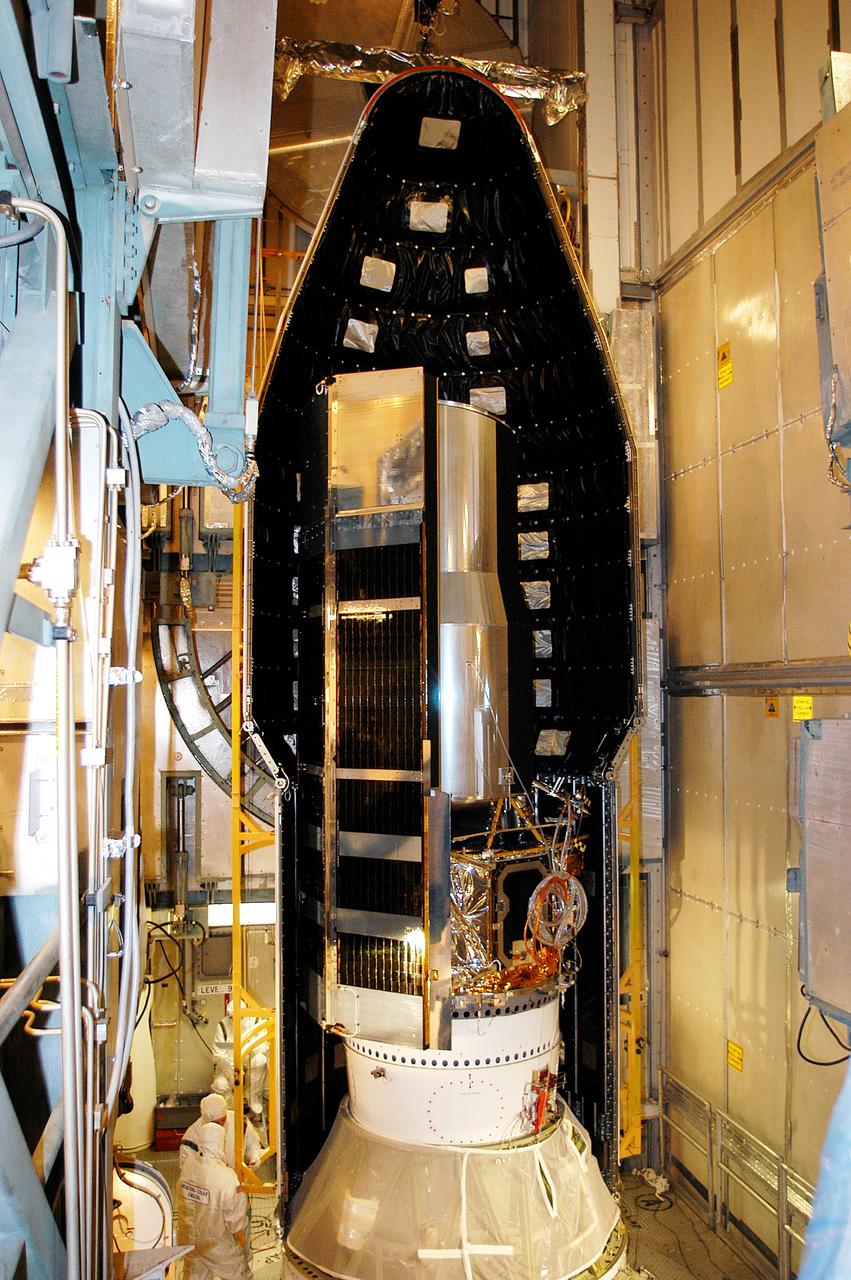
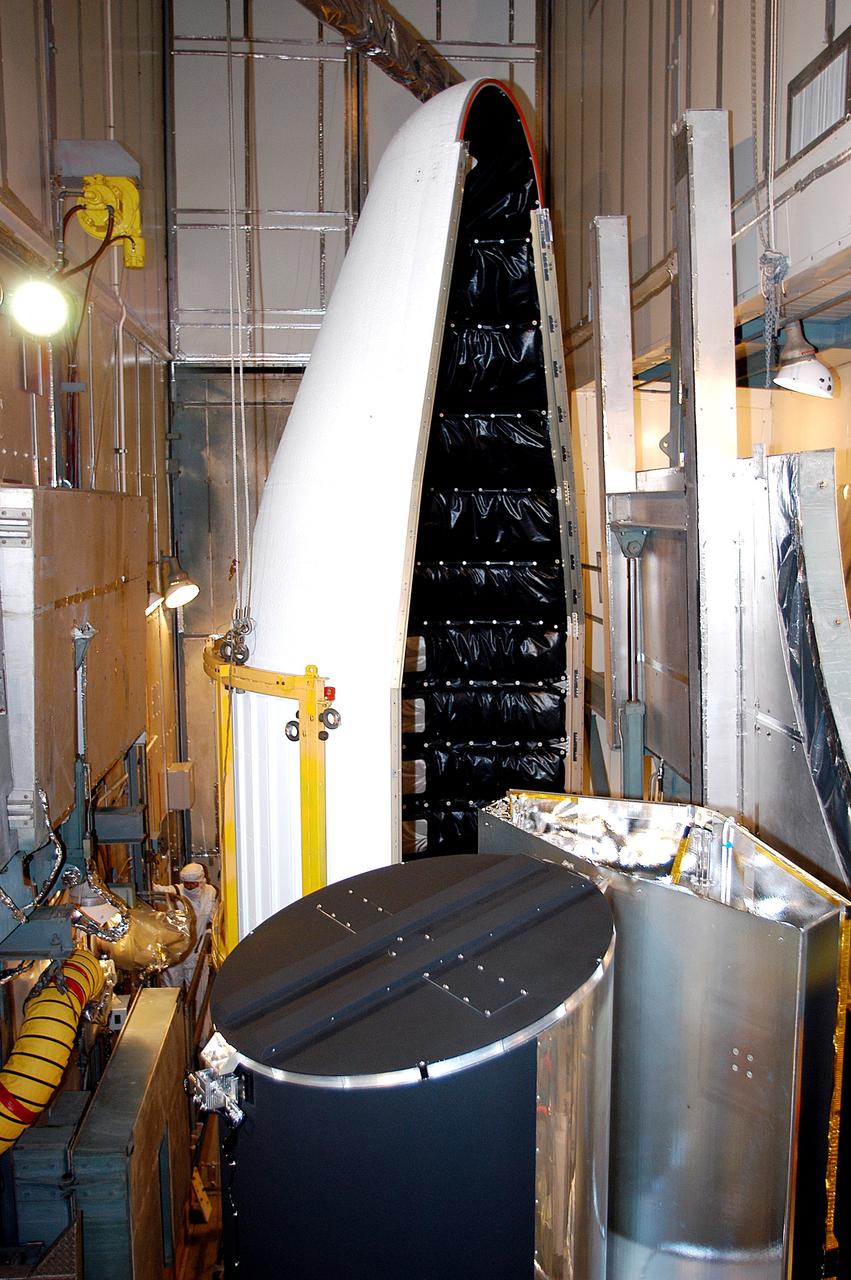
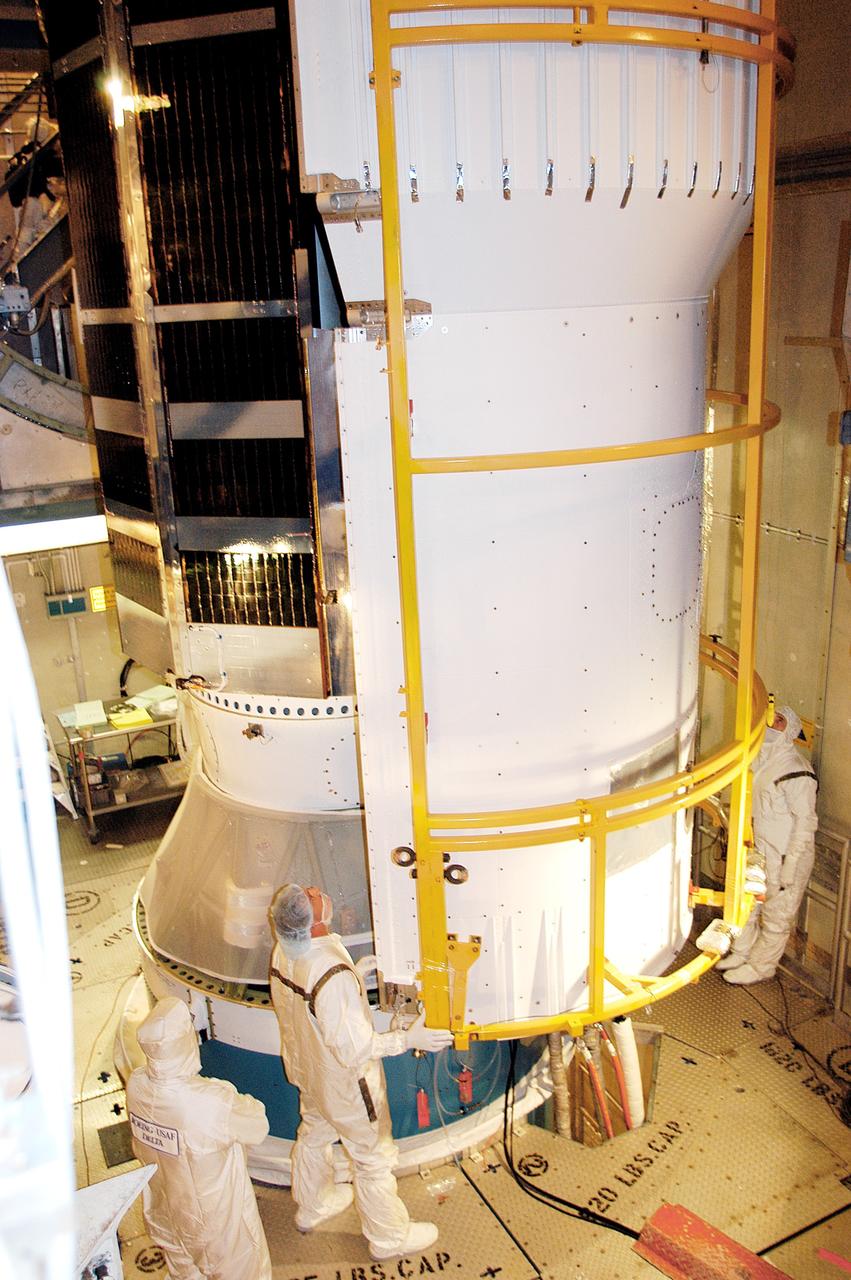
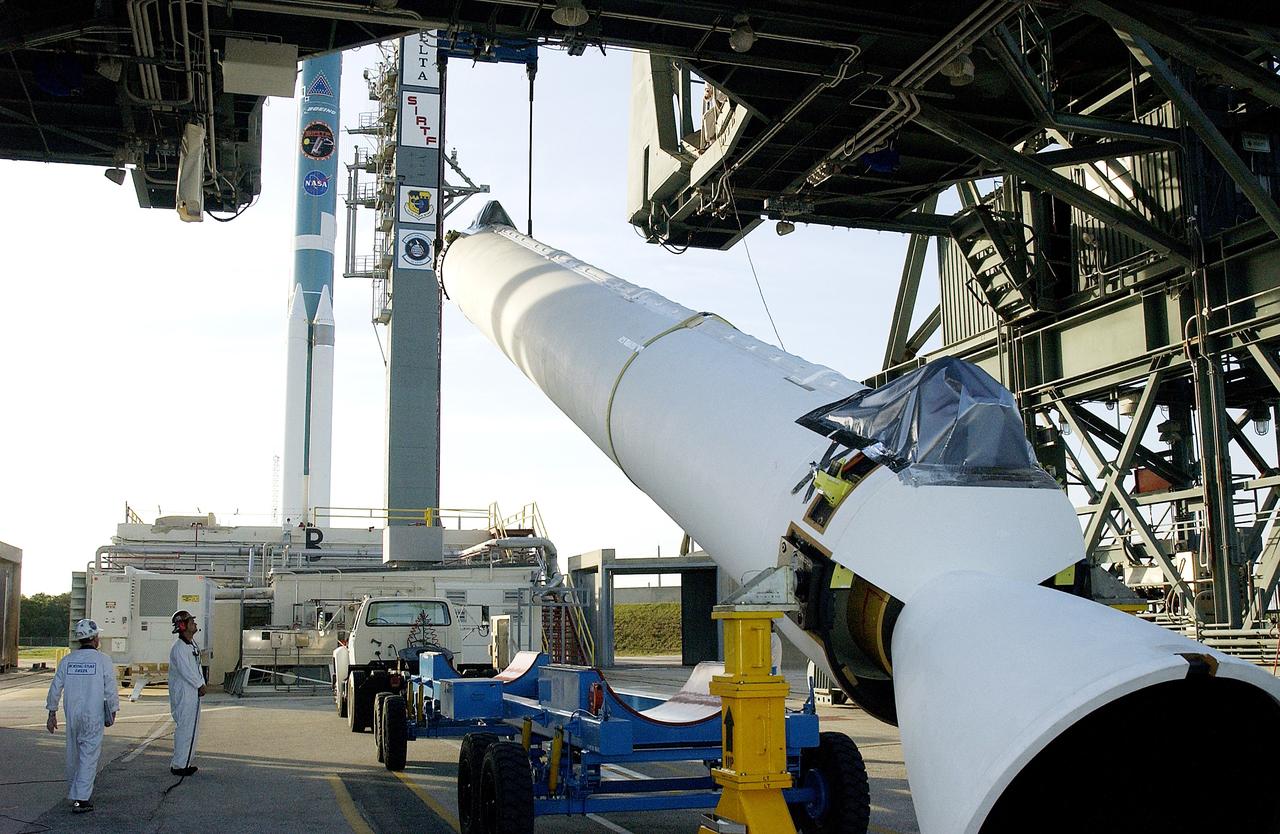
KENNEDY SPACE CENTER, FLA.  - In the mobile service tower on Launch Pad 17-B, Cape Canaveral Air Force Station, the first half of the fairing (background) moves toward the Space Infrared Telescope Facility (foreground) for encapsulation. SIRTF will obtain images and spectra by detecting the infrared energy, or heat, radiated by objects in space. Consisting of a 0.85-meter telescope and three cryogenically cooled science instruments, SIRTF will be the largest infrared telescope ever launched into space. It is the fourth and final element in NASA’s family of orbiting “Great Observatories.” Its highly sensitive instruments will give a unique view of the Universe and peer into regions of space that are hidden from optical telescopes.
KENNEDY SPACE CENTER, FLA. - In the mobile service tower on Launch Pad 17-B, Cape Canaveral Air Force Station, the first half of the fairing (background) moves toward the Space Infrared Telescope Facility (foreground) for encapsulation. SIRTF will obtain images and spectra by detecting the infrared energy, or heat, radiated by objects in space. Consisting of a 0.85-meter telescope and three cryogenically cooled science instruments, SIRTF will be the largest infrared telescope ever launched into space. It is the fourth and final element in NASA’s family of orbiting “Great Observatories.” Its highly sensitive instruments will give a unique view of the Universe and peer into regions of space that are hidden from optical telescopes.
KENNEDY SPACE CENTER, FLA.  - In the mobile service tower on Launch Pad 17-B, Cape Canaveral Air Force Station, the Space Infrared Telescope Facility (SIRTF) waits for encapsulation. SIRTF will obtain images and spectra by detecting the infrared energy, or heat, radiated by objects in space. Consisting of a 0.85-meter telescope and three cryogenically cooled science instruments, SIRTF will be the largest infrared telescope ever launched into space. It is the fourth and final element in NASA’s family of orbiting “Great Observatories.” Its highly sensitive instruments will give a unique view of the Universe and peer into regions of space that are hidden from optical telescopes.
KENNEDY SPACE CENTER, FLA. - In the mobile service tower on Launch Pad 17-B, Cape Canaveral Air Force Station, the Space Infrared Telescope Facility (SIRTF) waits for encapsulation. SIRTF will obtain images and spectra by detecting the infrared energy, or heat, radiated by objects in space. Consisting of a 0.85-meter telescope and three cryogenically cooled science instruments, SIRTF will be the largest infrared telescope ever launched into space. It is the fourth and final element in NASA’s family of orbiting “Great Observatories.” Its highly sensitive instruments will give a unique view of the Universe and peer into regions of space that are hidden from optical telescopes.
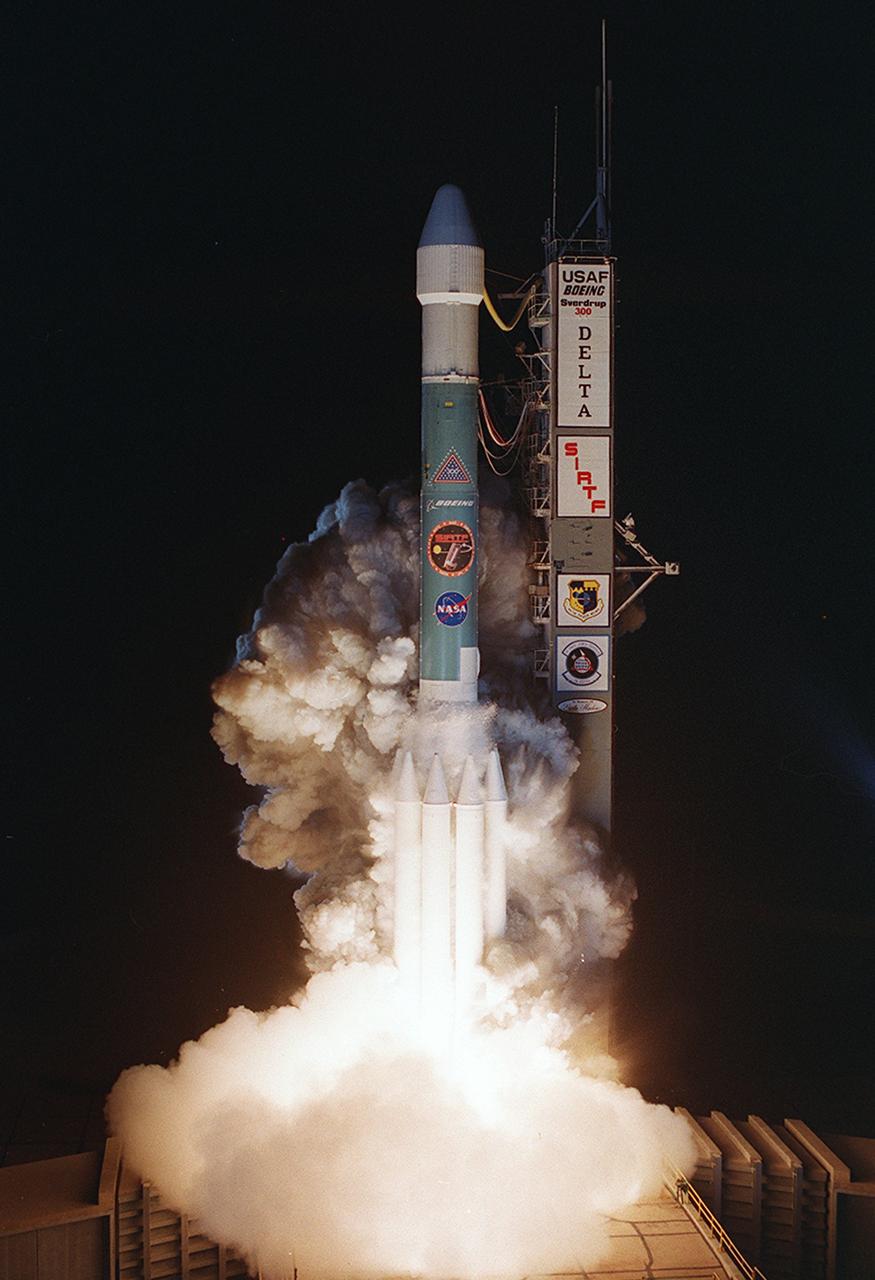
KENNEDY SPACE CENTER, FLA.  -  NASA's Space Infrared Telescope Facility (SIRTF) lifts off from Launch Pad 17-B, Cape Canaveral Air Force Station, on Aug. 25 at 1:35:39 a.m. EDT. SIRTF will obtain images and spectra by detecting the infrared energy, or heat, radiated by objects in space. Consisting of a 0.85-meter telescope and three cryogenically cooled science instruments, SIRTF will be the largest infrared telescope ever launched into space. It is the fourth and final element in NASA’s family of orbiting “Great Observatories.” Its highly sensitive instruments will give a unique view of the Universe and peer into regions of space that are hidden from optical telescopes.
KENNEDY SPACE CENTER, FLA. - NASA's Space Infrared Telescope Facility (SIRTF) lifts off from Launch Pad 17-B, Cape Canaveral Air Force Station, on Aug. 25 at 1:35:39 a.m. EDT. SIRTF will obtain images and spectra by detecting the infrared energy, or heat, radiated by objects in space. Consisting of a 0.85-meter telescope and three cryogenically cooled science instruments, SIRTF will be the largest infrared telescope ever launched into space. It is the fourth and final element in NASA’s family of orbiting “Great Observatories.” Its highly sensitive instruments will give a unique view of the Universe and peer into regions of space that are hidden from optical telescopes.
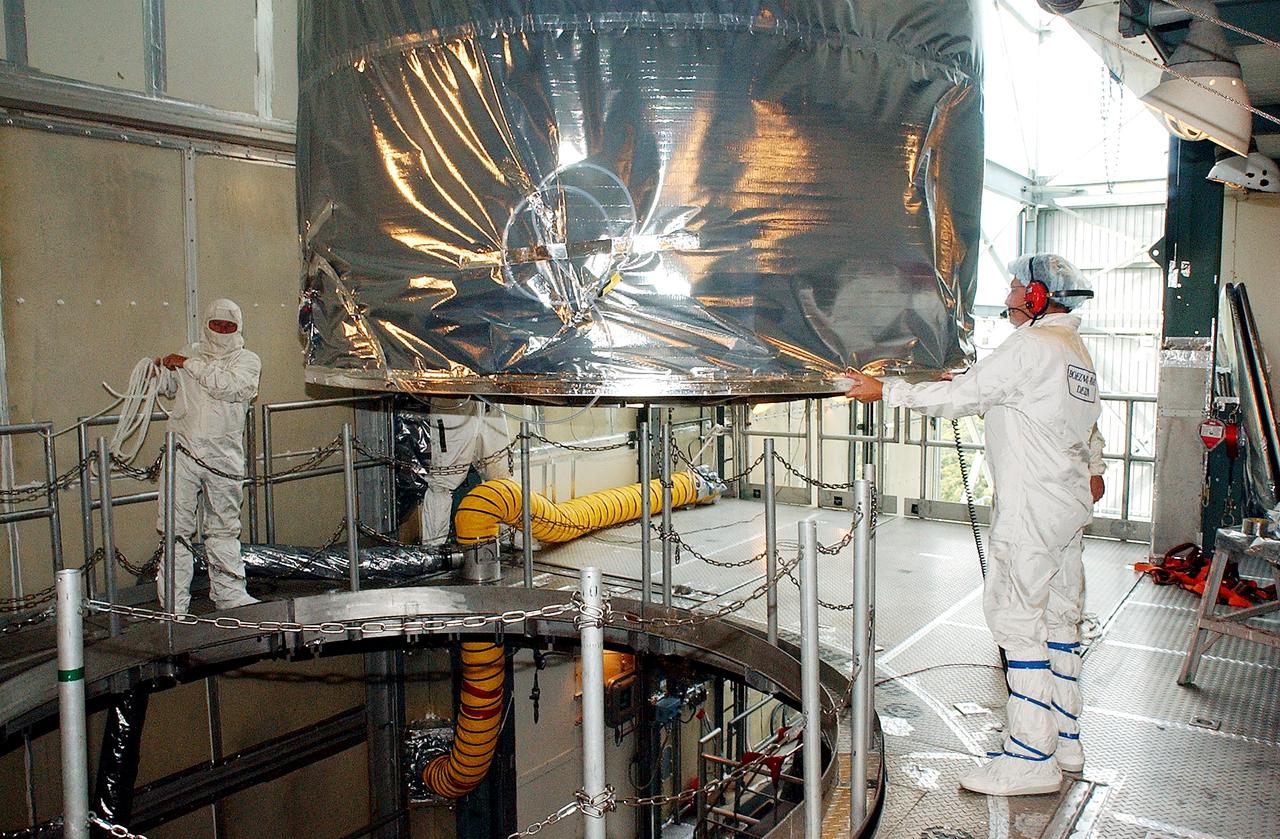
KENNEDY SPACE CENTER, FLA.  - In the mobile service tower on Launch Pad 17-B, Cape Canaveral Air Force Station, workers move the first half of the fairing around the Space Infrared Telescope Facility (SIRTF) behind it for encapsulation. SIRTF will obtain images and spectra by detecting the infrared energy, or heat, radiated by objects in space. Consisting of a 0.85-meter telescope and three cryogenically cooled science instruments, SIRTF will be the largest infrared telescope ever launched into space. It is the fourth and final element in NASA’s family of orbiting “Great Observatories.” Its highly sensitive instruments will give a unique view of the Universe and peer into regions of space that are hidden from optical telescopes.
KENNEDY SPACE CENTER, FLA. - In the mobile service tower on Launch Pad 17-B, Cape Canaveral Air Force Station, workers move the first half of the fairing around the Space Infrared Telescope Facility (SIRTF) behind it for encapsulation. SIRTF will obtain images and spectra by detecting the infrared energy, or heat, radiated by objects in space. Consisting of a 0.85-meter telescope and three cryogenically cooled science instruments, SIRTF will be the largest infrared telescope ever launched into space. It is the fourth and final element in NASA’s family of orbiting “Great Observatories.” Its highly sensitive instruments will give a unique view of the Universe and peer into regions of space that are hidden from optical telescopes.
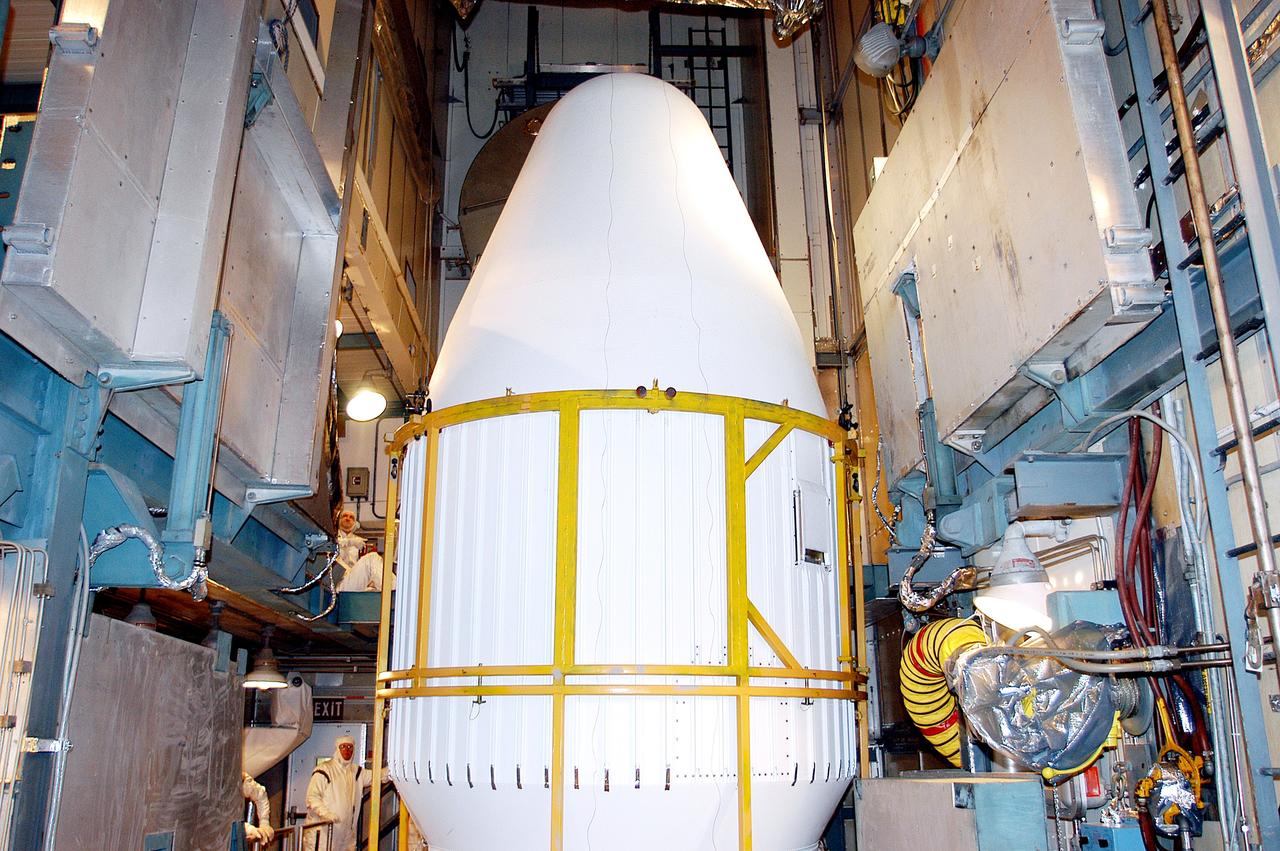
KENNEDY SPACE CENTER, FLA.  - In the mobile service tower on Launch Pad 17-B, Cape Canaveral Air Force Station, the top of the fairing is seen as it moves into place around the Space Infrared Telescope Facility (SIRTF). SIRTF will obtain images and spectra by detecting the infrared energy, or heat, radiated by objects in space. Consisting of a 0.85-meter telescope and three cryogenically cooled science instruments, SIRTF will be the largest infrared telescope ever launched into space. It is the fourth and final element in NASA’s family of orbiting “Great Observatories.” Its highly sensitive instruments will give a unique view of the Universe and peer into regions of space that are hidden from optical telescopes.
KENNEDY SPACE CENTER, FLA. - In the mobile service tower on Launch Pad 17-B, Cape Canaveral Air Force Station, the top of the fairing is seen as it moves into place around the Space Infrared Telescope Facility (SIRTF). SIRTF will obtain images and spectra by detecting the infrared energy, or heat, radiated by objects in space. Consisting of a 0.85-meter telescope and three cryogenically cooled science instruments, SIRTF will be the largest infrared telescope ever launched into space. It is the fourth and final element in NASA’s family of orbiting “Great Observatories.” Its highly sensitive instruments will give a unique view of the Universe and peer into regions of space that are hidden from optical telescopes.
KENNEDY SPACE CENTER, FLA.  -  NASA's Space Infrared Telescope Facility (SIRTF) lifts off from Launch Pad 17-B, Cape Canaveral Air Force Station, on Aug. 25 at 1:35:39 a.m. EDT. SIRTF will obtain images and spectra by detecting the infrared energy, or heat, radiated by objects in space. Consisting of a 0.85-meter telescope and three cryogenically cooled science instruments, SIRTF will be the largest infrared telescope ever launched into space. It is the fourth and final element in NASA’s family of orbiting “Great Observatories.” Its highly sensitive instruments will give a unique view of the Universe and peer into regions of space that are hidden from optical telescopes.
KENNEDY SPACE CENTER, FLA. - NASA's Space Infrared Telescope Facility (SIRTF) lifts off from Launch Pad 17-B, Cape Canaveral Air Force Station, on Aug. 25 at 1:35:39 a.m. EDT. SIRTF will obtain images and spectra by detecting the infrared energy, or heat, radiated by objects in space. Consisting of a 0.85-meter telescope and three cryogenically cooled science instruments, SIRTF will be the largest infrared telescope ever launched into space. It is the fourth and final element in NASA’s family of orbiting “Great Observatories.” Its highly sensitive instruments will give a unique view of the Universe and peer into regions of space that are hidden from optical telescopes.
KENNEDY SPACE CENTER, FLA.  -  NASA's Space Infrared Telescope Facility (SIRTF) lifts off from Launch Pad 17-B, Cape Canaveral Air Force Station, on Aug. 25 at 1:35:39 a.m. EDT. SIRTF will obtain images and spectra by detecting the infrared energy, or heat, radiated by objects in space. Consisting of a 0.85-meter telescope and three cryogenically cooled science instruments, SIRTF will be the largest infrared telescope ever launched into space. It is the fourth and final element in NASA’s family of orbiting “Great Observatories.” Its highly sensitive instruments will give a unique view of the Universe and peer into regions of space that are hidden from optical telescopes.
KENNEDY SPACE CENTER, FLA. - NASA's Space Infrared Telescope Facility (SIRTF) lifts off from Launch Pad 17-B, Cape Canaveral Air Force Station, on Aug. 25 at 1:35:39 a.m. EDT. SIRTF will obtain images and spectra by detecting the infrared energy, or heat, radiated by objects in space. Consisting of a 0.85-meter telescope and three cryogenically cooled science instruments, SIRTF will be the largest infrared telescope ever launched into space. It is the fourth and final element in NASA’s family of orbiting “Great Observatories.” Its highly sensitive instruments will give a unique view of the Universe and peer into regions of space that are hidden from optical telescopes.
KENNEDY SPACE CENTER, FLA.  -  NASA's Space Infrared Telescope Facility (SIRTF) lifts off from Launch Pad 17-B, Cape Canaveral Air Force Station, on Aug. 25 at 1:35:39 a.m. EDT. SIRTF will obtain images and spectra by detecting the infrared energy, or heat, radiated by objects in space. Consisting of a 0.85-meter telescope and three cryogenically cooled science instruments, SIRTF will be the largest infrared telescope ever launched into space. It is the fourth and final element in NASA’s family of orbiting “Great Observatories.” Its highly sensitive instruments will give a unique view of the Universe and peer into regions of space that are hidden from optical telescopes.
KENNEDY SPACE CENTER, FLA. - NASA's Space Infrared Telescope Facility (SIRTF) lifts off from Launch Pad 17-B, Cape Canaveral Air Force Station, on Aug. 25 at 1:35:39 a.m. EDT. SIRTF will obtain images and spectra by detecting the infrared energy, or heat, radiated by objects in space. Consisting of a 0.85-meter telescope and three cryogenically cooled science instruments, SIRTF will be the largest infrared telescope ever launched into space. It is the fourth and final element in NASA’s family of orbiting “Great Observatories.” Its highly sensitive instruments will give a unique view of the Universe and peer into regions of space that are hidden from optical telescopes.
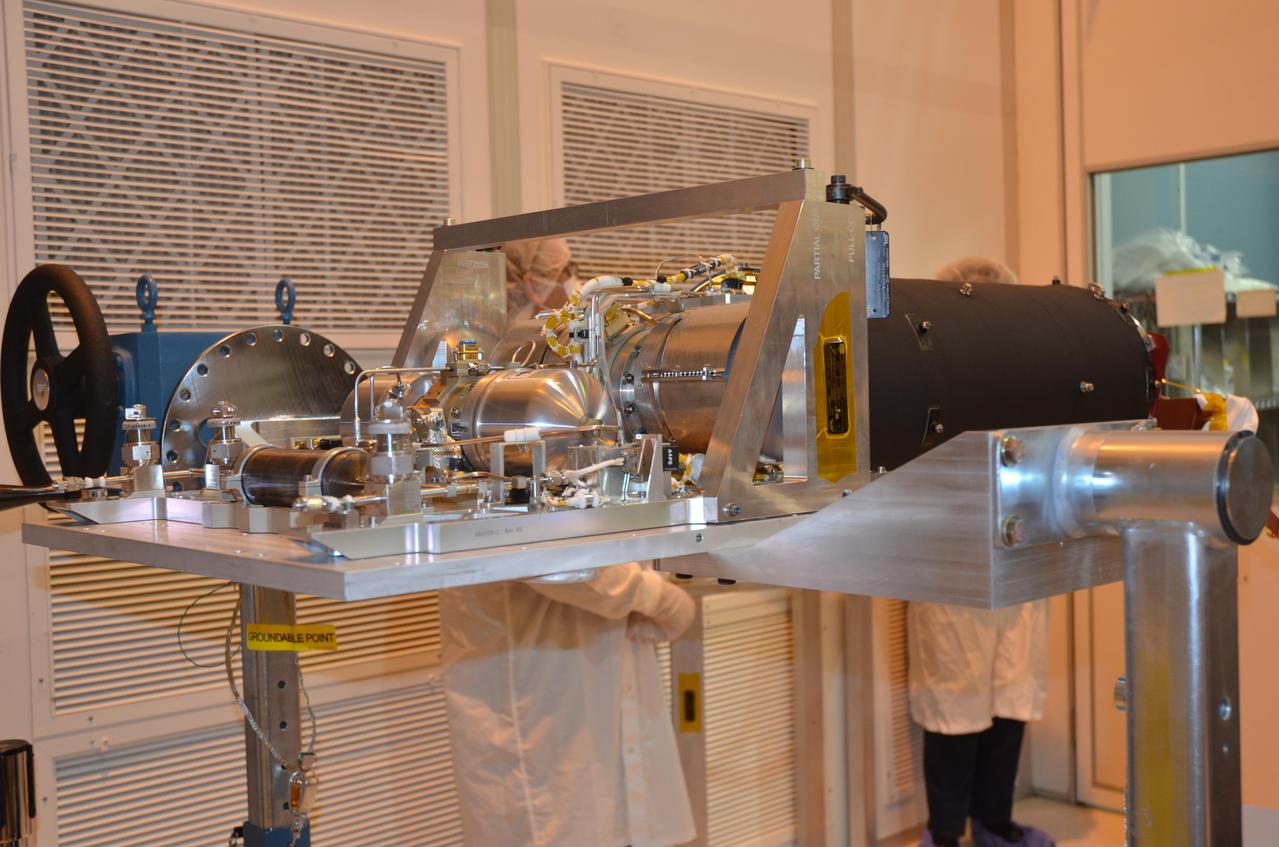
This image shows the cooling device for the Mid-Infrared Instrument, or MIRI, one of the James Webb Space Telescope's four instruments. This photo was taken after the cryocooler had completed testing, and was taken out of the test chamber in preparation for being placed into its shipping container.  The cooler was shipped to the Northrop Grumman Aerospace Systems facility in Redondo Beach, California, on May 26, 2016. There, the cooler will be attached to the body of the Webb telescope.  http://photojournal.jpl.nasa.gov/catalog/PIA20688
MIRI Cryocooler Packing
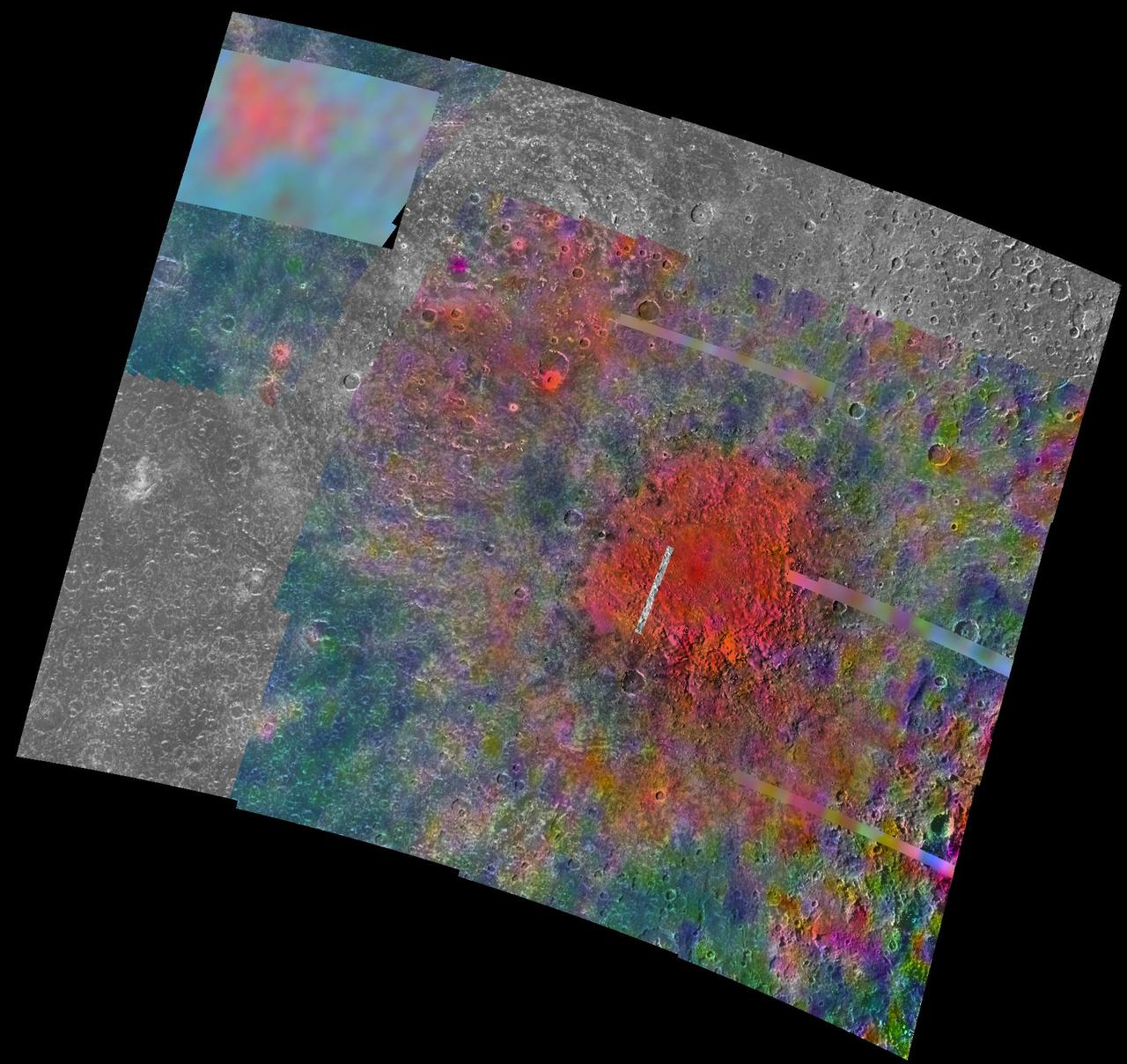
NASA Dawn spacecraft used its Visible and Infrared Imaging Spectrometer instrument to produce these three different composite images of the same region of asteroid Vesta surface.
Craters and Ejecta in Visible and Infrared Wavelengths
NASA Dawn spacecraft obtained these images with its visible and infrared instrument of asteroid Vesta. The top image is a simulated true-color picture of the asteroid surface.
Visible and Infrared Data Mosaic
This image shows the distribution and amount of carbon dioxide in Earth mid-troposphere in July 2008 as measured by NASA Atmospheric Infrared Sounder AIRS instrument.
AIRS Carbon Dioxide with Mauna Loa Carbon Dioxide Overlaid
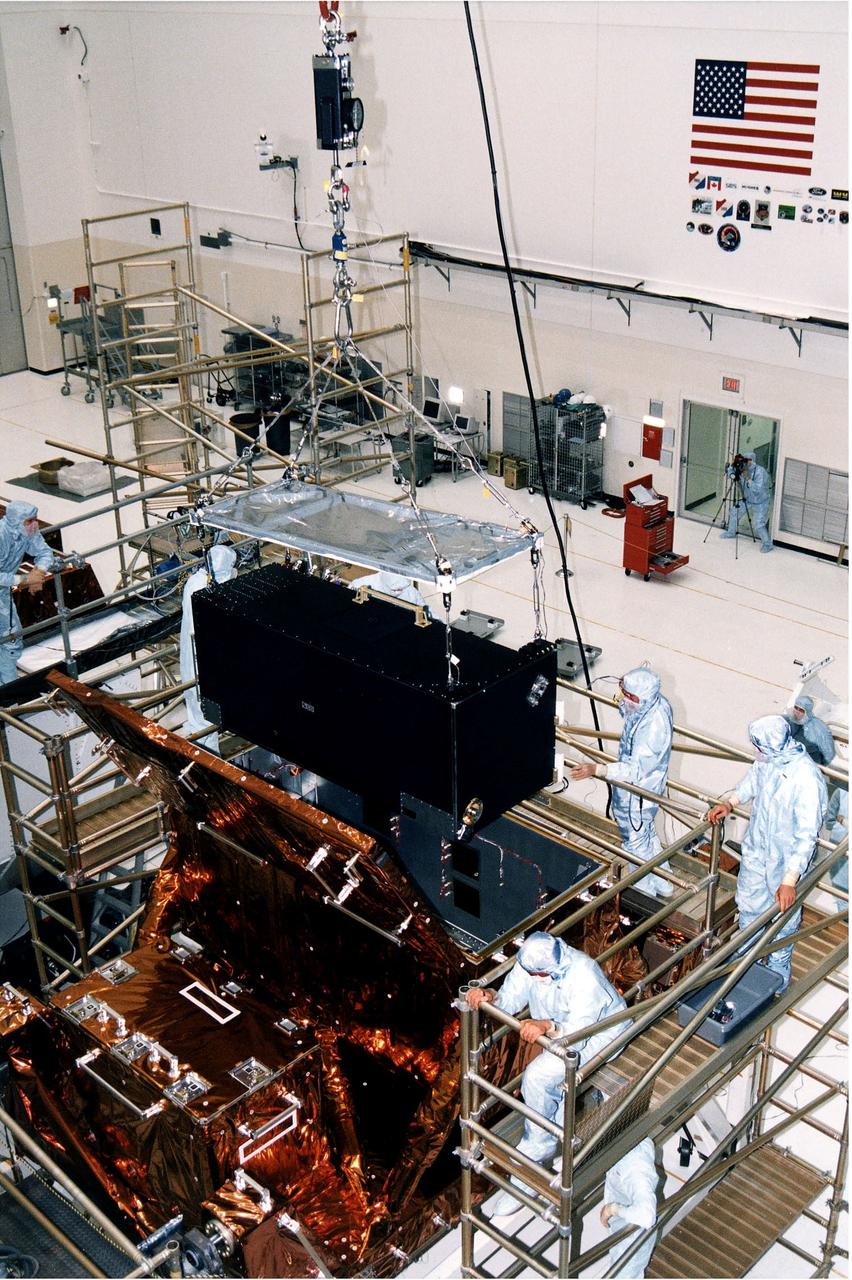
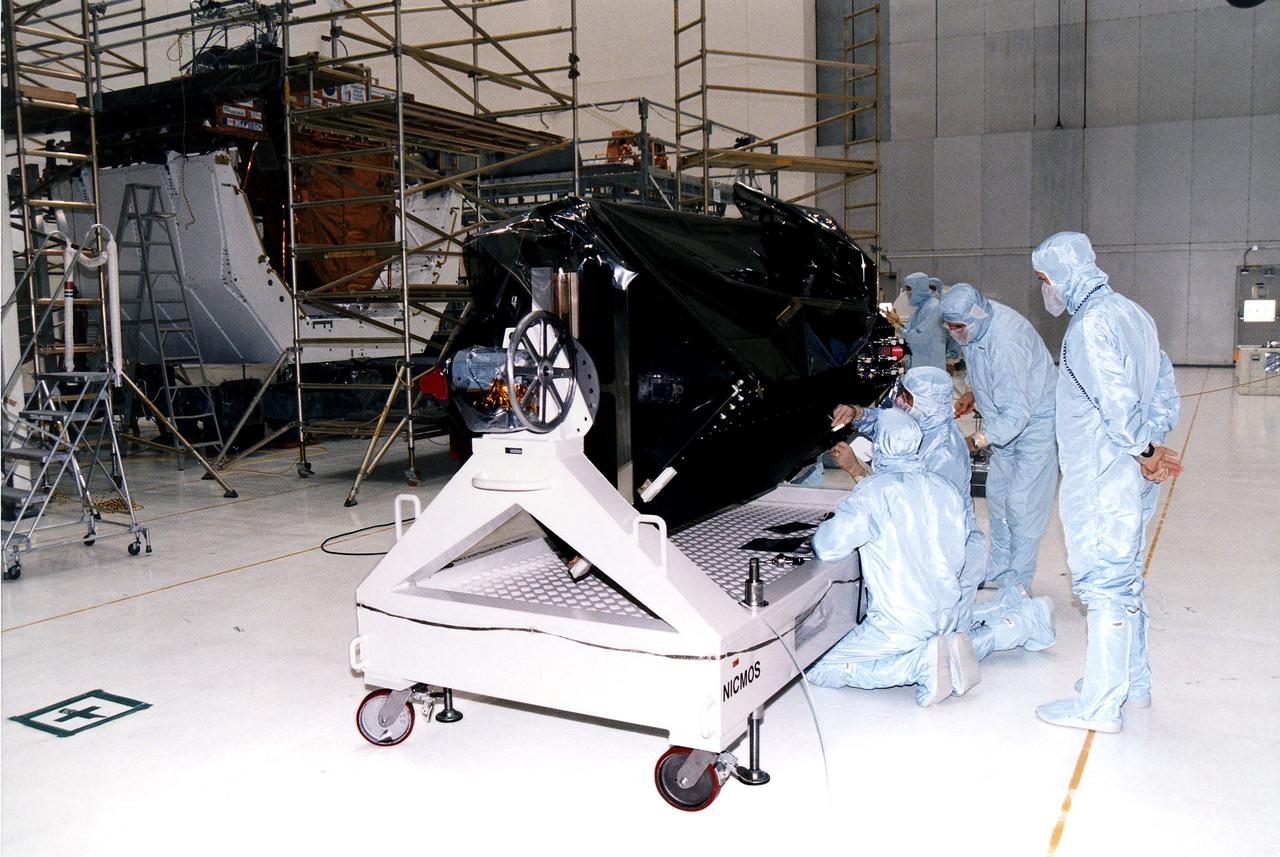
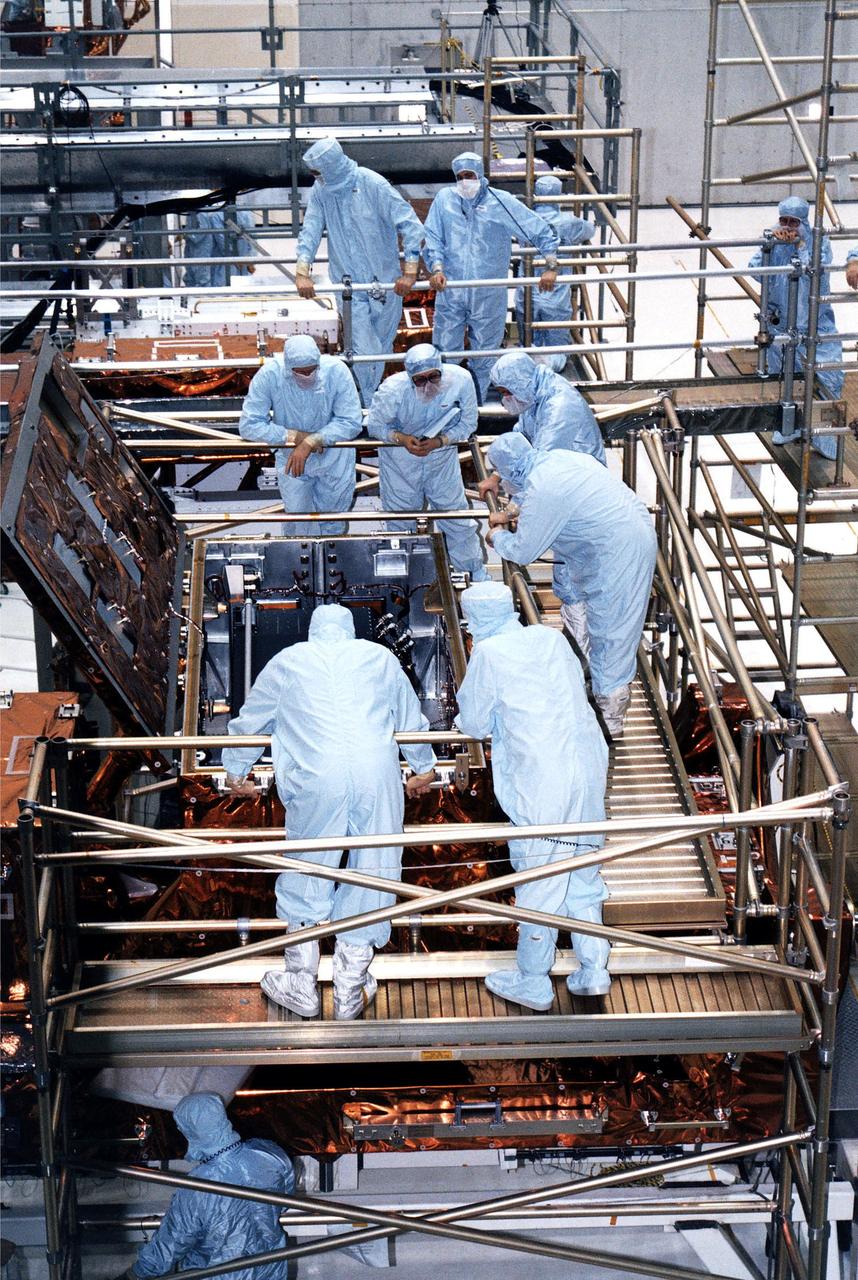
KENNEDY SPACE CENTER, FLA. -  Workers in KSC's Vertical Processing Facility lower the Near Infrared Camera and Multi-Object Spectrometer (NICMOS) into the Second Axial Carrier.  NICMOS is one of two new scientific instruments that will replace two outdated instruments on the Hubble Space Telescope (HST).  NICMOS will provide HST with the capability for infrared imaging and spectroscopic observations of astronomical targets.  The refrigerator-sized NICMOS is HST's first cryogenic instrument -- its sensitive infrared detectors must operate at very cold temperatures of minus 355 degrees Fahrenheit or 58 derees Kelvin.  NICMOS will be installed in Hubble during STS-82, the second Hubble Space Telescope servicing mission.  Liftoff is targeted Feb. 11 aboard Discovery with a crew of seven.
KENNEDY SPACE CENTER, FLA. - Workers in KSC's Vertical Processing Facility lower the Near Infrared Camera and Multi-Object Spectrometer (NICMOS) into the Second Axial Carrier. NICMOS is one of two new scientific instruments that will replace two outdated instruments on the Hubble Space Telescope (HST). NICMOS will provide HST with the capability for infrared imaging and spectroscopic observations of astronomical targets. The refrigerator-sized NICMOS is HST's first cryogenic instrument -- its sensitive infrared detectors must operate at very cold temperatures of minus 355 degrees Fahrenheit or 58 derees Kelvin. NICMOS will be installed in Hubble during STS-82, the second Hubble Space Telescope servicing mission. Liftoff is targeted Feb. 11 aboard Discovery with a crew of seven.
KENNEDY SPACE CENTER, FLA. - Workers in KSC's Vertical Processing Facility lower the Near Infrared Camera and Multi-Object Spectrometer (NICMOS) into the Second Axial Carrier.  NICMOS is one of two new scientific instruments that will replace two outdated instruments on the Hubble Space Telescope (HST).  NICMOS will provide HST with the capability for infrared imaging and spectroscopic observations of astronomical targets.  The refrigerator-sized NICMOS also is HST's first cryogenic instrument — its sensitive infrared detectors must operate at very cold temperatures of minus 355 degrees Fahrenheit or 58 degrees Kelvin.  NICMOS will be installed in Hubble during STS-82, the second Hubble Space Telescope servicing mission.  Liftoff is targeted Feb. 11 aboard Discovery with a crew of seven.
KENNEDY SPACE CENTER, FLA. - Workers in KSC's Vertical Processing Facility lower the Near Infrared Camera and Multi-Object Spectrometer (NICMOS) into the Second Axial Carrier. NICMOS is one of two new scientific instruments that will replace two outdated instruments on the Hubble Space Telescope (HST). NICMOS will provide HST with the capability for infrared imaging and spectroscopic observations of astronomical targets. The refrigerator-sized NICMOS also is HST's first cryogenic instrument — its sensitive infrared detectors must operate at very cold temperatures of minus 355 degrees Fahrenheit or 58 degrees Kelvin. NICMOS will be installed in Hubble during STS-82, the second Hubble Space Telescope servicing mission. Liftoff is targeted Feb. 11 aboard Discovery with a crew of seven.
KENNEDY SPACE CENTER, FLA. - Workers in KSC's Vertical Processing Facility inspect the Near Infrared Camera and Multi-Object Spectrometer (NICMOS) on its handling fixture.  NICMOS is one of two new scientific instruments that will replace two outdated instruments on the Hubble Space Telescope (HST).  NICMOS will provide HST with the capability for infrared imaging and spectroscopic observations of astronomical targets.  The refrigerator-sized NICMOS also is HST's first cryogenic instrument — its sensitive infrared detectors must operate at very cold temperatures of minus 355 degrees Fahrenheit or 58 degrees Kelvin.  NICMOS will be installed in Hubble during STS-82, the second Hubble Space Telescope servicing mission.  Liftoff is targeted Feb. 11 aboard Discovery with a crew of seven.
KENNEDY SPACE CENTER, FLA. - Workers in KSC's Vertical Processing Facility inspect the Near Infrared Camera and Multi-Object Spectrometer (NICMOS) on its handling fixture. NICMOS is one of two new scientific instruments that will replace two outdated instruments on the Hubble Space Telescope (HST). NICMOS will provide HST with the capability for infrared imaging and spectroscopic observations of astronomical targets. The refrigerator-sized NICMOS also is HST's first cryogenic instrument — its sensitive infrared detectors must operate at very cold temperatures of minus 355 degrees Fahrenheit or 58 degrees Kelvin. NICMOS will be installed in Hubble during STS-82, the second Hubble Space Telescope servicing mission. Liftoff is targeted Feb. 11 aboard Discovery with a crew of seven.
KENNEDY SPACE CENTER, FLA. -  STS-82 crew members and workers at KSC's Vertical Processing Facility get a final look at the Near Infrared Camera and Multi-Object Spectrometer (NICMOS) in its flight configuration for the STS-82 mission.  The crew is participating in the Crew Equipment Integration Test (CEIT).  NICMOS is one of two new scientific instruments that will replace two outdated instruments on the Hubble Space Telescope (HST).  NICMOS will provide HST with the capability for infrared imaging and spectroscopic observations of astronomical targets.  The refrigerator-sized NICMOS also is HST's first cryogenic instrument - its sensitive infrared detectors must operate at very cold temperatures of minus 355 degrees Fahrenheit or 58 degrees Kelvin.  NICMOS will be installed in Hubble during STS-82, the second Hubble Space Telescope servicing mission.  Liftoff is scheduled Feb. 11 aboard Discovery with a crew of seven.
KENNEDY SPACE CENTER, FLA. - STS-82 crew members and workers at KSC's Vertical Processing Facility get a final look at the Near Infrared Camera and Multi-Object Spectrometer (NICMOS) in its flight configuration for the STS-82 mission. The crew is participating in the Crew Equipment Integration Test (CEIT). NICMOS is one of two new scientific instruments that will replace two outdated instruments on the Hubble Space Telescope (HST). NICMOS will provide HST with the capability for infrared imaging and spectroscopic observations of astronomical targets. The refrigerator-sized NICMOS also is HST's first cryogenic instrument - its sensitive infrared detectors must operate at very cold temperatures of minus 355 degrees Fahrenheit or 58 degrees Kelvin. NICMOS will be installed in Hubble during STS-82, the second Hubble Space Telescope servicing mission. Liftoff is scheduled Feb. 11 aboard Discovery with a crew of seven.
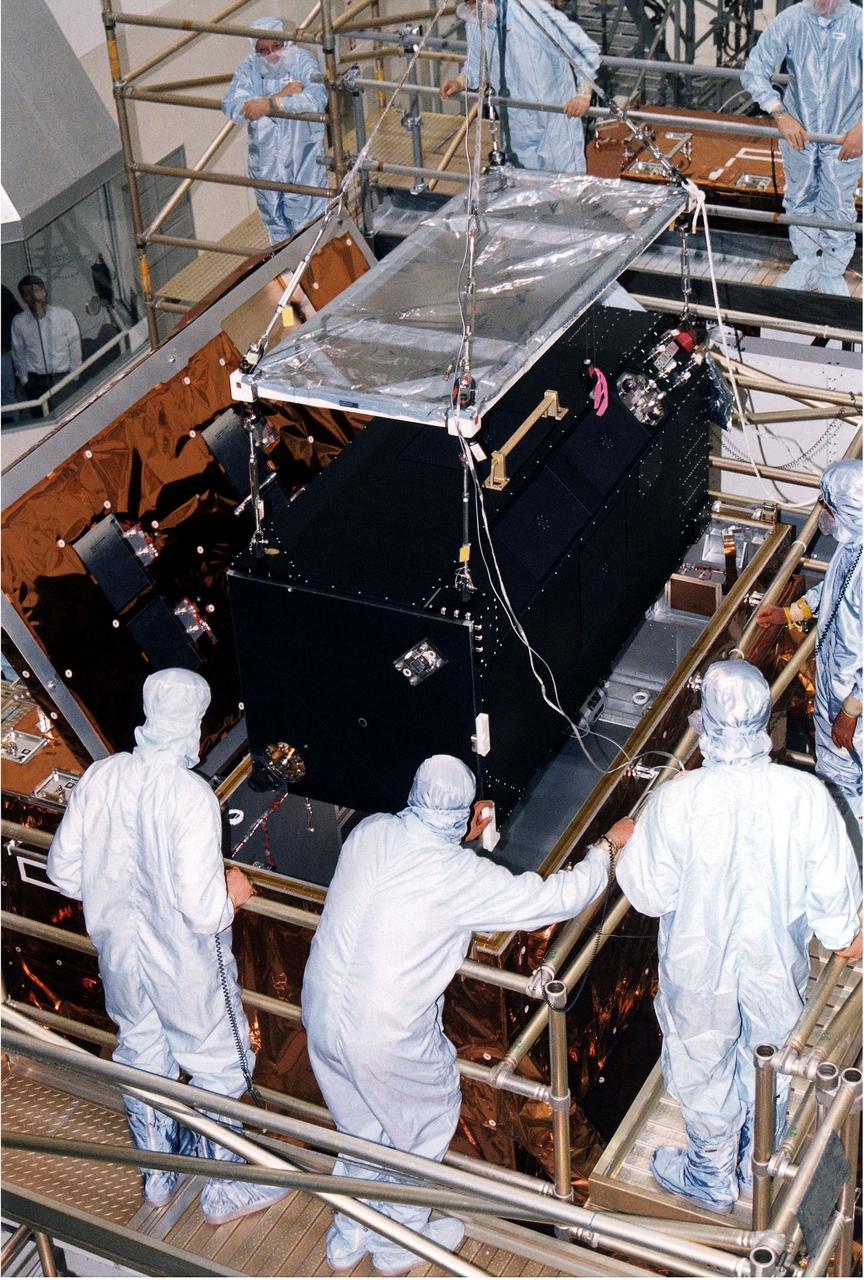
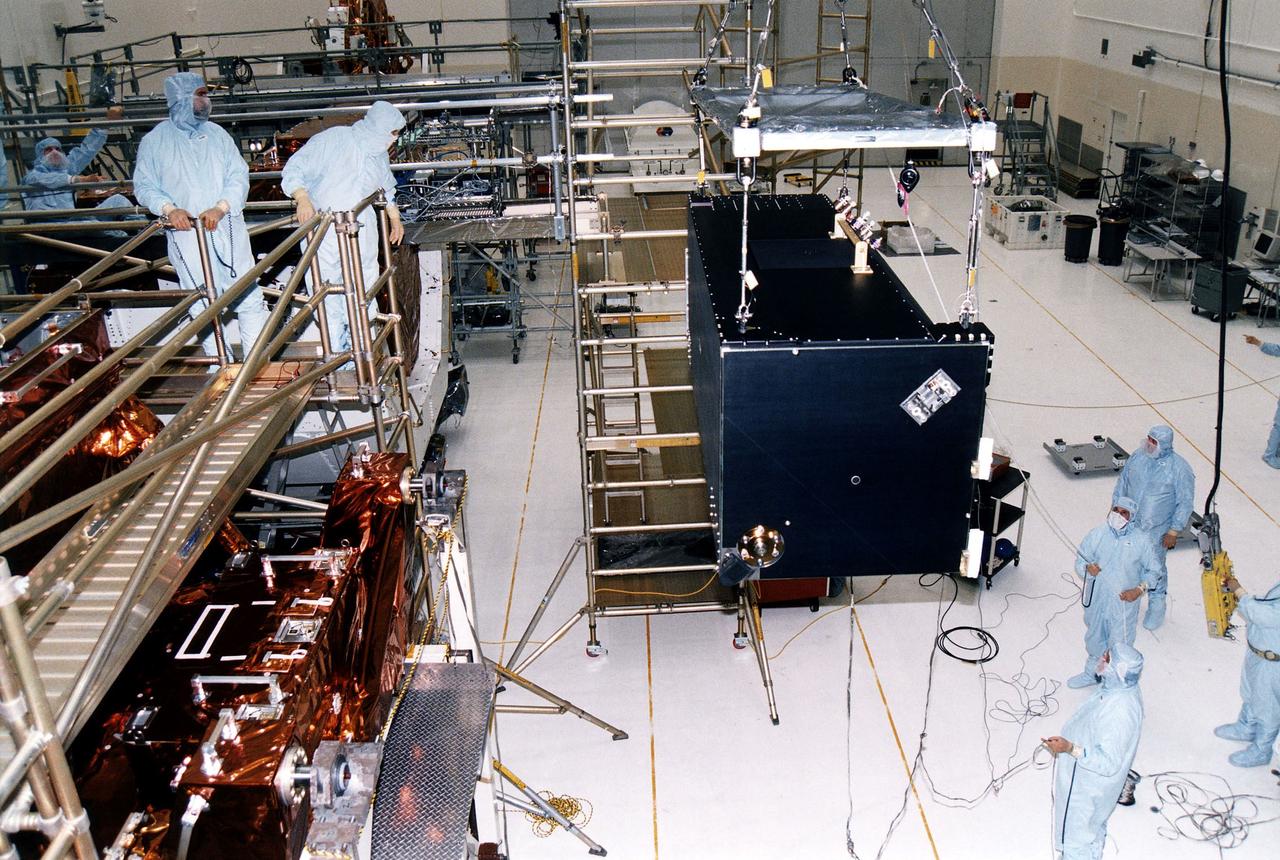
KENNEDY SPACE CENTER, FLA. - Workers in KSC's Vertical Processing Facility lift the Near Infrared Camera and Multi-Object Spectrometer (NICMOS) prior to its installation in the Second Axial Carrier.  NICMOS is one of two new scientific instruments that will replace two outdated instruments on the Hubble Space Telescope (HST).  NICMOS will provide HST with the capability for infrared imaging and spectroscopic observations of astronomical targets.  The refrigerator-sized NICMOS also is HST's first cryogenic instrument — its sensitive infrared detectors must operate at very cold temperatures of minus 355 degrees Fahrenheit or 58 degrees Kelvin.  NICMOS will be installed in Hubble during STS-82, the second Hubble Space Telescope servicing mission.  Liftoff is targeted Feb. 11 aboard Discovery with a crew of seven.
KENNEDY SPACE CENTER, FLA. - Workers in KSC's Vertical Processing Facility lift the Near Infrared Camera and Multi-Object Spectrometer (NICMOS) prior to its installation in the Second Axial Carrier. NICMOS is one of two new scientific instruments that will replace two outdated instruments on the Hubble Space Telescope (HST). NICMOS will provide HST with the capability for infrared imaging and spectroscopic observations of astronomical targets. The refrigerator-sized NICMOS also is HST's first cryogenic instrument — its sensitive infrared detectors must operate at very cold temperatures of minus 355 degrees Fahrenheit or 58 degrees Kelvin. NICMOS will be installed in Hubble during STS-82, the second Hubble Space Telescope servicing mission. Liftoff is targeted Feb. 11 aboard Discovery with a crew of seven.
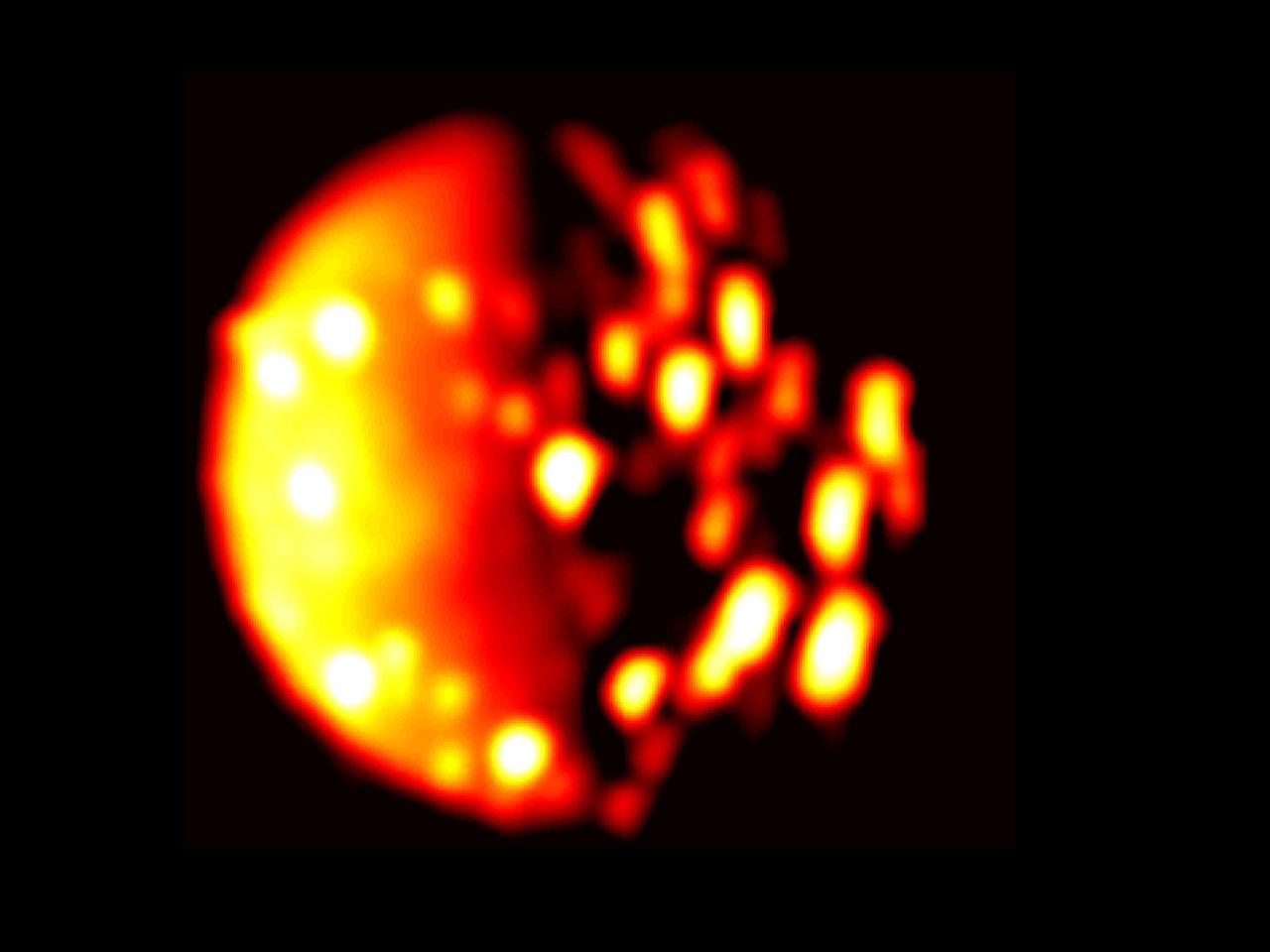
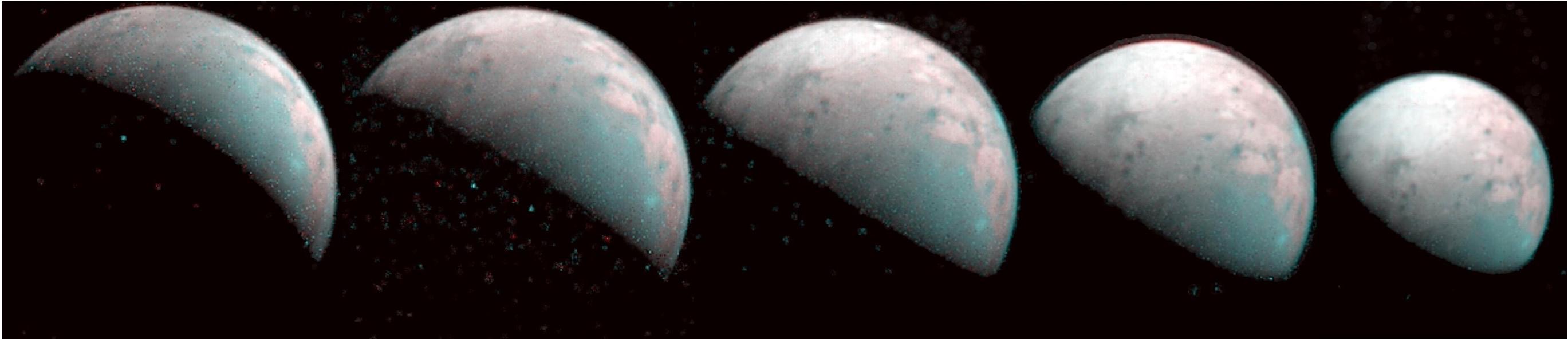
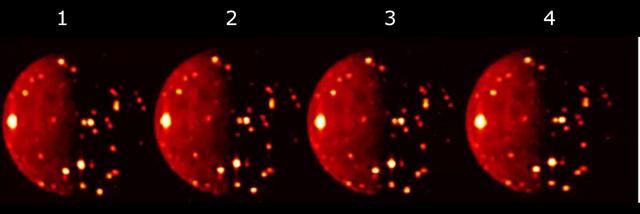
This infrared image of the southern hemisphere of Jupiter's moon Io was derived from data collected by the Jovian Infrared Auroral Mapper (JIRAM) instrument aboard NASA's Juno spacecraft on Dec. 16, 2017, when the spacecraft was about 290,000 miles (470,000 kilometers) from the Jovian moon. In this infrared image, the brighter the color the higher the temperature recorded by JIRAM.   An animation is available at https://photojournal.jpl.nasa.gov/catalog/PIA22599
Jupiter Moon Io in Infrared
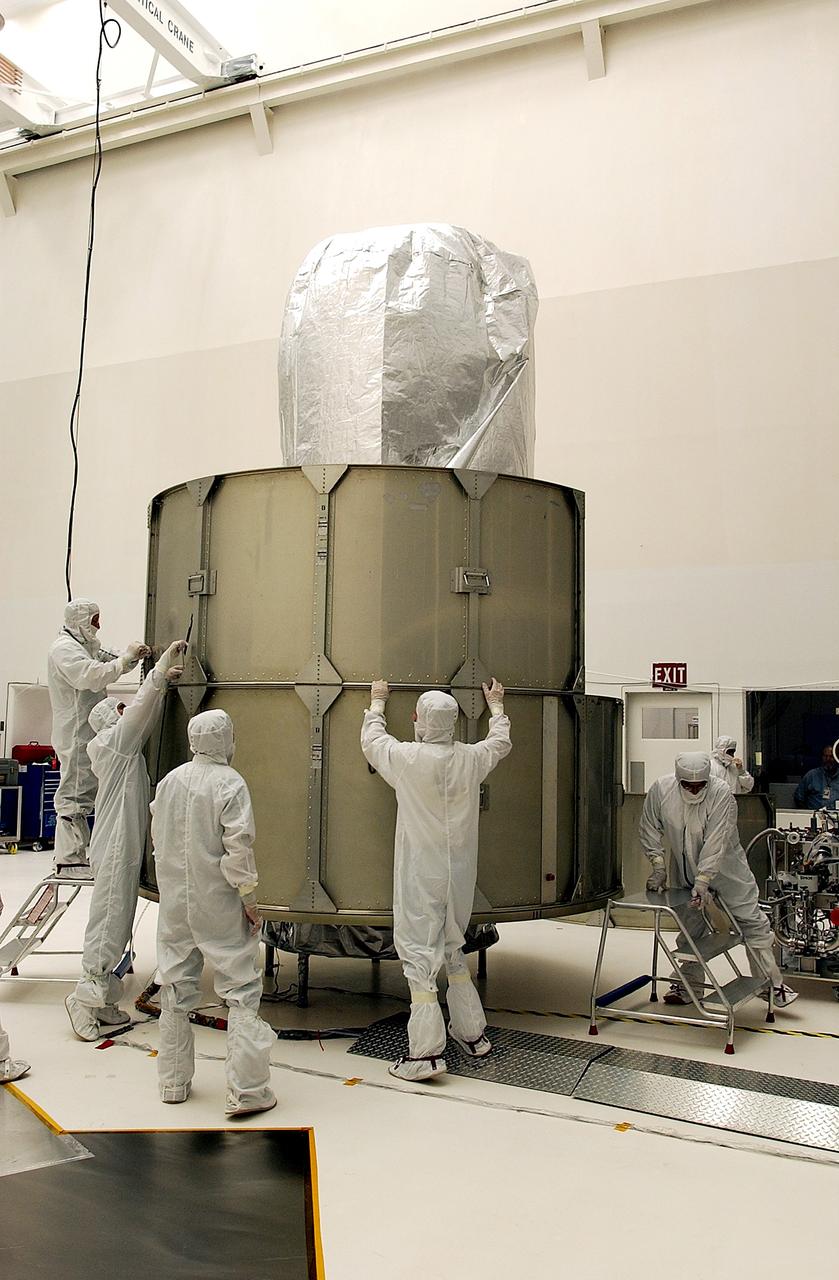
KENNEDY SPACE CENTER, FLA.  -  A worker at Hangar A&E, Cape Canaveral Air Force Station, place the lower panels of the canister around the Space Infrared Telescope Facility (SIRTF).  The spacecraft will be transported to Launch Complex 17-B for mating with its launch vehicle, the Delta II rocket.   SIRTF consists of three cryogenically cooled science instruments and an 0.85-meter telescope, and is one of NASA's largest infrared telescopes to be launched.  SIRTF will obtain images and spectra by detecting the infrared energy, or heat, radiated by objects in space. Most of this infrared radiation is blocked by the Earth's atmosphere and cannot be observed from the ground.
KENNEDY SPACE CENTER, FLA. - A worker at Hangar A&E, Cape Canaveral Air Force Station, place the lower panels of the canister around the Space Infrared Telescope Facility (SIRTF). The spacecraft will be transported to Launch Complex 17-B for mating with its launch vehicle, the Delta II rocket. SIRTF consists of three cryogenically cooled science instruments and an 0.85-meter telescope, and is one of NASA's largest infrared telescopes to be launched. SIRTF will obtain images and spectra by detecting the infrared energy, or heat, radiated by objects in space. Most of this infrared radiation is blocked by the Earth's atmosphere and cannot be observed from the ground.
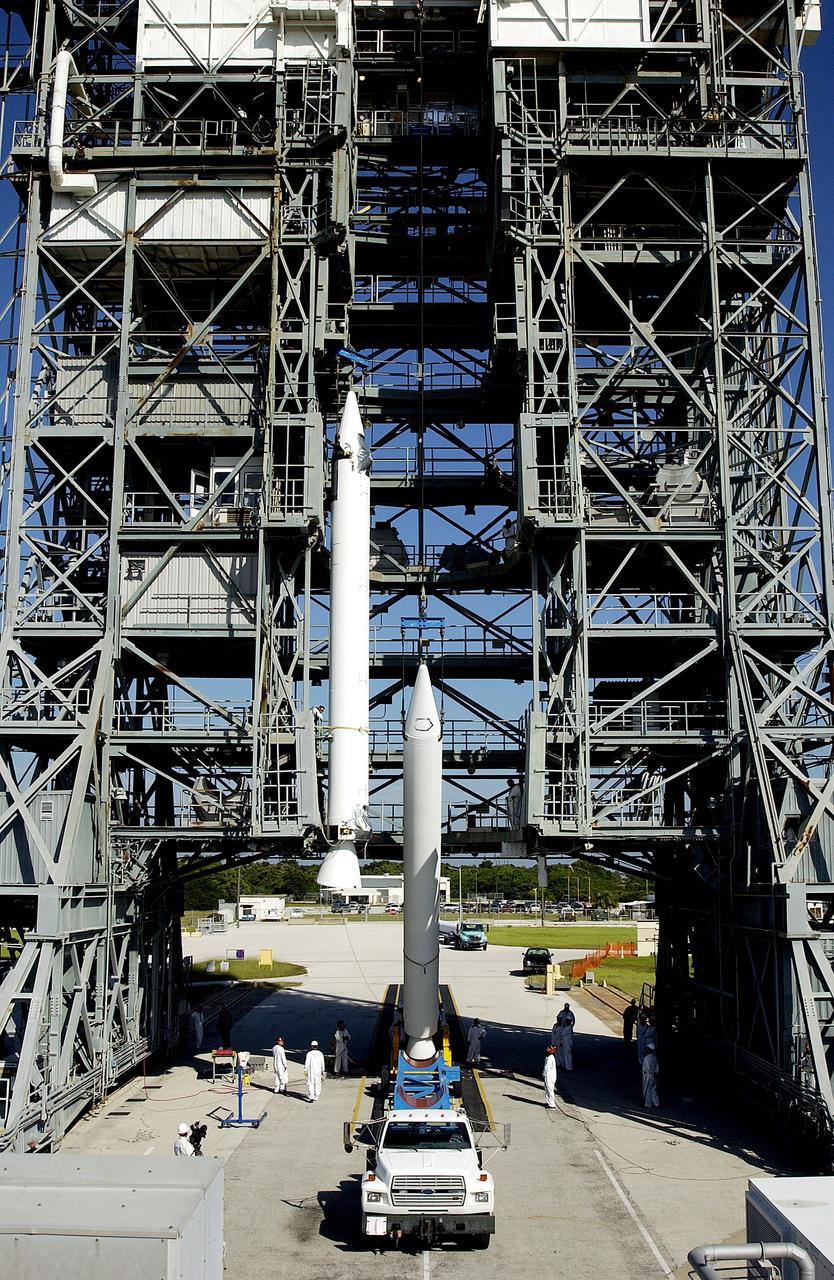
KENNEDY SPACE CENTER, FLA. -   Workers on Launch Complex 17-B, Cape Canaveral Air Force Station, help steady a solid rocket booster (SRB) being lifted into the mobile service tower.  It is one of nine  46-inch-diameter, stretched SRBs that are being attached to the Delta II Heavy rocket that will launch the Space Infrared Telescope Facility (SIRTF).  Consisting of three cryogenically cooled science instruments and an 0.85-meter telescope, SIRTF is one of NASA's largest infrared telescopes to be launched.  SIRTF will obtain images and spectra by detecting the infrared energy, or heat, radiated by objects in space. Most of this infrared radiation is blocked by the Earth's atmosphere and cannot be observed from the ground.
KENNEDY SPACE CENTER, FLA. - Workers on Launch Complex 17-B, Cape Canaveral Air Force Station, help steady a solid rocket booster (SRB) being lifted into the mobile service tower. It is one of nine 46-inch-diameter, stretched SRBs that are being attached to the Delta II Heavy rocket that will launch the Space Infrared Telescope Facility (SIRTF). Consisting of three cryogenically cooled science instruments and an 0.85-meter telescope, SIRTF is one of NASA's largest infrared telescopes to be launched. SIRTF will obtain images and spectra by detecting the infrared energy, or heat, radiated by objects in space. Most of this infrared radiation is blocked by the Earth's atmosphere and cannot be observed from the ground.
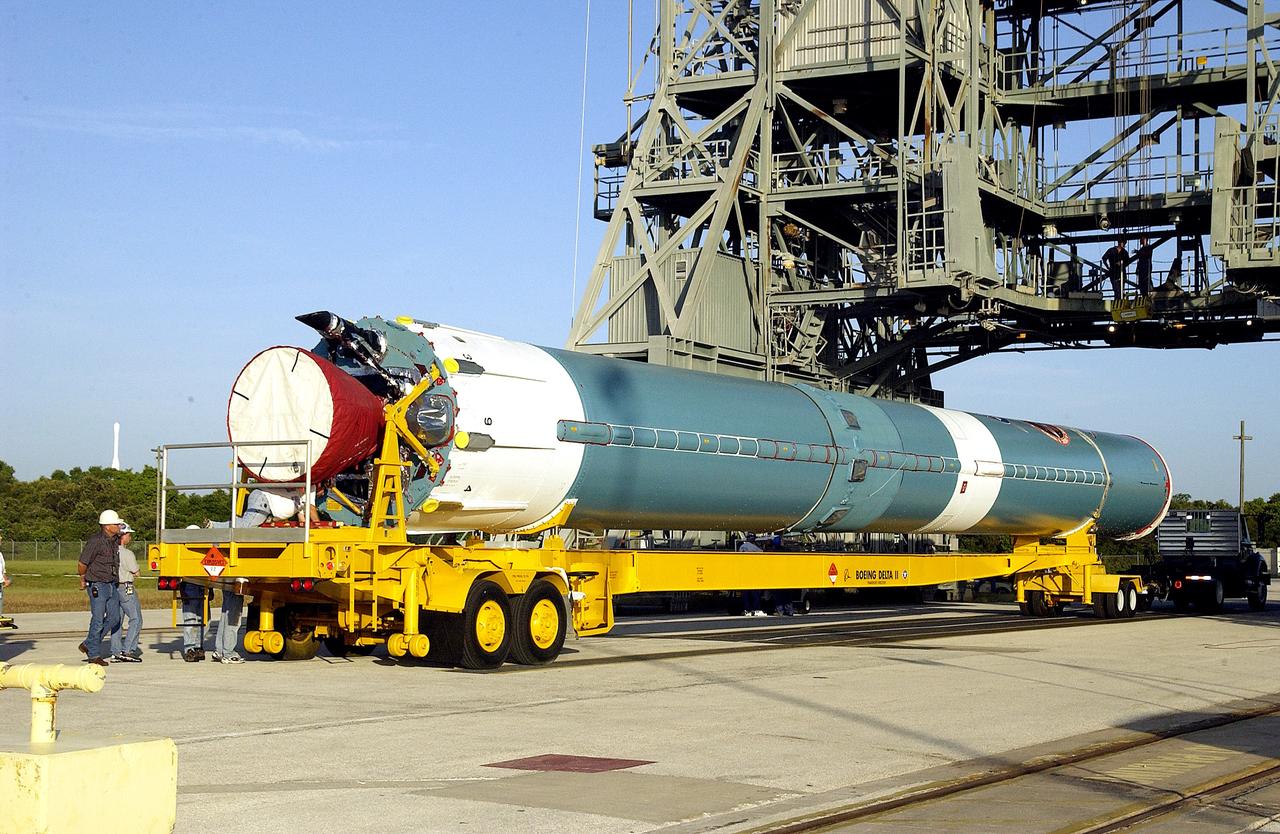
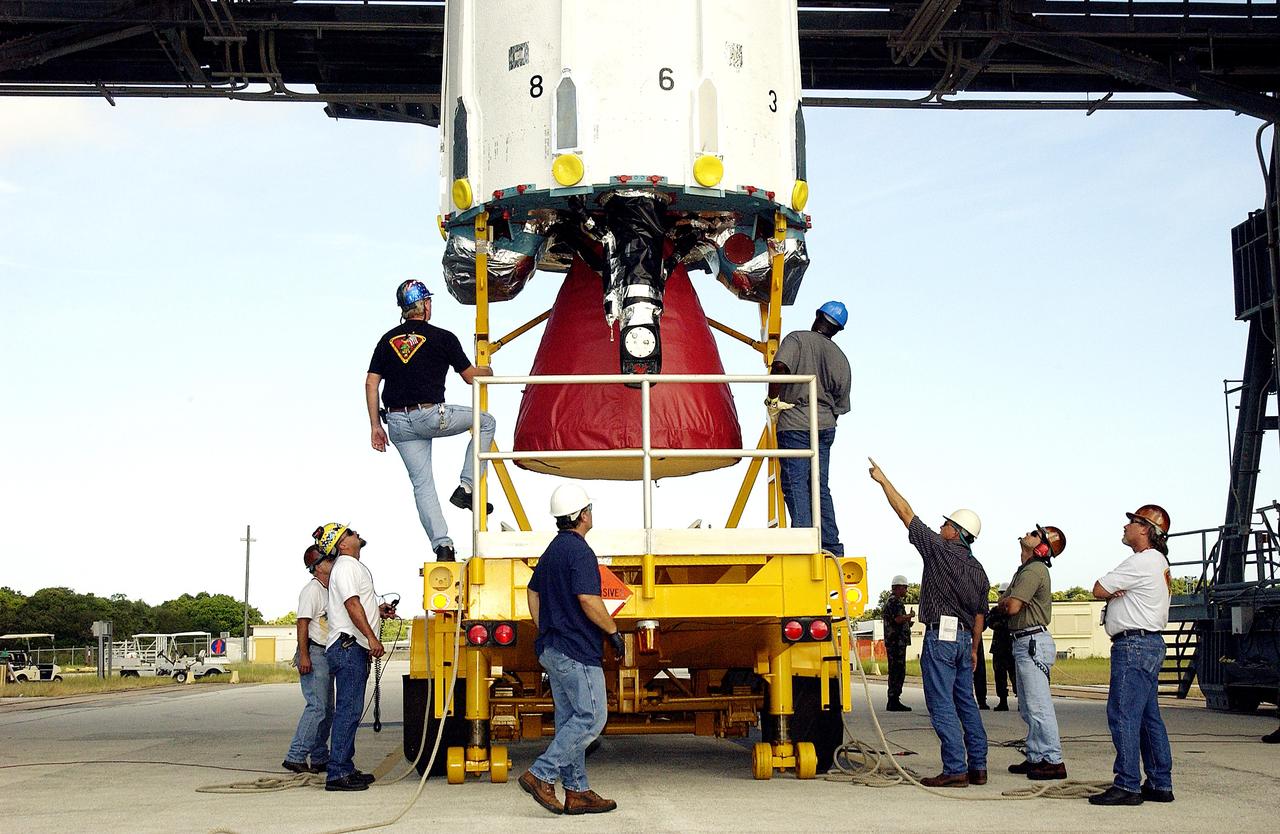
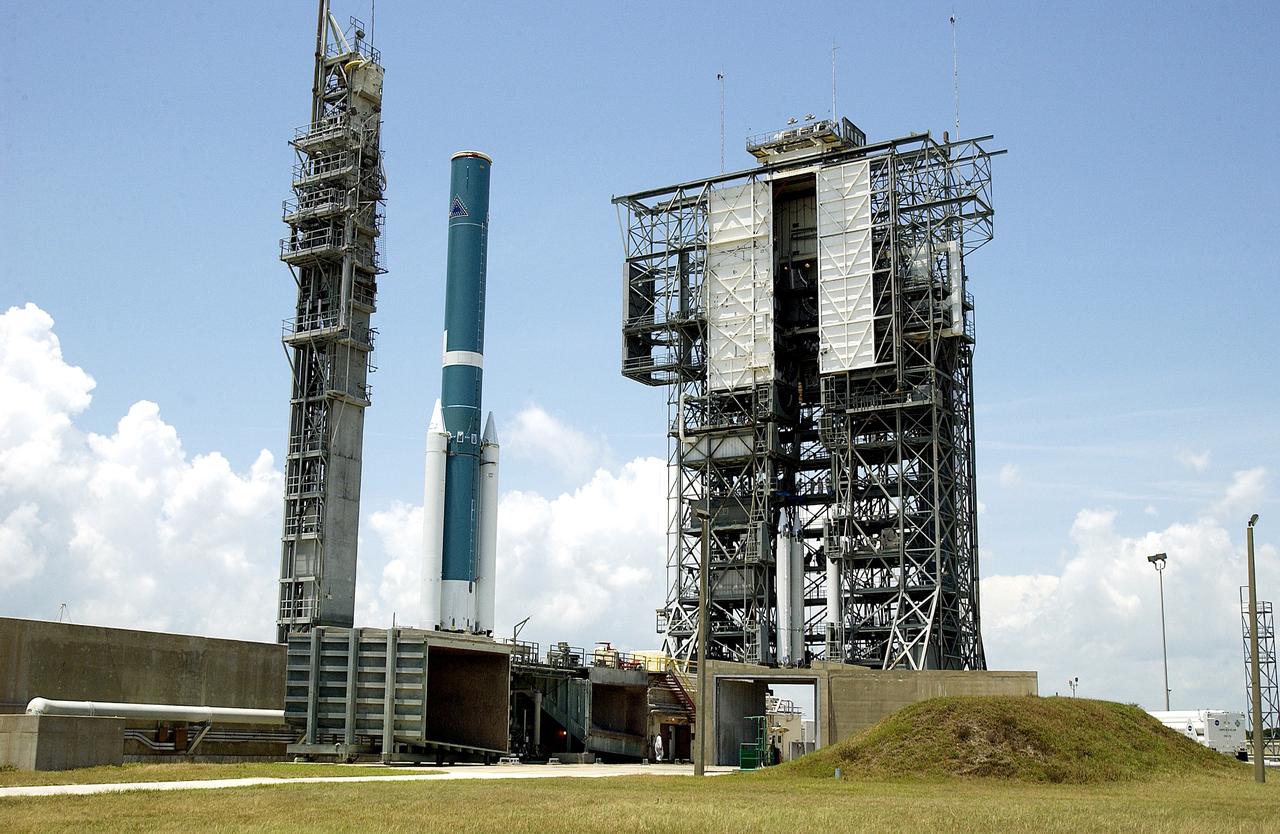
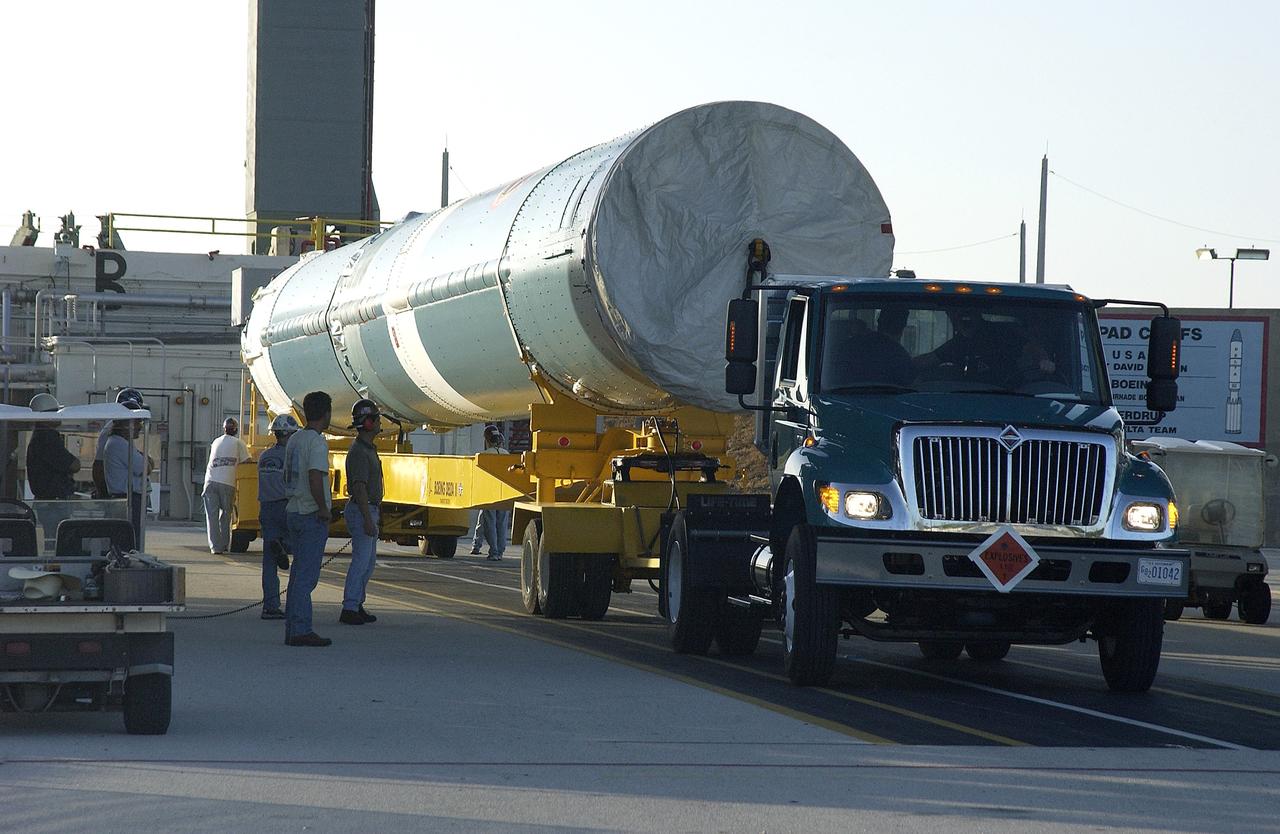
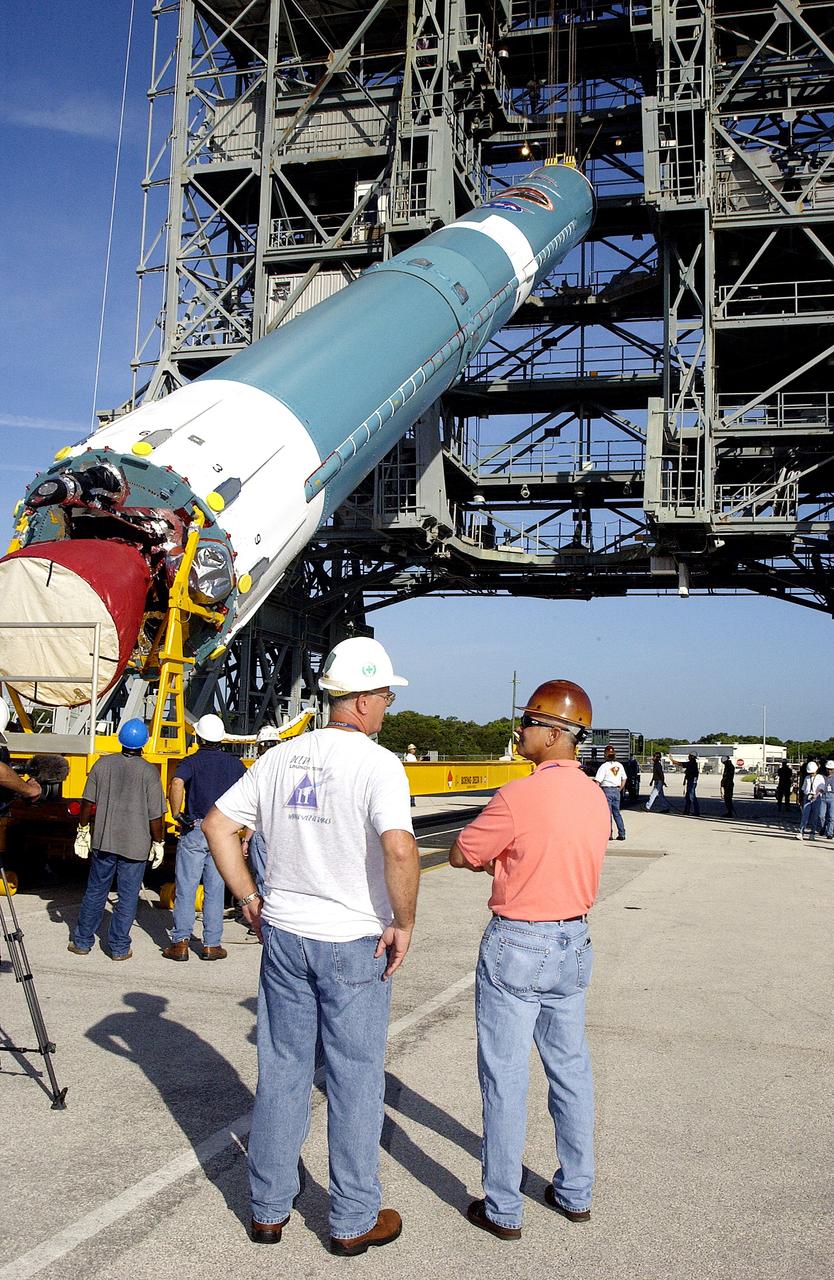
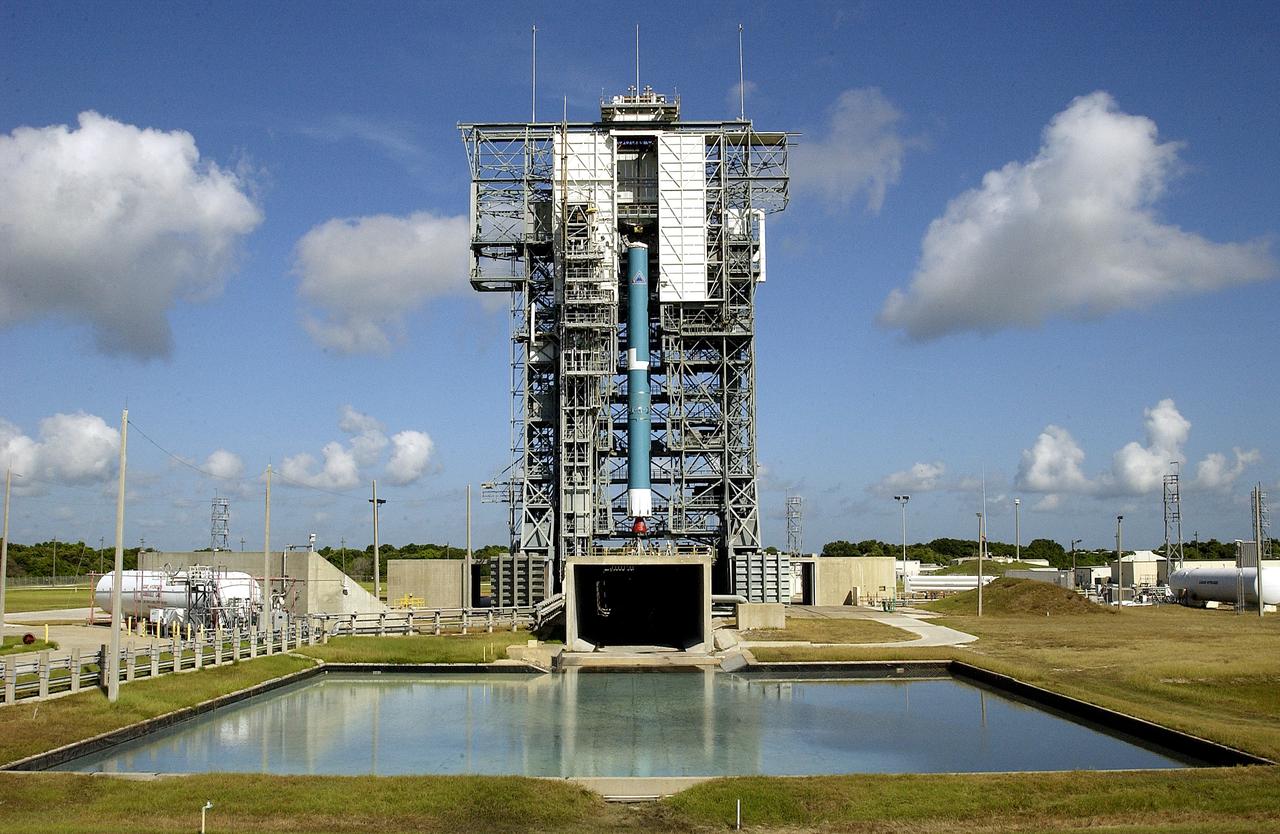
KENNEDY SPACE CENTER, FLA. -   On Launch Complex 17-B, Cape Canaveral Air Force Station, the first stage of a Delta II rocket arrives at the pad.  The rocket is being erected to launch the Space InfraRed Telescope Facility (SIRTF).  Consisting of an 0.85-meter telescope and three cryogenically cooled science instruments, SIRTF is one of NASA's largest infrared telescopes to be launched.  SIRTF will obtain images and spectra by detecting the infrared energy, or heat, radiated by objects in space. Most of this infrared radiation is blocked by the Earth's atmosphere and cannot be observed from the ground.
KENNEDY SPACE CENTER, FLA. - On Launch Complex 17-B, Cape Canaveral Air Force Station, the first stage of a Delta II rocket arrives at the pad. The rocket is being erected to launch the Space InfraRed Telescope Facility (SIRTF). Consisting of an 0.85-meter telescope and three cryogenically cooled science instruments, SIRTF is one of NASA's largest infrared telescopes to be launched. SIRTF will obtain images and spectra by detecting the infrared energy, or heat, radiated by objects in space. Most of this infrared radiation is blocked by the Earth's atmosphere and cannot be observed from the ground.
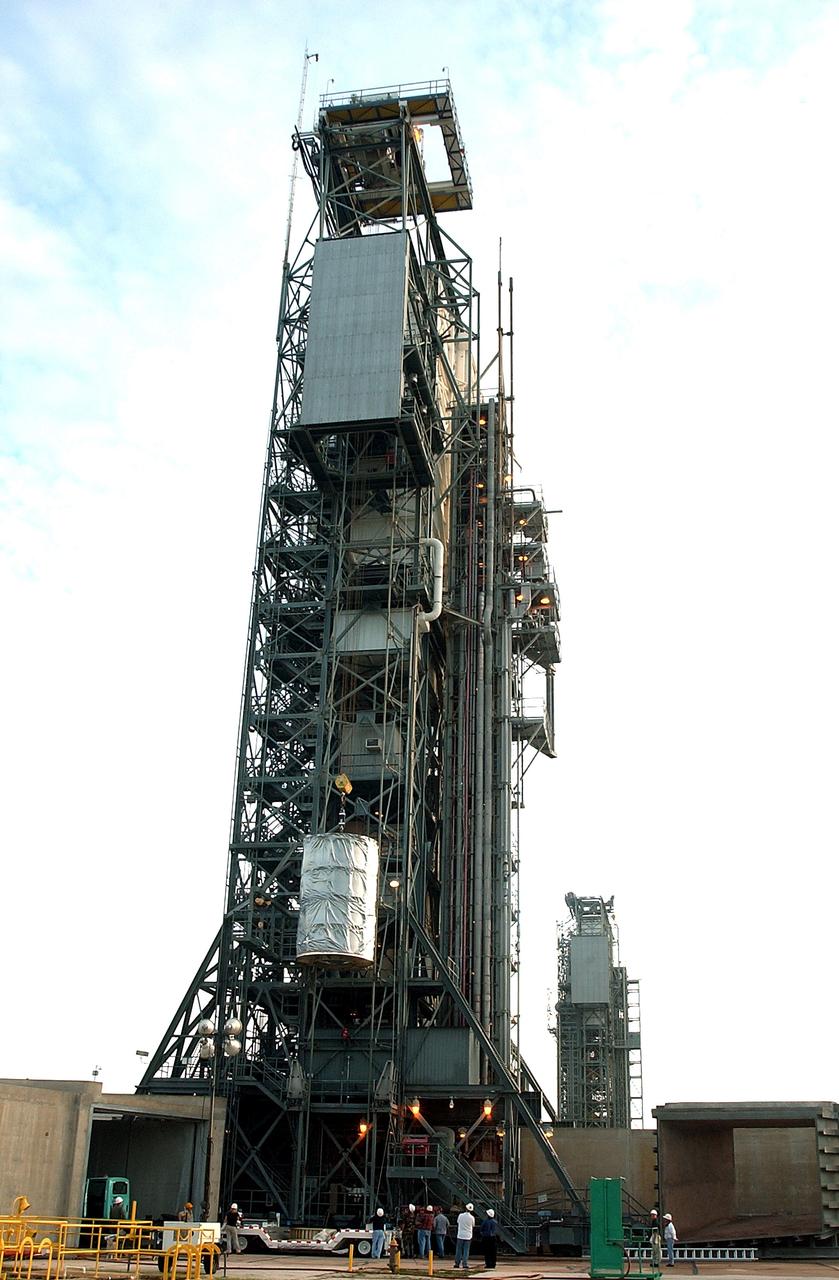
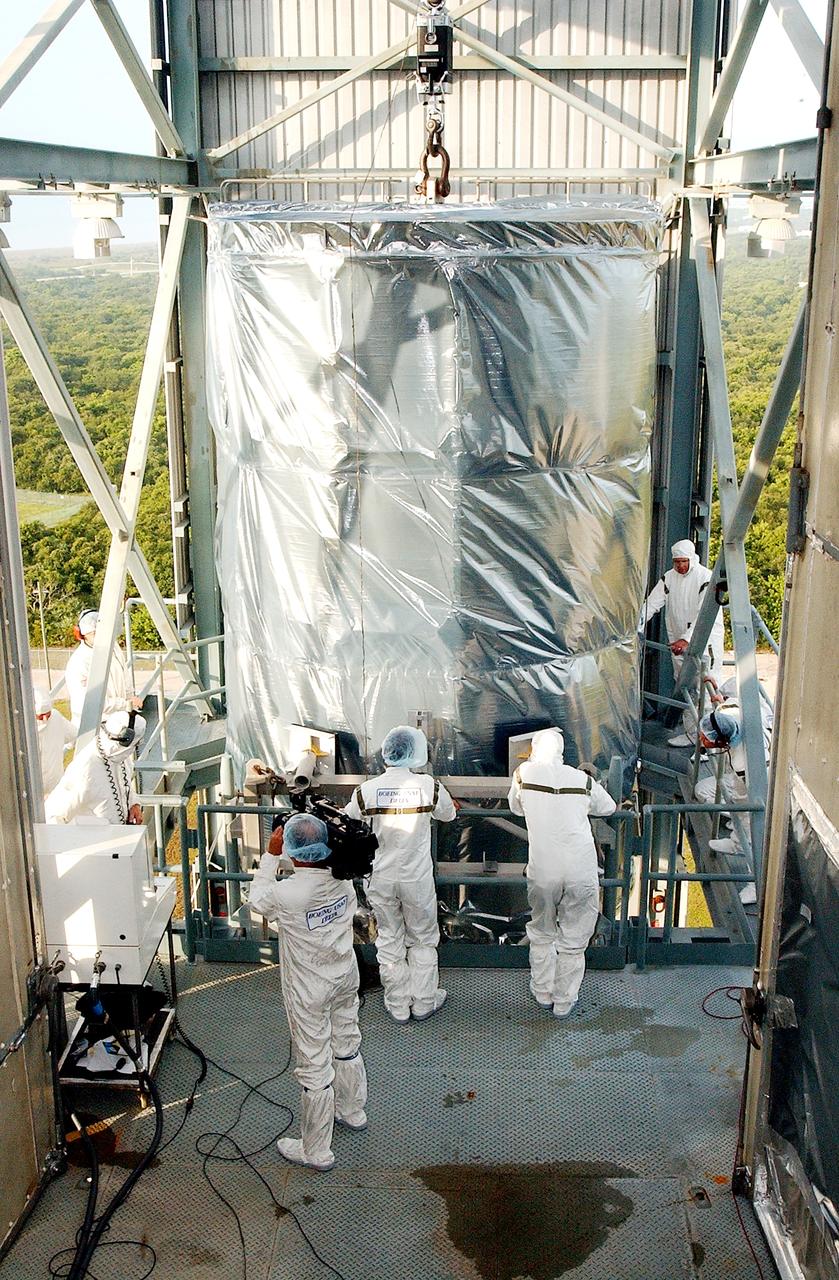
KENNEDY SPACE CENTER, FLA.  -  The Space Infrared Telescope Facility (SIRTF) is lowered into the opening of the mobile service tower on Launch Pad 17-B, Cape Canaveral Air Force Station.  SIRTF will be attached to the Delta II rocket and encapsulated in its fairing before launch.   Consisting of three cryogenically cooled science instruments and an 0.85-meter telescope, SIRTF is one of NASA’s largest infrared telescopes to be launched.  It is the fourth and final element in NASA’s family of orbiting “Great Observatories.”  SIRTF will obtain images and spectra by detecting the infrared energy, or heat, radiated by objects in space. Most of this infrared radiation is blocked by the Earth's atmosphere and cannot be observed from the ground.
KENNEDY SPACE CENTER, FLA. - The Space Infrared Telescope Facility (SIRTF) is lowered into the opening of the mobile service tower on Launch Pad 17-B, Cape Canaveral Air Force Station. SIRTF will be attached to the Delta II rocket and encapsulated in its fairing before launch. Consisting of three cryogenically cooled science instruments and an 0.85-meter telescope, SIRTF is one of NASA’s largest infrared telescopes to be launched. It is the fourth and final element in NASA’s family of orbiting “Great Observatories.” SIRTF will obtain images and spectra by detecting the infrared energy, or heat, radiated by objects in space. Most of this infrared radiation is blocked by the Earth's atmosphere and cannot be observed from the ground.
KENNEDY SPACE CENTER, FLA. -   On Launch Complex 17-B, Cape Canaveral Air Force Station, the first stage of a Delta II rocket waits to be lifted up and moved into the mobile service tower.  The rocket is being erected to launch the Space InfraRed Telescope Facility (SIRTF).  Consisting of an 0.85-meter telescope and three cryogenically cooled science instruments, SIRTF is one of NASA's largest infrared telescopes to be launched.  SIRTF will obtain images and spectra by detecting the infrared energy, or heat, radiated by objects in space. Most of this infrared radiation is blocked by the Earth's atmosphere and cannot be observed from the ground.
KENNEDY SPACE CENTER, FLA. - On Launch Complex 17-B, Cape Canaveral Air Force Station, the first stage of a Delta II rocket waits to be lifted up and moved into the mobile service tower. The rocket is being erected to launch the Space InfraRed Telescope Facility (SIRTF). Consisting of an 0.85-meter telescope and three cryogenically cooled science instruments, SIRTF is one of NASA's largest infrared telescopes to be launched. SIRTF will obtain images and spectra by detecting the infrared energy, or heat, radiated by objects in space. Most of this infrared radiation is blocked by the Earth's atmosphere and cannot be observed from the ground.
KENNEDY SPACE CENTER, FLA.  - Workers at Hangar A&E, Cape Canaveral Air Force Station, lift the upper canister to move it to the Space Infrared Telescope Facility (SIRTF) at right.  After encapsulation, the spacecraft will be transported to Launch Complex 17-B for mating with its launch vehicle, the Delta II rocket.   SIRTF consists of three cryogenically cooled science instruments and an 0.85-meter telescope, and is one of NASA's largest infrared telescopes to be launched.  SIRTF will obtain images and spectra by detecting the infrared energy, or heat, radiated by objects in space. Most of this infrared radiation is blocked by the Earth's atmosphere and cannot be observed from the ground.
KENNEDY SPACE CENTER, FLA. - Workers at Hangar A&E, Cape Canaveral Air Force Station, lift the upper canister to move it to the Space Infrared Telescope Facility (SIRTF) at right. After encapsulation, the spacecraft will be transported to Launch Complex 17-B for mating with its launch vehicle, the Delta II rocket. SIRTF consists of three cryogenically cooled science instruments and an 0.85-meter telescope, and is one of NASA's largest infrared telescopes to be launched. SIRTF will obtain images and spectra by detecting the infrared energy, or heat, radiated by objects in space. Most of this infrared radiation is blocked by the Earth's atmosphere and cannot be observed from the ground.
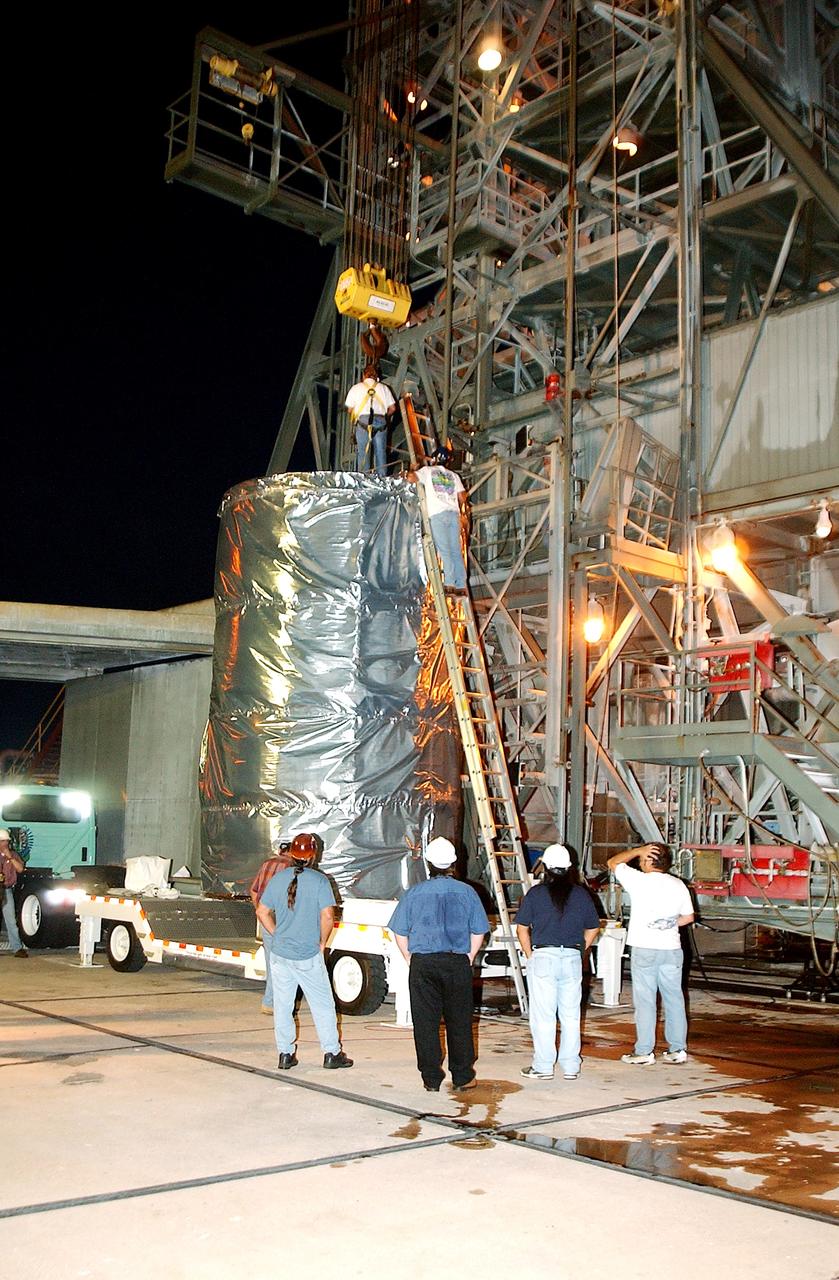
KENNEDY SPACE CENTER, FLA.  -  Before dawn, the Space Infrared Telescope Facility (SIRTF) is attached to an overhead crane that will lift it up the mobile service tower on Launch Pad 17-B, Cape Canaveral Air Force Station.  SIRTF will be attached to the Delta II rocket and encapsulated in its fairing before launch.   Consisting of three cryogenically cooled science instruments and an 0.85-meter telescope, SIRTF is one of NASA’s largest infrared telescopes to be launched.  It is the fourth and final element in NASA’s family of orbiting “Great Observatories.”  SIRTF will obtain images and spectra by detecting the infrared energy, or heat, radiated by objects in space. Most of this infrared radiation is blocked by the Earth's atmosphere and cannot be observed from the ground.
KENNEDY SPACE CENTER, FLA. - Before dawn, the Space Infrared Telescope Facility (SIRTF) is attached to an overhead crane that will lift it up the mobile service tower on Launch Pad 17-B, Cape Canaveral Air Force Station. SIRTF will be attached to the Delta II rocket and encapsulated in its fairing before launch. Consisting of three cryogenically cooled science instruments and an 0.85-meter telescope, SIRTF is one of NASA’s largest infrared telescopes to be launched. It is the fourth and final element in NASA’s family of orbiting “Great Observatories.” SIRTF will obtain images and spectra by detecting the infrared energy, or heat, radiated by objects in space. Most of this infrared radiation is blocked by the Earth's atmosphere and cannot be observed from the ground.
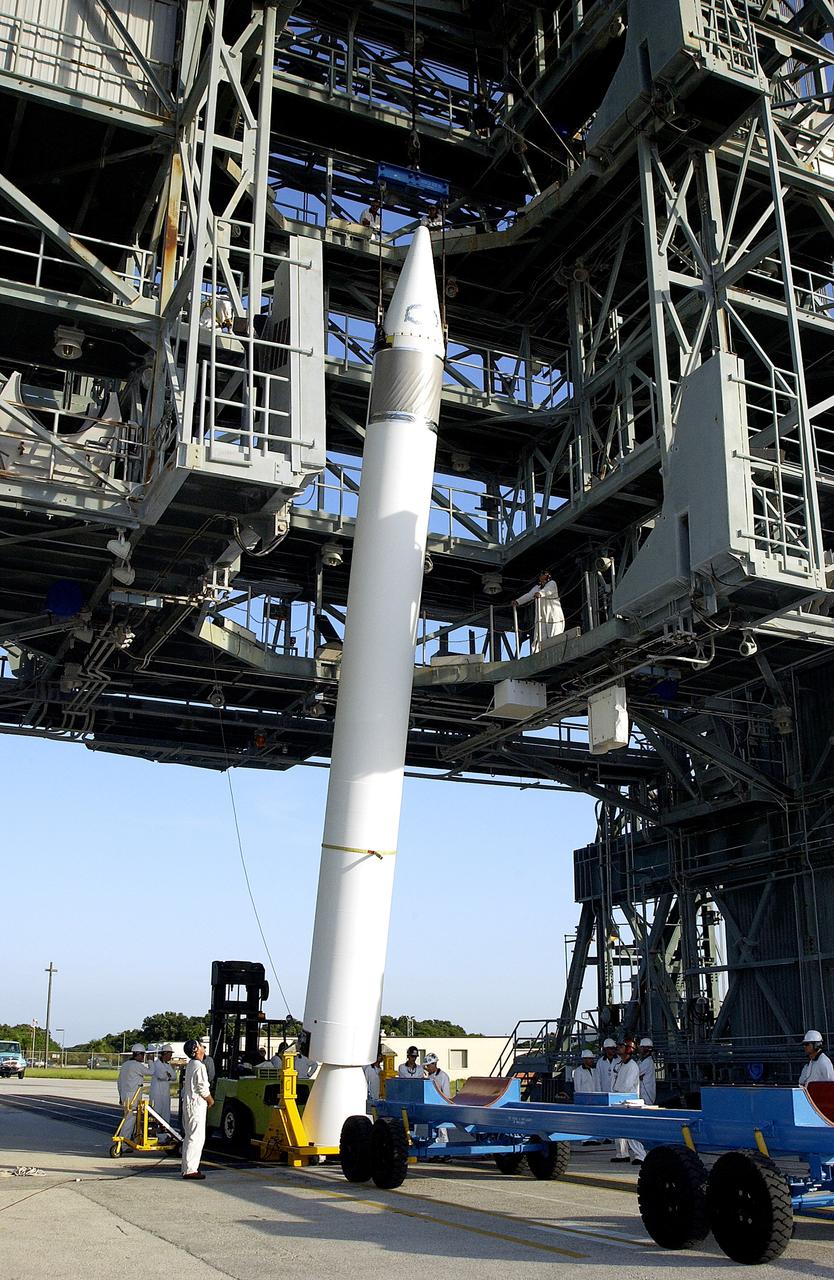
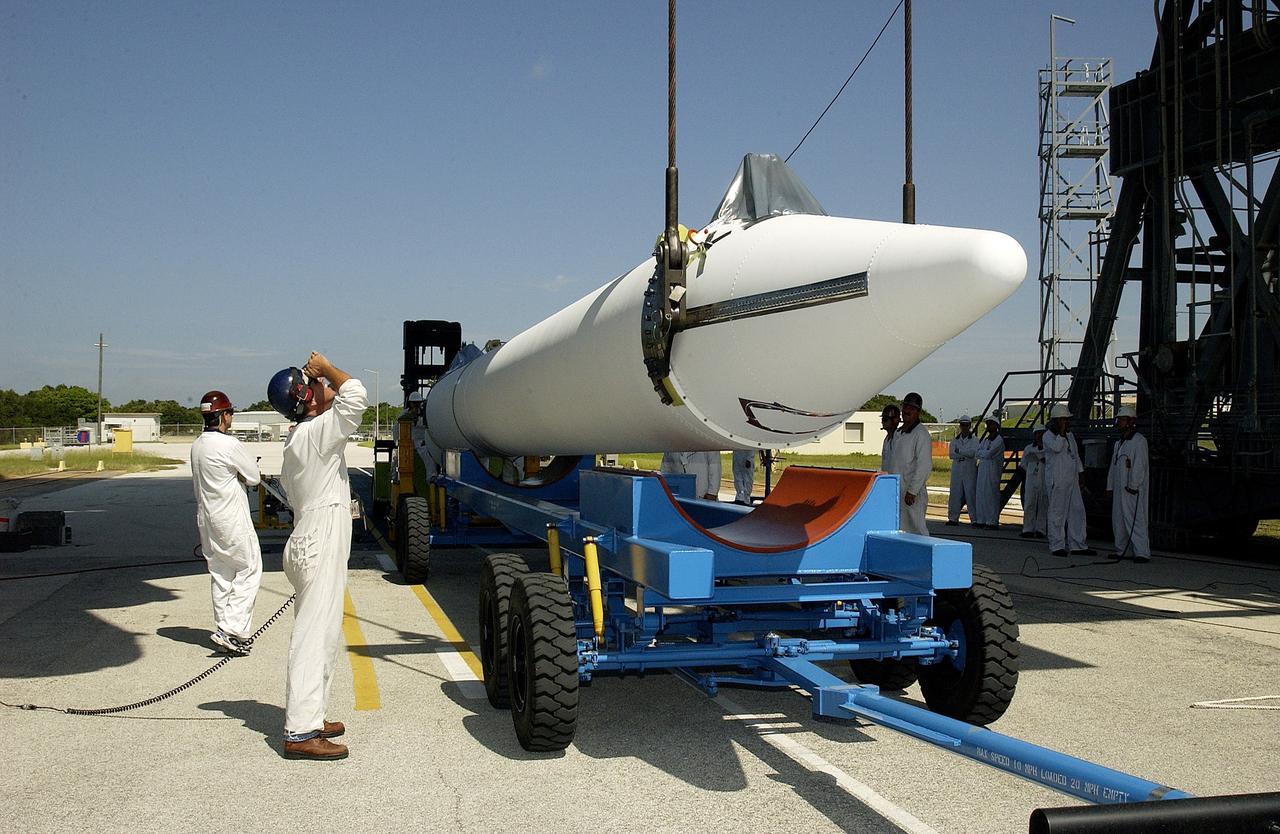
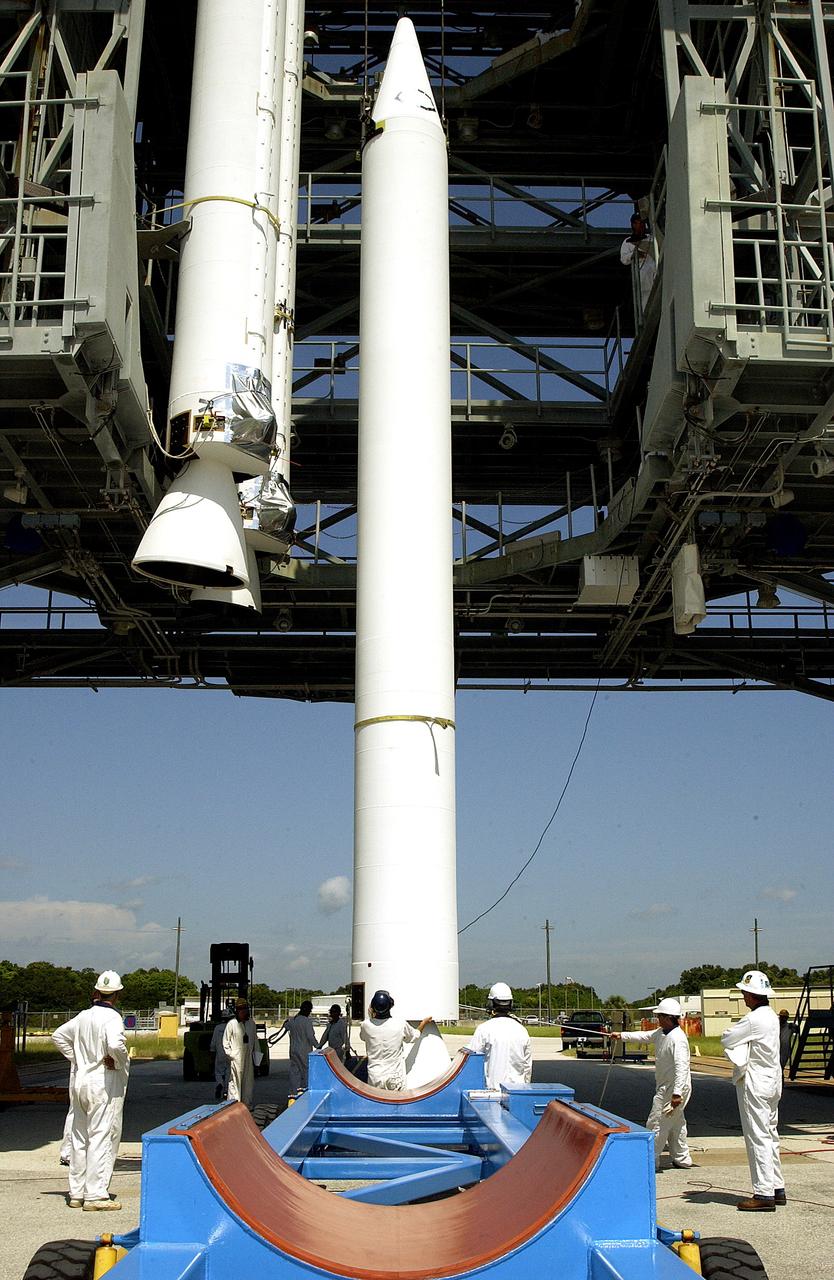
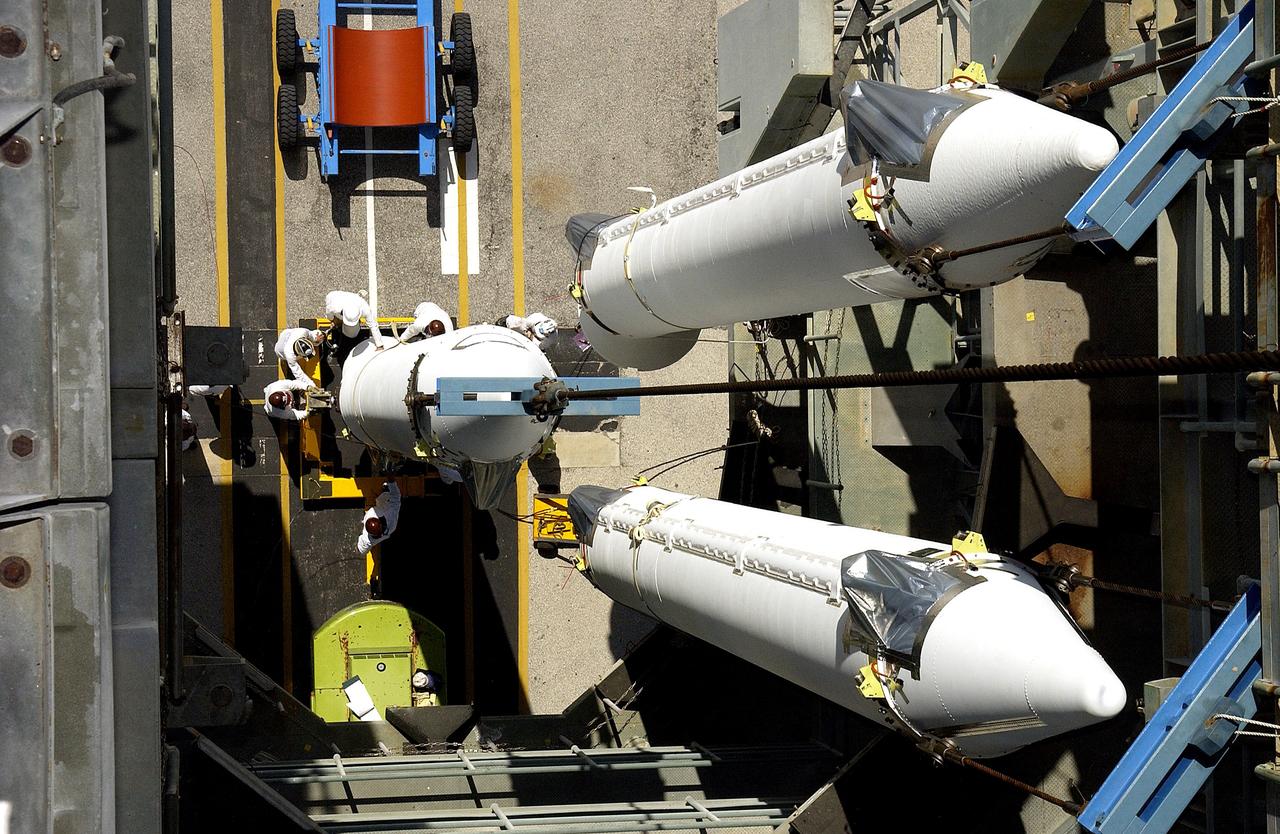
KENNEDY SPACE CENTER, FLA. -   A solid rocket booster (SRB) is lifted to vertical on Launch Complex 17-B, Cape Canaveral Air Force Station. The SRB will be attached to the Delta II Heavy rocket that will launch the Space Infrared Telescope Facility (SIRTF).  The Delta II Heavy features nine 46-inch-diameter, stretched SRBs.  Consisting of three cryogenically cooled science instruments and an 0.85-meter telescope, SIRTF is one of NASA's largest infrared telescopes to be launched.  SIRTF will obtain images and spectra by detecting the infrared energy, or heat, radiated by objects in space. Most of this infrared radiation is blocked by the Earth's atmosphere and cannot be observed from the ground.
KENNEDY SPACE CENTER, FLA. - A solid rocket booster (SRB) is lifted to vertical on Launch Complex 17-B, Cape Canaveral Air Force Station. The SRB will be attached to the Delta II Heavy rocket that will launch the Space Infrared Telescope Facility (SIRTF). The Delta II Heavy features nine 46-inch-diameter, stretched SRBs. Consisting of three cryogenically cooled science instruments and an 0.85-meter telescope, SIRTF is one of NASA's largest infrared telescopes to be launched. SIRTF will obtain images and spectra by detecting the infrared energy, or heat, radiated by objects in space. Most of this infrared radiation is blocked by the Earth's atmosphere and cannot be observed from the ground.
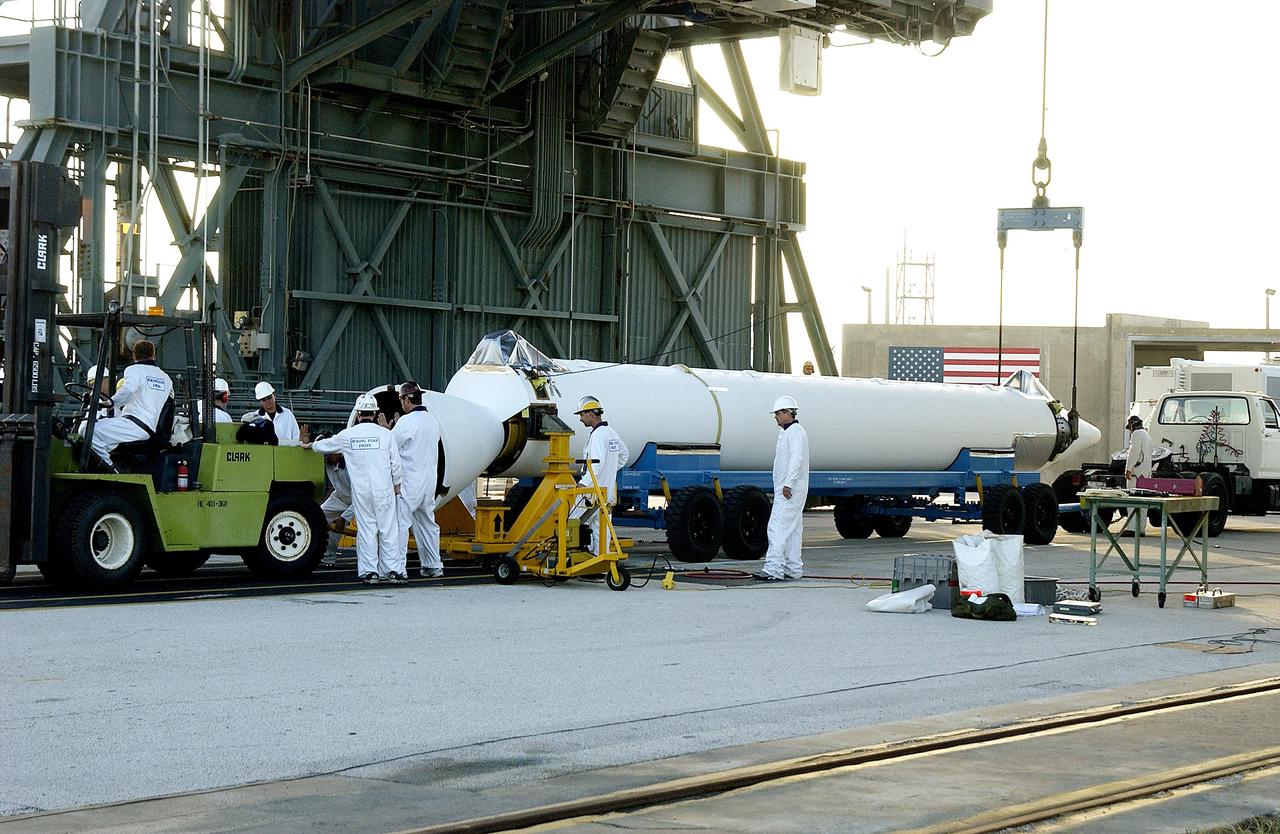
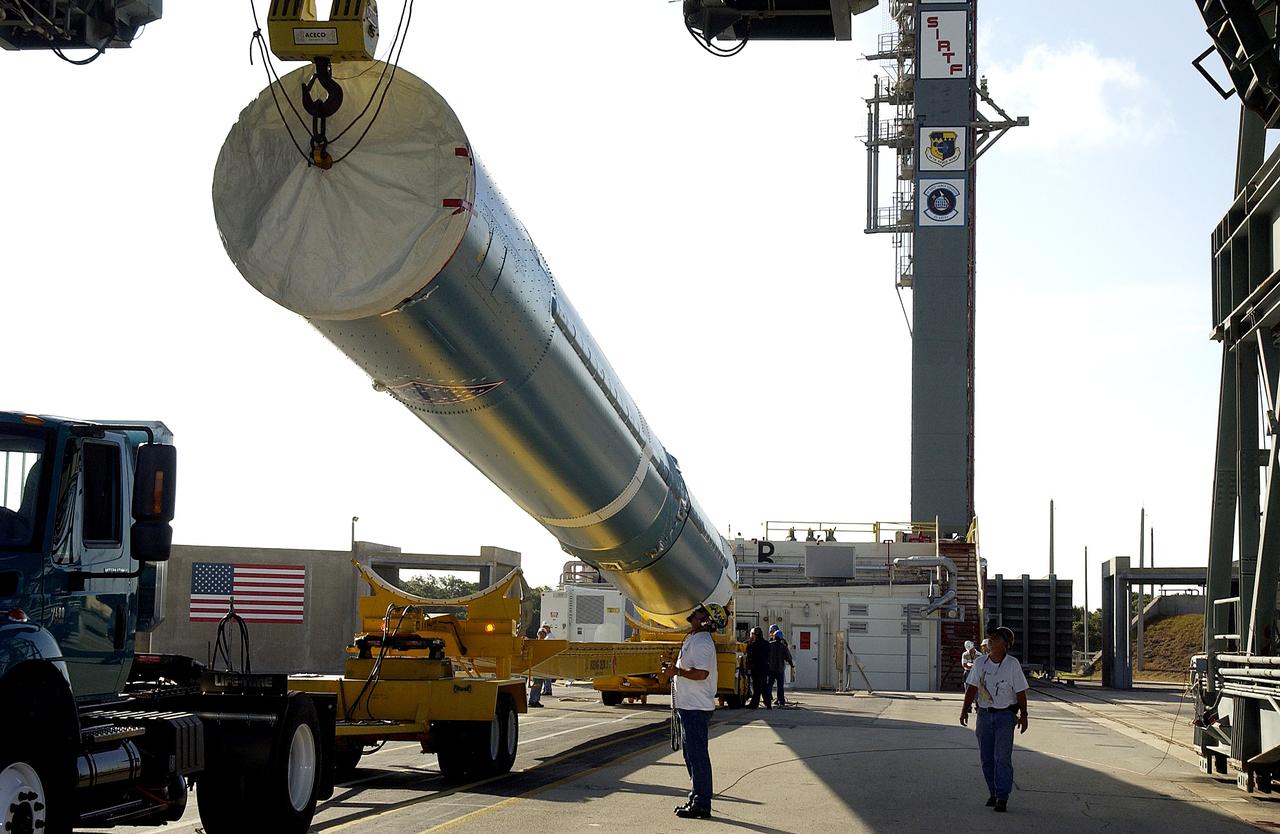
KENNEDY SPACE CENTER, FLA. -   A solid rocket booster (SRB) for the Delta II Heavy rocket that will launch the Space Infrared Telescope Facility (SIRTF) is lifted off its transporter on Launch Complex 17-B, Cape Canaveral Air Force Station.  The SRB will be added to the launch vehicle in the background.  The Delta II Heavy features nine 46-inch-diameter, stretched SRBs.  SIRTF, consisting of three cryogenically cooled science instruments and an 0.85-meter telescope, is one of NASA's largest infrared telescopes to be launched.  SIRTF will obtain images and spectra by detecting the infrared energy, or heat, radiated by objects in space. Most of this infrared radiation is blocked by the Earth's atmosphere and cannot be observed from the ground.
KENNEDY SPACE CENTER, FLA. - A solid rocket booster (SRB) for the Delta II Heavy rocket that will launch the Space Infrared Telescope Facility (SIRTF) is lifted off its transporter on Launch Complex 17-B, Cape Canaveral Air Force Station. The SRB will be added to the launch vehicle in the background. The Delta II Heavy features nine 46-inch-diameter, stretched SRBs. SIRTF, consisting of three cryogenically cooled science instruments and an 0.85-meter telescope, is one of NASA's largest infrared telescopes to be launched. SIRTF will obtain images and spectra by detecting the infrared energy, or heat, radiated by objects in space. Most of this infrared radiation is blocked by the Earth's atmosphere and cannot be observed from the ground.
KENNEDY SPACE CENTER, FLA.  -  After dawn,  the Space Infrared Telescope Facility (SIRTF) is lifted up the mobile service tower on Launch Pad 17-B, Cape Canaveral Air Force Station.  SIRTF will be attached to the Delta II rocket and encapsulated in its fairing before launch.   Consisting of three cryogenically cooled science instruments and an 0.85-meter telescope, SIRTF is one of NASA’s largest infrared telescopes to be launched.  It is the fourth and final element in NASA’s family of orbiting “Great Observatories.”  SIRTF will obtain images and spectra by detecting the infrared energy, or heat, radiated by objects in space. Most of this infrared radiation is blocked by the Earth's atmosphere and cannot be observed from the ground.
KENNEDY SPACE CENTER, FLA. - After dawn, the Space Infrared Telescope Facility (SIRTF) is lifted up the mobile service tower on Launch Pad 17-B, Cape Canaveral Air Force Station. SIRTF will be attached to the Delta II rocket and encapsulated in its fairing before launch. Consisting of three cryogenically cooled science instruments and an 0.85-meter telescope, SIRTF is one of NASA’s largest infrared telescopes to be launched. It is the fourth and final element in NASA’s family of orbiting “Great Observatories.” SIRTF will obtain images and spectra by detecting the infrared energy, or heat, radiated by objects in space. Most of this infrared radiation is blocked by the Earth's atmosphere and cannot be observed from the ground.
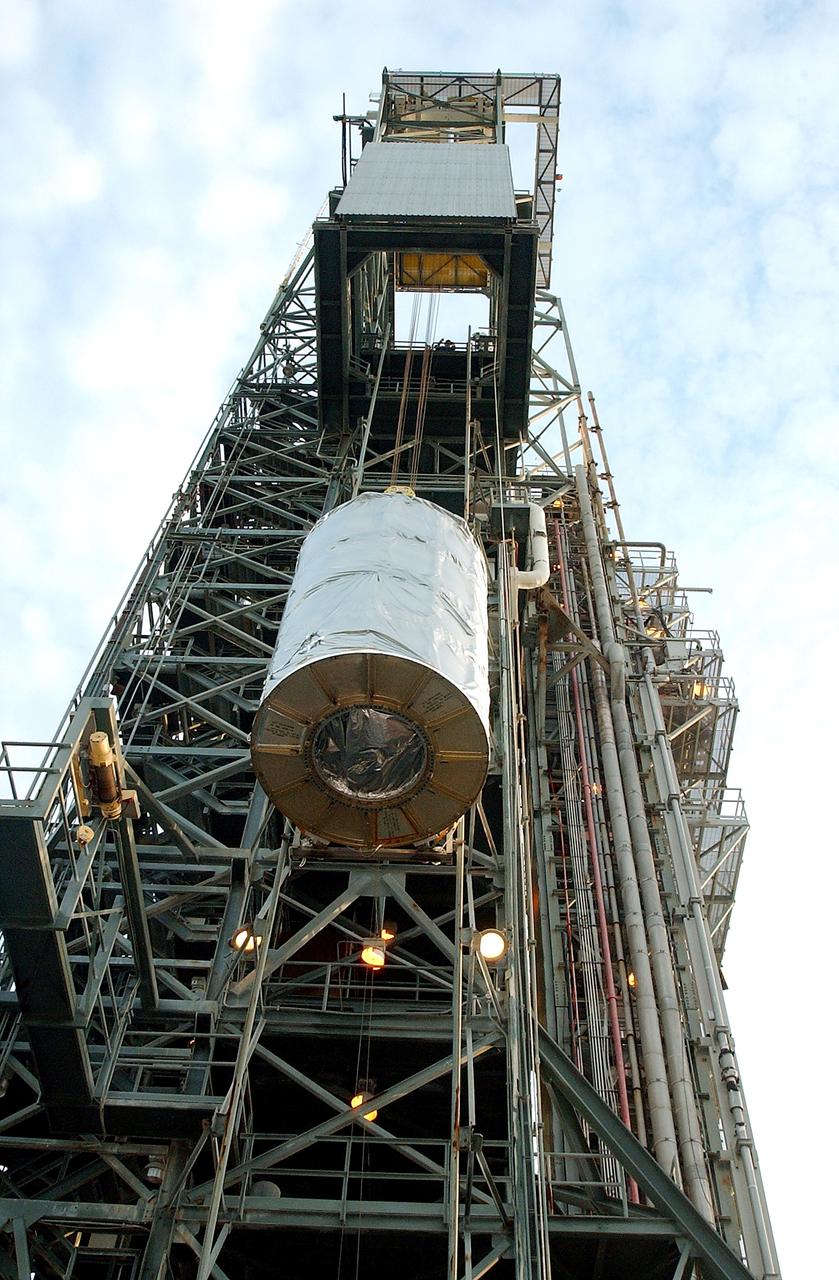
KENNEDY SPACE CENTER, FLA.  -  Viewed from below, the Space Infrared Telescope Facility (SIRTF) is lifted up the mobile service tower on Launch Pad 17-B, Cape Canaveral Air Force Station.  SIRTF will be attached to the Delta II rocket and encapsulated in its fairing before launch.   Consisting of three cryogenically cooled science instruments and an 0.85-meter telescope, SIRTF is one of NASA’s largest infrared telescopes to be launched.  It is the fourth and final element in NASA’s family of orbiting “Great Observatories.”  SIRTF will obtain images and spectra by detecting the infrared energy, or heat, radiated by objects in space. Most of this infrared radiation is blocked by the Earth's atmosphere and cannot be observed from the ground.
KENNEDY SPACE CENTER, FLA. - Viewed from below, the Space Infrared Telescope Facility (SIRTF) is lifted up the mobile service tower on Launch Pad 17-B, Cape Canaveral Air Force Station. SIRTF will be attached to the Delta II rocket and encapsulated in its fairing before launch. Consisting of three cryogenically cooled science instruments and an 0.85-meter telescope, SIRTF is one of NASA’s largest infrared telescopes to be launched. It is the fourth and final element in NASA’s family of orbiting “Great Observatories.” SIRTF will obtain images and spectra by detecting the infrared energy, or heat, radiated by objects in space. Most of this infrared radiation is blocked by the Earth's atmosphere and cannot be observed from the ground.
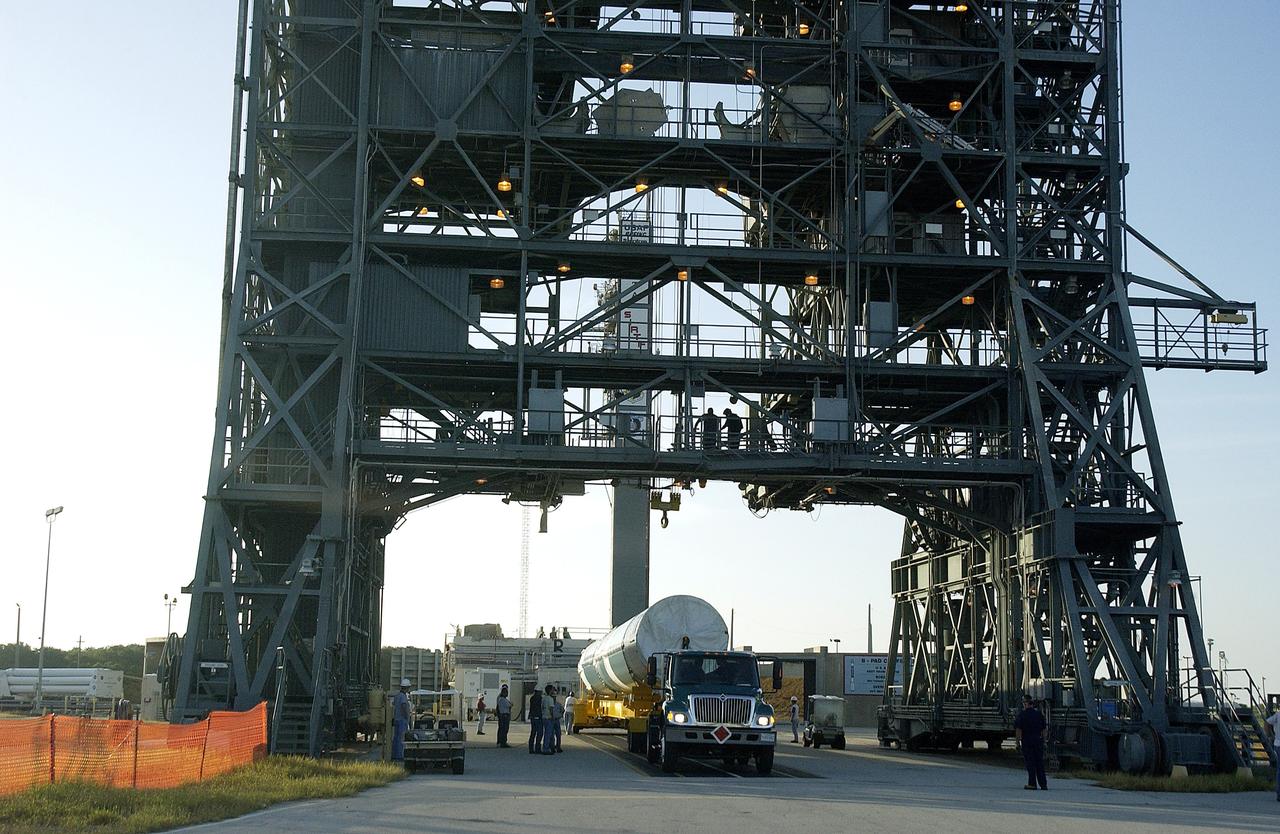
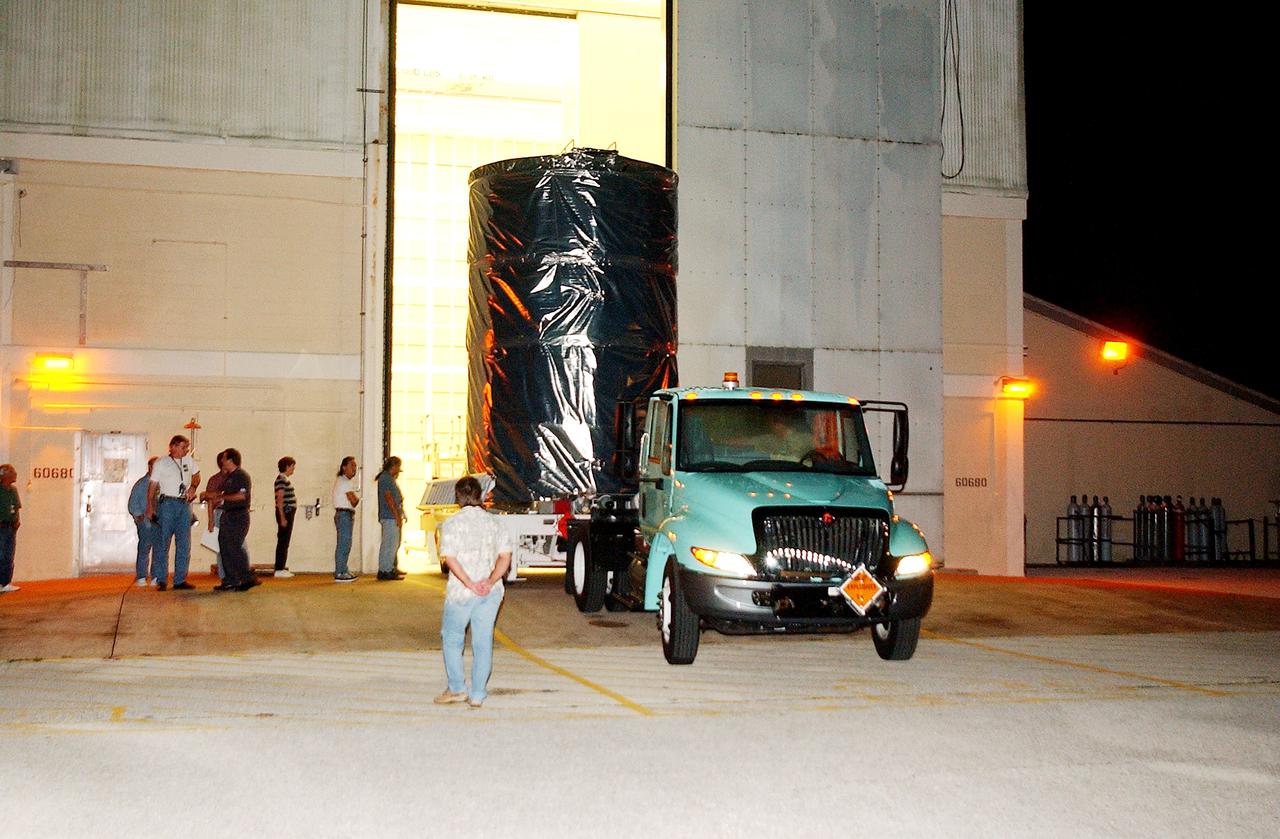
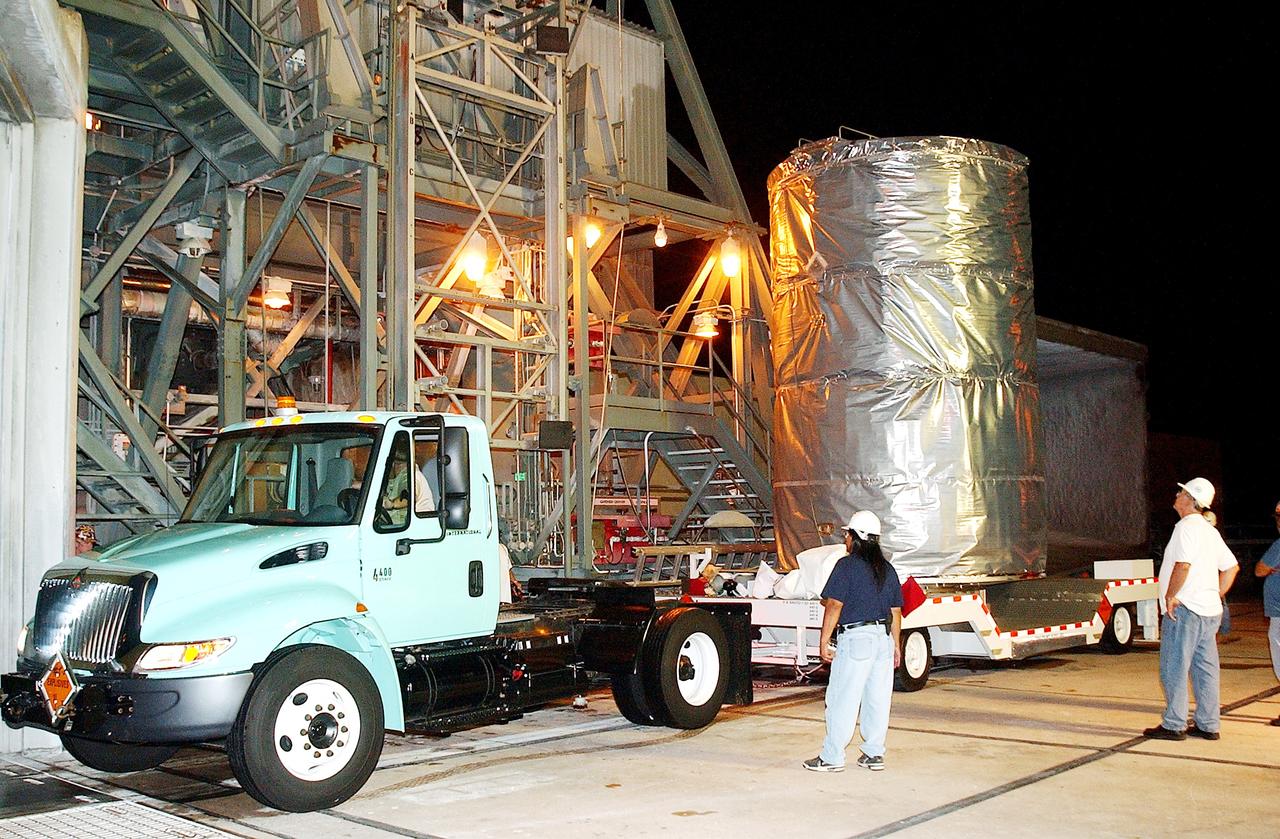
KENNEDY SPACE CENTER, FLA.  -  The Space Infrared Telescope Facility (SIRTF) is rolled out of the hangar at Cape Canaveral Air Force Station during pre-dawn hours.  It is being transported to Launch Pad 17-B where it will be lifted into the mobile service tower and prepared for launch.  SIRTF consists of three cryogenically cooled science instruments and an 0.85-meter telescope, and is one of NASA’s largest infrared telescopes to be launched.  It is the fourth and final element in NASA’s family of orbiting “Great Observatories.”  SIRTF will obtain images and spectra by detecting the infrared energy, or heat, radiated by objects in space. Most of this infrared radiation is blocked by the Earth's atmosphere and cannot be observed from the ground.
KENNEDY SPACE CENTER, FLA. - The Space Infrared Telescope Facility (SIRTF) is rolled out of the hangar at Cape Canaveral Air Force Station during pre-dawn hours. It is being transported to Launch Pad 17-B where it will be lifted into the mobile service tower and prepared for launch. SIRTF consists of three cryogenically cooled science instruments and an 0.85-meter telescope, and is one of NASA’s largest infrared telescopes to be launched. It is the fourth and final element in NASA’s family of orbiting “Great Observatories.” SIRTF will obtain images and spectra by detecting the infrared energy, or heat, radiated by objects in space. Most of this infrared radiation is blocked by the Earth's atmosphere and cannot be observed from the ground.
KENNEDY SPACE CENTER, FLA. -  Workers on Launch Complex 17-B, Cape Canaveral Air Force Station, prepare the first stage of a Delta II rocket for its lift up the mobile service tower.  The rocket is being erected to launch the Space InfraRed Telescope Facility (SIRTF).  Consisting of an 0.85-meter telescope and three cryogenically cooled science instruments, SIRTF is one of NASA's largest infrared telescopes to be launched.  SIRTF will obtain images and spectra by detecting the infrared energy, or heat, radiated by objects in space. Most of this infrared radiation is blocked by the Earth's atmosphere and cannot be observed from the ground.
KENNEDY SPACE CENTER, FLA. - Workers on Launch Complex 17-B, Cape Canaveral Air Force Station, prepare the first stage of a Delta II rocket for its lift up the mobile service tower. The rocket is being erected to launch the Space InfraRed Telescope Facility (SIRTF). Consisting of an 0.85-meter telescope and three cryogenically cooled science instruments, SIRTF is one of NASA's largest infrared telescopes to be launched. SIRTF will obtain images and spectra by detecting the infrared energy, or heat, radiated by objects in space. Most of this infrared radiation is blocked by the Earth's atmosphere and cannot be observed from the ground.
KENNEDY SPACE CENTER, FLA.  -  Before dawn, the Space Infrared Telescope Facility (SIRTF) arrives at Launch Pad 17-B, Cape Canaveral Air Force Station, where it will be lifted into the mobile service tower and prepared for launch.  SIRTF consists of three cryogenically cooled science instruments and an 0.85-meter telescope, and is one of NASA’s largest infrared telescopes to be launched.  It is the fourth and final element in NASA’s family of orbiting “Great Observatories.”  SIRTF will obtain images and spectra by detecting the infrared energy, or heat, radiated by objects in space. Most of this infrared radiation is blocked by the Earth's atmosphere and cannot be observed from the ground.
KENNEDY SPACE CENTER, FLA. - Before dawn, the Space Infrared Telescope Facility (SIRTF) arrives at Launch Pad 17-B, Cape Canaveral Air Force Station, where it will be lifted into the mobile service tower and prepared for launch. SIRTF consists of three cryogenically cooled science instruments and an 0.85-meter telescope, and is one of NASA’s largest infrared telescopes to be launched. It is the fourth and final element in NASA’s family of orbiting “Great Observatories.” SIRTF will obtain images and spectra by detecting the infrared energy, or heat, radiated by objects in space. Most of this infrared radiation is blocked by the Earth's atmosphere and cannot be observed from the ground.
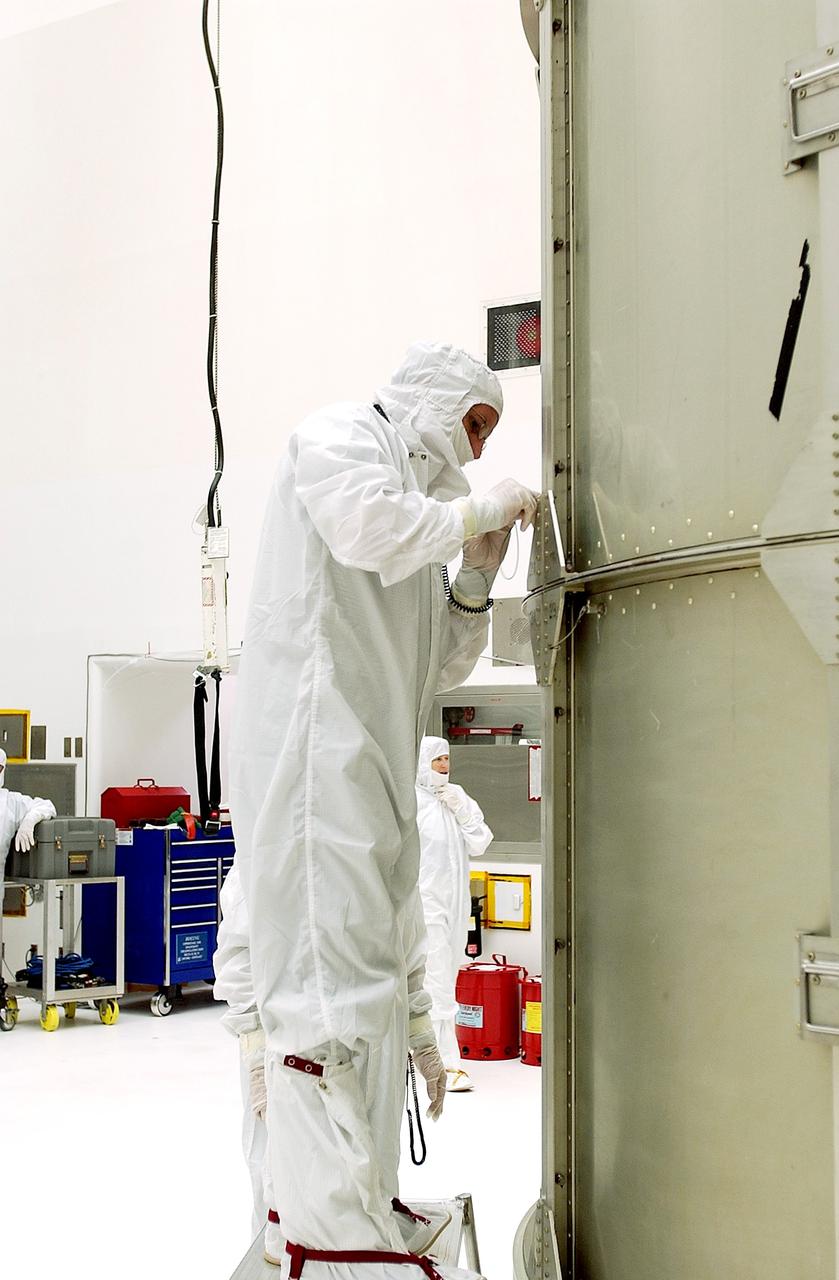
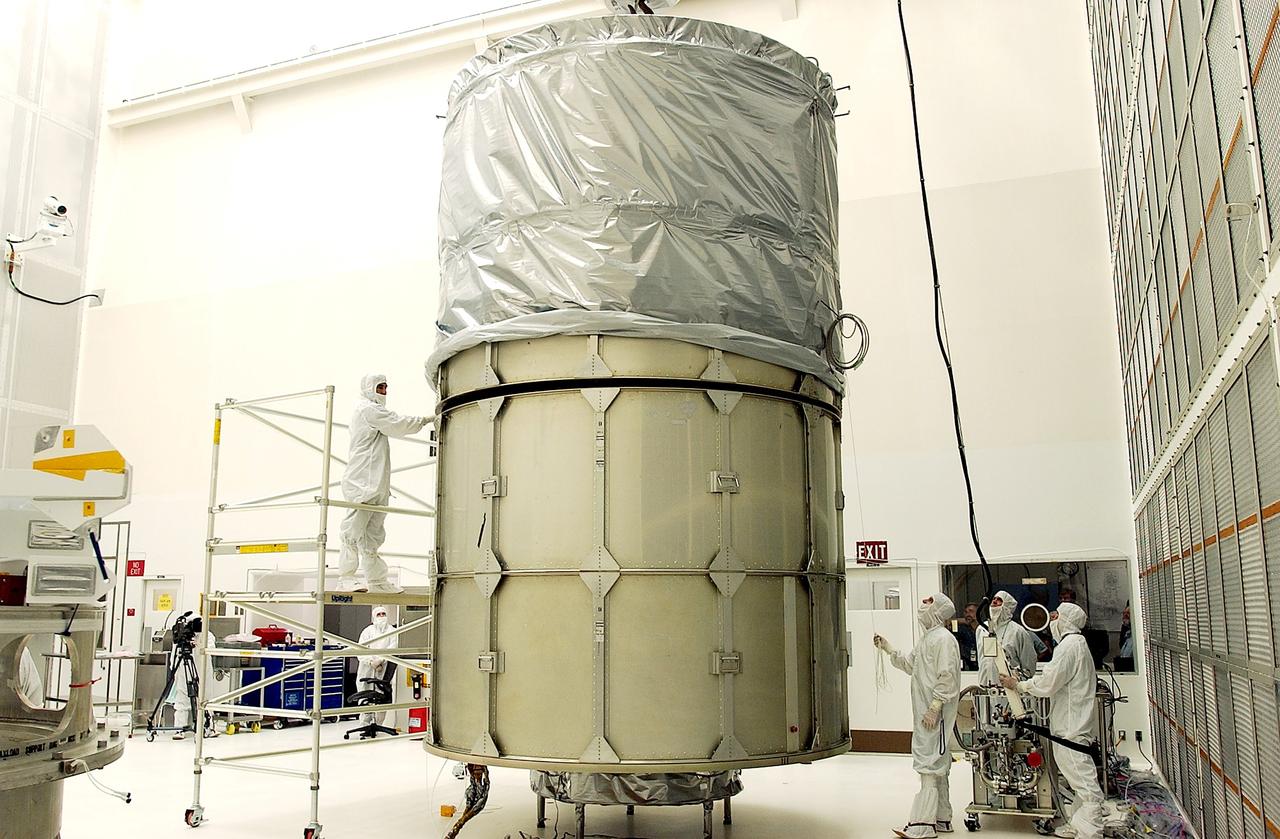
KENNEDY SPACE CENTER, FLA.  -  Working from a stand, technicians fasten the upper portion of the canister to the middle panels around the Space Infrared Telescope Facility (SIRTF).  The spacecraft will be transported to Launch Complex 17-B for mating with its launch vehicle, the Delta II rocket.   SIRTF consists of three cryogenically cooled science instruments and an 0.85-meter telescope, and is one of NASA's largest infrared telescopes to be launched.  SIRTF will obtain images and spectra by detecting the infrared energy, or heat, radiated by objects in space. Most of this infrared radiation is blocked by the Earth's atmosphere and cannot be observed from the ground.
KENNEDY SPACE CENTER, FLA. - Working from a stand, technicians fasten the upper portion of the canister to the middle panels around the Space Infrared Telescope Facility (SIRTF). The spacecraft will be transported to Launch Complex 17-B for mating with its launch vehicle, the Delta II rocket. SIRTF consists of three cryogenically cooled science instruments and an 0.85-meter telescope, and is one of NASA's largest infrared telescopes to be launched. SIRTF will obtain images and spectra by detecting the infrared energy, or heat, radiated by objects in space. Most of this infrared radiation is blocked by the Earth's atmosphere and cannot be observed from the ground.
KENNEDY SPACE CENTER, FLA.  -  Workers on the mobile service tower on Launch Pad 17-B, Cape Canaveral Air Force Station, wait for the Space Infrared Telescope Facility (SIRTF) to reach their level.  SIRTF will be attached to the Delta II rocket and encapsulated in its fairing before launch.   Consisting of three cryogenically cooled science instruments and an 0.85-meter telescope, SIRTF is one of NASA’s largest infrared telescopes to be launched.  It is the fourth and final element in NASA’s family of orbiting “Great Observatories.”  SIRTF will obtain images and spectra by detecting the infrared energy, or heat, radiated by objects in space. Most of this infrared radiation is blocked by the Earth's atmosphere and cannot be observed from the ground.
KENNEDY SPACE CENTER, FLA. - Workers on the mobile service tower on Launch Pad 17-B, Cape Canaveral Air Force Station, wait for the Space Infrared Telescope Facility (SIRTF) to reach their level. SIRTF will be attached to the Delta II rocket and encapsulated in its fairing before launch. Consisting of three cryogenically cooled science instruments and an 0.85-meter telescope, SIRTF is one of NASA’s largest infrared telescopes to be launched. It is the fourth and final element in NASA’s family of orbiting “Great Observatories.” SIRTF will obtain images and spectra by detecting the infrared energy, or heat, radiated by objects in space. Most of this infrared radiation is blocked by the Earth's atmosphere and cannot be observed from the ground.
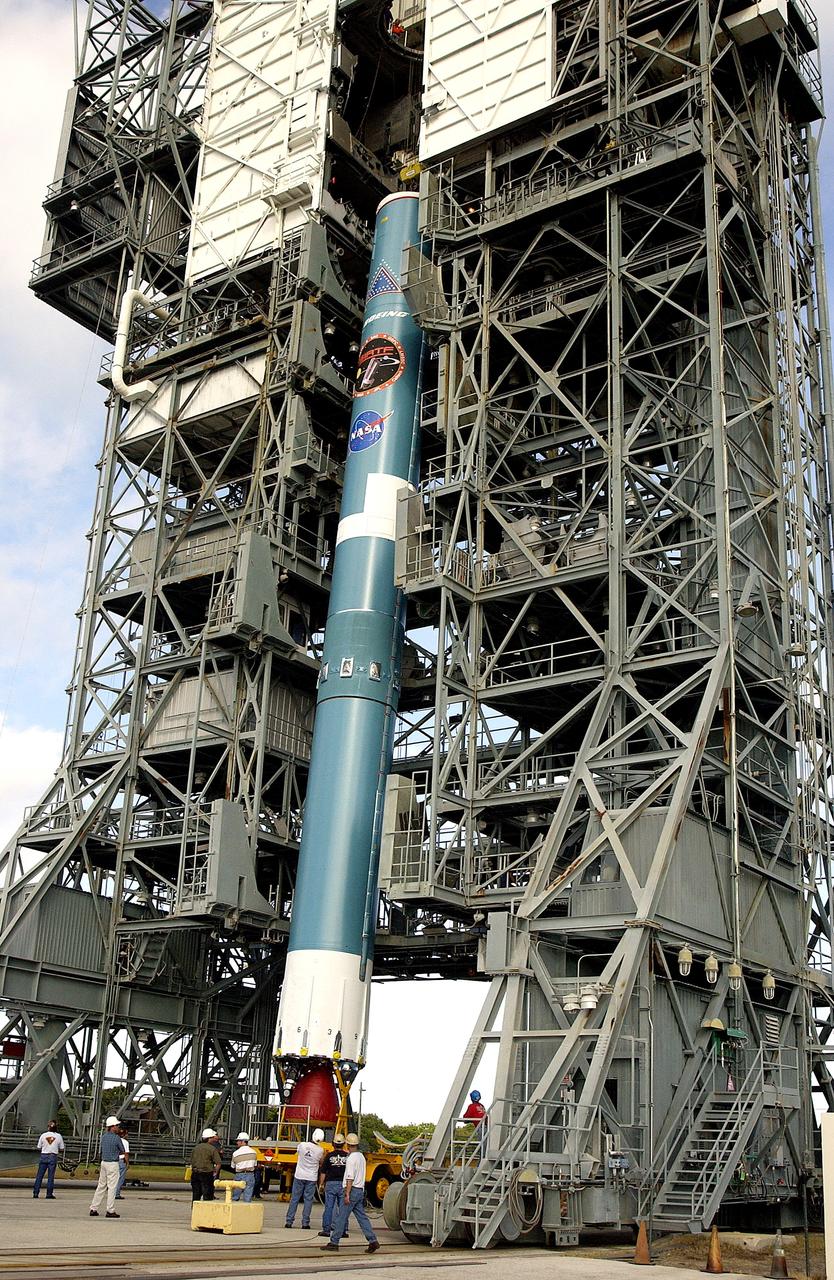
KENNEDY SPACE CENTER, FLA. -   On Launch Complex 17-B, Cape Canaveral Air Force Station, the first stage of a Delta II rocket is moved into the mobile service tower.  The rocket is being erected to launch the Space InfraRed Telescope Facility (SIRTF).  Consisting of an 0.85-meter telescope and three cryogenically cooled science instruments, SIRTF is one of NASA's largest infrared telescopes to be launched.  SIRTF will obtain images and spectra by detecting the infrared energy, or heat, radiated by objects in space. Most of this infrared radiation is blocked by the Earth's atmosphere and cannot be observed from the ground.
KENNEDY SPACE CENTER, FLA. - On Launch Complex 17-B, Cape Canaveral Air Force Station, the first stage of a Delta II rocket is moved into the mobile service tower. The rocket is being erected to launch the Space InfraRed Telescope Facility (SIRTF). Consisting of an 0.85-meter telescope and three cryogenically cooled science instruments, SIRTF is one of NASA's largest infrared telescopes to be launched. SIRTF will obtain images and spectra by detecting the infrared energy, or heat, radiated by objects in space. Most of this infrared radiation is blocked by the Earth's atmosphere and cannot be observed from the ground.
KENNEDY SPACE CENTER, FLA.  - A worker at Hangar A&E, Cape Canaveral Air Force Station, tightens the canister around the Space Infrared Telescope Facility (SIRTF).  The spacecraft will be transported to Launch Complex 17-B for mating with its launch vehicle, the Delta II rocket.   SIRTF consists of three cryogenically cooled science instruments and an 0.85-meter telescope, and is one of NASA's largest infrared telescopes to be launched.  SIRTF will obtain images and spectra by detecting the infrared energy, or heat, radiated by objects in space. Most of this infrared radiation is blocked by the Earth's atmosphere and cannot be observed from the ground.
KENNEDY SPACE CENTER, FLA. - A worker at Hangar A&E, Cape Canaveral Air Force Station, tightens the canister around the Space Infrared Telescope Facility (SIRTF). The spacecraft will be transported to Launch Complex 17-B for mating with its launch vehicle, the Delta II rocket. SIRTF consists of three cryogenically cooled science instruments and an 0.85-meter telescope, and is one of NASA's largest infrared telescopes to be launched. SIRTF will obtain images and spectra by detecting the infrared energy, or heat, radiated by objects in space. Most of this infrared radiation is blocked by the Earth's atmosphere and cannot be observed from the ground.
KENNEDY SPACE CENTER, FLA. -  On Launch Complex 17-B, Cape Canaveral Air Force Station, the first stage of a Delta II rocket is lifted up the mobile service tower.  In the background is pad 17-A.   The rocket is being erected to launch the Space InfraRed Telescope Facility (SIRTF).  Consisting of an 0.85-meter telescope and three cryogenically cooled science instruments, SIRTF is one of NASA's largest infrared telescopes to be launched.  SIRTF will obtain images and spectra by detecting the infrared energy, or heat, radiated by objects in space. Most of this infrared radiation is blocked by the Earth's atmosphere and cannot be observed from the ground.
KENNEDY SPACE CENTER, FLA. - On Launch Complex 17-B, Cape Canaveral Air Force Station, the first stage of a Delta II rocket is lifted up the mobile service tower. In the background is pad 17-A. The rocket is being erected to launch the Space InfraRed Telescope Facility (SIRTF). Consisting of an 0.85-meter telescope and three cryogenically cooled science instruments, SIRTF is one of NASA's largest infrared telescopes to be launched. SIRTF will obtain images and spectra by detecting the infrared energy, or heat, radiated by objects in space. Most of this infrared radiation is blocked by the Earth's atmosphere and cannot be observed from the ground.
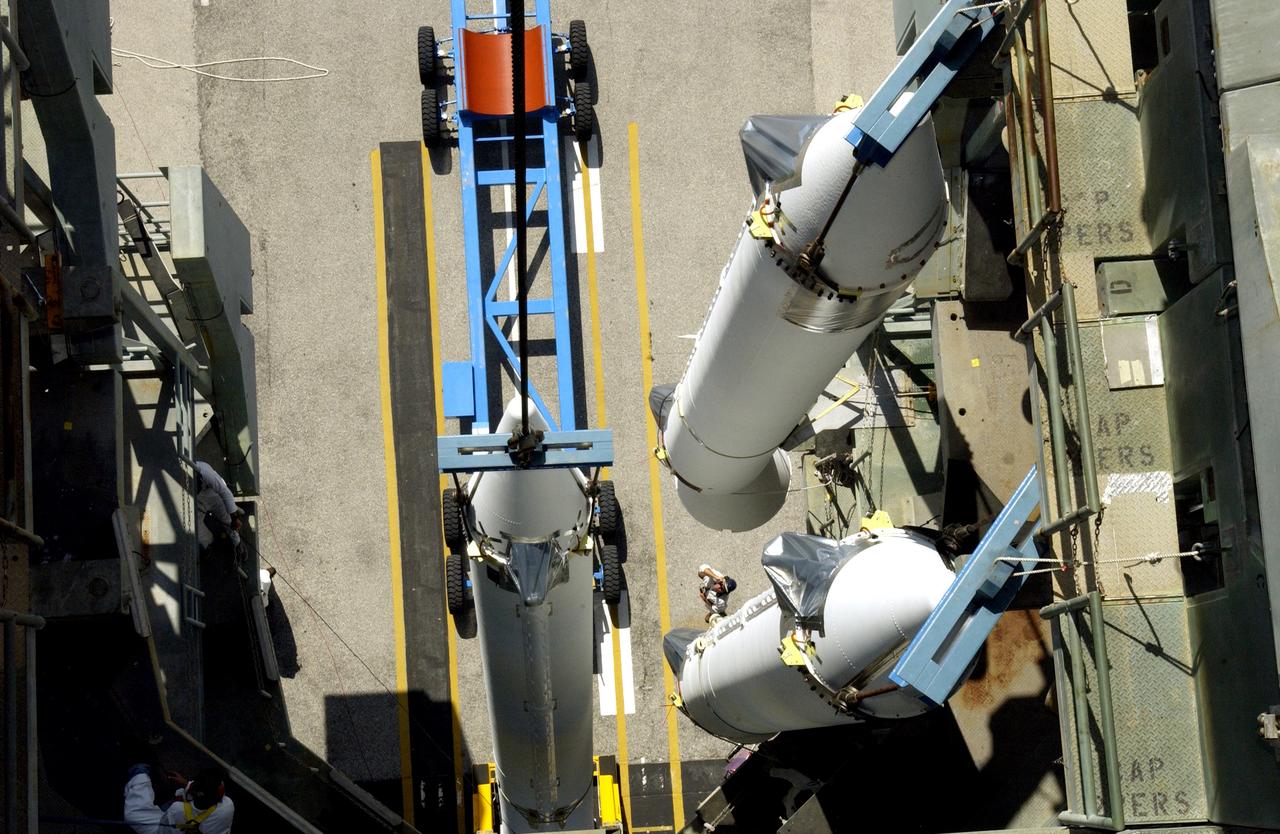
KENNEDY SPACE CENTER, FLA. -   On Launch Complex 17-B, Cape Canaveral Air Force Station, another solid rocket booster (SRB) is being raised from its transporter to lift it to vertical.  It is one of nine  46-inch-diameter, stretched SRBs that are being attached to the Delta II Heavy rocket that will launch the Space Infrared Telescope Facility (SIRTF).  Consisting of three cryogenically cooled science instruments and an 0.85-meter telescope, SIRTF is one of NASA's largest infrared telescopes to be launched.  SIRTF will obtain images and spectra by detecting the infrared energy, or heat, radiated by objects in space. Most of this infrared radiation is blocked by the Earth's atmosphere and cannot be observed from the ground.
KENNEDY SPACE CENTER, FLA. - On Launch Complex 17-B, Cape Canaveral Air Force Station, another solid rocket booster (SRB) is being raised from its transporter to lift it to vertical. It is one of nine 46-inch-diameter, stretched SRBs that are being attached to the Delta II Heavy rocket that will launch the Space Infrared Telescope Facility (SIRTF). Consisting of three cryogenically cooled science instruments and an 0.85-meter telescope, SIRTF is one of NASA's largest infrared telescopes to be launched. SIRTF will obtain images and spectra by detecting the infrared energy, or heat, radiated by objects in space. Most of this infrared radiation is blocked by the Earth's atmosphere and cannot be observed from the ground.
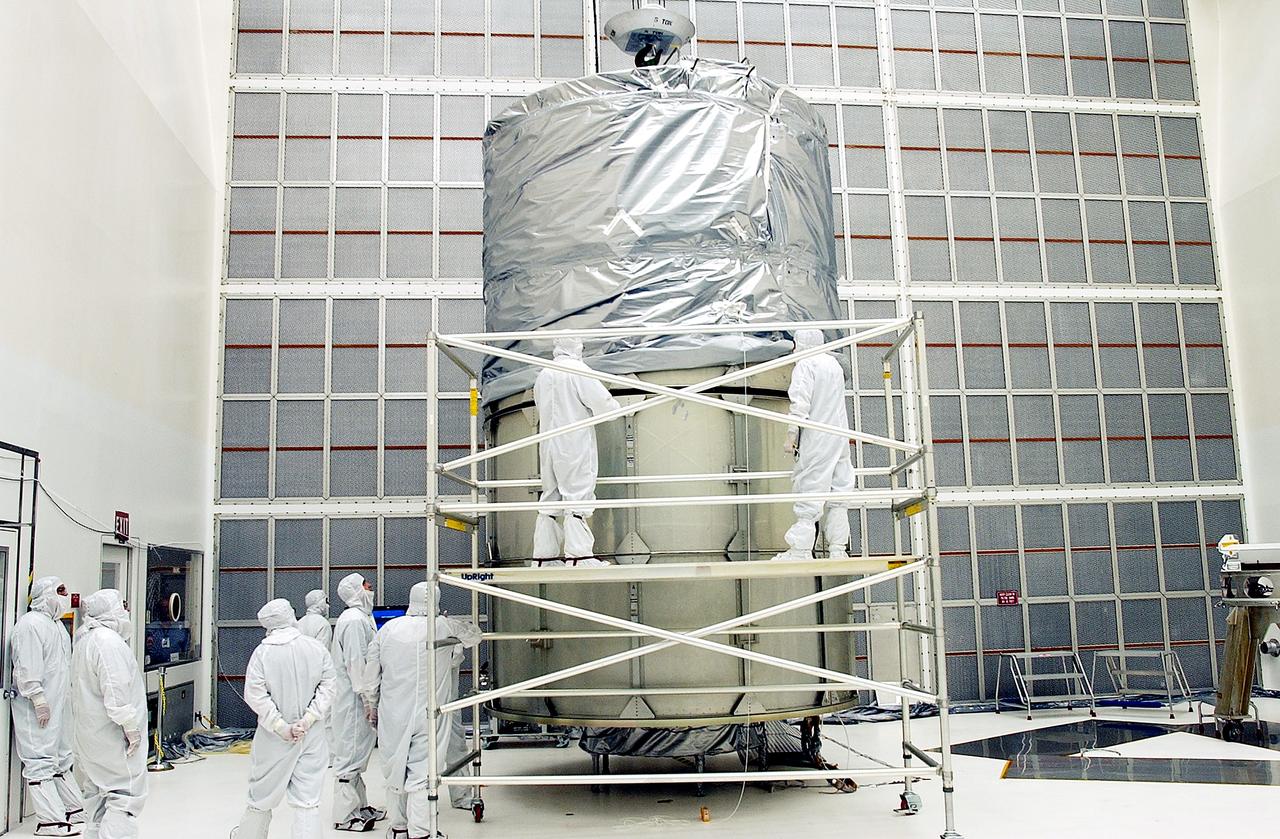
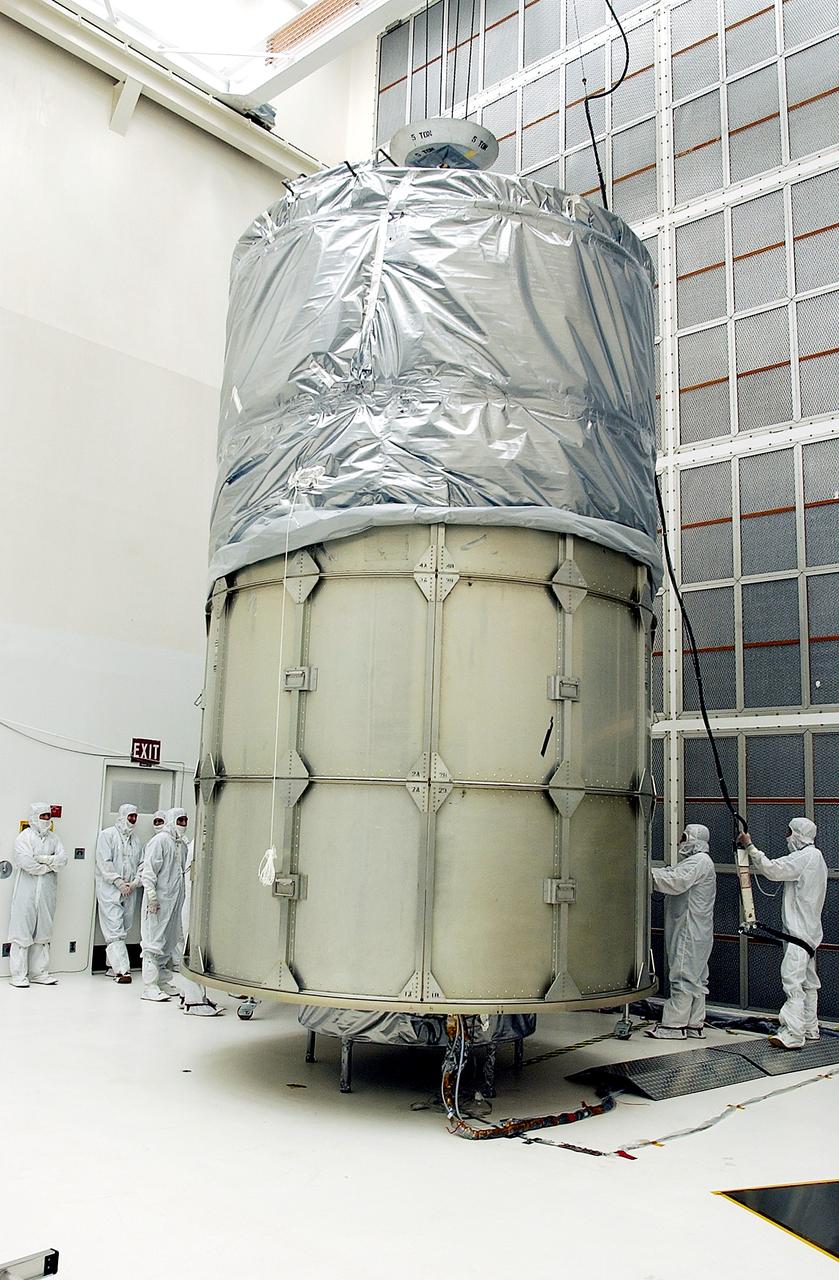
KENNEDY SPACE CENTER, FLA.  -  In Hangar A&E, Cape Canaveral Air Force Station, encapsulation of the Space Infrared Telescope Facility (SIRTF) is complete.  The spacecraft will be transported to Launch Complex 17-B for mating with its launch vehicle, the Delta II rocket.   SIRTF consists of three cryogenically cooled science instruments and an 0.85-meter telescope, and is one of NASA's largest infrared telescopes to be launched.  SIRTF will obtain images and spectra by detecting the infrared energy, or heat, radiated by objects in space. Most of this infrared radiation is blocked by the Earth's atmosphere and cannot be observed from the ground.
KENNEDY SPACE CENTER, FLA. - In Hangar A&E, Cape Canaveral Air Force Station, encapsulation of the Space Infrared Telescope Facility (SIRTF) is complete. The spacecraft will be transported to Launch Complex 17-B for mating with its launch vehicle, the Delta II rocket. SIRTF consists of three cryogenically cooled science instruments and an 0.85-meter telescope, and is one of NASA's largest infrared telescopes to be launched. SIRTF will obtain images and spectra by detecting the infrared energy, or heat, radiated by objects in space. Most of this infrared radiation is blocked by the Earth's atmosphere and cannot be observed from the ground.
KENNEDY SPACE CENTER, FLA. -   On Launch Complex 17-B, Cape Canaveral Air Force Station, the first stage of a Delta II rocket is nearly erect for its move into the mobile service tower.  The rocket is being erected to launch the Space InfraRed Telescope Facility (SIRTF).  Consisting of an 0.85-meter telescope and three cryogenically cooled science instruments, SIRTF is one of NASA's largest infrared telescopes to be launched.  SIRTF will obtain images and spectra by detecting the infrared energy, or heat, radiated by objects in space. Most of this infrared radiation is blocked by the Earth's atmosphere and cannot be observed from the ground.
KENNEDY SPACE CENTER, FLA. - On Launch Complex 17-B, Cape Canaveral Air Force Station, the first stage of a Delta II rocket is nearly erect for its move into the mobile service tower. The rocket is being erected to launch the Space InfraRed Telescope Facility (SIRTF). Consisting of an 0.85-meter telescope and three cryogenically cooled science instruments, SIRTF is one of NASA's largest infrared telescopes to be launched. SIRTF will obtain images and spectra by detecting the infrared energy, or heat, radiated by objects in space. Most of this infrared radiation is blocked by the Earth's atmosphere and cannot be observed from the ground.
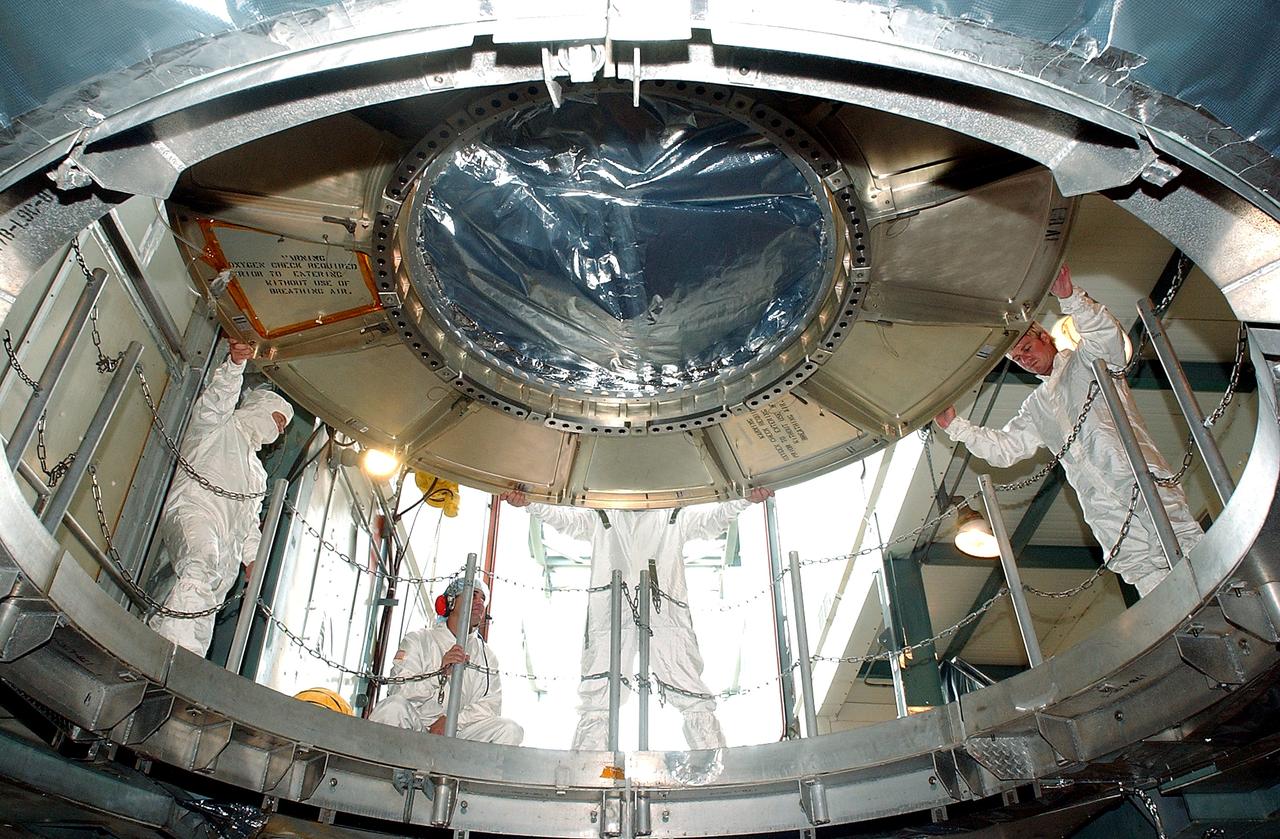
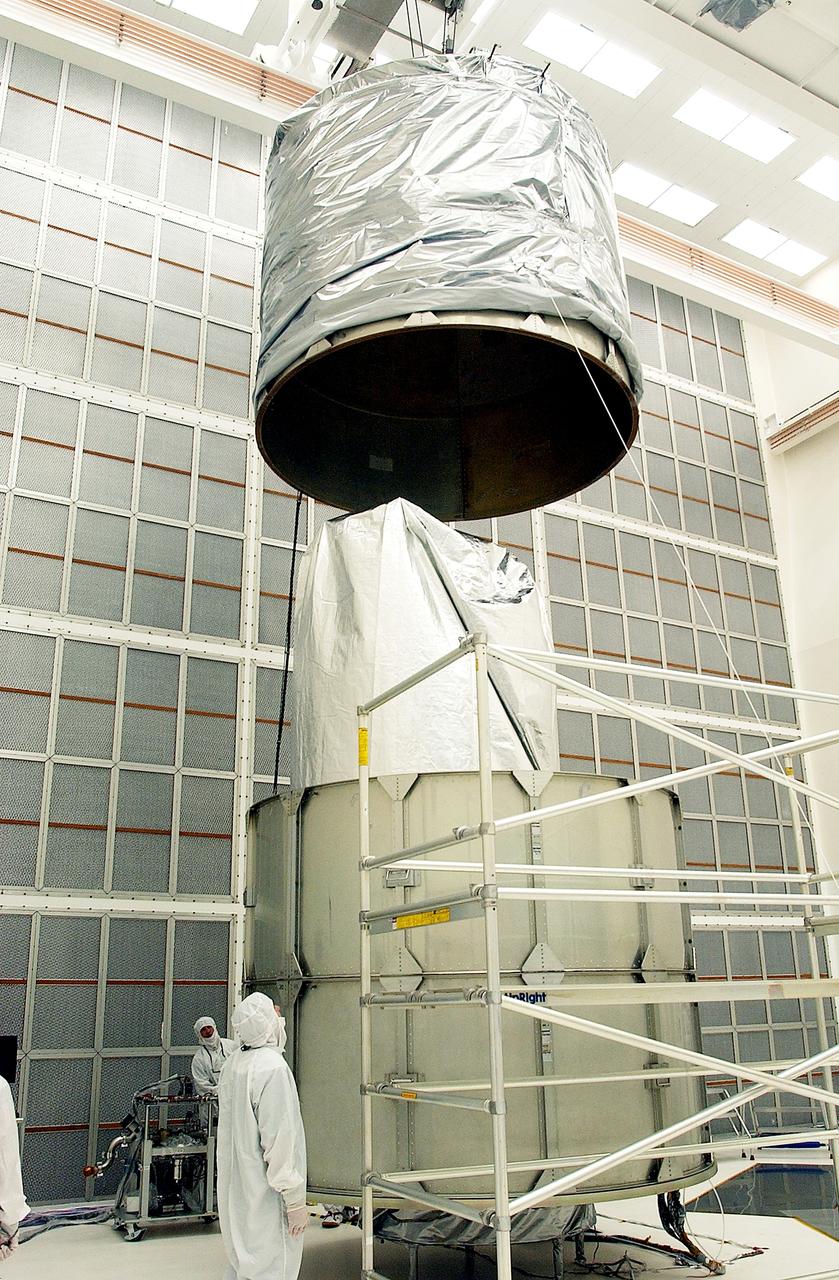
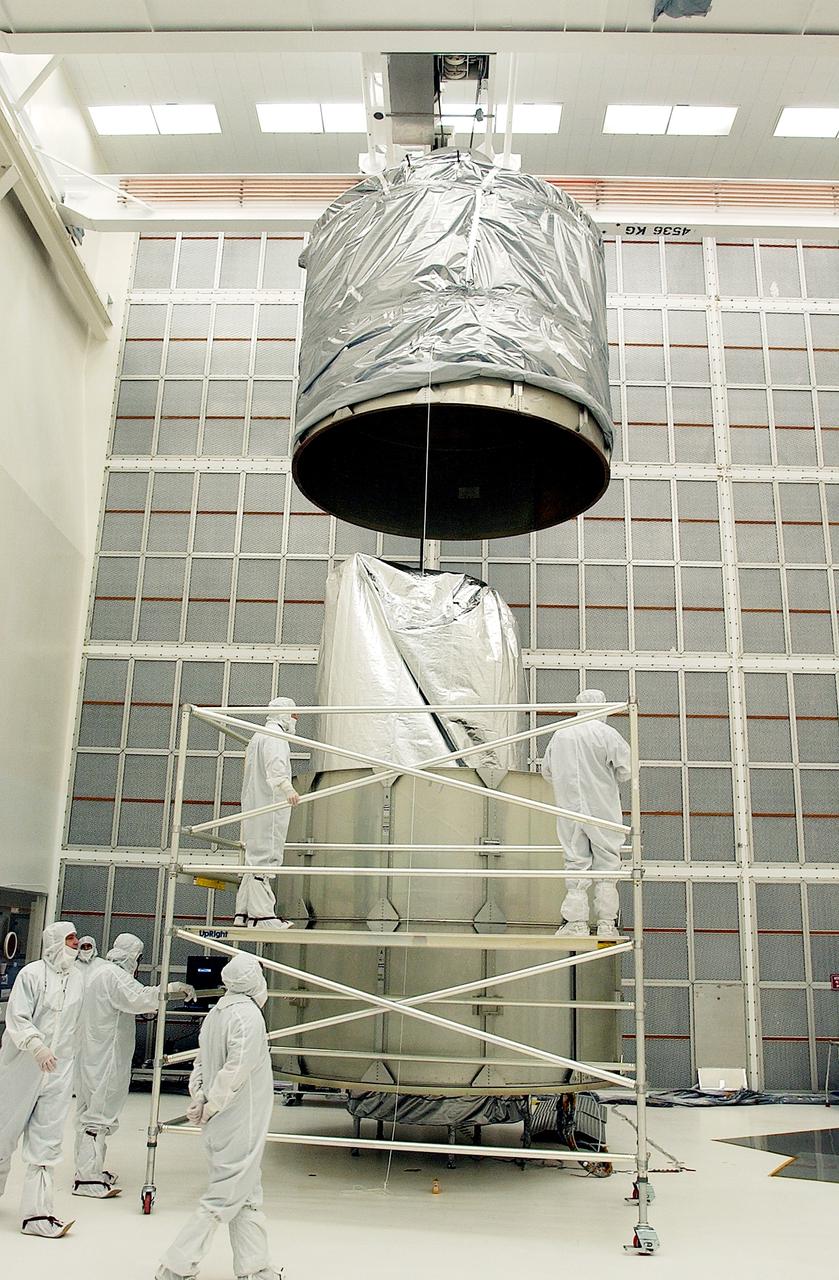
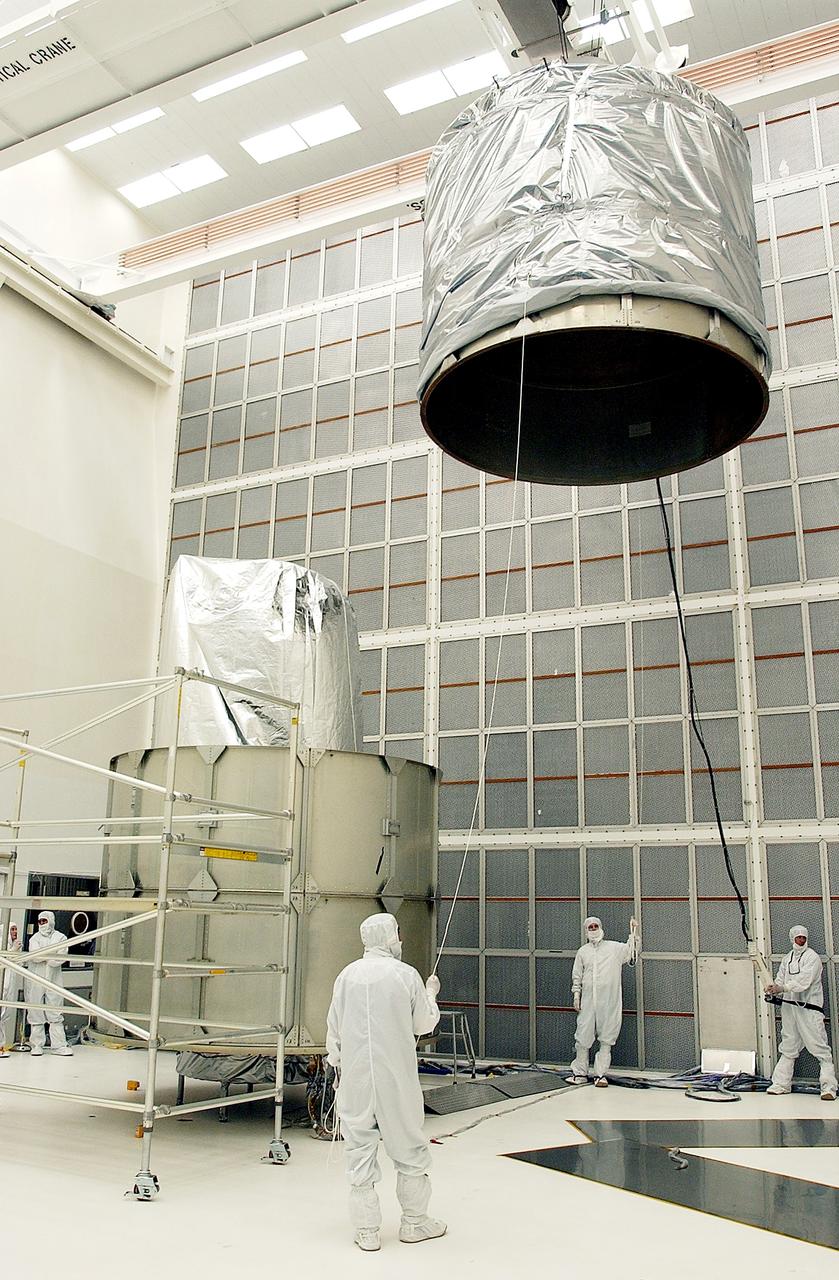
KENNEDY SPACE CENTER, FLA.  - Workers at Hangar A&E, Cape Canaveral Air Force Station, lower the upper canister toward the Space Infrared Telescope Facility (SIRTF) below.  After encapsulation is complete, the spacecraft will be transported to Launch Complex 17-B for mating with its launch vehicle, the Delta II rocket.   SIRTF consists of three cryogenically cooled science instruments and an 0.85-meter telescope, and is one of NASA's largest infrared telescopes to be launched.  SIRTF will obtain images and spectra by detecting the infrared energy, or heat, radiated by objects in space. Most of this infrared radiation is blocked by the Earth's atmosphere and cannot be observed from the ground.
KENNEDY SPACE CENTER, FLA. - Workers at Hangar A&E, Cape Canaveral Air Force Station, lower the upper canister toward the Space Infrared Telescope Facility (SIRTF) below. After encapsulation is complete, the spacecraft will be transported to Launch Complex 17-B for mating with its launch vehicle, the Delta II rocket. SIRTF consists of three cryogenically cooled science instruments and an 0.85-meter telescope, and is one of NASA's largest infrared telescopes to be launched. SIRTF will obtain images and spectra by detecting the infrared energy, or heat, radiated by objects in space. Most of this infrared radiation is blocked by the Earth's atmosphere and cannot be observed from the ground.
KENNEDY SPACE CENTER, FLA.  -  In Hangar A&E, Cape Canaveral Air Force Station, the upper canister is lowered toward the Space Infrared Telescope Facility (SIRTF) below.  After encapsulation is complete, the spacecraft will be transported to Launch Complex 17-B for mating with its launch vehicle, the Delta II rocket.   SIRTF consists of three cryogenically cooled science instruments and an 0.85-meter telescope, and is one of NASA's largest infrared telescopes to be launched.  SIRTF will obtain images and spectra by detecting the infrared energy, or heat, radiated by objects in space. Most of this infrared radiation is blocked by the Earth's atmosphere and cannot be observed from the ground.
KENNEDY SPACE CENTER, FLA. - In Hangar A&E, Cape Canaveral Air Force Station, the upper canister is lowered toward the Space Infrared Telescope Facility (SIRTF) below. After encapsulation is complete, the spacecraft will be transported to Launch Complex 17-B for mating with its launch vehicle, the Delta II rocket. SIRTF consists of three cryogenically cooled science instruments and an 0.85-meter telescope, and is one of NASA's largest infrared telescopes to be launched. SIRTF will obtain images and spectra by detecting the infrared energy, or heat, radiated by objects in space. Most of this infrared radiation is blocked by the Earth's atmosphere and cannot be observed from the ground.
KENNEDY SPACE CENTER, FLA.  -  Workers on the mobile service tower on Launch Pad 17-B, Cape Canaveral Air Force Station, help guide the Space Infrared Telescope Facility (SIRTF) toward the opening in the foreground.  SIRTF will be attached to the Delta II rocket and encapsulated in its fairing before launch.   Consisting of three cryogenically cooled science instruments and an 0.85-meter telescope, SIRTF is one of NASA’s largest infrared telescopes to be launched.  It is the fourth and final element in NASA’s family of orbiting “Great Observatories.”  SIRTF will obtain images and spectra by detecting the infrared energy, or heat, radiated by objects in space. Most of this infrared radiation is blocked by the Earth's atmosphere and cannot be observed from the ground.
KENNEDY SPACE CENTER, FLA. - Workers on the mobile service tower on Launch Pad 17-B, Cape Canaveral Air Force Station, help guide the Space Infrared Telescope Facility (SIRTF) toward the opening in the foreground. SIRTF will be attached to the Delta II rocket and encapsulated in its fairing before launch. Consisting of three cryogenically cooled science instruments and an 0.85-meter telescope, SIRTF is one of NASA’s largest infrared telescopes to be launched. It is the fourth and final element in NASA’s family of orbiting “Great Observatories.” SIRTF will obtain images and spectra by detecting the infrared energy, or heat, radiated by objects in space. Most of this infrared radiation is blocked by the Earth's atmosphere and cannot be observed from the ground.
KENNEDY SPACE CENTER, FLA.  -  Workers on the mobile service tower on Launch Pad 17-B, Cape Canaveral Air Force Station, watch as the Space Infrared Telescope Facility (SIRTF) clears the platform.   SIRTF will be attached to the Delta II rocket and encapsulated in its fairing before launch.   Consisting of three cryogenically cooled science instruments and an 0.85-meter telescope, SIRTF is one of NASA’s largest infrared telescopes to be launched.  It is the fourth and final element in NASA’s family of orbiting “Great Observatories.”  SIRTF will obtain images and spectra by detecting the infrared energy, or heat, radiated by objects in space. Most of this infrared radiation is blocked by the Earth's atmosphere and cannot be observed from the ground.
KENNEDY SPACE CENTER, FLA. - Workers on the mobile service tower on Launch Pad 17-B, Cape Canaveral Air Force Station, watch as the Space Infrared Telescope Facility (SIRTF) clears the platform. SIRTF will be attached to the Delta II rocket and encapsulated in its fairing before launch. Consisting of three cryogenically cooled science instruments and an 0.85-meter telescope, SIRTF is one of NASA’s largest infrared telescopes to be launched. It is the fourth and final element in NASA’s family of orbiting “Great Observatories.” SIRTF will obtain images and spectra by detecting the infrared energy, or heat, radiated by objects in space. Most of this infrared radiation is blocked by the Earth's atmosphere and cannot be observed from the ground.
KENNEDY SPACE CENTER, FLA. -   On Launch Complex 17-B, Cape Canaveral Air Force Station, the Delta II Heavy rocket waits the arrival of the mobile service tower with three additional solid rocket boosters (SRBs).  Nine 46-inch-diameter, stretched SRBs will help launch the Space Infrared Telescope Facility (SIRTF).  Consisting of three cryogenically cooled science instruments and an 0.85-meter telescope, SIRTF is one of NASA's largest infrared telescopes to be launched.  SIRTF will obtain images and spectra by detecting the infrared energy, or heat, radiated by objects in space. Most of this infrared radiation is blocked by the Earth's atmosphere and cannot be observed from the ground.
KENNEDY SPACE CENTER, FLA. - On Launch Complex 17-B, Cape Canaveral Air Force Station, the Delta II Heavy rocket waits the arrival of the mobile service tower with three additional solid rocket boosters (SRBs). Nine 46-inch-diameter, stretched SRBs will help launch the Space Infrared Telescope Facility (SIRTF). Consisting of three cryogenically cooled science instruments and an 0.85-meter telescope, SIRTF is one of NASA's largest infrared telescopes to be launched. SIRTF will obtain images and spectra by detecting the infrared energy, or heat, radiated by objects in space. Most of this infrared radiation is blocked by the Earth's atmosphere and cannot be observed from the ground.
KENNEDY SPACE CENTER, FLA. -   On Launch Complex 17-B, Cape Canaveral Air Force Station, the first stage of a Delta II rocket waits to be lifted up into the mobile service tower.  The rocket is being erected to launch the Space InfraRed Telescope Facility (SIRTF).  Consisting of an 0.85-meter telescope and three cryogenically cooled science instruments, SIRTF is one of NASA's largest infrared telescopes to be launched.  SIRTF will obtain images and spectra by detecting the infrared energy, or heat, radiated by objects in space. Most of this infrared radiation is blocked by the Earth's atmosphere and cannot be observed from the ground.
KENNEDY SPACE CENTER, FLA. - On Launch Complex 17-B, Cape Canaveral Air Force Station, the first stage of a Delta II rocket waits to be lifted up into the mobile service tower. The rocket is being erected to launch the Space InfraRed Telescope Facility (SIRTF). Consisting of an 0.85-meter telescope and three cryogenically cooled science instruments, SIRTF is one of NASA's largest infrared telescopes to be launched. SIRTF will obtain images and spectra by detecting the infrared energy, or heat, radiated by objects in space. Most of this infrared radiation is blocked by the Earth's atmosphere and cannot be observed from the ground.
KENNEDY SPACE CENTER, FLA.  - Workers at Hangar A&E, Cape Canaveral Air Force Station, place the middle row of panels to encapsulate the Space Infrared Telescope Facility (SIRTF).  The spacecraft will be transported to Launch Complex 17-B for mating with its launch vehicle, the Delta II rocket.   SIRTF consists of three cryogenically cooled science instruments and an 0.85-meter telescope, and is one of NASA's largest infrared telescopes to be launched.  SIRTF will obtain images and spectra by detecting the infrared energy, or heat, radiated by objects in space. Most of this infrared radiation is blocked by the Earth's atmosphere and cannot be observed from the ground.
KENNEDY SPACE CENTER, FLA. - Workers at Hangar A&E, Cape Canaveral Air Force Station, place the middle row of panels to encapsulate the Space Infrared Telescope Facility (SIRTF). The spacecraft will be transported to Launch Complex 17-B for mating with its launch vehicle, the Delta II rocket. SIRTF consists of three cryogenically cooled science instruments and an 0.85-meter telescope, and is one of NASA's largest infrared telescopes to be launched. SIRTF will obtain images and spectra by detecting the infrared energy, or heat, radiated by objects in space. Most of this infrared radiation is blocked by the Earth's atmosphere and cannot be observed from the ground.
KENNEDY SPACE CENTER, FLA.  - Workers at Hangar A&E, Cape Canaveral Air Force Station, help guide the upper canister toward the Space Infrared Telescope Facility (SIRTF) at left.  After encapsulation is complete, the spacecraft will be transported to Launch Complex 17-B for mating with its launch vehicle, the Delta II rocket.   SIRTF consists of three cryogenically cooled science instruments and an 0.85-meter telescope, and is one of NASA's largest infrared telescopes to be launched.  SIRTF will obtain images and spectra by detecting the infrared energy, or heat, radiated by objects in space. Most of this infrared radiation is blocked by the Earth's atmosphere and cannot be observed from the ground.
KENNEDY SPACE CENTER, FLA. - Workers at Hangar A&E, Cape Canaveral Air Force Station, help guide the upper canister toward the Space Infrared Telescope Facility (SIRTF) at left. After encapsulation is complete, the spacecraft will be transported to Launch Complex 17-B for mating with its launch vehicle, the Delta II rocket. SIRTF consists of three cryogenically cooled science instruments and an 0.85-meter telescope, and is one of NASA's largest infrared telescopes to be launched. SIRTF will obtain images and spectra by detecting the infrared energy, or heat, radiated by objects in space. Most of this infrared radiation is blocked by the Earth's atmosphere and cannot be observed from the ground.
KENNEDY SPACE CENTER, FLA. -   A solid rocket booster (SRB) for the Delta II Heavy rocket that will launch the Space Infrared Telescope Facility (SIRTF) arrives at Launch Complex 17-B, Cape Canaveral Air Force Station.  The Delta II Heavy features nine 46-inch-diameter, stretched SRBs.  Consisting of three cryogenically cooled science instruments and an 0.85-meter telescope, SIRTF is one of NASA's largest infrared telescopes to be launched.  SIRTF will obtain images and spectra by detecting the infrared energy, or heat, radiated by objects in space. Most of this infrared radiation is blocked by the Earth's atmosphere and cannot be observed from the ground.
KENNEDY SPACE CENTER, FLA. - A solid rocket booster (SRB) for the Delta II Heavy rocket that will launch the Space Infrared Telescope Facility (SIRTF) arrives at Launch Complex 17-B, Cape Canaveral Air Force Station. The Delta II Heavy features nine 46-inch-diameter, stretched SRBs. Consisting of three cryogenically cooled science instruments and an 0.85-meter telescope, SIRTF is one of NASA's largest infrared telescopes to be launched. SIRTF will obtain images and spectra by detecting the infrared energy, or heat, radiated by objects in space. Most of this infrared radiation is blocked by the Earth's atmosphere and cannot be observed from the ground.
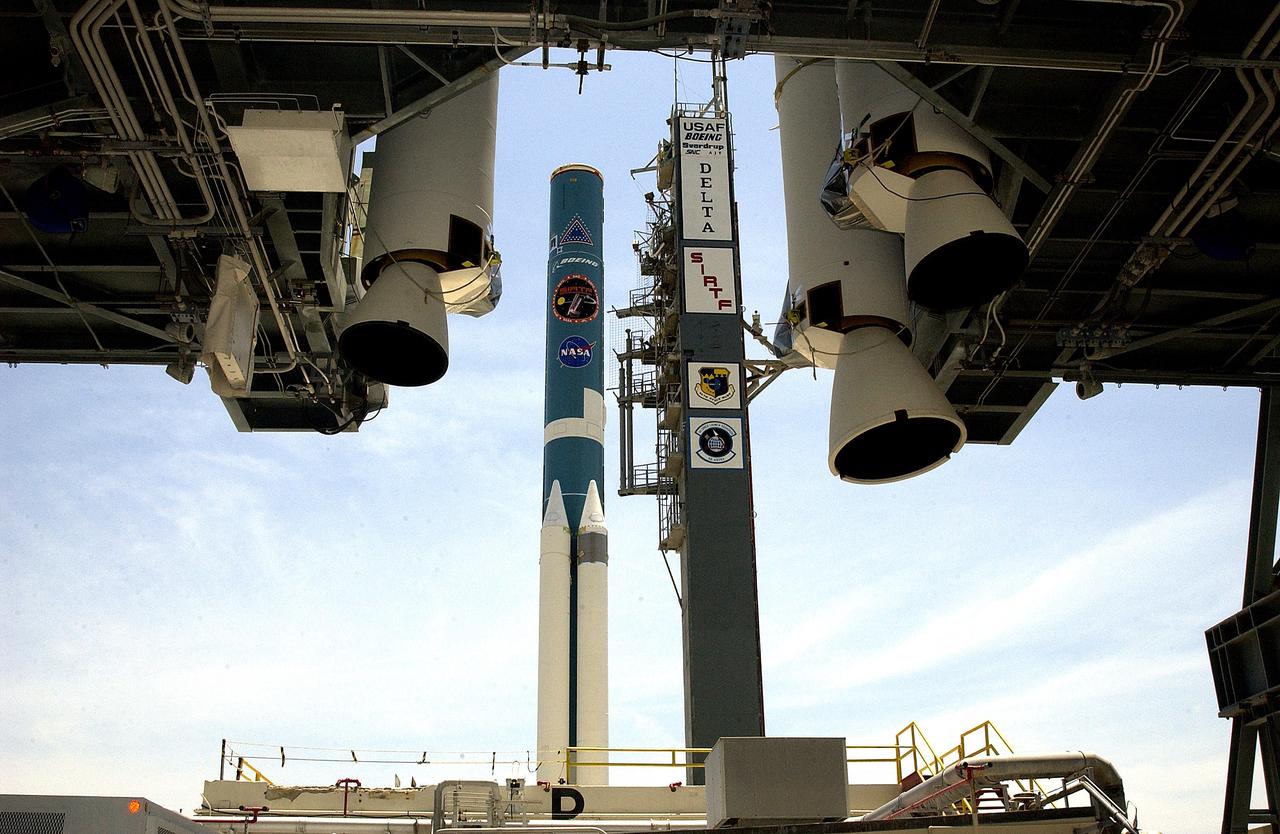
KENNEDY SPACE CENTER, FLA. -   On Launch Complex 17-B, Cape Canaveral Air Force Station, the Delta II Heavy rocket  (background) is framed by the solid rocket boosters (foreground) suspended in the mobile service tower.  The SRBs will be added to those already attached to the rocket.  The Delta II Heavy will launch the Space Infrared Telescope Facility (SIRTF).  Consisting of three cryogenically cooled science instruments and an 0.85-meter telescope, SIRTF is one of NASA's largest infrared telescopes to be launched.  SIRTF will obtain images and spectra by detecting the infrared energy, or heat, radiated by objects in space. Most of this infrared radiation is blocked by the Earth's atmosphere and cannot be observed from the ground.
KENNEDY SPACE CENTER, FLA. - On Launch Complex 17-B, Cape Canaveral Air Force Station, the Delta II Heavy rocket (background) is framed by the solid rocket boosters (foreground) suspended in the mobile service tower. The SRBs will be added to those already attached to the rocket. The Delta II Heavy will launch the Space Infrared Telescope Facility (SIRTF). Consisting of three cryogenically cooled science instruments and an 0.85-meter telescope, SIRTF is one of NASA's largest infrared telescopes to be launched. SIRTF will obtain images and spectra by detecting the infrared energy, or heat, radiated by objects in space. Most of this infrared radiation is blocked by the Earth's atmosphere and cannot be observed from the ground.
KENNEDY SPACE CENTER, FLA.  -  In Hangar A&E, Cape Canaveral Air Force Station, the upper canister is mated to the middle panels around the Space Infrared Telescope Facility (SIRTF).  The spacecraft will be transported to Launch Complex 17-B for mating with its launch vehicle, the Delta II rocket.   SIRTF consists of three cryogenically cooled science instruments and an 0.85-meter telescope, and is one of NASA's largest infrared telescopes to be launched.  SIRTF will obtain images and spectra by detecting the infrared energy, or heat, radiated by objects in space. Most of this infrared radiation is blocked by the Earth's atmosphere and cannot be observed from the ground.
KENNEDY SPACE CENTER, FLA. - In Hangar A&E, Cape Canaveral Air Force Station, the upper canister is mated to the middle panels around the Space Infrared Telescope Facility (SIRTF). The spacecraft will be transported to Launch Complex 17-B for mating with its launch vehicle, the Delta II rocket. SIRTF consists of three cryogenically cooled science instruments and an 0.85-meter telescope, and is one of NASA's largest infrared telescopes to be launched. SIRTF will obtain images and spectra by detecting the infrared energy, or heat, radiated by objects in space. Most of this infrared radiation is blocked by the Earth's atmosphere and cannot be observed from the ground.
KENNEDY SPACE CENTER, FLA. -   On Launch Complex 17-B, Cape Canaveral Air Force Station, the first stage of a Delta II rocket is raised off the transporter before lifting it up and moved into the mobile service tower.  The rocket is being erected to launch the Space InfraRed Telescope Facility (SIRTF).  Consisting of an 0.85-meter telescope and three cryogenically cooled science instruments, SIRTF is one of NASA's largest infrared telescopes to be launched.  SIRTF will obtain images and spectra by detecting the infrared energy, or heat, radiated by objects in space. Most of this infrared radiation is blocked by the Earth's atmosphere and cannot be observed from the ground.
KENNEDY SPACE CENTER, FLA. - On Launch Complex 17-B, Cape Canaveral Air Force Station, the first stage of a Delta II rocket is raised off the transporter before lifting it up and moved into the mobile service tower. The rocket is being erected to launch the Space InfraRed Telescope Facility (SIRTF). Consisting of an 0.85-meter telescope and three cryogenically cooled science instruments, SIRTF is one of NASA's largest infrared telescopes to be launched. SIRTF will obtain images and spectra by detecting the infrared energy, or heat, radiated by objects in space. Most of this infrared radiation is blocked by the Earth's atmosphere and cannot be observed from the ground.
KENNEDY SPACE CENTER, FLA. -  On Launch Complex 17-B, Cape Canaveral Air Force Station, the first stage of a Delta II rocket is lifted up the mobile service tower.  Below the rocket is the flame trench, and in the foreground is the overflow pool.  The rocket is being erected to launch the Space InfraRed Telescope Facility (SIRTF).  Consisting of an 0.85-meter telescope and three cryogenically cooled science instruments, SIRTF is one of NASA's largest infrared telescopes to be launched.  SIRTF will obtain images and spectra by detecting the infrared energy, or heat, radiated by objects in space. Most of this infrared radiation is blocked by the Earth's atmosphere and cannot be observed from the ground.
KENNEDY SPACE CENTER, FLA. - On Launch Complex 17-B, Cape Canaveral Air Force Station, the first stage of a Delta II rocket is lifted up the mobile service tower. Below the rocket is the flame trench, and in the foreground is the overflow pool. The rocket is being erected to launch the Space InfraRed Telescope Facility (SIRTF). Consisting of an 0.85-meter telescope and three cryogenically cooled science instruments, SIRTF is one of NASA's largest infrared telescopes to be launched. SIRTF will obtain images and spectra by detecting the infrared energy, or heat, radiated by objects in space. Most of this infrared radiation is blocked by the Earth's atmosphere and cannot be observed from the ground.
KENNEDY SPACE CENTER, FLA. -   On Launch Complex 17-B, Cape Canaveral Air Force Station, a solid rocket booster (SRB) is lifted into the mobile service tower, joining two others.  They are three of nine  46-inch-diameter, stretched SRBs that are being attached to the Delta II Heavy rocket that will launch the Space Infrared Telescope Facility (SIRTF).  Consisting of three cryogenically cooled science instruments and an 0.85-meter telescope, SIRTF is one of NASA's largest infrared telescopes to be launched.  SIRTF will obtain images and spectra by detecting the infrared energy, or heat, radiated by objects in space. Most of this infrared radiation is blocked by the Earth's atmosphere and cannot be observed from the ground.
KENNEDY SPACE CENTER, FLA. - On Launch Complex 17-B, Cape Canaveral Air Force Station, a solid rocket booster (SRB) is lifted into the mobile service tower, joining two others. They are three of nine 46-inch-diameter, stretched SRBs that are being attached to the Delta II Heavy rocket that will launch the Space Infrared Telescope Facility (SIRTF). Consisting of three cryogenically cooled science instruments and an 0.85-meter telescope, SIRTF is one of NASA's largest infrared telescopes to be launched. SIRTF will obtain images and spectra by detecting the infrared energy, or heat, radiated by objects in space. Most of this infrared radiation is blocked by the Earth's atmosphere and cannot be observed from the ground.
KENNEDY SPACE CENTER, FLA. -   On Launch Complex 17-B, Cape Canaveral Air Force Station, the first stage of a Delta II rocket is raised off the transporter before lifting and moving it into the mobile service tower.  The rocket is being erected to launch the Space InfraRed Telescope Facility (SIRTF).  Consisting of an 0.85-meter telescope and three cryogenically cooled science instruments, SIRTF is one of NASA's largest infrared telescopes to be launched.  SIRTF will obtain images and spectra by detecting the infrared energy, or heat, radiated by objects in space. Most of this infrared radiation is blocked by the Earth's atmosphere and cannot be observed from the ground.
KENNEDY SPACE CENTER, FLA. - On Launch Complex 17-B, Cape Canaveral Air Force Station, the first stage of a Delta II rocket is raised off the transporter before lifting and moving it into the mobile service tower. The rocket is being erected to launch the Space InfraRed Telescope Facility (SIRTF). Consisting of an 0.85-meter telescope and three cryogenically cooled science instruments, SIRTF is one of NASA's largest infrared telescopes to be launched. SIRTF will obtain images and spectra by detecting the infrared energy, or heat, radiated by objects in space. Most of this infrared radiation is blocked by the Earth's atmosphere and cannot be observed from the ground.
KENNEDY SPACE CENTER, FLA.  -  After dawn,  the Space Infrared Telescope Facility (SIRTF) is lifted up the mobile service tower on Launch Pad 17-B, Cape Canaveral Air Force Station.  SIRTF will be attached to the Delta II rocket and encapsulated in its fairing before launch.   Consisting of three cryogenically cooled science instruments and an 0.85-meter telescope, SIRTF is one of NASA’s largest infrared telescopes to be launched.  It is the fourth and final element in NASA’s family of orbiting “Great Observatories.”  SIRTF will obtain images and spectra by detecting the infrared energy, or heat, radiated by objects in space. Most of this infrared radiation is blocked by the Earth's atmosphere and cannot be observed from the ground.
KENNEDY SPACE CENTER, FLA. - After dawn, the Space Infrared Telescope Facility (SIRTF) is lifted up the mobile service tower on Launch Pad 17-B, Cape Canaveral Air Force Station. SIRTF will be attached to the Delta II rocket and encapsulated in its fairing before launch. Consisting of three cryogenically cooled science instruments and an 0.85-meter telescope, SIRTF is one of NASA’s largest infrared telescopes to be launched. It is the fourth and final element in NASA’s family of orbiting “Great Observatories.” SIRTF will obtain images and spectra by detecting the infrared energy, or heat, radiated by objects in space. Most of this infrared radiation is blocked by the Earth's atmosphere and cannot be observed from the ground.
This image shows Hurricane Frances in August 2004 as captured by instruments onboard two different NASA satellites: the AIRS infrared instrument onboard Aqua, and the SeaWinds scatterometer onboard QuikSCAT. Both are JPL-managed instruments. AIRS data are used to create global three-dimensional maps of temperature, humidity and clouds, while scatterometers measure surface wind speed and direction over the ocean.  The red vectors in the image show Frances' surface winds as measured by SeaWinds on QuikSCAT. The background colors show the temperature of clouds and surface as viewed in the infrared by AIRS, with cooler areas pushing to purple and warmer areas are pushing to red. The color scale on the right gives the temperatures in degrees Kelvin. (The top of the scale, 320 degrees Kelvin, corresponds to 117 degrees Fahrenheit, and the bottom, 180 degrees K is -135 degrees F.) The powerful circulation of this storm is evident from the combined data as well as the development of a clearly-defined central "eye." The infrared signal does not penetrate through clouds, so the light blue areas reveal the cold clouds tops associated with strong thunderstorms embedded within the storm. In cloud-free areas the infrared signal comes from Earth's surface, revealing warmer temperatures.  http://photojournal.jpl.nasa.gov/catalog/PIA00435
Hurricane Frances as Observed by NASA Spaceborne Atmospheric Infrared Sounder AIRS and SeaWinds Scatterometer
A scaffolding structure built around NASA Wide-field Infrared Survey Explorer allows engineers to freeze its hydrogen coolant. The WISE infrared instrument is kept extremely cold by a bottle-like tank filled with frozen hydrogen, called the cryostat.
Freezing WISE Hydrogen
The Culann Patera volcano on Jupiter moon Io was observed by the near-infrared mapping spectrometer instrument onboard NASA Galileo spacecraft during its Io flyby on Nov. 25, 1999.
Culann Patera/NIMS
On the night of March 25, 2008, the Advanced Spaceborne Thermal Emission and Reflection Radiometer instrument on NASA Terra satellite captured these thermal infrared images of Kilauea volcano on Hawaii Big Island. Kilauea was active at two locations.
Hawaii Kilauea Volcano Belches a Toxic Brew
On June 8, 2011, the visible and infrared mapping spectrometer aboard NASA Dawn spacecraft captured the instrument first images of Vesta that are larger than a few pixels, from a distance of about 218,000 miles 351,000 kilometers.
Vesta in Spectrometer View
Satellite images obtained from NASA Atmospheric Infrared Sounder AIRS instrument aboard NASA Aqua spacecraft provide a glimpse into one of the most powerful storms ever recorded on Earth, Typhoon Haiyan.
Super Typhoon Haiyan
Mike Ressler right and Kalyani Sukhatme of NASA JPL pose in the clean room with a model component, called a focal plane module, of the Mid-Infrared Instrument on NASA James Webb Space Telescope.
Shake, Rattle and Roll: James Webb Telescope Components Pass Tests
This mosaic of Saturn rings was acquired by NASA Cassini visual and infrared mapping spectrometer instrument on Sept. 15, 2006, while the spacecraft was in the shadow of the planet looking back towards the rings
Saturn Rings in Infrared
The science instrument on NASA Wide-field Infrared Survey Explorer is shown here with its aperture cover removed, during assembly at the Space Dynamics Laboratory in Logan, Utah.
A Look Inside WISE
This image shows the visual and infrared mapping spectrometer instrument just before it was attached to NASA Cassini spacecraft. Cassini launched in 1997 and has been exploring the Saturn system since 2004.
Cassini Visual and Infrared Mapping Spectrometer
This infrared image of Hurricane Irene from the AIRS instrument on NASA Aqua spacecraft, was taken at 2:47 a.m. EDT on Aug. 28. The storm coldest cloud top temperatures and intense rains are shown in purples and blues.
NASA Satellite Shows a Mean Irene Fury
NASA Atmospheric Infrared Sounder instrument is able to peel back cloud cover to reveal 3-D structure of a storm water vapor content, information that can be used to improve weather forecast models.
AIRS Storm Front Approaching California animation
Created with data acquired by JPL Atmospheric Infrared Sounder instrument during July 2009 this image shows large-scale patterns of carbon dioxide concentrations that are transported around Earth by the general circulation of the atmosphere.
Global Carbon Dioxide Transport from AIRS Data, July 2009
Carbon monoxide in the smoke from the Station fire was lofted high into the atmosphere, where it was observed by JPL Atmospheric Infrared Sounder instrument onboard NASA Aqua satellite. Animation available at the Photojournal.
Concentration and Transport of Carbon Monoxide from the California Wildfires
The Mid-Infrared Instrument, a component of NASA James Webb Space Telescope, underwent alignment testing at the Science and Technology Facilities Council Rutherford Appleton Laboratory Space in Oxfordshire, England.
Webb Instrument Undergoes Alignment Testing
Infrared images from instruments at Kitt Peak National Observatory left and NASA Spitzer Space Telescope document the outburst of HOPS 383, a young protostar in the Orion star-formation complex.
Embryonic Star Outburst
These four images of the Mediterranean were obtained concurrently on June 14, 2002 from the three instruments that make up the Atmospheric Infrared Sounder experiment system aboard NASA Aqua spacecraft.  http://photojournal.jpl.nasa.gov/catalog/PIA00326
AIRS First Light Data: Eastern Mediterranean, June 14, 2002
Callisto southern hemisphere was imaged by both the Near Infrared Mapping Spectrometer NIMS and the Solid State Imaging SSI instrument during NASA Galileo eighth orbit of Jupiter. This is a mosaic combining both views.
Callisto Southern Hemisphere as Viewed by NIMS & SSI
The Mid-Infrared Instrument, a component of NASA James Webb Space Telescope, underwent testing inside the thermal space test chamber at the Science and Technology Facilities Council Rutherford Appleton Laboratory Space in Oxfordshire, England.
Webb Instrument Inside Test Chamber
The north pole of Jupiter's giant moon Ganymede can be seen in this composite image of infrared data from the Jovian Infrared Auroral Mapper (JIRAM) instrument aboard NASA's Juno spacecraft. Five infrared images were taken every 20 minutes, beginning at time of closest approach (far left) on Dec. 26, 2019, when Juno was about 62,000 miles (100,000 kilometers) distant. The infrared imagery provides the first infrared mapping of the massive moon's northern frontier.  As Ganymede has no atmosphere to impede the progress of charged particles from the Sun, the surface at its poles is constantly being bombarded by plasma from Jupiter's gigantic magnetosphere. The bombardment has a dramatic effect on Ganymede's ice. Frozen water molecules detected at both poles have no appreciable order to their arrangement, and the amorphous ice has a different infrared signature than the crystalline ice found at Ganymede's equator.  JIRAM was designed to capture the infrared light emerging from deep inside Jupiter, probing the weather layer down to 30 to 45 miles (50 to 70 kilometers) below Jupiter's cloud tops.  https://photojournal.jpl.nasa.gov/catalog/PIA23988
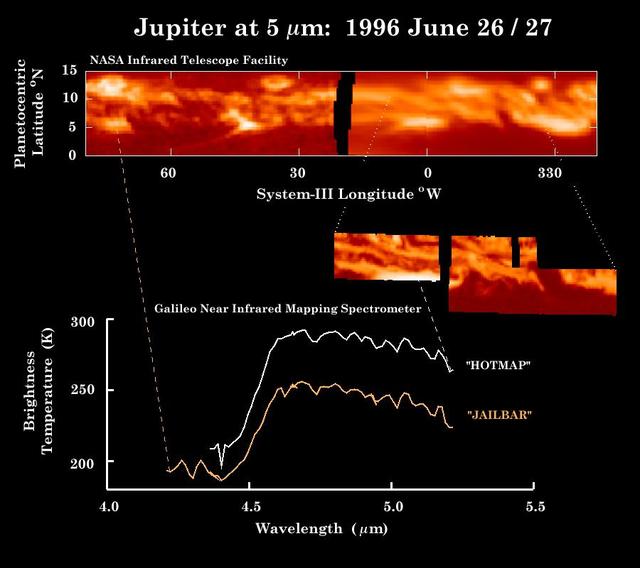
Five Ganymedes
As NASA's Juno spacecraft approached Jupiter on Aug. 27, 2016, the Jovian Infrared Auroral Mapper (JIRAM) instrument captured the planet's glow in infrared light.  The video is composed of 580 images collected over a period of about nine hours while Jupiter completed nearly a full rotation on its axis.  The video shows the two parts composing the JIRAM imager: the lower one, in a red color scale, is used for mapping the planet's thermal emission at wavelengths around 4.8 microns; the upper one, in a blue color scale, is used to map the auroras at wavelengths around 3.45 microns.  In this case the exposure time of the imager was optimized to observe the planet's thermal emission. However, it is possible to see a faint aurora and Jupiter's moon Io approaching the planet. The Great Red Spot is also visible just south of the planet's equator.  A movie is available at http://photojournal.jpl.nasa.gov/catalog/PIA21036
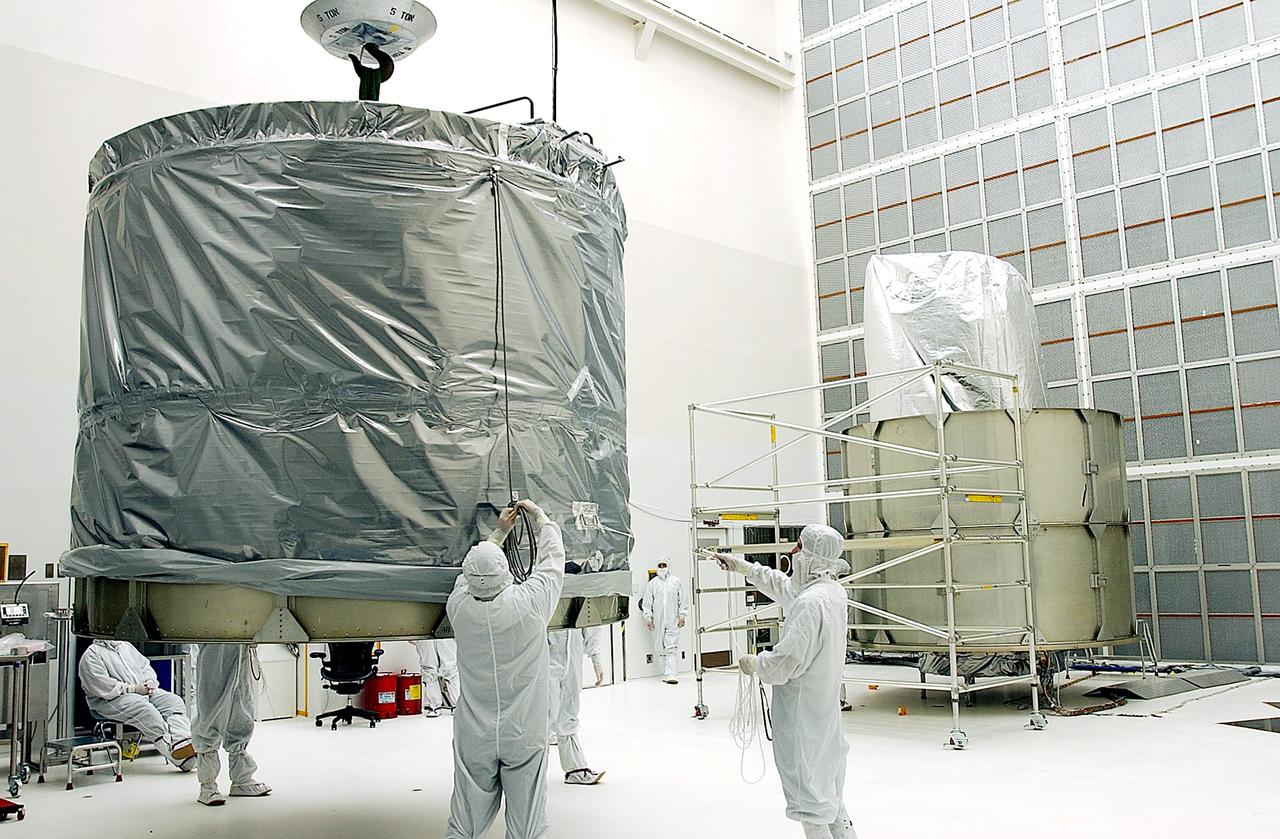
Juno Captures Jupiter Glow in Infrared Light
This engineering image derives from 100 seconds of observing time on one of the three science instruments aboard the Space InfraRed Telescope Facility (SIRTF). SIRTF was launched on August 25, and opened up its focal plane to starlight on August 30. This image was obtained as part of the instrument power-on sequence on September 1, one week after launch and a full month before the telescope is expected to reach optimal operating temperature and focus. The stars and galaxies seen in this image already attest to the observatory's great sensitivity in the infrared and to its proper operation.  The Space Infrared Telescope Facility (SIRTF) telescope was renamed the Spitzer Space Telescope on December 18, 2003, after the late Dr. Lyman Spitzer, in a contest which was open to the general public.   http://photojournal.jpl.nasa.gov/catalog/PIA04724
SIRTF Aliveness
Data used to generate this composite image of volcanic activity on the Jovian moon Io was obtained by the JIRAM (Jovian Infrared Auroral Mapper) instrument aboard NASA's Juno spacecraft during a flyby of the moon on Oct. 16, 2021. JIRAM took the four images over a short time interval to observe volcanic activity on the moon from different view angles.  JIRAM data collected over time could provide information on changes to Io's surface, including the number of active volcanoes or variations in their intensity. JIRAM "sees" infrared light not visible to the human eye. In this composite image, the measurements of thermal emission radiated from the planet were in the infrared wavelength of around 5 microns.  https://photojournal.jpl.nasa.gov/catalog/PIA25886
4 Looks at Io Volcanoes
KENNEDY SPACE CENTER, FLA. -   This view from the mobile service tower on Launch Complex 17-B, Cape Canaveral Air Force Station, shows two solid rocket boosters (SRBs) already suspended in the tower while another is being lifted.  They are three of nine  46-inch-diameter, stretched SRBs that are being attached to the Delta II Heavy rocket that will launch the Space Infrared Telescope Facility (SIRTF).  Consisting of three cryogenically cooled science instruments and an 0.85-meter telescope, SIRTF is one of NASA's largest infrared telescopes to be launched.  SIRTF will obtain images and spectra by detecting the infrared energy, or heat, radiated by objects in space. Most of this infrared radiation is blocked by the Earth's atmosphere and cannot be observed from the ground.
KENNEDY SPACE CENTER, FLA. - This view from the mobile service tower on Launch Complex 17-B, Cape Canaveral Air Force Station, shows two solid rocket boosters (SRBs) already suspended in the tower while another is being lifted. They are three of nine 46-inch-diameter, stretched SRBs that are being attached to the Delta II Heavy rocket that will launch the Space Infrared Telescope Facility (SIRTF). Consisting of three cryogenically cooled science instruments and an 0.85-meter telescope, SIRTF is one of NASA's largest infrared telescopes to be launched. SIRTF will obtain images and spectra by detecting the infrared energy, or heat, radiated by objects in space. Most of this infrared radiation is blocked by the Earth's atmosphere and cannot be observed from the ground.
KENNEDY SPACE CENTER, FLA. -   This view from the mobile service tower on Launch Complex 17-B, Cape Canaveral Air Force Station, shows two solid rocket boosters (SRBs) already suspended in the tower while another is being lifted.  They are three of nine  46-inch-diameter, stretched SRBs that are being attached to the Delta II Heavy rocket that will launch the Space Infrared Telescope Facility (SIRTF).  Consisting of three cryogenically cooled science instruments and an 0.85-meter telescope, SIRTF is one of NASA's largest infrared telescopes to be launched.  SIRTF will obtain images and spectra by detecting the infrared energy, or heat, radiated by objects in space. Most of this infrared radiation is blocked by the Earth's atmosphere and cannot be observed from the ground.
KENNEDY SPACE CENTER, FLA. - This view from the mobile service tower on Launch Complex 17-B, Cape Canaveral Air Force Station, shows two solid rocket boosters (SRBs) already suspended in the tower while another is being lifted. They are three of nine 46-inch-diameter, stretched SRBs that are being attached to the Delta II Heavy rocket that will launch the Space Infrared Telescope Facility (SIRTF). Consisting of three cryogenically cooled science instruments and an 0.85-meter telescope, SIRTF is one of NASA's largest infrared telescopes to be launched. SIRTF will obtain images and spectra by detecting the infrared energy, or heat, radiated by objects in space. Most of this infrared radiation is blocked by the Earth's atmosphere and cannot be observed from the ground.
KENNEDY SPACE CENTER, FLA. -   Another solid rocket booster (SRB) is lifted to vertical on Launch Complex 17-B, Cape Canaveral Air Force Station, to join the one already in place in the mobile service tower.  The SRBs will be attached to the Delta II Heavy rocket that will launch the Space Infrared Telescope Facility (SIRTF).  The Delta II Heavy features nine 46-inch-diameter, stretched SRBs.  SIRTF, consisting of three cryogenically cooled science instruments and an 0.85-meter telescope, is one of NASA's largest infrared telescopes to be launched.  SIRTF will obtain images and spectra by detecting the infrared energy, or heat, radiated by objects in space. Most of this infrared radiation is blocked by the Earth's atmosphere and cannot be observed from the ground.
KENNEDY SPACE CENTER, FLA. - Another solid rocket booster (SRB) is lifted to vertical on Launch Complex 17-B, Cape Canaveral Air Force Station, to join the one already in place in the mobile service tower. The SRBs will be attached to the Delta II Heavy rocket that will launch the Space Infrared Telescope Facility (SIRTF). The Delta II Heavy features nine 46-inch-diameter, stretched SRBs. SIRTF, consisting of three cryogenically cooled science instruments and an 0.85-meter telescope, is one of NASA's largest infrared telescopes to be launched. SIRTF will obtain images and spectra by detecting the infrared energy, or heat, radiated by objects in space. Most of this infrared radiation is blocked by the Earth's atmosphere and cannot be observed from the ground.
KENNEDY SPACE CENTER, FLA. -   Another solid rocket booster (SRB) is lifted to vertical on Launch Complex 17-B, Cape Canaveral Air Force Station, to join the one already in place in the mobile service tower.  The SRBs will be attached to the Delta II Heavy rocket in the background that will launch the Space Infrared Telescope Facility (SIRTF). The Delta II Heavy features nine 46-inch-diameter, stretched SRBs.  SIRTF, consisting of three cryogenically cooled science instruments and an 0.85-meter telescope, is one of NASA's largest infrared telescopes to be launched.  SIRTF will obtain images and spectra by detecting the infrared energy, or heat, radiated by objects in space. Most of this infrared radiation is blocked by the Earth's atmosphere and cannot be observed from the ground.
KENNEDY SPACE CENTER, FLA. - Another solid rocket booster (SRB) is lifted to vertical on Launch Complex 17-B, Cape Canaveral Air Force Station, to join the one already in place in the mobile service tower. The SRBs will be attached to the Delta II Heavy rocket in the background that will launch the Space Infrared Telescope Facility (SIRTF). The Delta II Heavy features nine 46-inch-diameter, stretched SRBs. SIRTF, consisting of three cryogenically cooled science instruments and an 0.85-meter telescope, is one of NASA's largest infrared telescopes to be launched. SIRTF will obtain images and spectra by detecting the infrared energy, or heat, radiated by objects in space. Most of this infrared radiation is blocked by the Earth's atmosphere and cannot be observed from the ground.
At 11:29 p.m. PDT on Oct. 6 (2:29 a.m. EDT on Oct. 7), NASA's Atmospheric Infrared Sounder (AIRS) instrument on NASA's Aqua satellite produced this false-color infrared image of Matthew as the storm moved up Florida's central coast. The image shows the temperature of Matthew's cloud tops or the surface of Earth in cloud-free regions, with the most intense thunderstorms shown in purples and blues.  http://photojournal.jpl.nasa.gov/catalog/PIA21097
NASA AIRS Examines Hurricane Matthew Cloud Top Temperatures
This annotated composite image depicts the movement of the polar and circumpolar cyclones of Jupiter's south pole between 2016 (left) and 2021 (right) as seen by the Jovian Infrared Auroral Mapper (JIRAM) instrument aboard NASA's Juno spacecraft. In both images, five cyclones are arranged as a pentagon, with a sixth cyclone in the center (south pole).  JIRAM "sees" in infrared light not visible to the human eye. It was designed to capture the infrared light emerging from deep inside Jupiter, probing the weather layer down to 30 to 45 miles (50 to 70 kilometers) below Jupiter's cloud tops.  https://photojournal.jpl.nasa.gov/catalog/PIA24967
Jupiter's Polar Vortices Over Five Years