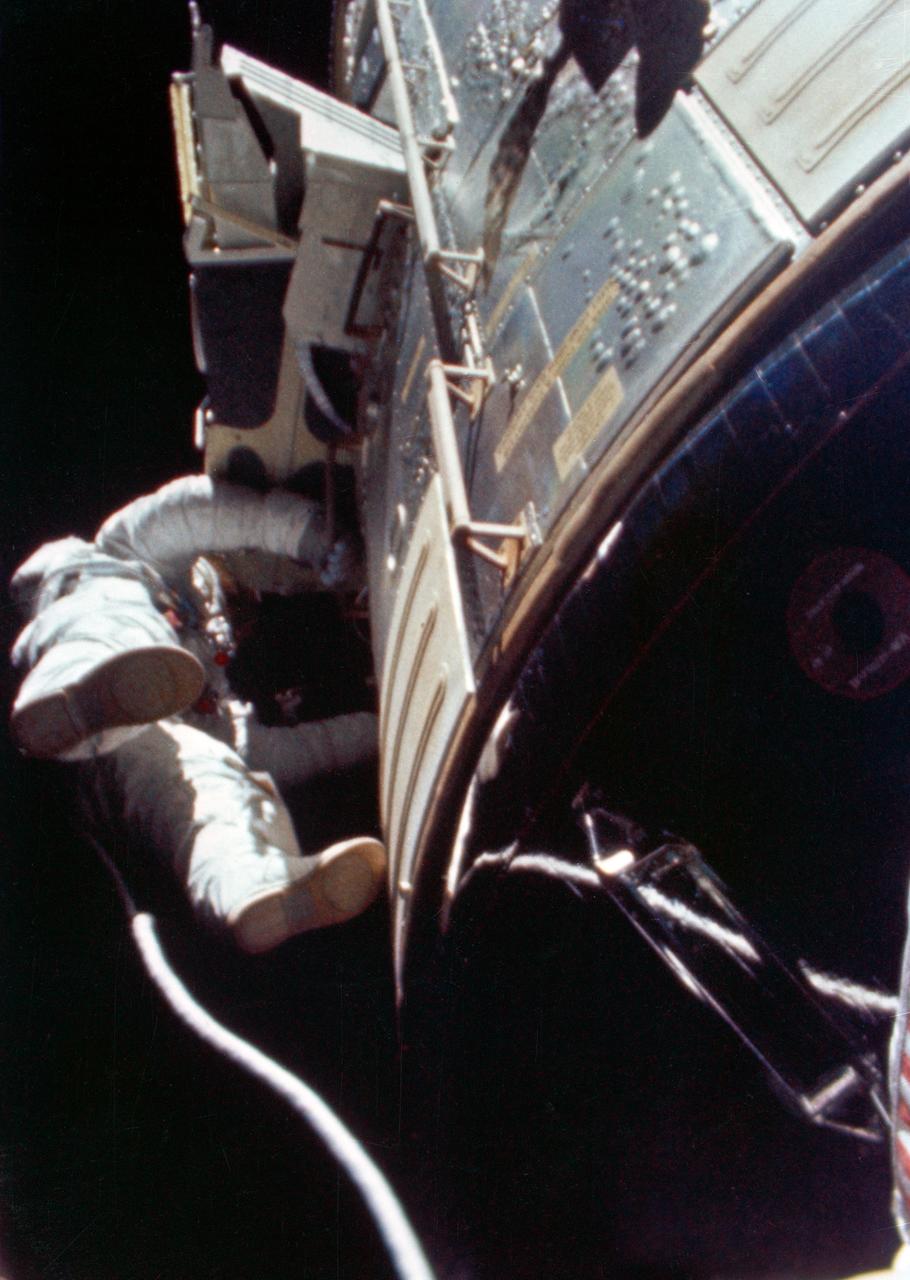
S71-43202 (5 Aug. 1971) --- Astronaut Alfred M. Worden, command module pilot of the Apollo 15 lunar landing mission, floats in space outside the spacecraft during his trans-Earth extravehicular activity (EVA). This photograph was taken from a frame of motion picture film exposed by the 16mm Maurer camera mounted in the hatch of the Command Module (CM). During his EVA, Worden made an inspection of the Service Module's (SM) Scientific Instrument Module (SIM) bay and retrieved the film cassettes from the Panoramic Camera and the Mapping Camera. The SIM bay holds eight orbital science experiments. The EVA occurred when the spacecraft was homeward bound approximately 171,000 nautical miles from Earth.
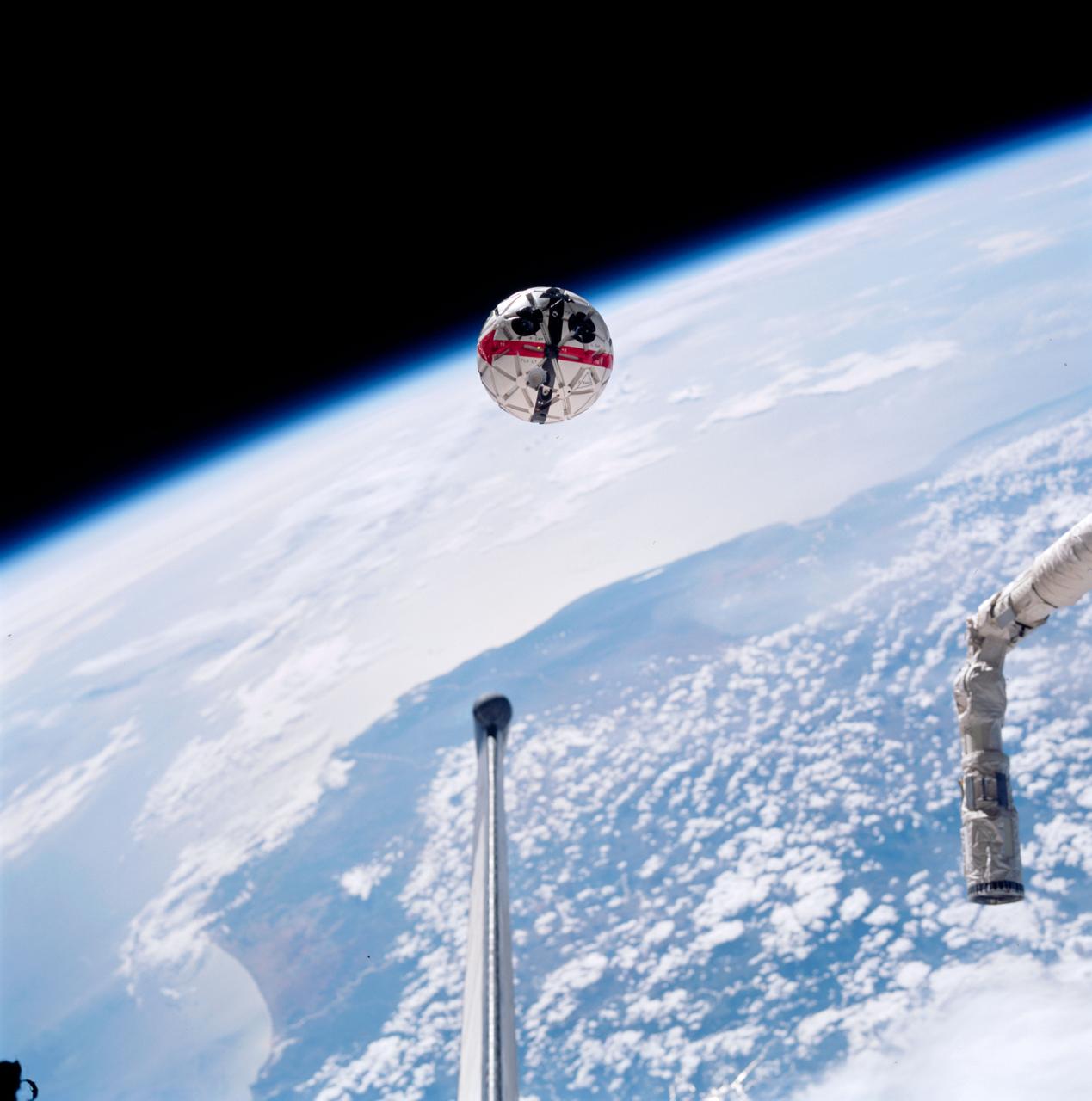
STS087-752-034 (19 November - 5 December 1997) --- This out-the-window view shows the Autonomous Extravehicular Activity Robotic Camera Sprint (AERCam Sprint) free-flying in the vicinity of the cargo bay of the Earth-orbiting Space Shuttle Columbia. The AERCam Sprint is a prototype free-flying television camera that could be used for remote inspections of the exterior of the International Space Station (ISS). This view, backdropped over southern Madagascar, was taken during this flight's second extravehicular activity (EVA), on December 3, 1997.
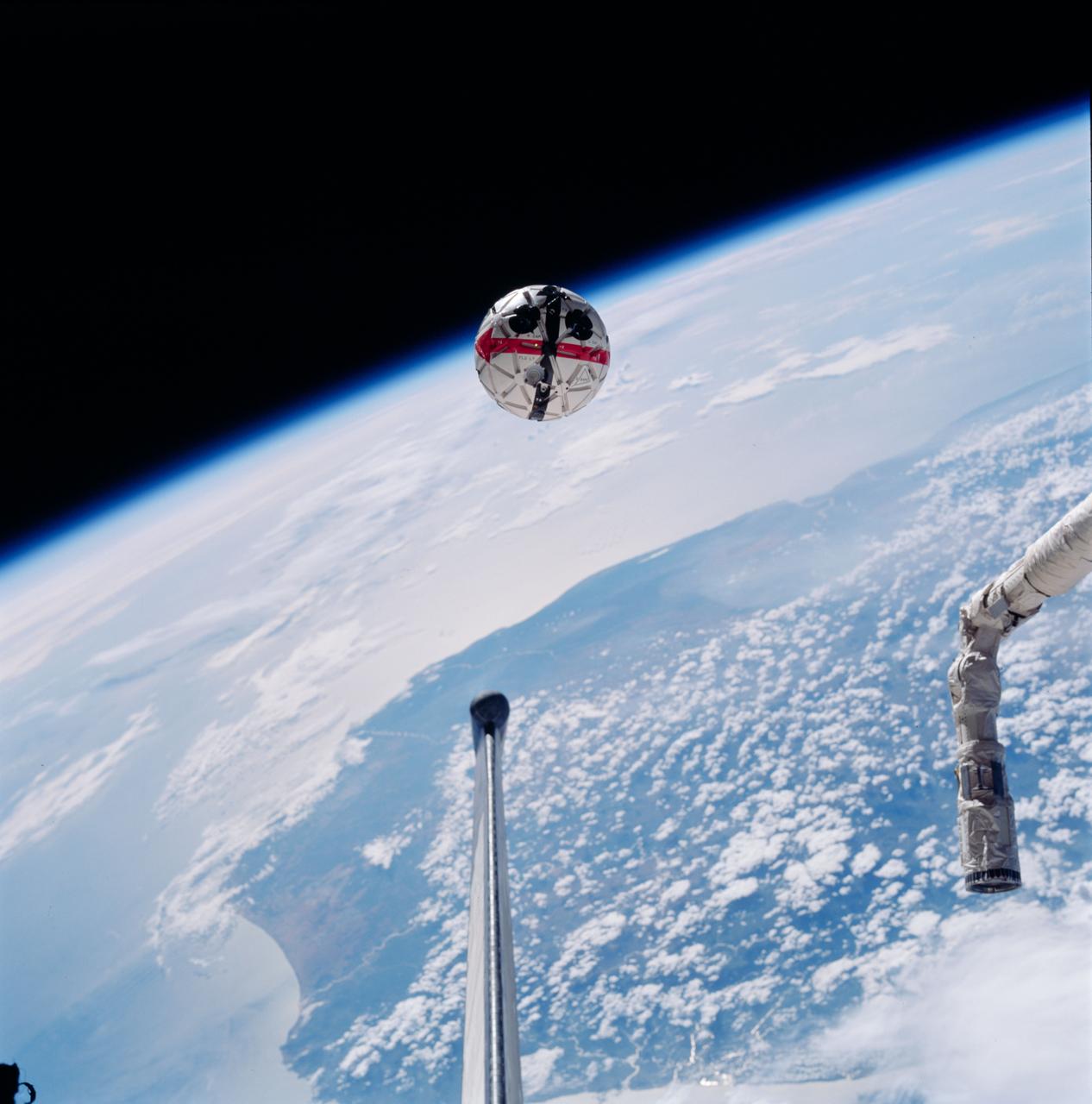
STS087-752-035 (19 November – 5 December 1997) --- This out-the-window view shows the Autonomous Extravehicular Activity Robotic Camera Sprint (AERCam Sprint) free-flying in the vicinity of the cargo bay of the Earth-orbiting Space Shuttle Columbia. The AERCam Sprint is a prototype free-flying television camera that could be used for remote inspections of the exterior of the International Space Station (ISS). This view, backdropped over southern Madagascar, was taken during this flight's second Extravehicular Activity (EVA), on December 3, 1997.

STS087-369-032 (3 Dec. 1997) --- Astronaut Winston E. Scott, mission specialist, during the second extravehicular activity (EVA) in the cargo bay of the Earth-orbiting Space Shuttle Columbia, lets loose a prototype free-flying experiment, the Autonomous Extravehicular Activity Robotic Camera Sprint (AERCam Sprint). AERCam Sprint is a spherically-shaped television camera that could be used for remote inspections of the exterior of the International Space Station (ISS).
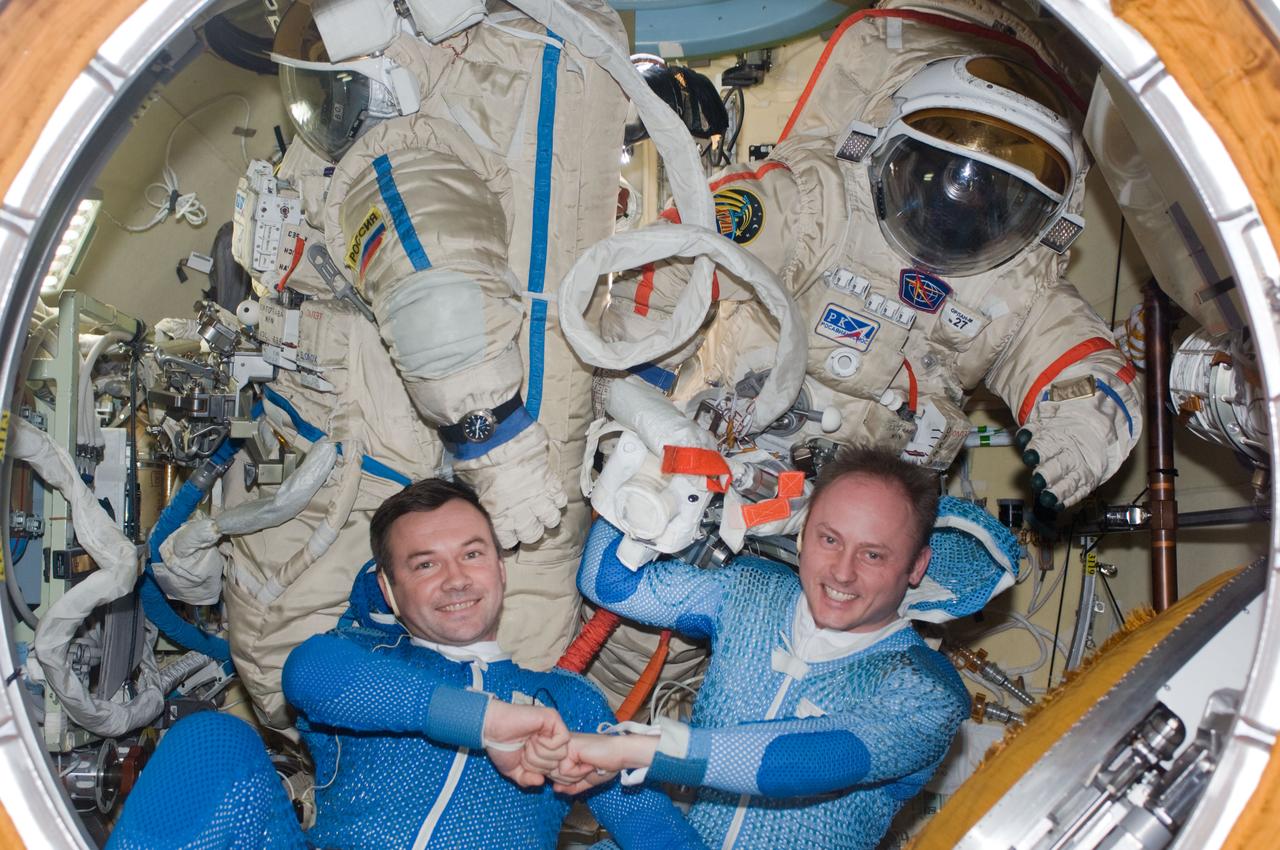
ISS018-E-015110 (22 Dec. 2008) --- Astronaut Michael Fincke (right) and cosmonaut Yury Lonchakov, Expedition 18 commander and flight engineer, respectively, pose for a photo with their Russian Orlan spacesuits in the Pirs Docking Compartment of the International Space Station during preparations for the Dec. 23 spacewalk.
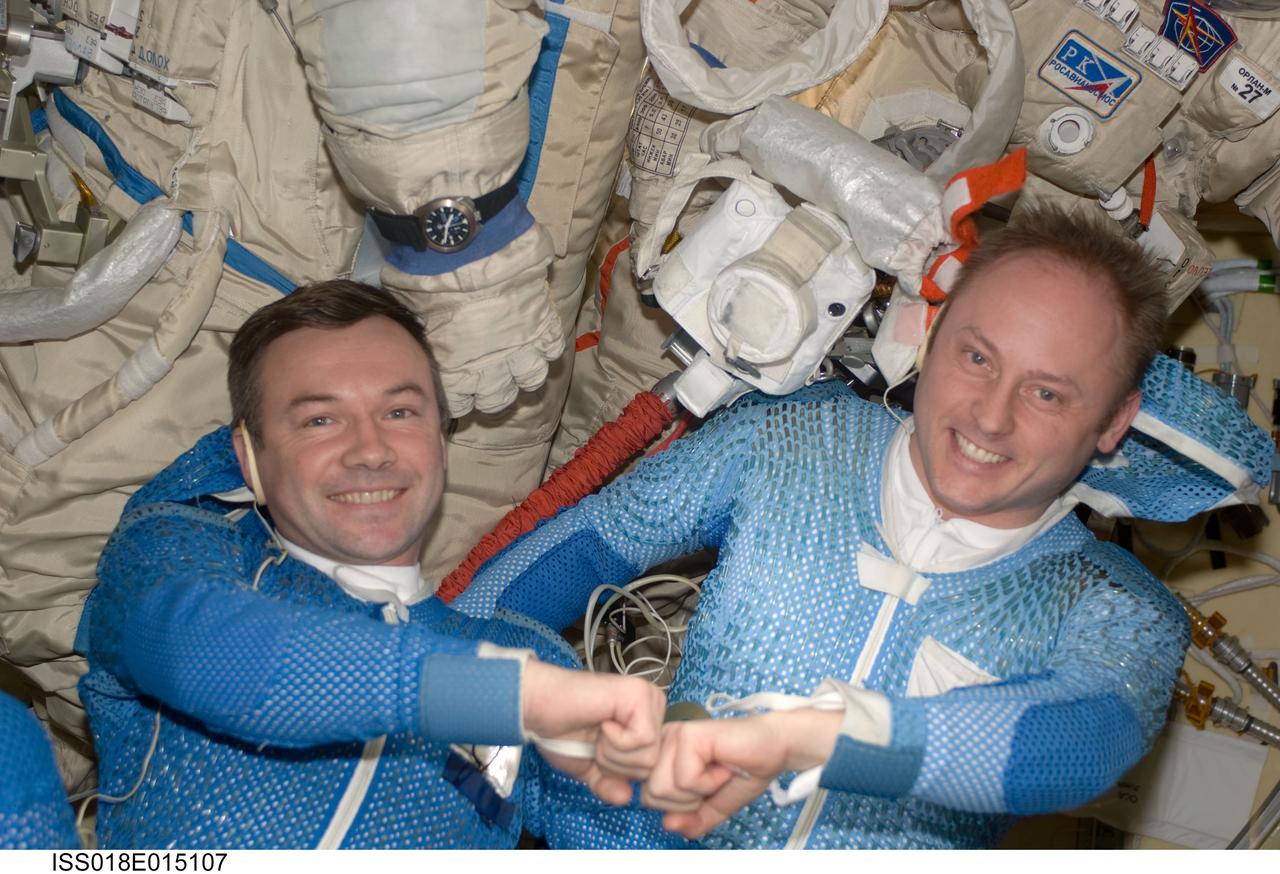
ISS018-E-015107 (22 Dec. 2008) --- Astronaut Michael Fincke (right) and cosmonaut Yury Lonchakov, Expedition 18 commander and flight engineer, respectively, pose for a photo with their Russian Orlan spacesuits in the Pirs Docking Compartment of the International Space Station during preparations for the Dec. 23 spacewalk.
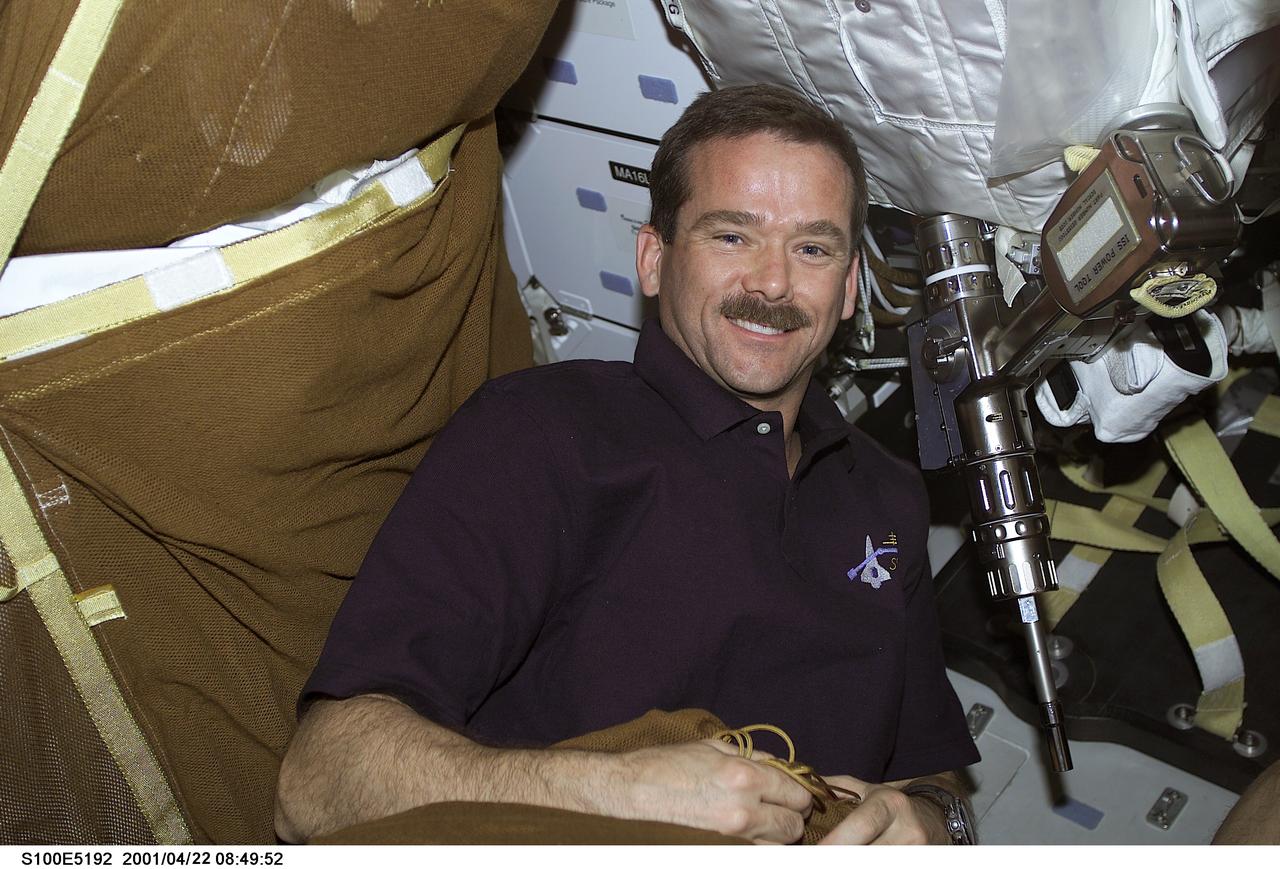
S100-E-5192 (21 April 2001) --- Astronaut Chris A. Hadfield of the Canadian Space Agency (CSA), scheduled as one of two mission specialist participants in April 22 extravehicular activity (EVA) with the International Space Station (ISS), inspects equipment on the middeck of the Space Shuttle Endeavour. The image was recorded with a digital still camera.
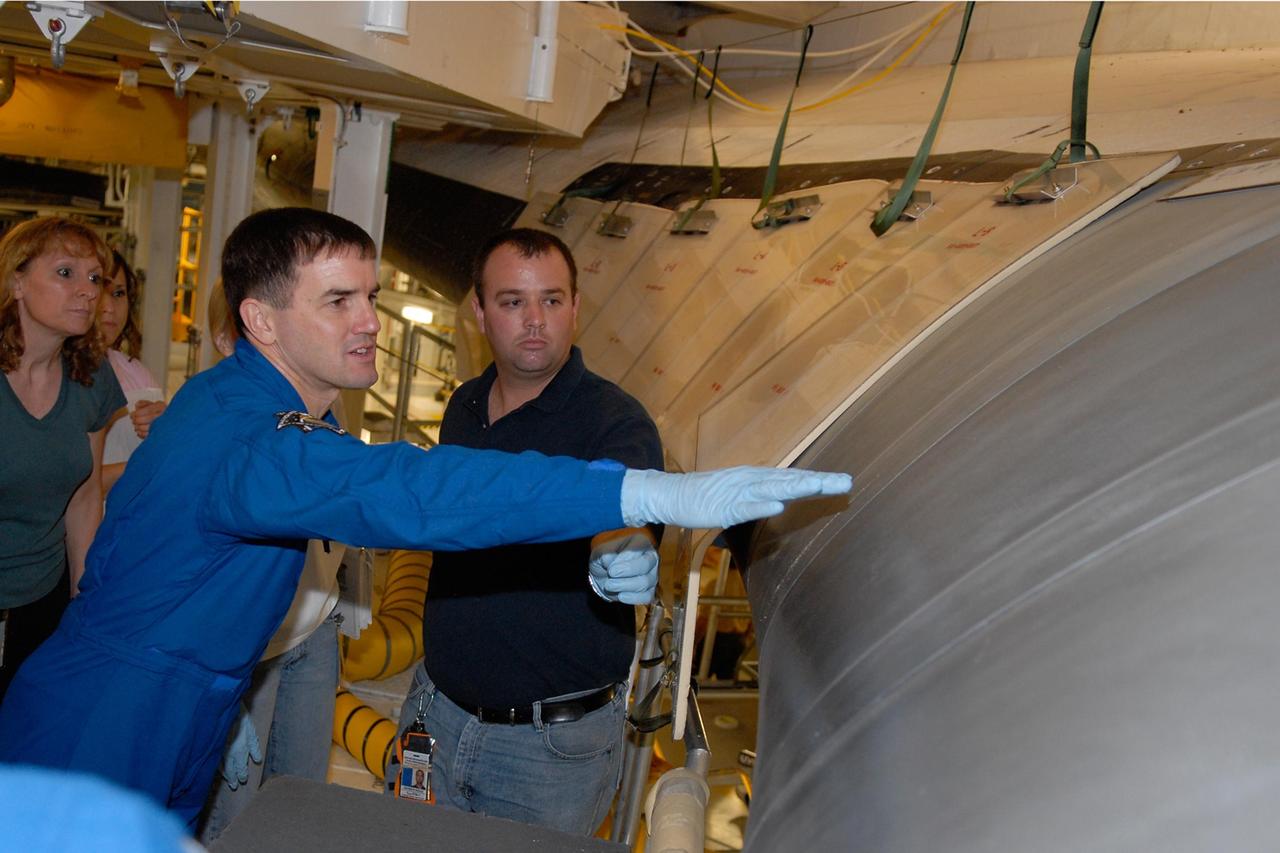
KENNEDY SPACE CENTER, FLA. -- In the Orbiter Processing Facility, STS-122 Mission Specialist Rex Walheim reaches toward the wing of space shuttle Atlantis. The crew is at Kennedy to take part in a crew equipment interface test, or CEIT, which helps familiarize them with equipment and payloads for the mission. Among the activities standard to a CEIT are harness training, inspection of the thermal protection system and camera operation for planned extravehicular activities, or EVAs. STS-122 is targeted for launch in December. Photo credit: NASA/Kim Shiflett
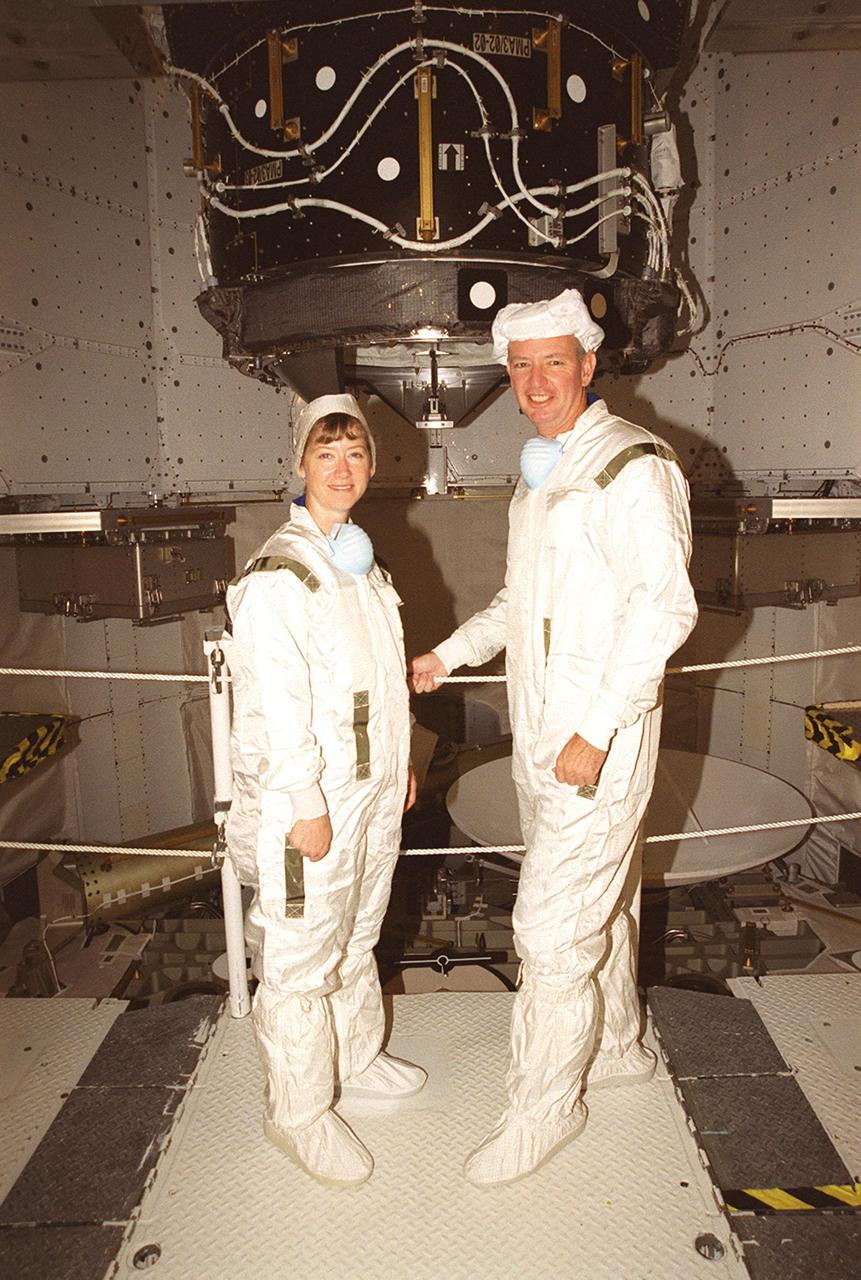
KENNEDY SPACE CENTER, FLA. -- STS-92 Pilot Pamela Ann Melroy (left) and Commander Brian Duffy pose for a photo during payload inspection in Space Shuttle Discovery’s payload bay. Behind them is the Pressurized Mating Adapter. The STS-92 crew has been inspecting the payload in preparation for launch Oct. 5, 2000. The mission is the fifth flight for the construction of the International Space Station. The payload also includes the Integrated Truss Structure Z-1. During the 11-day mission, four extravehicular activities (EVAs), or space walks, are planned
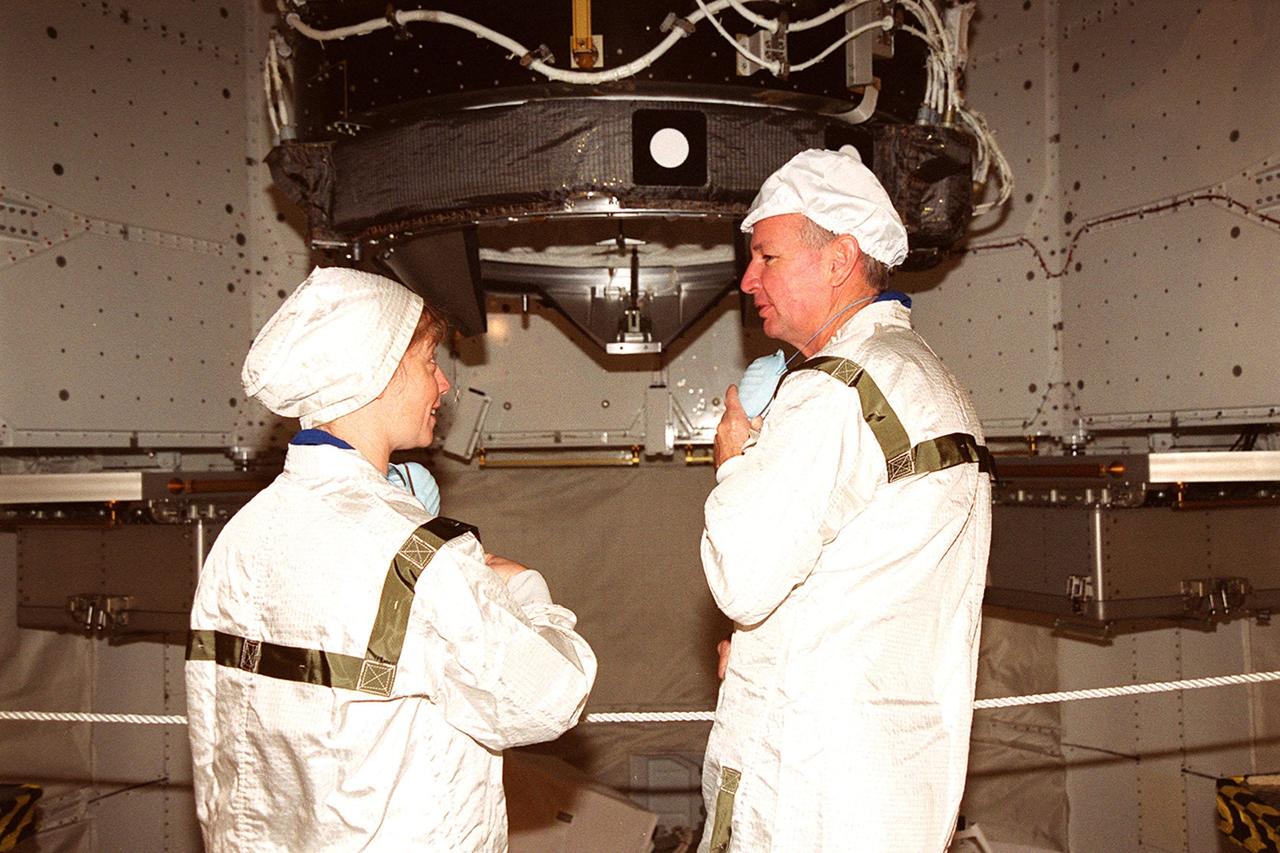
KENNEDY SPACE CENTER, FLA. -- In Space Shuttle Discovery’s payload bay, STS-92 Pilot Pamela Ann Melroy (left) and Commander Brian Duffy share thoughts about the mission as they inspect part of the payload (behind them), the Pressurized Mating Adapter. The STS-92 crew has been inspecting the payload in preparation for launch Oct. 5, 2000. The mission is the fifth flight for the construction of the International Space Station. The payload also includes the Integrated Truss Structure Z-1. During the 11-day mission, four extravehicular activities (EVAs), or space walks, are planned
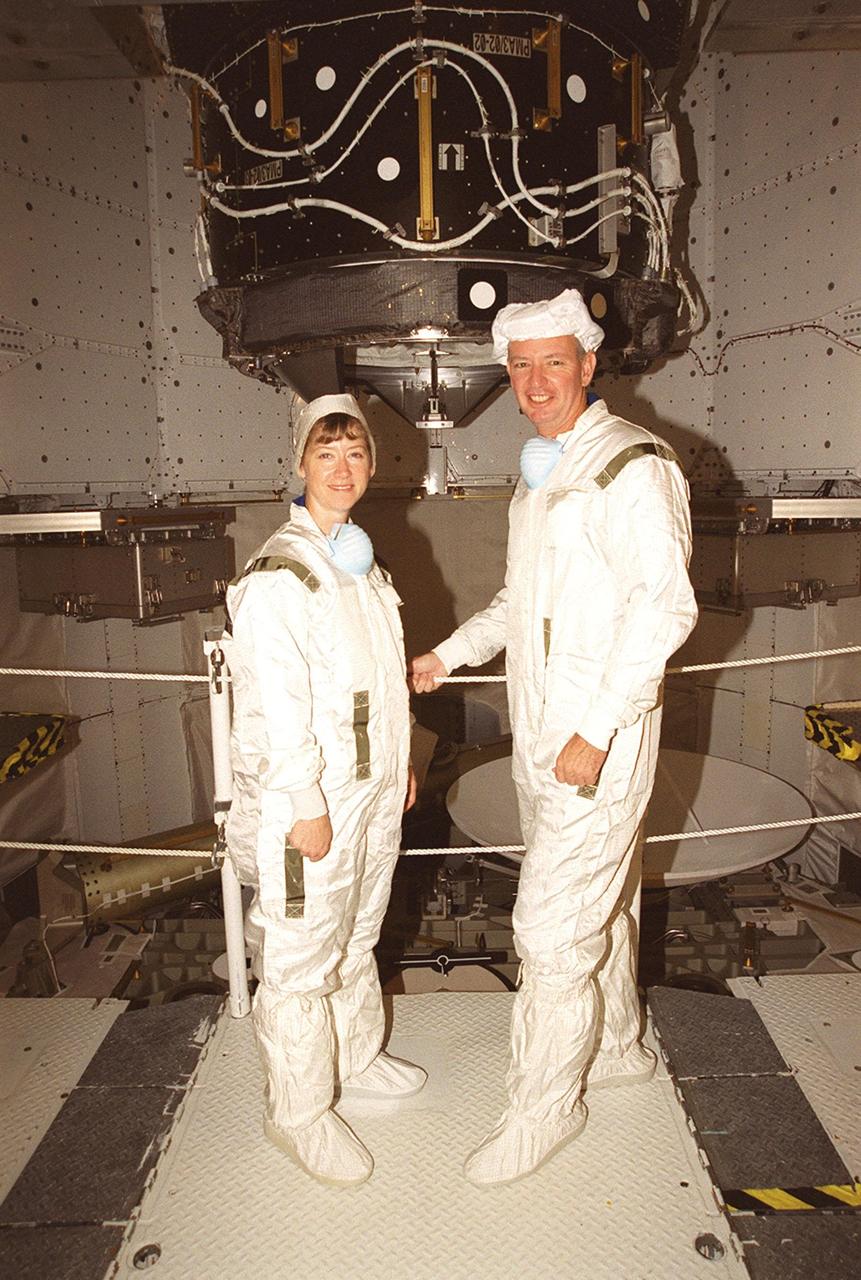
KENNEDY SPACE CENTER, FLA. -- STS-92 Pilot Pamela Ann Melroy (left) and Commander Brian Duffy pose for a photo during payload inspection in Space Shuttle Discovery’s payload bay. Behind them is the Pressurized Mating Adapter. The STS-92 crew has been inspecting the payload in preparation for launch Oct. 5, 2000. The mission is the fifth flight for the construction of the International Space Station. The payload also includes the Integrated Truss Structure Z-1. During the 11-day mission, four extravehicular activities (EVAs), or space walks, are planned
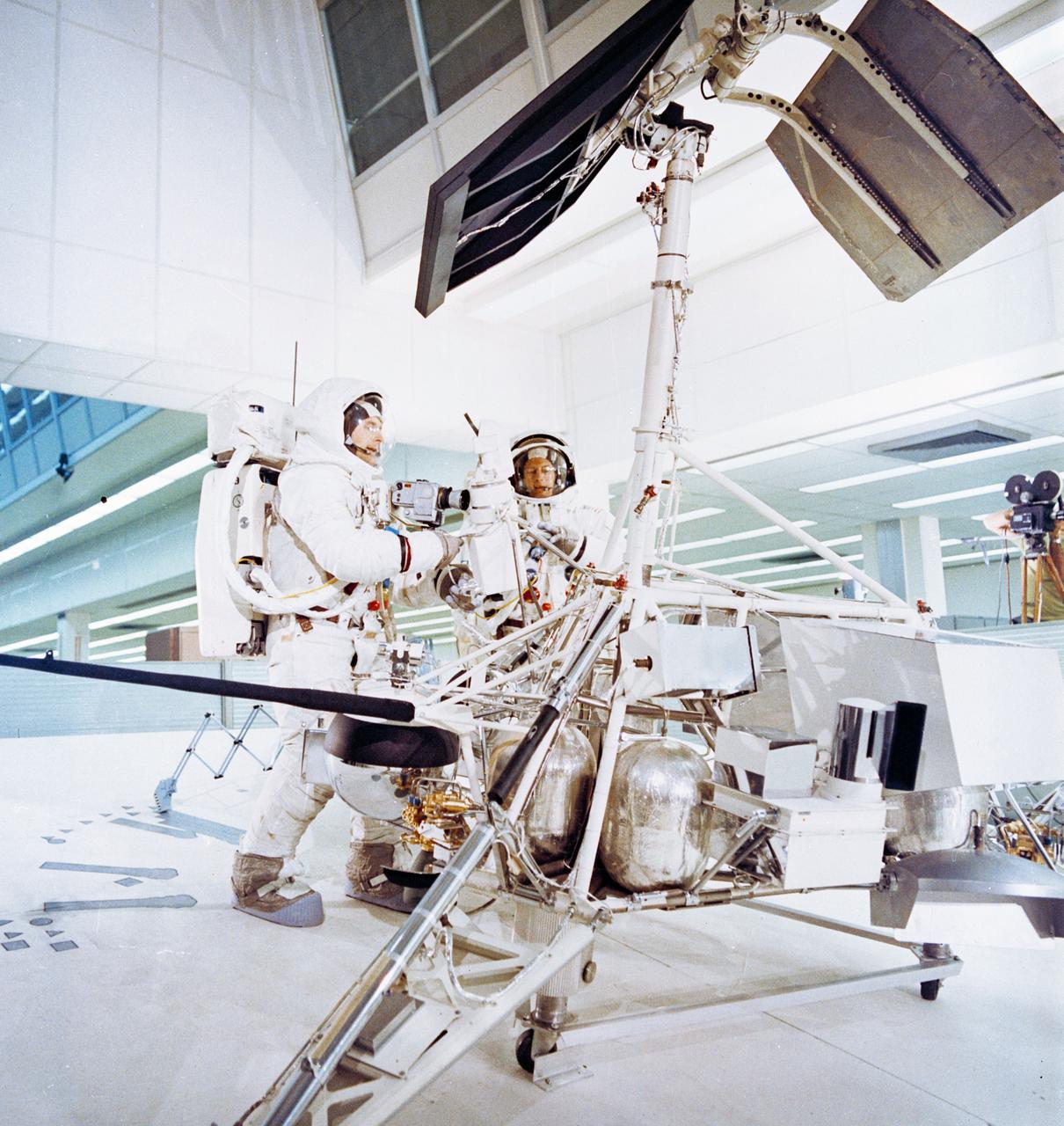
S69-55367 (6 Oct. 1969) --- Two members of the Apollo 12 lunar landing mission participate in lunar surface extravehicular activity (EVA) simulations in the Kennedy Space Center's (KSC) Flight Crew Training Building. Here, astronauts Charles Conrad Jr. (right), commander; and Alan L. Bean, lunar module pilot, simulate a photographic inspection of the unmanned Surveyor 3 spacecraft. The inspection of Surveyor 3, which has been resting on the moon's Ocean of Storms since April 1967, is an important objective of the Apollo 12 mission. Selected pieces will be cut from Surveyor 3 and brought back to Earth for scientific examination.
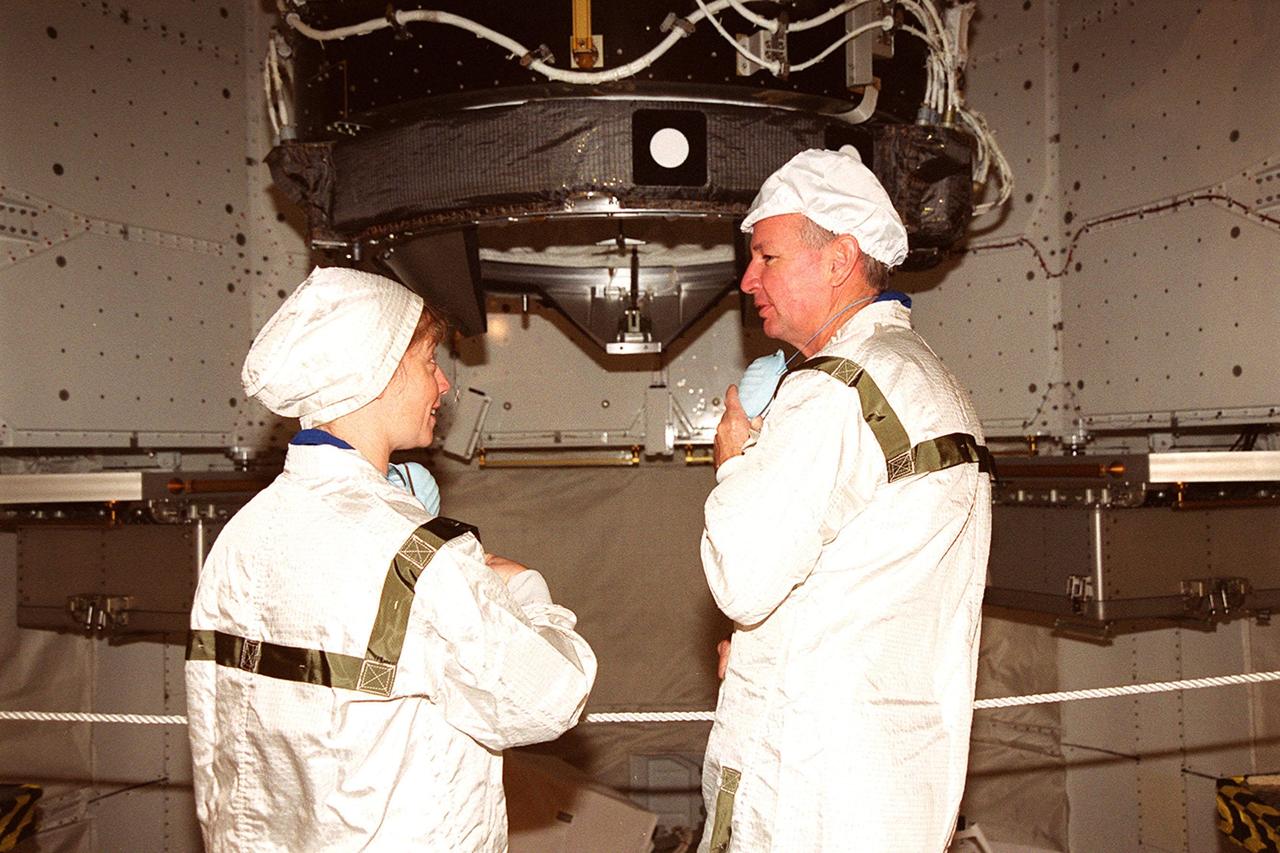
KENNEDY SPACE CENTER, FLA. -- In Space Shuttle Discovery’s payload bay, STS-92 Pilot Pamela Ann Melroy (left) and Commander Brian Duffy share thoughts about the mission as they inspect part of the payload (behind them), the Pressurized Mating Adapter. The STS-92 crew has been inspecting the payload in preparation for launch Oct. 5, 2000. The mission is the fifth flight for the construction of the International Space Station. The payload also includes the Integrated Truss Structure Z-1. During the 11-day mission, four extravehicular activities (EVAs), or space walks, are planned

ISS040-E-099399 (18 Aug. 2014) --- Russian cosmonaut Alexander Skvortsov, Expedition 40 flight engineer, attired in a Russian Orlan spacesuit, participates in a session of extravehicular activity (EVA) in support of science and maintenance on the International Space Station. During the five-hour, 11-minute spacewalk, Skvortsov and cosmonaut Oleg Artemyev (out of frame) deployed a small science satellite, retrieved and installed experiment packages and inspected components on the exterior of the orbital laboratory.

ISS040-E-099251 (18 Aug. 2014) --- Russian cosmonaut Oleg Artemyev, Expedition 40 flight engineer, uses a digital still camera to expose a photo of his helmet visor during a session of extravehicular activity (EVA) as work continues outside the International Space Station. During the five-hour, 11-minute spacewalk, Artemyev and cosmonaut Alexander Skvortsov (out of frame), flight engineer, deployed a small science satellite, retrieved and installed experiment packages and inspected components on the exterior of the orbital laboratory.
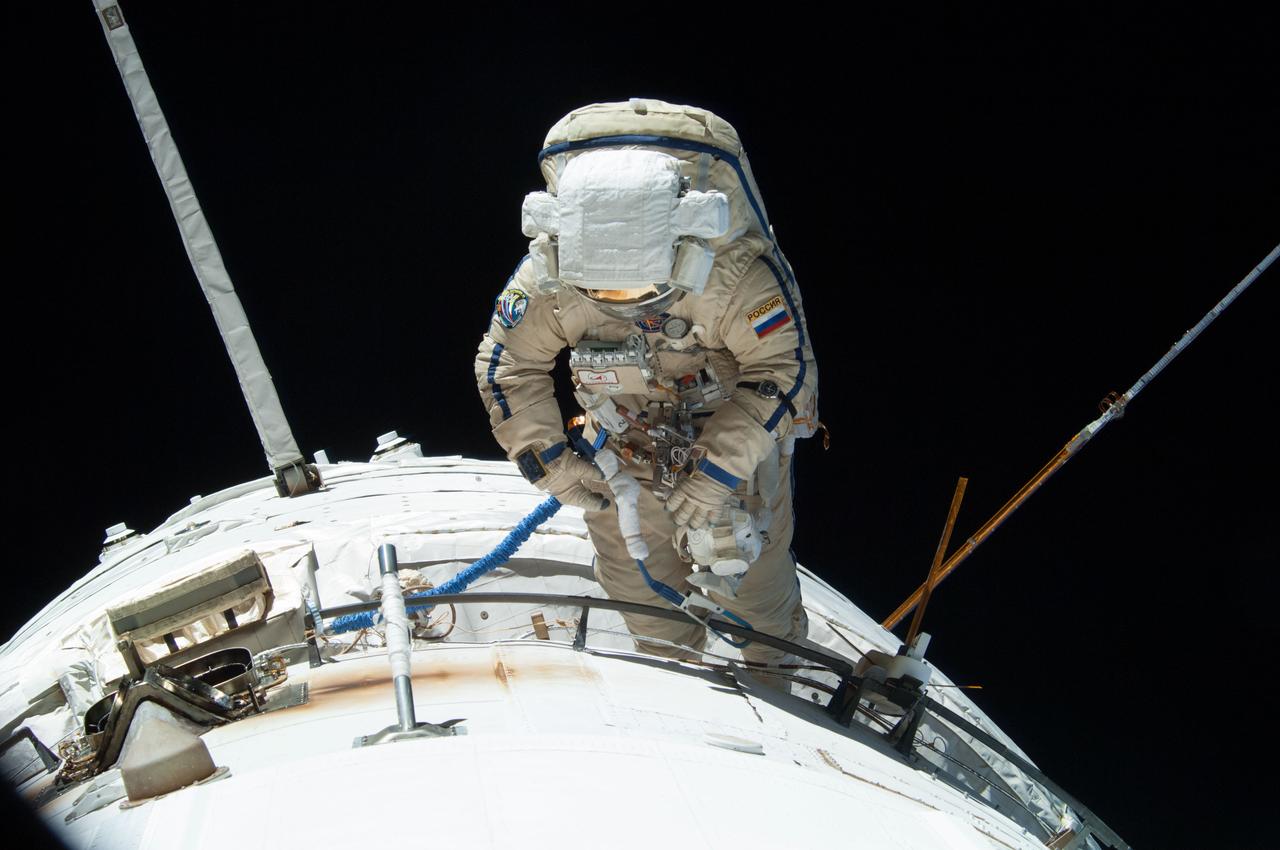
ISS036-E-035130 (22 Aug. 2013) --- Russian cosmonaut Alexander Misurkin, Expedition 36 flight engineer, attired in a Russian Orlan spacesuit, participates in a session of extravehicular activity (EVA) to continue outfitting the International Space Station. During the five-hour, 58-minute spacewalk, Misurkin and Russian cosmonaut Fyodor Yurchikhin (out of frame) completed the replacement of a laser communications experiment with a new platform for a small optical camera system, the installation of new spacewalk aids and an inspection of antenna covers.
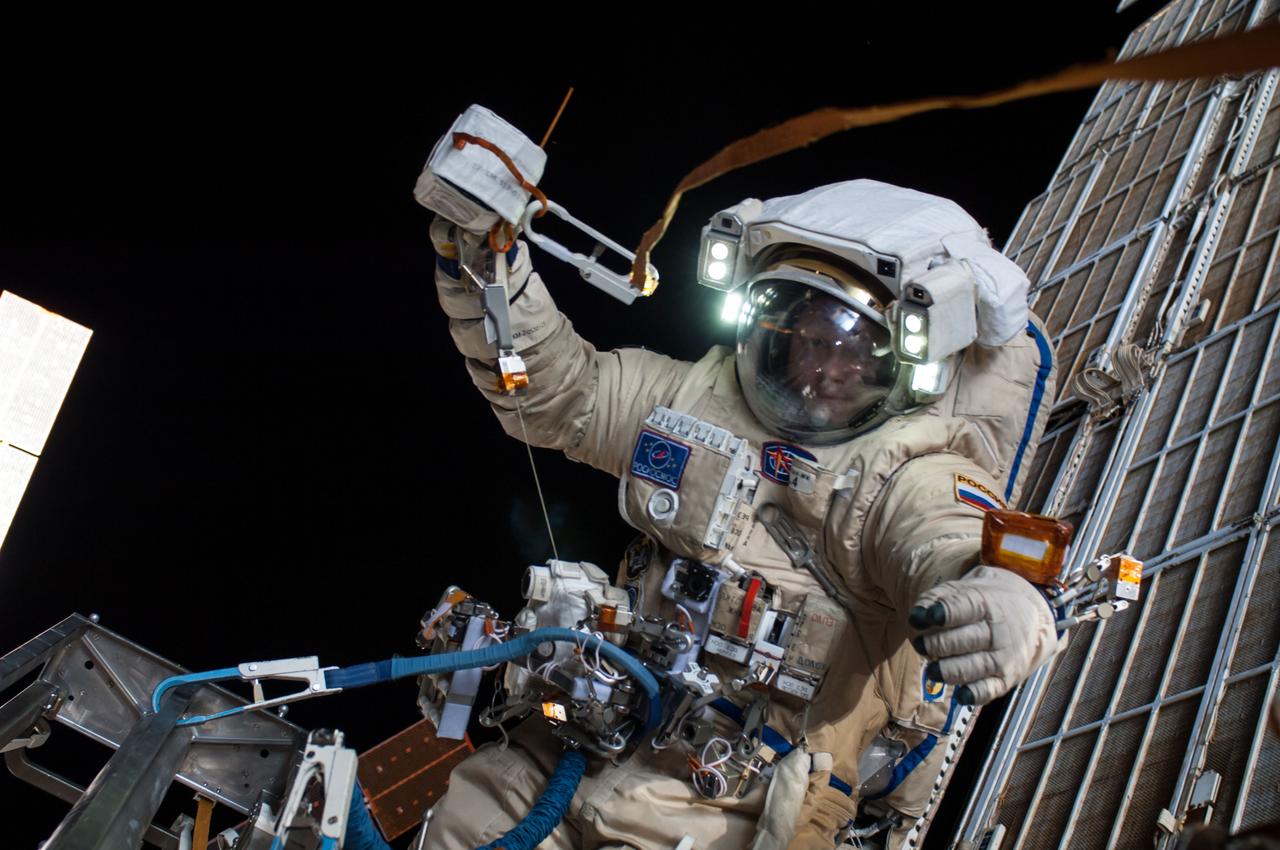
ISS040-E-099097 (18 Aug. 2014) --- Russian cosmonaut Oleg Artemyev, Expedition 40 flight engineer, attired in a Russian Orlan spacesuit, participates in a session of extravehicular activity (EVA) in support of science and maintenance on the International Space Station. During the five-hour, 11-minute spacewalk, Artemyev and Alexander Skvortsov (out of frame) deployed a small science satellite, retrieved and installed experiment packages and inspected components on the exterior of the orbital laboratory.

ISS040-E-099412 (18 Aug. 2014) --- Russian cosmonaut Alexander Skvortsov, Expedition 40 flight engineer, attired in a Russian Orlan spacesuit, uses a still camera during a session of extravehicular activity (EVA) in support of science and maintenance on the International Space Station. During the five-hour, 11-minute spacewalk, Skvortsov and cosmonaut Oleg Artemyev (out of frame) deployed a small science satellite, retrieved and installed experiment packages and inspected components on the exterior of the orbital laboratory.

ISS040-E-099394 (18 Aug. 2014) --- Russian cosmonaut Alexander Skvortsov, Expedition 40 flight engineer, attired in a Russian Orlan spacesuit, is pictured near a station window during a session of extravehicular activity (EVA) in support of science and maintenance on the International Space Station. During the five-hour, 11-minute spacewalk, Skvortsov and cosmonaut Oleg Artemyev (out of frame) deployed a small science satellite, retrieved and installed experiment packages and inspected components on the exterior of the orbital laboratory.

ISS036-E-035163 (22 Aug. 2013) --- Russian cosmonaut Alexander Misurkin, Expedition 36 flight engineer, attired in a Russian Orlan spacesuit, participates in a session of extravehicular activity (EVA) to continue outfitting the International Space Station. During the five-hour, 58-minute spacewalk, Misurkin and Russian cosmonaut Fyodor Yurchikhin (out of frame) completed the replacement of a laser communications experiment with a new platform for a small optical camera system, the installation of new spacewalk aids and an inspection of antenna covers.
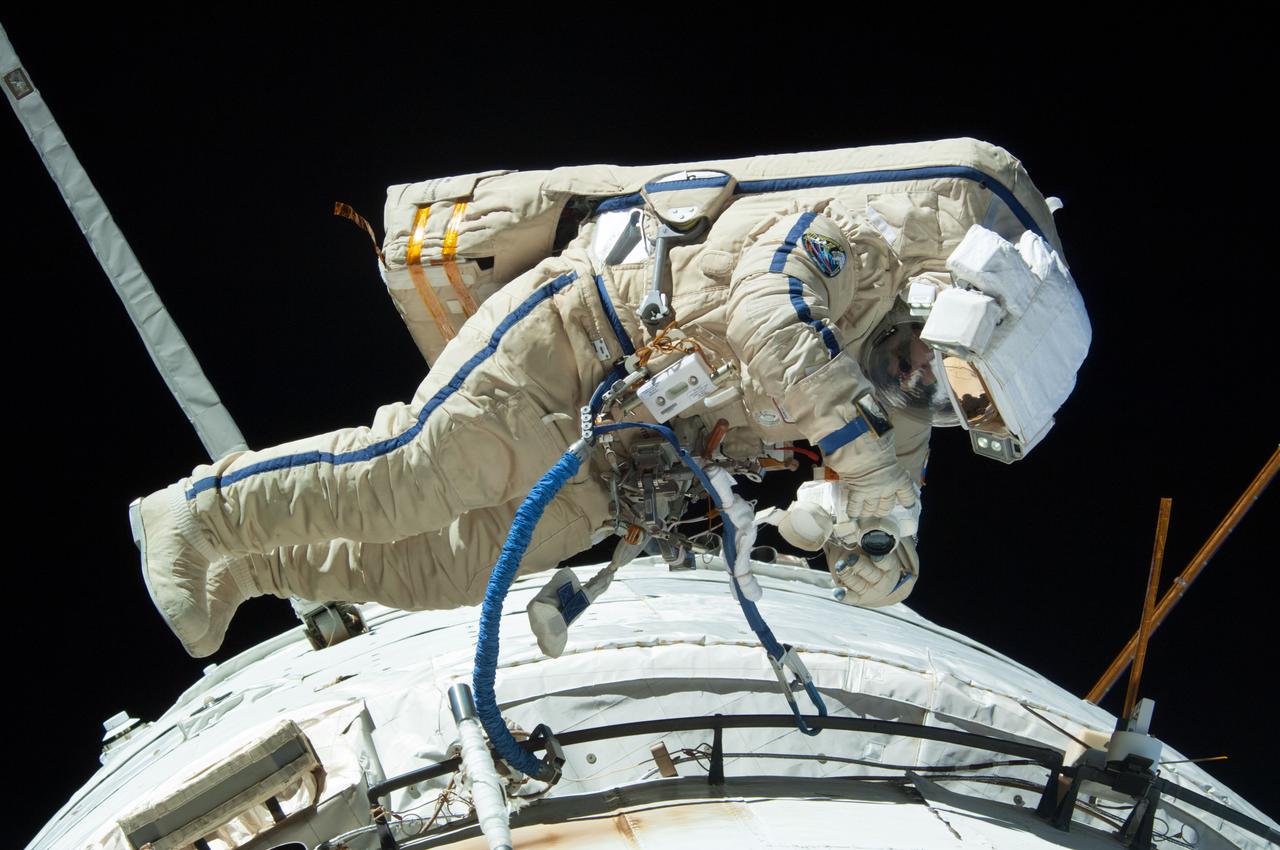
ISS036-E-035126 (22 Aug. 2013) --- Russian cosmonaut Alexander Misurkin, Expedition 36 flight engineer, attired in a Russian Orlan spacesuit, participates in a session of extravehicular activity (EVA) to continue outfitting the International Space Station. During the five-hour, 58-minute spacewalk, Misurkin and Russian cosmonaut Fyodor Yurchikhin (out of frame) completed the replacement of a laser communications experiment with a new platform for a small optical camera system, the installation of new spacewalk aids and an inspection of antenna covers.

ISS040-E-099377 (18 Aug. 2014) --- Russian cosmonaut Alexander Skvortsov, Expedition 40 flight engineer, attired in a Russian Orlan spacesuit, participates in a session of extravehicular activity (EVA) in support of science and maintenance on the International Space Station. During the five-hour, 11-minute spacewalk, Skvortsov and cosmonaut Oleg Artemyev (out of frame) deployed a small science satellite, retrieved and installed experiment packages and inspected components on the exterior of the orbital laboratory.
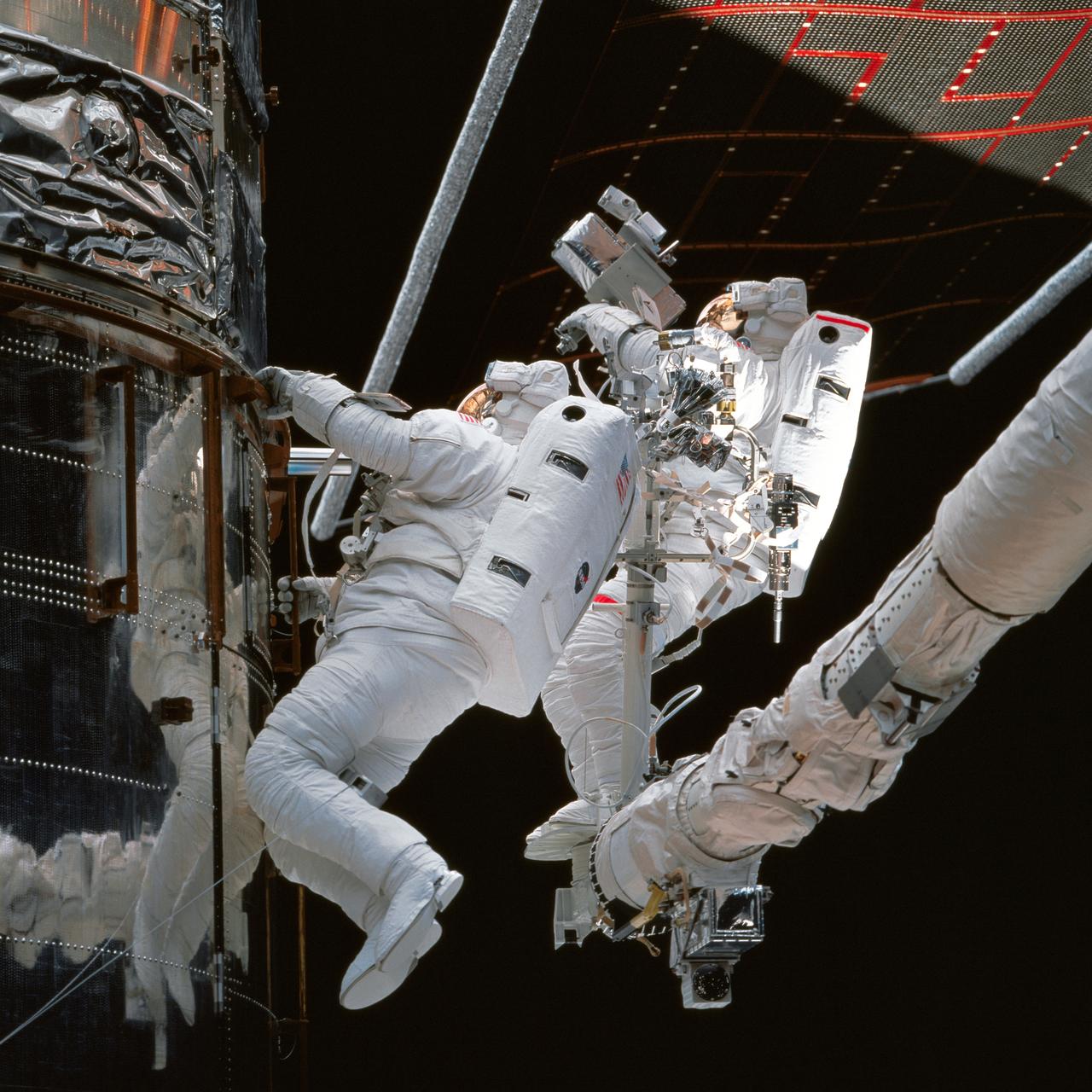
STS082-738-054 (11-21 Feb. 1997) --- As photographed from inside the Space Shuttle Discovery?s crew cabin, astronauts Steven L. Smith (left) and Mark C. Lee (red stripe) inspect insulation around Bay 10 of the Hubble Space Telescope (HST) during one of five days of extravehicular activities (EVA) designed to service the HST. Lee, payload commander, and Smith, performed three of the five EVA?s which eventually were carried out on the mission.
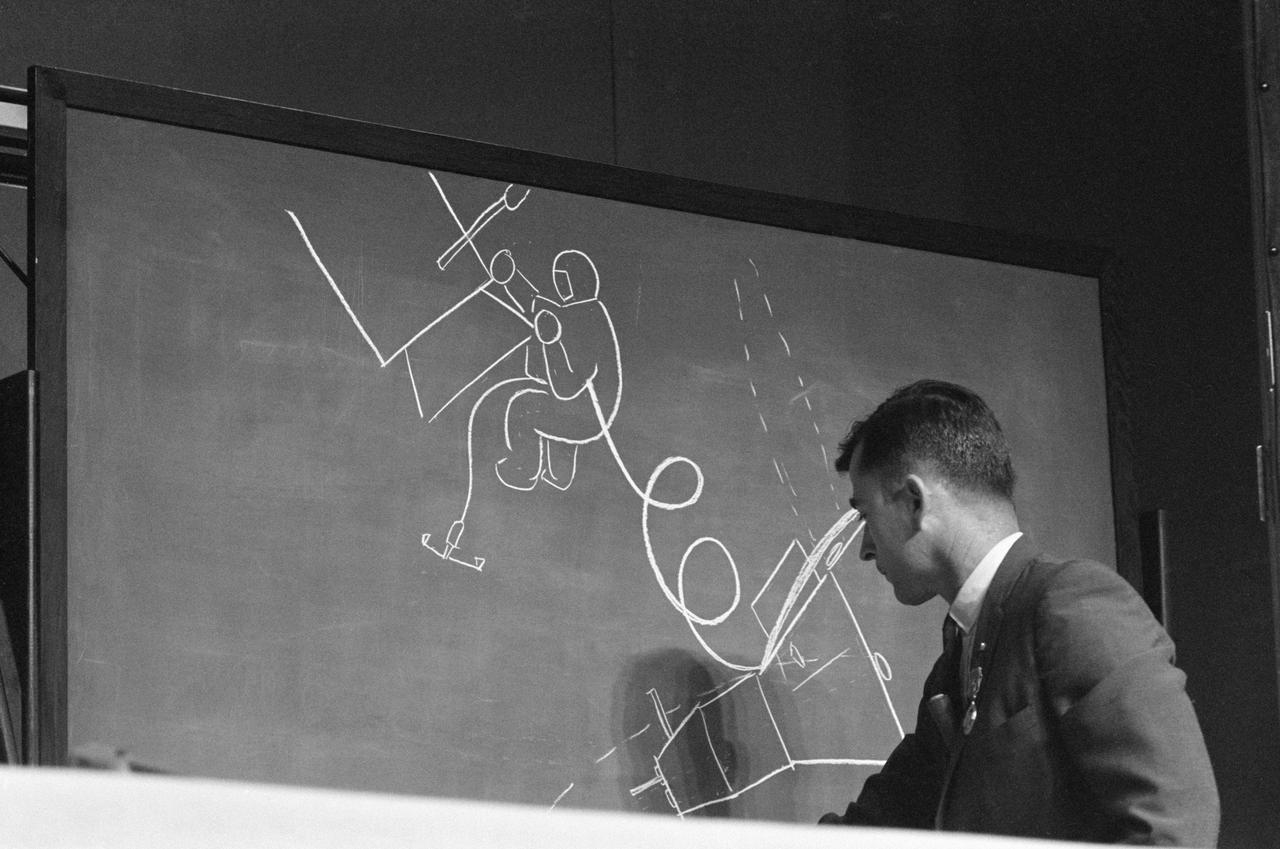
S66-39897 (1 Aug. 1966) --- Astronaut John W. Young, Gemini-10 command pilot, uses a chalk drawing on a blackboard to illustrate how astronaut Michael Collins, Gemini-10 pilot, looked when he inspected the Agena Target Docking Vehicle during his extravehicular activity. Young was discussing the mission before a gathering of news media representatives in the Building 1 auditorium. Photo credit: NASA
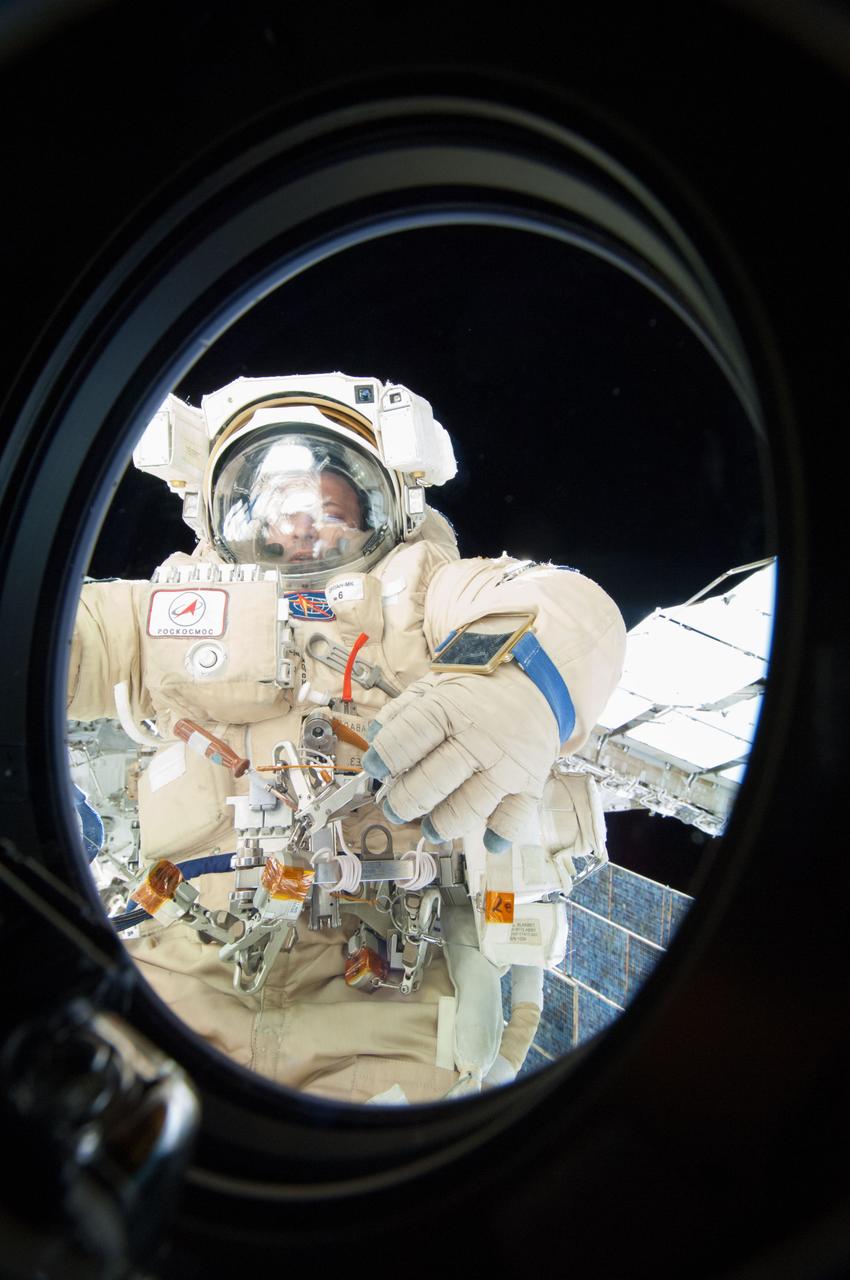
ISS036-E-035205 (22 Aug. 2013) --- Russian cosmonaut Alexander Misurkin, Expedition 36 flight engineer, attired in a Russian Orlan spacesuit, participates in a session of extravehicular activity (EVA) to continue outfitting the International Space Station. During the five-hour, 58-minute spacewalk, Misurkin and Russian cosmonaut Fyodor Yurchikhin (out of frame) completed the replacement of a laser communications experiment with a new platform for a small optical camera system, the installation of new spacewalk aids and an inspection of antenna covers.

ISS040-E-099392 (18 Aug. 2014) --- Russian cosmonaut Alexander Skvortsov, Expedition 40 flight engineer, attired in a Russian Orlan spacesuit, is pictured in this close-up view during a session of extravehicular activity (EVA) in support of science and maintenance on the International Space Station. During the five-hour, 11-minute spacewalk, Skvortsov and cosmonaut Oleg Artemyev (out of frame) deployed a small science satellite, retrieved and installed experiment packages and inspected components on the exterior of the orbital laboratory.
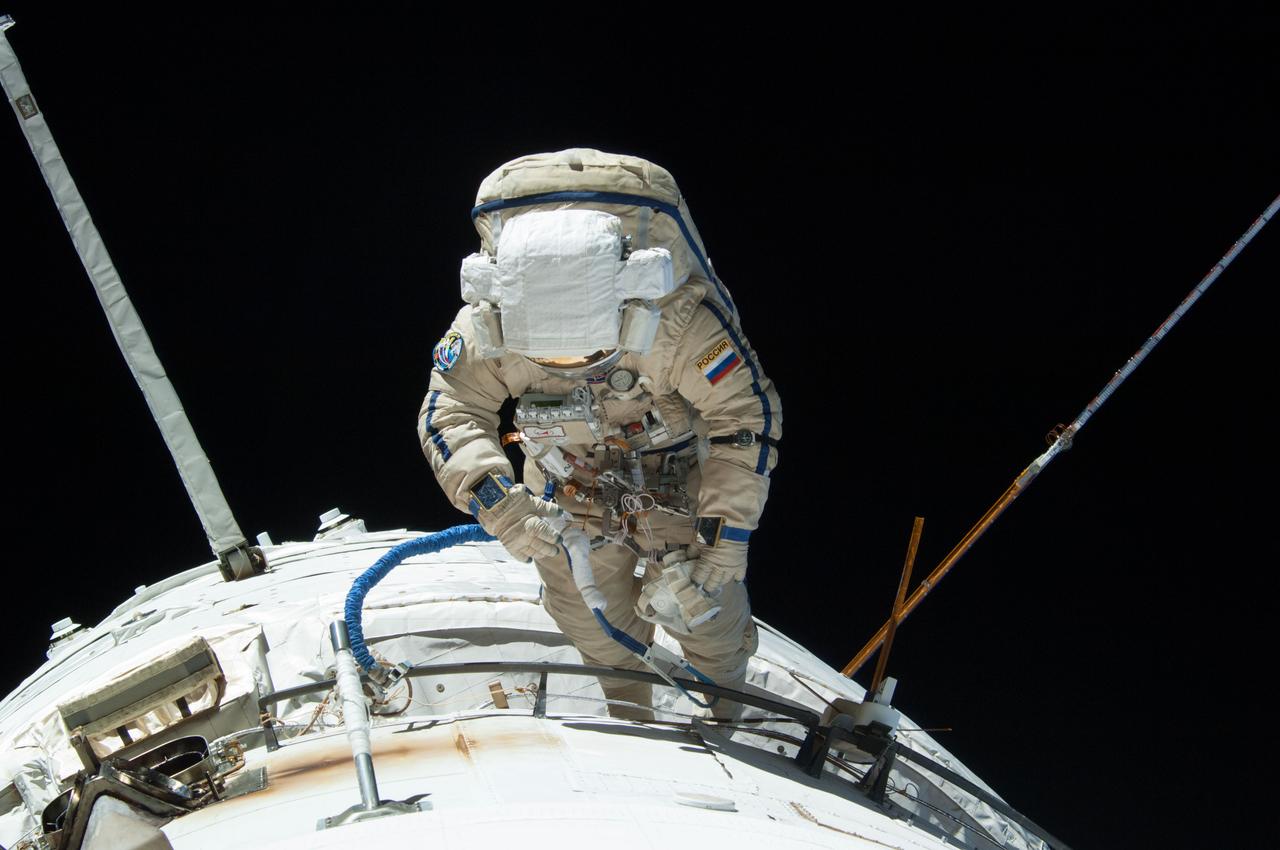
ISS036-E-035129 (22 Aug. 2013) --- Russian cosmonaut Alexander Misurkin, Expedition 36 flight engineer, attired in a Russian Orlan spacesuit, participates in a session of extravehicular activity (EVA) to continue outfitting the International Space Station. During the five-hour, 58-minute spacewalk, Misurkin and Russian cosmonaut Fyodor Yurchikhin (out of frame) completed the replacement of a laser communications experiment with a new platform for a small optical camera system, the installation of new spacewalk aids and an inspection of antenna covers.

ISS040-E-099375 (18 Aug. 2014) --- Russian cosmonauts Alexander Skvortsov and Oleg Artemyev (out of frame), both Expedition 40 flight engineers, attired in Russian Orlan spacesuits, participate in a session of extravehicular activity (EVA) in support of science and maintenance on the International Space Station. During the five-hour, 11-minute spacewalk, Artemyev and Skvortsov deployed a small science satellite, retrieved and installed experiment packages and inspected components on the exterior of the orbital laboratory.

ISS040-E-100022 (18 Aug. 2014) --- Russian cosmonaut Oleg Artemyev, Expedition 40 flight engineer, attired in a Russian Orlan spacesuit, is pictured in this close-up view during a session of extravehicular activity (EVA) in support of science and maintenance on the International Space Station. During the five-hour, 11-minute spacewalk, Artemyev and cosmonaut Alexander Skvortsov (out of frame), flight engineer, deployed a small science satellite, retrieved and installed experiment packages and inspected components on the exterior of the orbital laboratory.

ISS040-E-099101 (18 Aug. 2014) --- Russian cosmonaut Oleg Artemyev, Expedition 40 flight engineer, attired in a Russian Orlan spacesuit, participates in a session of extravehicular activity (EVA) in support of science and maintenance on the International Space Station. During the five-hour, 11-minute spacewalk, Artemyev and Alexander Skvortsov (out of frame) deployed a small science satellite, retrieved and installed experiment packages and inspected components on the exterior of the orbital laboratory.
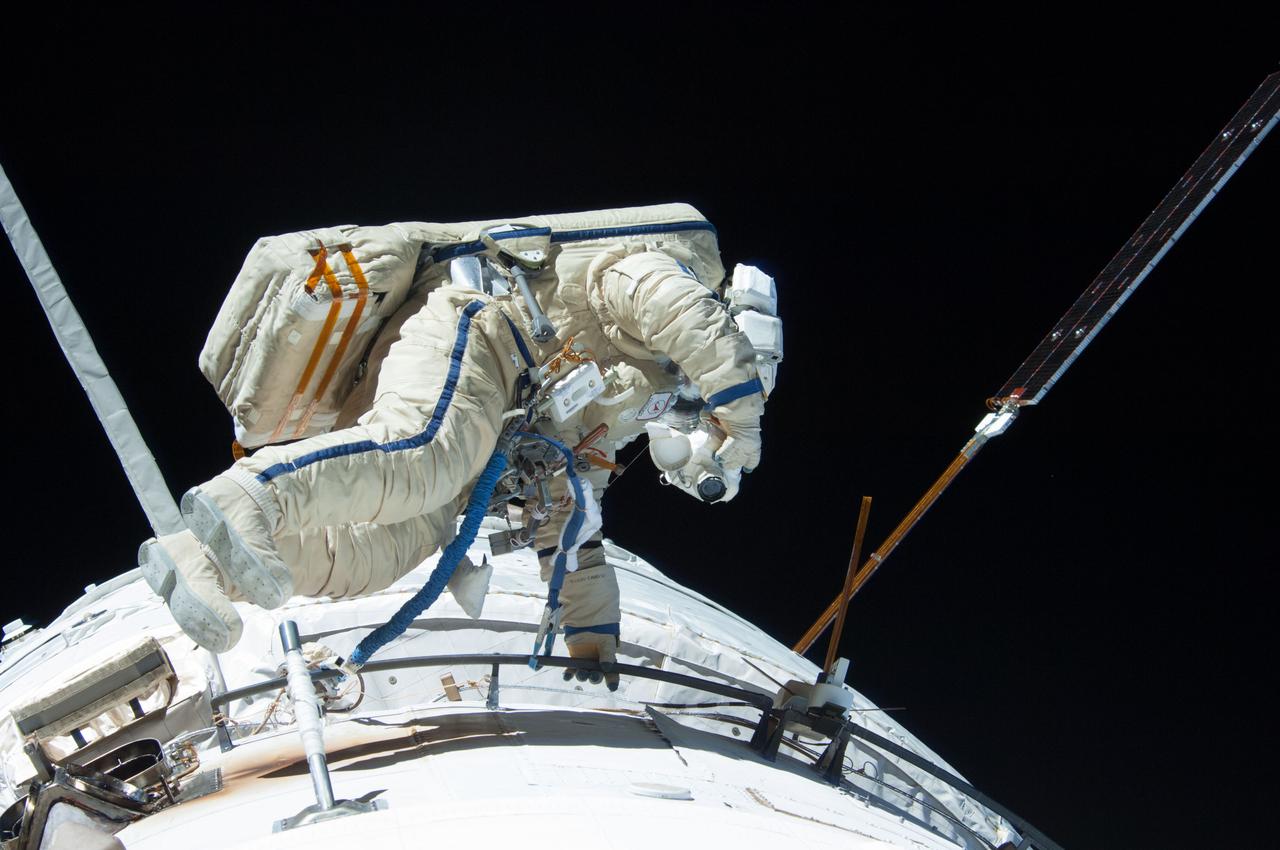
ISS036-E-035124 (22 Aug. 2013) --- Russian cosmonaut Alexander Misurkin, Expedition 36 flight engineer, attired in a Russian Orlan spacesuit, participates in a session of extravehicular activity (EVA) to continue outfitting the International Space Station. During the five-hour, 58-minute spacewalk, Misurkin and Russian cosmonaut Fyodor Yurchikhin (out of frame) completed the replacement of a laser communications experiment with a new platform for a small optical camera system, the installation of new spacewalk aids and an inspection of antenna covers.

S100-E-5193 (21 April 2001) --- Astronauts Chris A. Hadfield (left) of the Canadian Space Agency (CSA) and Scott E. Parazynski, both mission specialists for STS-100, share thoughts of scheduled April 22 extravehicular activity (EVA), while inspecting equipment on the middeck of the Space Shuttle Endeavour. The image was recorded with a digital still camera.

ISS040-E-099407 (18 Aug. 2014) --- Russian cosmonaut Alexander Skvortsov, Expedition 40 flight engineer, attired in a Russian Orlan spacesuit, uses a still camera during a session of extravehicular activity (EVA) in support of science and maintenance on the International Space Station. During the five-hour, 11-minute spacewalk, Skvortsov and cosmonaut Oleg Artemyev (out of frame) deployed a small science satellite, retrieved and installed experiment packages and inspected components on the exterior of the orbital laboratory.

ISS040-E-099390 (18 Aug. 2014) --- Russian cosmonaut Alexander Skvortsov, Expedition 40 flight engineer, attired in a Russian Orlan spacesuit, is pictured in this close-up view during a session of extravehicular activity (EVA) in support of science and maintenance on the International Space Station. During the five-hour, 11-minute spacewalk, Skvortsov and cosmonaut Oleg Artemyev (out of frame) deployed a small science satellite, retrieved and installed experiment packages and inspected components on the exterior of the orbital laboratory.
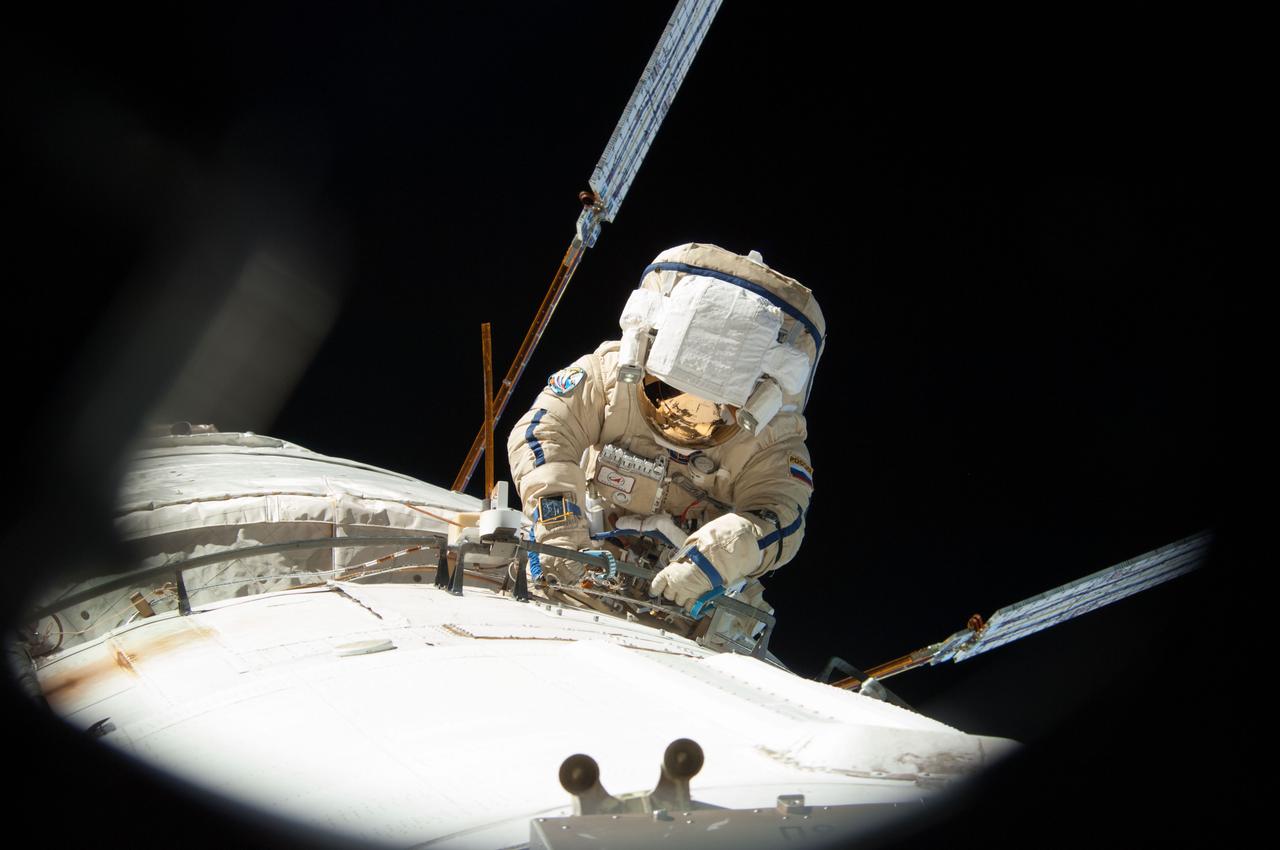
ISS036-E-035133 (22 Aug. 2013) --- Russian cosmonaut Alexander Misurkin, Expedition 36 flight engineer, attired in a Russian Orlan spacesuit, participates in a session of extravehicular activity (EVA) to continue outfitting the International Space Station. During the five-hour, 58-minute spacewalk, Misurkin and Russian cosmonaut Fyodor Yurchikhin (out of frame) completed the replacement of a laser communications experiment with a new platform for a small optical camera system, the installation of new spacewalk aids and an inspection of antenna covers.
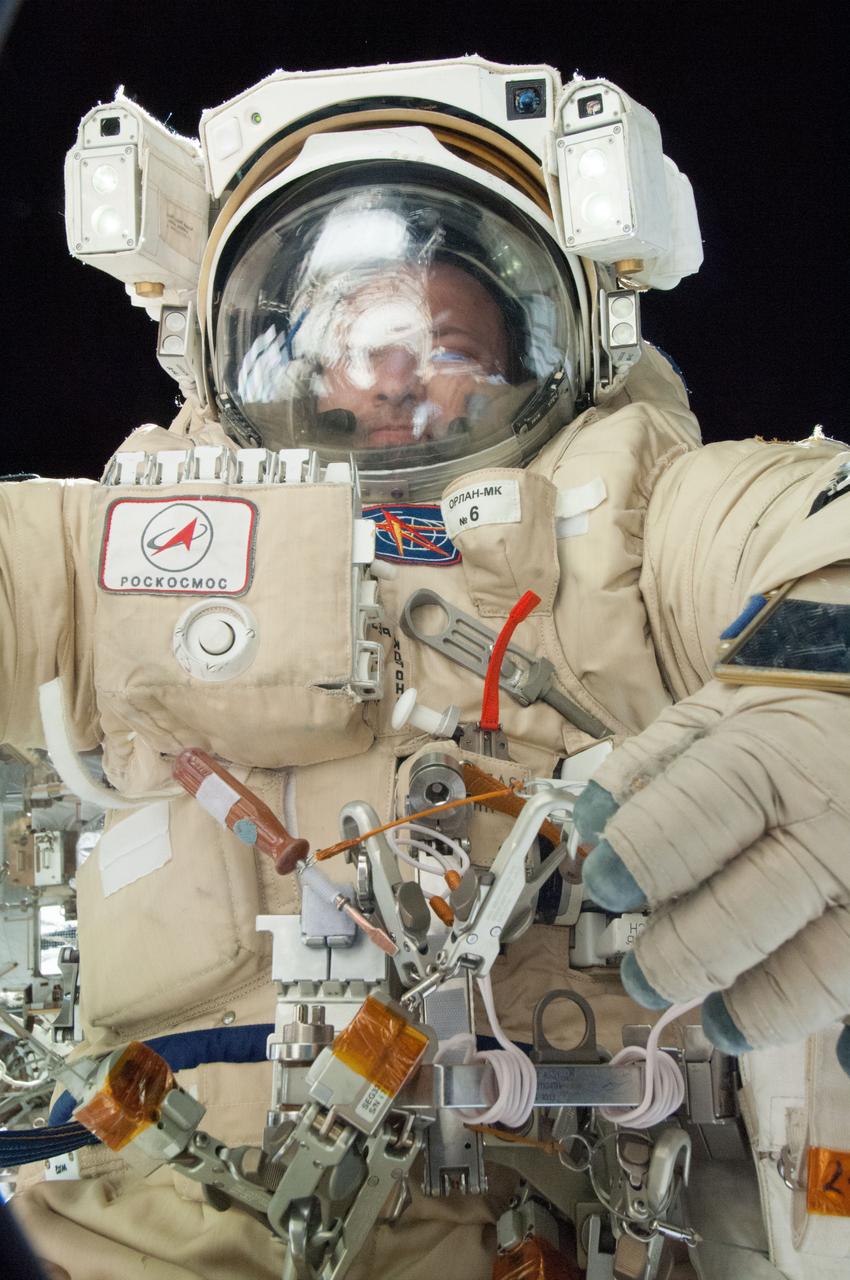
ISS036-E-035204 (22 Aug. 2013) --- Russian cosmonaut Alexander Misurkin, Expedition 36 flight engineer, attired in a Russian Orlan spacesuit, participates in a session of extravehicular activity (EVA) to continue outfitting the International Space Station. During the five-hour, 58-minute spacewalk, Misurkin and Russian cosmonaut Fyodor Yurchikhin (out of frame) completed the replacement of a laser communications experiment with a new platform for a small optical camera system, the installation of new spacewalk aids and an inspection of antenna covers.

ISS040-E-099089 (18 Aug. 2014) --- Russian cosmonaut Oleg Artemyev, Expedition 40 flight engineer, attired in a Russian Orlan spacesuit, participates in a session of extravehicular activity (EVA) in support of science and maintenance on the International Space Station. During the five-hour, 11-minute spacewalk, Artemyev and Alexander Skvortsov (out of frame) deployed a small science satellite, retrieved and installed experiment packages and inspected components on the exterior of the orbital laboratory.

ISS040-E-099283 (18 Aug. 2014) --- Russian cosmonauts Alexander Skvortsov (left, red stripes) and Oleg Artemyev, both Expedition 40 flight engineers, attired in Russian Orlan spacesuits, participate in a session of extravehicular activity (EVA) in support of science and maintenance on the International Space Station. During the five-hour, 11-minute spacewalk, Artemyev and Skvortsov deployed a small science satellite, retrieved and installed experiment packages and inspected components on the exterior of the orbital laboratory.

ISS040-E-099102 (18 Aug. 2014) --- Russian cosmonauts Oleg Artemyev and Alexander Skvortsov (out of frame), both Expedition 40 flight engineers, attired in Russian Orlan spacesuits, participate in a session of extravehicular activity (EVA) in support of science and maintenance on the International Space Station. During the five-hour, 11-minute spacewalk, Artemyev and Skvortsov deployed a small science satellite, retrieved and installed experiment packages and inspected components on the exterior of the orbital laboratory.

ISS040-E-099383 (18 Aug. 2014) --- Russian cosmonaut Alexander Skvortsov, Expedition 40 flight engineer, attired in a Russian Orlan spacesuit, participates in a session of extravehicular activity (EVA) in support of science and maintenance on the International Space Station. During the five-hour, 11-minute spacewalk, Skvortsov and cosmonaut Oleg Artemyev (out of frame) deployed a small science satellite, retrieved and installed experiment packages and inspected components on the exterior of the orbital laboratory.

ISS040-E-099382 (18 Aug. 2014) --- Russian cosmonaut Alexander Skvortsov, Expedition 40 flight engineer, attired in a Russian Orlan spacesuit, participates in a session of extravehicular activity (EVA) in support of science and maintenance on the International Space Station. During the five-hour, 11-minute spacewalk, Skvortsov and cosmonaut Oleg Artemyev (out of frame) deployed a small science satellite, retrieved and installed experiment packages and inspected components on the exterior of the orbital laboratory.

JSC2000-E-20585 (August 2000) --- Two members of the STS-106 crew participate in a bench review of equipment and gear scheduled to fly on the September mission aboard the Space Shuttle Atlantis. Astronaut Edward T. Lu (left) and cosmonaut Yuri I. Malenchenko inspect tools they'll possibly be using during scheduled extravehicular activity (EVA) on the International Space Station (ISS).

ISS035-E-037347 (11 May 2013) --- Expedition 35 Flight Engineers Tom Marshburn (pictured at conclusion of the extravehicular activity in the Quest Airlock) and Chris Cassidy (out of frame) completed a space walk at 2:14 p.m. EDT May 11 to inspect and replace a pump controller box on the International Space Station's far port truss (P6) leaking ammonia coolant. The two NASA astronauts began the 5-hour, 30-minute space walk at 8:44 a.m.
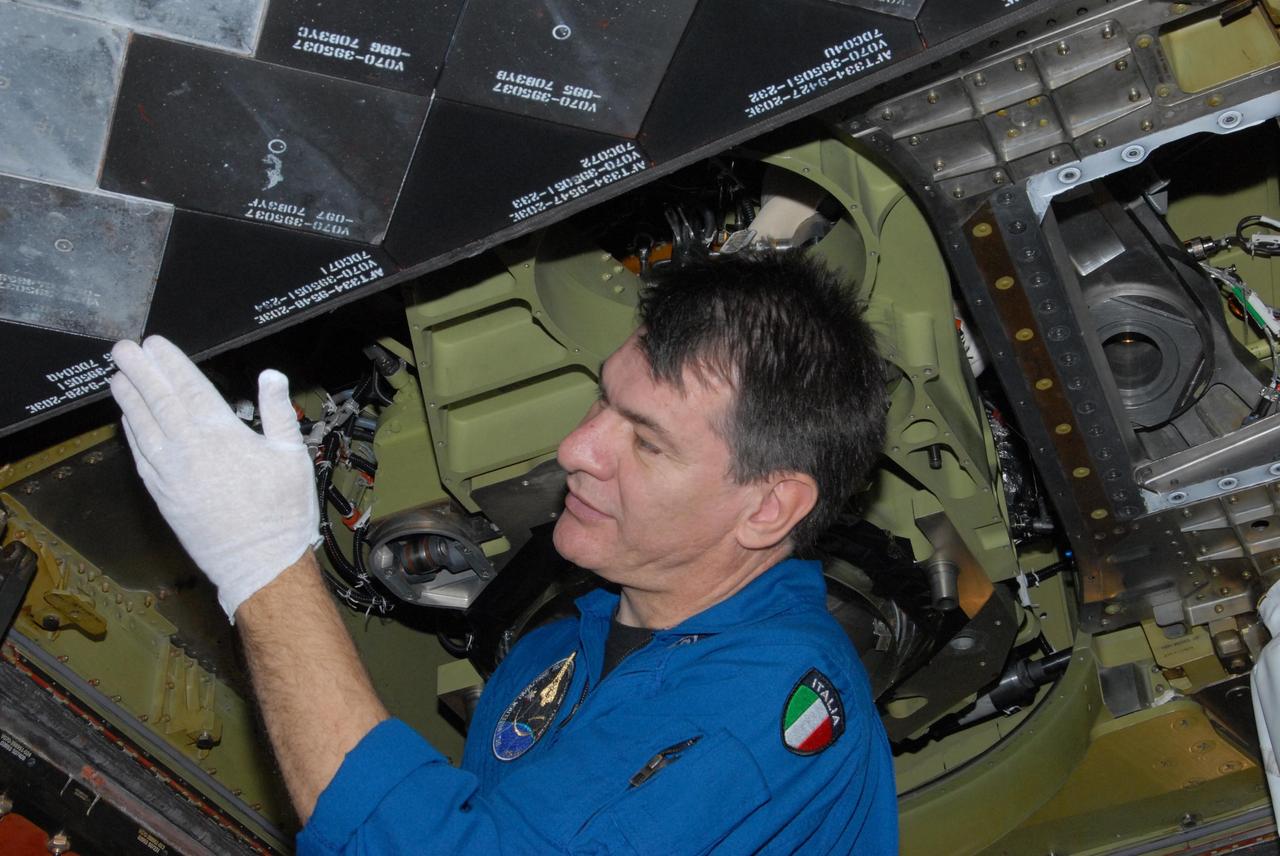
KENNEDY SPACE CENTER, FLA. - The STS-120 crew is at Kennedy for a crew equipment interface test, or CEIT. Inspecting the thermal protection system, or TPS, tiles under space shuttle Discovery in Orbiter Processing Facility bay 3 is Mission Specialist Paolo A. Nespoli, a European Space Agency astronaut from Italy. Among the activities standard to a CEIT are harness training, inspection of the thermal protection system and camera operation for planned extravehicular activities, or EVAs. The STS-120 mission will deliver the Harmony module, christened after a school contest, which will provide attachment points for European and Japanese laboratory modules on the International Space Station. Known in technical circles as Node 2, it is similar to the six-sided Unity module that links the U.S. and Russian sections of the station. Built in Italy for the United States, Harmony will be the first new U.S. pressurized component to be added. The STS-120 mission is targeted to launch on Oct. 20. Photo credit: NASA/George Shelton
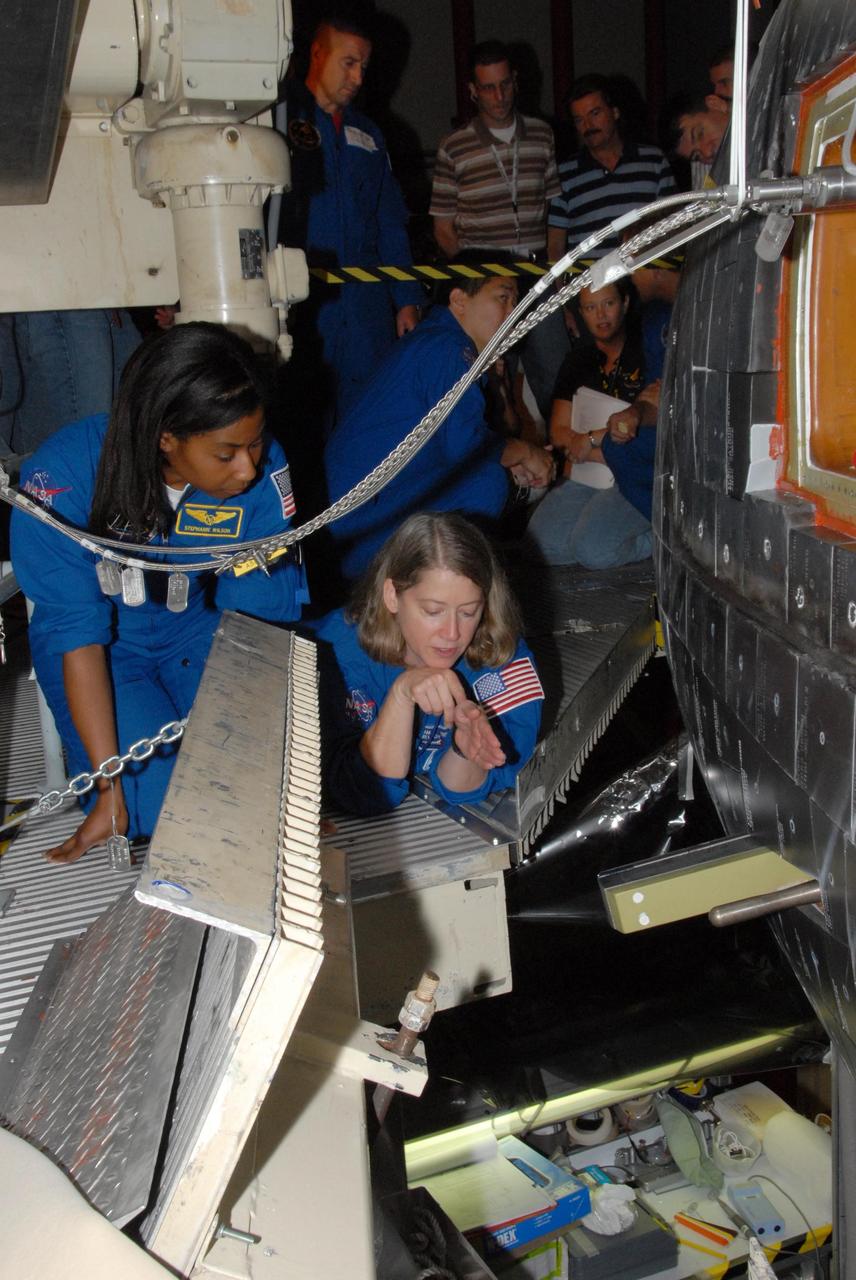
KENNEDY SPACE CENTER, FLA. - The STS-120 crew is at Kennedy for a crew equipment interface test, or CEIT. Giving a close inspection to space shuttle Discovery in Orbiter Processing Facility bay 3 are Mission Specialist Stephanie D. Wilson and Commander Pamela A. Melroy. Among the activities standard to a CEIT are harness training, inspection of the thermal protection system and camera operation for planned extravehicular activities, or EVAs. The STS-120 mission will deliver the Harmony module, christened after a school contest, which will provide attachment points for European and Japanese laboratory modules on the International Space Station. Known in technical circles as Node 2, it is similar to the six-sided Unity module that links the U.S. and Russian sections of the station. Built in Italy for the United States, Harmony will be the first new U.S. pressurized component to be added. The STS-120 mission is targeted to launch on Oct. 20. Photo credit: NASA/George Shelton
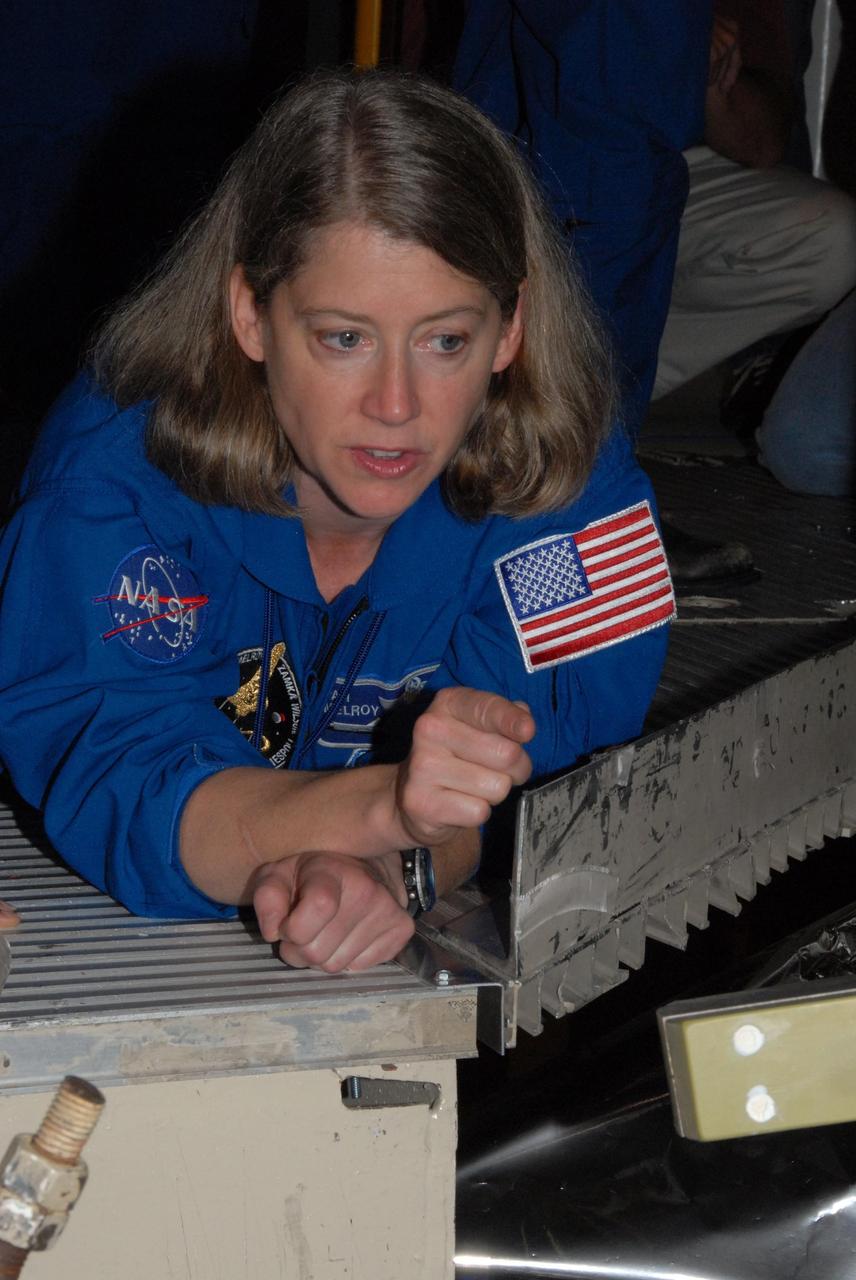
KENNEDY SPACE CENTER, FLA. - The STS-120 crew is at Kennedy for a crew equipment interface test, or CEIT. Commander Pamela A. Melroy gives a close inspection to space shuttle Discovery in Orbiter Processing Facility bay 3. Among the activities standard to a CEIT are harness training, inspection of the thermal protection system and camera operation for planned extravehicular activities, or EVAs. The STS-120 mission will deliver the Harmony module, christened after a school contest, which will provide attachment points for European and Japanese laboratory modules on the International Space Station. Known in technical circles as Node 2, it is similar to the six-sided Unity module that links the U.S. and Russian sections of the station. Built in Italy for the United States, Harmony will be the first new U.S. pressurized component to be added. The STS-120 mission is targeted to launch on Oct. 20. Photo credit: NASA/George Shelton
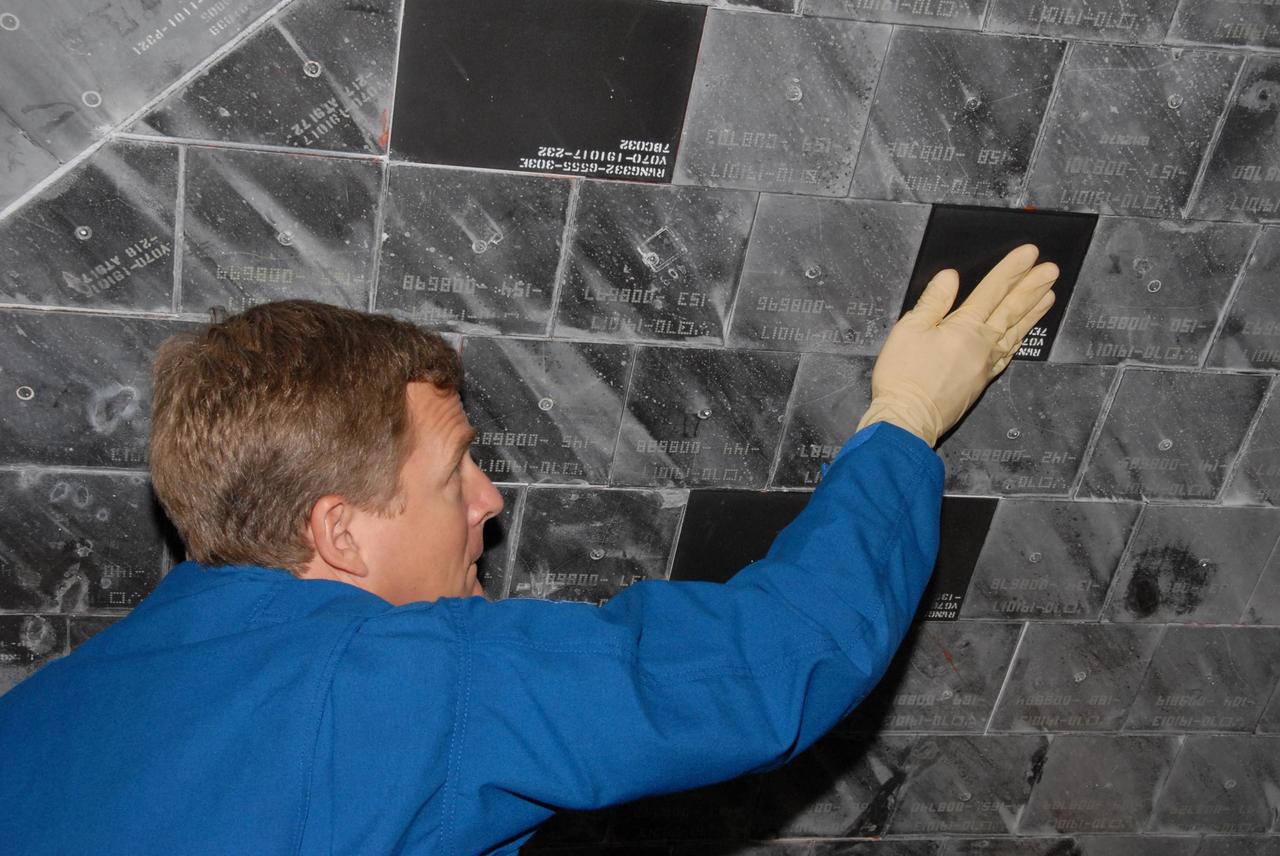
KENNEDY SPACE CENTER, FLA. - The STS-120 crew is at Kennedy for a crew equipment interface test, or CEIT. Inspecting the thermal protection system, or TPS, tiles under space shuttle Discovery in Orbiter Processing Facility bay 3 is Mission Specialist Scott E. Parazynski, the lead spacewalker on the mission. Among the activities standard to a CEIT are harness training, inspection of the thermal protection system and camera operation for planned extravehicular activities, or EVAs. The STS-120 mission will deliver the Harmony module, christened after a school contest, which will provide attachment points for European and Japanese laboratory modules on the International Space Station. Known in technical circles as Node 2, it is similar to the six-sided Unity module that links the U.S. and Russian sections of the station. Built in Italy for the United States, Harmony will be the first new U.S. pressurized component to be added. The STS-120 mission is targeted to launch on Oct. 20. Photo credit: NASA/George Shelton
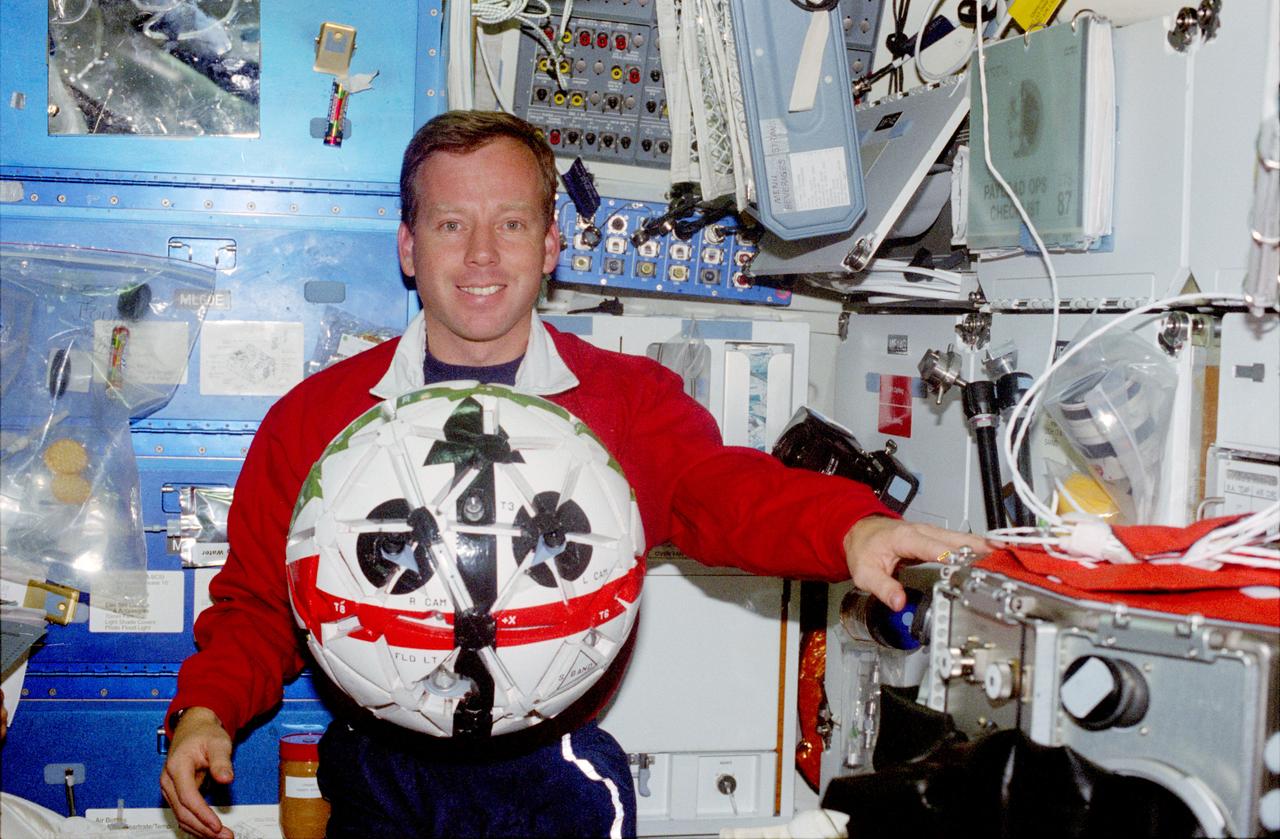
STS087-371-013 (19 November - 5 December 1997) --- On the Space Shuttle Columbia's mid-deck, astronaut Steven W. Lindsey proves that the Autonomous Extravehicular Activity Robotic Camera/Sprint (AERCam/Sprint) experiment is in fact bigger than a soccer ball, to which it is often erroneously compared for dimensional frame of reference, as he allows the Sprint to float near him. The AERCam is a prototype free-flying television camera that could be used for remote inspections of the exterior of the International Space Station (ISS). Later, astronauts Winston E. Scott and Takao Doi took the experiment outside for a brief test during the mission's second Extravehicular Activity (EVA). Lindsey, pilot, is standing with his back to the galley and his left hand on the microgravity glovebox, used extensively during the mission to support the United States Microgravity Payload (USMP-4) mission.

KENNEDY SPACE CENTER, FLA. -- In the Orbiter Processing Facility, STS-122 crew members are introduced to part of the LESS. From left are Mission Specialists Hans Schlegel, Rex Walheim and European Space Agency astronaut Leopold Eyharts, Commander Stephen Frick, Mission Specialist Leland Melvin and Pilot Alan Poindexter. The crew is at Kennedy to take part in a crew equipment interface test, or CEIT, which helps familiarize them with equipment and payloads for the mission. Among the activities standard to a CEIT are harness training, inspection of the thermal protection system and camera operation for planned extravehicular activities, or EVAs. STS-122 is targeted for launch in December. Photo credit: NASA/Kim Shiflett

KENNEDY SPACE CENTER, FLA. -- In the Orbiter Processing Facility, STS-122 crew members are introduced to part of the LESS. From left are Mission Specialists Stanley Love, Hans Schlegel and Rex Walheim. The crew is at Kennedy to take part in a crew equipment interface test, or CEIT, which helps familiarize them with equipment and payloads for the mission. Among the activities standard to a CEIT are harness training, inspection of the thermal protection system and camera operation for planned extravehicular activities, or EVAs. STS-122 is targeted for launch in December. Photo credit: NASA/Kim Shiflett
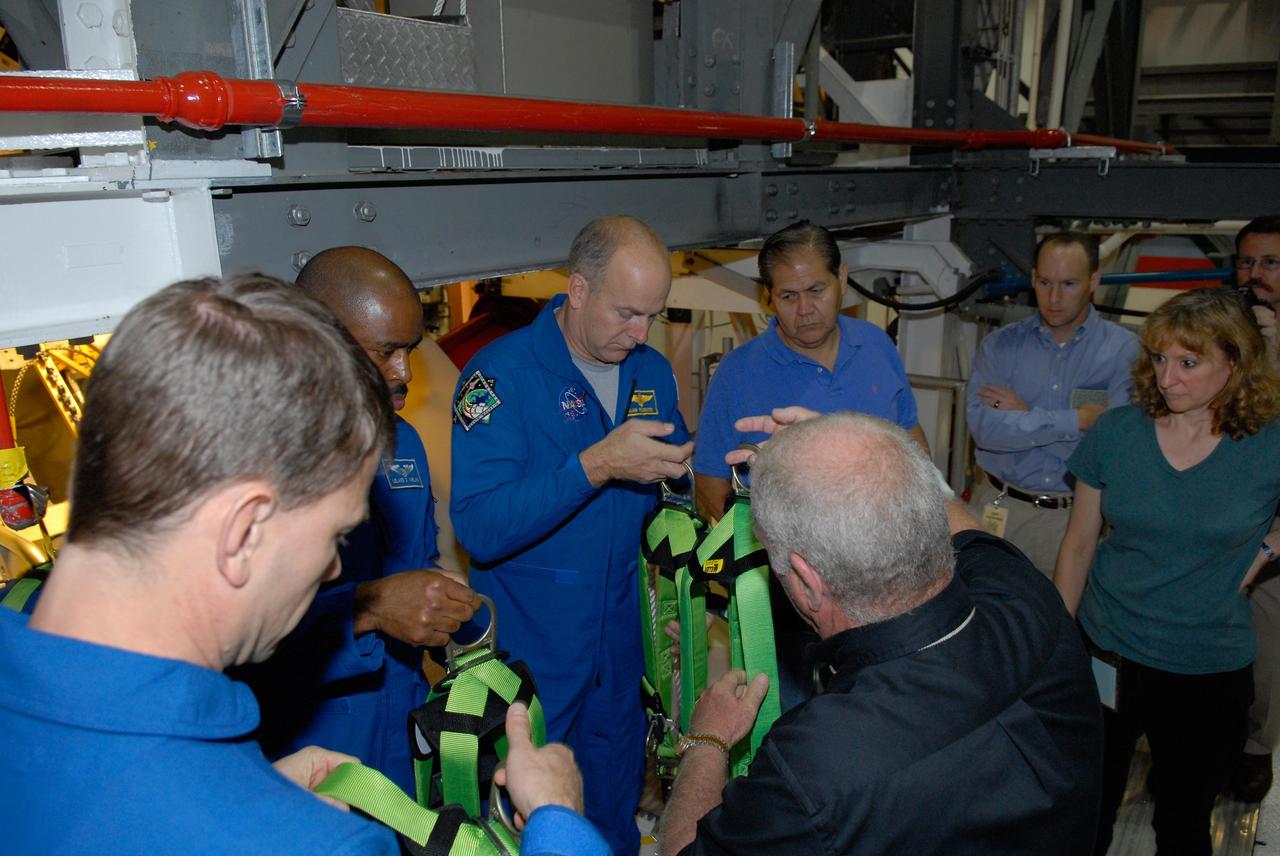
KENNEDY SPACE CENTER, FLA. -- Members of the STS-122 crew take part in harness training in the Orbiter Processing Facility at NASA's Kennedy Space Center. Seen from left are Mission Specialists Stanley Love and Leland Melvin and Pilot Alan Poindexter. The crew is at Kennedy to take part in a crew equipment interface test, or CEIT, which helps familiarize them with equipment and payloads for the mission. Among the activities standard to a CEIT are harness training, inspection of the thermal protection system and camera operation for planned extravehicular activities, or EVAs. STS-122 is targeted for launch in December. Photo credit: NASA/Kim Shiflett
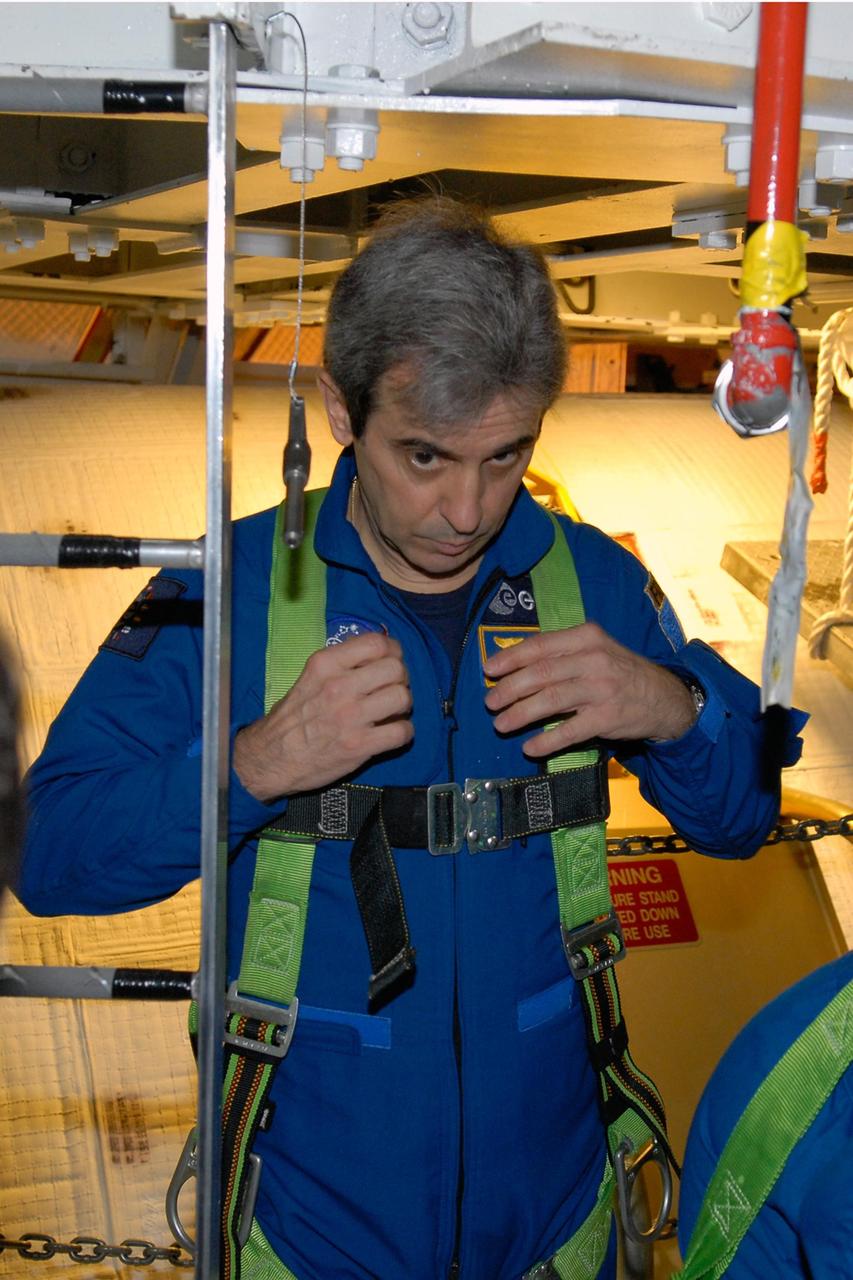
KENNEDY SPACE CENTER, FLA. -- Astronaut Leopold Eyharts, who represents the European Space Agency, tries on a harness in the Orbiter Processing Facility. Eyharts will be traveling to the International Space Station to join the Expedition 16 crew as a flight engineer. The crew is at Kennedy to take part in a crew equipment interface test, or CEIT, which helps familiarize them with equipment and payloads for the mission. Among the activities standard to a CEIT are harness training, inspection of the thermal protection system and camera operation for planned extravehicular activities, or EVAs. STS-122 is targeted for launch in December. Photo credit: NASA/Kim Shiflett

STS-87 Mission Specialist Winston Scott poses in his orange launch and entry spacesuit with NASA suit technicians at Launch Pad 39B during Terminal Countdown Demonstration Test (TCDT) activities. The crew of the STS-87 mission is scheduled for launch Nov. 19 aboard the Space Shuttle Columbia. Scott will be performing an extravehicular activity (EVA) spacewalk during the mission. The TCDT is held at KSC prior to each Space Shuttle flight providing the crew of each mission opportunities to participate in simulated countdown activities. The TCDT ends with a mock launch countdown culminating in a simulated main engine cut-off. The crew also spends time undergoing emergency egress training exercises at the pad and has an opportunity to view and inspect the payloads in the orbiter's payload bay
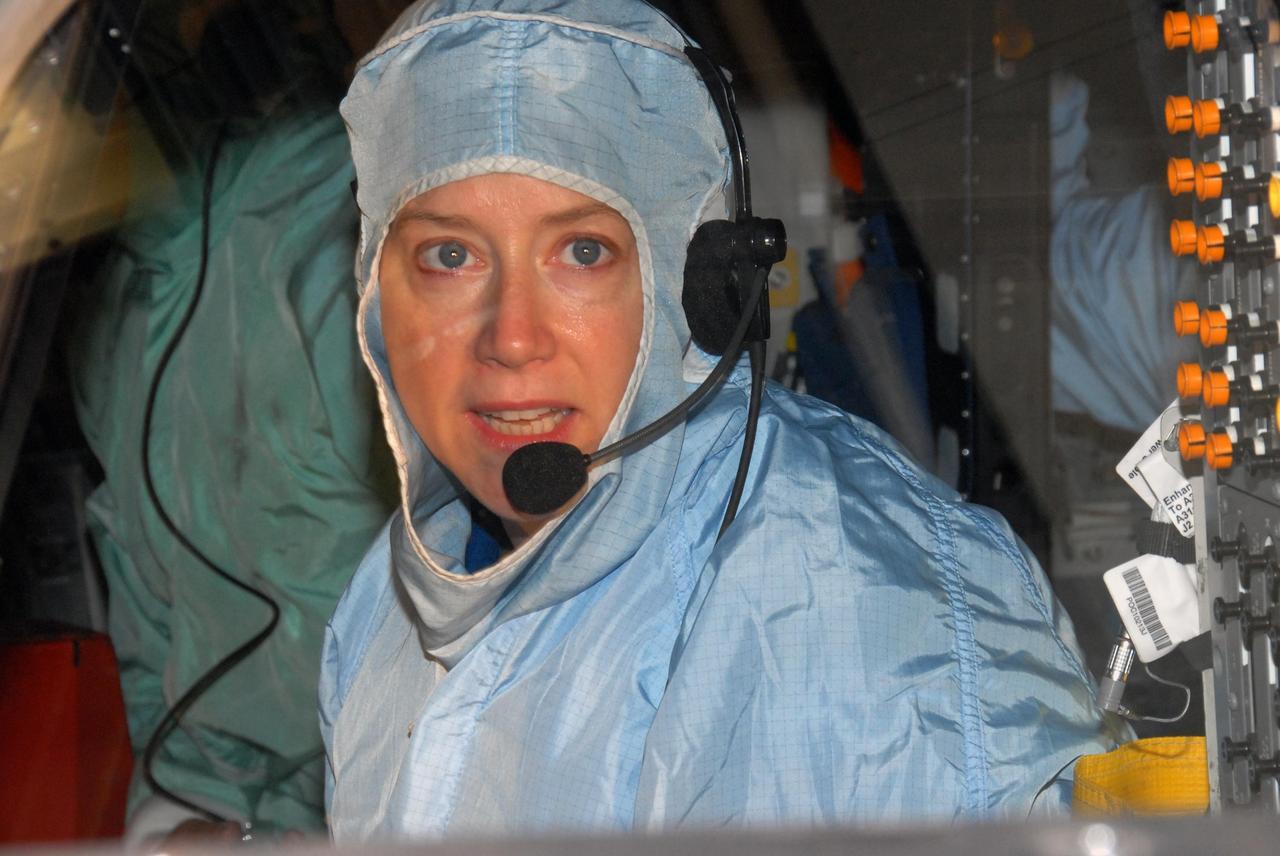
KENNEDY SPACE CENTER, FLA. - In the Orbiter Processing Facility bay 3, STS-120 Commander Pamela A. Melroy sits in the orbiter Discovery to inspect the cockpit windows. The STS-120 crew is at Kennedy for a crew equipment interface test, or CEIT, which includes harness training, inspection of the thermal protection system and camera operation for planned extravehicular activities, or EVAs. The STS-120 mission will deliver the Harmony module, christened after a school contest, which will provide attachment points for European and Japanese laboratory modules on the International Space Station. Known in technical circles as Node 2, it is similar to the six-sided Unity module that links the U.S. and Russian sections of the station. Built in Italy for the United States, Harmony will be the first new U.S. pressurized component to be added. The STS-120 mission is targeted to launch on Oct. 20. Photo credit: NASA/George Shelton
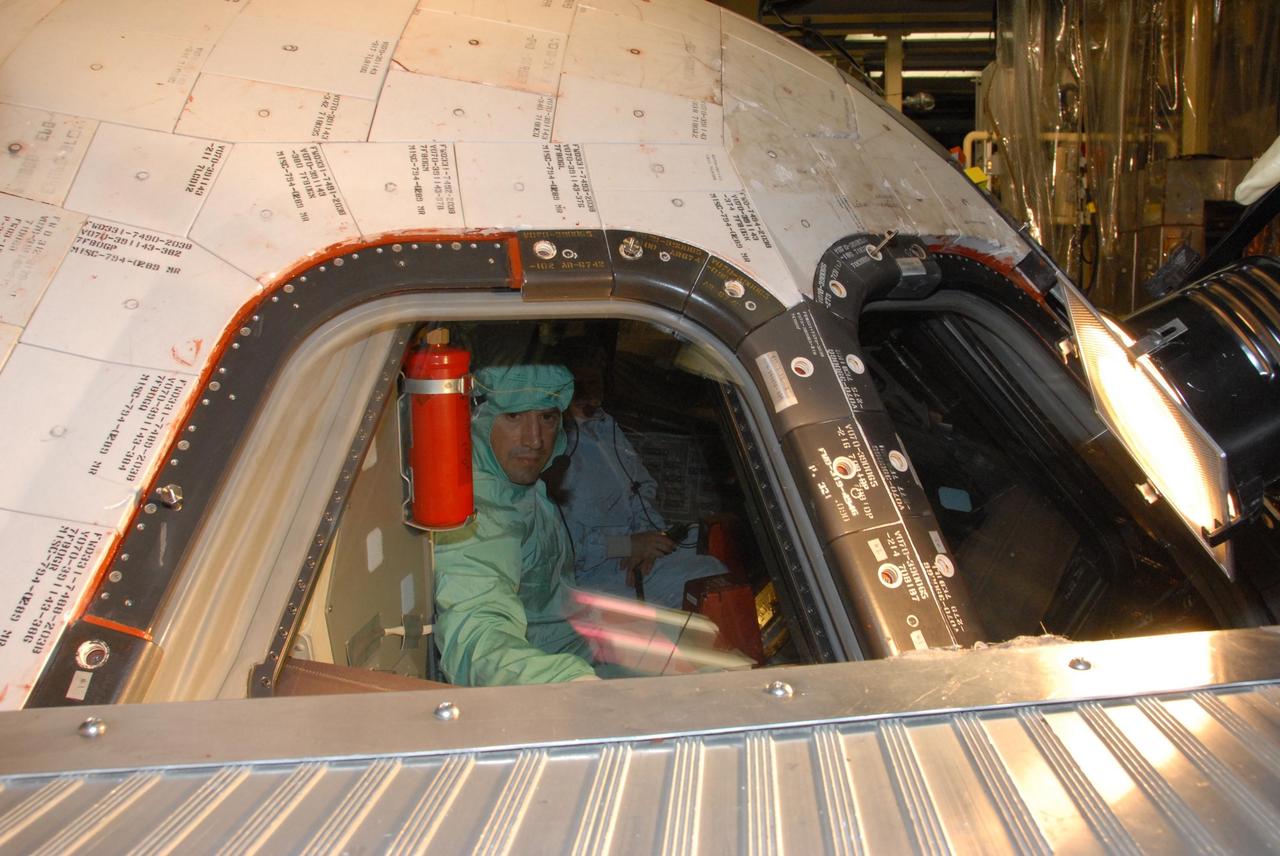
KENNEDY SPACE CENTER, FLA. - In the Orbiter Processing Facility bay 3, STS-120 Pilot George D. Zamka makes a close inspection of the cockpit window on the orbiter Discovery. Seated next to him is Commander Pamela A. Melroy. The STS-120 crew is at Kennedy for a crew equipment interface test, or CEIT, which includes harness training, inspection of the thermal protection system and camera operation for planned extravehicular activities, or EVAs. The STS-120 mission will deliver the Harmony module, christened after a school contest, which will provide attachment points for European and Japanese laboratory modules on the International Space Station. Known in technical circles as Node 2, it is similar to the six-sided Unity module that links the U.S. and Russian sections of the station. Built in Italy for the United States, Harmony will be the first new U.S. pressurized component to be added. The STS-120 mission is targeted to launch on Oct. 20. NASA/George Shelton
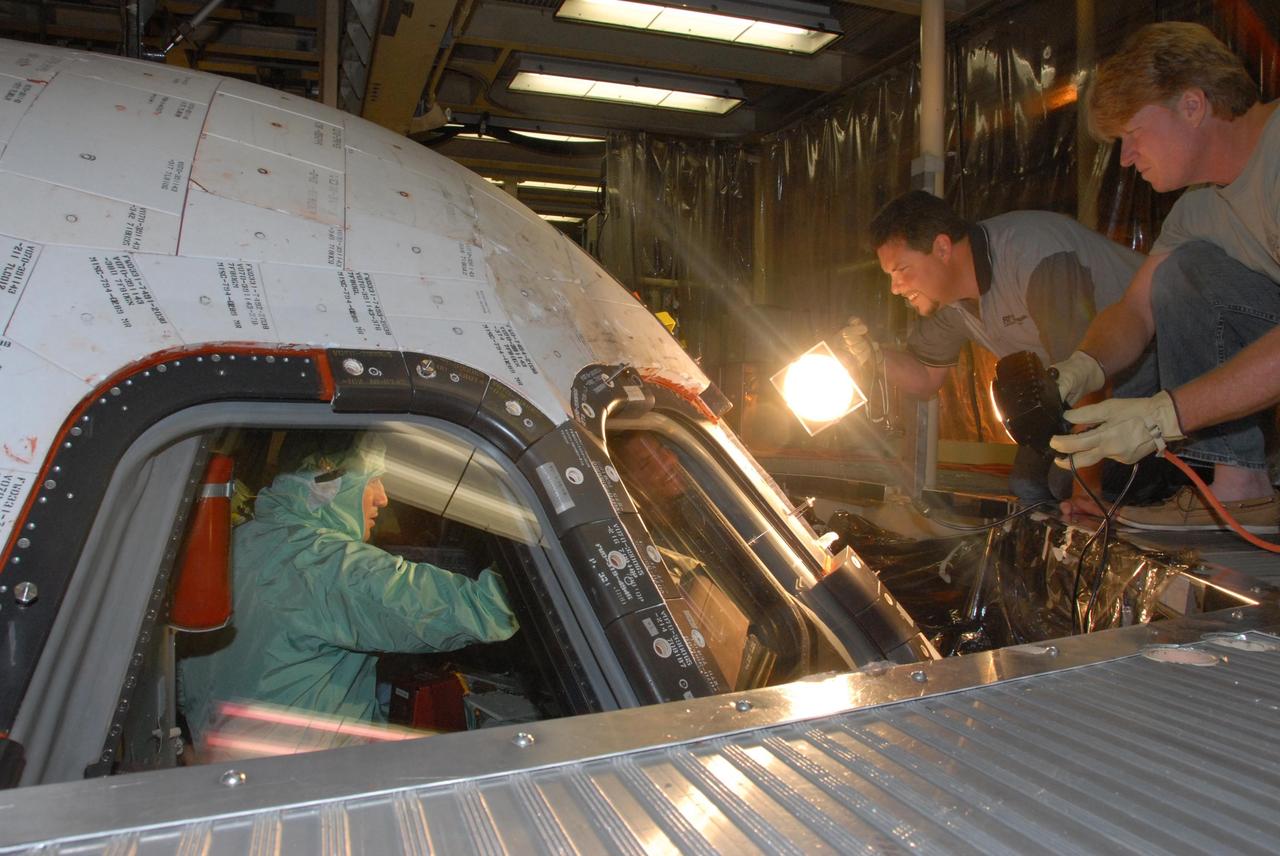
KENNEDY SPACE CENTER, FLA. - In the Orbiter Processing Facility bay 3, STS-120 Commander Pamela A. Melroy makes a close inspection of the cockpit window on the orbiter Discovery. The STS-120 crew is at Kennedy for a crew equipment interface test, or CEIT, which includes harness training, inspection of the thermal protection system and camera operation for planned extravehicular activities, or EVAs. The STS-120 mission will deliver the Harmony module, christened after a school contest, which will provide attachment points for European and Japanese laboratory modules on the International Space Station. Known in technical circles as Node 2, it is similar to the six-sided Unity module that links the U.S. and Russian sections of the station. Built in Italy for the United States, Harmony will be the first new U.S. pressurized component to be added. The STS-120 mission is targeted to launch on Oct. 20. Photo credit: NASA/George Shelton
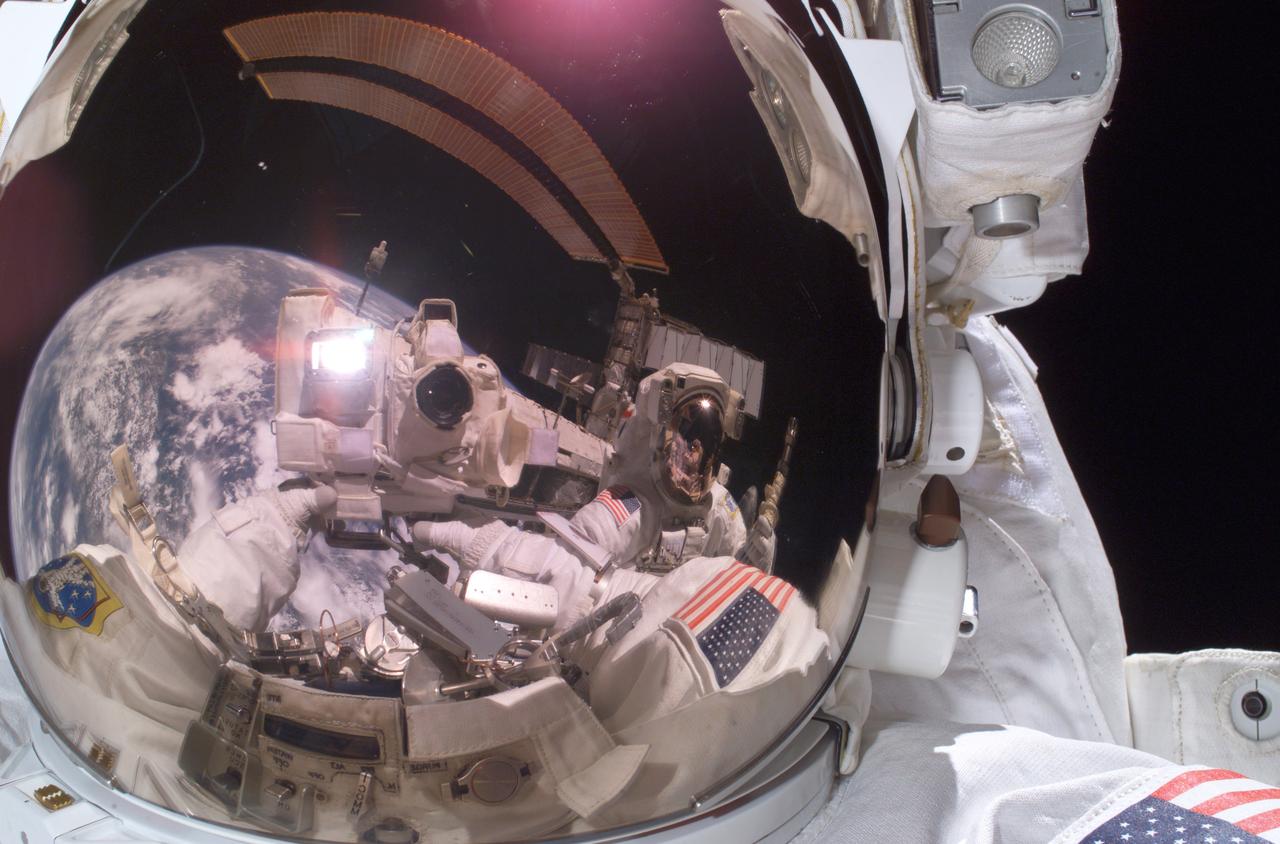
Astronaut Michael E. Fossum, STS-121 mission specialist, used a digital still camera to expose a photo of his helmet visor during a session of extravehicular activity (EVA) while Space Shuttle Discovery was docked with the International Space Station (ISS). Also visible in the visor reflections are fellow space walker Piers J. Sellers, mission specialist, Earth's horizon, and a station solar array. During its 12-day mission, this utilization and logistics flight delivered a multipurpose logistics module (MPLM) to the ISS with several thousand pounds of new supplies and experiments. In addition, some new orbital replacement units (ORUs) were delivered and stowed externally on the ISS on a special pallet. These ORUs are spares for critical machinery located on the outside of the ISS. During this mission the crew also carried out testing of Shuttle inspection and repair hardware, as well as evaluated operational techniques and concepts for conducting on-orbit inspection and repair.

KENNEDY SPACE CENTER, FLA. - In the Orbiter Processing Facility bay 3, STS-120 Commander Pamela A. Melroy makes a close inspection of the cockpit window on the orbiter Discovery. The STS-120 crew is at Kennedy for a crew equipment interface test, or CEIT, which includes harness training, inspection of the thermal protection system and camera operation for planned extravehicular activities, or EVAs. The STS-120 mission will deliver the Harmony module, christened after a school contest, which will provide attachment points for European and Japanese laboratory modules on the International Space Station. Known in technical circles as Node 2, it is similar to the six-sided Unity module that links the U.S. and Russian sections of the station. Built in Italy for the United States, Harmony will be the first new U.S. pressurized component to be added. The STS-120 mission is targeted to launch on Oct. 20. Photo credit: NASA/George Shelton
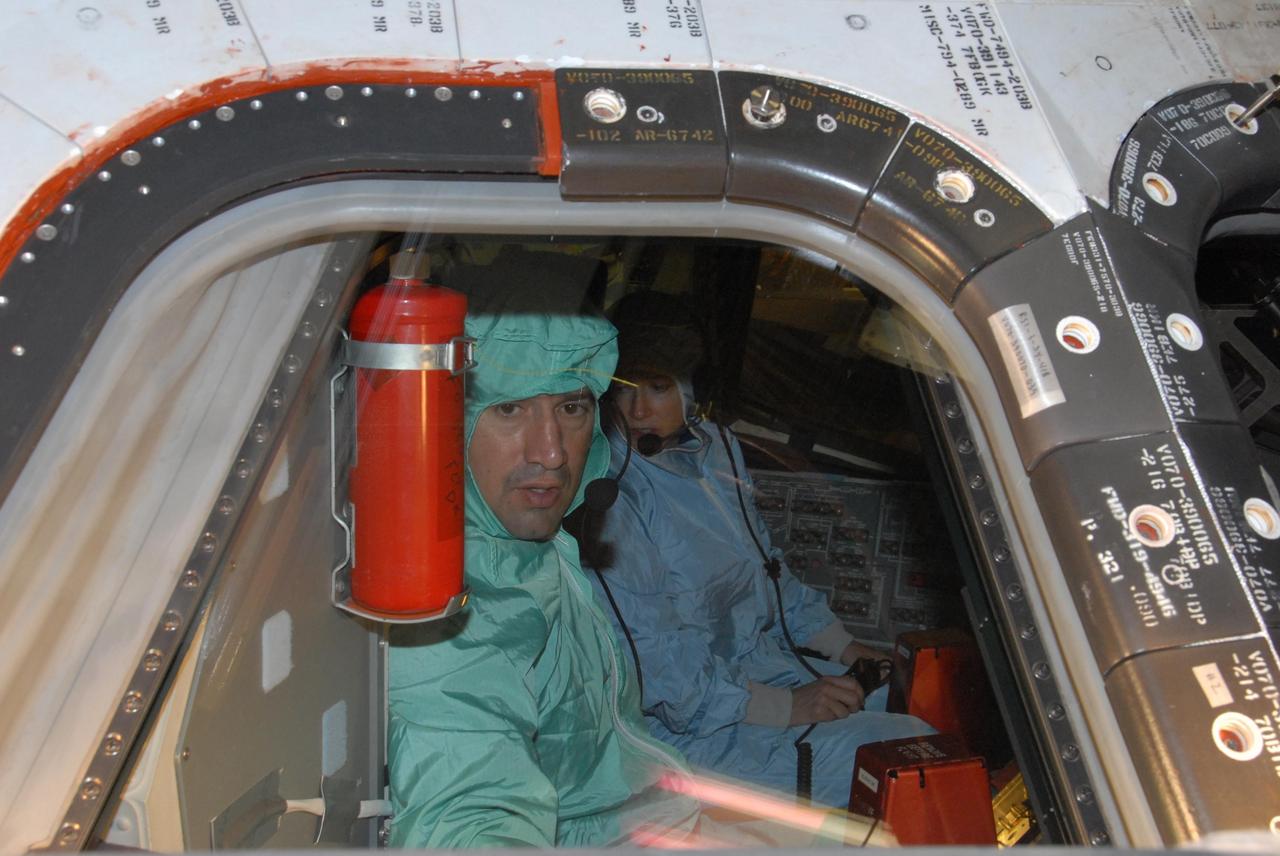
KENNEDY SPACE CENTER, FLA. - In the Orbiter Processing Facility bay 3, STS-120 Pilot George D. Zamka makes a close inspection of the cockpit window on the orbiter Discovery. Seated next to him is Commander Pamela A. Melroy. The STS-120 crew is at Kennedy for a crew equipment interface test, or CEIT, which includes harness training, inspection of the thermal protection system and camera operation for planned extravehicular activities, or EVAs. The STS-120 mission will deliver the Harmony module, christened after a school contest, which will provide attachment points for European and Japanese laboratory modules on the International Space Station. Known in technical circles as Node 2, it is similar to the six-sided Unity module that links the U.S. and Russian sections of the station. Built in Italy for the United States, Harmony will be the first new U.S. pressurized component to be added. The STS-120 mission is targeted to launch on Oct. 20. Photo credit: NASA/George Shelton
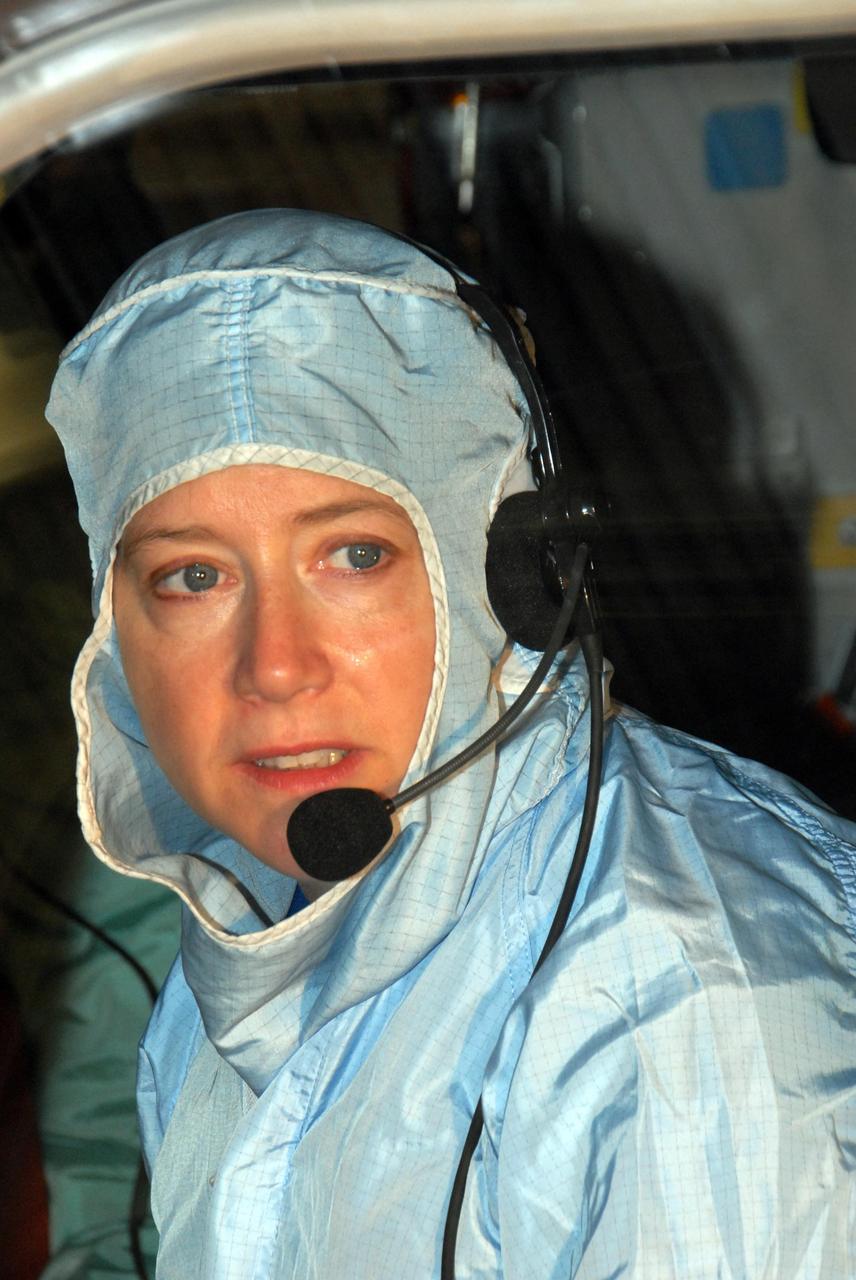
KENNEDY SPACE CENTER, FLA. - In the Orbiter Processing Facility bay 3,STS-120 Commander Pamela A. Melroy sits in the orbiter Discovery to inspect the cockpit windows. The STS-120 crew is at Kennedy for a crew equipment interface test, or CEIT, which includes harness training, inspection of the thermal protection system and camera operation for planned extravehicular activities, or EVAs. The STS-120 mission will deliver the Harmony module, christened after a school contest, which will provide attachment points for European and Japanese laboratory modules on the International Space Station. Known in technical circles as Node 2, it is similar to the six-sided Unity module that links the U.S. and Russian sections of the station. Built in Italy for the United States, Harmony will be the first new U.S. pressurized component to be added. The STS-120 mission is targeted to launch on Oct. 20. Photo credit: NASA/George Shelton
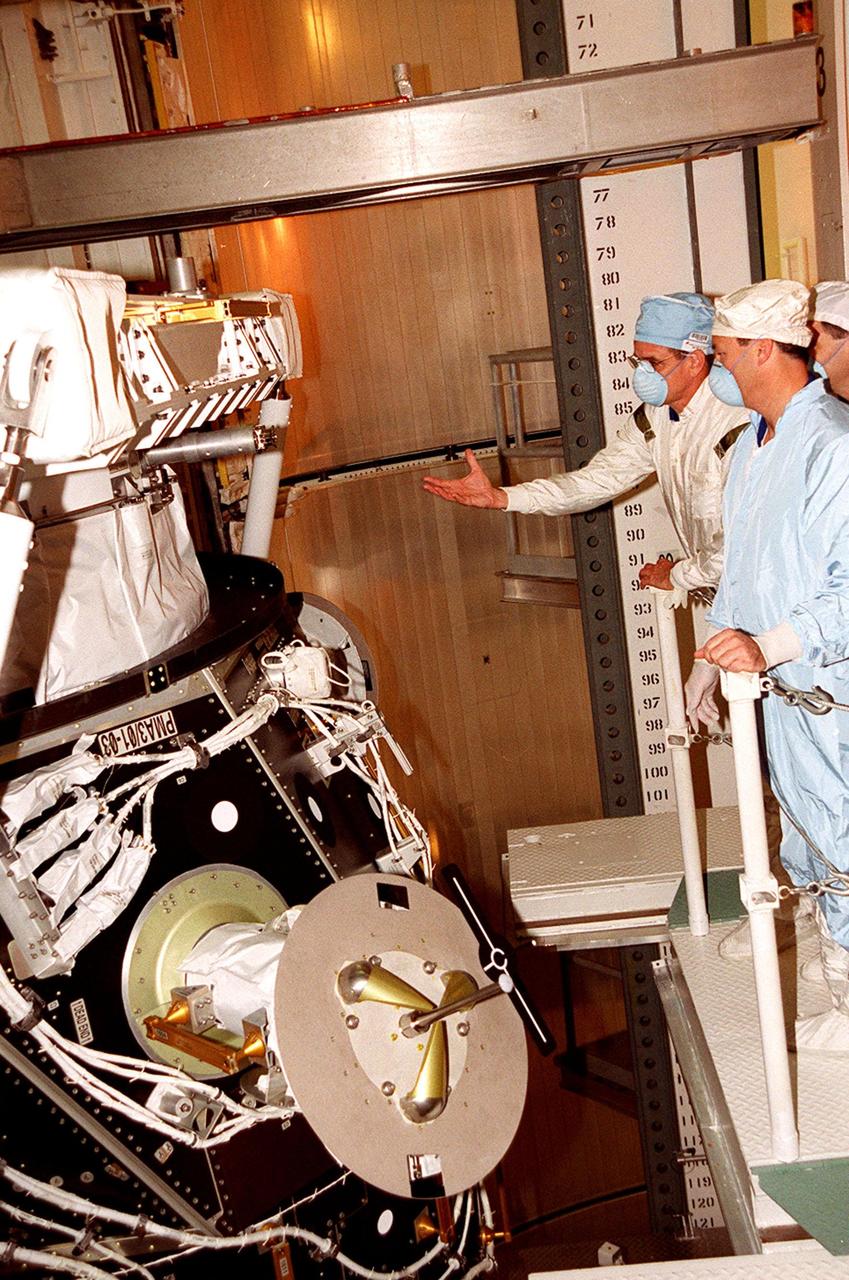
KENNEDY SPACE CENTER, FLA. -- In Space Shuttle Discovery’s payload bay, STS-92 Mission Specialist William S. McArthur Jr. explains something about the Pressurized Mating Adapter in front of him to other Mission Specialists Michael E. Lopez-Alegria and Peter J.K. Wisoff. The STS-92 crew has been inspecting the payload in preparation for launch Oct. 5, 2000. The mission is the fifth flight for the construction of the International Space Station. The payload also includes the Integrated Truss Structure Z-1. During the 11-day mission, four extravehicular activities (EVAs), or space walks, are planned

KENNEDY SPACE CENTER, FLA. -- In Space Shuttle Discovery’s payload bay, STS-92 Mission Specialist Michael E. Lopez-Alegria takes hold of a lever on the Pressurized Mating Adapter, part of the payload on the mission. Behind him Mission Specialist William S. McArthur Jr. describes a task while Mission Specialist Peter J.K. Wisoff looks on. The STS-92 crew has been inspecting the payload in preparation for launch Oct. 5, 2000. The mission is the fifth flight for the construction of the International Space Station. The payload also includes the Integrated Truss Structure Z-1. During the 11-day mission, four extravehicular activities (EVAs), or space walks, are planned
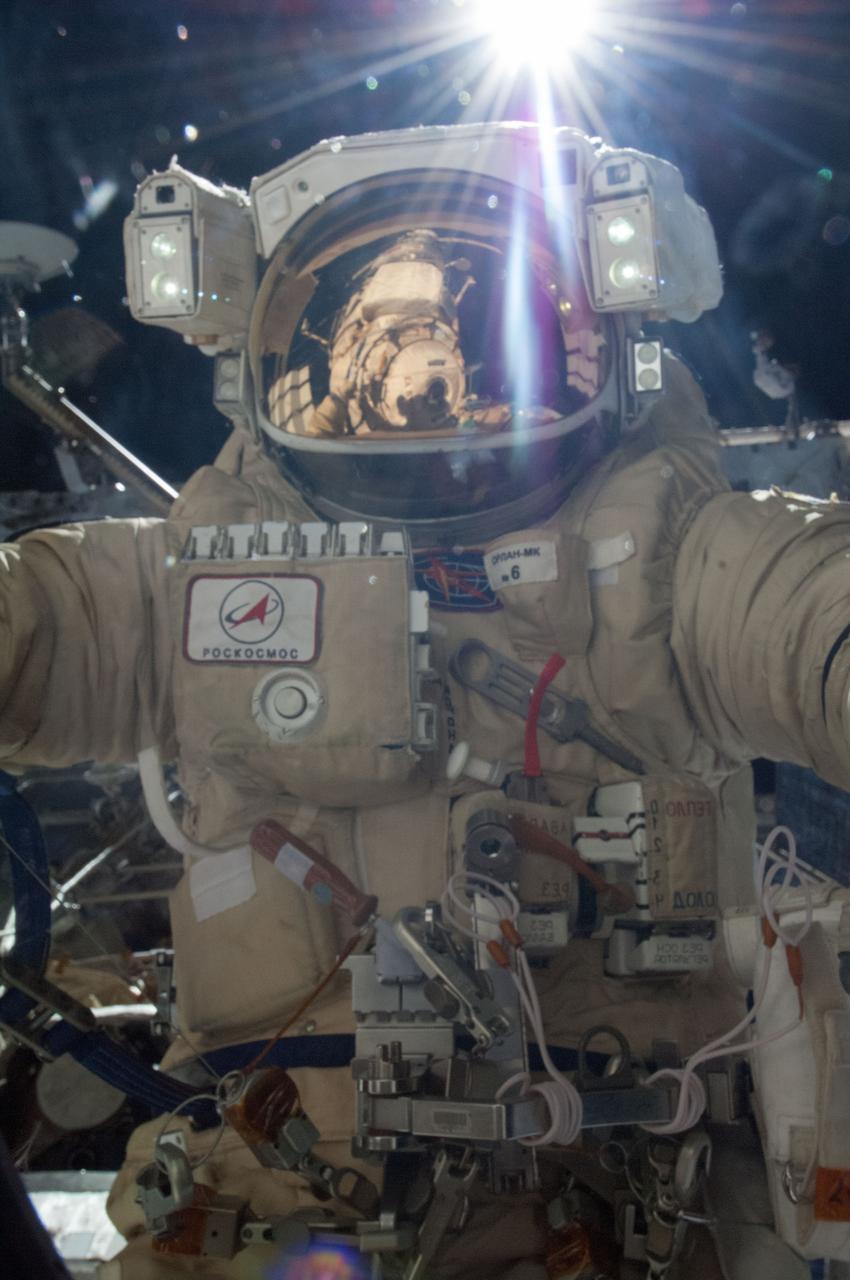
ISS036-E-035198 (22 Aug. 2013) --- Russian cosmonaut Alexander Misurkin, Expedition 36 flight engineer, attired in a Russian Orlan spacesuit, participates in a session of extravehicular activity (EVA) to continue outfitting the International Space Station. During the five-hour, 58-minute spacewalk, Misurkin and Russian cosmonaut Fyodor Yurchikhin (out of frame) completed the replacement of a laser communications experiment with a new platform for a small optical camera system, the installation of new spacewalk aids and an inspection of antenna covers. A section of the space station is visible in the reflections in his helmet visor.
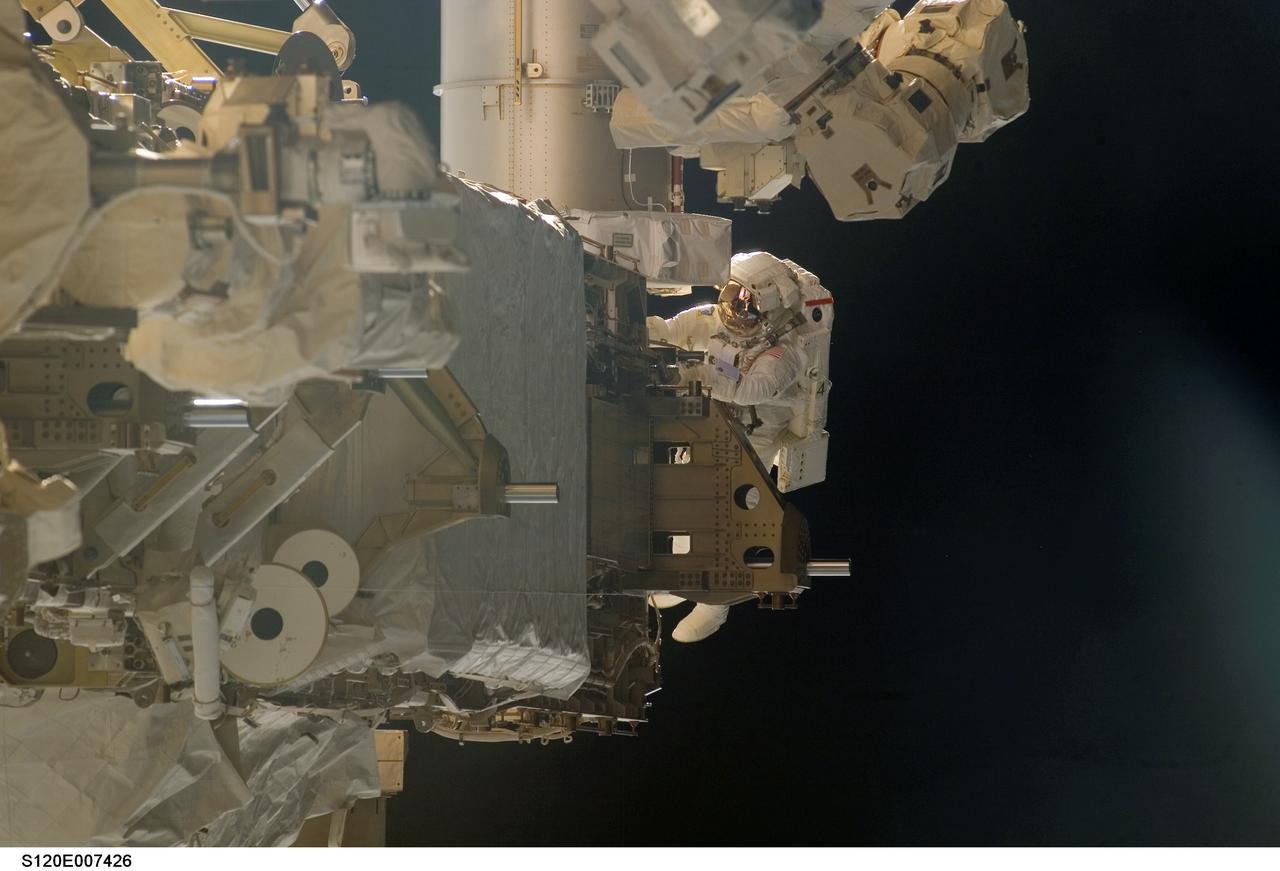
S120-E-007426 (30 Oct. 2007) --- Astronaut Scott Parazynski, STS-120 mission specialist, participates in the third scheduled session of extravehicular activity (EVA) as construction continues on the International Space Station. During the 7-hour, 8-minute spacewalk Parazynski and astronaut Doug Wheelock (out of frame), mission specialist, installed the P6 truss segment with its set of solar arrays to its permanent home, installed a spare main bus switching unit on a stowage platform, and performed a few get-ahead tasks. Also, Parazynski inspected the port Solar Alpha Rotary Joint (SARJ) to gather comparison data for the starboard rotary joint.
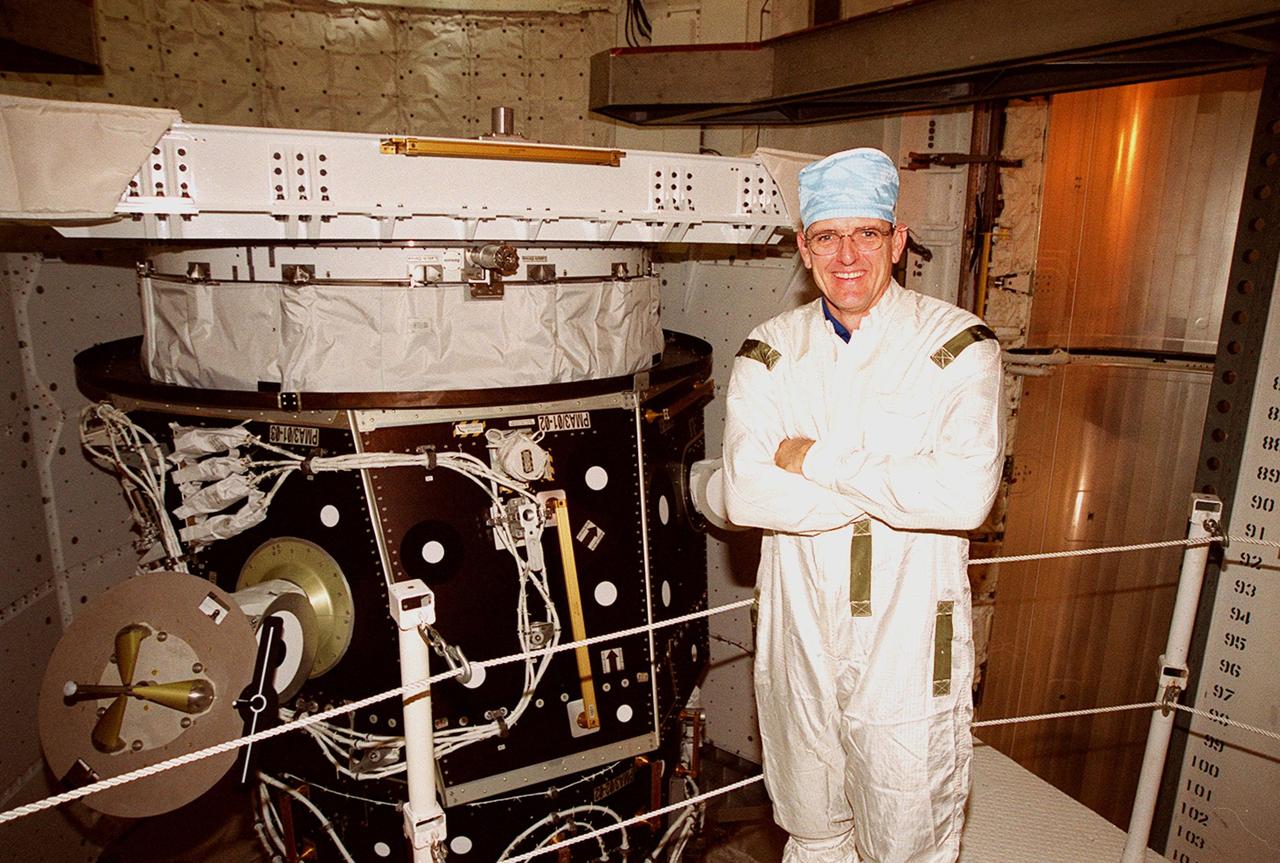
STS-92 Mission Specialist William S. McArthur Jr. smiles for the camera during inspection of the payload (left) in Space Shuttle Discovery’s payload bay. He and other crew members Commander Brian Duffy, Pilot Pamela Ann Melroy and Mission Specialists Koichi Wakata of Japan, Leroy Chiao, Peter J.K. “Jeff” Wisoff and Michael E. Lopez-Alegria are preparing for launch on Oct. 5, 2000. The mission is the fifth flight for the construction of the International Space Station. The payload includes the Integrated Truss Structure Z-1 and the third Pressurized Mating Adapter. During the 11-day mission, four extravehicular activities (EVAs), or space walks, are planned
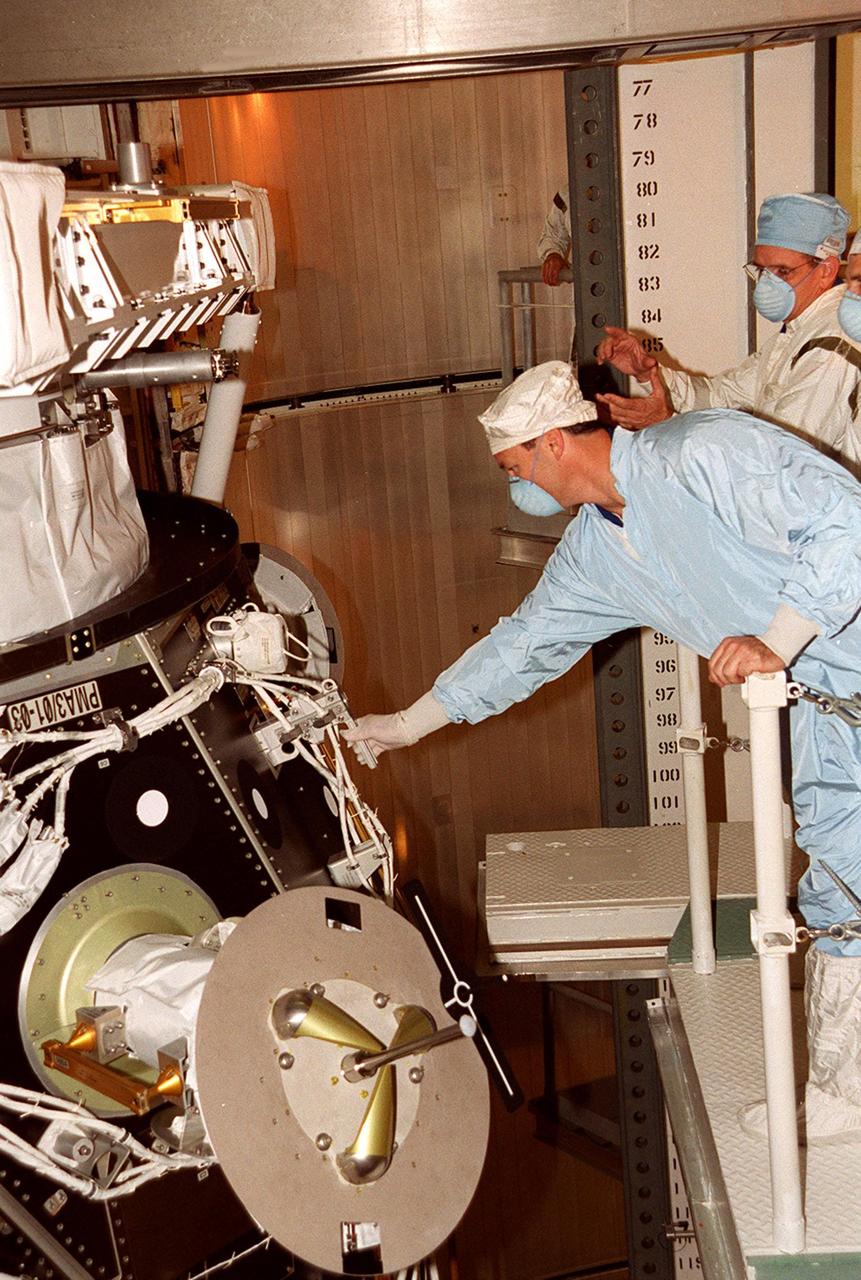
KENNEDY SPACE CENTER, FLA. -- In Space Shuttle Discovery’s payload bay, STS-92 Mission Specialist Michael E. Lopez-Alegria takes hold of a lever on the Pressurized Mating Adapter, part of the payload on the mission. Behind him Mission Specialist William S. McArthur Jr. describes a task while Mission Specialist Peter J.K. Wisoff looks on. The STS-92 crew has been inspecting the payload in preparation for launch Oct. 5, 2000. The mission is the fifth flight for the construction of the International Space Station. The payload also includes the Integrated Truss Structure Z-1. During the 11-day mission, four extravehicular activities (EVAs), or space walks, are planned
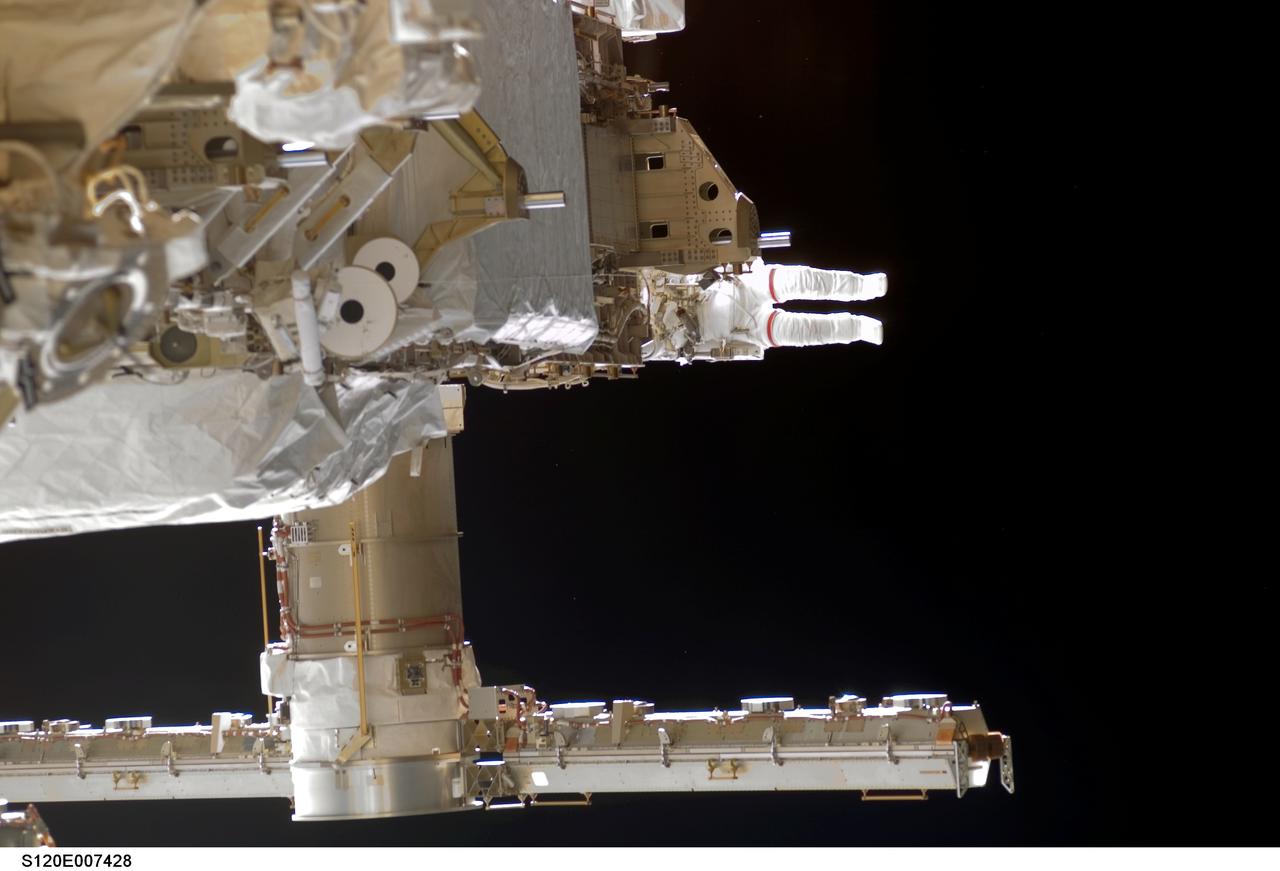
S120-E-007428 (30 Oct. 2007) --- Astronaut Scott Parazynski, STS-120 mission specialist, participates in the third scheduled session of extravehicular activity (EVA) as construction continues on the International Space Station. During the 7-hour, 8-minute spacewalk Parazynski and astronaut Doug Wheelock (out of frame), mission specialist, installed the P6 truss segment with its set of solar arrays to its permanent home, installed a spare main bus switching unit on a stowage platform, and performed a few get-ahead tasks. Also, Parazynski inspected the port Solar Alpha Rotary Joint (SARJ) to gather comparison data for the starboard rotary joint.
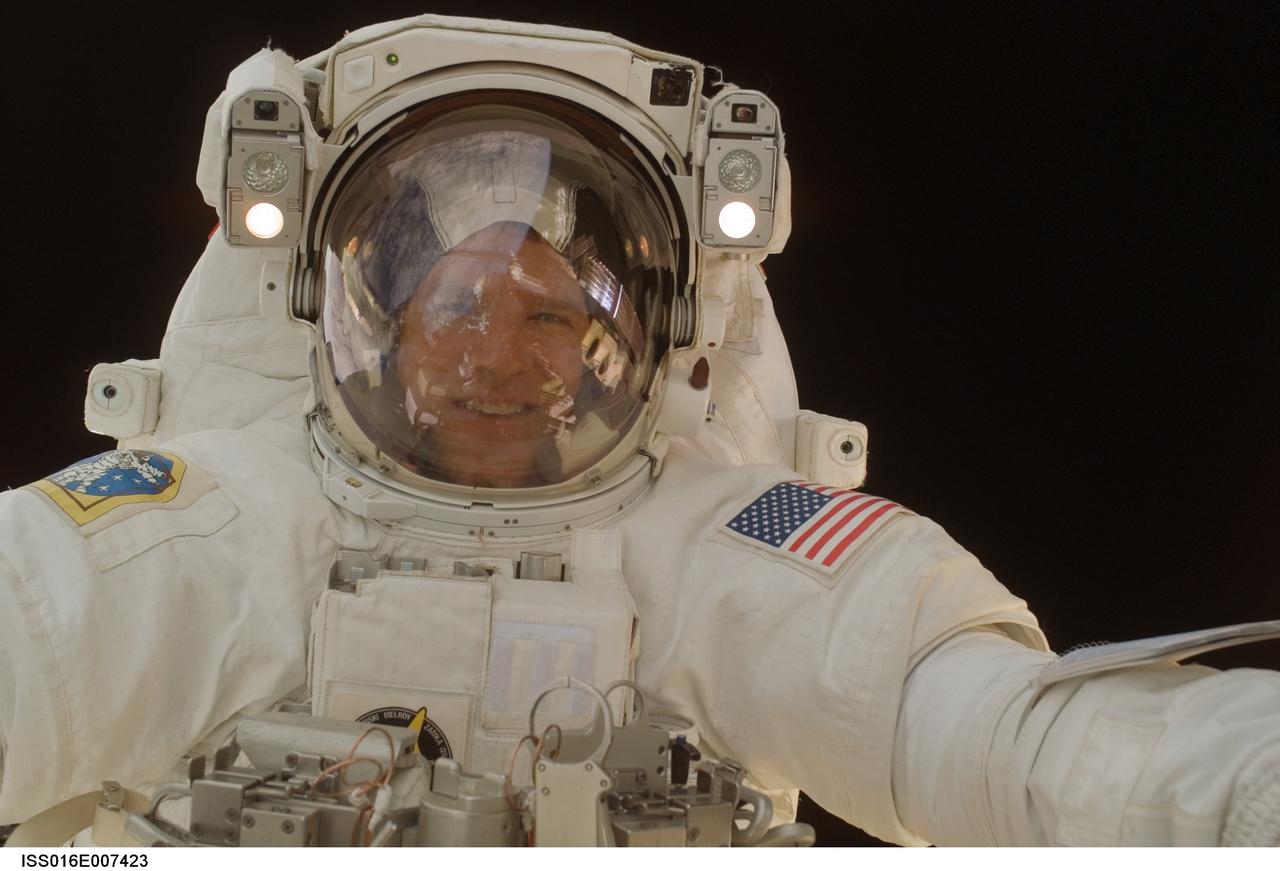
ISS016-E-007423 (30 Oct. 2007) --- Astronaut Scott Parazynski, STS-120 mission specialist, participates in the third scheduled session of extravehicular activity (EVA) as construction continues on the International Space Station. During the 7-hour, 8-minute spacewalk Parazynski and astronaut Doug Wheelock (out of frame), mission specialist, installed the P6 truss segment with its set of solar arrays to its permanent home, installed a spare main bus switching unit on a stowage platform, and performed a few get-ahead tasks. Also, Parazynski inspected the port Solar Alpha Rotary Joint (SARJ) to gather comparison data for the starboard rotary joint.
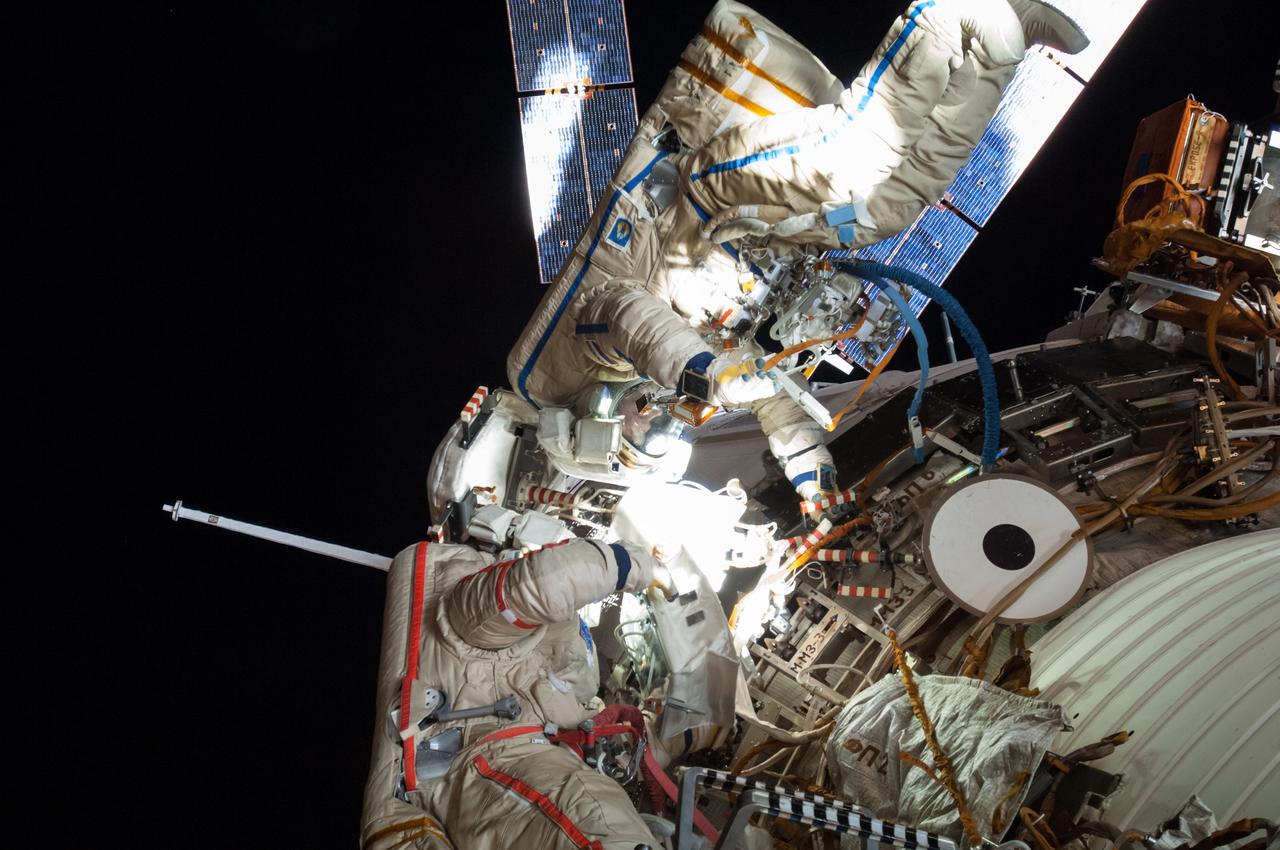
ISS040-E-099298 (18 Aug. 2014) --- Russian cosmonauts Alexander Skvortsov (left, red stripes) and Oleg Artemyev, both Expedition 40 flight engineers, attired in Russian Orlan spacesuits, participate in a session of extravehicular activity (EVA) in support of science and maintenance on the International Space Station. During the five-hour, 11-minute spacewalk, Artemyev and Skvortsov deployed a small science satellite, retrieved and installed experiment packages and inspected components on the exterior of the orbital laboratory. Solar array wings on the "Georges Lemaitre" Automated Transfer Vehicle-5 (ATV-5) docked to the Zvezda Service Module are visible in the background.
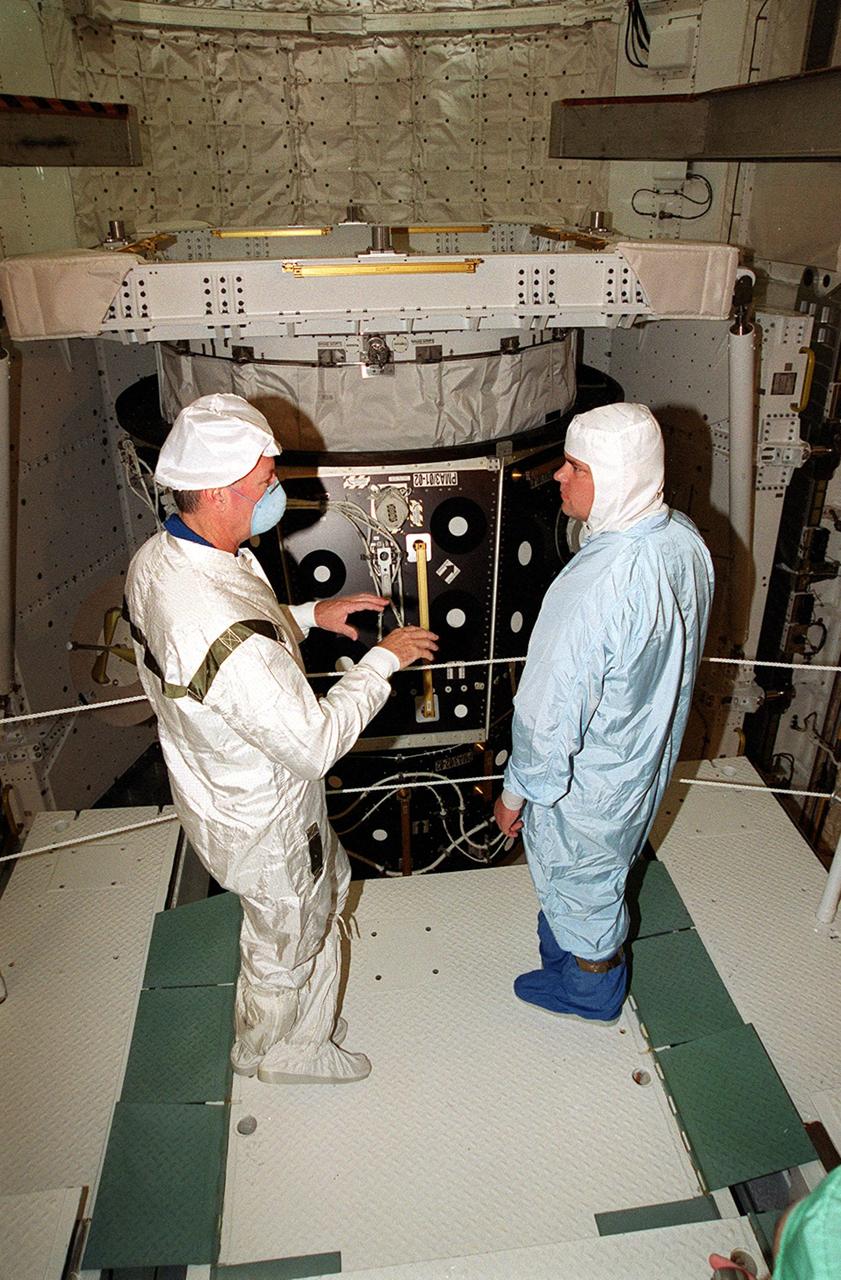
STS-92 Commander Brian Duffy (left) talks with a worker during inspection of the payload (behind them) in Space Shuttle Discovery’s payload bay. He and other crew members Pilot Pamela Ann Melroy and Mission Specialists Koichi Wakata of Japan, Leroy Chiao, Peter J.K. “Jeff” Wisoff, Michael E. Lopez-Alegria and William S. McArthur Jr. are preparing for launch on Oct. 5, 2000. The mission is the fifth flight for the construction of the International Space Station. The payload includes the Integrated Truss Structure Z-1 and the third Pressurized Mating Adapter. During the 11-day mission, four extravehicular activities (EVAs), or space walks, are planned
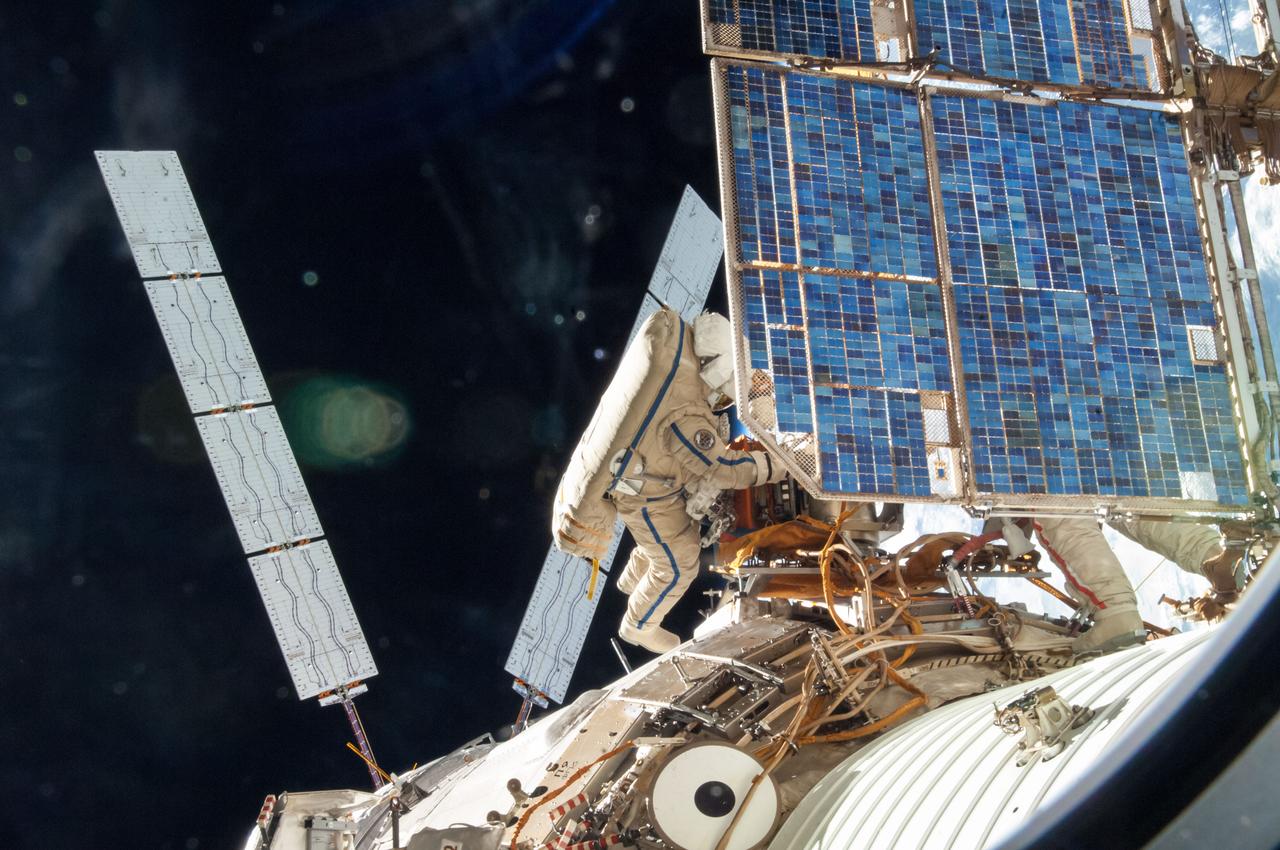
ISS040-E-099266 (18 Aug. 2014) --- Russian cosmonauts Oleg Artemyev (blue stripes) and Alexander Skvortsov (red stripes, mostly obscured), both Expedition 40 flight engineers, attired in Russian Orlan spacesuits, participate in a session of extravehicular activity (EVA) in support of science and maintenance on the International Space Station. During the five-hour, 11-minute spacewalk, Artemyev and Skvortsov deployed a small science satellite, retrieved and installed experiment packages and inspected components on the exterior of the orbital laboratory. Solar arrays wings on the "Georges Lemaitre" Automated Transfer Vehicle-5 (ATV-5) docked to the Zvezda Service Module are visible at left.
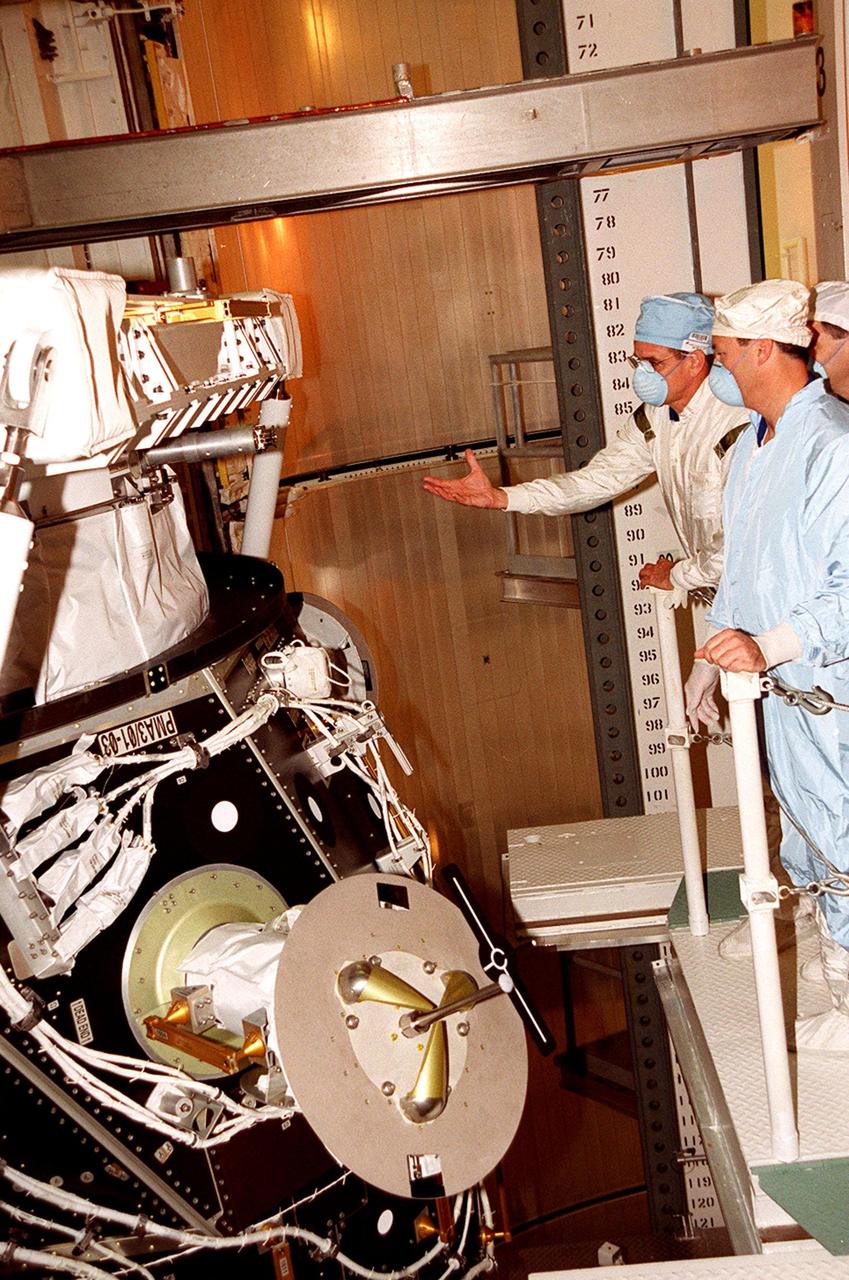
KENNEDY SPACE CENTER, FLA. -- In Space Shuttle Discovery’s payload bay, STS-92 Mission Specialist William S. McArthur Jr. explains something about the Pressurized Mating Adapter in front of him to other Mission Specialists Michael E. Lopez-Alegria and Peter J.K. Wisoff. The STS-92 crew has been inspecting the payload in preparation for launch Oct. 5, 2000. The mission is the fifth flight for the construction of the International Space Station. The payload also includes the Integrated Truss Structure Z-1. During the 11-day mission, four extravehicular activities (EVAs), or space walks, are planned
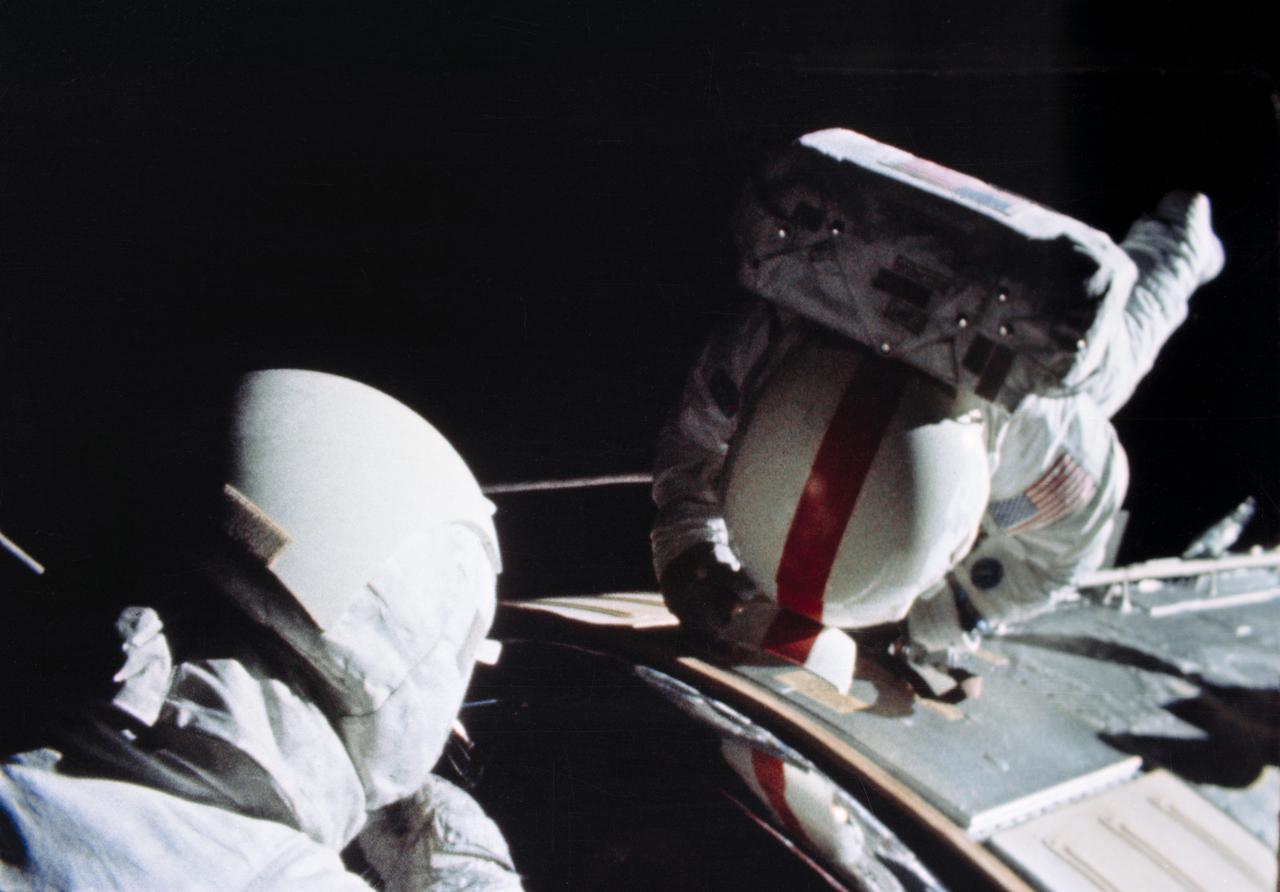
S72-37001 (25 April 1972) --- Astronaut Thomas K. Mattingly II, command module pilot, performs an extravehicular activity (EVA) during the Apollo 16 trans-Earth coast. Mattingly is assisted by astronaut Charles M. Duke Jr., lunar module pilot. Mattingly inspected the SIM Bay or Service Module (SM), and retrieved film from the Mapping and Panoramic Cameras. Mattingly is wearing the helmet of astronaut John W. Young, commander. The helmet's lunar EVA visor assembly helped protect Mattingly's eyes from the bright sun. This view is a frame from motion picture film exposed by a 16mm Maurer camera.
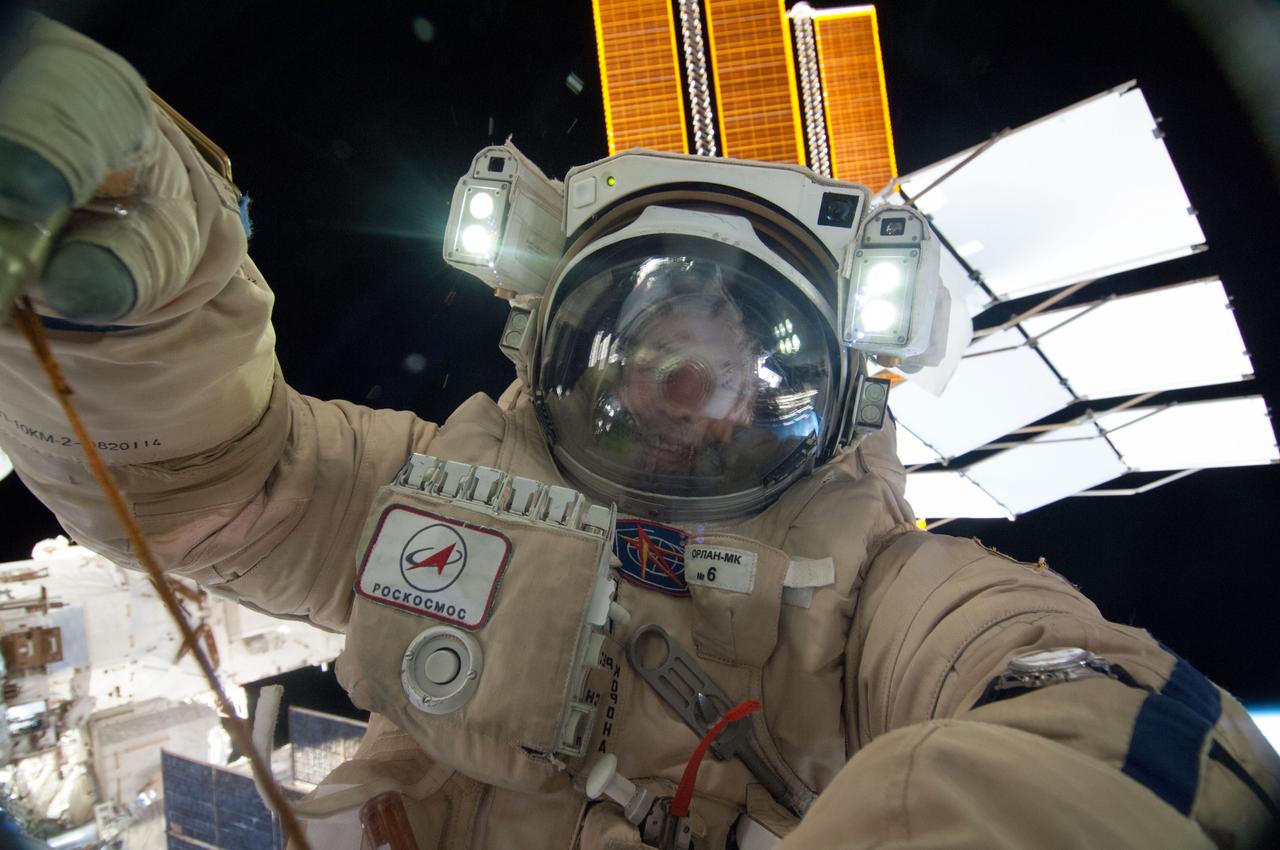
ISS036-E-035177 (22 Aug. 2013) --- Russian cosmonaut Alexander Misurkin, Expedition 36 flight engineer, attired in a Russian Orlan spacesuit, participates in a session of extravehicular activity (EVA) to continue outfitting the International Space Station. During the five-hour, 58-minute spacewalk, Misurkin and Russian cosmonaut Fyodor Yurchikhin (out of frame) completed the replacement of a laser communications experiment with a new platform for a small optical camera system, the installation of new spacewalk aids and an inspection of antenna covers. Parts of solar array panels on the orbital outpost are visible in the background,
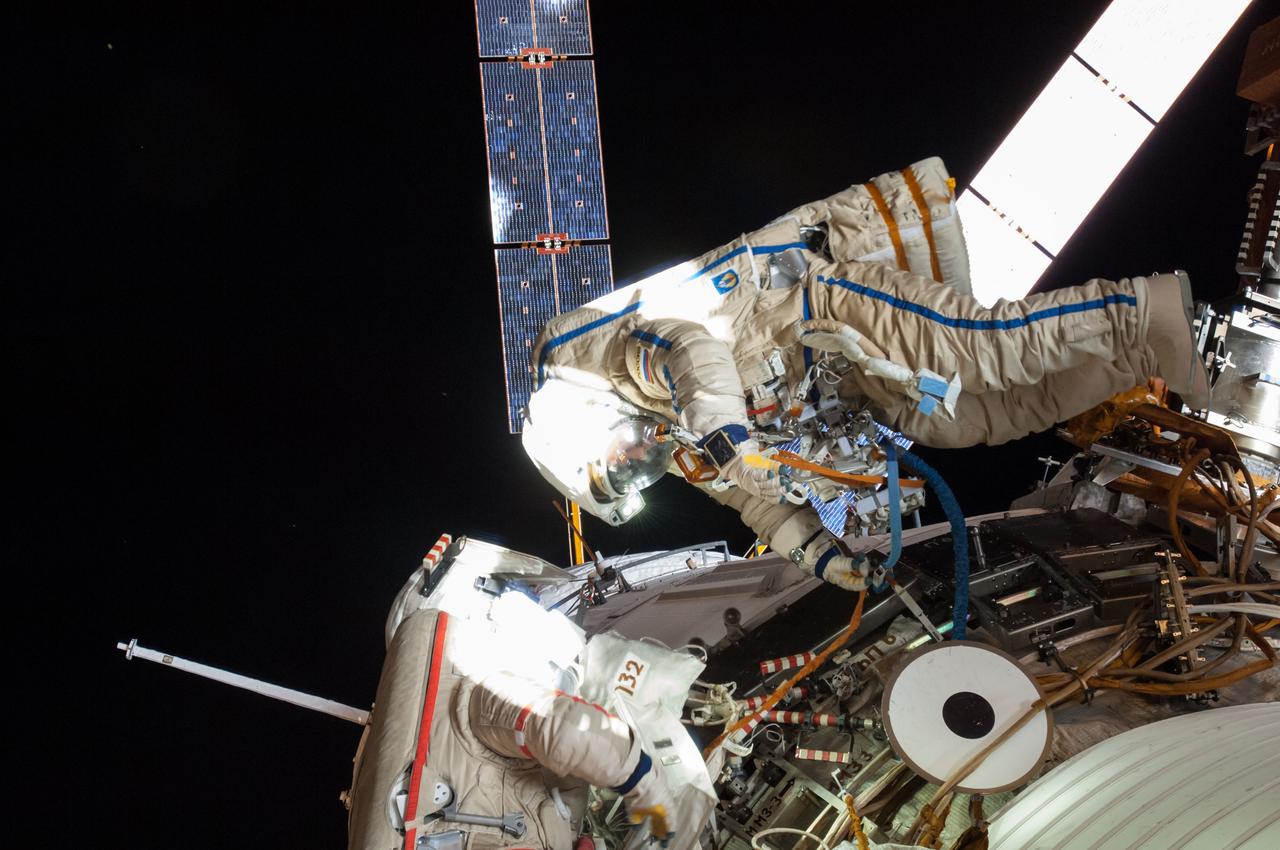
ISS040-E-099297 (18 Aug. 2014) --- Russian cosmonauts Alexander Skvortsov (left, red stripes) and Oleg Artemyev, both Expedition 40 flight engineers, attired in Russian Orlan spacesuits, participate in a session of extravehicular activity (EVA) in support of science and maintenance on the International Space Station. During the five-hour, 11-minute spacewalk, Artemyev and Skvortsov deployed a small science satellite, retrieved and installed experiment packages and inspected components on the exterior of the orbital laboratory. Solar array wings on the "Georges Lemaitre" Automated Transfer Vehicle-5 (ATV-5) docked to the Zvezda Service Module are visible in the background.
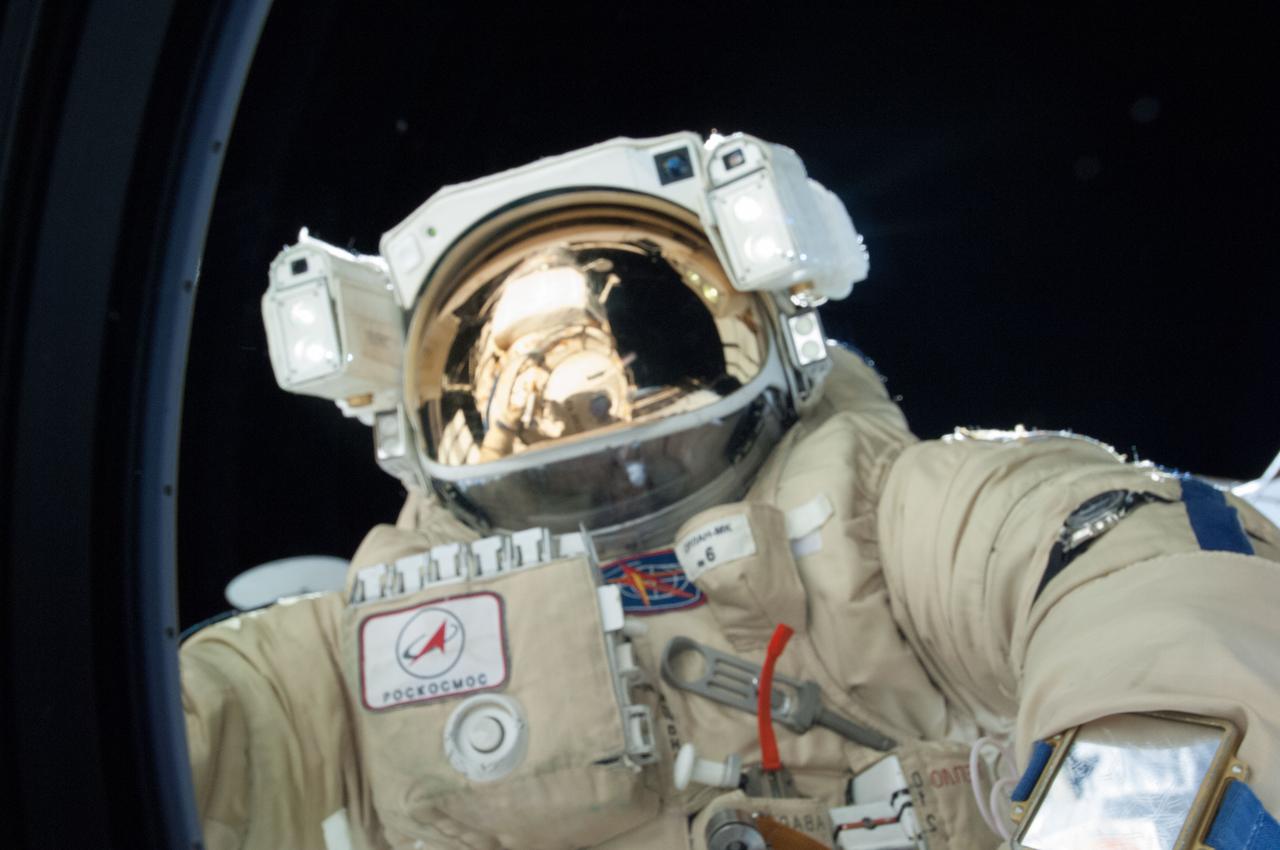
ISS036-E-035200 (22 Aug. 2013) --- Russian cosmonaut Alexander Misurkin, Expedition 36 flight engineer, attired in a Russian Orlan spacesuit, participates in a session of extravehicular activity (EVA) to continue outfitting the International Space Station. During the five-hour, 58-minute spacewalk, Misurkin and Russian cosmonaut Fyodor Yurchikhin (out of frame) completed the replacement of a laser communications experiment with a new platform for a small optical camera system, the installation of new spacewalk aids and an inspection of antenna covers. A section of the space station is visible in the reflections in his helmet visor.
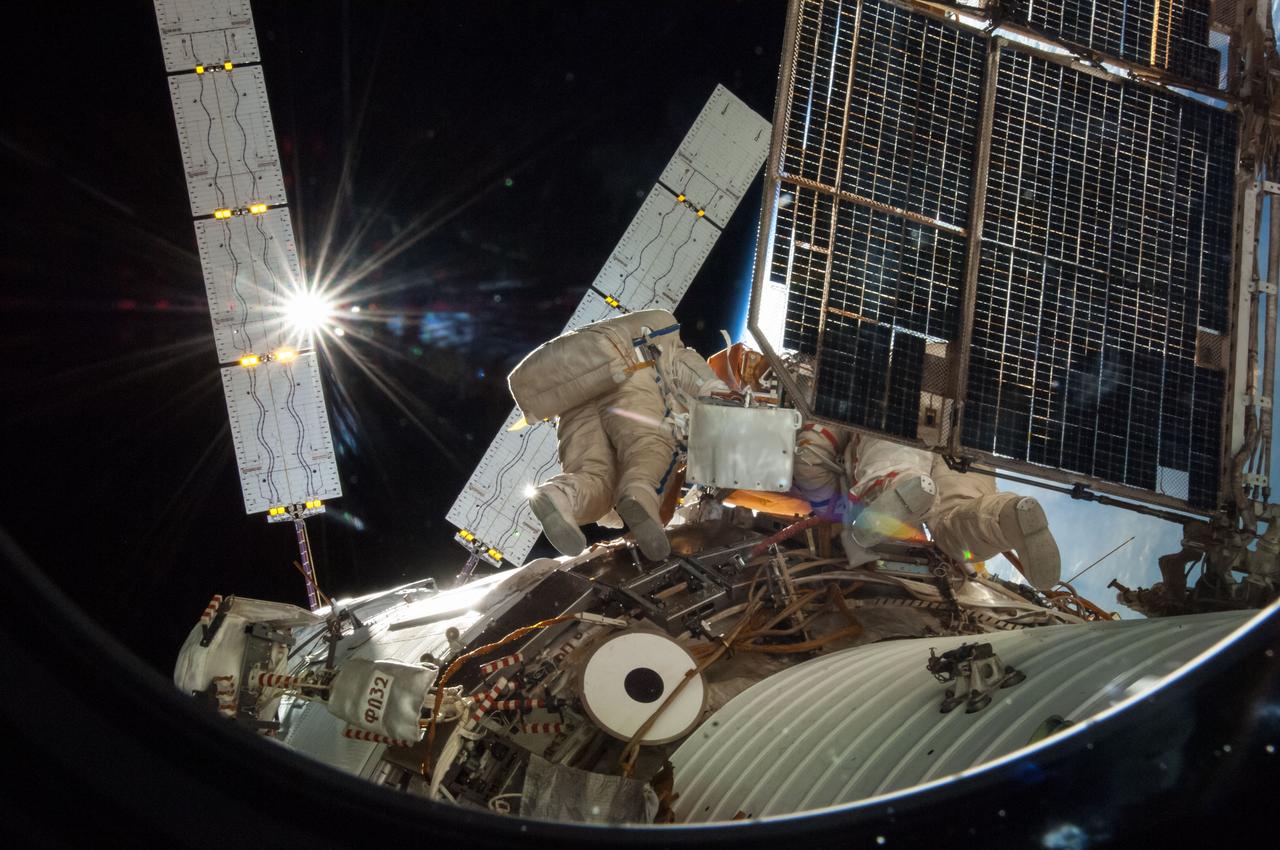
ISS040-E-099271 (18 Aug. 2014) --- Russian cosmonauts Oleg Artemyev (blue stripes) and Alexander Skvortsov (red stripes, partially obscured), both Expedition 40 flight engineers, attired in Russian Orlan spacesuits, participate in a session of extravehicular activity (EVA) in support of science and maintenance on the International Space Station. During the five-hour, 11-minute spacewalk, Artemyev and Skvortsov deployed a small science satellite, retrieved and installed experiment packages and inspected components on the exterior of the orbital laboratory. Solar arrays wings on the "Georges Lemaitre" Automated Transfer Vehicle-5 (ATV-5) docked to the Zvezda Service Module are visible at left.
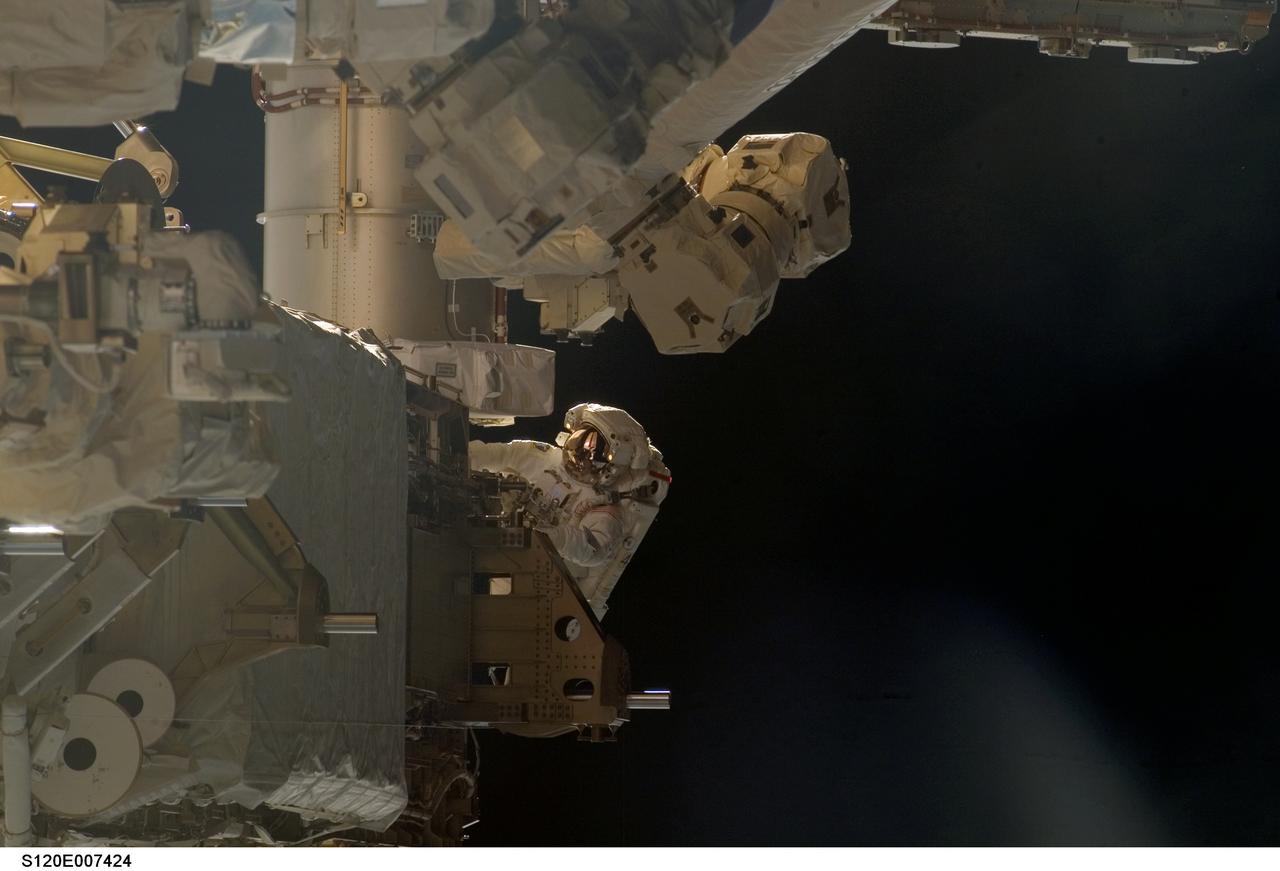
S120-E-007424 (30 Oct. 2007) --- Astronaut Scott Parazynski, STS-120 mission specialist, participates in the third scheduled session of extravehicular activity (EVA) as construction continues on the International Space Station. During the 7-hour, 8-minute spacewalk Parazynski and astronaut Doug Wheelock (out of frame), mission specialist, installed the P6 truss segment with its set of solar arrays to its permanent home, installed a spare main bus switching unit on a stowage platform, and performed a few get-ahead tasks. Also, Parazynski inspected the port Solar Alpha Rotary Joint (SARJ) to gather comparison data for the starboard rotary joint.
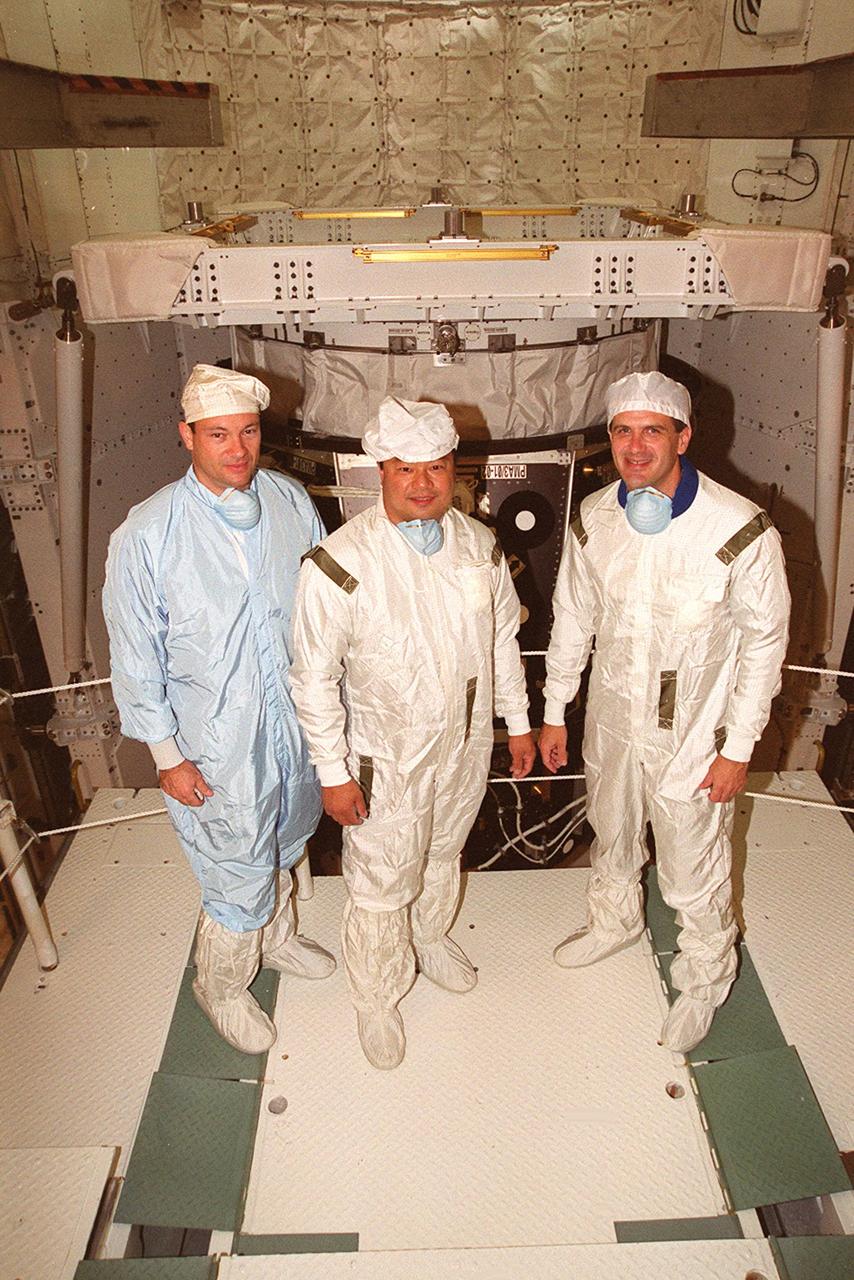
KENNEDY SPACE CENTER, FLA. -- During inspection of the payload in Space Shuttle Discovery’s payload bay (background), STS-92 Mission Specialists Michael E. Lopez-Alegria, Leroy Chiao and Peter J.K. “Jeff” Wisoff pause for a photo. They and other crew members Commander Brian Duffy, Pilot Pamela Ann Melroy and Mission Specialists Koichi Wakata of Japan and William S. McArthur Jr. are preparing for launch on Oct. 5, 2000. The mission is the fifth flight for the construction of the International Space Station. The payload includes the Integrated Truss Structure Z-1 and the third Pressurized Mating Adapter. During the 11-day mission, four extravehicular activities (EVAs), or space walks, are planned
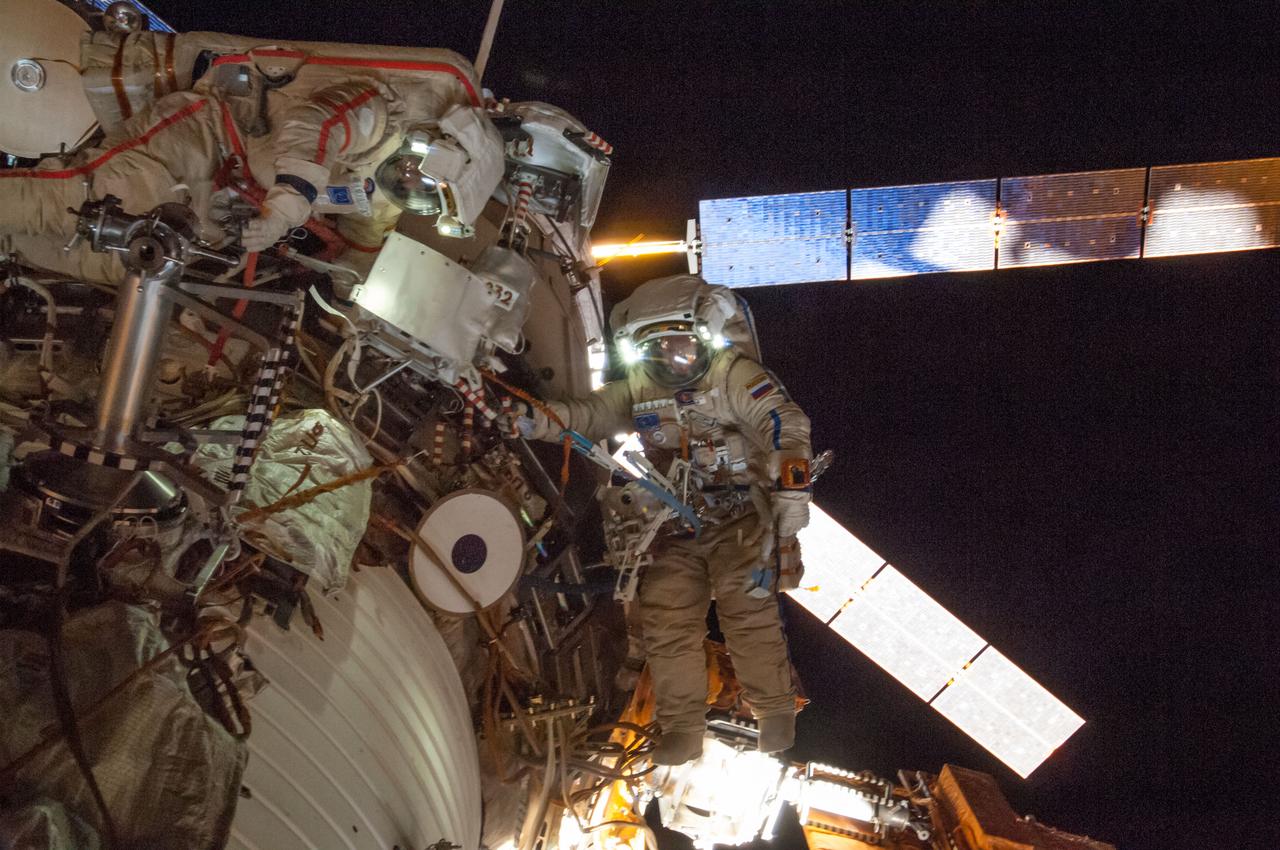
ISS040-E-099280 (18 Aug. 2014) --- Russian cosmonauts Alexander Skvortsov (left, red stripes) and Oleg Artemyev, both Expedition 40 flight engineers, attired in Russian Orlan spacesuits, participate in a session of extravehicular activity (EVA) in support of science and maintenance on the International Space Station. During the five-hour, 11-minute spacewalk, Artemyev and Skvortsov deployed a small science satellite, retrieved and installed experiment packages and inspected components on the exterior of the orbital laboratory. Solar array wings on the "Georges Lemaitre" Automated Transfer Vehicle-5 (ATV-5) docked to the Zvezda Service Module are visible in the background.
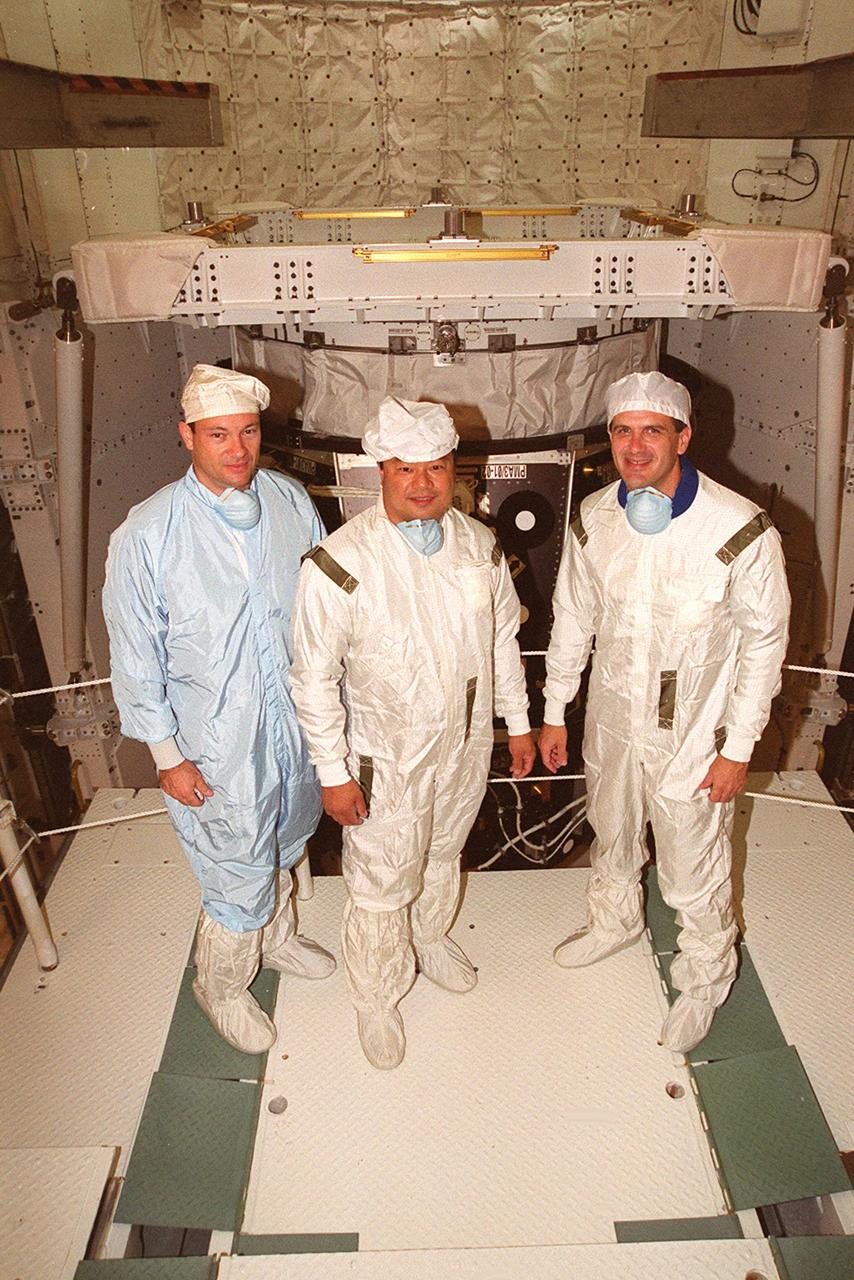
KENNEDY SPACE CENTER, FLA. -- During inspection of the payload in Space Shuttle Discovery’s payload bay (background), STS-92 Mission Specialists Michael E. Lopez-Alegria, Leroy Chiao and Peter J.K. “Jeff” Wisoff pause for a photo. They and other crew members Commander Brian Duffy, Pilot Pamela Ann Melroy and Mission Specialists Koichi Wakata of Japan and William S. McArthur Jr. are preparing for launch on Oct. 5, 2000. The mission is the fifth flight for the construction of the International Space Station. The payload includes the Integrated Truss Structure Z-1 and the third Pressurized Mating Adapter. During the 11-day mission, four extravehicular activities (EVAs), or space walks, are planned
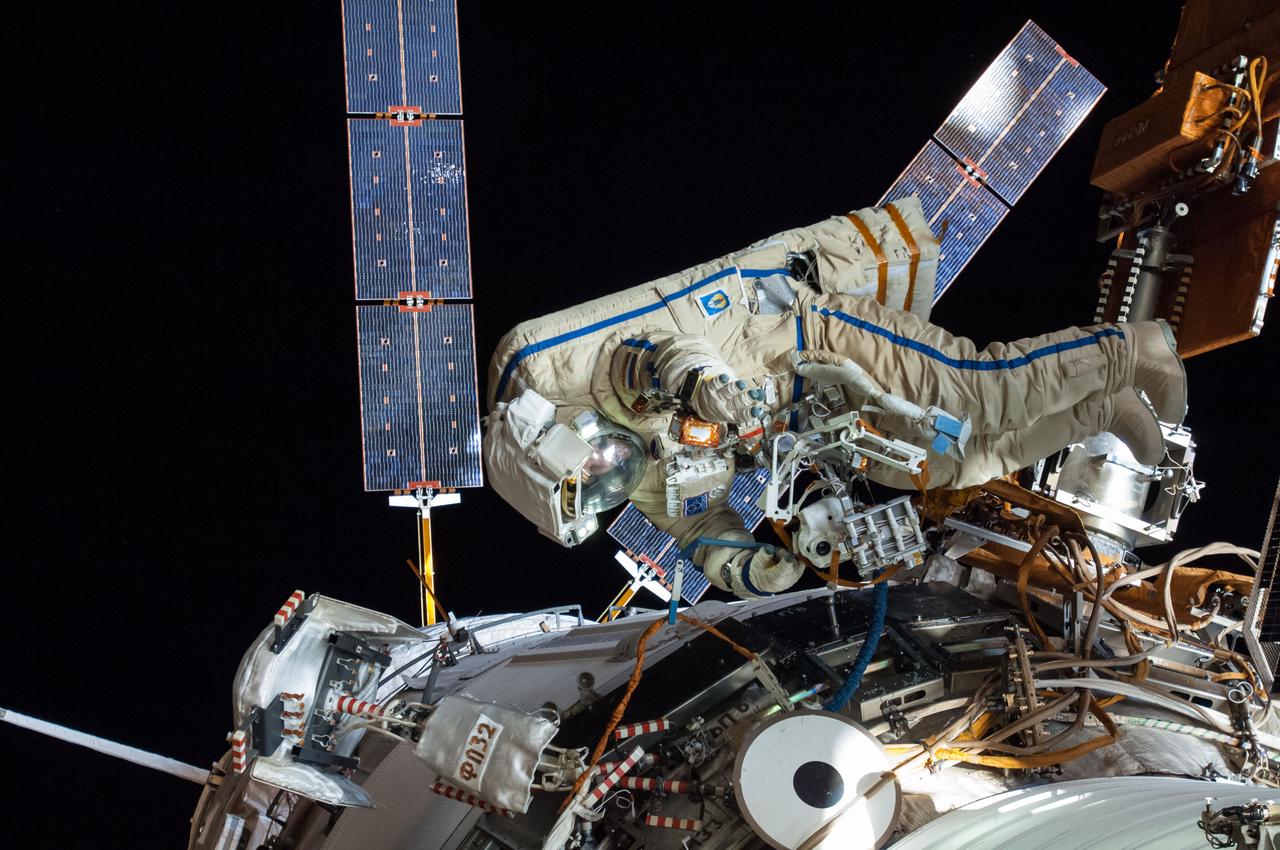
ISS040-E-099302 (18 Aug. 2014) --- Russian cosmonauts Oleg Artemyev and Alexander Skvortsov (out of frame), both Expedition 40 flight engineers, attired in Russian Orlan spacesuits, participate in a session of extravehicular activity (EVA) in support of science and maintenance on the International Space Station. During the five-hour, 11-minute spacewalk, Artemyev and Skvortsov deployed a small science satellite, retrieved and installed experiment packages and inspected components on the exterior of the orbital laboratory. Solar array wings on the "Georges Lemaitre" Automated Transfer Vehicle-5 (ATV-5) docked to the Zvezda Service Module are visible in the background.
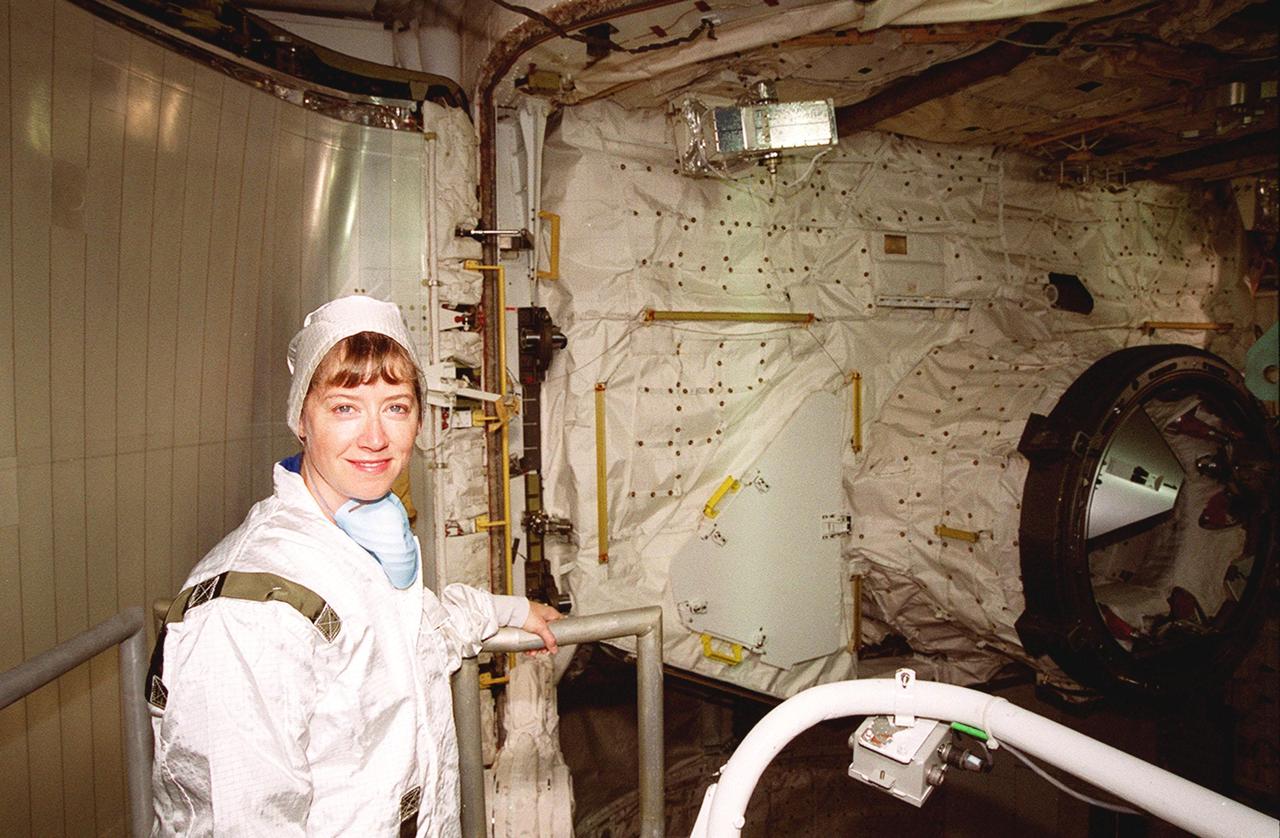
STS-92 Pamela Ann Melroy pauses during inspection of the payload (behind her) in Space Shuttle Discovery’s payload bay. She and other crew members Commander Brian Duffy and Mission Specialists Koichi Wakata of Japan, Leroy Chiao, Peter J.K. “Jeff” Wisoff. Michael E. Lopez-Alegria and William S. McArthur Jr. are preparing for launch on Oct. 5, 2000. The mission is the fifth flight for the construction of the International Space Station. The payload includes the Integrated Truss Structure Z-1 and the third Pressurized Mating Adapter. During the 11-day mission, four extravehicular activities (EVAs), or space walks, are planned

KENNEDY SPACE CENTER, FLA. -- From a lower level in the Orbiter Processing Facility, members of the STS-122 crew check out the landing gear on space shuttle Atlantis, overhead. Dressed in their blue suits are Mission Specialist Leland Melvin, Commander Stephen Frick, European Space Agency astronaut Leopold Eyharts and Pilot Alan Poindexter. Eyharts will be traveling to the International Space Station to join the Expedition 16 crew as a flight engineer. The crew is at Kennedy to take part in a crew equipment interface test, or CEIT, which helps familiarize them with equipment and payloads for the mission. Among the activities standard to a CEIT are harness training, inspection of the thermal protection system and camera operation for planned extravehicular activities, or EVAs. STS-122 is targeted for launch in December. Photo credit: NASA/Kim Shiflett
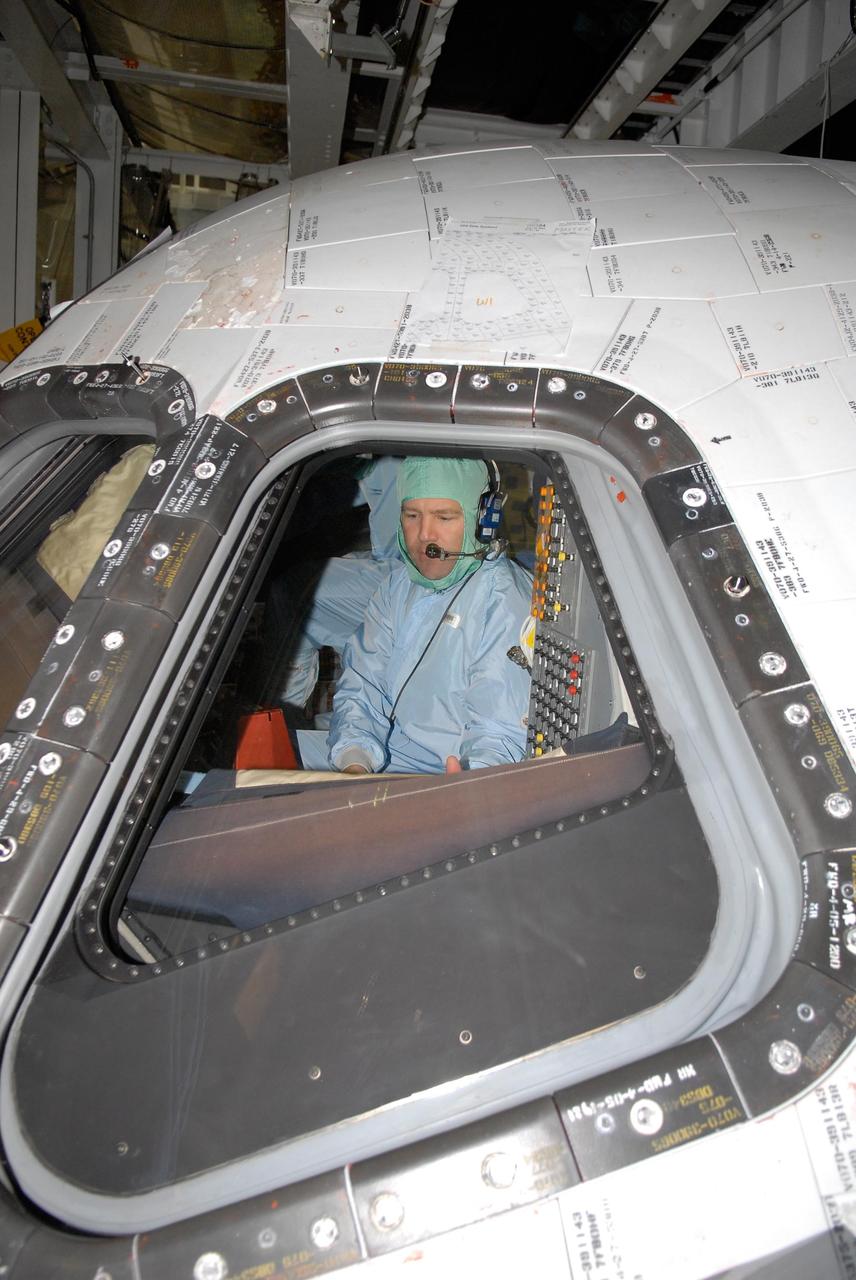
KENNEDY SPACE CENTER, FLA. -- In the Orbiter Processing Facility, STS-122 Commander Stephen Frick checks out the cockpit on space shuttle Atlantis. He and other crew members are at Kennedy Space Center to take part in a crew equipment interface test, which helps familiarize them with equipment and payloads for the mission. Among the activities standard to a CEIT are harness training, inspection of the thermal protection system and camera operation for planned extravehicular activities, or EVAs. The mission will carry and install the Columbus Lab, a multifunctional, pressurized laboratory that will be permanently attached to Node 2 of the space station to carry out experiments in materials science, fluid physics and biosciences, as well as to perform a number of technological applications. It is Europe’s largest contribution to the construction of the International Space Station and will support scientific and technological research in a microgravity environment. STS-122 is targeted for launch in December. Photo credit: NASA/Kim Shiflett
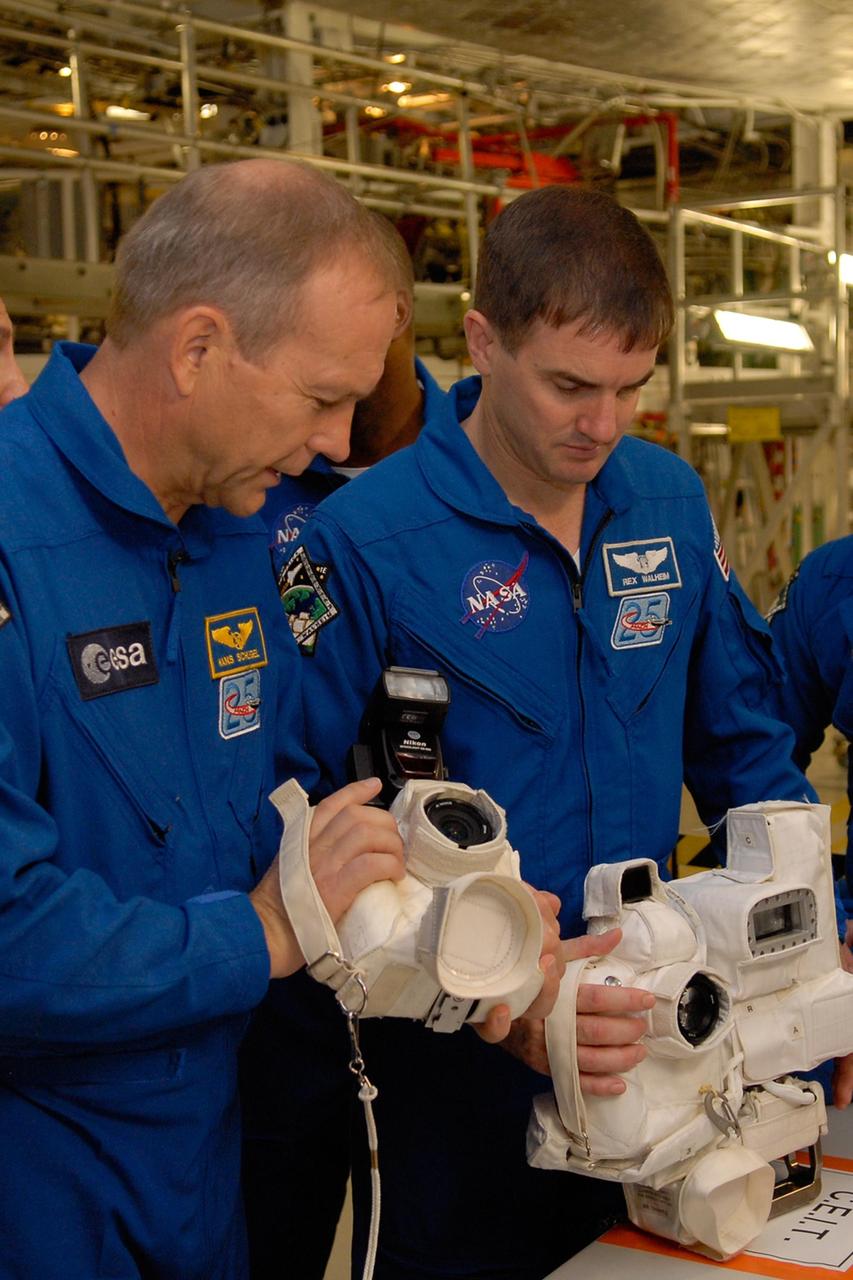
KENNEDY SPACE CENTER, FLA. -- In the Orbiter Processing Facility, members of the STS-122 crew look over cameras that will be used during the mission. From left are Mission Specialists Hans Schlegel and Rex Walheim. Schlegel represents the European Space Agency. The crew is at Kennedy Space Center to take part in a crew equipment interface test, which helps familiarize them with equipment and payloads for the mission. Among the activities standard to a CEIT are harness training, inspection of the thermal protection system and camera operation for planned extravehicular activities, or EVAs. The mission will carry and install the Columbus Lab, a multifunctional, pressurized laboratory that will be permanently attached to Node 2 of the space station to carry out experiments in materials science, fluid physics and biosciences, as well as to perform a number of technological applications. It is Europe’s largest contribution to the construction of the International Space Station and will support scientific and technological research in a microgravity environment. STS-122 is targeted for launch in December. Photo credit: NASA/Kim Shiflett
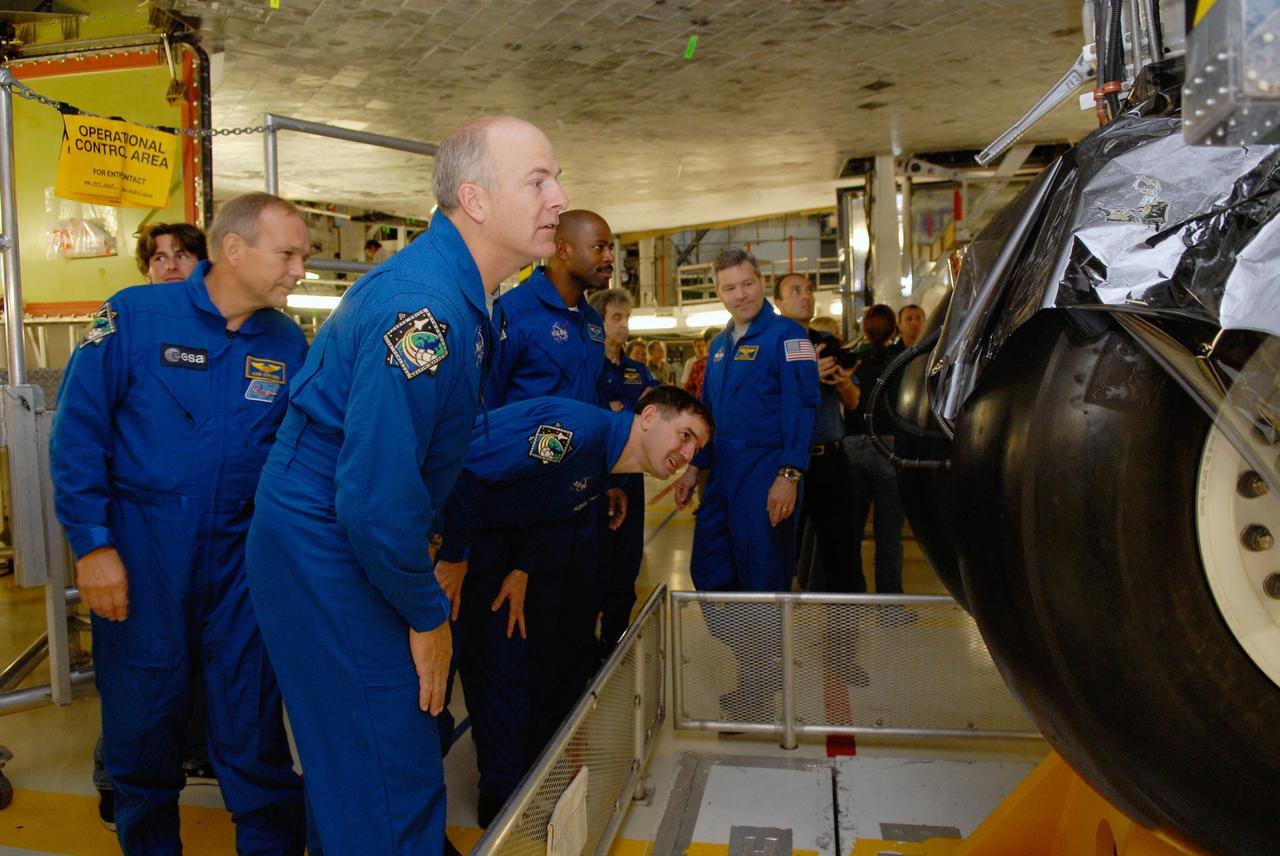
KENNEDY SPACE CENTER, FLA. -- In the Orbiter Processing Facility, members of the STS-122 crew get a close look at the landing gear on space shuttle Atlantis. From left are Mission Specialist Hans Schlegel, Pilot Alan Poindexter, Mission Specialists Rex Walheim and Leland Melvin and Commander Stephen Frick. Schlegel represents the European Space Agency. The crew is at Kennedy to take part in a crew equipment interface test, or CEIT, which helps familiarize them with equipment and payloads for the mission. Among the activities standard to a CEIT are harness training, inspection of the thermal protection system and camera operation for planned extravehicular activities, or EVAs. STS-122 is targeted for launch in December. Photo credit: NASA/Kim Shiflett
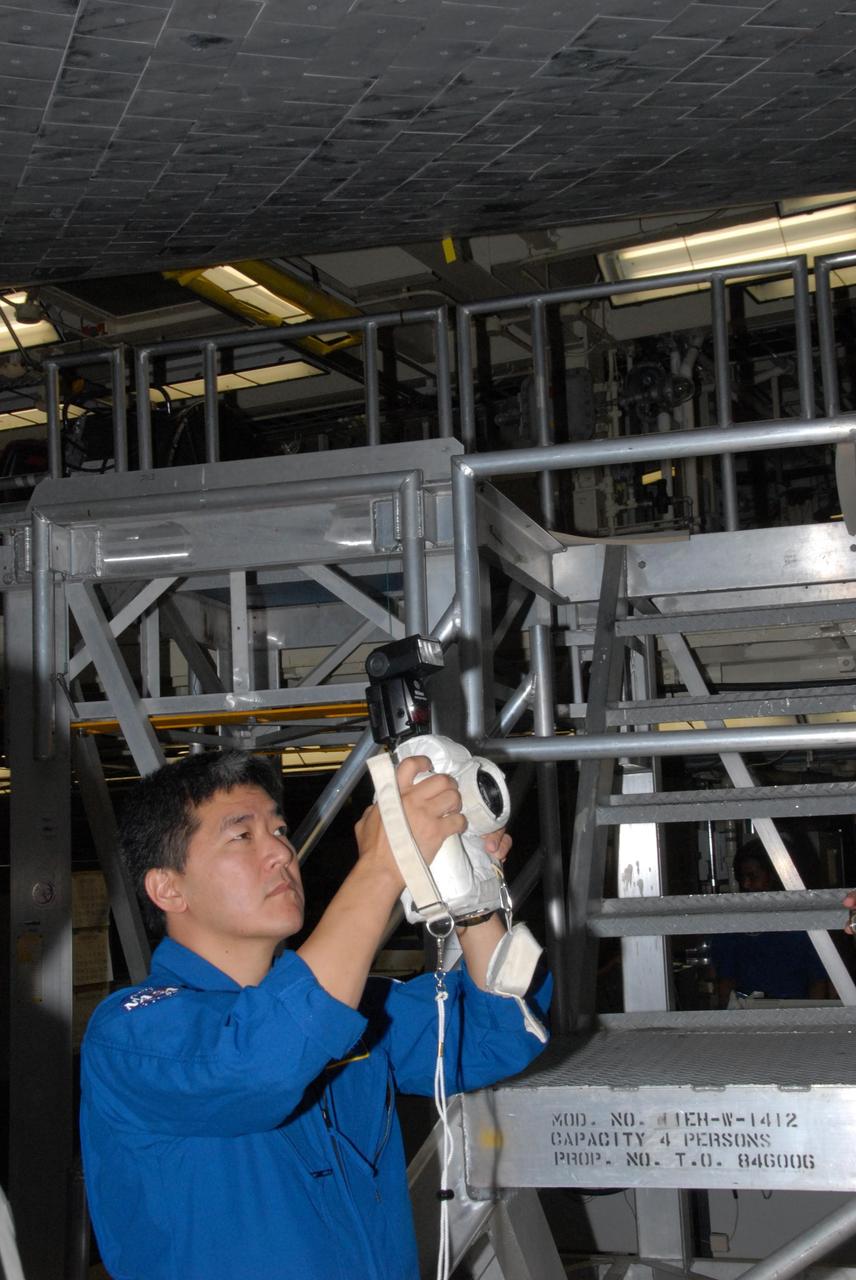
KENNEDY SPACE CENTER, FLA. - The STS-120 crew is at Kennedy for a crew equipment interface test, or CEIT. In Orbiter Processing Facility bay 3, Expedition 16 Flight Engineer Daniel M. Tani is given the opportunity to operate a camera that will fly on the mission. Among the activities standard to a CEIT are harness training, inspection of the thermal protection system and camera operation for planned extravehicular activities, or EVAs. The STS-120 mission will deliver the Harmony module, christened after a school contest, which will provide attachment points for European and Japanese laboratory modules on the International Space Station. Known in technical circles as Node 2, it is similar to the six-sided Unity module that links the U.S. and Russian sections of the station. Built in Italy for the United States, Harmony will be the first new U.S. pressurized component to be added. The STS-120 mission is targeted to launch on Oct. 20. Photo credit: NASA/George Shelton

KENNEDY SPACE CENTER, FLA. -- In the Orbiter Processing Facility, STS-122 Commander Stephen Frick checks out the cockpit on space shuttle Atlantis. He and other crew members are at Kennedy Space Center to take part in a crew equipment interface test, which helps familiarize them with equipment and payloads for the mission. Among the activities standard to a CEIT are harness training, inspection of the thermal protection system and camera operation for planned extravehicular activities, or EVAs. The mission will carry and install the Columbus Lab, a multifunctional, pressurized laboratory that will be permanently attached to Node 2 of the space station to carry out experiments in materials science, fluid physics and biosciences, as well as to perform a number of technological applications. It is Europe’s largest contribution to the construction of the International Space Station and will support scientific and technological research in a microgravity environment. STS-122 is targeted for launch in December. Photo credit: NASA/Kim Shiflett
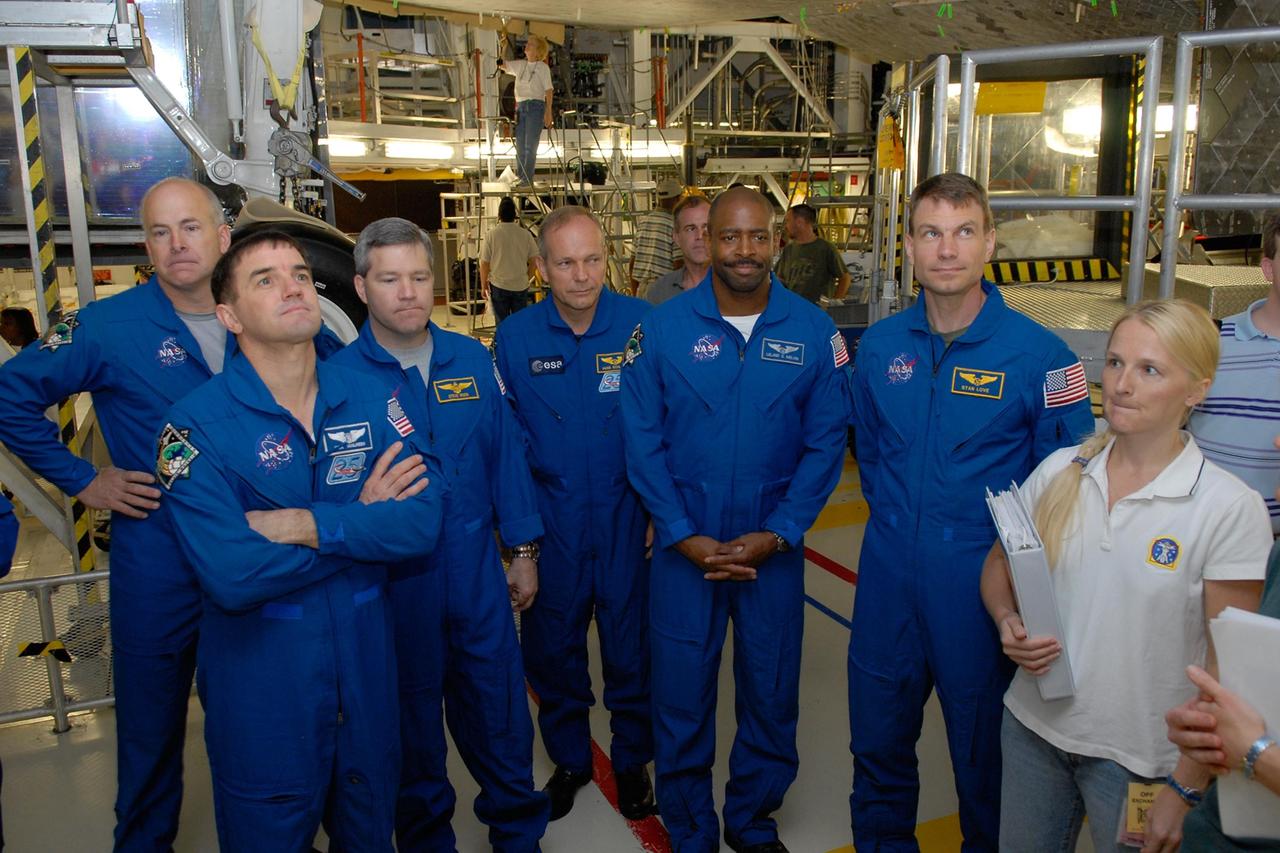
KENNEDY SPACE CENTER, FLA. -- In the Orbiter Processing Facility, members of the STS-122 crew get information about the thermal protection system on space shuttle Atlantis (overhead). From left are Pilot Alan Poindexter, Mission Specialists Rex Walheim, Commander Stephen Frick, and Mission Specialists Hans Schlegel, Leland Melvin and Stanley Love. Schlegel represents the European Space Agency. The crew is at Kennedy to take part in a crew equipment interface test, or CEIT, which helps familiarize them with equipment and payloads for the mission. Among the activities standard to a CEIT are harness training, inspection of the thermal protection system and camera operation for planned extravehicular activities, or EVAs. STS-122 is targeted for launch in December. Photo credit: NASA/Kim Shiflett
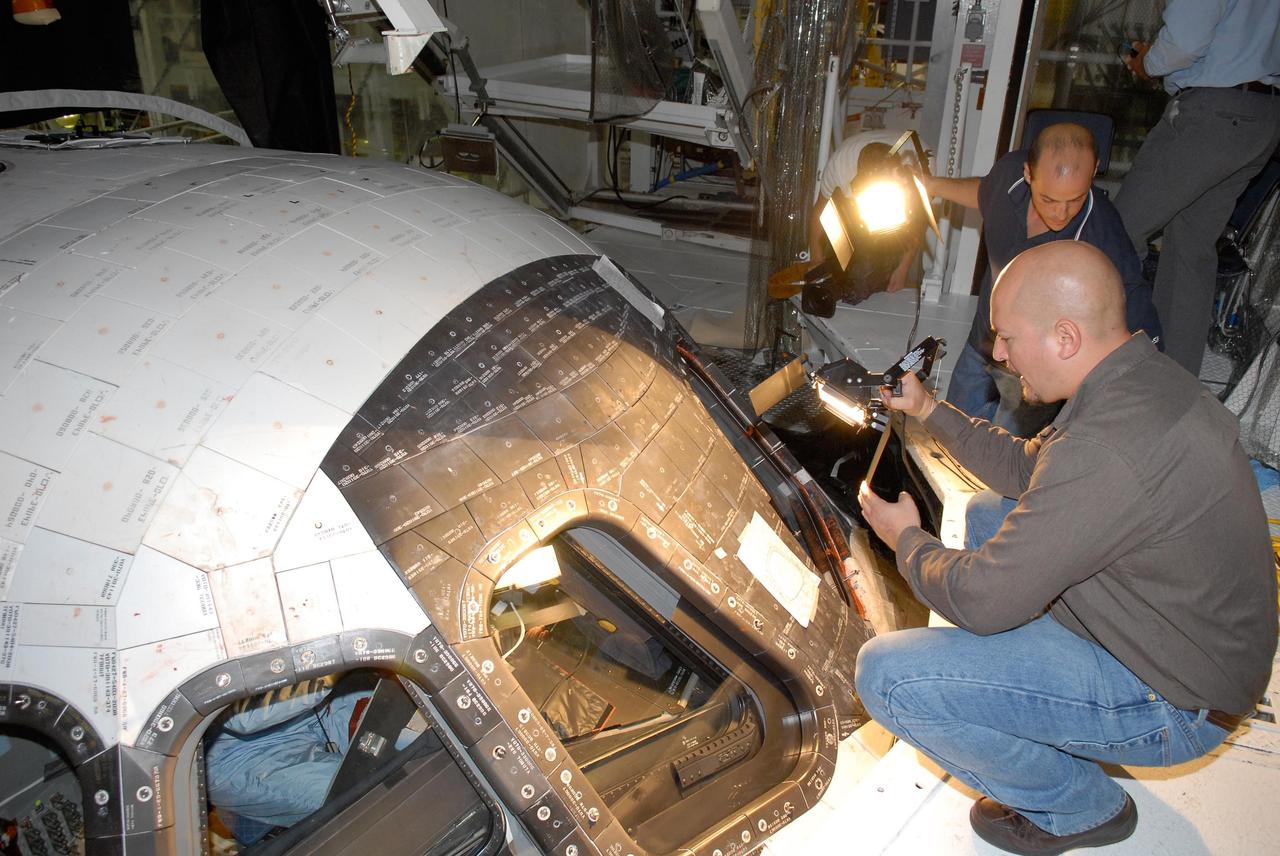
KENNEDY SPACE CENTER, FLA. -- In the Orbiter Processing Facility, United Space Alliance technicians provide lights over the space shuttle Atlantis' cockpit. STS-122 Commander Stephen Frick is inside checking the cockpit for launch readiness. The crew is at Kennedy Space Center to take part in a crew equipment interface test, which helps familiarize them with equipment and payloads for the mission. Among the activities standard to a CEIT are harness training, inspection of the thermal protection system and camera operation for planned extravehicular activities, or EVAs. The mission will carry and install the Columbus Lab, a multifunctional, pressurized laboratory that will be permanently attached to Node 2 of the space station to carry out experiments in materials science, fluid physics and biosciences, as well as to perform a number of technological applications. It is Europe’s largest contribution to the construction of the International Space Station and will support scientific and technological research in a microgravity environment. STS-122 is targeted for launch in December. Photo credit: NASA/Kim Shiflett
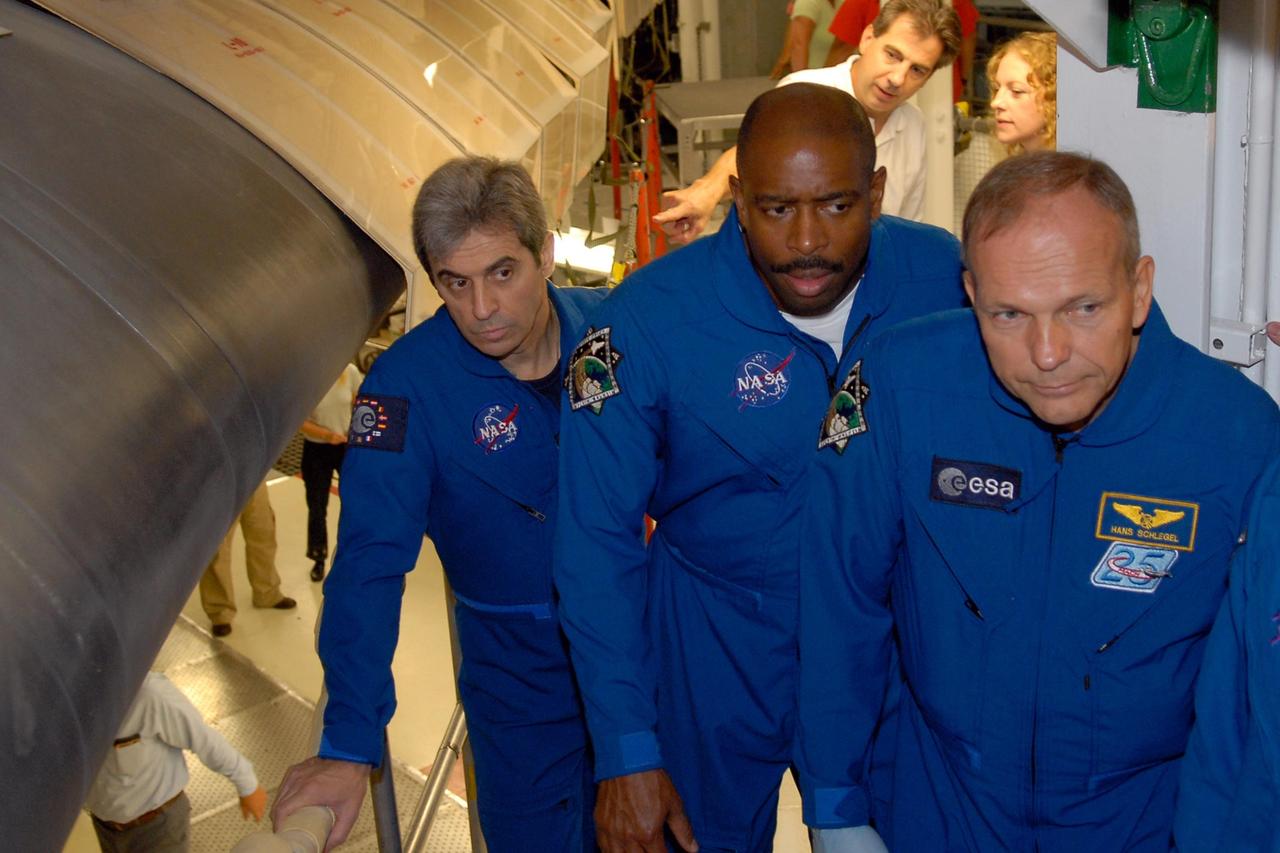
KENNEDY SPACE CENTER, FLA. -- In the Orbiter Processing Facility, STS-122 crew members stand next to the space shuttle Atlantis, which is being processed for launch on STS-122. From left are European Space Agency astronaut Leopold Eyharts and Mission Specialists Leland Melvin and Hans Schlegel, who also represents ESA. Eyharts will be traveling to the International Space Station to join the Expedition 16 crew as a flight engineer. The crew is at Kennedy to take part in a crew equipment interface test, or CEIT, which helps familiarize them with equipment and payloads for the mission. Among the activities standard to a CEIT are harness training, inspection of the thermal protection system and camera operation for planned extravehicular activities, or EVAs. STS-122 is targeted for launch in December. Photo credit: NASA/Kim Shiflett
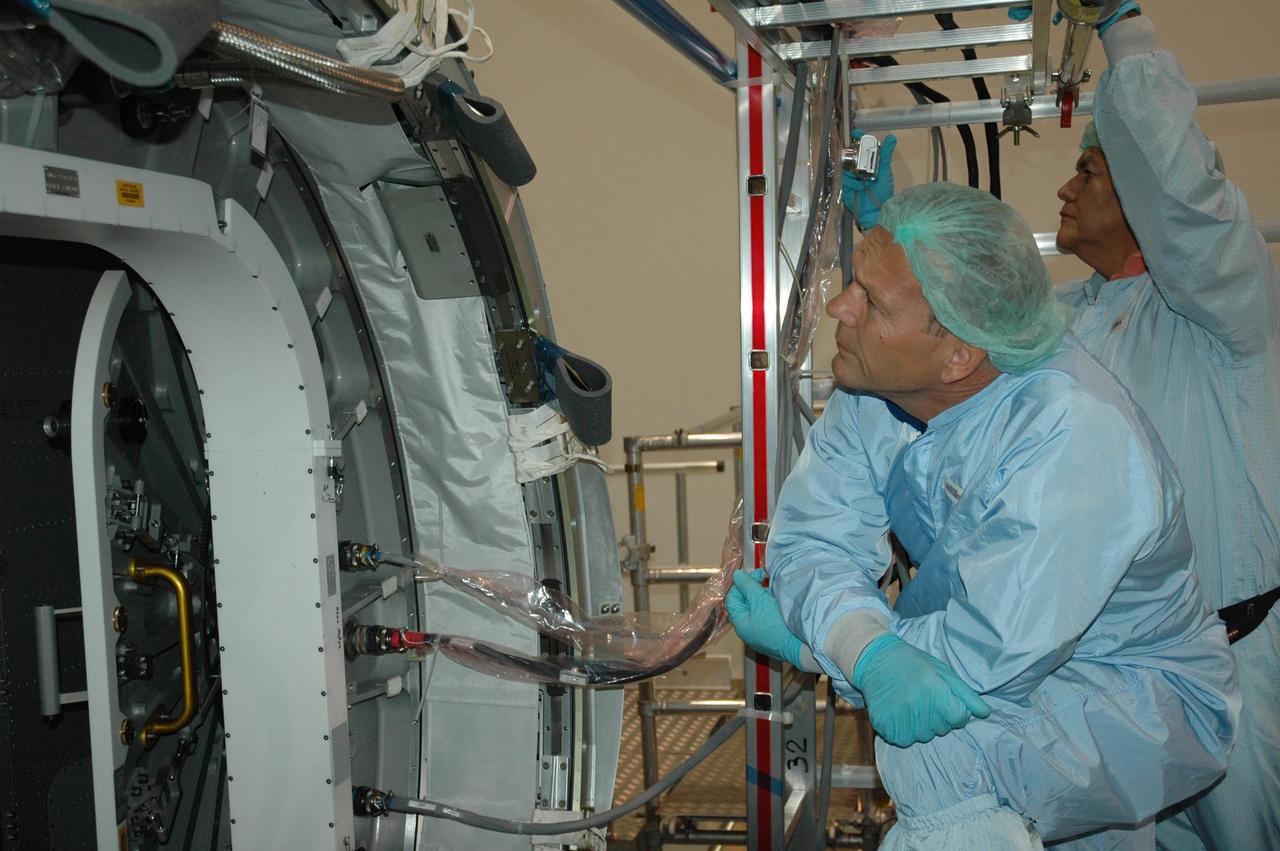
KENNEDY SPACE CENTER, FLA. STS-122 Mission Specialist Hans Schlegel looks closely at the hatch on the Columbus Research Laboratory in the Space Station Processing Facility. Schegel represents the European Space Agency. The crew is at Kennedy to take part in a crew equipment interface test, which helps familiarize them with equipment and payloads for the mission. Among the activities standard to a CEIT are harness training, inspection of the thermal protection system and camera operation for planned extravehicular activities, or EVAs. The Columbus Lab is Europe’s largest contribution to the construction of the International Space Station. It will support scientific and technological research in a microgravity environment. Columbus, a program of ESA, is a multifunctional, pressurized laboratory that will be permanently attached to Node 2 of the space station to carry out experiments in materials science, fluid physics and biosciences, as well as to perform a number of technological applications. STS-122 is targeted for launch in December. Photo credit: NASA/Jim Grossmann
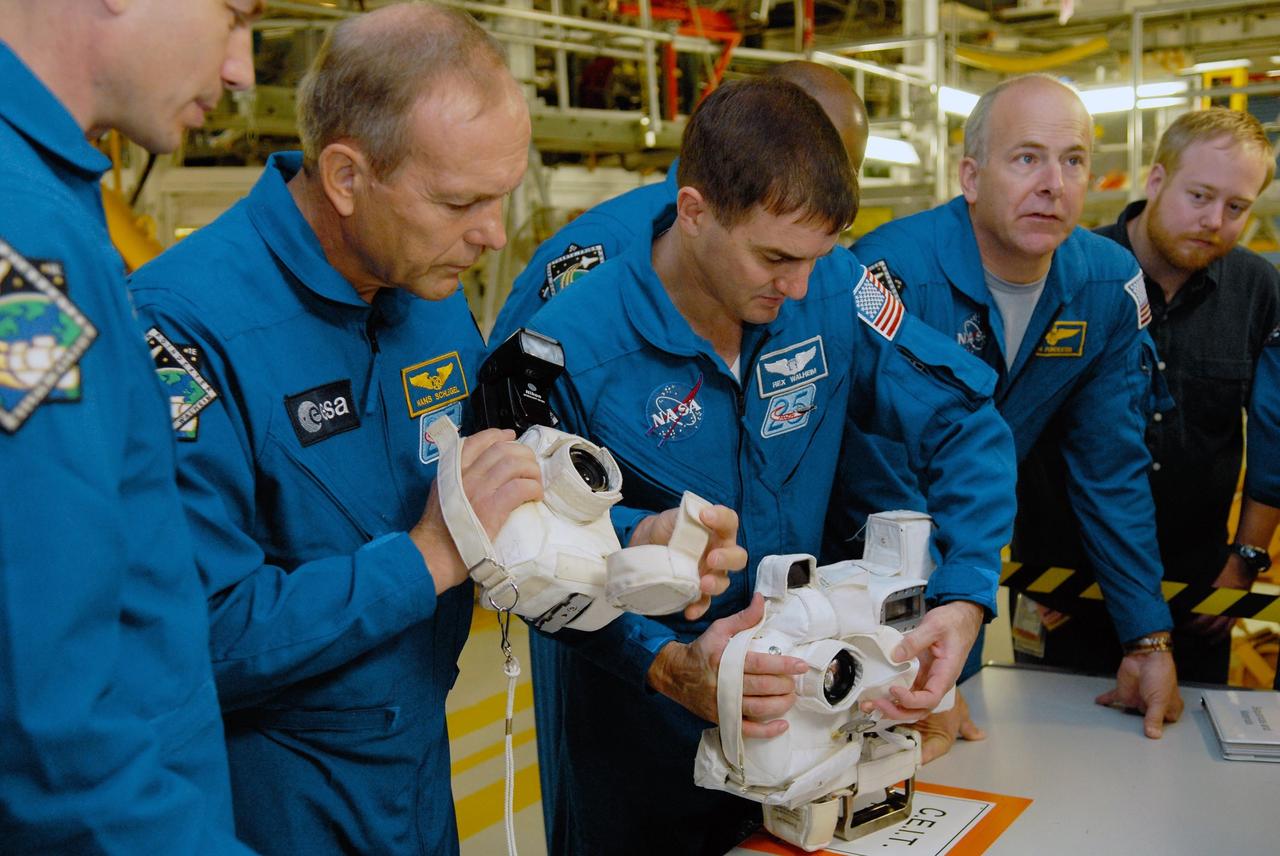
KENNEDY SPACE CENTER, FLA. -- In the Orbiter Processing Facility, members of the STS-122 crew look over cameras that will be used during the mission. From left are Mission Specialists Stanley Love, Hans Schlegel and Rex Walheim and Pilot Alan Poindexter. The crew is at Kennedy Space Center to take part in a crew equipment interface test, which helps familiarize them with equipment and payloads for the mission. Among the activities standard to a CEIT are harness training, inspection of the thermal protection system and camera operation for planned extravehicular activities, or EVAs. The mission will carry and install the Columbus Lab, a multifunctional, pressurized laboratory that will be permanently attached to Node 2 of the space station to carry out experiments in materials science, fluid physics and biosciences, as well as to perform a number of technological applications. It is Europe’s largest contribution to the construction of the International Space Station and will support scientific and technological research in a microgravity environment. STS-122 is targeted for launch in December. Photo credit: NASA/Kim Shiflett
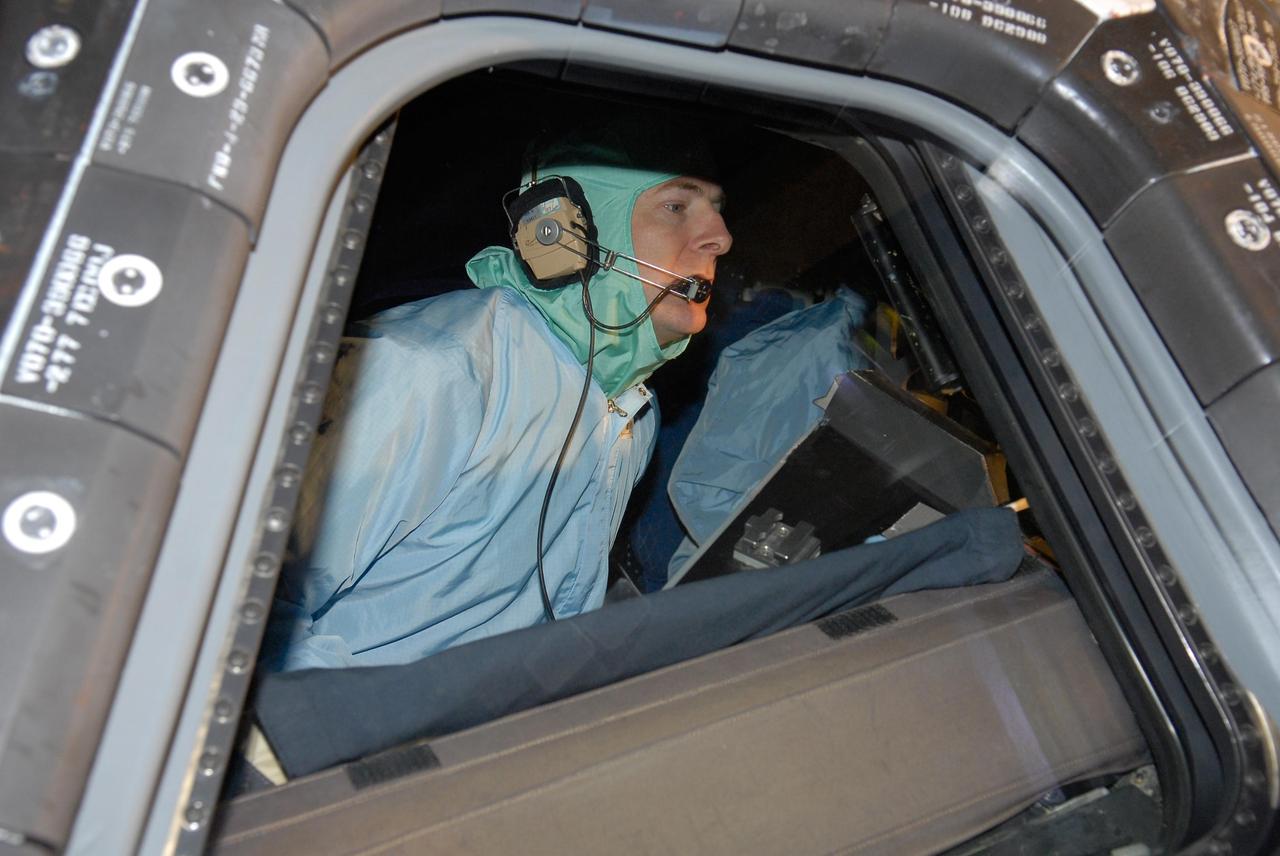
KENNEDY SPACE CENTER, FLA. -- In the Orbiter Processing Facility, STS-122 Pilot Alan Poindexter checks out the cockpit on space shuttle Atlantis. The crew is at Kennedy Space Center to take part in a crew equipment interface test, which helps familiarize them with equipment and payloads for the mission. Among the activities standard to a CEIT are harness training, inspection of the thermal protection system and camera operation for planned extravehicular activities, or EVAs. The mission will carry and install the Columbus Lab, a multifunctional, pressurized laboratory that will be permanently attached to Node 2 of the space station to carry out experiments in materials science, fluid physics and biosciences, as well as to perform a number of technological applications. It is Europe’s largest contribution to the construction of the International Space Station and will support scientific and technological research in a microgravity environment. STS-122 is targeted for launch in December. Photo credit: NASA/Kim Shiflett
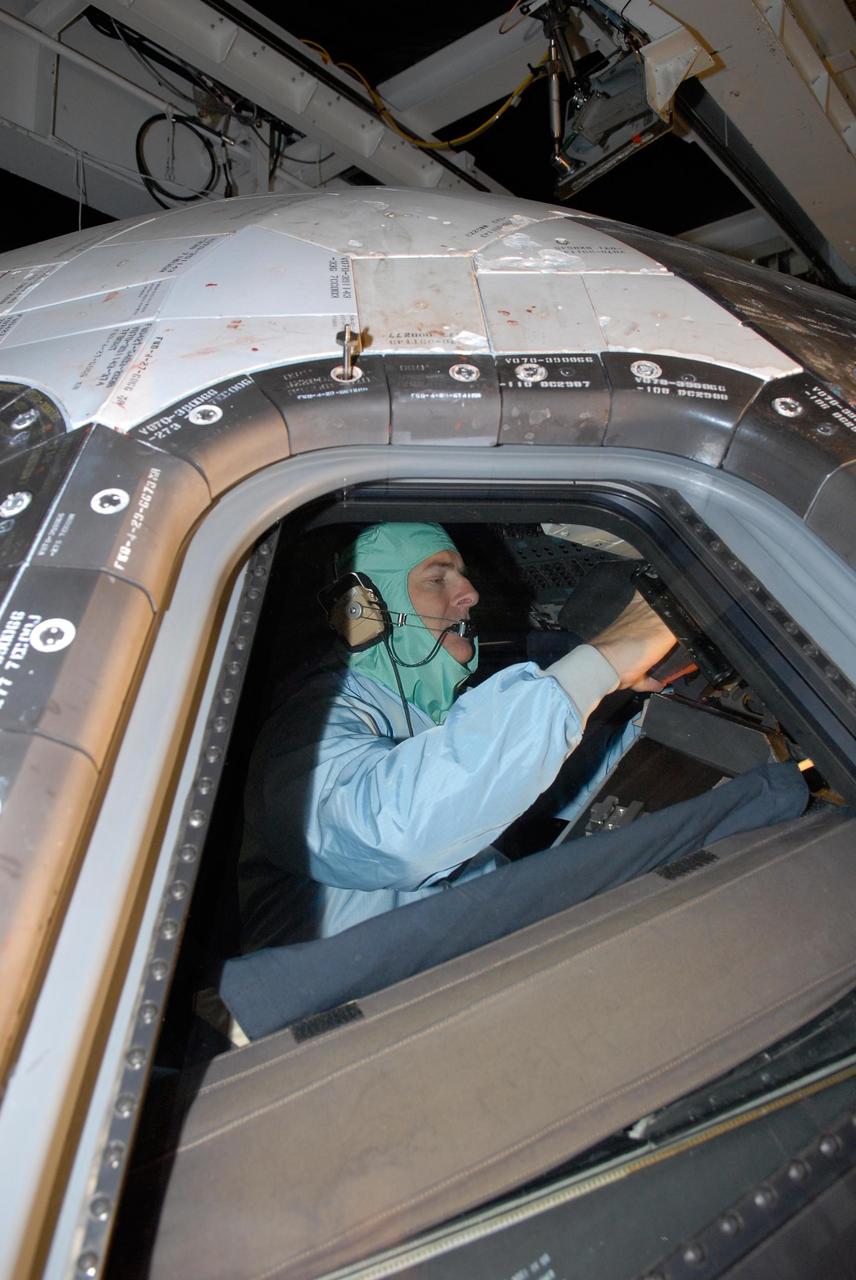
KENNEDY SPACE CENTER, FLA. -- In the Orbiter Processing Facility, STS-122 Pilot Alan Poindexter checks out the cockpit on space shuttle Atlantis. The crew is at Kennedy Space Center to take part in a crew equipment interface test, which helps familiarize them with equipment and payloads for the mission. Among the activities standard to a CEIT are harness training, inspection of the thermal protection system and camera operation for planned extravehicular activities, or EVAs. The mission will carry and install the Columbus Lab, a multifunctional, pressurized laboratory that will be permanently attached to Node 2 of the space station to carry out experiments in materials science, fluid physics and biosciences, as well as to perform a number of technological applications. It is Europe’s largest contribution to the construction of the International Space Station and will support scientific and technological research in a microgravity environment. STS-122 is targeted for launch in December. Photo credit: NASA/Kim Shiflett

KENNEDY SPACE CENTER, FLA. - The STS-120 crew is at Kennedy for a crew equipment interface test, or CEIT. Inspecting the thermal protection system, or TPS, tiles under space shuttle Discovery in Orbiter Processing Facility bay 3 are, from left, Mission Specialist Douglas H. Wheelock (standing); Pilot George D. Zamka; Mission Specialist Paolo A. Nespoli, a European Space Agency astronaut from Italy; Allison Bolinger (pointing), an EVA technician with NASA; Commander Pamela A. Melroy; Mission Specialists Scott E. Parazynski and Stephanie D. Wilson; two support personnel and Erin Schlichenmaier, with United Space Alliance TPS Engineering. Among the activities standard to a CEIT are harness training, inspection of the thermal protection system and camera operation for planned extravehicular activities, or EVAs. The STS-120 mission will deliver the Harmony module, christened after a school contest, which will provide attachment points for European and Japanese laboratory modules on the International Space Station. Known in technical circles as Node 2, it is similar to the six-sided Unity module that links the U.S. and Russian sections of the station. Built in Italy for the United States, Harmony will be the first new U.S. pressurized component to be added. The STS-120 mission is targeted to launch on Oct. 20. Photo credit: NASA/George Shelton
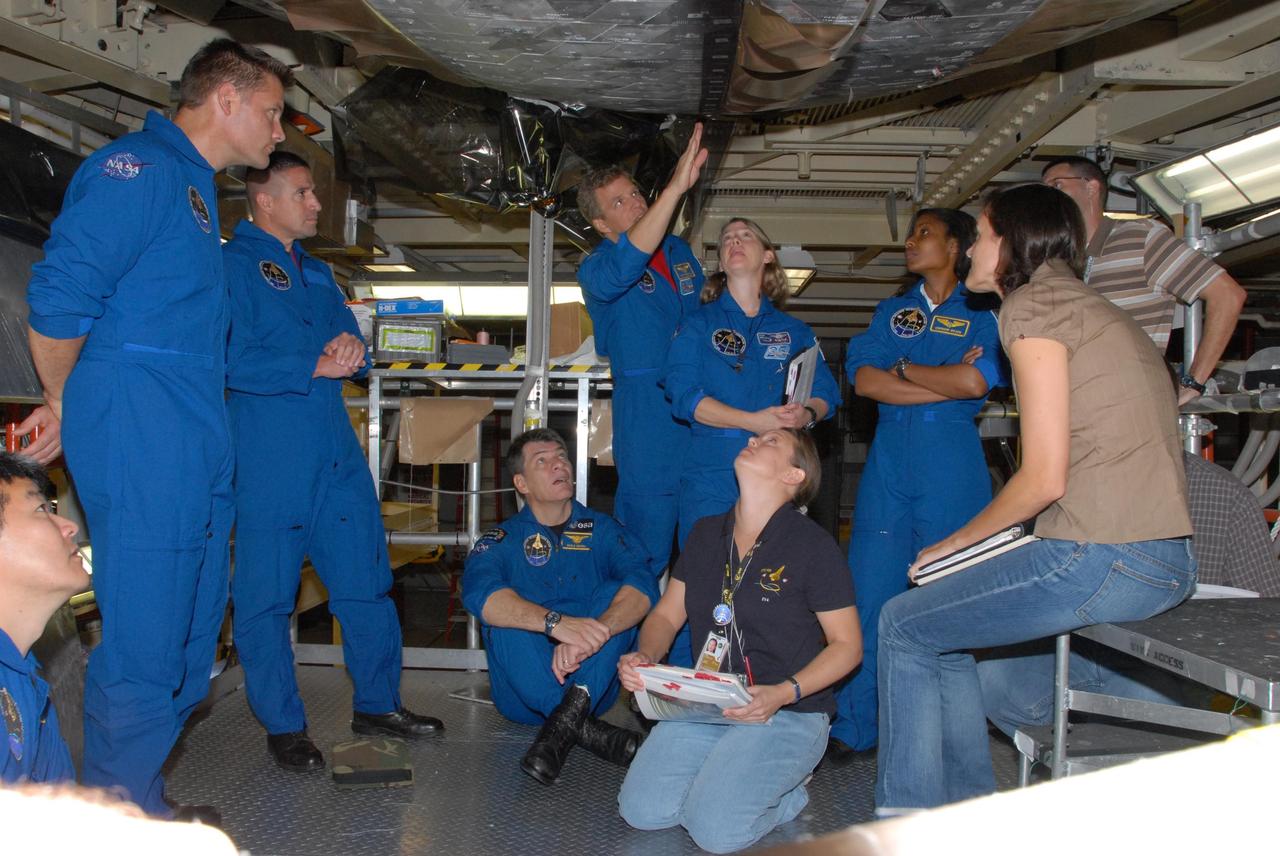
KENNEDY SPACE CENTER, FLA. - The STS-120 crew is at Kennedy for a crew equipment interface test, or CEIT. Inspecting the thermal protection system, or TPS, tiles under space shuttle Discovery in Orbiter Processing Facility bay 3 are, from left, Expedition 16 Flight Engineer Daniel M. Tani; Mission Specialist Douglas H. Wheelock; Pilot George D. Zamka; Mission Specialist Paolo A. Nespoli (sitting), a European Space Agency astronaut from Italy; Mission Specialist Scott E. Parazynski (pointing); Commander Pamela A. Melroy; Allison Bolinger (kneeling), an EVA technician with NASA; Mission Specialist Stephanie D. Wilson; and Erin Schlichenmaier, with United Space Alliance TPS Engineering. Among the activities standard to a CEIT are harness training, inspection of the thermal protection system and camera operation for planned extravehicular activities, or EVAs. The STS-120 mission will deliver the Harmony module, christened after a school contest, which will provide attachment points for European and Japanese laboratory modules on the International Space Station. Known in technical circles as Node 2, it is similar to the six-sided Unity module that links the U.S. and Russian sections of the station. Built in Italy for the United States, Harmony will be the first new U.S. pressurized component to be added. The STS-120 mission is targeted to launch on Oct. 20. Photo credit: NASA/George Shelton
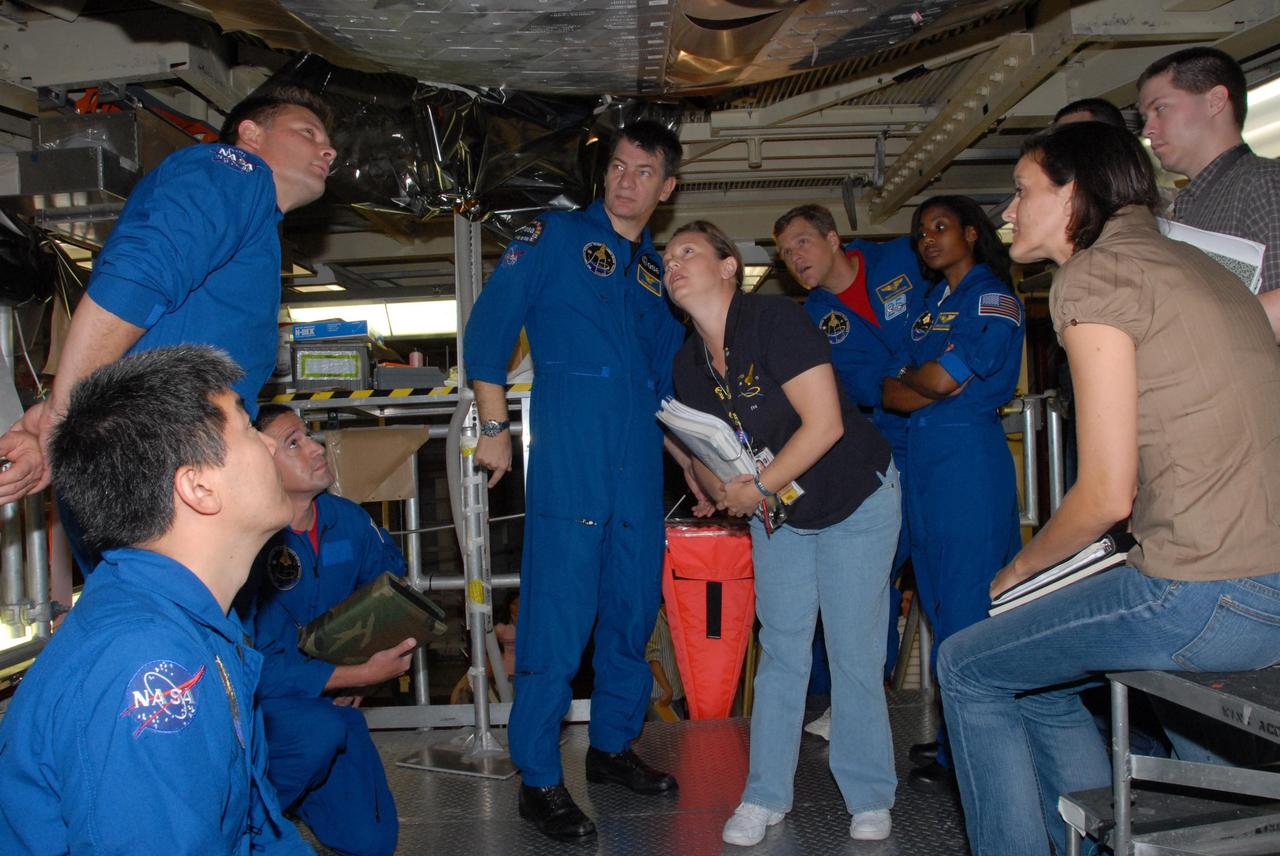
KENNEDY SPACE CENTER, FLA. - The STS-120 crew is at Kennedy for a crew equipment interface test, or CEIT. Inspecting the thermal protection system, or TPS, tiles under space shuttle Discovery in Orbiter Processing Facility bay 3 are, from left, Expedition 16 Flight Engineer Daniel M. Tani; Mission Specialist Douglas H. Wheelock; Pilot George D. Zamka; Mission Specialist Paolo A. Nespoli, a European Space Agency astronaut from Italy; Allison Bolinger, an EVA technician with NASA; Mission Specialists Scott E. Parazynski and Stephanie D. Wilson; and Erin Schlichenmaier, of TPS Engineering with United Space Alliance. Among the activities standard to a CEIT are harness training, inspection of the thermal protection system and camera operation for planned extravehicular activities, or EVAs. The STS-120 mission will deliver the Harmony module, christened after a school contest, which will provide attachment points for European and Japanese laboratory modules on the International Space Station. Known in technical circles as Node 2, it is similar to the six-sided Unity module that links the U.S. and Russian sections of the station. Built in Italy for the United States, Harmony will be the first new U.S. pressurized component to be added. The STS-120 mission is targeted to launch on Oct. 20. Photo credit: NASA/George Shelton
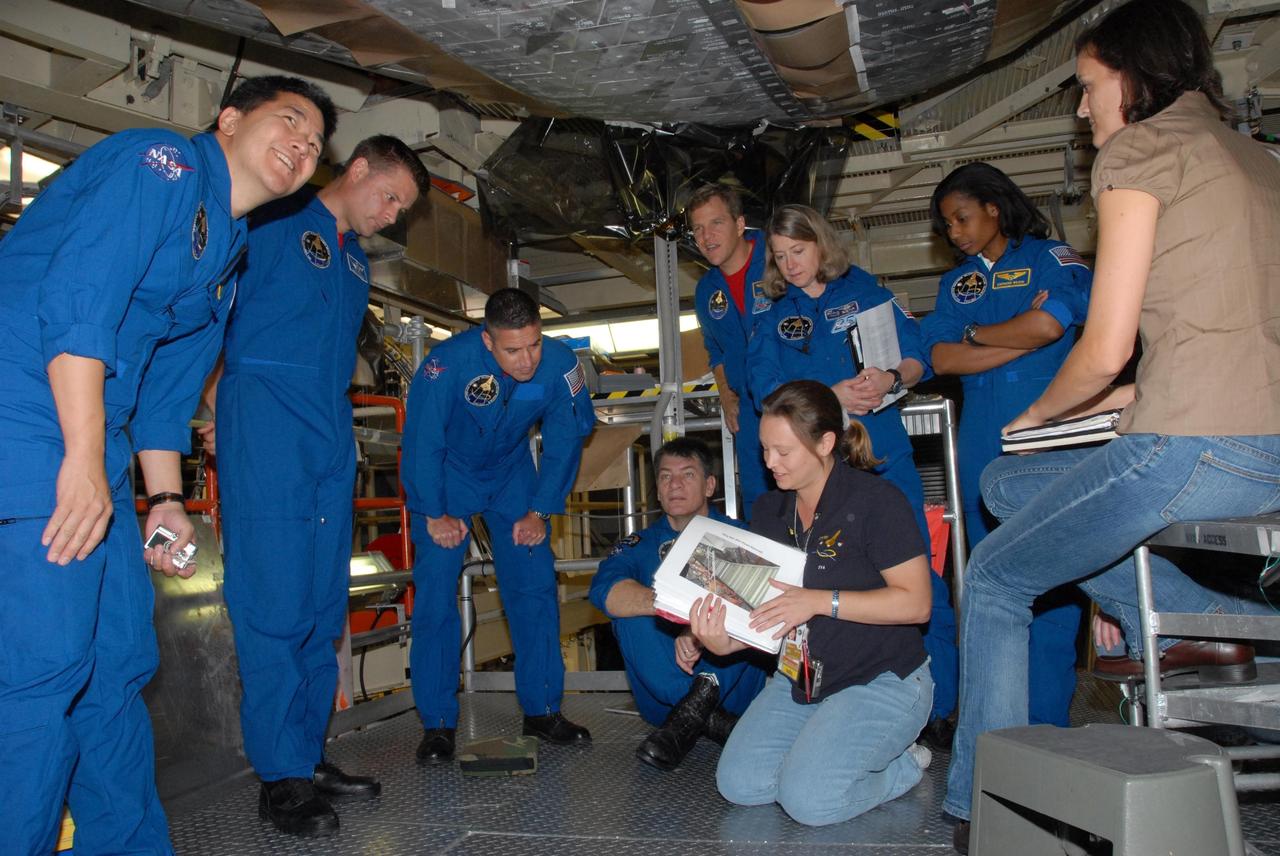
KENNEDY SPACE CENTER, FLA. - The STS-120 crew is at Kennedy for a crew equipment interface test, or CEIT. Inspecting the thermal protection system, or TPS, tiles under space shuttle Discovery in Orbiter Processing Facility bay 3 are, from left, Expedition 16 Flight Engineer Daniel M. Tani; Mission Specialist Douglas H. Wheelock; Pilot George D. Zamka; Mission Specialist Paolo A. Nespoli (kneeling), a European Space Agency astronaut from Italy; Mission Specialist Scott E. Parazynski; Commander Pamela A. Melroy; Allison Bolinger (kneeling), an EVA technician with NASA; Mission Specialist Stephanie D. Wilson; and Erin Schlichenmaier, with United Space Alliance TPS Engineering. Among the activities standard to a CEIT are harness training, inspection of the thermal protection system and camera operation for planned extravehicular activities, or EVAs. The STS-120 mission will deliver the Harmony module, christened after a school contest, which will provide attachment points for European and Japanese laboratory modules on the International Space Station. Known in technical circles as Node 2, it is similar to the six-sided Unity module that links the U.S. and Russian sections of the station. Built in Italy for the United States, Harmony will be the first new U.S. pressurized component to be added. The STS-120 mission is targeted to launch on Oct. 20. Photo credit: NASA/George Shelton