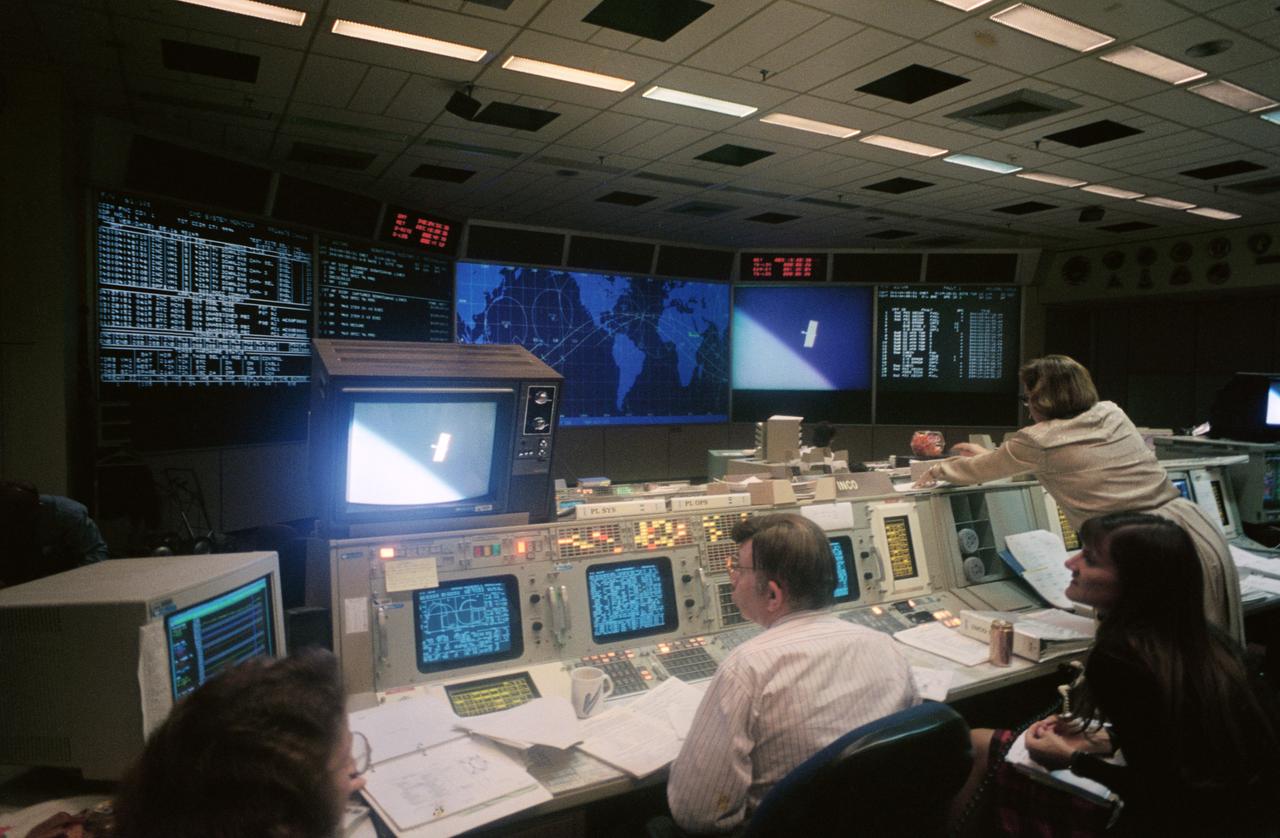
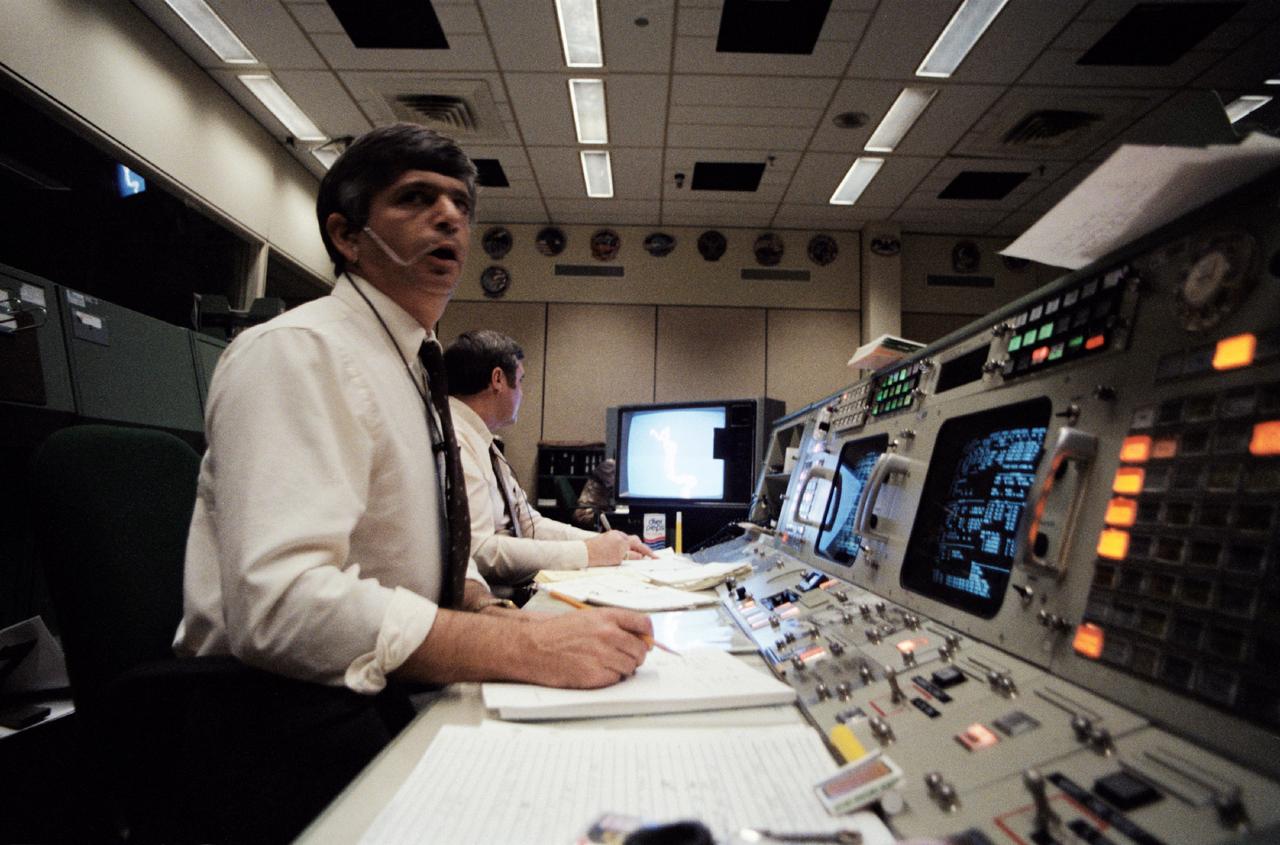
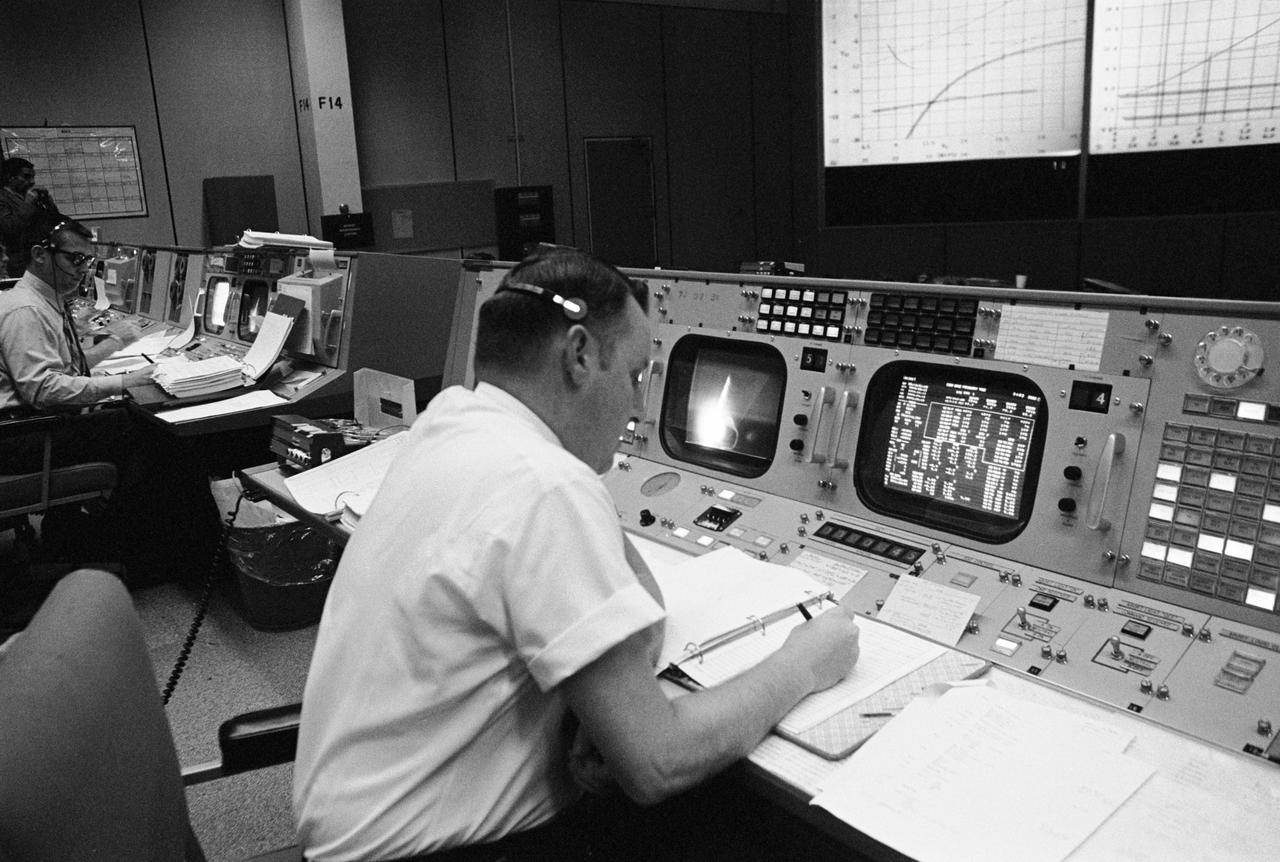
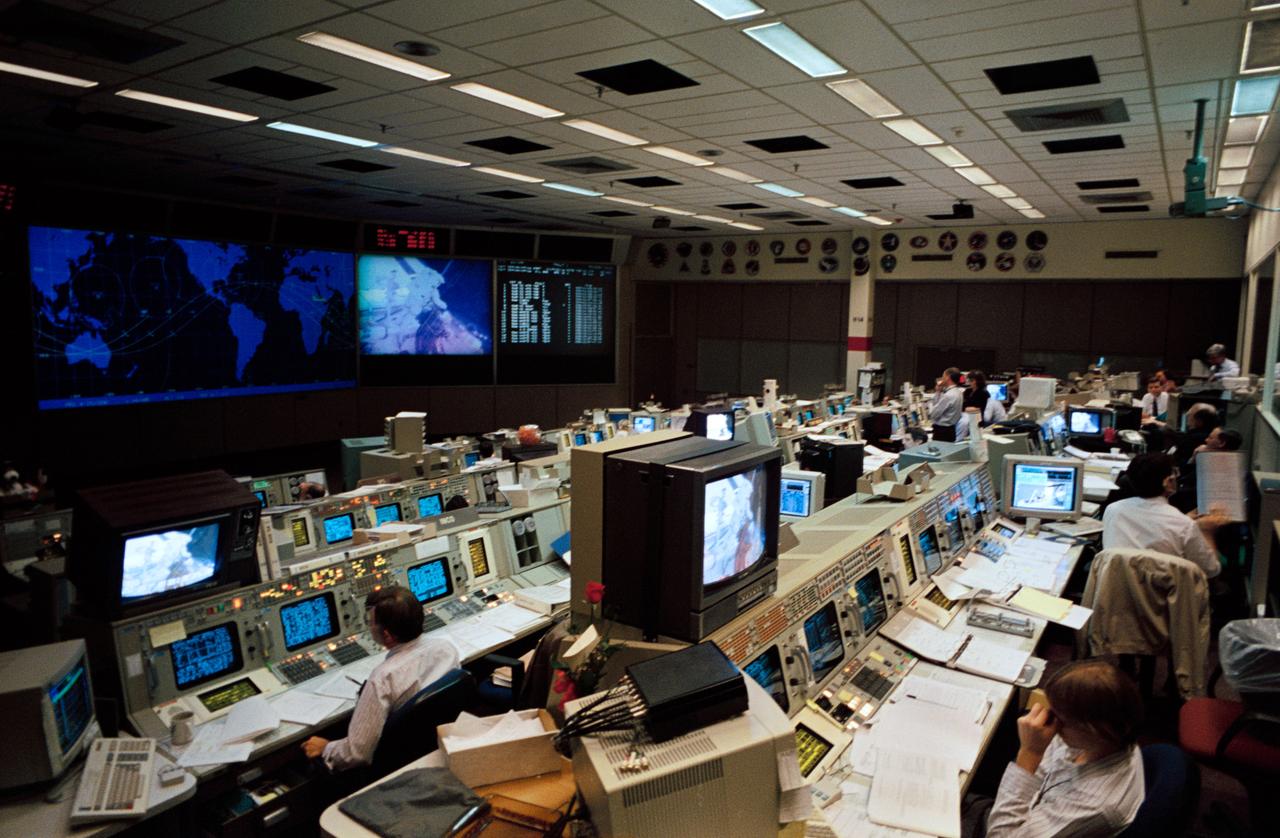
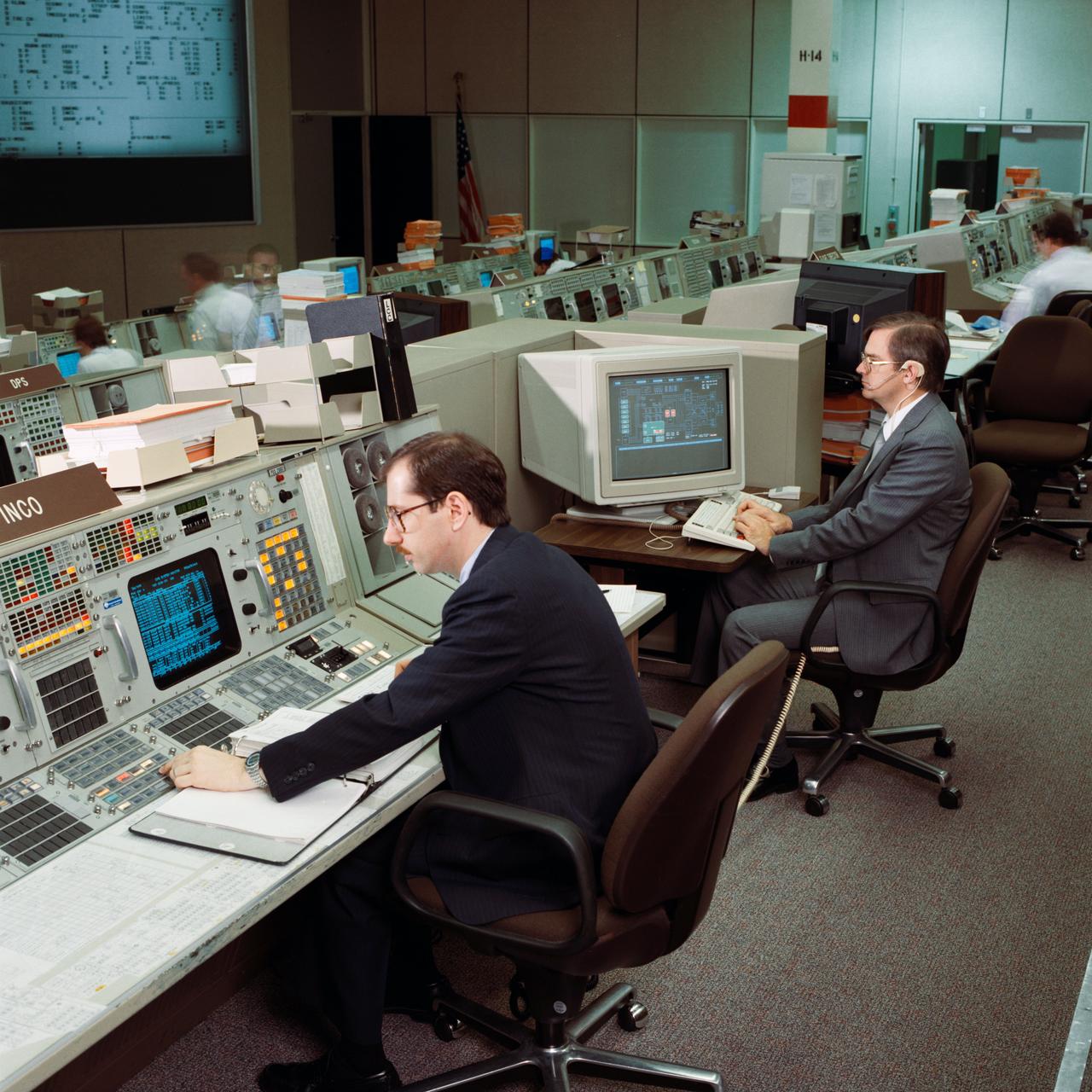
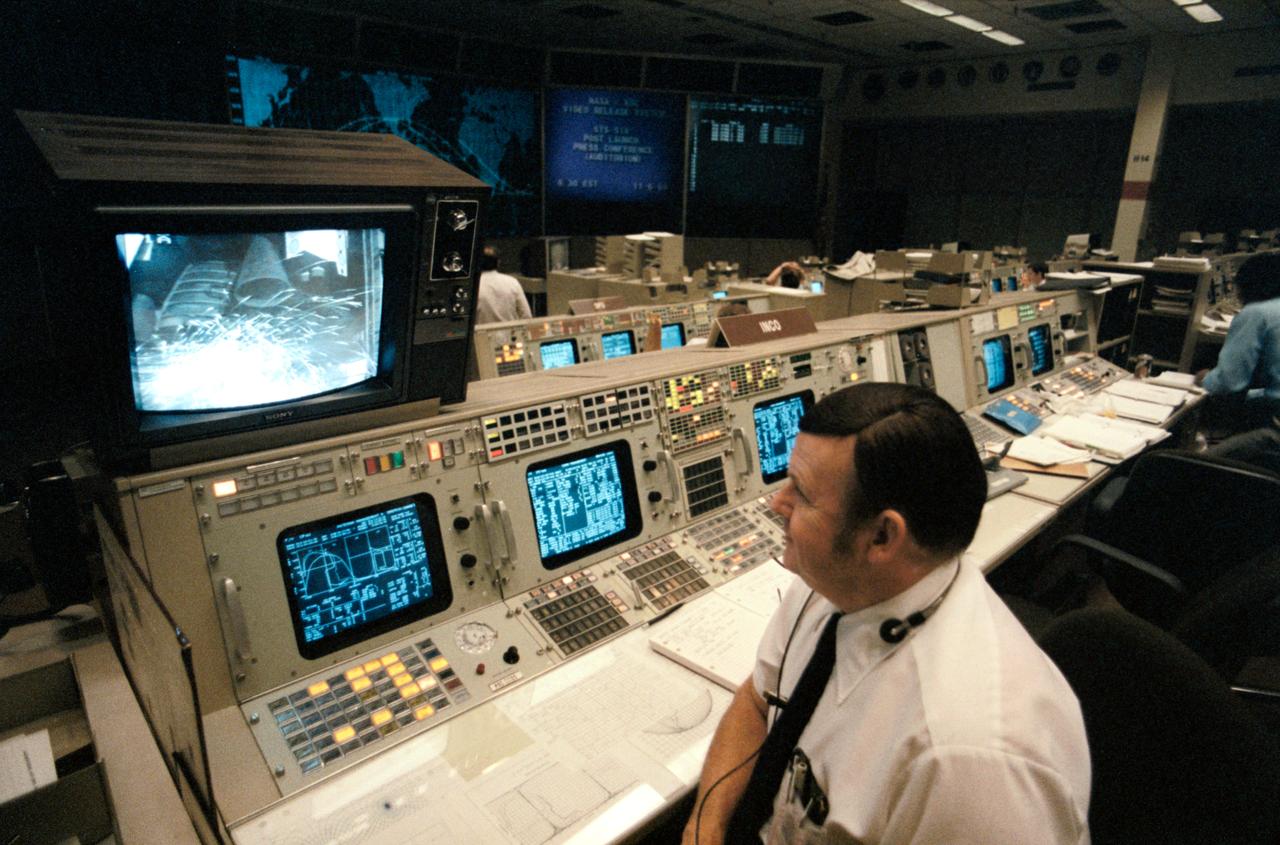
Harry Black, at the Integrated Communications Officer's console in the Mission Control Center (MCC), monitors the second extravehicular activity (EVA-2) of the STS-61 Hubble Space Telescope (HST) servicing mission. Others pictured, left to right, are Judy Alexander, Kathy Morrison and Linda Thomas. Note monitor scene of one of HST's original solar array panels floating in space moments after being tossed away by Astronaut Kathryn C. Thornton.
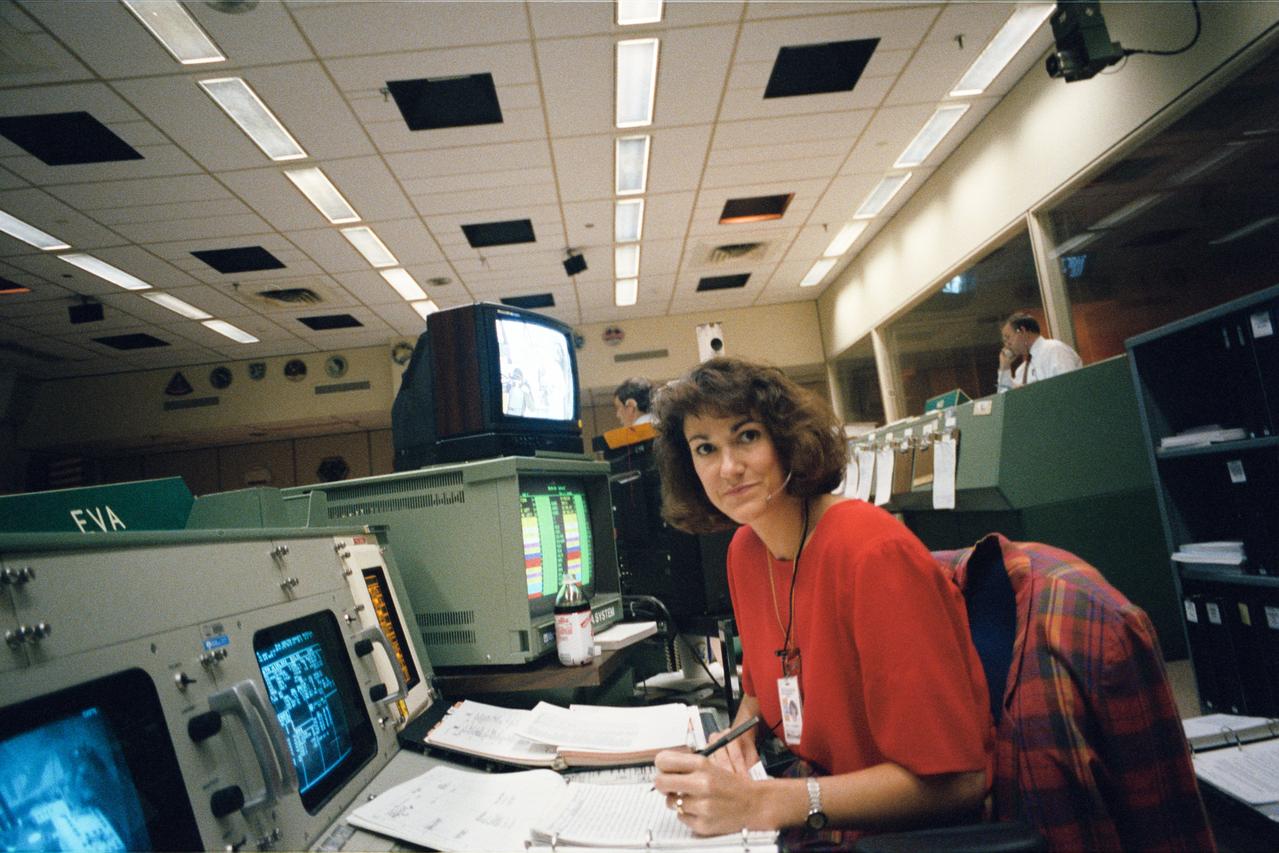
Susan P. Rainwater monitors an extravehicular activity (EVA) simulation from the EVA console at JSC's Mission Control Center (MCC) during joint integrated simulations for the STS-61 mission. Astronauts assigned to extravehicular activity (EVA) tasks with the Hubble Space Telescope (HST) were simultaneously rehearsing in a neutral buoyancy tank at the Marshall Space Flight Center (MSFC) in Alabama.
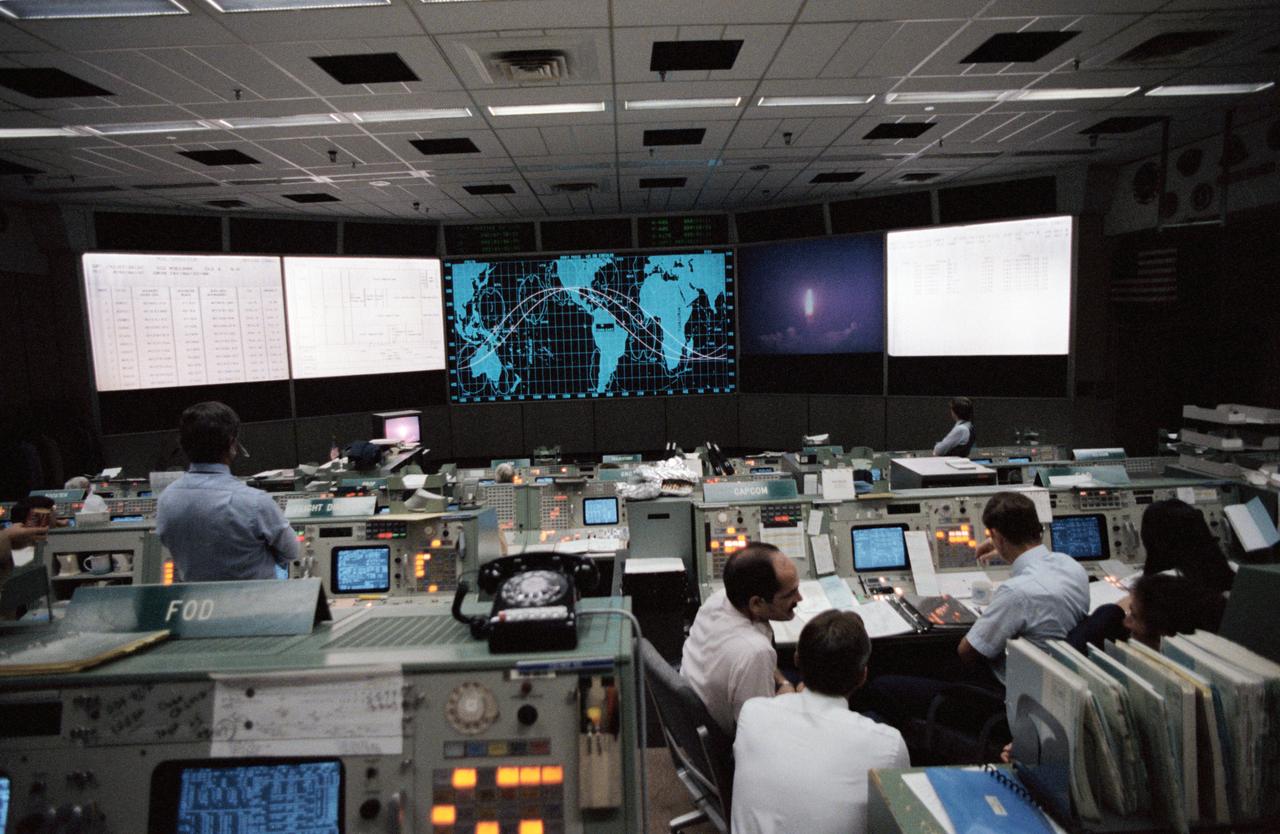
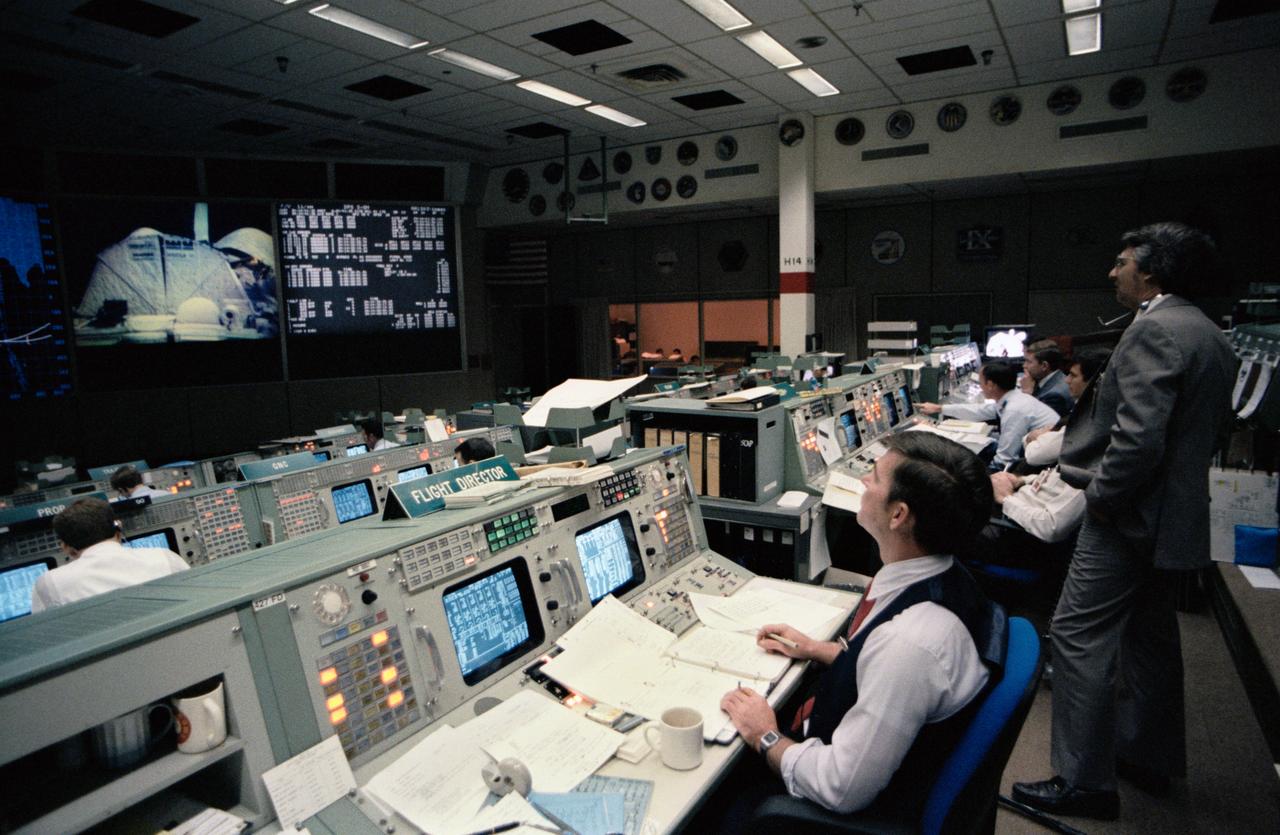
Serving as spacecraft communicators (CAPCOM) are Astronauts Guy S. Gardner (left), William F. Fisher (center), Bryan D. O'Connor (seated facing console), and Jeffrey A. Hoffman. Cheevon B. Lau is seated at the flight activities officer (FAO) console to the right of the CAPCOM console. The scene on the large screen in the mission operations control room (MOCR) is a replay of the launch of the Challenger (39264); Flight Director Jay H. Greene, left, watches a replay of the STS-8 launch on the large screen in the MOCR. He is joined by O'Connor, Jeffrey A. Hoffman, Gardner and Fisher. Lau works at the FAO console near the CAPCOM console (39265); Harold Black, integrated communications officer (INCO) for STS-8 mans the INCO console during the first TV downlink from the Challengers flight. The payload bay can be seen on the screen in the front of the MOCR (39266).
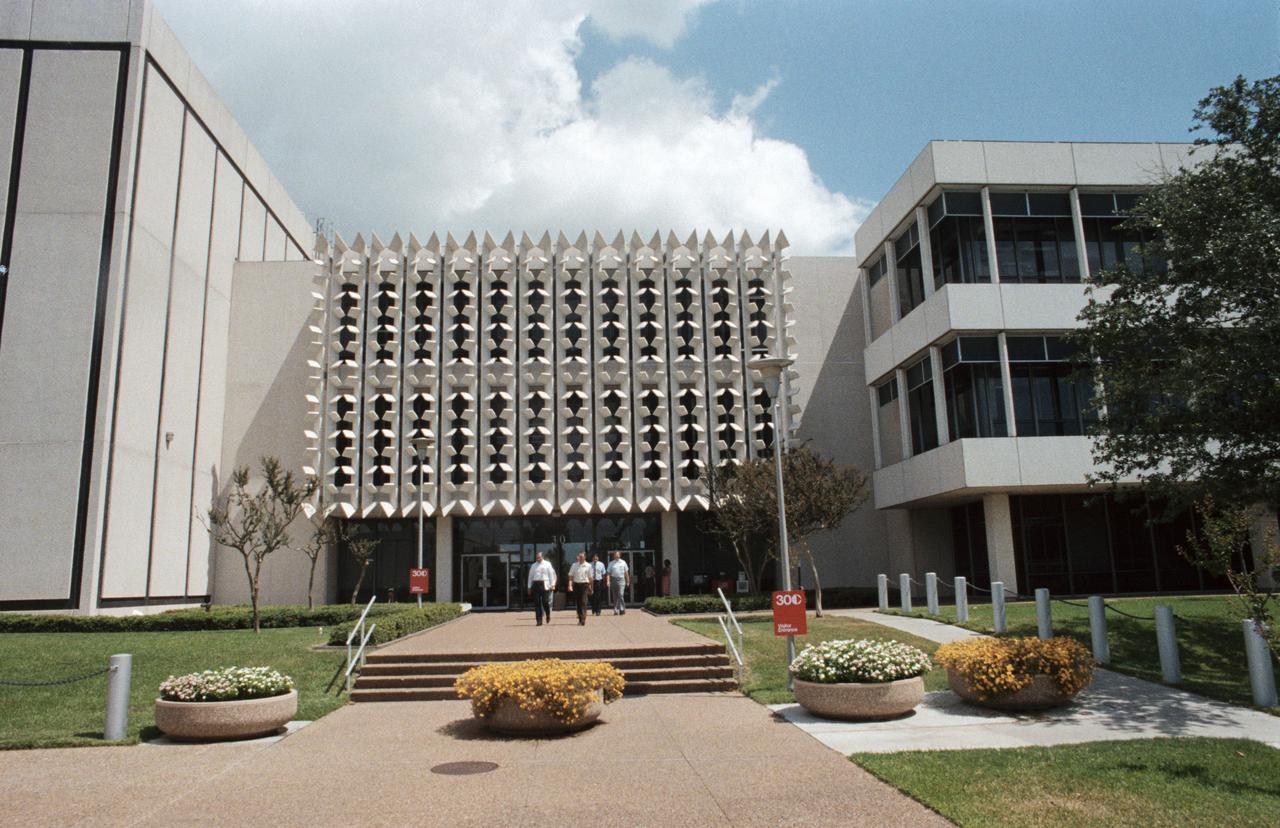
41D-3072 (30 Aug 1984) --- A 41-D shift change is taking place in the Johnson Space Center's Building 30. In its twenty years of operation, the mission control center has been the scene of many such changes. The windowless wing at left houses three floors, including rooms supporting flight control rooms 1 & 2 (formerly called mission operations control rooms 1 & 2).
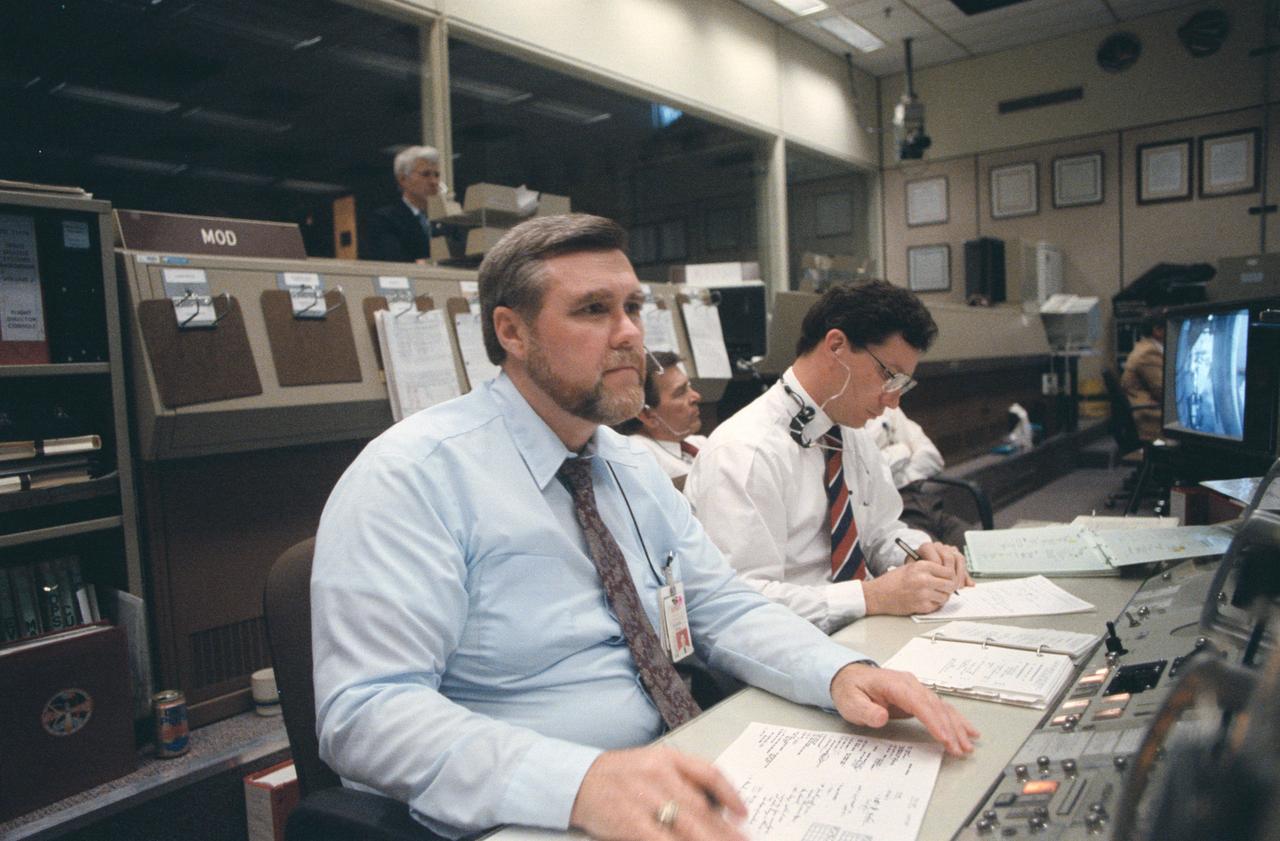
STS029-S-041 (13 March 1989) --- Flight Directors (FD) Lee Brisco (left) and Ronad D. Dittmore monitor prelaunch activity on monitors at their consoles in the flight control room of the Johnson Space Center's mission control center. FD Gary Coen is in the back ground.
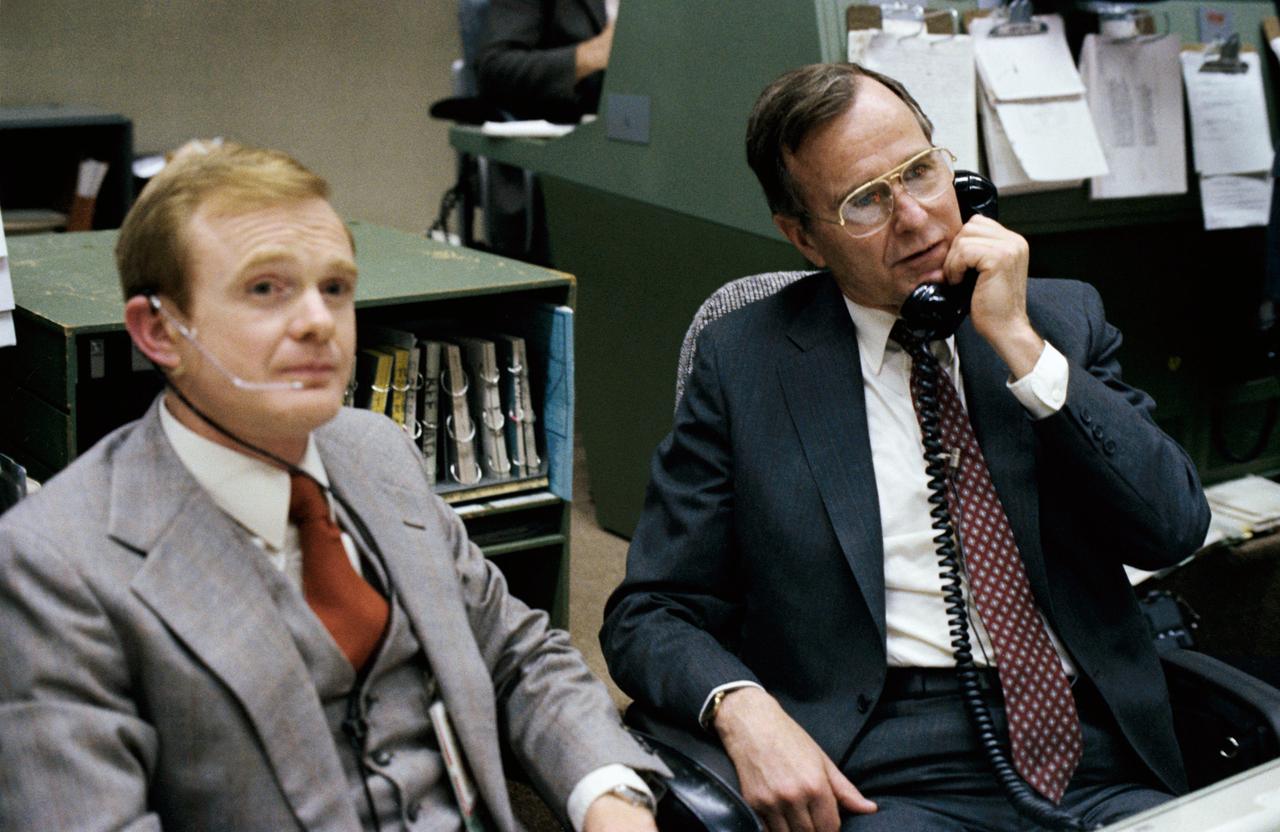
S83-30190 (8 April 1983) --- Vice President George Bush talks to the Earth-orbiting STS-6 astronauts from the spacecraft communicators; (CAPCOM) console in the mission operations control room (MOCR) of the Johnson Space Center?s mission control center. Astronaut Roy D. Bridges, left, is one of the CAPCOM personnel on duty.
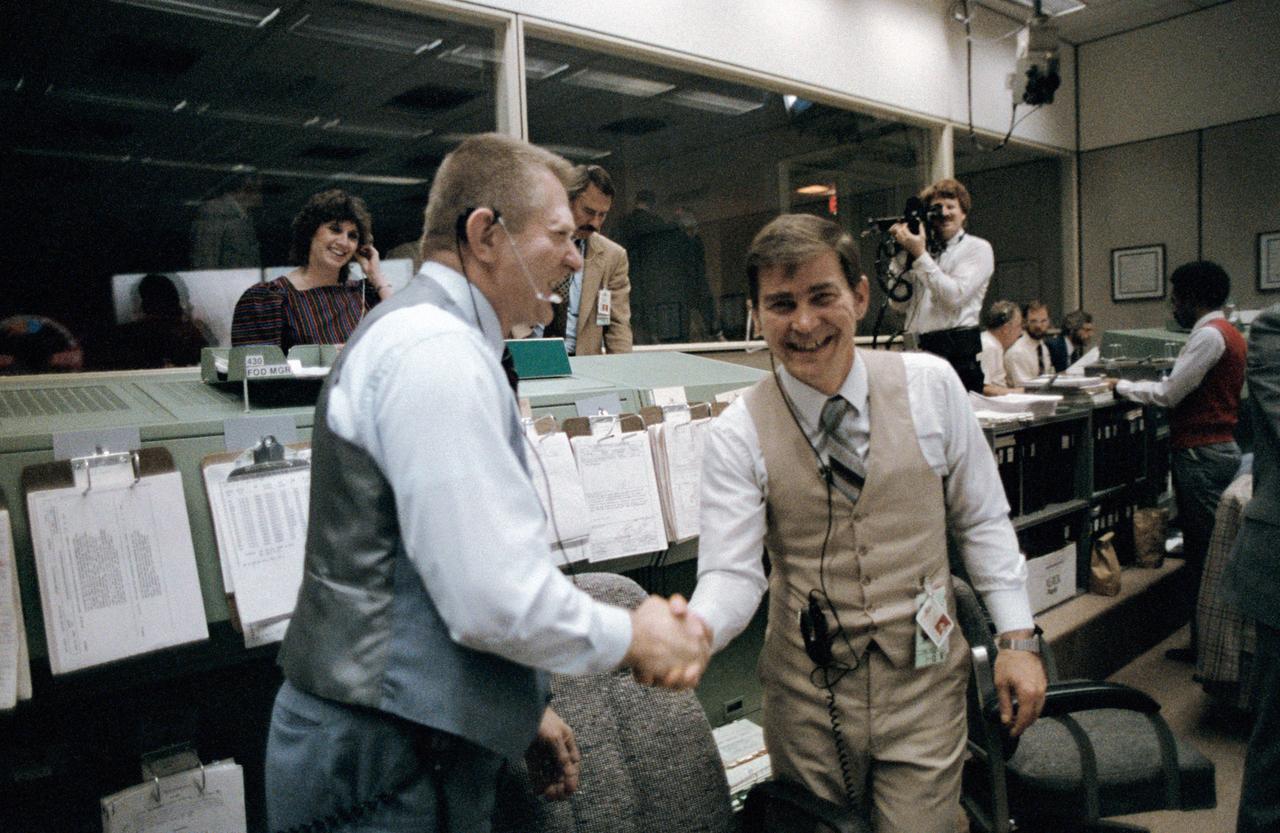
Various views of STS-6 MOCR activities during Day-5 with Vice-Pres. George Bush, Cap Communicator Bridges, JSC Director Gerald Griffin, Eugene F. Kranz, NASA Admin. James M. Beggs, Cap Com Astronaut O'Connor, Flight Directors Jay H. Greene, Gary E. Coen, and Harold Draughon. 1. BUSH, GEORGE, VICE-PRES. - STS-6 MOCR 2. DIR. GRIFFIN, GERALD D. - STS-6 MOCR 3. ADMIN. BEGGS, JAMES M. - STS-6 MOCR 4. FLT. DIRECTORS - STS-6 JSC, HOUSTON, TX Also available in 35 CN
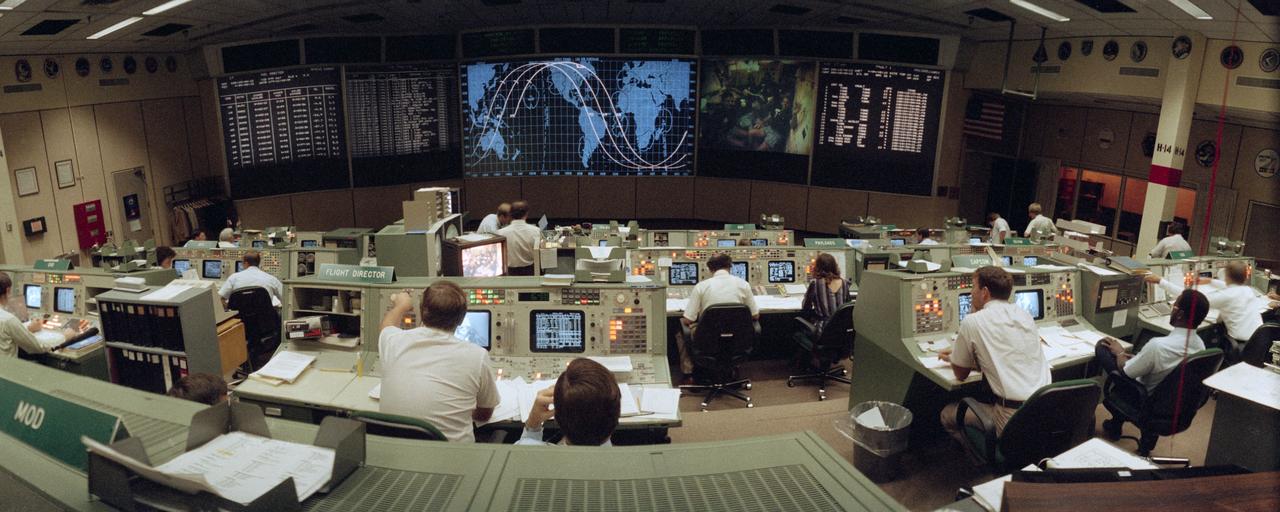
Fisheye view from the back of the Flight Control Room (FCR) of the Mission Control Center (MCC). Visible are the Flight Directors console (left front), the CAPCOM console (right front) and the Payloads console. Some of the STS 41-G crew can be seen on a large screen at the front of the MCC along with a map tracking the progress of the orbiter.
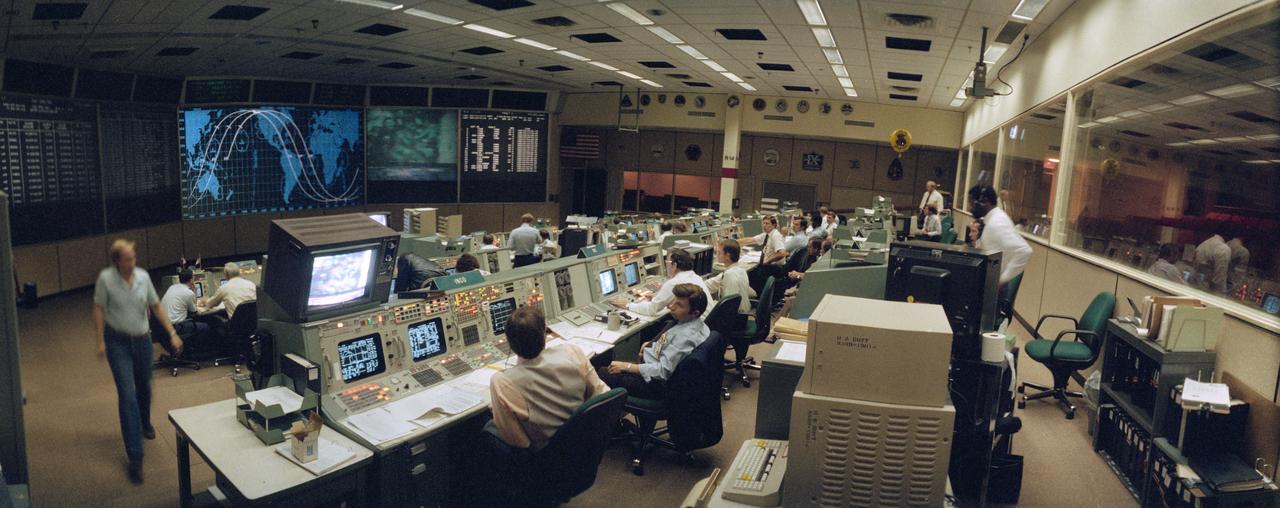
Wide angle view of the flight control room (FCR) of the Mission Control Center (MCC). Some of the STS 41-G crew can be seen on a large screen at the front of the MCC along with a map tracking the progress of the orbiter.
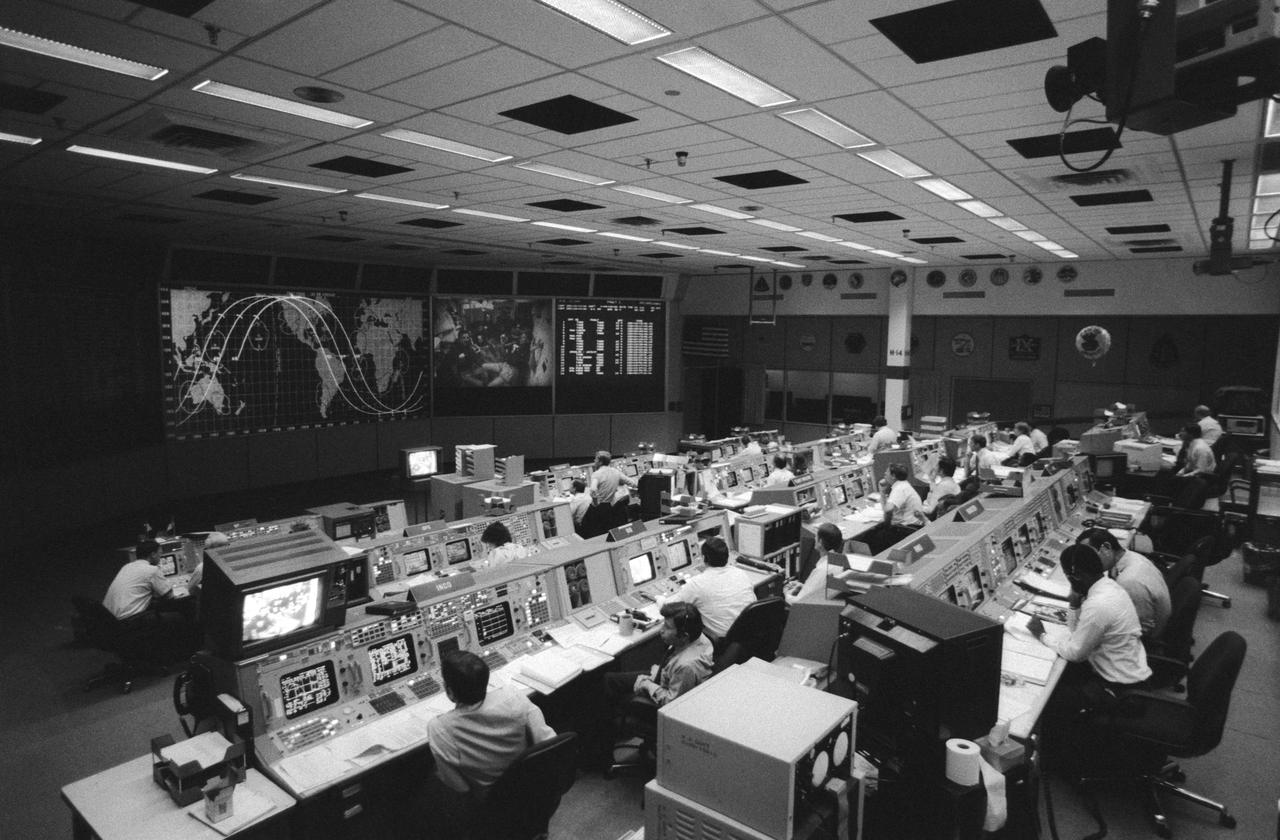
Wide angle view of the flight control room (FCR) of the Mission Control Center (MCC). Some of the STS 41-G crew can be seen on a large screen at the front of the MCC along with a map tracking the progress of the orbiter.
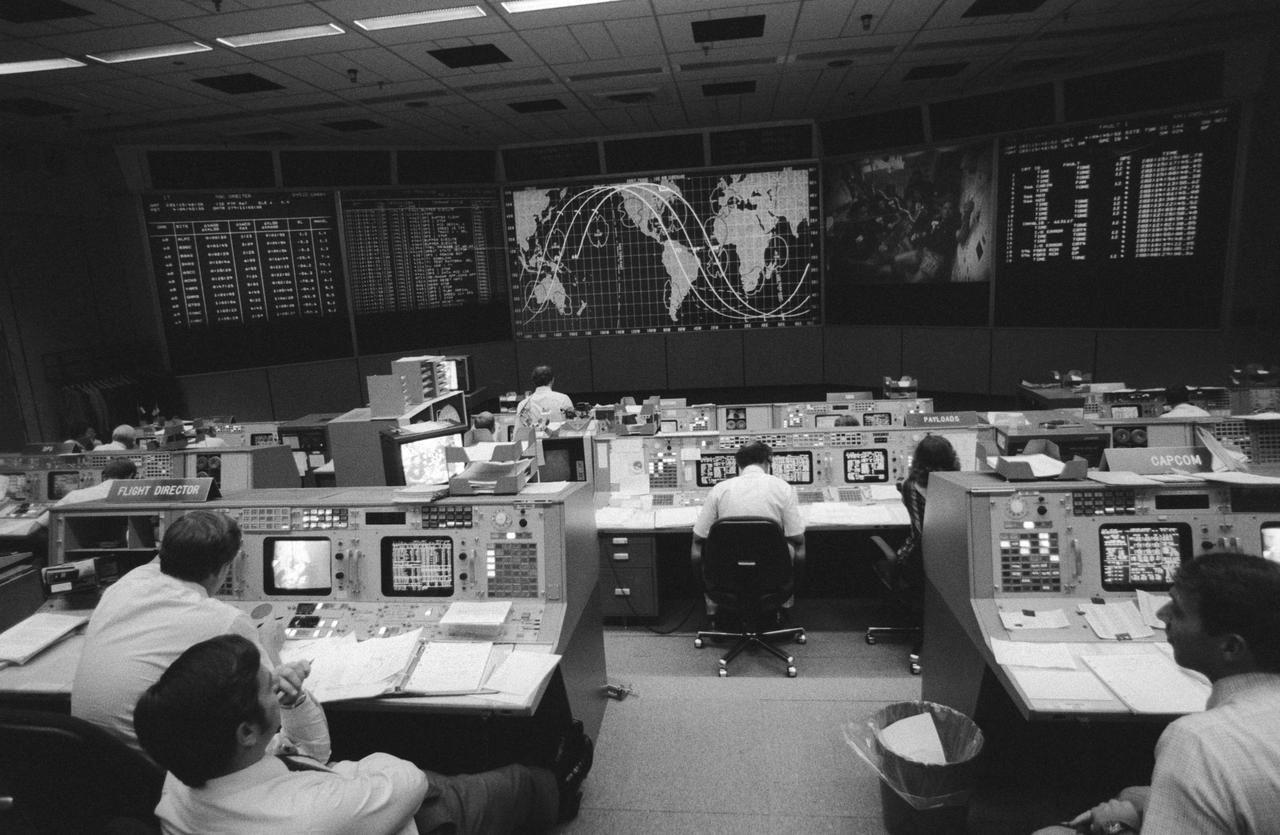
View from the back of the Mission Control Center (MCC). Visible are the Flight Directors console (left front), the CAPCOM console (right front) and the Payloads console. Some of the STS 41-G crew can be seen on a large screen at the front of the MCC along with a map tracking the progress of the orbiter.
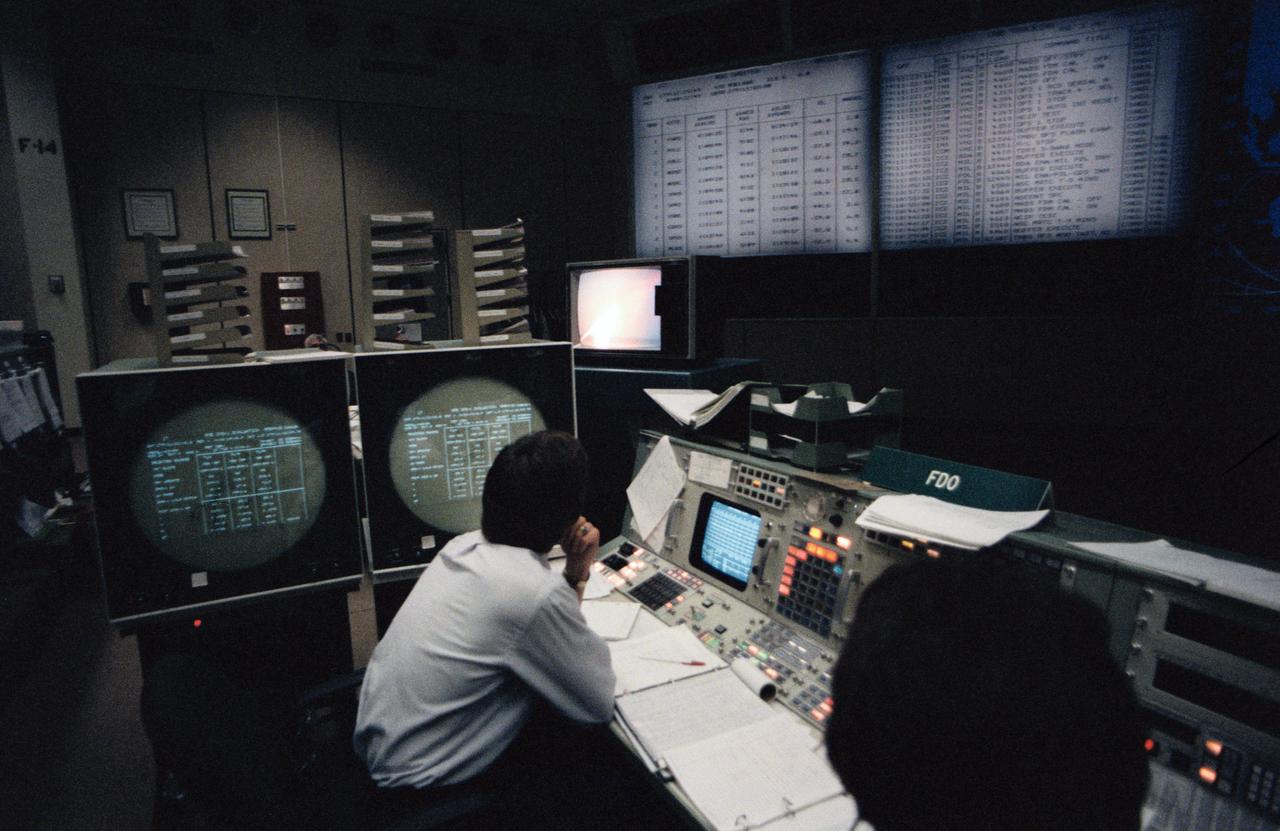
View of the Flight Dynamics Officer (FDO) console in the Mission Control Center (MCC) during the flight of STS41-G. The officer at the FDO console appears to be examining the large screens in front of him which are displaying lists of data.
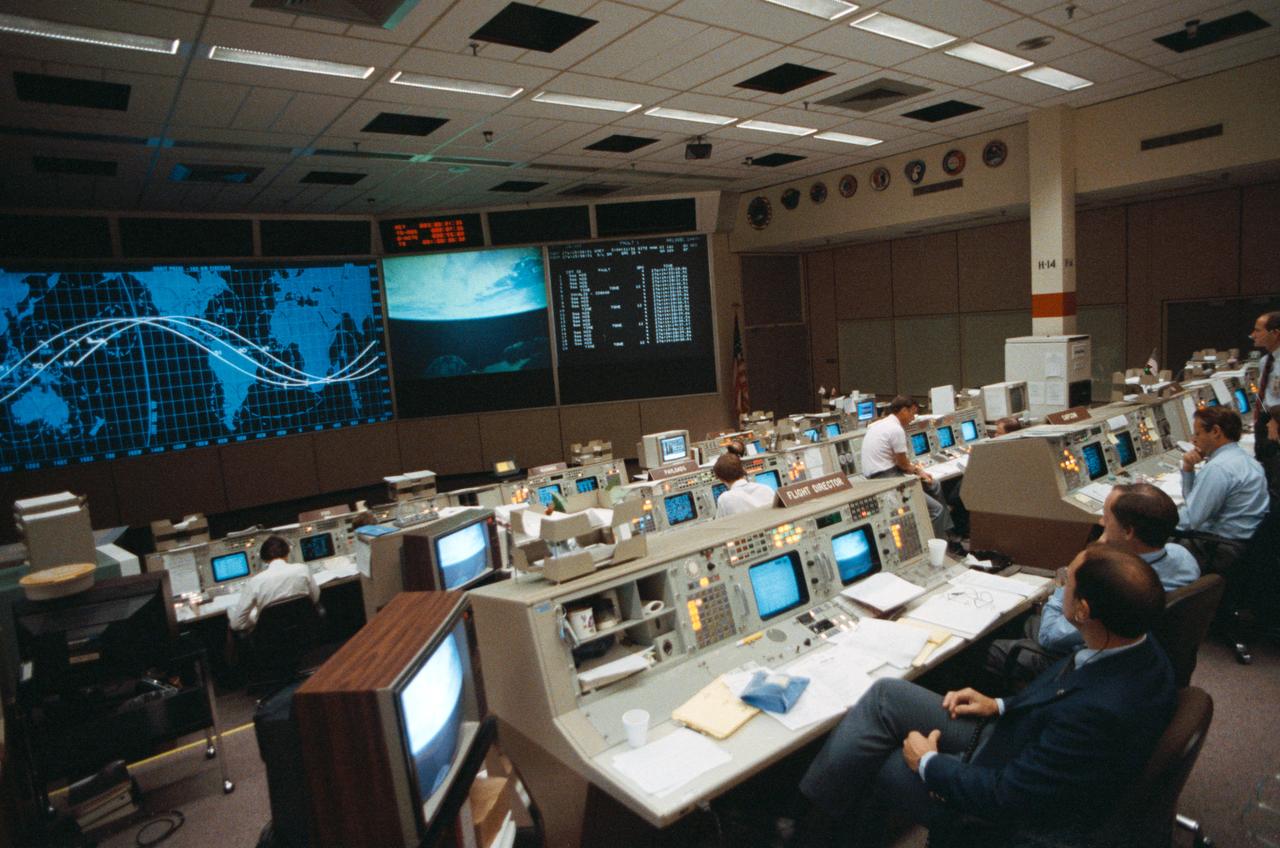
STS026-S-101 (2 Oct 1988) --- Flight controllers in the Johnson Space Center?s mission control center listen to a presentation by the five members of the STS 26 crew on the fourth day of Discovery?s orbital mission. Flight Directors Charles W. Shaw and James M. (Milt) Heflin (in the foreground) and other controllers view a television image of Earth on a screen in the front of the flight control room while each member relates some inner feelings while paying tribute to the Challenger crew.
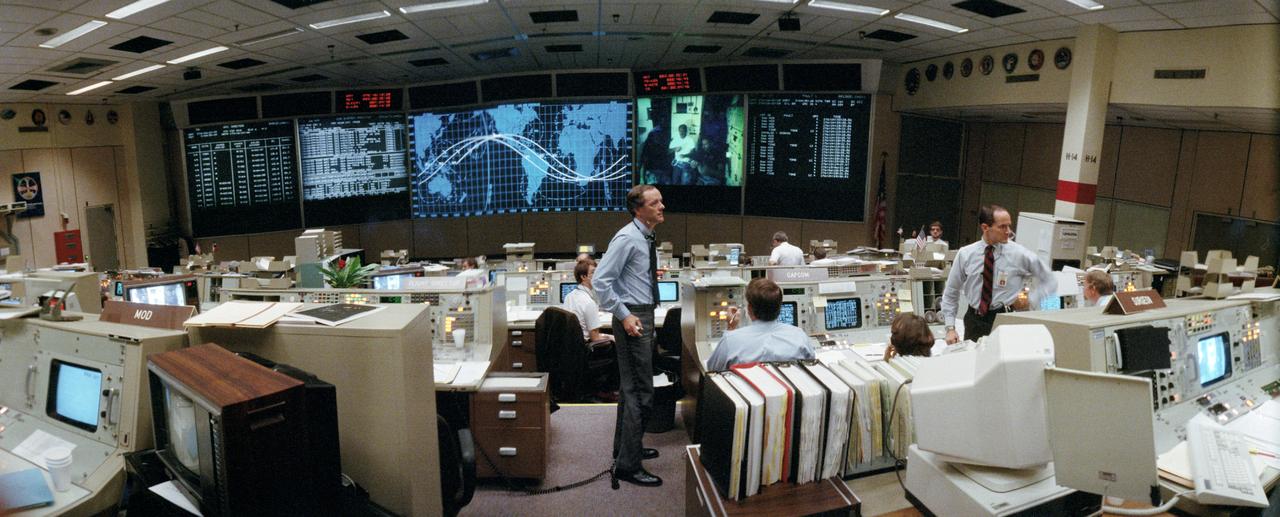
STS26-S-103 (2 October 1988) --- A wide-angle view of flight controllers in the Johnson Space Center's mission control center as they listen to a presentation by the five members of the STS-26 crew on the fourth day of Discovery's orbital mission. Flight Director James M. (Milt) Heflin (standing at center), astronaut G. David Low (standing at right), a spacecraft communicator, and other controllers view a television image of the crew on a screen in the front of the flight control room as each member relates some inner feelings while paying tribute to the Challenger crew.
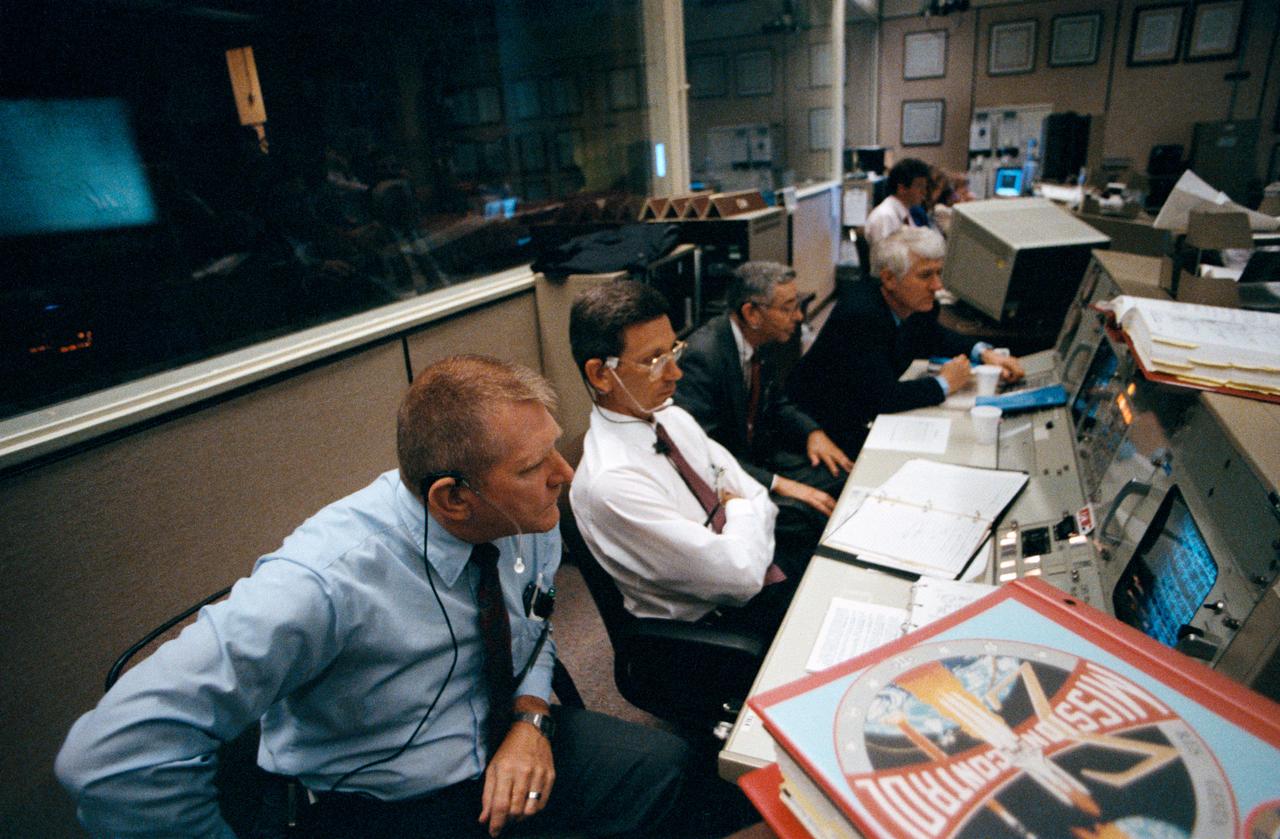
STS030-S-004 (8 May 1989) --- JSC Officials monitor early moments of NASA's STS-30 Atlantis, Orbiter Vehicle (OV) 104, flight in the Flight Control Room (FCR) of JSC's Mission Control Center (MCC) Bldg 30. At the Mission Operations Directorate (MOD) console, MOD Director Eugene F. Kranz (foreground), studiously reviews data on a nearby monitor. Others in the photo are (left to right) Flight Directors Office Deputy Chief Lawrence S. Bourgeois, JSC Director Aaron Cohen, and Flight Crew Operations Deputy Director Henry W. Hartsfield, Jr. Kranz'z replete loose-leaf notebook, bearing the insignia of the flight control team members (MOD insignia), is in the foreground.
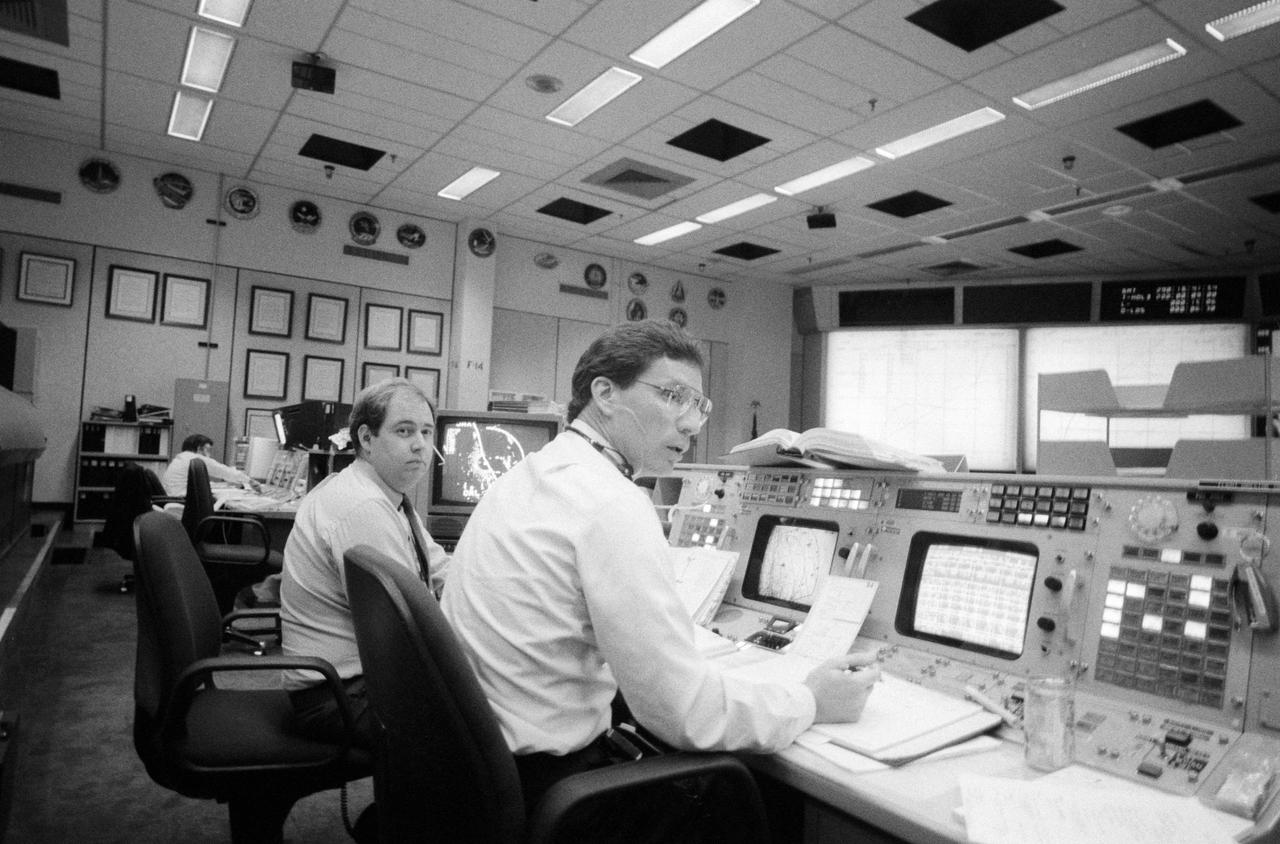
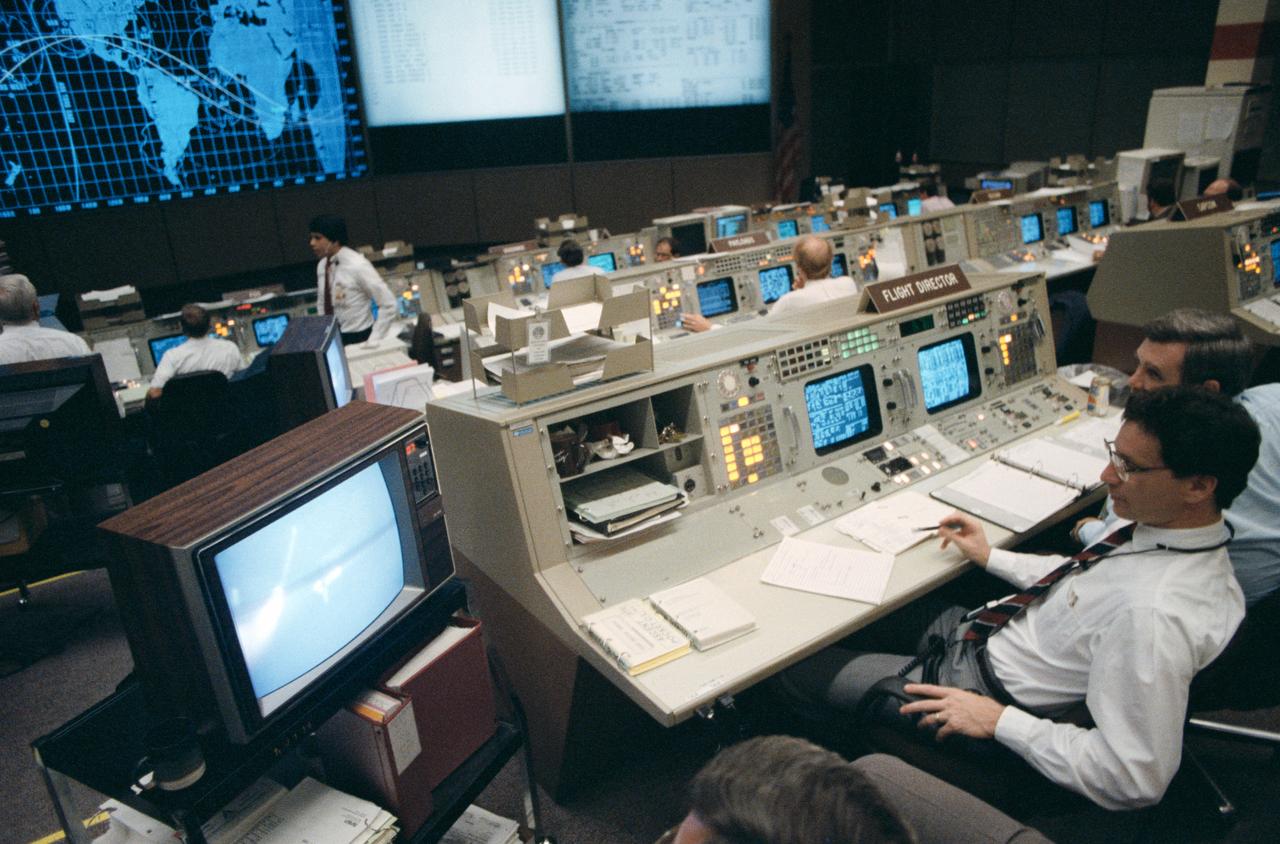
Flight directors Robert E. Castle, Jr (left) and Ronald D. Dittemore monitor console displays during STS-34 mission. Castle and Dittemore will oversee flight activities from their stations in JSC's Mission Control Center (MCC) Bldg 30 flight control room (FCR). In the background are the FCR large screens which display flight data.
51L-S-002 (28 Jan. 1986) --- Flight directors Jay H. Greene (foreground) and Alan L. (Lee) Briscoe study data on monitors at their consoles in the flight control room (FCR) of the Johnson Space Center's Mission Control Center. The photo was made just moments after the announcement came that Challenger's launch phase was not nominal. Photo credit: NASA
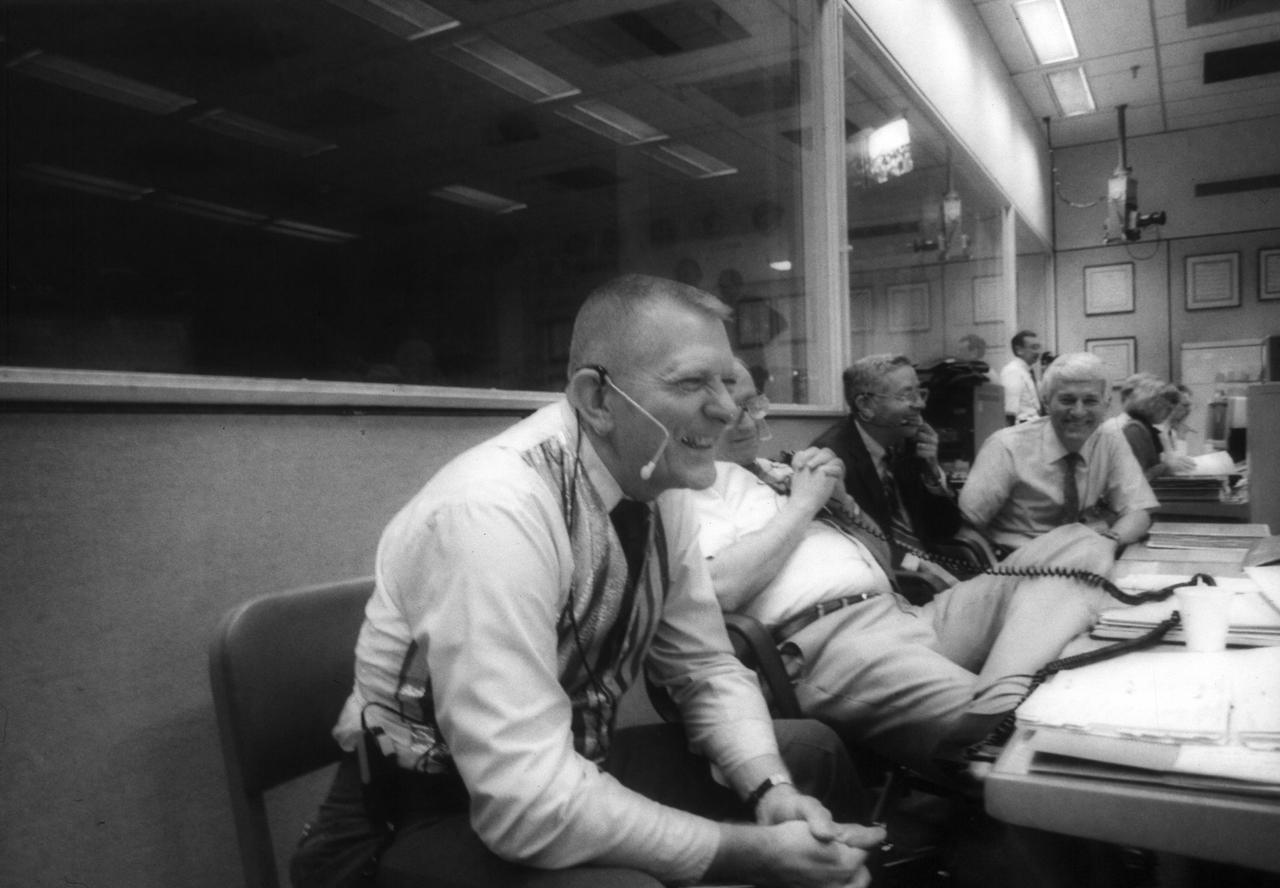
JSC officials, laughing, listen to crewmembers' commentary onboard Discovery, Orbiter Vehicle (OV) 103, during STS-26. In the Flight Control Room (FCR) of JSC's Mission Control Center (MCC) Bldg 30 and seated at the Mission Operations Directorate (MOD) console, MOD Director Eugene F. Kranz (foreground), wearing red, white and blue vest, smiles along with JSC Director Aaron Cohen and Flight Crew Operations Deputy Director Henry W. Hartsfield, Jr. (far right).
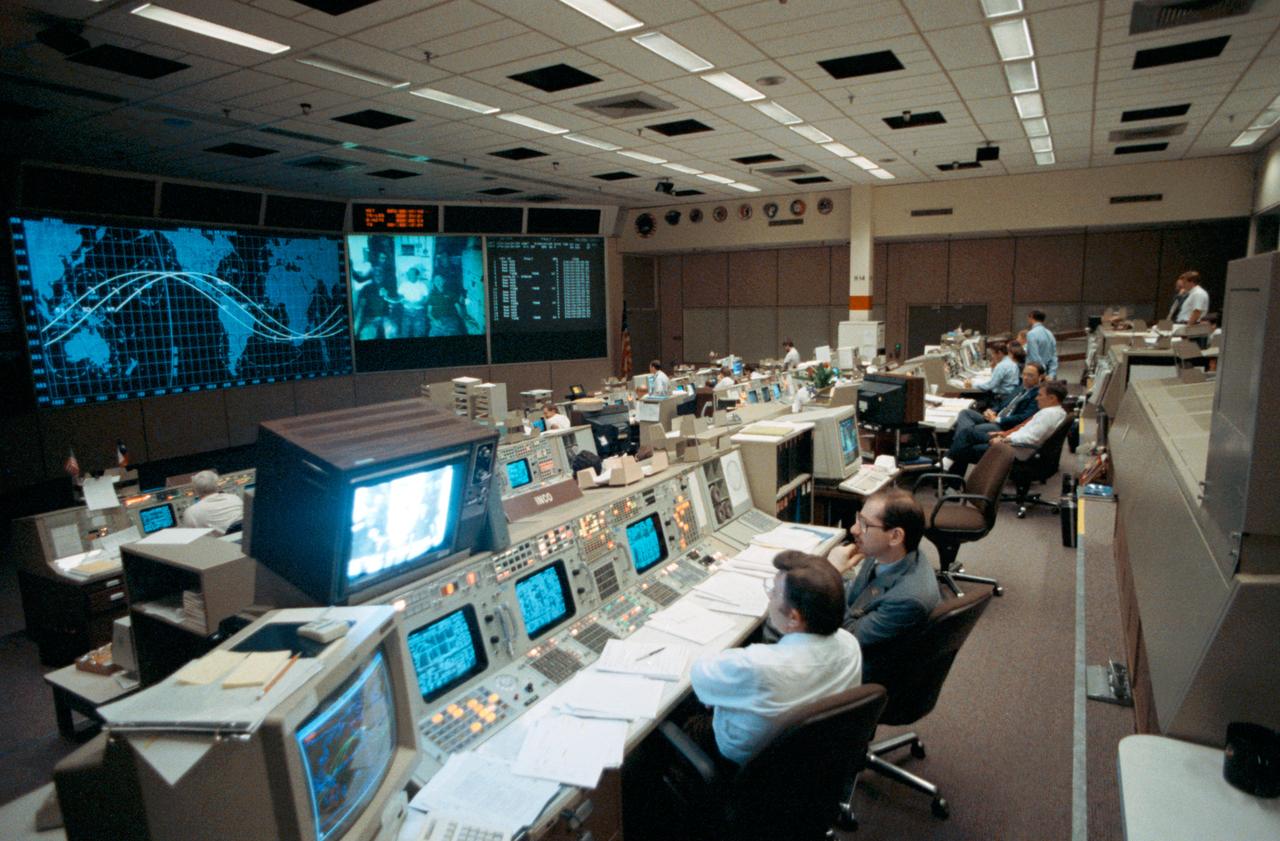
Flight controllers in JSC's Mission Control Center (MCC) Bldg 30 flight control room (FCR) listen to a presentation by STS-26 crewmembers on the fourth day of Discovery's, Orbiter Vehicle (OV) 103's, orbital mission. Instrumentation and Communications Officers (INCOs) Harold Black (left foreground) and John F. Muratore and other controllers view a television (TV) transmission of the crew on a screen in front of the FCR as each member relates some inner feelings while paying tribute to the 51L Challenger crew.
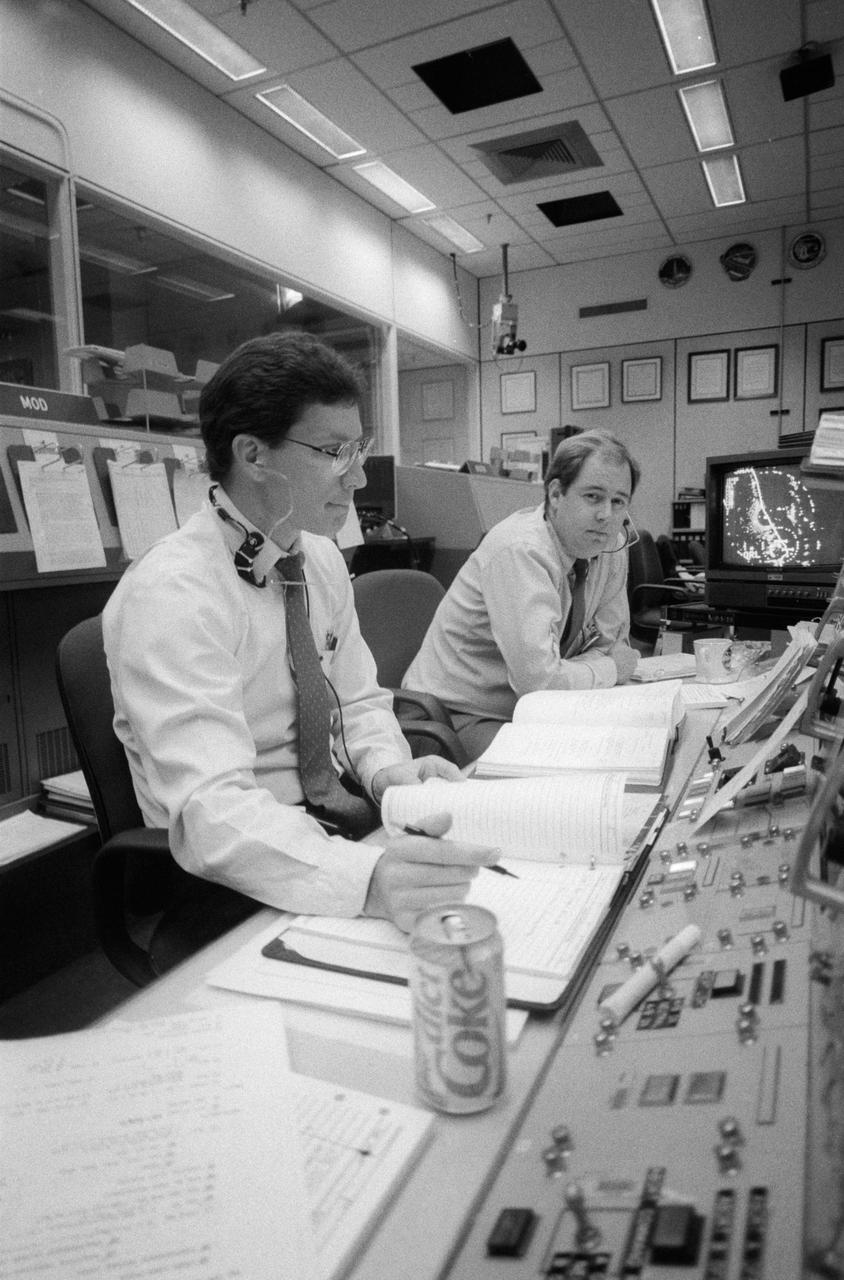
During STS-34, flight directors Robert E. Castle, Jr (left) and Ronald D. Dittemore review checklists and monitor displays at their console in JSC's Mission Control Center (MCC) Bldg 30 flight control room (FCR).
STS029-S-042 (13 March 1989) --- Flight Directors Ronald D. Dittemore, left and Lee Briscoe monitor solid rocket booster separation activity on monitors at their consoles in the flight control room of the Johnson Space Center's mission control center.
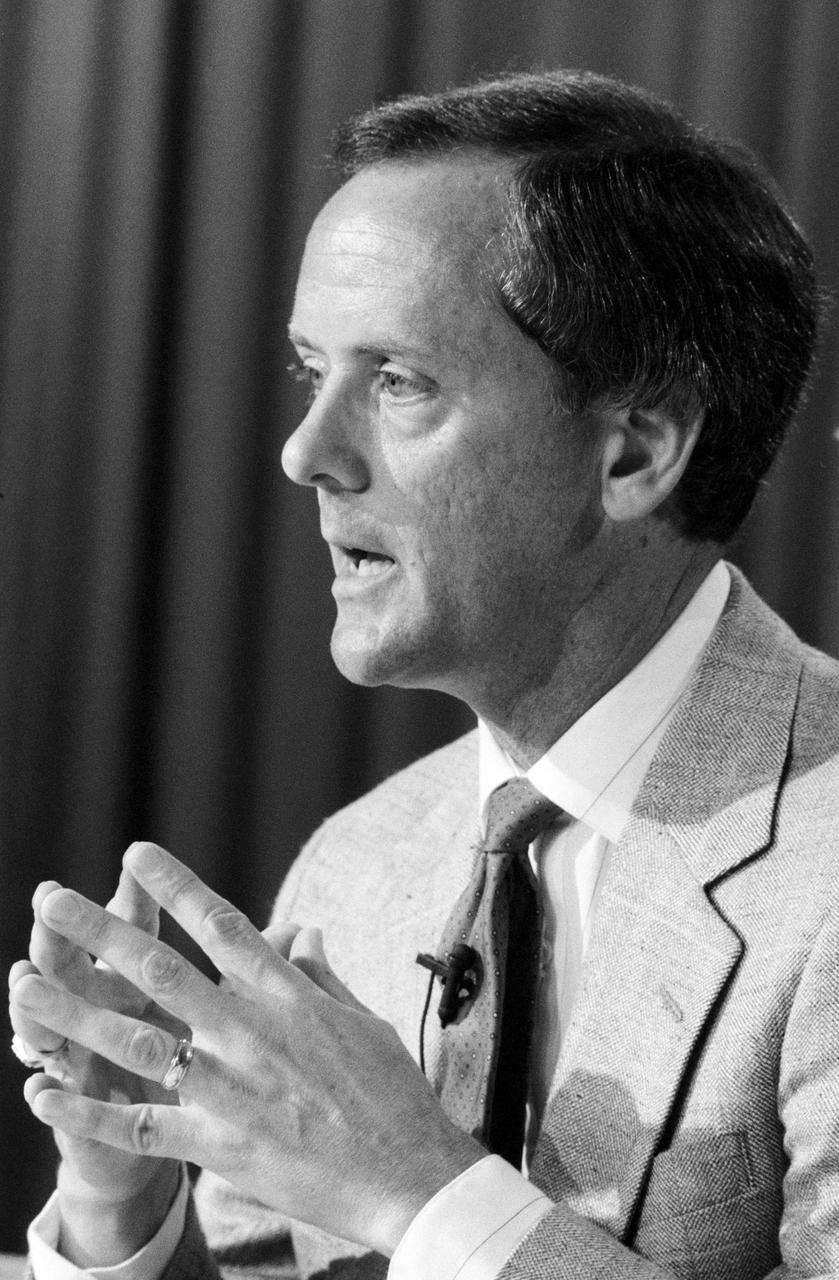
Lead flight director James M. Heflin, Jr answers question at STS-34's thirty days before launch (T-30) press briefing conducted in the JSC Auditorium and Public Affairs Facility Bldg 2 briefing room.
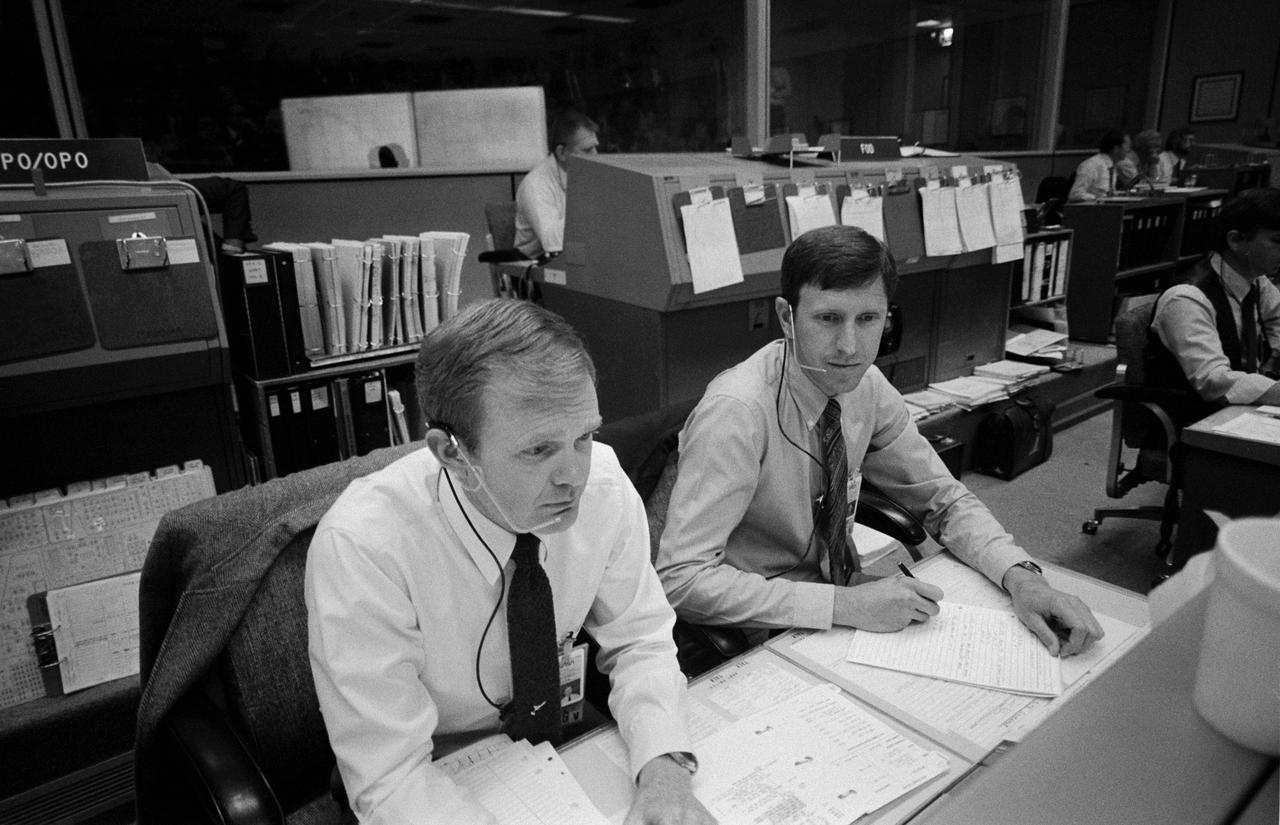
Astronauts Roy D. Bridges (left) and RIchard O. Covey serve as spacecraft communicators (CAPCOM) for STS-6. They are seated at the CAPCOM console in the mission operations control room (MOCR) of JSC's mission control center (30119); Flight Director Jay H. Greene communicates with a nearby flight controller in the MOCR just after launch of the Challenger (30120).
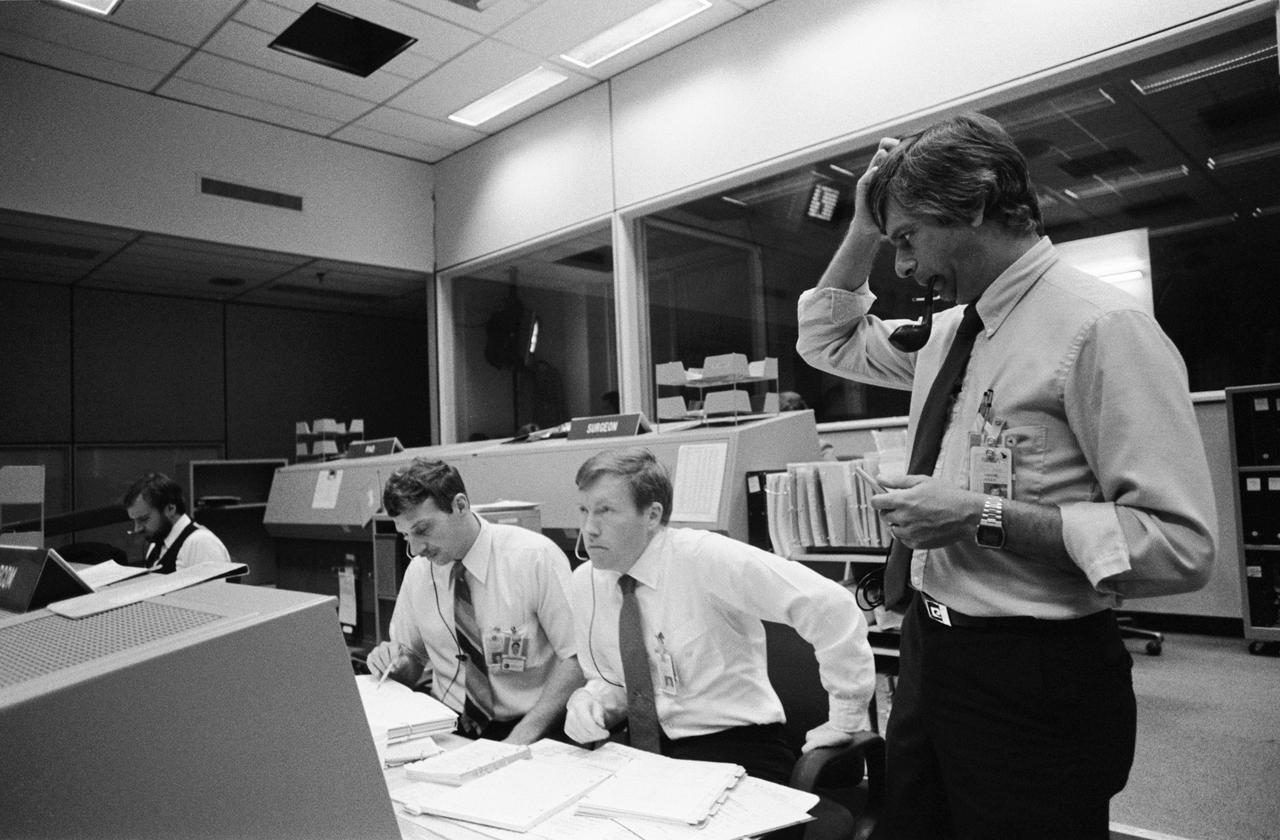
Jay H. Greene, right, ascent flight director for STS 51-A, monitors pre-launch activity at the Kennedy Space Center (KSC) via a screen at the spacecraft communicators console in the second floor flight control room (FCR) of JSC's mission control center. Astronauts David C. Hilmers, left, and Richard N. Richards are the on-duty spacecraft communicators.
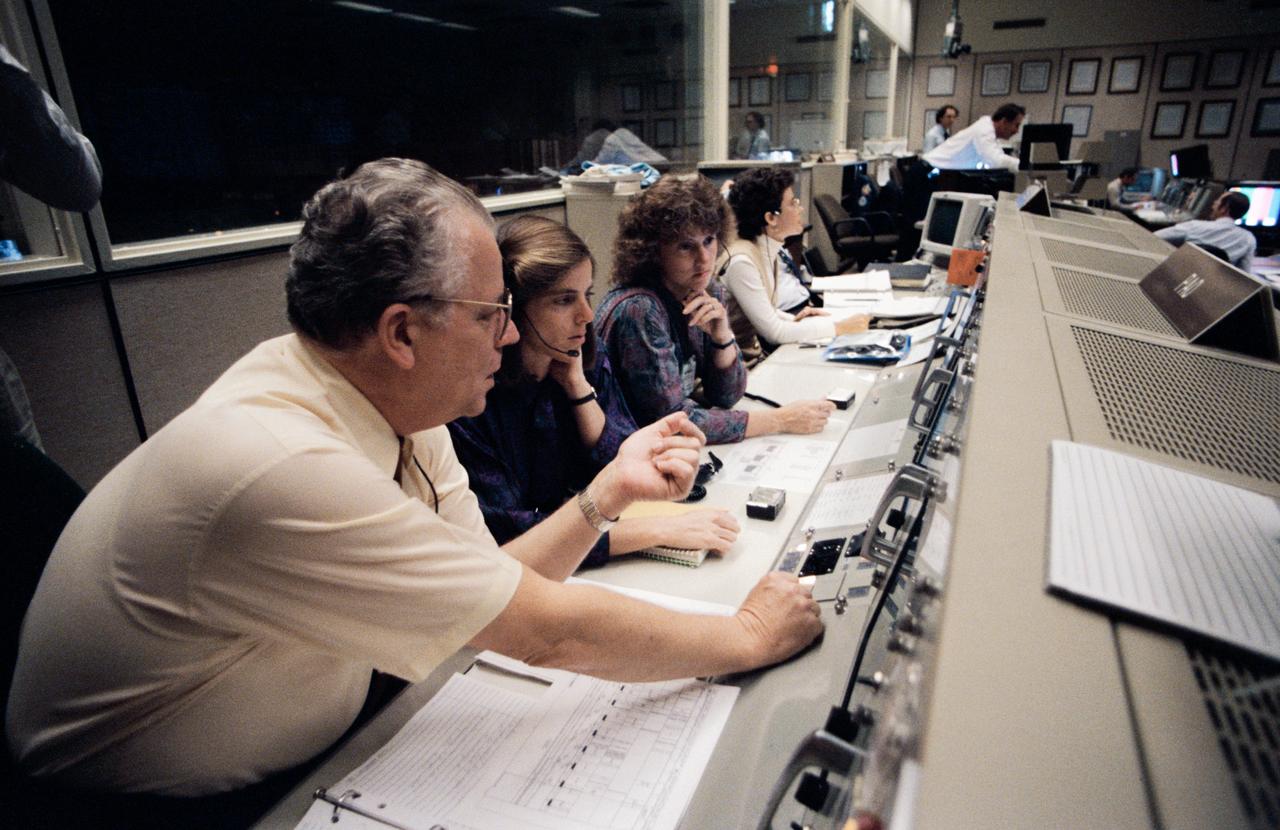
61A-S-135 (5 Nov 1985) --- Two school teachers in training at the Johnson Space Center got their first ?real time? exposure to a Space Shuttle mission as they monitor activity aboard the Spacelab D-1 science module from the mission control center. Sharon Christa McAuliffe (frame center) and Barbara R. Morgan are briefed by Terry White at the Public Affairs console during a television downlink from the Earth-orbiting Space Shuttle Challenger. McAuliffe is scheduled to fly as teacher/citizen observer on the STS 51-L mission early next year; and Morgan is in training as her backup.
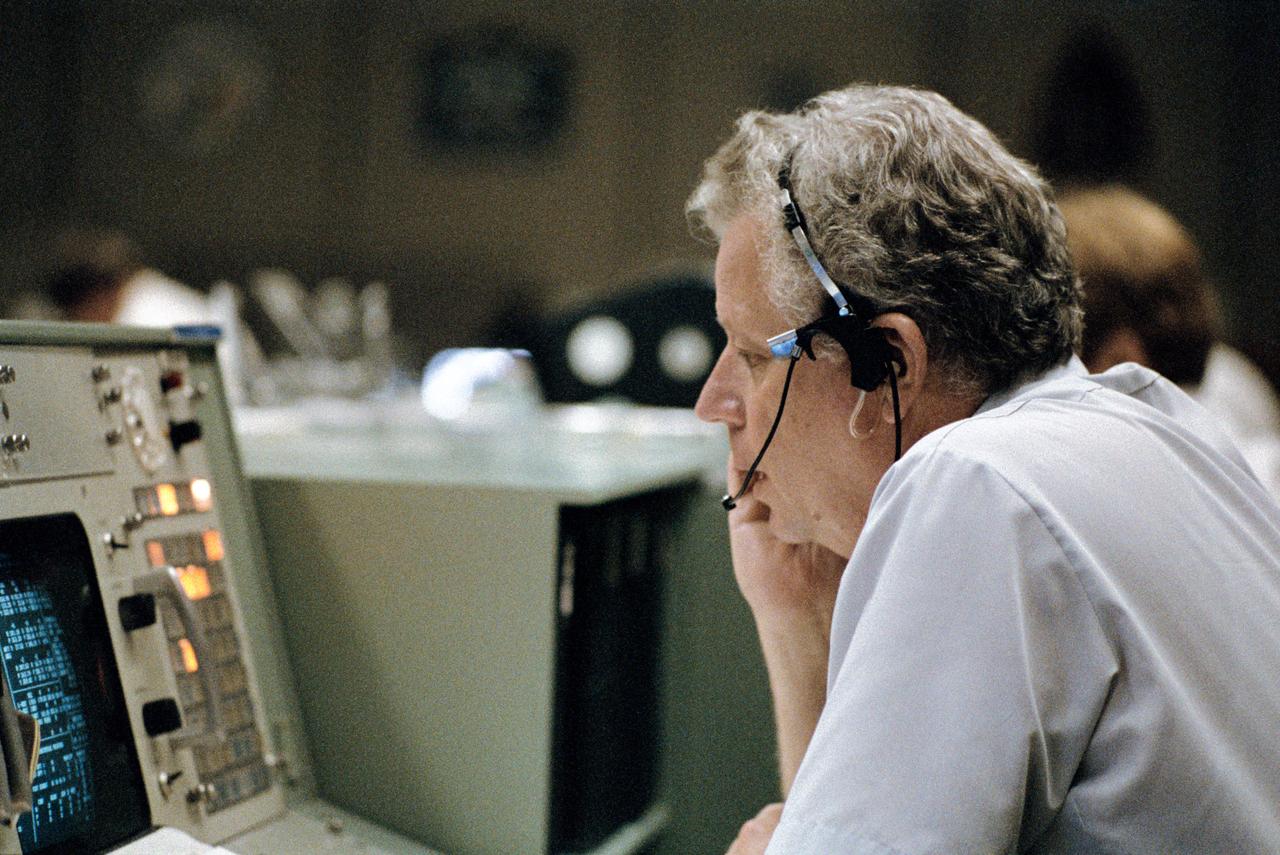
Terry White, serving as public affairs office commentator in the mission operations control room (MOCR) of JSC's mission control center, reads a status report on the STS-8 mission.
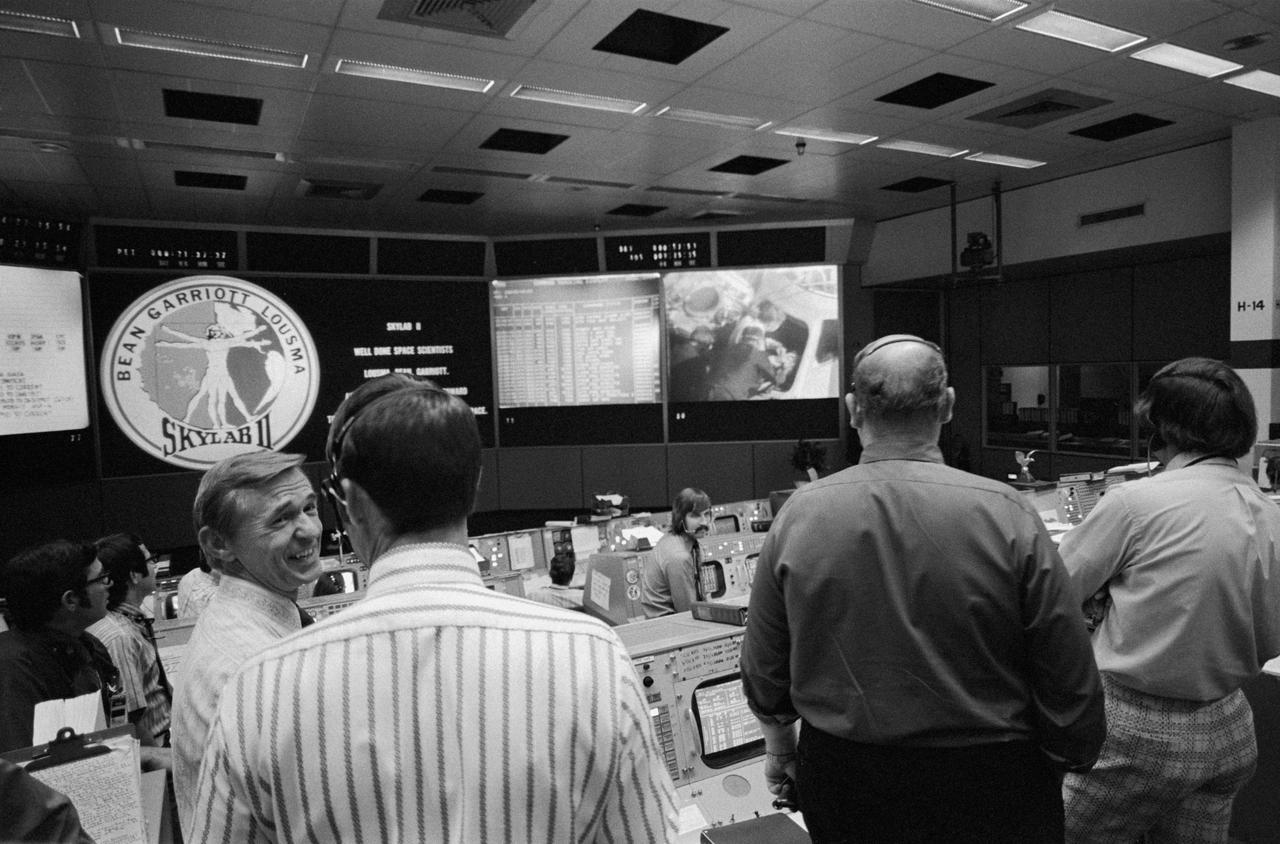
S73-34553 (25 Sept. 1973) --- Skylab flight directors (foreground) and flight controllers (background) view the large screen in the Mission Operations Control Room (MOCR) in the Mission Control Center (MCC) at JSC during recovery operations of the second manned Skylab mission. From left to right in the foreground are flight directors Charles R. Lewis, Donald R. Puffy, Phillip Shaffer and Neil B. Hutchinson. The Skylab 3 crewmen were preparing to egress the spacecraft aboard the USS New Orleans. Television cameras aboard the New Orleans recorded post-recovery activity. Photo credit: NASA
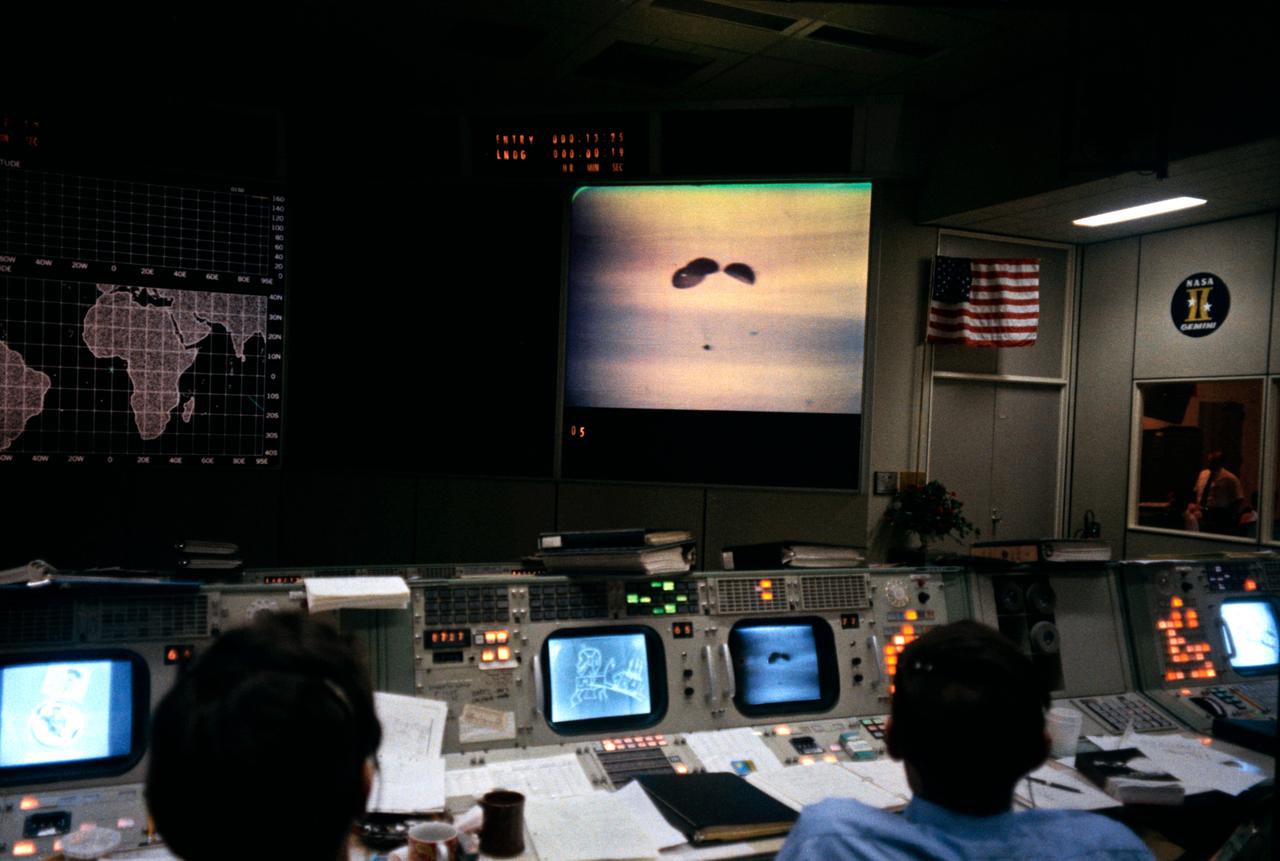
S70-35471 (17 April 1970) --- Two flight controllers man consoles in the Missions Operations Control Room (MOCR) of the Mission Control Center (MCC) at the Manned Spacecraft Center (MSC), Houston, Texas, just before splashdown occurred in the south Pacific Ocean. Though the MOCR does not appear to be crowded in this photo, there was a very large crowd of persons on hand for the splashdown and recovery operations coverage. Most of the group crowded around in the rear of the room. Apollo 13 splashdown occurred at 12:07:44 p.m. (CST), April 17, 1970.
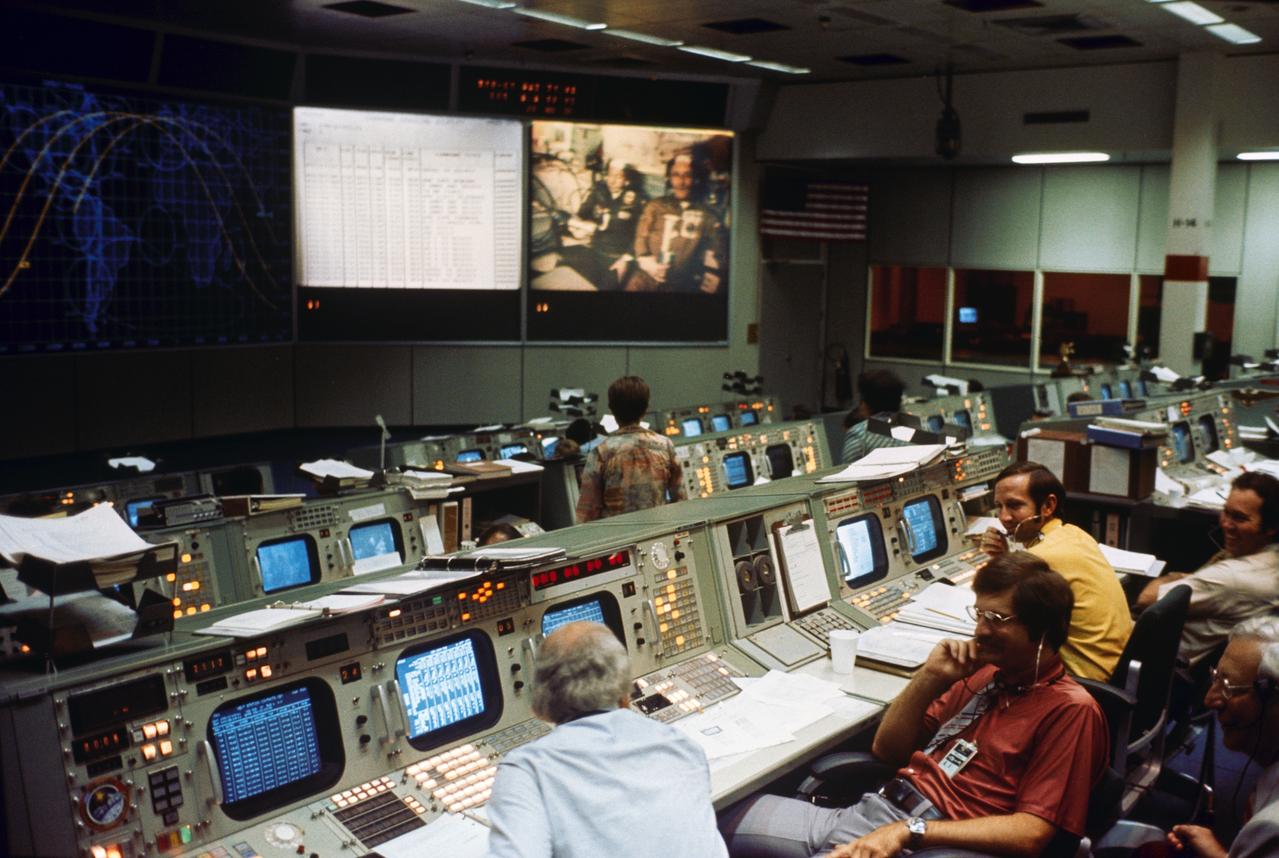
S75-28685 (17 July 1975) --- An overall view of activity in the Mission Operations Control Room in the Mission Control Center during joint U.S.-USSR Apollo Soyuz Test Project (ASTP) docking mission in Earth orbit. The large television monitor shows an interior view of the Soyuz Orbital Module with astronaut Thomas P. Stafford (in front) visiting with cosmonaut Aleksey A. Leonov. Neil B. Hutchinson (right hand to chin) is the flight director for this shift.
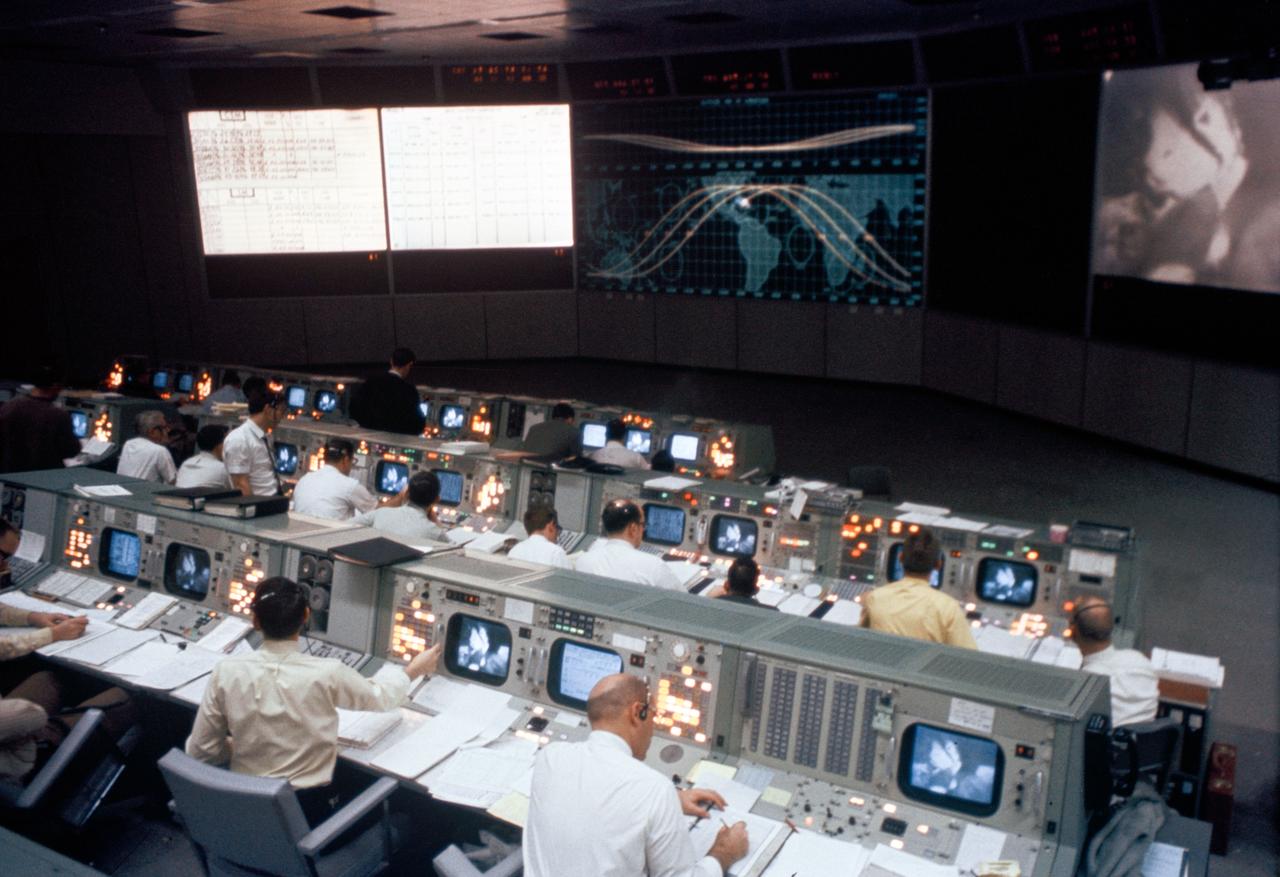
S69-26301 (March 1969) --- Overall view of the Mission Operations Control Room in the Mission Control Center, Building 30, during the Apollo 9 Earth-orbital mission. When this photograph was taken a live television transmission was being received from Apollo 9 as it orbited Earth.
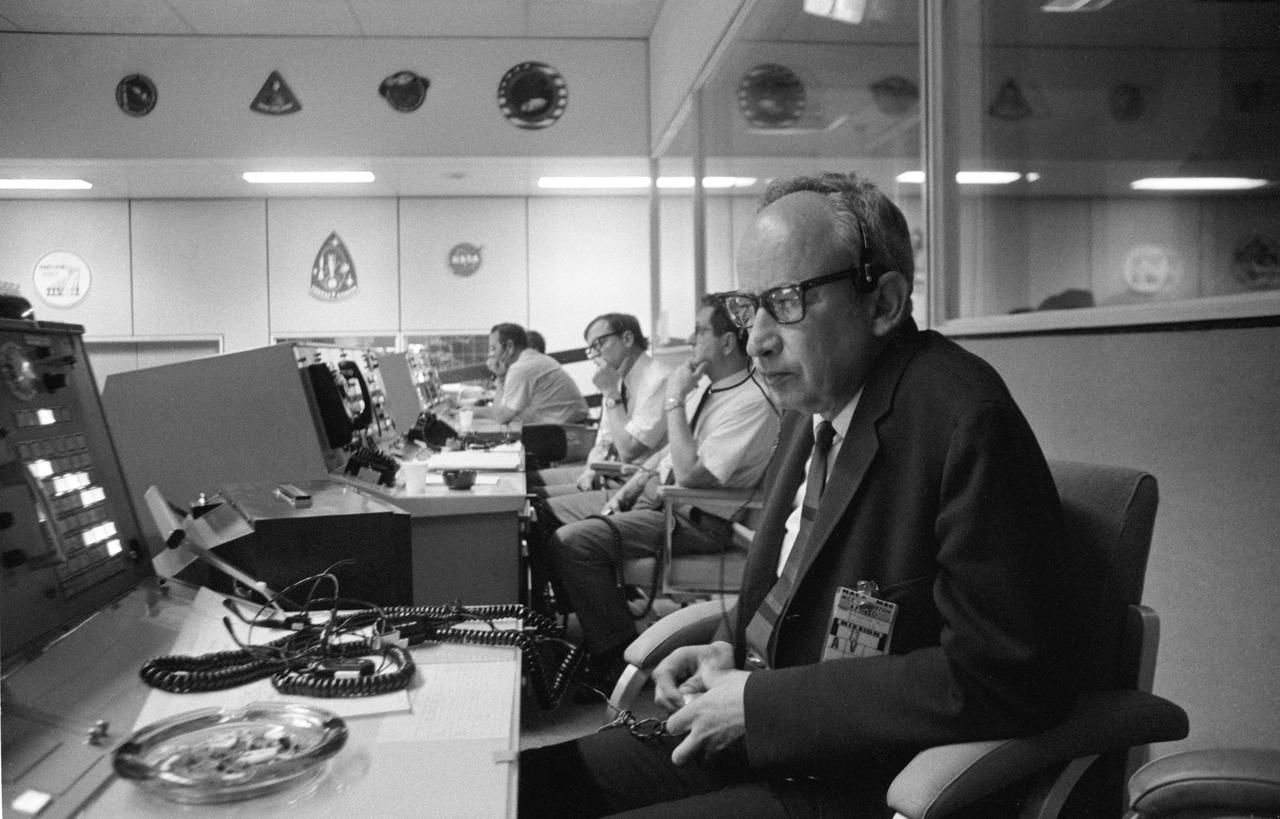
S70-34627 (11 April 1970) --- Sigurd A. Sjoberg, director of flight operations, at the Manned Spacecraft Center (MSC), views the Apollo 13 liftoff from a console in the MSC Mission Control Center (MCC), Building 30. Apollo 13 lifted off at 1:13 p.m. (CST) April 11, 1970. Photo credit: NASA
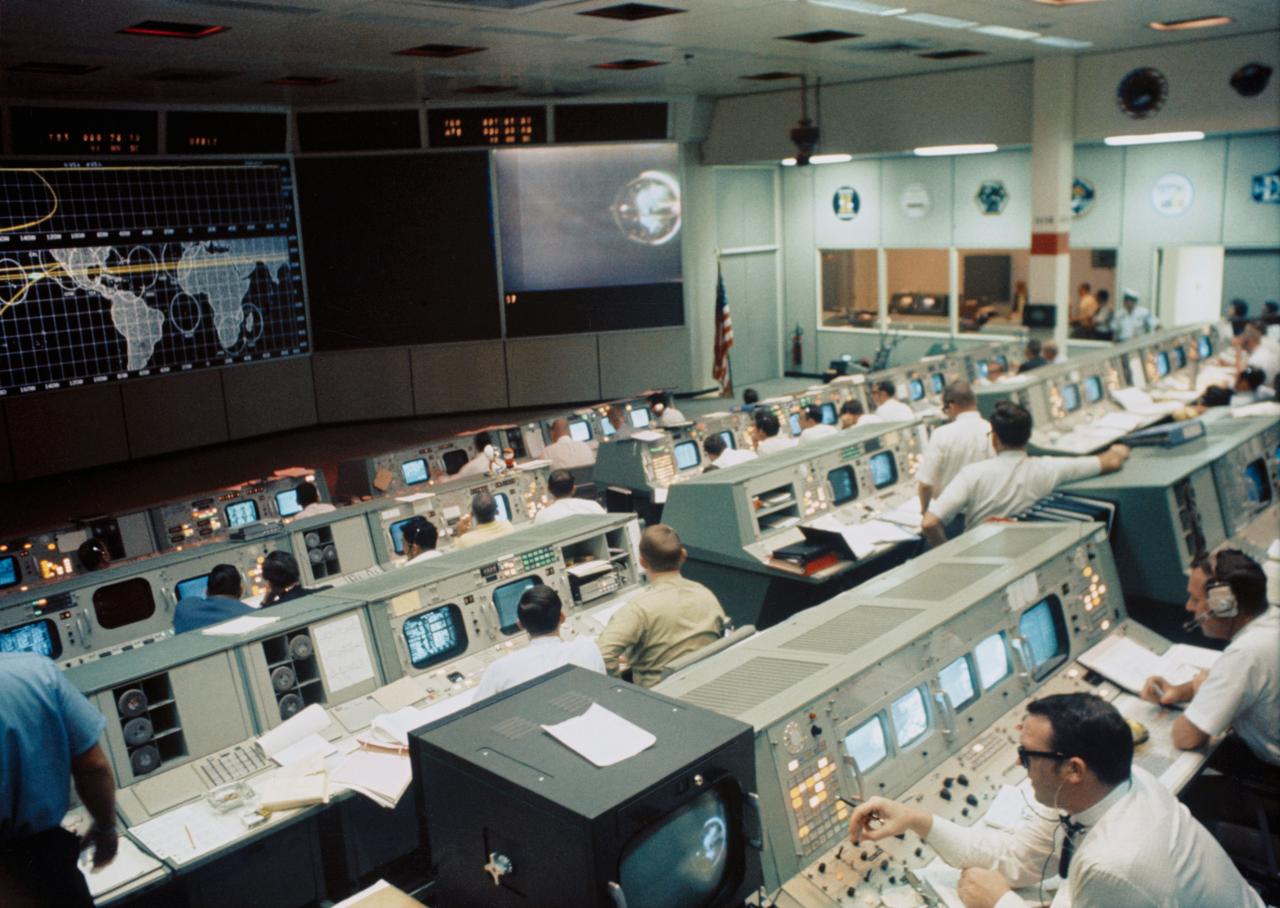
S69-34316 (18 May 1969) --- Overall view of the Mission Operations Control Room in the Mission Control Center, Building 30, on the first day of the Apollo 10 lunar orbit mission. A color television transmission was being received from Apollo 10. This picture was made following Command and Service Module/Lunar Module/Saturn IVB (CSM/LM-S-IVB) separation and prior to LM extraction from the S-IVB. The CSM were making the docking approach to the LM/S-IVB.
S68-55742 (21 Dec. 1968) --- Clifford E. Charlesworth, Apollo 8 "Green Team" flight director, is seated at his console in the Mission Operations Control Room in the Mission Control Center, Building 30, during the launch of the Apollo 8 (Spacecraft 103/Saturn 503) manned lunar orbit space mission.
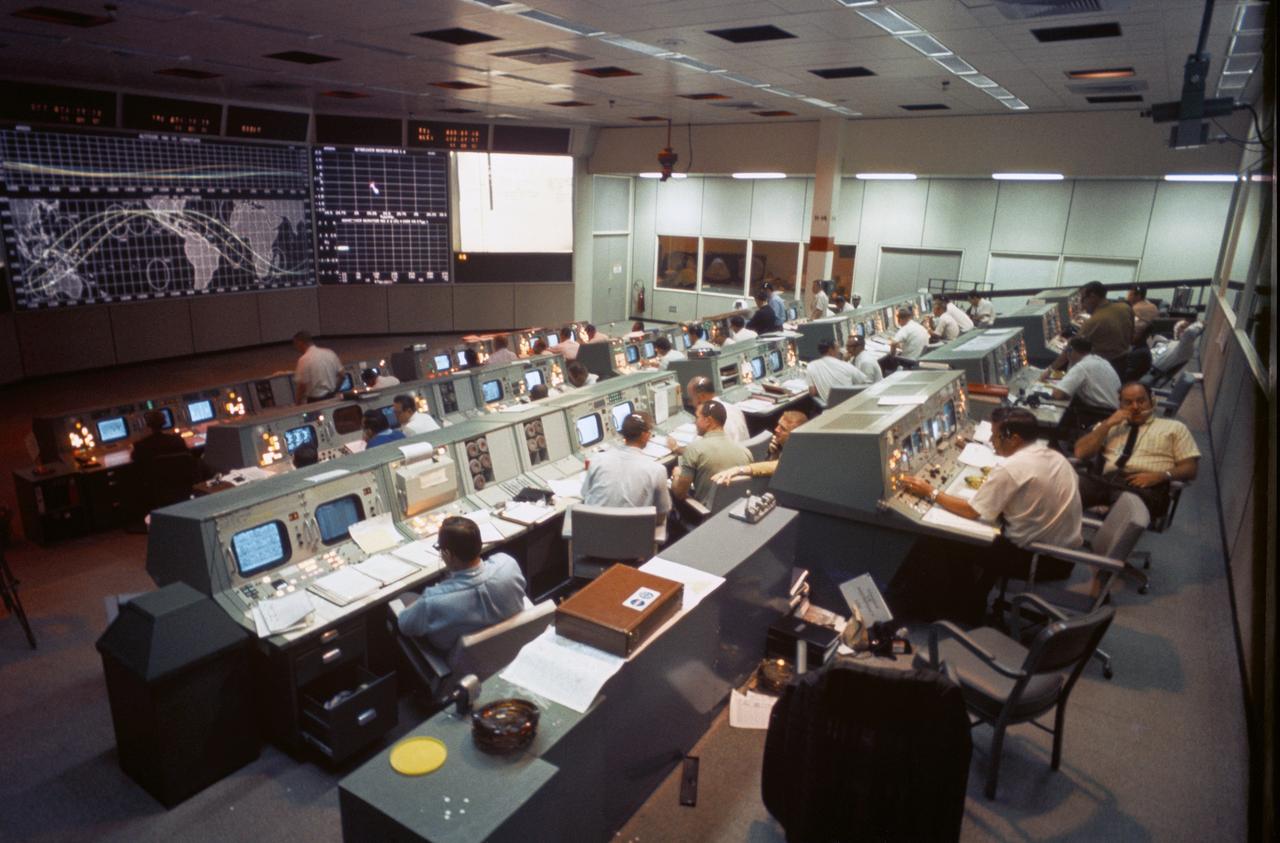
Overall view of activity in the Mission Operations Control Room in the Mission Control Center, Bldg 30, on the first day of the Apollo 7 space mission.
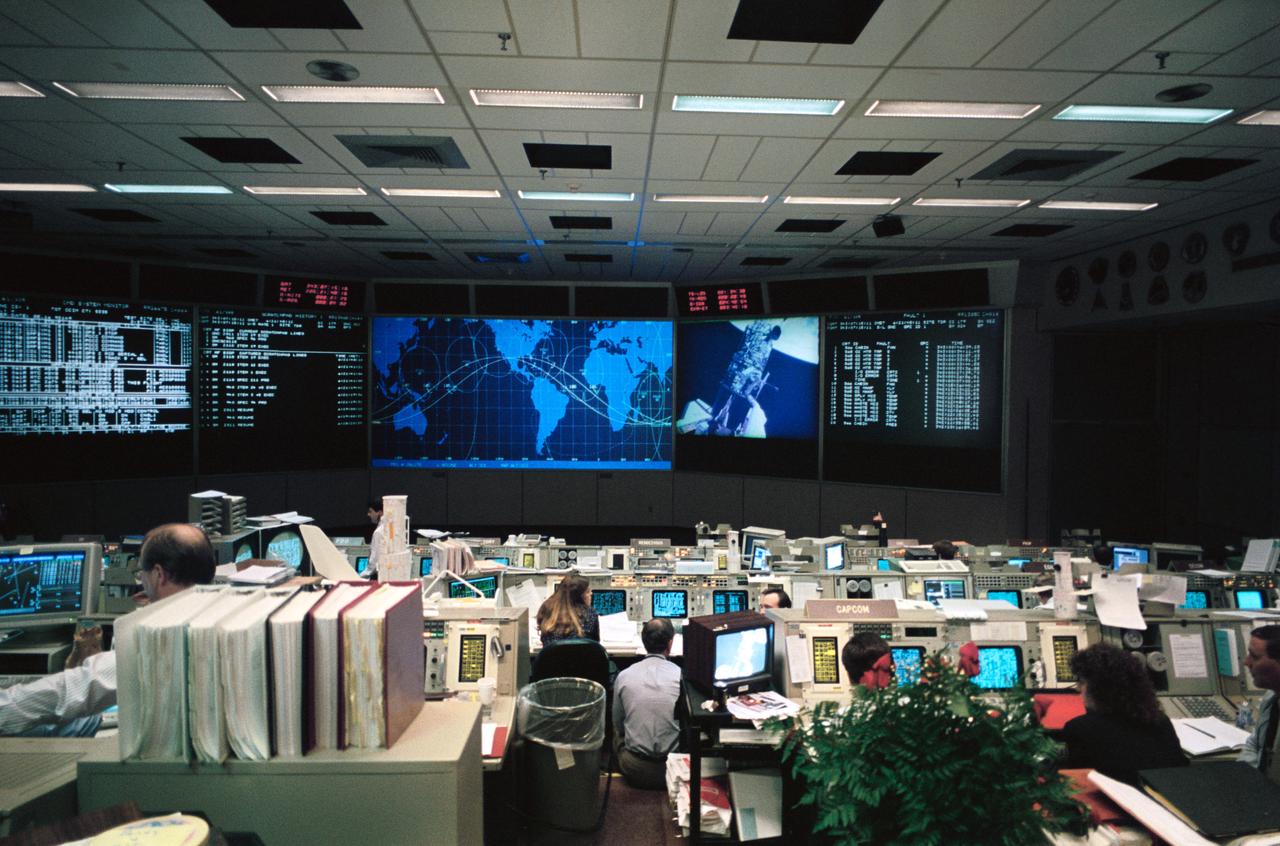
STS061-S-104 (2-13 DEC 1993) --- An overall view in the Johnson Space Center's (JSC) Mission Control Center (MCC) during one of the five space walks performed to service the Hubble Space Telescope (HST) temporarily berthed in the Space Shuttle Endeavour's cargo bay. STS-61 lead flight director Milt Heflin is at right edge of frame.
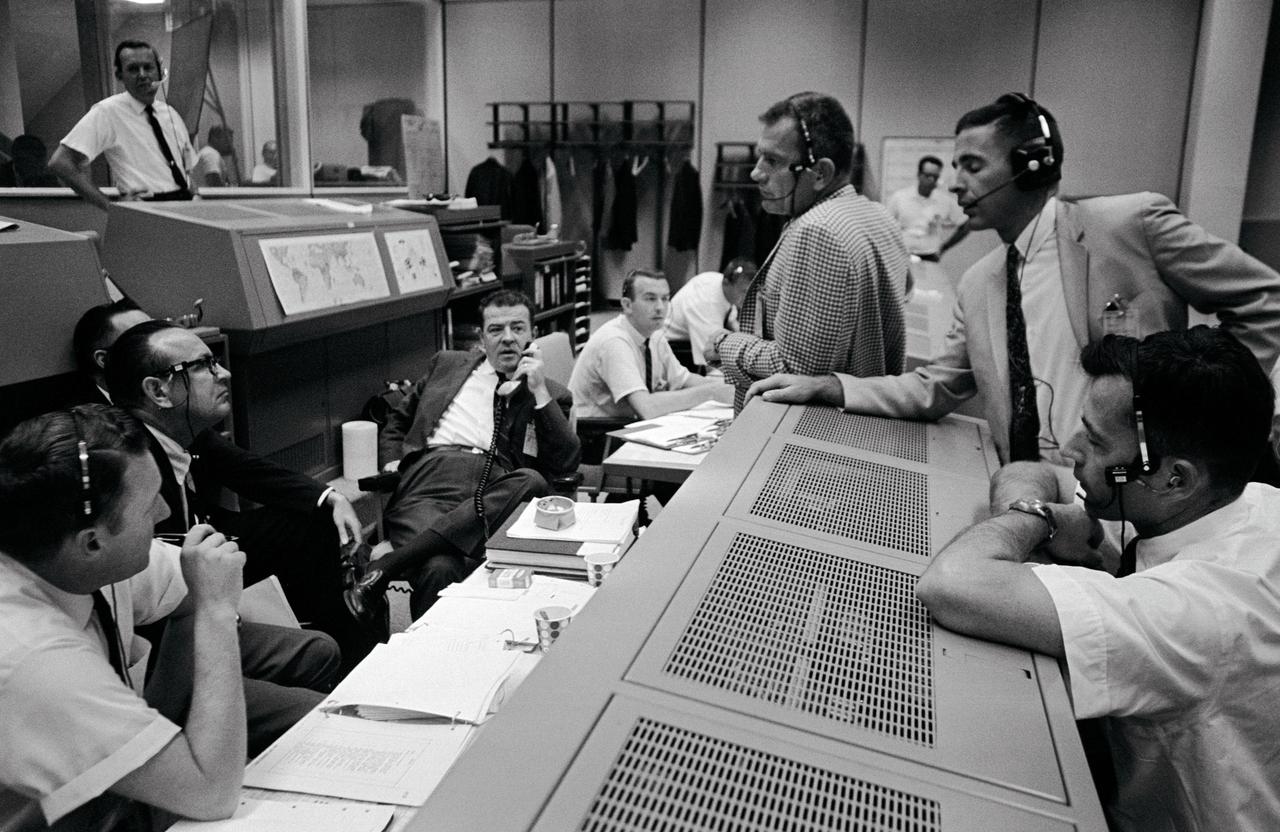
S66-52157 (12 Sept. 1966) --- Discussing the Gemini-11 spaceflight in the Mission Control Center are: (left to right) Christopher C. Kraft Jr., (wearing glasses), Director of Flight Operations; Charles W. Mathews (holding phone), Manager, Gemini Program Office; Dr. Donald K. Slayton (center, checked coat), Director of Flight Crew Operations; astronaut William A. Anders, and astronaut John W. Young. Photo credit: NASA
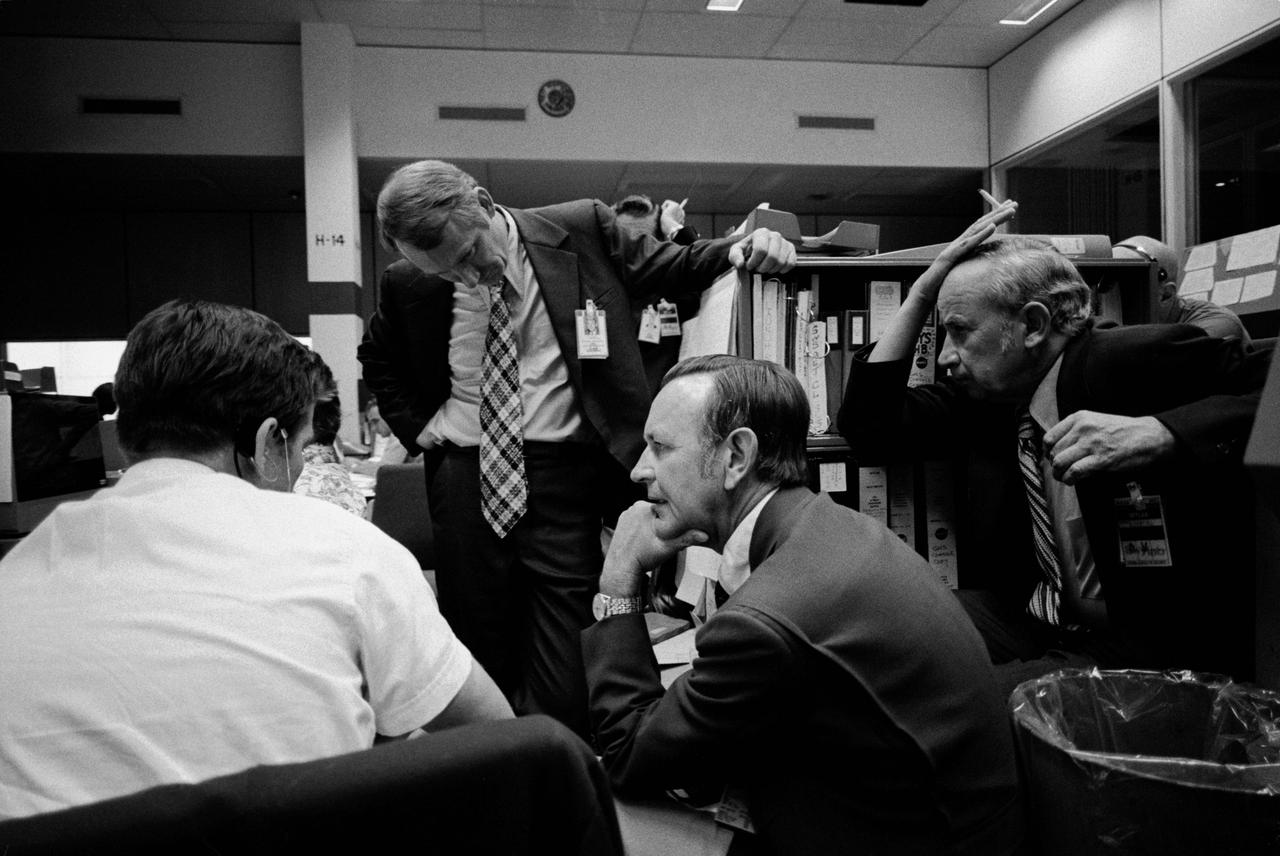
S73-31875 (2 Aug. 1973) --- After learning of a problem in the Command/Service Module which was used to transport the Skylab 3 crew to the orbiting Skylab space station cluster, NASA officials held various meetings to discuss the problem. Here, four men monitor the current status of the problem in the Mission Operations Control Room (MOCR) of the Mission Control Center (MCC) at the Johnson Space Center (JSC). From the left are Gary E. Coen, Guidance and Navigation System flight controller; Howard W. Tindall Jr., Director of Flight Operations at JSC; Dr. Christopher C. Kraft Jr., JSC Director; and Sigurd A. Sjoberg, JSC Deputy Director. Photo credit: NASA
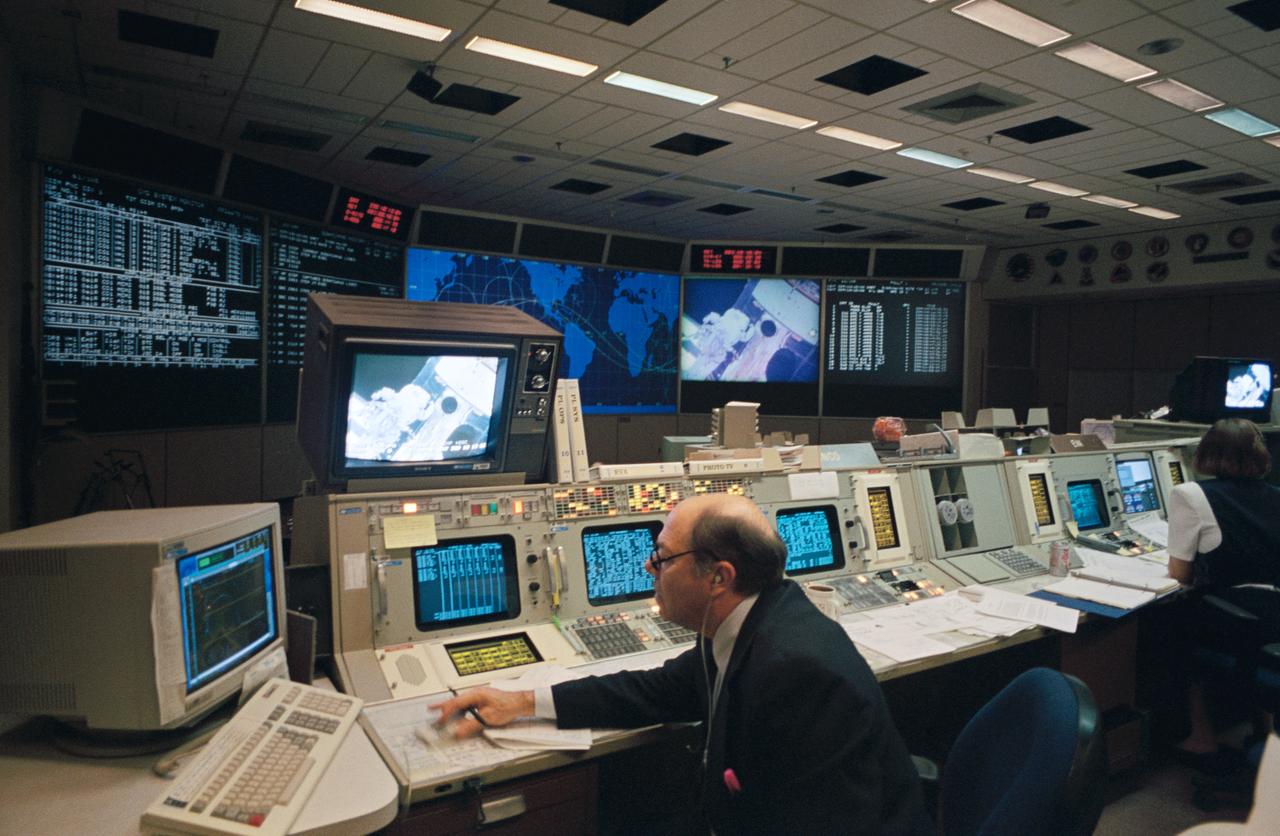
Joseph Fanelli, at the Integrated Communications Officer console, monitors the televised activity of Astronauts Story Musgrave and Jeffrey A. Hoffman. The vetern astronauts were performing the first extravehicular activity (EVA-1) of the STS-61 Hubble Space Telescope (HST) servicing mission.
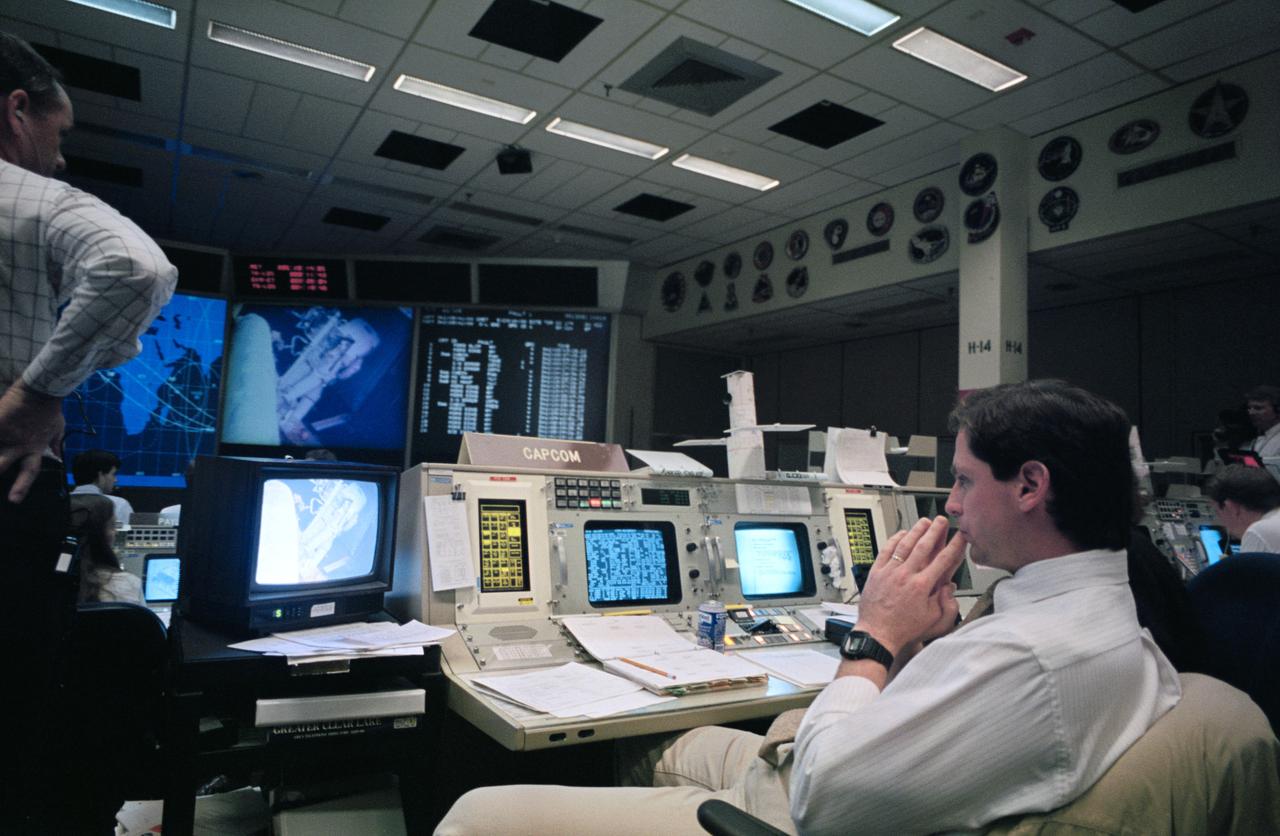
STS61-S-101 (8 Dec 1993) --- Astronaut Gregory J. Harbaugh, spacecraft communicator (CAPCOM), observes as two astronauts work through a lengthy period of extravehicular activity (EVA) in the cargo bay of the Earth-orbiting Space Shuttle Endeavour. Seen on the screen in the front of the flight control room, preparing to work with the Hubble Space Telescope's (HST) magnetometers, are astronauts F. Story Musgrave and Jeffrey A. Hoffman. Harbaugh stayed busy passing up flight controllers suggestions and directions during the record-breaking battery of in-space servicing sessions. Lead flight director Milt Heflin is partially visible at left edge of frame.
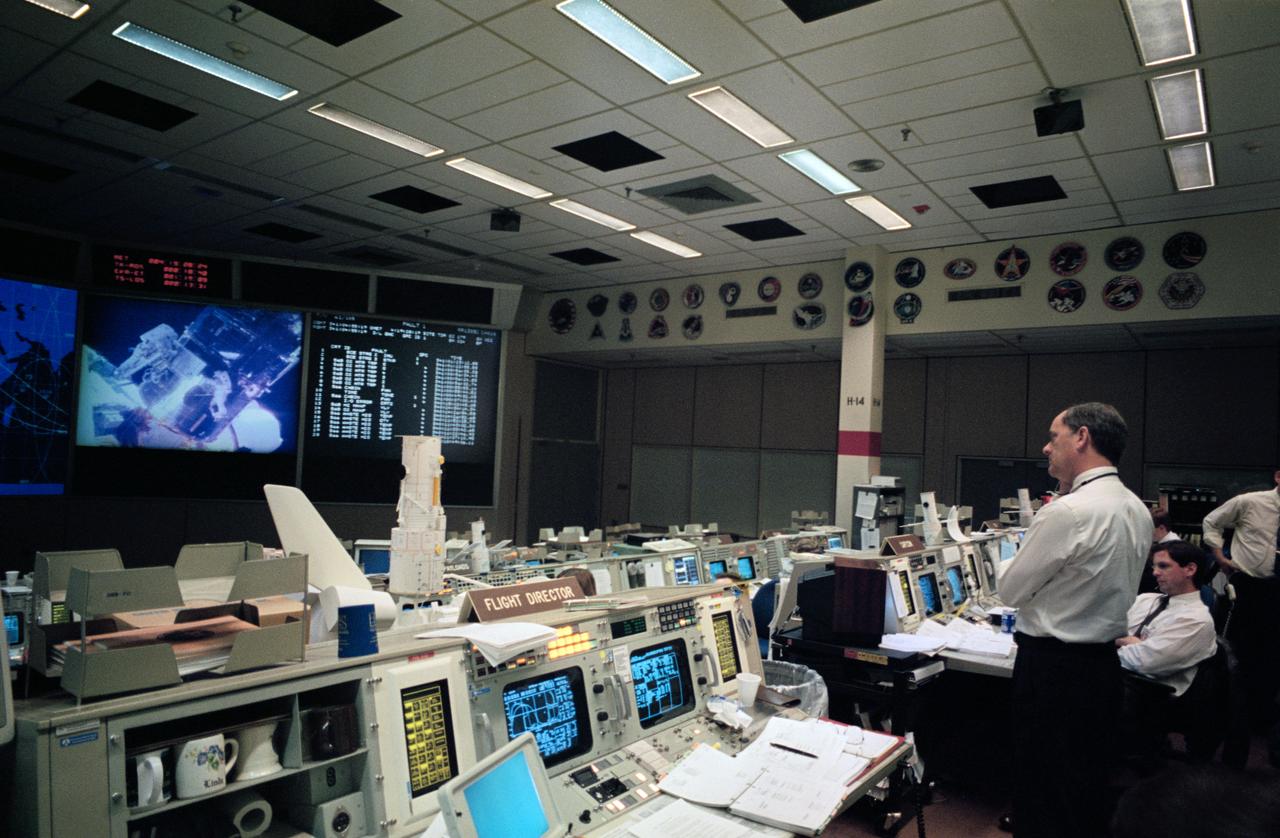
STS61-S-098 (6 DEC 1993) --- Flight director Milton Heflin monitors two space walkers as they change out the Wife Field/Planetary Camera (WFPC) on the Hubble Space Telescope (HST), temporarily berthed in the Space Shuttle Endeavour's cargo bay. Astronaut Gregory J. Harbaugh, spacecraft communicator (CAPCOM), is at right edge. Astronauts F. Story Musgrave and Jeffrey A. Hoffman can be seen with the large camera on the screen in the front of the flight control room.
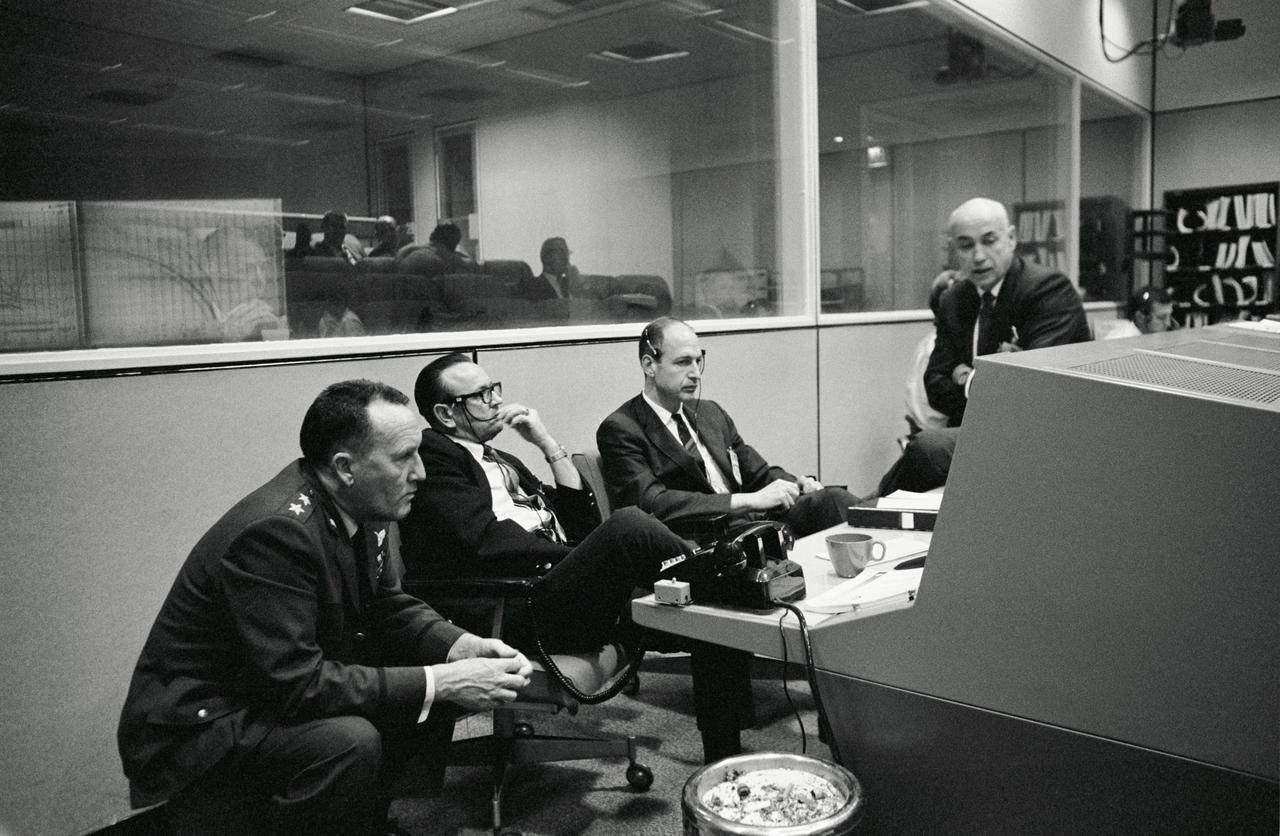
S68-20986 (4 April 1968) --- Scene at the flight operations director's console in the Mission Control Center, Building 30, during the Apollo 6 (Spacecraft 020/Saturn 520) unmanned space flight. Left to right, are Air Force Maj. Gen. Vincent G. Huston, DOD Manager, Manned Space Flight Operations, Andrews Air Force Base, Washington, D.C.; Dr. Christopher C. Kraft Jr., MSC director of flight operations; George M. Low, manager, MSC Apollo Spacecraft Program Office; and Dr. Robert R. Gilruth, MSC Director.
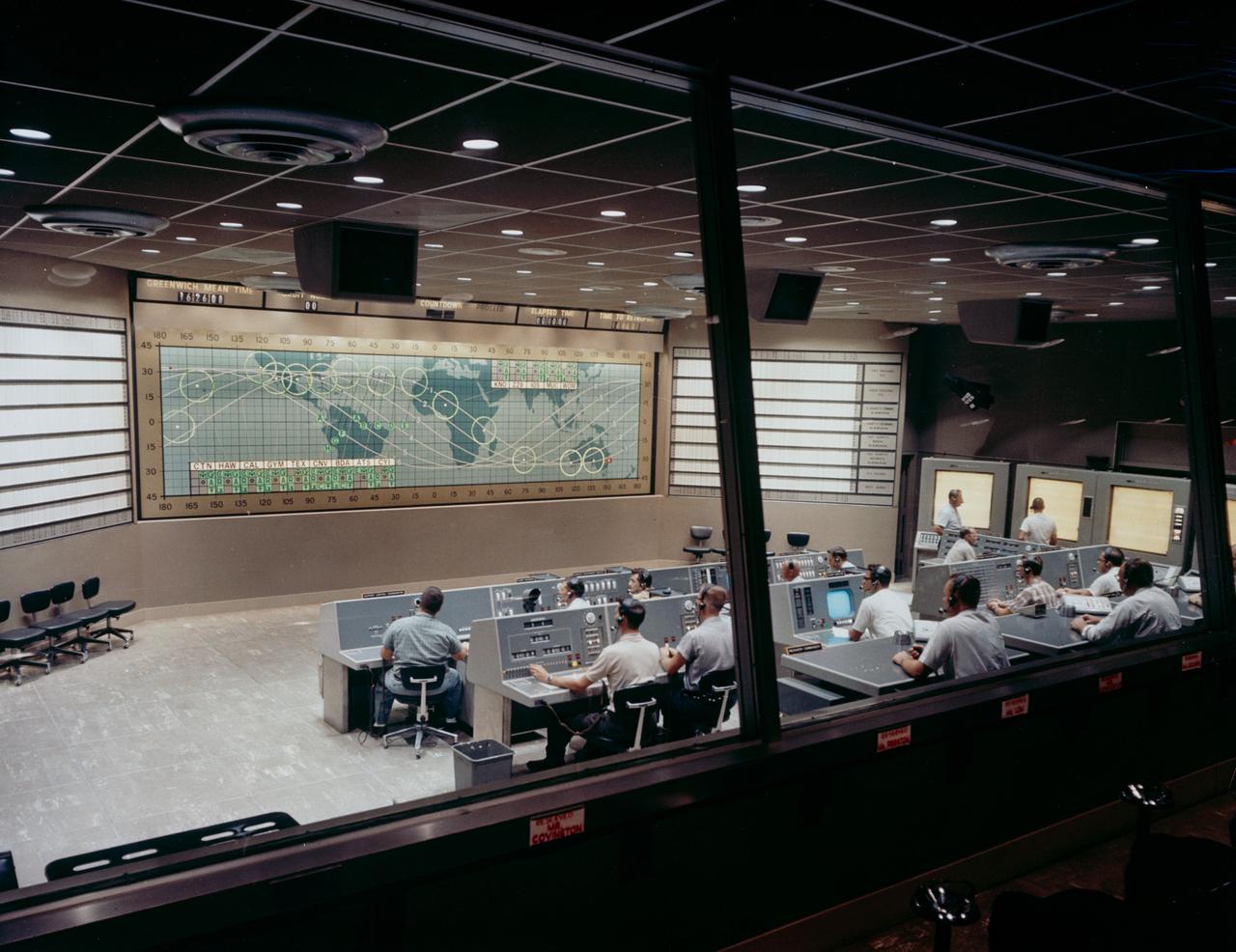
S62-05139 (1962) --- View of Mercury Control Center prior to the Mercury-Atlas 8 (MA-8) flight of the Sigma 7. Photo credit: NASA
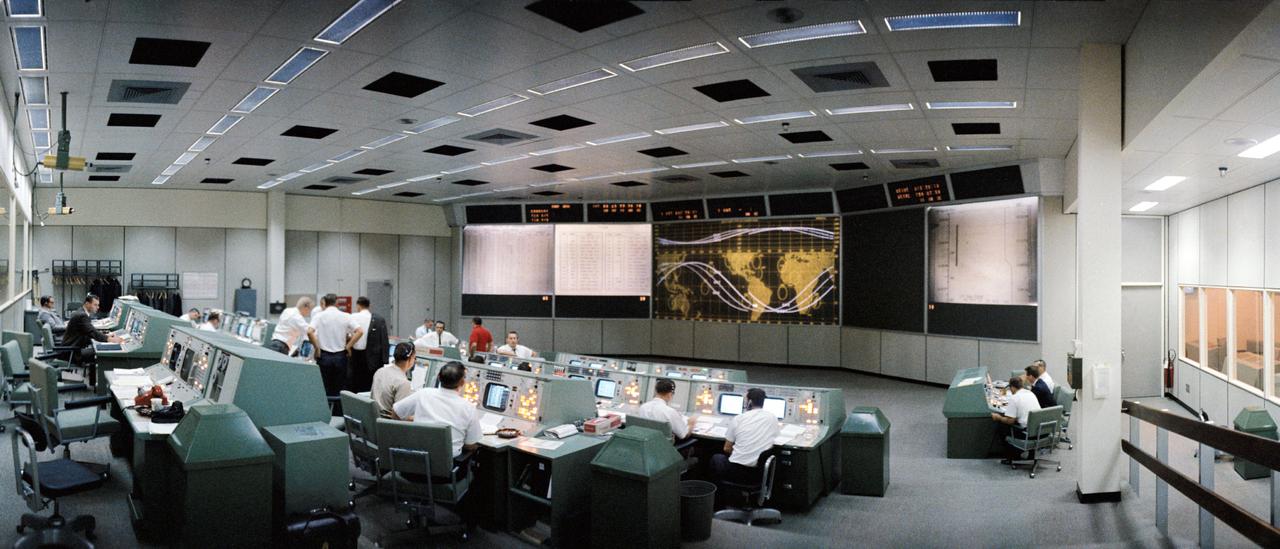
S65-45280 (21-29 Aug. 1965) --- Overall view of the Mission Control Center (MCC), Houston, Texas, during the Gemini-5 flight. Note the screen at the front of the MCC which is used to track the progress of the Gemini spacecraft.
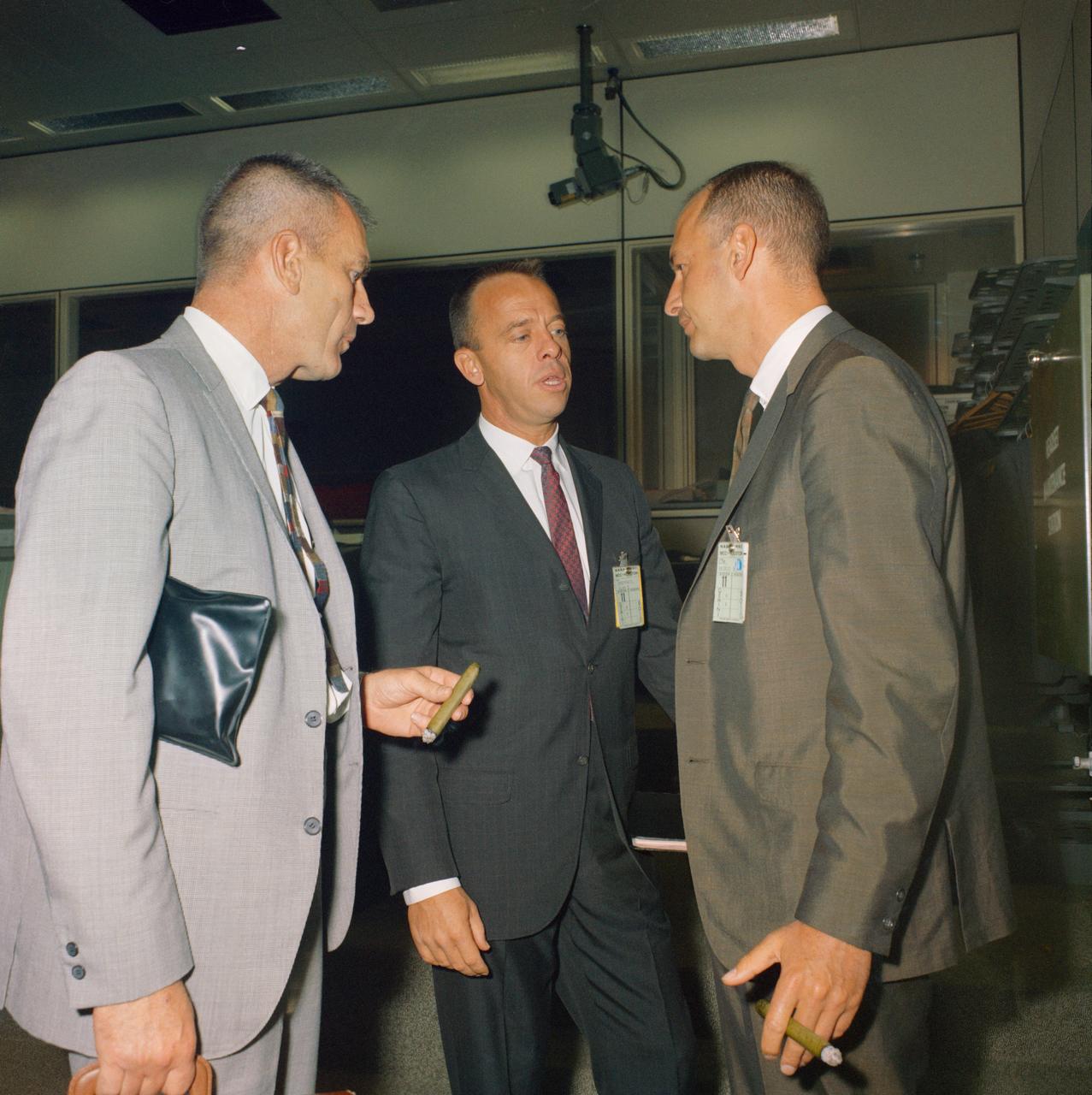
S66-52754 (12 Sept. 1966) --- Three key Manned Spacecraft Center (MSC) officials hold discussion in the Mission Control room during Gemini-11 activity. Left to right, are Donald K. Slayton, MSC Director of Flight Crew Operations; astronaut Alan B. Shepard Jr., Chief, MSC Astronaut Office; and George M. Low, MSC Deputy Director. Photo credit: NASA
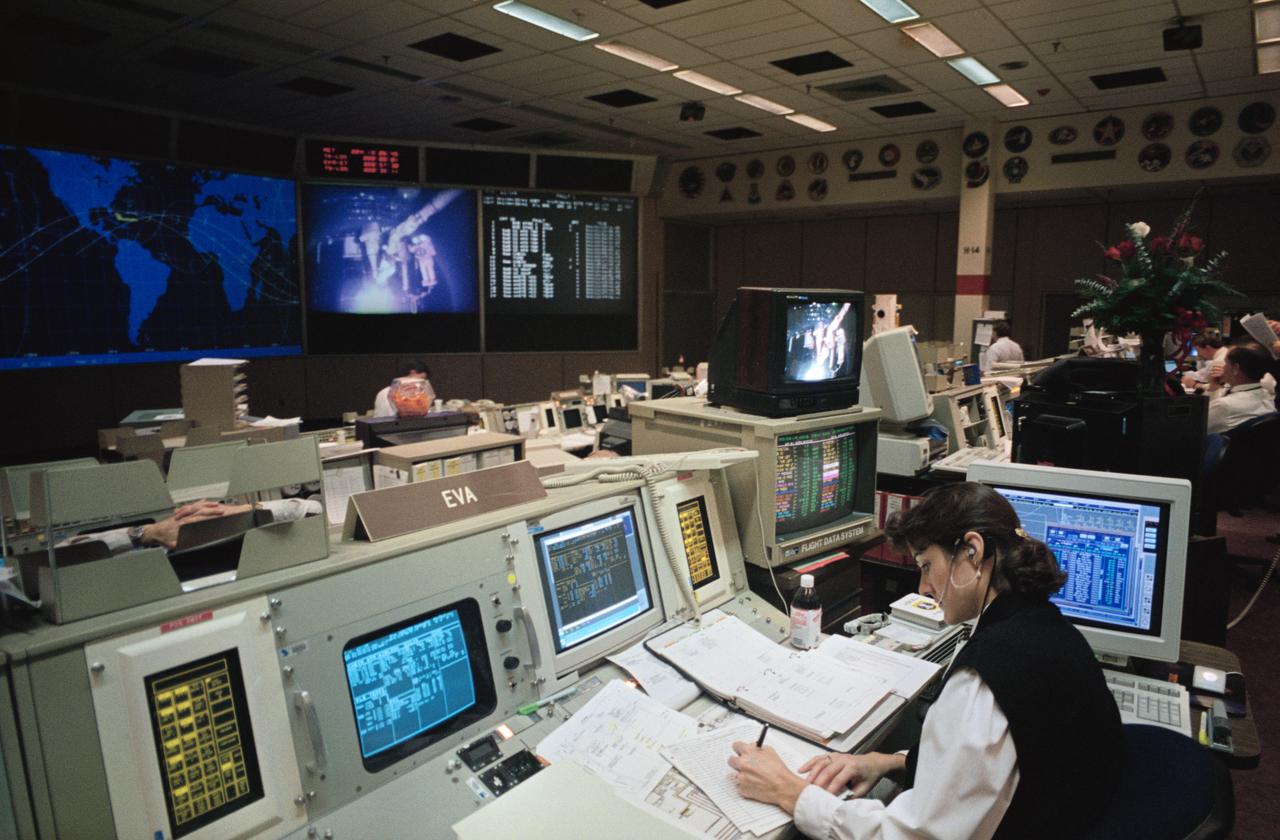
Flight controller Susan P. Rainwater observes as two astronauts work through a lengthy period of extravehicular activity (EVA) in the cargo bay of the Earth-looking Space Shuttle Endeavour. Rainwater's EVA console was one of Mission Control's busiest during this eleven-day Hubble Space Telescope (HST) servicing mission in Earth orbit.
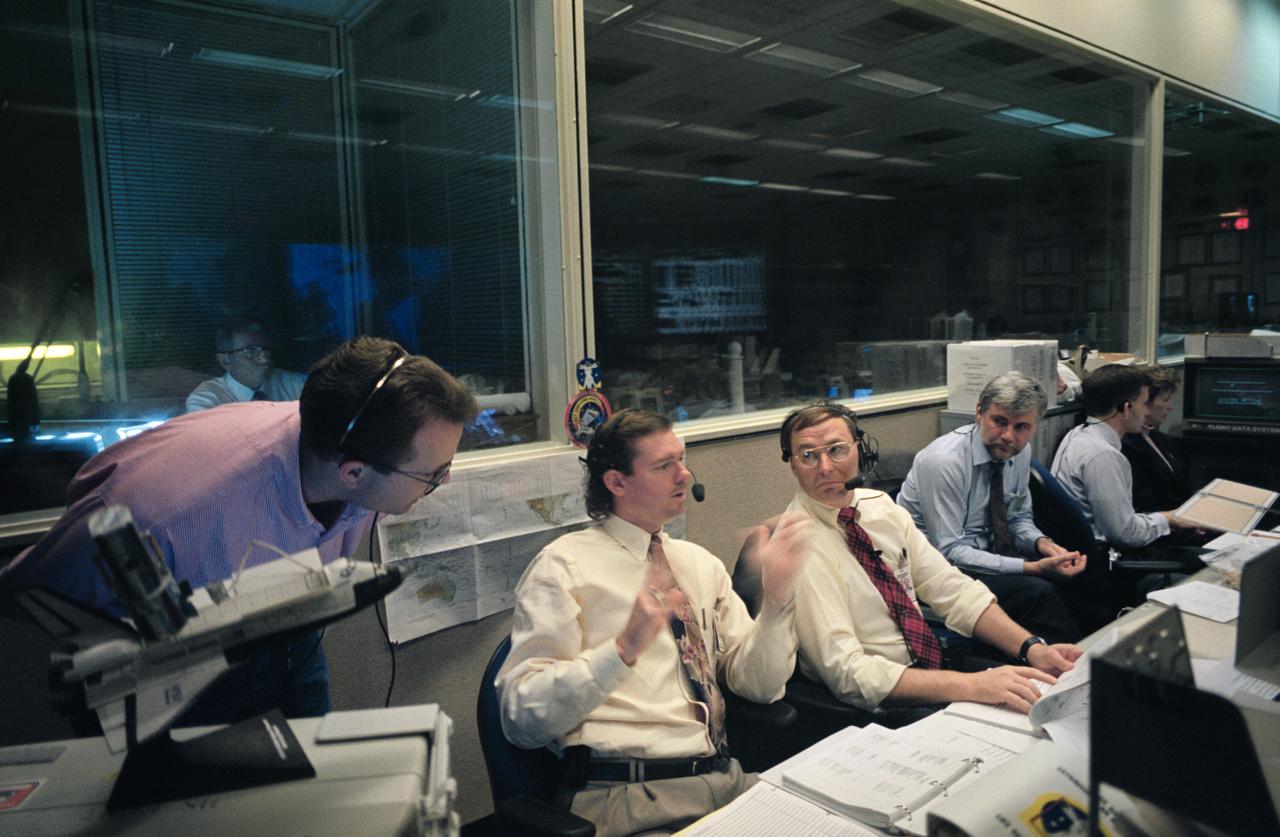
STS61-S-094 (5 Dec 1993) --- Kyle Herring, second left, illustrates a point during mission commentary for the second Extravehicular Activity (EVA-2) of the STS-61 Hubble Space Telescope (HST) servicing mission. Astronaut Jerry L. Ross (center), a space walker on two previous NASA shuttle missions, amplified Herring's explanations. At the flight surgeon's console is Dr. Klaus Lohn (third right) of the Institute for Flight Medicine in Koln, Germany.
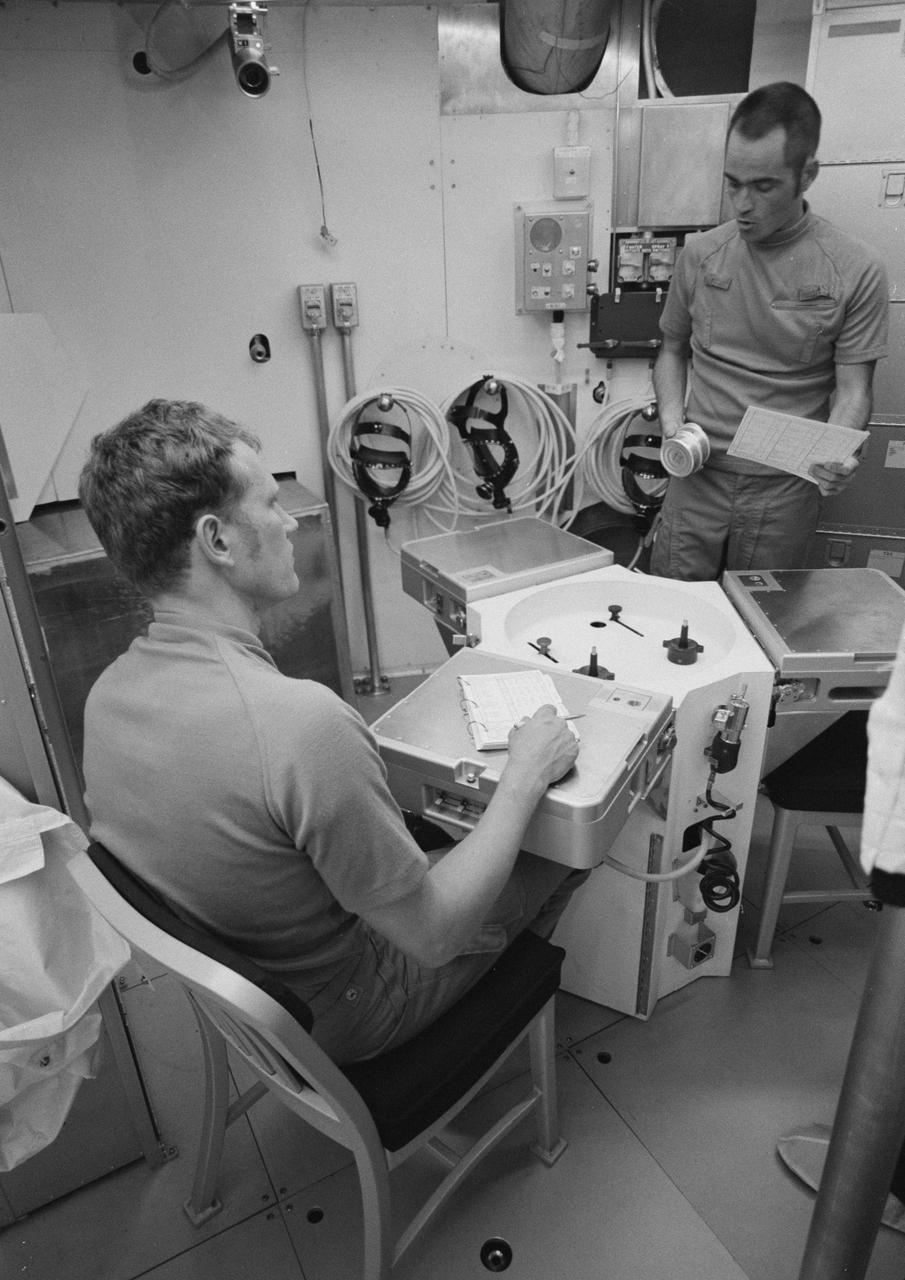
S72-41853 (15 June 1972) --- Two members of the three-man Skylab Medical Experiment Altitude Test (SMEAT) crew, that will spend up to 56 days in the Crew Systems Division's 20-foot altitude chamber at the Manned Spacecraft Center (MSC) beginning in mid-July, go over a menu in the food preparation area. Seated at the simulated wardroom food table is astronaut Karol J. Bobko, SMEAT pilot, and standing is astronaut Robert L. Crippen, SMEAT commander. Dr. William E. Thornton, SMEAT science pilot, the third crew member is not shown in this view. Photo credit: NASA
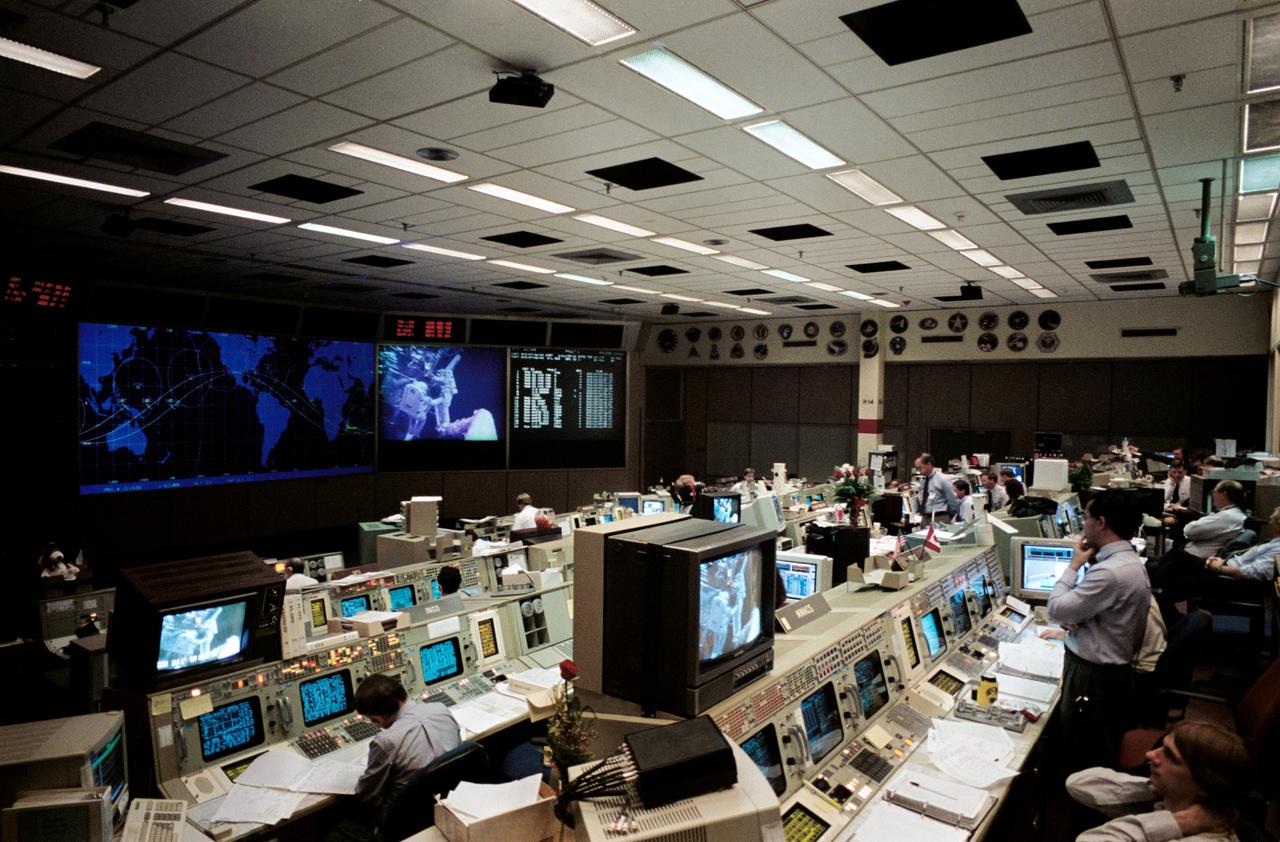
STS061-S-102 (5 Dec. 1993) --- Flight controllers Harry Black (left foreground) and Kevin McCluney (right foreground) monitor the televised activity of two space walkers during the first STS-61 extravehicular activity (EVA). Astronauts F. Story Musgrave and Jeffrey A. Hoffman were performing a variety of equipment replacements. At the Integrated Communications Officer Console (INCO) Black plays a roill in controlling the TV while McLuney's duties deal with maintenance, mechanical, arm and crew systems, meaning that they and their colleagues will be busy for the next five days. Four astronauts in alternating pairs will perform a variety of tasks on the giant telescope during that period.
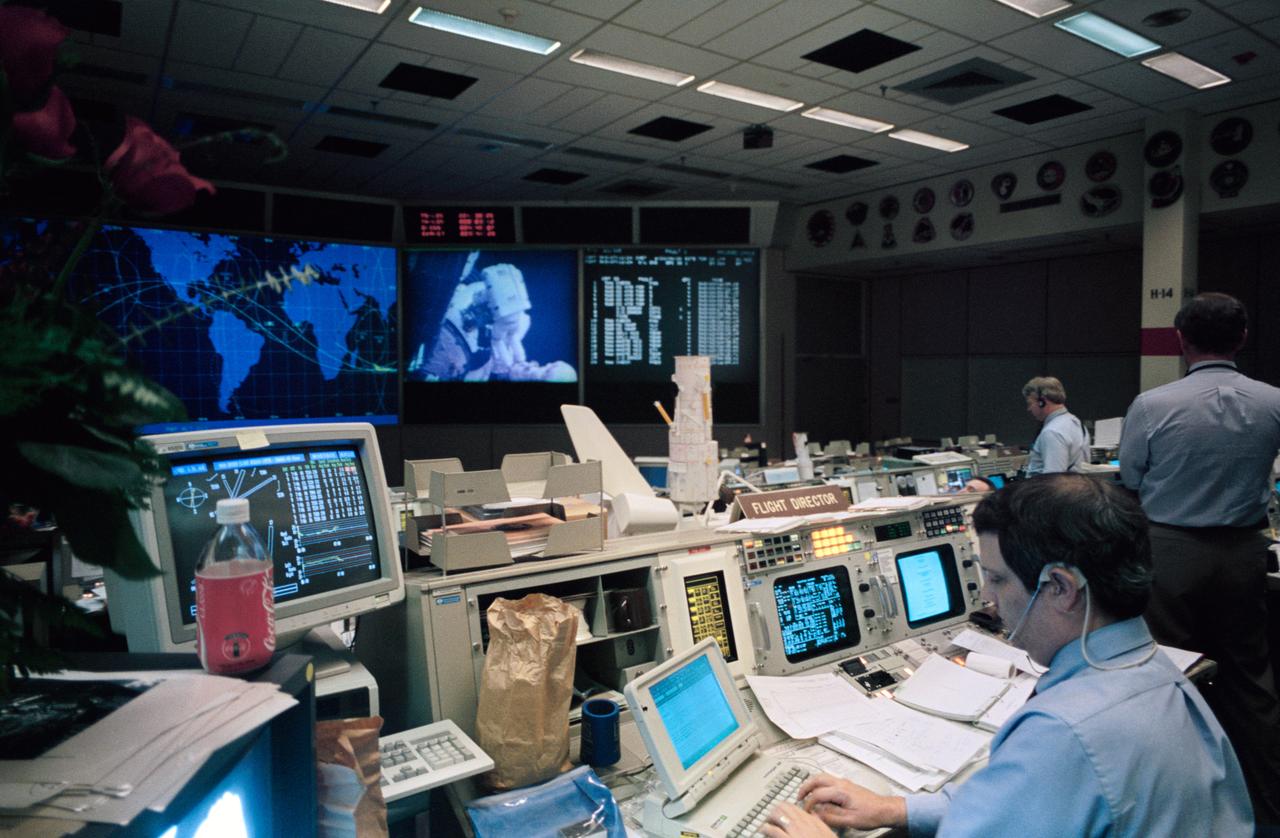
STS061-S-103 (2-13 DEC 1993) --- Flight director Robert E. Castle uses a lap top computer to aid his busy tasks during one of the five space walks performed to service the Hubble Space Telescope (HST) temporarily berthed in the Space Shuttle Endeavour's cargo bay. STS-61 lead flight director Milt Heflin is at right edge of frame.
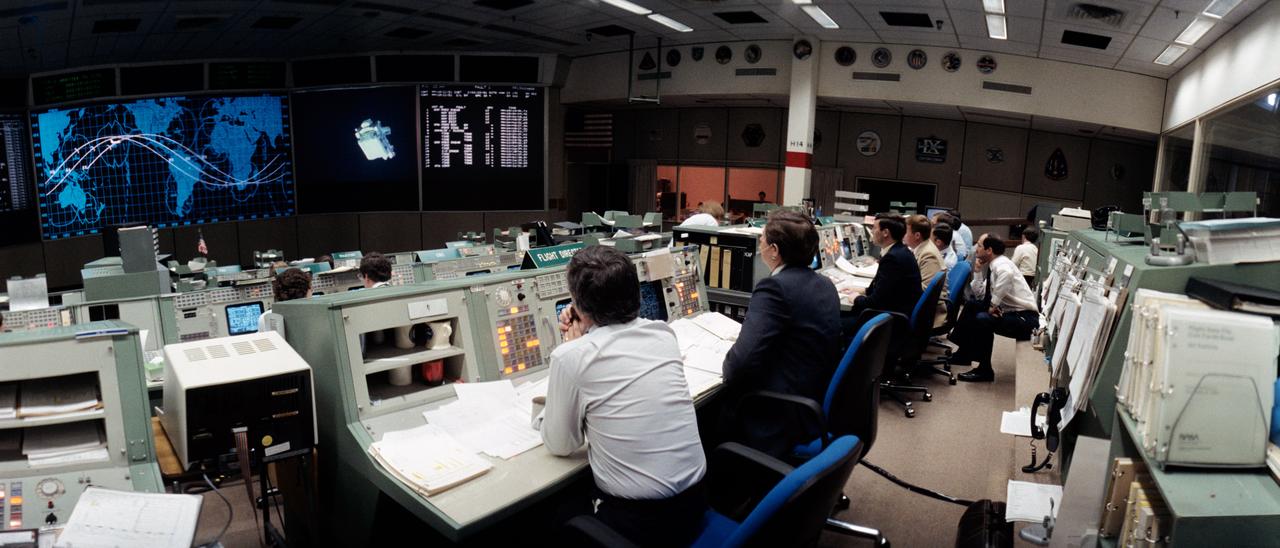
Astronaut George D. Nelson (see monitor at front of room) is viewed by flight controllers in the Mission Operations Control Room (MOCR) of JSC's Mission Control Center during 41-C extravehicular activity (EVA). In the foreground are Flight Directors Jay H. Greene and John T. Cox. Astronauts Jerry L. Ross and Richard H. Richards are seated at the CAPCOM or spacecraft communicators console at right background. Astronaut Guy S. Gardner is perched just behind them.
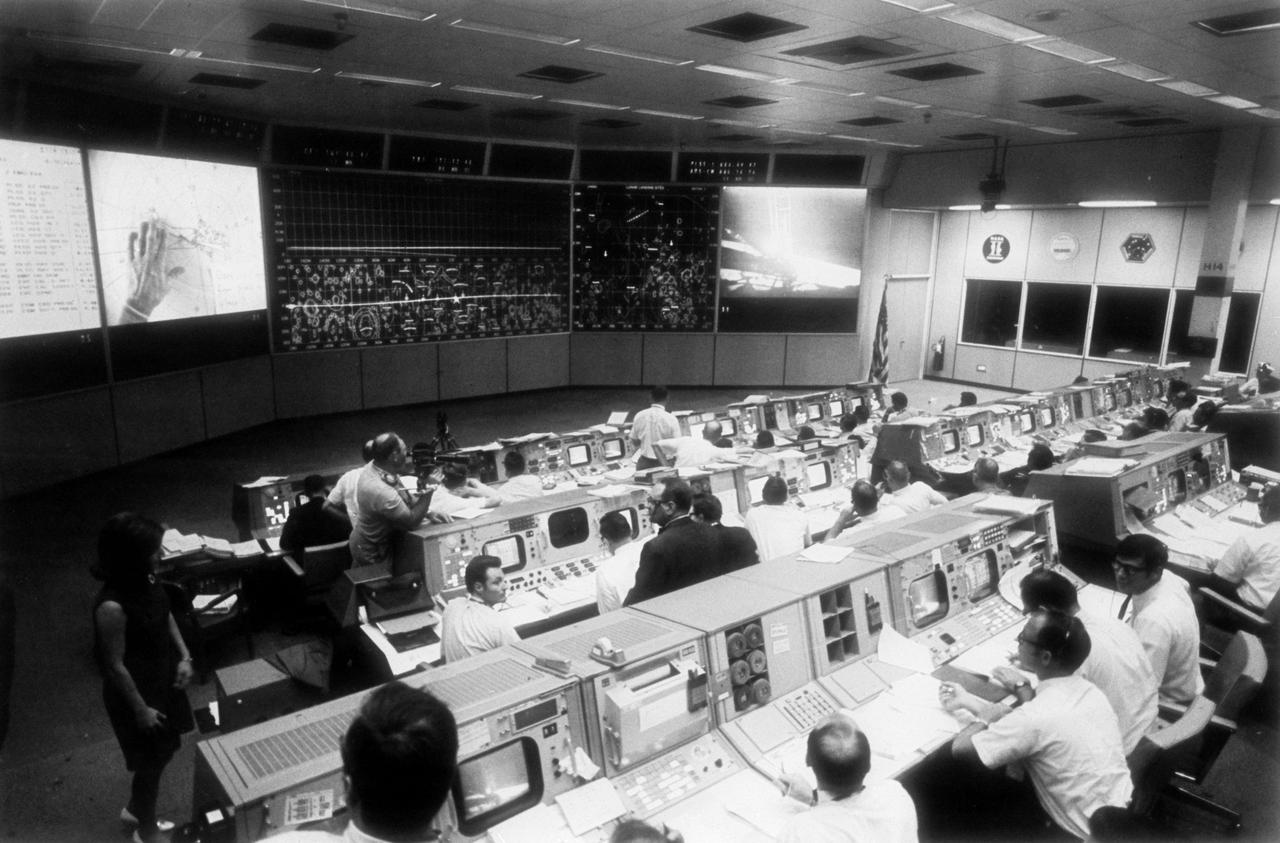
Overall view of the Mission Operations Control Room in the Mission Control Center, bldg 30, during the lunar surface extravehicular activity (EVA) of Apollo 11 Astronauts Neil A. Armstrong and Edwin E. Aldrin Jr.
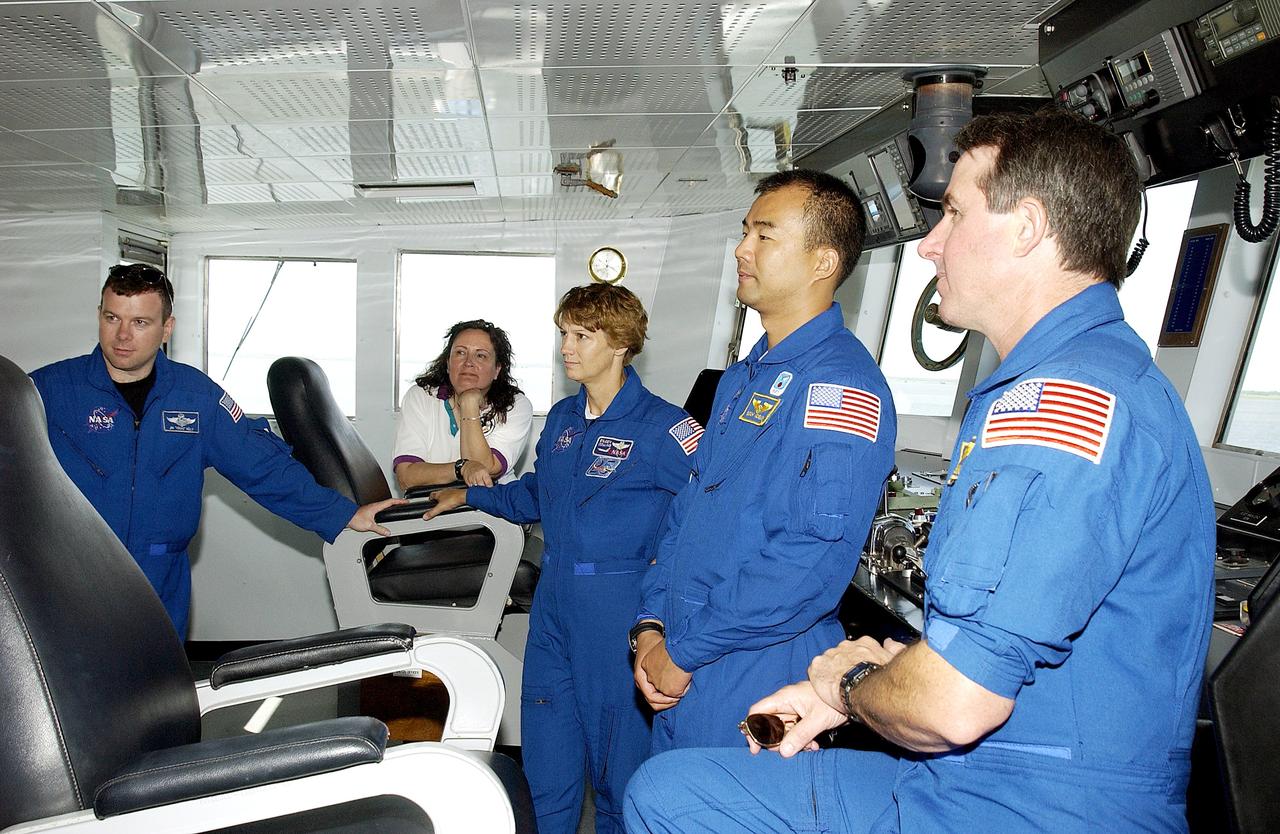
KENNEDY SPACE CENTER, FLA. - The STS-114 crew visit the bridge of the Liberty Star, one of two SRB Retrieval Ships. From left are Pilot James Kelly, Louise Kleba (with the Vehicle Integration Test Team (VITT) office), Commander Eileen Collins and Mission Specialists Soichi Noguchi and Stephen Robinson. Noguchi is with the Japanese space agency NASDA. On their mission, the crew will carry the MultiPurpose Logistics Module (MPLM) Raffaello and External Stowage Platform 2 to the International Space Station. The MPLM will contain supplies and equipment. Another goal of the mission is to remove and replace a Control Moment Gyro. Launch date for mission STS-114 is under review.
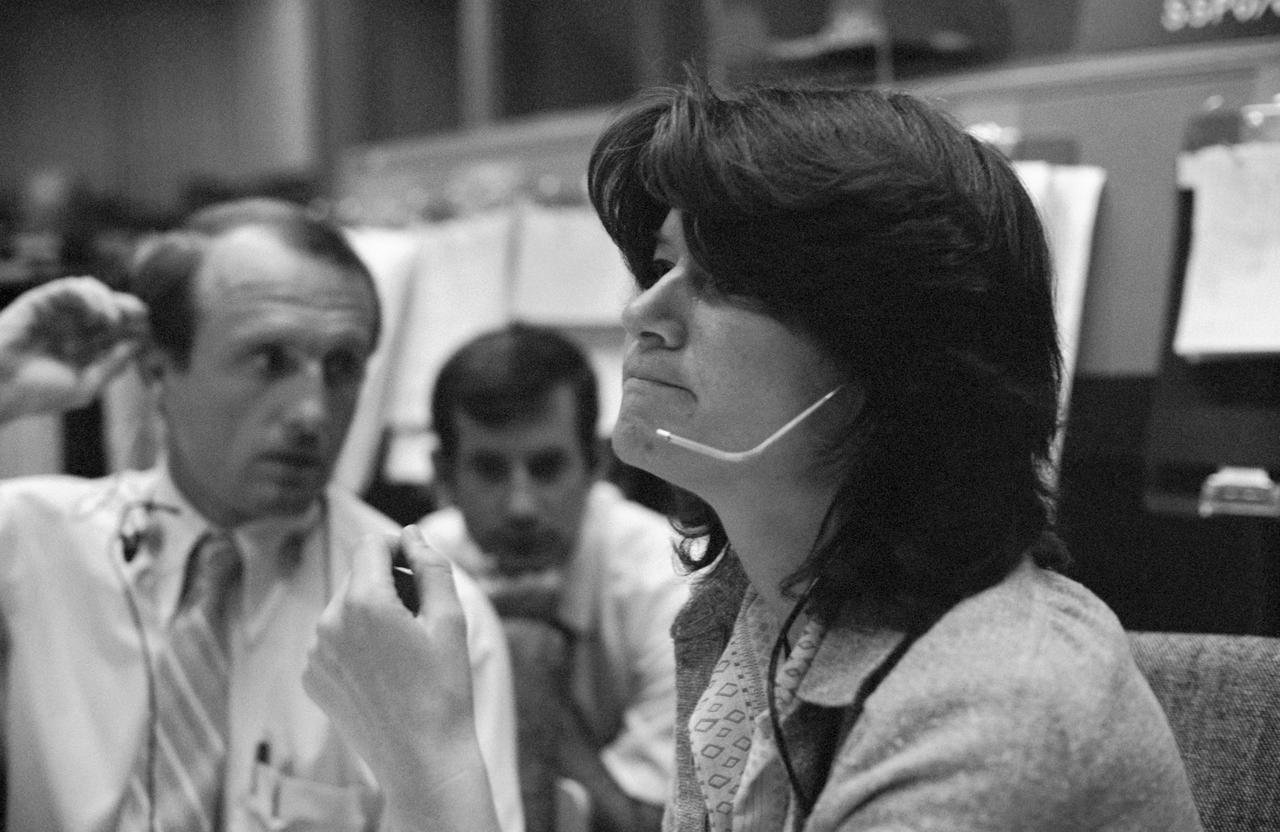
Astronaut Sally Ride at the CapCom console during the STS-2 simulation. She appears to be speaking to the crew using a headset.
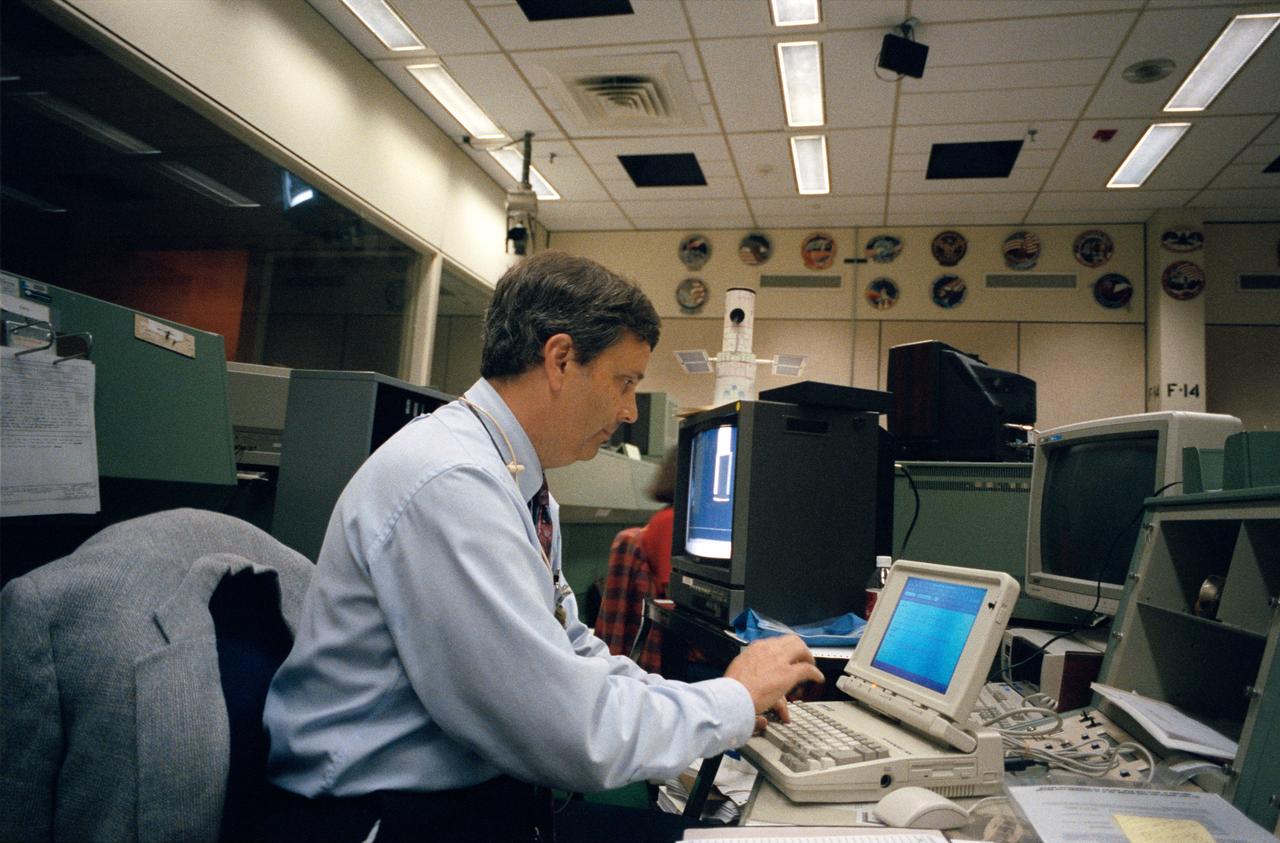
Flight Director Robert E. Castle Jr. works out a problem during joint integrated simulations for the STS-61 mission. Astronauts assigned to extravehicular activity (EVA) tasks with the Hubble Space Telescope (HST) were simultaneously rehearsing in a neutral buoyancy tank at the Marshall Space Flight Center (MSFC) in Alabama.
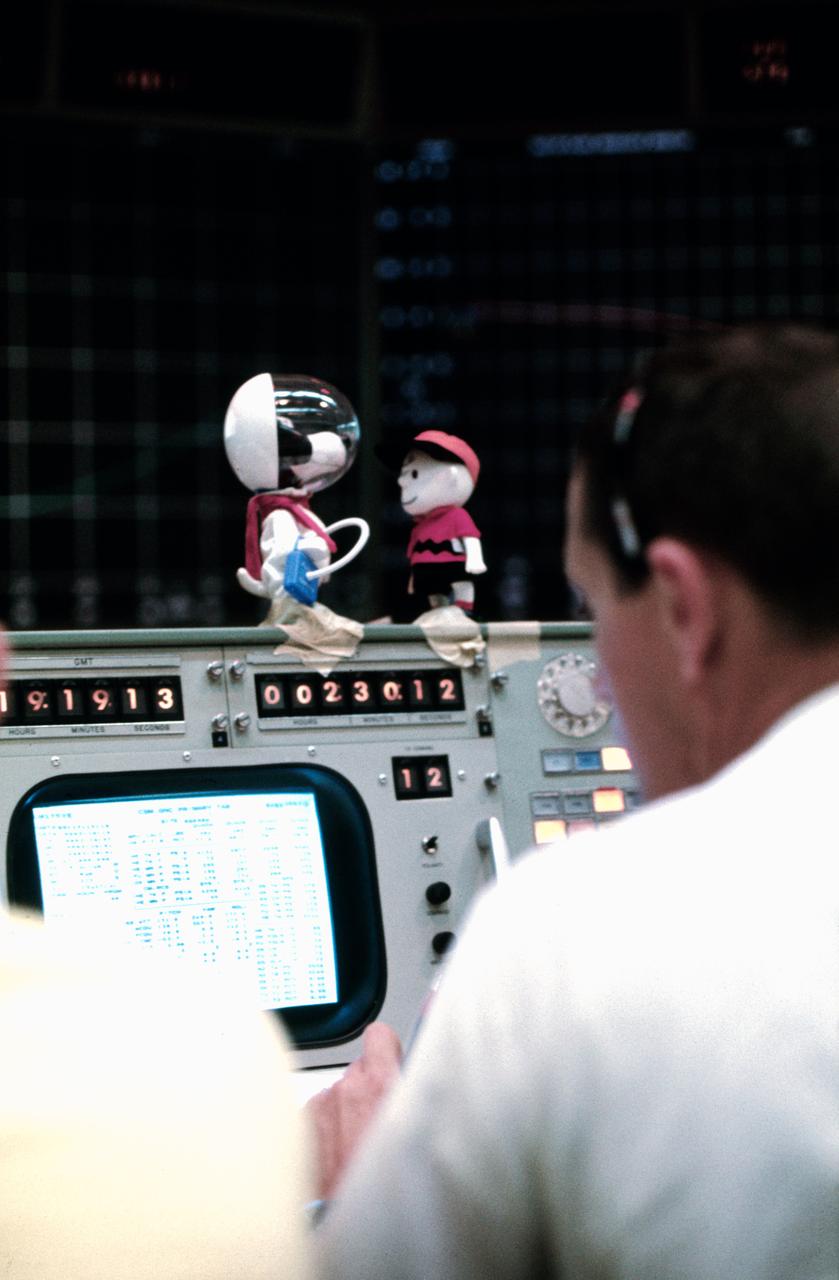
S69-34314 (18 May 1969) --- Replicas of Snoopy and Charlie Brown, the two characters from Charles Schulz's syndicated comic strip, "Peanuts," decorate the top of a console in the Mission Operations Control Room in the Mission Control Center, Building 30, on the first day of the Apollo 10 lunar orbit mission. During lunar orbit operations, the Lunar Module will be called ?Snoopy? when it is separated from the Command and Service Modules. The code words for the Command Module will be ?Charlie Brown?.
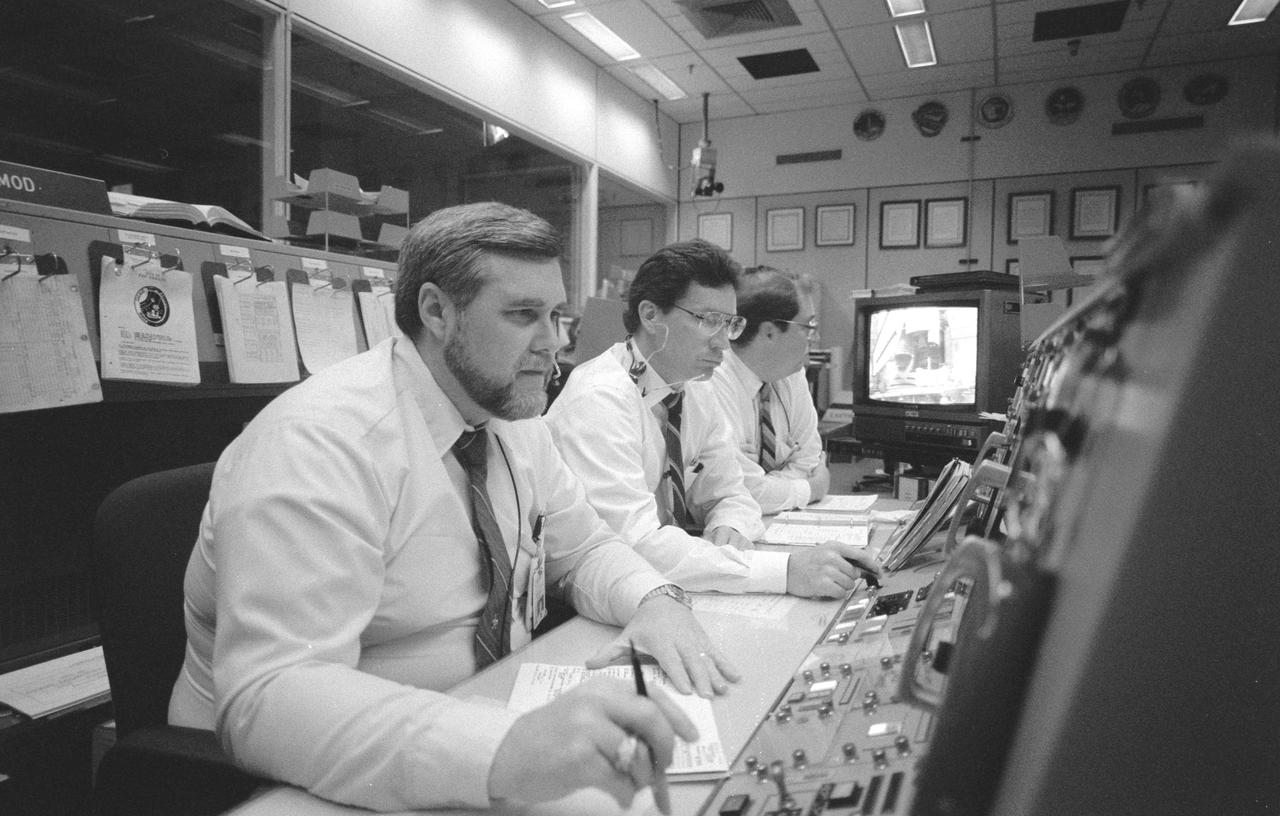
Only moments away from ignition, Atlantis, Orbiter Vehicle (OV) 104, and its five member crew are the subjects of concern drawing serious countenance in this scene in the Flight Control Room (FCR) of JSC's Mission Control Center (MCC) Bldg 30. Ascent Flight Director Alan L. Briscoe, monitors the Kennedy Space Center pre-launch activity from the flight director (FD) console, along with Ronald D. Dittemore (center) and N. Wayne Hale, Jr.
STS61-S-093 (5 Dec 1993) --- Flight controller Kevin McCluney monitors the televised activity of astronauts F. Story Musgrave and Jeffrey A. Hoffman. The veteran astronauts were performing the first extravehicular activity (EVA-1) of the STS-61 Hubble Space Telescope (HST) servicing mission. McCluney's duties deal with maintenance, mechanical, arm and crew systems, meaning that he and his colleagues will be exceptionally busy for the next five days. Four astronauts in alternating pairs will perform a variety of tasks on the giant telescope during that period.
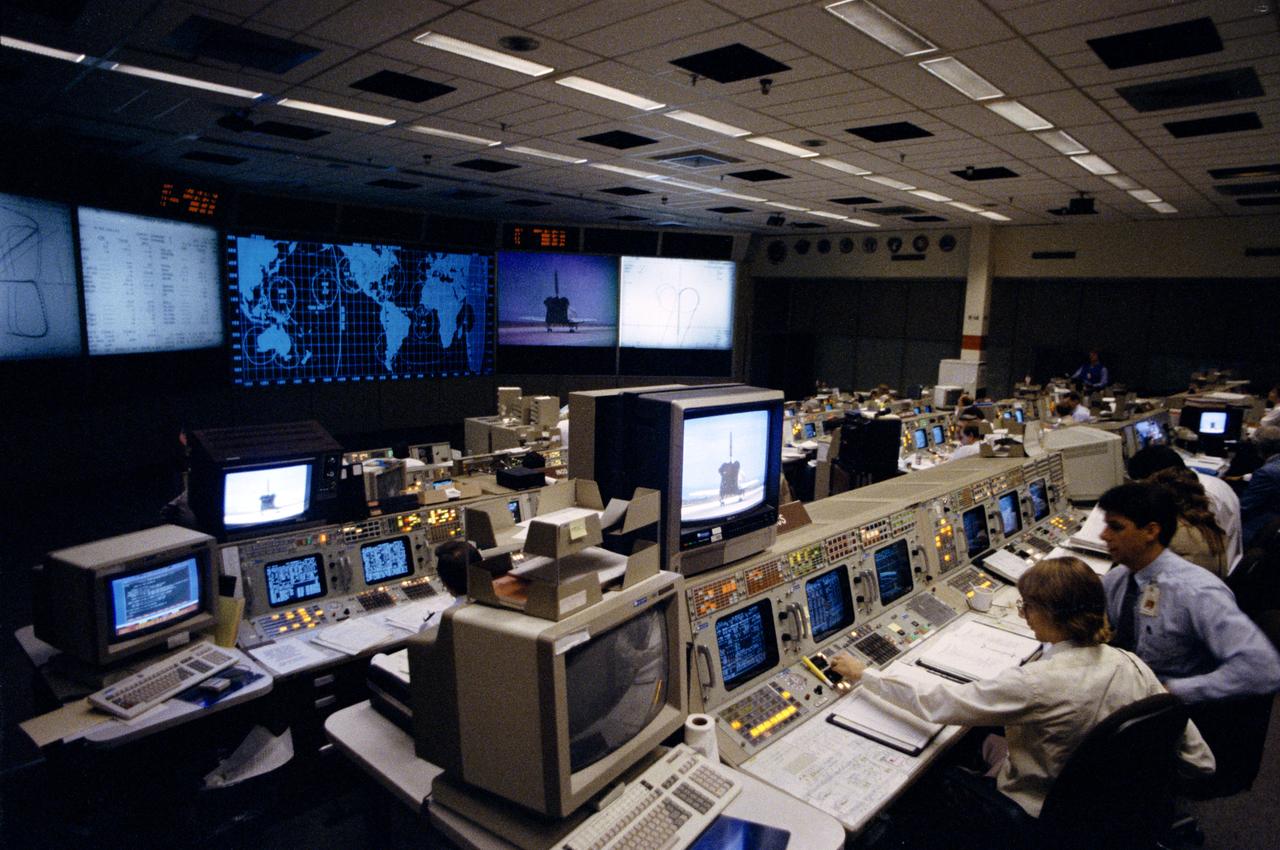
As STS-30 ends its mission with the landing of Atlantis, Orbiter Vehicle (OV) 104, at Edwards Air Force Base (EAFB), California, flight controllers monitor screens at their consoles in JSC Mission Control Center (MCC) Bldg 30. In the foreground is the Maintenance, Mechanical Arm, and Crew Systems Engineer (MMACS) console with R. Kevin McCluney studying data readouts. On the front visual displays are the tracking map and a tail view of OV-104 as it comes to a stop on EAFB concrete runway 22.
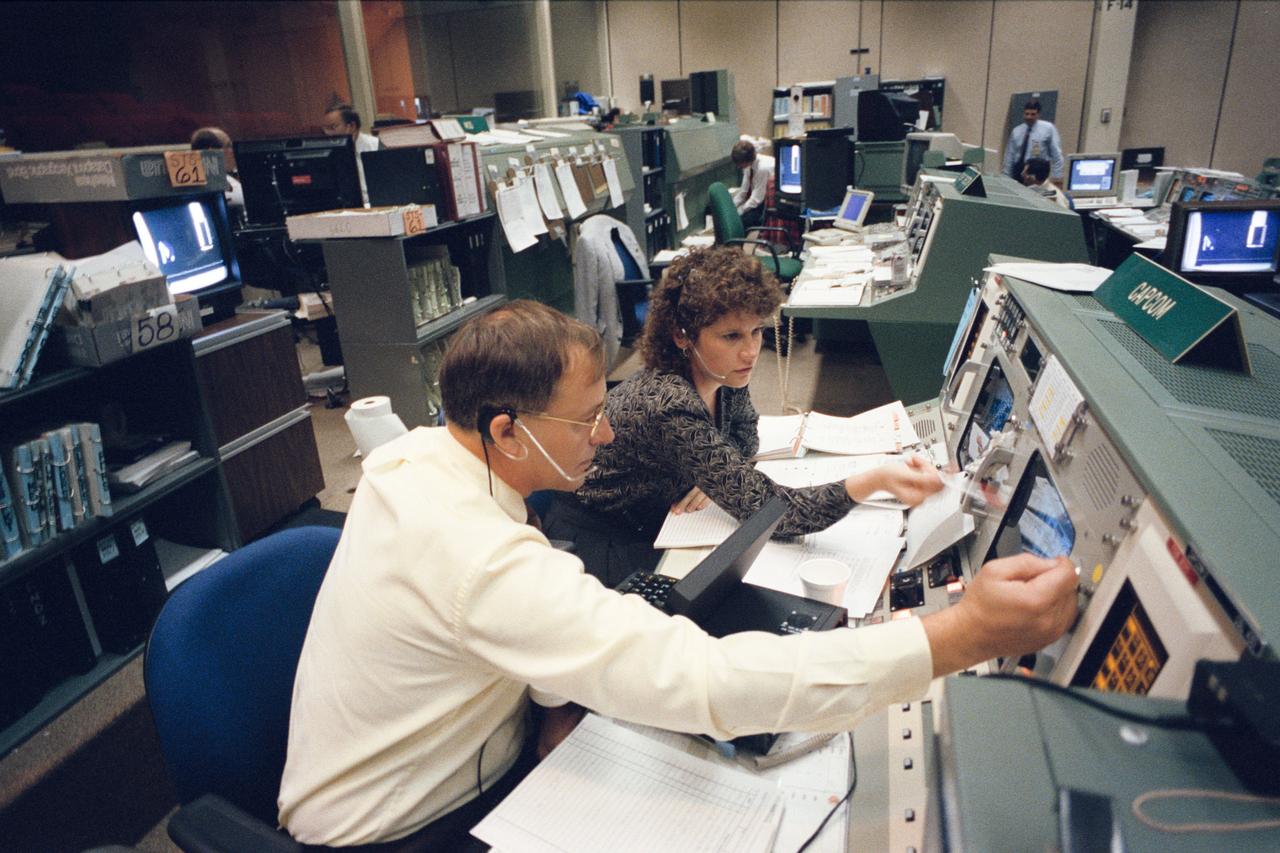
S93-43752 (1 Sept 1993) --- Astronauts Jerry L. Ross and Susan J. Helms are pictured at the Spacecraft Communicators Console during joint integrated simulations for the STS-61 mission. Astronauts assigned to extravehicular activity (EVA) tasks with the Hubble Space Telescope (HST) were simultaneously rehearsing in a Neutral Buoyancy Simulator (NBS) tank at the Marshall Space Flight Center (MSFC) in Alabama.
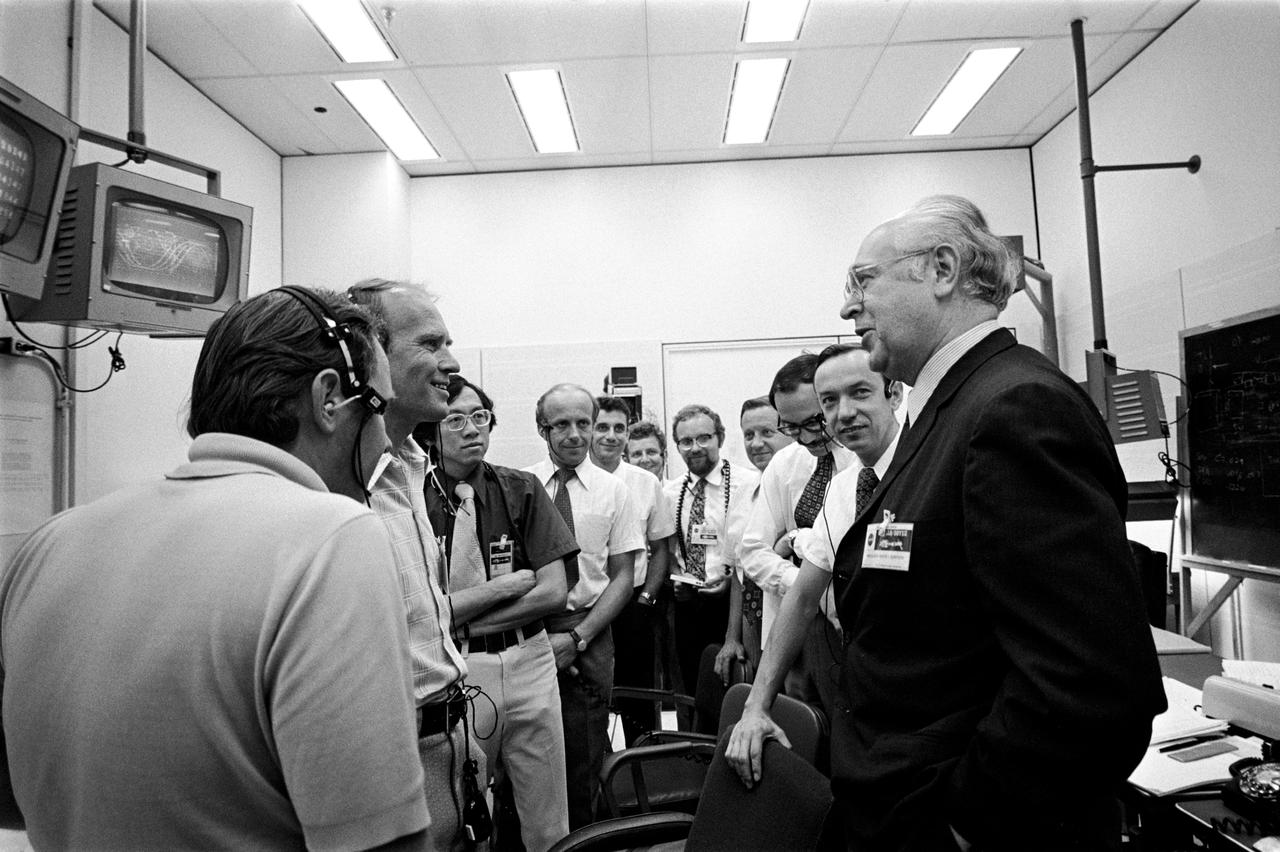
S75-28534 (17 July 1975) --- Anatoliy Dobrynin (right), Soviet Union ambassador to the United States, visits with a group of USSR ASTP flight controllers in the Mission Control Center during a tour of NASA's Johnson Space Center (JSC). Dobrynin was at JSC on the day the Soviet Soyuz and the American Apollo spacecraft docked in Earth orbit. The group also includes a couple of American ASTP flight controllers.
Instrumentation and Communications Officer (INCO) John F. Muratore monitors conventional workstation displays during an STS-26 simulation in JSC Mission Control Center (MCC) Bldg 30 Flight Control Room (FCR). Next to Muratore an operator views the real time data system (RTDS), an expert system. During the STS-29 mission two conventional monochrome console display units will be removed and replaced with RTDS displays. View is for the STS-29 press kit from Office of Aeronautics and Space Technology (OAST) RTDS.
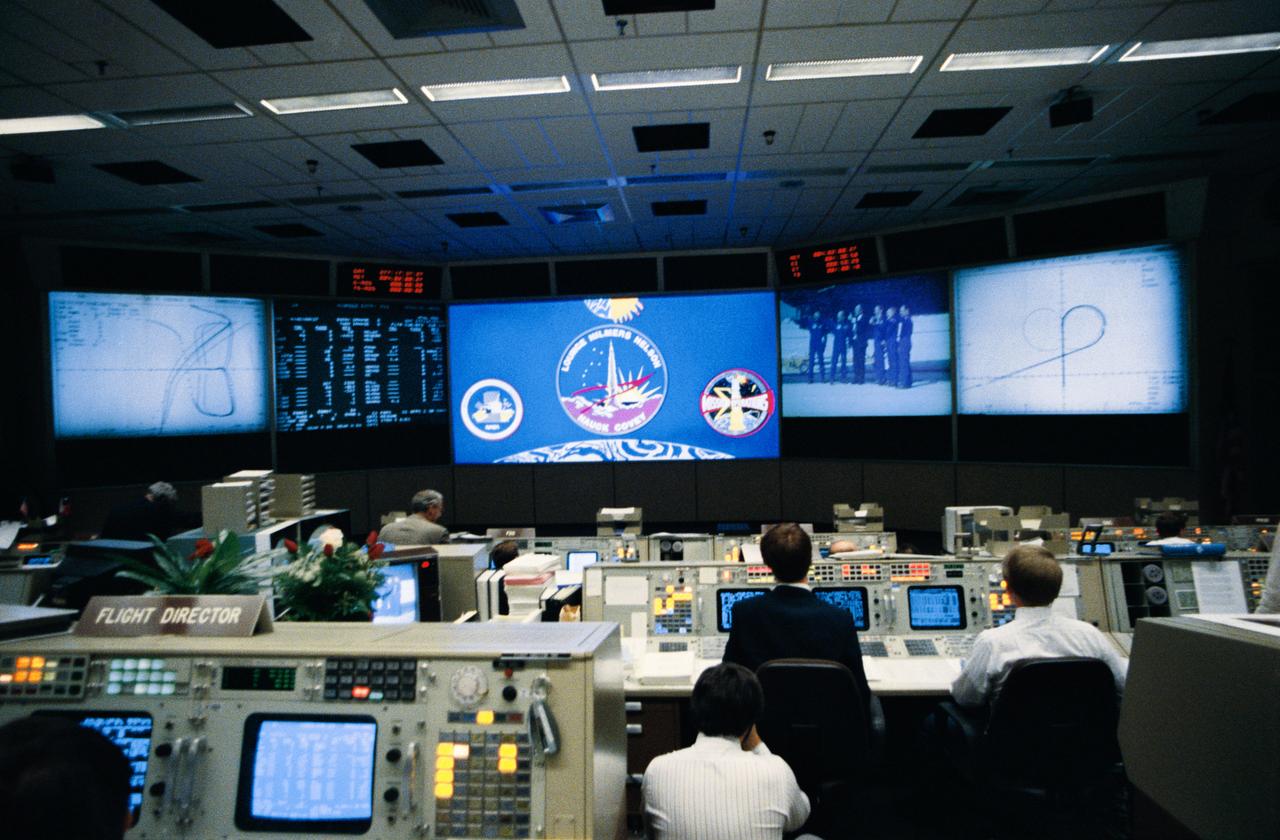
JSC Mission Control Center (MCC) Bldg 30 flight control room (FCR) personnel monitor STS-26 post landing activities and ceremonies at Edwards Air Force Base (EAFB) via their monitors. Displayed on front screens are approach and landing diagrams, data, the space shuttle program insignia, the STS-26 mission insignia, the Mission Operations Directorate insignia, and the STS-26 crew standing in front of Discovery, Orbiter Vehicle (OV) 103.
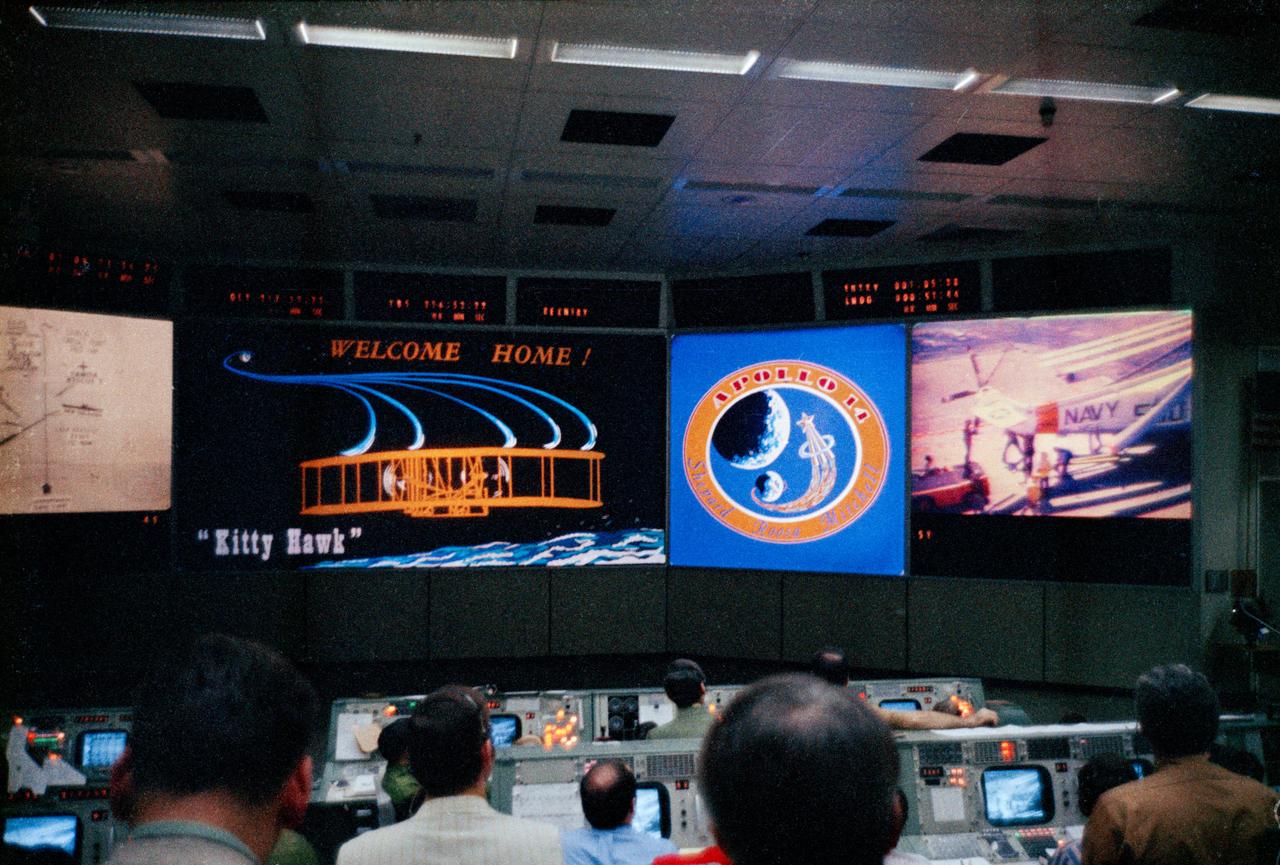
S71-18400 (9 Feb. 1971) --- Flight controllers in the Mission Operations Control Room (MOCR) of the Mission Control Center (MCC) view a colorful display which signals the successful splashdown and recovery of the crew of the Apollo 14 lunar landing mission. The MOCR's large screen at right shows a television shot aboard the USS New Orleans, Apollo 14 prime recovery ship.
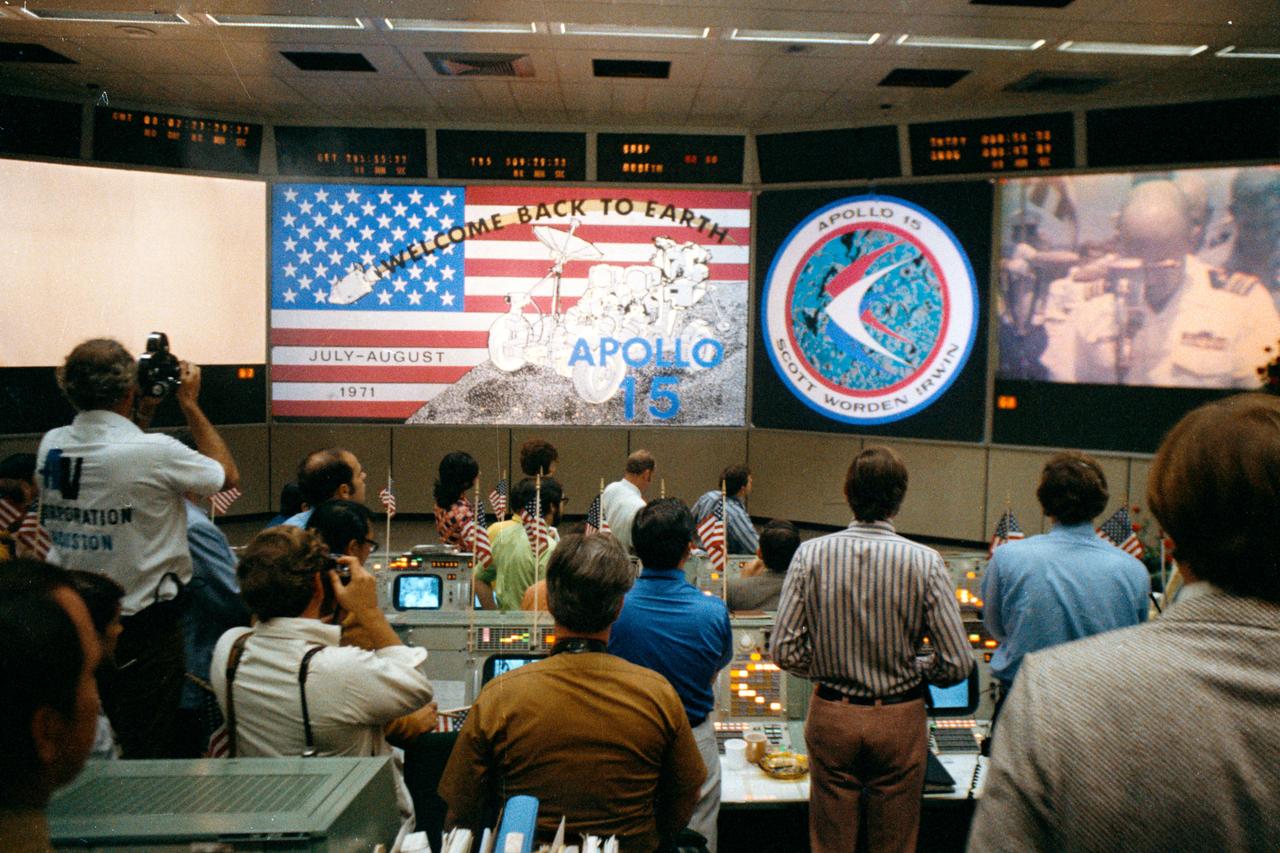
An overall view of activity in the Mission Operations Control Room in the Mission Control Center at the conclusion of the Apollo 15 lunar landing mission. The television monitor in the right background shows the welcome ceremonies aboard the prime recovery ship, U.S.S. Okinawa, in the mid-Pacific Ocean.

S68-18733 (22 Jan. 1968) --- Dr. Robert R. Gilruth (right), MSC Director, sits with Dr. Christopher C. Kraft Jr., MSC director of flight operations, at his flight operations director console in the Mission Control Center, Building 30, during the Apollo 5 (LM-1/Saturn 204) unmanned space mission.
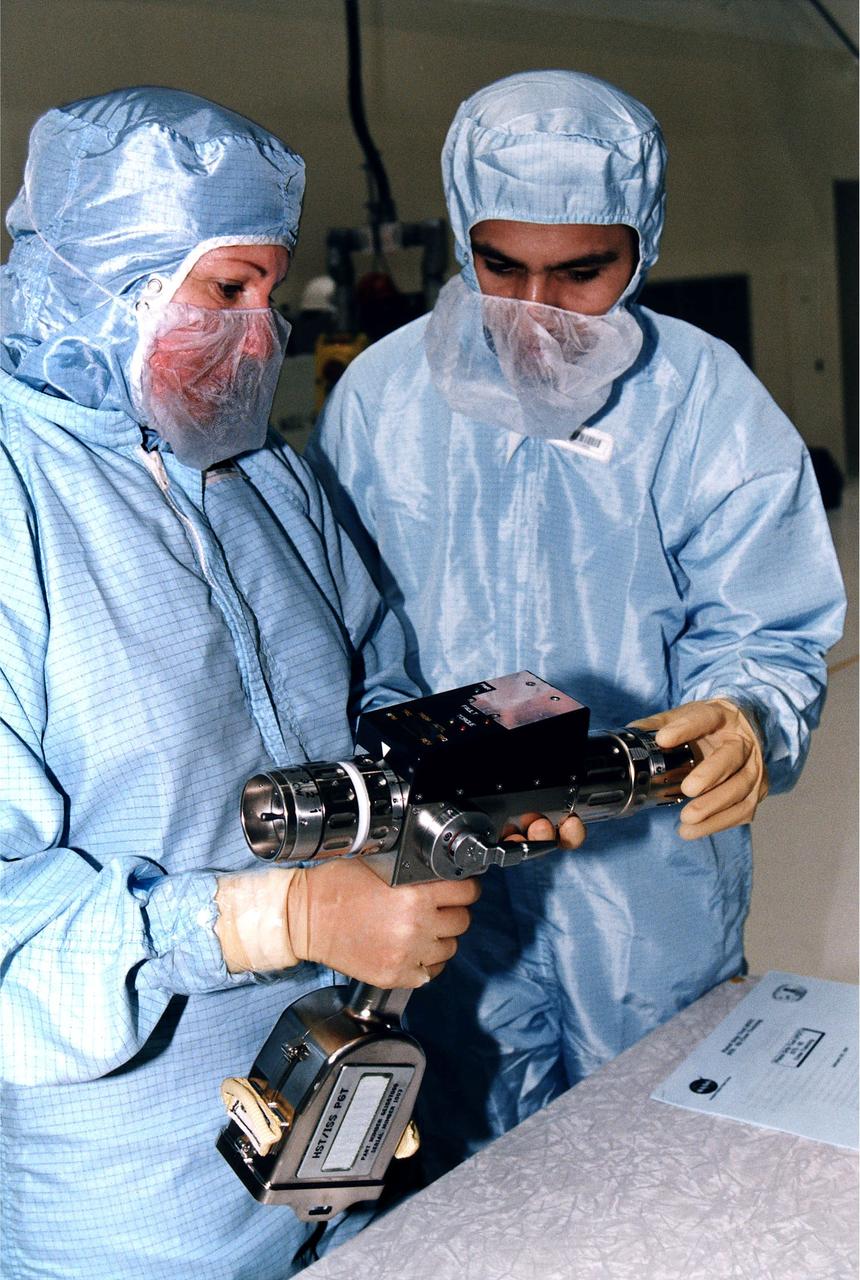
KENNEDY SPACE CENTER, FLA. - In KSC's Vertical Processing Facility, Louise Kleba of the Vehicle Integration Test Team (VITT) and engineer Devin Tailor of Goddard Space Flight Center examine the Pistol Grip Tool (PGT), which was designed for use by astronauts during spacewalks. The PGT is a self-contained, micro-processor controlled, battery-powered tool. It also can be used as a nonpowered ratchet wrench. The experiences of the astronauts on the first Hubble Space Telescope (HST) servicing mission led to recommendations for this smaller, more efficient tool for precision work during spacewalks. The PGT will be used on the second HST servicing mission, STS-82. Liftoff aboard Discovery is scheduled Feb. 11.
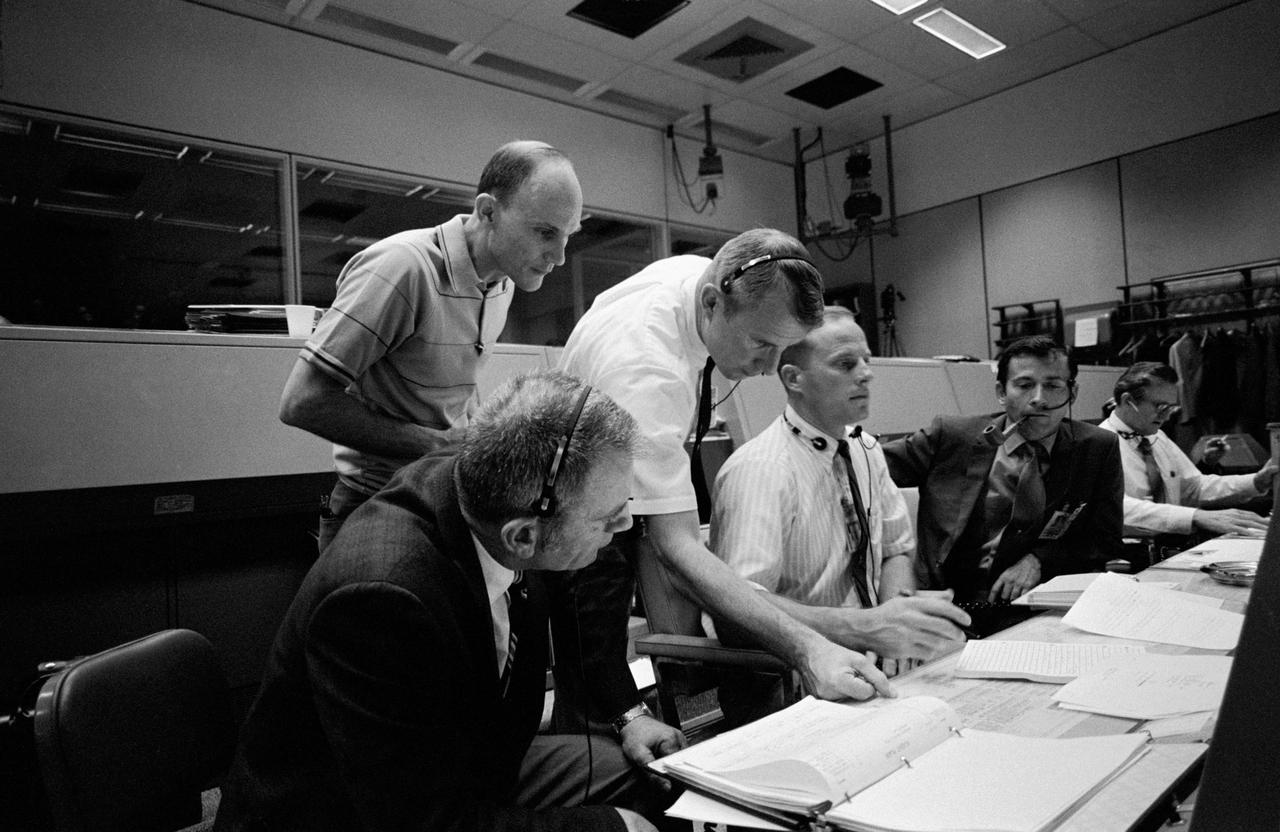
S70-34902 (14 April 1970) --- Several persons important to the Apollo 13 mission, at consoles in the Mission Operations Control Room (MOCR) of the Mission Control Center (MCC). Seated at consoles, from left to right, are astronauts Donald K. Slayton, director of flight crew operations; astronaut Jack R. Lousma, Shift 3 spacecraft communicator; and astronaut John W. Young, commander of the Apollo 13 backup crew. Standing, left to right, are astronaut Tom K. Mattingly II, who was replaced as Apollo 13 command module pilot after it was learned he may come down with measles, and astronaut Vance D. Brand, Shift 2 spacecraft communicator. Several hours earlier, in the late evening hours of April 13, crew members of the Apollo 13 mission reported to MCC that trouble had developed with an oxygen cell on their spacecraft.
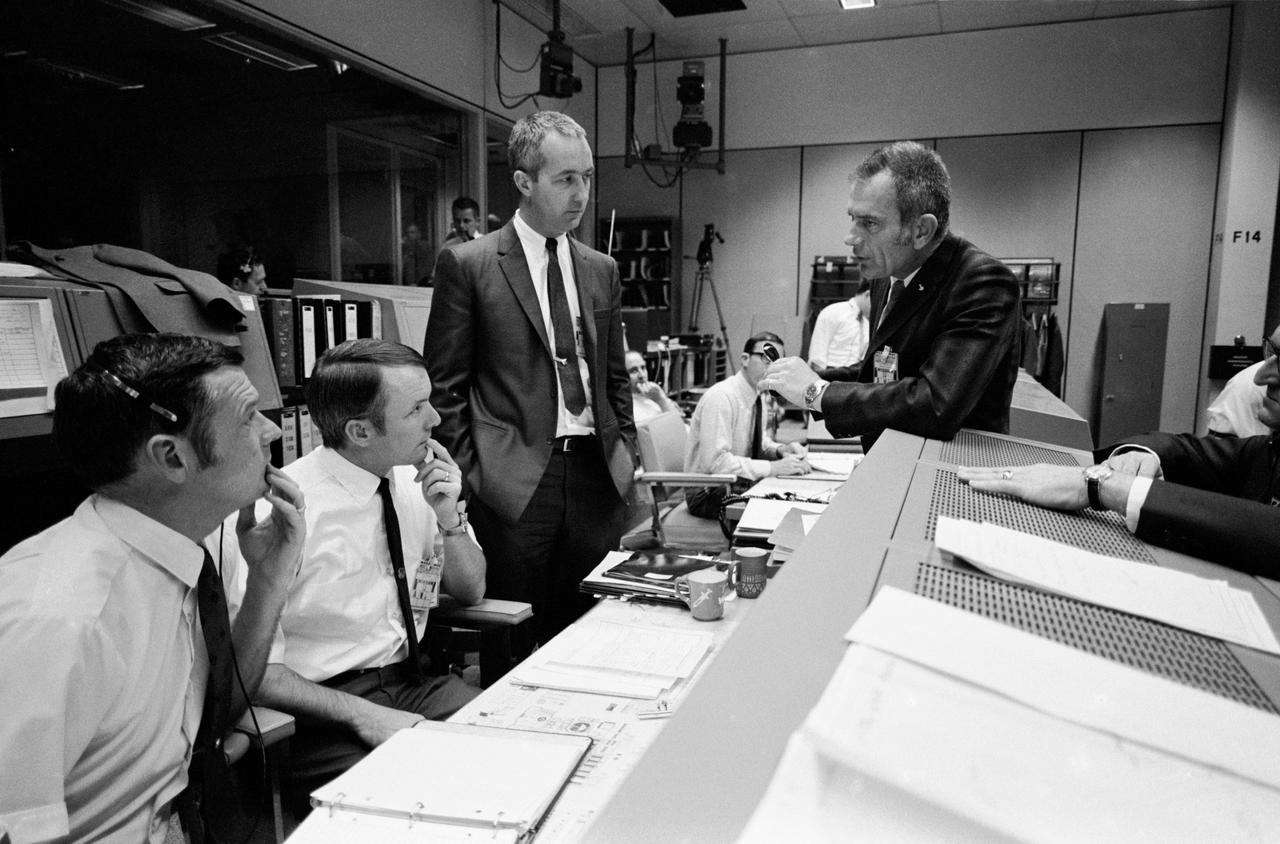
S70-35369 (16 April 1970) --- Discussion in the Mission Operations Control Room (MOCR) dealing with the Apollo 13 crewmen during their final day in space. From left to right are Glynn S. Lunney, Shift 4 flight director; Gerald D. Griffin, Shift 2 flight director; astronaut James A. McDivitt, manager, Apollo Spacecraft Program, MSC; Dr. Donald K. Slayton, director of Flight Crew Operations, MSC; and Dr. Willard R. Hawkins, M.D., Shift 1 flight surgeon.
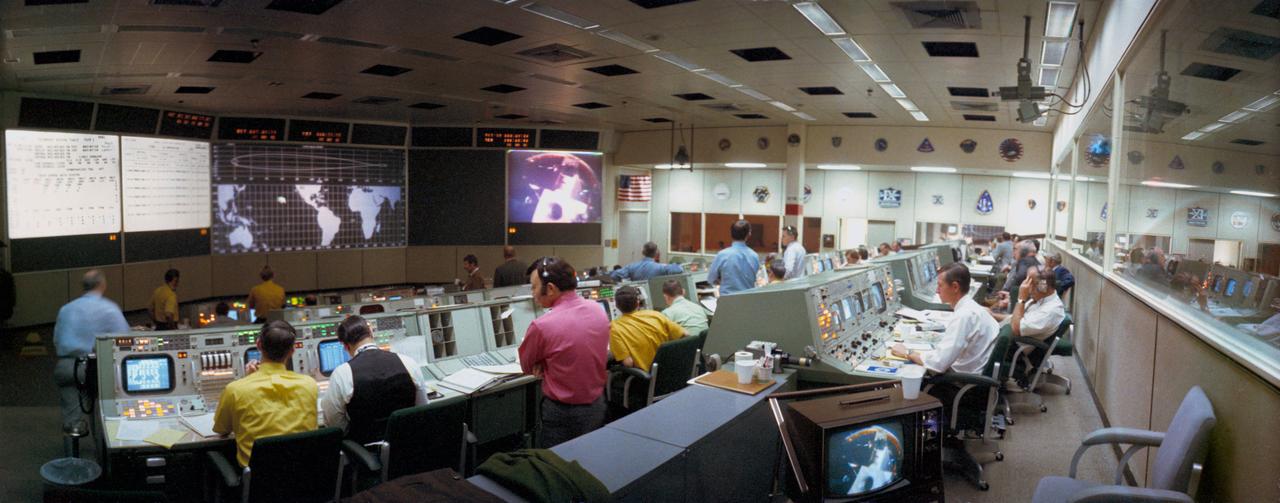
S71-17122 (31 Jan. 1971) --- A wide angle overall view of the Mission Operations Control Room (MOCR) in the Mission Control Center at the Manned spacecraft Center. This view was photographed during the first color television transmission from the Apollo 14 Command Module. Projected on the large screen at the right front of the MOCR is a view of the Apollo 14 Lunar Module, still attached to the Saturn IVB stage. The Command and Service Modules were approaching the LM/S-IVB during transposition and docking maneuvers.
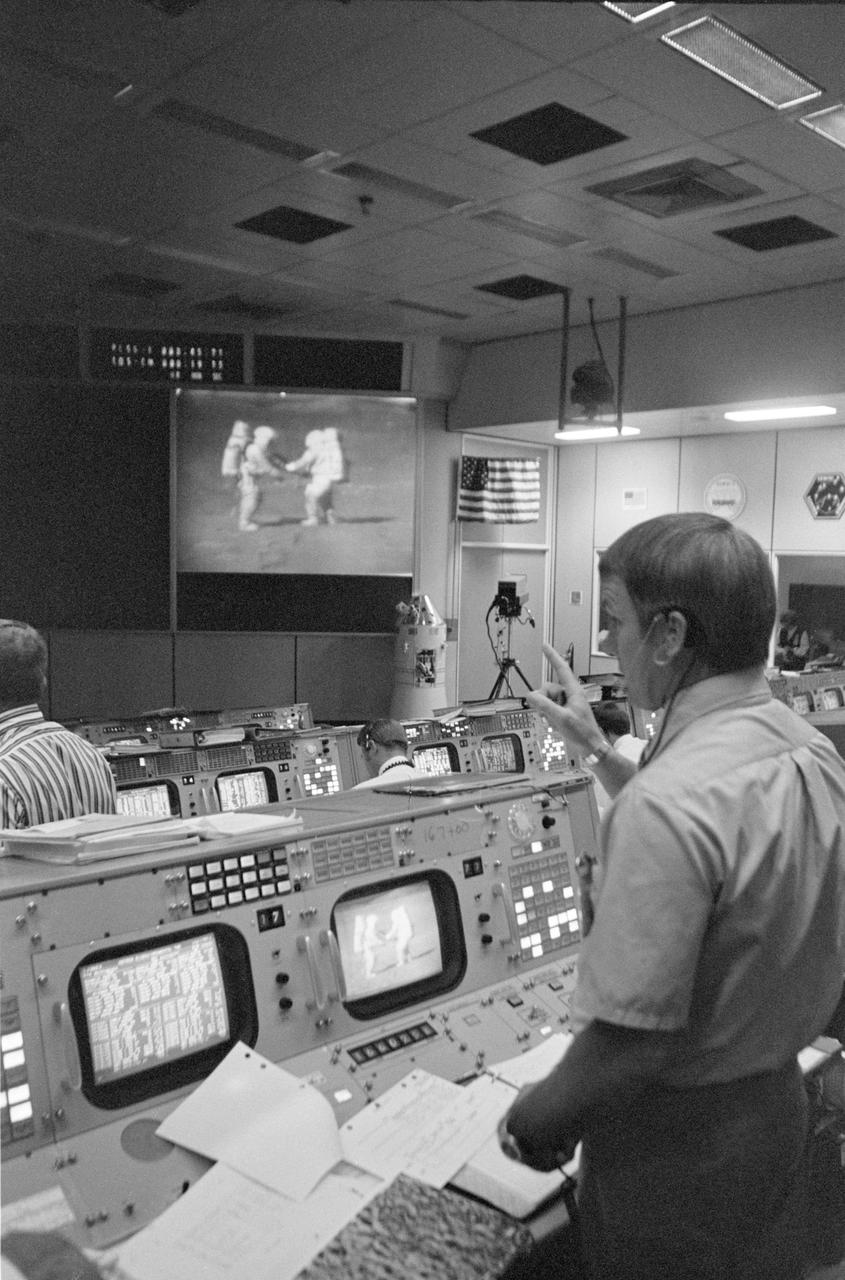
S71-41852 (2 Aug. 1971) --- Gerald D. Griffin, foreground, stands near his console in the Mission Operations Control Room (MOCR) during Apollo 15's third extravehicular activity (EVA) on the lunar surface. Griffin is Gold Team (Shift 1) flight director for the Apollo 15 mission. Astronauts David R. Scott and James B. Irwin can be seen on the large screen at the front of the MOCR as they participate in sample-gathering on the lunar surface.
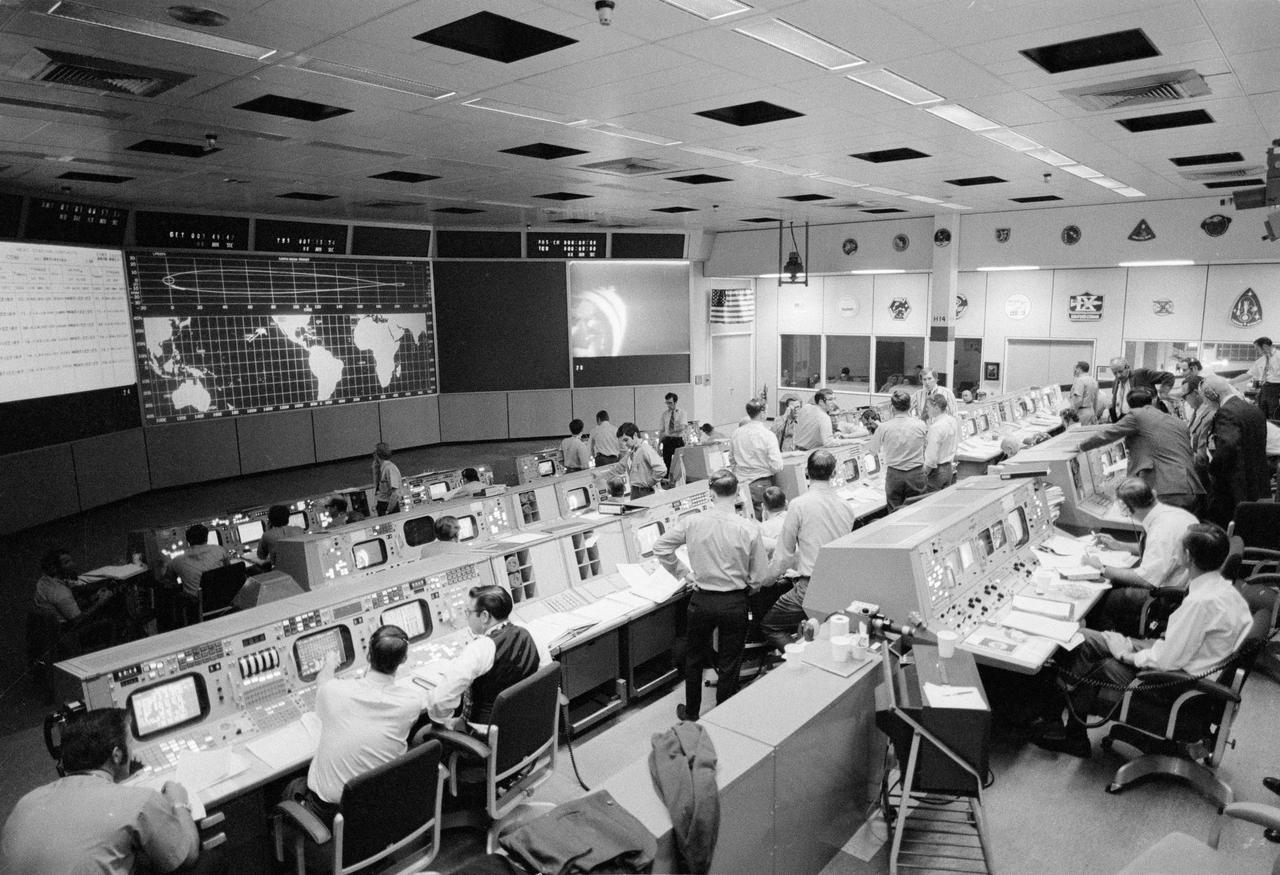
S71-16879 (31 Jan. 1971) --- Overall view of activity in the Mission Operations Control Room in the Mission Control Center during the Apollo 14 transposition and docking maneuvers. The Apollo 14 Lunar Module, still attached to the Saturn IVB stage, can be seen on the large television monitor. Due to difficulty with the docking mechanism six attempts were made before a successful "hard dock" of the Command Module with the Lunar Module was accomplished. Aboard the Command Module were astronauts Alan B. Shepard Jr., Stuart A. Roosa, and Edgar D. Mitchell.
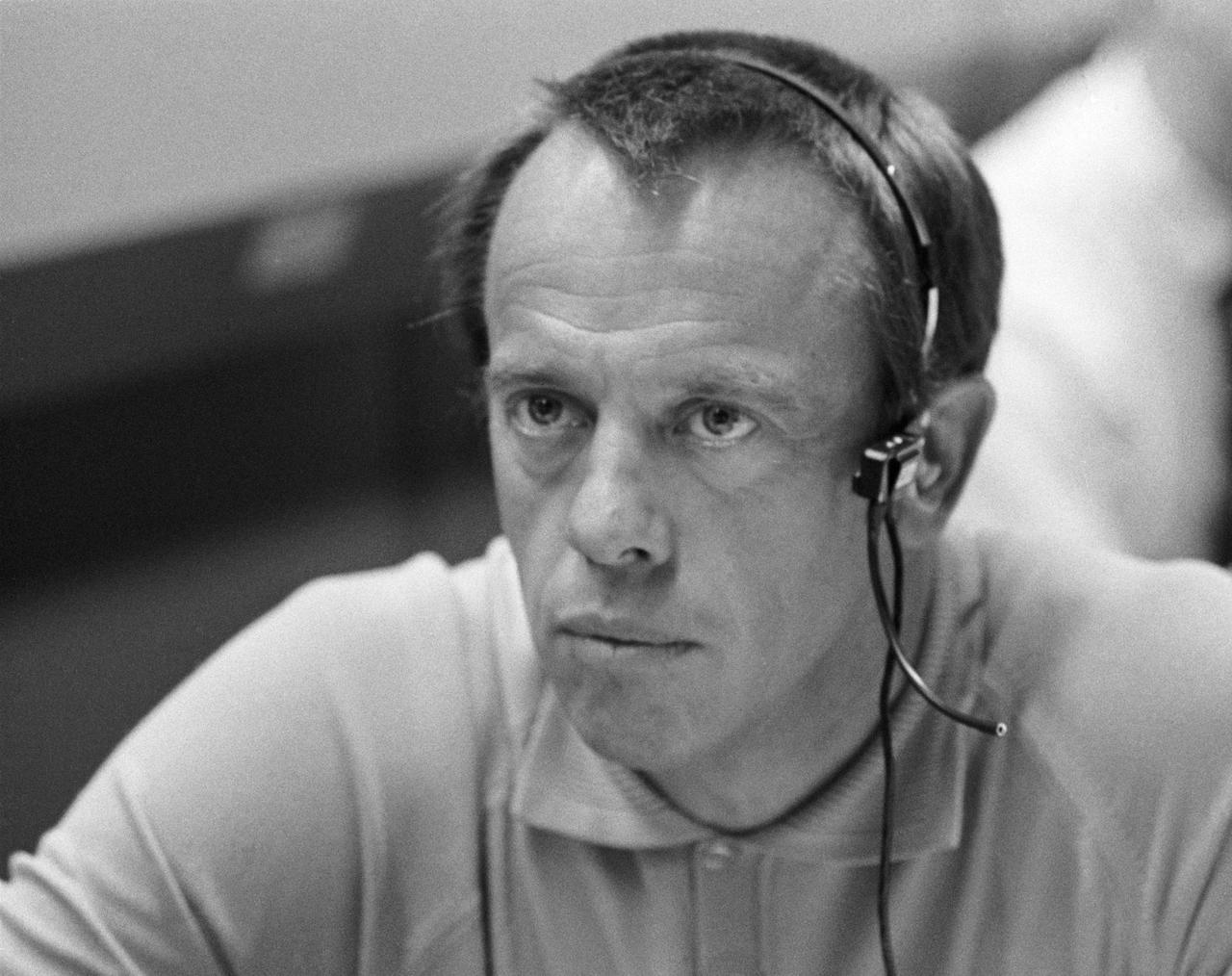
S70-34904 (14 April 1970) --- Astronaut Alan B. Shepard Jr., prime crew commander of the Apollo 14 mission, monitors communications between the Apollo 13 spacecraft and Mission Control Center. He is seated at a console in the Mission Operations Control Room of the MCC, Manned Spacecraft Center. The main concern of the moment was action taken by the three Apollo 13 crewmen - astronauts James A. Lovell Jr., John L. Swigert Jr. and Fred W. Haise Jr. - to make corrections inside the spacecraft following discovery of an oxygen cell failure several hours earlier.
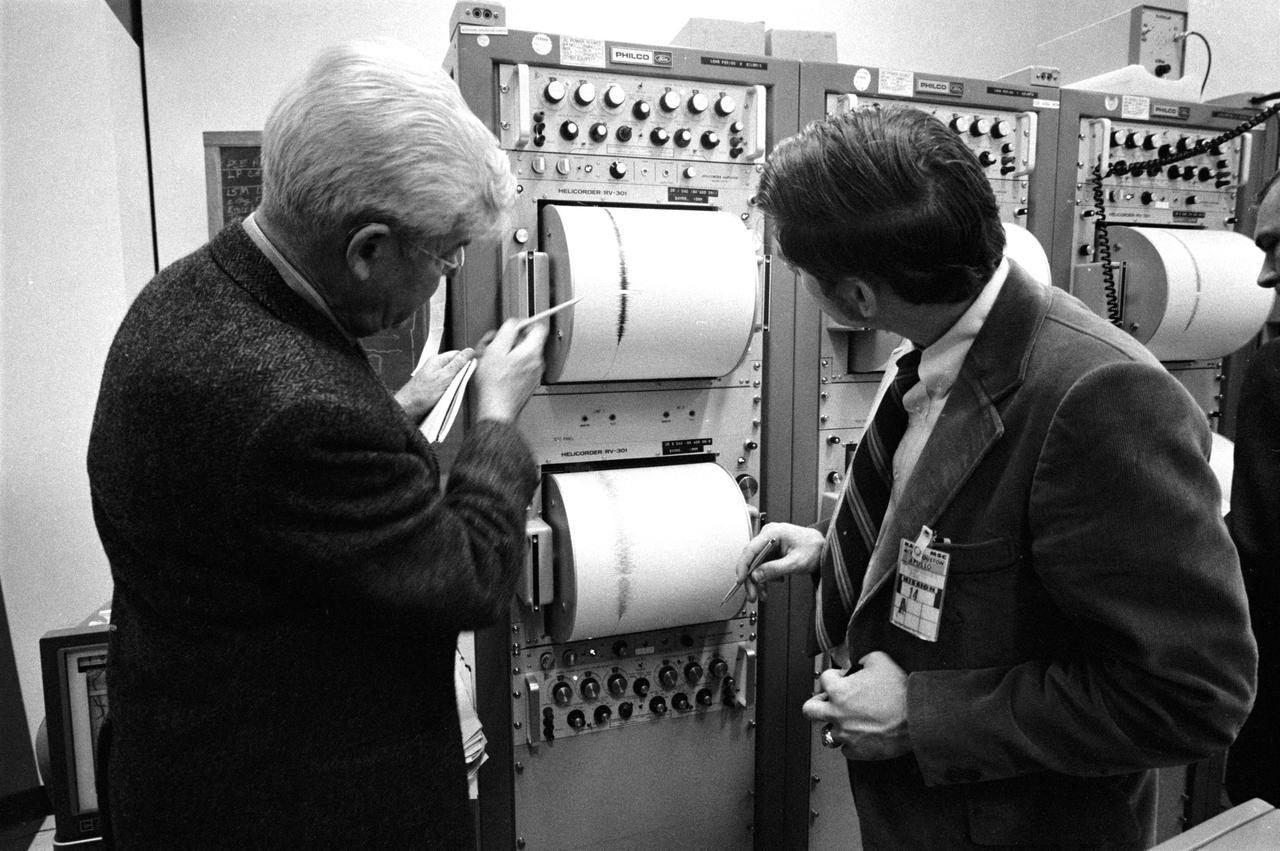
S71-17609 (4 Feb. 1971) --- These two individuals are examining a seismic reading in the Mission Control Center's ALSEP Room during the Apollo 14 S-IVB impact on the moon. Dr. Maurice Ewing (left) is the director of the Lamont-Doherty Geological Observatory at Columbia University. David Lammlein, a Columbia graduate student, is on the right. The Apollo 14 Saturn IVB stage impacted on the lunar surface at 1:40:54 a.m. (CST), Feb. 4, 1971, about 90 nautical miles south-southwest of the Apollo 12 passive seismometer. The energy release was comparable to 11 tons of TNT. Dr. Gary Latham of the Lamont-Doherty Geological Observatory is the principal investigator for the Passive Seismic Experiment, a component of the Apollo Lunar Surface Experiments Package.
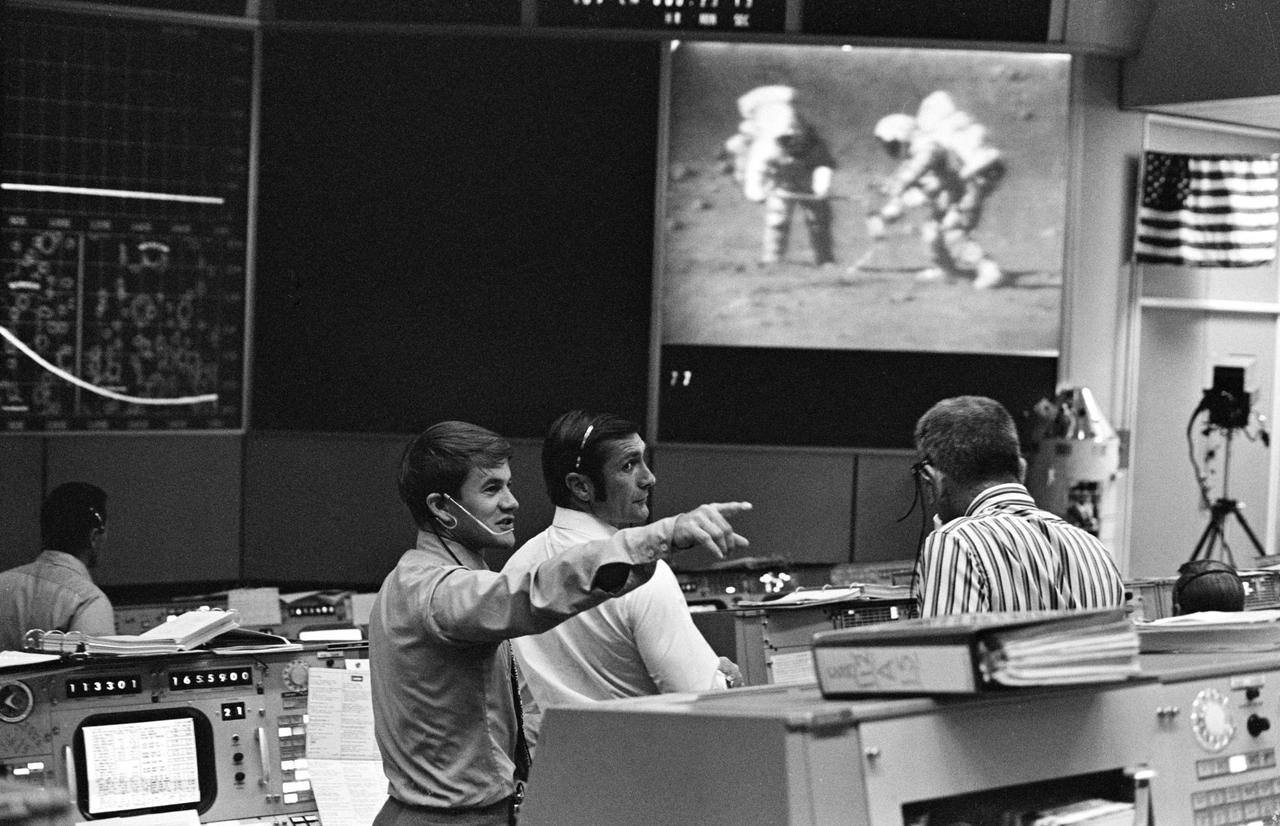
S71-41836 (2 Aug. 1971) --- Scientist-astronaut Joseph P. Allen, left, directs the attention of astronaut Richard F. Gordon Jr., to an occurrence out of view at right in the Mission Control Center's (MCC) Mission Operations Control Room (MOCR), while Dr. Donald K. (Deke) Slayton, on right with back to camera, views activity of Apollo 15 on a large screen at the front of the MOCR. Astronauts David R. Scott and James B. Irwin are seen on the screen performing tasks of the mission's third extravehicular activity (EVA), on Aug. 2, 1971. Dr. Slayton is director of Flight Crew Operations, NASA-MSC; Gordon is Apollo 15 backup commander; and Dr. Allen is an Apollo 15 spacecraft communicator.

S70-35368 (16 April 1970) --- Overall view showing some of the feverish activity in the Mission Operations Control Room (MOCR) of the Mission Control Center (MCC) during the final 24 hours of the problem-plagued Apollo 13 mission. Here, flight controllers and several NASA/MSC officials confer at the flight director's console. When this picture was made, the Apollo 13 lunar landing had already been canceled, and the Apollo 13 crewmembers were in trans-Earth trajectory attempting to bring their crippled spacecraft back home.
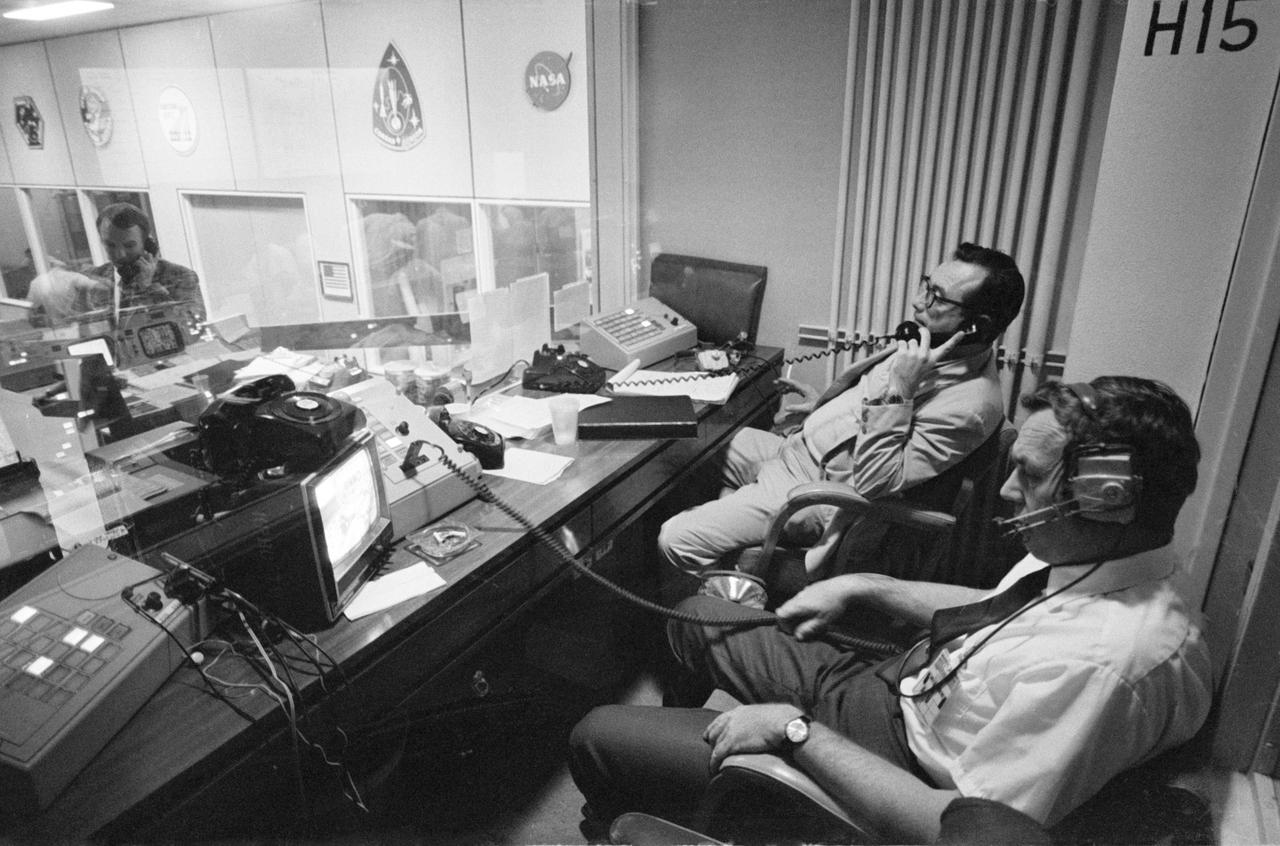
S70-35012 (15 April 1970) --- Two phases of busy activity during critical moments of the Apollo 13 mission are reflected in this view in the Mission Control Center, Building 30, Manned Spacecraft Center. In the foreground, Henry Simmons (left) of Newsweek magazine and John E. Riley, public information specialist, Public Affairs Office, MSC, man their positions in the Press Room. At extreme left of photo, Gerald D. Griffin, Shift 2 flight director, talks on telephone in Mission Operations Control Room. When this photograph was taken, the Apollo 13 lunar landing had been canceled, and the problem-plagued Apollo 13 crewmen were in trans-Earth trajectory attempting to bring their crippled spacecraft back home.
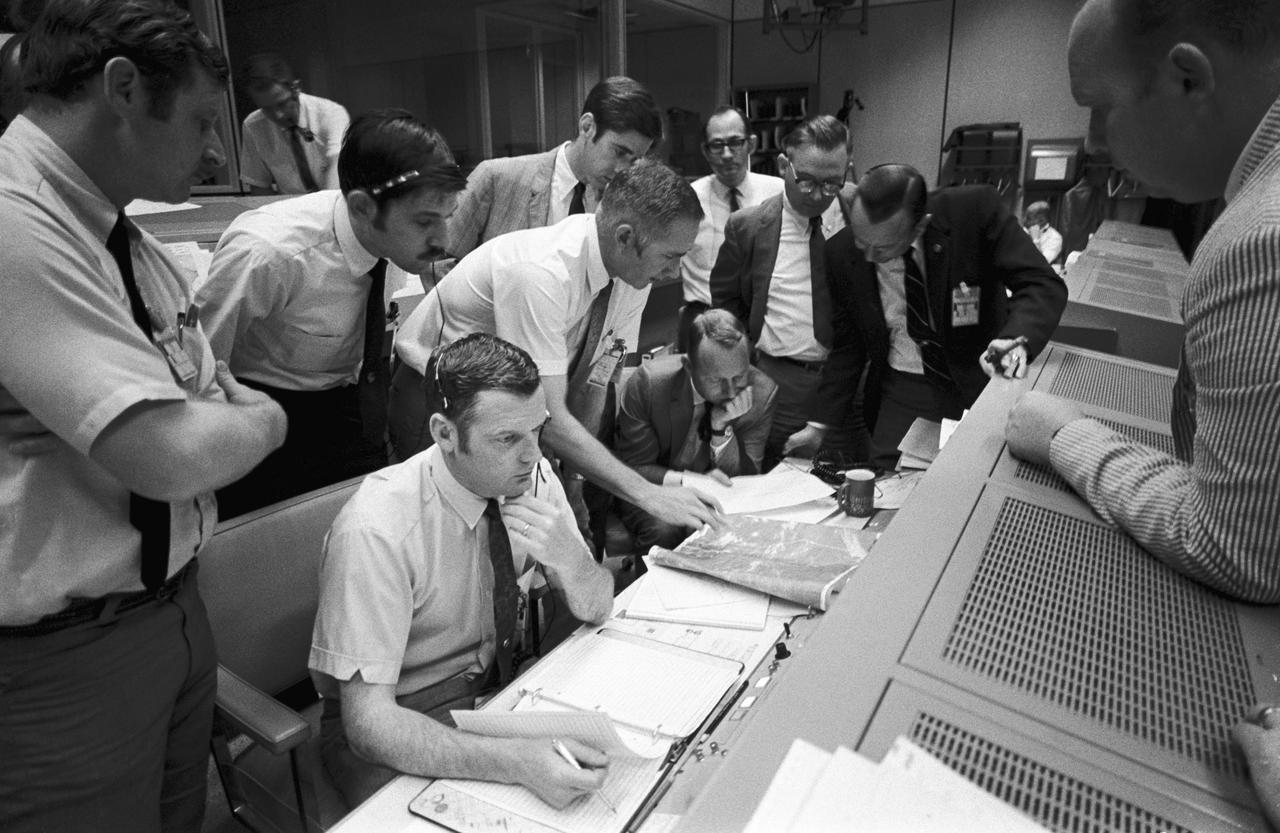
S70-35014 (15 April 1970) --- A group of flight controllers gathers around the console of Glenn S. Lunney (seated, nearest camera), Shift 4 flight director, in the Mission Operations Control Room (MOCR) of Mission Control Center (MCC), located in Building 30 at the Manned Spacecraft Center (MSC). Their attention is drawn to a weather map of the proposed landing site in the South Pacific Ocean. Among those looking on is Dr. Christopher C. Kraft, deputy director, MSC, standing in black suit, on right. When this photograph was taken, the Apollo 13 lunar landing mission had been canceled, and the problem-plagued Apollo 13 crew members were in trans-Earth trajectory attempting to bring their crippled spacecraft back home.
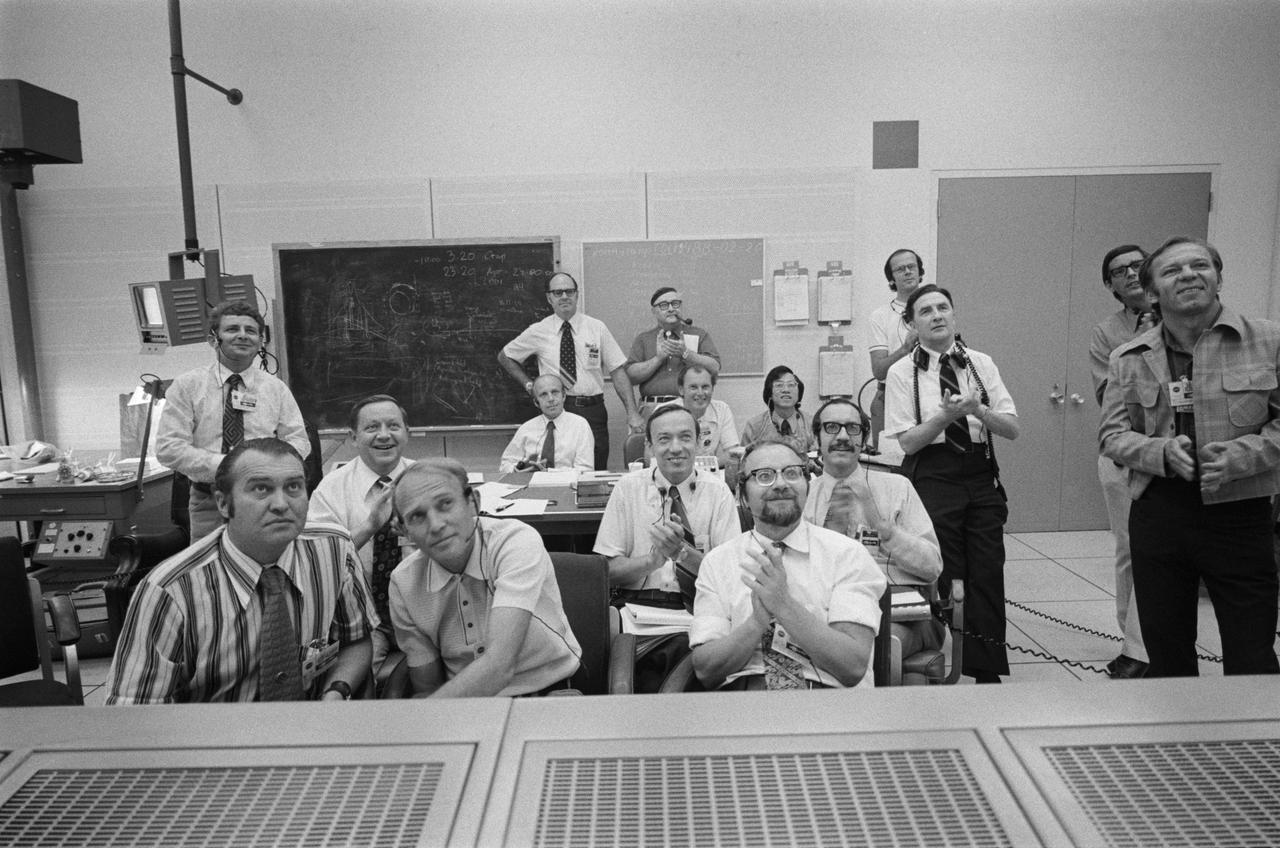
S75-28659 (21 July 1975) --- An overall view of the group of Soviet Union flight controllers who served at the Mission Control Center during the joint U.S.-USSR Apollo-Soyuz Test Project docking mission in Earth orbit. They are applauding the successful touchdown of the Soyuz spacecraft in Central Asia. The television monitor had just shown the land landing of the Soyuz descent vehicle.
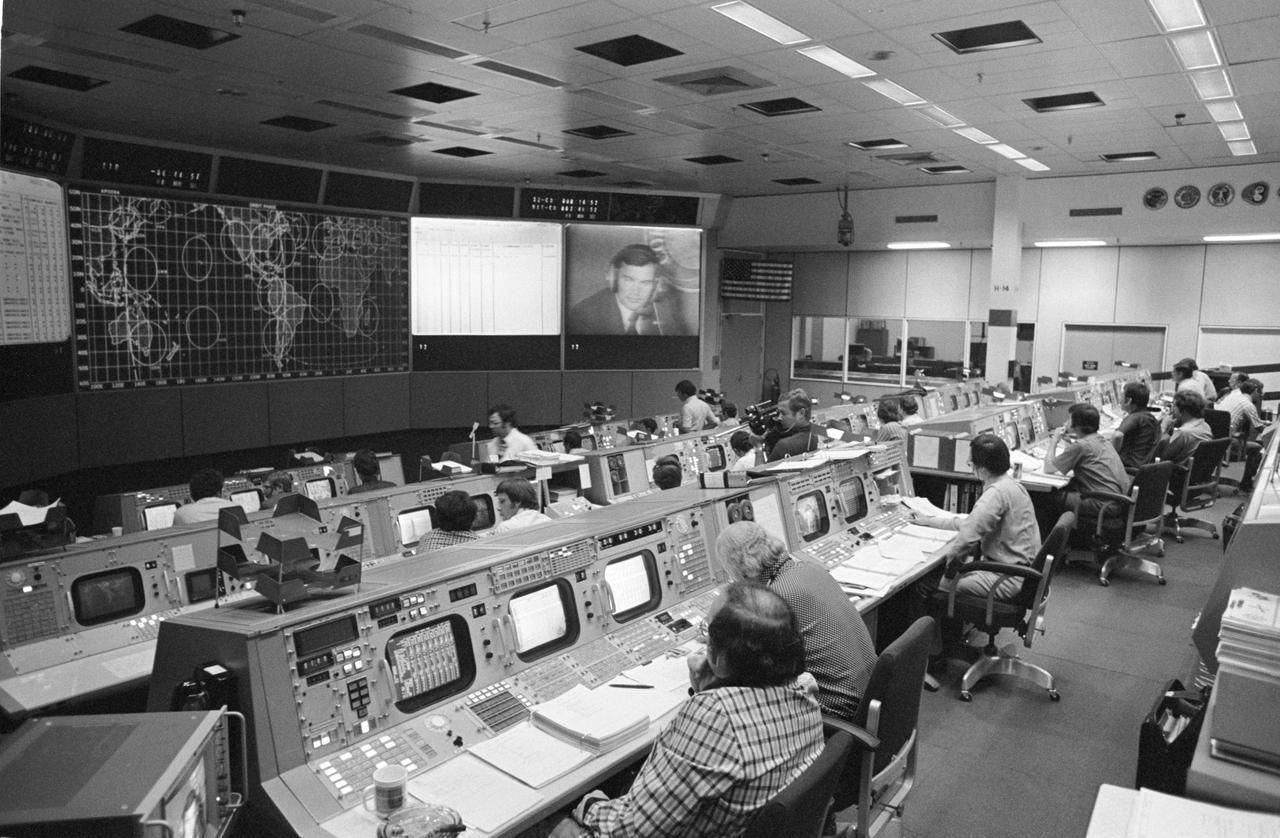
S75-28483 (15 July 1975) --- An overall view of the Mission Operations Control Room in the Mission Control Center on the first day of the Apollo-Soyuz Test Project docking mission in Earth orbit. The American ASTP flight controllers at NASA's Johnson Space Center were monitoring the progress of the Soviet ASTP launch when this photograph was taken. The television monitor shows cosmonaut Yuri V. Romanenko at his spacecraft communicator?s console in the ASTP mission control center in the Soviet Union. The American ASTP liftoff followed the Soviet ASTP launch by seven and one-half hours.
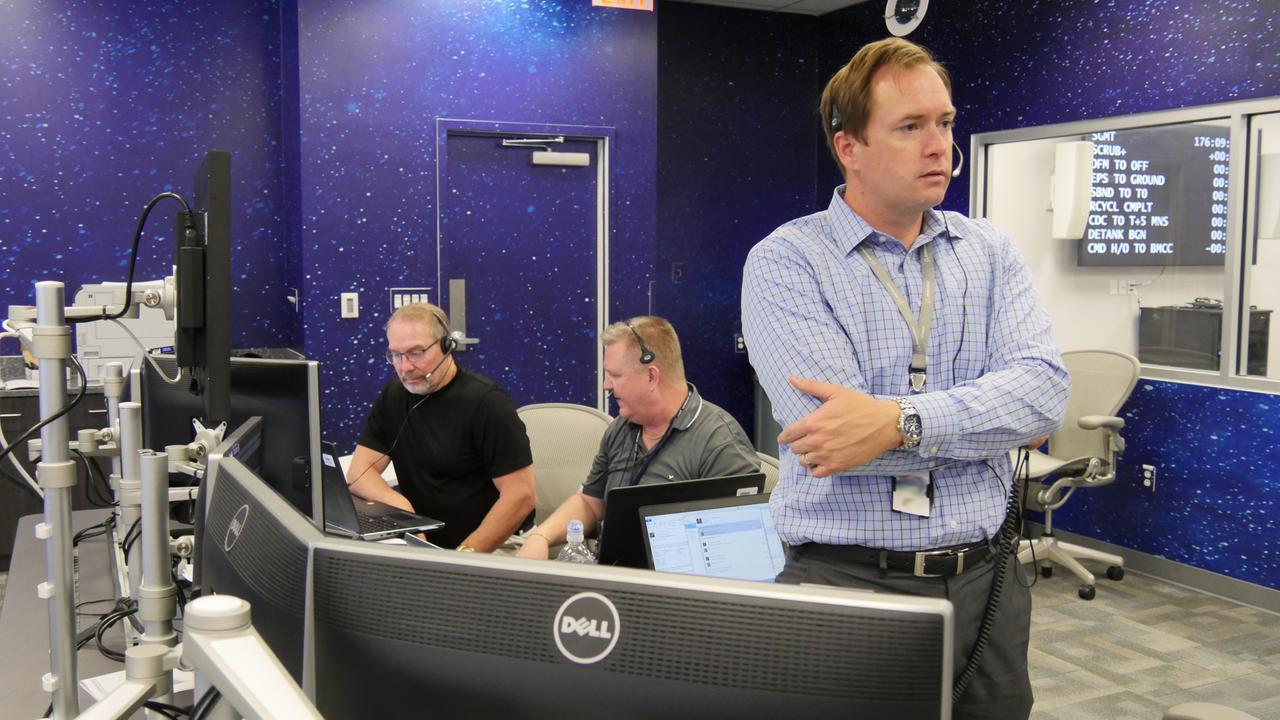
Inside the Boeing Mission Control Center at Kennedy Space Center, Fla., launch control teams for the CST-100 Starliner rehearse a fully integrated prelaunch simulation of the spacecraft’s upcoming Orbital Flight Test. Boeing Spacecraft Launch Conductor Louis Atchison speaks on console to the Mission Management Team as the countdown in the launch simulation progresses.
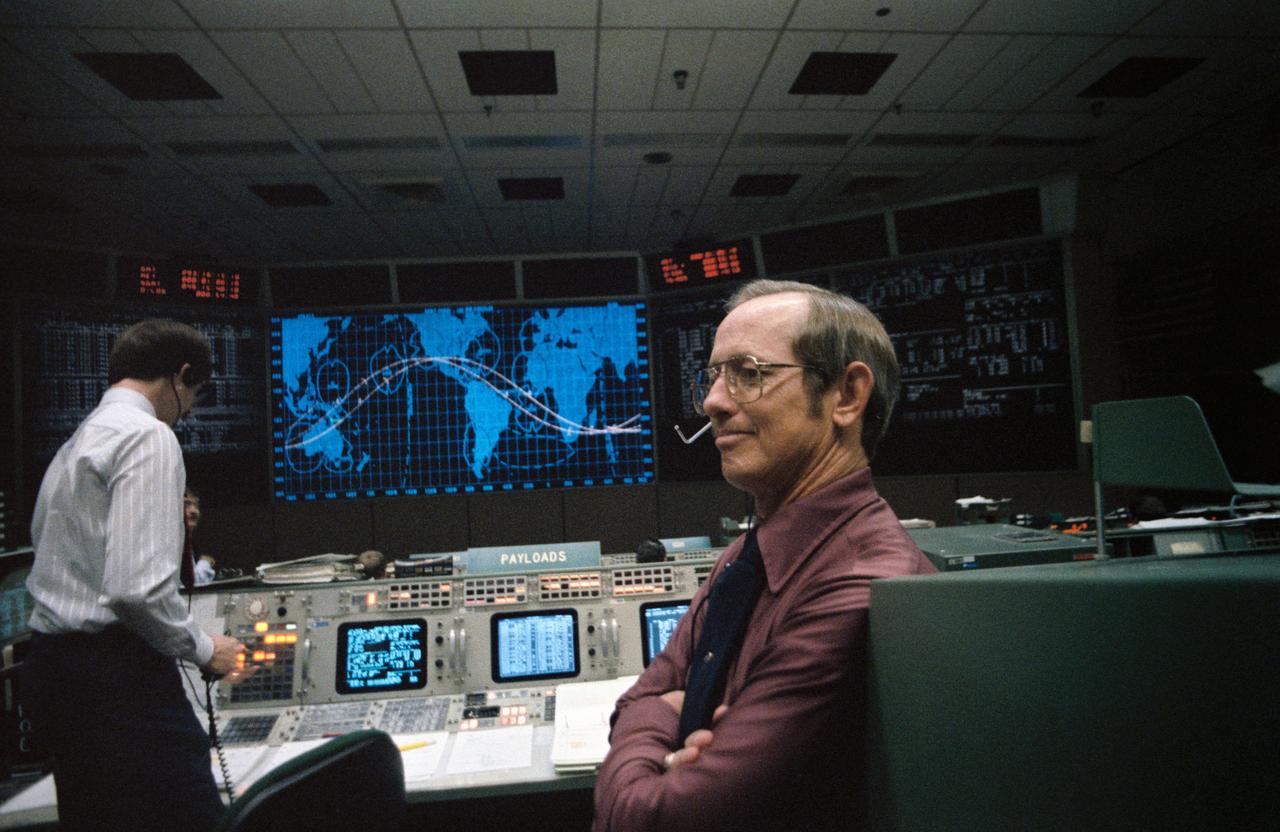
S87-46338 (20 Oct 1987) --- Flight controller Granvil Pennington listens to communications from the STS-26 integrated simulations in the flight control room of JSC's mission control center. Five veteran astronauts were in a simulator in another JSC building rehearsing their roles for the scheduled June 1988 flight aboard the Discovery.

S81-30387 (14 April 1981) --- An overall view of the mission operations control room (MOCR) in the Johnson Space Center's Mission Control Center during the landing phase of the STS-1 mission. The Columbia can be seen on large monitor in upper right at Dryden Flight Research Center. Flight controller Ed Fendell, left foreground, mans the integrated communications systems engineer (INCO) console. Photo credit: NASA
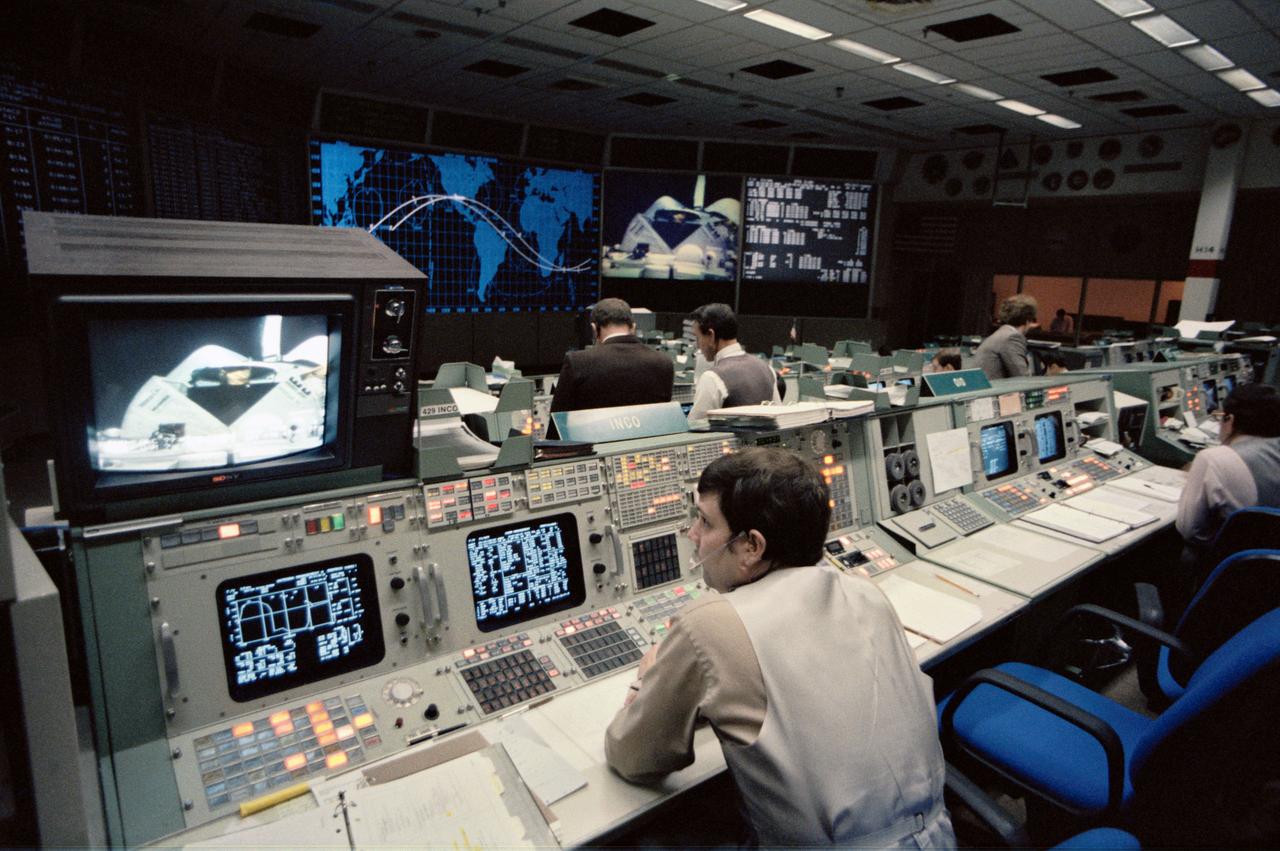
S84-26332 (3 Feb 1984) --- Robert E. Castle, integrated communications officer (INCO), plays an important role in the first television transmission from the Earth-orbiting Space Shuttle Challenger. Castle, at a console in the Johnson Space Center?s mission operations control room (MOCR) in the mission control center, is responsible for ground controlled television from the orbiter on his shift. Here, the Westar VI satellite is seen in the cargo bay just after opening of the payload bay doors.
51A-90016 (8 Nov 1984) --- J. E. Conner, on duty at the integrated communcations officer console in the second floor Flight Control Room (FCR) of the Johnson Space Center's (JSC) Mission Control Center (MCC), watches engine ignition of Discovery on a nearby TV monitor. Moments later, the Houston FCR took over control of the scheduled eight day mission 51-A.
S84-26333 (6 Feb 1984) --- Robert E. Castle, integrated communications officer (INCO), is seated at the INCO console in the mission operations control room (MOCR) of Johnson Space Center's (JSC) mission control center (MCC). He is responsible for ground controlled television from the orbiter on his shift. On the screen at the front of the room the Westar VI satellite is seen in the cargo bay just after opening the payload bay doors.
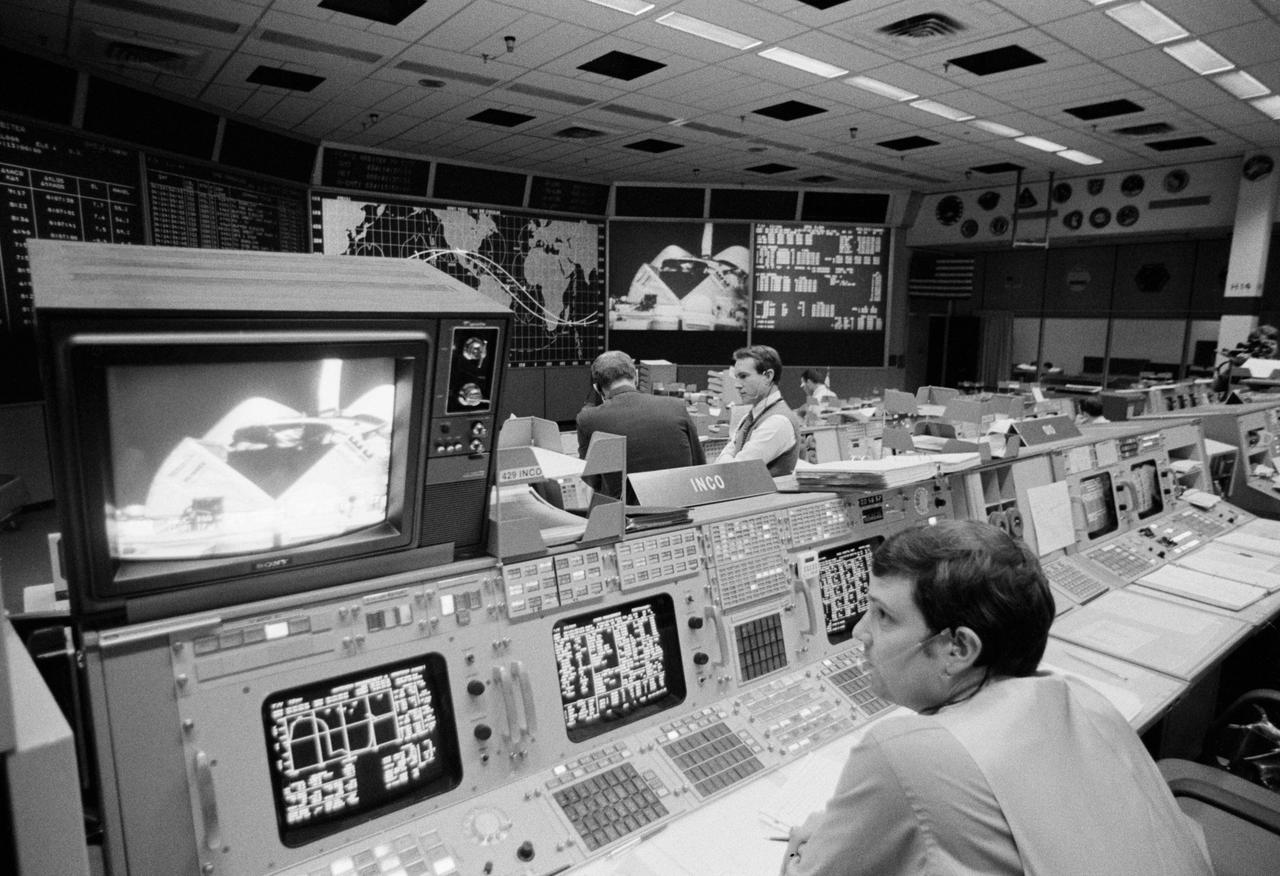
S84-26297 (3 Feb 1984) --- Robert E. Castle, Integrated Communications Officer (INCO), plays an important role in the first television transmission from the Earth-orbiting Space Shuttle Challenger. Castle, at a console in the Johnson Space Center's (JSC) Mission Operations Control Room (MOCR) in the Mission Control Center (MCC), is responsible for ground controlled television from the Orbiter on his shift. Here, the Westar VI satellite is seen in the cargo bay just after opening of the payload bay doors.
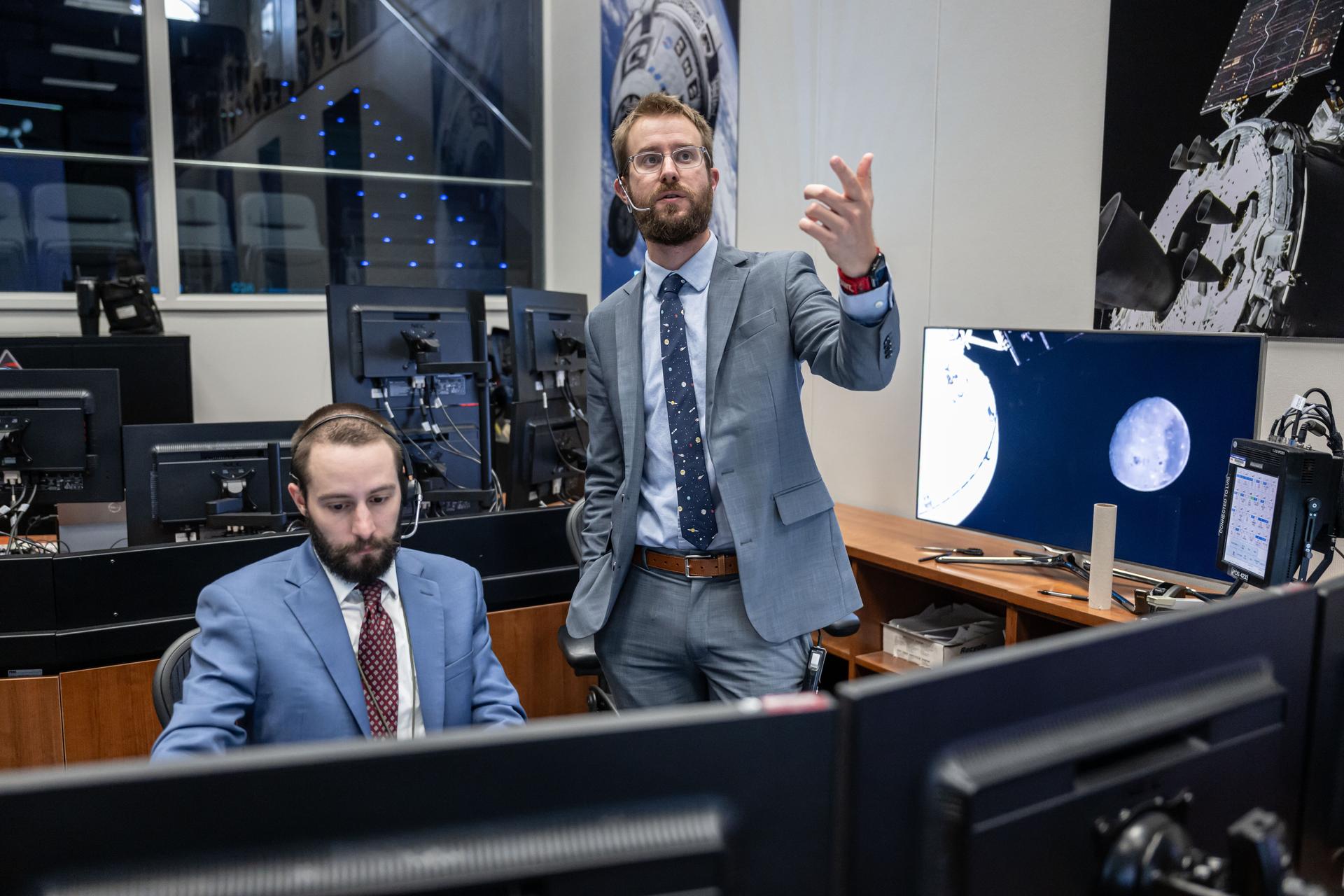
jsc2026e021749 (April 6, 2026) - Chris White, Lead INCO (Integrated Communications Officer) for Artemis II, and Matthew Johns, INCO Flight Controller, are pictured in the White Flight Control Room in the Mission Control Center at NASA’s Johnson Space Center during the Artemis II mission. This image was taken when NASA astronauts Reid Wiseman, Victor Glover, and Christina Koch, and CSA (Canadian Space Agency) astronaut Jeremy Hansen conducted the flyby of the Moon. Credit: NASA/Robert Markowitz
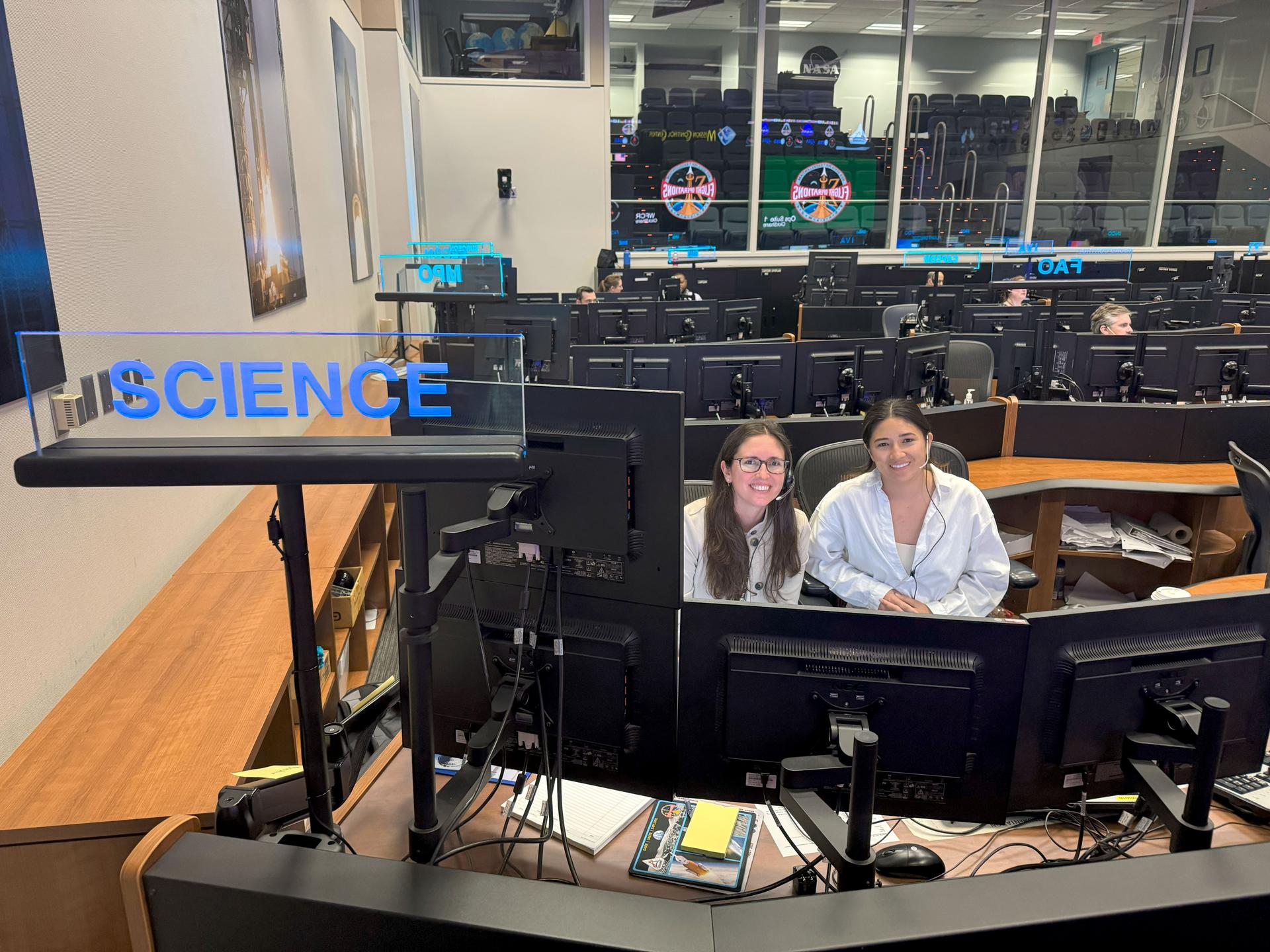
jsc2025e067512 --- Artemis II science officers Kelsey Young, left, and Angela Garcia sit at the SCIENCE console during a training simulation in the White Flight Control Room of the Mission Control Center at NASA's Johnson Space Center in Houston. Artemis II will test mission science operations and integration into flight control. Lessons learned during Artemis II science operations will pave the way for lunar science operations for future Artemis missions. A team of experts will staff the Science Evaluation Room (SER) at Johnson, providing lunar scientific expertise, data analysis, and strategic guidance in real-time to the science officer and the rest of Mission Control.
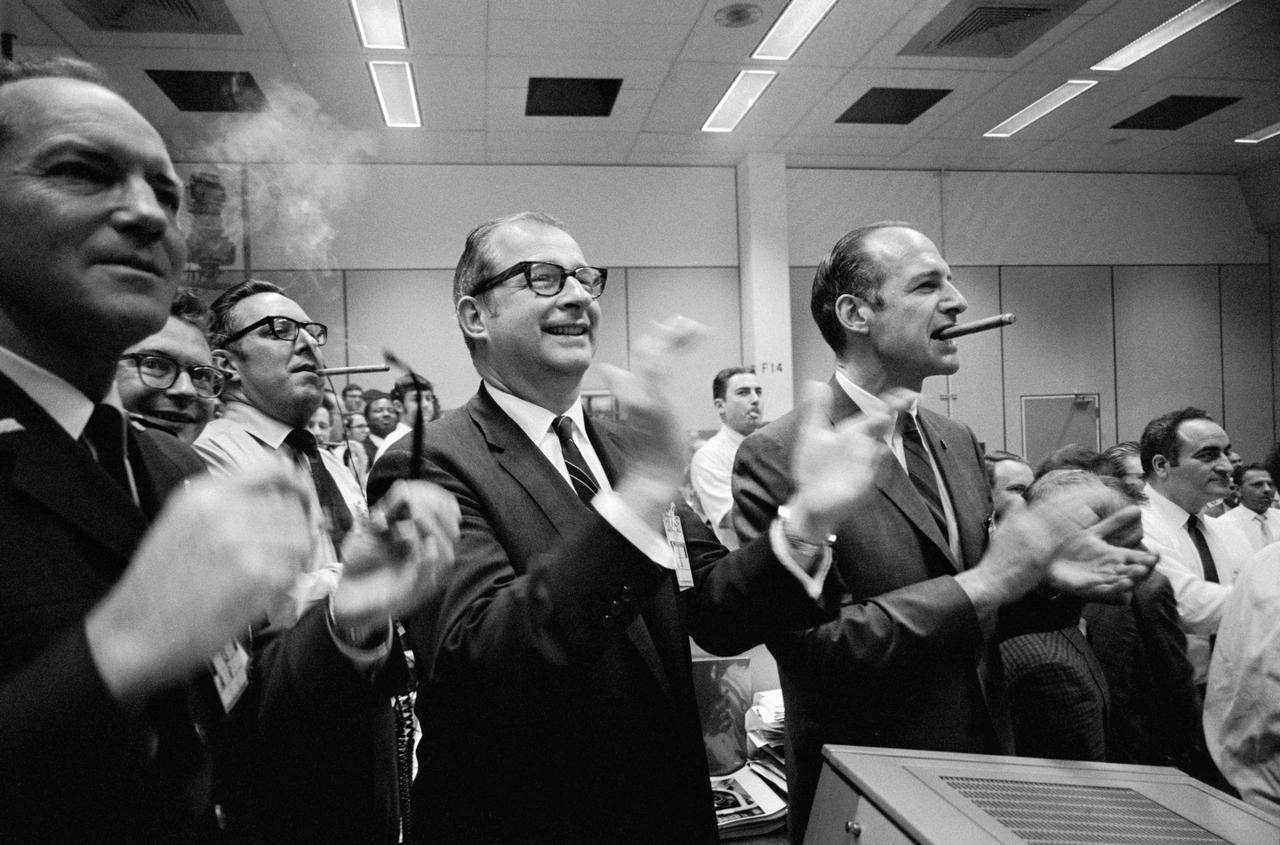
S70-35148 (17 April 1970) --- Staff members from NASA Headquarters (NASA HQ), Manned Spacecraft Center (MSC), and Dr. Thomas Paine (center of frame) applaud the successful splashdown of the Apollo 13 mission while Dr. George Low smokes a cigar (right), in the MSC Mission Control Center (MCC), located in Building 30. Apollo 13 crewmembers, astronauts James A. Lovell Jr., commander; John L. Swigert Jr., command module pilot; and Fred W. Haise Jr., lunar module pilot, splashed down at 12:07:44 p.m. (CST), April 17, 1970, in the south Pacific Ocean.
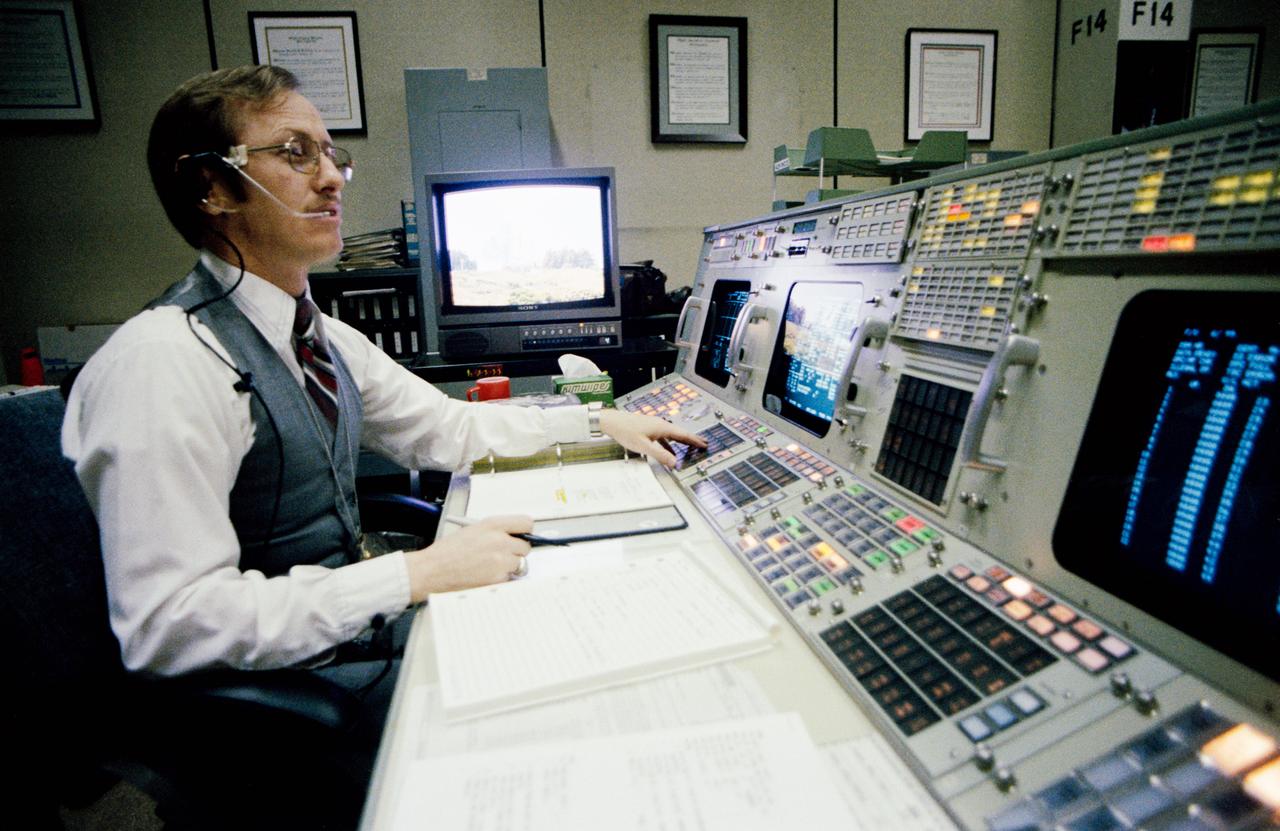
S83-30138 (6 April 1983) --- Granvil A. (Al) Pennington waits for the launch of STS-6?s Challenger as he begins his duties as ascent team integrated communication systems officer (INCO) at the INCO console in the mission operations control room (MOCR) of the Johnson Space Center?s mission control center. The second reusable spacecraft in history launched from the Kennedy Space Center?s Pad 39A at 1:30:00:88 p.m. (EST) today.
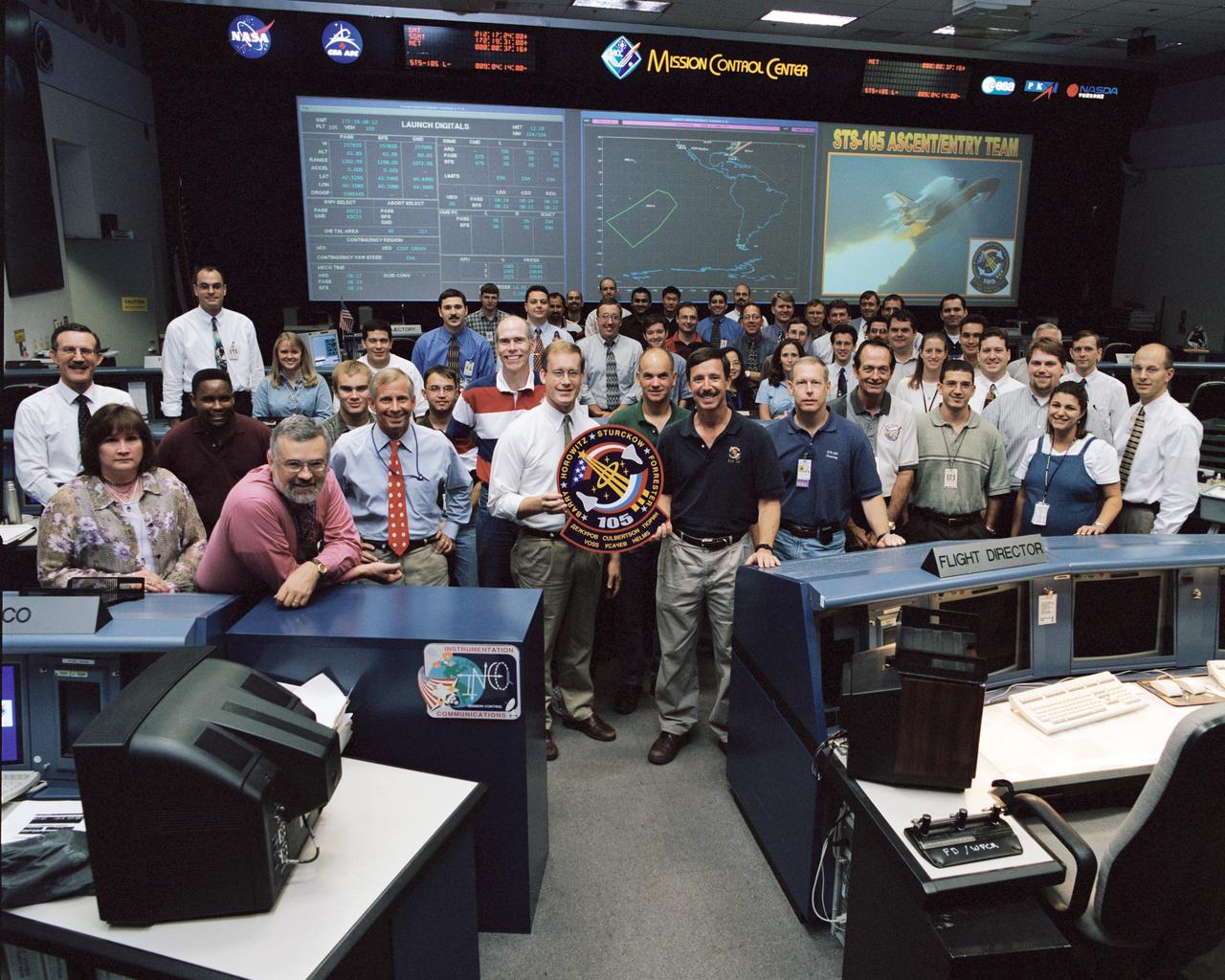
JSC2001-02115 (31 July 2001) --- The flight controllers for the Ascent/Entry shift for the upcoming STS-105 mission pose with the assigned astronaut crew for a team portrait in the Shuttle Flight Control Room (WFCR) of Houston's Mission Control Center (MCC). Flight director John Shannon (left center) and STS-105 commander Scott J. Horowitz hold the mission logo. Also pictured on the front row are spacecraft communicator Kenneth D. Cockrell and STS-105 crew members Daniel T. Barry, Frederick W. (Rick) Sturckow and Patrick G. Forrester. The team had been participating in an integrated simulation for the scheduled August mission.
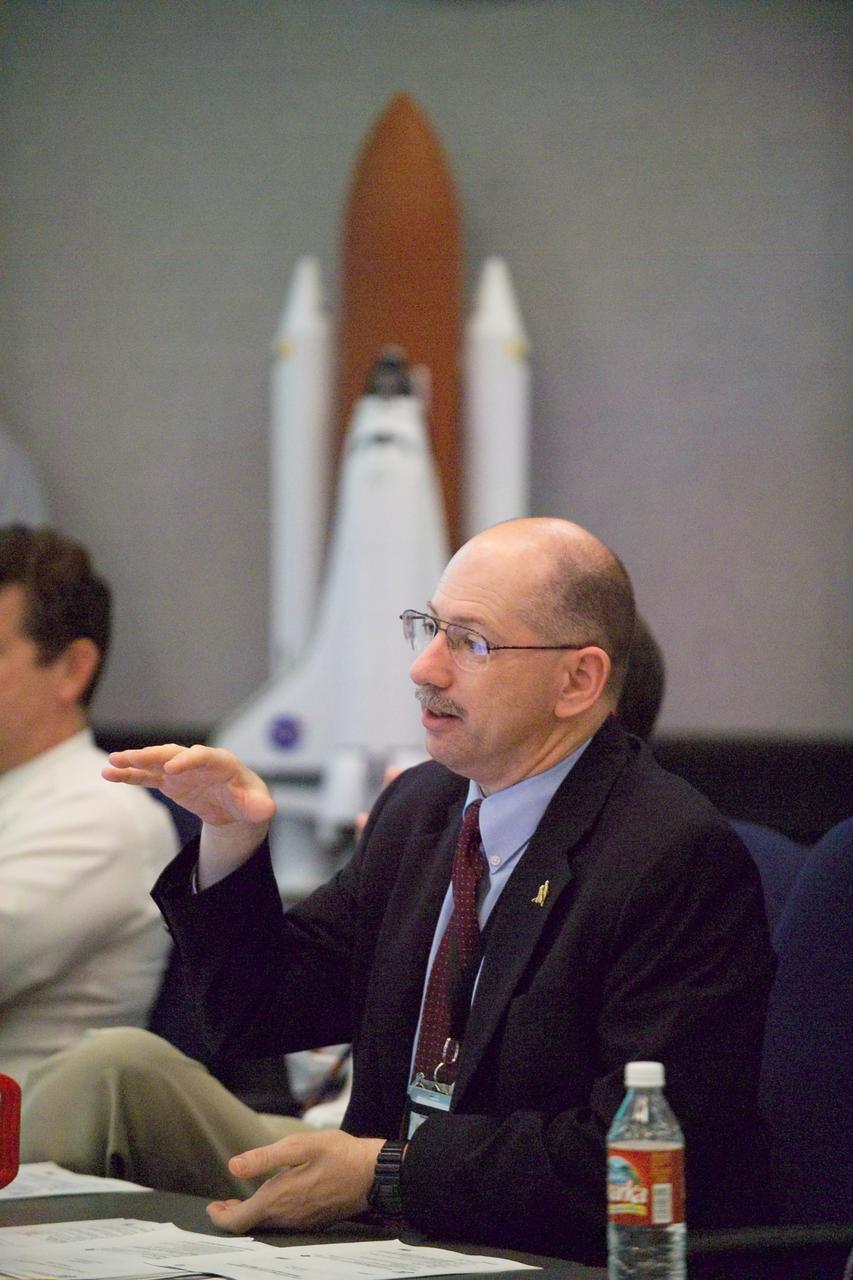
JSC2005-E-32012 (4 August 2005) --- John Muratore, Manager of Space Shuttle Systems Engineering & Integration Office, discusses a key STS-114 issue during the Mission Management Team (MMT) session of the afternoon of August 4. The MMT meets daily in Houston's Mission Control Center.

S83-34270 (18 June 1983) --- Astronaut C. Gordon Fullerton supplies helpful consultation for Edward I. Fendell (seated) at the Integrated Communications System (INCO) console in the Mission Operations Control Room (MOCR) of the Johnson Space Center's (JSC) Mission Control Center (MCC). Fendell had control over the TV systems during a brief television transmission that featured the opening of the payload bay doors and the revealing of the cargo in the space shuttle Challenger's 18-meter (60-feet) long payload bay. The door-opening was the first of a series of many TV sessions planned for this six-day flight. Photo credit: NASA
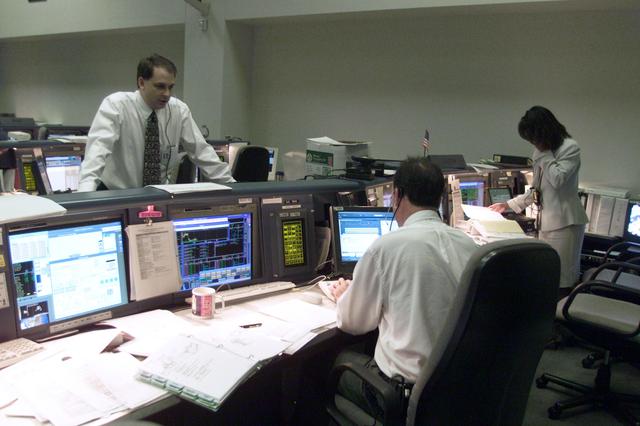
JSC2001-E-25103 (16 August 2001) --- ISS Flight Director Mark Ferring (seated), Cargo Integration Officer (CIO) Jim Ruhnke and astronaut Stephanie D. Wilson, ISS spacecraft communicator (CAPCOM), are pictured at their consoles in the station flight control room (BFCR) in Houston’s Mission Control Center (MCC) during the STS-105 mission.

Dwight Mosby, Payload Operations Mission Division Manager, welcomes scientists and engineers from around the world as they participate in the annual Payload Operations and Integration Working Group meeting held Oct. 20-21. The event offers payload developers, investigators and project managers the opportunity to coordinate processes and schedules and to review the status of scientific payloads currently on or soon launching to the International Space Station. The gathering, hosted by NASA Marshall’s Payload Operations and Integration Center, was held virtually. The POIC is mission control for science on the International Space Station.
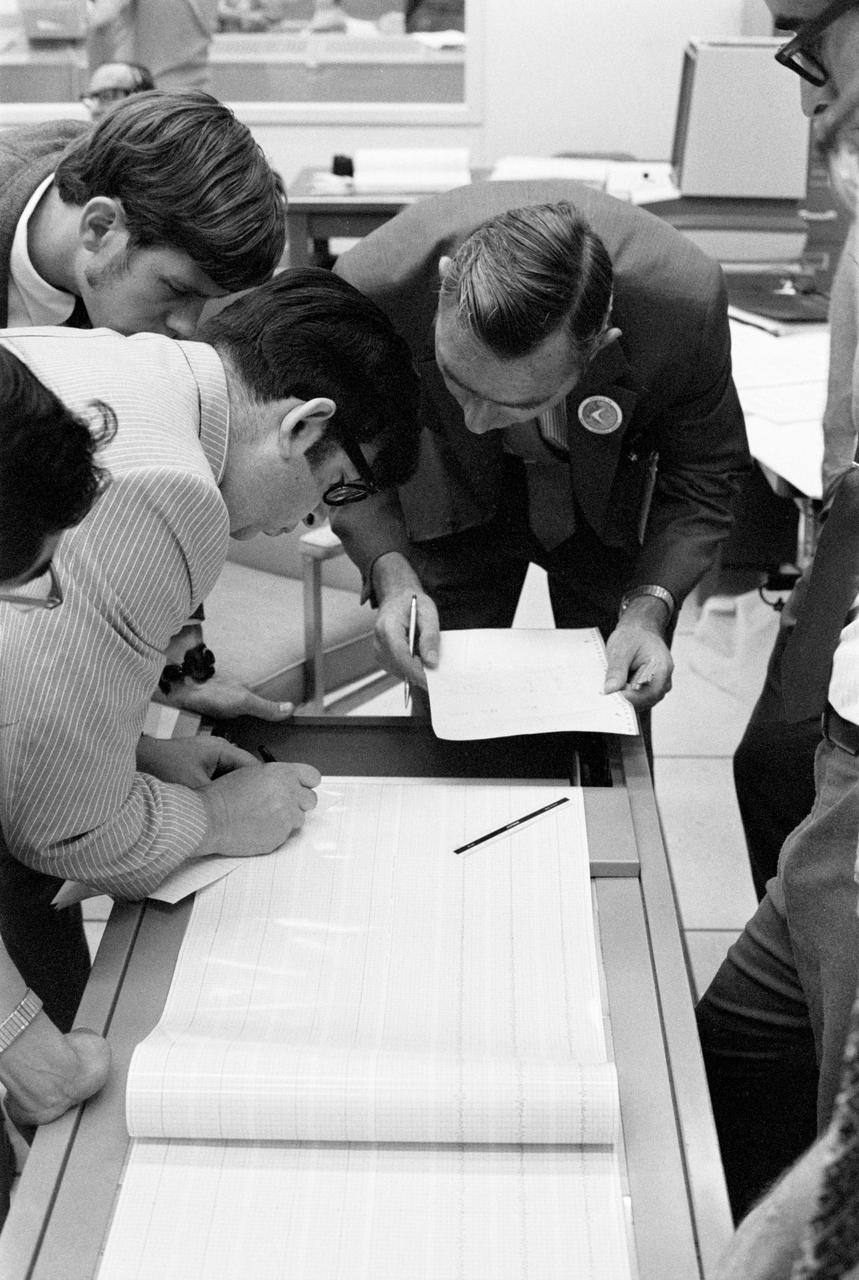
The seismometer reading from the impact made by the Apollo 15 Saturn S-IVB stage when it struck the lunar surface is studied by scientists in the Mission Control Center. Dr. Gary Latham (dark suit, wearing lapel button) of Columbia University is responsible for the design and experiment data analysis of the Passive Seismic Experiment of the Apollo Lunar Surface Experiment Package (ALSEP). The man on the left, writing, is Nafi Toksos of the Massachusetts Institute of Technology. Looking on at upper left is Dave Lamneline, also with Columbia.
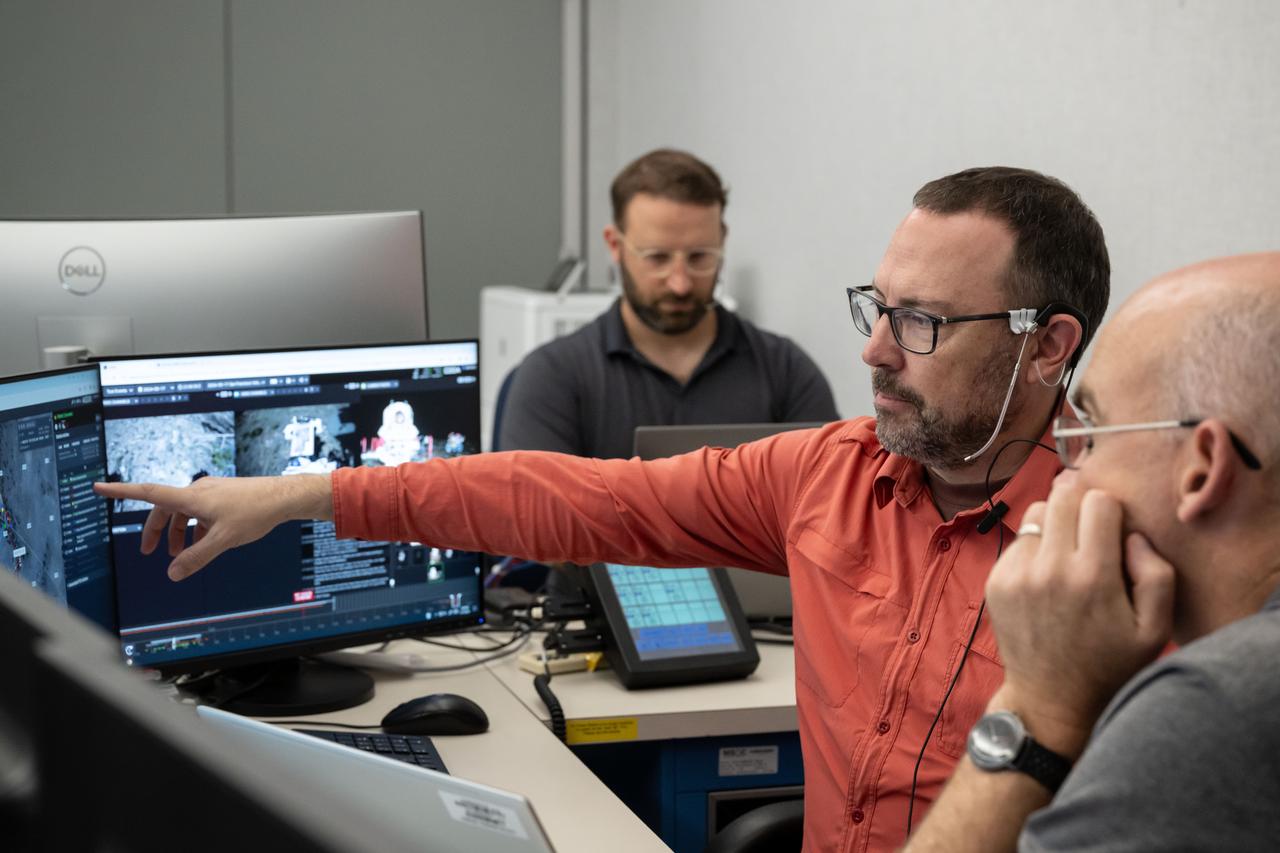
Ben Feist, software engineer on the Extravehicular Activity Mission System Software (EMSS) team, uses the suite of software he and other members of the Astromaterials Research and Exploration Science (ARES) division at NASA's Johnson Space Center in Houston developed to plan and monitor spacewalks. The JETT 5 field test was the first time this software was fully integrated into a simulated mission, supporting both science and mission control operations. JETT 5 was a week-long field test conducted in the lunar-like landscape of the San Francisco Volcanic Field near Flagstaff, Arizona, with a team of flight controllers and scientists at Johnson monitoring and guiding the activities. Credit: NASA/Helen Arase Vargas
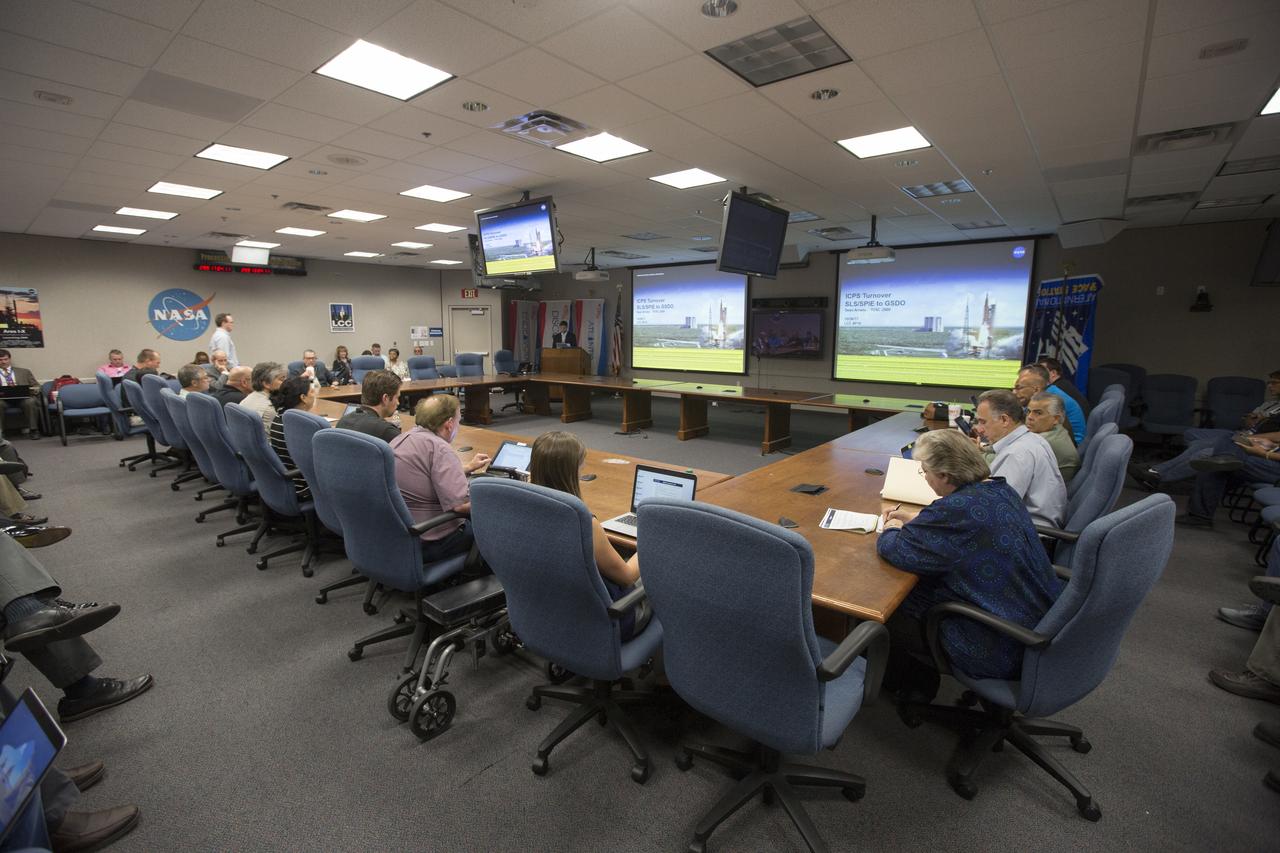
Meeting in the Launch Control Center of NASA's Kennedy Space Center in Florida, officials of the agency's Spacecraft/Payload Integration and Evolution (SPIE) organization formally turn over processing of the Space Launch System (SLS) rocket's Interim Cryogenic Propulsion Stage (ICPS) to the center's Ground Systems Development and Operations (GSDO) directorate. The ICPS is the first integrated piece of flight hardware to arrive in preparation for the uncrewed Exploration Mission-1. With the Orion attached, the ICPS sits atop the SLS rocket and will provide the spacecraft with the additional thrust needed to travel tens of thousands of miles beyond the Moon.
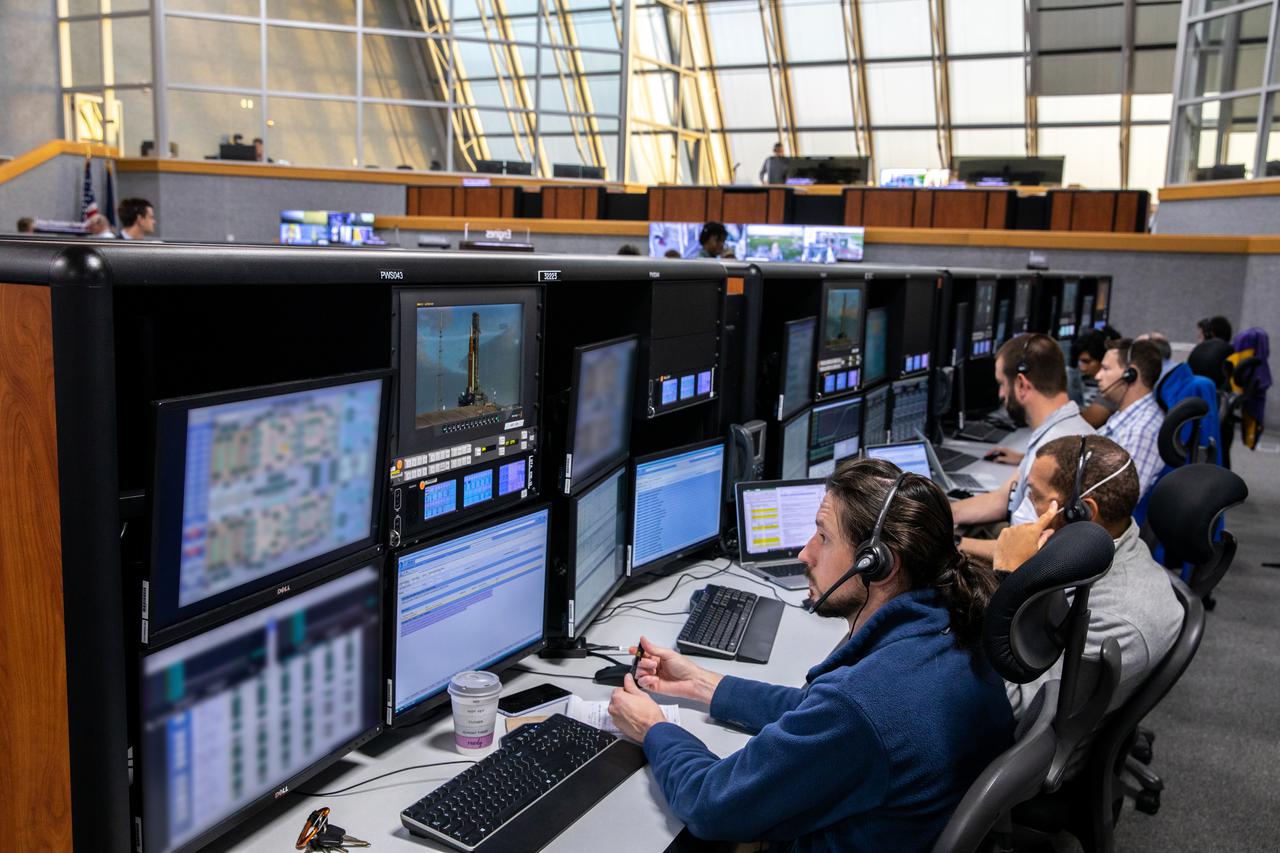
Members of the Artemis I launch team participate in a wet dress rehearsal for the Artemis I mission on April 14, 2022, inside the Launch Control Center at NASA’s Kennedy Space Center in Florida. The wet dress rehearsal is the final major test before launch and allows the team to run through all countdown operations prior to liftoff. The first in an increasingly complex series of missions, Artemis I will test NASA’s Space Launch System rocket and Orion spacecraft as an integrated system prior to crewed flights to the Moon.
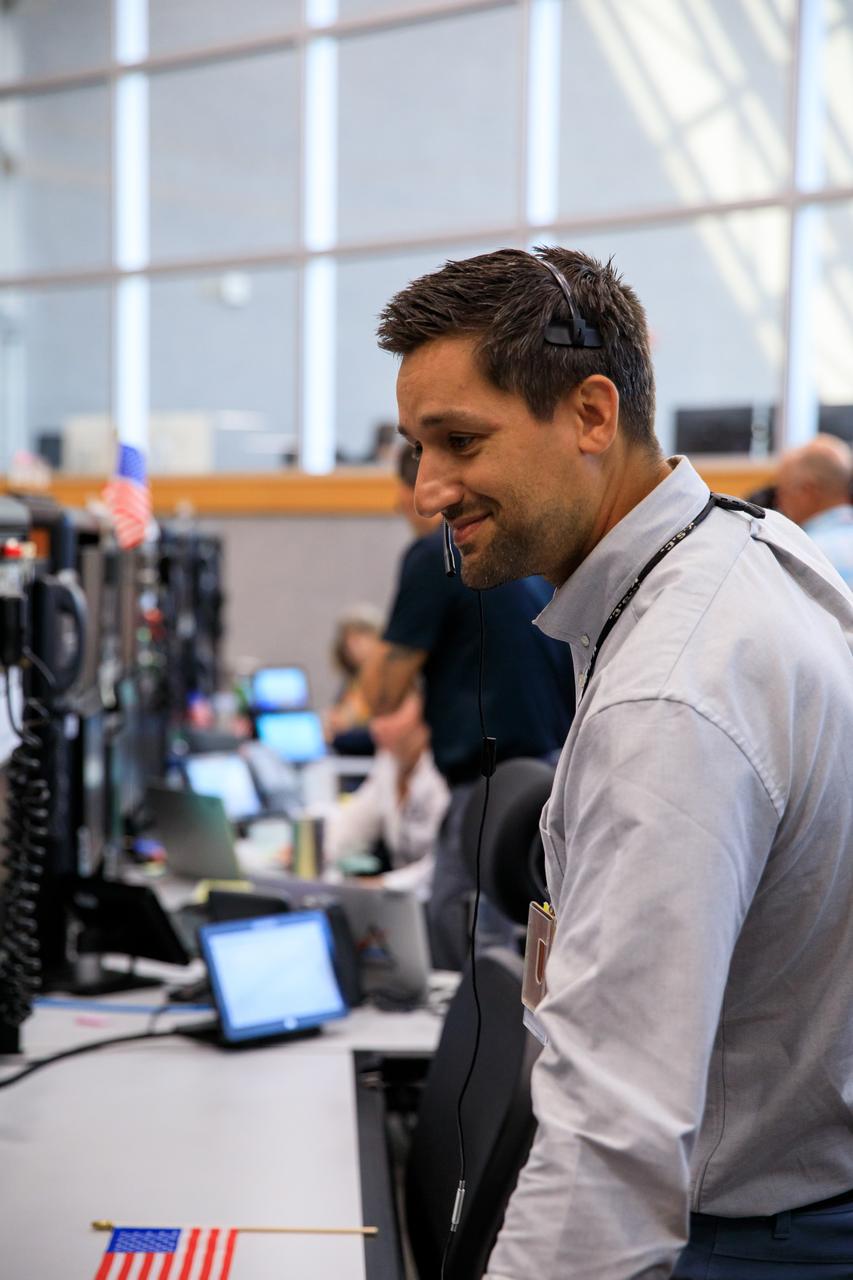
A member of the Artemis II launch team monitors activities during the launch day demonstration for one of the Artemis II integrated ground systems tests from Firing Room 1 in the Launch Control Center at Kennedy Space Center in Florida on Wednesday, Sept. 20. This is part of a series of tests to ensure the ground systems team is ready to support the crew timeline on launch day. Artemis II is the first mission with astronauts under Artemis that will test and check out all of the Orion spacecraft’s systems needed for future crewed missions.