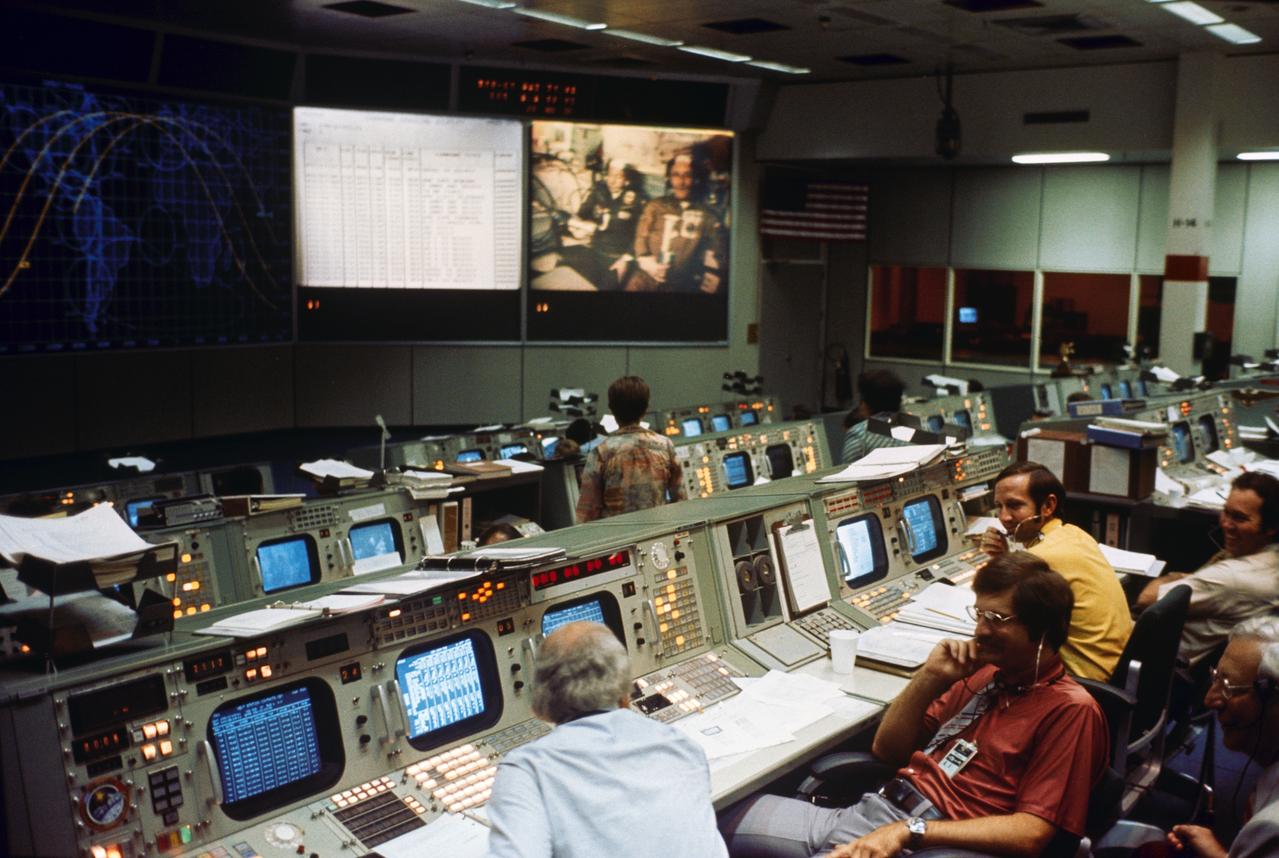
S75-28685 (17 July 1975) --- An overall view of activity in the Mission Operations Control Room in the Mission Control Center during joint U.S.-USSR Apollo Soyuz Test Project (ASTP) docking mission in Earth orbit. The large television monitor shows an interior view of the Soyuz Orbital Module with astronaut Thomas P. Stafford (in front) visiting with cosmonaut Aleksey A. Leonov. Neil B. Hutchinson (right hand to chin) is the flight director for this shift.
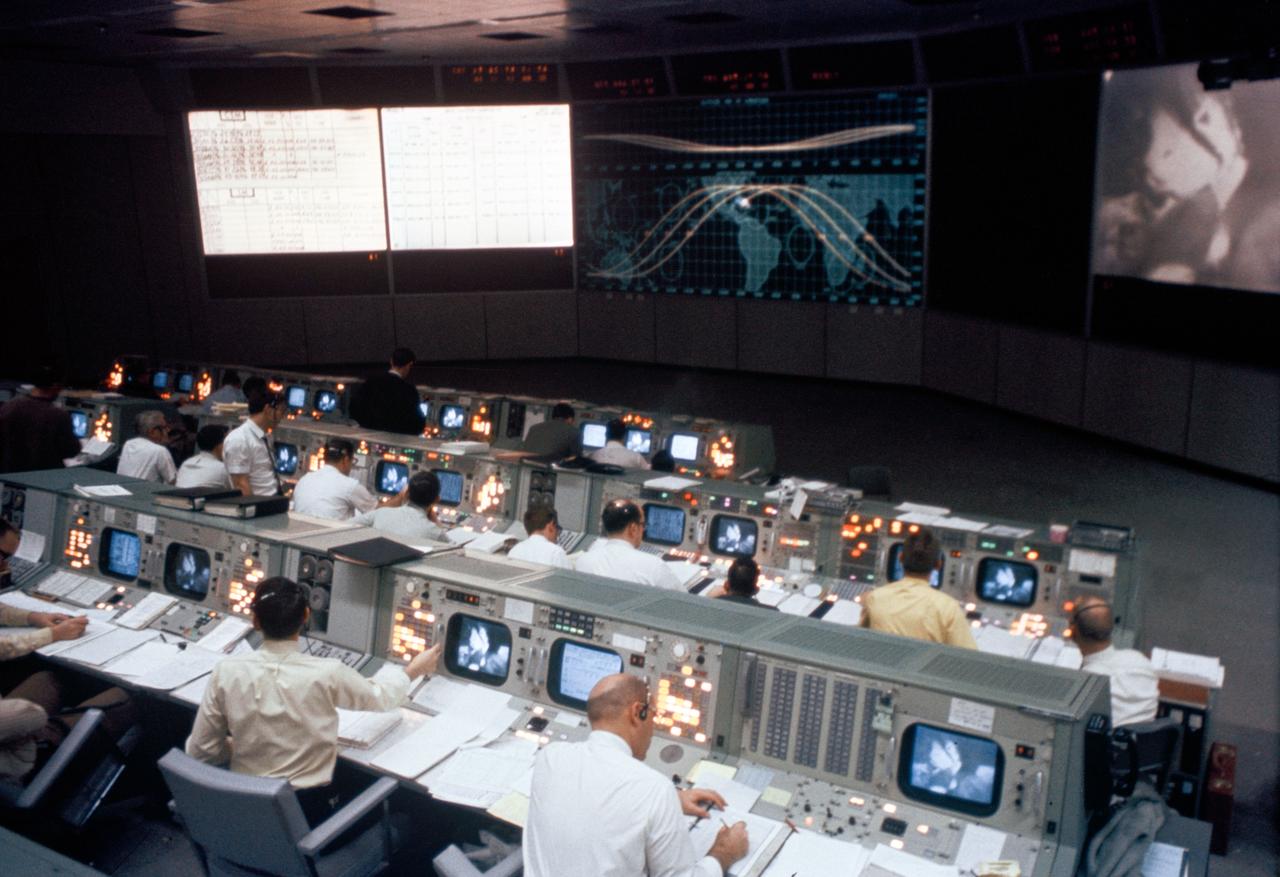
S69-26301 (March 1969) --- Overall view of the Mission Operations Control Room in the Mission Control Center, Building 30, during the Apollo 9 Earth-orbital mission. When this photograph was taken a live television transmission was being received from Apollo 9 as it orbited Earth.
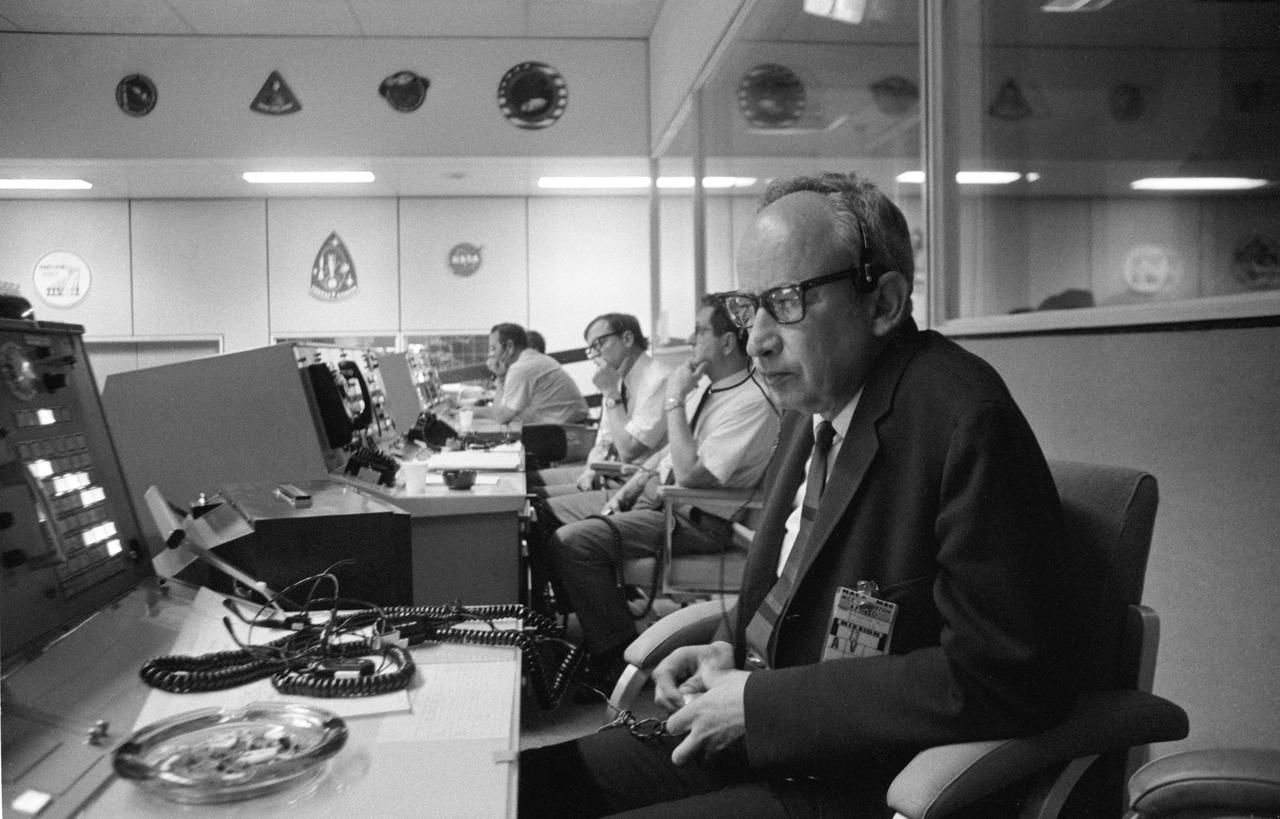
S70-34627 (11 April 1970) --- Sigurd A. Sjoberg, director of flight operations, at the Manned Spacecraft Center (MSC), views the Apollo 13 liftoff from a console in the MSC Mission Control Center (MCC), Building 30. Apollo 13 lifted off at 1:13 p.m. (CST) April 11, 1970. Photo credit: NASA
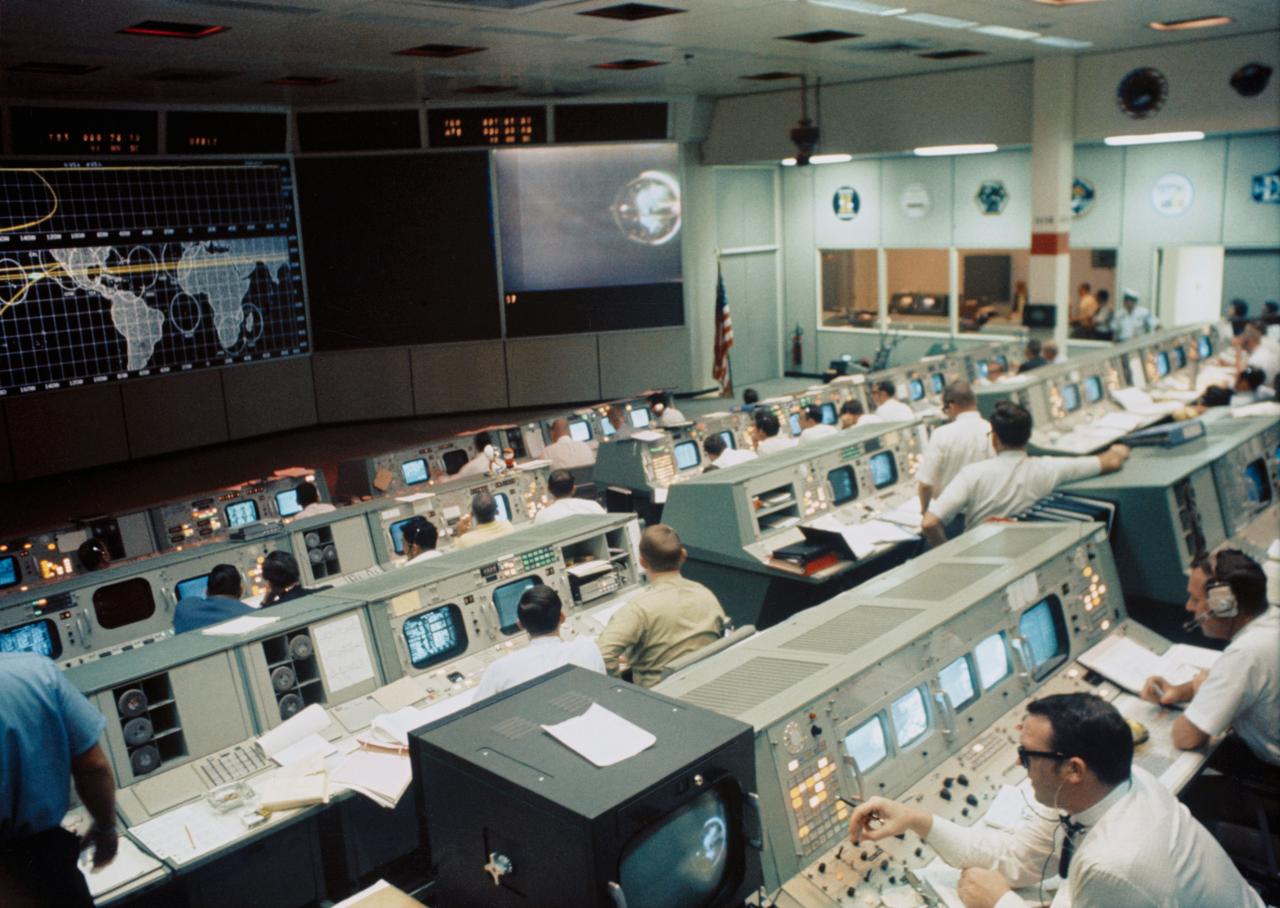
S69-34316 (18 May 1969) --- Overall view of the Mission Operations Control Room in the Mission Control Center, Building 30, on the first day of the Apollo 10 lunar orbit mission. A color television transmission was being received from Apollo 10. This picture was made following Command and Service Module/Lunar Module/Saturn IVB (CSM/LM-S-IVB) separation and prior to LM extraction from the S-IVB. The CSM were making the docking approach to the LM/S-IVB.
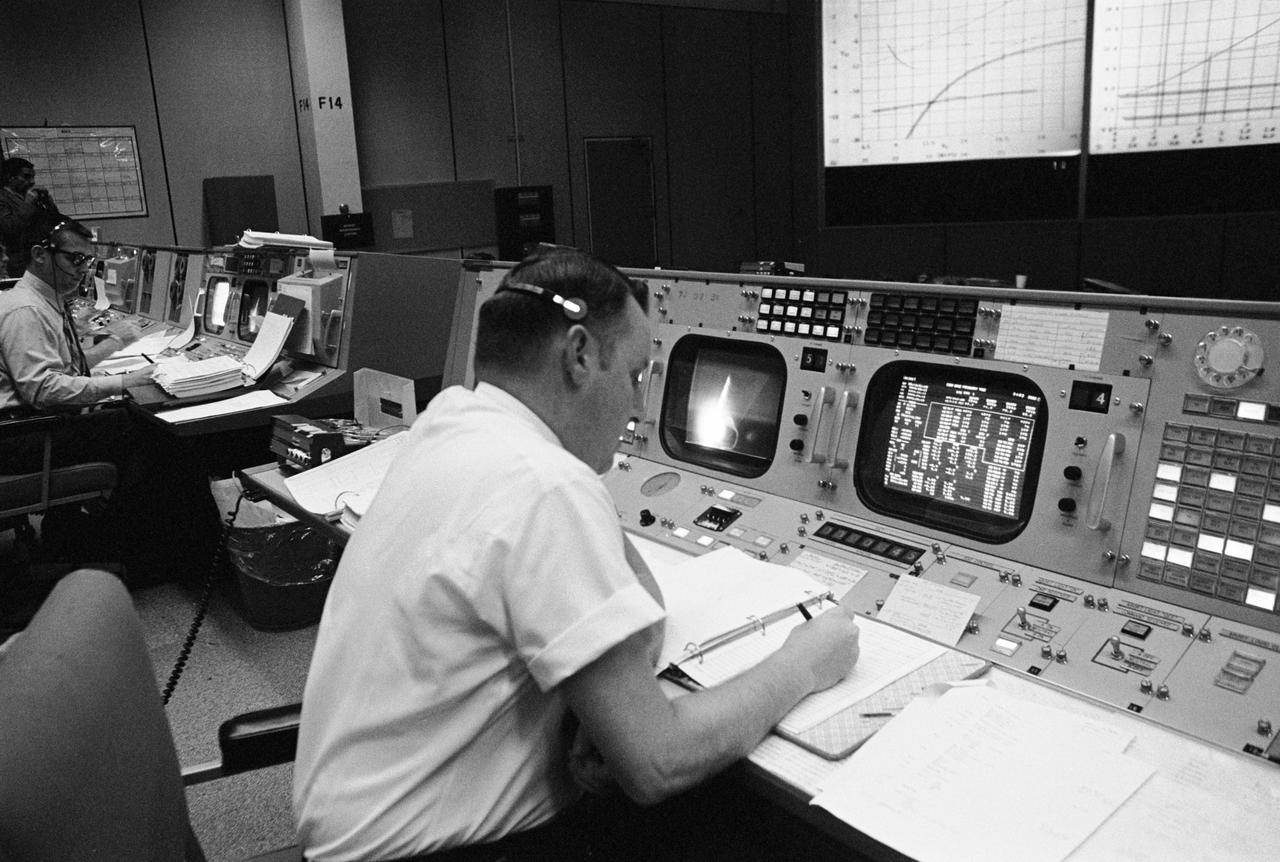
S68-55742 (21 Dec. 1968) --- Clifford E. Charlesworth, Apollo 8 "Green Team" flight director, is seated at his console in the Mission Operations Control Room in the Mission Control Center, Building 30, during the launch of the Apollo 8 (Spacecraft 103/Saturn 503) manned lunar orbit space mission.
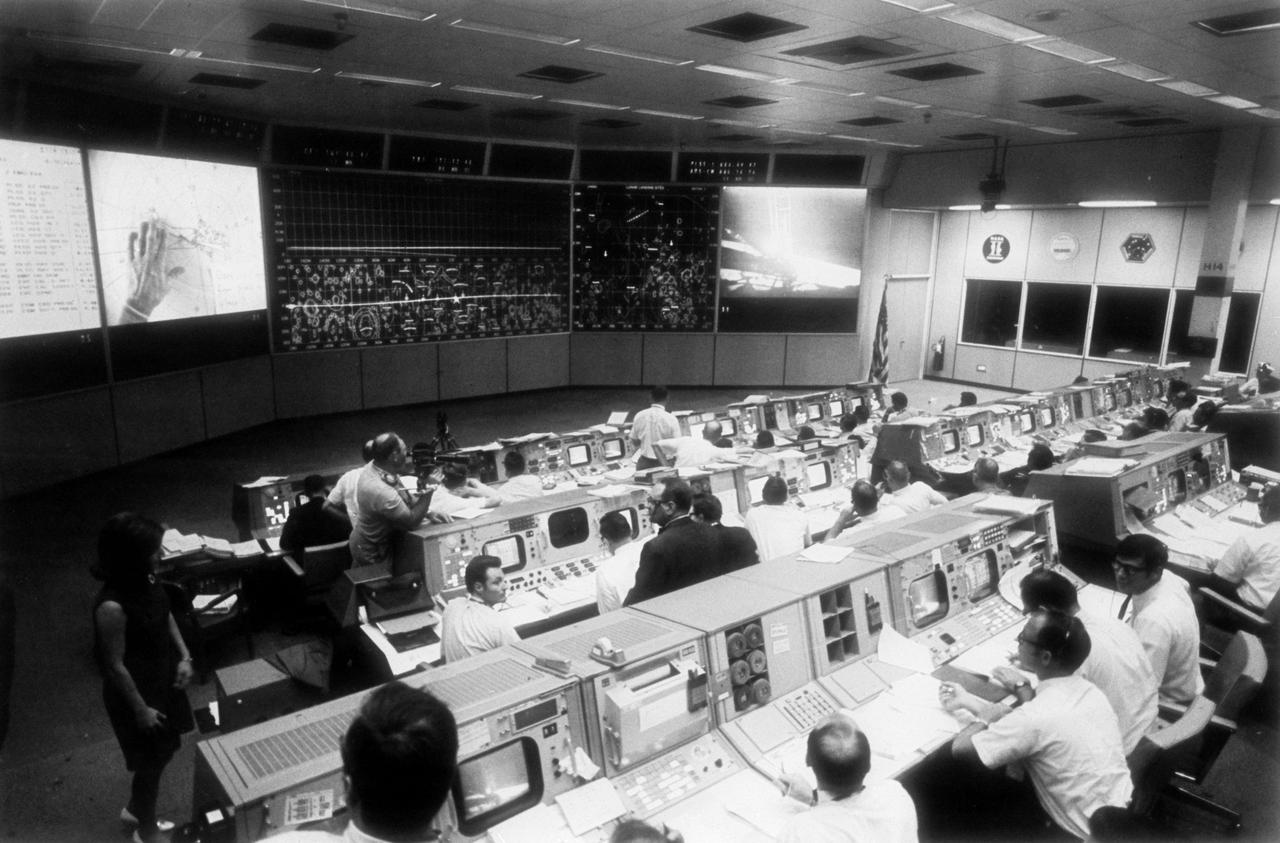
Overall view of the Mission Operations Control Room in the Mission Control Center, bldg 30, during the lunar surface extravehicular activity (EVA) of Apollo 11 Astronauts Neil A. Armstrong and Edwin E. Aldrin Jr.
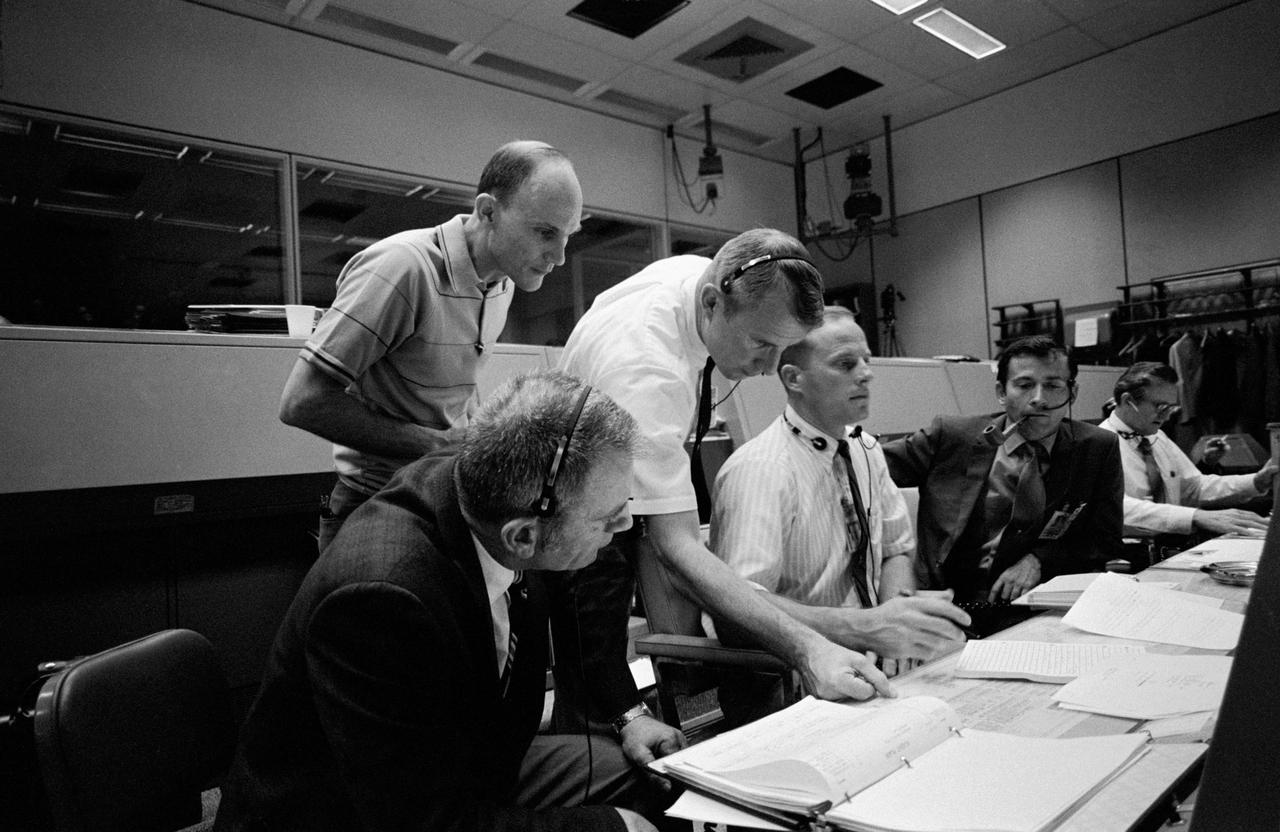
S70-34902 (14 April 1970) --- Several persons important to the Apollo 13 mission, at consoles in the Mission Operations Control Room (MOCR) of the Mission Control Center (MCC). Seated at consoles, from left to right, are astronauts Donald K. Slayton, director of flight crew operations; astronaut Jack R. Lousma, Shift 3 spacecraft communicator; and astronaut John W. Young, commander of the Apollo 13 backup crew. Standing, left to right, are astronaut Tom K. Mattingly II, who was replaced as Apollo 13 command module pilot after it was learned he may come down with measles, and astronaut Vance D. Brand, Shift 2 spacecraft communicator. Several hours earlier, in the late evening hours of April 13, crew members of the Apollo 13 mission reported to MCC that trouble had developed with an oxygen cell on their spacecraft.
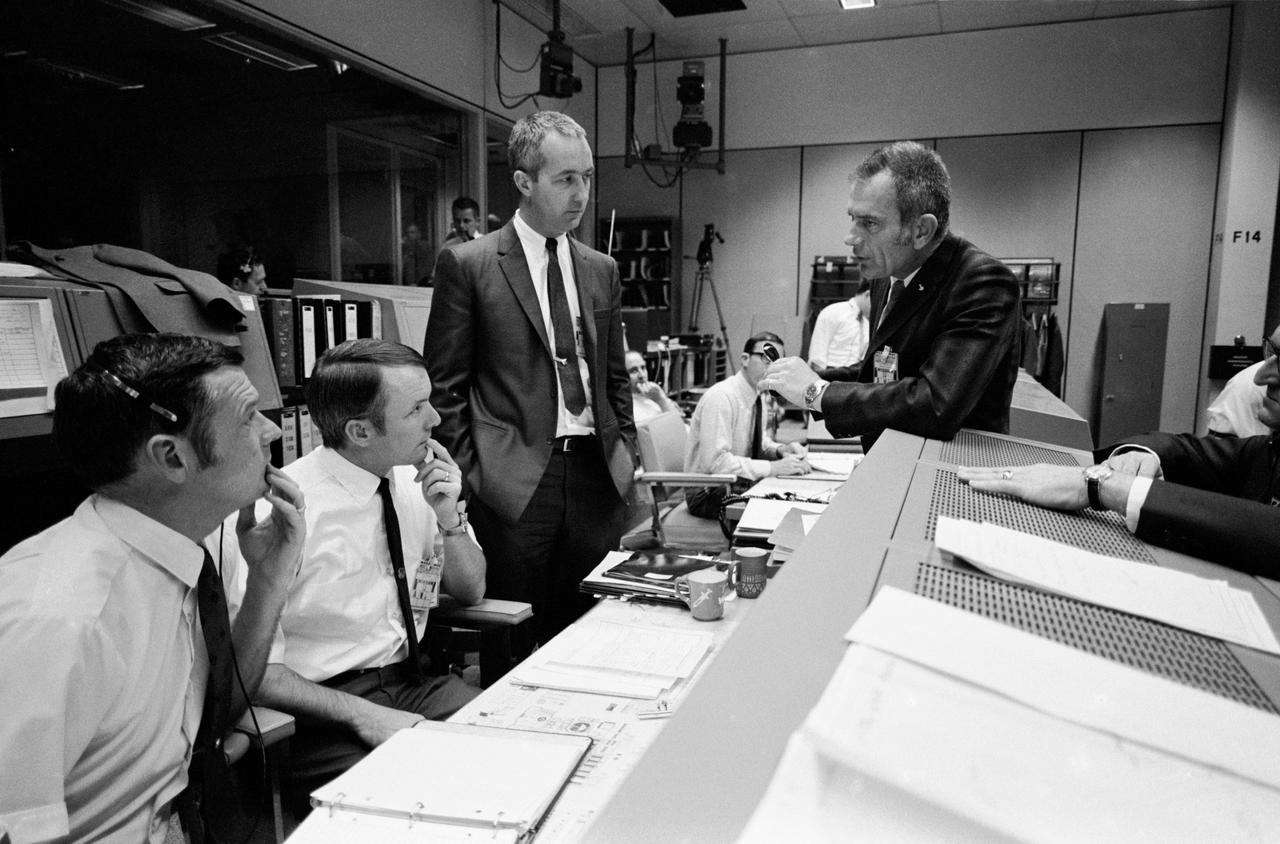
S70-35369 (16 April 1970) --- Discussion in the Mission Operations Control Room (MOCR) dealing with the Apollo 13 crewmen during their final day in space. From left to right are Glynn S. Lunney, Shift 4 flight director; Gerald D. Griffin, Shift 2 flight director; astronaut James A. McDivitt, manager, Apollo Spacecraft Program, MSC; Dr. Donald K. Slayton, director of Flight Crew Operations, MSC; and Dr. Willard R. Hawkins, M.D., Shift 1 flight surgeon.
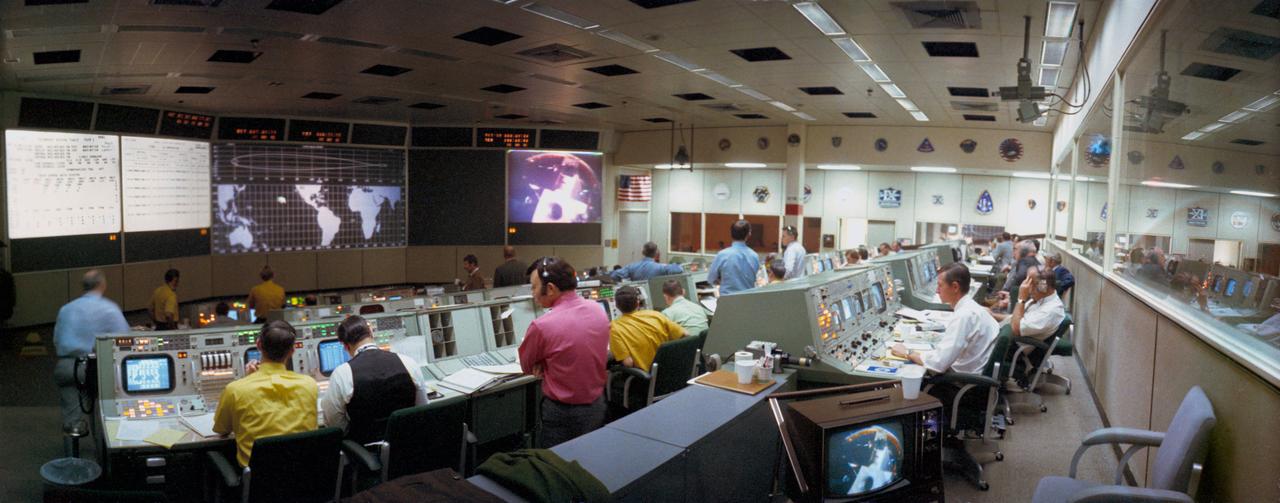
S71-17122 (31 Jan. 1971) --- A wide angle overall view of the Mission Operations Control Room (MOCR) in the Mission Control Center at the Manned spacecraft Center. This view was photographed during the first color television transmission from the Apollo 14 Command Module. Projected on the large screen at the right front of the MOCR is a view of the Apollo 14 Lunar Module, still attached to the Saturn IVB stage. The Command and Service Modules were approaching the LM/S-IVB during transposition and docking maneuvers.
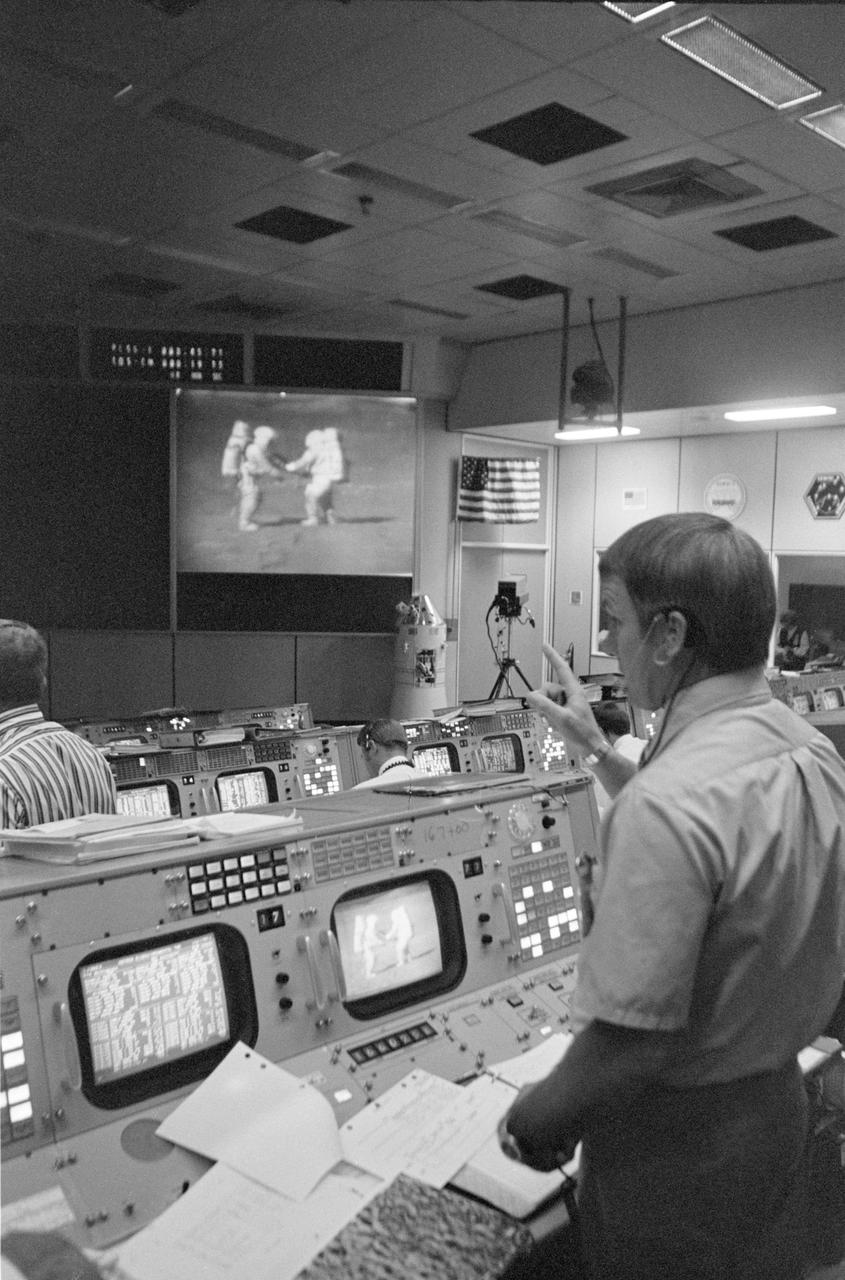
S71-41852 (2 Aug. 1971) --- Gerald D. Griffin, foreground, stands near his console in the Mission Operations Control Room (MOCR) during Apollo 15's third extravehicular activity (EVA) on the lunar surface. Griffin is Gold Team (Shift 1) flight director for the Apollo 15 mission. Astronauts David R. Scott and James B. Irwin can be seen on the large screen at the front of the MOCR as they participate in sample-gathering on the lunar surface.
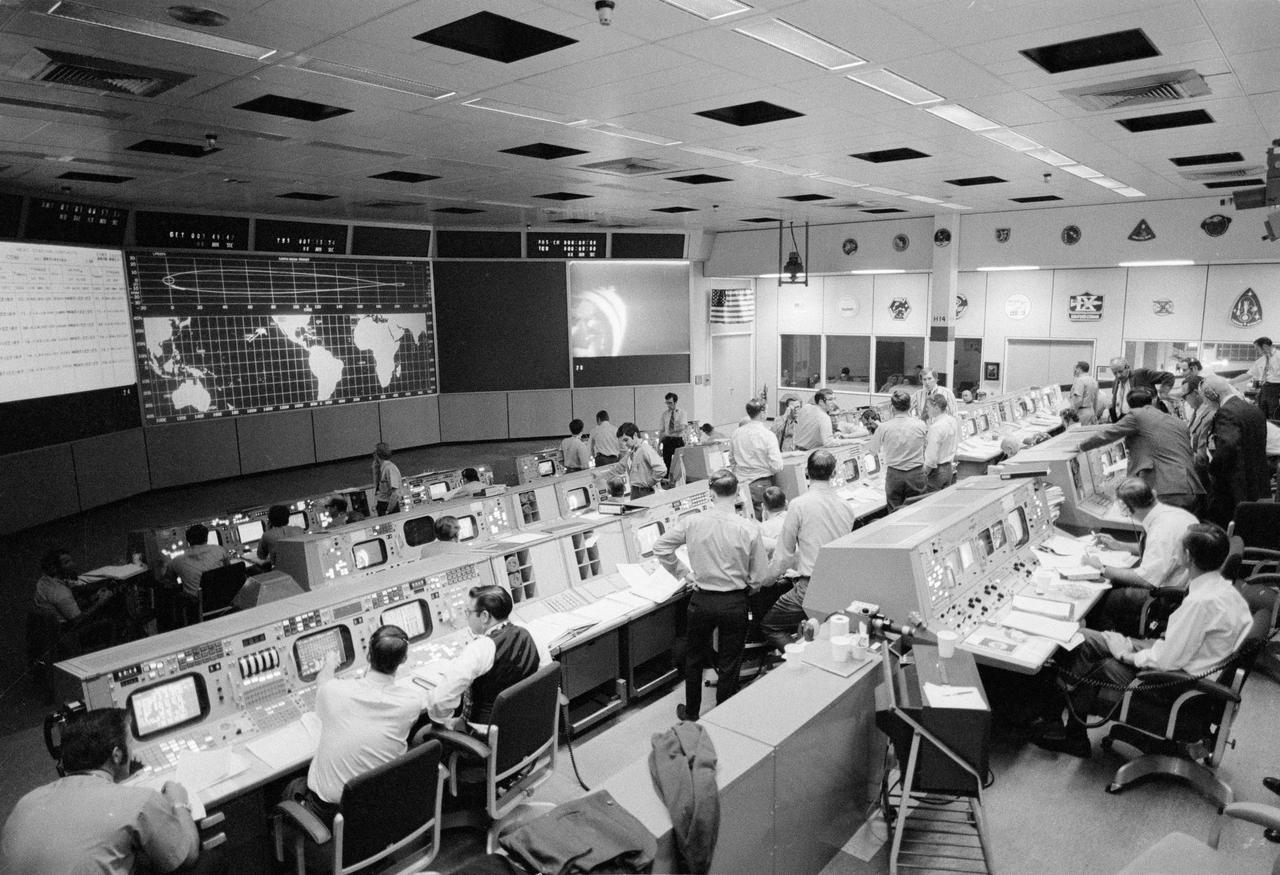
S71-16879 (31 Jan. 1971) --- Overall view of activity in the Mission Operations Control Room in the Mission Control Center during the Apollo 14 transposition and docking maneuvers. The Apollo 14 Lunar Module, still attached to the Saturn IVB stage, can be seen on the large television monitor. Due to difficulty with the docking mechanism six attempts were made before a successful "hard dock" of the Command Module with the Lunar Module was accomplished. Aboard the Command Module were astronauts Alan B. Shepard Jr., Stuart A. Roosa, and Edgar D. Mitchell.
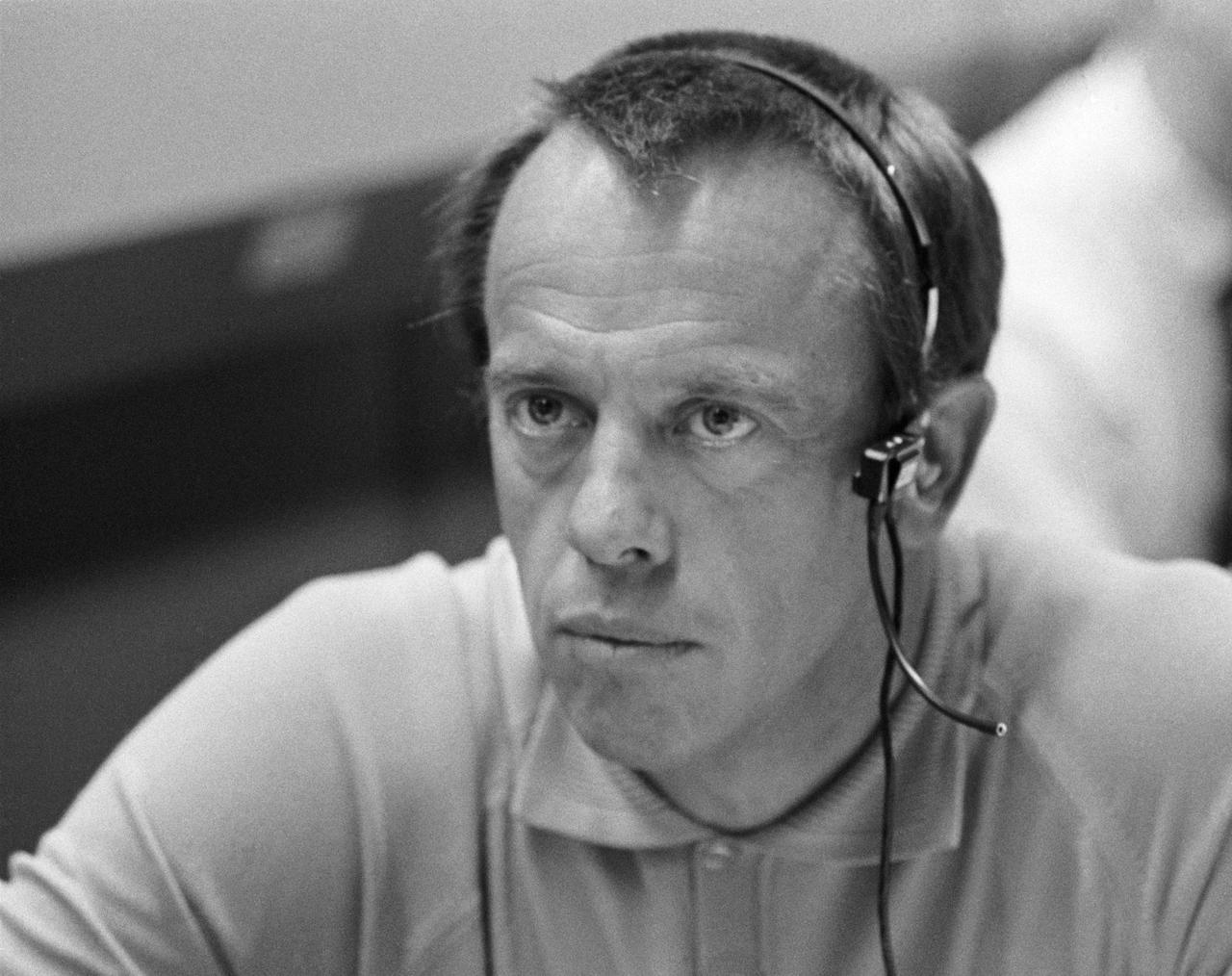
S70-34904 (14 April 1970) --- Astronaut Alan B. Shepard Jr., prime crew commander of the Apollo 14 mission, monitors communications between the Apollo 13 spacecraft and Mission Control Center. He is seated at a console in the Mission Operations Control Room of the MCC, Manned Spacecraft Center. The main concern of the moment was action taken by the three Apollo 13 crewmen - astronauts James A. Lovell Jr., John L. Swigert Jr. and Fred W. Haise Jr. - to make corrections inside the spacecraft following discovery of an oxygen cell failure several hours earlier.
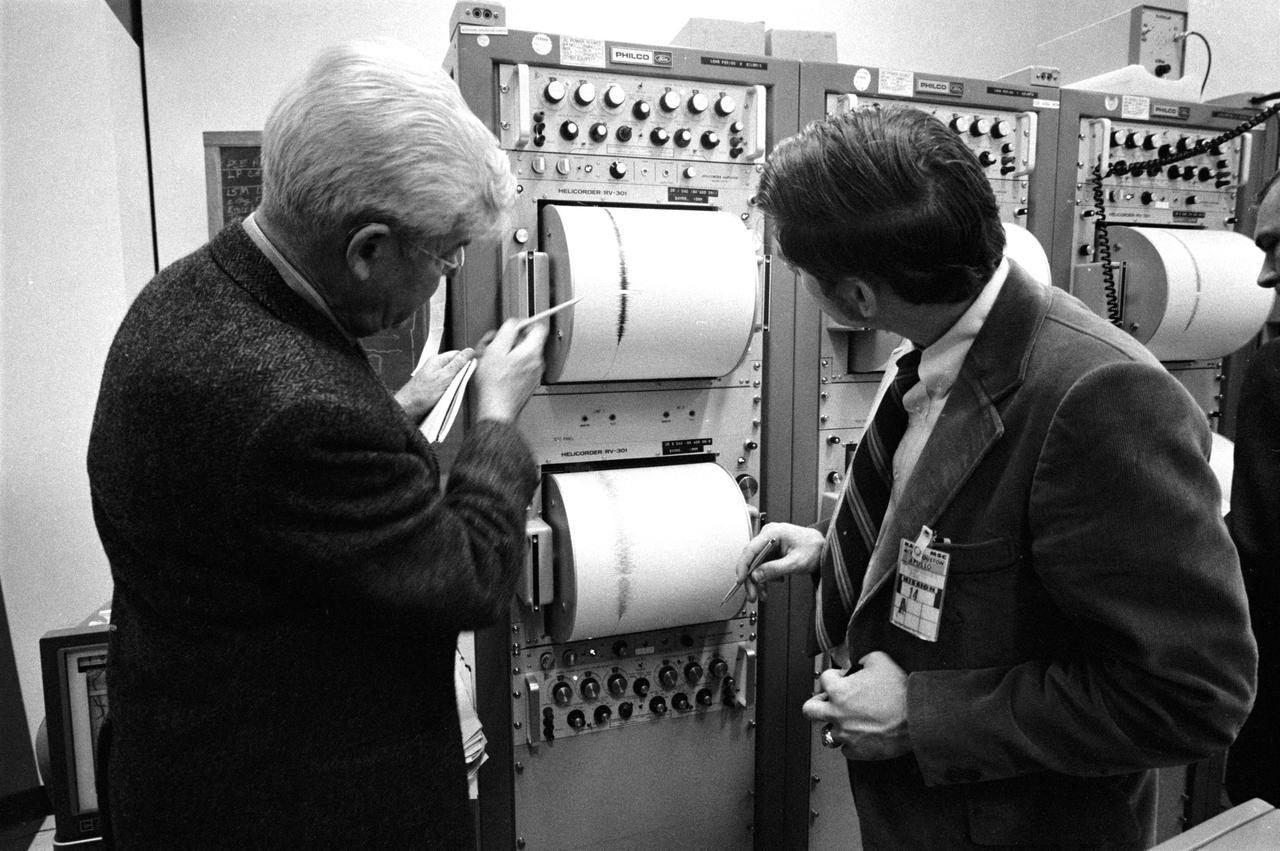
S71-17609 (4 Feb. 1971) --- These two individuals are examining a seismic reading in the Mission Control Center's ALSEP Room during the Apollo 14 S-IVB impact on the moon. Dr. Maurice Ewing (left) is the director of the Lamont-Doherty Geological Observatory at Columbia University. David Lammlein, a Columbia graduate student, is on the right. The Apollo 14 Saturn IVB stage impacted on the lunar surface at 1:40:54 a.m. (CST), Feb. 4, 1971, about 90 nautical miles south-southwest of the Apollo 12 passive seismometer. The energy release was comparable to 11 tons of TNT. Dr. Gary Latham of the Lamont-Doherty Geological Observatory is the principal investigator for the Passive Seismic Experiment, a component of the Apollo Lunar Surface Experiments Package.
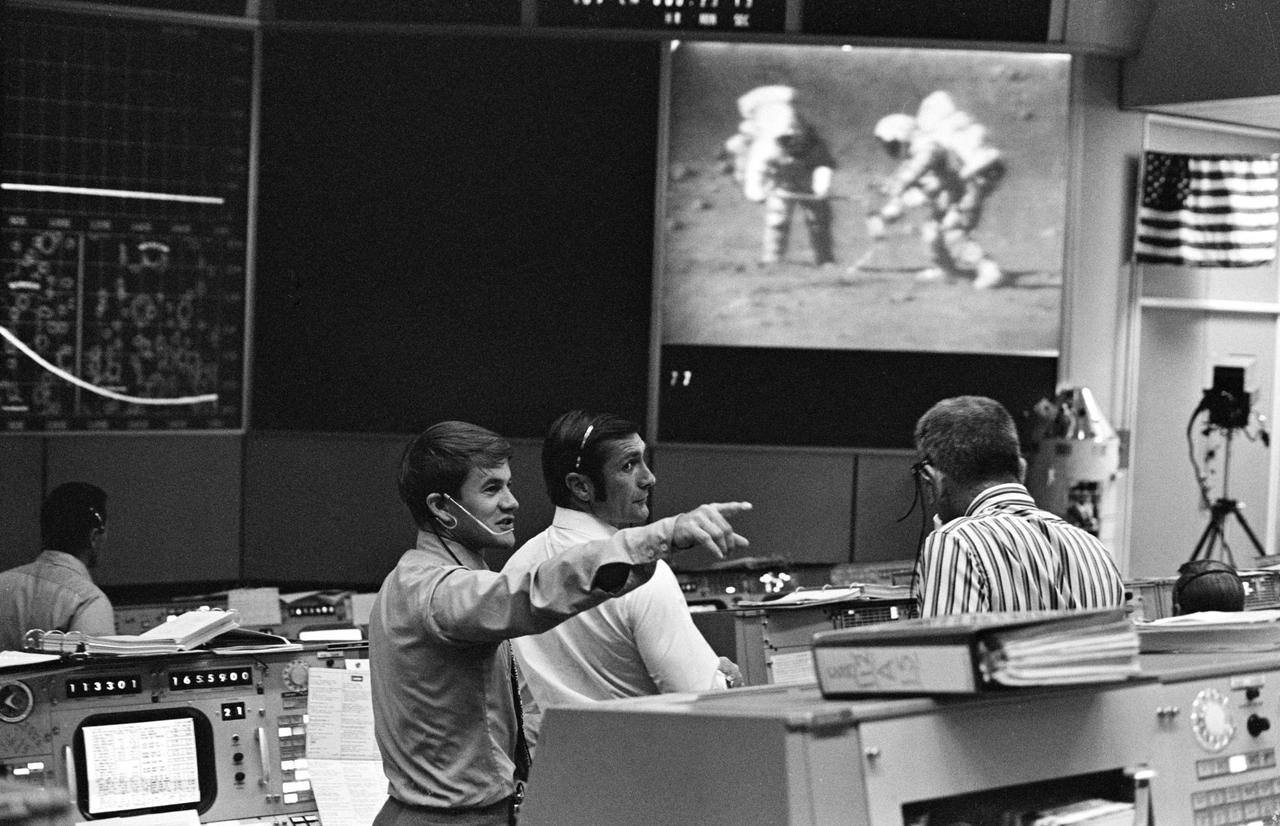
S71-41836 (2 Aug. 1971) --- Scientist-astronaut Joseph P. Allen, left, directs the attention of astronaut Richard F. Gordon Jr., to an occurrence out of view at right in the Mission Control Center's (MCC) Mission Operations Control Room (MOCR), while Dr. Donald K. (Deke) Slayton, on right with back to camera, views activity of Apollo 15 on a large screen at the front of the MOCR. Astronauts David R. Scott and James B. Irwin are seen on the screen performing tasks of the mission's third extravehicular activity (EVA), on Aug. 2, 1971. Dr. Slayton is director of Flight Crew Operations, NASA-MSC; Gordon is Apollo 15 backup commander; and Dr. Allen is an Apollo 15 spacecraft communicator.

S70-35368 (16 April 1970) --- Overall view showing some of the feverish activity in the Mission Operations Control Room (MOCR) of the Mission Control Center (MCC) during the final 24 hours of the problem-plagued Apollo 13 mission. Here, flight controllers and several NASA/MSC officials confer at the flight director's console. When this picture was made, the Apollo 13 lunar landing had already been canceled, and the Apollo 13 crewmembers were in trans-Earth trajectory attempting to bring their crippled spacecraft back home.
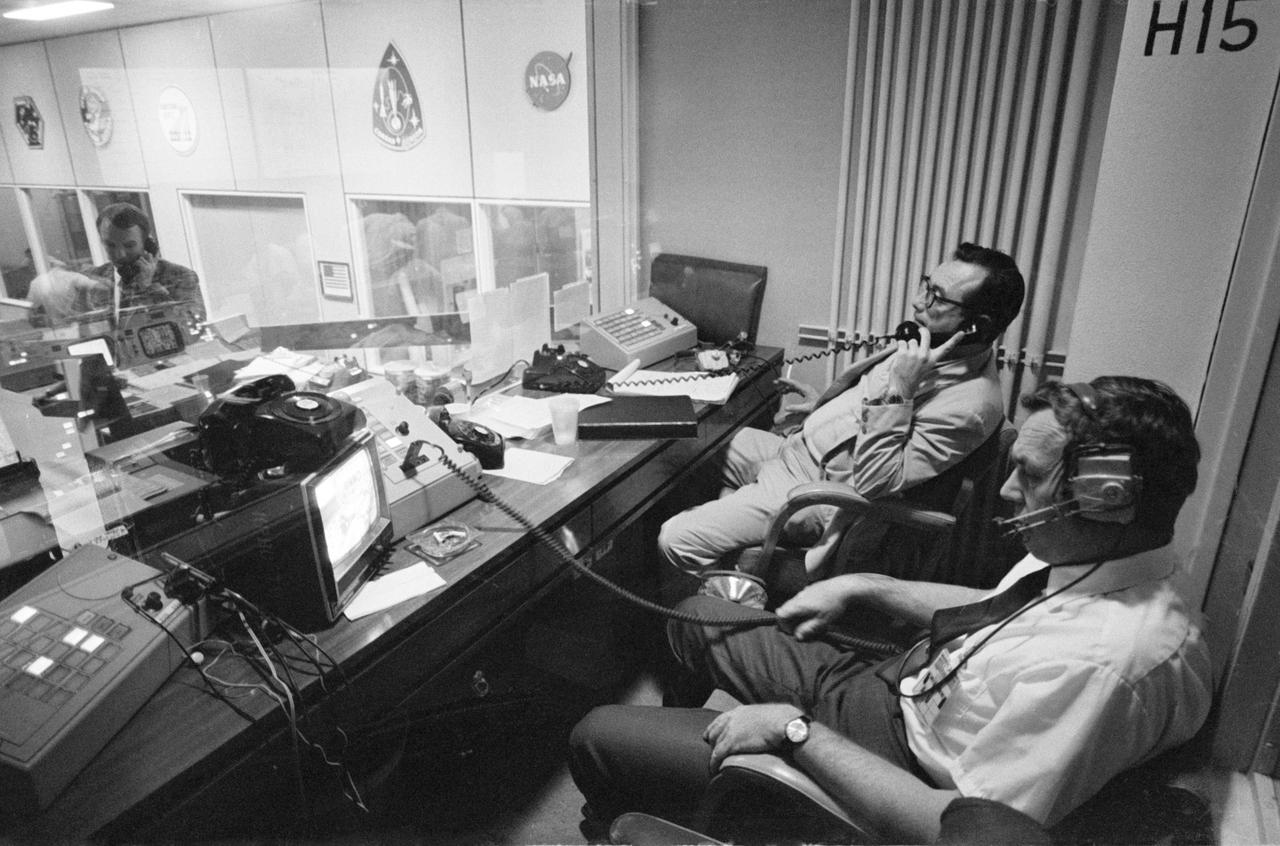
S70-35012 (15 April 1970) --- Two phases of busy activity during critical moments of the Apollo 13 mission are reflected in this view in the Mission Control Center, Building 30, Manned Spacecraft Center. In the foreground, Henry Simmons (left) of Newsweek magazine and John E. Riley, public information specialist, Public Affairs Office, MSC, man their positions in the Press Room. At extreme left of photo, Gerald D. Griffin, Shift 2 flight director, talks on telephone in Mission Operations Control Room. When this photograph was taken, the Apollo 13 lunar landing had been canceled, and the problem-plagued Apollo 13 crewmen were in trans-Earth trajectory attempting to bring their crippled spacecraft back home.
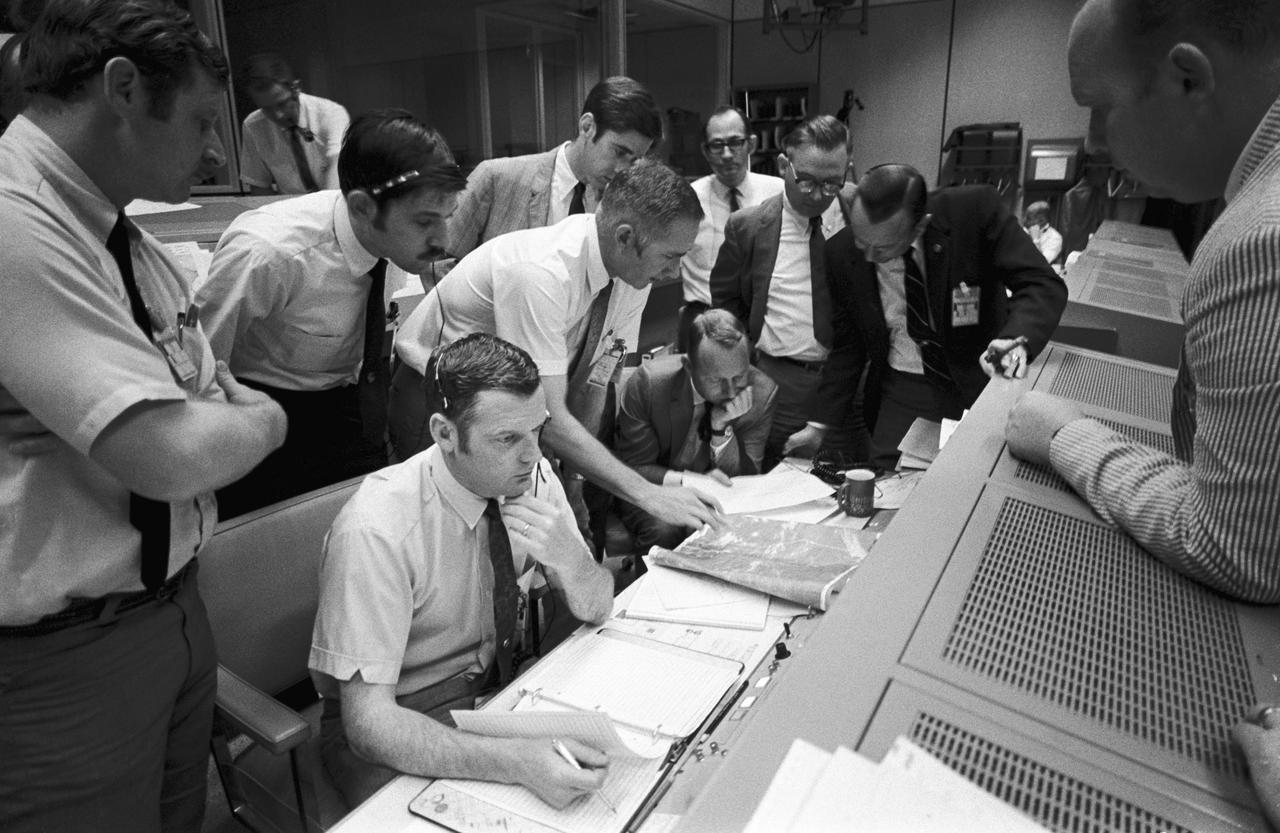
S70-35014 (15 April 1970) --- A group of flight controllers gathers around the console of Glenn S. Lunney (seated, nearest camera), Shift 4 flight director, in the Mission Operations Control Room (MOCR) of Mission Control Center (MCC), located in Building 30 at the Manned Spacecraft Center (MSC). Their attention is drawn to a weather map of the proposed landing site in the South Pacific Ocean. Among those looking on is Dr. Christopher C. Kraft, deputy director, MSC, standing in black suit, on right. When this photograph was taken, the Apollo 13 lunar landing mission had been canceled, and the problem-plagued Apollo 13 crew members were in trans-Earth trajectory attempting to bring their crippled spacecraft back home.
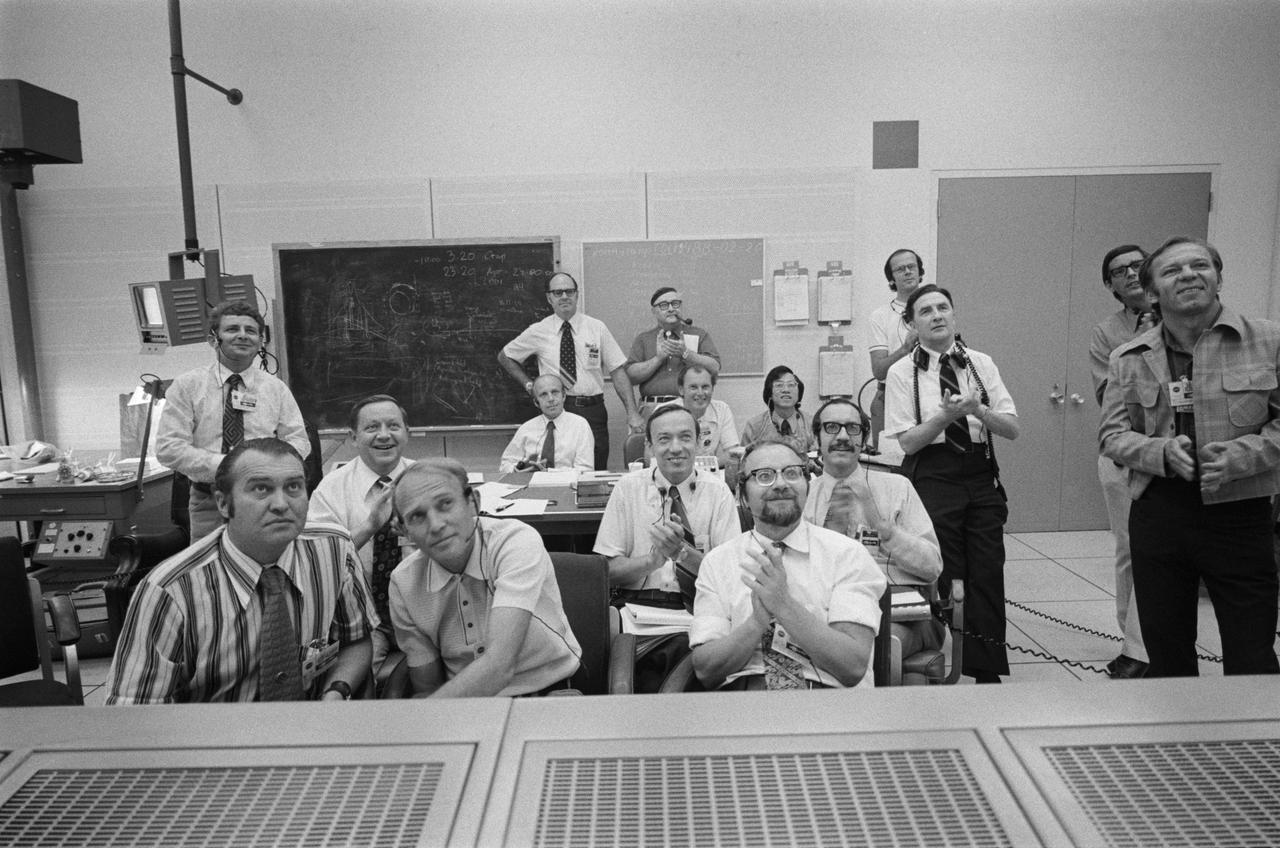
S75-28659 (21 July 1975) --- An overall view of the group of Soviet Union flight controllers who served at the Mission Control Center during the joint U.S.-USSR Apollo-Soyuz Test Project docking mission in Earth orbit. They are applauding the successful touchdown of the Soyuz spacecraft in Central Asia. The television monitor had just shown the land landing of the Soyuz descent vehicle.
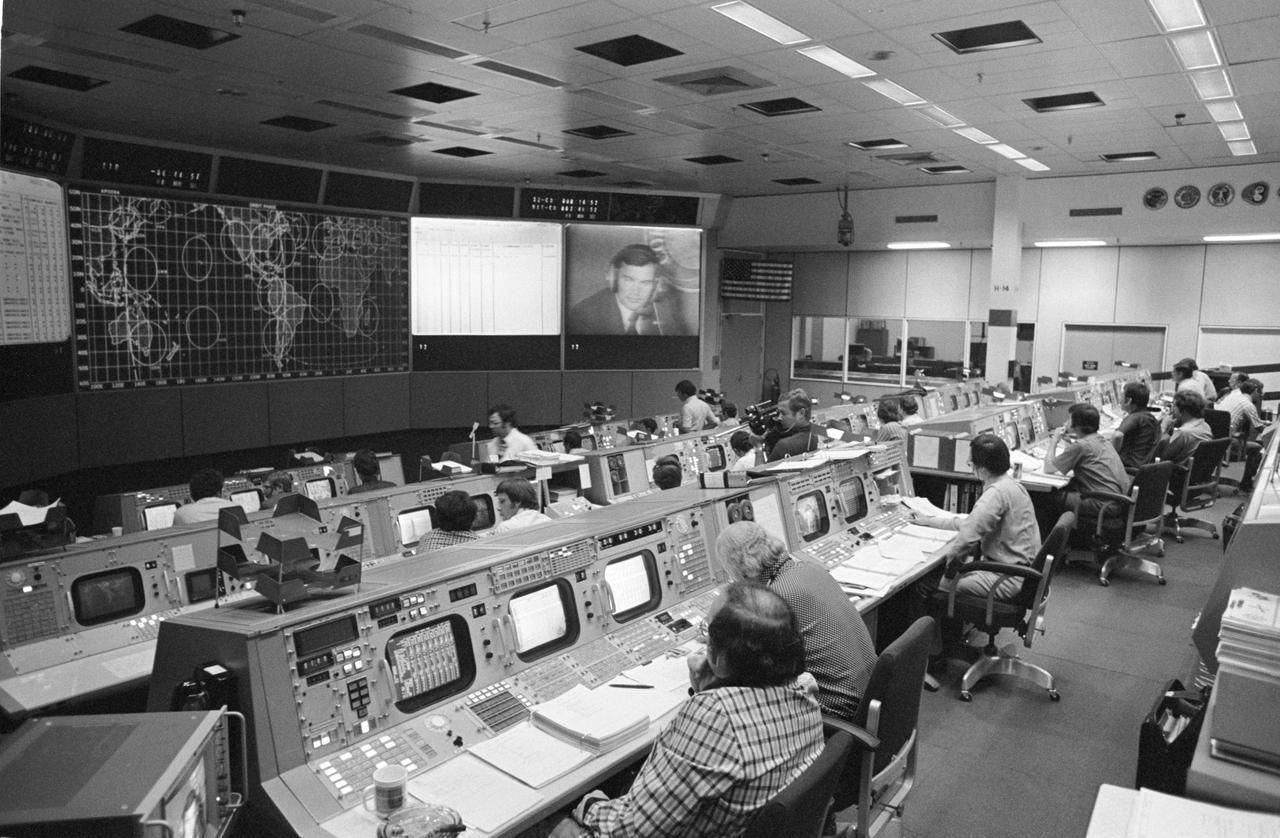
S75-28483 (15 July 1975) --- An overall view of the Mission Operations Control Room in the Mission Control Center on the first day of the Apollo-Soyuz Test Project docking mission in Earth orbit. The American ASTP flight controllers at NASA's Johnson Space Center were monitoring the progress of the Soviet ASTP launch when this photograph was taken. The television monitor shows cosmonaut Yuri V. Romanenko at his spacecraft communicator?s console in the ASTP mission control center in the Soviet Union. The American ASTP liftoff followed the Soviet ASTP launch by seven and one-half hours.
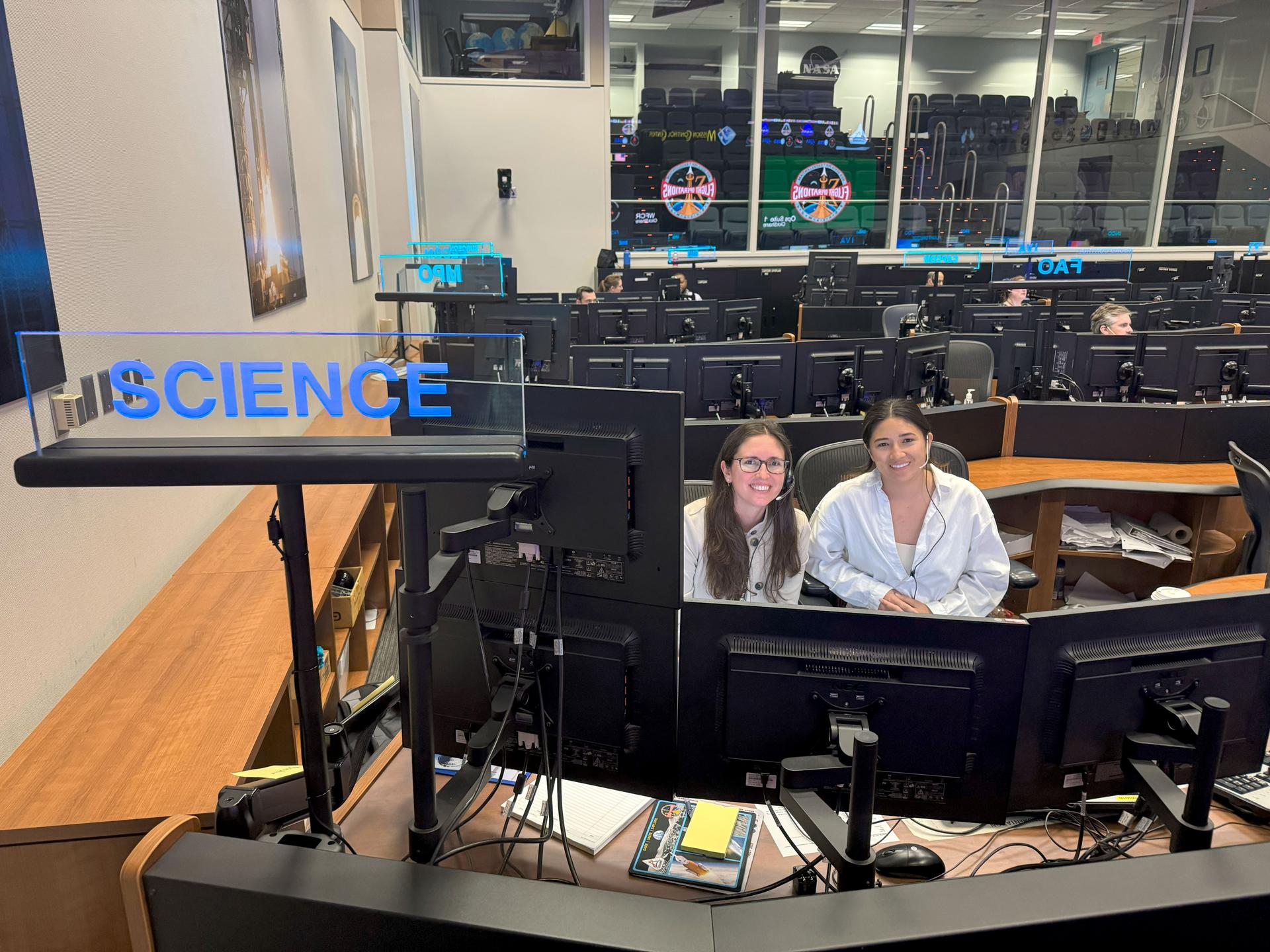
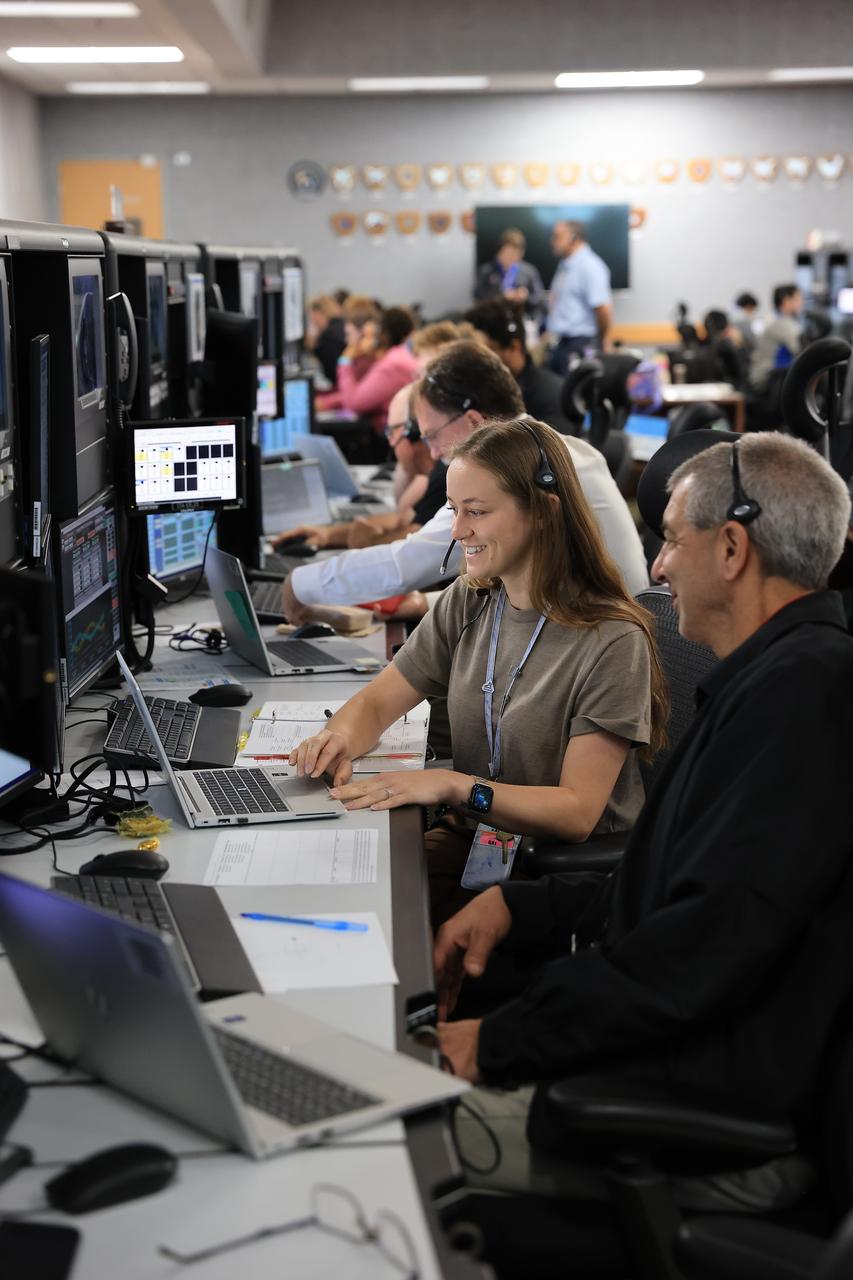
jsc2025e067512 --- Artemis II science officers Kelsey Young, left, and Angela Garcia sit at the SCIENCE console during a training simulation in the White Flight Control Room of the Mission Control Center at NASA's Johnson Space Center in Houston. Artemis II will test mission science operations and integration into flight control. Lessons learned during Artemis II science operations will pave the way for lunar science operations for future Artemis missions. A team of experts will staff the Science Evaluation Room (SER) at Johnson, providing lunar scientific expertise, data analysis, and strategic guidance in real-time to the science officer and the rest of Mission Control.

S81-30387 (14 April 1981) --- An overall view of the mission operations control room (MOCR) in the Johnson Space Center's Mission Control Center during the landing phase of the STS-1 mission. The Columbia can be seen on large monitor in upper right at Dryden Flight Research Center. Flight controller Ed Fendell, left foreground, mans the integrated communications systems engineer (INCO) console. Photo credit: NASA
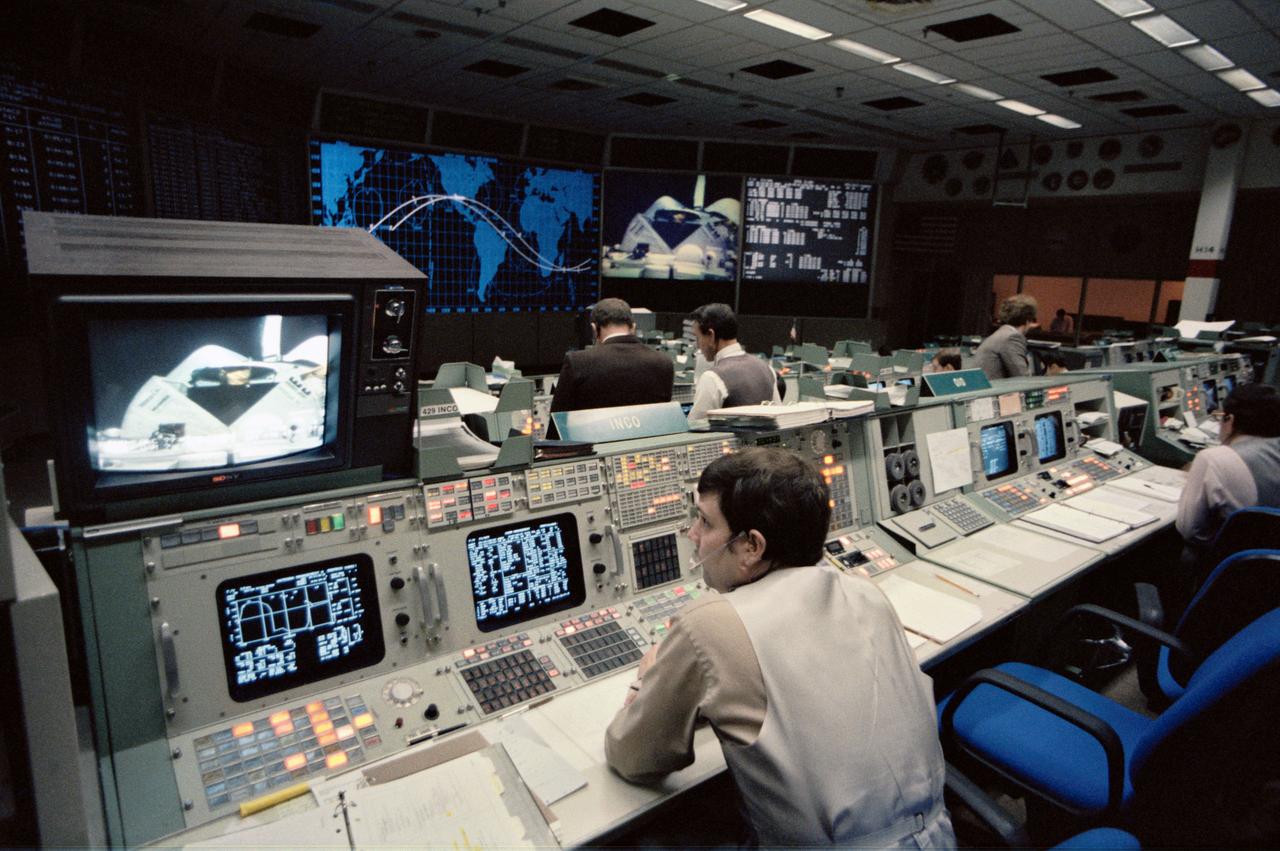
S84-26332 (3 Feb 1984) --- Robert E. Castle, integrated communications officer (INCO), plays an important role in the first television transmission from the Earth-orbiting Space Shuttle Challenger. Castle, at a console in the Johnson Space Center?s mission operations control room (MOCR) in the mission control center, is responsible for ground controlled television from the orbiter on his shift. Here, the Westar VI satellite is seen in the cargo bay just after opening of the payload bay doors.
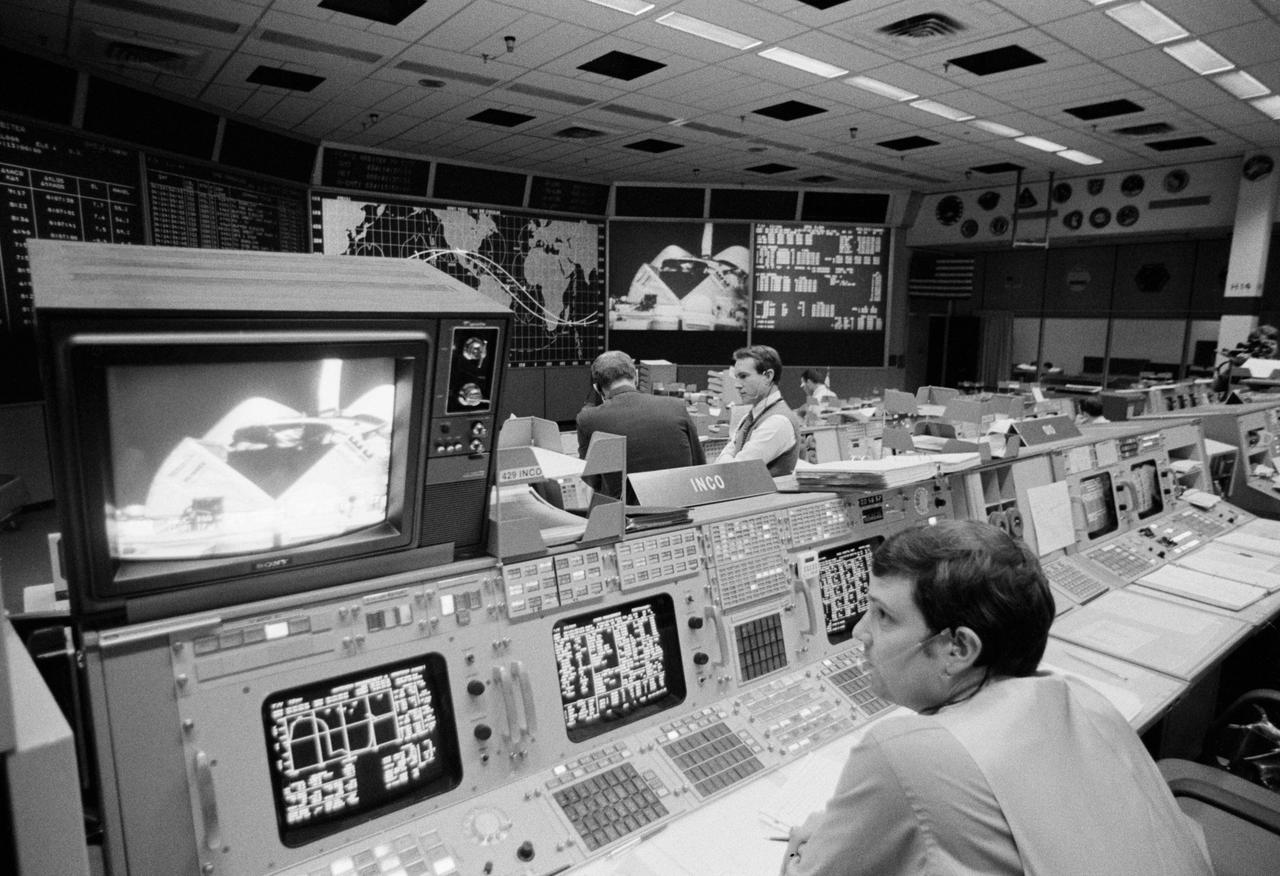
S84-26297 (3 Feb 1984) --- Robert E. Castle, Integrated Communications Officer (INCO), plays an important role in the first television transmission from the Earth-orbiting Space Shuttle Challenger. Castle, at a console in the Johnson Space Center's (JSC) Mission Operations Control Room (MOCR) in the Mission Control Center (MCC), is responsible for ground controlled television from the Orbiter on his shift. Here, the Westar VI satellite is seen in the cargo bay just after opening of the payload bay doors.
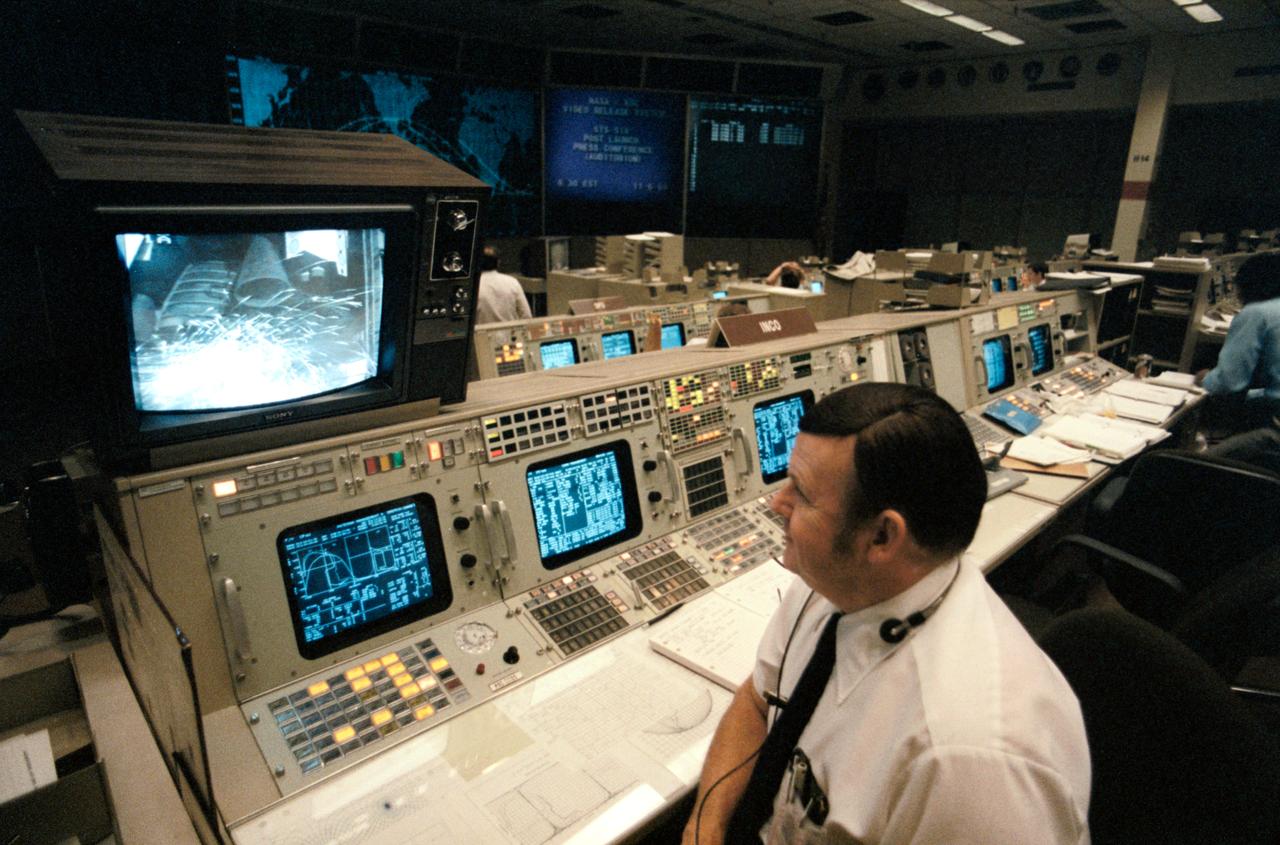
51A-90016 (8 Nov 1984) --- J. E. Conner, on duty at the integrated communcations officer console in the second floor Flight Control Room (FCR) of the Johnson Space Center's (JSC) Mission Control Center (MCC), watches engine ignition of Discovery on a nearby TV monitor. Moments later, the Houston FCR took over control of the scheduled eight day mission 51-A.
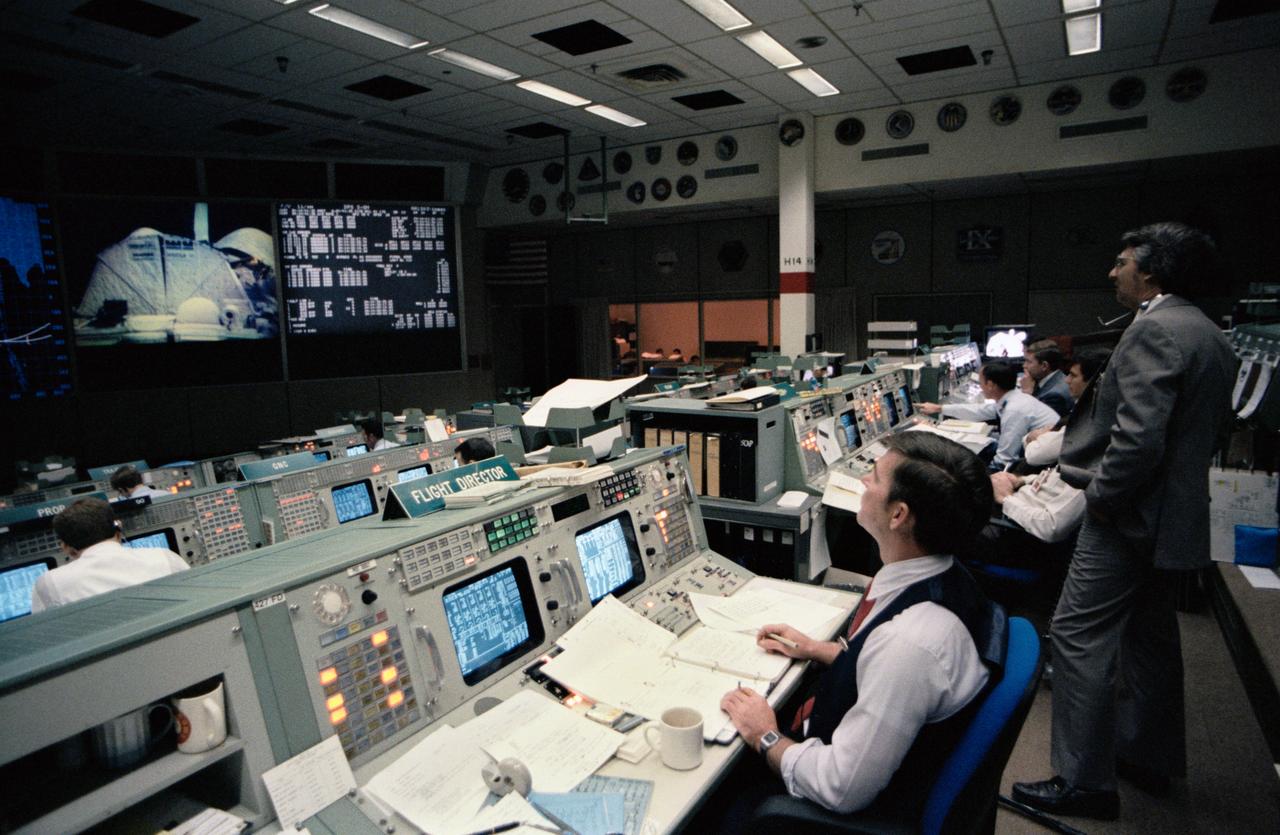
S84-26333 (6 Feb 1984) --- Robert E. Castle, integrated communications officer (INCO), is seated at the INCO console in the mission operations control room (MOCR) of Johnson Space Center's (JSC) mission control center (MCC). He is responsible for ground controlled television from the orbiter on his shift. On the screen at the front of the room the Westar VI satellite is seen in the cargo bay just after opening the payload bay doors.
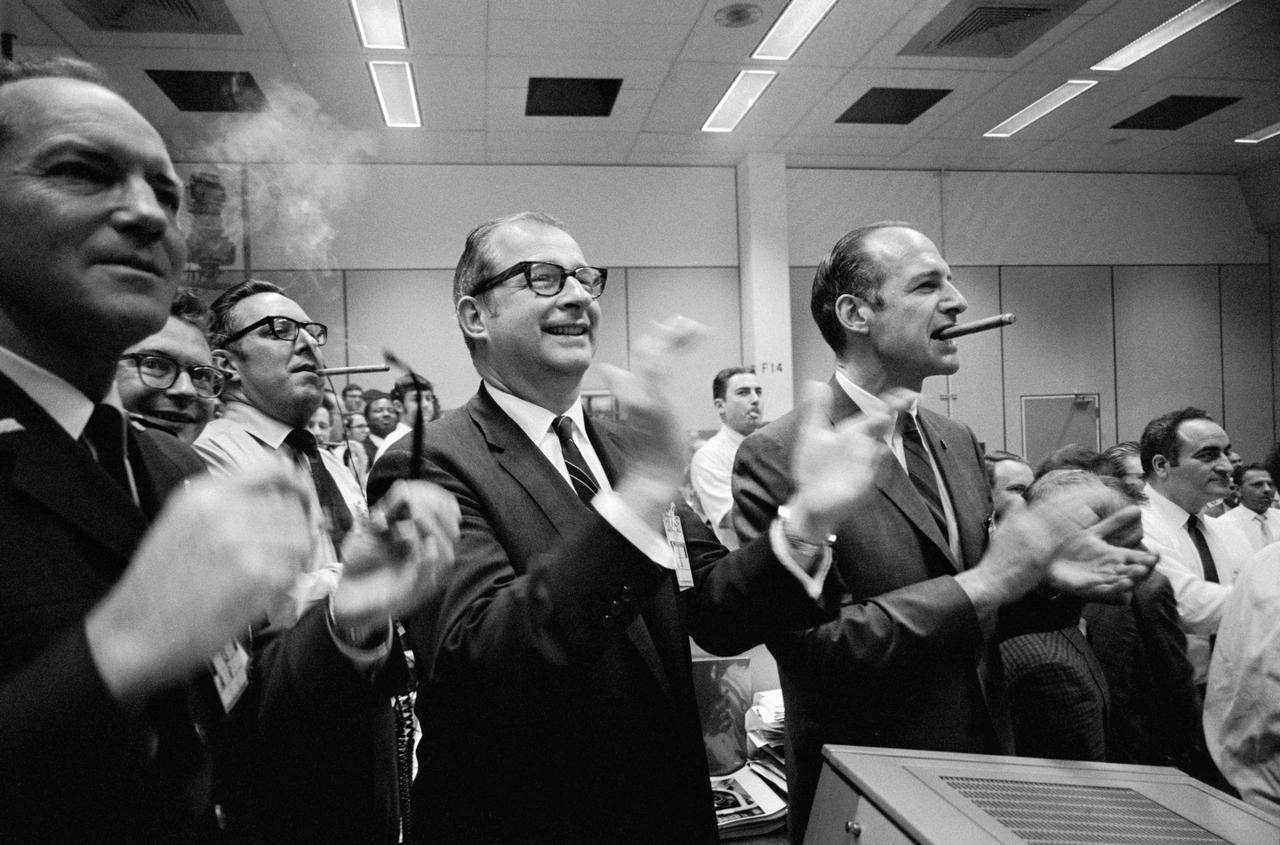
S70-35148 (17 April 1970) --- Staff members from NASA Headquarters (NASA HQ), Manned Spacecraft Center (MSC), and Dr. Thomas Paine (center of frame) applaud the successful splashdown of the Apollo 13 mission while Dr. George Low smokes a cigar (right), in the MSC Mission Control Center (MCC), located in Building 30. Apollo 13 crewmembers, astronauts James A. Lovell Jr., commander; John L. Swigert Jr., command module pilot; and Fred W. Haise Jr., lunar module pilot, splashed down at 12:07:44 p.m. (CST), April 17, 1970, in the south Pacific Ocean.
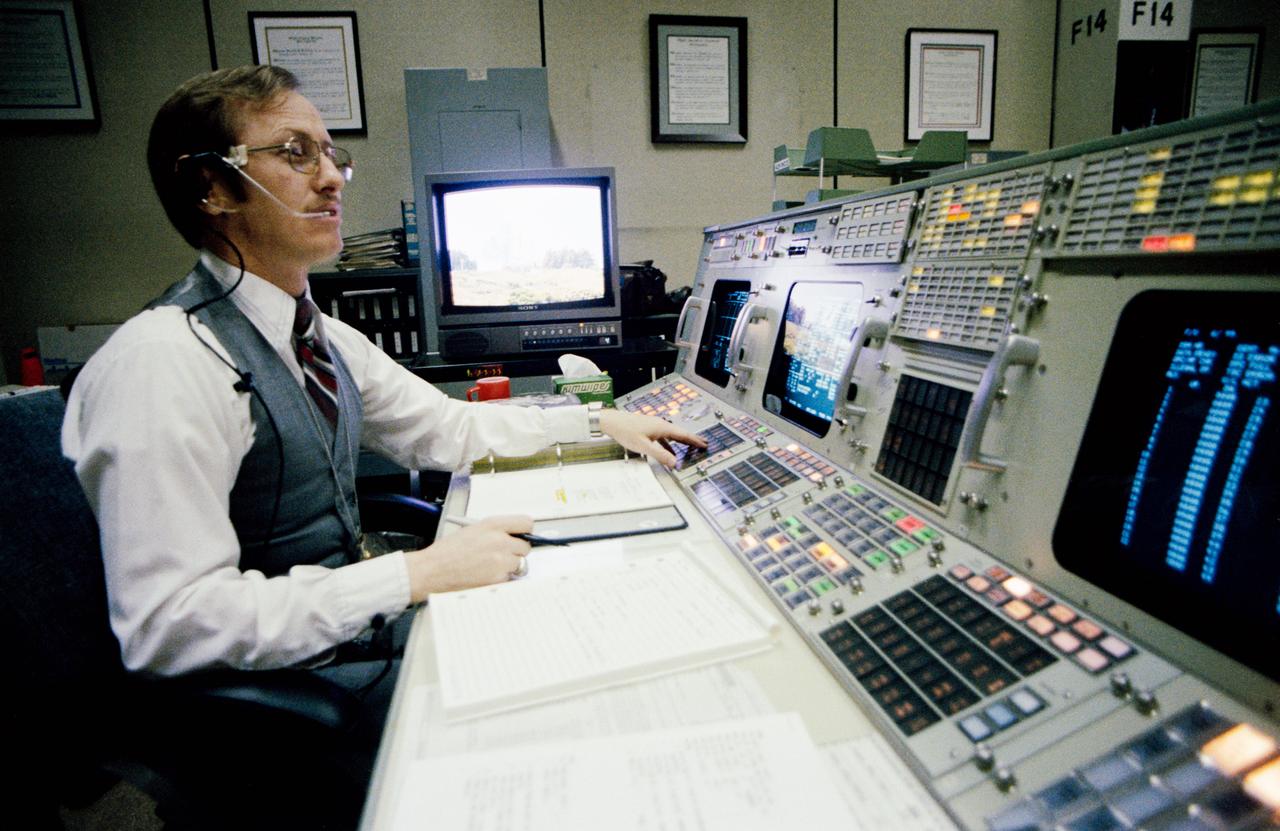
S83-30138 (6 April 1983) --- Granvil A. (Al) Pennington waits for the launch of STS-6?s Challenger as he begins his duties as ascent team integrated communication systems officer (INCO) at the INCO console in the mission operations control room (MOCR) of the Johnson Space Center?s mission control center. The second reusable spacecraft in history launched from the Kennedy Space Center?s Pad 39A at 1:30:00:88 p.m. (EST) today.
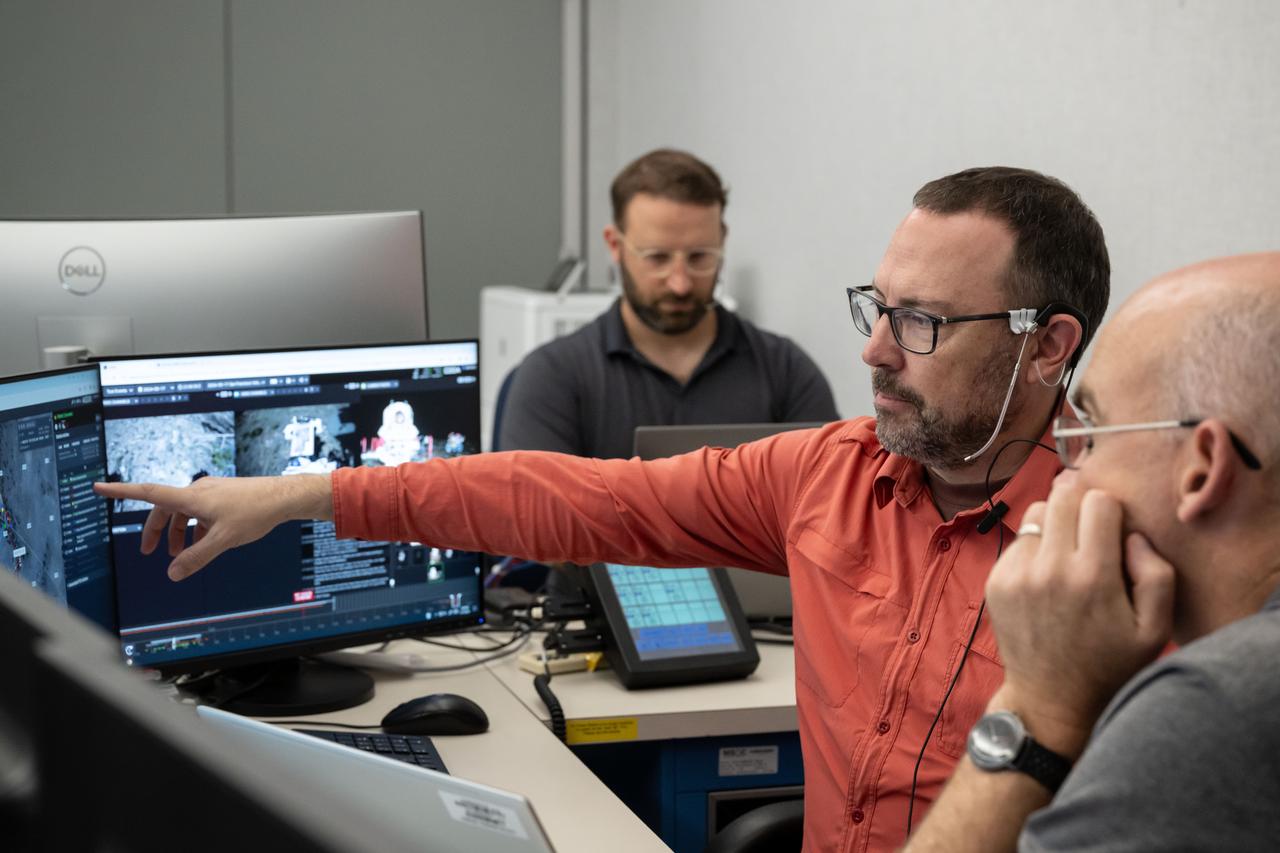
Ben Feist, software engineer on the Extravehicular Activity Mission System Software (EMSS) team, uses the suite of software he and other members of the Astromaterials Research and Exploration Science (ARES) division at NASA's Johnson Space Center in Houston developed to plan and monitor spacewalks. The JETT 5 field test was the first time this software was fully integrated into a simulated mission, supporting both science and mission control operations. JETT 5 was a week-long field test conducted in the lunar-like landscape of the San Francisco Volcanic Field near Flagstaff, Arizona, with a team of flight controllers and scientists at Johnson monitoring and guiding the activities. Credit: NASA/Helen Arase Vargas

S83-34270 (18 June 1983) --- Astronaut C. Gordon Fullerton supplies helpful consultation for Edward I. Fendell (seated) at the Integrated Communications System (INCO) console in the Mission Operations Control Room (MOCR) of the Johnson Space Center's (JSC) Mission Control Center (MCC). Fendell had control over the TV systems during a brief television transmission that featured the opening of the payload bay doors and the revealing of the cargo in the space shuttle Challenger's 18-meter (60-feet) long payload bay. The door-opening was the first of a series of many TV sessions planned for this six-day flight. Photo credit: NASA
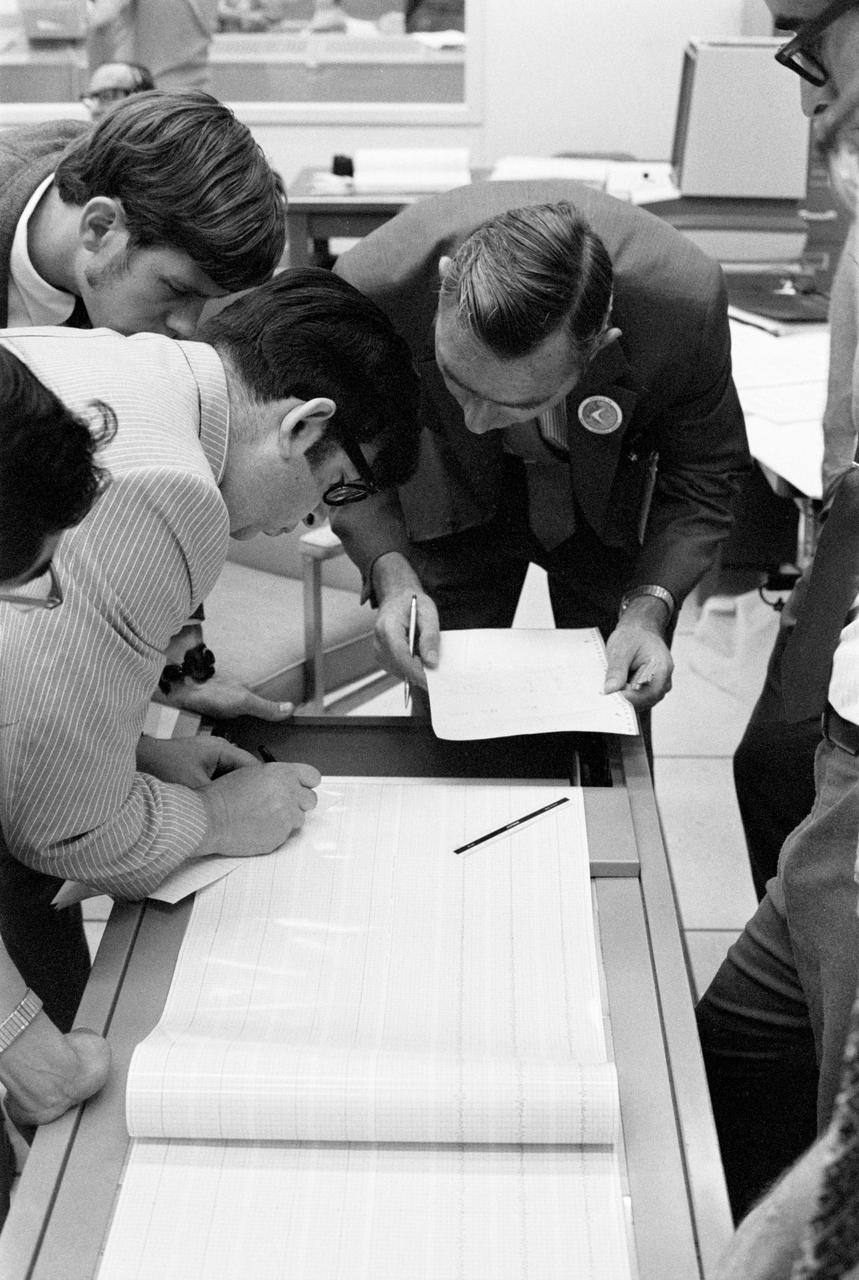
The seismometer reading from the impact made by the Apollo 15 Saturn S-IVB stage when it struck the lunar surface is studied by scientists in the Mission Control Center. Dr. Gary Latham (dark suit, wearing lapel button) of Columbia University is responsible for the design and experiment data analysis of the Passive Seismic Experiment of the Apollo Lunar Surface Experiment Package (ALSEP). The man on the left, writing, is Nafi Toksos of the Massachusetts Institute of Technology. Looking on at upper left is Dave Lamneline, also with Columbia.
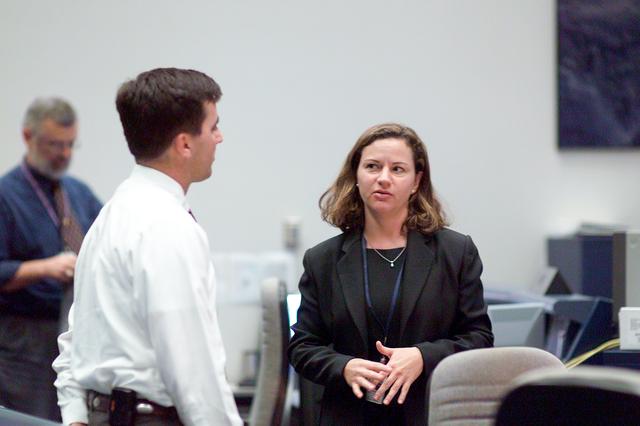
JSC2004-E-45159 (13 October 2004) --- Flight Director Paul Hill and Jennifer L. Hagin, lead Shuttle Data Processing Systems (DPS) officer, discuss the progress of the STS-114 fully-integrated simulations in the shuttle flight control room (WFCR) in Johnson Space Center’s (JSC) Mission Control Center (MCC). The seven member crew was in a JSC-based simulator during the sims. The dress rehearsal of Discovery's rendezvous and docking with the International Space Station (ISS) was the first flight-specific training for the Space Shuttle's return to flight.
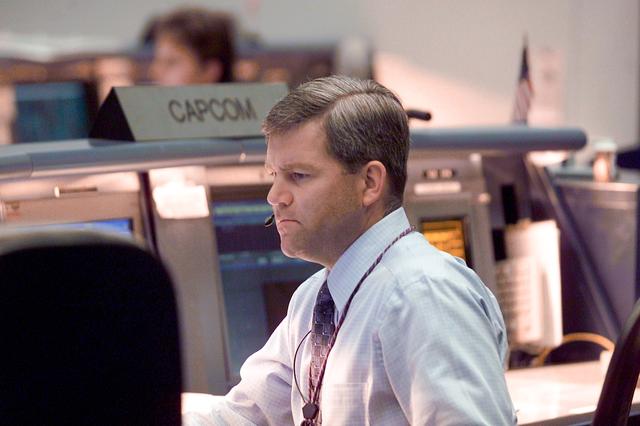
JSC2004-E-45138 (13 October 2004) --- Astronaut Stephen N. Frick monitors communications at the spacecraft communicator (CAPCOM) console in the Shuttle Flight Control Room (WFCR) in Johnson Space Center’s (JSC) Mission Control Center (MCC) with the STS-114 crewmembers during a fully-integrated simulation on October 13. The seven member crew was in a JSC-based simulator during the sims. The dress rehearsal of Discovery's rendezvous and docking with the International Space Station (ISS) was the first flight-specific training for the Space Shuttle's return to flight.
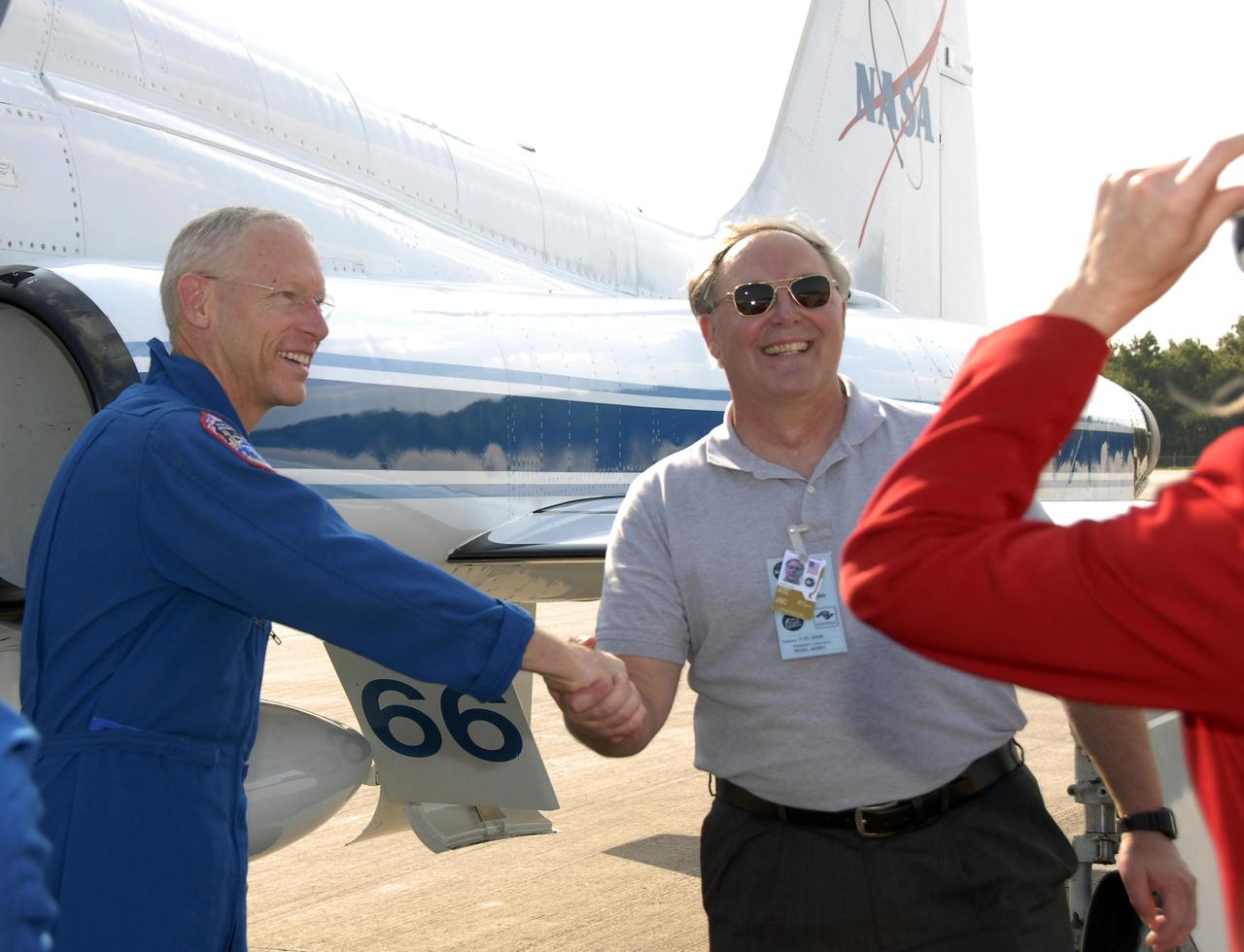
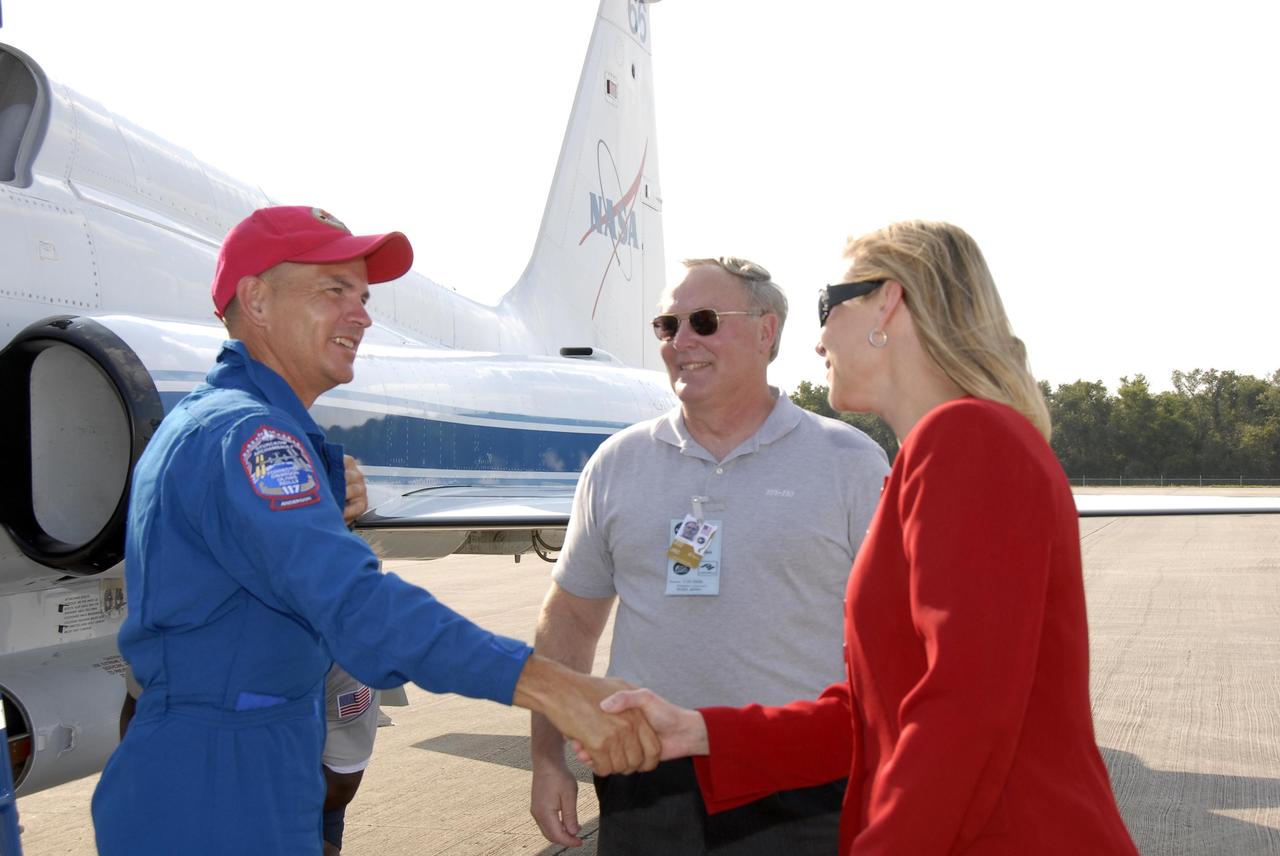
KENNEDY SPACE CENTER, FLA. -- The STS-117 crew members arrive at the KSC Shuttle Landing Facility aboard T-38 jet aircraft to prepare for launch on Space Shuttle Atlantis on June 8. Mission Specialist Patrick Forrester is welcomed by astronaut Jerry Ross, chief of the Vehicle Integration Test Office at Johnson Space Center. During the 11-day mission and three spacewalks, the crew will work with flight controllers at NASA's Johnson Space Center in Houston to install a 17-ton segment on the station's girder-like truss and deploy a set of solar arrays, S3/S4. The mission will increase the space station's power capability in preparation for the arrival of new science modules from the European and Japanese space agencies. Photo credit: NASA/Kim Shiflett
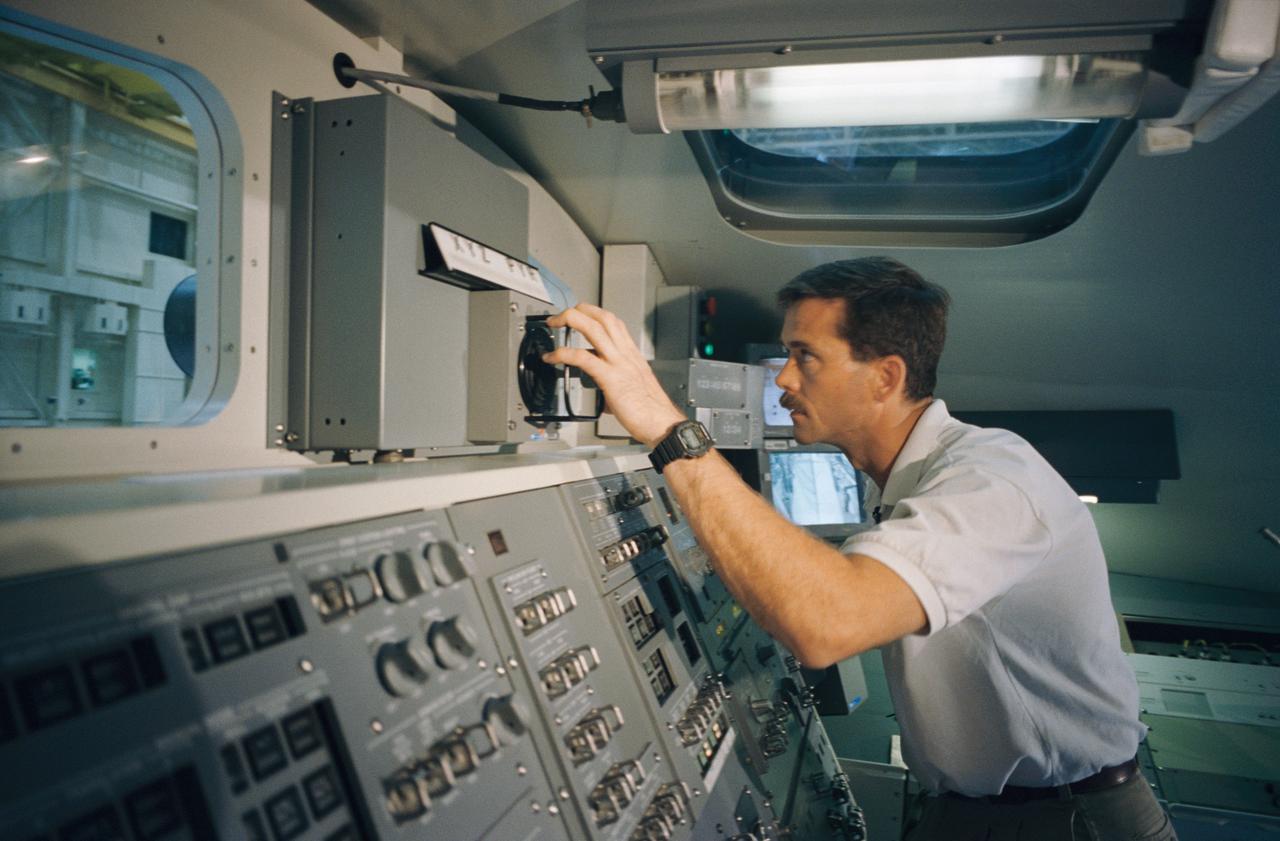
S95-12502 (8 June 1995) --- Astronaut Chris A. Hadfield, mission specialist representing the Canadian Space Agency (CSA), simulates controlling the Shuttle?s Canadian-built Remote Maneuvering System (RMS). Hadfield uses special training hardware known as the Manipulator Development Facility (MDF), located in the Systems Integration Facility at NASA?s Johnson Space Center (JSC).
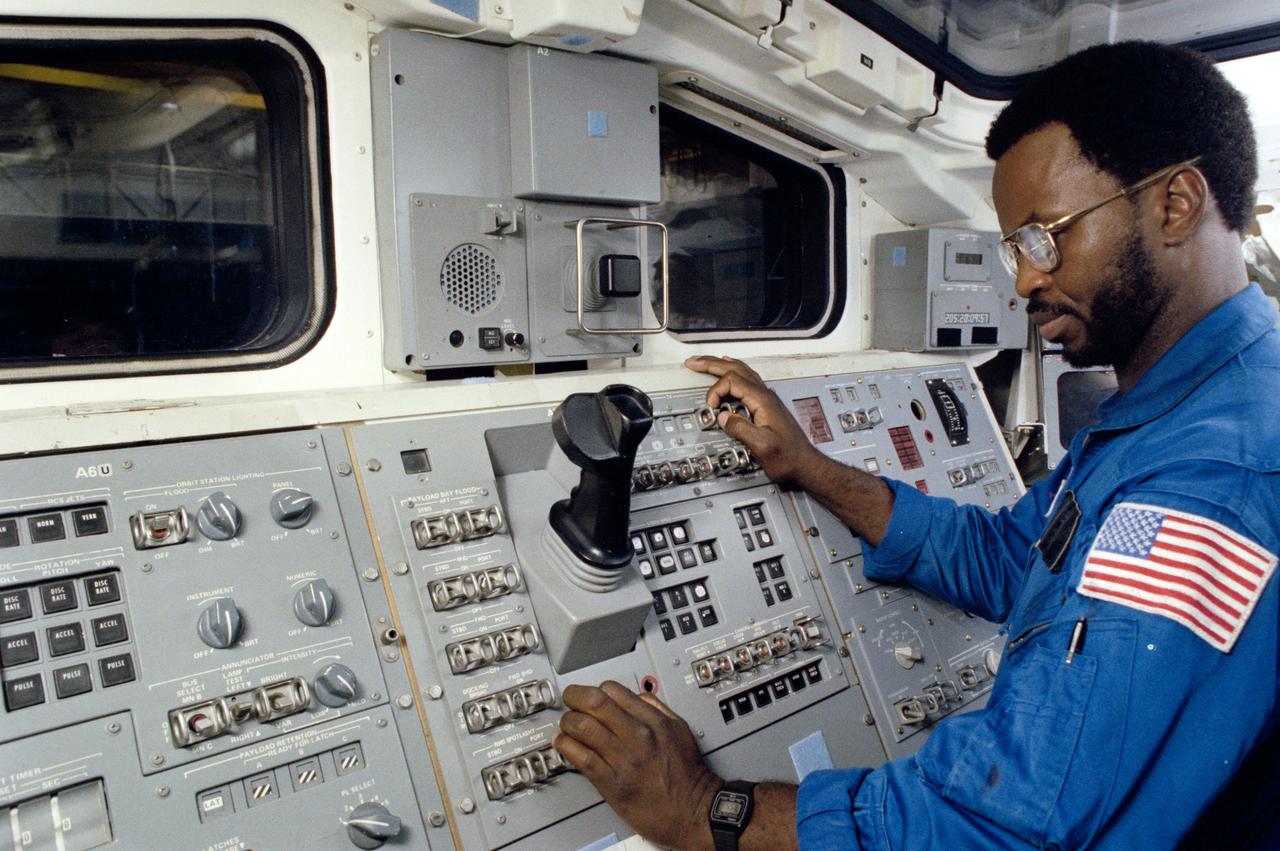
S83-33925 (14 June 1983) --- Astronaut Ronald E. McNair, one of NASA?s three 41-B mission specialists, participates in a training session in the Shuttle one-g trainer in the Johnson Space Center?s mockup and integrating laboratory. He stands at the aft flight deck, where controls for the remote manipulator system (RMS) arm are located. Dr. McNair and the remainder of the five-man astronaut crew are scheduled to lift into space aboard the Challenger on February 3, 1984.
KENNEDY SPACE CENTER, FLA. -- The STS-117 crew members arrive at the KSC Shuttle Landing Facility aboard T-38 jet aircraft to prepare for launch on Space Shuttle Atlantis on June 8. Commander Frederick Sturckow is greeted by Janet Petro, deputy director of Kennedy. Astronaut Jerry Ross, chief of the Vehicle Integration Test Office at Johnson Space Center, looks on. During the 11-day mission and three spacewalks, the crew will work with flight controllers at NASA's Johnson Space Center in Houston to install a 17-ton segment on the station's girder-like truss and deploy a set of solar arrays, S3/S4. The mission will increase the space station's power capability in preparation for the arrival of new science modules from the European and Japanese space agencies. Photo credit: NASA/Kim Shiflett
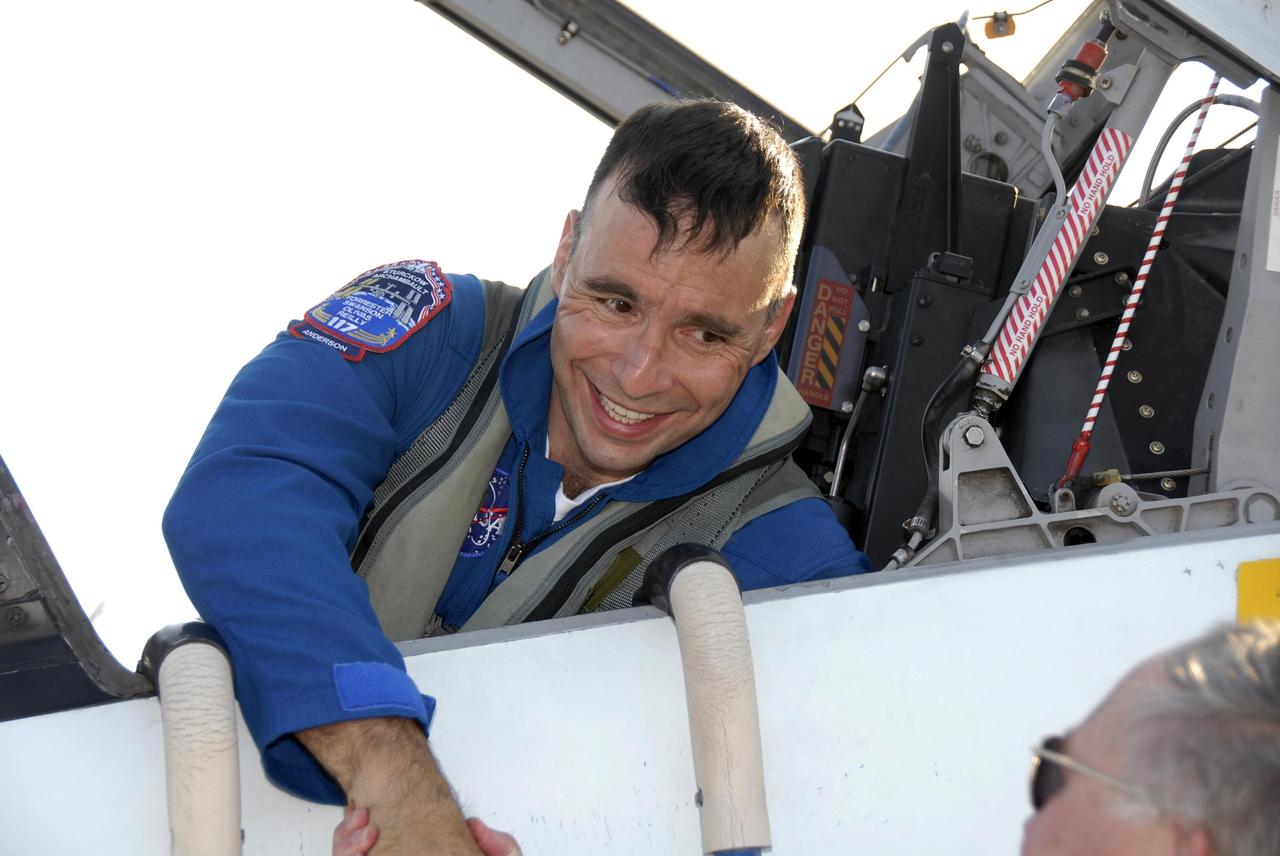
KENNEDY SPACE CENTER, FLA. -- The STS-117 crew members arrive at the KSC Shuttle Landing Facility aboard T-38 jet aircraft to prepare for launch on Space Shuttle Atlantis on June 8. Still in the plane, Pilot Lee Archambault is greeted by astronaut Jerry Ross, chief of the Vehicle Integration Test Office at Johnson Space Center. During the 11-day mission and three spacewalks, the crew will work with flight controllers at NASA's Johnson Space Center in Houston to install a 17-ton segment on the station's girder-like truss and deploy a set of solar arrays, S3/S4. The mission will increase the space station's power capability in preparation for the arrival of new science modules from the European and Japanese space agencies. Photo credit: NASA/Kim Shiflett

From left, Richard Jones, CCP (Commercial Crew Program) deputy program manager at NASA’s Johnson Space Center in Houston; Steve Stich, program manager for CCP; Dana Hutcherson, CCP deputy program manager at NASA’s Kennedy Space Center in Florida; and Diana Oglesby, director, Strategic Integration and Management Division, Space Operations Mission Directorate, pose with the agency’s SpaceX Crew-9 mission flag near the countdown clock at the NASA News Center at the Kennedy on Tuesday, Sept. 24, 2024. Oglesby previously served as manager of CCP’s Program Control and Integration Office at Kennedy. The Crew-9 mission will send NASA astronaut Nick Hague and Roscosmos cosmonaut Aleksandr Gorbunov to the International Space Station aboard SpaceX’s Dragon spacecraft and Falcon 9 rocket.
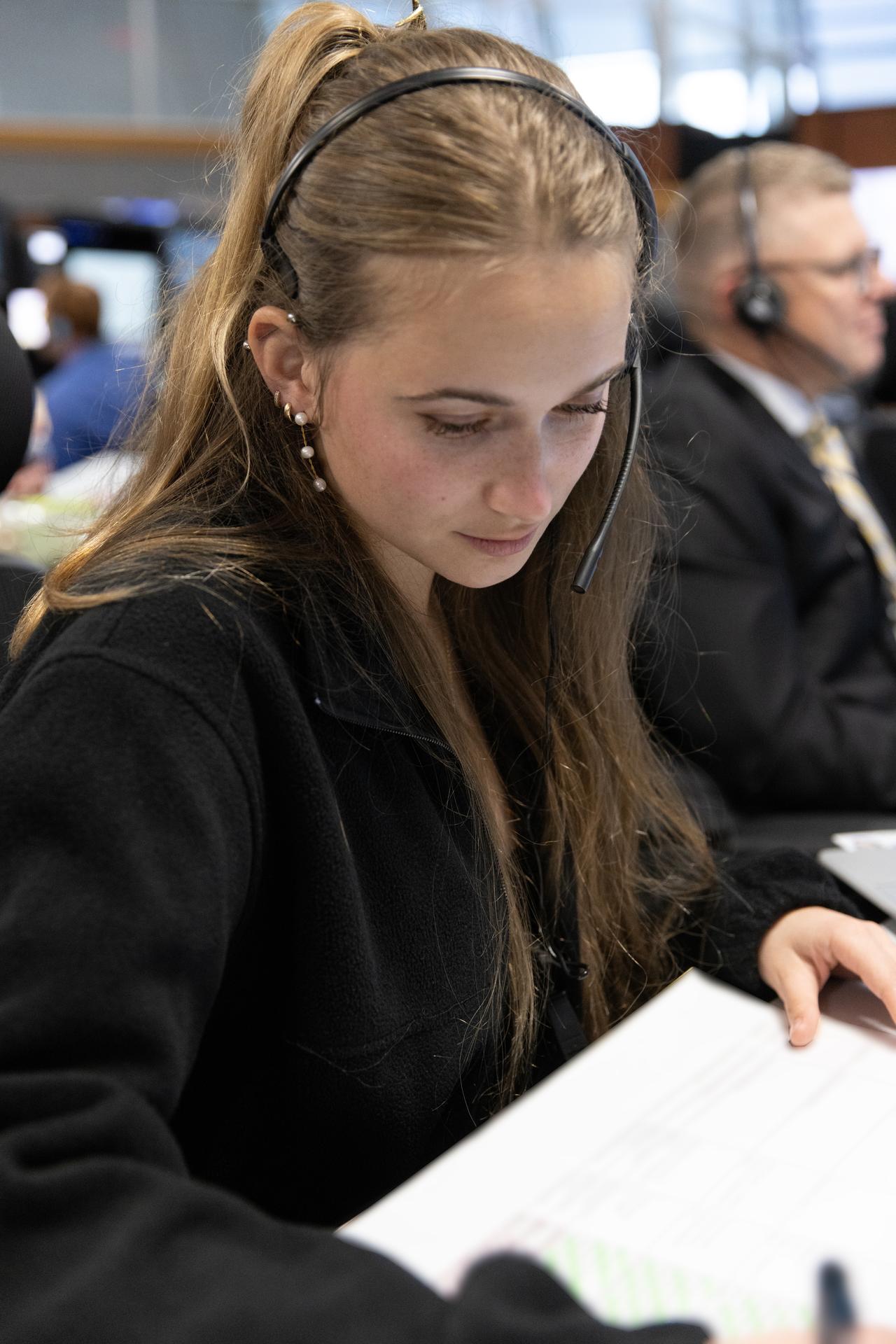
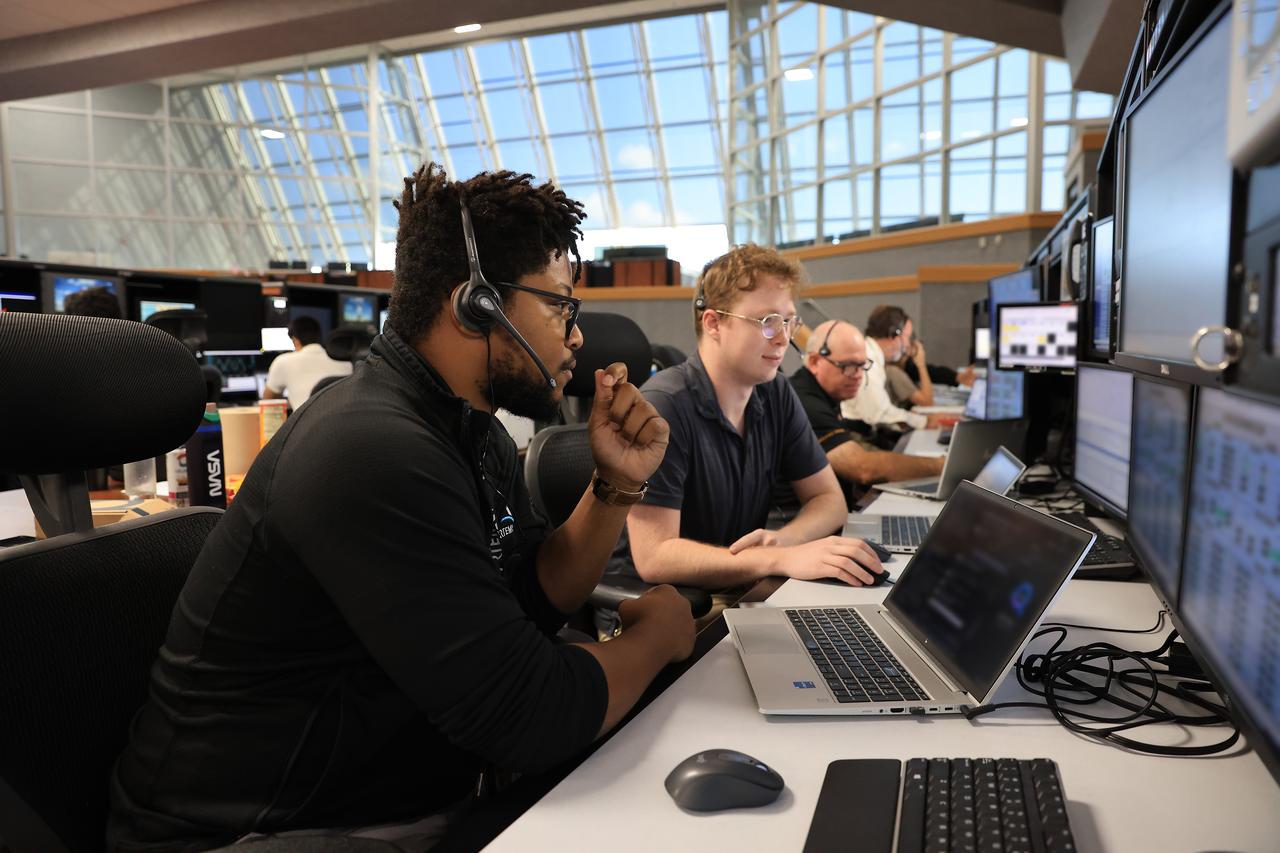
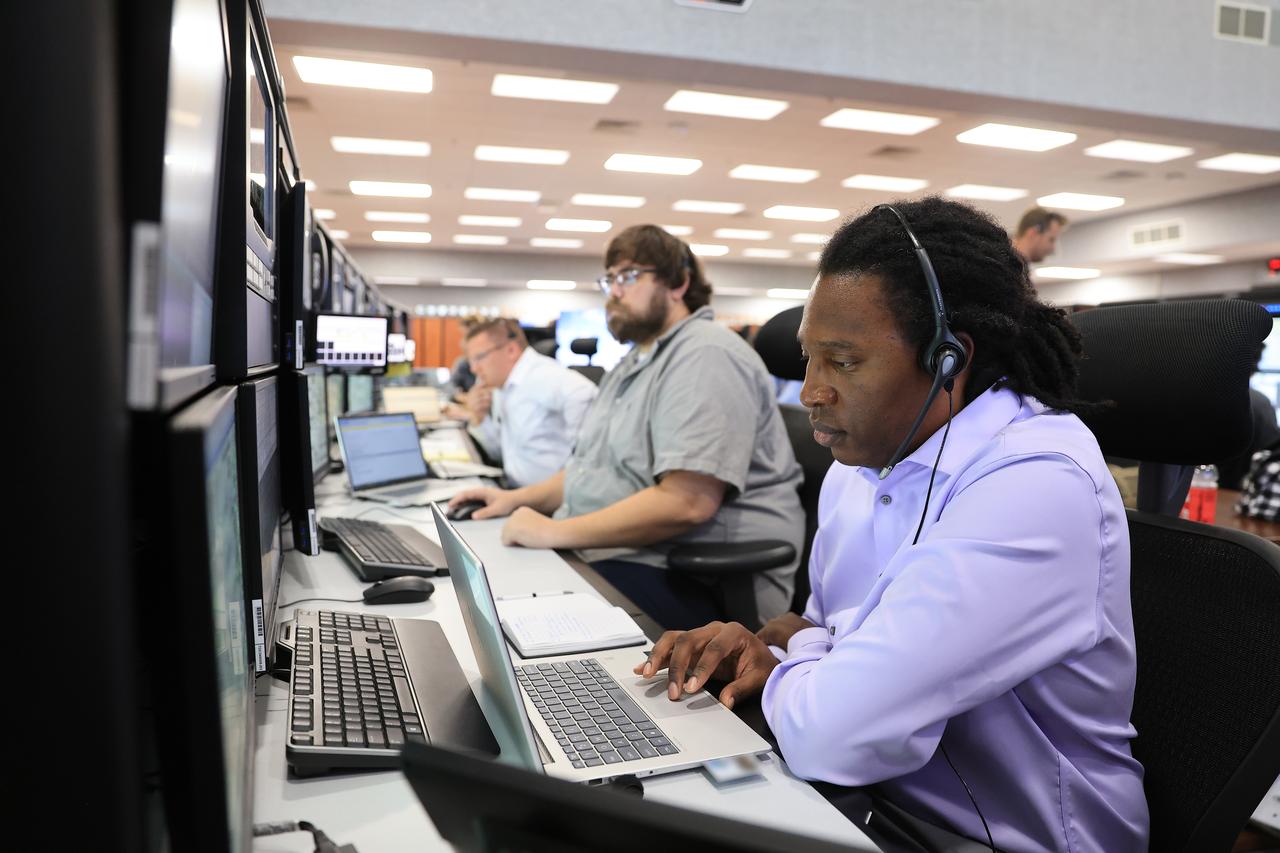
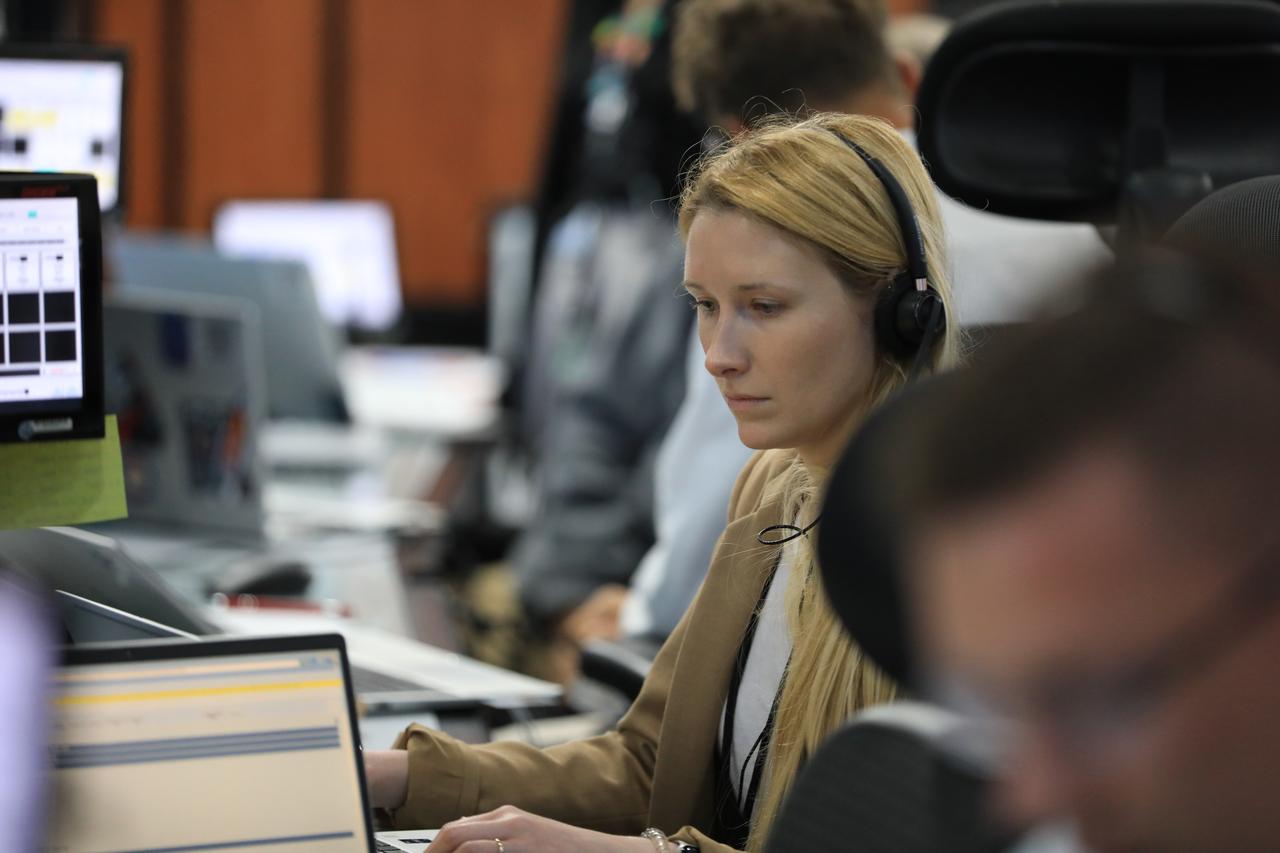
Artemis launch team members participate in an integrated launch countdown simulation for Artemis II inside Firing Room 1 of the Launch Control Center on Wednesday, Dec. 10, 2025. The training exercise involved engineers from Kennedy, Marshall Space Flight Center in Huntsville, Alabama, and Johnson Space Center in Houston coming together to rehearse all aspects of the launch countdown, from cryogenic loading – filling tanks in the SLS (Space Launch System) rocket’s core stage with liquid hydrogen and liquid oxygen – to liftoff. For Artemis II, four astronauts will venture around the Moon, the first crewed mission on NASA’s path to establishing a long-term presence for science and exploration through Artemis.
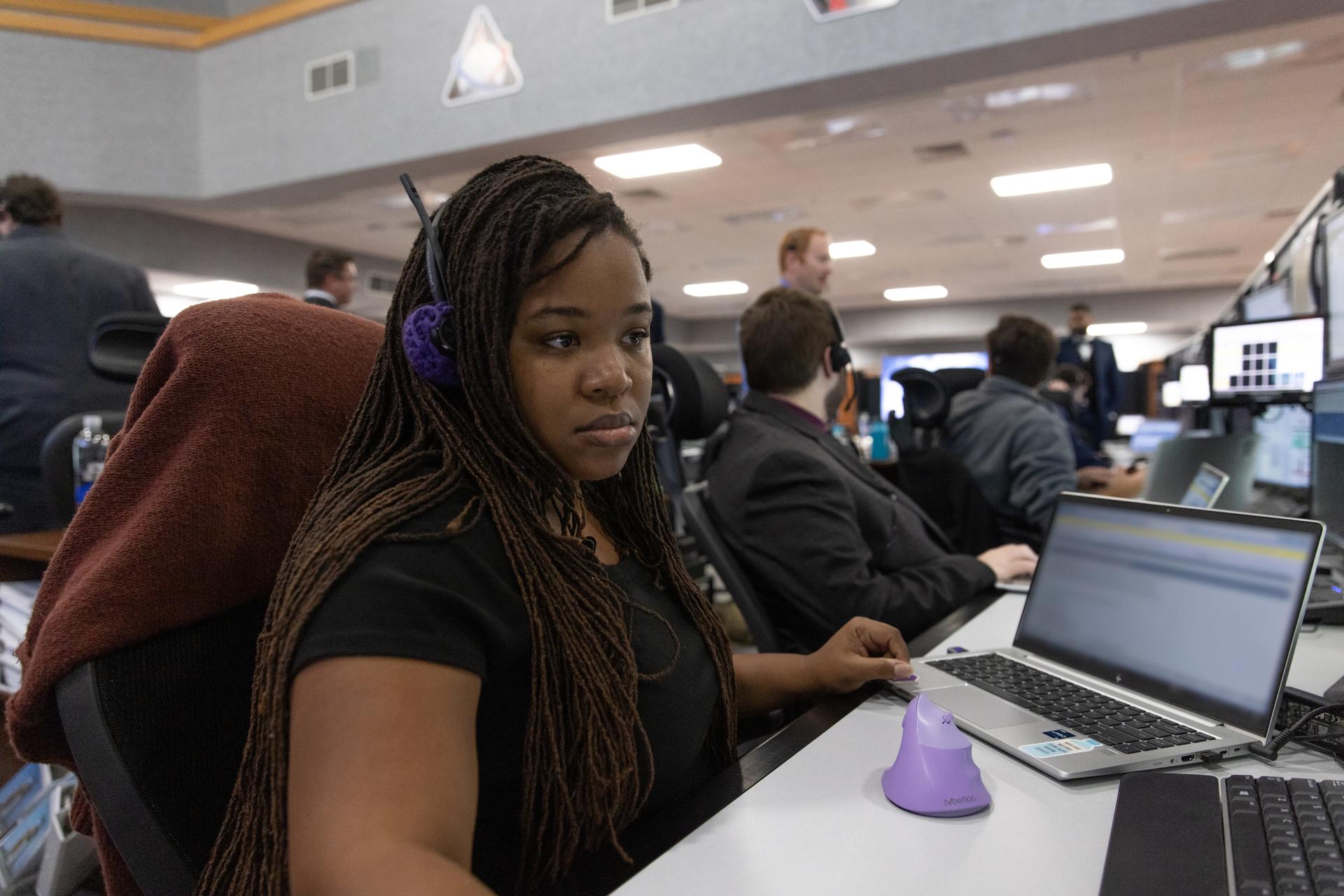
Artemis launch team members participate in an integrated launch countdown simulation for Artemis II inside Firing Room 1 of the Launch Control Center on Wednesday, Dec. 10, 2025. The training exercise involved engineers from Kennedy, Marshall Space Flight Center in Huntsville, Alabama, and Johnson Space Center in Houston coming together to rehearse all aspects of the launch countdown, from cryogenic loading – filling tanks in the SLS (Space Launch System) rocket’s core stage with liquid hydrogen and liquid oxygen – to liftoff. For Artemis II, four astronauts will venture around the Moon, the first crewed mission on NASA’s path to establishing a long-term presence for science and exploration through Artemis.
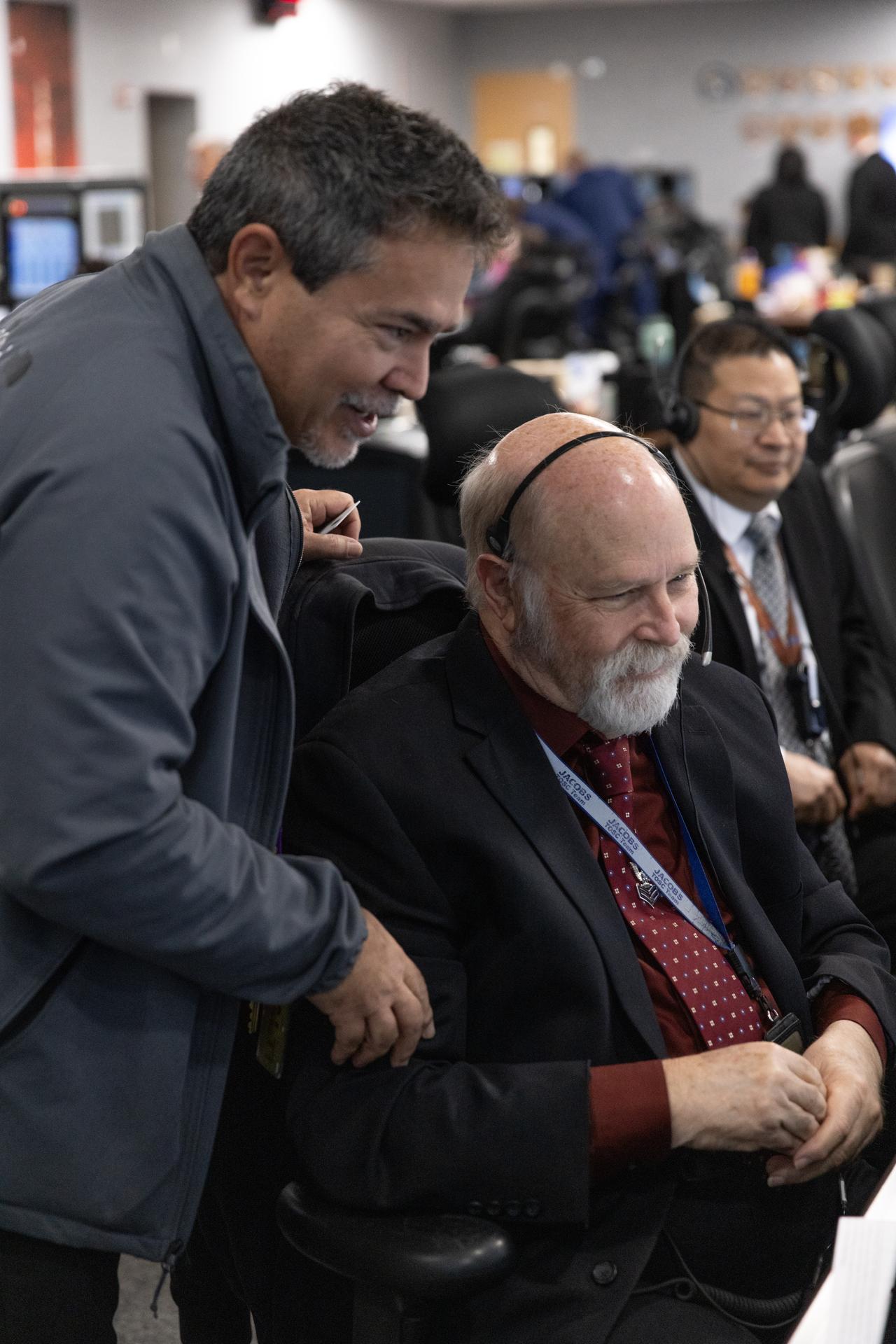
Artemis launch team members participate in an integrated launch countdown simulation for Artemis II inside Firing Room 1 of the Launch Control Center on Wednesday, Dec. 10, 2025. The training exercise involved engineers from Kennedy, Marshall Space Flight Center in Huntsville, Alabama, and Johnson Space Center in Houston coming together to rehearse all aspects of the launch countdown, from cryogenic loading – filling tanks in the SLS (Space Launch System) rocket’s core stage with liquid hydrogen and liquid oxygen – to liftoff. For Artemis II, four astronauts will venture around the Moon, the first crewed mission on NASA’s path to establishing a long-term presence for science and exploration through Artemis.
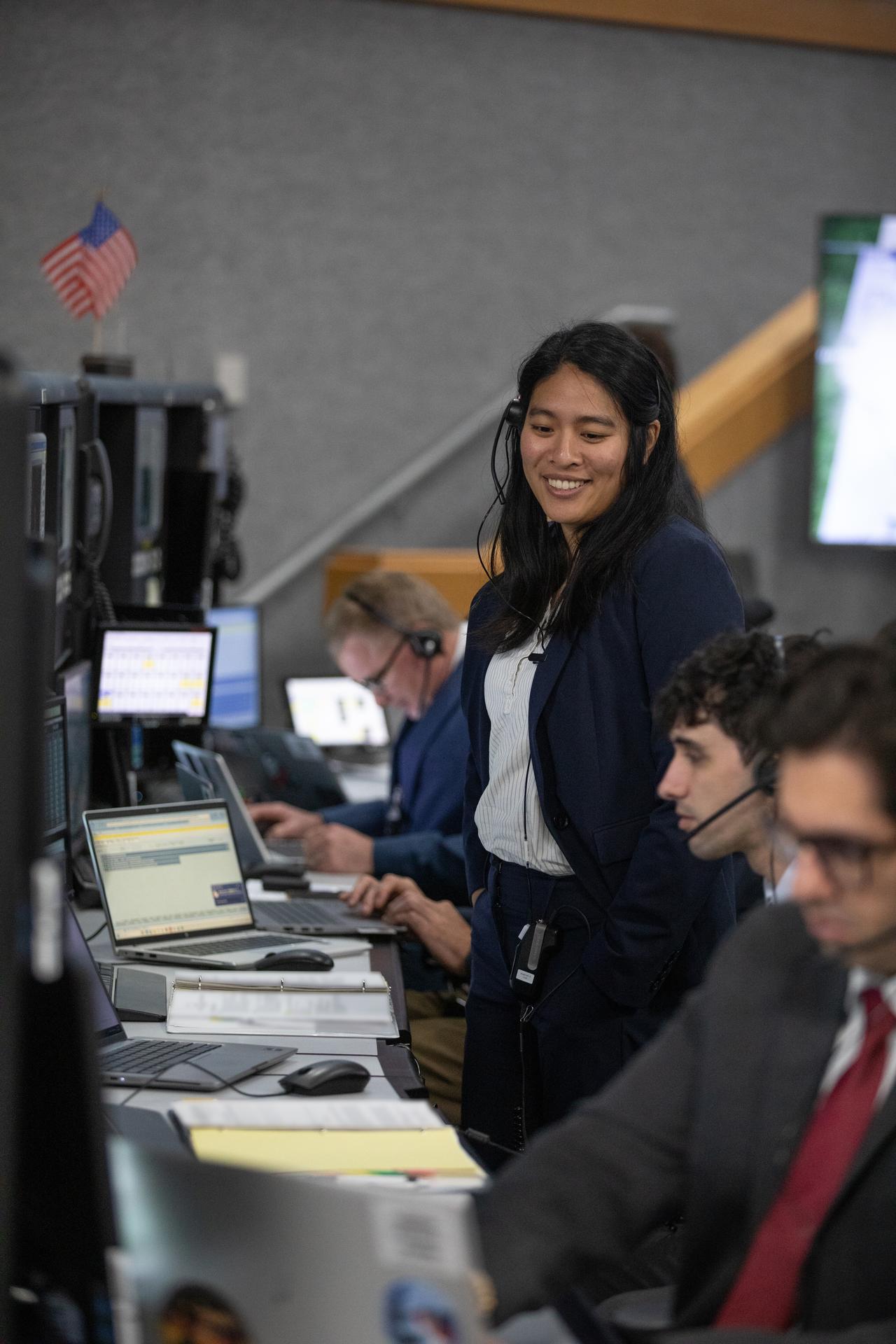
Artemis launch team members participate in an integrated launch countdown simulation for Artemis II inside Firing Room 1 of the Launch Control Center on Wednesday, Dec. 10, 2025. The training exercise involved engineers from Kennedy, Marshall Space Flight Center in Huntsville, Alabama, and Johnson Space Center in Houston coming together to rehearse all aspects of the launch countdown, from cryogenic loading – filling tanks in the SLS (Space Launch System) rocket’s core stage with liquid hydrogen and liquid oxygen – to liftoff. For Artemis II, four astronauts will venture around the Moon, the first crewed mission on NASA’s path to establishing a long-term presence for science and exploration through Artemis.
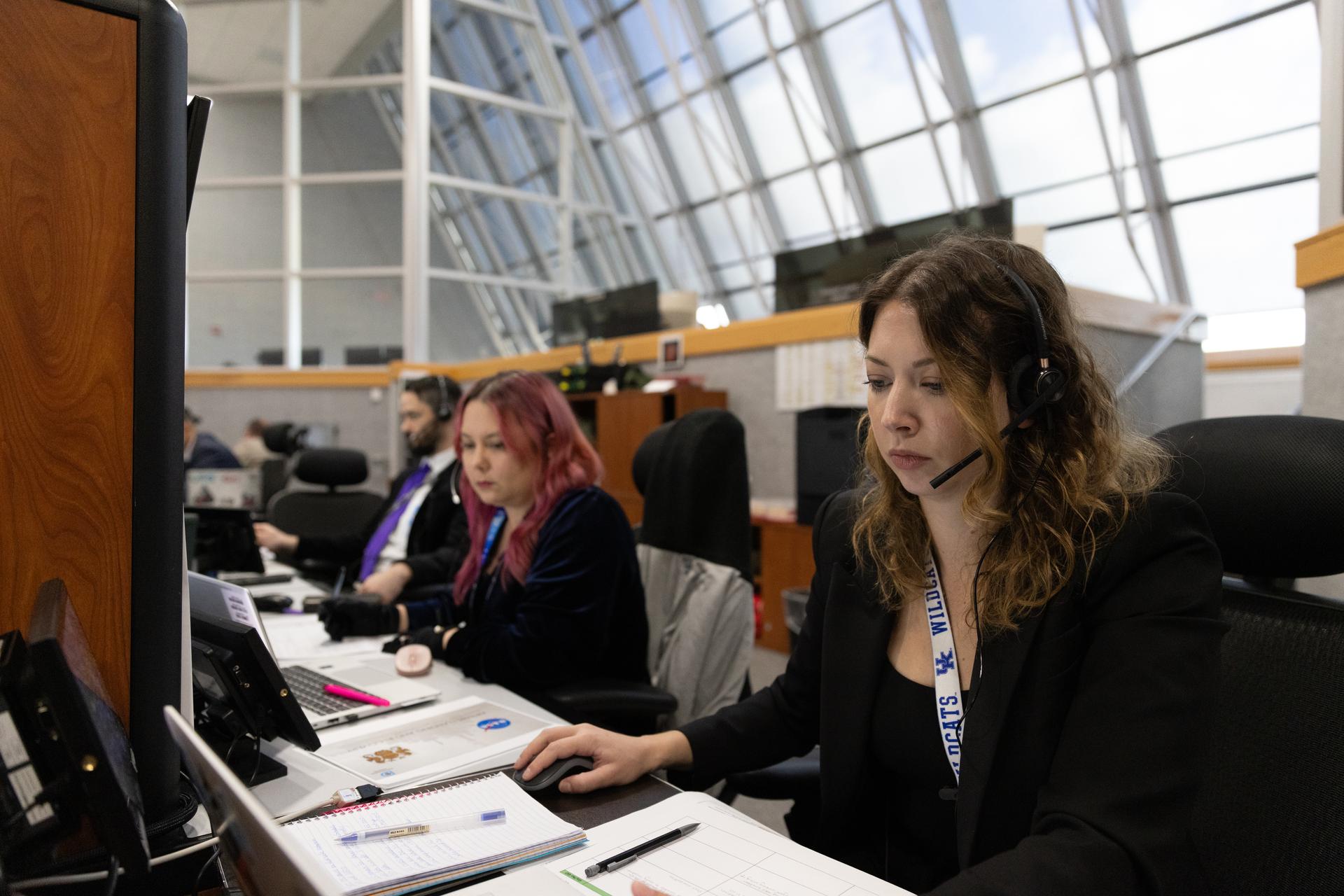
Artemis launch team members participate in an integrated launch countdown simulation for Artemis II inside Firing Room 1 of the Launch Control Center on Wednesday, Dec. 10, 2025. The training exercise involved engineers from Kennedy, Marshall Space Flight Center in Huntsville, Alabama, and Johnson Space Center in Houston coming together to rehearse all aspects of the launch countdown, from cryogenic loading – filling tanks in the SLS (Space Launch System) rocket’s core stage with liquid hydrogen and liquid oxygen – to liftoff. For Artemis II, four astronauts will venture around the Moon, the first crewed mission on NASA’s path to establishing a long-term presence for science and exploration through Artemis.
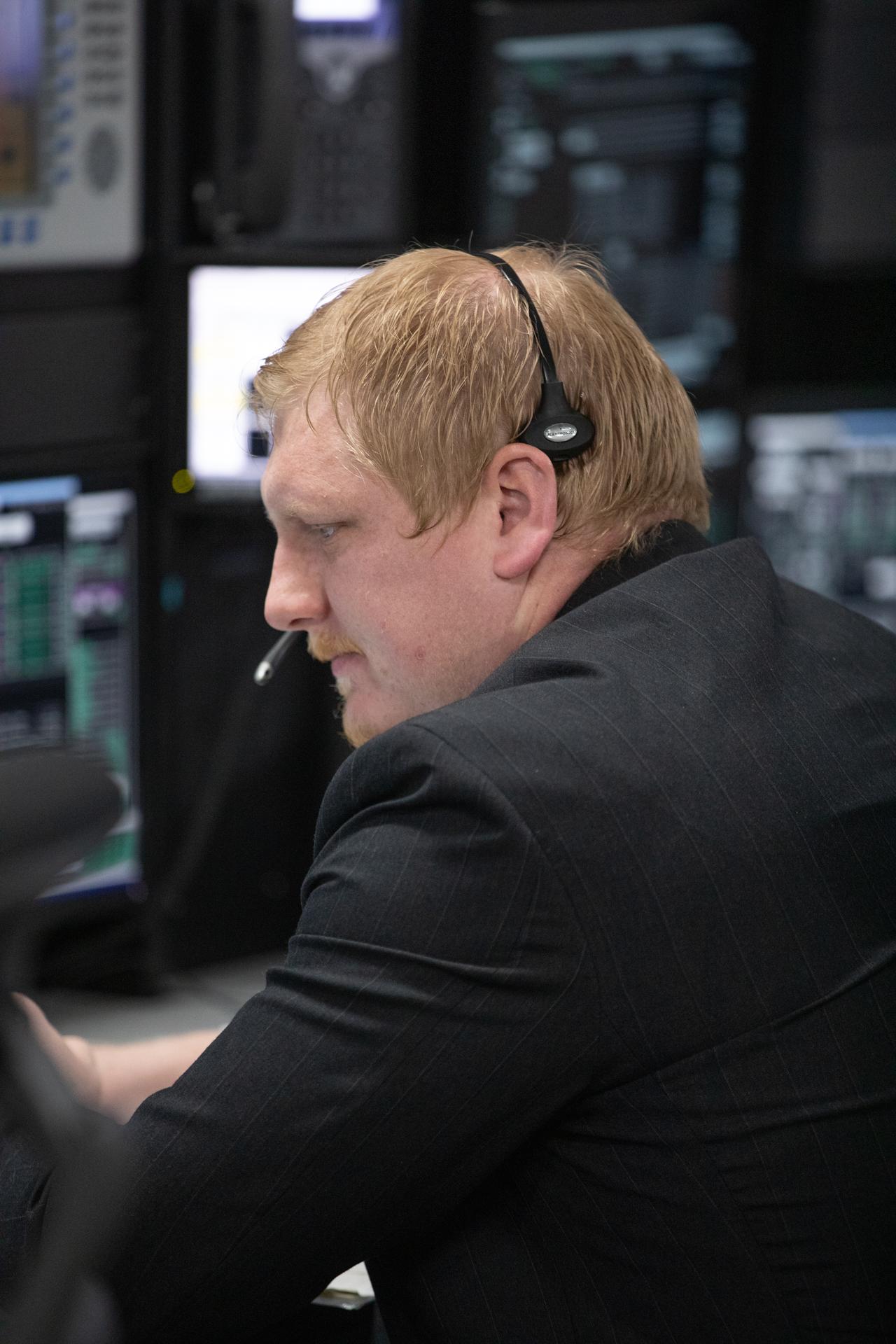
Artemis launch team members participate in an integrated launch countdown simulation for Artemis II inside Firing Room 1 of the Launch Control Center on Wednesday, Dec. 10, 2025. The training exercise involved engineers from Kennedy, Marshall Space Flight Center in Huntsville, Alabama, and Johnson Space Center in Houston coming together to rehearse all aspects of the launch countdown, from cryogenic loading – filling tanks in the SLS (Space Launch System) rocket’s core stage with liquid hydrogen and liquid oxygen – to liftoff. For Artemis II, four astronauts will venture around the Moon, the first crewed mission on NASA’s path to establishing a long-term presence for science and exploration through Artemis.
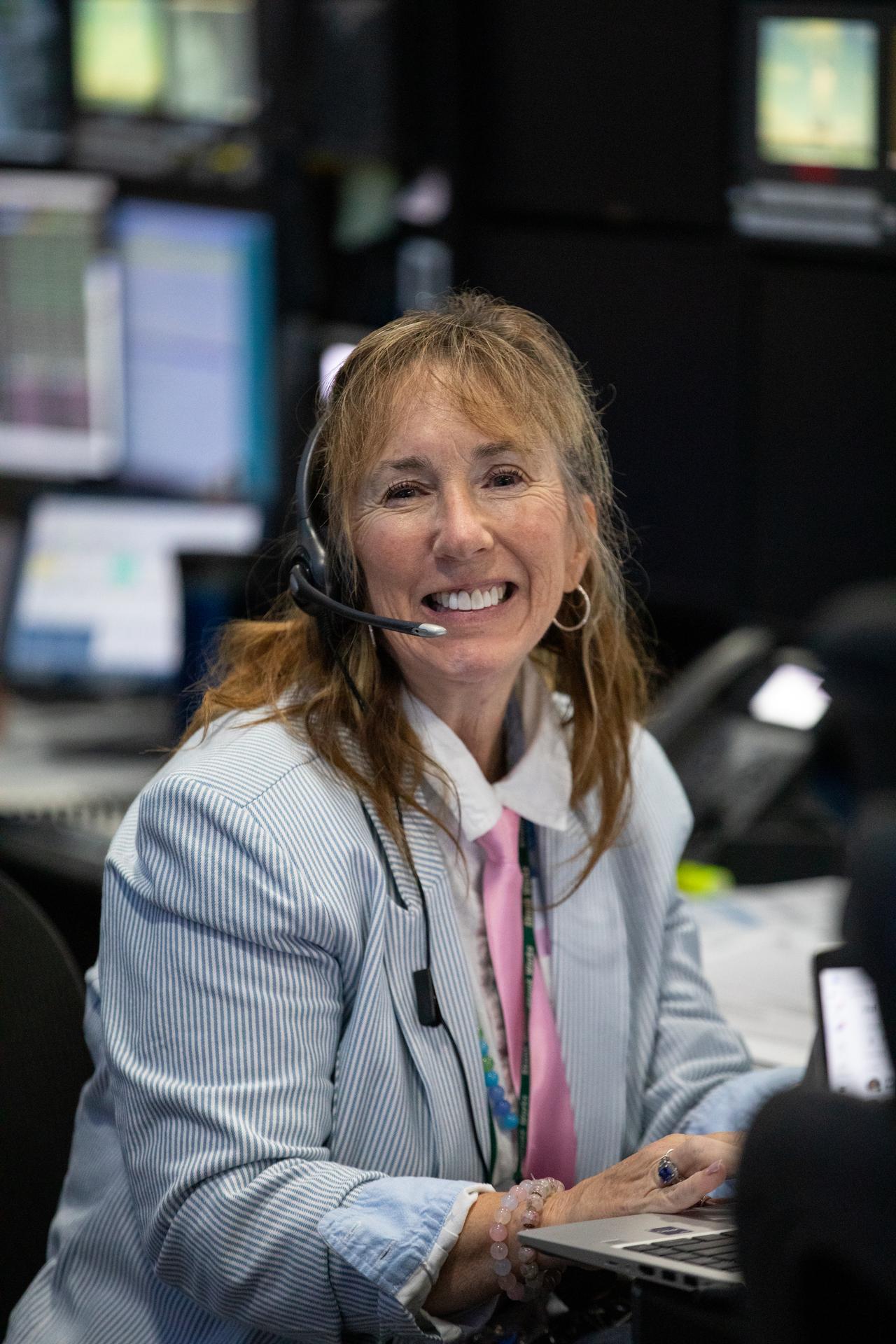
Artemis launch team members participate in an integrated launch countdown simulation for Artemis II inside Firing Room 1 of the Launch Control Center on Wednesday, Dec. 10, 2025. The training exercise involved engineers from Kennedy, Marshall Space Flight Center in Huntsville, Alabama, and Johnson Space Center in Houston coming together to rehearse all aspects of the launch countdown, from cryogenic loading – filling tanks in the SLS (Space Launch System) rocket’s core stage with liquid hydrogen and liquid oxygen – to liftoff. For Artemis II, four astronauts will venture around the Moon, the first crewed mission on NASA’s path to establishing a long-term presence for science and exploration through Artemis.
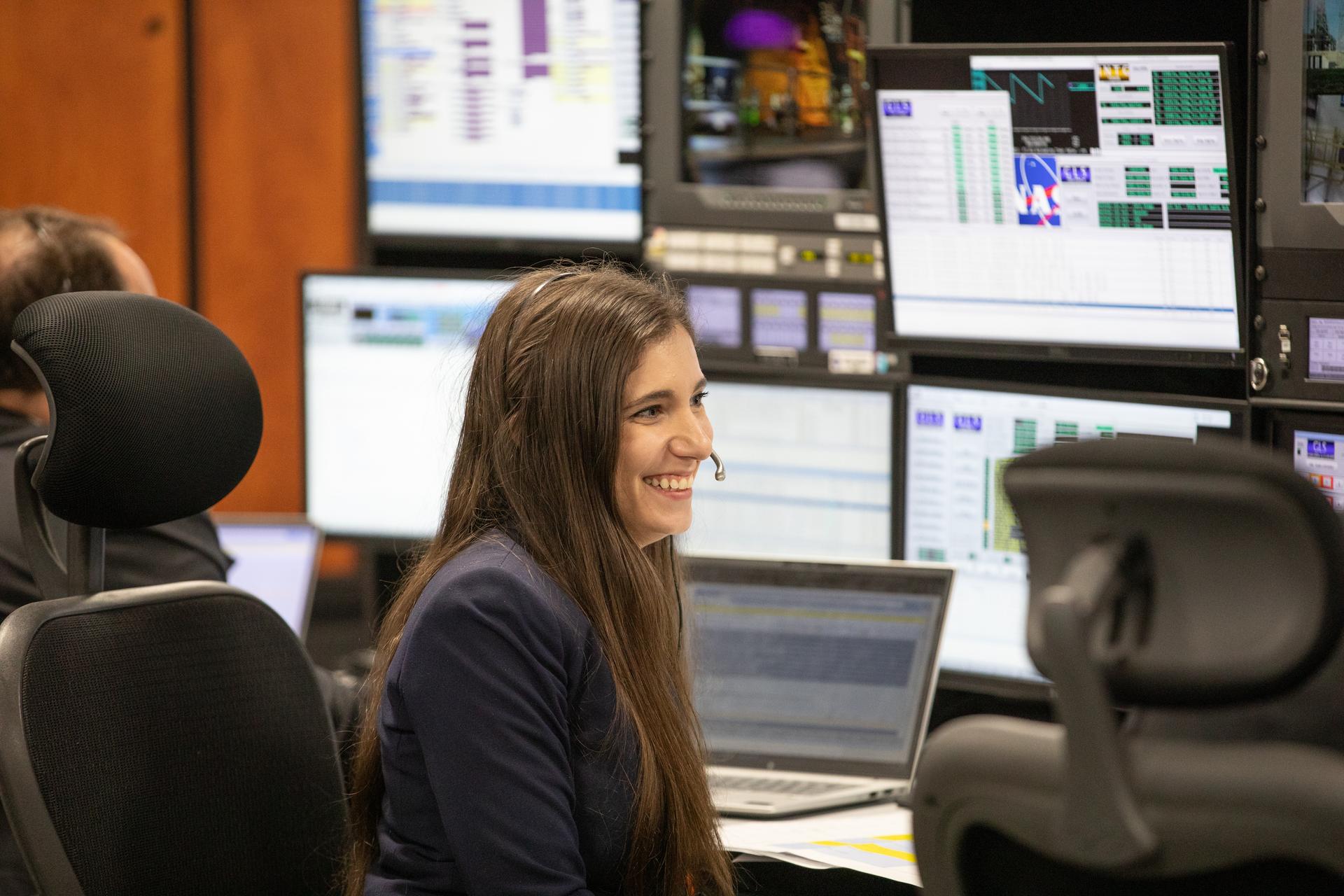
Artemis launch team members participate in an integrated launch countdown simulation for Artemis II inside Firing Room 1 of the Launch Control Center on Wednesday, Dec. 10, 2025. The training exercise involved engineers from Kennedy, Marshall Space Flight Center in Huntsville, Alabama, and Johnson Space Center in Houston coming together to rehearse all aspects of the launch countdown, from cryogenic loading – filling tanks in the SLS (Space Launch System) rocket’s core stage with liquid hydrogen and liquid oxygen – to liftoff. For Artemis II, four astronauts will venture around the Moon, the first crewed mission on NASA’s path to establishing a long-term presence for science and exploration through Artemis.
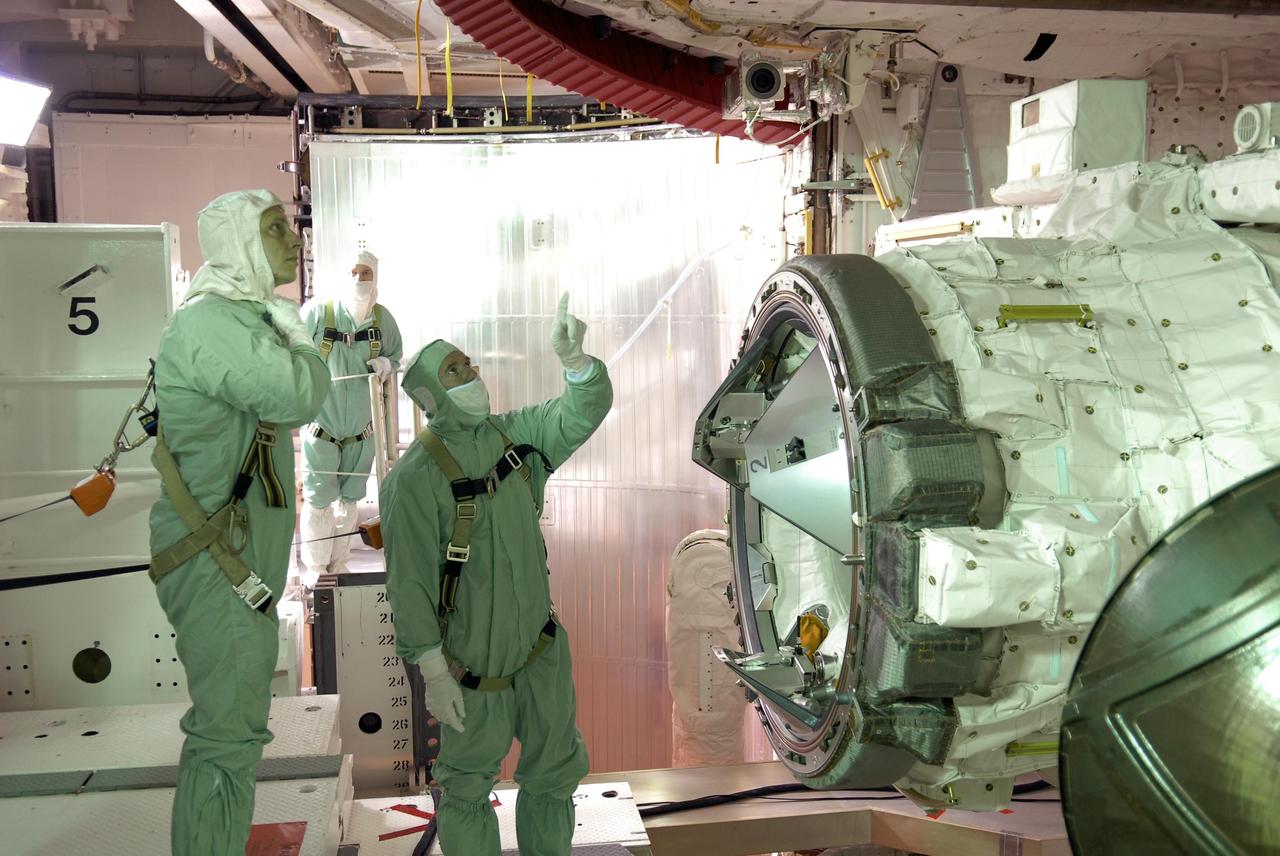
KENNEDY SPACE CENTER, FLA. -- After their arrival at KSC, STS-117 crew members take part in a payload bay walkdown on Launch Pad 39A to look at the cargo in Space Shuttle Atlantis. Seen here are Mission Specialists Patrick Forrester (left) and James Reilly. The payload includes the S3/S4 integrated truss structure for the International Space Station. The payload includes the S3/S4 integrated truss structure for the International Space Station. STS-117 is scheduled to launch at 7:38 p.m. June 8. During the 11-day mission and three spacewalks, the crew will work with flight controllers at NASA's Johnson Space Center in Houston to install the 17-ton segment on the station's girder-like truss and deploy the set of solar arrays, S3/S4. The mission will increase the space station's power capability in preparation for the arrival of new science modules from the European and Japanese space agencies. Photo credit: NASA/Kim Shiflett
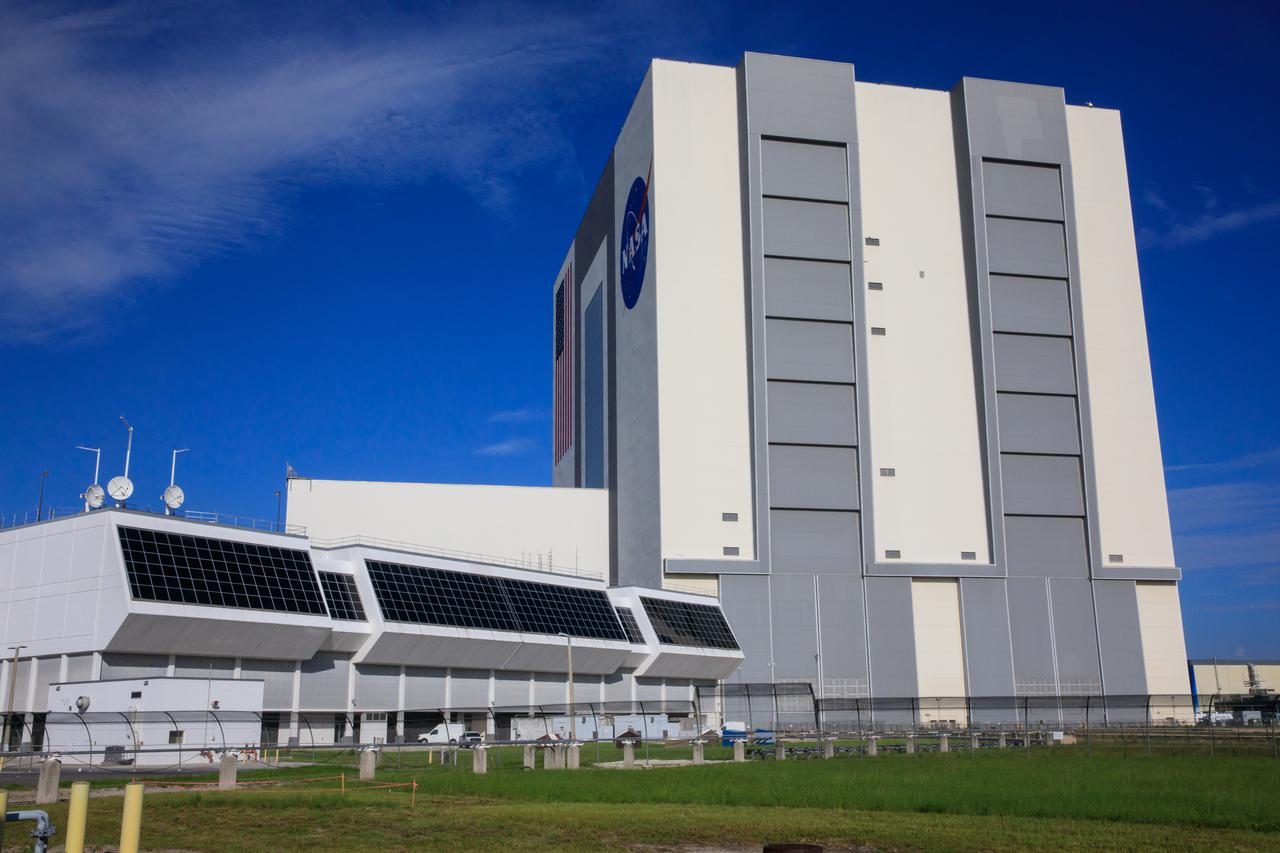
Seen here is an exterior view of the Launch Control Center (LCC) at NASA’s Kennedy Space Center in Florida, located next to the iconic Vehicle Assembly Building, on July 8, 2021. The LCC will house the team of engineers responsible for launching the Space Launch System (SLS) rocket and Orion spacecraft for the Artemis I mission. On July 8, teams from Kennedy, Marshall Space Flight Center in Alabama, and Johnson Space Center in Houston came together to perform the first joint integrated launch countdown simulation for Artemis I. The training exercise involved rehearsing all aspects of the launch countdown, from cryogenic loading – filling tanks in the Space Launch System (SLS) rocket’s core stage with liquid hydrogen and liquid oxygen – to liftoff. These simulations will help certify that the launch team is ready for Artemis I – the first test flight of SLS and Orion as an integrated system prior to crewed flights to the Moon.
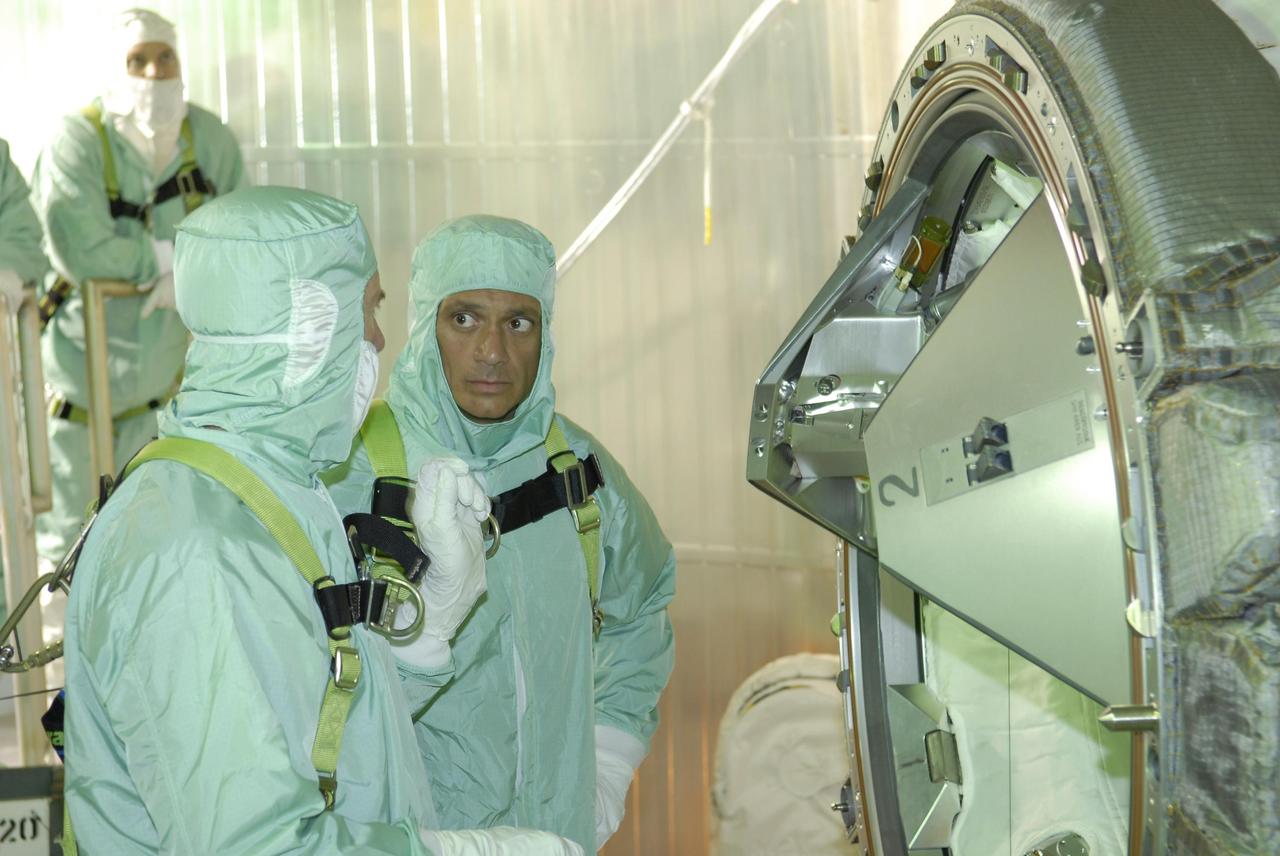
KENNEDY SPACE CENTER, FLA. -- After their arrival at KSC, STS-117 crew members take part in a payload bay walkdown on Launch Pad 39A to look at the cargo in Space Shuttle Atlantis. The payload includes the S3/S4 integrated truss structure for the International Space Station. The payload includes the S3/S4 integrated truss structure for the International Space Station. STS-117 is scheduled to launch at 7:38 p.m. June 8. During the 11-day mission and three spacewalks, the crew will work with flight controllers at NASA's Johnson Space Center in Houston to install the 17-ton segment on the station's girder-like truss and deploy the set of solar arrays, S3/S4. The mission will increase the space station's power capability in preparation for the arrival of new science modules from the European and Japanese space agencies. Photo credit: NASA/Kim Shiflett
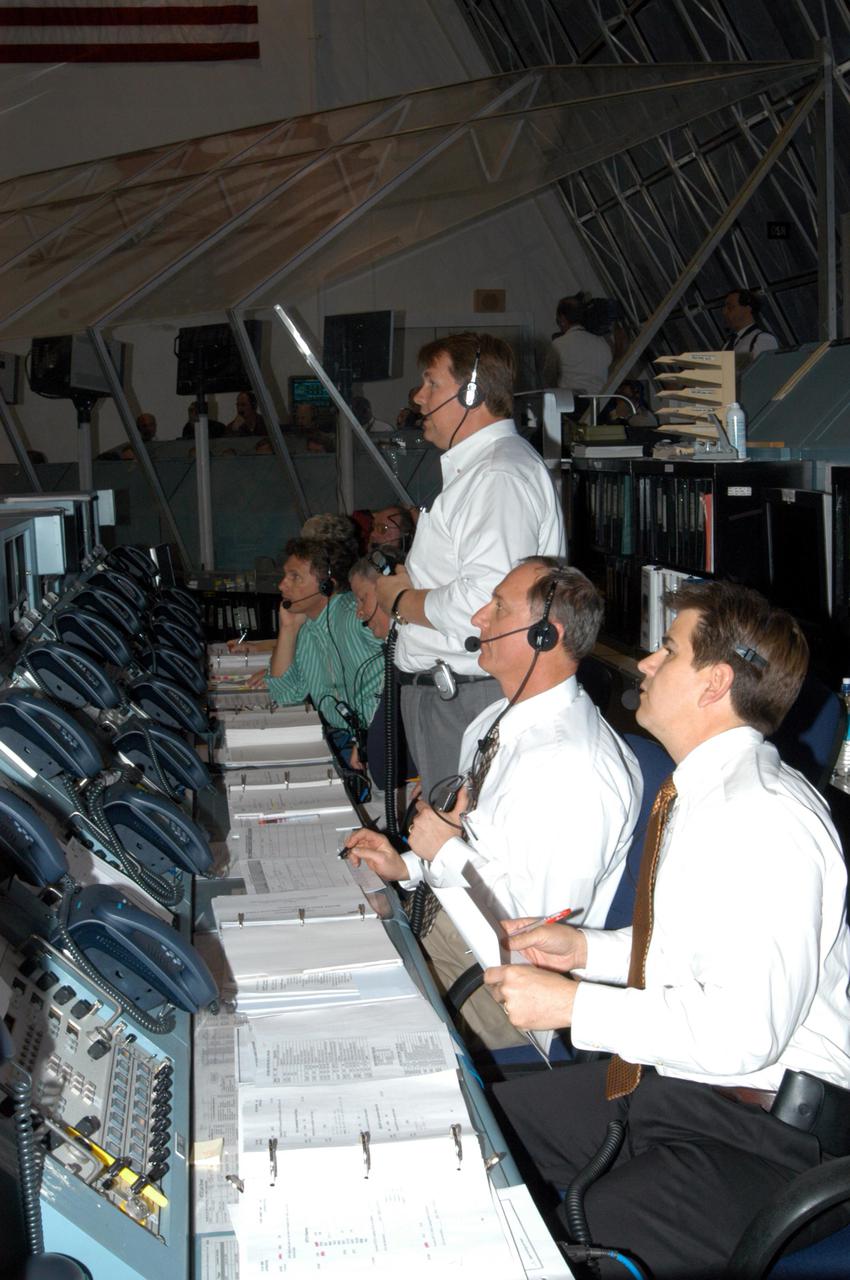
KENNEDY SPACE CENTER, FLA. - Space Shuttle Program managers, directors and engineers man the consoles in the Launch Control Center. They are taking part in an End-to-End (ETE) Mission Management Team (MMT) launch simulation at KSC. In Firing Room 1 at KSC, Shuttle launch team members put the Shuttle system through an integrated simulation. The control room is set up with software used to simulate flight and ground systems in the launch configuration. The ETE MMT simulation included L-2 and L-1 day Prelaunch MMT meetings, an external tanking_weather briefing, and a launch countdown. The ETE transitioned to the Johnson Space Center for the flight portion of the simulation, with the STS-114 crew in a simulator at JSC. Such simulations are common before a launch to keep the Shuttle launch team sharp and ready for liftoff.
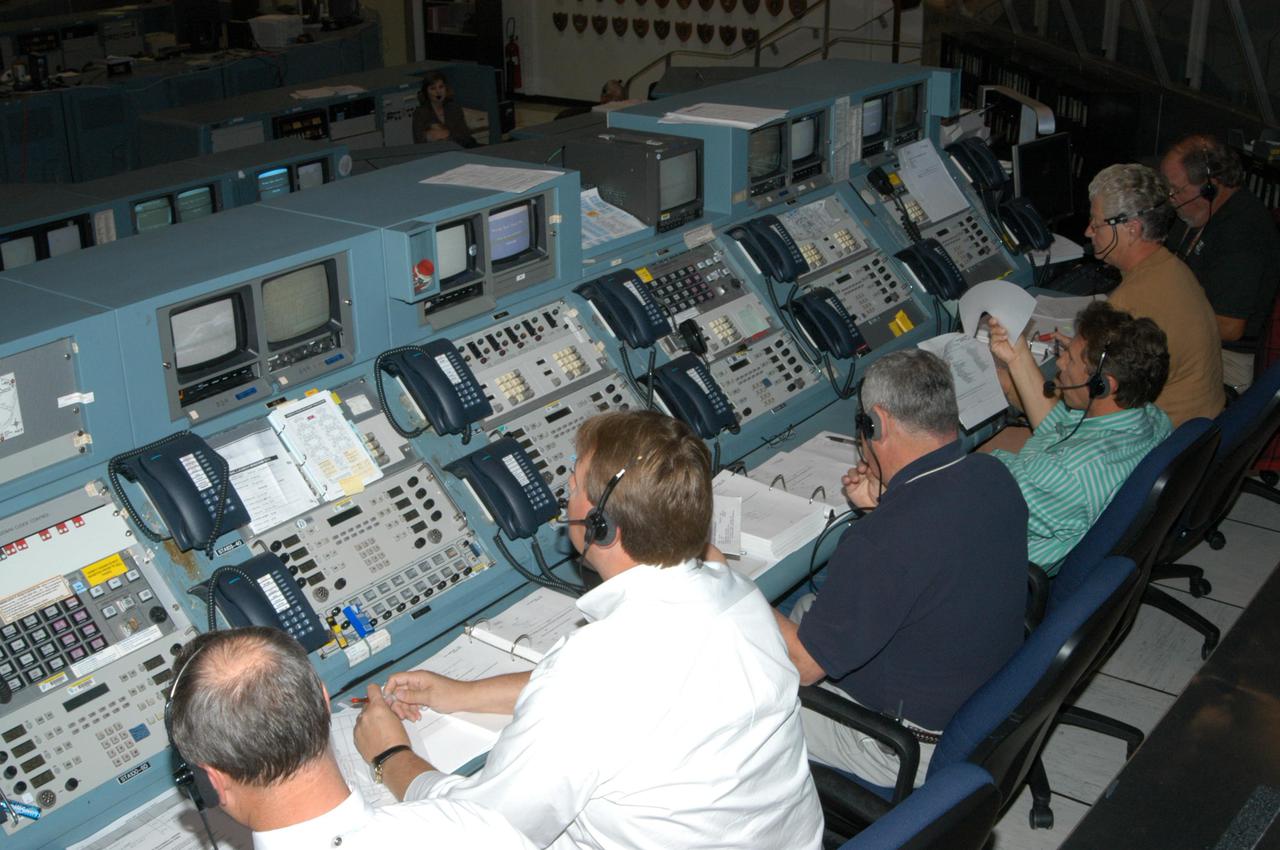
KENNEDY SPACE CENTER, FLA. - Space Shuttle Program managers, directors and engineers work the consoles in the Launch Control Center. They are taking part in an End-to-End (ETE) Mission Management Team (MMT) launch simulation at KSC. In Firing Room 1 at KSC, Shuttle launch team members put the Shuttle system through an integrated simulation. The control room is set up with software used to simulate flight and ground systems in the launch configuration. The ETE MMT simulation included L-2 and L-1 day Prelaunch MMT meetings, an external tanking_weather briefing, and a launch countdown. The ETE transitioned to the Johnson Space Center for the flight portion of the simulation, with the STS-114 crew in a simulator at JSC. Such simulations are common before a launch to keep the Shuttle launch team sharp and ready for liftoff.
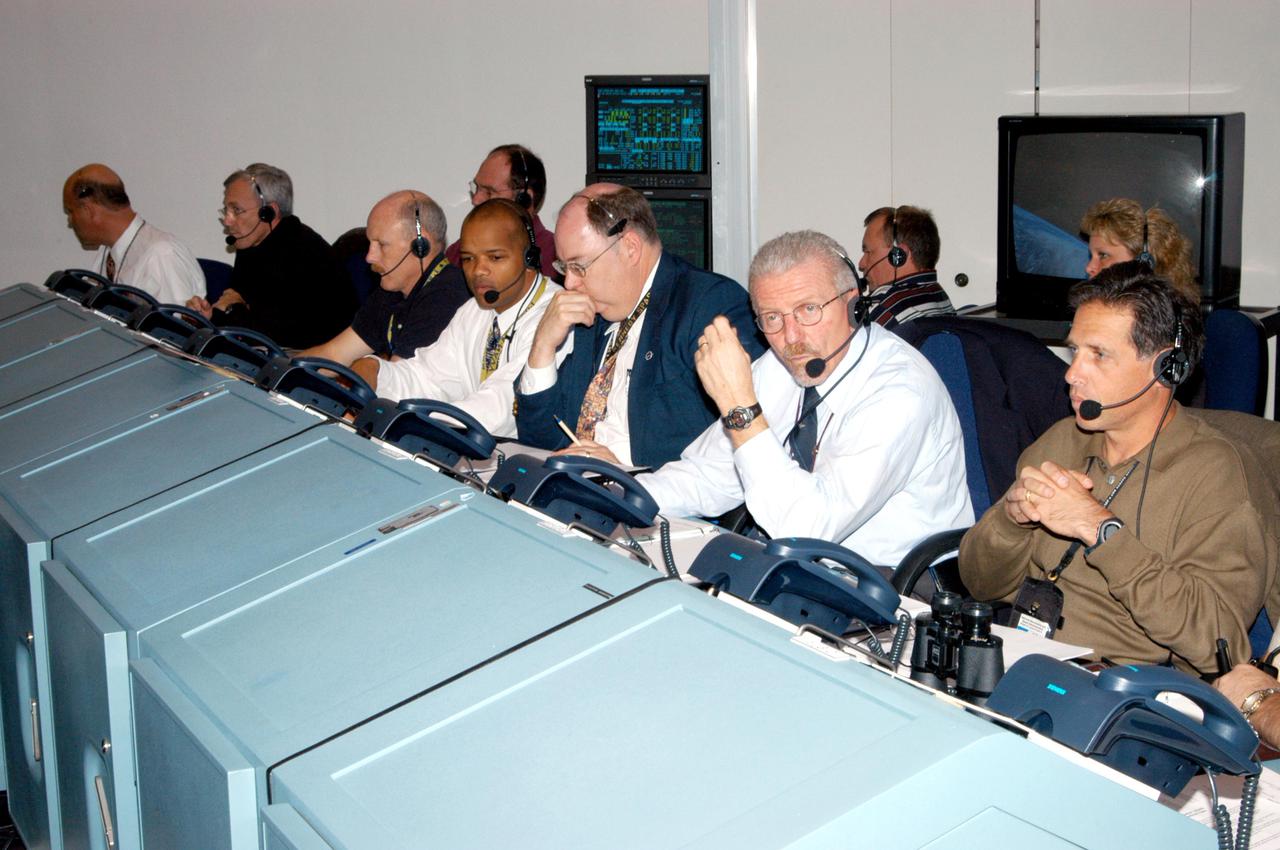
KENNEDY SPACE CENTER, FLA. - Space Shuttle Program managers, directors and engineers work the consoles in the Launch Control Center. They are taking part in an End-to-End (ETE) Mission Management Team (MMT) launch simulation at KSC. In Firing Room 1 at KSC, Shuttle launch team members put the Shuttle system through an integrated simulation. The control room is set up with software used to simulate flight and ground systems in the launch configuration. The ETE MMT simulation included L-2 and L-1 day Prelaunch MMT meetings, an external tanking_weather briefing, and a launch countdown. The ETE transitioned to the Johnson Space Center for the flight portion of the simulation, with the STS-114 crew in a simulator at JSC. Such simulations are common before a launch to keep the Shuttle launch team sharp and ready for liftoff.

S84-40162 (21 Aug. 1984) --- Astronaut Anna L. Fisher controls the Remote Manipulator System (RMS) arm from inside the "orbiter" as part of her training program in the Johnson Space Center's Shuttle Mock-up and Integration Laboratory. Dr. Fisher, one of three mission specialists for mission 51-A, is inside the cabin portion of a trainer called the Manipulatory Development Facility (MDF). She is able to operate the arm in conjunction with an air bearing floor and to log a great deal of rehearsal time for her flight, on which the retrieval of a low-orbiting communications satellite is planned. Photo credit: NASA
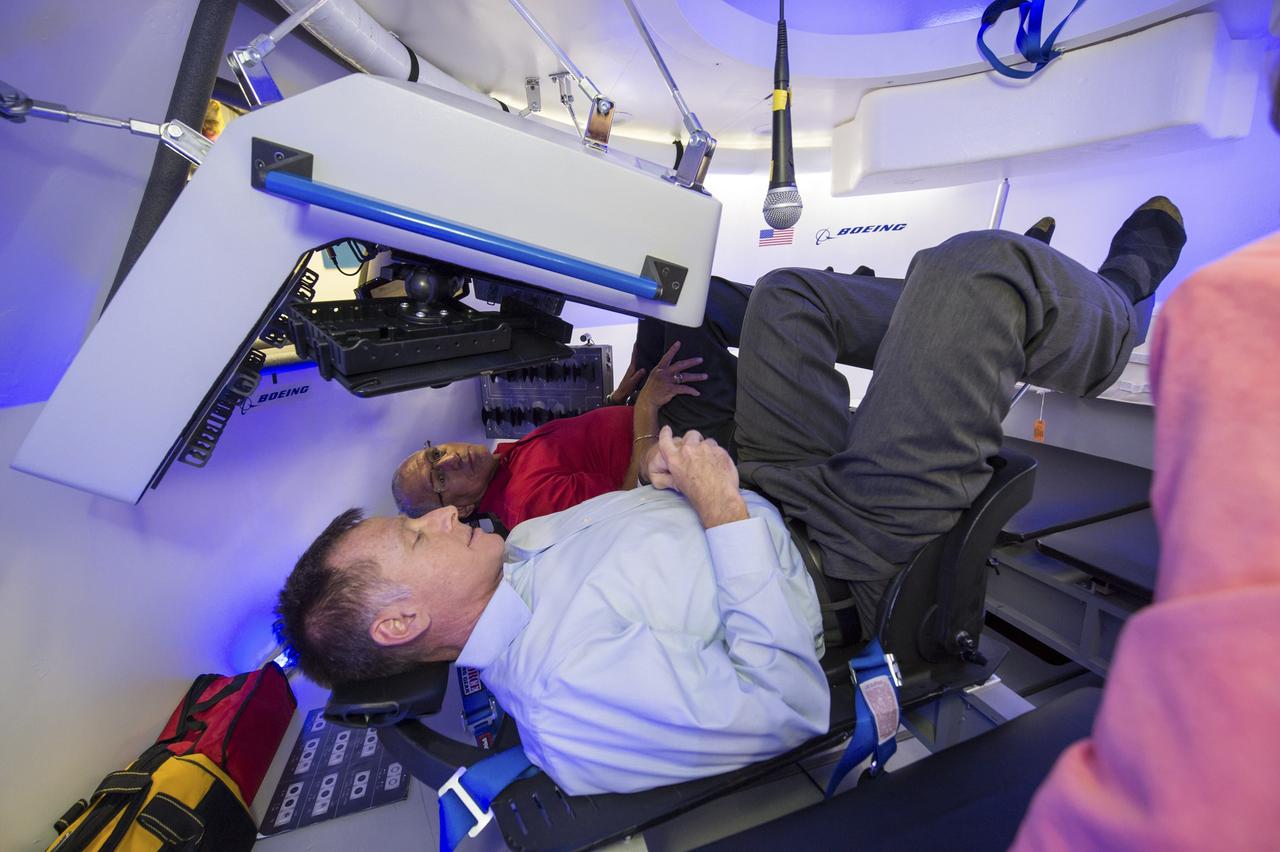
HOUSTON -- JSC-2013-E076055 -- The Boeing Company's Director of Crew and Mission Operations Chris Ferguson explains the control system of a mock-up CST-100 to NASA Administrator Charlie Bolden, back, at the company's Houston Product Support Center near Johnson Space Center. Boeing showcased its work on a fully outfitted test version of the spacecraft to Bolden and Johnson management. Boeing's CST-100 is designed to transport a mix of crew and cargo to low-Earth-orbit destinations. Boeing is one of three aerospace industry partners working with NASA's Commercial Crew Program, or CCP, during the Commercial Crew Integrated Capability, or CCiCap, initiative, which is intended to make commercial human spaceflight services available for government and commercial customers. To learn more about CCP, visit www.nasa.gov/commercialcrew. Photo credit: NASA/James Blair
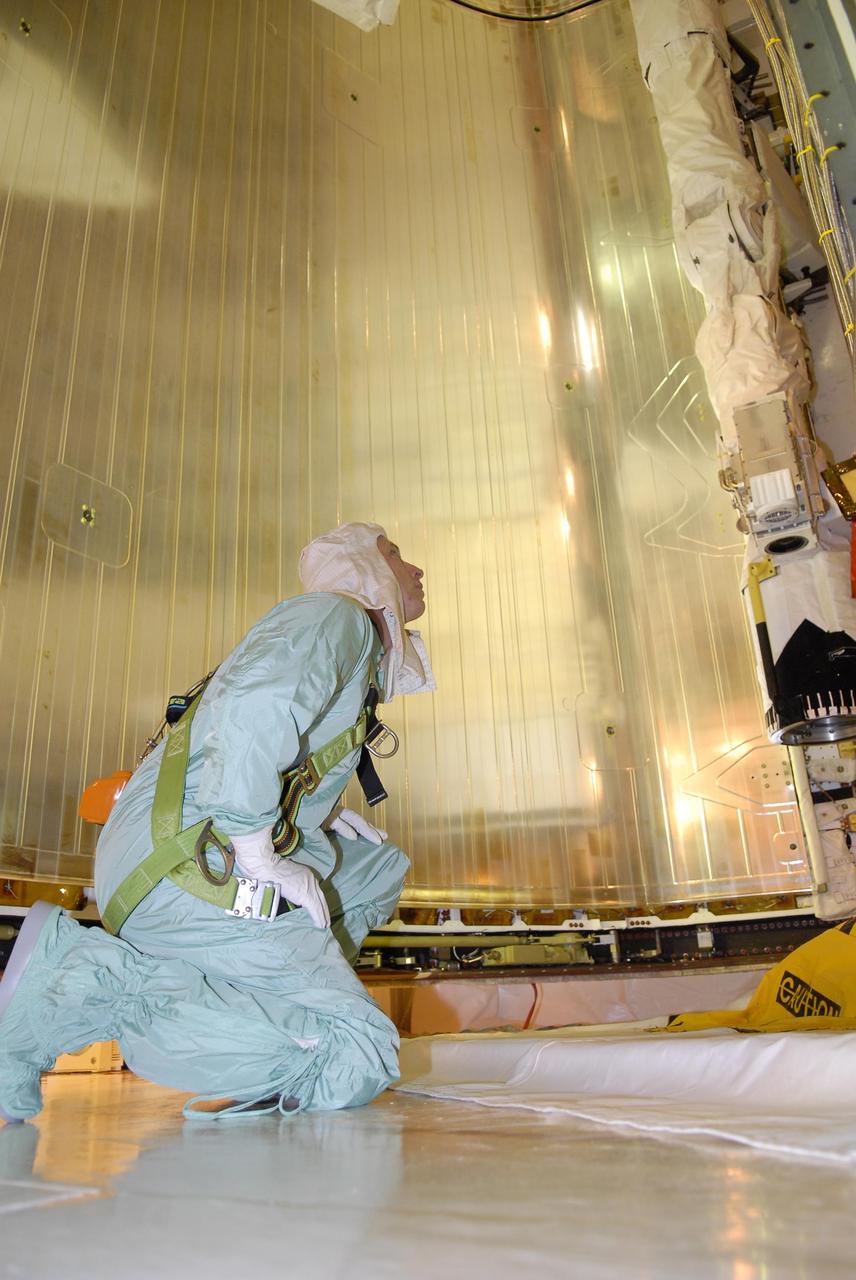
KENNEDY SPACE CENTER, FLA. -- After their arrival at KSC, STS-117 crew members take part in a payload bay walkdown on Launch Pad 39A to look at the cargo in Space Shuttle Atlantis. Seen here is Mission Specialist Patrick Forrester. The payload includes the S3/S4 integrated truss structure for the International Space Station. STS-117 is scheduled to launch at 7:38 p.m. June 8. During the 11-day mission and three spacewalks, the crew will work with flight controllers at NASA's Johnson Space Center in Houston to install the 17-ton segment on the station's girder-like truss and deploy the set of solar arrays, S3/S4. The mission will increase the space station's power capability in preparation for the arrival of new science modules from the European and Japanese space agencies. Photo credit: NASA/Kim Shiflett
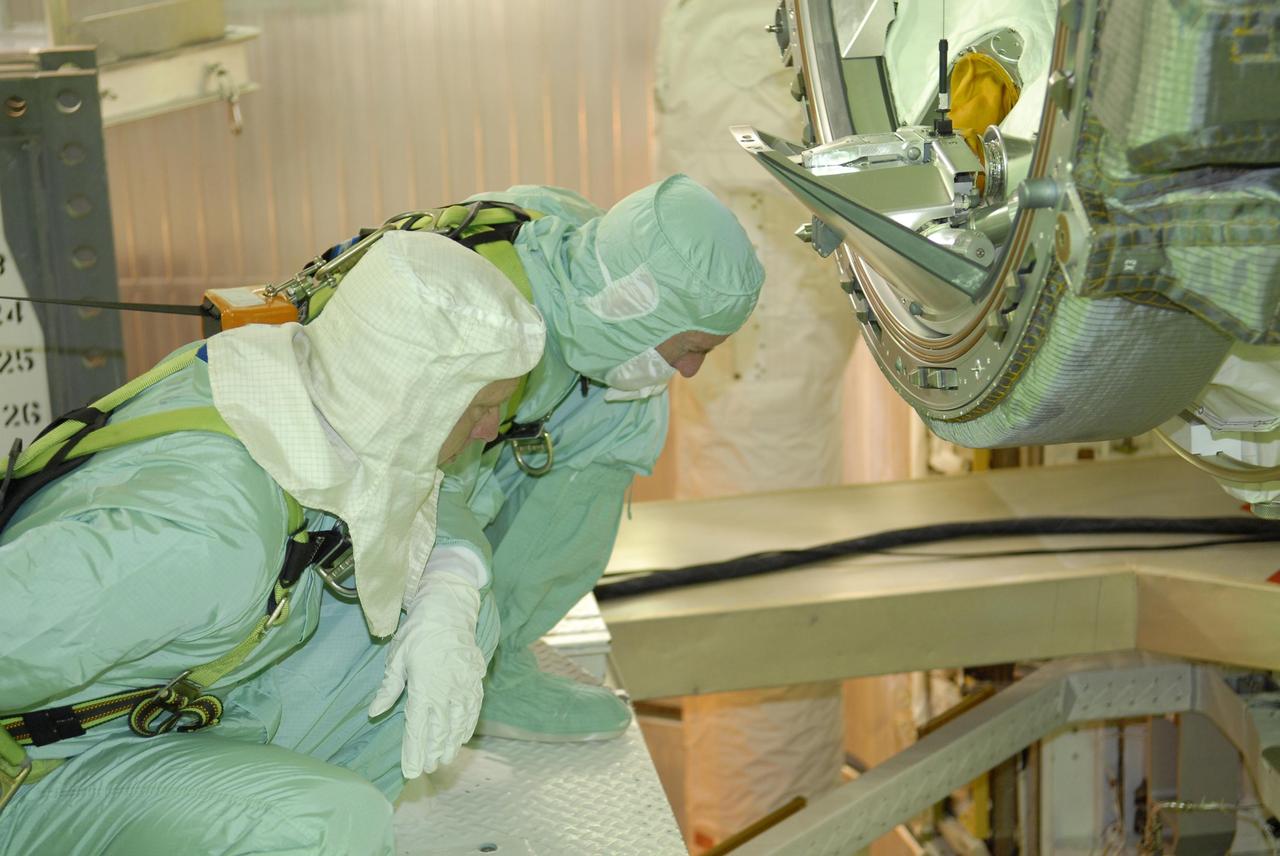
KENNEDY SPACE CENTER, FLA. -- After their arrival at KSC, STS-117 crew members take part in a payload bay walkdown on Launch Pad 39A to look at the cargo in Space Shuttle Atlantis. Seen here are Mission Specialists Patrick Forrester (left) and James Reilly. The payload includes the S3/S4 integrated truss structure for the International Space Station. STS-117 is scheduled to launch at 7:38 p.m. June 8. During the 11-day mission and three spacewalks, the crew will work with flight controllers at NASA's Johnson Space Center in Houston to install the 17-ton segment on the station's girder-like truss and deploy the set of solar arrays, S3/S4. The mission will increase the space station's power capability in preparation for the arrival of new science modules from the European and Japanese space agencies. Photo credit: NASA/Kim Shiflett
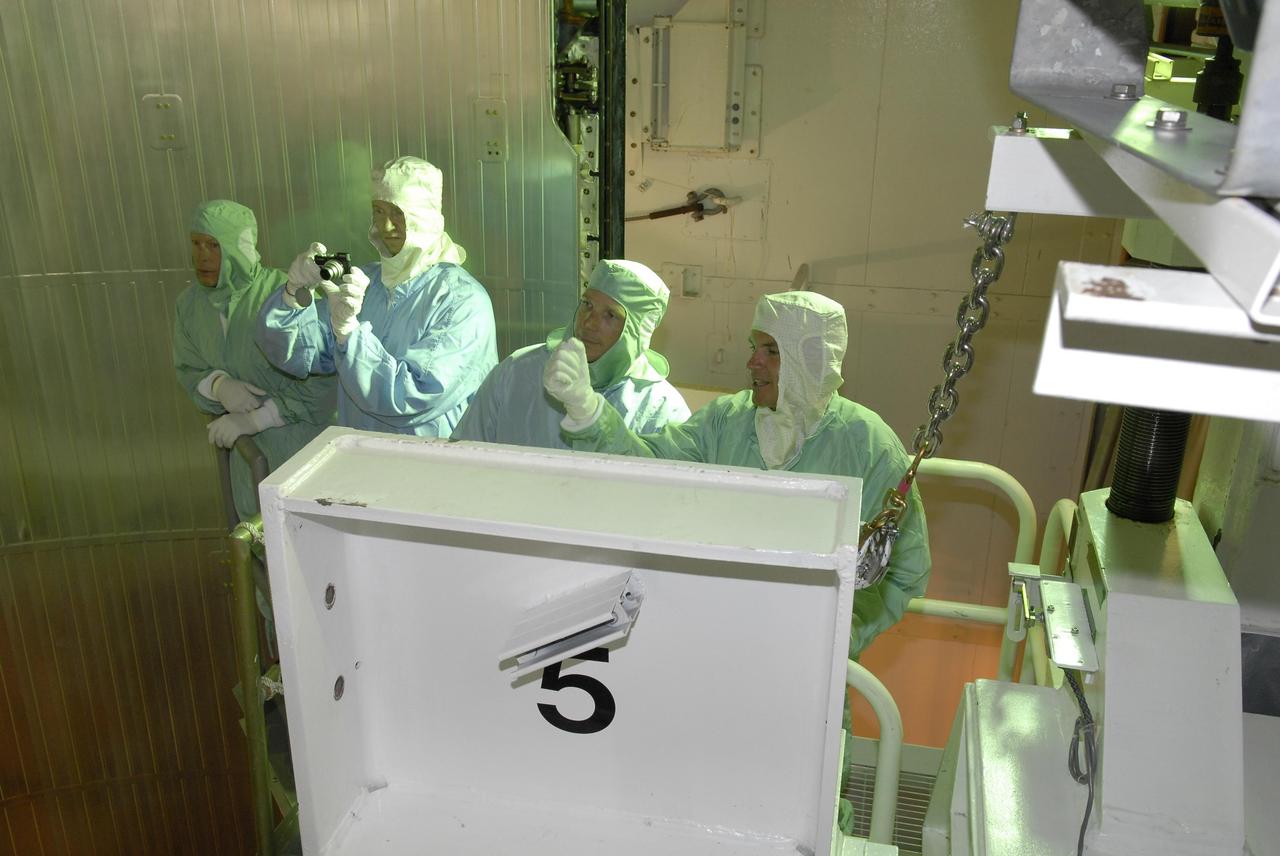
KENNEDY SPACE CENTER, FLA. -- After their arrival at KSC, STS-117 crew members take part in a payload bay walkdown on Launch Pad 39A to look at the cargo in Space Shuttle Atlantis. In the bucket are Mission Specialists Patrick Forrester (with camera) and Steven Swanson (far right). The payload includes the S3/S4 integrated truss structure for the International Space Station. STS-117 is scheduled to launch at 7:38 p.m. June 8. During the 11-day mission and three spacewalks, the crew will work with flight controllers at NASA's Johnson Space Center in Houston to install the 17-ton segment on the station's girder-like truss and deploy the set of solar arrays, S3/S4. The mission will increase the space station's power capability in preparation for the arrival of new science modules from the European and Japanese space agencies. Photo credit: NASA/Kim Shiflett
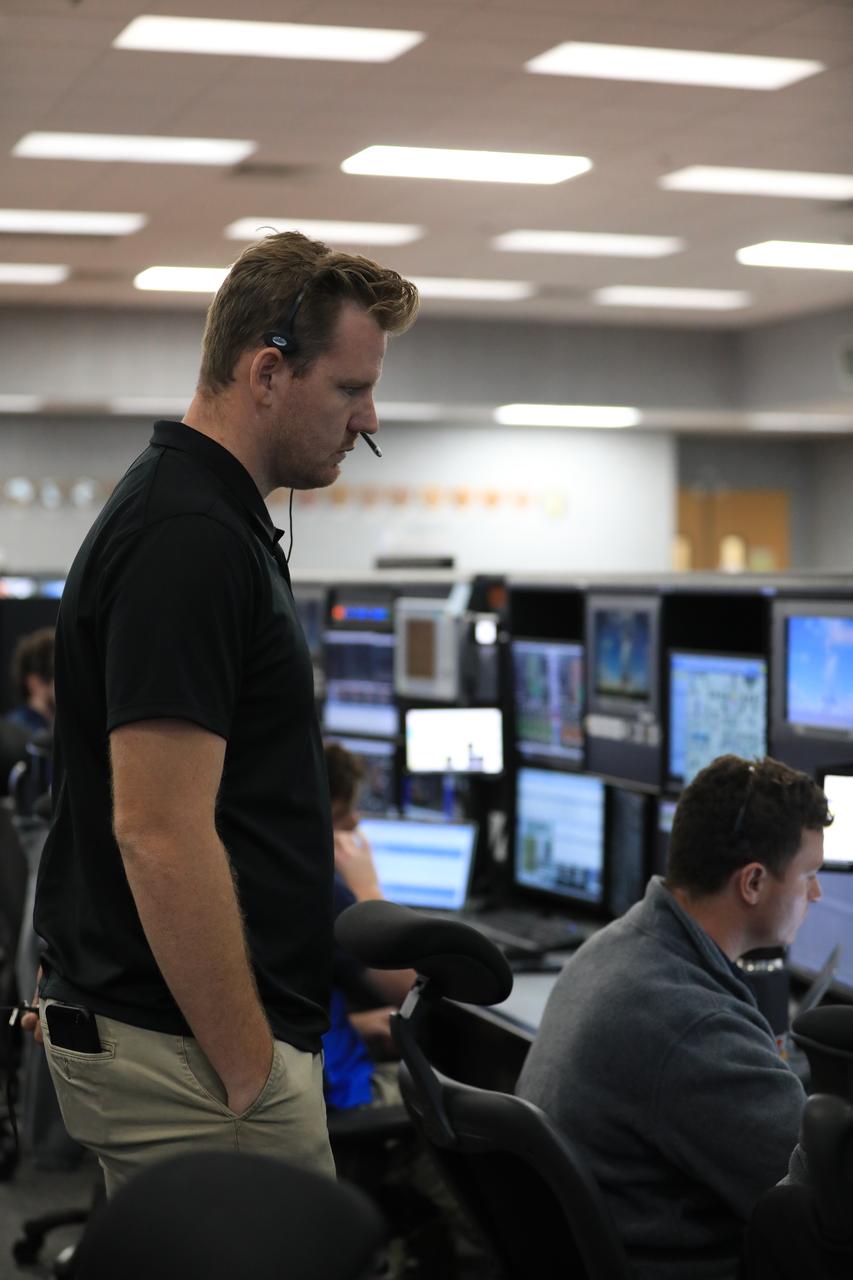
Teams at NASA’s Kennedy Space Center in Florida participate in the first joint integrated launch countdown simulation for Artemis II inside Firing Room 1 of the Launch Control Center on Thursday, Sept. 11, 2025. The training exercise involved engineers from Kennedy, Marshall Space Flight Center in Huntsville, Alabama, and Johnson Space Center in Houston coming together to rehearse all aspects of the launch countdown, from cryogenic loading – filling tanks in the SLS (Space Launch System) rocket’s core stage with liquid hydrogen and liquid oxygen – to liftoff. These simulations will help certify that the launch team is ready for Artemis II – the first crewed Artemis mission that will send four astronauts around the Moon and back.
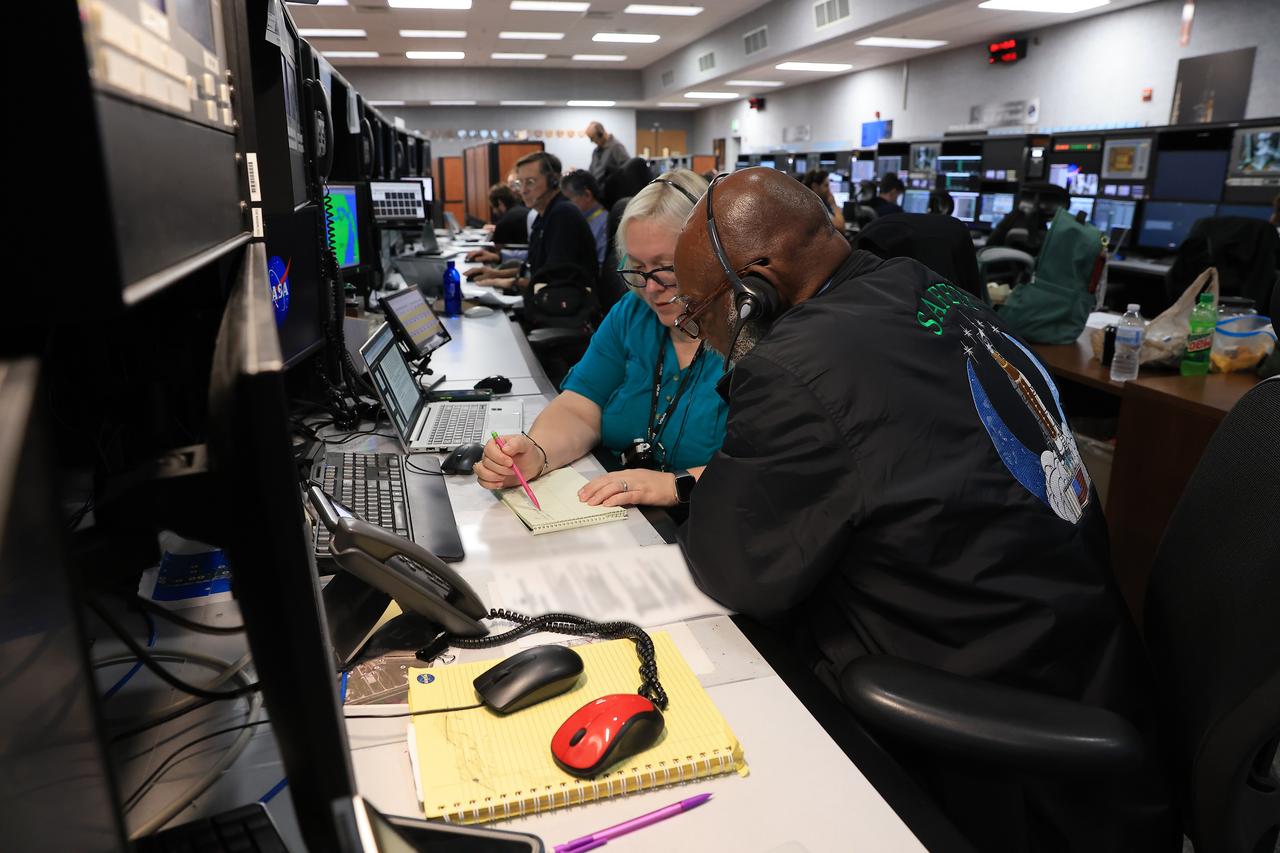
Teams at NASA’s Kennedy Space Center in Florida participate in the first joint integrated launch countdown simulation for Artemis II inside Firing Room 1 of the Launch Control Center on Thursday, Sept. 11, 2025. The training exercise involved engineers from Kennedy, Marshall Space Flight Center in Huntsville, Alabama, and Johnson Space Center in Houston coming together to rehearse all aspects of the launch countdown, from cryogenic loading – filling tanks in the SLS (Space Launch System) rocket’s core stage with liquid hydrogen and liquid oxygen – to liftoff. These simulations will help certify that the launch team is ready for Artemis II – the first crewed Artemis mission that will send four astronauts around the Moon and back.
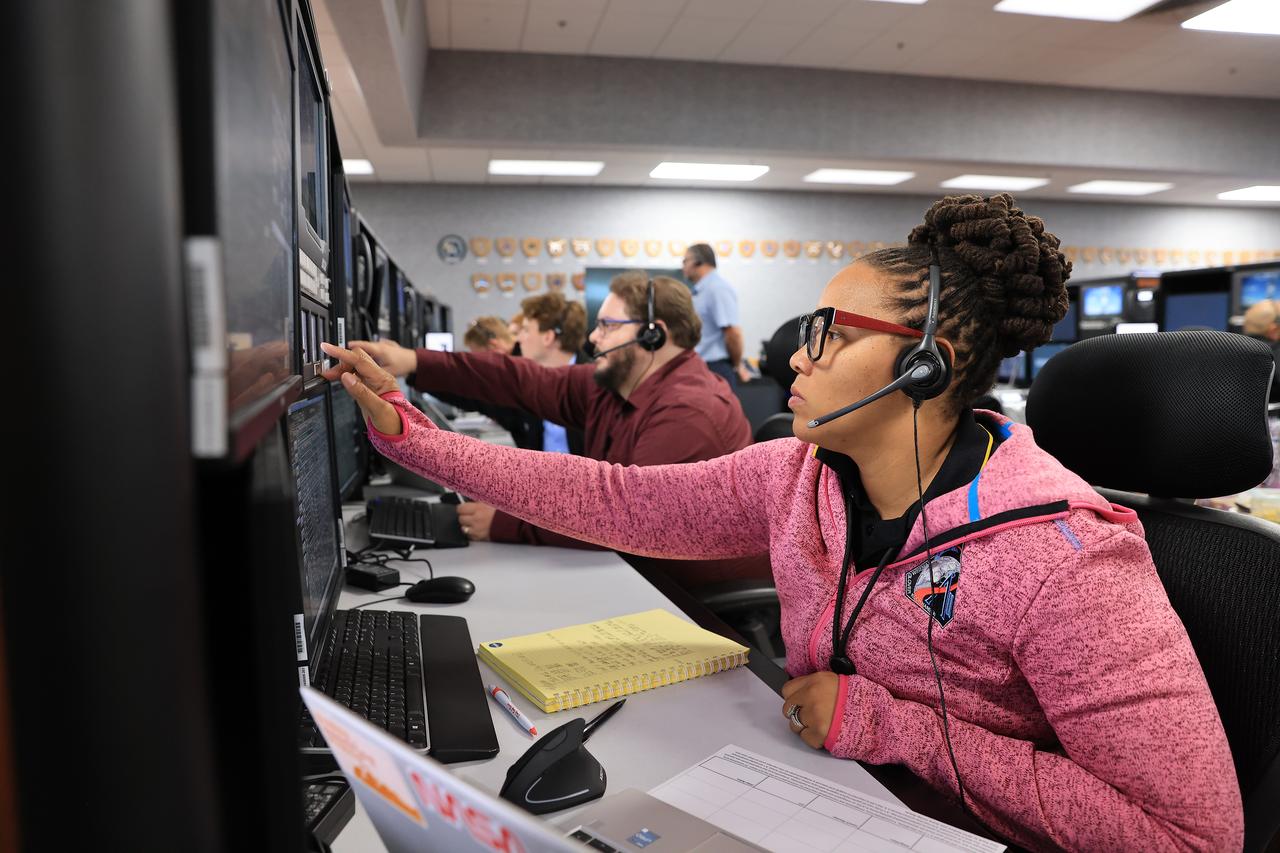
Teams at NASA’s Kennedy Space Center in Florida participate in the first joint integrated launch countdown simulation for Artemis II inside Firing Room 1 of the Launch Control Center on Thursday, Sept. 11, 2025. The training exercise involved engineers from Kennedy, Marshall Space Flight Center in Huntsville, Alabama, and Johnson Space Center in Houston coming together to rehearse all aspects of the launch countdown, from cryogenic loading – filling tanks in the SLS (Space Launch System) rocket’s core stage with liquid hydrogen and liquid oxygen – to liftoff. These simulations will help certify that the launch team is ready for Artemis II – the first crewed Artemis mission that will send four astronauts around the Moon and back.
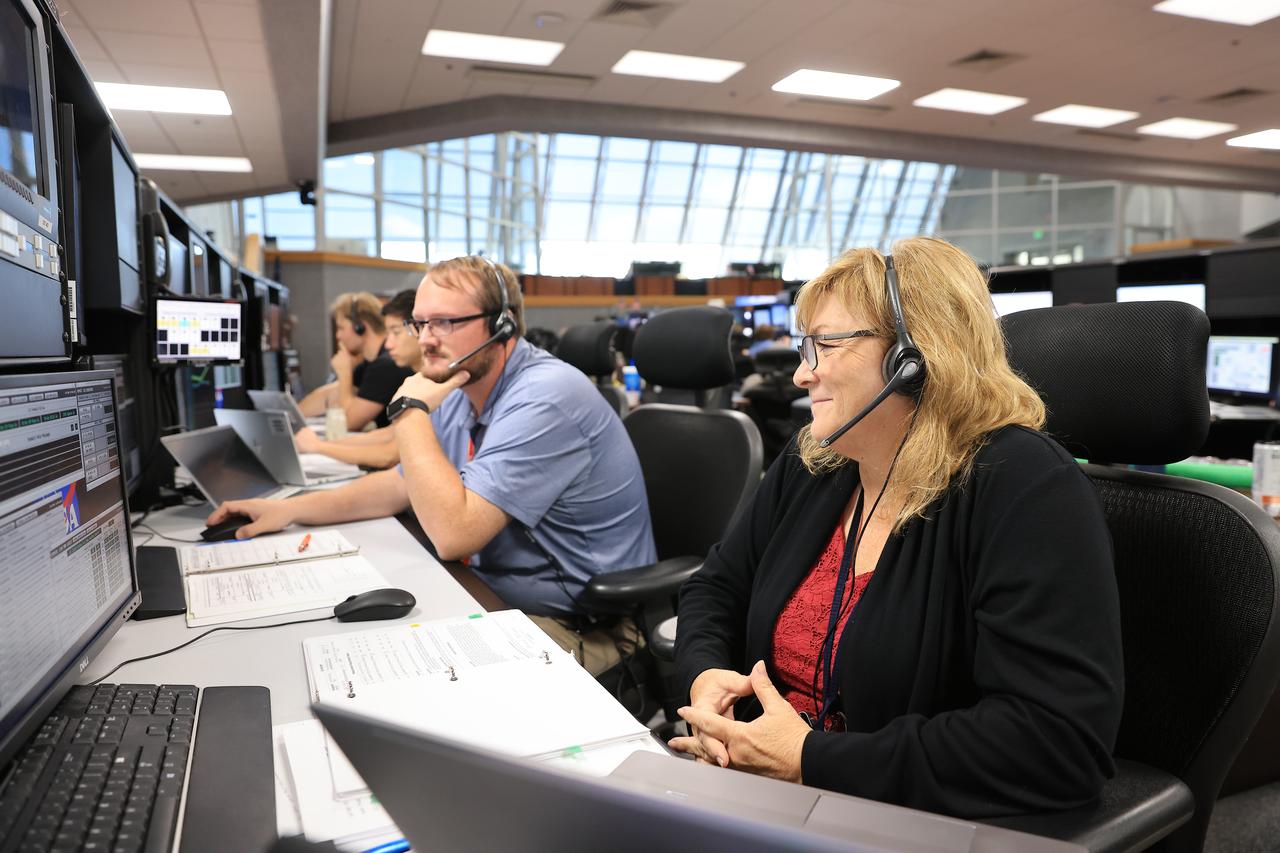
Teams at NASA’s Kennedy Space Center in Florida participate in the first joint integrated launch countdown simulation for Artemis II inside Firing Room 1 of the Launch Control Center on Thursday, Sept. 11, 2025. The training exercise involved engineers from Kennedy, Marshall Space Flight Center in Huntsville, Alabama, and Johnson Space Center in Houston coming together to rehearse all aspects of the launch countdown, from cryogenic loading – filling tanks in the SLS (Space Launch System) rocket’s core stage with liquid hydrogen and liquid oxygen – to liftoff. These simulations will help certify that the launch team is ready for Artemis II – the first crewed Artemis mission that will send four astronauts around the Moon and back.
Teams at NASA’s Kennedy Space Center in Florida participate in the first joint integrated launch countdown simulation for Artemis II inside Firing Room 1 of the Launch Control Center on Thursday, Sept. 11, 2025. The training exercise involved engineers from Kennedy, Marshall Space Flight Center in Huntsville, Alabama, and Johnson Space Center in Houston coming together to rehearse all aspects of the launch countdown, from cryogenic loading – filling tanks in the SLS (Space Launch System) rocket’s core stage with liquid hydrogen and liquid oxygen – to liftoff. These simulations will help certify that the launch team is ready for Artemis II – the first crewed Artemis mission that will send four astronauts around the Moon and back.
Teams at NASA’s Kennedy Space Center in Florida participate in the first joint integrated launch countdown simulation for Artemis II inside Firing Room 1 of the Launch Control Center on Thursday, Sept. 11, 2025. The training exercise involved engineers from Kennedy, Marshall Space Flight Center in Huntsville, Alabama, and Johnson Space Center in Houston coming together to rehearse all aspects of the launch countdown, from cryogenic loading – filling tanks in the SLS (Space Launch System) rocket’s core stage with liquid hydrogen and liquid oxygen – to liftoff. These simulations will help certify that the launch team is ready for Artemis II – the first crewed Artemis mission that will send four astronauts around the Moon and back.
Teams at NASA’s Kennedy Space Center in Florida participate in the first joint integrated launch countdown simulation for Artemis II inside Firing Room 1 of the Launch Control Center on Thursday, Sept. 11, 2025. The training exercise involved engineers from Kennedy, Marshall Space Flight Center in Huntsville, Alabama, and Johnson Space Center in Houston coming together to rehearse all aspects of the launch countdown, from cryogenic loading – filling tanks in the SLS (Space Launch System) rocket’s core stage with liquid hydrogen and liquid oxygen – to liftoff. These simulations will help certify that the launch team is ready for Artemis II – the first crewed Artemis mission that will send four astronauts around the Moon and back.
Teams at NASA’s Kennedy Space Center in Florida participate in the first joint integrated launch countdown simulation for Artemis II inside Firing Room 1 of the Launch Control Center on Thursday, Sept. 11, 2025. The training exercise involved engineers from Kennedy, Marshall Space Flight Center in Huntsville, Alabama, and Johnson Space Center in Houston coming together to rehearse all aspects of the launch countdown, from cryogenic loading – filling tanks in the SLS (Space Launch System) rocket’s core stage with liquid hydrogen and liquid oxygen – to liftoff. These simulations will help certify that the launch team is ready for Artemis II – the first crewed Artemis mission that will send four astronauts around the Moon and back.
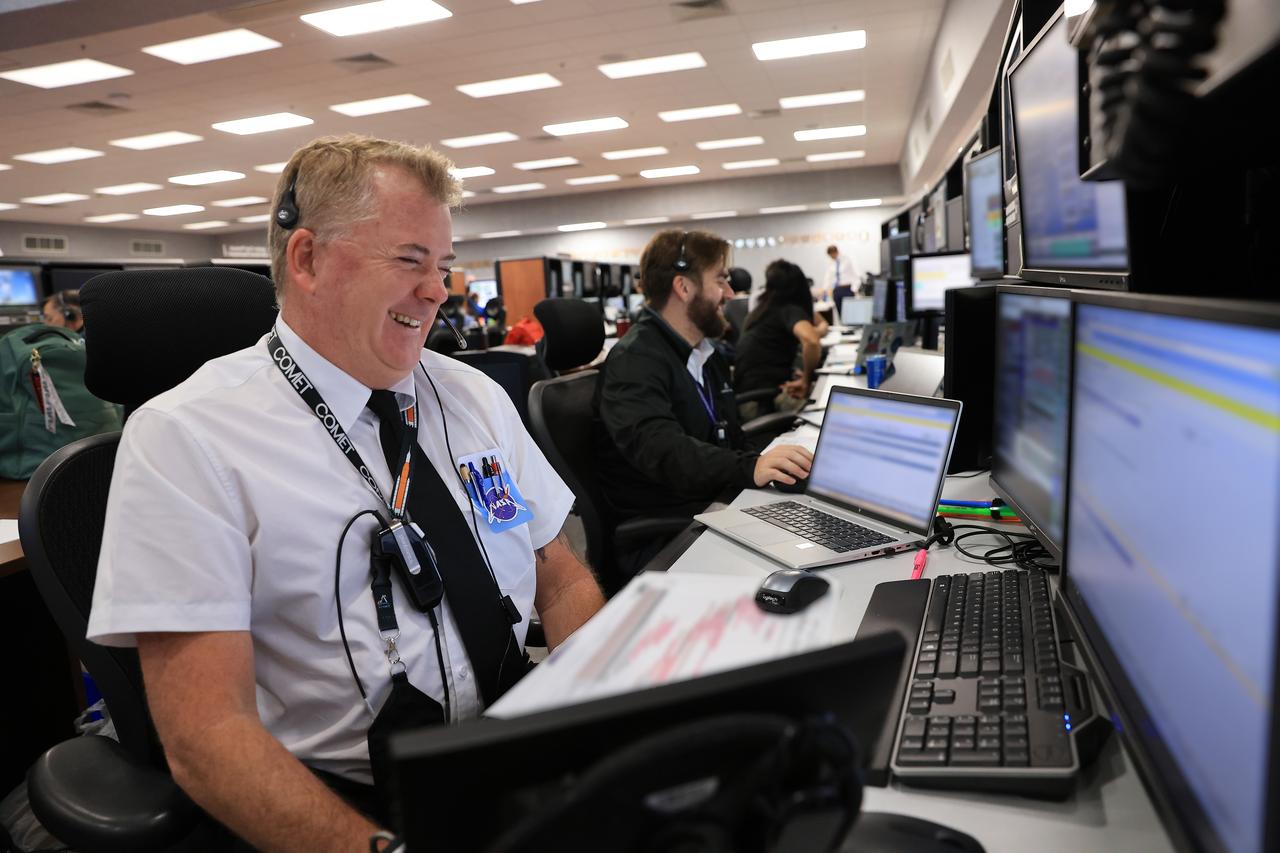
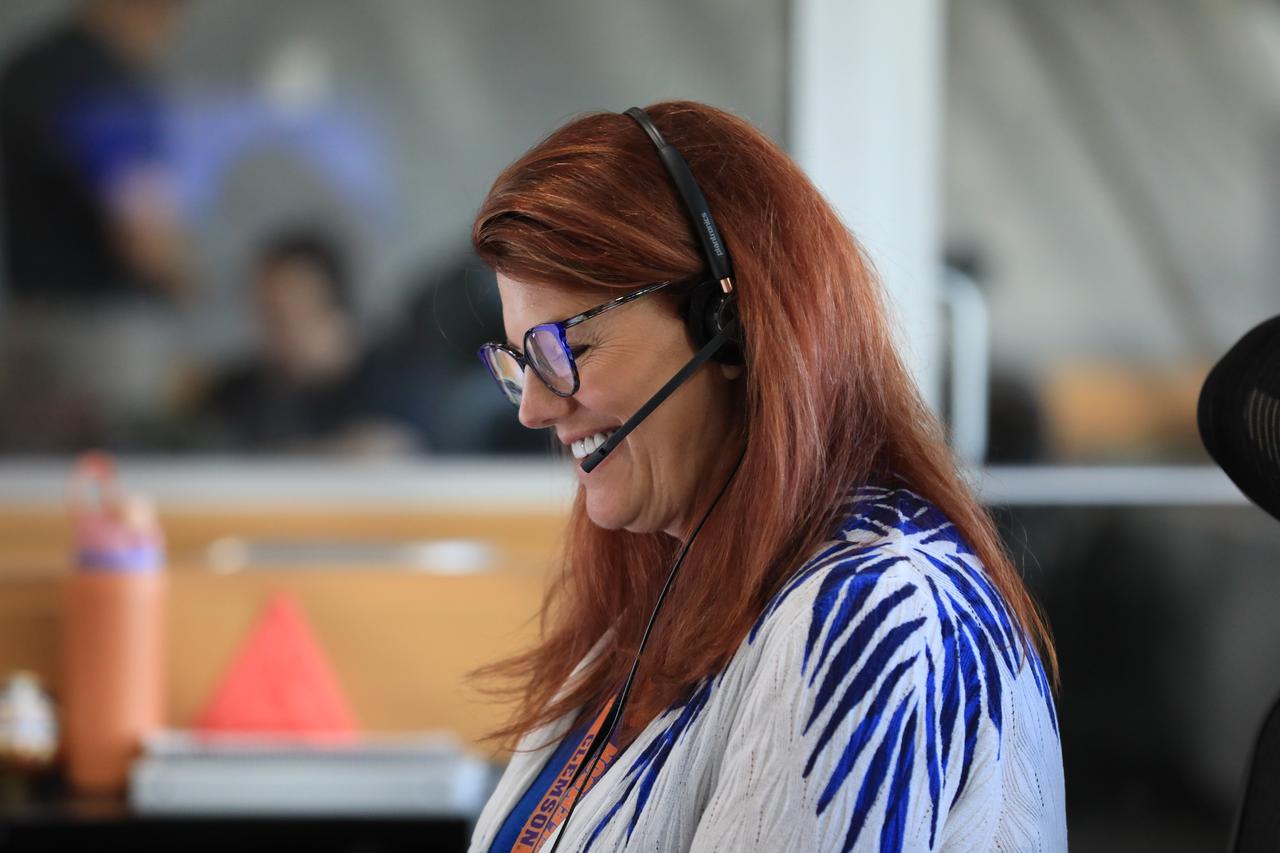
Teams at NASA’s Kennedy Space Center in Florida participate in the first joint integrated launch countdown simulation for Artemis II inside Firing Room 1 of the Launch Control Center on Thursday, Sept. 11, 2025. The training exercise involved engineers from Kennedy, Marshall Space Flight Center in Huntsville, Alabama, and Johnson Space Center in Houston coming together to rehearse all aspects of the launch countdown, from cryogenic loading – filling tanks in the SLS (Space Launch System) rocket’s core stage with liquid hydrogen and liquid oxygen – to liftoff. These simulations will help certify that the launch team is ready for Artemis II – the first crewed Artemis mission that will send four astronauts around the Moon and back.
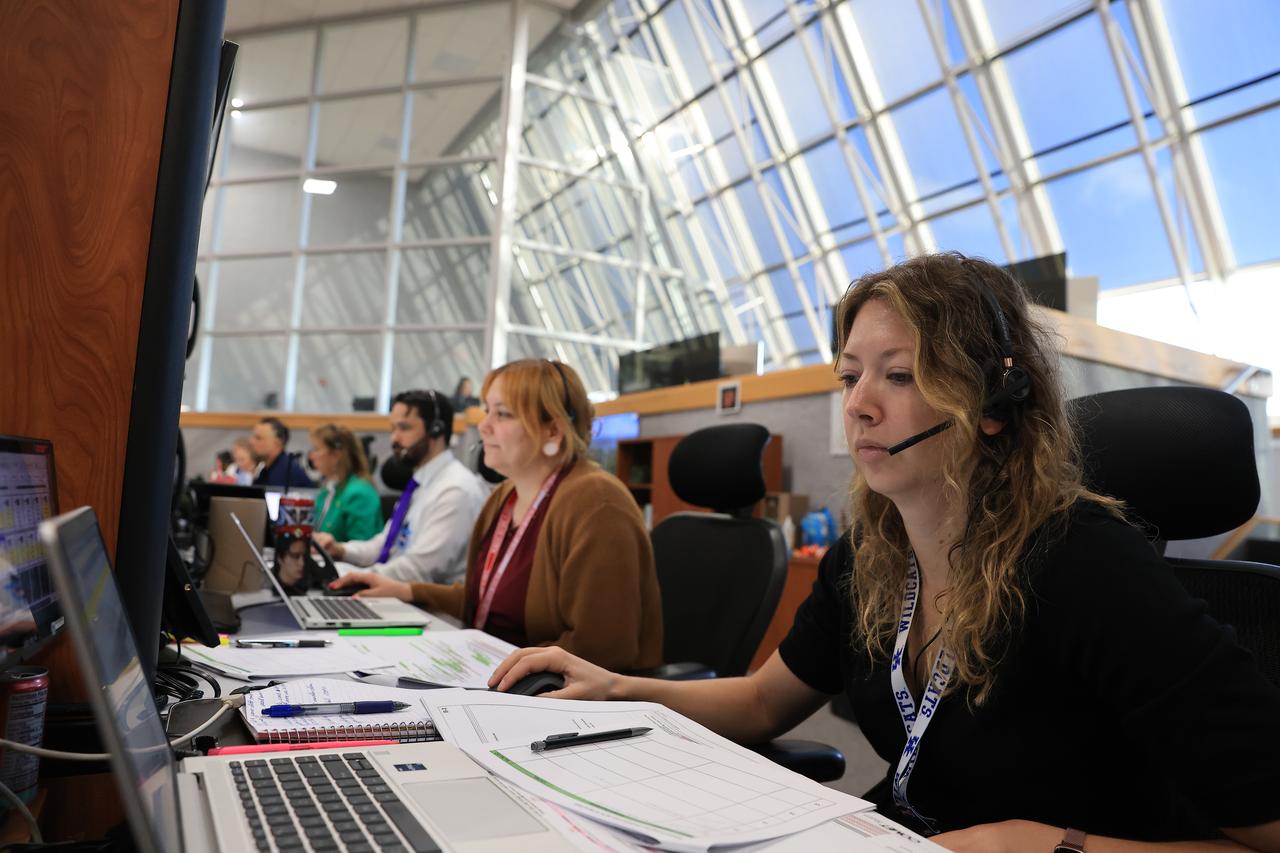
Teams at NASA’s Kennedy Space Center in Florida participate in the first joint integrated launch countdown simulation for Artemis II inside Firing Room 1 of the Launch Control Center on Thursday, Sept. 11, 2025. The training exercise involved engineers from Kennedy, Marshall Space Flight Center in Huntsville, Alabama, and Johnson Space Center in Houston coming together to rehearse all aspects of the launch countdown, from cryogenic loading – filling tanks in the SLS (Space Launch System) rocket’s core stage with liquid hydrogen and liquid oxygen – to liftoff. These simulations will help certify that the launch team is ready for Artemis II – the first crewed Artemis mission that will send four astronauts around the Moon and back.
Charlie Blackwell-Thompson, Artemis launch director, Exploration Ground Systems at NASA’s Kennedy Space Center in Florida, participates in the first joint integrated launch countdown simulation for Artemis II inside Firing Room 1 of the Launch Control Center on Thursday, Sept. 11, 2025. The training exercise involved engineers from Kennedy, Marshall Space Flight Center in Huntsville, Alabama, and Johnson Space Center in Houston coming together to rehearse all aspects of the launch countdown, from cryogenic loading – filling tanks in the SLS (Space Launch System) rocket’s core stage with liquid hydrogen and liquid oxygen – to liftoff. These simulations will help certify that the launch team is ready for Artemis II – the first crewed Artemis mission that will send four astronauts around the Moon and back.
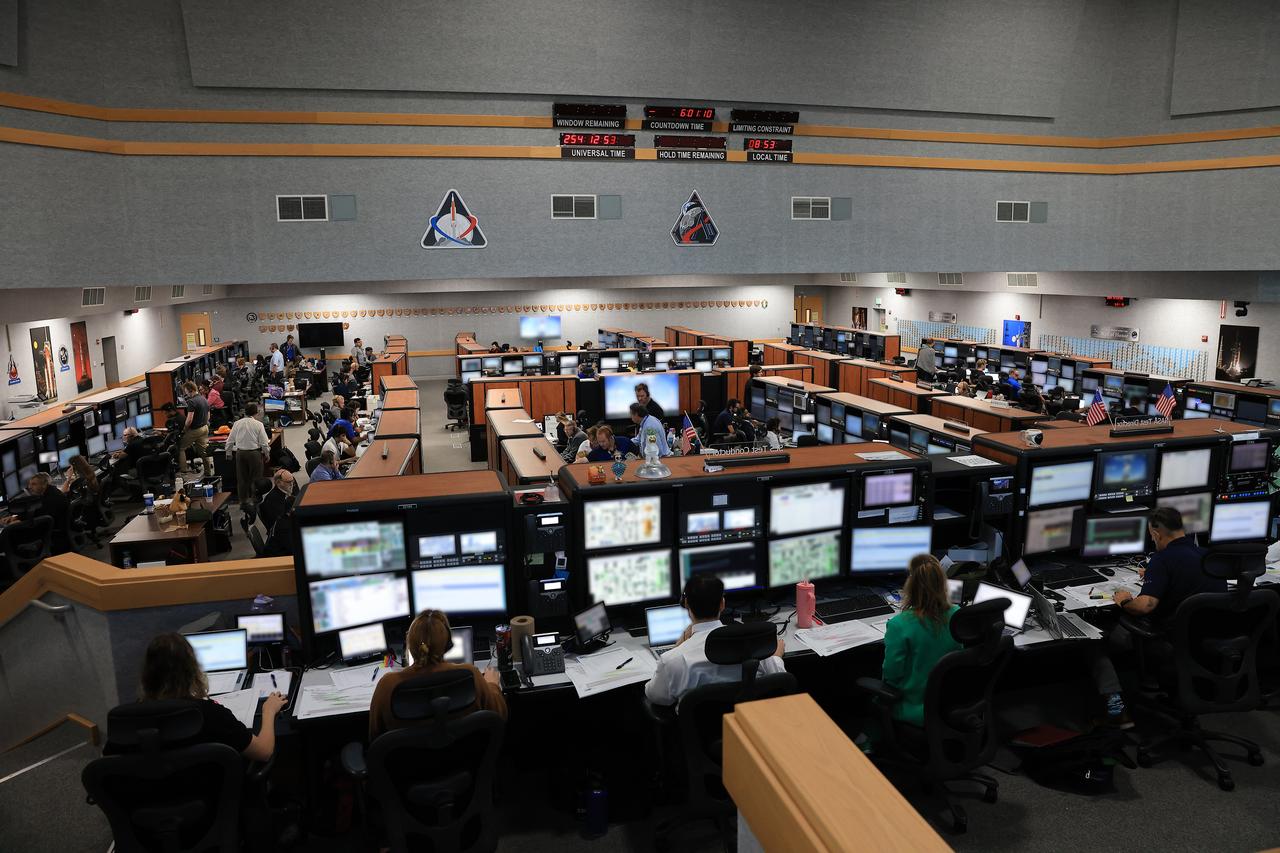
Teams at NASA’s Kennedy Space Center in Florida participate in the first joint integrated launch countdown simulation for Artemis II inside Firing Room 1 of the Launch Control Center on Thursday, Sept. 11, 2025. The training exercise involved engineers from Kennedy, Marshall Space Flight Center in Huntsville, Alabama, and Johnson Space Center in Houston coming together to rehearse all aspects of the launch countdown, from cryogenic loading – filling tanks in the SLS (Space Launch System) rocket’s core stage with liquid hydrogen and liquid oxygen – to liftoff. These simulations will help certify that the launch team is ready for Artemis II – the first crewed Artemis mission that will send four astronauts around the Moon and back.
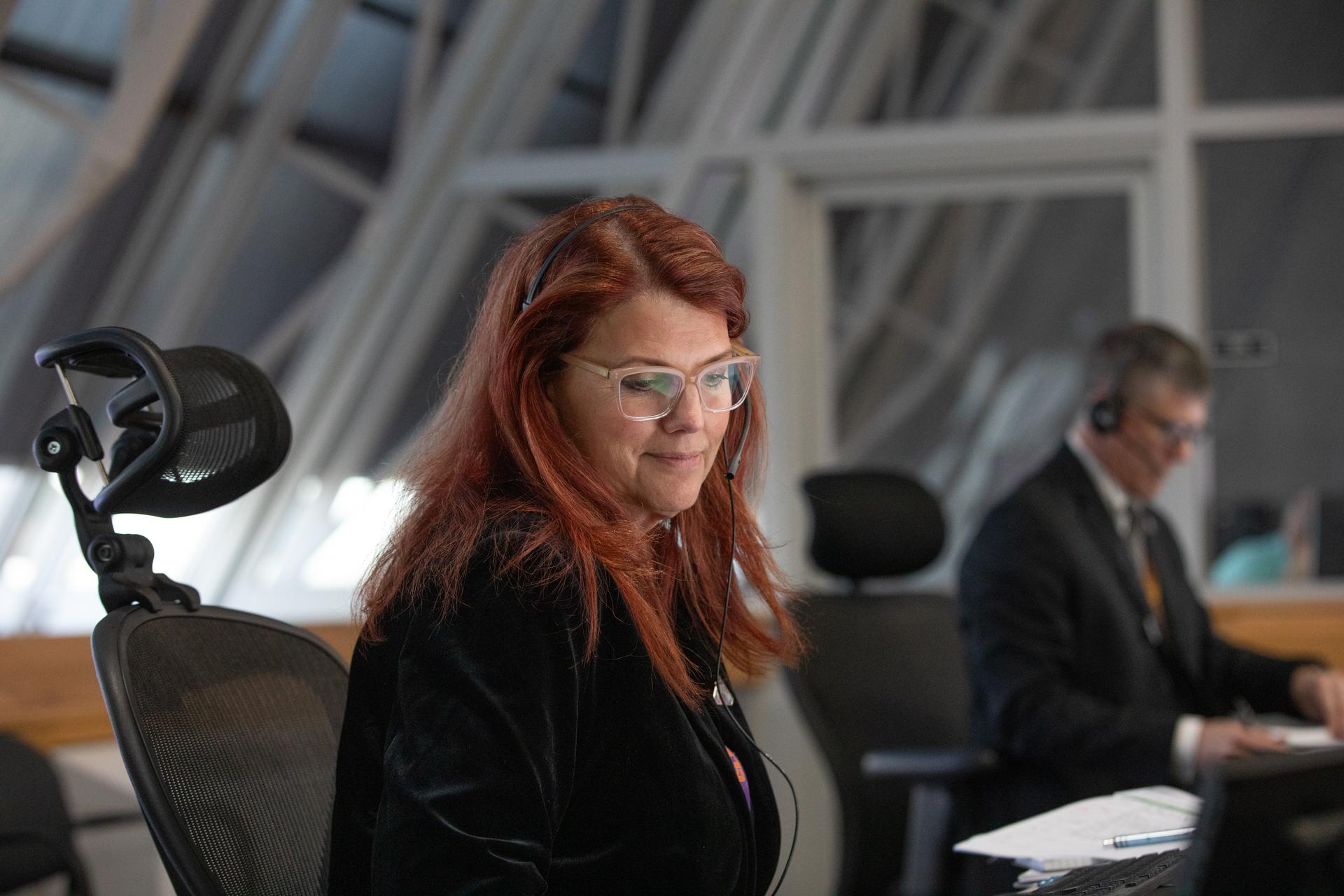
Charlie Blackwell-Thompson, Artemis launch director, Exploration Ground Systems at NASA’s Kennedy Space Center in Florida, participates in an integrated launch countdown simulation for Artemis II inside Firing Room 1 of the Launch Control Center on Wednesday, Dec. 10, 2025. The training exercise involved engineers from Kennedy, Marshall Space Flight Center in Huntsville, Alabama, and Johnson Space Center in Houston coming together to rehearse all aspects of the launch countdown, from cryogenic loading – filling tanks in the SLS (Space Launch System) rocket’s core stage with liquid hydrogen and liquid oxygen – to liftoff. For Artemis II, four astronauts will venture around the Moon, the first crewed mission on NASA’s path to establishing a long-term presence for science and exploration through Artemis.
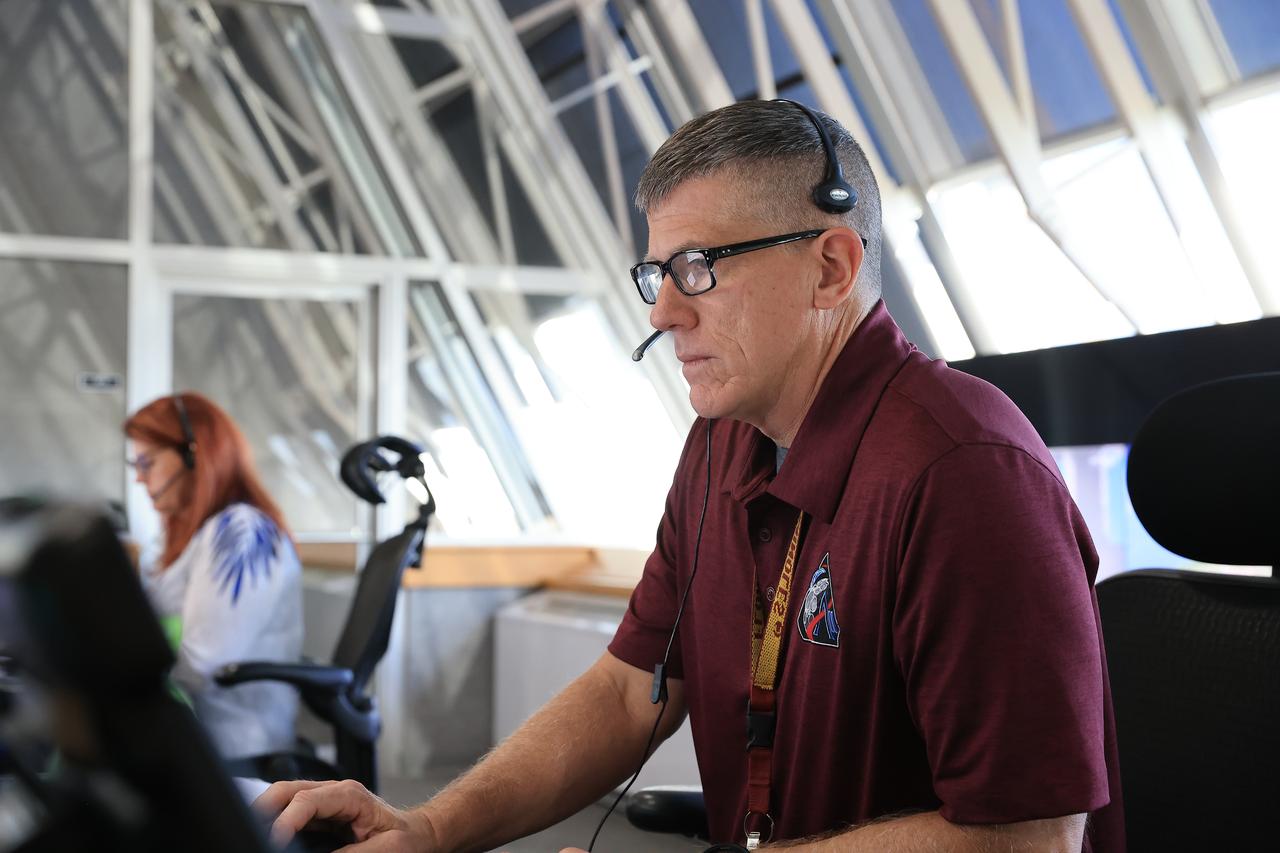
Jeremy Graeber, Artemis assistant launch director within NASA’s Exploration Ground Systems Program, participates in the first joint integrated launch countdown simulation for Artemis II inside Firing Room 1 of the Launch Control Center on Thursday, Sept. 11, 2025 at the agency’s Kennedy Space Center in Florida. The training exercise involved engineers from Kennedy, Marshall Space Flight Center in Huntsville, Alabama, and Johnson Space Center in Houston coming together to rehearse all aspects of the launch countdown, from cryogenic loading – filling tanks in the SLS (Space Launch System) rocket’s core stage with liquid hydrogen and liquid oxygen – to liftoff. These simulations will help certify that the launch team is ready for Artemis II – the first crewed Artemis mission that will send four astronauts around the Moon and back.
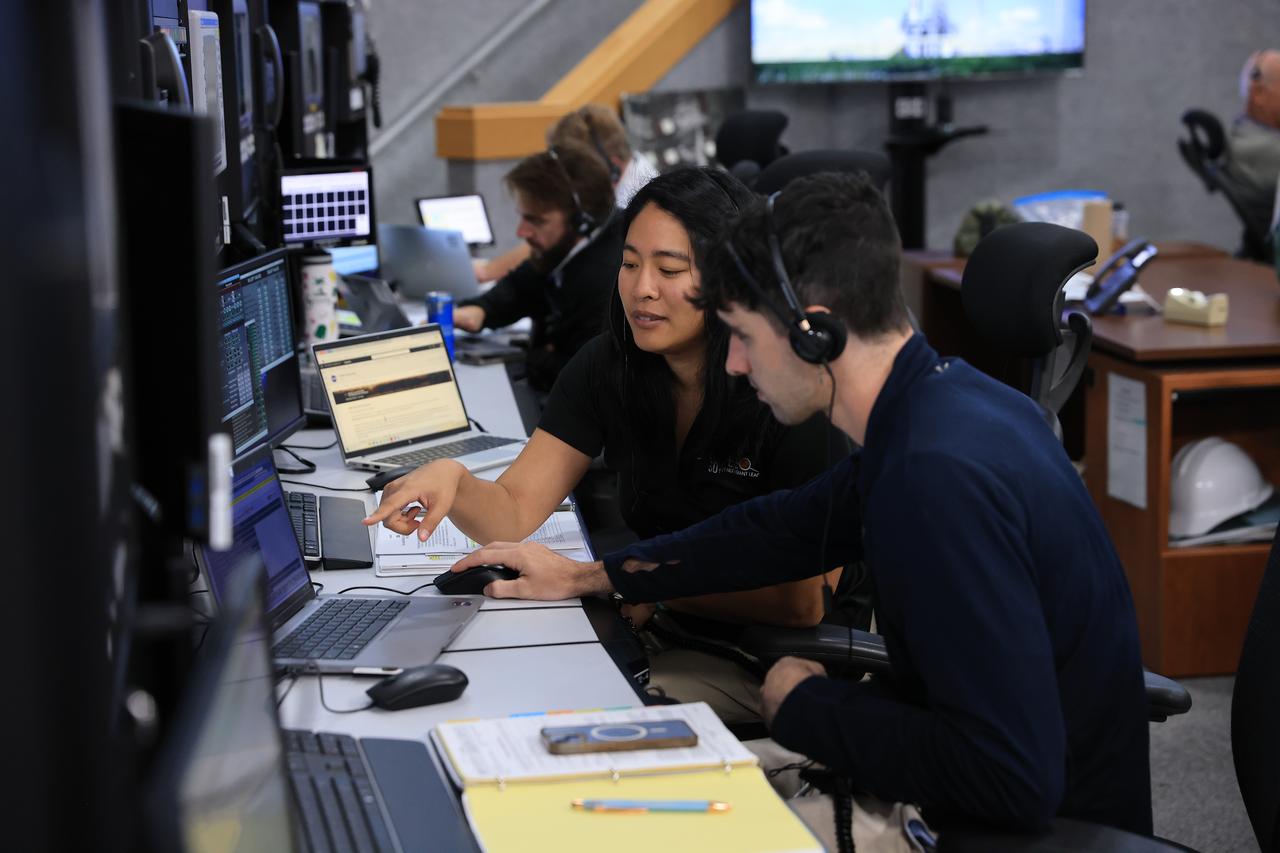
Teams at NASA’s Kennedy Space Center in Florida participate in the first joint integrated launch countdown simulation for Artemis II inside Firing Room 1 of the Launch Control Center on Thursday, Sept. 11, 2025. The training exercise involved engineers from Kennedy, Marshall Space Flight Center in Huntsville, Alabama, and Johnson Space Center in Houston coming together to rehearse all aspects of the launch countdown, from cryogenic loading – filling tanks in the SLS (Space Launch System) rocket’s core stage with liquid hydrogen and liquid oxygen – to liftoff. These simulations will help certify that the launch team is ready for Artemis II – the first crewed Artemis mission that will send four astronauts around the Moon and back.
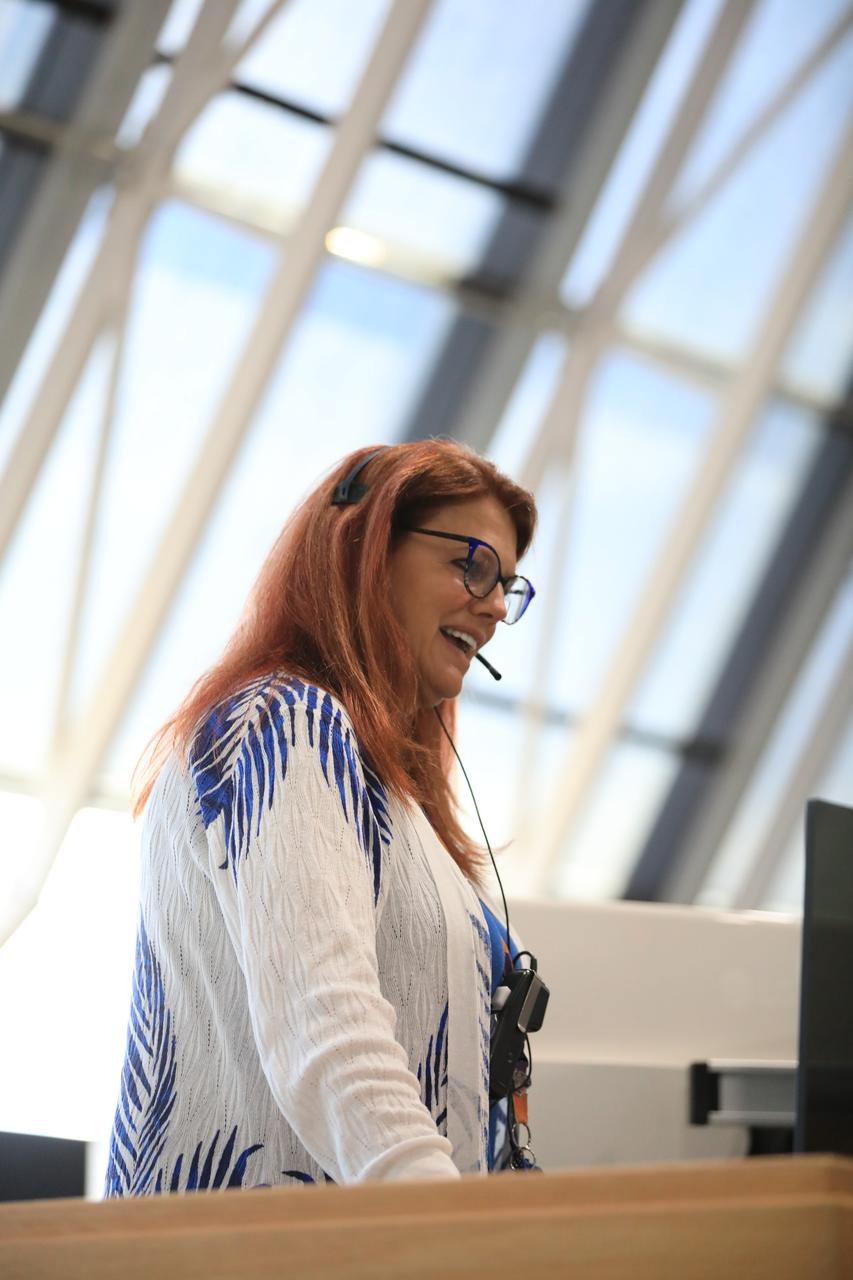
Charlie Blackwell-Thompson, Artemis launch director, Exploration Ground Systems at NASA’s Kennedy Space Center in Florida, participates in the first joint integrated launch countdown simulation for Artemis II inside Firing Room 1 of the Launch Control Center on Thursday, Sept. 11, 2025. The training exercise involved engineers from Kennedy, Marshall Space Flight Center in Huntsville, Alabama, and Johnson Space Center in Houston coming together to rehearse all aspects of the launch countdown, from cryogenic loading – filling tanks in the SLS (Space Launch System) rocket’s core stage with liquid hydrogen and liquid oxygen – to liftoff. These simulations will help certify that the launch team is ready for Artemis II – the first crewed Artemis mission that will send four astronauts around the Moon and back.
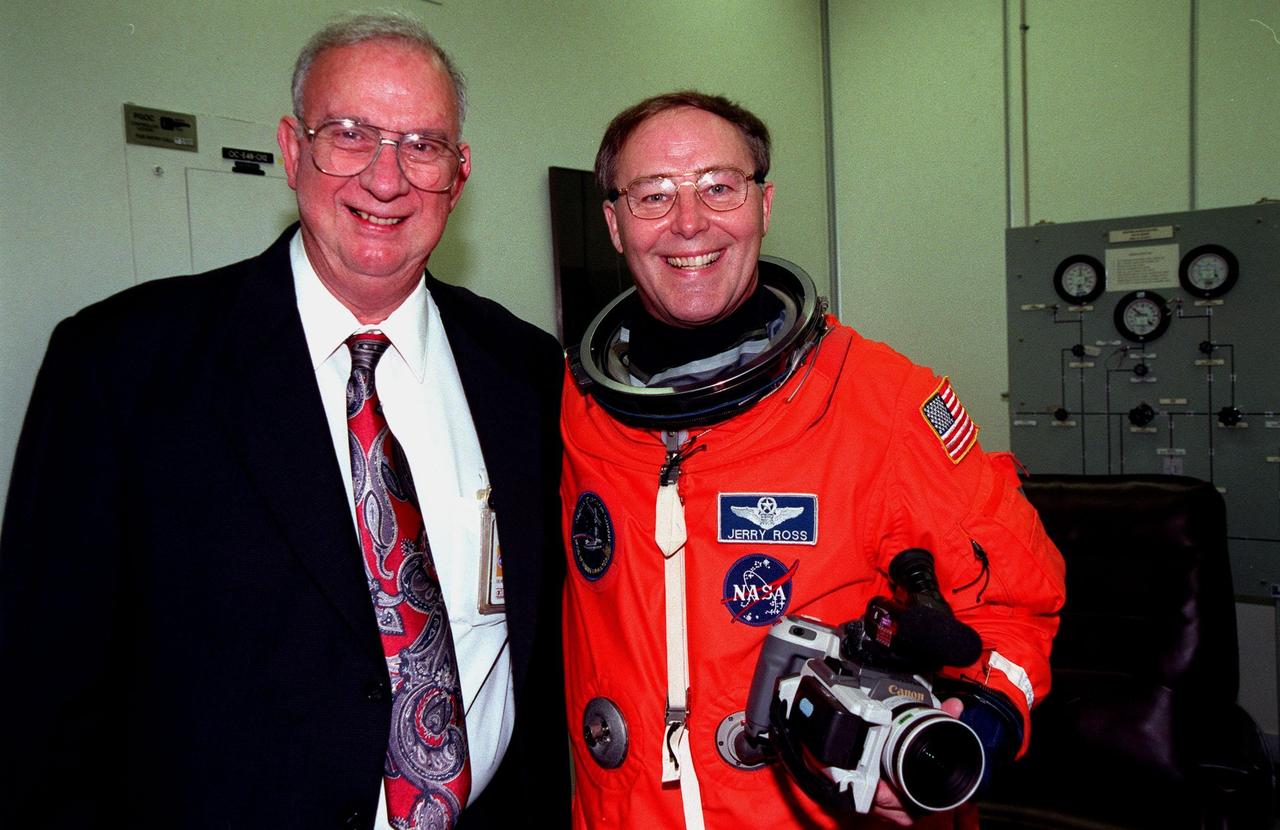
KENNEDY SPACE CENTER, FLA. -- In the Operations and Checkout Building, STS-88 Mission Specialist Jerry L. Ross (right) takes part in a complete suit check before launch. Standing with him is Owen Bertrand, chief of the Vehicle Integration Test office at Johnson Space Center. This is Bertrand's last launch before retiring in January. Mission STS-88 is expected to launch at 3:56 a.m. EST with the six-member crew aboard Space Shuttle Endeavour on Dec. 3. Endeavour carries the Unity connecting module, which the crew will be mating with the Russian-built Zarya control module already in orbit. In addition to Unity, two small replacement electronics boxes are on board for possible repairs to Zarya batteries. The mission is expected to last 11 days, 19 hours and 49 minutes, landing at 10:17 p.m. EST on Dec. 14
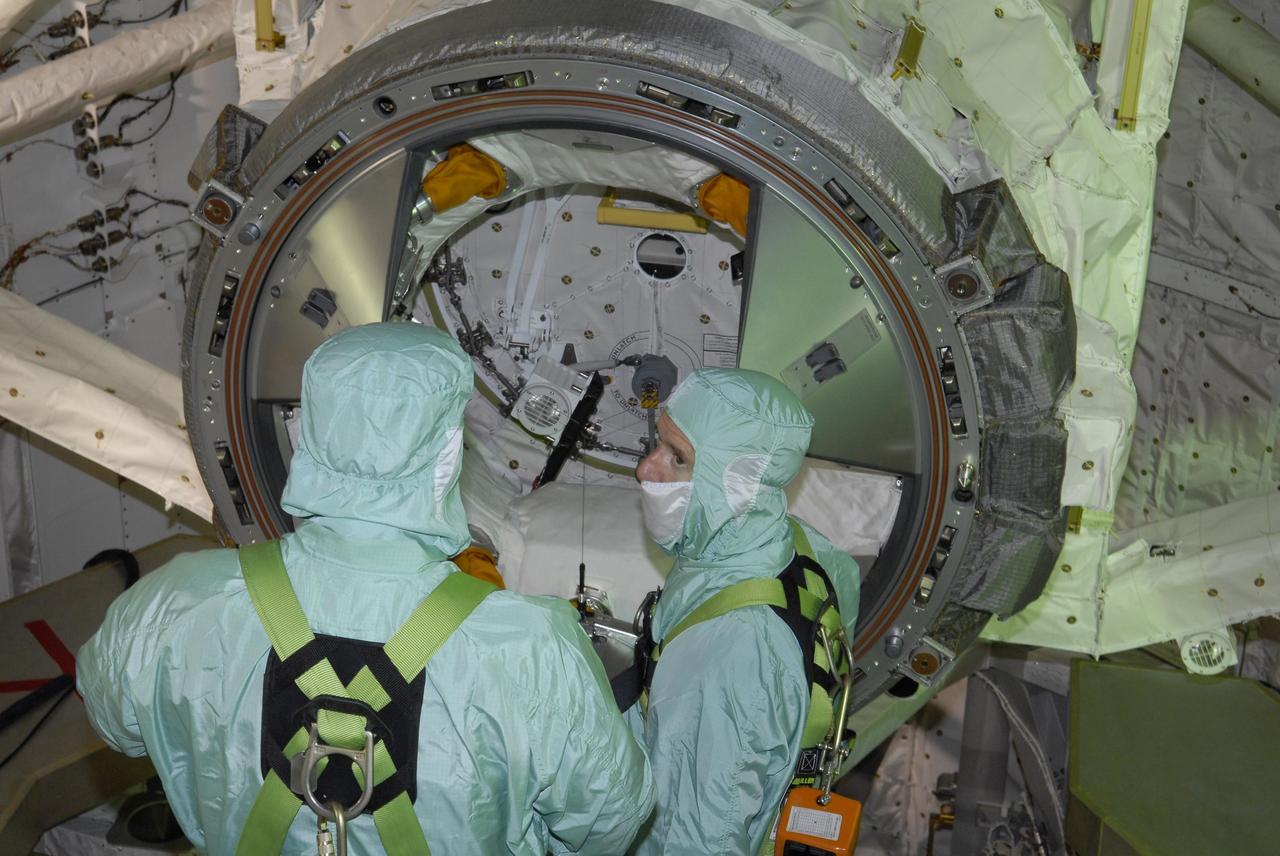
KENNEDY SPACE CENTER, FLA. -- After their arrival at KSC, STS-117 crew members take part in a payload bay walkdown on Launch Pad 39A to look at the cargo in Space Shuttle Atlantis. The payload includes the S3/S4 integrated truss structure for the International Space Station. STS-117 is scheduled to launch at 7:38 p.m. June 8. During the 11-day mission and three spacewalks, the crew will work with flight controllers at NASA's Johnson Space Center in Houston to install the 17-ton segment on the station's girder-like truss and deploy the set of solar arrays, S3/S4. The mission will increase the space station's power capability in preparation for the arrival of new science modules from the European and Japanese space agencies. Photo credit: NASA/Kim Shiflett
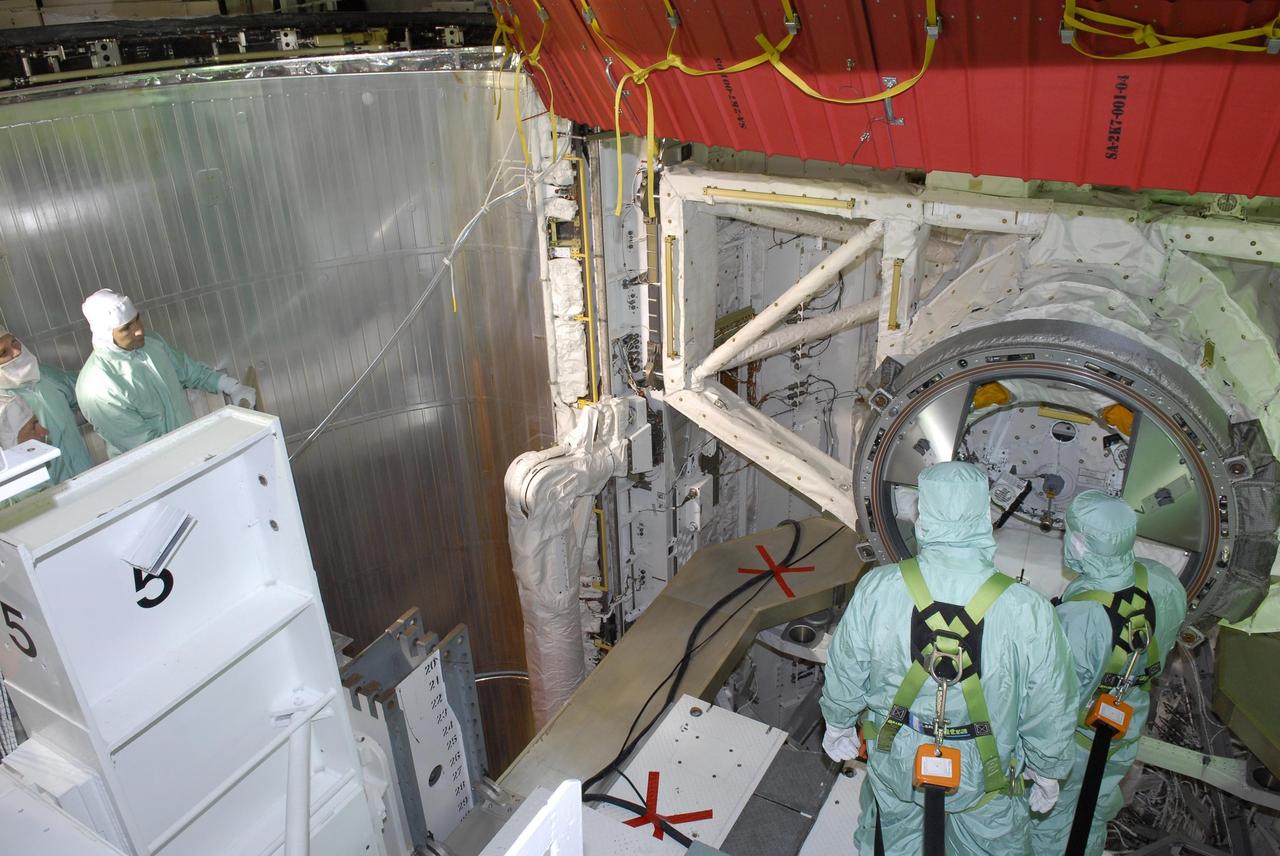
KENNEDY SPACE CENTER, FLA. -- After their arrival at KSC, STS-117 crew members take part in a payload bay walkdown on Launch Pad 39A to look at the cargo in Space Shuttle Atlantis. The payload includes the S3/S4 integrated truss structure for the International Space Station. STS-117 is scheduled to launch at 7:38 p.m. June 8. During the 11-day mission and three spacewalks, the crew will work with flight controllers at NASA's Johnson Space Center in Houston to install the 17-ton segment on the station's girder-like truss and deploy the set of solar arrays, S3/S4. The mission will increase the space station's power capability in preparation for the arrival of new science modules from the European and Japanese space agencies. Photo credit: NASA/Kim Shiflett
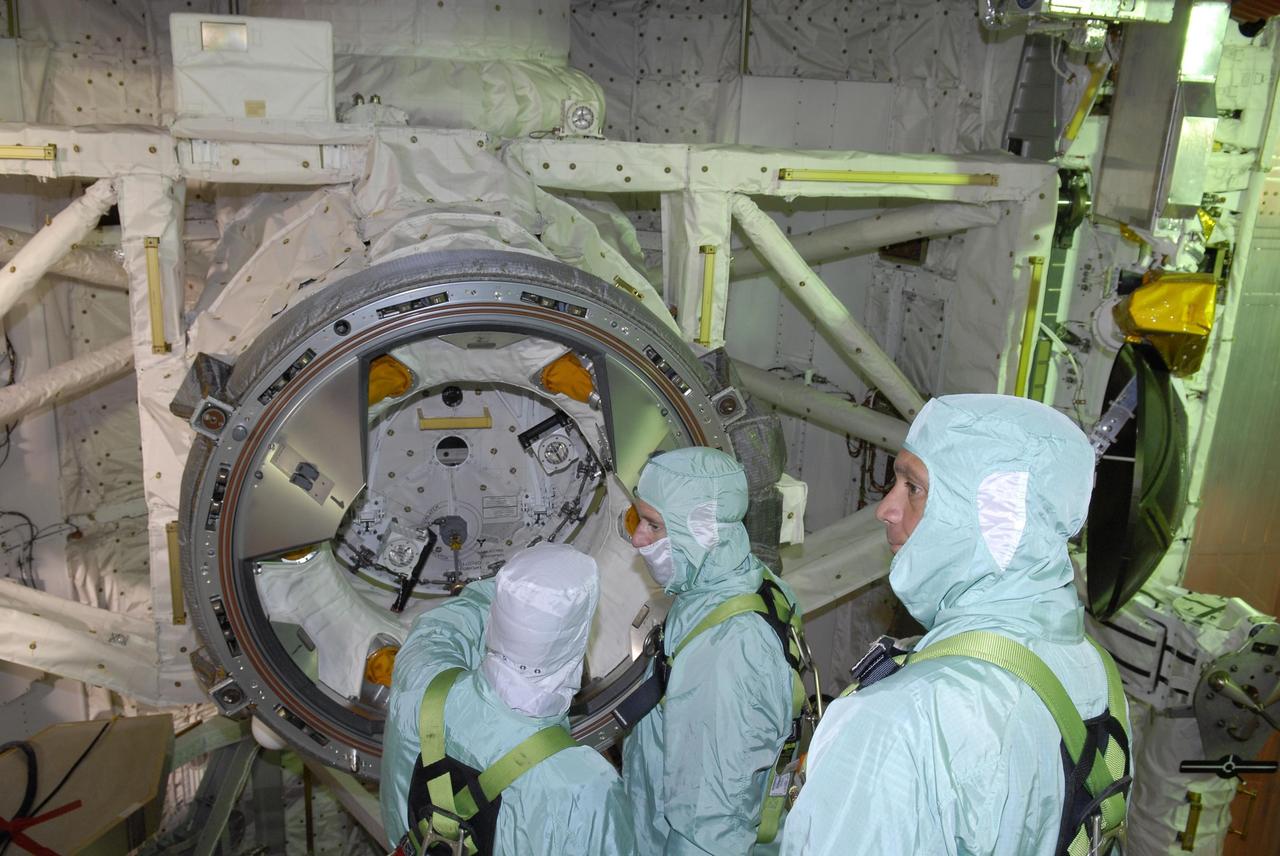
KENNEDY SPACE CENTER, FLA. -- After their arrival at KSC, STS-117 crew members take part in a payload bay walkdown on Launch Pad 39A to look at the cargo in Space Shuttle Atlantis. The payload includes the S3/S4 integrated truss structure for the International Space Station. STS-117 is scheduled to launch at 7:38 p.m. June 8. During the 11-day mission and three spacewalks, the crew will work with flight controllers at NASA's Johnson Space Center in Houston to install the 17-ton segment on the station's girder-like truss and deploy the set of solar arrays, S3/S4. The mission will increase the space station's power capability in preparation for the arrival of new science modules from the European and Japanese space agencies. Photo credit: NASA/Kim Shiflett
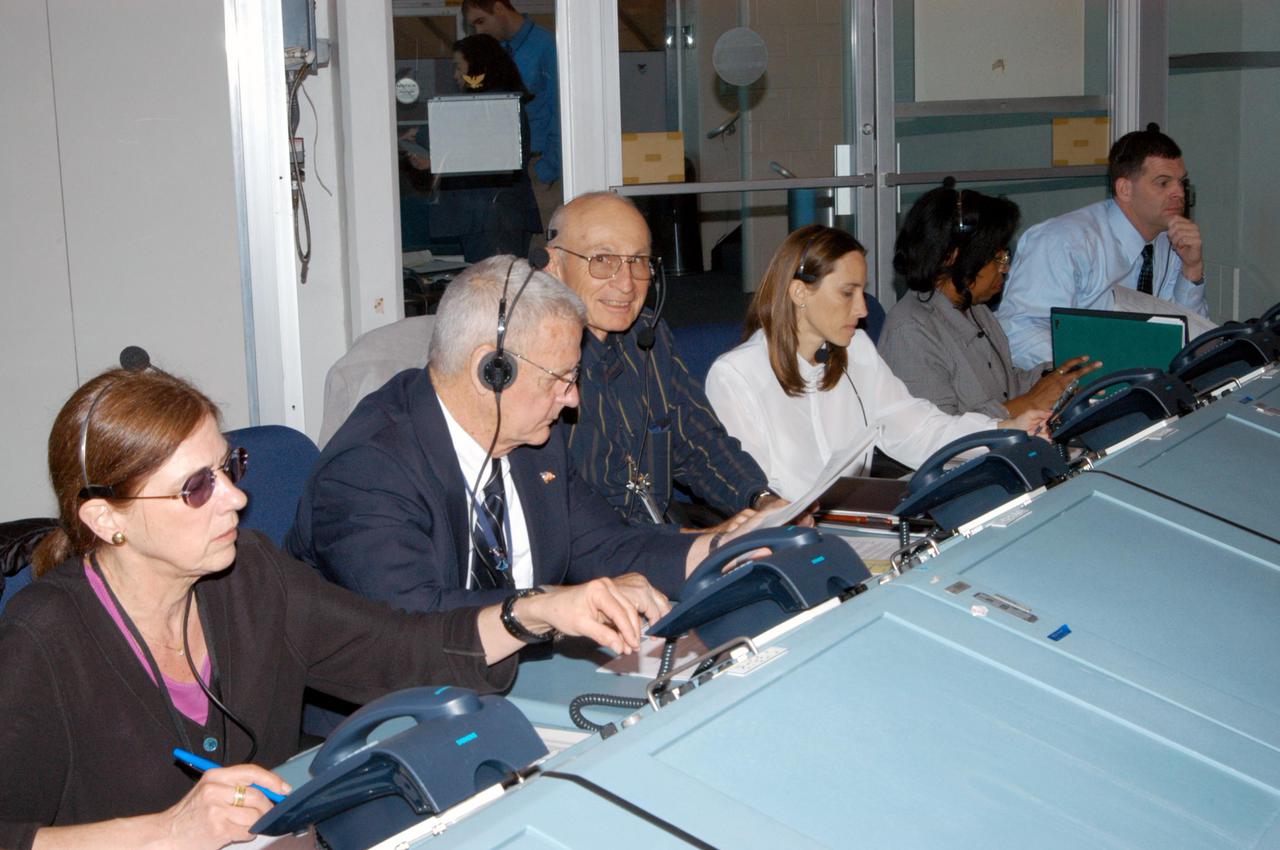
KENNEDY SPACE CENTER, FLA. - Space Shuttle Program managers, directors and engineers man the consoles in the Launch Control Center. They are taking part in an End-to-End (ETE) Mission Management Team (MMT) launch simulation at KSC. In Firing Room 1 at KSC, Shuttle launch team members put the Shuttle system through an integrated simulation. The control room is set up with software used to simulate flight and ground systems in the launch configuration. Seated in the center is Bob Sieck, a member of the Stafford-Covey Shuttle Return to Flight Task Group; at his left is Forrest McCartney, former Kennedy Space Center director. Sieck served as launch director and director of Shuttle Processing in the 80s and 90s. The ETE MMT simulation included L-2 and L-1 day Prelaunch MMT meetings, an external tanking_weather briefing, and a launch countdown. The ETE transitioned to the Johnson Space Center for the flight portion of the simulation, with the STS-114 crew in a simulator at JSC. Such simulations are common before a launch to keep the Shuttle launch team sharp and ready for liftoff.
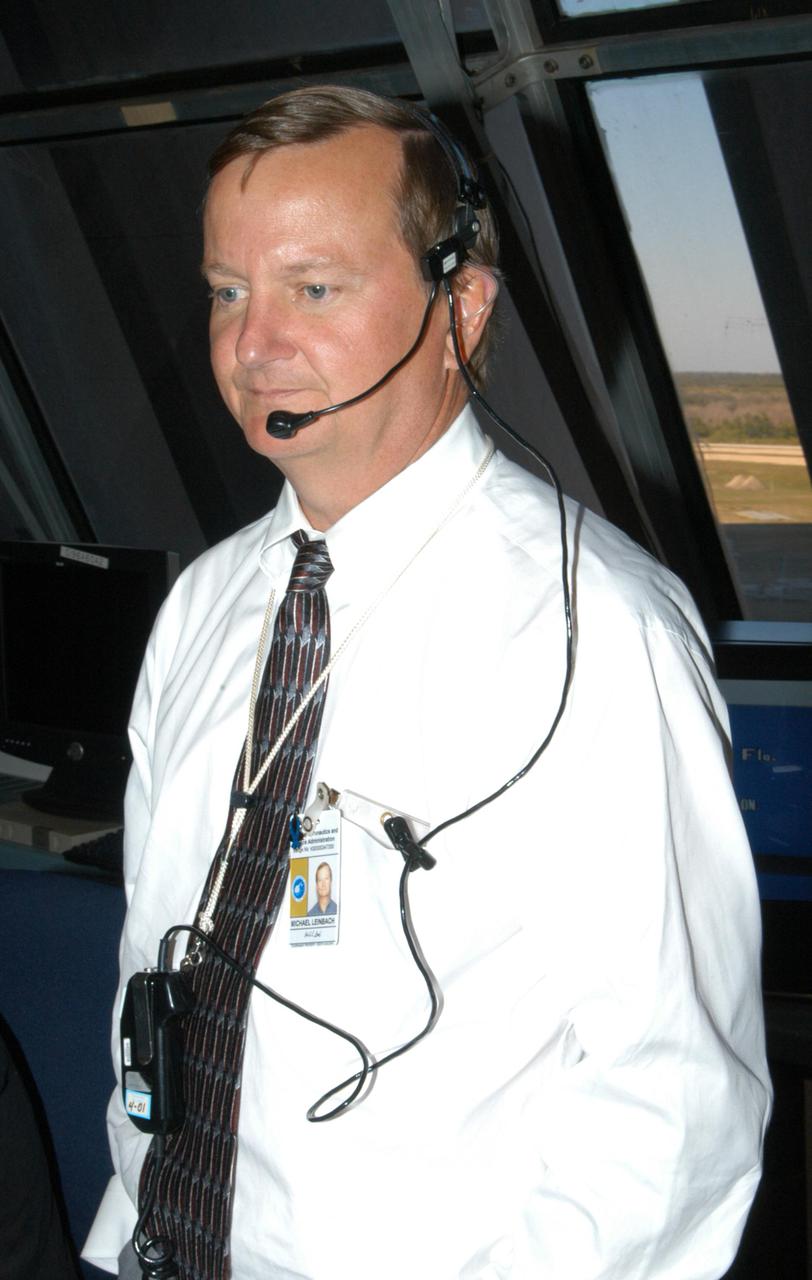
KENNEDY SPACE CENTER, FLA. - Shuttle Launch Director Mike Leinbach takes part in an End-to-End (ETE) Mission Management Team (MMT) launch simulation at KSC. In Firing Room 1 at KSC, Shuttle launch team members put the Shuttle system through an integrated simulation. The control room is set up with software used to simulate flight and ground systems in the launch configuration. The ETE MMT simulation included L-2 and L-1 day Prelaunch MMT meetings, an external tanking_weather briefing, and a launch countdown. The ETE transitioned to the Johnson Space Center for the flight portion of the simulation, with the STS-114 crew in a simulator at JSC. Such simulations are common before a launch to keep the Shuttle launch team sharp and ready for liftoff.
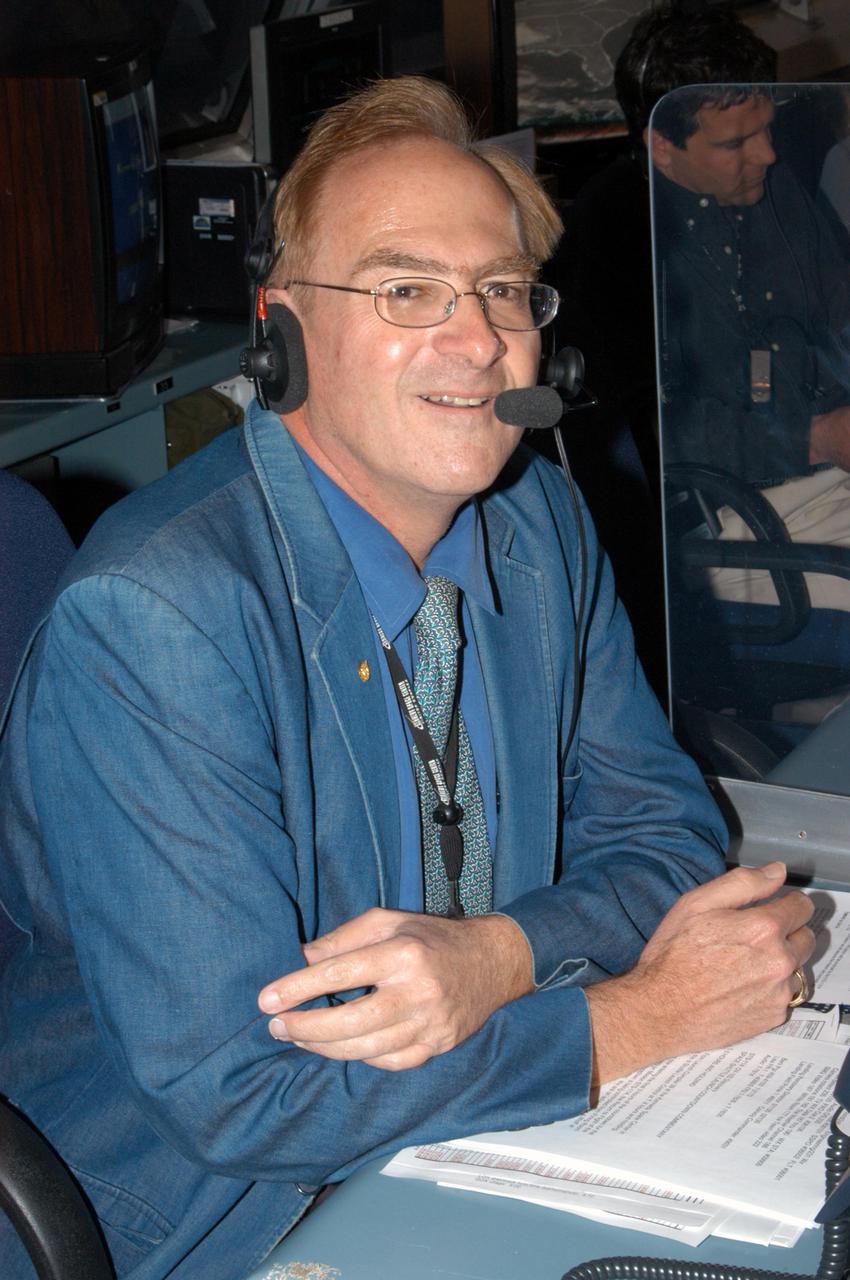
KENNEDY SPACE CENTER, FLA. - Public Information Officer George Diller plays his role as commentator during in an End-to-End (ETE) Mission Management Team (MMT) launch simulation at KSC. In Firing Room 1 at KSC, Shuttle launch team members put the Shuttle system through an integrated simulation. The control room is set up with software used to simulate flight and ground systems in the launch configuration. The ETE MMT simulation included L-2 and L-1 day Prelaunch MMT meetings, an external tanking_weather briefing, and a launch countdown. The ETE transitioned to the Johnson Space Center for the flight portion of the simulation, with the STS-114 crew in a simulator at JSC. Such simulations are common before a launch to keep the Shuttle launch team sharp and ready for liftoff.
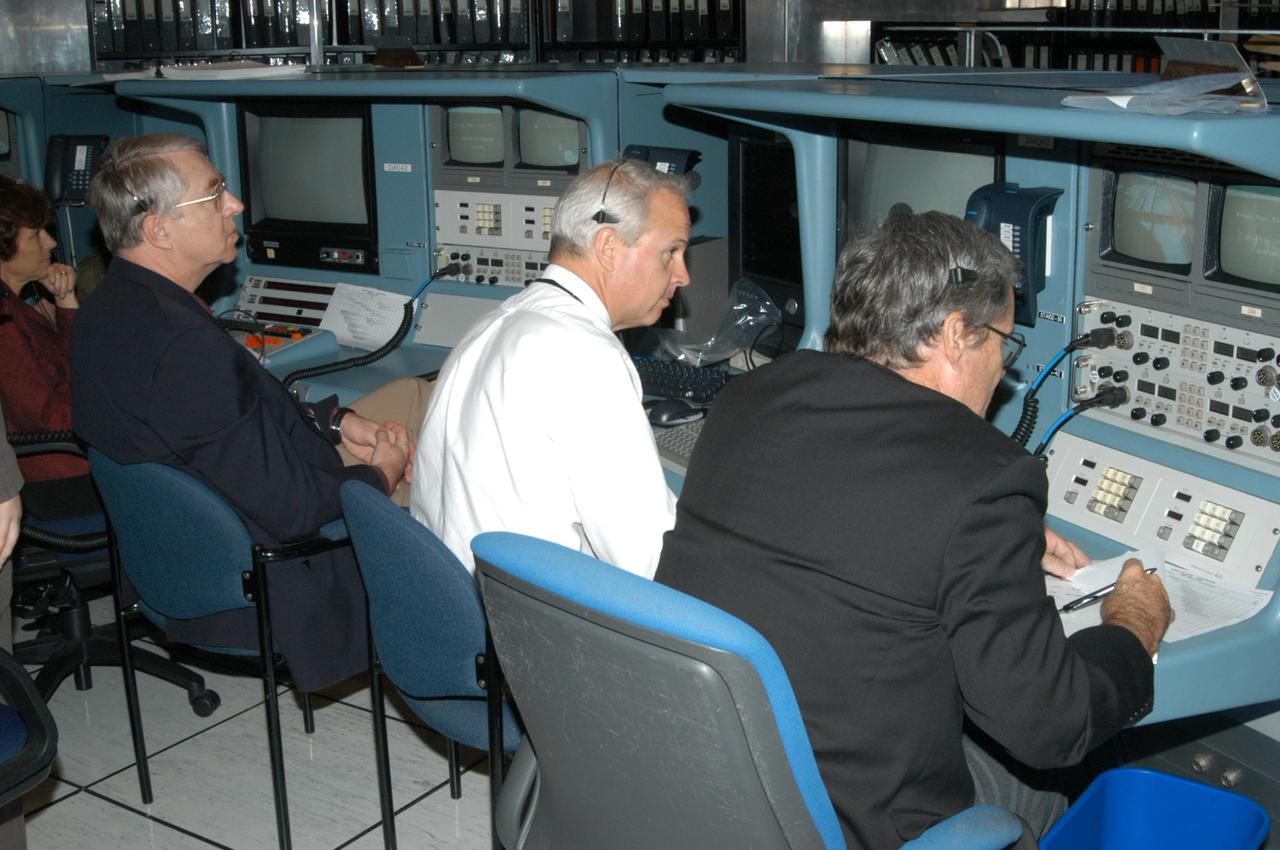
KENNEDY SPACE CENTER, FLA. - Sitting at consoles, journalists Marsha Dunn, Craig Covault, Mike Cabbage and Bill Harwood witness an End-to-End (ETE) Mission Management Team (MMT) launch simulation at KSC. In Firing Room 1 at KSC, Shuttle launch team members put the Shuttle system through an integrated simulation. The control room is set up with software used to simulate flight and ground systems in the launch configuration. The ETE MMT simulation included L-2 and L-1 day Prelaunch MMT meetings, an external tanking_weather briefing, and a launch countdown. The ETE transitioned to the Johnson Space Center for the flight portion of the simulation, with the STS-114 crew in a simulator at JSC. Such simulations are common before a launch to keep the Shuttle launch team sharp and ready for liftoff.
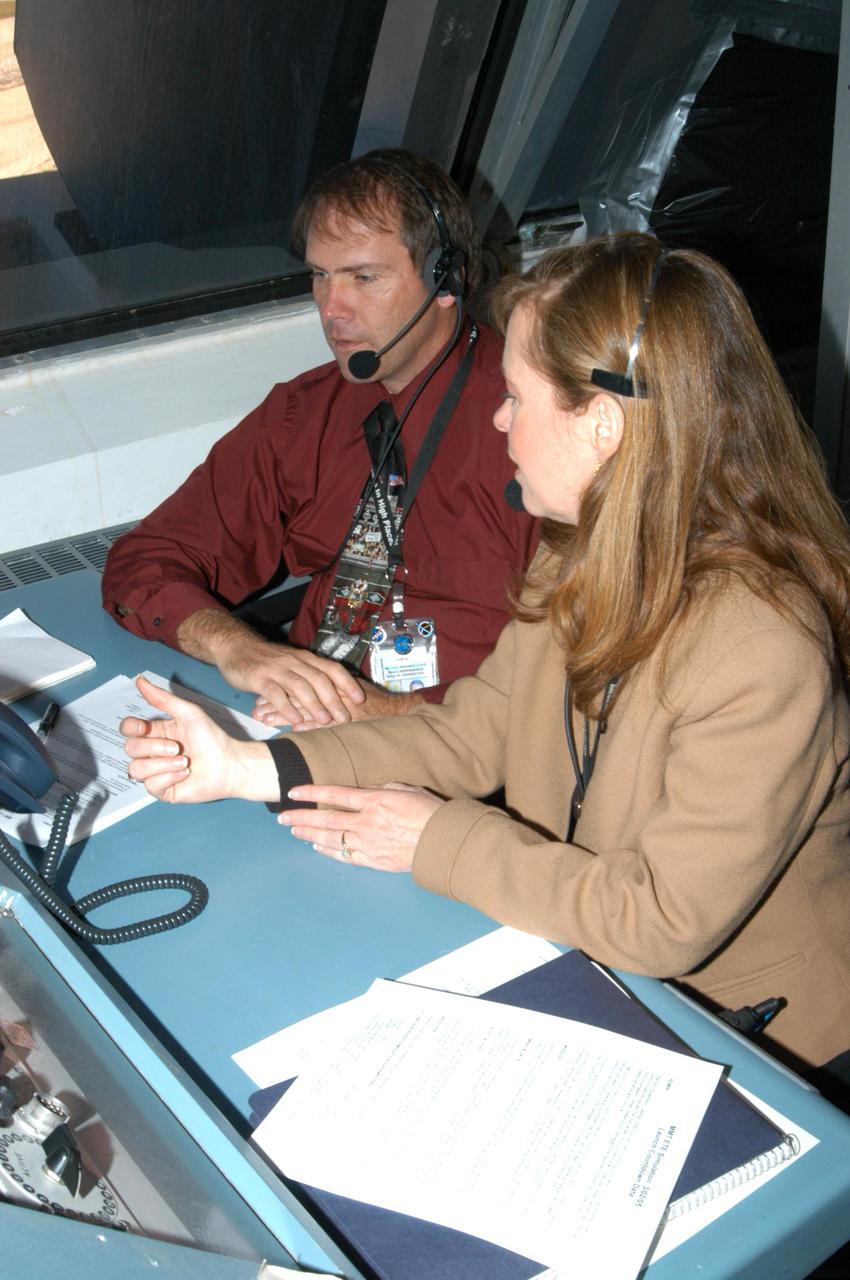
KENNEDY SPACE CENTER, FLA. - During an End-to-End (ETE) Mission Management Team (MMT) launch simulation at KSC, Mike Rein, division chief of Media Services, and Lisa Malone, director of External Relations and Business Development at KSC, work the consoles. In Firing Room 1 at KSC, Shuttle launch team members put the Shuttle system through an integrated simulation. The control room is set up with software used to simulate flight and ground systems in the launch configuration. The ETE MMT simulation included L-2 and L-1 day Prelaunch MMT meetings, an external tanking_weather briefing, and a launch countdown. The ETE transitioned to the Johnson Space Center for the flight portion of the simulation, with the STS-114 crew in a simulator at JSC. Such simulations are common before a launch to keep the Shuttle launch team sharp and ready for liftoff.
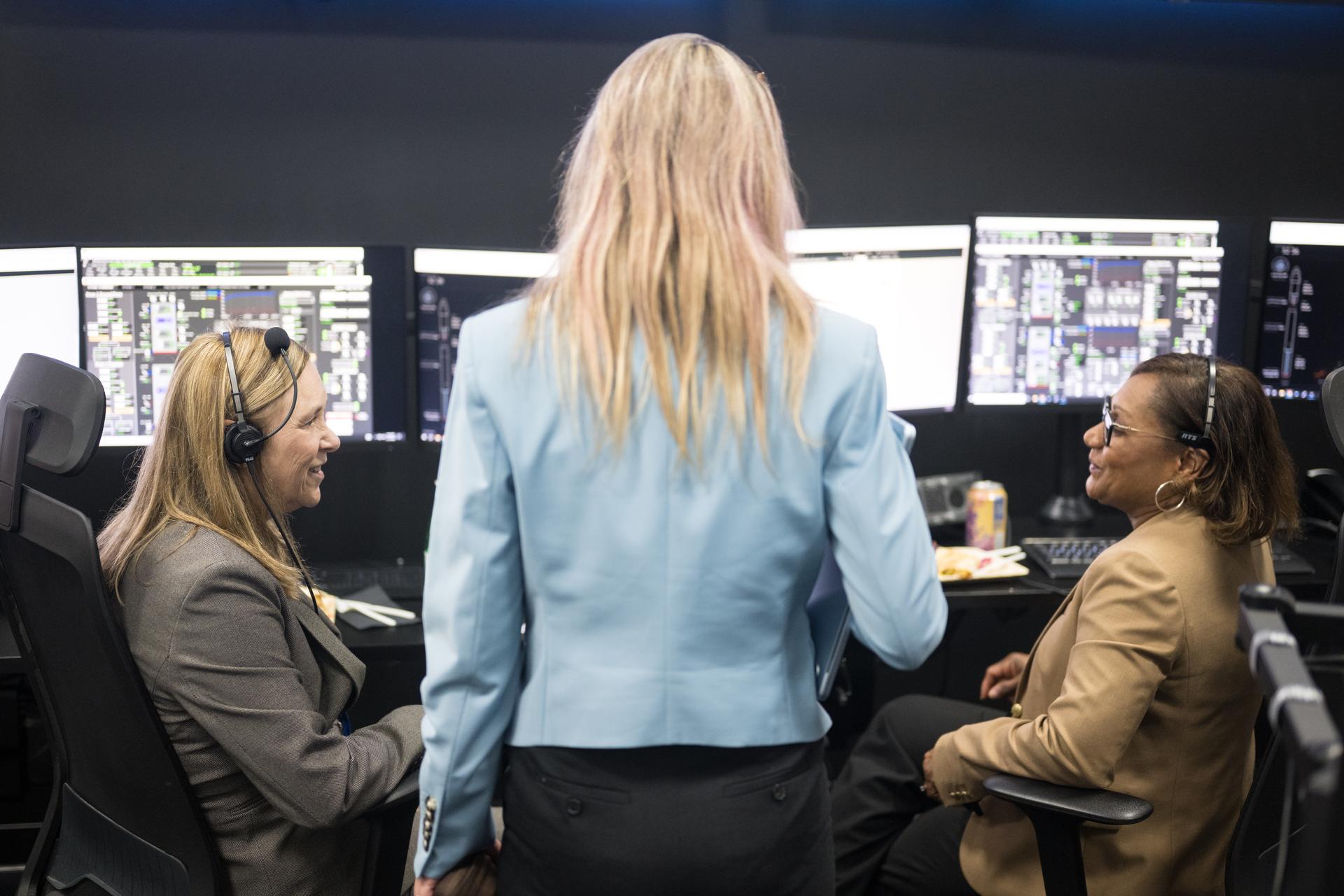
SpaceX-Vice President, Customer Operations and Integration, Jessica Jenson, center, speaks with Janet Petro, director of NASA's Kennedy Space Center, left, and Vanessa Wyche, director of NASA's Johnson Space Center, during the countdown of the launch of a SpaceX Falcon 9 rocket carrying the company's Dragon spacecraft on NASA’s SpaceX Crew-12 mission with NASA astronauts Jessica Meir, Jack Hathaway, ESA (European Space Agency) astronaut Sophie Adenot, and Roscosmos cosmonaut Andrey Fedyaev onboard, Friday, Feb. 13, 2026, in the control center of SpaceX’s HangarX at NASA’s Kennedy Space Center in Florida. NASA’s SpaceX Crew-12 mission is the twelfth crew rotation mission of the SpaceX Dragon spacecraft and Falcon 9 rocket to the International Space Station as part of the agency’s Commercial Crew Program. Meir, Hathaway, Adenot, and Fedyaev are scheduled to launch at 5:15 a.m. EST, from Space Launch Complex 40 at the Cape Canaveral Space Force Station. Photo Credit: (NASA/Aubrey Gemignani)
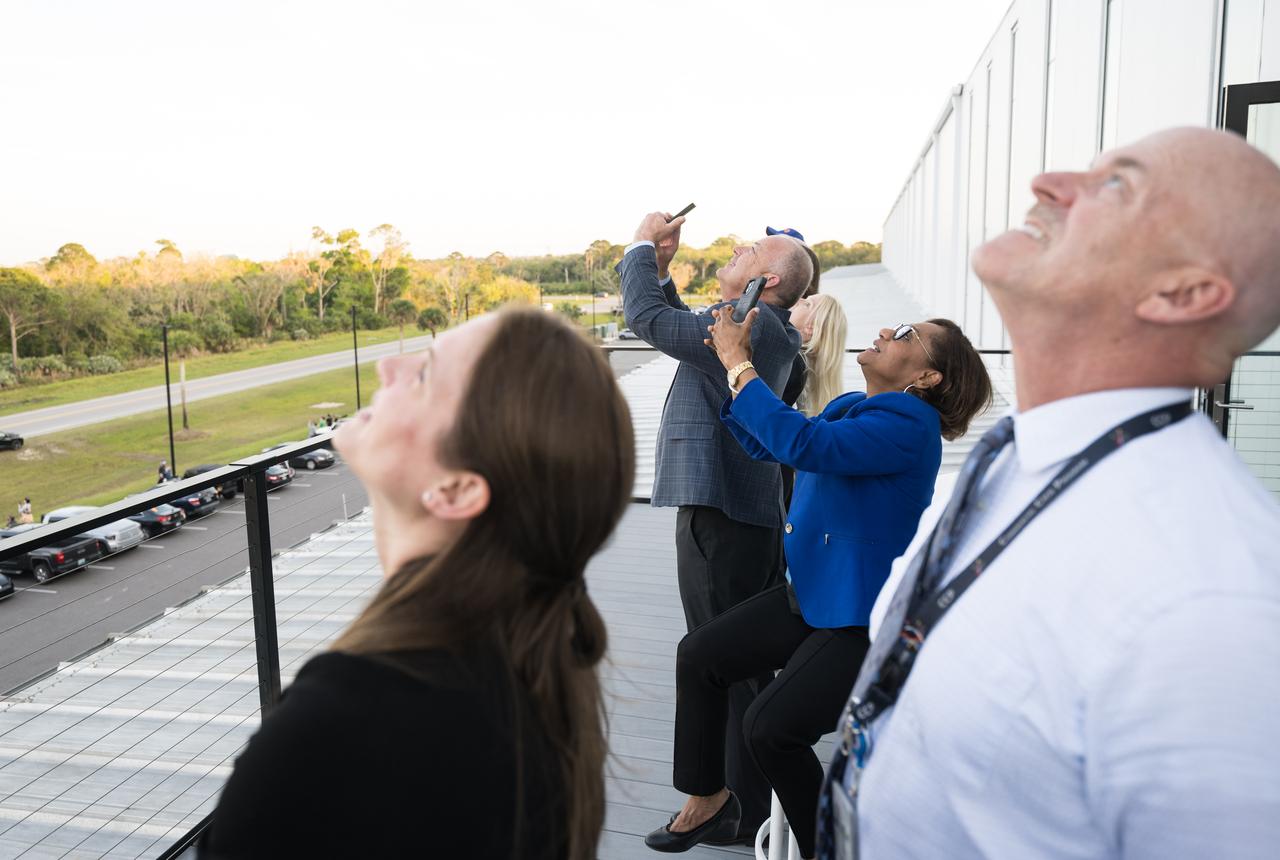
Norm Knight, director of Flight Operations at NASA's Johnson Space Center, left, Vanessa Wyche, acting NASA associate administrator, center, Mike Lee, NASA Deputy Manager for Mission Management and Integration, and other NASA and SpaceX leadership, watch the landing of the booster after launch of a SpaceX Falcon 9 rocket carrying the company's Dragon spacecraft on the Crew-10 mission with NASA astronauts Anne McClain and Nichole Ayers, JAXA (Japan Aerospace Exploration Agency) astronaut Takuya Onishi, and Roscosmos cosmonaut Kirill Peskov onboard, Friday, March 14, 2025, in the control room of SpaceX’s HangarX at NASA’s Kennedy Space Center in Florida. NASA’s SpaceX Crew-10 mission is the tenth crew rotation mission of the SpaceX Dragon spacecraft and Falcon 9 rocket to the International Space Station as part of the agency’s Commercial Crew Program. McClain, Ayers, Onishi, and Peskov launched at 7:03 p.m. EDT, from Launch Complex 39A at the Kennedy Space Center. Photo Credit: (NASA/Aubrey Gemignani)

Michael Hess, operations integration manager for NASA's Commercial Crew Program, left, speaks with Norm Knight, deputy director of Flight Operations at NASA's Johnson Space Center, right, as they monitor the countdown of the launch of a SpaceX Falcon 9 rocket carrying the company's Crew Dragon spacecraft on NASA’s SpaceX Crew-2 mission with NASA astronauts Shane Kimbrough and Megan McArthur, ESA (European Space Agency) astronaut Thomas Pesquet, and Japan Aerospace Exploration Agency (JAXA) astronaut Akihiko Hoshide onboard, Friday, April 23, 2021, in firing room four of the Launch Control Center at NASA’s Kennedy Space Center in Florida. NASA’s SpaceX Crew-2 mission is the second crew rotation mission of the SpaceX Crew Dragon spacecraft and Falcon 9 rocket to the International Space Station as part of the agency’s Commercial Crew Program. Kimbrough, McArthur, Pesquet, and Hoshide launched at 5:49 a.m. EDT, from Launch Complex 39A at the Kennedy Space Center. Photo Credit: (NASA/Joel Kowsky)
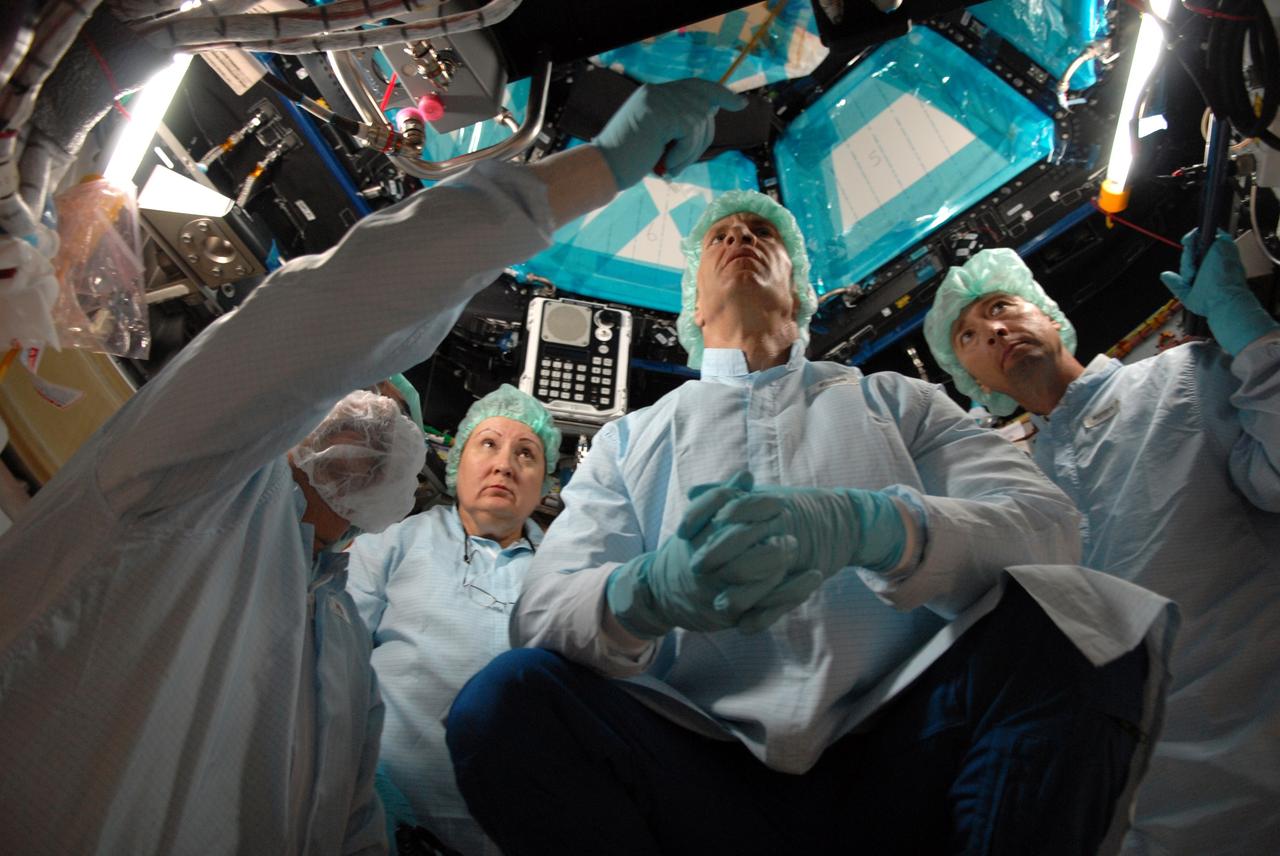
CAPE CANAVERAL, Fla. – In the Space Station Processing Facility at NASA's Kennedy Space Center, astronaut Charles Hobaugh, hands folded, conducts a fit check of the robotic workstation, or RWS, in the International Space Station's Cupola module. From left, he is assisted by Boeing technician Terry Camarata, vehicle integration test engineer Louise Kleba of Flight Crew Operations, and engineer David Jackson, from Johnson Space Center. The RWS is provided by the Canadian Space Agency. The module was delivered by the European Space Agency in 2004 to Kennedy from Alenia Spazio in Turin, Italy. Cupola will provide unprecedented views of activities outside the station and spectacular views of the Earth. Crew members working inside the module will have a 360-degree panoramic view. Cupola has the capability for command and control workstations to be installed to assist in space station remote manipulator system and extra vehicular activities. Cupola is the final element of the space station core and is scheduled for launch on space shuttle Endeavour's STS-130 mission, targeted for Dec. 10, 2009. Photo credit: NASA/Cory Huston
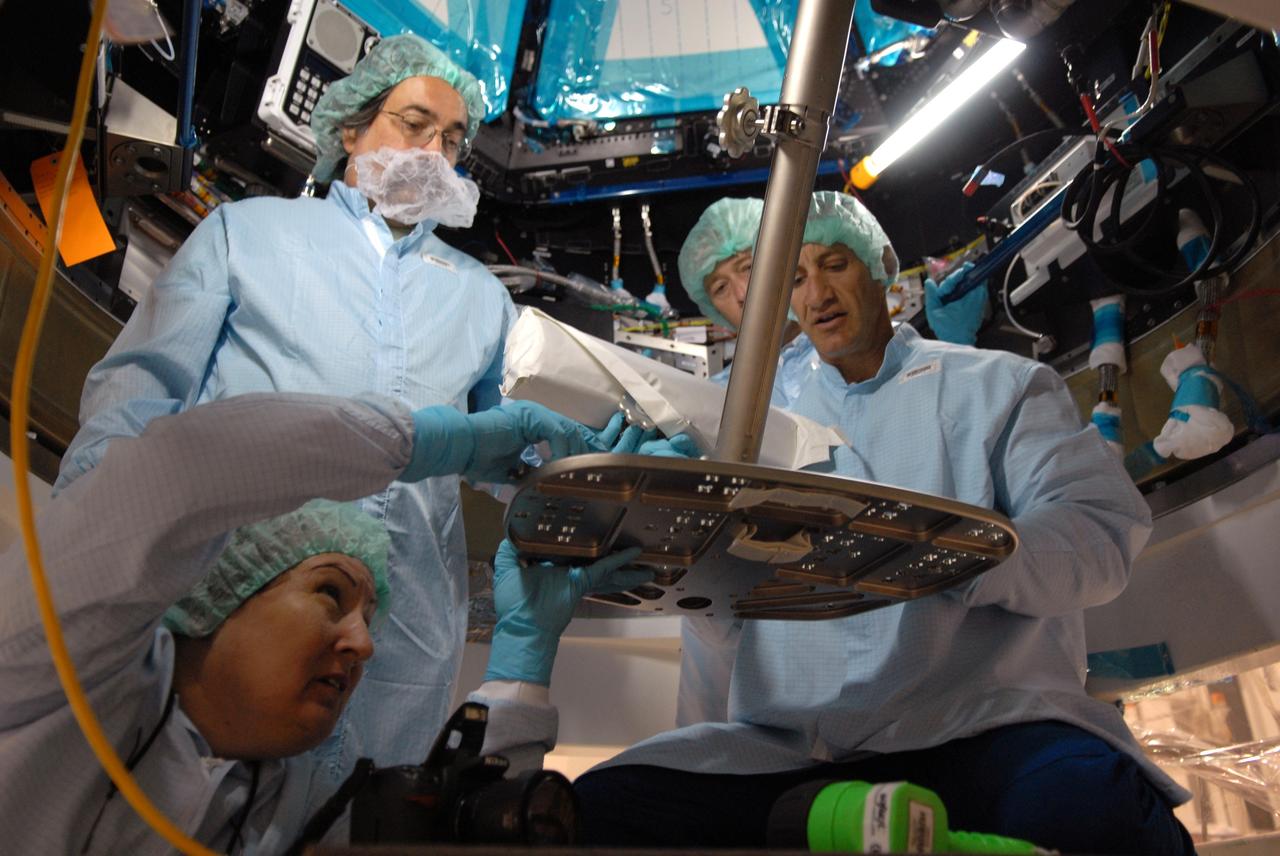
CAPE CANAVERAL, Fla. – In the Space Station Processing Facility at NASA's Kennedy Space Center, astronaut Charles Hobaugh, right, conducts a fit check of the robotic workstation, or RWS, in the International Space Station's Cupola module. He is assisted by vehicle integration test engineer Louise Kleba of Flight Crew Operations, kneeling, Boeing technician Terry Camarata, standing at left, and engineer David Jackson, from Johnson Space Center. The RWS is provided by the Canadian Space Agency. The module was delivered by the European Space Agency in 2004 to Kennedy from Alenia Spazio in Turin, Italy. Cupola will provide unprecedented views of activities outside the station and spectacular views of the Earth. Crew members working inside the module will have a 360-degree panoramic view. Cupola has the capability for command and control workstations to be installed to assist in space station remote manipulator system and extra vehicular activities. Cupola is the final element of the space station core and is scheduled for launch on space shuttle Endeavour's STS-130 mission, targeted for Dec. 10, 2009. Photo credit: NASA/Cory Huston
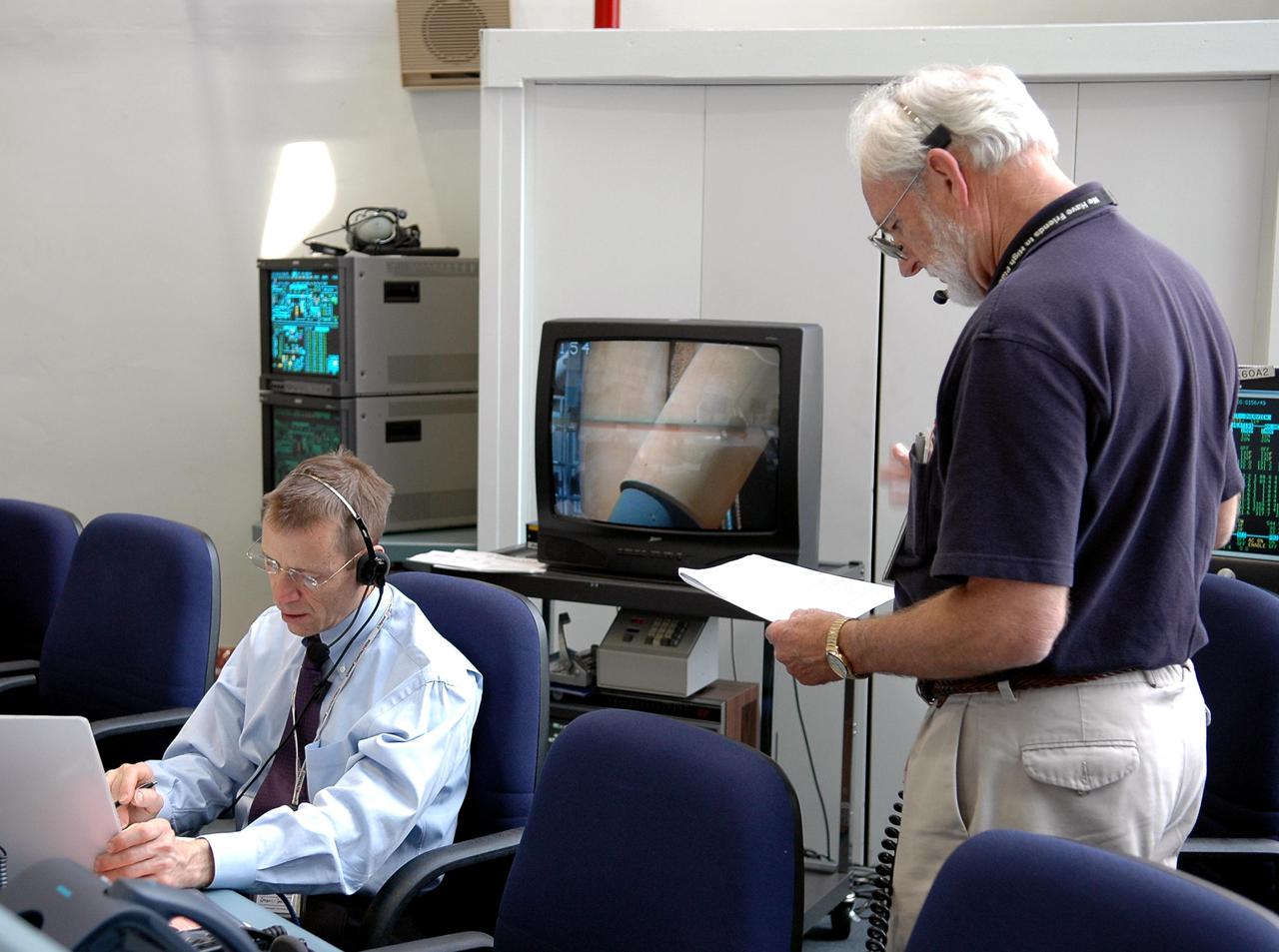
KENNEDY SPACE CENTER, FLA. - Greg 'Ray J' Johnson (left), KSC manager of Launch Integration, and Denny Kross, KSC deputy director of the Space Shuttle Program, support an External Tank (ET) tanking test at Launch Pad 39B from the Launch Control Center. The tanking test is designed to evaluate how the tank, orbiter, solid rocket boosters and ground systems perform under 'cryo-load,' when the tank is filled with the two ultra-low-temperature propellants. The tank filling and draining portion of the test takes about 11 hours. The test also includes a simulated countdown through the hold at T-31 seconds. The test is being conducted to troubleshoot two issues identified by a tanking test held on April 14. Data is being collected to analyze the liquid hydrogen sensors that gave intermittent readings and the liquid hydrogen pressurization relief valve that cycled more times than standard. The tanking tests are part of preparations for Space Shuttle Discovery's Return to Flight mission, STS-114, to the International Space Station. The launch window extends from July 13 through July 31.
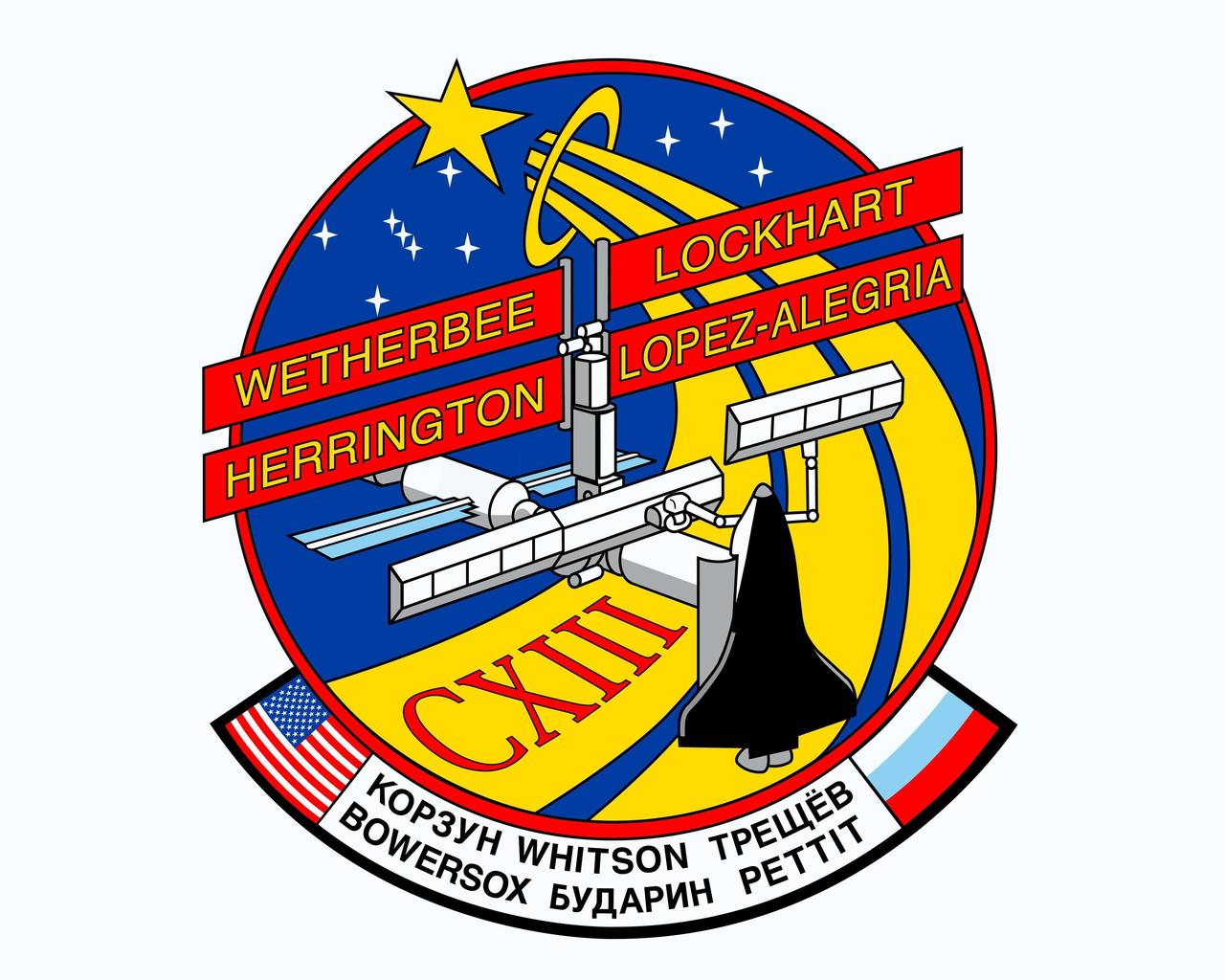
JOHNSON SPACE CENTER, HOUSTON, TEXAS - (STS113-S-001 September 2002) -- This is the crew patch for the STS-113 mission, which will be the 11th American (11A) assembly flight to the International Space Station (ISS). The primary mission will be to take the Expedition Six crew to the ISS and return the Expedition Five crew to Earth. STS-113 will be the first flight in the assembly sequence to install a major component in addition to performing a crew exchange. The Port 1 Integrated Truss Assembly (P1) will be the first truss segment on the left side of the ISS. P1 will provide an additinal three External Thermal Control System radiators, adding to the three radiators on the Starboard 1 (S1) Integrated Truss Assembly. The installation and outfitting of P1 will require three extravehicular activities (spacewalks) as well as coordination between the Shuttle Robotic Manipulator System and the Space Station Robotic Manipulator System. The patch depicts the Space Shuttle Endeavour docked to the ISS during the installation of the P1 truss withthe gold astronaut symbol in the background. The seven stars at the top left center of the patch are the seven brightest stars in the constellation Orion. They represent the combined seven crew members (four Shuttle and three Expedition Six). The three stars to the right of the astronaut symbol represent the returning Expedition Five crew members. The Roman Numeral CXIII represents the mission number 113. The NASA insignia design for Shuttle space flights is reserved for use by the astronauts and other official use as the NASA Administrator may authorize. Public availability has been approved only in the form of illustrations by the various news media. When and if there is any change in this policy, which is not anticipated, such will be publicly announced.

Mark Pestana is a research pilot and project manager at the NASA Dryden Flight Research Center, Edwards, Calif. He is a pilot for the Beech B200 King Air, the T-34C and the Predator B. He flies the F-18 Hornet as a co-pilot and flight test engineer. Pestana has accumulated more than 4,000 hours of military and civilian flight experience. He was also a flight engineer on the NASA DC-8 flying laboratory. Pestana was the project manager and pilot for the Hi–rate Wireless Airborne Network Demonstration flown on the NASA B200 research aircraft. He flew B200 research missions for the X-38 Space Integrated Inertial Navigation Global Positioning System experiment. Pestana also participated in several deployments of the DC-8, including Earth science expeditions ranging from hurricane research over the Caribbean Sea to ozone studies over the North Pole, atmospheric chemistry over the South Pacific, rain forest health in Central America, Rocky Mountain ice pack assessment, and volcanic and tectonic activity around the Pacific Rim. He came to Dryden as a DC-8 mission manager in June 1998 from NASA Johnson Space Center, Houston, where he served as the Earth and Space Science discipline manager for the International Space Station Program at Johnson. Pestana also served as a flight crew operations engineer in the Astronaut Office, developing the controls, displays, tools, crew accommodations and procedures for on-orbit assembly, test, and checkout of the International Space Station. He led the analysis and technical negotiations for modification of the Russian Soyuz spacecraft as an emergency crew return vehicle for space station crews. He joined the U.S. Air Force Reserve in 1991 and held various positions as a research and development engineer, intelligence analyst, and Delta II launch vehicle systems engineer. He retired from the U.S. Air Force Reserve with the rank of colonel in 2005. Prior to 1990, Pestana was on active duty with the U.S. Air Force as the director of mi
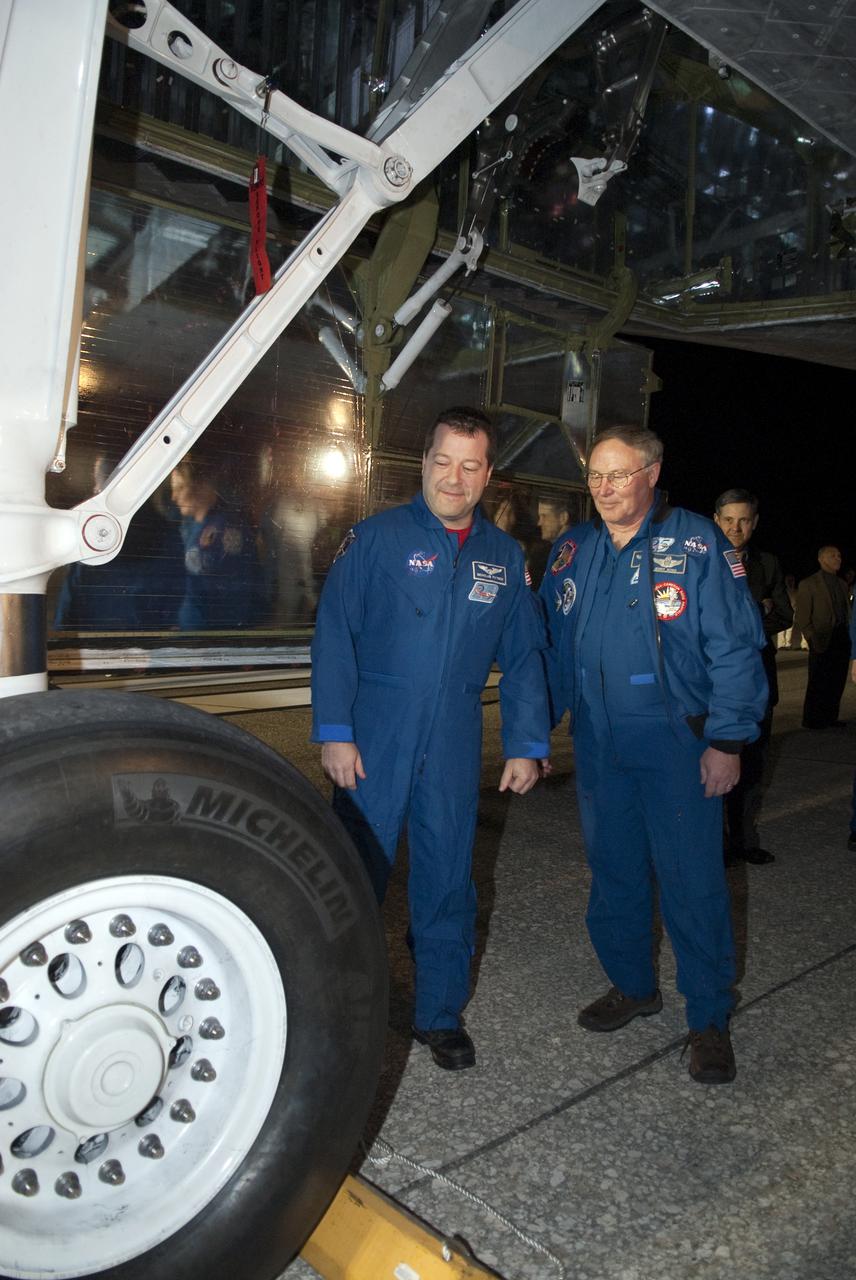
CAPE CANAVERAL, Fla. - STS-130 Mission Specialist Nicholas Patrick, left, inspects the tires on space shuttle Endeavour following its successful landing on Runway 15 at the Shuttle Landing Facility at NASA's Kennedy Space Center in Florida. Looking on, at right, is astronaut Jerry Ross, chief of the Vehicle Integration Test Office at the Johnson Space Center. After 14 days in space, Endeavour's 5.7-million-mile STS-130 mission was completed on orbit 217. Main gear touchdown was at 10:20:31 p.m. EST followed by nose gear touchdown at 10:20:39 p.m. and wheels stop at 10:22:10 p.m. It was the 23rd night landing in shuttle history and the 17th at Kennedy. During Endeavour's STS-130 mission, astronauts installed the Tranquility node, a module that provides additional room for crew members and many of the station's life support and environmental control systems. Attached to Tranquility is a cupola with seven windows that provide a panoramic view of Earth, celestial objects and visiting spacecraft. The module was built in Turin, Italy, by Thales Alenia Space for the European Space Agency. The orbiting laboratory is approximately 90 percent complete now in terms of mass. STS-130 was the 24th flight for Endeavour, the 32nd shuttle mission devoted to ISS assembly and maintenance, and the 130th shuttle mission to date. For information on the STS-130 mission and crew, visit http:__www.nasa.gov_mission_pages_shuttle_shuttlemissions_sts130_index.html. Photo credit: NASA_Kim Shiflett
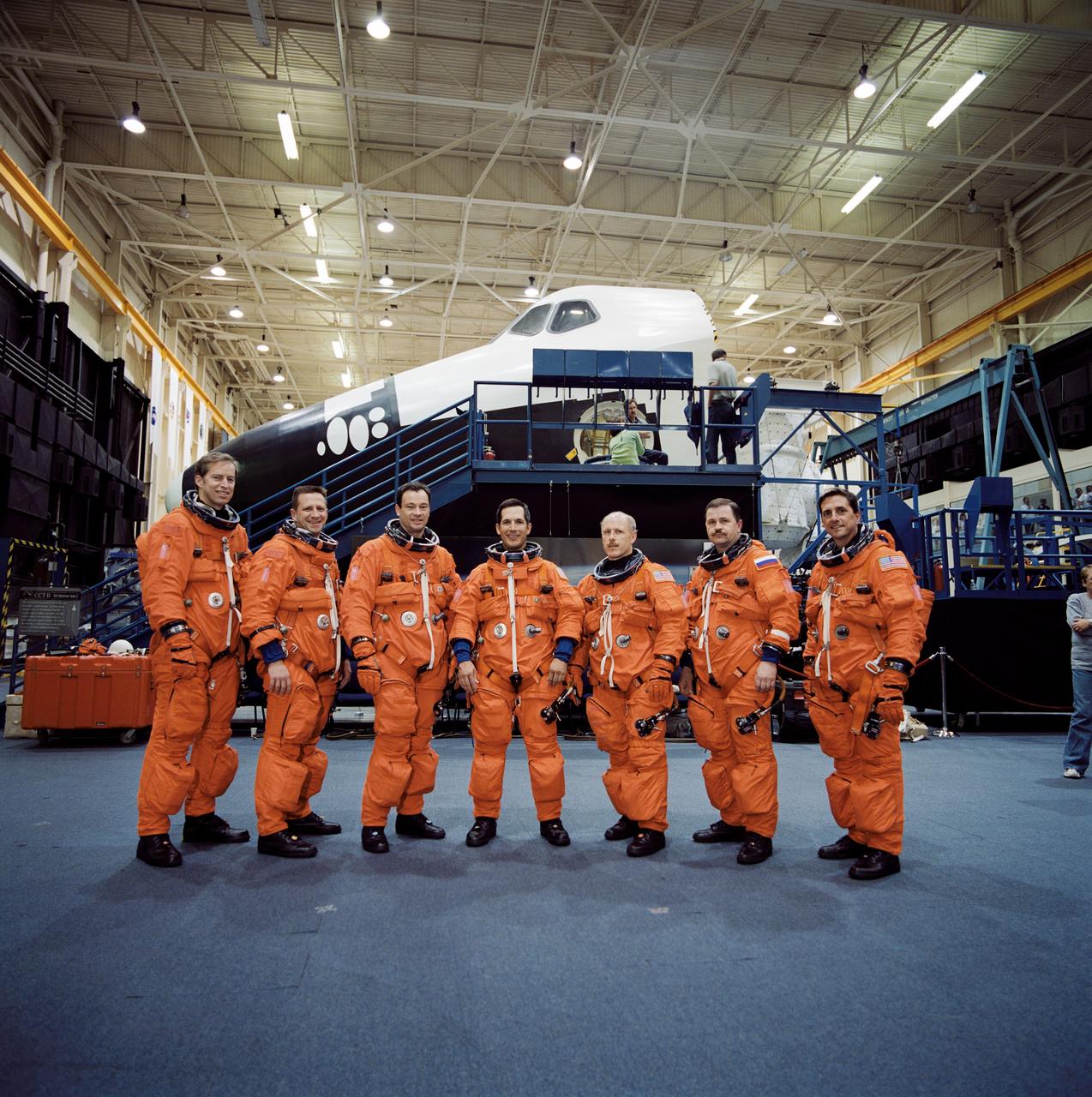
Pictured is the crew for the Shuttle Endeavor STS-113 mission snapped during a training session in the Space Vehicle Mockup Facility at the Johnson Space Center. From the left are Astronauts James D. Wetherbee, STS-113 mission commander; Christopher J. (Gus) Loria, pilot; Michael E. Lopez-Alegria and John B. Herrington, mission specialists; Kerneth D. Bowersox, Expedition Six mission commander; Cosmonaut Nikloai M. Budarin and astronaut Donald A. Thomas, Expedition Six Flight Engineers. The 16th American assembly flight and 112th overall American flight to the International Space Station (ISS), STS-113 mission objectives included the delivery of the Expedition Six Crew to the ISS, the return of Expedition Five back to Earth, and the installation and activation of the Port 1 Integrated Truss Assembly (P1). The first major component installed on the left side of the Station, the P1 truss provides an additional three External Thermal Control System radiators. Weighing in at 27,506 pounds, the P1 truss is 45 feet (13.7 meters) long, 15 feet (4.6 meters) wide, and 13 feet (4 meters) high. Three space walks, aided by the use of the Robotic Manipulator Systems of both the Shuttle and the Station, were performed in the installation of P1. Also, more than 2,500 pounds (1,134 kilograms) of cargo were transferred between the Shuttle and Station. The Space Shuttle Orbiter Endeavor launched on November 23, 2002 from Kennedy's launch pad 39A and returned 11 days later on December 4, 2002.