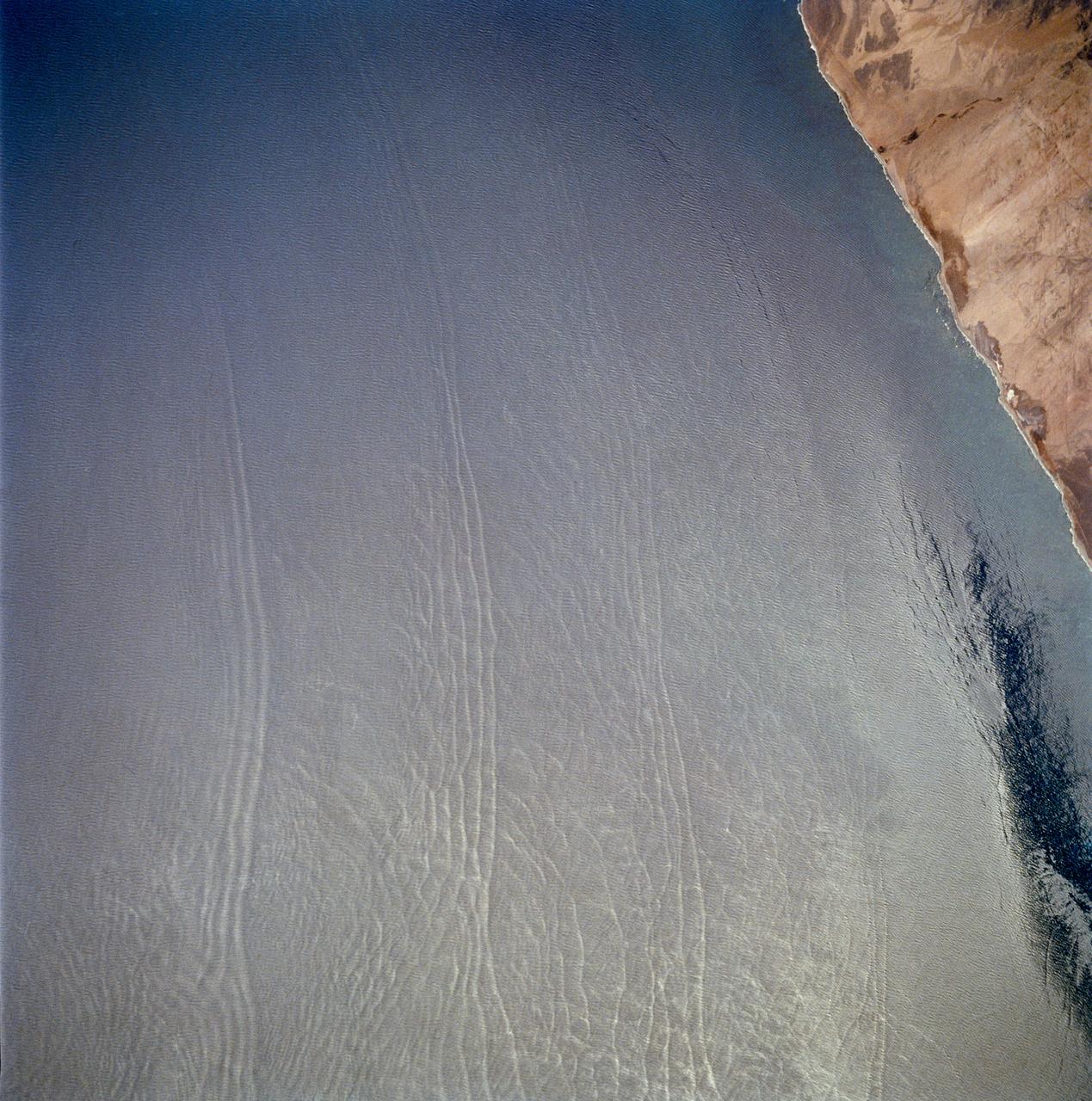
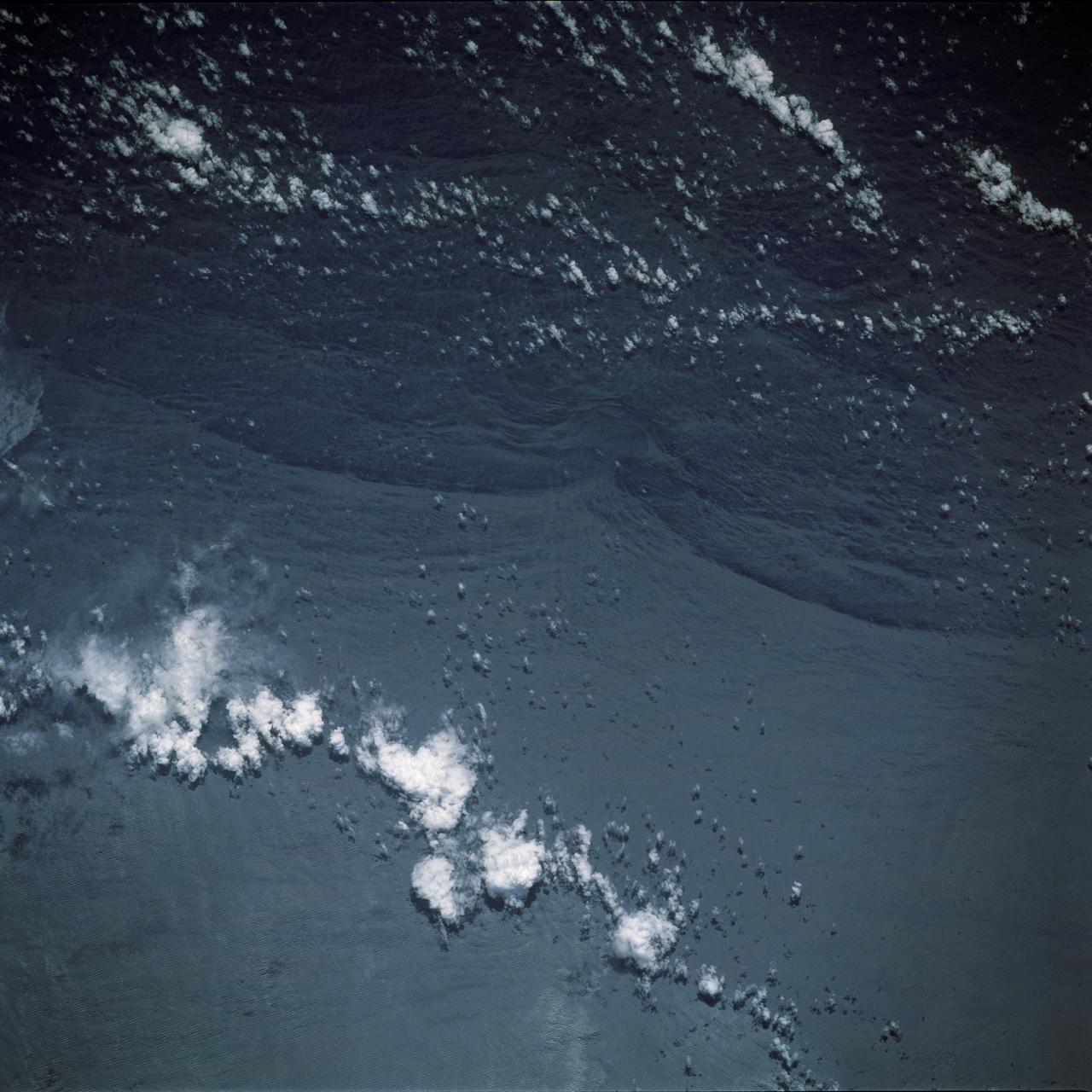
These open ocean Internal Waves were seen off the Namibia Coast, Africa (23.0S, 14.0E). The periodic and regularly spaced sets of internal waves most likely coincide with tidal periods about 12 hours apart. The wave length (distance from crest to crest) varies between 1.5 and 5.0 miles and the crest lengths stretch across and beyond the distance of the photo. The waves are intersecting the Namibia coastline at about a 30 degree angle.
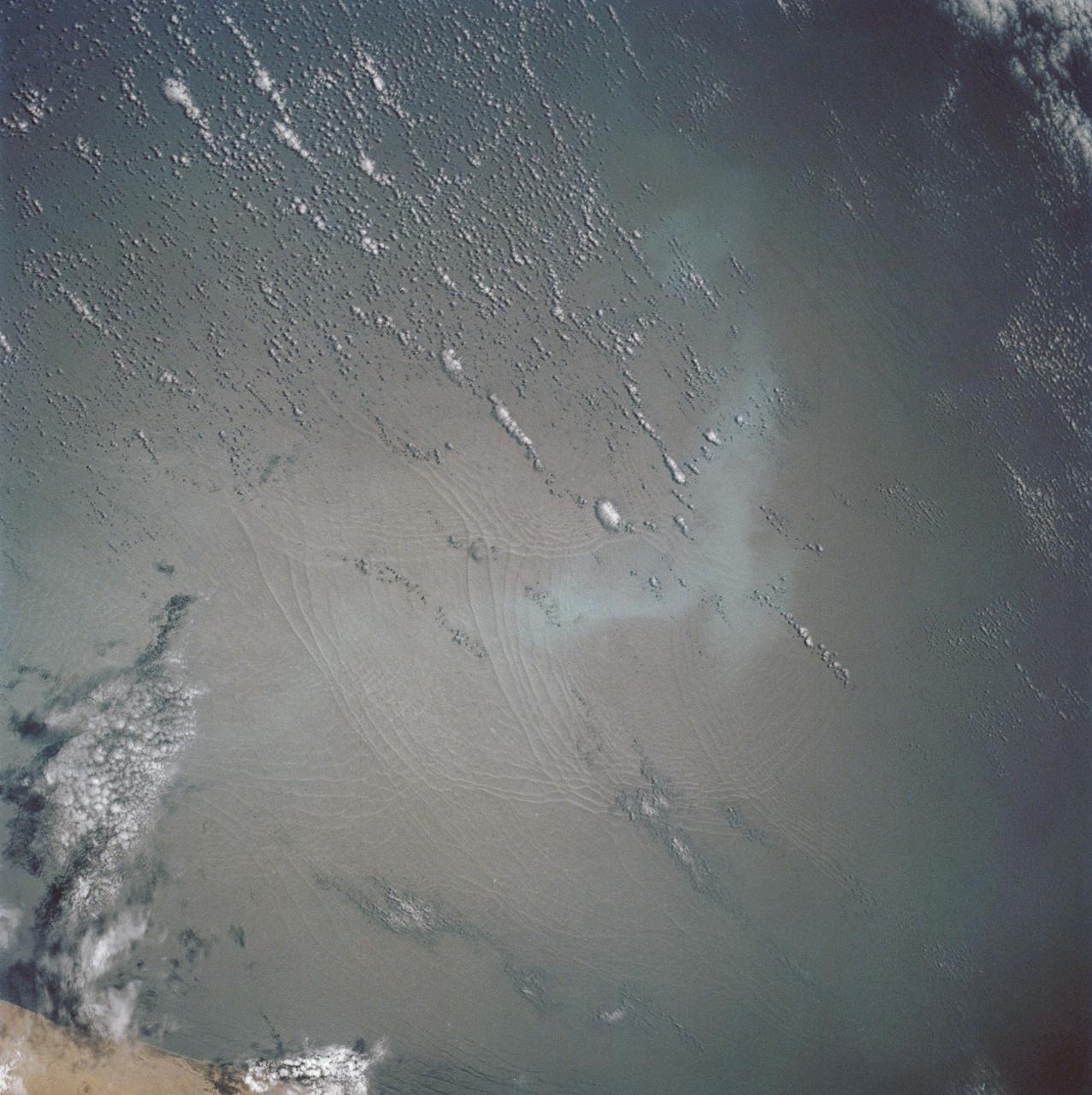
These open ocean Internal Waves were seen off the Namibia Coast, Africa (19.5S, 11.5E). The periodic and regularly spaced sets of incoming internal appear to be diffracting against the coastline and recombining to form a network of interference patterns. They seem to coincide with tidal periods about 12 hours apart and wave length (distance from crest to crest) varies between 1.5 and 5.0 miles and the crest lengths stretch beyond the image.
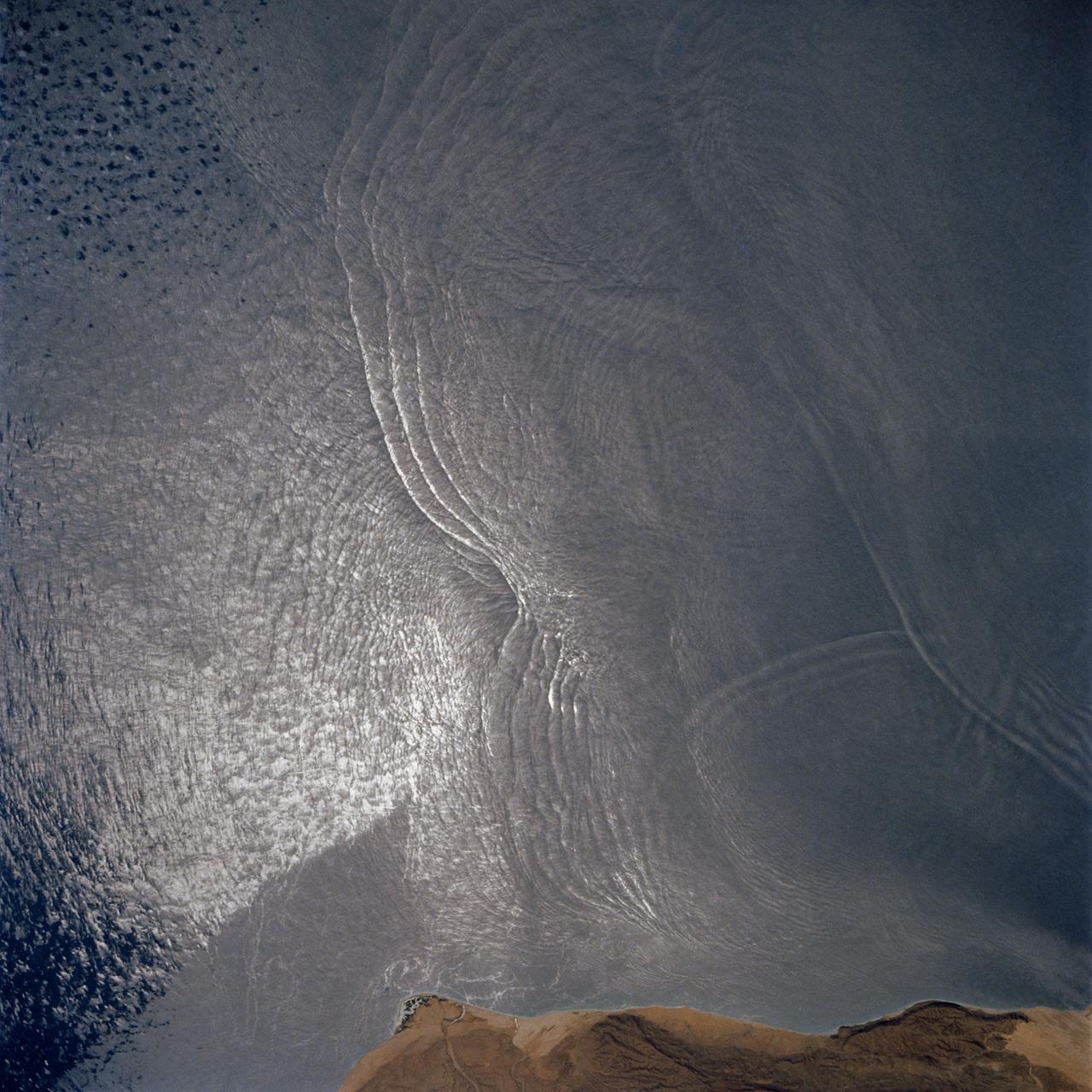
The arculate fronts of these apparently converging internal waves off the northeast coast of Somalia (11.5N, 51.5E) probably were produced by interaction with two parallel submarine canyons off the Horn of Africa. Internal waves are packets of tidally generated waves traveling within the ocean at varying depths and are not detectable by any surface disturbance.
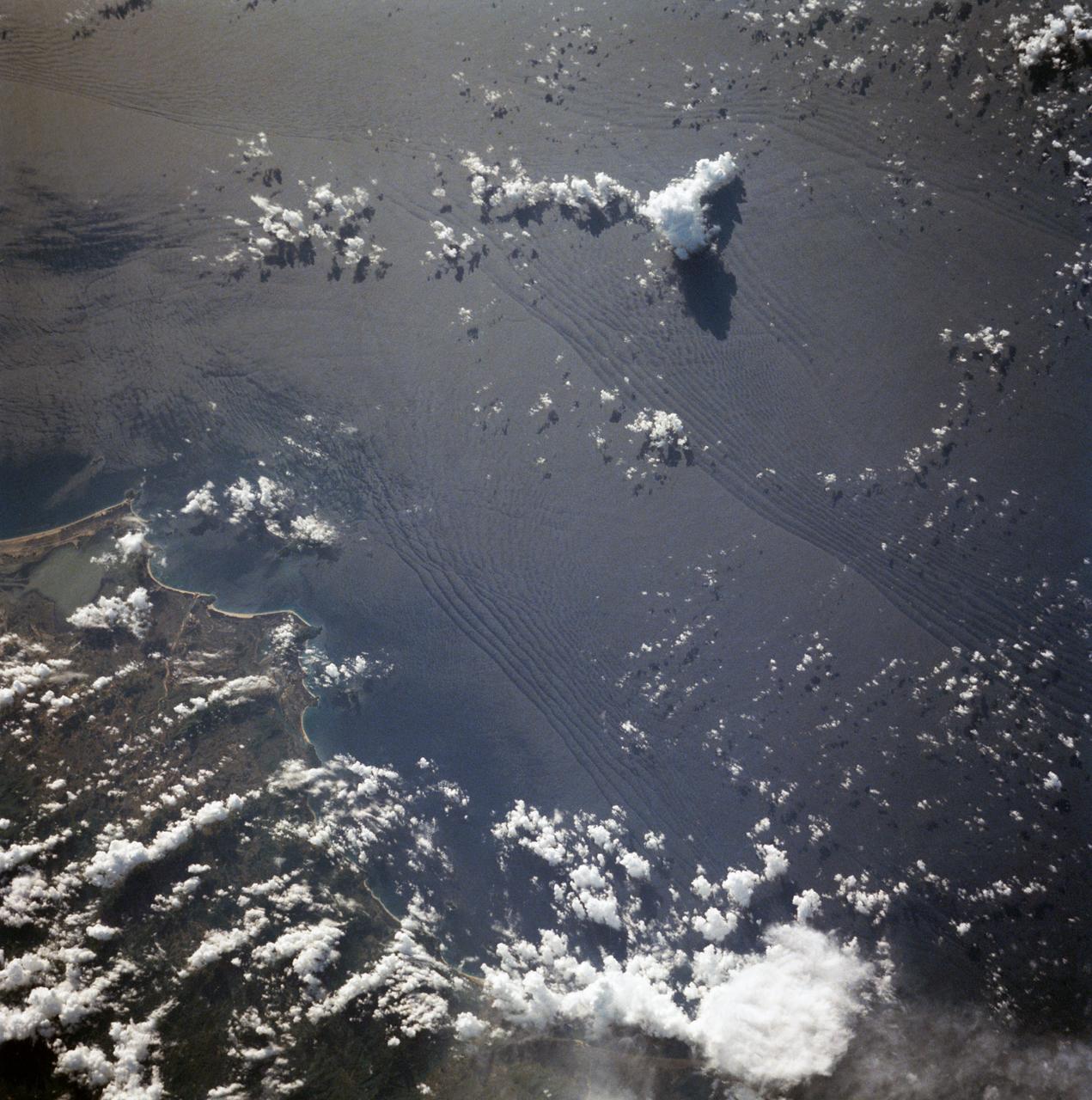
STS007-05-245 (18-24 June 1983) --- A rare view of internal waves in the South China Sea. Several different series of internal waves are represented in the 70mm frame, exposed with a handheld camera by members of the STS-7 astronaut crew aboard the Earth-orbiting Challenger. The land area visible in the lower left is part of the large island of Hainan, China.
STS044-79-077 (24 Nov.-1 Dec. 1991) --- This photograph, captured from the Earth-orbiting Space Shuttle Atlantis, shows sunglint pattern in the western tropical Indian Ocean. Several large internal waves reflect around a shallow area on the sea floor. NASA scientists studying the STS-44 photography believe the shallow area to be a sediment (a submerged mountain) on top of the Mascarene Plateau, located northeast of Madagascar at approximately 5.6 degrees south latitude and 55.7 degrees east longitude. Internal waves are similar to surface ocean waves, except that they travel inside the water column along the boundary between water layers of different density. At the surface, their passage is marked on the sea surface by bands of smooth and rough water. These bands appear in the sunglint pattern as areas of brighter or darker water. NASA scientists point out that, when the waves encounter an obstacle, such as a near-surface seamount, they bend or refract around the obstacle in the same manner as surface waves bend around an island or headland.
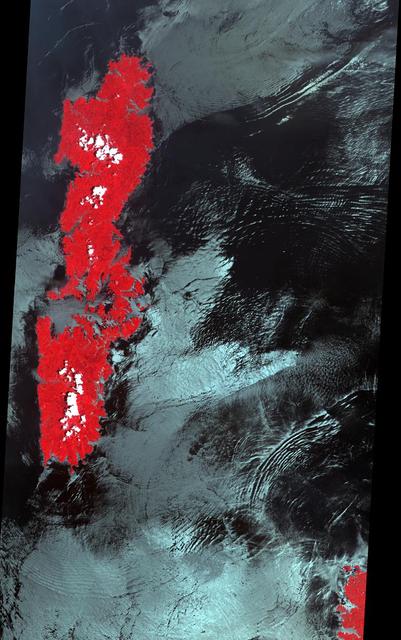
The false-color VNIR image from NASA Terra spacecraft was acquired off the island of Tsushima in the Korea Strait shows the signatures of several internal wave packets, indicating a northern propagation direction.
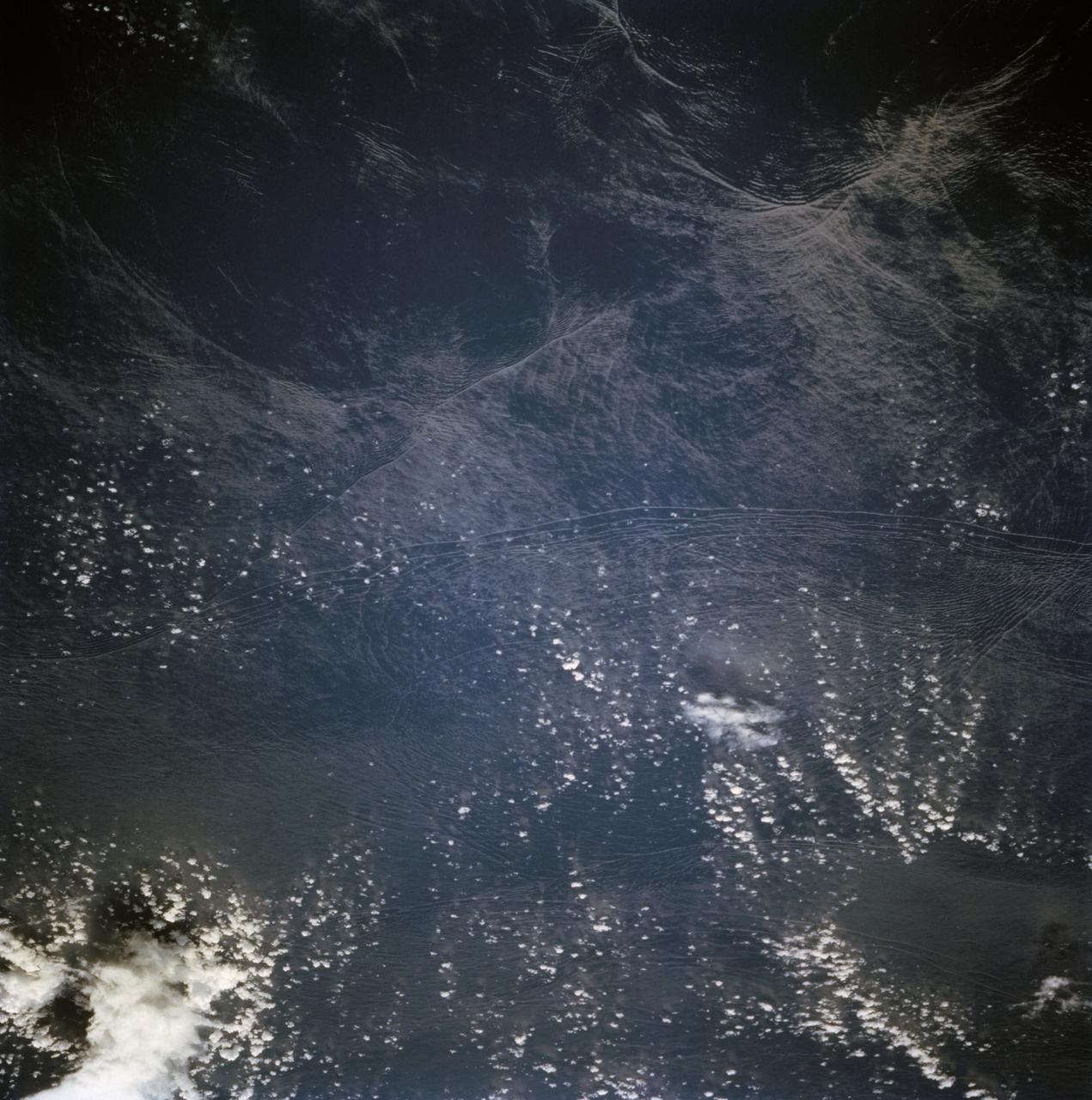
STS068-236-044 (30 September-11 October 1994) --- These internal waves in the Andaman Sea, west of Burma, were photographed from 115 nautical miles above Earth by the crew of the Space Shuttle Endeavour during the Space Radar Laboratory 2 (SRL-2) mission. The internal waves smooth out some of the capillary waves at the surface in bands and travel along the density discontinuity at the bottom of the mixed layer depth. There is little evidence of the internal waves at the surface. They are visible in the Space Shuttle photography because of sunglint, which reflects off the water.
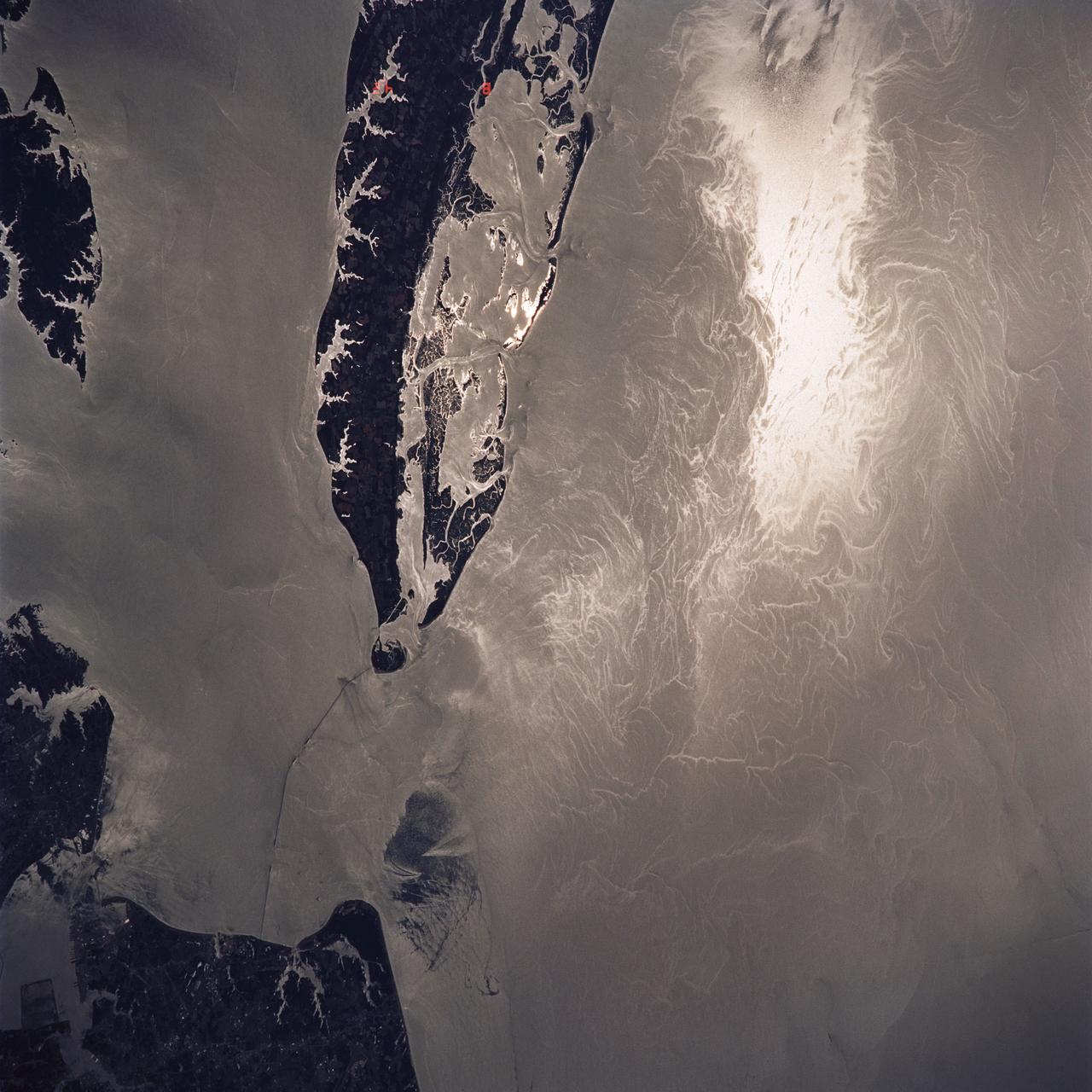
STS040-614-047 (5-14 June 1991) --- This image is of the Norfolk, Virginia -- Southern Delmarva Peninsula Southern Chesapeake Bay Area as seen in sunlight. The exposure is adjusted to emphasize the water patterns present. The outgoing tide generates considerable turbulence as it passes through the mouth of the bay. This is displayed by differences in reflective properties of the water surface due to differences in slope and turbidity. Ship wakes and the wakes of subsurface structures are seen clearly. The bridge tunnel system linking Norfolk with the peninsula and its effect on the system is quite apparent. Sunglint images over land areas were also acquired which emphasize land-water boundaries as demonstrated here in the small Delmarva inlets as a tool for wetland mapping, and river, lake and even pond description. During the first few days of the STS-40 mission the Eastern Seaboard of the United States was free of clouds and haze providing excellent photography of many of the major cities and the countryside of that area as well as the Gulf Stream.
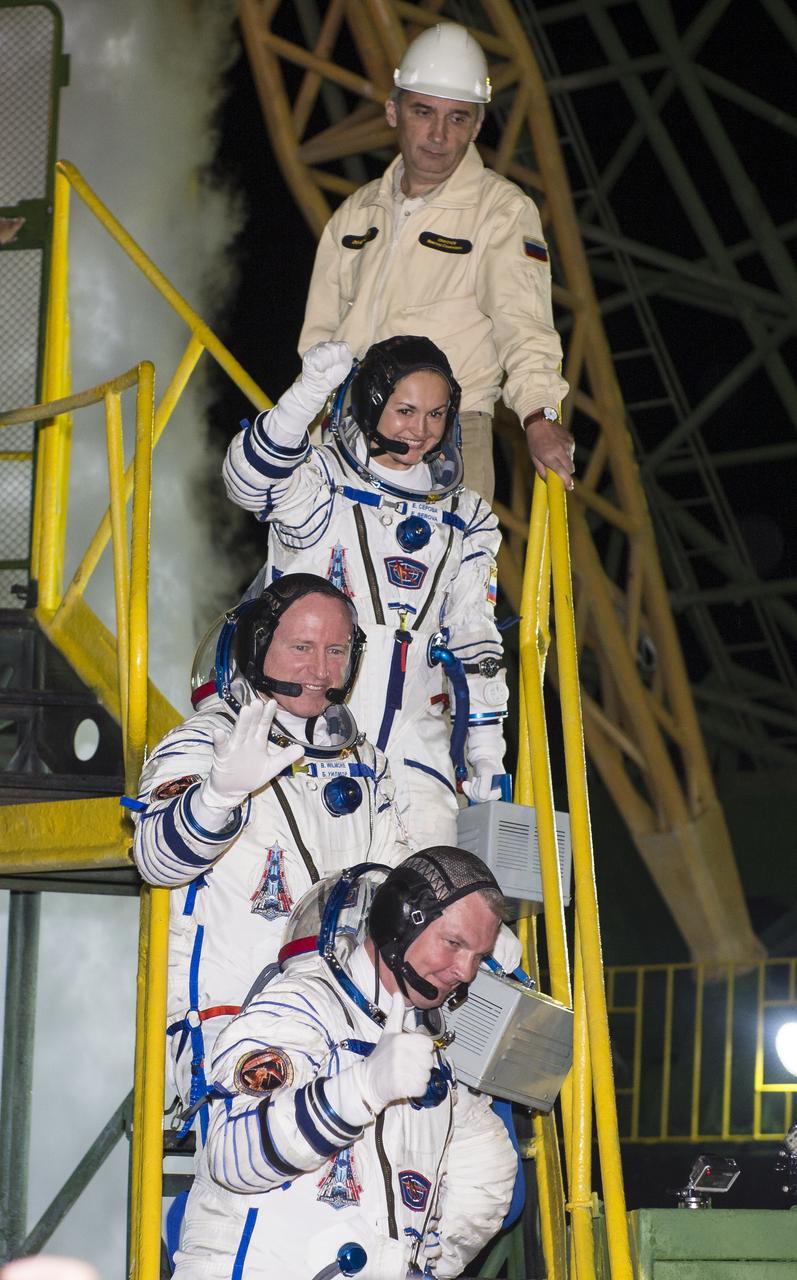
Expedition 41 Soyuz Commander Alexander Samokutyaev of the Russian Federal Space Agency (Roscosmos), bottom, Flight Engineer Barry Wilmore of NASA, middle, and Elena Serova of Roscosmos, top, wave farewell prior to boarding the Soyuz TMA-14M spacecraft for launch, Thursday, Sept. 25, 2014 at the Baikonur Cosmodrome in Kazakhstan. Samokutyaev, Wilmore, and Serova will spend the next five and a half months aboard the International Space Station. Photo Credit: (NASA/Aubrey Gemignani)
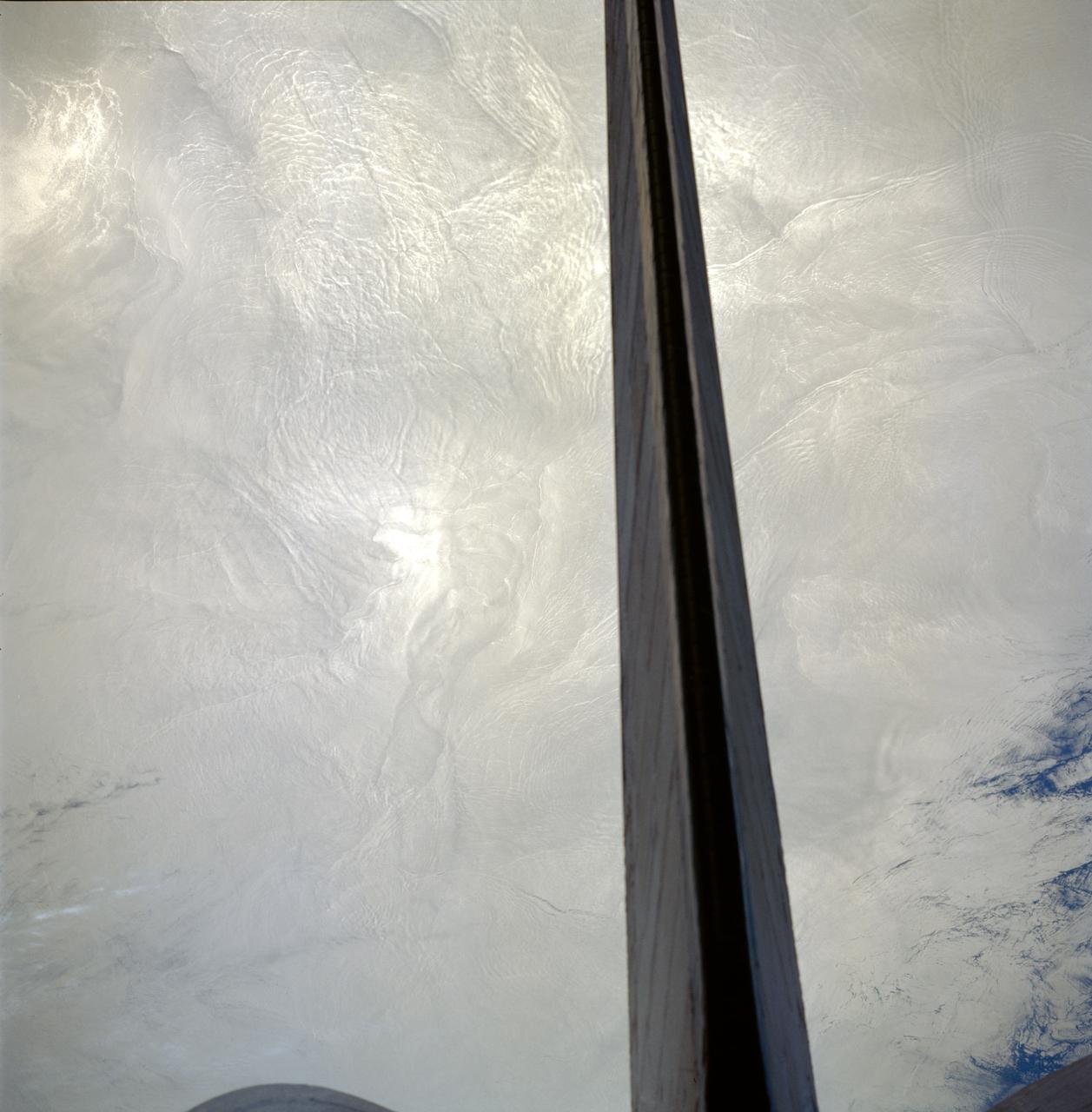
STS091-713-061 (2-12 June 1998) --- The vertical stabilizer of the Space Shuttle Discovery runs through this Atlantic Ocean image made from its crew cabin. Many sets of internal waves are seen in the 70mm frame traveling through an area off the Atlantic coast of Nova Scotia, Canada. There are seven sets that run perpendicular to each other. Internal waves are tidally induced and travel below the surface of the ocean along a density change which occurs often around 150 feet deep. According to NASA scientists studying the STS-91 collection, the waves are visible because, as the wave action smoothes out the smaller waves on the surface, the manner in which the sun is reflected is changed.
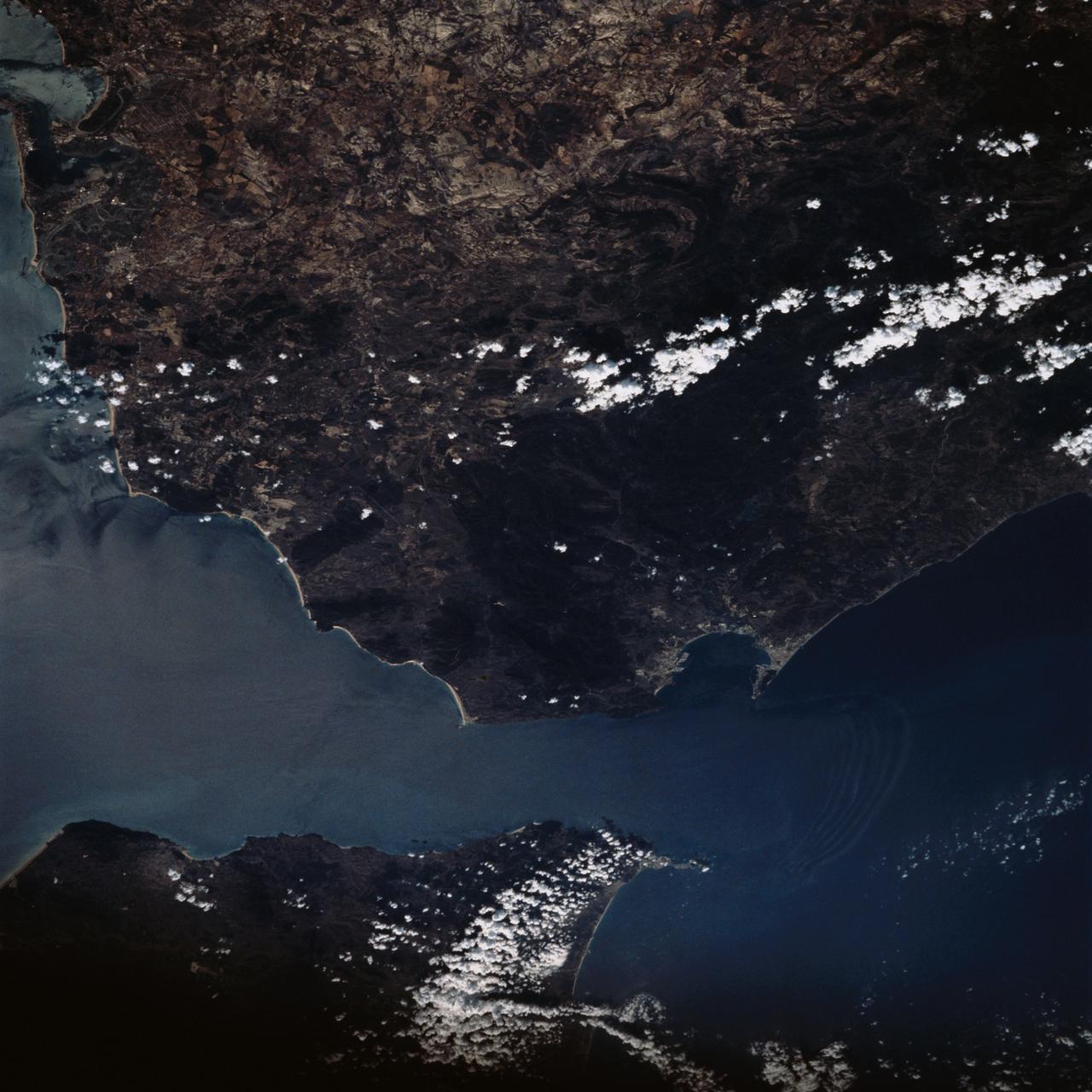
STS058-73-009 (18 Oct-1 Nov 1993) --- Atlantic water flowing with the tide through the Strait of Gibraltar into the Mediterranean generates internal waves as depicted in this photo. The incoming cool, less dense Atlantic water flows over the warm, more saline Mediterranean water. As the tide moves into the Strait of Gibraltar it encounters the Camarinal Sill, which is like a cliff under water, south of Camarinal Point, Spain. Internal waves are generated at the Sill and travel along the density boundary between the Atlantic water and the Mediterranean water. Internal waves have very little effect on the sea surface, except for gentle slopes and slight differences in roughness. We can see them in the Space Shuttle photos because of sunglint which reflects off the water. Internal waves smooth out some of the capillary waves at the surface in bands. The sun reflects more brightly from these smooth areas showing us the pattern of the underwater waves. The Bay of Cadiz on the southwest coast of Spain, the Rock of Gibraltar, and the Moroccan coast are also visible in this photo.
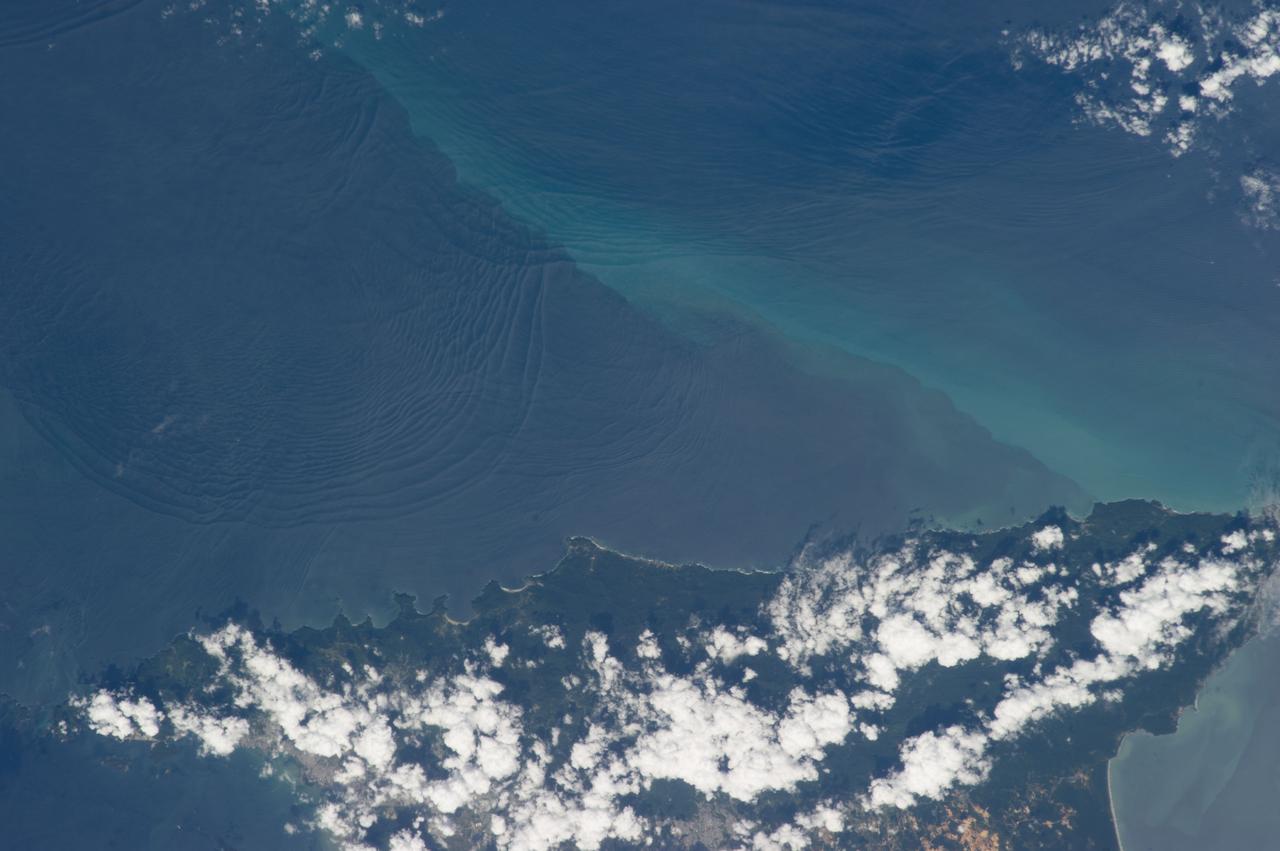
ISS034-E-032377 (18 Jan. 2013) --- Internal waves off Northern Trinidad are featured in this image photographed by an Expedition 34 crew member on the International Space Station. This photograph shows the north coast of the island of Trinidad in the southeastern Caribbean Sea, where heating of the land is setting off the growth of cumulus clouds. The light blue northwest-southeast trending plume at center is sediment from one of the rivers that flows into the sea here. Adjacent to, and appearing to cross the sediment plume, a series of subtle interacting arcs can be seen in the sea. These are known as internal waves which are the surface manifestation of slow waves moving tens of meters beneath the sea surface. These produce enough of an effect on the sea surface to be seen from space, but only where they are enhanced due to reflection of sunlight, or sunglint, back towards the space station. The image shows at least three sets of internal waves interacting. The most prominent set (top left) shows a “packet” of several waves moving from the northwest due to the tidal flow towards the north coast of Trinidad. Two less prominent, younger sets can be seen further out to sea. A very broad set enters the view from the north and northeast, and interacts at top center with the first set. All the internal waves are probably caused by the shelf break near Tobago (outside the image to top right). The shelf break is the step between shallow seas (around continents and islands) and the deep ocean. It is the line at which tides usually start to generate internal waves. The sediment plume at center is embedded in the Equatorial Current (also known as the Guyana Current) and is transporting material to the northwest—in almost the opposite direction to the movement of the internal waves. The current flows strongly from east to west around Trinidad, all the way from equatorial Africa, driven by year-round easterly winds. Seafarers in the vicinity of Trinidad are warned that the current, and its local reverse eddies, make navigation of smaller craft in these waters complicated and sometimes dangerous.
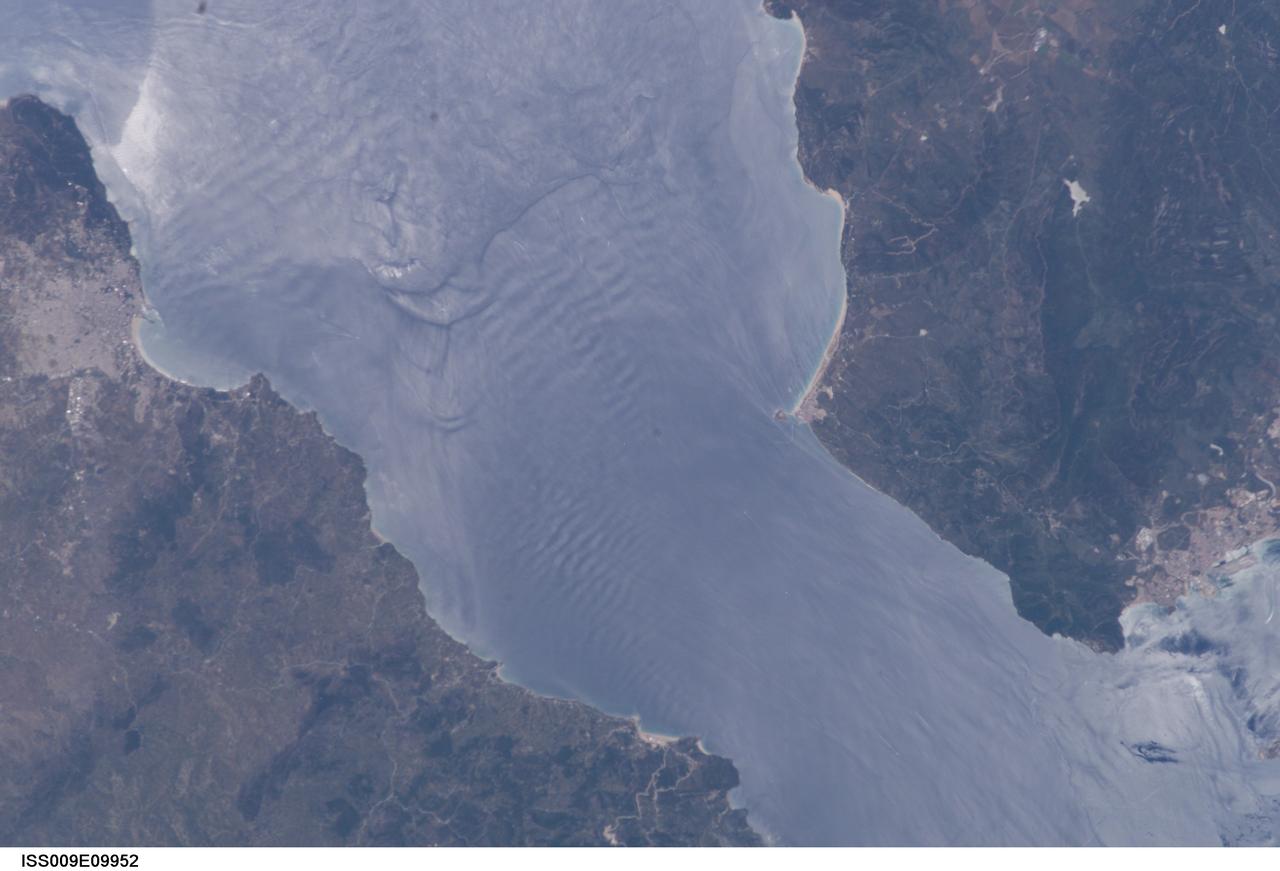
ISS009-E-09952 (3 June 2004) --- Large internal waves in the Strait of Gibraltar are featured in this scene photographed by an Expedition 9 crewmember on the International Space Station (ISS). These subsurface internal waves occur at depths of about 100 meters, but appear in the sun glint as giant swells flowing eastward into the Mediterranean Sea. This image was merged with image ISS009-E-09954 to create a mosaic, which can be viewed on http://eol.jsc.nasa.gov.
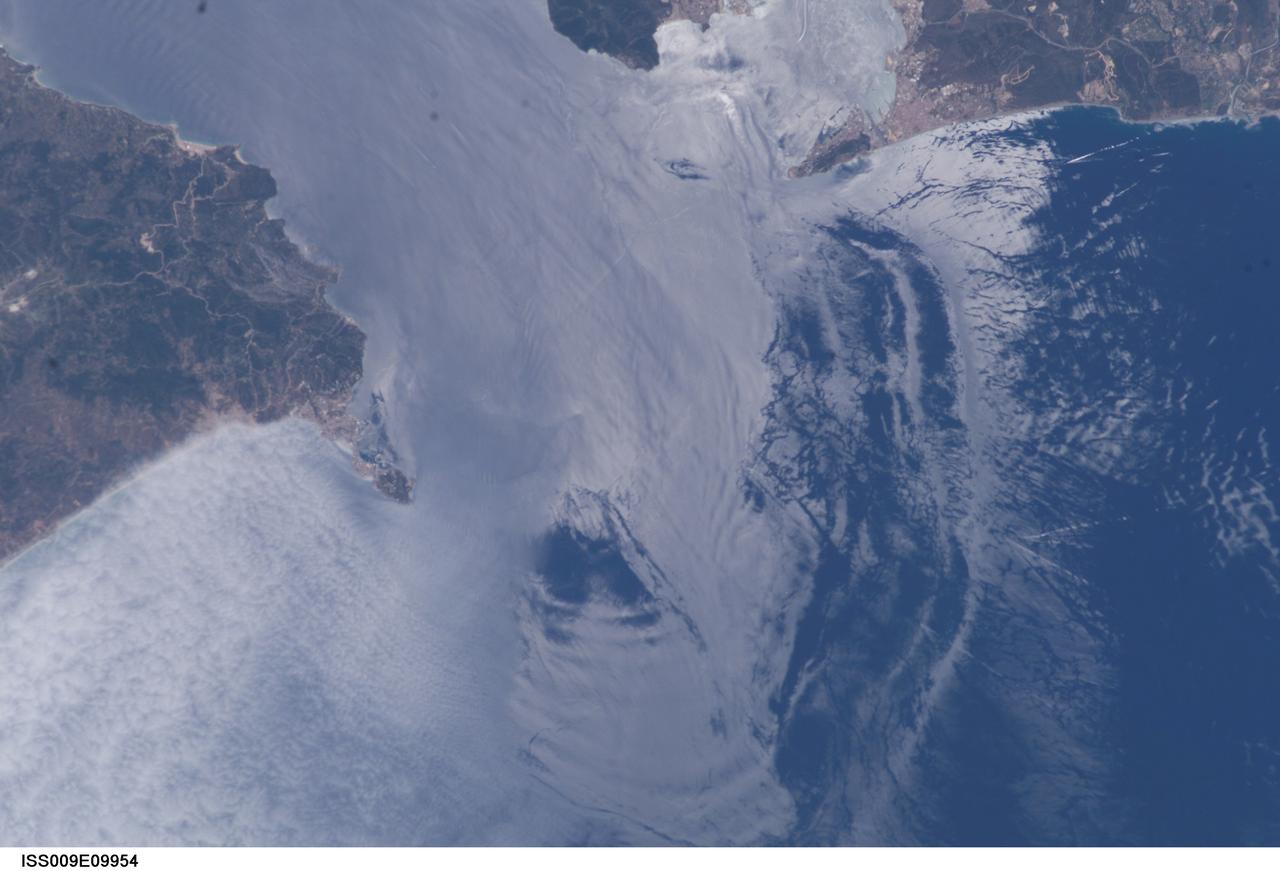
ISS009-E-09954 (3 June 2004) --- Large internal waves in the Strait of Gibraltar are featured in this scene photographed by an Expedition 9 crewmember on the International Space Station (ISS). These subsurface internal waves occur at depths of about 100 meters, but appear in the sun glint as giant swells flowing eastward into the Mediterranean Sea. This image was merged with image ISS009-E-09952 to create a mosaic, which can be viewed on http://eol.jsc.nasa.gov.

STS060-88-070 (3-11 Feb 1994) --- This view shows sunglint in the Strait of Gibralter. In this photograph a high pressure atmospheric system over the Iberian Peninsula has set the conditions for seeing a plankton bloom along the Moroccan coast in the Alboran Sea (Western Mediterranean) coastal counter current as well as illumining the influence of winds in the sunglint pattern near the Strait of Gibraltar. Where the water is ruffled from a wind gust, such as off Cadiz, Spain, the surface is less reflective and thus appears dark. A combination of the effects of the tide and the surface winds through the Strait of Gibraltar have created a unique sunglint pattern at the entrance of the Mediterranean. The Atlantic Ocean waters are flowing with the tide through the Strait of Gibraltar into the Mediterranean Sea and are probably smoothing out some of the smaller waves at the surface. The incoming tide generates internal waves as can be faintly seen in this photograph. The incoming relatively cooler, less dense Atlantic water flows over the warm, more saline Mediterranean water. As the tide moves into the Strait of Gibraltar it encounters the Camarinal Sill, which is like a cliff under the water, south of Camarinal Point, Spain. Internal waves are generated at this sill and they travel along the density boundary between the Atlantic water and the Mediterranean water masses. There is little evidence of the internal waves at the surface of the ocean. We can see them in spacecraft photography because of the sunglint which reflects off the different water layers in differential patterns. The internal waves also smooth out some of the bands of capillary waves at the surface. That is, the sun reflects more brightly from these smooth areas, showing the pattern of the underwater waves more prominently than do the surface waves. The Bay of Cadiz on the southwest coast of Spain, the Rock of Gibraltar, and the Moroccan coast are also beautifully illustrated in this photography. The focus for scientists, however, remains the high clarity and spatial resolution given by sunglint studies to physical phenomena in the ocean.
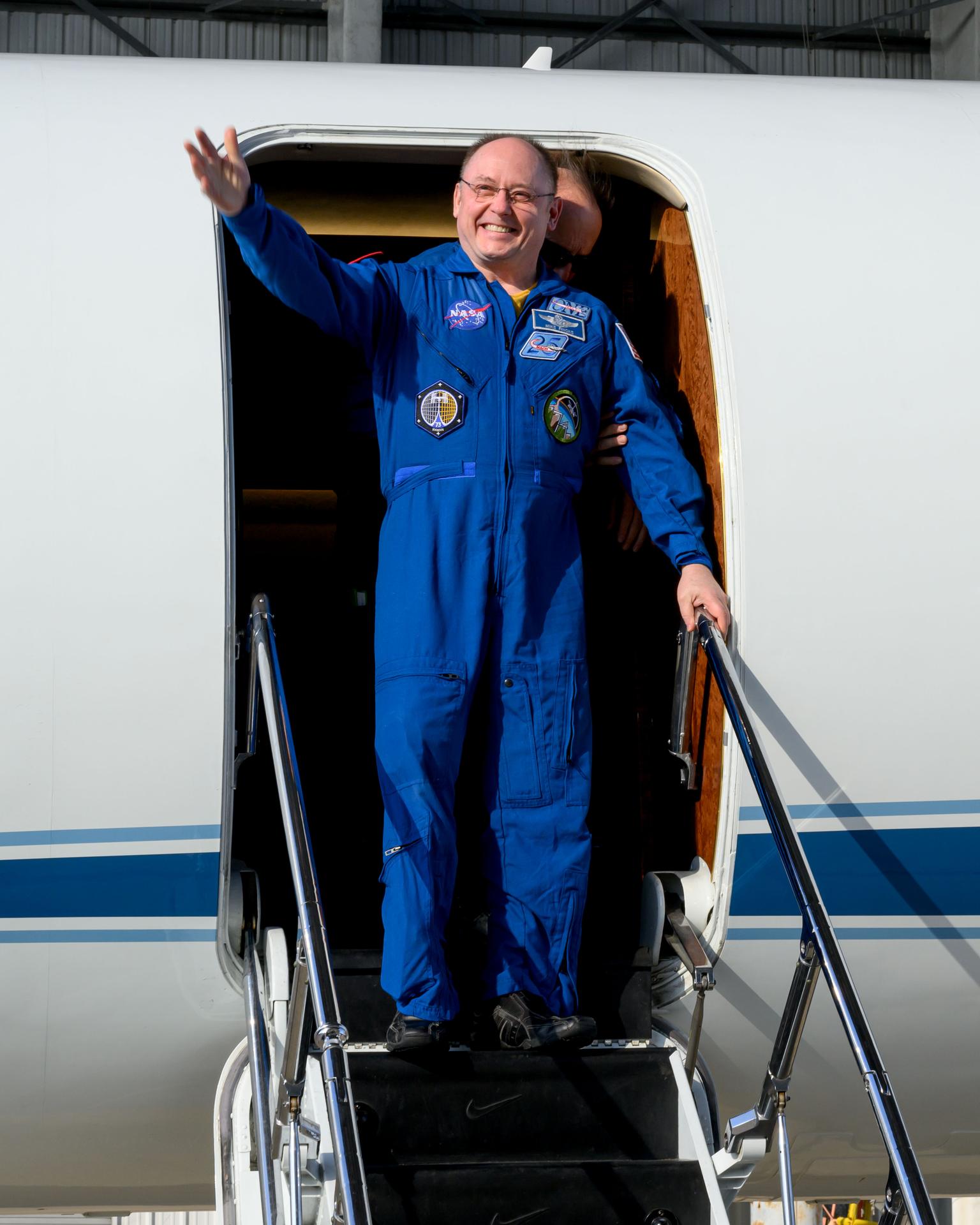
jsc2026e002116 (Jan. 16, 2025) --- NASA astronaut and SpaceX Crew-11 Pilot Mike Fincke waves to officials at Ellington Field in Houston, Texas. He departed the International Space Station and returned to Earth the day before aboard the Dragon spacecraft for a parachute-assisted splashdown off the coast of San Diego, California. Credit: NASA/Robert Markowitz
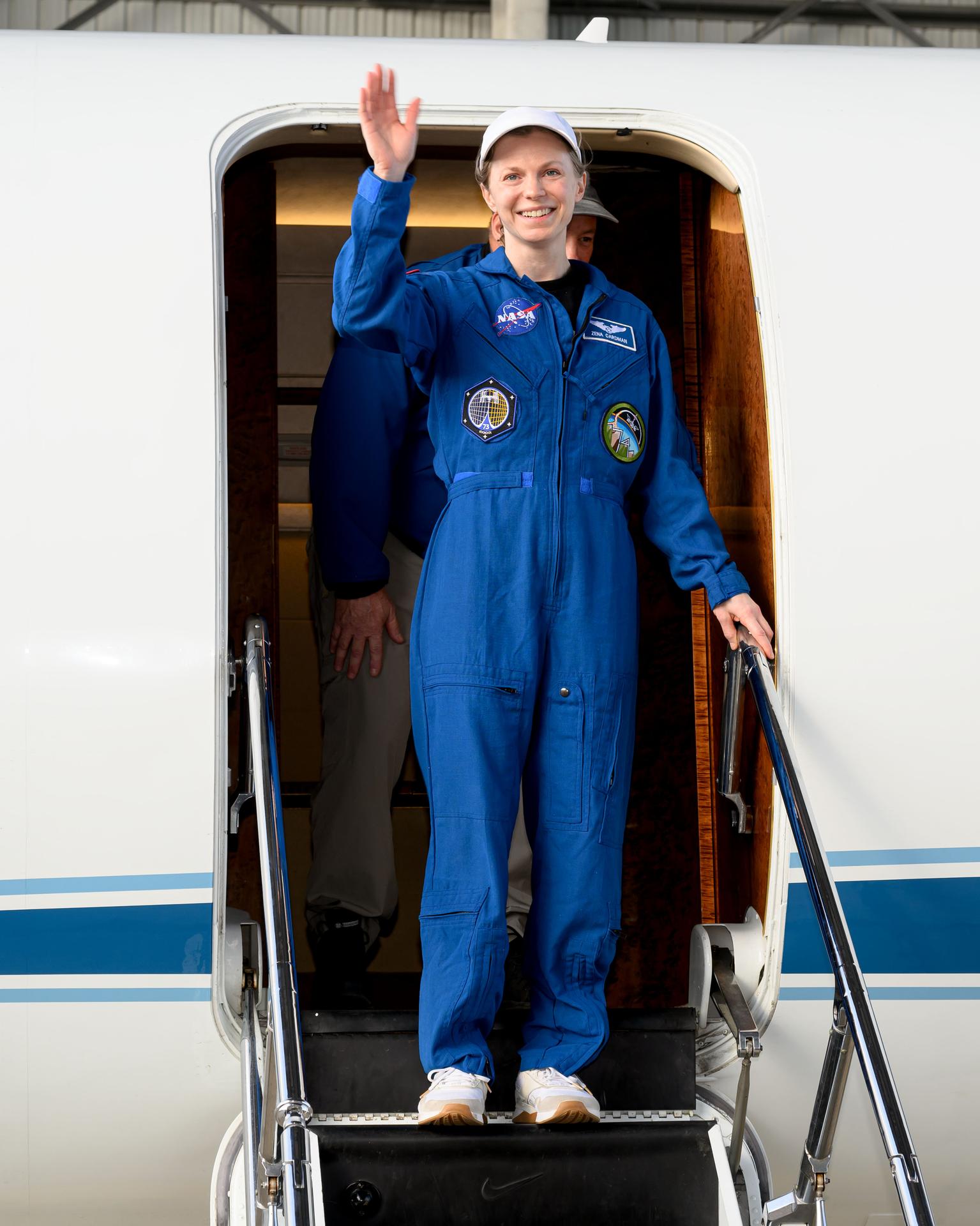
jsc2026e002117 (Jan. 16, 2025) --- NASA astronaut and SpaceX Crew-11 Commander Zena Cardman waves to officials at Ellington Field in Houston, Texas. She departed the International Space Station and returned to Earth the day before aboard the Dragon spacecraft for a parachute-assisted splashdown off the coast of San Diego, California. Credit: NASA/Robert Markowitz
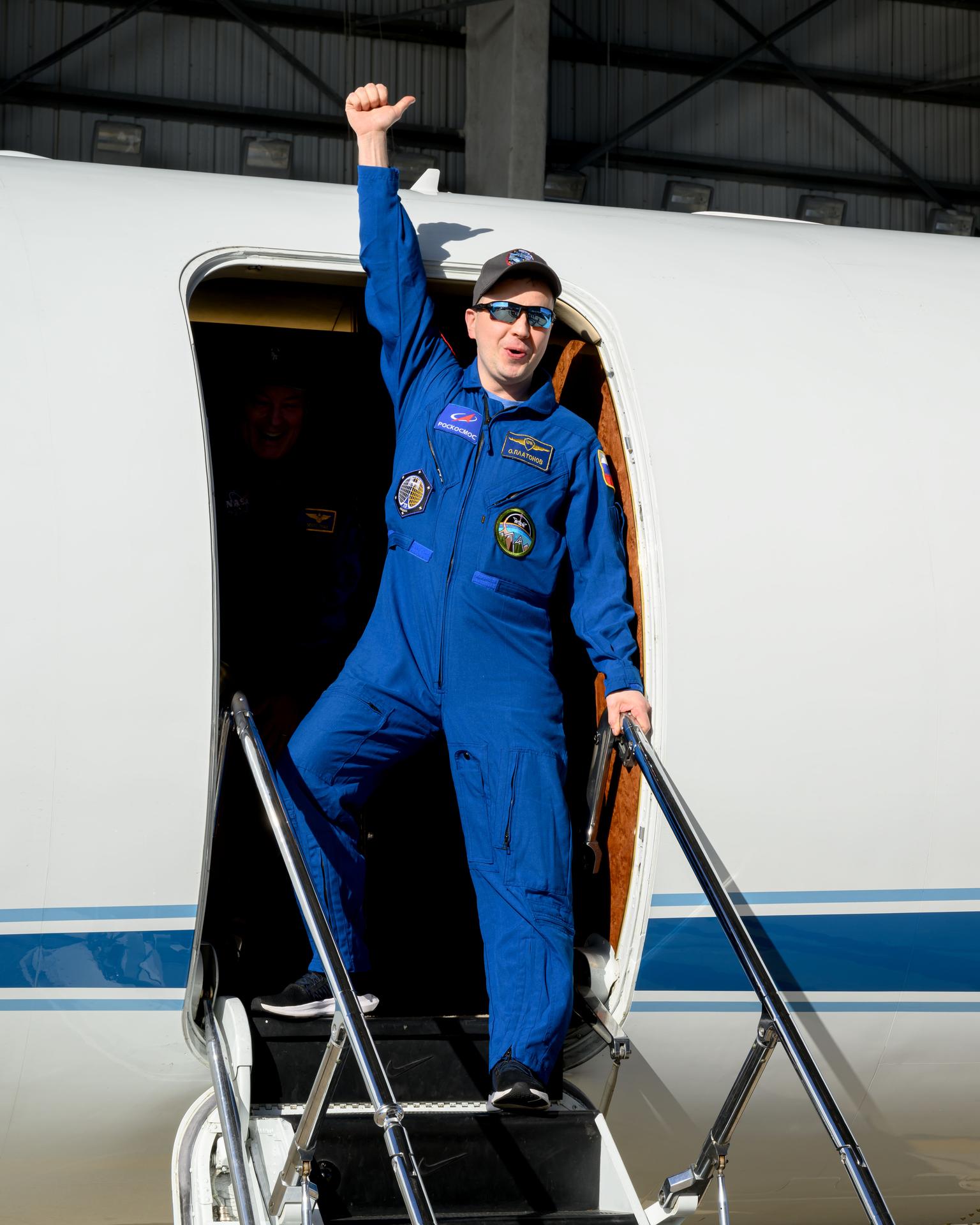
jsc2026e002114 (Jan. 16, 2025) --- Roscosmos cosmonaut and SpaceX Crew-11 Mission Specialist Oleg Platonov waves to officials at Ellington Field in Houston, Texas. He departed the International Space Station and returned to Earth the day before aboard the Dragon spacecraft for a parachute-assisted splashdown off the coast of San Diego, California. Credit: NASA/Robert Markowitz
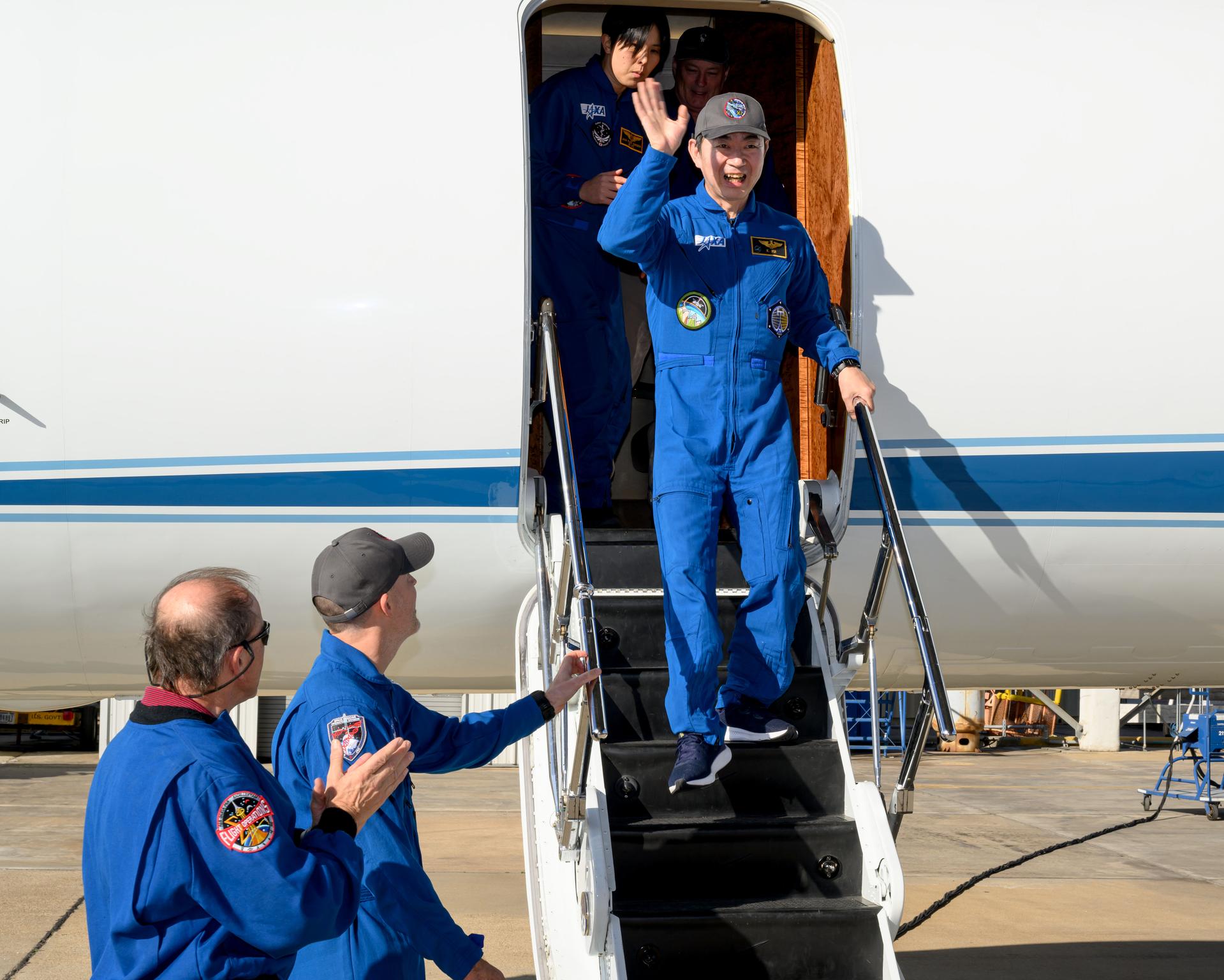
jsc2026e002115 (Jan. 16, 2025) --- JAXA (Japan Aerospace Exploration Agency) astronaut and SpaceX Crew-11 Mission Specialist Kimiya Yui waves to officials at Ellington Field in Houston, Texas. He departed the International Space Station and returned to Earth the day before aboard the Dragon spacecraft for a parachute-assisted splashdown off the coast of San Diego, California. Credit: NASA/Robert Markowitz
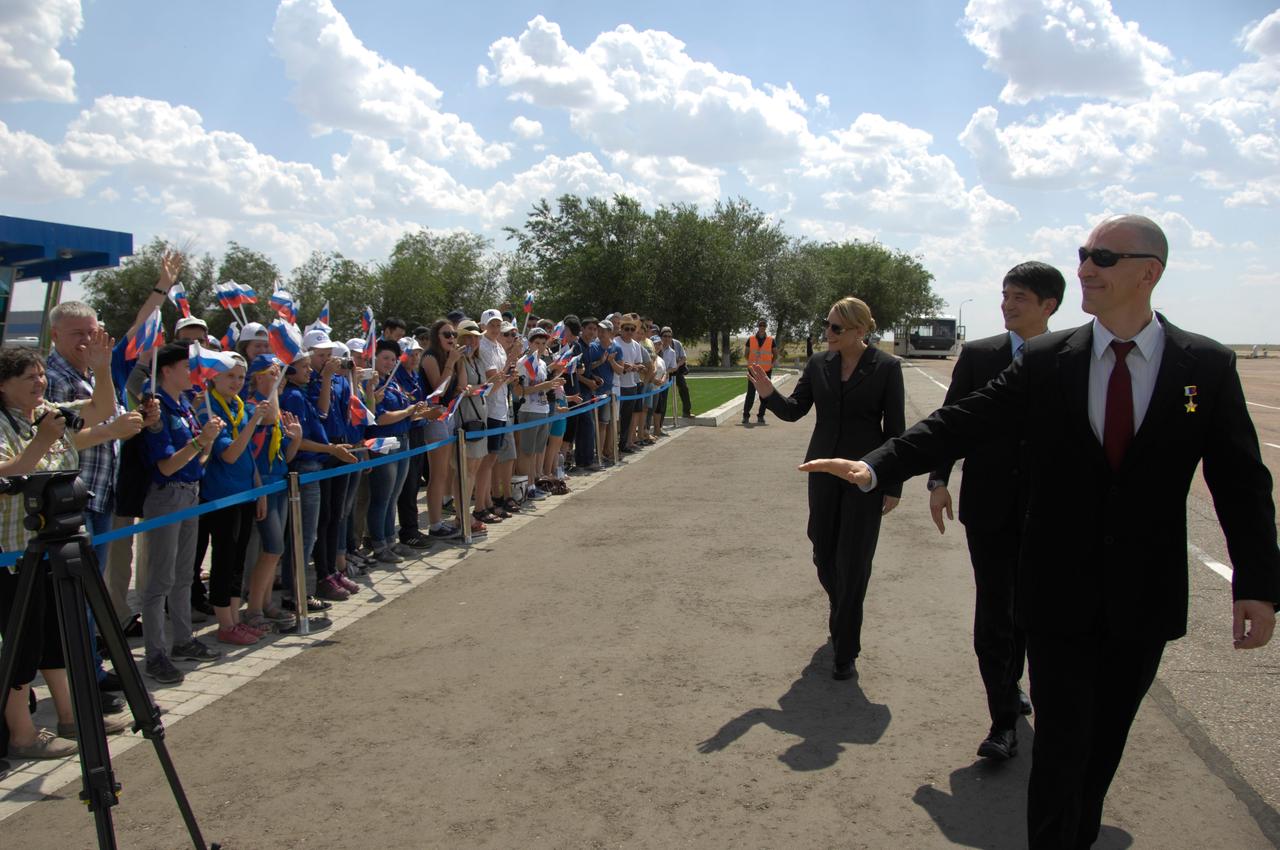
ISS Expedition 48-49 prime crewmembers Kate Rubins of NASA (left), Takuya Onishi of the Japan Aerospace Exploration Agency (center) and Anatoly Ivanishin of Roscosmos (right) wave to schoolchildren after arriving in Baikonur, Kazakhstan June 24 for final pre-launch training following a flight from Star City, Russia. The trio will launch July 7 from the Baikonur Cosmodrome in Kazakhstan on the Soyuz MS-01 spacecraft for a planned four-month mission on the International Space Station. NASA/Alexander Vysotsky
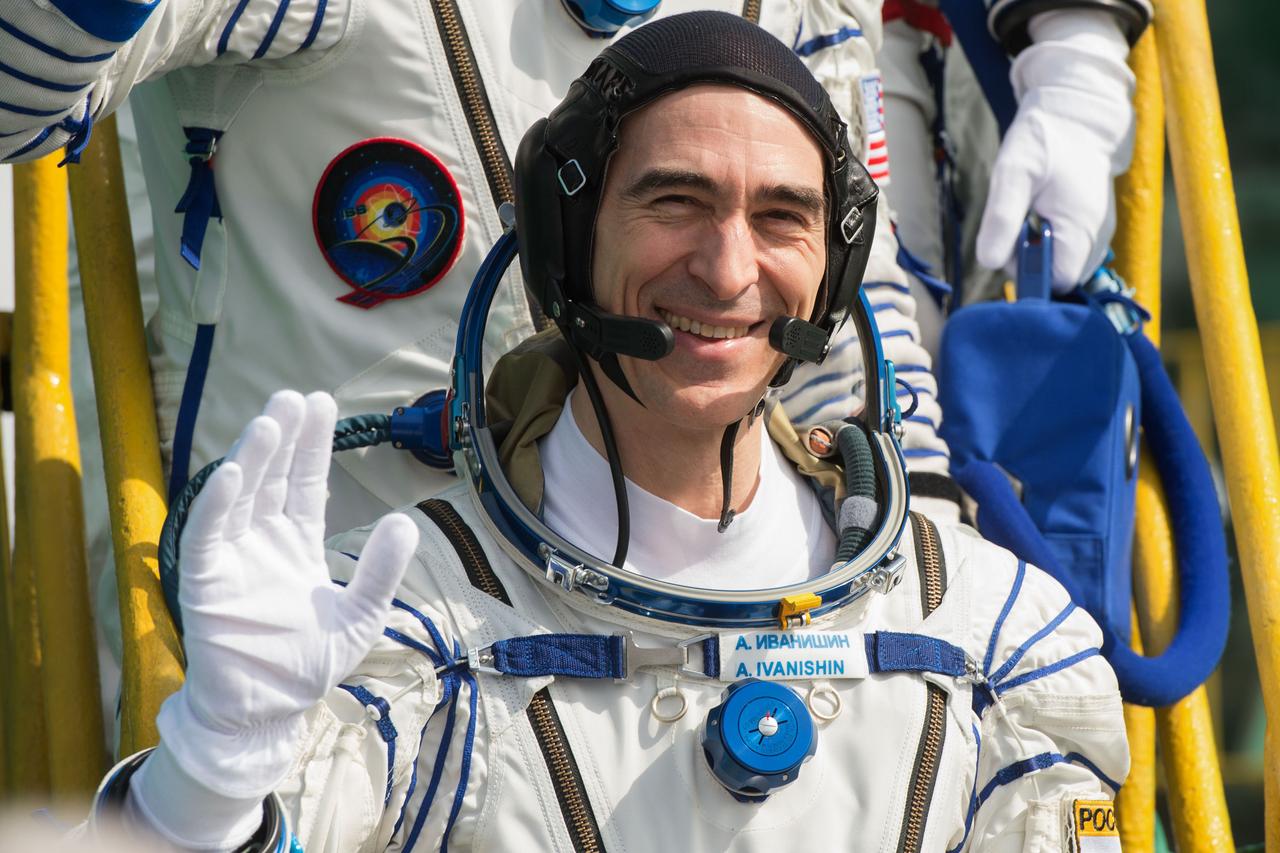
jsc2020e017125 - Expedition 63 Crew Waves Farewell - Expedition 63 crewmember Anatoly Ivanishin of Roscosmos, waves goodbye as he, Chris Cassidy of NASA, and Ivan Vagner of Roscosmos prepare to climb aboard the Soyuz MS-16 rocket at Site 31 at the Baikonur Cosmodrome in Kazakhstan, Thursday, April 9, 2020. They launched a short time later to the International Space Station for the start of a six-and-a-half month mission. Photo Credit: (NASA/GCTC/Andrey Shelepin)
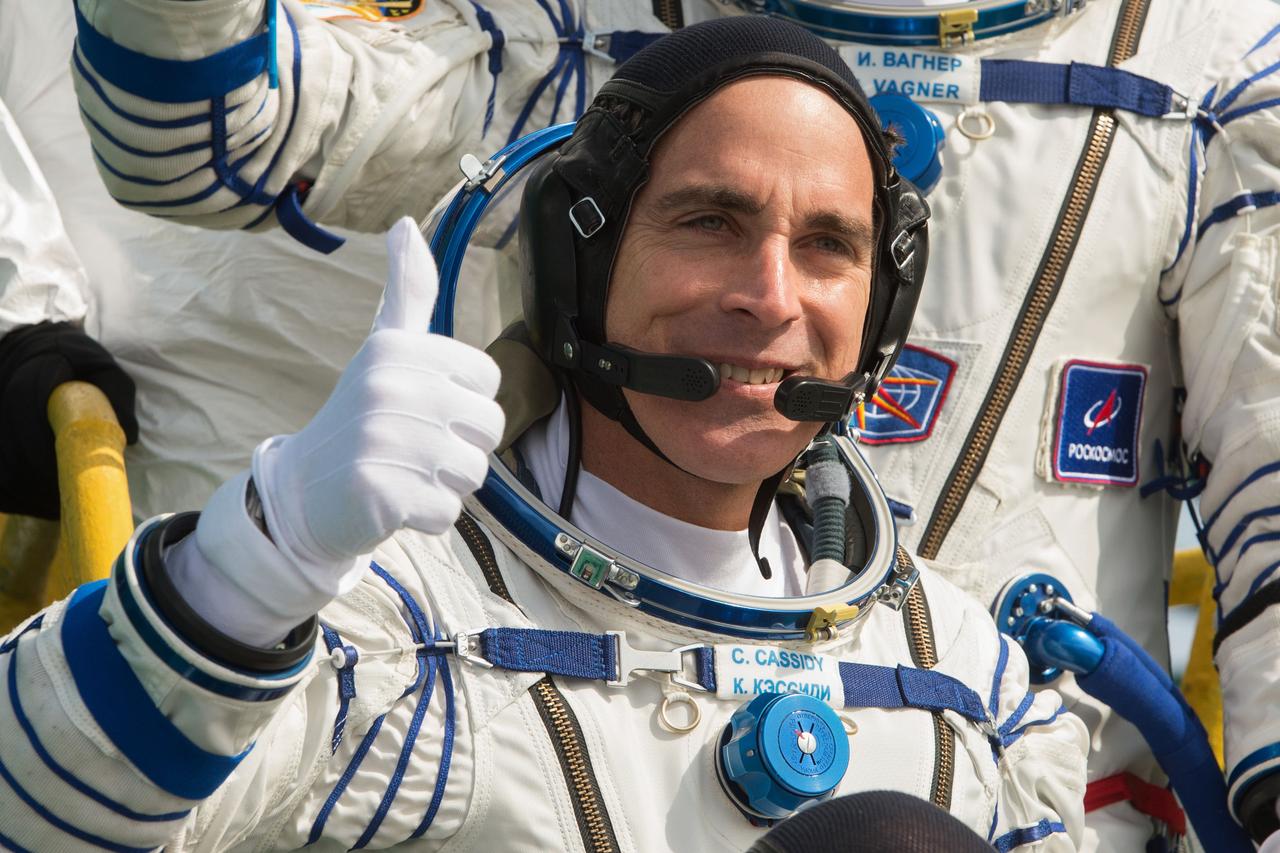
jsc2020e017124 - Expedition 63 Crew Waves Farewell - Expedition 63 crewmember Chris Cassidy of NASA waves goodbye as he, and cosmonauts Ivan Vagner and Anatoly Ivanishin of Roscosmos, prepare to climb aboard the Soyuz MS-16 rocket at Site 31 at the Baikonur Cosmodrome in Kazakhstan, Thursday, April 9, 2020. They launched a short time later to the International Space Station for the start of a six-and-a-half month mission. Photo Credit: (NASA/GCTC/Andrey Shelepin)
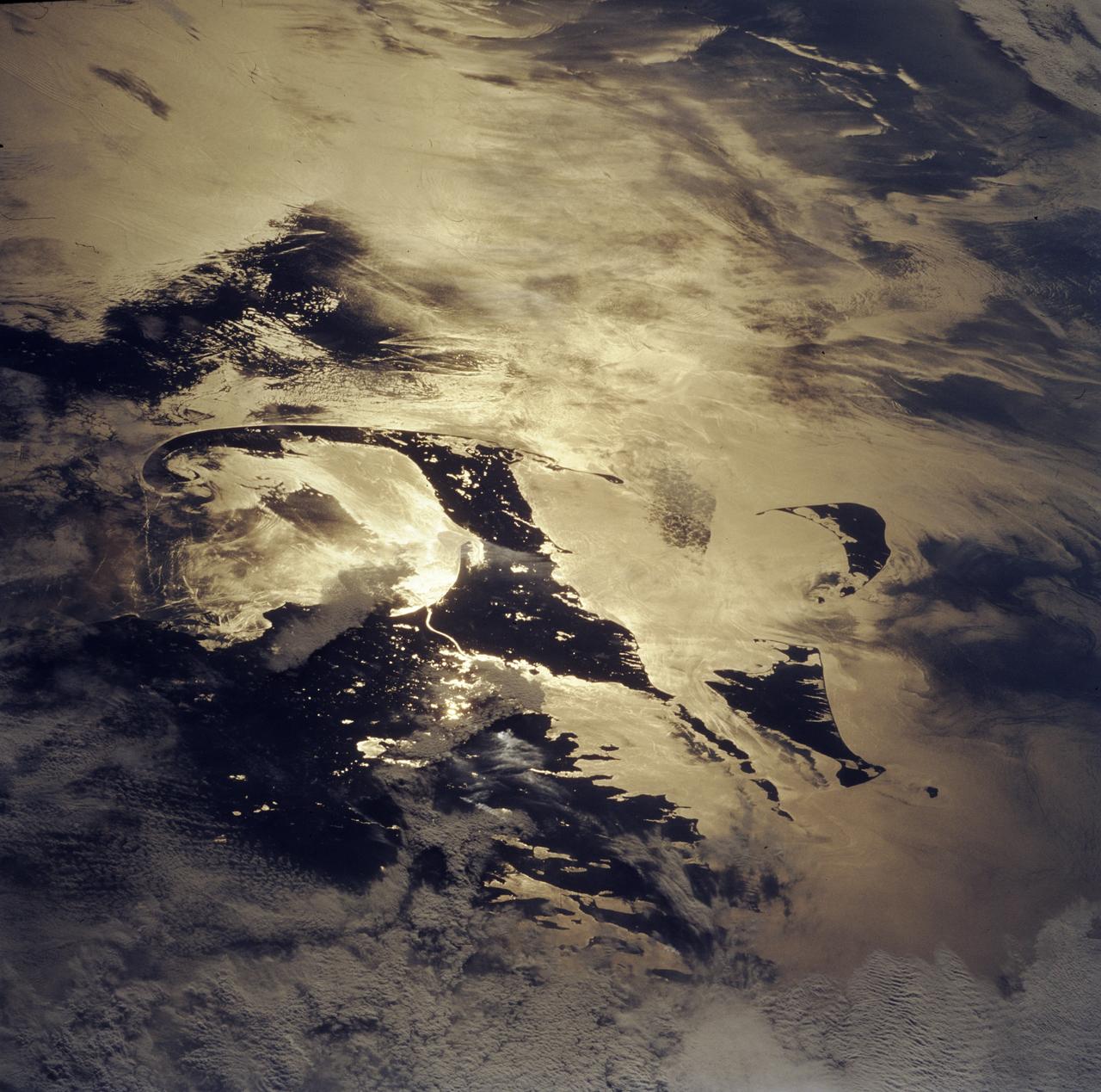
STS085-743-000D (7 - 19 August 1997) --- Cape Cod almost looks like an elf's slipper with this orientation in the sunglint. The sunglint also reveals other features such as shipwakes, calmer sea surfaces (the darker areas) and internal waves which are waves traveling along a layer of denser water many tens of feet below the surface.
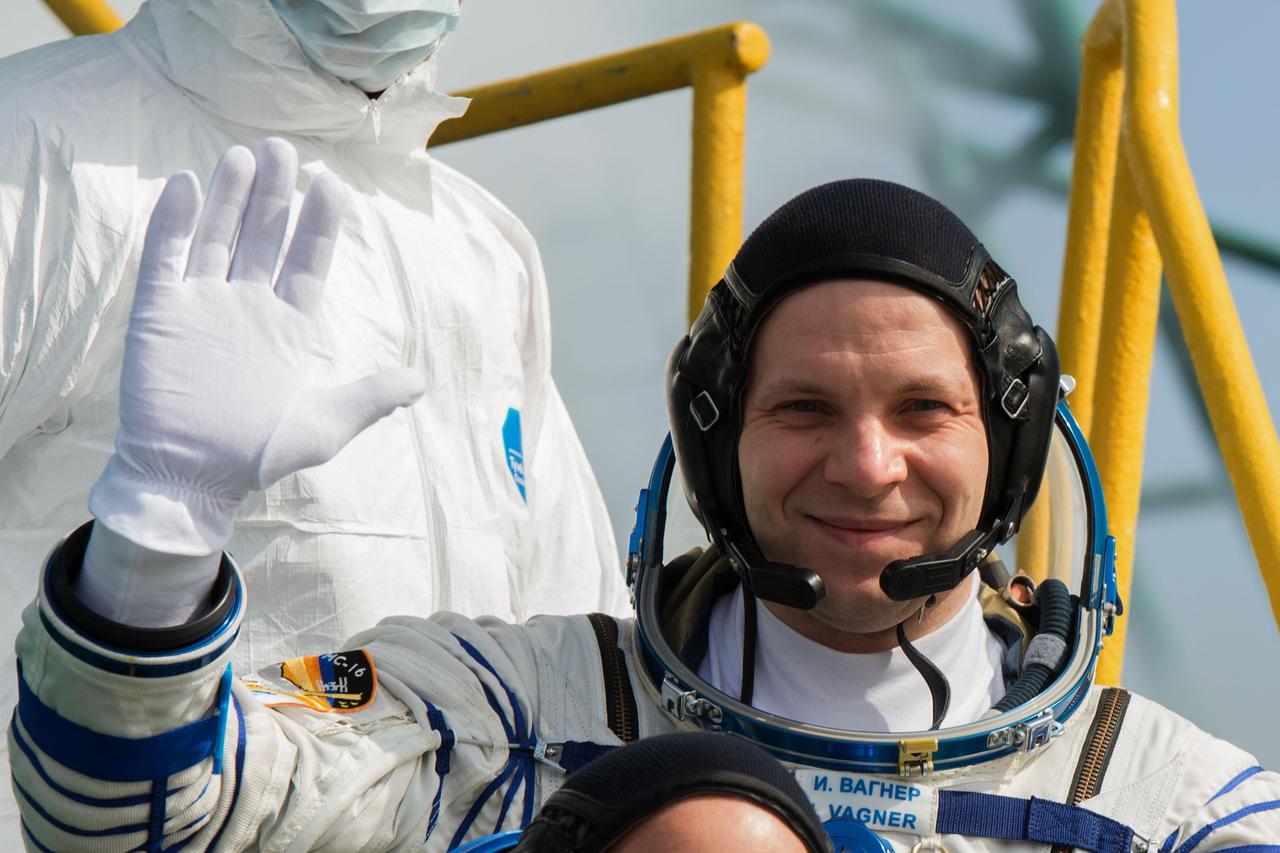
jsc2020e017123 - Expedition 63 Crew Waves Farewell - Expedition 63 crewmember Ivan Vagner of Roscosmos waves goodbye as he, Chris Cassidy of NASA, and Anatoly Ivanishin of Roscosmos, prepare to climb aboard the Soyuz MS-16 rocket at Site 31 at the Baikonur Cosmodrome in Kazakhstan, Thursday, April 9, 2020. They launched a short time later to the International Space Station for the start of a six-and-a-half month mission. Photo Credit: (NASA/GCTC/Andrey Shelepin)
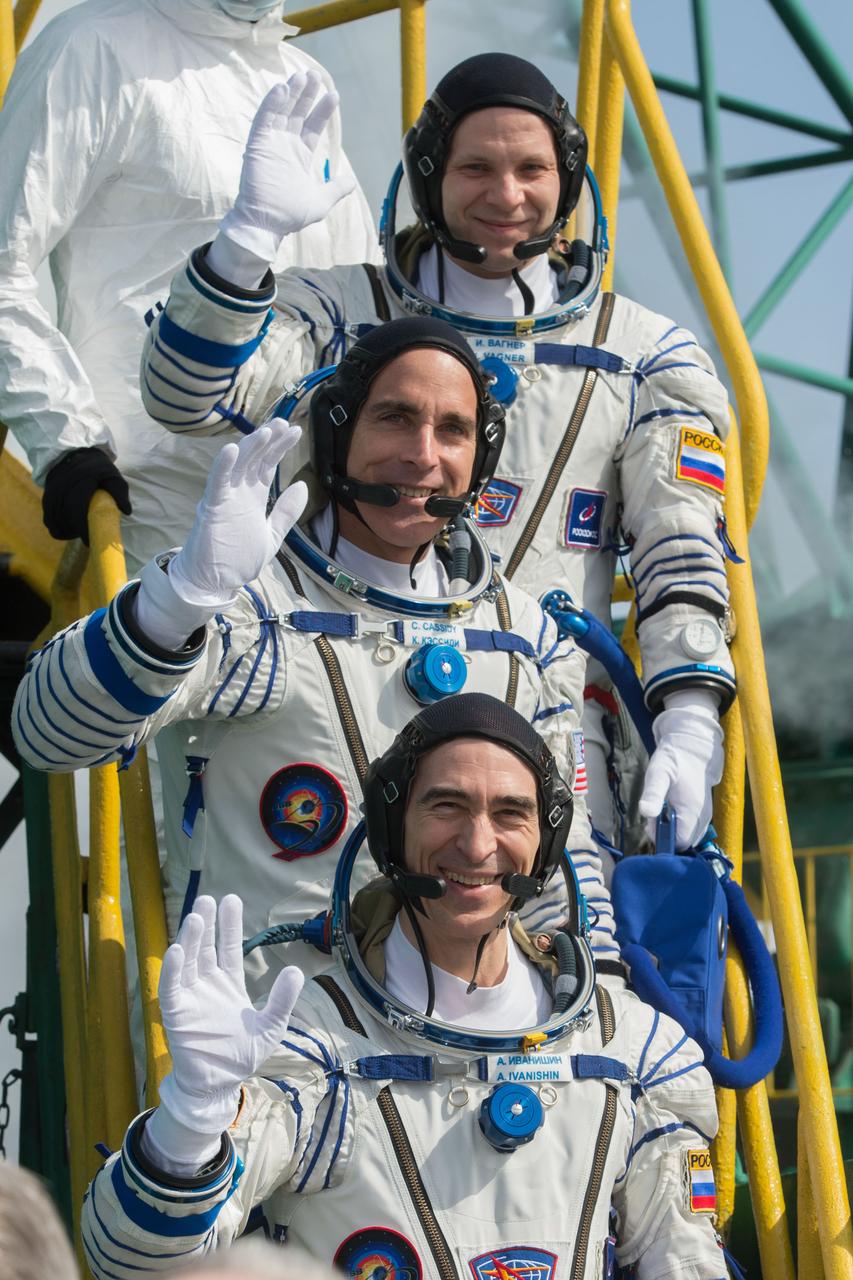
jsc2020e017122 - Expedition 63 Crew Waves Farewell - Expedition 63 crewmembers Ivan Vagner of Roscosmos, top, Chris Cassidy of NASA, center, and Anatoly Ivanishin wave goodbye as they prepare to climb aboard the Soyuz MS-16 rocket at Site 31 at the Baikonur Cosmodrome in Kazakhstan, Thursday, April 9, 2020. They launched a short time later to the International Space Station for the start of a six-and-a-half month mission. Photo Credit: (NASA/GCTC/Andrey Shelepin)
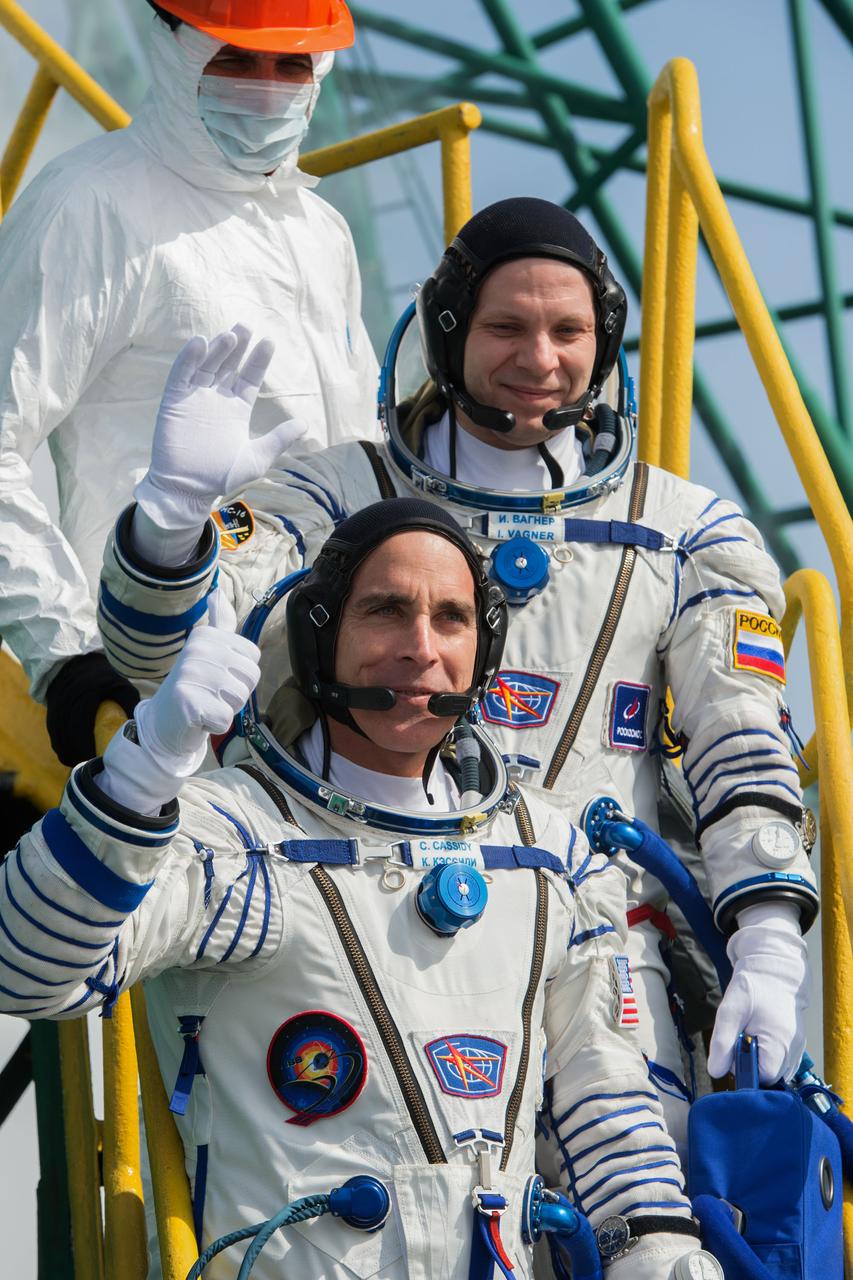
jsc2020e017121 - Expedition 63 Crew Waves Farewell - Expedition 63 crewmembers Ivan Vagner of Roscosmos, top, and Chris Cassidy of NASA wave goodbye as they and Anatoly Ivanishin of Roscosmos prepare to climb aboard the Soyuz MS-16 rocket at Site 31 at the Baikonur Cosmodrome in Kazakhstan, Thursday, April 9, 2020. They launched a short time later to the International Space Station for the start of a six-and-a-half month mission. Photo Credit: (NASA/GCTC/Andrey Shelepin)
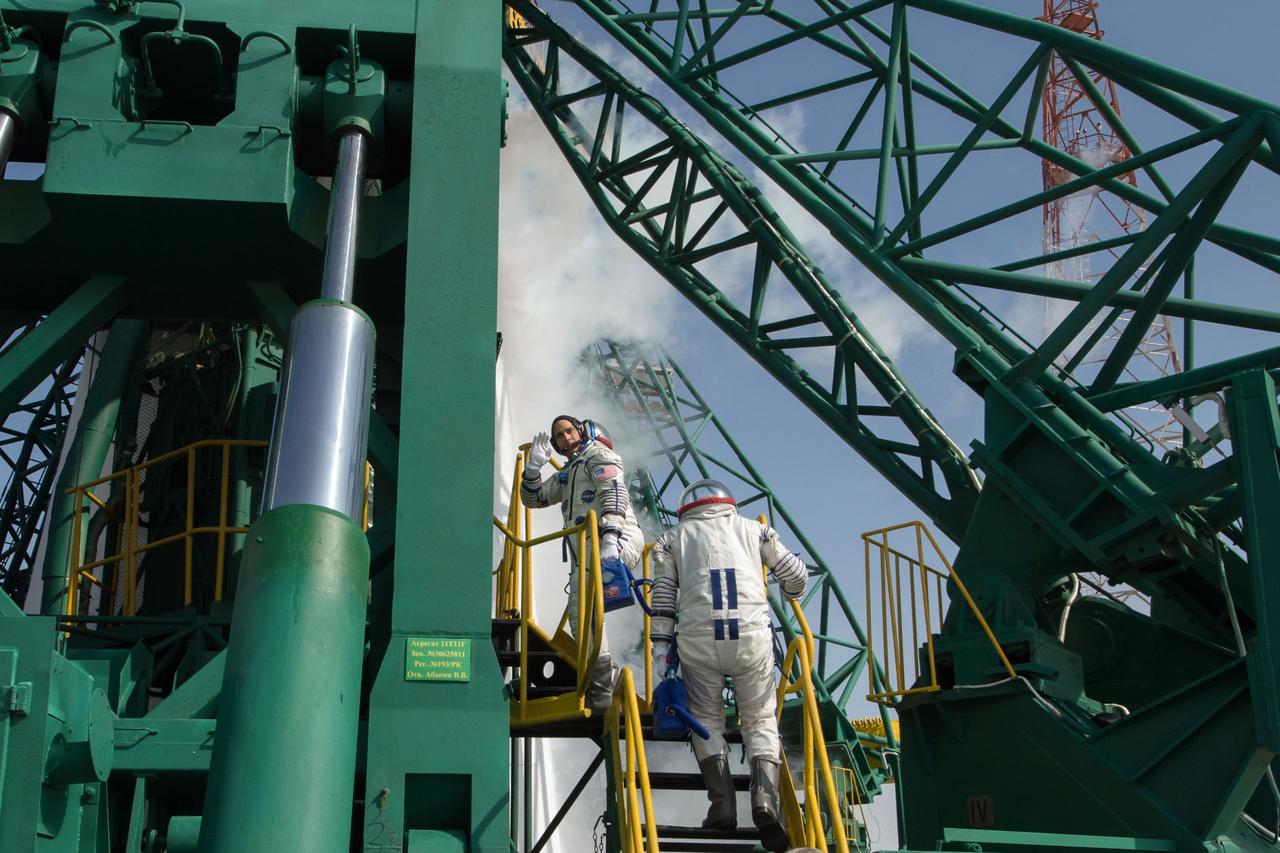
jsc2020e017127 - Expedition 63 Crew Waves Farewell - Expedition 63 crewmember Chris Cassidy of NASA waves farewell as he, Anatoly Ivanishin and Ivan Vagner of Roscosmos climb aboard the Soyuz MS-16 rocket at Site 31 at the Baikonur Cosmodrome in Kazakhstan, Thursday, April 9, 2020. They launched a short time later to the International Space Station for the start of a six-and-a-half month mission. Photo Credit: (NASA/GCTC/Andrey Shelepin)
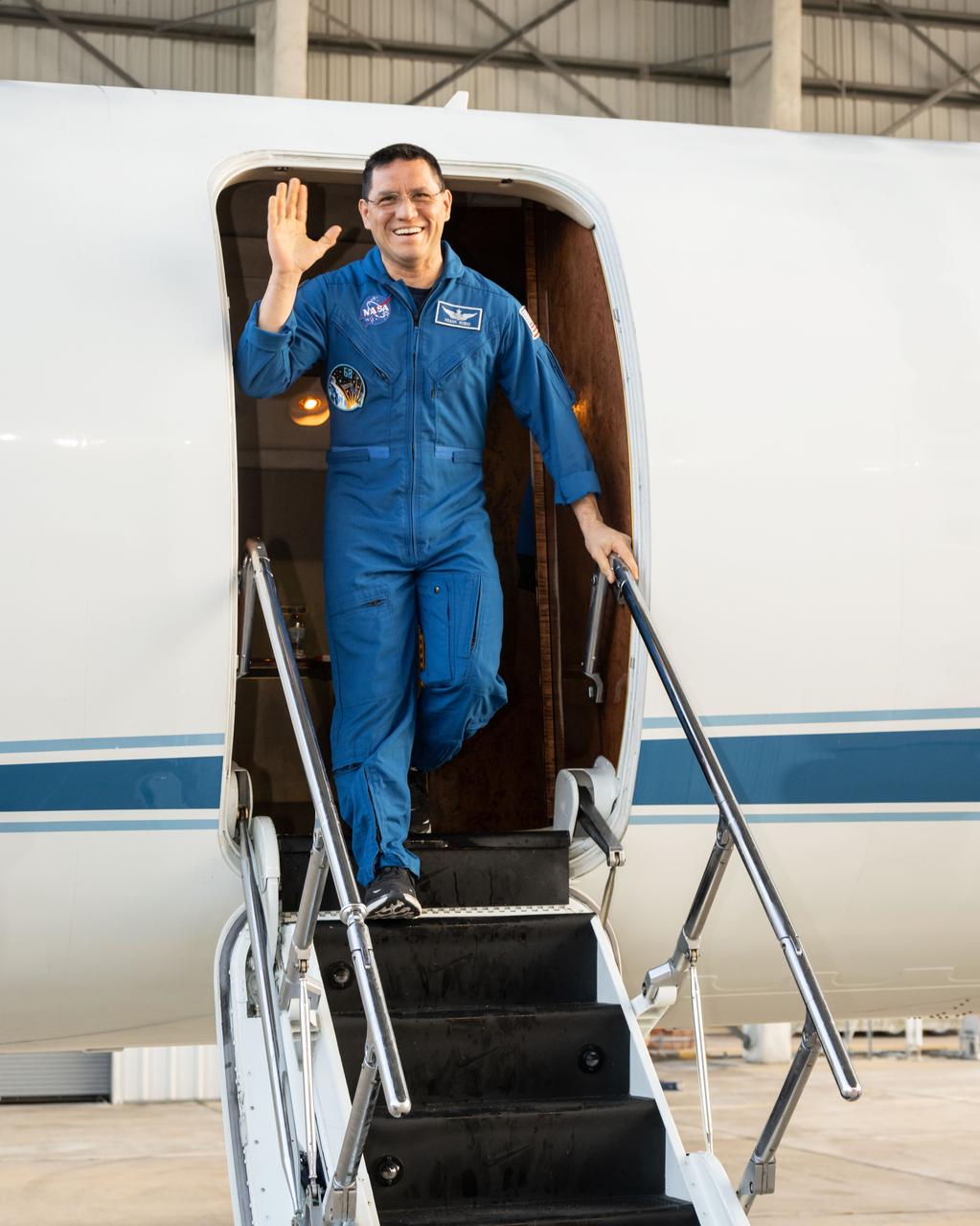
jsc2023e054871 (Sept. 28, 2023) --- NASA astronaut Frank Rubio waves after returning to Ellington Field in Houston, Texas, aboard a NASA jet following the completion of his 371-day mission aboard the International Space Station.
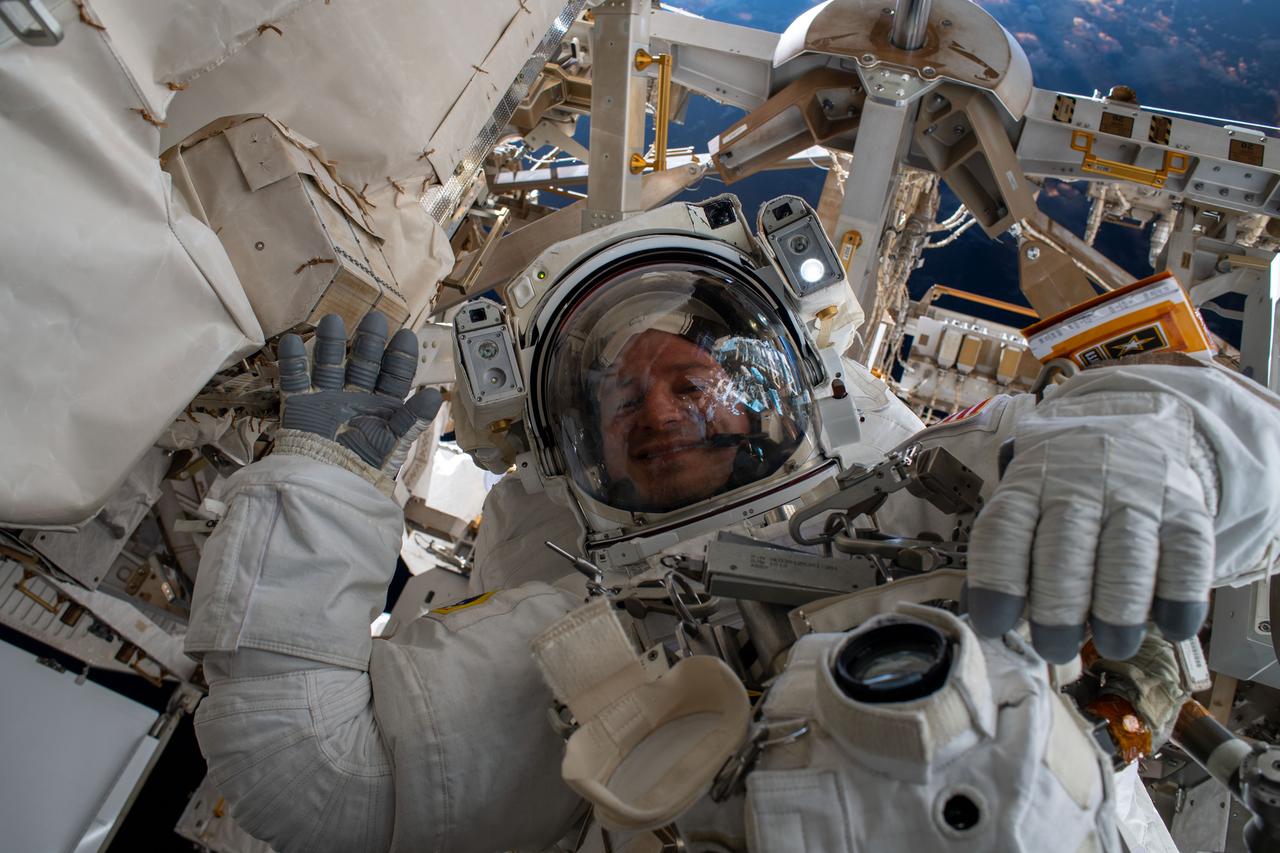
iss061e040708 (Nov. 15, 2019) --- NASA astronaut Andrew Morgan waves as he is photographed during the first spacewalk to repair the Alpha Magnetic Spectrometer, a cosmic particle detector on the International Space Station.
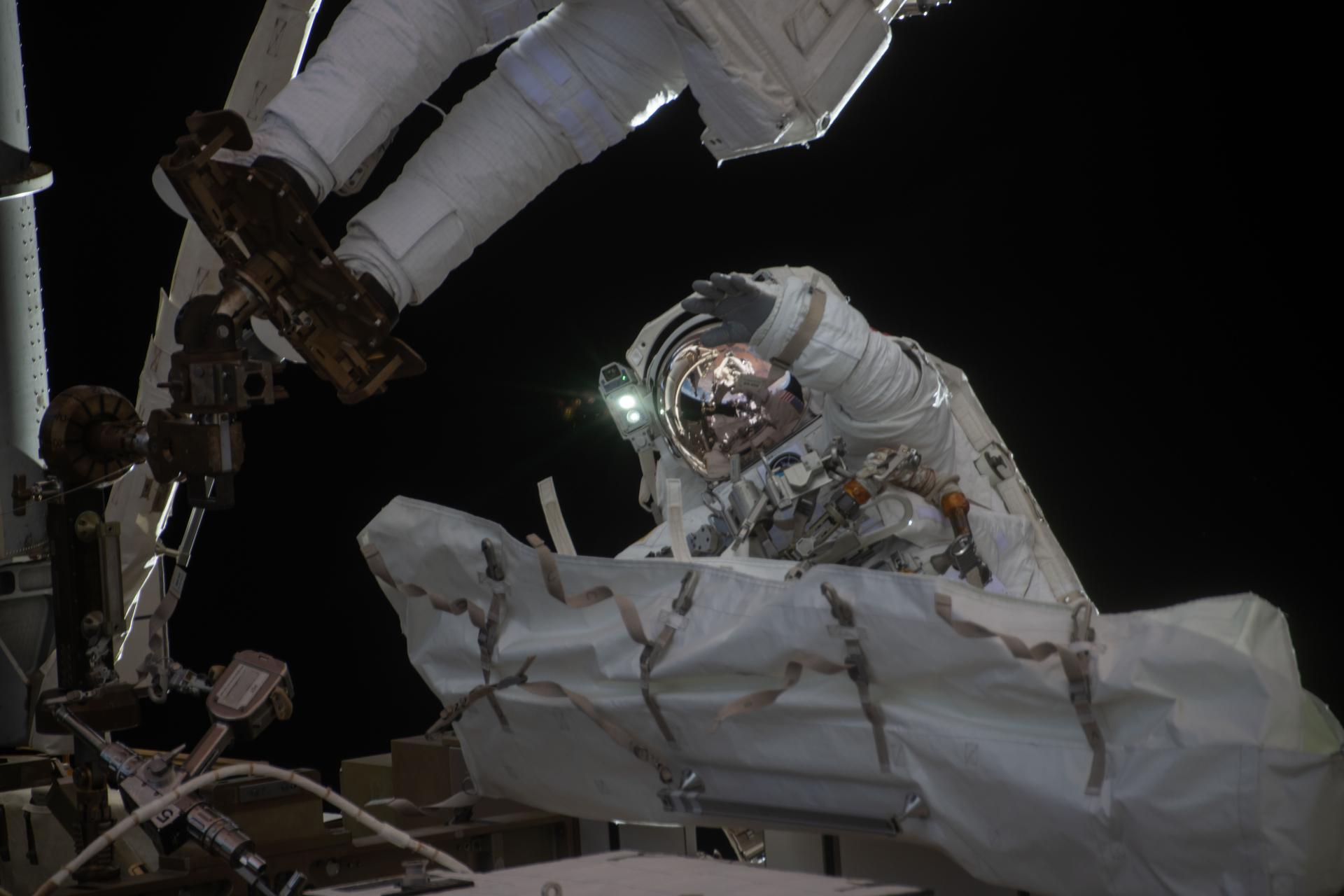
iss074e0403652 (March 18, 2026) -- NASA astronaut Jessica Meir waves at the camera during a seven-hour, two-minute spacewalk outside the International Space Station on March 18, 2026. Credit: NASA/Jack Hathaway
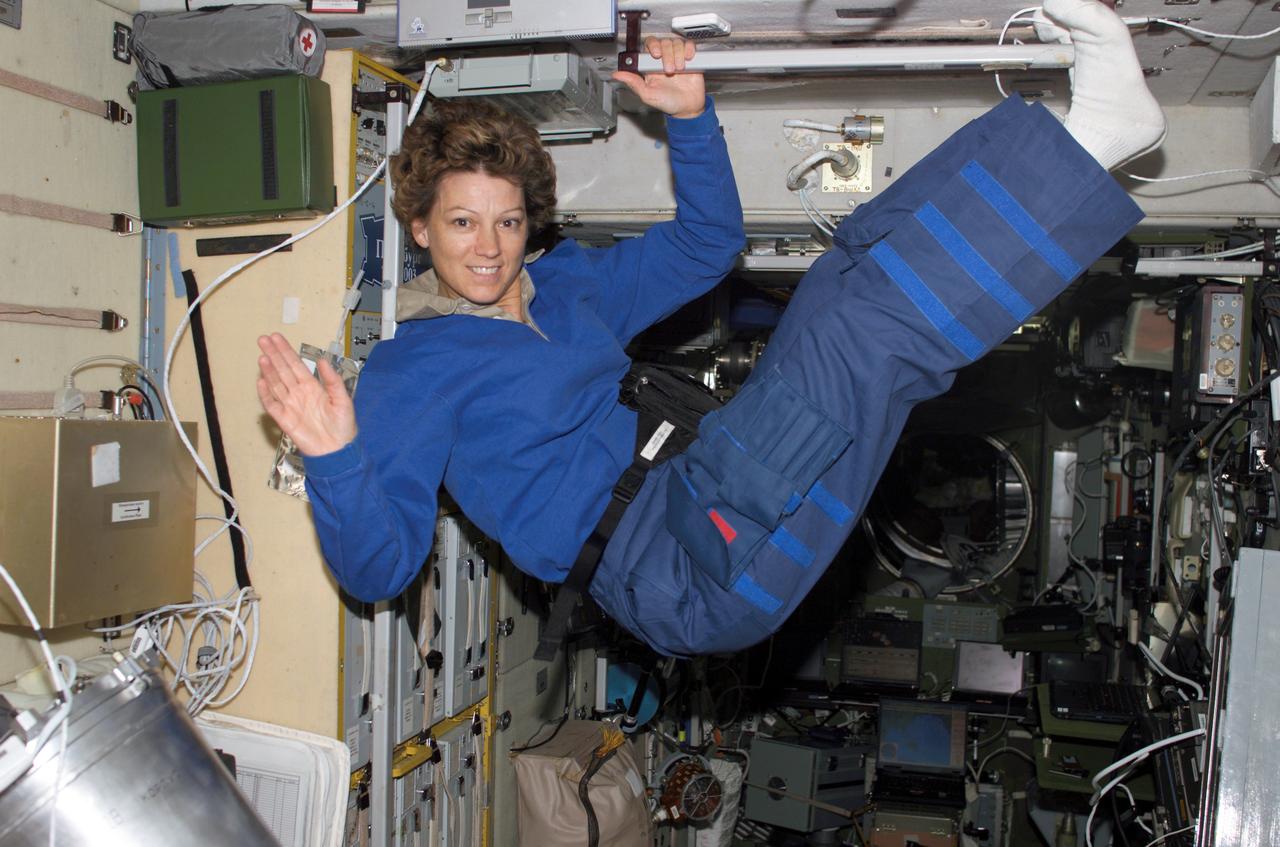
S114-E-7138 (5 August 2005) --- Astronaut Eileen M. Collins, STS-114 commander, waves while floating in the Zvezda Service Module of the international space station while Space Shuttle Discovery was docked to the station.

ISS038-E-036501 (28 Jan. 2014) --- This wide field-of-view image photographed by an Expedition 38 crew member on the International Space Station shows an east-west swath of the southwestern Indian Ocean. Two remote islands, part of the French Southern and Antarctic Lands, appear in the center of the image. Possession Island (right center) and East Island (center) are both only 18 kilometers long. A smaller island, Ile aux Cochons (Pigs Island), lies 100 kilometers to the west. Each island has set up V-shaped trains of waves, like bow waves, as the air flows over the islands from the west (right to left). The bow-wave patterns are overlaid on the low regional stratus (blanket) cloud that is so common in the southern Indian Ocean at 50 degrees south latitude. This view was taken from more than 400 kilometers above the sea surface and reveals relationships that could not be readily understood by someone standing on one of the islands. For example, larger and higher islands produce larger waves. So the largest are being generated by Possession Island (934 meters above sea level at the highest point), and East Island, versus much smaller waves developed downwind of the tiny Ile de Pingouins (340 meters above sea level high, invisible below the cloud deck). Other patterns also can be detected. Waves in an upper layer can be seen casting shadows onto a lower layer (lower left). In the top half of the image the waves are making thicker and thinner zones in the clouds of the lower layer. Wave trains from Possession Island and Ile aux Cochons are interacting in a cross-hatch pattern (center).
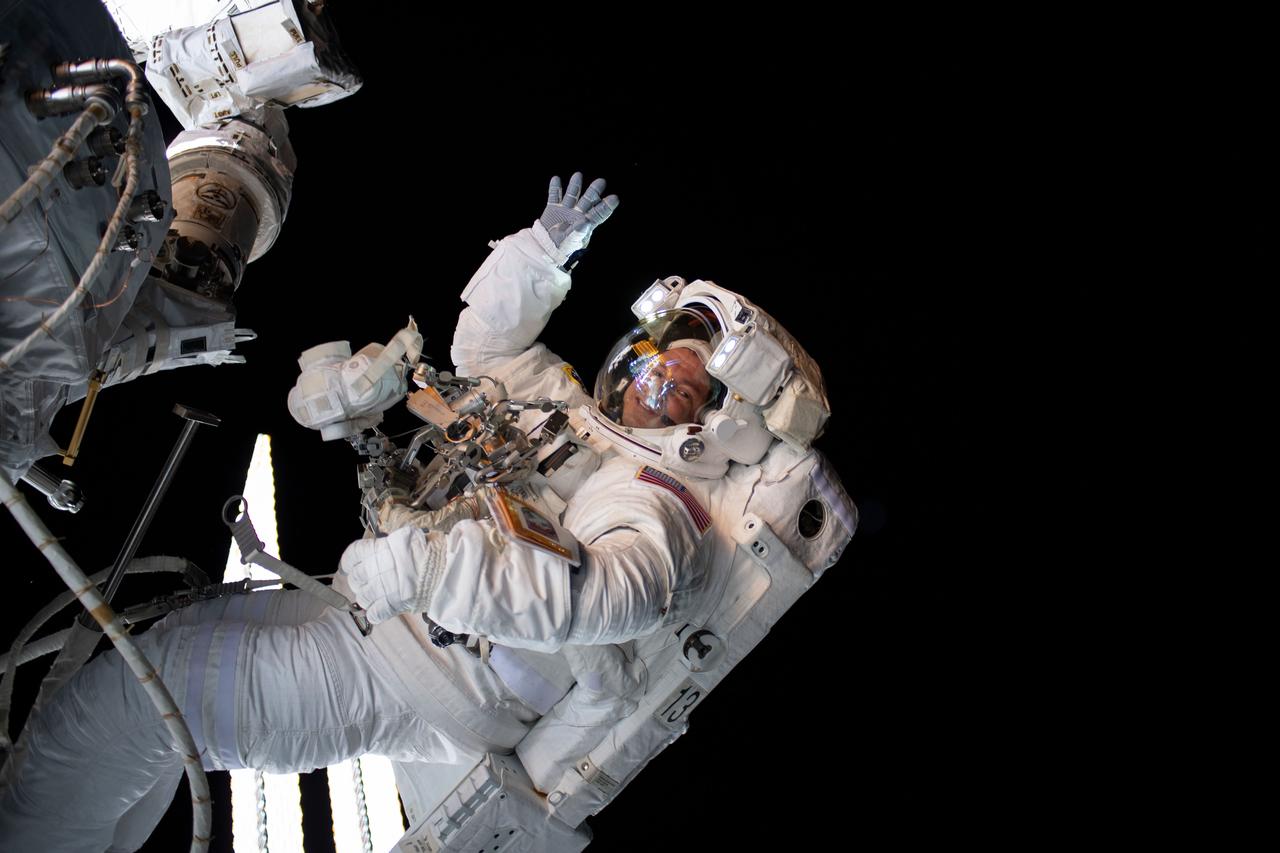
iss060e043194 (Aug. 21, 2019) --- NASA astronaut Andrew Morgan waves as he is photographed during a spacewalk to install the International Space Station’s second commercial crew vehicle docking port, the International Docking Adapter-3 (IDA-3).
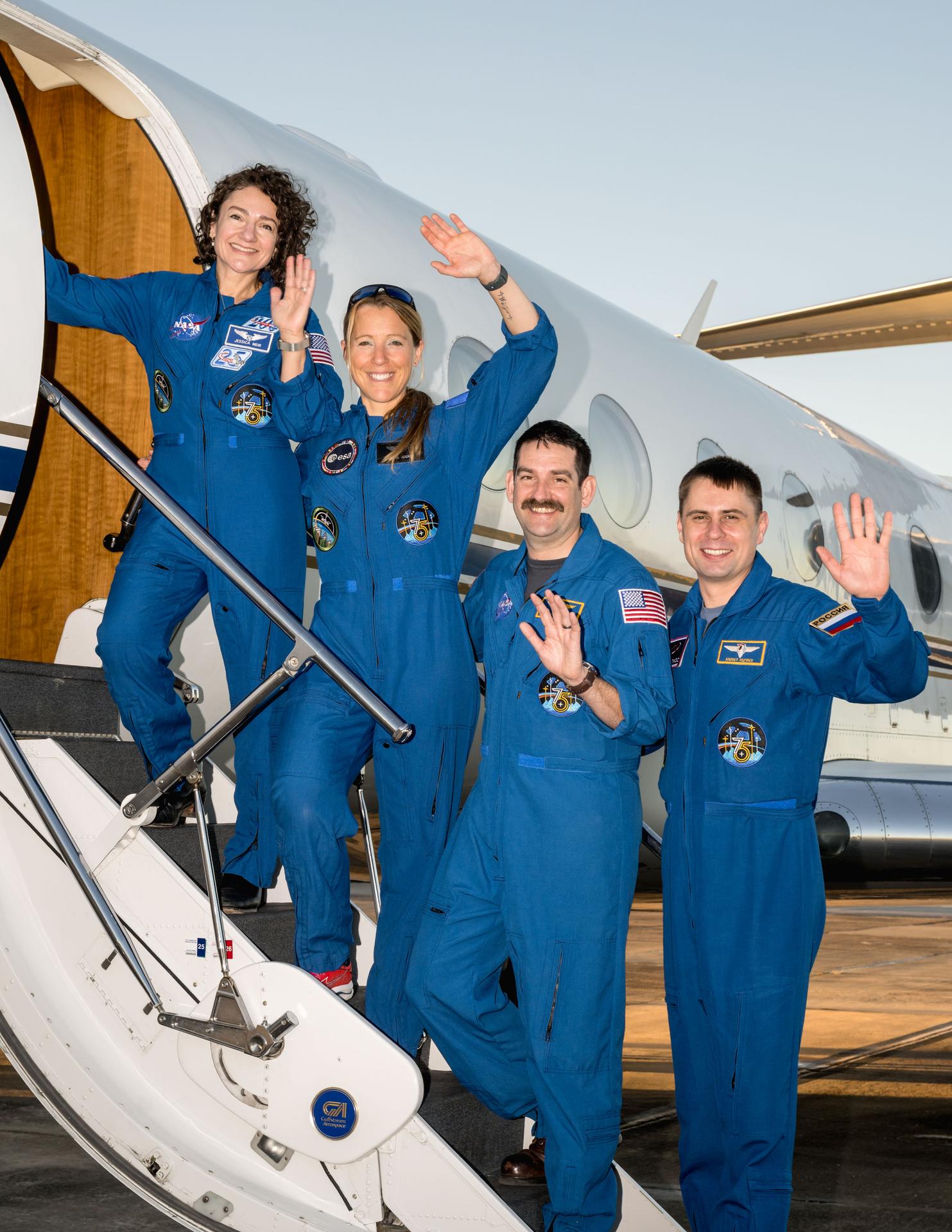
jsc2026e005916 (Feb. 6, 2026) --- Four crew members representing NASA's SpaceX Crew-12 mission to the International Space Station wave to the camera prior to departing from Ellington Field in Houston, Texas, to Kennedy Space Center in Florida. From left are, Commander Jessica Meir of NASA, Mission Specialist Sophie Adenot of ESA (Euroean Space Agency), Pilot Jack Hathaway of NASA, and Mission Specialist Andrey Fedyaev of Roscosmos. Credit: NASA/Josh Valcarcel
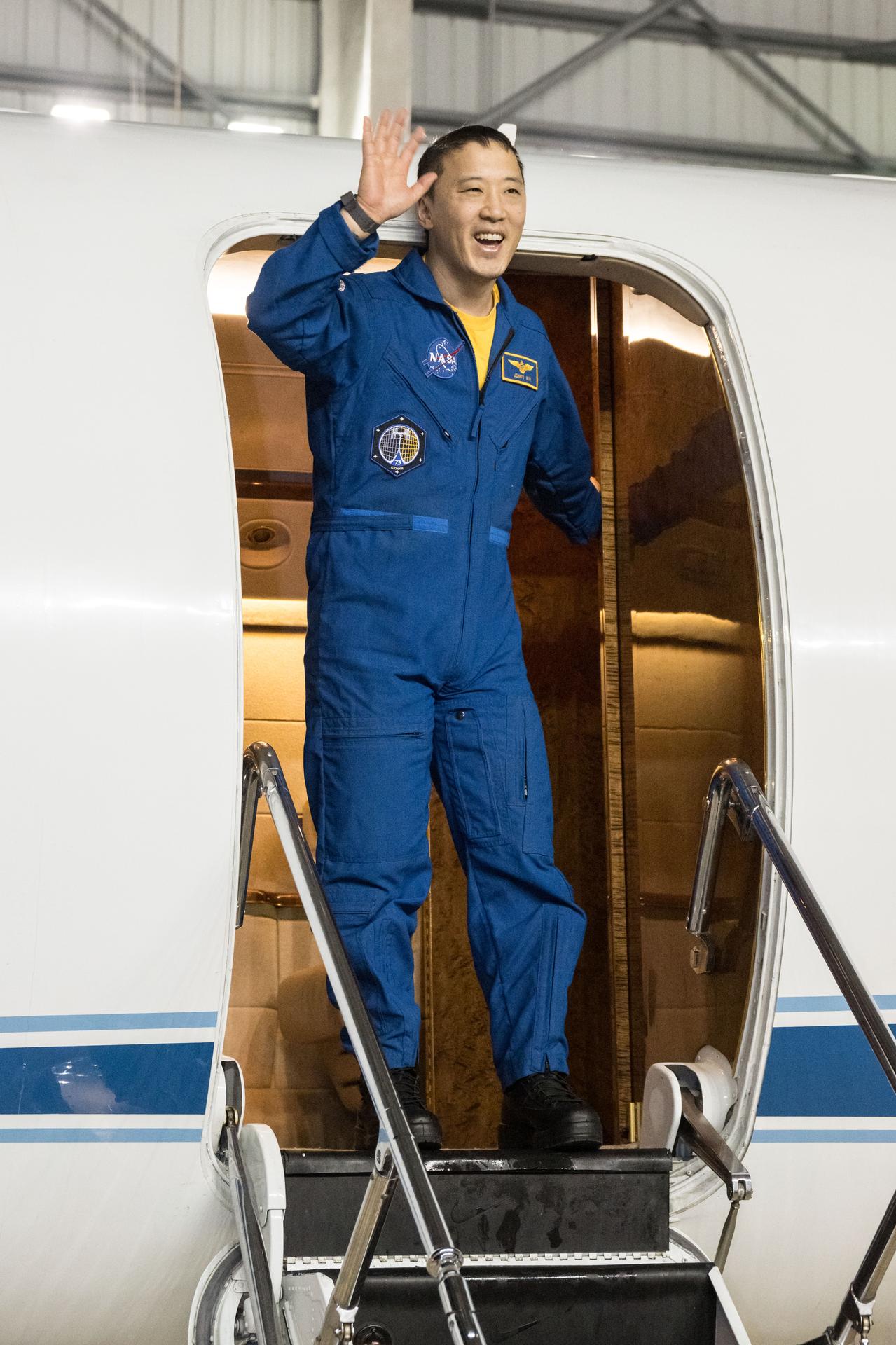
jsc2025e089530 (Dec. 10, 2025) --- NASA astronaut Jonny Kim waves to NASA personnel at Ellington Field after exiting the Gulfstream V aircraft that returned him to Houston, Texas, from Kazakhstan in Central Asia. The day before, Kim had landed in Kazakhstan aboard the Soyuz MS-27 crew spacecraft with Roscosmos cosmonauts Sergey Ryzhikov and Alexey Zubritsky after completing a 245-day research mission aboard the International Space Station. Credit: NASA/Robert Markowitz
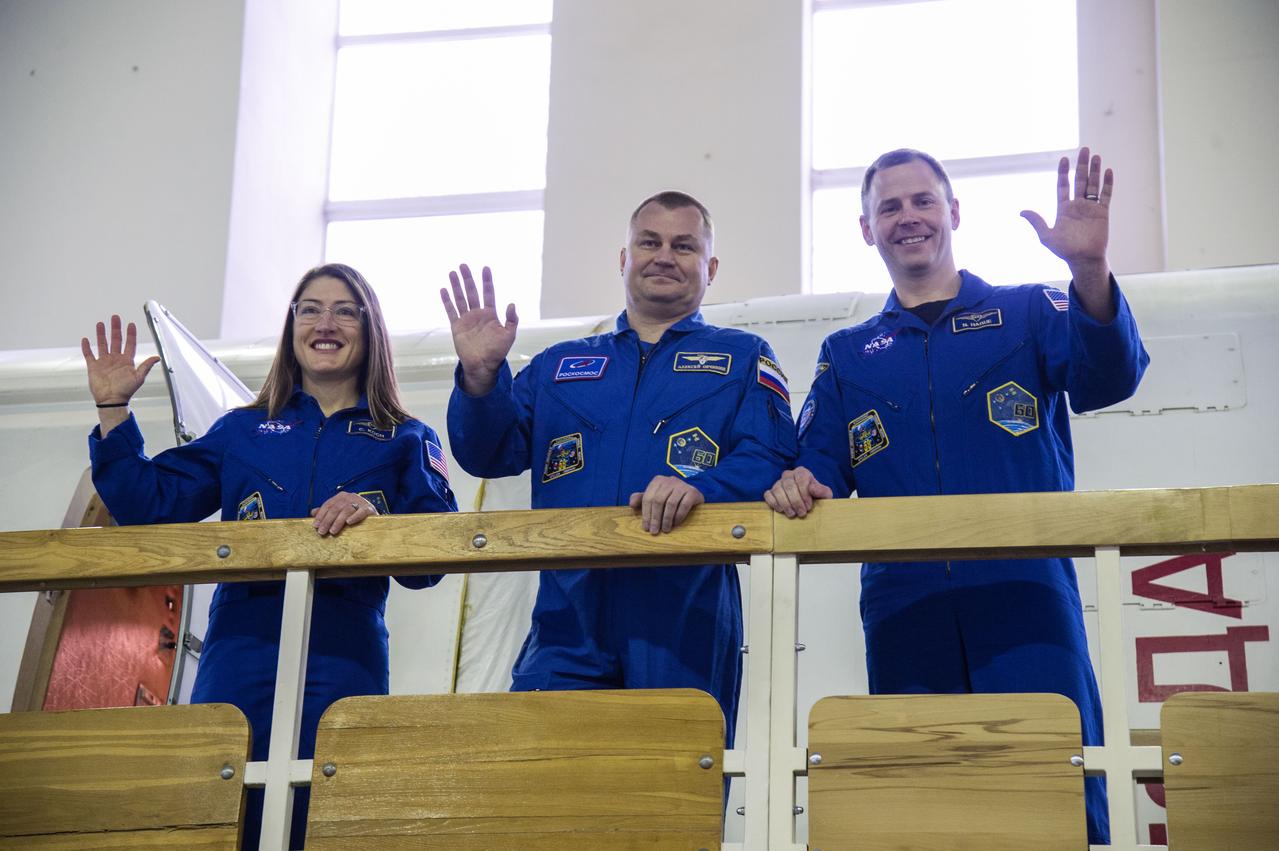
jsc2019e003765 (Feb. 19, 2019) --- At the Gagarin Cosmonaut Training Center in Star City, Russia, Expedition 59 crew members Christina Koch of NASA (left), Alexey Ovchinin of Roscosmos (center) and Nick Hague of NASA (right) wave to cameras Feb. 19 during the first of two days of final pre-launch qualification exams. They will launch March 14, U.S. time, from the Baikonur Cosmodrome in Kazakhstan on the Soyuz MS-12 spacecraft for a six-and-a-half month mission on the International Space Station. Credit: NASA/Beth Weissinger
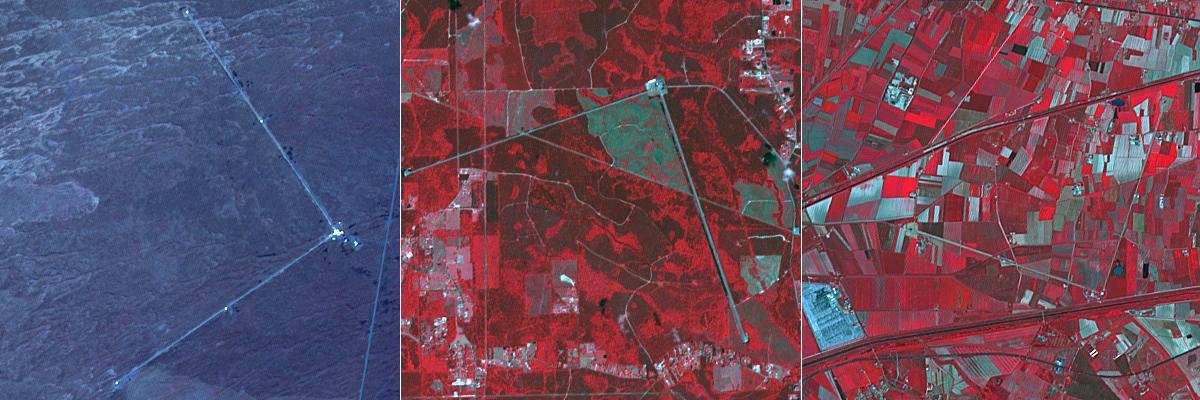
The biggest merger yet between two black holes produced gravity waves that were detected by gravitational wave detection systems. This analysis is the latest to come out of the international LIGO-VIRGO collaboration, which operates three super-sensitive gravitational wave-detection systems in America and Europe (Information from BBC News, September 2). The systems consist of two interferometers at right angles to each other. The two American LIGO systems are located near Livingston, LA (left image) and near Hanford, WA (center image); the European VIRGO system is located near Pisa, Italy (right image). The three ASTER cutouts each cover an area of 6 by 6 km. https://photojournal.jpl.nasa.gov/catalog/PIA24129
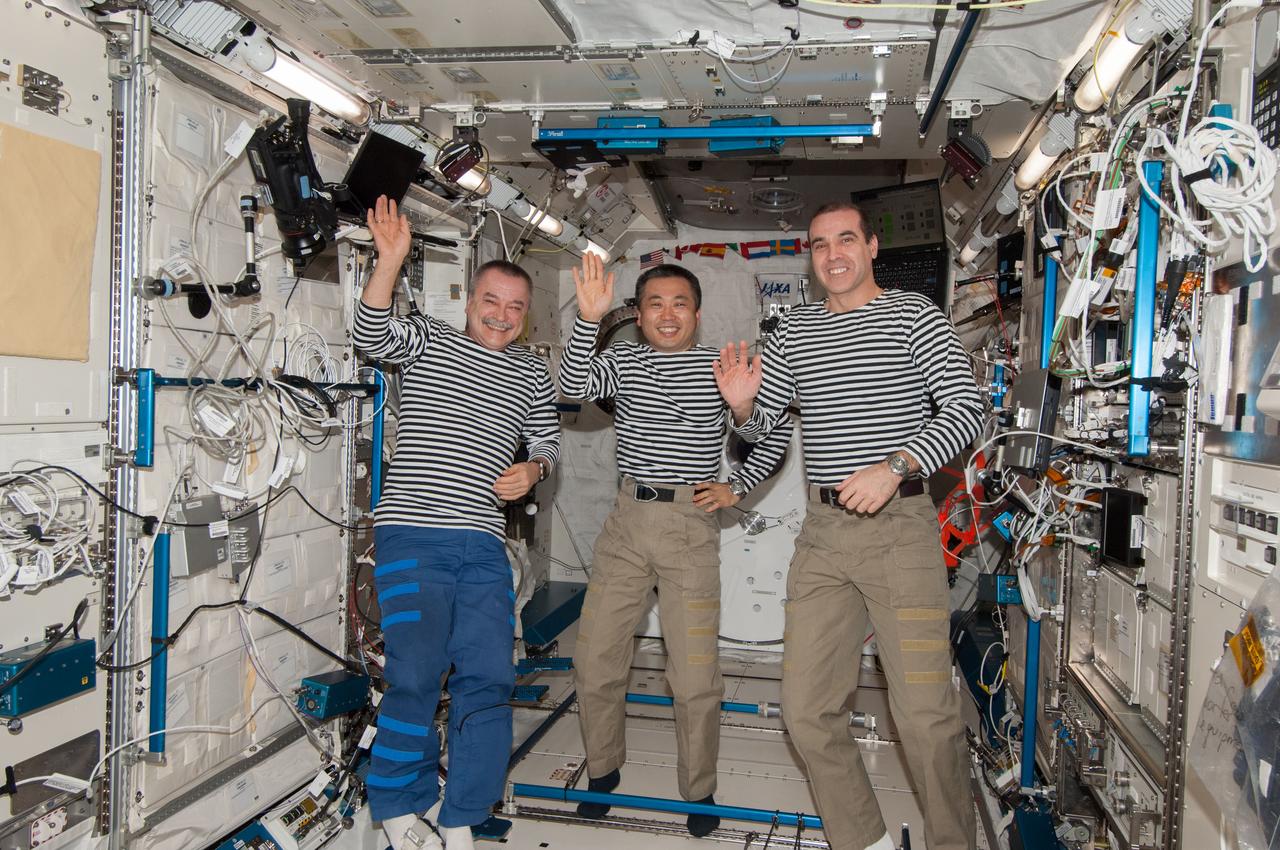
ISS038-E-068903 (9 March 2014) --- The new commander of the current crew on the International Space Station (Expedition 39) and the Expedition 38/39 flight engineers wave inside the Kibo laboratory. Their waving may very well be a symbolic farewell to the Expedition 38 crew members (out of frame) who are on the eve of their departure day from the orbital outpost. Expedition 39 Commander Koichi Wakata (center) of the Japanese Aerospace Exploration Agency (JAXA) is joined here by Flight Engineers Rick Mastracchio (right) of NASA and cosmonaut Mikhail Tyurin of the Russian Federal Space Agency (Roscosmos).

U.S. President Barack Obama, accompanied by members of Congress and middle school children, waves as he talks on the phone from the Roosevelt Room of the White House to astronauts on the International Space Station, Wednesday, Feb. 17, 2010 in Washington. Photo Credit: (NASA/Bill Ingalls)
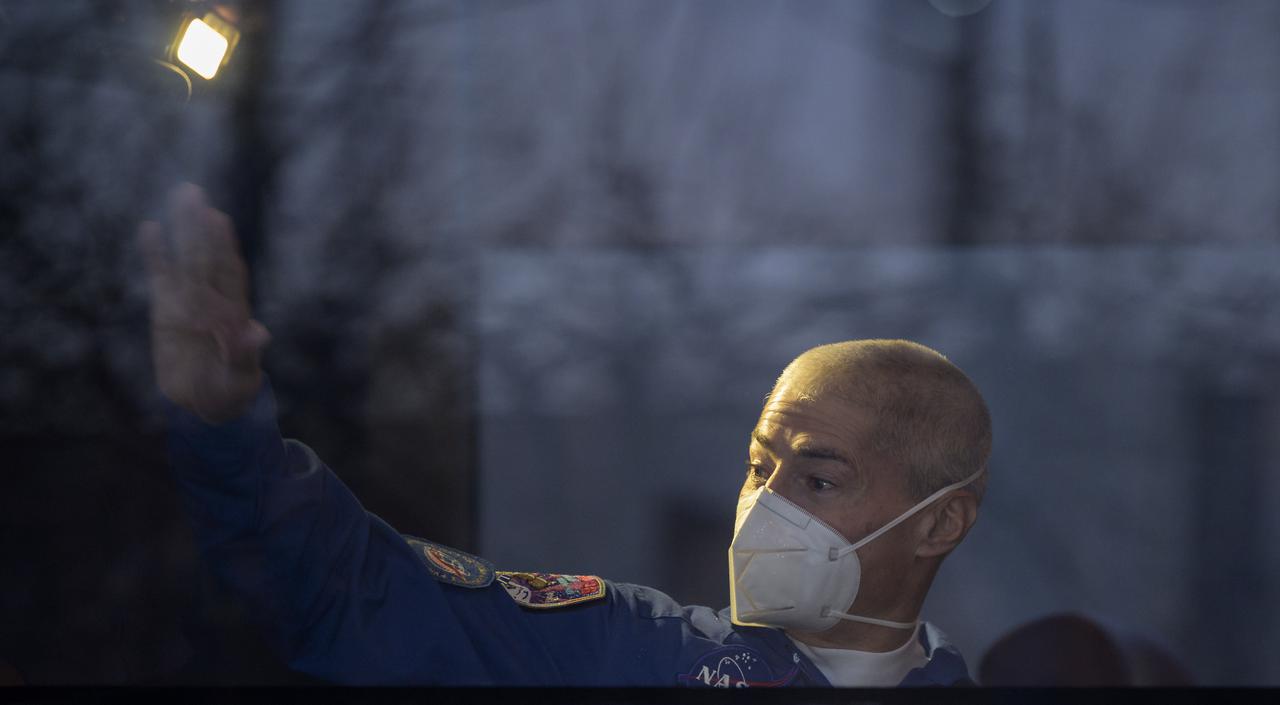
Expedition 65 NASA astronaut Mark Vande Hei waves as he departs the Cosmonaut Hotel to suit-up with Russian cosmonauts Oleg Novitskiy and Pyotr Dubrov for their Soyuz launch to the International Space Station, Friday, April 9, 2021, in Baikonur, Kazakhstan. Photo Credit: (NASA/Bill Ingalls)
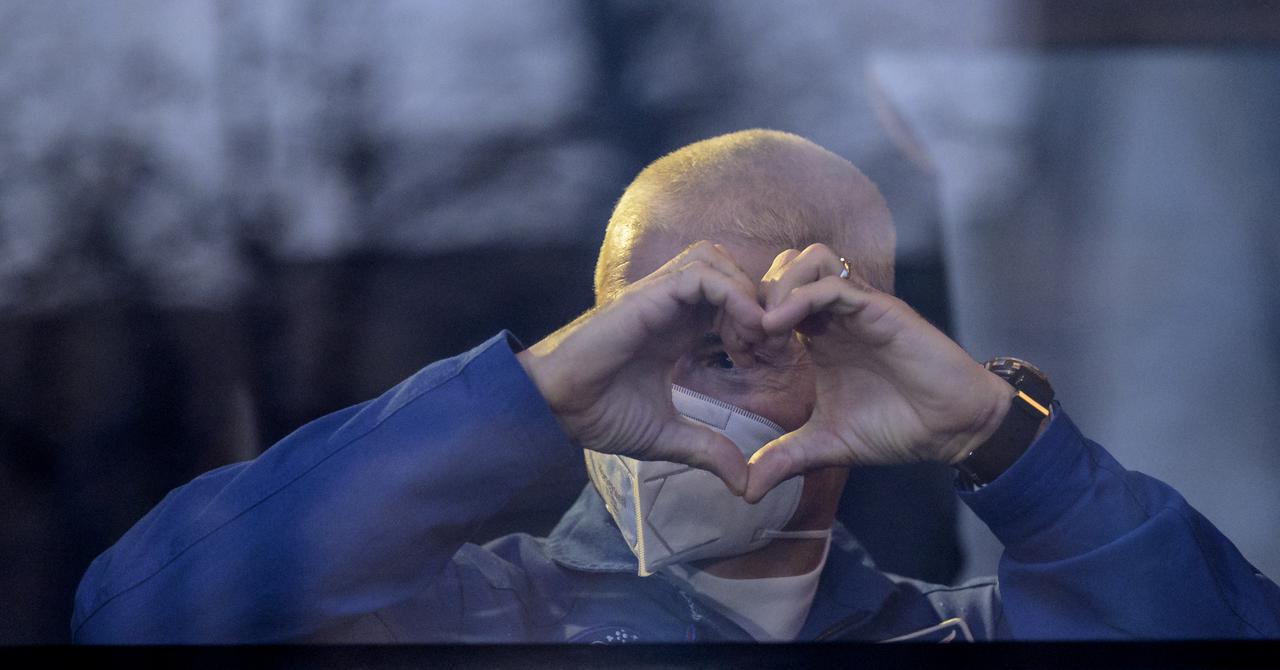
Expedition 65 NASA astronaut Mark Vande Hei waves as he departs the Cosmonaut Hotel to suit-up with Russian cosmonauts Oleg Novitskiy and Pyotr Dubrov for their Soyuz launch to the International Space Station, Friday, April 9, 2021, in Baikonur, Kazakhstan. Photo Credit: (NASA/Bill Ingalls)

U.S. President Barack Obama, accompanied by members of Congress and middle school children, waves as he talks on the phone from the Roosevelt Room of the White House to astronauts on the International Space Station, Wednesday, Feb. 17, 2010 in Washington. Photo Credit: (NASA/Bill Ingalls)
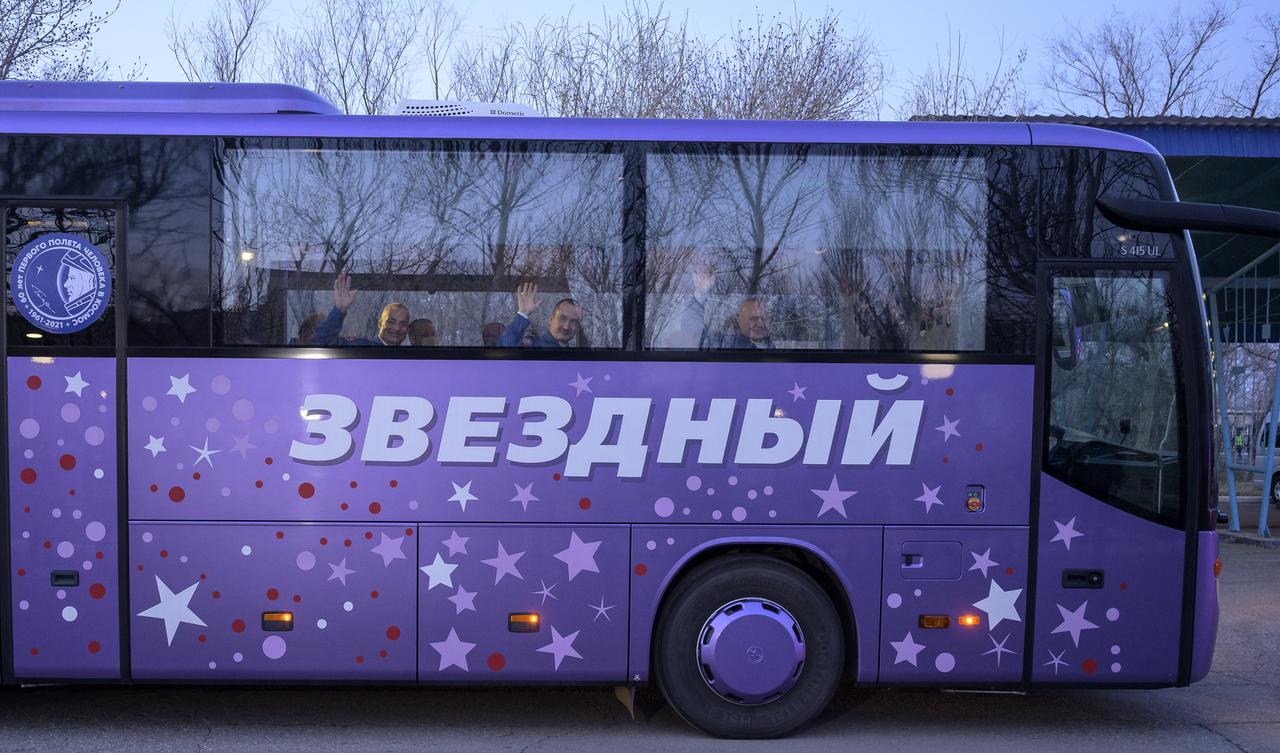
Expedition 65 NASA astronaut Mark Vande Hei, left, Roscosmos cosmonauts Oleg Novitskiy, center, and Pyotr Dubrov wave as they depart the Cosmonaut Hotel to suit-up for their Soyuz launch to the International Space Station, Friday, April 9, 2021, in Baikonur, Kazakhstan. Photo Credit: (NASA/Bill Ingalls)
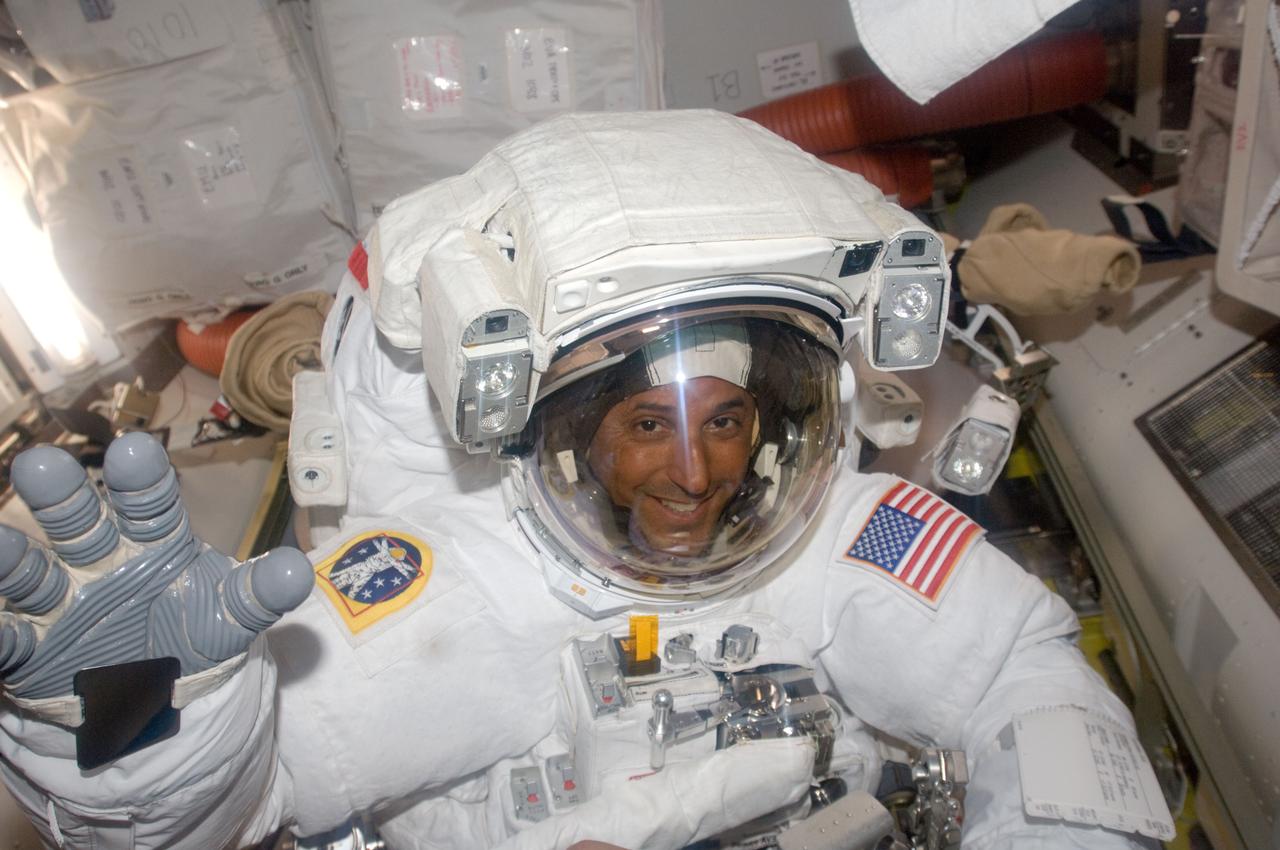
ISS018-E-041348 (21 March 2009) --- Astronaut Joseph Acaba, STS-119 mission specialist, attired in his Extravehicular Mobility Unit (EMU) spacesuit, waves as he prepares to leave the Quest Airlock of the International Space Station to begin the mission's second session of extravehicular activity (EVA).
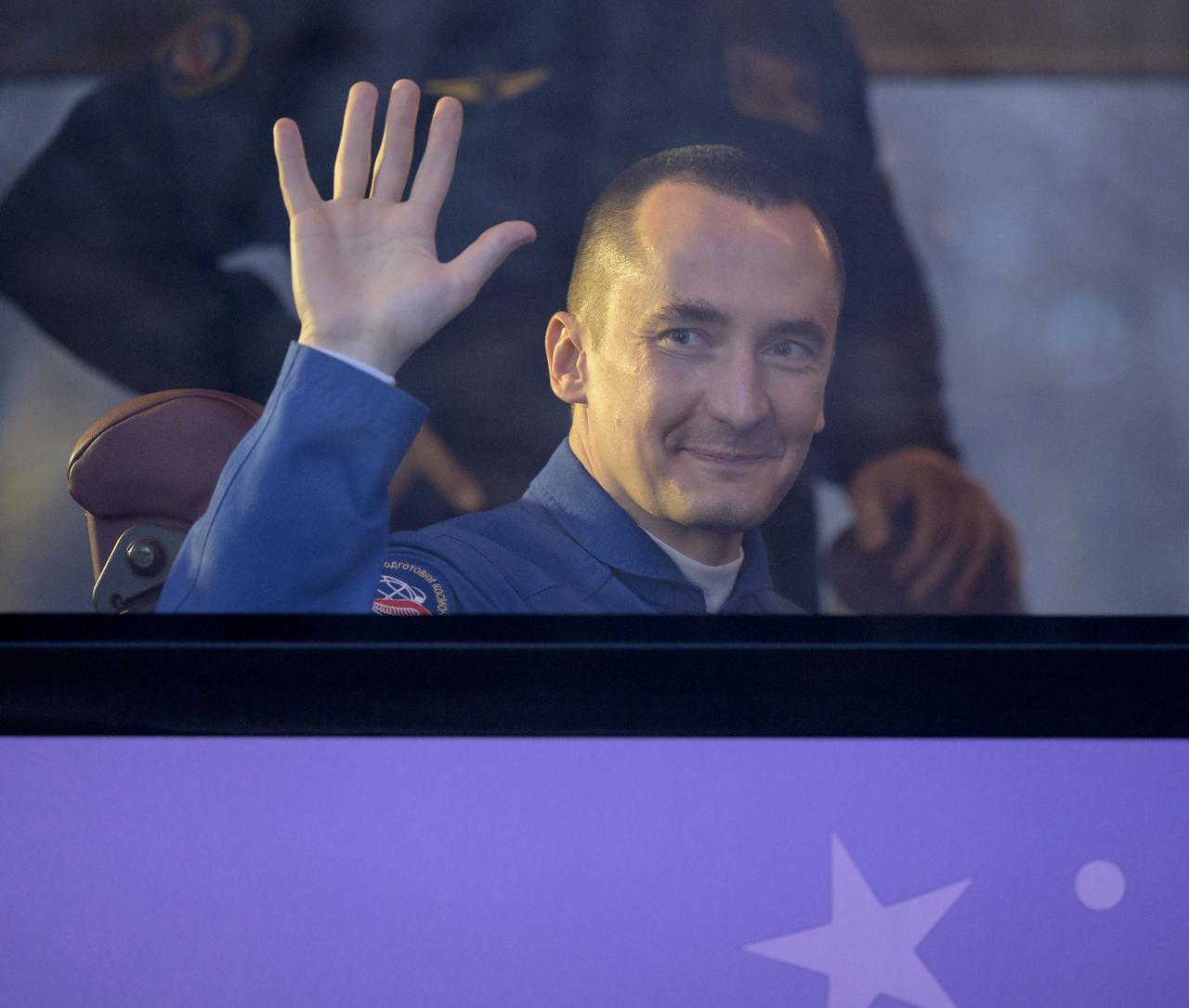
Expedition 65 Russian cosmonaut Pyotr Dubrov waves as he departs the Cosmonaut Hotel to suit-up with Russian cosmonaut Oleg Novitskiy and NASA astronaut Mark Vande Hei for their Soyuz launch to the International Space Station, Friday, April 9, 2021, in Baikonur, Kazakhstan. Photo Credit: (NASA/Bill Ingalls)

WASHINGTON - 201002170001HQ - U.S. President Barack Obama, accompanied by members of Congress and middle school children, waves as he talks on the phone from the Roosevelt Room of the White House to astronauts on the International Space Station, Wednesday, Feb. 17, 2010, in Washington. Photo Credit: NASA/Bill Ingalls
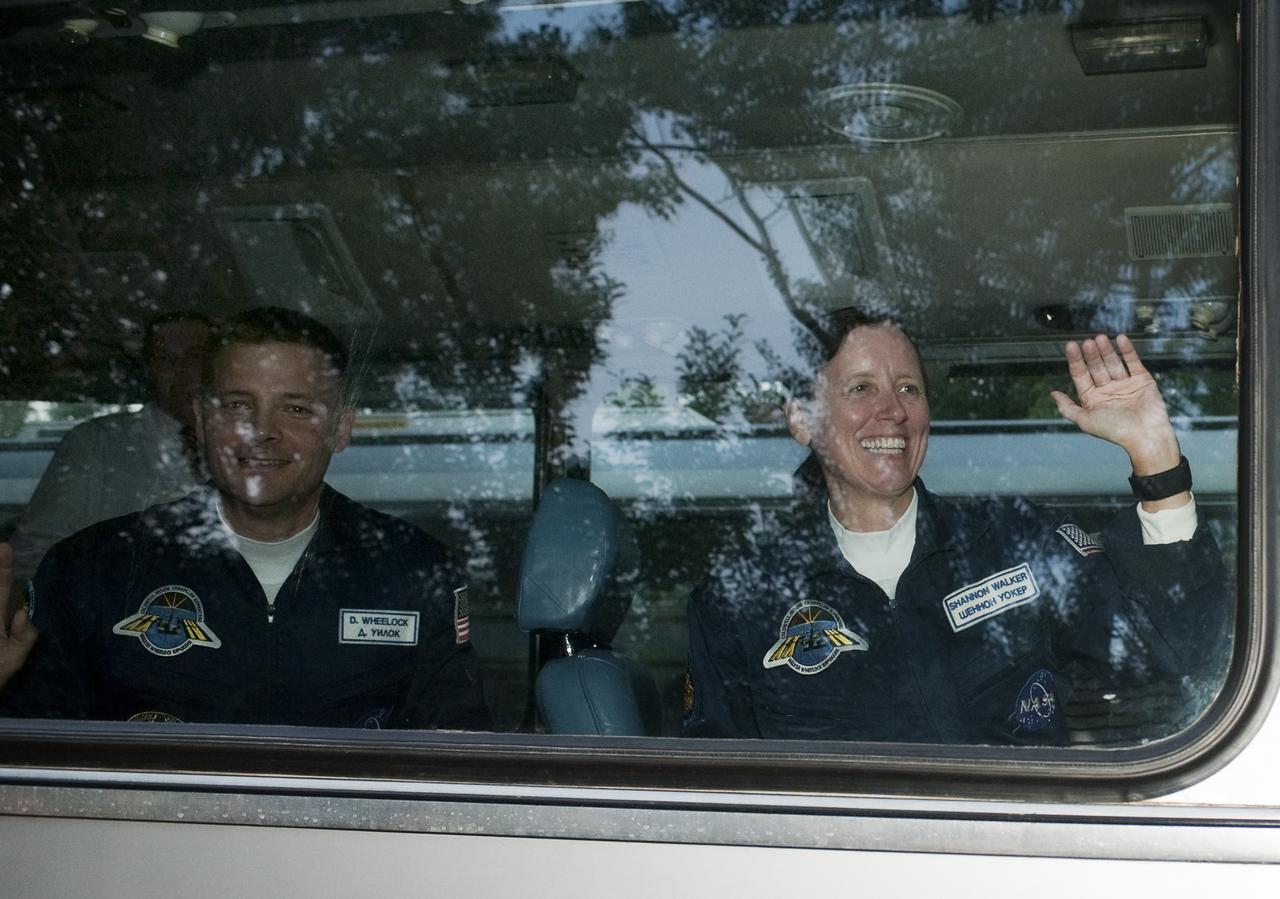
Expedition 24 NASA Flight Engineers Doug Wheelock, left, and Shannon Walker wave farewell to well-wishers as they depart the Cosmonaut Hotel on the evening before their launch on the Soyuz TMA-19 rocket to the International Space Station, Tuesday, June 15, 2010 in Baikonur, Kazakhstan. Photo Credit: (NASA/Carla Cioffi)
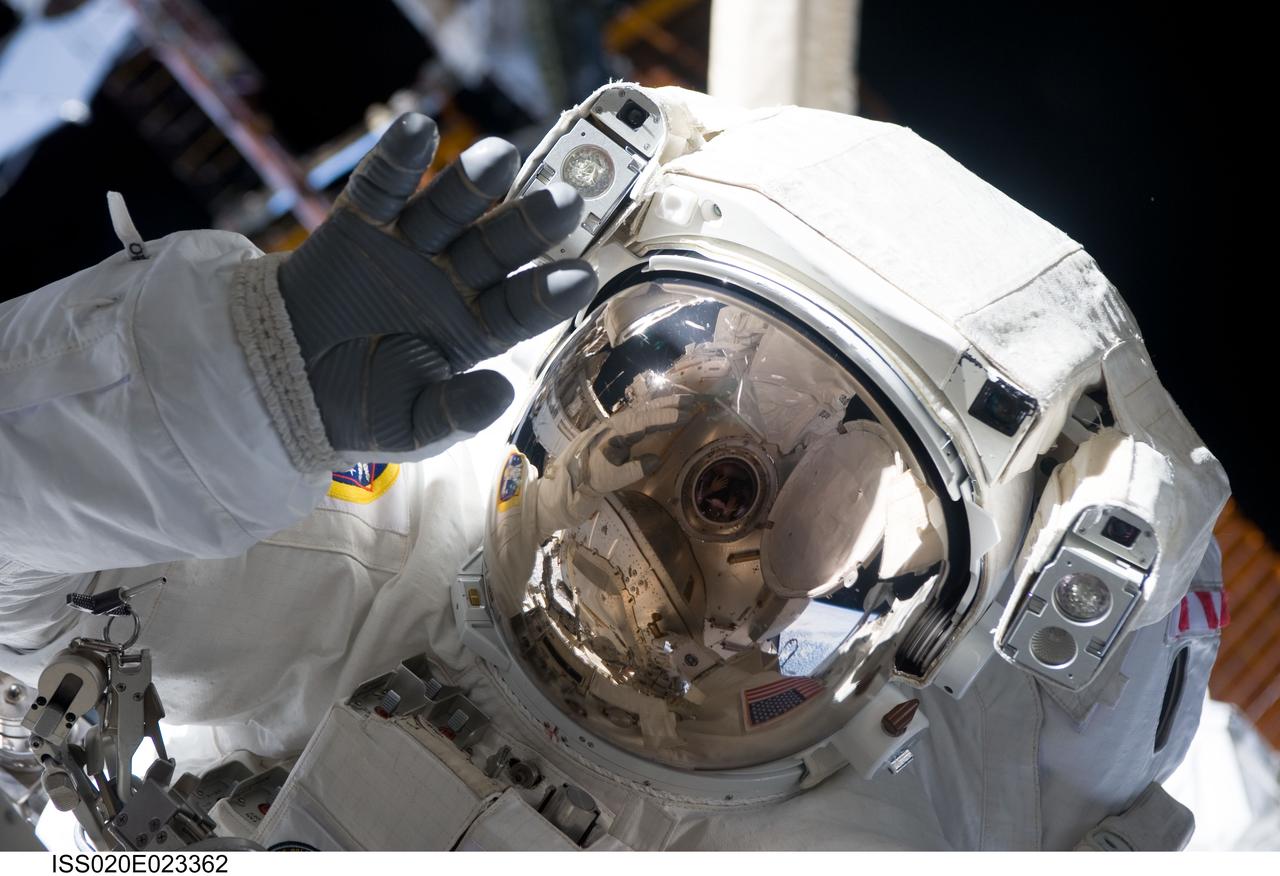
ISS020-E-023362 (22 July 2009) --- Astronaut Christopher Cassidy waves toward his spacewalking colleague, astronaut Dave Wolf, during the third session of extravehicular activity for the STS-127 crew to perform work, in cooncert with the Expedition 20 crew on the International Space Station.

ISS040-E-068619 (16 July 2014) --- European Space Agency astronaut Alexander Gerst, Expedition 40 flight engineer, waves from a window in the Cupola of the International Space Station in this nighttime image. The station?s Canadarm2 is visible at right. Earth?s horizon and a starry sky provide the backdrop for the scene.

iss070e027402 (Nov. 17, 2023) --- NASA astronaut and Expedition 70 Flight Engineer Jasmin Moghbeli works in the Harmony module and calibrates an ultrasonic inspection device that uses high-frequency sound waves to analyze materials aboard the International Space Station.
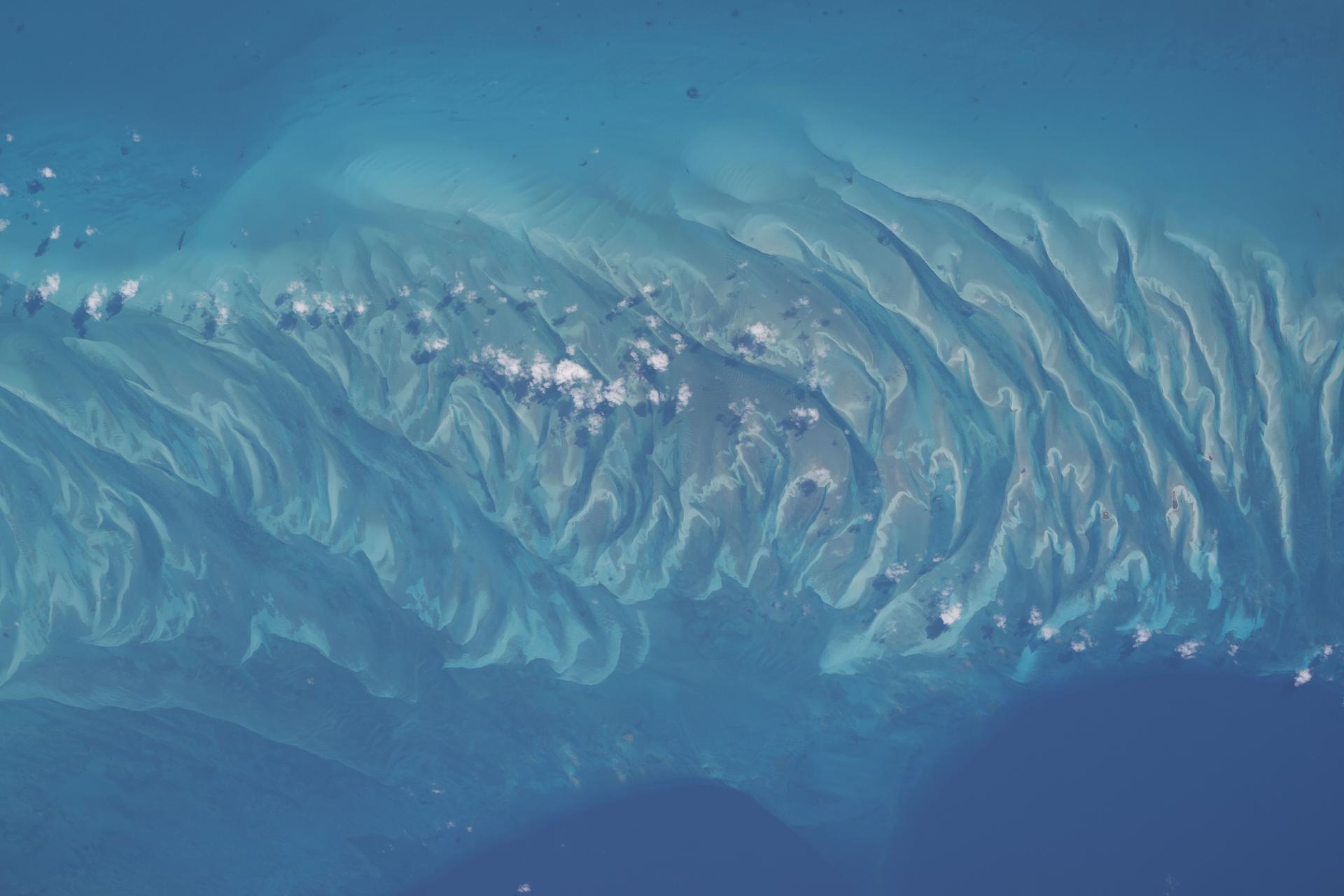
iss074e0785398 (July 1, 2026) --- Sandbars and submerged dunes, shaped by currents and waves in the clear blue waters, ripple across the seafloor off the coast of the island of Eleuthera in the Bahamas. The International Space Station was orbiting 263 miles above the Atlantic Ocean at the time this photograph was taken. Credit: NASA/Chris Williams
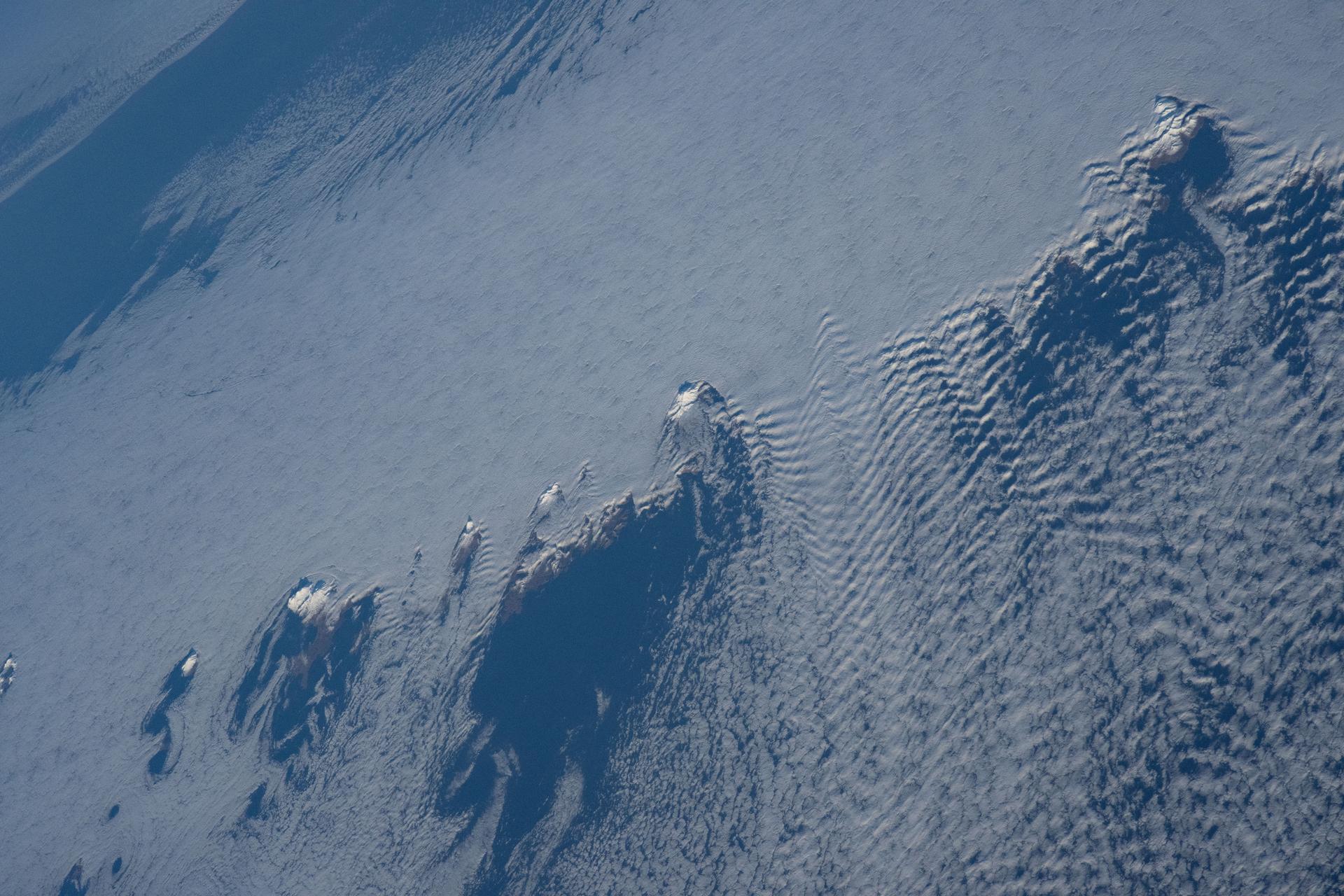
iss074e0008922 (Dec. 12, 2025) --- Snow-capped mountain tops of Alaska's Aleutian Islands pierce through the clouds, disturbing the air and creating wave-like patterns known as altocumulus clouds. This photograph was taken from the International Space Station as it orbited 264 miles above the North Pacific Ocean.
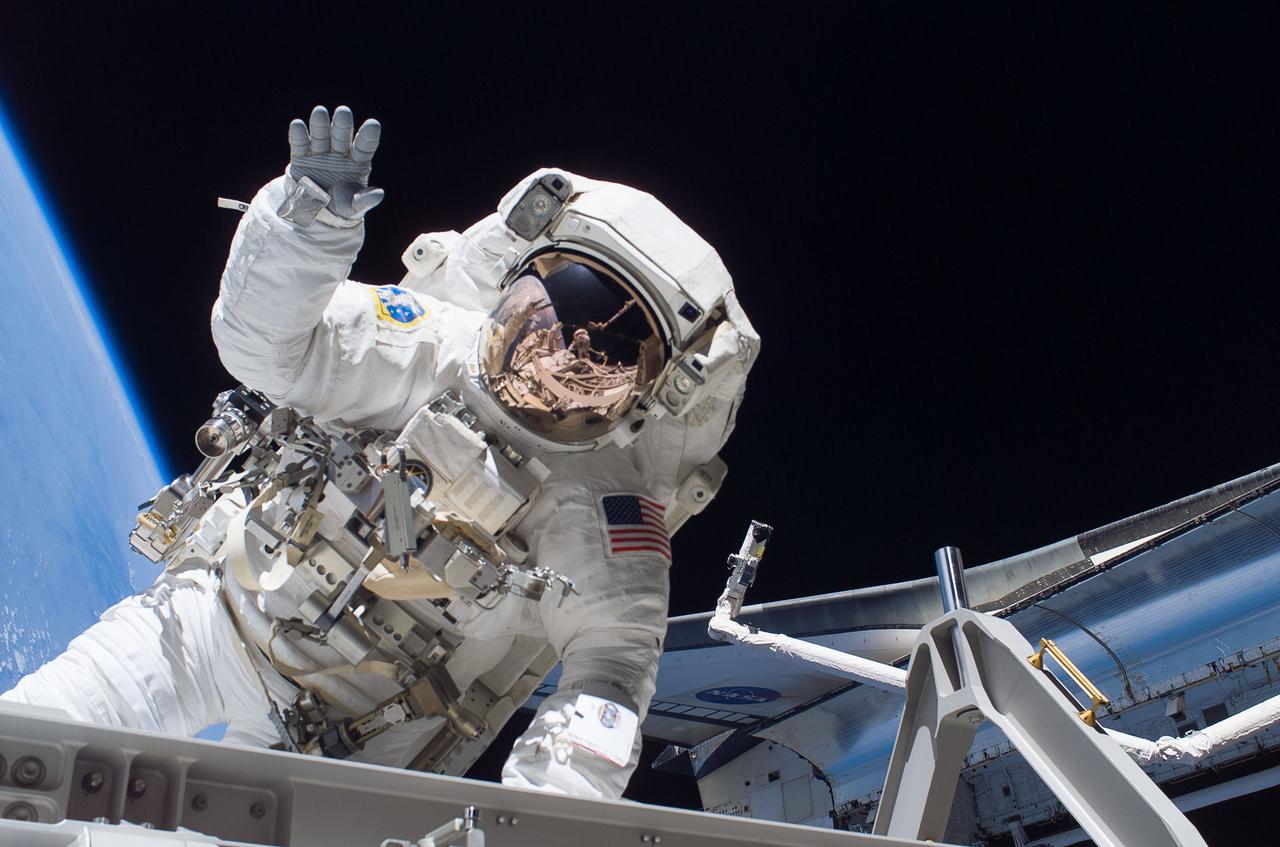
S115-E-05760 (12 Sept. 2006) --- Astronaut Heidemarie M. Stefanyshyn-Piper, STS-115 mission specialist, waves to the camera while participating in the first of three sessions of extravehicular activity (EVA) as construction resumes on the International Space Station.
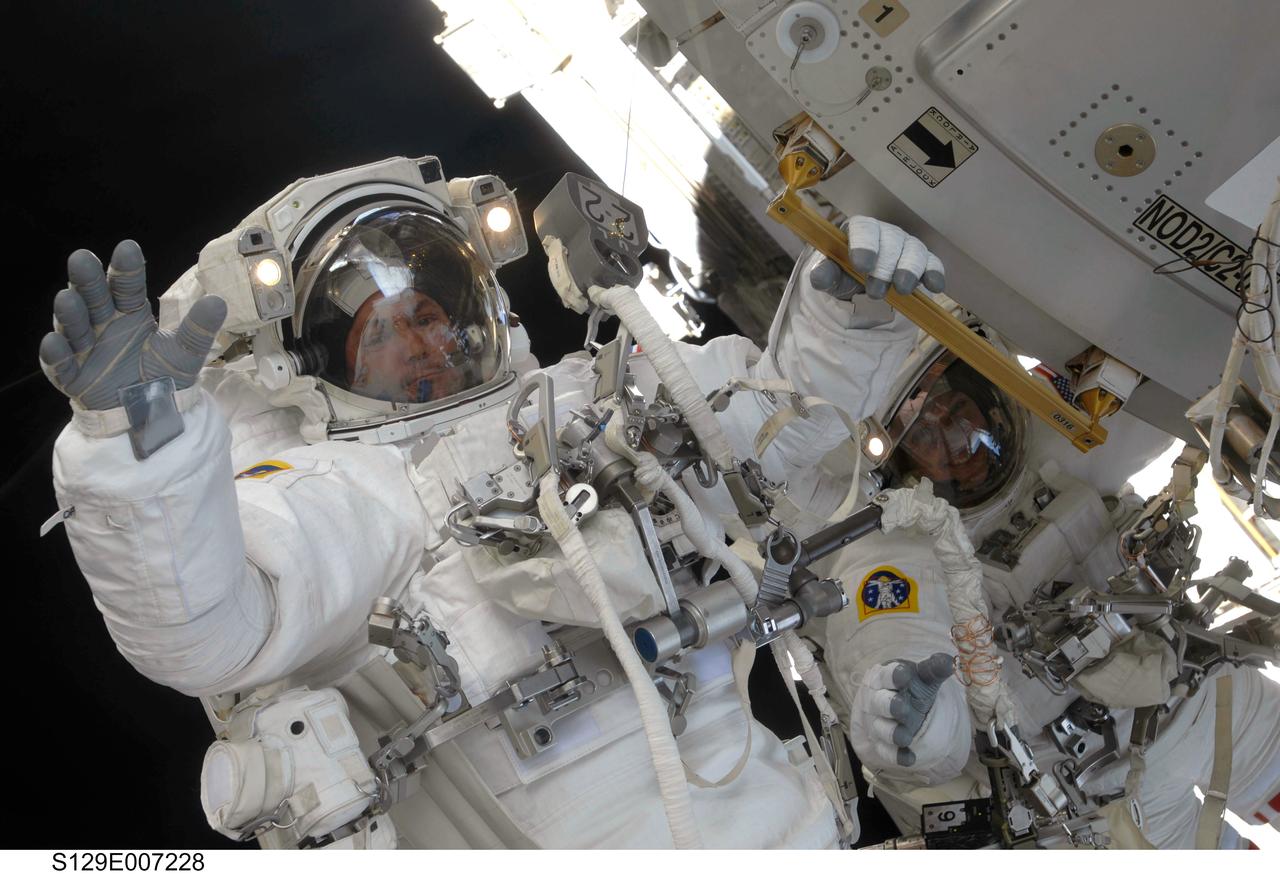
S129-E-007228 (21 Nov. 2009) --- Astronaut Mike Foreman, STS-129 mission specialist, waves at a camera-bearing crewmate during the second spacewalk of Atlantis’ visit to the International Space Station. Astronaut Randy Bresnik is seen on the right side of the frame. Foreman holds onto a handrail on the U.S. Node 2 or Harmony.
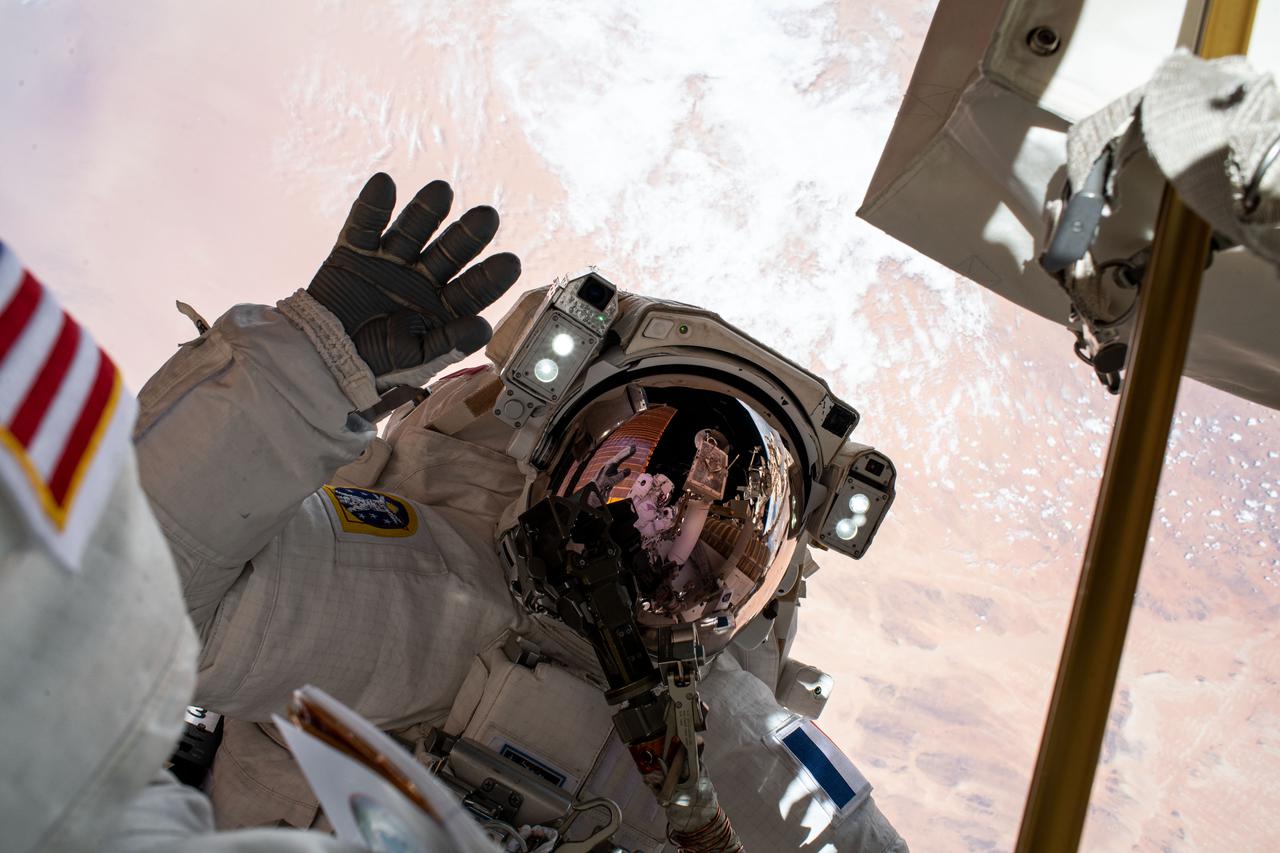
iss065e145194 (June 25, 2021) --- Spacewalker Thomas Pesquet of ESA (European Space Agency) waves to the camera 261 miles above Western Sahara as he works to complete the installation of the second roll out solar array on the International Space Station's Port-6 truss structure.
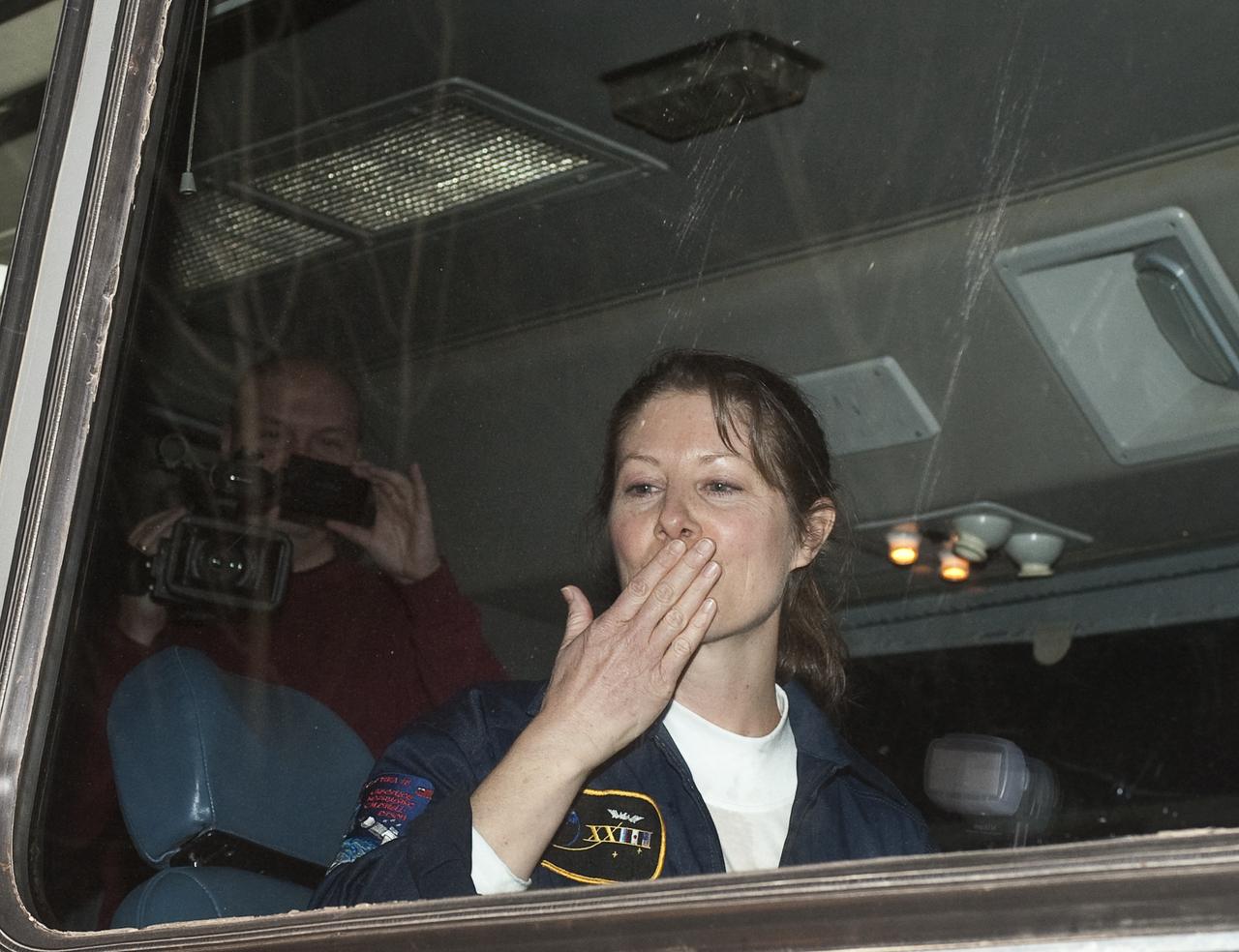
Expedition 23 Flight Engineer Tracy Caldwell Dyson waves farewell to well wishers as she departs the Cosmonaut Hotel on the morning of the Soyuz launch to the International Space Station on Friday, April 2, 2010 in Baikonur, Kazakhstan. Photo Credit: (NASA/Carla Cioffi)
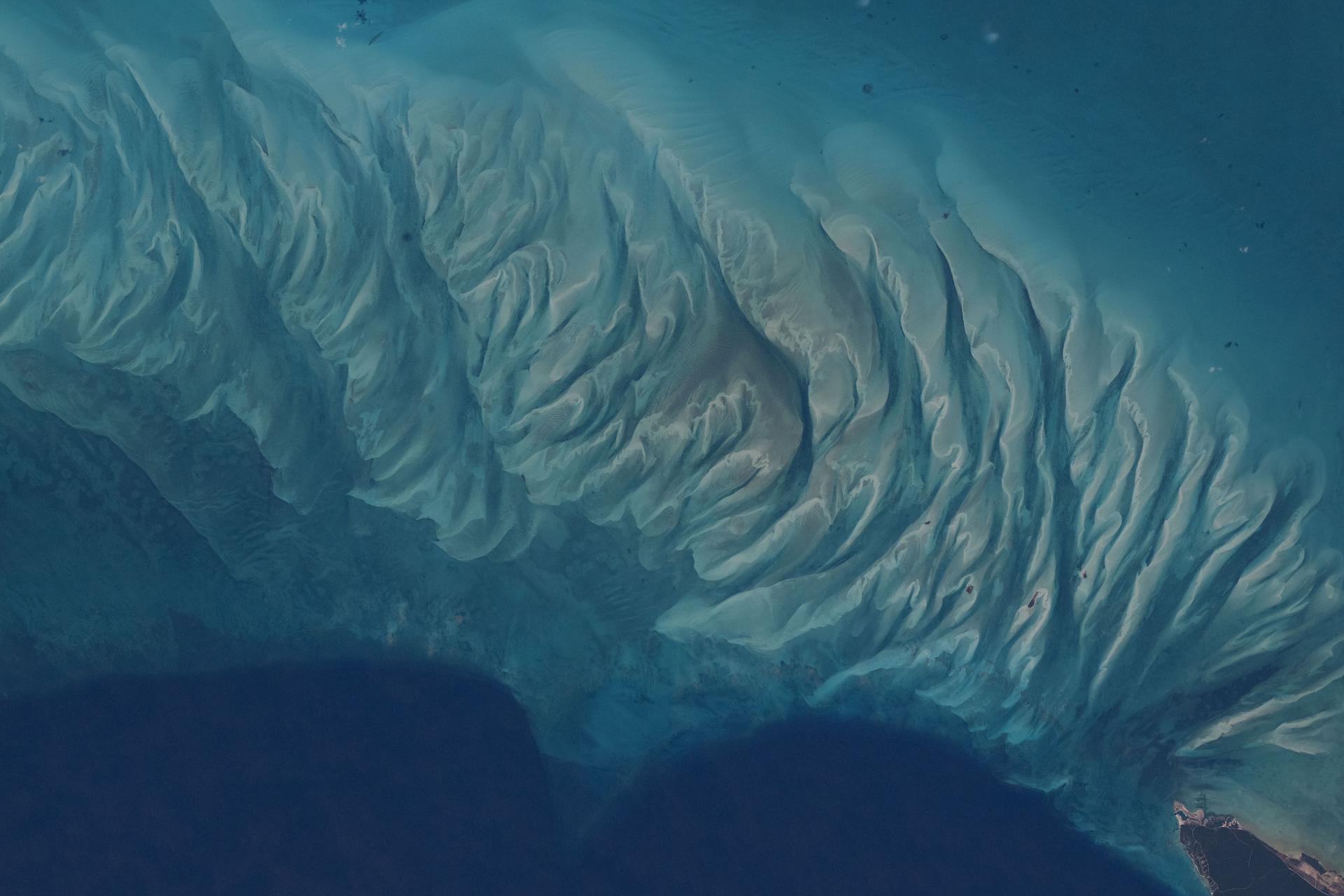
iss073e0880792 (Oct. 15, 2025) --- The clear blue waters off the coast of the Bahamian island of Eleuthera—part of which is visible at lower right—reveal sandbars and submerged dunes rippling across the seafloor shaped by currents and waves in the western Atlantic. The International Space Station was orbiting 260 miles above Earth when this photograph was taken.
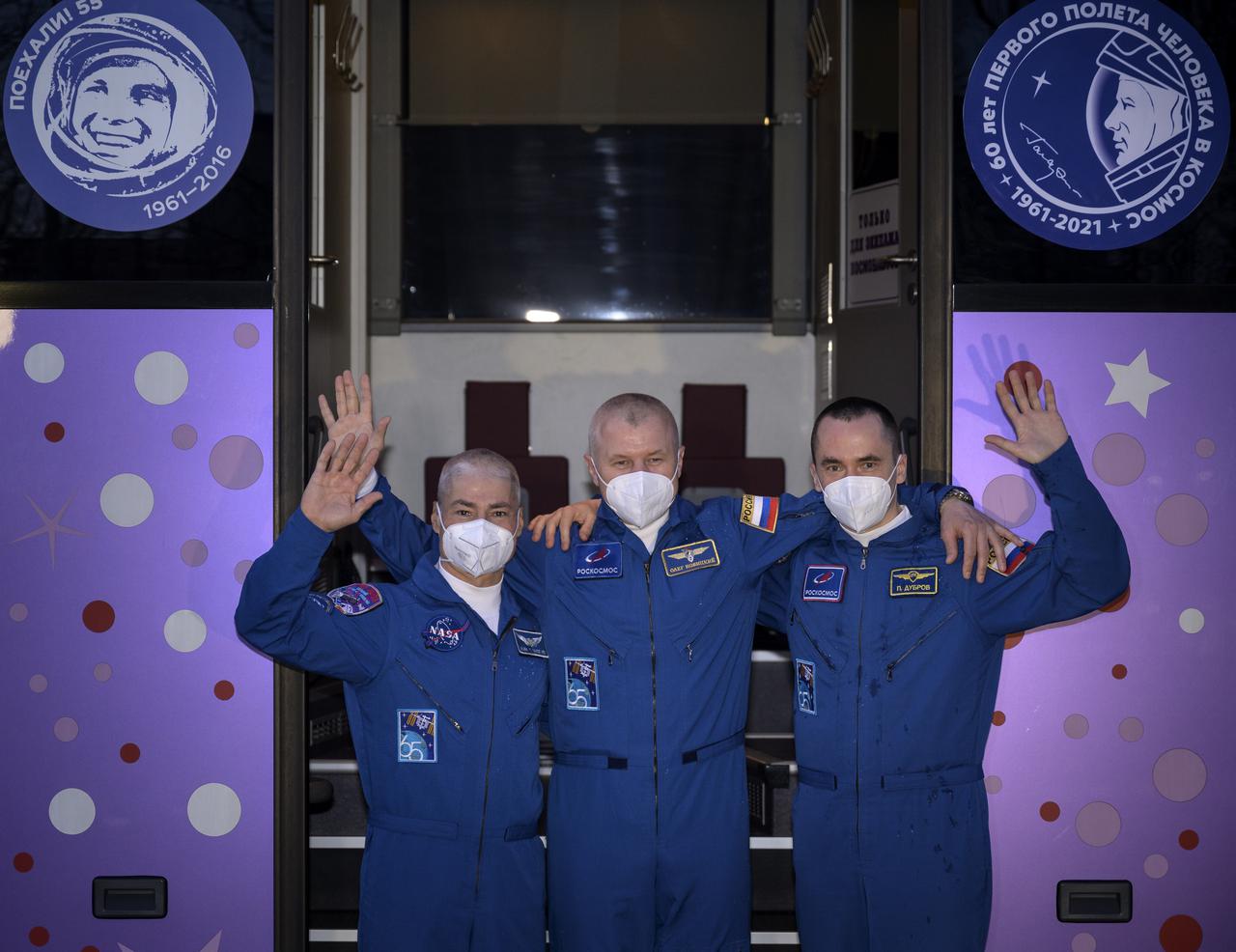
Expedition 65 NASA astronaut Mark Vande Hei, left, Roscosmos cosmonauts Oleg Novitskiy, center, and Pyotr Dubrov wave as they depart the Cosmonaut Hotel to suit-up for their Soyuz launch to the International Space Station, Friday, April 9, 2021, in Baikonur, Kazakhstan. Photo Credit: (NASA/Bill Ingalls)
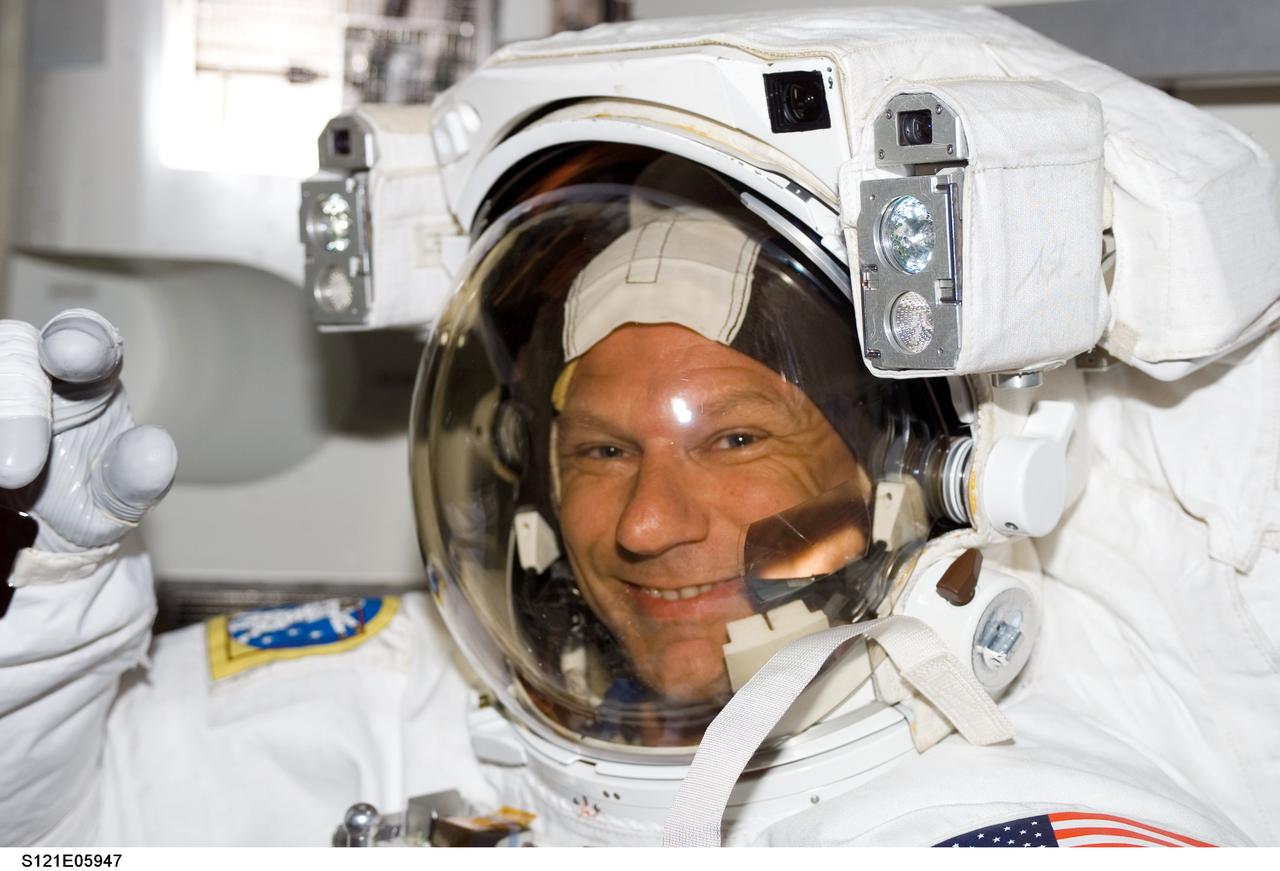
S121-E-05947 (8 July 2006) --- Astronaut Piers J. Sellers, STS-121 mission specialist, attired in his Extravehicular Mobility Unit (EMU) spacesuit, waves to the camera in the Quest Airlock of the International Space Station prior to the start of the first scheduled session of extravehicular activity (EVA).
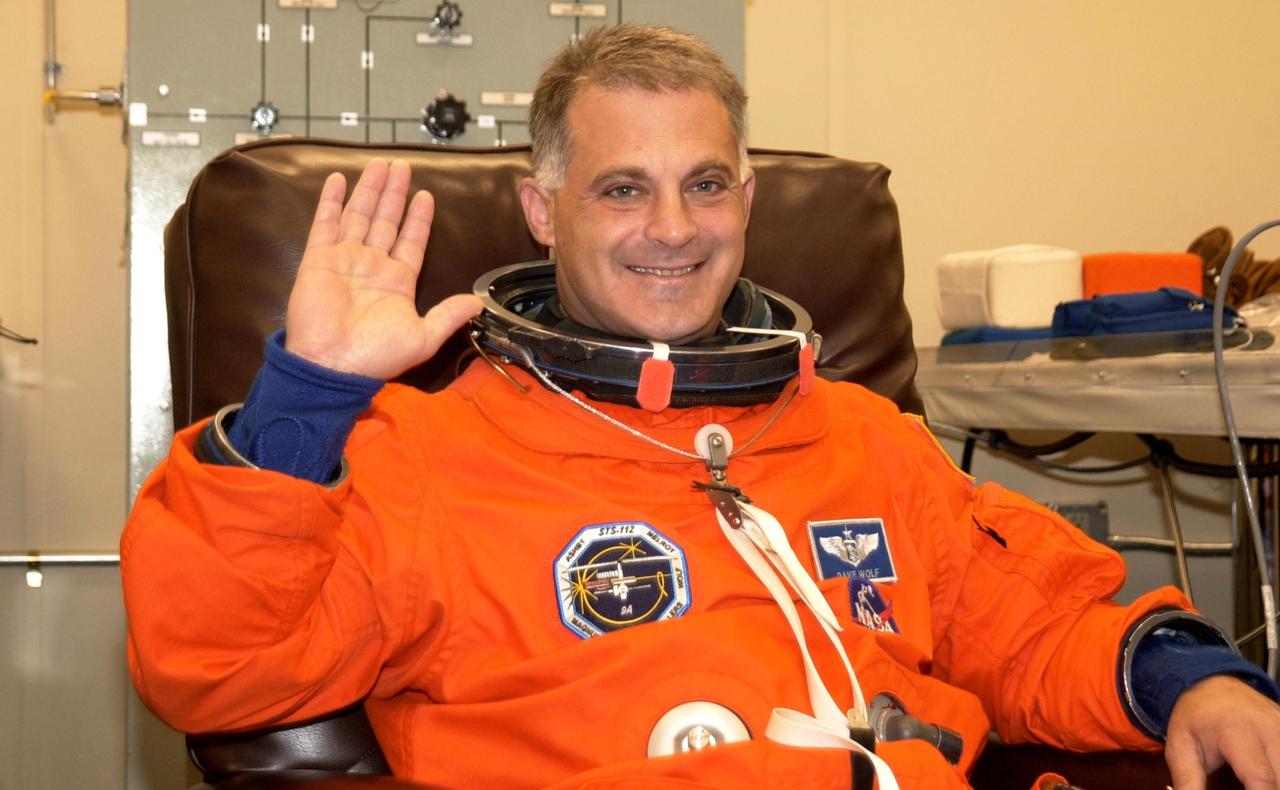
KENNEDY SPACE CENTER, FLA. --STS-112 Mission Specialist David Wolf waves for the camera during a final fit check of his spacesuit in preparation for his launch to the International Space Station aboard Atlantis. Launch is scheduled for Oct. 2 between 2 and 6 p.m. EDT.
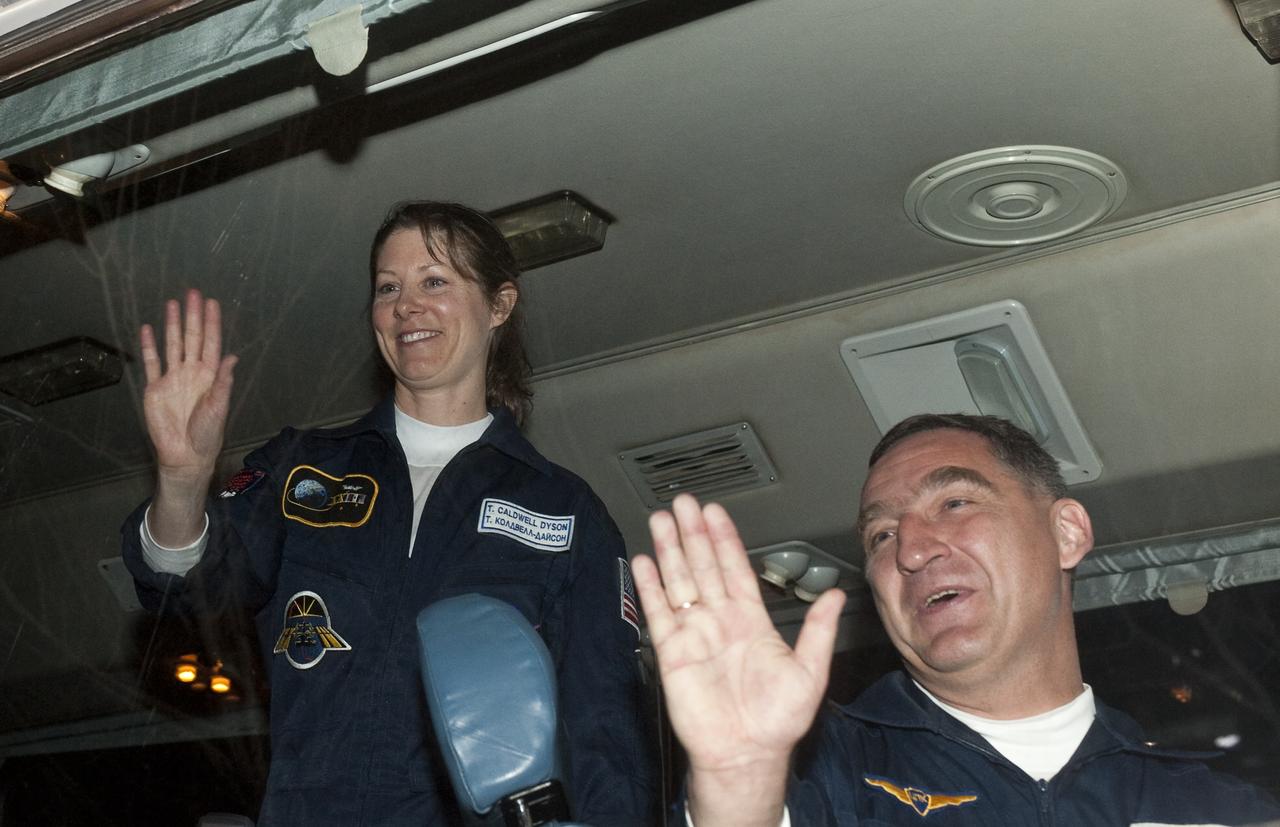
Expedition 23 Flight Engineer Tracy Caldwell Dyson, left, and Soyuz Commander Alexander Skvortsov wave farewell to well wishers as they depart the Cosmonaut Hotel on the morning of their Soyuz launch to the International Space Station on Friday, April 2, 2010 in Baikonur, Kazakhstan. Photo Credit: (NASA/Carla Cioffi)
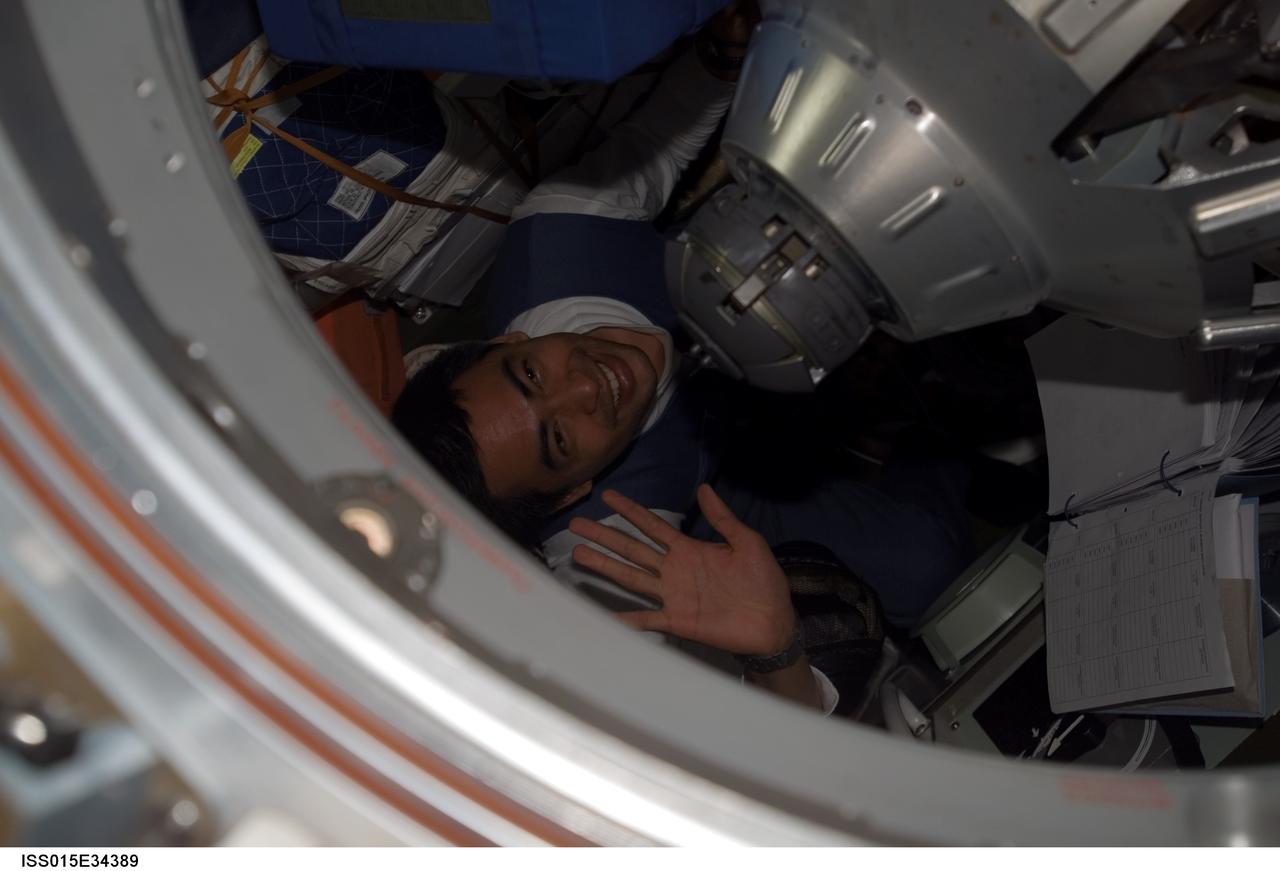
ISS015-E-34389 (12 Oct. 2007) --- Malaysian spaceflight participant Sheikh Muszaphar Shukor waves to an Expedition 15 crewmember (out of frame) as he ingresses the International Space Station after arriving onboard a Soyuz spacecraft with two Expedition 16 crewmembers.
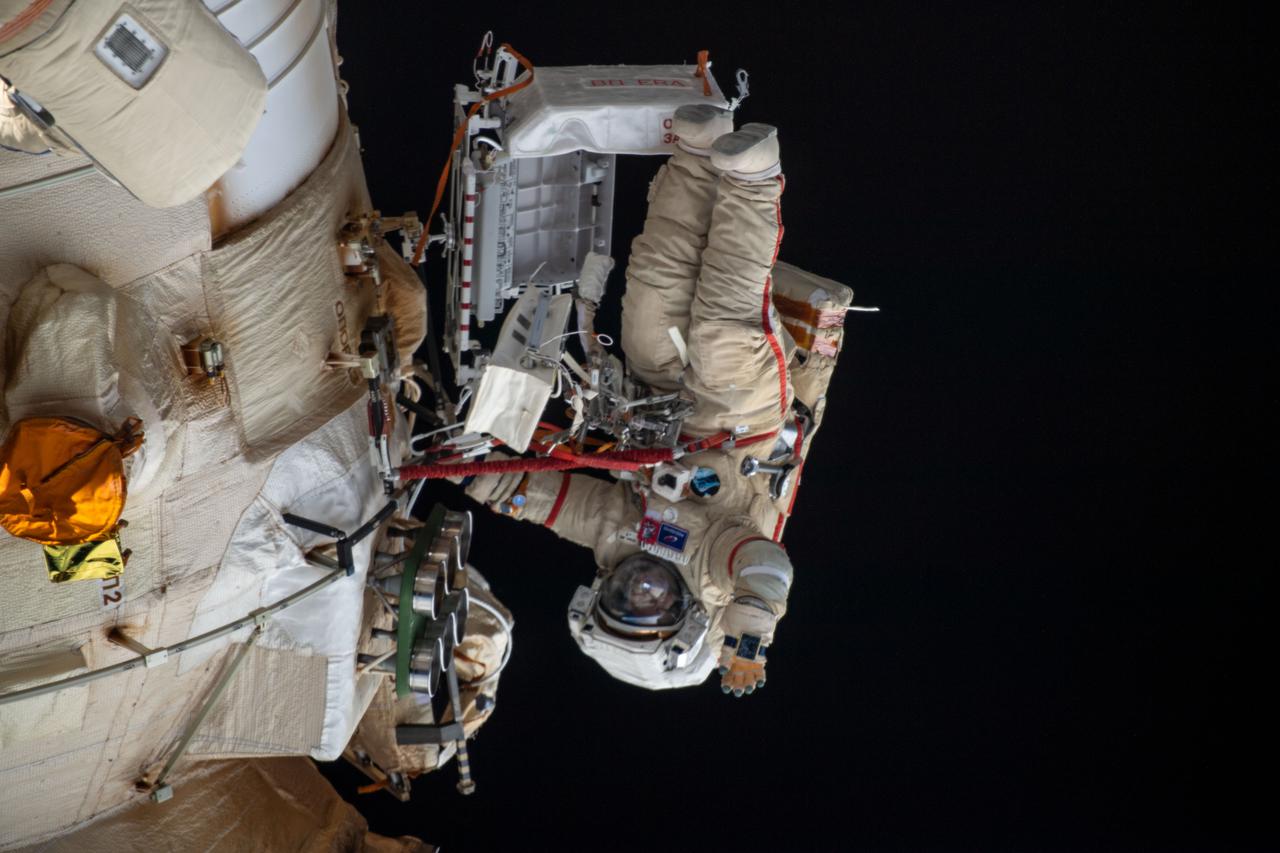
iss067e022050 (April 18, 2022) --- Cosmonaut Oleg Artemyev waves to the camera while working outside the Nauka multipurpose laboratory module during a spacewalk that lasted for six hours and 37 minutes to outfit Nauka and configure the European robotic arm on the International Space Station's Russian segment.
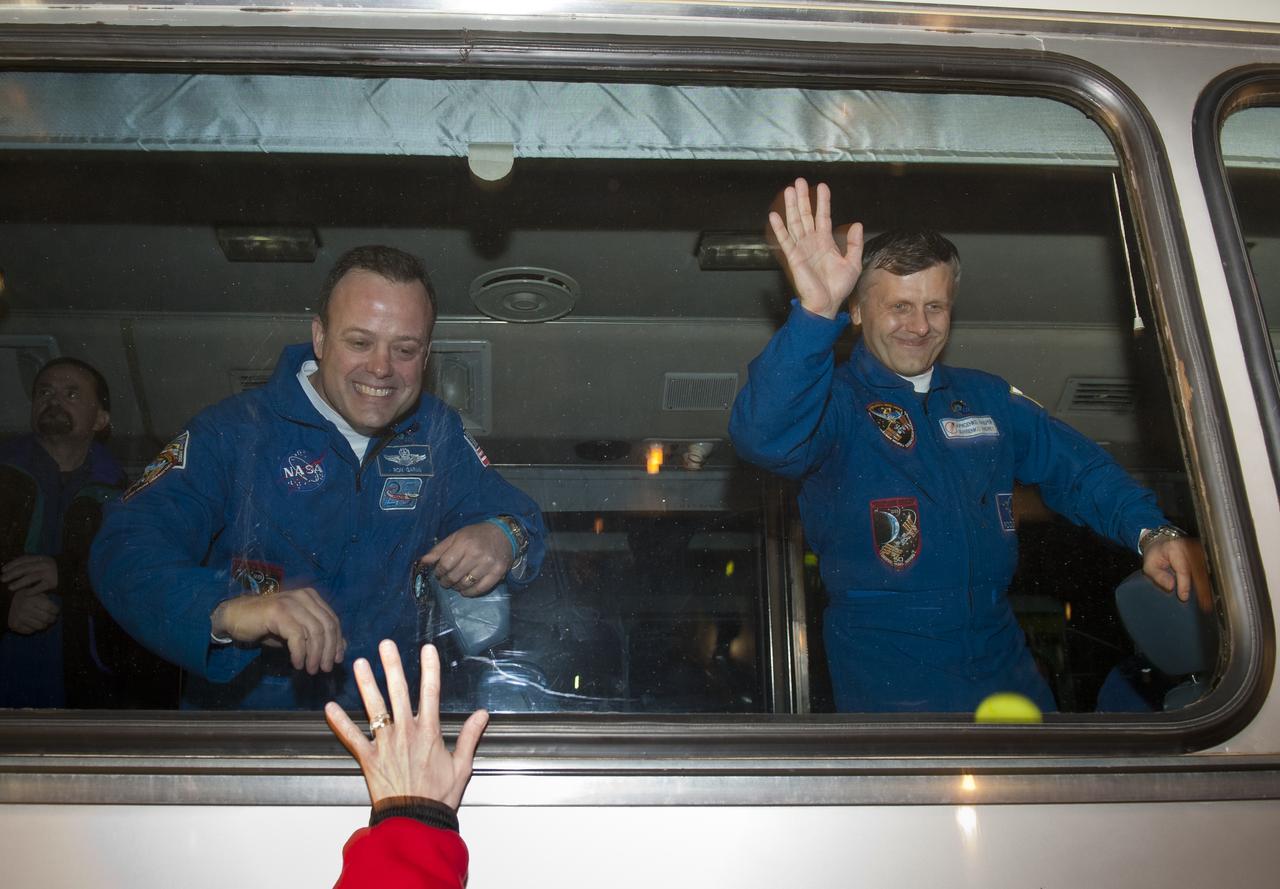
Expedition 27 crew members NASA Flight Engineer Ron Garan, left, and Russian Flight Engineer Andrey Borisenko wave farewell to well wishers as they depart the Cosmonaut Hotel on the evening before their Soyuz launch to the International Space Station on Monday, April 4, 2011 in Baikonur, Kazakhstan. Photo Credit: (NASA/Carla Cioffi)
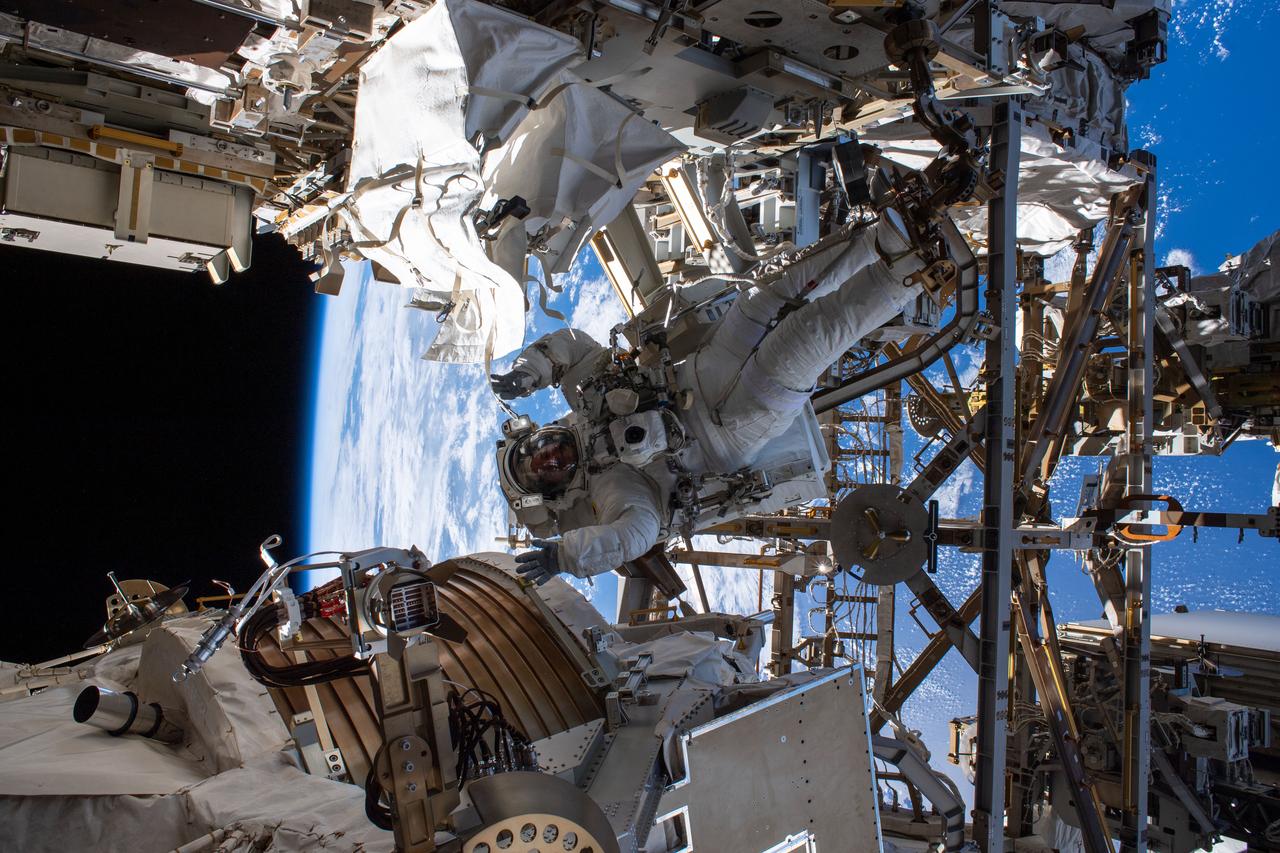
iss061e040844 (Nov. 15, 2019) --- NASA astronaut Andrew Morgan waves as he is photographed seemingly camouflaged among the Alpha Magnetic Spectrometer (lower left) and other International Space Station hardware during the first spacewalk to repair the cosmic particle detector.
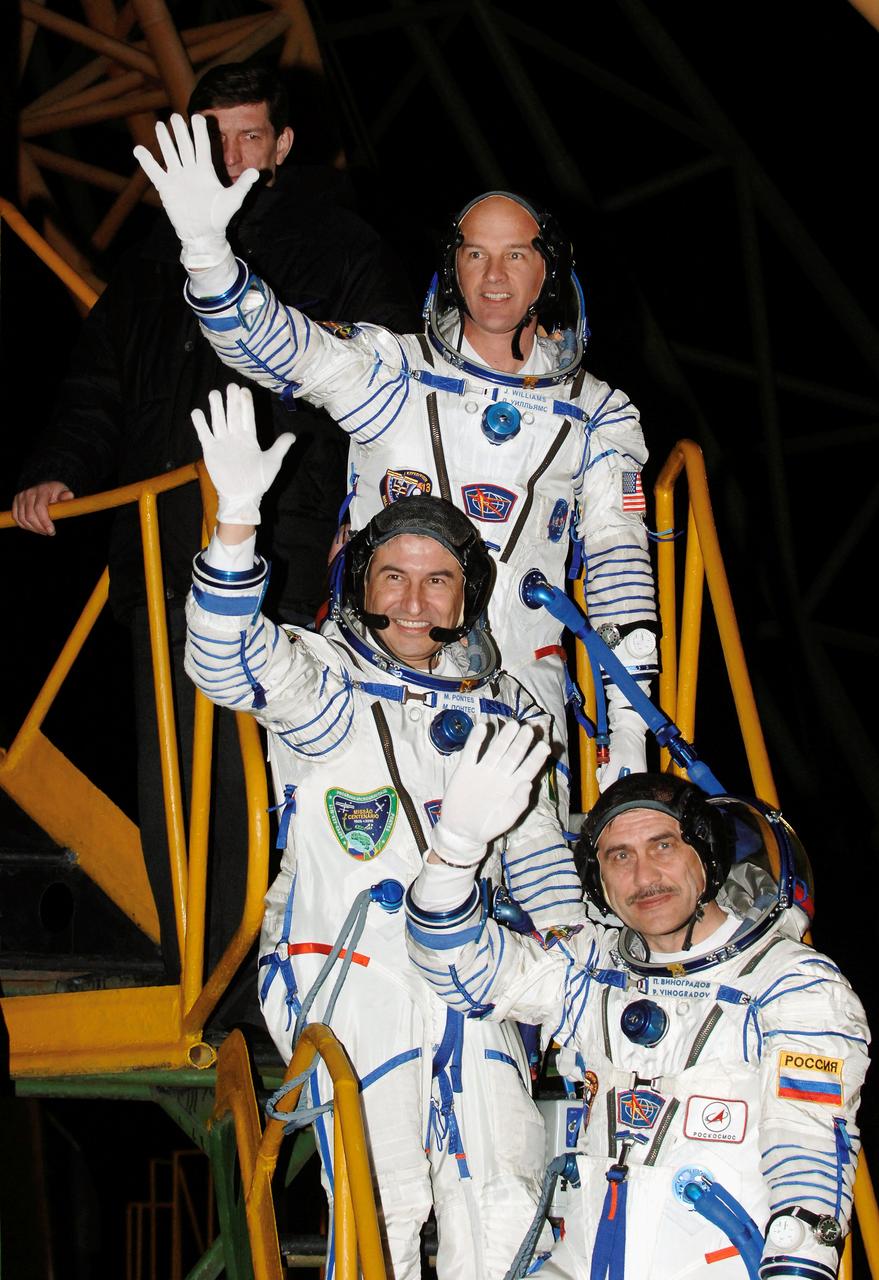
JSC2006-E-11941 (30 March 2006) --- Prime crew members for the upcoming mission to the International Space Station wave goodbye to the cameras at the launch pad. (top to bottom) Astronaut Jeffrey N. Williams, NASA International Space Station science officer and flight engineer; astronaut Marcos Pontes, Brazilian Space Agency Soyuz crew member; and cosmonaut Pavel V. Vinogradov, Russia’s Federal Space Agency International Space Station commander. Baikonur, Kazakhstan. Photo Credit: NASA/Bill Ingalls

Spaceflight participant Hazzaa Ali Almansoori of the United Arab Emirates, left, and Expedition 61 crewmembers Oleg Skripochka of Roscosmos and Jessica Meir of NASA wave farewell as they depart the Cosmonaut Hotel ahead of their Soyuz launch to the International Space Station, Wednesday, Sept. 25, 2019 in Baikonur, Kazakhstan. Meir, Skripochka, and Almansoori will launch on the Soyuz MS-15 spacecraft from the Baikonur Cosmodrome to the International Space Station. Photo Credit: (NASA/Bill Ingalls)
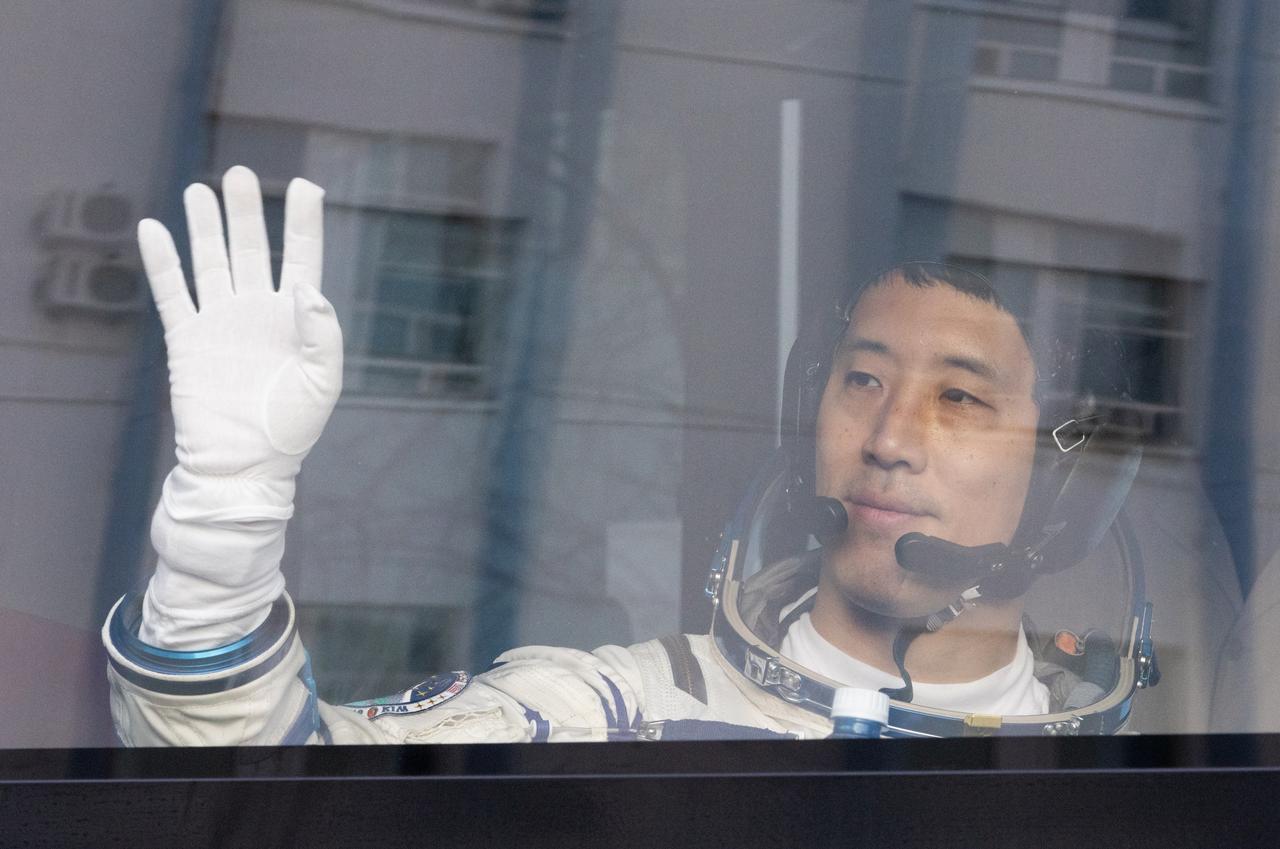
NASA astronaut Jonny Kim waves as he and fellow Expedition 73 crewmates Roscosmos cosmonauts Sergey Ryzhikov and Alexey Zubritskiy depart building 254 for their Soyuz launch to the International Space Station Tuesday, April 8, 2025 in Baikonur, Kazakhstan. The launch will send Kim, Ryzhikov, Zubritskiy on a mission to the International Space Station. Photo Credit: (NASA/Victor Zelentsov)
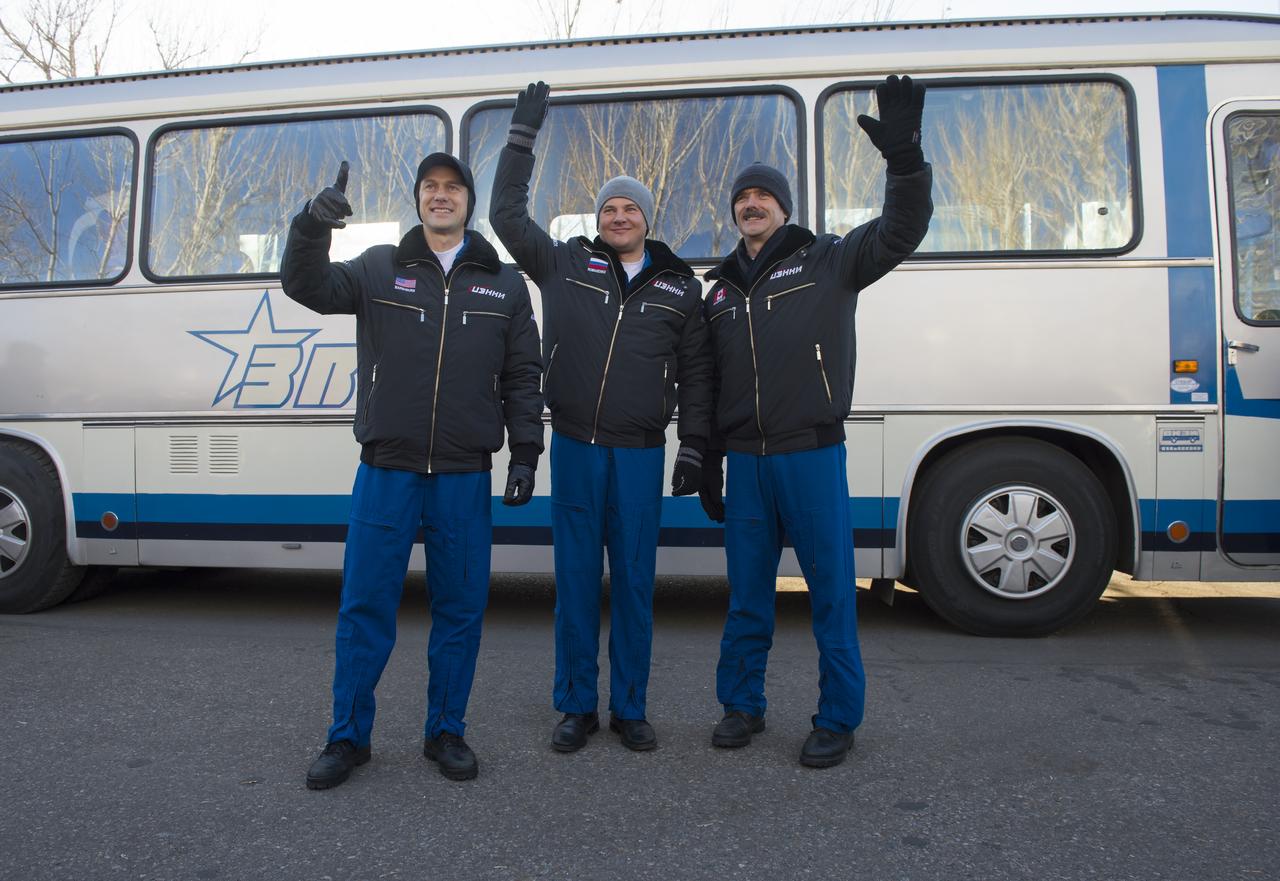
Expedition 34/35 crew members, Flight Engineer Tom Marshburn of NASA, left, Soyuz Commander Roman Romanenko of ROSCOSMOS, and Flight Engineer Chris Hadfield of the Canadian Space Agency (CSA), right, wave farewell to family and friends as they depart the Cosmonaut Hotel to suit-up for their soyuz launch to the International Space Station on Wednesday, Dec. 19, 2012, in Baikonur, Kazakhstan. Launch of the Soyuz rocket will send Hadfield, Romanenko and Marshburn on a five-month mission aboard the International Space Station. Photo Credit: (NASA/Carla Cioffi)
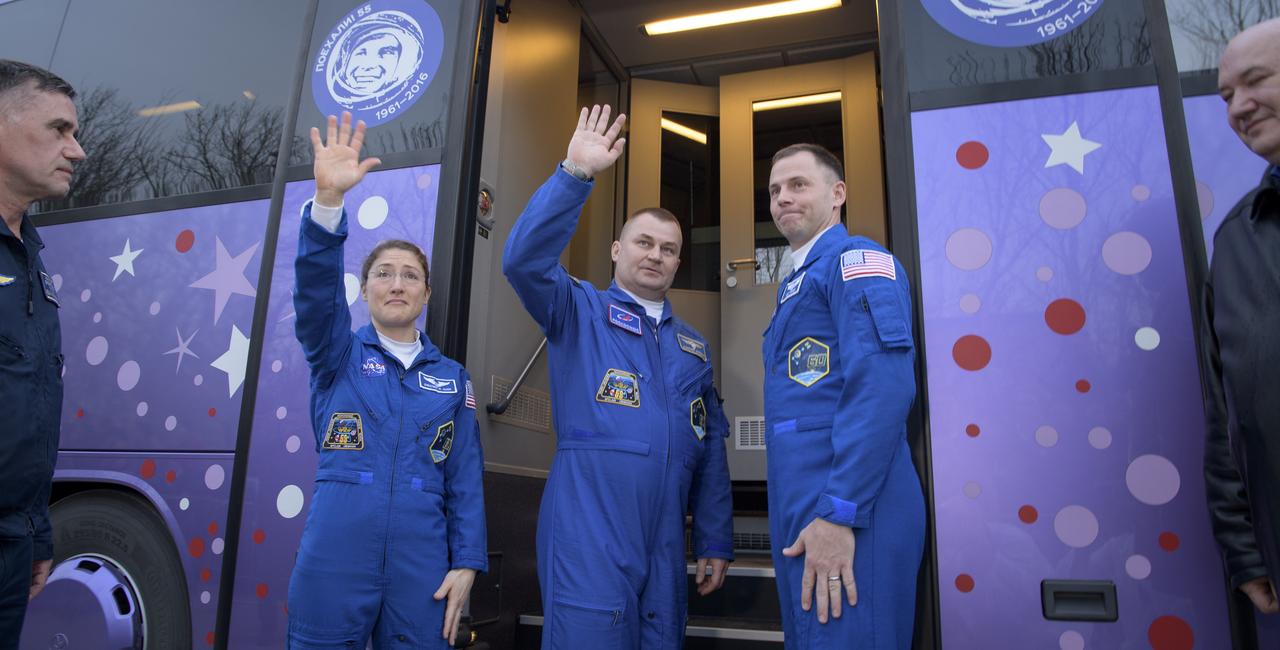
Expedition 59 crewmemebrs, Christina Koch of NASA, left, Alexey Ovchinin of Roscosmos, center, and Nick Hague of NASA wave farewell as they depart the Cosmonaut Hotel ahead of their Soyuz launch to the International Space Station, Thursday, March 14, 2019 in Baikonur, Kazakhstan. Hague, Koch, and Ovchinin launched March 14, U.S. time, on the Soyuz MS-12 spacecraft from the Baikonur Cosmodrome for a six-and-a-half month mission on the International Space Station. Photo Credit: (NASA/Bill Ingalls)
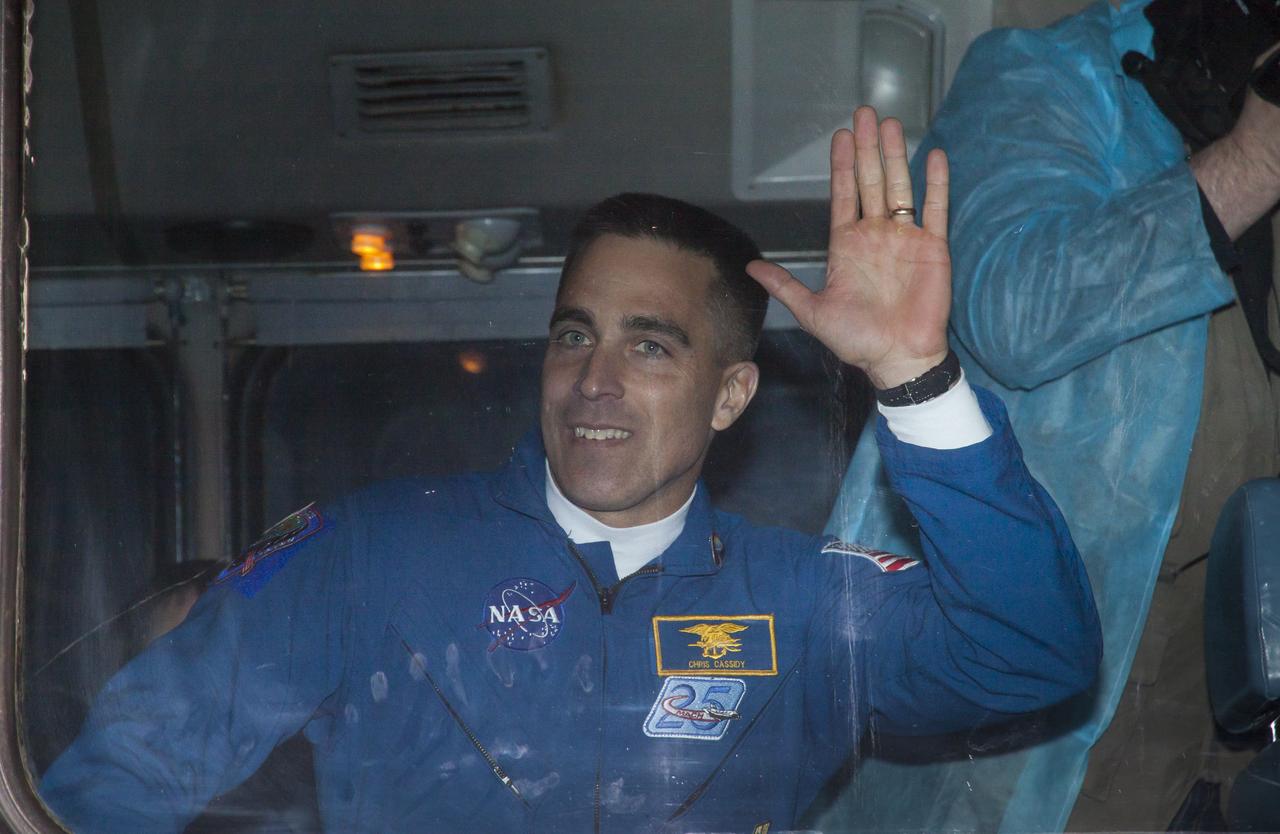
Expedition 35 crew members NASA Flight Engineer Chris Cassidy waves farewell to family and friends as he departs the Cosmonaut Hotel to suit-up for his soyuz launch to the International Space Station, Thursday, March 28, 2013, in Baikonur, Kazakhstan. Launch of the Soyuz rocket will send Cassidy, Vinogradov and Misurkin on a five and a half month mission aboard the International Space Station. Photo Credit: (NASA/Victor Zelentsov)
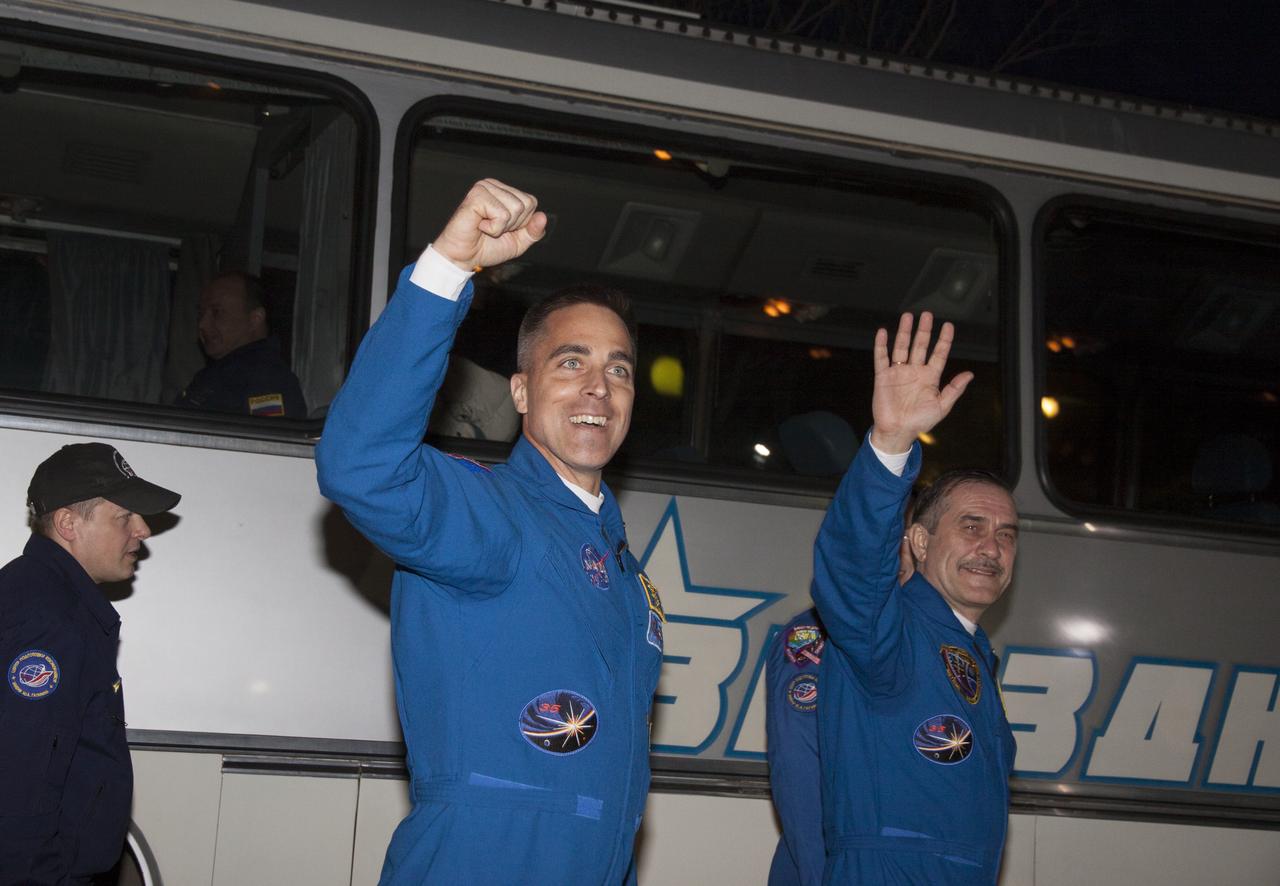
Expedition 35 crew members NASA Flight Engineer Chris Cassidy, left, and Soyuz Commander Pavel Vinogradov wave farewell to family and friends as they depart the Cosmonaut Hotel to suit-up for their soyuz launch to the International Space Station, Thursday, March 28, 2013, in Baikonur, Kazakhstan. Launch of the Soyuz rocket will send Cassidy, Vinogradov and Misurkin on a five and a half month mission aboard the International Space Station. Photo Credit: (NASA/Victor Zelentsov)
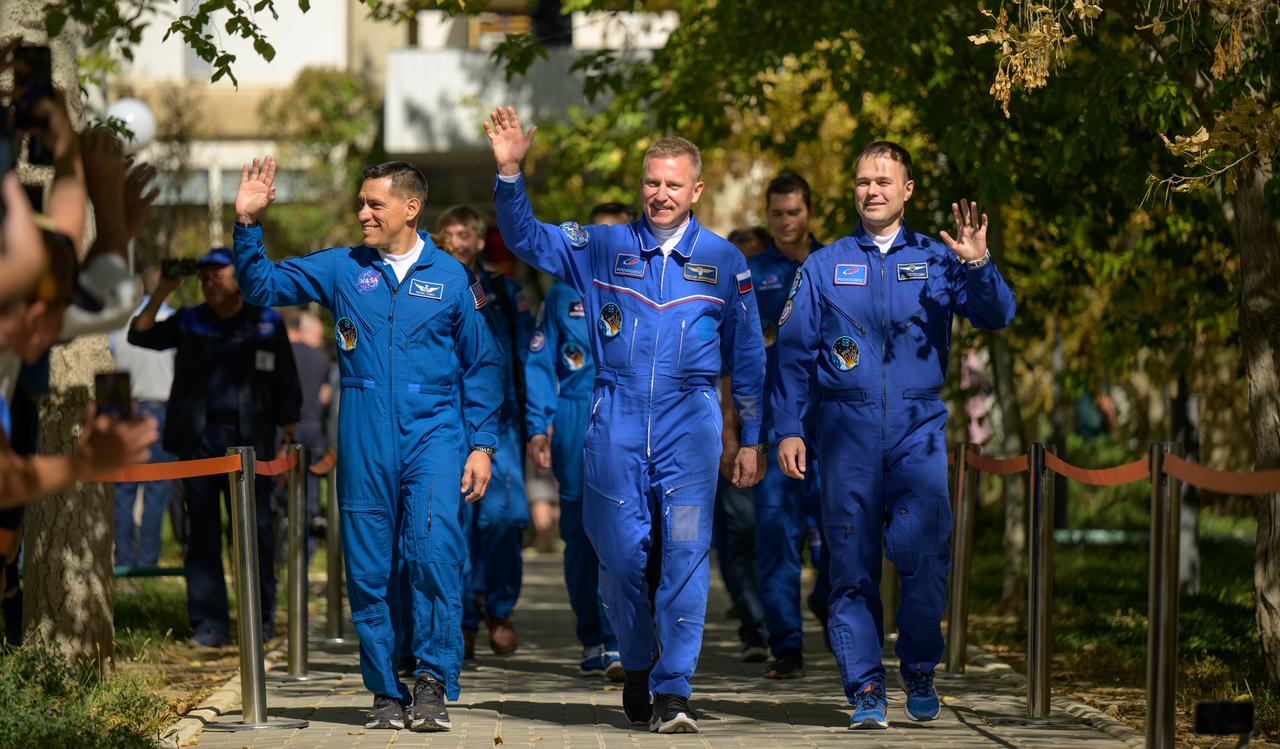
Expedition 68 astronaut Frank Rubio of NASA, left, and cosmonauts Sergey Prokopyev and Dmitri Petelin of Roscosmos, right, wave as they depart the Cosmonaut Hotel to suit-up for their Soyuz launch to the International Space Station, Wednesday, Sept. 21, 2022, in Baikonur, Kazakhstan. Rubio, Prokopyev and Petelin launched on their Soyuz MS-22 spacecraft later in the day from the Baikonur Cosmodrome for a mission on the International Space Station. Photo Credit: (NASA/Bill Ingalls)
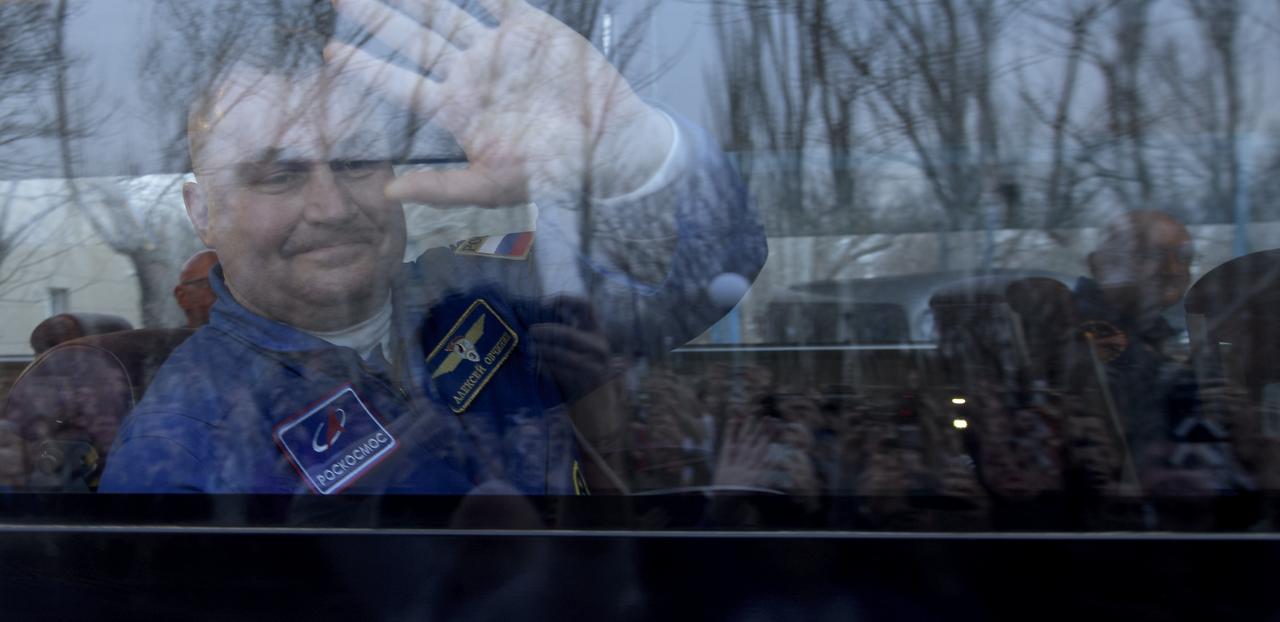
Expedition 59 cosmonaut Alexey Ovchinin of Roscosmos waves farewell to family and friends as the bus carrying him and fellow crewmembers Christina Koch and Nick Hague of NASA departs the Cosmonaut Hotel ahead of their Soyuz launch to the International Space Station, Thursday, March 14, 2019 in Baikonur, Kazakhstan. Hague, Koch, and Ovchinin will launch March 14, U.S. time, on the Soyuz MS-12 spacecraft from the Baikonur Cosmodrome for a six-and-a-half month mission on the International Space Station. Photo Credit: (NASA/Bill Ingalls)
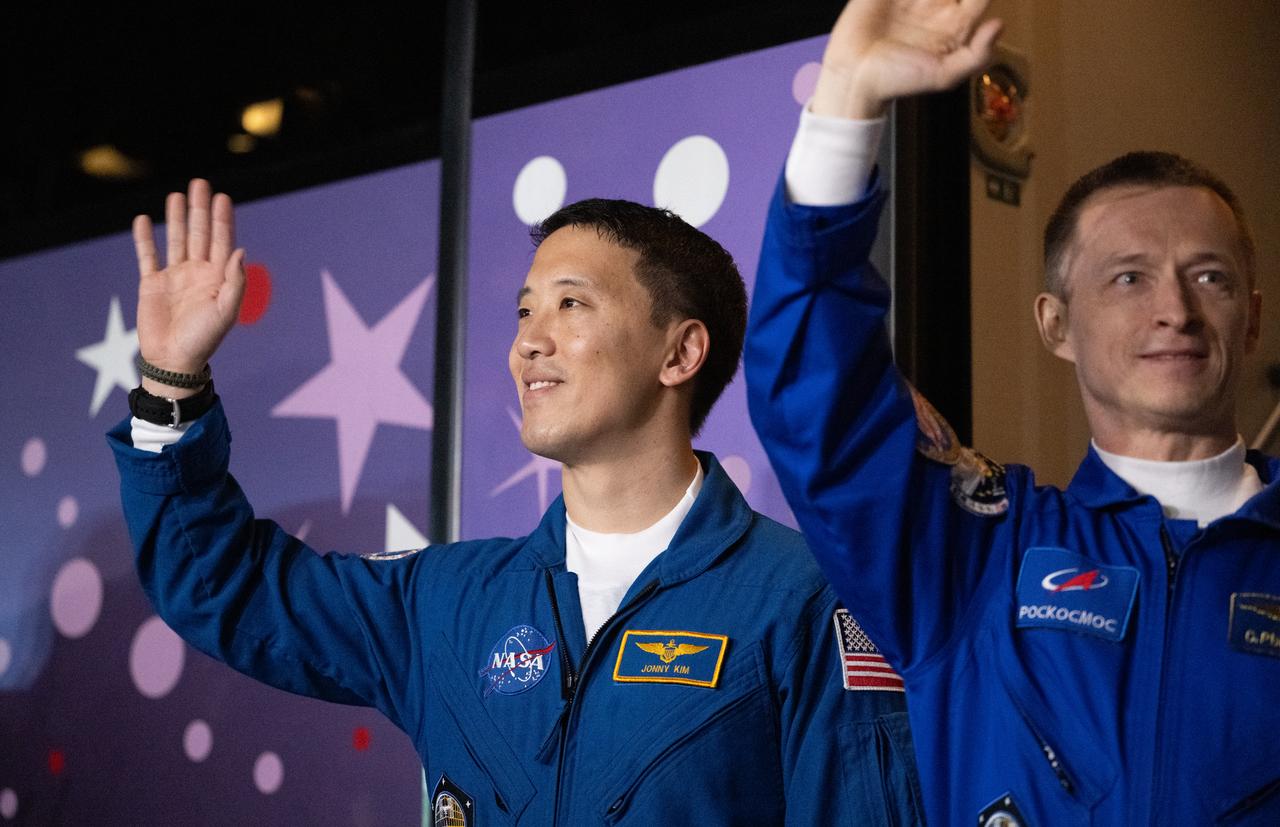
NASA astronaut Jonny Kim waves as he prepares to depart the Cosmonaut Hotel with fellow crewmates Roscosmos cosmonauts Sergey Ryzhikov and Alexey Zubritskiy to suit-up for their Soyuz launch to the International Space Station, Tuesday, April 8, 2025 (April 7 Eastern Time), in Baikonur, Kazakhstan. The launch will send Kim, Ryzhikov, Zubritskiy on a mission to the International Space Station. Photo Credit: (NASA/Joel Kowsky)
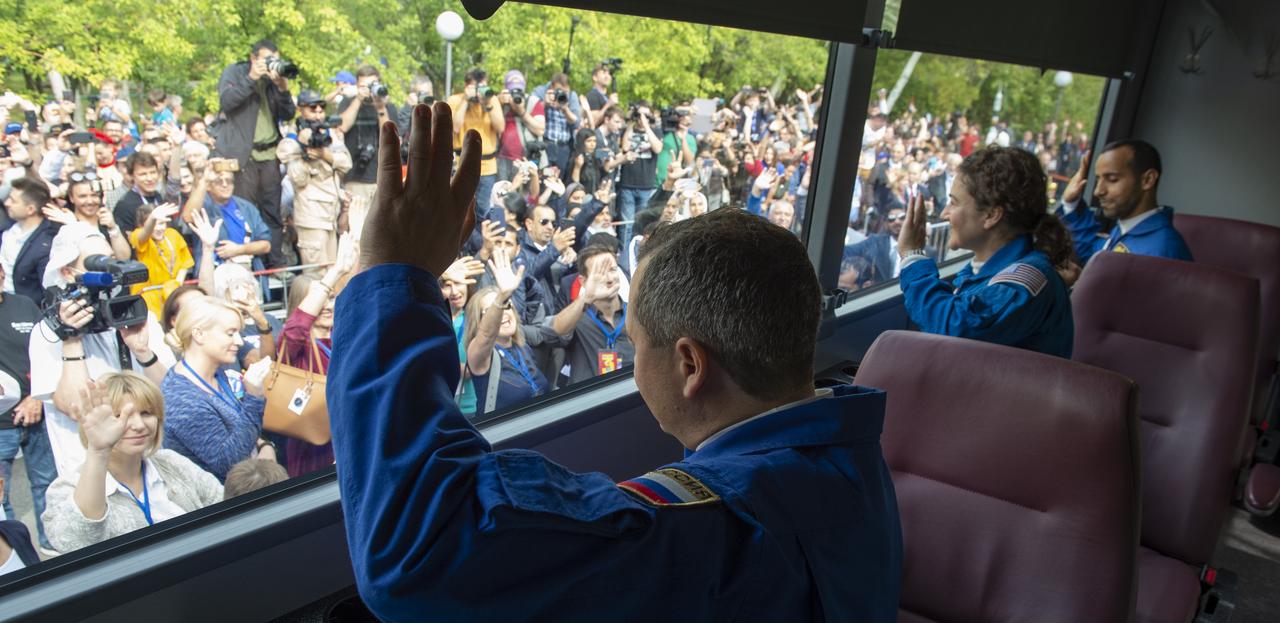
Expedition 61 cosmonaut Oleg Skripochka of Roscosmos, left, Expedition 61 astronaut Jessica Meir of NASA, center, and spaceflight participant Hazzaa Ali Almansoori of the United Arab Emirates wave farewell as they depart the Cosmonaut Hotel ahead of their Soyuz launch to the International Space Station, Wednesday, Sept. 25, 2019 in Baikonur, Kazakhstan. Meir, Skripochka, and Almansoori will launch on the Soyuz MS-15 spacecraft from the Baikonur Cosmodrome to the International Space Station. Photo Credit: (NASA/GCTC/Irina Spector)
Expedition 65 Roscosmos cosmonauts Oleg Novitskiy , left, Pyotr Dubrov, center, and NASA astronaut Mark Vande Hei, wave as they depart the Cosmonaut Hotel to suit-up for their Soyuz launch to the International Space Station, Friday, April 9, 2021, in Baikonur, Kazakhstan. Later that same day the crew launched in their Soyuz MS-18 spacecraft to the International Space Station. Photo Credit: (NASA/GCTC/Irina Spector
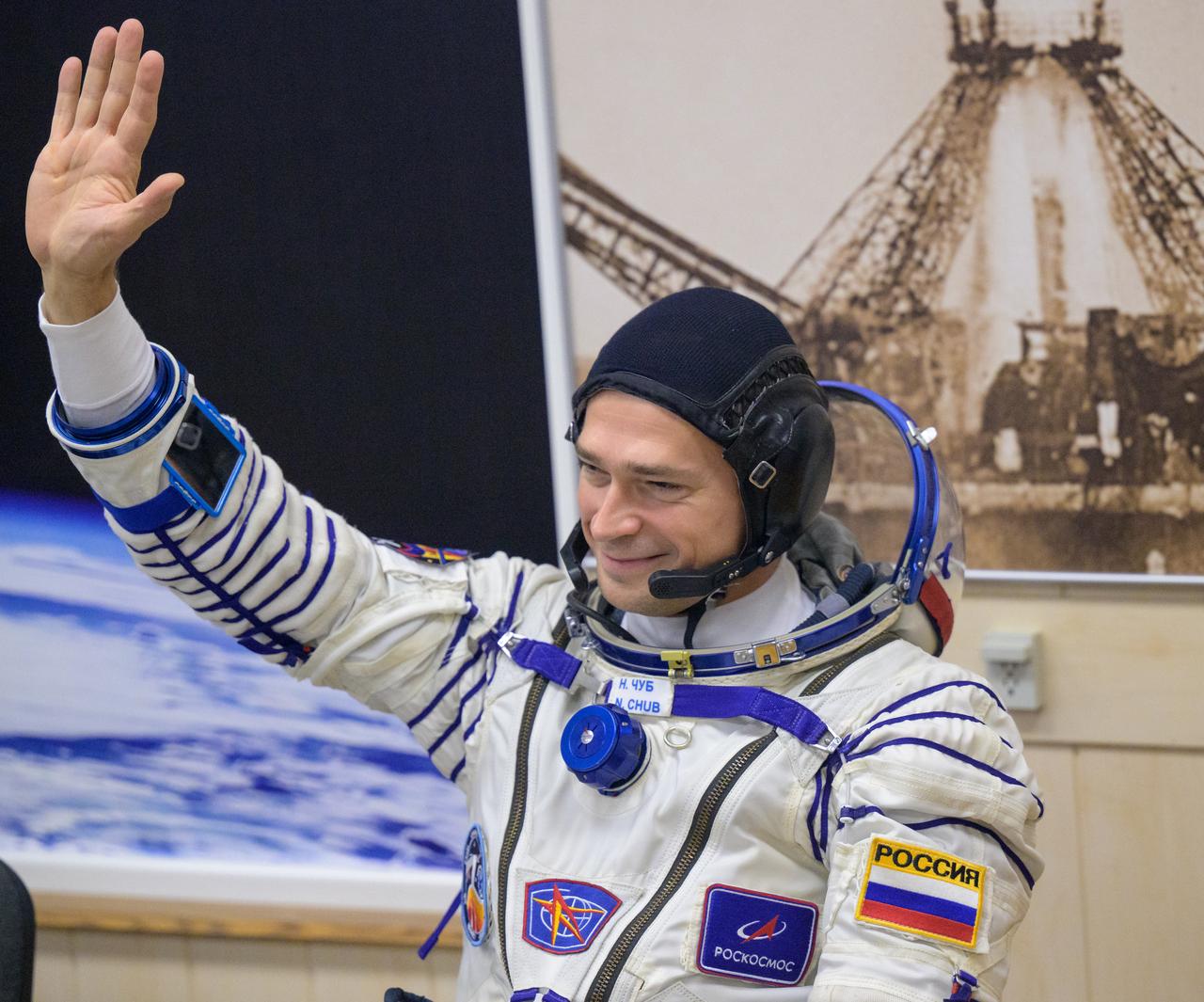
Expedition 70 Roscosmos cosmonaut Nikolai Chub waves to family as he and fellow cremates, Roscosmos cosmonaut Oleg Kononenko and NASA astronaut Loral O'Hara, have their Russian Sokol Suits pressure checked ahead of their Soyuz launch to the International Space Station Friday, Sept. 15, 2023 in Baikonur, Kazakhstan. The launch will send Expedition 70 NASA astronaut Loral O'Hara and Roscosmos cosmonauts Oleg Kononenko and Nikolai Chub on a mission to the International Space Station. Photo Credit: (NASA/Bill Ingalls)
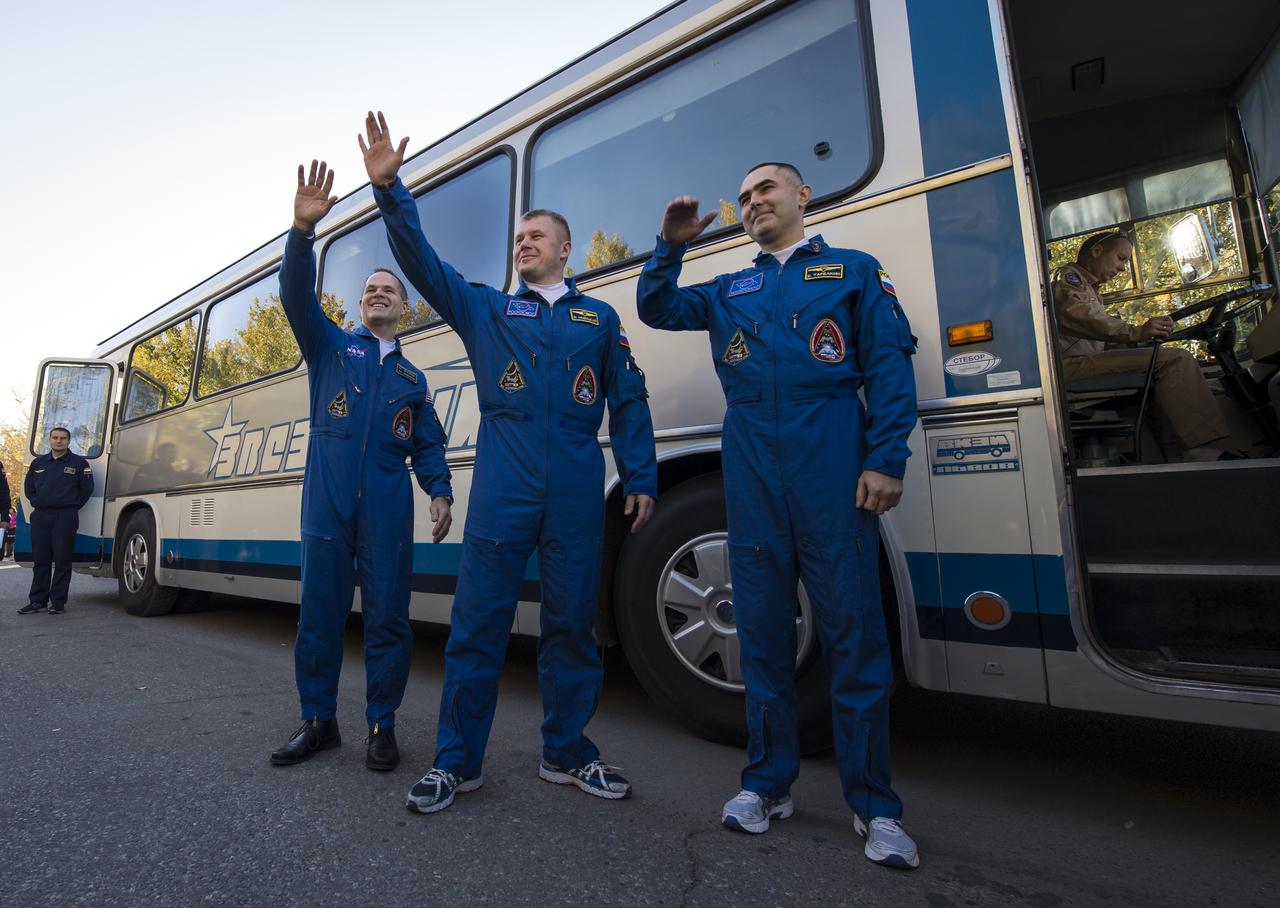
Expedition 33/34 crew members, Flight Engineer Kevin Ford of NASA, left, Soyuz Commander Oleg Novitskiy of ROSCOSMOS, and Flight Engineer Evgeny Tarelkin of ROSCOSMOS, right, wave farewell to family and friends as they depart the Cosmonaut Hotel to suit-up for their soyuz launch to the International Space Station, on Tuesday, October 23, 2012, in Baikonur, Kazakhstan. Launch of the Soyuz rocket will send Ford, Novitskiy and Tarelkin on a five-month mission aboard the International Space Station. Photo Credit: (NASA/Bill Ingalls)
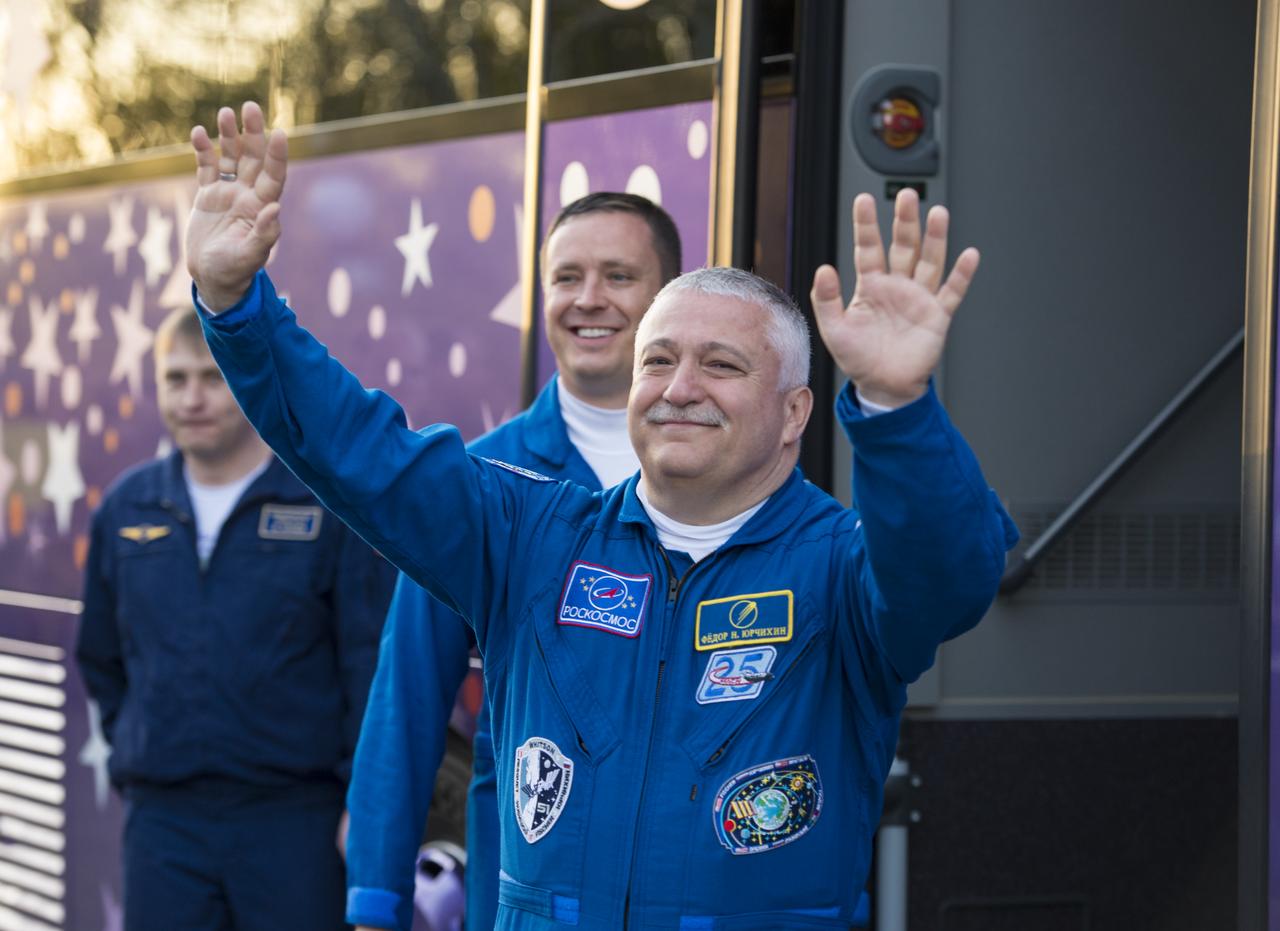
Expedition 51 crew members, Soyuz Commander Fyodor Yurchikhin of Roscosmos, front, and Flight Engineer Jack Fischer of NASA, back, wave farewell to family and friends as they depart the Cosmonaut Hotel to suit-up for their Soyuz launch to the International Space Station on Thursday, April 20, 2017 in Baikonur, Kazakhstan. Launch of the Soyuz rocket is scheduled for 1:13PM April 20 Baikonur time and will send Yurchikhin and Fischer on a four and a half month mission aboard the International Space Station. Photo Credit: (NASA/Aubrey Gemignani)
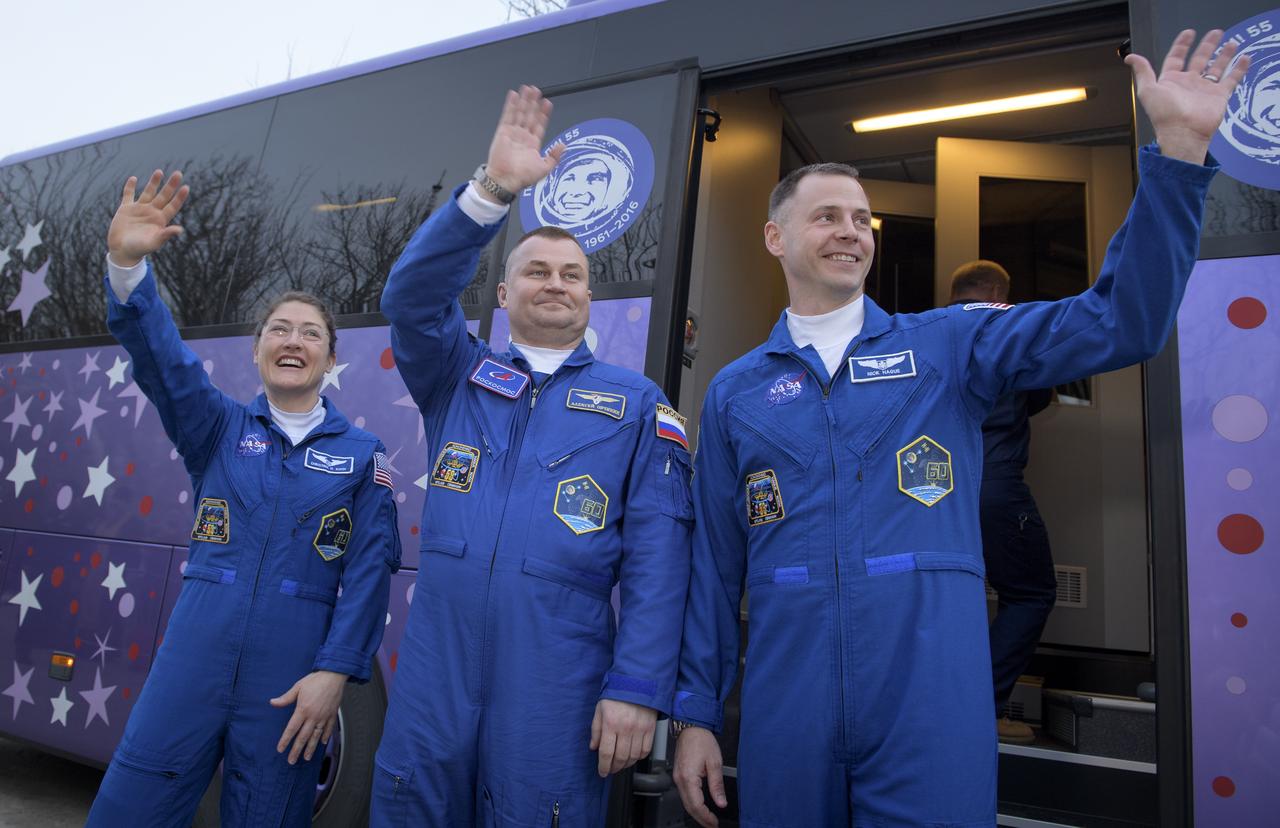
Expedition 59 crewmemebrs, Christina Koch of NASA, left, Alexey Ovchinin of Roscosmos, center, and Nick Hague of NASA wave farewell as they depart the Cosmonaut Hotel ahead of their Soyuz launch to the International Space Station, Thursday, March 14, 2019 in Baikonur, Kazakhstan. Hague, Koch, and Ovchinin launched March 14, U.S. time, on the Soyuz MS-12 spacecraft from the Baikonur Cosmodrome for a six-and-a-half month mission on the International Space Station. Photo Credit: (NASA/Bill Ingalls)
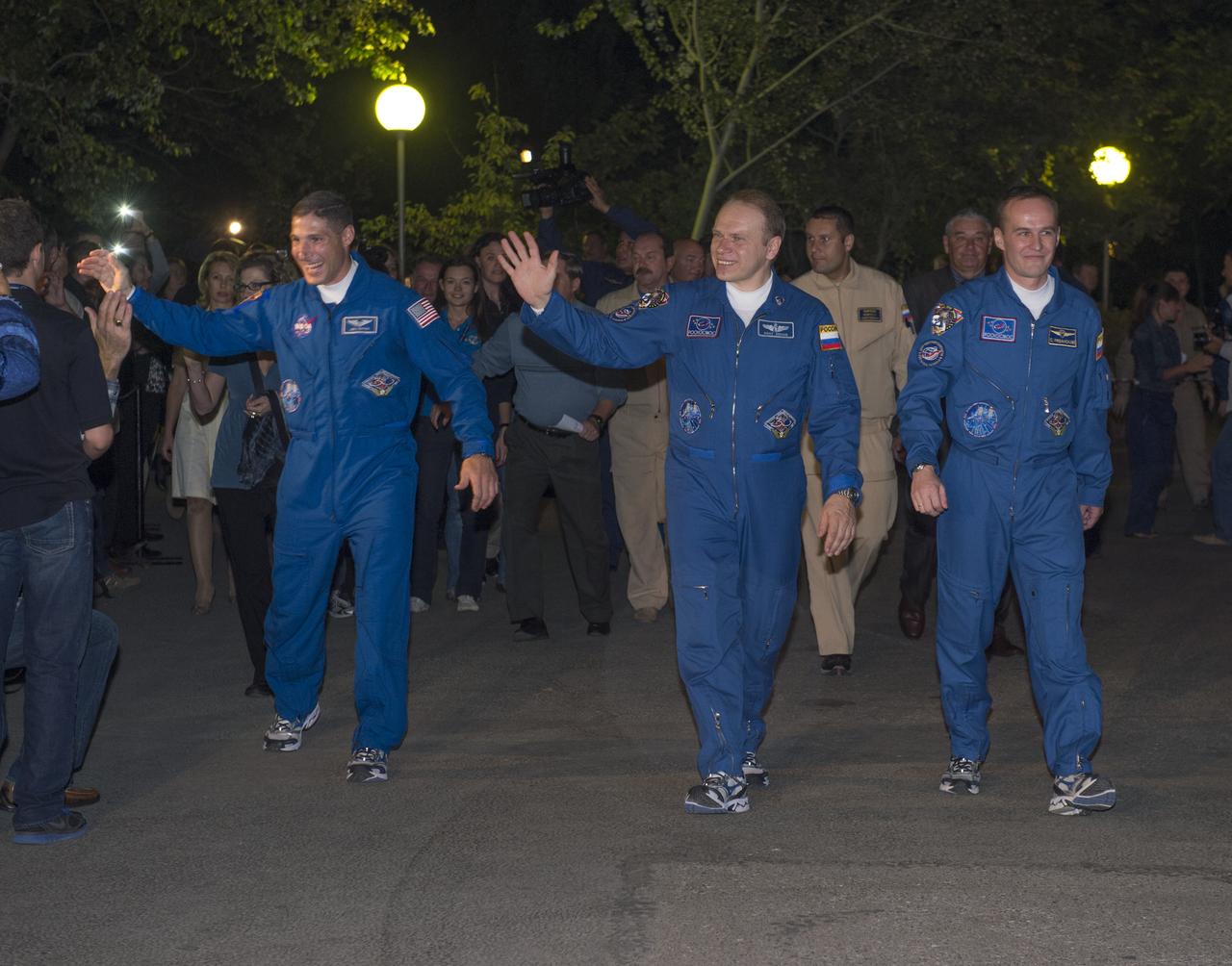
Expedition 37/38 crew members, Flight Engineer Michael Hopkins of NASA, left, Soyuz Commander Oleg Kotov of Roscosmos, and Russian Flight Engineer Sergey Ryazanskiy, right, wave farewell to family and friends as they depart the Cosmonaut Hotel to suit-up for their soyuz launch to the International Space Station on Wednesday, Wednesday, Sept. 25, 2013, in Baikonur, Kazakhstan. Launch of the Soyuz rocket will send Hopkins, Kotov and Ryazanskiy on a five-month mission aboard the International Space Station. Photo Credit: (NASA/Carla Cioffi)
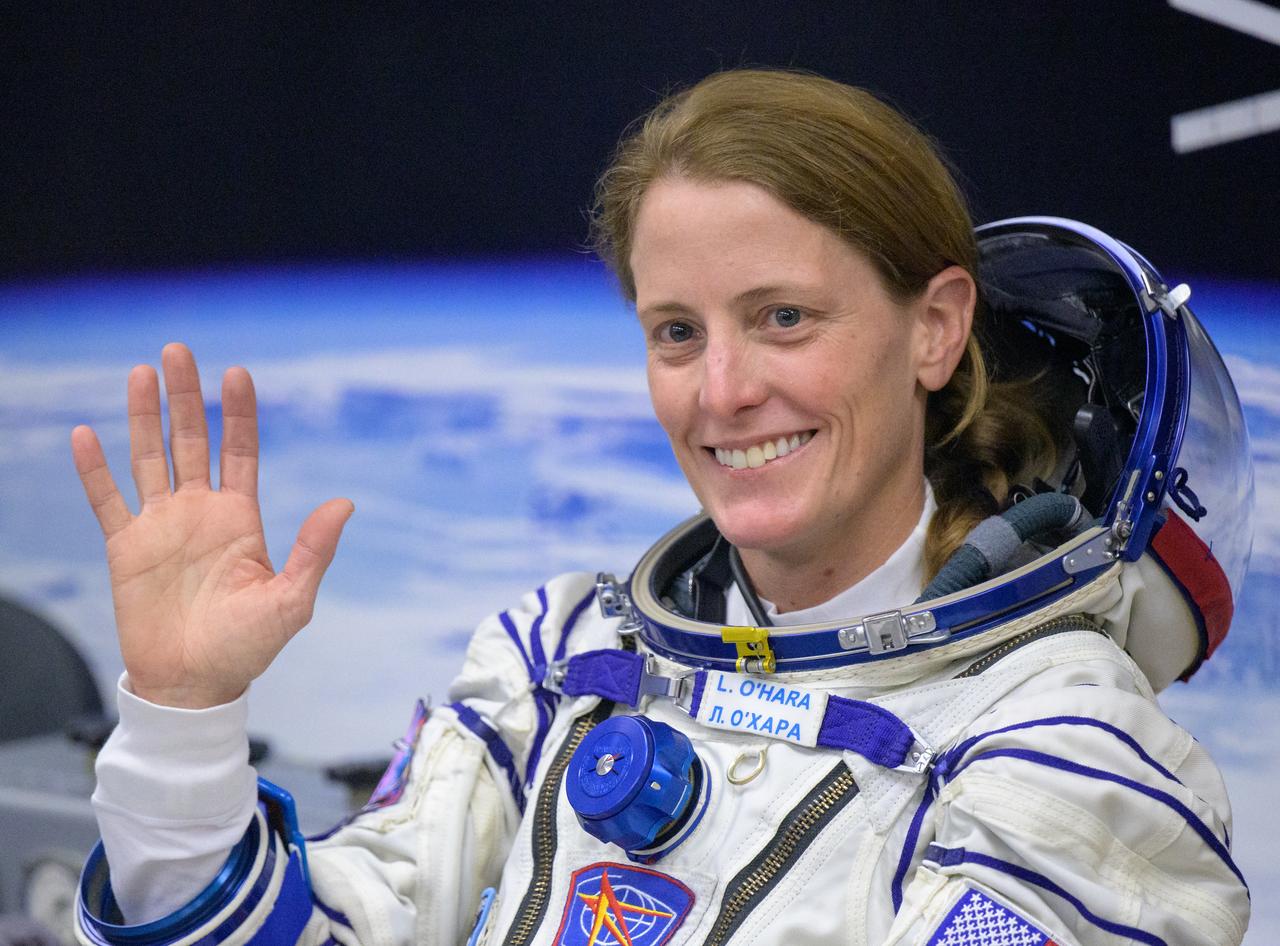
Expedition 70 NASA astronaut Loral O'Hara waves as she and fellow cremates, Roscosmos cosmonauts Oleg Kononenko and Nikolai Chub, have their Russian Sokol Suits pressure checked ahead of their Soyuz launch to the International Space Station Friday, Sept. 15, 2023 in Baikonur, Kazakhstan. The launch will send Expedition 70 NASA astronaut Loral O'Hara and Roscosmos cosmonauts Oleg Kononenko and Nikolai Chub on a mission to the International Space Station. Photo Credit: (NASA/Bill Ingalls)
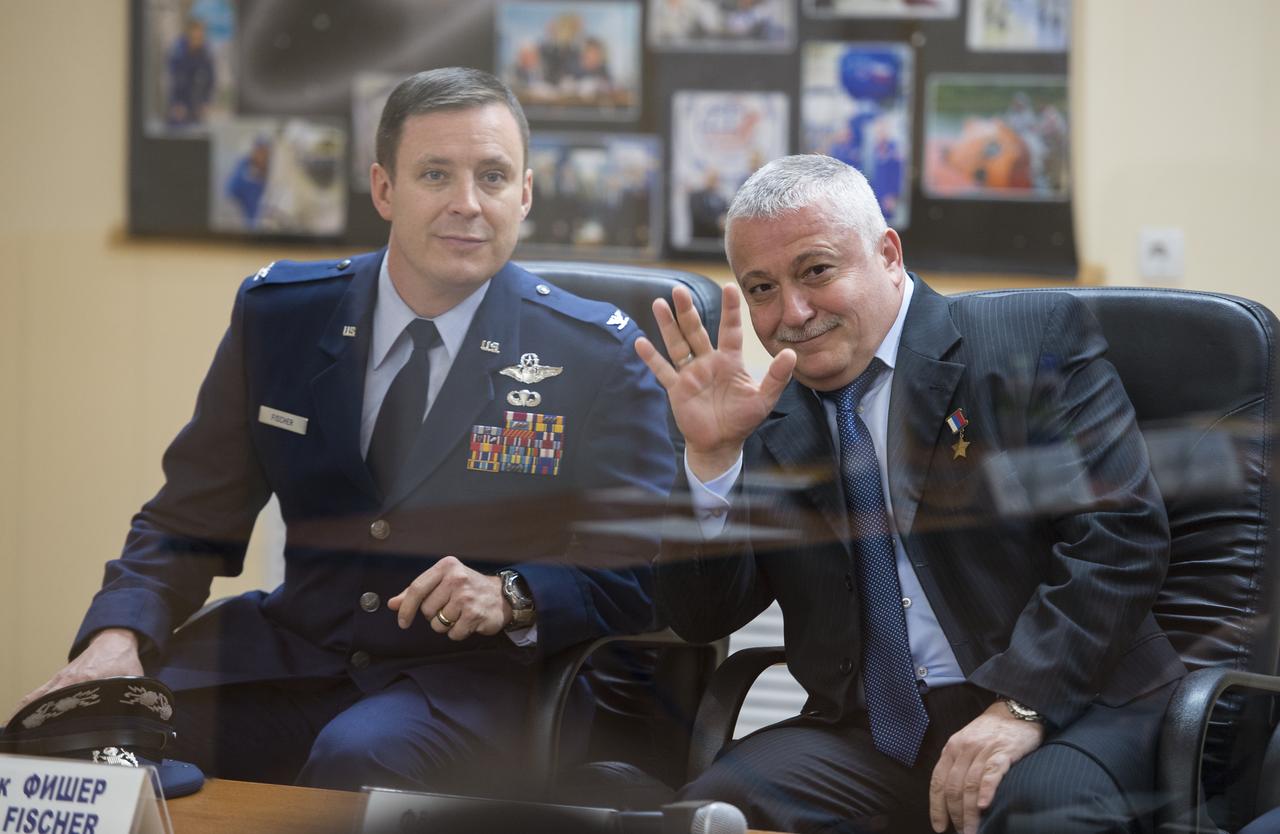
Expedition 51 Soyuz Commander Fyodor Yurchikhin of Roscosmos, right, waves at family and friends from behind glass, while in quarantine, during the State Commission meeting to approve the Soyuz launch of Expedition 51 to the International Space Station, Wednesday, April 19, 2017, at the Cosmonaut Hotel in Baikonur, Kazakhstan. Launch of the Soyuz rocket is scheduled for April 20 and will carry Yurchikhin and Flight Engineer Jack Fischer of NASA, left, into orbit to begin their four and a half month mission on the International Space Station. Photo Credit: (NASA/Aubrey Gemignani).
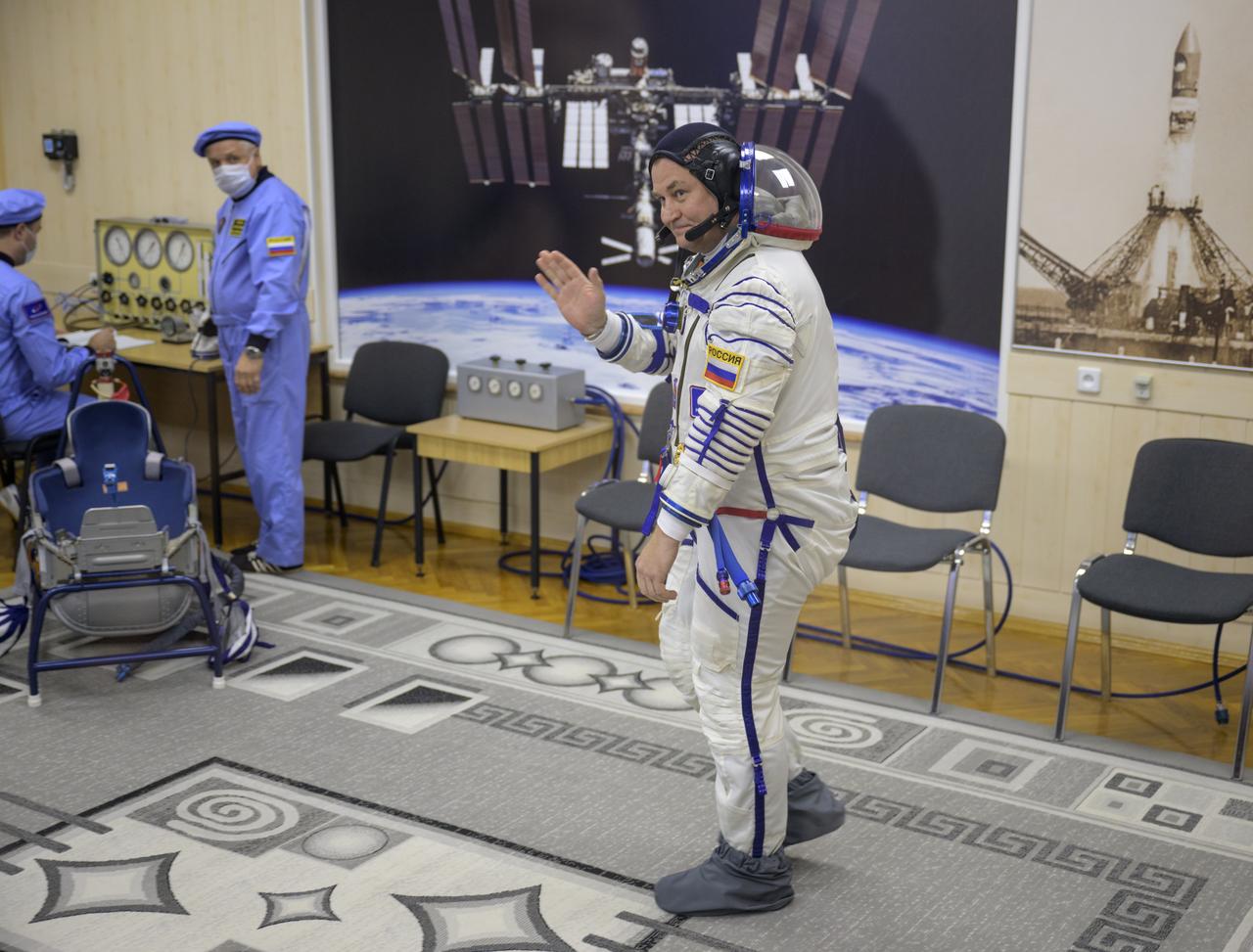
Roscosmos cosmonaut Alexey Ovchinin waves as he prepares to have his Russian Sokol suit pressure checked as he and fellow crew mates, NASA astronaut Don Pettit, and Roscosmos cosmonaut Ivan Vagner, prepare for their Soyuz launch to the International Space Station Wednesday, Sept. 11, 2024 in Baikonur, Kazakhstan. The launch will send Pettit, Ovchinin, and Vagner on a mission to the International Space Station. Photo Credit: (NASA/Bill Ingalls)

NASA astronaut Don Pettit, left, and Roscosmos cosmonaut Ivan Vagner, right, wave from a bus as they and fellow crew mate, Roscosmos cosmonaut Alexey Ovchinin, depart the Cosmonaut Hotel to suit-up for their Soyuz launch to the International Space Station, Wednesday, Sept. 11, 2024, in Baikonur, Kazakhstan. The launch will send Pettit, Ovchinin, and Vagner on a mission to the International Space Station. Photo Credit: (NASA/Bill Ingalls)

Expedition 61 crewmember Jessica Meir of NASA waves farewell as she, Expedition 61 cosmonaut Oleg Skripochka of Roscosmos and spaceflight participant Hazzaa Ali Almansoori of the United Arab Emirates depart the Cosmonaut Hotel ahead of their Soyuz launch to the International Space Station, Wednesday, Sept. 25, 2019 in Baikonur, Kazakhstan. Meir, Skripochka, and Almansoori will launch on the Soyuz MS-15 spacecraft from the Baikonur Cosmodrome to the International Space Station. Photo Credit: (NASA/Bill Ingalls)
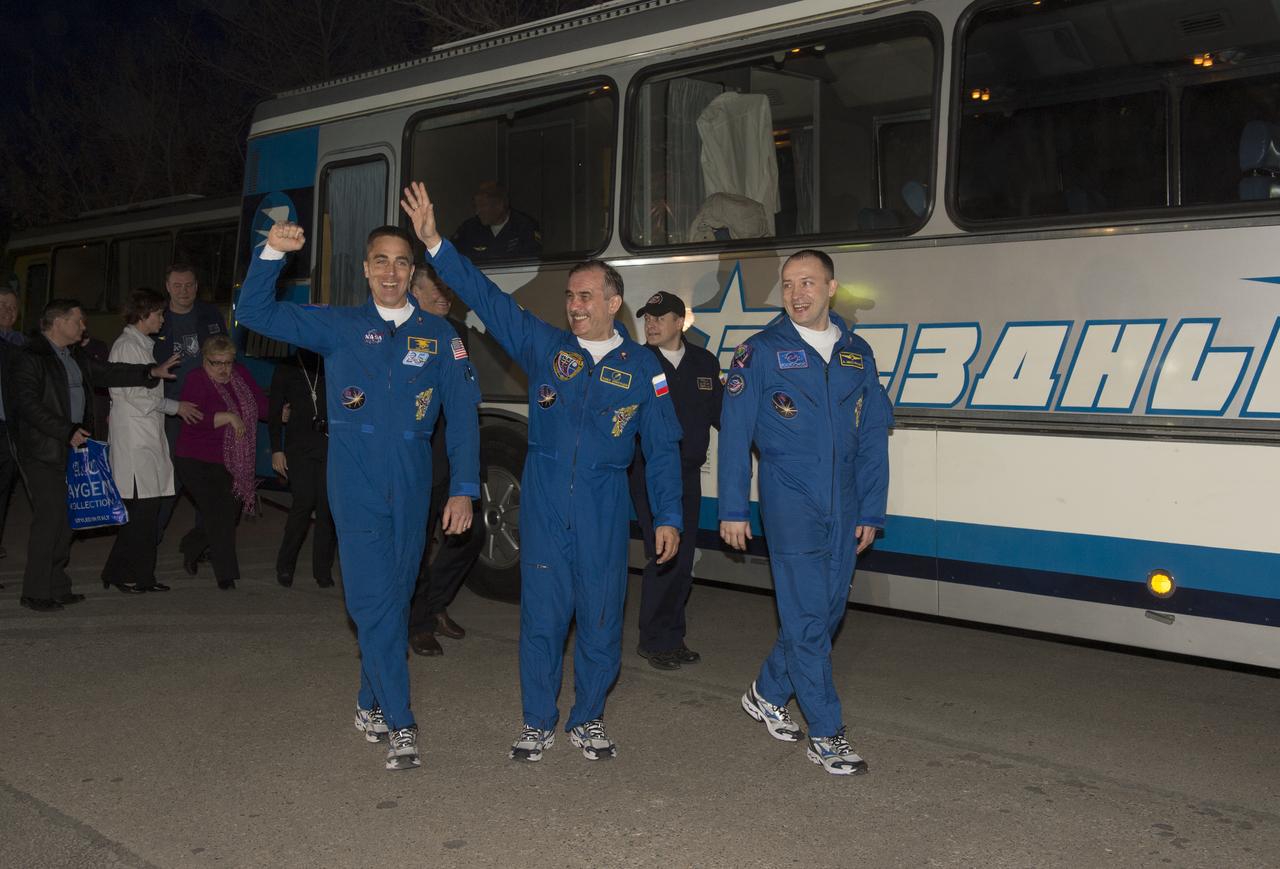
Expedition 35 crew members NASA Flight Engineer Chris Cassidy, left, Soyuz Commander Pavel Vinogradov and Russian Flight Alexander Misurkin, right, wave farewell to family and friends as they depart the Cosmonaut Hotel to suit-up for their soyuz launch to the International Space Station, Thursday, March 28, 2013, in Baikonur, Kazakhstan. Launch of the Soyuz rocket will send Cassidy, Vinogradov and Misurkin on a five and a half month mission aboard the International Space Station. Photo Credit: (NASA/Carla Cioffi)

Family of Expedition 58 Soyuz Commander Oleg Kononenko of Roscosmos wave farewell as the Expedition 58 crew departs the Cosmonaut Hotel to suit-up for their Soyuz launch to the International Space Station on Monday, Dec. 3, 2018 in Baikonur, Kazakhstan. Launch of the Soyuz rocket is scheduled for the same day and will send Kononenko, Flight Engineer Anne McClain of NASA, and Flight Engineer David Saint-Jacques of the Canadian Space Agency (CSA) on a six and a half month mission aboard the International Space Station. Photo Credit: (NASA/Aubrey Gemignani)

Spaceflight participant Hazzaa Ali Almansoori of the United Arab Emirates waves farewell as he, Expedition 61 crewmembers Oleg Skripochka of Roscosmos and Jessica Meir of NASA depart the Cosmonaut Hotel ahead of their Soyuz launch to the International Space Station, Wednesday, Sept. 25, 2019 in Baikonur, Kazakhstan. Meir, Skripochka, and Almansoori will launch on the Soyuz MS-15 spacecraft from the Baikonur Cosmodrome to the International Space Station. Photo Credit: (NASA/Bill Ingalls)
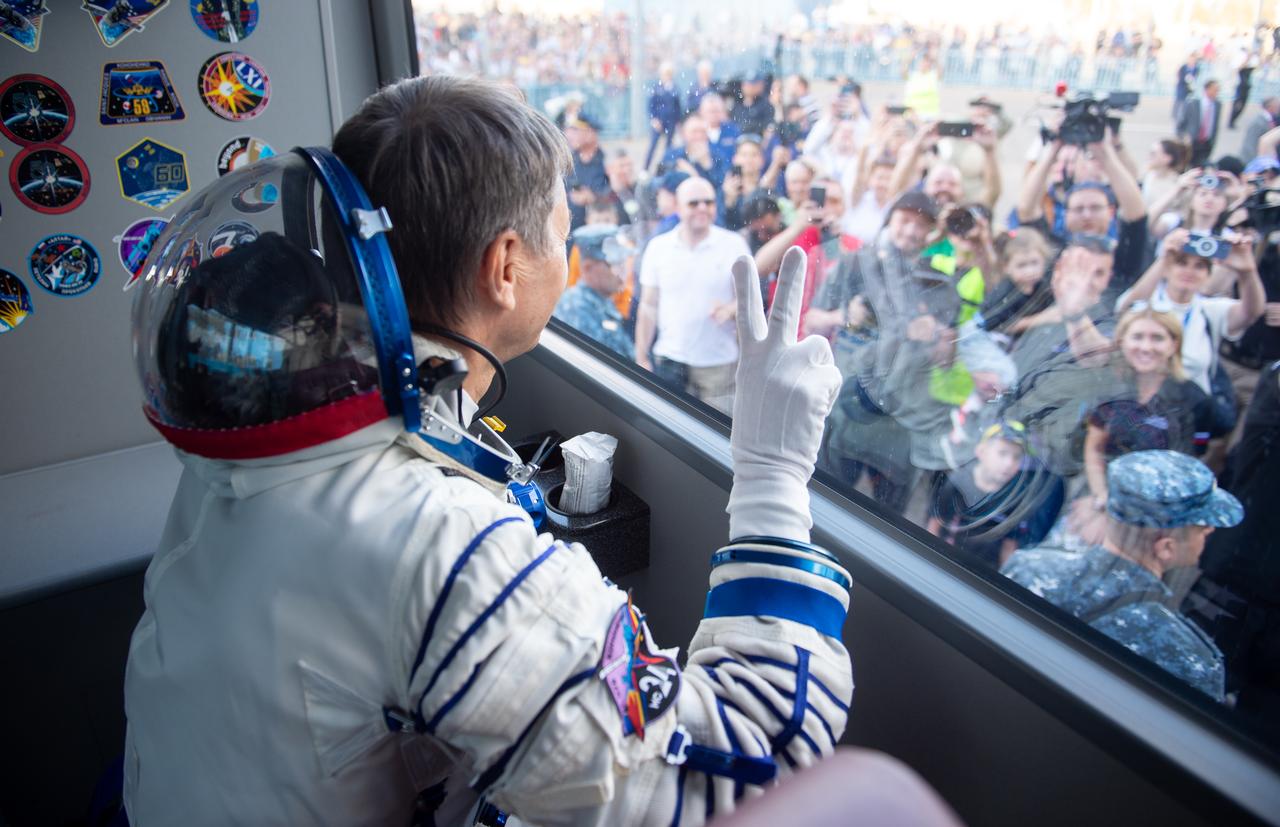
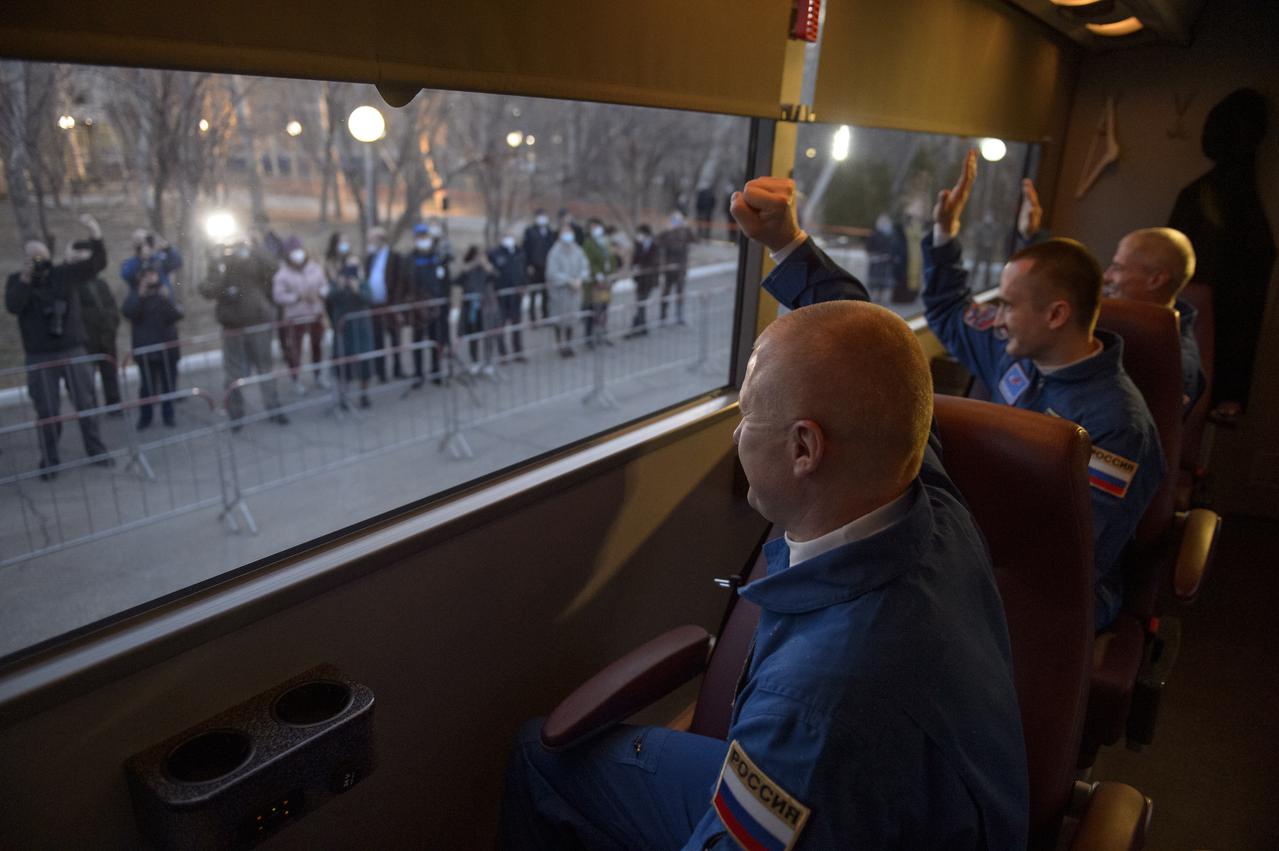
Expedition 70 Roscosmos cosmonaut Oleg Kononenko waves farewell to family and friends as he and fellow crewmates, Roscosmos cosmonaut Nikolai Chub and NASA astronaut Loral O'Hara, depart by bus to the launch pad for their Soyuz launch to the International Space Station, Friday, Sept. 15, 2023 in Baikonur, Kazakhstan. The launch will send Expedition 70 NASA astronaut Loral O'Hara and Roscosmos cosmonauts Oleg Kononenko and Nikolai Chub on a mission to the International Space Station. Photo Credit: (NASA/GCTC/Andrey Shelepin)
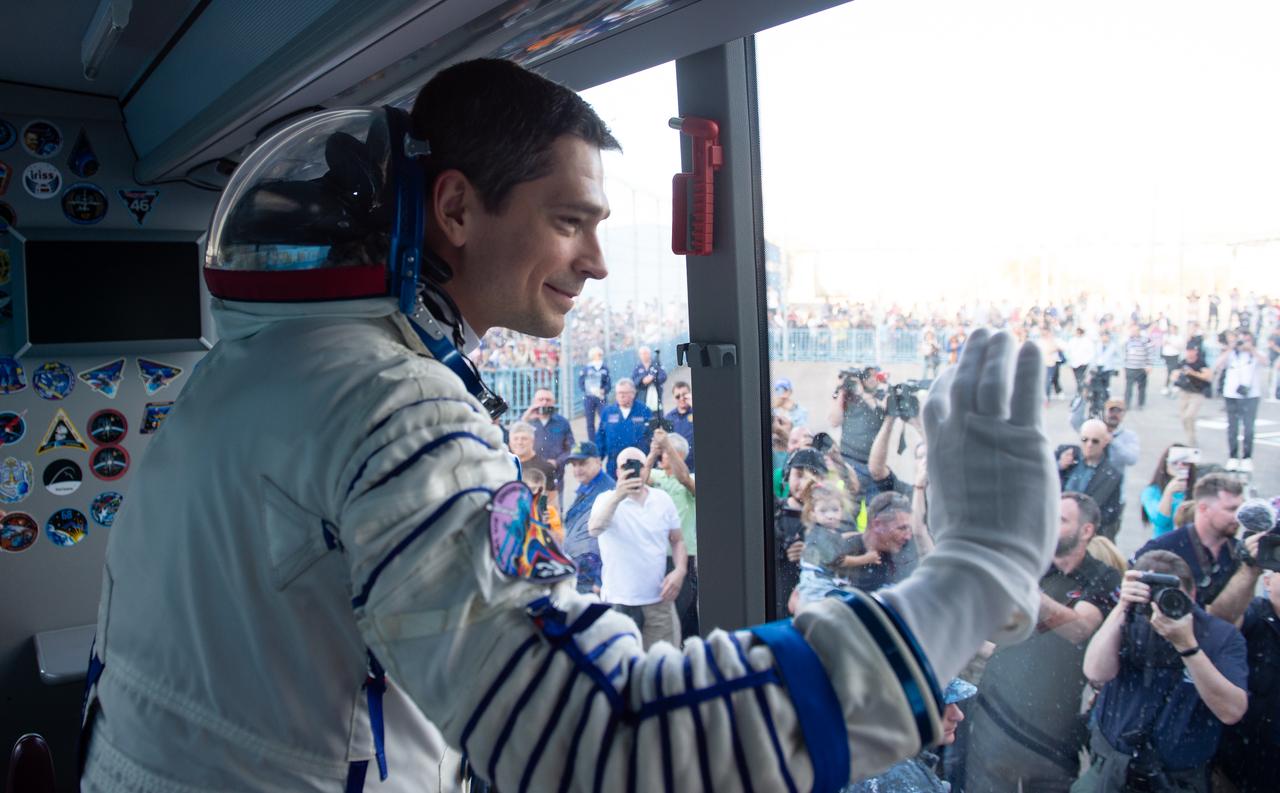
Expedition 70 Roscosmos cosmonaut Nikolai Chub waves farewell to family and friends as he and fellow crewmates, Roscosmos cosmonaut Oleg Kononenko and NASA astronaut Loral O'Hara, depart by bus to the launch pad for their Soyuz launch to the International Space Station, Friday, Sept. 15, 2023 in Baikonur, Kazakhstan. The launch will send Expedition 70 NASA astronaut Loral O'Hara and Roscosmos cosmonauts Oleg Kononenko and Nikolai Chub on a mission to the International Space Station. Photo Credit: (NASA/GCTC/Andrey Shelepin)
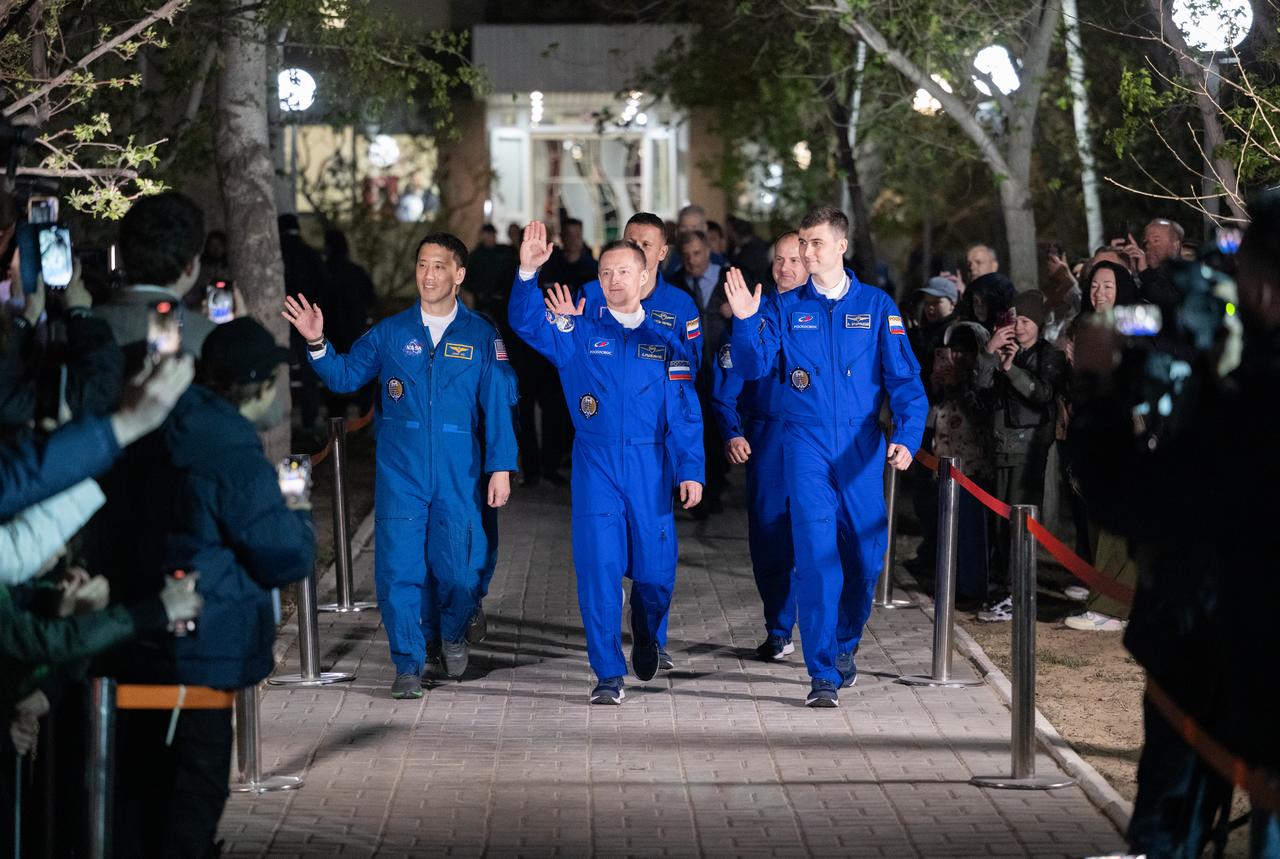
NASA astronaut Jonny Kim, left, and Roscosmos cosmonauts Sergey Ryzhikov and Alexey Zubritskiy, right, wave as they depart the Cosmonaut Hotel to suit-up for their Soyuz launch to the International Space Station, Tuesday, April 8, 2025 (April 7 Eastern Time), in Baikonur, Kazakhstan. The launch will send Kim, Ryzhikov, Zubritskiy on a mission to the International Space Station. Photo Credit: (NASA/Joel Kowsky)
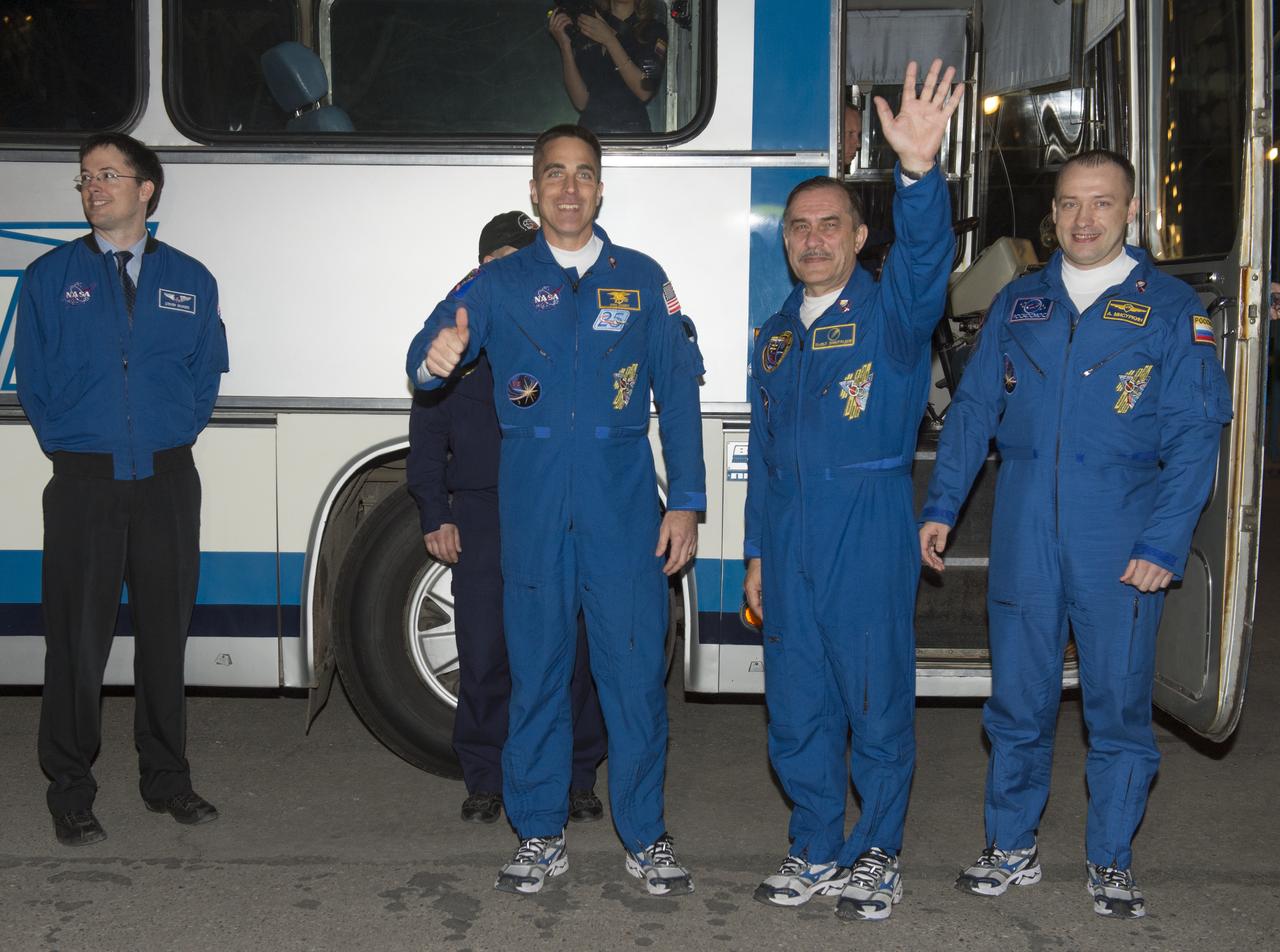
Expedition 35 crew members NASA Flight Engineer Chris Cassidy, left, Soyuz Commander Pavel Vinogradov and Russian Flight Alexander Misurkin, right, wave farewell to family and friends as they depart the Cosmonaut Hotel to suit-up for their soyuz launch to the International Space Station, Thursday, March 28, 2013, in Baikonur, Kazakhstan. Launch of the Soyuz rocket will send Cassidy, Vinogradov and Misurkin on a five and a half month mission aboard the International Space Station. Photo Credit: (NASA/Carla Cioffi)
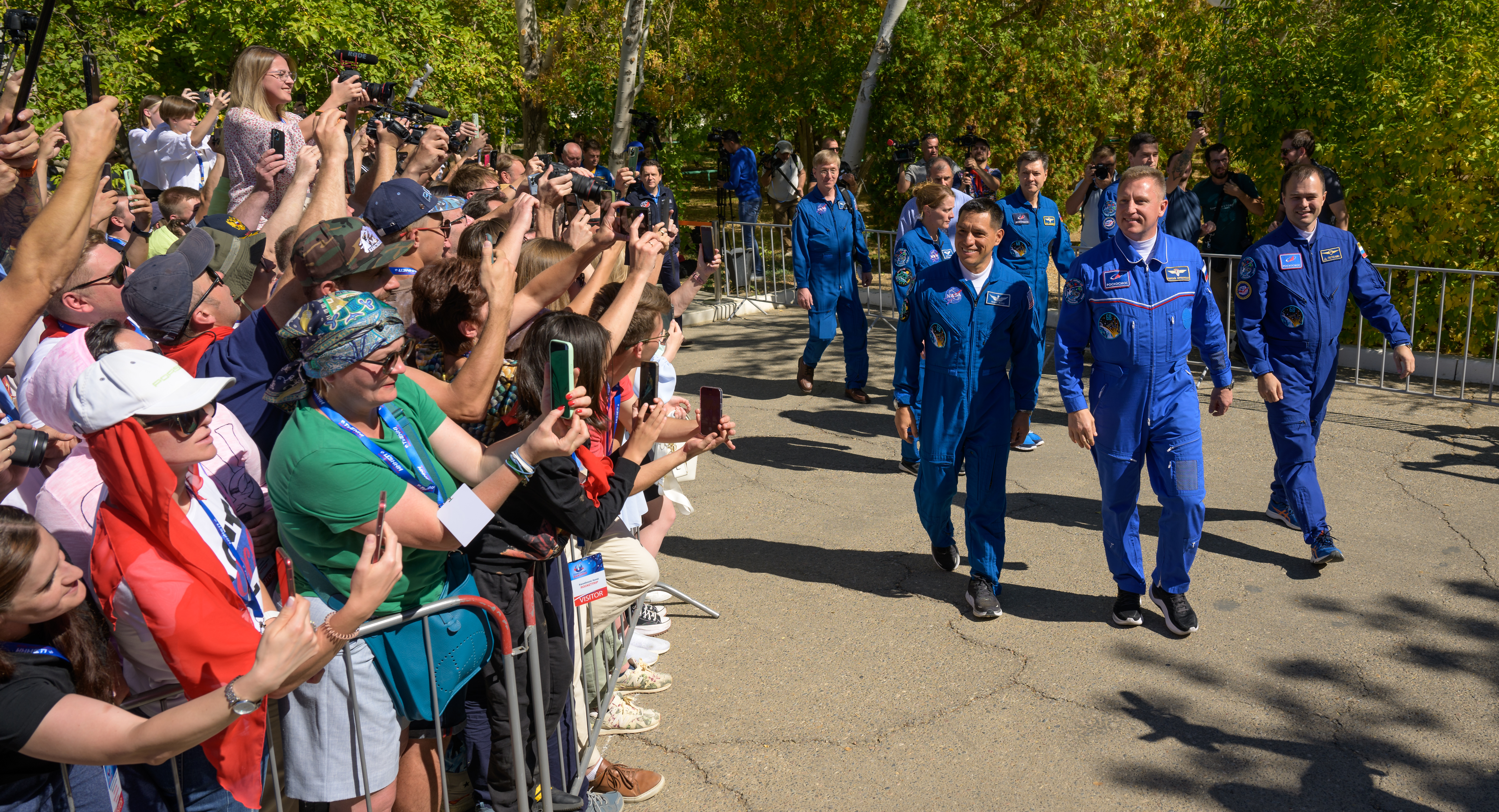
Expedition 68 astronaut Frank Rubio of NASA, left, and cosmonauts Sergey Prokopyev and Dmitri Petelin of Roscosmos, right, wave as they depart the Cosmonaut Hotel to suit-up for their Soyuz launch to the International Space Station, Wednesday, Sept. 21, 2022, in Baikonur, Kazakhstan. Rubio, Prokopyev and Petelin launched on their Soyuz MS-22 spacecraft later in the day from the Baikonur Cosmodrome for a mission on the International Space Station. Photo Credit: (NASA/Bill Ingalls)

Expedition 64 NASA astronaut Kate Rubins waves as she departs the Cosmonaut Hotel with fellow crewmates Russian cosmonauts Sergey Ryzhikov and Sergey Kud-Sverchkov of Roscosmos to suit-up for their Soyuz launch to the International Space Station, Wednesday, Oct. 14, 2020, in Baikonur, Kazakhstan. Launch of the Soyuz MS-17 spacecraft with Ryzhikov, Kud-Sverchkov, and Rubins occurred at 1:45 a.m. EDT to begin their six-month mission onboard the International Space Station. Photo Credit: (NASA/GCTC/Andrey Shelepin)
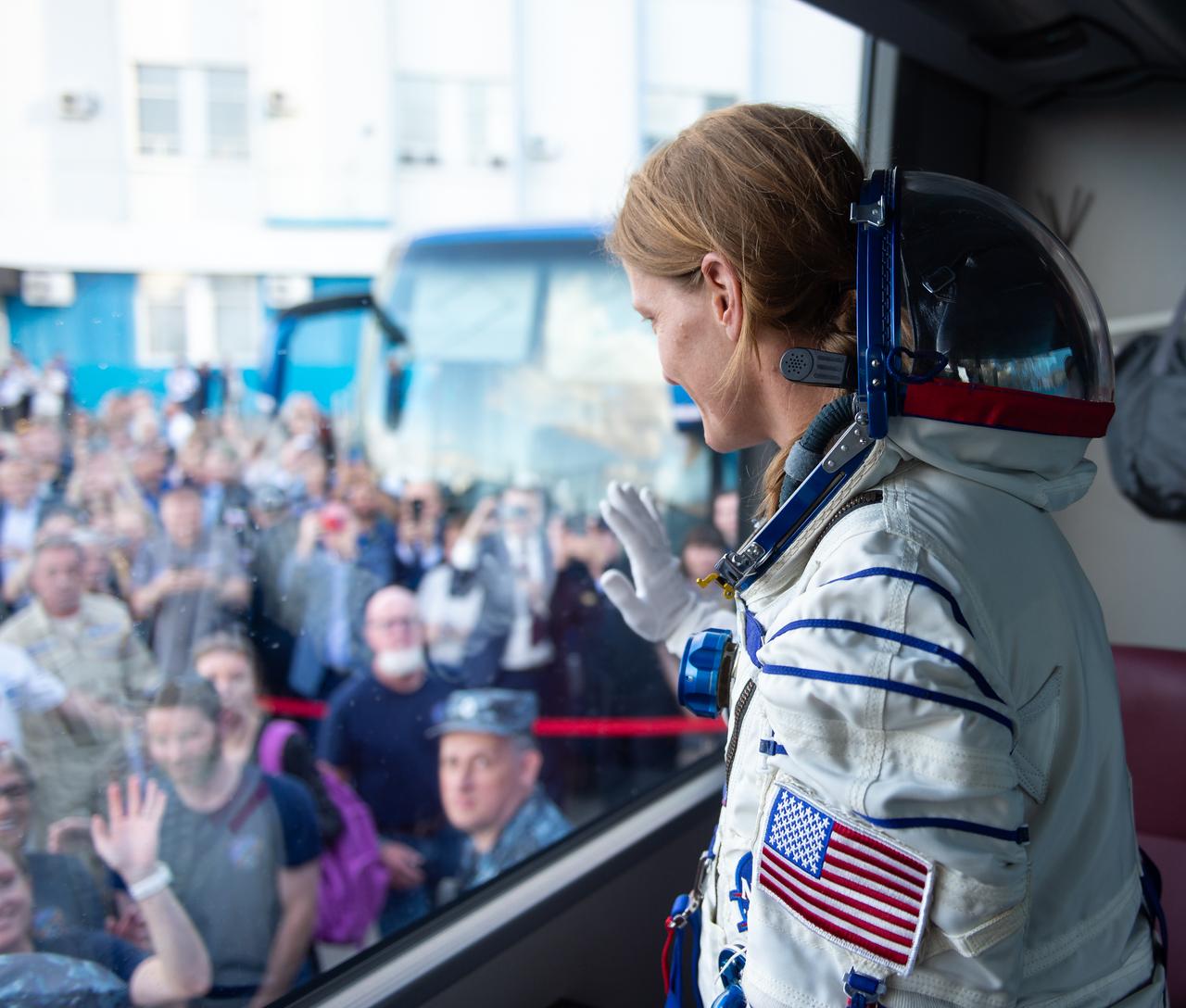
Expedition 70 NASA astronaut Loral O'Hara waves farewell to family and friends as she and fellow crewmates, Roscosmos cosmonauts Oleg Kononenko and Nikolai Chub, depart by bus to the launch pad for their Soyuz launch to the International Space Station, Friday, Sept. 15, 2023 in Baikonur, Kazakhstan. The launch will send Expedition 70 NASA astronaut Loral O'Hara and Roscosmos cosmonauts Oleg Kononenko and Nikolai Chub on a mission to the International Space Station. Photo Credit: (NASA/GCTC/Andrey Shelepin)
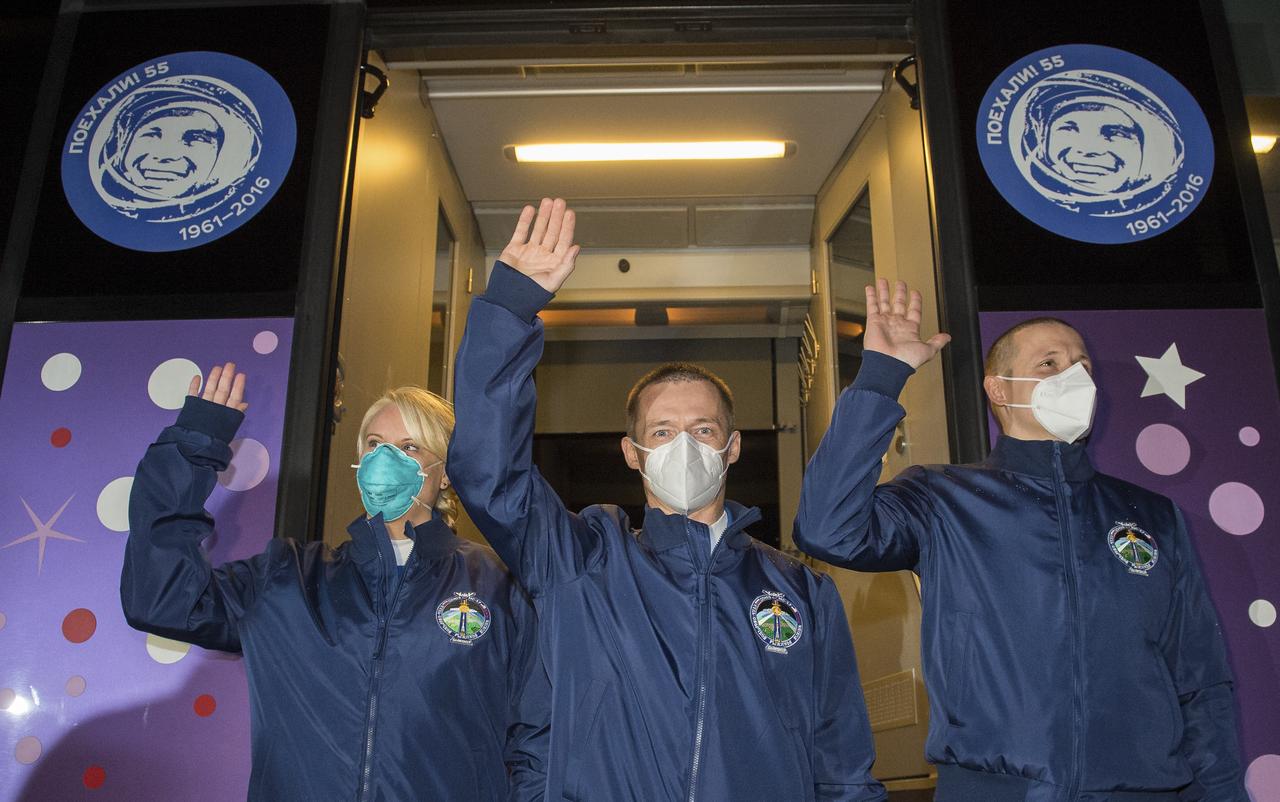
Expedition 64 NASA astronaut Kate Rubins, left, and Russian cosmonauts Sergey Ryzhikov, center, and Sergey Kud-Sverchkov, right, of Roscosmos, wave as they depart the Cosmonaut Hotel to suit-up for their Soyuz launch to the International Space Station, Wednesday, Oct. 14, 2020, in Baikonur, Kazakhstan. Launch of the Soyuz MS-17 spacecraft with Ryzhikov, Kud-Sverchkov, and Rubins occurred at 1:45 a.m. EDT to begin their six-month mission onboard the International Space Station. Photo Credit: (NASA/GCTC/Andrey Shelepin)

Expedition 72 crew members: NASA astronaut Don Pettit, left, Roscosmos cosmonauts Alexey Ovchinin, and Ivan Vagner, right, wave as they depart the Cosmonaut Hotel to suit-up for their Soyuz launch to the International Space Station, Wednesday, Sept. 11, 2024, in Baikonur, Kazakhstan. The launch will send Pettit, Ovchinin, and Vagner on a mission to the International Space Station. Photo Credit: (NASA/Victor Zelentsov)
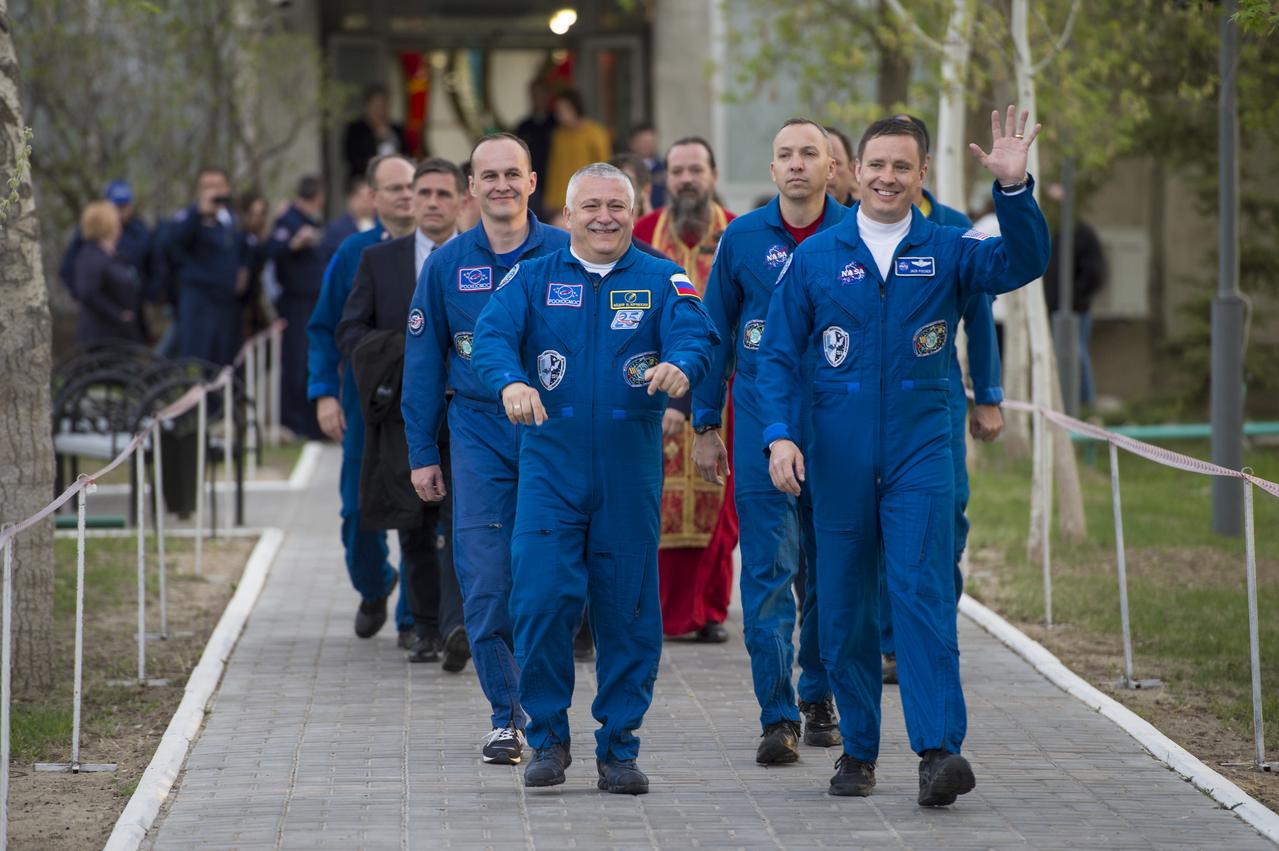
Expedition 51 crew members, Soyuz Commander Fyodor Yurchikhin of Roscosmos, left, and Flight Engineer Jack Fischer of NASA, right, wave to family and friends as they depart the Cosmonaut Hotel to suit-up for their Soyuz launch to the International Space Station on Thursday, April 20, 2017 in Baikonur, Kazakhstan. Launch of the Soyuz rocket is scheduled for 1:13PM April 20 Baikonur time and will send Yurchikhin and Fischer on a four and a half month mission aboard the International Space Station. Photo Credit: (NASA/Aubrey Gemignani)