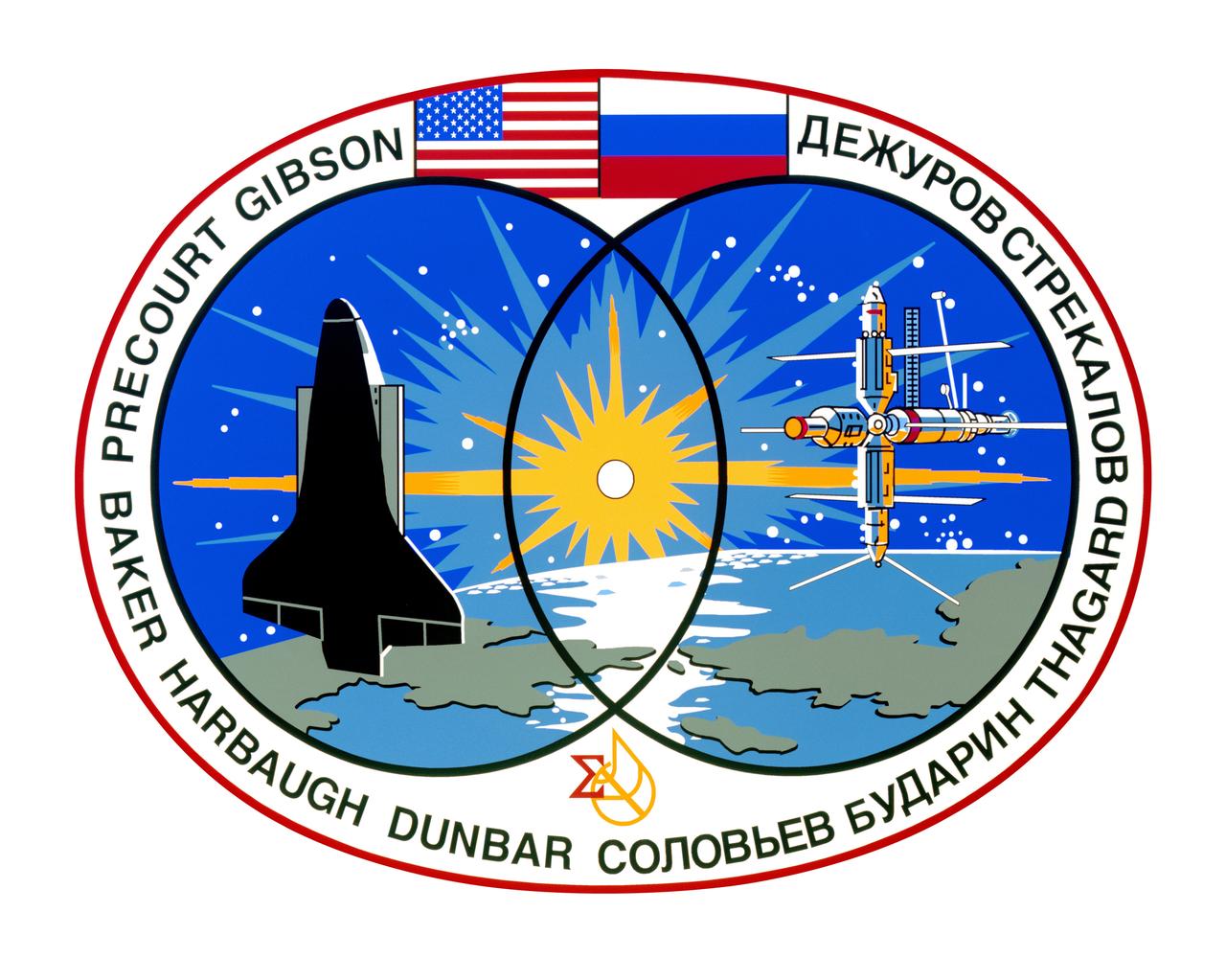
STS071-S-001 (April 1995) --- The STS-71 crew patch design depicts the orbiter Atlantis in the process of the first international docking mission of the space shuttle Atlantis with the Russian Mir Space Station. The names of the 10 astronauts and cosmonauts who will fly aboard the orbiter as shown along the outer border of the patch. The rising sun symbolizes the dawn of a new era of cooperation between the two countries. The vehicles Atlantis and Mir are shown in separate circles converging at the center of the emblem symbolizing the merger of the space programs of the two space faring nations. The flags of the United States and Russia emphasize the equal partnership of the mission. The joint program symbol at the lower center of the patch acknowledges the extensive contributions made by the Mission Control Centers (MCC) of both countries. The crew insignia was designed by aviation and space artist, Bob McCall, who also designed the crew patch for the Apollo-Soyuz Test Project (ASTP) in 1975, the first international space docking mission. The NASA insignia design for space shuttle flights is reserved for use by the astronauts and for other official use as the NASA Administrator may authorize. Public availability has been approved only in the forms of illustrations by the various news media. When and if there is any change in this policy, which is not anticipated, the change will be publicly announced. Photo credit: NASA
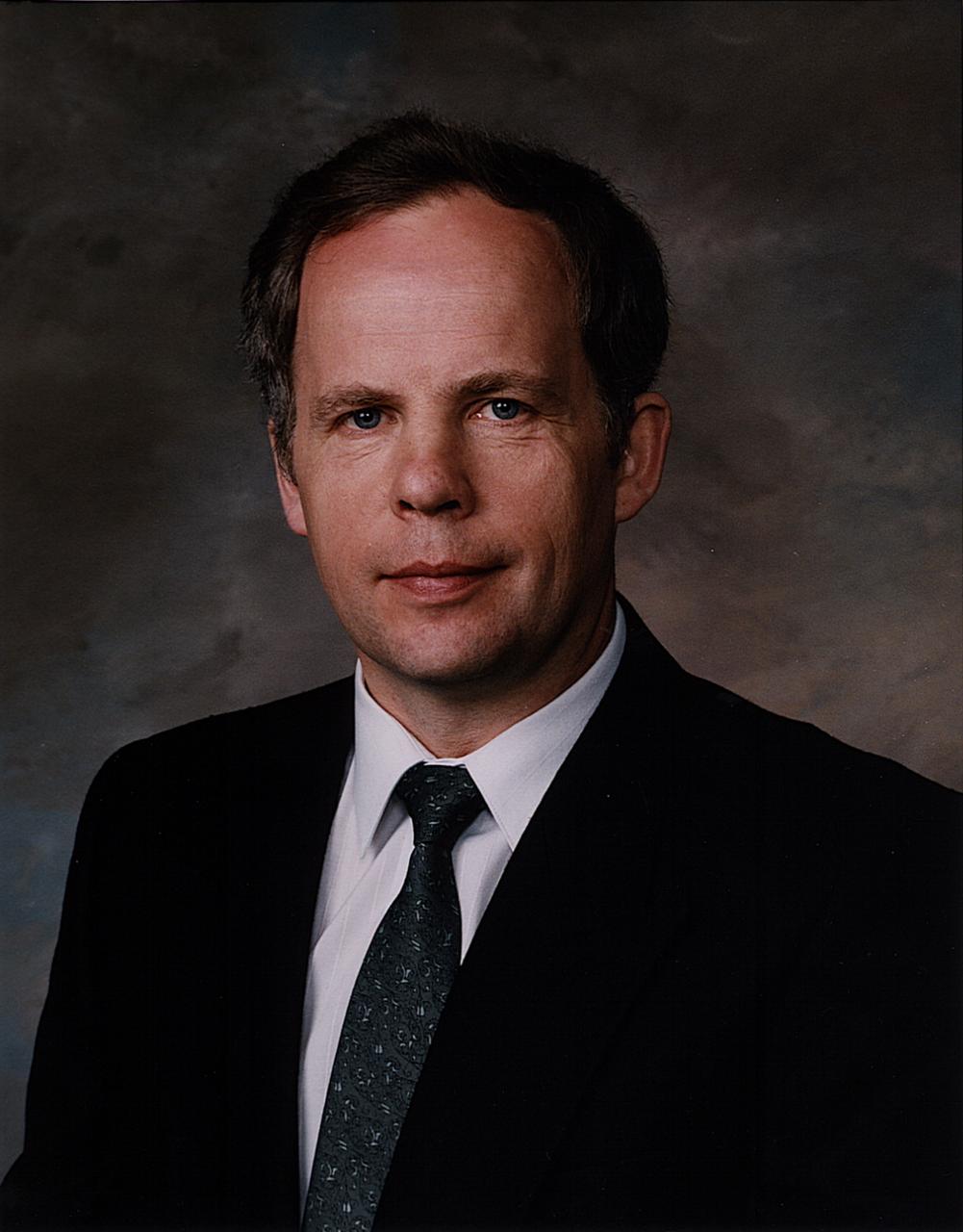
s94-34935 --- Portrait of Russian cosmonaut and Mir 19 commander Anatoly Solovyev in civilian clothes.
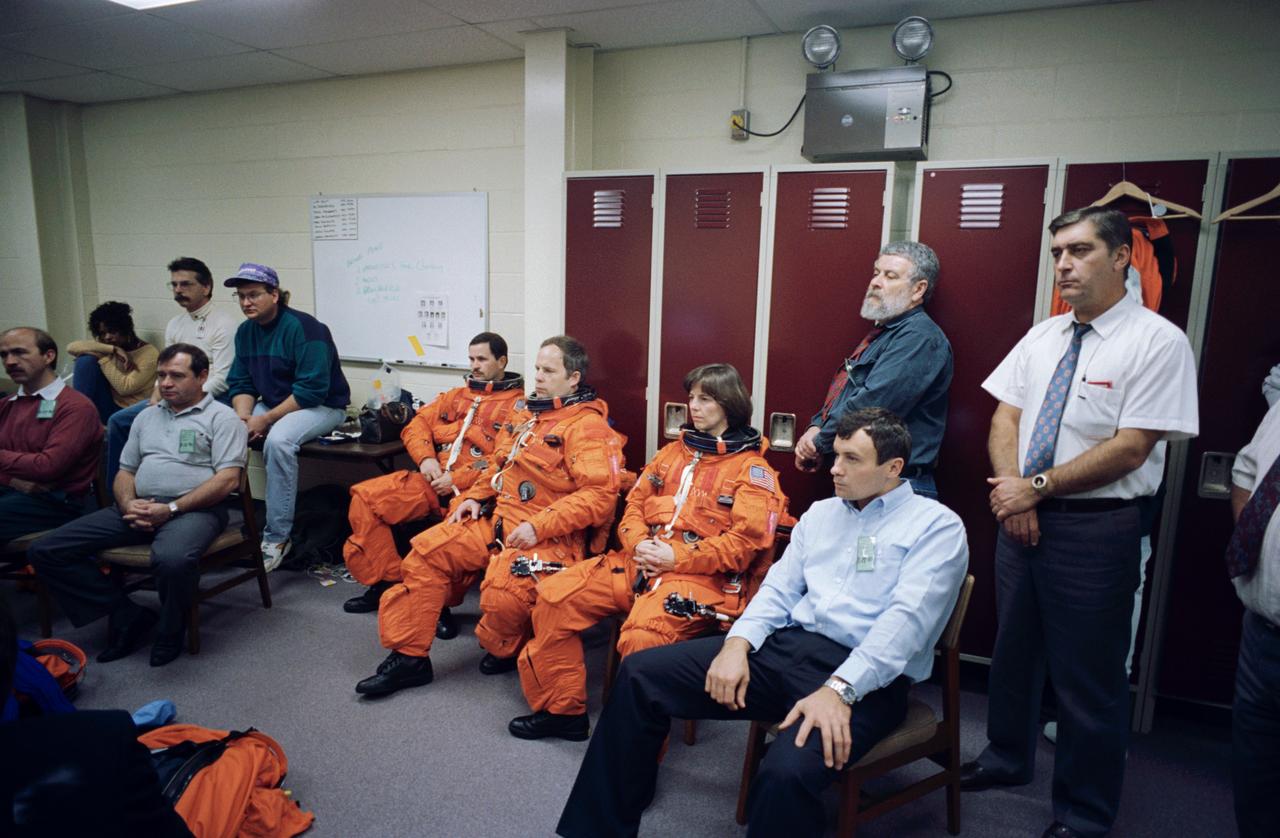
S94-47218 (28 Oct 1994) --- A number of Russian cosmonauts and an American astronaut listen to a briefing on launch and landing emergency situations during a training session in the Systems Integration Facility at the Johnson Space Center (JSC). Scheduled to launch aboard the Space Shuttle Atlantis with the STS-71 crew (in orange suits, left to right) are Nikolai M. Budarin, Mir 19 flight engineer; Anatoliy Y. Solovyev, Mir 19 mission commander; and Bonnie J. Dunbar, STS-71 mission specialist. The three are flanked by cosmonauts Gennadiy M. Strekalov (seated, second left) and Vladimir N. Dezhurov (seated, right foreground), flight engineer and commander, respectively, for the Mir-18 mission, who will return from a Russian Mir Space Station stay in Atlantis along with the two-way crew members of the STS-71 mission. Alexsandr F. Poleshchuk (seated, far left) is a Mir-reserve crew member.
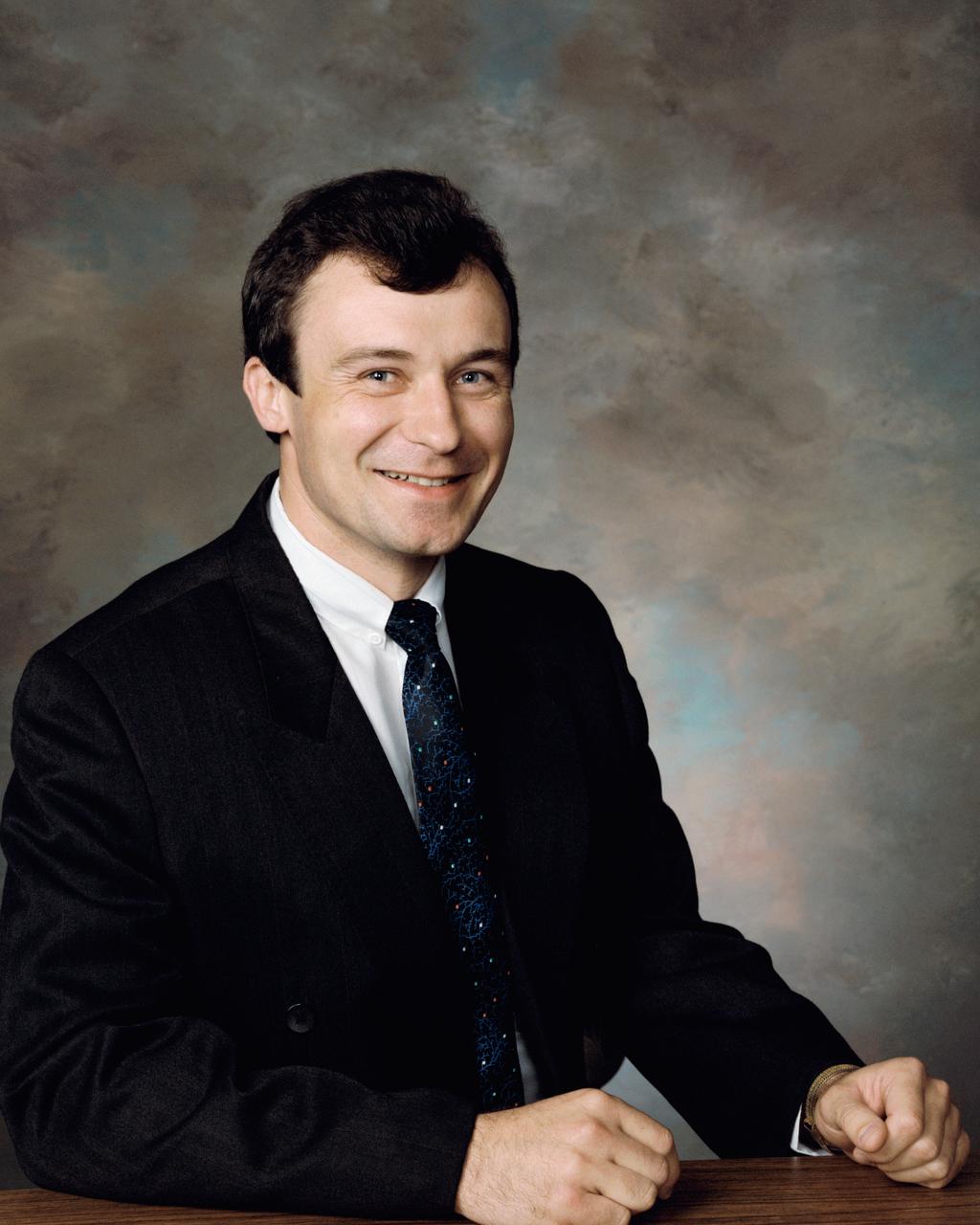
S94-34940 (June 1994) --- Vladimir N. Dezhurov, Russian cosmonaut Commander, Mir-18 EDITOR'S NOTE: Early next year, Dezhurov, along with NASA astronaut Norman E. Thagard and another cosmonaut, will be launched into Earth-orbit to spend three months aboard Russia's Mir space station.
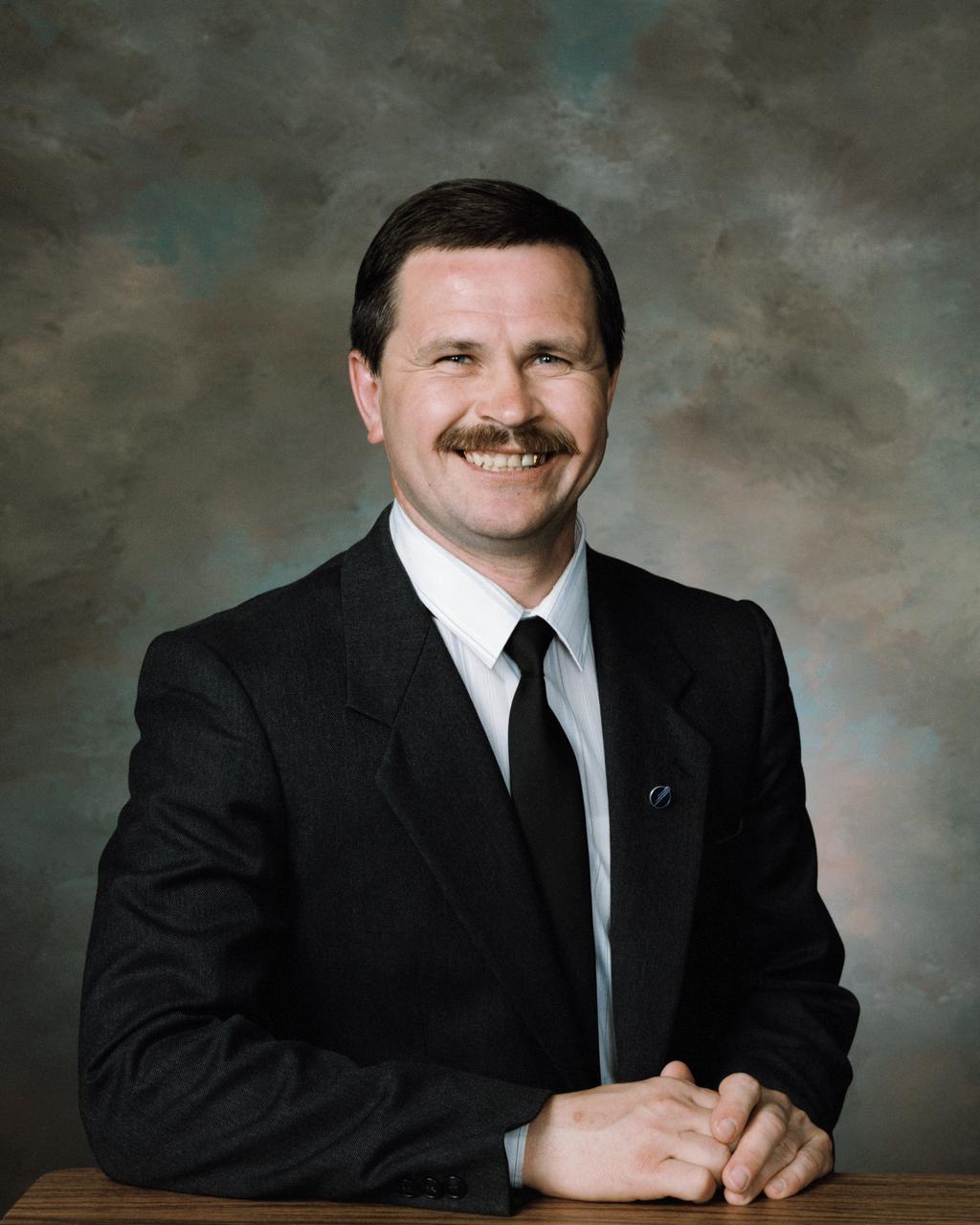
S94-34938 (27 May 1994) --- Cosmonaut Nikolai M. Budarin, flight engineer.
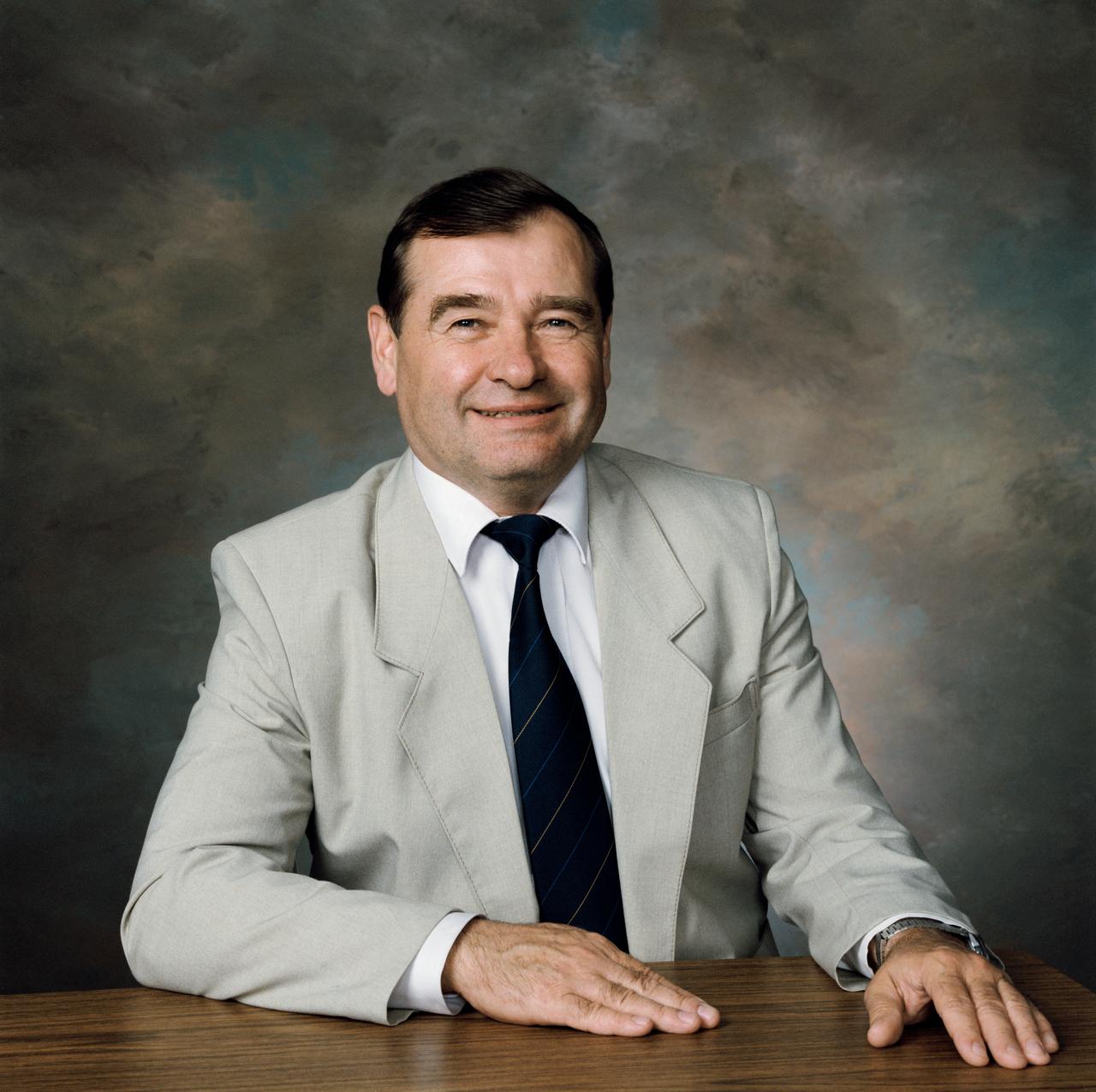
S94-34939 (Nov 1994) --- Gennadity M. Strekalov, Russian cosmonaut Flight Engineer, Mir-18.
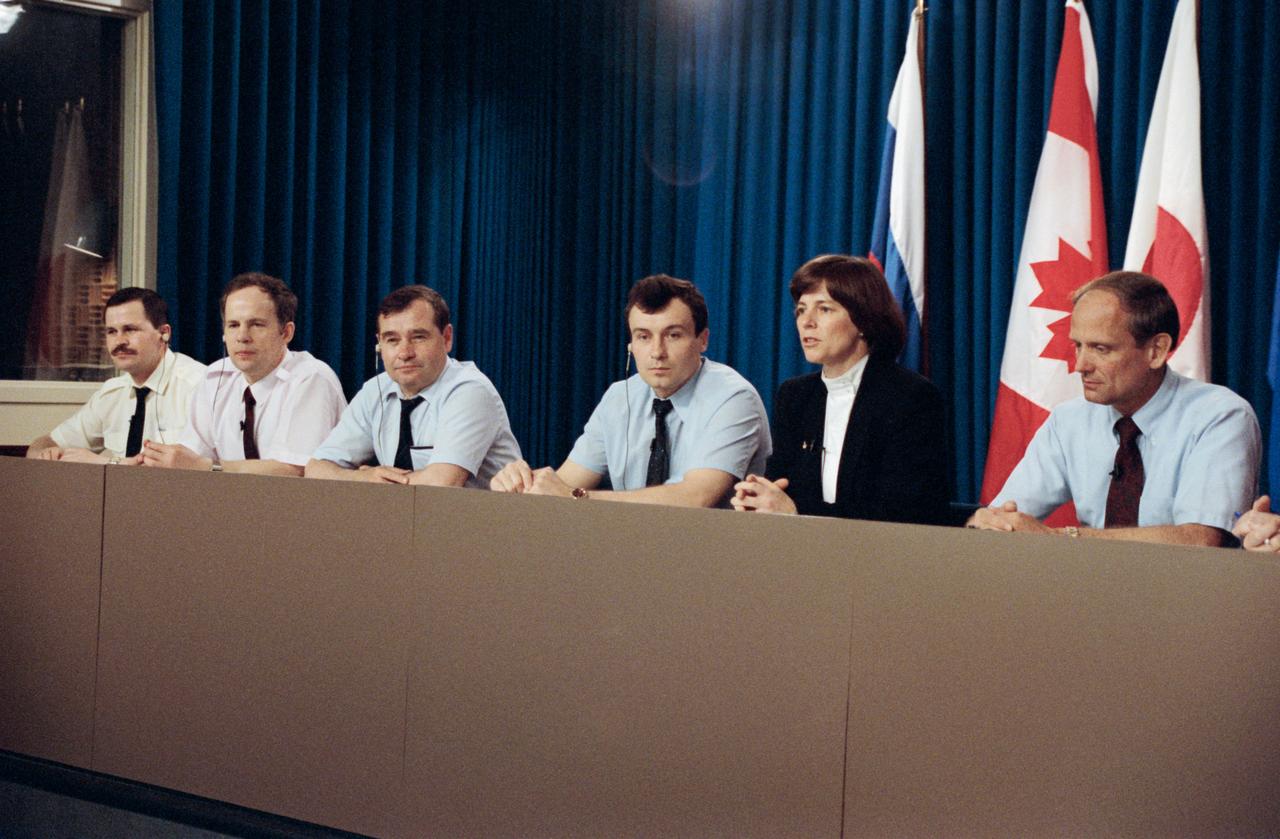
S94-34094 (16 June 1994) --- Crewmembers for the joint Space Shuttle/Mir missions meet the press at the Johnson Space Center (JSC). On the dais are, left to right, cosmonauts Nikolai M. Budarin, Anatoly Y. Solovyov, Gennady M. Strekalov and Vladimir N. Dezhurov, and astronauts Bonnie J. Dunbar and Norman E. Thagard. In a precedent-setting flight, Thagard will be launched with Dezhurov and Strekalov to Mir early next year for a three month mission, designated as Mir 18, on Russia's space station. Then in late May, as the assignment of STS-71, the space shuttle Atlantis will rendezvous with Mir to pick up the Mir 18 crew and transfer cosmonauts Solovyov and Budarin to the station for the Mir 19 mission. STS-71 mission specialist Dunbar is training as Thagard's backup.
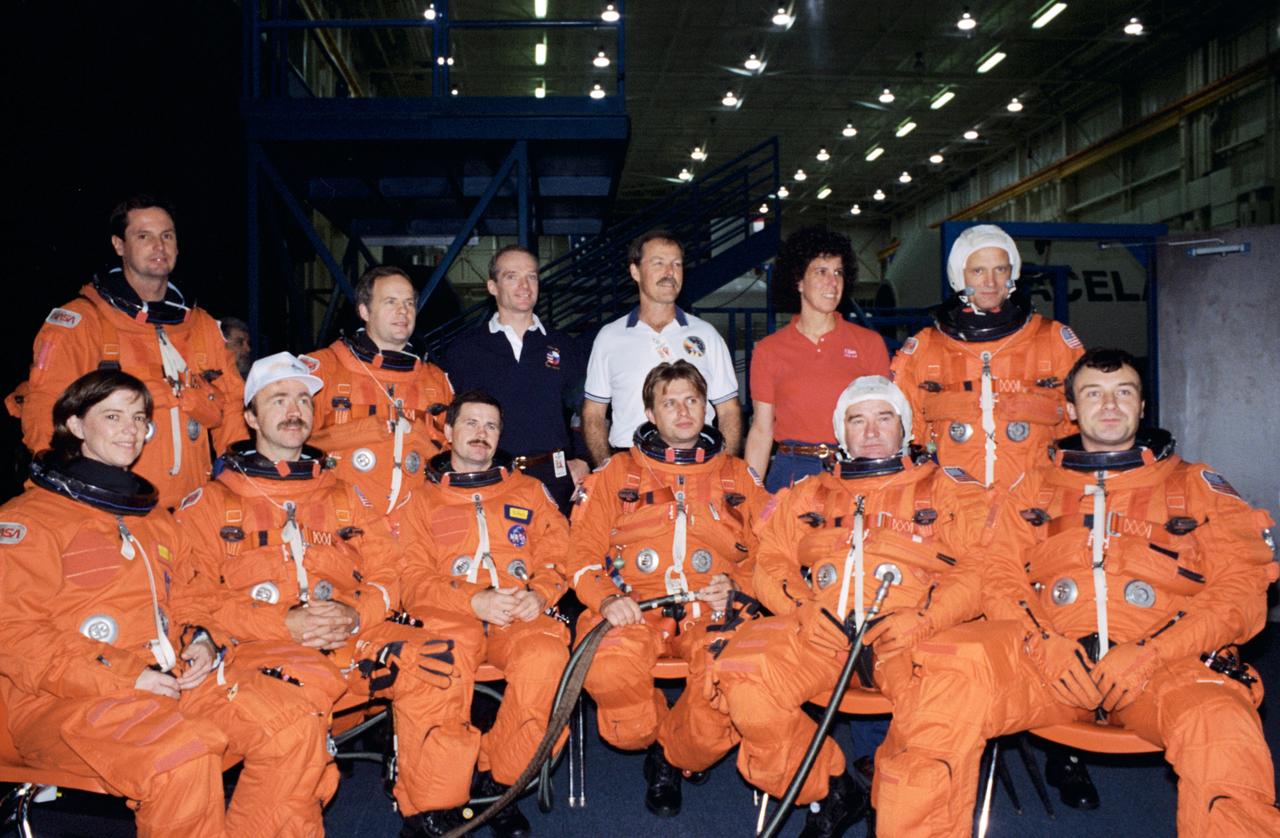
S94-47050 (28 Oct 1994) --- Crew members for the joint Space Shuttle/Russian Mir Space Station missions assemble for an informal portrait during a break in training in the Systems Integration Facility at the Johnson Space Center (JSC). In front (left to right) are astronaut Bonnie J. Dunbar; cosmonauts Aleksandr F. Poleshchuk, Yuriy I. Onufriyenko, Gennadiy M. Strekalov and Vladimir N. Dezhurov. In the rear are astronaut Gregory J. Harbaugh; cosmonaut Anatoliy Y. Solovyev, and astronauts Charles J. Precourt, Robert L. Gibson, Ellen S. Baker and Norman E. Thagard. In a precedent-setting flight, Thagard will be launched as a guest researcher along with Dezhurov, commander, and Strekalov, flight engineer, to Russia's Mir Space Station early next year for a three month mission, designated as Mir 18. Then in late spring, as the assignment of STS-71, the Space Shuttle Atlantis will rendezvous with Mir to pick up the Mir 18 crew and transfer cosmonauts Solovyov and Nikolai M. Budarin to the station for the Mir 19 mission. STS-71 mission specialist Dunbar is training as Thagard's backup.

A monument in honor of cosmonaut Yuriy A. Gagarin, the first human to fly in space, stands in front of a cosmonaut apartment building at the Gagarin Cosmonaut Training Center in Star City, Russia. At the time this photo was taken, NASA astronauts Norman E. Thagard and Bonnie J. Dunbar were in Russia for training.
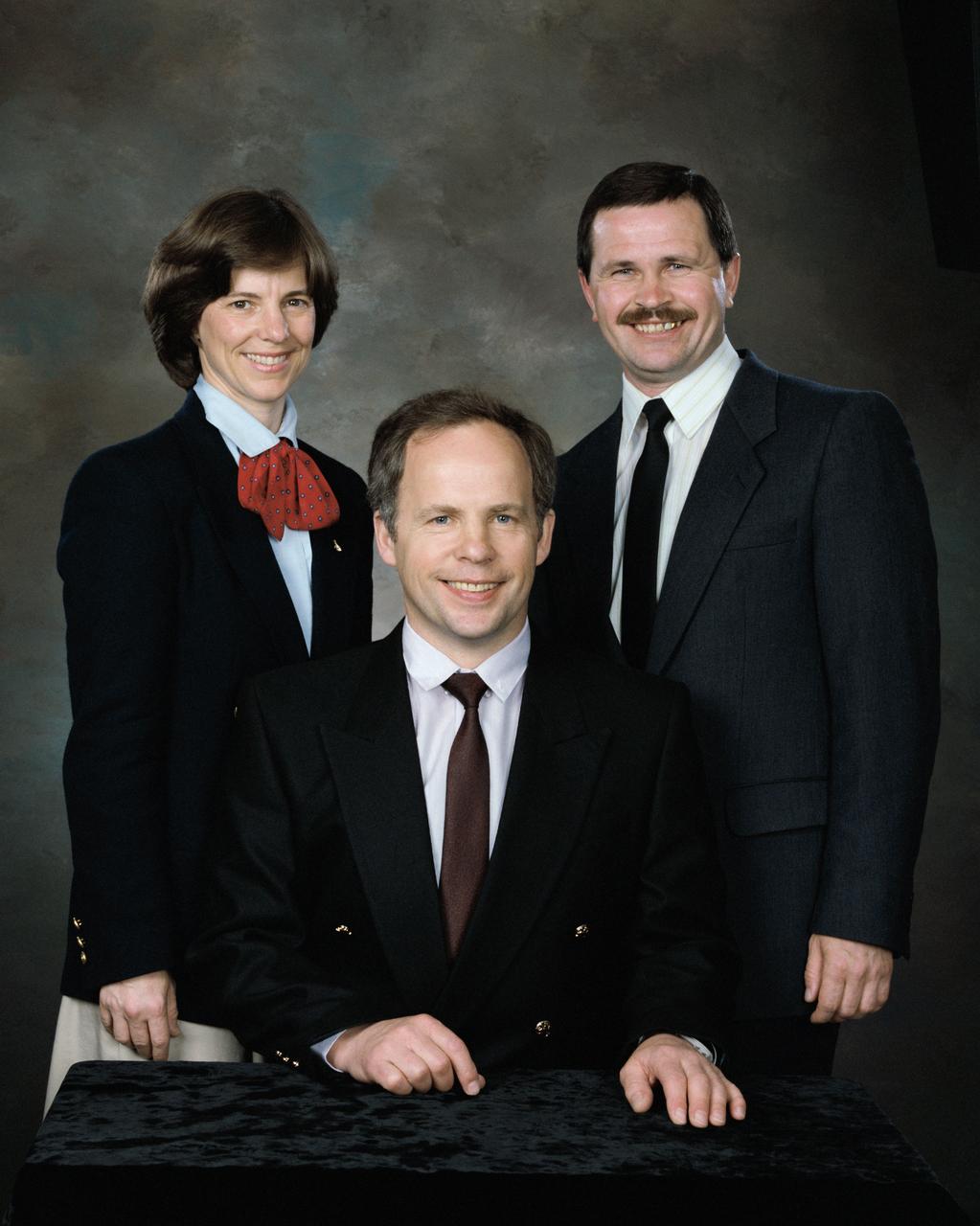
S94-34942 (27 May 1994) --- This is a portrait of (left to right) Bonnie J. Dunbar, Anatoliy Y. Solovyev, and Nikolai M. Budarin in civilian clothes. Dunbar is mission specialist for STS-71, and alternate crew member for Mir 18. Solovyev is commander for Mir 19, and Budarin is the flight engineer for that mission.
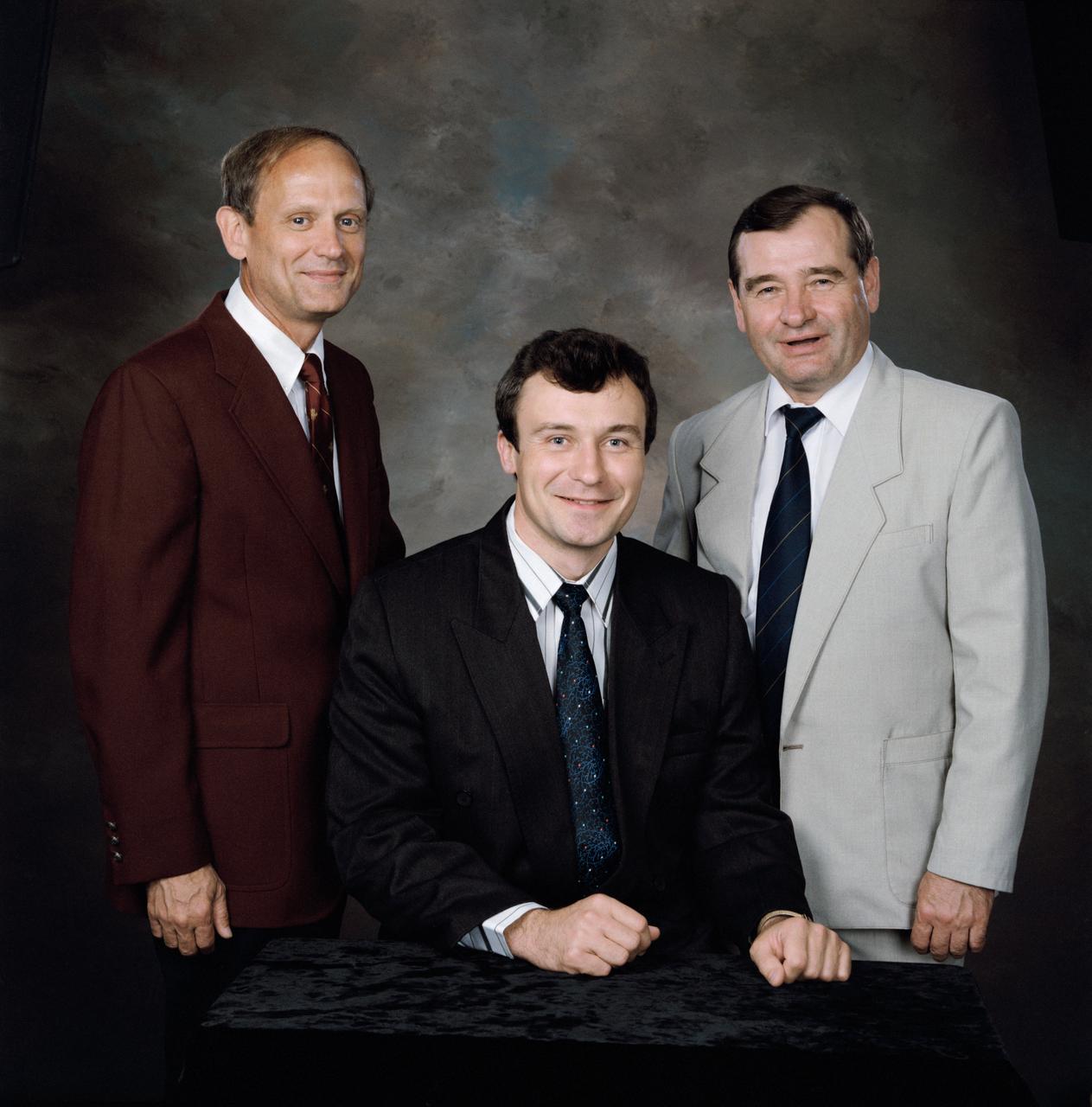
This is a portrait of the Mir 18 crew members in civilian clothes. They are (left to right) Norman E. Thagard, astronaut; commander Vladimir N. Dezhurov, cosmonaut; and Gennadiy M. Strekalov, cosmonaut.
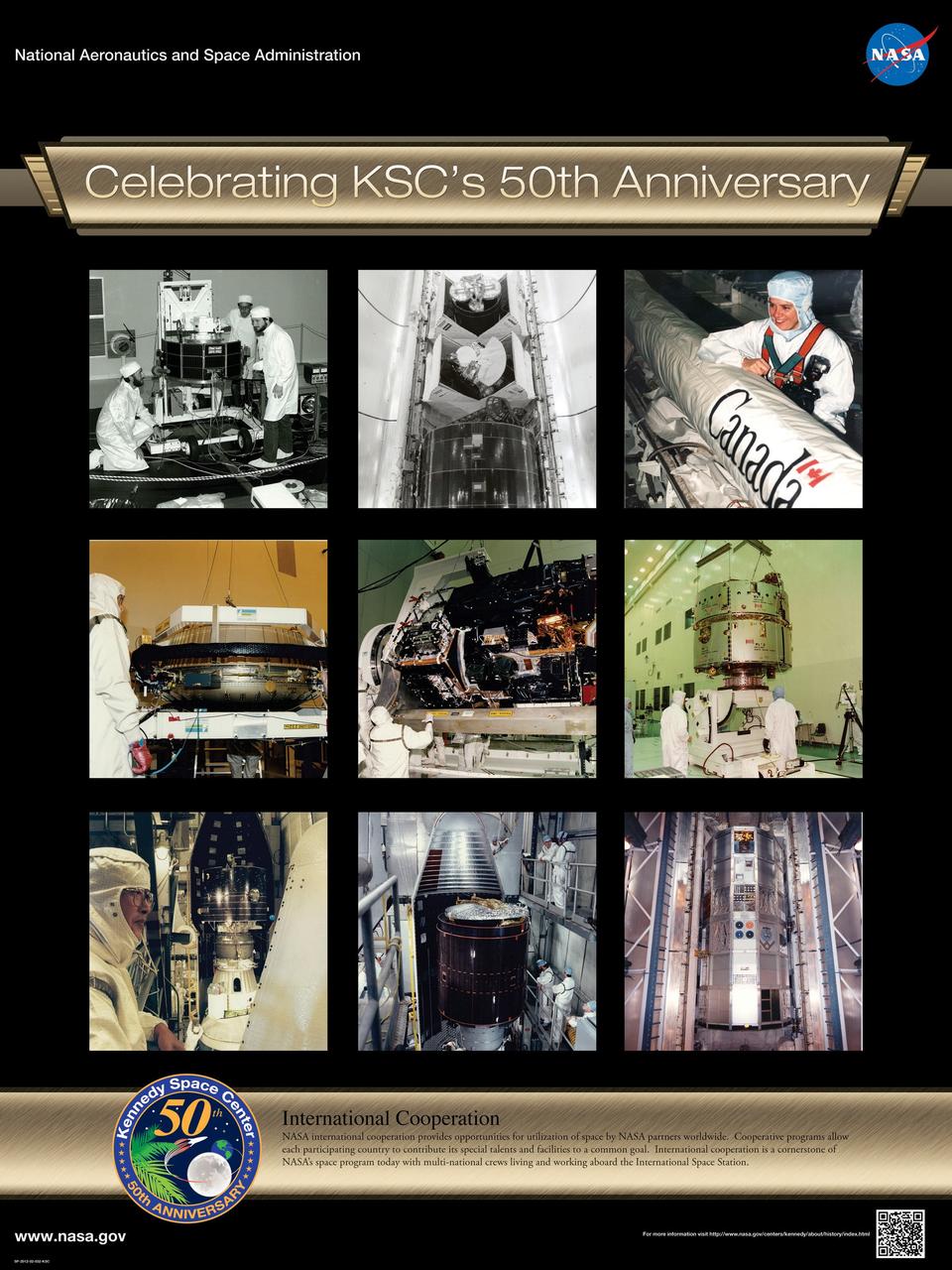
International Cooperation: NASA international cooperation provides opportunities for utilization of space by NASA partners worldwide. Cooperative programs allow each participating country to contribute its special talents and facilities to a common goal. International cooperation is a cornerstone of NASA’s space program today with multi-national crews living and working aboard the International Space Station. Poster designed by Kennedy Space Center Graphics Department/Greg Lee. Credit: NASA
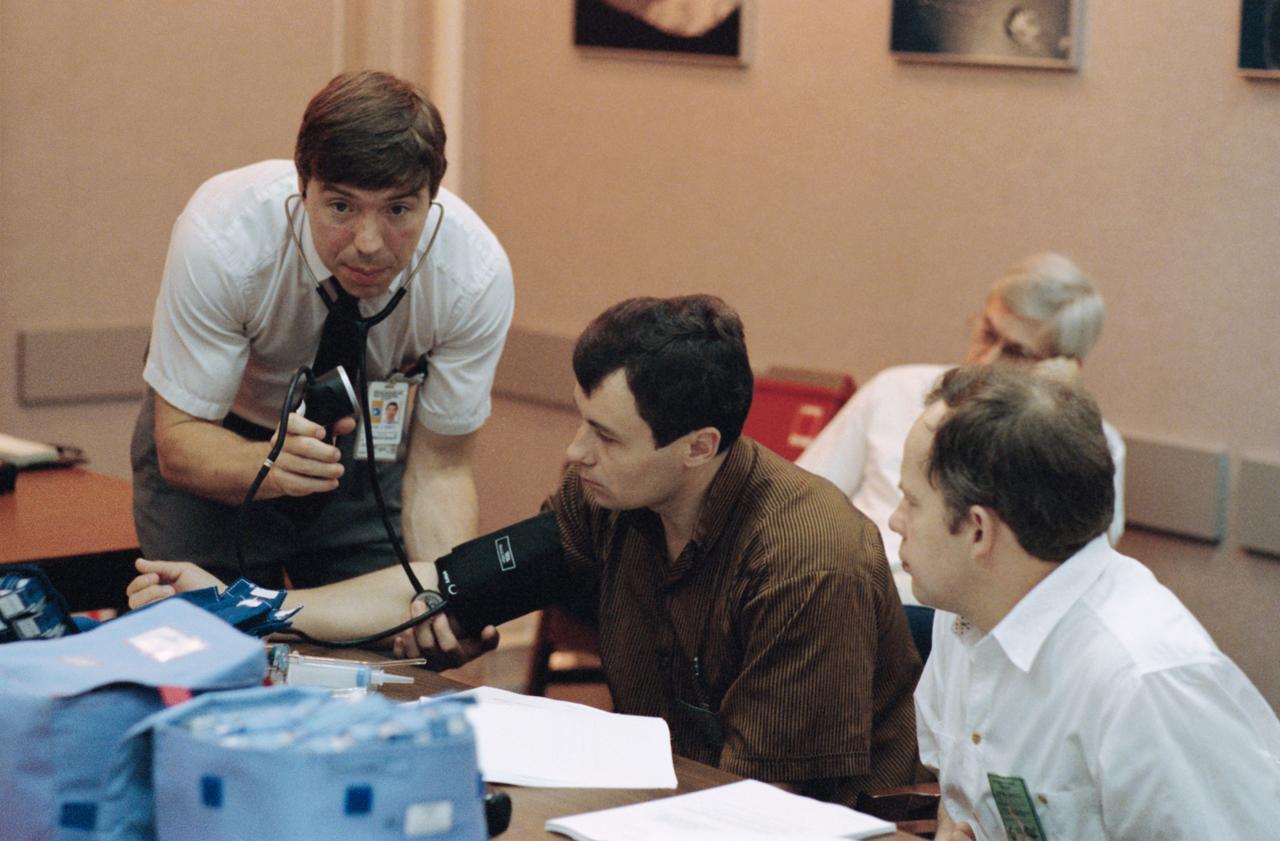
Cosmonaut Vladimir N. Dezhurov (center), Mir 18 mission commander, gets his blood pressure taken by Dr. Michael J. Barrett, flight surgeon. Cosmonaut Anatoliy Y. Solovyev (right), Mir 19 mission commander, looks on. Solovyev, Dezhurov, along with their respective flight engineers and a number of other cosmonauts and astronauts participating in the joint program, were in Houston, Texas, to prepare for their upcoming missions.
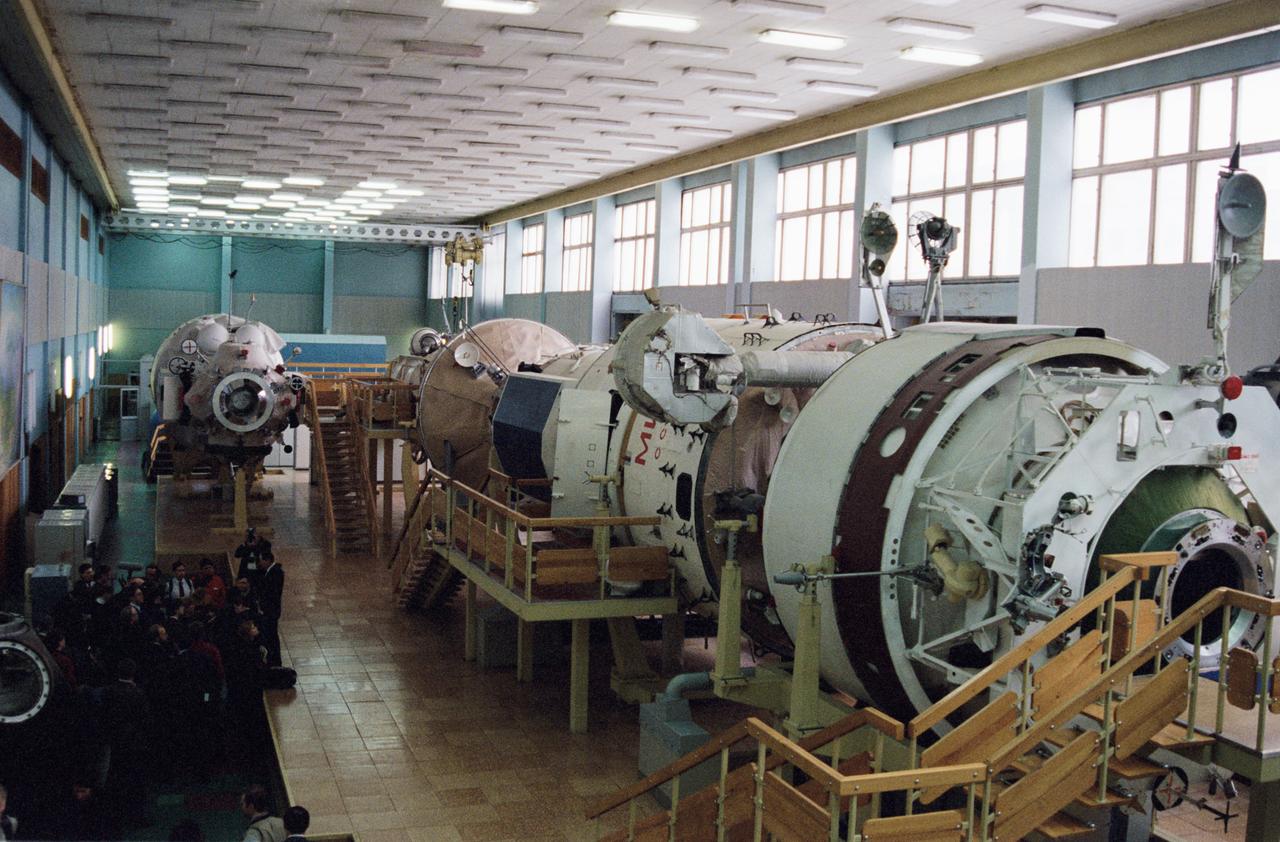
S95-04320 (22 Feb 1995) --- A full-scale mockup of Russia's Space Station with the core module called Mir in the center. Other modules connected to the core include Kvant, Kvant II and Kristall. The mockup at the Gagarin Cosmonaut Training Center in Star City, Russia is used for cosmonaut training prior to flights aboard the orbiting laboratory. At the time this photo was taken, NASA astronauts Norman E. Thagard and Bonnie J. Dunbar were in Russia for training.
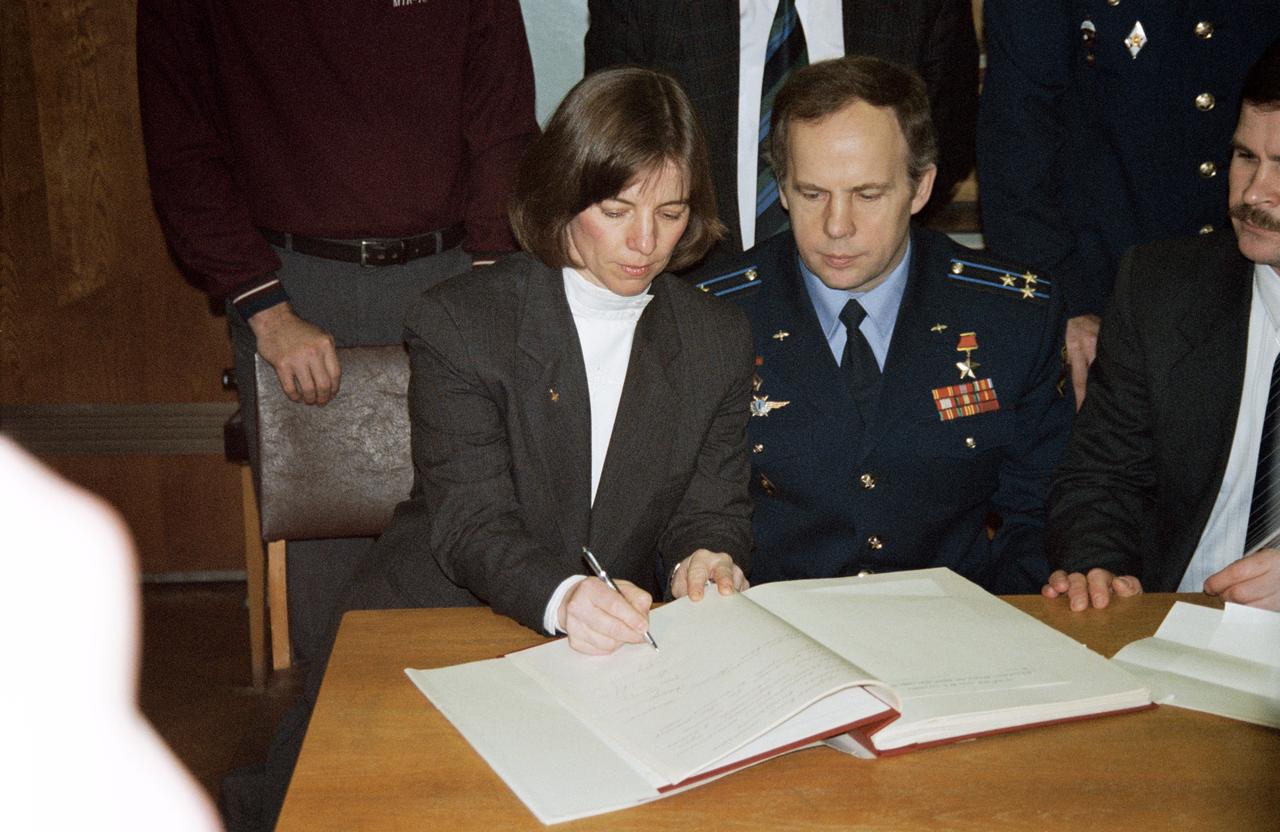
S95-04325 (22 March 1995) --- In keeping with Russian tradition, astronaut Bonnie J. Dunbar (left), STS-71 mission specialist, signs the diary of the late Yuriy A. Gagarin, the first Russian cosmonaut, as her STS-71 crew mates look on. Cosmonauts Anatoliy Y. Solovyov (center), Mir 19 mission commander, and Nikiolai M. Budarin, flight engineer, have been training with Dunbar in both the United States and Russia for the past several months. It is customary for each crew member about to aboard a Russian spacecraft to sign the diary. Dunbar has been in Russia training as alternate researcher for the Mir 18 mission.
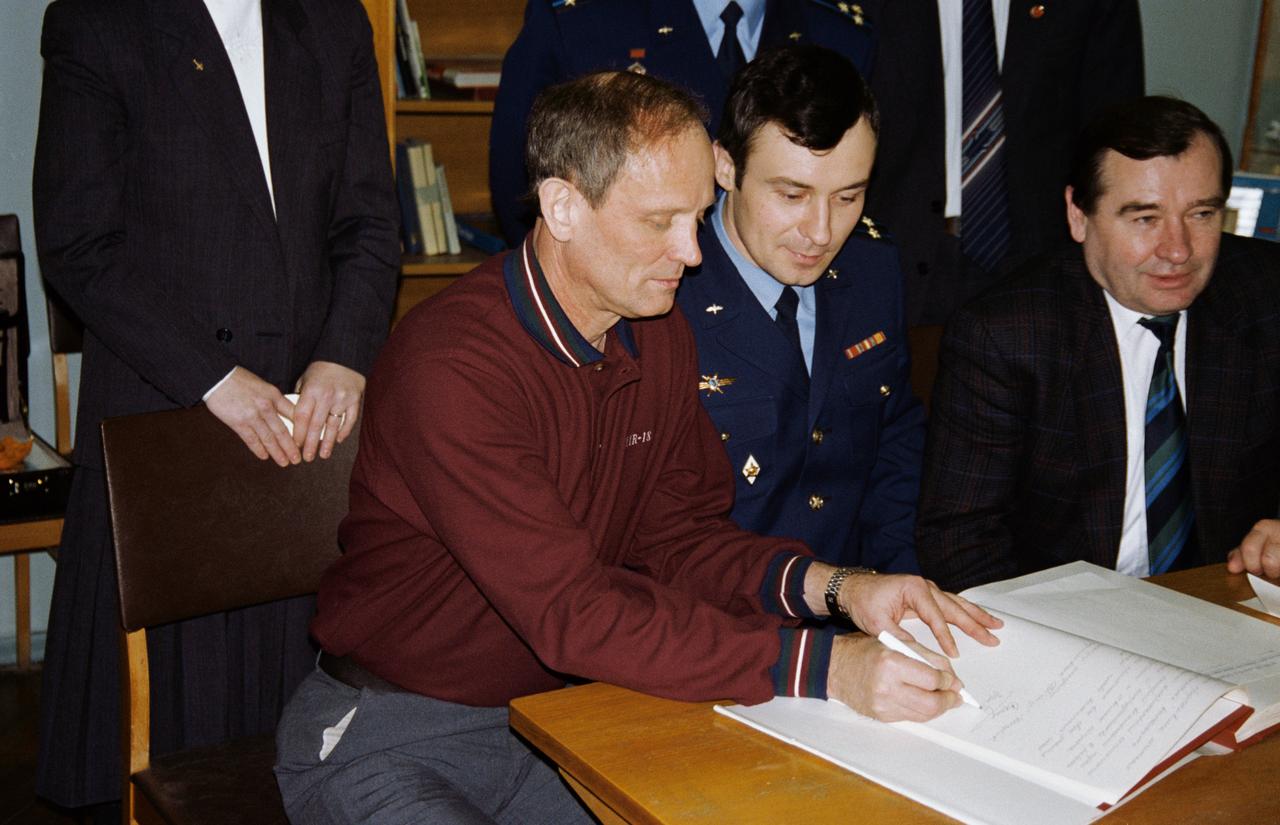
S95-04324 (22 March 1995) --- In keeping with Russian tradition, astronaut Norman E. Thagard (left), guest researcher, signs the diary of the late Yuriy A. Gagarin, the first Russian cosmonaut, as his Mir 18 crew mates look on. Cosmonauts Vladimir N. Dezhurov (center), mission commander, and Gennadiy M. Strkalov, flight engineer, have been training with Thagard in both the United States and Russia for the past several months. It is customary for each crew member about to aboard a Russian spacecraft to sign the diary.
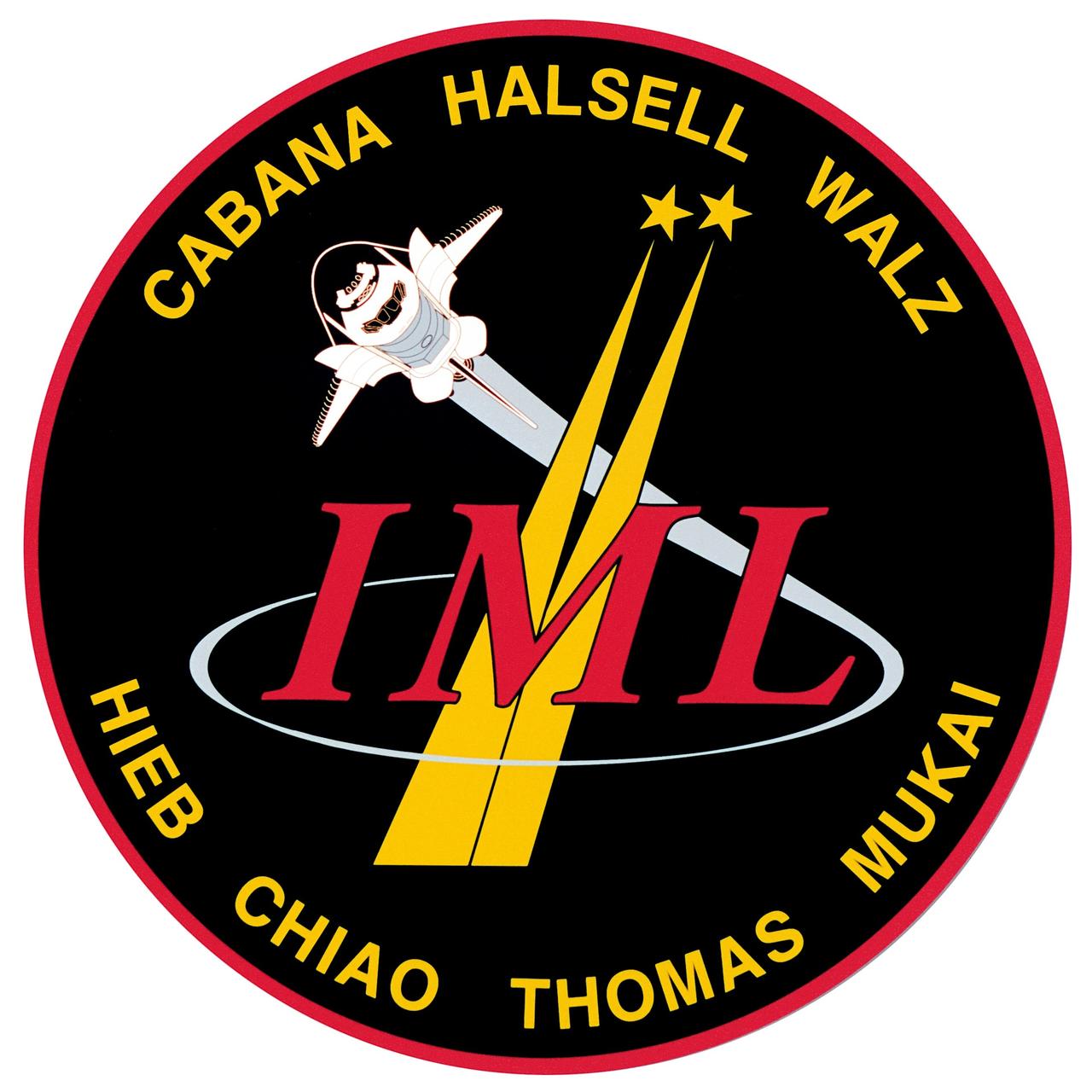
STS065-S-001 (March 1994) --- Designed by the crew members, the STS-65 insignia features the International Microgravity Laboratory (IML-2) mission and its Spacehab module which will fly aboard the space shuttle Columbia. IML-2 is reflected in the emblem by two gold stars shooting toward the heavens behind the IML lettering. The space shuttle Columbia is depicted orbiting the logo and reaching into space, with Spacehab on an international quest for a better understanding of the effects of spaceflight on materials processing and life sciences. The NASA insignia design for space shuttle flights is reserved for use by the astronauts and for other official use as the NASA Administrator may authorize. Public availability has been approved only in the forms of illustrations by the various news media. When and if there is any change in this policy, which is not anticipated, the change will be publicly announced. Photo credit: NASA
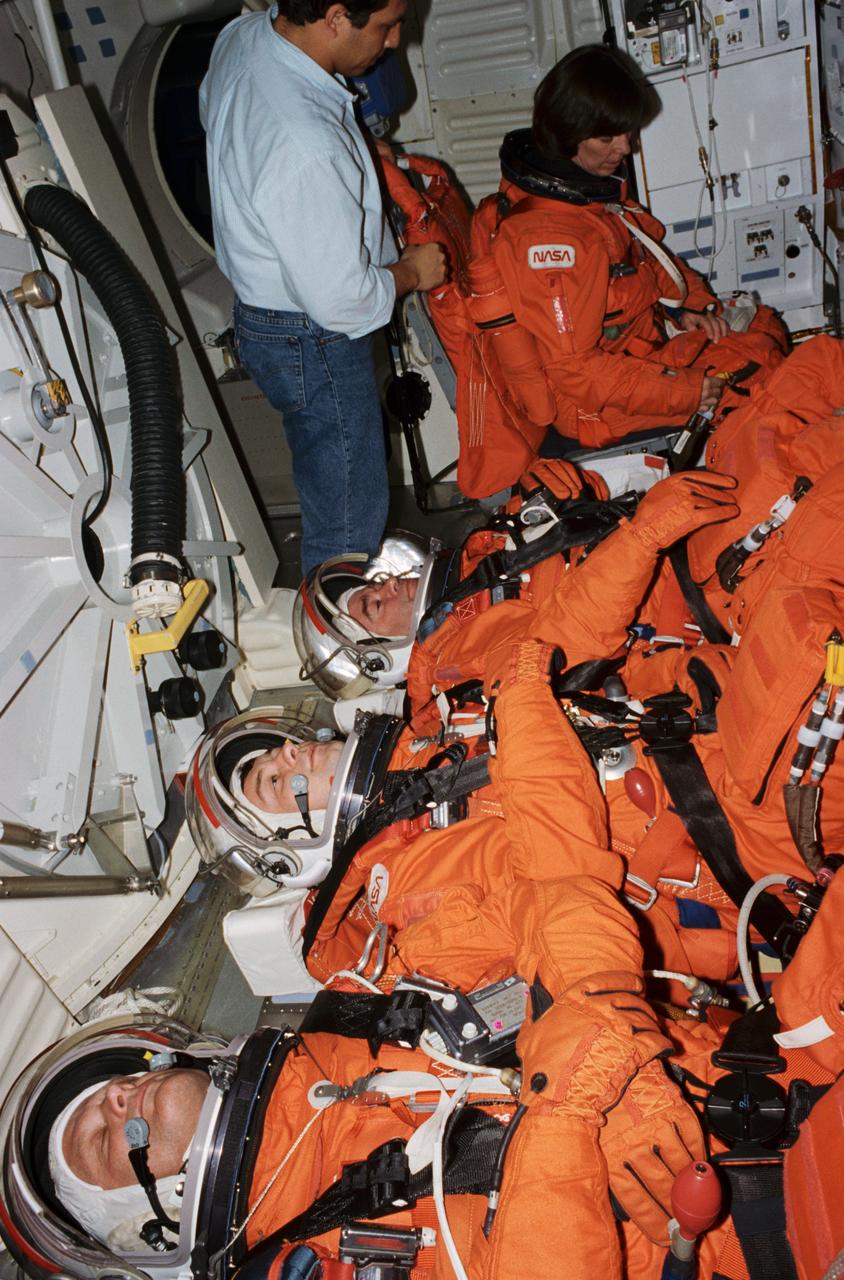
S94-47075 (Nov. 1994) --- In a Shuttle mockup trainer at the Johnson Space Center (JSC), a NASA astronaut and two Russian cosmonauts assigned to Russia's Mir 18 mission check out hardware like that to be flown onboard NASA's Space Shuttle Atlantis, the spacecraft that will retrieve the three from their orbital home for three months. Astronaut Norman E. Thagard (left), cosmonaut Vladimir N. Dezhurov, mission commander; and Gennadiy M. Strekalov, flight engineer; practice using the Recumbent Seating System (RSS). Astronaut Bonnie J. Dunbar, Thagard's backup on Mir 18 and mission specialist for STS-71, sits in a conventional middeck launch and entry station in the background. RSS has been manifest to be carried on the Space Shuttle Atlantis for the STS-71 mission. When the Space Shuttle Atlantis docks with Russia's Mir Space Station in 1995, Thagard and the two Russian cosmonauts, who will have been onboard Mir for a long duration stay, will join the STS-71 crew for the return to Earth.
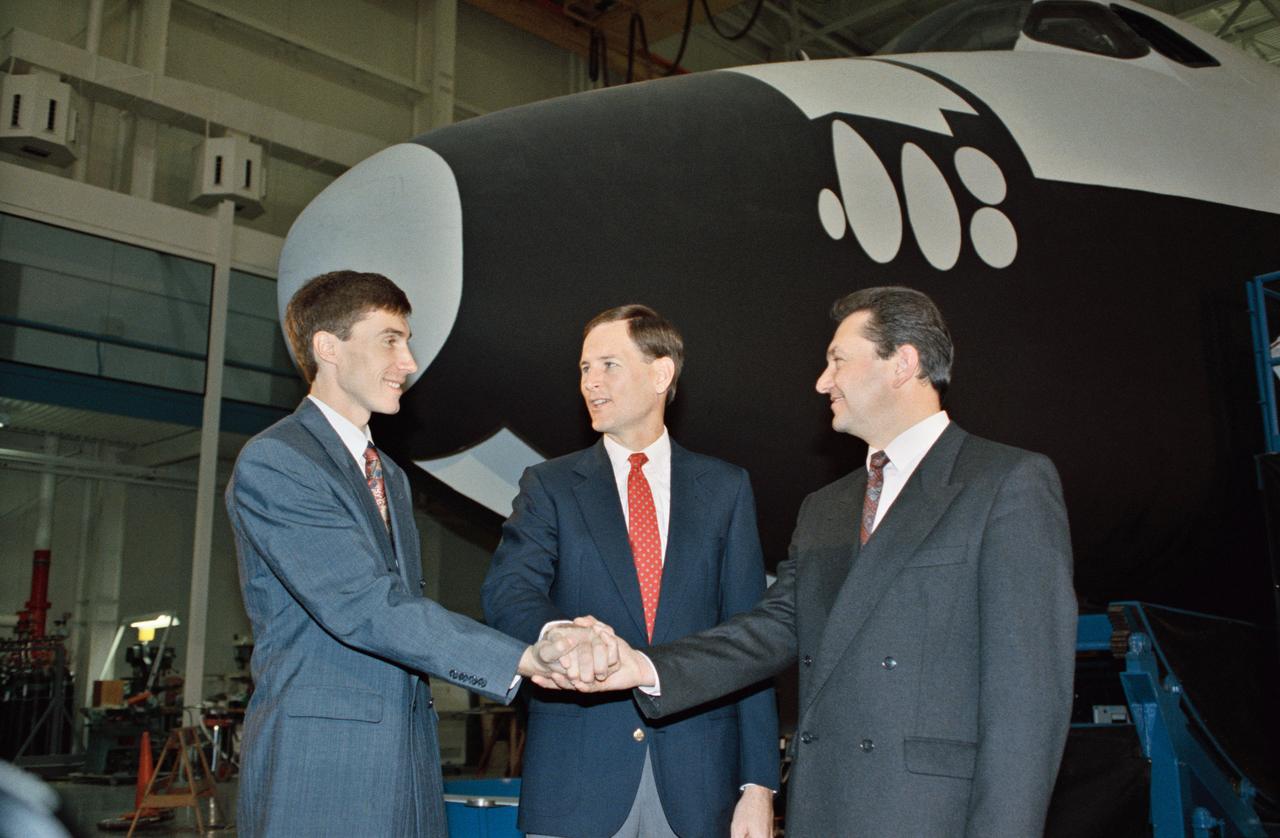
S92-49715 (10 Nov 1992) --- Russian cosmonauts Sergei Krikalev (left), and Vladimir Titov (right) share a team handshake with Kenneth L. Reightler, STS-60 pilot. The cosmonauts toured the Space Shuttle mockup and integration laboratory, in which they will undergo a great deal of training in preparation for the mission. One of the two will later be named as prime payload specialist and the second will serve as his alternate. The six person crew, to be led by astronaut Charles F. Bolden, mission commander, will man the Space Shuttle Discovery for the scheduled eight-day flight.
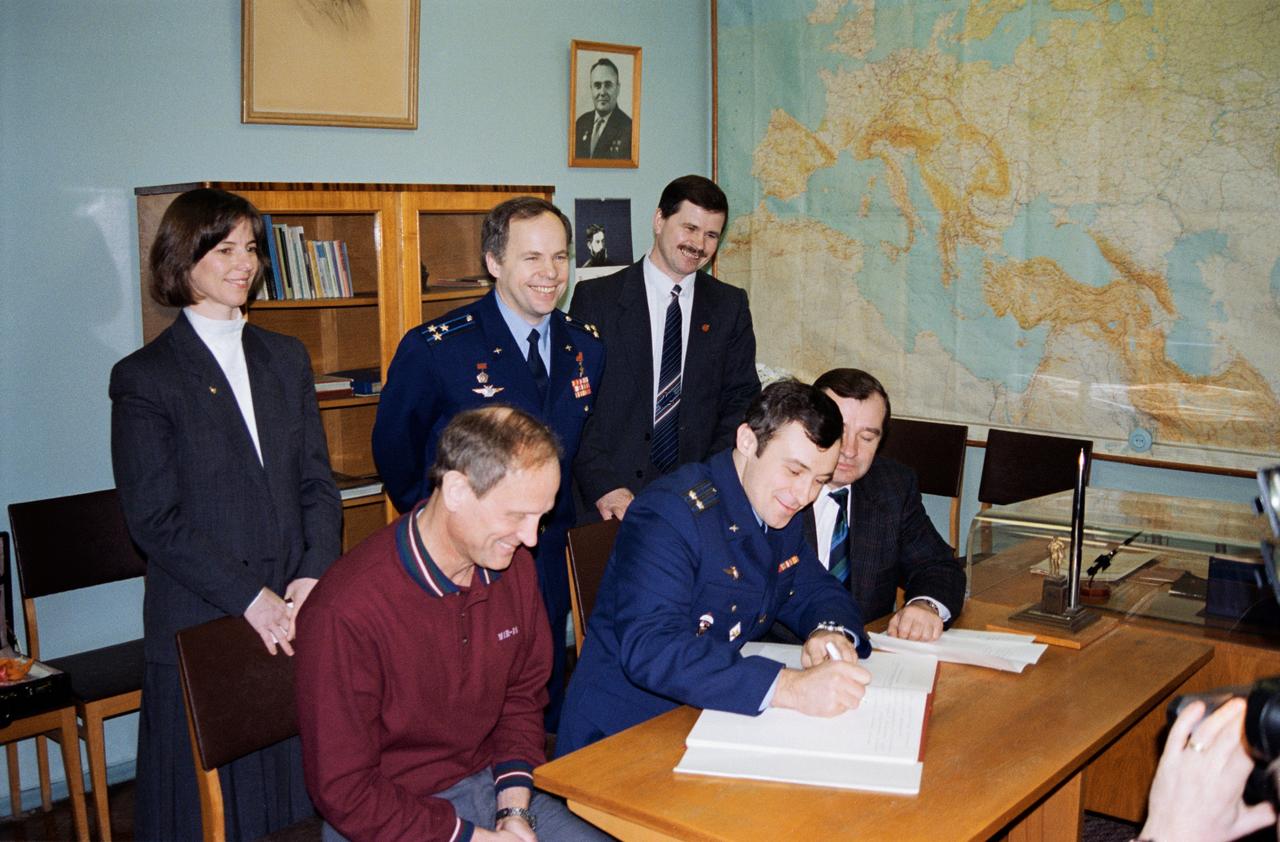
S95-04323 (22 Feb 1995) --- In keeping with Russian tradition, astronaut Norman E. Thagard (seated, left), guest researcher, watches as Vladimir N. Dezhurov (seated, center), signs the diary of the late Yuriy A. Gagarin, the first Russian cosmonaut, as his Mir 18 crew mates and the subsequent Mir crewmembers look on. Cosmonauts Dezhurov, mission commander, and Gennadiy M. Strekalov (seated right, partially obscured), flight engineer, have been training with Thagard in both the United States and Russia for the past several months. Watching are, standing left to right, astronaut Bonnie J. Dunbar, Thagard?s alternate crew member; and cosmonauts Anatoliy Y. Solovyev, Mir 19 mission commander, and Nikolai M. Budarin, flight engineer.
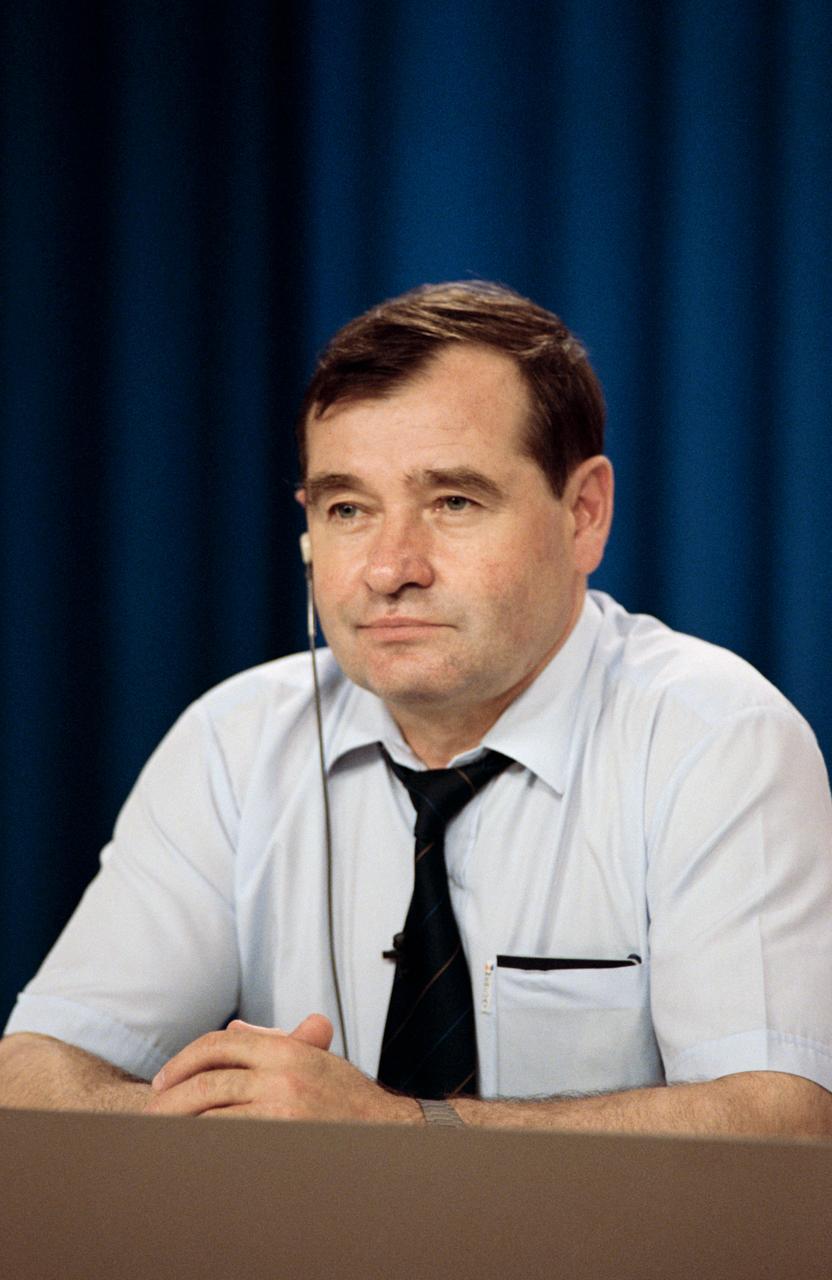
Cosmonaut Gennadiy M. Strekalov, flight engineer for the Mir-18 mission, listens to a question from a news media representative. Crew members for two of the joint Space Shuttle/Mir missions met the press at JSC.
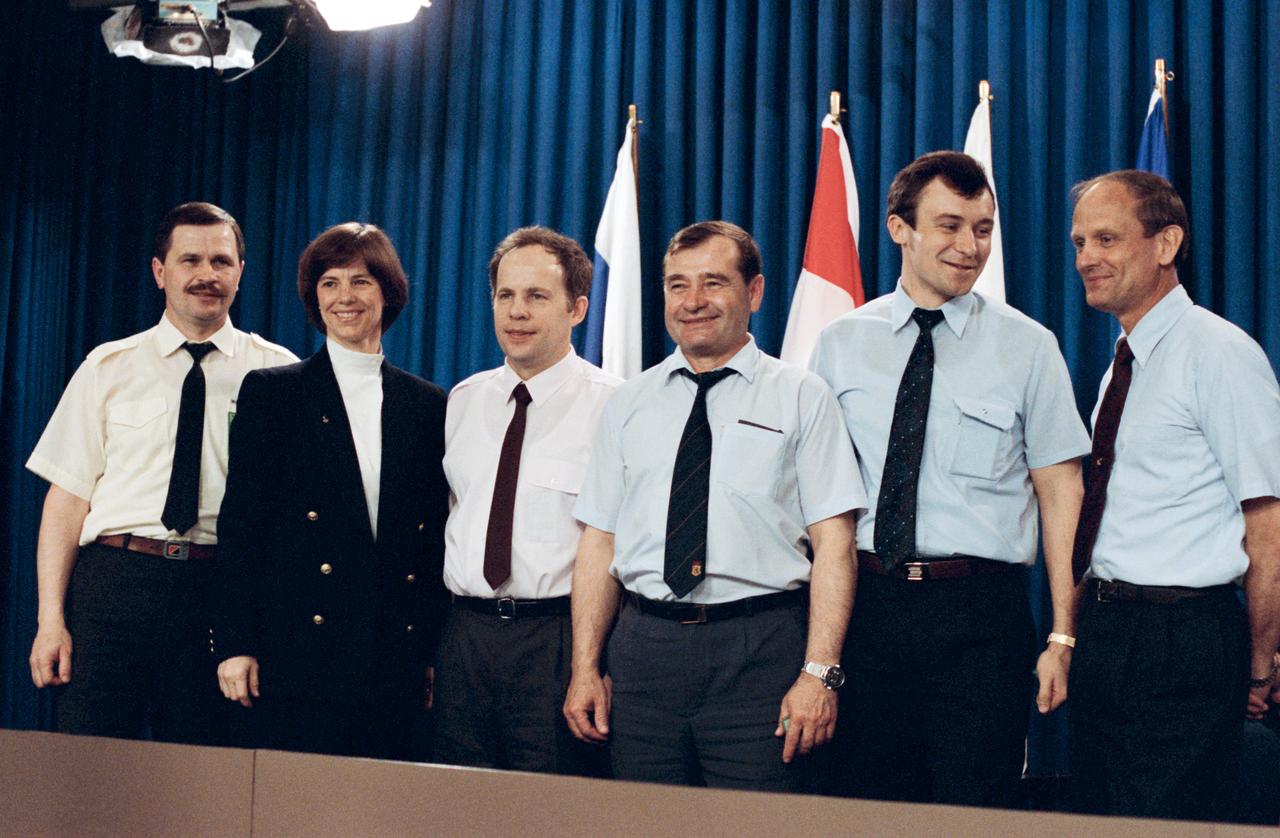
S94-34099 (16 June 1994) --- Crewmembers for two of the joint Space Shuttle/Mir missions pose for photographs after fielding questions from the press at Johnson Space Center (JSC). Left to right are cosmonaut Nikolai M. Budarin, astronaut Bonnie J. Dunbar, cosmonauts Anatoliy Y. Solovyov, Gennadiy M. Strekalov and Vladimir N. Dezhurov; and astronaut Norman E. Thagard. In a precedent-setting flight, Thagard will be launched with Dezhurov and Strekalov to Russia?s Mir Space Station early next year for a three-month mission, designated as Mir 18. Then in late May, as the assignment of STS-71, the Space Shuttle Atlantis will rendezvous with Mir to pick up the Mir 18 crew and transfer cosmonauts Solovyov and Budarin to the station for the Mir 19 mission. STS-71 mission specialist Dunbar is training as Thagard?s backup.
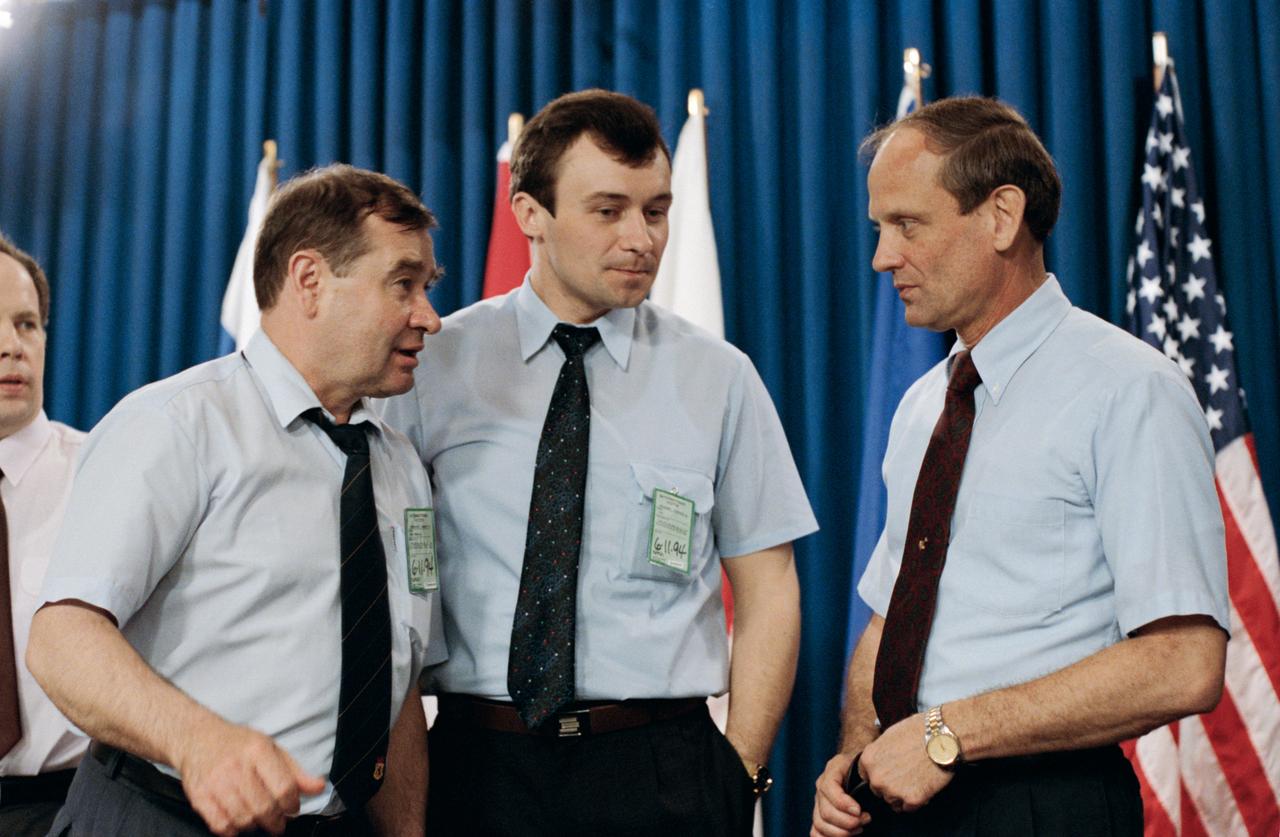
Astronaut Norman E. Thagard, right, chats with two Russian cosmonauts with whom he will be launched into space early next year for a three month mission. Designated Mir 18, the mission aboard the Russian space station will include Mir 18 crew members Gennadiy Strekalov (left) and commander Vladimir Dezhurov. The three appeared at a press conference during a break in medical training at JSC.
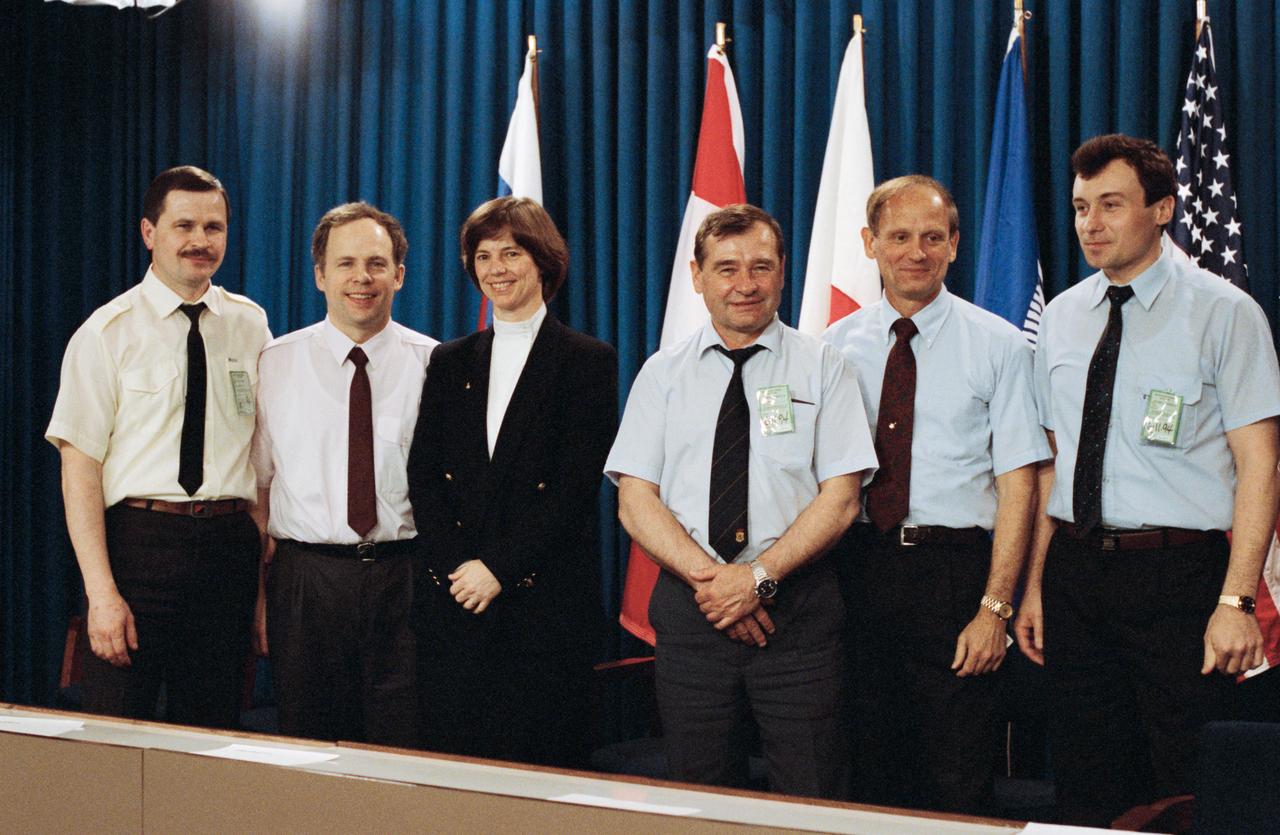
Crew members for two joint Space Shuttle/Mir missions greet the press during a break in medical operations training at JSC. Left to right are Nikolai M. Budarin, Anatoly Y. Solovyev, Bonnie J. Dunbar, Gennadiy M. Strekalov, Norman E. Thagard and Vladimir N. Dezhurov.
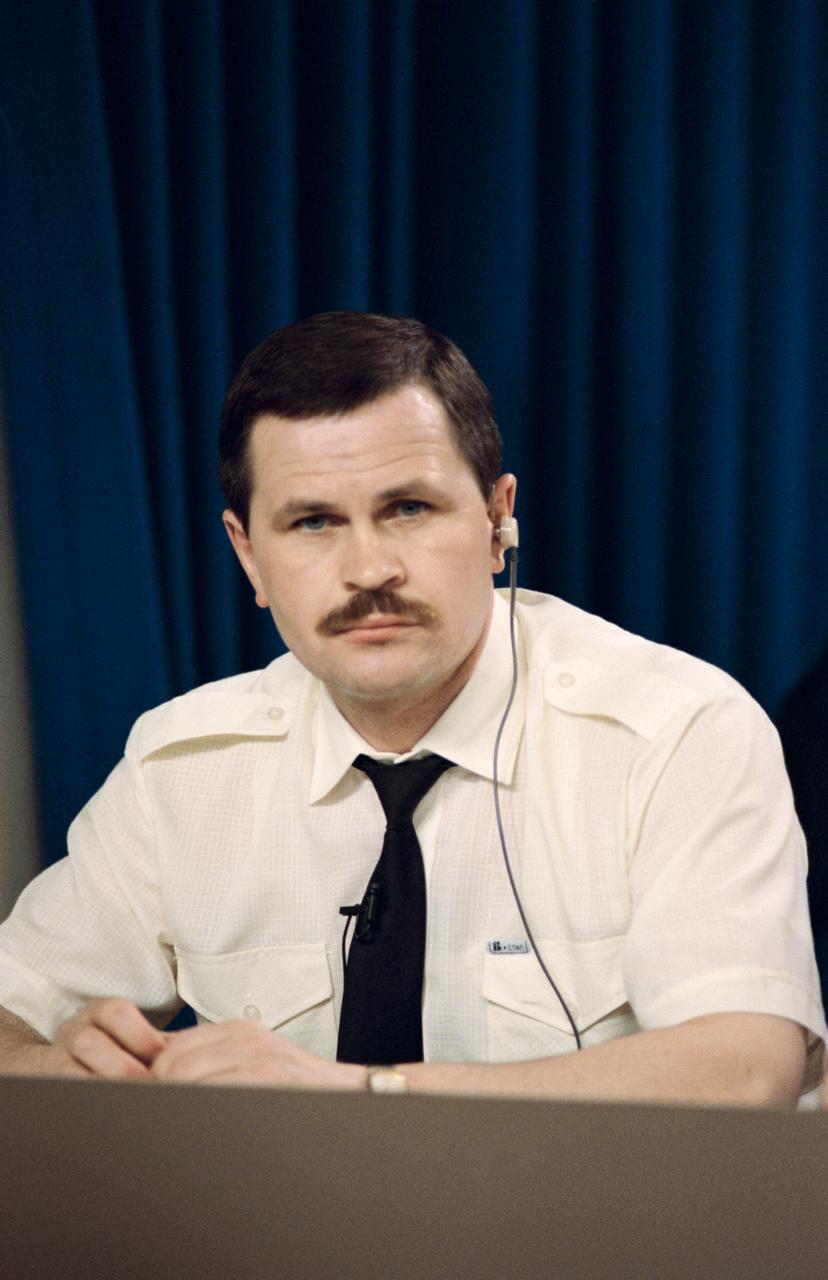
Cosmonaut Nikolai M. Budarin, flight engineer for Mir 19, ponders a question from a news media representative. Crew members for two of the joint Space Shuttle/Mir missions met the press at JSC.
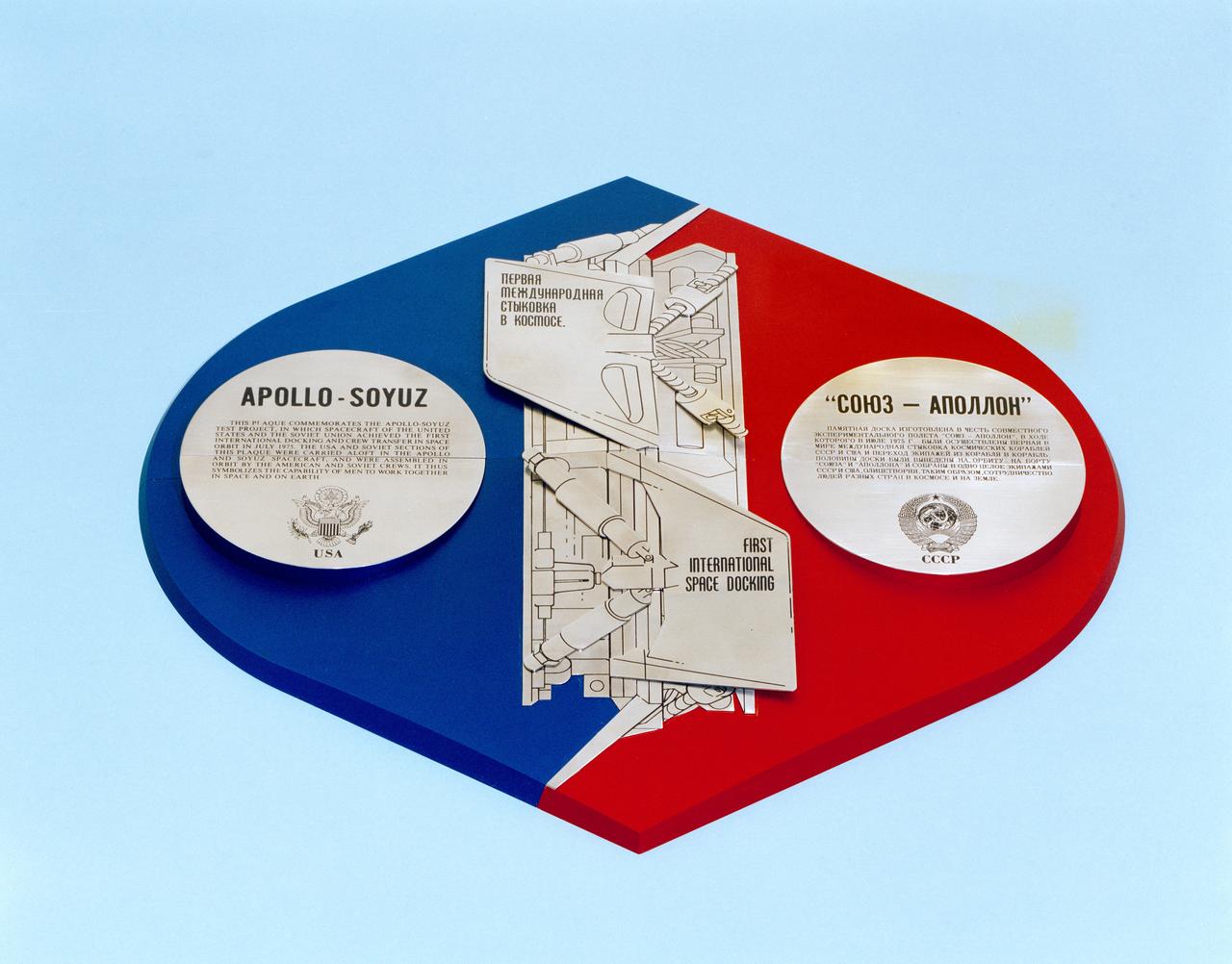
S75-26927 (July 1975) --- A close-up view of the Commemorative Plaque for the Apollo-Soyuz Test Project. Two plaques divided into four quarters each will be flown on the ASTP mission. A four-part plaque is completely assembled here. The American ASTP crew will carry the four U.S. quarter pieces aboard Apollo; and the Soviet ASTP crew will carry the four USSR quarter sections aboard Soyuz. The eight quarter pieces will be joined together to form two complete commemorative plaques after the two spacecraft rendezvous and dock in Earth orbit. One complete plaque then will be returned to Earth by the astronauts; and the other complete plaque will be brought back by the cosmonauts. The plaque is written in both English and Russian.

Cosmonaut Anatoliy Y. Solovyev, mission commander for Mir 19, responds to a question from a news media representative. Crew members for two of the joint Space Shuttle/Mir missions met the press at JSC.
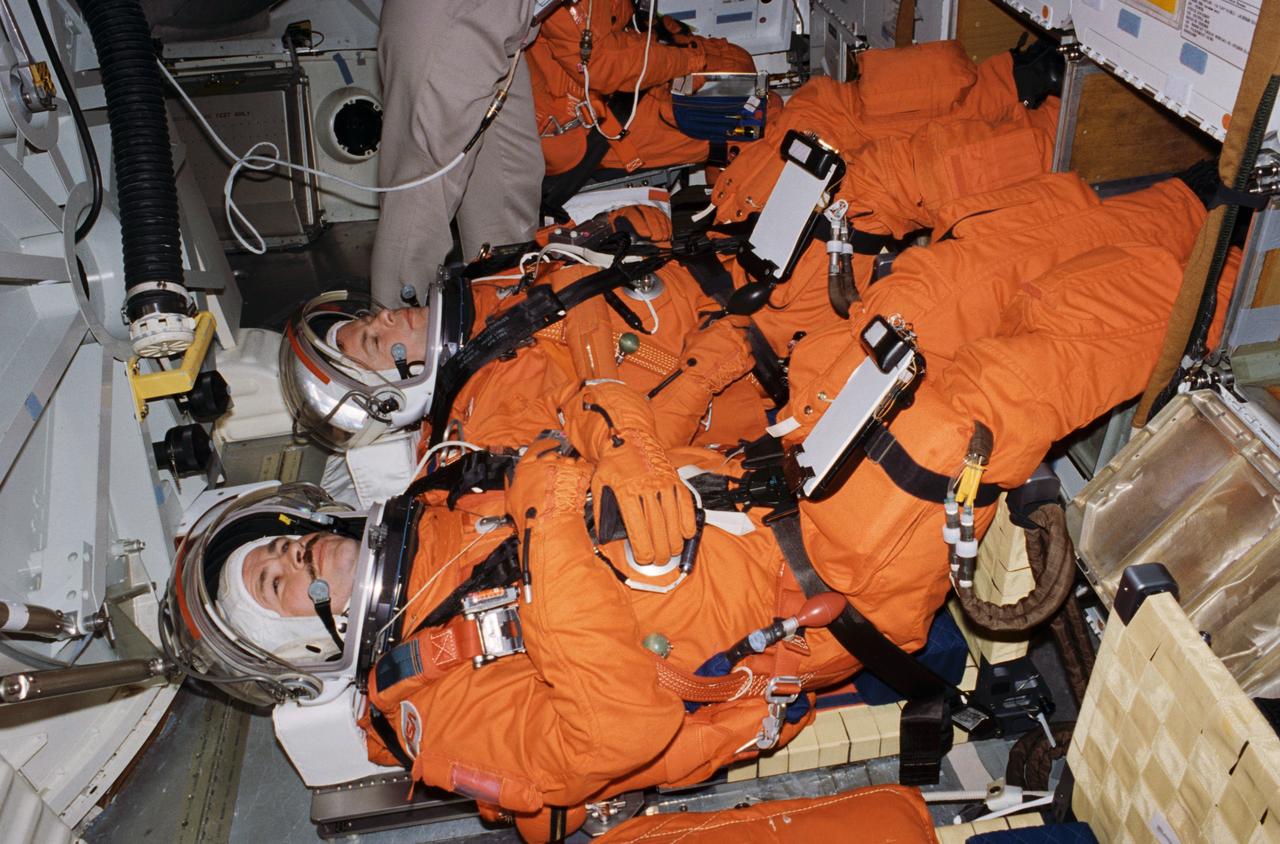
S94-47071 (Nov. 1994) --- In a Shuttle mockup trainer at the Johnson Space Center (JSC), two Russian cosmonauts assigned to Russia's Mir 19 mission check out hardware like that to be flown onboard NASA's Space Shuttle Atlantis, the spacecraft that will take the pair to their orbital destination. Anatoly Y. Solovyev, mission commander; and Nikolai M. Budarin (nearest camera), flight engineer, practice using the Recumbent Seating System (RSS). RSS has been manifest to be carried on the Space Shuttle Atlantis for the STS-71 mission. When Atlantis docks with the Mir space station in 1995, a NASA astronaut and two other Russian cosmonauts, who will have been onboard Mir for a long duration stay, will join the STS-71 crew for the return to Earth. Solovyev and Budarin will remain aboard Mir, to return to Earth later in one of Russia's Soyuz spacecraft.
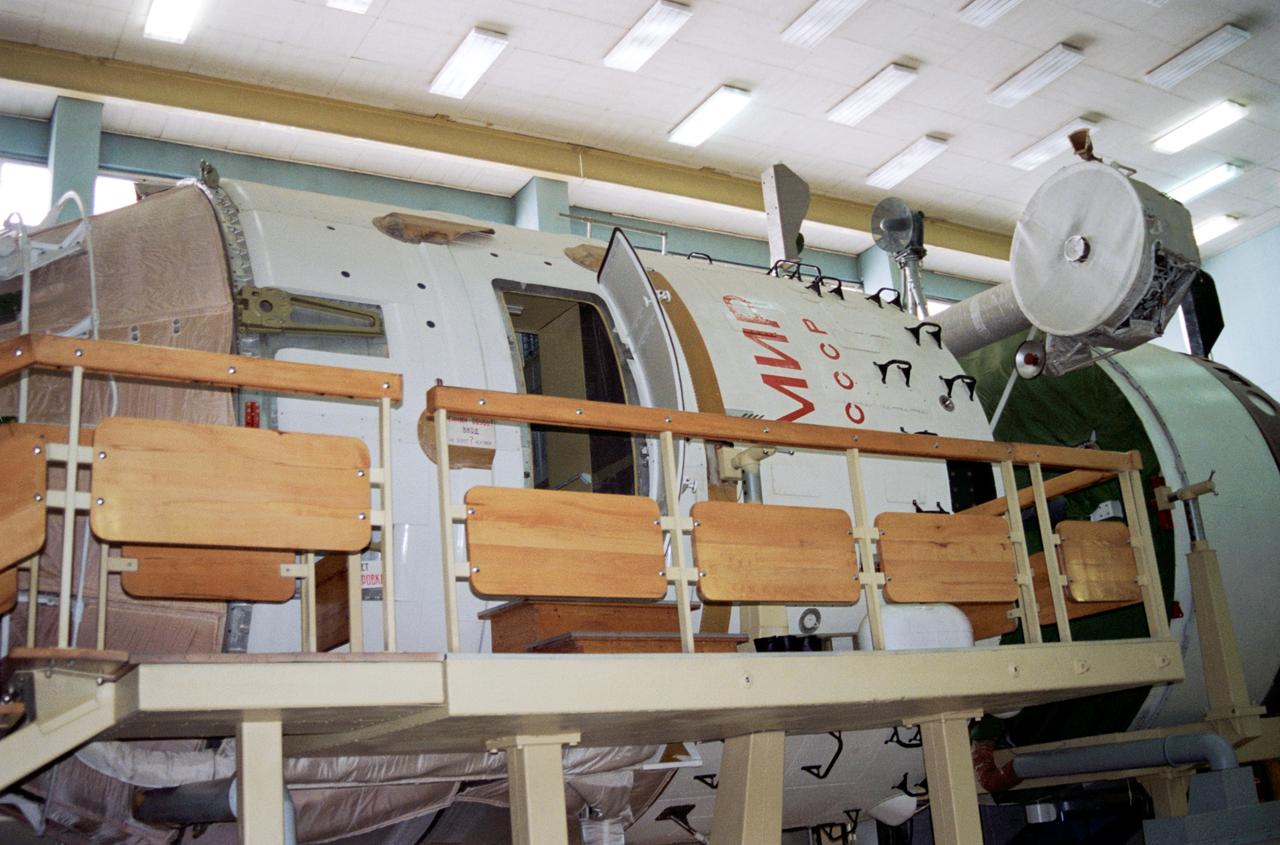
A full-scale mockup of Russia's Space Station serves as one of the several training aids for cosmonaut flights aboard the orbiting laboratory. The core module - called Mir, for world of space - was launched in February 1986 and now serves as the main living quarters for crews. The mockup is located at the Gagarin Cosmonaut Training Center in Star City, Russia. At the time this photo was taken, NASA astronauts Norman E. Thagard and Bonnie J. Dunbar were in Russia for training.
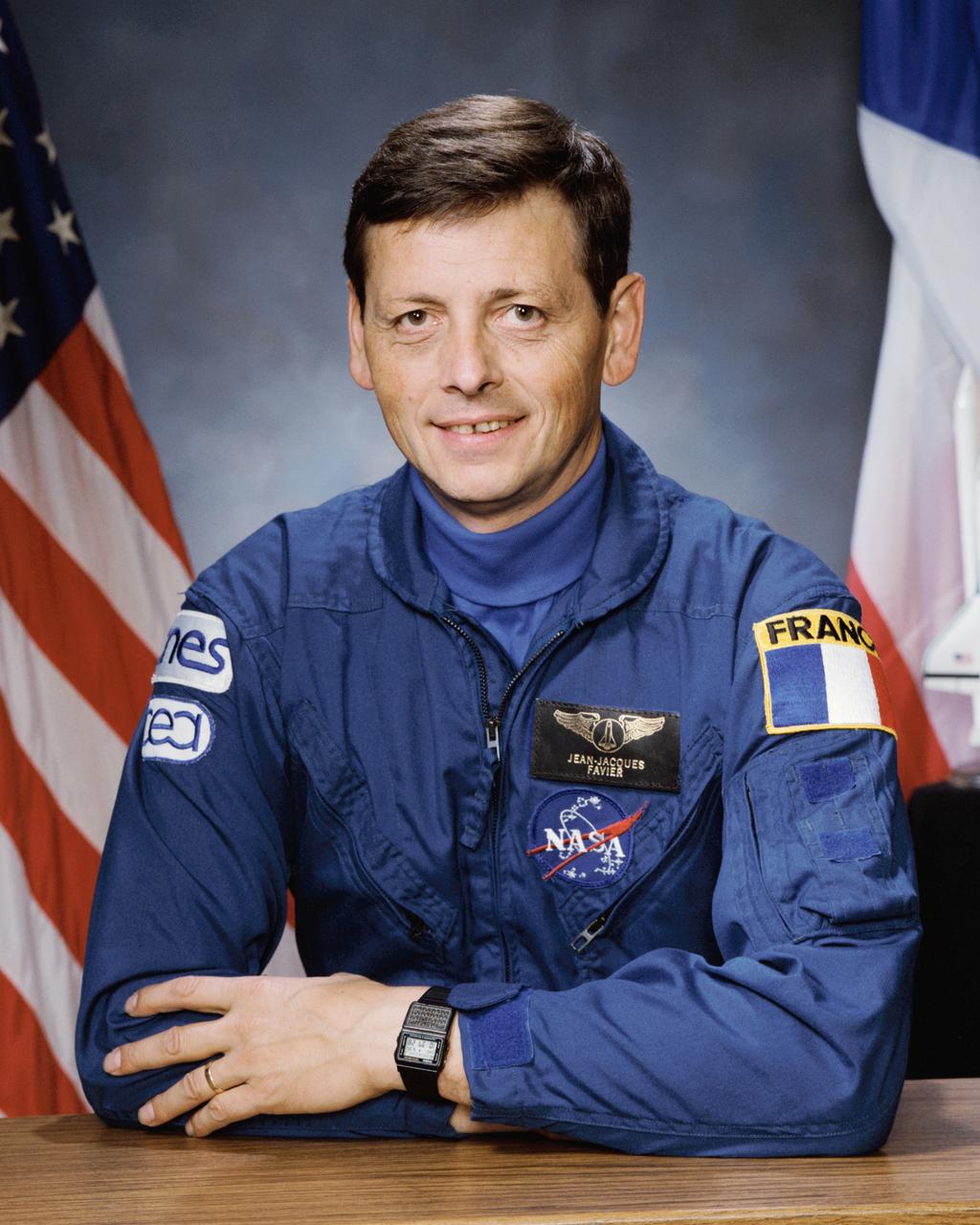
Official portrait of STS-65 International Microgravity Laboratory 2 (IML-2) backup Payload Specialist Jean-Jacques Favier. Favier is a member of the Centre National D'Etudes Spatiales (CNES), the French space agency.
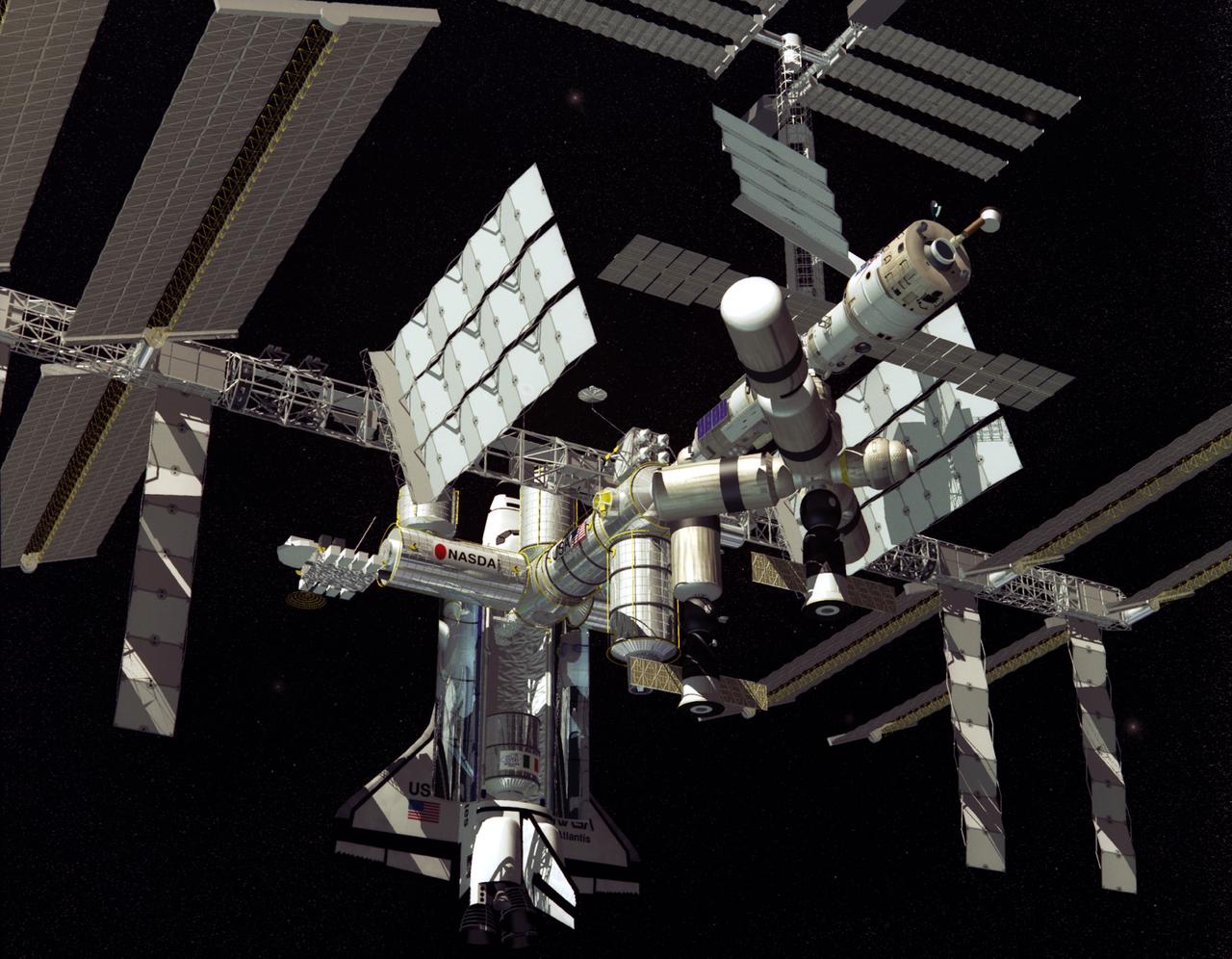
International Cooperation Phase III: A Space Shuttle docked to the International Space Station (ISS) in this computer generated representation of the ISS in its completed and fully operational state with elements from the U.S., Europe, Canada, Japan, and Russia.
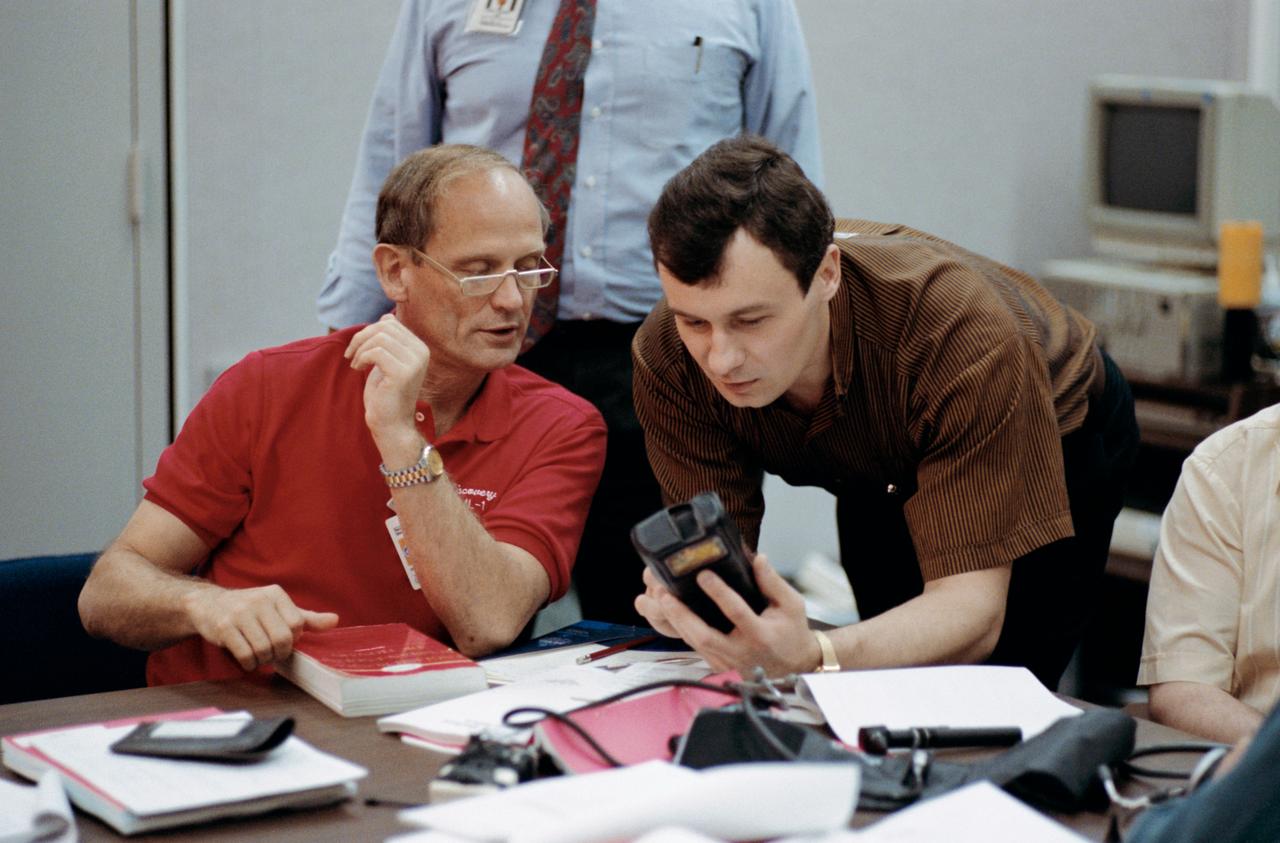
Mir 18 commander Vladimir N. Dezhurov, right, and fellow crew member, astronaut Norman E. Thagard, practice using a bar-code reader during medical operations training at JSC.
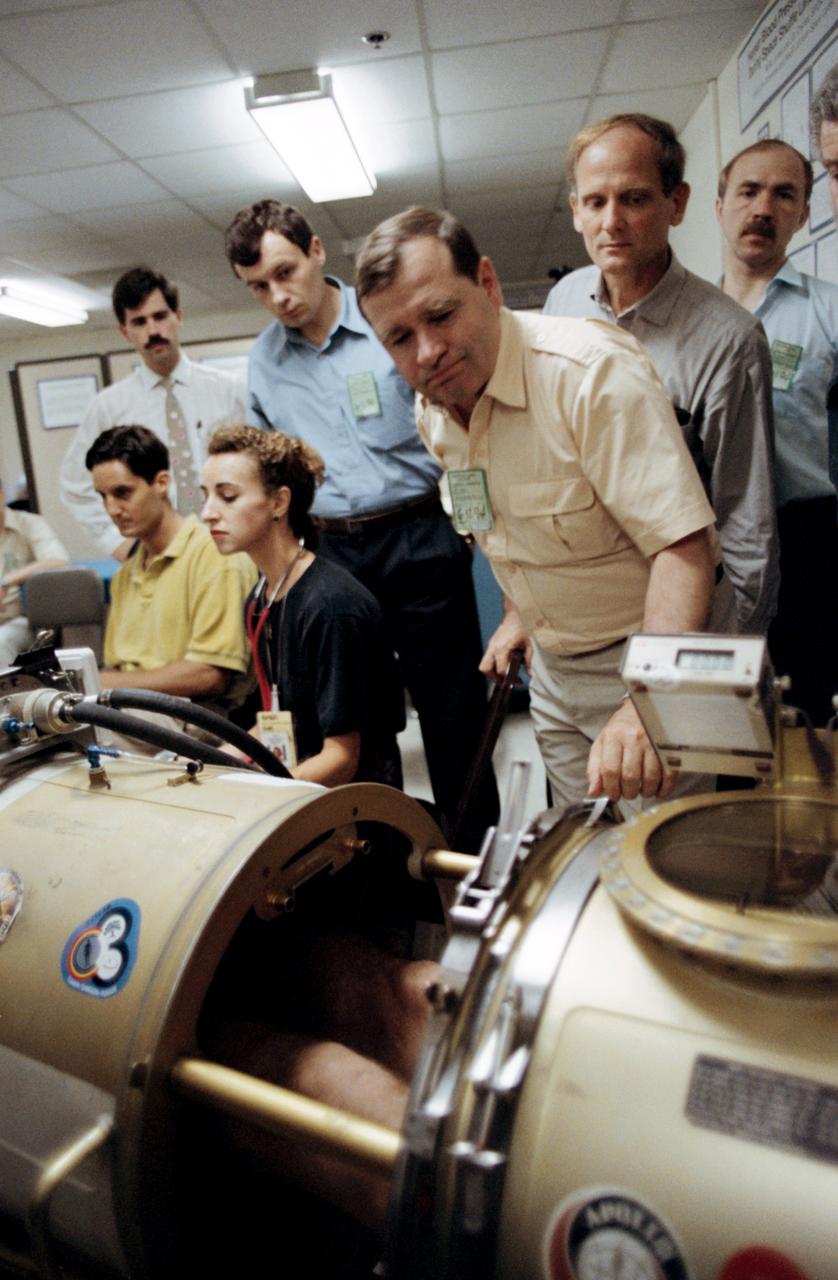
Astronaut Norman E. Thagard (right center), a guest researcher on Russia's Mir 18 mission, monitors a test of a subject (out of frame) in the Lower Body Negative Pressure (LBNP) device. Others pictured, left to right, are Todd Schlegel (seated) of the Medical Sciences Division at JSC, unidentified trainer, Linda Barrows of Krug; cosmonaut Vladimir N. Dezhurov, mission commander; cosmonaut Gennadiy M. Strekalov, Thagard and cosmonaut Alexsandr F. Poleshchuk, Mir 18 reserve flight engineer.
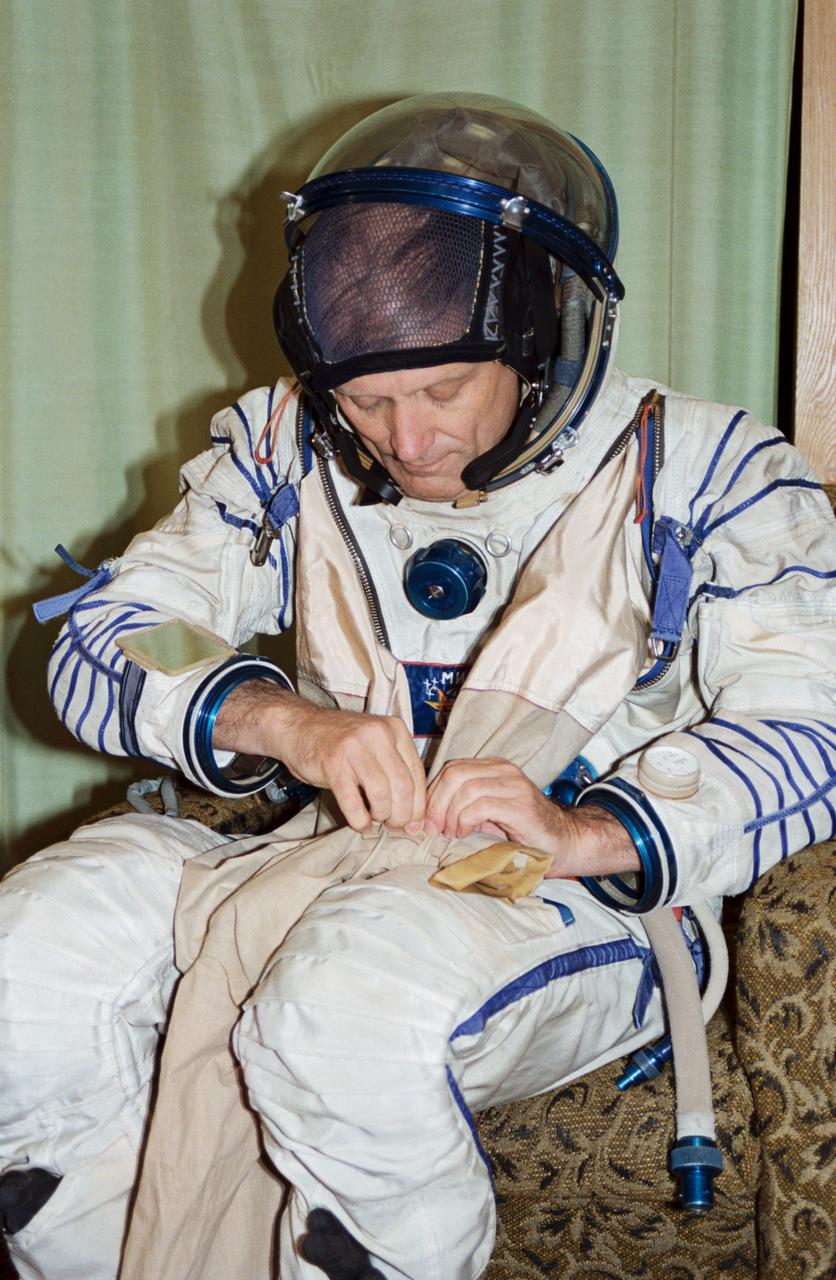
Astronaut Norman E. Thagard in a cosmonaut space suit in the Training Simulator Facility at the Gagarin Cosmonaut Training Center (Star City), near Moscow, Russia. In March 1995, astronaut Thagard is scheduled to be launched in a Russian Soyuz spacecraft with two cosmonauts to begin a three-month tour of duty on the Russian Mir Space Station. Thagard, along with his back-up, astronaut Bonnie J. Dunbar, has been training in Russian since February 1994.
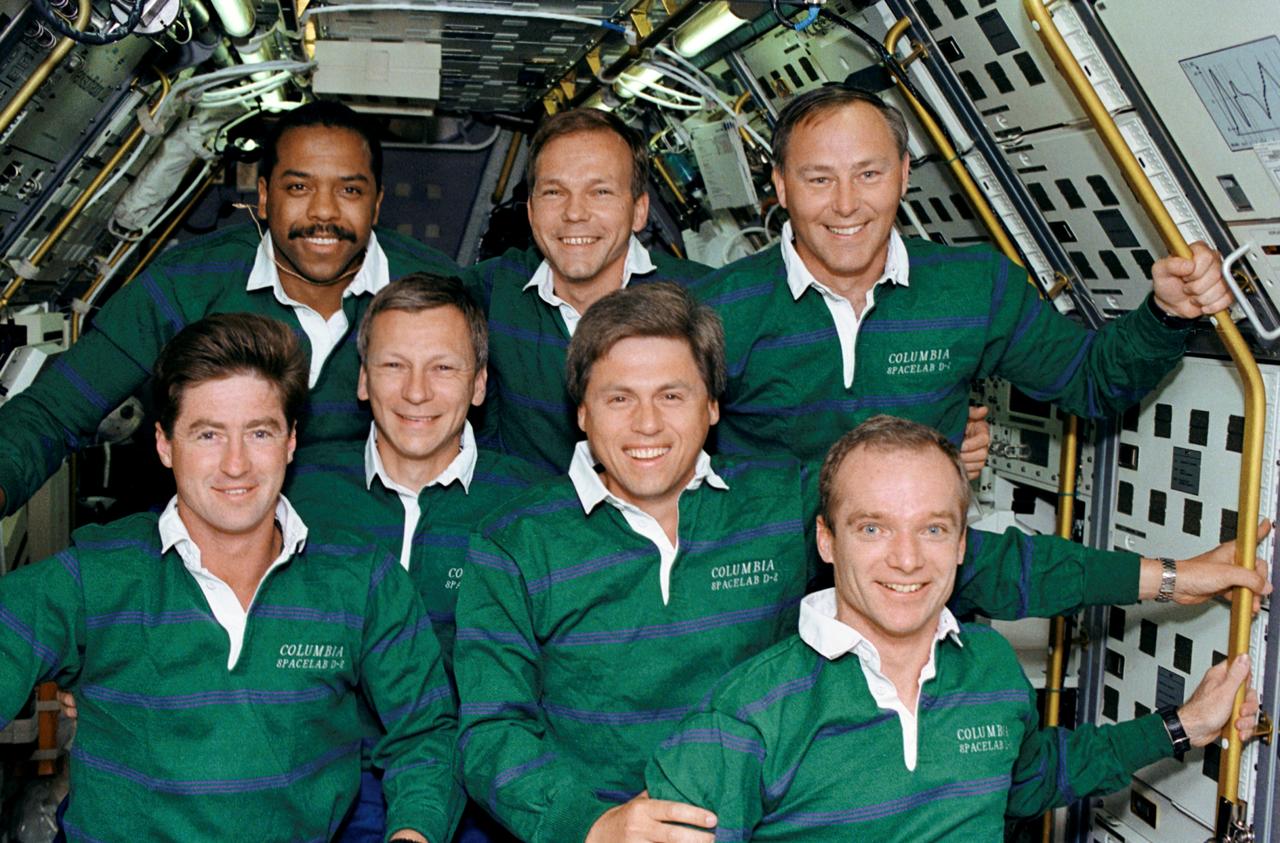
STS055-203-009 (26 April-6 May 1993) --- The seven crew members who spent 10 days aboard the space shuttle Columbia pose for the traditional in-flight portrait in the Spacelab D-2 Science Module. Front, left to right, are Terence T. (Tom) Henricks, Steven R. Nagel, Ulrich Walter and Charles J. Precourt. In the rear are (left to right) Bernard A. Harris Jr., Hans Schlegel and Jerry L. Ross. Nagel served as mission commander; Henricks was the pilot and Ross, the payload commander. Harris and Precourt were mission specialists and Schlegel and Walter were payload specialists representing the German Aerospace Research Establishment (DLR). Photo credit: NASA
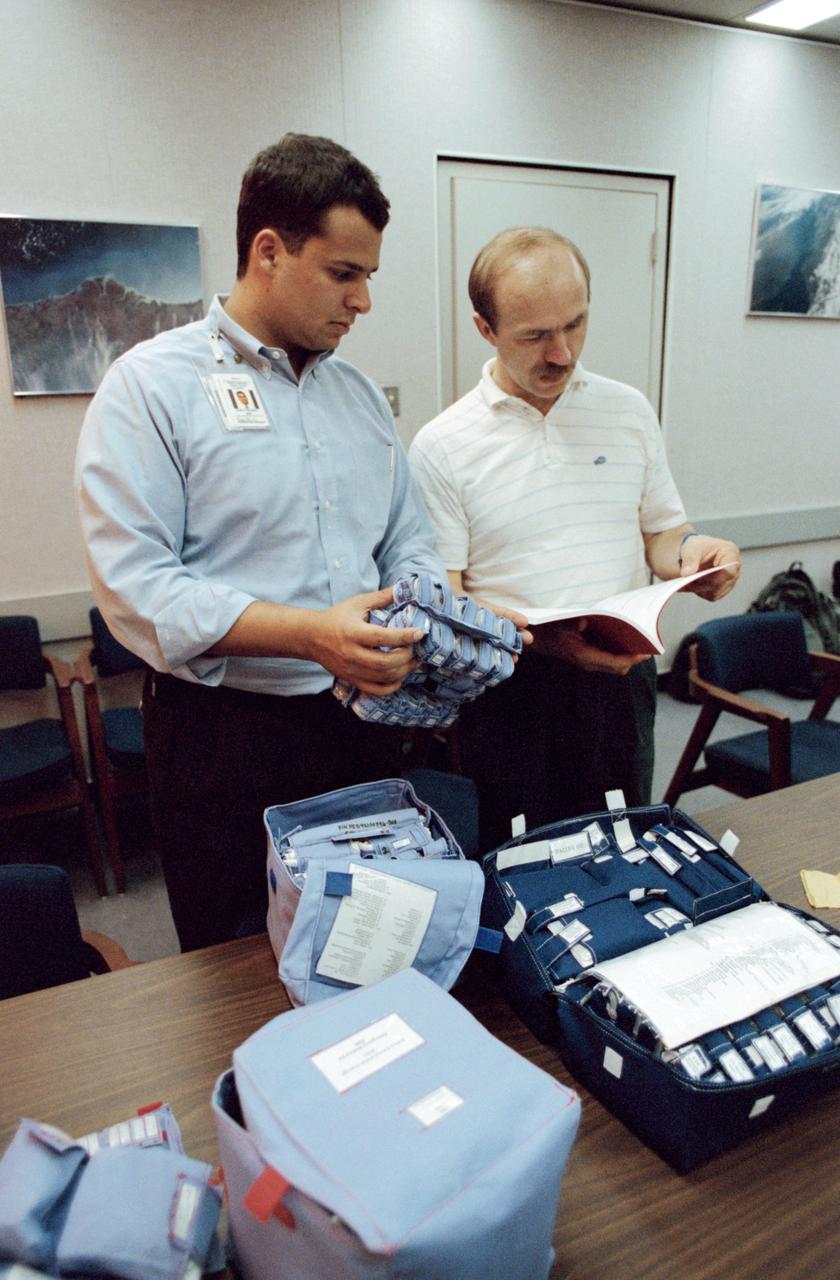
Cosmonaut Alexandr F. Poleshchuk (right) inventories medical supplies with Ezra D. Kucharz, medical operations trainer for Krug Life Sciences, Incorporated. Poleshchuk, a Mir reserve crew member, and a number of other cosmonauts and astronauts participating in the joint Russia - United States program were in Houston, Texas, to prepare for upcoming missions which involve crew members from the two nations.
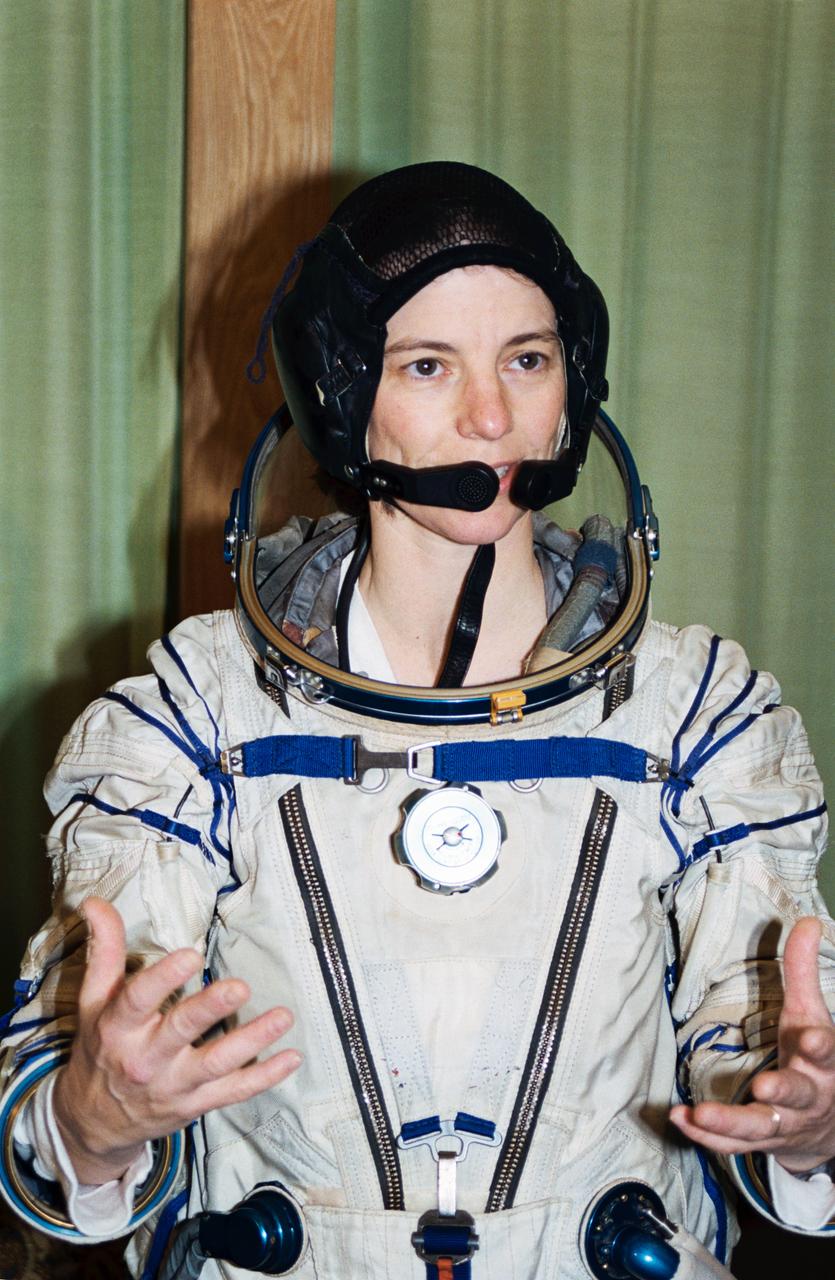
Astronaut Bonnie J. Dunbar in a cosmonaut space suit in the Training Simulator Facility at the Gagarin Cosmonaut Training Center (Star City), near Moscow, Russia. In March 1995, astronaut Norman E. Thagard is scheduled to be launched in a Russian Soyuz spacecraft with two cosmonauts to begin a three-month tour of duty on the Russian Mir Space Station. Thagard, along with his back-up, astronaut Bonnie J. Dunbar, has been training in Russian since February 1994.
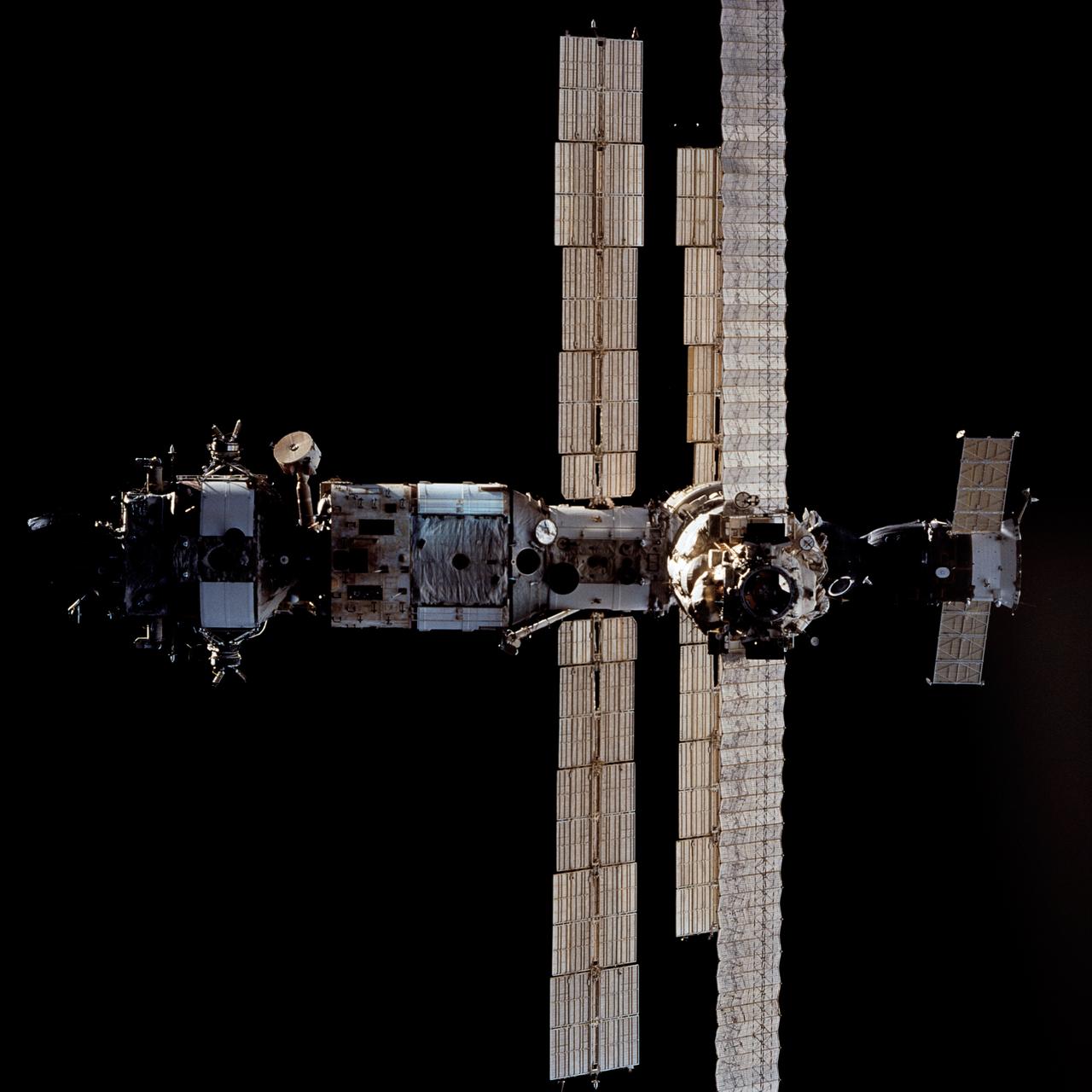
STS063-712-017 (6 Feb. 1995) --- Russia's Mir Space Station during rendezvous operations with the Space Shuttle Discovery. Docked at the bottom of the Mir facility is a Soyuz spacecraft. On the opposite end (almost cropped out of frame at top) is a Progress spacecraft. Onboard the Space Shuttle Discovery were astronauts James D. Wetherbee, mission commander; Eileen M. Collins, pilot; Bernard A. Harris, Jr., payload commander; C. Michael Foale and Janice E. Voss, mission specialists; along with cosmonaut Vladimir G. Titov, mission specialist.
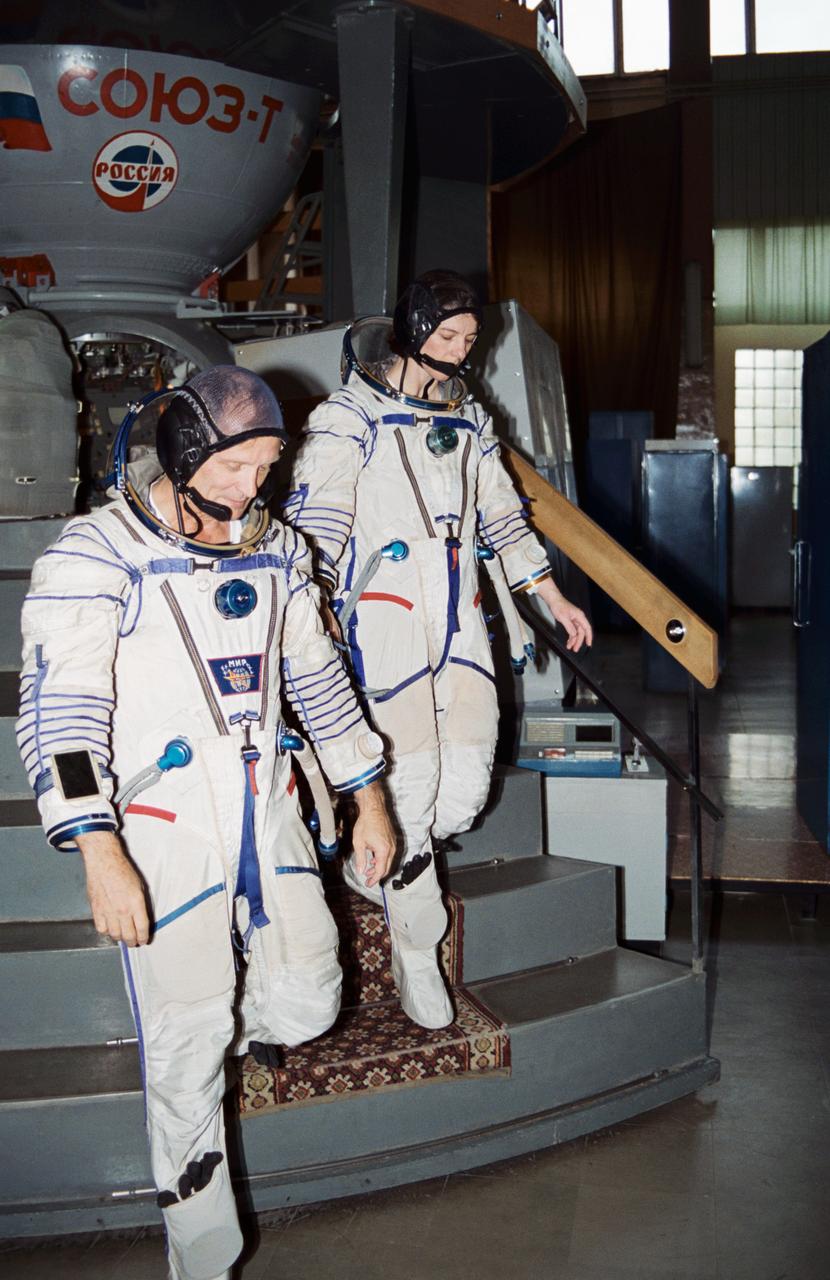
Astronauts Norman E. Thagard and Bonnie J. Dunbar in cosmonaut space suits in the Training Simulator Facility at the Gagarin Cosmonaut Training Center (Star City), near Moscow, Russia. In March 1995, astronaut Thagard is scheduled to be launched in a Russian Soyuz spacecraft with two cosmonauts to begin a three-month tour of duty on the Russian Mir Space Station. Thagard, along with his back-up, astronaut Bonnie J. Dunbar, has been training in Russian since February 1994.

The rising sun signifies the dawn of a new era of human Spaceflight, the first phase of the United States/Russian space partnership, Shuttle-Mir. Mir is shown in its proposed final on orbit configuration. The Shuttle is shown in a generic tunnel/Spacehab configuration. The Shuttle/Mir combination, docked to acknowledge the union of the two space programs, orbits over an Earth devoid of any definable features or political borders to emphasize Earth as the home planet for all humanity. The individual stars near the Space Shuttle and the Russian Mir Space Station represent the previous individual accomplishments of Russia's space program and that of the United States. The binary star is a tribute to the previous United States-Russian joint human Spaceflight program, the Apollo-Soyuz Test Project (ASTP). The flags of the two nations are symbolized by flowing ribbons of the national colors interwoven in space to represent the two nations joint exploration of space. NASA SHUTTLE and PKA MNP are shown in the stylized logo fonts of the two agencies that are conducting this program.
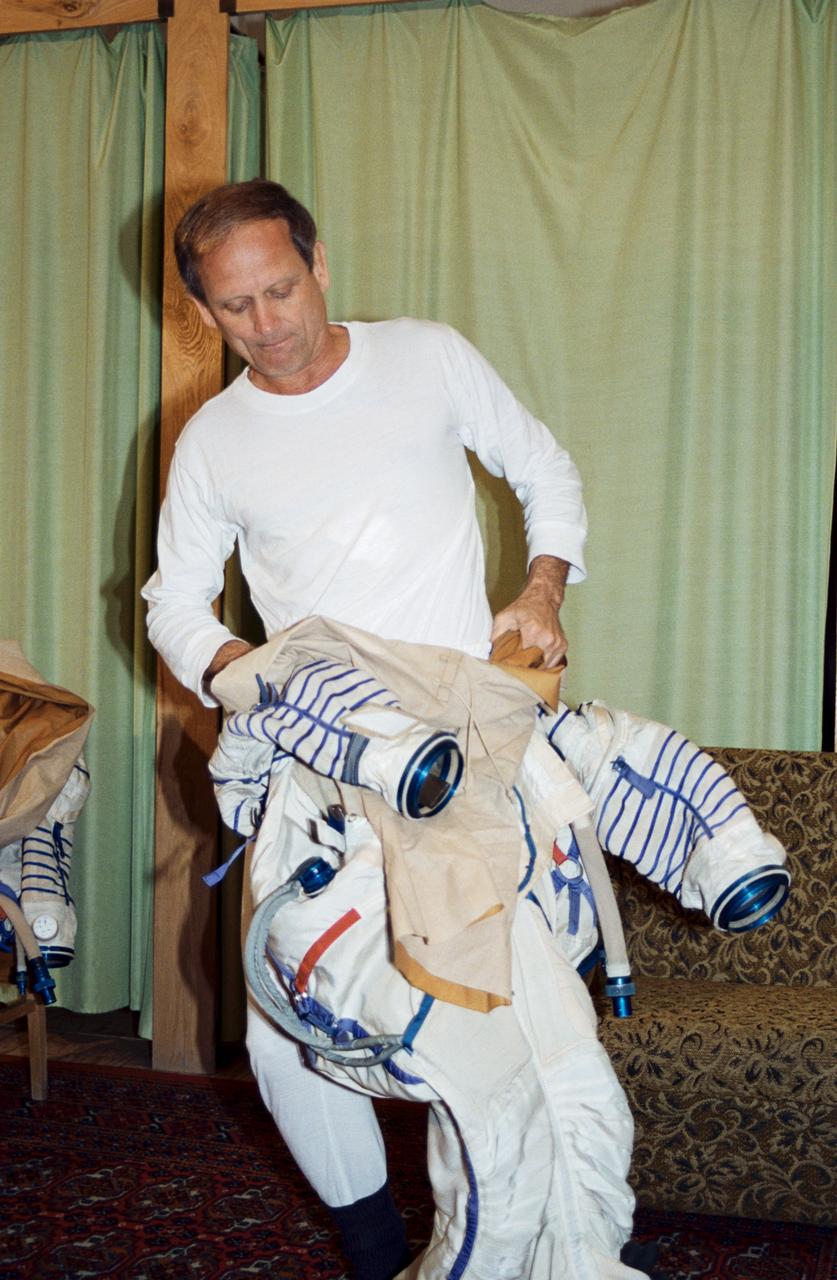
Astronaut Norman E. Thagard getting into a cosmonaut space suit in the Training Simulator Facility at the Gagarin Cosmonaut Training Center (Star City), near Moscow, Russia.
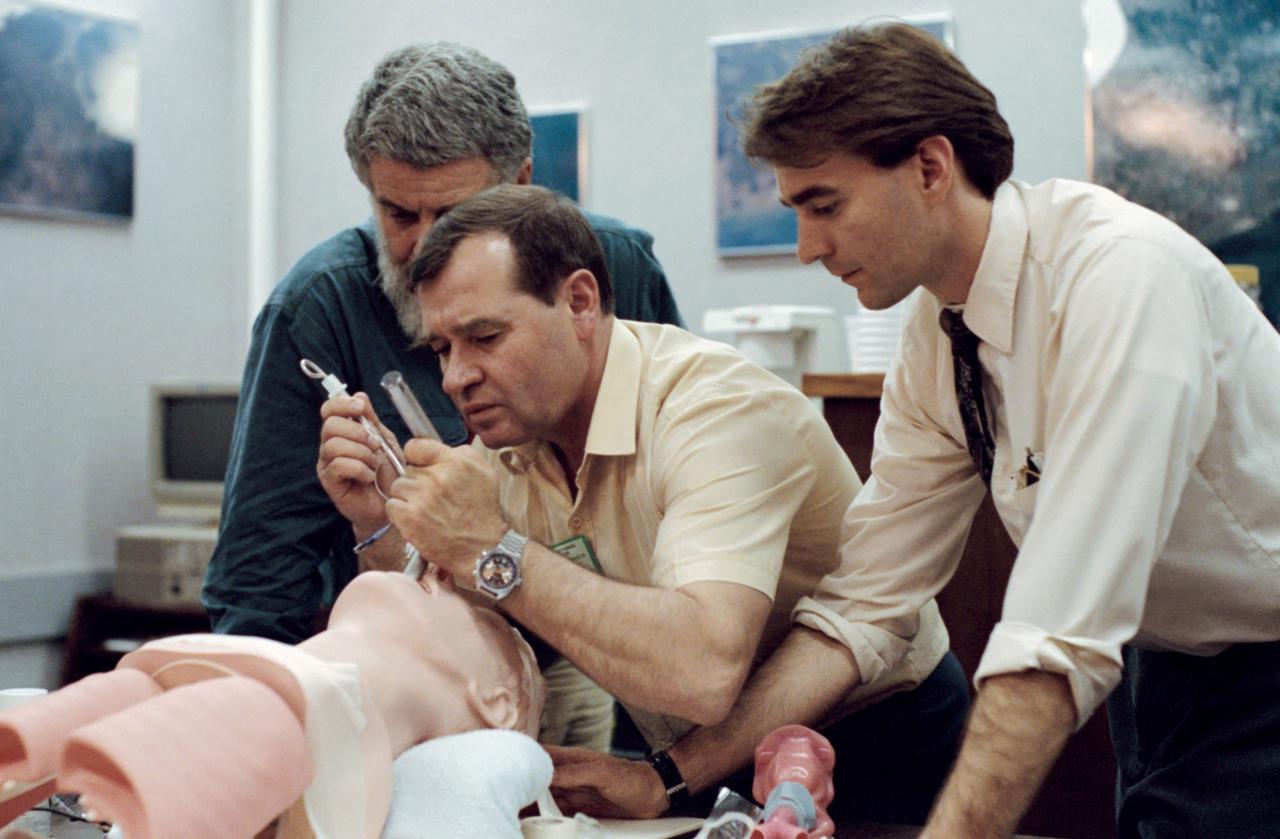
Mir 18 crewmember Gennadiy M. Strekalov, center, practicies an emergency medical procedure to maintain a patient airway during training at JSC. Looking on are Dave E. Ward (right), a JSC medical doctor, and an unidentified interpreter.
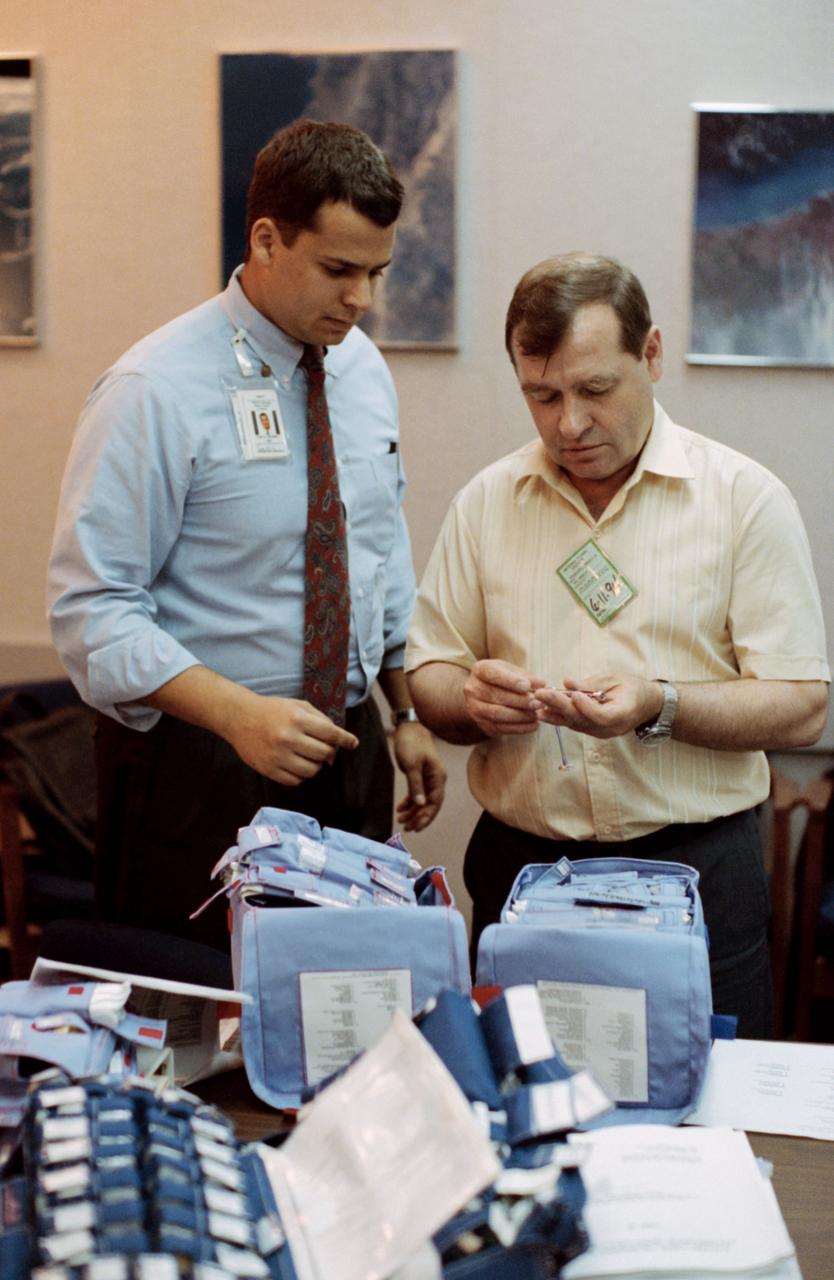
Cosmonaut Gennadiy M. Strekalov (right), Mir-18 flight engineer, is briefed on medical supplies by Ezra D. Kucharz, medical operations trainer for Krug Life Sciences, Incorporated. Strekalov and a number of other cosmonauts and astronauts participating in joint Russia - United States space missions are in Houston, Texas, to prepare for their upcoming missions.
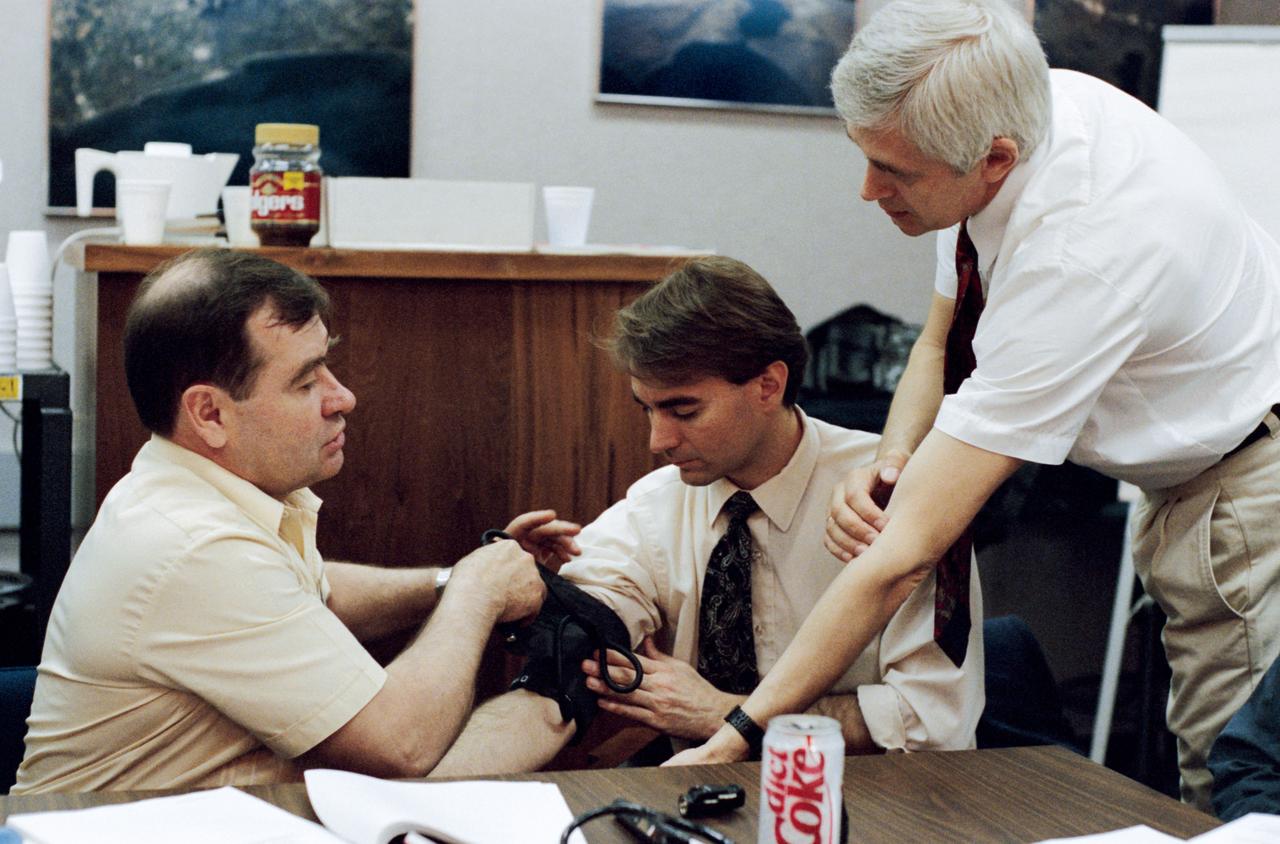
Using Dr. Dave E. Ward, a JSC physician, as a test subject, cosmonaut Gennadiy M. Strekalov (left), rehearses the taking of blood pressure. This is a service he will likely be performing a great deal next year when he boards Russia's Mir Space Station, in Earth-orbit, as Mir 18 flight engineer.
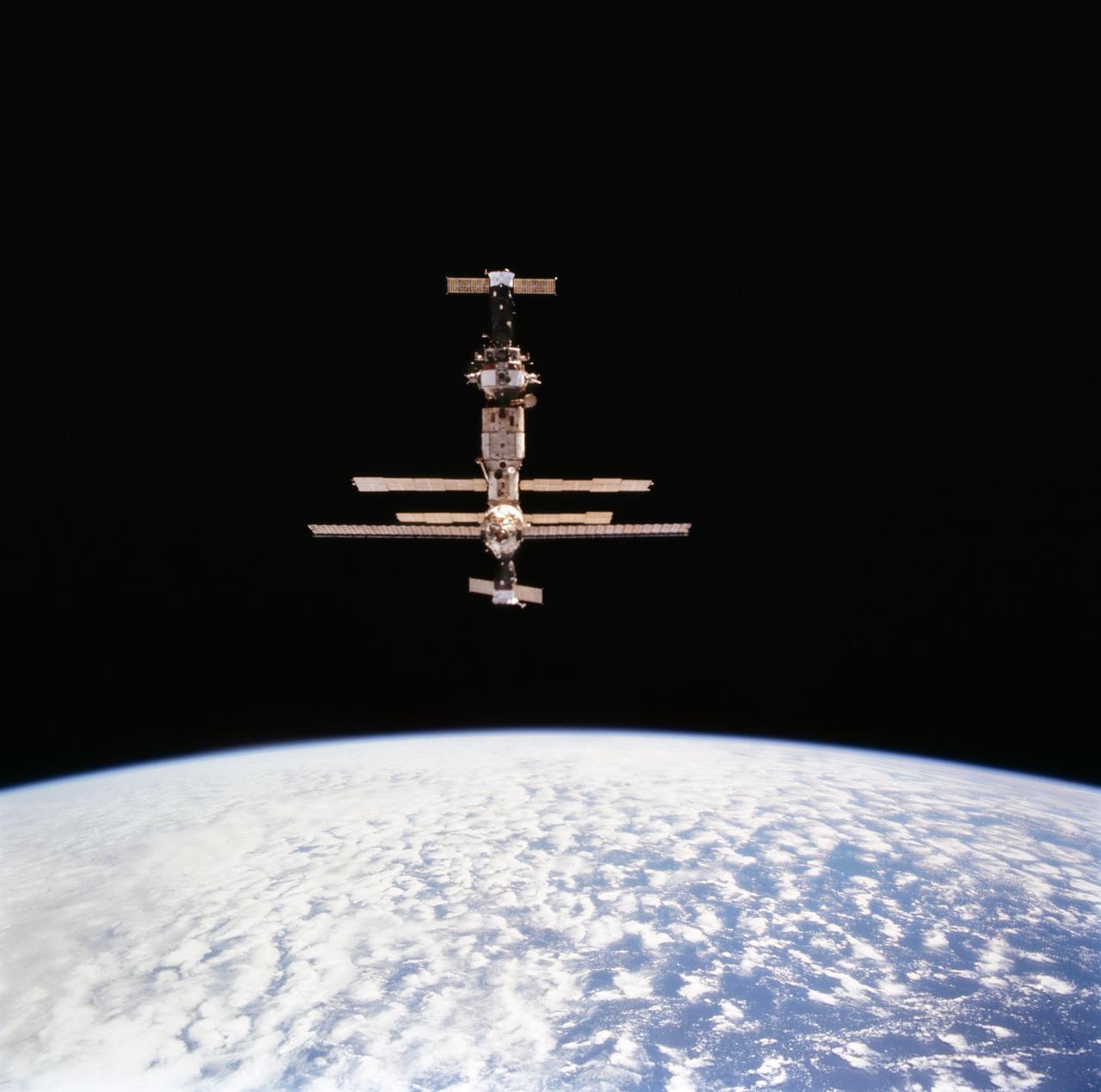
STS063-712-072 (6 Feb 1995) --- Russia's Mir Space Station over the blue and white Earth during initial approach for rendezvous operations with the Space Shuttle Discovery. Docked at bottom (nearest portion where longest solar array panel is visible) is a Soyuz space vehicle. On the opposite end is a Progress spacecraft. This is one of 16 still photographs released by the NASA Johnson Space Center (JSC) Public Affairs Office (PAO) on February 14, 1995. Onboard the Space Shuttle Discovery were astronauts James D. Wetherbee, mission commander; Eileen M. Collins, pilot; Bernard A. Harris Jr., payload commander; mission specialists C. Michael Foale, Janice E. Voss, and cosmonaut Vladimir G. Titov.
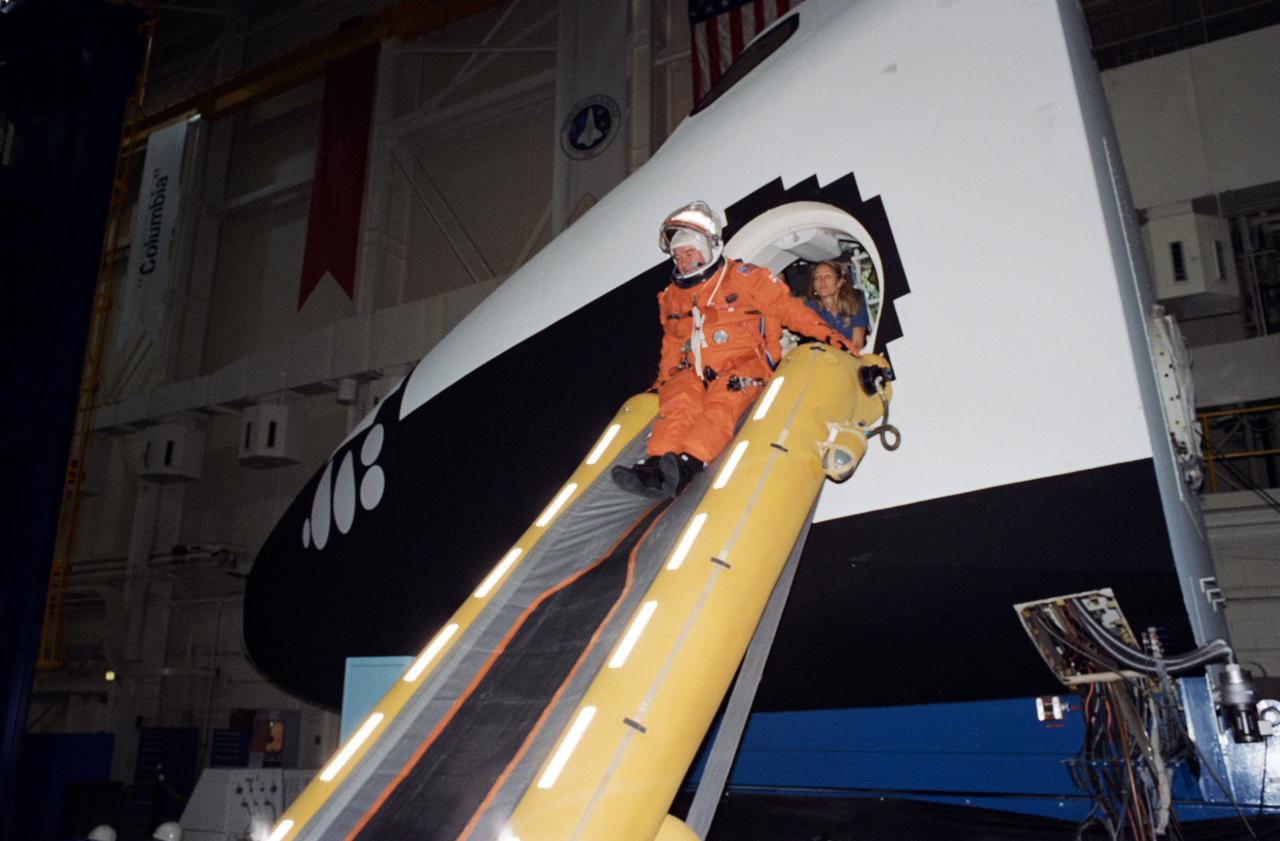
S94-47083 (14 Oct 1994) --- Cosmonaut Gennadiy M. Strekalov, Mir-18 flight engineer, who will return via the Space Shuttle Atlantis from a three-month mission aboard Russia's Mir Space Station, joins the STS-71 crew members during emergency egress training. The training took place in the systems integration facility at the Johnson Space Center (JSC). In a precedent-setting flight, NASA astronaut Norman E. Thagard will be launched with Vladimir N. Dezhurov and Strekalov to the Mir Space Station early next year for a three month mission. Then in late May, as the assignment of STS-71, the Space Shuttle Atlantis will rendezvous with Mir to pick up the Mir 18 crew and transfer two other cosmonauts to the station for the Mir 19 mission.

S91-51633 (November 1991) --- Astronaut Roberta L. Bondar, Canadian payload specialist.
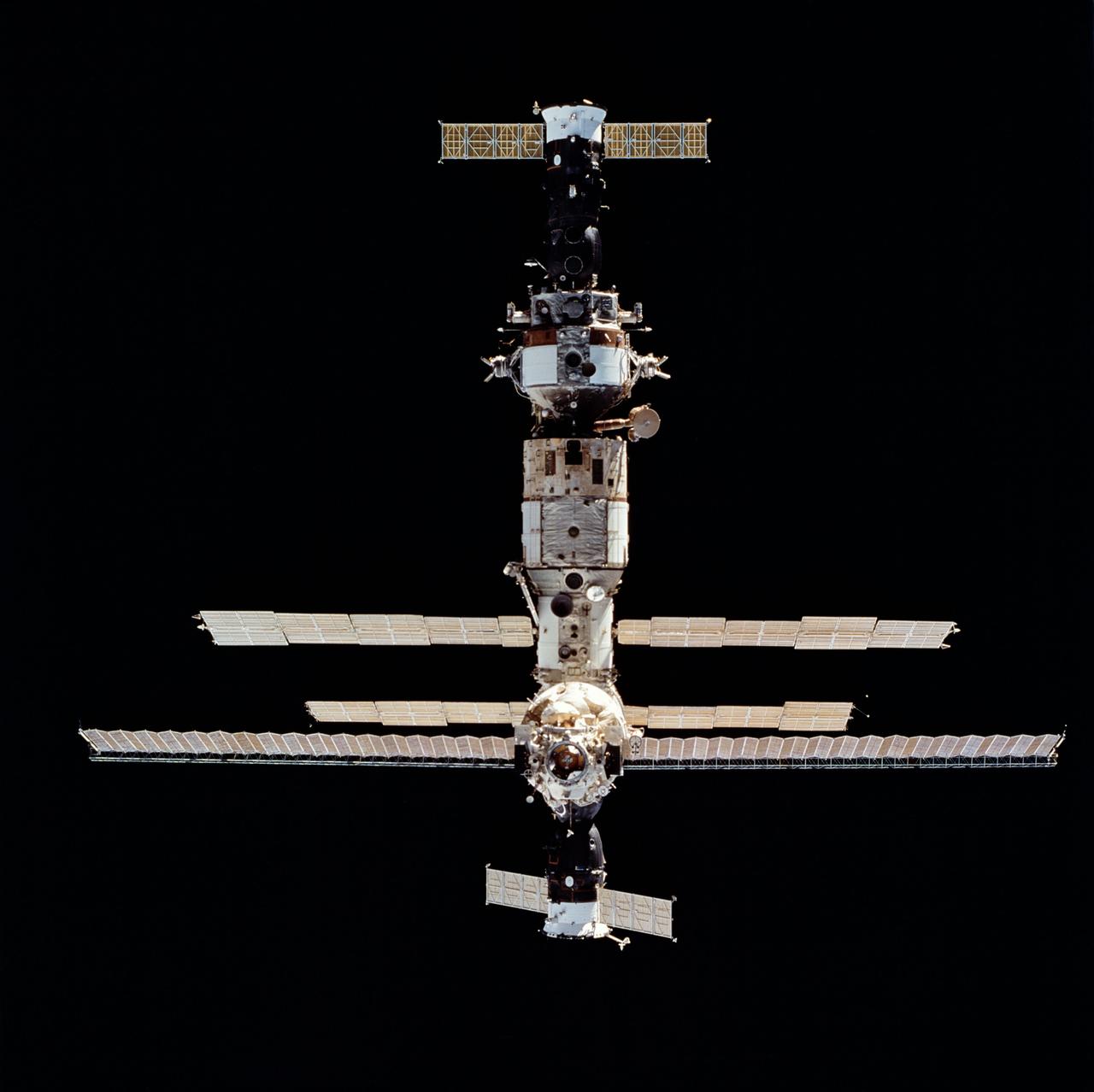
STS063-712-068 (6 Feb 1995) --- Russia's Mir Space Station during rendezvous operations with the Space Shuttle Discovery. Docked at bottom (nearest portion where longest solar array panel is visible) is a Soyuz space vehicle. On the opposite end is a Progress spacecraft. This is one of 16 still photographs released by the NASA Johnson Space Center (JSC) Public Affairs Office (PAO) on February 14, 1995. Onboard the Space Shuttle Discovery were astronauts James D. Wetherbee, mission commander; Eileen M. Collins, pilot; Bernard A. Harris, Jr., payload commander; mission specialists C. Michael Foale, Janice E. Voss, and cosmonaut Vladimir G. Titov.
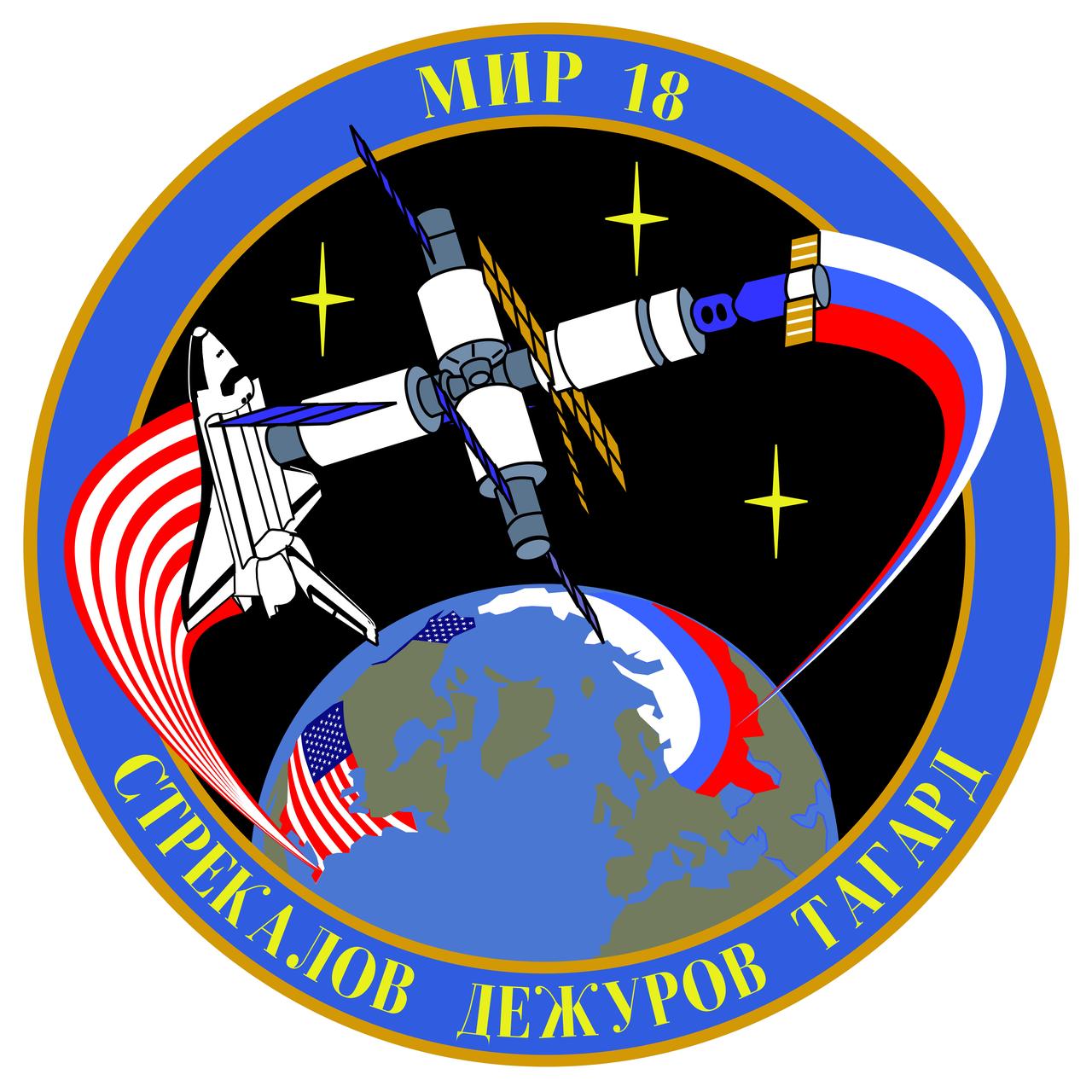
S94-36965 (20 Sept 1994) --- The rising sun signifies the dawn of a new era of human Spaceflight, the first phase of the U.S./Russian space partnership, Shuttle-Mir. Mir is shown in its proposed final on orbit configuration. The Shuttle is shown in a generic tunnel/Spacehab configuration. The Shuttle-Mir combination, docked to acknowledge the union of the two space programs, orbits over an Earth devoid of any definable features or political borders to emphasize Earth as the home planet for all humanity. The individual stars near the Shuttle and the Mir station represent the previous individual accomplishments of Russia's space program and that of the U.S. The binary star is a tribute to the previous U.S.-Russian joint human Spaceflight program, the Apollo-Soyuz Test Project. The flags of the two nations are symbolized by flowing ribbons of the national colors interwoven in space to represent the two nations joint exploration of space. NASA SHUTTLE and PKA MNP are shown in the stylized logo fonts of the two agencies that are conducting this program.
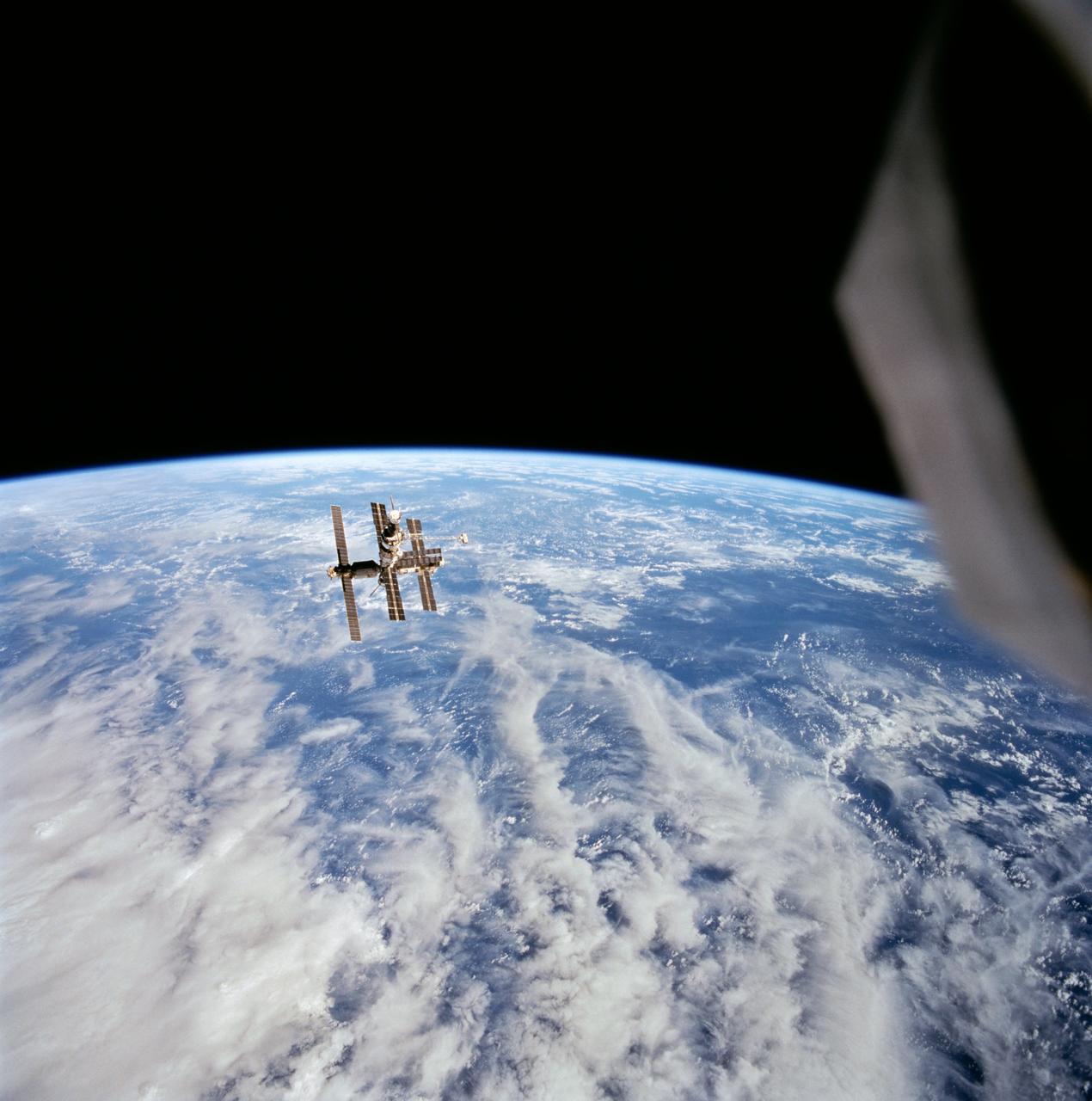
STS063-708-095 (6 Feb 1995) --- Cumulus and other clouds over the ocean form the backdrop for this scene of Russia's Mir space station during rendezvous operations by the Space Shuttle Discovery and Mir. This photograph was taken as the Discovery was firing its Reaction Control Subsystem (RCS) thrusters to separate from Mir's proximity. Onboard the Discovery were astronauts James D. Wetherbee, mission commander; Eileen M. Collins, pilot; Bernard A. Harris Jr., payload commander; mission specialists Janice Voss and C. Michael Foale; along with Russian cosmonaut Vladimir G. Titov. EDITOR'S NOTE: This 70mm handheld Hasselblad frame has been cropped to enlarge Mir.

STS063-711-080 (6 Feb. 1995) --- Cosmonaut Valeriy V. Polyakov, who boarded Russia's Mir Space Station on January 8, 1994, looks out Mir's window during rendezvous operations with the Space Shuttle Discovery. This is one of 16 still photographs released by the NASA Johnson Space Center (JSC) Public Affairs Office (PAO) on February 14, 1995. Onboard the Discovery were astronauts James D. Wetherbee, mission commander; Eileen M. Collins, pilot; Bernard A. Harris, Jr., payload commander; mission specialists C. Michael Foale, Janice E. Voss, and cosmonaut Vladimir G. Titov.
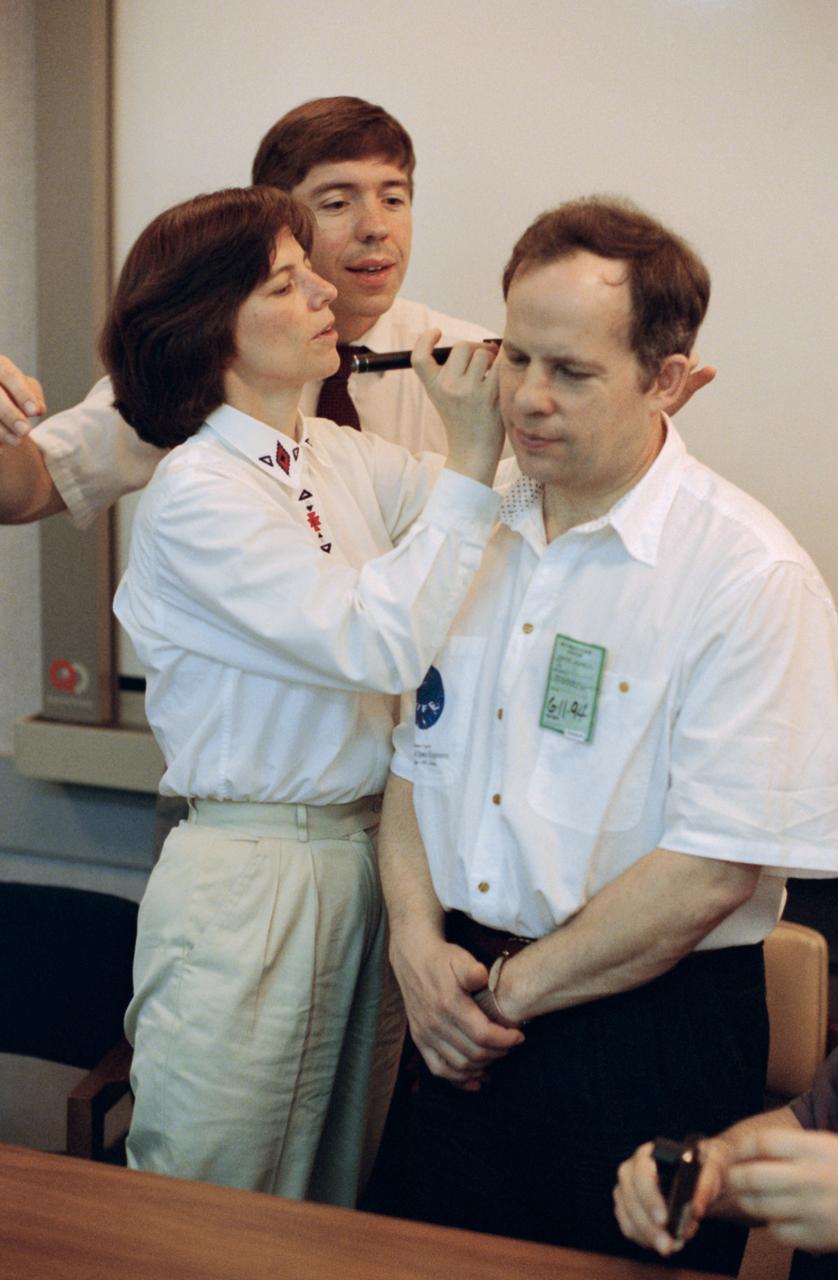
S94-35071 (17 June 1994) --- Flight surgeon Mike Barrett looks on as astronaut Bonnie J. Dunbar conducts a physical examination on cosmonaut Anatoly Solovyov. Crew members for the joint Space Shuttle/Mir missions are in the midst of three weeks' medical operations training for their cooperative flights.
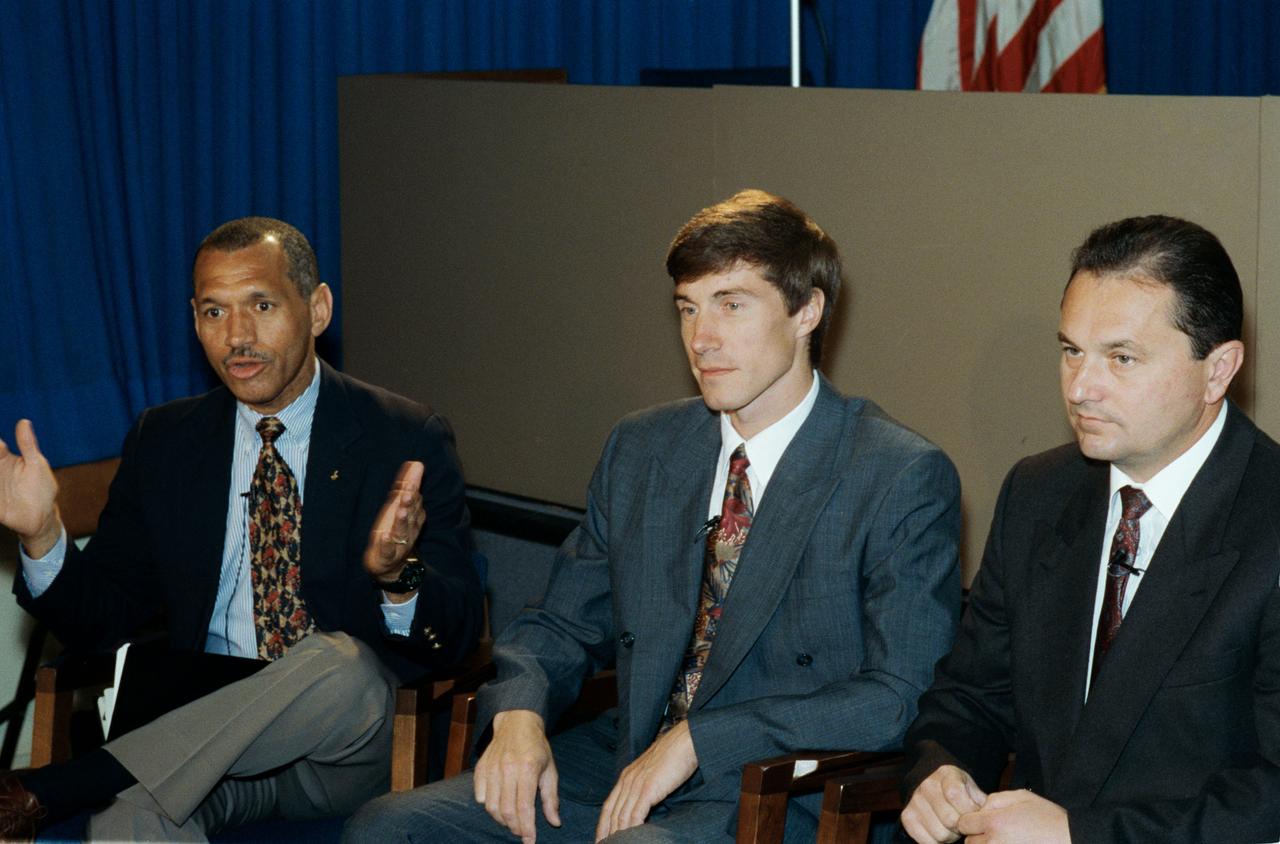
Two prime crew members and an alternate are pictured during a mission planning session in JSC's public affairs facility. Left to right are astronaut Charles F. Bolden Jr., mission commander; and Cosmonauts sergei Krikalev and Vladimir Titov, prime and alternate mission specialists, respectively.
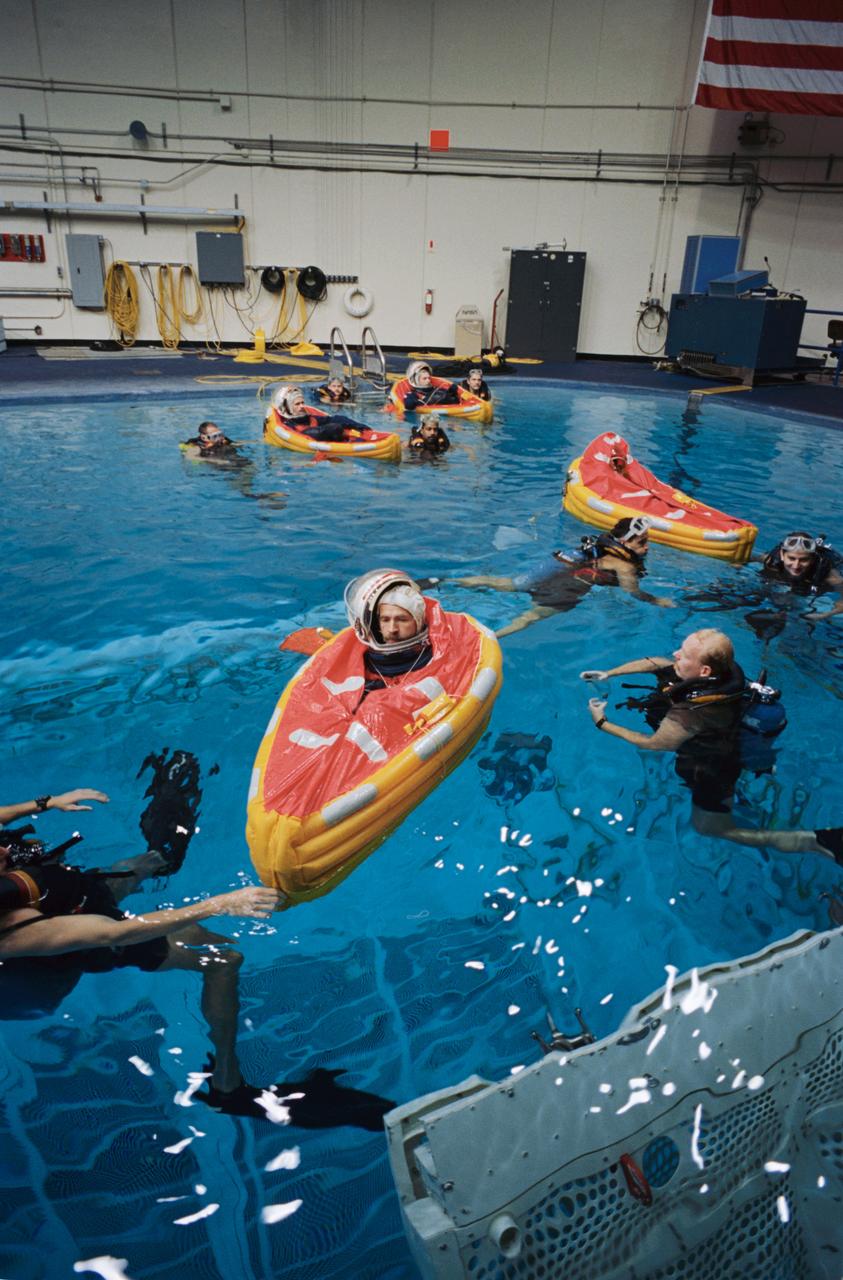
S94-47226 (13 Oct 1994) --- Using small life rafts, several cosmonauts and astronauts participating in joint Russia - United States space missions take part in an emergency bailout training session in the Johnson Space Center's (JSC) Weightless Environment Training Facility's (WET-F) 25-feet-deep pool. In the foreground is cosmonaut Alexsandr F. Poleshchuk, a member of the Mir reserve crew. A number of SCUBA-equipped divers assist the trainees.
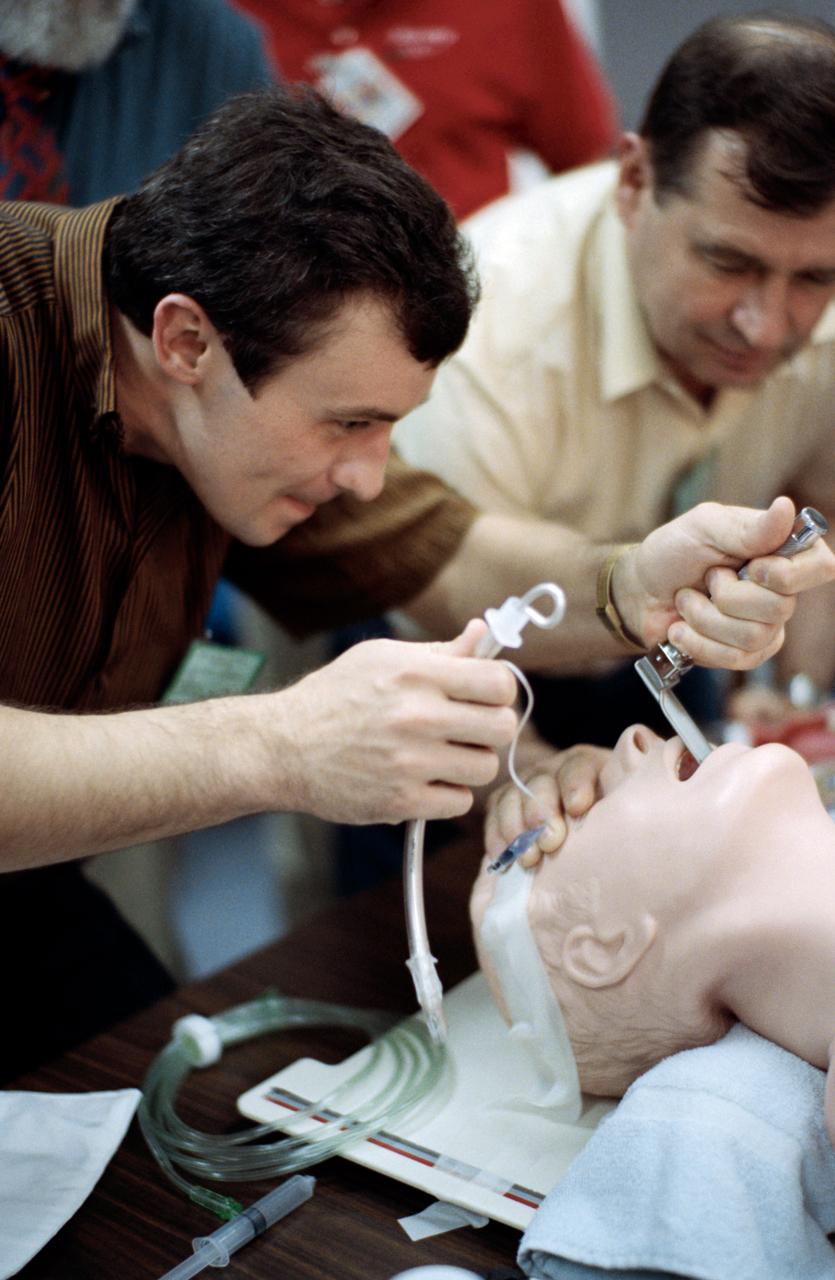
Cosmonaut Vladimir N. Dezhurov (left), Mir 18 mission commander, among a group of Russians in the United States to participate in training for the joint Russia - United States space missions, conducts an intubation on a dummy. Dezhurov, along with Mir 18 flight engineer Gennadiy M. Strekalov (pictured) prepare for upcoming missions which involve crew members from the two nations.
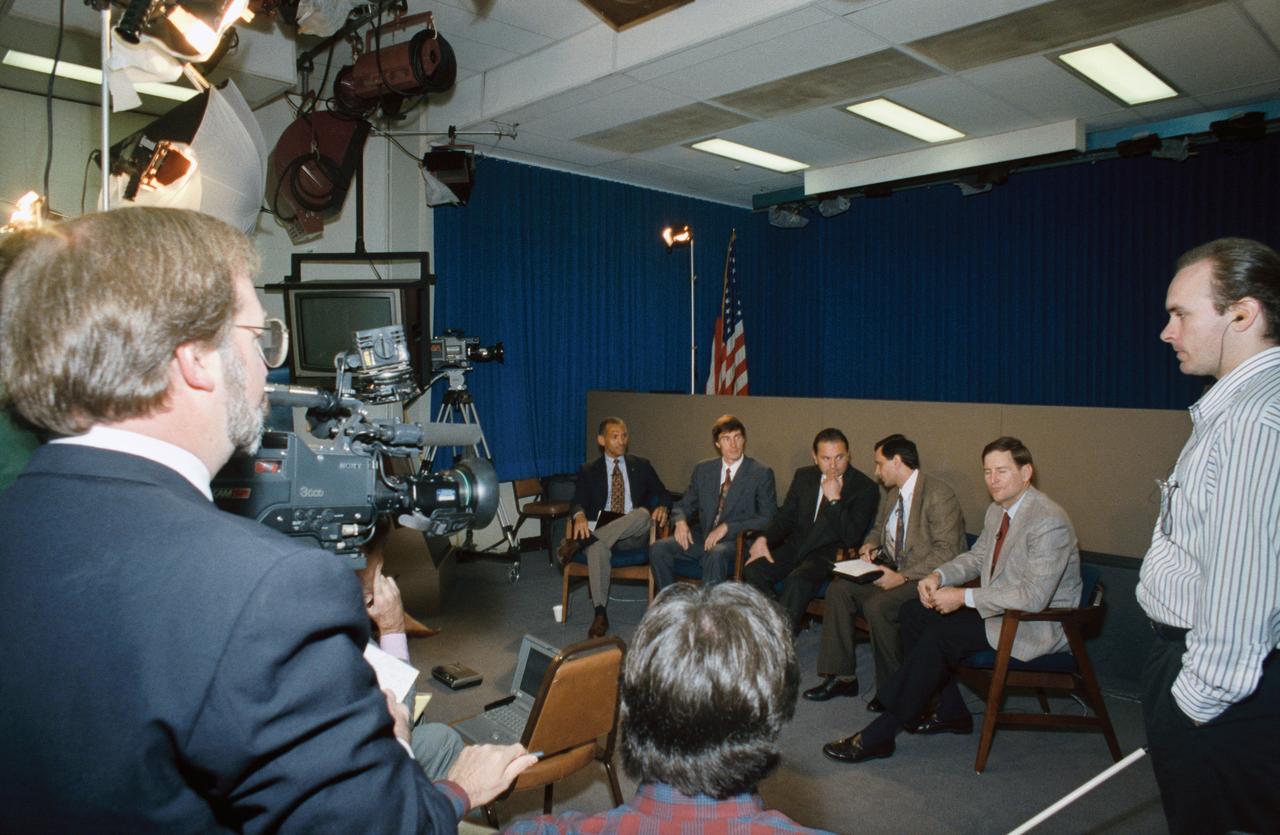
Three members of the STS-60 crew and an alternate crew member discuss their upcoming mission with the news media in JSC's public affairs facility. Seated from the left are Charles F. Bolden Jr., mission commander; Russian Cosmonaut Sergei Krikalev, mission specialist; Russian Cosmonaut Vladimir Titov, alternate mission specialist; interpreter Vladimir Fischel and Astronaut Kenneth S. Reightler, pilot.

S91-52649 (Nov 1991) ---- Astronaut Ulf Merbold, PhD, European Space Agency (ESA) Payload Specialist for STS-42, International Microgravity Laboratory (IML-1).
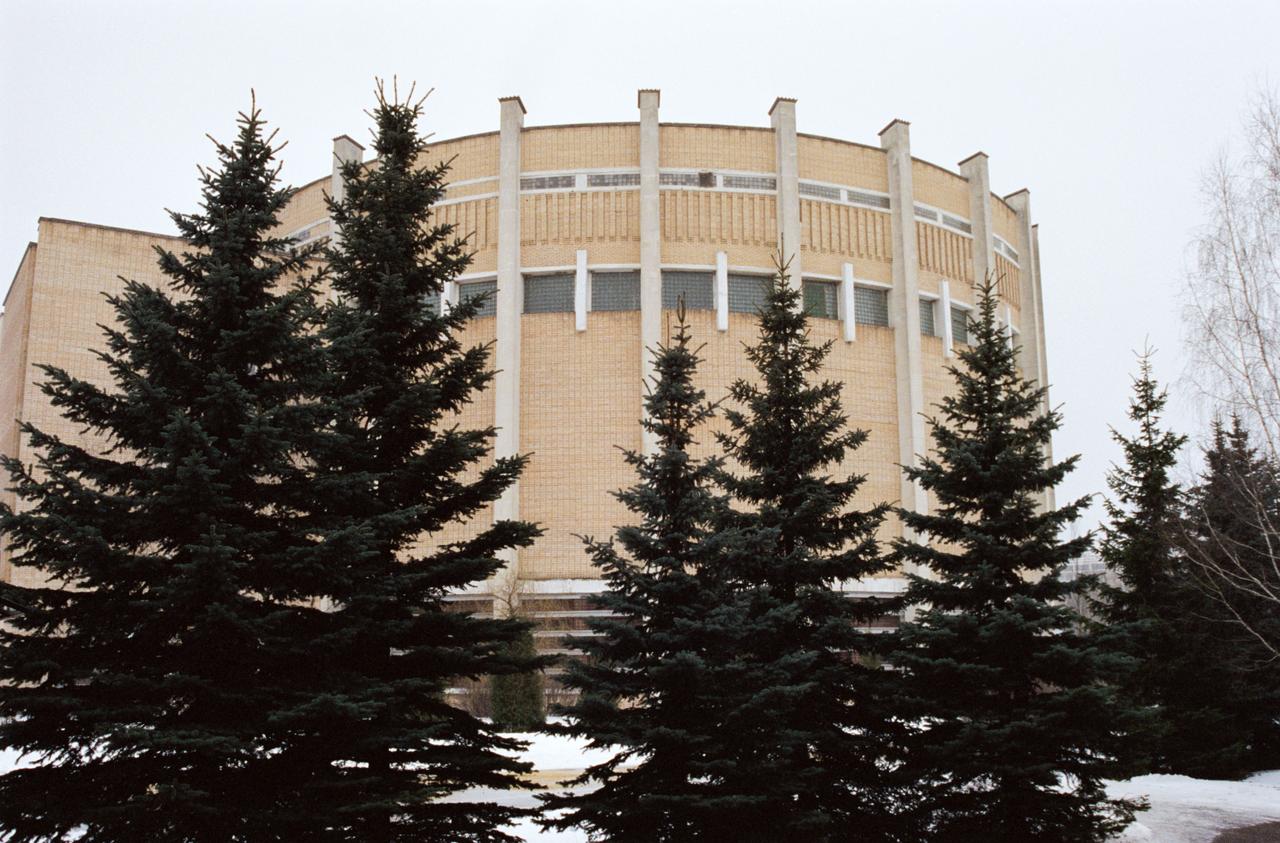
S95-04319 (22 Feb 1995) --- The neutral buoyancy facility at the Gagarin Cosmonaut Training Center in Star City, Russia, is used for underwater training for missions aboard the Russian Mir Space Station. The facility is similar to NASA's Weightless Environment Training Facility (WET-F) at the Johnson Space Center (JSC) in Houston, Texas, and the Neutral Buoyancy Simulator (NBS) at the Marshall Space Flight Center (MSFC) in Huntsville, Alabama.
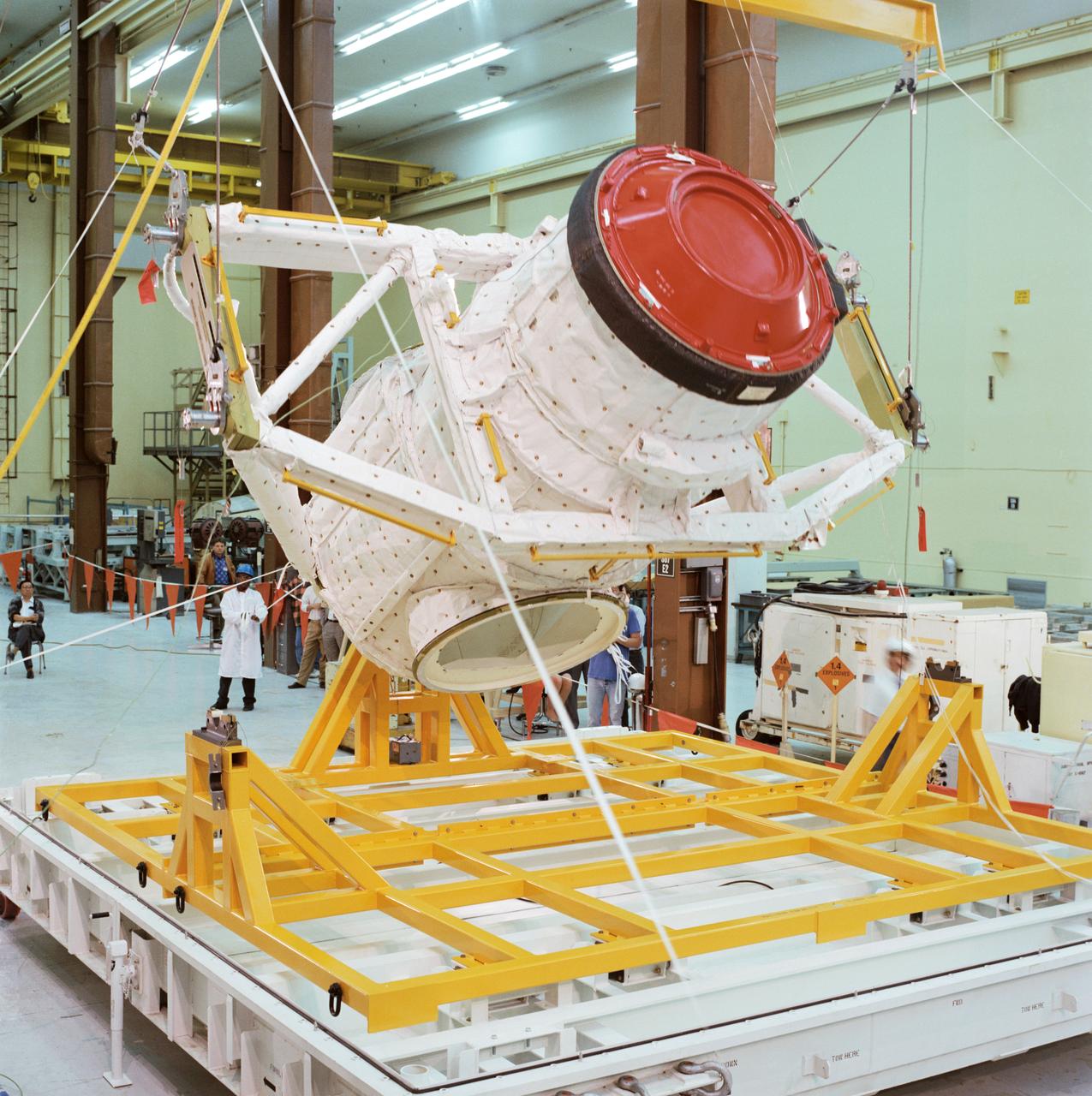
S95-00057 (15 Nov 1994) --- In Rockwell's Building 290 at Downey, California, the external airlock assembly/Mir docking system is rotated into position for crating up for shipment to the Kennedy Space Center (KSC) in Florida. Jointly developed by Rockwell and RSC Energia, the external airlock assembly and Mir docking system will be mounted in the cargo bay of the Space Shuttle Atlantis to enable the shuttle to link up to Russia's Mir space station. The docking system contains hooks and latches compatible with the system currently housed on the Mir's Krystall module, to which Atlantis will attach for the first time next spring. STS-71 will carry two Russian cosmonauts, who will replace a three-man crew aboard Mir including Norman E. Thagard, a NASA astronaut. The combined 10-person crew will conduct almost five days of joint life sciences investigations both aboard Mir and in the Space Shuttle Atlantis's Spacelab module.
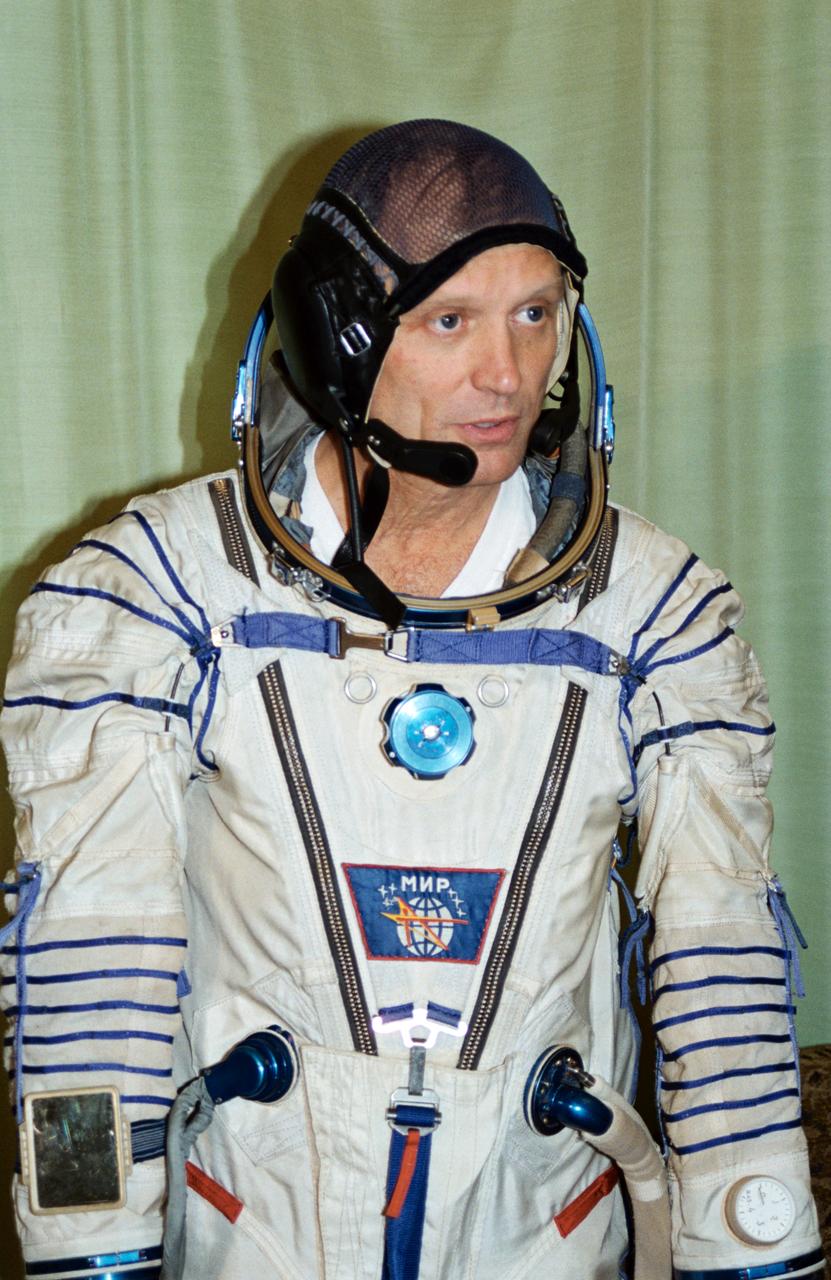
S94-45643 (20 Sept 1994) --- Astronaut Norman E. Thagard in a cosmonaut space suit in the Training Simulator Facility at the Gagarin Cosmonaut Training Center (Star City), near Moscow, Russia. In March 1995, astronaut Thagard is scheduled to be launched in a Russian Soyuz spacecraft with two cosmonauts to begin a three-month tour of duty on the Russian Mir Space Station. Thagard, along with his back-up, astronaut Bonnie J. Dunbar, has been training in Russia since February 1994. During his stay on Mir, he will conduct a variety of life sciences experiments that will provide U.S. investigators with the first long-duration exposure data since Skylab in the late 1970's. Thagard's mission will end in July when the Space Shuttle Atlantis, carrying the newly installed docking mechanism, docks with Mir Space Station for the first United States - Russian docking operation since Apollo-Soyuz in 1975. The Orbiter will remain attached to Mir for five days of joint scientific operations before returning home with Thagard and his Russian crew mates and leaving behind two cosmonauts on Mir.
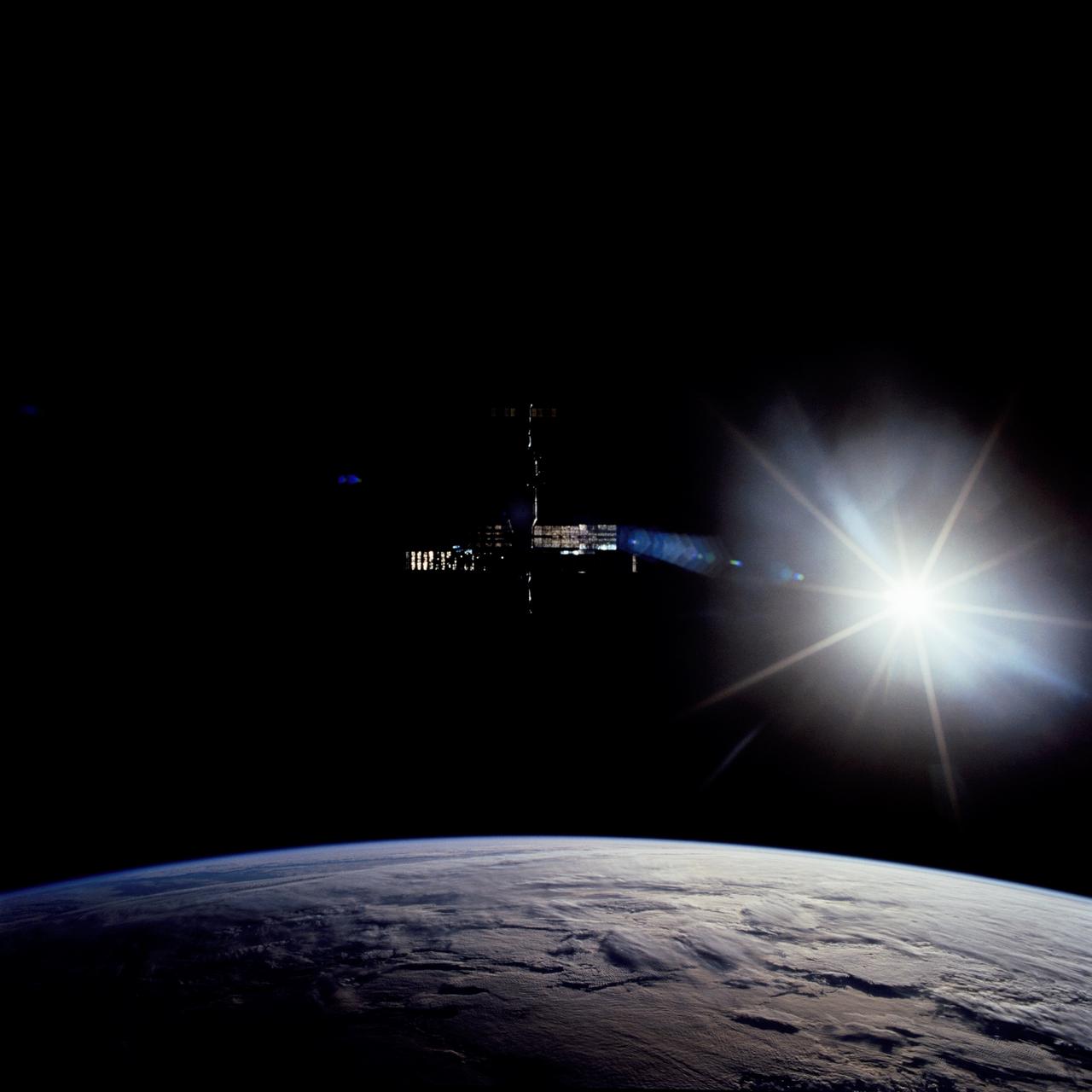
STS063-708-057 (6 Feb. 1995) --- Backdropped against the darkness of space, only the shiny part of Russia's Mir Space Station are clearly visible in this 70mm frame, photographed during rendezvous operations by the Space Shuttle Discovery and the Mir space station. Onboard the Discovery were astronauts James D. Wetherbee, mission commander; Eileen M. Collins, pilot; Bernard A. Harris Jr., payload commander; mission specialists Janice Voss, C. Michael Foale and Russian cosmonaut Vladimir G. Titov.
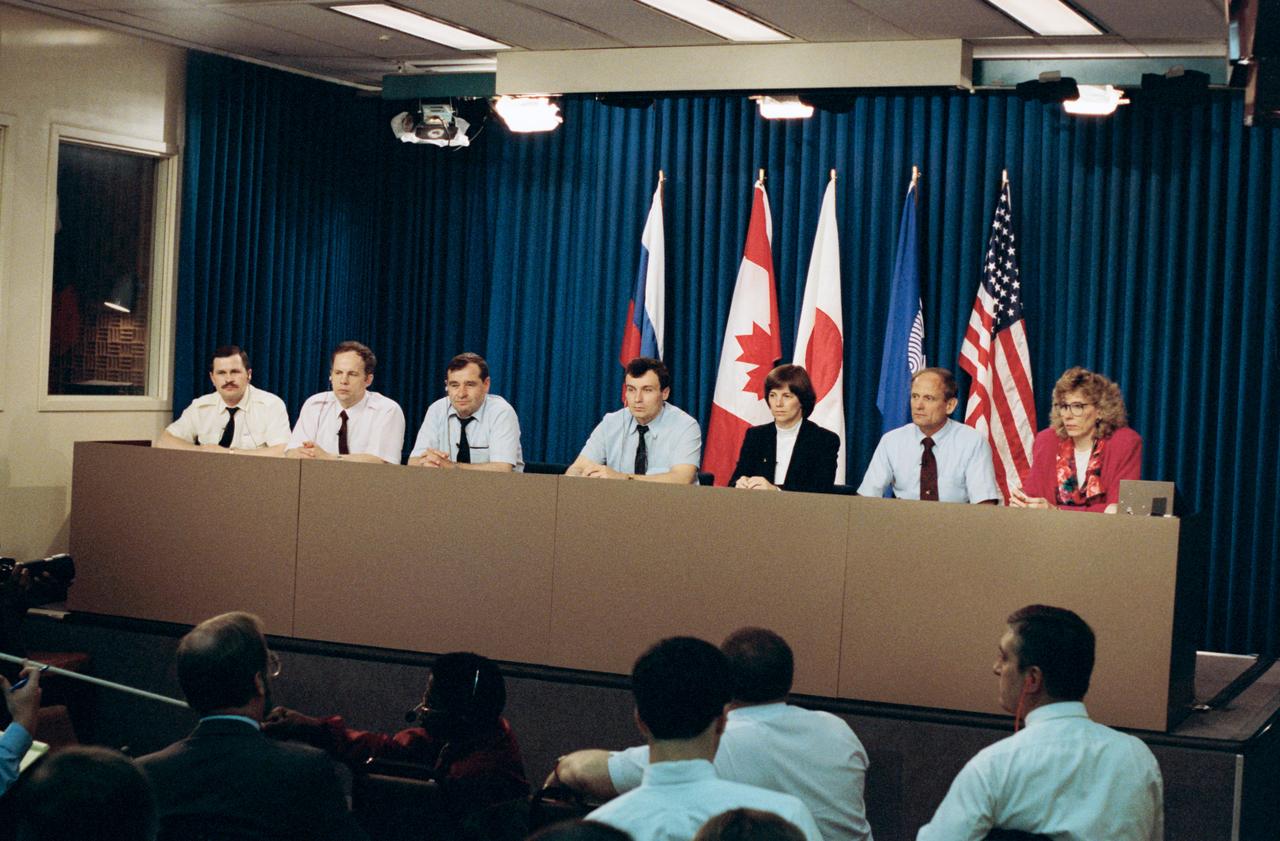
Crew members for the joint Space Shuttle / Mir mission field questions from the press at JSC. Left to right are cosmonauts Nikolai M. Budarin, Anatoliy Y. Solovyov, Gennadiy M. Strekalov, Vladimir N. Dezhurov, and astronauts Bonnie J. Dunbar, Norman E. Thagard, along with Kari L. Fluegel of the Public Affairs Office's (PAO) News and Media Services Branch. Flags representing the international space partners - Russia, the United States, the European Space Agency (ESA), Canada and Japan - are displayed behind the conference participants.
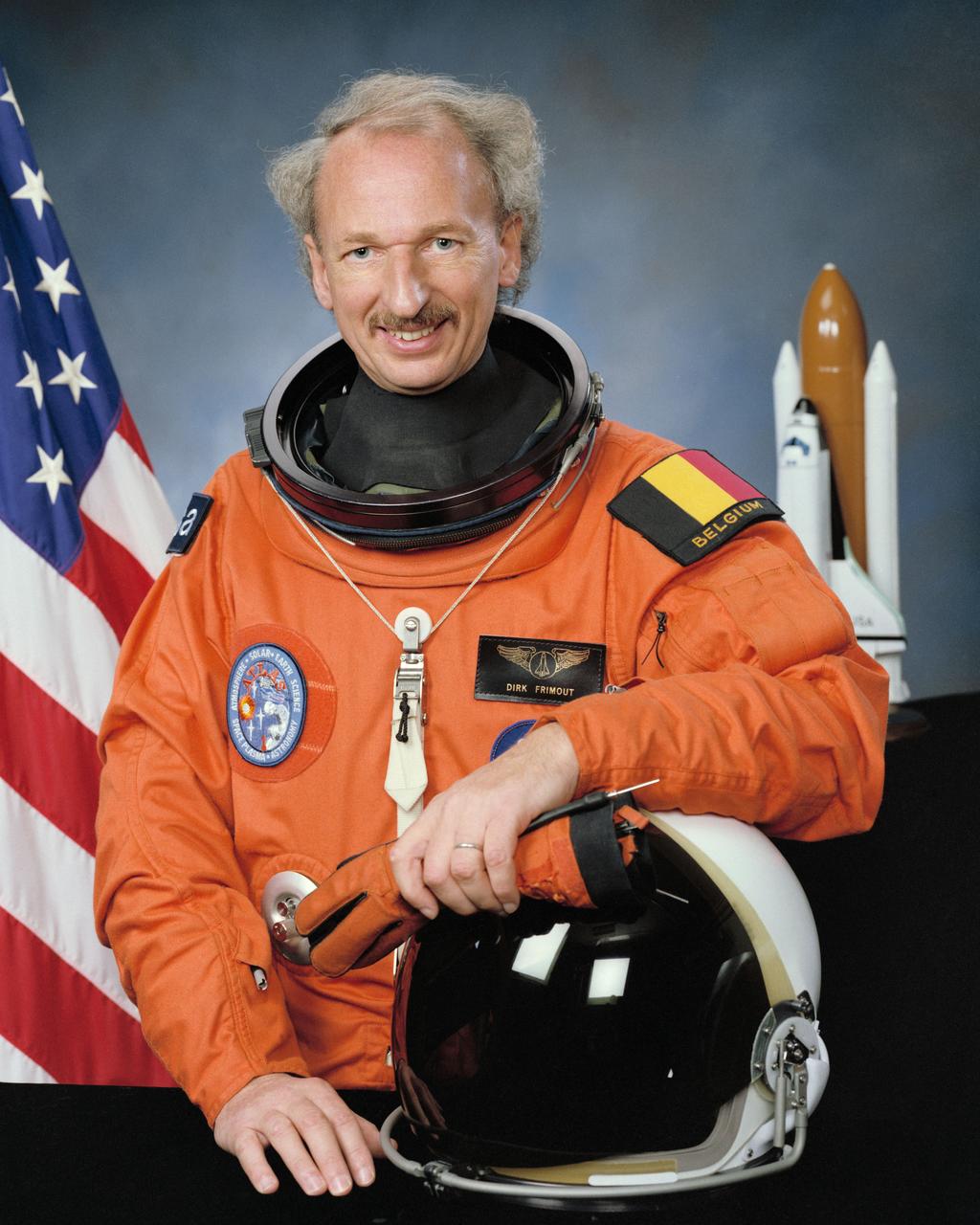
S91-51295 (1991) --- Astronaut Dirk Frimout, payload specialist representing the European Space Agency (ESA).
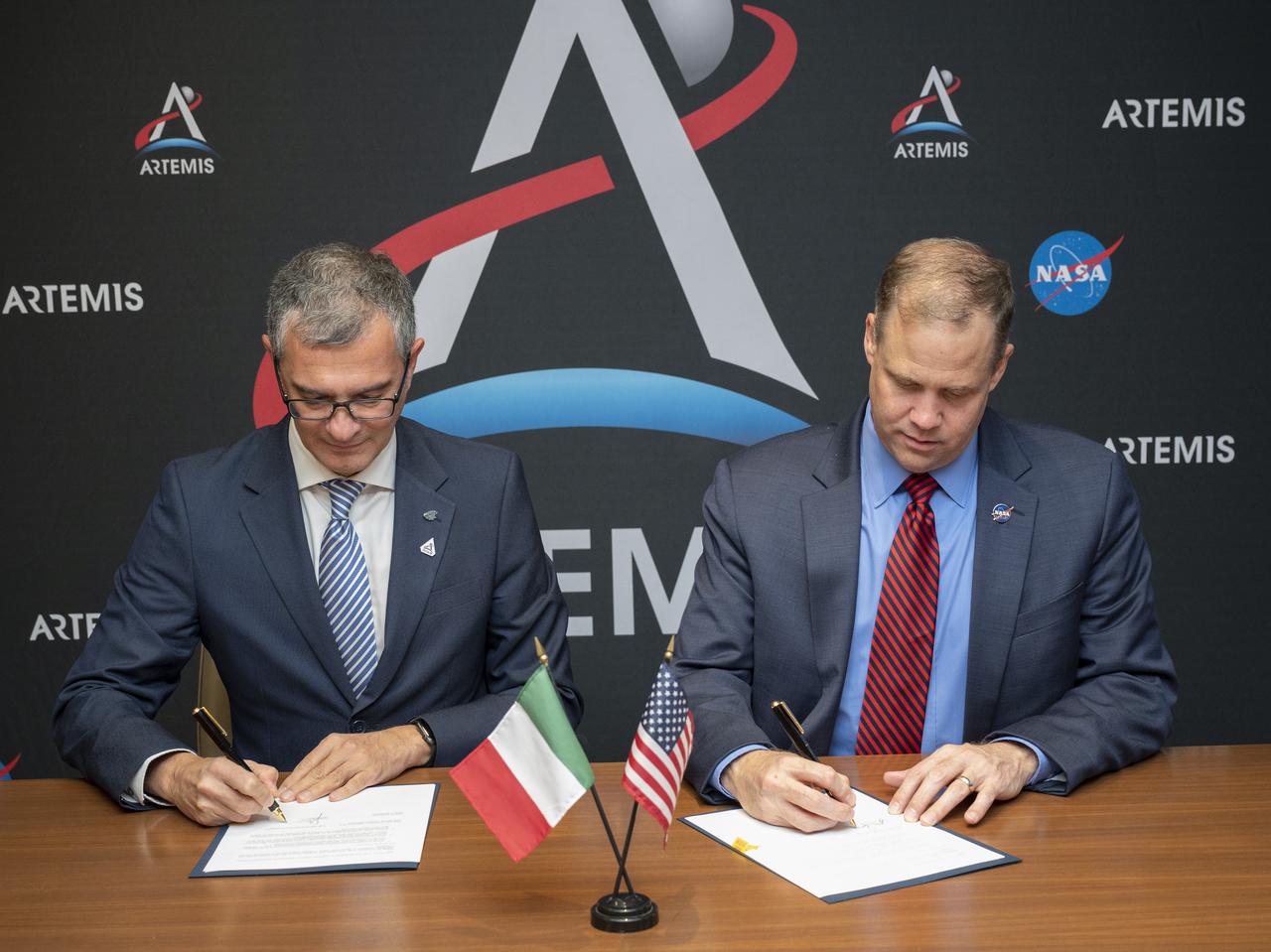
Giorgio Saccoccia Head of the Italian Space Agency (ASI), left, and NASA Administrator Jim Bridenstine sign a joint statement acknowledging the strong ongoing cooperation between the agencies, and identifying areas of potential future cooperation on and around the Moon as part of NASA’s Artemis program at the 70th International Astronautical Congress, Wednesday, Oct. 23, 2019 in Washington. Photo Credit: (NASA/Joel Kowsky)
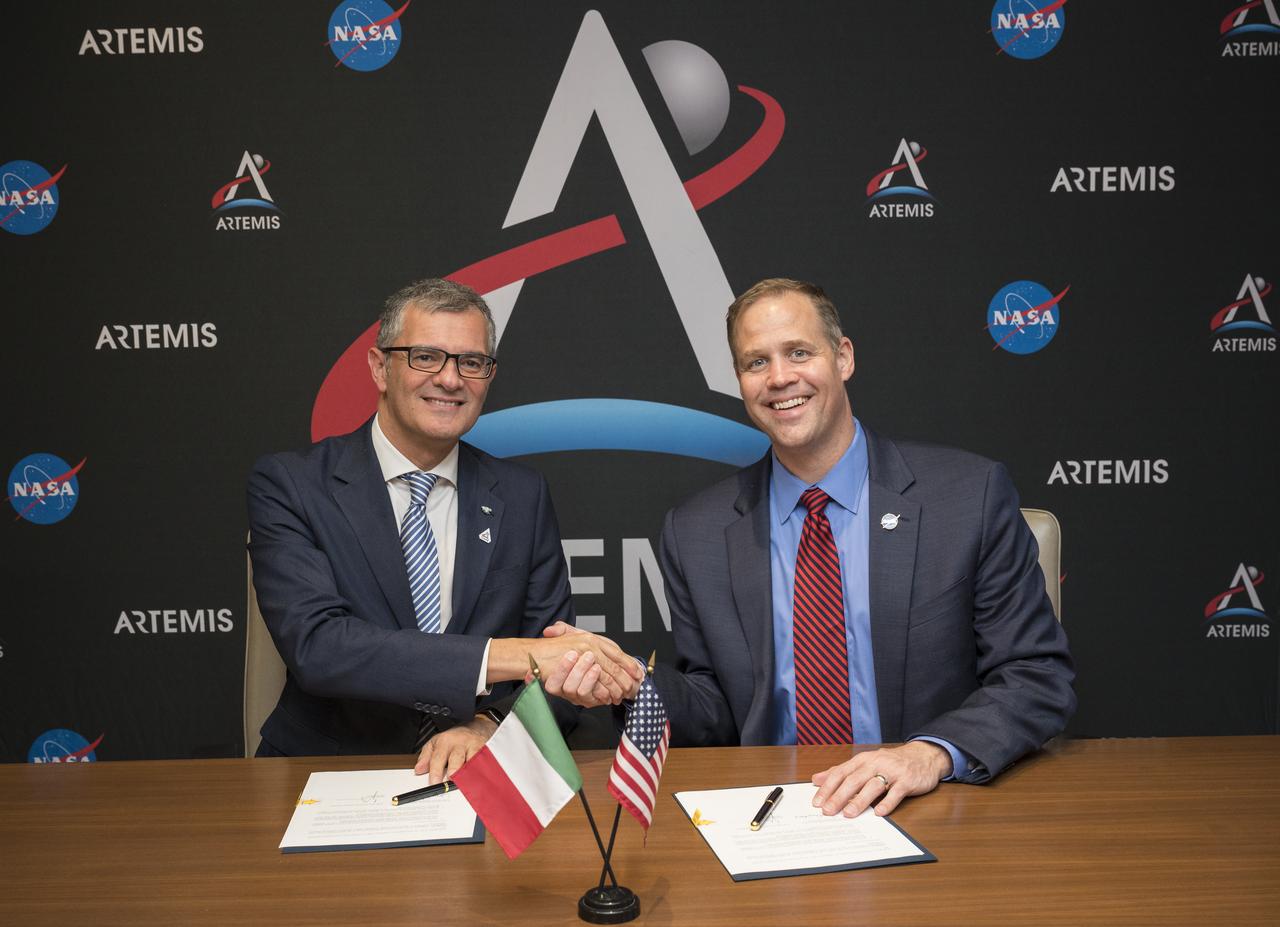
Giorgio Saccoccia Head of the Italian Space Agency (ASI), left, and NASA Administrator Jim Bridenstine shake hands after signing a joint statement acknowledging the strong ongoing cooperation between the agencies, and identifying areas of potential future cooperation on and around the Moon as part of NASA’s Artemis program at the 70th International Astronautical Congress, Wednesday, Oct. 23, 2019 in Washington. Photo Credit: (NASA/Joel Kowsky)
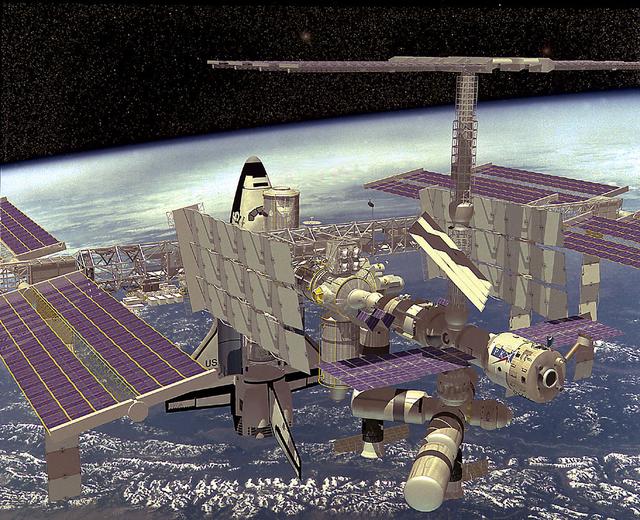
Artist's concept for Phase III of the International Space Station (ISS) as shown here in its completed and fully operational state with elements from the United States, Europe, Canada, Japan, and Russia. Sixteen countries are cooperating to provide a multidisciplinary laboratory, technology test bed, and observatory that will provide an unprecedented undertaking in scientific, technological, and international experimentation.
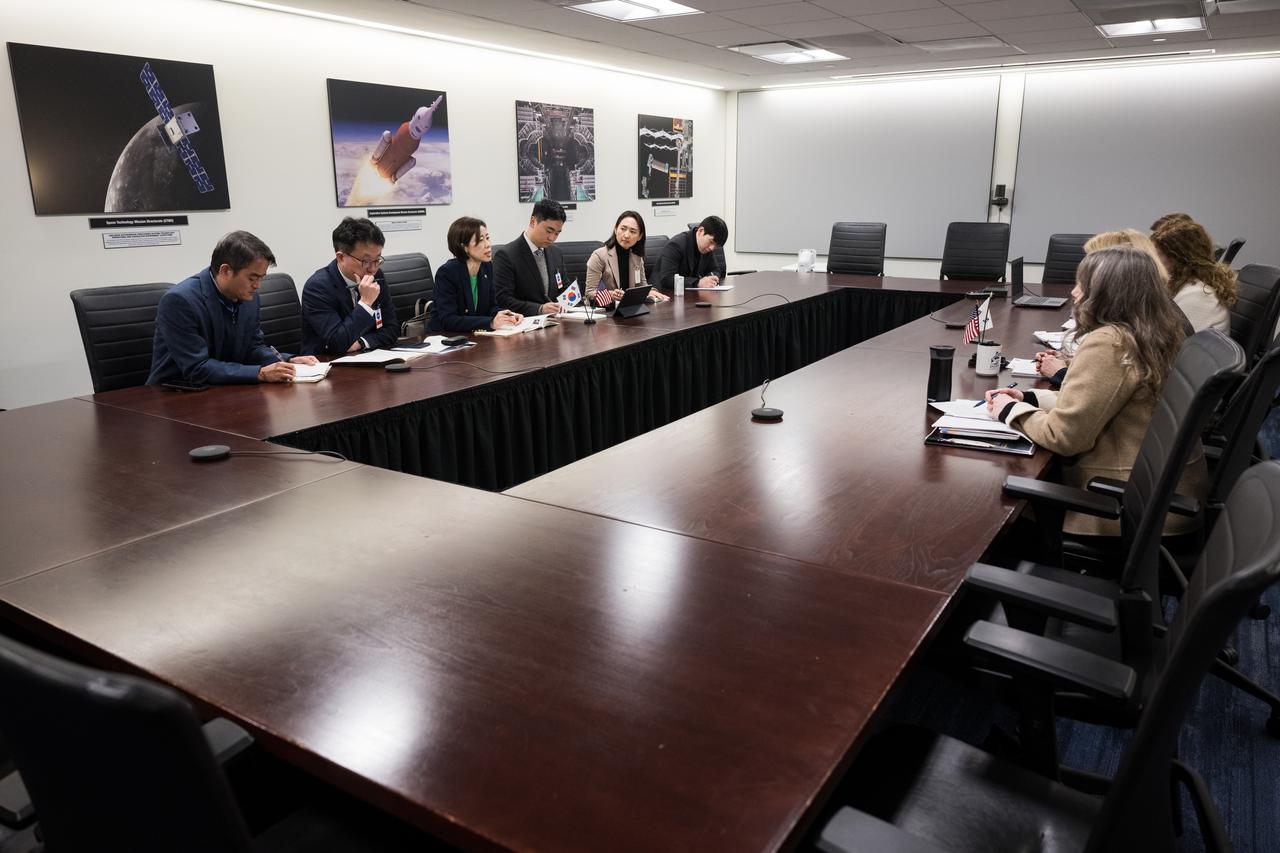
From left to right, Science and ICT Counselor, Embassy of Republic of Korea, Kyu Chul Song, Special Advisor of International Space Cooperation, Ministry of Science and ICT of Korea, Byung Il Choi, Vice Minister, Ministry of Science and ICT of Korea, Seong Kyung Cho, Translator, Ministry of Science and ICT of Korea, Ji Ho Kim, Director, Americas and Asia Cooperation Division, Ministry of Science and ICT of Korea, Kyoung Lim Lee, and Deputy Director, Americas and Asia Cooperation Division, Ministry of Science and ICT of Korea, Sang Won Kim meet with NASA Deputy Administrator Pam Melroy, Tuesday, Jan. 23, 2024, at the Mary W. Jackson NASA Headquarters building in Washington. Photo Credit: (NASA/Aubrey Gemignani)
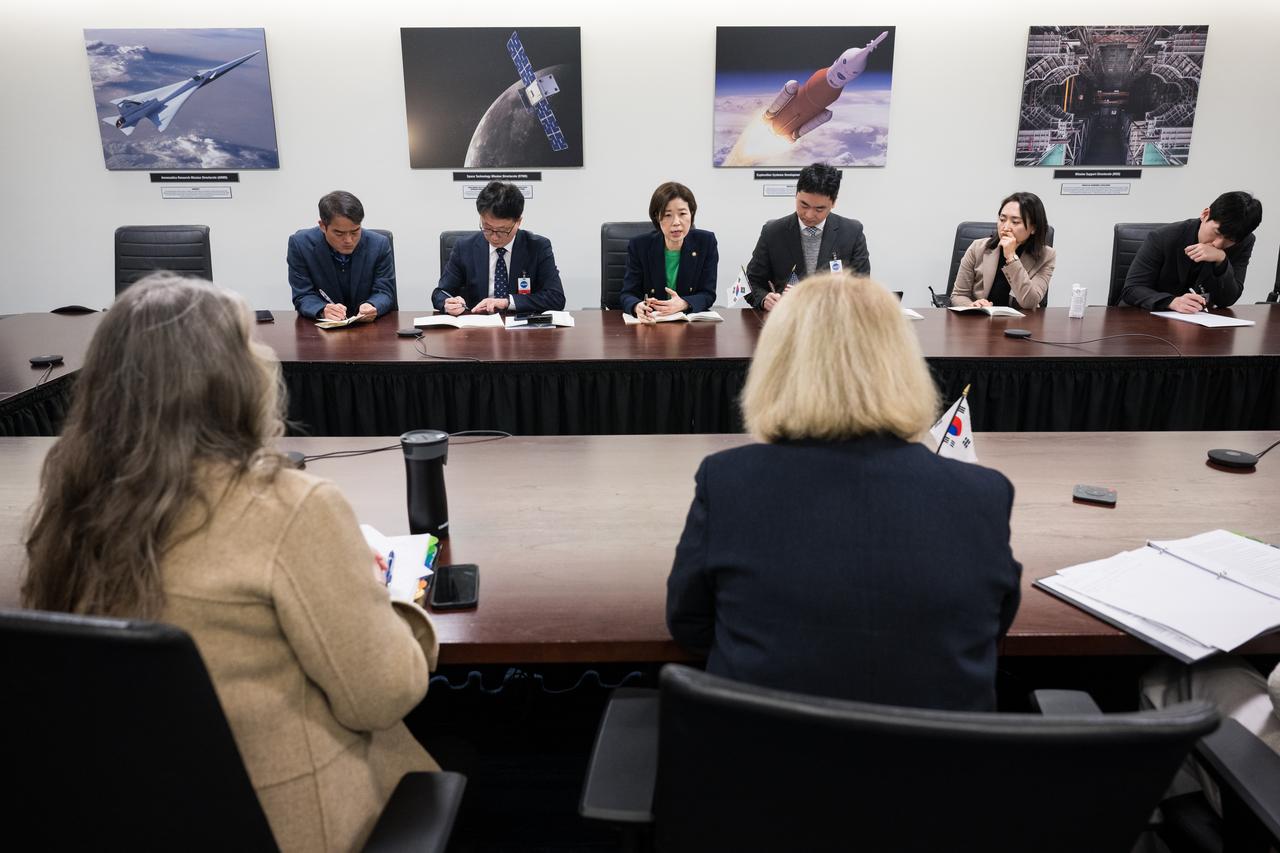
NASA Deputy Administrator Pam Melroy meets with from left to right, Science and ICT Counselor, Embassy of Republic of Korea, Kyu Chul Song, Special Advisor of International Space Cooperation, Ministry of Science and ICT of Korea, Byung Il Choi, Vice Minister, Ministry of Science and ICT of Korea, Seong Kyung Cho, Translator, Ministry of Science and ICT of Korea, Ji Ho Kim, Director, Americas and Asia Cooperation Division, Ministry of Science and ICT of Korea, Kyoung Lim Lee, and Deputy Director, Americas and Asia Cooperation Division, Ministry of Science and ICT of Korea, Sang Won Kim, Tuesday, Jan. 23, 2024, at the Mary W. Jackson NASA Headquarters building in Washington. . Photo Credit: (NASA/Aubrey Gemignani)
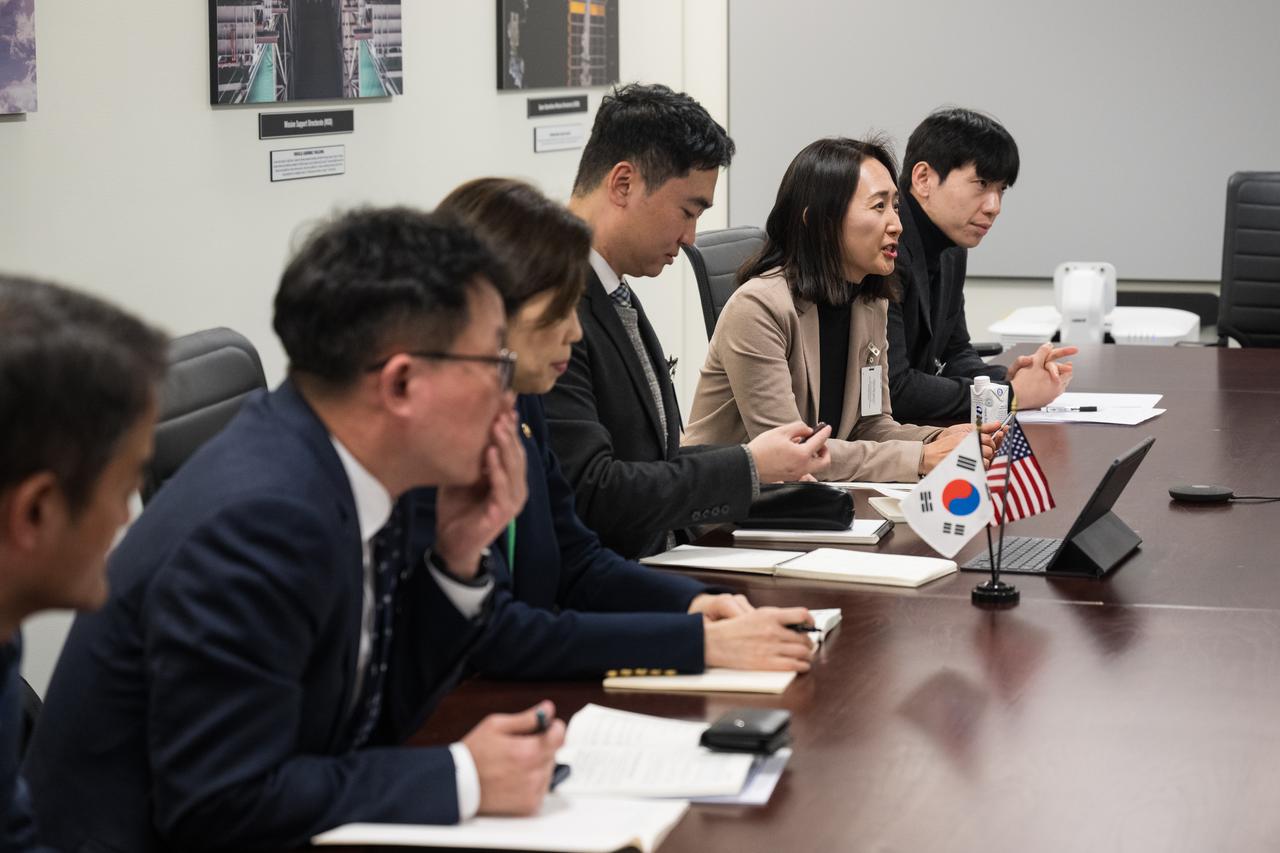
Director, Americas and Asia Cooperation Division, Ministry of Science and ICT of Korea, Kyoung Lim Lee, second from right, speaks during a meeting with NASA Deputy Administrator Pam Melroy (not pictured), Tuesday, Jan. 23, 2024, at the Mary W. Jackson NASA Headquarters building in Washington. Also present were from left to right, Science and ICT Counselor, Embassy of Republic of Korea, Kyu Chul Song, Special Advisor of International Space Cooperation, Ministry of Science and ICT of Korea, Byung Il Choi, Vice Minister, Ministry of Science and ICT of Korea, Seong Kyung Cho, Translator, Ministry of Science and ICT of Korea, Ji Ho Kim, and Deputy Director, Americas and Asia Cooperation Division, Ministry of Science and ICT of Korea, Sang Won Kim. Photo Credit: (NASA/Aubrey Gemignani)
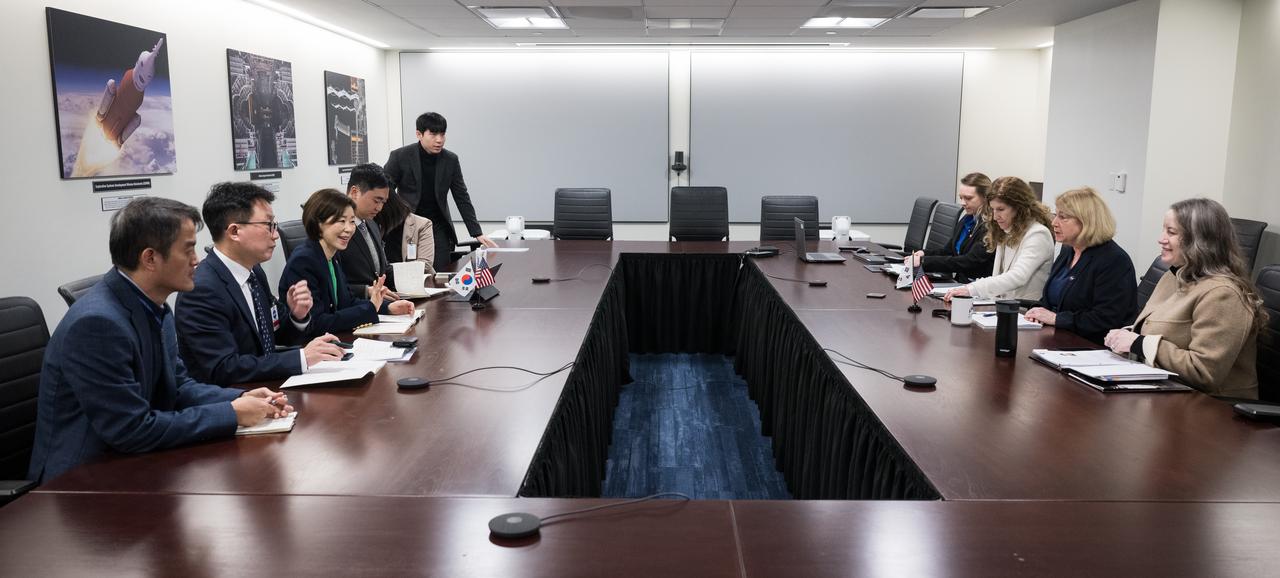
NASA Deputy Administrator Pam Melroy, second from right, along with NASA Associate Administrator for International and Interagency Relations, Karen Feldstein, third from right, Deputy Associate Administrator for International and Interagency Relations Meredith McKay, right, and NASA International Program Specialist Melanie Dalby, meet with from left to right, Science and ICT Counselor, Embassy of Republic of Korea, Kyu Chul Song, Special Advisor of International Space Cooperation, Ministry of Science and ICT of Korea, Byung Il Choi, Vice Minister, Ministry of Science and ICT of Korea, Seong Kyung Cho, Translator, Ministry of Science and ICT of Korea, Ji Ho Kim, Director, Americas and Asia Cooperation Division, Ministry of Science and ICT of Korea, Kyoung Lim Lee, and Deputy Director, Americas and Asia Cooperation Division, Ministry of Science and ICT of Korea, Sang Won Kim, Tuesday, Jan. 23, 2024, at the Mary W. Jackson NASA Headquarters building in Washington. Photo Credit: (NASA/Aubrey Gemignani)
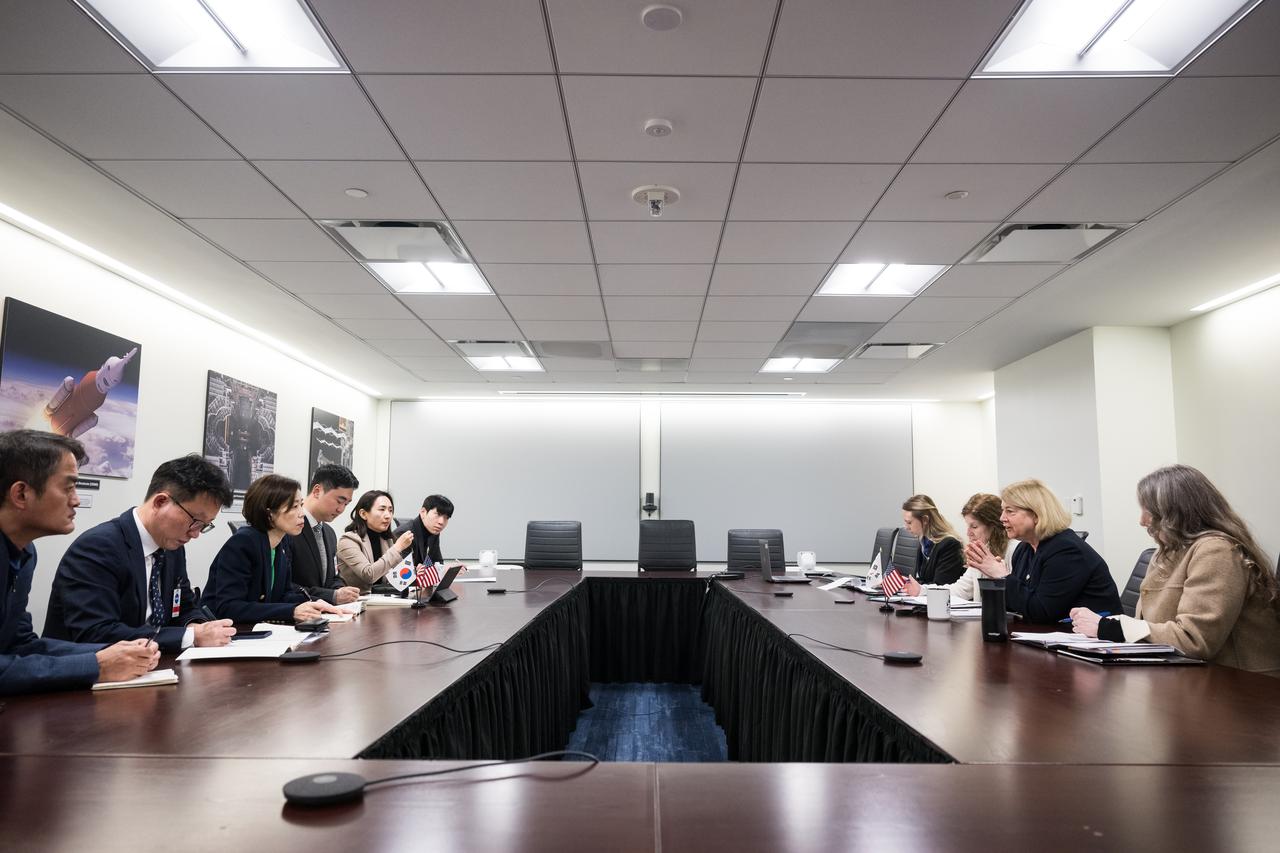
NASA Deputy Administrator Pam Melroy, second from right, along with NASA Associate Administrator for International and Interagency Relations, Karen Feldstein, third from right, Deputy Associate Administrator for International and Interagency Relations Meredith McKay, right, and NASA International Program Specialist Melanie Dalby, meet with from left to right, Science and ICT Counselor, Embassy of Republic of Korea, Kyu Chul Song, Special Advisor of International Space Cooperation, Ministry of Science and ICT of Korea, Byung Il Choi, Vice Minister, Ministry of Science and ICT of Korea, Seong Kyung Cho, Translator, Ministry of Science and ICT of Korea, Ji Ho Kim, Director, Americas and Asia Cooperation Division, Ministry of Science and ICT of Korea, Kyoung Lim Lee, and Deputy Director, Americas and Asia Cooperation Division, Ministry of Science and ICT of Korea, Sang Won Kim, Tuesday, Jan. 23, 2024, at the Mary W. Jackson NASA Headquarters building in Washington. Photo Credit: (NASA/Aubrey Gemignani)
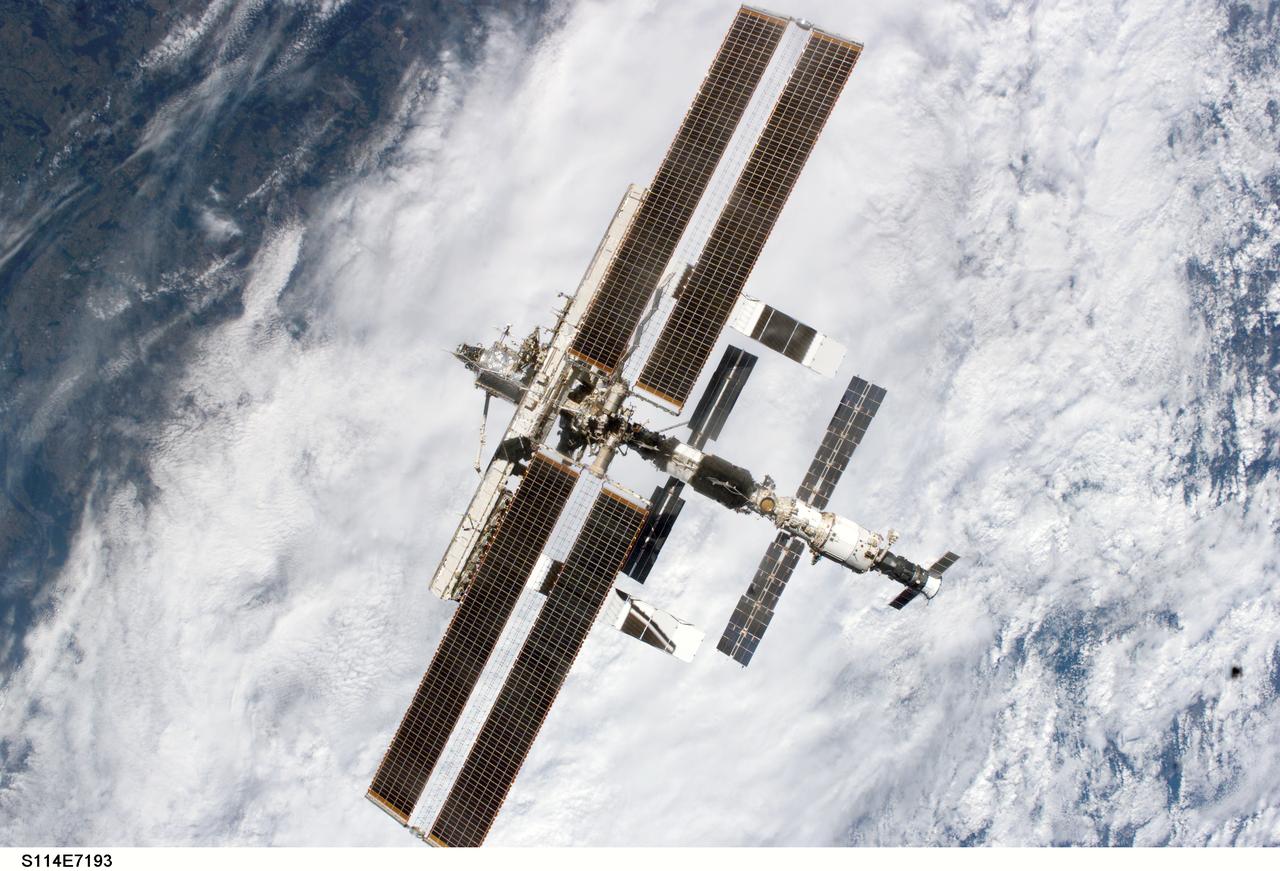
S114-E-7193 (6 August 2005) --- The International Space Station is backdropped against clouds as it moves away from the Space Shuttle Discovery after the respective crews concluded nine days of cooperative work. Undocking occurred at 2:24 a.m. (CDT), August 6, 2005.
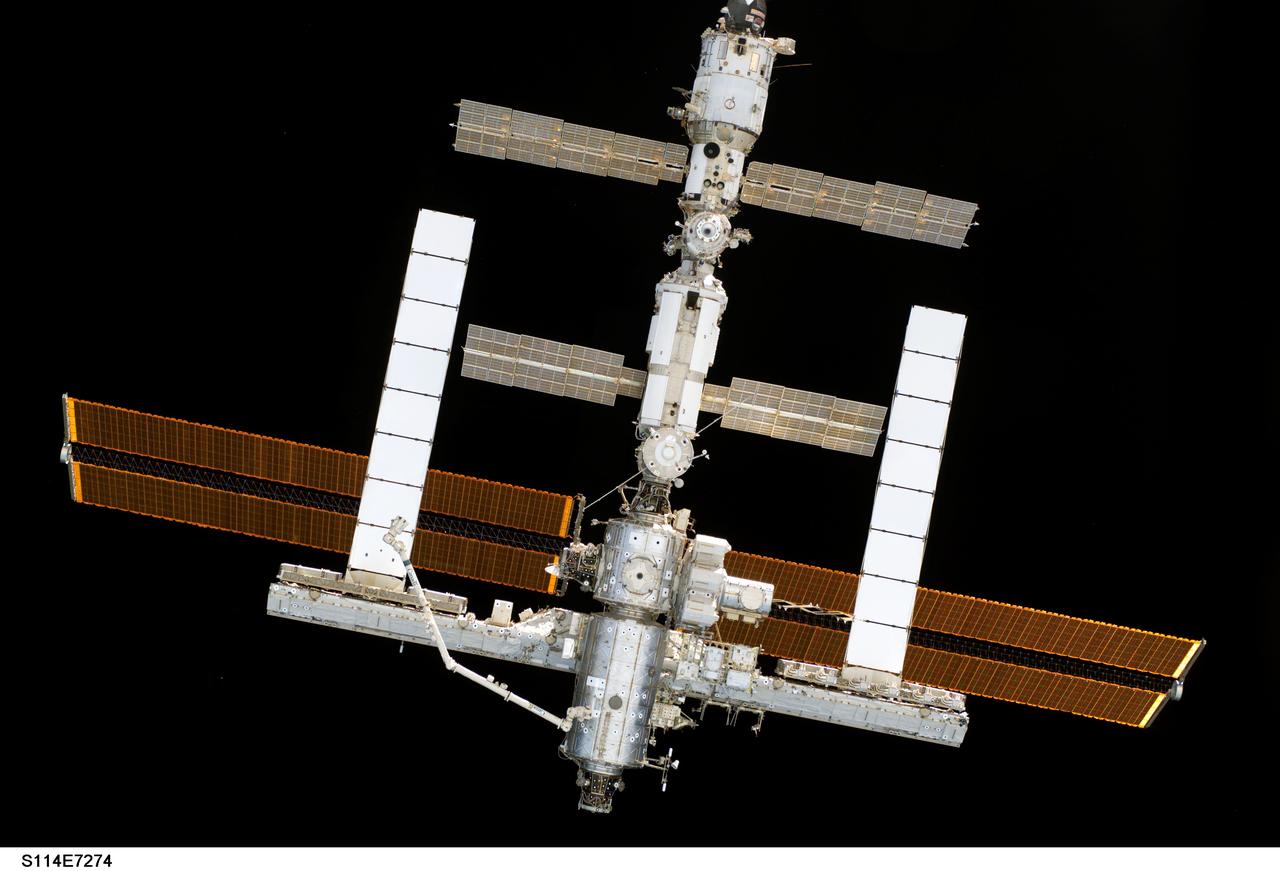
S114-E-7274 (6 August 2005) --- The International Space Station and the Space Shuttle Discovery begin their relative separation after their crewmembers concluded nine days of cooperative work. Undocking occurred at 2:24 a.m. (CDT), August 6, 2005.
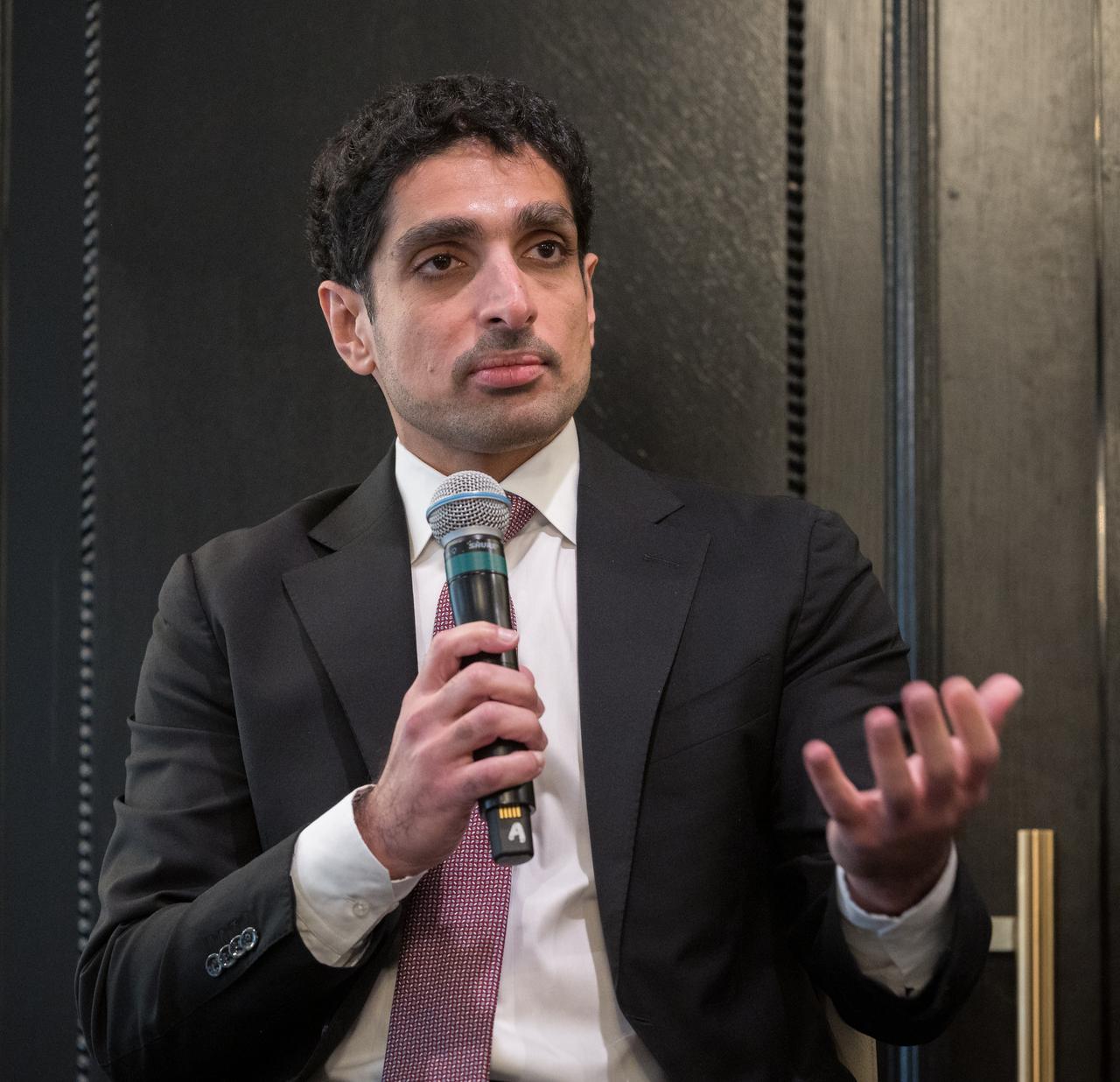
UAE Assistant Minister of Foreign Affairs and International Cooperation for Advanced Science and Technology, Omran Sharaf, gives remarks during an event celebrating UAE-US collaboration in space, Friday, March 8, 2024, at the Four Seasons Hotel in Washington. Photo Credit: (NASA/Bill Ingalls)
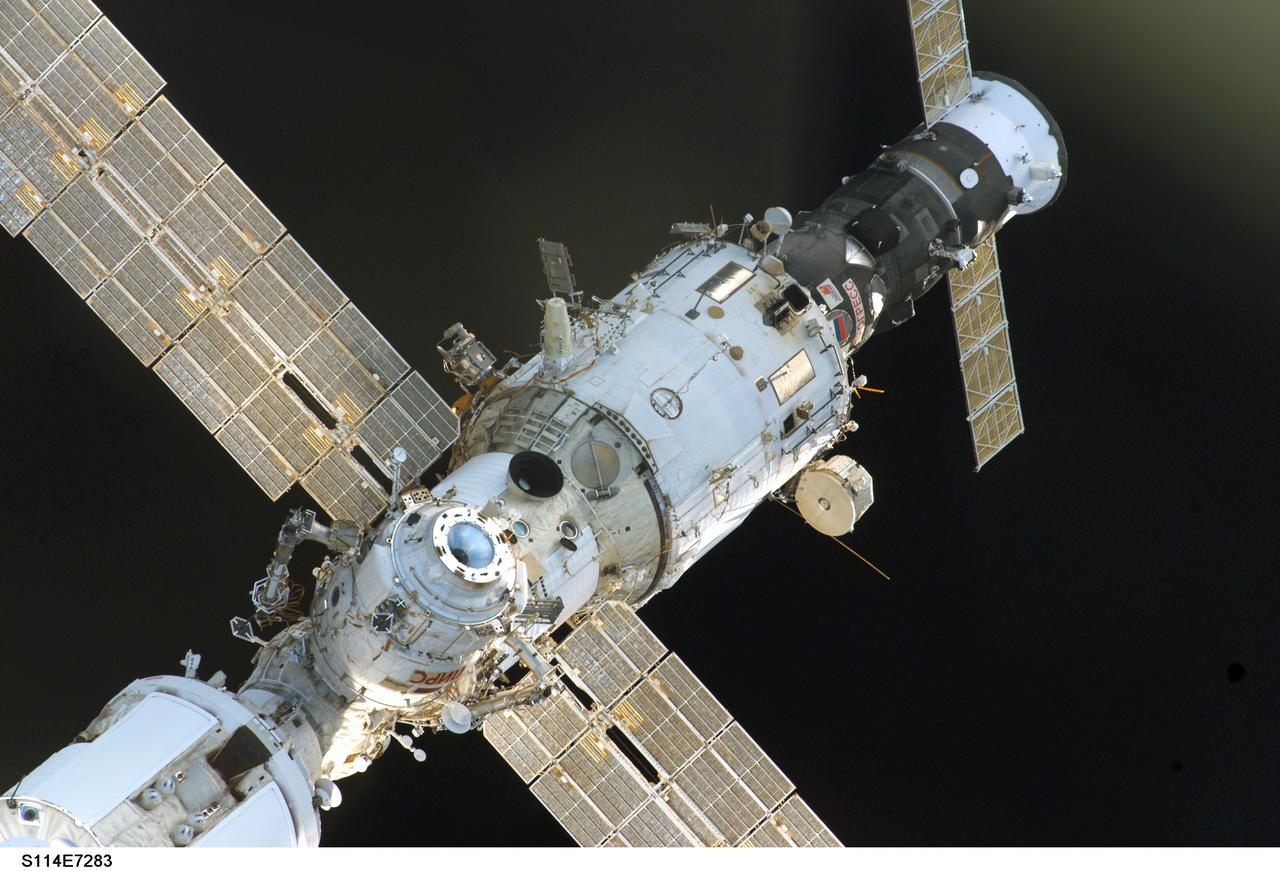
S114-E-7283 (6 August 2005) --- The International Space Station and the Space Shuttle Discovery begin their relative separation after their crewmembers concluded nine days of cooperative work. Undocking occurred at 2:24 a.m. (CDT), August 6, 2005.
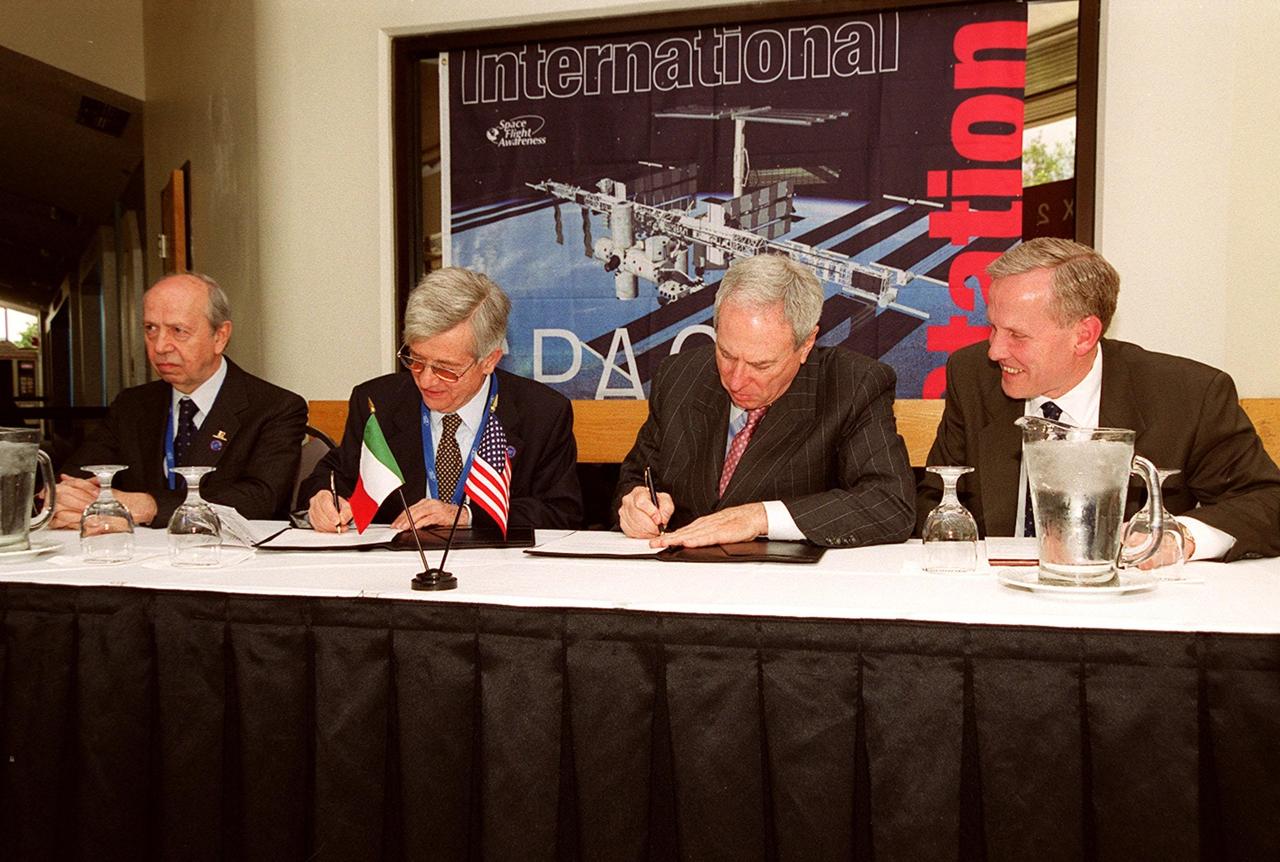
NASA Administrator Daniel S. Goldin and Italian Space Agency (ASI) President Sergio DeJulio sign a Framework for Cooperation to build the Habitation Module for the International Space Station. Seated at the table (left to right) are The Honorable Lamberto Dini, Minister of Foreign Affairs, Republic of Italy; DeJulio; Goldin; and John Schumacher, assistant administrator, External Relations, NASA. The Framework is a potential bilateral cooperative agreement that could result in ASI development of a U.S. Habitation Module for the International Space Station. This agreement allows the U.S. to explore an alternative approach to achieve full crew habitation for the ISS. A Memorandum of Understanding (MOU) between NASA and ASI will be required to formally document NASA and ASI’s respective responsibilities in a legally binding document. The Framework signed today would form the basis for a potential MOU which NASA and ASI would sign after completion of the program assessment and subsequent negotiations. The ceremony took place at the IMAX Theater, Kennedy Space Center Visitor Complex
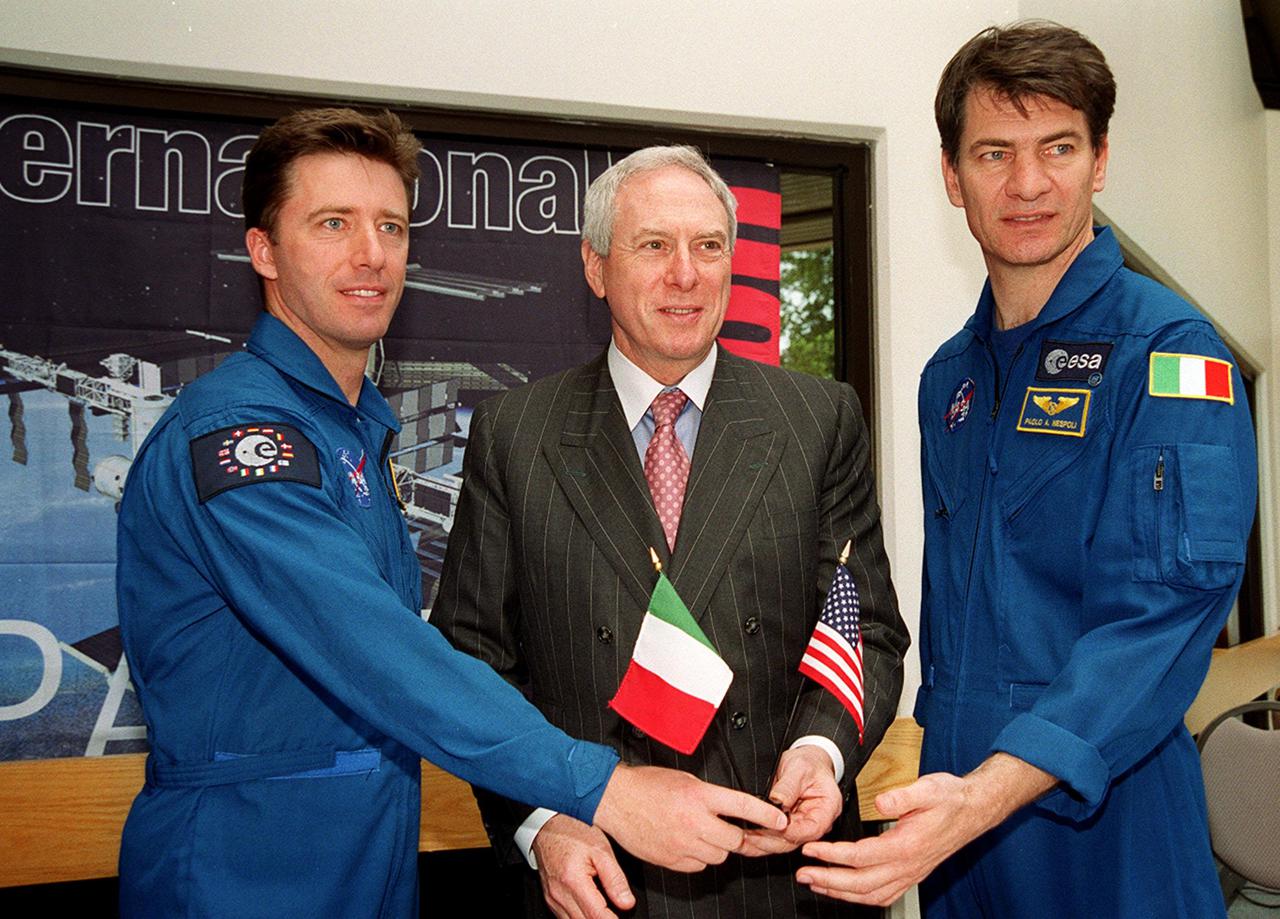
At a signing ceremony between the Italian Space Agency (ASI) and NASA for a Framework for Cooperation to build the Habitation Module for the International Space Station, Italian astronauts with the European Space Agency pose with NASA Administrator Daniel S. Goldin. On the left is Roberto Vittori and on the right is Paolo A. Nespoli. The Framework is a potential bilateral cooperative agreement that could result in ASI development of a U.S. Habitation Module for the International Space Station. This agreement allows the U.S. to explore an alternative approach to achieve full crew habitation for the ISS. A Memorandum of Understanding (MOU) between NASA and ASI will be required to formally document NASA and ASI’s respective responsibilities in a legally binding document. The Framework signed today would form the basis for a potential MOU which NASA and ASI would sign after completion of the program assessment and subsequent negotiations. The ceremony took place at the IMAX Theater, Kennedy Space Center Visitor Complex
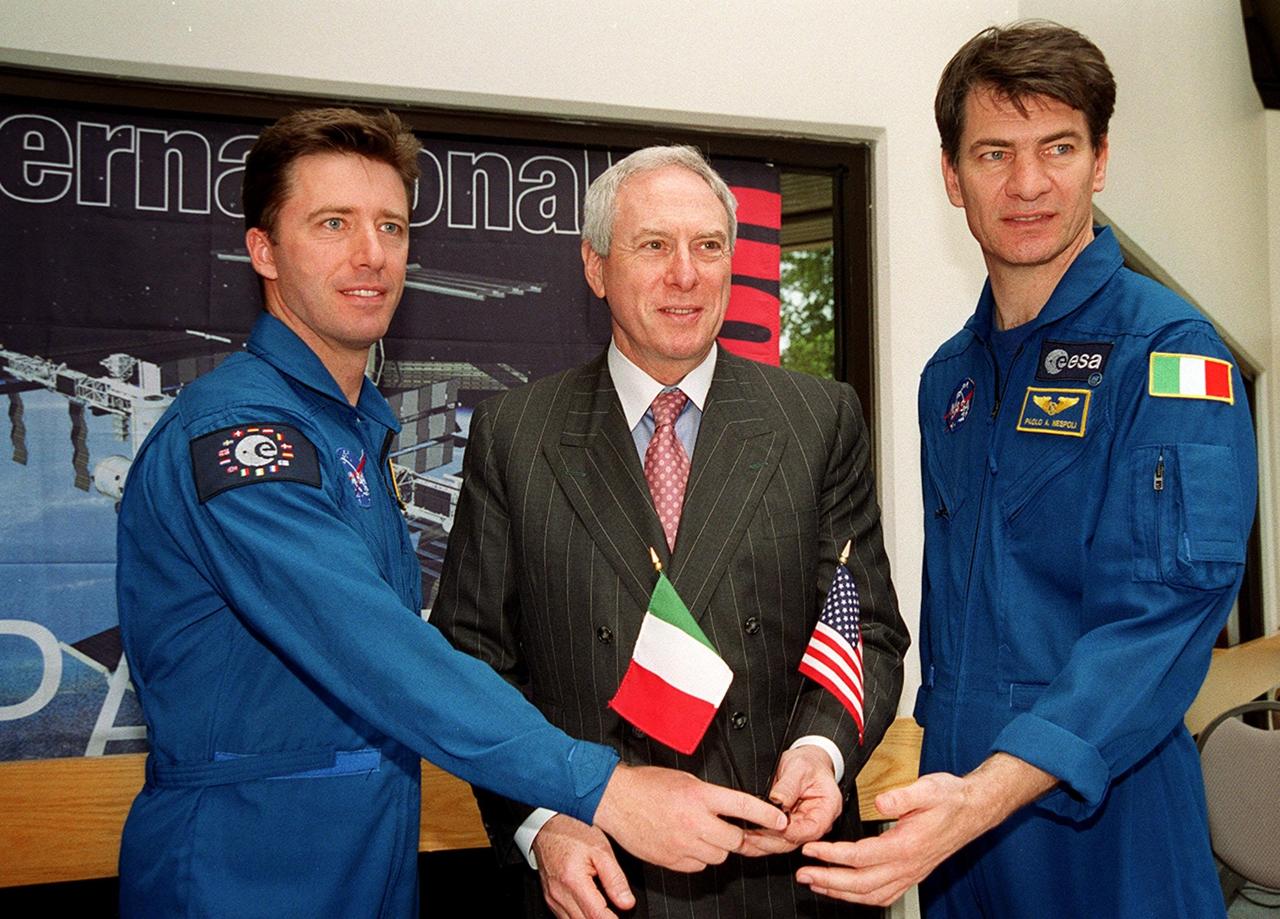
At a signing ceremony between the Italian Space Agency (ASI) and NASA for a Framework for Cooperation to build the Habitation Module for the International Space Station, Italian astronauts with the European Space Agency pose with NASA Administrator Daniel S. Goldin. On the left is Roberto Vittori and on the right is Paolo A. Nespoli. The Framework is a potential bilateral cooperative agreement that could result in ASI development of a U.S. Habitation Module for the International Space Station. This agreement allows the U.S. to explore an alternative approach to achieve full crew habitation for the ISS. A Memorandum of Understanding (MOU) between NASA and ASI will be required to formally document NASA and ASI’s respective responsibilities in a legally binding document. The Framework signed today would form the basis for a potential MOU which NASA and ASI would sign after completion of the program assessment and subsequent negotiations. The ceremony took place at the IMAX Theater, Kennedy Space Center Visitor Complex
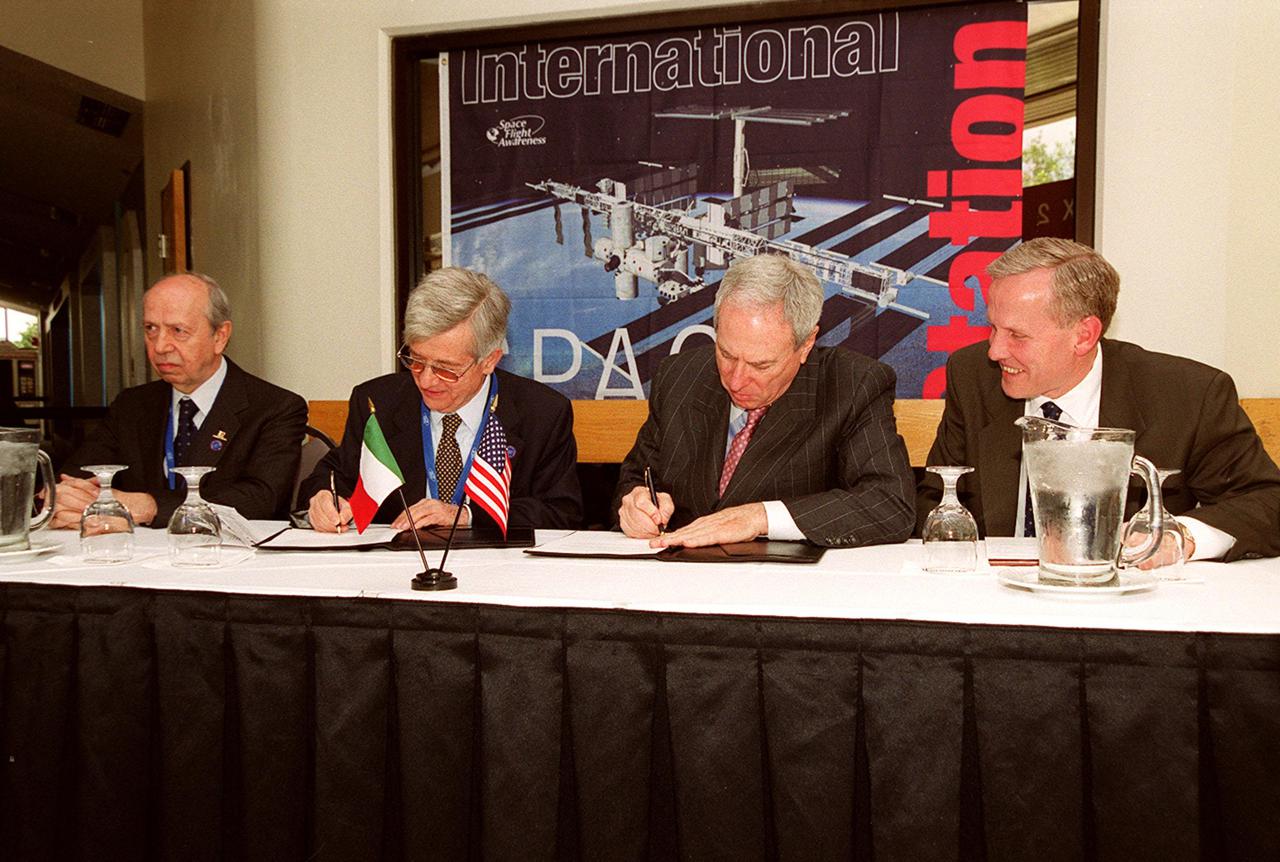
NASA Administrator Daniel S. Goldin and Italian Space Agency (ASI) President Sergio DeJulio sign a Framework for Cooperation to build the Habitation Module for the International Space Station. Seated at the table (left to right) are The Honorable Lamberto Dini, Minister of Foreign Affairs, Republic of Italy; DeJulio; Goldin; and John Schumacher, assistant administrator, External Relations, NASA. The Framework is a potential bilateral cooperative agreement that could result in ASI development of a U.S. Habitation Module for the International Space Station. This agreement allows the U.S. to explore an alternative approach to achieve full crew habitation for the ISS. A Memorandum of Understanding (MOU) between NASA and ASI will be required to formally document NASA and ASI’s respective responsibilities in a legally binding document. The Framework signed today would form the basis for a potential MOU which NASA and ASI would sign after completion of the program assessment and subsequent negotiations. The ceremony took place at the IMAX Theater, Kennedy Space Center Visitor Complex
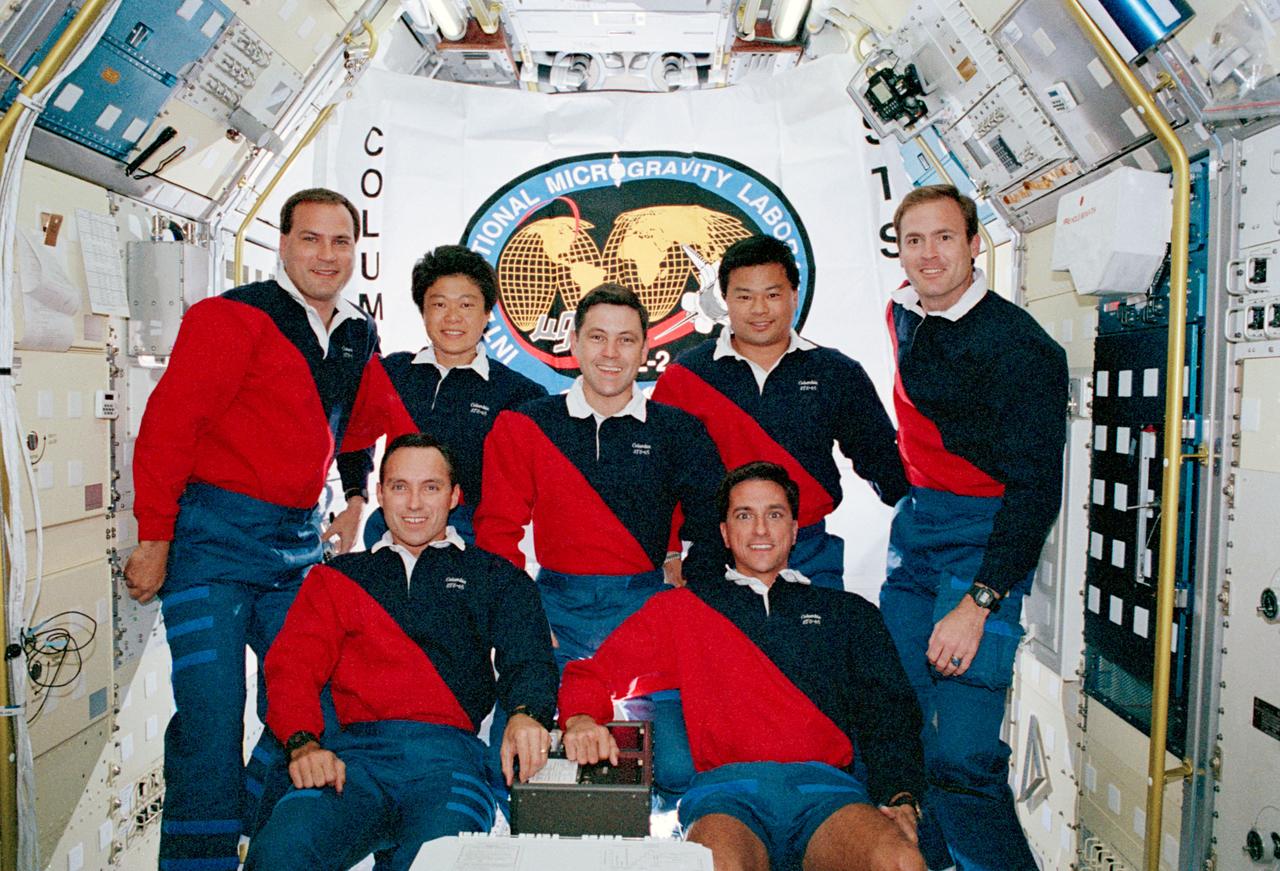
In the spacelab science module aboard the Space Shuttle Columbia, Orbiter Vehicle (OV) 102, the seven crewmembers pose for the traditional onboard (inflight) crew portrait. Displayed in the background is a flag with the International Microgravity Laboratory 2 (IML-2) insignia and Columbia inscribed along the edge. In the front row (left to right) are Mission Specialist (MS) Carl E. Walz and MS Donald A. Thomas. Behind them (left to right) are Payload Commander (PLC) Richard J. Hieb, Payload Specialist Chiaki Mukai, Commander Robert D. Cabana, MS Leroy Chiao, and Pilot James D. Halsell, Jr. Mukai represents the National Space Development Agency (NASDA) of Japan. Crewmembers are wearing their mission polo shirts for the portrait. Inside this module, the crew conducted experiments in support of the IML-2 mission.
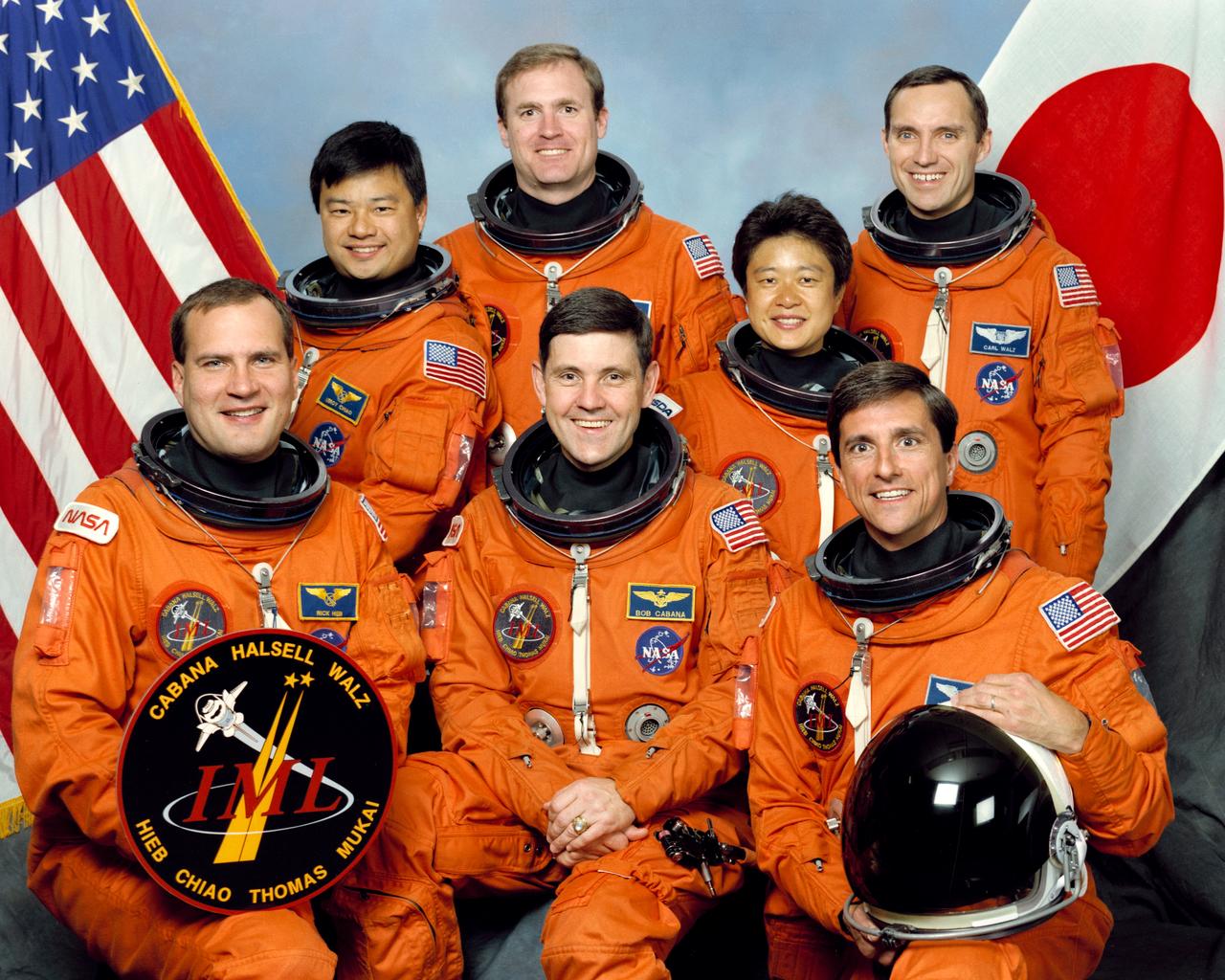
STS065-S-002 (April 1994) --- Six NASA astronauts and a Japanese payload specialist take a break from training to pose for their crew portrait. Left to right are Richard J. Hieb, Leroy Chiao, James D. Halsell Jr., Robert D. Cabana, Dr. Chiaki Mukai, Donald A. Thomas and Carl E. Walz. Cabana is mission commander, and Halsell has been assigned as pilot. Hieb is payload commander, with Walz, Thomas and Chiao serving as mission specialist. Dr. Mukai represents the National Space Development Agency (NASDA) of Japan as payload specialist on the International Microgravity Laboratory (IML) mission.
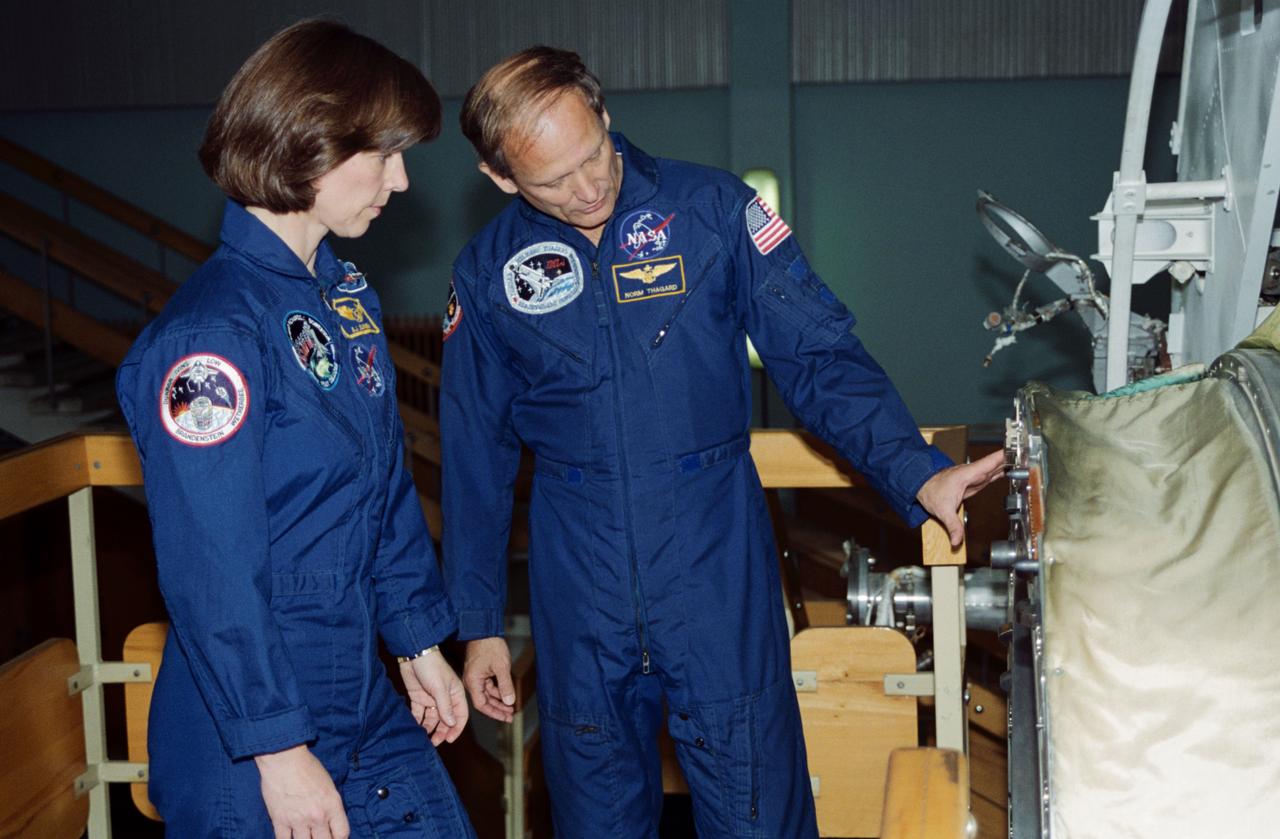
S94-45647 (20 Sept 1994) --- Astronaut's Norman E. Thagard and Bonnie J. Dunbar by the Mir Space Station simulator at the Gagarin Cosmonaut Training Center (Star City), near Moscow, Russia. In March 1995, astronaut Thagard is scheduled to be launched in a Russian Soyuz spacecraft with two cosmonauts to begin a three-month tour of duty on the Russian Mir Space Station. Thagard, along with his back-up, astronaut Dunbar, has been training in Russia since February 1994. During his stay on Mir, he will conduct a variety of life sciences experiments that will provide U.S. investigators with the first long-duration exposure data since Skylab in the late 1970's. Thagard's mission will end in late May or early June when the Space Shuttle Atlantis, carrying the newly installed docking mechanism, docks with Mir Space Station for the first United States - Russian docking operation since Apollo-Soyuz in 1975. The Orbiter will remain attached to Mir for five days of joint scientific operations before returning home with Thagard and his Russian crew mates and leaving behind two cosmonauts on Mir.
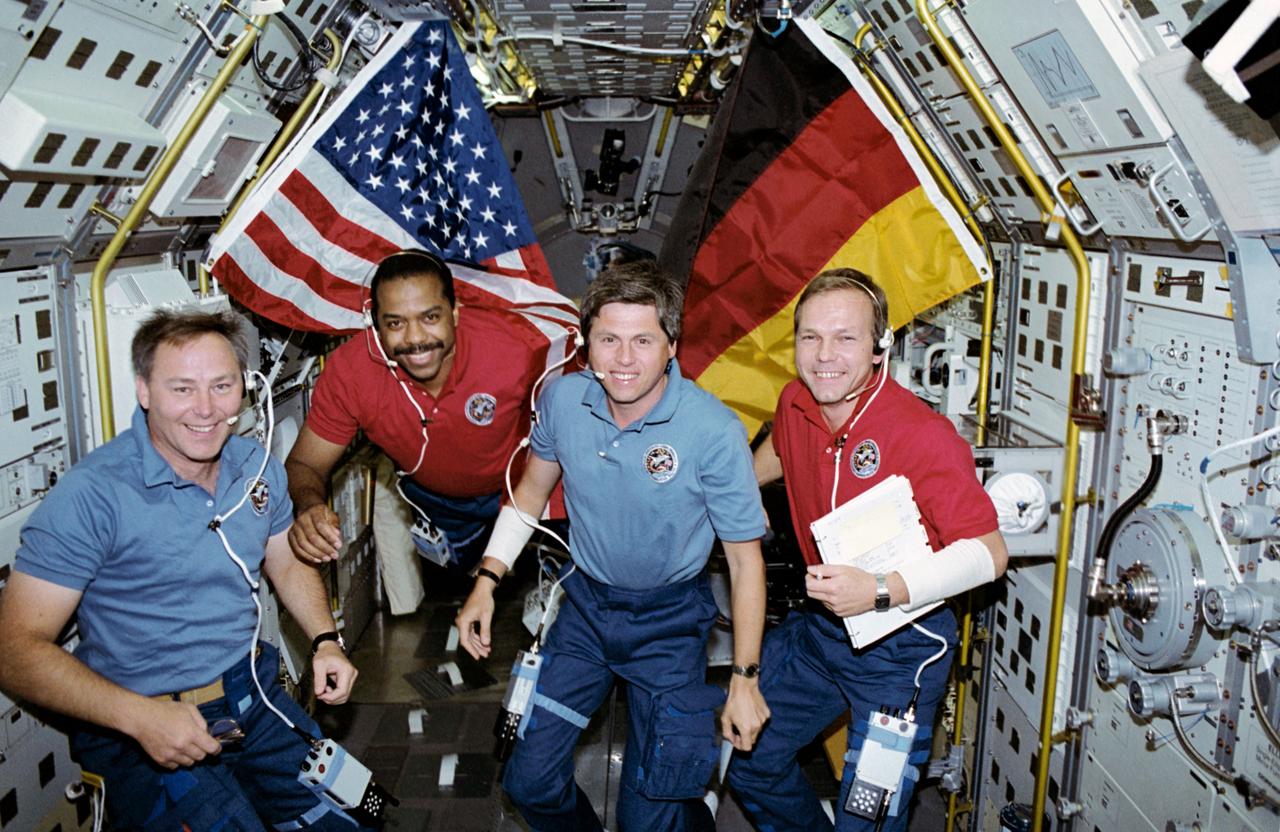
STS-55 crewmembers pose with United States and German flags inside the Spacelab Deutsche 2 (SL-D2) science module located in the payload bay (PLB) of Columbia, Orbiter Vehicle (OV) 102. Wearing communications kit assembly headsets (HDSTs) are (left to right) Mission Specialist 1 (MS1) and Payload Commander (PLC) Jerry L. Ross, MS3 Bernard A. Harris, Jr, German Payload Specialist 1 Ulrich Walter, and Payload Specialist 2 Hans Schlegel.
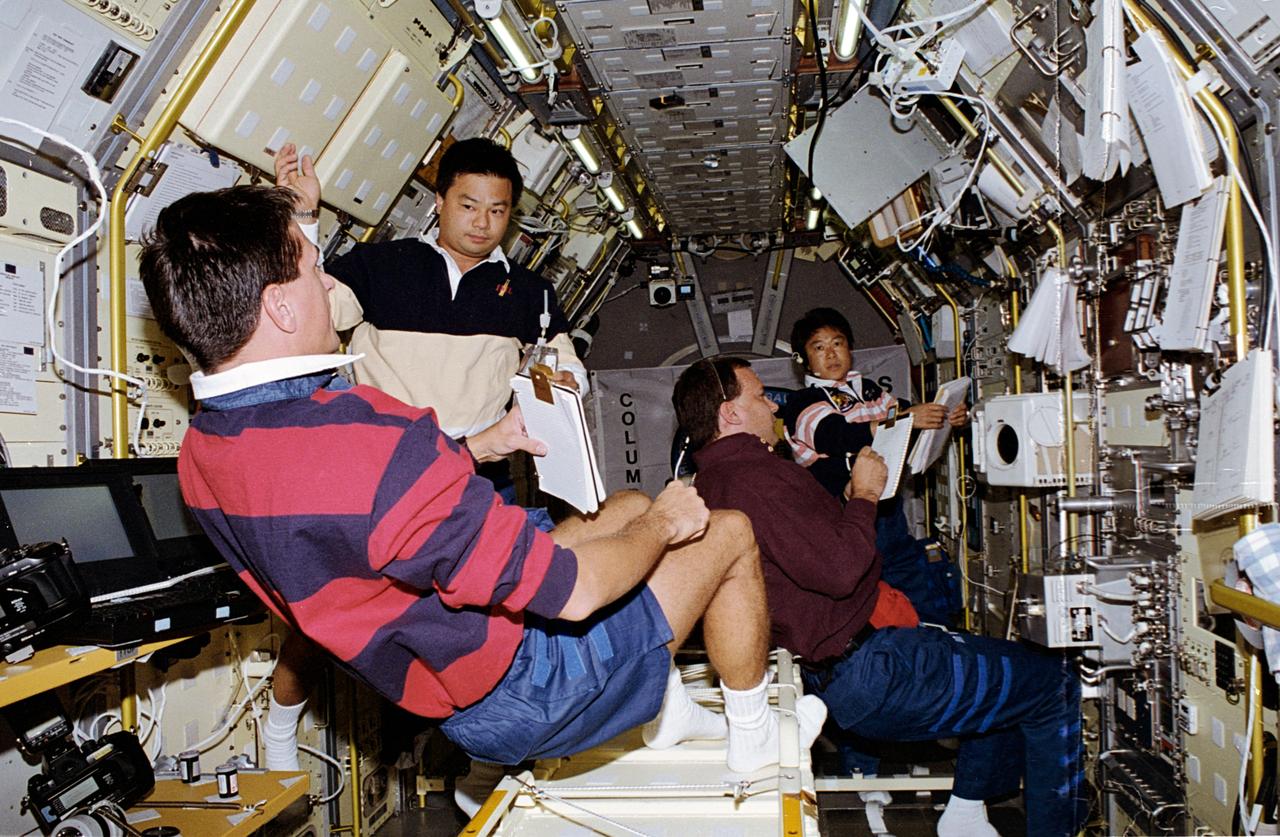
STS065-05-037 (8-23 July 1994) --- In the science module aboard the Space Shuttle Columbia, four members of the crew busy themselves with experiments in support of the second International Microgravity Laboratory (IML-2) mission. Left to right are Donald A. Thomas and Leroy Chiao, both mission specialists; Richard J. Hieb, payload commander, and Dr. Chiaki Mukai of NASDA, payload specialist.
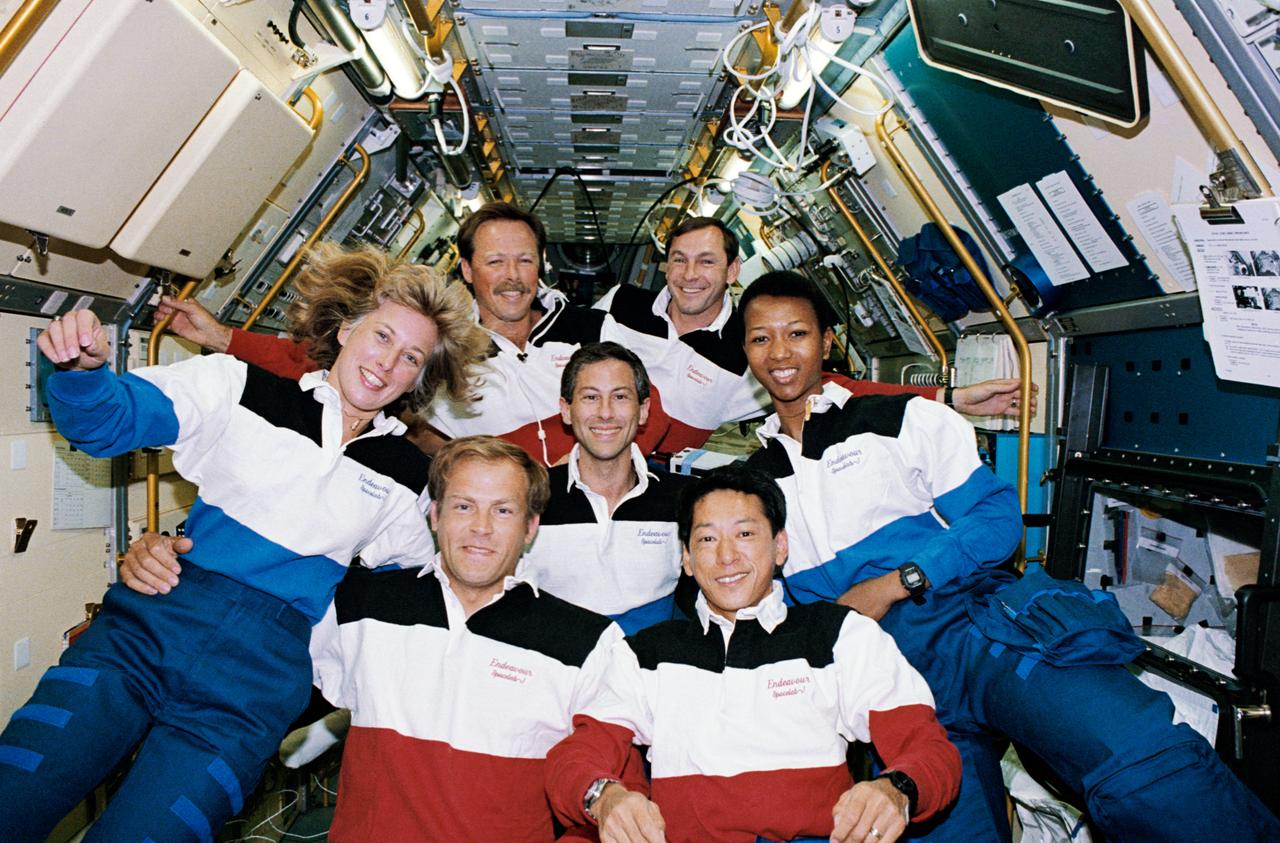
STS047-09-009 (12 - 20 Sept 1992) --- The seven crew members sharing eight days of research in support of Spacelab-J pose for the traditional inflight portrait in the Science Module. Pictured, left to right, back row, are Robert L. Gibson, mission commander; and Curtis L. Brown, Jr., pilot; middle row, N. Jan Davis, Jerome (Jay) Apt and Mae C. Jemison, all mission specialists; and front row, Mark C. Lee, payload commander, and Mamoru Mohri, payload specialist representing Japan's National Space Development Agency (NASDA).
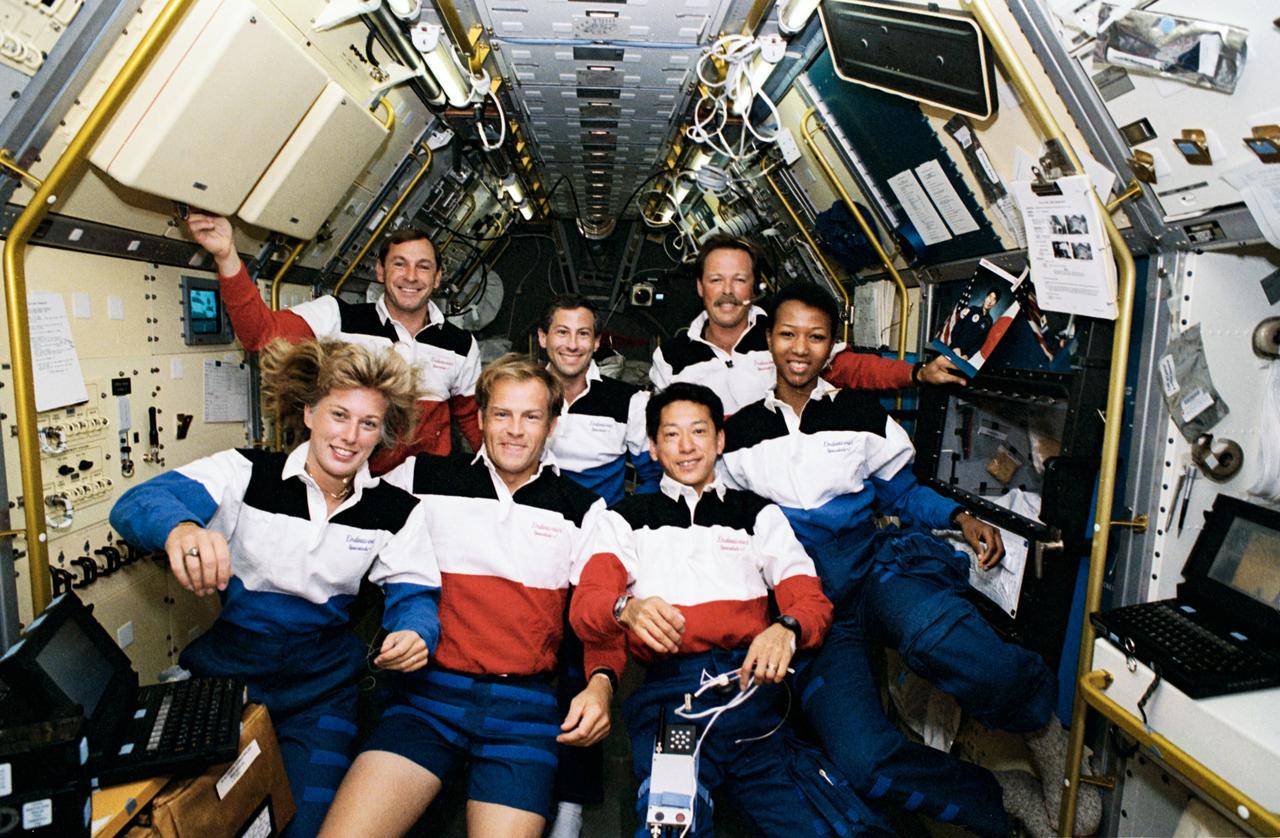
STS047-12-002 (12 - 20 Sept 1992) --- The crew members assemble for their traditional in-flight portrait in this 35mm frame photographed in the Science Module aboard the Earth-orbiting Space Shuttle Endeavour. Left to right (front) are N. Jan Davis, Mark C. Lee and Mamoru Mohri; and (rear) Curtis L. Brown, Jr., Jerome (Jay) Apt, Robert L. Gibson and Mae C. Jemison. The seven spent eight days in space in support of the Spacelab-J mission.
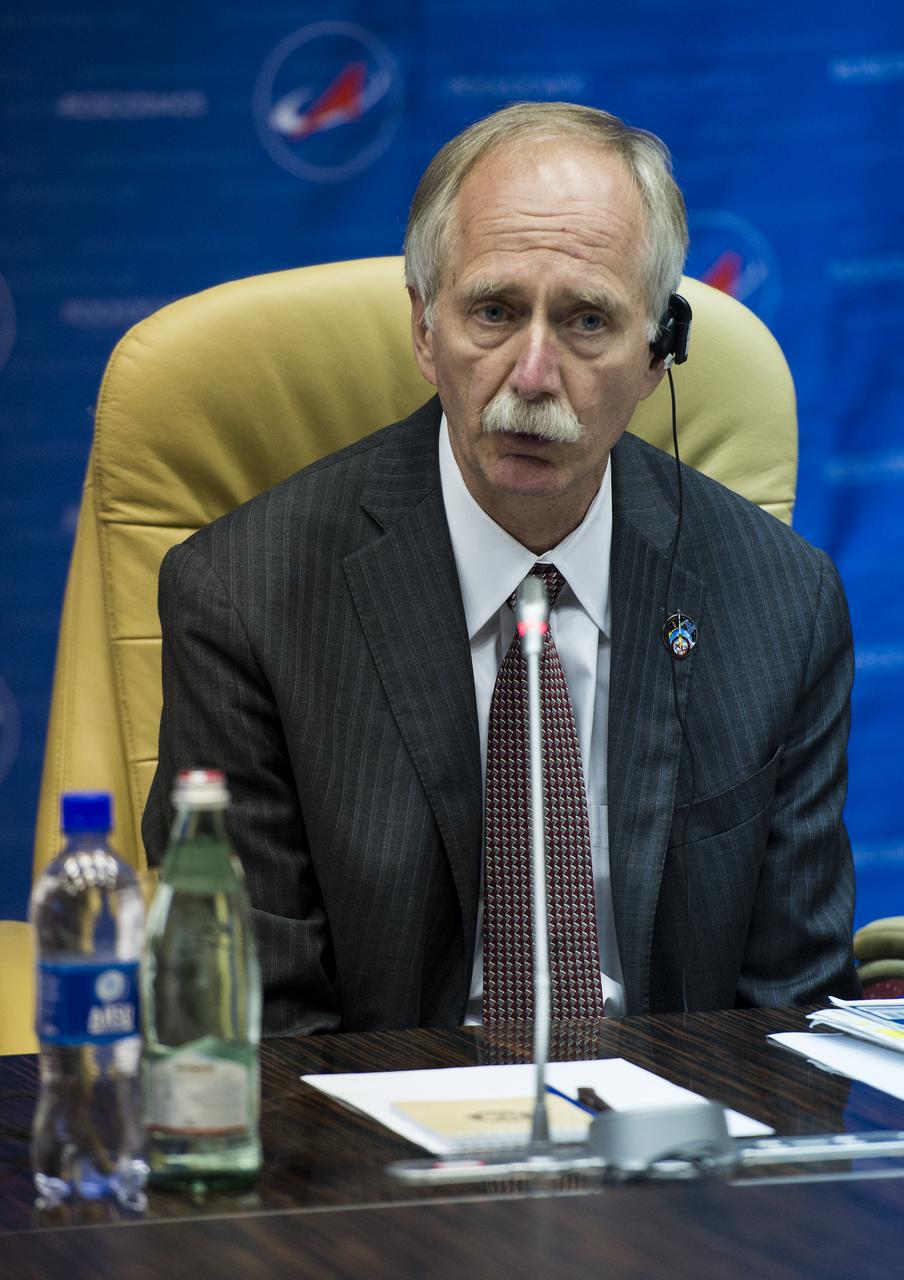
William Gerstenmaier, NASA Associate Administrator for Human Exploration and Operations, speaks during a joint statement with Jean-Jacques Dordain, Director General of the European Space Agency, and Oleg Ostapenko, General Director of the Russian Federal Space Agency, Roscosmos, following the docking of the Soyuz TMA-13M spacecraft with the International Space Station on Thursday, May 29, 2014 at the Baikonur Hotel in Baikonur, Kazakhstan. The three spoke on the importance of international cooperation in human spaceflight. Photo Credit: (NASA/Joel Kowsky)
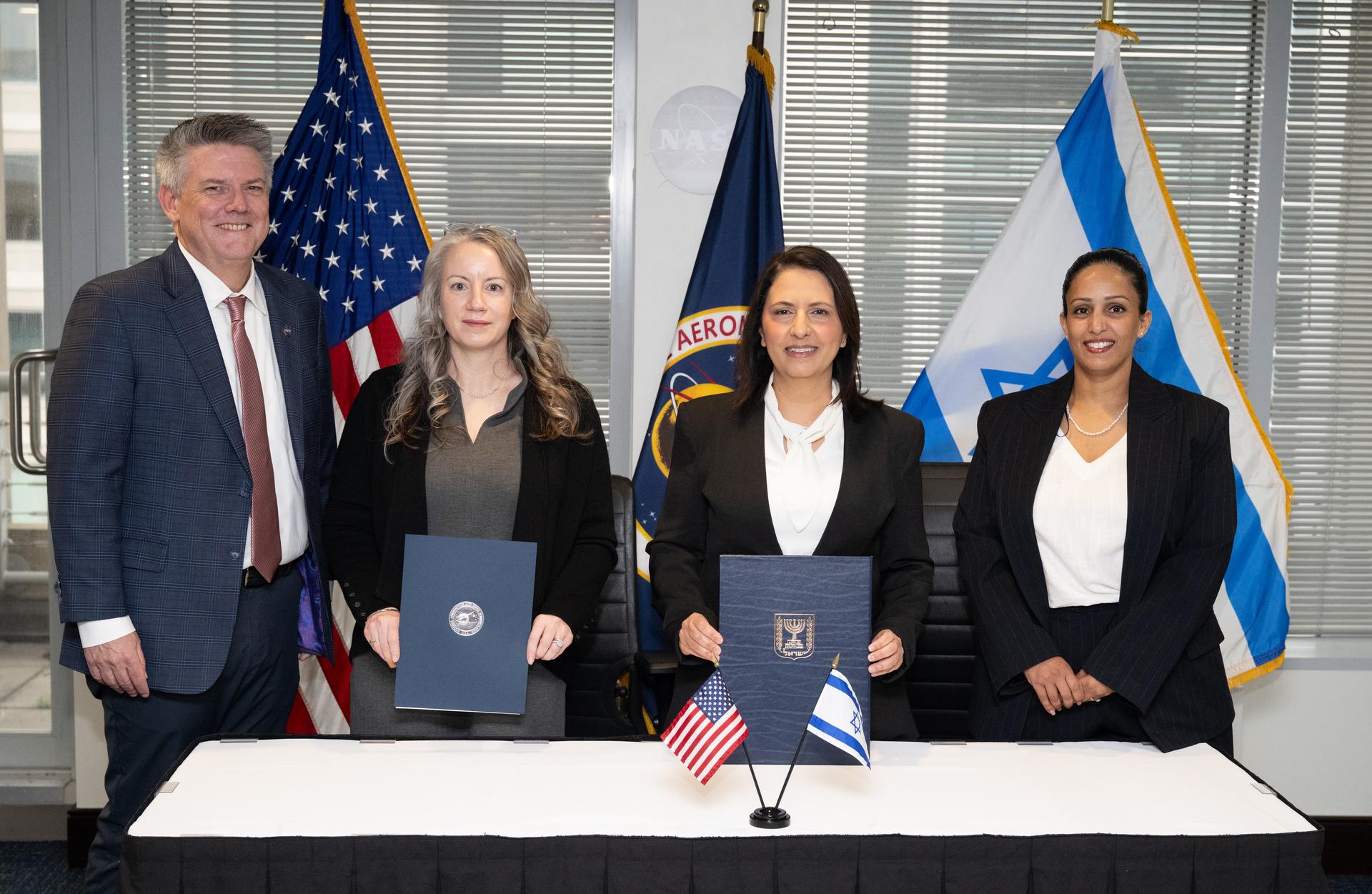
Brian Hughes, NASA Chief of Staff, left, Meredith McKay, acting associate administrator for NASA’s Office of International and Interagency Relations, second from left, Israel’s Minister for Innovation, Science, and Technology Gila Gamliel, and Shani Edri, director of International Relations in Israel’s Ministry of Innovation, Science, and Technology pose for a picture after the signing the US-Israel Space Cooperation Framework Agreement Extension, Wednesday, Dec. 10, 2025, at the Mary W. Jackson NASA Headquarters building in Washington. Photo Credit: (NASA/Joel Kowsky)
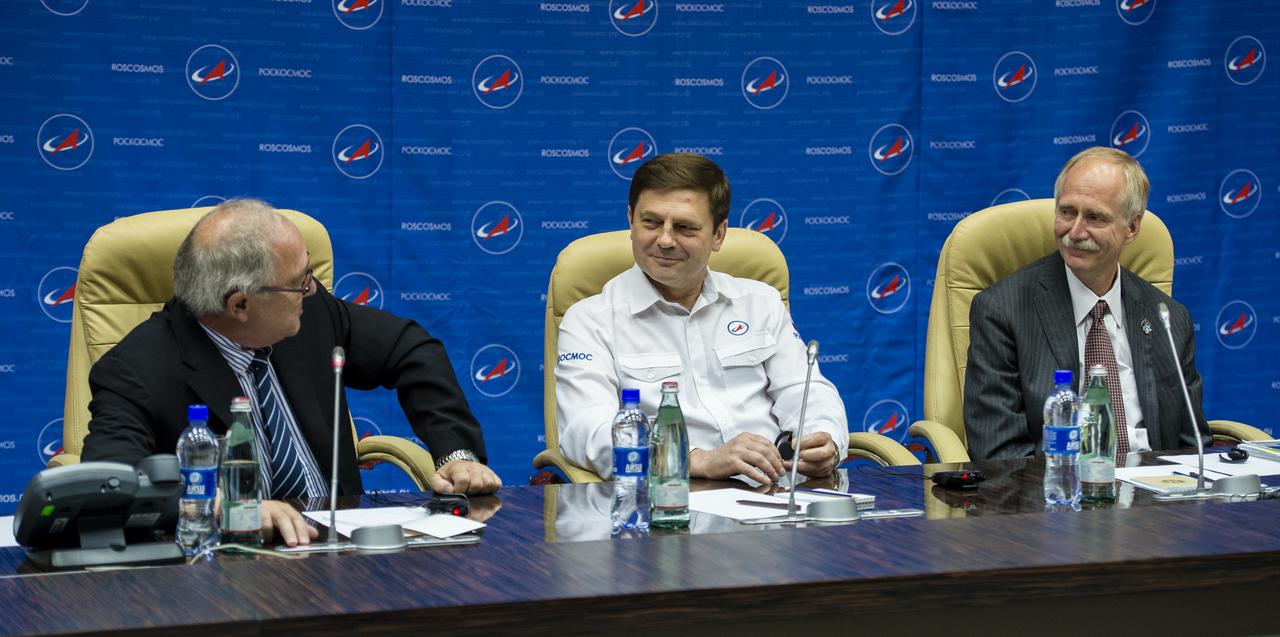
Jean-Jacques Dordain, Director General of the European Space Agency, left, Oleg Ostapenko, General Director of the Russian Federal Space Agency, Roscosmos, center, and William Gerstenmaier, NASA Associate Administrator for Human Exploration and Operations, right, are seen during a joint statement after the docking of the Soyuz TMA-13M spacecraft with the International Space Station on Thursday, May 29, 2014 at the Baikonur Hotel in Baikonur, Kazakhstan. The three spoke on the importance of international cooperation in human spaceflight. Photo Credit: (NASA/Joel Kowsky)
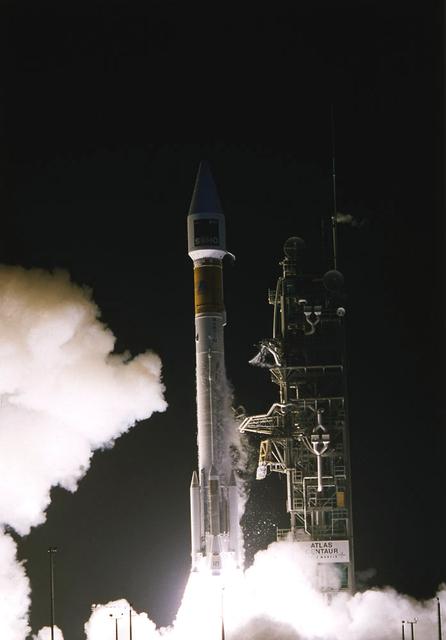
The Solar Heliospheric Observatory (SOHO) is launched atop an ATLAS-IIAS expendable launch vehicle. Liftoff from launch complex 36B at Cape Canaveral Air Station marked the 10th Atlas launch from the Eastern range for 1995. SOHO is a cooperative effort involving NASA and the European Space Agency (ESA) within the framework of the International Solar-Terrestrial Physics Program. During its 2-year mission, the SOHO spacecraft gathered data on the internal structure of the Sun, its extensive outer atmosphere and the origin of the solar wind.
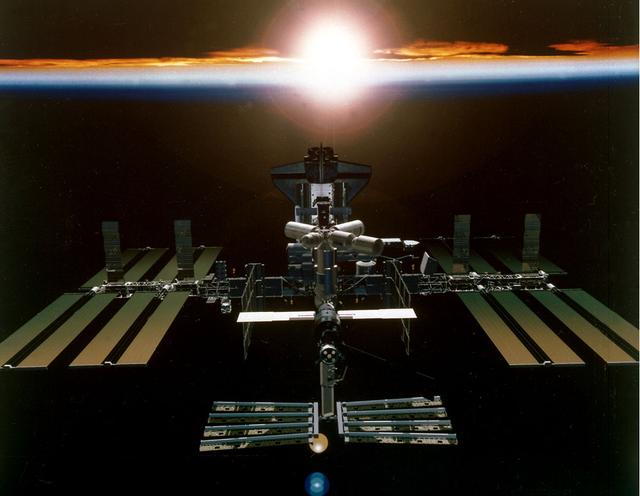
Artist's digital concept of the International Space Station (ISS), a gateway to permanent human presence in space, after all assembly is completed in Year 2003. The Station will be powered by almost an acre of solar panels and have a mass of almost one million pounds. Station modules are being provided by the United States, Russia, Japan, and Europe. Canada is providing a mechanical arm and Canada Hand. Sixteen countries are cooperating to provide a multidisciplinary laboratory, technology test bed, and observatory that will provide an unprecedented undertaking in scientific, technological, and international experimentation.
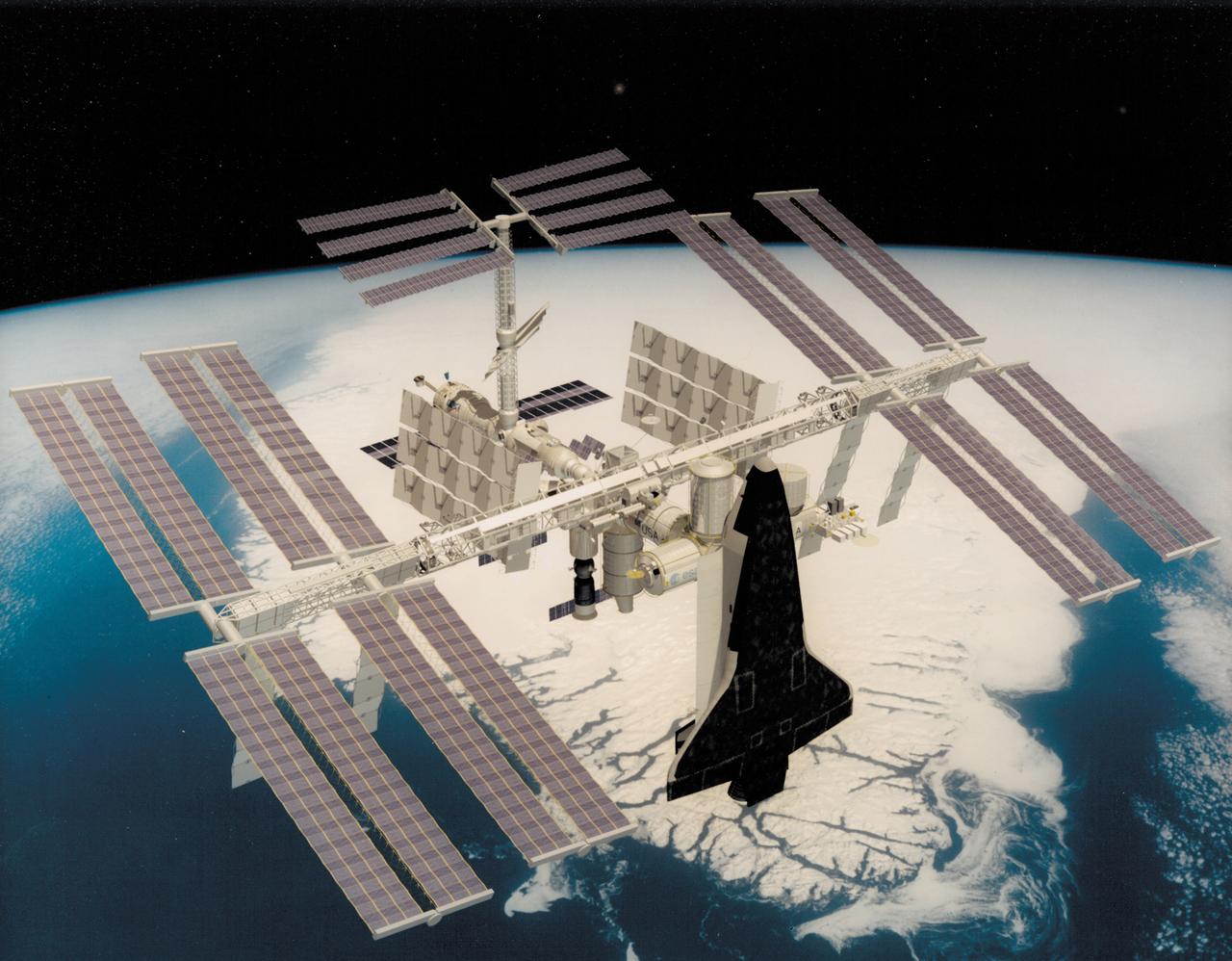
An artist's concept of what the International Space Station (ISS)Alpha will look like in its completed and fully operational state. All the elements of the Station are shown - the United States, European, Japanese, and Russian. The artist also included the Space Shuttle in the docked position. Sixteen countries are cooperating to provide a multidisciplinary laboratory, technology test bed, and observatory that will provide an unprecedented undertaking in scientific, technological, and international experimentation.
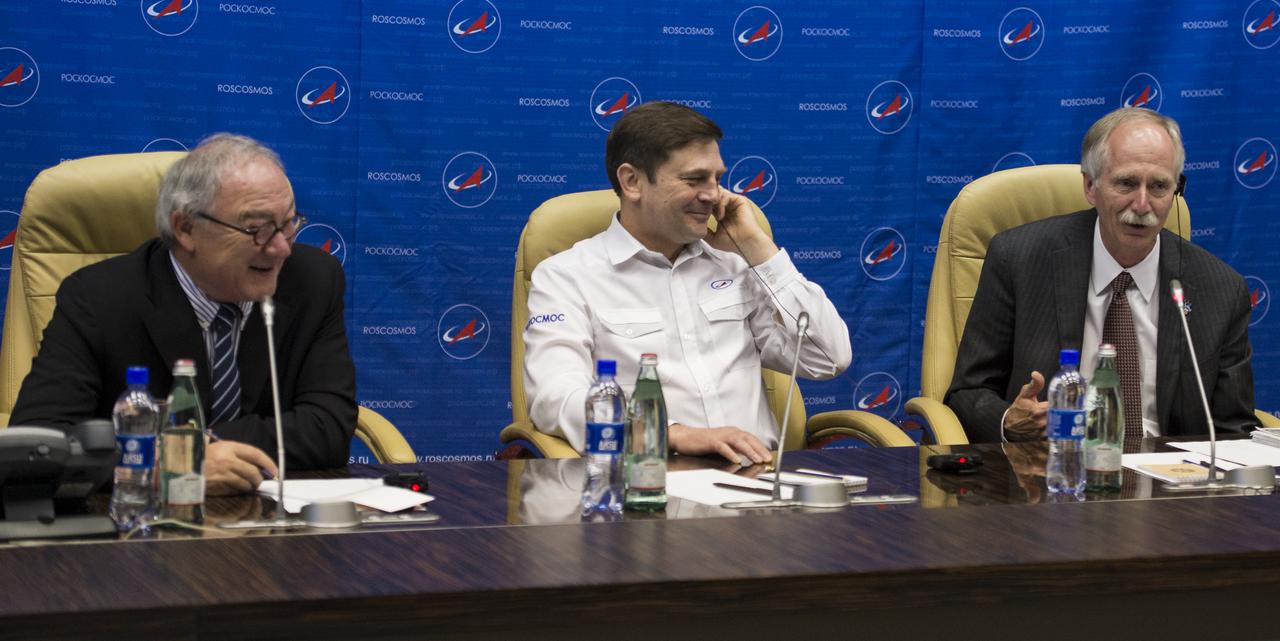
Jean-Jacques Dordain, Director General of the European Space Agency, left, Oleg Ostapenko, General Director of the Russian Federal Space Agency, Roscosmos, center, and William Gerstenmaier, NASA Associate Administrator for Human Exploration and Operations, right, are seen during a joint statement after the docking of the Soyuz TMA-13M spacecraft with the International Space Station on Thursday, May 29, 2014 at the Baikonur Hotel in Baikonur, Kazakhstan. The three spoke on the importance of international cooperation in human spaceflight. Photo Credit: (NASA/Joel Kowsky)
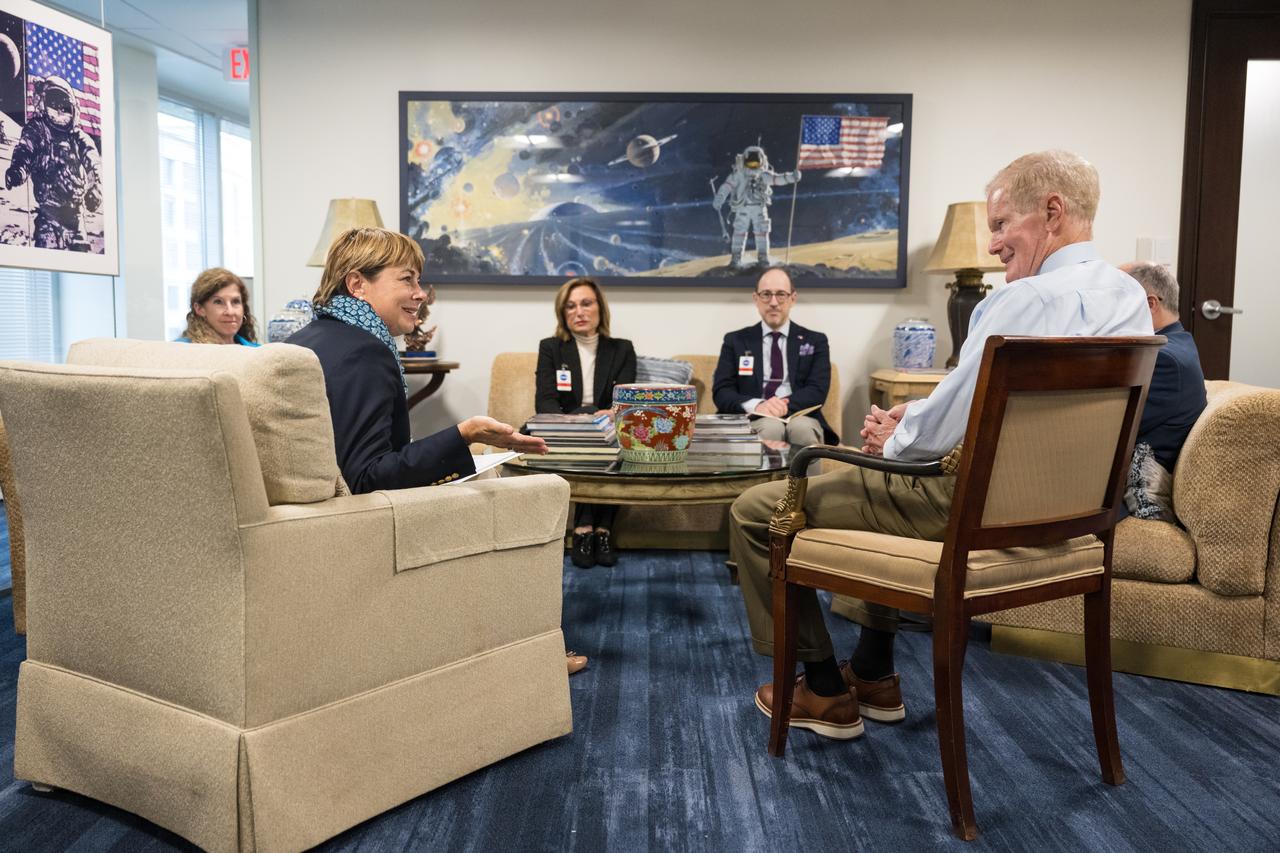
From left to right, Monaco’s Minister of Foreign Affairs and Cooperation, Isabelle Berro-Amadeï, NASA Associate Administrator for the Office of International and Interagency Relations, Karen Feldstein, Ambassador of the Principality of Monaco to the United States and Canada, the Honorable Maguy Maccario Doyle, Deputy Chief of Mission, Embassy of the Principality of Monaco to the United States and Canada, the Honorable Jean-Philippe Bertani, NASA International Program Specialist with the Office of International and Interagency Relations, Anthony Tsougranis, and NASA Administrator Bill Nelson, meet Thursday, June 22, 2023 at the Mary W. Jackson NASA Headquarters building in Washington. Photo Credit: (NASA/Aubrey Gemignani)
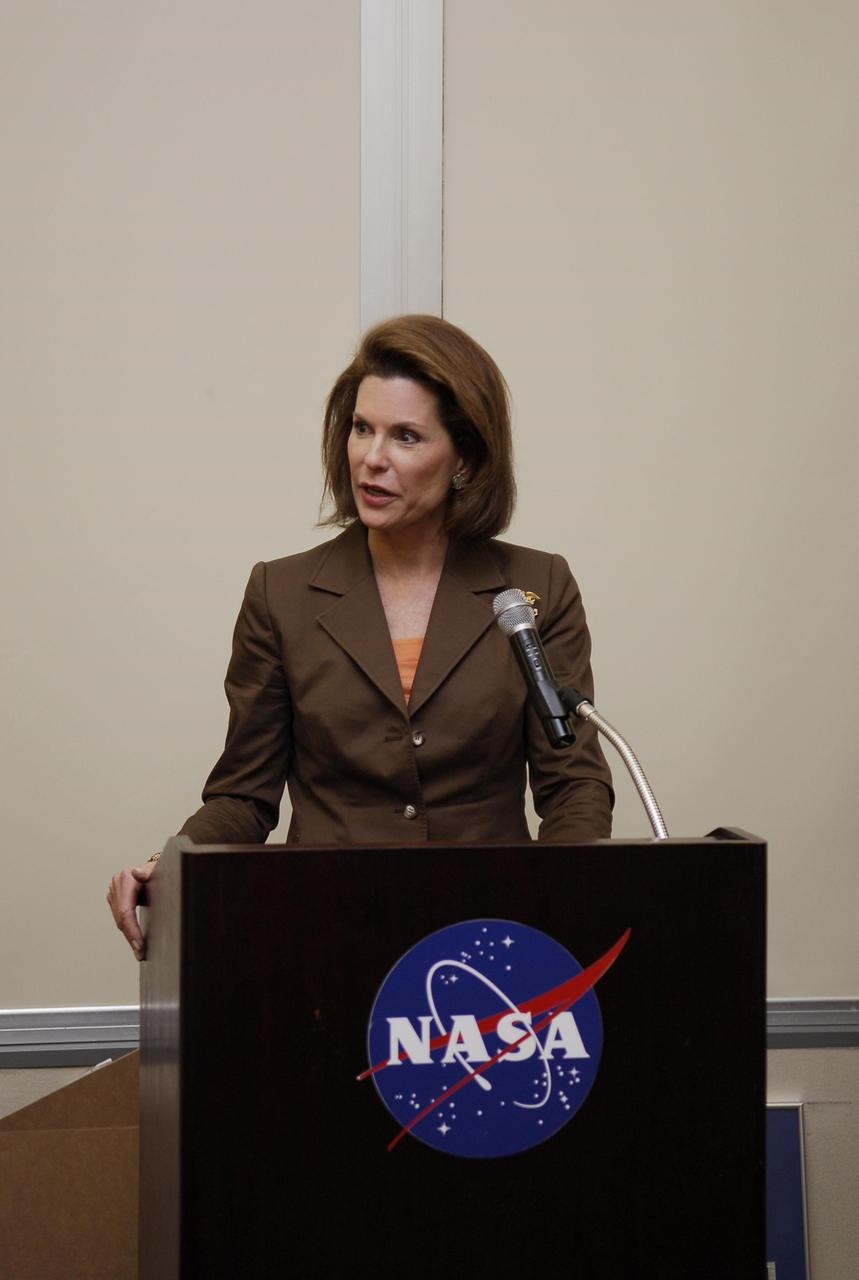
KENNEDY SPACE CENTER, FLA. -- U.S. Ambassador Nancy Brinker addresses members of the diplomatic corps, who toured NASA's Kennedy Space Center. The visit, one of the largest tours undertaken by the diplomatic corps, is part of the State Department's new Experience America program. The international dignitaries were provided an overview of the United States' space exploration programs and NASA's international cooperation in pursuit of exploration and scientific discovery. They visited various locations at Kennedy, including the Space Station Processing Facility and Launch Pad 39A where space shuttle Atlantis is being prepared for its upcoming mission to the International Space Station. Photo credit: NASA/Kim Shiflett
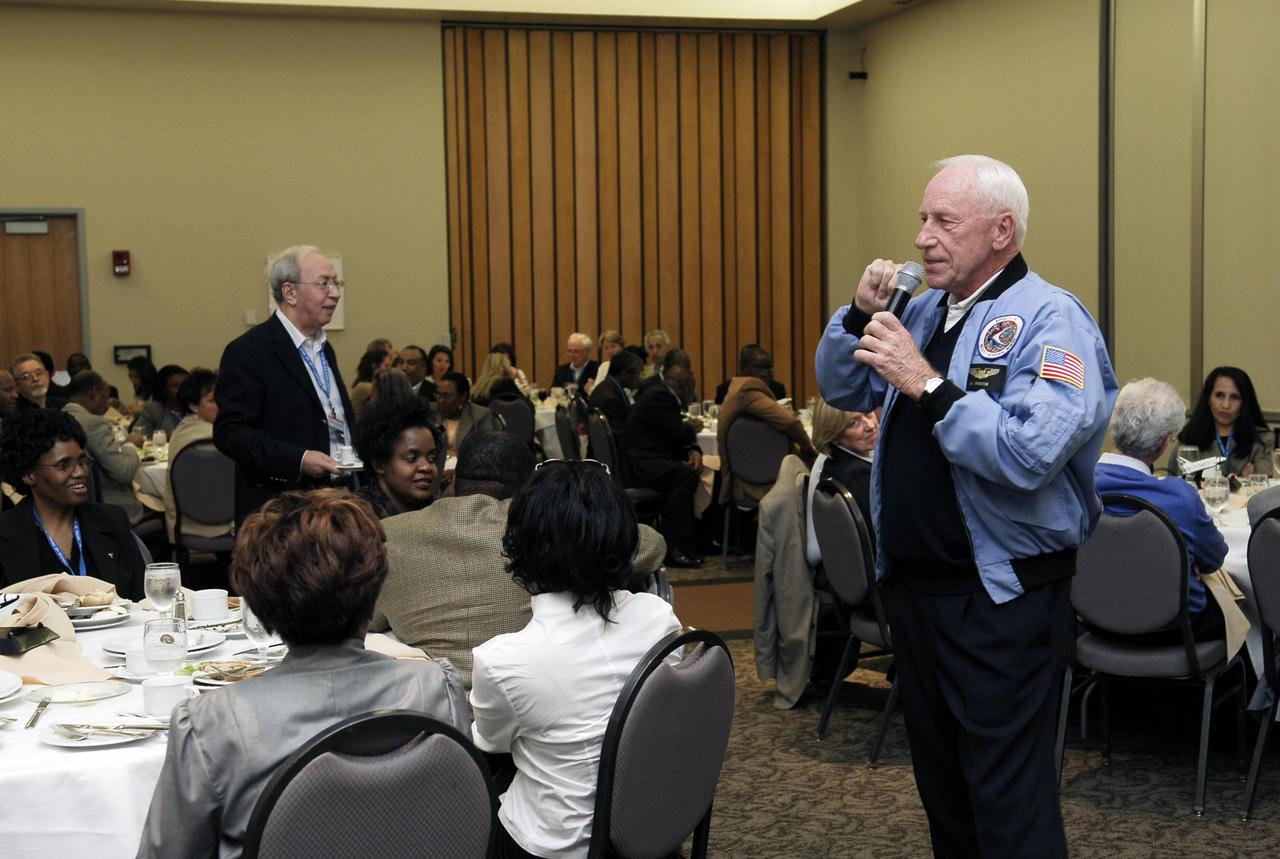
KENNEDY SPACE CENTER, FLA. -- Former astronaut Al Worden talks to members of the diplomatic corps, who toured various facilities around Kennedy. The visit, one of the largest tours undertaken by the diplomatic corps, is part of the State Department's new Experience America program. The international dignitaries were provided an overview of the United States' space exploration programs and NASA's international cooperation in pursuit of exploration and scientific discovery. They visited various locations at Kennedy, including the Space Station Processing Facility and Launch Pad 39A where space shuttle Atlantis is being prepared for its upcoming mission to the International Space Station. Photo credit: NASA/Kim Shiflett
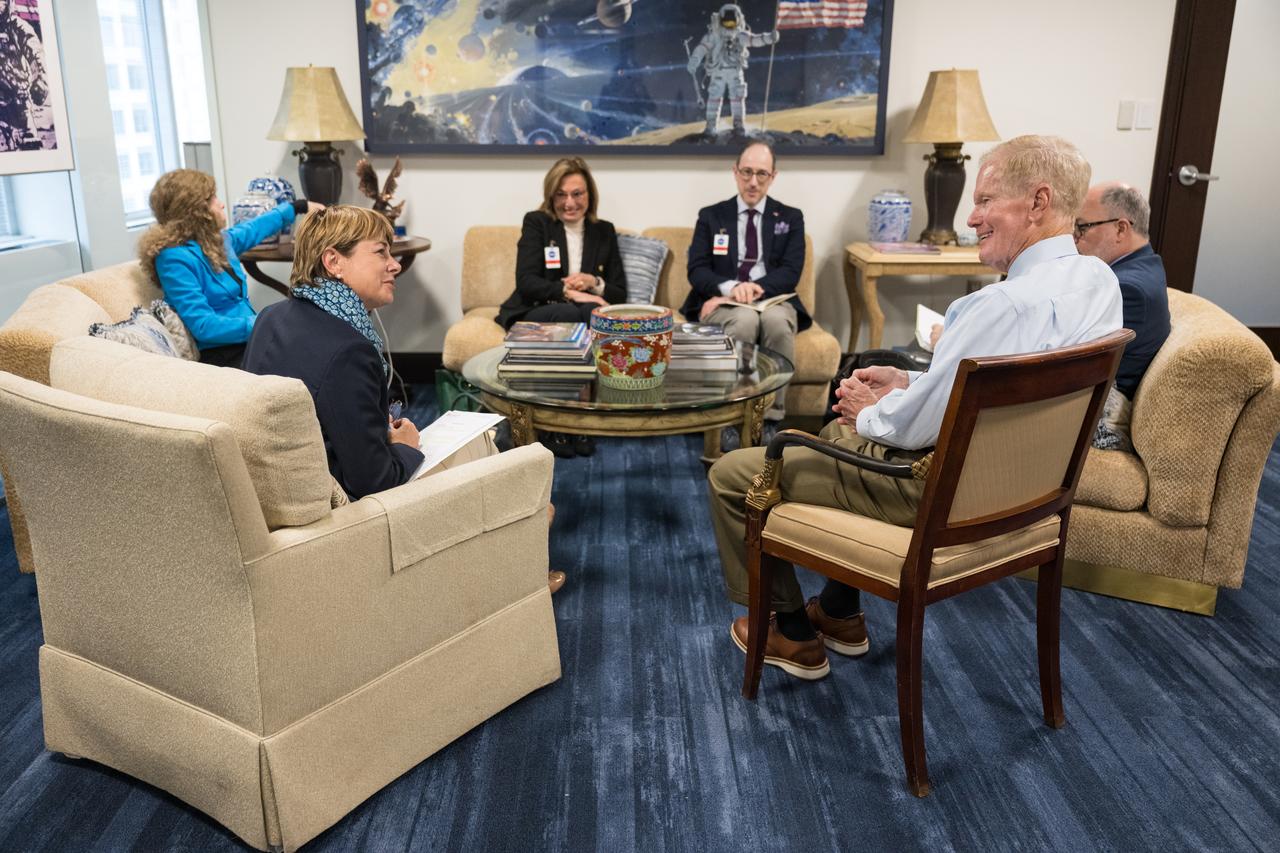
From left to right, Monaco’s Minister of Foreign Affairs and Cooperation, Isabelle Berro-Amadeï, NASA Associate Administrator for the Office of International and Interagency Relations, Karen Feldstein, Ambassador of the Principality of Monaco to the United States and Canada, the Honorable Maguy Maccario Doyle, Deputy Chief of Mission, Embassy of the Principality of Monaco to the United States and Canada, the Honorable Jean-Philippe Bertani, NASA International Program Specialist with the Office of International and Interagency Relations, Anthony Tsougranis, and NASA Administrator Bill Nelson, meet Thursday, June 22, 2023 at the Mary W. Jackson NASA Headquarters building in Washington. Photo Credit: (NASA/Aubrey Gemignani)
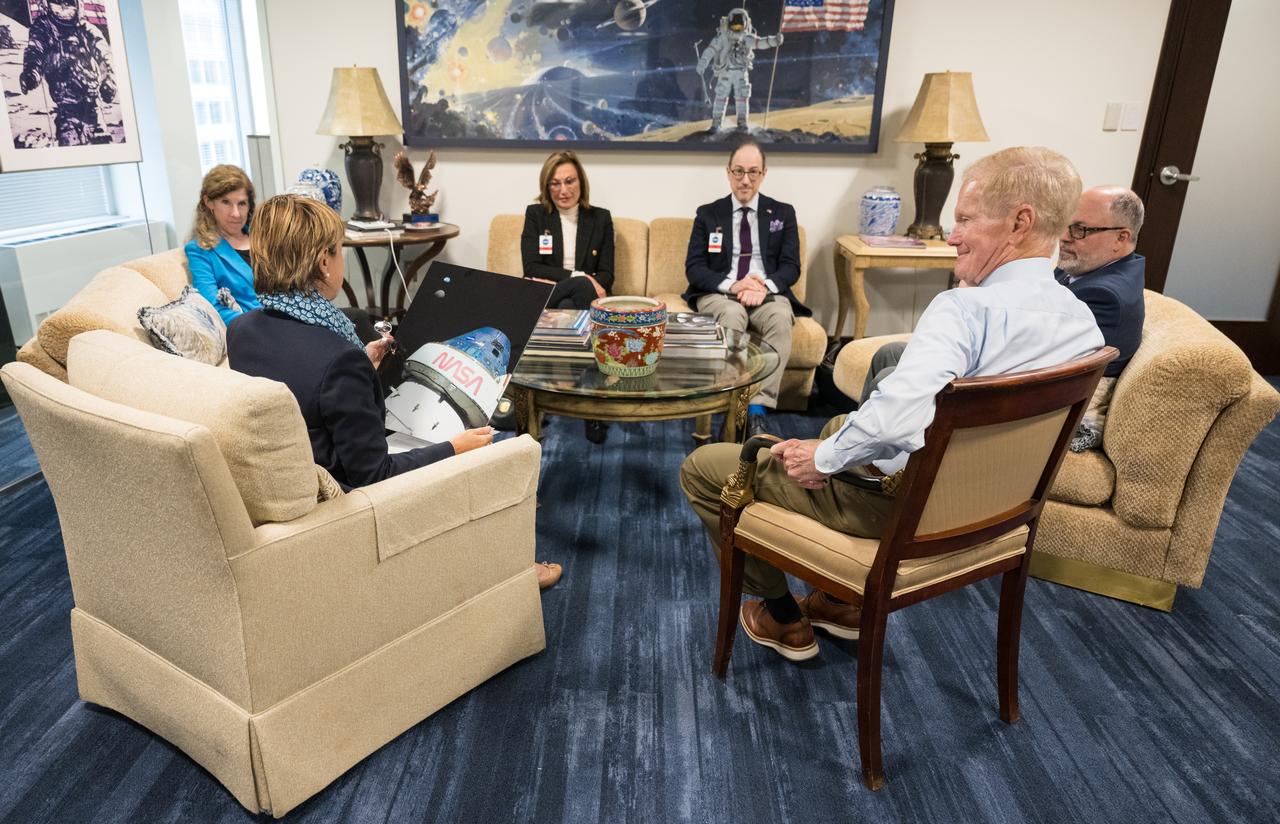
Monaco’s Minister of Foreign Affairs and Cooperation, Isabelle Berro-Amadeï views a photograph from the Artemis I mission during a meeting with, from left to right, NASA Associate Administrator for the Office of International and Interagency Relations, Karen Feldstein, Ambassador of the Principality of Monaco to the United States and Canada, the Honorable Maguy Maccario Doyle, Deputy Chief of Mission, Embassy of the Principality of Monaco to the United States and Canada, the Honorable Jean-Philippe Bertani, NASA International Program Specialist with the Office of International and Interagency Relations, Anthony Tsougranis, and NASA Administrator Bill Nelson, Thursday, June 22, 2023 at the Mary W. Jackson NASA Headquarters building in Washington. Photo Credit: (NASA/Aubrey Gemignani)
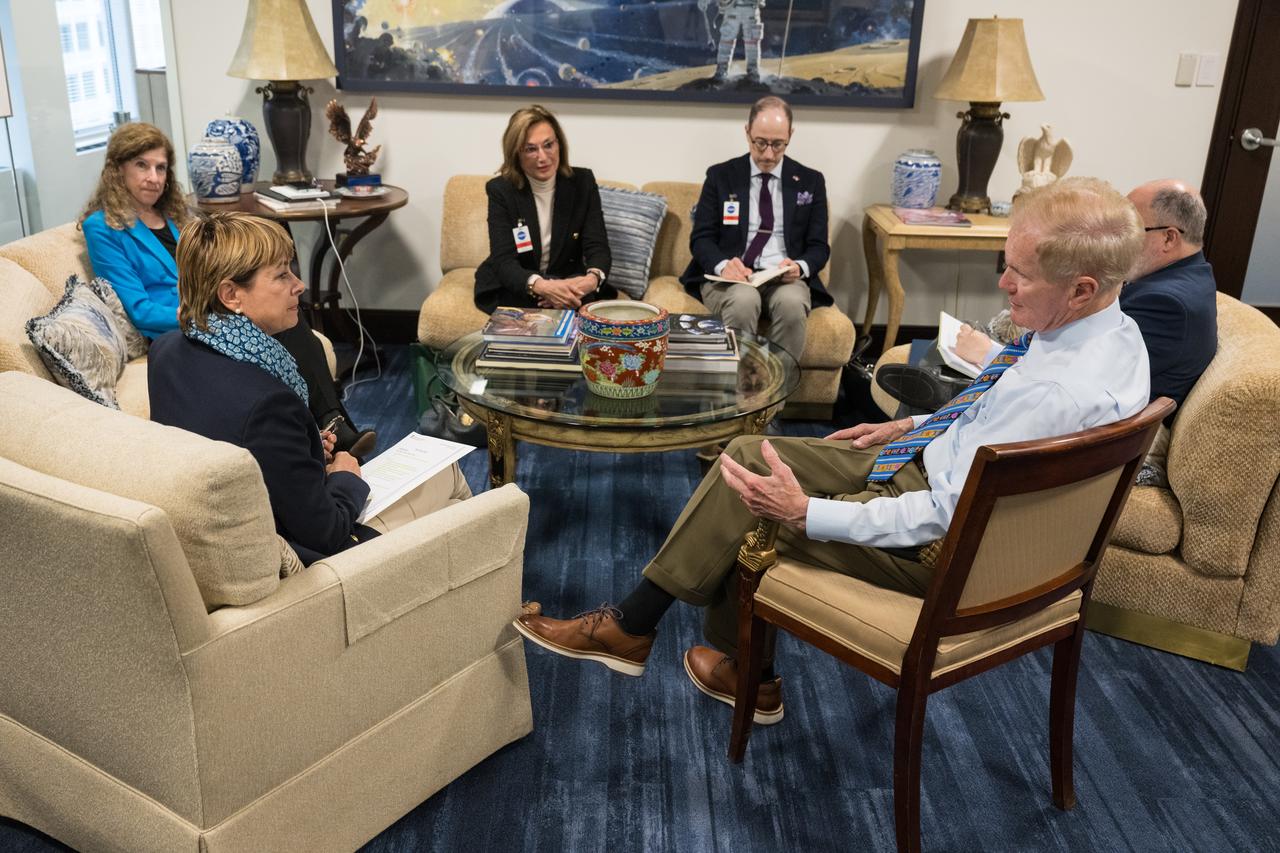
From left to right, Monaco’s Minister of Foreign Affairs and Cooperation, Isabelle Berro-Amadeï, NASA Associate Administrator for the Office of International and Interagency Relations, Karen Feldstein, Ambassador of the Principality of Monaco to the United States and Canada, the Honorable Maguy Maccario Doyle, Deputy Chief of Mission, Embassy of the Principality of Monaco to the United States and Canada, the Honorable Jean-Philippe Bertani, NASA International Program Specialist with the Office of International and Interagency Relations, Anthony Tsougranis, and NASA Administrator Bill Nelson, meet Thursday, June 22, 2023 at the Mary W. Jackson NASA Headquarters building in Washington. Photo Credit: (NASA/Aubrey Gemignani)
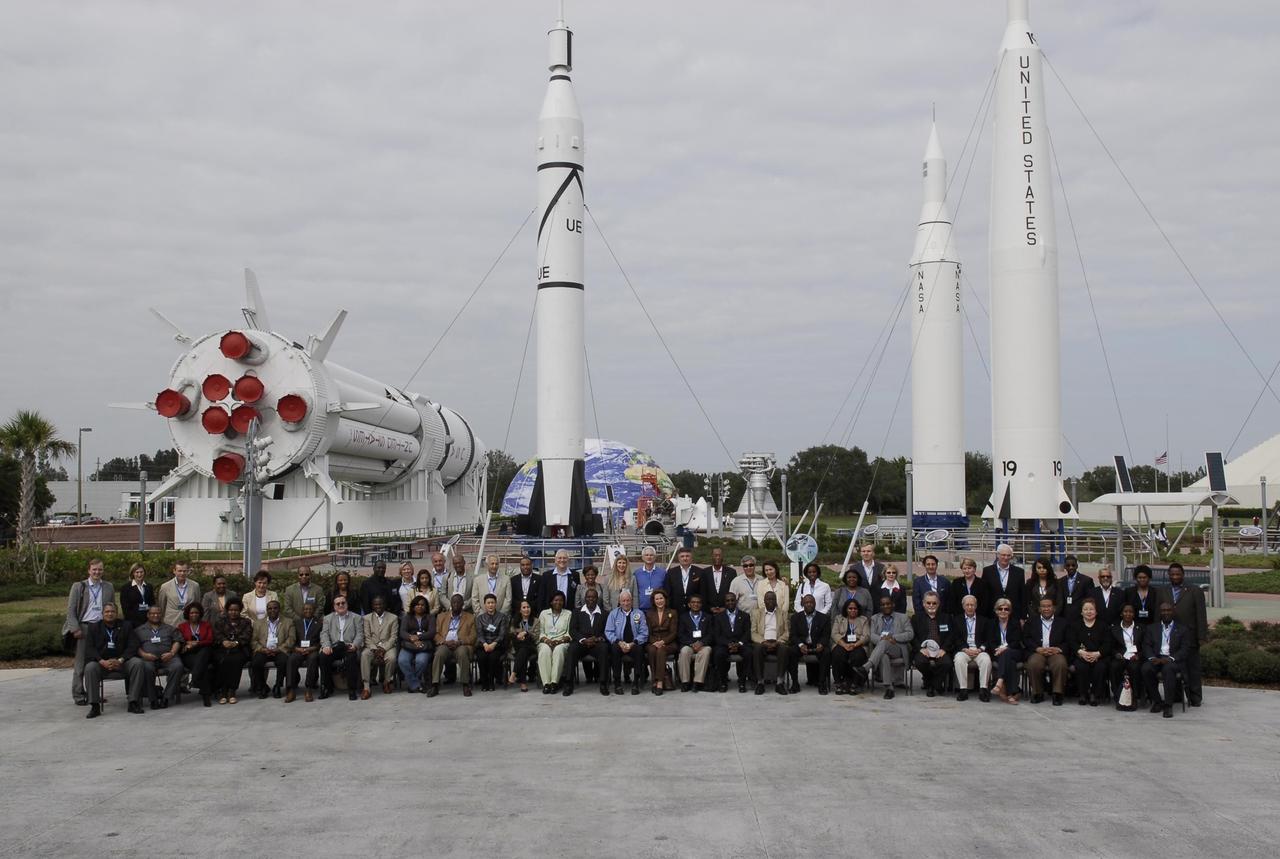
KENNEDY SPACE CENTER, FLA. -- The Chiefs of Diplomatic Missions from more than 45 countries gather in the Rocket Garden at NASA's Kennedy Space Center Visitor Complex. The visit, one of the largest tours undertaken by the diplomatic corps, is part of the State Department's new Experience America program. The international dignitaries were provided an overview of the United States' space exploration programs and NASA's international cooperation in pursuit of exploration and scientific discovery. They visited various locations at Kennedy, including the Space Station Processing Facility and Launch Pad 39A where space shuttle Atlantis is being prepared for its upcoming mission to the International Space Station. Photo credit: NASA/Kim Shiflett