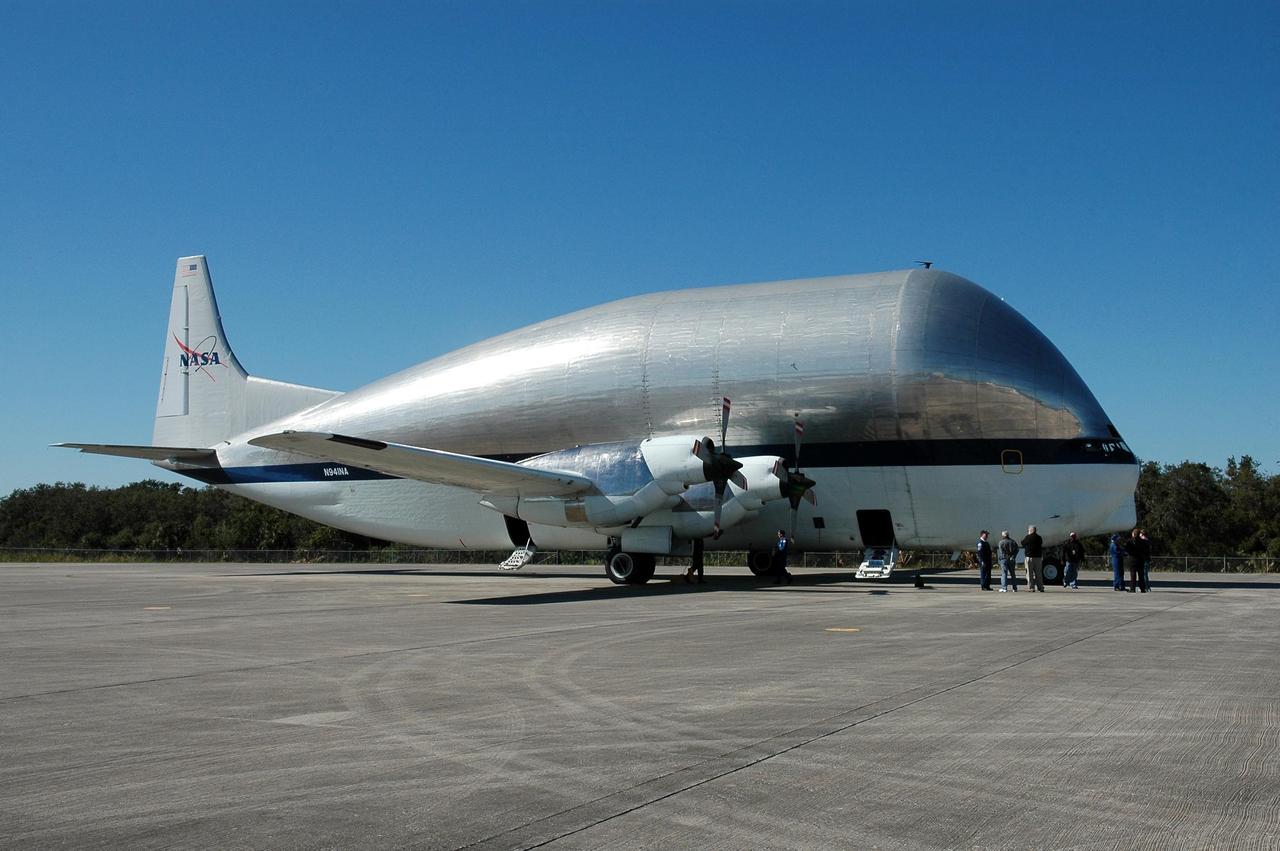
KENNEDY SPACE CENTER, FLA. - This Super Guppy aircraft is parked on NASA Kennedy Space Center’s Shuttle Landing Facility after landing. It has flown to the Center to pick up and transport the common module structural test element to NASA's Marshall Space Flight Center in Huntsville, Ala. The common module is an aluminum canister used as a structural test element for an actual Space Station flight element. At Marshall, the module will be used to conduct advanced environmental control and life support testing for future NASA exploration missions. The Super Guppy aircraft has a unique hinged nose that can open more than 200 degrees, allowing large pieces of cargo to be loaded and unloaded from the front. Guppy aircraft were used in several past space programs, including Gemini, Apollo and Skylab, to transport spacecraft components. NASA personnel at Ellington Field outfitted the Super Guppy with a specially designed cradle to be used when carrying International Space Station components. The first Guppy aircraft was developed in 1962, designed specifically for NASA operations by Aero Spacelines of California. Photo credit: NASA/Kim Shiflett
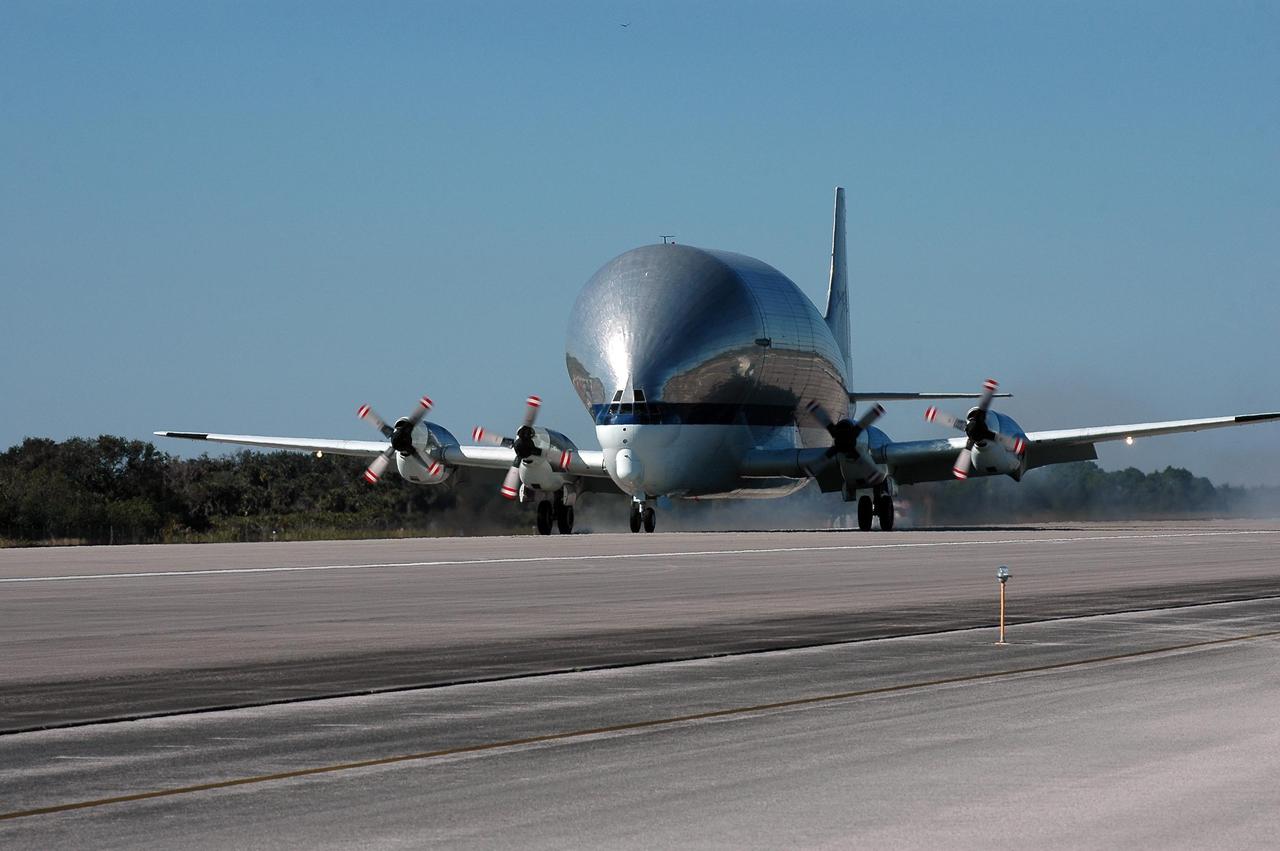
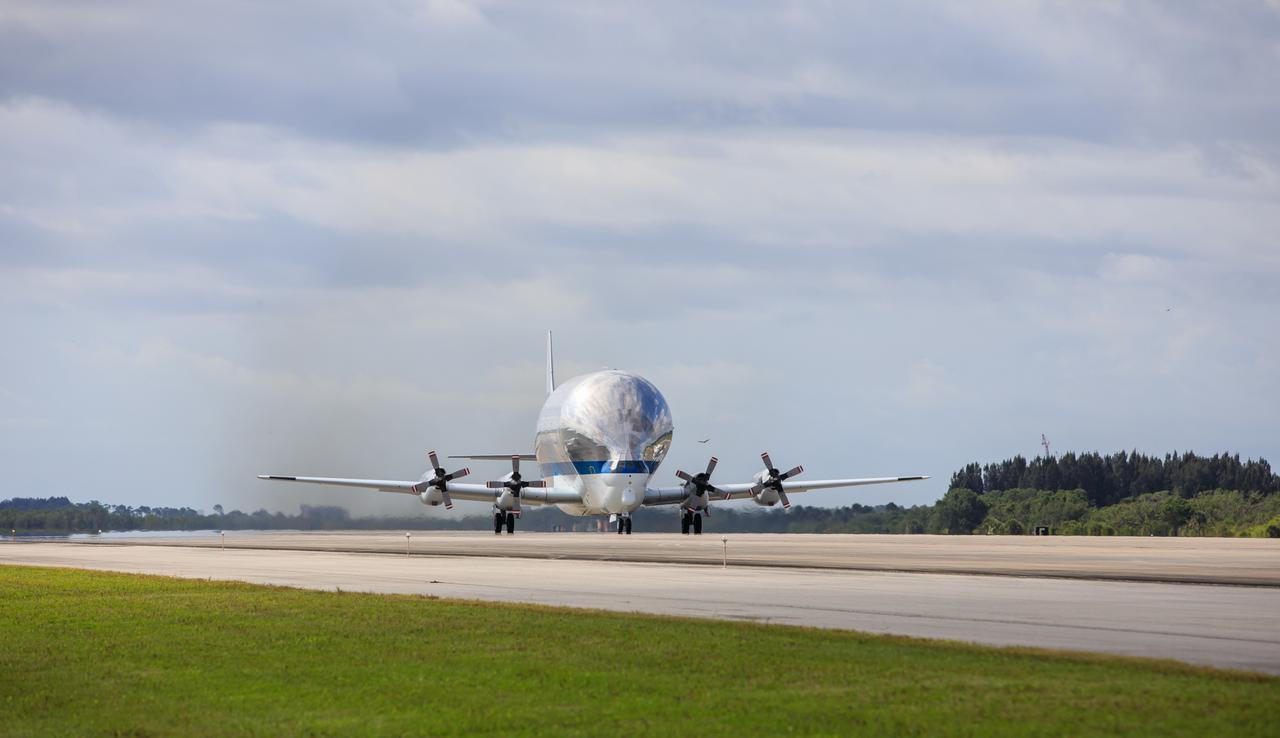
KENNEDY SPACE CENTER, FLA. - This Super Guppy aircraft rolls down the runway after landing at NASA Kennedy Space Center’s Shuttle Landing Facility. It has flown to the Center to pick up and transport the common module structural test element to NASA's Marshall Space Flight Center in Huntsville, Ala. The common module is an aluminum canister used as a structural test element for an actual Space Station flight element. At Marshall, the module will be used to conduct advanced environmental control and life support testing for future NASA exploration missions. The Super Guppy aircraft has a unique hinged nose that can open more than 200 degrees, allowing large pieces of cargo to be loaded and unloaded from the front. Guppy aircraft were used in several past space programs, including Gemini, Apollo and Skylab, to transport spacecraft components. NASA personnel at Ellington Field outfitted the Super Guppy with a specially designed cradle to be used when carrying International Space Station components. The first Guppy aircraft was developed in 1962, designed specifically for NASA operations by Aero Spacelines of California. Photo credit: NASA/Kim Shiflett
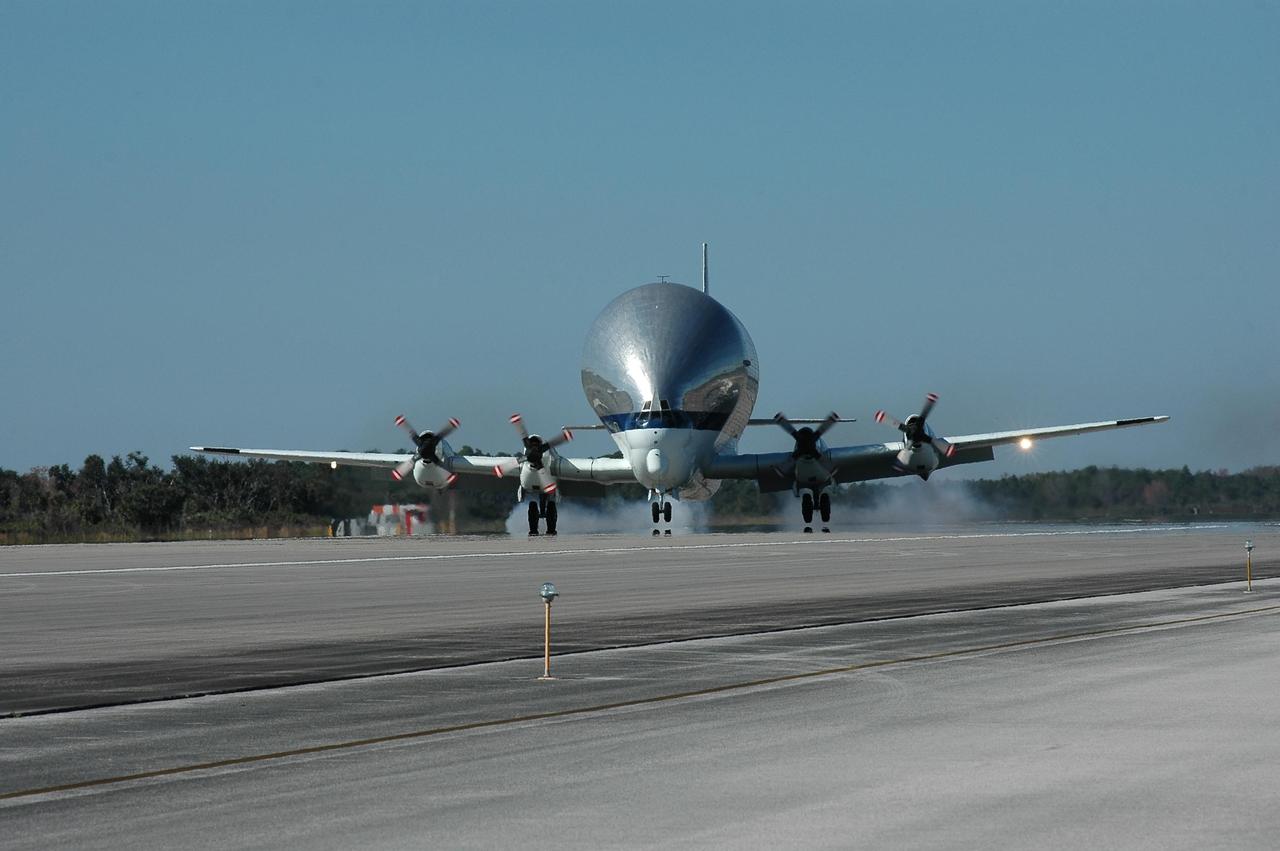
KENNEDY SPACE CENTER, FLA. - This Super Guppy aircraft touches down on the runway at NASA Kennedy Space Center’s Shuttle Landing Facility. It has flown to the Center to pick up and transport the common module structural test element to NASA's Marshall Space Flight Center in Huntsville, Ala. The common module is an aluminum canister used as a structural test element for an actual Space Station flight element. At Marshall, the module will be used to conduct advanced environmental control and life support testing for future NASA exploration missions. The Super Guppy aircraft has a unique hinged nose that can open more than 200 degrees, allowing large pieces of cargo to be loaded and unloaded from the front. Guppy aircraft were used in several past space programs, including Gemini, Apollo and Skylab, to transport spacecraft components. NASA personnel at Ellington Field outfitted the Super Guppy with a specially designed cradle to be used when carrying International Space Station components. The first Guppy aircraft was developed in 1962, designed specifically for NASA operations by Aero Spacelines of California. Photo credit: NASA/Kim Shiflett
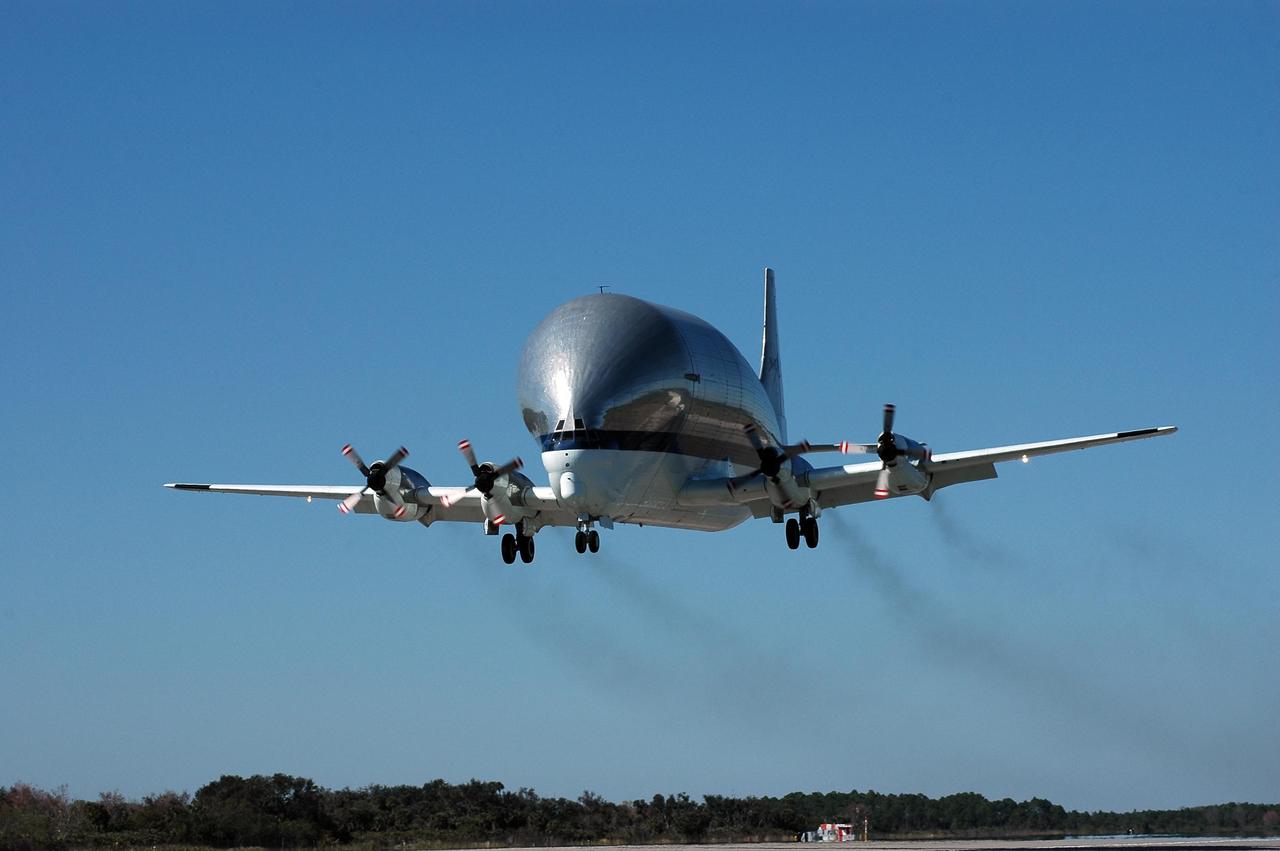
KENNEDY SPACE CENTER, FLA. - This Super Guppy aircraft approaches landing at NASA Kennedy Space Center’s Shuttle Landing Facility. It has flown to the Center to pick up and transport the common module structural test element to NASA's Marshall Space Flight Center in Huntsville, Ala. The common module is an aluminum canister used as a structural test element for an actual Space Station flight element. At Marshall, the module will be used to conduct advanced environmental control and life support testing for future NASA exploration missions. The Super Guppy aircraft has a unique hinged nose that can open more than 200 degrees, allowing large pieces of cargo to be loaded and unloaded from the front. Guppy aircraft were used in several past space programs, including Gemini, Apollo and Skylab, to transport spacecraft components. NASA personnel at Ellington Field outfitted the Super Guppy with a specially designed cradle to be used when carrying International Space Station components. The first Guppy aircraft was developed in 1962, designed specifically for NASA operations by Aero Spacelines of California. Photo credit: NASA/Kim Shiflett
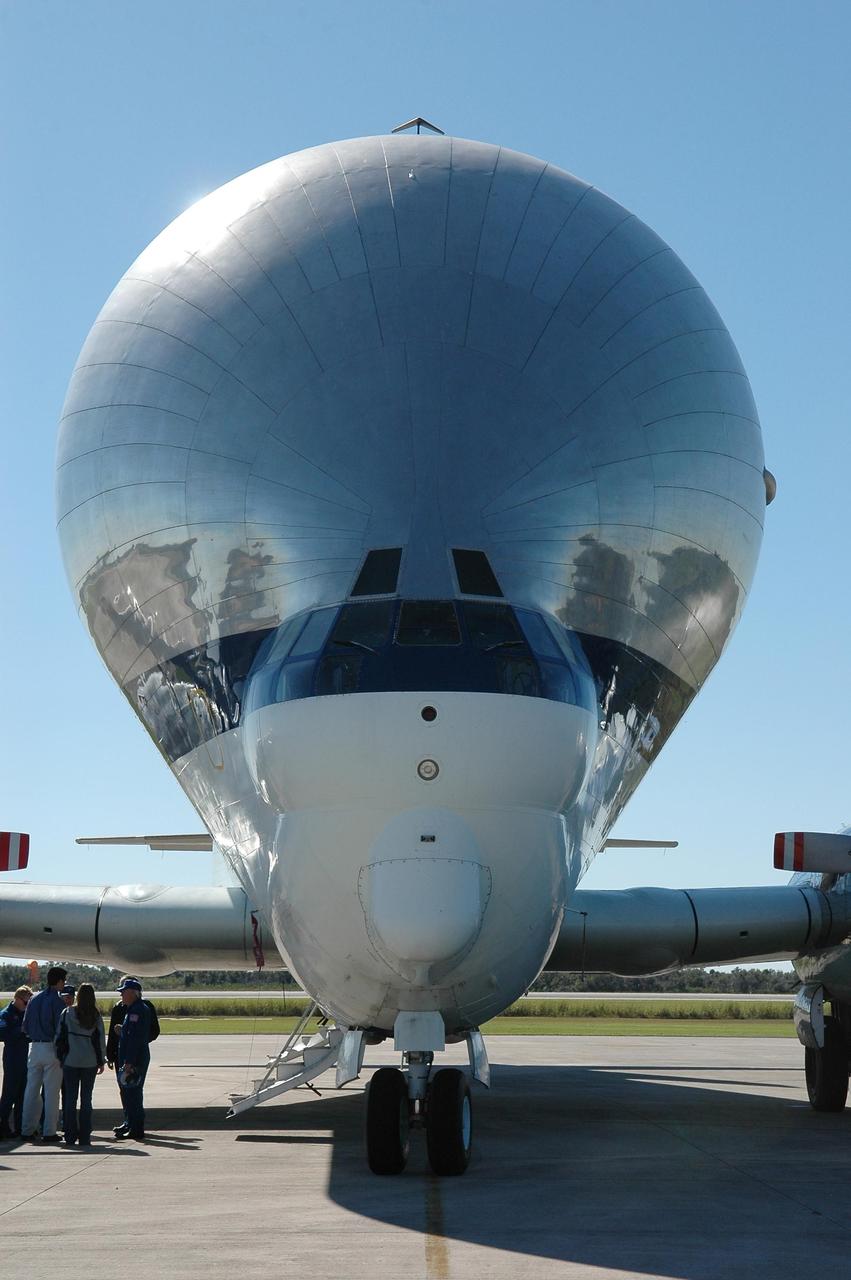
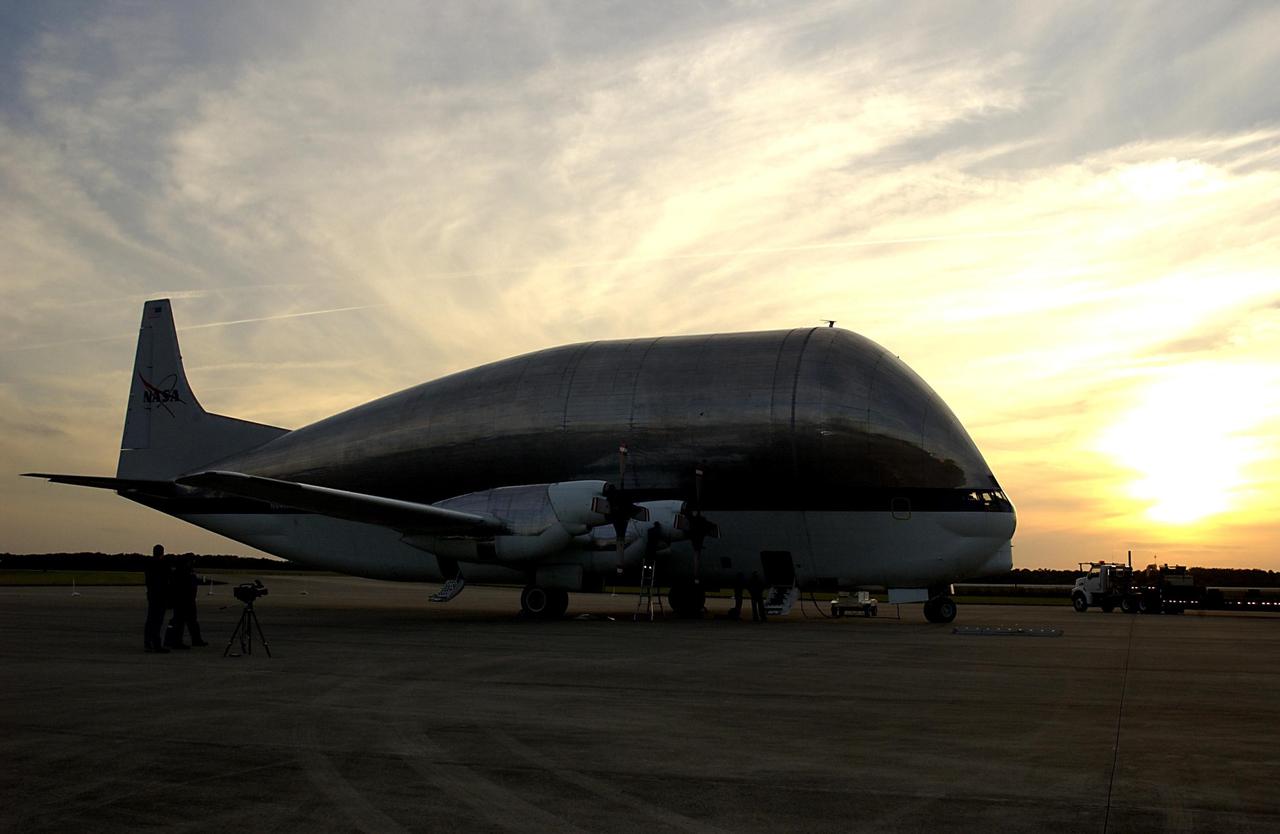
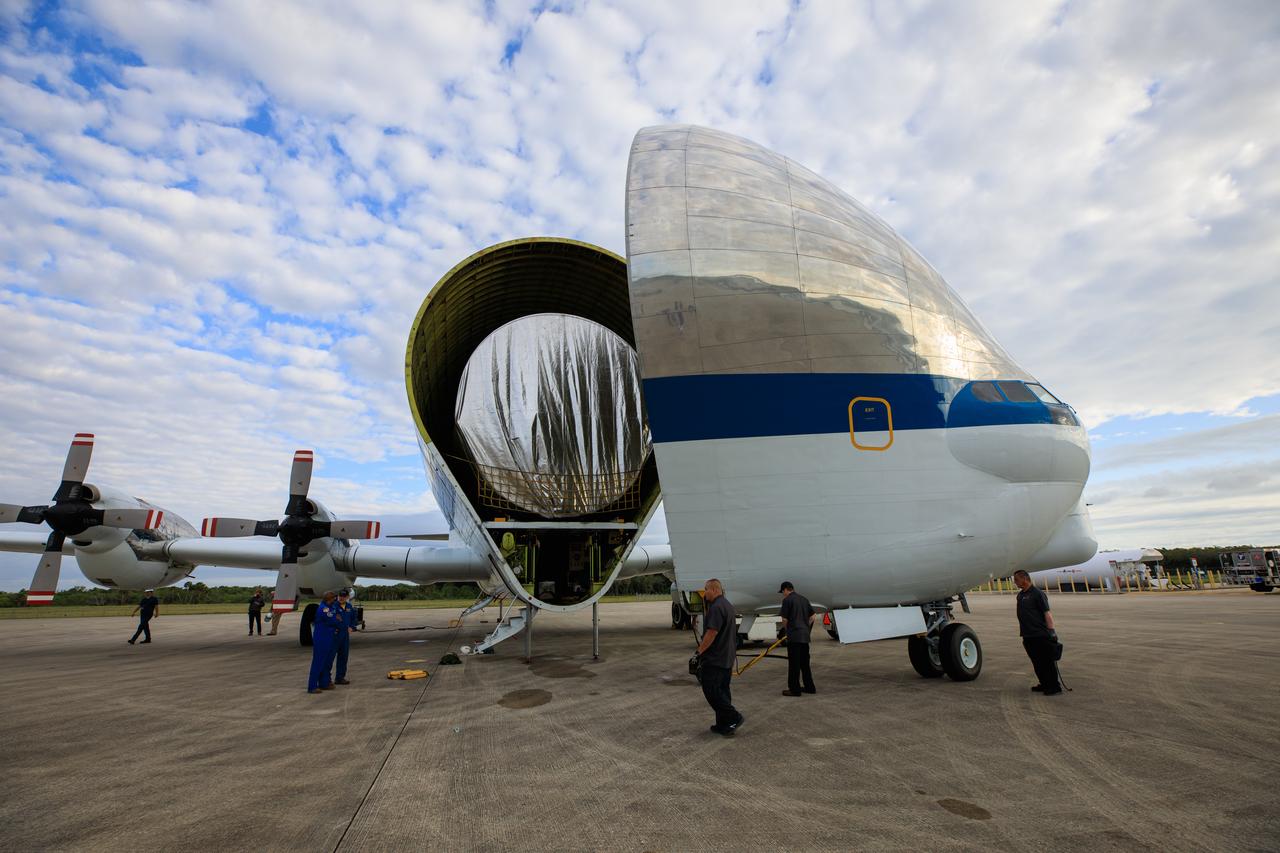
KENNEDY SPACE CENTER, FLA. - This front view of the Super Guppy aircraft, parked on NASA Kennedy Space Center’s Shuttle Landing Facility, appears more like a hot air balloon. In fact, it is the bulbous nose which, when unhinged, can open more than 200 degrees and allow large pieces of cargo to be loaded and unloaded from the front. The aircraft has flown to the Center to pick up and transport the common module structural test element to NASA's Marshall Space Flight Center in Huntsville, Ala. The common module is an aluminum canister used as a structural test element for an actual Space Station flight element. At Marshall, the module will be used to conduct advanced environmental control and life support testing for future NASA exploration missions. Guppy aircraft were used in several past space programs, including Gemini, Apollo and Skylab, to transport spacecraft components. NASA personnel at Ellington Field in Texas outfitted the Super Guppy with a specially designed cradle to be used when carrying International Space Station components. The first Guppy aircraft was developed in 1962, designed specifically for NASA operations by Aero Spacelines of California. Photo credit: NASA/Kim Shiflett
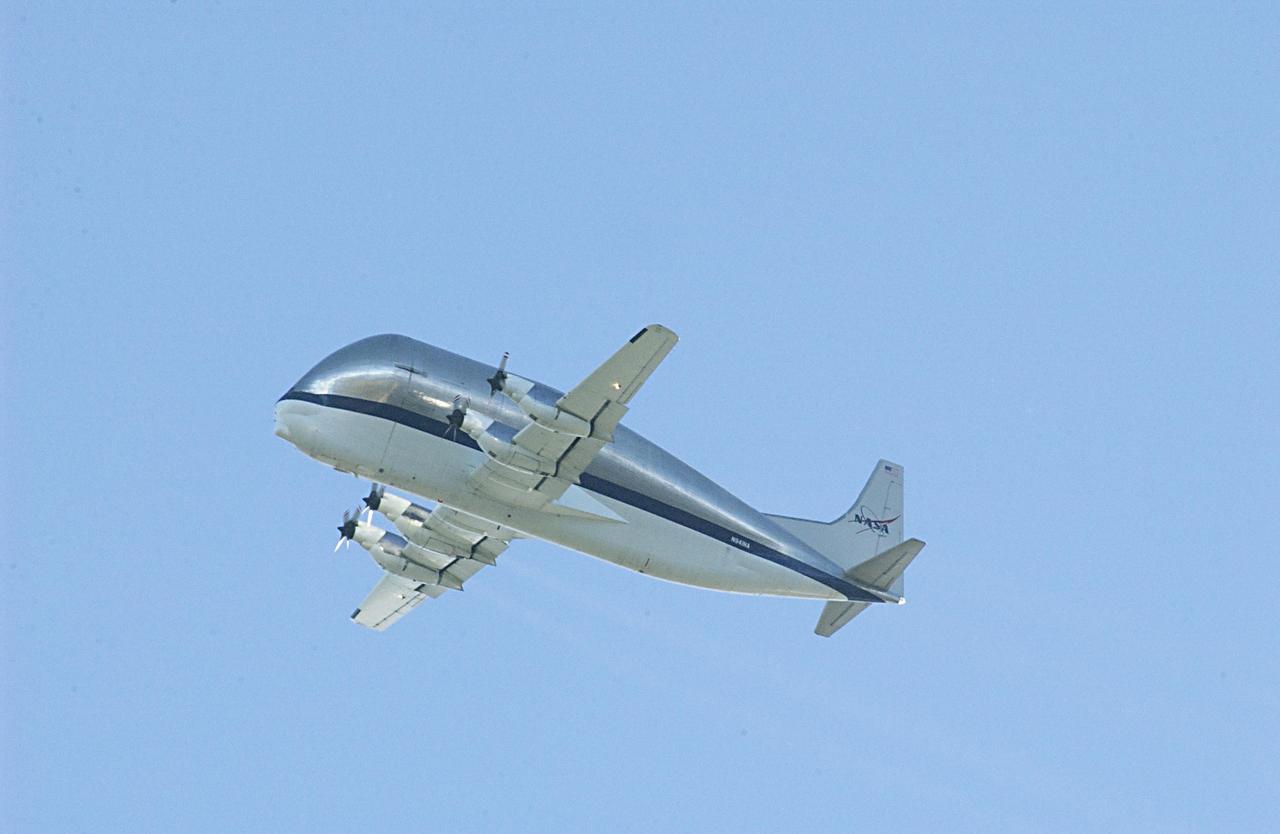
KENNEDY SPACE CENTER, FLA. - NASA's Super Guppy cargo airplane arrives at KSC carrying the Long Spacer (LS), the second and final piece of the Starboard 6 (S6) Integrated Truss Segment. After landing and offloading, the LS will be transported to the Space Station Processing Facility for inspections and verification tests. Eventually the LS will be integrated with the S6 Integrated Equipment Assembly already at KSC and will fly as one segment to the International Space Station on Space Shuttle mission STS-119 in early 2004. Together the segment pieces weigh 26,000 pounds and measure 45 feet long.
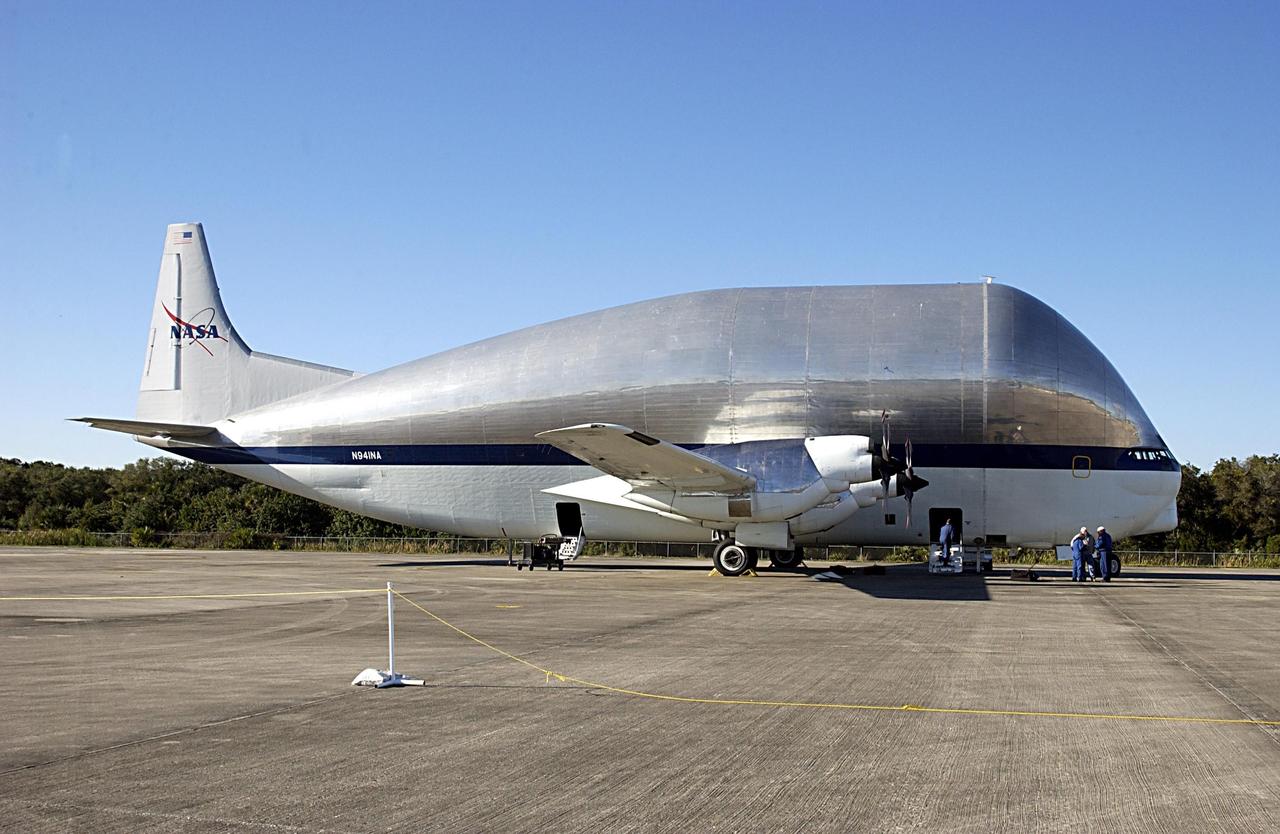
KENNEDY SPACE CENTER, FLA. - NASA's Super Guppy cargo airplane parks on the Shuttle Landing Facility at KSC before offloading the Long Spacer (LS), the second and final piece of the Starboard 6 (S6) Integrated Truss Segment. The LS will be transported to the Space Station Processing Facility for inspections and verification tests. Eventually the LS will be integrated with the S6 Integrated Equipment Assembly already at KSC and will fly as one segment to the International Space Station on Space Shuttle mission STS-119 in early 2004. Together the segment pieces weigh 26,000 pounds and measure 45 feet long. .
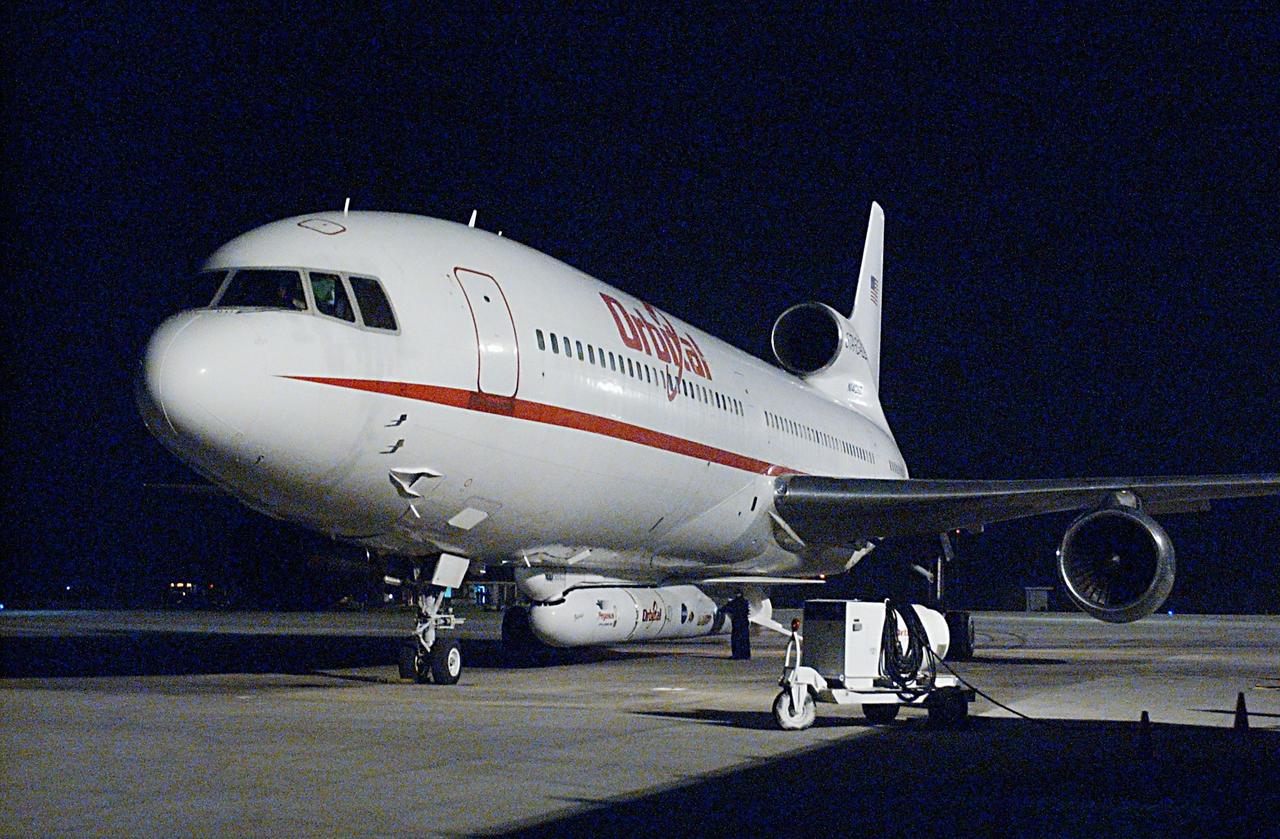
KENNEDY SPACE CENTER, FLA. - An Orbital Sciences L-1011 aircraft arrives at the Cape Canaveral Air Force Station Skid Strip. Attached underneath the aircraft is the Pegasus XL Expendable Launch Vehicle, which will be transported to the Multi-Payload Processing Facility for testing and verification. The Pegasus will undergo three flight simulations prior to its scheduled launch in late January 2003. The Pegasus XL will carry NASA's Solar Radiation and Climate Experiment (SORCE) into orbit. Built by Orbital Sciences Space Systems Group, SORCE will study and measure solar irradiance as a source of energy in the Earth's atmosphere. .
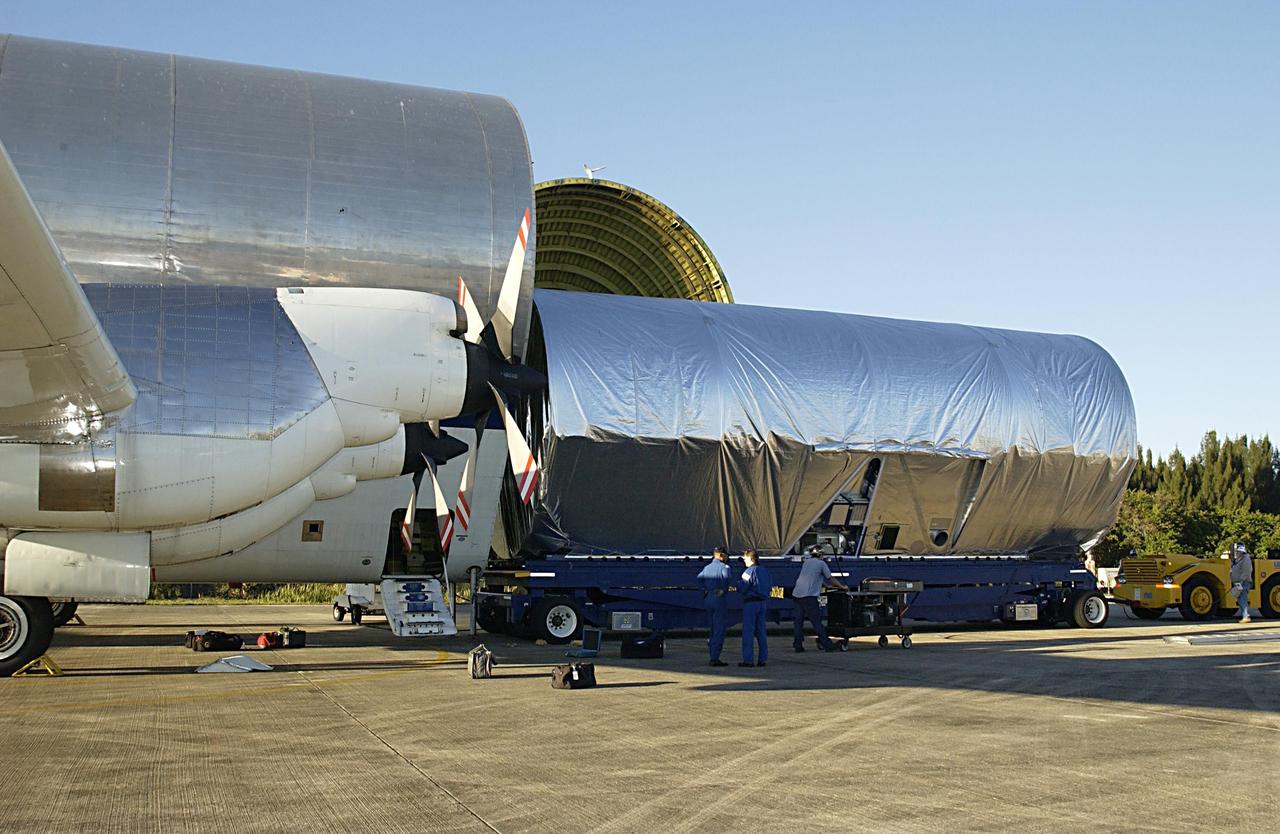
KENNEDY SPACE CENTER, FLA. -- The Long Spacer (LS), the second and final piece of the Starboard 6 (S6) Integrated Truss Segment, rolls out of NASA's Super Guppy cargo airplane onto a transporter. The LS will be moved to the Space Station Processing Facility for inspections and verification tests. Eventually the LS will be integrated with the S6 Integrated Equipment Assembly already at KSC and will fly as one segment to the International Space Station on Space Shuttle mission STS-119 in early 2004. Together the segment pieces weigh 26,000 pounds and measure 45 feet long. .
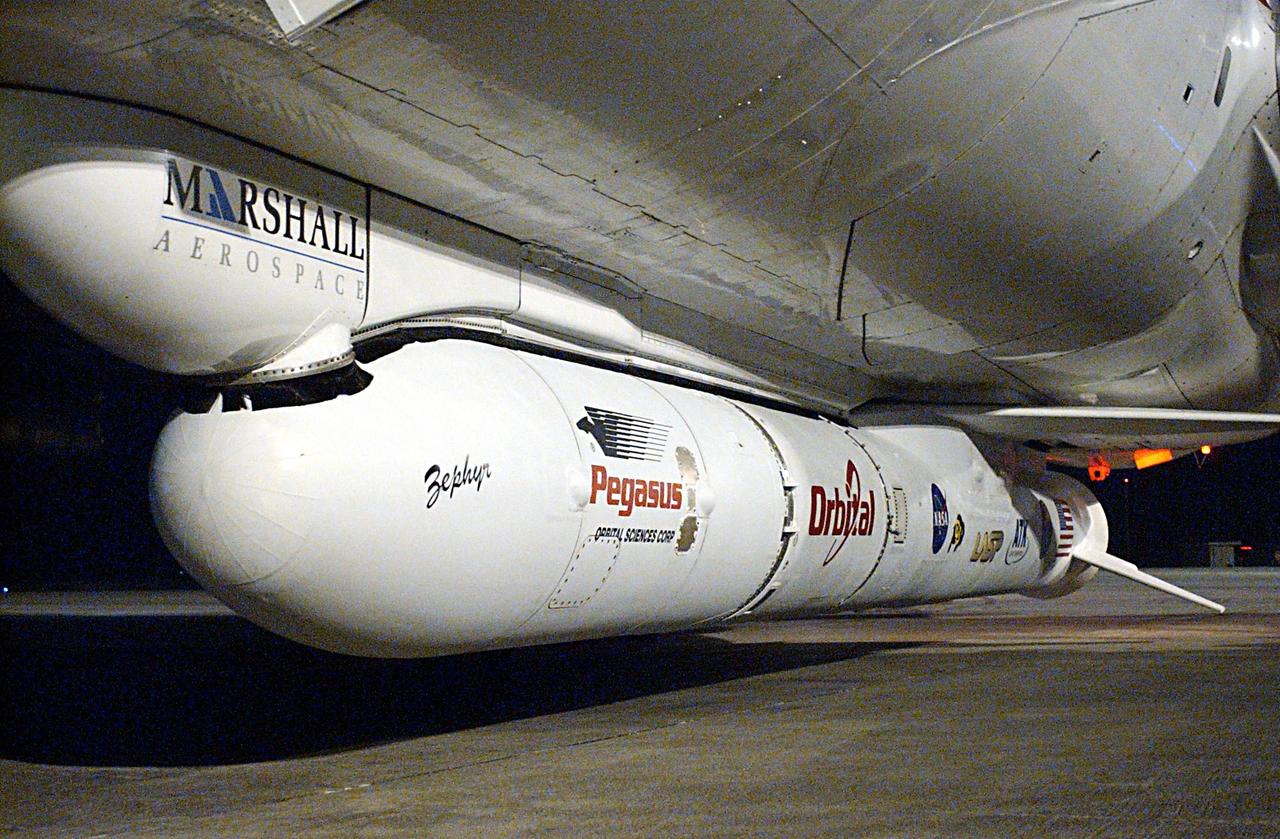
KENNEDY SPACE CENTER, FLA. -- Attached underneath the Orbital Sciences L-1011 aircraft is the Pegasus XL Expendable Launch Vehicle, which will be transported to the Multi-Payload Processing Facility for testing and verification. The Pegasus will undergo three flight simulations prior to its scheduled launch in late January 2003. The Pegasus XL will carry NASA's Solar Radiation and Climate Experiment (SORCE) into orbit. Built by Orbital Sciences Space Systems Group, SORCE will study and measure solar irradiance as a source of energy in the Earth's atmosphere. .
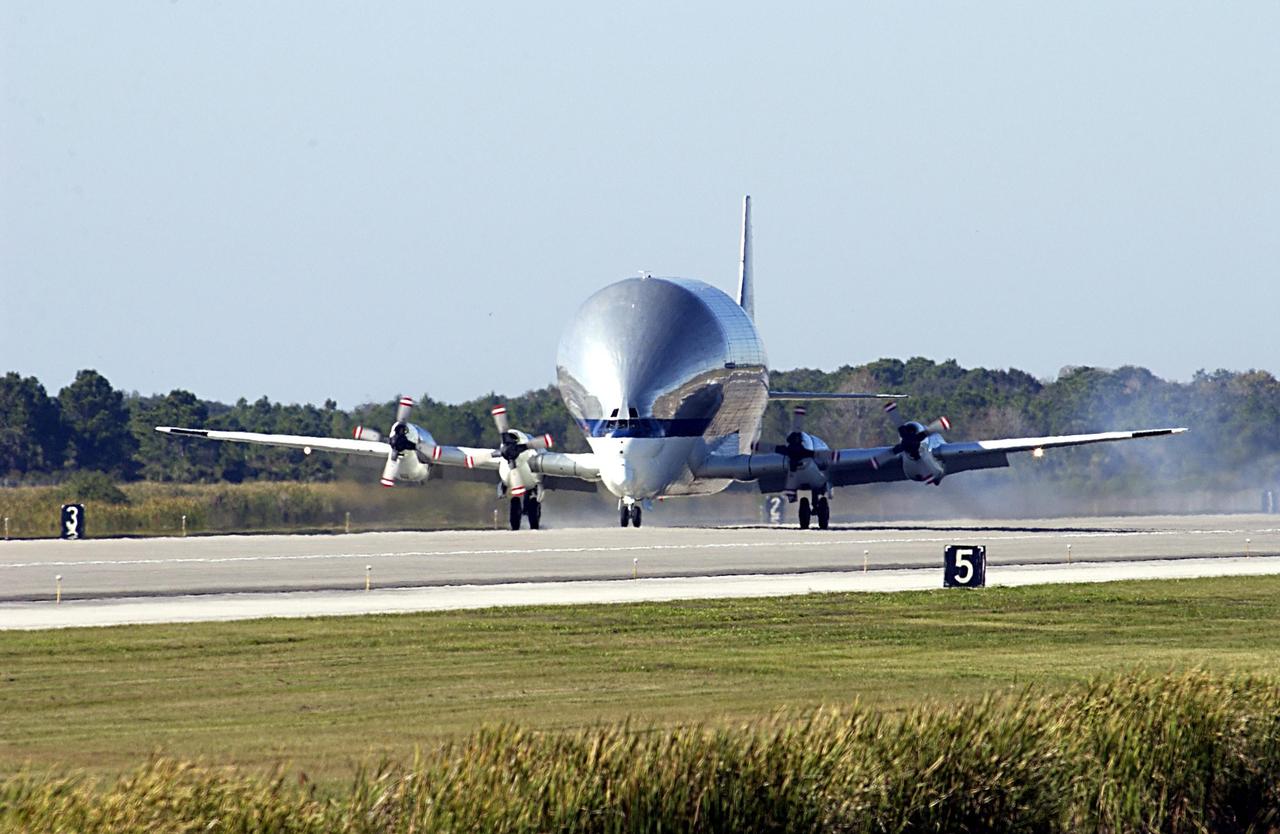
KENNEDY SPACE CENTER, FLA. - - NASA's Super Guppy cargo airplane arrives at KSC carrying the Long Spacer (LS), the second and final piece of the Starboard 6 (S6) Integrated Truss Segment. After landing and offloading, the LS will be transported to the Space Station Processing Facility for inspections and verification tests. Eventually the LS will be integrated with the S6 Integrated Equipment Assembly already at KSC and will fly as one segment to the International Space Station on Space Shuttle mission STS-119 in early 2004. Together the segment pieces weigh 26,000 pounds and measure 45 feet long. .
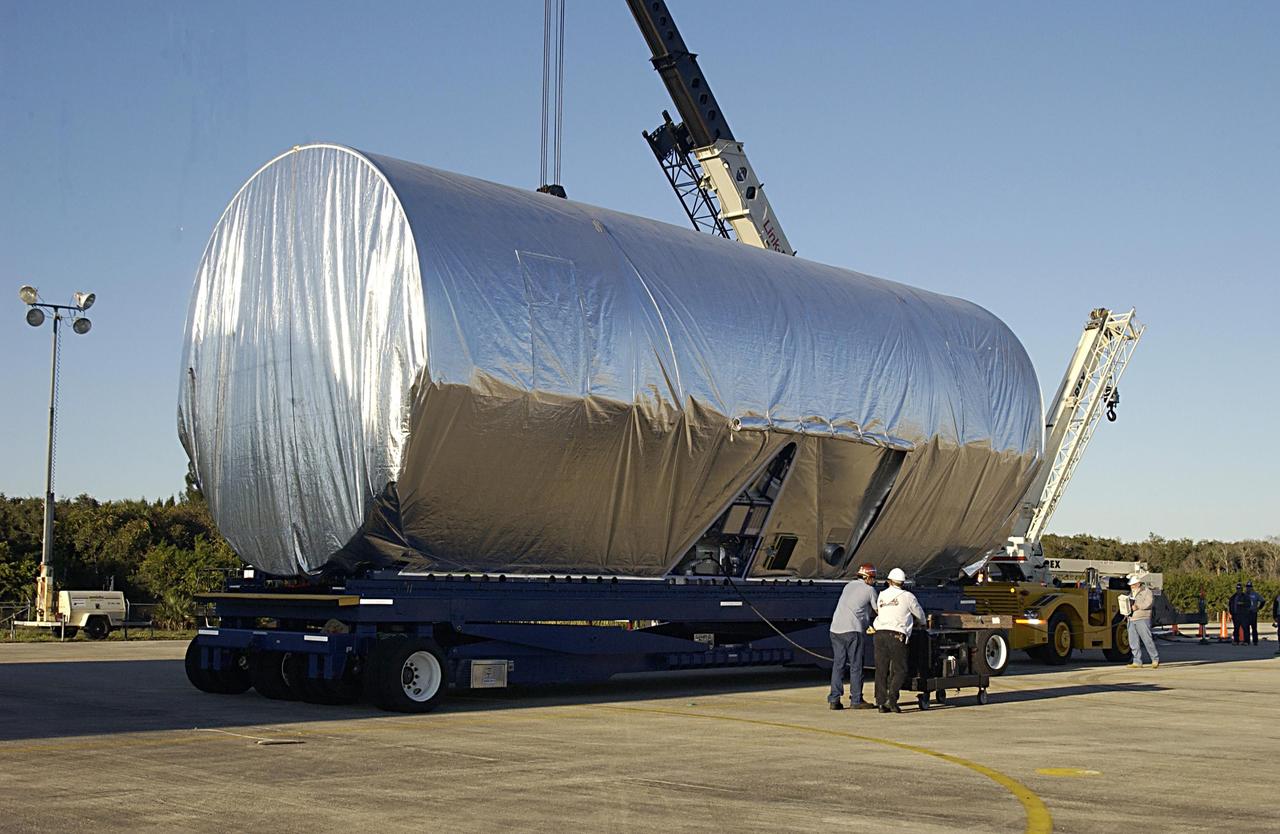
KENNEDY SPACE CENTER, FLA. -- The Long Spacer (LS), the second and final piece of the Starboard 6 (S6) Integrated Truss Segment, is secured on a flatbed truck for transport to the Space Station Processing Facility where it will undergo inspections and verification tests. Eventually the LS will be integrated with the S6 Integrated Equipment Assembly already at KSC and will fly as one segment to the International Space Station on Space Shuttle mission STS-119 in early 2004. Together the segment pieces weigh 26,000 pounds and measure 45 feet long. .

KENNEDY SPACE CENTER, FLA. -- The Long Spacer (LS), the second and final piece of the Starboard 6 (S6) Integrated Truss Segment, rolls out of NASA's Super Guppy cargo airplane. The LS will be transported to the Space Station Processing Facility for inspections and verification tests. Eventually the LS will be integrated with the S6 Integrated Equipment Assembly already at KSC and will fly as one segment to the International Space Station on Space Shuttle mission STS-119 in early 2004. Together the segment pieces weigh 26,000 pounds and measure 45 feet long. .
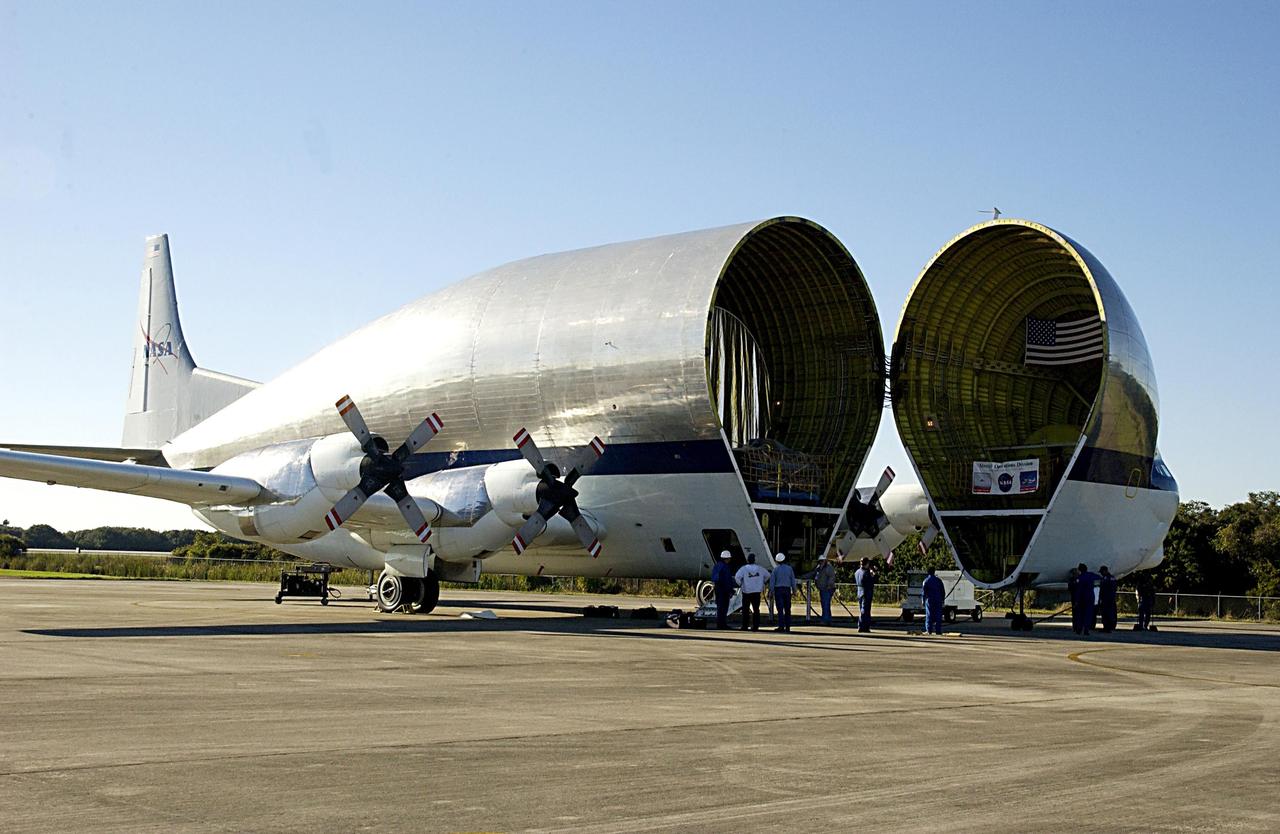
KENNEDY SPACE CENTER, FLA. - After landing at the KSC Shuttle Landing Facility, NASA's Super Guppy cargo airplane opens to remove its cargo, the Long Spacer (LS), the second and final piece of the Starboard 6 (S6) Integrated Truss Segment. The LS will be transported to the Space Station Processing Facility for inspections and verification tests. Eventually the LS will be integrated with the S6 Integrated Equipment Assembly already at KSC and will fly as one segment to the International Space Station on Space Shuttle mission STS-119 in early 2004. Together the segment pieces weigh 26,000 pounds and measure 45 feet long. .
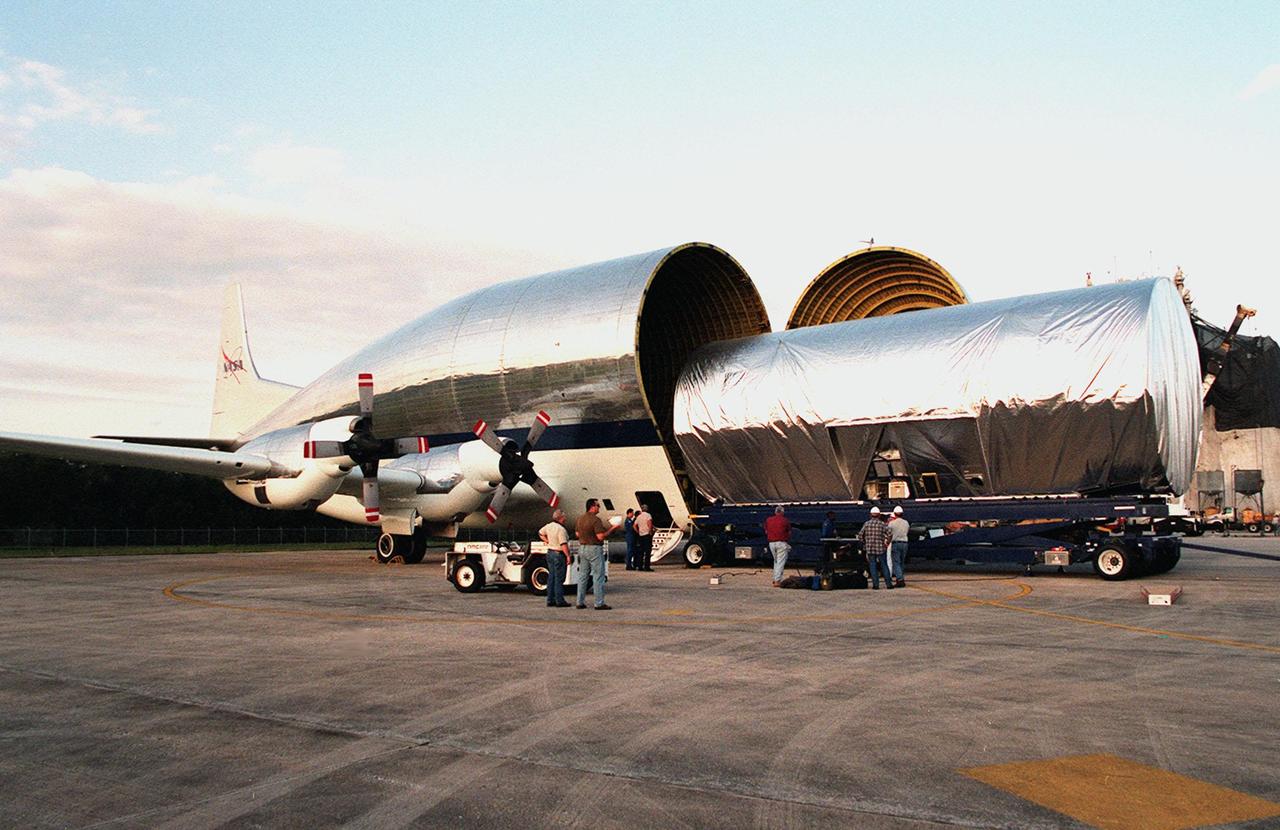
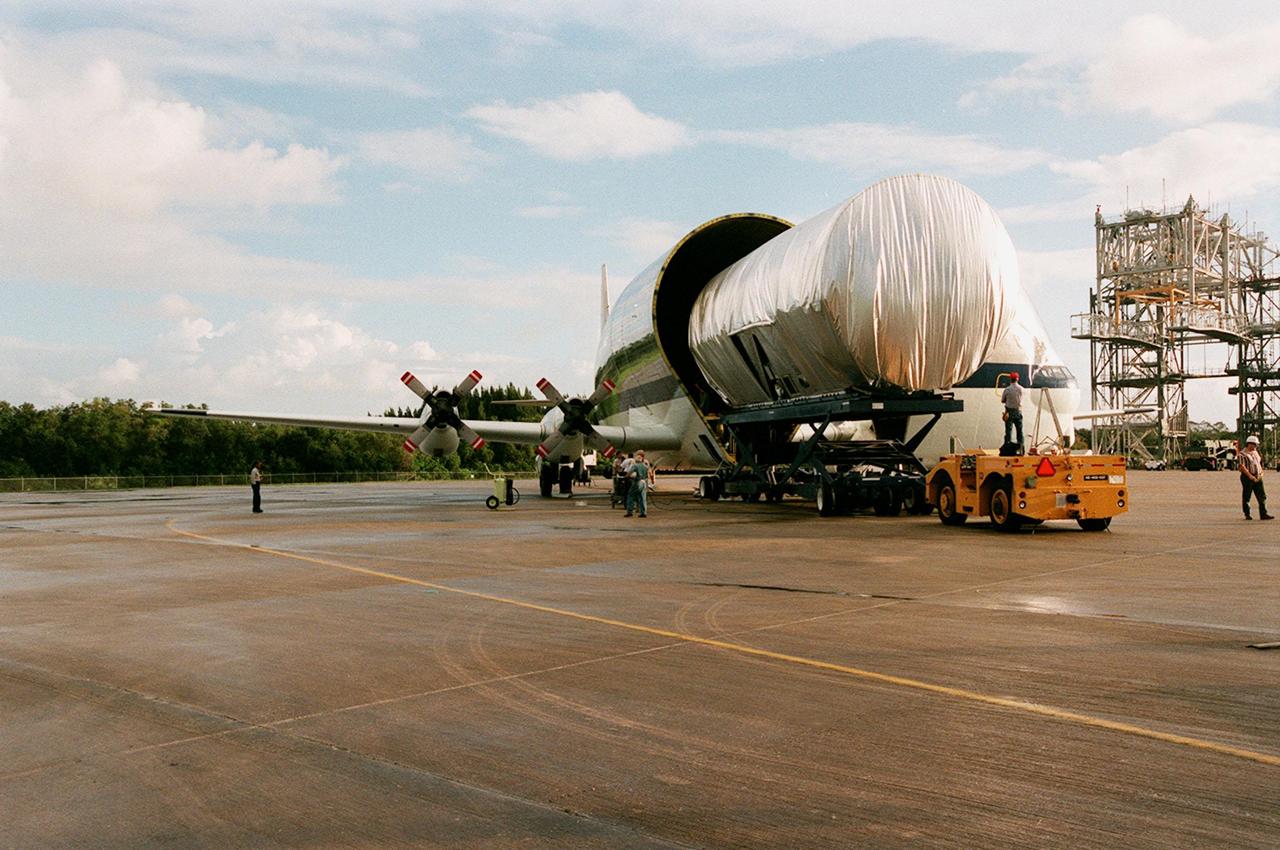
KENNEDY SPACE CENTER, FLA. -- Rolling out of NASA's Super Guppy aircraft aboard a payload transporter is a port-side P3 truss, a component for the International Space Station (ISS). The truss is scheduled to be added to the ISS on mission STS-115 in 2002 aboard Space Shuttle Atlantis. The second port truss segment, P3 will be attached to the first port truss segment (P1). The P3 truss will be taken to the Operations and Checkout Building.
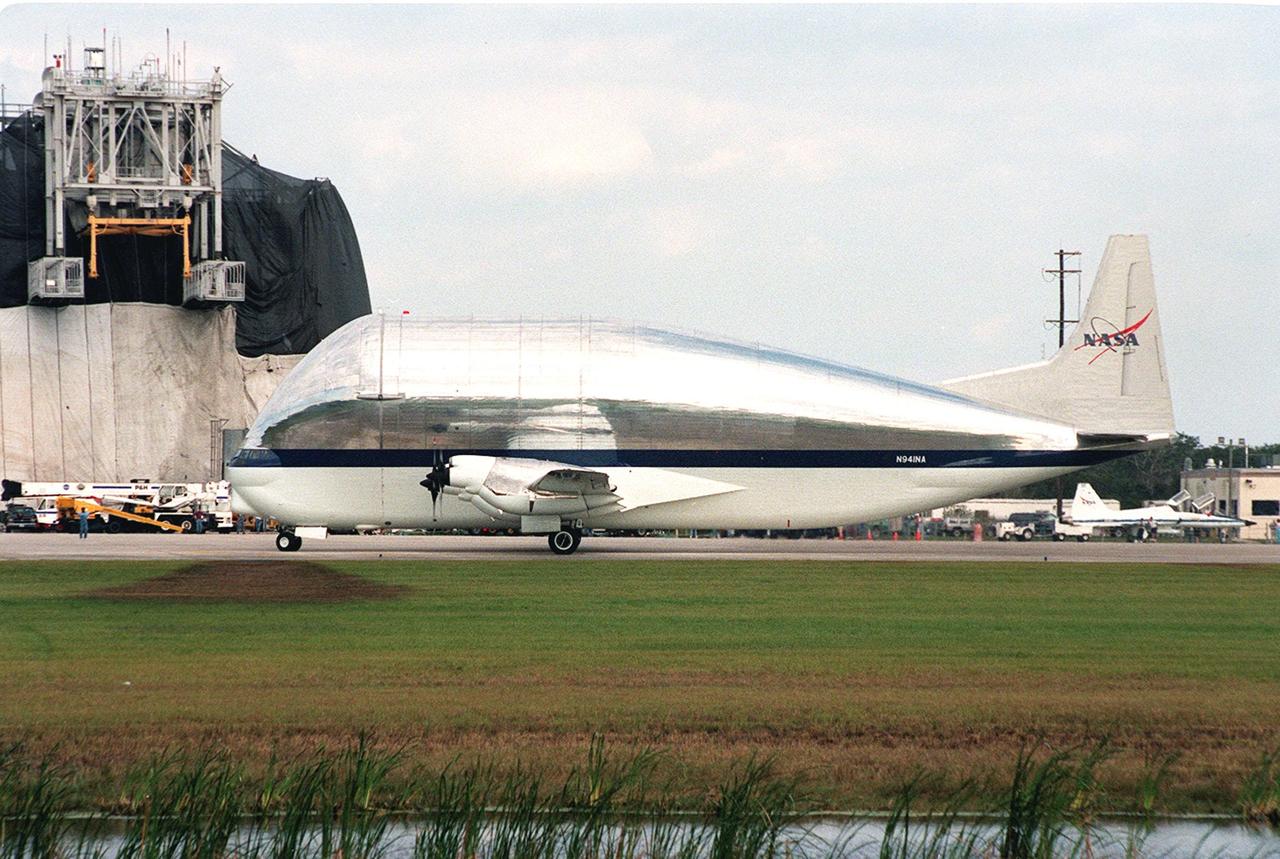
KENNEDY SPACE CENTER, FLA. -- NASA's Super Guppy aircraft arrives at Kennedy Space Center's Shuttle Landing Facility. The plane carries a component for the International Space Station (ISS), the port-side P3 truss. The truss is scheduled to be added to the ISS on mission STS-115 in 2002 aboard Space Shuttle Atlantis. The second port truss segment, P3 will be attached to the first port truss segment (P1). The P3 truss will be taken to the Operations and Checkout Building
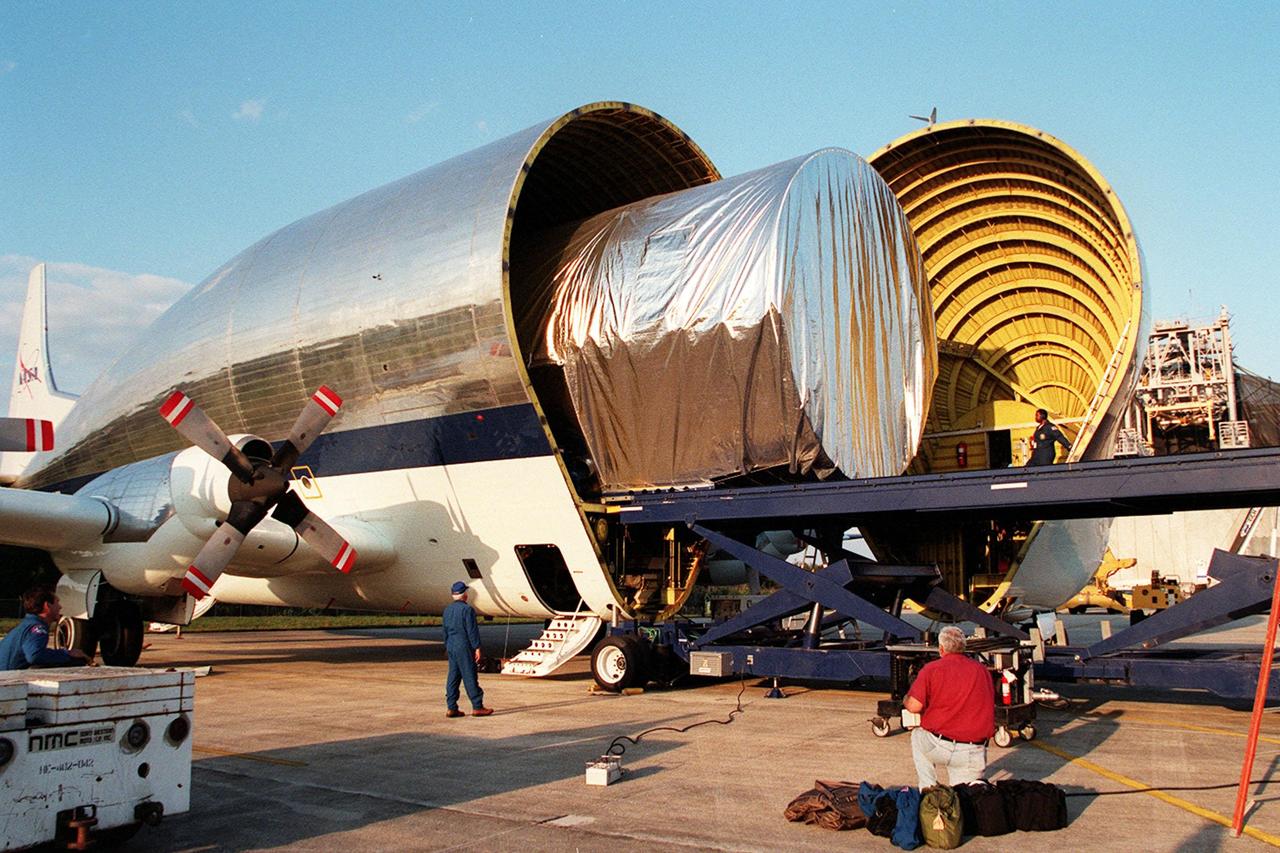
KENNEDY SPACE CENTER, FLA. -- At Kennedy Space Center's Shuttle Landing Facility, the cargo of NASA's Super Guppy aircraft begins rolling out onto a payload transporter. The cargo is a P3 port-side truss, a segment of the International Space Station (ISS). The truss is scheduled to be added to the ISS on mission STS-115 in 2002 aboard Space Shuttle Atlantis. The second port truss segment, P3 will be attached to the first port truss segment (P1). The P3 truss will be taken to the Operations and Checkout Building.
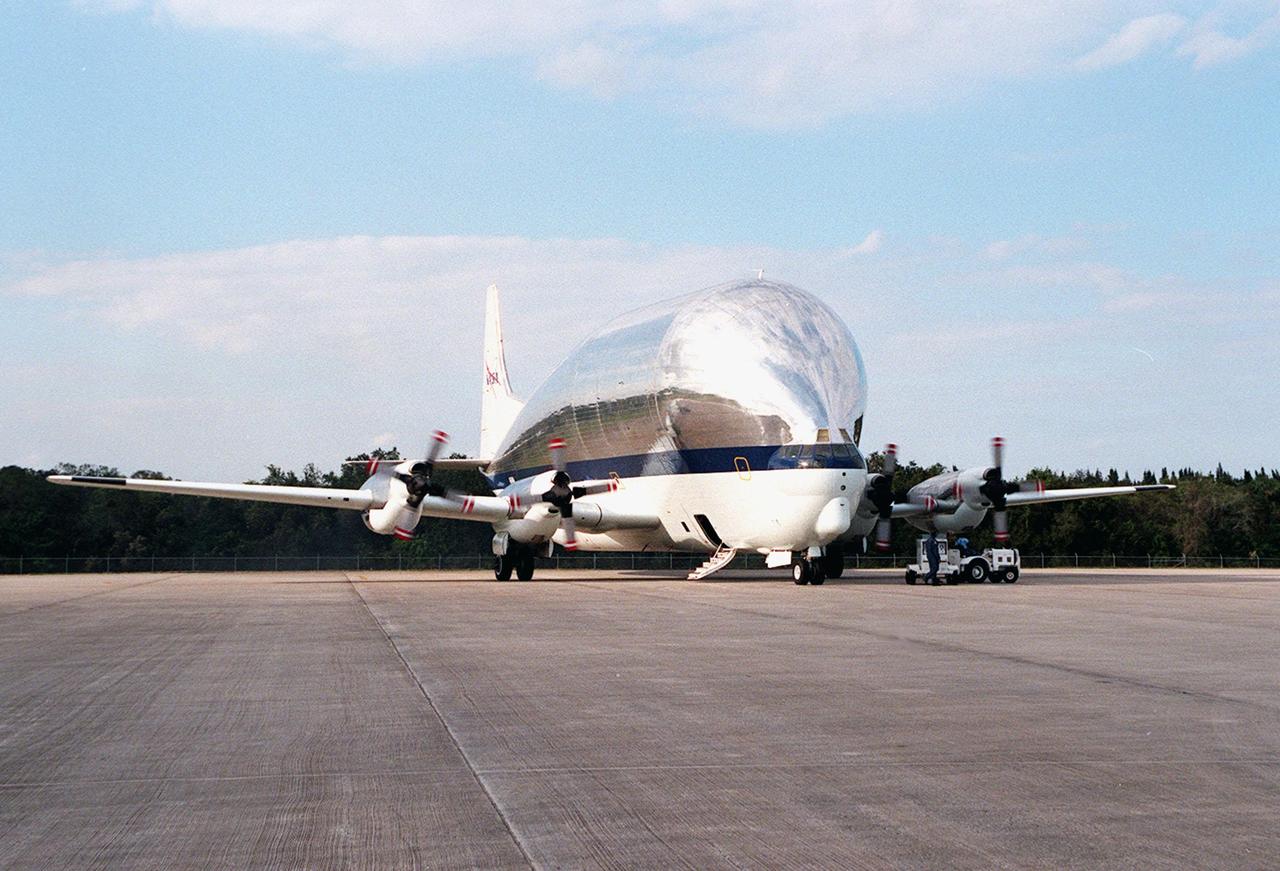
KENNEDY SPACE CENTER, FLA. -- NASA's Super Guppy aircraft arrives at Kennedy Space Center's Shuttle Landing Facility. The plane carries a component for the International Space Station (ISS), the port-side P3 truss. The truss is scheduled to be added to the ISS on mission STS-115 in 2002 aboard Space Shuttle Atlantis. The second port truss segment, P3 will be attached to the first port truss segment (P1). The P3 truss will be taken to the Operations and Checkout Building.
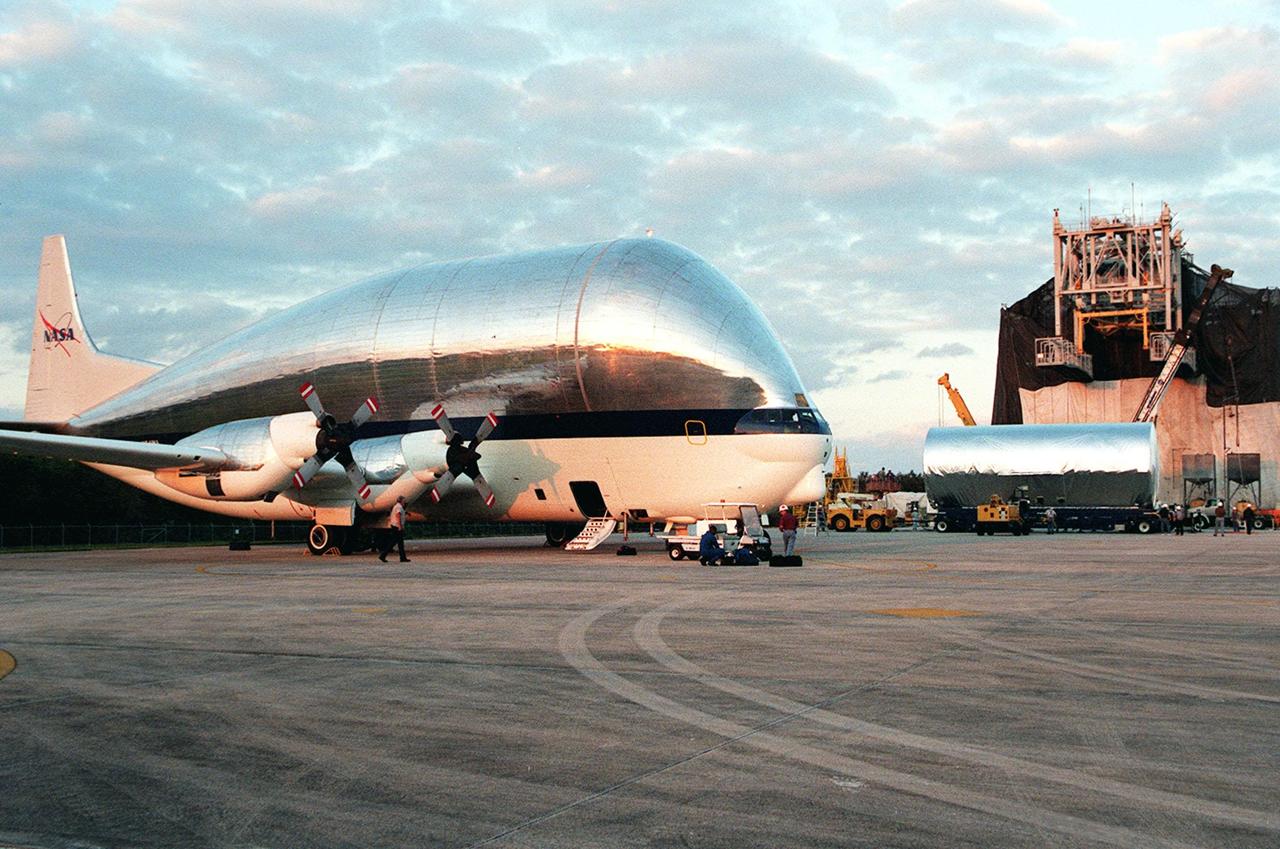
With its cargo off-loaded (background), the nose cone of the Super Guppy aircraft is closed. The cargo is a P3 port-side truss, a segment of the International Space Station (ISS). The truss is scheduled to be added to the ISS on mission STS-115 in 2002 aboard Space Shuttle Atlantis. The second port truss segment, P3 will be attached to the first port truss segment (P1). The P3 truss will be taken to the Operations and Checkout Building.
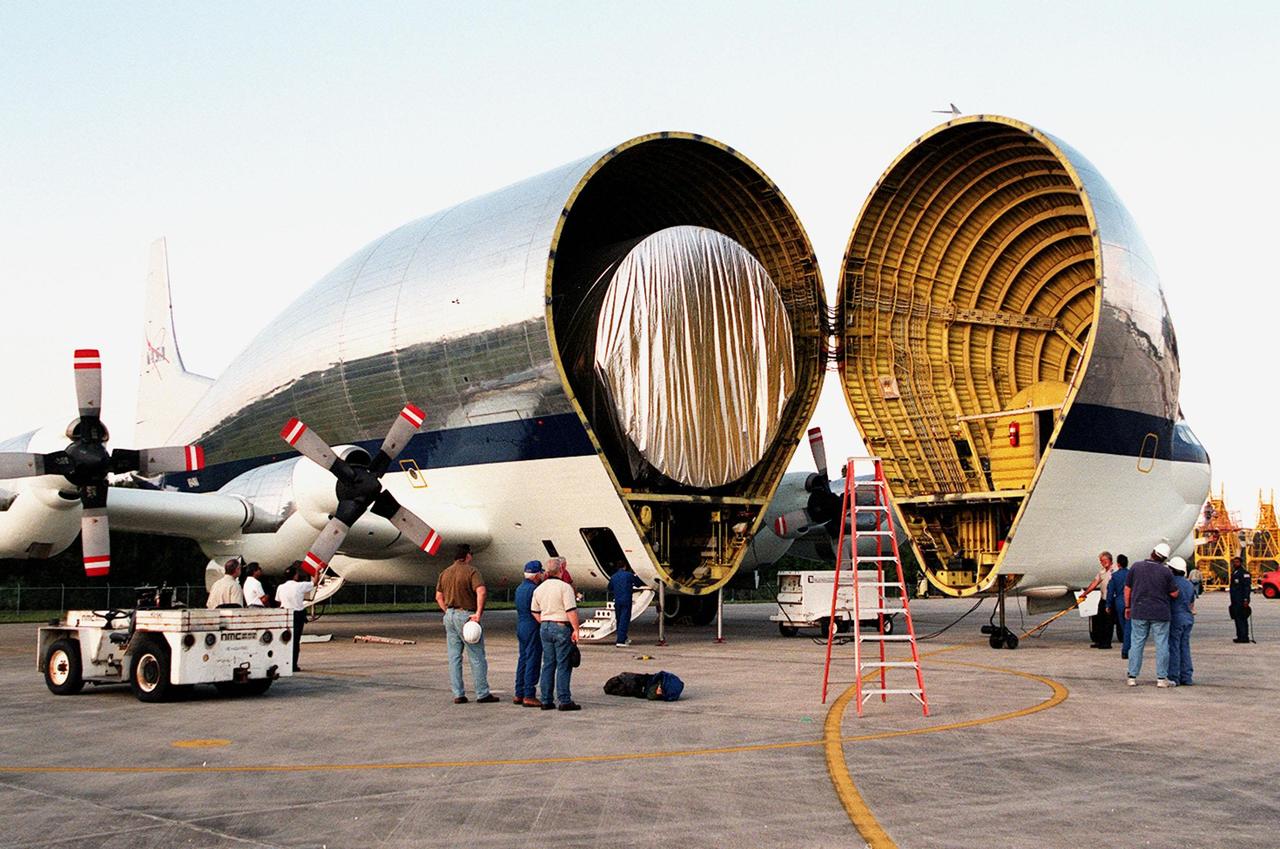
KENNEDY SPACE CENTER, FLA. -- At Kennedy Space Center's Shuttle Landing Facility, workers watch as the nose of NASA's Super Guppy aircraft opens to reveal its cargo, a component for the International Space Station (ISS), the port-side P3 truss. The truss is scheduled to be added to the ISS on mission STS-115 in 2002 aboard Space Shuttle Atlantis. The second port truss segment, P3 will be attached to the first port truss segment (P1). The P3 truss will be taken to the Operations and Checkout Building.
KENNEDY SPACE CENTER, FLA. -- At the Shuttle Landing Facility, the newly arrived S1 truss, a segment of the International Space Station (ISS), is offloaded from NASA's Super Guppy aircraft. Manufactured by the Boeing Co. in Huntington Beach, Calif., this component of the ISS is the first starboard (right-side) truss segment, whose main job is providing structural support for the orbiting research facility's radiator panels that cool the Space Station's complex power system. The S1 truss segment also will house communications systems, external experiment positions and other subsystems. Primarily constructed of aluminum, the truss segment is 45 feet long, 15 feet wide and 6 feet tall. When fully outfitted, it will weigh 31,137 pounds. The truss is slated for flight in 2001. The Super Guppy, with its 25-foot diameter fuselage designed to handle oversized loads, is well prepared to transport the truss and other ISS segments. Loading the Guppy is easy because of the unique "fold-away" nose of the aircraft that opens 110 degrees for cargo loading. A system of rails in the cargo compartment, used with either Guppy pallets or fixtures designed for specific cargo, makes cargo loading simple and efficient. Rollers mounted in the rails allow pallets or fixtures to be moved by an electric winch mounted beneath the cargo floor. Automatic hydraulic lock pins in each rail secure the pallet for flight. The truss is being transferred to the Operations and Checkout Building
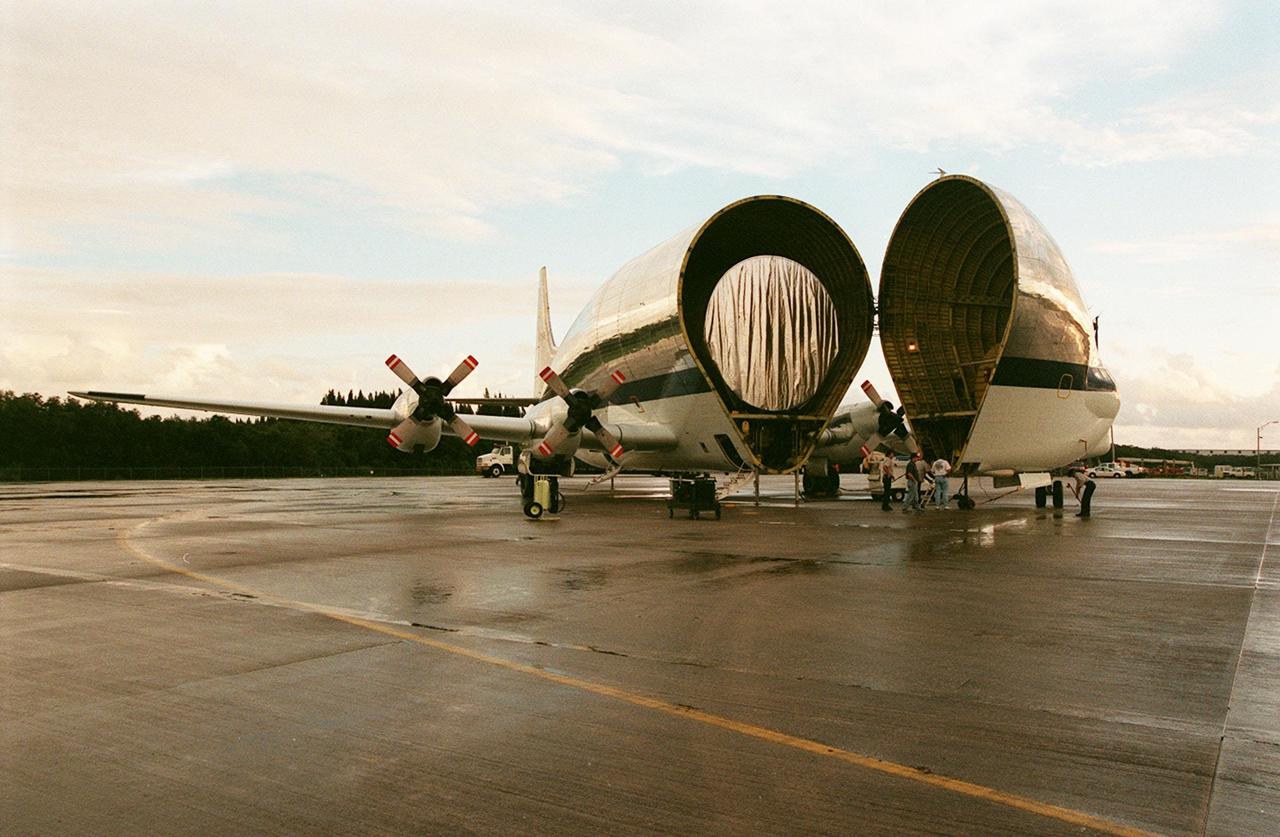
KENNEDY SPACE CENTER, FLA. -- At KSC's Shuttle Landing Facility, NASA's Super Guppy opens to reveal its cargo, the International Space Station's (ISS) S1 truss. Manufactured by the Boeing Co. in Huntington Beach, Calif., this component of the ISS is the first starboard (right-side) truss segment, whose main job is providing structural support for the orbiting research facility's radiator panels that cool the Space Station's complex power system. The S1 truss segment also will house communications systems, external experiment positions and other subsystems. Primarily constructed of aluminum, the truss segment is 45 feet long, 15 feet wide and 6 feet tall. When fully outfitted, it will weigh 31,137 pounds. The truss is slated for flight in 2001. The Super Guppy, with its 25-foot diameter fuselage designed to handle oversized loads, is well prepared to transport the truss and other ISS segments. Loading the Guppy is easy because of the unique "fold-away" nose of the aircraft that opens 110 degrees for cargo loading. A system of rails in the cargo compartment, used with either Guppy pallets or fixtures designed for specific cargo, makes cargo loading simple and efficient. Rollers mounted in the rails allow pallets or fixtures to be moved by an electric winch mounted beneath the cargo floor. Automatic hydraulic lock pins in each rail secure the pallet for flight. The truss is to be transferred to the Operations and Checkout Building
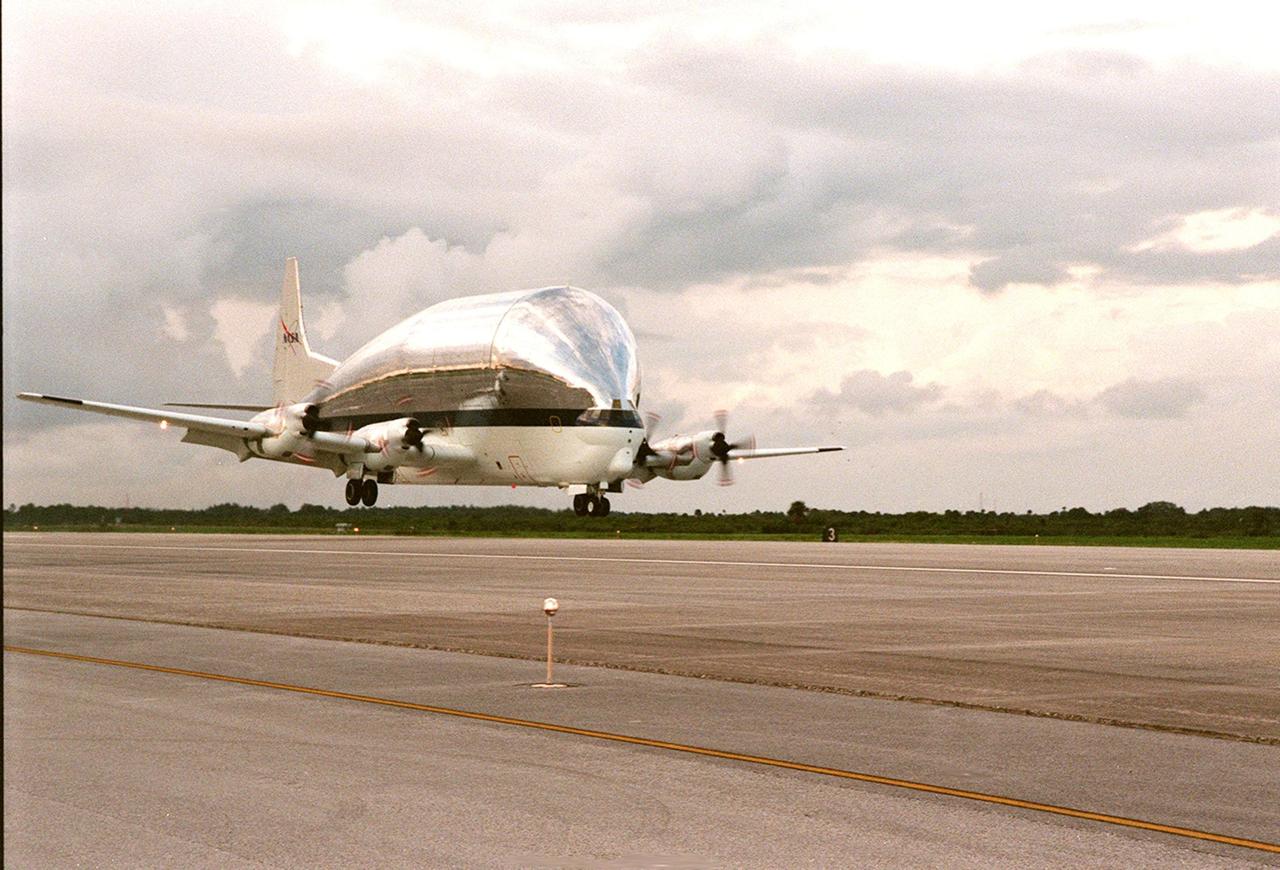
KENNEDY SPACE CENTER, FLA. -- NASA's Super Guppy airplane, with the International Space Station's (ISS) S1 truss aboard, arrives at KSC's Shuttle Landing Facility from Marshall Space Flight Center. Manufactured by the Boeing Co. in Huntington Beach, Calif., this component of the ISS is the first starboard (right-side) truss segment, whose main job is providing structural support for the orbiting research facility's radiator panels that cool the Space Station's complex power system. The S1 truss segment also will house communications systems, external experiment positions and other subsystems. Primarily constructed of aluminum, the truss segment is 45 feet long, 15 feet wide and 6 feet tall. When fully outfitted, it will weigh 31,137 pounds. The truss is slated for flight in 2001. The Super Guppy, with its 25-foot diameter fuselage designed to handle oversized loads, is well prepared to transport the truss and other ISS segments. Loading the Guppy is easy because of the unique "fold-away" nose of the aircraft that opens 110 degrees for cargo loading. A system of rails in the cargo compartment, used with either Guppy pallets or fixtures designed for specific cargo, makes cargo loading simple and efficient. Rollers mounted in the rails allow pallets or fixtures to be moved by an electric winch mounted beneath the cargo floor. Automatic hydraulic lock pins in each rail secure the pallet for flight. The truss is to be moved to the Operations and Checkout Building
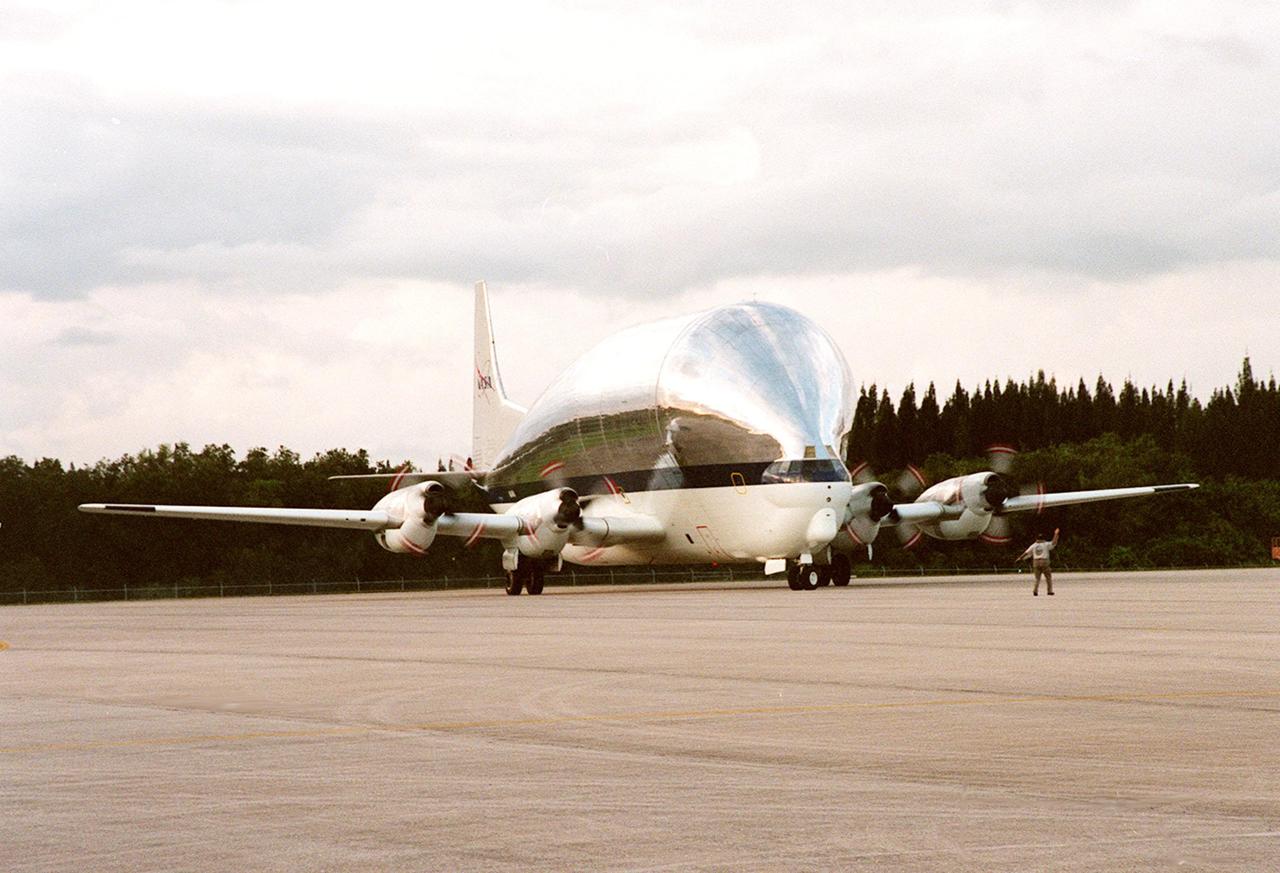
KENNEDY SPACE CENTER, FLA. -- NASA's Super Guppy airplane, with the International Space Station's (ISS) S1 truss aboard, rolls to a stop at KSC's Shuttle Landing Facility. Manufactured by the Boeing Co. in Huntington Beach, Calif., this component of the ISS is the first starboard (right-side) truss segment, whose main job is providing structural support for the orbiting research facility's radiator panels that cool the Space Station's complex power system. The S1 truss segment also will house communications systems, external experiment positions and other subsystems. Primarily constructed of aluminum, the truss segment is 45 feet long, 15 feet wide and 6 feet tall. When fully outfitted, it will weigh 31,137 pounds. The truss is slated for flight in 2001. The Super Guppy, with its 25-foot diameter fuselage designed to handle oversized loads, is well prepared to transport the truss and other ISS segments. Loading the Guppy is easy because of the unique "fold-away" nose of the aircraft that opens 110 degrees for cargo loading. A system of rails in the cargo compartment, used with either Guppy pallets or fixtures designed for specific cargo, makes cargo loading simple and efficient. Rollers mounted in the rails allow pallets or fixtures to be moved by an electric winch mounted beneath the cargo floor. Automatic hydraulic lock pins in each rail secure the pallet for flight. The truss is to be transferred to the Operations and Checkout Building
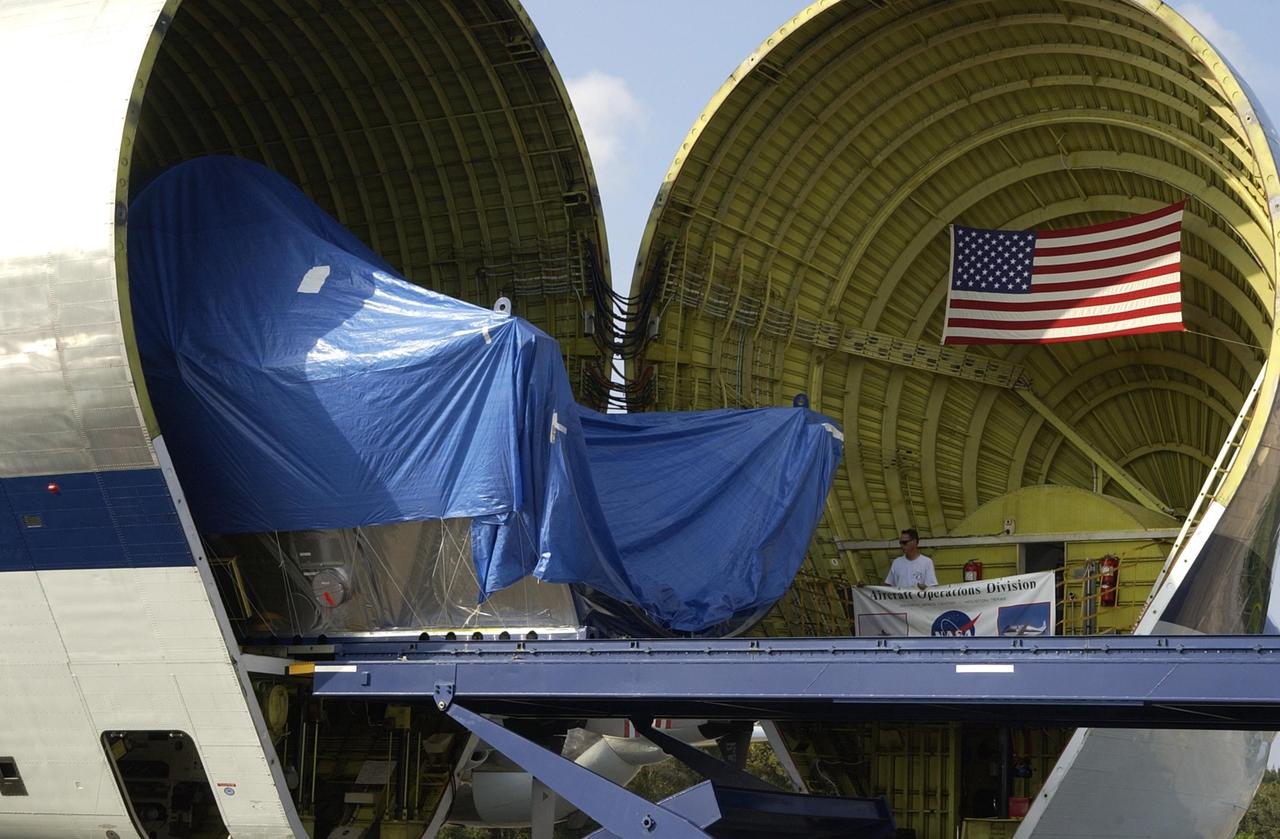
KENNEDY SPACE CENTER, FLA. -- The node structural test article (STA) is prepared to be offloaded through the open nose of the Super Guppy transport aircraft following its arrival at Kennedy Space Center from Marshall Space Flight Center in Huntsville, Ala. It was moved to KSC for storage. An exact replica of the Unity Node on the International Space Station, the node STA was used at MSFC for testing and validation purposes. The Unity Node is the pressurized element that connects the other ISS pressurized modules together and was the first U.S. element to launch.
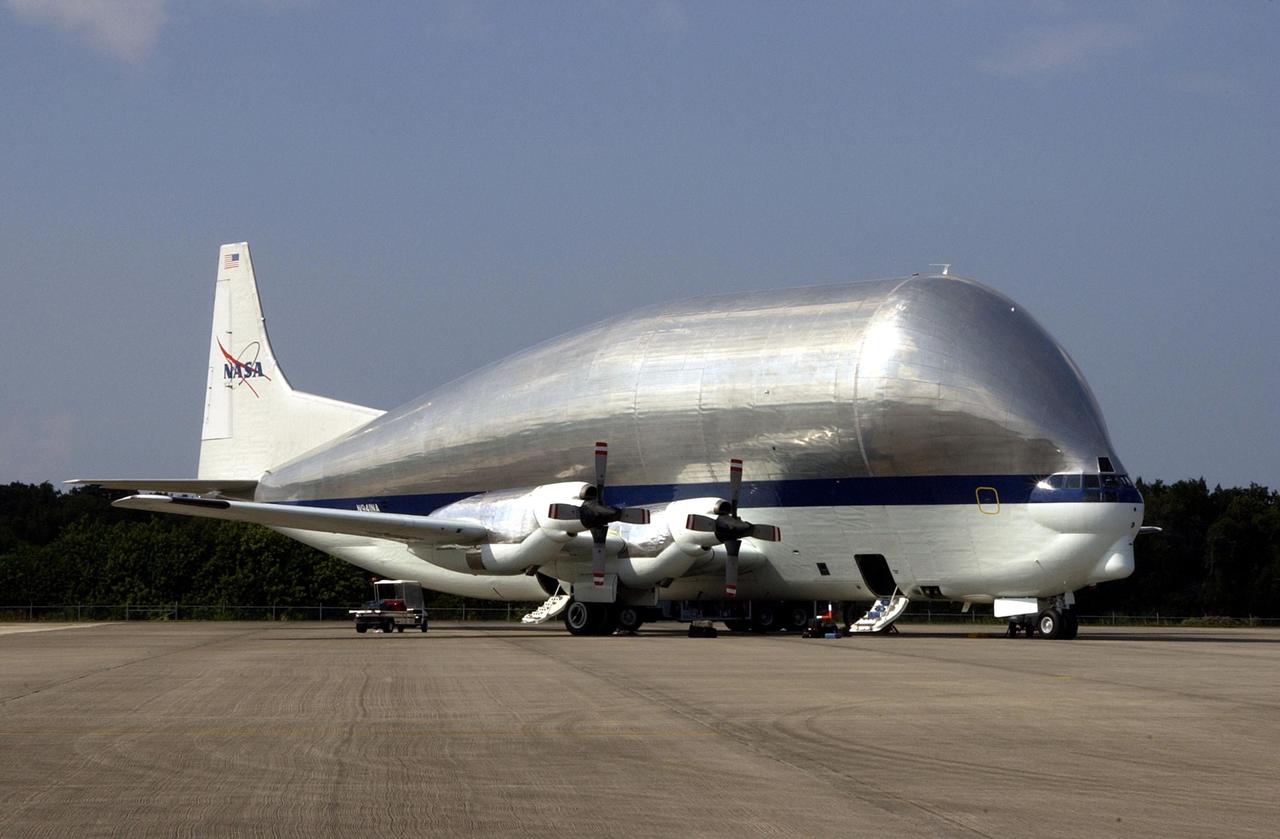
KENNEDY SPACE CENTER, FLA. -- The node structural test article (STA) arrives at Kennedy Space Center's Shuttle Landing Facility aboard the Super Guppy transport aircraft. It was moved to KSC for storage. An exact replica of the Unity Node on the International Space Station, the node STA was used at Marshall Space Flight Center in Huntsville, Ala. for testing and validation purposes. The Unity Node is the pressurized element that connects the other ISS pressurized modules together and was the first U.S. element to launch.
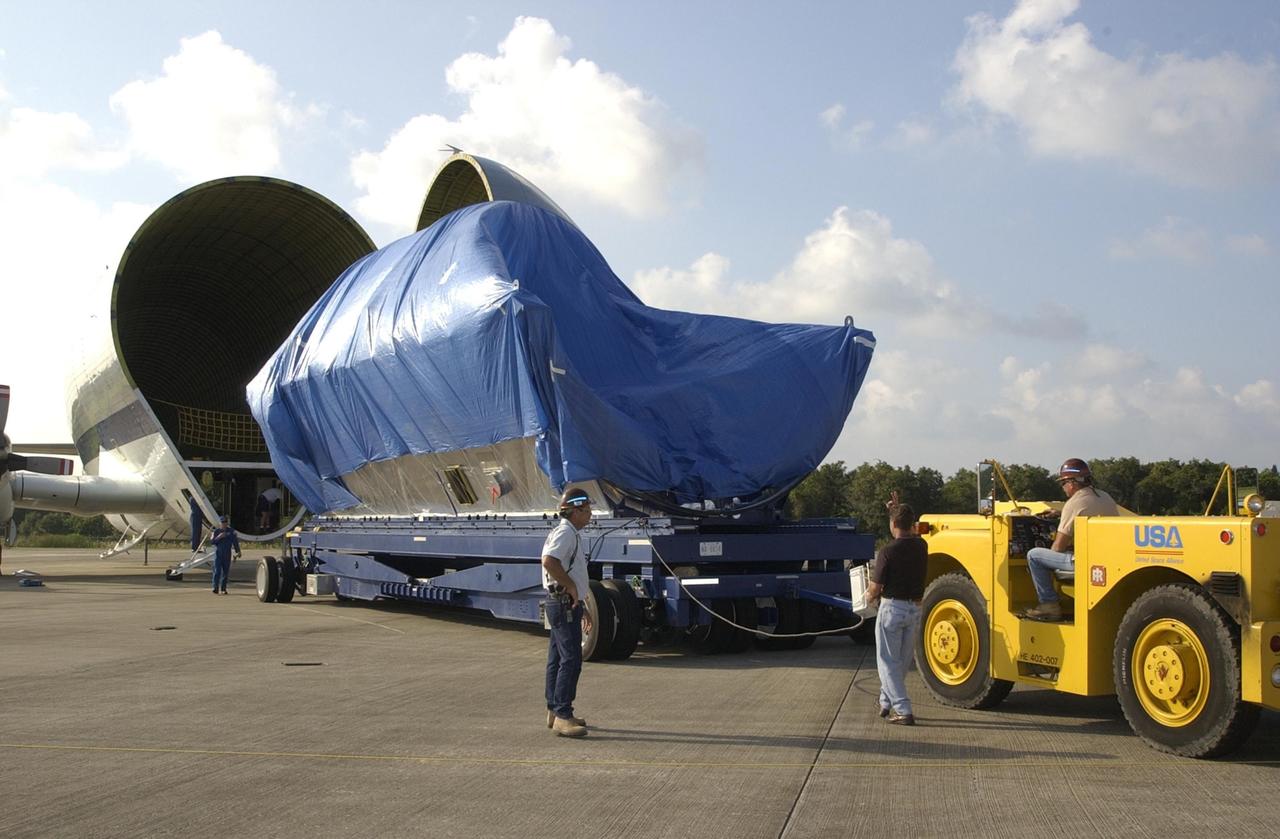
KENNEDY SPACE CENTER, FLA. -- The node structural test article (STA) is offloaded through the open nose of the Super Guppy transport aircraft following its arrival at Kennedy Space Center from Marshall Space Flight Center in Huntsville, Ala. It was moved to KSC for storage. An exact replica of the Unity Node on the International Space Station, the node STA was used at MSFC for testing and validation purposes. The Unity Node is the pressurized element that connects the other ISS pressurized modules together and was the first U.S. element to launch.
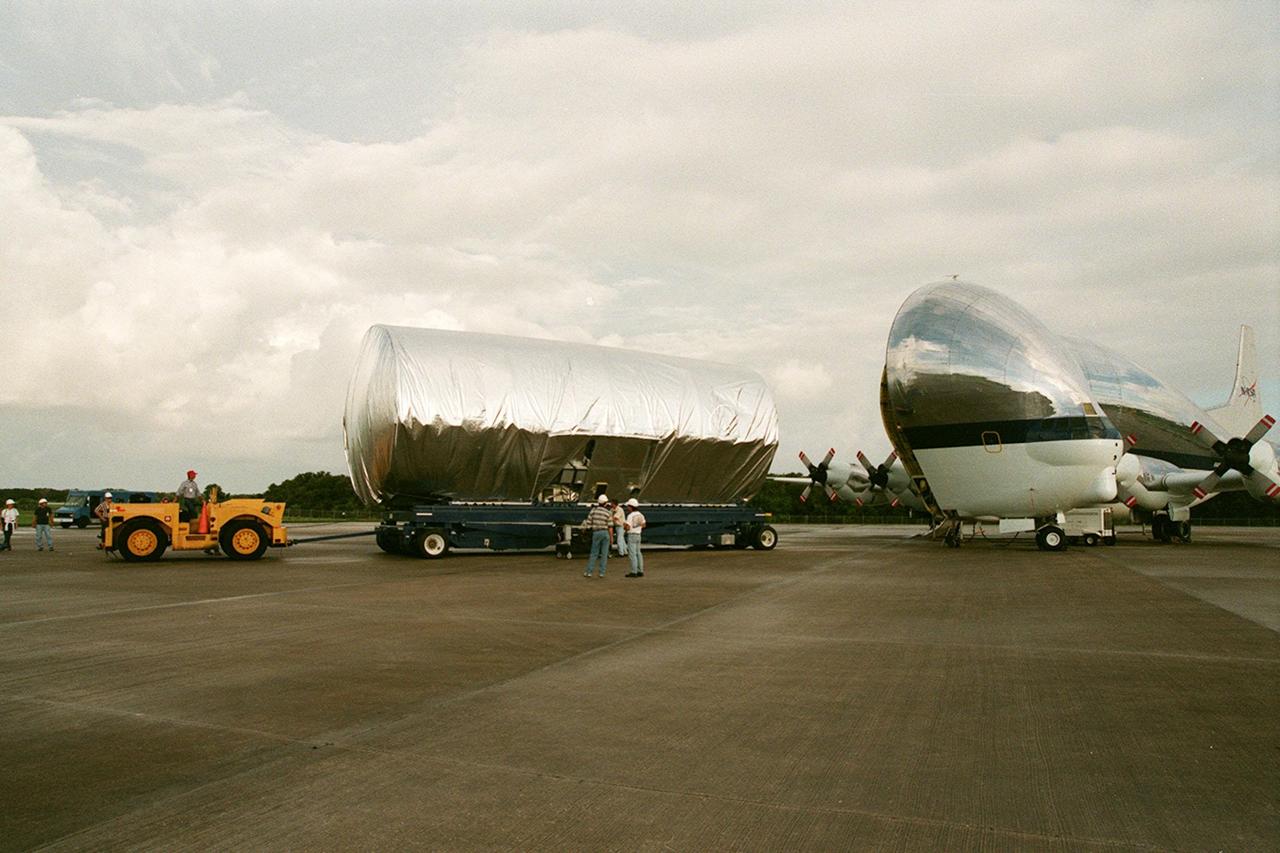
KENNEDY SPACE CENTER, FLA. -- At the Shuttle Landing Facility, the S1 truss, a segment of the International Space Station, is moved away from the Super Guppy that brought it to KSC from Marshall Space Flight Center. Manufactured by the Boeing Co. in Huntington Beach, Calif., this component of the ISS is the first starboard (right-side) truss segment, whose main job is providing structural support for the orbiting research facility's radiator panels that cool the Space Station's complex power system. The S1 truss segment also will house communications systems, external experiment positions and other subsystems. Primarily constructed of aluminum, the truss segment is 45 feet long, 15 feet wide and 6 feet tall. When fully outfitted, it will weigh 31,137 pounds. The truss is slated for flight in 2001. The Super Guppy, with its 25-foot diameter fuselage designed to handle oversized loads, is well prepared to transport the truss and other ISS segments. Loading the Guppy is easy because of the unique "fold-away" nose of the aircraft that opens 110 degrees for cargo loading. A system of rails in the cargo compartment, used with either Guppy pallets or fixtures designed for specific cargo, makes cargo loading simple and efficient. Rollers mounted in the rails allow pallets or fixtures to be moved by an electric winch mounted beneath the cargo floor. Automatic hydraulic lock pins in each rail secure the pallet for flight. The truss is being transferred to the Operations and Checkout Building
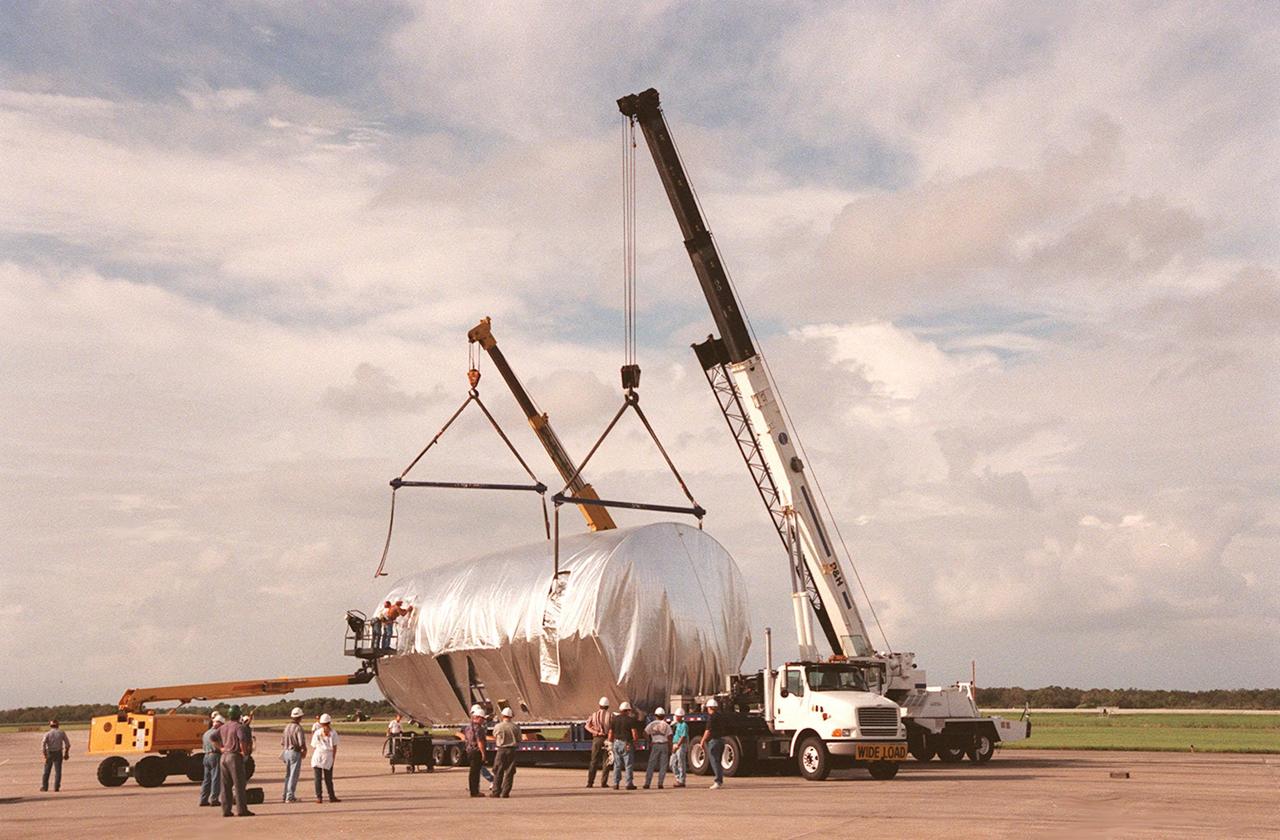
KENNEDY SPACE CENTER, FLA. -- At the Shuttle Landing Facility, workers attach cranes to the S1 truss, a segment of the International Space Station, to lift the truss to a payload transporter for its transfer to the Operations and Checkout Building. Manufactured by the Boeing Co. in Huntington Beach, Calif., this component of the ISS is the first starboard (right-side) truss segment, whose main job is providing structural support for the orbiting research facility's radiator panels that cool the Space Station's complex power system. The S1 truss segment also will house communications systems, external experiment positions and other subsystems. Primarily constructed of aluminum, the truss segment is 45 feet long, 15 feet wide and 6 feet tall. When fully outfitted, it will weigh 31,137 pounds. The truss is slated for flight in 2001. The truss arrived at KSC aboard NASA's Super Guppy, with a 25-foot diameter fuselage designed to handle oversized loads. Loading the Guppy is easy because of the unique "fold-away" nose of the aircraft that opens 110 degrees for cargo loading. A system of rails in the cargo compartment, used with either Guppy pallets or fixtures designed for specific cargo, makes cargo loading simple and efficient. Rollers mounted in the rails allow pallets or fixtures to be moved by an electric winch mounted beneath the cargo floor. Automatic hydraulic lock pins in each rail secure the pallet for flight

KENNEDY SPACE CENTER, FLA. -- The Integrated Equipment Assembly (IEA), one of two major components of the Starboard 6 (S6) truss segment for the International Space Station (ISS), arrives at the Shuttle Landing Facility aboard NASA's Super Guppy cargo airplane. The customized four-engine aricraft has a 24-foot-diameter fuselage and a foldaway nose enabling it to load and transport oversize cargo. The IEA will be joined to its companion piece, the Long Spacer, before launch early in 2004. The S6 truss segment will be the 11th and final piece of the Station's Integrated Truss Structure and will support the fourth and final set of solar arrays, batteries, and electronics.
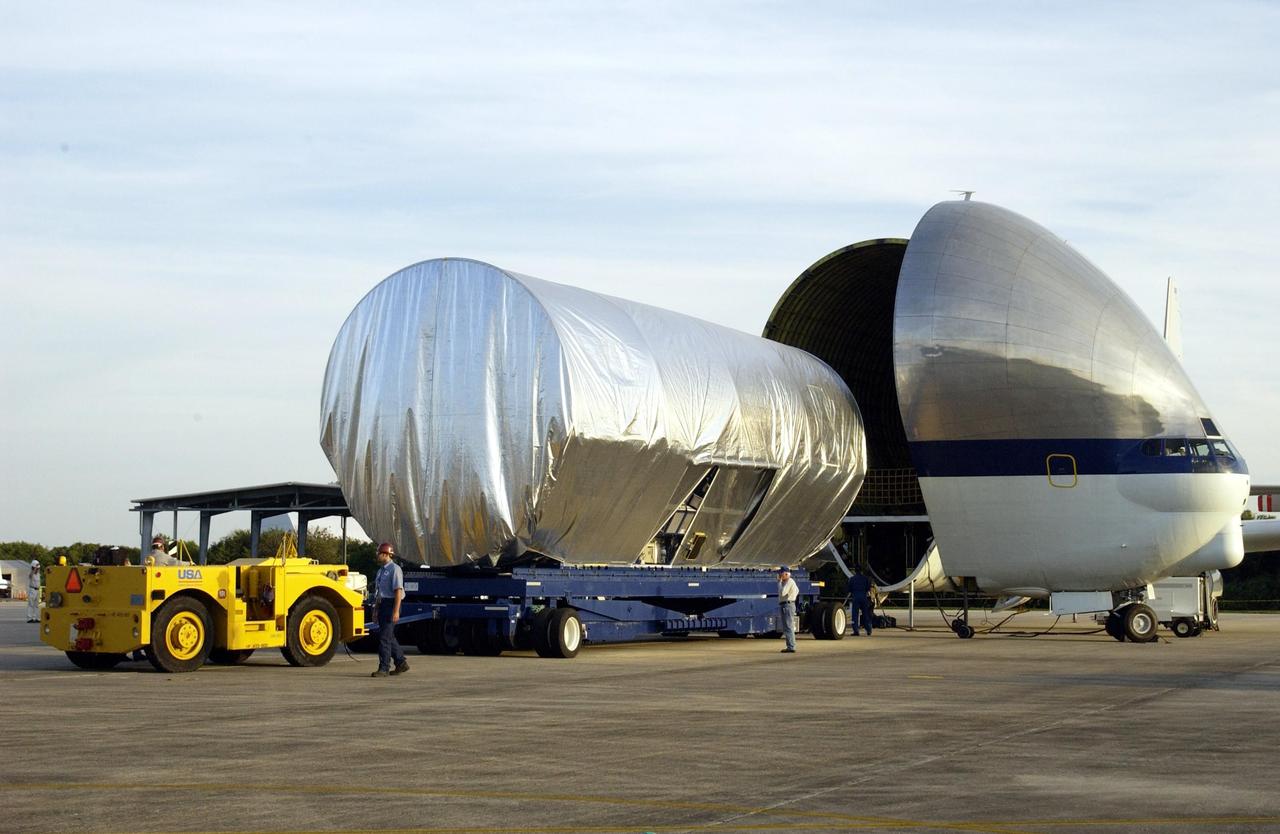
KENNEDY SPACE CENTER, FLA. -- The Integrated Equipment Assembly (IEA), one of two major components of the Starboard 6 (S6) truss segment for the International Space Station (ISS), is offloaded from NASA's Super Guppy cargo airplane following its arrival at the Shuttle Landing Facility. The customized four-engine aricraft has a 24-foot-diameter fuselage and a foldaway nose enabling it to load and transport oversize cargo. The IEA will be joined to its companion piece, the Long Spacer, before launch early in 2004. The S6 truss segment will be the 11th and final piece of the Station's Integrated Truss Structure and will support the fourth and final set of solar arrays, batteries, and electronics.
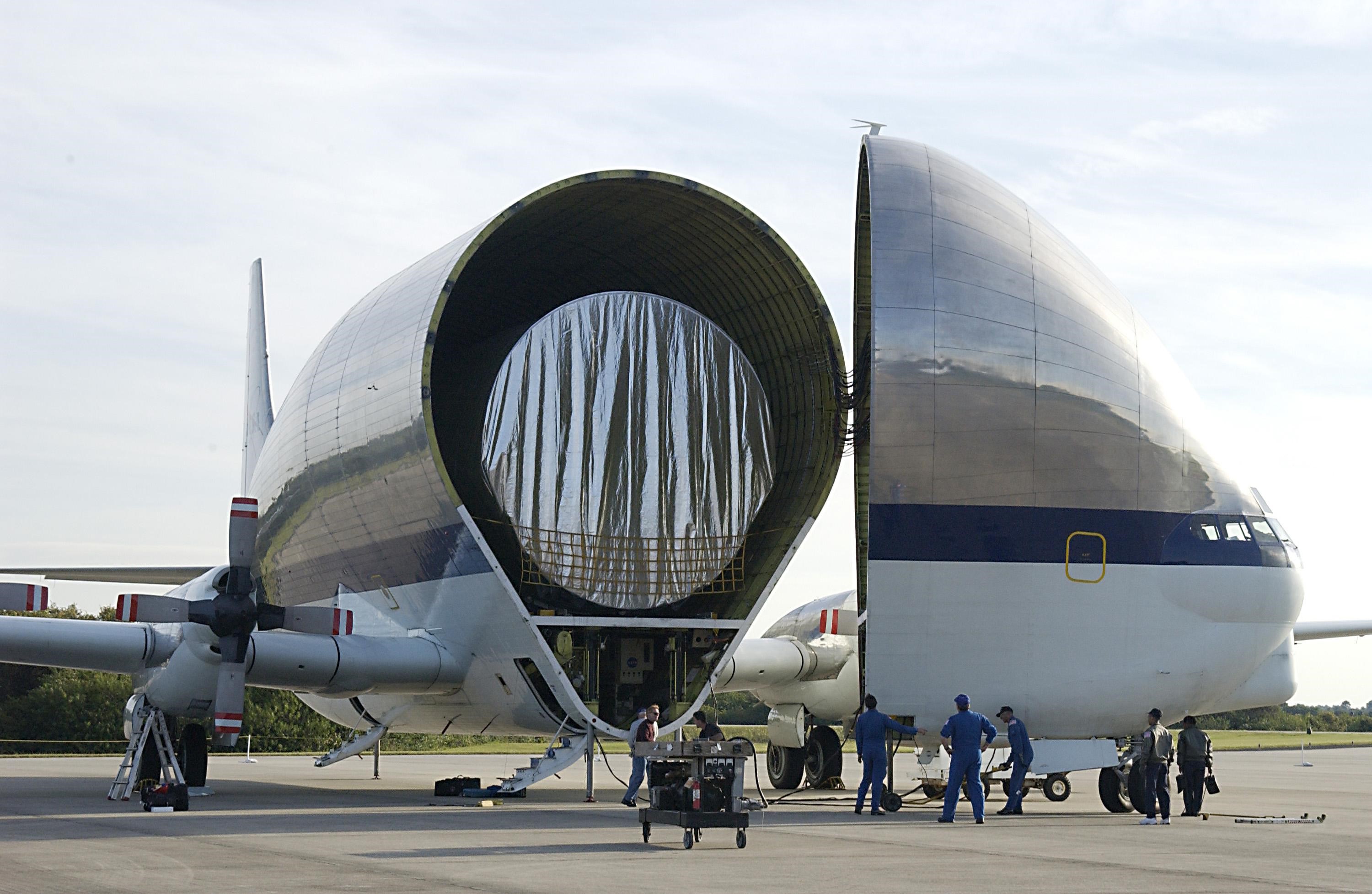
KENNEDY SPACE CENTER, FLA. -- The Integrated Equipment Assembly (IEA), one of two major components of the Starboard 6 (S6) truss segment for the International Space Station (ISS), is revealed inside NASA's Super Guppy cargo airplane following its arrival at the Shuttle Landing Facility. The customized four-engine aricraft has a 24-foot-diameter fuselage and a foldaway nose enabling it to load and transport oversize cargo. The IEA will be joined to its companion piece, the Long Spacer, before launch early in 2004. The S6 truss segment will be the 11th and final piece of the Station's Integrated Truss Structure and will support the fourth and final set of solar arrays, batteries, and electronics.
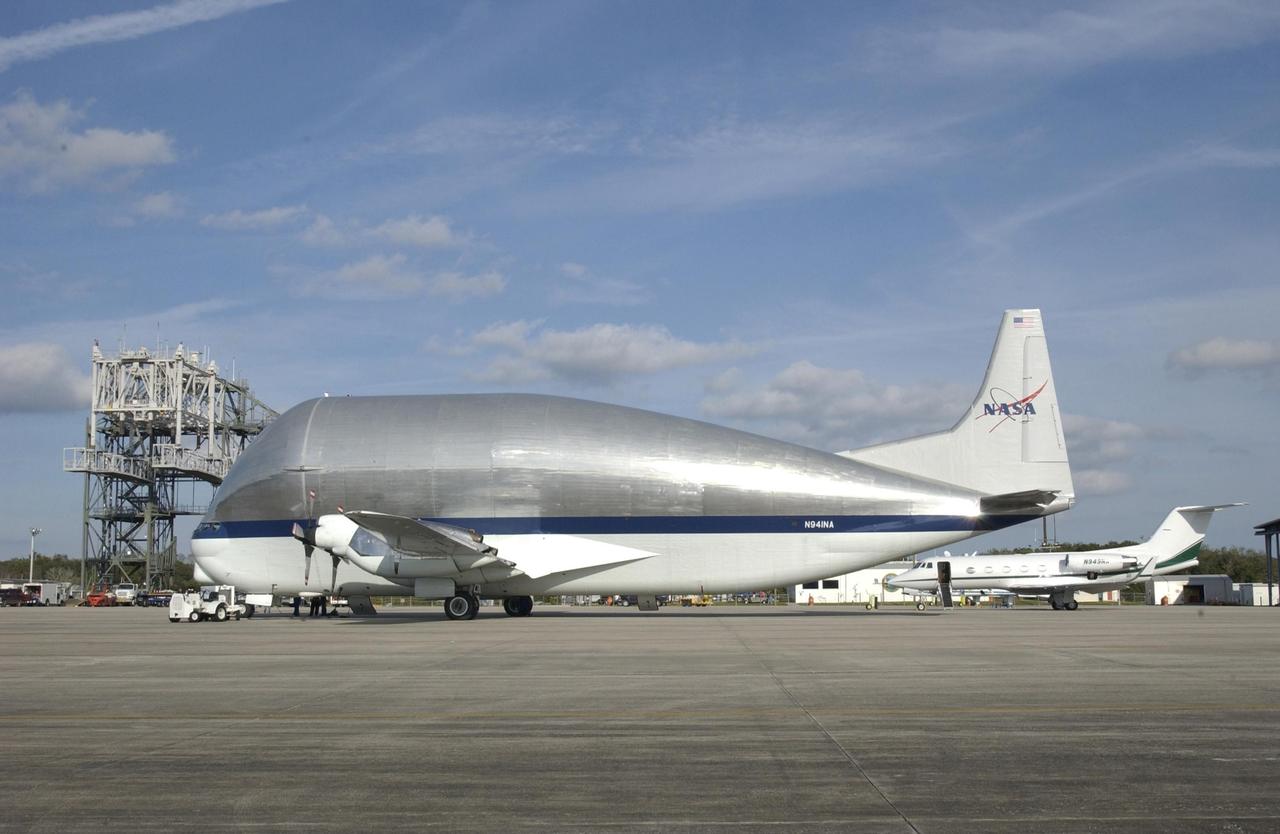
KENNEDY SPACE CENTER, FLA. -- Following its arrival at Kennedy Space Center, The node structural test article (STA) begins its move to a storage facility. The super Guppy transport aircraft carried Node STA to KSC's Shuttle Landing Facility from Marshall Space Flight Center in Huntsville, Ala. An exact replica of the Unity Node on the International Space Station, the node STA was used at MSFC for testing and validation purposes. The Unity Node is the pressurized element that connects the other ISS pressurized modules together and was the first U.S. element to launch.
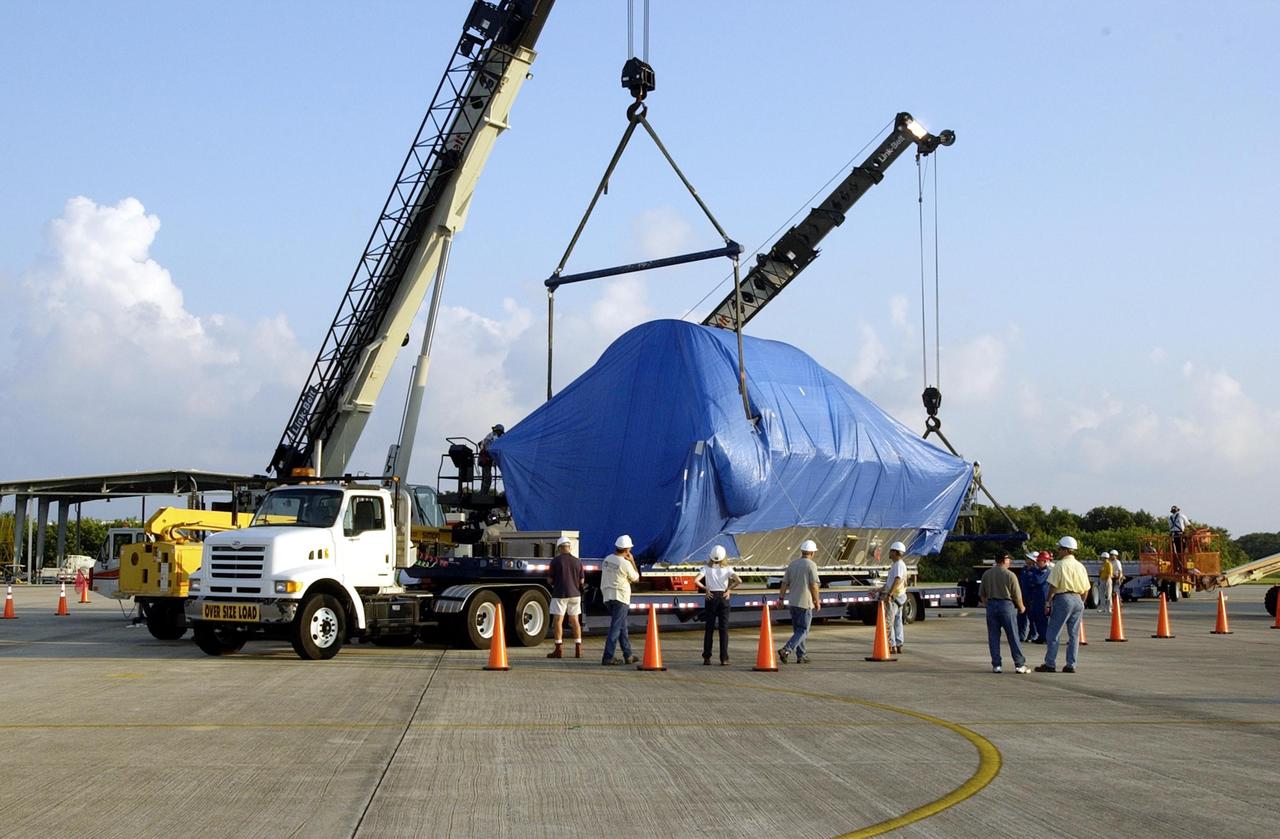
KENNEDY SPACE CENTER, FLA. -- The Integrated Equipment Assembly (IEA), one of two major components of the Starboard 6 (S6) truss segment for the International Space Station (ISS), arrives at the Shuttle Landing Facility aboard NASA's Super Guppy cargo airplane. The customized four-engine aricraft has a 24-foot-diameter fuselage and a foldaway nose enabling it to load and transport oversize cargo. The IEA will be joined to its companion piece, the Long Spacer, before launch early in 2004. The S6 truss segment will be the 11th and final piece of the Station's Integrated Truss Structure and will support the fourth and final set of solar arrays, batteries, and electronics.
KENNEDY SPACE CENTER, FLA. -- The Integrated Equipment Assembly (IEA), one of two major components of the Starboard 6 (S6) truss segment for the International Space Station (ISS), arrives at the Shuttle Landing Facility aboard NASA's Super Guppy cargo airplane. The customized four-engine aricraft has a 24-foot-diameter fuselage and a foldaway nose enabling it to load and transport oversize cargo. The IEA will be joined to its companion piece, the Long Spacer, before launch early in 2004. The S6 truss segment will be the 11th and final piece of the Station's Integrated Truss Structure and will support the fourth and final set of solar arrays, batteries, and electronics.
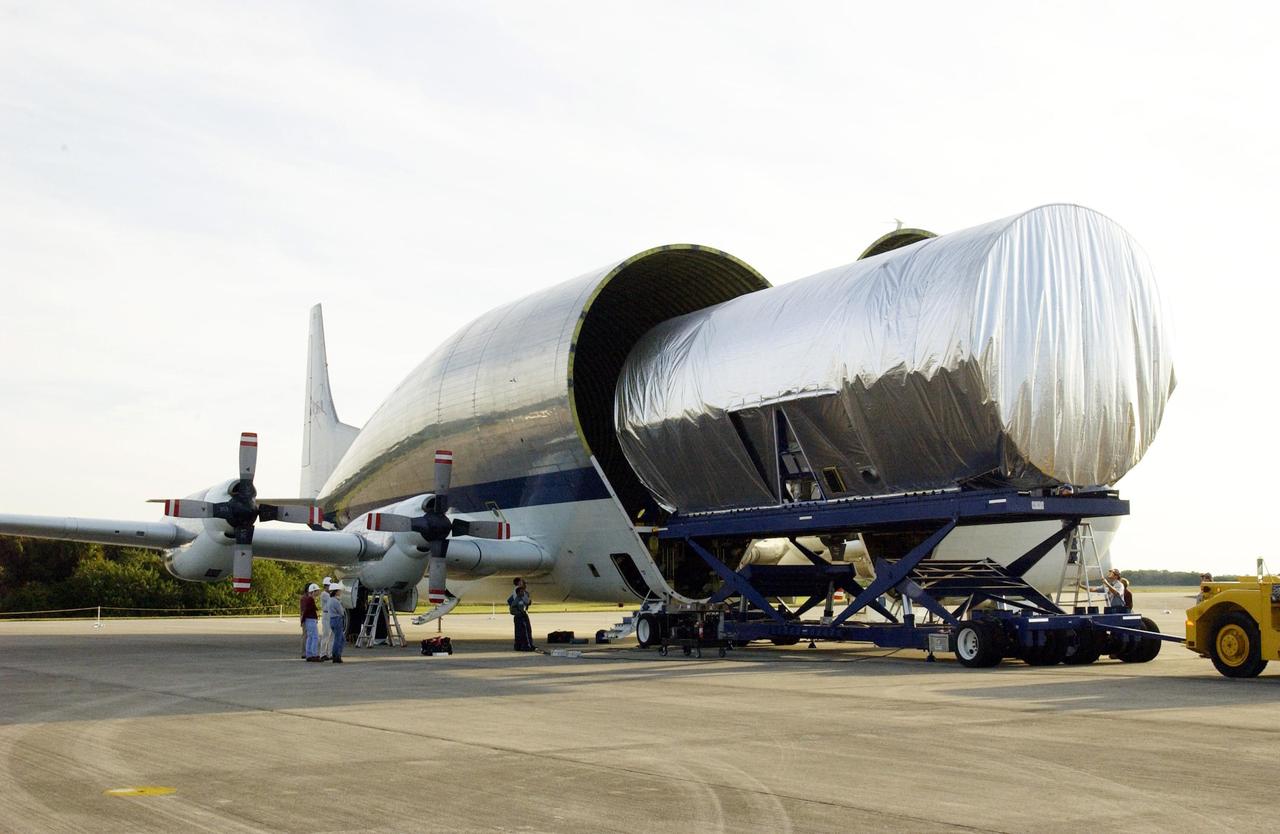
KENNEDY SPACE CENTER, FLA. -- The Integrated Equipment Assembly (IEA), one of two major components of the Starboard 6 (S6) truss segment for the International Space Station (ISS), is offloaded from NASA's Super Guppy cargo airplane following its arrival at the Shuttle Landing Facility. The customized four-engine aricraft has a 24-foot-diameter fuselage and a foldaway nose enabling it to load and transport oversize cargo. The IEA will be joined to its companion piece, the Long Spacer, before launch early in 2004. The S6 truss segment will be the 11th and final piece of the Station's Integrated Truss Structure and will support the fourth and final set of solar arrays, batteries, and electronics.
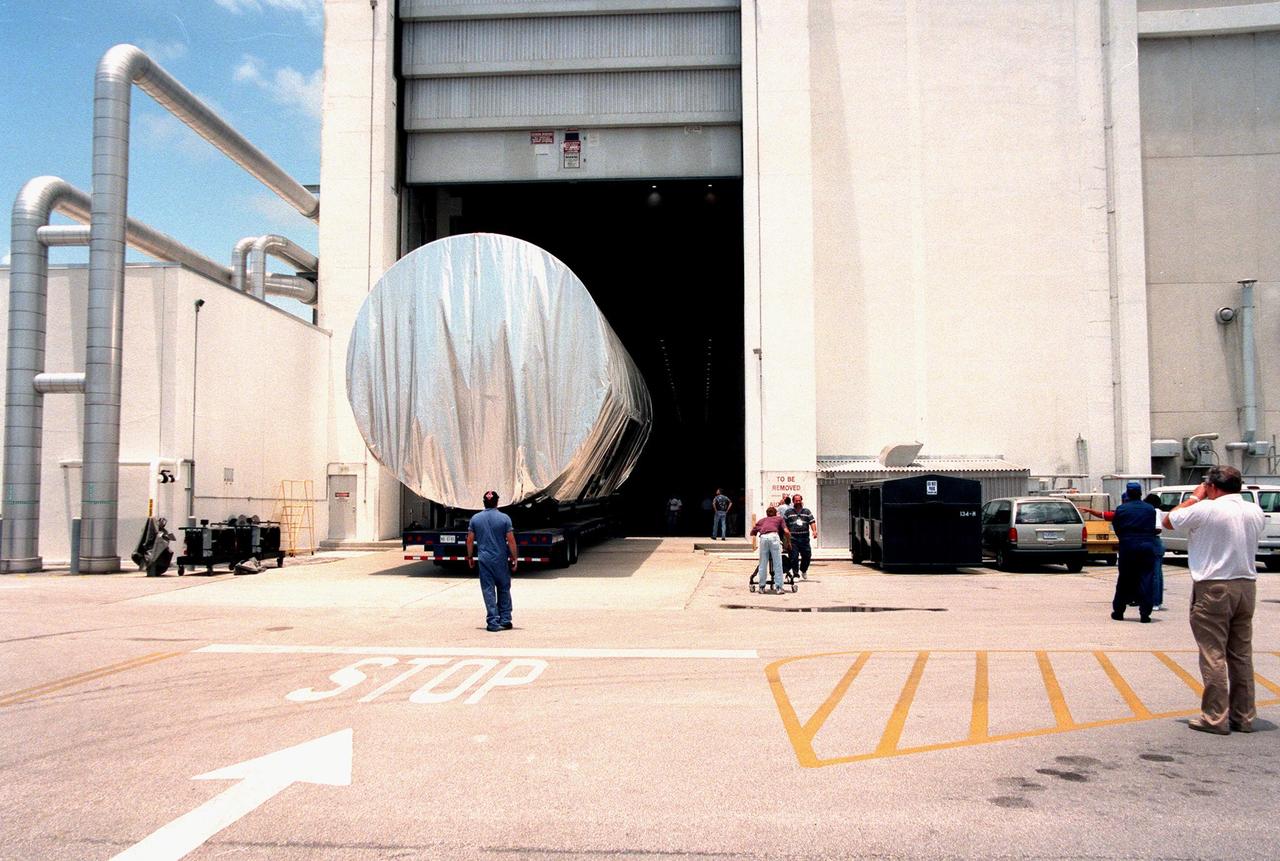
KENNEDY SPACE CENTER, FLA. -- The S0 truss segment is moved into the Operations and Checkout Bldg. (O&C) for processing. The truss arrived at the SLF aboard a "Super Guppy" aircraft from Boeing in Huntington, Calif. During processing in the O&C, the S0 truss will have installed the Canadian Mobile Transporter, power distribution system modules, a heat pipe radiator for cooling, computers, and a pair of rate gyroscopes. Four Global Positioning System antennas are already installed. A 44by 15-foot structure weighing 30,800 pounds when fully outfitted and ready for launch, the truss will be at the center of the ISS 10-truss, girderlike structure that will ultimately extend the length of a football field. Eventually the S0 truss will be attached to the U.S. Lab, "Destiny," which is scheduled to be added to the ISS in April 2000. Later, other trusses will be attached to the S0 on-orbit. The S0 truss is scheduled to be launched in the first quarter of 2001 on mission STS-108
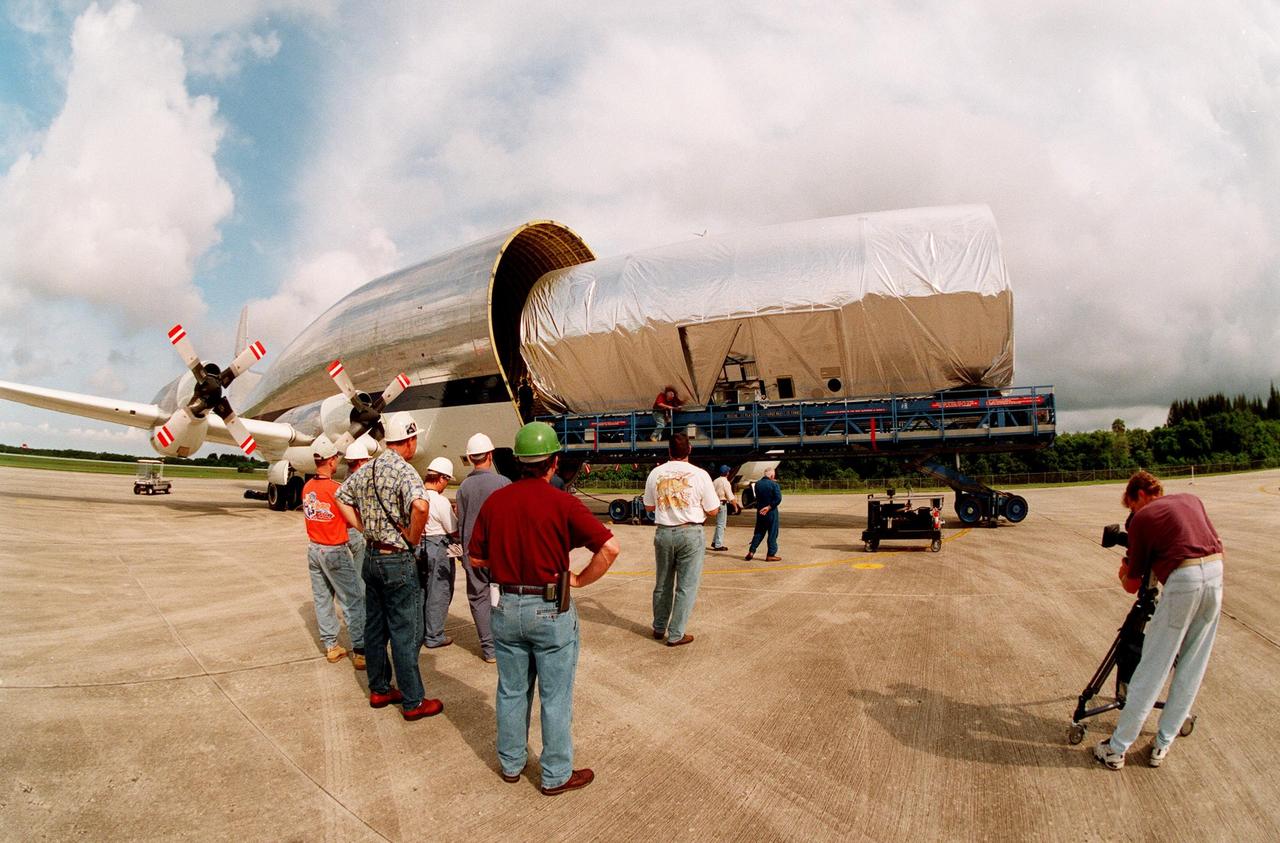
KENNEDY SPACE CENTER, FLA. -- At KSC's Shuttle Landing Facility, workers watch as a S0 (S Zero) truss segment built for the International Space Station (ISS) is moved out of the "Super Guppy" aircraft that brought it to KSC from Boeing in Huntington Beach, Calif. At right a cameraman records the exercise. The truss segment, which will become the backbone of the orbiting ISS, is a 44by 15-foot structure weighing 30,800 pounds when fully outfitted and ready for launch. It will be at the center of the ISS 10-truss, girderlike structure that will ultimately extend the length of a football field. Eventually the S0 truss will be attached to the U.S. Lab, "Destiny," which is scheduled to be added to the ISS in April 2000. Later, other trusses will be attached to the S0 on-orbit. During processing at KSC, the Canadian Mobile Transporter will be installed on the S0 truss, followed by power distribution system modules, a heat pipe radiator for cooling, computers, and a pair of rate gyroscopes. Four Global Positioning System antennas are already installed. The S0 truss is scheduled to be launched in the first quarter of 2001 on mission STS-108
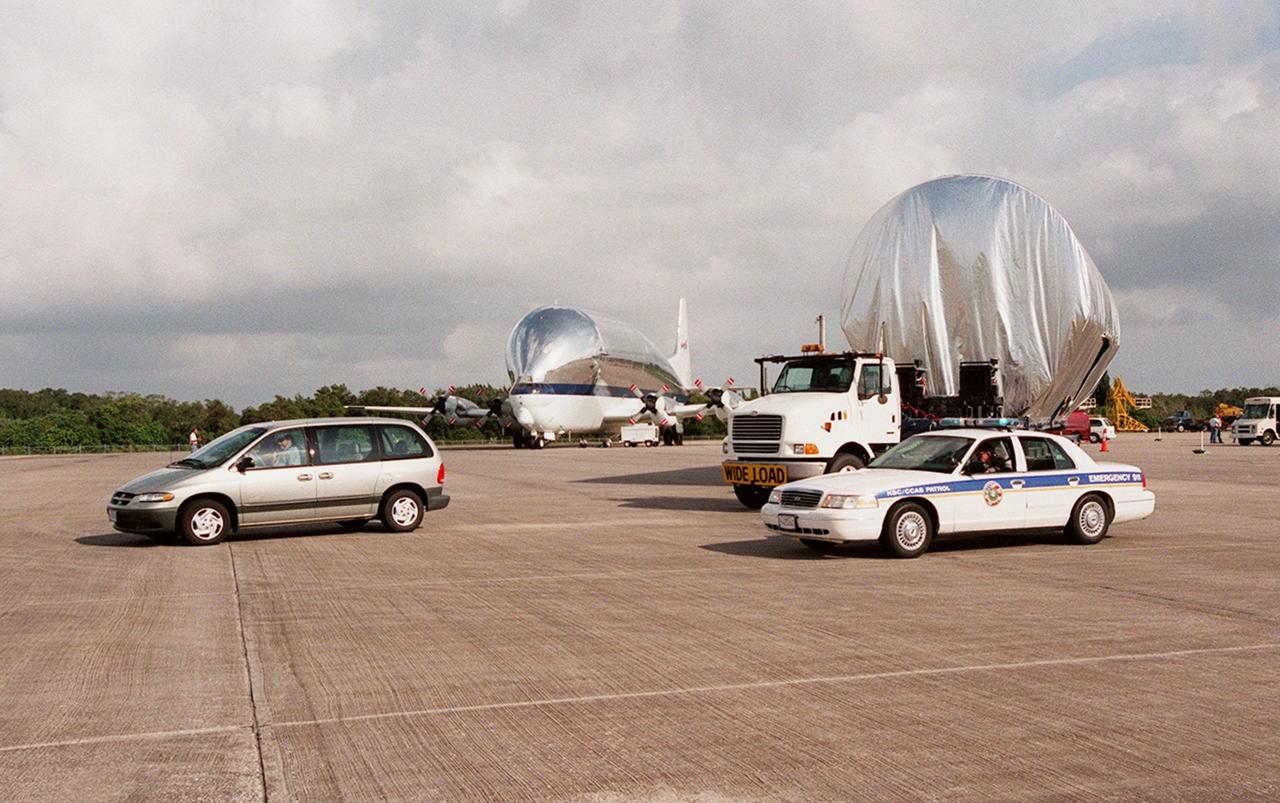
KENNEDY SPACE CENTER, FLA. -- Escort vehicles prepare to leave the Shuttle Landing Facility with the S1 truss (at right) on its trek to the Operations and Checkout Building. Manufactured by the Boeing Co. in Huntington Beach, Calif., this component of the ISS is the first starboard (right-side) truss segment, whose main job is providing structural support for the orbiting research facility's radiator panels that cool the Space Station's complex power system. The S1 truss segment also will house communications systems, external experiment positions and other subsystems. Primarily constructed of aluminum, the truss segment is 45 feet long, 15 feet wide and 6 feet tall. When fully outfitted, it will weigh 31,137 pounds. The truss is slated for flight in 2001. The truss arrived at KSC aboard NASA's Super Guppy, seen in the background. The aircraft is uniquely built with a 25-foot diameter fuselage designed to handle oversized loads and a "fold-away" nose that opens 110 degrees for cargo loading. A system of rails in the cargo compartment, used with either Guppy pallets or fixtures designed for specific cargo, makes cargo loading simple and efficient. Rollers mounted in the rails allow pallets or fixtures to be moved by an electric winch mounted beneath the cargo floor. Automatic hydraulic lock pins in each rail secure the pallet for flight
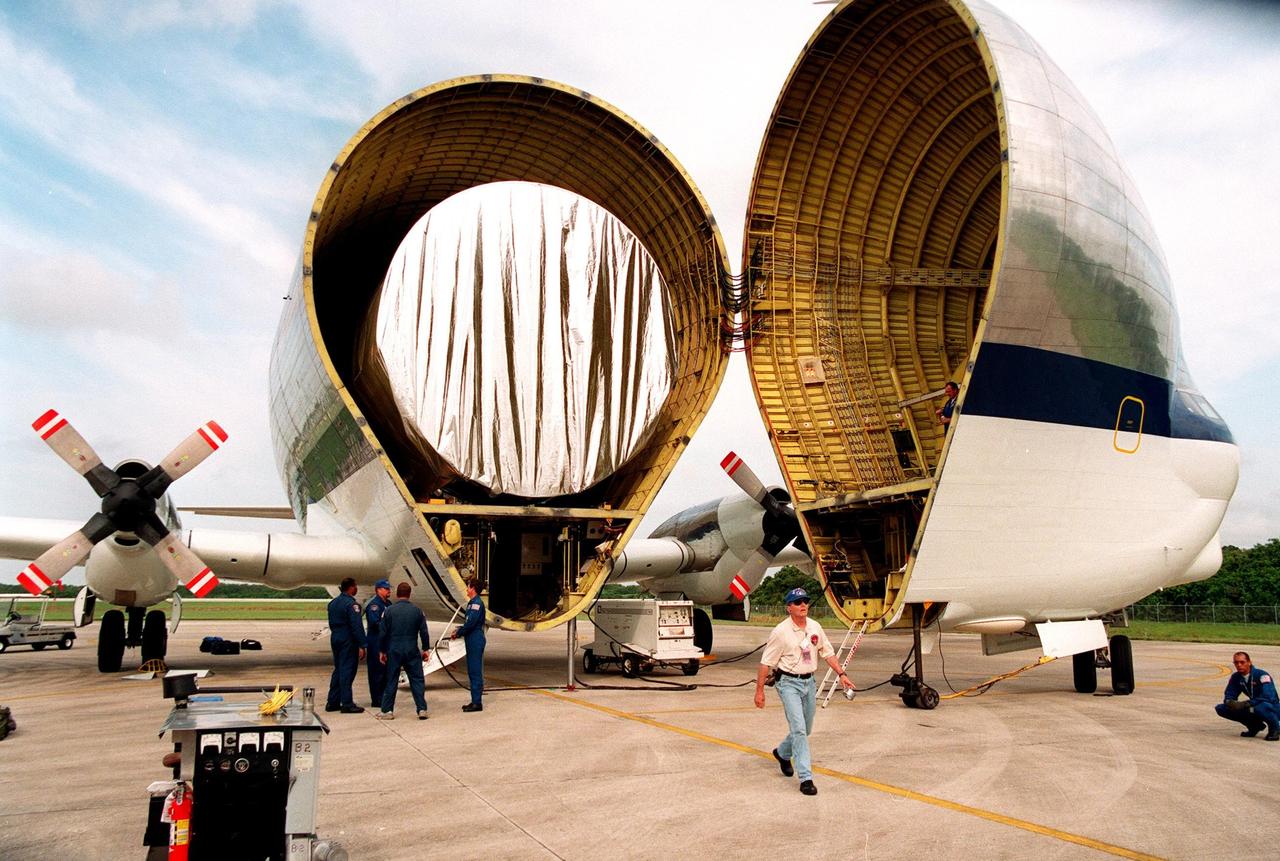
KENNEDY SPACE CENTER, FLA. -- After landing at KSC's Shuttle Landing Facility, the "Super Guppy" transport aircraft opens to reveal its cargo, a S0 (S Zero) truss segment, from Boeing in Huntington Beach, Calif. The truss segment, which will become the backbone of the orbiting International Space Station (ISS), is a 44by 15-foot structure weighing 30,800 pounds when fully outfitted and ready for launch. It will be at the center of the ISS 10-truss, girderlike structure that will ultimately extend the length of a football field. Eventually the S0 truss will be attached to the U.S. Lab, "Destiny," which is scheduled to be added to the ISS in April 2000. Later, other trusses will be attached to the S0 on-orbit. During processing at KSC, the S0 truss will have installed the Canadian Mobile Transporter, power distribution system modules, a heat pipe radiator for cooling, computers, and a pair of rate gyroscopes. Four Global Positioning System antennas are already installed. The S0 truss is scheduled to be launched in the first quarter of 2001 on mission STS-108
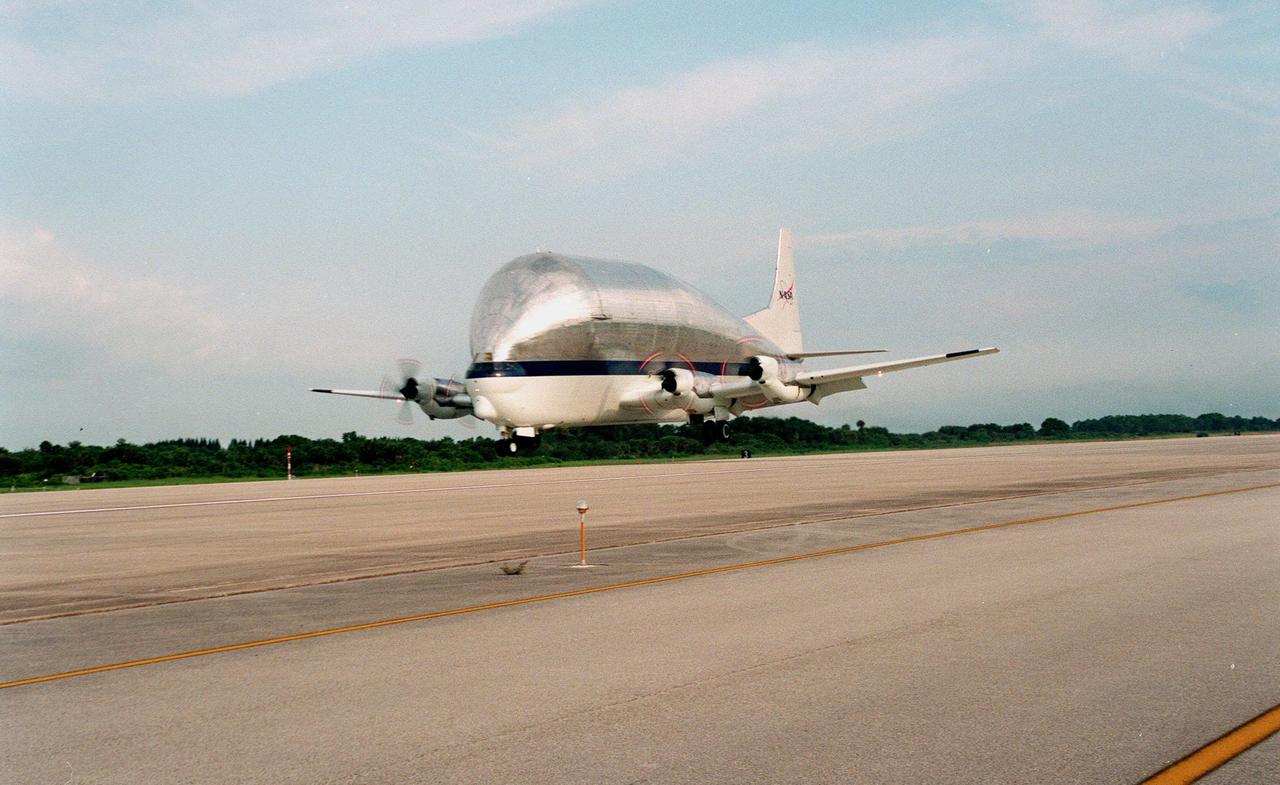
KENNEDY SPACE CENTER, FLA. -- The "Super Guppy" transport aircraft approaches the runway at the KSC's Shuttle Landing Facility. On board is the S0 (S Zero) truss segment, from Boeing in Huntington Beach, Calif. The truss segment, which will become the backbone of the orbiting International Space Station (ISS), is a 44- by 15-foot structure weighing 30,800 pounds when fully outfitted and ready for launch. It will be at the center of the 10-truss, girderlike structure that will ultimately extend the length of a football field on the ISS. Eventually the S0 truss will be attached to the U.S. Lab, "Destiny," scheduled to be added to the ISS in April 2000. Later, other trusses will be attached to the S0 truss on-orbit. During processing at KSC, the S0 truss will have installed the Canadian Mobile Transporter, power distribution system modules, a heat pipe radiator for cooling, computers, and a pair of rate gyroscopes. Four Global Positioning System antennas are already installed. The S0 truss is scheduled to be launched in the first quarter of 2001 on mission STS-108
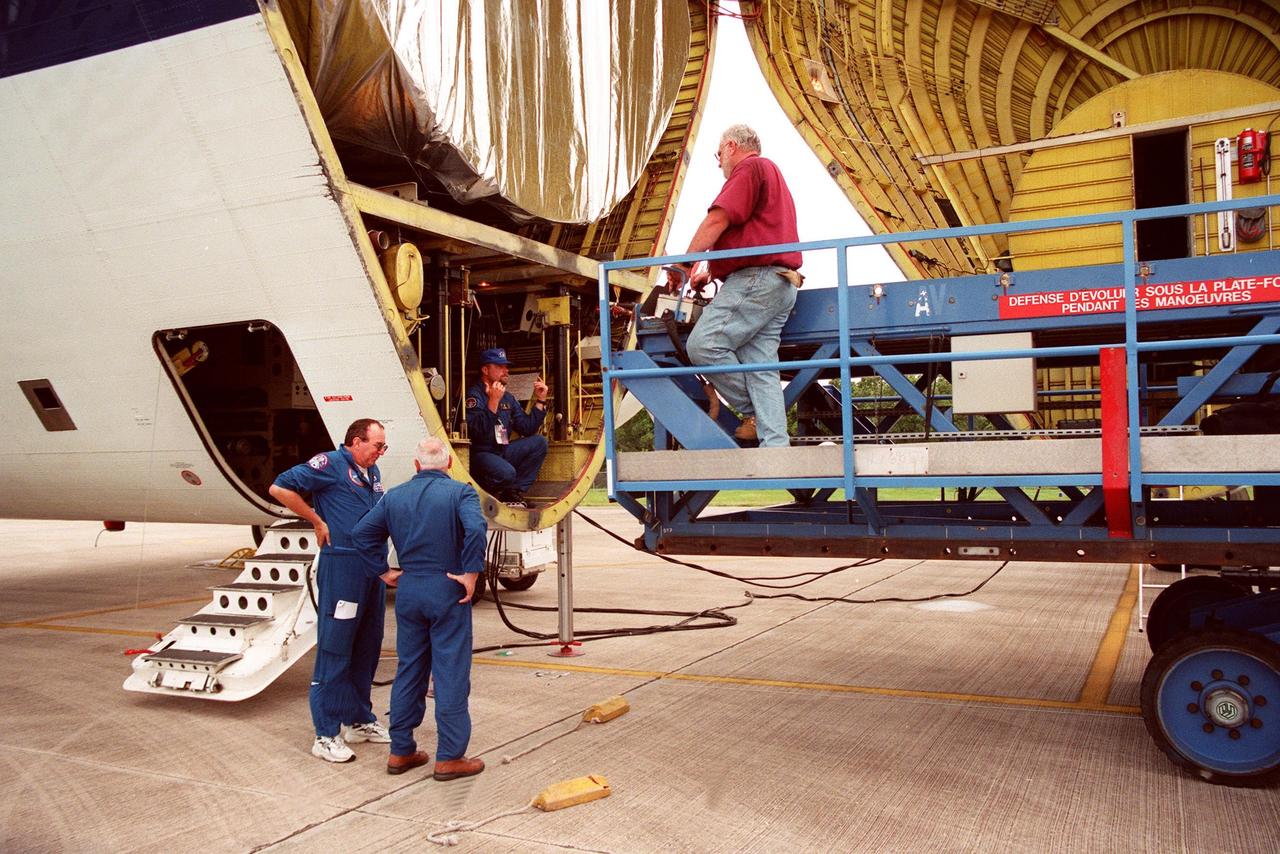
KENNEDY SPACE CENTER, Fla. - A transporter (right) is moved into place to remove a S0 (S Zero) truss segment (left) from inside the "Super Guppy" aircraft that brought it to KSC from Boeing in Huntington Beach, Calif. The truss segment, which will become the backbone of the orbiting International Space Station (ISS), is a 44- by 15-foot structure weighing 30,800 pounds when fully outfitted and ready for launch. It will be at the center of the ISS 10-truss, girderlike structure that will ultimately extend the length of a football field. Eventually the S0 truss will be attached to the U.S. Lab, "Destiny," which is scheduled to be added to the ISS in April 2000. Later, other trusses will be attached to the S0 on-orbit. During processing at KSC, the S0 truss will have installed the Canadian Mobile Transporter, power distribution system modules, a heat pipe radiator for cooling, computers, and a pair of rate gyroscopes. Four Global Positioning System antennas are already installed. The S0 truss is scheduled to be launched in the first quarter of 2001 on mission STS-108
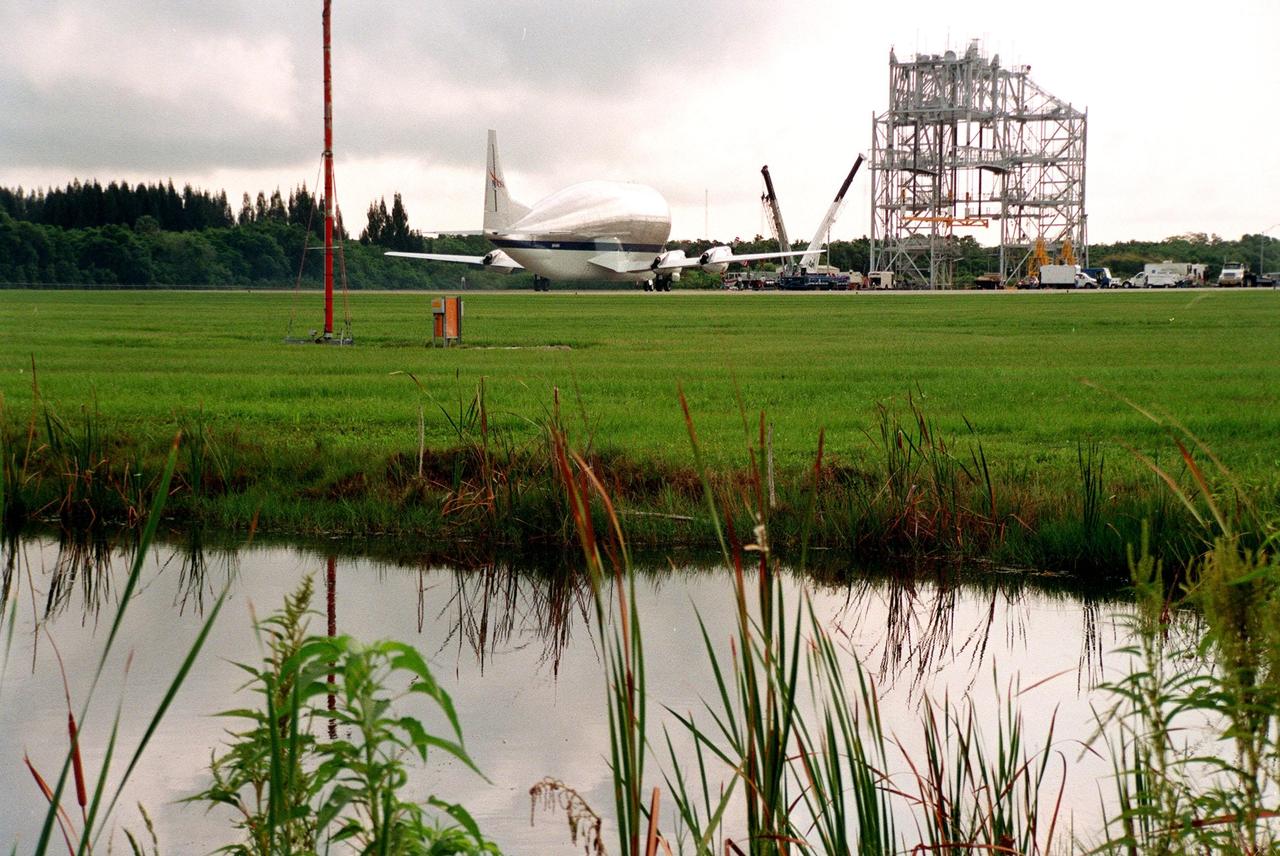
KENNEDY SPACE CENTER, FLA. -- At KSC's Shuttle Landing Facility, the "Super Guppy" transport aircraft touches down on the runway. On board the aircraft is the S0 (S Zero) truss segment, from Boeing in Huntington Beach, Calif. The truss segment, which will become the backbone of the orbiting International Space Station (ISS), is a 44by 15-foot structure weighing 30,800 pounds when fully outfitted and ready for launch. It will be at the center of the ISS 10-truss, girderlike structure that will ultimately extend the length of a football field. Eventually the S0 truss will be attached to the U.S. Lab, "Destiny," which is scheduled to be added to the ISS in April 2000. Later, other trusses will be attached to the S0 on-orbit. During processing at KSC, the S0 truss will have installed the Canadian Mobile Transporter, power distribution system modules, a heat pipe radiator for cooling, computers, and a pair of rate gyroscopes. Four Global Positioning System antennas are already installed. The S0 truss is scheduled to be launched in the first quarter of 2001 on mission STS-108
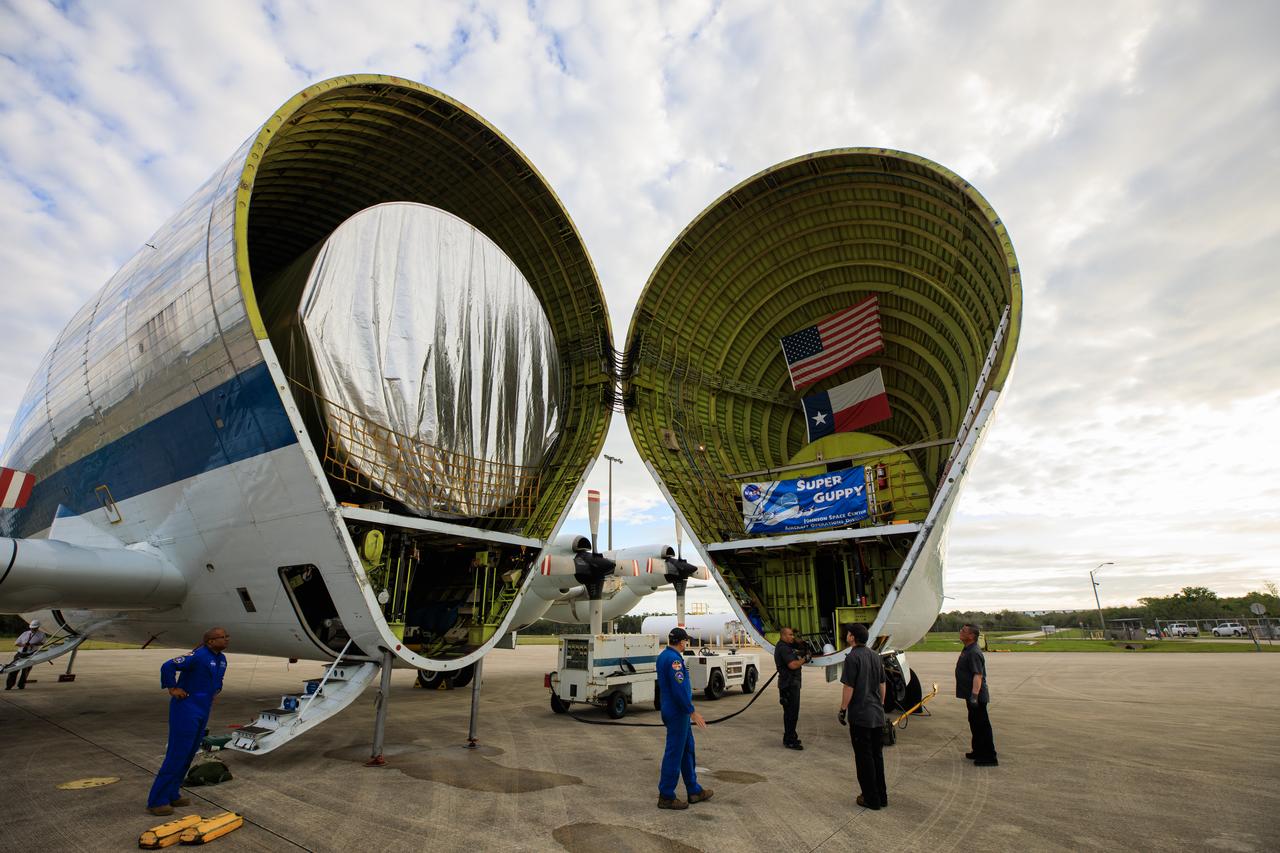
The Multi-Purpose Logistics Module (MPLM), used during the Space Shuttle Program to transfer cargo to and from the International Space Station, is loaded into NASA's Super Guppy aircraft at the Launch and Landing Facility runway at Kennedy Space Center in Florida on April 25, 2023. The MPLM will be transported to Ellington Field in Houston, where it will then be transported by road to Axiom’s facility near Ellington to be utilized to further commercialization of space. Three MPLMs were built by Thales Alenia Space Italia (TASI) for the Italian Space Agency (ASI) and named after Italian masters (Leonardo, Raffaello, and Donatello). Only two ever flew to the space station, Leonardo and Raffaello, with Axiom intending to use the Raffaello module as a future element that will attach to a segment being built by the company for addition to the station.
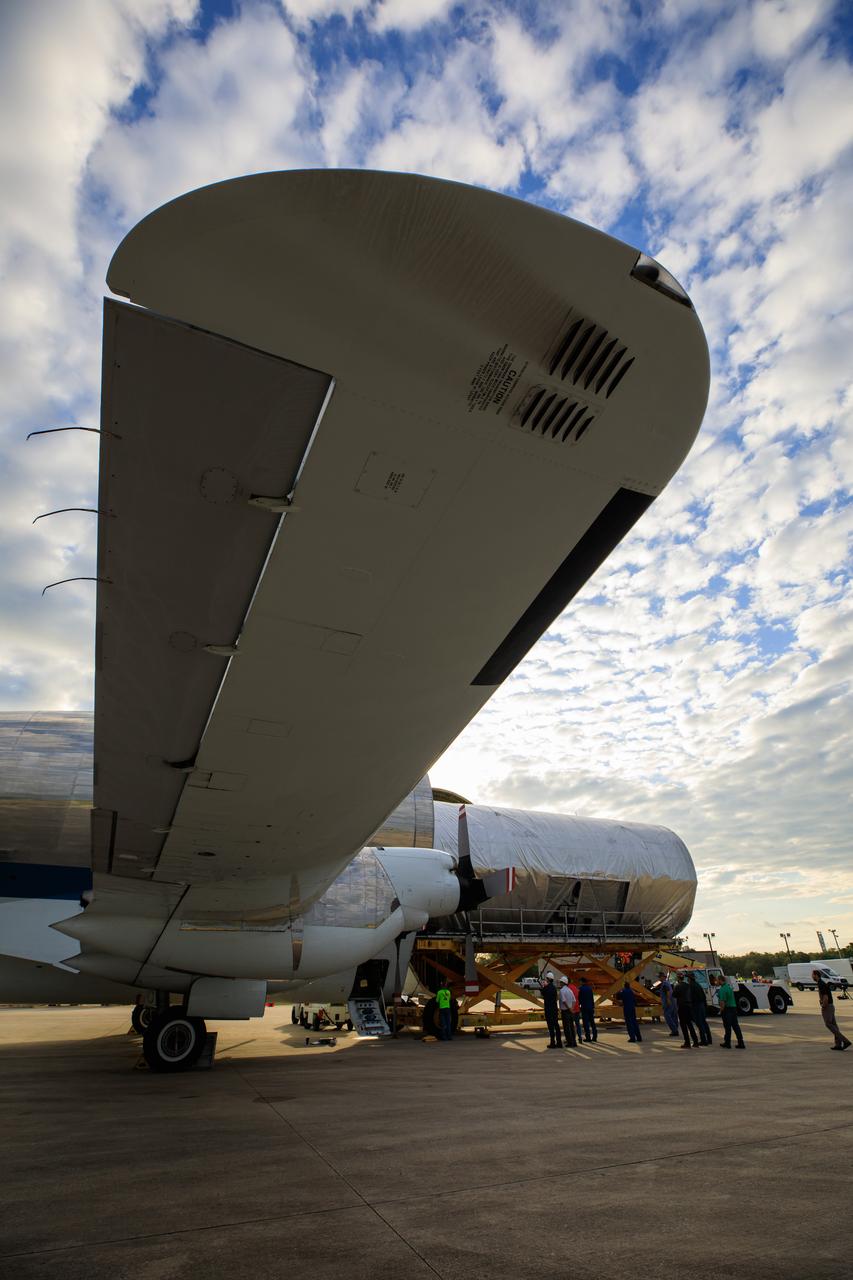
The Multi-Purpose Logistics Module (MPLM), used during the Space Shuttle Program to transfer cargo to and from the International Space Station, is loaded into NASA's Super Guppy aircraft at the Launch and Landing Facility runway at Kennedy Space Center in Florida on April 25, 2023. The MPLM will be transported to Ellington Field in Houston, where it will then be transported by road to Axiom’s facility near Ellington to be utilized to further commercialization of space. Three MPLMs were built by Thales Alenia Space Italia (TASI) for the Italian Space Agency (ASI) and named after Italian masters (Leonardo, Raffaello, and Donatello). Only two ever flew to the space station, Leonardo and Raffaello, with Axiom intending to use the Raffaello module as a future element that will attach to a segment being built by the company for addition to the station.
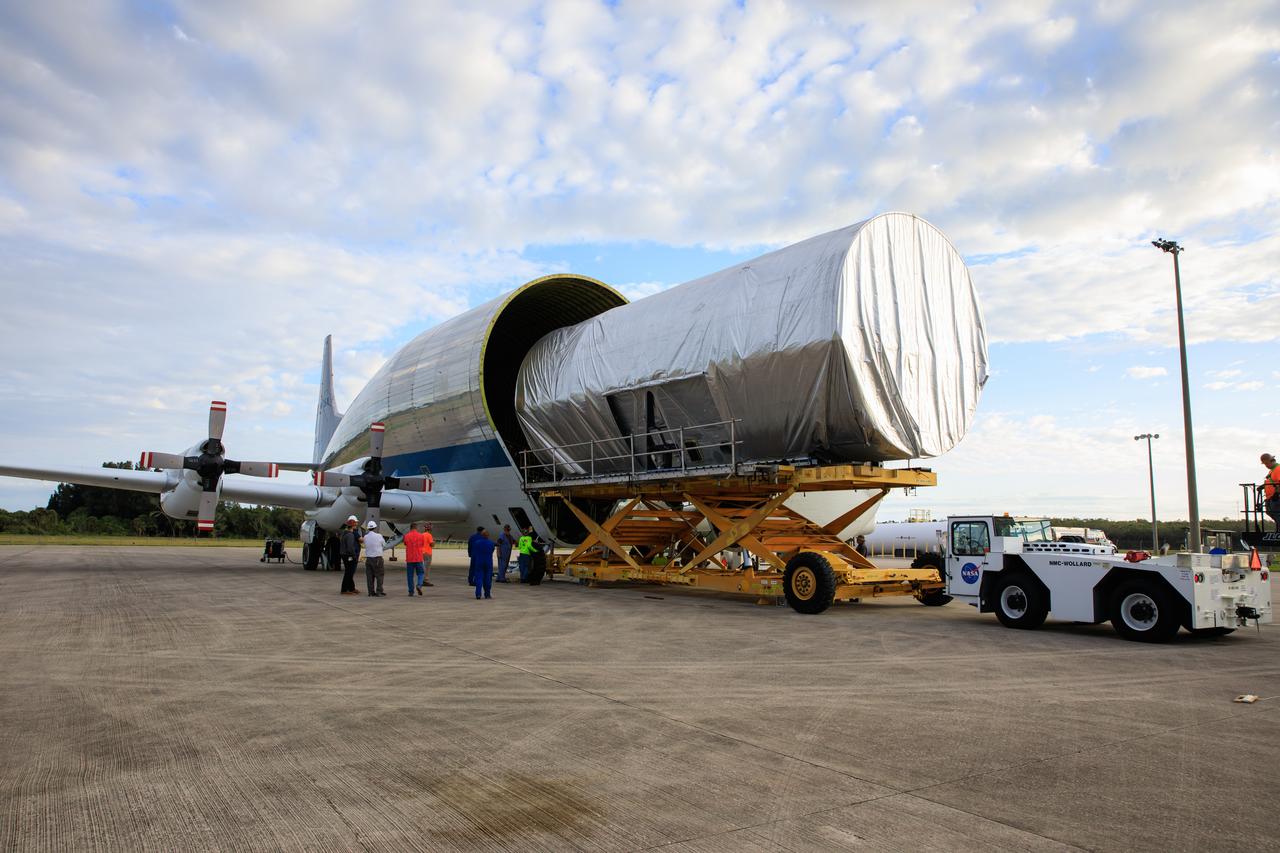
The Multi-Purpose Logistics Module (MPLM), used during the Space Shuttle Program to transfer cargo to and from the International Space Station, is loaded into NASA's Super Guppy aircraft at the Launch and Landing Facility runway at Kennedy Space Center in Florida on April 25, 2023. The MPLM will be transported to Ellington Field in Houston, where it will then be transported by road to Axiom’s facility near Ellington to be utilized to further commercialization of space. Three MPLMs were built by Thales Alenia Space Italia (TASI) for the Italian Space Agency (ASI) and named after Italian masters (Leonardo, Raffaello, and Donatello). Only two ever flew to the space station, Leonardo and Raffaello, with Axiom intending to use the Raffaello module as a future element that will attach to a segment being built by the company for addition to the station.
NASA's Super Guppy aircraft lifts off from the Launch and Landing Facility runway at Kennedy Space Center in Florida on April 25, 2023. Carrying the Multi-Purpose Logistics Module (MPLM), used during the Space Shuttle Program to transfer cargo to and from the International Space Station, the aircraft is transporting the module to Ellington Field in Houston, where it will then be transported by road to Axiom’s facility near Ellington to be utilized to further commercialization of space. Three MPLMs were built by Thales Alenia Space Italia (TASI) for the Italian Space Agency (ASI) and named after Italian masters (Leonardo, Raffaello, and Donatello). Only two ever flew to the space station, Leonardo and Raffaello, with Axiom intending to use the Raffaello module as a future element that will attach to a segment being built by the company for addition to the station.
The Multi-Purpose Logistics Module (MPLM), used during the Space Shuttle Program to transfer cargo to and from the International Space Station, is loaded into NASA's Super Guppy aircraft at the Launch and Landing Facility runway at Kennedy Space Center in Florida on April 25, 2023. The MPLM will be transported to Ellington Field in Houston, where it will then be transported by road to Axiom’s facility near Ellington to be utilized to further commercialization of space. Three MPLMs were built by Thales Alenia Space Italia (TASI) for the Italian Space Agency (ASI) and named after Italian masters (Leonardo, Raffaello, and Donatello). Only two ever flew to the space station, Leonardo and Raffaello, with Axiom intending to use the Raffaello module as a future element that will attach to a segment being built by the company for addition to the station.

NASA's Super Guppy aircraft lifts off from the Launch and Landing Facility runway at Kennedy Space Center in Florida on April 25, 2023. Carrying the Multi-Purpose Logistics Module (MPLM), used during the Space Shuttle Program to transfer cargo to and from the International Space Station, the aircraft is transporting the module to Ellington Field in Houston, where it will then be transported by road to Axiom’s facility near Ellington to be utilized to further commercialization of space. Three MPLMs were built by Thales Alenia Space Italia (TASI) for the Italian Space Agency (ASI) and named after Italian masters (Leonardo, Raffaello, and Donatello). Only two ever flew to the space station, Leonardo and Raffaello, with Axiom intending to use the Raffaello module as a future element that will attach to a segment being built by the company for addition to the station.
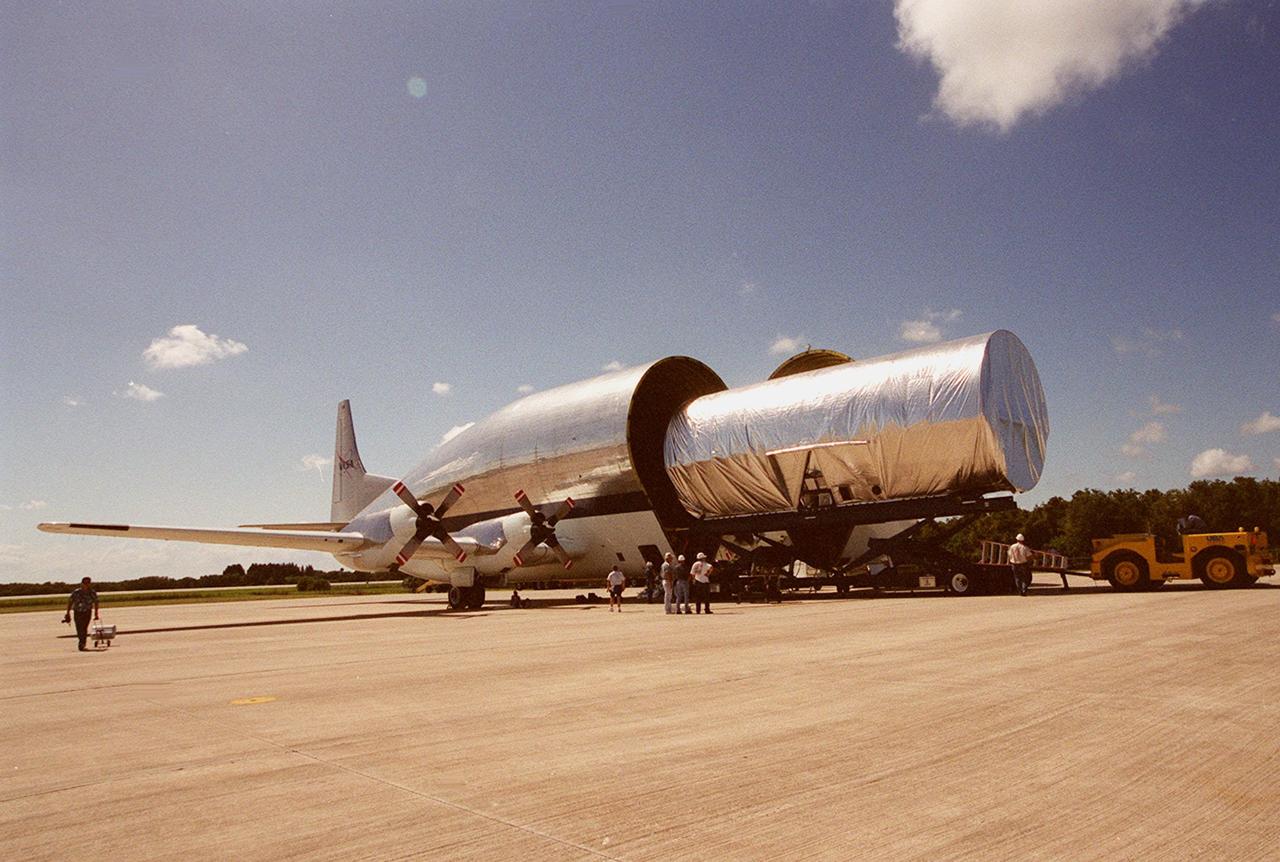
KENNEDY SPACE CENTER, FLA. -- At the KSC Shuttle Landing Facility, the Joint Airlock Module, the gateway from which crew members aboard the International Space Station (ISS) will enter and exit the 470-ton orbiting research facility, is moved away from NASA’s Super Guppy aircraft for transfer to the Operations and Checkout Building in the KSC industrial area. There it will undergo vacuum chamber testing. It will then be moved to the Space Station Processing Facility (SSPF) for further prelaunch preparation and checkout. The massive, spindle-shaped airlock is 20 feet long, has a diameter of 13 feet at its widest point, and weighs six and a half tons. It was manufactured at NASA's Marshall Space Flight Center by the Huntsville division of The Boeing Company. The Space Shuttle Atlantis will carry the airlock to orbit on mission STS-104, the tenth International Space Station flight, currently targeted for liftoff in May 2001
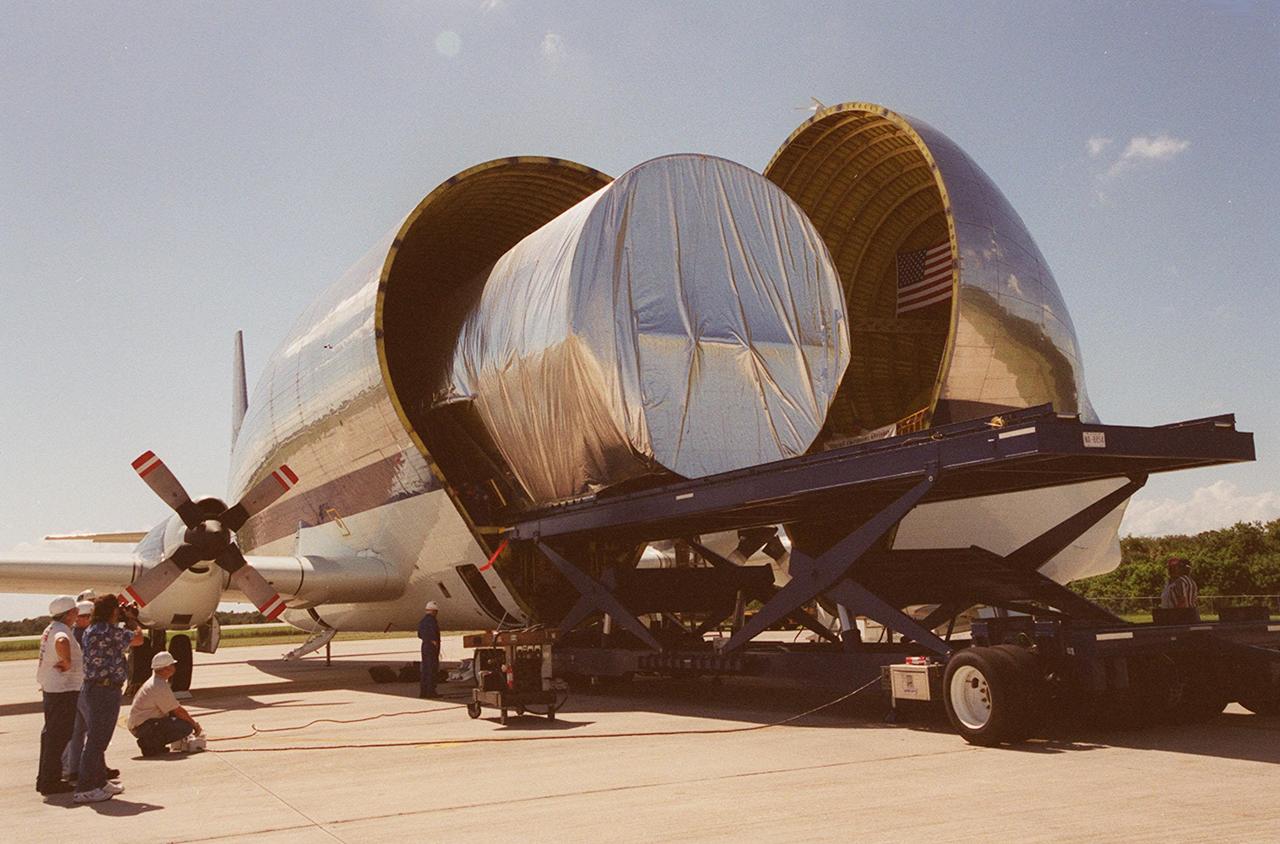
KENNEDY SPACE CENTER, FLA. -- The Joint Airlock Module, the gateway from which crew members aboard the International Space Station (ISS) will enter and exit the 470-ton orbiting research facility, rolls out of NASA's Super Guppy aircraft. It will be transferred to the Operations and Checkout Building in the KSC industrial area where it will undergo vacuum chamber testing. It will then be moved to the Space Station Processing Facility (SSPF) for further prelaunch preparation and checkout. The massive, spindle-shaped airlock is 20 feet long, has a diameter of 13 feet at its widest point, and weighs six and a half tons. It was manufactured at NASA's Marshall Space Flight Center by the Huntsville division of The Boeing Company. The Space Shuttle Atlantis will carry the airlock to orbit on mission STS-104, the tenth International Space Station flight, currently targeted for liftoff in May 2001
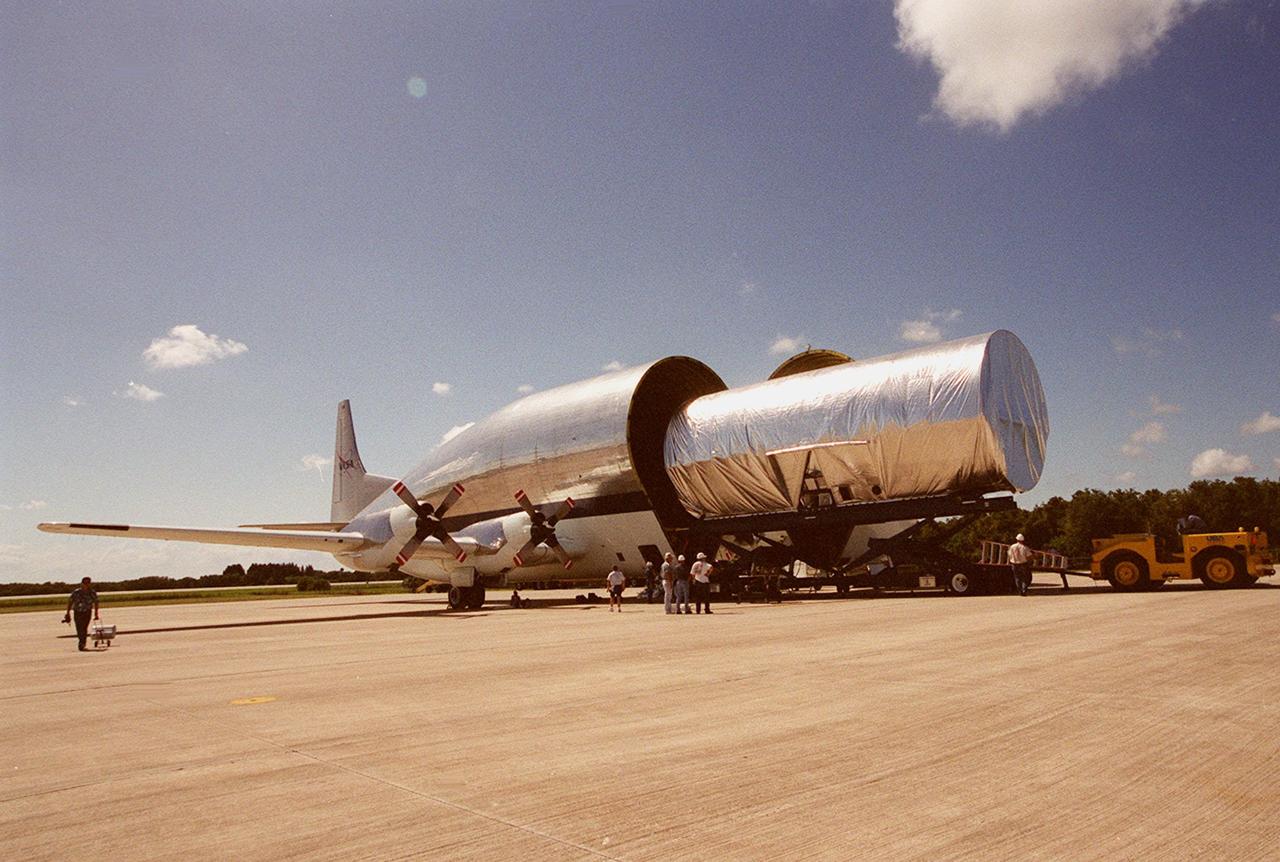
KENNEDY SPACE CENTER, FLA. -- At the KSC Shuttle Landing Facility, the Joint Airlock Module, the gateway from which crew members aboard the International Space Station (ISS) will enter and exit the 470-ton orbiting research facility, is moved away from NASA’s Super Guppy aircraft for transfer to the Operations and Checkout Building in the KSC industrial area. There it will undergo vacuum chamber testing. It will then be moved to the Space Station Processing Facility (SSPF) for further prelaunch preparation and checkout. The massive, spindle-shaped airlock is 20 feet long, has a diameter of 13 feet at its widest point, and weighs six and a half tons. It was manufactured at NASA's Marshall Space Flight Center by the Huntsville division of The Boeing Company. The Space Shuttle Atlantis will carry the airlock to orbit on mission STS-104, the tenth International Space Station flight, currently targeted for liftoff in May 2001
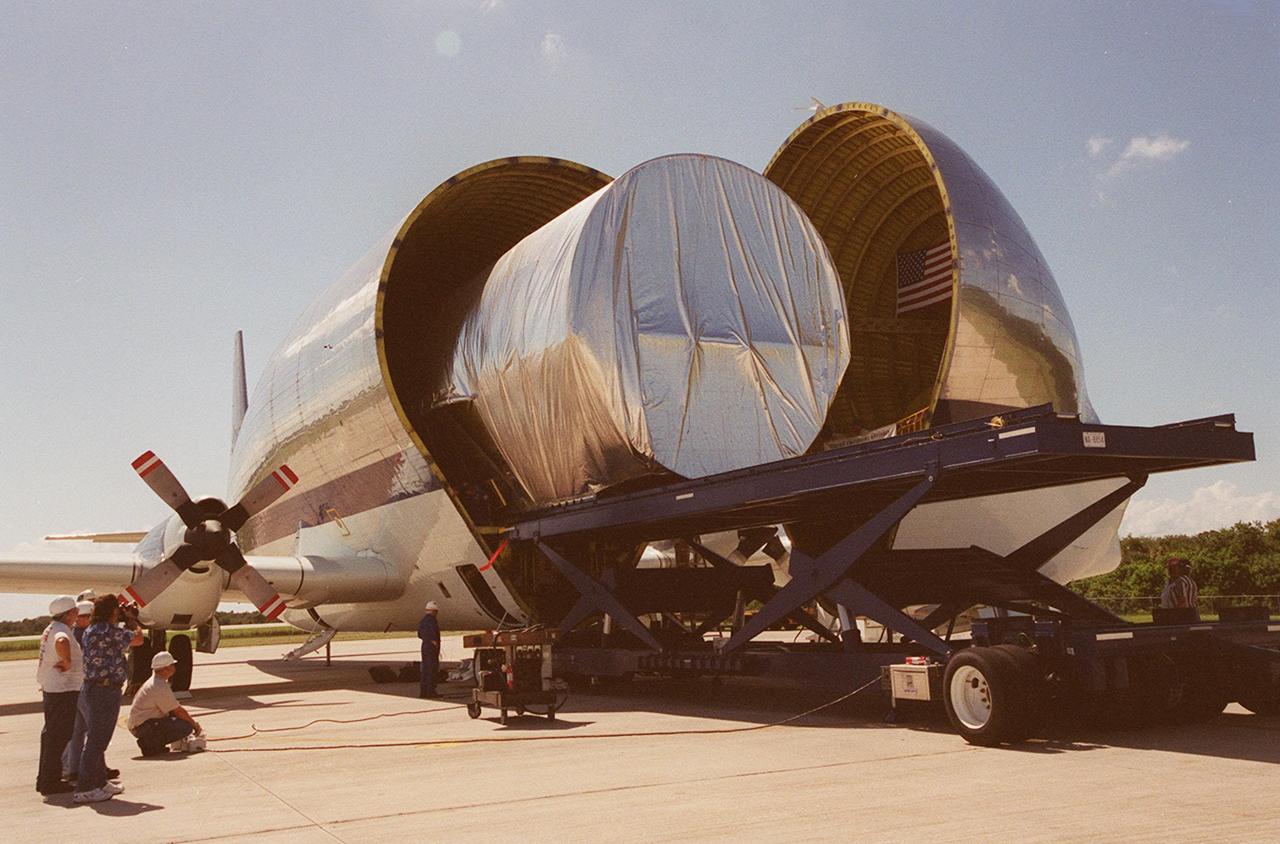
KENNEDY SPACE CENTER, FLA. -- The Joint Airlock Module, the gateway from which crew members aboard the International Space Station (ISS) will enter and exit the 470-ton orbiting research facility, rolls out of NASA's Super Guppy aircraft. It will be transferred to the Operations and Checkout Building in the KSC industrial area where it will undergo vacuum chamber testing. It will then be moved to the Space Station Processing Facility (SSPF) for further prelaunch preparation and checkout. The massive, spindle-shaped airlock is 20 feet long, has a diameter of 13 feet at its widest point, and weighs six and a half tons. It was manufactured at NASA's Marshall Space Flight Center by the Huntsville division of The Boeing Company. The Space Shuttle Atlantis will carry the airlock to orbit on mission STS-104, the tenth International Space Station flight, currently targeted for liftoff in May 2001
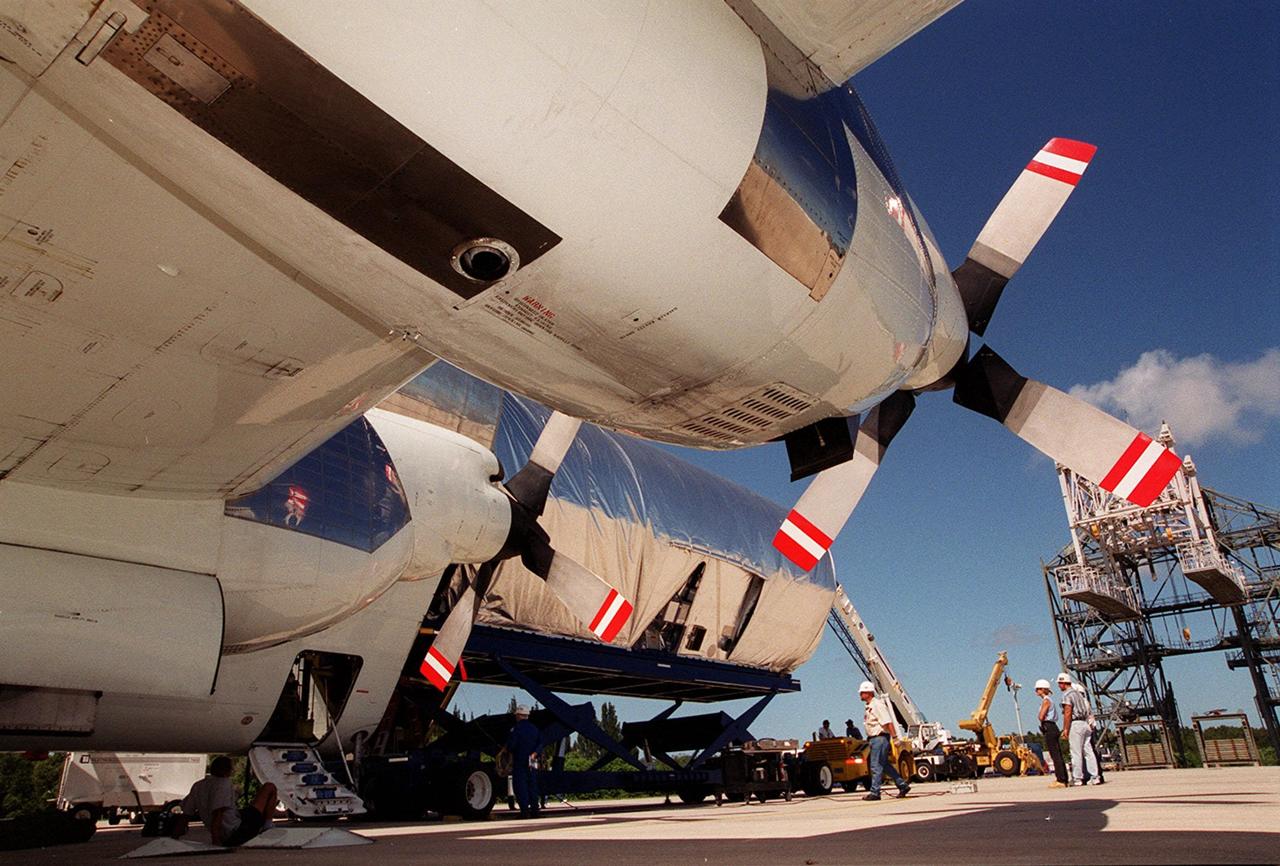
KENNEDY SPACE CENTER, FLA. -- Viewed from underneath the wing of NASA’s Super Guppy aircraft, the Joint Airlock Module, the gateway from which crew members aboard the International Space Station (ISS) will enter and exit the 470-ton orbiting research facility, rolls out of the aircraft. It will be transferred to the Operations and Checkout Building in the KSC industrial area where it will undergo vacuum chamber testing. Then it will be moved to the Space Station Processing Facility (SSPF) for further pre-launch preparation and checkout. The massive, spindle-shaped airlock is 20 feet long, has a diameter of 13 feet at its widest point, and weighs six and a half tons. It was manufactured at NASA's Marshall Space Flight Center by the Huntsville division of The Boeing Company. The Space Shuttle Atlantis will carry the airlock to orbit on mission STS-104, the tenth International Space Station flight, currently targeted for liftoff in May 2001
KENNEDY SPACE CENTER, FLA. -- Viewed from underneath the wing of NASA’s Super Guppy aircraft, the Joint Airlock Module, the gateway from which crew members aboard the International Space Station (ISS) will enter and exit the 470-ton orbiting research facility, rolls out of the aircraft. It will be transferred to the Operations and Checkout Building in the KSC industrial area where it will undergo vacuum chamber testing. Then it will be moved to the Space Station Processing Facility (SSPF) for further pre-launch preparation and checkout. The massive, spindle-shaped airlock is 20 feet long, has a diameter of 13 feet at its widest point, and weighs six and a half tons. It was manufactured at NASA's Marshall Space Flight Center by the Huntsville division of The Boeing Company. The Space Shuttle Atlantis will carry the airlock to orbit on mission STS-104, the tenth International Space Station flight, currently targeted for liftoff in May 2001
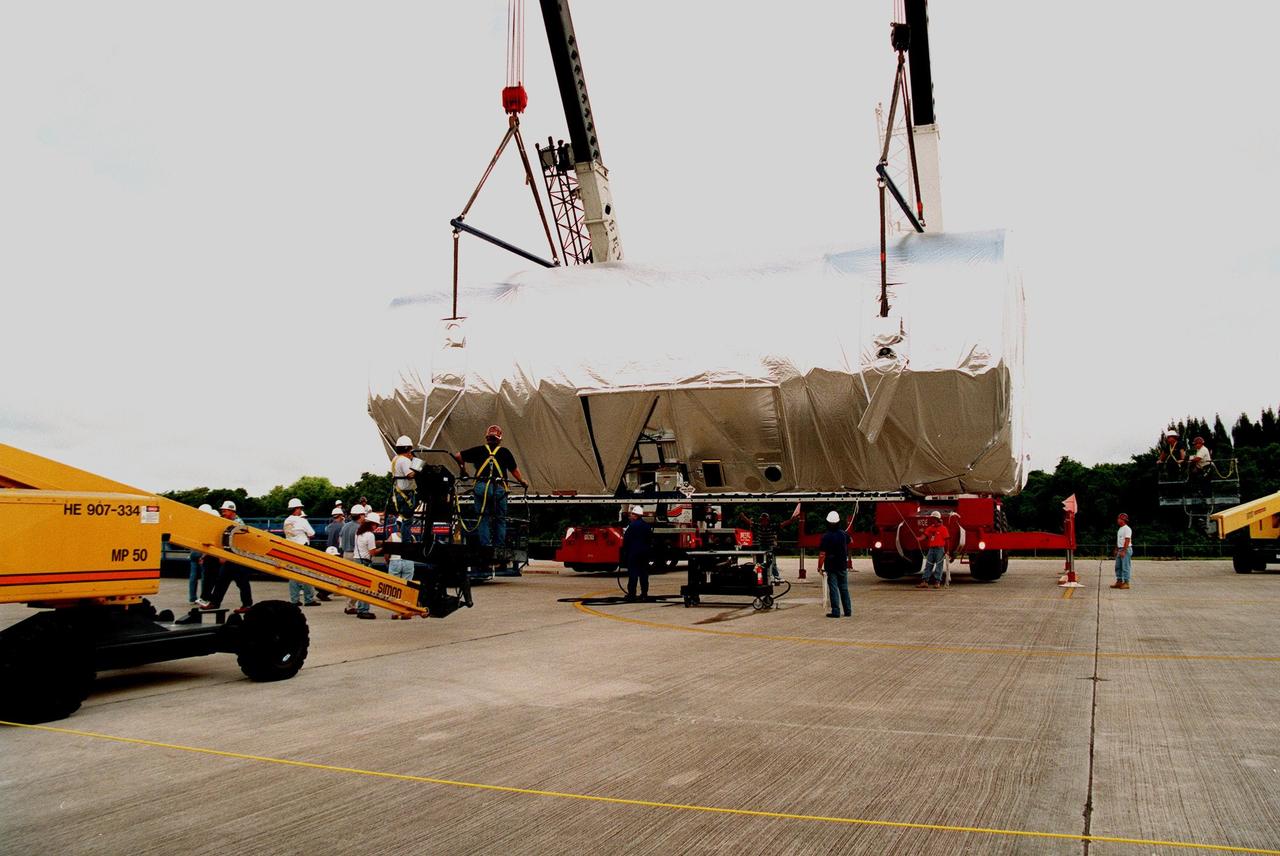
KENNEDY SPACE CENTER, FLA. -- At KSC's Shuttle Landing Facility, workers load the S0 truss segment onto a flatbed trailer for its transfer to the Operations and Checkout Bldg. for processing. The truss arrived at the SLF aboard a "Super Guppy" aircraft from Boeing in Huntington, Calif. During processing in the O&C, the S0 truss will have installed the Canadian Mobile Transporter, power distribution system modules, a heat pipe radiator for cooling, computers, and a pair of rate gyroscopes. Four Global Positioning System antennas are already installed. A 44by 15-foot structure weighing 30,800 pounds when fully outfitted and ready for launch, the truss will be at the center of the ISS 10-truss, girderlike structure that will ultimately extend the length of a football field. Eventually the S0 truss will be attached to the U.S. Lab, "Destiny," which is scheduled to be added to the ISS in April 2000. Later, other trusses will be attached to the S0 on-orbit. The S0 truss is scheduled to be launched in the first quarter of 2001 on mission STS-108
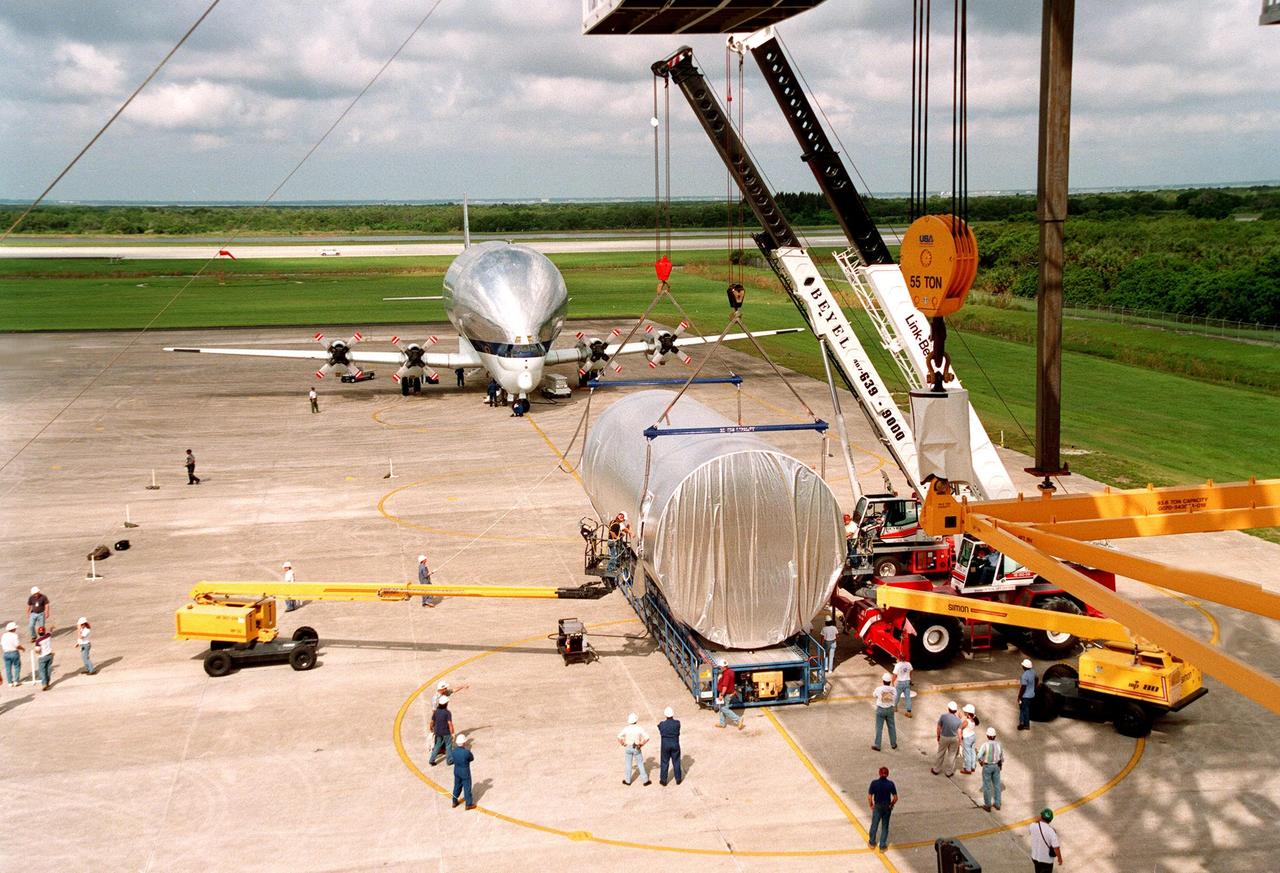
KENNEDY SPACE CENTER, FLA. -- At KSC's Shuttle Landing Facility (SLF), overhead cranes are fitted around the S0 truss segment to move it onto a flatbed trailer which will transfer it to the Operations and Checkout Bldg. for processing. The truss arrived at the SLF aboard the "Super Guppy" aircraft (in the background) from Boeing in Huntington, Calif. During processing, the Canadian Mobile Transporter will be installed on the S0 truss, followed by power distribution system modules, a heat pipe radiator for cooling, computers, and a pair of rate gyroscopes. Four Global Positioning System antennas are already installed. A 44by 15-foot structure weighing 30,800 pounds when fully outfitted and ready for launch, the truss will be at the center of the ISS 10-truss, girderlike structure that will ultimately extend the length of a football field. Eventually the S0 truss will be attached to the U.S. Lab, "Destiny," which is scheduled to be added to the ISS in April 2000. Later, other trusses will be attached to the S0 on-orbit. The S0 truss is scheduled to be launched in the first quarter of 2001 on mission STS-108
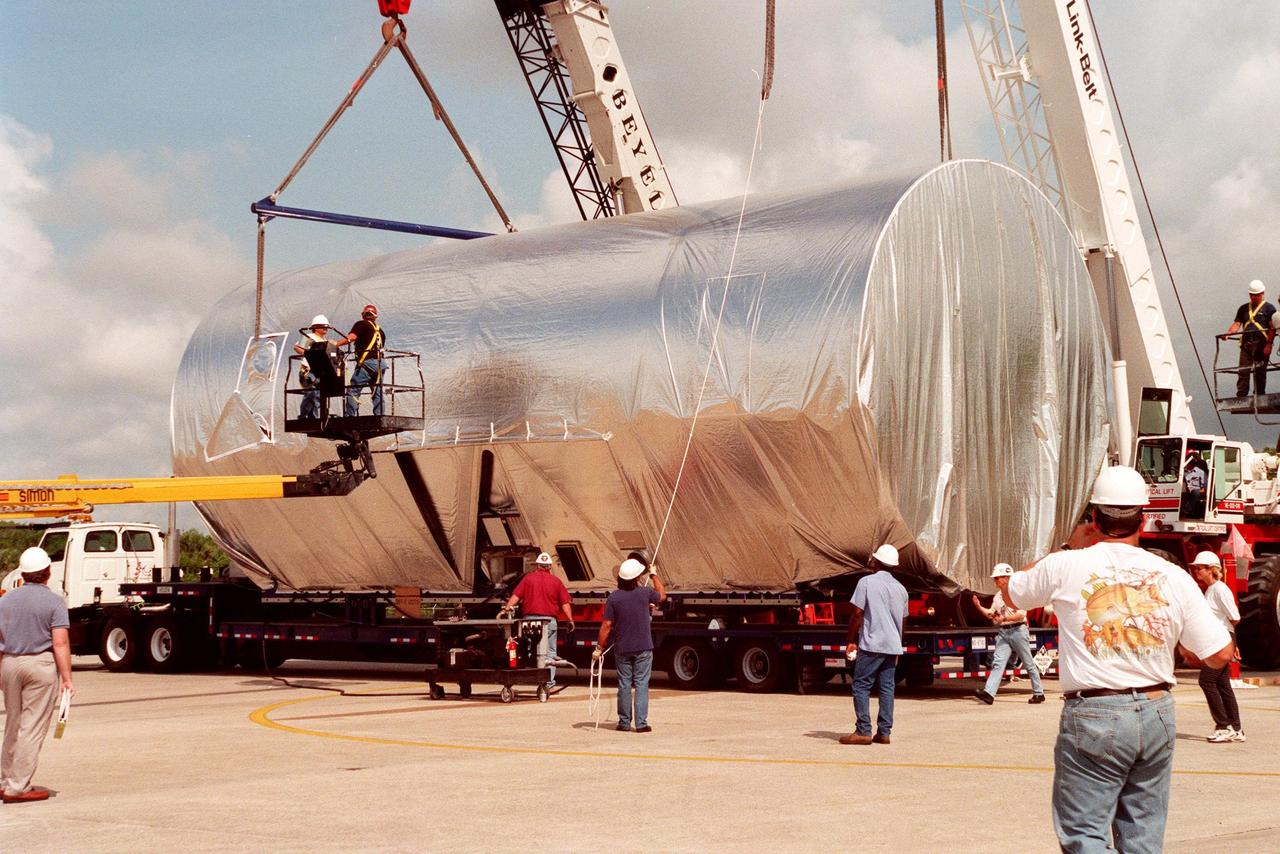
KENNEDY SPACE CENTER, FLA. -- At KSC's Shuttle Landing Facility, workers finish loading the S0 truss segment onto a flatbed trailer for transfer to the Operations and Checkout Bldg. for processing. The truss arrived at the SLF aboard a "Super Guppy" aircraft from Boeing in Huntington, Calif. During processing in the O&C, the S0 truss will have installed the Canadian Mobile Transporter, power distribution system modules, a heat pipe radiator for cooling, computers, and a pair of rate gyroscopes. Four Global Positioning System antennas are already installed. A 44by 15-foot structure weighing 30,800 pounds when fully outfitted and ready for launch, the truss will be at the center of the ISS 10-truss, girderlike structure that will ultimately extend the length of a football field. Eventually the S0 truss will be attached to the U.S. Lab, "Destiny," which is scheduled to be added to the ISS in April 2000. Later, other trusses will be attached to the S0 on-orbit. The S0 truss is scheduled to be launched in the first quarter of 2001 on mission STS-108
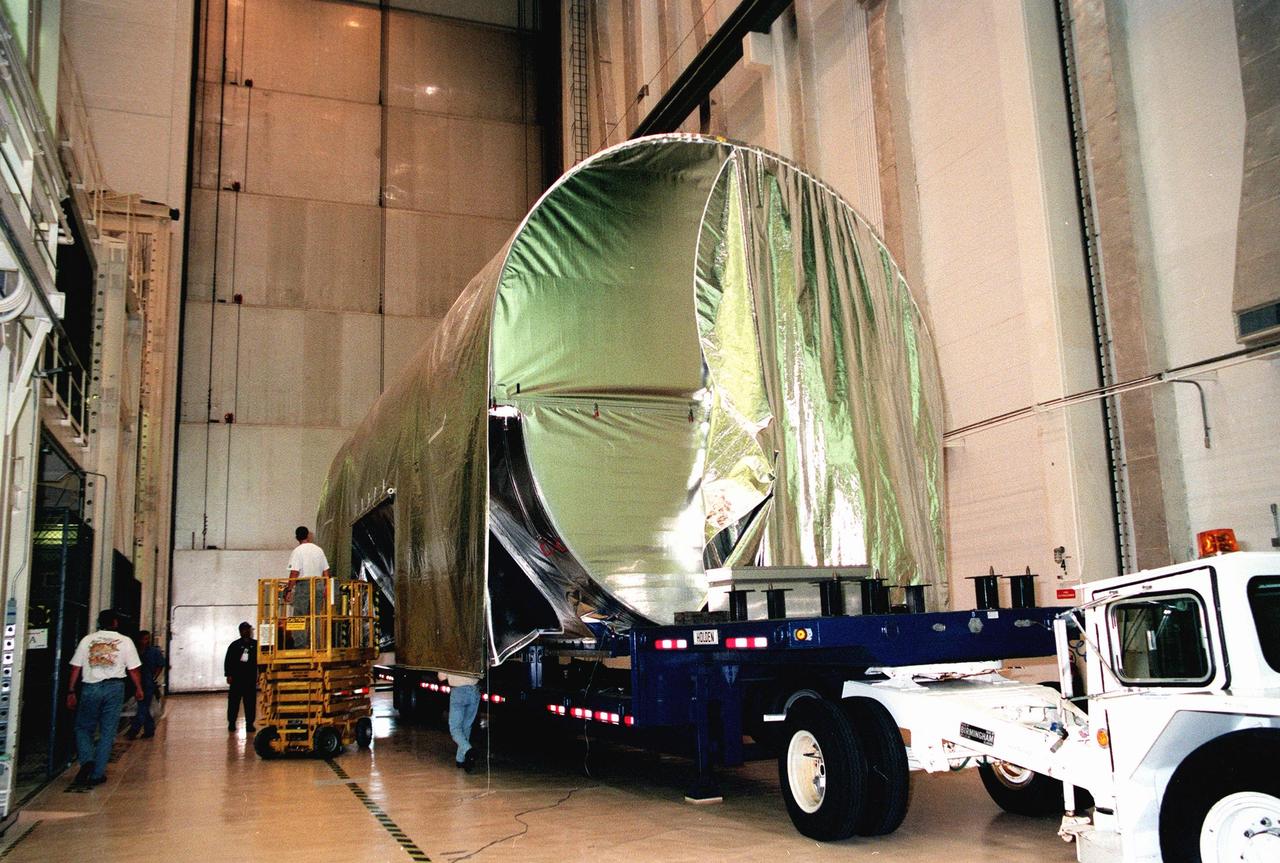
KENNEDY SPACE CENTER, FLA. -- Workers begin removing the cover from the S0 truss segment after it was moved inside the Operations and Checkout Bldg. (O&C) for processing. The truss arrived at the SLF aboard a "Super Guppy" aircraft from Boeing in Huntington, Calif. During processing in the O&C, the S0 truss will have installed the Canadian Mobile Transporter, power distribution system modules, a heat pipe radiator for cooling, computers, and a pair of rate gyroscopes. Four Global Positioning System antennas are already installed. A 44by 15-foot structure weighing 30,800 pounds when fully outfitted and ready for launch, the truss will be at the center of the ISS 10-truss, girderlike structure that will ultimately extend the length of a football field. Eventually the S0 truss will be attached to the U.S. Lab, "Destiny," which is scheduled to be added to the ISS in April 2000. Later, other trusses will be attached to the S0 on-orbit. The S0 truss is scheduled to be launched in the first quarter of 2001 on mission STS-108
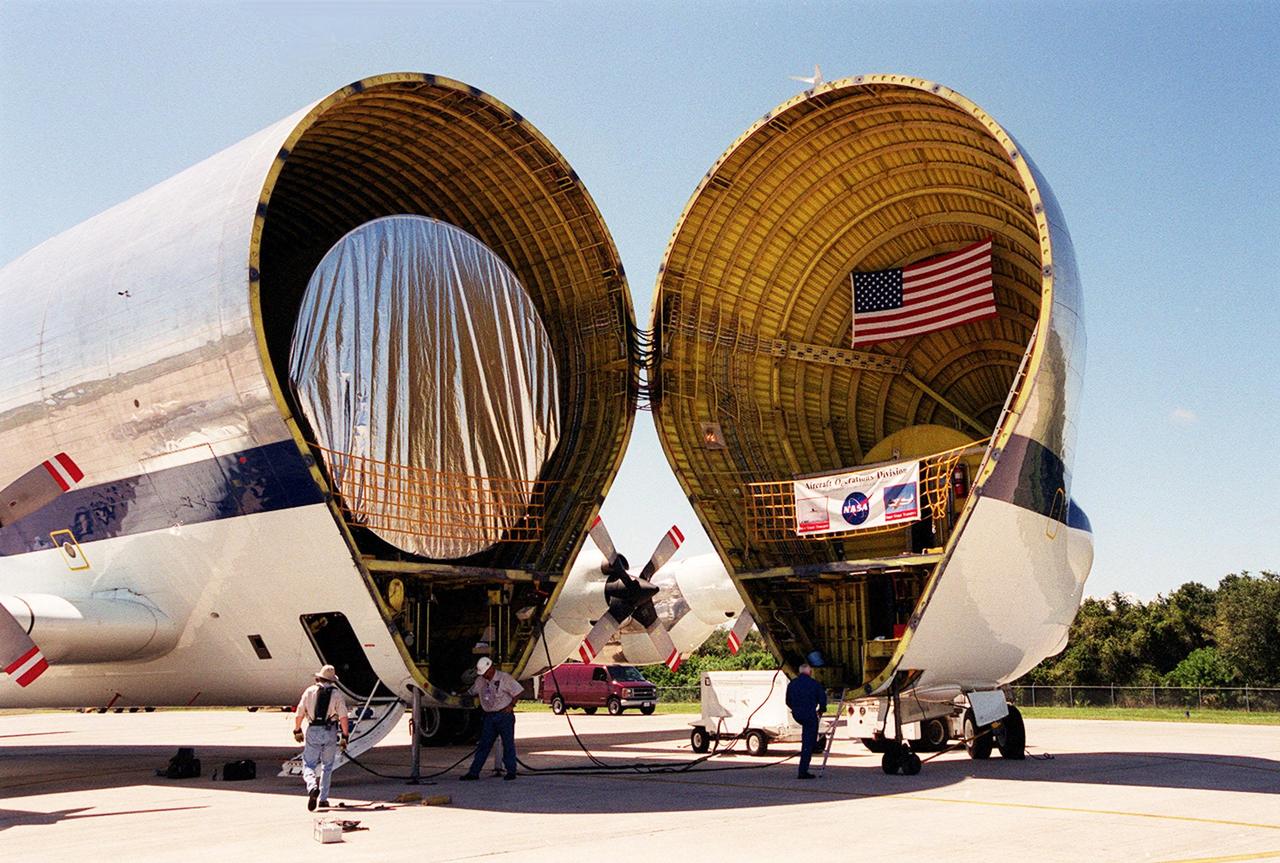
KENNEDY SPACE CENTER, FLA. -- The nose of NASA's Super Guppy aircraft opens to reveal the <a href="http://www-pao.ksc.nasa.gov/kscpao/release/2000/78-00.htm">Joint Airlock Module</a> the gateway from which crew members aboard the International Space Station (ISS) will enter and exit the 470-ton orbiting research facility. The airlock was transported from NASA's Marshall Space Flight Center in Huntsville, Ala. The airlock will be transported to the Operations and Checkout Building in the KSC industrial area where it will undergo vacuum chamber testing. It will then be moved to the Space Station Processing Facility (SSPF) for further prelaunch preparation and checkout. The massive, spindle-shaped airlock is 20 feet long, has a diameter of 13 feet at its widest point, and weighs six and a half tons. It was manufactured at NASA's Marshall Space Flight Center by the Huntsville division of The Boeing Company. The Space Shuttle Atlantis will carry the airlock to orbit on mission STS-104, the tenth International Space Station flight, currently targeted for liftoff in May 2001
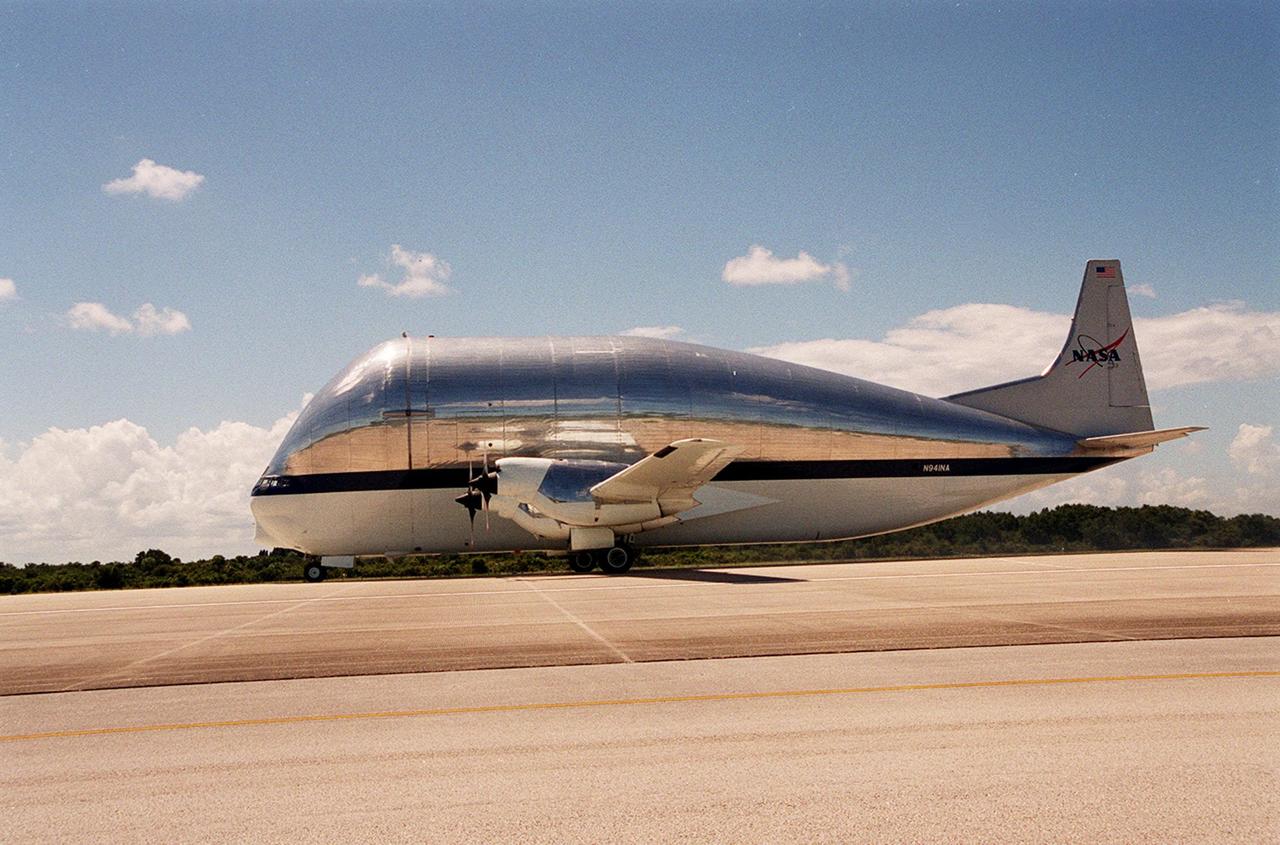
KENNEDY SPACE CENTER, FLA. -- NASA's Super Guppy aircraft lands at the KSC Shuttle Landing Facility with its cargo, the <a href="http://www-pao.ksc.nasa.gov/kscpao/release/2000/78-00.htm"> Joint Airlock Module</a> the gateway from which crew members aboard the International Space Station (ISS) will enter and exit the 470-ton orbiting research facility. The airlock was transported from NASA's Marshall Space Flight Center in Huntsville, Ala. The airlock will be transported to the Operations and Checkout Building in the KSC industrial area where it will undergo vacuum chamber testing. It will then be moved to the Space Station Processing Facility (SSPF) for further prelaunch preparation and checkout. The massive, spindle-shaped airlock is 20 feet long, has a diameter of 13 feet at its widest point, and weighs six and a half tons. It was manufactured at NASA's Marshall Space Flight Center by the Huntsville division of The Boeing Company. The Space Shuttle Atlantis will carry the airlock to orbit on mission STS-104, the tenth International Space Station flight, currently targeted for liftoff in May 2001
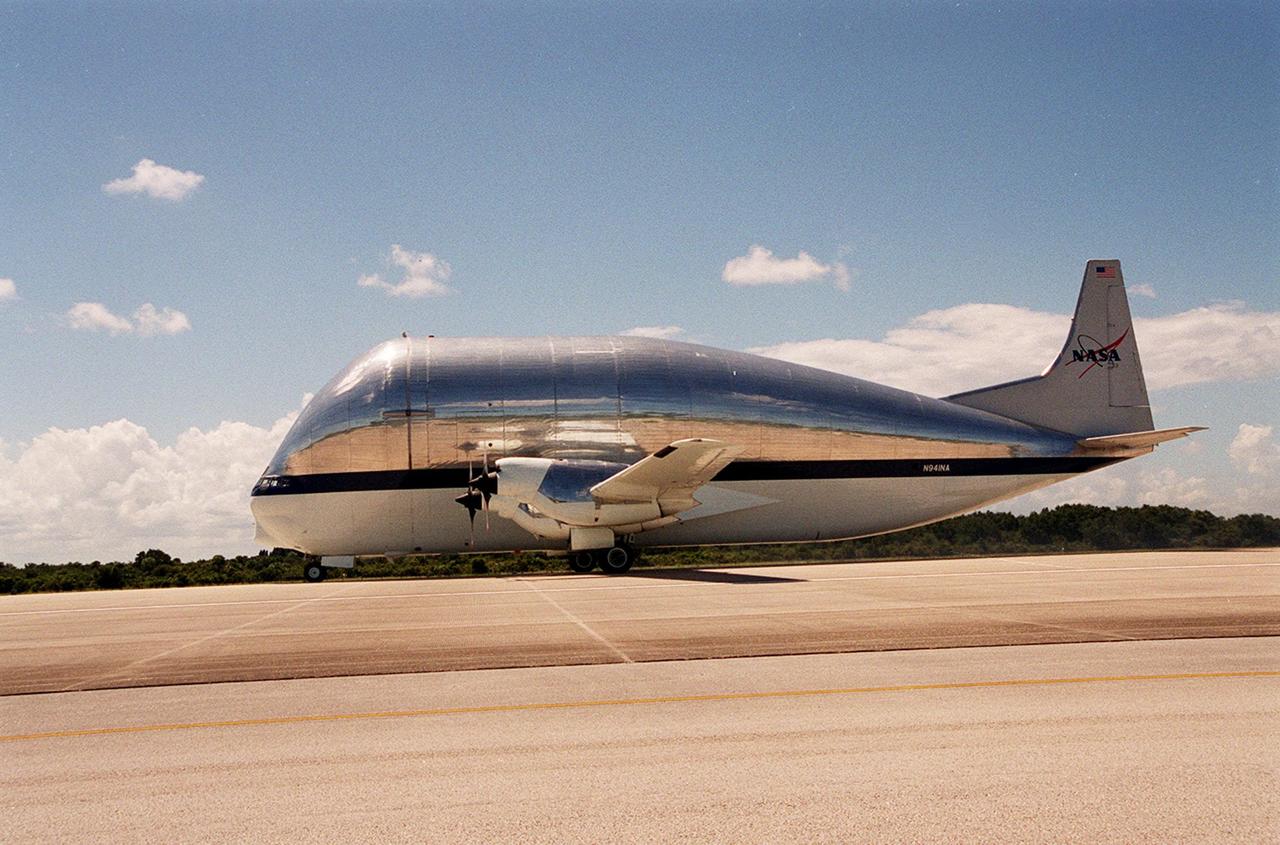
KENNEDY SPACE CENTER, FLA. -- NASA's Super Guppy aircraft lands at the KSC Shuttle Landing Facility with its cargo, the <a href="http://www-pao.ksc.nasa.gov/kscpao/release/2000/78-00.htm"> Joint Airlock Module</a> the gateway from which crew members aboard the International Space Station (ISS) will enter and exit the 470-ton orbiting research facility. The airlock was transported from NASA's Marshall Space Flight Center in Huntsville, Ala. The airlock will be transported to the Operations and Checkout Building in the KSC industrial area where it will undergo vacuum chamber testing. It will then be moved to the Space Station Processing Facility (SSPF) for further prelaunch preparation and checkout. The massive, spindle-shaped airlock is 20 feet long, has a diameter of 13 feet at its widest point, and weighs six and a half tons. It was manufactured at NASA's Marshall Space Flight Center by the Huntsville division of The Boeing Company. The Space Shuttle Atlantis will carry the airlock to orbit on mission STS-104, the tenth International Space Station flight, currently targeted for liftoff in May 2001
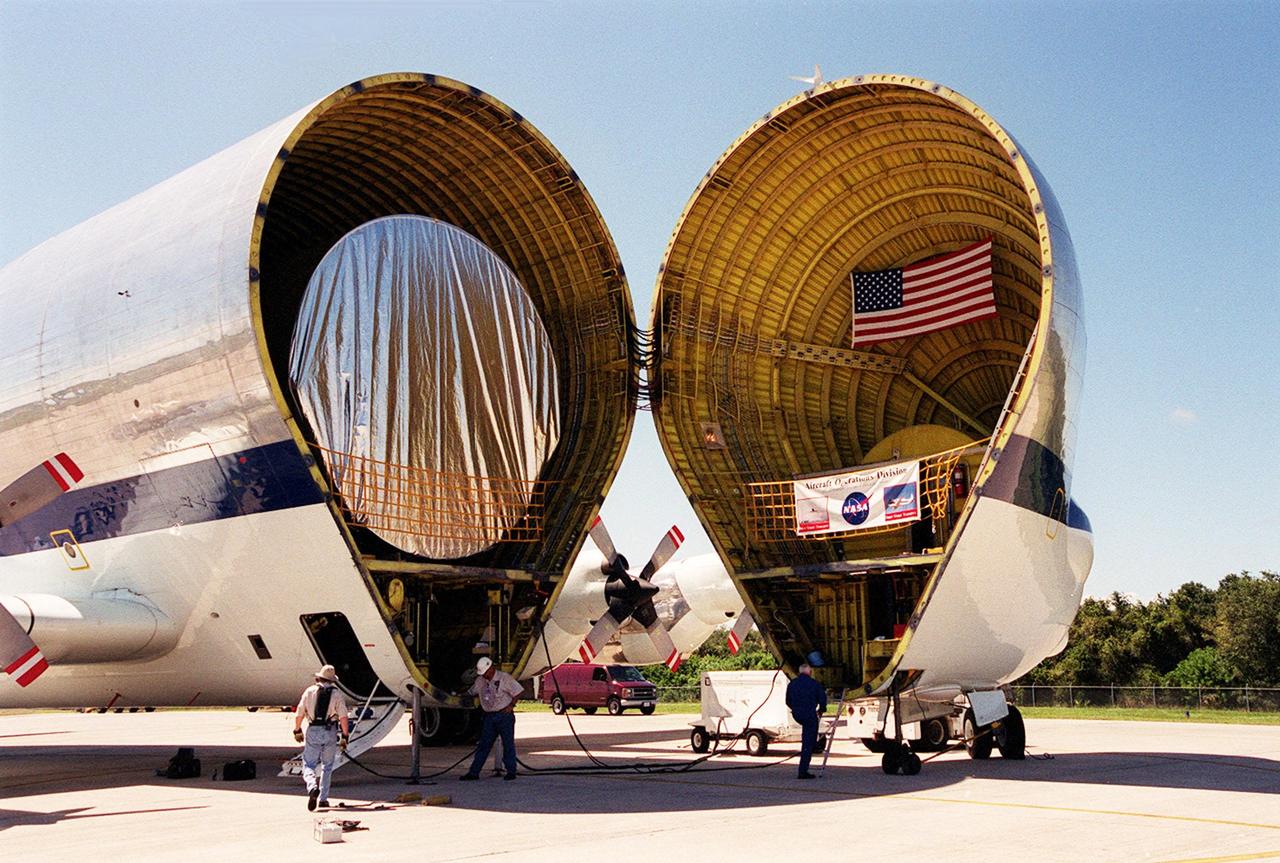
KENNEDY SPACE CENTER, FLA. -- The nose of NASA's Super Guppy aircraft opens to reveal the <a href="http://www-pao.ksc.nasa.gov/kscpao/release/2000/78-00.htm">Joint Airlock Module</a> the gateway from which crew members aboard the International Space Station (ISS) will enter and exit the 470-ton orbiting research facility. The airlock was transported from NASA's Marshall Space Flight Center in Huntsville, Ala. The airlock will be transported to the Operations and Checkout Building in the KSC industrial area where it will undergo vacuum chamber testing. It will then be moved to the Space Station Processing Facility (SSPF) for further prelaunch preparation and checkout. The massive, spindle-shaped airlock is 20 feet long, has a diameter of 13 feet at its widest point, and weighs six and a half tons. It was manufactured at NASA's Marshall Space Flight Center by the Huntsville division of The Boeing Company. The Space Shuttle Atlantis will carry the airlock to orbit on mission STS-104, the tenth International Space Station flight, currently targeted for liftoff in May 2001