
International Space Station (ISS) National Laboratory Workshop The ISS Lational Lab: The Investor's Viewpoint

CAPE CANAVERAL, Fla. -- On Launch Pad 39A at NASA's Kennedy Space Center in Florida, a worker prepares to remove the ground umbilical carrier plate's (GUCP) 7-inch quick disconnect. A hydrogen gas leak at that location on the external fuel tank during tanking for space shuttle Discovery's STS-133 mission to the International Space Station caused the launch attempt to be scrubbed Nov. 5. The GUCP will be examined to determine the cause of the hydrogen leak and then repaired. The GUCP is the overboard vent to the pad and the flame stack where the vented hydrogen is burned off. Discovery's next launch attempt is no earlier than Nov. 30 at 4:02 a.m. EST. For more information on STS-133, visit www.nasa.gov/mission_pages/shuttle/shuttlemissions/sts133/. Photo credit: NASA/Troy Cryder
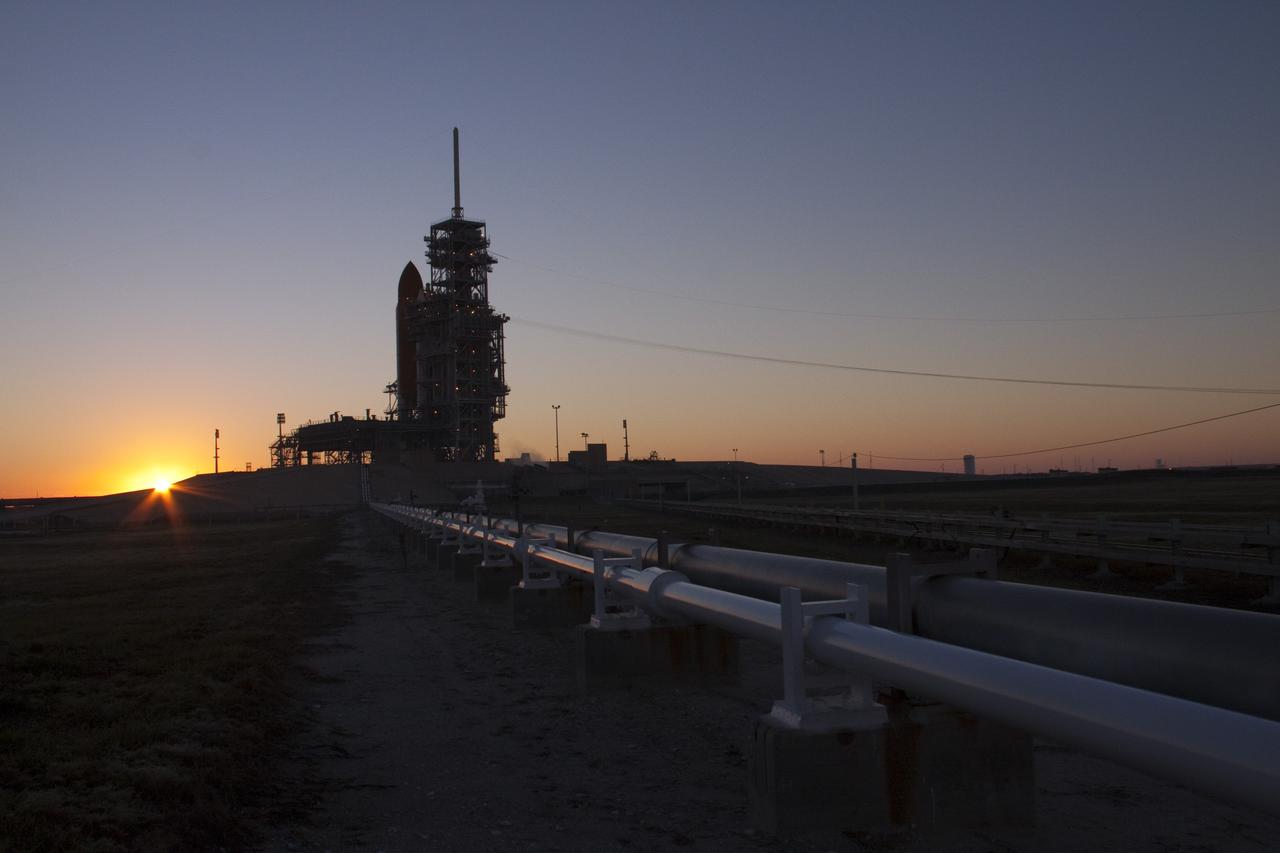
CAPE CANAVERAL, Fla. -- As the sun begins to rise over Launch Pad 39A at NASA's Kennedy Space Center in Florida, preparations to remove the ground umbilical carrier plate's (GUCP) 7-inch quick disconnect are under way. A hydrogen gas leak at that location on the external fuel tank during tanking for space shuttle Discovery's STS-133 mission to the International Space Station caused the launch attempt to be scrubbed Nov. 5. The GUCP will be examined to determine the cause of the hydrogen leak and then repaired. The GUCP is the overboard vent to the pad and the flame stack where the vented hydrogen is burned off. Discovery's next launch attempt is no earlier than Nov. 30 at 4:02 a.m. EST. For more information on STS-133, visit www.nasa.gov/mission_pages/shuttle/shuttlemissions/sts133/. Photo credit: NASA/Troy Cryder
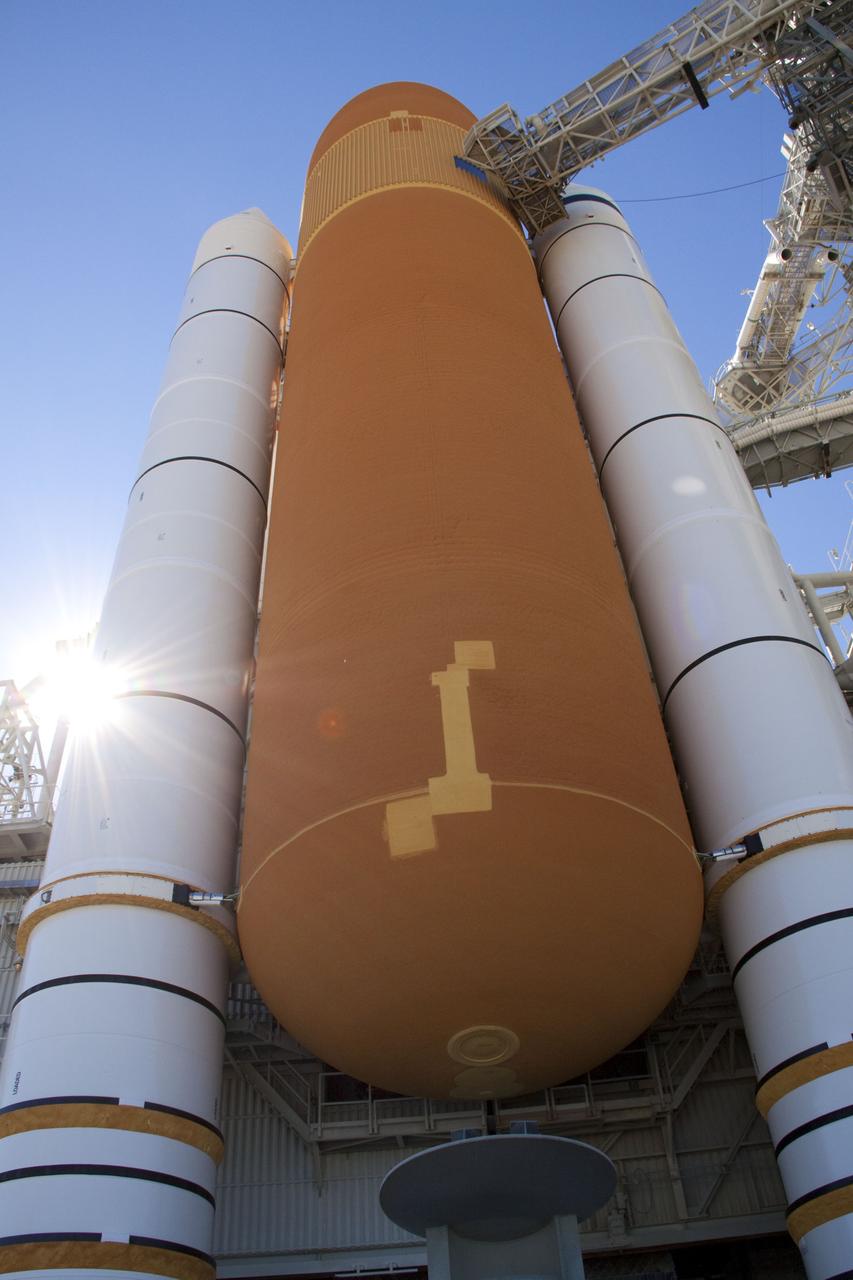
CAPE CANAVERAL, Fla. -- On Launch Pad 39A at NASA's Kennedy Space Center in Florida, the tip-top of the bright-orange external fuel tank is where workers will prepare to begin removing the quick disconnect from the ground umbilical carrier plate (GUCP). A hydrogen gas leak at that location during tanking for space shuttle Discovery's STS-133 mission to the International Space Station caused the launch attempt to be scrubbed Nov. 5. The GUCP will be examined to determine the cause of the hydrogen leak and then repaired. The GUCP is the overboard vent to the pad and the flame stack where the vented hydrogen is burned off. Discovery's next launch attempt is targeted for no earlier than Nov. 30 at 4:02 a.m. EST. For more information on STS-133, visit www.nasa.gov/mission_pages/shuttle/shuttlemissions/sts133/. Photo credit: NASA/Troy Cryder
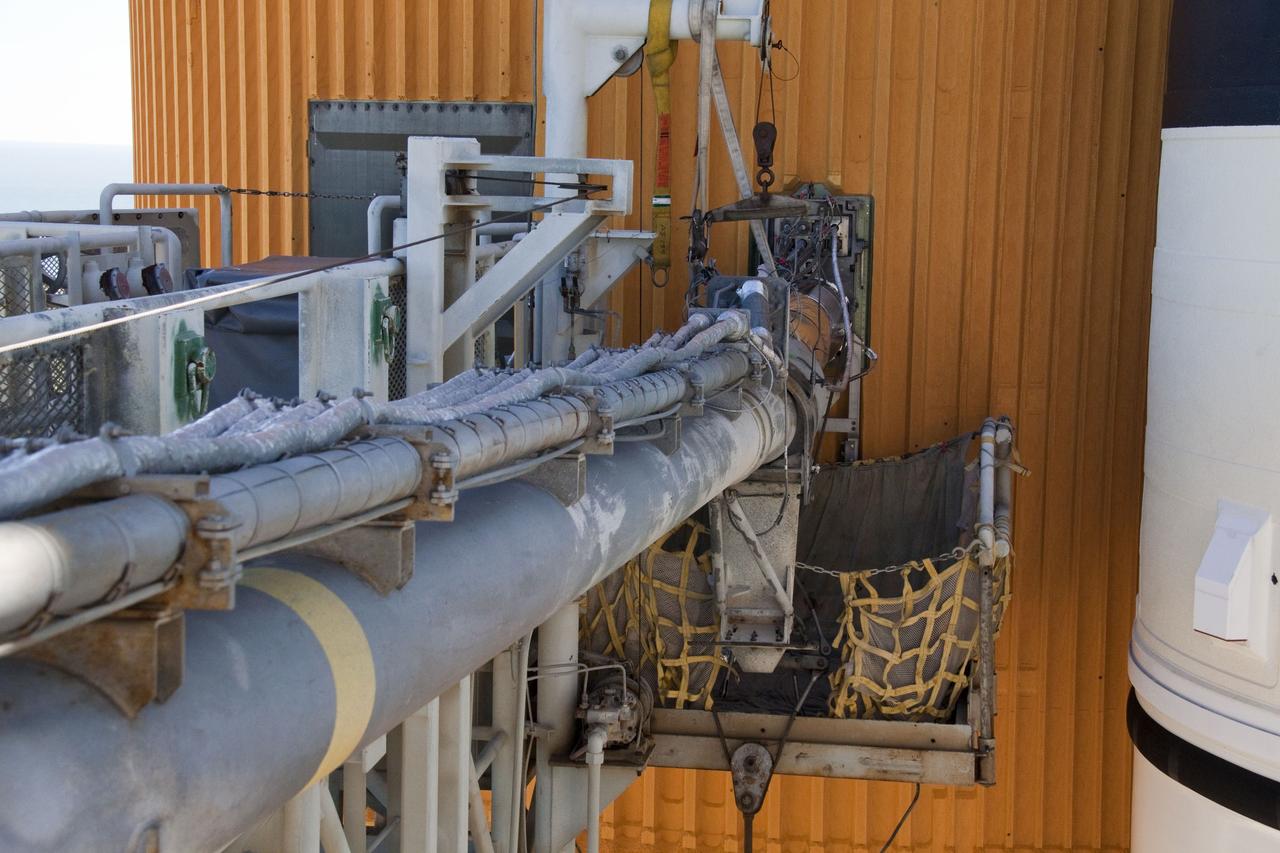
CAPE CANAVERAL, Fla. -- On Launch Pad 39A at NASA's Kennedy Space Center in Florida, the tip-top of the bright-orange external fuel tank is where workers will prepare to begin removing the quick disconnect from the ground umbilical carrier plate (GUCP). A hydrogen gas leak at that location during tanking for space shuttle Discovery's STS-133 mission to the International Space Station caused the launch attempt to be scrubbed Nov. 5. The GUCP will be examined to determine the cause of the hydrogen leak and then repaired. The GUCP is the overboard vent to the pad and the flame stack where the vented hydrogen is burned off. Discovery's next launch attempt is targeted for no earlier than Nov. 30 at 4:02 a.m. EST. For more information on STS-133, visit www.nasa.gov/mission_pages/shuttle/shuttlemissions/sts133/. Photo credit: NASA/Troy Cryder
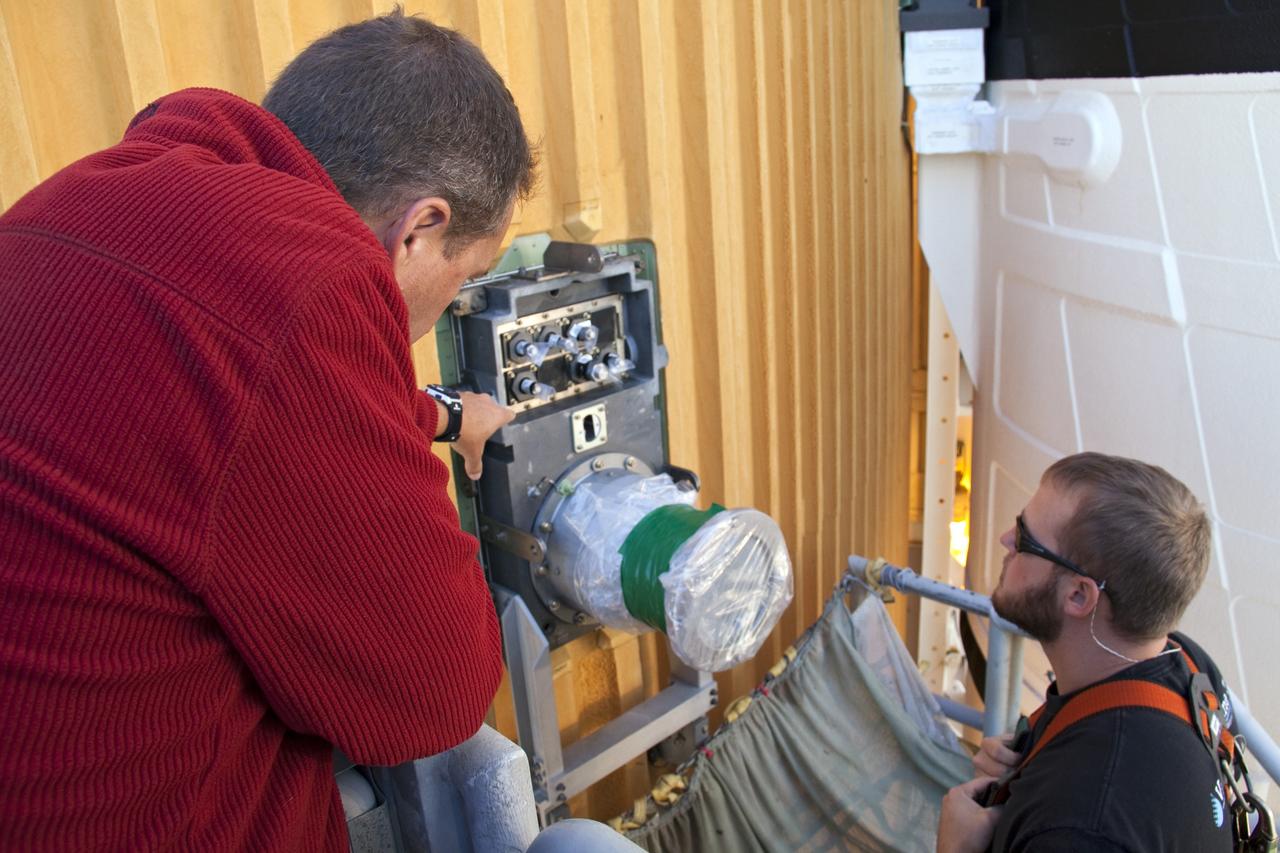
CAPE CANAVERAL, Fla. -- On Launch Pad 39A at NASA's Kennedy Space Center in Florida, workers prepare to remove the ground umbilical carrier plate's (GUCP) 7-inch quick disconnect. A hydrogen gas leak at that location on the external fuel tank during tanking for space shuttle Discovery's STS-133 mission to the International Space Station caused the launch attempt to be scrubbed Nov. 5. The GUCP will be examined to determine the cause of the hydrogen leak and then repaired. The GUCP is the overboard vent to the pad and the flame stack where the vented hydrogen is burned off. Discovery's next launch attempt is no earlier than Nov. 30 at 4:02 a.m. EST. For more information on STS-133, visit www.nasa.gov/mission_pages/shuttle/shuttlemissions/sts133/. Photo credit: NASA/Troy Cryder
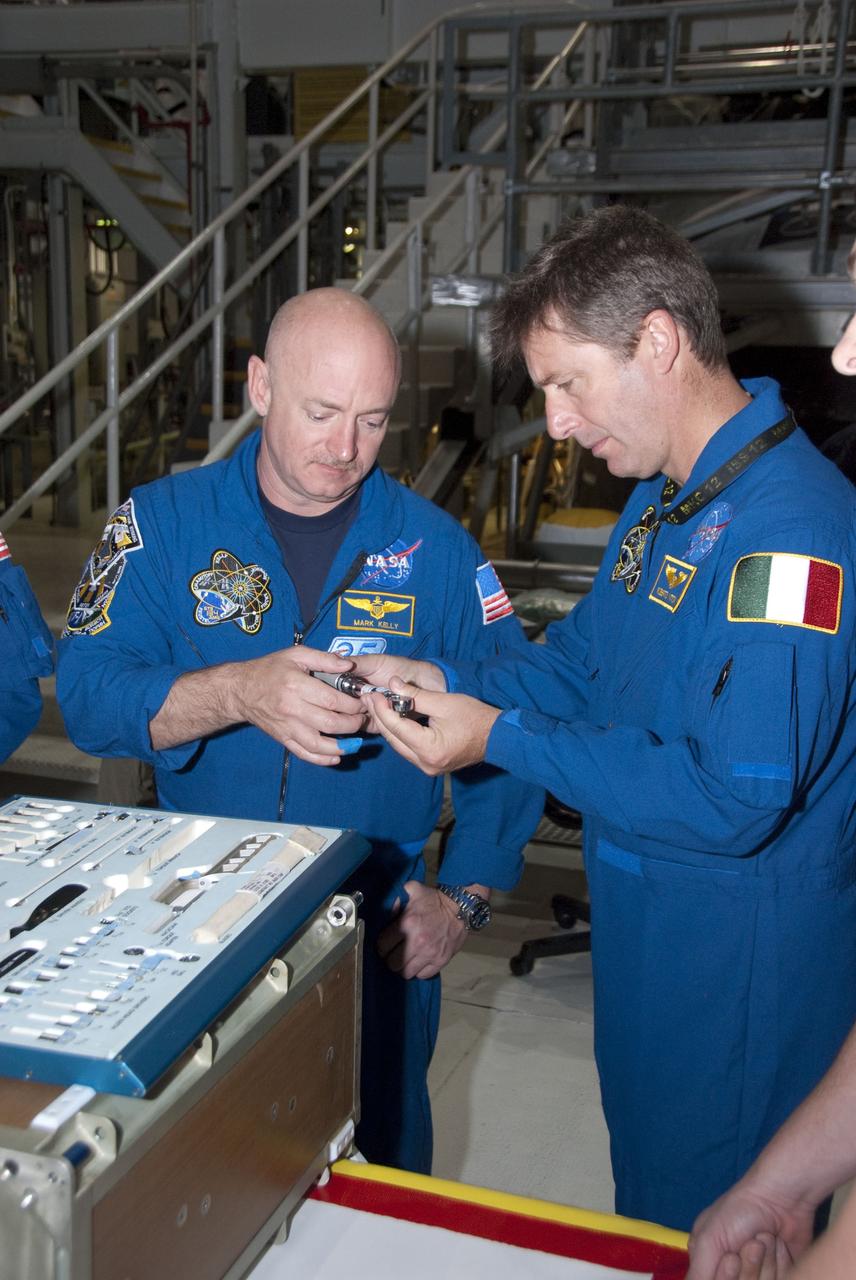
CAPE CANAVERAL, Fla. -- In the Orbiter Processing Facility-2 at NASA's Kennedy Space Center in Florida, STS-134 Commander Mark Kelly, left, and Mission Specialist Roberto Vittori with the European Space Agency check out a tool they'll be using in space. The six STS-134 astronauts are at Kennedy participating in the Crew Equipment Interface Test (CEIT), which gives them an opportunity for hands-on training and familiarization of the payload they'll be delivering to the International Space Station. Space shuttle Endeavour is targeted to launch on the STS-134 mission Feb. 27, 2011. For more information, visit www.nasa.gov/mission_pages/shuttle/shuttlemissions/sts134/index.html. Photo credit: NASA/Cory Huston

CAPE CANAVERAL, Fla. -- On Launch Pad 39A at NASA's Kennedy Space Center in Florida, the tip-top of the bright-orange external fuel tank is where workers will prepare to begin removing the quick disconnect from the ground umbilical carrier plate (GUCP). A hydrogen gas leak at that location during tanking for space shuttle Discovery's STS-133 mission to the International Space Station caused the launch attempt to be scrubbed Nov. 5. The GUCP will be examined to determine the cause of the hydrogen leak and then repaired. The GUCP is the overboard vent to the pad and the flame stack where the vented hydrogen is burned off. Discovery's next launch attempt is targeted for no earlier than Nov. 30 at 4:02 a.m. EST. For more information on STS-133, visit www.nasa.gov/mission_pages/shuttle/shuttlemissions/sts133/. Photo credit: NASA/Troy Cryder
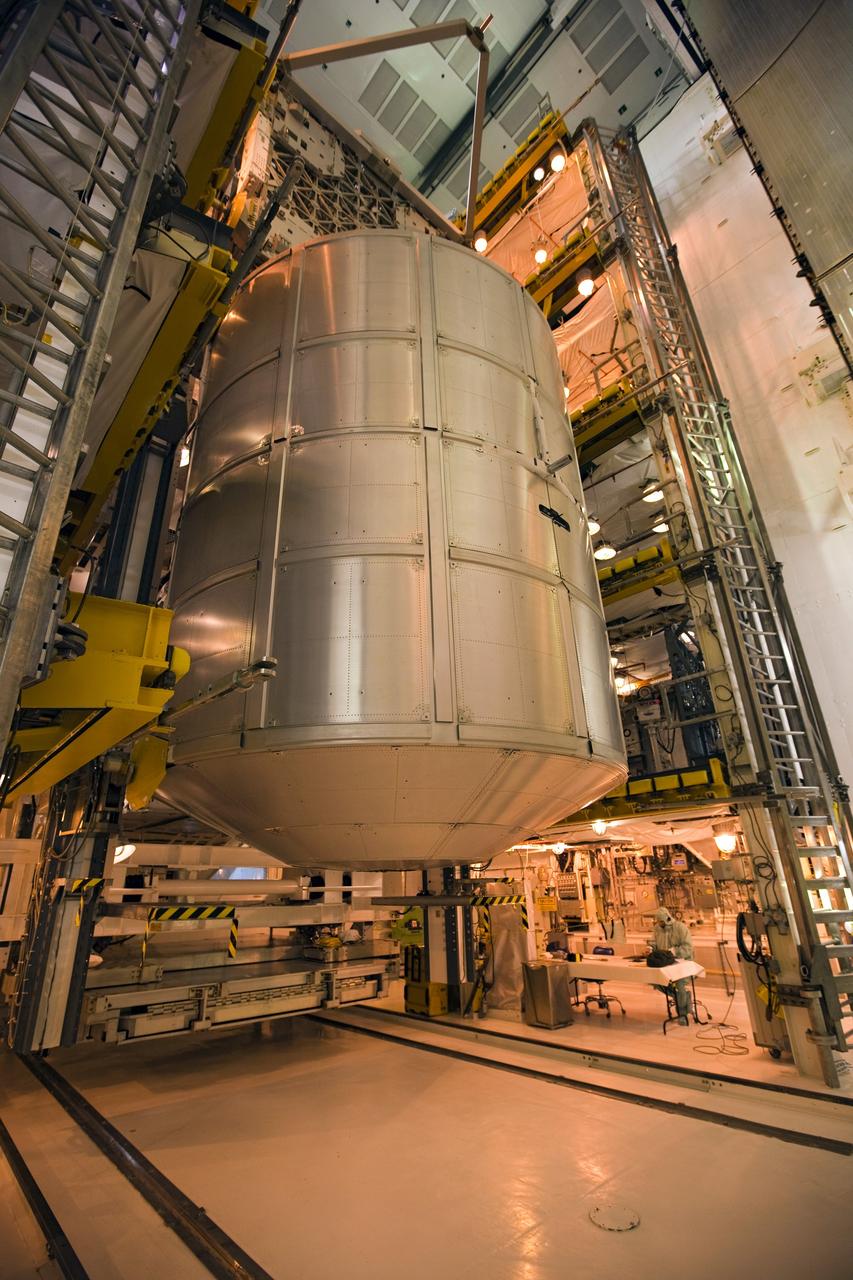
CAPE CANAVERAL, Fla. -- At NASA's Kennedy Space Center in Florida, technicians prepare to move the STS-133 payload from the rotating service structure on Launch Pad 39A to space shuttle Discovery's payload bay. The move paves the way for the Terminal Countdown Demonstration Test (TCDT) this week, which will give the astronauts and teams at Kennedy and NASA's Johnson Space Center in Houston a chance to practice launch day tasks. Discovery and its STS-133 crew will deliver the Permanent Multipurpose Module, packed with supplies and critical spare parts, as well as Robonaut 2, the dexterous humanoid astronaut helper, to the International Space Station. Launch is targeted for 4:40 p.m. EDT, Nov. 1. Photo credit: NASA/Dimitri Gerondidakis
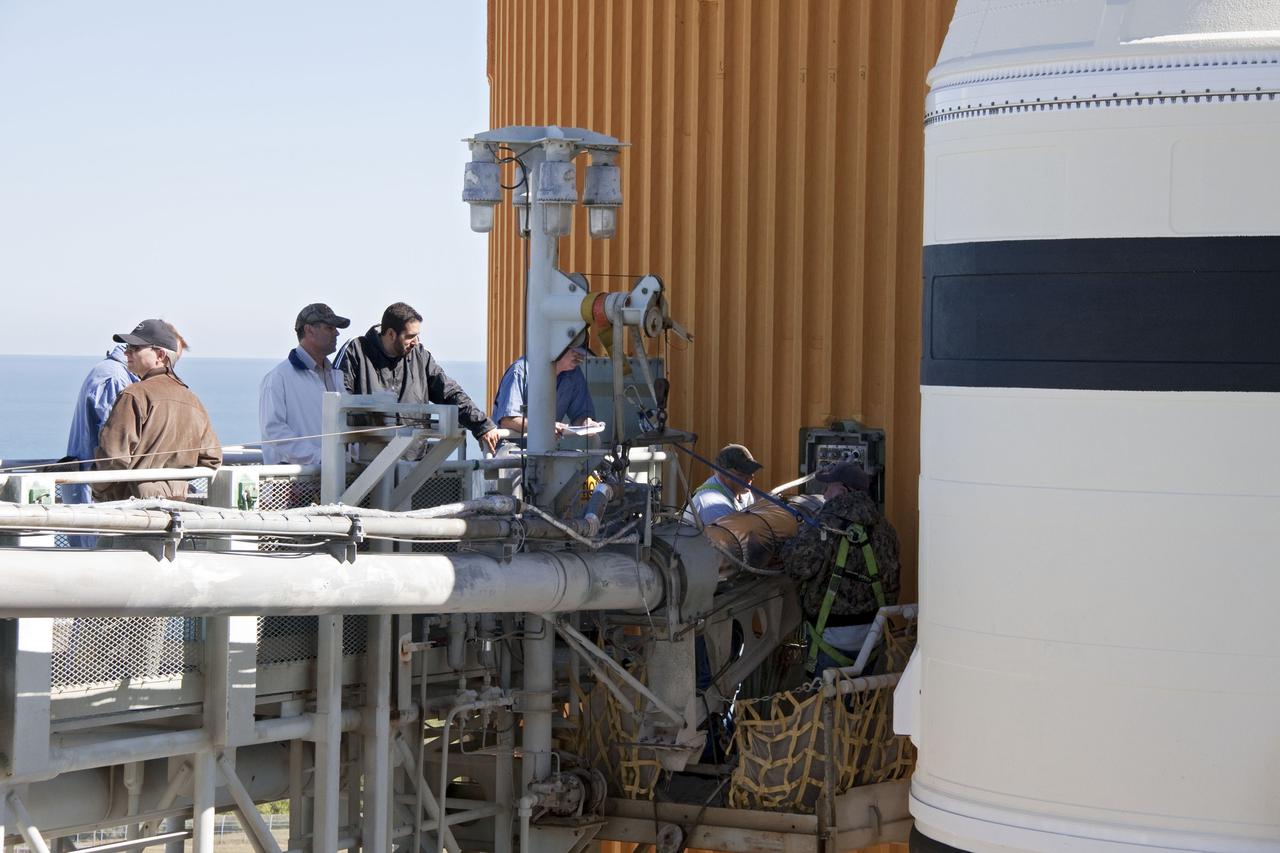
CAPE CANAVERAL, Fla. -- On Launch Pad 39A at NASA's Kennedy Space Center in Florida, workers prepare to begin removing the quick disconnect from the ground umbilical carrier plate (GUCP) on space shuttle Discovery's external fuel tank. A hydrogen gas leak at that location during tanking for the STS-133 mission to the International Space Station caused the launch attempt to be scrubbed Nov. 5. The GUCP will be examined to determine the cause of the hydrogen leak and then repaired. The GUCP is the overboard vent to the pad and the flame stack where the vented hydrogen is burned off. Discovery's next launch attempt is targeted for no earlier than Nov. 30 at 4:02 a.m. EST. For more information on STS-133, visit www.nasa.gov/mission_pages/shuttle/shuttlemissions/sts133/. Photo credit: NASA/Troy Cryder
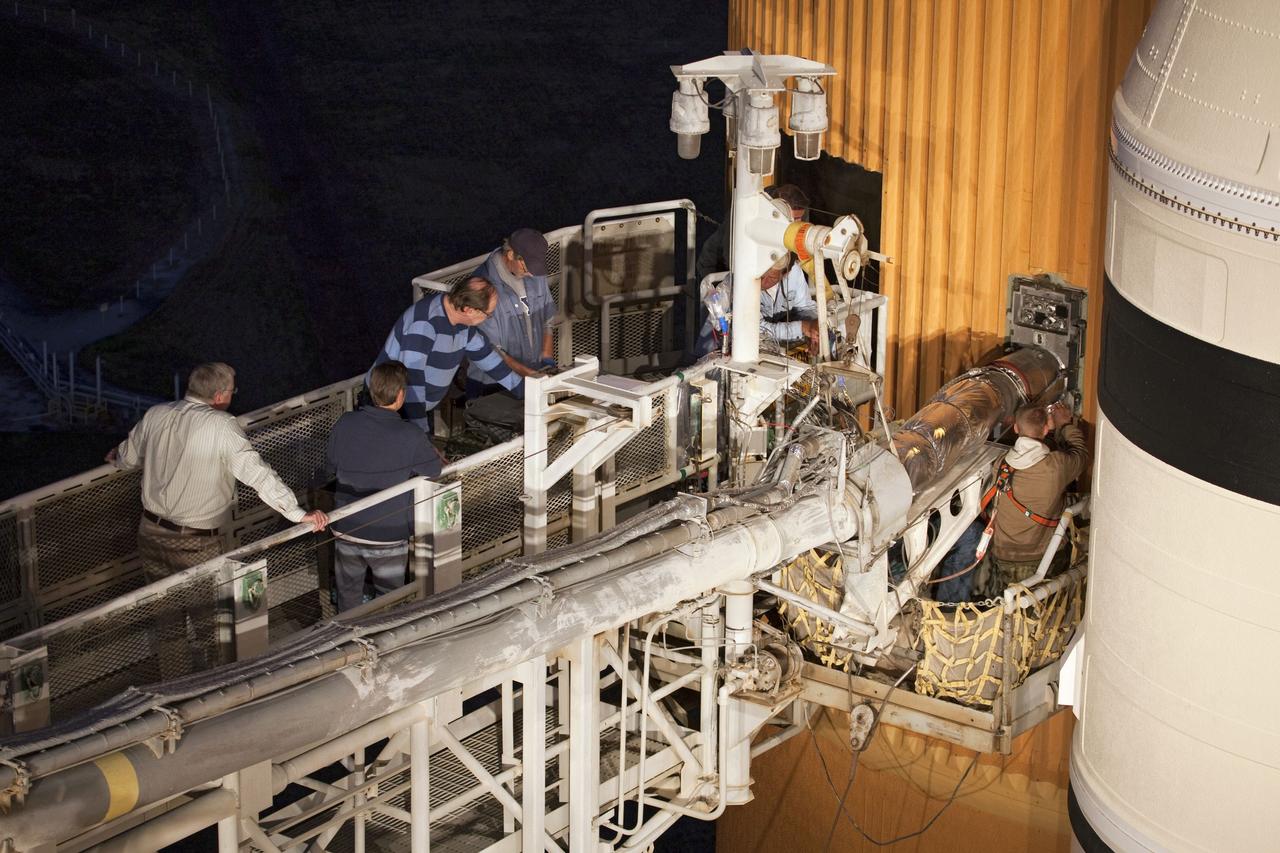
CAPE CANAVERAL, Fla. -- On Launch Pad 39A at NASA's Kennedy Space Center in Florida, workers begin to remove the vent line attached to the ground umbilical carrier plate (GUCP) on the bright-orange external fuel tank. Next, the GUCP's 7-inch quick disconnect will be removed. A hydrogen gas leak at that location during tanking for space shuttle Discovery's STS-133 mission to the International Space Station caused the launch attempt to be scrubbed Nov. 5. The GUCP will be examined to determine the cause of the hydrogen leak and then repaired. The GUCP is the overboard vent to the pad and the flame stack where the vented hydrogen is burned off. Discovery's next launch attempt is no earlier than Nov. 30 at 4:02 a.m. EST. For more information on STS-133, visit www.nasa.gov/mission_pages/shuttle/shuttlemissions/sts133/. Photo credit: NASA/Frankie Martin
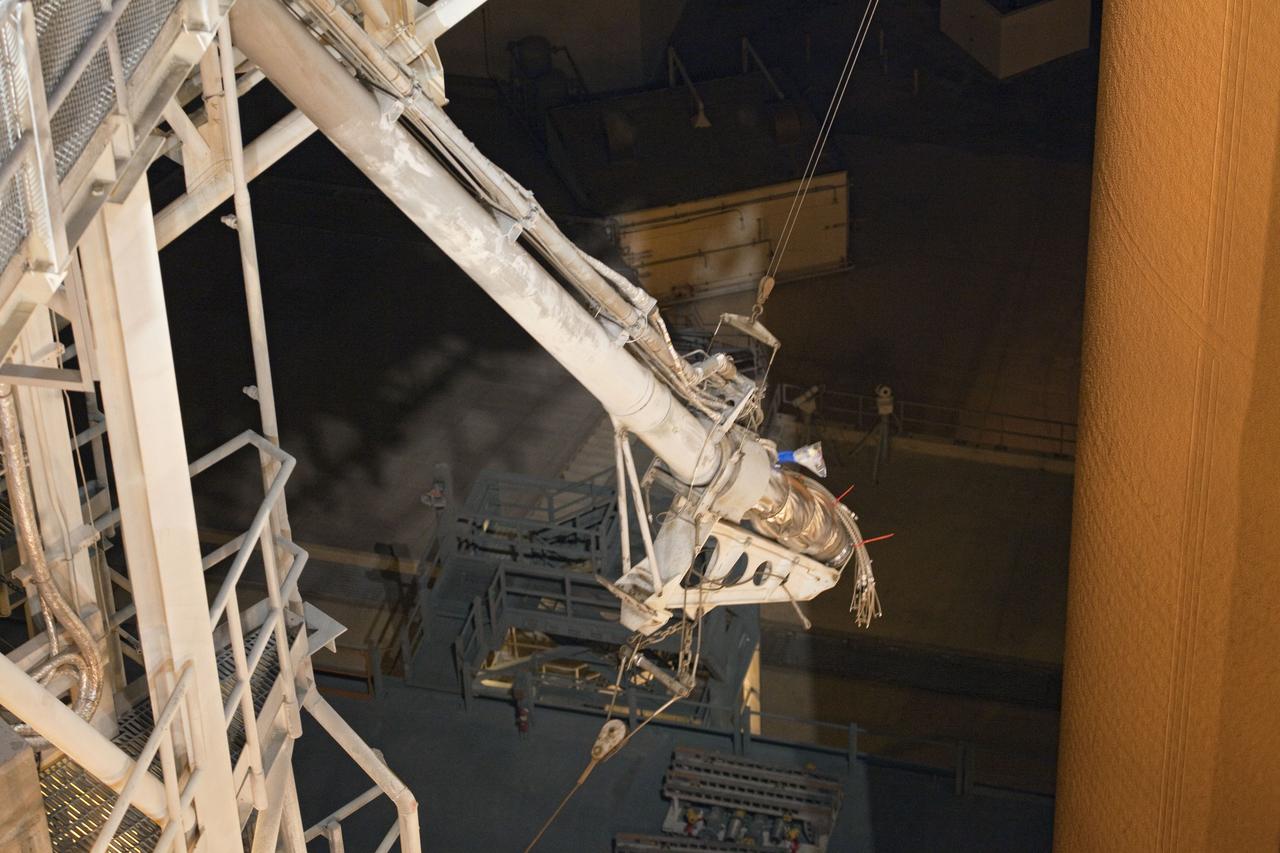
CAPE CANAVERAL, Fla. -- On Launch Pad 39A at NASA's Kennedy Space Center in Florida, the vent line is detached from the ground umbilical carrier plate (GUCP) on the bright-orange external fuel tank. Next, the GUCP's 7-inch quick disconnect will be removed. A hydrogen gas leak at that location during tanking for space shuttle Discovery's STS-133 mission to the International Space Station caused the launch attempt to be scrubbed Nov. 5. The GUCP will be examined to determine the cause of the hydrogen leak and then repaired. The GUCP is the overboard vent to the pad and the flame stack where the vented hydrogen is burned off. Discovery's next launch attempt is no earlier than Nov. 30 at 4:02 a.m. EST. For more information on STS-133, visit www.nasa.gov/mission_pages/shuttle/shuttlemissions/sts133/. Photo credit: NASA/Frankie Martin
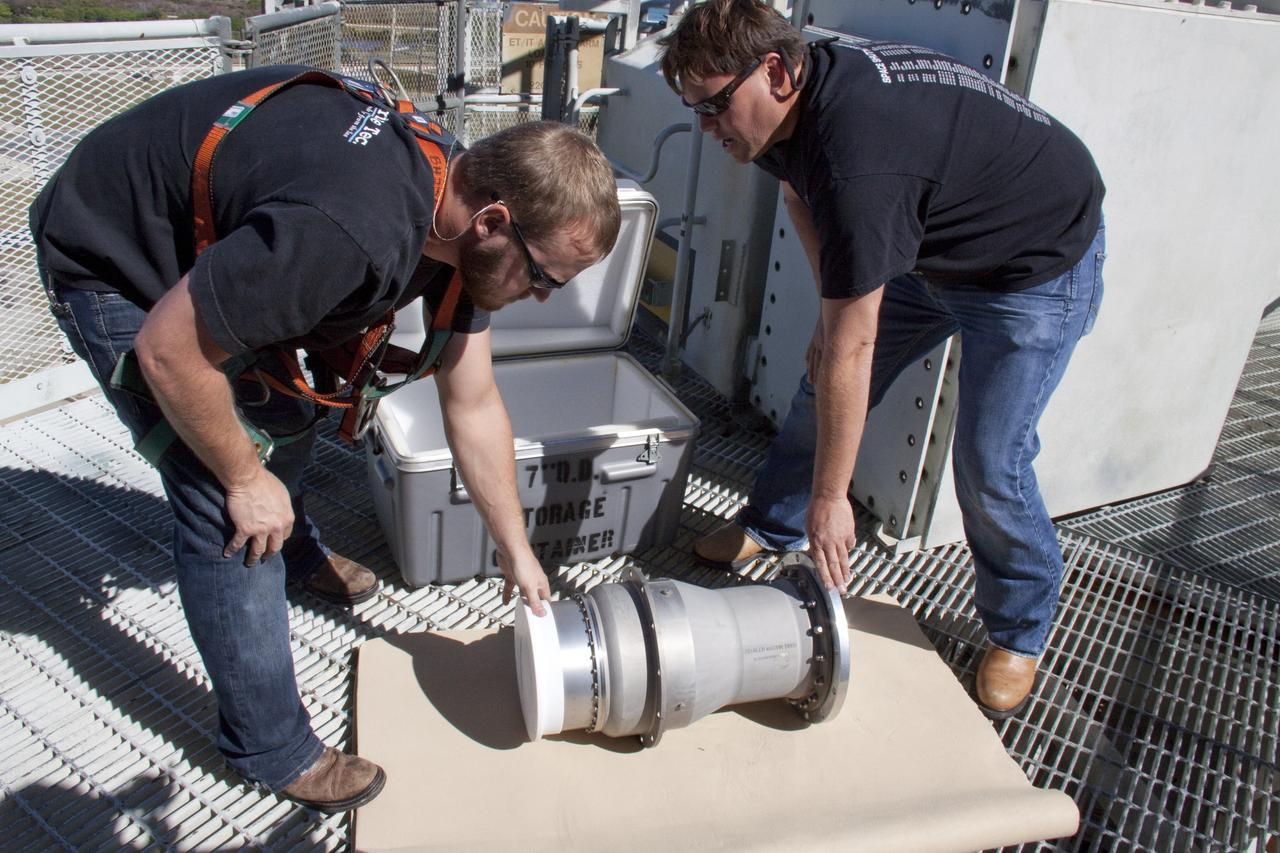
CAPE CANAVERAL, Fla. -- On Launch Pad 39A at NASA's Kennedy Space Center in Florida, workers take photos of the ground umbilical carrier plate's (GUCP) 7-inch quick disconnect, which has been removed from the external fuel tank. A hydrogen gas leak at that location during tanking for space shuttle Discovery's STS-133 mission to the International Space Station caused the launch attempt to be scrubbed Nov. 5. The GUCP will be examined to determine the cause of the hydrogen leak and then repaired. The GUCP is the overboard vent to the pad and the flame stack where the vented hydrogen is burned off. Discovery's next launch attempt is no earlier than Nov. 30 at 4:02 a.m. EST. For more information on STS-133, visit www.nasa.gov/mission_pages/shuttle/shuttlemissions/sts133/. Photo credit: NASA/Troy Cryder
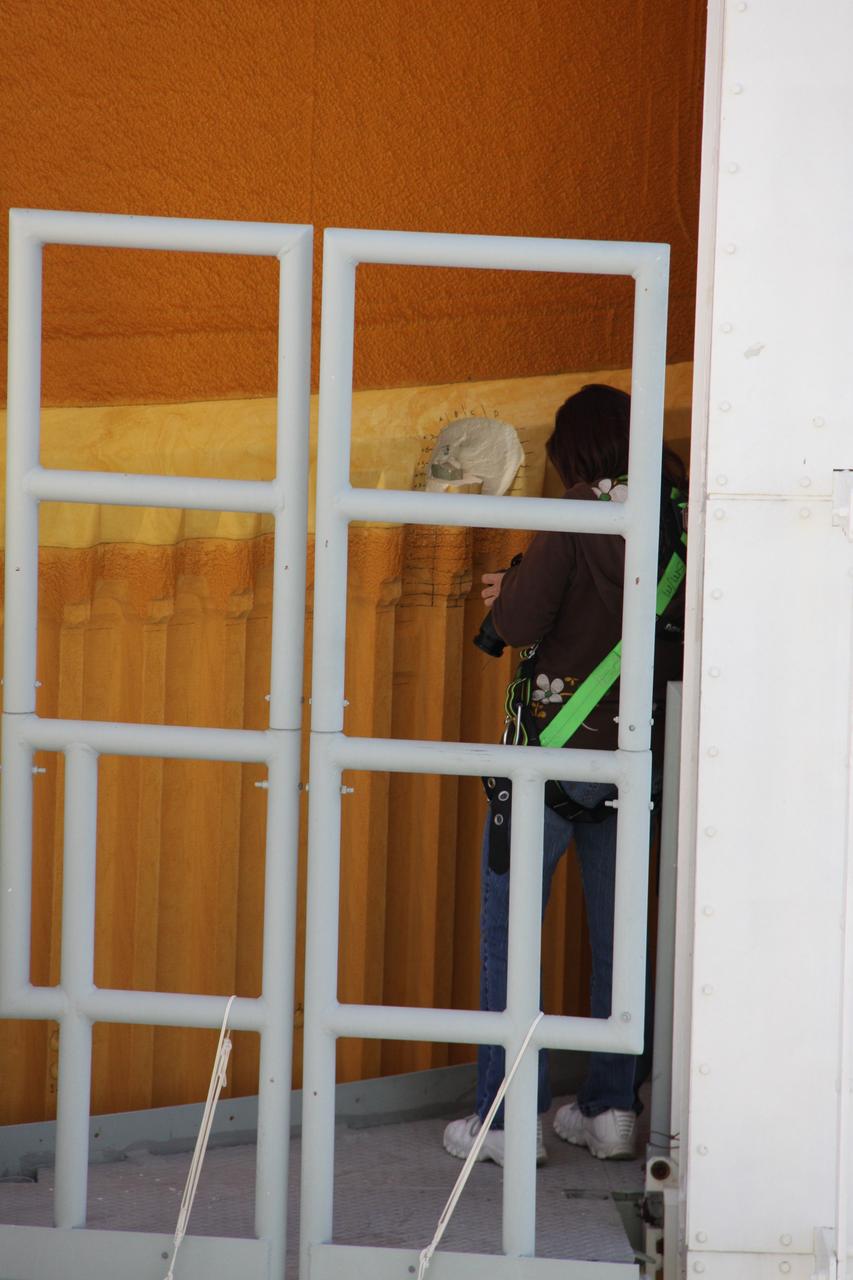
CAPE CANAVERAL, Fla. -- On Launch Pad 39A at NASA's Kennedy Space Center in Florida, a worker examines the foam insulation on space shuttle Discovery's external fuel tank. Two cracks on a section of the tank’s metal exterior were found on one of the stringers, which are the composite aluminum ribs located vertically on the tank’s intertank area. Engineers will review images of the cracks to determine the best possible repair method. Discovery's next launch attempt is no earlier than Nov. 30 at 4:02 a.m. EST. For more information on STS-133, visit www.nasa.gov/mission_pages/shuttle/shuttlemissions/sts133/. Photo credit: NASA/Troy Cryder

CAPE CANAVERAL, Fla. -- At NASA's Kennedy Space Center in Florida, a left-side main separation bolt attaches the bottom of space shuttle Discovery to its external fuel tank in the Vehicle Assembly Building. As technicians were attaching the bolt Sept. 10, a bolt nut slipped back into Discovery's aft compartment. To retrieve it, technicians entered Discovery’s aft section through an access door. They then moved the nut back into position to finish attaching the bolt, which is used to separate Discovery from the external tank once the shuttle is in orbit. Discovery is scheduled to roll out to Launch Pad 39A later this month for its STS-133 launch to the International Space Station. Targeted to lift off Nov. 1, Discovery will take the Permanent Multipurpose Module (PMM) packed with supplies and critical spare parts, as well as Robonaut 2 (R2) to the station. Photo credit: NASA/Dimitri Gerondidakis
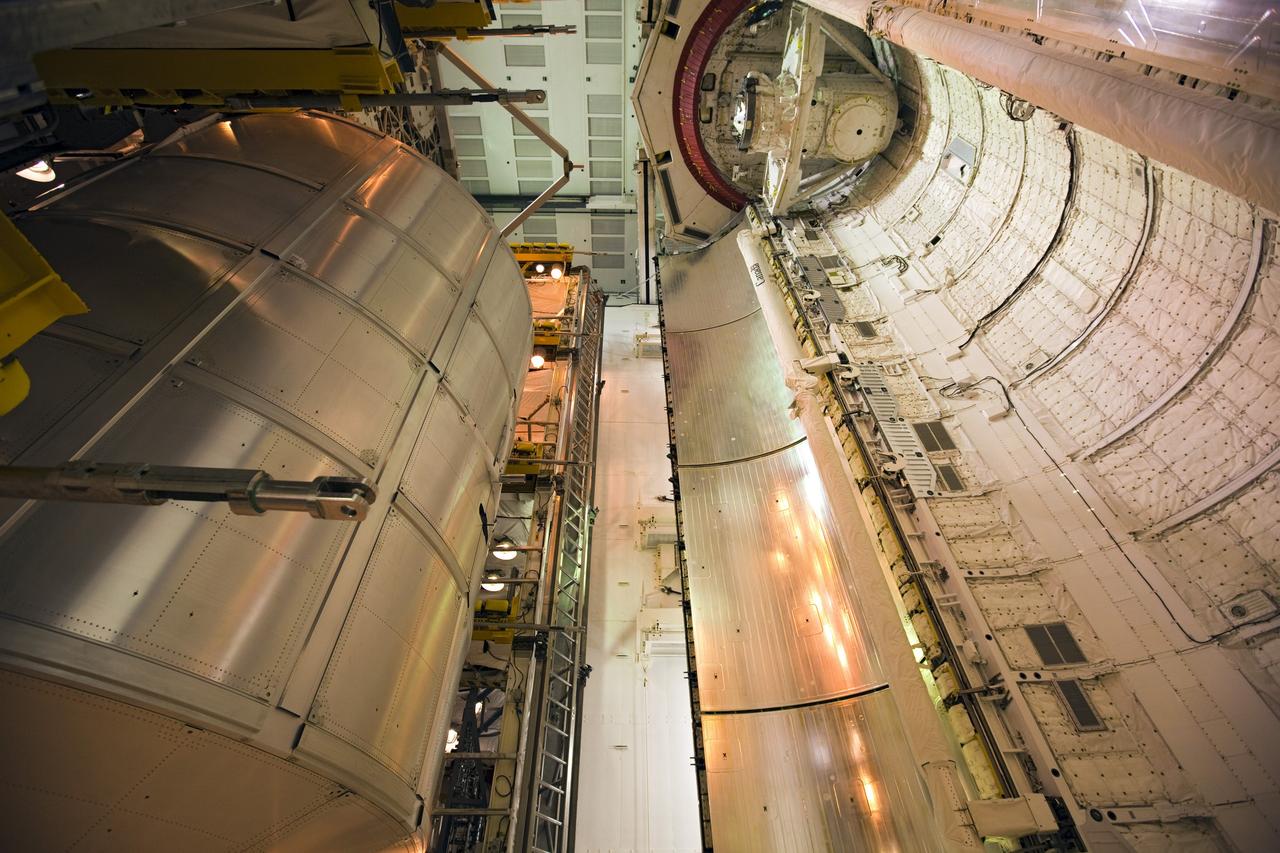
CAPE CANAVERAL, Fla. -- At NASA's Kennedy Space Center in Florida, technicians prepare to move the STS-133 payload from the rotating service structure on Launch Pad 39A to space shuttle Discovery's payload bay. The move paves the way for the Terminal Countdown Demonstration Test (TCDT) this week, which will give the astronauts and teams at Kennedy and NASA's Johnson Space Center in Houston a chance to practice launch day tasks. Discovery and its STS-133 crew will deliver the Permanent Multipurpose Module, packed with supplies and critical spare parts, as well as Robonaut 2, the dexterous humanoid astronaut helper, to the International Space Station. Launch is targeted for 4:40 p.m. EDT, Nov. 1. Photo credit: NASA/Dimitri Gerondidakis

CAPE CANAVERAL, Fla. -- At NASA's Kennedy Space Center in Florida, a dexterous humanoid astronaut helper, known as Robonaut, demonstrates its talents to media. Robonaut 2 (R2) will be delivered to the International Space Station on space shuttle Discovery's STS-133 mission. Although R2 will initially only participate in operational tests, upgrades could eventually allow the robot to realize its true purpose -- helping spacewalking astronauts with tasks outside the orbiting laboratory. For more information on the upcoming STS-133 mission, visit www.nasa.gov/mission_pages/shuttle/shuttlemissions/sts133/. Photo credit: NASA/Jack Pfaller
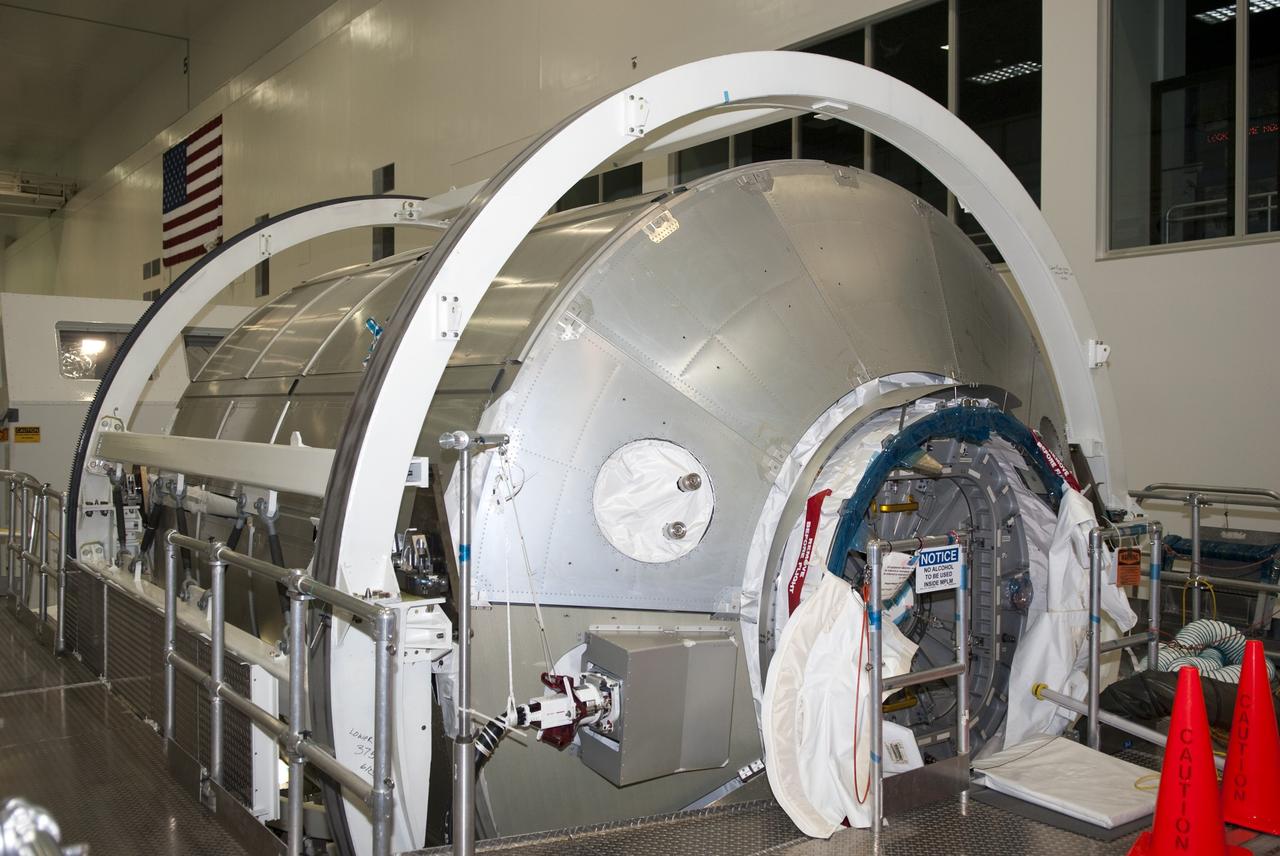
CAPE CANAVERAL, Fla. -- Inside the Space Station Processing Facility at NASA's Kennedy Space Center in Florida, the hatch of the Permanent Multipurpose Module (PMM) is closed in preparation for space shuttle Discovery's STS-133 mission to the International Space Station. Robonaut 2 (R2) and critical spare parts are packed inside the PMM, which will be left aboard the station on Discovery's final mission. Targeted to launch Nov. 1 at 4:40 p.m. EDT, Discovery and its crew also will carry Express Logistics Carrier-4 (ELC-4), which is filled with external payloads and experiments. For more information visit, www.nasa.gov/shuttle. Photo credit: NASA/Jim Grossmann
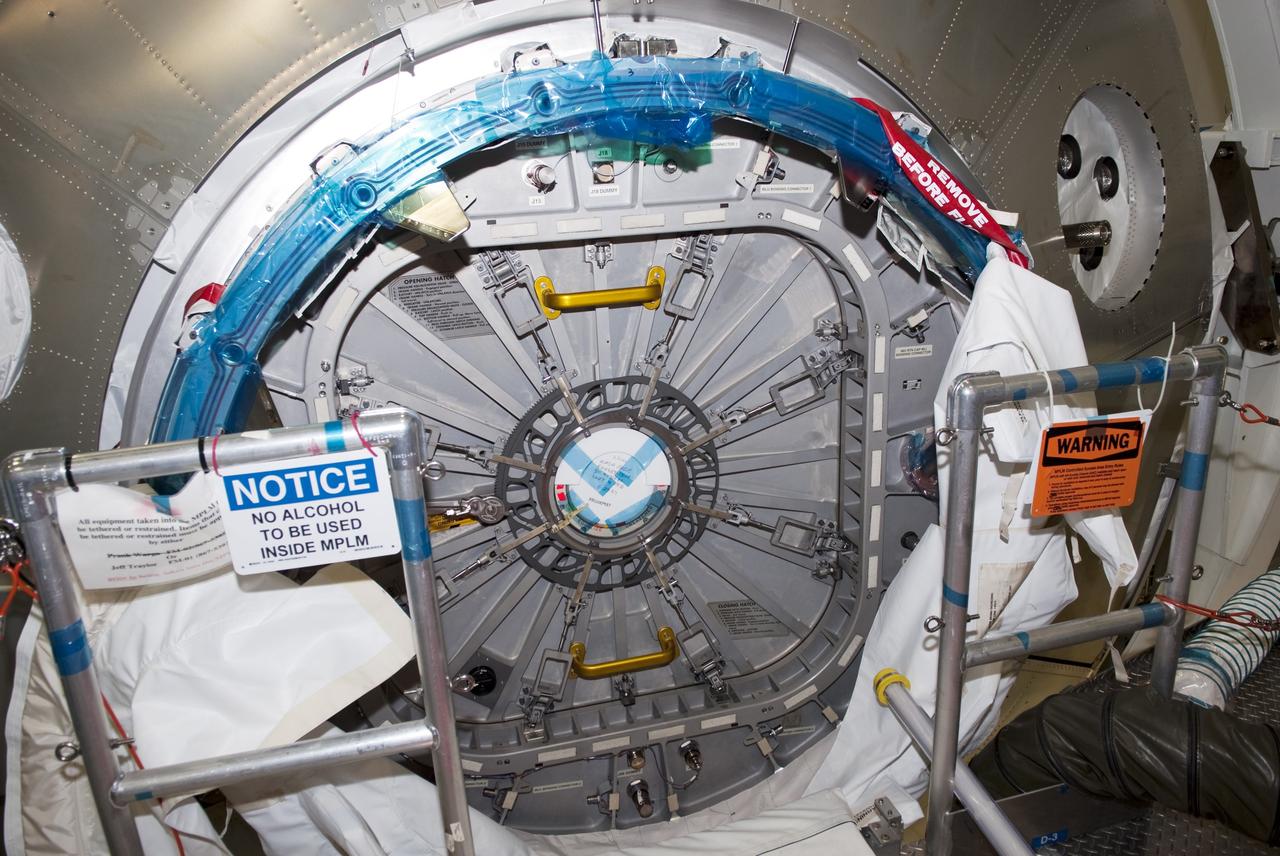
CAPE CANAVERAL, Fla. -- Inside the Space Station Processing Facility at NASA's Kennedy Space Center in Florida, the hatch of the Permanent Multipurpose Module (PMM) is closed in preparation for space shuttle Discovery's STS-133 mission to the International Space Station. Robonaut 2 (R2) and critical spare parts are packed inside the PMM, which will be left aboard the station on Discovery's final mission. Targeted to launch Nov. 1 at 4:40 p.m. EDT, Discovery and its crew also will carry Express Logistics Carrier-4 (ELC-4), which is filled with external payloads and experiments. For more information visit, www.nasa.gov/shuttle. Photo credit: NASA/Jim Grossmann
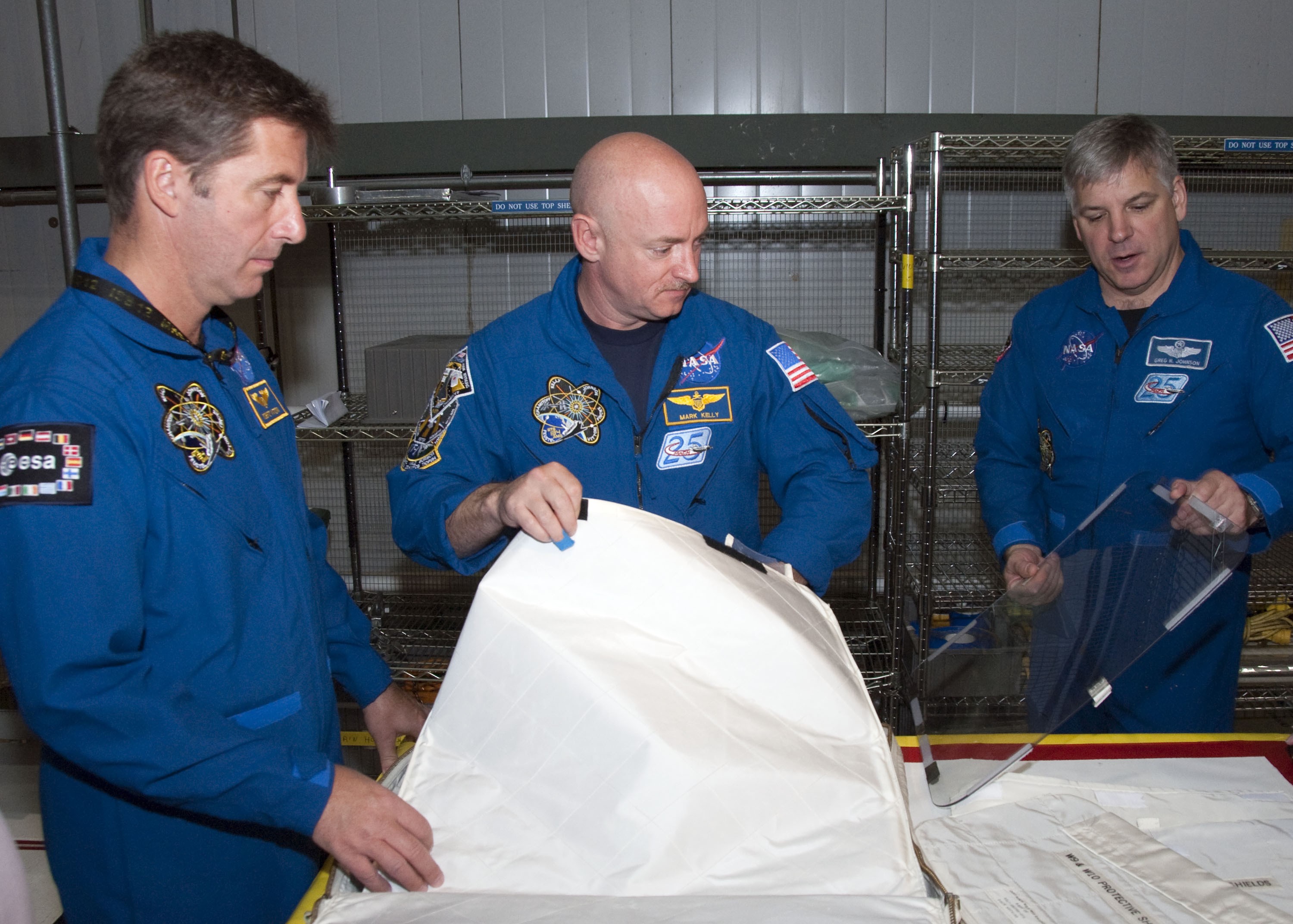
CAPE CANAVERAL, Fla. -- In the Orbiter Processing Facility-2 at NASA's Kennedy Space Center in Florida, STS-134 Mission Specialist Roberto Vittori with the European Space Agency, left, Commander Mark Kelly and Pilot Gregory H. Johnson check out tools and equipment they'll be using in space. The six STS-134 astronauts are at Kennedy participating in the Crew Equipment Interface Test (CEIT), which gives them an opportunity for hands-on training and familiarization of the payload they'll be delivering to the International Space Station. Space shuttle Endeavour is targeted to launch on the STS-134 mission Feb. 27, 2011. For more information, visit www.nasa.gov/mission_pages/shuttle/shuttlemissions/sts134/index.html. Photo credit: NASA/Cory Huston
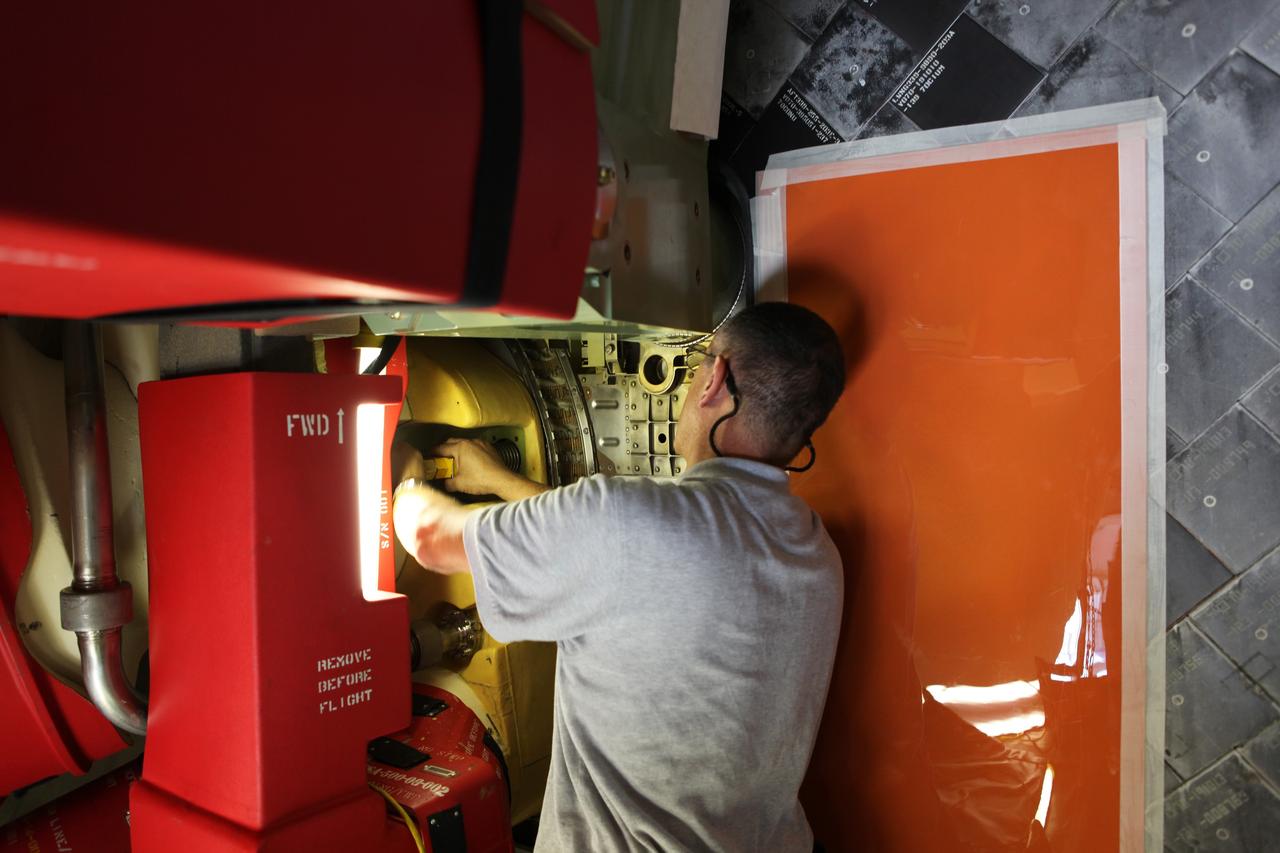
CAPE CANAVERAL, Fla. -- At NASA's Kennedy Space Center in Florida, a Vehicle Assembly Building technician adjusts a left-side main separation bolt that attaches the bottom of space shuttle Discovery to its external fuel tank. As technicians were attaching the bolt Sept. 10, a bolt nut slipped back into Discovery's aft compartment. To retrieve it, technicians entered Discovery’s aft section through an access door. They then moved the nut back into position to finish attaching the bolt, which is used to separate Discovery from the external tank once the shuttle is in orbit. Discovery is scheduled to roll out to Launch Pad 39A later this month for its STS-133 launch to the International Space Station. Targeted to lift off Nov. 1, Discovery will take the Permanent Multipurpose Module (PMM) packed with supplies and critical spare parts, as well as Robonaut 2 (R2) to the station. Photo credit: NASA/Dimitri Gerondidakis
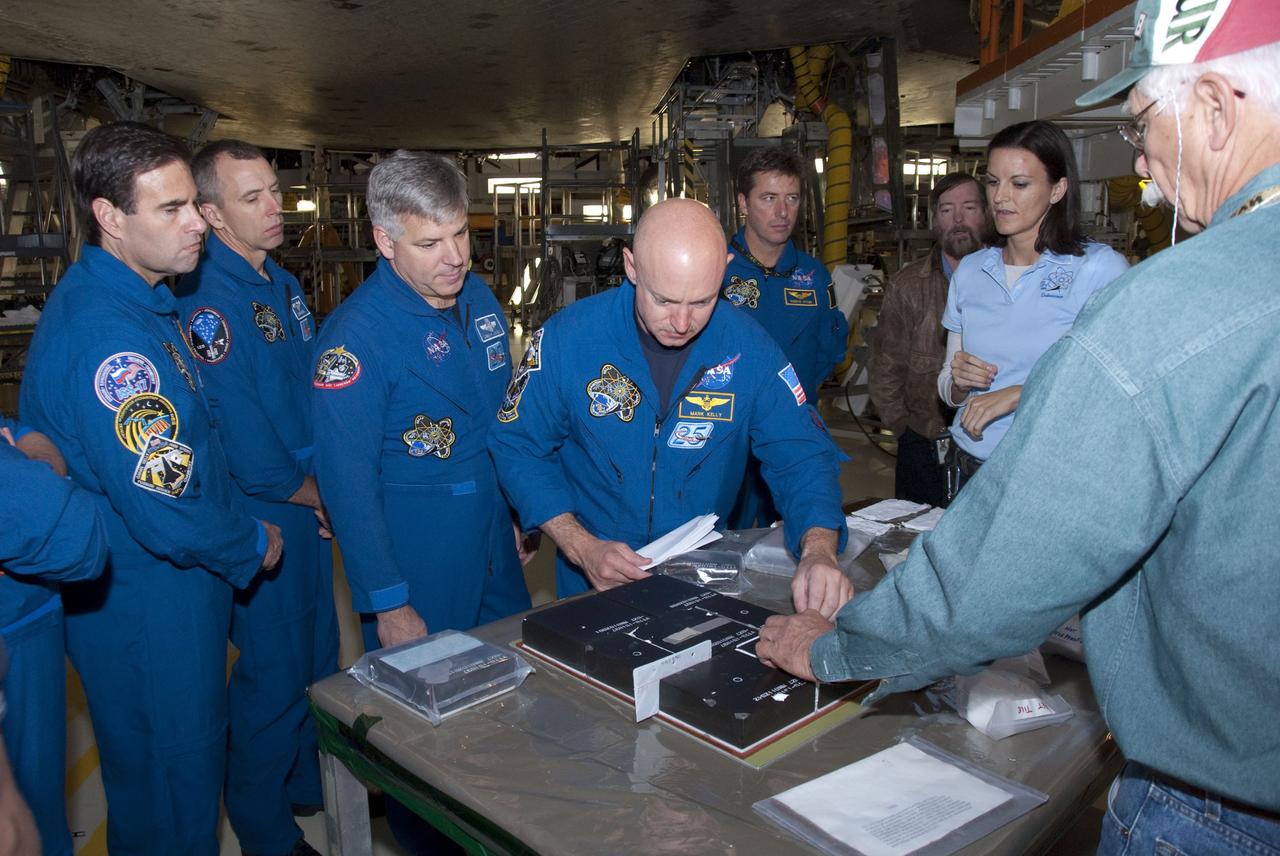
CAPE CANAVERAL, Fla. -- In the Orbiter Processing Facility-2 at NASA's Kennedy Space Center in Florida, the STS-134 crew checks out the heat shield tiles that protect space shuttles during re-entry. From left, are Mission Specialists Greg Chamitoff and Andrew Feustel, Pilot Gregory H. Johnson, Commander Mark Kelly and Mission Specialist Roberto Vittori of the European Space Agency. The six STS-134 astronauts are at Kennedy participating in the Crew Equipment Interface Test (CEIT), which gives them an opportunity for hands-on training with the tools and equipment they'll use in space and familiarization of the payload they'll be delivering to the International Space Station. Space shuttle Endeavour is targeted to launch on the STS-134 mission Feb. 27, 2011. For more information, visit www.nasa.gov/mission_pages/shuttle/shuttlemissions/sts134/index.html. Photo credit: NASA/Cory Huston
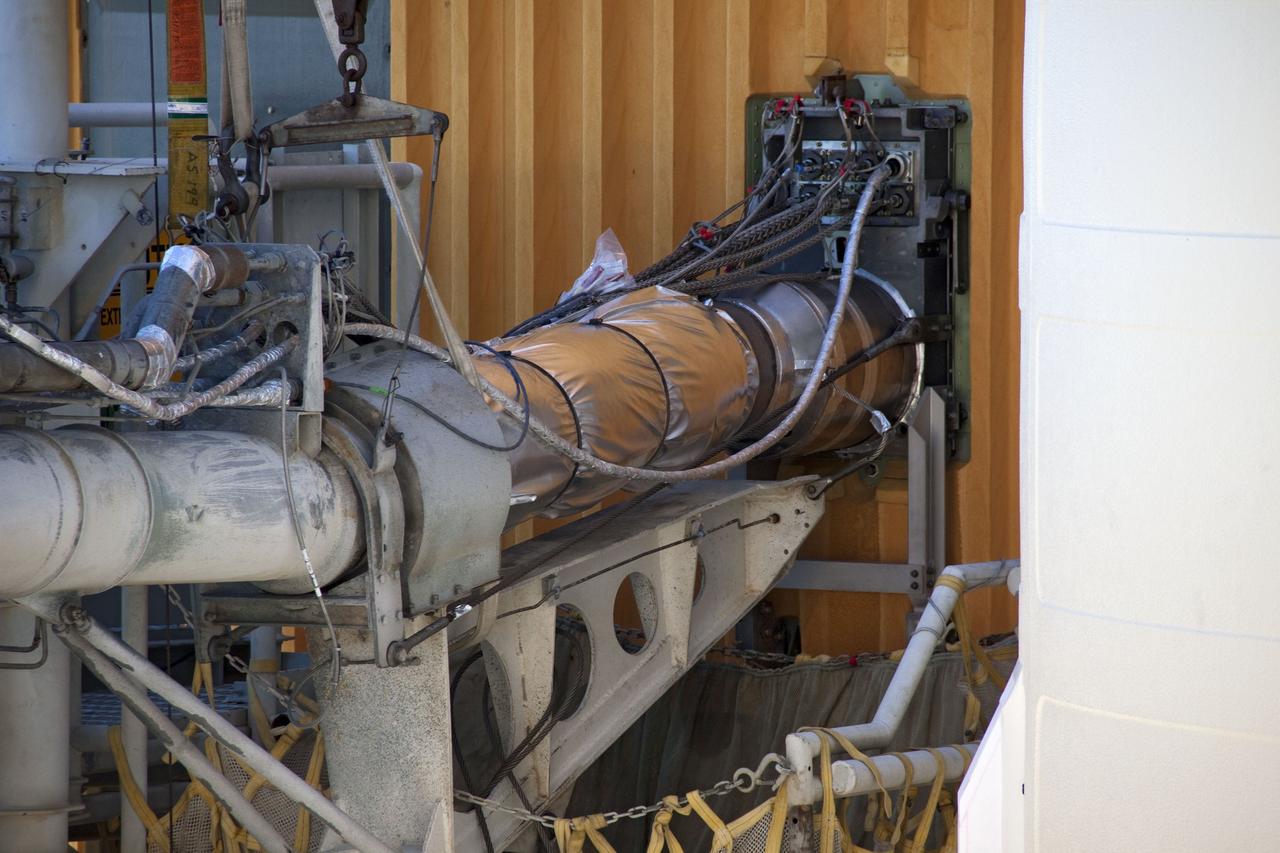
CAPE CANAVERAL, Fla. -- On Launch Pad 39A at NASA's Kennedy Space Center in Florida, the tip-top of the bright-orange external fuel tank is where workers will prepare to begin removing the quick disconnect from the ground umbilical carrier plate (GUCP). A hydrogen gas leak at that location during tanking for space shuttle Discovery's STS-133 mission to the International Space Station caused the launch attempt to be scrubbed Nov. 5. The GUCP will be examined to determine the cause of the hydrogen leak and then repaired. The GUCP is the overboard vent to the pad and the flame stack where the vented hydrogen is burned off. Discovery's next launch attempt is targeted for no earlier than Nov. 30 at 4:02 a.m. EST. For more information on STS-133, visit www.nasa.gov/mission_pages/shuttle/shuttlemissions/sts133/. Photo credit: NASA/Troy Cryder
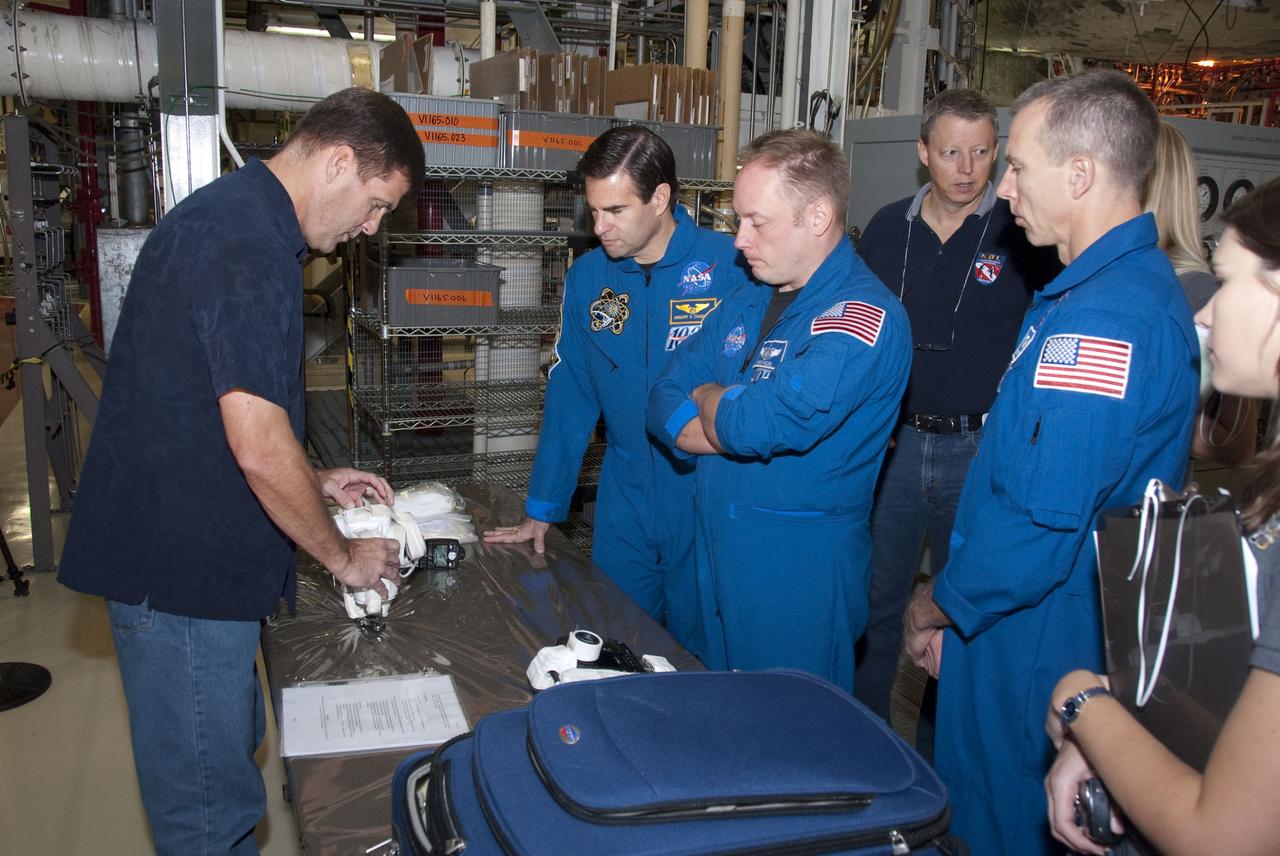
CAPE CANAVERAL, Fla. -- In the Orbiter Processing Facility-2 at NASA's Kennedy Space Center in Florida, STS-134 Mission Specialists Greg Chamitoff, left, Michael Finke and Andrew Feustel check out the camera they'll be snapping photos with in space. The six STS-134 astronauts are at Kennedy participating in the Crew Equipment Interface Test (CEIT), which gives them an opportunity for hands-on training and familiarization of the payload they'll be delivering to the International Space Station. Space shuttle Endeavour is targeted to launch on the STS-134 mission Feb. 27, 2011. For more information, visit www.nasa.gov/mission_pages/shuttle/shuttlemissions/sts134/index.html. Photo credit: NASA/Cory Huston
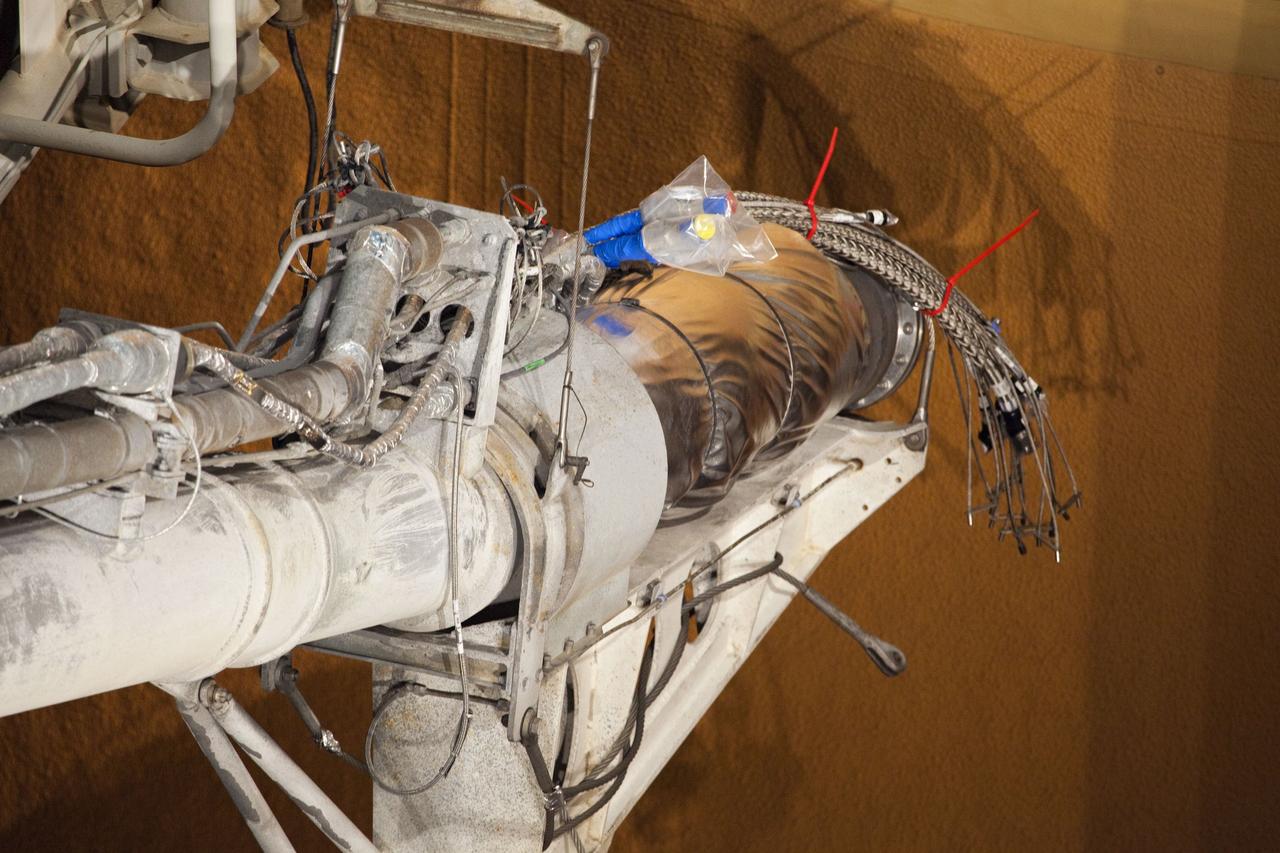
CAPE CANAVERAL, Fla. -- On Launch Pad 39A at NASA's Kennedy Space Center in Florida, the vent line is detached from the ground umbilical carrier plate (GUCP) on the bright-orange external fuel tank. Next, the GUCP's 7-inch quick disconnect will be removed. A hydrogen gas leak at that location during tanking for space shuttle Discovery's STS-133 mission to the International Space Station caused the launch attempt to be scrubbed Nov. 5. The GUCP will be examined to determine the cause of the hydrogen leak and then repaired. The GUCP is the overboard vent to the pad and the flame stack where the vented hydrogen is burned off. Discovery's next launch attempt is no earlier than Nov. 30 at 4:02 a.m. EST. For more information on STS-133, visit www.nasa.gov/mission_pages/shuttle/shuttlemissions/sts133/. Photo credit: NASA/Frankie Martin
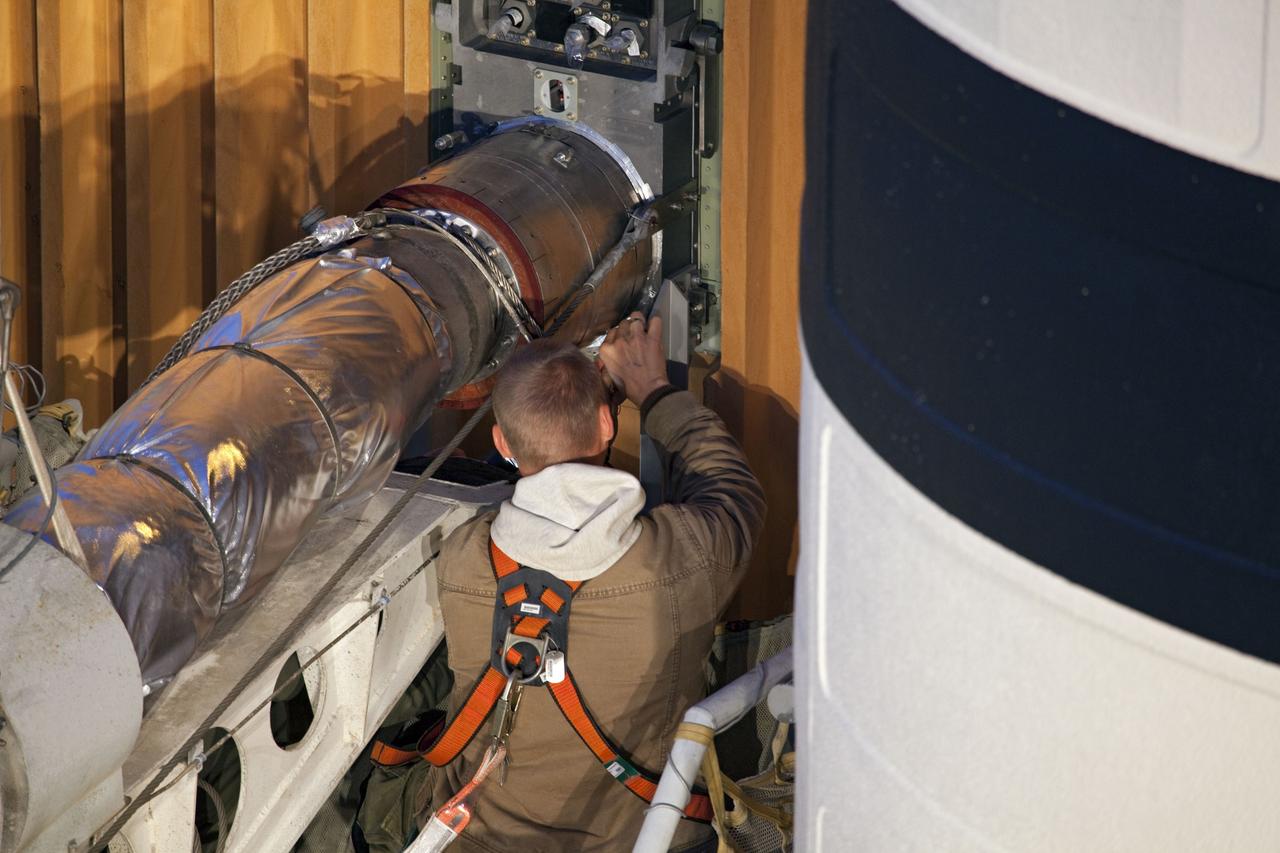
CAPE CANAVERAL, Fla. -- On Launch Pad 39A at NASA's Kennedy Space Center in Florida, a worker begins to remove the vent line attached to the ground umbilical carrier plate (GUCP) on the bright-orange external fuel tank. Next, the GUCP's 7-inch quick disconnect will be removed. A hydrogen gas leak at that location during tanking for space shuttle Discovery's STS-133 mission to the International Space Station caused the launch attempt to be scrubbed Nov. 5. The GUCP will be examined to determine the cause of the hydrogen leak and then repaired. The GUCP is the overboard vent to the pad and the flame stack where the vented hydrogen is burned off. Discovery's next launch attempt is no earlier than Nov. 30 at 4:02 a.m. EST. For more information on STS-133, visit www.nasa.gov/mission_pages/shuttle/shuttlemissions/sts133/. Photo credit: NASA/Frankie Martin
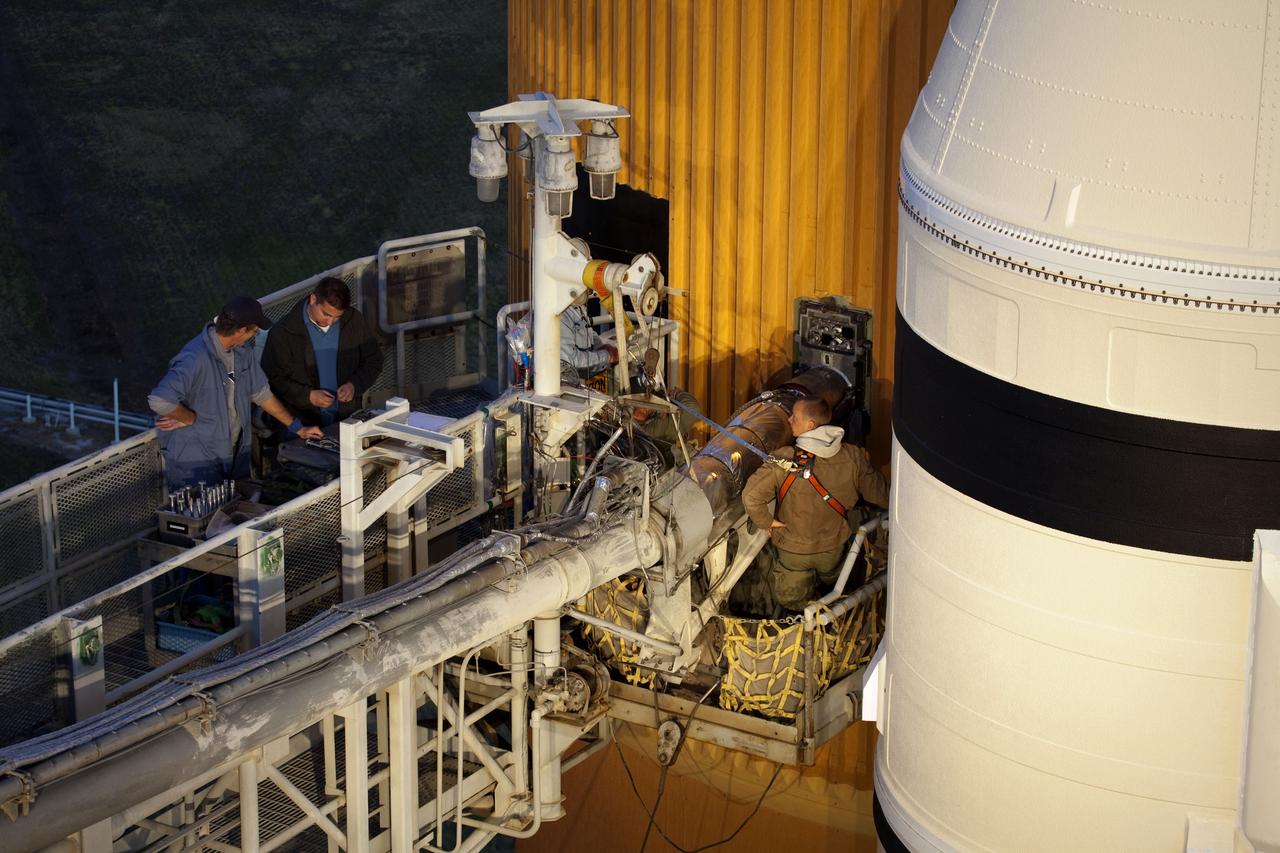
CAPE CANAVERAL, Fla. -- On Launch Pad 39A at NASA's Kennedy Space Center in Florida, workers begin to remove the vent line attached to the ground umbilical carrier plate (GUCP) on the bright-orange external fuel tank. Next, the GUCP's 7-inch quick disconnect will be removed. A hydrogen gas leak at that location during tanking for space shuttle Discovery's STS-133 mission to the International Space Station caused the launch attempt to be scrubbed Nov. 5. The GUCP will be examined to determine the cause of the hydrogen leak and then repaired. The GUCP is the overboard vent to the pad and the flame stack where the vented hydrogen is burned off. Discovery's next launch attempt is no earlier than Nov. 30 at 4:02 a.m. EST. For more information on STS-133, visit www.nasa.gov/mission_pages/shuttle/shuttlemissions/sts133/. Photo credit: NASA/Frankie Martin
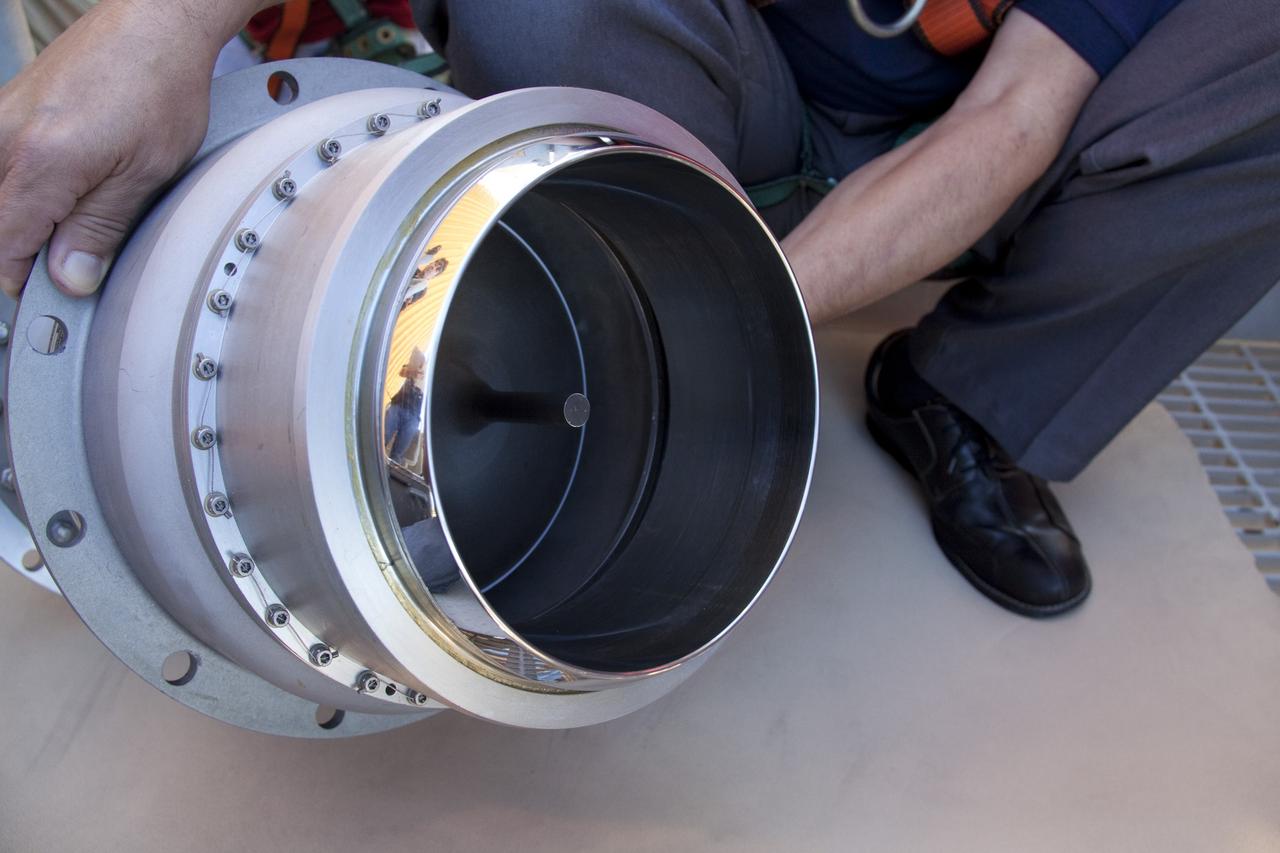
CAPE CANAVERAL, Fla. -- On Launch Pad 39A at NASA's Kennedy Space Center in Florida, the ground umbilical carrier plate's (GUCP) 7-inch quick disconnect has been removed from the external fuel tank. A hydrogen gas leak at that location during tanking for space shuttle Discovery's STS-133 mission to the International Space Station caused the launch attempt to be scrubbed Nov. 5. The GUCP will be examined to determine the cause of the hydrogen leak and then repaired. The GUCP is the overboard vent to the pad and the flame stack where the vented hydrogen is burned off. Discovery's next launch attempt is no earlier than Nov. 30 at 4:02 a.m. EST. For more information on STS-133, visit www.nasa.gov/mission_pages/shuttle/shuttlemissions/sts133/. Photo credit: NASA/Troy Cryder
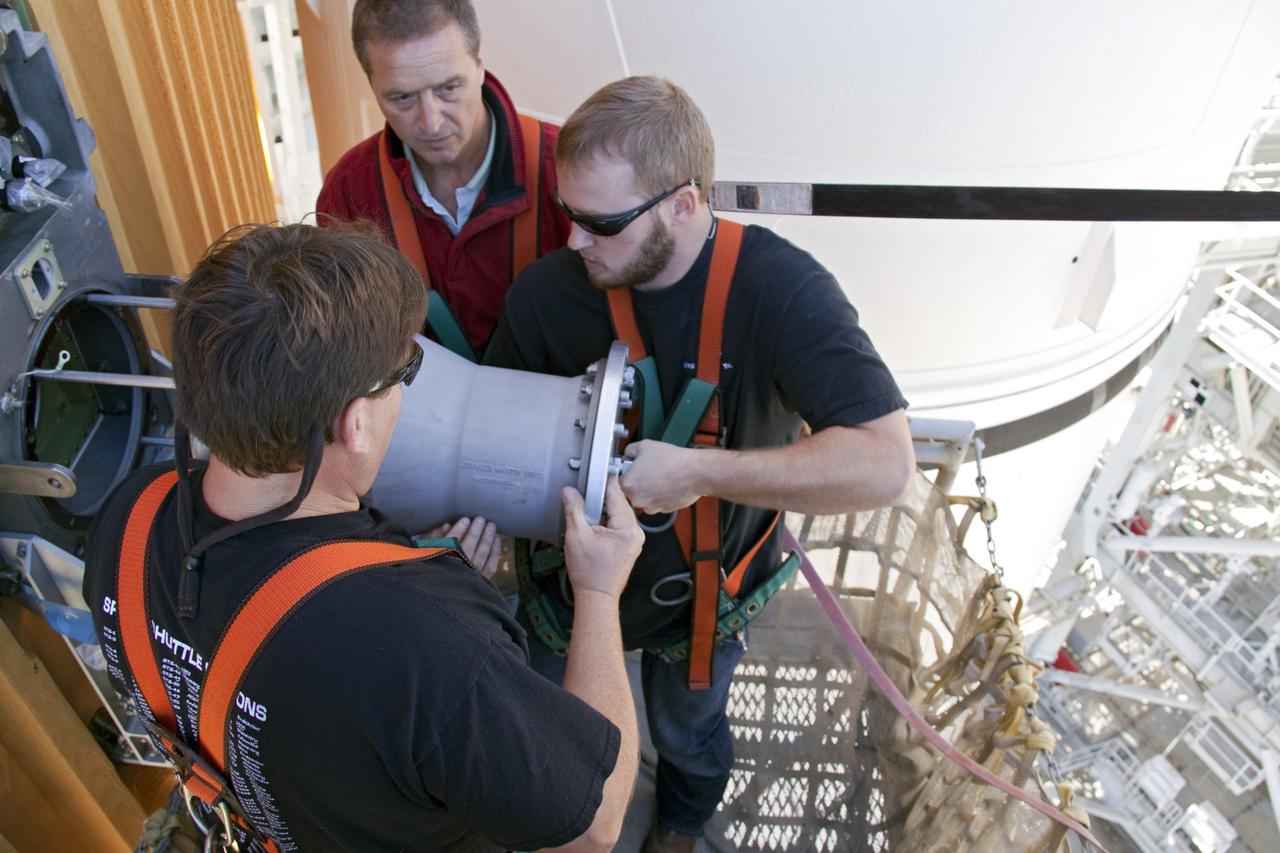
CAPE CANAVERAL, Fla. -- On Launch Pad 39A at NASA's Kennedy Space Center in Florida, workers remove the ground umbilical carrier plate's (GUCP) 7-inch quick disconnect. A hydrogen gas leak at that location on the external fuel tank during tanking for space shuttle Discovery's STS-133 mission to the International Space Station caused the launch attempt to be scrubbed Nov. 5. The GUCP will be examined to determine the cause of the hydrogen leak and then repaired. The GUCP is the overboard vent to the pad and the flame stack where the vented hydrogen is burned off. Discovery's next launch attempt is no earlier than Nov. 30 at 4:02 a.m. EST. For more information on STS-133, visit www.nasa.gov/mission_pages/shuttle/shuttlemissions/sts133/. Photo credit: NASA/Troy Cryder
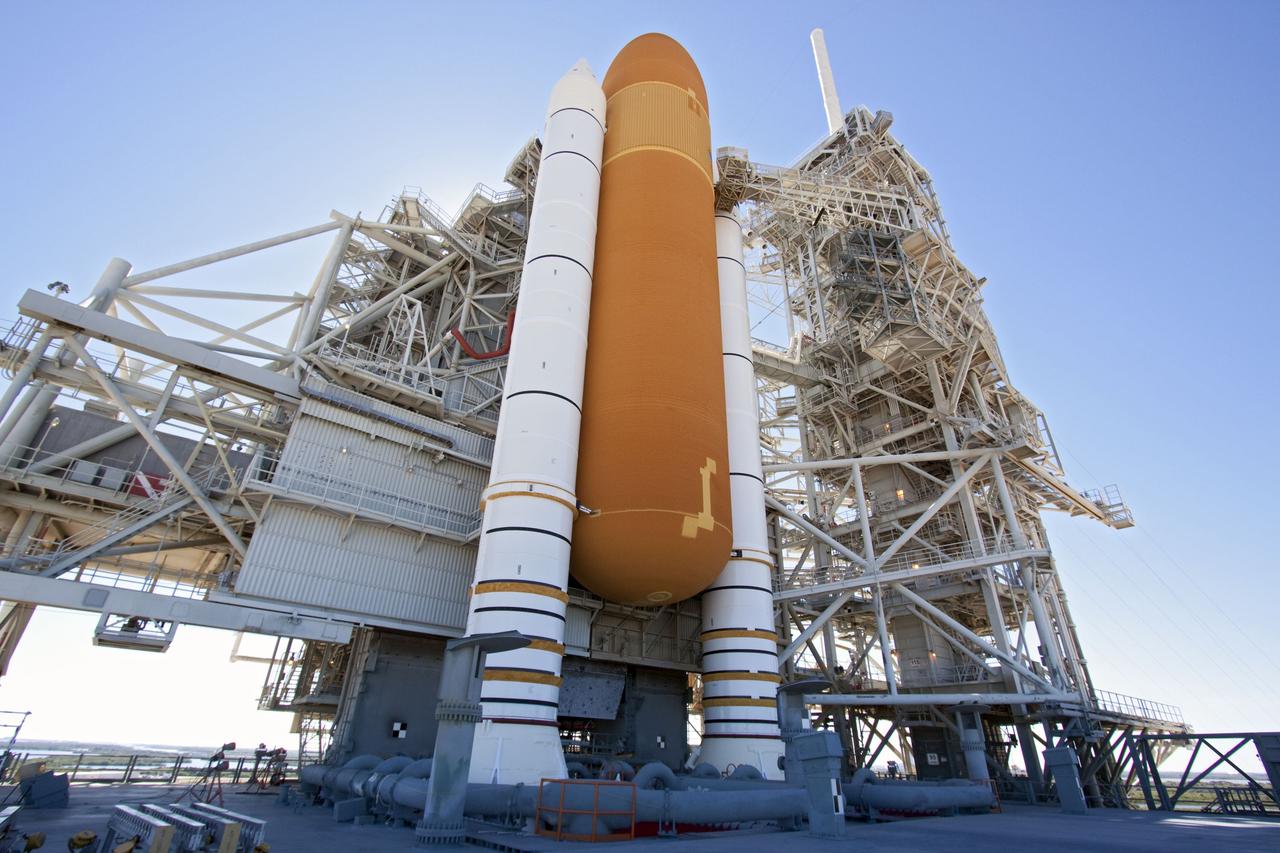
CAPE CANAVERAL, Fla. -- On Launch Pad 39A at NASA's Kennedy Space Center in Florida, the tip-top of the bright-orange external fuel tank is where workers will prepare to begin removing the quick disconnect from the ground umbilical carrier plate (GUCP). A hydrogen gas leak at that location during tanking for space shuttle Discovery's STS-133 mission to the International Space Station caused the launch attempt to be scrubbed Nov. 5. The GUCP will be examined to determine the cause of the hydrogen leak and then repaired. The GUCP is the overboard vent to the pad and the flame stack where the vented hydrogen is burned off. Discovery's next launch attempt is targeted for no earlier than Nov. 30 at 4:02 a.m. EST. For more information on STS-133, visit www.nasa.gov/mission_pages/shuttle/shuttlemissions/sts133/. Photo credit: NASA/Troy Cryder

CAPE CANAVERAL, Fla. -- On Launch Pad 39A at NASA's Kennedy Space Center in Florida, the tip-top of the bright-orange external fuel tank is where workers will prepare to begin removing the quick disconnect from the ground umbilical carrier plate (GUCP). A hydrogen gas leak at that location during tanking for space shuttle Discovery's STS-133 mission to the International Space Station caused the launch attempt to be scrubbed Nov. 5. The GUCP will be examined to determine the cause of the hydrogen leak and then repaired. The GUCP is the overboard vent to the pad and the flame stack where the vented hydrogen is burned off. Discovery's next launch attempt is targeted for no earlier than Nov. 30 at 4:02 a.m. EST. For more information on STS-133, visit www.nasa.gov/mission_pages/shuttle/shuttlemissions/sts133/. Photo credit: NASA/Troy Cryder
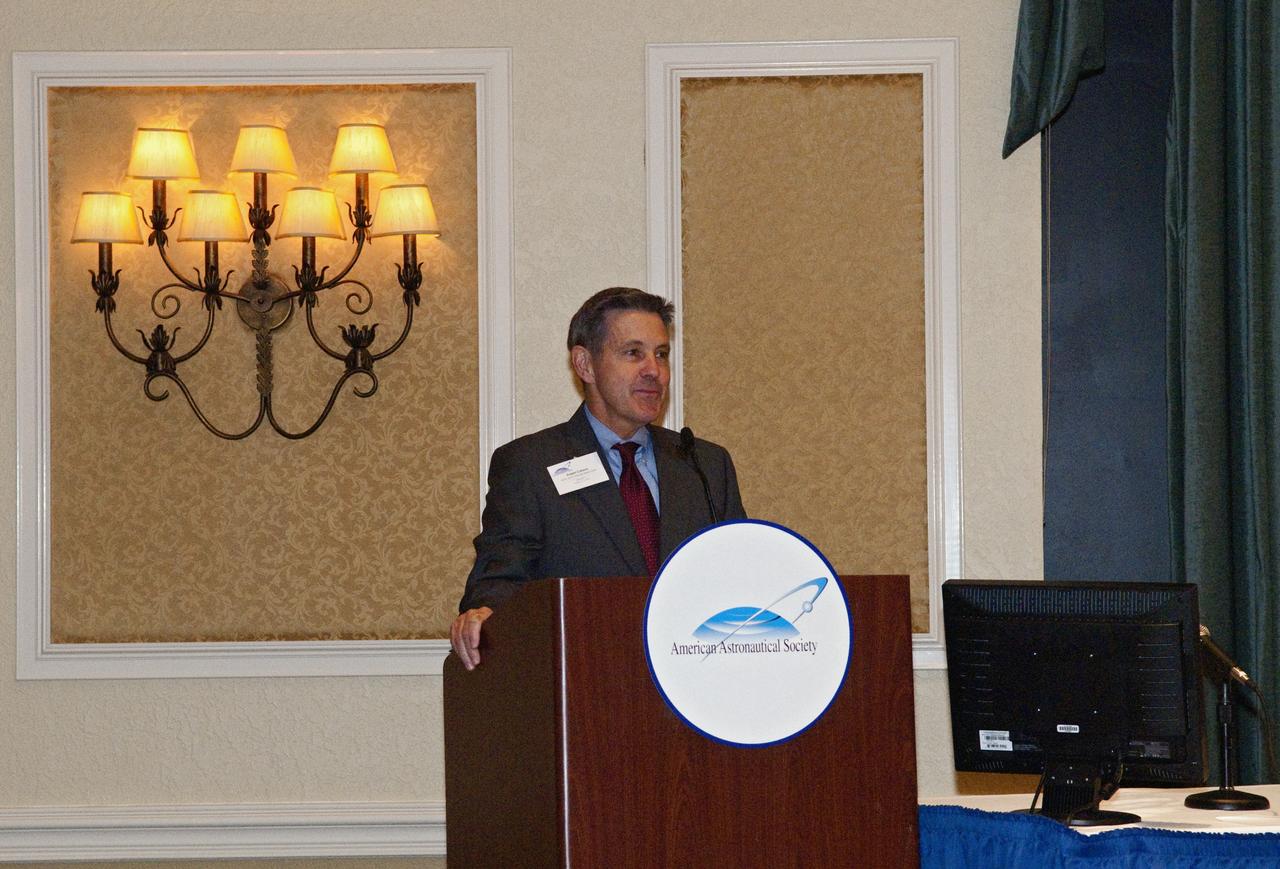
CAPE CANAVERAL, Fla. -- NASA Kennedy Space Center Director Bob Cabana addresses attendees of the American Astronautical Society's 2010 National Conference at the Radisson Resort at the Port. The focus of the conference is the next 10 years of utilization and research aboard the International Space Station. The conference was organized with the support of Kennedy and sponsored by The Boeing Company, Honeywell International Inc., Northrop Grumman Corp., Space Florida and the Universities Space Research Association (USRA). Photo credit: NASA/Jim Grossmann
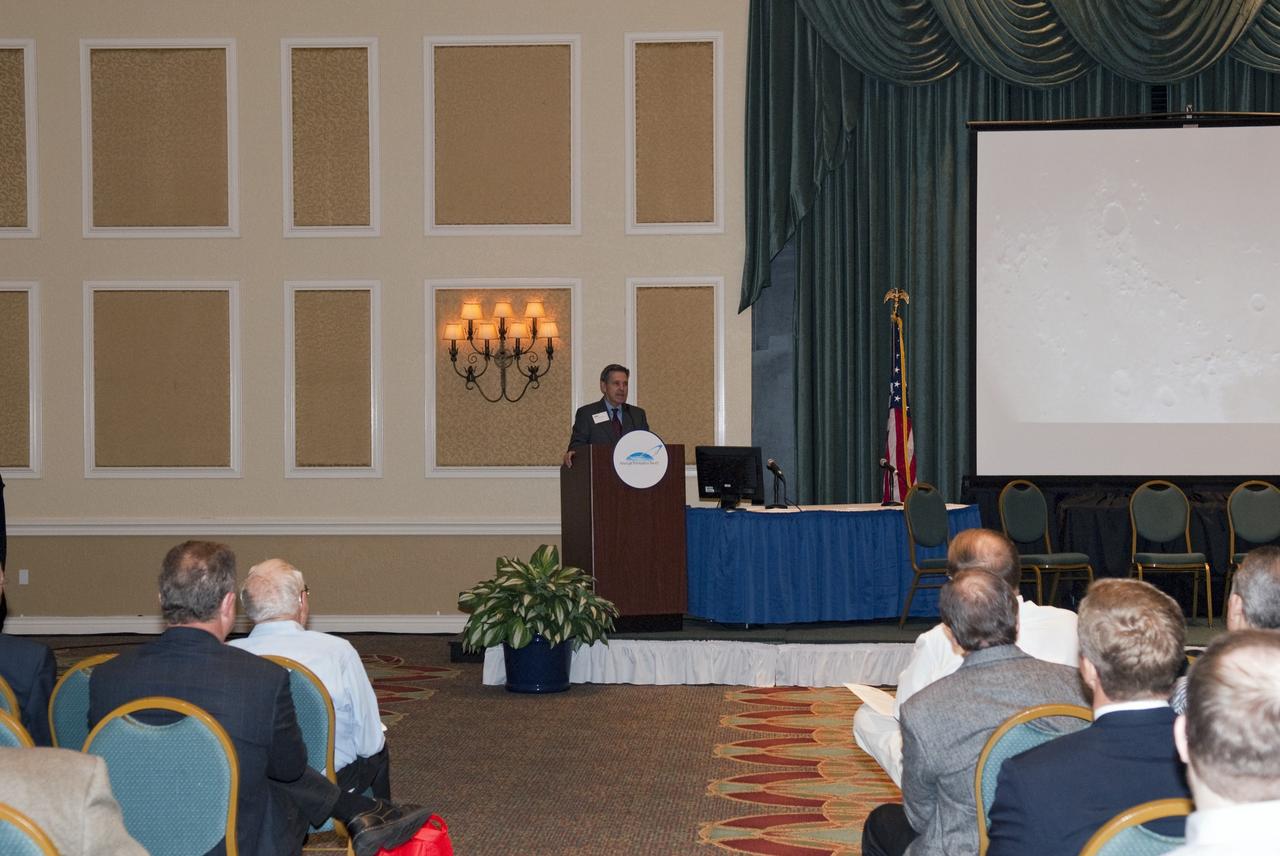
CAPE CANAVERAL, Fla. -- NASA Kennedy Space Center Director Bob Cabana addresses attendees of the American Astronautical Society's 2010 National Conference at the Radisson Resort at the Port. The focus of the conference is the next 10 years of utilization and research aboard the International Space Station. The conference was organized with the support of Kennedy and sponsored by The Boeing Company, Honeywell International Inc., Northrop Grumman Corp., Space Florida and the Universities Space Research Association (USRA). Photo credit: NASA/Jim Grossmann
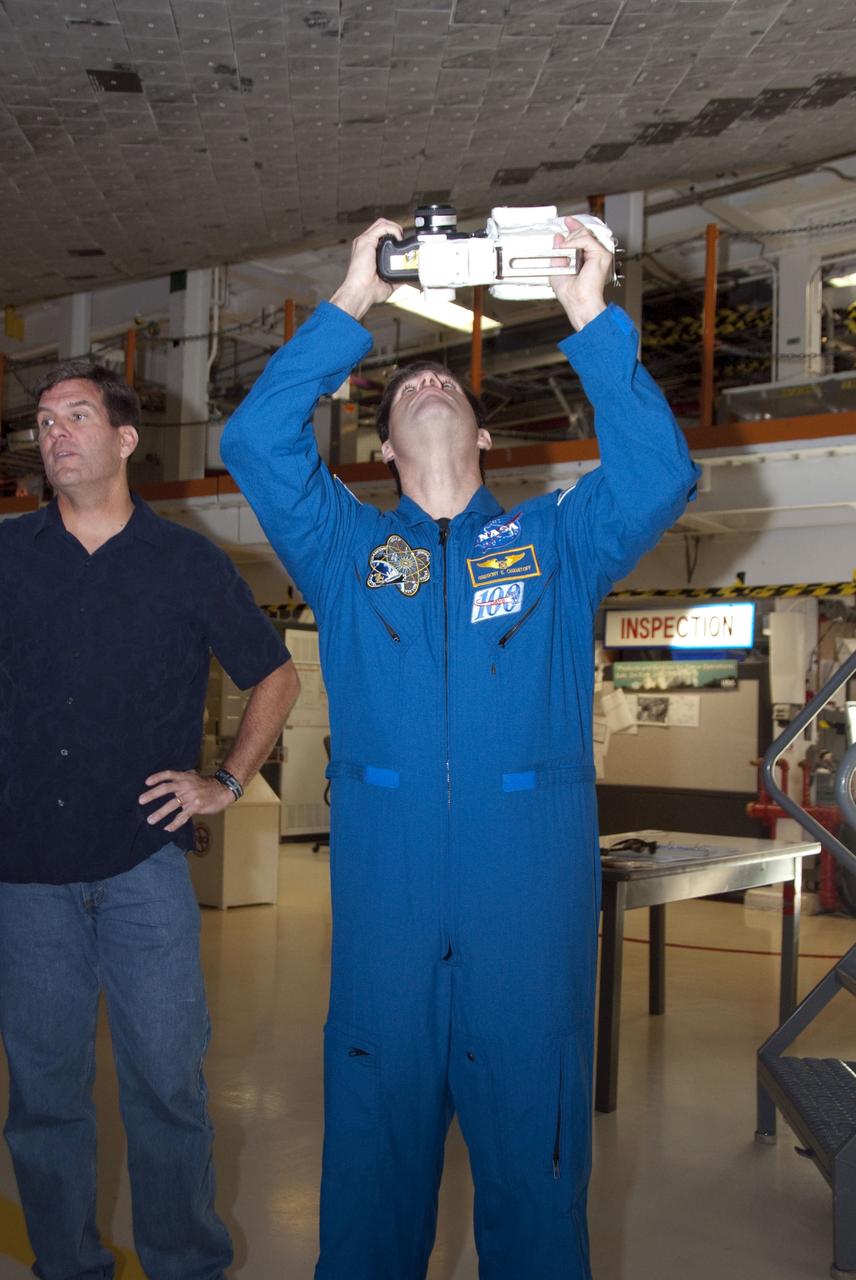
CAPE CANAVERAL, Fla. -- In the Orbiter Processing Facility-2 at NASA's Kennedy Space Center in Florida, STS-134 Mission Specialist Greg Chamitoff looks at space shuttle Endeavour's heat shield tiles, which will protect the spacecraft during re-entry. The six STS-134 astronauts are at Kennedy participating in the Crew Equipment Interface Test (CEIT), which gives them an opportunity for hands-on training and familiarization of the payload they'll be delivering to the International Space Station. Space shuttle Endeavour is targeted to launch on the STS-134 mission Feb. 27, 2011. For more information, visit www.nasa.gov/mission_pages/shuttle/shuttlemissions/sts134/index.html. Photo credit: NASA/Cory Huston
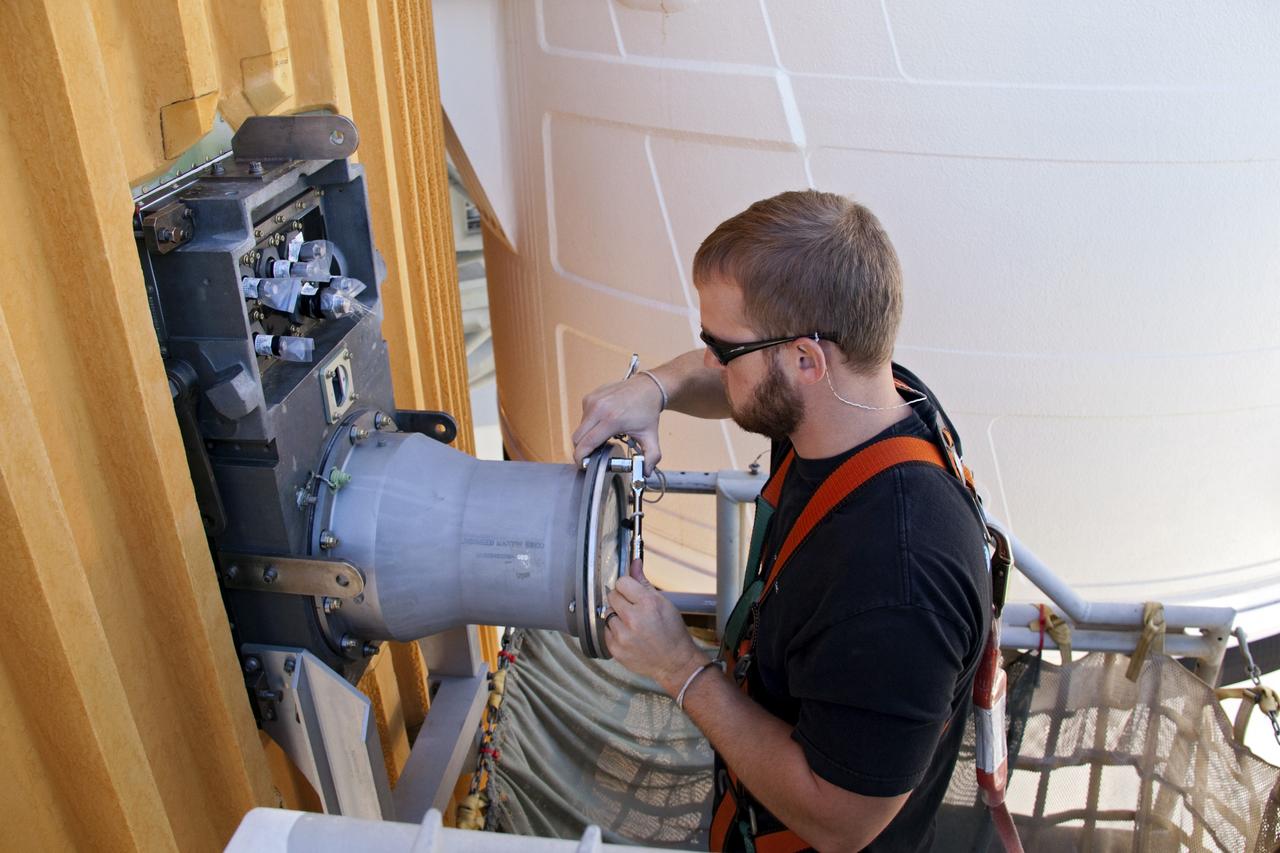
CAPE CANAVERAL, Fla. -- On Launch Pad 39A at NASA's Kennedy Space Center in Florida, a worker begins to remove the ground umbilical carrier plate's (GUCP) 7-inch quick disconnect. A hydrogen gas leak at that location on the external fuel tank during tanking for space shuttle Discovery's STS-133 mission to the International Space Station caused the launch attempt to be scrubbed Nov. 5. The GUCP will be examined to determine the cause of the hydrogen leak and then repaired. The GUCP is the overboard vent to the pad and the flame stack where the vented hydrogen is burned off. Discovery's next launch attempt is no earlier than Nov. 30 at 4:02 a.m. EST. For more information on STS-133, visit www.nasa.gov/mission_pages/shuttle/shuttlemissions/sts133/. Photo credit: NASA/Troy Cryder
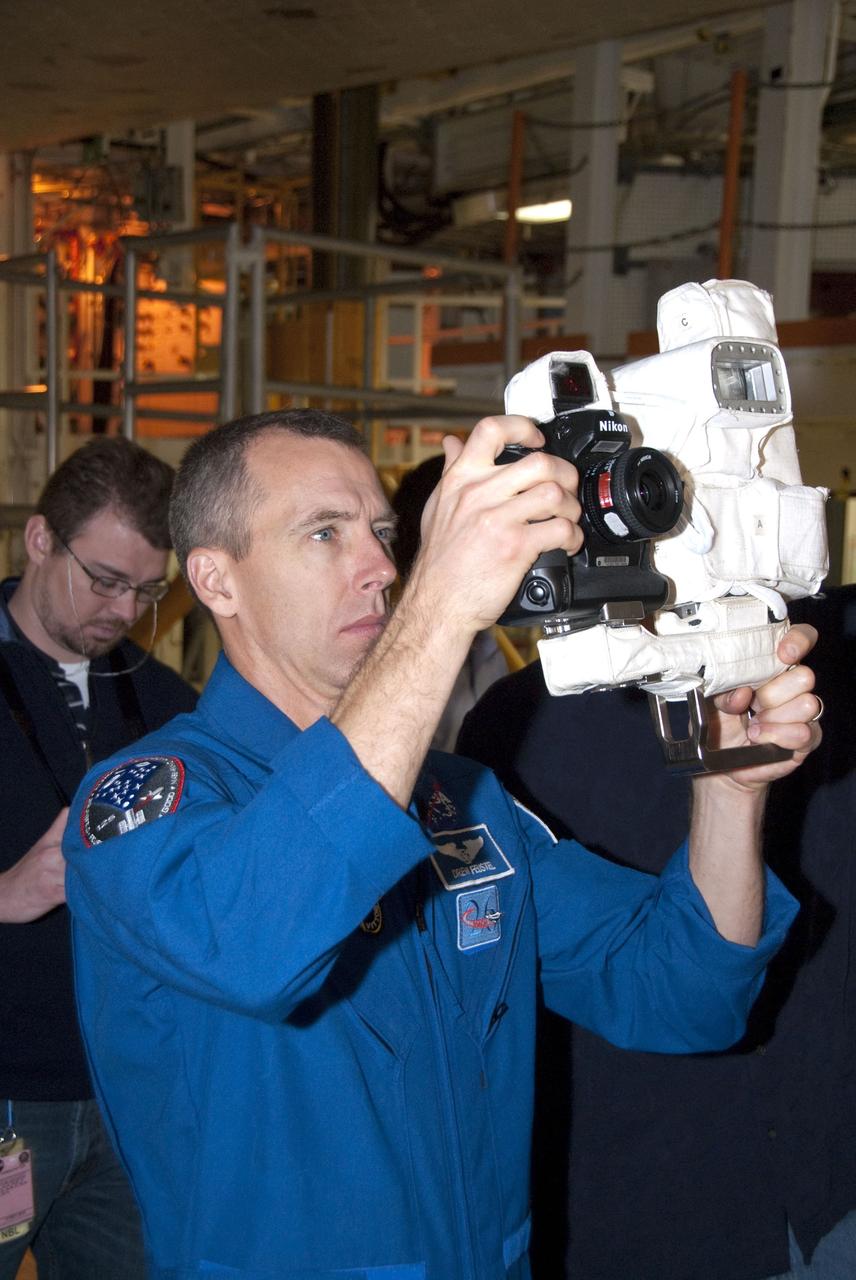
CAPE CANAVERAL, Fla. -- In the Orbiter Processing Facility-2 at NASA's Kennedy Space Center in Florida, STS-134 Mission Specialist Andrew Feustel practices using a camera he'll be snapping photos with in space. The six STS-134 astronauts are at Kennedy participating in the Crew Equipment Interface Test (CEIT), which gives them an opportunity for hands-on training and familiarization of the payload they'll be delivering to the International Space Station. Space shuttle Endeavour is targeted to launch on the STS-134 mission Feb. 27, 2011. For more information, visit www.nasa.gov/mission_pages/shuttle/shuttlemissions/sts134/index.html. Photo credit: NASA/Cory Huston

CAPE CANAVERAL, Fla. -- At NASA's Kennedy Space Center in Florida, a dexterous humanoid astronaut helper, known as Robonaut, demonstrates its talents to media with Ron Diftler, NASA's Robonaut 2 (R2) project manager. R2 will be delivered to the International Space Station on space shuttle Discovery's STS-133 mission. Although R2 will initially only participate in operational tests, upgrades could eventually allow the robot to realize its true purpose -- helping spacewalking astronauts with tasks outside the orbiting laboratory. For more information on the upcoming STS-133 mission, visit www.nasa.gov/mission_pages/shuttle/shuttlemissions/sts133/. Photo credit: NASA/Jack Pfaller
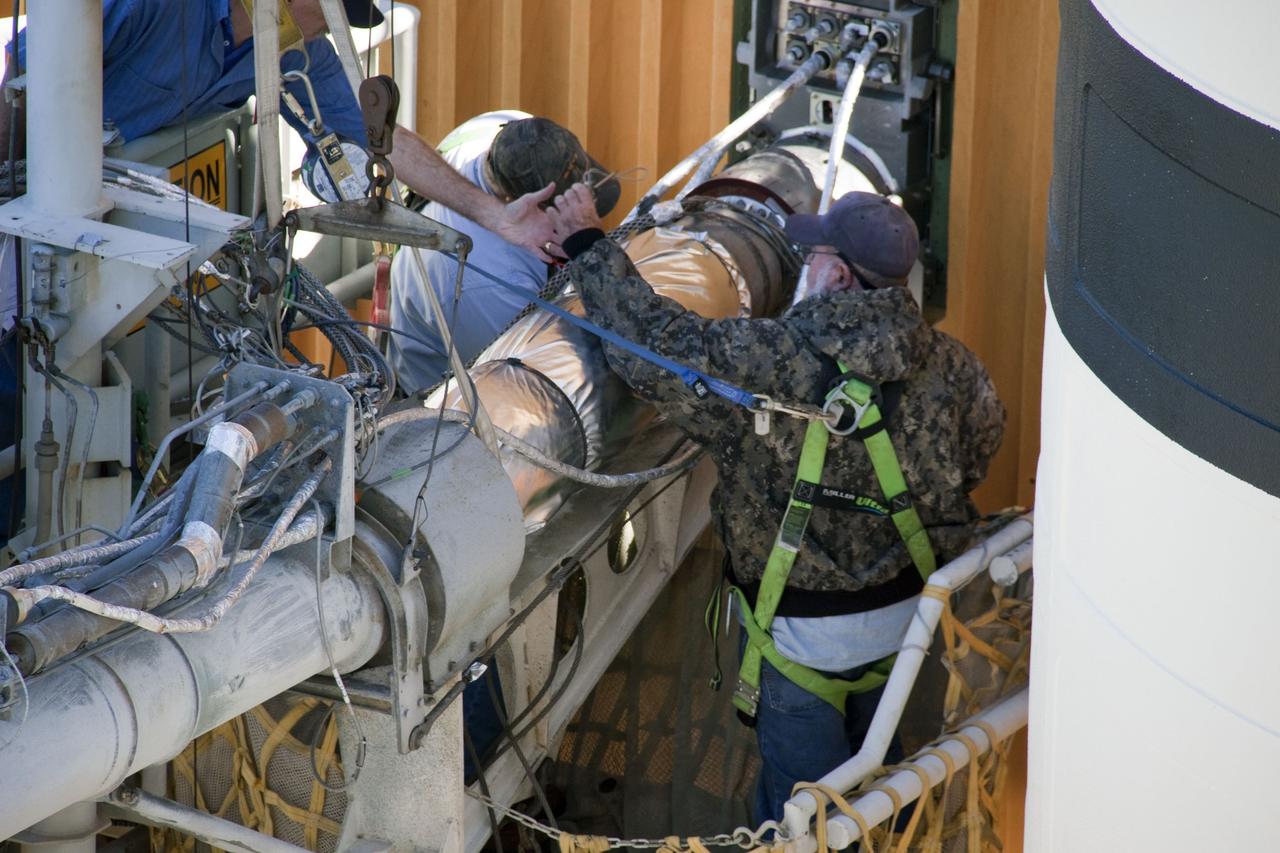
CAPE CANAVERAL, Fla. -- On Launch Pad 39A at NASA's Kennedy Space Center in Florida, workers prepare to begin removing the quick disconnect from the ground umbilical carrier plate (GUCP) on space shuttle Discovery's external fuel tank. A hydrogen gas leak at that location during tanking for the STS-133 mission to the International Space Station caused the launch attempt to be scrubbed Nov. 5. The GUCP will be examined to determine the cause of the hydrogen leak and then repaired. The GUCP is the overboard vent to the pad and the flame stack where the vented hydrogen is burned off. Discovery's next launch attempt is targeted for no earlier than Nov. 30 at 4:02 a.m. EST. For more information on STS-133, visit www.nasa.gov/mission_pages/shuttle/shuttlemissions/sts133/. Photo credit: NASA/Troy Cryder
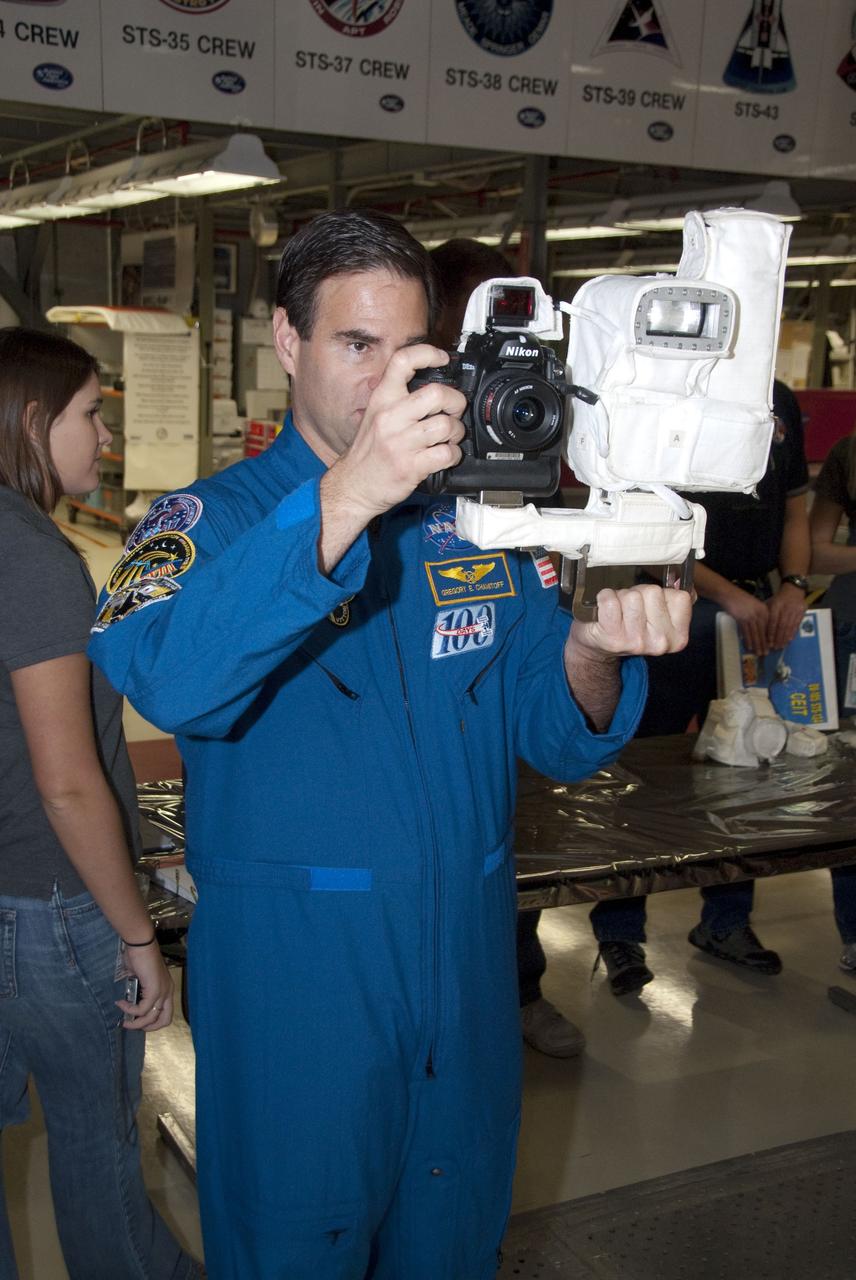
CAPE CANAVERAL, Fla. -- In the Orbiter Processing Facility-2 at NASA's Kennedy Space Center in Florida, STS-134 Mission Specialist Greg Chamitoff practices using a camera he'll be snapping photos with in space. The six STS-134 astronauts are at Kennedy participating in the Crew Equipment Interface Test (CEIT), which gives them an opportunity for hands-on training and familiarization of the payload they'll be delivering to the International Space Station. Space shuttle Endeavour is targeted to launch on the STS-134 mission Feb. 27, 2011. For more information, visit www.nasa.gov/mission_pages/shuttle/shuttlemissions/sts134/index.html. Photo credit: NASA/Cory Huston
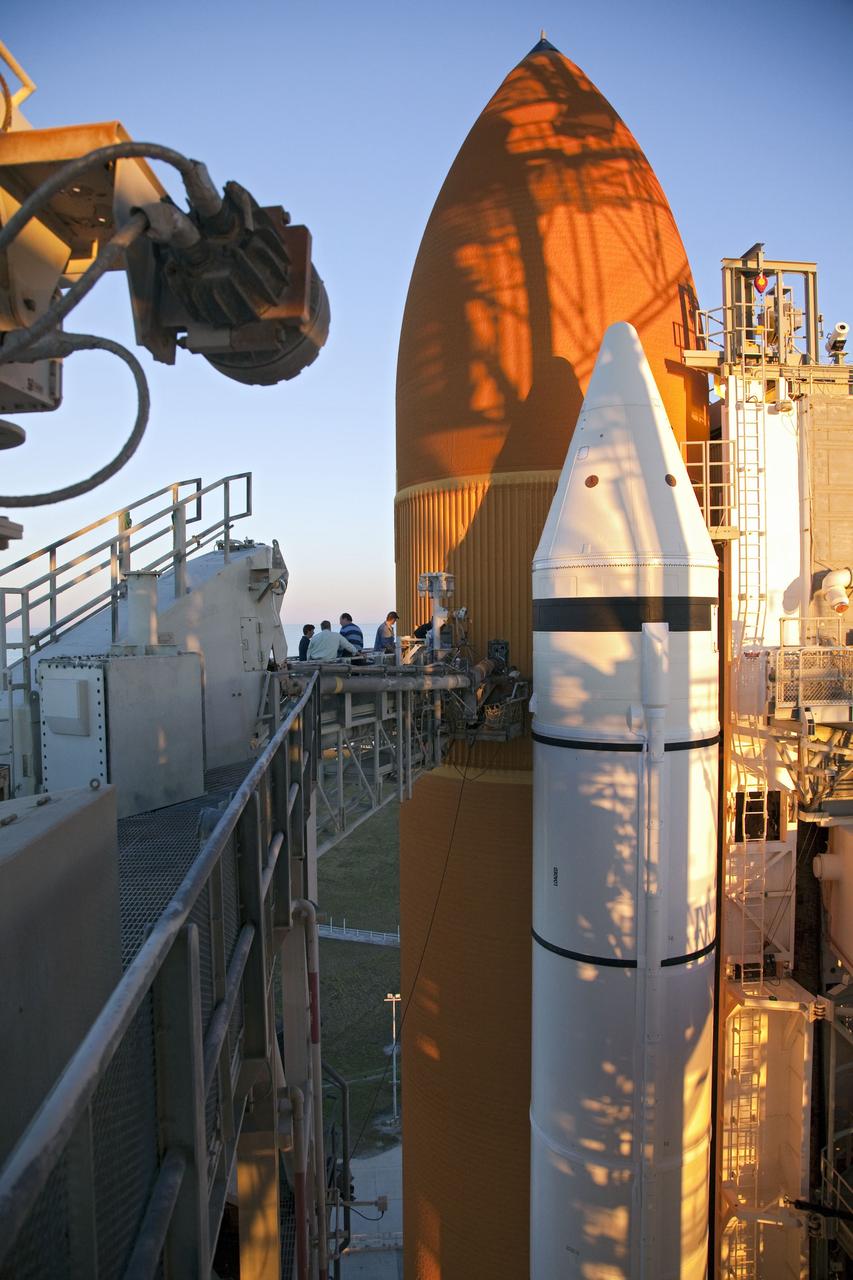
CAPE CANAVERAL, Fla. -- On Launch Pad 39A at NASA's Kennedy Space Center in Florida, workers begin to remove the vent line attached to the ground umbilical carrier plate (GUCP) on the bright-orange external fuel tank. Next, the GUCP's 7-inch quick disconnect will be removed. A hydrogen gas leak at that location during tanking for space shuttle Discovery's STS-133 mission to the International Space Station caused the launch attempt to be scrubbed Nov. 5. The GUCP will be examined to determine the cause of the hydrogen leak and then repaired. The GUCP is the overboard vent to the pad and the flame stack where the vented hydrogen is burned off. Discovery's next launch attempt is no earlier than Nov. 30 at 4:02 a.m. EST. For more information on STS-133, visit www.nasa.gov/mission_pages/shuttle/shuttlemissions/sts133/. Photo credit: NASA/Frankie Martin

CAPE CANAVERAL, Fla. -- Inside the Space Station Processing Facility at NASA's Kennedy Space Center in Florida, the hatch of the Permanent Multipurpose Module (PMM) is closed in preparation for space shuttle Discovery's STS-133 mission to the International Space Station. Robonaut 2 (R2) and critical spare parts are packed inside the PMM, which will be left aboard the station on Discovery's final mission. Targeted to launch Nov. 1 at 4:40 p.m. EDT, Discovery and its crew also will carry Express Logistics Carrier-4 (ELC-4), which is filled with external payloads and experiments. For more information visit, www.nasa.gov/shuttle. Photo credit: NASA/Jim Grossmann
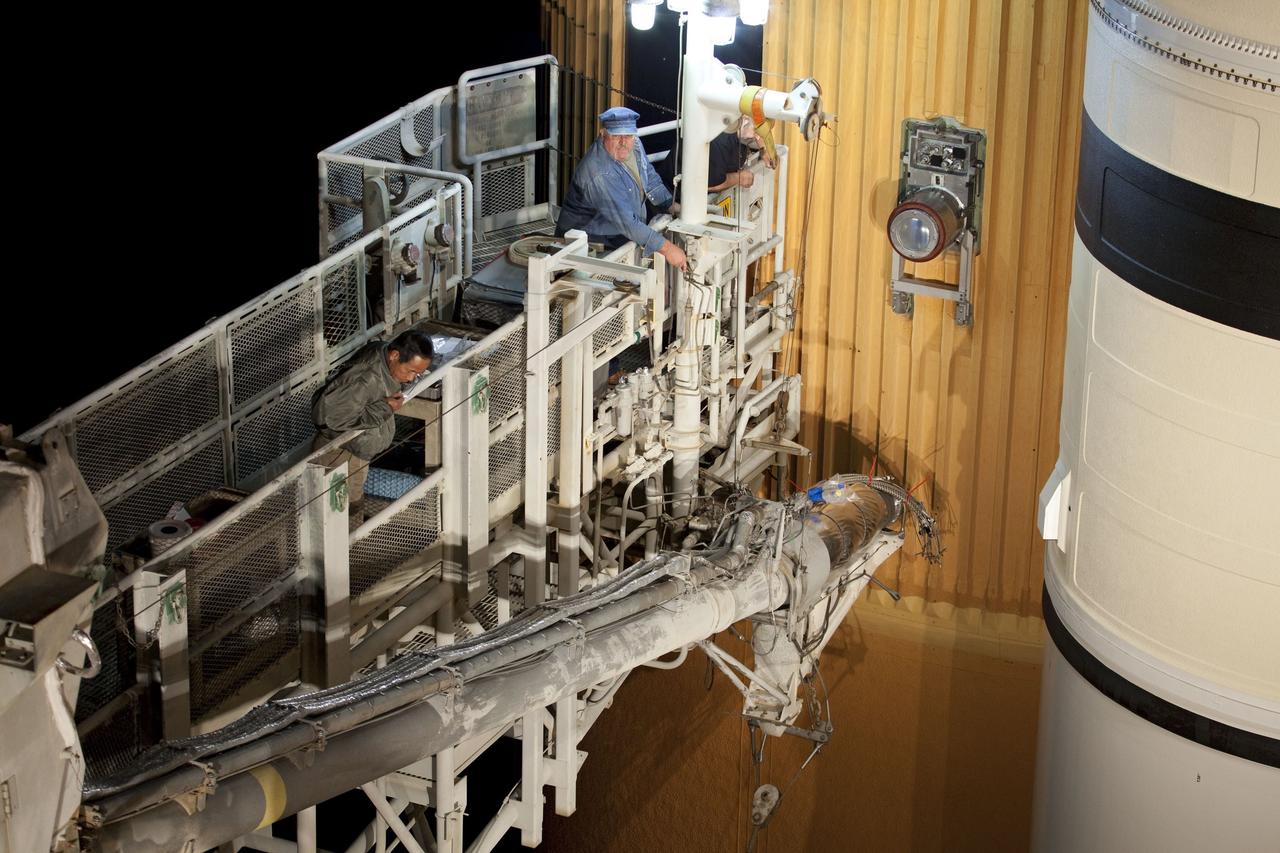
CAPE CANAVERAL, Fla. -- On Launch Pad 39A at NASA's Kennedy Space Center in Florida, the vent line is detached from the ground umbilical carrier plate (GUCP) on the bright-orange external fuel tank. Next, the GUCP's 7-inch quick disconnect will be removed. A hydrogen gas leak at that location during tanking for space shuttle Discovery's STS-133 mission to the International Space Station caused the launch attempt to be scrubbed Nov. 5. The GUCP will be examined to determine the cause of the hydrogen leak and then repaired. The GUCP is the overboard vent to the pad and the flame stack where the vented hydrogen is burned off. Discovery's next launch attempt is no earlier than Nov. 30 at 4:02 a.m. EST. For more information on STS-133, visit www.nasa.gov/mission_pages/shuttle/shuttlemissions/sts133/. Photo credit: NASA/Frankie Martin

CAPE CANAVERAL, Fla. -- In the Orbiter Processing Facility-2 at NASA's Kennedy Space Center in Florida, STS-134 Commander Mark Kelly, left, and Mission Specialist Roberto Vittori with the European Space Agency check out the heat shield tiles that protect space shuttles during re-entry. The six STS-134 astronauts are at Kennedy participating in the Crew Equipment Interface Test (CEIT), which gives them an opportunity for hands-on training with the tools and equipment they'll use in space and familiarization of the payload they'll be delivering to the International Space Station. Space shuttle Endeavour is targeted to launch on the STS-134 mission Feb. 27, 2011. For more information, visit www.nasa.gov/mission_pages/shuttle/shuttlemissions/sts134/index.html. Photo credit: NASA/Cory Huston
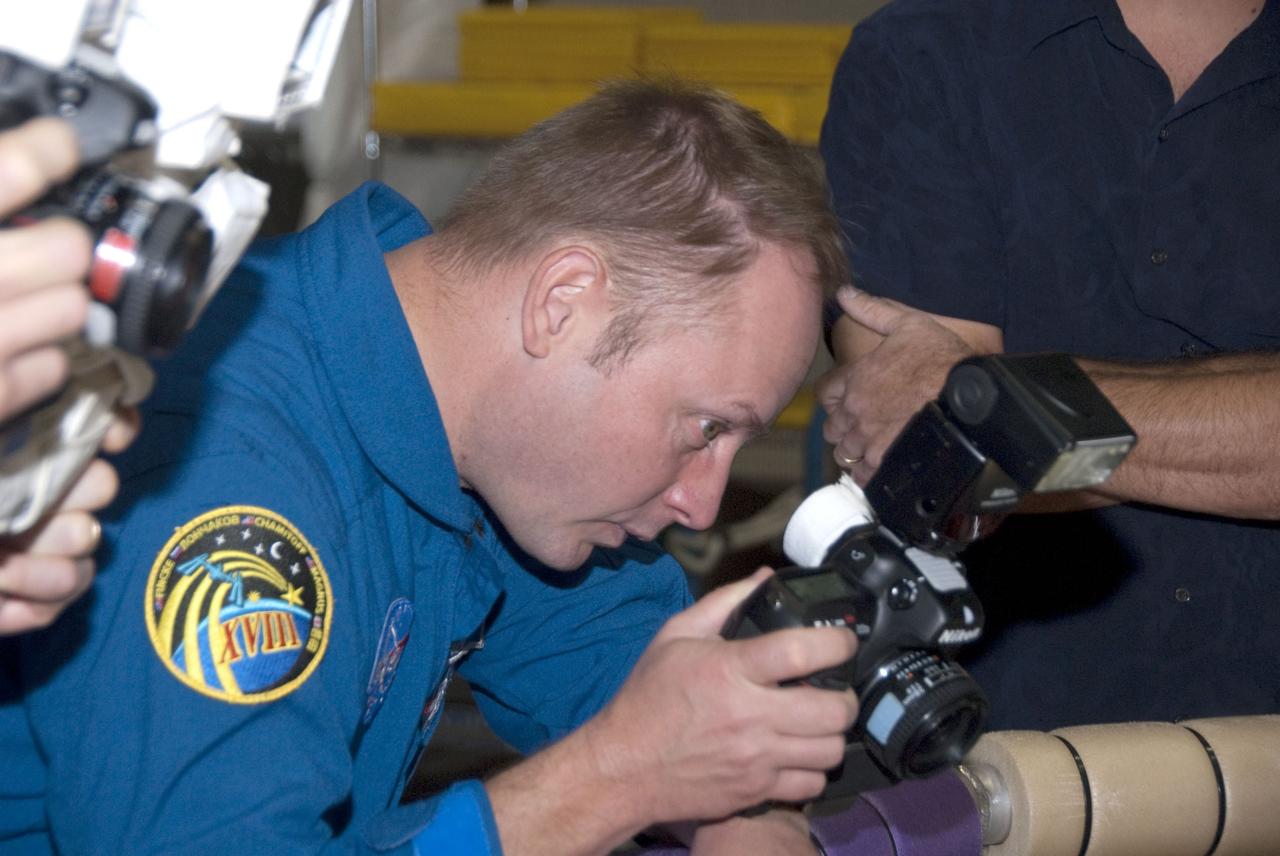
CAPE CANAVERAL, Fla. -- In the Orbiter Processing Facility-2 at NASA's Kennedy Space Center in Florida, STS-134 Mission Specialist Michael Finke practices using a camera he'll be snapping photos with in space. The six STS-134 astronauts are at Kennedy participating in the Crew Equipment Interface Test (CEIT), which gives them an opportunity for hands-on training and familiarization of the payload they'll be delivering to the International Space Station. Space shuttle Endeavour is targeted to launch on the STS-134 mission Feb. 27, 2011. For more information, visit www.nasa.gov/mission_pages/shuttle/shuttlemissions/sts134/index.html. Photo credit: NASA/Cory Huston
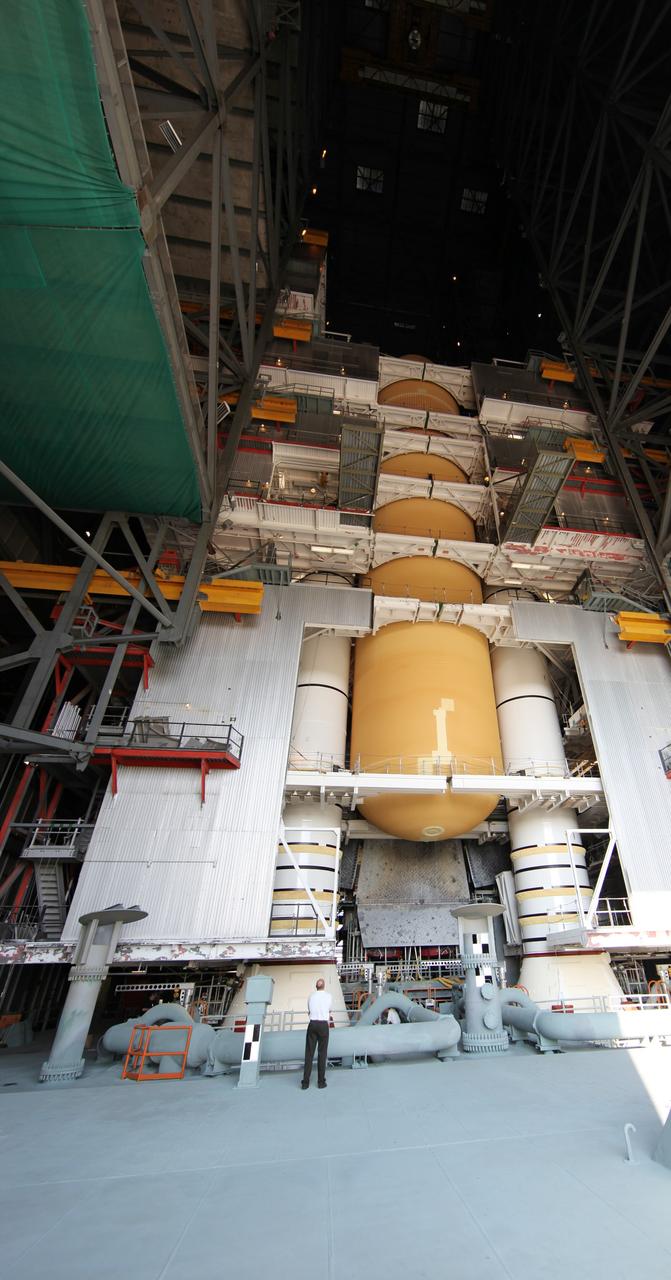
CAPE CANAVERAL, Fla. -- At NASA's Kennedy Space Center in Florida, space shuttle Discovery is attached to its external fuel tank and solid rocket boosters in the Vehicle Assembly Building. As technicians were attaching the left-side main separation bolt on the bottom of the shuttle to the external tank Sept. 10 a bolt nut slipped back into Discovery's aft compartment. To retrieve it, technicians entered Discovery’s aft section through an access door. They then moved the nut back into position to finish attaching the bolt, which is used to separate Discovery from the external tank once the shuttle is in orbit. Discovery is scheduled to roll out to Launch Pad 39A later this month for its STS-133 launch to the International Space Station. Targeted to lift off Nov. 1, Discovery will take the Permanent Multipurpose Module (PMM) packed with supplies and critical spare parts, as well as Robonaut 2 (R2) to the station. Photo credit: NASA/Dimitri Gerondidakis

CAPE CANAVERAL, Fla. -- On Launch Pad 39A at NASA's Kennedy Space Center in Florida, workers prepare to begin removing the quick disconnect from the ground umbilical carrier plate (GUCP) on space shuttle Discovery's external fuel tank. A hydrogen gas leak at that location during tanking for the STS-133 mission to the International Space Station caused the launch attempt to be scrubbed Nov. 5. The GUCP will be examined to determine the cause of the hydrogen leak and then repaired. The GUCP is the overboard vent to the pad and the flame stack where the vented hydrogen is burned off. Discovery's next launch attempt is targeted for no earlier than Nov. 30 at 4:02 a.m. EST. For more information on STS-133, visit www.nasa.gov/mission_pages/shuttle/shuttlemissions/sts133/. Photo credit: NASA/Troy Cryder
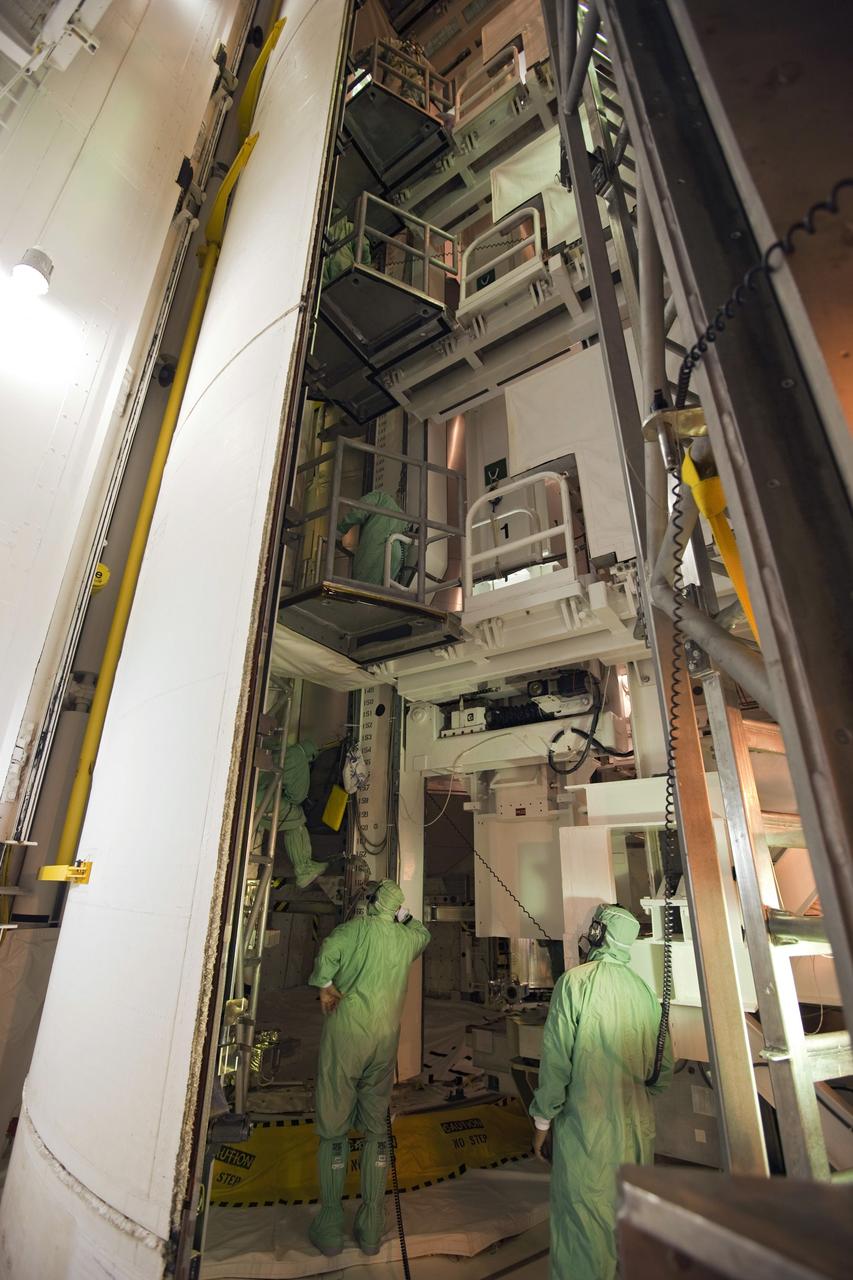
CAPE CANAVERAL, Fla. -- At NASA's Kennedy Space Center in Florida, technicians prepare to move the STS-133 payload from the rotating service structure on Launch Pad 39A to space shuttle Discovery's payload bay. The move paves the way for the Terminal Countdown Demonstration Test (TCDT) this week, which will give the astronauts and teams at Kennedy and NASA's Johnson Space Center in Houston a chance to practice launch day tasks. Discovery and its STS-133 crew will deliver the Permanent Multipurpose Module, packed with supplies and critical spare parts, as well as Robonaut 2, the dexterous humanoid astronaut helper, to the International Space Station. Launch is targeted for 4:40 p.m. EDT, Nov. 1. Photo credit: NASA/Dimitri Gerondidakis
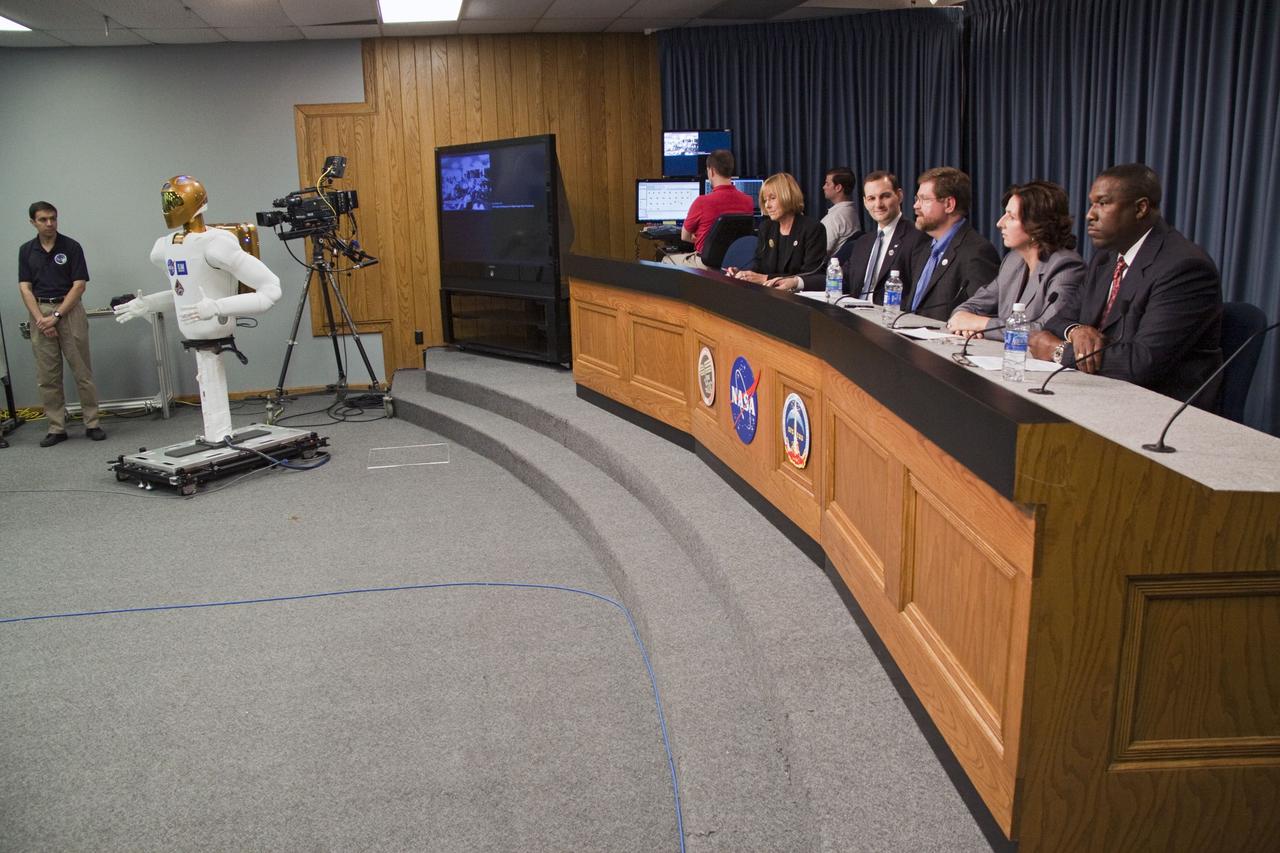
CAPE CANAVERAL, Fla. -- At NASA's Kennedy Space Center in Florida, managers from NASA and General Motors answer media questions on the dexterous humanoid astronaut helper, known as Robonaut. Robonaut 2 (R2) will be delivered to the International Space Station on space shuttle Discovery's STS-133 mission. Although R2 will initially only participate in operational tests, upgrades could eventually allow the robot to realize its true purpose -- helping spacewalking astronauts with tasks outside the orbiting laboratory. For more information on the upcoming STS-133 mission, visit www.nasa.gov/mission_pages/shuttle/shuttlemissions/sts133/. Photo credit: NASA/Jack Pfaller
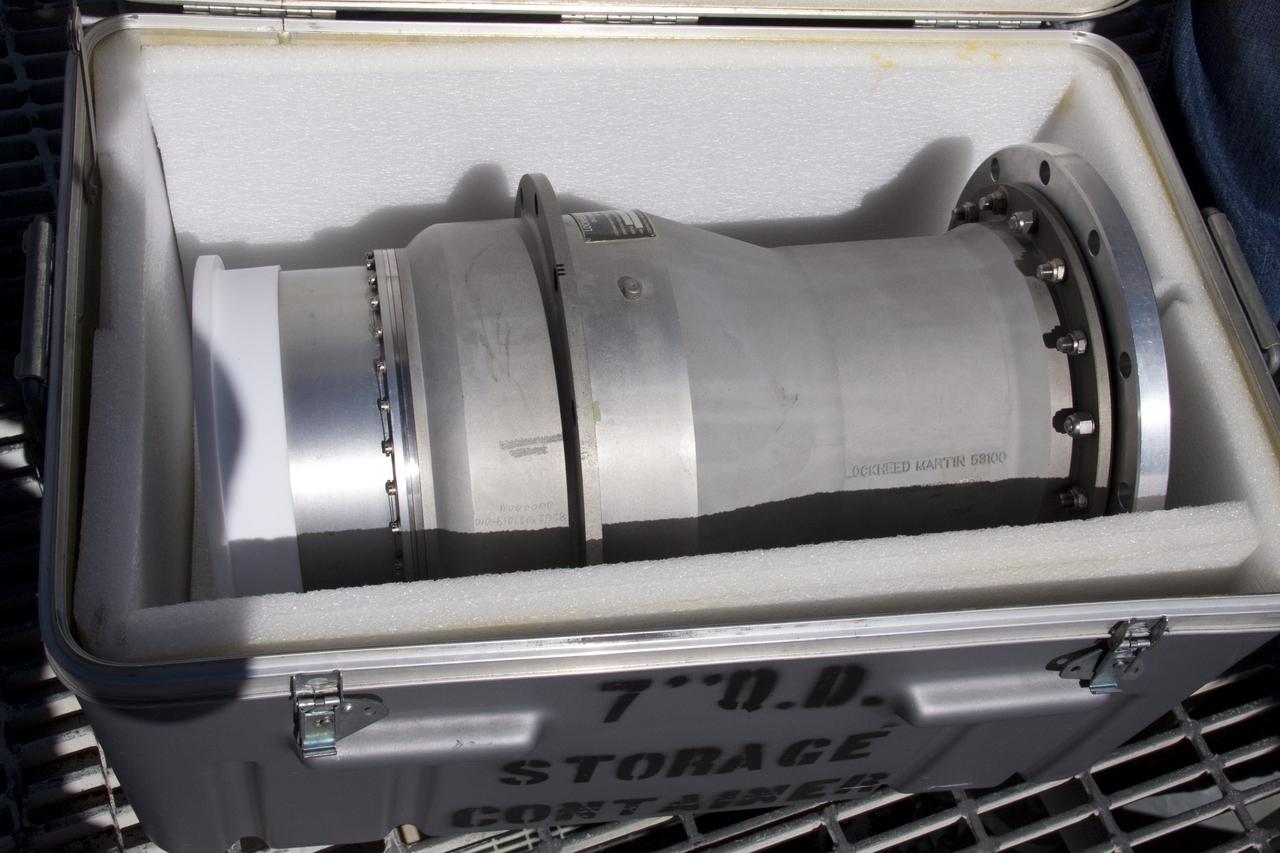
CAPE CANAVERAL, Fla. -- On Launch Pad 39A at NASA's Kennedy Space Center in Florida, workers take photos of the ground umbilical carrier plate's (GUCP) 7-inch quick disconnect, which has been removed from the external fuel tank. A hydrogen gas leak at that location during tanking for space shuttle Discovery's STS-133 mission to the International Space Station caused the launch attempt to be scrubbed Nov. 5. The GUCP will be examined to determine the cause of the hydrogen leak and then repaired. The GUCP is the overboard vent to the pad and the flame stack where the vented hydrogen is burned off. Discovery's next launch attempt is no earlier than Nov. 30 at 4:02 a.m. EST. For more information on STS-133, visit www.nasa.gov/mission_pages/shuttle/shuttlemissions/sts133/. Photo credit: NASA/Troy Cryder
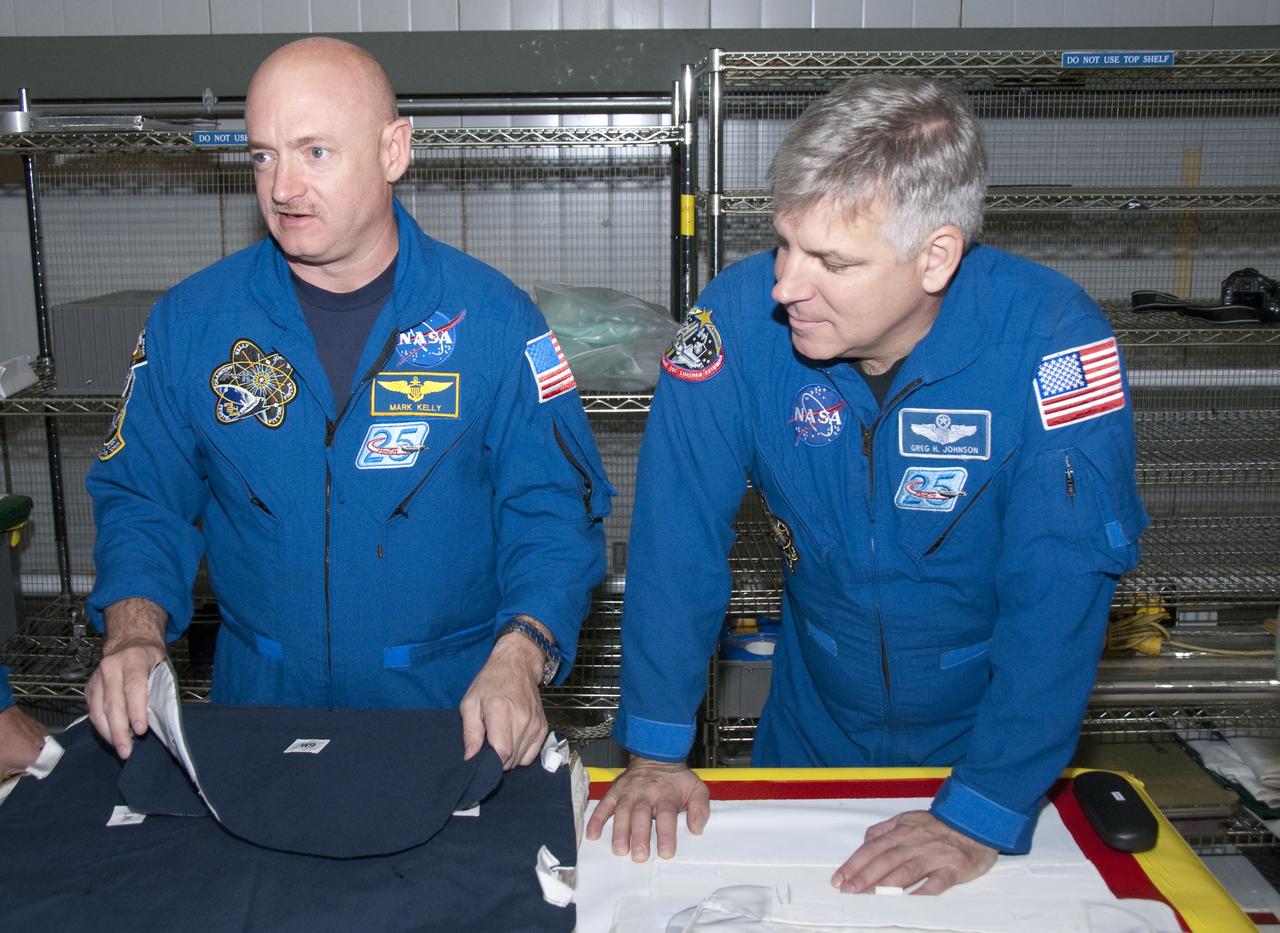
CAPE CANAVERAL, Fla. -- In the Orbiter Processing Facility-2 at NASA's Kennedy Space Center in Florida, STS-134 Commander Mark Kelly, left, and Pilot Gregory H. Johnson check out tools and equipment they'll be using in space. The six STS-134 astronauts are at Kennedy participating in the Crew Equipment Interface Test (CEIT), which gives them an opportunity for hands-on training and familiarization of the payload they'll be delivering to the International Space Station. Space shuttle Endeavour is targeted to launch on the STS-134 mission Feb. 27, 2011. For more information, visit www.nasa.gov/mission_pages/shuttle/shuttlemissions/sts134/index.html. Photo credit: NASA/Cory Huston
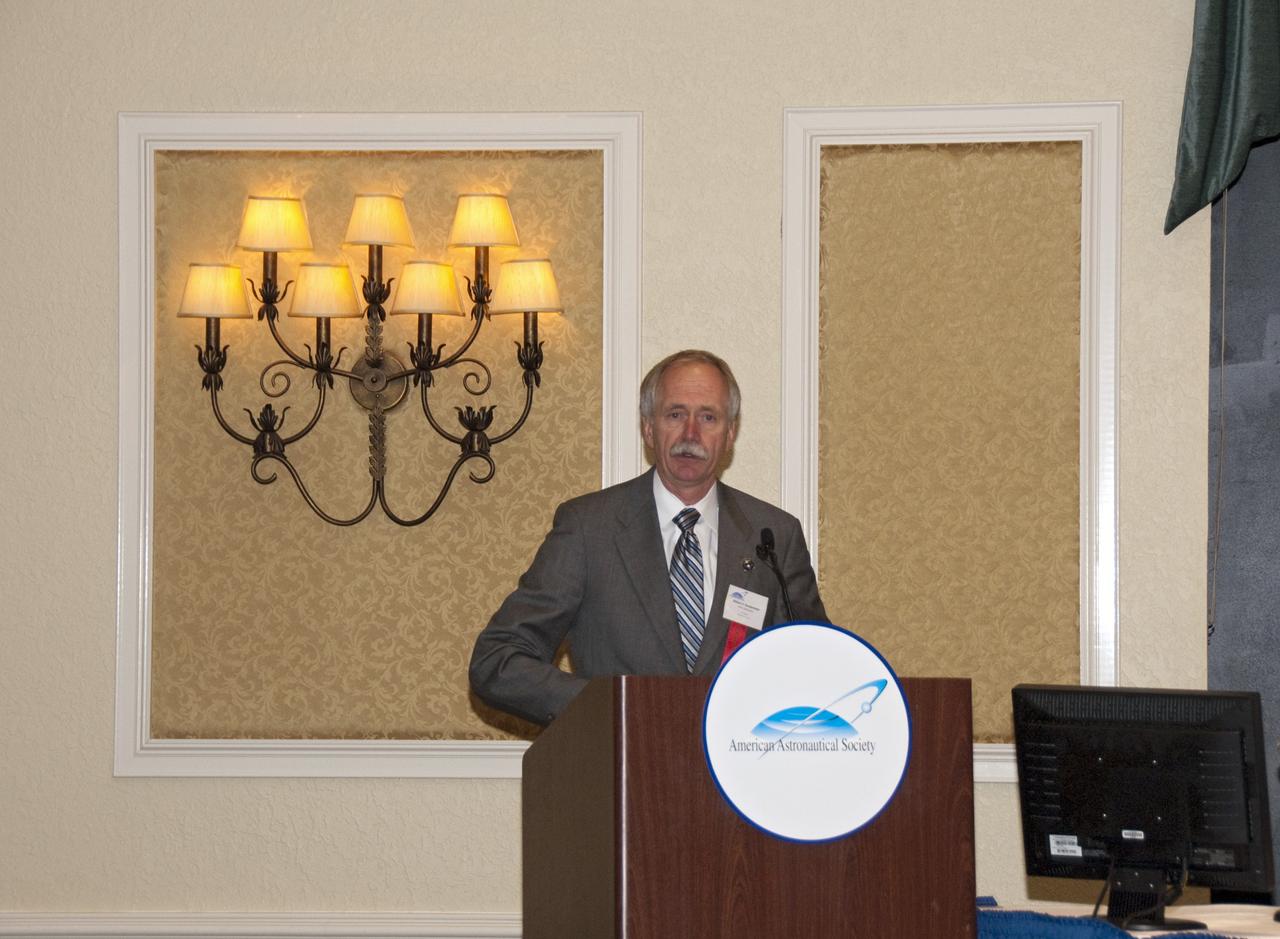
CAPE CANAVERAL, Fla. -- NASA Associate Administrator for Space Operations Bill Gerstenmaier addresses attendees of the American Astronautical Society's 2010 National Conference at the Radisson Resort at the Port. The focus of the conference is the next 10 years of utilization and research aboard the International Space Station. The conference was organized with the support of Kennedy and sponsored by The Boeing Company, Honeywell International Inc., Northrop Grumman Corp., Space Florida and the Universities Space Research Association (USRA). Photo credit: NASA/Jim Grossmann

CAPE CANAVERAL, Fla. -- At NASA's Kennedy Space Center in Florida, technicians in the Vehicle Assembly Building inspect space shuttle Discovery, its external fuel tank and solid rocket boosters. As technicians were attaching the left-side main separation bolt on the bottom of the shuttle to the external tank Sept. 10 a bolt nut slipped back into Discovery's aft compartment. To retrieve it, technicians entered Discovery’s aft section through an access door. They then moved the nut back into position to finish attaching the bolt, which is used to separate Discovery from the external tank once the shuttle is in orbit. Discovery is scheduled to roll out to Launch Pad 39A later this month for its STS-133 launch to the International Space Station. Targeted to lift off Nov. 1, Discovery will take the Permanent Multipurpose Module (PMM) packed with supplies and critical spare parts, as well as Robonaut 2 (R2) to the station. Photo credit: NASA/Dimitri Gerondidakis
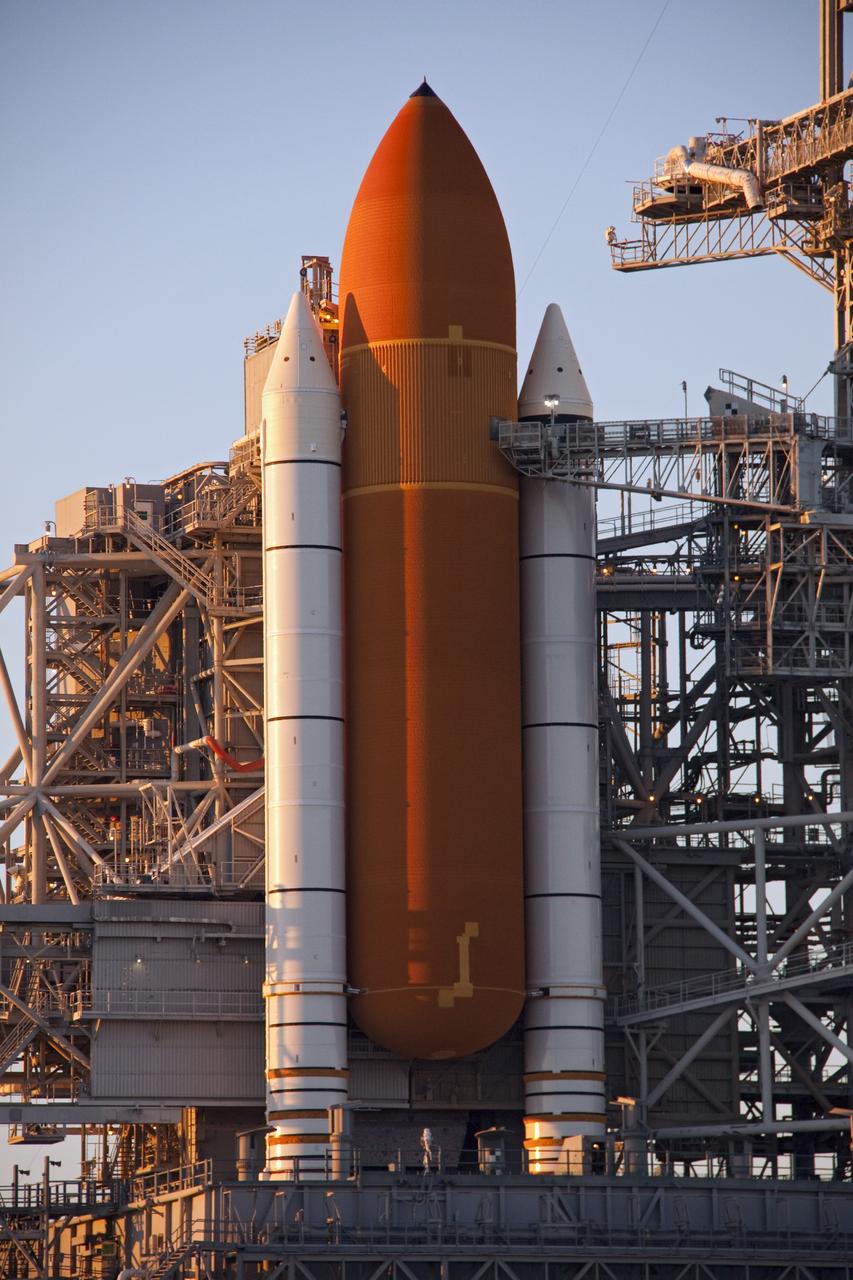
CAPE CANAVERAL, Fla. -- As the sun rises over Launch Pad 39A at NASA's Kennedy Space Center in Florida, preparations to remove the ground umbilical carrier plate's (GUCP) 7-inch quick disconnect are under way. A hydrogen gas leak at that location on the external fuel tank during tanking for space shuttle Discovery's STS-133 mission to the International Space Station caused the launch attempt to be scrubbed Nov. 5. The GUCP will be examined to determine the cause of the hydrogen leak and then repaired. The GUCP is the overboard vent to the pad and the flame stack where the vented hydrogen is burned off. Discovery's next launch attempt is no earlier than Nov. 30 at 4:02 a.m. EST. For more information on STS-133, visit www.nasa.gov/mission_pages/shuttle/shuttlemissions/sts133/. Photo credit: NASA/Troy Cryder
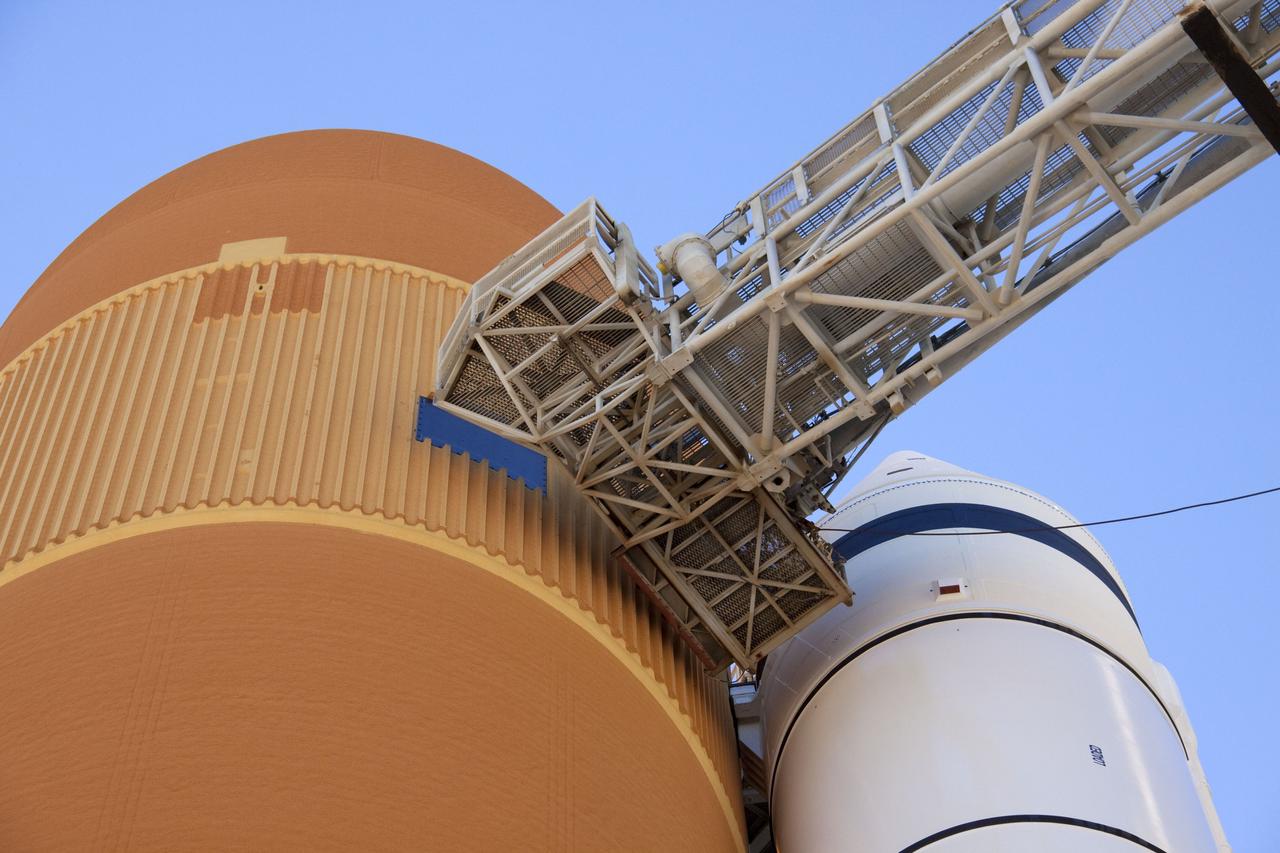
CAPE CANAVERAL, Fla. -- On Launch Pad 39A at NASA's Kennedy Space Center in Florida, the tip-top of the bright-orange external fuel tank is where workers will prepare to begin removing the quick disconnect from the ground umbilical carrier plate (GUCP). A hydrogen gas leak at that location during tanking for space shuttle Discovery's STS-133 mission to the International Space Station caused the launch attempt to be scrubbed Nov. 5. The GUCP will be examined to determine the cause of the hydrogen leak and then repaired. The GUCP is the overboard vent to the pad and the flame stack where the vented hydrogen is burned off. Discovery's next launch attempt is targeted for no earlier than Nov. 30 at 4:02 a.m. EST. For more information on STS-133, visit www.nasa.gov/mission_pages/shuttle/shuttlemissions/sts133/. Photo credit: NASA/Troy Cryder
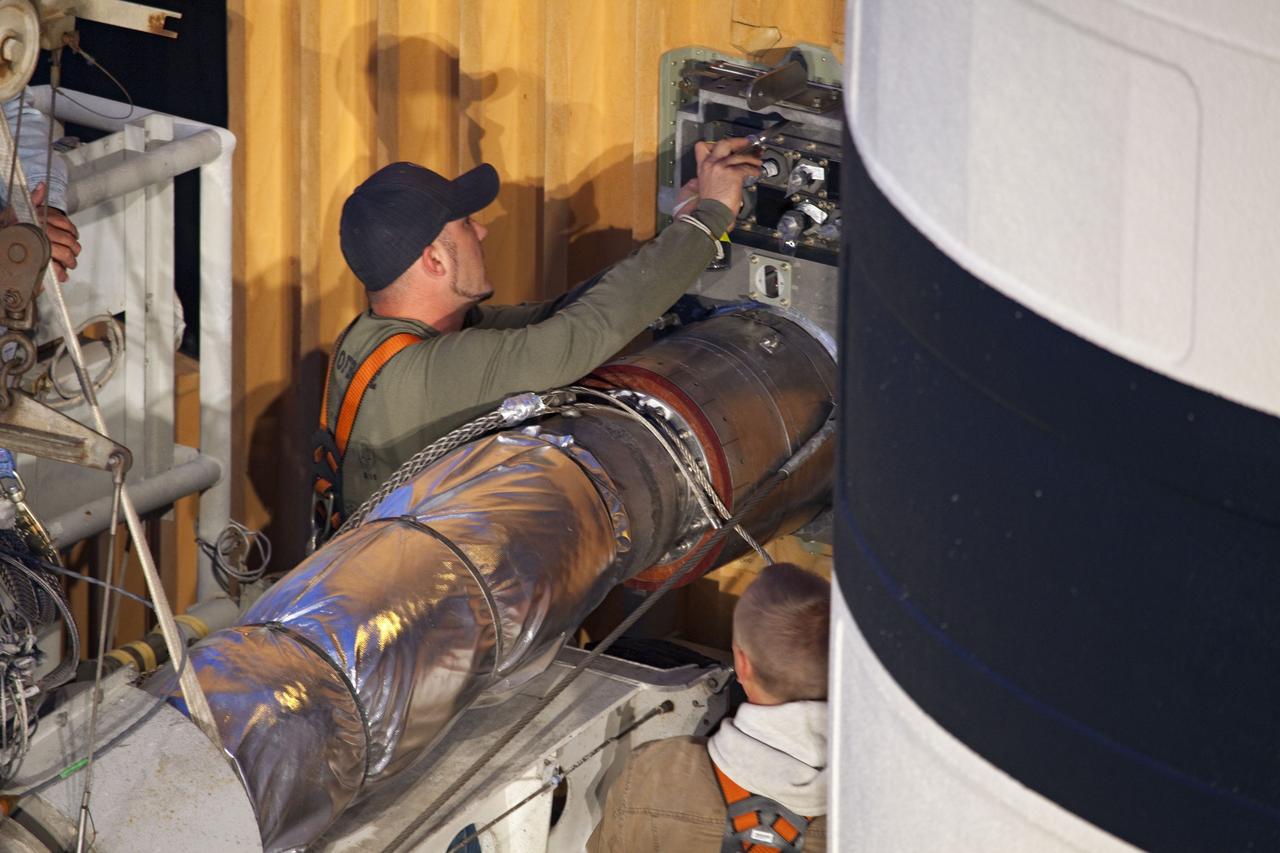
CAPE CANAVERAL, Fla. -- On Launch Pad 39A at NASA's Kennedy Space Center in Florida, workers begin to remove the vent line attached to the ground umbilical carrier plate (GUCP) on the bright-orange external fuel tank. Next, the GUCP's 7-inch quick disconnect will be removed. A hydrogen gas leak at that location during tanking for space shuttle Discovery's STS-133 mission to the International Space Station caused the launch attempt to be scrubbed Nov. 5. The GUCP will be examined to determine the cause of the hydrogen leak and then repaired. The GUCP is the overboard vent to the pad and the flame stack where the vented hydrogen is burned off. Discovery's next launch attempt is no earlier than Nov. 30 at 4:02 a.m. EST. For more information on STS-133, visit www.nasa.gov/mission_pages/shuttle/shuttlemissions/sts133/. Photo credit: NASA/Frankie Martin

CAPE CANAVERAL, Fla. -- Inside the Space Station Processing Facility at NASA's Kennedy Space Center in Florida, workers inspect the Permanent Multipurpose Module (PMM) after its hatch is closed in preparation for space shuttle Discovery's STS-133 mission to the International Space Station. Robonaut 2 (R2) and critical spare parts are packed inside the PMM, which will be left aboard the station on Discovery's final mission. Targeted to launch Nov. 1 at 4:40 p.m. EDT, Discovery and its crew also will carry Express Logistics Carrier-4 (ELC-4), which is filled with external payloads and experiments. For more information visit, www.nasa.gov/shuttle. Photo credit: NASA/Jim Grossmann
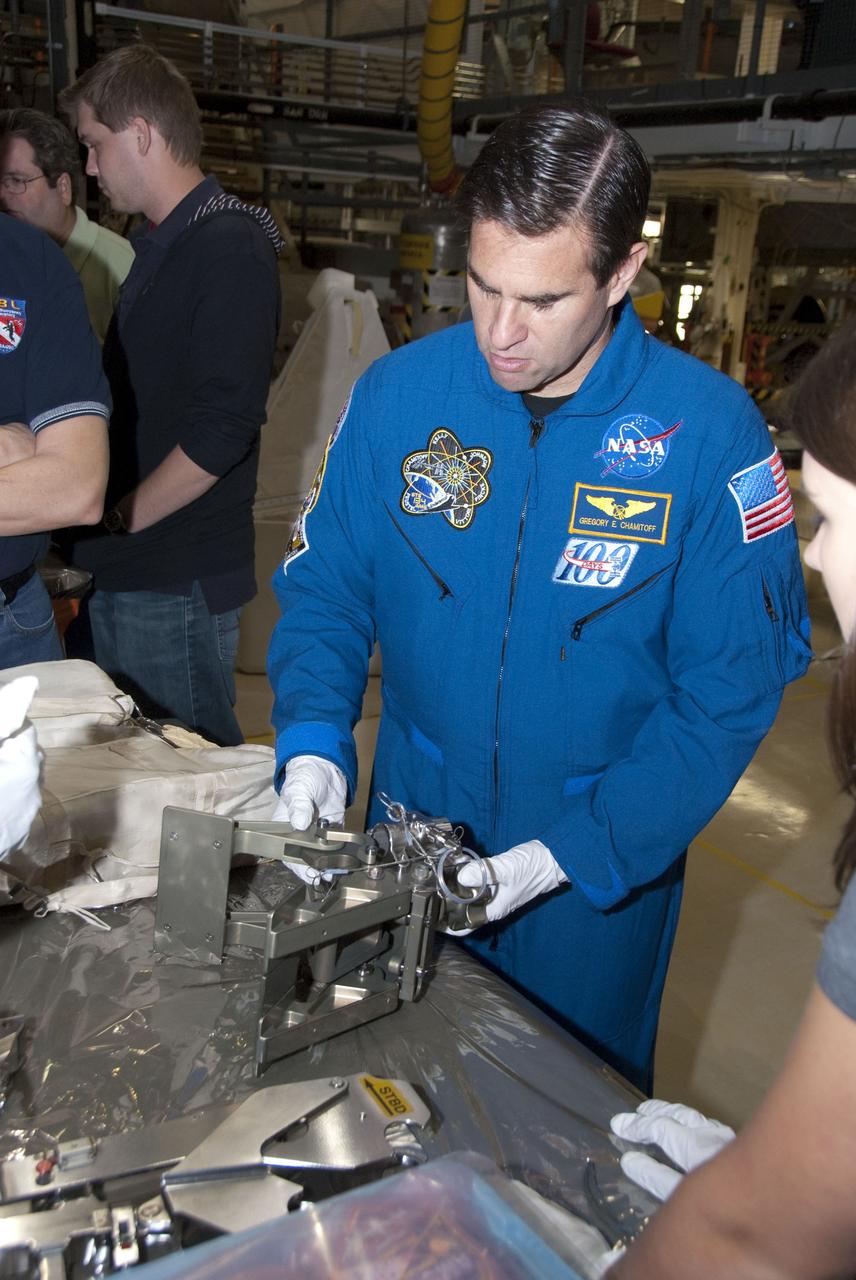
CAPE CANAVERAL, Fla. -- In the Orbiter Processing Facility-2 at NASA's Kennedy Space Center in Florida, STS-134 Mission Specialist Greg Chamitoff check outs tools and equipment he'll be using in space. The six STS-134 astronauts are at Kennedy participating in the Crew Equipment Interface Test (CEIT), which gives them an opportunity for hands-on training and familiarization of the payload they'll be delivering to the International Space Station. Space shuttle Endeavour is targeted to launch on the STS-134 mission Feb. 27, 2011. For more information, visit www.nasa.gov/mission_pages/shuttle/shuttlemissions/sts134/index.html. Photo credit: NASA/Cory Huston
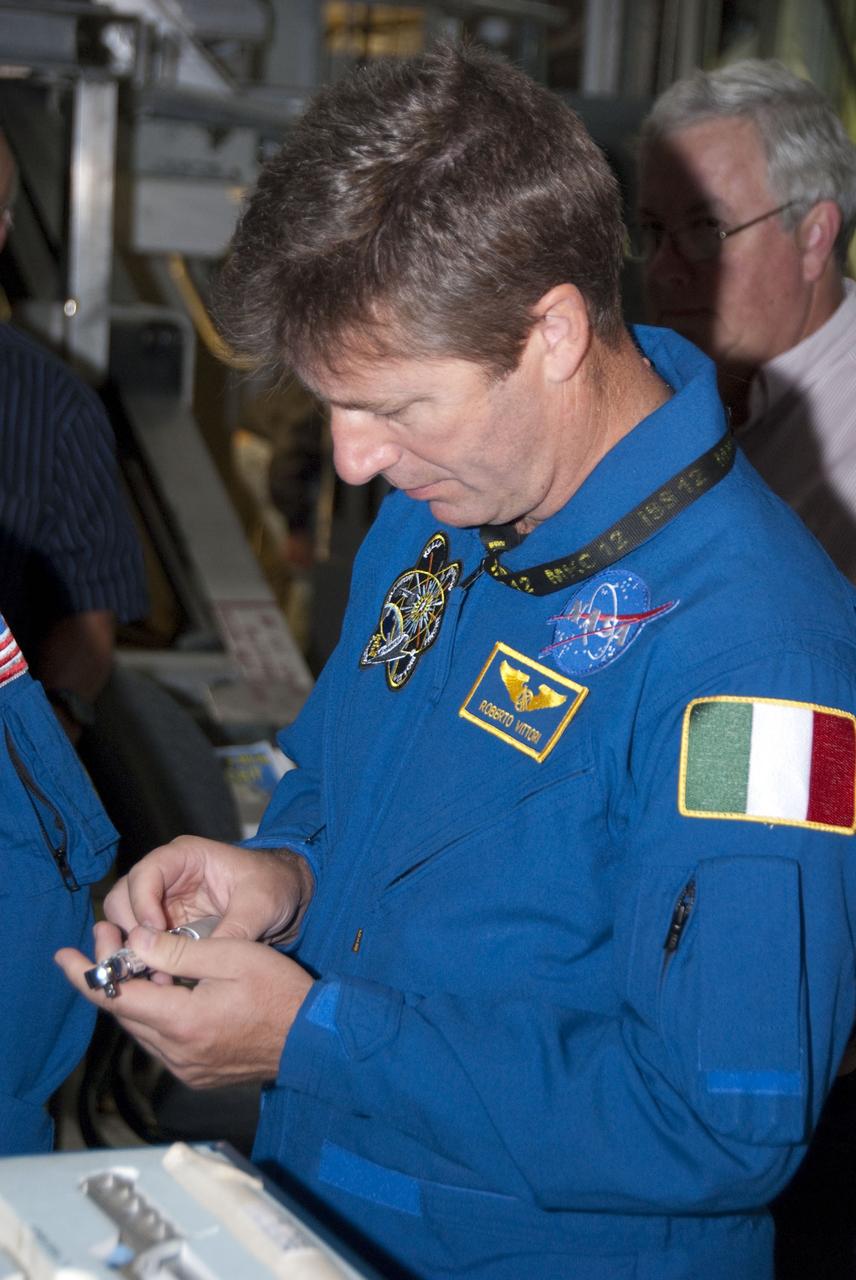
CAPE CANAVERAL, Fla. -- In the Orbiter Processing Facility-2 at NASA's Kennedy Space Center in Florida, STS-134 Mission Specialist Roberto Vittori with the European Space Agency checks out a tool he'll be using in space. The six STS-134 astronauts are at Kennedy participating in the Crew Equipment Interface Test (CEIT), which gives them an opportunity for hands-on training and familiarization of the payload they'll be delivering to the International Space Station. Space shuttle Endeavour is targeted to launch on the STS-134 mission Feb. 27, 2011. For more information, visit www.nasa.gov/mission_pages/shuttle/shuttlemissions/sts134/index.html. Photo credit: NASA/Cory Huston
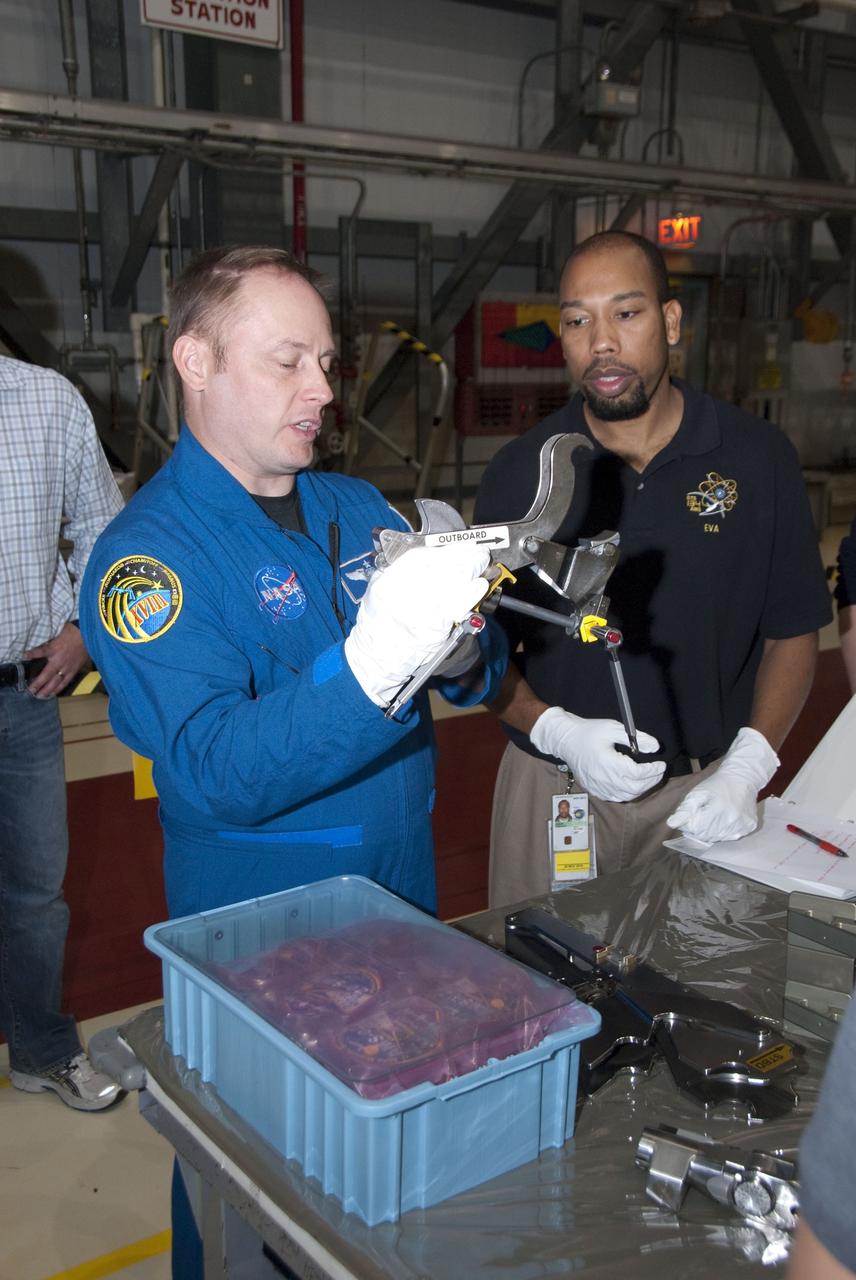
CAPE CANAVERAL, Fla. -- In the Orbiter Processing Facility-2 at NASA's Kennedy Space Center in Florida, STS-134 Mission Specialist Michael Finke check outs tools and equipment he'll be using in space. The six STS-134 astronauts are at Kennedy participating in the Crew Equipment Interface Test (CEIT), which gives them an opportunity for hands-on training and familiarization of the payload they'll be delivering to the International Space Station. Space shuttle Endeavour is targeted to launch on the STS-134 mission Feb. 27, 2011. For more information, visit www.nasa.gov/mission_pages/shuttle/shuttlemissions/sts134/index.html. Photo credit: NASA/Cory Huston
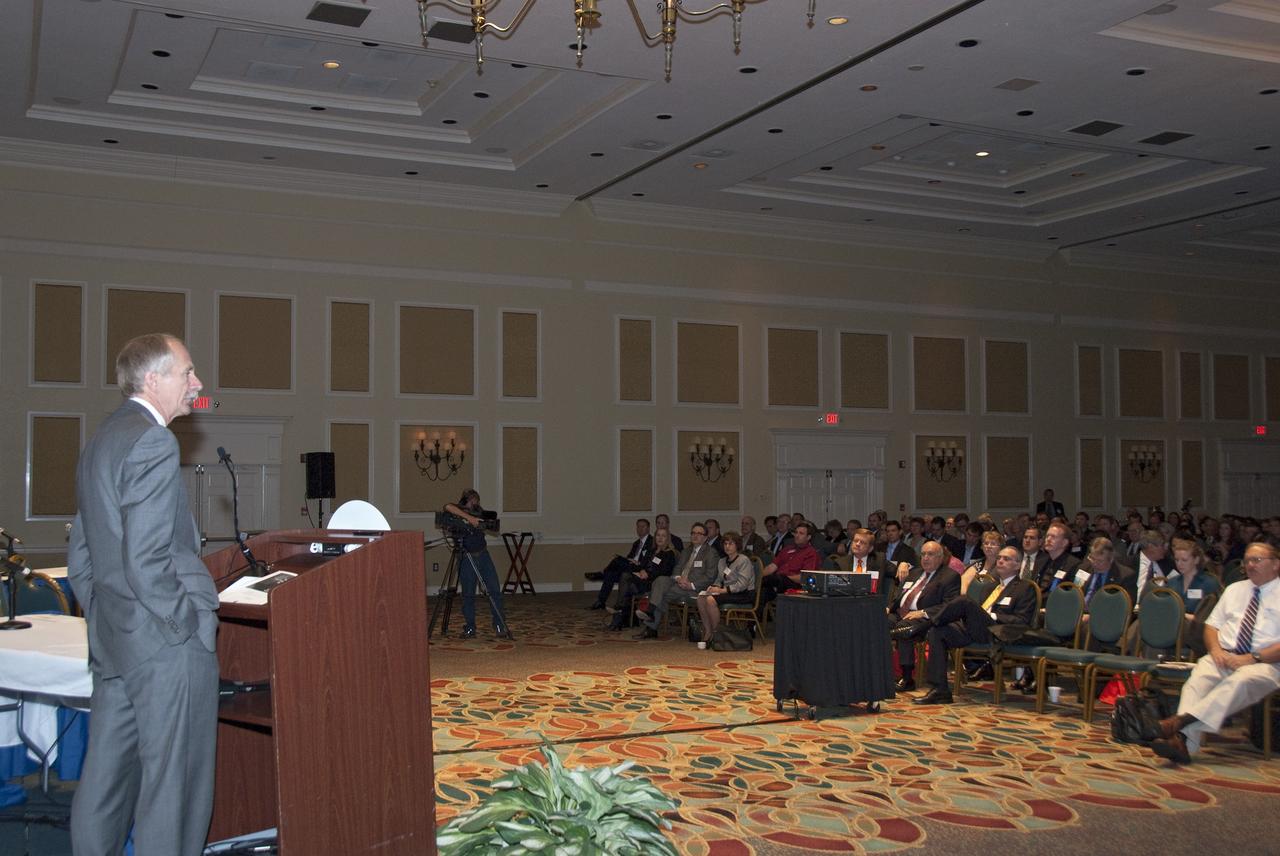
CAPE CANAVERAL, Fla. -- NASA Associate Administrator for Space Operations Bill Gerstenmaier addresses attendees of the American Astronautical Society's 2010 National Conference at the Radisson Resort at the Port. The focus of the conference is the next 10 years of utilization and research aboard the International Space Station. The conference was organized with the support of Kennedy and sponsored by The Boeing Company, Honeywell International Inc., Northrop Grumman Corp., Space Florida and the Universities Space Research Association (USRA). Photo credit: NASA/Jim Grossmann
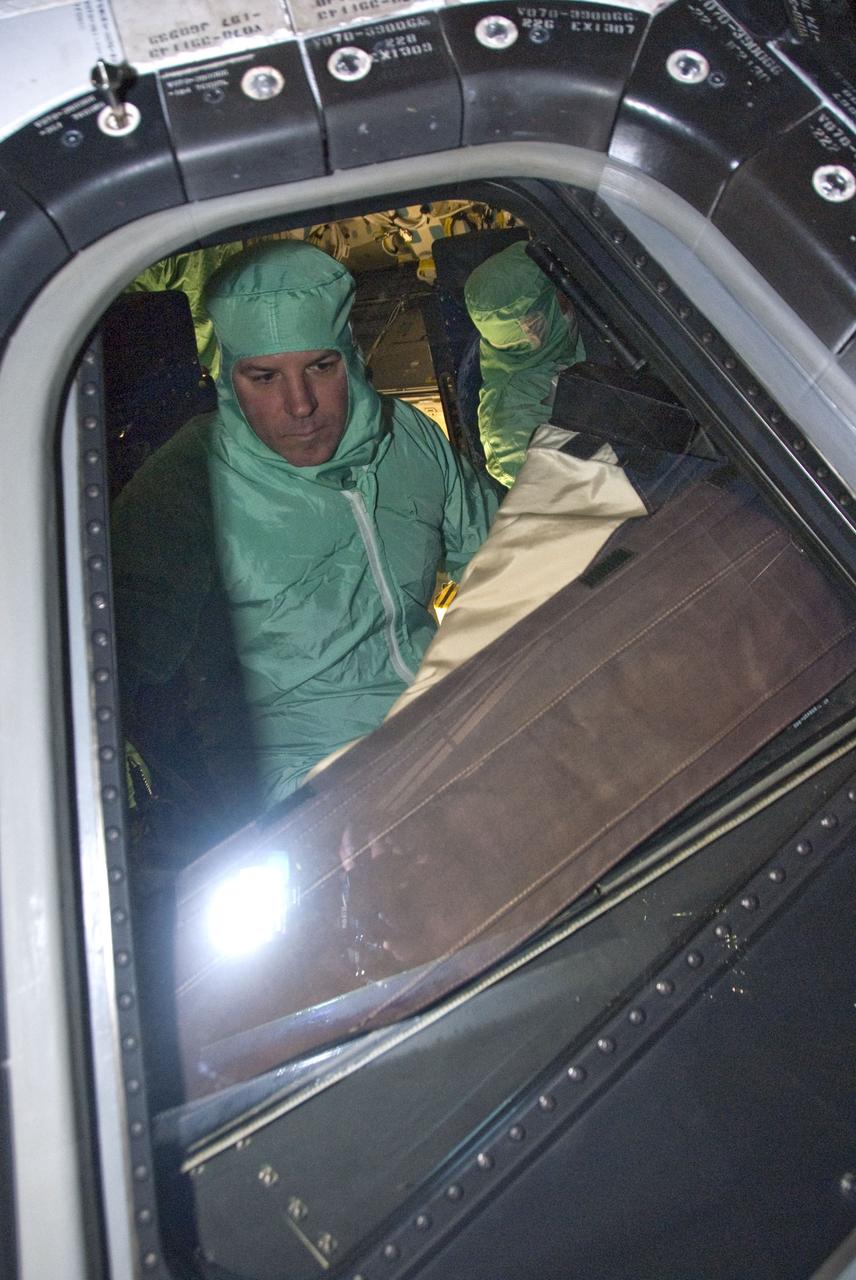
CAPE CANAVERAL, Fla. -- In the Orbiter Processing Facility-2 at NASA's Kennedy Space Center in Florida, STS-134 Pilot Gregory H. Johnson inspects the windows on space shuttle Endeavour. The six STS-134 astronauts are at Kennedy participating in the Crew Equipment Interface Test (CEIT), which gives them an opportunity for hands-on training with the tools and equipment they'll use in space and familiarization of the payload they'll be delivering to the International Space Station. Space shuttle Endeavour is targeted to launch on the STS-134 mission Feb. 27, 2011. For more information, visit www.nasa.gov/mission_pages/shuttle/shuttlemissions/sts134/index.html. Photo credit: NASA/Cory Huston
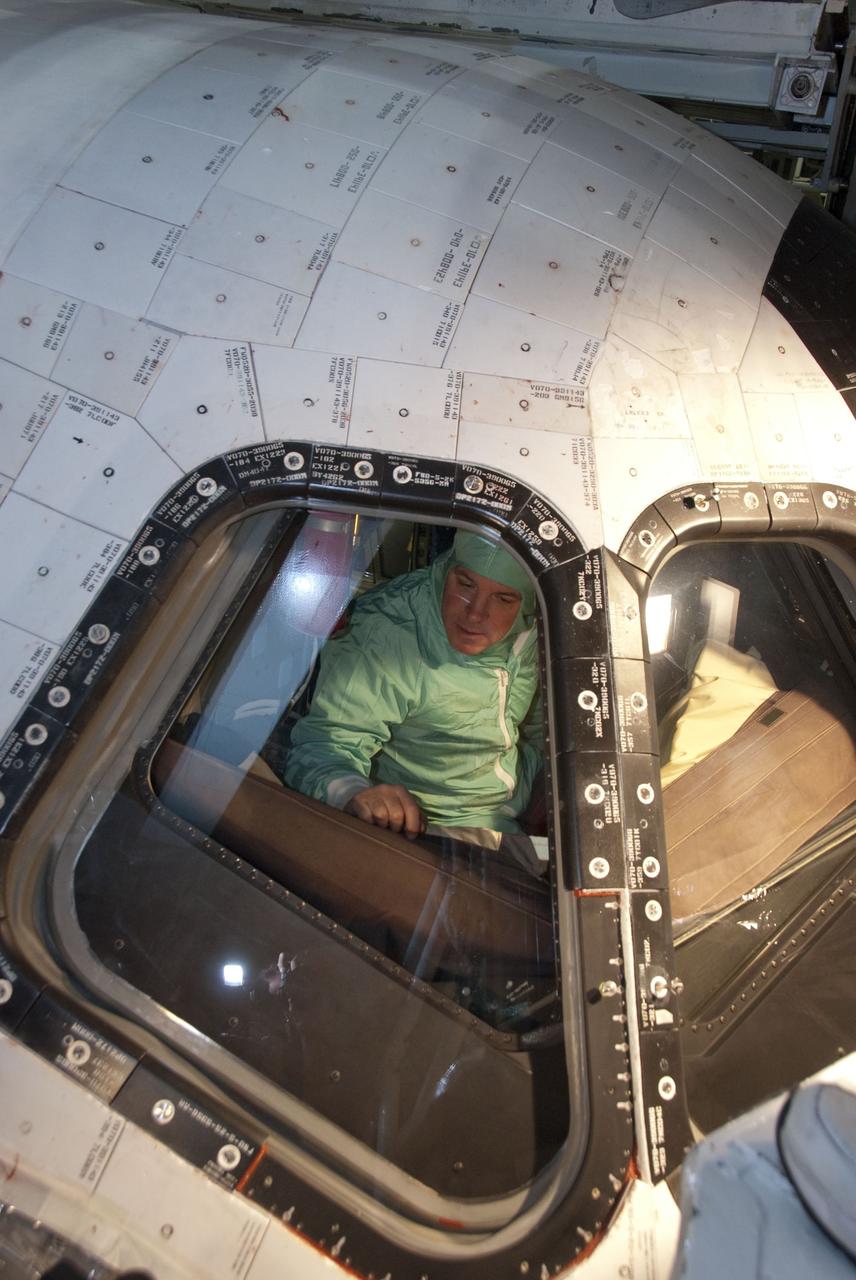
CAPE CANAVERAL, Fla. -- In the Orbiter Processing Facility-2 at NASA's Kennedy Space Center in Florida, STS-134 Pilot Gregory H. Johnson inspects the windows on space shuttle Endeavour. The six STS-134 astronauts are at Kennedy participating in the Crew Equipment Interface Test (CEIT), which gives them an opportunity for hands-on training with the tools and equipment they'll use in space and familiarization of the payload they'll be delivering to the International Space Station. Space shuttle Endeavour is targeted to launch on the STS-134 mission Feb. 27, 2011. For more information, visit www.nasa.gov/mission_pages/shuttle/shuttlemissions/sts134/index.html. Photo credit: NASA/Cory Huston
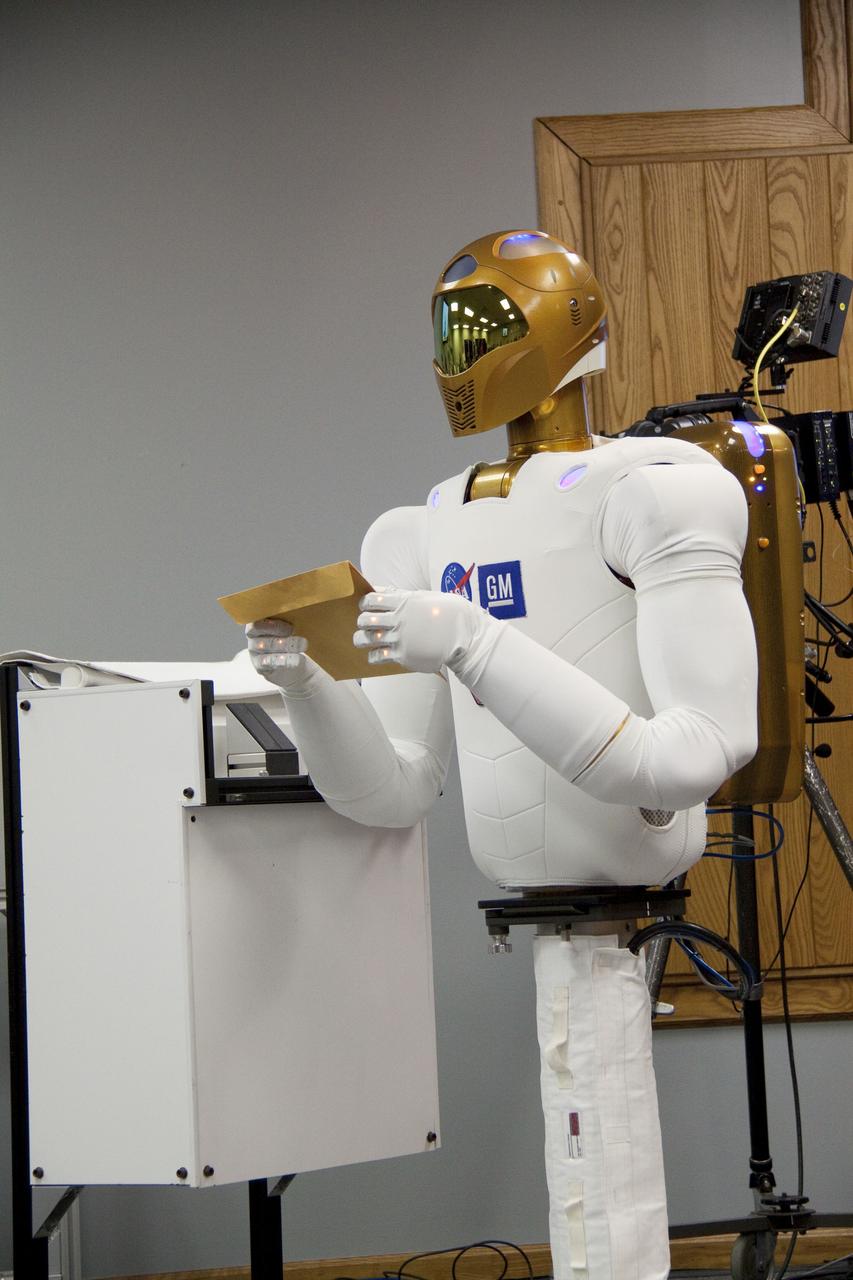
CAPE CANAVERAL, Fla. -- At NASA's Kennedy Space Center in Florida, a dexterous humanoid astronaut helper, known as Robonaut, demonstrates its talents to media. Robonaut 2 (R2) will be delivered to the International Space Station on space shuttle Discovery's STS-133 mission. Although R2 will initially only participate in operational tests, upgrades could eventually allow the robot to realize its true purpose -- helping spacewalking astronauts with tasks outside the orbiting laboratory. For more information on the upcoming STS-133 mission, visit www.nasa.gov/mission_pages/shuttle/shuttlemissions/sts133/. Photo credit: NASA/Jack Pfaller
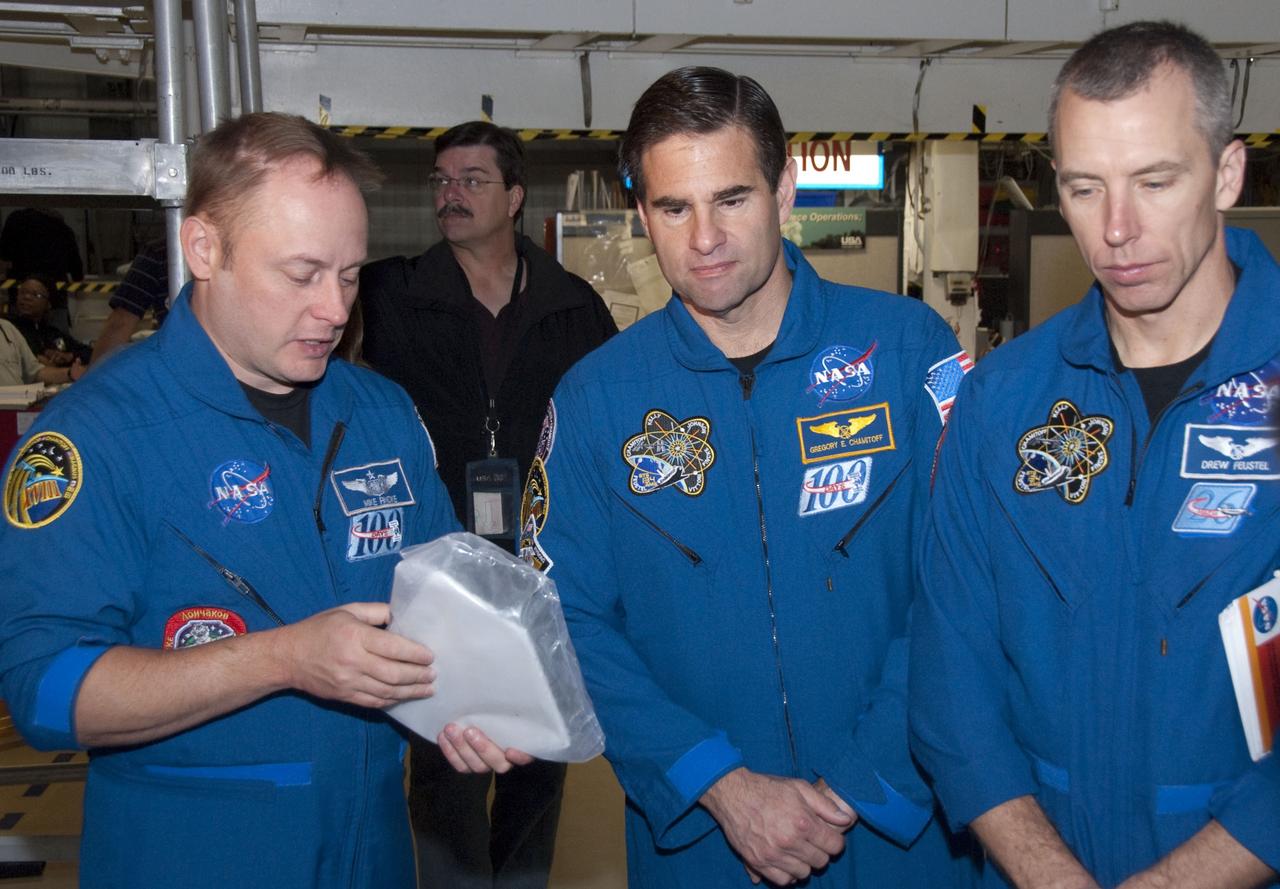
CAPE CANAVERAL, Fla. -- In the Orbiter Processing Facility-2 at NASA's Kennedy Space Center in Florida, STS-134 Mission Specialists Michael Finke, left, Gregory Chamitoff and Andrew Feustel check out the heat shield tiles that protect space shuttles during re-entry. The six STS-134 astronauts are at Kennedy participating in the Crew Equipment Interface Test (CEIT), which gives them an opportunity for hands-on training with the tools and equipment they'll use in space and familiarization of the payload they'll be delivering to the International Space Station. Space shuttle Endeavour is targeted to launch on the STS-134 mission Feb. 27, 2011. For more information, visit www.nasa.gov/mission_pages/shuttle/shuttlemissions/sts134/index.html. Photo credit: NASA/Cory Huston
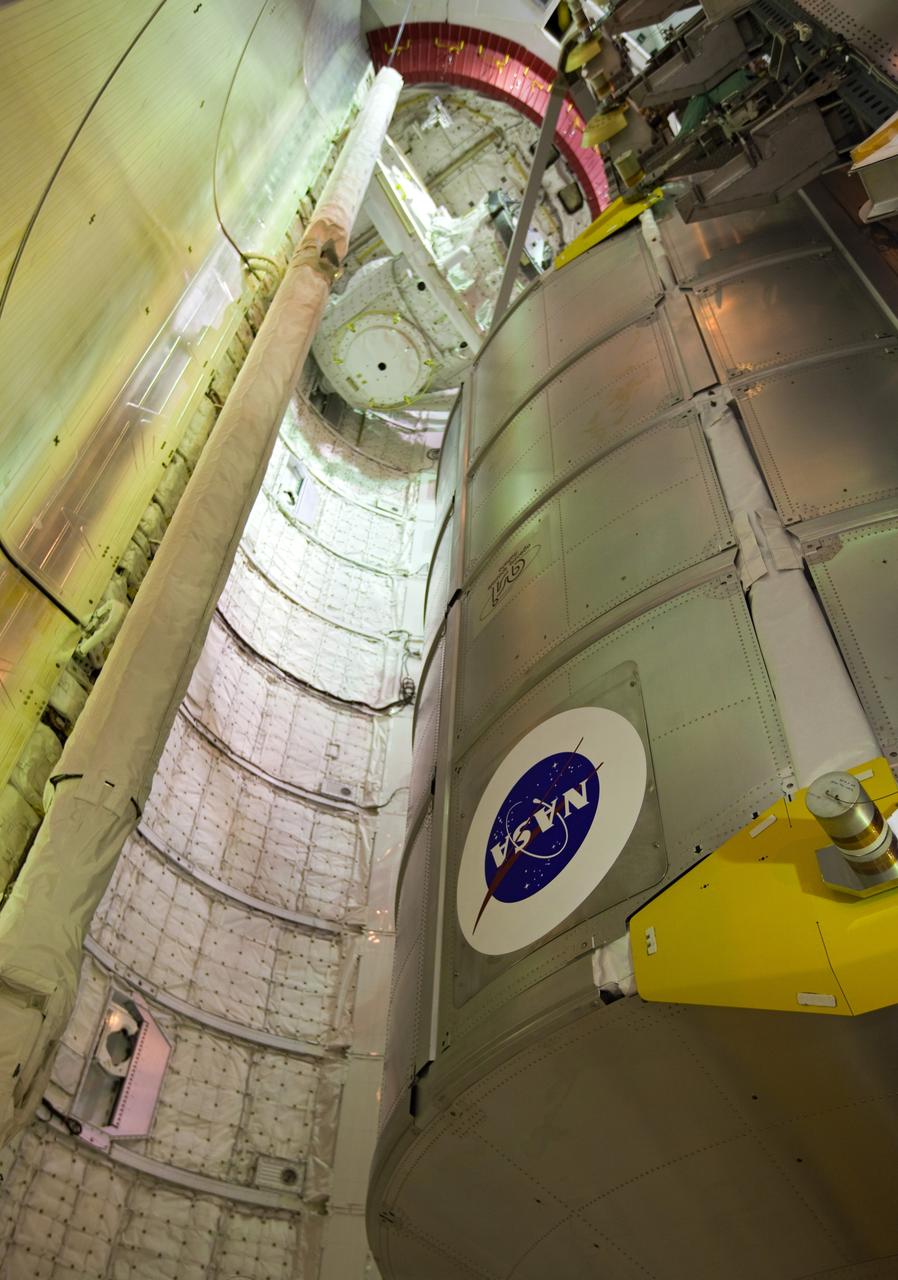
CAPE CANAVERAL, Fla. -- At NASA's Kennedy Space Center in Florida, technicians prepare to move the STS-133 payload from the rotating service structure on Launch Pad 39A to space shuttle Discovery's payload bay. The move paves the way for the Terminal Countdown Demonstration Test (TCDT) this week, which will give the astronauts and teams at Kennedy and NASA's Johnson Space Center in Houston a chance to practice launch day tasks. Discovery and its STS-133 crew will deliver the Permanent Multipurpose Module, packed with supplies and critical spare parts, as well as Robonaut 2, the dexterous humanoid astronaut helper, to the International Space Station. Launch is targeted for 4:40 p.m. EDT, Nov. 1. Photo credit: NASA/Dimitri Gerondidakis
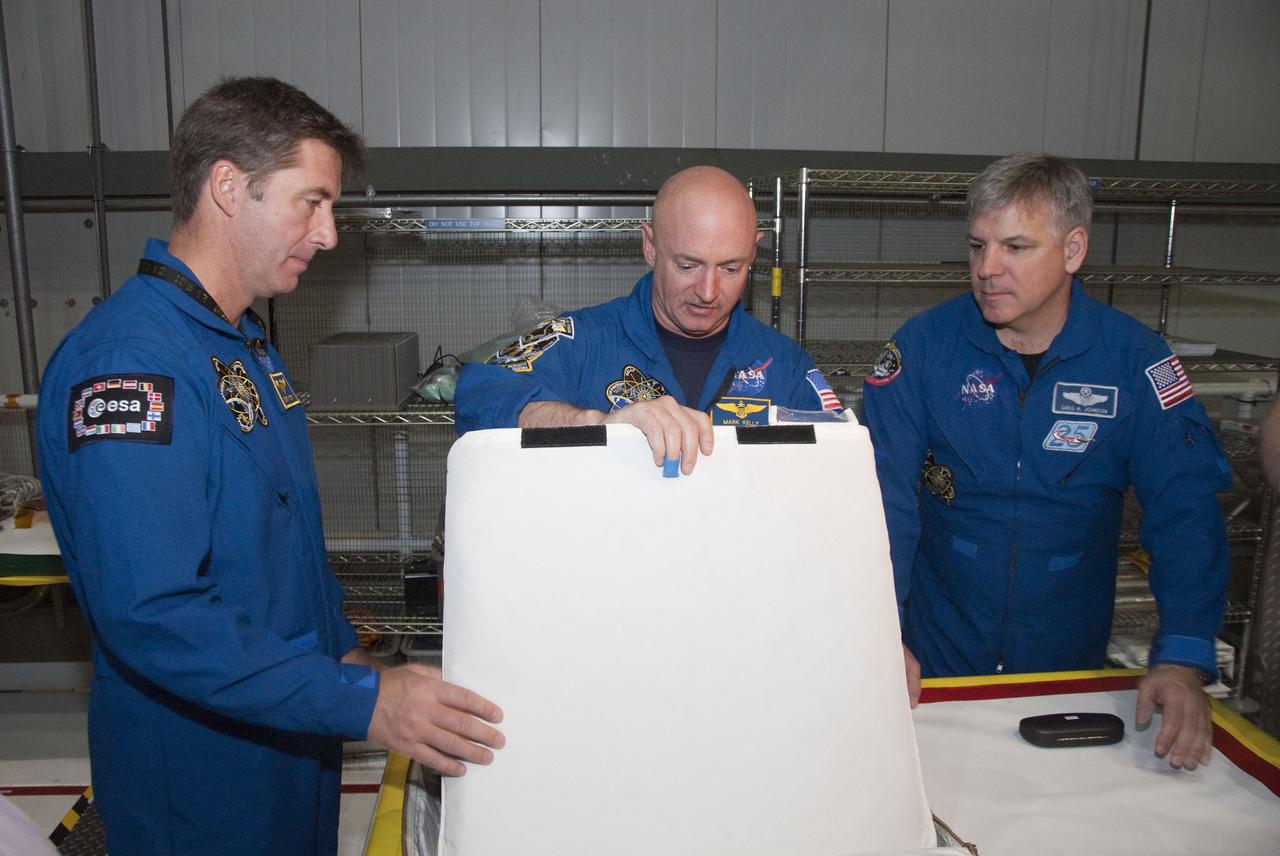
CAPE CANAVERAL, Fla. -- In the Orbiter Processing Facility-2 at NASA's Kennedy Space Center in Florida, STS-134 Mission Specialist Roberto Vittori with the European Space Agency, left, Commander Mark Kelly and Pilot Gregory H. Johnson check out tools and equipment they'll be using in space. The six STS-134 astronauts are at Kennedy participating in the Crew Equipment Interface Test (CEIT), which gives them an opportunity for hands-on training and familiarization of the payload they'll be delivering to the International Space Station. Space shuttle Endeavour is targeted to launch on the STS-134 mission Feb. 27, 2011. For more information, visit www.nasa.gov/mission_pages/shuttle/shuttlemissions/sts134/index.html. Photo credit: NASA/Cory Huston

CAPE CANAVERAL, Fla. -- On Launch Pad 39A at NASA's Kennedy Space Center in Florida, workers prepare to begin removing the quick disconnect from the ground umbilical carrier plate (GUCP) on space shuttle Discovery's external fuel tank. A hydrogen gas leak at that location during tanking for the STS-133 mission to the International Space Station caused the launch attempt to be scrubbed Nov. 5. The GUCP will be examined to determine the cause of the hydrogen leak and then repaired. The GUCP is the overboard vent to the pad and the flame stack where the vented hydrogen is burned off. Discovery's next launch attempt is targeted for no earlier than Nov. 30 at 4:02 a.m. EST. For more information on STS-133, visit www.nasa.gov/mission_pages/shuttle/shuttlemissions/sts133/. Photo credit: NASA/Troy Cryder

CAPE CANAVERAL, Fla. -- On Launch Pad 39A at NASA's Kennedy Space Center in Florida, the tip-top of the bright-orange external fuel tank is where workers will prepare to begin removing the quick disconnect from the ground umbilical carrier plate (GUCP). A hydrogen gas leak at that location during tanking for space shuttle Discovery's STS-133 mission to the International Space Station caused the launch attempt to be scrubbed Nov. 5. The GUCP will be examined to determine the cause of the hydrogen leak and then repaired. The GUCP is the overboard vent to the pad and the flame stack where the vented hydrogen is burned off. Discovery's next launch attempt is targeted for no earlier than Nov. 30 at 4:02 a.m. EST. For more information on STS-133, visit www.nasa.gov/mission_pages/shuttle/shuttlemissions/sts133/. Photo credit: NASA/Troy Cryder
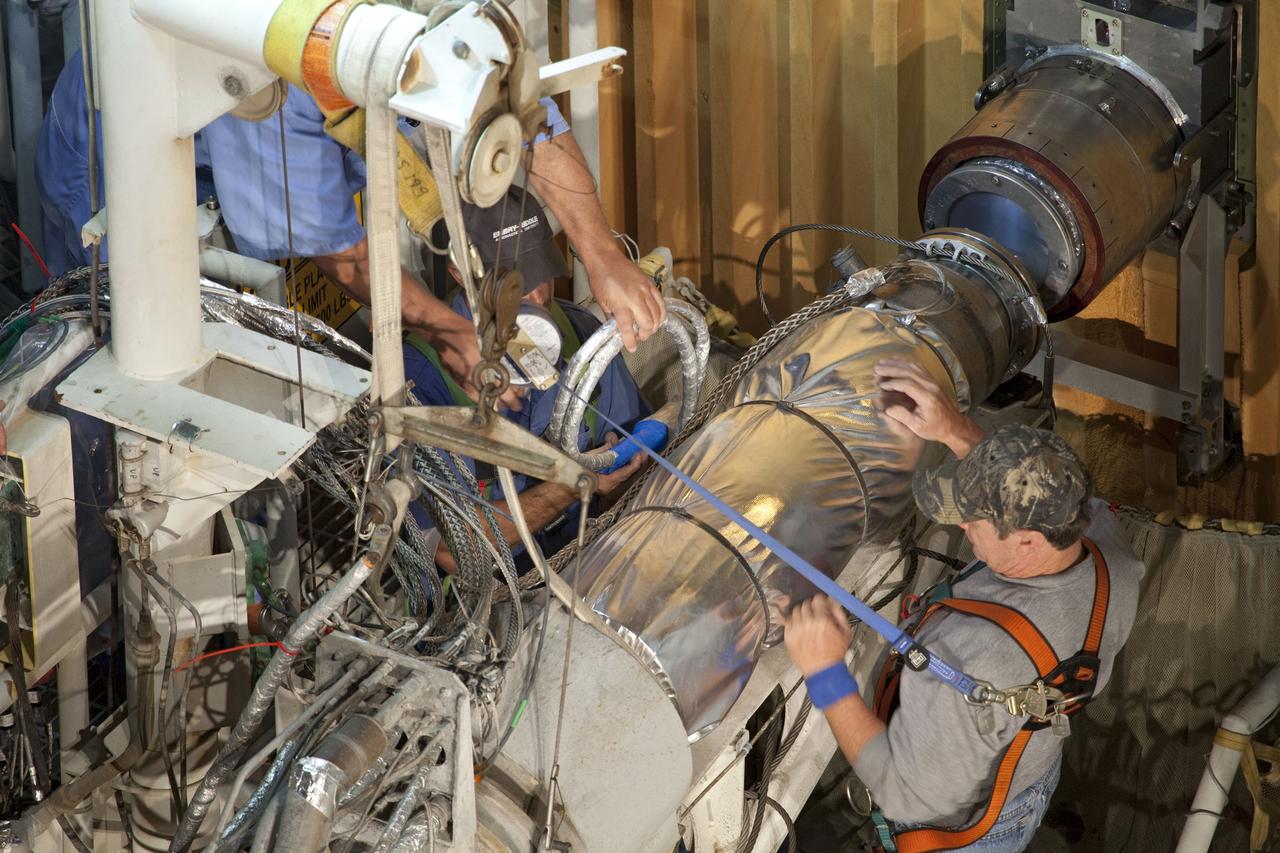
CAPE CANAVERAL, Fla. -- On Launch Pad 39A at NASA's Kennedy Space Center in Florida, workers remove the vent line attached to the ground umbilical carrier plate (GUCP) on the bright-orange external fuel tank. Next, the GUCP's 7-inch quick disconnect will be removed. A hydrogen gas leak at that location during tanking for space shuttle Discovery's STS-133 mission to the International Space Station caused the launch attempt to be scrubbed Nov. 5. The GUCP will be examined to determine the cause of the hydrogen leak and then repaired. The GUCP is the overboard vent to the pad and the flame stack where the vented hydrogen is burned off. Discovery's next launch attempt is no earlier than Nov. 30 at 4:02 a.m. EST. For more information on STS-133, visit www.nasa.gov/mission_pages/shuttle/shuttlemissions/sts133/. Photo credit: NASA/Frankie Martin

CAPE CANAVERAL, Fla. -- On Launch Pad 39A at NASA's Kennedy Space Center in Florida, workers take photos of the ground umbilical carrier plate's (GUCP) 7-inch quick disconnect, which has been removed from the external fuel tank. A hydrogen gas leak at that location during tanking for space shuttle Discovery's STS-133 mission to the International Space Station caused the launch attempt to be scrubbed Nov. 5. The GUCP will be examined to determine the cause of the hydrogen leak and then repaired. The GUCP is the overboard vent to the pad and the flame stack where the vented hydrogen is burned off. Discovery's next launch attempt is no earlier than Nov. 30 at 4:02 a.m. EST. For more information on STS-133, visit www.nasa.gov/mission_pages/shuttle/shuttlemissions/sts133/. Photo credit: NASA/Troy Cryder
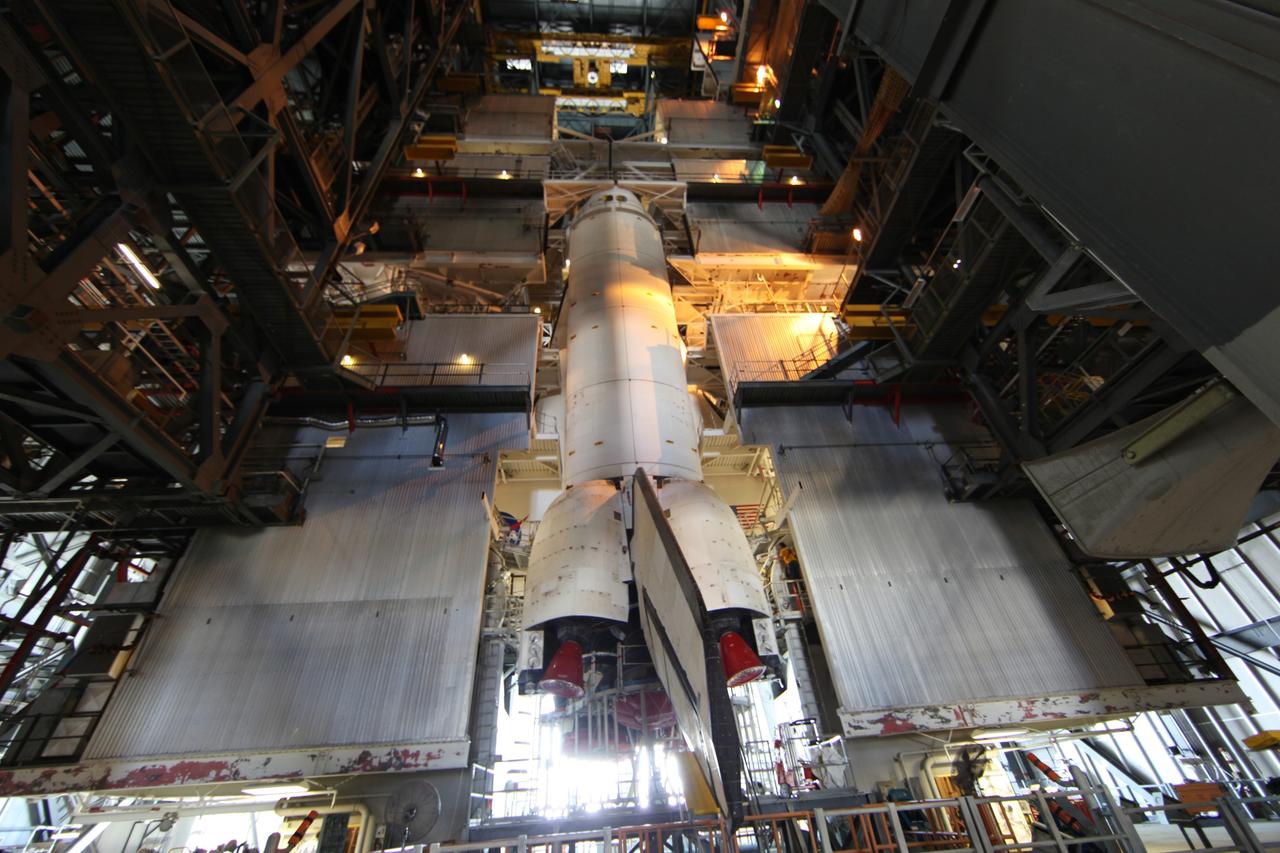
CAPE CANAVERAL, Fla. -- At NASA's Kennedy Space Center in Florida, space shuttle Discovery is attached to its external fuel tank and solid rocket boosters in the Vehicle Assembly Building. As technicians were attaching the left-side main separation bolt on the bottom of the shuttle to the external tank Sept. 10 a bolt nut slipped back into Discovery's aft compartment. To retrieve it, technicians entered Discovery’s aft section through an access door. They then moved the nut back into position to finish attaching the bolt, which is used to separate Discovery from the external tank once the shuttle is in orbit. Discovery is scheduled to roll out to Launch Pad 39A later this month for its STS-133 launch to the International Space Station. Targeted to lift off Nov. 1, Discovery will take the Permanent Multipurpose Module (PMM) packed with supplies and critical spare parts, as well as Robonaut 2 (R2) to the station. Photo credit: NASA/Dimitri Gerondidakis
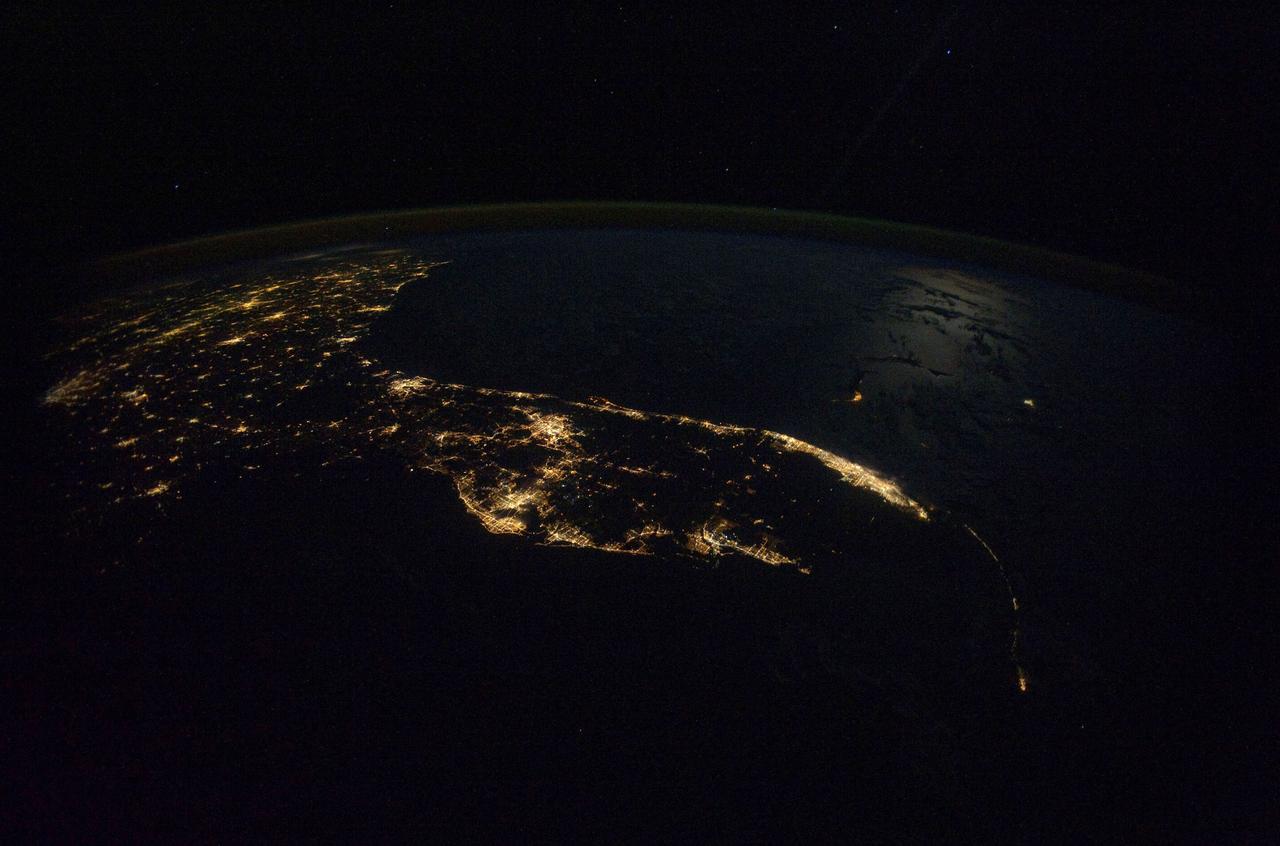
INTERNATIONAL SPACE STATION -- ISS025-E-10716 -- This image of the southeast United States from the International Space Station on Halloween night is anything but frightening. From 220 miles above Earth, an Expedition 25 crew member aboard the orbiting laboratory took the image, which shows the Gulf and Atlantic coasts, the Florida panhandle and part of the Georgia coast. The Expedition 25 crew members are NASA astronaut and Commander Doug Wheelock, NASA astronauts Scott Kelly and Shannon Walker, and Russian cosmonauts Oleg Skripochka, Fyodor Yurchikhin and Alexander Kaleri, all flight engineers. Two days later, NASA and its international partners will celebrate 10 years of continuous human presence aboard the station. Image credit: NASA
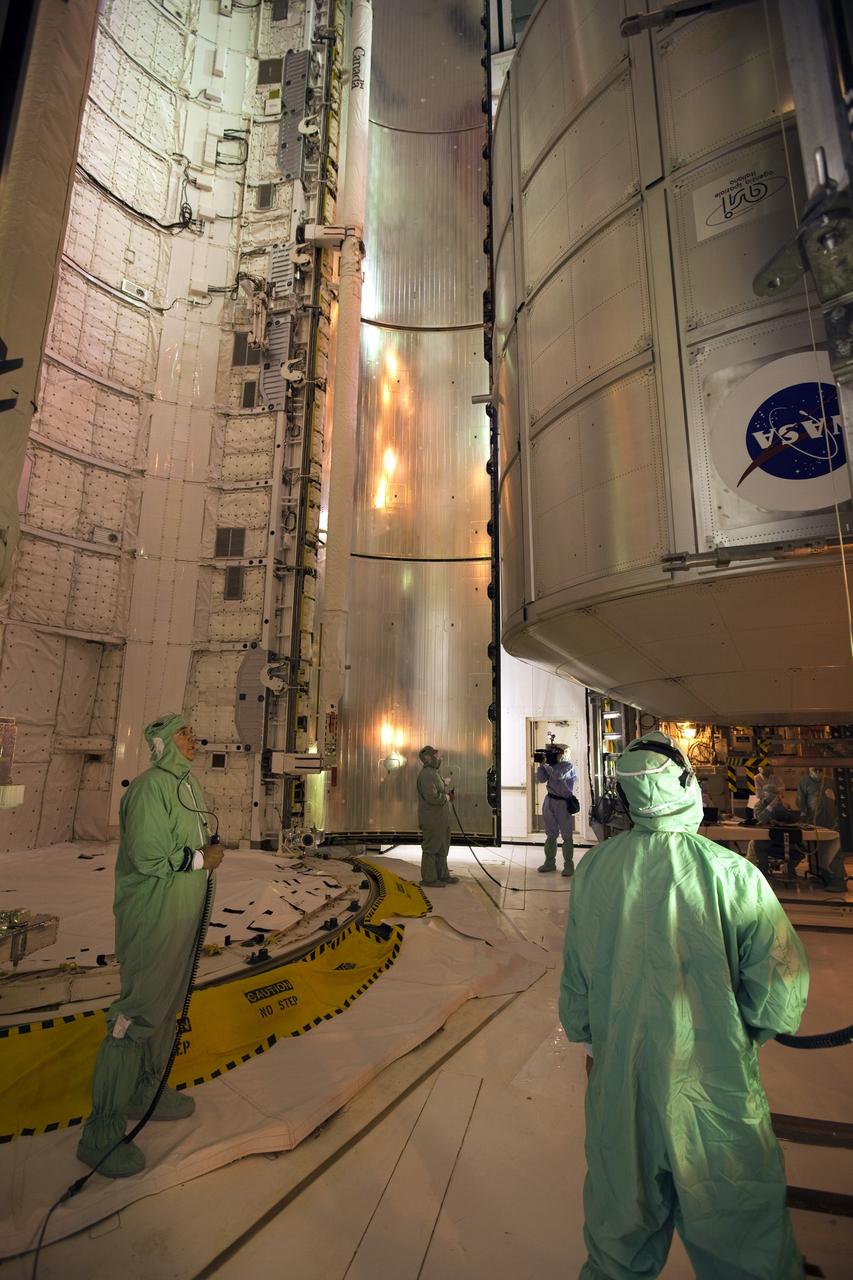
CAPE CANAVERAL, Fla. -- At NASA's Kennedy Space Center in Florida, technicians prepare to move the STS-133 payload from the rotating service structure on Launch Pad 39A to space shuttle Discovery's payload bay. The move paves the way for the Terminal Countdown Demonstration Test (TCDT) this week, which will give the astronauts and teams at Kennedy and NASA's Johnson Space Center in Houston a chance to practice launch day tasks. Discovery and its STS-133 crew will deliver the Permanent Multipurpose Module, packed with supplies and critical spare parts, as well as Robonaut 2, the dexterous humanoid astronaut helper, to the International Space Station. Launch is targeted for 4:40 p.m. EDT, Nov. 1. Photo credit: NASA/Dimitri Gerondidakis
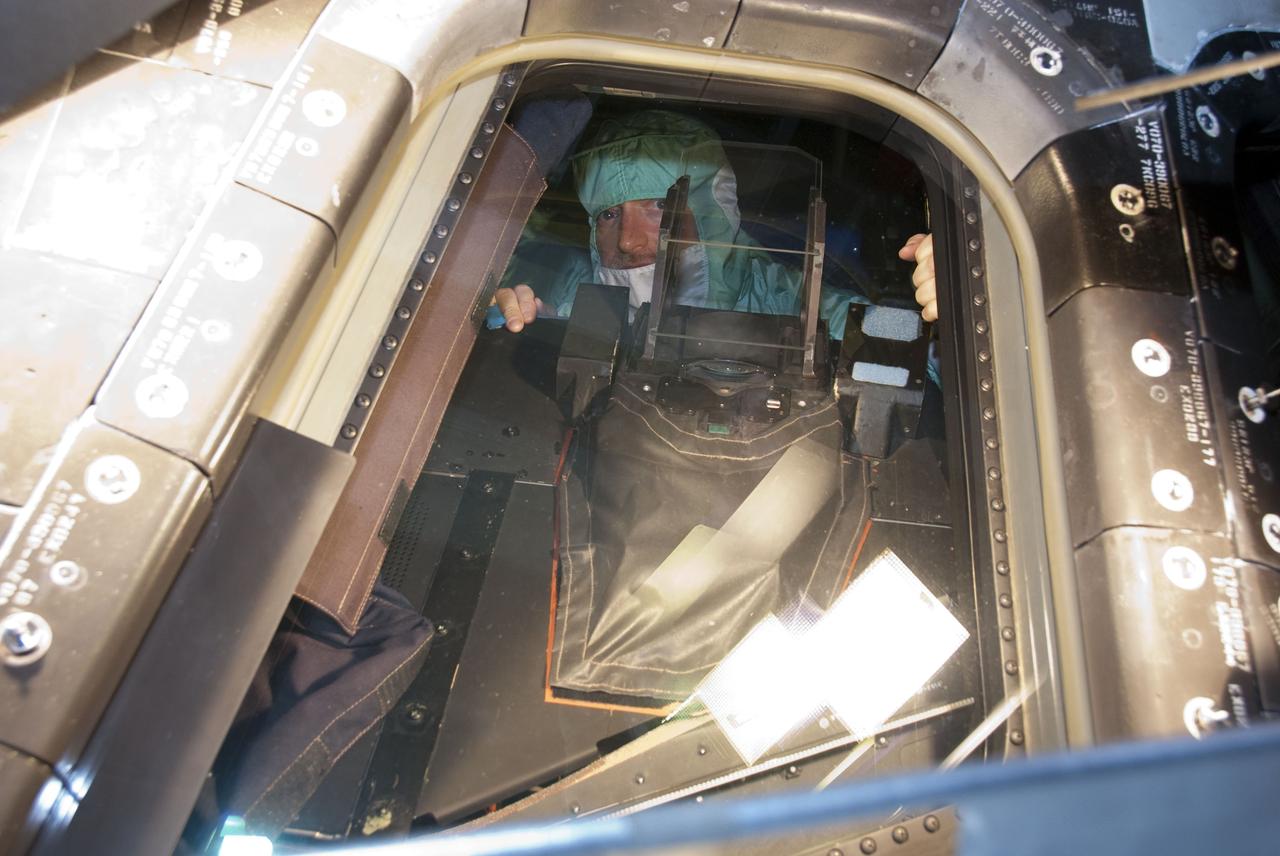
CAPE CANAVERAL, Fla. -- In the Orbiter Processing Facility-2 at NASA's Kennedy Space Center in Florida, STS-134 Commander Mark Kelly inspects the windows on space shuttle Endeavour. The six STS-134 astronauts are at Kennedy participating in the Crew Equipment Interface Test (CEIT), which gives them an opportunity for hands-on training with the tools and equipment they'll use in space and familiarization of the payload they'll be delivering to the International Space Station. Space shuttle Endeavour is targeted to launch on the STS-134 mission Feb. 27, 2011. For more information, visit www.nasa.gov/mission_pages/shuttle/shuttlemissions/sts134/index.html. Photo credit: NASA/Cory Huston

CAPE CANAVERAL, Fla. -- On Launch Pad 39A at NASA's Kennedy Space Center in Florida, workers prepare to begin removing the quick disconnect from the ground umbilical carrier plate (GUCP) on space shuttle Discovery's external fuel tank. A hydrogen gas leak at that location during tanking for the STS-133 mission to the International Space Station caused the launch attempt to be scrubbed Nov. 5. The GUCP will be examined to determine the cause of the hydrogen leak and then repaired. The GUCP is the overboard vent to the pad and the flame stack where the vented hydrogen is burned off. Discovery's next launch attempt is targeted for no earlier than Nov. 30 at 4:02 a.m. EST. For more information on STS-133, visit www.nasa.gov/mission_pages/shuttle/shuttlemissions/sts133/. Photo credit: NASA/Troy Cryder
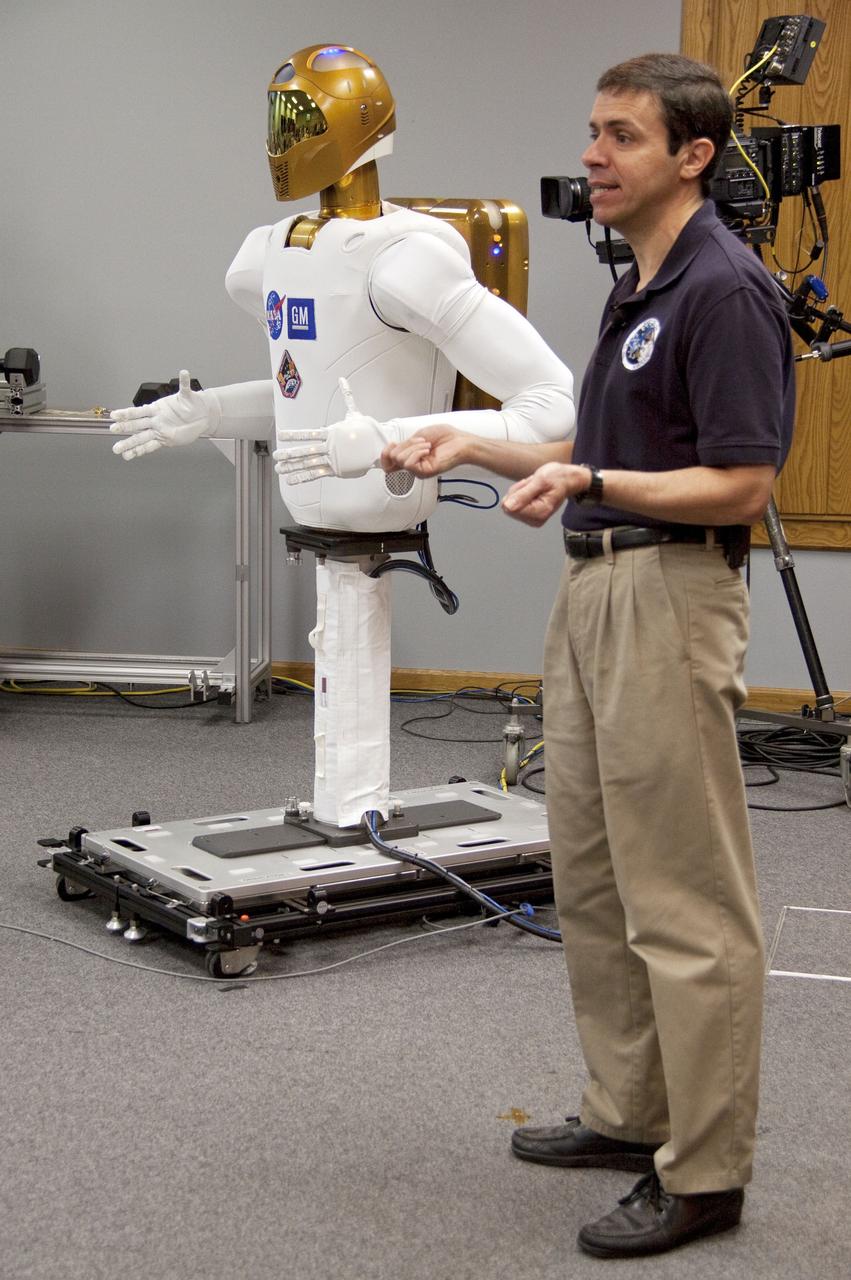
CAPE CANAVERAL, Fla. -- At NASA's Kennedy Space Center in Florida, Ron Diftler, NASA's Robonaut 2 (R2) project manager, shows media the capabilities of a dexterous humanoid astronaut helper. R2 will be delivered to the International Space Station on space shuttle Discovery's STS-133 mission. Although R2 will initially only participate in operational tests, upgrades could eventually allow the robot to realize its true purpose -- helping spacewalking astronauts with tasks outside the orbiting laboratory. For more information on the upcoming STS-133 mission, visit www.nasa.gov/mission_pages/shuttle/shuttlemissions/sts133/. Photo credit: NASA/Jack Pfaller
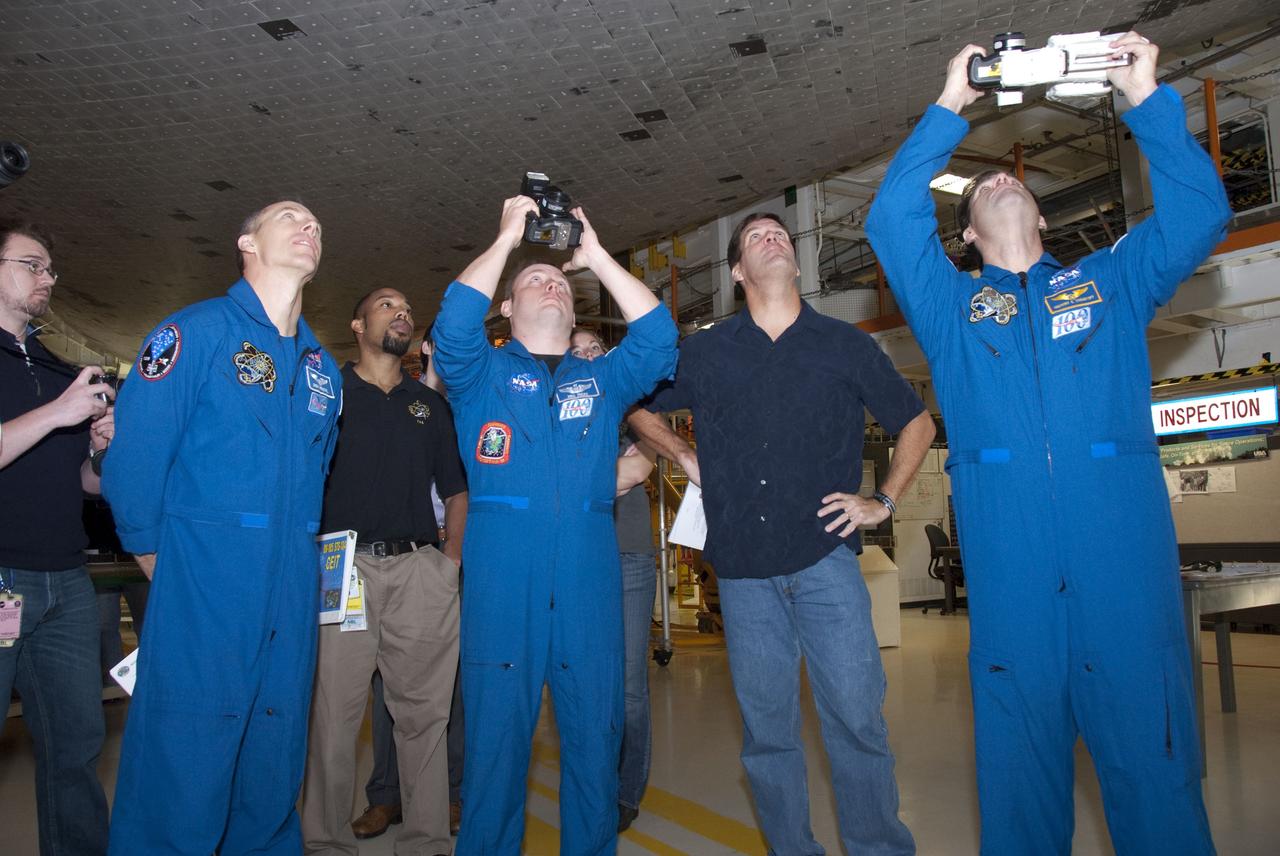
CAPE CANAVERAL, Fla. -- In the Orbiter Processing Facility-2 at NASA's Kennedy Space Center in Florida, STS-134 Mission Specialists Andrew Feustel, left, Michael Finke and Greg Chamitoff look at space shuttle Endeavour's heat shield tiles, which will protect the spacecraft during re-entry. The six STS-134 astronauts are at Kennedy participating in the Crew Equipment Interface Test (CEIT), which gives them an opportunity for hands-on training and familiarization of the payload they'll be delivering to the International Space Station. Space shuttle Endeavour is targeted to launch on the STS-134 mission Feb. 27, 2011. For more information, visit www.nasa.gov/mission_pages/shuttle/shuttlemissions/sts134/index.html. Photo credit: NASA/Cory Huston
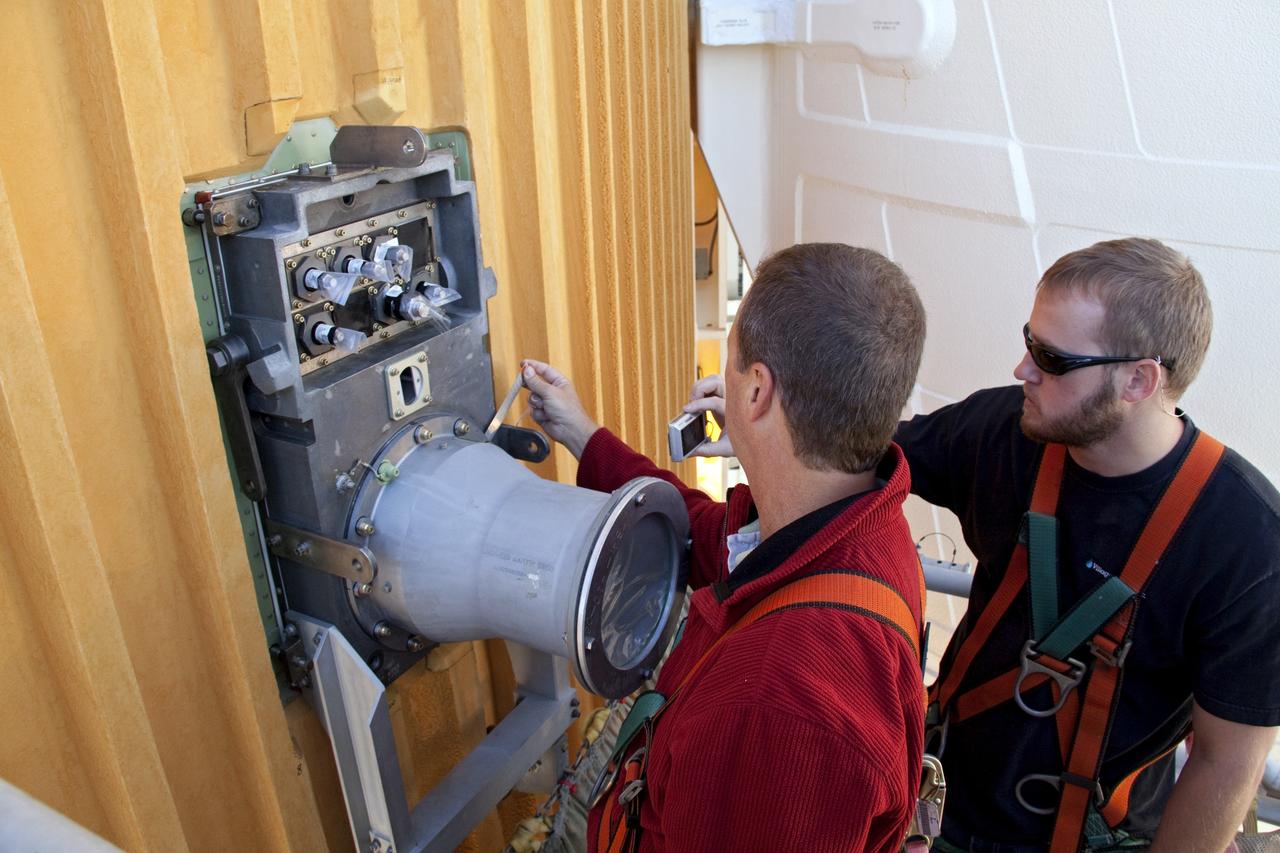
CAPE CANAVERAL, Fla. -- On Launch Pad 39A at NASA's Kennedy Space Center in Florida, workers begin to remove the ground umbilical carrier plate's (GUCP) 7-inch quick disconnect. A hydrogen gas leak at that location on the external fuel tank during tanking for space shuttle Discovery's STS-133 mission to the International Space Station caused the launch attempt to be scrubbed Nov. 5. The GUCP will be examined to determine the cause of the hydrogen leak and then repaired. The GUCP is the overboard vent to the pad and the flame stack where the vented hydrogen is burned off. Discovery's next launch attempt is no earlier than Nov. 30 at 4:02 a.m. EST. For more information on STS-133, visit www.nasa.gov/mission_pages/shuttle/shuttlemissions/sts133/. Photo credit: NASA/Troy Cryder
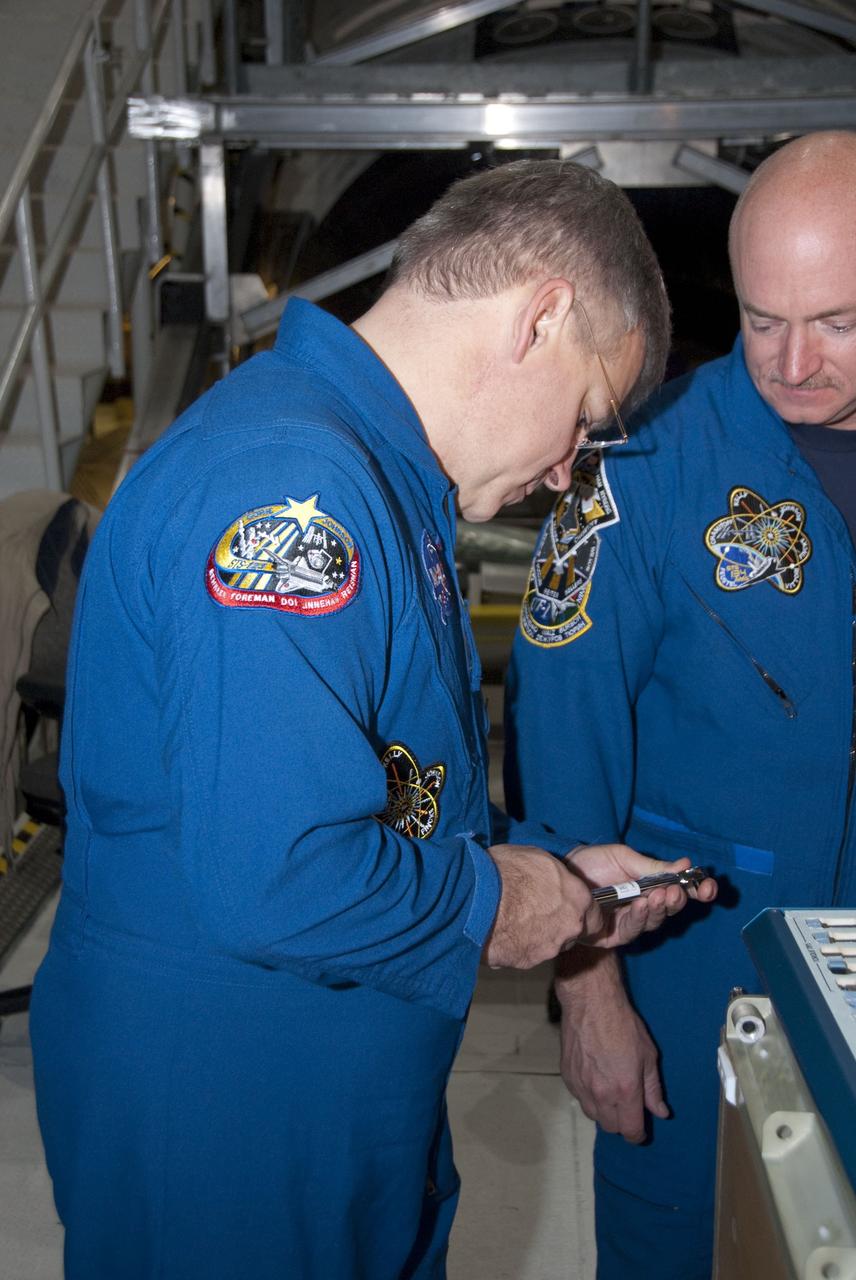
CAPE CANAVERAL, Fla. -- In the Orbiter Processing Facility-2 at NASA's Kennedy Space Center in Florida, STS-134 Pilot Gregory H. Johnson, left, and Commander Mark Kelly check out a tool they'll be using in space. The six STS-134 astronauts are at Kennedy participating in the Crew Equipment Interface Test (CEIT), which gives them an opportunity for hands-on training and familiarization of the payload they'll be delivering to the International Space Station. Space shuttle Endeavour is targeted to launch on the STS-134 mission Feb. 27, 2011. For more information, visit www.nasa.gov/mission_pages/shuttle/shuttlemissions/sts134/index.html. Photo credit: NASA/Cory Huston
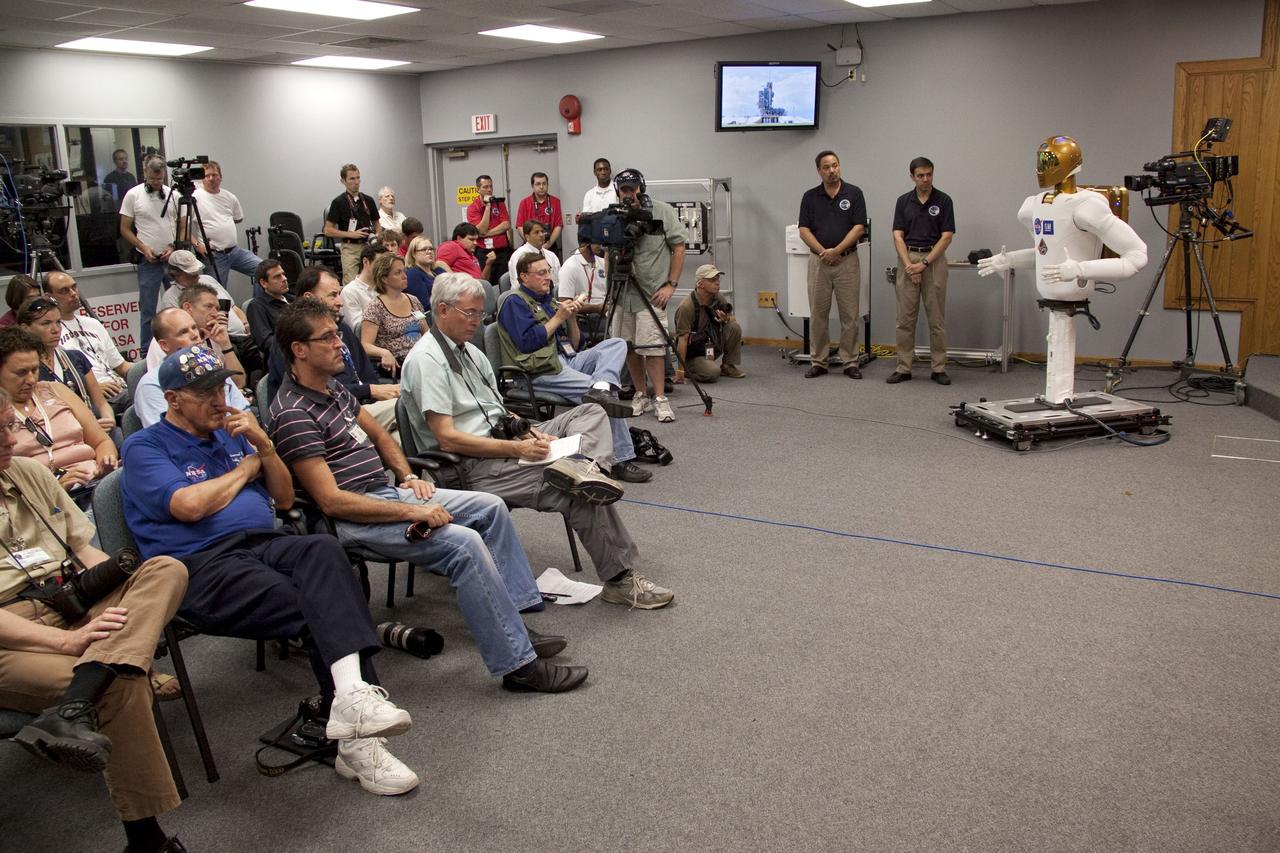
CAPE CANAVERAL, Fla. -- At NASA's Kennedy Space Center in Florida, a dexterous humanoid astronaut helper, known as Robonaut, is on display for media. Robonaut 2 (R2) will be delivered to the International Space Station on space shuttle Discovery's STS-133 mission. Although R2 will initially only participate in operational tests, upgrades could eventually allow the robot to realize its true purpose -- helping spacewalking astronauts with tasks outside the orbiting laboratory. For more information on the upcoming STS-133 mission, visit www.nasa.gov/mission_pages/shuttle/shuttlemissions/sts133/. Photo credit: NASA/Jack Pfaller

CAPE CANAVERAL, Fla. -- On Launch Pad 39A at NASA's Kennedy Space Center in Florida, workers take photos of the ground umbilical carrier plate's (GUCP) 7-inch quick disconnect, which has been removed from the external fuel tank. A hydrogen gas leak at that location during tanking for space shuttle Discovery's STS-133 mission to the International Space Station caused the launch attempt to be scrubbed Nov. 5. The GUCP will be examined to determine the cause of the hydrogen leak and then repaired. The GUCP is the overboard vent to the pad and the flame stack where the vented hydrogen is burned off. Discovery's next launch attempt is no earlier than Nov. 30 at 4:02 a.m. EST. For more information on STS-133, visit www.nasa.gov/mission_pages/shuttle/shuttlemissions/sts133/. Photo credit: NASA/Troy Cryder
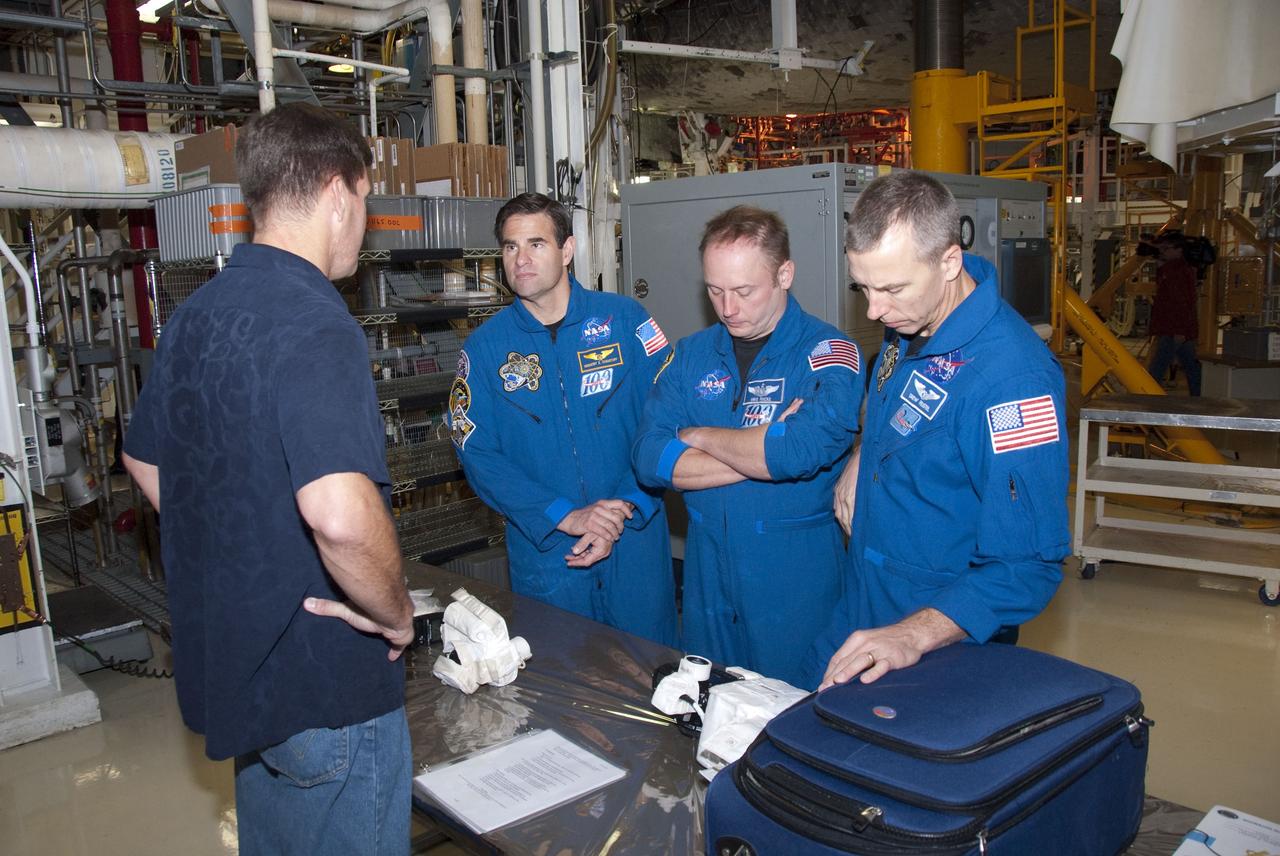
CAPE CANAVERAL, Fla. -- In the Orbiter Processing Facility-2 at NASA's Kennedy Space Center in Florida, STS-134 Mission Specialists Greg Chamitoff, left, Michael Finke and Andrew Feustel check out the camera they'll be snapping photos with in space. The six STS-134 astronauts are at Kennedy participating in the Crew Equipment Interface Test (CEIT), which gives them an opportunity for hands-on training and familiarization of the payload they'll be delivering to the International Space Station. Space shuttle Endeavour is targeted to launch on the STS-134 mission Feb. 27, 2011. For more information, visit www.nasa.gov/mission_pages/shuttle/shuttlemissions/sts134/index.html. Photo credit: NASA/Cory Huston
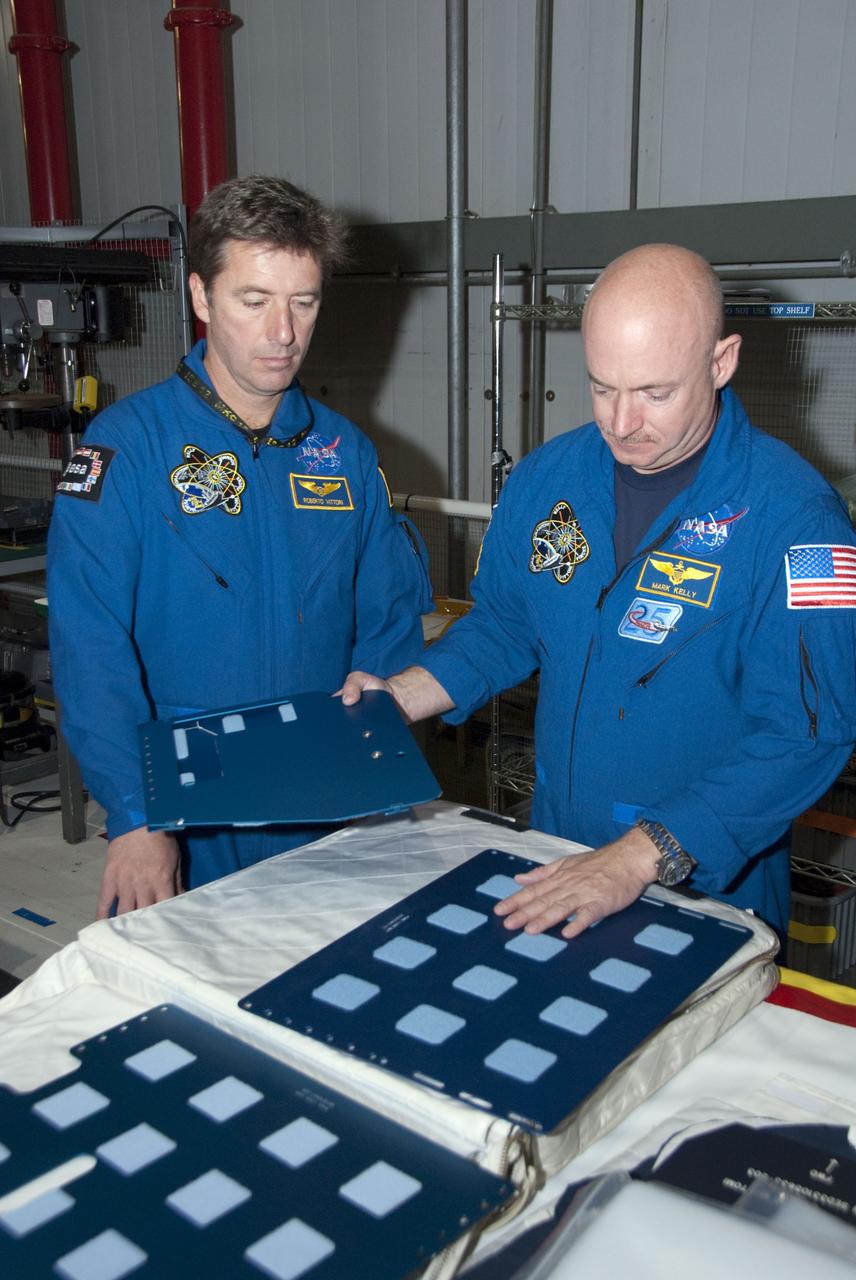
CAPE CANAVERAL, Fla. -- In the Orbiter Processing Facility-2 at NASA's Kennedy Space Center in Florida, STS-134 Mission Specialist Roberto Vittori with the European Space Agency, left, and Commander Mark Kelly check out tools and equipment they'll be using in space. The six STS-134 astronauts are at Kennedy participating in the Crew Equipment Interface Test (CEIT), which gives them an opportunity for hands-on training and familiarization of the payload they'll be delivering to the International Space Station. Space shuttle Endeavour is targeted to launch on the STS-134 mission Feb. 27, 2011. For more information, visit www.nasa.gov/mission_pages/shuttle/shuttlemissions/sts134/index.html. Photo credit: NASA/Cory Huston
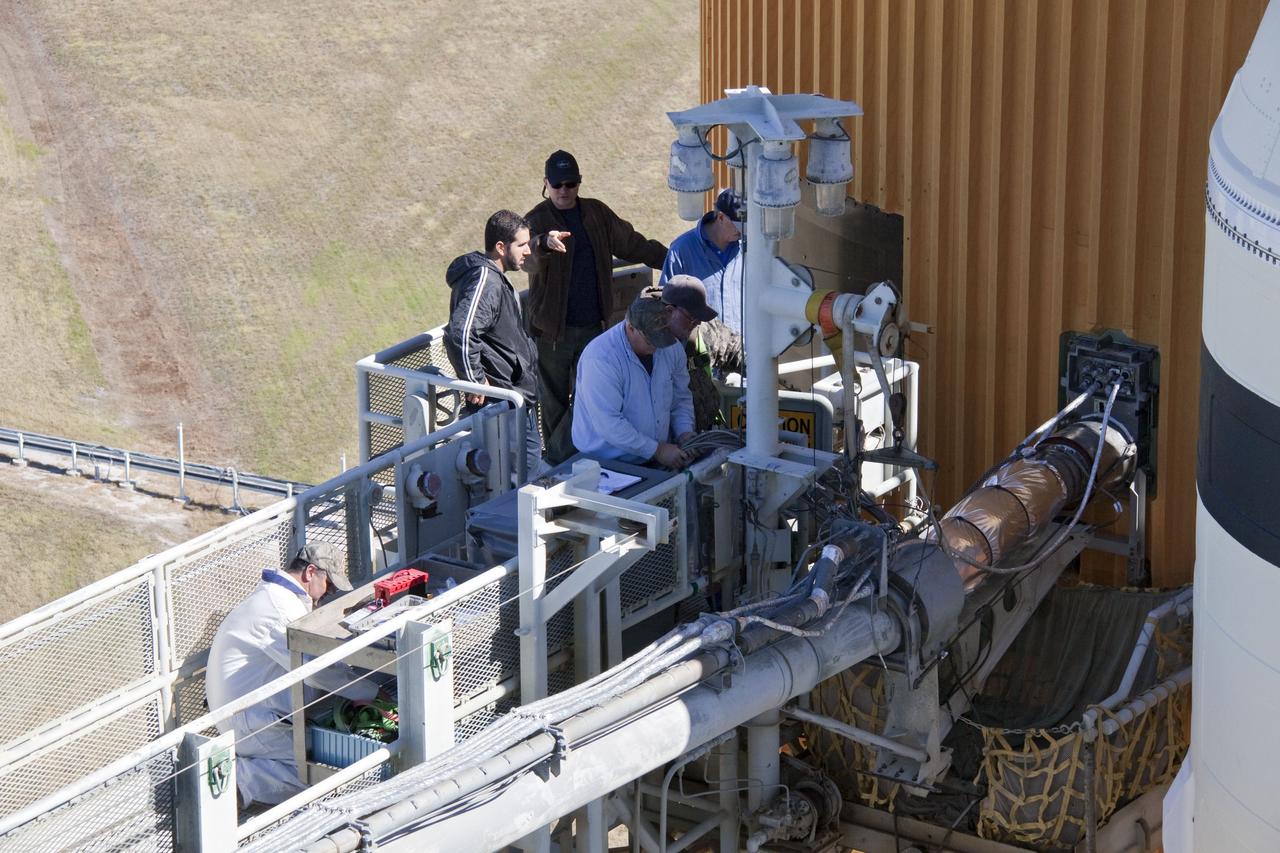
CAPE CANAVERAL, Fla. -- On Launch Pad 39A at NASA's Kennedy Space Center in Florida, workers prepare to begin removing the quick disconnect from the ground umbilical carrier plate (GUCP) on space shuttle Discovery's external fuel tank. A hydrogen gas leak at that location during tanking for the STS-133 mission to the International Space Station caused the launch attempt to be scrubbed Nov. 5. The GUCP will be examined to determine the cause of the hydrogen leak and then repaired. The GUCP is the overboard vent to the pad and the flame stack where the vented hydrogen is burned off. Discovery's next launch attempt is targeted for no earlier than Nov. 30 at 4:02 a.m. EST. For more information on STS-133, visit www.nasa.gov/mission_pages/shuttle/shuttlemissions/sts133/. Photo credit: NASA/Troy Cryder
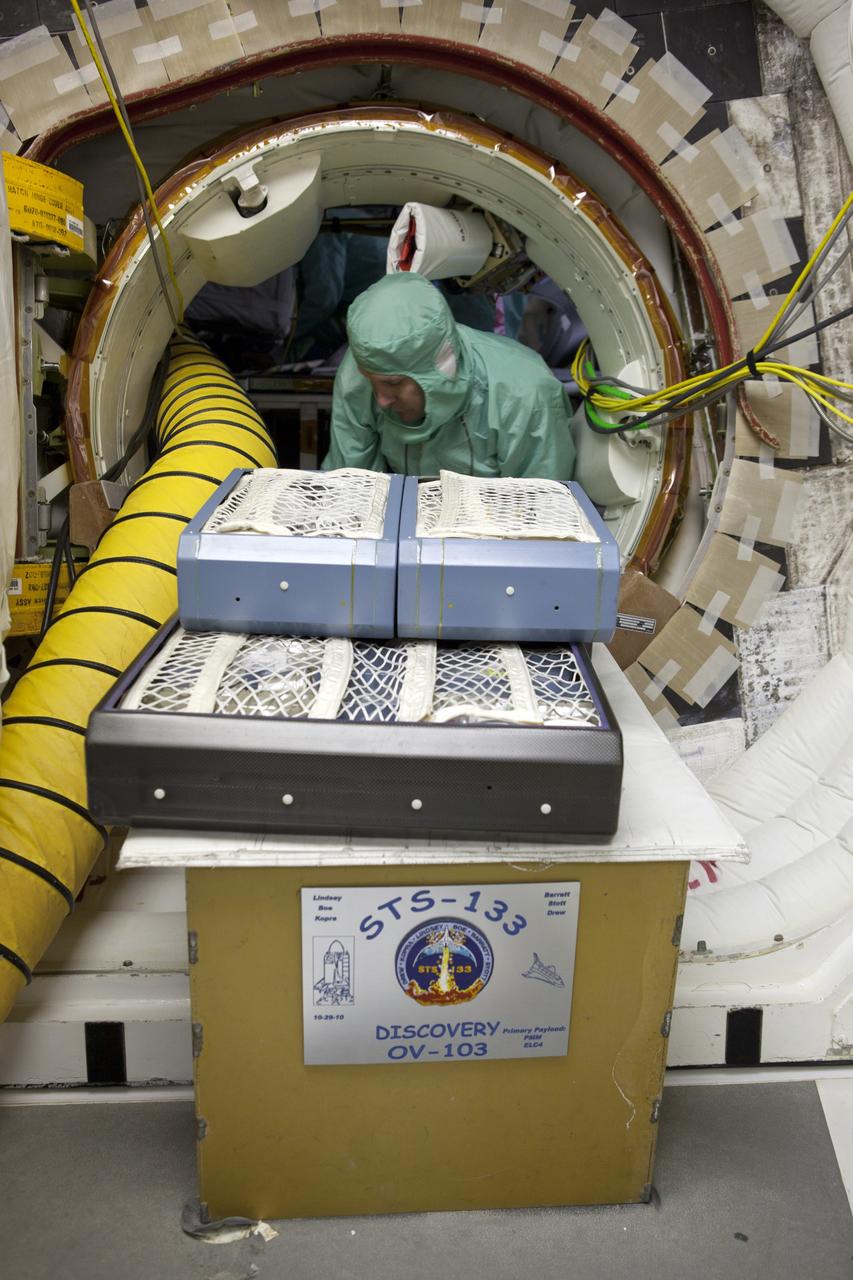
CAPE CANAVERAL, Fla. -- On Launch Pad 39A at NASA's Kennedy Space Center in Florida, technicians remove a few items from space shuttle Discovery's middeck payload, including food, prior to a tanking test planned for no earlier than Dec. 15. During the test, engineers will monitor what happens to the external fuel tank's newly replaced ground umbilical carrier plate (GUCP) and the intertank's stringers, which are 21-foot long, U-shaped aluminum brackets located on the intertank, during loading of cryogenic propellants. Technicians already installed environmental enclosures on the tank, removed foam and prepared the tank's skin for approximately 89 strain gauges and thermocouples. Discovery's first launch attempt for STS-133 was scrubbed in early November due to a hydrogen gas leak at GUCP. The next launch opportunity is no earlier than Feb. 3, 2011. For more information on STS-133, visit www.nasa.gov/mission_pages/shuttle/shuttlemissions/sts133/. Photo credit: NASA/Ben Smegelsky

CAPE CANAVERAL, Fla. -- Technicians outfit space shuttle Discovery's external fuel tank with approximately 89 strain gauges, thermocouples and wiring in preparation for a tanking test no earlier than Dec. 17 on Launch Pad 39A at NASA's Kennedy Space Center in Florida. During the test, engineers will monitor what happens to 21-foot long, U-shaped aluminum brackets, called stringers, located at the external tank's intertank area, as well as the newly replaced ground umbilical carrier plate (GUCP), during the loading of cryogenic propellants. Discovery's first launch attempt for STS-133 was scrubbed in early November due to a hydrogen gas leak at GUCP. The next launch opportunity is no earlier than Feb. 3, 2011. For more information on STS-133, visit www.nasa.gov/mission_pages/shuttle/shuttlemissions/sts133/. Photo credit: NASA/Jim Grossmann
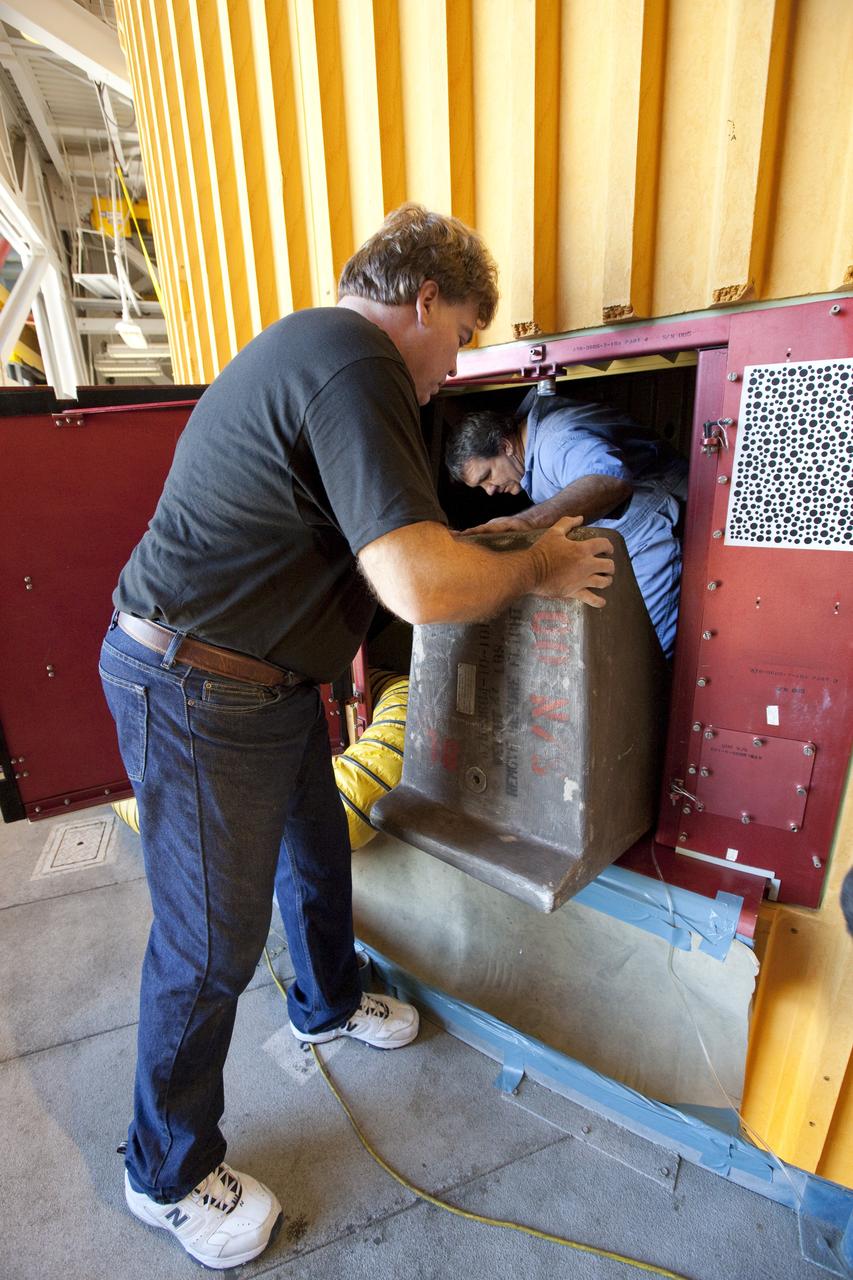
CAPE CANAVERAL, Fla. -- Preparations are under way in the Vehicle Assembly Building at NASA's Kennedy Space Center in Florida to examine space shuttle Discovery's external fuel tank. Technicians will begin to remove thermal sensors that will give engineers data about the changes the tank went through during the loading and draining of super-cold propellants during a tanking test on Dec. 17. Engineers also will examine 21-foot-long support beams, called stringers, on the outside of the tank's intertank region. Also on the agenda, is to re-apply foam to the outside of the tank. Discovery's next launch opportunity to the International Space Station on the STS-133 mission is no earlier than Feb. 3, 2011. For more information on STS-133, visit www.nasa.gov/mission_pages/shuttle/shuttlemissions/sts133/. Photo credit: NASA/Dimitri Gerondidakis

CAPE CANAVERAL, Fla. -- Technicians prepare space shuttle Discovery's external fuel tank for a tanking test no earlier than Dec. 15 on Launch Pad 39A at NASA's Kennedy Space Center in Florida. During the test, engineers will monitor what happens to 21-foot long, U-shaped aluminum brackets, called stringers, located at the intertank, as well as the newly replaced ground umbilical carrier plate (GUCP), during the loading of cryogenic propellants. Teams already have installed environmental enclosures on the tank, removed foam and prepared the tank's skin for approximately 89 strain gauges and thermocouples. Discovery's first launch attempt for STS-133 was scrubbed in early November due to a hydrogen gas leak at GUCP. The next launch opportunity is no earlier than Feb. 3, 2011. For more information on STS-133, visit www.nasa.gov/mission_pages/shuttle/shuttlemissions/sts133/. Photo credit: NASA/Frank Michaux
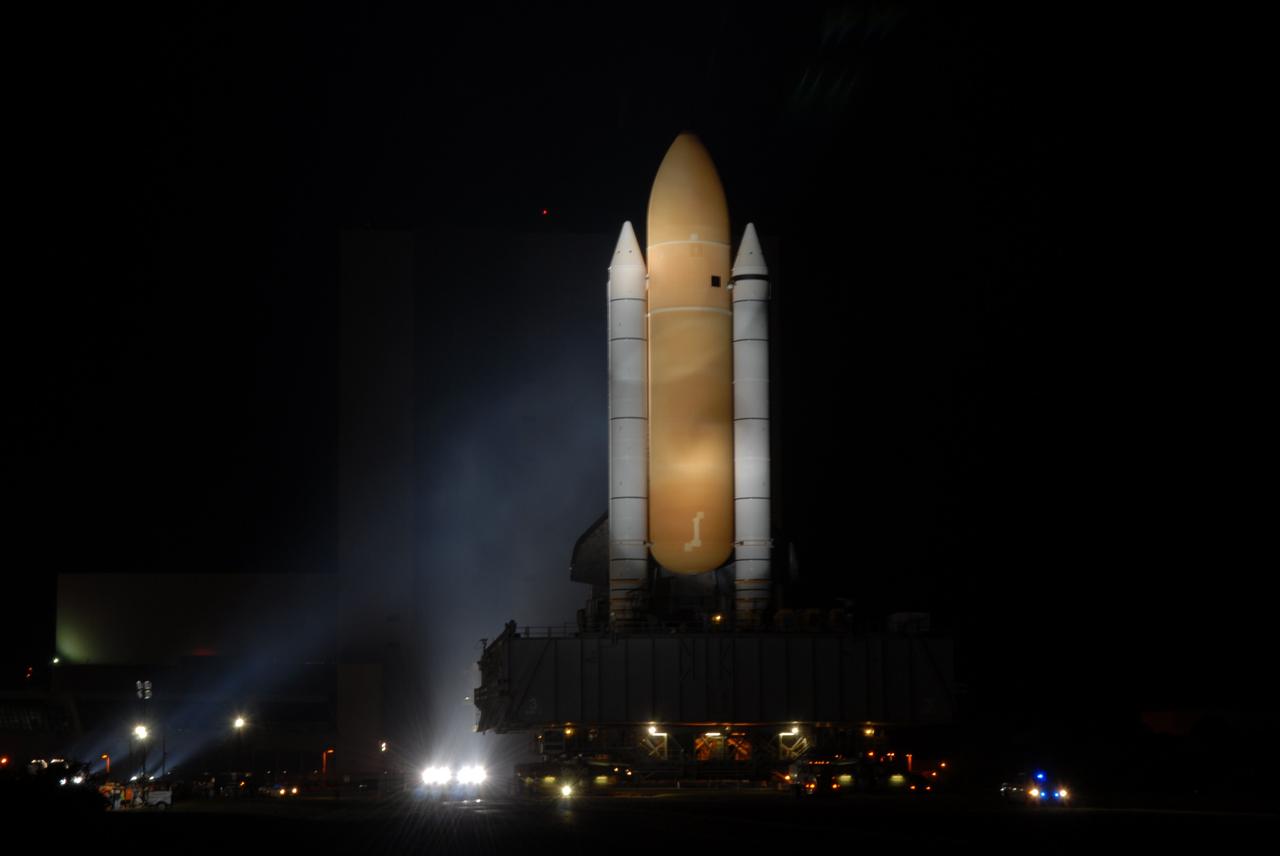
CAPE CANAVERAL, Fla. -- Bathed in bright xenon lights, space shuttle Discovery makes its nighttime trek, known as "rollout," from the Vehicle Assembly Building to Launch Pad 39A at NASA's Kennedy Space Center in Florida. It will take the shuttle, attached to its external fuel tank, twin solid rocket boosters and mobile launcher platform, about six hours to complete the move atop a crawler-transporter. Rollout sets the stage for Discovery's STS-133 crew to practice countdown and launch procedures during the Terminal Countdown Demonstration Test in mid-October. Targeted to liftoff Nov. 1, Discovery will take the Permanent Multipurpose Module (PMM) packed with supplies and critical spare parts, as well as Robonaut 2 (R2) to the International Space Station. Photo credit: NASA/Jim Grossmann
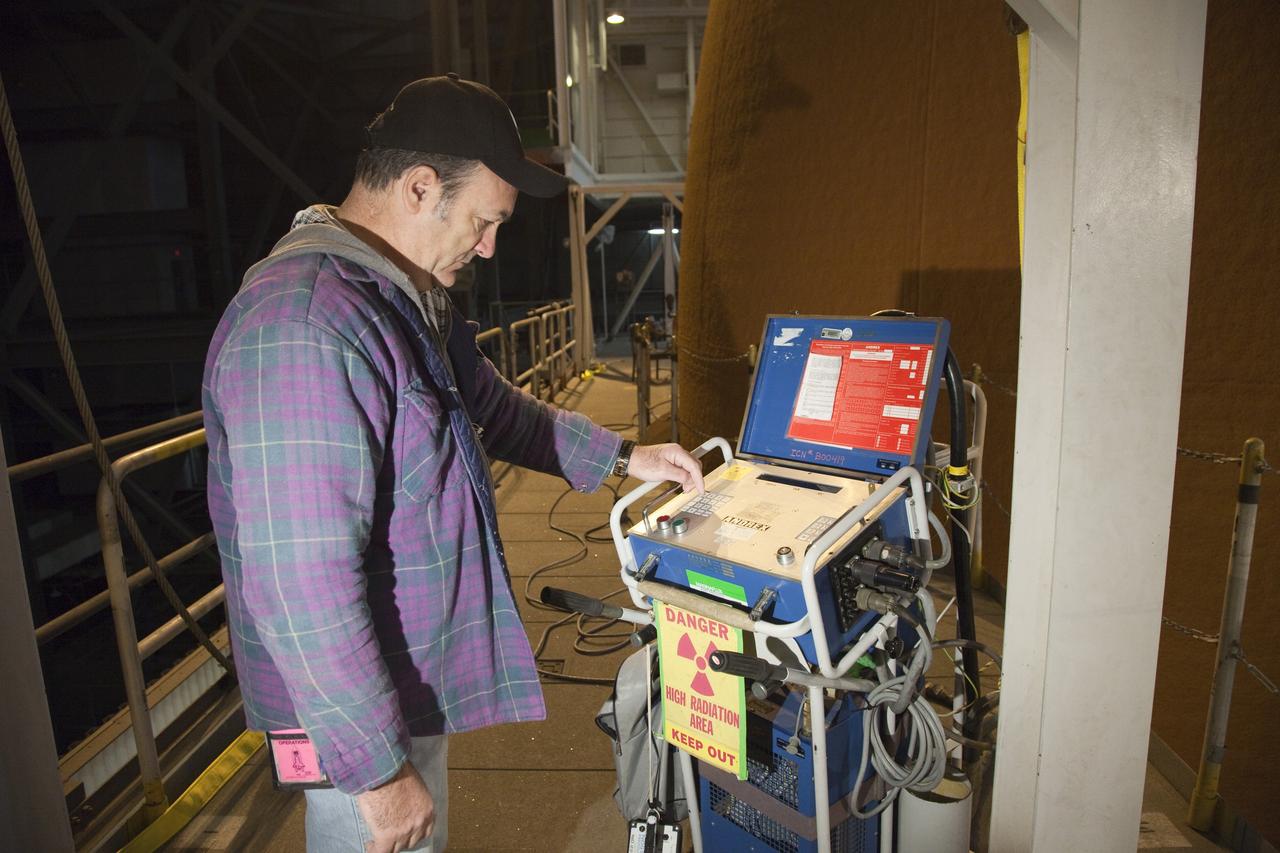
CAPE CANAVERAL, Fla. -- A technician takes computed radiography scans of space shuttle Discovery's external fuel tank. The shuttle stack, consisting of the shuttle, external tank and solid rocket boosters, was moved from Launch Pad 39A to the Vehicle Assembly Building at NASA's Kennedy Space Center in Florida so technicians could examine 21-foot-long support beams, called stringers, on the outside of the tank's intertank and re-apply foam insulation. Discovery's next launch opportunity to the International Space Station on the STS-133 mission is no earlier than Feb. 3, 2011. For more information on STS-133, visit www.nasa.gov/mission_pages/shuttle/shuttlemissions/sts133/. Photo credit: NASA/Frankie Martin
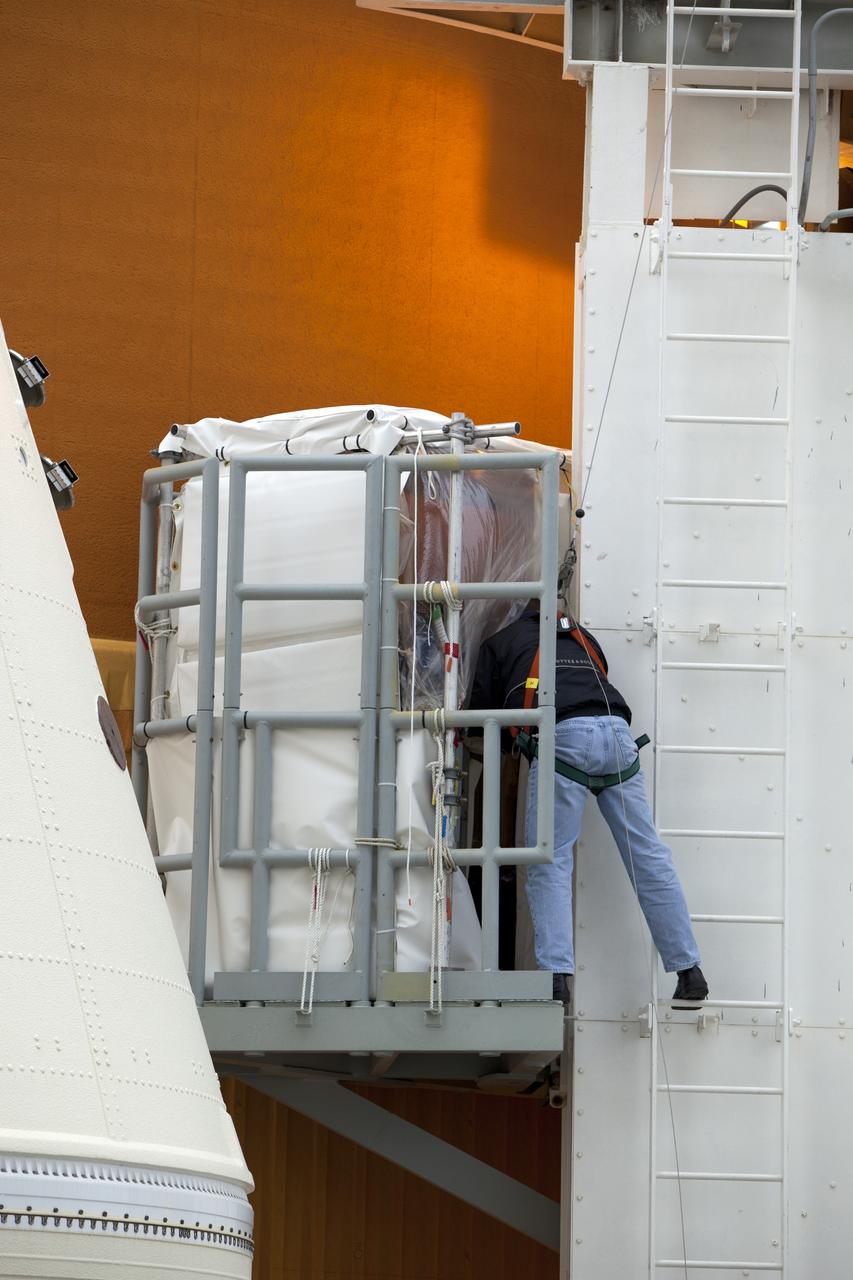
CAPE CANAVERAL, Fla. -- Technicians prepare space shuttle Discovery's external fuel tank for a tanking test no earlier than Dec. 15 on Launch Pad 39A at NASA's Kennedy Space Center in Florida. During the test, engineers will monitor what happens to 21-foot long, U-shaped aluminum brackets, called stringers, located at the intertank, as well as the newly replaced ground umbilical carrier plate (GUCP), during the loading of cryogenic propellants. Teams already have installed environmental enclosures on the tank, removed foam and prepared the tank's skin for approximately 89 strain gauges and thermocouples. Discovery's first launch attempt for STS-133 was scrubbed in early November due to a hydrogen gas leak at GUCP. The next launch opportunity is no earlier than Feb. 3, 2011. For more information on STS-133, visit www.nasa.gov/mission_pages/shuttle/shuttlemissions/sts133/. Photo credit: NASA/Ben Smegelsky
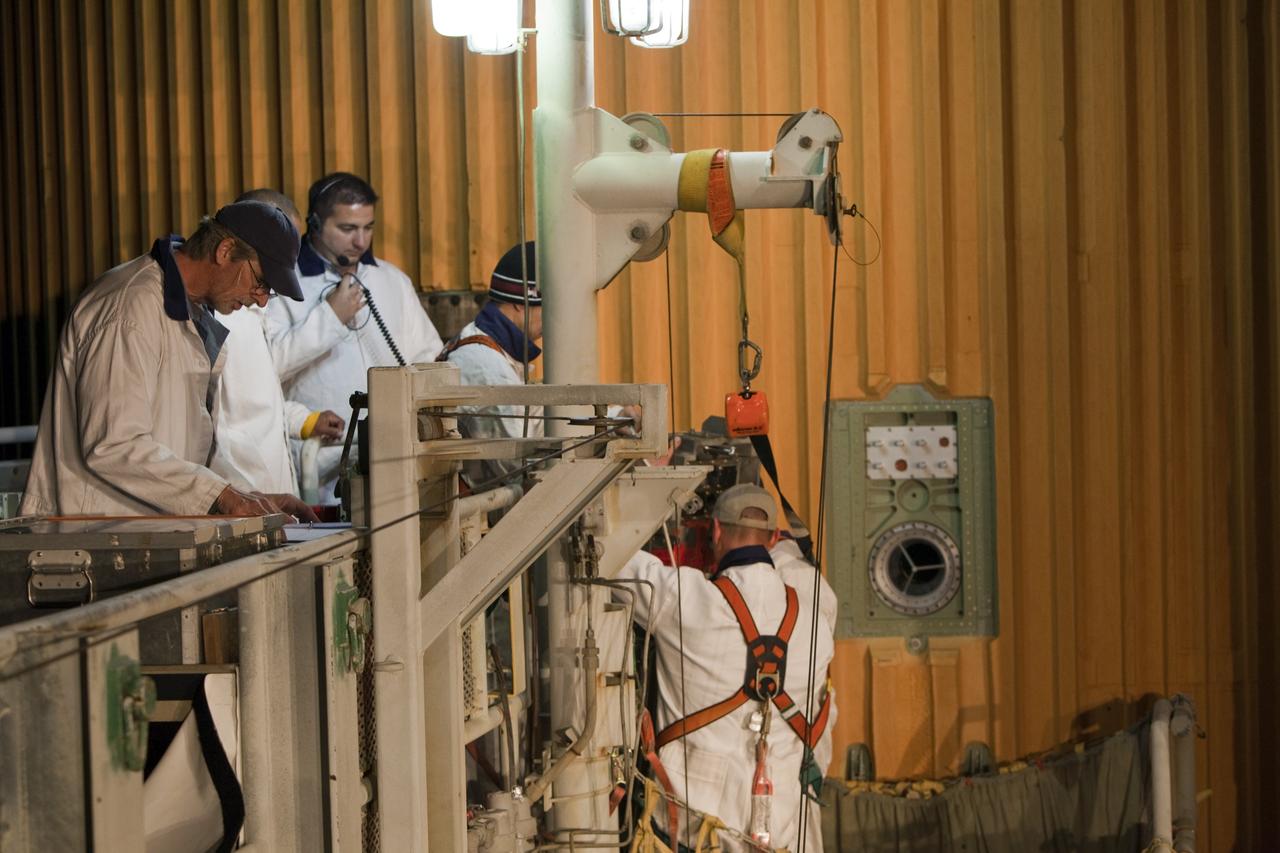
CAPE CANAVERAL, Fla. -- On Launch Pad 39A at NASA's Kennedy Space Center in Florida, the ground umbilical carrier plate (GUCP) is removed from space shuttle Discovery's external fuel tank. A hydrogen gas leak at that location during tanking for Discovery's STS-133 mission to the International Space Station caused the launch attempt to be scrubbed Nov. 5. The GUCP will be examined to determine the cause of the hydrogen leak and then repaired. The GUCP is the overboard vent to the pad and the flame stack where the excess hydrogen is burned off. For more information on STS-133, visit www.nasa.gov/mission_pages/shuttle/shuttlemissions/sts133/. Photo credit: NASA/Dimitri Gerondidakis

CAPE CANAVERAL, Fla. -- On Launch Pad 39A at NASA's Kennedy Space Center in Florida, technicians reattach the vent line to the ground umbilical carrier plate (GUCP) on space shuttle Discovery's external fuel tank. A hydrogen gas leak at that location during tanking for Discovery's STS-133 mission to the International Space Station caused the launch attempt to be scrubbed Nov. 5. The GUCP is the overboard vent to the pad and the flame stack where the excess hydrogen is burned off. Discovery's next launch attempt is no earlier than Nov. 30 at 4:02 a.m. EST. For more information on STS-133, visit www.nasa.gov/mission_pages/shuttle/shuttlemissions/sts133/. Photo credit: NASA/Ben Smegelsky
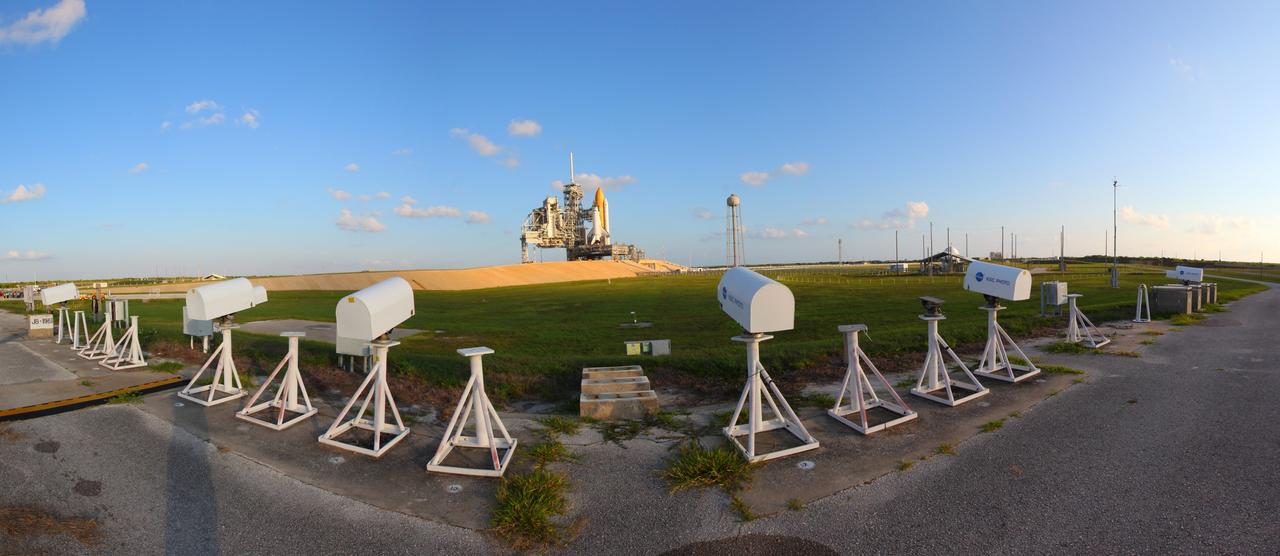
CAPE CANAVERAL, Fla. -- Space shuttle Discovery is attached to Launch Pad 39A at NASA's Kennedy Space Center in Florida. Later, the rotating service structure that protects the shuttle from the elements and provides access inside the vehicle will be moved into place. It took the spacecraft about six hours to make the journey, known as "rollout," from the Vehicle Assembly Building to the pad. Rollout sets the stage for Discovery's STS-133 crew to practice countdown and launch procedures during the Terminal Countdown Demonstration Test in mid-October. Targeted to liftoff Nov. 1, Discovery will take the Permanent Multipurpose Module (PMM) packed with supplies and critical spare parts, as well as Robonaut 2 (R2) to the International Space Station. Photo credit: NASA/Frankie Martin
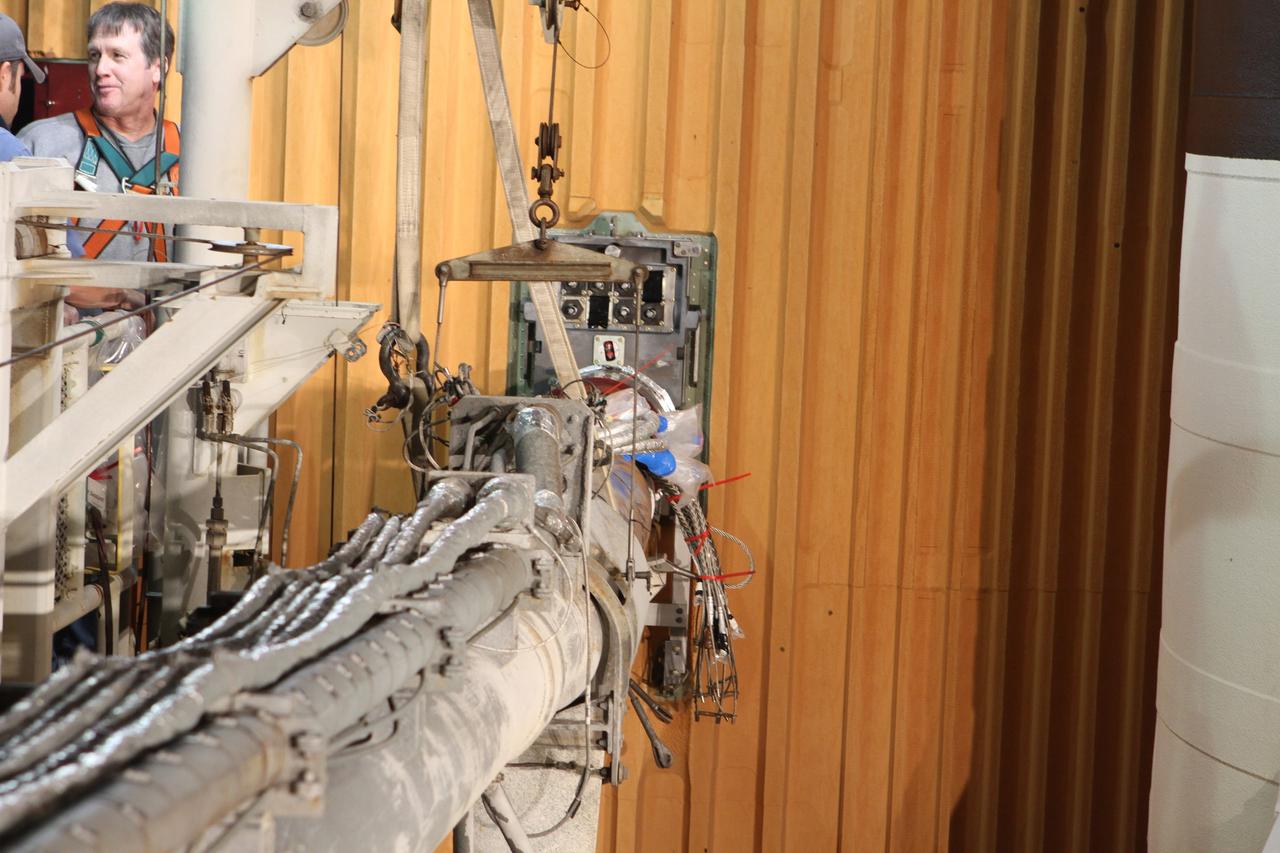
CAPE CANAVERAL, Fla. -- On Launch Pad 39A at NASA's Kennedy Space Center in Florida, preparations are under way to reattach the vent line to the ground umbilical carrier plate (GUCP) on space shuttle Discovery's external fuel tank. A hydrogen gas leak at that location during tanking for Discovery's STS-133 mission to the International Space Station caused the launch attempt to be scrubbed Nov. 5. The GUCP is the overboard vent to the pad and the flame stack where the excess hydrogen is burned off. Discovery's next launch attempt is no earlier than Nov. 30 at 4:02 a.m. EST. For more information on STS-133, visit www.nasa.gov/mission_pages/shuttle/shuttlemissions/sts133/. Photo credit: NASA/Ben Smegelsky
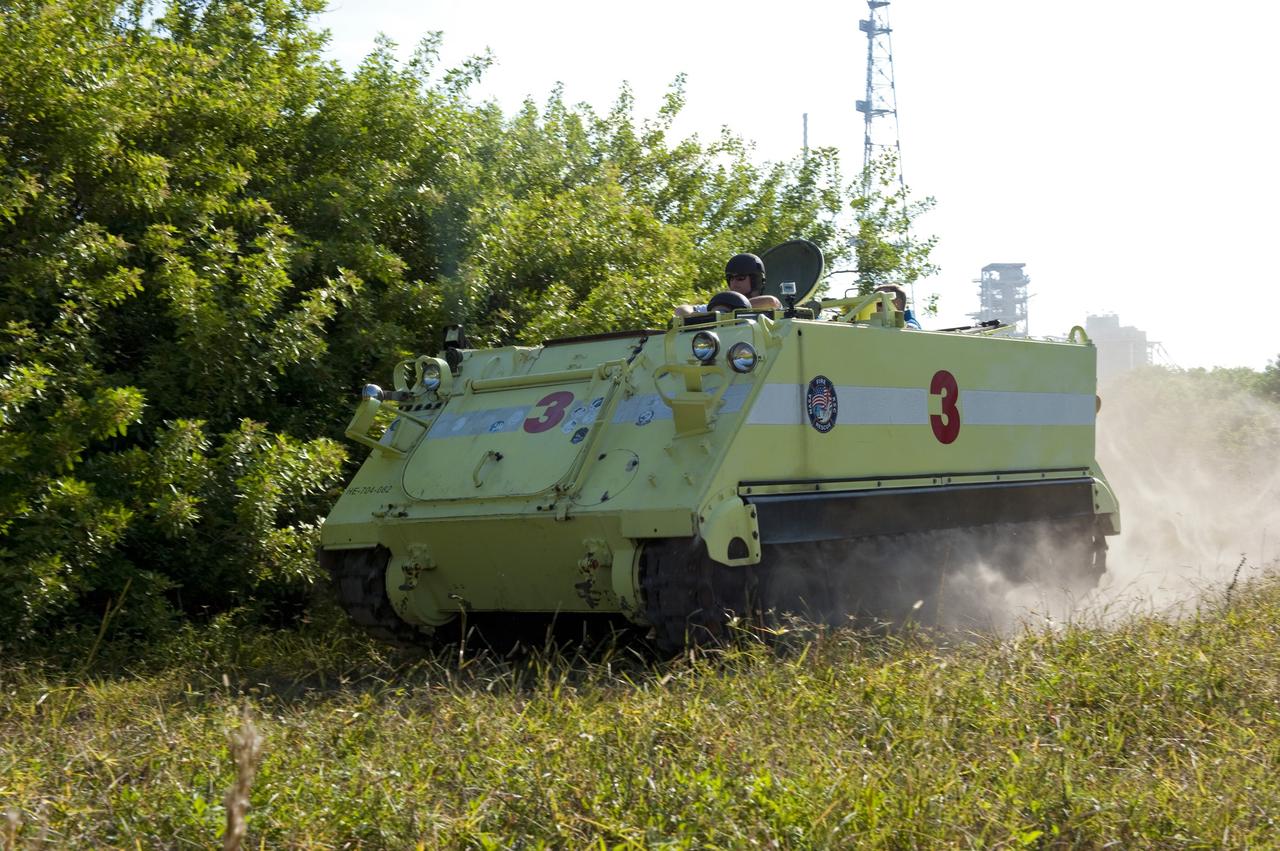
CAPE CANAVERAL, Fla. -- At NASA's Kennedy Space Center in Florida, the crew members of space shuttle Discovery's STS-133 mission go for a ride in an M-113 armored personnel carrier with Battalion Chief David Seymour. An M-113 is kept at the foot of the launch pad in case an emergency egress from the vicinity of the pad is needed, and training on the vehicle is part of the Terminal Countdown Demonstration Test (TCDT). TCDT provides each shuttle crew and launch team an opportunity to participate in various simulated activities, including equipment familiarization and a launch countdown. Space shuttle Discovery and its STS-133 crew will deliver the Permanent Multipurpose Module, packed with supplies and critical spare parts, as well as Robonaut 2, the dexterous humanoid astronaut helper, to the International Space Station. Launch is targeted for Nov. 1 at 4:40 p.m. For more information on the STS-133 mission, visit www.nasa.gov/mission_pages/shuttle/shuttlemissions/sts133/. Photo credit: NASA/Kim Shiflett

CAPE CANAVERAL, Fla. -- Space shuttle Discovery's external fuel tank is outfitted with approximately 89 strain gauges, thermocouples and wiring in preparation for a tanking test no earlier than Dec. 17 on Launch Pad 39A at NASA's Kennedy Space Center in Florida. During the test, engineers will monitor what happens to 21-foot long, U-shaped aluminum brackets, called stringers, located at the external tank's intertank area, as well as the newly replaced ground umbilical carrier plate (GUCP), during the loading of cryogenic propellants. Discovery's first launch attempt for STS-133 was scrubbed in early November due to a hydrogen gas leak at GUCP. The next launch opportunity is no earlier than Feb. 3, 2011. For more information on STS-133, visit www.nasa.gov/mission_pages/shuttle/shuttlemissions/sts133/. Photo credit: NASA/Jim Grossmann
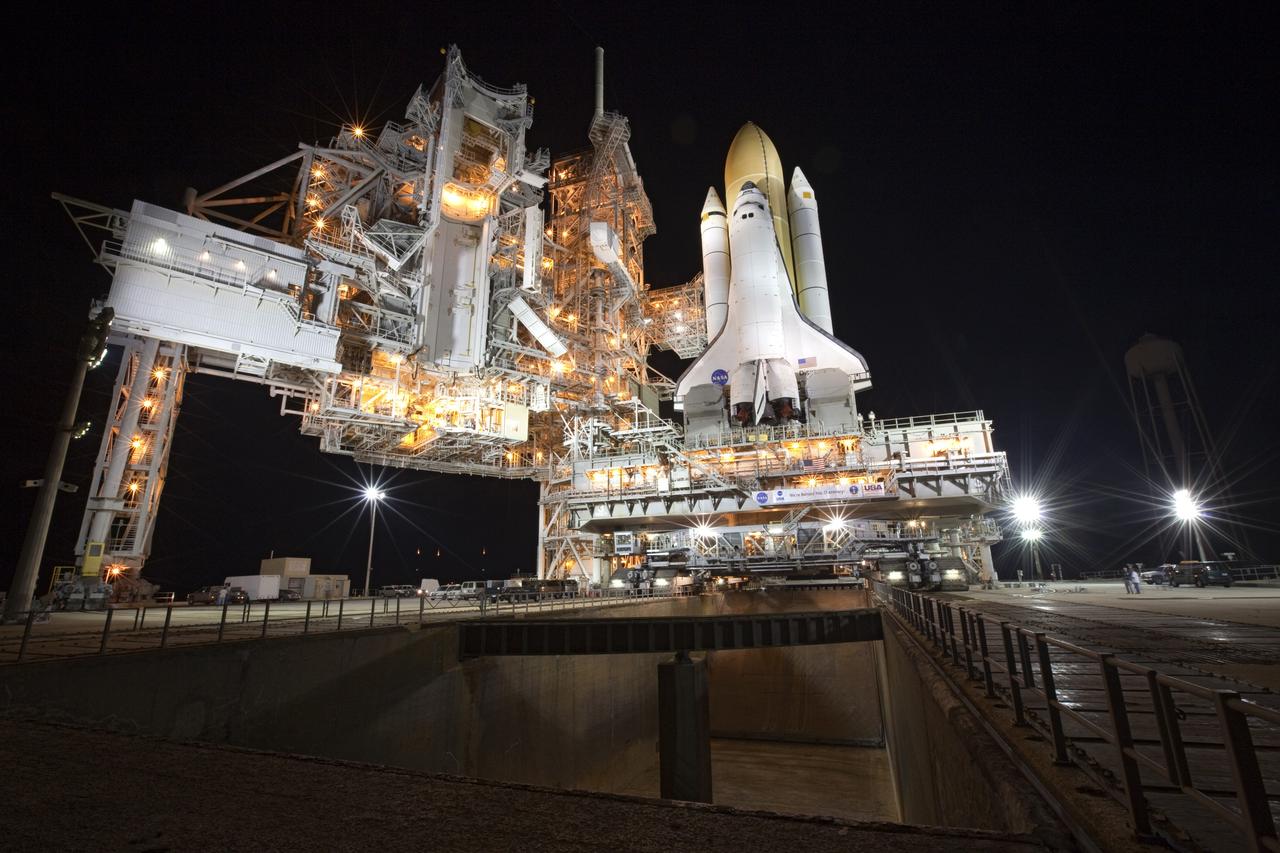
CAPE CANAVERAL, Fla. -- At NASA's Kennedy Space Center in Florida, space shuttle Discovery is attached to Launch Pad 39A, completing "rollout" from the Vehicle Assembly Building to Launch Pad 39A. It took the shuttle, attached to its external fuel tank, twin solid rocket boosters and mobile launcher platform, about six hours to complete the move atop a crawler-transporter. Rollout sets the stage for Discovery's STS-133 crew to practice countdown and launch procedures during the Terminal Countdown Demonstration Test in mid-October. Targeted to liftoff Nov. 1, Discovery will take the Permanent Multipurpose Module (PMM) packed with supplies and critical spare parts, as well as Robonaut 2 (R2) to the International Space Station. Photo credit: NASA/Frankie Martin
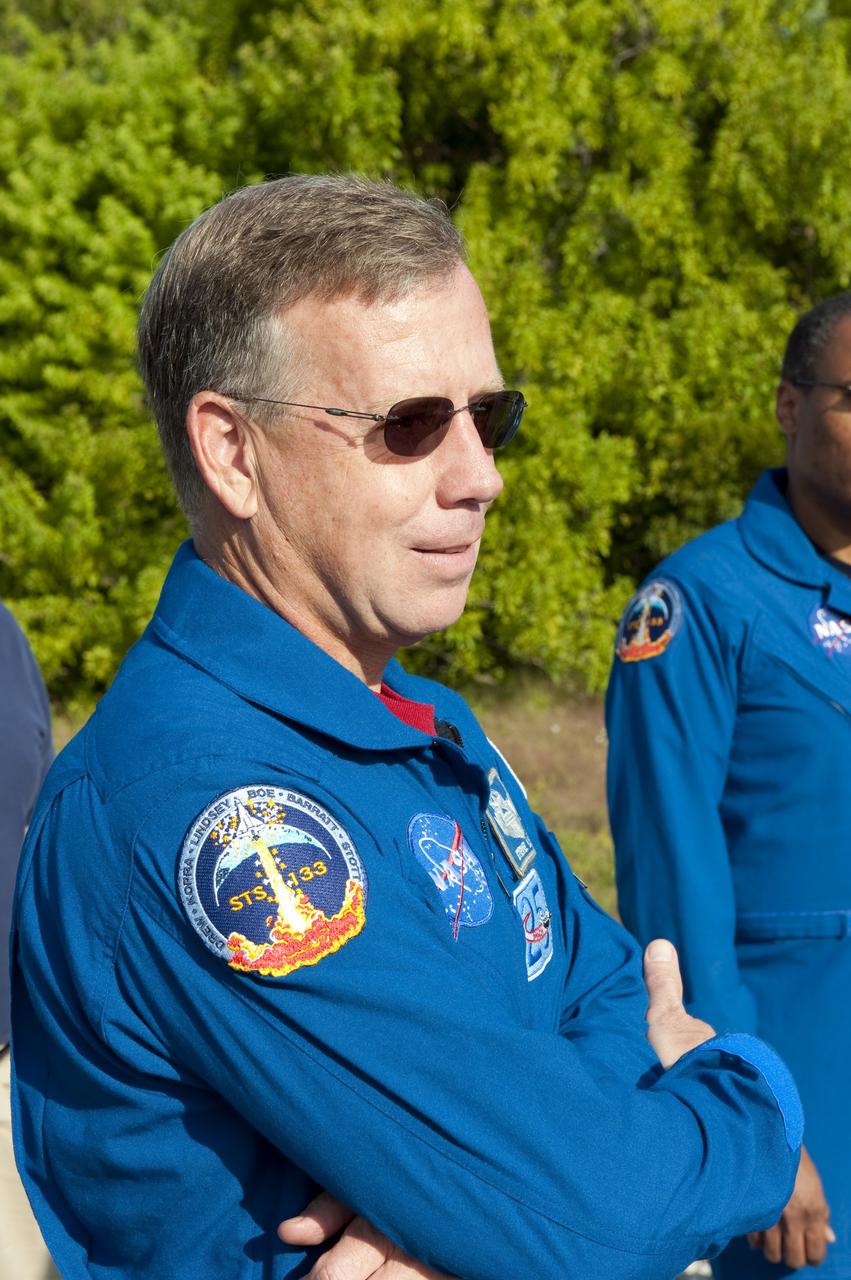
CAPE CANAVERAL, Fla. -- At NASA's Kennedy Space Center in Florida, STS-133 Commander Steve Lindsey prepares to drive the M-113 armored personnel carrier. An M-113 is kept at the foot of the launch pad in case an emergency egress from the vicinity of the pad is needed, and training on the vehicle is part of the Terminal Countdown Demonstration Test (TCDT). TCDT provides each shuttle crew and launch team an opportunity to participate in various simulated activities, including equipment familiarization and a launch countdown. Space shuttle Discovery and its STS-133 crew will deliver the Permanent Multipurpose Module, packed with supplies and critical spare parts, as well as Robonaut 2, the dexterous humanoid astronaut helper, to the International Space Station. Launch is targeted for Nov. 1 at 4:40 p.m. For more information on the STS-133 mission, visit www.nasa.gov/mission_pages/shuttle/shuttlemissions/sts133/. Photo credit: NASA/Kim Shiflett
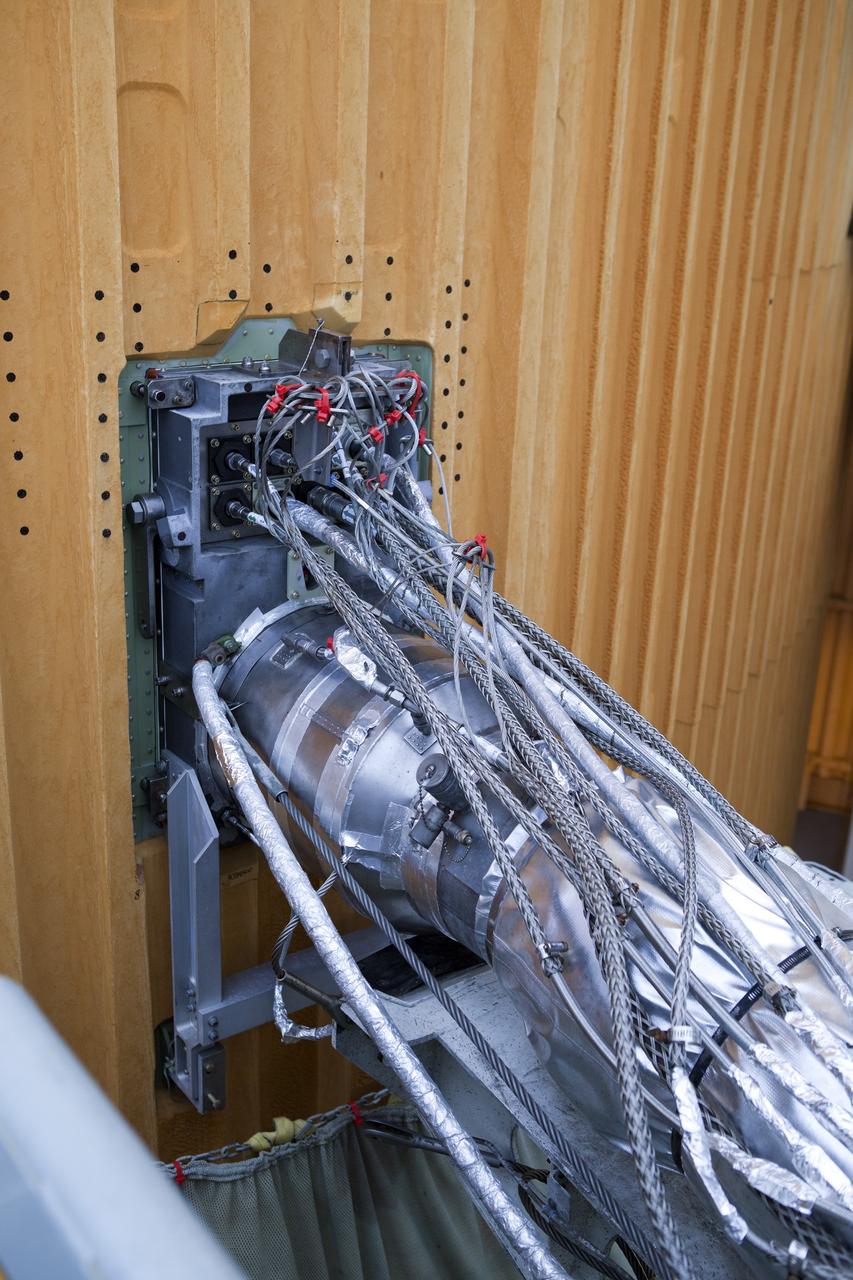
CAPE CANAVERAL, Fla. -- Space shuttle Discovery's external fuel tank is being prepared for a tanking test no earlier than Dec. 15 on Launch Pad 39A at NASA's Kennedy Space Center in Florida. During the test, engineers will monitor what happens to the newly replaced ground umbilical carrier plate (GUCP) and the intertank's stringers, which are 21-foot long, U-shaped aluminum brackets, during loading of cryogenic propellants. Discovery's first launch attempt for STS-133 was scrubbed in early November due to a hydrogen gas leak at GUCP. The next launch opportunity is no earlier than Feb. 3, 2011. For more information on STS-133, visit www.nasa.gov/mission_pages/shuttle/shuttlemissions/sts133/. Photo credit: NASA/Ben Smegelsky